
Gold closed at $1306.40 up $20.40
silver closed at $18.66 or up 47 cents.
Access market prices:
Gold: 1296.50
Silver: 18.47
THE DAILY GOLD FIX REPORT FROM SHANGHAI AND LONDON
.
The Shanghai fix is at 10:15 pm est and 2:15 am est
The fix for London is at 5:30 am est (first fix) and 10 am est (second fix)
Thus Shanghai’s second fix corresponds to 195 minutes before London’s first fix.
And now the fix recordings:
Shanghai morning fix Nov 2 (10:15 pm est last night): $ 1294.53
NY ACCESS PRICE: $1289.70 (AT THE EXACT SAME TIME)
Shanghai afternoon fix: 2: 15 am est (second fix/early morning):$ 1296.08
NY ACCESS PRICE: 1291.70 (AT THE EXACT SAME TIME/2:15 am)
HUGE SPREAD TODAY!! 4 dollars
XXXXXXXXXXXXXXXXXXXXXXXXXXXXXXXXXXXXXXXX
London Fix: Nov 2: 5:30 am est: $1295.85 (NY: same time: $1296.10: 5:30AM)
London Second fix Nov 2: 10 am est: $1303.75 (NY same time: $1301.75 , 10 AM)
Shanghai premium in silver over NY: 59 cents.
It seems that Shanghai pricing is higher than the other two , (NY and London). The spread has been occurring on a regular basis and thus I expect to see arbitrage happening as investors buy the lower priced NY gold and sell to China at the higher price. This should drain the comex.
Also why would mining companies hand in their gold to the comex and receive constantly lower prices. They would be open to lawsuits if they knowingly continue to supply the comex despite the fact that they could be receiving higher prices in Shanghai.
end
.
For comex gold:
NOTICES FILINGS FOR NOVEMBER CONTRACT MONTH: 381 NOTICES FOR 38,100 OZ TONES
For silver:
NOTICES FOR NOVEMBER CONTRACT MONTH FOR SILVER: 12 NOTICES OR 60,000 OZ
xxxxxxxxxxxxxxxxxxxxxxxxxxxxxxxxxxxxxxxxxxxxxxxxxxxxxxxxxxxxxxxxxxxxxxxxxxxxxxxxxxxxxxxxxx
Let us have a look at the data for today
.
xxxxxxxxxxxxxxxxxxxxxxxxxxxxxxxxxxxxxxxxxxxxxxxxxxxxxxxxxxxxxxxxxxxxxxxxxxxxxxx
In silver, the total open interest ROSE by 4181 contracts UP to 196,912. The open interest FELL AS the silver price was UP 63 cents in yesterday’s trading .In ounces, the OI is still represented by just less THAN 1 BILLION oz i.e. .985 BILLION TO BE EXACT or 141% of annual global silver production (ex Russia &ex China).
In November, in silver, 12 notice filings: FOR 60,000 OZ
I
In gold, the total comex gold ROSE by 12,920 contracts WITH THE RISE in price of gold ($14.90 YESTERDAY) . The total gold OI stands at 521,506 contracts. The bankers supplied the necessary non backed paper trying to quell gold’s advance.
In gold for November: we had 381 notices filed for 38,100 oz
xxxxxxxxxxxxxxxxxxxxxxxxxxxxxxxxxxxxxxxxxxxxxxxxxxxxxxxxxxxx
With respect to our two criminal funds, the GLD and the SLV:
GLD
TODAY WE HAD A BIG CHANGE AT THE GLD OUT OF THE GLD/A DEPOSIT OF 2.67 TONNES OF GOLD INTO THE GLD
Total gold inventory rests tonight at: 945.26 tonnes of gold
SLV
we had ANOTHER BIG CHANGE at the SLV/
A DEPOSIT OF 569,000 OZ
THE SLV Inventory rests at: 361.242 million oz
.
First, here is an outline of what will be discussed tonight:
1. Today, we had the open interest in silver ROSE by 4181 contracts UP to 196,912 as the price of silver rose by 63 cents with yesterday’s trading.The gold open interest ROSE by 12,920 contracts UP to 521,506 as the price of gold ROSE $14.90 IN YESTERDAY’S TRADING.
(report Harvey).
2.a) The Shanghai and London gold fix report
(Harvey)
2 b) Gold/silver trading overnight Europe, Goldcore
(Mark O’Byrne/zerohedge
and in NY: Bloomberg
3c FRBNY gold movement report
(Harvey)
3. ASIAN AFFAIRS
i)Late TUESDAY night/WEDNESDAY morning: Shanghai closed DOWN 19.7 POINTS OR 0.63%/ /Hang Sang closed DOWN 336.57 OR 1.45%. The Nikkei closed DOWN 307.72 POINTS OR 1.76% Australia’s all ordinaires CLOSED DOWN 1.19% /Chinese yuan (ONSHORE) closed UP at 6.7611/Oil FELL to 45.96 dollars per barrel for WTI and 47.45 for Brent. Stocks in Europe: ALL IN THE RED Offshore yuan trades 6.7652 yuan to the dollar vs 6.7611 for onshore yuan.THE SPREAD BETWEEN ONSHORE AND OFFSHORE NARROWS QUITE A BIT AS MORE USA DOLLARS ATTEMPT TO LEAVE CHINA’S SHORES / CHINA SENDS A MESSAGE TO THE USA TO NOT RAISE RATES IN DECEMBER.
REPORT ON JAPAN SOUTH KOREA NORTH KOREA AND CHINA
3a)THAILAND/SOUTH KOREA
none today
b) REPORT ON JAPAN
none today
c) REPORT ON CHINA
none today
4 EUROPEAN AFFAIRS
i)Deutsche bank stock is falling along with with rising credit default swaps
( zero hedge)
ii)Strange one!! Deutsche bank’s chief economist Landau accuses the ECB of creating asset bubbles and most importantly expropriating savers plus other goodies as they come clean.
They must be hurting real bad…
( zero hedge/Deutsche bank/Landau)
5. RUSSIAN AND MIDDLE EASTERN AFFAIRS
none today
6.GLOBAL ISSUES
i)As a proxy for the upcoming election, the fall in the Peso is a good sign that Hillary is in trouble at the polls
( zero hedge)
ii) Another humourous story from the Philippines. After Duterte used much vulgar language against the USA, the Americans decided to stop shipments to them. He again called the Americans: “Monkeys”
( zero hedge)
7.OIL ISSUES
Last night we got a huge inventory build from API. Today from DOE also confirms a huge buildup. Oil retreats:
(courtesy zero hedge)
8.EMERGING MARKETS
Venezuela’s currency disintegrates by 20% in just one week. Hyperinflation rages on
( zero hedge)
9.PHYSICAL STORIES
i)The CME is to start London gold contracts in total competition with ICE and LME .. Too many folks are abandoning the manipulated USA gold forum
( Bloomberg/GATA)
ii)The story behind the huge Grasberg mine
( The Guardian from London)
iii) Silver’s rise is showing that there is a real flight to safety going on
(courtesy Dave Kranzler/IRD)
10.USA STORIES WHICH MAY INFLUENCE THE PRICE OF GOLD/SILVER
i)We now have 5 separate FBI cases probing the Hillary-Bill Clinton inner circle:
Here is the background on those 5 cases and all of the major players that we are going to cover.
(the Daily Mail)
ii)Trump and Hillary are basically tied in latest ABC poll
( zero hedge)
iii)Citibank states what even if Hillary wins the election, it will be marked by continuous investigations and an impeachment risk.
( Citibank/zerohedge)
iv) a. The Dept of Justice guy, Peter Kadzik who is leading the investigation into the Clinton scandals has now been exposed with colluding with the Clinton campaign. What a mess!! Yesterday, in my commentary I wrote that this was this biggest conflict of interest possible and it has now become reality.
( zero hedge)
iv b. The DOJ responds: finds nothing wrong..so move on…Kadzik is nothing but a huge conflict of interest here!
( zerohedge)
v)Trump now surpasses Clinton as the rats abandon ship
vi)Unusual for these guys to report such a negative repot: the ADP employment sinks to its weakest level for over 2 years:
( ADP/zero hedge)
vii)The New York, ISM mfg index contracts for the 3rd consecutive month:
( zero hedge/ISM)
viii)The Fed holds again but states that the rate hike in December “strengthens”
( zero hedge)
Let us head over to the comex:
The total gold comex open interest ROSE BY 12,920 CONTRACTS to an OI level of 521,506 as the price of gold ROSE $14.90 with YESTERDAY’S trading.The bankers were on full alert supplying the necessary non backed gold paper keeping the gold price contained.In the front month of November we had 494 notices standing for a GAIN of 19 contracts. We had 13 notices served upon yesterday so we GAINED 32 contracts or 3200 ADDITIONAL oz will stand for delivery in November. The next contract month and the biggest of the year is December and here this month showed a increase of 8,987 contracts up to 369,645.
And now for the wild silver comex results. Total silver OI rose by 4181 contracts from 192,731 up to 196,912 as the price of silver ROSE to the tune of 63 cents yesterday. We are moving further from the all time record high for silver open interest set on Wednesday August 3: (224,540). The front month of November had an OI of 51 and thus a gain of 42 contracts. We had 0 notices filed upon yesterday so we gained 42 contracts or an additional 210,000 oz will stand for delivery. The next major delivery month is December and here it FELL BY 46 contracts DOWN to 139,664.
In silver had 12 notices filed for 60,000 oz
VOLUMES: for the gold comex
Today the estimated volume was 210,779 contracts which is good.
Yesterday’s confirmed volume was 229,195 which is good
today we had 20 notices filed for 2000 oz of gold:
| Gold | Ounces |
| Withdrawals from Dealers Inventory in oz | NIL |
| Withdrawals from Customer Inventory in oz nil |
26,258.193 oz
Brinks
Manfra (3 kilobars)
Scotia |
| Deposits to the Dealer Inventory in oz | nil oz
|
| Deposits to the Customer Inventory, in oz |
6,411.28 oz
Brinks
|
| No of oz served (contracts) today |
381 notices
38,100 oz
|
| No of oz to be served (notices) |
113 contracts
11,300
oz
|
| Total monthly oz gold served (contracts) so far this month |
1269 contracts
126,900 oz
3.9471 tonnes
|
| Total accumulative withdrawals of gold from the Dealers inventory this month | nil oz |
| Total accumulative withdrawal of gold from the Customer inventory this month | 26,451.1 oz |
Today, 0 notices were issued from JPMorgan dealer account and 0 notices were issued from their client or customer account. The total of all issuance by all participants equates to 381 contract of which 0 notices were stopped (received) by jPMorgan dealer and 0 notice(s) was (were) stopped/ Received) by jPMorgan customer account.
March 2015: 2.311 tonnes (March is a non delivery month)
| Silver | Ounces |
| Withdrawals from Dealers Inventory | NIL |
| Withdrawals from Customer Inventory |
607,570.563 oz
Delaware
|
| Deposits to the Dealer Inventory |
nil OZ
|
| Deposits to the Customer Inventory |
599,926.900 oz
Brinks
|
| No of oz served today (contracts) |
12 CONTRACT(S)
(60,000 OZ)
|
| No of oz to be served (notices) |
39 contracts
(195,000 oz)
|
| Total monthly oz silver served (contracts) | 350 contracts (1,750,000 oz) |
| Total accumulative withdrawal of silver from the Dealers inventory this month | NIL oz |
| Total accumulative withdrawal of silver from the Customer inventory this month | 1,582,554.8 oz |
end
NPV for Sprott and Central Fund of Canada
end
FEDERAL RESERVE BANK OF NEW YORK: EAR MARKED GOLD MOVEMENTS
LAST MONTH: 7,849 MILLION DOLLARS WORTH OF GOLD VALUED AT $42.22
THIS MONTH: 7,841 MILLION DOLLARS WORTH OF GOLD VALUED AT $42.22
THUS 8 MILLION DOLLARS WORTH OF GOLD AT 42.22 LEFT NEW YORK
OR 189,483.65 OZ (5.8937 TONNES)
Since Germany is the only official nation asking for repatriation of their gold, we can safely assume that this gold is heading for Frankfurt.
end.
And now your overnight trading in gold,WEDNESDAY MORNING and also physical stories that may interest you:
Diwali, Gold and India – Is Love Affair Over?
Diwali, Gold and India – Is the Love Affair Over?
I live in Dubai where Diwali has been the focus for many this weekend. With Diwali comes not just fantastic light displays and celebrations but also huge adverts for Hindus to buy gold for their loved ones in India and throughout the world.
Buying gold at Diwali is a religious or spiritual act and it is considered auspicious and thought to bring good fortune and prosperity.
 Win Gold Coins for Shopping
Not only are there offers to buy gold jewellery, bars and coins but there are competitions to win gold. When I went to do my weekly shop at a Carrefour I was delighted to see a gold coin on display that I could win.
‘The more you shop the more coins you can win’ the poster told me, so on I shopped convincing myself I was making a possible investment decision.
Double page spreads, billboards and radio adverts regarding gold are not uncommon here and are very much a part of day-to-day life. The gold price, UAE gold coin and reports of gold take front and centre of the daily newspaper. Back in London an FT mention of gold and at least six people forward it onto me. In Dubai, the Middle East and much of Asia, it’s no big deal.
Whilst the local Emirati population has a desire to hold gold it is the Indian population (who represent 42% of society here), their countrymen and their love for gold, that has me fascinated this week.

India is often quoted as the world’s largest gold importer, a crown that has been wrestled away by China, but both still rule the charts. This is a relatively new phenomenon for India. Until 1990 gold imports were pretty much banned, just eight years prior to that only 65 tonnes of gold had been brought in, by 2010 imports had reached over 1,000 tonnes.
We have written about India’s understanding of, spiritual affinity and love of gold in the past, usually around this time of year when everyone starts writing about it. It is festival and wedding season, and it is one of the few periods when mainstream precious metals analysts actually look at physical demand and supply – the heart of what makes gold so interesting. They look away from the hot air the West spews out about the dollar, all powerful central bank interest rate changes, presidential elections and EU traumas affecting the gold price and instead tell a real human-based story about gold demand in India, and how it provides strong underlying support for the gold price.
But this year something has changed. I am now living in among this desire to buy gold yet at the same time I am reading on Bloomberg and Reuters that the Indian gold market is on its knees.

Is this love trade really over? Was the bustling gold souk in the old part of Dubai just a mirage?
The truth is, the Indian gold market has had some tough blows in the last few years. And yet, he Indian gold market has shown incredible resilience over the years. Despite this, every single year without fail, there are renewed warnings and misleading headliens regarding a decline in Indian demand.
We are in the final quarter of the year when gold demand should be booming. Yet Bloomberg interviewed ‘five jewellers and traders’ (yes, five, an excellent sample size in a country of 1.25 billion). The findings of the survey concluded that ‘[gold] demand has just fallen off a cliff’ and predicted that just 650 tonnes would be imported this year.
Has gold demand fallen off a cliff? Why does Bloomberg think so? And why is this only important at this time of year?
Why do you only care about India during Diwali?
It is considered auspicious to buy gold during the festivals of Diwali and Dussehra, and this additional demand for gold is added to due to the final quarter of the year being wedding season, when between 35% and 40% of a wedding’s expenses is thought to be spent on gold. But, and this may come as a shock to those running the Bloomberg survey, the country does still buy gold the rest of the year.
A few years ago Jeff Nichols wrote that he believed gold bears ‘have a fairly provincial view and limited understanding of gold’s increasingly bullish long-term fundamentals.’ He defined ‘provincial’: ‘they are ignoring more than half the world.’ Because, Western mainstream analysts and commentators only consider gold demand in the East during times of celebration, because it is seen as the done thing, and it is disregarded the rest of the year.
What the mainstream forgets is that gold isn’t purchased during these special occasions because of good marketing (as we see in the West during Christmas time and present giving), but because it is a trusted form of currency and investment.

Gold demand, not dead yet.
First up it is important to note that the World Gold Council expect gold demand in India to be around 750 – 850 tonnes this year, not quite as dire as Bloomberg but still slightly off the 926 tonnes seen in the fiscal year of 2015 -2016. In 2015, gold demand climbed about 2.5% on the previous year. MMTC-PAMP (the Indian gold refiner) have reported a dramatic drop in gold imports this year, in value terms numbers dropped 76% to 60 tonnes between April and July.
Meanwhile, the jewellers who clearly weren’t speaking to Bloomberg are even more than the WGC and are reported to be expecting sales to be increasing to by 50-60 percent over last year, according to the Indian Bullion and Jewellers Association. This doesn’t necessarily mean increased imports. It may be on account of some increased stock building by jewellers earlier in the year.
This year has been tough though for gold traders in India. In the first half of the year 100 tons of demand was lost due to a strike by jewellers in protest over a tax on jewellery made and sold in the country. Jewellery has suffered. In 2014 India consumed 668.5 tonnes of jewellery, an increase of 6% from 632.2 tonnes in 2014 and 615.7 tonnes in 2013. However Q1 this year saw jewellery consumption down to 72.9 tonnes from 148.5 tonnes in Q1 2015, according to GFMS estimates, while between April and June it fell further from 56.3 percent to 69.2 tonnes from 158.2 tonnes.
Whilst numbers might be down somewhat, there is no threat to them no longer contributing to global gold demand. Many believe that China still own the gold crown, but according to a GFMS, Thomson Reuters survey, India still reigns. In fact, last year India’s gold bar demand saw an 81% increase in growth in the second-half of the year, contributing to an overall 16% increase worldwide. China, in comparison only saw a 19% increase.
Gold is the fall-guy when it comes to black money and over spending.
The government has, without doubt, been the single most negative force on India gold demand in recent years. Given the measures that have been taken, official gold demand has been impressively resilient.
Gold controls in India are nothing new. These have come in both the form of bans, duties and gold mobilisation efforts (to get gold int the financial system). Each time the government has given in due to smuggling rates or low uptake
– In 1947 gold bullion imports and exports were banned under the Foreign Exchange Regulation Act. Lifted in 1966.
– In November 1962, 15 year gold bonds were issued at 6.5% in an attempt to mobilise privately held gold. This only saw an estimated 16 tonnes exchanged for bonds. A small percentage of the total holdings.
– Further efforts at mobilising gold continued between 1962 and 1993. Each was disappointing in regard to how much gold was mobilised.
– In 1968 the Gold Control Act was implemented which forbid the holding of gold bars and restricted families’ jewellery holdings. This was abolished in 1990.
– In 1977 the government considered controlling the market in an attempt to stop smuggling. According to the MCX this idea was seen as an impossibility due to foreign exchange reserves. Instead, the confiscated gold was sold in small quantities through the RBI, ‘however, it did not have any major impact on smuggling.’
From 1997 gold was in free flow and demand began to climb. However from 2012 the current-account deficit was wearing the government down so they turned to gold to solve their problems, although perhaps not in a conventional sense. In 2012 an economic survey found “There is scope to discourage unproductive imports, like gold and consumer goods, to restore balance.”
The government began to place various restrictions on gold imports in the form of duties and import/export ratios. Since 2012 the import duty has gradually climbed from 2% to 12%.
When the Indian government announced gold controls it was because the level of imports had derailed the rupee and pushed the current account deficit to unprecedented levels, or so they said.
In truth zero-rated tariff structures for capital goods imports punished the current account deficit by $339 billion, more than that of gold which accounted for $161 billion. Gold however, is the barbarous relic in some western economists’ theories and books, and so it came to be in certain economic and government circles in India as well.
Government imposed controls and duties on gold are no longer just because of the current account deficit. Instead these are decisions made to clamp down on ‘black money’ (money that has not been declared). Marwan Shakarchi, chairman of MKS (Switzerland) SA, told Bloomberg the drop in gold demand “is a sign the government is serious about cracking down on black money,” he said, referring to a campaign by Prime Minister Narendra Modi “to curb undisclosed income.”
$450 billion is thought to escape the eye of the tax man in India, and as a result is hot money. As ever when a government looks to crack down on money laundering and tax evasion, gold is often blamed as a source (rather than bi-product) of the situation and suffers as a result.

Import duty on gold in India remains a source of discussion, which many believe should be cut from 12% to just 6%. However, despite the fall in the current-account deficit, there is little incentive for the government to reduce the import tax on gold. In 2015 they raised $3.3 billion.
At the beginning of the year, Finance Minister Arun Jaitley decided to keep the duty intact (much to the market’s surprise) and went further by imposing an excise duty on gold jewellery sales from March. This lead to the one-and-a-half month strike by jewellers, who have been punished plenty by recent gold duties.
The decisions by Jaitley curbed gold jewellery demand in the first quarter, sending it to its lowest level in seven years to 88.4 tonnes. Total demand slumped 39 percent from a year ago to 116.5 tonnes, according to the WGC.
Next year a general sales tax on gold jewellery will be imposed. Commentators at this year’s LBMA conference stated that they believe this tax will be around 18%. Unsurprisingly a tax at that level would normally reclassify a good as a luxury, but this is more than a ‘nice-to-have’ item for Indian gold buyers. And so we suspect this will have little impact on unofficial gold figures.
Smuggling is encouraged
For all the various figures and commentaries that point to and suggest a drop in gold demand, there is one area which speaks for itself when it comes to the country’s desire to own gold no matter what. Smuggling.
Smuggling is rife thanks to government controls and imposed duties (see below), the efforts to curb gold demand have been so relentless that it appears to just encourage more smuggling, each year. It is the smugglers who have offered the unfaltering supply to the buyers who will continue to demand gold. Even prior to the 1990s, gold continued to be bought, thanks to smuggling.
The trouble with illegal activity is that you never know whose figures to believe and so reliable numbers are hard to come by. Recently someone told me that 70% of the gold brought into India was smuggled, and this was repeated at this year’s LBMA conference when it was reported that two-thirds of India’s gold inflows come via smuggled channels, including men with “stomachs full of gold,” as we reported in 2014.

Officially, 100 tonnes of gold is thought to have been smuggled into the country between April and September this year, according to business-standard.com. In 2014 the BBC reported that an estimated 700kg was smuggled into India each day, although the World Gold Council believes a far more conservative 175 tonnes of gold were smuggled into India in all of 2014.
The truth is, that whilst official figures suggest things are flat in the Indian gold market, smuggling remains rife and is playing an increasing role in gold import figures. Whilst big brand jewellers might not want to partake (or admit to partaking) in illegal gold activities, the demand (and therefore supply) is coming from somewhere. Otherwise smugglers wouldn’t be risking jail fines and uncomfortable plane journeys to get the gold from Dubai, Singapore, Bangladesh and Nepal into India.
India is a massive country with a massive land border and it is impossible to prevent smuggling.
Who is buying the gold, smuggled or not?
A GFMS 2016 gold survey found those households dependent on agricultural activities, in India, contribute to 35% of annual gold demand. Within rural households gold comprises 45% of their total savings.
There is no asset as liquid as gold, in India. And this is one of many reasons why it is so popular with those in rural and unbanked areas. Central banker Y. V. Reddy once said, “The real purchaser of gold is typically a peasant.” Whilst Jeffrey A. Franks, of the IMF, was once quoted as saying, “Holding gold has, in fact, often in history served, from France to India, as the only way the peasant can protect himself against inflation and the vicissitudes of politics”.
But to a government so influenced by uber-Keynesian and neo-liberal economics, it continues to treat their own people in a similar vein. “it should be noted that labour-only households adopt a high risk-high return strategy due to their over-investment in one asset, viz. gold.” stated a paper by NSE and the Institute for Financial Management and Research (IFMR) in 2015. But for those spending 45% of their wealth on gold, this is not a ‘high-risk return strategy.’
S.Gurumurthy in the Hindu Business Line writes, “Only gold, no other asset, has so consistently beaten inflation. The average inflation during 2001-02 to 2005-06 was 4.7 per cent but gold yielded 9.2 per cent — almost double. The average inflation for 2006-7 to 2010-11 was 6.7 per cent but the yield on gold was 23.7 per cent — three times plus. Average inflation for 2012 is 9 per cent but gold returned 33.5 per cent — almost four times. Traditional India intuitively seems to understand the value of gold.”
This is something that has been unappreciated, or most likely ignored, by government trying to crack down on gold ownership. Taxes on gold have been created with the wealthier in mind. These are the people who usually operate within the financial system, pay taxes regularly and are used to and more receptive to such government and more western approaches.
However, an asset that represents 45% of a rural household’s savings is unlikely to suddenly disappear thanks to a new law passed by the government.

As an India farmer looks at it, the Indian rupee has lost over 88% of its purchasing power in relation to the US dollar, since 1978. The rising price of gold has helped to maintain purchasing power.
It is also important to question what gold is used for, in some areas. Of the 41.2 million non-farming businesses in India (employing over 100 million people) 91% are funded by families and unofficial private financing companies. Gold is frequently used as loan collateral.
Across the financial spectrum, gold remains a key feature in household expenditures
There is an argument that with the growth of the middle classes and urbanisation, the term ‘rural household’ is perhaps outdated and misconstrued. The middle class in India grew by 67% between 2001 and 2016. With this change in the demographics of India, will no doubt come changing demands and practices.
Some market commentators point to the millennials as a potential problem for the gold market, in both India and China. Whilst they have all had the need to own and hold gold drilled into them, there are now a number of other ways they’d like to spend their money.
One also has to consider how a squeezed middle-class will look at the 0.9% return in rupee terms that gold has delivered since 2013, versus the 5.6% on property and 11.9% on local equities (according to Kotak bank).
“People are less inclined to buy the traditional gold jewellery these days. They prefer to buy gold bars and coins available at banks instead. Jewellery shops in different parts of the city have also pulled a large chunk of customers away from us,” Gaurav Verma, a gold merchant at Sarafa Market, told the Times of India.

However In 2014-15, a survey carried out by the Federation of Indian Chambers of Commerce & Industry (FICCI)NSE and the Institute for Financial Management and Research (IFMR) found that more than three quarters of Indians view the precious metal as a “safe asset.”
Interestingly only 23.05% saw this as a way of saving for the future – even though this is in many ways what a safe asset is.
A presentation by MMTC PAMP at the LBMA conference this month suggested that in India where “there may be an investment benefit, the driver for Gold is not ‘conventional’ investment.”
Can the government change how Indians buy gold?
In 2013, the Reserve Bank of India Working Group to Study the Issues Related to Gold Imports and Gold Loans stated that “demand for gold appears to be autonomous and a function of several influences and factors that may not be strictly amenable to policy changes” (i.e.it ignores Western theory).
It goes on “…gold demand is price inelastic… buyers take recourse to unauthorised channels to buy gold”.
The government, whilst actively working against gold imports has decided it would still like to benefit from the cultural desire to own gold and overcome the growing smuggling rings.
One thing that we are now seeing in India is the marketing to encourage the mental shift of gold ownership for investment rather than for savings.
Financial bods and government look down on and worry about the ‘investment strategy’ of these rural households. The discomfort with Indian’s buying and holding gold outside of the financial system has led to the Reserve Bank of India setting up a committee to consider why so much money is put into the safe haven.
They will look at “whether, how, and why the financial allocations of Indian households deviate from desirable financial allocation and behaviour.”
In a 2015 paper by NSE and the Institute for Financial Management and Research (IFMR) explains why, really they would be better getting their gold into the financial system, stating that given ‘gold ETFs outperformed physical gold by providing returns of 23.97% at a standard deviation of 10.04% compared to returns of 20.97% at a standard deviation of 13.56% for physical gold. Inclusion of a wider suite of financial assets including gold ETFs, MMMFs, and corporate bonds could lead to a Pareto improvement in the risk-return profile of households.”
However this analysis was carried out without considering those slightly important considerations such as commission, taxes, management fees etc. With ETFs there is always ‘fee drag’, something which is non existent for an Indian household who just keeps it at home, out of harm’s way.
For those families spending £20,000 -£25,000 on gold, standard deviations, corporate bonds and ‘suites of financial assets’ are unlikely to undo hundreds and thousands of years of buying physical gold.
Last November, Modhi launched the India Gold Coin, along with the World Gold Council. GFMS reports that the launch, “saw an underwhelming response, attributed to less awareness and minimal distribution network.” It is the country’s first ever sovereign gold coin and the only coin to be hallmarked by the Bureau of Indian Standards.
Jewellery sales might be down, but the government (like China) has tried to formalise gold demand by launching gold-backed sovereign bonds – effectively monetising gold. However, they have so far had little uptake, they represent less than 0.2% of the country’s total gold products.
Here, it is also important to question what gold is used for, in some areas. Of the 41.2 million non-farming businesses in India (employing over 100 million people) 91% are funded by families and unofficial private financing companies.
The government aren’t shy about persuading citizens to buy bonds instead of physical gold, this season. Money Today reportsthe launch of the ‘sixth tranche of SGB [sovereign gold bonds] the government has launched it at discount of Rs50 at Rs, 2957, which is it the lowest subscription price for 2016-2017. But at the same time the government has reduced the interest rate from 2.75% to 2.5% on these bonds.”

The news site goes onto explain that these SGB’s in paperless format are very handy and ‘save you the hassle’ of looking after it. Unlike with physical gold the owner is locked in for eight years with an exit option after five years. “By investing in these bonds you can cash in on the upside movement in gold prices as well as earn 2.5% interest at the time of exit.” Also, you don’t pay CGT on the gold if you wait the subscribed eight years, unlike with physical gold and ETFs.
Note, this is no longer about current account deficits and black-money, the kind of rhetoric now being used by government bodies is that they are mobilising gold for the good of the people. Given the levels of smuggling, it seems likely that government declarations of a war on gold for the good of the economy has fallen on deaf ears.
Conclusion: Will the Indians keep their gold?
It is clear from smuggling levels, as well as official import levels that gold demand is not going to be ‘falling off a cliff’ any time soon. But more importantly the lesson in India is that their love for gold cannot be ‘dealt with’ in a Western paradigm.
In the West gold is still peddled by the media as the asset of the wealthy and rarely owned by the common man, in India it is very much the latter. It is a cultural and indeed a spiritual phenomenon, not a financial asset.
As the Hindu Business Line, writes (quoting Aseem Chawla, Partner, MPC Legal):
‘Indians are creatures of habits; they save a third of their earning — a phenomenon probably explained by “our cultural values rooted in conservatism” and household savings which constitute large chunk of national savings are normally invested in “safe yet non-productive investments like gold.”’
Ultimately though, we do all buy and hold gold for the same reason – to protect ourselves from incompetence of governments and the central banking system. It is also a hedge against war and the occasional tyranny of our “great leaders.”
No matter which country you live in a practical paradigm must exist that ensures gold imports do not encourage crime and also benefit the citizens as well the economy.
Gold in India, as across the West, is increasingly touted as something that weakens and reduces economic power of individuals. The truth is, it is the ultimate expression of economic power and freedom. It is an asset which cannot be fiddled or debased by governments or banks. Physical gold owned in thesafest ways (allocated and segregated), in the safest vaults in the world, cannot suddenly disappear when you go to check your ‘gold balance’ one day.
In many ways, the justification for Indian’s buying gold is stronger than ever, just as we see in the West, as explained by the IBJA:
“The market sentiment looks good as gold seems to be secure investment in the current Indo-Pak political scenario and the ongoing US presidential elections. The good monsoon this year will play a key role in bringing back rural demand in an agro-based economy like India.”

Gold and Silver Bullion – News and Commentary
Gold heading for best year in four in 2017: poll (Reuters.com)
Gold steady ahead of Fed meeting outcome (Reuters.com)
Asian Stocks Slide With Won as Election Angst Boosts Yen, Gold (Bloomberg.com)
Stocks Fall as Gold Climbs With Treasuries Amid Election Anxiety (Bloomberg.com)
CME to Start London Gold Contract in Challenge to ICE, LME (Bloomberg.com)

SWOT Analysis: The Potential Drivers for Gold Demand in China and India (Goldseek.com)
Silver Spikes To Key Resistance At One-Month Highs As Dollar Dumps (ZeroHedge.com)
Unprecedented U.S. Treasury Bond Dumping (FutureMoneyTrends.com)
Rick Santelli on Central Banks Buying Stocks (Youtube.com)
Economic stress as world runs out of dollars (Telegraph.co.uk)

Gold Prices (LBMA AM)
02 Nov: USD 1,295.85, GBP 1,056.51 & EUR 1,169.76 per ounce
01 Nov: USD 1,284.40, GBP 1,048.58 & EUR 1,167.52 per ounce
31 Oct: USD 1,274.20, GBP 1,046.25 & EUR 1,163.22 per ounce
28 Oct: USD 1,265.90, GBP 1,042.47 & EUR 1,160.96 per ounce
27 Oct: USD 1,269.30, GBP 1,038.29 & EUR 1,162.93 per ounce
26 Oct: USD 1,273.90, GBP 1,043.45 & EUR 1,166.13 per ounce
25 Oct: USD 1,269.30, GBP 1,037.53 & EUR 1,165.85 per ounce
Silver Prices (LBMA)
02 Nov: USD 18.54, GBP 15.05 & EUR 16.70 per ounce
01 Nov: USD 18.24, GBP 14.91 & EUR 16.54 per ounce
31 Oct: USD 17.76, GBP 14.59 & EUR 16.22 per ounce
28 Oct: USD 17.61, GBP 14.51 & EUR 16.13 per ounce
27 Oct: USD 17.66, GBP 14.41 & EUR 16.16 per ounce
26 Oct: USD 17.66, GBP 14.46 & EUR 16.17 per ounce
25 Oct: USD 17.73, GBP 14.49 & EUR 16.30 per ounce
Recent Market Updates
– Silver Krugerrands By South African Mint Coming Soon – Massive Clearance Sale on Gold Krugerrands
– Trump “Will Probably Win” and Gold “May Rise $100” Overnight – Rickards
– World Is Out of Weapons
– Gold Is The “Kardashian of Commodities” – Herbert & Keiser Interview Skoyles
– Value of Gold – Unlike Paper Currency Gold Maintained Value Throughout Ages
– Fed Risks Lehman Crisis As US Recession Storm Gathers
– Silver Eagle Demand ‘Returned with a Vengeance’
– Cashless Society – War On Cash to Benefit Gold?
– “Higher Gold Prices” On Global Trade Slowdown – HSBC
– Euro “Will Collapse” As Is “House of Cards” Warns Architect of Euro
– Property Bubble In Ireland Developing Again
– “Gold Is A Great Hedge Against Politicians” – Goldman
– Sell Gold Now – Time To Liquidate Gold ETF, Pooled and Digital Gold
end
Silver’s rise is showing that there is a real flight to safety going on
(courtesy Dave Kranzler/IRD)
Gold is powering higher because the dollar is dropping. The dollar index is down 1.7% in the last 3 1/2 trading sessions. It’s down 2.3% vs the euro in the last 5 1/2 days, down 2.1% vs the yen in the last 3 days and down nearly 2% vs. the Swissie since Sunday night.
This is NOT about the political chaos connected to the U.S. election. That’s a sideshow distraction to the real problems going on behind the scene.
The U.S. economy is starting to collapse. This is becoming glaringly evident from most of the data, notwithstanding the highly manipulated economic reports like auto sales.
The movement back into non-fiat assets is starting again – anything connected to debt, like housing, is a de facto fiat asset. The best indicator of this is not gold, but silver. Silver was correlating with SPX for most of October, when the investment “thesis” was “a strengthening economy is good for industrial metals.”
The graph below illustrates this. It shows silver’s movement vs. the SPX for the last 3 months:

Silver correlated almost perfectly with the movement of the SPX for most of October (shaded area on the graph). But silver has moved up while the SPX has been selling off (including today, Nov 2nd) the past 4 trading sessions. This signals a switch from silver performing as an “industrial” metal to silver functioning as a “monetary” metal.
Certainly based on the gold-silver ratio, silver is extraordinarily cheap to gold and thus represents a prototypical “value” trade as the markets begin to accept and reflect economic reality and reject the politically-charge propaganda about a “healthy” economy coming from the Fed, the White House and the Democratic candidates.
IRD sponsor’s the Mining Stock Journal, which provides unique commentary and insight into the precious metals and mining stock market. It also presents typically an under-followed junior mining stock investment idea and, when warranted, large-cap trade. A few issues ago I recommended First Majestic calls. As of today, those calls are up over 50% from offer side at issue to bid side right now. New subscribers also receive all of the back-issues. You can subscribe by clicking here: Mining Stock Journal.
The CME is to start London gold contracts in total competition with ICE and LME
Too many folks are abandoning the manipulated USA gold forum
(courtesy Bloomberg/GATA)
CME Group to start London gold contract in challenge to ICE, LME
Submitted by cpowell on Tue, 2016-11-01 18:28. Section: Daily Dispatches
Governments and central banks use CME Group exchanges for surreptitious trading of all major futures contracts in the United States:
http://www.gata.org/node/14385
http://www.gata.org/node/14411
* * *
By Eddie Van Der Walt
Bloomberg News
Tuesday, November 1, 2016
CME Group Inc. will start London gold and silver contracts in January to offer a spread between spot prices and benchmark U.S. futures, competing with similar planned contracts from Intercontinental Exchange Inc. and the London Metal Exchange.
CME’s new contracts will be listed on Comex in New York and begin trading on Jan. 9, pending a regulatory review, the world’s largest futures exchange told reporters at a briefing in London on Tuesday. The spread will be based on the new spot contracts and active Comex futures, it said.
Exchanges are fighting for a share of London’s $5 trillion-a-year gold market as scrutiny from regulators triggers a shake up of the city’s over-the-counter trading. ICE said last month it will start a new contract for London and use it to clear its daily auction for the metal. Separately, the LME, World Gold Council, and several banks plan to introduce centrally cleared gold and silver contracts in the first half of next year. …
… For the remainder of the report:
http://www.bloomberg.com/news/articles/2016-11-01/cme-to-start-gold-silv…
END
The story behind the huge Grasberg mine
(courtesy The Guardian from London)
The $100 billion gold mine and the West Papuans who say they count the cost
Submitted by cpowell on Wed, 2016-11-02 04:35. Section: Daily Dispatches
By Susan Schulman
The Guardian, London
Tuesday, November 1, 2016
TIMIKA, West Papua, Indonesia — In 1936 Dutch geologist Jean Jacques Dozy climbed the world’s highest island peak: the forbidding Mount Carstensz, a snow-covered silver crag on what was then known as Dutch New Guinea. During the 4,800-metre ascent, Dozy noticed an unusual rock outcrop veined with green streaks. Samples he brought back confirmed exceptionally rich gold and copper deposits.
Today these remote, sharp-edged mountains are part of West Papua, Indonesia’s largest province, and home to the Grasberg mine, one of the biggest gold mines — and third-largest copper mine — in the world. Majority-owned by the American mining firm Freeport McMoRan, Grasberg is now Indonesia’s biggest taxpayer, with reserves worth an estimated $100 billion.
But a recent fact-finding mission by the Brisbane (Australia) Archdiocese’s Catholic Justice and Peace Commission described a “slow-motion genocide” taking place in West Papua, warning that its indigenous population is at risk of becoming “an anthropological museum exhibit of a bygone culture.”
Since the Suharto dictatorship annexed the region in a 1969 United Nations referendum largely seen as a fixed land grab, an estimated 500,000 West Papuans have been killed in their fight for self-rule. Decades of military and police oppression, kidnapping, and torture have created a longstanding culture of fear. Local and foreign journalists are routinely banned, detained, beaten and forced to face trial on trumped-up charges. Undercover police regularly trail indigenous religious, social, and political leaders. And children still in primary school have been jailed for taking part in demonstrations calling for independence from Indonesia.
“There is no justice in this country,” whispered one indigenous villager on condition of anonymity, looking over his shoulder fearfully. “It is an island without law.” …
… For the remainder of the report:
https://www.theguardian.com/global-development/2016/nov/02/100-bn-dollar…
Since the Suharto dictatorship annexed the region in a 1969 United Nations referendum largely seen as a fixed land grab, an estimated 500,000 West Papuans have been killed in their fight for self-rule. Decades of military and police oppression, kidnapping, and torture have created a longstanding culture of fear. Local and foreign journalists are routinely banned, detained, beaten and forced to face trial on trumped-up charges. Undercover police regularly trail indigenous religious, social, and political leaders. And children still in primary school have been jailed for taking part in demonstrations calling for independence from Indonesia.
“There is no justice in this country,” whispered one indigenous villager on condition of anonymity, looking over his shoulder fearfully. “It is an island without law.” …
… For the remainder of the report:
https://www.theguardian.com/global-development/2016/nov/02/100-bn-dollar…
END
Your early WEDNESDAY morning currency, Asian stock market results, important USA/Asian currency crosses, gold/silver pricing overnight along with the price of oil Major stories overnight
:
1 Chinese yuan vs USA dollar/yuan DOWN to 6.7611( REVALUATION NORTHBOUND /CHINA UNHAPPY TODAY CONCERNING USA DOLLAR RISE/MORE $ USA DOLLARS LEAVE CHINA/OFFSHORE YUAN NARROWS TO 6.7652 / Shanghai bourse CLOSED DOWN 19.71 POINTS OR 0.63% / HANG SANG CLOSED DOWN 336.57 OR 1.45%
2 Nikkei closed DOWN 307.72 OR 1.76% /USA: YEN FALLS TO 103.39
3. Europe stocks opened ALL IN THE RED ( /USA dollar index DOWN to 97.42/Euro UP to 1.1090
3b Japan 10 year bond yield: FALLS TO -.063%/ !!!!(Japan buying 100% of bond issuance)/Japanese yen vs usa cross now at 105.00/ THIS IS TROUBLESOME AS BANK OF JAPAN IS RUNNING OUT OF BONDS TO BUY.
3c Nikkei now JUST BELOW 17,000
3d USA/Yen rate now well below the important 120 barrier this morning
3e WTI:: 45.96 and Brent:47.45
3f Gold UP /Yen UP
3g Japan is to buy the equivalent of 108 billion uSA dollars worth of bond per month or $1.3 trillion. Japan’s GDP equals 5 trillion usa./“HELICOPTER MONEY” OFF THE TABLE FOR NOW /REVERSE OPERATION TWIST ON THE BONDS: PURCHASE OF LONG BONDS AND SELLING THE SHORT END
Japan to buy 100% of all new Japanese debt and by 2018 they will have 25% of all Japanese debt. Fifty percent of Japanese budget financed with debt.
3h Oil DOWN for WTI and DOWN for Brent this morning
3i European bond buying continues to push yields lower on all fronts in the EMU. German 10 yr bund FALLS A LOT to +.123%
3j Greek 10 year bond yield FALLS to : 8.04%
3k Gold at $1297.70/silver $18.57(7:45 am est) SILVER ABOVE RESISTANCE AT $18.50 WILL BE DEFENDED
3l USA vs Russian rouble; (Russian rouble DOWN 20/100 in roubles/dollar) 63.50-
3m oil into the 45 dollar handle for WTI and 47 handle for Brent/
3n Higher foreign deposits out of China sees huge risk of outflows and a currency depreciation (already upon us). This can spell financial disaster for the rest of the world/China forced to do QE!! as it lowers its yuan value to the dollar/GOT a REVALUATION UPWARD from POBC.
JAPAN ON JAN 29.2016 INITIATES NIRP. THIS MORNING THEY SIGNAL THEY MAY END NIRP. TODAY THE USA/YEN TRADES TO 103.39 DESTROYING WHATEVER IS LEFT OF OUR YEN CARRY TRADERS
30 SNB (Swiss National Bank) still intervening again in the markets driving down the SF. It is not working: USA/SF this morning .9708 as the Swiss Franc is still rising against most currencies. Euro vs SF is 1.0766 well above the floor set by the Swiss Finance Minister. Thomas Jordan, chief of the Swiss National Bank continues to purchase euros trying to lower value of the Swiss Franc.
3p BRITAIN VOTES AFFIRMATIVE BREXIT
3r the 10 Year German bund now POSITIVE territory with the 10 year FALLS to +.123%
/German 9+ year rate BASICALLY negative%!!!
3s The Greece ELA NOW at 71.4 billion euros,AND NOW THE ECB WILL ACCEPT GREEK BONDS (WHAT A DISASTER)
The bank withdrawals were causing massive hardship to the Greek bank. the Greek referendum voted overwhelming “NO”. Next step for Greece will be the recapitalization of the banks and that will be difficult.
4. USA 10 year treasury bond at 1.797% early this morning. Thirty year rate at 2.543% /POLICY ERROR)
5. Details Ransquawk, Bloomberg, Deutsche bank/Jim Reid.
(courtesy Jim Reid/Bloomberg/Deutsche bank/zero hedge)
Global Stocks, Peso, Oil Drop On Trump Fears; Safe Havens Rise Ahead Of Fed Announcement
Global stocks, S&P futures, the Mexican peso, the Korean Won and crude oil all fell as traders were spooked by polls suggesting a tightening race and Trump momentum ahead of next week’s American presidential election. The yen and Swiss franc gained, as did global bond markets and gold as investors flocked to safe haven assets.
The MSCI All Country World Index sank to its lowest since July Bloomberg observes, as shares slumped in Europe and Asia with futures foreshadowing a seventh day of losses for U.S. equities. The yen rose for a second day, while the Swiss franc and gold were near their highest levels in almost a month. Political upheaval weighed on South Korea’s currency, and New Zealand’s dollar strengthened after jobs data. Treasuries rose ahead of a Federal Reserve policy decision and crude oil fell after a report showed American stockpiles expanded.
The risk off catalyst was yesterday’s ABC/WaPo tracking poll which showed Republican Donald Trump with 46 percent support to Democrat Hillary Clinton’s 45 percent, putting him ahead for the first time since May. A Bank of America Corp. index tracking volatility expectations in equities, bonds, currencies and commodities rose for five days through Monday, the longest run of increases since before the British vote to quit the European Union.

The flight to safety has led to a bid for both European bonds…

… and the traditional safe haven, the Swiss franc.

“Having had their fingers horribly burnt with the Brexit vote in June, financial markets appear to be starting to pare some risk in the lead up to next week’s U.S. Presidential vote, in the event that in circumstances that would probably have been unthinkable a week or so ago, that Donald Trump could win the U.S. Presidency,” Michael Hewson, chief market analyst at CMC Markets, writes in note.
Adding to today’s risk is the conclusion of the November FOMC meeting, which however is expected to reveal nothing new when the Fed presents its latest statement at 2pm. While the Fed is expected to leave interest rates unchanged when a two-day meeting concludes Wednesday, futures indicate a 68% chance of a rate hike by year-end and investors will be on the lookout for any hints the authority may give regarding the policy outlook. Bloomberg’s dollar index fell for a fourth day as some analysts said a Trump victory could spur volatility in financial markets and reduce the odds of a rate increase next month.
“The markets’ anxiety levels have moved up a gear,” adds Chris Weston, Melbourne-based chief market strategist at IG Ltd. This “suggests the bears have the upper hand, with the buying drying up and funds keeping their cash deployed for more certain times,” he said.
At 2pm all eyes will turn to the Fed where the FOMC outcome is due. Clearly this has been completely overshadowed by the election campaign and expectations of a policy move are unsurprisingly very low. The bigger question is how much of a green light signal do we get for December? The market is still pricing in a 70%ish probability for a December hike and so as DB’s Peter Hooper notes, the signal perhaps needn’t be stronger tonight than it has been already.
Looking at stocks, the Stoxx Europe 600 Index slid 0.7 percent as of 8:11 a.m. London time, falling for an eighth day ahead of the release of manufacturing data for the euro area. A.P. Moller-Maersk A/S tumbled by the most since June after the owner of the world’s largest container line reported a 43 percent drop in third-quarter profit.
The MSCI Asia Pacific Index fell by the most since September, with Japanese shares retreating from a six-month high before the nation’s financial markets shut Thursday for a holiday. Sony Corp. sank to a two-month low after the Japanese electronics maker’s quarterly profit missed estimates and Sumitomo Electric Industries Ltd. tumbled 12 percent after the company lowered its full-year earnings target. “The Trump risk is in revival,” said Chihiro Ohta, a Tokyo-based senior strategist at SMBC Nikko Securities Inc. “With Trump, there always follows an uneasiness over whether policies will be managed properly in the U.S., and given the holiday tomorrow in Japan, there’s no need to build positions at an uncertain time like this.”
Futures on the S&P 500 Index fell 0.2 percent ahead of the Fed decision and results from companies including Alibaba Group Holding Ltd. and Facebook Inc.
Safe-haven demand boosted sovereign bonds, with 10-year yields falling across most of the developed world. The yield on 10Y Treasuries fell two basis points to 1.81 percent, after touching a five-month high of 1.88 percent in the last session. It’s unlikely the rate will climb too far past 2 percent anytime soon given how the American economy is performing, according to Jim Caron at Morgan Stanley Investment Management, which oversees $406 billion.
“Nobody really believes that rates can just rise very very quickly, or that bond prices can fall off a cliff,” Caron, who is based in New York, said Tuesday on Bloomberg Television. “You’re not seeing the growth. You’re not really seeing the inflation.”
* * *
Bulletin Headline Summary from RanSquawk
- European equities enter the US crossover as US election fears, softness in peripheral banks and lower energy prices hamper sentiment
- USD losses have been extended, with EUR/USD testing 1.1100 and USD/CHF dipping below .9700
- Looking ahead, highlights include the German jobs report, ADP employment change, DoE inventories and FOMC rate decision
Market Snapshot
- S&P 500 futures down 0.2% to 2100
- Stoxx 600 down 0.6% to 333
- FTSE 100 down 0.4% to 6891
- DAX down 0.8% to 10440
- German 10Yr yield down 4bps to 0.14%
- Italian 10Yr yield down 4bps to 1.71%
- Spanish 10Yr yield down 6bps to 1.24%
- S&P GSCI Index down 1% to 356.8
- MSCI Asia Pacific down 1.1% to 138
- Nikkei 225 down 1.8% to 17135
- Hang Seng down 1.5% to 22811
- Shanghai Composite down 0.6% to 3103
- S&P/ASX 200 down 1.2% to 5229
- US 10-yr yield down 3bps to 1.8%
- Dollar Index down 0.13% to 97.57
- WTI Crude futures down 1.5% to $45.98
- Brent Futures down 1.4% to $47.46
- Gold spot up 0.6% to $1,296
- Silver spot up 0.6% to $18.48
Top Global Headlines
- Top Economists Spar Over Trump as Tighter Race Sinks U.S. Stocks
- Carney May Have Bigger U.K. Inflation Worries Than the Pound: Brexit supply shock could put a squeeze on the economy
- CIC Group Said to Mull Bid for $6 Billion Property Owner GLP: Singapore-based industrial property owner fell below IPO price
- Valeant Said to Be in Talks for Sale of Salix to Takeda
- Tullow CEO Resuming African Oil Exploration Amid Debt Reduction: Net debt to be reduced by about $1 billion in next few years
- November Fed Hike Odds Tanked on Economic and Political Events: Political risk and steady-as-she-goes data made markets doubt a hike
- Delta, United Said to Near Avianca Bids Amid Elliott Talks: Colombian airline mulls options including sale of control
- JPMorgan Beats Goldman With Bond-Market Maneuvering in Toronto: Barclays, Citi, Deutsche Bank also left out of some trades
- AEP’s First Loss in a Decade Is the Latest Sign of Coal’s Demise: Follows Duke Energy, Southern in shifting away from coal
- Lockheed’s F-35 Said to Need $500 Million More for Development: Pentagon officials says funds to be requested in next budget
- Tesla Sees SolarCity Boost Within 3 Years as Musk Hits Critics: Acquisition target increased cash in third quarter, Tesla says
Looking at regional markets, we start in Asia where stocks saw spill-over selling from its global counterparts amid weakness in oil and political jitters after the latest ABC News/Washington Post poll showed rump ahead for the first time since May. This pressured the ASX 200 (-1.2%) and Nikkei 225 (-1.8%) from the open with the latter also hampered by JPY strength and disappointing earnings, including an 86% drop in Sony’s net profit. Shanghai Comp. (-0.6%) and Hang Seng (-1.4%) conformed to the downbeat tone as financials suffered while the PBoC also reduced its liquidity operations. 10yr JGBs traded marginally higher as the risk averse sentiment spurred safe-haven buying, while participants also digested an enhanced liquidity auction which posted an increase in b/c from prior.
Top Asian News
- Park Dumps Premier, Finance Chief to Stem Korea Scandal Fallout: Prosecution to seek arrest of Park’s friend in scandal
- Tata Empire Split in Two as Mistry Stays Chairman of Units: Tata Motors, Tata Power say Mistry is still chairman
- China’s Corn Pile Shrinks as Output Drops Most in 16 Years: Even with less from China, world supplies will be biggest ever
- Standard Chartered’s Tough Years in India Are Over, Kanwal Says: Loan impairments in the country had dragged on profit
- Hong Kong Election Heats Up as Candidates Await China’s Blessing: Meet the contenders vying to lead the financial hub
- China Losing Emerging Markets Engine Complicates Exports Outlook: Commodity price rally raises hopes demand will pick up
US election jitters stemming from yesterday’s ABC national poll also weighed on Europe equities this morning. While sentiment has also been gripped by the weakness in financials, largely due to the softness seen in peripheral banks after bailout plans for the troubled Italian lender, Monti Paschi had been withdrawn and in turn this saw the banks shares temporarily halted for trade. Elsewhere oil prices remain pressured after last night’s API crude oil inventory report post a large build of 9.3mln. In credit markets, bunds are sharply higher this morning amid the risk averse sentiment with yields bull steepening across the curve, while volumes are somewhat lighter given that participants are awaiting the FOMC decision at 1800GMT.
Top European News
- Euro-Area Manufacturing Gathers Speed as Price Pressures Build: A Purchasing Managers’ Index for factories rose to 53.5 from 52.6 in September, exceeding an Oct. 24 estimate of 53.3
- German Unemployment Falls to Record Low as Economy Ploughs On: Joblessness fell by 13,000 in October vs estimated 1,000 drop
- At Societe Generale, Returns From Car Leasing Dwarf Banking: Equity-derivatives leader generates best profits from autos
In FX, the most notable move was that of the Mexico’s peso which slid as much as 0.8 percent versus the greenback to its weakest level since Oct. 7. The currency loses ground when support builds for Trump, who has said he would revisit the North American Free Trade Agreement that governs commerce between the U.S. and Mexico. The Republican candidate’s prospects have improved since it was announced Friday that the Federal Bureau of Investigation had reopened a probe of Clinton’s use of private e-mail while Secretary of State. Before the FBI announcement, “the market had pretty much priced out most of the risk of Donald Trump becoming president,” said Lee Hardman, a currency strategist at Bank of Tokyo-Mitsubishi UFJ Ltd. in London. “Obviously, the markets had to reassess that view now.” In South Korea, the won dropped as much as 1.1 percent to its weakest level since July as South Korean President Park Geun-hye replaced her prime minister and finance chief on Wednesday to help stem the fallout from a political scandal that threatens her grip on power. The yen climbed 0.5 percent against the dollar, after surging 0.6 percent in the last session. The franc also added 0.5 percent following a 1.4 percent jump that marked its biggest gain in about five months. Against the euro, Switzerland’s currency was headed for its strongest close in more than a year.
In commodities, crude oil fell 0.7% to a one-month low in New York after API data showed American inventories increased by 9.3 million barrels last week. Organization of Petroleum Exporting Countries members Libya and Nigeria are boosting output, providing a challenge to the group’s effort to finalize an agreement to curb production and stabilize prices. Gold added 0.5 percent, after surging 0.9 percent on Tuesday. The Bloomberg Industrial Metals Subindex fell for the first time in eight days, as zinc retreated from a five-year high in London and aluminum slid from its highest close since June 2015. “We’re in a bit of a risk-off mode again as markets readjust to the chances of a Trump presidency,” said Michael McCarthy, chief market strategist at CMC Markets in Sydney. “The outlook for the global economy is still fragile and hits to sentiment can have an immediate, negative effect across the markets, and that includes the base metals.”
Looking at today’s calendar, in the US the sole key data release is the October ADP employment change reading where expectations are sitting at 165k. The main event is however reserved for the FOMC meeting outcome due at 2pm ET. As a reminder, there is no post-statement press conference scheduled. There’s not much else to highlight away from the data aside from earnings. 38 S&P 500 companies are on the cards today with the highlights including Facebook MetLife and AIG, all due in the evening.
DB’s Jim Reid concludes the overnight wrap
By this time next week we may know who the next US president is going to be. However if it’s close the results may take a few more hours to decipher. For the sake of all our sanity let’s hope we don’t get a repeat of the 2000 election where the result wasn’t known until a month and four days after America went to the polls. Due to the ‘hanging chads’ the election result was in legal dispute for weeks. I remember travelling the world that month with people from all corners utterly perplexed as to how the battle to be the leader of the free world could turn out in the way it did. 16 years on there are many with similar thoughts but for maybe different reasons.
Yesterday election blues hit the market as an ABC News/Washington Post tracking poll placed Trump 1% ahead of Clinton at 46% to 45% – his first lead in this poll since May. The previous ABC News/Washington poll which came out over the weekend had Clinton ahead by the same amount. The chatter in the market yesterday was that although Clinton was still a clear favourite, the probabilities of her winning seemed to be similar to that of the UK staying in the EU just prior to June’s referendum. So once bitten twice shy for many.
The ABC News/Washington Post survey appears to be the poll which is most widely reported right now. Yesterday’s survey covered 1,128 “likely voters” over October 27-30th which means that the sample is still slightly overlapping those FBI headlines from Friday. It’s also worth noting that the current 1% separating the two candidates is well within the survey’s 3% margin of sampling error. In other words, it’s extremely close. Interestingly the same poll also showed that only 45% of Clinton supporters are now “very enthusiastic” about Clinton, compared to 52% in the last survey. It’s the reverse for Trump supporters where 53% are now “very enthusiastic” compared to 49% previously. So momentum has seemingly swung on this poll.
The chips are certainly coming off the table in markets heading into next week. Yesterday the S&P 500 fell -0.68% meaning it has now closed down for six days in a row for the first time since August 2015. Yesterday’s decline was the largest in what is a -1.84% cumulative losing streak over this period. It wasn’t much better in Europe where the Stoxx 600 plunged -1.07% and is now down seven days in a row for the first time since February this year. Disappointing results from BP and Standard Chartered didn’t help. The VIX also rose nearly 9% yesterday and is now at the highest level since June. Credit was under pressure with the FT also reporting that two of the largest HY ETF’s suffered their sixth successive day of outflows. In FX the Greenback had its worst day in nearly 2 months with the US Dollar index closing -0.76% as investors flocked to the Yen (+0.64%), Swiss Franc (+1.39%) and Gold (+0.86%). The Dollar did however have a much better day relative to a cross section of emerging market currencies. Most notable was the loss for the Mexican Peso (-1.73%) while the South African Rand, Brazilian Real and Colombian Peso were all down at least -1%.
One market where perhaps the election outcome implications are a little less clear for is US Treasuries. Yesterday the 10y yield was up as much as 5bps by the early afternoon, touching an intraday high of 1.877% before then paring all of that move into the close to finish little changed around 1.827%. The manufacturing data was supportive with the PMI revised up a little (to 53.4 from 53.2) and the ISM manufacturing print for October rising 0.4pts to 51.9 (vs. 51.7 expected). That said the details were a bit more mixed and showed new orders reversing (to 52.1 from 55.1) but employment climbing (to 52.9 from 49.7). The latter clearly a positive ahead of payrolls on Friday.
With that in mind it’s also worth keeping an eye on today’s ADP employment change report where the consensus for October is sitting at 165k versus 154k the month prior. Later this evening however all eyes turn to the Fed where the FOMC outcome is due. Clearly this has been completely overshadowed by the election campaign and expectations of a policy move are unsurprisingly very low. The bigger question is how much of a green light signal do we get for December? The market is still pricing in a 70%ish probability for a December hike and so as DB’s Peter Hooper notes, the signal perhaps needn’t be stronger tonight than it has been already. 7pm GMT for that one.
Switching now to the latest in Asia this morning where equity markets have taken their cue from the weak US session yesterday. The Nikkei (-1.66%), Hang Seng (-1.30%), Shanghai Comp (-0.49%), Kospi (-1.34%) and ASX (-1.49%) have all sold off. Credit indices in Asia, Japan and Australia are also 1-2bps wider while US equity index futures have also weakened. Gold (+0.22%) is a touch higher while Oil continues to trade weaker this morning. WTI is -0.92% as we type and a little above $46/bbl following a -0.41% decline yesterday. The exception in the energy complex though is Gasoline which rallied +4.55% yesterday following the news of a large pipeline explosion and fire in Alabama.
Moving on. It’s worth drawing attention to a piece from our Euro economists on how likely a shift from monetary to fiscal policy is in the region. A large coordinated fiscal stimulus across euro-area countries could bring lasting benefits to growth and unemployment. Will it happen? Not according to them. Based on current rules even Germany’s fiscal space is not higher than 1% of German GDP. That said, they show that there would be scope to modify tax systems and spending choices to favour potential growth in France and the peripheral country. Unfortunately, the rise of the populist parties is not conducive for those hoping for an optimisation of fiscal policy.
Before we look at the day ahead, the remaining data in the US yesterday was fairly mixed. On the positive side, total vehicle sales rose to an annualized rate of 17.90m in October from 17.65m in the month prior. Meanwhile the IBD/TIPP economic optimism reading was little changed in November at 51.4. Finally, the disappointing data was the latest construction spending report. Spending was reported as declining -0.4% mom versus expectations of a +0.5% increase. The only data in Europe was reserved for the UK where the October manufacturing PMI declined just over 1pt and a little more than expected to 54.3 (vs. 54.5 expected).
3.REPORT ON JAPAN SOUTH KOREA NORTH KOREA AND CHINA
i)Late TUESDAY night/WEDNESDAY morning: Shanghai closed DOWN 19.7 POINTS OR 0.63%/ /Hang Sang closed DOWN 336.57 OR 1.45%. The Nikkei closed DOWN 307.72 POINTS OR 1.76% Australia’s all ordinaires CLOSED DOWN 1.19% /Chinese yuan (ONSHORE) closed UP at 6.7611/Oil FELL to 45.96 dollars per barrel for WTI and 47.45 for Brent. Stocks in Europe: ALL IN THE RED Offshore yuan trades 6.7652 yuan to the dollar vs 6.7611 for onshore yuan.THE SPREAD BETWEEN ONSHORE AND OFFSHORE NARROWS QUITE A BIT AS MORE USA DOLLARS ATTEMPT TO LEAVE CHINA’S SHORES / CHINA SENDS A MESSAGE TO THE USA TO NOT RAISE RATES IN DECEMBER.
3a)THAILAND/SOUTH KOREA/:
none today
b) REPORT ON JAPAN
c) Report on CHINA
4 EUROPEAN AFFAIRS
Deutsche bank stock is falling along with with rising credit default swaps
(courtesy zero hedge)
Don’t Look Now But The Most Systemically Dangerous Bank In The World Is Tumbling Again
Remember Deutsche Bank? It seems ‘hope’ for a deal – and a capital raise – are fading fast.
The last few days have seen the stock of the most systemically dangerous bank in the world tumble over 11% catching back down to the credit market’s reality…

And 5Y CDS is surging back towards record highs.
“probably nothing”
end
Strange one!! Deutsche bank’s chief economist Landau accuses the ECB of creating asset bubbles and most importantly expropriating savers plus other goodies as they come clean.
They must be hurting real bad…
(courtesy zero hedge/Deutsche bank/Landau)
Deutsche Bank Accuses ECB Of “Creating Asset Bubbles, Expropriating Savers And Backdoor Socialization”
While not quite as full of fire and brimstone as his June report in which Deutsche Bank’s chief economist, David Folkerts-Landau said that “The ECB must change“, and in which he accused Mario Draghi of putting not only the ECB’s future at risk, but the future of the entire Eurozone, with its destructive policies, overnight the German bank’s top economist released yet another subversive if quite accurate analysis which could have come from your typical, fringe (blog which has accused the central banks of all of this for many years), in which Folkerts-Landau once again exposes that “dark sides of QE”, listing “Backdoor socialisation, expropriated savers and asset bubbles.”
And, in an amusing twist, none other than Deutsche Bank’s twitter account subtweeted the ECB earlier this morning pointing out that “ECB intervention: negative repercussions are becoming overwhelming ”
#ECB intervention: negative repercussions are becoming overwhelming http://www.dbresearch.de/MAIL/DBR_INTERNET_DE-PROD/PROD0000000000425308.pdf …#dbresearch

While the 6-page paper does not contain anything particularly groundbreaking, the fact that DB continues to push the openly confrontational narrative, demanding the ECB unwind its extraordinary measures, suggests that the German bank continues to suffer, and most importantly, this outright bashing of Draghi’s policies received the explicit green light of John Cryan.
The summary of the note, as crystalized by Bloomberg, is the following: “While European central bankers commend themselves for the scale and originality of monetary policy since 2012, this self-praise appears increasingly unwarranted,” because, as he concludes, “ECB is stuck … between an unfavorable equilibrium of low growth, high unemployment and zero reform momentum on the one hand and growing risks to core country balance sheets on the other.”
Here are the main points of the report. Stop us if you have heard these countless times in the past:
The dark sides of QE
Backdoor socialisation, expropriated savers and asset bubbles
While European central bankers commend themselves for the scale and originality of monetary policy since 2012, this self-praise appears increasingly unwarranted. The reality is that since Mr Draghi’s infamous “whatever it takes” speech in 2012, the eurozone has delivered barely any growth, the worst labour market performance among industrial countries, unsustainable debt levels, and inflation far below the central bank’s own target.
While the positive case for European Central Bank intervention is weak at best, it seems that the negative repercussions are becoming overwhelming. This paper outlines the five darker sides to current monetary policy.
The first is a paradox of ECB intervention: that monetary policy stifled the very reform momentum it sought to create. Up until July 2012, high interest rates and refinancing threats forced governments to be serious about reforms. Indeed, pre-2012, more than half the growth initiatives recommended by the OECD were being implemented across the eurozone. But last year just twenty per cent were. ECB intervention has curtailed the prospect of significant reforms in labour markets, legal systems, welfare systems, and tax systems across the continent.
Second, bond prices have lost their market-derived signalling function. Since investors began to anticipate sovereign purchases by the central bank in late 2014, intra-eurozone government bond spreads have been locked together. In turn, misrepresentative sovereign yields distort the whole fixed income universe that is priced off government debt.
Perhaps the darkest side of ECB monetary policy is the increasing concentration of risk on the eurosystem balance sheet – expected to be EUR 2tn by March 2018. In the event of a debt restructuring of a eurozone member, the liabilities of the national central bank are likely to be borne by the taxpayers of the other eurozone member states, even if losses are spread over a long period. Fundamentally, however, the debt will have been socialised.
Fourth, ECB intervention has not been a net positive for eurozone savers. While high and stable revaluation gains have buttressed total returns over recent years, this is clearly a one-time gain. Today, rising energy prices, the shortage of high coupons and ultimately mean-reversion are likely to take their toll.
Finally, the misallocation of capital caused by ECB policy is preventing creative destruction and causing asset bubbles. Increased lending has gone mostly to low quality existing borrowers while obviating troubled banks from the need to write down loans. Without creative destruction in ailing industries, investors in high-saving countries have simply bid-up the price of healthy assets.
One of the most salient points, and one we have been pounding the table on ever since the start of QE, is what the economist callsed the “paradox of EVB intervention”, which can be simply summarized as monetary policy stifling the very reform momentum it sought to create. To be sure, this website has said ever since the start of the decade, that through their monetary intervention, central banks obviate the need for much harder, structural reform (which can cost politicians their careers) and fiscal policy. Folkerst-Landau is one of the most prominent strategists to agree with this:
Up until July 2012, high interest rates and refinancing threats forced governments to be serious about reforms. Indeed, pre-2012, more than half the growth initiatives recommended by the OECD were being implemented across the eurozone. But last year just twenty per cent were. ECB intervention has curtailed the prospect of significant reforms in labour markets, legal systems, welfare systems, and tax systems across the continent.
To undescroe his point he shows data which clearly demonstrates that t“deficit countries” – France, Estonia, Greece, Ireland, Italy, Portugal, Slovakia and Spain – made a much greater effort in 2011 and 2012 than they did last year. Indeed, the OECD itself says that in the early part of the European debt crisis “reform responsiveness” was greater in countries that were facing more difficult circumstances, though that correlation has broken down somewhat lately. The OECD also warns against over-interpreting year-over-year changes too much, as many types of improvements to economic frameworks take years to complete.

As Bloomberg adds, Folkerts-Landau draws a conclusion that the OECD does not, namely that the reason for this slowdown is the more favorable conditions that the deficit countries are enjoying on bond markets, in particular after the ECB announced its OMT bond-buying plan in 2012. That compressed bond yields as well as the urge to reform, he argues. “Any incentive to reform disappeared with the guarantee to bail out countries in need via OMT.”
Some other valid criticisms from the DB economist:
- Bond prices have lost their signalling function: Another casualty of ECB policy is financial analysis. Since the last few months of 2014, when markets began to anticipate sovereign purchases by the central bank – subsequently announced in January 2015 – intra-eurozone government bond spreads have been more or less locked together. For example, Italian and Spanish bond spreads versus bunds have hovered in a 120 basis points range, notwithstanding the political risks in both countries. By contrast, Portuguese bond spreads have increased almost 120 to 310 basis points during the past 12 months, due to heightened concerns that the only remaining agency rating Portuguese debt as investment grade might change its assessment – which ultimately has not happened – thereby making them no longer eligible for quantitative easing.
- Mounting strain on the eurosystem balance sheet: Potentially the biggest negative repercussion of ECB monetary policy is the fate of the substantial claims by the central bank on member countries held through the eurosystem balance sheet. Based on the potential losses a core country is theoretically on the hook for given the costs associated with the two main rescue funds (EFS and ESM), quantitative easing and Target2, it is inconceivable that any member country would be allowed to fail, save a small one with limited contagion effects…. Target2 imbalances are already elevated and will continue to rise. These imbalances, which are a proxy for the accumulated current account deficits or surpluses of eurozone member countries to each other, first became an issue during the periphery funding crisis in the first half of 2012. Then, capital flight from periphery countries to core economies increased imbalances substantially. These subsequently narrowed in 2013 and 2014 after President Draghi’s “whatever it takes” speech. However, they have subsequently moved back to levels experienced during the heights of the bank funding crisis in 2012. As researchers from the Dutch Central Bank suggest in a recent article, this is partly due to quantitative easing. Investors who sell assets under quantitative easing to their national central bank in vulnerable countries have tended to put the proceeds into bank deposits in countries with the highest perceived creditworthiness. The recent surge in Target2 imbalances is slightly different compared with 2012 in that it is supply-driven (quantitative easing) rather than demand-driven (capital flight). But the underlying logic is the same.
- Difficult times for savers. The effect on savers’ ability to plan and execute long-term planning is another negative externality of the prolonged low and negative interest rate environment. For German households thus far, the ECB and Bundesbank are correct in pointing out that the impact on savers has so far been limited, but it is not clear for how long this can continue. Consider that nominal total returns for German households have averaged 3.4 per cent over the past four years, similar to the average throughout the 2000s and similar to the rest of the eurozone. In fact, real returns even trended upwards due to declining inflation since 2012. Even nominal returns on interest-bearing investments did not slip below two per cent until 2015 because a large proportion of longer-dated and mostly higher-coupon investments dampened the effect of evaporating market returns. In this sense, the evidence suggests that savers have not yet suffered the full brunt of ECB monetary policy. However, many of these effects are unrepeatable and likely to be exhausted.
- No creative destruction, many asset bubbles. While ever-lower rates were meant to encourage real economic activity, investment opportunities remain scarce due to the lack of structural reforms and creative destruction in inefficient industries. OMT and the collapse in bond spreads benefited the worst-quality borrowers disproportionately. In their paper “Whatever it takes: The Real Effects of Unconventional Monetary Policy”2, Acharya et al. show that peripheral banks with large holdings of national sovereign debt enjoyed a “recapitalisation through the backdoor” from revaluation gains. These banks increased lending, but mostly to low quality existing borrowers. Such firms benefitted from rates often below what high-quality public borrowers had to pay, and used cheap funding to repay debts, instead of financing employment or investment. The authors show OMT supported “zombie companies” via evergreening, which prevented banks from the need to write down the existing loans. Without the creative destruction of ailing industries, investors have simply bid-up the price of healthy assets. These now function as the exhaust valve, especially in countries with substantial net savings. The flipside of tumbling yields across Europe is therefore inflated asset prices and a general hunt for yield.
The DB report wraps up the complaints into a familiar lament: the ECB has unleashed moral hazard on such an unprecedented scale that it will be simply impossible to unwind the trillions in stimulus.
The euro’s design – a combination of unified monetary policy and national fiscal policy where rules can be ignored without sanction – is flawed. But with Mr Draghi’s promise of “whatever it takes” the implied moral hazard was pushed into a much larger dimension.
There are two broad options now. The eurozone could move towards fiscal union and the sharing of liabilities. Alternately, policymakers could install a system more geared towards individual fiscal responsibility, via re-introducing market-based pricing of sovereign risks. The former is not being proposed by any national politician in the eurozone, because it is unpopular. The second could be the ideal solution, though it is difficult to imagine politicians seeking re-election in the periphery to back a move to raise risk premia on their own assets. Moreover it would likely also be rejected by the ECB, since it would – at least in the ECB’s own logic – undermine the effects of its monetary policy.
The conclusion is as scathing as anything we, or any other rational thinker could have put together:
And so the ECB is stuck, as it has been since 2012, between an unfavourable equilibrium of low growth, high unemployment and zero reform momentum on the one hand, and growing risks to core country balance sheets on the other. It remains to be seen how it will escape from this dilemma of its own making.
How will the ECB respond to this latest criticism? The same way Mario Draghi always has reacted to unkind words, but sarcastically casting it aside, and telling his fawning fans that all that is needed is a little more time, a little more QE and slightly lower rates and everything will be fixed.
5. RUSSIAN AND MIDDLE EASTERN AFFAIRS
6. GLOBAL ISSUES
As a proxy for the upcoming election, the fall in the Peso is a good sign that Hillary is in trouble at the polls
(courtesy zero hedge)
Peso Protection Panic – “Trump Hedge” Spikes To Highest In 5 Years
While equity ‘protection’ costs are rising (VIX over 20 yesterday), and bond risk has risen to 6-week highs, the most prescient ‘hedge’ for a Donald Trump presidency has soared to its highest since the European crisis in 2011.
USDMXN short-dated implied volality has exploded higher in the last few days…

Furthermore, as Bloomberg reports, the largest U.S.-based exchange-traded fund of Mexican equities saw its biggest withdrawals since the 2013 taper tantrum on Tuesday, as renewed FBI attention on Hillary Clinton’s e-mails boosted the odds of a Donald Trump presidency.
The iShares MSCI Mexico Capped ETF has become a popular vehicle for traders looking to bet on the U.S. election, and saw $94 million in outflows.
“This particular ETF seems to be the most connected to the polls,” said Eric Balchunas, who analyzes exchange-traded funds at Bloomberg Intelligence. “This has literally become a proxy for what you think will happen in the election.”
end
Another humourous story from the Philippines. After Duterte used much vulgar language against the USA, the Americans decided to stop shipments to them. He again called the Americans: “Monkeys”
(courtesy zero hedge)
Philippines’ Duterte Rails Against “Son Of A Bitch” American “Monkeys” After Arms Shipment Halted
Philippine President Rodrigo Duterte, who promised last week to stop cursing after a personal chat with god, once again slammed the United States on Wednesday for halting the planned sale of 26,000 rifles to his country, calling those behind the decision “fools” and “monkeys” and indicating he might turn to Russia and China instead. Duterte’s tirades against the US have become a virtiually daily event, and on Wednesday he said that he once believed in Washington, but had since lost respect for what is the Philippines’ biggest ally, Reuters reported.
Which is why the US decision to halt an arms shipment to Duterte should probably not come as a major shock: the State Department halted the sale of the assault rifles to the Philippine police after U.S. Senator Ben Cardin said he would oppose it, Senate aides told Reuters on Monday. Aides said Cardin, the top Democrat on the U.S. Senate Foreign Relations Committee, was reluctant for the United States to provide the weapons given concern about human rights violations in the Philippines during Duterte’s bloody, four-month-old war on drugs.
The news prompted the following outburst: “Look at these monkeys, the 26,000 firearms we wanted to buy, they don’t want to sell,” Duterte said during a televised speech. “Son of a bitch, we have many home-made guns here. These American fools.”
Why the renewed anger? “That’s why I was rude at them, because they were rude at me,” he said.
According to procedures in Washington, the State Department informs Congress when international weapons sales are in the works. Aides said the State Department had been informed Cardin would oppose the deal during the prenotification process, thus halting the sale. U.S. State Department officials did not comment.
Meanwhile, the local authorities appeared displeased with their leaders’ relentless verbal diarrhea: the Philippine police chief, Ronald dela Rosa, on Tuesday expressed disappointment that police would not get the M4 rifles, which he said were reliable.
Duterte reiterated that Russia and China had shown willingness to sell arms to the Philippines, but he would wait to see if his military wanted to continue using U.S. weapons.
Alternatively, it is possible that all the State Department has avhieved, is to hand over a brand new client to China and/or Russia: “Russia, they are inviting us. China also. China is open, anything you want, they sent me brochure saying we select there, we’ll give you. “But I am holding off because I was asking the military if they have any problem. Because if you have, if you want to stick to America, fine.
“But, look closely and balance the situation, they are rude to us.”
Of course, the real question is whether Duterte wants to “stick to America”, because for all his talk, the new president still appears uncertain he will succeed in cutting off all ties with Washington. Which means that the ultimate decision to sever ties may have to come from the US, which may just snap as a result of the relntless mockery.
7. OIL ISSUES
Last night we got a huge inventory build from API. Today from DOE also confirms a huge buildup. Oil retreats:
(courtesy zero hedge)
Oil Tanks After Biggest Inventory Build In 34-Year History
Following last night’s massive inventory build report from API (biggest in 8 months), DOE piled on by confirming a 14.42mm barrel build – the biggest in the 34 year history of EIA data. Cushing saw a small build but Gasoline and Distillates saw drawdowns. Crude and RBOB prices are tumbling on the news, not helped by the 3rd weekly rise in US Crude production.
API
- Crude +9.3mm (+1.54mm avg. exp)
- Cushing +1mm (-250k exp)
- Gasoline -3.5mm (-1mm exp)
- Distillates -3.1mm
DOE
- Crude +14.42mm (+2mm exp)
- Cushing +89k (+235k exp)
- Gasoline -2.2mm (-1mm exp)
- Distillates -1.8mm (-1.9mm exp)
API’s biggest build in 8 months was nothing compared to the 14.4mm build from DOE – the biggest build ever. Distillates have now drawn down for 6 straight weeks. As Bloomberg’s Margot Habiby reports, most of the increase in crude inventories — 8.11 million barrels out of 14.4 million overall — was in the critical Gulf Coast region, where about half of U.S. refining capacity is located.

US Crude production rose for the 3rd week in a row…

And US Crude imports soared to the highest since 2012…

U.S. avg weekly crude imports rose 28% to ~9m b/d last week, the largest volume since September 2012,according to preliminary EIA data for week ending Oct. 28.
Total U.S. imports of crude 8995k b/d vs 7016k
- PADD1: 1164k vs 884k
- PADD2: 2538k vs 2212k
- PADD3: 3814k vs 2913k, highest since July
- PADD4: 344k vs 312k
- PADD5: 1135k vs 696k
Imports into U.S. by country in b/d:
- Canada imports 3282k vs 2885k
- Saudi Arabia imports 1170k vs 983k
- Venezuela imports 835k vs 466k
- Mexico imports 688k vs 323k
- Colombia imports 602k vs 333k
- Ecuador imports 156k vs 179k
- Nigeria imports 345k vs 71k
- Kuwait imports 85k vs 198k
- Iraq imports 645k vs 505k
- Angola imports 30k vs 163k
WTI Crude had extended losses to a $45 handle overnight after the API build (and RBOB swung widely) and plunged on the print…

And finally, bear in mind that oil prices are entering a seasonally weak period…
8. EMERGING MARKETS
Venezuela’s currency disintegrates by 20% in just one week. Hyperinflation rages on
(courtesy zero hedge)
Venezuela’s Currency Disintegrates: Bolivar Plummets 20% In One Week
When we reported last week that Venezuela’s government has finally thrown in the towel on the hyperinflation plaguing the bankrupt nation…

… and would agree to print bills with a denomination as much as 200x greater than the current, most “valuable” bank note, the 100 bolivar, we speculated that “by doing so the government will tacitly admit that it has lost control over prices, [and] will also create a self-fulfilling prophecy of even higher prices, sending the country’s hyperinflation into overdrive.”
We didn’t have long to wait for this prediction to be confirmed, and as the website tracking the value of the Bolivar on the black market (recall there are three separate prices for the Venezuela currency; the only one that matters is the Dolar Today black market value), the local currency has imploded, crashing by 22% in just the past week.
The spectacular chart below – one which awaits every fiat currency at some point – shows how many Bolivars one USD buys: as of today it is 1,567. It was 1,222 seven days ago.

Bloomberg has some additional observations on the sudden collapse in the currency:
“There are a combination of things going on, as the stability we saw for most of this year was because things last year had been so abrupt and the decline so steep,” Henkel Garcia, director of Caracas-based consulting company Econometrica, said in a telephone interview. “Public spending may be pressuring the black-market rate, in addition to the exasperation of the people and political tension. People see the decline and start to buy more” dollars.
While it may not provide joy for those whose purchasing power was just cut by a fifth in a week, Bloomberg has some soothing words: it could be worse. Last month’s 28% drop is “not unprecedented.” Some examples: the currency fell 29% in July of last year, 31% in May 2015 and a whopping 33% in November 2014. Monthly losses of more than 10 percent became frequent starting in mid-2012. Since the start of 2011, the currency has increased in value in only 15 of the past 70 months. The general trajectory has been down, and without a floor.

Again, none of this will comfort the local population, unless of course, it managed to convert some of their cash into paper dollars or, better yet, the useless pet rock known as gold.
Whenever the bolivar plunges on the black market in Caracas, Venezuelans can be heard asking the same question: Is now a good time to sell my dollars? If history is any guide, the answer is probably not. The ratio of the black market to the implicit rate hit a high of 4.28 in October of last year. It’s only 2.4 at the moment. To put it simply, dollars might actually be cheap. People have been willing to pay a much higher premium in the past.
“People are afraid of what happened last year,” Econometrica’s Garcia said, adding that the black market rate could end this year around 1,700 bolivars per dollar.
Actually, it may end the week around 1,700, if not the day.
Still, not everyone is a loser. As the WSJ reported yesterday, we now know who will be the primary beneficiary of Venezuela’s upcoming printing spree: the company which has been retained by the government to print its currency is Crane, the same one the US Treasury uses.
Venezuela’s Socialist government, a vocal critic of the dollar’s global dominance, has hired the exclusive supplier of U.S. currency paper to provide the bulk of its new bank notes. Earlier this month, Venezuela’s central bank awarded Boston-based securities printer Crane Currency the largest part of a contract for new bill denominations needed to keep up with triple-digit inflation, according to people involved in contract negotiations. “Given their antipathy towards the U.S., I’m surprised that they would even let a U.S. firm participate,” said Owen Linzmayer, a San Francisco-based banknote expert who catalogs world currencies.
Crane will produce Venezuela’s new 500 and 1,000 bolivar notes. Crane’s 500 bolivar note will have the same security features as the new $100 bill, despite being worth just 35 cents on the black market.
The best news for Crane is that many, many more orders of Venezuela banknotes are coming now that the “Zimbabwe scenario” has been officially unleashed. Unfortunately for anyone who wishes to jump along for the ride, the only option is to LBO Crane outright, as it has no public stock outstanding.
END
Your early morning currency/gold and silver pricing/Asian and European bourse movements/ and interest rate settings WEDNESDAY morning 7:00 am
Euro/USA 1.1090 UP .0035/REACTING TO NO DECISION IN JAPAN AND USA + huge Deutsche bank problems + USA election doubt
USA/JAPAN YEN 103.39 down .687(Abe’s new negative interest rate (NIRP), a total DISASTER/SIGNALS U TURN WITH INCREASED NEGATIVITY IN NIRP/JAPAN OUT OF WEAPONS TO FIGHT ECONOMIC DISASTER/KURODA: HELICOPTER MONEY ON THE TABLE AND DECISION ON SEPT 21 DISAPPOINTS WITH STIMULUS/OPERATION REVERSE TWIST
GBP/USA 1.2308 UP.0073 (Brexit by March 201/pound clobbered)
USA/CAN 1.3366 DOWN .0027
Early THIS WEDNESDAY morning in Europe, the Euro ROSE by 35 basis points, trading now JUST above the important 1.08 level RISING to 1.1007; Europe is still reacting to Gr Britain BREXIT,deflation, announcements of massive stimulation (QE), a proxy middle east war, and the ramifications of a default at the Austrian Hypo bank, an imminent default of Greece, Glencore, Nysmark and the Ukraine, along with rising peripheral bond yield further stimulation as the EU is moving more into NIRP, THE USA’S NON tightening by FAILING TO RAISE THEIR INTEREST RATE AND NOW THE HUGE PROBLEMS FACING TOO BIG TO FAIL DEUTSCHE BANK + THE DOUBT IN THE USA ELECTION / Last night the Shanghai composite CLOSED DOWN 19.71 OR 0.63% / Hang Sang CLOSED DOWN 336.57 OR 1.45% /AUSTRALIA IS LOWER BY 1.19% / EUROPEAN BOURSES ALL IN THE RED
We are seeing that the 3 major global carry trades are being unwound. The BIGGY is the first one;
1. the total dollar global short is 9 trillion USA and as such we are now witnessing a sea of red blood on the streets as derivatives blow up with the massive rise in the rise in the dollar against all paper currencies and especially with the fall of the yuan carry trade. The emerging market which house close to 50% of the 9 trillion dollar short is feeling the massive pain as their debt is quite unmanageable.
2, the Nikkei average vs gold carry trade ( NIKKEI blowing up and the yen carry trade HAS BLOWN up/and now NIRP)
3. Short Swiss franc/long assets blew up ( Eastern European housing/Nikkei etc.
These massive carry trades are terribly offside as they are being unwound. It is causing global deflation ( we are at debt saturation already) as the world reacts to lack of demand and a scarcity of debt collateral. Bourses around the globe are reacting in kind to these events as well as the potential for a GREXIT>
The NIKKEI: this WEDNESDAY morning CLOSED DOWN 307.72 POINTS OR 1.76%
Trading from Europe and Asia:
1. Europe stocks ALL IN THE RED
2/ CHINESE BOURSES / : Hang Sang CLOSED DOWN 336.57 OR 1.45% ,Shanghai CLOSED DOWN 19.71 POINTS OR 0.63% / Australia BOURSE IN THE RED /Nikkei (Japan)CLOSED IN THE RED/ INDIA’S SENSEX IN THE RED
Gold very early morning trading: $1296.30
silver:$18.55
Early WEDNESDAY morning USA 10 year bond yield: 1.797% !!! DOWN 5 in basis points from TUESDAY night in basis points and it is trading WELL BELOW resistance at 2.27-2.32%.
The 30 yr bond yield 2.543, DOWN 5 IN BASIS POINTS from TUESDAY night.
USA dollar index early WEDNESDAY morning: 97.42 DOWN 30 CENTS from TUESDAY’s close.
This ends early morning numbers WEDNESDAY MORNING
END
xxxxxxxxxxxxxxxxxxxxxxxxxxxxxxxxxxxxxxxxxxxxxxxxxxxxxxxxxxxxxxxxxxxxxxxxxxxxxxxxxxxxxxxxxxxxxxxxxxxxxxxxxxxxxxx
And now your closing WEDNESDAY NUMBERS
Portuguese 10 year bond yield: 3.24% DOWN 13 in basis point yield from TUESDAY (does not buy the rally)
JAPANESE BOND YIELD: -.063% DOWN 2 in basis point yield from TUESDAY
SPANISH 10 YR BOND YIELD:1.21% DOWN 10 IN basis point yield from TUESDAY (this is totally nuts!!/
ITALIAN 10 YR BOND YIELD: 1.66 DOWN 10 in basis point yield from TUESDAY
the Italian 10 yr bond yield is trading 45 points HIGHER than Spain.
GERMAN 10 YR BOND YIELD: +.131% DOWN 5 IN BASIS POINTS ON THE DAY
END
xxxxxxxxxxxxxxxxxxxxxxxxxxxxxxxxxxxxxxxxxxxxxxxxxxxxxxxxxxxxxxxxxxxxxxxxxxxxxxxxxxxxxxxxxxxxxxxxxxxxxxxxxxxxxxxxxxxxxxxxxxxxxxxxxxxxx
IMPORTANT CURRENCY CLOSES FOR WEDNESDAY
Closing currency crosses for WEDNESDAY night/USA DOLLAR INDEX/USA 10 YR BOND YIELD/3.00 PM
Euro/USA 1.1096 UP .0040 (Euro UP 40 basis points/ represents to DRAGHI A COMPLETE POLICY FAILURE/
USA/Japan: 103.29 DOWN: 0.790(Yen UP 79 basis points/POLICY ERROR ON BANK OF JAPAN/
Great Britain/USA 1.2289 UP 0.0053( POUND UP 53 basis points
USA/Canada 1.3390 down 0.0003(Canadian dollar UP 3 basis points AS OIL FELL TO $46.45
xxxxxxxxxxxxxxxxxxxxxxxxxxxxxxxxxxxxxxxxxxxxxxxxxxxxxxxxxxxxxxxxxxxxxxxxxxxxxxxxx
This afternoon, the Euro was UP by 40 basis points to trade at 1.1061
The Yen ROSE to 103.29 for a GAIN of 79 basis points as NIRP is STILL a big failure for the Japanese central bank/HELICOPTER MONEY IS NOW DELAYED/BANK OF JAPAN NOW WORRIED AS AS THEY ARE RUNNING OUT OF BONDS TO BUY AS BOND YIELDS RISE /OPERATION REVERSE TWIST ANNOUNCED SEPT 21.2016
The POUND ROSE 53 basis points, trading at 1.2289/
The Canadian dollar ROSE by 3 basis points to 1.3390, AS WTI OIL FELL TO : $45.45
the 10 yr Japanese bond yield closed at -.063% DOWN 1/5 POINTS IN BASIS POINTS / yield/ AND THIS IS BECOMING BOTHERSOME TO THE BANK OF JAPAN
Your closing 10 yr USA bond yield down 5 IN basis points from TUESDAY at 1.797% //trading well below the resistance level of 2.27-2.32%) very problematic USA 30 yr bond yield: 2.562 down 3 in basis points on the day /
BANKS NEED THE LONGER BOND HIGHER IN YIELD: INSTEAD THE SPREAD LESSENS.
Your closing USA dollar index, 97.38 DOWN 36 CENTS ON THE DAY/2;30 PM
Your closing bourses for Europe and the Dow along with the USA dollar index closing and interest rates for WEDNESDAY: 2:30 PM EST
London: CLOSED DOWN 71.72 POINTS OR 1.04%
German Dax :CLOSED DOWN 155.23 OR 1.47%
Paris Cac CLOSED DOWN 55.64 OR 1.24%
Spain IBEX CLOSED DOWN 167.20 OR 1.85%
Italian MIB: CLOSED DOWN 423.76 POINTS OR 2.51%
The Dow was DOWN 77.46 points or 0.43% 4 PM EST
NASDAQ DOWN 48.01 points or 0.93% 4 PM EST
WTI Oil price; 45.45 at 4:00 pm;
Brent Oil: 47.07 4:00 EST
USA DOLLAR VS RUSSIAN ROUBLE CROSS: 63.77(ROUBLE DOWN 46/100 ROUBLES PER DOLLAR FROM THURSDAY) 2:30 EST
TODAY THE GERMAN YIELD FALLS TO +0.131% FOR THE 10 YR BOND 2:30 EST
END
This ends the stock indices, oil price, currency crosses and interest rate closes for today
Closing Price for Oil, 5 pm/and 10 year USA interest rate:
WTI CRUDE OIL PRICE 5 PM:$45.45
BRENT: $47.09
USA 10 YR BOND YIELD: 1.801%
USA DOLLAR INDEX: 97.42 DOWN 32 cents
The British pound at 5 pm: Great Britain Pound/USA: 1.2297 up .0062 or 62 basis pts.
German 10 yr bond yield at 5 pm: +.131%
END
And now your more important USA stories which will influence the price of gold/silver
TRADING IN GRAPH FORM
Fed Fails To Save Stocks From Worst Losing Streak In 5 Years
Stocks (4mo lows) and HY Bonds (3mo lows) down 7 days in a row… the longest losing streak since Nov 2011

“Fleshwound”...
Post-Fed, gold and bonds were sold and oil bid which dragged stocks up a smidge…

On the day, Trannies held on to green but all stocks ended with an ugly close with Small Caps notably weak again (highest beta to credit) – Dow closed below 18,000 and S&P below 2100…
Notice The Fed bounce failed…

VIX held above 19 and S&P ended below 2100…

As a reminder, stocks remain green for the year but are falling fast… (Small Caps down almost 10% from the year’s highs)

Treasury yields ended the day marginally lower (long-end better than short-end)…

The USD Index fell for the 3rd day of the last 4 to one month lows…

Although it did rally after the Fed…

With Swissy and Yen strength dominant but all losing ground during the US day session to the USD

But it was Mexican Peso vol that exploded…
Silver remains the week’s biggest gainer (and oil the loser)…

WTI Crude briefly traded with a $44 handle before bouncing on the The Fed…

Erasing all the Algiers OPEC “deal” hope gains…

Gold (back above $1300) and Silver spiked back to October plunge levels (remember that was the China Golden Week annual plunge)…
END
We now have 5 separate FBI cases probing the Hillary-Bill Clinton inner circle:
Here is the background on those 5 cases and all of the major players that we are going to cover.
(the Daily Mail)
5 Separate FBI Cases Are Probing Virtually Every One Of Hillary’s Inner-Circle
The extent to which Hillary Clinton’s key advisers are now the focus of major FBI investigations is becoming clear. As The DailyMail.com reports, the Clintons’ long-term inner-circle – some of whom stretch back in service to the very first days of Bill’s White House – are being examined in at least five separate investigations.
The scale of the FBI’s interest in some of America’s most powerful political fixers – one of them a sitting governor – underlines just how difficult it will be for Clinton to shake off the taint of scandal if she enters the White House.
There are, in fact, not one but five separate FBI investigations which involve members of Clinton’s inner circle or their closest relatives – the people at the center of what has come to be known as Clintonworld.
The five known investigations are into: Anthony Weiner, Huma Abedin’s estranged husband sexting a 15-year-old; the handling of classified material by Clinton and her staff on her private email server; questions over whether the Clinton Foundation was used as a front for influence-peddling; whether the Virginia governor broke laws about foreign donations; and whether Hillary’s campaign chairman’s brother did the same.
The progress of the Clinton Foundation investigation and that into McAuliffe was first reported by the Wall Street Journal.
The FBI does not generally comment on investigations, so it is entirely possible there are more under way.
Here are the advisers and consiglieri – and how the FBI is looking at them
Huma Abedin: secrets and access – and perjury?
Probes: Clinton emails; Clinton Foundation

What does she know: Huma Abedin has been Clinton’s shadow for 20 years but now finds herself off the campaign trail and facing new FBI interest
Who is she: Currently vice-chair of the Clinton campaign she was has worked with Clinton for 21 years, since she was 19, as among other things, intern, ‘body woman’, chief of staff and senior adviser.
Huma Abedin is now represented by attorneys as the FBI begins the lengthy process of examining a laptop seized in the inquiry into her estranged husband’s sexting relationship with a 15-year-old.
It is the most recent stage in the Clinton emails investigation in which the FBI has looked into whether Clinton and her staff broke strict laws on the handling of classified material while she was Secretary of State through their use of the now notorious Clintonemail.com server.
The case appeared to be closed in July when James Comey, the FBI director announced that Clinton would not be prosecuted. It was later made clear there would be no other prosecutions.
However last week’s bombshell announcement that new emails were being examined put the focus squarely on 40-year-old Abedin.
Although the decision had been made not to prosecute, that was on the basis of the existing evidence at the time. But if the search finds new evidence of breaking laws about the handling of classified material, there is nothing to stop a prosecution of Abedin – or anyone else.
That, however, is not the only potential for a brush with the law for Abedin.
The FBI investigation into the Clinton Foundation also drags her into the spotlight.
The probe, the Wall Street Journal reported, is into whether the Foundation was involved in financial crimes or influence-peddling.
That would directly draw in Abedin. Her overlapping series of roles while Hillary Clinton was Secretary of State has been unmasked by emails published either as a result of lawsuits against the State Department, or hacked from John Podesta’s account.
She was at various times Clinton’s White House deputy chief of staff; her senior adviser; a consultant for Teneo Holdings; working for the Clinton Foundation.
It was also revealed that while she was at the State Department where she was Clinton’s gatekeeper, Abedin received emails from Doug Band – Bill Clinton’s right-hand man at the Clinton Foundation – asking for help and access for ‘friends’ or ‘friend of ours’.
And finally there is the possibility of a federal perjury case.
The discovery of a laptop during the Anthony Weiner sexting investigation by the FBI appears at odds with testimony she gave under oath as part of a deposition in a federal case that she had passed on all relevant devices to the FBI.
* * *
Terry McAuliffe: Clinton cash from China
Probes: Clinton Foundation; links to foreign donations

Best of friends: Virginia governor Terry McAuliffe with Hillary Clinton as she headlined a fundraiser for the PAC he controls. It then gave $500,000 to the wife of the now FBI deputy director for her own political ambitions
Who is he: Currently Democratic governor of Virginia. Has previously been prolific Clinton fundraiser and chairman of the Democratic National Committee, and chairman of Hillary’s failed 2008 run for the White House.
McAuliffe was a board member of the Clinton Foundation from at least 2004, so he will surely be caught up in investigations conducted by the FBI’s Washington DC field office into whether it was used as a front for influence-peddling.
But the overlaps between him and the Foundation go further than that and into his own campaign for governor and related campaigning.
The Washington Post reported in 2015 how he and the foundation had 120 overlapping donors, who had given him, his campaign or his political action committee $13.8 million.
That political action committee then went on to fund another campaign – that of Dr Jill McCabe, whose husband Mark is currently the deputy director of the FBI. He was the assistant FBI director when Jill McCabe was running for state senator in Virginia.
The PAC controlled by McAuliffe, which had received money from Clinton Foundation donors, gave Jill McCabe more than $500,000, prompting her husband to stand back from the Clinton Foundation investigation.

Chinese government front? Wang Wenliang, the billionaire McAuliffe at first claimed he had never met, filmed entering a fundraiser attended by the governor at Clinton’s home
Part of the $13.8 million is, however, involved in a second FBI investigation which focuses on McAuliffe personally regarding donations of $120,000 from a Chinese man called Wang Wenliang.
The FBI is investigating whether donations made were in breach of a ban on foreign governments influencing US elections. Wenliang, a billionaire according to Forbes, is a member of the one-party state’s parliament – as well as a donor to the Clinton Foundation.
He is also a US permanent resident and his donations came through a US firm.
This weekend’s tidal wave of revelations also shed new light on an FBI investigation into the donations.
McAuliffe’s attorney was reported by the Wall Street Journal to have said that the investigation focused on whether he had previously failed to register as an agent of a foreign entity.
In May, when the revelation of the FBI foreign donations probe emerged, McAuliffe denied ever meeting Wenliang. Then he backtracked – saying ‘I did not deals’ – when told by his staff that there were ‘likely’ several meetings.
DailyMail.com revealed footage of him going to a fundraiser also attended by Wengliang.
The venue was Hillary Clinton’s Washington DC home and the attendees included Huma Abedin.
The governor’s lawyer told the Wall Street Journal the probe is focused on ‘whether he failed to register as an agent of a foreign entity’.
* * *
Cheryl Mills: Woman at center of Clintonworld
Probes: Clinton Foundation; Clinton emails

Who is she: Long-term Clinton lawyer who advised Bill during impeachment then Hillary over emails; Foundation director; State Department chief of staff.
Cheryl Mills is unusual among Clinton insiders; she has already cut a deal with the FBI.
She exchanged partial immunity from prosecution in return for opening her laptop to FBI review during the Clinton email investigation.
Mills was chief of staff under Clinton at the State Department and communicated extensively on the Clintonemail.com private server.
The deal with the Justice Department – headed by Attorney-General Loretta Lynch – was hugely advantageous as it also limited the search to no later than January 31, 2015, the point at which the server’s existence became known to a Congressional committee.
In March backups of Clinton’s emails were destroyed by a technician, a move which could have been seen as illegal destruction of evidence.
And the deal allowed for the destruction of Mills’ laptop. Heather Samuleson, another more junior aide, cut the same deal.
Mills went on to sit in with Clinton on her FBI interview in early July as her attorney, an unusual arrangement given that she had previously been a focus of the investigation.
However the renewed move by the FBI to examine the Huma Abedin emails on the Weiner laptop could set the immunity aside.
If they find new emails, those could open the way for prosecution. Equally, if they examine emails already seen on her laptop and conclude that they represent a case for prosecution over the handling of classified material, that too would be unlikely to be covered by the immunity deal.

Foundation role: Cheryl Mills was deeply involved in the Clinton family charity during a war between Chelsea and Doug Band, her father’s right-hand man
In fact, any part of Mills’ role in setting up the server could now be back in play. She was clearly identified in one of the Wikileaks emails as part of the reason for secrecy around Clinton.
That is only one of Mills’ roles in Clintonworld which the FBI are concerned with.
The other is her role as director of the Clinton Foundation for two periods, 2004 to 2009 and then from 2013 on.
The influence-peddling investigation has not been the subject of public commentary by the FBI but would involve anyone who held a high-level role.
Mills was heavily involved in the Foundation not just as a director, but while she was working at the State Department.
During that time it was at the center of a fierce battle between Chelsea Clinton and Doug Band, in which Band was effectively forced out.
Mills drew up a new structure for all of Bill Clinton’s operations – at the time it was the William J. Clinton Foundation – and, Wikileaks publication of John Podesta’s email shows – took part in a number of exchanges about it.
The State Department has previously said that Mills paid her own way to go to Clinton Foundation meetings in New York.
But neither the department nor the Clintons have addressed whether the FBI is looking at whether the Clinton Foundation monetized access to the Secretary of State through the overlapping roles of, among others, Mills and Abedin.
* * *
Phillipe Reines: What does he know of emails and access?
Probes: Clinton emails; Clinton Foundation

At her side: Phillipe Reines was effectively Hillary Clinton’s chief spin doctor when she was Secretary of State – the point at which the email and Foundation probes center on
Who is he: Hillary Clinton press secretary when she was senator; press secretary to failed 2008 presidential campaign and spokesman for Chelsea during it; Deputy Assistant Secretary of State for Hillary; played Donald Trump in debate prep.
As one of her inner circle at the State Department, Phillipe Reines was one of those – he told the FBI – who Clinton turned to for help with her IT issues.
He also bought her an iPad in June 2010, when the technology was new.
Clinton was to go on to claim she only had ‘one device’. Reines meanwhile used both his state.gov email and his personal gmail for government business while in office.
Reines was also deeply involved in responding to the Benghazi committee’s demands for information about the server and the public relations response to it, Wikileaks emails from John Podesta’s gmail have revealed.
However the other Clinton Foundation probe could also drag in Reines.
Reines was a key member of the inner circle when Clinton was Secretary of State.
His official title was ‘deputy assistant undersecretary’ for strategy, effectively her most powerful public affairs adviser.
That means that any knowledge he has of how the Clinton machine in the State Department interacted with the Clinton Foundation and Bill Clinton Inc machines in Manhattan would be crucial to the FBI investigation.
* * *
John Podesta: ‘Dean’ of Clintonworld
Probes: Clinton Foundation

Key role at center of the Clinton web: John Podesta, whose leaked emails were leaked. He took the helm of the Clinton Foundation, which is being probed on whether it peddled access
Who is he: Bill Clinton’s first White House deputy chief of staff and later chief of staff; founder of DC lobbying firm Podesta & Podesta, now the Podesta Group; took charge of the Clinton Foundation in 2011 ; now Hillary campaign chairman; at 67, often seen as the ‘dean’ of the Clinton political machine.
The leaks from John Podesta’s emails revealed by Wikileaks have shown how he was a key player in the Clinton Foundation – at precisely the time that the focus of the FBI influence-peddling investigation is likely to be.
At the time Clinton was Secretary of State and Doug Band, who had effectively run the foundation, wrote a memo which emerged in Podesta’s leaked emails.
In it, Band detailed the overlap between the commercial activities of Bill Clinton and the charitable fundraising of the William J. Clinton Foundation (now the Clinton Foundation) – material which is likely to be pertinent to the influence-peddling case.
Podesta’s role at Foundation lasted into 2012, so his knowledge of how it interacted with Hillary Clinton’s aides – particularly Cheryl Mills, with whom he was in frequent contact, according to the emails – would be relevant to the FBI probe.
* * *
Tony Podesta: Dined with Hillary, lobbied for Putin’s ally?
Probe: Undeclared lobbying for foreign government

Lobbyist: Tony Podesta is the brother of Clintonworld ‘dean’ John Podesta but is being investigated by the FBI over taking a contract from a firm which may have been a front for corrupt cash from Ukraine’s deposed president Viktor Yanukovych – an ally of Vladimir Putin
Who is he: Older brother of John Podesta, with whom he founded what is now The Podesta Group of which he is chairman; social acquaintance of the Clintons; Democratic fundraiser
The FBI and the Justice Department are investigating possible ties to alleged corruption involving the former president of Ukraine – and Podesta’s firm is one of those targeted.
Perhaps surprisingly, the investigation also lapped at the Trump campaign, as its then chairman Paul Manafort stepped down in August when it was revealed that his company was also being investigated.
The broad-based investigation is looking into whether U.S. companies and the financial system were used to enable corruption by the party of former pro-Russian Ukrainian president Viktor Yanukovych, CNN reported.
The Podesta Group hired an independent legal firm to investigate whether it had been misled by the Center for a Modern Ukraine, a not-for-profit group linked to the ousted Ukrainian government, a spokeswoman for the group said in a statement to Reuters in August.
The key to the FBI investigation is that Manafort and his deputy Rick Gates may have been paid by the Yanukovych government to push its case in Washington without declaring that the money came from abroad.
One of the firms Gates appears to have hired to help push the Center for a Modern Ukraine was The Podesta Group.
The FBI will therefore look at whether Podesta knowingly or negligently breached laws requiring all foreign attempts to influence U.S. politics to be registered.
Yanukovych was ousted as Ukranie’s leader in 2014 – and is exiled in southern Russia, after long-term accusations that he was a friend of Vladimir Putin.
The older Podesta, his brother’s emails disclosed, remains extremely close to John, sharing the use of an apartment in New York until earlier this year. Official records also show he is a ‘bundler’ for Clinton who had raised $62,000 by the end of June.
It is a long-standing relationship. One email forced out of the State Department showed how in 2012 the Clinton Foundation used the then Secretary of State to host a dinner at her home where attendees included donors – and Podesta.
* * *
Doug Band: Man who made Bill rich
Probe: Clinton Foundation

Who is he: Bill Clinton’s ‘body man’ in the White House; his chief aide after leaving office until 2011; CEO of Teneo Holdings.
The FBI investigation into whether the Clinton Foundation committed financial crimes or was involved in influence-peddling will inevitably focus on one man in particular: Band.
Band was at Bill Clinton’s side to the same extent as Huma Abedin was at his wife’s, starting as his ‘body man’ in the White House, putting himself through law school in the evenings, and then running Bill Clinton’s post-presidency life.
His emails to Cheryl Mills and Huma Abedin which have emerged in lawsuits forcing publication by the State Department show how he sent messages asking for meetings for people described as ‘friend’ or ‘good friend of ours’.
Any influence-peddling or financial crimes committed by the Foundation appear to have some connection to them, if they were to exist.
His explosive memo detailing the project to make Bill Clinton rich which he sent to John Podesta made clear how involved he was in 2011 in the Clintons’ lives and finances.
‘Independent of our fundraising and decision-making activities on behalf of the Foundation, we have dedicated ourselves to helping the President secure and engage in for-profit activities – including speeches, books, and advisory service engagements,’ he wrote.
‘In that context, we have in effect served as agents, lawyers, managers and implementers to secure speaking, business and advisory service deals.’
It also put a figure on Bill Clinton’s personal gains via Band.
‘Since 2001, President Clinton’s business arrangements have yielded more than $30 million for him personally, with $66 million to be paid out over the next nine years should he choose to continue with the current engagements,’ it said.
His current exact status in the Clinton inner circle appears unclear. On the one hand he has not been pictured with the Clintons in many years or listed at their events.
On the other hand, he continues to donate to the Clinton cause and to those of its allies – he was one of the donors to Virginia governor Terry McAuliffe’s PAC which was used to pay $500,000 to the FBI assistant director’s wife for her failed campaign bid.
And in 2013 he asked John Podesta to help remove any stain on his reputation with a glowing letter of reference. Podesta obliged by redrafting it for him.
* * *
Justin Cooper: Smashed BlackBerry with a hammer
Probes: Clinton Email; Clinton Foundation

Who is he: Staff assistant for Oval Office operations in Bill’s White House; Doug Band’s right-hand man; edited Bill’s memoir My Life; registered the notorious Clintonemail.com server; now works for Teneo with Band.
Justin Cooper’s role in the Clintonemail.com secret server started at the very beginning of its operation: he registered its existence.
At the time he was being paid by the Clintons as a family aide and through the Clinton Foundation.
He told one Congressional Committee – the Oversight and Government Reform Committee – that he had no security clearance.
However as the man with complete control over the server, he had unlimited access to its contents. He also destroyed devices which had been linked to the server, including a BlackBerry smashed with a hammer.
He was not prosecuted under the initial inquiry but if the Huma Abedin-Anthony Weiner record leads to new evidence, such a deal would be off the table.
He was also at the very center of the Foundation’s operations during much of the time Hillary Clinton was in office.
He frequently appears in the leaked John Podesta emails as ‘justin@presidentclintonoffice.com‘ and is involved in a series of key meetings.
That would make him a key focus for the other investigation into the foundation he was so intimately involved in was a front for influence-peddling or financial crimes.
* * *
Anthony Weiner: Sexual sleaze
Probe: Sexting 15-year-old girl

Who is he: Former New York congressman when Clinton was senator; estranged husband of her key aide Huma Abedin; notorious serial sexter.
The FBI probe into Anthony Weiner is unlike any of the other Clinton associates and their family members.
Weiner is being investigated after DailyMail.com revealed how he had had a sexting ‘relationship’ with a 15-year-old girl who told him he was underage.

The girl told DailyMail.com that Weiner spoke about rape fantasies with her. She showed messages in which he spoke about being ‘hard’ and how he ‘would bust that tight p****’.
The revelations came a month after Abedin had announced that her six-year-old marriage to him was over when he was caught sexting a woman in her 40s to whom he sent a picture of himself in bed, apparently aroused, with his son by Clinton’s chief aide sleeping by his side.
The FBI moved on Weiner in the wake of the DailyMail.com revelations and seized all his mobile and electronic devices.
It was on a laptop he had used that they found emails ‘relevant’ to the discontinued Clinton email server investigation – setting off a bomb under the presidential election.
Weiner’s computer was apparently being searched for child pornography at the time of the discovery.
The FBI now have a fresh search warrant which will allow them to examine the material found on the laptop which had apparently been stored by Huma Abedin.
The material could impact almost every one of the investigations listed
END
Very popular Michael Snyder talks about what would happen if Hillary is charged with obstruction of justice:
(courtesy Michael Snyder)
If Hillary Clinton Is Charged With Obstruction Of Justice She Could Go To Prison For 20 Years
Submitted by Michael Snyder via The Economic Collapse blog,
In the world of politics, the cover-up is often worse than the original crime. It was his role in the Watergate cover-up that took down Richard Nixon, and now Hillary Clinton’s cover-up of her email scandal could send her to prison for a very, very long time. When news broke that the FBI has renewed its investigation into Hillary Clinton’s emails, it sent shockwaves throughout the political world. But this time around, we aren’t just talking about an investigation into the mishandling of classified documents. I haven’t heard anyone talking about this, but if the FBI discovers that Hillary Clinton altered, destroyed or concealed any emails that should have been turned over to the FBI during the original investigation, she could be charged with obstruction of justice. That would immediately end her political career, and if she was found guilty it could send her to prison for the rest of her life.
I have not seen a single news report mention the phrase “obstruction of justice” yet, but I am convinced that there is a very good chance that this is where this scandal is heading. The following is the relevant part of the federal statute that deals with obstruction of justice…
Whoever knowingly alters, destroys, mutilates, conceals, covers up, falsified, or makes a false entry in any record, document, or tangible object with the intent to impede, obstruct, or influence the investigation or proper administration of any matter within the jurisdiction of any department or agency of the United States or any case filed under Title 11, or in relation to or contemplation of any such matter or case, shall be fined under this title, imprisoned not more than 20 years, or both.
If Hillary Clinton is sent to prison for 20 years, that would essentially be for the rest of her life.
I have a feeling that the FBI is going to find a great deal of evidence of obstruction of justice in Huma Abedin’s emails. But unfortunately there is not likely to be a resolution to this matter before November 8th, because according to the Wall Street Journal there are approximately 650,000 emails to search through…
As federal agents prepare to scour roughly 650,000 emails to see how many relate to a prior probe of Hillary Clinton’s email use, the surprise disclosure that investigators were pursuing the potential new evidence lays bare building tensions inside the bureau and the Justice Department over how to investigate the Democratic presidential nominee.
Metadata found on the laptop used by former Rep. Anthony Weiner and his estranged wife Huma Abedin, a close Clinton aide, suggests there may be thousands of emails sent to or from the private server that Mrs. Clinton used while she was secretary of state, according to people familiar with the matter. It will take weeks, at a minimum, to determine whether those messages are work-related from the time Ms. Abedin served with Mrs. Clinton at the State Department; how many are duplicates of emails already reviewed by the Federal Bureau of Investigation; and whether they include either classified information or important new evidence in the Clinton email probe.
Of those 650,000 emails, an inside source told Fox News that “at least 10,000” would be of interest to the investigation.
At this point, FBI officials have not even begun searching through the emails, because a search warrant has not been secured yet. The following comes from CNN…
Government lawyers haven’t yet approached Abedin’s lawyers to seek an agreement to conduct the search. Sources earlier told CNN that those discussions had begun, but the law enforcement officials now say they have not.
Either way, government lawyers plan to seek a search warrant from a judge to conduct the search of the computer, the law enforcement officials said.
But the FBI is reportedly already searching a laptop that was co-owned by Anthony Weiner and Huma Abedin, and no warrant was necessary for that search because Weiner is cooperating with the FBI.
Many have been wondering why FBI Director James Comey would choose to make such a bold move just over a week until election day. Surely he had to know that this would have a dramatic impact on the election, and it is unlikely that he would have done so unless someone had already found something really big. In addition, Comey was reportedly eager to find an opportunity to redeem himself in the eyes of his peers at the FBI. The following is an excerpt from a Daily Mail article that was written by Ed Klein, the author of a recently released New York Times bestseller about the Clintons entitled “Guilty As Sin“…
‘The atmosphere at the FBI has been toxic ever since Jim announced last July that he wouldn’t recommend an indictment against Hillary,’ said the source, a close friend who has known Comey for nearly two decades, shares family outings with him, and accompanies him to Catholic mass every week.
‘Some people, including department heads, stopped talking to Jim, and even ignored his greetings when they passed him in the hall,’ said the source. ‘They felt that he betrayed them and brought disgrace on the bureau by letting Hillary off with a slap on the wrist.’
According to the source, Comey fretted over the problem for months and discussed it at great length with his wife, Patrice.
He told his wife that he was depressed by the stack of resignation letters piling up on his desk from disaffected agents. The letters reminded him every day that morale in the FBI had hit rock bottom.
So what happens next?
In the most likely scenario, the FBI will not have time to complete the investigation and decide whether or not to charge Hillary Clinton before the election. This means that we would go into November 8th with this scandal hanging over the Clinton campaign, and that would seem to be very good news for Donald Trump.
However, it is possible that once the FBI starts searching through these emails that they could come to the conclusion very rapidly that charges against Clinton are warranted, and if that happens we could still see some sort of announcement before election day.
In the unlikely event that does happen, we could actually see Hillary Clinton forced out of the race before November 8th.
Once again, this appears to be very unlikely at this point, but it is still possible.
If Clinton was forced to step aside, the Democrats would need to come up with a new nominee, and that process would take time. In an article later today on The Most Important News I will reveal who I believe that nominee would be.
In such a scenario, the Democrats would desperately need time to get their act together, and so we could actually see Barack Obama attempt to delay or suspend the election. The legality of such a move is highly questionable, but Barack Obama has not allowed a little thing like the U.S. Constitution to stop him in the past.
This week is going to be exceedingly interesting – that is for sure.
The craziest election in modern American history just keeps getting crazier, and I have a feeling that even more twists and turns are ahead.
It sure seems ironic that Anthony Weiner is playing such a central role this late in the story, and I can’t wait to see what is in store for the season finale.
END
Trump and Hillary are basically tied in latest ABC poll
(courtesy zero hedge)
Trump, Hillary Tied In Latest ABC Poll; Trump Seen As “More Honest” For The First Time
The latest ABC / Washington Post poll shows a dead heat in the 2016 presidential race with just 6 days left until election day. The tie comes despite a massive plunge in Hillary’s “trustworthiness” proving that her supporters are blindly loyal and/or ABC’s polling data is simply wrong. That said, ABC points out that Clinton leads among those who say they’ve already voted by a margin of 54-41%…though we suspect a lot of that 54% would like to have their vote back after the latest FBI revelations.
On the particulars, the latest poll was fully conducted after the latest FBI revelations and included an 8-point sampling gap in favor of democrats.
This ABC News/Washington Post poll was conducted by landline and cellular telephone Oct. 28-31, 2016, in English and Spanish, among a random national sample of 1,182 likely voters. Results have a margin of sampling error of 3 points, including the design effect. Partisan divisions are 37-29-29 percent, Democrats-Republicans-independents.

ABC also points out that, for the first time of this election cycle, voters see Trump as more “honest and trustworthy” than Hillary by an 8-point margin. Hillary’s overall trustworthiness metric has dropped 10 points since August with only 38% of likely voters saying she’s trustworthy as of October 31st. Perhaps even more staggering is that she lost 14 points among independents in being seen as more honest than Trump, and 13 points among moderates.
Hillary Clinton trails Donald Trump for the first time this campaign in who’s seen as more honest and trustworthy, a sign of further possible fallout from renewed FBI scrutiny of Clinton-related emails. A steady six in 10 likely voters disapprove of how she’s responded to the issue.
The race is close because assessments of honesty and trustworthiness are far from voters’ only concerns. Earlier tracking results, for instance, found Clinton much more likely to be seen as qualified to serve as president, another key candidate attribute.
Trump’s lead in honesty and trustworthiness raises the question of whether Clinton has been damaged by Comey’s announcement last Friday that the FBI was investigating additional emails that passed through her private server. Vote preferences have not changed significantly pre- and post-Comey, suggesting the impact, if present, is a subtle one, potentially more apt to influence turnout than vote choices directly.
Compared to early September results, Clinton has lost 14 points among independents in being seen as more honest than Trump, and 13 points among moderates — two groups less firmly anchored by partisan or ideological preferences. That said, she’s also lost 10 points among Democrats on this measure.

Meanwhile, the latest LA Times tracking poll shows a much more substantial reaction among voters to Hillary’s latest FBI investigation with Trump surging to a 5-point lead.

All of this proves, once again, that pollsters really have no idea what is going to happen on election day.
END
Citibank states what even if Hillary wins the election, it will be marked by continuous investigations and an impeachment risk.
(courtesy Citibank/zerohedge)
Citi: “A Clinton Presidency Will Be Marked By Near-Continuous Investigations, Impeachment Risk”
Citi’s chief political analyst, Tina Fordham has had a busy month.
At the start of October – when Trump’s victory odds were in the gutter and a Clinton presidency had been priced in – in a hotly debated statement, she suggested that the establishment may be approaching the US presidential completely incorrectly: “this is an unusual juncture but we keep looking at it through the same kinds of lenses. What if it’s all wrong because society, technology, opinion polling methods, and everything else don’t capture marginalized voters in the way they might once have?”
According to Fordham, the US presidential race felt more like an election in a developing nation where public distrust in government is high and conspiracy theories are rife. Markets seem unaware how much that low trust raises the risk of an anti-establishment vote. Fordham has focused on the Gallup World Poll on public health, which analyzes two decades’ worth of health records of Trump supporters. The numbers show a correlation between the increase in the number of people going through difficult times – as measured by suicide rates, depression, mental illness and drug addiction – and the rise in Trump’s popularity, Fordham said.
“This is the kind of thing that investors just don’t normally run into, but it provides another useful way to think about things because income inequality is necessary but not sufficient,” she said. “There is something more subtle going on about public expectations and exhaustion and a sense of corruption, elite abuse of power, and lack of control.”
Her conclusion was troubling for Clinton fans: “I’m getting this Brexit-y feeling and I know other investors are as well,” she said. “The thinking is: I didn’t expect Brexit, so I better assume Trump is going to win. That element of investor psychology is at play here.”
She followed up on Monday, when she predicted that the FBI’s Friday announcement “could have a meaningful impact on the presidential race” and cautioned that this may not be the end of it: “we continue to emphasize the potential for more Black Swan events emerging making things more complicated for forecasters and pollsters.”
Today, in her latest media appearance, Fordham has penned an Op-Ed for the FT, looking at the post-election landscape and warning that “Investors face political risk whoever wins in the US election.”
She first analyzes if a a Clinton victory will “mean business as usual for America and the global order” and responds: “Not so fast.”
Investors should brace themselves for the new form of advanced economy political risk, what ever the outcome of the US presidential election.
First, any market relief from a victory for Mrs Clinton over Donald Trump, her Republican opponent, will almost certainly be followed by the realisation that a divided Congress will mean a return to gridlock and brinkmanship over the debt ceiling with little prospect for reform.
More broadly, following the vote in the UK to leave the EU, the rise of Mr Trump and, according to a YouGov study, authoritarian populism, politics in advanced economies are having what might be termed an emerging markets moment. Vox populi risk, a concept I formulated in 2012 after a wave of protests, coups and the rise of non-mainstream political parties, has become a global phenomenon.
She then notes that “the economic and market implications of advanced economy political risks are more likely to become systemically significant than their emerging markets counterparts. According to the International Monetary Fund’s recently published World Economic Outlook, political risk in the advanced economies has become the biggest threat to global growth.”
Specifically, she envisages the Trump campaign:
From threats to jail opponents on corruption charges to the proliferation of conspiracy theories, the Trump campaign and its supporters have borrowed heavily from the EM political playbook, sowing doubts not only about his opponent’s suitability for office but also about US political institutions. A majority of Republicans now say they believe the election will be rigged, according to data from Pew Research Center, despite the lack of any precedent in US election history for such claims.
Reverting to her notion that the US election looks a lot like that of a developing nation, she notes that “what links this advanced economy political risk with its EM cousin is low trust in institutions and elites — political and business elites, “experts”and the media. It is trust, plus belief in the future, not growth alone, that immunises the body politic against the populist virus. The collapse of trust is also evident in the sheer number of outright lies the fact-checking website Politifact has tracked during the campaign. If everything is bogus than anything goes.”
There are also the market implications:
The reaction of financial markets may be the starkest illustration of this change in trend. According to the Brookings Institution, the effect of Mr Trump’s candidacy has been to give rise to price movements suggesting that a Trump victory would reduce the value of the S&P 500 and lead to a 25 per cent decline in the Mexican peso, as well as pricing in future volatility.
However, Fordham’s punchline has little to do with a Trump victory, but rather the consequences of another Clinton presidency:
Mr Trump may be heading for defeat but the prevalence of low trust, identity politics and demographic divides across the developed world suggests that he will not be the last non-mainstream candidate to come close to power. This constellation of risks will be in evidence before elections next year in Germany, France and the Netherlands, and will have a significant impact on Brexit negotiations. Moreover, a Clinton presidency is highly likely to be marked by near-continuous investigations as well as the risk of impeachment.
If Citi is right the pre-election circus, and endless drama and theatrics is just the beginning of what is about to be unleashed, a world in which the political realities of DM and EM worlds will converge: “The new normal in advanced economies looks a lot like the emerging markets’ old normal, but with considerably higher stakes for the global economy.”
end
The Dept of Justice guy, Peter Kadzik who is leading the investigation into the Clinton scandals has now been exposed with colluding with the Clinton campaign. What a mess!! Yesterday, in my commentary I wrote that this was this biggest conflict of interest possible and it has now become reality.
(courtesy zero hedge)
DOJ’s Peter Kadzik Exposed Colluding With Clinton Campaign
On Monday we were the first to note that Podesta’s friend Peter Kadzik was the DOJ representative chosen to head up a “thorough” review of the new Huma Abedin emails as revealed by a letter he wrote to Congress. Given Kadzik’s personal relationship with Podesta, it seemed like a “convenient” choice for the Clinton campaign.
In the letter to Congress, the DOJ writes that it “will continue to work closely with the FBI and together, dedicate all necessary resources and take appropriate steps as expeditiously as possible,” assistant attorney General Peter J. Kadzik writes in letters to House and Senate lawmakers.
“Ironically”, that is the same Peter Kadzik who has proven his “impartiality” in multiple WikiLeaks emails including this newly released bombshell in which Kadzik provides a very helpful “heads up” about Hillary’s email server investigation.

Sure, who needs an independent investigator…this guy will do just fine.
* * *
And for readers who missed our original report on the long-running relationship between John Podesta and his close friend Peter Kadzik, here is an excerpt from our most recent article on the topic:
In the letter to Congress, the DOJ writes that it “will continue to work closely with the FBI and together, dedicate all necessary resources and take appropriate steps as expeditiously as possible,” assistant attorney General Peter J. Kadzik writes in letters to House and Senate lawmakers.
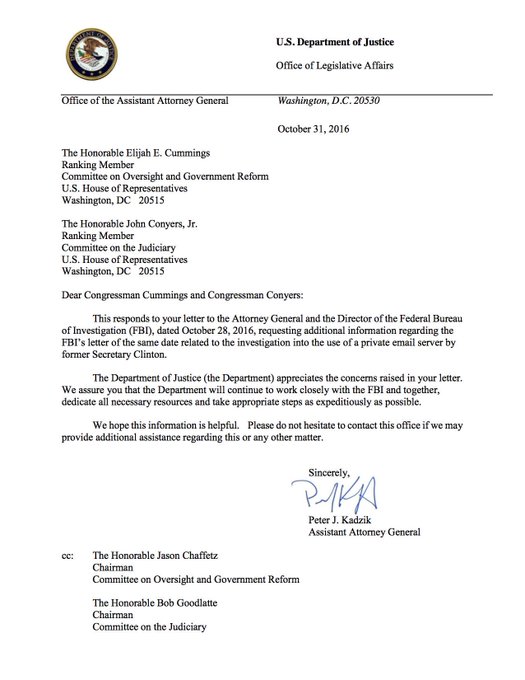
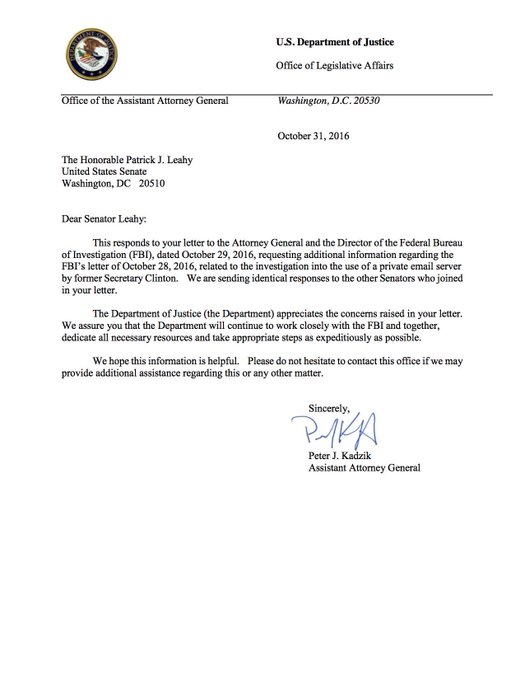

So far so good, even if one wonders just how active the DOJ will be in a case that has shown an unprecedented schism between the politically influenced Department of Justice and the FBI.
And yet, something felt odd about this.
Kadzik… Kadzik… where have we heard that name?
Oh yes. Recall our post from last week, “Clinton Campaign Chair Had Dinner With Top DOJ Official One Day After Hillary’s Benghazi Hearing” in which we reported that John Podesta had dinner with one of the highest ranked DOJ officials the very day after Hillary Clinton’s Benghazi testimony?
It was Peter Kadzik.

In other words, the best friend of John Podesta, Clinton’s Campaign chair, at the DOJ will be in charge of a probe that could potentially sink Hillary Clinton.
For those who missed it, this is what we reported previously:
The day after Hillary Clinton testified in front of the House Select Committee on Benghazi last October, John Podesta, Hillary’s campaign chairman met for dinner with a small group of well-connected friends, including Peter Kadzik, who is currently a top official at the US Justice Department serving as Assistant Attorney General for Legislative Affairs.
The post-Benghazi dinner was attended by Podesta, Kadzik, superlobbyist Vincent Roberti and other well-placed Beltway fixtures. The first mention of personal contact between Podesta and Kadzik in the Wikileaks dump is in an Oct. 23, 2015 email sent out by Vincent Roberti, a lobbyist who is close to Podesta and his superlobbyist brother, Tony Podesta. In it, Roberti refers to a dinner reservation at Posto, a Washington D.C. restaurant. The dinner was set for 7:30 that evening, just one day after Clinton gave 11 hours of testimony to the Benghazi Committee.
Podesta and Kadzik met several months later for dinner at Podesta’s home, another email shows. Another email sent on May 5, 2015, Kadzik’s son asked Podesta for a job on the Clinton campaign.
As the Daily Caller noted, the dinner arrangement “is just the latest example of an apparent conflict of interest between the Clinton campaign and the federal agency charged with investigating the former secretary of state’s email practices.” As one former U.S. Attorney tells told the DC, the exchanges are another example of the Clinton campaign’s “cozy relationship” with the Obama Justice Department.
The hacked emails confirm that Podesta and Kadzik were in frequent contact. In one email from January, Kadzik and Podesta, who were classmates at Georgetown Law School in the 1970s, discussed plans to celebrate Podesta’s birthday. And in another sent last May, Kadzik’s son emailed Podesta asking for a job on the Clinton campaign.
“The political appointees in the Obama administration, especially in the Department of Justice, appear to be very partisan in nature and I don’t think had clean hands when it comes to the investigation of the private email server,” says Matthew Whitaker, the executive director of the Foundation for Accountability and Civic Trust, a government watchdog group.
“It’s the kind of thing the American people are frustrated about is that the politically powerful have insider access and have these kind of relationships that ultimately appear to always break to the benefit of Hillary Clinton,” he added, comparing the Podesta-Kadzik meetings to the revelation that Attorney General Loretta Lynch met in private with Bill Clinton at the airport in Phoenix days before the FBI and DOJ investigating Hillary Clinton.
Kadzik’s role at the DOJ, where he started in 2013, is particularly notable Kadzik, as helped spearhead the effort to nominate Lynch, who was heavily criticized for her secret meeting with the former president.
It gets better because, as we further revealed, if there is one person in the DOJ who is John Podesta’s, and thus the Clinton Foundation’s inside man, it is Peter Kadjik.
Kadzik represented Podesta during the Monica Lewinsky investigation. And in the waning days of the Bill Clinton administration, Kadzik lobbied Podesta on behalf of Marc Rich, the fugitive who Bill Clinton controversially pardoned on his last day in office. That history is cited by Podesta in another email hacked from his Gmail account. In a Sept. 2008 email, which the Washington Free Beacon flagged last week, Podesta emailed an Obama campaign official to recommend Kadzik for a supportive role in the campaign. Podesta, who would later head up the Obama White House transition effort, wrote that Kadzik was a “fantastic lawyer” who “kept me out of jail.”

Podesta was caught in a sticky situation in both the Lewinsky affair and the Rich pardon scandal. As deputy chief of staff to Clinton in 1996, Podesta asked then-United Nations ambassador Bill Richardson to hire the 23-year-old Lewinsky. In April 1996, the White House transferred Lewinsky from her job as a White House intern to the Pentagon in order to keep her and Bill Clinton separate. But the Clinton team also wanted to keep Lewinsky happy so that she would not spill the beans about her sexual relationship with Clinton.
Richardson later recounted in his autobiography that he offered Lewinsky the position but that she declined it.
Podesta made false statements to a grand jury impaneled by Independent Counsel Kenneth Starr for the investigation. But he defended the falsehoods, saying later that he was merely relaying false information from Clinton that he did not know was inaccurate at the time. “He did lie to me,” Podesta said about Clinton in a National Public Radio interview in 1998. Clinton was acquitted by the Senate in Feb. 1999 of perjury and obstruction of justice charges related to the Lewinsky probe. Kadzik, then a lawyer with the firm Dickstein Shapiro Morin & Oshinsky, represented Podesta through the fiasco.
Podesta had been promoted to Clinton’s chief of staff when he and Kadzik became embroiled in another scandal.
Kadzik was then representing Marc Rich, a billionaire financier who was wanted by the U.S. government for evading a $48 million tax bill. The fugitive, who was also implicated in illegal trading activity with nations that sponsored terrorism, had been living in Switzerland for 17 years when he sought the pardon. To help Rich, Kadzik lobbied Podesta heavily in the weeks before Clinton left office on Jan. 20, 2001. A House Oversight Committee report released in May 2002 stated that “Kadzik was recruited into Marc Rich’s lobbying campaign because he was a long-time friend of White House Chief of Staff John Podesta.”
The report noted that Kadzik contacted Podesta at least seven times regarding Rich’s pardon. On top of the all-hands-on-deck lobbying effort, Rich’s ex-wife, Denise Rich, had doled out more than $1 million to the Clintons and other Democrats prior to the pardon. She gave $100,000 to Hillary Clinton’s New York Senate campaign and another $450,000 to the Clinton presidential library.
Kadzik’s current role
In his current role as head of the Office of Legislative Affairs, Kadzik handles inquiries from Congress on a variety of issues. In that role he was not in the direct chain of command on the Clinton investigation. The Justice Department and FBI have insisted that career investigators oversaw the investigation, which concluded in July with no charges filed against Clinton.
But Kadzik worked on other Clinton email issues in his dealings with Congress. Last November, he denied a request from Republican lawmakers to appoint a special counsel to lead the investigation.
In a Feb. 1, 2016 letter in response to Kadzik, Florida Rep. Ron DeSantis noted that Kadzik had explained “that special counsel may be appointed at the discretion of the Attorney General when an investigation or prosecution by the Department of Justice would create a potential conflict of interest.”
DeSantis, a Republican, suggested that Lynch’s appointment by Bill Clinton in 1999 as U.S. Attorney in New York may be considered a conflict of interest. He also asserted that Obama’s political appointees — a list which includes Kadzik — “are being asked to impartially execute their respective duties as Department of Justice officials that may involve an investigation into the activities of the forerunner for the Democratic nomination for President of the United States.”
It is unknown if Kadzik responded to DeSantis’ questions.
Kadzik’s first involvement in the Clinton email brouhaha came in a Sept. 24, 2015 response letter to Senate Judiciary Committee chairman Chuck Grassley in which he declined to confirm or deny whether the DOJ was investigating Clinton. Last month, Politico reported that Kadzik angered Republican lawmakers when, in a classified briefing, he declined to say whether Clinton aides who received DOJ immunity were required to cooperate with congressional probes.
Kadzik also testified at a House Oversight Committee hearing last month on the issue of classifications and redactions in the FBI’s files of the Clinton email investigation.
Finally, it is also worth noting that Kadzik’s wife, Amy Weiss, currently at Weiss Public Affairs worked on the 1992 Clinton/Gore Campaign as a Press Secretary, and Communications Director for the Democratic National Committee, and a White House Deputy Assistant to the President/Deputy Press Secretary to President Bill Clinton.
* * *
And now it seems that Kadzik will be in charge of the DOJ’s “probe” into Huma Abedin’s emails. Which is why we are a little skeptical the DOJ will find “anything” of note.

Amy Weiss, Peter Kadzik, with lobbyist Tony Podesta, brother of John Podesta.
end
The DOJ responds: finds nothing wrong..so move on
Kadzik is nothing but a huge conflict of interest here!
(courtesy zerohedge)
DOJ Responds To Kadzik’s Email To Clinton Campaign; Finds Nothing Wrong
After the revelation that the DOJ’s assistant attorney general, Peter Kadzik, was exposed as sending information about upcoming DOJ events to his friend, Clinton Campaign Chairman John Podesta, from a private, non-government gmail account, many were confused, asking if this is i) legal and ii) grounds for termination, if not criminal proceedings.
As a reminder, on May 19, 2015, from his personal gmail account, Peter Kadzik emailed the gmail account of John Podesta (who then promptly forwarded it onward to everyone on the Clinton campaign) the following:
Heads Up
There is a HJC oversight hearing today where the head of our Civil Division will testify. Likely to get questions on State Department emails. Another filing in the FOIA case went in last night or will go in this am that indicates it will be awhile (2016) before the State Department posts the emails.
Perhaps it was the clearly laid out partisan intent to assist the Clinton campaign, coupled with the obvious dissemination of DOJ information using un-FOIAble methods, namely a private email account, that prompted Americans to demand an answer from the DOJ regarding the fate of Kadzik.
However, at least according to an initial statement from the DOJ, absolutely nothing will emerge from today’s leak.As the Daily Caller reports, a spokesman for the Justice Department who reached out to the website, downplayed the significance of the email.
He argued that Kadzik was not using his Gmail account for work-related business because, the spokesman said, he was sharing public information in a personal capacity. The congressional hearing under discussion was in the public domain for several weeks and the FOIA request was publicized in a news article the night before Kadzik’s email, the spokesman asserted.
Furthermore, the flak added that the email is also not evidence that Kadzik was back-channeling to the Clinton campaign because it did not contain any new or confidential information.
Finally, he declined to speculate on whether Kadzik used Gmail for work-related matters, or Kadzik’s personal inference that “it will be awhile before the State department posts the emails“, something which certainly not in the public domain.
In other words, nothing to see here, move along, and meanwhile Kadzik – who appears to have no intention of recusing himself – may be one of the key DOJ officials supervising the department’s probe into Huma Abedin emails, despite his extensive and ongoing relationship with John Podesta and the Clinton Campaign.
With Only Six Days Remaining, Trump Surges in the Polls as Hillary Supporters Abandon Ship


This is simply not good for Hillary. With only six days remaining in this critical election, possibly the most important in modern times, Hillary is witnessing a complete and utter collapse in her support.
She was witnessed this historic collapse due to the FBI bombshell that has rocked the world, making her the first ever Presidential candidate to be under active investigation by the FBI, WHILE running for the highest seat of power in the country.

As the above LA Times poll shows, Trump now has a monstrous 5.4% lead. His supporters are growing on a daily basis, as he continues to attract African-American supporters and Democrats in record-breaking numbers for a Republican candidate.
In addition to this, the polls may be horribly off, as Trump has what many are calling the “monster vote” waiting in the wings. This is in reference to the stunning amount of previously unregistered voters who have never voted in their life but plan on showing up to the polls to support Donald Trump, as internal polling is showing.
Further supporting how strong his momentum is across all categories is the fact that Donald Trump now has the majority of support across ALL age categories. A huge development, considering that he has been struggling with young voters throughout much of his campaign.

I am sure that Hillary, who has in the past few days been seen screaming at protesters angrily, will be scrambling to drop another “bombshell” on Trump with only a few days remaining. Whether or not the story is true or not doesn’t matter to her.
Luckily, people are waking up in numbers I’ve never before seen. The dishonest media have egg on their faces and they have destroyed their credibility in supporting Hillary throughout her many scandals that have surfaced throughout this election cycle. People aren’t stupid and are furious over this, cancelling their cable subscriptions and turning off the boob tube.
The time for change is here – the time for real change is now. First, there was Brexit, then there was Trump. What next will the liberty movement bring? We truly do live in exciting times.
end
Unusual for these guys to report such a negative report: the ADP employment sinks to its weakest level for over 2 years:
(courtesy ADP/zero hedge)
ADP Employment Report Sinks To Weakest Since April 2013
Following last month’s disappointing drop in ADP jobs (then confirmed by payrolls), October’s ADP employment report printed 147k (less than the expected 165k) – the weakest since April 2013. A major upward revision (from 154k to 202k) for September. Construction (as spending collapses) and education jobs declined notably as the overall trend of job gains continues to weaken.
According to ADP’s Mark Zandi, “job growth appears to be shifting from small to large companies due to the lessening impact the global economic environment had on large companies earlier in the year,” said Ahu Yildirmaz, vice president and head of the ADP Research Institute. “This is also true because large companies often have the resources to attract workers with better pay and benefit packages.” Zandi added that “job growth remains strong although the pace of growth appears to be slowing. Behind the slowdown is businesses’ difficulty filling open positions. owever, there is some weakness in construction, education and mining.”
Looking at the details shows continued job losses in manufacturing, construction and natural resources jobs, which declined by a total of 18,000 offset by strength in professional and business services and leisure and hospitality:

The trend continues to weaken:

Here is the Change in Total Nonfarm Private Employment by Company Size

The comparison to NFP: Change in Total Nonfarm Private Employment

As a reminder, The Fed’s own labor market indicator is now in contraction YoY:

Full ADP Breakdown:

end
The New York, ISM mfg index contracts for the 3rd consecutive month:
(courtesy zero hedge/ISM)
New York ISM Contracts For 3rd Month, Worst Streak In 7 Years
Confirming the weakness reported by regional Fed surveys, New York Purchasing Managers current business conditions contracted for the 3rd month in a row (at 49.2). This is the 5th contractionary print of the last six months and the weakest streak since 2009.

The outlook declined to 5-month lows as purchases, prices paid, and revenues all declined.
end
The Fed holds again but states that the rate hike in December “strengthens”
(courtesy zero hedge)
Fed Holds, Says Case For December Hike “Strengthens”; No Mention Of Election; 2 Dissent
While the dollar is up, every other asset class is lower since the September FOMC statement ahead of the least-anticipated Fed meeting of the year. Fed funds implied a 14% chance of a rate hike today but sentiment was for a 0% chance with expectations of a hawkish-biased statement (67% prob of Dec hike). From Bloomberg:
- *FED DECIDED TO WAIT FOR TIME BEING FOR SOME FURTHER EVIDENCE
- *FED SAYS CASE FOR A RATE HIKE HAS CONTINUED TO STRENGTHEN
- *FED SAYS GEORGE AND MESTER DISSENT IN FAVOR OF RATE HIKE
With no press conference to explain the latest phrasing, we can only assume the jawboning and newspeak will be heavy to convince the world December will be a “dovish hike.”
Notably, while in the September meeting there were 3 disenters, George, Mester and Rosengren, this time Rosengren decided to join the majority, leaving just two dissenters.
While the statement itself contained 7 fewer words than in September, there were virtually no changes. Perhaps the most notable change in the wording of the statement is that the following phrase was struck out:
“Inflation is expected to remain low for the near term”
and replaced with
“Inflation is expected to rise to 2 percent over the medium term”
The Fed also changed the language to the phrase that “Market-based measures of inflation compensation remain low” and replaced it with “…have moved up but remain low.”
The one negative is that the degree of spending was downgraded as “Household spending has been growing strongly” has been changed to “rising moderately.”
The FOMC also said that “The Committee judges that the case for an increase in the federal funds rate has continued to strengthen“ strongly hinting that a December hike is now almost inevitable absent a market crash.
Also of note, as Bloomberg reminds us, remember when June was a good deal about Brexit? There is no mention of uncertainty related to the U.S. election, as expected. The FOMC message is the committee makes its decisions with no notice of politics.
* * *
A quick breakdown of the salient points from Bloomberg:
- RISKS: FOMC sticks with assessment that near-term risks to outlook are “roughly balanced”; continues to say it is “closely” monitoring inflation indicators and global economic/financial developments
- INFLATION: Now says inflation has increased “somewhat” since earlier this year, yet still below 2% objective; no longer says inflation to remain low in near term; now says market-based measures of inflation compensation have moved up but remain low
- ECONOMY: Fed sticks with September assessment describing growth in economic activity as picking up from modest pace in 1H and U.S. labor market as continuing to strengthen with unemployment rate little changed recently; now says job gains were solid, instead of solid, on average; Continues to expect U.S. economy to evolve in way that warrants “only gradual increases” in rates in future
- RATES: Target range for fed funds rate has been held at 0.25%-0.50% for seven straight meetings, with last change in December 2015
- DISSENTS: Decision included two dissents from regional Fed presidents Esther George, Loretta Mester, who favored raising fed funds rate to range of 0.50%-0.75% again; George has dissented five times this year
* * *
Today’s tumble in crude pushed everything red post-FOMC (with a notably uniform 1.7%-ish drop in assets oddly mirroring a 1.7%-sh rise in the US dollar)…

As The Dollar and rate hike odds have moved almost perfectly in sync…

* * *
Additional headlines:
- *FED DROPS REFERENCE TO SEEING INFLATION STAYING LOW NEAR TERM
- *FED REPEATS RISKS TO ECONOMIC OUTLOOK `APPEAR ROUGHLY BALANCED’
- *FED: HOUSEHOLD SPENDING `RISING MODERATELY,’ INVESTMENT SOFT
- *FED: JOB GAINS HAVE BEEN SOLID, GROWTH PICKED UP SINCE MID-YR
Which is not true… The Fed’s own labor market indicator is now in contraction YoY:
* * *
end
This does not look good for Hillary; early black voter turnout plunges
(courtesy zero hedge)
Hillary Camp In “Full Panic Mode” As Early Black Voter Turnout Plunges In Key Swing States
A few weeks ago we pointed out that Obama enjoyed massive, unprecedented spikes in black voter turnout in both the 2008 and 2012 elections. After hovering around 50-55% for decades, black voter participation soared to over 60% in 2008 and 2012. That said, in the past we’ve raised serious doubts over whether Hillary should expect the same level of enthusiasm from black voters in this election cycle or whether overall turnout of black voters would revert back to pre-Obama levels.
Unprecedented black voter turnout was a huge component of Obama’s victories in 2008 and 2012. Per the chart below from the New York Times, after running in the low-to-mid 50% range for decades, black voter participation surged to over 60% for Obama in 2008 and 2012, the highest ever recorded.
So, the question is, should Hillary expect the same level of unprecedented black voter turnout that Obama was able to garner? Apparently, her campaign is not convinced and that’s why, according to Leslie Wimes, President of the Democratic African-American Women Caucus, they’re in “full panic mode.”

Well, early voting data out of some key swing states seems to reveal that, in fact, black voter turnout is reverting back to pre-Obama levels, which is a terrible sign for team Hillary. According to Old North State Politics, early voting data out of North Carolina suggests that black voter turnout is down roughly 7 points, as a percent of the overall electorate versus 2012, implying that cumulative black votes are down around 16%.

As a reminder, Mitt Romney won North Carolina in 2012 by slightly over 2 points. Given that black voters usually favor democrats by 80-90%, simple math implies that a 7-point reduction in blacks as a percentage of the overall electorate would hurt Hillary by roughly 6 points versus the 2012 results….not encouraging to say the least.

Meanwhile, the outlook is even more troubling in Florida as black composition of early votes is down 9.5 points versus 2012.

According to a recent article by Politico, in 2008 and 2012, Obama received 95% of the 1.7mm votes cast by black voters in Florida. Given that, simple math would imply that a 9.5-point reduction in blacks as a percentage of the overall electorate would hurt Hillary by roughly 9 points, versus the 2012 results, which is disastrous news for a state that Obama narrowly won by less than 1 point.
Unfortunately for Hillary, a recent poll from Florida Atlantic University provides even more bad news. While Obama received 95% of the black vote in Florida in 2012, Hillary is only polling at 68% among black voters while Trump is polling at 20%. And, at least according to the president of the Democratic African-American Women Caucus, this math has the Clinton campaign in “full panic mode.” Per Politico:
“Hillary Clinton’s campaign is in panic mode. Full panic mode,” said Leslie Wimes, a South Florida-based president of the Democratic African-American Women Caucus.
“They have a big problem because they thought Obama and Michelle saying, ‘Hey, go vote for Hillary’ would do it. But it’s not enough,” Wimes said, explaining that too much of the black vote in Florida is anti-Trump, rather than pro-Clinton. “In the end, we don’t vote against somebody. We vote for somebody.”
But, we won’t hold our breath until the various polls around the country adjust their “ethnic oversamples” accordingly.
end
Well that about does it for tonight
I will see you tomorrow night
H


Mess? Yes. Good word, Harvey That says it all, really. For those mathematically inclined, mess is greater turbulence moving toward chaos. I prefer mess. It’s more visually entertaining.
Hail Caesar. Pretty bird.
LikeLike
[…] by Harvey Organ Harvey Organ’s Blog […]
LikeLike
[…] NOV 2/FIVE INVESTIGATIONS UNDERGOING BY THE FBI ON CLINTON, THE CLINTON FOUNDATION AND INNER CIRCLE/… […]
LikeLike
[…] Continue Reading/Harvey Organ>>> […]
LikeLike