
Gold closed at $1223.60 DOWN $0.60
silver closed at $16.92: DOWN $0.11
Access market prices:
Gold: 1225.20
Silver: 16.99
THE DAILY GOLD FIX REPORT FROM SHANGHAI AND LONDON
.
The Shanghai fix is at 10:15 pm est and 2:15 am est
The fix for London is at 5:30 am est (first fix) and 10 am est (second fix)
Thus Shanghai’s second fix corresponds to 195 minutes before London’s first fix.
And now the fix recordings:
Shanghai morning fix Nov 16 (10:15 pm est last night): $ 1240.41
NY ACCESS PRICE: $1231.65 (AT THE EXACT SAME TIME)/premium$8.76
XXXXXXXXXXXXXXXXXXXXXXXXXXXXXXXXXX
Shanghai afternoon fix: 2: 15 am est (second fix/early morning):$ 1241.65
NY ACCESS PRICE: 1229.65 (AT THE EXACT SAME TIME/2:15 am)
HUGE SPREAD 2ND FIX TODAY!! 12.00 dollars
XXXXXXXXXXXXXXXXXXXXXXXXXXXXXXXXXXXXXXXX
London Fix: Nov 16: 5:30 am est: $1225.70 (NY: same time: $1226.40 5:30AM)???
London Second fix Nov 16: 10 am est: $1229.20 (NY same time: $1227.30, 10 AM)???
It seems that Shanghai pricing is higher than the other two , (NY and London). The spread has been occurring on a regular basis and thus I expect to see arbitrage happening as investors buy the lower priced NY gold and sell to China at the higher price. This should drain the comex.
Also why would mining companies hand in their gold to the comex and receive constantly lower prices. They would be open to lawsuits if they knowingly continue to supply the comex despite the fact that they could be receiving higher prices in Shanghai.
end
For comex gold:
NOTICES FILINGS FOR NOVEMBER CONTRACT MONTH: 5 NOTICES FOR 500 OZ TONNES
For silver:
NOTICES FOR NOVEMBER CONTRACT MONTH FOR SILVER: 1 NOTICE OR 5,000 OZ
xxxxxxxxxxxxxxxxxxxxxxxxxxxxxxxxxxxxxxxxxxxxxxxxxxxxxxxxxxxxxxxxxxxxxxxxxxxxxxxxxxxxxxxxxx
Let us have a look at the data for today
.
xxxxxxxxxxxxxxxxxxxxxxxxxxxxxxxxxxxxxxxxxxxxxxxxxxxxxxxxxxxxxxxxxxxxxxxxxxx
In silver, the total open interest FELL by 1388 contracts DOWN to 174,831 with yesterday’s trading. In ounces, the OI is still represented by just less THAN 1 BILLION oz i.e. .874 BILLION TO BE EXACT or 124% of annual global silver production (ex Russia & ex China).
In November, in silver, 1 notice(s) filings: FOR 5,000 OZ
In gold, the total comex gold FELL by 9,537 contracts DESPITE THE RISE IN THE PRICE OF GOLD ($2.80 yesterday ).The total gold OI stands at 479,237 contracts.
In gold: we had 5 notices filed for 500 oz
xxxxxxxxxxxxxxxxxxxxxxxxxxxxxxxxxxxxxxxxxxxxxxxxxxxxxxxxxxxx
With respect to our two criminal funds, the GLD and the SLV:
GLD:
a big change in the gold inventory at the GLD/another withdrawal of 1.19 tonnes
Inventory rests tonight: 926.26 tonnes
.
SLV
we had a small withdrawal at the SLV equal to 474,000 oz.
THE SLV Inventory rests at: 356.253million oz
.
First, here is an outline of what will be discussed tonight:
1. Today, we had the open interest in silver FELL by 1388 contracts DOWN to 174,831 despite the fact that the price of silver ROSE by $0.15 with YESTERDAY’S trading. The gold open interest FELL by 9537 contracts DOWN to 479,237 as the price of gold ROSE BY $2.80 in YESTERDAY’S TRADING.
(report Harvey).
2.a) The Shanghai and London gold fix report
(Harvey)
2 b) Gold/silver trading overnight Europe, Goldcore
(Mark O’Byrne/zerohedge
and in NY: Bloomberg
3. ASIAN AFFAIRS
i)Late TUESDAY night/WEDNESDAY morning: Shanghai closed DOWN 1.93 POINTS OR 0.06%/ /Hang Sang closed DOWN 43.38 OR 0.19%. The Nikkei closed UP 194.06 points or 1.10%/Australia’s all ordinaires CLOSED DOWN 0.02% /Chinese yuan (ONSHORE) closed DOWN at 6.8790/Oil FELL to 45.23 dollars per barrel for WTI and 46.39 for Brent. Stocks in Europe: ALL IN THE RED Offshore yuan trades 6.8937 yuan to the dollar vs 6.8790 for onshore yuan.THE SPREAD BETWEEN ONSHORE AND OFFSHORE WIDENS CONSIDERABLY AS MORE USA DOLLARS LEAVE CHINA’S SHORES / CHINA SENDS A CLEAR MESSAGE TO THE USA AND JANET TO NOT RAISE RATES IN DECEMBER.
REPORT ON JAPAN SOUTH KOREA NORTH KOREA AND CHINA
3a)THAILAND/SOUTH KOREA
none today
b) REPORT ON JAPAN
All eyes will be on Japan as the 10 year yield on Japanese bonds climbs above zero for the 2nd day in a row. Eight weeks ago when Japan’s new policy was unleashed, Japan was threatening to taper its purchases to keep the rate near zero. Now as bond prices fall badly (yields rise) will Japan abandon their new policy. With Trump read to supply fiscal stimulus will the world see helicopter money throughout the globe?
(courtesy zero hedge)
c) REPORT ON CHINA
Yuan falters again and lands into the 6.87 barrier for onshore and 6.89 for offshore
( zero hedge)
4 EUROPEAN AFFAIRS
GREECE
Obama faces violent clashes in Greece as demonstrators are protesting his visit
( zerohedge)
5. RUSSIAN AND MIDDLE EASTERN AFFAIRS
none today
6.GLOBAL ISSUES
CHINA/SAUDI ARABIA/USA TREASURIES
Late in the session: a must read..
This is huge: both Saudi and China are dumping massive quantities of USA treasuries. In September a total of $76 billion were sold. Up until last month only private investors were buying the stuff and they seemed to have gorged on the stuff. And now yields are rising!! And Trump is going on a fiscal spending spree of which the Fed cannot monetize?
Janet may not raise rates in December.
(courtesy zero hedge)
7.OIL ISSUES
i)Another spurious OPEC headline as oil rebounds into the 46 dollar handle despite huge inventory builds
( zero hedge)
ii)So much for the rise in oil today: Iraq, Iran and Nigeria’s oil ministers all decided to skip that important OPEC meeting in DOHA
8.EMERGING MARKETS
none today
9.PHYSICAL STORIES
i)Quite a story: after paying $3,500.00 for the Fort Knox audits, two months ago, Koos Jansen still does not have the papers. he outlines to us his troubles in getting those documents.
( Koos Jansen Bullionstar)
ii)A very important paper from Craig Hemke on the Chinese yuan. The lower the yuan value will be a huge benefit for us in the price of gold and silver.
( Craig Hemke/TFMetals report)
iii)A must read two parter. James Turk states that Trump will want sound money (and he has picked two biggies in that dept (Judy Shelton, and David Malpass). Maybe Trump will rescind Nixon’s convertibility into gold and then the USA will revalue gold to say 10,000 dollars per oz. Then gold will flow back into the uSA and spending can once again continue
( James Turk/Kingworld news/2 parts)
10.USA STORIES
i)Interesting: producer prices remain at zero and disappoints. The real stumbling block was asset management fees which tumbled 5.7% as well as food deflation taking a grip in the USA. In a nutshell goods higher, and services lower.
( zero hedge)
ii)Industrial production continues to contract in the USA. We have now had 14 consecutive months showing contraction;
( Industrial Production/zero hedge)
iii)Not good: Boeing shuttering two plants after United delays 5 billion dollars worth of 737 orders:
iv)Now we see Pension funds slashing hedge fund allocations as they are now becoming alarmed at their poor returns accompanied by higher fees. Note today the huge fall in asset management fees falling with respect to the PPI released today( zero hedge)
v)Here is the short list for Trump cabinet posts. The bold red is the favourite
vi)Then this came as a surprise: Trump is considering Ted Cruz as Attorney General.( zero hedge)
vi).b And then Jamie Dimon as Sec/ Treasury!! And he is going to drain the swamp with him?
( zero hedge)
vii)With Janet jawboning a rate hike, this has sent mortgage rates up and at last look it was close to 4%. This has sent mortgage applications crashing
( zero hedge)
viii) Dave Kranzler on the collapsing housing market in the USA
( Dave Kranzler/IRD)
ix)The very popular Michael Snyder with his 11 very epressing USA economic realities that Donald Trump inherits from Obama
( Michael Snyder)
x) Today’s wrap up courtesy of Greg Hunter and one of our favourites: Rob Kirby
(courtesy Greg Hunter/Rob Kirby)
Let us head over to the comex:
The total gold comex open interest FELL by 9,537 CONTRACTS to an OI level of 479,237 DESPITE THE FACT THAT GOLD ROSE $2.80 with YESTERDAY’S trading. In the front month of November we had 29 notices standing for a LOSS of 49 contracts. We had 51 notices served on yesterday so we GAINED 2 contracts or 200 ADDITIONAL oz will stand for delivery in November. The next contract month and the biggest of the year is December and here this month showed a decrease of 11,594 contracts down to 237,109. The December contract month is still highly elevated compared to a year ago. On Tuesday Nov 17/2015 comex reading day, we had a total of 194,026 contracts standing ( a gain of 2,483 contracts from Nov 16/2015) It certainly emphasizes the huge demand for physical gold. THIS SHOULD EXPLAIN TO YOU WHY THE BANKERS ARE CONSTANTLY WHACKING OF GOLD (AND SILVER): THE HIGH OI FOR DECEMBER AND THE HIGH PROBABILITY THAT MANY WILL TAKE DELIVERY.
And now for the wild silver comex results. Total silver OI FELL by 1388 contracts from 176,219 DOWN TO 174,831 as the price of silver ROSE BY $0.15 with yesterday’s trading. We are moving further from the all time record high for silver open interest set on Wednesday August 3/2016: (224,540). The front month of November had an OI of 1 and thus a loss of 111 contracts. We had 112 notices filed yesterday so we gained 1 contract or an additional 5,000 oz will stand for delivery in this non active month of November. The next major delivery month is December and here it FELL BY 2,263 contracts DOWN to 86,293. The December contract month is also highly elevated compared to a year ago. On Nov 17/2015 reporting day, we had a level of 71,593 contracts having gained 1278 contracts on the day).
In silver had 1 notice filed for 5,000 oz
Eventually at the end of December 2015: 6.4512 tonnes of gold stood for delivery
Eventually at the end of December 2015: 18.84 million oz of silver stood for delivery.
VOLUMES: for the gold comex
Today the estimated volume was 219.101 contracts which is good.
Friday’s confirmed volume was 259,975 contracts which is very good
| Gold | Ounces |
| Withdrawals from Dealers Inventory in oz | NIL |
| Withdrawals from Customer Inventory in oz nil |
320,434.236 OZ
BRINKS
SCOTIA
JPMORGAN
INCLUDES 5000 KILOBAR REMOVAL JPM
|
| Deposits to the Dealer Inventory in oz | nil oz |
| Deposits to the Customer Inventory, in oz |
1059.140 oz
Brinks
|
| No of oz served (contracts) today |
5 notices
500 oz
|
| No of oz to be served (notices) |
24 contracts
2400
oz
|
| Total monthly oz gold served (contracts) so far this month |
1596 contracts
159,600 oz
4.9642 tonnes
|
| Total accumulative withdrawals of gold from the Dealers inventory this month | nil oz |
| Total accumulative withdrawal of gold from the Customer inventory this month | 549,896.2 oz |
Today, 0 notices were issued from JPMorgan dealer account and 0 notices were issued from their client or customer account. The total of all issuance by all participants equates to 5 contracts of which 0 notices were stopped (received) by jPMorgan dealer and 0 notice(s) was (were) stopped/ Received) by jPMorgan customer account.
March 2015: 2.311 tonnes (March is a non delivery month)
| Silver | Ounces |
| Withdrawals from Dealers Inventory | NIL |
| Withdrawals from Customer Inventory |
358,238.040 oz
brinks
|
| Deposits to the Dealer Inventory |
nil OZ
|
| Deposits to the Customer Inventory |
271,370.000 oz
Brinks
|
| No of oz served today (contracts) |
1 CONTRACT(S)
(5,000 OZ)
|
| No of oz to be served (notices) |
0 contracts
(nil oz)
|
| Total monthly oz silver served (contracts) | 465 contracts (2,325,000 oz) |
| Total accumulative withdrawal of silver from the Dealers inventory this month | NIL oz |
| Total accumulative withdrawal of silver from the Customer inventory this month | 5,415,036.2 oz |
end
end
NPV for Sprott and Central Fund of Canada
END
Major gold/silver stories for WEDNESDAY
Early morning gold/silver trading/Goldcore
Peak Gold Globally – “Bullish For Gold”

Gold mine production is peaking globally and this is “bullish for gold” according to a slowly emerging group in the gold industry. It is great to see the reality of peak gold production slowly be acknowledged in the mainstream as it is an important fundamental factor in the market which has been continuously ignored.
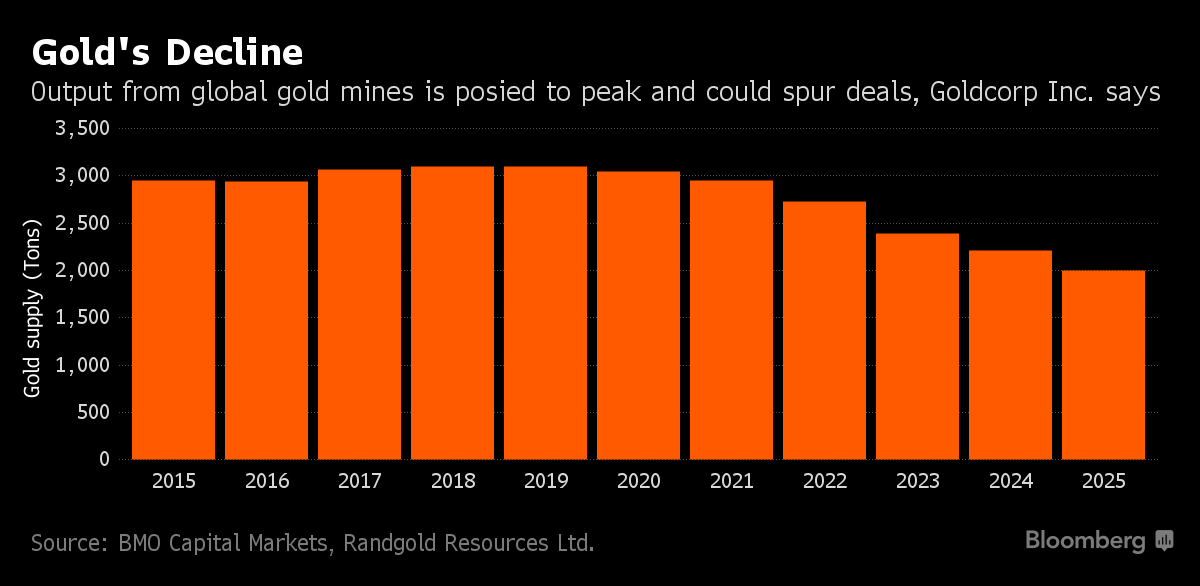
As reported by Bloomberg in ‘Decade of Gold Mine Declines Poised to Spur Deals, Prices’ today:
Gold’s dwindling pipeline of new mines is poised to usher in a decade-long output slump, spurring prices and delivering a new impetus for dealmaking and industry consolidation, according to Goldcorp Inc., the third-largest gold producer.
Mine supply may fall about a third in the 10 years to 2025, according to Bloomberg calculations based on forecasts from BMO Capital Markets and Randgold Resources Ltd. The number of newly discovered primary gold deposits fell to three in 2014, from a peak of 37 in 1987, according to Melbourne-based industry adviser MinEx Consulting Pty.
Gold production may peak in the next three years as miners fail to replace their reserves, Randgold’s Chief Executive Officer Mark Bristow said in September. And, according to Goldcorp’s Telfer, producers have limited scope to raise output in response to higher prices. “We are having a heck of a time finding gold,” he said.
The metal is up 16 percent this year, rebounding from three straight annual declines. Gold may average $1,500 an ounce by 2020, according to an August note from BMI Research.
“Once supply from mines starts to decline and people start to realize the impact that’s going to have, I think it’s going to be incredibly bullish for gold,” Telfer said in the interview last week in Melbourne. “If gold went to $2,500 an ounce tomorrow, Goldcorp’s production wouldn’t change for the next four years. It can’t react to a change.”
‘Peak Gold’ is happening which has important ramifications for gold prices and is why we were one of the first analysts in the industry to consider the peak gold phenomenon back in 2007 and 2008. Even Goldman Sachs now acknowledges the importance of peak gold to the gold market. It is another long term positive fundamental for the market and will support prices and could contribute to much higher prices in the coming volatile and uncertain years.
Gold and Silver Bullion – News and Commentary
Gold rises as U.S. dollar pares gains (Reuters.com)
Gold prices log first gain in 7 sessions (MarketWatch.com)
Gold rebounds on Trump policy uncertainty (CNBC.com)
Global bonds slump as Trump prompts inflation fears (TheGuardian.com)
Demonetisation impact: $1 billion worth of gold imported so far since Nov 9 (Business-Standard.com)

Trump carnage in bonds spells trouble for stocks (MarketWatch.com)
Why interest rates will likely rise faster than inflation (CBSNews.com)
President Trump: How America Got It So Wrong (RollingStone.com)

Gold Prices (LBMA AM)
16 Nov: USD 1,225.70, GBP 9,984.36 & EUR 1,144.68 per ounce
15 Nov: USD 1,228.90, GBP 998.86 & EUR 1,138.70 per ounce
14 Nov: USD 1,222.60, GBP 997.80 & EUR 1,136.53 per ounce
11 Nov: USD 1,255.65, GBP 999.19 & EUR 1,154.45 per ounce
10 Nov: USD 1,280.90, GBP 1,034.07 & EUR 1,175.48 per ounce
09 Nov: USD 1,304.55, GBP 1,050.42 & EUR 1,176.84 per ounce
08 Nov: USD 1,284.00, GBP 1,034.26 & EUR 1,162.02 per ounce
Silver Prices (LBMA)
16 Nov: USD 16.95, GBP 13.64 & EUR 15.85 per ounce
15 Nov: USD 17.00, GBP 13.68 & EUR 15.80 per ounce
14 Nov: USD 17.20, GBP 13.73 & EUR 15.95 per ounce
11 Nov: USD 18.59, GBP 14.73 & EUR 17.09 per ounce
10 Nov: USD 18.75, GBP 15.11 & EUR 17.20 per ounce
09 Nov: USD 18.81, GBP 15.12 & EUR 16.96 per ounce
08 Nov: USD 18.26, GBP 14.72 & EUR 16.54 per ounce
Recent Market Updates
– Gold Price Should Go Higher On Global Risks and Trump – Capital Economics
– President Trump – Why Market Loves Him and Experts Wrong
– ‘Helicopter Money President’ Trump To Create Inflation and Gold Will Rise
– Central Bank Gold Demand continues in Q3
– Trump Victory Sends Gold Surging 5%
– An uncertain election outcome looks good for gold
– Ignore past elections, this one’s too uncertain
– Gold may be the only winner in US elections
– The London Gold Market – ripe for take-over by China?
– Diwali, Gold and India – Is Love Affair Over?
– Silver Krugerrands By South African Mint Coming Soon – Massive Clearance Sale on Gold Krugerrands
– Trump “Will Probably Win” and Gold “May Rise $100” Overnight – Rickards
– World Is Out of Weapons
end.
Quite a story: after paying $3,500.00 for the Fort Knox audits, two months ago, Koos Jansen still does not have the papers. he outlines to us his troubles in getting those documents.
(courtesy Koos Jansen Bullionstar)
Koos Jansen: We paid for a copy of the Fort Knox audit report, so where is it?
Submitted by cpowell on Tue, 2016-11-15 16:12. Section: Daily Dispatches
11:15a ET Tuesday, November 15, 2016
Dear Friend of GATA and Gold:
Gold researcher Koos Jansen reports today how the U.S. Mint has failed to produce a copy of a gold audit report for which he paid more than $3,100 back in September. Why, in the digital age, anyone should have to pay that kind of money for a government report is hard to understand — unless, of course, the report contains information whose disclosure might be inconvenient to the U.S. government’s longstanding policy of gold price suppression. Jansen’s report is headlined “Dear US Mint, We Gave You the FOIA Funds, Now Give Us the Fort Knox Audit Documents” and it’s posted at Bullion Star here:
https://www.bullionstar.com/blogs/koos-jansen/dear-us-mint-we-gave-you-t…
CHRIS POWELL, Secretary/Treasurer
Gold Anti-Trust Action Committee Inc.
CPowell@GATA.org
end
A very important paper from Craig Hemke on the Chinese yuan. The lower the yuan value will be a huge benefit for us in the price of gold and silver.
(courtesy Craig Hemke/TFMetals report)
Watching The Yuan
The recent surge in the US dollar has again brought massive selling in the emerging market currencies, most notably the Chinese yuan. This has occurred twice before in the past 15 months and each prior instance has foreshadowed a 10% drop in the S&P 500. Therefore, are we on the verge of another stock market correction?
We’ve been alluding to this in the podcasts of late and I’ve been meaning to write about it with some illustrative charts. However, the metals have been so volatile that I haven’t had the opportunity. Today, with both gold and silver mostly flat on the session, I thought I’d seize the moment.
The problem for the Chinese is that the yuan is pegged to the US dollar. So, when the dollar strengthens…as it has for the past 60 days or so…the yuan strengthens, as well. The PBoC doesn’t like this very much as it makes their exports more “expensive”. It also creates a whole host of other issues, many of which are summed up in this excellent article I found at ZH last evening:
So, anyway, it’s the ripple effect of the Chinese yuan devaluation that has my interest. First of all, here’s a chart USDCNY chart that covers the last five years. Just like when the Japanese yen is portrayed by the USDJPY, a rising USDCNY means that the yuan is getting weaker versus the US dollar. Note that, even with the “peg” in place, the yuan has weakened by over 10% in the past three years.

Now let’s drill in a little closer so that you can see where we’re headed with this. On this weekly chart of the USDCNY, you can see four, specific periods of PBoC action to weaken the yuan in response to a surging dollar.
- A 3% devaluation in week of August 9, 2015
- A 3% devaluation between late November 2015 and early January 2016
- A 2% devaluation in June of 2016
- This current 2.7% devaluation that began the week of October 9

OK, so this is where it gets interesting. Check this weekly chart of the S&P 500. Be sure to note:
- the 10% decline in mid-late August of 2015
- the 10% drop in early January of this year
- the 5% drop in June of this year

As you can see, there is a distinct, lagging correlation between devaluations in the yuan and corrections in the S&P. Perhaps, since the S&P was falling sharply before the US election, this yuan-related correction has already occurred? Perhaps the huge rally in stocks over the past five days will preclude any further decline? Perhaps.
However, if history is any guide, a soaring US dollar seems to put extreme stress on China and all emerging market currencies. In the past, this has led to liquidity shortages which have eventually bled into the US stock market. And the PBoC doesn’t appear to be finished with this latest round of yuan devaluation. Below are the changes over just the past few days and check this new “warning” about all of this from the BIS: http://www.zerohedge.com/news/2016-11-15/vix-dead-according-bis-new-fear-indicator

Finally, as this site is dedicated to the precious metals and gold is often well-bid as a “safe haven” during periods of stock market selloffs, check this one last chart. Be sure to note the timing of the surges in the paper derivative gold price and note how they neatly coincide with the weakening yuan and falling equity markets.

With stock market bullishness at extreme levels and the gold permabears out in force, a sharp rally in gold from here would certainly catch almost everyone by surprise. So, could a rally be coming on the days ahead? Perhaps you should just keep your eyes focused upon the yuan. It may once again be foreshadowing what is to come next.
Just something to consider on what is otherwise an uneventful Tuesday.
TF
end
A must read two parter. James Turk states that Trump will want sound money (and he has picked two biggies in that dept (Judy Shelton, and David Malpass). Maybe Trump will rescind Nixon’s convertibility into gold and then the USA will revalue gold to say 10,000 dollars per oz. Then gold will flow back into the uSA and spending can once again continue
(courtesy James Turk/Kingworld news/2 parts)
Trump’s deficits will wreck dollar without a gold standard, Turk tells KWN
Submitted by cpowell on Tue, 2016-11-15 18:01. Section: Daily Dispatches
1:04p ET Tuesday, November 15, 2016
Dear Friend of GATA and Gold:
In a two-part interview with King World News, GoldMoney founder and GATA consultant James Turk predicts that a Trump administration in the United States will be forced into running more big deficits financed by money printing and that this will damage the dollar but that returning to a gold standard with a much higher gold price would restore prosperity and stability. The interview’s two parts can be found at King World News here:
http://kingworldnews.com/james-turk-what-donald-trump-faces-is-very-diff…
http://kingworldnews.com/is-president-trump-really-going-to-revalue-gold…
CHRIS POWELL, Secretary/Treasurer
Gold Anti-Trust Action Committee Inc.
CPowell@GATA.org
end
Meanwhile in India, panic as gold skyrockets in India after its currency ban
(courtesyBhandari/ActingMan.com)
Scenes Of Panic As Gold Price Skyrockets In India After Currency Ban
Submitted by Jayant Bhandari via Acting-Man.com,
Chaos in the Wake of the Ban
Here is a link to Part 1, about what happened in the first two days after India’s government made Rs 500 (~$7.50) and Rs 1,000 (~$15) banknotes illegal. They can now only be converted to Rs 100 (~$1.50) or lower denomination notes, at bank branches or post offices. Banks were closed the first day after the decision. What follows is the crux of what has happened over the subsequent four days.

India’s prime minister Nahendra Modi, author of the recent overnight currency ban
Today India is on the verge of a major social-political crisis, unless either the government backs off from the decision of banning the currency or some real magic happens. There is chaos in the streets and daily life is slowly but surely coming to a full halt.
What Modi did was not only heavy-handed, hugely arrogant, and of no value, it has been very badly implemented to boot — as everything in India always is — and carries the real potential of escalating and snowballing into something horrific. They could have seen that this was not going to end well by simply using primary school math.
Modi, Nationalism, and the Public School-Indoctrinated Middle Class
India today is like a cult under the influence of Narendra Modi — in which unlike in the past, not the poorest or uneducated citizens, but mostly members of the so-called educated middle class participate. Over the last two decades, people have been exposed to mass education, TV and nationalistic propaganda without being taught an iota of critical thinking skills.
In a society in which the concept of reason does not exist, this has made these people receptive to any kind of propaganda with a nationalistic or Hindutva bent. (Hindutva = fanatical Hinduism, which is rapidly metastasizing).
To aggrandize his position, Modi ordered a lot of military-hardware that India cannot afford, escalated tensions with Pakistan, and conducted what was very likely a fake surgical strike inside Pakistan. This united Indians under the flag.
Now, the demonetization of the Rs 500 and Rs 1000 banknotes was tagged with nationalism, anti-corruption, and anti-terrorism. Simple-minded, slogan-susceptible persons were hardwired to accept an erroneous causality. Those who did not go along were made to be afraid of being called pro-terrorist elements.
Those in the middle class have taken what they deem to be the higher moral ground, for they have mostly avoided suffering from the demonetization. Lacking moral instincts — which is unfortunately the case with much of Indian society, given its deep-rooted irrationality and superstitions — they cannot see or feel the pain of those who are suffering, even if that suffering stares into their faces.
But events are in motion that will likely very soon lead to these salaried members of the middle class starting to feel the pain as well. Their instinctive trust in Modi is likely within weeks of coming crashing down, not because of reasoned argument, but because they will be facing similar problems as the ones the common man is now facing.
Conversion to the New Currency
I went to convert my banned banknotes into new ones. The largest amount one can have converted is Rs 4,000 ($60), until further notice. There was a huge rush of people at the bank. Arguments were erupting, as people refused to stand in queues and the banks gave no explanation of what needed to be done. Fights were breaking out.
Amid the chaos I finally learned that there were three queues I had to go through in a sequence. I had to get a form from one counter, which I had to fill in with my name and address, my ID card details, the serial numbers of all the bills I wanted to exchange, and my cell-phone number.
At the second counter, I then had to present the completed form along with a photocopy of my ID card. I had to sign on the photocopy which an official then stamped. With my banknotes, the form and the photocopy of my ID card, I then went to the next queue to get my currency converted at a third counter. The whole process took about two hours. For most people in the busier parts of the cities, it took much longer.
Day 1 of the banks opening. Poor, desperate people, whom the government treats like slaves or perhaps insects. Somehow these people have been brainwashed into thinking they live in a free country. My granddad kept photographs of British royalty on the walls of his office until his final days, for he had realized that the British had treated him much better.
Anyone who thinks that a country which wastes two hours of every citizen’s life to convert his own $60 can ever hope to be an economic power is drinking too much Kool-Aid and cannot do primary level math. Forget any possibility of removing unaccounted for money or reducing corruption, what Modi is doing is a recipe for the destruction of whatever legitimate economy there is.
That same afternoon, I went to the post office with a friend who wanted to get his money converted. After waiting a long time there, we found out that the post office had run out of cash. Since then most ATMs have had limited amounts of cash available and banks keep running out of cash as well.
The queues have continued to grow. People start lining up late into the night waiting for banks to open and still have to go back home with no cash. What started with two hours of queuing is becoming an endless slog now.
An endless queue to convert Rs 4,000 (USD 60). Will they actually go home with their new cash?
The Problems Go Much Deeper
Half of India’s citizens do not have a bank account and around 25% do not even have an ID card. These are the country’s poorest people, who have no way of converting their money – even if they learn how to do it, which is already a nigh insurmountable hurdle. Also, those who are old, disabled or sick have no choice but to suffer, for without personally visiting a bank branch office, one cannot convert one’s banknotes.

An old disabled woman struggling to get her money converted. One has to be utterly heartless not to feel angry about the situation.
97% of the Indian economy is cash-based. With 88% of all outstanding currency no longer usable, the economy is coming to a standstill. The daily-wage laborer, who leads a hand-to-mouth existence in a country with GDP per capita of a mere $1,600, no longer has work, as his employer has no cash to pay his wages. His life is in utter chaos. He is not as smart as Modi — despite the fact that Modi has no real life experience except as a bully and perhaps in his early days as a tea-seller at a train-station. He has no clue where his life is headed from here.
These people are going hungry, and some have begun to raid food shops. People are dying for lack of treatment at hospitals. Old people are dying in the endless queues. Some are killing themselves, as they are unable to comprehend the situation and simply don’t know what to do. There are now hundreds of such stories in the media.
Small businesses are in shambles, and many will probably never recover. The Hindu wedding season has just started and people are left with unusable banknotes. Their personal and family lives are now an utter disaster.
Desperate people raiding a supermarket
Lacking moral and rational anchors, and hence compassion, members of the salaried middle class are unperturbed. Their salaries get taxed and most of the bribes they are getting end up in gold or property investments. In their minds, poor people and small businesses don’t matter. In the hypocritical culture of India, as long as the middle class is not suffering — for the time being — they prefer to take what they believe to be the higher moral ground.
Why This Problem Will Get Much Worse
Let us do a few simple numbers… What has been made illegal comprises 88% of the monetary value of all currency notes in circulation. In an economy based primarily on cash, the liquidity of cash is the lifeline of the economy. This requires that 88% of the new currency be rapidly dispersed into the market.
The Indian government has absolutely no history of being able to entertain a project of this type or magnitude ever and after the British left, India’s institutions have continued to deteriorate, so hope is not an option. If they fail to issue enough new bills, the very limited supply of Rs 100 notes will disappear within a few days.
As any rational person has a tendency to store good money while using bad money in transactions, people will hide all newly released currency as well as Rs 100 banknotes until full liquidity is restored. The rich and the well-connected have already done what was needed.
A reminder of Gresham’s law for Modi: “Bad money drives out good money.”
Those who have no need to convert their money as all their cash is already in the banking system (as is the case with the salaried middle class), which they think is making them look like a heroes in the eyes of Modi and is giving them a sense of moral superiority – they are nothing but turkeys being groomed.
Banks are giving out a mere Rs 20,000 ($300) a week at best. Their lives will suffer and for all intents and purposes, their accounts are frozen. This is Cyprus ten times over – they just haven’t realized it yet.
Whichever way one looks at the above numbers, India’s economy is going to start suffocating, within weeks, if not within days. And a serious political and social crisis will take place, which will eventually acquire a life of its own. That is when the as of yet unperturbed salaried middle class wakes up with pain.
As in any irrational system, it is not reason and morality that will have convinced them to scuttle their hypocrisy and limited vision, but the violence and pain that they themselves will suffer.
Corruption
Politicians and bureaucrats of course cannot be seen queuing at the banks. Many bank branches apparently had their cash secretly replaced by the now-illegal bills before the first day of reopening. While no more than two bills of Rs 2000 each should have been collected, those better connected apparently haven’t had a problem with this and have been shown showing off packets of the new currency they have. All this cash will do nothing but end up under mattresses, as it has in the past.

Politicians with too much corrupt money (now unusable currency notes), who could not convert it beforehand, are distributing it to villagers as loans. Villagers will take the risk with the tax department, including having to hand over a large portion of it as bribes.
As I walk around, corruption is everywhere and has grown exponentially, not only in financial terms but worst of all, in terms of the humiliation and degradation Indians are suffering. And I don’t know how a humiliated, soulless person can be anything but corrupt.
In village after village people have stopped working, even if they had work, as they can now join the queues at the banks to convert other people’s banknotes for a commission. For many young people, this is a wise entrepreneurial decision, as they are making many times the money they would have otherwise made for now.
But they are being trained to make money from non-productive activities — not from wealth-creation, but from unnecessary problems created by the government. Are they being groomed for a corruption-free society? One has to be naive to respond affirmatively.

Sell your now illegal currency for a 20% discount, which young kids can then convert into legal money at the bank
Fear of the tax authorities means that the level of bribes being offered has gone up. Random people can now impersonate tax officers and collect bribes. People are in the grip of a fear psychosis. Many are emptying their bank deposit boxes, which means that crime will inevitably increase in coming days.
People are constantly worrying about what Modi’s next knee-jerk act might be and how to protect themselves against it. A police state is knocking at the doors.
A receptive environment has been created in which all kinds of rumors are taking wing. Today, salt is selling for Rs 400 ($6) per kilogram, as rumors have been making the rounds that it is about to disappear. This of course creates a situation in which it will actually disappear. The same is happening with sugar. The largely irrational masses are eagerly devouring a great many random rumors.
Lesson for Modi: Never, ever destabilize a society that works through conventions rather than reason, for it has no way to return to a normal state of affairs without a huge amount of pain and violence. Simply look at neighboring countries in order to understand this.
Chronic fear is slowly overtaking the mood of Indians, particularly those who run businesses. They have not only completely lost their trust in the government, but the tax department has been raiding people’s premises to scare those who are trying to salvage what they have.
They have stopped worrying about creating value. Everyone is talking about what to do with the banned banknotes, for even if they are fully accounted for, people fear that the increasingly rapacious tax authorities will make trouble anyway.
Uncertainty has gripped the populace. Not everyone is capable of grasping the situation and dealing with it.
People are now converting whatever they can into gold, silver, and mostly for the first time into the US dollar and other foreign currencies as well, all of which are trading at huge premiums. Money is also moving out of the country. Gold has shot up to as much as $2,800 per ounce, if you can find it.
Lesson for Modi: The reason people trust Switzerland is because it has hundreds of years of history of protecting private property. Singapore has done an equally good job, but it still lags behind Switzerland, because trust requires a very, very long history of institutional honesty and integrity. India is back to level zero for now. When future generations look back, they will see the current demonetization as the worst event in the history of post-colonial India.
Finally, the new bills have actually worsened the counterfeiting problem they were supposed to solve. People do not have any experience with what the new banknotes look like. Within a mere three days, counterfeits are already in circulation. Contrary to the government’s claims, the new bills are not any more sophisticated than the old ones and are made of simple paper.

A mere three days after the first release of the new banknotes, fake currency is already in circulation
Why Has the Government Miscalculated?
The most productive job Modi ever had was running a tea-shop at a railway station, which he then gave up to become a bully. He is a complete stranger to complex thought. He is simplistic in his thinking and does not understand the second-order consequences of his actions.
First he increased Hindu fanaticism, then he participated in collectivizing people using nationalism, then he created problems with Kashmir through his heavy-handedness.
He completely failed to liberalize the economy or remove corruption from public life, which is an almost impossible job. Quite ironically, Modi is making it possible for public servants to escape scrutiny, the very people who are the fountainhead of all corruption.
A simplistic mind is also arrogant. Such a mind — unable to conceive the possibility of unintended consequences — thinks all that has to be done is to issue orders and everything will fall in place. Alas, this may work when shooting innocent people in Kashmir and in other destructive ventures, but when it comes to institutionalizing social progress, a more complex and intelligent approach is needed.
All of India’s institutions have continued to deteriorate since the British have left. They are rotting away and are in shambles. India had some breathing space over the past three decades because of the free gifts of the internet and cheap telephony which it got from the West.
This has merely made Indian governments more rapacious and so-called educated Indians more arrogant. They collectively lack the capacity to improve India’s institutions after having destroyed them. Demonetization may well be the straw that will break the camel’s back by accelerating the deterioration of India’s institutions toward the point of breakdown, perhaps in weeks if not already in coming days.
Conclusion – What Can One Do?
As Indian, be a speculator – even if the government does not like it and will blame you for all ills. Try to keep as much of your money in cash, in Rs 100 notes. Rs 2,000 notes have no value when you go shopping for groceries. Keep a supply of water and dried food sufficient for a few months’ needs.
Cash is disappearing and even before that the economy was stumbling. It might take just one more small domino — more strain on liquidity — to bring about systemic problems in the economy that could bring crucial transactions, businesses and supply lines to a halt.
If systemic violence spreads, everything will be complicated further. Think of Zimbabwe. It pays to be prepared, particularly when we are ruled by zombies.
Your early WEDNESDAY morning currency, Asian stock market results, important USA/Asian currency crosses, gold/silver pricing overnight along with the price of oil Major stories overnight
:
1 Chinese yuan vs USA dollar/yuan UP to 6.8790(HUGE DEVALUATION SOUTHBOUND /CHINA UNHAPPY TODAY CONCERNING USA DOLLAR RISE/MORE $ USA DOLLARS LEAVE CHINA/OFFSHORE YUAN WIDENS TO 6.8937 / Shanghai bourse CLOSED DOWN 1.93 POINTS OR 0.06% / HANG SANG CLOSED DOWN 43.38 OR 0.19%
2. Nikkei closed UP 194.06 points or 1.10% /USA: YEN RISES TO 109.63
3. Europe stocks opened ALL IN THE RED ( /USA dollar index UP to 100.48/Euro DOWN to 1.0701
3b Japan 10 year bond yield: RISES TO +.027%/ !!!!(Japan buying 100% of bond issuance)/Japanese yen vs usa cross now at 107.65/ THIS IS TROUBLESOME AS BANK OF JAPAN IS RUNNING OUT OF BONDS TO BUY./JAPAN 10 YR YIELD FINALLY IN THE POSITIVE
3c Nikkei now JUST BELOW 17,000
3d USA/Yen rate now well below the important 120 barrier this morning
3e WTI:: 45.23 and Brent:46.39
3f Gold UP /Yen DOWN
3g Japan is to buy the equivalent of 108 billion uSA dollars worth of bond per month or $1.3 trillion. Japan’s GDP equals 5 trillion usa./“HELICOPTER MONEY” OFF THE TABLE FOR NOW /REVERSE OPERATION TWIST ON THE BONDS: PURCHASE OF LONG BONDS AND SELLING THE SHORT END
Japan to buy 100% of all new Japanese debt and by 2018 they will have 25% of all Japanese debt. Fifty percent of Japanese budget financed with debt.
3h Oil DOWN for WTI and DOWN for Brent this morning
3i European bond buying continues to push yields lower on all fronts in the EMU. German 10 yr bund RISES TO +.335%
3j Greek 10 year bond yield RISES to : 7.39%
3k Gold at $1225.90/silver $17.03(7:45 am est) SILVER BELOW RESISTANCE AT $18.50
3l USA vs Russian rouble; (Russian rouble DOWN 96/100 in roubles/dollar) 65.32-
3m oil into the 45 dollar handle for WTI and 46 handle for Brent/
3n Higher foreign deposits out of China sees huge risk of outflows and a currency depreciation (already upon us). This can spell financial disaster for the rest of the world/China forced to do QE!! as it lowers its yuan value to the dollar/GOT a HUGE DEVALUATION DOWNWARD from POBC.
JAPAN ON JAN 29.2016 INITIATES NIRP. THIS MORNING THEY SIGNAL THEY MAY END NIRP. TODAY THE USA/YEN TRADES TO 109.63 DESTROYING WHATEVER IS LEFT OF OUR YEN CARRY TRADERS
30 SNB (Swiss National Bank) still intervening again in the markets driving down the SF. It is not working: USA/SF this morning 1.0044 as the Swiss Franc is still rising against most currencies. Euro vs SF is 1.0747 well above the floor set by the Swiss Finance Minister. Thomas Jordan, chief of the Swiss National Bank continues to purchase euros trying to lower value of the Swiss Franc.
3p BRITAIN VOTES AFFIRMATIVE BREXIT
3r the 10 Year German bund now POSITIVE territory with the 10 year RISES to +.335%
/German 9+ year rate BASICALLY negative%!!!
3s The Greece ELA NOW at 71.4 billion euros,AND NOW THE ECB WILL ACCEPT GREEK BONDS (WHAT A DISASTER)
The bank withdrawals were causing massive hardship to the Greek bank. the Greek referendum voted overwhelming “NO”. Next step for Greece will be the recapitalization of the banks and that will be difficult.
4. USA 10 year treasury bond at 2.283% early this morning. Thirty year rate at 3/002% /POLICY ERROR)
5. Details Ransquawk, Bloomberg, Deutsche bank/Jim Reid.
(courtesy Jim Reid/Bloomberg/Deutsche bank/zero hedge)
Global Bonds Plunge As “Trumpflation” Rally Returns, Dollar Jumps
After taking a one day breather, the “Trumpflation” Rally returned with a vengeance as global government bonds tumbled and the dollar rose on renewed speculation the economic outlook is strong enough to allow the Federal Reserve to hike in December (odds are now 94%). Asian shares rose, industrial metals and crude oil fell, European shares and US equity futures were pressured.
As reported last night, the latest bond selloff started in Japan where JGB futures slid after a BOJ buying operation was poorly received, and yields on both the 2Y and 5Y rose to or above the BOJ’s -0.1% interest rate. 10 year Japanese yields have edged back above zero intra-day for the first time since September 21st and the market will at some stage focus on whether the BoJ will defend the zero level, especially if the global yield sell-off gathers pace over the coming weeks and months. It would be a strange decision to abandon the new policy so soon after announcing it so assuming global yields remain elevated they may be forced to buy more JGBs than they thought when the new scheme was announced.

As DB’s Jim Reid observes, if the BoJ sticks to defending zero in a world where the US is likely to increase fiscal spending then you could make an argument that there is full blown helicopter money except that the BoJ is flying the copter over the US and may be about to become the new US government’s best friend. Without them, and without the ECB, it might be that Trump would be less able to spend freely on the fiscal side as yields would be less supported globally. Certainly one way to think of in our opinion.
The selling shifted over to Portuguese and Italian debt which led declines in Europe, while Treasuries also fell. Russia’s ruble lost the most among emerging-market currencies as the dollar rallied. Crude oil reversed an earlier gain with U.S. stockpiles forecast to increase and optimism waning that OPEC’s latest push for a production-cutting deal will pay off. Zinc fell from a six-year high as industrial metals sank. European shares advanced for a third day, helped by technology and telecommunications companies.rate.
As even Bloomberg notes, the “Trumpflation” move has “defied expectations” and forced Wall Street to make a complete U-turn on its forecasts. While analysts spent early November warning a Trump administration would hurt economic outlook and slow the pace of rate increases, his election has instead made Fed action a near certainty. The odds of an increase in interest rates by December have risen to about a 94 percent probability, the highest level this year, from 68 percent at the start of November, on speculation the Republican’s policies will boost inflation.
“The narrative on the dollar is strong,” said Simon Smith, chief economist at FXPro. “A move higher in interest rates next month is now a near dead cert, with the implied path for rates next year also moving higher and providing further support for the dollar.”

“The inflation story is still in play,” said Birgit Figge, a fixed-income strategist at DZ Bank AG in Frankfurt. “The market is expecting an interest-rate hike in December, and there is no fundamental reason for the Fed” to disappoint, she said.
St. Louis Fed President James Bullard said there’s a chance the U.S. economy could get a medium-term boost if Trump increases infrastructure spending and tax reforms.
The overnight session in stocks has been mostly subdued, with the Stoxx Europe 600 Index added 0.2 percent, paring gains of as much as 0.6 percent. Nokia Oyj rebounded from a three-day losing streak, pacing technology stocks higher. Bayer AG sank 1.6 percent, dragging chemical companies to the worst performance on the Stoxx 600, after issuing 4 billion euros ($4.3 billion) of convertible bonds. Among stocks moving on corporate news, Wirecard AG, a German payments provider, gained 6.1 percent as the top end of its 2017 profit forecast exceeded some analysts’ estimates. Hugo Boss AG slipped 6.9 percent after saying it will eliminate two brands and slow down expansion of its store network.
S&P 500 Index futures slipped 0.1 percent, after the equity gauge rose 0.8 percent Tuesday. As earnings season winds up, Lowe’s Cos. and Target Corp. will be in focus for indications of the health of the U.S. consumer. About 76 percent of S&P 500 members that have reported so far beat profit projections and 56 percent topped sales estimates.
The MSCI Asia Pacific Index added 0.3 percent. Japan’s Topix index rallied to a nine-month high, driven by gains in banking stocks as investors bet earnings at financial companies will benefit from the recent pickup in bond yields. The Topix Banks Index has jumped more than 20 percent in five days, the steepest surge since 2008. The MSCI Emerging Markets Index rose for a second day, adding 0.3 percent.
But the big move was again in bond yields and currencies, which resumed their levitation higher, further pressuring financial conditions, which as reported yesterday tightened to the highest level since Marc.

The yield on 10Y Treasuries rose six basis points to 2.28 percent as of 10:41 a.m. London time, after retreating from its highest level of the year in the last session. It’s up more than 40 basis points since Trump’s election, having surged amid growing speculation the Fed will boost interest rates next month and beyond. The bond-market rout pushed Bank of America Corp.’s Global Broad Market Index down 1.5 percent in November, heading for the biggest monthly decline since May 2013. The renewed selloff spread to Europe, with the yield on Portugal’s 10-year bonds adding 19 basis points to 3.68 percent. Italy’s 10-year yield increased nine basis points to 2.05 percent, while that on similar-maturity German bunds climbed three basis points to 0.34 percent. Japan’s 10-year government bonds fell for a fifth day, lifting their yield to 0.035 percent. Tuesday marked the end of almost eight weeks of negative rates, the first time the bond market has tested the Bank of Japan’s resolve to contain 10-year yields since it shifted its focus to controlling the benchmark yield around zero. The BOJ said after its September meeting that it could carry out unlimited bond-buying operations at a set rate, if needed, in order to control yield levels. After that meeting, the bond market rallied in search of a floor for the 10-year note yield, eventually settling just above the minus 0.1 percent policy rate.
the Bloomberg Dollar Spot Index reversed Tuesday’s losses and rose 0.3%. It slipped on Tuesday after surging more than 3 percent in the four trading days following the Nov. 8 U.S. election. A bout of USD buying was observed just around the time of the European open, which send the USDJPY to new highs, rising just why of 110, down some 9% since last election’s lows, and last trading at 109.70. Currencies of commodity-producing nations, including the Australian dollar and South African rand, were among the biggest losers. The MSCI Emerging Markets Currency Index declined 0.3 percent and Russia’s ruble dropped 1.9 percent, after jumping 2.9 percent on Tuesday, the most since February. Turkey’s lira, Poland’s zloty and Mexico’s peso all dropped at least 0.7 percent as higher U.S. yields boosted the dollar. The yuan fell to 6.8729 against the dollar, the weakest since December 2008.
Bulletin Market Summary from RanSquawk
- European equities enter the North American crossover relatively mixed while fixed income markets have centred around JGB’s which slipped overnight following a poor bank buying operation
- FX trade continues the strong USD theme, led by USD/JPY pressing higher in the quest to test (through) 110.00.
- Looking ahead, highlights include UK jobs data, US PPI, DoE’s, Fed’s Bullard, Harker, Kashkari and BoE’s Cunliffe
Market Snapshot
- S&P 500 futures down 0.1% to 2176
- Stoxx 600 up less than 0.1% to 339
- FTSE 100 down 0.3% to 6775
- DAX down 0.4% to 10692
- German 10Yr yield up 2bps to 0.33%
- Italian 10Yr yield up 9bps to 2.05%
- Spanish 10Yr yield up 8bps to 1.53%
- S&P GSCI Index down 0.2% to 358.5
- MSCI Asia Pacific up 0.4% to 135
- Nikkei 225 up 1.1% to 17862
- Hang Seng down 0.2% to 22281
- Shanghai Composite down less than 0.1% to 3205
- S&P/ASX 200 up less than 0.1% to 5328
- US 10-yr yield up 4bps to 2.26%
- Dollar Index up 0.09% to 100.32
- WTI Crude futures down 0.7% to $45.50
- Brent Futures down 0.4% to $46.78
- Gold spot down 0.1% to $1,227
- Silver spot down 0.2% to $17.03
Top Global News
- Snapchat Said to File Confidentially for Public Offering: Company could sell shares as soon as first quarter of 2017
- Fed’s Bullard Sees Medium-Term Boost From Trump Economic Policy: Rate increase in December still Bullard’s favored option
- China’s Yuan Tumbles to Eight-Year Low as Banks Weaken Forecasts: Lenders cite risk of imminent Fed rate increase, Trump concern
- Another China Red Flag Rises With Loans on Track to Top Deposits: Broad loan-to-deposit ratio at 80% for top 50 China banks, S&P says
- Modi’s Money Crackdown Threatens India Corporate Profit Recovery: Earnings at consumer companies, developers seen impacted
- Wesfarmers Said to Start $1.5 Billion Australian Coal Sale: Conglomerate is gauging interest in Curragh, Bengalla mines
- Trump Takeover Won’t Speed Bank-Mortgage Talks, DOJ’s Baer Says: Deutsche Bank among lenders seeking to resolve mortgage cases
- Ted Cruz Said to Be Considered by Trump for Attorney General: Cruz was at Trump Tower in New York on Tuesday
- Microsoft Offers Concessions in EU Review of LinkedIn Bid: Microsoft had Nov. 15 deadline to submit remedies to regulator
- Options Traders Say Red-Hot Small Cap Rally Has Further to Run: Hedging costs on Russell 2000 subdued despite recent gains
- Singapore Bond ‘Open Bar’ Ending as Borrowing Costs Surge: Companies face S$28.2 billion of bond maturities in four years
* * *
Looking at regional markets, we start in Asia where markets traded mostly higher following a positive lead from the US where tech rebounded and the energy sector outperformed amid 5.8% gains in oil, while the Dow also posted a 7th consecutive increase, hitting a fresh record high for the 4th straight day. Nikkei 225 (+1.1%) was once again the outperformer in the region on the back of continued JPY weakness, while financials have extended on the moves seen post-US election. ASX 200 (+0.0%) closed flat as weakness in materials and mining names capped upside following a 7% drop in iron ore prices, while China traded mixed as the Hang Seng (+0.1%) conformed to the upbeat tone, while weakness was seen in the Shanghai Comp (-0.1%) amid a slump in iron ore prices and a weaker liquidity operation by the PBoC. 10yr JGBs traded down by as much as 50 ticks with demand dampened amid gains in riskier assets and after a poor BoJ “rinban” buying operation. This resulted in the 10yr yield rising to as much as 0.034% with the curve flatter amid underperformance in the short-end, while analyst at Informa also noted real-money accounts and Japanese banks selling in 5yr-10yr. PBoC injected CNY 110bIn 7-day reverse repos and CNY 30bIn in 14-day reverse repos and set the mid-point at 6.8592 (Prey. 6.8495).
Top Asian News
- China’s Yuan Tumbles to Eight-Year Low as Banks Weaken Forecasts: Lenders cite risk of imminent Fed rate increase, Trump concern
- Another China Red Flag Rises With Loans on Track to Top Deposits: Broad loan-to-deposit ratio at 80% for top 50 China banks, S&P says
- Modi’s Money Crackdown Threatens India Corporate Profit Recovery: Earnings at consumer companies, developers seen impacted
- Wesfarmers Said to Start $1.5 Billion Australian Coal Sale: Conglomerate is gauging interest in Curragh, Bengalla mines
- Singapore Bond ‘Open Bar’ Ending as Borrowing Costs Surge: Companies face S$28.2 billion of bond maturities in four years
In Europe, equities (Euro Stoxx 50: -0.2%) traded mixed with notable underperformance in the health care sector on the back of Bayer (-5%) issuing EUR 4bIn worth of convertible bonds to help fund its proposed acquisition of Monsanto. Elsewhere, WTI and Brent crude futures have extended on overnight losses amid the fall out of the latest API crude report which showed inventories rose 3.65m1n barrels, subsequently weighing on energy names. Focus in fixed income markets have centred around JGB’s which slipped overnight following a poor bank buying operation in 1-3yrs and as such this led to selling in the short-end and the belly of the curve. This led to spillover selling in bunds which slightly dipped below the 160.00 level, consequently this saw a pull back from yesterday’s gains.
Top European News
- Hugo Boss to Reduce Brands, Limit Store Expansion in Revamp: Clothesmaker trims luxury ambitions, plans online expansion
- Delta Lloyd Sees $215 Million Annual Cost Savings From NN Tie-Up: Delta Lloydconfirmed a target for operational expenses of EU610m in 2016, lowering its target for 2018 by EU30m
- Bouygues Shares Jump on Improved Telecom Profit Margin: CFO says construction may get North America infrastructrure boost
- Iliad Sales Rise as Niel’s Phone Carrier Wins Mobile Clients: Promotions helped carrier gain 305,000 wireless subscribers
- U.K. Labor Market Shows Signs of Cooling in Wake of Brexit Vote: Jobless rate fell to 4.8% from 4.9% q/q
- London Land Values Fall Most in Five Years as Banks Lend Less: Shares in developers with central London home sites lag index
In currencies, the Bloomberg Dollar Spot Index reversed Tuesday’s losses and rose 0.3%. It slipped on Tuesday after surging more than 3 percent in the four trading days following the Nov. 8 U.S. election. Currencies of commodity-producing nations, including the Australian dollar and South African rand, were among the biggest losers. The MSCI Emerging Markets Currency Index declined 0.3 percent and Russia’s ruble dropped 1.9 percent, after jumping 2.9 percent on Tuesday, the most since February. Turkey’s lira, Poland’s zloty and Mexico’s peso all dropped at least 0.7 percent as higher U.S. yields boosted the dollar. The yuan fell to 6.8729 against the dollar, the weakest since December 2008 and beyond a Bloomberg survey’s year-end median estimate of 6.8. Standard Chartered Plc on Wednesday joined at least four other banks in lowering its forecasts for the yuan, predicting a year-end level of 6.9, compared with 6.75 earlier.
In commodities, crude oil fell 0.9 percent to $45.42 a barrel in New York, after earlier rising as much as 0.8 percent. Oil retreated for the past three weeks amid skepticism about the ability of OPEC to implement a deal at its Nov. 30 meeting. The group is seeking to trim output for the first time in eight years as Iran boosts production and Iraq seeks an exemption because of war with Islamic militants. Prices will probably remain around current levels if OPEC fails to cut, according to BP Plc Chief Executive Officer Bob Dudley. U.S. crude stockpiles expanded by 3.65 million barrels last week, the industry-funded American Petroleum Institute was said to report Tuesday. Government data Wednesday is forecast to show supplies rose by 1 million barrels. Copper and aluminum declined in London, extending their retreats from one-year highs reached last week, and zinc retreated from its highest close since 2010. Metals rallied last week on a combination of increased speculative interest in China and optimism Trump’s pledge to spend as much as $1 trillion on infrastructure will boost demand. The 14-day relative strength index for the London Metal Exchange Index climbed as high as 87 last week, well above the 70 threshold that signals to some traders prices may have risen too far, too fast. “Investors took the opportunity to lock in gains after some big moves over the past week,” ANZ Bank said in a note on Wednesday. “Skepticism grew about the impact that Trump’s infrastructure spending program would have on demand.”
Looking at US events today, it’s another busy day: we kick off with the October PPI print where expectations are for a +0.3% mom rise in the headline but a slightly lower +0.2% mom print for the core, before we then get last month’s industrial and manufacturing production readings, both of which are expected to have risen modestly, along with the capacity utilization reading. Later on we’ll then get the NAHB housing market index for this month. Away from the data we’ve got Kashkari (7.45am) and Harker (5.30pm) all on the cards for today.
DB’s Jim Reid concludes the overnight wrap as usual
Have been reading a steady stream of commentators speculate in recent days that there could be a global regime shift following Trump’s victory last week. This is something we discussed as our base case back in early September in our latest long-term study “An Ever Changing World”. Back then we suggested that a 35-year super cycle of politics, policy, globalisation and ever lower inflation and yields were about to reverse and that 2016 would be seen as an inflection point in years to come. At the time the biggest push back was on inflation and yields with most thinking that they would remain low for many years to come. Whilst we think nominal yields will eventually be capped by central banks at relatively low levels to pay for higher fiscal spending in the years ahead, negative real returns in government bonds should be a regular feature going forward.
Staying with yields, although we saw a reversal in the four-day bond sell-off yesterday (more below) there are some interesting dynamics emerging post the sell-off. One such theme is that with 10 year Japanese yields briefly edging back above zero intra-day yesterday and again this morning (currently 0.020%) for the first time since September 21st the market will at some stage focus on whether the BoJ will defend the zero level, especially if the global yield sell-off gathers pace over the coming weeks and months. It would be a strange decision to abandon the new policy so soon after announcing it so assuming global yields remain elevated they may be forced to buy more JGBs than they thought when the new scheme was announced.
Where this gets more interesting though is what it means internationally. If the BoJ sticks to defending zero in a world where the US is likely to increase fiscal spending then you could make an argument that there is full blown helicopter money except that the BoJ is flying the copter over the US and may be about to become the new US government’s best friend. Without them, and without the ECB, it might be that Trump would be less able to spend freely on the fiscal side as yields would be less supported globally. Certainly one way to think of in our opinion.
Back to those moves for bonds yesterday. Indeed it was the countries that had been most beaten up in the prior four days which saw the biggest reversals yesterday. In Europe that was the case for the periphery where 10y BTP’s rallied back -11.6bps, compared to Bunds which were down just -1.1bps. In the EM space similar tenor hard currency bonds for Mexico (-18.4bps), Brazil (-26.3bps) and Argentina (-18.8bps) were mopped up while across the Treasury curve the peak low in yield for the benchmark 10y actually came during the Asia session yesterday (around 2.180%) before yields finished at 2.220% last night and which is where they hover this morning too, albeit still -4.3bps lower from Monday’s close. Some better than expected US retail sales data – which was good enough to see the Atlanta Fed lift their Q4 GDP forecast to 3.3% from 3.1% – seemingly shut the door on yields drifting much lower. More on the data later.
In fact it was a day of reversals across most markets yesterday. With the US Dollar rally taking a breather the outperformers in FX included the Russian Ruble (+2.93%), Mexican Peso (+2.10%), South African Rand (+1.83%) and Canadian Dollar (+0.81%). WTI Oil surged +5.75% and back above $45/bbl for its best-one day gain since April 8th as a fresh set of headlines suggested that OPEC nations were making a final diplomatic push towards sealing an output cut deal. Gold (+0.60%) also rose for the first time since Wednesday while US HY spreads tightened 21bps and are pretty much back to where they were last Tuesday again. Meanwhile equity markets continue to trudge along resiliently. The Stoxx 600 finished up +0.27% while across the pond the Dow (+0.29%) marked a fourth consecutive record high and the S&P 500 finished +0.75% despite Banks finally pausing for breath and being little changed. Instead it was the turn of energy and telecoms stocks to lead the move higher.
This morning in Asia most equity markets are generally taking their cue from the gains on Wall Street last night. The Nikkei (+1.21%), Hang Seng (+0.61%) and Kospi (+0.75%) are higher while bourses in China and Australia are little changed. The latter has seen the mining sector take a bit of a hammering this morning after iron ore followed a near -3% decline on Monday with another -7% decline yesterday. Meanwhile, aside from the move higher in yield for JGB’s, most major bond markets are a little firmer this morning while Oil is little changed following the big rally yesterday.
Moving on. So with the US signaling a significant rotation towards fiscal policy, there is a chance for a new trend to express itself in the UK Autumn Statement (a mid-year Budget) on 23 November. Overnight our economists published a preview. The Chancellor, Philip Hammond, has reduced expectations for the volume of his fiscal ‘reset’. Resources are not unlimited. Even with a modest relaxation, our economists expect a GBP30bn increase in Public Sector Net Borrowing (PSNB) on average over the 5-year planning period given the general deterioration in public finances (GBP10bn in 2017/18). They also expect Hammond to say there is some “fiscal space” in reserve if needed. There may be some space relative to the UK’s low Gross Financing Needs, but the more Hammond uses this fiscal space, the steeper the debt trajectory. The more credible the fiscal down-payment, the easier it will be to convince the markets of sustainability if the policy needs to be scaled up later. Credibility is a function of how well the policy targets the problems and the balance Hammond’s new fiscal rules achieve between flexibility and commitment. The Chancellor’s ability to target spending at boosting potential GDP growth (e.g. infrastructure spending) and protect it in weaker-than-expected economic scenarios will determine the success and sustainability of the Autumn Statement.
Staying with the UK, the October consumer inflation data out yesterday came in a touch on the softer side compared to what most in the market expected. Headline CPI printed at +0.1% mom (vs. +0.3% expected) which had the effect of lowering the YoY rate to +0.9% from +1.0% in September. The core also dropped to +1.2% yoy from +1.5%. Headline RPI also missed (0.0% mom vs. +0.2% expected) although PPI output prices (where Sterling depreciation had a clearer impact) did rise a little bit more than expected (+0.6% mom vs. +0.4% expected) last month. BoE Governor Carney said following the data not to ‘take a steer from the October numbers’ and that instead the consequence of the move in the exchange rate means inflation will go up and that ‘we do want it back towards 2%’ and that ‘we’re willing to tolerate an overshoot for broader reasons’.
Yesterday was actually a fairly busy data for newsflow in the UK. There was some early focus on an apparent leaked memo by Deloitte which was picked up by the FT (but later downplayed) suggesting that the UK government has no overall Brexit plan and that given the complexity facing the process of leaving, may need an additional 30,000 civil servants to deal with it. Later on the BBC then reported that the government was looking at drawing up a very narrow bill after the Supreme Court decision to trigger Article 50 which would limit parliament’s ability to attach conditions to their negotiating position and so begin the Brexit process, allowing PM May to meet her March deadline. Finally late last night Sky News was then out with headlines suggesting that Brexit could be delayed for ‘as long as two years’ with a Supreme Court Judge suggesting that “comprehensive” legislation would be required for triggering Article 50. The key takeaway from the story was the suggestion that the Supreme Court ‘could adjudicate not just the validity of the Government’s appeal against the ruling, but also the precise remedy the Government must offer to the claimants if it loses its appeal’. Needless to say, Sterling had a choppy session yesterday but it finished a touch lower (-0.26%) at $1.2457 and is hovering around those levels this morning.
Over in the US yesterday it was that aforementioned retail sales data which stood out. Headline sales rose a better than expected +0.8% mom in October (vs. +0.6% expected) while the September data was also revised up to +1.0% from +0.6%. Both the ex-auto (+0.8% mom vs. +0.5% expected) and ex auto and gas (+0.6% mom vs. +0.3% expected) prints surprised to the upside while the GDP sensitive control group component rose a bumper +0.8% mom too (vs. +0.4% expected). Indeed much of the commentary was focused on the impressive breadth in the growth of sales last month.
Elsewhere, the NY Fed’s manufacturing survey for November was also better than the market pegged after rising 8.3pts to +1.5 (vs. -2.5 expected) and the highest level since June. The remaining data was largely second tier with business inventories up +0.1% mom in September and the import price index rising +0.5% mom in October. Along with those retail sales numbers, the Fedspeak did little to dampen a now well priced in Fed rate hike next month. The usually dovish Fed Governor Tarullo said that ‘the discussion of when is the appropriate moment for raising rates in order to prevent the economy from overheating too much is now, from my point of view, more on the table than it may have been before’. The Boston Fed’s Rosengren said prior to this that ‘I felt that the changes in the FOMC statement were well aligned with the notion of a high likelihood of tightening in December’ and ‘as a result, I did not dissent’. The market implied December odds for a Fed hike now sit at 94% compared to 84% pre-election.
In terms of the other interesting newsflow yesterday, there was some focus on the conflicting reports concerning German Chancellor Merkel and whether or not she had committed to a fourth term as Chancellor at the elections next year. Initially CNN ran a story suggesting that she would run for Chancellor, quoting one of her CDU party lawmakers. Following that however we heard from one of Merkel’s spokesman who denied Merkel had come to such a decision and instead said that Merkel would comment ‘at the appropriate time’. That didn’t come as a huge surprise as our Economists weren’t expecting to hear anything until perhaps the CDU party conference early next month.
Meanwhile in Italy another referendum poll was released yesterday (Tecne institute poll) and it showed that 53.5% of Italians would reject the constitutional referendum compared to 46.5% who would vote Yes. That poll was conducted post the US Election on November 12th and shows that the proportion of those who would reject is up 0.5% compared to the previous poll run by the same pollsters on November 8th (and pre election).
Wrapping up the remaining economic data yesterday, there were no surprises in the preliminary Q3 GDP print for the Euro area which came in at +0.3% qoq as expected and +1.6% yoy. There was some disappointment in Germany however where Q3 GDP surprised to the downside (+0.2% qoq vs. +0.3% expected) which has had the effect of nudging annual growth down to +1.7% yoy from +1.8%. Meanwhile the November ZEW survey for Germany was a bit more mixed however. While the current situations index was down a modest 0.7pts to 58.8, the expectations component was up a bumper 7.6pts to 13.8 and the highest since June.
Looking at today’s calendar, this morning we’re kicking off in the UK where we’ll get the September and October employment data including the ILO unemployment rate, average weekly earnings and claimant count print. This afternoon in the US it’s another reasonably busy diary. We kick off with the October PPI print where expectations are for a +0.3% mom rise in the headline but a slightly lower +0.2% mom print for the core, before we then get last month’s industrial and manufacturing production readings, both of which are expected to have risen modestly, along with the capacity utilization reading. Later on we’ll then get the NAHB housing market index for this month. Away from the data we’ve got the Fed’s Bullard (8.05am GMT), Kashkari (12.45pm GMT) and Harker (10.30pm GMT) all on the cards for today. The ECB’s Lautenschlaeger is also due to make an appearance this morning. The French National Front leader, Marine Le Pen, is also due to inaugurate her presidential-election campaign headquarters today which could be worth keeping an eye on.
END
3.REPORT ON JAPAN SOUTH KOREA NORTH KOREA AND CHINA
i)Late TUESDAY night/WEDNESDAY morning: Shanghai closed DOWN 1.93 POINTS OR 0.06%/ /Hang Sang closed DOWN 43.38 OR 0.19%. The Nikkei closed UP 194.06 points or 1.10%/Australia’s all ordinaires CLOSED DOWN 0.02% /Chinese yuan (ONSHORE) closed DOWN at 6.8790/Oil FELL to 45.23 dollars per barrel for WTI and 46.39 for Brent. Stocks in Europe: ALL IN THE RED Offshore yuan trades 6.8937 yuan to the dollar vs 6.8790 for onshore yuan.THE SPREAD BETWEEN ONSHORE AND OFFSHORE WIDENS CONSIDERABLY AS MORE USA DOLLARS LEAVE CHINA’S SHORES / CHINA SENDS A CLEAR MESSAGE TO THE USA AND JANET TO NOT RAISE RATES IN DECEMBER.
3a)THAILAND/SOUTH KOREA/:
none today
b) REPORT ON JAPAN
All eyes will be on Japan as the 10 year yield on Japanese bonds climbs above zero for the 2nd day in a row. Eight weeks ago when Japan’s new policy was unleashed, Japan was threatening to taper its purchases to keep the rate near zero. Now as bond prices fall badly (yields rise) will Japan abandon their new policy. With Trump read to supply fiscal stimulus will the world see helicopter money throughout the globe?
(courtesy zero hedge)
Why All Eyes Are Suddenly Back On The Bank Of Japan
As a result of the ongoing bond rout, an interesting dynamic has emerged post the recent sell-off. With 10 year Japanese yields edging back above zero intra-day yesterday and again this morning (currently 0.027%) for the first time since September 21st the market is now watching the BOJ’s every move, and specifically whether the Japanese central bank will defend the zero level, as it declared it would at its especially if the global yield sell-off gathers pace over the coming weeks and months.

Asa reminder, on September 21, the BOJ surprised the world when it announced its latest monetary policy iteration dubbed “QQE with Yield Curve Control”, according to which the BOJ would buy JGBs such that 10-year yield remain at the current level of around zero percent. Ironically, at the time – when yields were far lower – the BOJ was implicitly threatening it would taper purchases to prevent yields from going too low. It is now, however, facing the opposite problem as suddenly global yields are soaring following the Trump presidency.
Why the keen focus on what Kuroda will do next? Because as DB’s Jim Reid explains, “it would be a strange decision to abandon the new policy so soon after announcing it so assuming global yields remain elevated they may be forced to buy more JGBs than they thought when the new scheme was announced.”
But where the BOJ’s reaction gets more interesting is what it means internationally: if the BoJ sticks to defending zero in a world where the US is likely to increase fiscal spending then you could make an argument that there is full blown helicopter money except that the BoJ is flying the copter over the US and may be about to become the new US government’s best friend.
Alternatively, one can make the argument that Trump is Japan’s best friend, with his election sending the Yen plunging by 8% in only one week.
Reid concludes that without the BOJ and without the ECB, it might be that Trump would be less able to spend freely on the fiscal side as yields would be less supported globally.
Unless, of course, Kuroda flip-flops and announces in the next BOJ meeting that QQEWYCC was a failed experiment at controlling the yield curve, one whose time has passed, and the result will be a spike in long yields across the globe, as the anti-Trump bond vigilantes, who were frozen for years under the Fed’s financial repression, wake up and make up for their long absence by slamming the global bond complex, in the process making any Trump fiscal easing contingent on Yellen launching QE4, as we speculated yesterday may very well end up happening.
end
c) Report on CHINA
Yuan falters again and lands into the 6.87 barrier for onshore and 6.89 for offshore
(courtesy zero hedge)
Gold Pops, USDJPY Drops After China Fixes Yuan At Record Low
After 8 straight days up, ripping 8 handles higher, USDJPY is slidingin early Asian trading, back to a 108.00 handle after China fixed the Yuan at an all-time record low. Gold is also rising for the first time after 6 straight down days.
Following The PBOC fixing the Yuan at a post-peg-break record low for the first time…

USDJPY dropped back to 108 handle…


For now, it is entirely irrelevant as S&P Futures surged to a record high, entirely ignoring the carry rollover…

Following today’s lowest post-Trump volume day, breadth is getting quite scary…
4 EUROPEAN AFFAIRS
GREECE
Obama faces violent clashes in Greece as demonstrators are protesting his visit
(courtesy zerohedge)
Violent Clashes Erupt Between Greek Police And Demonstrators Protesting Obama’s Visit
It appears that no matter what outgoing US president Barack Obama does, he can’t get anything right. In the US, it is mostly the right that detests the president, who threw his entire weight behind Hillary Clinton’s failed campaign (a sentiment shared by many Bernie Sanders supporters who feel that the presidency was complicit in Hillary Clinton’s theft of the primary from their preferred candidate).
Meanwhile, in Greece – the first stop of Obama’s farewell global tour – it is the left that appears to be disgusted with Obama. As the following videos and photos show, leftist demonstrators took to the streets to protest against US President Barack Obama’s visit to Athens, clashing with police, who used tear gas to disperse the crowd as people tried to break through cordons.
According to Reuters, the clashes broke out just a few kilometers from the presidential mansion where Greek leaders were hosting a state banquet for visiting U.S. President Barack Obama. About 7,000 people, among them many hooded protesters and members of the Communist-affiliated group PAME, marched through the streets of central Athens holding banners reading “Unwanted!”

Protesters are rallying against US policy that is “creating tensions” with various countries around the world, starting with China and Russia, as well as against the US attempts to “overthrow the government in Ukraine,” Greek journalist Aris Chatzistefanou told RT. Apart from that, protesters are blaming the US for supporting“Islamic extremists”which led to“well-known consequences.”

Τους τσάκισε μια μάντρα νομιμότητα

“While the Greek government is trying to present the visit of Obama as a visit of a peacemaker, thousands of demonstrators came onto the streets to protest US policy in [such] parts of the world from Latin America to Middle East, Afghanistan and Syria,” Chatzistefanou said.

“The government was trying to present to the Greek public that Barack Obama will come and help with the austerity policy that was imposed by the Troika,” Chatzistefanou said, also adding that there is “no direct connection” between Obama’s promises and what the IMF is planning to do.

The police clashed with the protesters after they tried to break through cordon lines to reach the parliament building and the U.S. embassy. In traditional Greek fashion, some demonstrators threw two petrol bombs at police before dispersing into nearby streets close to Athens’s main Syntagma Square.

Πρώτη φορά… απο την Παλιά Βουλή
“We don’t need protectors!” one of the banners carried by the demonstrators read. Some could be heard exclaiming: “Yankees go home!”
All public gatherings were banned in the central part of Athens due to Obama’s two-day visit, however that did not prevent protesters from appearing. Riot police parked buses along Obama’s route and erected cordons.

No injuries or arrests have been reported so far, according to AP.
More than 5,000 police officers were deployed in central Athens to maintain order.
In a separate protest in the northern city of Thessaloniki, more than 1000 people took place in a similar protest, where one of the participants was caught burning a U.S. flag.

Οι φοιτητές καίνε την Αμερικάνικη σημαία και ενώνονται με #skouries ενάντια στον Ιμπεριαλισμό. #obama_athens#ObamaGr

Authorities had to step up security measures “as the circumstances require,” with a number of protests planned, a police source told AFP earlier today.

Obama left Washington on Monday, embarking on his last trip across Europe before President-elect Donald Trump assumes his post in January 2017.
He is to spend one more day in Greece to continue the discussion of Greece’s economic situation and Europe’s migration crisis. He will then leave for Germany on Wednesday, intending to soothe concerns over Trump’s upcoming presidency
This was the first time that Obama has visited Greece during his eight years in office. Last time Greece was visited by a US president when Bill Clinton held the office in 1999. His visit also saw extensive street fighting between anarchists and riot police.
The visit comes only two days before the anniversary of a bloody 1973 student revolt that helped topple the 1967-1974 military junta which was backed by the U.S. government.
5. RUSSIAN AND MIDDLE EASTERN AFFAIRS
none today
6.GLOBAL ISSUES
CHINA/SAUDI ARABIA/USA TREASURIES
Late in the session: a must read..
This is huge: both Saudi and China are dumping massive quantities of treasuries. In September a total of $76 billion were sold. Up until last month only private investors were buying the stuff and they seemed to have gorged on the stuff. And now yields are rising!! And Trump is going on a fiscal spending spree of which the Fed cannot monetize?
Janet may not raise rates in December.
(courtesy zero hedge)
Saudis, China Dump Treasuries; Foreign Central Banks Liquidate A Record $375 Billion In US Paper
One month ago, when we last looked at the Fed’s update of Treasuries held in custody, we noted something troubling: the number had dropped sharply, declining by over $22 billion in one week, one of the the biggest weekly declines since January 2015, pushing the total amount of custodial paper to $2.805 trillion, the lowest since 2012. One month later, we refresh this chart and find that in last week’s update, foreign central banks continued their relentless liquidation of US paper held in the Fed’s custody account, which tumbled by another $14 billion over the course of a week, pushing the total amount of custodial paper to $2.788 trillion, a new post-2012 low.

Then today, in addition to the Fed’s custody data, we also got the latest monthly Treasury International Capital data for the month of September, which showed that the troubling trend presented one month ago, has accelerated. Recall that a month ago, we reported that in the latest 12 months we have observed a not so stealthy, actually make that a massive $343 billion in Treasury selling by foreign central banks in the period July 2015- August 2016, something unprecedented in size.
Fast forward to today when in the latest monthly update for the month of September, we find that what until a month ago was “merely” a record $346.4 billion in offshore central bank sales in the LTM period ending August 31 has – one month later – risen to a new all time high $374.7 billion, or well over a third of a trillion in Treasuries sold in the past 12 months.

Among the biggest sellers – on a market-price basis – not surprisingly was China, which in August “sold” $28 billion in US paper (the actual underlying number while different, as this particular series is adjusted for Mark to Market variations, will be similar), the biggest monthly dump going back to 2012, and bringing its total to $1.157 trillion, the lowest total since 2012.

It wasn’t just China: Saudi Arabia also continued to sell its TSY holdings, and in August its stated holdings (which again have to be adjusted for MTM), dropped from $93Bn to $89Bn, the lowest since the summer of 2014. This was the 8th consecutive month of Treasury sales by the Kingdom, which held $124 billion in TSYs in January, and has since sold nearly 30% of its US paper holdings.

As we pointed out one month ago, what is becoming increasingly obvious is that both foreign central banks, sovereign wealth funds, reserve managers, and virtually every other official institution in possession of US paper, is liquidating their holdings at a very troubling pace, something which in light of the action in the past week appears to have been a prudent move.
In some cases, like China, this is to offset devaluation pressure; in others such as Saudi Arabia, it is to provide the funds needed to offset the collapse of the petrodollar, and to backstop the country’s soaring budget deficit. In all cases, it may suggest concerns about a spike in future debt issuance by the US, especially now under the pro-fiscal stimulus Trump administration.
So who are they selling to? The answer, at least until last month, was private demand, in other words just like in the stock market the retail investor is the final bagholder, so when it comes to US Treasuries, “private investors” both foreign and domestic are soaking up hundreds of billions in central bank holdings. As we said last month when we observed this great rotation in Treasuries out of official holders into private hands, “we wonder if they would [keep buying] knowing who is selling to them.” Well, this month it changed, and after private investors had been happily snapping up bonds for 4 straight months, in September “other foreign investors” sold a whopping $31 billion, bringing the total outflow between public and private foreign holdings to $76.6 billion, the second highest number on record!
Meanwhile, while just three months ago yields had tumbled to near all time lows, suddenly the picture is inverted, and long-yields are surging on concerns that not only will the BOJ, the Fed, and maybe even the ECB will soon taper their purchases of the long end, but that Donald Trump is about to unleash a $1 trillion debt tsunami at a time when the Fed will not be available to monetize it.
While it is unclear under what conditions foreign buyers may come back, one thing is very clear: as of this moments the selling strike not only continues but is accelerating, and should the foreign liquidation of Treasuries fall to moderate, Yellen will have no choice but to forget about hiking rates and focus on QE4 instead.
END
7.OIL ISSUES
Another spurious OPEC headline as oil rebounds into the 46 dollar handle despite huge inventory builds
(courtesy zero hedge)
Oil Panic-Bid To $46 On OPEC Headline Despite Across-The-Board Inventory Builds
Following API’s big builds in Crude, Cushing, and Distillates, DOE reported notable inventory builds across the entire energy complex with a bigger than expected crude build sparking initial selling pressure in WTI. Every segment was ‘worse’ than expected (from a price perspective) but the machines have decided it is time to panic buy after another spurious OPEC headline.
API
- Crude +3.65mm (+1mm exp)
- Cushing +1.13mm (+150k) – biggest since August
- Gasoline -155k (-1.1mm exp)
- Distillates +2.98mm – first build in 8 weeks
DOE
- Crude +5.274mm (+1mm exp)
- Cushing +691k (+150k) – biggest since August
- Gasoline +746k (-1.1mm exp) – first build in 4 weeks
- Distillates +310k- first build in 8 weeks
Regional Breakdown:
- PADD1 17.282mb -0.843
- PADD2 141.012mb +1.054
- PADD3 255.407mb +4.939
- PADD4 24.353mb -0.137
- PADD5 52.229mb +0.261
Crude build bigger than expected but builds across the entire complex for the first time since August…

Bear in mind, as Bloomberg’s Vince Piazza notes, bloated stockpiles are still over 33% above their five-year norms and seasonally, Gasoline is due to start building soon…

Last week saw the biggest surge in US production since May 2015 and this week’s small drop still leaves production at 5-month highs

The reaction – an initial dump then trumped when this hit –RUSSIA ENERGY MINISTER SAYS SEES BIG CHANCES FOR OPEC TO AGREE

Oil Fades After Iraq, Iran And Nigeria Oil Ministers All Decide To Skip OPEC Doha Meeting
In yet another sign that behind the frequently blasted OPEC headlines meant to suggest a sense of OPEC unity yet which do nothing more than incite a short squeeze (as even Morgan Stanley has now admitted), there is far less cohesion, moments ago we learned that Nigeria’s Oil minister Emmanuel Kachikwu is the latest to skip this week’s Doha meeting scheduled for November 17 and 18. Earlier today we found that Iraq’s oil minister would likewise bypass the energy talks this week in Qatar, where rival producer Saudi Arabia plans to hold talks with Russia on possible collective action to limit production. Earlier today Bloomberg reported that his Iranian counterpart is also said to be giving the meeting a miss.
Iraq and Iran both want exemptions from any OPEC cuts in output, putting pressure on Saudi Arabia, the producer group’s biggest member, to bear the brunt of a possible reduction. The Organization of Petroleum Exporting Countries has yet to find a way to finalize a preliminary deal it reached in September to curtail supply, ending a two-year policy of pumping without limits.
The apparent acrimony comes at a time when OPEC is record amounts of oil, and with many countries granted exemptions from an oil production cut, it means that ahead of the Vienna summit in two weeks time, there is absolutely no coordination on who will cut supply, if anyone.
As Bloomberg notes, Saudi Arabian Energy Minister Khalid Al-Falih is leading the efforts to rein in global production to support prices. He’ll join several fellow OPEC members in Doha this week for informal consultations with Russia, the biggest energy supplier outside the group. They plan talks on the sidelines of the Gas Exporting Countries Forum. As a reminder, it was headlines from Russia moments after today’s DOE report that sent oil surging.
However, many of the biggest oil producers will not be present: Iraqi Oil Minister Jabbar Al-Luaibi won’t be traveling to Doha this week, the ministry’s spokesman, Asim Jihad, said Wednesday by phone. Hamed Al-Zobaie, Iraq’s deputy minister for natural gas affairs, will represent the country instead, Jihad said.
Additionally, Iranian Oil Minister Bijan Namdar Zanganeh won’t be going to the Qatari capital, according to an Iranian oil official. Iran will be represented by OPEC governor Hossein Kazempour Ardebili and the country’s national representative at OPEC, Behrooz Baikalizadeh, the official said. OPEC signaled last month that Iran, Nigeria and Libya would be spared from having to make any cuts, due to sanctions and security issues that have curtailed their crude output. Iraq wants similar treatment, citing the burden of its war with Islamic State militants.
And now, Nigeria is the latest to skip the meeting altogether.
- NIGERIA OIL MINISTER SAID TO NOT BE ATTENDING DOHA OPEC TALKS
After surging earlier today on the latest round of Russian jawboning, in which Russian oil minister Novak said he sees a “high chance” of an OPEC accord on November 30, oil is now quietly fading the entire move.

Which could be a major problem for the massive spike in call option buyers that appeared yesterday.
8.EMERGING MARKETS
none today
end
Your early morning currency/gold and silver pricing/Asian and European bourse movements/ and interest rate settings WEDNESDAY morning 7:00 am
Euro/USA 1.0701 DOWN .0022/REACTING TO NO DECISION IN JAPAN AND USA + huge Deutsche bank problems + USA election:Clinton LOSES/TRUMP WINS THE ELECTION/USA READY TO GO ON A SPENDING BINGE WITH THE TRUMP VICTORY/
USA/JAPAN YEN 109.63 UP 0.648(Abe’s new negative interest rate (NIRP), a total DISASTER/SIGNALS U TURN WITH INCREASED NEGATIVITY IN NIRP/JAPAN OUT OF WEAPONS TO FIGHT ECONOMIC DISASTER/KURODA: HELICOPTER MONEY ON THE TABLE AND DECISION ON SEPT 21 DISAPPOINTS WITH STIMULUS/OPERATION REVERSE TWIST
GBP/USA 1.2437 DOWN.0017 (Brexit by March 201/UK government loses case/parliament must vote)
USA/CAN 1.3490 UP .0036 (CANADA WORRIED ABOUT TRADE WITH THE USA WITH TRUMP ELECTION)
Early THIS TUESDAY morning in Europe, the Euro FELL by 22 basis points, trading now JUST above the important 1.08 level FALLING to 1.0701; Europe is still reacting to Gr Britain BREXIT,deflation, announcements of massive stimulation (QE), a proxy middle east war, and the ramifications of a default at the Austrian Hypo bank, an imminent default of Greece, Glencore, Nysmark and the Ukraine, along with rising peripheral bond yield further stimulation as the EU is moving more into NIRP, THE USA’S NON tightening by FAILING TO RAISE THEIR INTEREST RATE AND NOW THE HUGE PROBLEMS FACING TOO BIG TO FAIL DEUTSCHE BANK + THE ELECTION OF TRUMP IN THE USA / Last night the Shanghai composite CLOSED DOWN 1.93 OR 0.06% / Hang Sang CLOSED DOWN 43.88 OR 0.19% /AUSTRALIA IS LOWER BY 0.02% / EUROPEAN BOURSES ALL IN THE RED
We are seeing that the 3 major global carry trades are being unwound. The BIGGY is the first one;
1. the total dollar global short is 9 trillion USA and as such we are now witnessing a sea of red blood on the streets as derivatives blow up with the massive rise in the rise in the dollar against all paper currencies and especially with the fall of the yuan carry trade. The emerging market which house close to 50% of the 9 trillion dollar short is feeling the massive pain as their debt is quite unmanageable.
2, the Nikkei average vs gold carry trade ( NIKKEI blowing up and the yen carry trade HAS BLOWN up/and now NIRP)
3. Short Swiss franc/long assets blew up ( Eastern European housing/Nikkei etc.
These massive carry trades are terribly offside as they are being unwound. It is causing global deflation ( we are at debt saturation already) as the world reacts to lack of demand and a scarcity of debt collateral. Bourses around the globe are reacting in kind to these events as well as the potential for a GREXIT>
The NIKKEI: this WEDNESDAY morning CLOSED UP 194.06 POINTS OR 1.10%
Trading from Europe and Asia:
1. Europe stocks ALL IN THE RED
2/ CHINESE BOURSES / : Hang Sang CLOSED DOWN 43.38 OR 0.19% ,Shanghai CLOSED DOWN 1.93 POINTS OR 0.06% / Australia BOURSE IN THE RED /Nikkei (Japan)CLOSED IN THE GREEN/ INDIA’S SENSEX IN THE GREEN
Gold very early morning trading: $1224.20
silver:$16.99
Early WEDNESDAY morning USA 10 year bond yield: 2.283% !!! UP 6 IN POINTS from TUESDAY night in basis points and it is trading JUST BELOW resistance at 2.27-2.32%. THE RISE IN YIELD WITH THIS SPEED IS FRIGHTENING
The 30 yr bond yield 3.002, UP 4 IN BASIS POINTS from TUESDAY night.
USA dollar index early WEDNESDAY morning: 100.48 UP 34 CENTS from TUESDAY’s close.
This ends early morning numbers WEDNESDAY MORNING
END
xxxxxxxxxxxxxxxxxxxxxxxxxxxxxxxxxxxxxxxxxxxxxxxxxxxxxxxxxxxxxxxxxxxxxxxxxxxxxxxxxxxxxxxxxxxxxxxxxxxxxxxxxxxxxxx
And now your closing WEDNESDAY NUMBERS
Portuguese 10 year bond yield: 3.67% UP 18 in basis point yield from TUESDAY (does not buy the rally)
JAPANESE BOND YIELD: +.027% up 3 in basis point yield from TUESDAY
SPANISH 10 YR BOND YIELD:1.544% UP 8 IN basis point yield from TUESDAY (this is totally nuts!!/
ITALIAN 10 YR BOND YIELD: 2.033 UP 7 in basis point yield from TUESDAY
the Italian 10 yr bond yield is trading 49 points HIGHER than Spain.
GERMAN 10 YR BOND YIELD: +.297% DOWN 1 IN BASIS POINTS ON THE DAY
END
xxxxxxxxxxxxxxxxxxxxxxxxxxxxxxxxxxxxxxxxxxxxxxxxxxxxxxxxxxxxxxxxxxxxxxxxxxxxxxxxxxxxxxxxxxxxxxxxxxxxxxxxxxxxxxxxxxxxxxxxxxxxxxxxxxxxx
IMPORTANT CURRENCY CLOSES FOR TUESDAY
Closing currency crosses for WEDNESDAY night/USA DOLLAR INDEX/USA 10 YR BOND YIELD/2:30 PM
Euro/USA 1.0675 DOWN .0049 (Euro DOWN 49 basis points/ represents to DRAGHI A COMPLETE POLICY FAILURE/
USA/Japan: 109.33 UP: 0.338(Yen DOWN 34 basis points/
Great Britain/USA 1.2441 DOWN 0.0009( POUND DOWN 9 basis points
USA/Canada 1.3427 down 0.0029(Canadian dollar up 29 basis points AS OIL ROSE TO $45.84
xxxxxxxxxxxxxxxxxxxxxxxxxxxxxxxxxxxxxxxxxxxxxxxxxxxxxxxxxxxxxxxxxxxxxxxxxxxxxxxxx
This afternoon, the Euro was DOWN by 49 basis points to trade at 1.0675
The Yen FELL to 109.33 for a LOSS of 34 basis points as NIRP is STILL a big failure for the Japanese central bank/HELICOPTER MONEY IS NOW DELAYED/BANK OF JAPAN NOW WORRIED AS AS THEY ARE RUNNING OUT OF BONDS TO BUY AS BOND YIELDS RISE /OPERATION REVERSE TWIST ANNOUNCED SEPT 21.2016
The POUND FELL 9 basis points, trading at 1.2441/
The Canadian dollar rose by 81 basis points to 1.3427, AS WTI OIL ROSE TO : $45.84
the 10 yr Japanese bond yield closed at +.027% UP 3 POINTS IN BASIS POINTS / yield/
Your closing 10 yr USA bond yield UP 1 IN basis points from TUESDAY at 2.231% //trading well below the resistance level of 2.27-2.32%) very problematic USA 30 yr bond yield: 2.942 down 1 in basis points on the day /
Your closing USA dollar index, 100.45 UP 31 CENTS ON THE DAY/2.30 PM
Your closing bourses for Europe and the Dow along with the USA dollar index closing and interest rates for WEDNESDAY: 2:30 PM EST
London: CLOSED DOWN 43.02 POINTS OR 0.63%
German Dax :CLOSED DOWN 71.27 POINTS OR .66%
Paris Cac CLOSED DOWN 35.39 OR .78%
Spain IBEX CLOSED DOWN 48.60 POINTS OR 0.56%
Italian MIB: CLOSED DOWN 122.53 POINTS OR .73%
The Dow was down 54.92 points or 0.29% 4 PM EST
NASDAQ up 18.96 points or 0.36% 2:30 PM EST
WTI Oil price; 45.84 at 2:30 pm;
Brent Oil: 46.86 2:30 EST
USA DOLLAR VS RUSSIAN ROUBLE CROSS: 64.52 (DOWN 16 roubles from YESTERDAY)
TODAY THE GERMAN YIELD FALLS TO +0.297% FOR THE 10 YR BOND 2:30 EST
END
This ends the stock indices, oil price, currency crosses and interest rate closes for today
Closing Price for Oil, 5 pm/and 10 year USA interest rate:
WTI CRUDE OIL PRICE 5 PM:$45.46
BRENT: $46.45
USA 10 YR BOND YIELD: 2.214%
USA DOLLAR INDEX: 100.36 up 22 cents
The British pound at 5 pm: Great Britain Pound/USA: 1.243500 down .0015 or 15 basis pts.
German 10 yr bond yield at 5 pm: +.297%
END
And now your more important USA stories which will influence the price of gold/silver
TRADING IN GRAPH FORM
Dow Suffers First Post-Trump Loss As Cratering Bond Curve Bruises Banks
Industrial Production contracts for longest non-recessionary period ever, GDP growth expectations are dead on the floor, and rate-hike odds are near 100%…
The Dow closed red as Nasdaq surged… (not teh drop towards the end of day sparked by Carl Icahn’s comments that “stocks have run ahead of themselves since Trump won the election”

But Nasdaq remains red from pre-Trump…

Tech gained the most today (as losers become winners) and financials were the laggards…

VIX briefly popped above 14 at the US cash open but faded all day…

Breadth remains dismal..

Small Caps – by far the most sensitive to credit conditions historically and fundamentally – have entirely decoupled from high yield bonds…

30Y yields are now lower on the week, but obviously remain higher post-Trump for now…

Perhaps even more worrisome for the Trumpflationists is the fact that the US Treasury curve has flattened drastically – now 3bps flatter post-Trump…

Which is starting to weigh on financials…

As stocks begin to realize that credit markets were right after all…

And finally, if banks are such ‘no brainer’ buys… why are traders panic-buying protection (implied vol just hit 5-month highs)…

Notably China’s Offshore Yuan has crashed to a fresh record low and decoupled from the bid for US Treasury bonds…

And as Yuan weakens so Bitcoin spiked up…

The US Dollar Index broke out today to its highest since 2003… tracking rate-hike odds almost perfectly…

WTI gave up its OPEC-headline-driven ramp gains, waking up to the reality of surging inventories…

Bonus Chart: LOL! That’s not how it’s supposed to work!

Charts: Bloomberg
end
Interesting: producer prices remain at zero and disappoints. The real stumbling block was asset management fees which tumbled 5.7% as well as food deflation taking a grip in the USA. In a nutshell goods higher, and services lower.
(courtesy zero hedge)
Producer Price Rise Disappoints As Asset Management Fees Collapse Most Since 2001
Despite a 2.5% MoM rise in Energy costs (9.7% rise in gasoline), Producer Prices were unchanged in October as food deflation weighed on the headline index (with YoY Final Demand up 0.8% YoY – the most sicne Dec 2014). Core PPI stalled at +1.2% YoY (missing expectations of a 1.6% gain YoY) as asset management fees tumbled 5.7% dragging the index lower.
The October increase in the index for final demand goods can be traced primarily to a 9.7-percent jump in gasoline prices

Simply put – the price of goods was up and services down – Within final demand in October, a 0.4-percent increase in the index for final demand goods offset a 0.3-percent decline in prices for final demand services

A major factor in the October decrease in the index for final demand services was prices for securities brokerage, dealing, investment advice, and related services, which fell 5.7 percent.
This is the biggest drop in asset management fees since 2001…

The indexes for food and alcohol retailing; fuels and lubricants retailing; apparel, jewelry, footwear, and accessories retailing; consumer loans (partial); and hospital outpatient care also moved lower. Conversely, prices for truck transportation of freight increased 0.3 percent. The indexes for machinery, equipment, parts, and supplies wholesaling and guestroom rental also advanced.
end
Industrial production continues to contract in the USA. We have now had 14 consecutive months showing contraction;
(courtesy Industrial Production/zero hedge)
Industrial Production Contracts For 14th Straight Month – Longest Non-Recessionary Streak In 96 Years
Industrial Production fell year-over-year for the 14th straight month – the longest period of contraction without a recession in 96 years. Against expectations of a small 0.2% rise in October, Industrial Production was unchanged (and manufacturing missed expectations).

This is the biggest 2 year decline in industrial production since August 2008…

Furthermore, US equity markets have plunged to economic reality twice in the last 2 years…

Is this the third time?
end
With Janet jawboning a rate hike, this has sent mortgage rates up and at last look it was close to 4%. This has sent mortgage applications crashing
(courtesy zero hedge)
Mortgage Applications Crash 30% As Borrowing Rates Surge
Dear Janet…
In the last few months, as The Fed has jawboned a rate hike into markets, mortgage applications in America have collapsed 30% to 10-month lows – plunging over 9% in the last week as mortgage rates approach 4.00%.

We suspect the divergent surge in homebuilders is overdone…
end
The very popular Michael Snyder with his 11 very epressing USA economic realities that Donald Trump inherits from Obama
(courtesy Michael Snyder)
11 Very Depressing Economic Realities That Donald Trump Will Inherit From Barack Obama
Submitted by Michael Snyder via The Economic Collapse blog,
It would be a grave mistake to understate the amount of damage that has been done to the U.S. economy over the past eight years. In this article, I am going to share some economic numbers with you that are extremely sobering. Anyone that takes a cold, hard, honest look at the numbers should be able to see that our economy is in terrible shape. Unfortunately, the way that we see things is often clouded by our political views. Up until the election, Democrats were far more likely then Republicans to believe that the economy was improving, but now that is in the process of completely reversing. According to Gallup, only 16 percent of Republicans believed that the economy was getting better before the election, but that number has suddenly jumped to 49 percent after Trump’s election victory. And the percentage of Democrats that believe that the economy is getting better fell from 61 percent to 46 percent after the election. Here are some additional details from Gallup…
After Trump won last week’s election, Republicans and Republican-leaning independents now have a much more optimistic view of the U.S. economy’s outlook than they did before the election. Just 16% of Republicans said the economy was getting better in the week before the election, while 81% said it was getting worse. Since the election, 49% say it is getting better and 44% worse.
Conversely, Democrats and Democratic-leaning independents’ confidence in the economy plummeted after the election. Before the election, 61% of Democrats said the economy was getting better and 35% worse. Now, Democrats are evenly divided, with 46% saying it is getting better and 47% saying it is getting worse.
The truth, of course, is that the result of the election did not somehow magically alter the outlook for the U.S. economy.
We still have a giant mess on our hands, and the following are 11 very depressing economic realities that Donald Trump will inherit from Barack Obama…
#1 Nearly 7 out of every 10 Americans have less than $1,000 in savings. That means that about two-thirds of the country is essentially living paycheck to paycheck at this moment.
#2 Reuters is reporting that U.S. mall investors are poised to lose “billions” of dollars as the “retail apocalypse” in this nation deepens.
#3 Credit card delinquencies have hit the highest level that we have seen since 2012.
#4 Approximately 35 percent of all Americans have a debt that is at least 180 days past due.
#5 The rate of homeownership has fallen for eight years in a row and is now hovering near a 50 year low.
#6 The total number of government employees now outnumbers the total number of manufacturing employees in this country by almost 10 million.
#7 The number of homeless people in New York City (where Donald Trump is from) has hit a brand new record high.
#8 About 20 percent of all young adults are currently living with their parents.
#9 Total household debt in the United States has now reached a grand total of 12.3 trillion dollars.
#10 The total amount of corporate debt in the U.S. has nearly doubled since the end of 2007.
#11 When Barack Obama entered the White House, the U.S. government was 10.6 trillion dollars in debt. Today, the U.S. national debt is currently sitting at a staggering total of $19,842,173,949,869.58.
Despite nearly doubling the national debt during his eight years in the White House, Barack Obama is going to be the only president in United States history to never have a single year when U.S. GDP grew by at least three percent.
So will Donald Trump waltz in and suddenly turn everything around?
Just like when George W. Bush was elected, there is a lot of optimism about the future right now among Republicans.
And in 2017, Republicans are going to have control of the Senate and the House in addition to being in control of the White House.
But does that mean that they will actually get anything done?
For a moment, let’s review what didn’t happen the last time the Republicans were in this position. The following is an extended excerpt from an article by author Devvy Kidd…
The Republicans had control of both houses of Congress part of the time during Bush, Jr.’s two terms. Did they lock down our borders? NO.
Did they pass legislation to stop ALL funding for illegals which would self-deport millions of liars, cheats and thieves? NO. (READ, please: How to Self-Deport Millions of Illegals)
Did they stop trillions in unconstitutional spending? NO.
Did they get rid of any of Clinton’s unconstitutional Executive Orders? One or two but otherwise let Comrade Bill Clinton crap in our faces.
Did they get rid of one unconstitutional cabinet like HHS, Department of Education and EPA? NO.
Did they stop the unconstitutional foreign aid? NO.
Did they stop unconstitutional spending for Planned Parenthood? NO. Congress just continues to use borrowed money to spend more debt.
Did they stop unconstitutional spending for the gigantic hoax called global warming or climate change? NO. Trump: The Left Just Lost The War On Climate Change
Did Bush, Jr., get us out of all the destructive trade treaties killing American jobs? NO.
Did they crack down on visas bringing in tens of thousands of foreign workers when American workers who want to work are left in the unemployment line? NO.
Did they stop more and more federal regulations strangling America’s businesses? NO.
Did they impeach one single activist judge destroying our freedom and liberty? NO.
A Republican controlled Congress with a Republican in the White House and they did virtually NOTHING to restore America to a constitutional republic and constitutional spending.
So will things be any different under a Trump administration?
We shall see.
There will be tremendous pressure to maintain the status quo in many instances, because the process of fixing things would undoubtedly make conditions worse in the short-term.
A great example of this is the national debt. As I discussed yesterday, the only reason why we are able to enjoy such a massively inflated standard of living in this country is because we have been able to borrow trillions upon trillions of dollars from the rest of the world at ultra-low interest rates.
If the federal government started spending only the money that it brought in through taxes, our ridiculous debt-fueled standard of living would begin collapsing immediately.
We consume far more wealth than we produce, and the only way that we are able to do this is by borrowing insane amounts of money.
Either Donald Trump will continue to borrow money recklessly, or we will go into a major league economic downturn.
It really is that simple.
But when our politicians borrow money, they are literally destroying the future of this country. So the choice is pain in the short-term or greater pain in the long-term.
There is a way out, and that would involve shutting down the Federal Reserve and going to a completely debt-free form of money, but that is a topic for another article.
And unfortunately that is not something that is even on Donald Trump’s radar at this point.
No matter who won the election, the next president was going to be faced with some very harsh economic realities.
There are many out there that have faith that Donald Trump can pull off an unprecedented economic miracle, but there are others that are deeply skeptical.
Let us hope for the best, but let us also keep preparing for the worst.
end
Boeing Shutters Two Plants After United Continental Delays $5BN Worth Of 737 Orders
Earlier this morning, Boeing’s shares dropped after United Continental Airlines said it would delay orders for 61 Boeing 737 jetliners, worth roughly $5 billion, and instead order the newer 737 MAX models for delivery in later years. Boeing, of course, downplayed the impact of the decision saying it would not affect its plan to increase production rates of 737s, and stressed that it continues to have orders for more 737s than it can produce.
Given that, it does seem to be curious timing that Boeing has just announced an operational restructuring that will result two site closures in El Paso, Texas and Newington, Virginia. While we’re sure there are “efficiency gains” to be generated from the consolidation of sites, cutting 4.5 million square feet of facility space in just 4 years seems like there may be a bit more behind the cuts.
“In order to push ourselves farther and win more business, we need to make the most of our resources and talent,” said Leanne Caret, president and CEO, Defense, Space & Security. “These steps will help us be a stronger partner for our customers worldwide.”
By the end of 2020 Boeing will reduce facilities space by approximately 4.5 million square feet.Along with that, many positions in Huntington Beach will move to El Segundo, Long Beach, and Seal Beach in Southern California, with others moving to St. Louis and Huntsville, Ala.
Similarly, many positions in Kent, Wash., will move to nearby Tukwila. Boeing also will close its El Paso, Texas, and Newington, Va., sites.
With the moves, Los Angeles County gains about 1,600 positions, with St. Louis gaining 500 and Huntsville about 400.
“Making better use of our facilities will enhance efficiency and promote greater collaboration,” Caret said. “This will help drive our global growth in Boeing’s second century.”
To bolster that effort, Boeing Defence Australia, Boeing Defense Saudi Arabia, and Boeing Defence United Kingdom will be aligned and managed in a new global operations group led by David Pitchforth. He will also continue as managing director of Boeing Defence UK. While Pitchforth will report directly to Caret, those three organizations will continue operating independently.

While Boeing attempted to downplay the financial impact of the delayed United Continental order, analysts are somewhat more skeptical of it’s impact on free cash flow generation over the coming years.
But some worried that canceling 61 current-generation planes and ordering MAXs for an uncertain date could delay Boeing’s planned production increases and its cash generation.
“737 output is their only realistic way to increase cash flow,” said Richard Aboulafia, an aerospace analyst at the Teal Group in Virginia. Boeing is already cutting production of the 777, its other cash cow, and 787 output is due to remain steady.
“Now it looks like 737 output will not grow as planned,” he said.
Meanwhile, shareholders were somewhat disappointed as well:

Though we’re sure it’s nothing.
end
Peer to Peer lending (on line loans) are defaulting like crazing sending shockwaves through the industry
(courtesy zero hedge)
Surge In Online Loan Defaults Sends Shockwaves Through The Industry
Online lenders were supposed to revolutionize the consumer loan industry. Instead, they are rapidly becoming yet another “the next subprime.”
We first started writing about the P2P sector in early 2015 with cautionary pieces like and “Presenting The $77 Billion P2P Bubble” and “What Bubble? Wall Street To Turn P2P Loans Into CDOs.” Things accelerated in February of this year when we first noted that substantial cracks were starting to show in the world of P2P lending, and more specifically, with LendingClub’s inability to assess credit risk of its borrowers that were causing the company to experience higher write-off rates than forecast.
Below is a chart that was used in a LendingClub presentation showing just how far off the company was in predicting write-off rates – the bread and butter of its business. It was evident then that their algorithms weren’t “working very well.”

At the time we said that what the slide above shows is that LendingClub is terrible at assessing credit risk. A write-off rate of 7-8% may not sound that bad (well, actually it does, but because P2P is relatively new, we don’t really have a benchmark), it’s double the low-end internal estimate. That’s bad. In other words, we said, the algorithms LendingClub uses to assess credit risk aren’t working. Plain and simple.
Three months later, in May of 2016, our skepticism was proven right when the stock of LendingClub – at the time the largest online consumer lender – imploded when the CEO resigned following an internal loan review.
Since then, despite a foreboding sense of deterioration behind the scenes, there were few material development to suggest that the cracks in the surface of the online lending industry were getting bigger.
Until today, that is, when we learned that – as expected – there has been a spike in online loan defaults by US consumers, sending a shockwave through the online lending industry: a group of online loans that were packaged into bonds is going bad faster than lenders and bond underwriters had expected even after the recent volatility in the P2P market, in what Bloomberg dubbedwas “the latest sign that some startups that aimed to revolutionize the banking industry underestimated the risk they were taking.”
In a page taken right out of the CDO book of 2007, delinquencies and defaults on at least four different sets of bonds have reached the “triggers” points. Breaching those levels would force lenders or underwriters to start paying down the bonds early, redirecting cash from other uses such as lending and organic growth. According to Bloomberg, one company, Avant Inc. and its underwriters, will have to begin to repay three of its asset-backed notes, which have all breached trigger levels.
Two of Avant’s securities breached triggers this month for the first time, the person said, asking for anonymity because the data is not public. Another bond, tied to the subprime lender CircleBack Lending Inc., may also soon breach those levels, according to Morgan Stanley analysts. When the four offerings were originally sold last year, they totaled more than $500 million in size. Around $2.8 billion of bonds backed by online consumer loans were sold in 2015, according to research firm PeerIQ.
The breach of trigger points is merely the latest (d)evolutionary event attained by the online lending industry, whose fall promises to be far more turbulent than its impressive rise. Prior to the latest news, LendingClub last month raised interest rates and tightened its standards for at least the second time this year after seeing higher delinquencies among its customers, especially those with the most debt.

However, that was a linear deterioration which had no impact on mandatory cash covenants, at least not yet. With the breach of trigger points, online lenders have officially entered the world of binary outcomes, where the accumulation of enough bad loans will have implications on the underlying business and its use of cash.
Breaching triggers typically forces a company to divert cash flow from assets to paying off bonds instead of making new loans, which often means it has to find new, more expensive funding or to scale down its business. Avant, based in Chicago, cut its monthly target for lending this summer by about 50 percent, and decided to shrink its workforce in line with that, while CircleBack Lending, based in Boca Raton, Florida, stopped making new loans earlier this year.
Setting bond triggers is often up to the security’s underwriters. Some lenders have been working more closely with Wall Street firms to make sure the banks know how loans will probably perform and set triggers at reasonable levels, said Ram Ahluwalia, whose data and analytics firm PeerIQ tracks their loan data.
Indicatively, in the “old days” John Paulson would sit down with
Goldman Sachs and determine the “triggers” on CDOs, also known as
attachment and detachment points, so he could then be the counterparty on the trade, and short it while Goldman syndicated the long side to its clients, also known as muppets. It would be interesting if a similar transaction could take place with online loans as well.
Other industry participants aren’t doing better: “There was a rush to grow,” said Bryan Sullivan, chief financial officer of LoanDepot, a mortgage company that last year began making unsecured loans to consumers online. In the true definition of irony, while Sullivan was speaking about the industry in general, LoanDepot’s own loan losses on a bond in September broke through the ceilings that had been set by underwriters at Jefferies Group.
We are not the only ones to have warned early about the dangers of online lending: Recently Steve Eisman, a money manager who predicted the collapse of subprime mortgage securities, said some firms have been careless and that Silicon Valley is “clueless” about the work involved in making loans to consumers. Non-bank startups arranged more than $36 billion of loans in 2015, mainly for consumers, up from $11 billion the year before, according to a report from KPMG.
And while P2P may be the “next” subrpime, there is always the “old” subprime to fall back on to get a sense of the true state of the US consumer :as Bloomberg adds, the percentage of subprime car loan borrowers that were past due reached a six-year high in August according to S&P Global Ratings’ analysis of debts bundled into bonds.
Lenders themselves are talking about the heavy competition for customers. Jay Levine, the chief executive officer of OneMain Holdings Inc., one of America’s largest subprime lenders, said last week that “the availability of unsecured credit is currently the greatest that has been in recent years,” although he said much of the most intense competition is coming from credit card lenders.
And in a surprising twist, OneMain, formerly part of Citigroup, is taking steps to curb potential losses by requiring the weakest borrowers to pledge collateral. In other words, what was until recently an unsecured online loan industry is quietly shifting to, well, secured. Alas, for most lenders it may be too late.
* * *
For those curious, the deals that have or are expected to breach triggers include:
- MPLT 2015-AV1, a bond deal backed by Avant loans that Jefferies bought and securitized.
- AVNT 2015-A, a bond deal issued by Avant and underwritten by Jefferies.
- AMPLT 2015-A, a bond deal backed by Avant loans and underwritten by Morgan Stanley.
- MPLT 2015-CB2, backed by subprime loans made by CircleBack Lending Inc. and underwritten by Jefferies.
end
Now we see Pension funds slashing hedge fund allocations as they are now becoming alarmed at their poor returns accompanied by higher fees. Note today the huge fall in asset management fees falling with respect to the PPI released today
(courtesy zero hedge)
Pensions Slash Hedge Fund Allocations After Decade Of Subpar Returns
After a 15-year love affair with hedge funds, pensions and endowments are finally growing weary of their excessive fees, lackluster returns and manager arrogance. Pensions led a huge rotation into hedge funds in the early 2000’s as investment managers sought higher returns to repair their massively underfunded balance sheets. That said, after a 15-year trial run, these managers are finally waking up to the fact that they could recreate the performance of most hedge funds with a couple of index positions and simply pocket the “2% & 20%” fees they would have otherwise paid. As Bloomberg notes, pensions pulled a record $28 billion from hedge funds in 3Q 2016, the most since 2009.
Unhappy with mediocre results and high fees, pensions in states like Illinois, New York and Rhode Island are slashing their allocations to hedge funds. More than one in four endowments and foundations, from colleges to museums to hospitals, are doing the same or considering it, according to a survey by consultant NEPC. Many are demanding lower fees and better terms to stick around, and usually getting it.
Disappointing returns were certainly a factor. But another reason was the public’s perception of hedge funds as highly risky and run by guys with penthouses and yachts, said David Peden, chief investment officer for Kentucky’s $16 billion portfolio. That was poison at a time when taxpayers were being asked to fork over more to close a 60 percent gap in pension liabilities.
All told, redemptions hit a 2016 peak in the third quarter when investors pulled a net $28 billion from hedge funds, the most since early 2009, according to Hedge Fund Research Inc.
The backlash is part of a broader rebellion that has seen an avalanche of money move from actively-managed funds to low-cost passive products like index funds. The $3 trillion hedge fund industry, however, has become the poster child for the sins of active management because it charges among the highest fees even as performance lags. That doesn’t sit well in the political world of public pensions and endowments. They face pressure to boost returns as an aging workforce enters retirement and tuitions rise.
Honestly, we agree with most everything above but not sure why pension funds would be worried about hedge fund excesses…you throw one little party, with a 1,000 of your closest friends, and everyone freaks out.

Of course, below market returns have hurt the cause of the hedgies. New York state’s retirement system superintendent estimates that bad performance and excessive fees of hedge fund investments have cost NY pensioners $3.8 billion over the past 8 years.
“Hedge fund managers continue to reap hundreds of millions of dollars in fees, regardless of their performance, which is a rip-off at the expense of pensioners,” said Maria T. Vullo, who as superintendent of the New York Department of Financial Services is the state’s top financial regulator. She has estimated hedge funds cost her state’s retirement system $3.8 billion in fees and foregone returns over the last eight years.
Yet on average hedge funds have failed to outperform stocks since 2008, returning only 3.6 percent a year, while traditionally commanding fees of 2 percent of assets and 20 percent or more of the fund’s annual profit.
Citing high costs and complexity, the California Public Employees’ Retirement System, the largest U.S. pension fund, kicked off the exodus two years ago, when it voted to shed its $4 billion hedge fund stake.
Meanwhile, pensions and endowments from all over the country are slashing allocations.
Momentum picked up this year as performance continued to lag. The $16.1 billion Illinois State Board of Investment said last month that it has moved two-thirds of its assets to passive management and away from the “honey pot” of high fees, said Chairman Marc Levine.
In coming months, Rhode Island’s $7.7 billion pension fund is redeeming an estimated $585 million from hedge funds — including Och-Ziff Capital Management Group LLC and Brevan Howard Asset Management — and reallocating it to low-fee index funds.
Among colleges, Berea College is unwinding about $42 million in hedge fund commitments this year from its $1.1 billion endowment. For the year ended June 30, the endowment’s hedge fund allocation lost 2.5 percent, which didn’t help the school’s overall investment decline of 1.1 percent.
“The performance net of fees wasn’t paying off,”said Jeff Amburgey, vice president for finance for the private college in Kentucky, which doesn’t charge tuition.

Of course, some funds, including William Ackman’s Pershing Square, have attempted to limit the redemptions by lowering fees. That said, we suspect the cuts are a bit too little too late.
Firms from Brevan Howard to Caxton Associates and Tudor Investment Corp. have trimmed fees amid lackluster performance.
William Ackman’s Pershing Square Capital Management last month offered a new fee option that includes a performance hurdle: It keeps 30 percent of returns but only if it gains at least 5 percent, according to a person familiar with the matter.
The offer came after Pershing Square’s worst annual performance, a net loss of 20.5 percent in 2015. Pershing Square spokesman Fran McGill declined to comment.
“They had a terrible year and they have to be extremely worried about a loss of assets under management,” said Tom Byrne, chairman of the New Jersey State Investment Council, which had about $200 million with Pershing Square as of July 31. “You’re losing clients because your prices are too high? Lower your price. That’s capitalism.”
Well, it was a good run but you can’t charge “2% & 20%” while underperforming all the major indices forever.
Trump Considering Ted Cruz For Attorney General
When we most recently showed the latest short list of candidates for top Trump cabinet positions, we presented the following names in the running for Attorney General:
- Rudy Giuliani
- Jeff Sessions, senior member of the Senate Judiciary Committee who takes a hard line on immigration
- Chris Christie, Republican New Jersey governor
- Pam Bondi, Republican Florida Attorney General
- Trey Gowdy, Republican congressman from South Carolina who headed the House committee that investigated the 2012 attacks on the U.S. mission in Benghazi, Libya
We can now add one more: according to Bloomberg, Donald Trump is considering nominating Texas Senator Ted Cruz to serve as U.S. attorney general.
The news is somewhat unexpected as the two have had a strained, at time vicious, relationship to say the least: after a hostile primary race between Cruz and Trump, where the president-elect nicknamed Cruz “Lyin’ Ted.” Cruz while the Texan senator retaliated by calling Trump a “pathological liar”, a “narcissist”, “serial philanderer”, “utterly amoral” and a “sniveling coward”, not to mention the infamous spat at the RNC where Cruz failed to openly endorse Trump (who two months ago said “I don’t want his endorsement”), Cruz appeared to reconcile in September when Cruz said that “After Many Months Of Prayer I Have Decided I Will Vote For Donald Trump.” That may have been sufficient for Trump.
Bloomberg reports that Cruz, 45, was at Trump Tower in New York on Tuesday. When approached by reporters on his way out, Cruz said the election was a mandate for change but didn’t say he was under consideration for a job.
Asked for comment, Cruz spokeswoman Catherine Frazier said, “Cruz is focused on serving Texans in the Senate. He was there today to offer help in promoting the conservative policies that were campaigned on and that he’s long fought for.”
In a tweet at 9:55 p.m., Trump said, “Very organized process taking place as I decide on Cabinet and many other positions. I am the only one who knows who the finalists are!”
Very organized process taking place as I decide on Cabinet and many other positions. I am the only one who knows who the finalists are!

Former New York Mayor Rudy Giuliani was initially discussed as a potential attorney general but now is being discussed as a possible secretary of state pick.
end
And then Jamie Dimon as Sec/ Treasury!! And he is going to drain the swamp with him?
(courtesy zero hedge)
JPMorgan Stock Slides After Rumors CEO Dimon Offered Treasury Secretary Role
Having already been under selling pressure today, a tweet from Fox’s Maria Bartiromo suggesting CEO Jamie Dimon is about to be offered the job of Treasury Secretary, pushed JPMorgan shares notably lower.
Hearing @jpmorgan ceo jamie Dimon will get treasury secy job. Big meeting tomorrow @MorningsMaria @FoxBusiness will discuss tmrw

down to jamie Dimon & Steve Mnuchin. will be decided tmrw for Friday announcement…they’ve now shut down info @MorningsMaria @FoxBusiness
Shareholders are not happy…

As we noted previously, if Trump hopes that he can “drain a swamp” by hiring the swamp puppet master, he – and millions of his supporters – will be very disappointed.
As for Dimon (JPMorgan), or Mnuchin (Goldman Sachs); they will be delighted: as a reminder, as Hank Paulson demonstrated so well, the only reason why bankers become Treasury Secretaries, is to be allowed to sell all their corporate stock upon moving to public office, tax free.
Dave Kranzler on the collapsing housing market in the USA
(courtesy Dave Kranzler/IRD)
The Housing Market Is Unraveling
You wouldn’t know it from the housing industry organizations, Wall Street or the media propaganda, but the housing market is starting to unravel. It does not matter which person or political party occupies the White House and Capitol Hill. The debt orgy that followed the Fed’s QE program is now showing visible signs of unintended but inevitable consequences and it’s beginning smell a lot like 2008.
Per RealtyTrac, U.S. foreclosure activity increased 27% from September to October. Foreclose starts posted the biggest monthly increase since…December 2008. Scheduled foreclosure auctions posted the biggest monthly increase since 2006. The data is even more startling in certain States. Foreclosures in Colorado jumped 64% in October from September and foreclosure starts soared 71%. Colorado tends to be an economic and demographic bellweather State. In the housing bubble 1.0, foreclosure activity in Colorado began to accelerate before it hit all the other major MSAs.
Just in time for foreclose activity to ramp up, the Obama Government rolled new Fannie and Freddie mortgage programs which removed or reduced required mortgage insurance. Once again the Taxpayers will be left holding the bag and monetizing a mortgage collapse from which the bankers, real estate and mortgage industry collected $100’s of millions in fee money.
Per this analysis posted by Wolf Richter, the Miami condo market is in a freefall: LINK. Mortgage rates have spiked up considerably in the last week. This will extinguish a significant amount of home sales and cash-out refi’s – note – the following is an excerpt from the latest issue of my Short Seller’s Journal :
 I continue to see with my own eyeballs, which I trust a lot more than the manipulated b.s. reported by the National Association of Realtors and the Government’s Census Bureau, a stunning number of “for sale” and “for rent” signs all around central Denver. Note that Colorado has 11,000 people per month moving here, so if inventory in both homes for sale and rentals are visibly increasing here it means they are increasing everywhere.
I’ve heard horror stories about the south Florida market from several sources. A colleague who runs a real estate brokerage firm in Houston published a report last week on a growing glut in luxury apartments in Houston: LINK.
I bought Toll Brothers (TOL) December $28-strike puts on Thursday for 64 cents. The stock at the time was $29.40. It closed Friday at $28.25. I also bought Pulte Home (PHM) January $18-strike puts for 72 cents. The stock at the time was $18.65. It closed Friday at $18.32.
I did this after chatting with the friend of mine mentioned earlier who is a mortgage broker. We are working on a refi for my significant other, which is why he called me on Thursday to see if I wanted to rate-lock her loan after informing me that the mortgage market was getting “funky” and spreads were widening.
Finally, again just like the mid-2000’s housing bubble, NYC is showing definitive signs that its housing market is crumbling very quickly. Landlord rent concessions soared 24% in October, more than double the 10.4% concession rate in October 2015. Typical concessions include one free month or payment of broker fees at lease signing. Days to lease an apartment on average increased 15% over 2015 in October to 46 days. And inventory listings are up 23% year over year.
DR Horton (DHI) reported earnings on Tuesday. It missed both revenues and earnings. The stock was hit 5.4% that day and closed even lower by Friday. Any stock that sold off on Thursday and Friday while the stock market was going orbital has real problems. DHI reported the slowest order growth rate in three years. More troubling from my perspective is that, with the market obviously slowing down, DHI’s inventories continue to balloon, increasing by $537 million to $8.3 billion vs $7.8 billion at the end of September 2015. The Company’s cancellation rate jumped to 28% from 23% last year. Again, this smells exactly like 2008…perhaps this part of the reason the Dow Jones Home Construction index looks so ugly:

The graph above shows the Dow Jones Home Construction index vs the S&P 500 for the past year. Since hitting 601 on July 26, the index is down 14%. It’s down 16.5% from its 52 week high of 618 on December 1, 2015. As you can see, the index is below both its 50 and 200 dma’s (yellow line and red line, respectively). The 50 dma is about to cross below the 200 dma, another potentially highly bearish techincal indicator. Perhaps first and foremost is the fact that the homebuilders were extremely weak relative to the buying frenzy that gripped the market Wed thru Friday.
In my opinion, it’s safe to put a fork in the housing market. And this is the primary reason that it smells to me a lot like 2008.
You can access the Short Seller’s Journal with this LINK or by clicking on the graphic to the right. Almost all of the ideas I have presented since  early August have been working, some have been yielding tremendous returns. It’s a weekly report for $20/month with no minimum subscription requirement. I provide options trading ideas as well as disclose all of my trading activity from the short-side.
Globalists Will Crash Markets and Blame it on Trump-Rob Kirby
By Greg Hunter’s USAWatchdog.com
Macroeconomic analyst Rob Kirby explains the violent moves in the markets by saying, “We really do not have markets anymore. We have interventions, and we have massive fraud committed on a daily basis in what we call our capital markets. Our capital markets have become nothing more than a crime scene.”
Look no further than the gold market on election night. The stock market was 800 points down in the red, and gold was way up in the black. All that reversed in a matter of a few days. How did the powers pull off a stunning reversal, especially with the skyrocketing price of gold? Kirby says, “It was roughly 8,000 metric tons from late election night through Friday. It’s up in the area of three years of global production in the paper markets in the space of three days.”
Who has 8,000 tons of physical gold for sale? Kirby, who buys gold by the ton for his clients, says, “It is not for sale anywhere. If someone actually had 8,000 tons of gold to sell, I would suggest to you that if it was transparent, there are very serious players in the world that would actually pay a premium for it. . . . It’s a staggering amount, and the old saying goes if something is too good to be true, it isn’t true. It is too big of a story to believe that there exists 8,000 tons of gold to sell because there clearly isn’t.”
Does that mean a crash has been avoided? No, and Kirby goes on to explain, “The globalist operators have infested both the mainline DNC (Democrat) and RNC (Republican). They are infested with globalists. The central bank of the United States, the Federal Reserve, is the backbone of the globalist system. The globalists are acting in crisis mode right now. So, paying heed to the notion of never letting a good crisis go to waste, it wouldn’t shock me at all for what the globalists have in store for us. They have contempt for humanity, and they would let the markets absolutely sewer the minute Donald Trump is sworn in, if he lives that long. That’s where I think we are headed, and the plans may be hastened.”
Kirby has wealthy contacts and clients all over the world. What are they telling him about the big down move in gold? Kirby says, “They basically can’t get enough of the stuff, and it is getting harder and harder to get as time goes on to source meaningful amounts of physical bullion. People who are buying bullion are not turning away in the slightest.”
On his clients and contacts, Kirby goes on to say, “Everybody seems to be on edge. I’ve never seen people more on edge. There is a lot of resentment because of all these interventions.”
In closing, Kirby says, “The globalists are going to crash the markets and blame it all on Trump. Then, they will say he’s the reason why it crashed. This way they can, in their minds, try to get rid of Trump. If Americans’ 401ks go to zero, they are going to want someone to blame, and they will fall into line. If the globalists blame Trump, it will be off with his head.”
Join Greg Hunter as he goes One-on-One with Rob Kirby of KirbyAnalytics.com.
Globalists Will Crash Markets and Blame it on Trump-Rob Kirby
There is much more in the video interview.)
After the Interview
(There is much more in the video interview.)
After the Interview:


 harveyorganblog.com
[…] by Harvey Organ Harvey Organ’s Blog […]
LikeLike