
Gold closed at $1189.10 down $21.90
silver closed at $16.38: down $0.24
Access market prices:
Gold: 1187.50
Silver: 16.36
THE DAILY GOLD FIX REPORT FROM SHANGHAI AND LONDON
.
The Shanghai fix is at 10:15 pm est and 2:15 am est
The fix for London is at 5:30 am est (first fix) and 10 am est (second fix)
Thus Shanghai’s second fix corresponds to 195 minutes before London’s first fix.
And now the fix recordings:
Shanghai morning fix Nov 23 (10:15 pm est last night): $ 1230.45
NY ACCESS PRICE: $1214.70 (AT THE EXACT SAME TIME)/premium $15.75
XXXXXXXXXXXXXXXXXXXXXXXXXXXXXXXXXX
Shanghai afternoon fix: 2: 15 am est (second fix/early morning):$ 1231.70
NY ACCESS PRICE: 1213.60 (AT THE EXACT SAME TIME/2:15 am)
HUGE SPREAD 2ND FIX TODAY!!: $18.10
XXXXXXXXXXXXXXXXXXXXXXXXXXXXXXXXXXXXXXXX
London Fix: Nov 23: 5:30 am est: $1213.25 (NY: same time: $1213.20 5:30AM)
London Second fix Nov 23: 10 am est: $11.85.35 (NY same time: $1187.10, 10 AM)
It seems that Shanghai pricing is higher than the other two , (NY and London). The spread has been occurring on a regular basis and thus I expect to see arbitrage happening as investors buy the lower priced NY gold and sell to China at the higher price. This should drain the comex.
Also why would mining companies hand in their gold to the comex and receive constantly lower prices. They would be open to lawsuits if they knowingly continue to supply the comex despite the fact that they could be receiving higher prices in Shanghai.
end
For comex gold:
NOTICES FILINGS FOR NOVEMBER CONTRACT MONTH: 16 NOTICE(S) FOR 1600 OZ TONNES
For silver:
NOTICES FOR NOVEMBER CONTRACT MONTH FOR SILVER: 0 NOTICE(s) OR nil OZ
xxxxxxxxxxxxxxxxxxxxxxxxxxxxxxxxxxxxxxxxxxxxxxxxxxxxxxxxxxxxxxxxxxxxxxxxxxxxxxxxxxxxxxxxxx
Let us have a look at the data for today
.
xxxxxxxxxxxxxxxxxxxxxxxxxxxxxxxxxxxxxxxxxxxxxxxxxxxxxxxxxxxxxxxxxxxxxxxxxxx
In silver, the total open interest ROSE by 709 contracts UP to 168,952 with YESTERDAY’S trading. In ounces, the OI is still represented by just less THAN 1 BILLION oz i.e. .844 BILLION TO BE EXACT or 120% of annual global silver production (ex Russia & ex China).
In November, in silver, 0 notice(s) filings: FOR NIL OZ
In gold, the total comex gold FELL by 21,657 contracts DESPITE THE RISE IN THE PRICE OF GOLD ($1.10 with yesterday’s trading ).The total gold OI stands at 461,062 contracts. The gold specs have been blown out of the water
In gold: we had 16 notice(s) filed for 1600 oz
xxxxxxxxxxxxxxxxxxxxxxxxxxxxxxxxxxxxxxxxxxxxxxxxxxxxxxxxxxxx
With respect to our two criminal funds, the GLD and the SLV:
GLD:
We had another huge change in tonnes of gold at the GLD, a withdrawal of 4.66 tonnes of gold
Inventory rests tonight: 904.91 tonnes
.
SLV
we HAD A HUGE CHANGE at the SLV/. A WITHDRAWAL OF 3.083 MILLION OZ
THE SLV Inventory rests at: 347.099million oz
.
First, here is an outline of what will be discussed tonight:
1. Today, we had the open interest in silver ROSE by 709 contracts UP to 169,661 as price of silver ROSE by $0.11 with YESTERDAY’S trading. The gold open interest FELL by 21,657 contracts DOWN to 461,062 as the price of gold ROSE BY $1.40 WITH YESTERDAY’S TRADING.
(report Harvey).
2.a) The Shanghai and London gold fix report
(Harvey)
2 b) Gold/silver trading overnight Europe, Goldcore
(Mark O’Byrne/zerohedge
and in NY: Bloomberg
3. ASIAN AFFAIRS
i)Late TUESDAY night/WEDNESDAY morning: Shanghai closed DOWN 7.21 POINTS OR 0.22%/ /Hang Sang closed DOWN 1.38 OR 0.01%. The Nikkei closed/Australia’s all ordinaires CLOSED UP 1.26% /Chinese yuan (ONSHORE) closed DOWN at 6.8999/Oil FELL to 47.90 dollars per barrel for WTI and 49.03 for Brent. Stocks in Europe: ALL IN THE RED EXCEPT LONDON Offshore yuan trades 6.9417 yuan to the dollar vs 6.8999 for onshore yuan.THE SPREAD BETWEEN ONSHORE AND OFFSHORE WIDENS DEEPLY AS MORE USA DOLLARS LEAVE CHINA’S SHORES / CHINA SENDS A CLEAR MESSAGE TO THE USA AND JANET TO NOT RAISE RATES IN DECEMBER.
REPORT ON JAPAN SOUTH KOREA NORTH KOREA AND CHINA
3a)THAILAND/SOUTH KOREA
none today
b) REPORT ON JAPAN
Another earthquake off of Japan’s Fukushima coast: 6.9 magnitude
( zero hedge)
c) REPORT ON CHINA
none today
4 EUROPEAN AFFAIRS
i)GERMANY
Collateral is scarce and is forcing firms to pay 1.5% to purchase a 2 yr German bund yielding 0%. Bill Holter has been warning about this for quite some time
(courtesy zero hedge)
ii)EU
Jim Reid states that ion 2017 the USA will the forced into helicopter money
( Jim Reid/Deutsche bank)
iii)EU: USA BANKS
This is a biggy! The EU is going to tighten controls on foreign bank’s balance sheets in an obvious retaliation against the USA banks for attacks on it. London is caught in the middle of this due to their leaving the EU once the light the candle on article 50
( Mish Shedlock/Mishtalk)
5. RUSSIAN AND MIDDLE EASTERN AFFAIRS
As indicated to you on several occasions, Turkey is now shifting its foreign policy to the east instead of the EU
(courtesy Korzun/Strategic-Culture.org)
6.GLOBAL ISSUES
none today
7. OIL ISSUES
i)Will there be a deal? Or will a glut continue!
( Nick Cunningham/Oil Price.com)
ii)USA production continues to rise as rig counts has now reached their 10 month highs
( zero hedge)
8. EMERGING MARKETS
i)The currency debacle inside India as citizens now lose faith in the paper game
( Pater Tenebrarum/Acting Man.com)
ii)Another commentary how the backlash on “black money” is throwing India into chaos
(courtesy zero hedge)
9. PHYSICAL MARKETS
i)Your crime scene today: Chinese yuan down, euro down and gold smashed down 17.00 dollars with borrowed gold contracts totaling 6 billion dollars worth of non backed paper.
( zerohedge)
ii)I brought this extremely important paper to you yesterday but it is worth repeating
( Avery Goodman/seeking alpha/GATA)
iii)An advisor to the Chinese authorities suggests that China should devalue their yuan big time now before Trump takes over
( South China Morning Post)
10.USA STORIES
i)Early morning trading: a muni bond massacre as for 10 straight days, municpal bond yields have risen
( zero hedge)
ii)The USA dollar index reaches its resistance point at 101.80, yields rise everywhere as gold, the euro and tech stocks sink
( zero hedge)
iii)Looks like we have an internal war inside the Trump team as the conservative side of things are upset at the decision to kill the Clinton probe and the possible selection of Mitt Romney as Sec Treasurer
( zero hedge)
iv)We have warned you that the following two USA banks: JPMorgan and Citibank bank are the most systemically dangerous banks in the world..no surprises here!
( zero hedge)
v)Don’t read anything into this as durable goods increased 4.8% month over month thanks to a huge increase in transportation orders for civilian aircraft up 138.5% and military aircraft orders (up 33.1%) as authorities used the start of the new fiscal year to get their orders in. However the core capital goods shipments ie. the true capex has now declined for 15 straight months year over year.
( zero hedge)
vi)USA manufacturing pMI rises on the hope category as it decouples from production
( PMI/zero hedge)
vii)Strange: Black America consumer confidence surges to 22 month highs;
( zero hedge)
viii)New home sales are now at 4 month lows/ sharp downward revisions
ix)Great reason to whack gold today: In a poll 63% of Americans are planning not to shop on Black Friday( zero hedge)
x)what a joke: Illinois is now stiffing its vendors to raise cash to fund its deficit and zero hedge is correct: this is a financial time bomb and good reason to bomb gold/silver today.
xi) The minutes of the FOMC confirmed that the buffoons are going to raise rates to preserve their credibility which is zero.(courtesy zero hedge)
xii)First the failure of the F 15 and the constant delays. Now the Navy;s new 4 billion stealth warship breaks down at the Panama Canal. That ought to instill confidence into the hearts of Americans.
(courtesy zero hedge)
xiii)Nathan McDonald believes that Jeff Sessions, a very good constitutional lawyer will go after Hillary. Here is why he believes this will happen
( Nathan McDonald/Sprott Money Management)
Let us head over to the comex:
The total gold comex open interest FELL by 21,657 CONTRACTS to an OI level of 461,062 DESPITE THE FACT THAT GOLD ROSE $1.40 with YESTERDAY’S trading. I expect that the next reading on Friday will see a further deterioration in OI.In the front month of November we had 27 notices standing for a GAIN of 10 contracts. We had 0 notices served YESTERDAY so we GAINED 10 GOLD CONTRACTS OR AN ADDITIONAL 1000 OZ WILL STAND FOR DELIVERY IN THIS NON ACTIVE DELIVERY MONTH OF NOVEMBER. The next contract month and the biggest of the year is December and here this month showed a DECREASE of 35,251 contracts DOWN to 164,500. The December contract month is still highly elevated compared to a year ago. On TUESDAY Nov 24/2015 comex reading day, we had a total of 101,283 contracts standing ( a loss of 31,877 contracts from Nov 23/2015. It certainly emphasizes the huge demand for physical gold.We have exactly 5 more trading days and it matches last’s year with 5 trading days left. THIS SHOULD EXPLAIN TO YOU WHY THE BANKERS ARE CONSTANTLY WHACKING OF GOLD (AND SILVER): THE HIGH OI FOR DECEMBER AND THE HIGH PROBABILITY THAT MANY WILL TAKE DELIVERY.
And now for the wild silver comex results. Total silver OI ROSE by 709 contracts from 168,952 UP TO 169,661 as the price of silver ROSE BY $0.11 with YESTERDAY’S trading. We are moving further from the all time record high for silver open interest set on Wednesday August 3/2016: (224,540). The front month of November had an OI of 1 and thus a LOSS of 3 contracts. We had 0 notice(s) filed yesterday so we LOST 3 contracts or an additional 15,000 oz will NOT stand for delivery in this non active month of November. The next major delivery month is December and here it FELL BY 7974 contracts DOWN to 48,378. The December contract month is about even compared to a year ago. On Nov 24/2015 reporting day, we had a level of 43,067 contracts having lost 12,477 contracts on the day).
In silver had 0 notice(s) filed for NIL oz
Eventually at the end of December 2015: 6.4512 tonnes of gold stood for delivery
Eventually at the end of December 2015: 18.84 million oz of silver stood for delivery.
VOLUMES: for the gold comex
Today the estimated volume was 224,465 contracts which is FAIR.
Friday’s confirmed volume was 257,786 contracts which is GOOD
| Gold | Ounces |
| Withdrawals from Dealers Inventory in oz | NIL |
| Withdrawals from Customer Inventory in oz nil |
NIL
3118.55 oz
(97 kilobars)
Scotia
|
| Deposits to the Dealer Inventory in oz | nil oz |
| Deposits to the Customer Inventory, in oz |
nil oz
|
| No of oz served (contracts) today |
16 notice(s)
1600 oz
|
| No of oz to be served (notices) |
11 contracts
1100
oz
|
| Total monthly oz gold served (contracts) so far this month |
2671 contracts
267,100 oz
8.3079 tonnes
|
| Total accumulative withdrawals of gold from the Dealers inventory this month | nil oz |
| Total accumulative withdrawal of gold from the Customer inventory this month | 633,712.5 oz |
Today, 0 notices were issued from JPMorgan dealer account and 0 notices were issued from their client or customer account. The total of all issuance by all participants equates to 0 contract(s) of which 0 notices were stopped (received) by jPMorgan dealer and 0 notice(s) was (were) stopped/ Received) by jPMorgan customer account.
March 2015: 2.311 tonnes (March is a non delivery month)
| Silver | Ounces |
| Withdrawals from Dealers Inventory | NIL |
| Withdrawals from Customer Inventory |
75,359.920 oz
SCOTIA
CNT
|
| Deposits to the Dealer Inventory |
nil OZ
|
| Deposits to the Customer Inventory |
1,213,281.110 oz
Brinks
CNT
|
| No of oz served today (contracts) |
0 CONTRACT(S)
(nil OZ)
|
| No of oz to be served (notices) |
1 contracts
(5,000 oz)
|
| Total monthly oz silver served (contracts) | 465 contracts (2,325,000 oz) |
| Total accumulative withdrawal of silver from the Dealers inventory this month | NIL oz |
| Total accumulative withdrawal of silver from the Customer inventory this month | 6,766,529.7 oz |
end
end
NPV for Sprott and Central Fund of Canada
END
Major gold/silver stories for WEDNESDAY
Early morning gold TRADING
*Russia Gold Buying In October Is Biggest Monthly Allocation Since 1998
By Mark O’Byrne November 23, 2016
Russia gold buying accelerated in October with the Russian central bank buying a very large 48 metric tonnes or 1.3 million ounces of gold bullion.
http://www.goldcore.com/gold-blog http://www.goldcore.com/gold-blog
This is the largest addition of gold to the Russian monetary reserves since 1998 and could be seen as a parting ‘gift’ by Prime Minister Putin to his rival ex-President Obama.
The Russian central bank gold purchase is the biggest monthly gold purchase of this millennium.
Concerns about systemic risk, currency wars and the devaluation of the dollar, euro and other major currencies has led to ongoing diversification into gold bullion purchases by large creditor nation central banks such as Russia and China.

Commerzbank went with the simple explanation:
“Clearly the central bank was taking advantage of the stronger ruble – which has made gold cheaper in local currency – to buy more gold.”
“By contrast, the Chinese central bank bought only around four tons of gold last month – the second-lowest gold purchases since China began publishing monthly figures back in June 2015. The currency is likely to have played a role here, too – the yuan has been depreciating noticeably since the end of September.”
However, the Russian Central Bank has quietly been buying huge volumes of gold over the last 10 years. This diversification into gold accelerated since the financial crisis and since relations with the U.S. deteriorated in recent years. Russia bought gold systematically both when the ruble was strong and when it was weak.
In 2015, Russia added a record 208 tons of gold to her reserves compared with 172 tons for 2014.
According to the World Gold Council, only the central banks of the U.S., Germany, Italy, France and China currently hold larger gold reserves than Russia.
The Central Bank of Russia has outpaced the People’s Bank of China (PBOC) by nearly 150 tonnes in the last seven years, and has been the world’s largest central bank buyer of gold reserves for some time. This trend is expected to continue.
Total gold mining production globally is around 3,200 metric tonnes per year.
Thus, Russia’s purchase of 48 metric tonnes is around 1.5% of total annual global gold production. This is a very large amount for one country to buy in just one month.
Some of the gold bought will have come from Russian gold production which is currently at about 26 metric tonnes per month. In 2014, Russia was the third largest gold miner in the world at 266.2 tonnes, just six tonnes short of Australia in second place and China in first place.
The Russian central bank is buying all of Russian gold production and sometimes buying gold on the international market.
This demand is solely from the Russian central bank. There is little data regarding investor, high net worth (HNW) and ultra high net worth (UHNW) individuals including family offices who are diversifying into gold in Russia.
Russia is an increasingly wealthy nation with thousands of millionaires and hundreds of billionaires including mega rich oligarchs. It seems likely that some of these Russian investors are also diversifying into gold.
Clearly, Russia puts great strategic importance on its gold reserves. Both Prime Minister Medvedev and President Putin have been photographed on numerous occasions holding gold bars and coins. The Russian central bank declared in May 2015 that Russia views gold bullion as “100% guarantee from legal and political risks.”
Prudent investors are following Russia’s lead by diversifying and having an allocation to physical gold coins and bars.
end
Your crime scene today: Chinese yuan down, euro down and gold smashed down 17.00 dollars with borrowed gold contracts totaling 6 billion dollars worth of non backed paper.
(courtesy zerohedge)
$6 Billion Puke Sends Gold Plunging Below $1200 As Dollar Index, Bond Yields Spike
As Chinese Yuan collapses to fresh lows (USD Index spikes), and bond yields surge, this morning’s durable goods data sparked an extended collapse in gold, crashing them below $1200 as over $6 billion of pressure flowed through futures.
EUR down, Stocks down, Bonds down, Gold down…

Yuan just keeps crashing…

Bonds are dumped as USD soars…

Sending gold reeling… as 50,000 contracts are dumped

The gold liquidity moment started it (around 0825ET) but the US macro data sparked the break below $1200…

Pushing Gold to its lowest since Feb…

end
I brought this extremely important paper to you yesterday but it is worth repeating
(courtesy Avery Goodman/seeking alpha/GATA)
Avery Goodman: Understanding elections, gold, and the U.S. dollar via market manipulation
Submitted by cpowell on Tue, 2016-11-22 13:39. Section: Daily Dispatches
8:41a ET Tuesday, November 22, 2016
Dear Friend of GATA and Gold:
Securities lawyer and market analyst Avery Goodman writes today that an attack on the gold price by the international gold cartel signaled the likely election of Donald Trump as president, and he predicts that as president Trump will cut off the cartel’s access to the U.S. gold reserve, the expectation of which has prompted the cartel’s current frenzy to cover its short positions in gold and long positions in the U.S. dollar. Goodman’s commentary is headlined “Understanding Elections, Gold, and the U.S. Dollar via Market Manipulation” and it’s posted at his internet site here:
http://averybgoodman.com/myblog/2016/11/22/making-sense-of-elections-the…
CHRIS POWELL, Secretary/Treasurer
Gold Anti-Trust Action Committee Inc.
CPowell@GATA.org
END
An advisor to the Chinese authorities suggests that China should devalue their yuan big time now before Trump takes over
(courtesy South China Morning Post)
Devalue yuan before Trump takes over, Chinese government adviser says
Submitted by cpowell on Wed, 2016-11-23 04:54. Section: Daily Dispatches
China Should Let Yuan Fall Against U.S. Dollar before Trump Takes Office, Government Adviser Says
By Sidney Leng
South China Morning Post, Hong Kong
Wednesday, November 23, 2016
An influential Chinese government adviser says Beijing should stop intervening to control the value of the yuan and instead allow a fall in the currency’s exchange rate before Donald Trump takes office as U.S. president at the end of January.
Yu Yongding, a senior fellow at the Chinese Academy of Social Sciences, wrote in a co-authored article published in the Shanghai Securities News that the Chinese currency was likely to depreciate against the dollar in the coming months and Beijing should permit the yuan to fall as much as the markets dictate while maintaining controls on the flow of capital in and out of the country.
Yu, who was the only academic on the central bank’s monetary policy committee when China removed the yuan’s peg to the value of the dollar in 2005, said in the article: “Over the next few months, the possible increase of returns on dollar assets … and capital outflows will bring in bigger depreciation pressure on yuan.
“From now until the president-elect Donald Trump officially takes office is a good period to abandon market intervention and let the yuan fully release its depreciation pressure.”
Yu and fellow author Xiao Lisheng said the central bank’s current strategy of trying to manage a gradual and controlled fall in the value of the yuan was backfiring and wasting China’s hard-earned foreign exchange reserves to prop up the currency. These have shrunk by about US$800 billion from a peak in June 2014. …
… For the remainder of the report:
http://www.scmp.com/news/china/economy/article/2048534/china-should-stan…
END
Your early WEDNESDAY morning currency, Asian stock market results, important USA/Asian currency crosses, gold/silver pricing overnight along with the price of oil Major stories overnight
:
1 Chinese yuan vs USA dollar/yuan UP to 6.8999(BIG DEVALUATION SOUTHBOUND /CHINA UNHAPPY TODAY CONCERNING USA DOLLAR RISE/MORE $ USA DOLLARS LEAVE CHINA/OFFSHORE YUAN WIDENS TO 6.9417 / Shanghai bourse CLOSED DOWN 7.21 POINTS OR 0.22% / HANG SANG CLOSED DOWN 1.38 OR 0.01%
2. Nikkei closed /USA: YEN RISES TO 111.22
3. Europe stocks opened ALL IN THE RED EXCEPT LONDON ( /USA dollar index RISES TO 101.09/Euro DOWN to 1.0616
3b Japan 10 year bond yield: REMAINS AT +.033%/ !!!!(Japan buying 100% of bond issuance)/Japanese yen vs usa cross now at 107.65/ THIS IS TROUBLESOME AS BANK OF JAPAN IS RUNNING OUT OF BONDS TO BUY./JAPAN 10 YR YIELD FINALLY IN THE POSITIVE/BANK OF JAPAN LOSING CONTROL OF THEIR YIELD CURVE AS THEY PURCHASE ALL BONDS TO GET TO ZERO RATE!!
3c Nikkei now JUST BELOW 17,000
3d USA/Yen rate now well below the important 120 barrier this morning
3e WTI:: 47.90 and Brent:49.03
3f Gold DOWN /Yen DOWN
3g Japan is to buy the equivalent of 108 billion uSA dollars worth of bond per month or $1.3 trillion. Japan’s GDP equals 5 trillion usa./“HELICOPTER MONEY” OFF THE TABLE FOR NOW /REVERSE OPERATION TWIST ON THE BONDS: PURCHASE OF LONG BONDS AND SELLING THE SHORT END
Japan to buy 100% of all new Japanese debt and by 2018 they will have 25% of all Japanese debt. Fifty percent of Japanese budget financed with debt.
3h Oil DOWN for WTI and DOWN for Brent this morning
3i European bond buying continues to push yields lower on all fronts in the EMU. German 10 yr bund RISES TO +.274%
3j Greek 10 year bond yield RISES to : 6.91%
3k Gold at $1211.53/silver $16.61(7:45 am est) SILVER BELOW RESISTANCE AT $18.50
3l USA vs Russian rouble; (Russian rouble DOWN 79/100 in roubles/dollar) 64.48-
3m oil into the 47 dollar handle for WTI and 49 handle for Brent/
3n Higher foreign deposits out of China sees huge risk of outflows and a currency depreciation (already upon us). This can spell financial disaster for the rest of the world/China forced to do QE!! as it lowers its yuan value to the dollar/GOT a HUGE DEVALUATION DOWNWARD from POBC.
JAPAN ON JAN 29.2016 INITIATES NIRP. THIS MORNING THEY SIGNAL THEY MAY END NIRP. TODAY THE USA/YEN TRADES TO 111.22 DESTROYING WHATEVER IS LEFT OF OUR YEN CARRY TRADERS
30 SNB (Swiss National Bank) still intervening again in the markets driving down the SF. It is not working: USA/SF this morning 1.0109 as the Swiss Franc is still rising against most currencies. Euro vs SF is 1.0732 well above the floor set by the Swiss Finance Minister. Thomas Jordan, chief of the Swiss National Bank continues to purchase euros trying to lower value of the Swiss Franc.
3p BRITAIN VOTES AFFIRMATIVE BREXIT
3r the 10 Year German bund now POSITIVE territory with the 10 year RISES to +.274%
/German 9+ year rate BASICALLY negative%!!!
3s The Greece ELA NOW at 71.4 billion euros,AND NOW THE ECB WILL ACCEPT GREEK BONDS (WHAT A DISASTER)
The bank withdrawals were causing massive hardship to the Greek bank. the Greek referendum voted overwhelming “NO”. Next step for Greece will be the recapitalization of the banks and that will be difficult.
4. USA 10 year treasury bond at 2.317% early this morning. Thirty year rate at 2.9922% /POLICY ERROR)
5. Details Ransquawk, Bloomberg, Deutsche bank/Jim Reid.
(courtesy Jim Reid/Bloomberg/Deutsche bank/zero hedge)
Futures Flirt With Records As Asian Stocks Rise; Commodities, Dollar Take A Breather
In a quiet overnight session in which Japan was closed, European shares are mixed as financials and auto weigh, Asian stocks rise led by materials while S&P futures little changed against a backdrop of the continuing commodity rally with oil holding near $48 a barrel, up fractionally on the session. Against a basket of currencies, the dollar index was up slightly at 101.12, very close to a 14-year peak. The dollar also kept most of its recent hefty gains on the yen at 111.05 though it has met resistance around 111.35 in the last couple of sessions
“I think markets had been a bit euphoric in the wake of Trump and now they are coming around to the understanding that there is not going to be fiscal stimulus that is going to be good for everyone” said Rabobank strategist Lyn Graham-Taylor said.
Emerging markets have struggled in recent days as surging U.S. bond yields sucked much-needed capital out of Asia. President-elect Donald Trump’s past talk of trade tariffs has also weighed on sentiment in the export-intensive region.
With Japan on holiday, Australia’s main index led the action in Asia with a rise of 1.35 percent to a one-month top helped by strength in bulk commodity prices. China’s blue-chip CSI300 index advanced 0.5 percent to a near 11-month peak as the yuan touched its lowest in six years.
Ahead of tomorrow’s Thanksgiving holiday in the US, European stocks were little changed, with miners leading gains after a metals index rose to the highest since June 2015 on Tuesday. Oil fluctuated after OPEC left unresolved participation by Iraq and Iran in the group’s plan to cut output. German two-year note yields touched a new record-low amid a scarcity of collateral and speculation the European Central Bank will ease policy at next month’s meeting. Treasuries gained before the Federal Reserve releases minutes of its November meeting.
“The reflation theme in the U.S. is dominating all markets,” said Christian Stocker, a strategist at UniCredit Bank AG in Munich, Germany. “In Europe the picture is a bit more complicate.d”
As Bloomberg notes, markets are flat ahead of U.S. economic reports including jobless claims, durable goods orders and consumer confidence for confirmation the Fed will hike rates next month. As the chart below shows, the market-implied probability of a rate hike has been at 100% for the past few days, just as S&P hit new all time highs above 2,200.

Developed-market shares and the dollar have been among the biggest winners since Donald Trump’s surprise election victory fueled speculation of more fiscal stimulus in the U.S., while government bonds and emerging markets have slumped.
Futures on the S&P 500 Index rose less than 0.1 percent at 10:12 a.m. in London, after all four major U.S. stock benchmarks climbed to records on Tuesday.
The Stoxx Europe 600 Index slipped 0.1 percent, while the U.K.’s FTSE 100 Index added 0.6 percent. U.K. Chancellor of the Exchequer Philip Hammond is scheduled to outline a series of measures to help “ordinary working-class families” and stress that a stable economy, fiscal discipline and better productivity are the best ways to raise living standards in his Autumn Statement to Parliament on Wednesday.
Earlier today Europe reported Flash November PMI Data, which largely came in stronger than expected. As BBG notes, Euro-area economic growth accelerated to its fastest pace this year as growing order books prompted companies to add more workers and raise prices. A Purchasing Managers’ Index for manufacturing and services rose to 54.1 in November from 53.3 a month earlier, IHS Markit said on Wednesday. That’s the strongest level in 11 months and above the 50 mark that divides expansion from contraction.

- Eurozone Nov. Flash Composite PMI 54.1; Est. 53.3
- Eurozone Nov. Flash Services PMI 54.1; Est. 52.9
- Eurozone Nov. Flash Manufacturing PMI 53.7; Est. 53.3
- Germany Nov. Flash Composite PMI 54.9; Est 55
- Germany Nov. Flash Services PMI 55; Est 54
- Germany Nov. Flash Manufacturing PMI 54.4; Est 54.8
- France Nov. Flash Composite PMI 52.3 Vs 51.6; Est 51.9
- France Nov. Flash Services PMI 52.6; Est 51.9
- France Nov. Flash Manufacturing PMI 51.5; Est 51.5
The signs that recovery is gathering momentum should give some relief to
the European Central Bank as it faces a complex decision on Dec. 8
whether to extend its 1.7 trillion-euro ($1.8 trillion)
quantitative-easing program. President Mario Draghi said this week that
the recovery remains reliant on continued monetary support. However, any hints of rising inflationary pressures will be met with disappointment by the market which expects no changes from the ECB’s QE for the foreseeable future.
The yield on two-year German notes opened at a record low of minus 0.74 percent, before rising to minus 0.67 percent after the Reuters report. The rate on 10-year bunds jumped five basis points to 0.27 percent. Yields on 10-year U.S. notes were little changed at 2.32 percent. The U.S. will auction seven-year notes today. Japanese markets were for closed for Labor Thanksgiving Day. Banca Monte dei Paschi di Siena SpA said it expects holders of junior bonds to swap about a quarter of available notes for equity in the first crucial stage of its 5 billion-euro ($5.3 billion) rescue plan.
* * *
Bulletin Headline Summary from RanSquawk
- European equities trade mixed with participants awaiting Chancellor Hammond’s inaugural Autumn budget, while Bunds have been hampered by ECB source comments regarding measures of addressing bond scarcity
- Another relatively quiet morning in FX markets, but notable was the hit on EUR/USD, with players still gunning for 1.0500 on the downside
- Looking ahead, highlights include FOMC minutes, UK Autumn Statement, US mfg PMI, US Durables and DoEs
Market Snapshot
- S&P 500 futures up less than 0.1% to 2202
- Stoxx 600 down 0.1% to 341
- FTSE 100 up 0.6% to 6860
- DAX down 0.3% to 10680
- German 10Yr yield down less than 1bp to 0.22%
- Italian 10Yr yield up 6bps to 2.09%
- Spanish 10Yr yield up 2bps to 1.54%
- S&P GSCI Index down less than 0.1% to 370.9
- MSCI Asia Pacific up 0.5% to 136
- Nikkei 225 closed
- Hang Seng down less than 0.1% to 22677
- Shanghai Composite down 0.2% to 3241
- S&P/ASX 200 up 1.3% to 5484
- US 10-yr yield down 2bps to 2.3%
- Dollar Index up 0.11% to 101.15
- WTI Crude futures up 0.4% to $48.22
- Brent Futures up 0.3% to $49.26
- Gold spot up less than 0.1% to $1,212
- Silver spot up less than 0.1% to $16.66
Top Headline News
- US Oil Trades Near $48 as OPEC Fails to Agree on Iraq, Iran: Iraq, Iran output levels left for Nov. 30 meeting to resolve
- Facebook May Have Tool to Return to China, But No Government OK: Social network operator said to lack Beijing office license
- IAC Directors Sued Over Creation of Non-Voting Class of Shares: Chairman Diller accused of seeking to cement control
- Dollar Rally Cools Before Thanksgiving as Traders Mull 2017 Fed: Traders less certain Fed will hike aggressively in 2017
- Trump Shifts Tone on Climate Change, Environmentalists Scoff: Says there is ‘some’ link between humans and global warming
- Monsanto Sued Over Alleged CEO, Board Bayer Merger Conflicts: CEO Grant may collect $18 million through deal, investor says
- Engine Capital Said Pushing Del Frisco to Seek Options: Reuters: Co. pushed to seek alternatives, including a sale
* * *
Looking at regional markets, we start in Asia where stock markets traded higher across the board following a positive lead from the US where all 3 major US indices extended on record highs, with DJIA breaking above 19,000 for the first time. The increased risk appetite filtered through to ASX 200 (+1.3%) which led the region and was also boosted by gains in the materials sector. Hang Seng (+0.1%) and Shanghai Comp (-0.2%) traded mixed, with the latter failing to extend on its best levels seen in 10-months, while Japanese markets remained shut for Labour Thanksgiving Day. PBoC injected CNY 100bIn 7-day reverse repos, CNY 80bIn in 14-day reverse repos, CNY 10bIn in 28-day reverse repos. PBoC set mid-point at 6.8904 (Prey. 6.8779).
Top Asian News
- Ex-StanChart Global Rates Head Said to Open Singapore Hedge Fund: Three Bamboo said to plan raising external money next year
- The ‘Widow-Maker’ Returns as Shorts Target Australian Banks: Short interest in big four lenders has climbed in past month
- China Selfie App Said in Talks for $5 Billion Valuation in IPO: Meitu plans to test demand with investors in U.S., London
- Crown Staff Face at Least Two Months Detainment on Arrest: Group of Crown employees were arrested last Friday
- HSBC Said to Advise Saudi Pension Fund on Financial Hub Sale: Parties discussing sale of struggling $8b district in Riyadh
In Europe, equities trade mixed with participants awaiting the Chancellor Hammond’s inaugural Autumn budget in which there are some expectations that the budget will entail a ban on letting fees. As such, property names have come under pressure thus far with Foxtons falling as much as 11%. Additionally, after yesterday’s debacle whereby Vinci shares fell just shy of 20% following a false report the company of pared the entirety of those losses. Fixed income markets have seen a bid this morning with much of the focus in the German 2yr after the yield fell to record lows of -0.745%, however has pulled off in recent trade. While political uncertainty in Italy remains at the forefront of investors’ minds which has been observed in the ITA-GER 10yr spread, now at the widest in 3-yrs. Heading into the US crossover, ECB sources suggested that the ECB are reportedly set to issue more bonds in order to avoid a market freeze, however, details may not be finalised in December. This subsequently weighed on prices given the supply impact with the Dec’16 Bund contract falling circa 50 ticks.
Top European News
- Euro-Area Economic Growth Gathers Pace as Orders and Prices Rise: Euro-area Nov. services PMI rises to 54.1 from 53.3
- German Two-Year Yields Drop to Record as ECB Speculation Mounts: Benchmark 10-year bunds hold gain before 2026 auction
- Lufthansa Cancels About 900 Flights Amid 2-Day Pilot Strike: Walkout extended to Thursday after effort to block strike
- Ericsson Falls After Reports of Corruption in Costa Rica, Poland: Reports on wireless network contracts at end of 1990s
- Credit Suisse’s Dougan Said to Land $3b for Merchant Bank: Firm backed by royal families, state funds to stake venture
- Innogy, Galapagos, Cembra to Be Added to Stoxx Europe 600 Index: Effective as of Europe market open on Dec. 19
- Crunch Time for Monte Paschi, and Italy, as Share Sale Looms: New CEO Morelli criss-crosses globe to pitch crucial offering
In commodities, the Bloomberg Commodity Index, which measures returns on raw materials, headed lower for the first time in four days, ending the longest bullish run in a month. Brent crude fluctuated after a three-day rally, trading little changed at $49.17 a barrel. Preliminary talks in Vienna ended without finalizing how OPEC’s second- and third-largest producers will participate in the deal to reduce production, deferring the matter until the group’s formal meeting on Nov. 30, two delegates said Tuesday. U.S. crude stockpiles fell last week, the industry-funded American Petroleum Institute was said to report. Government data due Wednesday is forecast to show a gain. The London Metal Exchange LMEX Index of base metals on Tuesday reached the highest level since June 2015. Copper was little changed Wednesday after the highest close in more than a year. Zinc fell while lead and tin rose.
In FX, the Bloomberg Dollar Spot Index was steady after climbing 4 percent since the election. Minutes of the Fed’s November policy meeting are expected to confirm officials were creeping closer to their first rate increase in a year even before Trump’s victory. “A December Fed funds 25 basis-point rate hike is fully priced in,” said Elias Haddad, a senior currency strategist at Commonwealth Bank of Australia in Sydney. “The dollar will continue to be driven by the pace of the Fed’s tightening cycle beyond December.” The pound declined before Hammond’s budget update. The Australian dollar strengthened 0.4 percent, buoyed by a 7.3 percent gain in iron-ore futures in China. Malaysia’s ringgit fell 0.5 percent against the dollar, declining for an 11th day in the longest losing streak since December 2013 even as the central bank said it will continue providing liquidity for an orderly currency market. Bank Negara Malaysia held its overnight policy rate at 3 percent, a sign that policy makers have shifted their focus from spurring economic growth to supporting the ringgit. China’s yuan declined to a record in offshore trading, sliding as much as 0.1 percent to 6.9222 per dollar. The extra cost of options to sell the yuan against the dollar over contracts to buy rose to the highest since June 30.
Looking at the day ahead, the early release will be the October durable and capital goods orders data which generally speaking would be considered an important release however given that the data is for the month prior to the Election, the more important release will probably be next month’s print where we’ll get a better idea of the possible shift in order flow. Also due out in the US is the latest weekly initial jobless claims print, new home sales, FHFA house price index, flash manufacturing PMI and the final revisions to the University of Michigan consumer sentiment survey. The focus then turns to the FOMC minutes from the meeting earlier this month where most will be looking for a confirmation that the Fed will be tightening next month. Away from the data, the other big event today is the aforementioned UK Chancellor Hammond’s long awaited post-Brexit Autumn statement.
US Event Calendar
- 7am: MBA Mortgage Applications, Nov. 18 (prior -9.2%)
- 8:30am: Durable Goods Orders, Oct. P, est. 1.7% (prior -0.3%); Capital Goods Orders, Oct. P, est. 0.3% (prior -1.3%)
- 8:30am: Initial Jobless Claims, Nov. 19, est. 250k (prior 235k); Continuing Claims, Nov. 12 est. 2.008m (prior 1.977m)
- 9am: FHFA House Price Purchase Index q/q, 3Q (prior 1.2%)
- 9:45am: Bloomberg Consumer Comfort, Nov. 20 (prior 45.4)
- 9:45am: Markit U.S. Manufacturing PMI, Nov. P, est. 53.5 (prior 53.4)
- 10am: New Home Sales, Oct., est. 590k (prior 593k)
- 10am: U. of Mich. Sentiment, Nov. F, est. 91.6 (prior 91.6)
- 10:30am: DOE Energy Inventories
- 11am: EIA natural-gas storage change
- 1pm: Baker Hughes rig count
- 2pm: FOMC Minutes, Nov.
* * *
DB’s Jim Reid concludes the overnight wrap
Over in markets the pre-Thanksgiving holiday cheer has continued with the four major US equity markets once again recording fresh all time highs last night. Indeed the S&P 500 (+0.22%), Dow (+0.35%), Nasdaq (+0.33%) and Russell 2000 (+0.92%) all nudged higher despite a wobble midway through the session after Oil pared gains following a fresh batch of OPEC headlines (more on that shortly). It was also a decent session for risk in Europe with the Stoxx 600 recording a +0.23% gain with the miners leading the way following moves higher for base metals including the likes of iron ore (+6.48%), copper (+0.97%) and aluminium (+2.21%).
It was a good recovery day for European sovereign bond markets too with 10y Bund yields finishing 5.4bps lower at 0.216% and in fact having their strongest day since September 22nd. Yields in the periphery were also 5-9bps lower with the market seemingly playing catch up to the accommodative Draghi and ECB comments on Monday. In fact 2y Bund yields tumbled to -0.753% yesterday and to a fresh record low. With that move it now means that the spread between 2y Bunds and 2y Treasuries has blown out to 183bp which is in fact the highest now since 2005. It’s amazing to think that just 5 years ago Bunds traded about 130bps on top of Treasuries.
Meanwhile, as we’ve been somewhat accustomed to recently, a fresh flurry of OPEC headlines has had Oil whipsawing about again over the past 24 hours. WTI is hovering little changed around $48/bbl this morning but traded in a $2 range around that level yesterday after headlines suggested that OPEC talks in Vienna yesterday had failed to yield an agreement on whether or not Iran and Iraq would join production cuts, and instead deferred the decision to ministers at the meeting this time next week. That was despite Libya’s OPEC governor suggesting that the meeting had ended with a consensus. Yesterday our commodity strategists published a report looking ahead to the meeting. In it they sketched out a range of possible outcomes with their central case being a freeze with loose compliance in which production would be established in the 32.5 to 33.0 mmb/d range for a period of six months, to be revisited and possibly renewed. However they also believe that this is still likely to mean that compliance will both be difficult to achieve and also doubted by the market, hence their revised forecast production rate of 33.4 mmb/d in 2017 versus actual output of 33.8 mmb/d in October.
Refreshing our screens this morning, with little new news flow to change things, the positive tone on Wall Street last night has continued into the Asia session this morning with the Hang Seng (+0.37%), Shanghai Comp (+0.23%), Kospi (+0.50%) and ASX (+1.23%) all higher. Markets in Japan are closed for a public holiday while US equity index futures are also a shade higher in early trading.
Moving on. The potentially most interesting event today is the long anticipated post-Brexit UK Autumn Budget Statement at 12.30pm GMT. As a reminder our Economists last week highlighted that Chancellor, Philip Hammond, has reduced expectations for the volume of his fiscal ‘reset’. Resources are not unlimited. Even with a modest relaxation, our economists expect a GBP30bn increase in Public Sector Net Borrowing (PSNB) on average over the 5-year planning period given the general deterioration in public finances (GBP10bn in 2017/18). They also expect Hammond to say there is some “fiscal space” in reserve if needed. There may be some space relative to the UK’s low Gross Financing Needs, but the more Hammond uses this fiscal space, the steeper the debt trajectory. The more credible the fiscal down-payment, the easier it will be to convince the markets of sustainability if the policy needs to be scaled up later. Credibility is a function of how well the policy targets the problems and the balance Hammond’s new fiscal rules achieve between flexibility and commitment. The Chancellor’s ability to target spending at boosting potential GDP growth (e.g. infrastructure spending) and protect it in weaker-than-expected economic scenarios will determine the success and sustainability of the Autumn Statement. Ahead of the Statement today, yesterday we got October public finances data in the UK which showed that net borrowing excluding banking groups amounted to £4.8bn in October which was a bit less than expected (vs. £6.0bn expected) and also down from £6.4bn a year earlier.
The rest of the more interesting newsflow is unsurprisingly politics orientated again. Following on from his policy agenda video announcement, President-elect Trump confirmed that he has no intention to prosecute or investigate Hilary Clinton over the handling of her secret email information saying that it would be ‘very divisive for the country’ in an interview with the NY Times. Interestingly, in the same interview Trump also suggested that he might abandon another campaign pledge in saying that he would ‘keep an open mind’ about whether or not to withdraw the US from the climate change treaty signed last year in Paris.
Meanwhile in Italy the deputy-secretary of PM Renzi’s Democratic Party, Lorenzo Guerini, confirmed that Renzi’s party would seek early elections by the summer of 2017 in the event that Renzi loses the upcoming referendum. That news shouldn’t come as a big surprise however with Guerini also declining to say whether the premier would stay on to lead the party or honor his promise to resign, should he be defeated.
Before we wrap up, once again it was another relatively quiet day for dataflow yesterday. In the US we learned that existing home sales climbed +2.0% mom in October (vs. -0.6% expected) to an annualised rate of 5.60m which is actually the highest level since February 2007. Meanwhile the Richmond Fed’s manufacturing index rose 8pts to +4 in November with the new orders index in particular up a rather robust 19pts to +7. In Europe the flash November consumer confidence print rebounded to -6.1 from -8.0 which is actually the best print this year. Finally in the UK the CBI Distributive Trends Survey for November showed an improvement in firms’ order books with total orders rising from -17 to -3.
Looking at the day ahead, this morning in Europe it’s all eyes on the November flash PMI’s for the Euro area, Germany and France. The consensus is for a stabilisation in the Euro area composite at 53.3. Across the pond this afternoon we’ve got a reasonably busy diary with the data packed in ahead of Thanksgiving tomorrow. The early release will be the October durable and capital goods orders data which generally speaking would be considered an important release however given that the data is for the month prior to the Election, the more important release will probably be next month’s print where we’ll get a better idea of the possible shift in order flow. Also due out in the US this afternoon is the latest weekly initial jobless claims print, new home sales, FHFA house price index, flash manufacturing PMI and the final revisions to the University of Michigan consumer sentiment survey. This evening, the focus then turns to the FOMC minutes from the meeting earlier this month where most will be looking for a confirmation that the Fed will be tightening next month. Away from the data, the other big event today is the aforementioned UK Chancellor Hammond’s long awaited post-Brexit Autumn statement.
3.REPORT ON JAPAN SOUTH KOREA NORTH KOREA AND CHINA
i)Late TUESDAY night/WEDNESDAY morning: Shanghai closed DOWN 7.21 POINTS OR 0.22%/ /Hang Sang closed DOWN 1.38 OR 0.01%. The Nikkei closed/Australia’s all ordinaires CLOSED UP 1.26% /Chinese yuan (ONSHORE) closed DOWN at 6.8999/Oil FELL to 47.90 dollars per barrel for WTI and 49.03 for Brent. Stocks in Europe: ALL IN THE RED EXCEPT LONDON Offshore yuan trades 6.9417 yuan to the dollar vs 6.8999 for onshore yuan.THE SPREAD BETWEEN ONSHORE AND OFFSHORE WIDENS DEEPLY AS MORE USA DOLLARS LEAVE CHINA’S SHORES / CHINA SENDS A CLEAR MESSAGE TO THE USA AND JANET TO NOT RAISE RATES IN DECEMBER.
3a)THAILAND/SOUTH KOREA/:
b) REPORT ON JAPAN
Another earthquake off of Japan’s Fukushima coast: 6.9 magnitude
( zero hedge)
Another Earthquake Strikes Japan Off Fukushima Coast
Two days after a strong 6.9 magnitude struck Japan, just off the coast of Fukushima, moments ago JMA reported that another earthquake has hit Japan, once again off Fukushima, which according to NHK reports was modestly weaker, with a preliminary measurement of 6.1 on the Richter scale.
- EARTHQUAKE REPORTED IN JAPAN, OFF FUKUSHIMA, JMA SAYS
- JAPAN EARTHQUAKE MAGNITUDE 6.1, NHK SAYS
NHK reports that there is no tsunami risk.
Magnitude 6.2 earthquake off the coast of Fukushima now.

NHK reporting quake at 6:23am registered 4 on 7-point Shindo scale across Fukushima, Ibaraki prefectures, 3 across Tohoku. No tsunami risk.
?????? ???
Emergency Earthquake Warning in Fukushima Pref. pic.twitter.com/5gqANOI4q8— ???bot@?????XY&Z!! (@serena_pokeXY) November 23, 2016

일본이나 일본에 근접한 해역이나 타국가에 강한 지진이 발생.
주의바람 06:22:45 Seismic intensity 4 Fukushima Int. 3 Ibaraki #Earthquake#지진#경주지진


Max Shindo 4 in Fukushima. No Tsunami. http://j.mp/2g527zG

c) Report on CHINA
none today
4 EUROPEAN AFFAIRS
Jim Reid states that ion 2017 the USA will the forced into helicopter money
(courtesy Jim Reid/Deutsche bank)
Helicopter Money Has Arrived… And Nobody Noticed: Here’s Why
Deutsche Bank’s Jim Reid is one of the few strategists on Wall Street to admit he was wrong (although he may still end up being right). Previewing his annual credit outlook titled “Volatility Ahead”, Reid confesses that “we’ve long felt that as we approached 2017 we would likely be at the turning point of the credit cycle. Indeed our forecasts are for wider spreads in our annual outlook for the first time since the Euro Sovereign crisis earlier this decade. However in the course of writing this outlook much has changed.”
The strategist admits that, alongside virtually everyone else on Wall Street, he became bullish, overnight on just one catalyst: the election of Donald Trump, which was universally panned by most experts (if not here) as a major selloff catalyst only for everyone to pull a “Bill Ackman” and realize the next morning that (as we explained) that Trump is actually extremely bullish for risk assets.
“The forecasts are less bearish than they would have been when we started writing this publication in late October partly because spreads have widened notably since and also the probabilities of a US recession in 2017 have lessened given the possibility of aggressive fiscal spending from the new US administration.”
Naturally, this is the bullish assumption which in the past two weeks has been adopted by all, namely that Trump will unleash a trillion dollar (or more ) debt issuance spree, aka “massive” fiscal stimulus, an assumption which we explained yesterday will soon be challenged by Congressional Republicans. However, more than a simple political hurdle, a greater gating factor is what happens to interest rates, a traditional buffer to risk assets any time the economy is on the verge of overheating: should they rise too high, the entire stock market house of cards falls.
It is here that Reid points out something truly fascinating, namely the interplay between monetary and fiscal policy, however not at the national level, but at the international, where the US is injecting hundreds of billions in debt in the global system, which then is soaked up not by the tightening (for now) Federal Reserve, but courtesy of foreign central banks such as the ECB and BOJ.
This is how the Deutsche Bank strategist explains the “post-Trump” flow of funds:
The main driver of 2017 will again be policy and we’re left with an intriguing combination where the US will likely implement serious fiscal stimulus but without Fed QE supporting it whereas Europe will have no meaningful fiscal stimulus but lots of QE. Japan is a hybrid as it will have monetary policy that easily allows for more expansionary domestic fiscal policy but without clear evidence – at the moment at least – that we’ll deviate too far from the status quo. However there is some evidence to suggest that we’ll effectively have cross border helicopter money.
So there it is: helicopter money is here… and nobody is talking about it because it is not national helicopter money but cross-border, i.e., between central banks, something which makes perfect sense in a globally interconnected world of fungible money, and yet because it does not comply with conventional models, has flown right under the economists’ radar.
So how will the next stage in the global monetary-fiscal experiment look like, one in which cross-border helicopter money has now essentially arrived? Well, the answer will determine if Trump’s attempt to make the American economy great again with trillions in investments (funded by individual investors in Europe and Japan) will succeed or fail.
Assuming the ECB continues sizeable QE all year, and perhaps more importantly if Japan defends the zero 10 year JGB rate, then this could easily help cap UST yields at lower levels than they would naturally be at given President-Elect Trump’s aggressive fiscal plans.
Ultimately, it all goes back to Trump:
Given his protectionist leanings it’s perhaps ironic that the President-Elect’s biggest global allies might end up being the BoJ and the ECB. The biggest risk to his plans and to market stability might be if the BoJ decides to abandon the defense of zero and/or if the ECB signals a taper earlier than expected.
Ironic indeed, that Trump who hopes to effectively isolate the US from the world, will be the one president more reliant on the rest of the world, than any of his predecessors, to bring his plan to fruition.
Finally, as to what all this means for the year ahead, Jim Reid is cautious. Here is his forecast.
We therefore think it’s a transitional year ahead with many contradictions. Transitional because with debt so high across the globe, expansionary fiscal policy without your own domestic central bank propping up yields is risky and only half way towards what still seems the inevitability of broader helicopter money. Much might depend on the ECB and BoJ continuing current large scale purchases of government bonds. For 2017 we think they will but the debate over the funding of increases in US (and perhaps UK) fiscal spending will increase over the next 12 months and is likely to lead to more volatility as the financial market swings from believing that fiscal spending will lead to higher growth, inflation and higher yields for a period of time to perhaps then believing that global central banks are likely to cap the rise in yields.
To be sure, this is a simplified model: one should also consider the risk of ongoing (and record) US Treasury liquidation by the likes of China and Saudi Arabia. Should they proceed to sell off US paper more aggressively, all bets are off. Which means that Trump will have to remain friendly with not only Japan and Europe, but also China and Saudi Arabia.
Or, another way of putting it, Japanese and European bond investors will now be unwittingly funding Trump’s vision to “make America great again”, while China and Saudi Arabia can hold the US hostage with threats of Treasury liquidation.
* * *
So can Trump do it? For now the market is happy to answer in the affirmative, although as Jim Reid concludes, “the days of one-way dovish monetary policy, with no fiscal spending and low volatility in asset prices and growth are likely over.”
end
EU: USA BANKS
This is a biggy! The EU is going to tighten controls on foreign bank’s balance sheets in an obvious retaliation against the USA banks for attacks on it. London is caught in the middle of this due to their leaving the EU once the light the candle on article 50
(courtesy Mish Shedlock/Mishtalk)
EU Retaliates Against US Banks & London With Global Trade War Tit-For-Tat
Submitted by Michael Shedlock via MishTalk.com,
The EU fired a major global trade war tit-for-tat retaliation today against US banks and the UK in a single action.
Brussels will raise costs for foreign lenders while simultaneously taking a pot shot at London.

Please consider EU to Retaliate Against US Bank Capital Rules.
Brussels is proposing to tighten its grip over overseas banks operating in the EU in a tit-for-tat step against the US that will raise costs for big foreign lenders and potentially hurt the City of London after Brexit.
The European Commission will unveil provisions on Wednesday that mirror controversial US “intermediate holding company” rules that ringfence foreign bank capital. When these were announced in 2014, the EU complained to Washington of “protectionism” and threatened to retaliate.
If adopted into EU law, the commission’s proposals would force big US investment banks such as Goldman Sachs and JPMorgan to hold additional capital and liquidity in the EU so their subsidiaries can be separately wound up in a crisis by European authorities.
The counterblow from Brussels, slipped into late drafts of the proposal, will be welcomed by European banks that have been complaining about an unlevel playing field with their US rivals. But it underlines the accelerating trend towards further fragmentation in financial rules, as jurisdictions assert control even at the risk of duplicating international requirements.
Although EU officials insist the proposal was drafted without Brexit in mind, the reforms would potentially affect London as a non-EU financial centre. The proposal could add costs and complexity to UK-based banks by forcing them to establish a separate pool of capital in the EU after the country leaves the bloc.
“This is a taste of what is to come,” said one adviser to an investment bank that would be affected by the rules. “At a time when everyone is rethinking bank structures, it adds one more point of uncertainty.”
He added: “If you must create an EU holding company that acts as your hub, the question becomes: how many European hubs do you want?”
The move is likely to stoke tensions between the US and Europe, which have already been ignited by a $14bn claim on Deutsche Bank from the US Department of Justice to settle claims of mis-selling mortgage securities.
European officials have also pushed back against US-led pressure for tough capital requirements to be introduced by the Basel Committee of global regulators in a move that some European banks claim would put them at a disadvantage to their US rivals.
US banks say they are already forced to hold significant amounts of capital and liquidity in their large UK operations. But if Europe presses ahead with the latest proposals, it could force them to increase the amount of resources they have tied up in Europe.
In 2014 Michel Barnier, then EU’s financial services commissioner, warned that US plans to force foreign banks to hold more capital were “protectionist” and risked bringing a “fragmentation of global banking markets”. Mr Barnier is now the commission’s chief Brexit negotiator.
The US and EU both want to be in control of a very fragmented and essentially insolvent global banking system.
It appears the UK was caught in the middle of a US-EU dispute, but in reality, the EU wanted to punish the UK and would have done this anyway.
Regardless, this adds fat to the fires of retaliations even as far bigger problems loom. Italy may be one vote away from leaving the Eurozone.
end
GERMANY
Collateral is scarce and is forcing firms to pay 1.5% to purchase a 2 yr German bund yielding 0%. Bill Holter has been warning about this for quite some time
(courtesy zero hedge)
Bunds Tumble On Report ECB May Lend Out More Bonds To “Unfreeze” Broken Repo Market
As we showed yesterday, while the rest of the European bond markethas suffered from the some “trumpflation-linked” weakness in the long end as US Treasurys in the aftermath of the Trump election as inflation and new supply fears grow, short-dated German bund yields unexpectedly plunged to record lows…

… as a result of what appears to be a massive year-end collateral shortage (which has come in about a month early) with demand for German collateral soaring and reflected in repo funding levels as funds are now forced to pay up to 1.5% to borrow a 10-year Bund, up from some 0.40% a year ago, according to Icap data..
Today we saw more of the same in early trading, as the German 2Y continued to outperform on collateral shortage fears, which likely prompted Reuters to report that the ECB is looking for ways to lend out more of its huge pile of government debt to avert a freeze in the €5.5 trillion repo market that underpins the financial system, manifesting in the surge in short-term Bunds.
While the ECB has bought more than a trillion euros ($1.06 trillion) of euro zone government bonds in a bid to shore up economic growth and inflation in the euro zone, in doing so, it has taken away the key ingredient for repurchase agreements, or repos, whereby financial firms lend to each other against collateral, typically high-rated government bonds such as Germany’s. Repo, as covered here extensively over the years, is the core lubrication of debt capital markets, and is used by investment funds to finance trading and is regarded by the ECB as a key avenue to transmit its own monetary stimulus to the economy. More details:
A freeze in repo activity risks undoing some of the ECB’s stimulus by hampering lending between financial companies and leaving bond markets vulnerable to sharp selloffs.
To avert this, the ECB wants to make it easier for banks to borrow the bonds that it has bought so that they can be used as collateral for repo loans, the sources said.
Possible changes include reducing charges for firms which fail to return on time the bonds they have borrowed, accepting new types of collateral and extending the duration of loans.
“If liquidity dries up there are more fails and banks are more cautious when it comes to making the market,” one of the sources said. The sources added the issue will be discussed at the ECB’s Dec. 8 meeting, when rate setters will decide on whether to continue purchases beyond March and ensure they can still find enough bonds to buy.
Any decision on bond lending will depend on what other changes the ECB makes to its asset-purchase program and might not be finalised in December.
While Europe is not alone in its central bank dominating the repo market, with the Fed likewise having quietly become the biggest player in the US repo market as well, the problem appears to be most severe in Germany.
With the ECB now owning more than a quarter of all outstanding German bonds as it continued to slowly nationalize European debt, funds pay up to 1.5% to borrow a 10-year Bund, up from some 0.40 percent a year ago, according to Icap data.
This is putting a strain on investors as they face increasingly frequent demands to put up cash or liquid collateral againsttheir derivative positions due to new regulation.
“If a pension fund can’t borrow a bond in time, it may have to sell its own cash bond, foregoing a potential return in the future to fulfill a short-term obligation,” Godfried DeVidts of the International Capital Market Association industry body said. “So basically the pension funds are getting poorer and the pensioners too.”
Any ECB decision how to remedy the “repo freeze” would meet further roadblocks as it would then have to be implemented by national central banks, which own the bulk of the debt bought by the ECB and bear the risk for their own bond-lending schemes. “This means the most radical proposals may run into resistance, the sources said.”
And while the actual remedy to be implemented by the ECB is yet to be determined, the concern that the ECB may inject more securities to unfreeze repo has quickly rippled through the bond market, and as a result Germany’s two-year bond yields rose: the two-year Schatz yield shot up 6 basis points from the day’s lows to minus 0.69 percent, having hit a record low earlier in the day. Other euro zone bond yields also rose, reversing earlier falls.
The most notable move was in 10Y bunds which jumped to 0.278% after hitting a session low of 0.21%. French 10Ys also rose over 7 bps, as did Italian bonds.

Bund futures slid to a session low of 160.78, losing as much as 62 ticks, following the Reuters report.
The best summary of the quandary the ECB has found itself in comes from David Schnautz, interest rate strategist at Commerzbank, who first pointed out the collateral shortage, and who said that “there is something going on with the repo markets and we can see that as soon as the ECB starts talking about tackling these problems we see a market reaction.”
For now, despite the modest pick up in yields, the market is confident that the collateral shortage, something we have warned about since 2013, will be resolved although the specifics could lead to another major asset repricing, especially if it comes at a time when the ECB and BOJ are expected to provide the “cross-border” helicopter money to finance Trump’s stimulus plan, as reported yesterday.
end
5. RUSSIAN AND MIDDLE EASTERN AFFAIRS
As indicated to you on several occasions, Turkey is now shifting its foreign policy to the east instead of the EU
(courtesy Korzun/Strategic-Culture.org)
Major Foreign Policy Shift: Turkey Abandoning EU For SCO
Submitted by Peter Korzun via Strategic-Culture.org,
Turkish President Tayyip Erdogan said on November 20 that Turkey did not need to join the European Union «at all costs». Instead, it could become part of the Shanghai Cooperation Organization (SCO), or Shanghai Pact. The Turkish leader said he had already discussed the idea with Russian President Vladimir Putin and his Kazakh counterpart Nursultan Nazarbayev.
The SCO is a Eurasian political, economic, and military organization founded in 2001 in Shanghai. Its members are Russia, China, Kazakhstan, Kyrgyzstan, Tajikistan, and Uzbekistan. Kazakhstan, Kyrgyzstan and Uzbekistan speak Turkic languages.
India and Pakistan are to become full-fledged members by the next meeting at Astana in 2017. Mongolia, India, Iran, Pakistan and Afghanistan are SCO observers. In 2013, Turkey got the status of SCO’s «dialogue partner». The other country with the same status is Belarus. Dialogue partners are entitled to take part in ministerial-level and some other meetings of the SCO, but do not have voting rights.
Turkey formally applied to become a member of the European Union in 1987 and accession talks began in 2005. Its ambition to become part of the bloc dates back to the 1960s. Its prospects of joining look dim after 11 years of negotiations. The human rights are a divisive issue.
The EU has stepped up its criticism of Ankara since the failed July 15 coup d’état, saying the country’s anti-terror laws were being applied too broadly. Luxembourg and Austria, as well as some European lawmakers, called on the bloc to halt membership talks with Turkey or punish it with other sanctions.
For its part, Turkey is frustrated with the long stalemate over EU membership. Ankara has accused the EU of treating the country differently regarding its accession attempt and failing to unlock all the cash it had promised to disburse to Turkey on the back of the refugee deal. Turkey plans to revive the death penalty. The move will make EU accession impossible. President Erdogan plans to call a referendum on the future of Turkey’s EU membership bid.
Turkey’s SCO accession would be a milestone bringing together the organization and the Cooperation Council of Turkic-Speaking States (CCTS) – an international organization of Turkic countries, comprising Azerbaijan, Kazakhstan, Kyrgyzstan and Turkey. The General Secretariat is in ?stanbul, Turkey. Turkmenistan and Uzbekistan are possible future members of the council.
The international organization also functions as an umbrella body for all other autonomous collaboration mechanisms like the Parliamentary Assembly of Turkic Speaking Countries (TURKPA), International Organization of Turkic Culture (TURKSOY), and Turkic Academy.
Since its establishment in 2009 the CCTS has made meaningful progress on institutionalizing the interaction. The 6th Summit of the Heads of States of the Turkic Council is expected to take place till the end of the year in Cholpon-Ata (Kyrgyzstan).
President Erdogan’s statement is another sign of Ankara’s moving away from the West to other partners. For instance, Turkey has just announced it is in talks with Russia on purchasing the advanced long-range S-400 air defense systems to protect its skies. It also seeks procurement deals in electronic systems, ammunitions and missile technology. General Hulusi Akar, the head of the Turkish armed forces’ General Staff, visited Russia this month to discuss military cooperation.
During Erdogan’s two-day visit to Pakistan on November 16, the editor of a pro-government newspaper in Turkey said the country needed to develop its own nuclear deterrent. He might have expressed his personal opinion but it confirms the general trend of Turkey’s reorientation away from the NATO’s concept of cooperative security under the US umbrella.
During the August 9 summit in Saint-Petersburg, Russia and Turkey signed a declaration on unprecedented partnership in defense industry. The parties also agreed to form a joint military and intelligence mechanism to coordinate their activities in the Middle East. Russian-Turkish economic cooperation is expected to make further progress with the revival of Turkish Stream gas project.
It should be noted that Russia, not the US or any other NATO member, was the first country to be visited by the Turkish president after the failed coup.
In late October, Turkey and China also held a trade symposium in Istanbul, signing a total of 36 new deals amounting to $300 million in value. Due to its geography, Turkey has a crucial role to play in implementation of China’s One Belt One Road (Silk Road) project. Turkey is again taking the position as a key investment and cooperation partner that will help bridge the East and the West.
It has risen to become the world’s 17th largest economy and an increasingly important destination for Chinese companies that want to trade and invest. Currently, China is Ankara’s third-largest trading partner, with trade amounting to $28 billion. Turkey is popular among Chinese tourists, and cultural relations between the two countries are developing.
Turkish Customs Minister Bulent Tüfenkci announced in January that the country now aims to triple trade with Iran, an SCO observer, to $30 billion «as soon as possible».
Turkey’s gradual shift from the West to Eurasia and other partners is part of a broader process as the West gets weakened and divided. The very notion of “Western unity” is fading away. Unsurprisingly, as its relations with the West sour, Turkey is reaching out to other poles of power. Further progress on the way of Ankara’s to integration with the SCO will facilitate the multi-dimensional foreign policy to strengthen Ankara’s standing in the world.
end
6.GLOBAL ISSUES
none today
7.OIL ISSUES
Will there be a deal? Or will a glut continue!
(courtesy Nick Cunningham/Oil Price.com)
Is OPEC Playing The Oil Markets Again?
Submitted by Nick Cunningham via OilPrice.com,
Oil prices moved back up closer to $50 per barrel on the sudden surge in optimism surrounding an OPEC deal. With the meeting just days away, everybody is playing ball and sticking to the script, and the odds of an agreement have improved markedly compared to a few weeks ago.
Iraq offered three proposals to OPEC members, showing a renewed willingness to negotiate after weeks of disputing production data and demanding an exemption from the proposed cuts. Details of the proposal were kept quiet, but Iraqi officials sounded cooperative in an emailed statement. “Iraq’s legitimate demands should not be perceived as an obstacle to reaching a new agreement to freeze production,” Iraqi oil minister Jabbar al-Luaibi said, according to Bloomberg. Iraq is optimistic about “reaching a fair agreement that would take into consideration everyone’s interests and that puts an end to the glut.” Officials from Iran, Nigeria and even Russia also offered positive wordsabout the prospects of an accord.
Oil prices shot up by more than 4 percent on Monday on the news. Oil has rallied once again in recent days after dropping into the low-$40s per barrel. Now back up close to the $50 per barrel threshold, OPEC has once again succeeded in jaw-boning the oil market.

Goldman Sachs hiked its oil price forecast this week by a substantial amount. The investment bank expects oil prices to average $55 per barrel in the first half of 2017, up sharply from the previous estimate of $45 to $50. The bank is now “tactically bullish” on oil. “With greater confidence that the global oil market can finally shift into deficit later next year, we now believe that there is a strong rationale for low-cost producers to deliver a swift production cut to normalize inventories,” Goldman analysts wrote in a research note this week. In fact, Goldman Sachs sees prices rising across a range of commodities next year.
The optimism has not trickled over into the oil futures market, at least not yet. Hedge funds and other money managers have stepped up their short bets on crude oil ahead of the OPEC meeting, covering against a steep downfall in prices should OPEC fail to come to terms. While the short positions on oil were notable, trading volume in general is way up. Bloomberg notes that as of mid-November, oil price volatility was at a seven month high. Bets on oil futures reached 1.47 million contracts for the week ending on November 15, the largest trading volume in nearly a decade.
But since mid-November, oil prices have increased, suggesting that some oil traders are closing out short positions, which could be because sentiment around the chances of an OPEC deal have improved. Further gains are possible as shorts are closed out.
At the same time, John Kemp of Reuters notes that the oil futures curve still does not look very good. The market is still in a state of contango, in which front month contracts are cheaper than oil futures further out. That is a sign that the markets still expect the glut of supply to continue. In fact, the difference between front month oil contracts and delivery six month out are actually wider than they were back in September when OPEC reached the Algiers agreement, which suggests an even gloomier outlook than two months ago.

In short, an OPEC agreement might spark a short-term rally, but unless they agree to real and sustained cuts, the poor fundamentals could ensure the price increases are temporary.
That last point is also key. OPEC may agree to something, but the details matter. OPEC is now producing at least 236,000 barrels per day (as of October) more than they were in September. That means that instead of needing to cut between 200,000 and 700,000 barrels per day in order to reach the stated goal of bringing output down into the range of 32.5-33.0 mb/d, OPEC will now need to make even sharper cuts – somewhere on the order of 600,000 to 1.1 mb/d. On top of that, the latest reports suggest that OPEC is discussing a six month agreement rather than one that would last a year. The idea is that it would require less of a sacrifice for OPEC members, particularly for Iraq and Iran who are still holding out. Of course, if OPEC cuts for six months and then the agreement expires, the effort will produce very little in the way of balancing the market.
Finally, assuming OPEC does the unthinkable and actually agrees to substantive and sustained cuts in output, they will likely succeed in pushing up oil prices. But that then merely throws a lifeline to U.S. shale, which could come back to life if oil prices move closer to, say, $60 per barrel. Even today, with prices below $50 per barrel, the rig count has been climbing for half a year, and now stands at 588 rigs as of last week, up almost 200 rigs from May. Gains in the rig count will only pick up pace of OPEC agrees to cut its output.
END
USA production continues to rise as rig counts has now reached their 10 month highs
(courtesy zero hedge)
US Crude Production Rises As Rig Count Reaches 10-Month Highs
For the 24th week of the last 26, oil rigs rose (by 2) to 474, the highest since January 2016. US crude production rose again last week tracking the lagged trend of rising rig counts in the US.

Notably US crude production looks set to rise given the rig count moves (and if OPEC agrees a deal and spooks prices higher, that production may well arrive sooner).
8.EMERGING MARKETS
The currency debacle inside India as citizens now lose faith in the paper game
(courtesy Pater Tenebrarum/Acting Man.com)
India’s Currency Debacle: “Consider It A Warning”
Submitted by Pater Tenebrarum via Acting-Man.com,
A Major Crisis
Last week Jayant Bhandari related the story of the overnight ban of certain banknotes in India under cover of “stamping out corruption” (see Gold Price Skyrockets In India after Currency Ban Part 1 and Part 2 for the details).

Banned 500 rupee banknotes
The problem is inter alia that the sudden ban of these banknotes has hit the Indian economy quite hard, given that 97% of all transactions in the country are cash-based. Not only that, it has certainly created fresh avenues for corruption – which should have been expected (whether it will succeed in its aim of stamping out other types of corruption remains to be seen – we doubt it).
Moreover, the poorest of the poor are suffering the most on account of the ban, not least because the promised replacement of the banned banknotes is apparently hitting major logistical snags and may take much longer than thought.
Readers interested in this story may want to listen to an interview Jayant has recently given to Maurice Jackson of “Proven and Probable”, which we have embedded below. A quick note on errata: at 1:45 and 1:57, Jayant says “2,000 dollars” – he obviously meant to say “2,000 rupees”.
Maurice Jackson interviews Jayant Bhandari
Further updates on the still developing situation can be expected soon.
Consider it a Warning
We would note on this occasion that although what India’s citizens are facing these days may seem a remote danger to most Westerners, it does demonstrate an important point: state-issued paper currency exists only at the sufferance of the State. It can be made worthless by decree.
As we pointed out in “Why Does Fiat Money Seemingly Work?”, the main reason why irredeemable paper money is accepted at all are not only legal tender laws which enforce its use as a means of payment, but primarily the fact that the State insists that its fiat currency be used for the payment of taxes. This is what creates a secondary market demand for fiat money, without which it could probably not exist.
Surprisingly, the concept is not really a modern one – it was tested in Great Britain for a considerable stretch of time with the tally sticks system. Although that particular system ultimately failed (just as every currently extant paper currency eventually will), it did show the way to governments. It was indeed possible to do more than merely usurp the production of gold and silver coins.
So obviously, governments do have considerable influence on what is used as the means of final payment in the economy. What governments have been unable to do though is to effectively “demonetize” the money previously chosen by the market – namely gold. Governments may well be able to make the possession of gold illegal, but they cannot possibly destroy the metal’s monetary qualities by decree.

Gold – the market-chosen money. No agreements, convocations or force were needed – people adopted gold voluntarily as a money commodity all over the world, after a long period of trial and error with a variety of monies.
When Nixon was persuaded to abandon the gold exchange standard in favor of a pure fiat dollar, many monetarists (one of whom was advising him on the move) and other mainstream economists were convinced that gold prices would decline from the $35 fixed exchange rate to something like $6 per ounce, reflecting its value as an industrial commodity.
In other words, they reckoned that the act of officially “demonetizing” gold would erase all monetary demand for it. As is often the case with predictions agreed on by a majority of economists, this turned out to be rather wildly mistaken.

Another prediction by mainstream economists gone rather spectacularly wrong. Monetary demand for gold not only failed to disappear, it actually grew rather significantly – click to enlarge.
What has just happened in India clearly demonstrates that the nature of state-issued fiat money must be taken into account when considering what to do about the rapaciousness of increasingly desperate and technically insolvent governments.
If one wants to safeguard one’s cash holdings against the potential failure of the fractionally reserved banking system or against arbitrary wealth confiscation – such as has inter alia been advocated by the IMF (see “Is a Large wealth Grab in its Way” for the sordid details on this) – one has to keep this important detail in mind.
Withdrawing deposit money in the form of cash currency is only an effective strategy as long as governments don’t do what India’s government has just done. And one should definitely never make the mistake of underestimating the lengths to which governments are prepared to go under the cover of “emergency”.
Conclusion
In the course of the 20th century alone, we have seen such a wide range of government depredations with respect to money, that one has to be extraordinarily naïve to believe repeat performances are no longer possible.
What has happened in India should be seen as a clear warning. State-issued cash currency may not be affected by bank insolvencies and “bail-ins”, but it is by no means safe. By contrast, gold simply cannot be devalued by government decree.
END
Another commentary how the backlash on “black money” is throwing India into chaos
(courtesy zero hedge)
The “Black Money” Backlash: These Are The Illegal Workarounds To India’s “Cashless” Chaos
Over two weeks after India’s abrupt demonetization of high denomination banknotes on November 8, the cash-driven economy still remains largely in a state of standstill, particularly the rural parts of the nation, where the government’s attempts to restock banks with “new” cash (even with the use of army helicopters) have failed to re-normalize commerce. As a result, the local population of business owners, unable to spend or deposit their “sackfuls of large bank notes amid India’s crackdown on hoarding cash”, is taking matters into its own hands, and as the WSJ explains, has started paying employees months of salary in advance, ringing up bogus sales and even buying gold they can smuggle overseas to get rid of stashed money or conceal its source.
The problem is that such workarounds are illegal and threaten to undercut the very premise behind Prime Minister Narendra Modi’s shocking move to cancel India’s highest-denomination rupee bills, which was meant to punish tax evaders and other criminals and bring more of the nation’s $2 trillion economy out of the shadows. As we explained previously, it was also meant to eliminate as much as $50 billion (or more) of the country’s debt.
And, as the paper notes, if Mr. Modi’s unprecedented social-engineering project fails to net too many of the biggest tax cheats, he risks further incurring the wrath of Indians already frustrated with the pain and economic dislocation the experiment has brought about in its first two weeks.
According to some, Mody is already on the defensive: “Canceling these 500- and 1,000-rupee notes has caused inconvenience to you,” the prime minister said at a recent rally. “But some people’s whole life has been ruined—that is how I have punished them. Because they looted the poor, the middle class. They looted your money to run their business. That is why I launched this fight.”
On one hand, Modi’s move was somewhat justified: as a mostly cash-based economy, it is relatively easy to engage in all-cash transactions which leave no trace, and thus lead to no taxes. Tax officials in India have for decades played testy games of cat-and-mouse with rich individuals and businessmen who accumulate wealth off the books and store it as real estate, jewelry, financial assets and cash stuffed in wardrobes. It also explains why India was, until recently, the largest imported of gold in the world (at least until China’s recent ascent to the top spot).
In a stunning statistic, only around 20 million individuals and families, or around 1.6% of the country’s population, paid any income tax in 2013. Government revenue from income tax is less than 6% of the size of the economy in India. In advanced nations, the average is around 12%.
So in an attempt to overturn the existing system, one where vast amounts of wealth were concentrated in inert cash, Modi launches the biggest demonetization experiment in modern history: requiring Indians to exchange their big bills at banks for newly created ones—or suffer a quiet, potentially catastrophic financial loss—was the prime minister’s way of forcing hidden riches to the surface. There, authorities would be watching, ready to examine large cash deposits. Or at least in theory: the exchange process has been plagued with inefficiencies, shortages, massive lines, in some cases even casualties.
Whie millions of Indians have heeded the call and more than $80 billion in old bills has been exchanged or deposited since the November 8 announcement, this is insufficient and represents just 40% of the value of all large rupee bills in circulation. The deadline for turning in canceled bills is Dec. 30.
And it is here that those who are unwilling to exchange their “unprovable” cash for new banknotes, are coming up with novel ideas, and are discreetly jettisoning their cash stockpiles in more-inventive ways. Some examples:
In Kolkata, a longtime hub for illicit financial activity, a lively trade has sprung up for converting voided bills into new bank notes, gold or checks, each for a different price. Tax officials say some people are buying gold with old notes and smuggling it out of the country, where it can be resold for hard currency. Recently, a man was caught trying to bring 2.5 kilograms of gold, worth nearly $100,000, on a Mumbai-to-Dubai flight. Usually in India, the gold-smuggling goes in the other direction.
“We are on alert as more people try to take gold overseas,” one revenue official said.
Ironically, what was until recently the world’s biggest (illicit) importer of gold, may soon become the biggest exporter.
A retailer in northeastern India said he helped account for his cash pile by writing up invoices showing nonexistent past sales. Accountants in Mumbai have advised builders to pay subcontractors with invalidated bills. The subcontractors use the cash to pay laborers, whose meager earnings make their transactions less likely to face official scrutiny.
“Any poor person right now in India is useful for tax dodgers whose money is just going to evaporate,” said Prashant Thakur, a former income-tax officer in Kolkata.
Enough rich Indians were enlisting others to redeem small batches of cash at multiple bank branches that the Ministry of Finance last week ordered banks to mark people’s fingers with indelible ink when they come in to exchange old bills.
This safeguard—which India also uses to prevent people from voting more than once during elections—hasn’t proved airtight. This week, outside a dingy auto-parts store behind a bank in New Delhi, people were using diluted battery acid to wipe the ink off their fingers. The shop’s owner wouldn’t say whether he sold them the acid.
In what may be the biggest problem for Modi’s grand plan, one which every other developing nation will face, “In India, if there are five people thinking about making a law, there are 50 people thinking about breaking that law,” said Mukesh Butani, managing partner at BMR Legal, a New Delhi-based law firm.
To be sure, when it comes to finding loopholes to Modi’s cash exchange, the local population has truly impressed with its unique, if illegal, schemes. Disposing of bigger bankrolls requires even greater ingenuity.
One cooking-gas distributor in the northern state of Uttar Pradesh ticked off the many ways he unloaded his cache of 7 million rupees, or around $100,000. His connections at banks helped him deposit around 500,000 rupees in old bills, backdating the transactions so they appear to have gone through before the notes were canceled on Nov. 9. The priest at a local temple accepted 35,000 rupees and gave it back to him in 100-rupee notes, he said.
He also paid more than 40 of his employees—laborers, accountants, guards, drivers—months of salary and bonuses in advance. “My security guard was overjoyed,” the businessman said.
While such leaks may prevent authorities from ever nabbing many Indians who sidestep taxes, some economists say they could also be cushioning the immediate blow dealt by the currency squeeze, which has choked off cash-based commerce this month.Laundered bills, unlike those kept under mattresses, remain in the economy for others to spend. That helps prevent the money supply from contracting too severely.
But the biggest problem, as SocGen explained last week, is that the longer the Mody’s “conversion” draws out, the greater the hit to the economy.
“If the ‘black economy’ was contributing 10% or 20% or 50% of GDP growth, and if you wipe that portion off the economy, it is obvious to have a negative impact,” said Nikhil Gupta, an economist at Motilal Oswal Securities in Mumbai.
For a country which is expected to have the fastest economic growth rate in 2017, this could be a major issue, not only economically but also politically and socially, should it leads to an economic slowdown or, even worse, recession:

Ultimately Mody’s plan appears doomed to fail not so much as a result of its implementation, but due to the mindset inherent within the population. Mr. Butani, the lawyer in Delhi, said India has to do more than void notes if it wants to wean itself off cash. It also has to target the underlying reasons for which businesses amass paper money, such as the need to pay officials who demand bribes.
Whatever the legal-tender status of 500- and 1,000-rupee bills, “if an inspector wants money from me, he still wants it,” said V.K. Agarwal, managing director at a small electrical-cable manufacturer in Lucknow. “He says, ‘Give me new notes—I don’t care where you get them from.’ So what do I do?”
Ultimately, the biggest risk is the politicians in charge, themselves:
Politics in India is another big cash business. Because the country’s electoral rules don’t require political parties to disclose the sources of small donations, companies regularly use cash to buy influence. Parties then use the cash to buy votes ahead of elections.
The currency replacement is just “a spring-cleaning exercise,” said Jagdeep Chhokar, co-founder of the New Delhi-based Association for Democratic Reforms, which advocates for greater transparency in party financing. “Unless we change our way of living, our house is not going to be clean. It is going to get dirty again every year.”
He is absolutely correct, however this particular spring cleaning, which won’t achieve anything positive in the long run, threatens to send the one economy which until recently, was the best performing in the world, into a tailspin. We can only imagine what one of the world’s best respected, former central bankers, Raghuram Rajan, thinks of all of this.
end
Your early morning currency/gold and silver pricing/Asian and European bourse movements/ and interest rate settings WEDNESDAY morning 7:00 am
Euro/USA 1.0616 DOWN .0016/REACTING TO + huge Deutsche bank problems + USA election:Clinton LOSES/TRUMP WINS THE ELECTION/USA READY TO GO ON A SPENDING BINGE WITH THE TRUMP VICTORY/
USA/JAPAN YEN 111.22 UP 0.253(Abe’s new negative interest rate (NIRP), a total DISASTER/SIGNALS U TURN WITH INCREASED NEGATIVITY IN NIRP/JAPAN OUT OF WEAPONS TO FIGHT ECONOMIC DISASTER/KURODA: HELICOPTER MONEY ON THE TABLE AND DECISION ON SEPT 21 DISAPPOINTS WITH STIMULUS/OPERATION REVERSE TWIST
GBP/USA 1.2385 DOWN.0034 (Brexit by March 201/UK government loses case/parliament must vote)
USA/CAN 1.3463 up .0032 (CANADA WORRIED ABOUT TRADE WITH THE USA WITH TRUMP ELECTION)
Early THIS WEDNESDAY morning in Europe, the Euro FELL by 16 basis points, trading now WELL BELOW the important 1.08 level FALLING to 1.0616; Europe is still reacting to Gr Britain BREXIT,deflation, announcements of massive stimulation (QE), a proxy middle east war, and the ramifications of a default at the Austrian Hypo bank, an imminent default of Greece, Glencore, Nysmark and the Ukraine, along with rising peripheral bond yield further stimulation as the EU is moving more into NIRP, THE USA’S NON tightening by FAILING TO RAISE THEIR INTEREST RATE AND NOW THE HUGE PROBLEMS FACING TOO BIG TO FAIL DEUTSCHE BANK + THE ELECTION OF TRUMP IN THE USA / Last night the Shanghai composite CLOSED DOWN 7.21 0R .22% / Hang Sang CLOSED DOWN 1.38 POINTS OR 0.01% /AUSTRALIA IS HIGHER BY 1.26% / EUROPEAN BOURSES ALL IN THE RED EXCEPT LONDON
We are seeing that the 3 major global carry trades are being unwound. The BIGGY is the first one;
1. the total dollar global short is 9 trillion USA and as such we are now witnessing a sea of red blood on the streets as derivatives blow up with the massive rise in the rise in the dollar against all paper currencies and especially with the fall of the yuan carry trade. The emerging market which house close to 50% of the 9 trillion dollar short is feeling the massive pain as their debt is quite unmanageable.
2, the Nikkei average vs gold carry trade ( NIKKEI blowing up and the yen carry trade HAS BLOWN up/and now NIRP)
3. Short Swiss franc/long assets blew up ( Eastern European housing/Nikkei etc.
These massive carry trades are terribly offside as they are being unwound. It is causing global deflation ( we are at debt saturation already) as the world reacts to lack of demand and a scarcity of debt collateral. Bourses around the globe are reacting in kind to these events as well as the potential for a GREXIT>
The NIKKEI: this WEDNESDAY morning CLOSED FOR A HOLIDAY
Trading from Europe and Asia:
1. Europe stocks ALL IN THE RED EXCEPT LONDON
2/ CHINESE BOURSES / : Hang Sang CLOSED DOWN 1.38 OR 0.01% ,Shanghai CLOSED DOWN 7.21 POINTS OR 0.22% / Australia BOURSE IN THE GREEN /Nikkei (Japan)CLOSED HOLIDAY/ INDIA’S SENSEX IN THE GREEN
Gold very early morning trading: $1210.40
silver:$16.57
Early WEDNESDAY morning USA 10 year bond yield: 2.317% !!! DOWN 2 IN POINTS from TUESDAY night in basis points and it is trading JUST BELOW resistance at 2.27-2.32%. THE RISE IN YIELD WITH THIS SPEED IS FRIGHTENING
The 30 yr bond yield 2.992, DOWN 1 IN BASIS POINTS from TUESDAY night.
USA dollar index early WEDNESDAY morning: 101.09 UP 9 CENTS from TUESDAY’s close.
This ends early morning numbers WEDNESDAY MORNING
END
xxxxxxxxxxxxxxxxxxxxxxxxxxxxxxxxxxxxxxxxxxxxxxxxxxxxxxxxxxxxxxxxxxxxxxxxxxxxxxxxxxxxxxxxxxxxxxxxxxxxxxxxxxxxxxx
And now your closing WEDNESDAY NUMBERS
Portuguese 10 year bond yield: 3.678% UP 5 in basis point yield from TUESDAY (does not buy the rally)
JAPANESE BOND YIELD: +.033% PAR in basis point yield from TUESDAY/JAPAN losing control of its yield curve
SPANISH 10 YR BOND YIELD:1.596% UP 8 IN basis point yield from TUESDAY (this is totally nuts!!/
ITALIAN 10 YR BOND YIELD: 2.117 UP 8 in basis point yield from TUESDAY
the Italian 10 yr bond yield is trading 50 points HIGHER than Spain.
GERMAN 10 YR BOND YIELD: +.262% DOWN 5 IN BASIS POINTS ON THE DAY
END
xxxxxxxxxxxxxxxxxxxxxxxxxxxxxxxxxxxxxxxxxxxxxxxxxxxxxxxxxxxxxxxxxxxxxxxxxxxxxxxxxxxxxxxxxxxxxxxxxxxxxxxxxxxxxxxxxxxxxxxxxxxxxxxxxxxxx
IMPORTANT CURRENCY CLOSES FOR WEDNESDAY
Closing currency crosses for WEDNESDAY night/USA DOLLAR INDEX/USA 10 YR BOND YIELD/2:15 PM
Euro/USA 1.0545 DOWN .0092 (Euro DOWN 92 basis points/ represents to DRAGHI A COMPLETE POLICY FAILURE/
USA/Japan: 112.66 UP: 1.690(Yen DOWN 169 basis points/
Great Britain/USA 1.2447 UP 0.0027( POUND UP 27 basis points
USA/Canada 1.3488 UP 0.0088(Canadian dollar DOWN 56 basis points AS OIL ROSE TO $48.01
xxxxxxxxxxxxxxxxxxxxxxxxxxxxxxxxxxxxxxxxxxxxxxxxxxxxxxxxxxxxxxxxxxxxxxxxxxxxxxxxx
This afternoon, the Euro was DOWN by 92 basis points to trade at 1.0545
The Yen FELL to 112.47 for a LOSS of 169 basis points as NIRP is STILL a big failure for the Japanese central bank/HELICOPTER MONEY IS NOW DELAYED/BANK OF JAPAN NOW WORRIED AS AS THEY ARE RUNNING OUT OF BONDS TO BUY AS BOND YIELDS RISE /OPERATION REVERSE TWIST ANNOUNCED SEPT 21.2016
The POUND ROSE 27 basis points, trading at 1.2447/
The Canadian dollar FELL by 56 basis points to 1.3488, AS WTI OIL ROSE TO : $48.01
the 10 yr Japanese bond yield closed at +.033% PAR IN BASIS POINTS / yield/
Your closing 10 yr USA bond yield UP 5 IN basis points from TUESDAY at 2.356% //trading well below the resistance level of 2.27-2.32%) very problematic USA 30 yr bond yield: 3.034 UP 2 in basis points on the day /
Your closing USA dollar index, 101.66 UP 66 CENTS ON THE DAY/2.30 PM
Your closing bourses for Europe and the Dow along with the USA dollar index closing and interest rates for WEDNESDAY: 2:30 PM EST
London: CLOSED DOWN 2.01 POINTS OR 0.03%
German Dax :CLOSED DOWN 51.41 POINTS OR .48%
Paris Cac CLOSED DOWN 19.14 OR .42%
Spain IBEX CLOSED DOWN 24.00 POINTS OR 0.28%
Italian MIB: CLOSED UP 12.37 POINTS OR 0.07%
The Dow was UP 59.31 points or 0.31% 4 PM EST
NASDAQ down 5.87 points or 0.11% 4.00 PM EST
WTI Oil price; 48.01 at 2:30 pm;
Brent Oil: 49.01 2:30 EST
USA DOLLAR VS RUSSIAN ROUBLE CROSS: 64.45 (DOWN 75/100 roubles from YESTERDAY)
TODAY THE GERMAN YIELD RISES TO +0.262% FOR THE 10 YR BOND 2:30 EST
END
This ends the stock indices, oil price, currency crosses and interest rate closes for today
Closing Price for Oil, 5 pm/and 10 year USA interest rate:
WTI CRUDE OIL PRICE 5 PM:$47.96
BRENT: $48.96
USA 10 YR BOND YIELD: 2.353%
USA DOLLAR INDEX: 101.68 up 68 cents(huge resistance at 101.80)
The British pound at 5 pm: Great Britain Pound/USA: 1.24380 UP .0020 or 20 basis pts.
German 10 yr bond yield at 5 pm: +.262%
END
And now your more important USA stories which will influence the price of gold/silver
TRADING IN GRAPH FORM
Another Day, Another Record High… “This Is A No Brainer”
Some thoughts for tomorrow…
First things first… Small Caps were up again today – of course – the 14th straight day of gains and the longest streak since Feb 1996. Russell 2000 is the most overbought since 2003…7th Intraday recod high in a row… 8th record close in a row, most since 1996

The nasdaq closed red today as S&P scrambled into the green at the close…

With that silliness out of the way… As Americans give thanks for Donald Trump’s wealth creation miracle, we thought some context for the last few weeks might be useful…
The US Dollar spiked today near 102.00 – and is at almost 14 year highs…

China’s Yuan has crashed as the dollar soars – breaking above 6.95/$ today – 8 year lows…

Emerging Market Currencies plunged to new lows…

Gold has been monkeyhammered (jammed below $1200 today), back to 10 month lows…

And as Gold collapses, so Small Caps have soared… (do those moves look human at all? perfectly linear ramp squeeze)

As The record squeeze continues…

But while stocks have continued to soar, long-bonds have trodden water for 8 days (though 30Y did breakout to the upside briefly today)…

Even though the short-end has seen yields spike to the hghest since April 2010…

And everywhere we look relationships have broken…
Stocks and volume…

US equity factors have decoupled…

Small Caps and credit sensitivity has broken…

Banks and the yield curve have snapped…

Bank stocks and bonds have no idea…

EM Bonds and Stocks…

Bond yields are above stocks…

As Yuan crashed today, Treasury yields decoupled…

US Treasury yields are notably underperforming global developed market bonds…

And finally, Gold and The Dow are equial YTD…

end
Early morning trading: a muni bond massacre as for 10 straight days, municpal bond yields have risen
(courtesy zero hedge)
Muni-Massacre Leaves Bonds Most-Oversold Ever
US Municipal Bond yields have now risen for 10 straight days,spiking from 1.72% to 2.34% today – the highest since July 2015. This crash has now moved munis to the most-oversold-ever as the group suffers the biggest fund outflows since 2013’s taper tantrum.
The last 2 times that Muni yields spiked at such a pace marked dramatic buying opportunities…

Notably, Munis are also “cheapest” to Treasuries since Oct 2015…

As Bloomberg notes, BofA analyusts have pointed out that “the market sell off in munis is likely to continue to the end of November and into the first full week of December in a slow and negotiating fashion in order to reach an exhaustion point,” the report said.
Bank of America Merrill Lynch projects that the bull market in bonds that began in 1981 should run for another two years given the current and expected health of the global economy.
“This sloppy market provides buying opportunities, in our view.”
end
The USA dollar index reaches its resistance point at 101.80, yields rise everywhere as gold, the euro and tech stocks sink
(courtesy zero hedge)
Dollar Demand Hits Fevered Pitch: Yields Blow Out, Gold, Euros, Tech Stocks Sink
Happy Thanksgiving eve. This is the day of the rope for Dollar bears, as demand for the greenback soars to new highs — sending shockwaves throughout credit markets. The euro is trading with a 105 handle against the dollar, off by 0.7%.
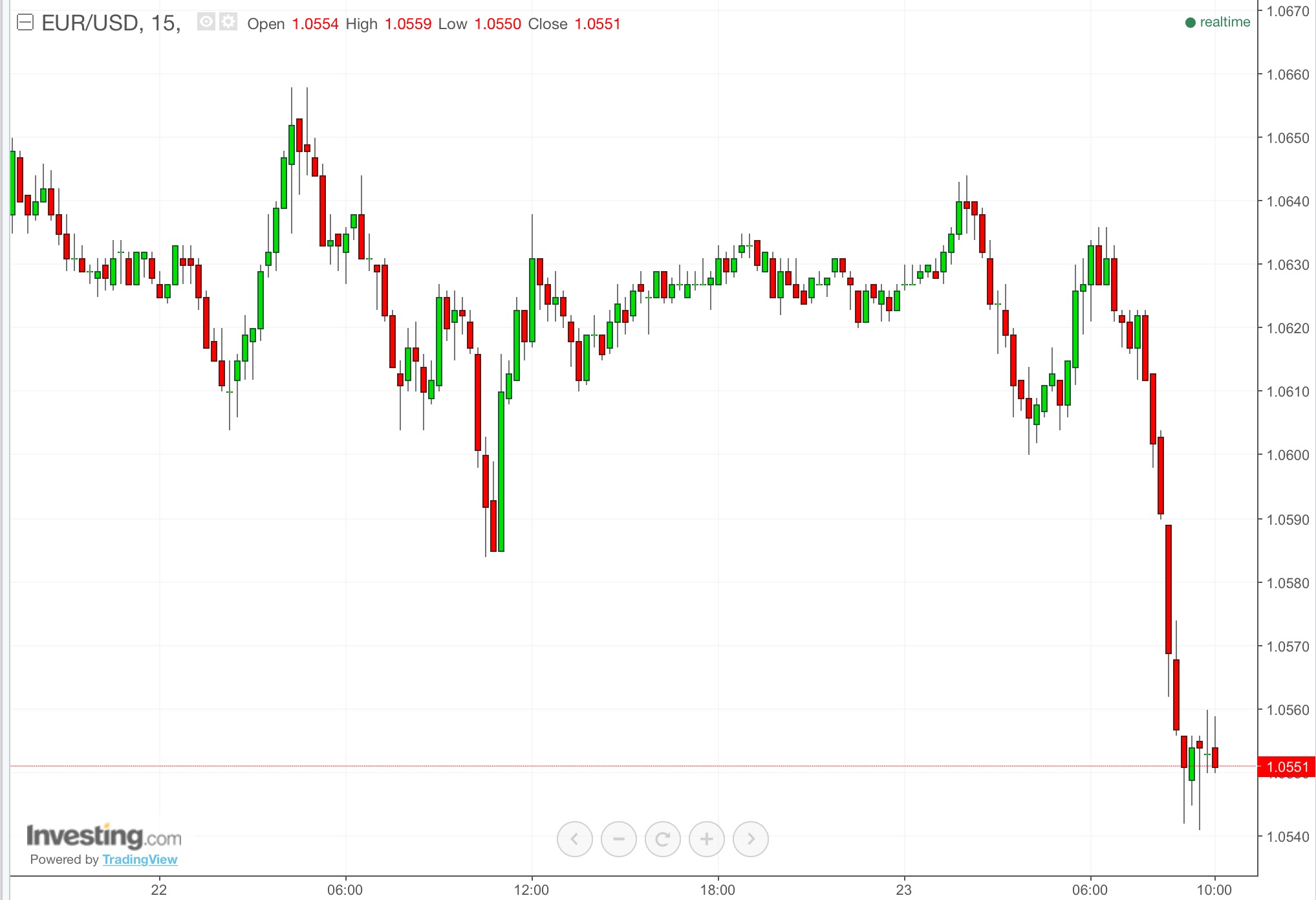
German bund yields are rising again, in addition to the rest of Europe.
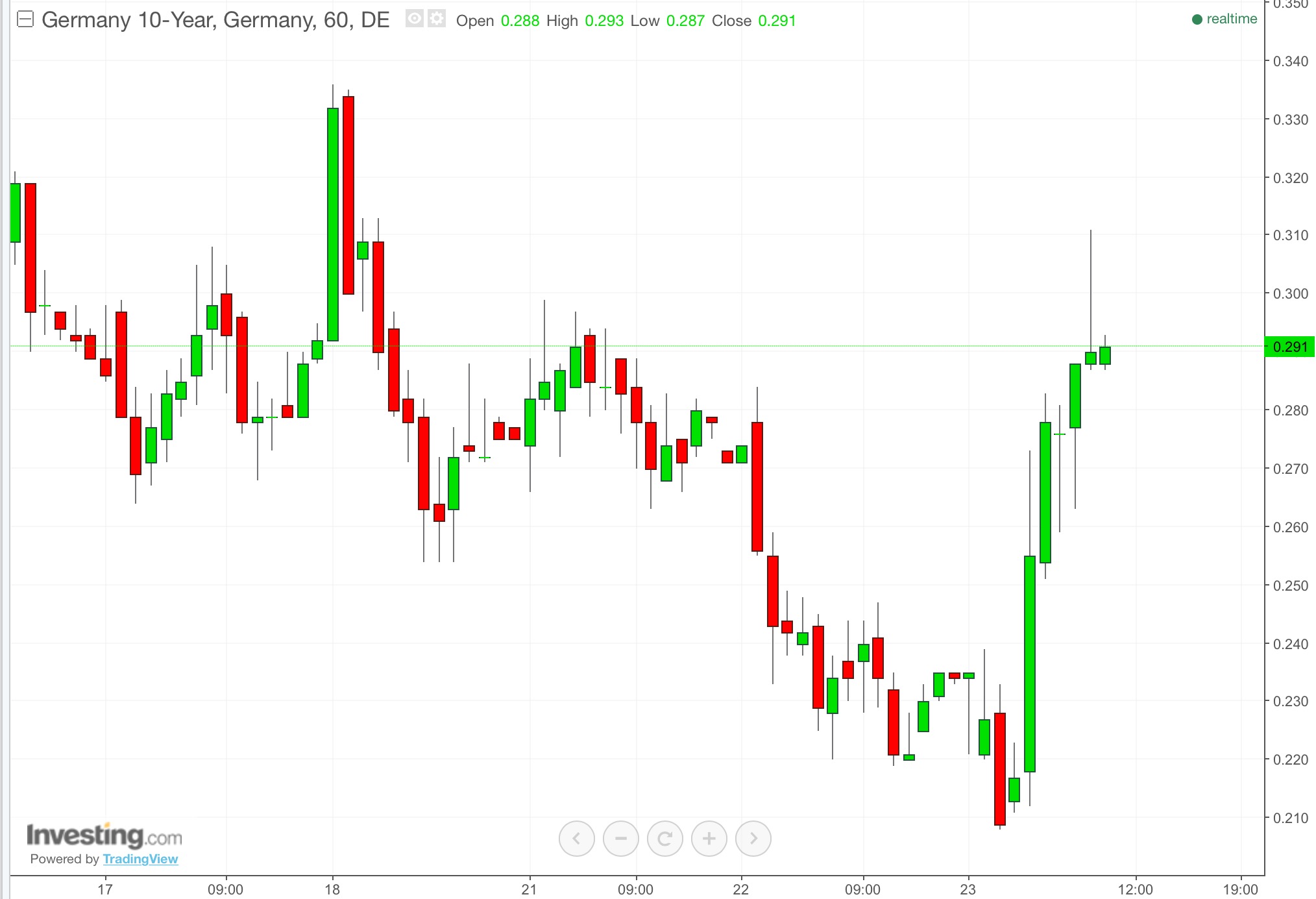
U.S. 10yr is officially in blowout territory, rising from 1.75% to almost 2.40% since election night. Somehow investors have ignored the deleterious affects this rise in borrowing costs will have on the economy. Instead, the financial media has been fixated on an alleged inflation that is going to rip through the economy, like a miracle, thanks to Trump’s fiscal plans. The only problem with that train of thought is said plans will be wholly dependent on cheap credit, which is getting more expensive with every passing day.
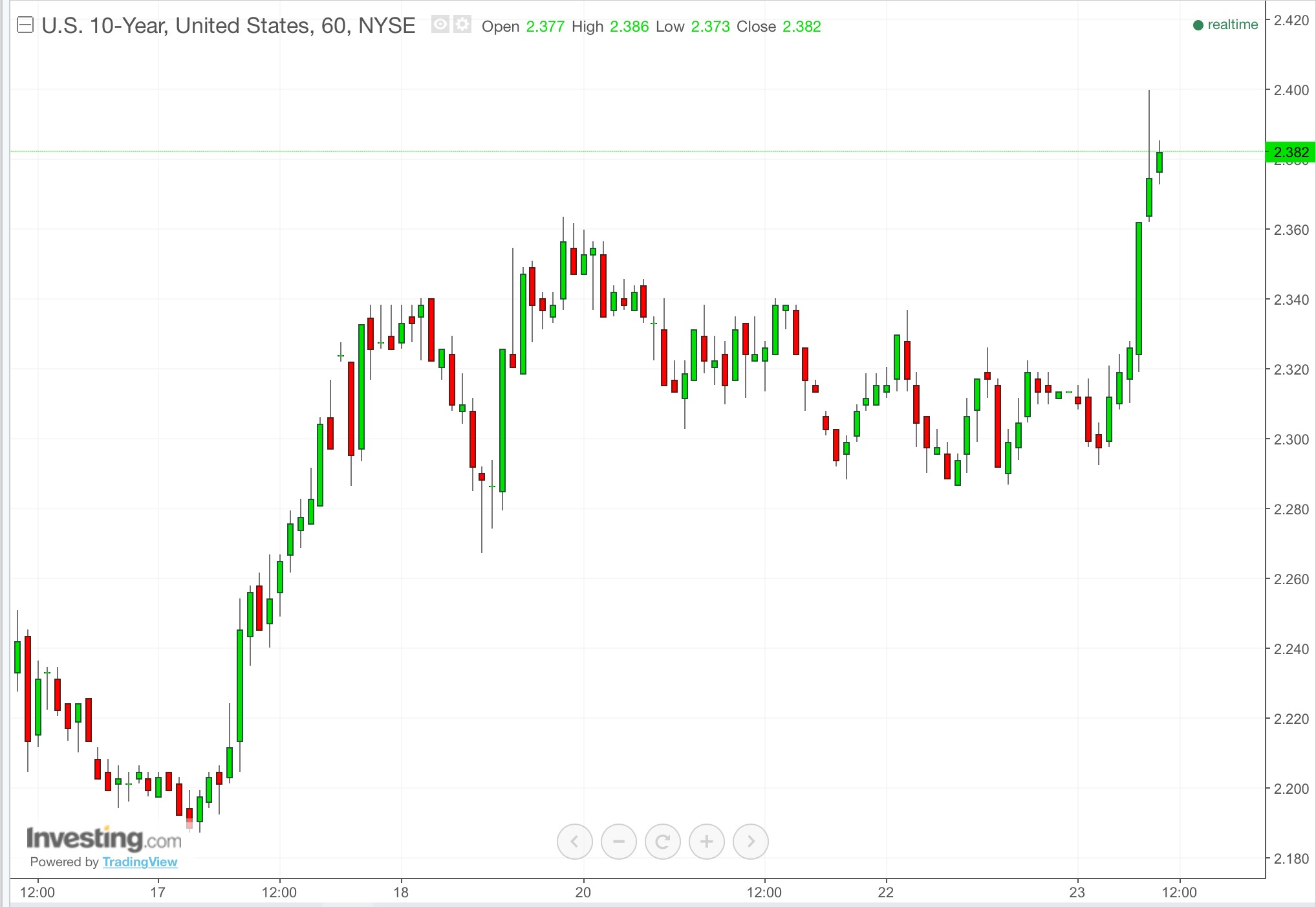
Gold is down more than 2% — absolutely brutalized thanks to dollar strength.
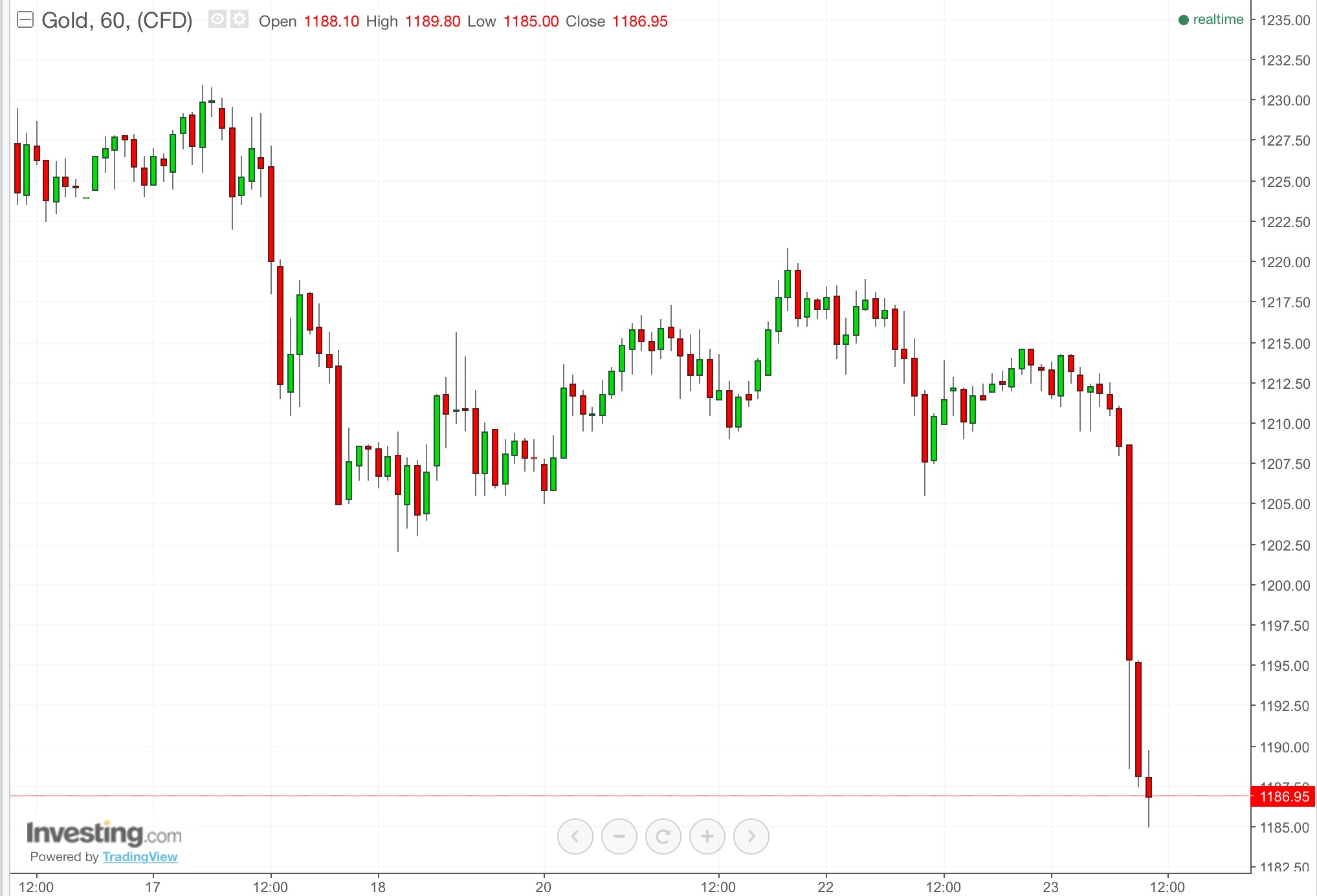
Subsequently, gold stocks are off by more than 5%. It’s truly the day of the rope for them.
Tech stocks are resuming their post Trump win weakness.
Markets are somewhat benign to this whirlwind in the credit markets, led by the dollar. Eventually, this will mean something — especially when the Trump administration attempts to borrow a trillion dollars for new roads and tunnels.
end
Looks like we have an internal war inside the Trump team as the conservative side of things are upset at the decision to kill the Clinton probe and the possible selection of Mitt Romney as Sec Treasurer
(courtesy zero hedge)
Conservatives “Betrayed” By Trump Decision To Kill Clinton Probe
Trump’s decision not to appoint a special prosecutor to pursue a criminal probe into Hillary Clinton’s email server or the Clinton Foundation, confirmed by top advisor Kellyanne Conway on Tuesday morning, appears to be is the first major break the president-elect has had with his diehard fans. In what The Hill believe was the first indication of “strains in the relationship” conservatives expressed “feelings of betrayal” on Tuesday after Conway said – and Trump subsequently confirmed during his meeting with the NYT – that the incoming administration would decline to pursue a criminal case against former rival Hillary Clinton.
And indeed, some prominent conservative critics were livid.
Breitbart News, whose former executive chairman, Steve Bannon was recently named as a senior advisor in his White House, slammed Trump’s decision as a “broken promise.”

Wow, Breitbart is unhappy with Donald Trump:

Conservative pundit Ann Coulter accused Trump of “blocking investigators from doing their job.
As happy as I am that our long national nightmare’s over, NO president shld be blocking investigators from doing their jobs. #EqualUnderLawhttps://twitter.com/washingtonpost/status/801070243670007808 …

Even Judicial Watch, the conservative watchdog organization that has pursued Clinton’s emails for more than a year and whose relentless FOIAs into the Clinton inner sanctum – alongside with the Wikileaks revelations – played a critical part in Hillary Clinton’s loss, called on Trump to reverse his stance.
“Donald Trump must commit his administration to a serious, independent investigation of the very serious Clinton national security, email, and pay-to-play scandals,” organization president Tom Fitton said in a statement. “If Mr. Trump’s appointees continue the Obama administration’s politicized spiking of a criminal investigation of Hillary Clinton, it would be a betrayal of his promise to the American people to ‘drain the swamp’ of out-of-control corruption in Washington, DC.”
“President-elect Trump should focus on healing the broken justice system, affirm the rule of law and appoint a special prosecutor to investigate the Clinton scandals.”
To be sure, Trump’s rather abrupt announcement he was willing to mend his pained relationship with Clinton flew in the face of over a year of Congressional hearings and probes, and prompted many to speculate if there was some behind the scenes arrangement between Hillary and Trump.
Congressional Republicans dragged FBI Director James Comey and Attorney General Loretta Lynch to the Capitol on multiple occasions to explain their decision. Lawmakers claimed that the Justice Department officials had created a “double standard” in declining to press charges.
On the other hand, the possibility of a politically motivated probe ordered by Trump had riled legal experts, who called it a potential gross breach of the sanctity of the rule of law.
But Trump’s base in the Republican Party had cheered his promise with repeated chants of “lock her up” and signs reading “Hillary for prison.”
And then, on Tuesday morning, Trump advisor Kellyanne Conway suggested on MSNBC that Trump is backing away from the earlier pledge, in part to “help [Clinton] heal.”
“I think when the president-elect, who’s also the head of your party, tells you before he’s even inaugurated that he doesn’t wish to pursue these charges, it sends a very strong message, tone and content,” she said.
Later in the day, in an interview with the New York Times, Trump denied that his apparent change of heart would deeply disturb his supporters. “I think I will explain it that we in many ways will save our country,”he told reporters and editors from the newspaper.
Former New York City Mayor Rudy Giuliani, who is in the running for the position of Secretary of State although appears to be losing to Mitt Romney as of this afternoon, appeared supportive of the decision.
“Look, there’s a tradition in American politics that after you win an election, you sort of put things behind you,” Giuliani told reporters at Trump Tower in New York. “And if that’s the decision he reached, that’s perfectly consistent with sort of a historical pattern of things come up, you say a lot of things, even some bad things might happen, and then you can sort of put it behind you in order to unite the nation.
“If he made that decision, I would be supportive of it,” he added. “I’d also be supportive of continuing the investigation.”
As The Hill adds, Trump has yet to make a decision on the future of FBI Director James Comey, whose job might be in jeopardy, the president-elect has suggested, for failing to recommend charges against Clinton. Comey, a Republican, is scheduled to continue his term until 2023, though Trump has suggested he may ask him to leave office sooner.
“I think that I would rather not comment on that yet,” Trump said on CBS’s “60 Minutes” earlier this month. “I haven’t made up my mind” although like with the case of Clinton, the most likely explanation is that Trump was a lot of bark, and very little bite, and Comey will remain in his post.
As for Trump’s loyal, at times rabid, fan base, betrayed or not it will have to decide how to deal with disappointment and flip-flops by the billionaire real estate investor (perhaps with Mitt Romney by his side) because as today’s most glaring yet example demonstrates, disappointments will come and they will come fast and furious over the next two months as Trump finalizes the policies that he will begin to enact after his inauguration in two months’ time.

end
We have warned you that the following two USA banks: JPMorgan and Citibank bank are the most systemically dangerous banks in the world..no surprises here!
(courtesy zero hedge)
Forget Deutsche Bank, These 2 American Banks Are Now “The Most Systemically Dangerous In The World”
Back in the summer we wrote about an IMF report that flagged Deutsche Bank as the “most important net contributor to systemic risks” (see “‘Deutsche Bank Poses The Greatest Risk To The Global Financial System’: IMF“). Those who read our site frequently were likely not terribly surprised by the IMF’s conclusion.
Among the G-SIBs, Deutsche Bank appears to be the most important net contributor to systemic risks, followed by HSBC and Credit Suisse. In turn, Commerzbank, while an important player in Germany, does not appear to be a contributor to systemic risks globally. In general, Commerzbank tends to be the recipient of inward spillover from U.S. and European G-SIBs. The relative importance of Deutsche Bank underscores the importance of risk management, intense supervision of G-SIBs and the close monitoring of their cross-border exposures, as well as rapidly completing capacity to implement the new resolution regime.
That said, we suspect the latest ranking of global systemically important banks (G-SIBs) by the Financial Stability Board may be a bit more surprising to our readers, among others, as it features two of America’s largest banks right at the very top.

Of course, Citigroup was quick to release a statement saying that its rise in the FSB list “does not drive a binding capital constraint”on the bank, and that it’s already subject to a higher 3% surcharge imposed by the U.S. Federal Reserve. While that may be true, any relative risk ranking that finds Citibank and JP Morgan more risky that Deutsche Bank has to be concerning to U.S. regulators.
The Financial Stability Board was established after the global financial crisis in 2009 by the Heads of State of the G20 with a mandate to “promote financial stability.” As such, the board ranks the 30 most systemically important financial institutions each year and assigns them to “capital surcharge” risk buckets based on a variety of risk measures. In this year’s rankings, Citigroup, BofA and Wells Fargo were the biggest losers and all face higher capital surcharges as a result. Meanwhile, London-based banks HSBC and Barclays all fared better in 2016’s rankings. Per Bloomberg:
Citigroup Inc., Bank of America Corp. and Wells Fargo & Co. all face higher capital surcharges after they rose in the Financial Stability Board’s latest ranking of the most systemically important banks in the world. Meanwhile, New York-based Morgan Stanley and London-based lenders HSBC Holdings Plc and Barclays Plc saw their buffer levels fall, the FSB said in a statement on Monday.
HSBC’s capital surcharge falls to 2 percent of risk-weighted assets from 2.5 percent, while Citigroup’s buffer rises to 2.5 percent from 2 percent, the FSB said. Barclays surcharge falls to 1.5 percent from 2 percent; Wells Fargo rises to 1.5 percent from 1 percent; and the Industrial and Commercial Bank of China surcharge rises to 1.5 percent from 1 percent.
The drop in HSBC’s surcharge is positive for the lender and “further enhances the capital return prospects” in the long term, Citigroup analysts said in a note.
Of course, all of this news was promptly dismissed by wall street as investors haven’t seen a bank stock they didn’t want to buy since election night two weeks ago.

end
Don’t read anything into this as durable goods increased 4.8% month over month thanks to a huge increase in transportation orders for civilian aircraft up 138.5% and military aircraft orders (up 33.1%) as authorities used the start of the new fiscal year to get their orders in. However the core capital goods shipments ie. the true capex has now declined for 15 straight months year over year.
(courtesy zero hedge)
Durable Goods Surge On Aircraft Orders Spike, Ex-Air Shipments Tumble For 15th Straight Month
Durable Goods Orders jumped 4.8% MoM in October, the highest since the October 2015 (start of government fiscal year) bounce last year, thanks to a yuuge in transportation orders (up 12.0%) which included a surge in orders for civilian aircraft (up 138.5%) and military aircraft new orders (up 33.1%). However, Core Capital Goods Shipments, i.e. true CapEx, has now declined 15 straight months year-over-year (the longest non-recesionary streak in history).
Lots of excitement that Durable Goods (ex transport) turned green year-over-year for the first time since Dec 2014.

But away from the unsustainable Boeing and Military orders…

And, Core Capital goods shipments continue to decline…

end
USA manufacturing pMI rises on the hope category as it decouples from production
(courtesy PMI/zero hedge)
US Manufacturing PMI Rebounds To 13 Month Highs On Post-Election Optimism, Decouples From Production Slump
Following the bump in Eurozone PMIs this morning, Markit reports November US manufacturing at 53.9 (better than 53.5 expected) and its highest since Oct 2015, showing “further signs of factories
and their customers moving away from destocking
to inventory-building amid a more optimistic
outlook.”
However, hope in the PMI survey seems to be decoupling from reality in actual production.

Under the covers, everything looks awesome with new orders rising (highest since Oct 2015), employment spiked to one of the largest of the year, and output jumped to its highest since March 2015.
Commenting on the flash PMI data, Chris
Williamson, Chief Business Economist at IHS
Markit said:
“US manufacturers enjoyed a strong post-election
bounce in November, further tilting the scales
toward the Fed hiking rates in December. Many
factories reported that demand from customers had
picked up as uncertainty about the election result
cleared. Domestic demand rose especially sharply,
helping to make up for subdued export growth,
linked in turn to the strong dollar.“The survey also found further signs of factories
and their customers moving away from destocking
to inventory-building amid a more optimistic
outlook, accompanied by an upturn in hiring. The
increase in employment was one of the largest
seen so far this year.“Inflationary pressures remained muted, with
average prices charged barely rising, despite some
further upward movement in many commodity
prices.“The buoyant post-election picture of the
manufacturing economy and signs of increased
optimism about the future will further fuel the
conviction that the Fed will raise interest rates at its
December 14th meeting, and may also raise the
possibility that policymakers might be inclined to
tighten somewhat more aggressively in 2017 than
previously thought, although much of course also
depends on the new government’s policy
framework.”
end
Strange: Black America consumer confidence surges to 22 month highs;
(courtesy zero hedge)
Trump Victory Sends Black American Consumer Confidence Surging To 22-Month Highs
Well that’s unexpected…
Bloomberg’s consumer comfort survey shows Black Americans are at their most confident since Jan 2015 followingthe Trump election win, now more confident than white Americans.

We also note that Hispanic Americans are more confident now than before the election also. So it makes us wonder just who all these snowflake protesters are?
New Home Sales Slide To Four Month Low After Sharp Downward Revisions
With mortgage rates soaring, it is only a matter of time before US housing is adversely impacted. And while the just released October new home sales data focused on sales of houses based on contracts signed in the month before the election, some concerns were already evident, when the number of new homes sold tumbled to 563K from a pre-revised 593K, badly missing expectations of a 593K print.
This was the weakest new home sales print going back to the 558K new homes sold in the month of June.

Furthermore, and as has traditionally happened with this volatile series, the the previous 3 months of data were all revised uniformly lower, with the September surge to 593K, now reduced to a more modest 574K.
The silver lining is that the drop in sales lifted the supply of homes available for sale to 5.2 months at the current selling rate, matching the highest since March.
An interesting observation in the latest data is that despite the recent increase (and surge, most recently) in mortgage rates, the median sales price was mostly unchanged, declining from $314K to $305K, the second highest since the summer and suggesting that future homes prices are set to drop, in a move inversely proportional to the recent surge in mortgage rates.

end
Great reason to whack gold today: In a poll 63% of Americans are planning not to shop on Black Friday
(courtesy zero hedge)
Retailers Panic: 63% Of Americans Plan Not To Shop On Black Friday
The day after Thanksgiving, also known as Black Friday, is when the holiday shopping season in the United States traditionally begins and is the day when retailers (at least in the past) finally turned a profit, going from “being in the red” to “in the black.” However, in recent years, this trend has seen turned upside down, with sales on Black Friday slipping, as retailers offer pre-Thanksgiving deals ever earlier than in recent years to capture heavily discounted market share (think OPEC) and draw shoppers as “Black Friday” no longer marks the spending peak at brick-and-mortar chains.
According to National Retail Federation data, the number of Thanksgiving weekend shoppers has fallen by nearly a third in just the past three years to 102 million in 2015, from 147 million in 2012, not only as a result of bricks and mortar stores starting the selling season earlier but due to stiff competition form online vendors, most notably Amazon. Moreover, early holiday promotions and online shopping hurt in-store spending by more than 6 percent last year.
As a result, participation in this year’s Black Friday looks like it may be the worst in history: according to a Reuters/Ipsos poll of 1,639 adults showed 63%, or nearly two-thirds, did not plan to shop on Black Friday this year. Some 32% said they plan to finish about half of their holiday shopping on that day. While selling tactics are certainly a factor, one wonders how much of decline in spending is due to lack of disposable income for the tapped out US consumer?
“The holiday season is expanding, and Black Friday is no longer the kickoff for the season,” said Natalie Kotlyar, who heads retail and consumer products at business advisory firm BDO Consumer, adding many start holiday shopping at Halloween, Labor Day or even Amazon’s Prime Day on July 12.
Still, retailers are not only not giving up but, as Reuters reports, are on the verge of panic, and have not only redoubled efforts this year to boost sales with familiar tactics but greater intensity, all of which assure even lower margins, but are rolling out the heavy artillery to draw in those consumers who will go out on Friday.
Wal-Mart has already said it will increase inventory by more than half this year and make deals typically reserved for Black Friday available online early Thanksgiving morning. Retail pricing and data analytics firm Market Track said an analysis of 15 top U.S. brick-and-mortar retailers and their Black Friday circular announcements online showed they were about three days earlier than last year.
In what is shaping up to be a giant race to the bottom which may result in an unprecedented, below cost inventory liquidation, retailers have just one response: “they are all trying to beat each other to the punch and starting their promotions earlier and earlier every year,” said Traci Gregorski, senior vice president, marketing at Market Track.
Ironically, the reason why so few Americans will shop this year is becase last year, discounts on popular products deepened by 30 to 40% from Black Friday prices as Christmas got closer, according to Market Track data.
So why rush when consumers now know that “must have” holiday item will only get cheaper?
Mark Cohen, a professor at Columbia Business School and the former chief executive of Sears Canada said the urgency related to Black Friday has greatly diminished. “Consumers know great deals and discounts are available throughout the year, and prices during the holiday season will only get better if they wait,” he said.
Sure enough, deals have been available for several days already on websites of retailers like Target, Macy’s, Kohl’s, Home Depot and Lowe’s Cos. Amazon.com joined with a first of its kind month-long Black Friday promotion.
Some brands are getting in on the action by offering steep discounts that reduce the appeal of waiting for Black Friday. Handbag maker Kate Spade is already offering 75 percent off some items, and off-price chain Saks Off Fifth has similar discounts on some clothing and shoes
* * *
With shopping dynamics changing by the year, and escalating discounting prevalent, retailers are in a state of chaotic flux: the year-end shopping season spanning November and December is crucial for retailers because it can account for up to 40 percent of their annual sales. The NRF, which has been overly optimistic at times in the past with its sales projections, expects holiday sales to grow 3.6 percent this year to $655.8 billion. The NRF will be disappointed yet again – about 70% of retailers expect sales to remain flat this year, according to telephone interviews with chief marketing officers at 100 U.S. retail firms, BDO Consumer said.
Still, despite the changing attitudes toward Black Fruday, there will be few strategic changes from recent years: big bricks-and-mortar players like Target and Wal-Mart will still open at 6 p.m. on Thanksgiving.

Illinois Stiffing Vendors To Fund Budget Deficits – It’s A “Financial Time Bomb”
Anyone who has ever invested in distressed securities is intimately familiar with the many games that companies play to avoid a bankruptcy filing. The easiest game, and the most obvious red flag for investors to spot, involves stretching out payables and managing down receivable days to build cash so you can live to fight another day. While this may provide a temporary cash boost, it’s typically the beginning of the end as vendors simply move payment terms to COD and the game quickly comes to an end.
Well, this is exactly the game that the state of Illinois seems to be playing right now to cover its budget shortfalls. As we just pointed out a couple of days ago (see “Illinois Pension Funding Ratio Sinks To 37.6% As Unfunded Liabilities Surge To $130 Billion“), with a $130BN pension underfunding and minimum annual contributions of $10BN, it’s no surprise that Illinois needs every dollar they can squeeze out of vendors.
So, in response to their budget crisis, Illinois has done what every responsible, insolvent debtor does, namely raise more debt. Under the program, Illinois vendors are able to sell their receivables to a consortium of lenders who have decided to provide seemingly perpetual loans to the state at a cost 1% per month. As Reuterspoints out, the balance of the program is currently around $13.5BN right now but is expected to surge to $47BN by 2022, or nearly double the amount of GO bonds the state has outstanding.
Political feuding between Republican Governor Bruce Rauner and Democrats who control the legislature has kept Illinois without a full operating budget since July 2015, contributing to a doubling of the unpaid bills backlog. The amount of overdue bills could reach $13.5 billion, or 40 percent of available operating revenue, when the current fiscal year ends June 30, the Rauner administration has projected.
Come fiscal 2022, the backlog is projected to balloon to $47 billion. No other U.S. state defers payments to the extent Illinois does to manage cash flow, credit-rating analysts said.
The one-of-its-kind, bill-payment program seeks to avert the nightmare scenario for a state in the worst financial shape in the country: a shutdown of essential services such as employee health insurance, a disruption of prison food supplies or mothballing of state trooper cars in need of fuel and maintenance.
“I don’t think there is any other alternative for us,”Illinois Central Management Services Director Michael Hoffman told a legislative panel in May.
The state’s negative credit outlook means its $26 billion of outstanding GO bonds could lurch closer to the junk level if the growing unpaid bill pile impairs its ability to provide essential services,affects debt payments and inflates its already huge $130 billion unfunded pension liability.
And, of course, interest payments on the ballooning debt balance is skyrocketing.

And, like any good Illinois public project, this one comes with a healthy dose of corruption and favors to political insiders.
The firms include financial institutions such as Citibank N.A. (C.N) and Bank of America Corp (BAC.N), a distressed debt investor tied to a Rauner campaign donor, and political insiders, including Hillary Clinton’s 2008 campaign manager and a former two-term Republican Illinois governor.
Lindsay Trittipoe, majority investor of the second-largest consortium, Illinois Financing Partners LLP, told Reuters his group was performing a vital function rather than exploiting the state’s financial miseries.
“Our money is flowing into the market, helping the wheels of commerce to keep working,” he said.
We’re rusty on our 7 step plan, how long does the “denial” phase typically last?
end
The minutes of the FOMC confirmed that the buffoons are going to raise rates to preserve their credibility which is zero.
(courtesy zeor hedge)
FOMC Minutes Confirm Rate Hike Imminent “To Preserve Credibility”
A lot has changed since the November 2nd FOMC statement – most notably the world has suddently become awesome again. The relatively benign statement (and election result) has left rate-hike odds at 100% for December but comment from Fischer and Yellen since have hinted concerns at the need for Trump fiscal spendfest. The main risk going in to the minutes was a dovish tilt for the future, tamping the current ‘nothing can stop us now’ attitude (and we note the dollar leaked lower into the release). But sure enough, The Fed confirmed a rate-hike was approrpoate “relatively soon” and was “important to Fed credibility.”
- *MOST FED OFFICIALS SAW RATE HIKE APPROPRIATE `RELATIVELY SOON’
- *MANY FED OFFICIALS SAW STABILITY RISKS IF JOB MKT OVERHEATED
- *SUBSTANTIAL MAJORITY FED OFFICIALS SAW RISKS ROUGHLY BALANCED
- *SOME OFFICIALS SAW DEC. HIKE IMPORTANT TO FED CREDIBILITY
- *FED OFFICIALS SEE RESERVE BALANCES STAYING LARGE FOR `A WHILE’
Since the Nov FOMC statement, gold and bonds have been crushed as oil and stocks soared…

Heading into the minutes, the market has zero expectations of a surprise in December…

And looking further out at Fed funds, a 28% chance of a March hike is priced in and that rises to 61% by June and an 88% chance of at least one hike in 2017.

There were the key excerpts:
Some Fed participants were worried that the economic expansion was at risk without rate hikes, and the Fed would be behind the curve on unemployment:
A few members were concerned that a sizable undershooting of the longer-run normal unemployment rate could necessitate a steep subsequent rise in policy rates, undermining the Committee’s prior communications about its expectations for a gradually rising policy rate or even posing risks to the economic expansion.
As a result, some Fed participants said that to “preserve credibility” a rate hike should occur at the next meeting:
Some participants noted that recent Committee communications were consistent with an increase in the target range for the federal funds rate in the near term or argued that to preserve credibility, such an increase hould occur at the next meeting.
Others were even more aggressive, and wanted a rate hike as soon as November:
A few participants advocated an increase at this meeting; they viewed recent economic developments as indicating that labor market conditions were at or close to those consistent with maximum employment and expected that recent progress toward the Committee’s inflation objective would continue, even with further gradual steps to remove monetary policy accommodation.
But most said it is best to wait for further evidence of inflation:
But a majority of members judged that the Committee should, for the time being, await some further evidence of progress toward its objectives of maximum employment and 2 percent inflation before increasing the target range for the federal funds rate. A few members emphasized that a cautious approach to removing accommodation was warranted given the proximity of policy rates to the effective lower bound, as the Committee had more scope to increase policy rates, if necessary, than to reduce them. Two members preferred to raise the target range for the federal funds rate by 25 basis points at this meeting.
* * *
end
First the failure of the F 15 and the constant delays. Now the Navy;s new 4 billion stealth warship breaks down at the Panama Canal. That ought to instill confidence into the hearts of Americans.
(courtesy zero hedge)
Navy’s New $4 Billion Stealth Warship Breaks Down (Again)
For the second time in two months, The Navy’s new $4 billion stealth warship has broken down. As Military.com reports, the ripped-from-the-pages-of-a-sci-fi mag-looking USS Zumwalt is now in Panama for repairs after suffering a breakdown while passing through the Panama Canal on Monday evening.

Military.com’s Hope Hodge Seck reports that a spokesman for U.S. 3rd Fleet, Cmdr. Ryan Perry, told Military.com that the commander of 3rd Fleet, Vice Adm. Nora Tyson, had instructed the USS Zumwalt, the first in a new class of stealthy destroyers, to remain at ex-Naval Station Rodman in Panama to address the engineering casualty.
“The timeline for repairs is being determined now, in direct coordination with Naval Sea Systems and Naval Surface Forces,” he said in a statement.
“The schedule for the ship will remain flexible to enable testing and evaluation in order to ensure the ship’s safe transit to her new homeport in San Diego.”
An official confirmed to Military.com that the ship had been transiting south through the canal en route to its new San Diego homeport when the incident occurred. The ship had to be towed to pier by the Panama Canal Authority, the official said.
While details about what caused the breakdown were few, Navy Times — which first reported the incident — cited reports about problems with heat exchangers in the ship’s integrated power plant that had contributed to the mishap.
It’s not the first casualty for the Zumwalt, which was commissioned just last month, on Oct. 15. In September, ahead of its commissioning, the Zumwalt was sidelined due to a problem in its engineering plant, USNI News reported.
Navy officials said the problem was discovered after crew found a seawater leak in the propulsion motor drive lube oil auxiliary system of one of the ship’s shafts. That repair was completed at Naval Station Norfolk.
The ship also made headlines earlier this month when multiple outlets reported that the missiles fired from its 155mm Advanced Gun System, at $800,000 apiece, were too expensive for the Navy to buy in large quantities, raising questions about the effectiveness of the ship’s weapons.
The Zumwalt, and the two ships planned to follow it, will be assigned to the Pacific as part of the regional rebalance, Defense Secretary Ash Carter said in April.
end
Nathan McDonald believes that Jeff Sessions, a very good constitutional lawyer will go after Hillary. Here is why he believes this will happen
(courtesy Nathan McDonald/Sprott Money Management)
Trump Gives Hillary a Get Out of Jail Free Card. Or Does He?

Trump Gives Hillary a Get Out of Jail Free Card. Or Does He?
Written by Nathan McDonald (CLICK HERE FOR ORIGINAL)

One news headline, that has many of those who supported Trump throughout his candidacy pulling their hair out in rage this weekend, is the one that stated Trump would not prosecute Hillary Clinton for her illegal use of a private email server during her time as the Secretary of State.
At face value, this is quite frustrating and annoying, as it goes against one of Trump’s campaign promises to hold Hillary accountable for some of her past crimes committed which broke many laws that others of lesser position have been charged for.
What people are missing is a strategic play that Trump has initiated and enacted. Trump has extended hardcore Hillary-supporting liberals an olive branch and offer of peace that he himself never actually possessed.
The reality is, the President of the United States DOES NOT and CANNOT legally prosecute anyone. This is not his job and not within his power. Donald Trump stating that he will not prosecute Hillary Clinton should come as no shock to anyone, as he cannot even do this!
In the process, he has gained an advantage and looks presidential. Meanwhile, his recently appointed Attorney General, Jeff Sessions, is free to act as if he is not being “politically” motivated or influenced. He is fully in his right to pursue charges against Hillary if he deems it appropriate.
Given the fact that Jeff Sessions is known as the number one constitutional attack dog, it is likely that he WILL do the right thing and go after Hillary for her past crimes.
Also, what this does is defuses the possibility of President Obama pardoning Hillary Clinton in the 57 days he has remaining, an opportunity that is less likely to be used if Trump himself takes a soft stance against Hillary in the short time that remains for Obama to act.
The lying mainstream media, who has recently come out with a full blown assault on the alternative media and are flailing about in their dying gasps, is doing everything they can to try and put a wedge in between Trump and his supporters. The spin on this story is just another example of this, as they know the facts just as well as I do.
Yet, the facts still remain just the same. As I’ve always said, do your own research and stop and think about the news you are reading before you allow it to influence you.
The MSM and the elites who control them are the same ones who have religiously attacked us in the precious metals community for decades. We know their tricks well and we will be here, exposing them every step of the way, for as long as we can in this eternal fight for freedom and liberty.
end
Well that about does it for today
I will not give a commentary tomorrow
I will provide my report on Saturday or Sunday for my normal Friday report
To all our American friends, a very happy Thanksgiving holiday .


 harveyorganblog.com
Zumwalt is a Beta. That is the first in an innovative design. It is “intended” to be perfect within common knowledge, but in reality a prototype to show where the failures are. The failures will show up and the next set will be operative. Unfortunately, the next set, instead of numbering 30-something, has been downgraded to two. Severe loss to the Navy as well as the dedicated employees of BIW who now know how to build them, but won’t get the chance.
LikeLike
[…] NOV 23/MASSIVE RAID ON GOLD AND SILVER BY THE CROOKED BANKERS/ HUGE DROP IN THE YUAN VALUE, THE YEN … […]
LikeLike
[…] by Harvey Organ Harvey Organ’s Blog […]
LikeLike