
Gold at (1::30 am est) $1178.20 down $10.90
silver at $16.46: down 8 cents
Access market prices:
Gold: 1283.50
Silver: 16.55
Let us begin with my work in progress:
THE DAILY GOLD FIX REPORT FROM SHANGHAI AND LONDON
.
The Shanghai fix is at 10:15 pm est last night and 2:15 am est early this morning
The fix for London is at 5:30 am est (first fix) and 10 am est (second fix)
Thus Shanghai’s second fix corresponds to 195 minutes before London’s first fix.
And now the fix recordings:
THURSDAY GOLD FIXES:
Shanghai morning fix Nov 24 (10:15 pm est last night): $ 1215.21
NY ACCESS PRICE: $1186.00 (AT THE EXACT SAME TIME)/premium $29.21
XXXXXXXXXXXXXXXXXXXXXXXXXXXXXXXXXX
Shanghai afternoon fix: 2: 15 am est (second fix/early morning):$ 1212.41
NY ACCESS PRICE: 1186.20 (AT THE EXACT SAME TIME/2:15 am)
HUGE SPREAD 2ND FIX TODAY!!: $26.21
China rejects NY pricing of gold!!
XXXXXXXXXXXXXXXXXXXXXXXXXXXXXXXXXXXXXXXX
London Fix: Nov 24: 5:30 am est: $1187.25 (NY: same time: $1187.00 5:30AM)
London Second fix Nov 24: 10 am est: $11.85.35 (NY same time: $1187.10, 10 AM)
FRIDAY gold fix Shanghai
Shanghai morning fix Nov 25 (10:15 pm est last night): $ 1202.15
NY ACCESS PRICE: $1177.30 (AT THE EXACT SAME TIME)/premium $24.85
XXXXXXXXXXXXXXXXXXXXXXXXXXXXXXXXXX
Shanghai afternoon fix: 2: 15 am est (second fix/early morning):$ 1200.91
NY ACCESS PRICE: 1187.40 (AT THE EXACT SAME TIME/2:15 am)
HUGE SPREAD 2ND FIX TODAY!!: $13.51
China rejects NY pricing of gold stating that it is a fraud
XXXXXXXXXXXXXXXXXXXXXXXXXXXXXXXXXXXXXXXX
London Fix: Nov 25: 5:30 am est: $1187.50 (NY: same time: $1188.00 5:30AM)
London Second fix Nov 25: 10 am est: $xxxx (NY same time: $1186.30 10 AM)
It seems that Shanghai pricing is higher than the other two , (NY and London). The spread has been occurring on a regular basis and thus I expect to see arbitrage happening as investors buy the lower priced NY gold and sell to China at the higher price. This should drain the comex.
Also why would mining companies hand in their gold to the comex and receive constantly lower prices. They would be open to lawsuits if they knowingly continue to supply the comex despite the fact that they could be receiving higher prices in Shanghai.
end
For comex gold:
NOTICES FILINGS FOR NOVEMBER CONTRACT MONTH: 0 NOTICE(S) FOR NIL OZ TONNES
For silver:
NOTICES FOR NOVEMBER CONTRACT MONTH FOR SILVER: 0 NOTICE(s) OR nil OZ
xxxxxxxxxxxxxxxxxxxxxxxxxxxxxxxxxxxxxxxxxxxxxxxxxxxxxxxxxxxxxxxxxxxxxxxxxxxxxxxxxxxxxxxxxx
Let us have a look at the data for today (Preliminary data)
.
xxxxxxxxxxxxxxxxxxxxxxxxxxxxxxxxxxxxxxxxxxxxxxxxxxxxxxxxxxxxxxxxxxxxxxxxxxx
In silver, the total open interest FELL by 2108 contracts DOWN to 167,583 with YESTERDAY’S trading. In ounces, the OI is still represented by just less THAN 1 BILLION oz i.e. .837 BILLION TO BE EXACT or 120% of annual global silver production (ex Russia & ex China).
In November, in silver, 0 notice(s) filings: FOR NIL OZ
In gold, the total comex gold FELL by 37,676 contracts WITH THE HUGE FALL IN THE PRICE OF GOLD ($21.90 with yesterday’s trading ).The total gold OI stands at 423,386 contracts. The gold specs have been blown out of the water again
In gold: we had 0 notice(s) filed for NIL oz
xxxxxxxxxxxxxxxxxxxxxxxxxxxxxxxxxxxxxxxxxxxxxxxxxxxxxxxxxxxx
With respect to our two criminal funds, the GLD and the SLV:
GLD: (to be reported on Sat/Sun)
We had another huge change in tonnes of gold at the GLD, a withdrawal of 19.87 tonnes of gold
Inventory rests tonight: 885.04 tonnes
.
SLV (to be reported Sat/Sun)
we HAD A CHANGE at the SLV/. A WITHDRAWAL OF 949,000 OZ
THE SLV Inventory rests at: 346.150 million oz
Now my work in progress:
.
First, here is an outline of what will be discussed tonight: Preliminary data
1. Today, we had the open interest in silver FELL by 2108 contracts DOWN to 167,583 as price of silver FELL by $0.24 with YESTERDAY’S trading. The gold open interest FELL by 37,676 contracts DOWN to 423,386 as the price of gold FELL BY $21.90 WITH YESTERDAY’S TRADING.
(report Harvey).
2.a) The Shanghai and London gold fix report
(Harvey)
2 b) Gold/silver trading overnight Europe, Goldcore
(Mark O’Byrne/zerohedge
and in NY: Bloomberg
3. ASIAN AFFAIRS
i)Late THURSDAY night/FRIDAY morning: Shanghai closed UP 20.20 POINTS OR 0.62%/ /Hang Sang closed UP 114.96 OR 0.57%. The Nikkei closed UP 47.81 OR .26%/Australia’s all ordinaires CLOSED UP 0.39% /Chinese yuan (ONSHORE) closed DOWN at 6.9207/Oil FELL to 47.49 dollars per barrel for WTI and 48.45 for Brent. Stocks in Europe: ALL IN THE RED EXCEPT LONDON Offshore yuan trades 6.9485 yuan to the dollar vs 6.9207 for onshore yuan.THE SPREAD BETWEEN ONSHORE AND OFFSHORE WIDENS DEEPLY AS MORE USA DOLLARS LEAVE CHINA’S SHORES / CHINA SENDS A CLEAR MESSAGE TO THE USA AND JANET TO NOT RAISE RATES IN DECEMBER.
REPORT ON JAPAN SOUTH KOREA NORTH KOREA AND CHINA
3a)THAILAND/SOUTH KOREA
none today
b) REPORT ON JAPAN
c) REPORT ON CHINA
i)Thursday:
China press lashes out that it is the dollar’s strength that is causing the yuan to weaken. As the yuan weakens, the globe is whacked with deflation as lower Chinese prices force other countries to lower their prices to compete. Emerging markets are now in complete turmoil
( Dan Steinbok/ChinaDaily.com)
4 EUROPEAN AFFAIRS
i)EURO
The huge drop in the value of the Euro due to dollar rising is causing huge significant risks in Europe and they warn of a abrupt market reversal
no kidding..
( zero hedge)
ii)GERMANY
This does not look good: Germany’s NordBank reports that in its shipping loan boopk almost 40% of loans are non performing:
( zero hedge)
5. RUSSIAN AND MIDDLE EASTERN AFFAIRS
TURKEY
Europe temporarily suspends Turkey’s entry into the EU due to deteriorating human rights violations. The Lira tanked to 3.42 before recovering as Erdogan raised Turkey’s overnight rates to 8.5%. The real problem here is what will Erdogan do with the 2 million refugees?
( zero hedge)
6.GLOBAL ISSUES
none today
7. OIL ISSUES
i)Now who would have thought that this could happen: in the last minute the big OPEC players demand production cuts from non OPEC: still think a deal is possible?
( zero hedge)
ii)Oil then falls as the Saudis refuse to attend a non OPEC producers meeting:
8. EMERGING MARKETS
i)INDIA
Devastation runs supreme in India as the Rupee crashes to a record low. Only 40% of old cash has been turned in with a huge 60% left to go. I would say that close to 90% of the Indian economy is cash and the removal of the big bills has already shaved 2% off of GDP. Modi also is trying to rein in citizens appetite for gold
(courtesy zero hedge
ii)And then this: India will impose a 60% tax on all deposits into banks with unaccounted money. They will also try and curb gold holdings per individual.
Venezuela now enters hyperinflation officially as it takes over 2700 bolivars per dollar.
(courtesy zero hedge)
iv Brazil
Brazil may get impeachment hearings in a new corruption scandal involving President Temer
(courtesy zero hedge)
9. PHYSICAL MARKETS
i)Now that the hedgies have disappeared from the silver market, it is now time for the commercials to enter the long side
( zero hedge/Dana Lyons/Tumbler)
ii)Chris Powell interviewed showing that paper gold is the elephant in the room
( Goldletter/Hodson/ChrisPowell
iii)John Hathaway discusses the Trump victory and what it will mean for gold:
( John Hathaway/GATA)
iv)A must read: Alasdair Macleod with his thoughts on the banning of high denomination notes in India and what that will do to gold in this region.
( Alasdair Macleod/)
10.USA STORIES
i)Wow!! a huge deficit of 62 billion dollars. Who would have thought that this would happen with a high dollar: poor exports, higher imports!! Wholesaler inventories contract signalling recession:
( zero hedge)
ib)The USA reports a big drop in the service sector. Remember that today the USA reported huge trade deficits and a huge drop in inventories. How could Markit report a high mfg number two days ago?
(courtesy zer0 hedge)
ii)The strong pillar of USA car sales is now reeling.
( Wolf Richter/WolfStreet)
iii)Michael Snyder discusses that one half the population of the world is dirt poor with the elitists trying to keep it that way
( Michael Snyder/EconomicCollapseBlog)
iv)A strong message from Michael Snyder to us all
( Michael Snyder/EconomicCollapseBlog)
v)Is my favourite politician Nigel Farage going to have a position in the Trump administration after he announces that he is moving to the USA
( zero hedge)
end
COMEX
The data this morning is preliminary. The final OI numbers will probably be lower and I will update them for you on Sat/Sunday. The amount standing is correct
Let us head over to the comex:
The total gold comex open interest FELL by 37,676 CONTRACTS to an OI level of 423,386 AS GOLD FELL $21.90 with YESTERDAY’S trading.reading on Friday will see a In the front month of November we had 221 notices standing for a GAIN of 194 contracts. We had 16 notices served YESTERDAY so we GAINED 178 GOLD CONTRACTS OR AN ADDITIONAL 17,800 OZ WILL STAND FOR DELIVERY IN THIS NON ACTIVE DELIVERY MONTH OF NOVEMBER. The next contract month and the biggest of the year is December and here this month showed a DECREASE of 58,431 contracts DOWN to 106,069. The December contract month is still highly elevated compared to a year ago. On FRIDAY Nov 27/2015 comex reading day, we had a total of 24,018 contracts standing ( a loss of 36,141 contracts from Nov 25/2015. To give you more detail as to how the front month of December contracted, the final Nov 30 contract had an OI of 7,849 contracts standing or 24.41 tonnes standing. On the last day we lost 16,169 contracts. The OI for the entire complex was around 393,000 or similar to the low readings this year. It certainly emphasizes the huge demand for physical gold.We have exactly 3 more trading days left. THIS SHOULD EXPLAIN TO YOU WHY THE BANKERS ARE CONSTANTLY WHACKING OF GOLD (AND SILVER): THE HIGH OI FOR DECEMBER AND THE HIGH PROBABILITY THAT MANY WILL TAKE DELIVERY.
And now for the wild silver comex results. Total silver OI FELL by 2108 contracts from 169,661 DOWN TO 167,583 as the price of silver FELL BY $0.24 with YESTERDAY’S trading. We are moving further from the all time record high for silver open interest set on Wednesday August 3/2016: (224,540). The front month of November had an OI of 1 and thus a LOSS of 0 contracts. We had 0 notice(s) filed yesterday so we neither lost nor gained any contracts (oz) that will stand for delivery in this non active month of November. The next major delivery month is December and here it FELL BY 1983 contracts DOWN to 40,393. The December contract month is a little elevated compared to a year ago. On Nov 27/2015 reporting day, we had a level of 16,868 contracts having lost 10,053 contracts on the day. On the final day of November, we had 5,975 contracts stand for 29.875 million oz. We lost 4078 contracts on the last day prior to first day notice.
In silver had 0 notice(s) filed for NIL oz
Eventually at the end of December 2015: 6.4512 tonnes of gold stood for delivery
Eventually at the end of December 2015: 18.84 million oz of silver stood for delivery.
Note how much paper settlements occurred in December last yr and I surely doubt if we will get any!!
VOLUMES: for the gold comex
Today the estimated volume was 405,569 contracts which is HUGE.
Friday’s confirmed volume was 514,416 contracts which is huge
| Gold | Ounces |
| Withdrawals from Dealers Inventory in oz | nil |
| Withdrawals from Customer Inventory in oz nil |
nil
|
| Deposits to the Dealer Inventory in oz | nil oz |
| Deposits to the Customer Inventory, in oz |
32,582.430 oz
includes 1000 kilobars Scotia
also Brinks deposit
|
| No of oz served (contracts) today |
0 notice(s)
NIL oz
|
| No of oz to be served (notices) |
221 contracts
22100
oz
|
| Total monthly oz gold served (contracts) so far this month |
2671 contracts
267,100 oz
8.3079 tonnes
|
| Total accumulative withdrawals of gold from the Dealers inventory this month | nil oz |
| Total accumulative withdrawal of gold from the Customer inventory this month | 633,712.5 oz |
Today, 0 notices were issued from JPMorgan dealer account and 0 notices were issued from their client or customer account. The total of all issuance by all participants equates to 0 contract(s) of which 0 notices were stopped (received) by jPMorgan dealer and 0 notice(s) was (were) stopped/ Received) by jPMorgan customer account.
March 2015: 2.311 tonnes (March is a non delivery month)
| Silver | Ounces |
| Withdrawals from Dealers Inventory | nil |
| Withdrawals from Customer Inventory |
nil oz
|
| Deposits to the Dealer Inventory |
nil OZ
|
| Deposits to the Customer Inventory |
507,525.390 oz
Brinks
|
| No of oz served today (contracts) |
0 CONTRACT(S)
(nil OZ)
|
| No of oz to be served (notices) |
1 contracts
(5,000 oz)
|
| Total monthly oz silver served (contracts) | 465 contracts (2,325,000 oz) |
| Total accumulative withdrawal of silver from the Dealers inventory this month | NIL oz |
| Total accumulative withdrawal of silver from the Customer inventory this month | 6,766,529.7 oz |
end
end
NPV for Sprott and Central Fund of Canada
will provide on Saturday/Sunday
END
Major gold/silver stories for FRIDAY
Early morning gold TRADING
Gold Down 13.5% In 13 Days – Trump Bearish For Gold?
- Gold down 13% in 13 trading days since Trump election
- Factors that have led to lower gold prices
- Trump bearish for gold in coming four years?
- ‘Trumpflation’ cometh
- Sharia gold – vaulted gold accessible to 110 million new investors
- What to do? Diversify and geometric price cost average
Donald Trump was elected President and the gold price surged 5%, over $60, from $1,271/oz to $1,336/oz. As many of us had suggested it would. And then something strange happened, something not expected by the majority of market participants – it started to fall, the dollar strengthened.

We now have a gold price that is down 13% since the US election result – from a high of $1,336/oz to a low of $1,177/oz this morning. This is a drop of 13% in just 13 trading days since the election.
Does this mean that Trump and his Presidency isn’t going to be very bullish for gold prices as so many of us predicted? Does this mean that gold is going to underperform or worse, enter a bear market in the next four years?
We don’t think so. Indeed, we see this as extremely unlikely. We outline below just some of the factors that have lead to the recent declines in the gold price, and outline why we don’t think this is a sign of things to come.
US dollar strengthens as Federal rate hike looms
For many in the gold space the miserable gold price is thanks to the expectations that Janet Yellen and co. will decide to hike rates thanks to some mixed data that suggestes a strengthening US jobs market. These were the noises emanating from the recent Federal Reserve Open Markets Committee meeting press release.
The US Dollar has rallied to its highest level since 2005 this week, largely on the back of these Fed expectations. Higher borrowing costs can hurt gold bullion as strategic buyers look at gold in the context of yields and interest payments. Although this is less the case now given ultra loose zero percent and negative interest rate monetary policies.
ETF support gone … for now
In 2016 gold demand has been supported by stellar ETF demand as, according to the World Gold Council, the high gold price in Q3 had a negative impact on gold demand, elsewhere.
For the SPDR Gold Trust and the iShares Gold Trust combined inflows are worth around $13.6 billion for this year (a record).
Both jewellery and gold bars and coin sales have reached levels this year not seen since 2009. But physical demand has not reflected such levels in Q3. After very significant demand and the price surge in Q1 and Q2, Q3 saw a reduction in demand for jewellery and coins and bars.
Whilst central banks, which have been huge buyers (and therefore supporters) in the physical gold market, have reduced gold reserve diversification to 33% of that in 2015.
“ETPs were the only bright spot during the quarter, with 146t of inflows helping to counterbalance weak demand elsewhere, notably in jewellery (-21%), bars and coins (-36%) and purchases by central banks (-51%).”
But that bright spot has started to dim since the Trump’s victory:
According to ETF.com “in the week since the election, outflows from the SPDR Gold Trust and the iShares Gold Trust totalled $1.7 billion…the aftermath of the elections has clearly dampened enthusiasm for gold among ETF investors.”
Therefore it is unsurprising that a market that has been significantly supported by one investment product is now struggling as the outflows add up.
But the ETF argument raises an interesting point
As the World Gold Council stated in their recent report, much of the activity surrounding gold purchases this year (especially in the area of ETFs) shows strategic buying rather than investment buying.
This was no more clear than on the early hours of the election night on November 9th, as Jim Rickards recently outlined,
“Gold prices surged late on Nov. 8 and into the early morning hours of Nov. 9 as a Trump victory became clear. This was exactly in line with my expectations. Based on sentiment and momentum, gold should have held those gains.
Instead, one of the largest and most visible individual gold investors, Stan Druckenmiller, decided to liquidate his entire gold position in the middle of the night. Druckenmiller told CNBC: “I sold all my gold on the night of the election… All the reasons I have owned it for the last couple of years, it seems to me they may be ending. And by the way, they’re ending globally.”
The move by Druckenmiller saw gold continue to decline in the following days thanks to a change in sentiment. Many sheep like traders adopted a ‘me too’ attitude. Momentum is a powerful thing in markets.
Do the reasons to own gold no longer exist?
In short, no.
In lengthier words, still no. One of the main reasons for the dollar strength and uptick in industrial metals is because Trump is expected to spend, spend, spend his way back to making ‘America Great Again.’ The Donald in the White House means reduced regulation, a fall in corporate taxes and trillions of dollars of fiscal stimulus.
‘Trumpflation’ cometh.
All of this without any thought to the inflationary effects.
Jim Rickards, explains:
“If the Fed accommodates the deficit with “helicopter money,” inflation will surge. If the Fed leans against the big deficits with rate hikes, this will cause a stronger dollar and lead to a global liquidity crisis in emerging markets.
If bank regulation is eased, banks can be relied upon to leverage up with risky derivatives, which will make the next financial crisis more, not less, likely. Druckenmiller’s stated reasons for selling gold are equivalent to saying, ‘I cancelled my fire insurance because now that Trump is president, we won’t have any more fires.’ Don’t count on it.”
Druckenmiller is a great investor but like the majority of investors simply does not understand gold’s role as a hedging instrument and financial insurance – either through choosing not to or through lack of knowledge.
Both Brexit and the Trump victory have wrong footed the financial markets and we are heading into unchartered territory both politically and economically. Unchartered territory means complex decisions are needed to be made by both governments and investors in order to navigate their way through over the coming years.
Uncertainty will lead to bargain hunting
A lot of uncertainty remains in both the geopolitical and economic arenas.
Conventional wisdom told us that gold would benefit from a Trump win, and in truth we haven’t seen the results of Trump win. This will play out over the next four years, and this is where we expect the precious metal to benefit.
Aside from Trump’s disastrous spending policies and strategic gold buyers dumping the metal for equities, there are some highlights to consider in the next few months.
With each Republican nomination contest we see at least one candidate mention the role of gold in the monetary system. In this recent one, we had a couple and one of them was Donald Trump.
It’s highly unlikely Trump is going to be forcing Janet Yellen to announce a return to the gold standard, but we may well see more discussion about gold’s monetary role.

In addition to Trump taking a shine to gold, the gold market is soon to see a significant increase in investors when vaulted gold coins and bars become accessible to over 110 million Muslim investors in Turkey, Pakistan, Malaysia, Indonesia, Bahrain, Qatar, Saudi Arabia and the United Arab Emirates
As we outlined last week, the Sharia Gold Standard or Islamic Gold Standard is set to be announced, this will allow Muslims around the world to invest in physical gold.
The reasons to own gold have not disappeared in the dawn-of Trump. As Rickards says:
“The reasons to own gold are insurance against extreme risk, as a hedge against inflation, and as a sound form of money in a world where central banks are losing control. All of those reasons still apply”
There are also the not inconsiderable risks posed by the Italian referendum on Sunday week, December 4th, and the French general election on April 23, 2017. Both of which have the potential to plunge the Eurozone into a new crisis – a potentially existential one.
Medium and Long Term (2017-2025) ‘MSGM’ Fundamentals
The long term case for having an allocation to precious metals is due to the still positive fundamentals:
- Macroeconomic risk is high as there is a serious risk of recessions in major industrial nations with negative data emanating from the debt laden Eurozone, Japan and China. Even the recoveries in the UK and the U.S. are tentative at best. Issues with banks, a la Lehman or Deutsche, or a major terrorist incident or another war could badly impact fragile consumer and investor sentiment.
- Systemic risk remains high as little of the problems in the banking system have been addressed. There remains the risk of another ‘Lehman Brothers’ moment or a new ‘Grexit’ moment and seizing up of the global financial system. The massive risk from the unregulated “shadow banking system” continues to be significantly underappreciated. There are many potential Lehman Brothers out there both in the Eurozone with Deutsche Bank looking very vulnerable.
- Geopolitical risk remains elevated – and Trump’s election seems likely to exacerbate these risks. This is seen in the continuing significant tensions in Lebanon, Syria etc and between Iran and Israel. There is the real risk of conflict and the consequent effect on oil prices and the global economy. While tensions with Russia may subside with the Trump election, tensions with Iran and other Muslim nations look set to worsen.Indeed Trump’s trade and economic policies have the potential to create significant tensions even with major trading partners in the EU and with China.
- Monetary risk is high as the policy response of the Federal Reserve, the ECB, the Bank of England, the BOJ and the majority of central banks to the risks mentioned above continues to be ultra-loose monetary policies, zero interest rate policies (ZIRP), negative interest rate policies (NIRP), the printing and electronic creation of a tsunami of currency and the debasement of paper and electronic currencies.Should the macroeconomic, systemic and geopolitical risks increase even further in the coming months, then the central banks’ response will likely again be more cheap money policies. This will lead to further currency debasement and there is a risk of currency wars deepening.
Given these real risks, investors should use this latest correction to diversify into physical gold.
There is a strong case for having higher allocations to physical gold today, of as much as 25% of a portfolio, given the risks above. We advise owning physical gold as gold ETFs have significant levels of legal indemnifications and various forms of force majeures that exposes investors to unnecessary risks with little recourse.
Hence the importance of physical, allocated and segregated gold“outside the banking system.”
Those seeking to allocate funds to precious metals should geometrically price cost average into position by front loading their initial allocation and allocating as much of 50% of their allocation to gold on the first transaction.
This latest bout of weakness will allow value buyers to accumulate physical on the dip.
Gold and Silver Bullion – News and Commentary
Gold hits 9-1/2-month low on firm dollar; set for third weekly loss (Reuters.com)
Gold futures fall further below $1,200 mark (MarketWatch.com)
Gold edges lower on dollar and U.S. rate prospects (Reuters.com)
Potential gold-import ban by India could be biggest bombshell since Nixon (MarketWatch.com)
Mastercard, Visa Set to Reap Spoils of India’s War on Cash (Bloomberg.com)

$6 billion ‘puke’ sends gold plunging below $1200. Source Zero Hedge
Trump’s Victory: What Does it Mean for Gold? (TocqueVille.com)
ECB Warns There Is “Significant Risk Of Abrupt Market Reversal” (ZeroHedge.com)
$6 Billion Puke Sends Gold Plunging Below $1200 As Dollar Index, Bond Yields Spike (ZeroHedge.com)
Chart of the week: “shrinkflation” hits the chocolate market (MoneyWeek.com)
Gold: valuable reserve amid unprecedented policy environment (Gold.org)

Gold Prices (LBMA AM)
25 Nov: USD 1,187.50, GBP 995.33 & EUR 1,121.83 per ounce
24 Nov: USD 1,187.25, GBP 995.36 & EUR 1,125.04 per ounce
23 Nov: USD 1,213.25, GBP 998.00 & EUR 1,143.00 per ounce
22 Nov: USD 1,217.55, GBP 997.89 & EUR 1,144.98 per ounce
21 Nov: USD 1,214.95, GBP 984.72 & EUR 1,143.39 per ounce
18 Nov: USD 1,206.10, GBP 971.15 & EUR 1,135.54 per ounce
17 Nov: USD 1,232.00, GBP 988.19 & EUR 1,148.10 per ounce
Silver Prices (LBMA)
25 Nov: USD 16.47, GBP 13.21 & EUR 15.55 per ounce
24 Nov: USD 16.31, GBP 13.09 & EUR 15.43 per ounce
23 Nov: USD 16.56, GBP 13.36 & EUR 15.59 per ounce
22 Nov: USD 16.76, GBP 13.46 & EUR 15.77 per ounce
21 Nov: USD 16.68, GBP 13.47 & EUR 15.69 per ounce
18 Nov: USD 16.51, GBP 13.30 & EUR 15.54 per ounce
17 Nov: USD 17.04, GBP 13.65 & EUR 15.87 per ounce
Recent Market Updates
– War On Cash Just Got Real – India and Citibank In Australia
– Russia Gold Buying In October Is Biggest Monthly Allocation Since 1998
– Stocks, Bonds, Pension Funds “Will Be Wiped Out…” – Rickards
– Physical Gold Is A “Long-Term Position” as “Hedge Against Governments”
– Gold Sell Off On Fed Noise – “Interesting Times” To “Support Gold”
– Islamic Gold – Vital New Dynamic In Physical Gold Market
– Peak Gold Globally – “Bullish For Gold”
– Gold Price Should Go Higher On Global Risks and Trump – Capital Economics
– President Trump – Why Market Loves Him and Experts Wrong
– ‘Helicopter Money President’ Trump To Create Inflation and Gold Will Rise
– Central Bank Gold Demand continues in Q3
– Trump Victory Sends Gold Surging 5%
– An uncertain election outcome looks good for gold

END
Now that the hedgies have disappeared from the silver market, it is now time for the commercials to enter the long side
(courtesy zero hedge/Dana Lyons/Tumbler)
Silver Enters Bear Market As Hedgies Flee
After tagging $19 the night of Trump’s victory, Silver prices have tumbled 15% (the biggest drop since Summer 2013’s taper tantrum). However, as large speculators dumped their longs en masse, this week also marked another milestone as Silver drops 24% from its post-Brexit peak (above $21) and entered a bear market once again.
As the dollar surges, Bloomberg reports that gold and silver holdings in exchange-traded funds are set for the biggest monthly drop in more than three years.
“Everyone is looking for a December rate hike, and that’s what’s been priced into gold and silver at the moment,” Tom Kendall, head of precious metals strategy at ICBC Standard Bank Plc, said by phone from London.
“The dollar remains a key driver.”

And, just as we have seen in gold futures, hedge fund speculative longs in silver are also decling rapidly…

And this selling pressure has slammed Silver to six-month lows (down 24% from Brexit highs in June)…

But, as Dana Lyons’ Tumblr explains, Silver prices are testing a confluence of potential support levels.
We often get questions about our technical analysis on specific assets or securities, especially as it pertains to potential support or resistance levels on the chart. We don’t post many of those types of charts anymore but we present one today in the chart of the popular iShares Silver Trust, ticker, SLV. The impetus was partially because of the amount of attention on PM’s, but primarily due to a potential inflection point on the chart.
Everyone asks “when is XYZ going to bottom”? There is no way to ever know for sure. The best thing you can do is identify the most likely points of support in order to put the best odds of success on your side. And the best setups are always when multiple key potential support levels line up in the same vicinity. Such a setup may be present now in the chart of SLV, in our view.
So what are the potential support levels?:
- The 61.8% Fibonacci Retracement of the November-August Rally ~15.62
- The 500-Day Simple Moving Average ~15.64
- The June 7 closing price (15.60) from which SLV gapped up, launching it on its final run to 19.71
As the chart shows, SLV is testing this level today. In fact, the low of the day was exactly 15.60.

So will this 15.60 level hold? Obviously nobody knows for sure. At least there are multiple key levels of potential support there, however. That puts decent odds of success with the silver bulls – as well as giving them a level with which to play off of. If SLV remains above there, it can bounce. If it closes below there without an immediate reversal, perhaps there is more downside to come for silver prices.
How far will SLV bounce if it holds? Obviously, we can’t know that either. There appears to be considerable potential resistance near 16.80 and just above 18.00, if the SLV does bounce. So, that would be about 7-15% of upside – without even breaking the post-summer intermediate-term downtrend. It would take a lot more strength to convince us that the post-2015 uptrend is resuming. So, even holding this level doesn’t mean it’s up, up and away again for silver.
For now, precious metals fans will have to be satisfied with, “Hi Ho Silver, A-Bounce!”
* * *
More from Dana Lyons, JLFMI and My401kPro.
end
Chris Powell interviewed showing that paper gold is the elephant in the room
(courtesy Goldletter/Hodson/ChrisPowell
Paper gold is the elephant in the room
Submitted by cpowell on Wed, 2016-11-23 15:54. Section: Daily Dispatches
Gold Newsletter’s Fergus Hodgson interviews GATA Secretary/Treasurer Chris Powell.
* * *
By Fergus Hodgson
Gold Newsletter, Metairie, Louisiana
Wednesday, November 23, 2016
Many people seek gold as a safeguard against inflation of fiat currencies, but they often forget how fiat currencies came to be in the first place.
This blind spot has permitted the very same deceit to play out in our time — but without detection in the major financial press.
The blind spot is fractional reserves. It is the holding of precious metals — the hard money — below the number of claims of customers. It was the precursor to modern fiat currencies, which now only have shadow “reserves” of more cash. Similarly, conventional banks now hold cash as “reserves” for checkbook and digital money.
Who is the dummy in this situation? As Chris Powell of the Gold Anti-Trust Action Committee says, “If you don’t know who … you’re the dummy.”
Powell, an editor and journalist by trade, began GATA in 1999 and spoke at this year’s New Orleans Investment Conference. He is also a longtime Gold Newsletter subscriber, and we sat down with him to get a better sense for the prevalence of fractional reserves. He laid waste to the corruption of central banks and to cowardly members of his profession when it comes to reporting on manipulation of the gold market.
“Most gold buyers, for investment purposes, never take possession of the metal,” he explains. “That allows central banks and investment banks … to operate a fractional-reserve gold banking system. They sell certificates against gold that doesn’t exist, very confident that they’ll never be called on it.”
The scope of this is difficult to determine, and Powell cited one estimate with a ratio as high as 92-to-1 of paper gold to real gold. While that may not be the case, “even the gold merchants at the bullion banks would acknowledge that there’s a lot more certificate gold circulating than there is real metal backing it.” A “very conservative” estimate is that less than half the nominal gold has real backing.
There are other ways to inflate supply, often on a short-term basis, including gold leasing, but a more important question is how the everyday investor can avoid being the owner of a dud title. Those in the know will often say “if you can’t hold it, you don’t own it.” This, however, raises concerns over transportation and liquidity, and that’s why people often prefer to hold gold in secure vaults.
Powell likewise believes that one need not rely solely on physical possession. He recommends institutions “outside the banking system,” such as Gold Money, Anthem Vault, or Bullion Vault, since they maintain their own vaults, and the gold is transferable. His warning is against commercial or investment banks, where you are “very vulnerable.”
What compounds the problem is that it is a no-go topic in major outlets such as The Wall Street Journal and the Financial Times. This absence of reporting has gone on for so long now that a widespread awakening would be a “deadly danger to the whole investment system. … If this issue were ever examined critically, you’d realize that the values that we are living with in the economy every day are totally false.”
This overlooking of fractional reserves also hints at collusion between major outlets and their key advertisers and partners. Governments, Powell claims, are striving to keep this a secret, as are “big financial houses.” Reporters need to show some spine and report the evidence presented to them. Many are aware of the problem yet remain silent.
“They know there would be hell to pay. In the Wall Street Journal on every other page in the A section every day there will be an ad from JPMorganChase, Goldman Sachs, Citigroup, or any of those investment banks that may be involved in the gold market. … The financial press is largely controlled by the financial industry.”
The big losers are regular investors, but you need not be one of them. As microeconomics tells us, though, prices send signals and allocate resources. That is why on a broader level market manipulation creates perverse incentives and rewards unproductive behavior.
“The destruction of the market economy is going on all around” and Powell believes “all of civilization is the loser. … We’re also losing our democracy. A very small elite is benefiting from this — that is central banks and those who live off the patronage of central banks.”
To listen to Gold Newsletter’s podcast with Powell, please visit:
http://goldnewsletter.com/podcast/chris-powell-paper-gold-is-the-elephan…
end
John Hathaway discusses the Trump victory and what it will mean for gold:
(courtesy John Hathaway/GATA)
John Hathaway: What does Trump’s victory mean for gold?
Submitted by cpowell on Thu, 2016-11-24 17:08. Section: Daily Dispatches
12:10p ET Thursday, November 24, 2016
Dear Friend of GATA and Gold:
In his latest market letter, Tocqueville Gold Fund manager John Hathaway notes that the smashing of gold after the U.S. presidential election involved the dumping of futures contracts nominally equivalent to two years of production.
“We have observed on repeated occasions,” Hathaway writes, “that purely speculative paper transactions distort the price of real-world physical goods. In our view, price-disruptive distortions of this sort (including commodities other than gold) are enabled and encouraged by the willingness of the Chicago Mercantile Exchange to promote high-frequency trading to build profitability.”
That seems to be as close as any respectable participant in the financial markets can get to the issue of manipulation of the gold market.
Hathaway notes that the systemic risks to the world’s economy have not vanished with the election and argues that “exposure” to gold “may make more sense than ever.” His letter is headlined “Trump’s Victory: What Does it Mean for Gold?” and it’s posted at the Tocqueville internet site here:
http://tocqueville.com/insights/trumps-victory-what-does-it-mean-gold
CHRIS POWELL, Secretary/Treasurer
Gold Anti-Trust Action Committee Inc.
CPowell@GATA.org
end
A must read: Alasdair Macleod with his thoughts on the banning of high denomination notes in India and what that will do to gold in this region.
(courtesy Alasdair Macleod/)
Alasdair Macleod: The economic consequences of Mr. Modi
Submitted by cpowell on Thu, 2016-11-24 18:50. Section: Daily Dispatches
1:53p ET Thursday, November 24, 2016
Dear Friend of GATA and Gold:
GoldMoney research director Alasdair Macleod writes today that India’s repudiation of most of its outstanding paper currency will deepen distrust of that currency as well as of government generally and increase confidence in gold. Macleod’s commentary is headlined “The Economic Consequences of Mr. Modi” and it’s posted at GoldMoney here:
https://wealth.goldmoney.com/research/goldmoney-insights/the-economic-co…
CHRIS POWELL, Secretary/Treasurer
Gold Anti-Trust Action Committee Inc.
CPowell@GATA.org
end
Your early FRIDAY morning currency, Asian stock market results, important USA/Asian currency crosses, gold/silver pricing overnight along with the price of oil Major stories overnight
:
1 Chinese yuan vs USA dollar/yuan DOWN to 6.9207(BIG DEVALUATION SOUTHBOUND /CHINA UNHAPPY TODAY CONCERNING USA DOLLAR RISE/MORE $ USA DOLLARS LEAVE CHINA/OFFSHORE YUAN WIDENS TO 6.9485 / Shanghai bourse CLOSED UP 20.20 POINTS OR 0.62% / HANG SANG CLOSED UP 114.96 OR 0.57%
2. Nikkei closed UP 47.81 POINTS OR .26% /USA: YEN FALLS TO 113.01
3. Europe stocks opened ALL IN THE RED EXCEPT LONDON ( /USA dollar index FALLS TO 101.45/Euro UP to 1.0589
3b Japan 10 year bond yield: RISES +.042%/ !!!!(Japan buying 100% of bond issuance)/Japanese yen vs usa cross now at 113.01/ THIS IS TROUBLESOME AS BANK OF JAPAN IS RUNNING OUT OF BONDS TO BUY./JAPAN 10 YR YIELD FINALLY IN THE POSITIVE/BANK OF JAPAN LOSING CONTROL OF THEIR YIELD CURVE AS THEY PURCHASE ALL BONDS TO GET TO ZERO RATE!!
3c Nikkei now JUST BELOW 17,000
3d USA/Yen rate now well below the important 120 barrier this morning
3e WTI:: 47.49 and Brent:48.45
3f Gold UP /Yen UP
3g Japan is to buy the equivalent of 108 billion uSA dollars worth of bond per month or $1.3 trillion. Japan’s GDP equals 5 trillion usa./“HELICOPTER MONEY” OFF THE TABLE FOR NOW /REVERSE OPERATION TWIST ON THE BONDS: PURCHASE OF LONG BONDS AND SELLING THE SHORT END
Japan to buy 100% of all new Japanese debt and by 2018 they will have 25% of all Japanese debt. Fifty percent of Japanese budget financed with debt.
3h Oil DOWN for WTI and DOWN for Brent this morning
3i European bond buying continues to push yields lower on all fronts in the EMU. German 10 yr bund FALLS TO +.234%
3j Greek 10 year bond yield RISES to : 6.94%
3k Gold at $1187.70/silver $16.47(7:45 am est) SILVER BELOW RESISTANCE AT $18.50
3l USA vs Russian rouble; (Russian rouble DOWN 10/100 in roubles/dollar) 64.60-
3m oil into the 47 dollar handle for WTI and 48 handle for Brent/
3n Higher foreign deposits out of China sees huge risk of outflows and a currency depreciation (already upon us). This can spell financial disaster for the rest of the world/China forced to do QE!! as it lowers its yuan value to the dollar/GOT a HUGE DEVALUATION DOWNWARD from POBC.
JAPAN ON JAN 29.2016 INITIATES NIRP. THIS MORNING THEY SIGNAL THEY MAY END NIRP. TODAY THE USA/YEN TRADES TO 113.01 DESTROYING WHATEVER IS LEFT OF OUR YEN CARRY TRADERS
30 SNB (Swiss National Bank) still intervening again in the markets driving down the SF. It is not working: USA/SF this morning 1.0137 as the Swiss Franc is still rising against most currencies. Euro vs SF is 1.0734 well above the floor set by the Swiss Finance Minister. Thomas Jordan, chief of the Swiss National Bank continues to purchase euros trying to lower value of the Swiss Franc.
3p BRITAIN VOTES AFFIRMATIVE BREXIT
3r the 10 Year German bund now POSITIVE territory with the 10 year FALLS to +.234%
/German 9+ year rate BASICALLY negative%!!!
3s The Greece ELA NOW at 71.4 billion euros,AND NOW THE ECB WILL ACCEPT GREEK BONDS (WHAT A DISASTER)
The bank withdrawals were causing massive hardship to the Greek bank. the Greek referendum voted overwhelming “NO”. Next step for Greece will be the recapitalization of the banks and that will be difficult.
4. USA 10 year treasury bond at 2.382% early this morning. Thirty year rate at 3.03% /POLICY ERROR)
5. Details Ransquawk, Bloomberg, Deutsche bank/Jim Reid.
(courtesy Jim Reid/Bloomberg/Deutsche bank/zero hedge)
Relentless Dollar Surge Continues: Asian Currencies Plunge To 7 Year Lows, Hitting Emerging Markets
The regional FX plunge will likely deter regional central banks from easing monetary policies as the prospects of higher U.S. rates spurred capital outflows according to Toru Nishihama, an emerging-market economist at Dai-ichi Life Research Institute who added that depreciating currencies are making it very hard for central banks to ease on concerns about inflationary pressure and acceleration of fund outflows.
The dollar also pushed its way past more of last year’s peaks against the euro to hit $1.0550 in early European action, with only the March 2015 high of $1.0457 standing in the way of a drive toward parity, likewise the yen skidded to an eight-month low and China’s yuan to an 8-1/2 year low, while the highly sensitive Turkish lira and Indian rupee hit new historic troughs, although the USD has since given up some of the gains.
“There doesn’t seem to be anything stopping U.S. yields going higher in the near-term so I think people are going to stay on the dollar trend,” said Michael Metcalfe, head of global macro strategy at State Street Global Markets.
While so far US equity markets have ignored the jump in the DXY to a near 14 year highs, dollar gains reverberated through emerging markets. India’s rupee and Vietnam’s dong slid to records, while the Philippine peso dropped to its weakest level in eight years. In Turkey, the lira rebounded from an all-time low after the central bank unexpectedly raised interest rates, although even that move has now been faded. Copper’s surge pulled a gauge of commodities higher for a fourth day, the longest rally in a month. Rosneft PJSC approved a $17 billion bond program, the biggest ever by a Russian company as the nation’s largest oil producer refinances debt. Copper was set to close at its highest level in more than a year.
As Bloomberg writes this morning, central banks worldwide are being pushed to take action in the face of the stronger dollar.

In Turkey, policy makers opted to support the nation’s beleaguered currency, while the European Central Bank warned that the risk of an abrupt global market correction on the back of rising political uncertainty has intensified, posing a threat to banks, stability and economic growth. The market odds of a December rate hike in the U.S. are 100 percent and traders are adding to bets that Fed Chair Janet Yellen will lead further action in 2017. U.S. equity benchmarks extended records last session before the Thanksgiving holiday.
“The dollar has been really strong in anticipation of Yellen’s move next month and that strength in the U.S. dollar is ultimately going to mean that emerging-market assets would be seen as disadvantaged,” said Nicholas Teo, a strategist at KGI Fraser Securities in Singapore.
In Currencies, the greenback advanced 0.4 percent to 113 yen at 6:25 a.m. New York time, having reached an almost eight-month high. It slipped 0.2 percent to $1.0577 per euro, after surging 0.7 percent the previous day. Turkey’s lira strengthened 0.3 percent and stocks rallied after the central bank unexpectedly raised interest rates for the first time since January 2014. Policy makers increased the overnight lending rate by 25 basis points to 8.50 percent and the repurchase rate by 50 basis points to 8 percent. Economists had predicted no change in either rate. The rupee tumbled as global funds dumped Indian assets. The central bank will take appropriate action to deal with the currency’s decline, a government official said earlier Thursday, asking not to be identified, citing rules. State-run lenders sold dollars, probably on behalf of the central bank, three Mumbai-based traders said, asking not to be named. A gauge of implied price swings in the euro versus dollar over the next two weeks jumped to its highest level since the aftermath of the U.K.’s Brexit vote, as traders await the ECB’s Dec. 8 policy meeting. The euro has slid 4.2 percent against the dollar since the U.S. election amid speculation that the ECB will extend its stimulus, maintaining a policy divergence with the Fed. The MSCI Emerging Markets Currency Index dropped for a second day, heading for the lowest level since June 27, days after the U.K. voted to leave the European Union
In commodities, the Bloomberg Commodity Index was up 0.3 percent, extending gains to a fourth day, the longest run since Oct. 19. Copper for deliver in three months rose 1.9 percent to $5,848.50 a metric ton on the London Metal Exchange in London, heading for the highest close since June 2015, while zinc and lead also posted gains. The LMEX Index of six base metals on Wednesday closed at the highest level in 18 months. West Texas Intermediate crude was little changed at $48.04 a barrel after retreating 0.2 percent last session. Iraq’s prime minister said the country will cut production as part of a broader OPEC supply deal, while Russia is seen agreeing to a freeze rather than a reduction. Gold for immediate delivery dropped as much as 0.7 percent to $1,180.38 an ounce, the lowest level since February, on expectations of higher rates and a stronger dollar.
end
Friday
Furious Dollar Rally Fizzles On “Black Friday”; US Stocks Set To Open At New All-Time Highs
Having soared to fresh 13 year highs in a quiet overnight session on thin liquidity due to the US Thanksgiving holiday, which sent the USDJPY just shy of 114 and the Yuan to 6.96, the dollar pared back its weekly advance with modest profit taking after traders wondered if the rally has gotten “too stretched.” European shares were fractionally higher, with Asian stocks and US equity futures rising and both the Dow Jones and the S&P set for new all time highs. Oil followed the USD lower, down fractionally ahead of next week’s OPEC meeting where negotiations now focus on whether non-OPEC led by Russia nations will cut or freeze.
With the US offline yesterday, American markets are set for another early close on Black Friday: U.S. equity markets close at 1pm, bond markets close at 2pm.
The Bloomberg Dollar Spot Index fell from the highest level in more than a decade, while emerging-market currencies clawed back gains after India’s rupee and Turkey’s lira fell to record lows on Thursday. U.S. equity-index futures signaled stocks will edge higher as trading resumes following the Thanksgiving holiday. European shares were little changed, oil pared a weekly gain and Treasuries fell.
The recurring story every day since Trump’s election is that as a result of the upcoming debt-funded fiscal stimulus, inflation is poised to jump which in turn has fueled a surge in bets on Federal Reserve rate hikes, propelling the greenback higher against all but two of it peers this month. Traders see an increase in borrowing costs in December as a certainty, while the odds of additional moves by June have risen to more than 60 percent, according to futures data tracked by Bloomberg.
As shown virtually every day on these pages, the “Trumpflation” bet on global reflation has sent the USD soaring, while slamming EM currencies, fading the prospect of future rate cuts by these economies, while industrial metals like copper continue to soar.

Expectations of rises in U.S. inflation and interest rates have driven the greenback to a gain of more than 6 percent in October and November combined, its strongest performance over a similar period since its rally in early 2015. Most investors expect those gains to continue, but a combination of the Thanksgiving break in the United States, market participants’ need to process corporate flows at the end of the month and a raft of risks in the first half of December all speak for cashing in some of those gains now.
“The dollar bull run had perhaps become a little stretched,” said Lee Hardman, a currency strategist at Bank of Tokyo-Mitsubishi UFJ Ltd. in London. “We’ve had a very strong run since the election and it’s just a bit of a pull back.”
It is Black Friday in the US, and the National Retail Federation projects that about 137.4 million consumers will make purchases in stores or online over the four-day weekend that starts on Thanksgiving, marking the kickoff to the holiday shopping season. U.S. retail spending is expected to rise 3.6% to $655.8 billion in November and December, the Washington-based NRF estimates. Retailers are poised to take full advantage of the Thanksgiving holiday period, now known by some as Black Week, which accounts for about 15 percent of holiday spending, according to the trade group. However, the amount Americans have spent has declined in the last three years, slipping 26 percent from 2013 to an average of $299.60 per person last year, according to the trade group, so there are risks.
This holiday season is expected be better for retailers with unemployment, gasoline prices and inflation low, while wages, home values and the stock market continue to rise. Companies such as Kohl’s Corp., Gap Inc. and Barnes & Noble Inc. have said the U.S. presidential election was a major cause of consumers’ recent reluctance to open their wallets. With the outcome settled, they’re expecting the dollars to finally flow. “We’ve had some, we believe, pent-up demand — just based on the economics of our consumer,” J.C. Penney Co. Chief Executive Officer Marvin Ellison said in an interview this month. “We’re anticipating we’ll see pent-up demand released, and it being post-election will only help that.”
As the following chart of retail stock performance shows, the market is as optimistic as the retailers coming into Black Friday.

The MSCI world equity index, which tracks shares in 46 countries, was up 0.2% in early European trading and headed to close the week around 1 percent higher. In Asia, MSCI’s broadest index of Asia-Pacific shares outside Japan added 0.7 percent. European equities were steady in morning business, with a rally in defensive sectors such as healthcare and utilities offsetting weaker banking and commodities stocks. The pan-European STOXX 600 index was unchanged, on track for a third straight week of gains.
European shares have gained 4.5 percent since Donald Trump’s surprise victory in this month’s U.S. presidential election. “It looks as if the market is taking a breather after a good run. The market view is that Trump is going to spend more and will shield the U.S. more so that we get higher inflation and higher domestic growth,” Ronny Claeys, senior strategist at KBC Asset Management, said. “The market has reacted positively on Trump, but this could change as his policies are vague at this stage. Investors will react more on his policy details” Claeys added cited by Reuters. Emerging-market shares are poised for the first weekly increase in more than a month, led by commodity and energy producers.
In rates, U.S. yields gapped higher at the open, rising as high as 2.411%, “but have been unable to hold those gains and that has encouraged some profit-taking,” said Jeremy Stretch, head of currency strategy at CIBC in London, and the 10Y was last trading at 2.37%. “There is a degree of consolidation (but) there is still a consistent bias that means the dollar will remain pretty much supported into the Fed meeting next month. The message seems to be to take some profit and we will be looking to go again.”
In the European bond market, short-dated German government bond yields set a new record low and were on track for their biggest two-week fall in more than three years, highlighting demand for top-rated assets. Demand for German debt for use as collateral for short-term lending in repo markets has helped drive two-year bond yields lower this week. Jitters ahead of an Italian referendum on Dec. 4 has also bolstered demand for German bonds, regarded as among the safest assets in the world. Rates on 10-year German bunds fell two basis points on Friday to 0.24%. Yields on 40-year Japan government bonds slid five basis points to 0.715 percent, reversing an earlier climb after an auction of the debt saw 499.7 billion yen ($4.4 billion) of securities sold at a highest yield of 0.725 percent. “The 40 year bonds were well received in the auction, triggering a bout of bond buying,” said Masahiko Sato, an analyst at Nomura Holdings Inc. in Tokyo.
* * *
Bulletin Headline Summary from RanSquawk
- Price action in Europe thus far has been muted amid ongoing holiday-thinned conditions and a lack of notable newsflow
- A day of profit taking and position adjustment, while month end (real money) flow is also starting to kick in with the USD rally taking another pause
- Looking ahead, highlights include UK GDP and US Services PMI. Note there are also early US closures today for yesterday’s Thanksgiving Holiday
Market snapshot
- S&P 500 futures up 0.2% to 2205
- Stoxx 600 up less than 0.1% to 342
- FTSE 100 down less than 0.1% to 6828
- DAX up less than 0.1% to 10690
- German 10Yr yield down 2bps to 0.24%
- Italian 10Yr yield down less than 1bp to 2.12%
- Spanish 10Yr yield down 2bps to 1.57%
- S&P GSCI Index down 0.3% to 370.2
- MSCI Asia Pacific up 0.6% to 136
- Nikkei 225 up 0.3% to 18381
- Hang Seng up 0.5% to 22723
- Shanghai Composite up 0.6% to 3262
- S&P/ASX 200 up 0.4% to 5508
- US 10-yr yield up 2bps to 2.37%
- Dollar Index down 0.26% to 101.44
- WTI Crude futures down 0.7% to $47.63
- Brent Futures down 1% to $48.53
- Gold spot up 0.3% to $1,188
- Silver spot up 0.9% to $16.44
Global Headline News
- J&J Said to Make Takeover Approach for Drugmaker Actelion: Actelion shares soar by most in more than 2 years; deliberations said to be at early stage after initial offer
- Amazon Said in Talks to Buy Dubai’s Souq.com in $1b Deal: no final decisions have been made, talks could still falter; MidEast e-commerce site initially planned to sell a stake
- Black Friday Merchants See Americans Exhaling After Election: with uncertainty gone, stores see consumers poised to spend; Thanksgiving weekend accounts for 15% of holiday sales
- Holiday Price War Intensifies as Wal-Mart, Target Pursue Amazon: brick-and-mortar chains offering bigger discounts than in 2015
- U.S. Boosts Refiners’ 2017 Biofuel Quotas to Record Levels: EPA mandates above levels the agency proposed in May
- Chevron to Pick Winner of Indonesian Geothermal Bid in Dec./Jan.: co. reviewing bids from 5 companies, including Marubeni, Pertamina
- Trump Expected to Pick Ross for Commerce Job, Person Says: President-elect Trump is expected to nominate as secretary of commerce investor Wilbur Ross
- OPEC’s Last Push for Oil Deal Shifts Focus to Iran, Russia: Algerian minister to meet his counterpart in Tehran Saturday
- GoDaddy Said in Exclusive Talks to Buy Host Europe: Reuters
- KKR Said to Partner With Arrow Pharma for INova Bid: AFR
- Samsung Bioepis Nasdaq IPO May Be Delayed: Maeil Business
- U.S. equity markets close at 1pm, bond markets close at 2pm
In Asia, stock markets traded mostly positive, although gains were reserved after a small lead from Wall St. where US participants were absent due to Thanksgiving holiday. Nikkei 225 (+0.3%) traded choppy throughout the session with the index driven by JPY fluctuations, while ASX 200 (+0.4%) was also higher despite upside being limited by weakness in gold. Hang Seng (+0.5%) conformed to the positive tone while Shanghai Comp (+0.6%) initially lagged amid quiet news flow and after the PBoC reduced its weekly net liquidity injection by around 90% from the prior week. 10yr JGBs were initially pressured amid gains in riskier assets and as yields rose alongside their US counterparts. However, JGBs then recovered from their lows in the wake of a firmer 40yr auction leading to outperformance in the super-long end and curve flattening. PBoC injected CNY 120bIn in 7-day reverse repos, CNY 70bIn in 14-day reverse repos, CNY 25b1n in 28-day reverse repos for a weekly net injection of CNY 40bIn vs. last week’s CNY 425b1n net injection.
Japan reported its latest consumer price data, which met or beat most expectations:
- Japanese National CPI (Oct) Y/Y 0.1% vs. Exp. 0.0% (Prey. -0.5%)
- Japanese National CPI Ex. Food (Oct) Y/Y -0.4% vs. Exp. -0.4% (Prey. -0.5%)
- Japanese Tokyo CPI (Nov) Y/Y 0.5% vs. Exp. 0.2% (Prey. 0.1%)
- Japanese Tokyo CPI Ex-Food (Nov) Y/Y -0.4% vs. Exp. -0.4% (Prey. -0.4%).
Top Asian News
- Macquarie, ANZ to Pay $11 Million Over Malaysia Rates Probe: Australian banks admit attempted cartel conduct in 2011
- In Asia Currency-Reserve Checkup, Two Countries Come Out on Top: IMF gauge shows Thailand, Philippines offer resilience
- China Bad-Loan Disposal No Easy Task With Slowdown, Survey Shows: Only 4% of bad-loan managers find it easy to dispose of NPLs
- JAL Plans First Post-Bankruptcy Bond to Fund Airbus Purchases: Airline plans to sell about 20 billion yen of notes next month
- Angry Soldiers Another Headache for Modi Amid Rupee Note Crisis: Suspected suicide of voluntary reservist highlights concerns
In Europe, as expected, given yesterday’s US thanksgiving holiday, newsflow and price action has been light today. European equities trade flat, with Actellion higher by almost 10% amid talk of a potential merger, with Shire touted as a bidder. To the downside, Banca Monte Paschi traders got their usual morning break as Co. shares were halted limit down once again, this time as a consequence of the EUR 5bIn capital raising. Fixed income and commodity markets have been equally dull, with Bunds marginally higher today amid light volumes and little to drive price action. The energy complex has seen modest softness as all eyes focus on next week’s OPEC meeting, with participants becoming somewhat saturated with comments from the different nations in the build up.
Top European News
- U.K. Economy Shows No Sign of Brexit Effect as Spending Rises: consumers and businesses increased their spending in 3Q as the U.K. economy registered resilient performance after Brexit vote
- Brexit May Take Decade So Give the Pound a Rest, Investors Say: Pound already reflects changing economy, Standard Life says; Kames Capital now “slightly more optimistic” on currency
- Nordea Chairman Says Talks With ABN Amro Are Unlikely to Resume: Nordea isn’t tempted to buy ABN shares, Wahlroos says
- Greece’s Biggest Bank Sees Trump Boost to Country’s Economy: Piraeus Bank chair Handjinicolaou speaks in interview, declines to give timeframe for pending CEO pick
- Lufthansa Condemns ‘Emotional’ Pilots as Strike to Span Weekend: union has extended action, claiming company aims to destroy it
In currencies, the Bloomberg Dollar Spot Index fell 0.3 percent at London morning trading, leaving it up 0.3 percent this week. Japan’s currency gained 0.4 percent to 112.80 per dollar. It’s down 1.8 percent in the week, the worst performance among major currencies. The rupee strengthened 0.4 percent after sinking to a record low Thursday, while the Turkish lira gained 0.3 percent. China’s yuan, which fell to an eight-year low against the dollar this week, was little changed. The yuan rose this week to an August high versus a basket of peers, signaling that its declines against the greenback have been more moderate than those of other currencies. South Africa’s rand headed for its first weekly gain in three weeks before a credit-rating review by Moody’s Investors Service.
In commodities, West Texas Intermediate crude oil slipped 0.8 percent to $47.58 a barrel. OPEC’s focus has shifted to negotiations with Iran and non-member Russia for production curbs after Iraq’s prime minister signaled it will agree to cut output. Gold for immediate delivery rose 0.7 percent to $1,190.24 an ounce, the first advance in four days. Copper slipped less than 0.1 percent in London and has surged 8.2 percent this week. The industrial metal has soared 21 percent this month.
Looking at today’s events, the main focus this morning was on the UK where we got the second estimate of Q3 GDP which came in at 0.5%, as expected. Also in the UK today was the CBI’s Distributive Trades Survey for November which soared from 21 to 26, smashing expectations of a 12 print, while French consumer confidence data is the early print this morning. Markets in the US should be quiet again today but there is some data due out including the remaining flash November PMI’s (services and composite), wholesale inventories and the advance goods trade balance for October. It’ll also be worth keeping an eye on any retail sales data for Black Friday sales in the US. A reminder that this Sunday the second and final round of the French centre-right primary is due to be held. The run-off is between Francois Fillon and Alain Juppe, the former coming out on top in the first round, with the winner going on to be the chosen Republican candidate. We should know the winner around 9pm GMT on Sunday evening.
US Event Calendar
- 8:30am: Advance Goods Trade Balance, Oct., est. -$59b (prior -$56.5b)
- 8:30am: Wholesale Inventories m/m, Oct P, est. 0.2% (prior 0.1%); Retail Inventories m/m, Oct. (prior 0.3%)
- 9:45am: Markit US Services PMI, Nov. P, est. 54.8 (prior 54.8)
* * *
DB’s Jim Reid concludes the overnight wrap
Good luck to all those braving the sales today. It’s staggering to see the number of ‘How to Survive Black Friday’ articles out there now and how many more stories there are with tips and strategies to get the best bargains on the day. Apparently it now takes weeks of precise planning and preparation. It sounds like you’ll need a decent plate of leftover turkey this morning to build up the energy first.
If the last 24 hours is anything to go by then it’s likely to be another fairly quiet day ahead with the US scheduled for an early close. While there wasn’t much to shout about in markets yesterday the most interesting story concerned a Bloomberg report about the ECB possibly putting off decisions about the future of its bond-buying program until next year. The crux of the story concerned the parameters of the program and how the technical issues relating to bond scarcity may have eased with the recent rise in yields. The story also suggested that ‘some’ policy makers would consider a delay on the QE extension decision but we’d also caveat that with the mention of ‘most’ policymakers still seeing a need to send a dovish message at next month’s meeting given the inflation outlook. Indeed we’d highlight that the recent message from ECB officials has been just that including President Draghi’s recent comments. A reminder too that the 2019 staff forecasts will be available for the first time at the meeting next month. That said, it is worth noting that expectations were fairly high for a QE announcement in December 2014 and we had to wait for January 2015 for the decision to eventually be made so you can’t entirely rule out the possibility a delay.
With that Bloomberg report coming as markets in Europe closed we didn’t get to see too much of a reaction. 10y Bund yields finished little changed at 0.251% with yields, if anything, a couple of basis points higher following the story. The periphery was a bit more mixed (Portugal and Spain 1bp lower and Italy 1bp higher) but again moves were fairly modest. This morning we’ve seen 10y Treasury yields rise nearly 5bps however. There was also some focus on FX markets yesterday with a number of EM currencies making new recent lows including currencies in India, Malaysia, Vietnam and Philippines. The Turkish Lira (-1.44%) was also under pressure despite Turkey’s central bank raising rates for the first time in nearly three years. Following that though the European Parliament then voted overwhelmingly in favour of suspending EU membership talks with Turkey.
Elsewhere, equity markets in Europe yesterday were generally a touch firmer despite volumes some 50% or so below the usual daily average The Stoxx 600 closed up +0.31% as healthcare and tech stocks led the move higher, while credit indices were marginally tighter. A bit of stability in the Oil complex seemingly helped too with WTI continuing to hover around the $48/bbl level ahead of the OPEC meeting next week.
Back to the ECB, Vice-President Constancio also added to the recent chorus of dovish communication from the Bank yesterday. He said that ‘we want our policies, including unconventional policies, in place until we are convinced there is a sustained path toward our objective of inflation’. The ECB’s twice-yearly Financial Stability Review was also released yesterday with the report warning about the risk of a possible abrupt global correction on the back of political uncertainty and elevated geopolitical tensions which is posing risks to stability, banks, confidence and economic growth.
This morning in Asia, with the exception of China it’s been a broadly positive session for equity markets. The Nikkei (+0.77%), Hang Seng (+0.38%), Kospi (+0.10%) and ASX (+0.62%) are all up although in China the Shanghai Comp (-0.43%) has dipped lower. US equity index futures are also a smidgen higher while sovereign bond markets are generally weaker. 10y JGB yields in particular are a couple of basis points higher at 0.053% and the highest yield since mid-February. The Yen (-0.25%) however is under pressure and approaching ¥114 following the latest leg higher for the Dollar. The latest CPI data was also out in Japan overnight. The good news is that headline CPI return to positive territory at +0.1% yoy versus -0.5% in September, however the core remains rooted in deflation at -0.4% yoy (from -0.5%). The core-core did also improve to +0.2% yoy from 0.0%. Our economists noted that the increase in overall CPI was mainly due to a sharp increase in the price of fresh vegetables due to unfavourable weather.
The only other snippet to mention from yesterday was the economic data. The most significant came from Germany where there was no final revisions made to the Q3 GDP print of +0.2% qoq, leaving the YoY rate at +1.7%. The components of the report showed that growth mainly came from domestic demand, especially private and government consumption. Meanwhile Germany’s November IFO survey revealed a business climate reading of 110.4 which was unchanged from the month prior. A slight increase in the current assessment component was offset by a modest decline in expectations. In France business confidence was also unchanged in November at 102.
Looking at today’s calendar the main focus this morning in the European session will likely be on the UK where we’ll get the second estimate of Q3 GDP and where the Office for National Statistics is expected to confirm that GDP grew at +0.5% qoq during the quarter. We’ll also receive the wider components of the GDP report which will be interesting to see. Also due out in the UK today is the CBI’s Distributive Trades Survey for November while French consumer confidence data is the early print this morning. Markets in the US should be quiet again today but there is some data due out including the remaining flash November PMI’s (services and composite), wholesale inventories and the advance goods trade balance for October. It’ll also be worth keeping an eye on any retail sales data for Black Friday sales in the US.
A quick reminder before we sign off that this Sunday, the second and final round of the French centre-right primary is due to be held. As a reminder the run-off is between Francois Fillon and Alain Juppe, the former coming out on top in the first round, with the winner going on to be the chosen Republican candidate. We should know the winner around 9pm GMT on Sunday evening.
3.REPORT ON JAPAN SOUTH KOREA NORTH KOREA AND CHINA
i)Late THURSDAY night/FRIDAY morning: Shanghai closed UP 20.20 POINTS OR 0.62%/ /Hang Sang closed UP 114.96 OR 0.57%. The Nikkei closed UP 47.81 OR .26%/Australia’s all ordinaires CLOSED UP 0.39% /Chinese yuan (ONSHORE) closed DOWN at 6.9207/Oil FELL to 47.49 dollars per barrel for WTI and 48.45 for Brent. Stocks in Europe: ALL IN THE RED EXCEPT LONDON Offshore yuan trades 6.9485 yuan to the dollar vs 6.9207 for onshore yuan.THE SPREAD BETWEEN ONSHORE AND OFFSHORE WIDENS DEEPLY AS MORE USA DOLLARS LEAVE CHINA’S SHORES / CHINA SENDS A CLEAR MESSAGE TO THE USA AND JANET TO NOT RAISE RATES IN DECEMBER.
3a)THAILAND/SOUTH KOREA/:
b) REPORT ON JAPAN
c) Report on CHINA
Thursday:
China press lashes out that it is the dollar’s strength that is causing the yuan to weaken. As the yuan weakens, the globe is whacked with deflation as lower Chinese prices force other countries to lower their prices to compete. Emerging markets are now in complete turmoil
(courtesy Dan Steinbok/ChinaDaily.com)
China Press Lashes Out – It’s The Dollar, Not The Yuan That Threatens Global Stability
Originally posted at ChinaDaily.com,
Recently, the Chinese currency fell to its lowest level since late 2008. The renminbi has been trading around 6.92 to the US dollar.The plunge is typically explained with the anticipated US Federal Reserve rate increase in December and president-elect Donald Trump’s threat to label China a currency manipulator and slap tariffs on Chinese exports.

In reality, there is much more to the story.
In the long term, China’s growth will translate to currency power in foreign-exchange markets. In October, the renminbi officially joined the International Monetary Fund’s currency reserve basket, known as Special Drawing Rights. In the coming decade, the renminbi will expand rapidly through the IMF reserve basket, the allocations of central banks, and those of public, private, sovereign and individual investors.
After summer, the renminbi’s fundamentals improved thanks to positive spillover effects from overcapacity reduction, fiscal stimulus and a boost to export competitiveness, due to weaker exchange rate.
In the fourth quarter, the Chinese currency will also feel the adverse impact of a mild correction of property prices.
The renminbi’s short-term volatility is also compounded by the tumultuous global environment and the US dollar. Along with other emerging market currencies, the renminbi must cope with the US dollar, which recently hit a 14-year high, driven by rising US bond yields, expectations of a Trump fiscal stimulus and the impending Fed rate hike. In the process, other Asian currencies?the Japanese yen, Indian rupees, Korean won, Indonesian rupiah and the Malaysian ringgit?suffered a sell-off.
In the long term, the spillovers from the US and Chinese financial markets are likely to have a different impact on financial markets in the Asia-Pacific region. Studies conducted by central banks suggest that in normal times China’s influence in the equity has risen close to the US’ level, although the relative impact of the US has been stronger during crisis periods.
The influence of China is based on a regional pull, while that of the US reflects a global push. The current crisis favors the dollar, but over time stability will support the renminbi.
Unfortunately, the renminbi, along with other emerging market currencies, must also cope with the dollar’s growing risk in the world economy. Before the 2008-09 global financial crisis struck, there was a close correlation between leverage and the volatility index (VIX). When the VIX was low, the appetite for borrowing went up, and vice-versa. That correlation no longer prevails, due to years of ultra-low rates and rounds of quantitative easing by advanced economies’ central banks.
Recently, the Bank for International Settlements reported that the US dollar has replaced the volatility index as the new fear index.

As the VIX’s predictive power has diminished, the dollar has become the indicator of risk appetite and leverage. This dynamic has distressing implications, because it has pushed international borrowers and investors toward the dollar.
And yet, as the dollar’s appreciation is exposing borrowers and lenders to valuation changes, the US’ fundamentals are eroding, as president-elect Trump himself has acknowledged. The US’ sovereign debt has soared to $19.9 trillion. And in the past year, foreign central banks sold almost $375 billion in US Treasuries.
In these conditions, the Fed rate hikes could boost the US dollar as a kind of global Fed funds rate, which would result in dollar tightening and deflationary constraints?which, in turn, could impair emerging economies that today fuel global growth prospects.

It is not the renminbi but the US dollar that today poses the greatest risk to the global economy and serves as its fear gauge.

* * *
Authored by Dan Steinbock, the founder of Difference Group and has served as research director at the India, China and America Institute (USA) and visiting fellow at the Shanghai Institutes for International Studies (China) and the EU Center (Singapore).
4 EUROPEAN AFFAIRS
The huge drop in the value of the Euro due to dollar rising is causing huge significant risks in Europe and they warn of a abrupt market reversal
no kidding..
(courtesy zero hedge)
ECB Warns There Is “Significant Risk Of Abrupt Market Reversal”
One week after the BIS issued an unexpectedly stern, if completely ignored warning, that the surge in the USD is leading to an abrupt tightening in financial conditions around the globe, making the repayment of trillions in USD-denominated cross-border debt increasingly more difficult and suggesting that the Dollar index itself is the new “fear indicator”, overnight another central bank, the European Central Bank warned that the risk of “abrupt” global asset market corrections “have intensified” on the back of rising political uncertainty, posing a threat to banks, stability and economic growth.
“More volatility in the near future is likely and the potential for an abrupt reversal remains significant amid heightened political uncertainty around the globe and underlying emerging market vulnerabilities,” the ECB warned in its twice-yearly Financial Stability Review published on Thursday.

“Elevated geopolitical tensions and heightened political uncertainty amid busy electoral calendars in major advanced economies have the potential to reignite global risk aversion and to trigger a major confidence shock.”
In its report, the ECB warned about the recent period of dramatic, unexpected political results that started with the Brexit vote and culminated with Donald Trump’s victory, which have increased volatility and herald profound economic-policy changes whose implications for the euro area are still hard to gauge. “Financial stability implications for the euro area stemming from changes in U.S. economic policies are highly uncertain at this point in time.”
The Central bank noted out that while the currency bloc’s economy and financial system have remained resilient so far, more political instability in coming months may put pressure on weak banks and countries with high sovereign debt.

The ECB also focused on domestic banks and admitted that “vulnerabilities remain significant for euro-area banks,” confirming the ongoing Deutsche Bank lament that “profitability prospects overall remain low across the euro area in a subdued economic growth environment.” The good news is that – largely unexpectedly – the Trump victory has spurred a pick-up in bank stocks as investors saw the risk of ever tighter regulation recede. If sustained, this would “provide some support for euro area banks’ profitability prospects,” according to the ECB. The ECB also said that steeper yield curves “may provide some support for euro-area banks’ profitability prospects.”

The good news is that “despite relatively volatile global financial markets, bank and sovereign systemic stress indicators for the euro area have remained fairly stable at low levels.”
The ECB also warned about the risk of a return of market pressure on the region’s highly-indebted countries as the spread of populism hinders reforms. “Higher political uncertainty may lead to more domestically focused, growth-hindering policy agendas,” the report said. “This, in turn, could delay much needed fiscal and structural reforms and could in a worst-case scenario reignite pressures on more vulnerable sovereigns” and that “concerns about debt sustainability might re-emerge despite relatively benign financial market conditions.”
It also cautioned about Europe’s failure to address its hundreds of billions in NPLs, noting that “banking sector structural challenges stem from high stocks of non-performing loans, high operating costs and excess capacity, with different incidence across countries.”
Speaking at a press conference in Frankfurt, ECB Vice President Vitor Constancio said that “we are in a new phase of weaker world trade” and that “if, on top of that, there would be a wave of protectionist measures, world trade, and world growth would suffer.” Constancio confirmed that the despite the risk build-up, the ECB still sees euro-area growth around 1.6 percent in 2017, with inflation rising to about 1.25 percent in the spring. Even so, he stressed that some of the region’s lenders remain weak and need to continue addressing excessive costs and a high burden of non-performing costs.
Ultimately, the ECB threw the problem at the politicians’ feet, warning them that if they succumb to “populist” whims, i.e., democracy, then all bets are off and the ECB’s “whatever it takes” will be retracted: “Higher political uncertainty may lead to more domestically focused, growth-hindering policy agendas. This, in turn, could delay much needed fiscal and structural reforms and could in a worst-case scenario reignite pressures on more vulnerable sovereigns.”
end
GERMANY
This does not look good: Germany’s NordBank reports that in its shipping loan boopk almost 40% of loans are non performing:
(courtesy zero hedge)
Germany’s NordLB Bank: “40% Of Our Shipping Loan Book Is Non-Performing”
The challenges facing Germany’s second-largest shipping lender, German Landersbank NordLB first emerged this summer, when we reported that the bank was considering taking full control of its smaller, distressed peer, Bremer Landesbank (BLB), which was struggling under the weight of a portfolio of bad shipping loans in what effectively constituted a state-backed bailout. BLB, of which NordLB already owns 54.8%, had warned that it would have to take a €400m writedown on its shipping portfolio, and that as a result it was facing a “mid-triple-digit million loss” this year. As Germany’s Handelsblatt wrote back in July, “shipping loans have brought Bremer LB into distress and the bank can not survive without government help, but a direct capital injection from Lower Saxony now looks unlikey.”
The situation was ultimately “resolved”, when NordLB said in September that it would take full control of Bremer Landesbank (the transaction is expected to close in January 1 2017), with BLB’s balance sheet being absorbed by that of its bigger Landesbank peer, however it also meant that NordLB would wind up holding even more impaired shipping loans.
Then, the full extent of NordLB’s problem shipping exposure was revealed today, when during a call with reporters, designated CEO Thomas Buerkle said that a whopping €8 billion, or 40%, of its shipping loan book was non-performing and that NordLB wants provisions to cover 50% of NPLs by year-end, vs 44% now, to limit balance sheet risks.
The revelation came amidst a broader warning that NordLB was facing a loss of “more than €1bn” this year, as a result of the latest shoring up of reserves against losses on its portfolio of shipping loans.
NordLB also said it had increased its loan loss provisions by €648m in Q3, having set aside €568m in the second quarter and €435m in the first, and that this had pushed it to a net loss of €330m in the three months to September. The CEO tried to calm the market, saying that the bank’s “capital ratios remain at a high level, and have a sufficient buffer to meet all regulatory requirements. That also applies after taking into account the negative result for 2016, and the complete takeover of Bremer Landesbank.”
Total NordLB Loan loss provisions – predominantly in ship financing – surged to €1.65 billion in the first nine months, from €367 million in the same period last year. More than half of that (about €1 billion) falls upon its affiliate Bremer Landesbank which warned in a separate announcement on Thursday that its write-downs on shipping loans would reach €1 billion this year.
In total, Nord LB expects loan loss provisions for the whole group to exceed €2 billion by the end of the year, resulting in a net loss of more than €1 billion. The Q3 loss brought NordLB’s net loss for the first nine months of the year to €736m, down from a net profit of €539m in the same period a year earlier.
NordLB said in April that it intended to cut its portfolio of shipping loans, which stood at €19bn at the beginning of the year, to between €12bn and €14bn by the end of 2018.
The huge write-downs it takes this year pave the way for the planned reduction of its shipping loan book, the bank said. It means that loan accelerations, foreclosures and portfolio sales will not have to cause the bank any more losses, so its restructuring and workout teams can act more flexibly.
The portfolio stands at close to €17bn, however by the end of this year, it is expected to drop to €16 billion if a major portfolio securitisation with PE investor KKR and an unnamed sovereign state fund can be closed.
Meanwhile, as IHS notes, the financial situation at the acquired Bremer Landesbank has become so dramatic that it will have to be fully integrated into Nord LB through signing of a controlling agreement probably at the end of next week.
As explained previously, while in previous years when commodity prices were surging, German bank lending to the shipping industry was a major profit center for many German banks, ever since the financial crisis, and especially following the recent commodity bust, German banks suffered huge losses, as the global shipping industry buckled under the weight of chronic overcapacity, mistimed investments and cooling growth in China.
And, as the FT adds, while there have recently been tentative signs that the brutal market conditions are belatedly spurring consolidation — Japan’s big three shipping conglomerates said last month that they would launch a joint venture for their container shipping businesses — maritime lenders are still suffering. Case in point, the recent unprecedented bankruptcy of South Korean logistics and container transport company Hanjin, whose bankruptcy in the late summer shocked the peace within global supply logistics.

Port of Hamburg
And now that we have a benchmark for just how severe shipping loan deterioration currently is, we wonder just how impaired the loan book at that “other” German lender, Deutsche Bank is. Recall that as also reported in early July, Deutsche Bank was looking to sell at least $1 billion of shipping loans to lighten its exposure to the sector. As Reuters noted then, “banking and finance sources familiar with the matter said Germany’s biggest lender was initially looking to offload at least $1 billion.
“They are looking to lighten their portfolio and this includes toxic debt. It makes commercial sense to try and sell off some of their book,” one finance source said. “They are not looking to exit shipping.”
Assuming DB concluded the sale successfully, it means the largest German bank still has roughly $5 billion in shipping loans on its books: as of July, Deutsche Bank, had between $5 billion and $6 billion worth of total exposure to the shipping sector. Assuming the NordLB’s 40% bad debt ratio, it means that Deutsche Bank may have over $2 billion in nonperforming loans on its books. One wonders at what “Mark to Model” value the Frankfurt-based bank is keeping these loans on its books?
5. RUSSIAN AND MIDDLE EASTERN AFFAIRS
TURKEY
Europe temporarily suspends Turkey’s entry into the EU due to deteriorating human rights violations. The Lira tanked to 3.42 before recovering as Erdogan raised Turkey’s overnight rates to 8.5%. The real problem here is what will Erdogan do with the 2 million refugees?
(courtesy zero hedge)
Europe Votes To Suspend Turkey EU Accession Talks, Sending Lira Crashing To Record Low Despite Unexpected Rate Hike
It was another painful day for Turkish Lira longs.
Earlier today, in response to the broader USD strength overnight, the Turkish currency dropped to new record lows, sliding to 3.4214 and losing 10% of its value since the central bank’s last meeting in October, before the Turkey’s central bank unexpectedly raised its one-week repurchase and overnight lending rates for the first time in almost three years, prompted by the crashing lira’s impact on inflation, overriding Erdogan’s recurring demands for lower borrowing costs.
The bank raised the one-week repo and overnight lending rates by 50 and 25 basis points to 8% and 8.5% respectively while keeping the overnight borrowing rate at 7.25%, it said in a statement on Thursday. The move came as a surprise as only seven of 24 economists polled by Bloomberg predicted an increase of 25bps to the repo rate, while the majority said rates would be unchanged.
On one hand, raising rates may aid the bank’s sliding credibility after investor sentiment deteriorated after July’s attempted coup according to Sakir Turan of Odeabank. “The decision shows the central bank is serious about inflation outlook and has the capability to act,” Turan told Bloomberg by phone after the bank’s decision.
On the other hand, the decision may simply force Erdogan to scrap the central bank’s independence altogether and install more political overseers to do his bidding which for the past few months has been to push rates in Turkey lower. The central bank lowered the overnight lending rate for seven consecutive months from March amid political pressure on the bank to take steps to boost the economy, and President Recep Tayyip Erdogan said on Wednesday rates hadn’t been lowered enough.

As expected, the lira promptly surged after the decision, rising as much as 0.8 percent, if only briefly. The currency’s rapid depreciation required a tightening of monetary policy, the bank said in the statement. “Exchange rate movements due to recently heightened global uncertainty and volatility pose upside risks on the inflation outlook,” it said.
However, the market barely had time to respond to the surprising announcement, when an even more unexpected development took place in Europe, where the European Parliament voted overwhelmingly, 479 to 37 with 107 abstentions, to temporarily freeze talks on Turkey’s bid to join the European Union, citing deteriorating human rights and democratic standards under President Recep Tayyip Erdogan’s rule.
In the statement issued by the EP, it said that “MEPs want a temporary freeze on EU accession talks with Turkey. In a resolution voted on Thursday, they say Turkey should nonetheless remain “anchored” to the EU. They also pledge to review their position when the “disproportionate repressive measures” under the state of emergency in Turkey are lifted.”
“Turkey is an important partner of the EU”, say MEPs. “But in partnerships, the will to cooperate has to be two-sided (…) Turkey is not showing this political will as the government’s actions are further diverting Turkey from its European path”, they add.
A temporary halt of the negotiations would entail that no new negotiating chapters be opened and no new initiatives be taken in relation to Turkey’s EU Negotiation Framework.
The re-introduction of the capital punishment by the Turkish government would lead to a formal suspension of the accession process, say MEPs, pointing out that “the unequivocal rejection of the death penalty is an essential element of the Union acquis.”
MEPs strongly condemn the “disproportionate repressive measures” taken by the Turkish government since the failed coup attempt in July 2016. These “violate basic rights and freedoms protected by the Turkish Constitution” itself, they say.
The resolution was approved by 479 votes to 37, with 107 abstentions.
As the WSJ reports, the vote, which was nonbinding, underscores the deterioration in relations between the EU and Turkey and will further drain energy from accession talks that have already dragged on with limited progress for more than a decade. Erdogan had already dismissed the importance of the parliament’s vote, saying on Wednesday it had “no value” and accusing European governments of double standards given what he said were rights abuses and democratic shortcomings within the bloc.
Some senior EU officials have said they don’t favor cutting off the talks although they have also been clear that fresh moves in Turkey to undercut the rule-of-law or to readopt the death penalty could spell the end of negotiations.
In recent months, some senior European officials have warned it would be a diplomatic blunder to end the accession talks, saying it would cause a needless fresh crisis between Brussels and Ankara and blunt pressures for reform within Turkey.
However, others believe that ending the talks could allow the EU and Turkey to refocus ties on areas of real mutual interest and end the constant back-and-forth over Turkey’s record in moving closer to EU rules and standards.
While only one EU member state, Austria, has formally proposed that the membership talks should be suspended, in recent weeks there has been growing frustration with Mr. Erdogan in Brussels, Berlin and other capitals and an acknowledgment that membership negotiations were headed nowhere. Many EU countries have, from the start of talks in 2005, been deeply skeptical about Turkey joining the bloc. However, membership for Turkey was once pushed strongly by the likes of the U.K. and the U.S.
In recent months, Mr. Erdogan and Turkish officials have suggested they could walk away from the discussions. Ankara has worked to improve ties with Russia and Middle Eastern neighbors in that time.
Turkey balked in reaction to the vote, with the country’s EU minister saying Turkey “will turn a deaf ear, EP decision won’t even enter through Kap?kule border gate.”
#BREAKING Turkey’s EU Minister: TR will turn a deaf ear, EP decision won’t even enter through Kap?kule border gate pic.twitter.com/rkJGxld8gQ
— CNN Türk ENG (@CNNTURK_ENG) November 24, 2016
The vote comes a day after the EP also passed a non-binding vote to brand Russian media, notably RT and Sputnik, as “dangerous propaganda”, a vote which Russia has vowed will lead to “retaliation” if implemented.
It remains unclear if Turkey will proceed with releasing the nearly two million Syrian refugees allegedly contained within its borders as a result of the European Parliament vote. Erdogan has previously threatened that should Europe escalate its campaign against Turkey, he will retaliate by unleashing another wave of migrants in Europe’s direction.
end
Erdogan wants it both ways: liaison with Russia/China and with the EU. He cannot have it both ways: he now lashes out at the EU for temporarily suspending his application. He threatens again to release the 2-3 million refugees into Europe
(courtesy zero hedge)
Furious Erdogan Lashes Out, Threatens To Let 3 Million Refugees Into Europe
When reporting yesterday on the abrupt deterioration in European-Turkish relations, in which the European Parliament voted Thursday in an overhwleming majority to impose a temporary, non-binding freeze on talks for Turkey’s accession into the EU, we said that it “remains unclear if Turkey will proceed with releasing the nearly three million Syrian refugees allegedly contained within its borders as a result of the European Parliament vote.” Today we have an answer: as the FT reports, Turkish president Erdogan warned Brussels on Friday he would allow 3 million refugees to cross over to Europe unless the EU softened its criticism of Ankara.
The furious Turkish leader lashed out a day after the European Parliament called for a pause in Turkey’s EU accession talks in protest at Ankara’s “repressive” and “disproportionate” response to a violent coup attempt earlier this year.
“We are the ones who feed 3m-3.5m refugees in this country,” he said. “You have betrayed your promises. If you go any further those border gates will be opened.”

To be sure, this is not the first such gambit by Erdogan, who has previously warned that he could put refugees “on buses” to Europe. However, in the past Europe had never escalated to the point where the vast majority of the EP made it clear that unless Erdogan backs off his authoritarian ambitions, the key negotiation in progress with Turkey would end. As such, it puts Erdogan in a tight spot: concede domestically, and be seen weak, or push on hoping that his threat will force Europe to de-escalate.
Earlier in 2016, in exchange for a series of promises, including accelerated membership talks and steps towards visa-free travel for Turkish citizens to the EU’s Schengen zone and billions in promptly embezzled funds, Turkey agreed to crack down on smugglers and to accept migrants and refugees returned from Greece. The agreement and other measures have dramatically reduced the numbers crossing the Mediterranean, but it has been complicated by growing anti-EU sentiment in Turkey and fears of increasing authoritarianism that have only deepened since July’s aborted coup attempt.
As expected, Erdogan’s remarks met a chilly response in Brussels the FT notes, where officials insist Europe is upholding its side of the migrant deal.
“Rhetorical threats are absolutely unhelpful and should not be the standard tone between partners,” said a senior EU official. “This will not help Turkey’s credibility in the eyes of European citizens. Europe will not be blackmailed.”
But Ankara argues that Brussels has failed to uphold its end of the bargain. European leaders, meanwhile, have been alarmed by warnings that Mr Erdogan is using the failed putsch, which left 241 people dead, as cover to pursue not only those connected to the plot but also academics, journalists, Kurdish opposition politicians and other critical voices.
The Turkish president has also threatened repeatedly to respond to popular demand to bring back the death penalty, a move the EU has warned would instantly put an end to Turkey’s longstanding accession bid.
Perhaps it is all just more theater: while Austria has called for a halt to the process, Germany, France and most other EU states support continued engagement. They see Turkey, the world’s largest host of refugees, as a difficult but vital partner for tackling the migration crisis and maintaining the cohesion and stability of the bloc. Recall that over the summer, Angela Merkel’s popularity tumbled to 4 year lows as a result of her “open door” immigration policy which led to a series of regional political defeats. As such, being on Ankara’s good side is critical for the German chancellor who last weekend announced her intention to seek a fourth term.
Ankara is also an important security partner in the battle against Isis, intercepting foreign jihadist fighters seeking to reach Syria or Iraq from its territory.
Which is why, like this website, “some analysts have questioned whether Mr Erdogan would follow through on his ultimatum to open up the borders, given that the Turkish authorities have imposed travel restrictions on large numbers of Turkish citizens.”
Several alleged leaders of the July coup attempt are reportedly on the run, while many other people have been subjected to travel restrictions since the coup, as the government has sacked 125,000 people from the military, police and the public sector.
And while we wait to see the culmination of this escalation tit-for-tat in diplomatic deterioration, Turkey is making headway in restoring its relations with Russia, having recently hinted it may order billions in weapons from Moscow for its anti-missile shield, as well as expanding political, economic and military ties with the ascendent Russian-Chinese axis, which is becoming increasingly more relevant across Eurasia.
But the biggest wildcard may be how the new US administration will respond to this deteriortion on the South-eastern border of Europe, and more importantly, which US Secretary of State will be tasked with fixing an increasingly deteriorating relationship between the two.
6.GLOBAL ISSUES
none today
7.OIL ISSUES
Now who would have thought that this could happen: in the last minute the big OPEC players demand production cuts from non OPEC: still think a deal is possible?
(courtesy zero hedge)
In Last Minute Twist OPEC Demands Big Production Cuts From Non-OPEC Members; Russia Balks
With less than a week to go until the much anticipated OPEC meeting in Vienna on November 30, the oil exporting cartel still seems unable to determine the terms of production cut quotas, who will be exempt from cutting, and even who will participate. According to Reuters, in the latest twist to emerge, as OPEC tries to find the sweet spot for production that reduces the oversupply of crude, the organization will ask non-OPEC oil producers to also make big cuts in output, as it seeks to share the burden of declining output and prevent market share gains by non-OPEC nations.
The oil minister of Azerbaijan was quoted as saying the cartel may want non-OPEC producers to cut output by as much as 880,000 barrels per day (bpd). “It could be expected that OPEC members may ask non-OPEC countries to cut production volumes for the next six months starting from Jan. 1 2017 … by 880,000 barrels from the total daily production,” Azeri newspaper Respublika quoted the country’s oil minister, Natig Aliyev, as saying.
Reuters countered that according to an OPEC source the group had yet to decide on the final figures to be discussed on Nov. 28, when OPEC and non-OPEC experts meet in Vienna. As previously reported, OPEC is expected to discuss production cuts of 4.0-4.5% among its members at the Vienna meeting to comply with the roughly 1.2mmbpd reduction as set forth in the Algiers meeting which expects total OPEC output of 32.5-33.0mmbpd, but Iran and Iraq still have reservations about how much they want to contribute.
A cut of 880,000 bpd would represent less than 2% of current total non-OPEC output.
Shortly after the report came out, Russian energy minister Alexander Novak said Russia was working with Kazakhstan and Mexico, though not the United States, on joint output curbs, but reiterated Moscow preferred to freeze output over cuts. He said that a freeze would be “quite a difficult and harsh situation for us as our plans envisioned an output growth next year.”
In an amusing twist, Russia floated the concept of a “pro-forma” cut, saying that by keeping its production fixed, it would be an effective “cut” to its 2017 production plan.
A production cap would mean Russia pumping 200,000 to 300,000 barrels a day less than planned in 2017, Energy Minister Alexander Novak told reporters in Moscow on Thursday, or as Bloomberg’s Will Kennedy put it, Russia is trying to “sell a production freeze as a cut.“
“According to our plans, (Russia’s) oil output is going up next year. If we keep production at the current level we are making our contribution, for us that essentially means a cut of 200,000-300,000 barrels per day (in 2017)”, he said.
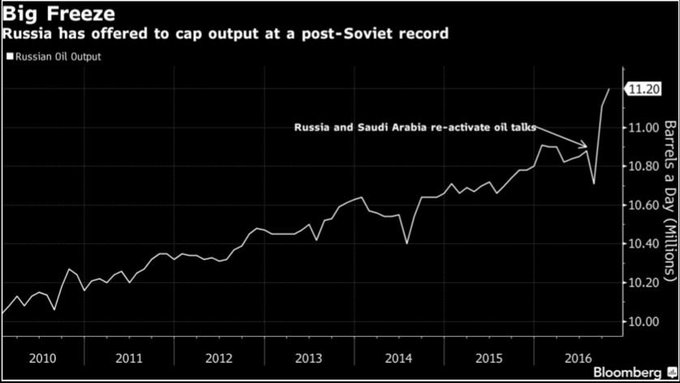
Under pressure from #OPEC, Russia’s energy minister tries to sell #oil production freeze as a cut | http://bloom.bg/2fIq5Al #OOTT

Novak also said that Russia’s position “has remained unchanged and consistent” (even if the algos may have misinterpreted it), and added that “as our president said earlier, we are ready to freeze production at the current levels.” President Vladimir Putin on Monday reaffirmed the country is willing to freeze, adding he sees no obstacles to an OPEC agreement this month after the group made major progress in overcoming differences.
In other words, one can forget about a production cut from Russia, which – like OPEC – is already pumping at record output levels. Russian output increased to a record 11.205 million barrels a day in November, near a post-Soviet record. The country has raised its production forecasts several times a year since 2015.
While Russia, the largest crude supplier outside OPEC, has reiterated its preference for a freeze over a cut for several months, members of the group including Saudi Arabia had been expecting the nation would eventually join a cut, according to people briefed on the matter. If Russia and other non-OPEC producers balk at the idea of cutting output, the exporters’ group could reconsider pushing ahead, the people said.
As Bloomberg reminds us, if there’s no agreement to restrict output, the International Energy Agency has said that oil prices are likely to fall in 2017. OPEC’s own estimates of supply and demand also show that the Algiers agreement would barely drain a record oil surplus next year without the cooperation of non-members.
* * *
Which means that the role of Russia, and other non-OPEC members, will be critical in shaping of next week’s deal, Emmanuel Kachikwu, Nigeria’s minister of state for petroleum, said in an interview with Bloomberg Television. “Russia is as interested in firming up the price as we are,” he said. A senior OPEC delegate told Reuters earlier this week full participation by Moscow would be required: “Statements from Moscow indicating they are not willing to participate in a cut but just to freeze – this will make it difficult for OPEC to rebalance the market alone and bring prices up.”
Putting even a cut of 880,000 bpd in context, this would represent less than 2 percent of current total non-OPEC output. But given few non-OPEC producers are expected to participate in the cuts, the burden could be heavy on those that do so – potentially Russia, Kazakhstan, Azerbaijan and Mexico, all of which rely heavily on oil revenues.
To summarize:
The good news: an ideal scenario, should OPEC and non-OPEC members reach a deal to cut 1 million bpd and 880,000 bpd in production respectively, it would immediately help the market turn into a supply deficit and help erode record stocks amounting to over 3 billion barrels. It would also likely send the price of oil to the upper-$50 range.
The bad news: according to the head of the IEA, Faith Birol, U.S. shale oil producers – which are in no way bound to any production cuts or freezes – will increase their output if oil prices hit $60 a barrel, meaning OPEC will have to walk a fine line if it curtails production to prop up prices, the head of the International Energy Agency (IEA) said.
“If this decision pushes the prices up (to) around $60 dollars, we may well see a significant increase from shale oil from the U.S.,” Fatih Birol told Reuters on Wednesday. He said this level would be enough for many U.S. shale companies to restart stalled production, although it would take around nine months for the new supply to reach the market.
Low prices have led to two consecutive years of falling investment in upstream oil and gas investments, a pattern Birol expects to continue in 2017. This, he said, could lead to tighter oil supply and price spikes in the future.
“We are entering a period of greater oil price volatility and the companies, organizations and countries should prepare themselves accordingly,” he said.
* * *
Finally, adding to the complexity, there are two more wildcards: one is Iran oil production and whether Trump will seek to undo the Iranian nuclear deal. Should that happen, and if sanctions are reintroduced, some 1 million barrels in daily oil exports from Iran may go offline, further pressuring the market. The other is suddenly waning Chinese demand, on what some analysts have speculated is the result of the Chinese Strategic Petroleum Reserve approaching full status, which could eliminate as much as 1.1 million bpd in demand from the market once China stop filling up its extensive SPR
Oil Slides As Saudis Refuse To Attend Non-OPEC Producers Meeting
WTI crude prices were already fading this morning, after a subdued day yesterday, but the first major headline from Vienna has sparked further weakness as Reuters reports that Saudi Arabia has told OPEC it will not attend a meeting with non-OPEC producers on Monday.
Reuters reports that Saudi Arabia wants a deal agreed before they will agree to send anyone to the NOPEC talks.
For now the reaction is modest (even with a heavy volume spike)

8.EMERGING MARKETS
India
Devastation runs supreme in India as the Rupee crashes to a record low. Only 40% of old cash has been turned in with a huge 60% left to go. I would say that close to 90% of the Indian economy is cash and the removal of the big bills has already shaved 2% off of GDP. Modi also is trying to rein in citizens appetite for gold
(courtesy zero hedge)
Indian Currency Crashes To Record Low As Cash Exchange Of Old Notes Suspended
It appears the social unrest, economic collapse, and currency crisis sparked by Indian PM Modi’s decision to demonetize “corrupt” high-denomination bank-notes was not enough.
As the Rupee crashed to a record low overnight, officials announced a suspension of the exchange of ‘old notes’ as of tomorrow to, in their words, “encourage people to deposit old notes in their bank accounts.” With as much 60% of banknotes still un-exchanged, we suspect chaos will be the operative word for the immediate future.
Those with old notes will still be allowed to deposit them into their bank accounts until Dec. 31, but not permitted to do outright exchanges.
As Bloomberg reports, the Indian government had observed a declining trend in exchange of old notes over the counter, according to a statement from the state-run Press Information Bureau.
And so the decision to end OTC exchange of notes was to encourage people to deposit old notes in their bank accounts.
Government allows certain exemptions for use of old notes until Dec. 15, with only 500 rupee denomination currency notes accepted for such transaction:
- Old 500-rupee notes can be used for payment of school fees with limit; utility dues; payment of road toll fees
- Foreigners permitted to exchange foreign currency up to 5,000 rupees/week
Furthermore, as CNBC reports, the Indian government is set to impose a 45% tax (haircut) on any suspicious deposits.
This is a major problem as only 40% of banknotes have been exchanged according to local reports.
We suspect the sudden urge to force citizens to deposit/exchange their old banknotes is due to the increasing prevalance of “illegal workarounds” across the nation… (as The Wall Street Journal reports)
Unable to spend or deposit their sackfuls of large bank notes amid India’s crackdown on hoarding cash, business owners across the country are paying employees months of salary in advance, ringing up bogus sales and even buying gold they can smuggle overseas to get rid of stashed money or conceal its source.
Such illegal workarounds are threatening to undercut Prime Minister Narendra Modi’s move this month to cancel India’s highest-denomination rupee bills, which was meant to punish tax evaders and other criminals and bring more of the nation’s $2 trillion economy out of the shadows.
If Mr. Modi’s unprecedented social-engineering project fails to net too many of the biggest tax cheats, he risks further incurring the wrath of Indians already frustrated with the pain and economic dislocation the experiment has brought about in its first two weeks.
Requiring Indians to exchange their big bills at banks for newly created ones—or suffer a quiet, potentially catastrophic financial loss—was Mr. Modi’s way of forcing hidden riches to the surface. There, authorities would be watching, ready to examine large cash deposits.
Millions of Indians have heeded the call. Since Mr. Modi’s Nov. 8 announcement more than $80 billion in old bills has been exchanged or deposited. That is around 40% of the value of all large rupee bills in circulation. The deadline for turning in canceled bills was Dec. 30.
Meanwhile capital flight is very evident…

Sending the Rupee crashing to a record low against the dollar.

“Continued outflows along with dollar strength have undermined the rupee,” said Gao Qi, a Singapore-based foreign-exchange strategist at Scotiabank. “The rupee may outperform some regional currencies such as the Malaysian ringgit and Indonesian rupiah on account of the central bank’s intervention and low foreign position in Indian financial assets.” Bloomberg reports that the central bank will take appropriate action to deal with the currency’s decline, a government official said earlier Thursday, asking not to be identified, citing rules. State-run lenders sold dollars, probably on behalf of the central bank, as the rupee approached its record low, three Mumbai-based traders said, asking not to be named. The RBI has maintained that it doesn’t target a specific rupee level and intervenes only to curb undue volatility in the currency market.
But, as WSJ adds, India has to do more than void notes if it wants to wean itself off cash. It also has to target the underlying reasons for which businesses amass paper money, such as the need to pay officials who demand bribes.
Politics in India is another big cash business. Because the country’s electoral rules don’t require political parties to disclose the sources of small donations, companies regularly use cash to buy influence. Parties then use the cash to buy votes ahead of elections.
The currency replacement is just “a spring-cleaning exercise,” said Jagdeep Chhokar, co-founder of the New Delhi-based Association for Democratic Reforms, which advocates for greater transparency in party financing.“Unless we change our way of living, our house is not going to be clean. It is going to get dirty again every year.”

There has been widespread condemnation of Modi’s actions. As former PM Manmohan Singh exclaimed, “Those who say demonetisation is good in the long run should recall quote “In the long run we are all dead”. Singh tore into his successor Narendra Modi’s clampdown on the cash economy, calling it an “organized loot and legalized plunder” of the country. Singh – the architect of economic reforms that led to years of rapid growth – dubbed Modi’s shock move to scrap 500 and 1,000 rupee banknotes a “monumental mismanagement” that could shave at least 2 percentage points off economic growth.
“I do not disagree with the objectives of taking steps against terrorism and black money.
In the process of demonetisation, monumental mismanagement has taken place. What has been done can weaken and erode our people’s confidence in the currency and banking system. I say so with all responsibility that we do not know what will be the full outcome.
…
This will hurt agriculture, small industry and everyone in the unorganised sector. My view is that GDP growth can fall by 2 per cent and that is an underestimate.”
And from our source in India, the problems are escalating: ATMs lines are building once again.

But as the following image shows, there are no lines at The State Bank of India ATM, as these only have INR2000 notes:

As former PM Manmohan Singh raged today in the Rajya Sabha, “50 days is a short period but for those who are poor, even 50 days can bring about disastrous effects.”
Cash Crackdown Escalates: India May Impose 60% Tax On “Unaccounted” Deposits, Curbs On Gold Holdings
As reported yesterday, India’s unexpected crackdown on “black money” which saw the elimination of the old high denomination bills, is not going well, not only because former PM Manmohan Singh slammed the idea warning it would cut as much as 2% from the GDP of the world’s fastest growing economy, but because so far the voluntary participation in the “exchange” of old for new notes ahead of today’s exchange suspension (deposits of old cash may still take place until December 31) has been far below expectations.
As a result, the government is taking even more aggressive steps to part savers with their allegedly “laundered” cash, and as the Indian Express reports, Mody’s cabinet discussed amending laws to levy close to 60% income tax on unaccounted deposits in banks above a threshold post demonetisation of high-denomination currency notes. “The move comes amid banks reporting over Rs 21,000 crore being deposited in zero-balance Jan Dhan accounts in two weeks after the 500 and 1,000 rupee notes were banned, which authorities apprehend may be the laundered black money.”
IE sources said the government was keen to tax all unaccounted money deposited in bank accounts after it allowed the banned currency to be deposited in bank accounts during a 50-day window from November 10 to December 30. The Indian paper adds that there was no official briefing on what transpired in the meeting that was called at short notice as Parliament is in session, further suggesting that the Modi government is indeed panicking, and scrambling to come up with legislation on the fly to demonetize India’s mostly-cash rich population.
There have been various statements on behalf of the government ever since the demonetisation scheme was announced on November 8, which has led to fears of the taxman coming down heavily on suspicious deposits that could be made to launder blackmoney.
Officials have even talked of a 30 per cent tax plus a 200 per cent penalty on top of a possible prosecution in cases where blackmoney holders took advantage of the 50-day window for depositing the banned currency.
Reprotedly, in the government’s scramble to sequester cash, the government plans to bring an amendment to the Income Tax Act during the current winter session of Parliament to levy a tax that will be higher than 45 per cent tax and penalty charged on blackmoney disclosed in the one-time Income Disclosure Scheme that ended on September 30. As for those blackmoney holders who did not utilise the window, they would be charged a higher rate which could be close to 60 per cent that the foreign blackmoney holder had paid last year.
But wait, there’s more.
Recall, that as per our report last night, one of the reasons proposed for the recent tumble in gold has been speculation that India may ban gold imports. As a reminder, gold has traditionally been a widely-accepted cash alternative in an economy where gold has long held a supremacy over cash equivalents, to the point where recently the government started paying a dividend to those who deposit their gold to local banks for “safe keeping.”
Well, it now appears that the government is taking its crusade against gold one step futher, and according to a report by NewsRise, the Indian government may soon impose curbs on domestic holdings of gold as Modi intensifies his war against “black money”, news agency NewsRise reported.
As we reported previously, gold prices have soared in India ever since the November 8 demonetization announcement, and premiums jumped to two-year highs last week as jewellers ramped up purchases on fears the government might restrict imports after withdrawing higher-denomination notes from circulation in its fight against black money.
India is the world’s second biggest gold buyer, and it is estimated that one-third of its annual demand of up to 1,000 tonnes is paid for in black money – untaxed funds held in secret by citizens in cash that don’t appear in any official accounts.
The move to withdraw higher denomination notes has already started to disrupt cash-based gold smuggling, officials have said. Scrap gold supplies were also set to halve this quarter as the cash crunch and falling prices make it difficult for consumers to liquidate their holdings.
If the past is any indication, such escalations by the government will only make it even more attractive for the local population to hold gold as a safe “alternative” to cash, which as the past month has shown can be stripped of its value overnight, and will ultimately lead to even greater gold smuggling by the local population, resulting in another spike in the current account deficit, something which has plagued previous administrations, who have repeatedly looked for ways to prevent hot money outflows from the Indian economy.
end
VENEZUELA
Venezuela now enters hyperinflation officially as it takes over 2700 bolivars per dollar.
(courtesy zero hedge)
Venezuela’s Currency Just Had the Biggest Monthly Collapse Ever
Bloomberg NewsVenezuela’s currency – the so-called “strong bolivar” – is weakening beyond levels that analysts had forecast just a few weeks ago as an expanding money supply chases a limited amount of U.S. dollars.
The currency has lost 45 percent of its value so far this month to trade at 2,753 bolivars per U.S. dollar on Thursday, according to dolartoday.com, a widely-watched website that tracks the exchange rate in Caracas. That’s the biggest monthly decline ever, according to data compiled by Bloomberg.
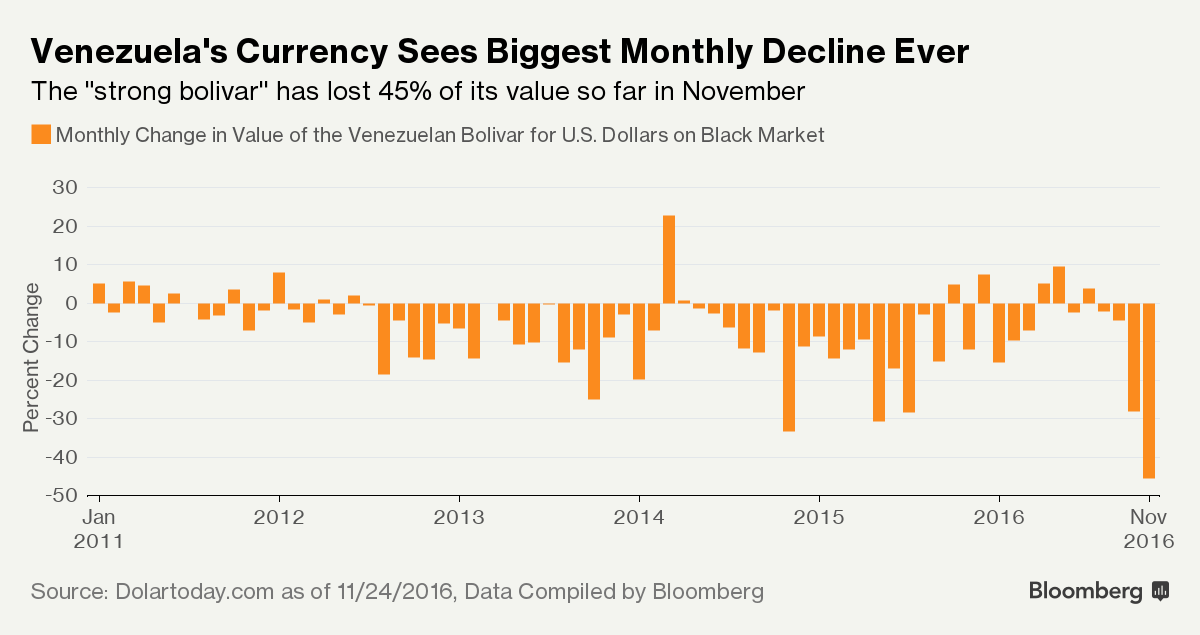
“The government has started injecting bolivars into the financial system in an accelerated manner again, and it’s set off repressed demand,” Asdrubal Oliveros, director of Caracas-based economic consultancy Ecoanalitica, said in a telephone interview. “There are too many bolivars in the street. People have the option of either buying goods or dollars, and they’re buying dollars.”
Torino Capital chief economist Francisco Rodriguez said in a report on Nov. 7 that the bolivar could likely end the year around 1,990 per dollar on the black market after the currency started to weaken in October following six months of relative stability. He raised that estimate to 2,327 bolivars per dollar in a report sent on Nov. 14. Inflation will likely start to accelerate over the coming months in certain sectors that are sensitive to the black market rate including alcoholic beverages, restaurants, electronics, and appliances, Oliveros said.
Inflation in the country will likely rise to 400 percent in 2016, according to the median estimate of 13 analysts who responded to a Bloomberg survey. Individual responses ranged from 257 percent to 1,500 percent.
Venezuela’s money supply has risen 127 percent over the past year, according to the latest data available from the Central Bank in Caracas and compiled by Bloomberg.
To read more about the decline of Venezuela’s currency, click here.
Venezuela has maintained strict currency controls since 2003 and currently has two legal exchange rates — known as the Dipro and Dicom rates — of 10 and 661 bolivars per dollar used for priority imports. On the black market, where people and businesses turn when they can’t obtain government approval to purchase dollars at the legal rates, the bolivar has weakened 69 percent over the past year.
“Venezuela’s entire economic environment is influencing this phenomenon,” Oliveros said, adding the exchange rate could end the year between 3,500 and 4,000 bolivars per dollar on the black market. “Inflation is going to keep rising, there’s a risk of default, and the political situation is becoming more tense each day. People prefer to protect their money.”
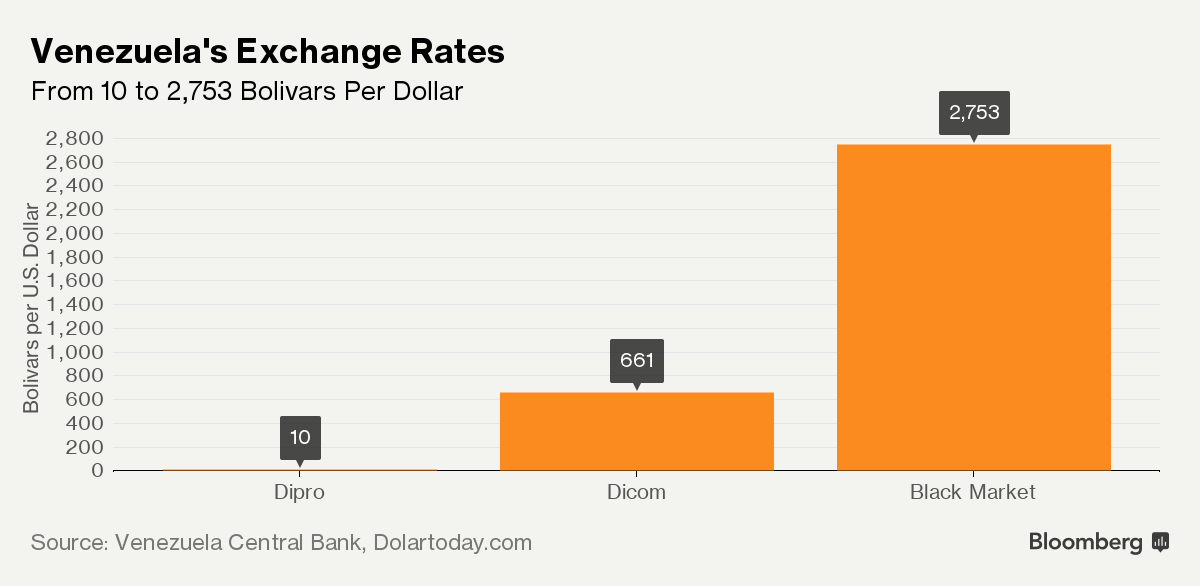
— With assistance by Sebastian Boyd
end
Brazil
Brazil may get impeachment hearings in a new corruption scandal involving President Temer
(courtesy zero hedge)
Brazil’s New President Temer Threatened With Impeachment After New Corruption Scandal Emerges
Six months after Brazil’s former president Dilma Rouseff was removed from power as a result of a carefully orchestrated process by her former Vice President, Michel Temer, who as many suggested at the time, was merely trying to shift attention away from himself and to his former boss due to his “checkered past”, swirling with allegations of corruption on par with those of the deposed president, Temer himself may be in danger of impeachment when overnight, Brazil’s public prosecutor announced it was studying a possible investigation into whether President Michel Temer put pressure on a former minister to favor a Cabinet colleague’s property investment.
Marcelo Calero, who resigned last week as culture minister, told federal police that the president pressured him to resolve a dispute with another Cabinet member, Geddel Lima, president Temer’s top government congressional liaison, who was seeking a permit for an apartment building in a historic preservation area of his hometown, a federal police source said.
Calero’s accusations have set off new crisis for Temer for allegedly using his public office to obtain a permit for the luxury oceanfront building in the city of Salvador.
Following the news, the Brazilian real slumped as much as 2.2% to 3.4679 reais to the dollar, the biggest intraday drop since Trump’s unexpected victory. Traders cited concern that the controversy could derail an overhaul of government finances favored by investors. Simiarly, Brazil’s main stock market index, the Bovespa, fell 1.3 percent on concerns of continued political uncertainty delaying recovery from the country’s worst recession since the 1930s.
As Reuters adds, adding fuel to the crisis, the Estado de S.Paulo newspaper reported on Friday that Calero secretly recorded his conversations with Temer and Vieira Lima to back his case. If the chief prosecutor’s office finds grounds to investigate the allegations it would have to ask the Supreme Court for authorization to allow the probe involving the president, the spokeswoman said, effectively starting a new impeachment process. Confirming this, the leader of the Workers Party in lower house Afonso Florence said that former Culture Minister Calero’s allegation that President Michel Temer pressured him on Lima’s case is “very serious” and may lead to an impeachment request.

Michel Temer, 76, and his 32 year old wife, Marcela
Any investigation would be a serious blow to Temer who took office this year vowing to fight corruption.
Shortly after the latest revelations, this morning Lima announced he would step down which in turn prompted a modest snapback rally across Brazilian asset classses.
In an attempt to squash the scandal, presidential spokesman Alexandre Parola confirmed on Thursday evening that Temer spoke with Calero twice in an attempt to avoid conflict over the construction project. But Parola said that the president “never induced any of his ministers to take a decision that breaches internal rules or convictions.” Speaking to Estado, Temer was adamant that the Lima crisis won’t affect Brazil reform votes.
Others are not so certain: Mizuho chief strategist, Luciano Rostagno, said earlier, before Lima resignation, that Brazil assets may suffer further if there’s confirmation that Temer talk with Calero was recorded. “It all depends on whether a recording will emerge confirming whether Temer really pressured the former minister” adding that “The situation would become tough for the debate of reforms.”
He added that if the tapes are disclosed and show improper talks, a new political crisis may emerge, damaging government efforts to approve fiscal reforms, “The environment could become unfavorable for the reforms debate. The population risks going back to the streets to protest against the Temer government.”
As Bloomberg adds, the ethics scandal comes at a delicate time for the government, which is pushing for final approval of a key spending cap bill in the Senate. Legislators are already on edge as executives of a leading construction company finalize plea bargains with prosecutors with details on kickbacks to politicians and managers from state-run oil company Petrobras. Leaked tapes and testimonies surrounding the scandal earlier this year heightened political instability that culminated in the impeachment of President Dilma Rousseff in August.
“It all depends on whether a recording will emerge confirming whether Temer really pressured the former minister,” said Luciano Rostagno, chief strategist at Banco Mizuho do Brasil. “The situation would become tough for the debate of reforms.”
Temer’s approval since assuming the presidential position has remains stubbornly low, and stood at 28 percent in September, according to
an Ibope poll commissioned by the National Industry Confederation. Including Lima, since
assuming the presidency on an interim basis in May, Temer has also lost
a total of six ministers over alleged cover ups surrounding an ongoing corruption probe.
end
Your early morning currency/gold and silver pricing/Asian and European bourse movements/ and interest rate settings FRIDAY morning 7:00 am
Euro/USA 1.0589 UP .0029/REACTING TO + huge Deutsche bank problems + USA election:Clinton LOSES/TRUMP WINS THE ELECTION/USA READY TO GO ON A SPENDING BINGE WITH THE TRUMP VICTORY/
USA/JAPAN YEN 1113.01 DOWN 0.252(Abe’s new negative interest rate (NIRP), a total DISASTER/SIGNALS U TURN WITH INCREASED NEGATIVITY IN NIRP/JAPAN OUT OF WEAPONS TO FIGHT ECONOMIC DISASTER/KURODA: HELICOPTER MONEY ON THE TABLE AND DECISION ON SEPT 21 DISAPPOINTS WITH STIMULUS/OPERATION REVERSE TWIST
GBP/USA 1.2440 DOWN.0010 (Brexit by March 201/UK government loses case/parliament must vote)
USA/CAN 1.3489 DOWN .0013 (CANADA WORRIED ABOUT TRADE WITH THE USA WITH TRUMP ELECTION)
Early THIS FRIDAY morning in Europe, the Euro ROSE by 29 basis points, trading now WELL BELOW the important 1.08 level RISING to 1.0589; Europe is still reacting to Gr Britain BREXIT,deflation, announcements of massive stimulation (QE), a proxy middle east war, and the ramifications of a default at the Austrian Hypo bank, an imminent default of Greece, Glencore, Nysmark and the Ukraine, along with rising peripheral bond yield further stimulation as the EU is moving more into NIRP, THE USA’S NON tightening by FAILING TO RAISE THEIR INTEREST RATE AND NOW THE HUGE PROBLEMS FACING TOO BIG TO FAIL DEUTSCHE BANK + THE ELECTION OF TRUMP IN THE USA / Last night the Shanghai composite CLOSED UP 20.20 0R .62% / Hang Sang CLOSED UP 114.96 POINTS OR 0.57% /AUSTRALIA IS HIGHER BY 0.39% / EUROPEAN BOURSES ALL IN THE RED EXCEPT LONDON
We are seeing that the 3 major global carry trades are being unwound. The BIGGY is the first one;
1. the total dollar global short is 9 trillion USA and as such we are now witnessing a sea of red blood on the streets as derivatives blow up with the massive rise in the rise in the dollar against all paper currencies and especially with the fall of the yuan carry trade. The emerging market which house close to 50% of the 9 trillion dollar short is feeling the massive pain as their debt is quite unmanageable.
2, the Nikkei average vs gold carry trade ( NIKKEI blowing up and the yen carry trade HAS BLOWN up/and now NIRP)
3. Short Swiss franc/long assets blew up ( Eastern European housing/Nikkei etc.
These massive carry trades are terribly offside as they are being unwound. It is causing global deflation ( we are at debt saturation already) as the world reacts to lack of demand and a scarcity of debt collateral. Bourses around the globe are reacting in kind to these events as well as the potential for a GREXIT>
The NIKKEI: this FRIDAY morning CLOSED UP 47.81 POINTS OR .26%
Trading from Europe and Asia:
1. Europe stocks ALL IN THE RED EXCEPT LONDON
2/ CHINESE BOURSES / : Hang Sang CLOSED UP 114.96 OR 0.57% ,Shanghai CLOSED UP 20.20 POINTS OR 0.62% / Australia BOURSE IN THE GREEN /Nikkei (Japan)CLOSED UP 47.81 POINTS OR .36%/ INDIA’S SENSEX IN THE GREEN
Gold very early morning trading: $1187.15
silver:$16.44
Early FRIDAY morning USA 10 year bond yield: 2.382% !!! UP 6 IN POINTS from THURSDAY night in basis points and it is trading JUST BELOW resistance at 2.27-2.32%. THE RISE IN YIELD WITH THIS SPEED IS FRIGHTENING
The 30 yr bond yield 3.03, UP 4 IN BASIS POINTS from THURSDAY night.
USA dollar index early FRIDAY morning: 101.45 DOWN 24 CENTS from THURSDAY’s close.
This ends early morning numbers FRIDAY MORNING
END
I WILL COMPLETE THE CLOSING NUMBERS EITHER ON SATURDAY OR LATE SUNDAY
xxxxxxxxxxxxxxxxxxxxxxxxxxxxxxxxxxxxxxxxxxxxxxxxxxxxxxxxxxxxxxxxxxxxxxxxxxxxxxxxxxxxxxxxxxxxxxxxxxxxxxxxxxxxxxx
And now your closing FRIDAY NUMBERS
Portuguese 10 year bond yield: 3.597% down 8 in basis point yield from THURSDAY (does not buy the rally)
JAPANESE BOND YIELD: +.042% UP 1 in basis point yield from THURSDAY/JAPAN losing control of its yield curve
SPANISH 10 YR BOND YIELD:1.573% DOWN 2 IN basis point yield from THURSDAY (this is totally nuts!!/
ITALIAN 10 YR BOND YIELD: 2.088 DOWN 3 in basis point yield from THURSDAY
the Italian 10 yr bond yield is trading 51 points HIGHER than Spain.
GERMAN 10 YR BOND YIELD: +.240% DOWN 2 IN BASIS POINTS ON THE DAY
END
xxxxxxxxxxxxxxxxxxxxxxxxxxxxxxxxxxxxxxxxxxxxxxxxxxxxxxxxxxxxxxxxxxxxxxxxxxxxxxxxxxxxxxxxxxxxxxxxxxxxxxxxxxxxxxxxxxxxxxxxxxxxxxxxxxxxx
IMPORTANT CURRENCY CLOSES FOR FRIDAY
Closing currency crosses for FRIDAY night/USA DOLLAR INDEX/USA 10 YR BOND YIELD/5:15 PM
Euro/USA 1.0578 UP .0015 (Euro UP 15 basis points/ represents to DRAGHI A COMPLETE POLICY FAILURE/
USA/Japan: 112.97 DOWN: 0.286(Yen UP 29 basis points/
Great Britain/USA 1.2455 UP 0.0050( POUND UP 50 basis points
USA/Canada 1.3511 UP 0.0020(Canadian dollar DOWN 20 basis points AS OIL FELL TO $45.96
xxxxxxxxxxxxxxxxxxxxxxxxxxxxxxxxxxxxxxxxxxxxxxxxxxxxxxxxxxxxxxxxxxxxxxxxxxxxxxxxx
This afternoon, the Euro was UP by 15 basis points to trade at 1.0578
The Yen FELL to 112.97 for a GAIN of 29 basis points as NIRP is STILL a big failure for the Japanese central bank/HELICOPTER MONEY IS NOW DELAYED/BANK OF JAPAN NOW WORRIED AS AS THEY ARE RUNNING OUT OF BONDS TO BUY AS BOND YIELDS RISE /OPERATION REVERSE TWIST ANNOUNCED SEPT 21.2016
The POUND ROSE 50 basis points, trading at 1.2455/
The Canadian dollar FELL by 20 basis points to 1.3511, AS WTI OIL FELL TO : $45.96
the 10 yr Japanese bond yield closed at +.042% PAR IN BASIS POINTS / yield/
Your closing 10 yr USA bond yield UP 1 IN basis points from THURSDAY at 2.359% //trading well below the resistance level of 2.27-2.32%) very problematic USA 30 yr bond yield: 3.008 DOWN 4 in basis points on the day /
Your closing USA dollar index, 101.10 DOWN 29 CENTS ON THE DAY/2.30 PM
Your closing bourses for Europe and the Dow along with the USA dollar index closing and interest rates for FRIDAY: 2:30 PM EST
London: CLOSED UP 11.55 POINTS OR 0.17%
German Dax :CLOSED UP 10.05 POINTS OR .09%
Paris Cac CLOSED UP 7.71 OR .17%
Spain IBEX CLOSED UP 17.20 POINTS OR 0.20%
Italian MIB: CLOSED UP 14.38 POINTS OR 0.09%
The Dow was UP 68.96 points or 0.36% 4 PM EST
NASDAQ UP 18.24 points or 0.34% 4.00 PM EST
WTI Oil price; 45.96 at 5:30 pm;
Brent Oil: 47.09 5:30 EST
USA DOLLAR VS RUSSIAN ROUBLE CROSS: 64.82 (DOWN 31/100 roubles from YESTERDAY)
TODAY THE GERMAN YIELD RISES TO +0.240% FOR THE 10 YR BOND 2:30 EST
END
This ends the stock indices, oil price, currency crosses and interest rate closes for today
Closing Price for Oil, 5 pm/and 10 year USA interest rate:
WTI CRUDE OIL PRICE 5 PM:$45.96
BRENT: $47.09
USA 10 YR BOND YIELD: 2.353%
USA DOLLAR INDEX: 101.10 DOWN 29 cents(huge resistance at 101.80)
The British pound at 5 pm: Great Britain Pound/USA: 1.2427 pts.
German 10 yr bond yield at 5 pm: +.240%
END
And now your more important USA stories which will influence the price of gold/silver
TRADING IN GRAPH FORM
US Treasury Yield Curve Crashes Near 3-Month Flats As Bank-Buying Panic Continues
The long-end of the US Treasury curve rallied on the week (for the first time since Trump’s win) with 30Y yields ending down almost 3bps, as a last minute panic bid hit stocks and bonds at the early market close; and despite the exuberance in US bank stocks, the yield curve continues to collapse…
At the cash equity close today, bonds and stocks were suddenly both bid… with 30Y back at 3.00%

10Y and 30Y yields ended the week lower for the first time since Trump but the short-end remained weaker…

Bonds decouped from Yuan weakness…

And despite all the exuberance over ‘growth’, the yield curve is collapsing…

Decoupling completely from the high NIM expectations of banks….
END
Wow!! a huge deficit of 62 billion dollars. Who would have thought that this would happen with a high dollar: poor exports, higher imports!! Wholesaler inventories contract signalling recession:
(courtesy zero hedge)
GDP Hopes Slashed As Trade Deficit, Inventories Tumble In October
The resurrected hopes of lift-off velocity GDP growth in America suffered a double whammy this morning.

A considerably bigger than expected trade deficit (-$62mm vs -$59mm exp) suggests Q4 GDP growth may take a hit…

and then wholesale inventories tumbled 0.4% MoM (the 2nd biggest plunge in over 3 years) notching more potential from economic growth hopes.

Still forget Q4 right? 2017 will be trumperrific.
Still, the last two times wholesale inventories contracted year-over-year, the US economy dropped into recession…
end
The USA reports a big drop in the service sector. Remember that today the USA reported huge trade deficits and a huge drop in inventories. How could Markit report a high mfg number two days ago?
(courtesy zer0 hedge)
US Services Economy Declines Post-Trump, But Markit Sees “Green Light” For Fed Hike
Just days after Market reported a surprising upward impulse for the US manufacturing sector under President-elect Donald Trump, moments ago we learned that the US service industry declined in the month of November. As Markit notes, “the November PMI surveys provide the first snapshot of US business conditions in the wake of the surprise election result, and show a reassuring picture of sustained solid economic expansion and hiring.”
New business improved at the fastest rate in a year but job creation remains flat (the
rate of staff hiring was only modest in November
and remained weaker than the average seen since
the jobs rebound began in early-2010) as growth prospects fell slightly MoM.
Pick your poison…

As Markit details,
“The November PMI surveys provide the first snapshot of US business conditions in the wake of the surprise election result, and show a reassuring picture of sustained solid economic expansion and hiring.
“With businesses in the vast service sector also showing improved confidence about the year ahead as election uncertainty cleared, the surveys give a clear green light for the Fed to hike interest rates in December.
“Business activity across both manufacturing and services is growing at a rate unchanged on October, which was in turn the fastest for a year. Together, the two PMI surveys indicate that the economy is expanding at a respectable annualized rate of 2.5% in the fourth quarter.
“Hiring also continued at a solid pace, with the survey’s employment indicators consistent with non-farm payrolls rising by 135,000 in November.”
The strong pillar of USA car sales is now reeling.
(courtesy Wolf Richter/WolfStreet)
Strongest Pillar of Shaky US Economy has Cracked
by Wolf Richter • November 22, 2016
“Car Recession” now expected to spread to 2017.
A “car recession,” as the industry is calling it, or the “so-called car recession,” as Ford called it on July 28 in its 10-Q filing, is taking hold. The more politically correct term that Ford also used is the “plateauing” of industry volume. Which means, after six boom years, sales are going down.
They’re not crashing, for the moment. They’re facing tough headwinds, and so they’re drifting lower, despite enormous industry efforts to prevent it, and they’re now expected to drift lower next year as well.
Steven Szakaly, chief economist of the National Automobile Dealers Association (NADA), which represents about 16,500 new vehicle dealers in the US, forecast that sales of new cars and light trucks in 2017 will drop to 17.1 million.
“We are headed toward a stable market for US auto sales, not a growing market,” he said. “The industry has achieved record sales, and pent-up demand is effectively spent.”
In 2016, sales are likely to be around 17.4 million vehicles, down from 2015, when a record 17.5 million vehicles were sold.
NADA forecasts have been over-optimistic before. Industry insiders are not good at predicting a downturn. No insider wants to predict it. And everyone is doing what they can to prevent a downturn. But if 2017 sales come in at 17.1 million, it would be the second year in a row of declining sales.
This chart by Trading Economics shows new vehicle sales per month, at the Seasonally Adjusted Annual Rate (SAAR), which in October was 18 million, which means that at this rate, there would be 18 million vehicles sold in the year:
The auto industry is crucial to the US economy. It has large complex design, manufacturing, and supply-chain operations in the US. There is finance and insurance and service involved. Railroads, trucking, port installations, and many other sectors feed off it. The booming auto sector has been one of the most important props under the otherwise shaky economy.
But even that sales decline in 2017 to 17.1 million vehicles would require some big assumptions to come true, according to Szakaly:
- GDP growth of 2.6%, a rate it reached only twice over the past ten years, in 2015 and in 2006.
- Employment growth between 150,000 and 180,000 jobs per month.
- And a price for regular gasoline of less than $2 per gallon, despite the oil industry’s belief that the price of oil is going to rise.
But there are some big headwinds.
Interest rates are rising. The NADA hopes that the incentives the manufactures pay out to stimulate sales and trim down inventories for their brands will instead compensate for rising interest rates.
Auto debt is soaring. Given higher transaction prices, ever longer loan terms, and higher loan-to-value ratios, total auto loans and leases outstanding have shot up $30 billion in the third quarter, the largest quarterly increase ever, even as sales have been flat. Soaring debt levels on flat unit sales is not a sustainable condition:
Subprime auto-loan delinquencies are ballooning. Delinquencies of 60 days and higher among subprime auto-loan backed securities jumped to 4.9% of outstanding balances in August, Fitch Ratings reported last month. Subprime annualized losses reached nearly 9% of the outstanding balances of auto ABS. Fitch expects them “to pierce 10% by year-end.”
A glut of used vehicles. The industry has seen this coming for a while. It works on a schedule: a wave of vehicles from lease turn-ins and rental car companies is flooding the market and is putting pressure on used car prices, and thus trade-in values and lease residuals. High trade-in values and residuals since the cash-for-clunker program have made a lot of deals possible that wouldn’t otherwise have happened.
And this wave of late-model used cars also competes with new car sales, and if priced right, will take some additional share. So it’s going to get tough.
The NADA sees the market as “maturing,” which is an industry euphemism. Inventories are ballooning. Sales are drifting lower despite massive incentives by manufacturers, and are expected to drift lower next year as well, if the economy holds up. What happens if the economy doesn’t hold up, if it falls into a recession, can be seen in the chart at the top.
Manufacturers are already reacting. Ford put it this way: “We continue to match production with demand.” It Starts: Shutdowns, Production Cuts, Layoffs at Auto Plants
END
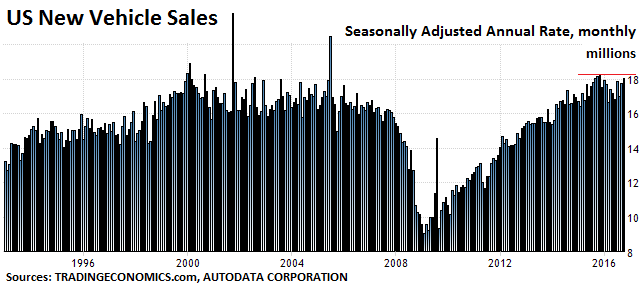
END
Michael Snyder discusses that one half the population of the world is dirt poor with the elitists trying to keep it that way
(courtesy Michael Snyder/EconomicCollapseBlog)
Half Of The Population Of The World Is Dirt Poor – And The Global Elite Want To Keep It That Way
Submitted by Michale Snyder via The Economic Collapse blog,
Could you survive on just $2.50 a day? According to Compassion International, approximately half of the population of the entire planet currently lives on $2.50 a day or less. Meanwhile, those hoarding wealth at the very top of the global pyramid are rapidly becoming a lot wealthier. Don’t get me wrong – I am a very big believer in working hard and contributing something of value to society, and those that work the hardest and contribute the most should be able to reap the rewards. In this article I am in no way, shape or form criticizing true capitalism, because if true capitalism were actually being practiced all over the planet we would have far, far less poverty today. Instead, our planet is dominated by a heavily socialized debt-based central banking system that systematically transfers wealth from hard working ordinary citizens to the global elite. Those at the very top of the pyramid know that they are impoverishing everyone else, and they very much intend to keep it that way.
Let’s start with some of the hard numbers. According to Zero Hedge, Credit Suisse had just released their yearly report on global wealth, and it shows that 45.6 percent of all the wealth in the world is controlled by just 0.7 percent of the people…
As Credit Suisse tantalizingly shows year after year, the number of people who control just shy of a majority of global net worth, or 45.6% of the roughly $255 trillion in household wealth, is declining progressively relative to the total population of the world, and in 2016 the number of people who are worth more than $1 million was just 33 million, roughly 0.7% of the world’s population of adults. On the other end of the pyramid, some 3.5 billion adults had a net worth of less than $10,000, accounting for just about $6 trillion in household wealth.
And since this is a yearly report, we can go back and see how things have changed over time. When Zero Hedge did this, it was discovered that the wealth of those at the very top “has nearly doubled” over the past six years, and meanwhile the poor have gotten even poorer…
Incidentally, we tracked down the first Credit Suisse report we found in this series from 2010, where the total wealthof the top “layer” in the pyramid was a modest $69.2 trillion for the world’s millionaires. It has nearly doubled in the 6 years since then. Meanwhile, the world’s poorest have gotten, you got it, poorer, as those adults who were worth less than $10,000 in 2010 had a combined net worth of $8.2 trillion, a number which has since declined to $6.1 trillion in 2016 despite a half a billion increase in the sample size.
If these trends continue at this pace, it won’t be too long before the global elite have virtually all of the wealth and the rest of us have virtually nothing.
Perhaps you are fortunate enough to still have a good job, and you live in a large home and you will sleep in a warm bed tonight.
Well, you should consider yourself to be very blessed, because that is definitely not the case for most of the rest of the world. The following 11 facts about global poverty come from dosomething.com, and I want you to really let these numbers sink in for a moment…
- Nearly 1/2 of the world’s population — more than 3 billion people — live on less than $2.50 a day. More than 1.3 billion live in extreme poverty — less than $1.25 a day.
- 1 billion children worldwide are living in poverty. According to UNICEF, 22,000 children die each day due to poverty.
- 805 million people worldwide do not have enough food to eat. Food banks are especially important in providing food for people that can’t afford it themselves. Run a food drive outside your local grocery store so people in your community have enough to eat. Sign up for Supermarket Stakeout.
- More than 750 million people lack adequate access to clean drinking water. Diarrhea caused by inadequate drinking water, sanitation, and hand hygiene kills an estimated 842,000 people every year globally, or approximately 2,300 people per day.
- In 2011, 165 million children under the age 5 were stunted (reduced rate of growth and development) due to chronic malnutrition.
- Preventable diseases like diarrhea and pneumonia take the lives of 2 million children a year who are too poor to afford proper treatment.
- As of 2013, 21.8 million children under 1 year of age worldwide had not received the three recommended doses of vaccine against diphtheria, tetanus and pertussis.
- 1/4 of all humans live without electricity — approximately 1.6 billion people.
- 80% of the world population lives on less than $10 a day.
- Oxfam estimates that it would take $60 billion annually to end extreme global poverty–that’s less than 1/4 the income of the top 100 richest billionaires.
- The World Food Programme says, “The poor are hungry and their hunger traps them in poverty.” Hunger is the number one cause of death in the world, killing more than HIV/AIDS, malaria, and tuberculosis combined.
So how did we get here?
Debt is the primary mechanism that takes wealth from ordinary people like you and me and puts it into the hands of the global elite.
In my recent article entitled “Why Donald Trump Must Shut Down The Federal Reserve And Start Issuing Debt-Free Money“, I discussed how the Federal Reserve was designed to entrap the U.S. government in an endless debt spiral from which it could never possibly escape. And that is precisely what has happened, as the U.S. national debt has gotten more than 5000 times larger since the Federal Reserve was created in 1913.
In that very same year, the federal income tax was instituted, and that is a key part of the program for the global elite. You see, the income tax is how wealth is transferred from us to the government. And then a continuously growing national debt is how that wealth is transferred from the government to the elite.
It is a very complicated system, but at the end of the day it is all about taking money from us and getting it into their pockets.
And at this point more than 99.9 percent of the population of the worldlives in a country with a central bank, and almost every nation on the planet has some form of income tax.
It is a global system that is designed to create as much debt as possible, and I recently shared with my readers that the total amount of debt in the world has hit a staggering all-time record high of 152 trillion dollars.
The borrower is the servant of the lender, and the global elite have used various forms of debt to turn the rest of the planet into their debt slaves.
As debt levels race higher and higher all over the planet, the elite are using the magic of compound interest to grab a bigger and bigger share of the pie.
Given enough time, those at the very top would have virtually everything and the rest of us would have virtually nothing. The middle class is shrinking all over the globe, and the gap between the wealthy and the poor continues to grow at an astounding pace.
But the vast majority of people out there have no idea how money, debt, taxes and central banks really work, and so they have no idea that this is purposely being done to them.
The truth is that we don’t have to have this much global poverty, and if we correctly identify the root causes of this poverty we can start working on some real solutions.
end
A strong message from Michael Snyder to us all
(courtesy Michael Snyder/EconomicCollapseBlog)
12 Signs Of Extreme Optimism In America Now That Donald Trump Has Been Elected
Submitted by Michael Snyder via The End of The American Dream blog,
The election of Donald Trump has brought a giant wave of optimism to conservative America unlike anything that we have seen since probably the days of Ronald Reagan. Millions of Americans that were once deeply pessimistic about the future of this country now have hope again thanks to what many consider to be the greatest miracle in the history of U.S. politics. And just like so many of the pre-election polls, the predictions about how the nation would immediately respond to a Trump victory have turned out to be completely wrong as well.
Instead of a historic stock market crash as many in the mainstream media were projecting, we have seen an unprecedented stock market rally in the days following Trump’s win.
Instead of an immediate economic downturn, many economic indicators have surged to their highest levels in quite some time in recent weeks.
And instead of feeling gloomy about the future, many Americans are feeling really good about what is ahead for the first time in a very long time.
The following are 12 signs of extreme optimism in America now that Donald Trump has been elected…
#1 The U.S. dollar is once again the strongest currency in the world. It has soared in value since Trump’s stunning election victory and on Wednesday the U.S. dollar index hit the highest level that we have seen since March 2003.
#2 Stocks continue to skyrocket in the aftermath of Trump’s win. On Wednesday, the Dow Jones Industrial Average closed at a brand new all-time record closing high of 19083.18.
#3 The University of Michigan’s consumer expectations index has hit the highest level in 18 months.
#4 The percentage of Americans that believe that the U.S. will experience “continuous good times” over the next year has risen to 46 percent, which is up 11 percent from the reading in October.
#5 Some other newly released numbers show that U.S. consumers are the most optimistic that they have been in a decade…
According to the latest report, in some cases, Americans are the most hopeful they have been in more than a decade. For the first time since 2006, 37 percent of households said they expect their personal finances to improve in 2017. Also hitting decade highs: real income expectations, as wage growth continues to gain strength in a broadening swath of the economy.
#6 Investor optimism about stock prices has risen to the highest level in 21 months.
#7 U.S. manufacturing PMI has hit the highest level in 13 months.
#8 The number of U.S. oil rigs in operation has hit a 10 month high.
#9 The Federal Reserve appears to think that the U.S. economy is now “strong enough” for a hike in interest rates in December.
#10 Now that Trump has won, gun stores are reporting that sales are down significantly as Americans embrace a more positive outlook regarding the future.
#11 A new Gallup poll has found that 51 percent of Americans have become “more confident” in Trump’s ability to lead the country since the election, and only 40 percent have become “less confident”.
#12 As I discussed just a few days ago, Gallup has also found that the percentage of Republicans that believe that the U.S. economy is “getting better” jumped from 16 percent just prior to the election to 49 percent after the election.
Now that Donald Trump has been elected, many Americans are convinced that the U.S. economy will become stronger than ever before.
Now that Donald Trump has been elected, many Americans are convinced that the U.S. military will be rebuilt and will become so strong that nobody will ever dare to mess with us.
Now that Donald Trump has been elected, many Americans are convinced that the United States will once again become the most loved and most respected nation on the entire planet.
Now that Donald Trump has been elected, many Americans are convinced that relations with Russia, China and other major foreign powers will significantly improve.
Now that Donald Trump has been elected, many Americans are convinced that we are on the verge of a “financial harvest” unlike anything we have ever seen before.
Now that Donald Trump has been elected, many Americans are convinced that honor and integrity will be restored throughout our judicial system.
Now that Donald Trump has been elected, many Americans believe that “law and order” will be restored to our cities.
Now that Donald Trump has been elected, many Americans are convinced that we are entering a new golden age of peace and prosperity for the United States.
Sadly, none of those things are true.
You may not believe me right now, and that is okay, but ultimately all of the things that I have been warning about are going to hit America. We are headed for the worst times that this nation has ever experienced, and in the end it isn’t going to make a difference whether Donald Trump is in the White House or not.
end
Is my favourite politician Nigel Farage going to have a position in the Trump administration after he announces that he is moving to the USA
(courtesy zero hedge)
Is Nigel Farage Moving To The US
Donald Trump nearly sparked a diplomatic scandal earlier this week when he tweeted that Nigel Farage, the interim UKIP leader and the lead Brexit campaigner, would be great as Britain’s ambassador to Washington, a suggestions which Theresa May’s government quickly dismissed saying there was “no vacancy” as Kim Darroch is currently serving as ambassador to Washington, and leading to an outpouring of protests from the UK press accusing Trump of meddling in sovereign affairs.
When asked by ITV television about Farage’s ambassadorial ambitions, finance minister Philip Hammond said if he ever needed advice from the leader of the UK Independence Party, he had his telephone number. “Tell him not to hold his breath,” he added.
However Farage – a long-time supporter of Donald Trump – appears to have enjoyed the barb, and as Reuters reports, he taunted PM May with a mock ambassador’s reception complete with
chocolate and champagne. At a party at London’s Ritz hotel, Farage was cheered by his financial backers before offering guests pyramids of Ferrero Rocher chocolates, “a joking reference to a long-running and much-lampooned ‘ambassador’s reception’ TV advert in which the gold-foiled confection is cast as the delicacy of choice for diplomats.”

Farage praised what he called “the political revolution” that had brought Brexit and then the election of Trump. “For those that are here who aren’t particularly happy with what’s happened in 2016, I’ve got some really bad news for you: It’s going to get a bloody sight worse next year,” Farage told guests from a staircase at the Ritz to laughs and cheers.
“I suspect there is another big seismic shock in British politics, perhaps going to come at the next election,” Farage said after complaining that Britain was still ruled by “the career professional political class.”
Farage also told CNN he wanted a closer relationship between Britain and the United States and that he would like to act as a middle-man to improve relations.
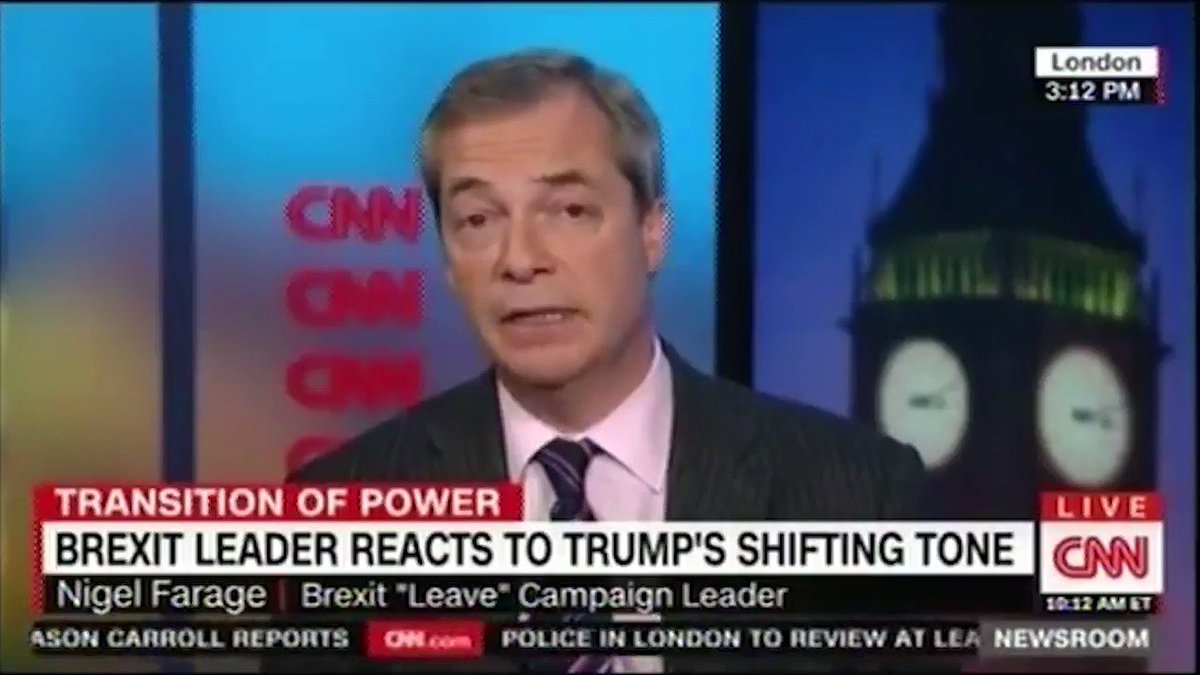
‘@realDonaldTrump pledged to deliver strong border controls and to help ordinary Americans. I’ve got every confidence that he can deliver.

But the biggest surprise of the day came from an article in the Times, which reported that Nigel Farage planning to move to the U.S., regardless if he is appointed ambassador or not. According to The Times, Farage and his wife, Kirsten, are planning to leave the U.K.
Insiders told the newspaper that Farage has had a long-held interest in the U.S. and would feel “freer” from public attention living abroad.
Farage was spotted entering Trump Tower on a Saturday earlier this month. “We’re just tourists,” he told reporters when asked if he was invited there by President-elect Donald Trump or if he was helping with the transition. Farage was the first international diplomat to meet with Trump after the election, and took a photo to memorialize the occasion..

Trump’s campaign manager, Kellyanne Conway, later said that the president-elect and Farage had a “very productive” meeting. “I think they enjoy each other’s company, and they absolutely had an opportunity to talk about freedom and winning and what this all means for the world,” she said.
Farage has said that he would welcome a role in the Trump administration and floated the idea of being Trump’s ambassador to the European Union.
The interim UKIP leader himself hinted at a possible move to the US when he said he would be open to moving to the United States as a go-between if the British government wanted to follow Trump’s suggestion: “It’s up to the British government.”
Meanwhile, UK bookmaker Paddy Power, which infamously paid off over $1 million in bets on a Hillary Victory three weeks before the election…

We are paying out early on Hillary Clinton to be the next President of the United States of America!

…a decision which ended up costing the bookie $4.5 million, has decided to make a cottage industry out of bets on what Farage does next. In a note on its blog, Paddy Power writes that the interim UKIP leader is “planning to move to America to start a new life, potentially working with new buddy, President-elect Donald Trump. Despite the government’s best attempts, rumours continue that Farage could become ambassador extraordinary and plenipotentiary for the US – with Paddy Power pricing it at 6/1.”
More from the blog post:
We have opened a market on Farage’s next job, with options including a role in Trump’s first administration (10/1), an on-air position with Fox News (33/1), and chat show host on American TV (12/1).
We are also offering a price on Farage becoming UK Prime Minister before the end of 2025 (40/1), such is his political influence in the country.
Spokesman Paddy Power said: “Surely Theresa May isn’t going to let Nigel Farage become Britain’s ambassador to America. That would be as ridiculous as making Boris Johnson the Foreign Secretary, or putting David Davis in charge of the Brexit process.
“Still, if 2016’s taught us anything, it’s that anything can happen, even the most unlikely. So Nigel making a triumphant return in a few years to be PM really can’t be ruled out.”
NIGEL FARAGE NEXT JOB SPECIALS
6/1 To be the next UK ambassador to the USA
10/1 To be given a role as part of the first Trump administration
12/1 Host his own chat show on American TV before 2018
33/1 To take up an on-air role with Fox News before 2018
33/1 Dancing With The Stars contestant
40/1 To be Prime Minister before the end of 2025
50/1 The host the US Apprentice before 2018
100/1 ITV’s US showbiz correspondent
200/1 Become a construction worker on the Mexican Wall project
For those willing to bet, the full list of Nigel Farage “specials” can be found here.
end
This now finalizes Friday’s commentary
I will see you tomorrow
Harvey


 harveyorganblog.com
Harvey
Why not add the spread between Shanghai SGE (physical) and Comex silver?
It is always available at didthesystemcollapse.com.
Currently around 8.5%, it has been over 10% recently.
Like the gold spread, this also causes arbitrage but not much commentary from anyone online.
You are just about the best at commenting on the gold arbitrage.
LikeLike