
Gold at (1:30 am est) $1140.50 up $5.20
silver at $16.03: down 12 cents
Access market prices:
Gold: $1139.00
Silver: $16.00
THE DAILY GOLD FIX REPORT FROM SHANGHAI AND LONDON
Somehow Shanghai gold fix is not available today
.
The Shanghai fix is at 10:15 pm est last night and 2:15 am est early this morning
The fix for London is at 5:30 am est (first fix) and 10 am est (second fix)
Thus Shanghai’s second fix corresponds to 195 minutes before London’s first fix.
And now the fix recordings:
MONDAY gold fix Shanghai
Shanghai morning fix Dec 19 (10:15 pm est last night): $ xxx
NY ACCESS PRICE: $1138.20 (AT THE EXACT SAME TIME)/premium $xxx
XXXXXXXXXXXXXXXXXXXXXXXXXXXXXXXXXX
Shanghai afternoon fix: 2: 15 am est (second fix/early morning):$ xxxxx
NY ACCESS PRICE: xxx (AT THE EXACT SAME TIME/2:15 am)
HUGE SPREAD 2ND FIX TODAY!!: xxx
China rejects NY pricing of gold as a fraud/arbitrage will now commence fully
XXXXXXXXXXXXXXXXXXXXXXXXXXXXXXXXXXXXXXXX
London Fix: Dec 19: 5:30 am est: $1137.60 (NY: same time: $1138.25 5:30AM)
London Second fix Dec 19: 10 am est: $1136.25 (NY same time: $1137.60 10 AM)
It seems that Shanghai pricing is higher than the other two , (NY and London). The spread has been occurring on a regular basis and thus I expect to see arbitrage happening as investors buy the lower priced NY gold and sell to China at the higher price. This should drain the comex.
Also why would mining companies hand in their gold to the comex and receive constantly lower prices. They would be open to lawsuits if they knowingly continue to supply the comex despite the fact that they could be receiving higher prices in Shanghai.
end
For comex gold:
NOTICES FILINGS FOR DECEMBER CONTRACT MONTH: 40 NOTICE(S) FOR 4000 OZ. TOTAL NOTICES SO FAR: 9124 FOR 912400 OZ (28.379 TONNES)
For silver:
NOTICES FOR DECEMBER CONTRACT MONTH FOR SILVER: 56 NOTICE(s) FOR 280,000 OZ. TOTAL NUMBER OF NOTICES FILED SO FAR; 3532 FOR 17,6600,000 OZ
Let us have a look at the data for today
.
xxxxxxxxxxxxxxxxxxxxxxxxxxxxxxxxxxxxxxxxxxxxxxxxxxxxxxxxxxxxxxxxxxxxxxxxxx
In silver, the total open interest FELL by 1227 contracts DOWN to 160,343 with respect to FRIDAY’S TRADING. In ounces, the OI is still represented by just less THAN 1 BILLION oz i.e. .801 BILLION TO BE EXACT or 114% of annual global silver production (ex Russia & ex China).
FOR THE DECEMBER FRONT MONTH: 56 NOTICES FILED FOR 280,000 OZ.
In gold, the total comex gold ROSE BY 1720 contracts DESPITE THE FACT THAT WE HAD A RISE IN THE PRICE GOLD ($7.50 with FRIDAY’S trading ).The total gold OI stands at 403,518 contracts. We are very close to the bottom with respect to OI. Generally 390,000 should do it.
we had 40 notice(s) filed upon for 4000 oz of gold.
xxxxxxxxxxxxxxxxxxxxxxxxxxxxxxxxxxxxxxxxxxxxxxxxxxxxxxxxxxxx
With respect to our two criminal funds, the GLD and the SLV:
GLD:
We had A HUGE change in tonnes of gold at the GLD, A MASSIVE WITHDRAWAL OF 14.23 TONNES OF GOLD FROM THE GLD (WITH GOLD UP THESE PAST TWO DAYS)
Inventory rests tonight: 828.10 tonnes
.
SLV
we had A HUGE change in silver, BUT THIS TIME A DEPOSIT OF 1.327 MILLION OZ FROM THE SLV/
THE SLV Inventory rests at: 340.020 million oz
.
First, here is an outline of what will be discussed tonight: Preliminary data
1. Today, we had the open interest in silver FELL by 1227 contracts DOWN to 160,343 AS THE the price of silver ROSE by $0.25 with FRIDAY’S trading. The gold open interest FELL by 6 contracts DOWN to 401,792 despite the fact that the price of gold ROSE BY $7.50 WITH FRIDAY’S TRADING.
(report Harvey).
2.a) The Shanghai and London gold fix report
(Harvey)
2 b) Gold/silver trading overnight Europe, Goldcore
(Mark O’Byrne/zerohedge
and in NY: Bloomberg
3. ASIAN AFFAIRS
i)Late SUNDAY night/MONDAY morning: Shanghai closed DOWN 4.89 POINTS OR 0.16%/ /Hang Sang closed DOWN 188.07 OR 0.85%. The Nikkei closed DOWN 9.55 OR 0.05%/Australia’s all ordinaires CLOSED UP 0.16% /Chinese yuan (ONSHORE) closed DOWN at 6.9532/Oil ROSE to 51.94 dollars per barrel for WTI and 55.22 for Brent. Stocks in Europe: MOSTLY IN THE RED. Offshore yuan trades 6.94710 yuan to the dollar vs 6.9532 for onshore yuan.THE SPREAD BETWEEN ONSHORE AND OFFSHORE NARROWS COMPLETELY AS MORE USA DOLLARS ARE BLOCKED FROM LEAVING CHINA’S SHORES /
REPORT ON JAPAN SOUTH KOREA NORTH KOREA AND CHINA
3a)THAILAND/SOUTH KOREA
none today
b) REPORT ON JAPAN
( zero hedge)
c) REPORT ON CHINA
i)Donald Trump is visibly upset that the Chinese seized a USA drone in international waters and took it back to China. He later changed his mind and told them to keep the drone
( zero hedge)
ii)China responds that they will return the drone but are visibly upset with the USA tone:
( zerohedge)
iii)USA allies are worried on the muted response by the USA to the drone seizure:
( zero hedge)
v)Things are heating up in China as they agree to hand over the seized uSA drone under conditions: basically to stay away from the South China Seas. We just went a few notches lower on the defcon chart.
vi)The true way to calculate foreign exchange losses is using the SAFE data. Here the true outflow form China is 69 billion USA and from August 2015 to today: total losses are 1.1 trillion. They do not have much to go before a crisis arrives(courtesy zero hedge)
vii)Everybody should be nervous as the total debt inside China is 31 trillion dollars and a rise in interest rates is certainly not the panacea to help them. The Chinese bond bloodbath continues as overnight the HongKong stock market turned red for 2016 and now we see that overnight Hibor (the cost that banks lend to each other) is over 11% compared to 6.7% for 12 month money
4 EUROPEAN AFFAIRS
Italy
Monte Paschi launches a last ditch effort to solve its solvency crisis as they are plannning to raise 5 billion euros from the public as well as debt to equity exchange. If that fails, then the state must rescue the bank but also on European terms..i.e.bondholders must be part of the rescue (in other words a bail in). Germany is warning that a bail in must occur before state funds are used.
should be an interesting week:
(courtesy zero hedge)
France
Lagarde convicted of criminal negligence but will not go to jail or pay any fine. Let us see how she handles the situation as head of the IMF:
( zero hedge)
Germany/Deutsche bank
Deutsche bank shares falter as DOJ settlements is near:
( zero hedge)
Berlin, Germany
Oh no! not again. A truck plows into a Berlin Christmas market with many dead:
( zero hedge)
5. RUSSIAN AND MIDDLE EASTERN AFFAIRS
Russian ambassador shot in Turkey.Not good
Lira plummets;
( zero hedge)
6.GLOBAL ISSUES
PrivateBank was nationalized over the weekend with over 6 billion dollars worth of deposits. This is going to hurt and create for instability in the region:
( zero hedge)
7. OIL ISSUES
Oil is heading lower as our hedge funds are burned once again.
( zero hedge)
8. EMERGING MARKETS
i)Venezuela is now cashless as well as totally broke. They do not even have worthless cash to buy things so they break into stores
( zero hedge)
ii)Get a load of this; Maduro now halts the cash ban by instituting a new 100 bolivar note replacing the banned 100 bolivar note (worth two cents). He blames the USA for sabotage as” planeloads of the higher denominated notes have been halted coming to Caracas. Venezuela is in total denial and they are now in one complete mess:
9. PHYSICAL MARKETS
i)We now have the gold emails in our class action suit against the banks.
The data is far more damaging than silver. What is interesting is that we now have a mining operation as plaintiff…
Here are some highlights:
1.: bro japan holiday today; illiquid means wild wild west;we whack it;
then we double that up and produce our on liquidity too
UBS: that should be enough to cap it on a holiday
2.Influencing the fix:
“u just said u sold on fix.”
The UBS traded replied “yeah,”
“we smashed it good.”
3The secret associations between traders appear to be close knit, with the members willing to assist their opposite numbers at every chance: UBS
“im feeling helpful to ubs today.”
The UBS trader then said
“need to push this back wer,” to which the Deutsche Bank trader replied “ok,” and “lets do it.”
4Not only are they pushing the market down but also there appears to be intent to harm client interests as the November 2014 FINMA investigation loosely reported.
(; breach of trust/fraud)
5.During a trading day which had been less successful the Deutsche Bank trader assured his opposite trader from Bank of Nova Scotia that
“at least the fix will be fun . . . make it all back there!!!!!! : ?”
6.2008 (Breach of Trust)
The Deutsche Bank trader was informed by a HSBC trader: “i kick some out
(Harvey: their own client)
and take it back after the fix,” describing a tactic to sell gold high before the fix and buy it back after the fix at a lower price. Plaintiffs say the traders knew it would nearly always be cheaper after the fix. The Deutsche Bank trader replied ironically:
“ yeah no one else is thinking that : – ?.”
plus others…
( Allan Flynn/ComexWeHaveAProblemblog)
ii)Craig Hemke responds to the new emails on the gold/silver manipulation scandal orchestrated by the banks
( Craig Hemke/TFMetals)
iii)Turkish citizens head to Erdogan’s call to defend the lira. However instead of depositing their dollars they bought gold
( Bloomberg)
iv)A terrific commentary from Andrew Maguire as he talks with Eric King. He states that the premiums in China in not because of scarcity but because of huge demand. During the past 2 weeks, 105 tonnes of gold was brought to refiners tin Switzerland from Andrew’s people and this landed into the Shanghai gold exchange. Demand is huge and China continues to search out for all the gold it can get
(courtesy Andrew Maguire/Kingworldnews)
v)A terrific commentary from Alasdair Macleod as he details what we should expect from Donald Trump as President with his relationships between Russian and China. I believe he is bang on!
(courtesy Alasdair Macleod)
vi)We have now updated the the archive of gold and silver market rigging as we now have the gold emails from the defendant banks
( Nick Laird/GATA)
vii) Modi is now becoming another Maduro as he has now effectively made gold illegal in India as a consequence of a cashless society. Smuggling of gold into India will be rampant as the rupee will be destroyed in value:
( Bhandari/ zero hedge)
10.USA STORIES
i)Former Fed Advisor Danielle Booth illustrates how state pension shortfalls is a ticking time bomb and this will spell disaster for the USA
( Booth/zero hedge)
Let us head over to the comex:
The total gold comex open interest FELL BY 6 CONTRACTS DOWN to an OI level of 401,792 AS THE PRICE OF GOLD ROSE $7.50 with FRIDAY’S trading. We are now in the contract month of December and it is the biggest of the year. Here the front month of December showed a DECREASE of 440 contracts DOWN to 879.We had 448 notice(s) served upon yesterday so we GAINED 8 contracts or 800 oz will stand for delivery.
For the next delivery month of January we had a GAIN of 378 contracts UP to 2651. For the next big active delivery month of February we had a LOSS of 575 contracts DOWN to 277,461.
We had 40 notice(s) filed upon today for 4000 oz
And now for the wild silver comex results. Total silver OI FELL by 1227 contracts FROM 161,570 DOWN TO 160,343 as the price of silver ROSE BY $0.25 with FRIDAY’S trading. We are moving further from the all time record high for silver open interest set on Wednesday August 3/2016: (224,540). We are now in the next major delivery month of December and here it FELL BY 367 contracts DOWN to 326 CONTRACTS . We had 354 notices served upon yesterday so we LOST 13 contracts or an additional 65,000 oz will not stand for delivery.
The next non active delivery month is January and here the OI fell by 90 contracts down to 1200.
The next big active delivery month is March and here the OI FELL by 949 contracts DOWN to 131,701 contracts.
We had 56 notices filed for 280,000 oz for the December contract.
Eventually at the end of December 2015: 6.4512 tonnes of gold stood for delivery
Eventually at the end of December 2015: 18.84 million oz of silver stood for delivery
VOLUMES: for the gold comex
Today the estimated volume was 113,214 contracts which is awful.
Yesterday’s confirmed volume was 190,913 contracts which is fair
| Gold | Ounces |
| Withdrawals from Dealers Inventory in oz | nil |
| Withdrawals from Customer Inventory in oz |
32,643.34 oz
Scotia
Brinks
incl. 250 kilobars Scotia
|
| Deposits to the Dealer Inventory in oz | nil oz |
| Deposits to the Customer Inventory, in oz |
nil oz
|
| No of oz served (contracts) today |
40 notice(s)
4,000 oz
|
| No of oz to be served (notices) |
839 contracts
83,900 oz
|
| Total monthly oz gold served (contracts) so far this month |
9124 notices
912,400 oz
28.379 tonnes
|
| Total accumulative withdrawals of gold from the Dealers inventory this month | nil oz |
| Total accumulative withdrawal of gold from the Customer inventory this month | 4,183,700.3 oz |
For December:
Today, 0 notice(s) were issued from JPMorgan dealer account and 0 notices were issued from their client or customer account. The total of all issuance by all participants equates to 40 contract(s) of which 3 notices were stopped (received) by jPMorgan dealer and 1 notice(s) was (were) stopped/ Received) by jPMorgan customer account.
March 2015: 2.311 tonnes (March is a non delivery month)
| Silver | Ounces |
| Withdrawals from Dealers Inventory | nil |
| Withdrawals from Customer Inventory |
310,825.280 z
Brinks
Scotia
|
| Deposits to the Dealer Inventory |
280,390.200 OZ
CNT
|
| Deposits to the Customer Inventory |
319,446.400 oz
CNT
|
| No of oz served today (contracts) |
56 CONTRACT(S)
(280,000 OZ)
|
| No of oz to be served (notices) |
270 contracts
(1,350,000 oz)
|
| Total monthly oz silver served (contracts) | 3532 contracts (17,660,000 oz) |
| Total accumulative withdrawal of silver from the Dealers inventory this month | NIL oz |
| Total accumulative withdrawal of silver from the Customer inventory this month | 3,246,304.3 oz |
end
end
NPV for Sprott and Central Fund of Canada
end
Major gold/silver stories for MONDAY
GOLDCORE/BLOG/MARK O’BYRNE
Bail-Ins Coming? World’s Oldest Bank “Survival Rests On Savers”
END
We now have the gold emails in our class action suit against the
banks:
The data is far more damaging than silver. What is interesting is that we now have a mining operation as plaintiff…
Here are some highlights:
1.: bro japan holiday today; illiquid means wild wild west;we whack it;
then we double that up and produce our on liquidity too
UBS: that should be enough to cap it on a holiday
2.Influencing the fix:
“u just said u sold on fix.”
The UBS traded replied “yeah,”
“we smashed it good.”
3The secret associations between traders appear to be close knit, with the members willing to assist their opposite numbers at every chance: UBS
“im feeling helpful to ubs today.”
The UBS trader then said
“need to push this back wer,” to which the Deutsche Bank trader replied “ok,” and “lets do it.”
4Not only are they pushing the market down but also there appears to be intent to harm client interests as the November 2014 FINMA investigation loosely reported.
(; breach of trust/fraud)
5.During a trading day which had been less successful the Deutsche Bank trader assured his opposite trader from Bank of Nova Scotia that
“at least the fix will be fun . . . make it all back there!!!!!! : ?”
6.2008 (Breach of Trust)
The Deutsche Bank trader was informed by a HSBC trader: “i kick some out
(Harvey: their own client)
and take it back after the fix,” describing a tactic to sell gold high before the fix and buy it back after the fix at a lower price. Plaintiffs say the traders knew it would nearly always be cheaper after the fix. The Deutsche Bank trader replied ironically:
“ yeah no one else is thinking that : – ?.”
plus others…
(courtesy Allan Flynn/ComexWeHaveAProblemblog)
“When Gold Goes Above 1430 We Whack It”
Submitted by Allan Flynn via ComexWeHaveAProblem blog,
As it goes in silver, so it goes in gold. In London at least.
In a bid to have UBS reinstated as a defendant in a London Gold Fix antitrust lawsuit, plaintiffs documents submitted to a New York Court last week include explosive chat room transcripts of UBS and traders from different banks encouraging each other to “push,” “smack,” and “whack” gold prices.

The transcripts are equally as startling as those described of banks of the London Silver Fix and UBS given to the court the previous day and described last week in this article.
On December 6th attorneys for plaintiffs in a consolidated class action against banks of the London Gold Fix and UBS, asked the court for leave to amend with a Third Amended Complaint. The TAC includes additional facts based on a “limited set of cooperation materials” produced by former defendant Deutsche Bank, as part of a settlement agreement and further statistical analysis.
Supporting documents say the amended complaint addresses the Court’s October finding that the previous complaint failed to plausibly plead firstly that UBS was part of the antitrust conspiracy, and secondly that the conspiracy existed prior to 2006.
Also, for the first time a gold producer has been added to the class action of those claiming losses in gold trading due to the manipulation. Compania Minera Dayton, SCM the Chilean subsidiary of Australian resources company Lachlan Star is said to have “sold gold on many of the specific days on which Plaintiffs demonstrated manipulation of gold investments” totaling $287.4 million over the period 2004 to 2013.
In support of allegations that UBS shared customer order information and executed coordinated trades to manipulate gold markets, samples of “dozens” of chat room messages between UBS and Deutsche Bank are contained in the revised document indicating “many efforts to artificially suppress gold prices, and to manipulate gold prices at the time of the Fixing.”
Filings include the following script reminiscent of an 1980’s arcade game scene. Rather than competing for business in the marketplace, supposed competitors UBS and Deutsche Bank however are seen coordinating tactics as they anticipate the most illiquid of days to jointly execute their sell orders for greatest negative impact on the market.
Harvey; whacking during illiquid periods/their modus operandi
Deutsche Bank: bro japan holiday today
(Harvey: attack during illiquid period)
Deutsche Bank: think it’ll be quiet
Deutsche Bank: well, illiquid, not quiet haha
Deutsche Bank: illiquid means wild wild west
UBS:okay when gold pops 1430
UBS: we whack it
UBS: u sell your 50k
UBS: i sell my 20k
UBS: then we double that up and produce our on liquidity too
UBS: that should be enough to cap it on a holiday
Deutsche Bank: haha yeah
Deutsche Bank: lol

One chat see’s a Deutsche Bank trader confirming with a UBS trader his trading had indeed influenced the Gold Fix: “u just said u sold on fix.” The UBS traded replied “yeah,” “we smashed it good.”
The secret associations between traders appear to be close knit, with the members willing to assist their opposite numbers at every chance: UBS “im feeling helpful to ubs today.” The UBS trader then said “need to push this back wer,” to which the Deutsche Bank trader replied “ok,” and “lets do it.”
Counter-intuitively, the banks special penchant to suppress the price of gold is repeated throughout the examples. As the gold ticker rose on this occasion the indignant traders teamed up to push it back down, commending themselves sarcastically meanwhile.
Deutsche Bank: someone still trying to push our gold up
UBS: so u should pay the mkt right away
Deutsche Bank: nope
UBS: cause chances are someone else got hit and u f*ck them up
Deutsche Bank: no touchy
Deutsche Bank: im short 15k
Deutsche Bank: xau
Deutsche Bank: too much fire
UBS: im gonna sell more silver and gold
Deutsche Bank: k
Deutsche Bank: i really think we are on the right side today, being short
Not only are they pushing the market down but also there appears to be intent to harm client interests as the November 2014 FINMA investigation loosely reported.
(Harvey; breach of trust/fraud)
Here a UBS trader gives information to a Deutsche Bank trader about a client’s order query on Nov 16th 2010, and strategizes to punish them by whacking the price lower if purchased from another party.
UBS: boc sniffing around in gold
(Harvey; BOC = Bank of China?)
Deutsche Bank: likewise
Deutsche Bank: passed my bid
Deutsche Bank: dude
Deutsche Bank: so their round
Deutsche Bank: is from u
Deutsche Bank: to me
Deutsche Bank: haha
UBS: not always
UBS: anyway good to give each other heads up
UBS: if we find out side, whack it
Deutsche Bank: yeah
Bank of China, one of the largest state-owned commercial banks in China, and which offers customers “a wide range of gold investments in gold bars and gold bullion coins” have yet to respond to this author’s query if the bank could be the buyer referred to as “BOC” in the above conversation.
A central tenant of this lawsuit is that the banks have chosen one particular part of the trading day to act secretly. The strategy of banks that “colluded around the PM Fixing to ensure prices moved the direction they wanted, when they wanted,” was enabled in this case by the same Deutsche Bank trader who appears in multiple chats over a period of years with various others sharing their presumably winning strategies around the afternoon benchmark.
2007
During a trading day which had been less successful the Deutsche Bank trader assured his opposite trader from Bank of Nova Scotia that “at least the fix will be fun . . . make it all back there!!!!!! : ?”

Another day the Deutsche Bank trader remarked to a different trader at Bank of Nova Scotia “hahahahaha, we were all short going into that fix.”
2008
The Deutsche Bank trader was informed by a HSBC trader: “i kick some out and take it back after the fix,” describing a tactic to sell gold high before the fix and buy it back after the fix at a lower price. Plaintiffs say the traders knew it would nearly always be cheaper after the fix. The Deutsche Bank trader replied ironically: “ yeah no one else is thinking that : – ?.”
2011
The Deutsche Bank trader this time to another HSBC trader: “everyone shrt into the fix i swear it’s the only time ppl trade,” to which the opposite party at HSBC replied “hahahhahahahahahahahha shocking absolutely shocking.”
2012
The Deutsche Bank trader said to his opposite number at Barclays, “im glad u are now interbank.” Barclays trader: “Why?” Deutsche Bank trader: “it’s a good alliance.”
That day the Deutsche Bank trader informed another trader at Barclays, “im a tiny buyer at the mom.” Barclays trader: “think im buyer too,” Deutsche Bank trader: “means we fix lower.”
An example of further statistical analysis from plaintiff’s Third Amended Complaint, TAC is a chart showing UBS spot gold price quotes over the period 2004-2012.The complaint says the bank “used its transactions and substantial presence in the gold market to drive prices downward, thus playing a key role in the conspiracy.”
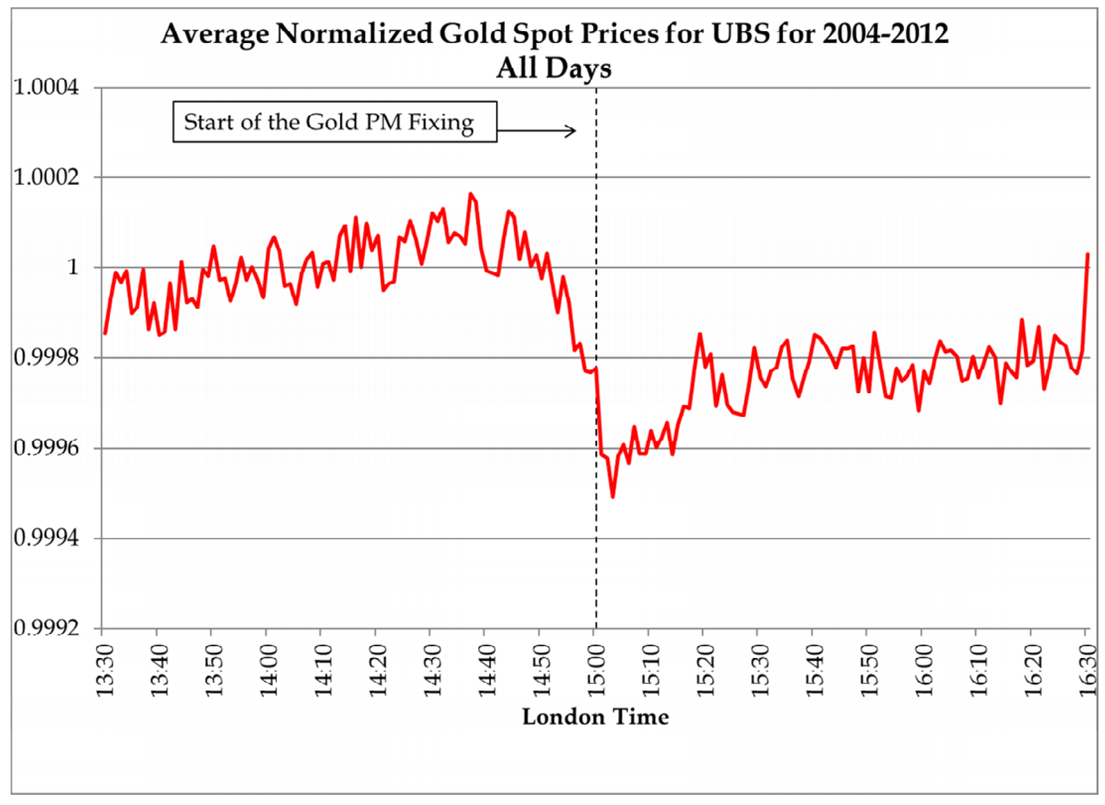
Deutsche Bank’s proposed settlement of the London Gold Fix class action amounting to $60 million including the provision of cooperation materials was given the Court’s preliminary approval on December 9th subject to a Fairness Hearing. This follows the non-UBS defendant banks of the London Gold Fix; Bank of Nova Scotia, Barclays, HSBC, and Société Générale being ordered in October to face charges in the lawsuit along with London Gold Market Fixing Limited, LGMF a private company owned by the five banks. Deutsche Bank’s settlement offer of $38 million including cooperation materials in a similar antitrust lawsuit involving the banks of the London Silver Fix was given the court’s preliminary approval earlier.
Opinion
The new chat evidence in silver and gold described in this and other articles provides the missing narrative to the volumes of statistical analysis incorporated in the original and amended complaints closely scrutinized by court and counsel at the April hearings. It lifts the curtain for once and all on the dirty role of bank suppression in gold and silver markets, and its not just the London Fix. The Court has already acknowledged plaintiffs evidence of symbiosis between the London Fixes and the pricing of other silver and gold products. The Court’s preliminary approval of the Deutsche Bank settlements may provide for class claims in bullion, coins, options, futures, spot and other markets including exchange traded funds, ETF’s within the US.
The collective evidence also neatly deals with the court’s October supposition that further amending the complaint would be “futile.”
Given the damming nature of material against UBS particularly, it remains all the more mystifying why the 2014 Swiss Supervisory Market Authority FINMA report into foreign exchange and precious metals trading at UBS said so little comparatively about UBS’ precious metals trading misconduct, and specifically nothing about gold trading misconduct. As discussed in an earlier article, the word “gold” is conspicuously absent from the 2014 report.
Were it not for the early moral act of Deutsche Bank in providing the cooperation materials, which presumably gave them a settlement advantage, UBS directors might be sleeping much easier this week. If the remaining non-UBS defendants agree to settle, which is an increasing likelihood, there will be no need for the court discovery scheduled for 2017 and civil trial beyond. In the meantime we wait to see how long UBS hangs in there.
The appearance of a precious metals producer among the class of plaintiffs will also see shareholders and directors reaching for the calculator. SCM is but one of thousands of producers who have sold precious metal in the US throughout the period and like any other plaintiff if the case is successful could be entitled to treble damages with interest if granted standing.
Plaintiffs analysis indicates that manipulation of the London Gold Fix led to average losses of up to four basis points or four hundredths of a percentage point in the gold price on the days affected. Therefore, a small gold producer similiar to SCM with say $500 million of gold sales over 8 years could tally treble claims of $600,000 plus interest.
Supposing as statute 28 U.S.C. 1961 directs, the present Treasury constant maturities nominal- 1-year interest rate currently at 0.83% is applied to this figure over an average sale date midway through the class period of say December 2008, and an optimistic successful conclusion of the lawsuit comes a year from now. Interest then of $54,793.64 could bring a theoretical claim of $654,793.64 for just one class member like this. In this context Deutsche Bank’s $60 million, plus the cooperation materials supplied, appear to be money well spent.
end
Craig Hemke responds to the new emails on the gold/silver manipulation scandal orchestrated by the banks
(courtesy Craig Hemke/TFMetals)
TF Metals Report: Silver price manipulation continues
Submitted by cpowell on Fri, 2016-12-16 17:16. Section: Daily Dispatches
12:13p ET Friday, December 16, 2016
Dear Friend of GATA and Gold:
Despite exposure in federal court in New York, the TF Metals Report’s Craig Hemke (aka Turd Ferguson) writes today, manipulation of the silver market by bullion banks continues in the open. The only counter to it, he says, is to purchase real metal on a cost-averaging basis and wait for the scheme to explode. His commentary is headlined “Silver Price Manipulation Continues in 2016” and it’s posted at the TF Metals Report here:
http://www.tfmetalsreport.com/blog/8049/silver-price-manipulation-contin…
CHRIS POWELL, Secretary/Treasurer
Gold Anti-Trust Action Committee Inc.
CPowell@GATA.org
END
We have now updated the the archive of gold and silver market rigging as we now have the gold emails from the defendant banks
(courtesy Nick Laird/GATA)
Archive of gold and silver market rigging reports added to annotated gold chart
Submitted by cpowell on Mon, 2016-12-19 04:37. Section: Daily Dispatches
11:36p ET Sunday, December 18, 2016
Dear Friend of GATA and Gold:
Statistician Nick Laird of Gold Charts R Us has attached an archive of news reports about manipulation of the monetary metals market to his chart that annotates gold price movements with the bullion bank traders’ market-rigging messages. The expanded chart is headlined “Court Case Media re Gold/Silver Manipulation” and it’s posted here:
http://www.goldchartsrus.com/chartstemp/CCMarketManipulation.php
CHRIS POWELL, Secretary/Treasurer
Gold Anti-Trust Action Committee Inc.
CPowell@GATA.org
end
Turkish citizens head to Erdogan’s call to defend the lira. However instead of depositing their dollars they bought gold
(courtesy Bloomberg)
Turks seek gold more than liras in response to Erdogan’s call
Submitted by cpowell on Sat, 2016-12-17 16:17. Section: Daily Dispatches
By Constantine Courcoulas
Bloomberg News
Friday, December 16, 2016
Asked by President Recep Tayyip Erdogan to shun the dollar, Turks are favoring gold over liras.
On the face of it, the appeal to defend the Turkish currency worked. It arrested the biggest three-week surge in foreign-currency deposits since August as Turks drew down a net $450 million from these accounts in the week ended Dec. 9. But residents also boosted their precious metal holdings, traditionally denominated in dollars, by $700 million, a hint that confidence in their currency remains tenuous, according to Nomura Inc. …
… For the remainder of the report:
https://www.bloomberg.com/news/articles/2016-12-16/turks-seek-gold-more-…
end
A terrific commentary from Andrew Maguire as he talks with Eric King. He states that the premiums in China in not because of scarcity but because of huge demand. During the past 2 weeks, 105 tonnes of gold was brought to refiners tin Switzerland from Andrew’s people and this landed into the Shanghai gold exchange. Demand is huge and China continues to search out for all the gold it can get
(courtesy Andrew Maguire/Kingworldnews)
High gold premiums in China are demand-driven, Maguire tells KWN
Submitted by cpowell on Fri, 2016-12-16 18:37. Section: Daily Dispatches
1:37p ET Friday, December 16, 2016
Dear Friend of GATA and Gold:
Premiums on gold in China are high not because of tight supply, as is being reported, but because of huge demand as investors realize that the wars on cash and gold are related and that gold is the only exit from the financial system, London metals trader Andrew Maguire tells King World News today. These wars, Maguire adds, are being run from the headquarters of the Bank for International Settlements in Basel, Switzerland. Maguire’s comments are posted at KWN here:
http://kingworldnews.com/whistleblower-andrew-maguire-exposes-the-real-r…
CHRIS POWELL, Secretary/Treasurer
Gold Anti-Trust Action Committee Inc.
CPowell@GATA.org
END
A terrific commentary from Alasdair Macleod as he details what we should expect from Donald Trump as President with his relationships between Russian and China. I believe he is bang on!
(courtesy Alasdair Macleod)
Trump, Russia and China
Even before he takes office, President-elect Trump is turning the world upside down.
It has become clear his attitude towards Russia and China is very different from that of his predecessors. Amazingly, he is already wresting power from the deep state, causing it great resentment, which under Obama, Clinton and the Bushes, ran geopolitical policy. From January, barring accidents the world will not be the same, the establishment up-ended.
This short article builds on information available to date and speculates how America’s relations with Russia and China are likely to evolve, and the implications for NATO and Europe. It attempts to cut through the disinformation and noise (from all sides) to assess how Trump will change super-power relations.
Russia
President-elect Trump has signalled his respect for President Putin as a leader, and Putin, who has been careful to not comment on the US presidential election, has indicated his respect for Trump. Furthermore, Trump, who admittedly said lots of contradictory statements to get elected, clearly wishes to reduce America’s funding commitment to NATO and to reduce American involvement in the Middle East. These objectives will obviously find favour with Putin, and could form the basis of a relationship reset between Russia and the West.
The American deep state was responsible for moving missiles within range of Moscow, under cover of targeting Tehran, in this year’s escalation of a new cold war. It follows the covert destabilisation by the US of Ukraine over the last decade and American backing for various terrorist groups in Syria, following Syria’s refusal to permit pipelines from the Gulf to cross her territory five years ago. Since the fall of the USSR, NATO has moved its eastern border to within 300 miles of Moscow. Elements in the CIA, working to their own agenda, are still trying to demonise Russia without any evidence, as the Washington Post story about Russian intervention in the election demonstrates.
The Trump team dismissed this attempt to blacken the Russians as disinformation, from the same sources that came up with the fiction of Saddam Hussain’s weapons of mass destruction. The timing of accusations over Russian involvement probably has much to do with influencing the electoral college’s votes, a last stand against Trump’s election, in which case the intervention is politically outrageous. But this is a side-show, and doubtless Trump will deal appropriately with those involved when he is in office.
Rather like super-tankers that need seven miles to stop, regional powers are also finding it hard to adjust to these new realities, but adjust they surely will. European governments and NATO members will have had background briefings, but the normal channels for this, the CIA, the US Military advisers and American diplomats are not on Trump’s page, so confusion still reigns. But one thing is becoming clear: Trump will not be diverted from a general policy of détente and de-escalation of military presence in both Europe and the Middle East.
The process of détente is reasonably predictable. A summit with Russia to agree strategic arms limitations (called SALT3 perhaps?) is a proven path to follow. It should be a step-by-step process scheduled over five or ten years, with pre-agreed conditions designed to satisfy concerns in the Baltic States and Poland that Russia might attempt border-creep. For their part the Russians must agree Ukraine’s independence (excepting the Crimea, Donetsk and Luhansk, which should be formally ceded to Russia). Ukraine and Belorussia will be independent buffer states between Russia and the European Union. Under a SALT3 both NATO and Russia will agree to a phased withdraw of all military hardware other than limited ground troops and their associated equipment.
In the Middle East, America will concede that Syria remains in the Russian sphere of influence, and will withdraw all support for rebel organisations. This is no more than reality. China, doubtless, will help in the physical reconstruction of Syria in due course. Agreement will be sought as to the means of destroying Daesh. Beyond that, a reduced American presence in the region will continue to ensure security for Israel and the Gulf states. Already, the British have announced they will step up their presence in the region, which should also contribute to regional stability.
Iran should be persuaded by Russia to take a more constructive approach to peace with Sunni states, such as Saudi Arabia, and towards Israel. This could be difficult, but should be possible, given Iran has become considerably more moderate since the days of Ahmadinejad, particularly if the right tone from America is forthcoming. Iran’s days of hiding from western sanctions behind Russia will be over, and should be replaced with an emphasis on trade. And Saudi Arabia can no longer afford to wage wars, such as that in the Yemen, contributing to a less belligerent outcome.
All this is practical, possible and predictable. Behind the change in geopolitical reality for the Middle East is the fact that Peak Oil is being pushed further into the future. Not only are large new oil fields still being discovered (such as the Kashagan Field in the north of the Caspian Sea), but modern technology is bringing other forms of ecologically-friendly energy supplies on stream and higher prices will unlock shale oil supplies. The strategic importance of the Middle East has therefore declined, particularly since insignificant quantities of oil from the region go to America. And with that decline goes less need for geostrategic intervention by the US.
For the first time since the Six Day War in 1967 there is a realistic possibility of stability in the area, assuming the super-powers take a constructive approach to détente, and are willing to jointly police the region.
Regional implications of détente with Russia
The benefits of regional peace to the Middle East will, hopefully, materialise. Turkey is important, and will need to be considered as well. The coup attempt earlier this year, which was likely supported if not actually instigated by the US, has resulted in Erdogan tightening his grip on all opposition to his rule. However, Erdogan may have become Russia’s puppet, because the Russians appear to have tipped him off ahead of the coup and ensured its failure. If this is indeed the case, not only does he owe his power to Russia, but Russia can take it away. Under Russian influence, we can expect Turkey to continue to lean away from her impractical and unrealistic hopes of joining the EU, and instead pursue her more recent ambitions for membership of the Shanghai Cooperation Organisation. That would offer Turkey the best long-term future.
With Turkey’s future direction appearing to be decided, far more important is the effect of a reset with Russia on Europe and the European Union. As NATO members, European nations have gone along with Russian sanctions, which have been detrimental particularly to Germany’s economy. Their removal will give Germany a new long-term trade market of considerable potential, reducing her dependence on trade with other EU states, particularly France, Spain and Italy. The possibility of a new Hanseatic League, about which I wrote last March, is now on the cardsi. I was very surprised that it hadn’t been considered by the British Government and discussed with the Germans as a Plan B in the event of a vote for Brexit. However, the prospect of détente with Russia leads to a new Hanseatic League now becoming a realistic possibility.
Briefly, the trade route to Russia, both by sea through the Baltic and overland by rail and road, offers enormous trading potential for Germany, Britain, Holland, and Scandinavia. To this we can add Poland, Czech Republic, Slovakia, Austria, Hungary, and to a lesser extent, Romania, Bulgaria and Serbia. Furthermore, a northern trade route will link into China’s One Belt One Road project, further enhancing its importance. In short, the long-term future of France, Spain, Italy and Greece will be challenged by the rehabilitation of Russian trade, and potentially become one of relative isolation. An overriding reason why Russia will become so important is because of her partnership with China in the Shanghai Cooperation Organisation. Russia is, with sub-Saharan Africa, the source of natural resources for China’s planned industrialisation of all Asia. And as a resource-rich country, Russia will benefit from the continuing rise in raw material and energy prices. Détente with America and NATO will improve her economic outlook considerably, but she needs European commercial technologies and manufacturing techniques to help rebuild her own middle class’s wealth.
The underlying reasons a SALT3 will work for Russia are all there, and Trump is likely to take the view that Western Europe should not be his responsibility. There is little US trade with Russia, so trade negotiations for America are not in this mix, simplifying matters considerably. The trade bun-fight will be mainly confined to negotiations with China.
We can be sure that there will be a summit between President Xi and President Trump early next year, because Henry Kissinger, who is trusted by the Chinese, and despite his great age has been sent by Trump to arrange it. Reports in the press that Kissinger’s visit last week was just to calm things down after Trump’s telephone call with the Taiwanese leader are wide of the mark. Trump is simply establishing his negotiating position from the outset.
Trump is of the opinion that businessmen, not diplomats, should control trade negotiations. While diplomats might view this approach as naïve, the fact is Trump will be setting the agenda. Consequently, he is likely to be dismissive of past agreements, and impatient with the snail’s pace common in diplomatic trade negotiations. He will most likely wish to handle trade negotiations with China himself.
In order that trade negotiations progress without misunderstandings he has nominated Iowa Governor Terry Branstad for the post of Ambassador to China. Branstad has known President Xi through previous visits, and should be an effective communications channel. That’s the soft part of the deal. The hard part is Trump’s rhetoric, and his willingness to talk to Taiwan, which has established his opening gambit. His objective will be to get China to stop manufacturing copies of American goods, hacking into commercial websites to steal trade and technological secrets, and abusing intellectual property. It is likely China will agree to tighten up on this behaviour, in which case a new trade agreement can be reached.
While diplomats might find Trump’s style damaging to their careful construction of trade relations over time, there is little doubt his approach has merit. Success with China, even if it is limited in scope, is likely to be the outcome. It could alter not only the way trade agreements with China are set in the future, but could override the whole WTO process for other international trade relationships as well. And here again, we see the EU with its antiquated and obstructive approach to trade being most challenged.
At the end of the day, Trump’s language is one the Chinese will understand, and in return for backing off over Taiwan, they are likely to concede America’s beef over intellectual property abuses, hacking and commercial espionage. China’s focus is moving away from that sort of business anyway, towards higher-level services and improved infrastructure for its rapidly-growing middle classes, and she plans to spread the benefits of her industrialisation throughout Asia.
Furthermore, there are likely to be echoes from Trump’s big-bang on trade. Removing diplomats from the act of setting the trade agenda, disconnects trade from geopolitical considerations generally, allowing Japan, for instance, to join the Asian Infrastructure Investment Bank. It is even conceivable that the US itself might apply to join it at a future date, in which case, you heard it here first.
Trump’s trade negotiations with China, if successful, could have far-reaching effects. They could, of course, go badly wrong, but the Chinese are realists and will almost certainly adapt to the new reality. It is in their interests to strike a deal with Trump, swiftly giving him concessions that established diplomatic practice would be unlikely to yield.
Political and economic consequences for America
In the first half of 2017, Trump is likely to achieve both détente with Russia and a new, better trade deal with China. If so, his pre-election stance, that the American establishment was failing the people, will have been amply proven. Trump will likely be riding high in the opinion polls.
However, you cannot demolish the status quo without consequences. While much good will be achieved if Trump’s approach to Russia and China succeeds, the EU will be undermined both politically and financially. The European Union is already threatening to break up following Brexit, and Trump’s détente with Russia could give Germany a realistic opportunity to cast off from the European Project. The financial cost of a European break-up will be a difficult pill for Germany to swallow, and renewed trade links with Britain and Russia is her best shot at recovery. The future for the euro, whatever happens, is being challenged, more so if Germany decides to replace it with a new Deutschemark. If Germany replaces the euro, the Eurozone’s banking system and currency will be increasingly vulnerable to collapse. And if the Eurozone has a banking crisis, it will inevitably infect the global banking system, undermining America’s banks as well.
If we make the optimistic assumption that somehow the Eurozone and its currency manage to stagger on, there is a further problem for America. Industrial raw material prices have been rising strongly throughout 2016, measured in dollars, despite the dollar’s strength against other currencies. Trump’s stated ambition, to cause US infrastructure investment to rise significantly, coincides with China’s thirteenth five-year plan for building new Silk Roads and associated projects. Consequently, both America and China will be aggressively bidding against each other for raw materials in 2017.
Price rises in raw materials and energy will become a major factor driving the rate of price inflation sharply higher on America’s Main Street. Yet the ability of the Fed to raise interest rates in their traditional attempts to limit price inflation will be checked by the height of the nominal rate that will trigger widespread debt liquidation. Debt, as the cliché goes, is the gorilla in the room.
Trump’s basic problem is that he understands business, but not necessarily economics. He obviously thinks that trade deficits arise from unfair trade practices. It’s a common mistake, but they don’t. They arise from unfunded government spending and the expansion of bank credit. His fundamental belief, that fair terms of trade will make America great again is therefore badly flawed.
It is also difficult to see where he stands on monetary policy, if at all. In business, he has personally benefited from the expansion of bank credit, but does he understand the eventual price consequences of unlimited expansion of bank credit? Very few businessmen do, in which case we can only hope he will be well advised.
Past US presidents, from Herbert Hoover onwards, have been generally poorly advised on basic economic theory, thinking the state is well equipped to fix things that go wrong. The evidence for this error is found in the unremitting accumulation of public sector debt since the Wall Street Crash in 1929, confirmed when Roosevelt devalued the dollar against gold in 1934, and reconfirmed when Nixon temporarily abandoned all gold convertibility in 1971. That Trump might be better advised must remain a pipe-dream, unless contradicted by events.
Therefore, my broad expectations for 2017, the first year of the Trump presidency, is success in foreign and trade policy will be offset by rising price inflation and falling asset prices as interest rates rise (see my article dated 1st December, Credit cycles and gold), terminating in a credit-crunch from higher nominal interest rates. Good on the geopolitics, bad on the economy.
ihttps://wealth.goldmoney.com/research/goldmoney-insights/brexit-and-a-hanseatic-league
end
Modi is now becoming another Maduro as he has now effectively made gold illegal in India as a consequence of a cashless society. Smuggling of gold into India will be rampant as the rupee will be destroyed in value:
(courtesy Bhandari/ zero hedge)
“Gold Is Now Effectively Illegal” In India – The Consequences Of Creating A Cashless Society
Jayant Bhandari warns “there are clear signs that in a very convoluted way, possession of gold for investment purposes will be made illegal” as he discusses India’s attempts to create a cashless society (and consequences of it) and why precious metals and geographical diversification are the most viable options investors around the world, not just India, should be taking.
“The situation is getting worse by the day… people are desperate”
Jayant provides the clearest explanation of where India is (and where it is going) in the brief interview with ProvenAndProbable.com’s Maurice Jackson …
As Jayant detailed previously, expect a continuation of new social engineering notifications, each sabotaging wealth-creation, confiscating people’s wealth, and tyrannizing those who refuse to be a part of the herd, in the process destroying the very backbone of the economy and civilization.
There are clear signs that in a very convoluted way, possession of gold for investment purposes will be made illegal. Expect capital controls to follow.
Gold Bullion Is Now Effectively Illegal
Assaults on people’s private property and the integrity of their homes through tax-raids continue. In a recent notification, government has made it clear that any ownership of jewelry above 500 grams of gold per married woman will be put under the microscopic scrutiny of tax authorities.
Steep taxes and penalties will be imposed on those who cannot prove the source of their gold. In India’s Orwellian new-speak this means that because bullion has not been explicitly mentioned, its ownership will be deemed to be illegal. Courts will do what Modi wants. Huge bribes will have to be paid.
Sane people are of course cleaning up their bank lockers. The secondary consequence of this will be a steep increase in unreported crimes, for people will be afraid of going to the police after a theft, fearing that the tax authorities will then ask questions. At the same time, the gold market has mostly gone underground, and apparently the volume of gold buying has gone up.
The salaried middle class is the consumption class, often heavily indebted. Poor people have limited amounts of gold. The government is merely doing what pleases the majority and their sense of envy, to the detriment of small businesses and savers. Now, the middle class is starting to face problems as well. This will worsen once the the impact of the destruction of small businesses becomes obvious.
India has always had a negative-yielding economy. It has suddenly become even more negative-yielding. Business risk has gone through the roof. Savers will be victimized. It is because of negative yields that Indian savers buy gold. They will buy more going forward.
Sane Indians should stay a step ahead of their rapacious government and the evolving totalitarian society, which are less and less inhibited by any institutions or values in support of liberty.
Conclusion
India will become a police state, likely with the full support of most Indians. Nationalism will be the thread that weaves them together. But it is a fake thread, devoid of any value. Eventually, there will be far too many stresses in the system, whose institutions are already in an advance stage of decay.
India as it exists today is a British creation. With the British now gone for 69 years, it is an entity has less and less reason to exist in its current form. The glue of reason that the British have applied is flaking, and it is doing so rapidly under the catalyst by name of Narendra Modi.
end
|

Preview YouTube video CREDIT, CRISIS & COLLAPSE — BILL HOLTER

Your early MONDAY morning currency, Asian stock market results, important USA/Asian currency crosses, gold/silver pricing overnight along with the price of oil Major stories overnight
1 Chinese yuan vs USA dollar/yuan DOWN to 6.9532(SMALL REVALUATION NORTHBOUND /CHINA UNHAPPY TODAY CONCERNING USA DOLLAR RISE/MORE $ USA DOLLARS LEAVE CHINA/OFFSHORE YUAN NARROWS TO 6.9471 / Shanghai bourse CLOSED DOWN 4.89 POINTS OR 0.16% / HANG SANG CLOSED DOWN 188.07 OR 0.85%
2. Nikkei closed DOWN 9.55 POINTS OR 0.05% /USA: YEN FALLS TO 117.29
3. Europe stocks opened MOSTLY IN THE RED ( /USA dollar index RISES TO 102.98/Euro UP to 1.0432
3b Japan 10 year bond yield: RISES +.088%/ !!!!(Japan buying 100% of bond issuance)/Japanese yen vs usa cross now at 118.13/ THIS IS TROUBLESOME AS BANK OF JAPAN IS RUNNING OUT OF BONDS TO BUY./JAPAN 10 YR YIELD FINALLY IN THE POSITIVE/BANK OF JAPAN LOSING CONTROL OF THEIR YIELD CURVE AS THEY PURCHASE ALL BONDS TO GET TO ZERO RATE!!
3c Nikkei now JUST BELOW 17,000
3d USA/Yen rate now well below the important 120 barrier this morning
3e WTI:: 51.94 and Brent: 55.22
3f Gold UP/Yen UP
3g Japan is to buy the equivalent of 108 billion uSA dollars worth of bond per month or $1.3 trillion. Japan’s GDP equals 5 trillion usa./“HELICOPTER MONEY” OFF THE TABLE FOR NOW /REVERSE OPERATION TWIST ON THE BONDS: PURCHASE OF LONG BONDS AND SELLING THE SHORT END
Japan to buy 100% of all new Japanese debt and by 2018 they will have 25% of all Japanese debt. Fifty percent of Japanese budget financed with debt.
3h Oil UP for WTI and UP for Brent this morning
3i European bond buying continues to push yields lower on all fronts in the EMU. German 10 yr bund FALLS TO +305.%/Italian 10 yr bond yield FALLS 4 full basis points to 1.816%
3j Greek 10 year bond yield FALLS to : 7.24%
3k Gold at $1139.80/silver $16.06(7:45 am est) SILVER BELOW RESISTANCE AT $18.50
3l USA vs Russian rouble; (Russian rouble UP 21/100 in roubles/dollar) 61.85-
3m oil into the 51 dollar handle for WTI and 55 handle for Brent/
3n Higher foreign deposits out of China sees huge risk of outflows and a currency depreciation (already upon us). This can spell financial disaster for the rest of the world/China forced to do QE!! as it lowers its yuan value to the dollar/GOT a SMALL REVALUATION UPWARD from POBC.
JAPAN ON JAN 29.2016 INITIATES NIRP. THIS MORNING THEY SIGNAL THEY MAY END NIRP. TODAY THE USA/YEN TRADES TO 117.29 DESTROYING JAPANESE CITIZENS WITH HIGHER FOOD INFLATION
30 SNB (Swiss National Bank) still intervening again in the markets driving down the SF. It is not working: USA/SF this morning 1.0265 as the Swiss Franc is still rising against most currencies. Euro vs SF is 1.0709 well above the floor set by the Swiss Finance Minister. Thomas Jordan, chief of the Swiss National Bank continues to purchase euros trying to lower value of the Swiss Franc.
3p BRITAIN VOTES AFFIRMATIVE BREXIT
3r the 10 Year German bund now POSITIVE territory with the 10 year FALLS to +.305%
3s The Greece ELA NOW at 71.4 billion euros,AND NOW THE ECB WILL ACCEPT GREEK BONDS (WHAT A DISASTER)
The bank withdrawals were causing massive hardship to the Greek bank. the Greek referendum voted overwhelming “NO”. Next step for Greece will be the recapitalization of the banks and that will be difficult.
4. USA 10 year treasury bond at 2.577% early this morning. Thirty year rate at 3.165% /POLICY ERROR)GETTING DANGEROUSLY HIGH
5. Details Ransquawk, Bloomberg, Deutsche bank/Jim Reid.
(courtesy Jim Reid/Bloomberg/Deutsche bank/zero hedge)
Global Stocks, Yields, Dollar Fade In Muted Volume As Traders Close Out 2016 Books
Global markets begin the last full week of trading of the year in subdued fashion, with U.S. equity futures rising 0.1%, to 2,258.5, European shares decline halting two straight weeks of gains, and Asian shares hitting a four-week low. The Dollar extends losses, yen and gold rise amid geopolitical concerns as the fallout from China’s seizure of a U.S. continues to reverberate. Volumes are thinning before the December holiday season and end of the year, with trading in German bund futures about half the average for the past five days. The Bank of Japan’s policy decision on Tuesday is the last Group of Seven central bank meeting for 2016.
Top overnight news stories include Fairfax agreeing to buy insurer Allied World for $4.9b, Danone warning on lower sales, Aramco IPO possibly still happening in U.S., Disney’s ‘Rogue One’ posting the second-biggest December opening weekend ever.
“As we enter the Christmas, year-end holiday season, volumes could decline and lead to choppy price action. Traders should watch out for higher volatility due to restricted holiday trading volumes,” said Ipek Ozkardeskaya, senior market analyst at London Capital Group
Wall Street hit record highs and the dollar rose to a 14-year peak last week, but investors chose to take some of those chips off the table. The profit-taking spread to Europe, where bank stocks were among the biggest fallers following two weeks of strong gains on the back of rising bond yields. Their decline pushed the broader European indices into the red.
In FX trading, the dollar has retreated against the yen as traders took stock following a six-week rally in the currency. The Stoxx 600 Index edged modestly lower after reaching the highest point of the year on Friday as Banca Monte Paschi tumbled 8.5%, headed for the biggest decline in more than a week ahead of a share issue. The yen strengthened before a Bank of Japan policy review Tuesday, ending a two-day advance in the Nikkei, which was down less than 0.1%. Oil gained, extending a climb from last week amid speculation an increase in maritime tensions could crimp deliveries. Gold headed for the first back-to-back advance in three weeks.
With books for 2016 closing, traders are ready to lock in gains in the greenback, with the Bloomberg Dollar Spot Index heading for its best quarter since 2008 following the election of Donald Trump and the U.S. Federal Reserve’s decision to boost interest rates and signal a steeper path of increases in 2017 last week according to Bloomberg.

“People are pulling in their horns a bit coming into year end and getting ready to reconsider when they come out of holiday period,” said Simon Derrick, chief currency strategist at Bank of New York Mellon Corp. in London. “We have a couple of big events coming up in January and people need to reassess how they think things will play out.”
MSCI’s broadest index of Asia-Pacific shares outside Japan fell for the third straight day, shedding 0.3 percent to a four-week low. It has lost 3.7 percent since Trump was elected. Investors turned cautious after China’s top leaders said over the weekend they would stem asset bubbles in 2017 and place greater importance on the prevention of financial risk.
The Stoxx Europe 600 Index was down 0.1% in subdued trading, with miners leading declines. In a reversal of the recent rotation into cyclical shares, defensive stocks including utilities, real estate and technology firms rose. The volume of Stoxx 600 shares traded on Monday was almost 30 percent lower than the 30-day average. Banca Monte dei Paschi di Siena fell 8.6% after the lender said it will begin selling shares to institutional investors this week as it aims to complete raising 5 billion euros ($5.2 billion) by the end of the year to avoid a rescue by the Italian government.
In rates, yields on 10-year Treasury notes declined one basis point to 2.58 percent after touching the highest level since September 2014 on Thursday. German bonds were little changed, while yield on Spanish 10-year securities fell three basis points to 1.40 percent.
Meanwhile, China’s bond selloff continued, with 10-year yields rising five basis points to 3.40 percent. The yield surged 25 basis points last week, to 3.35 percent, as hawkish comments from the Federal Reserve and waning liquidity weighed on bond prices.

Of the things to look out for today, Fed Chair Yellen will deliver her final address of the year this evening at 6.30pm GMT when she speaks at the University of Baltimore. The title of her discussion is the state of the job market although given that this is a mid-year commencement address its unlikely that the speech will throw up much new information.
The Bank of Japan started its two-day policy meeting on Monday and is widely expected to hold policy, including its twin targets of minus 0.10 percent interest on a part of excess reserves and the zero percent 10-year government bond yield. No surprises or changes in policy are expected, but given that a potentially big theme for next year is whether the BoJ’s yield cap is tested by the market, it’s still worth listening out for any interesting comments from Governor Kuroda in the press conference that follows.
* * *
Bulletin Headline Summary from RanSquawk
- European equities and fixed income markets have seen a tentative start to the week as markets begin to wind down for the festive break
- Markets descend into consolidation mode, but FX markets will be more reactive than anything else
- Today’s highlights include US Services PM! and comments from Fed Chair Yellen
Market Snapshot
- S&P 500 futures up 0.1% to 2258
- Stoxx 600 down 0.2% to 359
- FTSE 100 down 0.2% to 6998
- DAX down less than 0.1% to 11402
- German 10Yr yield up less than 1bp to 0.32%
- Italian 10Yr yield down 3bps to 1.84%
- Spanish 10Yr yield down 3bps to 1.4%
- S&P GSCI Index down less than 0.1% to 393.5
- MSCI Asia Pacific down less than 0.1% to 136
- Nikkei 225 down less than 0.1% to 19392
- Hang Seng down 0.9% to 21833
- Shanghai Composite down 0.2% to 3118
- S&P/ASX 200 up 0.5% to 5562
- US 10-yr yield down 1bp to 2.58%
- Dollar Index down 0.08% to 102.87
- WTI Crude futures up 0.3% to $52.07
- Brent Futures up 0.3% to $55.38
- Gold spot up 0.2% to $1,137
- Silver spot down 0.3% to $16.04
Top Global News
- Watsa’s Fairfax Agrees to Buy Allied World for $4.9 Billion: $54 per-share, cash-and-stock offer amounts to 18% premium
- Danone Says Sales Growth to Miss Target on Spain, Activia: Revenue increase will be slightly below 3% to 5% goal
- Disney’s ‘Rogue One’ Surges With $155 Million Weekend Haul: Movie sets second-best mark for an opening in December
- Goldman Warns China Outflows Rising in Both Yuan Payments, Forex: Pressures could worsen in first quarter of next year: analyst
- Aramco IPO Could Still Be in U.S. as Kingdom Plays Down Rift: Location of IPO ‘work in progress,’ Foreign Minister al- Jubeir says
- Barclays Severing Ties With Up to 7,000 Clients to Boost Returns: Bank’s top 500 markets clients ranked gold, platinum, diamond
- Citigroup’s Larsen Exits as Retail Banking, Mortgage Head: Larsen joined bank in 1998; known for pushing digital banking
- BAT Said to Consider Adding $8/Share to RAI Bid: Sunday Times
- Fed’s Bullard Ups His Interest-Rate Forecast by a Quarter Point
- Pentagon Says China to Return Drone; Trump Says They Can Keep It
Asian equity markets traded mixed following Friday’s lacklustre lead from Wall St, where weakness in tech and financials alongside growing tensions with China dampened sentiment. ASX 200 (+0.5%) outperformed on broad-based gains with energy supported after WTI crude futures rose above USD 52/bbl, while Nikkei 225 (flat) was also dampened by a pullback in USD/JPY to below 118.00. Elsewhere, Chinese markets traded mixed with financials in the Hang Seng (-0.9%) weighed after China regulators further tightened restrictions on mainland purchases of Hong Kong insurance products, while Shanghai Comp. (+0.2%) was choppy as participants digested a continued increase in property prices which could attract funds away from stocks, alongside a firm injection by PBoC which also extended emergency loans to avoid a liquidity crunch. Finally, 10yr JGBs traded higher amid the dampened risk appetite in Japan and with the BoJ in the market for JPY 1 .25tln of government debt ranging between 1yr-10yrs. However, gains were capped with participant awaiting tomorrow’s BoJ conclusion while the yield curve flattened amid outperformance in the super-long end.
Chinese House Prices (Nov) Y/Y 12.6% (Prey. 12.3%). China House Prices rose M/M in 55 out of 70 cities (Prey. 62) and Y/Y in 65 cities (Prey. 65).
Top Asian News
- China Rejects Trump’s Comment That It Stole U.S. Naval Drone: Military negotiating with U.S. over return of unmanned vehicle
- Hong Kong Equity Investors Get That Sinking Feeling, Again: Hang Seng Index has fallen almost 10% from 2016 high
- Indonesia’s Central Bank Revives Plan to Redenominate Rupiah: President Joko Widodo says proposal should be a priority
- Gone in 60 Seconds: Chinese Snap Up Dollars as Yuan Tanks: U.S. dollar WMPs provide alternatives to sending money abroad
- China Home-Price Growth Slows as Property Curbs Dent Demand: Values gained in 55 cities in November, versus 62 in October
European stocks have seen a slow start to the week, with major indices trading modestly lower amid light newsflow. In what has been a subdued morning, Banca Monte Dei Paschi (-6.2%) are the notable underperformer as they begin their capital raising, while Danone are also one of the major laggards after lowering their sales forecast. On a sector breakdown, energy hovers just in positive territory, while financials drag on the indices, with Deutsche Bank also softer after a negative broker move. Fixed income markets have seen a similarly tight range this morning, with Bunds steady above 162.00, while the periphery has seen tightening against the German 10Y amid little in terms of data. In terms of data highlights so far, IFO has been the only notable release, with the components largely higher than expected.
Top European News
- German Business Confidence Improves on Signs of Stronger Growth: Ifo business climate index rises to 111 vs estimated 110.6
- SCA Enters Wound Care With $2.9 Billion Deal Ahead of Spin: Acquisition would add 1 billion kronor to pro forma profit
- EU Interferes With National Powers in Apple Case, Irish Say: Ireland’s government releases details of Apple tax appeal
- Deutsche Bank Axes Executive Bonuses to Offset DoJ Fine: Times
In currencies, the dollar declined 0.4 percent to 117.51 yen, after gaining for the past six weeks. A broader Bloomberg gauge of the dollar has little changed, after strengthening 7.2% this quarter. Markets descend into consolidation mode, but FX markets will be more reactive than anything else. If USTs hold recent ranges and stock markets are buoyed, there is little to expect from the likes of EUR/USD and USD/JPY, as the medium term picture remains that of USD strength. This has accelerated against the AUD and NZD in particular, more so in the latter case on Friday after NZD/USD took out .7000 support. Losses have slowed since, but this is more down to inactivity than anything else. AUD/USD below .7300 points to further losses also, but limited momentum (and range) seen so far today. USD/CAD has also taken a breather on the upside as 1.3400+ drawing in fresh selling interest for now. Oil prices grinding higher to provide some modest support near term. GBP will continue to seesaw inside familiar levels, with Cable losses through 1.2400 last week drawing in longer term buying interest, but sellers coming in above 1.2500 again. EUR/GBP support seen ahead of .8300, but pre .8600 should cap to set a near term range in play. Brexit headlines continue to dominate, with the debate on EU budget payments the latest ‘stand off’ between the UK and Europe.
In commodities, oil extended gains above $52 a barrel as a planned production boost from Libya stalled, while OPEC’s November agreement to curtail output continued to support prices. Futures climbed as much as 1.2 percent in New York after rising 2 percent on Friday. Gold advanced for a second day as the dollar weakened. Bullion for immediate delivery rose as much as 0.7 percent to $1,142.40/oz. Zinc and copper fell as base metals retreated. Copper prices have retreated and will continue to do so at these better levels though as China demand constantly a concern. Gold has risen slightly on the modest USD pullback, but fresh gains in equities should see pressure resume. USD1100-1050 major support lower down.
DB Concludes the overnight wrap
Welcome to the penultimate week of 2016. That gives you two weeks to complete any final New Year’s resolution goals that were set 354 days ago, or in some cases start them. As you might expect with markets winding down ahead of the holiday season this week’s diary shouldn’t prove to be too much of a distraction. Of the things to look out for though, Fed Chair Yellen will deliver her final address of the year this evening at 6.30pm GMT when she speaks at the University of Baltimore. The title of her discussion is the state of the job market although given that this is a mid-year commencement address its unlikely that the speech will throw up much new information. We’ll also have the final big Central Bank meeting of the year when the BoJ take up centre stage tomorrow morning. Neither us nor the market is expecting any surprises or changes in policy but given that a potentially big theme for next year is whether the BoJ’s yield cap is tested by the market, it’s still worth listening out for any interesting comments from Governor Kuroda in the press conference that follows. On the politics front one event which could be interesting comes tomorrow when UK PM Theresa May is due to be questioned by the House of Commons Liaison Committee about her Brexit plans. Finally on the data front the day to probably focus on is Thursday where in the US we’ll get the third revision to Q3 GDP along with a first look at the November durable and capital goods orders data.
As well as that to look ahead to then, it’ll be interesting to see if there is much further reaction in markets today after geopolitical tensions rose on Friday following that news concerning China’s seizure of a US naval drone. Unsurprisingly this has largely dominated the column inches over the weekend and while the Pentagon has confirmed that China has agreed to return the surveillance device that came after President-elect Trump had already taken to twitter to voice his criticism at the act. China’s Communist Party-affiliated Global Times has since portrayed a mocking of Trump’s demeanour and called it as ‘lagging far behind the White House spokespersons’. It’s worth noting that debates over the South China Sea issues have intensified in the wake of Trump’s victory so incidents like these are worth monitoring closely.
Away from that, with much of the focus having been rightly on the Italian Banking sector recently, it’s worth noting the news out of the Ukraine too late last night where the country’s government announced that it is to nationalize Ukraine’s largest and (as per the FT) most systemically important commercial bank, PrivatBank, with looming concerns about the state of the bank’s balance sheet. This follows a failed rescue bid by the billionaire owners with the Government now acquiring 100% of the bank as a result in a coordinated transaction with the IMF.
Back to China quickly, our China Chief Economist, Zhiwei Zhang, highlighted in a note late last week that the Central Economic Working Conference (CEWC) concluded on Friday. He noted that the press release indicated that the government will focus on stability in 2017 and will target a growth rate of 6.5%. This target hadn’t been disclosed in the press release but is set to be officially announced in the National People’s Congress on March 5th.
Refreshing our screens this morning it’s been a fairly mixed start to trading in Asia. The Nikkei (-0.22%) and Hang Seng (-0.79%) are both in the red while the Shanghai Comp and Kospi are little changed. The ASX (+0.69%) is the notable outperformer although we should note that volumes generally in the region are at the usual holiday-season lows. Meanwhile the US Dollar has continued to edge a bit lower and Treasury yields have also dipped a bit. There’s also been a bit of data this morning. Exports in Japan were reported as falling -0.4% yoy in November which was a bit better than the consensus (vs. -2.3% expected) and also up from -10.3% in the month prior. Meanwhile in China property prices (excluding government subsidized housing) were reported as rising in 55 of the cities tracked by the government in November, compared with 62 in October.
Moving on and a quick wrap of how markets closed out Friday. For the most part it was a fairly dull end to an eventful week. After equity markets had generally edged a bit higher in Europe (Stoxx 600 +0.34%) mainly as a result of a decent boost across the energy sector with WTI (+1.96%) rebounding back towards $52/bbl, US equity markets largely faded into the close. Indeed the S&P 500 closed -0.18% and as a result nudged back into a very modest loss (-0.06%) for the week.
As has been the recent trend however moves in the rates market were a bit more exciting. Indeed most notable in the early going was the move lower for yields across the Bund curve culminating in 2y Bund yields closing at a fresh record low of -0.815% (down a couple of basis points on the day). US Treasuries were also initially stronger before some hawkish Fedspeak (more on that shortly) sent yields spiking higher. In fact 10y yields touched an intraday high of 2.619% and a shade away from the recent high in the cycle. That was before the China drone news hit the wires however which sent yields scurrying lower. The 10y finished little changed around 2.593% by the end of play but still with another decent near 7bps high-to-low intraday range. There was a similar trend for the Greenback which pared early gains into the close for the same reason.
In terms of the data that was released, in the US housing starts were reported as falling sharply in November (-18.7% mom vs. +12.8% expected) to an annualized rate of 1090k. That comes following an upwardly revised +27.4% mom surge in October however. Meanwhile permits were also down unexpectedly (-4.7% mom vs. +3.3% expected) although again follows a +2.9% mom in the month prior. Meanwhile, in Europe all eyes were on the November CPI report for the Euro area although there was little in the way of surprise with the headline CPI print confirmed at -0.1% mom and +0.6% yoy. In France confidence indicators generally edged higher (business confidence to 105 from 102) while in the UK the December CBI manufacturing survey reported orders of 0 versus -3 in the month prior.
Back to that Fedspeak quickly, one of the more hawkish policy makers, Jeffrey Lacker, said that ‘there is a range of paces of interest rate hikes that would qualify as gradual, including paces more rapid than one or two or three a year’. Indeed Lacker went as far as to say that ‘my guess would be more than three’. Separately, St Louis Fed President, James Bullard, confirmed that with regards to the new Trump administration, ‘we think there is some upside risk because the new administration wants faster growth and it is possible some of the things they are talking about will drive productivity higher’. He did however also suggest that this would be more of a 2018 or 2019 consideration, rather than in 2017.
Turning over to this week’s calendar now. The sole release in Europe this morning comes from Germany where the December IFO survey will be released. This afternoon in the US the only data of note are the remaining December flash PMI’s (services and composite readings). Tomorrow morning we kick off in Japan with the BoJ decision followed just after by Governor Kuroda’s press conference. Over in Europe we start with Germany again with the latest PPI print while in the UK the latest CBI reported retail sales data for this month will be out. There’s nothing of note in the US tomorrow afternoon. Wednesday is another quiet day with France PPI, UK public sector net borrowing data, Euro area consumer confidence and US existing home sales data due up. We’ll finally get a bit of action on Thursday. While the morning session is quiet, with Germany’s import price index reading the only data, during the afternoon in the US we’ll get the third reading for Q3 GDP along with a first look at the November durable and capital goods orders data. Also due out will be the November personal income and spending reports, core and deflator PCE readings, initial jobless claims, FHFA house price index, Kansas City Fed’s manufacturing survey and the Conference Board’s leading index. We close out the week in Asia on Friday with the MNI business indicator in China. During the European session we’ll get consumer confidence data in Germany along with the final UK and France Q3 GDP revisions. We finish the week in the US on Friday with new home sales data and the final University of Michigan consumer sentiment reading.
There’s not a huge amount else away from the data. Fed Chair Yellen is due to deliver the keynote address at the University of Baltimore’s Midyear Commencement this evening while the ECB’s Weidmann also speaks today. UK PM Theresa May is then due to by questioned by the UK Parliament Panel about her plans for leaving the EU tomorrow. Finally it’s worth noting that the US Treasury market and London Stock Exchange are due to close for a half day on Friday ahead of the holiday weekend.
3.REPORT ON JAPAN SOUTH KOREA NORTH KOREA AND CHINA
i)Late SUNDAY night/MONDAY morning: Shanghai closed DOWN 4.89 POINTS OR 0.16%/ /Hang Sang closed DOWN 188.07 OR 0.85%. The Nikkei closed DOWN 9.55 OR 0.05%/Australia’s all ordinaires CLOSED UP 0.16% /Chinese yuan (ONSHORE) closed DOWN at 6.9532/Oil ROSE to 51.94 dollars per barrel for WTI and 55.22 for Brent. Stocks in Europe: MOSTLY IN THE RED. Offshore yuan trades 6.94710 yuan to the dollar vs 6.9532 for onshore yuan.THE SPREAD BETWEEN ONSHORE AND OFFSHORE NARROWS COMPLETELY AS MORE USA DOLLARS ARE BLOCKED FROM LEAVING CHINA’S SHORES /
3a)THAILAND/SOUTH KOREA/:
none today
b) REPORT ON JAPAN
c) REPORT ON CHINA
Donald Trump is visibly upset that the Chinese seized a USA drone in international waters and took it back to China”
(courtesy zero hedge)
Trump Slams Chinese Seizure Of US Drone, Calls It “Unprecedented Act”
Update: moments after the original post, Trump has corrected his spelling error in a follow up tweet which, correctly, accuses China of engaging in an “unprecedented act” by seizing the US naval drone.
China steals United States Navy research drone in international waters – rips it out of water and takes it to China in unprecedented act.

Irrelevant spelling mistakes aside, China’s drone seizure is likely a signal to President-elect Donald Trump that it won’t take his phone call with Taiwan lightly, an expert said on Friday. “Knowing Chinese military officials for many years and how orders are communicated from the highest power centers in Beijing down to commanders on the ground or water, this was very likely a highly planned and escalatory move to show China will not take matters lightly when it comes to President-elect Trump’s phone call and comments on Taiwan, or Chinese actions overall,” said Harry Kazianis, director of defense studies at the Center for the National Interest.
The ball is now in Trump’s court if he wishes to further escalate.
* * *
Following yesterday’s biggest, market-moving geopolitical event, in which a US oceanographic vessel had its underwater drone “stolen” by a Chinese warship “literally right in front of the eyes of the American crew”, we predicted that everyone would be eagerly waiting for Trump to chime in on the topic, and further escalating the diplomatic spat between the two nations which now involves China confiscating US marine drones, the first of its kind seizure in recent history:
everyone F5ing the @realDonaldTrump page

21 hours later, it finally happened, when the President-elect used his favorite social media outlet to Tweet that “China steals United States Navy research drone in international waters – rips it out of water and takes it to China”, an act which he called “unpresidented.”

… and as a result, the social media response has been more focused on Trump’s spelling, than his outrage:
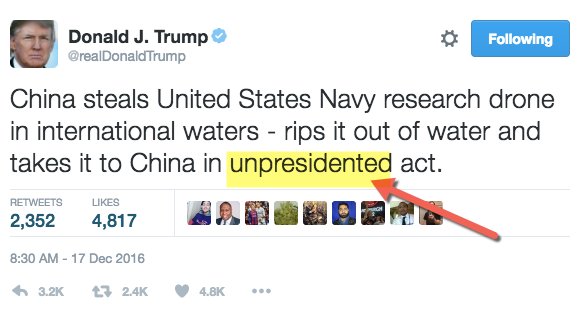
I know it’s trivial & probably helps Trump when people hype things like this, but it’s genuinely shocking he thinks it’s spelled this way

Still, as tensions runs high between the two superpowers, and as some wonder if Trump will do anything else in retaliation besides being confined by Twitter, China’s act confined merely there was some signs of de-escalation, after China said on Saturday that Beijing and the US are using military channels to “appropriately handle” the seizure by the Chinese navy of a U.S. underwater drone in the South China Sea, and a Chinese state-run newspaper said it expected a smooth resolution. The drone was taken on Thursday, the first seizure of its kind in recent memory, about 50 nautical miles northwest of Subic Bay off the Philippines, just as the USNS Bowditch was about to retrieve the unmanned underwater vehicle (UUV), U.S. officials said.
“It is understood that China and the United States are using military channels to appropriately handle this issue,” China’s Foreign Ministry said in a brief statement sent to Reuters, without elaborating.
The Global Times, published by the ruling Communist Party’s official People’s Daily, said a Chinese naval vessel had discovered “unidentified equipment” and checked it to prevent any navigational safety issues. It cited an unidentified Chinese source.
“This person said China has already received a claim request for the equipment from the U.S. side. Relevant parties from both sides have maintained smooth communication channels and believe this issue will be smoothly resolved,” the paper said. China’s Defense Ministry has yet to comment publicly on the issue.
Meanwhile, US officials were puzzled, and shared Trump’s misspelled indignation at the unprovoked Chinese action.
“The UUV was lawfully conducting a military survey in the waters of the South China Sea,” a U.S. official said, speaking on condition of anonymity. “It’s a sovereign immune vessel, clearly marked in English not to be removed from the water – that it was U.S. property,” the official said. The Pentagon confirmed the incident at a news briefing on Friday, and said the drone used commercially available technology and sold for about $150,000.
Still, the Pentagon viewed China’s seizure seriously since it had effectively taken U.S. military property. “It is ours, and it is clearly marked as ours and we would like it back. And we would like this not to happen again,” Pentagon spokesman Jeff Davis said.
* * *
Coming at a time of rising tensions about China’s military presence and deployment of weapons to the Spratly islands in the South China Seas, the seizure will add to concerns about China’s increased military presence and aggressive posture in the disputed area, including its militarization of maritime outposts. As reported previously, a U.S. research group said this week that new satellite imagery indicated China has installed weapons, including anti-aircraft and anti-missile systems, on all seven artificial islands it has built in the South China Sea.
The drone seizure coincided with sabre-rattling from Chinese state media and some in its military establishment after U.S. President-elect Donald Trump cast doubt on whether Washington would stick to its nearly four-decades-old policy of recognizing that Taiwan is part of “one China.”
On Friday, Obama said it was appropriate for Trump to take a fresh look at U.S. policy toward Taiwan, but he cautioned that a shift could lead to significant consequences in the U.S. relationship with Beijing, as the notion that Taiwan is part of “one China” is central to China’s view of itself as a nation. For now, Trump is ignoring Obama’s advice and instead if more focused on venting about one-off “precedents” using Twitter without an autocorrect function.
END
China responds that they will return the drone but are visibly upset with the USA tone:
(courtesy zerohedge)
China Responds: Will Return Stolen Drone, “Regrets US Hype”
Shortly after president-elect Trump’s “unprecedented action” tweet, Chinese authorities responded via their mouthpiece The China People’s Daily:
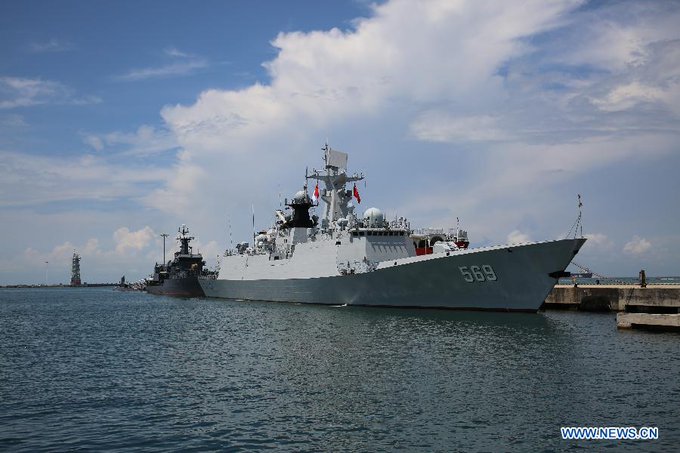
#Update: China will return equipment identified as US underwater drone, and regrets the US publicly hyping the incident: Ministry of Defense

China’s Defense Ministry confirmed on Saturday it plans to return an underwater U.S. drone seized this week by a Chinese naval vessel in the South China Sea, but complained the United States was “hyping up” the incident. The drone was collecting data about the salinity, temperature and clarity of the water about 50 nautical miles northwest of Subic Bay, off the Philippines, and was seized just as the USNS Bowditch was about to retrieve it, U.S. officials said.

The Defense Ministry said a Chinese naval vessel discovered a piece of “unidentified equipment,” and checked it to prevent any navigational safety issues before discovering it was a U.S. drone.
“China decided to return it to the U.S. side in an appropriate manner, and China and the U.S. have all along been in communication about it,” the ministry said on its website. “During this process, the U.S. side’s unilateral and open hyping up is inappropriate, and is not beneficial to the smooth resolution of this issue. We express regret at this,” it added.
Without directly saying whether the drone was operating in waters China considers its own, China’s Defense Ministry said U.S. ships and aircraft have for a long period been carrying out surveillance and surveys in “the presence” of Chinese waters.
“China is resolutely opposed to this, and demands the U.S. stops this kind of activity,” it said. China will remain on alert for these sorts of activities and take necessary steps to deal with them, the ministry said without elaborating.
* * *
As AP reported, China said Saturday that its military seized a U.S. Navy unmanned underwater glider in the South China Sea to ensure the “safe navigation of passing ships,” in one of the most serious incidents between the two militaries in years.
Chinese Defense Ministry spokesman Yang Yujun issued a statement late Saturday saying that a Chinese navy lifeboat discovered an unknown device in the South China Sea on Thursday. “In order to prevent this device from posing a danger to the safe navigation of passing ships and personnel, the Chinese lifeboat adopted a professional and responsible attitude in investigating and verifying the device,” Yang said.
The statement said that after verifying that the device was an American unmanned submerged device, “China decided to transfer it to the U.S. through appropriate means.”
The statement also accused the U.S. of long deploying ships “in China’s presence” to conduct “military surveying.”
“China is resolutely opposed to this and requests the U.S. stop such activities,” it said. “China will continue to maintain vigilance against the relevant U.S. activities and will take necessary measures to deal with them.”
Earlier Saturday, China’s foreign ministry said the country’s military was in contact with its American counterparts on “appropriately handling” the incident, though it offered no details on what discussions were underway.
In a separate report, the paper quoted retired Chinese admiral Yang Yi as saying China considered itself well within its rights to seize the drone.
“If China needs to take it, we’ll take it. (America) can’t block us,” Yang was quoted as saying. Yang said he was unsure of the purpose of seizing the drone, but didn’t think the matter qualified as a “military conflict.”
However, he added that the chances of a confrontation had risen following Trump’s recent comments, which were seen as testing China’s bottom line on Taiwan and other sensitive issues. “It’s natural for us to take possession of and research for a bit these types of things that America sends to our doorstep,” Yang said. “The louder they shout, the more their protests ring hollow.”
As we concluded earlier, the drone seizure coincided with sabre-rattling from Chinese state media and some in its military establishment after U.S. President-elect Donald Trump cast doubt on whether Washington would stick to its nearly four-decades-old policy of recognizing that Taiwan is part of “one China,” and as China devalues its currency to the weakest against the dollar since May 2008, Trump’s comments also drew reaction from China’s finance minister…
China hopes there won’t be a trade war with the United States, but it will take “appropriate steps” to cope with that possibility, a Chinese vice finance minister said on Saturday.
Zhu Guangyao, addressing an economic forum at a time of rising tensions with Washington, said both countries should abandon a “zero sum” mentality and seek to improve to improve economic and trade cooperation.
On Friday, Obama said it was appropriate for Trump to take a fresh look at U.S. policy toward Taiwan, but he cautioned that a shift could lead to significant consequences in the U.S. relationship with Beijing, as the notion that Taiwan is part of “one China” is central to China’s view of itself as a nation. For now, Trump is ignoring Obama’s advice and instead is more focused on venting about one-off “precedents” using Twitter without an autocorrect function.
US Asian Allies “Worried” By Muted Response To Drone Seizure, As Fears Grow China “Stole Secrets”
While Friday’s seizure by China of a US underwater drone may end up as just a tempest in a teapot after China grudgingly agreed to return the US equipment this week after a formal protest by the Pentagon, and Trump’s tweet slamming the “unprecedented act”, two new concerns have emerged. According to John McCain, China may be poring over a seized underwater drone to unearth secret information about Navy technology, hours after Trump suggested Beijing should “keep it.”
Quoted by Bloomberg, McCain, head of the Senate Armed Services Committee, told CNN’s State of the Union that “The Chinese are able to do a thing called reverse-engineering, where they are able to – while they hold this drone, able to find out all of the technical information. And some of it is pretty valuable.”
McCain said China’s seizure was “a gross violation of international law,” echoing the prevailing U.S. response and Trump’s initial blast via a tweet. The president-elect told his 17.5 million Twitter followers: “China steals United States Navy research drone in international waters – rips it out of water and takes it to China in unprecedented act.”
His comments highlighted the U.S. political tensions touched off by China’s decision to scoop up the submersible in international waters, which was not even located within the confines of the contested nine-dash line. Assurances from China that the vessel would be returned failed to quiet U.S. critics — including Trump, who initially denounced the snatch-and-grab move and then reversed himself hours later. Trump said on Twitter late Saturday that “We should tell China that we don’t want the drone they stole back – let them keep it!”

Asked about the tweet, Trump’s communications director, Jason Miller, said on Fox News Channel that China was likely to return “a chunk of metal and maybe a bag of wires” after holding the drone for several days.
While the tensions unleashed by the episode underscored the delicate state of relations between the two countries, weeks before Trump’s inauguration, they were merely the latest escalation in the growing conflict over whose geopolitical sphere of influence has legitimacy over the contest South China Sea zone, an area rich in resources and a critical nexus point for global naval commerce.
In the war of words that resulted following the capture of the drone, both sides laid out their cases clearly: “China is very sensitive about unmanned underwater vehicles because they can track our nuclear ballistic missile submarines fleet,” said retired Major General Xu Guangyu, a senior researcher at Beijing-based research group the China Arms Control and Disarmament Association. “If one from the Bowditch can be detected and even snatched by a Chinese naval ship, it shows it’s getting too close to the sensitive water areas.” Meanwhile, in its statement Friday confirming reports that the drone had been captured, the Pentagon described it simply as ”an unclassified ‘ocean glider’ system used around the world to gather military oceanographic data such as salinity, water temperature, and sound speed.”
* * *
However, while the diplomatic spat between China and the US will likely not be resolved any time soon, and the seizure of the naval drone will simply add to the list of complaint vocalized by both sides, a more troubling diplomatic cascade may emerge if, as the NYT reports, US allies in China view Washington’s response as “muted.”
Only a day before a small Chinese boat sidled up to a United States Navy research vessel in waters off the Philippines and audaciously seized an underwater drone from American sailors, the commander of United States military operations in the region told an audience in Australia that America had a winning military formula. “Capability times resolve times signaling equals deterrence,” Adm. Harry B. Harris Jr., told a blue chip crowd of diplomats and analysts at the prestigious Lowy Institute in Sydney, Australia, the leading city in America’s closest ally in the region.
In the eyes of America’s friends in Asia, the brazen maneuver to launch an operation against an American Navy vessel in international waters in the South China Sea about 50 miles from the Philippines, another close American ally, has raised questions about one of the admiral’s crucial words. It was also seen by some as a taunt to President-elect Donald J. Trump, who has challenged the “One China” policy on Taiwan and has vowed to deal forcefully with Beijing in trade and other issues.
“The weak link is the resolve, and the Chinese are testing that, as well as baiting Trump,” said Euan Graham, director of international security at the Lowy Institute. “Capability, yes. Signaling, yes, with sending F-22 fighter jets to Australia. But the very muted response means the equation falls down on resolve.”
In a repeat of the “Russian hacking” incident, which exposed a weak Obama administration unable to respond in any effective way to what it has dubbed a gross violation by the Kremlin, the NYT added that across Asia, diplomats and analysts said they were “perplexed at the inability of the Obama administration to devise a strong response to China’s challenge. It did not even dispatch an American destroyer to the spot near Subic Bay, a former American Navy base that is still frequented by American ships.”
The end result, analysts said, is that China would be emboldened by having carried out an act that amounted to hybrid warfare, falling just short of provoking conflict, and suffering few noticeable consequences.
“Allies and observers will find it hard not to conclude this represents another diminishment of American authority in the region,” said Douglas H. Paal, vice president for studies at the Carnegie Endowment for International Peace.
It also means that the US is willing to acknowledge the decline of its regional influence even as China’s grows by the day:
As China has built up its navy and its submarine fleet in the last decade, it has also emphasized what it calls its “inherent” right to dominate the regional seas, and to challenge the presence of the United States, its allies and partners in Asia.
The drone incident, which occurred Thursday, and was first broadcast by CNN despite efforts by the Obama administration to settle it quietly, was of a different nature and just as disquieting as past confrontations with China that involved bigger ships and more dangerous maneuvers, analysts said.
In 2001, soon after President George W. Bush came to office, an American spy aircraft, an EP-3, was forced to land on Hainan Island after colliding with a Chinese fighter jet. The Chinese stripped the plane of all its assets and returned it broken down to its parts and packed in boxes.
In 2009, two months after President Obama took office, Chinese vessels swarmed a United States Navy reconnaissance ship, the Impeccable, in what the Pentagon said were dangerous and unprofessional maneuvers.
And while the outgoing Obama administration may simply not have any desire to get futher involved in any escalating diplomatic entanglements with China (or Russia) over terrotorial disputes (or hack allegations), the same can hardly be said for the Trump administration. We, and the entire market, look forward with great interest to the president-elect’s response following the next mini diplomatic spat to emerge between China and the US, which following the latest geopolitical staredown between China and the US, which saw the latter averting its gaze first, is guaranteed to follow in short notice.
China To Hand Over Seized US Drone “Under These Conditions”
On Saturday morning, the Pentagon was eager to announce that China would return a U.S. Navy underwater drone after its military scooped up the submersible in the South China Sea late this week and sparked a row that drew in President-elect Donald Trump. As previously reported, Pentagon spokesman Peter Cook said that “through direct engagement with Chinese authorities, we have secured an understanding that the Chinese will return the UUV to the United States.”
In retrospect, the Pentagon may have declared victory too soon. According to the South China Morning Post, China’s handover of the drone will come “with conditions“, adding that “Beijing is expected to demand the United States scale down its surveillance in the South China Sea when it hands back a seized US underwater drone.” Beijing would also “seek an expansion in the code for unplanned military encounters in the disputed waters to cover drones like the one seized by a Chinese warship off the Philippine coast near Subic Bay on Thursday.”
Zhang Zhexin, a professor from the Shanghai Institutes for International Studies, said he expected it would take about 10 days for the drone to be returned. The demand for US concessions stems from the fact that “China is worried that there will be more action from the US during its power transition period,” Zhexin said. “Beijing will possibly talk to the US about expanding the code for unplanned encounters at sea to include unmanned underwater vehicles.”
Currently the code includes a set of standard operational procedures designed to minimize the risks of unintended maritime encounters, but it does not have a procedure to deal with underwater drones.
China is concerned that despite the US insistence that the drone was used for purely peaceful purposes. its deployment had ulterior motives. Zhang Huang, a professor from the PLA National Defence University, said the unmanned underwater vehicle could be used to gather data on Chinese naval actions, and the navigation details of Chinese submarines, People’s Daily reported.
Zhang Baohui, a China security specialist at Hong Kong’s Lingnan University, said the drone could be used to collect data on factors such as currents and salinity, as well as special sonar signals from Chinese nuclear submarines. “Both uses have military applications. The first could be used to track possible routes by Chinese submarines,” he said.
“The second could be used to detect and trace Chinese nuclear submarines.
“The drone is part of the US’ anti-submarine warfare.”
Meanwhile, Bloomberg reports that after Trump lashed out at China over the weekend, saying it stole an underwater drone from the U.S. Navy in an “unprecedented act”, Beijing’s official response was muted, although there was far more “passion” in the local nationalist tabloid press, such as the Global Times which mocked Trump’s demeanor as “lagging far behind the White House spokespersons.”
“China has so far practiced restraint at Trump’s provocations as he’s yet to enter the White House,” the Global Times said. “But this attitude won’t last too long after he officially becomes the U.S. president, were he still to treat China in the manner he tweeted today.”
And yet despite the occasional press outburst, Beijing is holding its fire at least until after he takes office next month. Until then, it looks set to continue the stance of “strategic composure” articulated after Trump questioned the U.S.’s policy of diplomatically recognizing Beijing instead of Taiwan.
However, just like Obama is contemplating his options on how to retaliate to “Russian hacking” if at all, China is likewise planning its next move:
Beijing will “strike back firmly” if Trump as president openly challenges China’s core interests like Taiwan, Tibet, the South China Sea and the East China Sea, said Shi Yinhong, director of the Center on American Studies at Renmin University in Beijing and an adviser to China’s State Council, the cabinet. Options include recalling the ambassador, stopping international cooperation, fighting a trade war — even severing diplomatic ties.
“So far, China has adopted a cautious, measured approach of wait and see,” Shi said. “The government is still closely observing what Trump is up to and in the process of forming a clear view on his possible policy. This approach will likely continue into his presidency for the first couple of months.”
While some policy makers in Beijing initially hoped that Trump would bring a more pragmatic approach, that view is quickly fading. Indeed, if anything, with every incremental tweet, Trump promises that it is only a matter of time before a far more serious diplomatic scandal erupts.
Trump’s reaction to the drone incident raises questions about whether that’s the case. He deleted his first tweet after writing “unpresidented” rather than “unprecedented.” Later, after tensions appeared to have been diffused, Trump sent another tweet: “We should tell China that we don’t want the drone they stole back.- let them keep it!”
Others, like Malcolm Davis, a senior analyst at the Australian Strategic Policy Institute in Canberra, disagreed and said that “such a response would deprive the U.S. of the ability to assess what information China sought to obtain while analyzing the drone after it was seized”
He added that “It just shows that Trump hasn’t thought out his policy before he tweets it,” Davis said. “The risk is that he is going to confront China to the point where it is destabilizing.”
Indeed, if anything, the drone incident has shown how quickly tensions between the nations could escalate, particularly as China challenges U.S. naval supremacy in Asia, and what makes the situation especially volatile is that suddenly both the actions of China and the US are likewise unpredictable:
“Under Trump, China-U.S. conflicts in the South China Sea are likely to ratchet up or even deepen, with unpredictable incidents like the Bowditch episode to occur from time to time,” Li Jie, a senior researcher at the Chinese Naval Research Institute in Beijing. One could say the same about China, whose drone confiscation was seen as a substantial escalation in the festering diplomatic conflict between the two nations.
The overseas edition of The People’s Daily, the Communist Party’s flagship newspaper, said on its social media WeChat account Saturday night that China’s capture of the drone was legal because it was conducting “military operations in sensitive waters” and rules about drone activities are ambiguous. “This is a gray area,” the article said. “If the U.S. military can send the drone over, China can certainly seize it.”
Actually, as shown previously, the drone was snatched in a zone in the South China Sea that was in close proximity to the Philippines and not even inside the confines of the nine-dash line.
As Bloomberg concludes, “while the motive for the seizure remains unclear, it’s a concern no matter whether it was ordered from Beijing or the act of a rogue captain, according to Michael Mazza, research fellow in foreign and defense policy studies at the American Enterprise Institute. “To me all of these various explanations are troubling,” he said. “If we do learn it was one ship acting on its own that’s not cause for a sigh of relief.”
One thing, however, is certain: should China indeed issue conditions which have to be met prior to the return of the US underwater drone, there will be many more, and far angrier tweets from Trump, the response to which from China will be critical, and may finally force the euphoric market to pay attention. Keep a close eye on what Beijing says in the coming days, and certainly keep a very close eye on Trump’s twitter feed. That’s where the action in the final trading week of the year will be.
end
Now China is offended by Trump’s description of the taking of the drone:
China: “we don’t like the word steal”
(courtesy zero hedge)
China Responds To Trump – “We Don’t Like The Word ‘Steal'”
While negotiations are ongoing regarding China’s return of the undersea US drone that was confiscated by China last week, China has pushed back against U.S. President-elect Donald Trump’s claim that its military stole an American naval drone last week, even as the Philippines called the seizure off its coast, and which took place outside of the contested nine-dash line, “very troubling.”
Trump said on Twitter on Saturday that China had “stolen” the drone in an “unprecedented act,” later adding that China should keep it, while on Monday Chinese Ministry of Foreign Affairs spokeswoman Hua Chunying told reporters in Beijing that the unmanned underwater vehicle was removed in a “responsible and professional manner” to protect shipping.
Hua then took a swipe at Trump, saying “we don’t like the word ‘steal’ — the word is absolutely inaccurate,” during the regular daily briefing, adding that China was still negotiating with the U.S. military about the drone’s return. “This is just like you found a thing on the street, and you have to take a look and investigate it to see if the thing belongs to one who wants it back.”
The US would beg to differ, considering that theconfiscation took place in an area that was not even contested by China, and was outside the so-called Nine-Dash Line, and in very close proximity to the Philippines: In a follow up statement Monday, Philippine Defense Secretary Delfin Lorenzana said the incident was a matter for China and the U.S. to resolve among themselves. Nonetheless, he said, it was “very troubling” because it occurred within the country’s 200-nautical-mile exclusive economic zone.
“Not only does it increase the likelihood of miscalculations that could lead to open confrontation very near the Philippine mainland, but the commission of activities other than innocent passage which impinge upon the right of the Philippines,” Lorenzana said.
Previously, the Pentagon said a Chinese naval vessel unlawfully seized the drone Thursday while the USNS Bowditch was attempting to collect it about 50 nautical miles northwest of the Philippines’s Subic Bay. As Bloomberg reported, “the incident showed how quickly tensions between the nations could escalate as China challenges U.S. naval supremacy in Asia and Trump signals a more confrontational approach to the world’s second-biggest economy.”
China has sought to maintain “strategic composure” in response to Trump’s criticisms of the country’s policies on everything from trade policy to Taiwan.
On Monday, Hua suggested the China was holding fire in responding to Trump’s tweets until he takes office. “Our focus is the U.S. administration’s words, behavior and policies,” Hua said. “Regarding the postings on Twitter made by U.S. President-elect Mr. Trump, I’ve noticed that there are lots of comments from international community already, and me, as a spokesperson for China’s foreign ministry, I don’t have extra comments to make.”
For now it is unclear what the conclusion of this particular incident will be: as SCMP reported last night, China has hinted that it would present the US with “conditions” that would have to be accepted for the stolen drone to be returned.
end
The true way to calculate foreign exchange losses is using the SAFE data. Here the true outflow form China is 69 billion USA and from August 2015 to today: total losses are 1.1 trillion. They do not have much to go before a crisis arrives
(courtesy zero hedge)
China’s True FX Outflows Since August 2015 Are $1.1 Trillion, Double The Official Number
Two months ago, when looking at an alternative measure of Chinese capital outflows using SAFE data, Goldman found that contrary to official PBOC reserve data, “China’s Capital Outflows Are Soaring Again“, having hit $78 billion in September.
Over the weekend, and following the latest PBOC data which revealed an outflow of $56 billion in November (which was only $34 billion when FX adjusted), Goldman repeated its FX flow calculation using SAFE data, and found the China continues to mask the full extent of its outflows, which in November spiked to $69 billion, and that “since June, this data has continued to suggest significantly larger FX sales by the PBOC than is implied by FX reserve data”, once again suggesting that China is eager to mask the true extent of reserve outflows, perhaps in an attempt to not precipitate the feedback loop of even further panicked selling of Yuan and even more outflows, and thus, even more reserve depletion.
According to Goldman’s MK Tang, money has been leaving in yuan payments for 14 consecutive months, while the central bank’s yuan positions have slumped the most since January. The situation could get worse, said Banny Lam, head of research at CEB International Investment Ltd, cited by Bloomberg.
“Capital outflows and yuan depreciation will continue or even worsen by the end of this year and the first quarter of 2017, as investors are getting increasingly concerned about a stronger dollar and China’s economic conditions,” said Hong Kong-based Lam. “The yuan will reach 7 very soon. Policy makers will keep tight capital control in the near term but will continue to internationalize the currency in the long term.”
Back to Goldman’s analysis, which demonstrates just how serious China’s ongoing FX outflow problem is, an oddity considering the market’s rather oblivious shrugging at an event which last year sent the S&P500 just shy of a correction heading into the new year:
* * *
SAFE data suggest FX outflow picked up in November to US$69bn
Bottom line:
Our preferred gauge of FX flow (based on SAFE data) shows that FX outflows rose to US$69bn in November (from US$40bn in October). Separately, data on “PBOC’s FX position” released two days earlier suggests FX sales by the central bank at $56bn in November (while headline FX reserves dropped by a smaller amount of $34bn, after adjusting for our estimate of the currency valuation effect).
Main points:
As in the last several months, we focus on two separate sets of SAFE data to gauge the underlying FX flow situation:
- According to the SAFE dataset on “onshore FX settlement”, net FX demand by non-banks onshore in November was US$35.6bn (vs. US$11.4bn in October). This is composed of US$25.6bn via net outright spot transactions, and US$10.1bn via net freshly-entered forward transactions.
- Another SAFE dataset on “cross-border RMB flows” shows that net flow of RMB from onshore to offshore was US$33.6bn (vs. $29.0bn in October). We incorporate this data in our measure of net FX flow, for reasons we have discussed previously (see here).
Our preferred gauge of underlying flow therefore suggests a total net FX outflow of US$69.2bn in November (US$35.6bn from net FX demand onshore plus US$33.6bn in FX outflow routed through the CNH market). This is an acceleration from the recent pace of around $50bn/month since June. Exhibit 1 shows our FX flow measure.
Exhibit 1: FX outflow picked up to US$69bn in November

The FX outflow indicated by our measure includes FX sales by both the PBOC and other Chinese financial institutions. To assess sales by the PBOC alone, two different data sets can be used. One is the widely-followed headline FX reserves, which fell US$34bn, after adjusting for our estimate of the currency valuation effect (but before adjusting for the portfolio effect due to the large global bond selloff in Nov). But valuation effects are highly uncertain and our estimates on those can be noisy, hence we rely on another dataset called “PBOC’s FX position” (which shows the amount of PBOC’s FX assets at book value, out on Dec 14) as a cross-check on PBOC’s FX sales net of valuation effects.
According to that, PBOC sold US$56bn in FX in November. Since June, this data has continued to suggest significantly larger FX sales by the PBOC than is implied by FX reserve data (the gap is about $25bn/month on average in the last several months). Besides through the spot position, the PBOC might also change its FX position through forwards–the PBOC’s officially reported forward book for Nov will be released on Dec 30.
Cumulatively from August 2015 through November, FX outflow according to our measure totaled roughly US$1100bn, while implied FX sales suggested by PBOC’s FX position (headline reserves after adjusted for currency valuation effect) were approximately US$630bn (US$540bn). The share of PBOC sales in our measure of total FX outflow (including sales by PBOC and other Chinese financial institutions) has risen to about 75% on average since July from about 50% in the first half of the year.
“Everyone Is Nervous” – Chinese Bond Bloodbath Reawakens As Hong Kong Stocks Turn Red For 2016
After a brief respite, the bloodbath in Chinese bonds is back, with futures plunging back to lows overnight amid liquidity fears (short-term lending rates are inverted) and growing anxiety over China’s almost unprecedented debtload.
As The Wall Street Journal reports, a gradual tightening of short-term credit by China’s central bank – combined with rumors of liquidity squeezes at brokers – prompted a mini-rout in the country’s $8 trillion-plus bond market last week, forcing authorities to reverse course and inject some $86 billion in short- and medium-term funds.
China’s total debt surged to around $27 trillion this year, or 260% of gross domestic product, compared with 154% in 2008 at the start of a stimulus program to offset the financial crisis. It is continuing to grow at more than twice the pace of the economy.
Economists say growing amounts of money are flowing into less-productive channels, such as keeping struggling companies on life support, or feeding speculative investments in everything from property to bonds and steel.
And overnight saw the short-term credit markets invert (overnight rates higher than 12m rates) as demand soars…

The bond selloff is raising concerns about the stability of China’s opaque and deeply intertwined credit markets.
“When you have an event like last week people take notice of it, you have to go back and review your China [investment] thesis,” said Jim Veneau, head of Asia fixed income at AXA Investment Managers in Hong Kong, with $2.2 billion under management.
“Everyone is nervous,” said Wang Ming, a partner at Shanghai Yaozhi Asset Management Co., which holds $2.9 billion in debt.
And it appears the brief moment of stability has passed…

Pushing bond futures back near their lows…

And while Chinese stocks were ‘stable’ overnight, Hong Kong was slammed. As Bloomberg reports,for the first time in four months, the city’s benchmark equities gauge has fallen into the red for the year.

The Hang Seng Index’s losses since its Sept. 9 high are approaching 10 percent, while the gauge is close to breaking below the closely-watched 200-day moving average. A separate momentum indicator has dropped to the lowest level since January’s rout.
The $4 trillion stock market, the world’s fourth largest, is losing ground as property developers tumble on rising borrowing costs, inflows from mainland investors dry up and a slumping yuan undermines investor confidence in Chinese assets. The retreat is also a blow to bulls who saw the previous quarter’s jump by the Hang Seng Index — its biggest in seven years — as the start of an extended rally after months of global underperformance.
“The crisis is not over,” said Zeng Xianzhao, a fund manager at Chongqing Nuoding Asset Management, with $28.7 million in assets: “The central bank’s liquidity injection only assuaged the crisis but didn’t solve it at its root.”
4 EUROPEAN AFFAIRS
Italy
Monte Paschi launches a last ditch effort to solve its solvency crisis as they are plannning to raise 5 billion euros from the public as well as debt to equity exchange. If that fails, then the state must rescue the bank but also on European terms..i.e.bondholders must be part of the rescue (in other words a bail in). Germany is warning that a bail in must occur before state funds are used.
should be an interesting week:
(courtesy zero hedge)
Monte Paschi Launches Share Sale To Avoid State Rescue As Germany Warns Against Taxpayer Bailout
In a last ditch attempt to avoid a state bailout, on Monday Italy’s Monte Paschi will begin a share sale process as it aims to complete a capital raise of €5 billion ($5.2 billion) before Christmas, Bloomberg reported overnight. The bank will canvass institutional investor interest through Thursday, while the offer for retail investors will end on Wednesday. As the lender didn’t provide terms of the offer, the price and total number of shares to be sold will be determined based on investor demand and on the outcome of the separate debt-to-equity swap which started last week.
The bank’s CEO Marco Morelli, who took over in September, is scrambling to find financial backers in his effort to clean up the bank’s balance sheet which continues to corrode under the weight of rising non-performing loans. A failure to recatpialize the bank would be a blow to Italy’s sputtering efforts to revive a banking industry that’s burdened with about €360 billion in troubled loans, dragging down the economy by limiting lending.
In the share sale, Bloomberg notes that 35% will be offered to individual investors and 65% to institutional investors, including potential anchor investors such as Qatar whose interest in a private bank bailout dwindled following the unexpected outcome of the Renzi constitutional referendum. As part of the rights offering, existing shareholders will be offered a chance to buy 30% of the offering reserved for retail investors before the sale is open to others.
The lender last week extended a debt-for-equity swap, one of the three main components of the bank’s capital-raising plan. The bank also plans a cash infusion from anchor investors and a share sale. Some more details:
The offer, involving the exchange of about 4.5 billion euros of Tier 1 and Tier 2 securities, is set to end at 2 p.m. on Wednesday. Monte Paschi, facing a Dec. 31 deadline to complete the fundraising, also will promote an exchange on 1 billion euros of hybrid securities issued in 2008 known as FRESH at 23.2 percent of face value, the lender said in a filing on its website.
In the previous swap offer, bondholders have already agreed to exchange about 1.02 billion euros for shares.
Should the share offering succeed and the recapitalization be completed, some €28 billion of bad loans would be securitized and sold to investors by the bank’s underwriters, removing them from Monte Paschi’s balance sheet. The capital being raised would be used to cover the bank for losses it would book in selling the troubled loans. If the sale fails, the conversions of debt-to-equity would be nullified.
Should the bank fail to raise the needed cash, and the private capital increase isn’t successful, the bank would have to seek aid from the Italian government. Under European banking rules, any losses must be imposed on bondholders if taxpayer money is used. The state is discussing a so-called precautionary recapitalization that would potentially limit bondholder losses.
Earlier today, Italy’s Il Sole 24 reported that Italy has prepared a plan to inject as much as €15 billion in state funds to sustain banks that could be approved this week, even if Monte Paschi succeeds in increasing its capital, in a further attempt to shore up confidence in Italy’s ailing banking sector. The plan would help other troubled banks including Veneto Banca, Popolare di Vicenza and Carige.
Meanwhile, Germany once again voiced its reservations against a state bailout in a “worst case” scenario when Merkel aide Christoph Schmidt warned again against a taxpayer rescue of Monte Paschi.
“The restructuring of the bank should be achieved under the agreed rules, meaning the creditors must contribute to its rescue, not the taxpayers,” Schmidt, head of German Chancellor’s council of independent economic advisers, said in abstract of interview to be published Monday by Westdeutsche Allgemeine Zeitung.
Schmidt said that Italy’s effort to solve its banking crisis is key test for European banking union, and added that Italy must push for necessary reforms, warning that a lack of reforms in Italy could pose threat to euro area.
Which means that in the otherwise quiet pre=Christmas week, all eyes will be on Monte Paschi, and specifically the intentions of the alleged anchor investor, Qatar (and perhaps a handful of Chinese banks), to determine if Italy’s banking crisis is “fixed” if only for the near future, or if the new year is set to begin with another “risk flaring” episode out of the Italian banking sector as Monte Paschi’s bailout once again morphs into a political scandal and the biggest headache for Italy’s brand new government.
end
Then late this afternoon: trouble in my favourite bank, Monte dei Paschi
(courtesy zero hedge)
Italy Seeks Authorization To Raise National Debt To Fund Bank Bailouts, As BMPS Rescue Plan In Jeopardy
While Italy scrambles to conclude a private sector rescue of ailing Monte Paschi, which hopes to raise €5 billion in the form a share sale to anchor and retail investors, while at the same time the bank is undergoing a debt for equity swap, moments ago Reuters reported that Italy’s cabinet will meet later on Monday to authorise an increase to the national debt to cover the cost of saving Monte dei Paschi di Siena, should a public bailout be unavoidable, as well as other ailing banks, government sources said cited by Reuters.
As reported yesterday, Monte dei Paschi has launched a 5-billion-euro (4.2 billion pounds) capital increase and must raise the money by the end of the year or face being wound down. If it cannot find takers in the private sector, the government will be forced to step in.
Sources told Reuters last week that the government was ready to pump €15 billion euros – just under one percentage point of gross domestic product – into Monte dei Paschi and other ailing banks. Before it can do that, it needs authorisation to lift national debt levels, which it will do tonight at 7:30pm CET when the cabinet will meet with the Italian parliament to discuss increasing Italy’s public debt to fund bank bailouts.
Meanwhile, after having soared in the early part of December following the failed Renzi referendum, Italian banks slid today on concerns over the successful conclusion of the Monte Paschi bailout.

The reason for today’s selloff may be that, as Reuters also reports in a separate note, Monte Paschi is trying to resolve differences with a key investor over the 5 billion euro rescue plan. Monte dei Paschi has failed to find buyers for its shares so far Reuters notes, adding that on Monday, it shook the market again with a warning that Italian bank industry bailout fund Atlante was rethinking its 1.5 billion euro purchase of bad loans from the lender.
Atlante had expressed “deep reservations” in a Dec. 17 letter over the terms of a bridge loan that Monte dei Paschi had secured as part of the sale of bad loans, the bank said. Monte dei Paschi shares extended losses on the news, erasing a week’s gains to trade down 7.7 percent at 19.3 euros each.
“If issues raised by (Atlante’s manager) Quaestio cannot be solved, the operation could not be concluded by Dec. 31, 2016 as requested by the European Central Bank,” the bank said in a statement.
However, Carlo Messina, chief executive of Intesa Sanpaolo one of Atlante’s top contributors, said he believed the investment fund should go ahead with the deal and that it would reach a decision by Tuesday at the latest.
What makes the rescue problematic is that there are many moving parts, including not only the share sale and the debt-for-equity swap, but also a successfully executed bridge loan as well as the securitization, and sale of its nonperforming loans to third party investors.
As part of its own faltering rescue plan, Monte dei Paschi has taken out a 4.7 billion euro bridge loan with JPMorgan, Mediobanca (MDBI.MI), Credit Suisse and HSBC.
JPMorgan and Mediobanca have been working on the bank’s rescue plan and have already come under fire from opposition politicians who object to them earning fees in the event of a state bailout, especially fees accruing on the bridge loan. Monte dei Paschi needs the loan to help complete the sale of bad debts, which are to be repackaged as debt securities worth 9 billion euros. The loan is worth around half of that, but it is secured against all the securities — which is the source of concern for Atlante, said a source familiar with the matter.
Atlante, whose shareholders include Italy’s top banks and insurers as well as state-owned entities, is due to buy a 1.5 billion euro tranche of the securities. It could see its notes claimed by the four banks if the bridge loan is not repaid.
A worst case scenario, should the private bailout fail, a state rescue would require many investors, including ordinary Italians, to bear losses and would risk provoking a political backlash.
end
France
Lagarde convicted of criminal negligence but will not go to jail or pay any fine. Let us see how she handles the situation as head of the IMF:
(courtesy zero hedge)
IMF Head Lagarde Convicted Of Negligence, Faces No Jail Time
International Monetary Fund Managing Director Christine Lagarde was found guilty of one count of negligence by a French court today, according to Bloomberg News. She was accused of failing to prevent a massive government payout to businessman Bernard Tapie eight years ago, while serving as France’s finance minister, but most surprising, she will face no fine or jail sentence.

International Monetary Fund chief Christine Lagarde convicted of one count of negligence by Paris court over her handling of a multi-million dispute when she was France’s finance minister.
- 60-year-old IMF managing director convicted at the Cour de Justice de la Republique, over events that occurred nearly a decade ago
- Lagarde won’t face fine or jail sentence, judge says
- Lagarde was negligent in 2008 decision not to appeal arbitration, judge says
- Lagarde decided in mid-2008 not to appeal a 285 million-euro ($303-million) arbitration award for businessman Bernard Tapie that led to a massive government payout
- Lagarde was cleared of second count related to her 2007 decision to take Tapie dispute to arbitration
- Case stems from former state-owned bank Credit Lyonnais’s disagreement with Tapie over the 1993 sale of Adidas AG, which he owned
Of course, this wouldn’t be the first time that an IMF head has been “sacrificed” for the greater good: recall the impressive framing of Lagarde’s predecessor Dominique Strauss-Khan, who from frontrunning French presidential candidate, suffered a political and career trainwreck overnight when he allegedly raped a maid at a NYC hotel.
end
Germany/Deutsche bank
Deutsche bank shares falter as DOJ settlements is near:
(courtesy zero hedge)
Deutsche Bank Shares Stumble As DoJ Settlement Looms
Deutsche Bank shares are sliding this morning after headlines from CNBC reporting a settlement is close with the US Justice Department over mortgage fraud. With analyst expectations/hopes in the $2 to $5 billion range (against the initial $14 billion fine), reports say the bank is set to pay “less than $14 billion” which has perhaps spooked investors with its uncertainty.
Deutsche Bank settlement with U.S. Dept of Justice could come as early as Wednesday, CNBC says, cites Reuters.
- Deutsche Bank to pay less than $14b
- Deutsche Bank spokesman declines to comment on DOJ RMBS report
And for now the stock is fading…

As a reminder, a DB spokesman confirmed back in July that negotiations had been initiated with the DOJ though no estimates had been provided on the size of any potential settlement before today. That said, the Wall Street Journal notes that DB’s attorneys had privately suggested that a $2 – $3 billion settlement with the DOJ was probably in the ballpark. Meanwhile, wall street analysts had estimated settlements in the $2-$5 billion range. Any fines paid pursuant to current negotiations would be in addition to the $1.9 billion already paid in 2013 to settle other U.S. claims related to mortgage-backed securities.
Per the table below, as of June 30, DB had reserved a total of €5.5 billion for civil litigation and regulatory penalties on it’s balance sheet.

The size of the proposed settlement is also bad news for other European banks that remain under investigation by the DOJ including Barclays, Credit Suisse, UBS and RBS. Lawyers working with other banks have indicated that DB’s settlement would likely set the precedent for what other Euro banks might be expected to pay.
end
Berlin, Germany
Oh no! not again. A truck plows into a Berlin Christmas market with many dead:
(courtesy zero hedge)
Truck Ploughs Into Berlin Christmas Market, Multiple Dead – Live Feed
A truck plowed into a vrowd at a busy Christmas market in western Berlin injuring dozens, and leaving multiple people dead.
Local media, citing police at the scene, said first indications pointed to an attack on the market, situated near the fashionable Kurfuerstendamm avenue and at the foot of the ruined Kaiser Wilhelm memorial church that was kept as a ruin after World War Two.
The incident evoked memories of an attack in France in July when Tunisian-born Mohamed Lahouaiej Bouhlel drove a 19-tonne truck along the beach front, mowing down people who had gathered to watch the fireworks on Bastille Day, killing 86 people. Police shot the driver dead in the Nice attack claimed by Islamic State.
Television pictures from Berlin showed the truck standing amid debris by small wooden stalls that make up the “Christkindlmarkt” of which there are several in Berlin at this time of year. Police cars and ambulances converged on the scene.
German ZDF reports that there are multiple fatalities.
According to German media, the Police have said that the first indications from the ongoing investigation suggest the truck crash was an attack on the Christmas market.
BREAKING: Reports: Truck runs into crowded Christmas market in Berlin; multiple injuries reported.

Truck ploughs through Christmas market in Berlin. At least one dead, many injured. First video from @morgenpost reporter. pic.twitter.com/4QXvLpPsIt

PT: Breitscheidplatz in downtown Berlin. Police suspects terror attack. pic.twitter.com/Tu8LCGTd8U


Lorry just ploughed through Christmas market in #berlin. There is no road nearby. People crushed. I am safe. I am safe


Photos du camion qui a foncé dans un marché de Noël à Berlin pic.twitter.com/M2SoheaFAj



German media: Police say first indications from investigation suggest truck crash was an attack on Christmas market in Berlin

Police said that “numerous” people had been injured, but there is presently no information on potential fatalities.

Here is the latest:
- At least nine people were killed, and 50 injured when a truck plowed into a crowded Christmas market in east Berlin around 8:00pm on Monday evening.
- According to local police, the incident, which took place at the foot of the ruined Kaiser Wilhelm memorial church, is likely terror related
- The suspected driver has been arrested, his co-driver is dead
- German police is urging Berliners to stay at home; Merkel is to be briefed by the German Interior Minister.
5. RUSSIAN AND MIDDLE EASTERN AFFAIRS
Russian ambassador shot in Turkey.Not good
Lira plummets;
(courtesy zero hedge)
Russian Ambassador In Turkey Shot, Seriously Wounded In Ankara Attack
The Russian ambassador to Ankara, Andrey Karlov, has been shot in Ankara, according to CNN Turk. Turkish NTV adds that the ambassador has been seriously wounded in the attack, and CNN Turk adds a man man opened fire in the air then fired twice at the
ambassador, who was shot in the back.
The following photo from Huyrriet shows the moment of the attack:

The attack took place at the opening of the “Russia through Turks’ eyes” photo exhibition, Turkish NTV news channel reports.

BREAKING CNN Türk Ankara reporter says Russian ambassador Andrey Karlov to Ankara shot in #Ankara, condition unknown.

* * *
The Turkish Lira is sliding on the news:

Developing story.
Summary of the tragic events so far, in which Russia’s envoy to Turkey, Andrey Karlov, has been shot dead in Ankara by a gunman in an assassination apparently linked to Moscow’s role in Syria’s civil war. Here are key facts and reaction summarized by BBG:
- The Gunman shouted about Aleppo, the Syrian city where rebels were defeated this month by Russian-backed government forces, as he carried out the attack at an art exhibit, CNN- Turk television says
- Ankara Mayor Melih Gokcek says man who killed ambassador was a police officer
- Attack comes amid reconciliation efforts between Russia, Turkey as nations seek to improve ties after Turkey shot down a Russian fighter jet over Syria last yr
- Turkish President Recep Tayyip Erdogan called Russian President Vladimir Putin to share information after the assassination, NTV reports, citing Erdogan’s spokesman Ibrahim Kalin
- Elena Suponina, senior analyst at the Russian Institute of Strategic Studies which advises the Kremlin, says attack “will only bring Russia and Turkey closer together” because it shows “we have a common enemy — terrorism — and only by joining forces can we deal with this enemy”
- “While Putin is unlikely to burn bridges with Turkey, he is very likely to adopt a tougher stance in Syria against the rebels,” said Nihat Ali Ozcan, an analyst at the Economic Policy Research Foundation in Ankara. “Russia may still be talking to Turkey at the table but it will probably have a much more aggressive stance on the ground in Syria”
- Tougher Russian stance toward Turkey could delay return of Russian tourists; lira weakened after shooting to trade 0.8% down at 3.5337/dollar at 9 pm in Istanbul
- Attack highlights fragile security situation in Turkey, where dozens of security personnel have been killed in past 10 days as a conflict between govt, separatist Kurds intensifies
- Incident unlikely to change development of conflict in Syria, says Ayham Kamel, director of Middle East and North Africa at Eurasia
- “Broadly we’re moving toward a position in Syria where the regime will incrementally consolidate its control over the trajectory of the conflict,” Kamel says
- “The Russian support for the Syrian regime will remain on track and the plan to combine a military campaign initially with support for a political solution at a later stage will not significantly change”
end
6.GLOBAL ISSUES
PrivateBank was nationalized over the weekend with over 6 billion dollars worth of deposits. This is going to hurt and create for instability in the region:
(courtesy zero hedge)
Ukraine Nationalizes Its Largest Bank, Which Holds 36% Of All Domestic Deposits
It was just a few short days ago, on Wednesday of last week, that Ukraine’s largest lender, PrivatBank, said that reports it will be nationalized were “attempts to create panic and destabilize the political situation in the country.”
Local media, quoted by Reuters, speculated that Privatbank, which is part-owned by one of Ukraine’s richest men, billionaire Ihor Kolomoisky, could be privatized if it does not meet a year-end deadline for Ukraine banks to reach a capital ratio requirement agreed under an International Monetary Fund bailout program. However, what made Privatbank unique, is that with some $6 billion in private deposits – or 36.5% of Ukrainian banks’ total – it puts America’s own TBTF banks to shame: the bank is an absolute giant which controls nearly half of the local banking sector.
On Wednesady, the bank’s deputy chairman reaffirmed that there was nothing to worry about and said its customers had received phone calls and messages telling them the bank would be taken under state control due to a failure to meet the required capitalization level. “Exploiting the ignorance of citizens about nationalization, they stir up panic,” Oleg Gorokhovsky said, without saying who was behind the reports.
Separately, the bank stated that “the information attack on Ukraine’s largest bank, Privatbank linked to the ‘pseudo-nationalisation’ of the bank is primarily directed at clients of the bank and is an attempt to destabilize the political situation in the country.” It added that the reports of its imminent nationalization were politically motivated.

* * *
Fast forward four days, when late on Sunday night, the “attempts to create panic and destabilize the political situation” in Ukraine turned out to be true after all, and whether politically motivated or otherwise, the Ukrainian government announced hours ago that it would nationalize the suddenly very ironically named PrivatBank, unleashing one of the biggest shake-ups of the banking system since the country plunged into political and economic turmoil two years ago.
In a statement late on Sunday, the government made no mention of the size of the potential burden to the state budget, but said it would ensure a stable transition and the smooth functioning of the bank.
According to Reuters, The Finance Ministry would take over PrivatBank, with Finance Minister Oleksandr Danylyuk adding that depositors’ money was safe and secured by the state, and that the bank was functioning normally. It was not immediately clear if Ukraine had $6 billion in liquid funds to distribute to PrivatBank depositors should there be a run on the bank tomorrow, as some expect.
“The private shareholders of PrivatBank proposed to the government that it become the bank’s owner in the interests of its clients,” the government said in a statement.
“The transition period begins on 19 December. The state will ensure a smooth transition and the stable functioning of the bank.”
The unprecedented bailout could fuel instability in Ukraine, where opposition parties have repeatedly called for snap elections to unseat the pro-Western leadership that took power after the 2014 Maidan protests. As Reuters notes, the opposition has harnessed the anger of depositors from banks that were previously shut down in a sweeping cleanup of the financial system, mobilizing rallies and demanding the central bank chief’s resignation.
The nationalization announcement came just days before parliament was to vote on next year’s budget, which must stick to a shortfall of 3 percent of economic output, as agreed with Ukraine’s international backers.
There was no official statement from PrivatBank. Oleg Gorokhovsky, PrivatBank’s deputy chairman, wrote on Facebook that the bank had seen increased withdrawals in recent days of 2 billion hryvnia ($76 million) daily against previous peaks of around 1.5 billion hryvnia ($57 million). “Of course, the bank needed a capital increase and to improve the collateral for loans,” he said.
The plan was to do this over a period to 2018. However, Gorokhovsky said after the outbreak of violence in the east and against the backdrop of a sinking economy, the bank experienced what he described as a series of “information attacks” that led to an outflow of funds from individuals and corporate clients.
“The decision on a voluntary and peaceful transfer of the bank to state ownership was made at a time when we realized that we could not survive the (latest) information attack,” he wrote.
In other words, while the real reason for the nationalization, it appears the owners were eager to dump what remains of the bank into the lap of Ukraine’s taxpayers, most of whom also happen to be the bank’s depositors.
Incidentally, recapitalizing PrivatBank and other large lenders and reducing their lending to shareholders was one of the tasks mandated by a $17.5 billion IMF aid-for-reforms program.
Meanwhile, the political future of former PrivatBank owner, Kolomoisky, remains unclear: his control of strategic industries, including energy and media holdings, has put him at the center of ongoing power battles among the political elite since street protests ousted Moscow-backed Viktor Yanukovich and the pro-Russian rebellion erupted in the east.
PrivatBank’s nationalization is the culmination of the banking sector cleanup, which has closed dozens of lenders that were seen as little more than personal piggy banks for their owners. Should there be a major run on the bank in the coming days, Ukraine may once again emerge as a centra of financial and economic instability in the region, despite the IMF’s implicit backing
end
7. OIL ISSUES
Oil is heading lower as our hedge funds are burned once again.
(courtesy zero hedge)
Hedgies Have Never Been More Bullish On Oil As Shorts Crushed For 5th Time
Despite extending gains overnight on the heels of Libya’s planned production boost stalling, oil prices are sinking back into the red this morning as yet another major short-squeeze appears to have run its course for now.
As Bloomberg reports, oil extended gains (over $53 a barrel for Feb 2017 WTI) overnight as a planned production boost from Libya stalled amid continuing tension in the OPEC member that’s exempt from output cuts.
Libyan oil-facility guards backtracked on an agreement to allow supply to flow from the El Feel and Sharara fields, two of the country’s biggest, according to an engineer that operates El Feel.
A group of Libyan guards prevented the flow of oil by pipeline, Khaled Hadloul, an engineer at Mellitah Oil & Gas, which operates El Feel, said by phone. The Repsol SA-operated Sharara field is also yet to restart because both fields feed into the same pipeline network, Hadloul said.
But prices are sliding back into the red this morning as the dollar gathers steam once again…

These moves are happening as hedge funds increased their bets on higher prices to bet record highs…

As they slashed shorts by 30% to the lowest level since May – ending the fifth spectacular short-squeeze in the last 2 years…

Analysts are piling up to get more bullish on the oil complex…
JPMorgan analyst David Martin
- Increases Brent 2017 to $58.25/bbl and WTI to $56.25/bbl and says consensus expectations on scale and length of OPEC cuts appear too cautious
- Increases concentrated in 1Q-3Q, with forecasts rising by $5/bbl on avg
- Lowers 4Q 2017 Brent forecast to $55/bbl and 2017 year-end forecast to $53/bbl as remains concerned that cheating will undermine agreement at some point in 2H17
BofAML commodity strategist Francisco Blanch
- Market may move into deficit as soon as January
- High inventories should keep front-month contracts depressed until overhang is partly cleared in 2H17
- Possible surge in passive investor flows next year could dampen a shift to backwardation in front to 3rd month oil spreads
Goldman Sachs analysts incl. Damien Courvalin and Huan Wei
- U.S. output to decline 640k b/d on average in 2016
- Annual average U.S. production will drop 60k b/d y/y in 2017 assuming U.S. rig count stays at current levels
8. EMERGING MARKETS
Venezuela is now cashless as well as totally broke. They do not even have worthless cash to buy things so they break into stores
(courtesy zero hedge)
Venezuela Deploys National Guard As Venezuelans Protest Worthless Cash
As hyperinflating Venezuela’s latest experiment in monetary lunacy continues with president Maduro announcing earlier this week he would remove 75% of the physical cash in circulation by eliminating the highest denomination 100 Bolivar bill, desperate and cashless Venezuelans, angry that the government hasn’t exchanged their voided bank notes as officials had pledged, on Friday rose up in protest and looted stores across parts of Venezuela.

Broken showcases are seen after a shoe shop was looted in Maracaibo, Venezuela
Waving the now-worthless 100-bolivar bills, pockets of demonstrators blocked roads, demanded that stores accept the cash, and cursed President Nicolas Maduro in a string of towns and cities around Venezuela, witnesses said.

A man holds a bone and a placard that reads ‘Maduro: communist, unhappy,
damn. Resign, now’, in front of a pole covered with 100-bolivar bills during a
protest in El Pinal, Venezuela, December 16, 2016.
Waving the now-worthless 100-bolivar bills, pockets of demonstrators blocked roads, demanded that stores accept the cash, and cursed President Nicolas Maduro in a string of towns and cities around Venezuela, witnesses said. Dozens of shops were looted in various places.

People take pictures next to a pole covered with 100-bolivar bills during a
protest in El Pinal.
An opposition legislator said there were three deaths amid violent scenes in the southern mining town of Calla.

A man burns a 100-bolivar bill during a protest in El Pinal.
The riots were quickly put down, however, when National Guard troops were deployed to put down the unrest that broke out as far west as the Colombian border as well as smaller towns in the east, the WSJ reports. While many have speculated that things couldn’t possibly get worse in Venezuela, they did over the past few days as the collapsing, cash-based economy suddenly finds itself without cash, worthless as it may be (one US dollar is worth between 2,500 and 4,500 Bolivars in the black market), and now with only nine days to go before Christmas, Venezuelans grappling with a collapsing economy and hyperinflation are also left without money. Only the Central Bank now accepts the remaining bill, and it will only do so until Tuesday at which point the paper money will be worth less than toilet paper, which Venezuela infamous does not have.
“Maduro is making a mockery of the people, and he has destroyed Christmas for all Venezuelans,” said Desiré Chávez, a 33-year-old clothing vendor in Maracaibo who had accepted the 100-bolivar notes until Thursday. “Now I don’t know what I’ll do because that cash is useless and my kids are hungry.”
As the local population fumes, the central bank office didn’t open Friday to facilitate the exchange, as officials had promised. Troops turned away nearly 1,500 people who had lined up starting Thursday night to turn in their useless bills, prompting angry mobs to block traffic and riot. Dozens were arrested.

Venezuelan National Guard members control the crowd as people queue to deposit
their 100 bolivar notes, near Venezuela’s Central Bank in Caracas.
Unlike India, where the local population was at least granted a two month onboarding period to convert their old cash into new bills – which has also led to mass confusion and a sharp economic slowdown – Maduro gave his countrymen only days to turn in the 100-bolivar notes, which until this week was the nation’s most widely used bank note.
“There have and will be difficulties while we overcome this situation,” Mr. Maduro said in a televised speech Friday. He called the measure necessary to combat alleged currency speculators in neighboring Colombia and elsewhere that he blames for his country’s economic troubles. “I appreciate the people of Venezuela’s understanding, awareness, all of its support.”

Venezuelan National Guard members control the crowd as people queue to deposit
their 100 bolivar notes, outside Venezuela’s Central Bank in Caracas
Making matters worse, the new 500-bolivar bills that the president said would circulate this week have yet to be distributed, causing panic as more than a third of Venezuela’s 30 million people lack a bank account. Those lucky enough to line up at the central bank headquarters in the capital, Caracas, were able to at least deposit their money. They were given IOUs and told they could pick up the new bills when they are ready.
It is unclear when that may be, meaning the vast majority of those Venezuelans with savings don’t even have an official currency to show for it, but merely an unofficial promise of repayment from the government. More skeptical readers may view this as a clear overture for full-blown cash confiscation.
“I don’t have a bank account, and they need to tell me what I do with this money,” said Ana Garza, a 58-year-old cake vendor from a Caracas slum who had been waiting since 5:30 a.m. in a line that stretched 18 city blocks on Friday. She only had money for a bus ride because no one is accepting the 100-bolivar bills anymore.
The anger was palpable: “I don’t have words for this measure from Maduro,” griped bus driver Ricardo Salas, 54. “How do you get rid of these bills without the new ones arriving? Buying groceries is going to be horrible.” Assuming there are groceries: as a result of Venezuela’s hyperinflation and economic collapse, most supply chains no longer operate, and those businesses which still function do so increasingly solely on a barter basis.
There was some good news: the WSJ reported that on Thursday, the central bank received at least one shipment of new 500-bolivar bills, but it would take weeks for enough 500-bolivar bills to be available to alleviate the scarcity of cash. Without money, residents in the southeastern state of Bolivar blocked the only major highway in the region that connects the country to Brazil. Nearly 40 businesses, mostly grocery stores, were ransacked around the state.

Stacks of 100 bolivar notes are seen in a plastic crate at a stall in a street market
near Venezuela’s Central Bank in Caracas
Faced with daily violent protests, the government was just as unhappy as the general population: “this has gone from a riot over discontent and hunger to vandalism,” said Erick Leiva, head of a local business chamber.
Maduro this week also “temporarily” closed the Venezuela’s border with neighboring Colombia and Brazil, supposedly to crack down on currency speculation along the border, which he blames for the free-falling value of the bolivar, in order to deflect attention from the real cause of Venezuela’s economic collapse.
The desperation was palpable for people like Daniel Morales, 28, a street vendor in Maracaibo.
“I have an 11-day-old baby and I haven’t been able to buy diapers, nor milk,” he said. All of the bills that Mr. Morales had taken to the central bank branch to exchange added up to 20,000 bolivars, or less than $9. A pack of diapers costs more.
What is surprising, is that despite Venezuela’s complete economic collapse, and now effective demonetization, the country remains technically solvent and continues to pay its foreign creditors; we also find it surprising that despite Venezuela’s de facto military regime – as we reported previously Maduro is now just a front for the army’s control of the country – the population has shown tremendous patience and has so far refused to revolt, despite having little left to lose.
Maduro Halts Cash Ban Amid “International Sabotage” Conspiracy Theory; Blames Obama, US Treasury
Venezuela President Nicolas Maduro suspended the elimination of the nation’s 100 bolivar bill until Jan. 2 after the government’s decision to pull its largest denomination note out of circulation left the country short of cash, deepening Venezuela’s economic crisis, and sparking violent protests and looting.
As Bloomberg reports,
Maduro’s decision to extend use of the most-widely-used bill came as the president said replacement higher-denomination notes were unavailable because three planes transporting them to the country were “victims of international sabotage.”
- *U.S. TREASURY GAVE ORDERS TO HALT PLANES W/ NEW BILLS: MADURO
- *ALL VENEZUELAN 100-BOLIVAR BILLS TO FUND FOOD PROGRAM: MADURO
- *U.S., OBAMA TO BLAME FOR FIN’L ATTACKS ON VENEZUELA: MADURO
He did not give details of the alleged sabotage.
Maduro said at a rally in Caracas on Saturday: “We are victims of an international sabotage so the bills, which are ready, cannot be shipped to Venezuela.”
Since last Sunday’s shock announcement that almost all 100-bolivar notes were being called in by the government to combat the hoarding of currency so worthless that it needs to be weighed to be spent, the past week’s daily scenes of frustrated people crowding banks and automated teller machines to deposit the bills culminated Friday in utter exasperation following Maduro’s announcement late Thursday that the new money would be late.

This, of course, is not the first scapegoating Maduro has blamed his nation’s collapse on; as Global Risk Insights’ Jeremy Luedli correctly points out,Venezuela is seeing conspiracy theories behind its inflation worries and suspension from Mercosur, as Caracas becomes increasingly divorced from reality.
It may not have seemed possible, but Venezuela has managed to further torpedo its economy over the course of a single week as the government’s ham-fisted monetary policies wreak havoc. With the country battling shortages, debt, rapid inflation, and economic collapse, the government has become increasingly disconnected from reality. The latest example came on Tuesday when Interior Minister Nestor Reverol announced that the government was removing its 100 bolivar notes from circulation. While similar efforts have recently occurred elsewhere – such as in India – the fact that Caracas only gave the populace a 72-hour notice was shocking.
The risks posed by such a short deadline are compounded by the fact that 100 bolivar notes account for almost half of all notes in circulation, as inflation has rendered smaller denominations worthless. Even so the value of a 100 bolivar note has decreased to just two cents in the informal exchange market. The bolivar has been losing 10% to 20% of its value each month, with the currency witnessing a staggering 55% devaluation in November alone.
Venezuela’s conspiracy theory addiction
This state of affairs begs the question why the government would decide on so drastic a measure. Indeed, this was the thought going through the minds of many Venezuelans as Reverol outlined an elaborate conspiracy theory on live television. Specifically, the minister claimed that some 300 million bills have been siphoned out of the country and are being stored in European warehouses as part of a scheme to undermine the Venezuelan government orchestrated by the U.S Treasury Department. Said organization is, according to Venezuela, working with the mafia and local NGOs to hoard bolivars – prompting Caracas’ rapid demonetization initiative.
This sense of righteous indignation is undermined by the fact that Venezuela increased its oil exports to the U.S by 23% in November, reaching 742,000 bpd. Crippled by the drop in oil prices, Venezuela seems more than willing to trade with Washington while furiously denouncing it at home.
Another, (marginally) more plausible culprit are the illegal Colombian exchange houses which – according to Caracas – are hoarding bolivars. Yet this in turn begs the question why anyone would be hoarding one of the world’s fastest depreciating currencies. Nevertheless, this did not stop Venezuela from shutting its border with Colombia and Brazil for 72 hours from Tuesday until midnight on Thursday, in conjunction with its demonitization efforts. These measures do not address the root causes fueling the crisis, as government critics maintain that strict currency controls and price-fixing on certain goods are to blame.

Despite claims about fighting criminals, foreign influence, and corruption, ordinary Venezuelans are those most affected by the government’s fiscal whims. Already suffering from inflation that is wiping out the nation’s savings and purchasing power – the IMF calculates that inflation will rise to 470% by the end of the year, and 1,660% in 2017 – ordinary citizens are now forced to scramble to meet the government’s absurdly tight deadline. Moreover, many poor Venezuelans do not have bank accounts, preventing them from depositing their money.
All this has resulted in massive lines outside banks and ATMs as the population races to beat the deadline. Ordinary Venezuelans are sharing their experiences and providing insights into how dysfunctional the country has become. Speaking on the announcement of the 72 hour deadline, Clarissa – a graphic designer from Caracas – lamented that “credit and debit card services collapsed a few weeks ago and the people who spent hours at banks trying to withdraw money to have just in case, are now forced to return to their banks and deposit it all.”
To make matters worse, the government’s plan to introduce six new notes ranging from 500 to 20,000 bolivars has been delayed. This means that the most widely circulated note and its replacements are both unavailable. Gabriel, a student from Caracas, pointed out the absurdity of the situation:
“The banks said they have not received [the new notes]. After people changed the notes, they went to ATMs […] they received new 100 notes and had to make the line again to deposit them. This shows a little bit how illogical the situation is.”
As of writing, Venezuelan banks have not received the new notes, with some Banco de Venezuela ATMs still dispensing the now defunct 100 bolivar notes. Moreover, central bank president Nelson Merentes has vaguely stated that the new notes will be distributed in a “progressive manner to banks” – further details are not forthcoming.
Mercosur-bashing and gatecrashing
The degree of Caracas’ disconnect from reality is also being mirrored at the international level, as highlighted by a bizarre incident involving the country’s foreign minister and Mercosur. Venezuela’s Delcy Rodriguez attempted to gatecrash the Mercosur foreign ministers meeting in Argentina, resulting in a confrontation with Argentinian authorities. Rodriguez claimed that she was manhandled by security personnel, with President Maduro claiming Rodriguez was thrown to the ground and broke her collarbone.
These claims were undermined by the foreign minister’s own Twitter tirade which included pictures of a smiling Rodriguez waiting with the Bolivian representative for the arrival of the Mercosur foreign ministers after her gatecrash attempt. When said ministers unsurprisingly did not show up Rodriguez began denouncing them and Mercosur.

Rodriguez explained her actions by stating that “if they close the door to us we will, as our President Maduro has said, go through the window. Venezuela does not need an invitation because it is for the time being president of Mercosur.”
This claim runs counter to the fact that Venezuela was blocked from becoming president for the second half of 2016 in June. Moreover, Venezuela was suspended from Mercosur on December 2nd after a vote by Paraguay, Uruguay, Brazil, and Argentina citing Caracas’ economic and human rights failings.
In response, Argentinian foreign minister Susanna Malcorra stated that, “no one ever gets into a multilateral meeting without authorization. The minister obviously felt she had the right to attend, but she had been told explicitly, verbally and in writing, that she was not invited.”
Venezuela itself only became a member under somewhat dubious circumstances in 2012. Since then the rise to power of free-market centrist leaders in other Mercosur members has further isolated Venezuela within the organization
As a result, Venezuela has begun referring to Brazil, Argentina and Paraguay as the ‘Triple Alliance’ – imbuing Caracas’ suspension with nefarious and conspiratorial connotations. It is interesting to note that Uruguay has been exempted from this slander, despite voting to suspend Venezuela. This is likely due to Uruguay’s ongoing efforts at mediation and statements praising Venezuela’s ostensible willingness to use consensus-building tools.
The language used by Venezuela to describe Mercosur gives further proof of its detachment from reality and penchant for conspiracy theory thinking. The monicker ‘Triple Alliance’ is a reference to the Triple Alliance of 1865 which comprised Uruguay, Brazil, and Argentina. The Alliance’s devastating war against Paraguay makes for a compelling, if somewhat inaccurate metaphor (i.e. switching out Uruguay for Paraguay).
This choice is also apt, as modern interpretation of the conflict ranges from a fearless struggle by smaller nation to defend its rights against the aggression of larger neighbours to a foolish attempt to fight an unwinnable war that almost destroyed it. That pretty much sums up the disconnect between Venezuela’s depiction of itself and the assessment of the rest of Mercosur.
Your early morning currency/gold and silver pricing/Asian and European bourse movements/ and interest rate settings MONDAY morning 10:00 am
Euro/USA 1.0432 DOWN .0015/REACTING TO + huge Deutsche bank problems + USA election:/TRUMP WINS THE ELECTION/USA READY TO GO ON A SPENDING BINGE WITH THE TRUMP VICTORY/ITALIAN REFERENDUM DEFEAT/AND NOW ECB TAPERING BOND PURCHASES/USA RAISING RATES
USA/JAPAN YEN 117.29 DOWN 0.277(Abe’s new negative interest rate (NIRP), a total DISASTER/SIGNALS U TURN WITH INCREASED NEGATIVITY IN NIRP/JAPAN OUT OF WEAPONS TO FIGHT ECONOMIC DISASTER/KURODA: HELICOPTER MONEY ON THE TABLE AND DECISION ON SEPT 21 DISAPPOINTS WITH STIMULUS/OPERATION REVERSE TWIST
GBP/USA 1.2413 DOWN .0071 (Brexit by March 201/UK government loses case/parliament must vote)
USA/CAN 1.3372 UP .0043 (CANADA WORRIED ABOUT TRADE WITH THE USA WITH TRUMP ELECTION/ITALIAN EXIT FROM EU)
Early THIS MONDAY morning in Europe, the Euro FELL by 15 basis points, trading now WELL BELOW the important 1.08 level FALLING to 1.0432; Europe is still reacting to Gr Britain BREXIT,deflation, announcements of massive stimulation (QE), a proxy middle east war, and the ramifications of a default at the Austrian Hypo bank, an imminent default of Greece, Glencore, Nysmark and the Ukraine, along with rising peripheral bond yield further stimulation as the EU is moving more into NIRP, and now the Italian referendum defeat AND NOW THE ECB TAPERING OF ITS PURCHASES/ THE USA’S NON tightening by FAILING TO RAISE THEIR INTEREST RATE AND NOW THE HUGE PROBLEMS FACING TOO BIG TO FAIL DEUTSCHE BANK + THE ELECTION OF TRUMP IN THE USA / Last night the Shanghai composite CLOSED DOWN 4.89 0r 0.16% / Hang Sang CLOSED DOWN 38.65 POINTS OR 0.18% /AUSTRALIA IS LOWER BY 0.16% / EUROPEAN BOURSES MOSTLY IN THE RED
We are seeing that the 3 major global carry trades are being unwound. The BIGGY is the first one;
1. the total dollar global short is 9 trillion USA and as such we are now witnessing a sea of red blood on the streets as derivatives blow up with the massive rise in the rise in the dollar against all paper currencies and especially with the fall of the yuan carry trade. The emerging market which house close to 50% of the 9 trillion dollar short is feeling the massive pain as their debt is quite unmanageable.
2, the Nikkei average vs gold carry trade ( NIKKEI blowing up and the yen carry trade HAS BLOWN up/and now NIRP)
3. Short Swiss franc/long assets blew up ( Eastern European housing/Nikkei etc.
These massive carry trades are terribly offside as they are being unwound. It is causing global deflation ( we are at debt saturation already) as the world reacts to lack of demand and a scarcity of debt collateral. Bourses around the globe are reacting in kind to these events as well as the potential for a GREXIT>
The NIKKEI: this MONDAY morning CLOSED DOWN 9.55 POINTS OR 0.05%
Trading from Europe and Asia:
1. Europe stocks MOSTLY IN THE RED
2/ CHINESE BOURSES / : Hang Sang CLOSED DOWN 188.07 OR 0.85% Shanghai CLOSED DOWN 4.89 POINTS OR 0.16% / Australia BOURSE IN THE GREEN /Nikkei (Japan)CLOSED DOWN 9.55 POINTS OR 0.05%/ INDIA’S SENSEX IN THE RED
Gold very early morning trading: $1138.60
silver:$16.04
Early MONDAY morning USA 10 year bond yield: 2.577% !!! UP 1 IN POINTS from FRIDAY night in basis points and it is trading JUST BELOW resistance at 2.27-2.32%. THE RISE IN YIELD WITH THIS SPEED IS FRIGHTENING
The 30 yr bond yield 3.165, UP 1 IN BASIS POINTS from FRIDAY night.
USA dollar index early MONDAY morning: 102.98 UP 20 CENT(S) from FRIDAY’s close.
This ends early morning numbers MONDAY MORNING
xxxxxxxxxxxxxxxxxxxxxxxxxxxxxxxxxxxxxxxxxxxxxxxxxxxxxxxxxxxxxxxxxxxxxxxxxxxxxxxxxxxxxxxxxxxxxxxxxxxxxxxxxxxxxxx
And now your closing MONDAY NUMBERS
Portuguese 10 year bond yield: 3.758% DOWN 5 in basis point yield from FRIDAY (does not buy the rally)
JAPANESE BOND YIELD: +.088% UP 4/5 in basis point yield from FRIDAY/JAPAN losing control of its yield curve
SPANISH 10 YR BOND YIELD:1.363% DOWN 7 IN basis point yield from FRIDAY (this is totally nuts!!/
ITALIAN 10 YR BOND YIELD: 1.819 DOWN 6 in basis point yield from FRIDAY
the Italian 10 yr bond yield is trading 46 points HIGHER than Spain.
GERMAN 10 YR BOND YIELD: +.247% DOWN 8 IN BASIS POINTS ON THE DAY
END
xxxxxxxxxxxxxxxxxxxxxxxxxxxxxxxxxxxxxxxxxxxxxxxxxxxxxxxxxxxxxxxxxxxxxxxxxxxxxxxxxxxxxxxxxxxxxxxxxxxxxxxxxxxxxxxxxxxxxxxxxxxxxxxxxxxxx
IMPORTANT CURRENCY CLOSES FOR MONDAY
Closing currency crosses for MONDAY night/USA DOLLAR INDEX/USA 10 YR BOND YIELD/1:30 PM
Euro/USA 1.0444 DOWN .0004 (Euro DOWN 4 basis points/ represents to DRAGHI A COMPLETE POLICY FAILURE/
USA/Japan: 116.71 DOWN: 0.865(Yen UP 87 basis points/
Great Britain/USA 1.2420 DOWN 0.0065( POUND DOWN 65 basis points)
USA/Canada 1.3398 UP 0.0068(Canadian dollar DOWN 68 basis points AS OIL ROSE TO $52.19
xxxxxxxxxxxxxxxxxxxxxxxxxxxxxxxxxxxxxxxxxxxxxxxxxxxxxxxxxxxxxxxxxxxxxxxxxxxxxxxxx
This afternoon, the Euro was DOWN by 6 basis points to trade at 1.0444
The Yen ROSE to 116.71 for a GAIN of 87 basis points as NIRP is STILL a big failure for the Japanese central bank/HELICOPTER MONEY IS NOW DELAYED/BANK OF JAPAN NOW WORRIED AS AS THEY ARE RUNNING OUT OF BONDS TO BUY AS BOND YIELDS RISE /OPERATION REVERSE TWIST ANNOUNCED SEPT 21.2016
The POUND FELL 65 basis points, trading at 1.2420/
The Canadian dollar FELL by 69 basis points to 1.3398, DESPITE WTI OIL RISING TO : $52.19
Your closing 10 yr USA bond yield DOWN 3 IN basis points from FRIDAY at 2.538% //trading well ABOVE the resistance level of 2.27-2.32%) very problematic USA 30 yr bond yield: 3.120 DOWN 4 in basis points on the day /
Your closing USA dollar index, 102.79 UP 1 CENT(S) ON THE DAY/1.30 PM
Your closing bourses for Europe and the Dow along with the USA dollar index closing and interest rates for MONDAY: 1:30 PM EST
London: CLOSED UP 5.52 POINTS OR 0.08%
German Dax :CLOSED UP 22.69 POINTS OR 0.20%
Paris Cac CLOSED DOWN 10.50 OR 0.22%
Spain IBEX CLOSED DOWN 76.10 POINTS OR 0.81%
Italian MIB: CLOSED DOWN 45.81 POINTS OR 0.24%
The Dow was UP 39.65 POINTS OR .20% 4 PM EST
NASDAQ WAS UP 20.28 POINTS OR .37% 4.00 PM EST
WTI Oil price; 51.68 at 1:30 pm;
Brent Oil: 55.073 1:30 EST
USA /RUSSIAN ROUBLE CROSS: 61.89 (ROUBLE UP 18/100 roubles from YESTERDAY)
TODAY THE GERMAN YIELD FALLS TO +0.248% FOR THE 10 YR BOND 2:30 EST
END
This ends the stock indices, oil price, currency crosses and interest rate closes for today
Closing Price for Oil, 5 pm/and 10 year USA interest rate:
WTI CRUDE OIL PRICE 5 PM:$51.99
BRENT: $54.99
USA 10 YR BOND YIELD: 2.544% (ANYTHING HIGHER THAN 2.70% BLOWS UP THE GLOBE)
USA 30 YR BOND YIELD: 3.125%
EURO/USA DOLLAR CROSS: 1.0395 DOWN .0053
USA/JAPANESE YEN:117.12 down 0.500
USA DOLLAR INDEX: 103.13 up 25 cents(BREAKS HUGE resistance at 101.80)
The British pound at 5 pm: Great Britain Pound/USA: 1.2384 : down 105 BASIS POINTS.
German 10 yr bond yield at 5 pm: +.248%
END
And now your more important USA stories which will influence the price of gold/silver
TRADING IN GRAPH FORM
Bonds Have Best Day In Over 3 Months Amid China Carnage, Turkey Terror, & Berlin Bloodbath
Despite considerably weaker than expected Services PMI, an assassination in Turkey, a terrorist attack in Zurich, and a bloodbath in Berlin, stocks rallied…
As a reminder – Chinese bonds crashed overnight again..
Hong Kong stocks tumbled into correction (red for 2016)…
And Italian banks all crashed (led by BMPS)…
First things first in The US – the market broke today and stocks loved it…

The Dow still has not had two down days in a row since before the election (7 weeks)… despite all the turmoil today… (and of course the standard panic-buying into the close)

Dow failed its 20k mission again…

Leaving all sectors red post-Fed (Energy laggard)

Treasury yields tumbled across the curve with the long-end’s biggest yield drop since August… (The Turkey headlines and Berlin bloodbath sparked safe-haven buying)

Best day for the long-bond since August…

Bond yields suddenly seem attractive to stocks…

Post-Fed, the long-end is now down 2bps (with the rest of the curve notably higher in yield…

And the yield curve continues to flatten “policy-error-like”…

But it appears financial stocks love flatter yield curves…

The USD Index ended the day unchanged (rallying back on the Turkey-Russia headlines)…

Gold was the only major that managed gains today as copper crumbled amid China fears…

Gold prices rose for the 2nd day in a row – the first time since the election…

Financial Conditions are worsening once again…

And Commercial Paper market yields are at their highest since Jan 2009…

end
Former Fed Advisor Danielle Booth illustrates how state pension shortfalls is a ticking time bomb and this will spell disaster for the USA
(courtesy Booth/zero hedge)
Former Fed Advisor: State Pensions Time Bomb Spells Disaster For The US
Underfunded government pensions to the tune of $1.3 trillion, with a gap that just can’t be filled, is the ticking time bomb facing the US economy which faces dramatic cuts in public services – and potentially riots reminiscent of Athens six years ago – according to former Federal Reserve advisor, and President of Money Strong, Danielle DiMartino Booth.
As she picks apart the danger signs with the US on the precipice of recession, it’s the impending pensions crisis that keeps her awake at night, sharing the gloomy sentiment laid out in an extensive March 2016 Citi report titled “The coming pensions crisis.”

With few people taking part in what little recovery the US has had, and given how stretched pensions are, checks are going to have to be written from Washington sooner than you think, DiMartino Booth told Real Vision TV in an interview. “The Baby Boomers are no longer an actuarial theory,” she said. “They’re a reality. The checks are being written.”
A Bulldozer Couldn’t Fill the State Pensions Gap
The $1.3 trillion pensions deficit just takes into account state and municipal obligations, and with promised returns of 8% and funds compounding at 3% for decades it will take nothing short of an economic miracle to recover. “The average state pension in the last fiscal year returned something south of 1%. You cannot fill that gap with a bulldozer, impossible,” DiMartino Booth said. “Anyone who knows their compounding tables knows you don’t make that up. You don’t get that back unless you get some miracle.”
The last time we saw significant market weakness, the baby boomers pretty much accepted that they would be retiring at 70 instead of 65, she added. “Well, guess what? They’re turning 71. And the physiological decision to stay in the workforce won’t work for much longer. And that means that these pensions are going to come under tremendous amounts of pressure.
“And the idea that we can escape what’s to come, given demographically what we’re staring at is naive at best. And it’s reckless at worst,” DiMartino Booth said. “And when you throw private equity and all of the dry powder that they have — that they’re sitting on — still waiting to deploy on pensions’ behalf, at really egregious valuations, yeah, it’s hard to sleep at night.”
Pension Fund Underfunding is Ground Zero
The interview with Real Vision was held in Dallas, which DiMartino Booth said is Ground Zero for the pensions crisis, where returns for the $2.27 billion Police and Fire Pension System have suffered due to risky investments in real estate made over a decade ago. Huge withdrawals are now taking place, amid concerns over the future viability of the pension scheme, which commentators say could be flat broke in a little over ten years.
“We’re seeing this surge of people trying to retire early and take the money. Because they see it’s not going to be there. And if that dynamic and that belief spreads– forget all the other problems,” DiMartino Booth said. “The pension fund — underfunding is Ground Zero.”
The gravity of the situation with the lack of returns is magnified by the fact that the underperformance has been going on for between ten and 15 years. Calpers, the California Public Employees’ Retirement System is a case in point, amid reports that it returned just 0.6% last year compared with its long term target of 7.5%. With the legal language tightly written on pensions like this across the country, such that states and municipalities won’t be able to break free of their obligations, DiMartino Booth thinks the endgame will evoke memories of the Winter of Discontent in London in 1979 and more recently the riots in Athens as key public services are cut.
Angry Country, Angry World – The Wealth Effect is Dead
“This is where the smile comes off my face. We are an angry country. We’re an angry world. The wealth effect is dead. The inequality divide is unlike anything we’ve seen since the years that preceded the Great Depression,” she told Real Vision TV. “Where’s the money going to come from? And the answer is, for now, they cut services. I’ve just written about the Winter of Discontent and the rubbish piled up in central London streets in 1979, as Thatcher was coming in. I worry about the ambulance not getting there in time. I worry about firefighters being cut to the bone and policemen.”
The seriousness of the issue might not have hit home yet in Denver, where the state budget for tulips had to be cut recently to top up the pension fund, she said, but what happens when you are not talking about flowers anymore and when you are talking about a very populous state like Illinois?
“If the actuaries are going to force the checks to be written and reduce the rate of returned assumptions to anything remotely related to reality, then we won’t be laughing anymore looking in the rear view mirror at the riots in the streets of Athens a few years back,” DiMartino Booth warned.
Visit Real Vision TV to watch this exclusive full interview, free to all. Real Vision TV is a video-on-demand channel for finance, offering over 500 videos from 200 of the world’s sharpest investment minds. Think of it as what CNBC could have been if it actually focused on quality of content.
end
Strange: Markit reports a drop in Service PMI from 54.6 down to 53.4
(courtesy zero hedge)
Service PMI Drops To Three Month Low, But Job Creation Jumps As Input Costs Soar
Following a series of exuberant sentiment surveys since the Trump election, moments ago we got what may have been the first disappointing read in the past 2 months, when Markit reported that the December Service PMI dropped from 54.6 to a three month low of 53.4, missing expectations of a bounce to 55.2.
Adjusted for seasonal influences, the Markit Flash U.S. Services PMI Business Activity Index posted 53.4 in December, down slightly from 54.6 in November but above the 50.0 no-change value for the tenth consecutive month. The average reading for the final quarter of 2016 (54.2) pointed to the steepest upturn in service sector output since Q4 2015. The rate of new business growth eased from November’s recent peak, but remained one of the fastest seen over the past 12 months. Survey respondents commented on improving domestic economic conditions and a general upturn in willingness to spend among clients.

The slightly disappointing headline print was offset by underlying strength in the jobs number as the payrolls numbers had their strongest rise since March. The December data highlighted a renewed rise in backlogs of work across the service economy, largely driven by stronger sales volumes and associated pressures on operating capacity. This encouraged greater staff hiring during the latest survey period, with the rate of job creation the fastest since March.
As Markit notes, U.S. service providers indicated a solid upturn in business activity at the end of 2016, although the rate of expansion eased further from October’s recent peak amid a slightly softer rise in new work. The latest survey nonetheless revealed an acceleration in jobs growth for the third month running and a stronger degree of optimism about the year-ahead business outlook.
Meanwhile, the threat that the Fed is behind the inflationary curve reemerged after Markit reported that cost pressures intensified in December, with the latest rise in input prices one of the fastest seen since mid-2015. Input cost inflation picked up in December to its second-fastest since July 2015. Survey respondents commented on rising raw material costs, and increased food prices in particular. A robust and accelerated rise in operating costs resulted in higher prices charged by service providers in December. Although only modest, the latest increase in prices charged was one of the largest seen since June 2015.
Finally, the recurring theme of strong optimism about 2017 was once again noted as service providers reported a strong degree of optimism regarding the year-ahead business outlook in December.
The latest reading was well above the survey-record low seen in June, but still slightly weaker than the average recorded since the survey began in late-2009. Anecdotal evidence suggested that stronger pipelines of new work and an expected rebound in U.S. economic conditions had underpinned service sector optimism about the outlook for 2017.
Commenting on the flash PMI data, Chris Williamson, Chief Business Economist at IHS Markit said:
“Although service sector growth cooled in December, the PMI surveys indicate that the economy continued to show solid, steady growth at the end of the year. The surveys are consistent with GDP rising at an annualised rate of 2.0% in the fourth quarter, fuelled mainly by improving domestic demand.
“The December slowdown looks likely to be a temporary blip, not least because firms took on staff in increasing numbers in the expectation of rising workloads in 2017. The two flash PMI surveys are signalling a respectable 190,000 increase in nonfarm payrolls in December.
“With the new year bringing a change of government and a shift in emphasis towards fiscal stimulus, economic growth and the labour market look set to strengthen further in 2017. We expect GDP growth to accelerate to a steady but unexciting 2.3% in 2017, accompanied by three further quarter point rate hikes by the Fed.”
With the PMI number suggesting that the economy continues to run near full employment, at least according to the Fed’s own calculations, coupled with a spike in input prices, the risk of a more aggressive tightening cycle once again emerges.
end
Well that is all for today
I will see you tomorrow night
H


 harveyorganblog.com
[…] by Harvey Organ Harvey Organ’s Blog […]
LikeLike