
Gold at (1:30 am est) $1195.30 down $3.60
silver at $16.72: DOWN 6 CENTS
Access market prices:
Gold: $1198.00
Silver: $16.81
THE DAILY GOLD FIX REPORT FROM SHANGHAI AND LONDON
.
The Shanghai fix is at 10:15 pm est last night and 2:15 am est early this morning
The fix for London is at 5:30 am est (first fix) and 10 am est (second fix)
Thus Shanghai’s second fix corresponds to 195 minutes before London’s first fix.
And now the fix recordings:
Shanghai FIRST morning fix Jan 13/17 (10:15 pm est last night): $ 1209.03
NY ACCESS PRICE: $1191.90 (AT THE EXACT SAME TIME)/premium $17.13
XXXXXXXXXXXXXXXXXXXXXXXXXXXXXXXXXX
Shanghai SECOND afternoon fix: 2: 15 am est (second fix/early morning):$ 1212.75
NY ACCESS PRICE: $1195.20 (AT THE EXACT SAME TIME/2:15 am)
HUGE SPREAD 2ND FIX TODAY!!: $17.55
China rejects NY pricing of gold as a fraud/arbitrage will now commence fully
XXXXXXXXXXXXXXXXXXXXXXXXXXXXXXXXXXXXXXXX
London Fix: Jan 13/2017: 5:30 am est: $1196.35 (NY: same time: $1197.20 (5:30AM)
London Second fix Jan 13.2017: 10 am est: $1190.35 (NY same time: $1190.60 (10 AM)
It seems that Shanghai pricing is higher than the other two , (NY and London). The spread has been occurring on a regular basis and thus I expect to see arbitrage happening as investors buy the lower priced NY gold and sell to China at the higher price. This should drain the comex.
Also why would mining companies hand in their gold to the comex and receive constantly lower prices. They would be open to lawsuits if they knowingly continue to supply the comex despite the fact that they could be receiving higher prices in Shanghai.
end
For comex gold:
NOTICES FILINGS FOR JANUARY CONTRACT MONTH: 0 NOTICE(S) FOR nil OZ. TOTAL NOTICES SO FAR: 1046 FOR 104,600 OZ (3.2534 TONNES)
For silver:
NOTICES FOR JANUARY CONTRACT MONTH FOR SILVER: 0 NOTICE(s) FOR nil OZ. TOTAL NUMBER OF NOTICES FILED SO FAR; 432 FOR 2,160,000 OZ
Let us have a look at the data for today
.
xxxxxxxxxxxxxxxxxxxxxxxxxxxxxxxxxxxxxxxxxxxxxxxxxxxxxxxxxxxxxxxxxxxxxxxxxx
In silver, the total open interest FELL by 545 contracts DOWN to 167,986 with respect to YESTERDAY’S TRADING. In ounces, the OI is still represented by just less THAN 1 BILLION oz i.e. .840 BILLION TO BE EXACT or 120% of annual global silver production (ex Russia & ex China).
FOR THE JANUARY FRONT MONTH IN SILVER: 0 NOTICES FILED FOR nil OZ.
In gold, the total comex gold ROSE BY 6780 contracts WITH THE RISE IN THE PRICE GOLD ($3.30 with YESTERDAY’S trading ).The total gold OI stands at 452,370 contracts.
we had 0 notice(s) filed upon for nil oz of gold.
xxxxxxxxxxxxxxxxxxxxxxxxxxxxxxxxxxxxxxxxxxxxxxxxxxxxxxxxxxxx
With respect to our two criminal funds, the GLD and the SLV:
GLD:
We had no change in tonnes of gold at the GLD/
Inventory rests tonight: 805.00 tonnes
.
SLV
we had no changes in silver into the SLV:
THE SLV Inventory rests at: 338.356 million oz
.
First, here is an outline of what will be discussed tonight: Preliminary data
1. Today, we had the open interest in silver FELL by 545 contracts DOWN to 167,986 AS SILVER remained unchanged with YESTERDAY’S trading. The gold open interest ROSE by 6,780 contracts UP to 452,370 AS THE PRICE OF GOLD ROSE BY $3.30 WITH YESTERDAY’S TRADING
(report Harvey).
2.a) The Shanghai and London gold fix report
(Harvey)
2 b) Gold/silver trading overnight Europe, Goldcore
(Mark O’Byrne/zerohedge
and in NY: Bloomberg
2c) COT report
Harvey
3. ASIAN AFFAIRS
REPORT ON JAPAN SOUTH KOREA NORTH KOREA AND CHINA
3a)THAILAND/SOUTH KOREA
none today
b) REPORT ON JAPAN
c) REPORT ON CHINA
China reacts to Tillerson’s “disastrous” policy towards China’s pushing the envelop with respect to the South China’s seas. Chinese officials see a huge devastating confrontation on the issue:
( zero hedge)
4 EUROPEAN AFFAIRS
i)FRANCE:Renault
Oh no!! just one day after Fiat Chrysler gets nailed we now see France’s Renault get nailed for cheating on emissions’
( zerohedge)
ii)Germany/Volkswagen:
Volkswagen upper management is telling its managers not to travel to the USA because of the threat of being nabbed for criminal fraud on the emissions scandal.
( zero hedge)
iii)Italy/Fiat:
Yesterday it was the EPA which announced that Fiat also engaged in criminal fraud by cheating on its emissions software. Now we see that the Dept of Justice is set to go on a criminal emissions probe
( zero hedge)
iv)Now Dunn and Bradstreet downgrades Italy. This is huge as more collateral will be necessary i.e. the ECB will demand for collateral for all of the bonds that it stores as swaps with hedge funds and the central bank of Italy
(courtesy zerohedge)
5. RUSSIAN AND MIDDLE EASTERN AFFAIRS
i)Israel/Syria
Israeli jets from inside Israel bomb the Damascus Military airport. Hezbollah has been storing more sophisticated weaponry there and thus the need for Israel to obliterate these weapons
( zero hedge)
ii)Turkey/Deutsche bank
Interesting: Deutsche bank now accuses Deutsche bank of “economic terrorism” as the bank called in a considerable amount of outstanding Turkish loans. Actually Turkey is right but their economic terrorism is due to their massive amount of derivatives outstanding
(courtesy zero hedge)
6.GLOBAL ISSUES
Mexican drug cartels are finding new ways to defeat the state. Angered by the huge 20% rise in taxes on gasoline, the thugs decided to penetrate state pipelines carrying the gas, upon which they siphoned off considerable supplies and then sold them to needy patrons desperate for lower prices on gas
( zero hedge)
7. OIL ISSUES
i)Many Chinese tankers are holding massive amounts of oil offshore. You will recall that China has been buying large quantities of oil and story them in caverns. However it looks like these are now full and that is why tankers are still loaded with oil off shore.
( zero hedge)
ii)rig counts finally decline. However crude production has surged with the huge number of rigs employed
(courtesy zero hedge
8. EMERGING MARKETS
none today
9. PHYSICAL MARKETS
i)An excellent commentary on how the BIS is controlling the price of gold through swaps
( Robert lambourne/London’s Financial Times)
ii)We all agree that the physical price of gold will eventually defeat the paper price
( John Hathaway/Tocquille gold funds)
10.USA STORIES
i)S and P downgrades the City of Dallas plagued by the huge police and fire pension scandal
( zero hedge)
ii)This week he highlighted Bank of America’s commentary on the weakness of sales in the USA through the December holiday season. They are correct: core retail sales are the weakest in almost 3 years:
( zero hedge)
iii)This is not good. Today core PPI came in red hot. PPI is a good forecaster of future consumer price increase. The USA is heading for stagflation which is a rise in inflation with stagnant growth
( zero hedge)
iv)U. of Michigan consumer sentiment confidence dropped from 89.5 to 88.9. So ends the Trump bump:
( zero hedge)
v)Michael Snyder is taking exception to the “strong” USA economy. He states that if the economy is that strong, why are WalMart, Boeing and Lowe’s laying off workers?
( Michael Snyder/Economic Collapse Blog)
vi)Bank of America misses revenues and only because of accelerated expense reductions does earnings rise
( zerohedge)
vii)JPMorgan also disappoints despite an earnings jump:
( zero hedge)
viii)Rising rates are killing this huge mortgage lender, Wells Fargo
( zero hedge)
ix)Bill Holter and I have been detailing to you what will happen once a border tax is implemented. Here is a great summary of potential winners and losers in this game:
( zerohedge)
x)the story f the Fed’s shrinking balance sheet is gaining traction as I outlined to you yesterday
( zero hedge)
xi)Guys and Gals; I do not like this!! The DC National Guard Chief has been fired 7 days before inauguration: the timing is extremely suspicious!
( zerohedge)
xii)The house passes the budget resolution which now clears the path
( zero hedge)
Let us head over to the comex:
The total gold comex open interest ROSE BY 6,780 CONTRACTS UP to an OI level of 452,370 AS THE PRICE OF GOLD ROSE $3.30 with YESTERDAY’S trading. We are now in the contract month of JANUARY and it is one of the poorest deliveries of the year.
With the front month of January we had a LOSS of 1 contract(s) DOWN to 135. We had 0 notices filed yesterday. so we GAIN OF 100 contract(s) or AN ADDITIONAL 10,000 oz WILL STAND for gold in this non active delivery month of January. For the next big active delivery month of February we had a LOSS of 6,789 contracts DOWN to 234,272. March had a LOSS of 8 contracts as it’s OI is now 520. We are on a par with respect to OI when we compare data for open interest Feb 2016.
We had 0 notice(s) filed upon today for nil oz
And now for the wild silver comex results. Total silver OI FELL by 545 contracts FROM 168,531 UP TO 167,986 AS the price of silver REMAINED UNCHANGED with YESTERDAY’S trading. We are moving further from the all time record high for silver open interest set on Wednesday August 3/2016: (224,540).
We are now in the non active delivery month of January and here the OI FELL by 1 contract(s) falling TO 229. We had 0 notice(s) filed on yesterday so we lost 1 silver contracts or an additional 5,000 oz will not stand for metal in this non active month. The next non active month of February saw the OI rise by 107 contract(s) RISING TO 314.
The next big active delivery month is March and here the OI FALL by 2177 contracts DOWN to 131,228 contracts.
We had 0 notice(s) filed for nil oz for the January contract.
VOLUMES: for the gold comex
Today the estimated volume was 337,055 contracts which is excellent.
Yesterday’s confirmed volume was 317,752 contracts which is excellent
| Gold | Ounces |
| Withdrawals from Dealers Inventory in oz | nil |
| Withdrawals from Customer Inventory in oz |
44,937.656 OZ
SCOTIA
BRINKS
|
| Deposits to the Dealer Inventory in oz | nil oz |
| Deposits to the Customer Inventory, in oz |
65,2374.511 OZ
SCOTIA
|
| No of oz served (contracts) today |
0 notice(s)
nil oz
|
| No of oz to be served (notices) |
235 contracts
23,500 oz
|
| Total monthly oz gold served (contracts) so far this month |
1046 notices
104,600 oz
3.2534 tonnes
|
| Total accumulative withdrawals of gold from the Dealers inventory this month | nil oz |
| Total accumulative withdrawal of gold from the Customer inventory this month | 4,750,367.9 oz |
Today, 0 notice(s) were issued from JPMorgan dealer account and 0 notices were issued from their client or customer account. The total of all issuance by all participants equates to 0 contract(s) of which 0 notices were stopped (received) by jPMorgan dealer and 0 notice(s) was (were) stopped/ Received) by jPMorgan customer account.
March 2015: 2.311 tonnes (March is a non delivery month)
March 2015: 2.311 tonnes (March is a non delivery month)
| Silver | Ounces |
| Withdrawals from Dealers Inventory | nil |
| Withdrawals from Customer Inventory |
1,183,292.822 0z
CNT
BRINKS
DELAWARE
HSBC
|
| Deposits to the Dealer Inventory |
NIL oz
|
| Deposits to the Customer Inventory |
1,206,254.370 oz
JPM
Scotia
|
| No of oz served today (contracts) |
0 CONTRACT(S)
(nil OZ)
|
| No of oz to be served (notices) |
229 contracts
(1,145,000 oz)
|
| Total monthly oz silver served (contracts) | 432 contracts (2,160,000 oz) |
| Total accumulative withdrawal of silver from the Dealers inventory this month | NIL oz |
| Total accumulative withdrawal of silver from the Customer inventory this month | 14,673,224.4 oz |
end
At 3:30 pm est we receive the COT report which gives us position levels of our major players. You will recall that the bankers hoodwinked the specs into going net short for the past 3 weeks. Let us see what happened this week:
| Gold COT Report – Futures | ||||||
| Large Speculators | Commercial | Total | ||||
| Long | Short | Spreading | Long | Short | Long | Short |
| 214,000 | 104,518 | 89,161 | 96,763 | 222,579 | 399,924 | 416,258 |
| Change from Prior Reporting Period | ||||||
| 5,145 | -7,787 | 18,140 | -647 | 7,557 | 22,638 | 17,910 |
| Traders | ||||||
| 162 | 91 | 80 | 50 | 48 | 246 | 192 |
| Small Speculators | ||||||
| Long | Short | Open Interest | ||||
| 44,077 | 27,743 | 444,001 | ||||
| -3,310 | 1,418 | 19,328 | ||||
| non reportable positions | Change from the previous reporting period | |||||
| COT Gold Report – Positions as of | Tuesday, January 10, 2017 | |||||
Our large specs;
those large specs that have been long in gold added 5145 contracts to their long side
those large specs that have been short in gold covered 7787 contracts from their short side as they could not be goaded any more.
Our commercials:
our commercials that have been long in gold pitched 647 contracts from their long side.
our commercials that have been short from around 4 BCE until now, added another 7557 contracts to their short side
Our small specs;
those small specs that have been long in gold added 28 contracts to their long side
those small specs that have been short in gold added 215 contracts to their short side
Conclusions: commercials again go net short by 8204 contracts and the game begins again until we put them in their tomb.
| Silver COT Report: Futures | |||||
| Large Speculators | Commercial | ||||
| Long | Short | Spreading | Long | Short | |
| 88,430 | 23,829 | 10,536 | 41,425 | 120,362 | |
| 1,609 | -1,701 | 659 | -1,068 | 2,055 | |
| Traders | |||||
| 90 | 38 | 34 | 33 | 39 | |
| Small Speculators | Open Interest | Total | |||
| Long | Short | 165,040 | Long | Short | |
| 24,649 | 10,313 | 140,391 | 154,727 | ||
| 28 | 215 | 1,228 | 1,200 | 1,013 | |
| non reportable positions | Positions as of: | 136 | 100 | ||
| Tuesday, January 10, 2017 | © SilverSeek.c | ||||
Our large specs:
those large specs that have been long in silver added 1609 contracts to their long side
those large specs that have been short in silver covered 1701 contracts from their short side.
Our commercials;
those commercials that have been long in silver pitched 1068 contracts from their long side
those commercials that have been short in silver added another 2055 contracts to their short side.
our small specs;
those small specs that have been long in silver added 28 contracts to their long side
those small specs that have been short in silver added 215 contracts to their short side.
Conclusions: commercials go net short by 3123 contracts and that is again bearish. The game continues until we put the crooks in their tomb.
And now the Gold inventory at the GLD
Jan 13/17/there were no changes in gold inventory at the GLD/Inventory rests at 805.00 tonnes
Jan 12/2017/no change in gold inventory at the GLD/Inventory rests at 805.00 tonnes
Jan 11/no change in gold inventory at the GLD/Inventory rests at 805.00 tonnes
JAN 10/no changes in gold inventory at the GLD/Inventory rests at 805.00 tonnes
JAN 9/A WITHDRAWAL OF 8.87 TONNES OF GOLD FROM THE GLD/INVENTORY RESTS AT 805.00 TONNES
end
NPV for Sprott and Central Fund of Canada
end
Major gold/silver trading/commentaries for FRIDAY
GOLDCORE/BLOG/MARK O’BYRNE
Gold Lower Before Trump Presidency – Strong Gains Akin To After Obama Inauguration
Gold prices have had a good start to 2017 and has made gains in the majority of currencies, building on the strong gains seen in 2016. So far in 2017, gold is 3.5% higher in dollars, 2.3% higher in euros and 4% higher in sterling.

 Gold Annual Returns During First Four Years Of Obama Presidency – Goldprice.org
Increasing nerves regarding the Trump Presidency likely account for some of the gains. Although the fundamentals of the gold market remain strong even were Trump not becoming President of the United State of America.
A backdrop of financial repression and global currency debasement involving ultra loose monetary policies and near negative interest rates, a push for cashless society, a still massively indebted U.S. and global economy and still very fragile banking systems all bodes well for gold prices in the coming years – not too mention positive supply demand fundamental that is peak gold.
Trump is icing on the cake in this regard. While it is always best to fade short term noise about breaking news and the latest market developments, ignoring Trump in the White House as an investor is very much a case of trying to ignore a giant white elephant in a very small room.
We should indeed ignore the short term noise of the Trump inauguration next week – although it is set to be compelling box office viewing! However, it would be imprudent to ignore the likely impact of four years of the Trump Presidency on markets and particularly the gold market. On Wednesday past, we had just a little taste of this when his press conference led to turmoil and massive volatility in markets and gold rising on safe haven demand to over $1,200 per ounce.

Trump’s extraordinary press conference this week highlighted the risks facing markets. Geo-political risk in terms of his ongoing war with U.S. intelligence agencies, increasing tensions with Russia, China, the EU, Mexico and other nations and the real risk of trade, currency and actual wars.
Warnings about the likely impact of the Trump Presidency on markets should be considered carefully – especially in the light of the “irrational exuberance” that continues to be seen on U.S. markets with ‘Dow 20,000’ a breadth away and valuations suggesting another massive bubble with all the risks that entails to pensions and investments.
Indeed, there is a strong argument for becoming more cautious and conservative and reducing allocations to risk assets such as stocks and bonds and increasing allocations to gold.
We believe that gold is likely to perform as well in the first four years of the Trump Presidency as it did in the first four years of the Obama Presidency. Past performance is no guarantee of future returns and all the usual caveats that apply in this regard. However, we believe that the over used “perfect storm” is brewing for gold and it will likely outperform risk assets in the coming years.
So how did gold prices perform during the first four years of Obama’s Presidency?
It is hard to believe but President Obama took his oath of office and made his inauguration address 8 years ago next week – on January 20th, 2009.

Gold prices closed on Obama’s inauguration day at $857.25 per ounce (and silver at $11.34 per ounce). Sentiment towards gold was poor as gold prices had “peaked” at near $1,000 per ounce in March 2008.
Subsequently gold had fallen as low as near $700 per ounce in late 2008, correcting lower after the very strong gains seen in the previous years and especially in 2007 and early 2008, at the outset of the global financial crisis.
In dollar terms, gold had risen by 20% in 2005, by 23% in 2006 and by 31% in 2007. It began 2008 with further gains – rising from just below $900 per ounce to near $1,000 per ounce in early 2008, prior to the period of correction and consolidation in the rest of 2008.
So gold had risen relentlessly and had more than doubled in value from near $450 per ounce at the start of 2005 to near $1,000 per ounce in March 2008. Most “experts” including Nouriel Roubini and Paul Krugman were out in force at this time, simplistically declaring gold a risky ‘bubble’ and discouraging investors from diversifying their portfolios and having an allocation to safe haven gold.
There was also a consensus and great ‘hope’ that Obama would clean up Wall Street and put the heavily indebted U.S. economy on a more sustainable financial and economic path – something which never happened.
It was against this backdrop that Obama came to power. Gold was unloved and derided by Wall Street and the financial pundits and languished at $857 per ounce (see chart).
 Gold in US Dollars – January 2009 to January 2010 (Bloomberg)
One month later, gold had risen to $992.90/oz and silver to $14.44/oz. Thus, in just the 30 days subsequent to Obama’s inauguration, gold surged nearly 16% and silver surged by over 27%.
Exactly 12 months later on January 20th, 2010, gold had risen to $1,111.05/oz for a gain of nearly 30% in the first year after Obama’s inauguration. In the following 12 months, silver had risen to $17.88/oz for a gain of 57.6% in the first year after President Obama’s inauguration.
A similar performance in the coming month would see gold rise from $1,200/oz to $1,392/oz.
A similar performance in the coming year would see gold rise from $1,200/oz to $1,555/oz.
We caution that these returns subsequent to Obama’s first inauguration are interesting statistics and should not be used as a trading tool. In and of themselves solely they are somewhat meaningless.
Conclusion
Past performance is no guarantee of future returns – especially over short time horizons. However, over the long term, history including market history does tend to, to paraphrase Marc Twain, if not repeat then at least rhyme. This is the case with monetary history – every single fiat currency has ultimately collapsed as have the economies using those fiat currencies.
Given the fact that the U.S. monetary and fiscal position is much worse now than it was 8 years ago – the taboo (for now) U.S. national debt has grown massively – it seems very likely that we will see similar gains for gold in the coming months and years.
On January 20, 2009, when Obama was sworn in, the debt was $10.626 trillion. Today it’s about to reach $20 trillion – at $19.957 trillion. Obama added an incredible $9 trillion to the national debt, more than any other President. Another inconvenient truth ignored by the same experts that continue to either ignore gold or not cover it in a balanced, fact, evidence based manner.
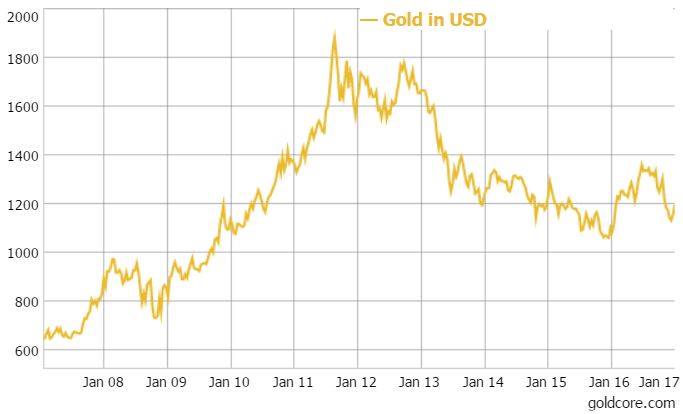
We have long stated that we believe gold will reach a record inflation adjusted high over $2,500/oz and we see that as likely during the first four years of the Trump Presidency.
However, gold’s primary function is as a diversification, financial insurance and a hedge against geo-political, systemic and of course monetary risks – all of which abound as we head into the Trump years.
END
An excellent commentary on how the BIS is controlling the price of gold through swaps
(courtesy Robert lambourne/London’s Financial Times)
Gold swaps by BIS exploded in 2016 from nothing to record level
Submitted by cpowell on Thu, 2017-01-12 16:11. Section: Daily Dispatches
By Robert Lambourne
Thursday, January 12, 2017
Disclosures in the monthly statements of account published by the Bank for International Settlements since March 2016 indicate that in the last nine months of 2016 the bank increased substantially its use of gold swaps.
There is not enough information in the monthly reports to calculate the exact amount of swaps, but based on the information in the BIS’ December 2016 statement of account, the bank’s gold swaps likely stood in excess of 480 tonnes as of the end of the calendar year.
This is the BIS’ highest level of gold swaps recorded in recent times.
The BIS’ annual report for its financial year ended March 31, 2010, disclosed that 346 tonnes of gold were acquired through gold swaps from commercial bullion banks. A review of the previous use of gold derivatives by the BIS reveals that the transactions in 2009-10 were far more substantial than anything done by the bank in the years immediately leading up to that.
the use of gold swaps by the BIS increased in the financial year ended March 31, 2011, with 409 tonnes of gold swaps reported. As this chart will show, that was the peak amount reported by the bank prior to this year:
March 2011: 409 tonnes.
March 2012: 355 tonnes.
March 2013: 404 tonnes.
March 2014: 236 tonnes.
March 2015: 47 tonnes.
March 2016: 0 tonnes.
As the table shows, the use of gold swaps by the BIS fell considerably up to March 2016, when the use of swaps appeared to have stopped.
The BIS offers no explanation for its renewed use of gold swaps in its interim financial statements for the 2016-17 financial year, which were published on November 7, 2016. By contrast, back in 2010 the BIS discussed its gold swaps with the Financial Times in an article published on July 29 that year. BIS General Manager Jaime Caruana said the gold swaps were “regular commercial activities” for the bank:
http://www.ft.com/cms/s/0/3e659ed0-9b39-11df-baaf-00144feab49a.html
Here are excerpts from the article:
“Some analysts speculated that the swap deals were a surreptitious bailout of the European banking system ahead of last week’s publication of stress tests. But bankers and officials have described the transactions as ‘mutually beneficial.’ …
“‘The client approached us with the idea of buying some gold with the option to sell it back,’ said one European banker, referring to the BIS.
“Another banker said: ‘From time to time central banks or the BIS want to optimize the return on their currency holdings.'”
It is notable that none of these comments in the FT article focused on the gold market itself but implicitly accepted that gold was being used as collateral to support dollar loans to commercial banks.
An alternative explanation — that the swap transactions were initiated by the BIS to place more unallocated gold in the hands of certain central banks — seemed plausible, since the gold market was tight at the time.
Perhaps not conicidentally, the BIS has renewed its use of gold swaps just when many commentators consider gold market conditions to be tight again, as they were in 2010 and 2011.
—-
Robert Lambourne is a business executive in the United Kingdom and a GATA consultant.
* * *
END
We all agree that the physical price of gold will eventually defeat the paper price
(courtesy John Hathaway/Tocquille gold funds)
Real metal will defeat paper gold someday, Hathaway writes contentedly
Submitted by cpowell on Thu, 2017-01-12 17:36. Section: Daily Dispatches
12:34p ET Thursday, January 12, 2017
Dear Friend of GATA and Gold:
In his market letter this month. Tocqueville Gold Fund manager John Hathaway says the physical gold market will defeat the paper gold market someday, leading to a much higher price for the monetary metal.
Can the gold investment industry do anything to hasten the day, or should the industry remain content to collect fees and commissions all the way to the supposed inevitability, even though by then most of its investors may be dead?
Hathaway offers no suggestions but does seem content. His letter is posted at the Tocqueville internet site here:
http://tocqueville.com/insights/gold-strategy-investor-letter-4Q16
CHRIS POWELL, Secretary/Treasurer
Gold Anti-Trust Action Committee Inc.
CPowell@GATA.org
END
Your early FRIDAY morning currency, Asian stock market results, important USA/Asian currency crosses, gold/silver pricing overnight along with the price of oil Major stories overnight
1 Chinese yuan vs USA dollar/yuan DOWN to 6.9004(SMALL DEVALUATION SOUTHBOUND /CHINA UNHAPPY TODAY CONCERNING USA DOLLAR RISE/MORE $ USA DOLLARS LEAVE CHINA/OFFSHORE YUAN NARROWS COMPLETELY TO 6.8407 / Shanghai bourse CLOSED DOWN 6.52 POINTS OR 0.21% / HANG SANG CLOSED UP 108.36 OR 0.47%
2. Nikkei closed UP 152.58 POINTS OR 0.80% /USA: YEN RISES TO 114.40
3. Europe stocks opened ALL IN THE GREEN ( /USA dollar index RISES TO 101.19/Euro UP to 1.0651
3b Japan 10 year bond yield: RISES TO +.05%/ !!!!(Japan buying 100% of bond issuance)/Japanese yen vs usa cross now at 114.40/ THIS IS TROUBLESOME AS BANK OF JAPAN IS RUNNING OUT OF BONDS TO BUY./JAPAN 10 YR YIELD FINALLY IN THE POSITIVE/BANK OF JAPAN LOSING CONTROL OF THEIR YIELD CURVE AS THEY PURCHASE ALL BONDS TO GET TO ZERO RATE!!
3c Nikkei now JUST BELOW 17,000
3d USA/Yen rate now well below the important 120 barrier this morning
3e WTI:: 52.61 and Brent: 55.65
3f Gold UP/Yen UP
3g Japan is to buy the equivalent of 108 billion uSA dollars worth of bond per month or $1.3 trillion. Japan’s GDP equals 5 trillion usa./“HELICOPTER MONEY” OFF THE TABLE FOR NOW /REVERSE OPERATION TWIST ON THE BONDS: PURCHASE OF LONG BONDS AND SELLING THE SHORT END
Japan to buy 100% of all new Japanese debt and by 2018 they will have 25% of all Japanese debt. Fifty percent of Japanese budget financed with debt.
3h Oil DOWN for WTI and DOWN for Brent this morning
3i European bond buying continues to push yields lower on all fronts in the EMU. German 10yr bund FALLS TO +.307%/Italian 10 yr bond yield DOWN to 1.884%
3j Greek 10 year bond yield FALLS to : 6.96%
3k Gold at $1199.20/silver $16.78(8:15 am est) SILVER BELOW RESISTANCE AT $18.50
3l USA vs Russian rouble; (Russian rouble UP 46/100 in roubles/dollar) 59.30-
3m oil into the 52 dollar handle for WTI and 55 handle for Brent/
3n Higher foreign deposits out of China sees huge risk of outflows and a currency depreciation (already upon us). This can spell financial disaster for the rest of the world/China forced to do QE!! as it lowers its yuan value to the dollar/GOT a SMALL DEVALUATION DOWNWARD from POBC.
JAPAN ON JAN 29.2016 INITIATES NIRP. THIS MORNING THEY SIGNAL THEY MAY END NIRP. TODAY THE USA/YEN TRADES TO 114.40 DESTROYING JAPANESE CITIZENS WITH HIGHER FOOD INFLATION
30 SNB (Swiss National Bank) still intervening again in the markets driving down the SF. It is not working: USA/SF this morning 1.0067 as the Swiss Franc is still rising against most currencies. Euro vs SF is 1.0725 well above the floor set by the Swiss Finance Minister. Thomas Jordan, chief of the Swiss National Bank continues to purchase euros trying to lower value of the Swiss Franc.
3p BRITAIN VOTES AFFIRMATIVE BREXIT
3r the 10 Year German bund now POSITIVE territory with the 10 year FALLS to +.305%
3s The Greece ELA NOW at 71.4 billion euros,AND NOW THE ECB WILL ACCEPT GREEK BONDS (WHAT A DISASTER)
The bank withdrawals were causing massive hardship to the Greek bank. the Greek referendum voted overwhelming “NO”. Next step for Greece will be the recapitalization of the banks and that will be difficult.
4. USA 10 year treasury bond at 2.343% early this morning. Thirty year rate at 2.940% /POLICY ERROR)GETTING DANGEROUSLY HIGH
5. Details Ransquawk, Bloomberg, Deutsche bank/Jim Reid.
(courtesy Jim Reid/Bloomberg/Deutsche bank/zero hedge)
Futures Rise On Friday 13th Ahead Of Deluge Of Bank Earnings; Dollar Continues To Decline
European shares rose as Fiat rebounded on hopes concerns about parallel to Volkswagen are overblown, Asian stocks were little as Chinese shares fell to the lowest level of 2017 after poor export data, and U.S. equity-index futures rose ahead of a deluge of bank earnings. The dollar is headed for a weekly loss and gold trades at the highest price in almost two months.
On this supposedly unlucky day it’s US bank earnings that are going to be a big attraction with JPM, Wells Fargo and BofA reporting all prior to or at the open. As DB notes overnight, after the Trump trades disappointment this week – which continued yesterday – this will likely impact the overall direction of markets.
The focus this morning however has been the gloomy December trade numbers out of China which were released overnight. In US Dollar terms exports dropped -6.1% yoy in December which is a fair bit more than expected (-4.0% consensus) and also down from -1.6% in the month prior. At the same time imports shrunk to +3.1% yoy (vs. +3.0% expected) from +4.7% and so had the effect of reducing the surplus. A weaker yuan did help to cushion the fall in exports in local currency terms (+0.6% yoy vs. -0.1% expected). The trade surplus was $40.82 billion for December, versus November’s $44.61 billion.

On an annual basis, 2016 exports fell 7.7% and imports down 5.5% . The export drop was the second annual decline in a row and the worst since the depths of the global crisis in 2009. It will be tough for foreign trade to improve this year, especially if the inauguration of Trump and other major political changes limit the growth of China’s exports due to greater protectionist measures, the country’s customs agency said on Friday. It will be tough for foreign trade to improve this year, especially if the inauguration of Trump and other major political changes limit the growth of China’s exports due to greater protectionist measures, the country’s customs agency said on Friday. China’s trade surplus with the United States was $366 billion in 2015, according to U.S. customs data, which Trump could seize on in a bid to bring Beijing to the negotiating table to press for concessions, economists at Bank of America Merrill Lynch said in a recent research note.
“The trend of anti-globalization is becoming increasingly evident, and China is the biggest victim of this trend,” customs spokesman Huang Songping told reporters. “We will pay close attention to foreign trade policy after Trump is inaugurated president,” Huang said. Trump will be sworn in on Jan. 20.
As we have said for years, central bankers can print everything except trade, and that particular omission is starting to become particularly felt in a world which has grown so reliant on globally interconnected supply chains and logistics.
Meanwhile in capital markets, the dollar headed for a weekly loss and gold traded at the highest price in almost two months as investors were concerned that market moves since the U.S. election have gone too far. European stocks and U.S. equity futures climbed and Chinese shares fell after data on exports. The USD was fractionally lower after touching the lowest point in almost a month on Thursday.

The Stoxx Euro 600 Index rebounded from its biggest drop since the end of November as Federal Reserve Chair Janet Yellen reiterated that the U.S. economy is doing well. The Shanghai Composite Index fell to its lowest level of the year, while the Shenzhen Composite slide to the lowest level in 5 months after a crackdown on insurers and as trade data showed China’s overseas shipments remain subdued.
In a week characterized by a reversal in many of the market moves seen since Donald Trump’s election, Friday will see the release of a report on U.S. holiday-season retail sales as well as earnings from Bank of America Corp., JPMorgan Chase & Co., and Wells Fargo & Co. Since Trump’s victory. The scheduled of financial earnings this morning is as follows:
- BlackRock (BLK) 6:30am, Exp. $5.02
- Bank of America (BAC) 6:45am, Exp. $0.38
- PNC Financial Services (PNC) 6:45am, Exp. $1.85
- First Republic Bank (FRC) 8am, Exp. $1.03
- JPMorgan Chase & Co (JPM) 8am, Exp. $1.43
- Wells Fargo & Co (WFC) 8am, Exp. $1.00
“The banking sector will be the major focus,” said Naeem Aslam, chief market analyst at Think Markets UK. “With rising interest rates and hopes of more friendly regulation, the shares of these banks have a lot of upside in the coming days.”
Overnight, in a town hall meeting, Janet Yellen said that the U.S. economy is doing well, with inflation now pretty close to the Fed’s 2 percent target. The central bank should begin discussing how to shrink its bloated balance sheet this year, according to three regional Fed presidents who stepped up pressure for a debate on when to unwind emergency-era measures that the Fed preferred to postpone.
A snapshot of markets reveals that the Stoxx Europe 600 Index climbed 0.6 percent at 10:55 a.m. London time, rebounding from a 0.7 percent drop on Thursday. Automakers rose 0.4 percent after tumbling the most since July following U.S. government accusations that Fiat Chrysler Automobiles NV violated pollution laws. Health-care shares rose for the first time in three days after sliding on concern over price pressures under Trump.
The Shanghai Composite Index slid 0.2% in a fourth day of losses, the longest run since October. Overseas shipments dropped 6.1 percent from a year ago in December, China’s customs administration said.
Futures on the S&P 500 Index added 0.2%, on course to erase Thursday’s decline.
In rates, the benchmark 10-year Treasury yield fell one basis point to 2.35 percent, after touching the lowest level since Nov. 30 on Thursday. Bonds fell across Europe, with the yield on U.K. 10-year Gilts climbing two basis points to 1.32 percent and the yield on similar-maturity Greek debt climbing four basis point to 6.8 percent. The symbiotic dance between the dollar and U.S. Treasury bond yields held firm on Friday. Both headed lower to end a week in which has seen the dollar fall almost 1 percent and yields extend their longest downturn since last summer.
“Bond markets continue to retrace from the yield highs set in the middle of last month,” RBC Capital markets rates strategists wrote in a note to clients on Friday. “The latest move (is) seen as a typical ‘buy-the-rumor-sell-the-fact’ reaction as Donald Trump’s pre-inauguration press conference proved to be a disappointment in terms of forthcoming growth boosting policies,” they said.
* * *
Market Snapshot
- S&P 500 futures up 0.2% to 2268
- Stoxx 600 up 0.5% to 364
- FTSE 100 up 0.4% to 7323
- DAX up 0.5% to 11575
- German 10Yr yield up less than 1bp to 0.32%
- Italian 10Yr yield up 2bps to 1.91%
- Spanish 10Yr yield up 2bps to 1.42%
- S&P GSCI Index down less than 0.1% to 400.3
- MSCI Asia Pacific up less than 0.1% to 141
- Nikkei 225 up 0.8% to 19287
- Hang Seng up 0.5% to 22937
- Shanghai Composite down 0.2% to 3113
- S&P/ASX 200 down 0.8% to 5721
- US 10-yr yield down 1bp to 2.35%
- Dollar Index down 0.2% to 101.15
- WTI Crude futures down 0.4% to $52.79
- Brent Futures down 0.4% to $55.80
- Gold spot up 0.2% to $1,198
- Silver spot up 0.1% to $16.80
Top News
- Boeing Wins $22 billion order from Indian carrier SpiceJet: order for 205 aircraft includes purchase rights for 50
- Yellen Sees No Serious Short-Term Obstacles for U.S. Economy: says inflation “pretty close” to Fed’s 2% target, doesn’t want to see banking regulations rolled back
- AltaGas, WGL Said to Hold Talks on Merger Topping $5 Billion: WGL was said to be weighing a sale after Iberdrola interest; cos. supply natural gas to customers in North America
- Anadarko Sells Eagle Ford Assets to Focus on Permian, Rockies: Sanchez, Blackstone pay $2.3b for properties in Texas; deal to help Anadarko boost investment in Delaware Basin
- Fiat Rises as Investors Question VW Parallels in Cheating Charge: EPA says Fiat Chrysler used illegal software in 104,000 autos
- Paris Prosecutors Open Probe Into Renault Diesel Emissions
- Mnuchin Start Date Looks Iffy as Congress Scours Wall St. Past: Senate panel to provide seven-day notice for Mnuchin hearing
- KKR to Buy Hitachi Koki for $1.3 Billion as Group Sheds Unit: Japanese conglomerate selling non-core units as it reorganizes
- Pandora Media Rallies as Results Top Estimates, 7% Cut in Jobs Set: the world’s largest online radio service said 4Q results exceeded its forecast; co. eliminating jobs to boost efficiency
- Sirius Chairman Said to Say Still Keen on Buying Pandora: NYP
- Hon Hai, Sharp Considering LCD Plant in the U.S.: Nikkei
- Coty May Eliminate Up to 210 Jobs in Switzerland: Bilan
Looking at regional markets, Asia stocks traded mixed following a negative lead from the US as participants continued to digest Trump’s first press conference as President-elect. Nikkei 225 (+0.8%) outperformed to recoup some of yesterday’s losses, as JPY-crosses saw upside higher with USD/JPY testing 115.00 to the upside, before dipping to the mid-114 range. ASX 200 (-0.8%) suffered amid underperformance in financials after some less hawkish comments from Fed’s Bullard and Lockhart, as they indicated they are more in favour of less than 3 US rate hikes this year. Shanghai Comp (+0.2%) initially suffered from a reduced liquidity operation by the PBoC and uninspiring Chinese trade data, while Hang Seng (+0.4%) was lifted by energy names as oil markets rallied yesterday and also benefited from several Property names reporting positive earnings as well as. 10yr JGBs traded lower amid the risk-on tone in Japan and a disappointing auction for enhanced liquidity, while the curve flattened due to underperformance in the short end.
Top Asia News
- PBOC Said to Boost Yuan Curbs as Banks Told to Balance Flows: lenders to stop transactions unless inflows match outflows
- Takata Said Near $1 Billion Air-Bag Settlement With U.S.: may announce a settlement as soon as Friday
- Nintendo Switch Off to Wobbly Start as Pricing, Timing Unveiled: Price of around $300 more than anticipated, higher than rivals
- Vietnam Recalibrates as Trump and Duterte Upset Strategy: setbacks include TPP trade deal, South China Sea disputes
- Chinese Paper Calls Tillerson’s South Sea Threat ‘Foolish’: editorials offer more pointed response than government
European equities trade in the green (Euro Stoxx 50: +0.8%), with the move higher fuelled by Fiat Chrysler, who trade higher by 3%, with other Auto names initially trading higher in tandem before separate reports suggest the French prosecutor is looking into Renault’s (-4.2%) role in the emission scandal. The FTSE MIB is the best performing index in the wake of Fiat’s denial, while financials also outperform this morning ahead of a number of high profile US earnings including Wells Fargo, JP Morgan and Bank of America. Fixed income markets have seen the front end of core EGB markets slipping in yields as today is the first time the ECB are able to purchase securities with a yield below the -0.4% deposit rate, with the longer end suffering. Elsewhere, focus looks ahead to DBRS review of Italian sovereign debt after the close today, with some pricing in a downgrade already given the current state of Italian banks. If DBRS were to downgrade Italy, this could have a significant impact on the size of Italian collateral and could see significant flattening of the BTP curve.
Top European News
- VW Pulled Out of Daimler Deal Before Embarking on Diesel Cheat: alliance talks involved discussions of cross shareholdings
- French M&A Fund Bets on Successful Deal in Syngenta Takeover: shares trade at 14% discount to ChemChina takeover offer
- Patek Philippe Chairman Tells Swiss Watch Industry to Slow Down: signs of revival after two years of job cuts on China slowing
- Bang & Olufsen Soars as Profits Are Buoyed by New $11,500 TVs: shares soar to highest level in more than six years after earnings that showed it’s getting better at squeezing profit out of its sales
In currencies, the Bloomberg Dollar Spot Index lost 0.1 percent after falling 0.5 percent on Thursday. The gauge is down 0.7 percent for the week. Turkey’s lira slipped 0.9 percent after surging 2.8 percent against the dollar on Thursday. The currency is down 4.2 percent this week after touching the lowest point on record. The central bank is implementing measures to force banks to borrow at a higher rate, according to a person with direct knowledge of the matter. The offshore yuan extended gains for a third day. China has asked some banks to stop processing cross-border yuan payments until they balance inflows and outflows, people familiar with the matter said, as authorities step up a campaign to curb a record amount of money leaving the nation in the local currency. The yen traded at 114.60, taking the week’s gain to 2.1 percent, the best performance since the end of July.
In commodities, the diesel emissions scandal has been reignited and further fuelled by the possible involvement of Renault, so the commodity market is perhaps looking to the palladium vs platinum relationship for reaction. Otherwise, focus will be on Gold over the session ahead, which sees the key US retail sales release impacting on the USD to some degree. Prices have dipped back under USD1200 in the meantime, but with room for further USD correction, fresh upside in the yellow metal still possible. Oil held near $53 a barrel were pretty stable after a mid-morning dip; WTI dropping 50-60 cents, but still comfortably away from the USD50.00 mark — bolstered by last year’s OPEC agreement on production – and after its biggest two-day gain in almost six weeks as Saudi Arabia said it cut output even more than required by an OPEC deal.
Looking at the day ahead, the highlight is likely the December retail sales report where the market consensus for headline sales is running at +0.7% mom, while the core is expected to come in at +0.4% mom. Also due out is the December PPI report where the consensus there is for a +0.3% mom rise in the headline. Business inventories for November and the preliminary University of Michigan consumer sentiment survey for this month follow later on. Meanwhile the Fed’s Harker is scheduled to speak again at 9.30pm ET. The other big focus is clearly those aforementioned US bank earnings reports.
* * *
US Event Calendar
- 8:30am: PPI Final Demand MoM, Dec., est. 0.3% (prior 0.4%)
- 8:30am: Retail Sales Advance MoM, Dec. est. 0.7% (prior 0.1%)
- 9:30am: Fed’s Harker Speaks on Economic Mobility in Philadelphia
- 10am: Business Inventories, Nov., est. 0.6% (prior -0.2%)
- 10am: U. of Mich. Sentiment, Jan. P, est. 98.5 (prior 98.2)
- 1pm: Baker Hughes rig count
Bank Earnings:
- BlackRock (BLK) 6:30am, $5.02
- First Horizon National (FHN) 6:37am, $0.25
- Bank of America (BAC) 6:45am, $0.38
- PNC Financial Services (PNC) 6:45am, $1.85
- First Republic Bank (FRC) 8am, $1.03
- JPMorgan Chase & Co (JPM) 8am, $1.43
- Wells Fargo & Co (WFC) 8am, $1.00
DB’s Jim reid concludes the overnight wrap
On this supposedly unlucky day it’s US bank earnings that are going to be a big attraction with JPM, Wells Fargo and BofA reporting all prior to or at the open. After the Trump trades disappointment this week – which continued yesterday – this will likely impact the overall direction of markets. The remainder of the US banks will report next week while the corporate calendar will also kick into gear which may all be a welcome distraction. In addition we also got an announcement yesterday that UK PM Theresa May will detail some of her Brexit plans at a long-awaited speech next Tuesday, so that should be something to look forward to as well. The focus this morning however has been the December trade numbers out of China which were released a few hours ago. In US Dollar terms exports dropped -6.1% yoy in December which is a fair bit more than expected (-4.0% consensus) and also down from -1.6% in the month prior. At the same time imports shrunk to +3.1% yoy (vs. +3.0% expected) from +4.7% and so had the effect of reducing the surplus. A weaker yuan did help to cushion the fall in exports in local currency terms (+0.6% yoy vs. -0.1% expected).
Equity markets in China were initially weaker following the data but have since recovered with the Shanghai Comp currently +0.12%. The Nikkei (+0.85%) has rebounded while the Hang Seng is also +0.45% although there’s losses currently for the Kospi (-0.51%) and ASX (-0.95%). The other focus overnight has been on comments from Fed Chair Yellen. She was largely positive, saying that “unemployment has now reached a low level, the labour market is generally strong and wage growth is beginning to pick”. The Fed Chair also said that Dodd- Frank bank regulation made “important changes” and that she would not want to see it “rolled back”. There were no comments made around policy outlook.
Back to yesterday. Perhaps the most interesting story to emerge was the balance sheet unwinding comments to come out of the Fed. Some of it came from Philadelphia Fed President Patrick Harker who said that the Fed can start considering stopping balance sheet reinvestment and later start unwinding the balance sheet when the Fed funds rate gets to 100bps. In addition, St Louis Fed President James Bullard said that the “committee may be in a better position to allow reinvestment to end or to otherwise reduce the size of the balance sheet”. So if you share the FOMC median 3 rate hikes this year view then this could be a 2017 story although in reality the Fed talk probably won’t get serious until the Fed funds rate gets to 100bps. You’d imagine that this debate will also be greatly influenced by political pressures but it’s certainly one to keep an eye on.
Speaking of tapering, the ECB minutes of the December meeting were released yesterday. The text suggested that there was a fair bit of debate and differing views amongst policy members. Indeed the debate was over continuing at the €80bn pace for an additional six months or extending the programme for nine months at a €60bn pace – which the Bank eventually settled on. It was revealed that a “few members voiced an initial preference for the first option….while expressing readiness to join a consensus forming on the second option”. At the same time while the text also revealed that “very broad support emerged among members” for the second option, there were “arguments also put forward in support of a shorter purchase horizon, namely limited to six months, at a rescaled pace of purchases of €60bn”. Some members “could not support either of the two options….in view of their well known general scepticism regarding APP and public debt purchases in particular”. On a related noted, German Finance Minister Wolfgang Schaeuble also said yesterday that the ECB should start unwinding its ultra-loose monetary policy this year.
Moving on. In terms of markets and as highlighted earlier, it was another day of generally unwinding Trump trades following the disappointment at the lack of substance in his press conference. The big mover gain was the Greenback with the Dollar index falling -0.37% to take it to -1.51% since Trump spoke on Wednesday although it has recovered modestly this morning. Emerging markets were the big beneficiaries of yesterday’s weakness with currencies in Turkey (+2.82%), South Africa (+1.79%), Colombia (+1.78%) and Chile (+1.26%) in particular standing out. EM equities (+1.12%) also had a decent day. Equity markets were weaker across the pond although in fairness did recover a bit into the close. The S&P 500 finished -0.21% after being down as much -0.93% while the Nasdaq Biotech index recovered similarly to finish +0.36% following that sell off on Wednesday. Markets in Europe did however come under more pressure however with the Stoxx 600 closing -0.65% although the FTSE 100 (+0.03%) managed to eke out a positive return and in doing so capped a fairly incredibly 13th consecutive daily gain – extending the record streak.
There was a bit of corporate news too to digest. Fiat Chrysler shares fell steeply after the automaker became the latest to be accused by the EPA of violating pollution laws on diesel vehicles. According to the FT the group could face a fine of as much as $4.6bn. Meanwhile Amazon announced that they are to add 100k full time jobs in the US over the next 18 months which will likely put them in Trump’s good books ahead of his inauguration. There was, however, plenty of focus on the fact that the hires could come at the expense of the bricks and mortar retailers in the US.
Elsewhere, in rates 10y Treasury yields touched an intraday low of 2.305% yesterday which is the lowest yield since the end of November, before paring much of that into the close to finish only a shade lower on the day at 2.363%. Sovereign bond markets in Europe also ended up on the firmer side (10y Bund yields falling 1.4bps to 0.307%). In the commodity complex Oil got another boost after Saudi Arabia announced that it had cut production even more than required by the OPEC deal. WTI edged back up to $53/bbl (+1.45%) after hitting as low as $50.71/bbl earlier in the week. Gold (+0.32%) also continued its urge to take the YTD move past +4% already.
Before we wrap up, there wasn’t a huge amount to take away from yesterday’s economic data. In the US a boost from higher energy prices saw the import price index rise +0.4% mom in December and so putting the YoY rate at +1.8% which is the highest since March 2012. Initial jobless claims came in at 247k last week which is up from the very low 237k reading the week prior. Finally the December monthly budget statement revealed a slightly wider than expected $27.5bn deficit. Meanwhile in Germany we learned that Germany’s economy grew 1.9% in calendar year 2016 which is a little bit more than what the consensus expected (of 1.8%). Our economists in Europe noted that growth was strongly tilted towards consumption thanks to several tail winds (refugee crisis, low inflation, labour market strength), while slowing exports weighed on private equipment investment. They also note however that with several tail winds fading and a workday effect weighing, GDP growth looks set to slow in 2017 to 1.1%. In other news, Euro area industrial production was confirmed as rising a much better than expected +1.5% mom in November (vs. +0.6% mom expected).
Looking at the day ahead, this morning in Europe it’s particularly quiet with no significant data due out although expect there to be some focus on the BoE’s credit conditions and bank liabilities survey, due out at 9.30am GMT. This afternoon in the US the calendar is a fair bit busier however. The highlight is likely the December retail sales report where the market consensus for headline sales is running at +0.7% mom, while the core is expected to come in at +0.4% mom. Also due out is the December PPI report where the consensus there is for a +0.3% mom rise in the headline. Business inventories for November and the preliminary University of Michigan consumer sentiment survey for this month follow later on. Meanwhile the Fed’s Harker is scheduled to speak again at 2.30pm GMT. The other big focus is clearly those aforementioned US bank earnings reports.
END
i)Late THURSDAY night/FRIDAY morning: Shanghai closed DOWN 6.52 POINTS OR 0.21%/ /Hang Sang closed UP 108.36 OR 0.47%. The Nikkei closed UP 152.58 POINTS OR 0.80% /Australia’s all ordinaires CLOSED DOWN 0.77%/Chinese yuan (ONSHORE) closed DOWN at 6.9002/Oil FELL to 52.61 dollars per barrel for WTI and 55.65 for Brent. Stocks in Europe: MOSTLY IN THE GREEN. Offshore yuan trades 6.8407 yuan to the dollar vs 6.9004 for onshore yuan.THE SPREAD BETWEEN ONSHORE AND OFFSHORE COMPLETELY NARROWS AGAIN AS DOLLARS STOP LEAVING CHINA’S SHORES /
3a)THAILAND/SOUTH KOREA/:
none today
b) REPORT ON JAPAN
c) REPORT ON CHINA
China reacts to Tillerson’s “disastrous” policy towards China’s pushing the envelop with respect to the South China’s seas. Chinese officials see a huge devastating confrontation on the issue:
(courtesy zero hedge)
China Daily: Tillerson’s “Disastrous” Actions Would Set The Course For A “Devastating Confrontation”
We were surprised by how contained China was this morning after yesterday’s confirmation hearing of Rex Tillerson, in which the former Exxon CEO said that a failure to respond to China had allowed it to “keep pushing the envelope” in the South China Sea and added that “we’re going to have to send China a clear signal that first the island-building stops and second your access to those islands is also not going to be allowed” and that putting military assets on those islands was “akin to Russia’s taking Crimea” from Ukraine.”
Traditionally such a direct threat would be i) perceived as very undiplomatic and ii) prompt an immediate, and angry rebuke from Beijing, with China immediately shifting to the offensive.
“This is the sort of off-the-cuff remark akin to a tweet that pours fuel on the fire and maybe makes things worse,” Malcolm Davis, a senior analyst at the Australian Strategic Policy Institute in Canberra told Bloomberg. “Short of going to war with China, there is nothing the Americans can do.”

But not today: during his press conference earlier today, Foreign Ministry spokesman Lu Kang could barely muster the will to sound defensive, saying China has been acting within the limits of its sovereignty. “Like the U.S., China has the right within its own territory to carry out normal activities,” he said at a regular briefing in Beijing. When asked repeatedly about Tillerson’s comments on blocking access to islands, China’s foreign ministry spokesman said he couldn’t make any guesses as to what Tillerson was referring to and would not answer hypothetical questions, Reuters reported.
As it turns out, China may not have had time to digest what Tillerson said. After all his South China sea remark was toward the end of his nearly all day long hearing, and so many local media outlets may have simply missed it. However, they caught up today, and first China Daily, then its nationalist tabloid, the Global Times took turns to first mock, then attack Tillerson.
Here is the gist of the China Daily op-ed published earlier today: according to the Chinese daily mouthpiece, not only were Tillerson’s views “divergent from, even contrary to, those of Trump on some critical issues. He openly conceded he is yet to have a serious, in-depth discussion with Trump on foreign policy imperatives. These boil down to one simple point – his remarks at the Wednesday hearing, sensational as they were, turned out to be of little reference value except for judging his personal orientations.”
Yet while China realizes that Tillerson’s bluster was intended for a specific audience, that does not make it any happier:
The backlash that has ensued is understandable. It is certainly no small matter for a man intended to be the US diplomat in chief to display such undisguised animosity toward China. Tillerson labeled China’s reclamation projects in the South China Sea as “an illegal taking of disputed areas without regard for international norms,” in obvious disregard of the essential truth that all those activities took place well within the country’s persistent, historical territorial claims.
Blaming the “extremely worrisome” state of affairs in the South China Sea on an “inadequate US response”, the US secretary of state nominee even claimed China’s access to those islands should “not to be allowed”. Which sounded intimidating; though he stopped short of elaborating how to achieve it. And like Trump, he blamed Beijing for “not being a reliable partner” in dealing with the Democratic People’s Republic of Korea.
And then, the not so subtle threats followed:
Such remarks are not worth taking seriously because they are a mish-mash of naivety, shortsightedness, worn-out prejudices, and unrealistic political fantasies. Should he act on them in the real world, it would be disastrous.
As many have observed, it would set a course for devastating confrontation between China and the US. After all, how can the US deny China access to its own territories without inviting the latter’s legitimate, defensive responses?
Finally, the mocking of Tillerson as a clueless former company exec who does not have the faintest understanding of diplomacy: “Tillerson wanted a reality-based China policy that is “based on what we see and not based on what we hope”. But what he presented was based more on what prejudice and arms-spurred self-righteousness make him believe and hope than on real-world realities. What happened on Wednesday shows that if and when confirmed, Rex Tillerson needs to first acquaint himself with the ABCs of China-US relations and diplomacy at large.”
The Global Times approach was almost verbatim. First, the justification of Tillerson’s “bluster”:
It is suspected that he merely wanted to curry favor from senators and increase his chances of being confirmed by intentionally showing a tough stance toward China.
Tillerson did not give details of how he would achieve his self-proclaimed goals. Nonetheless, he also mentioned that Chinese and American economic interests are deeply intertwined and that “China has been a valuable ally in curtailing elements of radical Islam.” He noted that “We should not let disagreements over other issues exclude areas for productive partnership.”
Motives aside, the GT then explained that China no longer views itself as America’s subordinate:
China has enough determination and strength to make sure that his rabble rousing will not succeed. Unless Washington plans to wage a large-scale war in the South China Sea, any other approaches to prevent Chinese access to the islands will be foolish. The US has no absolute power to dominate the South China Sea.
Following this, just like in the case of China Daily, there was the mocking:
Tillerson had better bone up on nuclear power strategies if he wants to force a big nuclear power to withdraw from its own territories. Probably he just has oil prices and currency rates in his mind as former ExxonMobil CEO.
Next, the not so thinly veiled threat – again – aimed not so much at Tillerson but at Trump:
As Trump has yet to be sworn in, China has shown restraint whenever his team members expressed radical views. But the US should not be misled into thinking that Beijing will be fearful of their threats.
How does it all end according to China? Unless Trump’s diplomatic team changes course, the Times said “the two sides better prepare for a military clash.”
Tillerson’s statements regarding the islands in the South China Sea are far from professional. If Trump’s diplomatic team shapes future Sino-US ties as it is doing now, the two sides had better prepare for a military clash. South China Sea countries will accelerate their negotiations on a Code of Conduct. They have the ability to solve divergences by themselves without US interference.
And the conclusion:
Just as the Philippines and Vietnam are trying to warm their ties with China, Tillerson’s words cannot be more irritating. It is hoped that Tillerson will desire a productive partnership with China more and his harsh words are just coaxing the Senate Foreign Relations Committee. But no matter what, China will always respond to various US diplomatic maneuvers.
As a reminder, all this has already happened and Trump isn’t president yet. We eagerly look forward to the president-elect’s next steps vis-a-vis an increasingly angry CHina and vice versa.
4 EUROPEAN AFFAIRS
Oh no!! just one day after Fiat Chrysler gets nailed we now see France’s Renault get nailed for cheating on emissions’
FRANCE:Renault
(courtesy zerohedge)
Renault Shares Tumble After Anti-Fraud Authority Accusations Of “Cheating” On Emissions Tests
Update: Unsurprisingly, Renault has denied the charges, and claims it has had no official notification of the investigation…
Renault hasn’t been officially notified about the French diesel probe, a spokesman said by phone.
Renault isn’t using software to cheat on emissions, the spokesman said
* * *
Yesterday we sarcastically noted “they are all at it” when Fiat Chrysler was slammed by the EPA for emissions cheating, and now get further confirmation of the farce as The FT reports, French authorities have started a preliminary investigation into Renault amid suspicion the company may have “cheated” to conceal abnormal emissions of pollutants from some of its diesel engines.
The government commission’s report over the summer found that nitrogen oxide emissions for many Renault models went well beyond their official limit under “normal” driving conditions, by a factor of more than 10 in the case of some models.
Renault share tumbled on the headlines…

As The FT details, the decision, made on Thursday, comes after France’s independent anti-fraud authority referred the carmaker to state prosecutors in November, after completing its own investigation.
Three judges were appointed to lead the investigation, the Paris prosecutor said in a text message, into whether they “made merchandise dangerous for human health.”
Last year, three Renault sites in France were raided by authorities as part of a sprawling national investigation linked to the Volkswagen emissions scandal, sparking fears that the emission-rigging case was spreading across Europe.
The French government, which owns 20 per cent of Renault, and the carmaker has denied using software to cheat emission testing, saying its models “conformed to the laws and norms in each market where they are sold.”
END
Germany/Volkswagen:
Volkswagen upper management is telling its managers not to travel to the USA because of the threat of being nabbed for criminal fraud on the emissions scandal.
(courtesy zero hedge)
Volkswagen Tells Its Managers Not To Travel To The US
in the last days of the Obama administration, the outgoing president has taken on a surprising urgency in closing “open” cases of alleged fraud, if mostly involving foreign carmakers. Case in point, this week’s $4.3 billion settlement with Volkswagen to put the diesel emmisions scandal to rest, and yesterday’s unexpected accusation by the EPA that Fiat was likely engaging in a similar scheme to defraud the US government of its true emissions. The crackdown has led to various curious outcomes, the most surprising of which is that Volkswagen has warned its senior managers not to travel to the United States after six current and former managers were indicted for their role in the German carmaker’s diesel test-cheating scheme, according to Reuters.
The company agreed to pay $4.3 billion in civil and criminal fines in a settlement with the DoJ on Wednesday, the largest ever U.S. penalty levied on an automaker. However, Attorney General Loretta Lynch said the DoJ would continue to pursue “the individuals responsible for orchestrating this damaging conspiracy”.
As reported on Monday, one of the six charged, Oliver Schmidt, was arrested by the FBI at Miami International Airport on Saturday as he was about to fly home from holiday in Cuba. Schmidt, who is caught up in the “Dieselgate” investigation by the U.S. Department of Justice (DoJ), was ordered to be charged and held without bail on Thursday pending trial.
While the biggest German carmaker agreed to pay $4.3 billion in civil and criminal fines in a settlement with the DoJ on Wednesday, the largest ever U.S. penalty levied on an automaker, Attorney General Loretta Lynch said the DoJ would continue to pursue “the individuals responsible for orchestrating this damaging conspiracy”.
Hence, guilty until proven innocent. Incidentally similar “advice” was given to Swiss bankers in the years following Obama’s crackdown on Swiss banking secrecy, when all local bankers could be arrested on sight if they attempted to enter the US.
Which also explains the travel ban: under German’s constituion, citizens can be extradited only to other European Union countries or to an international court. But leaving Germany at all could pose a risk of being extradited to the United States from a third country. “Several Volkswagen managers have been advised not to travel to the United States,” one legal adviser to Volkswagen said on condition of anonymity because the matter is confidential.
A second legal adviser said this also applied to managers who had not yet been charged with any offense in the United States. “One doesn’t need to test the limits,” the adviser said.
Schmidt was among those who had been warned by lawyers working for the company not to travel to the United States, one of the legal sources said.
Meanwhile, the German Federal Criminal Police Office said it was not aware of any request to extradite the other five indicted VW managers.
Confirming that the German carmaker, which exmploys more than 600,000 workers, is taking the advice seriously, Reuters reports that only one board member traveled to this week’s auto show in Detroit: VW passenger car brand chief Herbert Diess, who joined Volkswagen in July 2015, just two-and-a-half months before the VW’s decade-long deception of U.S. authorities became public.
A senior manager at the VW brand who asked not to be named called Diess’s decision to travel to Detroit “bold” and said his peers had been given guidance not to leave Germany as the risk of impending U.S. charges rose – although he would not go so far as to call it a “travel warning”. He said colleagues knew after being questioned by Jones Day lawyers, who are carrying out an independent internal investigation into the emissions affair, whether they had something to fear in the United States, and may have used this to determine travel plans.
Charles Kuhn, a partner at criminal law firm Hickman & Rose, said people in such a position faced “a harsh choice – voluntarily hand themselves in, or never leave Germany without fear that an international arrest warrant will land them in US custody anyway”.
“It’s the kind of impossible decision that leaves people holed up in embassies for years,” he said. “It depends on the alleged offense, but it is sometimes better to face the music than to live in the shadow of the DoJ.”
It is unclear how treatment of non grata Volkswagen, and other employees, would go under Trump, who seems far less worried about EPA violations, but is certainly focused on foreign companies hiring American workers. We are confident that Volkswagen will be able to obtain travel leniency…. it just may cost it a factory in Detroit, or two.
END
Italy/Fiat:
Yesterday it was the EPA which announced that Fiat also engaged in criminal fraud by cheating on its emissions software. Now we see that the Dept of Justice is set to go on a criminal emissions probe
(courtesy zero hedge)
Fiat Tumbles (Again) As DOJ Prepares Criminal Emissions Probe
A day after the EPA announced their probe of Fiat Chrysler’s alleged “cheating” over diesel emissions tests, the company now faces criminal charges as the US department of Justice has joined the probe.
As Bloomberg reports, Fiat Chrysler is now also under investigation by the U.S. Justice Department over its alleged failure to disclose software that violated emissions standards, according to people familiar with the matter, another legal hurdle for a company already under criminal scrutiny for its sales practices.
The possibility of a criminal action over diesel emissions violations comes after the Environmental Protection Agency said on Thursday it found software in 104,000 Jeep Grand Cherokees and Ram 1500s that allowed the automaker to exceed pollution limits on the road.
The criminal investigation shows the U.S. is pressing ahead on cases of alleged efforts to rig emissions testing in the waning days of the Obama administration. It isn’t clear where the inquiry stands.
And the share price is fading back towards yesterday’s lows…

The U.S. investigation of Fiat Chrysler involves fewer vehicles than VW, said one of the people, who asked not to be named because the probe is confidential. The U.S. case against VW, which led to criminal charges and $4.3 billion in penalties earlier this week, centered on VW employees’ efforts to design a system that would evade U.S. environmental testing and then conspired to cover up its use when regulators began asking about it.
Fiat Chrysler’s Chief Executive Officer Sergio Marchionne said Thursday during a call with reporters the matter “has nothing to do” with VW. He said the software wasn’t intended to bypass emissions tests or operate differently in evaluation than in real-world use, calling such allegations “absolute nonsense.”
“We are confident that no one at FCA committed any fraud or tried not to be compliant,” Marchionne said. “We may be technically deficient but not immoral. We never installed any defeat device.”
Marchionne told the reporters he presumed the Justice Department was also investigating
END
Now Dunn and Bradstreet downgrades Italy. This is huge as more collateral will be necessary i.e. the ECB will demand for collateral for all of the bonds that it stores as swaps with hedge funds and the central bank of Italy
(courtesy zerohedge)
DBRS Downgrades Italy, Stripping It Of Its Last “A Rating” And Raising ECB Collateral Haircuts
When previewing the key events of the week, we noted that today Canadian DBRS rating agency is scheduled to review Italy’s credit rating after putting its credit worthiness on negative watch on 5 August. On 5 December, DBRS issued a press release declaring that they would wait for the impact of the Italian referendum result on the continuation of the reform push before making the final decision.
In case of a downgrade, the haircut for a 5y BTP used as collateral for ECB operations, as an example, would rise from 2% to 10%.
Moments ago DBRS did just that when it downgraded italy from A (low) to BBB (high), stripping the sovereign of its final A credit rating.

The rating agency cited “a deterioration in the “Monetary Policy and Financial Stability” and the “Political Environment” sections were the key factors in the downgrade. The Stable trend reflects DBRS’s view that Italy’s challenges are commensurate with the BBB (high) ratings and are balanced by the country’s strong commitment to fiscal consolidation and evidence of some, albeit very modest, economic recovery.”
It also warned that “if weaker political commitment to fiscal consolidation and the reform agenda or a significant downward revision to growth prospects were to materialize, further delaying a steady decline in the public debt-to-GDP ratio, this weakening could lead to a Negative trend.”
The new interim government, although supported to some extent by the same majority as the Renzi government, may have less room to make progress with growth-enhancing measures, as it was formed with the main aim of facilitating parliamentary discussion on the electoral law before political elections scheduled to be held in 2018. Furthermore, the risk of an early election remains, especially after a decision is made by the Constitutional Court on the electoral law, expected in late January 2017. This decision could affect the duration of Prime Minister Gentiloni’s cabinet. Political parties could immediately put more pressure for snap elections in the first half of 2017, using the electoral law produced by the decision of the Court. This pressure would be expected to capitalise on the result obtained in the referendum in December 2016.
However, there is also a lack of clarity over the timing of elections. DBRS considers that the next election is unlikely to be held before Autumn 2017, as the parliamentary discussions on the electoral law are likely to take time. DBRS also considers that the next electoral law is likely to have a higher proportional characteristic, increasing the chances of having a coalition government of mainstream parties and lowering the electoral chances of Euro-sceptic parties. Nevertheless, support for the opposition parties could increase if economic conditions were to not improve, especially for the young and the long-term unemployed.
According to a separate estimate from Rabobank, the haircut on Italian bonds imposed by the ECB would rise from 1.5% to 9%, and lenders would need to post €6.7 billion more in government debt to access the same levels of loans. Cited by the FT, Richard McGuire at Rabobanks said that this is not “a huge amount” but would be another unwanted headache for a banking system which lumbers under the biggest bad loan pile in the eurozone and which faces a key test under the EU’s bailout rules in the coming weeks.
Earlier today, S&P said it does not see any impact on its ratings on Italian banks, should credit rating agency DBRS downgrade Italy in its planned review, although should Italy’s borrowing costs jump as a result of the downgrade, it could lead to a feedback loop that ultimately does get the other rating agnecies involved.
We now look forward to the traditional Italian response, stating that all is well, and there is no reason to sell BTPs on the news.
Below is the full DBRS report.
DBRS Downgrades Italy to BBB (high), Stable Trend
DBRS Ratings Limited (DBRS) has today downgraded the Republic of Italy’s (Italy) Long-Term Foreign Currency – Issuer Rating and Long-Term Local Currency – Issuer Rating to BBB (high) with a Stable trend from A (low). At the same time, DBRS has confirmed the country’s Short-Term Foreign Currency – Issuer Rating and Short-Term Local Currency – Issuer Rating at R-1 (low) with a Stable Trend. This concludes the Under Review with Negative Implications for all ratings.
The rating action reflects a combination of factors including uncertainty over the political ability to sustain the structural reform effort and the continuing weakness in the banking system, amid a period of fragile growth. DBRS considers that, following the referendum rejecting constitutional changes that could have provided more government stability and the subsequent resignation of Prime Minister Renzi, the new interim government may have less room to pass additional measures, limiting the upside for economic prospects. Moreover, despite recent plans for banking support, the level of non-performing loans (NPLs) remains very high, affecting the banking sector’s ability to act as a financial intermediary to support the economy. In this context, low growth has resulted in lingering delays in the reduction of the very high public debt ratio, leaving the country more exposed to adverse shocks.
A deterioration in the “Monetary Policy and Financial Stability” and the “Political Environment” sections were the key factors in the downgrade. The Stable trend reflects DBRS’s view that Italy’s challenges are commensurate with the BBB (high) ratings and are balanced by the country’s strong commitment to fiscal consolidation and evidence of some, albeit very modest, economic recovery.
The new interim government, although supported to some extent by the same majority as the Renzi government, may have less room to make progress with growth-enhancing measures, as it was formed with the main aim of facilitating parliamentary discussion on the electoral law before political elections scheduled to be held in 2018. Furthermore, the risk of an early election remains, especially after a decision is made by the Constitutional Court on the electoral law, expected in late January 2017. This decision could affect the duration of Prime Minister Gentiloni’s cabinet. Political parties could immediately put more pressure for snap elections in the first half of 2017, using the electoral law produced by the decision of the Court. This pressure would be expected to capitalise on the result obtained in the referendum in December 2016.
However, there is also a lack of clarity over the timing of elections. DBRS considers that the next election is unlikely to be held before Autumn 2017, as the parliamentary discussions on the electoral law are likely to take time. DBRS also considers that the next electoral law is likely to have a higher proportional characteristic, increasing the chances of having a coalition government of mainstream parties and lowering the electoral chances of Euro-sceptic parties. Nevertheless, support for the opposition parties could increase if economic conditions were to not improve, especially for the young and the long-term unemployed.
Despite a slight decline in the stock of impaired assets since December 2015, uncertainty regarding the asset quality of the banking system continues to affect both investor appetite for bank capital and the ability of banks to act as a financial intermediary to support the economy via the credit channel. Although the Italian government has implemented several measures to facilitate the disposal of NPLs, these have so far had limited effectiveness and the weakness in the banking sector remains a factor in the rating. Moreover, while the decision to set up a Fund of EUR 20 billion (1.2% of GDP) to support ailing banks is a good start, it does not completely remove uncertainty about the vulnerability of the Italian banking system, nor does it clearly pave the way for a significant reduction in the high level of NPLs.
Over the last decade, Italy’s economic growth has been generally flat and lower than the euro area average. Growth potential remains weak. The need to improve growth performance is a fundamental challenge that affects the country’s ratings. Total factor productivity growth has been fragile and corporate profits have been weak. Feeble growth and weak competitiveness are likely the result of the low productivity of labour and capital, low employment rates and low investment in education and research & development.
The elevated level of public-debt-to-GDP continues to limit fiscal flexibility and hamper economic activity. Since 2008, government debt has continued to rise each year. In accordance with the Draft Budgetary Plan, the government projects a reduction of public debt in 2017, but following its decision to support banks, public debt could breach 133.0% of GDP instead of declining to 132.6%. This will likely further postpone the decline by one year to 2018. This high debt level makes the country more exposed to shocks.
Italy’s BBB (high) ratings are underpinned by the government’s commitment to fiscal consolidation, as reflected in a relatively good budgetary position compared with its euro area peers. Italy also benefits from demonstrated debt-servicing flexibility, relatively low private sector debt, a well-financed pension system and a large and diversified economy.
Italy’s credit profile is also supported by progress in fiscal consolidation achieved since 2009. According to the government, the budget deficit is expected to continue declining in 2017 to 2.3% of GDP, the lowest level in ten years.
Moreover, Italy continues to benefit from a significant improvement in funding conditions since the end of 2012, supported by measures taken by the ECB. Yields on ten-year Italian sovereign bonds, despite a slight increase in past weeks, continue to remain below 2%. Italy has also demonstrated debt-servicing flexibility during the crisis by maintaining a strong domestic investor base, which held 66.6% of government debt in September 2016 compared with 56.7% in 2010. At the same time, the average maturity of government debt has remained moderately high at 6.76 years.
Also underpinning the rating is Italy’s large and diversified economy. Importantly, this economy has generated a current account surplus since 2013, which amounted to 2.7% of GDP in October 2016. An important feature of the economy is that private debt (117% of GDP in 2015) is among the lowest in advanced countries and compares favourably with the European peer average (148% of GDP).
RATING DRIVERS
If weaker political commitment to fiscal consolidation and the reform agenda or a significant downward revision to growth prospects were to materialize, further delaying a steady decline in the public debt-to-GDP ratio, this weakening could lead to a Negative trend. On the other hand, progress on the fiscal side that was leading to a significant reduction in the debt-to-GDP ratio combined with the emergence of a strong structural reform effort and/or the occurrence of a meaningful improvement in banking sector credit quality, this would likely lead to a Positive trend.
5. RUSSIAN AND MIDDLE EASTERN AFFAIRS
Israeli jets from inside Israel bomb the Damascus Military airport. Hezbollah has been storing more sophisticated weaponry there and thus the need for Israel to obliterate these weapons
(courtesy zero hedge)
Israeli Jets Bomb Damascus Military Airport; Syria Vows It Will Respond To “Flagrant Attack”
Just as the Syrian proxy war showed some hopeful signs of finally dying down, the Syrian army command said on Friday that Israeli jets have bombed the Mezzeh military airport west of Damascus, accusing Tel Aviv of supporting terrorism, and warned Tel Aviv of repercussions of what it called a “flagrant” attack. Syrian state TV quoted the army as saying several rockets were fired from an area near Lake Tiberias in northern Israel just after midnight which landed in the compound of the airport, a major facility for elite Republican Guards and special forces. The airport was rocked by multiple explosions, some of which were captured by social media.

Video shows large flames after military airport near Damascus bombed at least 8 times by suspected Israeli jets tonight.

“Syrian army command and armed forces warn Israel of the repercussions of the flagrant attack and stresses its continued fight against (this) terrorism and amputate the arms of the perpetrators,” the army command said in a statement.
#BREAKING Explosin in Damascus, Syria military airport Mezzhee, some reports on Israeli airstrikes

#BREAKING Israeli jets attacked Syria army base in Damascus as part of its ‘support of terrorists groups: Sana news agency pic.twitter.com/0e2wFEjnmM

The statement did not disclose if there were any casualties, but said the rockets caused a fire. Earlier, state television said several major explosions hit Mezzeh military airport compound near Damascus and ambulances were rushed to the area, without giving details.
The airport southwest of the capital is a major strategic air base used mainly by Syrian elite Republican Guards and had been a base used to fire rockets at former rebel-held areas in the suburbs of Damascus. State television did not give any further details.


Footage from the scene with heavy fire and the sounds of explosions has surfaced on social media. Multiple reports from journalists and activists on the ground described the bombing, with the opposition also reporting there were rockets fired.
“Rockets strike at Mezzeh Military airport in Damascus minutes ago,” tweeted Hadi al-Bahra, former president of the National Coalition of Syrian Revolution and Opposition Forces.
In the past, Israel has targeted positions of Lebanon’s Hezbollah group inside Syria where the Iranian-backed group is heavily involved in fighting alongside the Syrian army. According to Israeli breaking, the airport was bombed because it was a “suspected holding ammunition depots for Hezbollah. ”

BREAKING: Military airport near Damascus bombed. Suspected holding ammunition depots for Hezbollah. Syrian media attribute to Israeli jets.
Israeli defence officials have voiced concern that Hizbollah’s experience in the Syrian civil war, where it has played a significant role and recently helped the Syrian army regain the eastern sector of the city of Aleppo, has strengthened it.

The airstrike in almazah military airport short time ago

Rebels operating in the area have said Hizbollah’s major arms supply route into Damascus from the Lebanese border has been targeted on several occasions in recent years by air strikes. This has included strikes on convoys of weapons and warehouses.

Israel and the terrorists are attacking Damascus tonight mezzeh airport.

This is the second time in two months the Israeli Defense Forces have being accused by Syria of targeting Syrian positions from Israeli territory. On December 7, SANA reported that “several surface-to-surface missiles” were launched by the IDF from the Golan Heights. At the time, the source in the Syrian armed forces slammed the attack as a “desperate attempt” by Israel to endorse terrorists.
Rebels operating in the area have said Hezbollah’s major arms supply route into Damascus from the Lebanese border has been targeted on several occasions in recent years by air strikes. This has included strikes on convoys of weapons and warehouses. Damascus airport was also hit by air strikes in 2013. Tel Aviv neither confirms nor denies involvement in striking targets inside Syria. Damascus has also been tightlipped about previous strikes.
END
Interesting: Deutsche bank now accuses Deutsche bank of “economic terrorism” as the bank called in a considerable amount of outstanding Turkish loans. Actually Turkey is right but their economic terrorism is due to their massive amount of derivatives outstanding
(courtesy zero hedge)
Deutsche Bank Rejects Charge It Is An “Economic Terrorist”
Over the year, Deutsche Bank has been accused – and found guilty – of doing many illegal things (and paid handsomely for it, both in terms of penalties as well as sacked CEOs), but what happened yesterday was new.
As we observed yesterday morning, as part of his latest attack on currency speculators, Erdogan compared FX traders to terrorists, saying that “terrorists with dollars and with weapons have no difference.” Furthermore, on Thursday the government friendly daily Yeni Safak reported that Deutsche Bank and other German institutions were attempting “economic terror” against Turkey by recalling loans to companies before their their due dates.
The German lender was not happy, and on Friday Deutsche Bank’s Turkish unit rejected claims that it’s plotting to undermine the economy, and said it’s “unacceptable” for the lender’s name to be associated with terrorism.
“Claims in the story about calling loans before their maturity and conducting operations in coordination with other institutions are totally groundless,” the bank’s Istanbul-based business said in an e-mailed statement Friday quoted by Bloomberg.
Like many other failing regimes, most notably Venezuela, Erdogan and his aides often invoke a conspiracy against Turkey by outside powers when the lira declines, “saying other nations are jealous of the country’s economic growth under his leadership.” On Thursday, Erdogan accused Turkey’s enemies of speculating in the lira and again called on Turks to “thwart these games” by selling their holdings in other currencies.
Meanwhile, the one thing that could prop up the crashing currency, a rate hike, has been virtually proihibted by Erdogan who has warned that any such action by the central bank will be rejected by his administration. Erdogan is hoping to boost the lagging economy with cheap loans, however in the process it has sent the currency plunging.
Thursday was not the first time that Deutsche Bank has been singled out by the Turkish press. In January 2014, the German lender denied local reports that it deliberately drove down shares of a Turkish state-run lender that had been implicated in a corruption scandal. Deutsche Bank said most of the shares it processed in that episode were owned by its clients, and it wasn’t trading sufficient volumes to affect the company’s share price. More recently, the Frankfurt-based institution figured in a different way in government rhetoric.
In an amusing interlude, last September, when Deutsche Bank’s shares were plunging, amid capital concerns, Yigit Bulut, a chief adviser to Erdogan, said Turkey should consider buying Deutsche Bank.
“Some very good companies in the EU are going to fall into trouble and we need to be ready to buy a controlling stake in them,” Bulut wrote on Twitter. “Wouldn’t you be happy to make Germany’s biggest bank into a Turkish Bank!!”
As Bloomberg adds, Bulut also criticized Germany’s flagship carrier, Deutsche Lufthansa AG, soon after his appointment in 2013. He said the airline was behind anti-government protests that began in Istanbul’s Gezi Park that summer, because its position in Europe was threatened by plans to build a new airport in Istanbul.
Deutsche Bank, which has been in Turkey since 1987, employs 143 people at its Turkish unit. In the next TRY crisis, it is a distinct possibility many if not all could be arrested on allegations they are conspiring to take down Erdogan, whose authoritarian ways have been mostly ignored by the country’s western friends and allies.
6.GLOBAL ISSUES
Mexican drug cartels are finding new ways to defeat the state. Angered by the huge 20% rise in taxes on gasoline, the thugs decided to penetrate state pipelines carrying the gas, upon which they siphoned off considerable supplies and then sold them to needy patrons desperate for lower prices on gas
(courtesy zero hedge)
Mexican Drug Cartels Looting State-Owned Gas Pipelines For Black Market Sales
A couple of weeks ago we highlighted the protests that had engulfed Mexico after the finance ministry announced plans to raise gasoline prices by 20.1% starting January 1st. Amid the chaos, the country’s powerful Jalisco New Generation cartel threatened to to burn down gas stations as retribution for taking advantage of “the majority of the people who don’t make even a minimum wage.”
But before readers blow this off as just another protest by an angry population which fails to grasp the “global deflationary collapse” while focusing on “fringe, outlier events” – at least in the words of central bankers – things suddenly got serious when none other than the country’s powerful Jalisco New Generation cartel has entered the fray, threatening to burn gas stations in response to the price hikes, according to Jalisco authorities cited by TeleSur.
“They are speculating in order to obtain million dollar profits from the majority of the people who don’t make even a minimum wage, we have already realized that the (shortage) of fuel is because dealers don’t want to sell fuel unless they can do so at a profit, all of our people are now ready to start the mission,” the Mexican drug cartel stated in a WhatsApp message circulating in Jalisco.
“The CJNG, in support of the working class, commits itself to making burn all the gasoline stations that to December 30 of the current year, at 10:00 p.m.” — before the price increases go into effect — “have not normalized the sale of fuel at the fair price,” the message said, according to the Mexican news outlet Aristegui Noticias.

Alas, after the knee jerk reaction to riot subsided, which would have only resulted in gas prices soaring even higher anyway, Mexico’s drug cartels did what any clever black market entrepreneurial organization would do: they decided to steal the gasoline and sell it themselves. With a modest upfront capital investment of $5,000 – $8,000, the cartels have realized they can tap directly into state-owned gas pipelines and withdraw seemingly unlimited supplies of gasoline which they then sell along the highway at a discount to official government prices. It’s a win-win situation whereby the drug cartels make 100% profit margins and citizens get “cheap” fuel.
The black market is booming. Several states experienced gasoline shortages at the end of last year as more thieves tapped into state-owned Petróleos Mexicanos (Pemex) pipelines. The pilfered fuel was sold to drivers hoping to save money. Pipeline theft in 2015 increased sevenfold, to more than 5,500 taps, from just 710 in 2010. Pemex attributes the company’s 12-year slide in crude production in part to the growth in illegal taps.
The drug cartels have turned to fuel theft as a side business worth hundreds of millions of dollars each year, and crime groups focused solely on gasoline robbery have sprung up, says Alejandro Schtulmann, president of Empra, a political-risk consulting firm in Mexico City. “You only need to invest $5,000 or $8,000 to buy some specific equipment, and the outcome of that is huge earnings.”
Fuel theft creates a vicious cycle: The theft increases costs for Pemex and makes the official gasoline supply more scarce, contributing to higher prices for legal consumers. Theft amounts to about $1 billion a year, says Luis Miguel Labardini, an energy consultant at Marcos y Asociados and senior adviser to Pemex’s chief financial officer in the 1990s. “If Pemex were a public company, they would be in financial trouble just because of the theft of fuel,” he says. “It’s that bad.”
Of course, there are some losers in all of this as Enrique Peña Nieto has basically become the least popular President in Mexico since one-party ruled ended in 2000.
All this is creating headaches for Enrique Peña Nieto, whose popularity was already the lowest of any president since one-party rule ended in 2000. Peña Nieto is limited to a single term, and polls show potential candidates from his Institutional Revolutionary Party (PRI) trail populist opposition leader Andrés Manuel López Obrador in the race for the mid-2018 presidential election. López Obrador has made the jump in gasoline prices his latest rallying cry against the administration.
“This is definitely going to have consequences for the PRI,” says Jorge Chabat, a political scientist at the Center for Economic Research and Teaching, a university based in Mexico City. “Frankly, I don’t see any way that they can win in 2018.”
State-owned Pemex is also one of the losers with the company expected to lose about $1 billion to theft this year…but no one really pays taxes anyway so it shouldn’t be that big a deal.
7. OIL ISSUES
Many Chinese tankers are holding massive amounts of oil offshore. You will recall that China has been buying large quantities of oil and story them in caverns. However it looks like these are now full and that is why tankers are still loaded with oil off shore.
(courtesy zero hedge)
Oil Erases Saudi Jawbone Gains Amid China Glut Concerns
Oil prices rallied the last couple of days on the heels of Saudi jawboning about just how much they cut production, after concerns on US shale production surging. However, prices are falling back as despite near-record imports of crude reported overnight in China, it appears that historical demand has ‘glutted’ refiners (who exported record product in 2016) leaving a slew of oil tankers stranded off the Chinese coast.
As Reuters reports, China’s crude oil imports jumped to a record high in December as refiners stepped up purchases ahead of a possible OPEC deal to cut supply and bolster prices, and as more independent refiners won import permits.
Exports of refined fuel also surged to a new high as the country’s giant state refiners shipped more product offshore in the face of a growing domestic surplus, adding to pressure on Asian refining margins.
Crude imports hit 36.38 million tonnes in December, data from the Chinese General Administration of Customs showed, or 8.57 million barrels per day (bpd).
This was up 9 percent from November and well above the previous record of 8.04 million bpd set last September.

Inbound shipments to China rose to a record average of 7.63 million barrels a day in 2016, boosted by the teapots, Bloomberg notes that government data shows. The purchases were one of the factors that helped crude prices recover from their worst crash in a generation. But then, authorities began clamping down on anyone skirting rules.

However, as Bloomberg warns, that demand/import picture is backward-looking, as now a clutch of tankers filled with crude its buyers couldn’t touch revealed the pall of gloom that’s spread over a coveted oil market.
China’s independent refiners, which contributed to the nation’s record purchases from overseas last year, were unable to take delivery of the shipments earlier this month because they hadn’t received government approval on how much they’re allowed to import in 2017. Vessels with oil wereidling off the coast of the eastern province of Shandong, where the plants known as teapots are clustered, according to people with knowledge of matter.
“Following the granting of import licenses from the central government, the Chinese teapots represented a new demand segment in the Asian oil market,” said John Driscoll, the chief strategist at JTD Energy Services Pte, who has spent more than 30 years trading crude and petroleum in Singapore. However, “in addition to the infrastructure constraints from Qingdao to Shandong, regulations, credit issues and geopolitical swings can impair their ability to import. The window of opportunity can slam shut as fast as it opened,” he said.
The vessels carrying crude that were idling off Shandong were unable to discharge the oil at terminal ports because they weren’t able to clear customs, said the people, who asked not to be identified as they aren’t authorized to speak to the media.
“The Chinese government is tightening supervision as some problems emerged with a surge in crude imports by the independent refiners including alleged misuse of the imported oil or evasion of taxes,” Jean Zou, an analyst with commodities researcher ICIS-China, said by phone.
China will definitely insist on its policy to liberate the oil market gradually but it also has to review, reassess and solve the consequential controversies.”
Saudi Arabia reportedly reduced output to less than 10 million barrels a day and will consider renewing its pledge to trim supply in six months, according to Energy Minister Khalid Al-Falih. Still, until monthly production data is released, “these claims cannot be verified,” according to Commerzbank AG.
And the end-result is Saudi jawboning is losing its power… 
end
rig counts finally decline. However crude production has surged with the huge number of rigs employed
(courtesy zero hedge)
Rig Count Unexpectedly Declines Following Biggest Crude Production Surge In 20 Months
Following the biggest jump in US crude production since May 2015, the US oil rig count trend continues to point to further rises in production.

However, the US oil rig count tumbled most since June (-7 to 522) in the latest week.

This is the fiurst drop in rig counts in 14 weeks.
Here’s a joke for you. JP Morgan, which has racked up more than $30 billion in fines over the last five years, was just docked by the CFTC for more wrongdoing, the same CFTC which can’t find them doing illegal in the silver market…
CFTC Orders J.P. Morgan Securities LLC to Pay $900,000 for Supervision Failures
end
8. EMERGING MARKETS
none today
Your early morning currency/gold and silver pricing/Asian and European bourse movements/ and interest rate settings FRIDAY morning 7:00 am
Euro/USA 1.0651 UP .0037/REACTING TO + huge Deutsche bank problems + USA election:/TRUMP WINS THE ELECTION/USA READY TO GO ON A SPENDING BINGE WITH THE TRUMP VICTORY/ITALIAN REFERENDUM DEFEAT/AND NOW ECB TAPERING BOND PURCHASES/USA FALLING RATE
USA/JAPAN YEN 114.40 DOWN 0.299(Abe’s new negative interest rate (NIRP), a total DISASTER/SIGNALS U TURN WITH INCREASED NEGATIVITY IN NIRP/JAPAN OUT OF WEAPONS TO FIGHT ECONOMIC DISASTER/KURODA: HELICOPTER MONEY ON THE TABLE AND DECISION ON SEPT 21 DISAPPOINTS WITH STIMULUS/OPERATION REVERSE TWIST
GBP/USA 1.2171 UP .0008 (Brexit by March 201/UK government loses case/parliament must vote)
USA/CAN 1.3134 DOWN .0016 (CANADA WORRIED ABOUT TRADE WITH THE USA WITH TRUMP ELECTION/ITALIAN EXIT FROM EU)
Early THIS FRIDAY morning in Europe, the Euro ROSE by 37 basis points, trading now WELL BELOW the important 1.08 level RISING to 1.0651; Europe is still reacting to Gr Britain BREXIT,deflation, announcements of massive stimulation (QE), a proxy middle east war, and the ramifications of a default at the Austrian Hypo bank, an imminent default of Greece, Glencore, Nysmark and the Ukraine, along with rising peripheral bond yield further stimulation as the EU is moving more into NIRP, and now the Italian referendum defeat AND NOW THE ECB TAPERING OF ITS PURCHASES/ THE USA’S NON tightening by FAILING TO RAISE THEIR INTEREST RATE AND NOW THE HUGE PROBLEMS FACING TOO BIG TO FAIL DEUTSCHE BANK + THE ELECTION OF TRUMP IN THE USA+ AND TODAY MONTE DEI PASCHI NATIONALIZATION / Last night the Shanghai composite CLOSED DOWN 6.52 or 0.21% / Hang Sang CLOSED UP 108.36 POINTS OR 0.47% /AUSTRALIA CLOSED DOWN 0.77% / EUROPEAN BOURSES ALL IN THE GREEN
We are seeing that the 3 major global carry trades are being unwound. The BIGGY is the first one;
1. the total dollar global short is 9 trillion USA and as such we are now witnessing a sea of red blood on the streets as derivatives blow up with the massive rise in the rise in the dollar against all paper currencies and especially with the fall of the yuan carry trade. The emerging market which house close to 50% of the 9 trillion dollar short is feeling the massive pain as their debt is quite unmanageable.
2, the Nikkei average vs gold carry trade ( NIKKEI blowing up and the yen carry trade HAS BLOWN up/and now NIRP)
3. Short Swiss franc/long assets blew up ( Eastern European housing/Nikkei etc.
These massive carry trades are terribly offside as they are being unwound. It is causing global deflation ( we are at debt saturation already) as the world reacts to lack of demand and a scarcity of debt collateral. Bourses around the globe are reacting in kind to these events as well as the potential for a GREXIT>
The NIKKEI: this FRIDAY morning CLOSED UP 152.48 OR 0.80%
Trading from Europe and Asia:
1. Europe stocks ALL IN THE GREEN
2/ CHINESE BOURSES / : Hang Sang CLOSED UP 108.36 OR 0.47% Shanghai CLOSED DOWN 6.52 POINTS OR 0.21% / Australia BOURSE CLOSED DOWN 0.77% /Nikkei (Japan)CLOSED UP 152.58 OR 0.80% / INDIA’S SENSEX IN THE RED
Gold very early morning trading: $1199.30
silver:$16.81
Early FRIDAY morning USA 10 year bond yield: 2.343% !!! UP 1 IN POINTS from THURSDAY night in basis points and it is trading JUST BELOW resistance at 2.27-2.32%. THE RISE IN YIELD WITH THIS SPEED IS FRIGHTENING
The 30 yr bond yield 2.94, UP 2 IN BASIS POINTS from THURSDAY night.
USA dollar index early FRIDAY morning: 101.19 DOWN 26 CENT(S) from THURSDAY’s close.
This ends early morning numbers FRIDAY MORNING
xxxxxxxxxxxxxxxxxxxxxxxxxxxxxxxxxxxxxxxxxxxxxxxxxxxxxxxxxxxxxxxxxxxxxxxxxxxxxxxxxxxxxxxxxxxxxxxxxxxxxxxxxxxxxxx
And now your closing FRIDAY NUMBERS
Portuguese 10 year bond yield: 3.91% Par in basis point yield from THURSDAY (does not buy the rally)
JAPANESE BOND YIELD: +.05% UP 1 in basis point yield from THURSDAY/JAPAN losing control of its yield curve
SPANISH 10 YR BOND YIELD:1.431% UP 3 IN basis point yield from THURSDAY (this is totally nuts!!/
ITALIAN 10 YR BOND YIELD: 1.896 UP 1/3 in basis point yield from THURSDAY
the Italian 10 yr bond yield is trading 47 points HIGHER than Spain.
GERMAN 10 YR BOND YIELD: +.338% UP 2 IN BASIS POINTS ON THE DAY
END
xxxxxxxxxxxxxxxxxxxxxxxxxxxxxxxxxxxxxxxxxxxxxxxxxxxxxxxxxxxxxxxxxxxxxxxxxxxxxxxxxxxxxxxxxxxxxxxxxxxxxxxxxxxxxxxxxxxxxxxxxxxxxxxxxxxxx
IMPORTANT CURRENCY CLOSES FOR FRIDAY
Closing currency crosses for FRIDAY night/USA DOLLAR INDEX/USA 10 YR BOND YIELD/1:00 PM
Euro/USA 1.0635 UP .0020 (Euro UP 20 basis points/ represents to DRAGHI A COMPLETE POLICY FAILURE/
USA/Japan: 114.78 UP: 0.117(Yen DOWN 12 basis points/
Great Britain/USA 1.2202 UP 0.0039( POUND UP 39 basis points)
USA/Canada 1.3124 DOWN 0.0026(Canadian dollar UP 35 basis points AS OIL FELL TO $52.60
xxxxxxxxxxxxxxxxxxxxxxxxxxxxxxxxxxxxxxxxxxxxxxxxxxxxxxxxxxxxxxxxxxxxxxxxxxxxxxxxx
This afternoon, the Euro was UP by 20 basis points to trade at 1.0635
The Yen FELL to 114.78 for a LOSS of 12 Basis points as NIRP is STILL a big failure for the Japanese central bank/HELICOPTER MONEY IS NOW DELAYED/BANK OF JAPAN NOW WORRIED AS AS THEY ARE RUNNING OUT OF BONDS TO BUY AS BOND YIELDS RISE /OPERATION REVERSE TWIST ANNOUNCED SEPT 21.2016
The POUND ROSE 39 basis points, trading at 1.2202/
The Canadian dollar ROSE by 26 basis points to 1.3124, WITH WTI OIL FALLING TO : $52.60
Your closing 10 yr USA bond yield UP 6 IN basis points from THURSDAY at 2.404% //trading well ABOVE the resistance level of 2.27-2.32%) very problematic USA 30 yr bond yield: 2.999 UP 6 in basis points on the day /
Your closing USA dollar index, 101.21 DOWN 24 CENT(S) ON THE DAY/1.00 PM
Your closing bourses for Europe and the Dow along with the USA dollar index closing and interest rates for FRIDAY: 1:00 PM EST
London: CLOSED UP 45.44 OR 1.62%
German Dax :CLOSED UP 108.14 POINTS OR 0.94%
Paris Cac CLOSED UP 58.52 OR 1.20%
Spain IBEX CLOSED UP 104.20 POINTS OR 1.11%
Italian MIB: CLOSED UP 357.95 POINTS OR 1.87%
The Dow was DOWN 5.27 POINTS OR .03% 4 PM EST
NASDAQ WAS UP 26.63 POINTS OR .48% 4.00 PM EST
WTI Oil price; 52.60 at 1:00 pm;
Brent Oil: 55.63 1:00 EST
USA /RUSSIAN ROUBLE CROSS: 59.62 (ROUBLE DOWN 23/100 roubles from YESTERDAY)
TODAY THE GERMAN YIELD RISES TO +0.338% FOR THE 10 YR BOND 1:30 EST
END
This ends the stock indices, oil price, currency crosses and interest rate closes for today
Closing Price for Oil, 5 pm/and 10 year USA interest rate:
WTI CRUDE OIL PRICE 5 PM:$52.50
BRENT: $55.57
USA 10 YR BOND YIELD: 2.398% (ANYTHING HIGHER THAN 2.70% BLOWS UP THE GLOBE)
USA 30 YR BOND YIELD: 2.990%
EURO/USA DOLLAR CROSS: 1.0642 UP .0026
USA/JAPANESE YEN:114.52 down 0.161
USA DOLLAR INDEX: 101.19 DOWN 26 cents (BREAKS AGAIN HUGE resistance at 101.80)
The British pound at 5 pm: Great Britain Pound/USA: 1.2190 : up 27 BASIS POINTS.
German 10 yr bond yield at 5 pm: +.338%
END
And now your more important USA stories which will influence the price of gold/silver
TRADING IN GRAPH FORM
Dow 20k Disappoints For Fourth Straight Week As Banks Pump’n’Dump
“I was promised Dow 20k, where’s my Dow 20k?!!”
It’s been a month since Bob Pisani said that Dow 20k was “inevitable”…

Gold leads in 2017 and bonds are beating stocks as crude lags…

Stocks were desperately pushed higher into the close today to ensure the S&P closed green on the week.. but failed…

Energy stocks (black) were the worst on the week, Tech (blue) best, and Financials (red) unch…

VIX flash-crashed to a 10-handle early on this morning as stocks ramped at the open…

Banks pumped-and-dumped after earnings…

And no – NIM didn’t explode – this is why!! The Yield curve has NOT steepened!!! No matter how many times the media claims it has…

“Most Shorted” stocks ended the week unchanged after a yuuge squeeze on Thursday…

Apparel stocks plunged to its lowest since Nov 2012…

Breadth remains anything but supportive…

And SVXY Puts exploded to record highs relative to calls (SVXY is the inverse VIX ETF, thus SVXY Puts ~ VIX Calls ~ Bearish stocks)

A lot of vol in bond markets the last two days (echoing the dollar and yuan) but bonds ended the week higher in price, lower in yield with little curve effect…

The USD Index tumbled by the most since the week before the election, erasing the post-Fed-rate-hike gains…NOTE – The Dollar Index has fallen back to unchanged year-over-year

It’s deja vu all over again in The Dollar Index… (one year lagged)

With AUD and JPY the strongest on the week (and Cable weakest)…

Copper was the week’s biggest gainer in commodity-land (best week since Thanksgiving) but gold is now up 3 weeks in a row (the best run since June)… Crude ended the week down almost 3% – the worst week since before the election…

Gold back at $1200…

Finally, a silver lining… Global economic surprise indices are at their highest since 2010 – having risen in the last 3 months – post-Trump – by the most since the bounce off 2009’s lows… Only trouble is – this series is majorly mean-reverting as expectations follow trend…

END
S and P downgrades the City of Dallas plagued by the huge police and fire pension scandal
(courtesy zero hedge)
S&P Downgrades City Of Dallas On “Continued Deterioration” Of Police Pension
As the City of Dallas continues to work with the Dallas Police and Fire Pension (DPFP) board on solutions to help close the pension’s massive $4 billion funding hole, Standard & Poor’s has finally decided that the “continued deterioration in the funded status” of the fund merits a downgrade. As such, S&P has downgraded the city’s general obligation bonds to “AA-” from “AA” and placed them on “negative watch.” Per the Dallas Business Journal:
“The downgrade reflects our view that despite the city’s broad and diverse economy, which continues to grow, stable financial performance, and very strong management practices, expected continued deterioration in the funded status of the city’s police and fire pension system coupled with growing carrying costs for debt, pension, and other post-employment benefit obligations is significant and negatively affects Dallas’ creditworthiness,” S&P Global Ratings credit analyst Andy Hobbs said in a statement.
The police and fire pension system could go insolvent in the next 10 years because of a funding gap. The financial troubles, along with a multi-billion-dollar lawsuit between the city and emergency works, could put Dallas on a path to bankruptcy.
The move by S&P comes over a month after Moody’s downgraded Dallas’ credit rating, for the second time in recent months, to A1, which is a notch below S&P’s new rating. Oddly, as we pointed out yesterday, S&P also seems to be somewhat delayed in their rating downgrade of the City of Chicago (see “Chicago Mayor Emanuel Pushes Moody’s To Rescind Junk Rating Ahead Of $1.2 Billion New Issue“). That said, we’re sure it has nothing to do with keeping the city’s G.O. rating above investment grade just long enough to get that $1.2 billion bond deal done next week so that Rahm Emanuel can continue his ponzi scheme with taxpayer money.
Of course, the downgrades have come as little surprise to Dallas Mayor Mike Rawlings who, for months, has been arguing that the “run on the pension” has brought the DPFP to the “verge of collapse.” Responding to the downgrade, even Dallas CFO Elizabeth Reich implied that S&P was a little late to the ball game saying their “actions today are not a surprise” and that the “pension is a significant risk to the fiscal health of the City.”
“S&P’s actions today are not a surprise,” Dallas Chief Financial Officer Elizabeth Reich said in a statement. “The more the rating agencies learn about the crisis facing Dallas as a result of the police and fire pension, the more they understand what the City has been saying for some time – the pension is a significant risk to the fiscal health of the City.”
As we noted last week, this most recent downgrade for Dallas comes after the City Council floated a proposal to inject $1 billion of incremental taxpayer funding into the DPFP, over the course of 30 years, if retirees would agree to a $1 billion “clawback” of what city officials referred to a ill-gotten interest guarantees (see “City Of Dallas Looks To “Clawback” Ill-Gotten Pension Gains From Police“).
Unfortunately, the downgrade from S&P came a day before the pension board is (1) scheduled to meet with Bank of America about restructuring or extending roughly $130 million in outstanding debt and (2) due to decide whether to lift its ban on large, lump-sum payments to retirees.
The pension is in danger of falling into insolvency in the next 10 years because of an estimated $3.3 billion funding gap. The problem, along with a multi-billion-dollar lawsuit over emergency worker back pay, could send the city spiraling into bankruptcy and threaten its blossoming economy. The state is launching a criminal investigation into the previous administration’s handling of the pension’s finances.
“We have been working with Bank of America on the terms of the loan and possibly restructuring and extending the term,” a spokesman for the pension board said in an email to the Dallas Business Journal. “Nothing is finalized at this point.”
But we’re just everything is fine, Bank Of America, so please go ahead and grant that loan extension for an extra 10 bps of yield.
* * *
For those that haven’t followed this story as closely, here is a recap we posted last week.
Almost exactly one month after taking the unprecedented step of suspending withdrawals from the Dallas Police and Fire Pension (DPFP), the Dallas city council is looking to “clawback” what it views as ill-gotten interest payments made to pensioners to the tune of roughly $1 billion.
Of course, we have followed the epic meltdown of the DPFP closely over the past several months after a series of shady real estate deals brought the fund to, in the words of Dallas Mayor Mike Rawlings, “the verge of collapse” and resulted in an FBI raid of one of the funds largest real estate investors (see “Dallas Cops’ Pension Fund Nears Insolvency In Wake Of Shady Real Estate Deals, FBI Raid“). The discovery of the failed real estate deals led to a “run on the bank” as scared pensioners looked to withdraw as much as possible before the whole ponzi scheme collapsed (see “After A “Run On The Pension Fund” Dallas Mayor Demands Halt Of Withdrawals“). All of which culminated with the unprecedented decision last month to suspend withdrawals (see “In Unprecedented Move, Dallas Pension System Suspends Withdrawals“) after nearly $500mm was removed from police accounts.
Now, according to a local ABC affiliate, the Dallas city council is frantically working with the DPFP board to close a $4 billion funding gap. While the city has agreed to throw an incremental $1 billion of taxpayer money at the problem over the next 30 years, that additional funding comes with some strings attached, which includes a $1 billion “clawback” of what the city views as ill-gotten gains from Police DROP accounts. The proposed “clawbacks” would come in the form of reduced future distributions for pensioners.
For those who haven’t followed this story as closely, DROP, which was created in the early 90’s, allowed police and firefighters in Dallas to retire while still on the job. Their monthly pension checks were then diverted into DROP accounts, which were guaranteed an 8-10% return regardless of how the overall fund performed. Unfortunately for DPFP pensioners, the Dallas City Council now views those guaranteed returns as an effort to defraud Dallas taxpayers of billions…we would tend to agree.
The city has agreed to put in an additional billion dollars over 30 years, but they’re proposing a series of bitter pills to make up the rest of the nearly $4 billion shortfall.
The bitterest pill: A proposal to take back all of the interest police and firefighters earned on Deferred Option Retirement accounts, or DROP. That would amount to an additional billion dollars saved.
The city is calling it an “equity adjustment.” Retirees call it an illegal “claw back.”
Whatever you want to call it, it’s outlined in a draft legislation being hammered out by the city and pension fund leaders. Pension fund representatives and the city have been meeting almost daily to try to come to an agreement on proposed legislation that they can take to the state capital to fix the failing fund.
Of course, anyone with half a brain probably should have realized that this ponzi on steroids was doomed to fail from the start. But, better late than never we suppose.
To add insult to injury, for Dallas taxpayers at least, the City Council also notes that the DPFP’s artificially high annual cost of living adjustments have resulted in pension checks that are 20% higher than they would have been had they been tied to actual inflation levels instead.
News 8 obtained a copy of the legislation which says accounts would be “adjusted to zero percent of interest.”
“It’s very tough but the city wants to protect the monthly benefit,” Kleinman said. “It’s a restatement of their accounts.”
The city is also seeking to “equity adjustment” on cost of living increases. The city says that pension checks are about 20 percent higher than they would have been if increases had been tied to inflation.
The city’s proposing to freeze cost of living increases until it catches up to the inflation index.
DROP and the cost of living increases account for about half of the fund’s liability, the city says.
For those retirees who have already taken the money out of DROP accounts, they’d garnish their future pension checks to recoup excess interest. Worried retirees have withdrawn in excess of $500 million from DROP accounts in recent months.
Meanwhile, all of these discussions have Dallas’ police predictably upset.
“We used the rules they gave us now all of the sudden they’re going to go back on the rules and say hey you don’t get any of that,” said Charles Hale, a retired police officer. “That’s not fair.”
Retirees promised they’d be suing if anybody tried to take back money they feel they’ve earned.
“It’s acting like it was an underhanded Ponzi scheme that we pulled,” said Joe Dunn, a retired police officer. “It’s not fair.”
Frankly, we too are shocked at the audacity of the Dallas City Council to suggest that public employees be forced to be compensated in a way somewhat more akin to private employees. It’s just outrageous.
END
This week he highlighted Bank of America’s commentary on the weakness of sales in the USA through the December holiday season. They are correct: core retail sales are the weakest in almost 3 years:
(courtesy zero hedge)
Core Retail Sales Growth Weakest In Almost 3 Years As Trump Animal Spirits Fade
Yesterday’s confidence data showed a retracement in the ‘Trump Bump’ and now, just as BofA had predicted, US Retail Sales disappointed across the board in December. The Control Group rose just 0.2% MoM (missing expectations of a 0.4% rise) but it was Ex-Auto-and-Gas that missed the most (unchanged in December against expectations of a 0.4% surge) that was most worrisome as it appears Americans bought cars and not much else.
Earlier this week Bank of America warned that December retail sales could come in weaker than expected, when it looked at its internal credit and debt card spending data and found a 1.0% drop. Moments ago the official data released from the Dept of Commerce confirmed that once again BofA was right, when it announced that in December, US retail spending rose 0.6%, below the expected 0.7%, however much of this was thanks to spending on cars and gas. If one excludes autos, the rise was only 0.2%, below the 0.5% expected, and if one also excludes gas, there was no increase in spending in December whatsoever.

In fact this is the weakest year-over-year retail sales since Feb 2014…

Full Breakdown… Only gasoline and Auto sales rose notably…

This disappinting data should not be a total surprise.

END
This is not good. Today core PPI came in red hot. PPI is a good forecaster of future consumer price increase. The USA is heading for stagflation which is a rise in inflation with stagnant growth
(courtesy zero hedge)
Core PPI Comes Hotter Than Expected, Driven By Rising “Brokerage, Investment Advice” Prices
While headline PPI came in at 0.3% on a sequential basis, as expected, and rose 1.6% on the year, also in line with expectations, it was the core PPI that came in modestly hotter than expected, printing at 0.2%, above the expected 0.1%, and rose 1.6% Y/Y, above the 1.5% expected, and far above the -1.1% drop reported one year ago.The headline jump was driven by a spike in energy prices, as final demand energy rose 2.6% in December. Accounting for almost half of the December jump in final demand goods prices, the index for gasoline climbed 7.8% , while heating oil was up 9.6%.
Away from the non-core energy and gasoline prices, the headline PPI rise was driven, surprisingly, mostly by “prices for securities brokerage, dealing, investment advice, and related services” which advanced 4.4%. In other words, brokers are capitalizing on the rush by retail investors to jump in the market and are hiking prices.
Nonetheless, on an annual basis, the 1.6% increase in PPI was the highest since August 2014.

Broken down between goods and service:

The breakdown:

The breakdown between goods and services:
Final demand goods: Prices for final demand goods jumped 0.7 percent in December, the largest increase since a 0.7-percent rise in June. Sixty percent of the December broad-based advance can be traced to the index for final demand energy, which climbed 2.6 percent. Prices for final demand goods less foods and energy rose 0.3 percent, and the final demand foods index increased 0.7 percent.
Accounting for almost half of the December jump in final demand goods prices, the index for gasoline climbed 7.8 percent. Prices for light motor trucks, jet fuel, iron and steel scrap, chicken eggs, and liquefied petroleum gas also increased. In contrast, the index for fresh fruits and melons fell 13.6 percent. Prices for residential electric power and for plastic resins and materials also decreased.
* * *
Final demand services: The index for final demand services inched up 0.1 percent in December after increasing 0.5 percent in November. About 70 percent of the December advance can be attributed to prices for final demand services less trade, transportation, and warehousing, which rose 0.2 percent. The index for final demand trade services also advanced 0.2 percent. (Trade indexes measure changes in margins received by wholesalers and retailers.) Conversely, prices for final demand transportation and warehousing services declined 0.4 percent.
Most of the December increase in the index for final demand services can be traced to prices for securities brokerage, dealing, investment advice, and related services, which advanced 4.4 percent. The indexes for machinery, equipment, parts, and supplies wholesaling; apparel, footwear, and accessories retailing; food retailing; and health, beauty, and optical goods retailing also moved higher. In contrast, prices for airline passenger services fell 2.4 percent. The indexes for fuels and lubricants retailing, loan services (partial), and apparel wholesaling also decreased.
* * *
In short, in December, the price of gasoline and heating surged, brokerage fees jumped, and everything else was largely in line as airplane tickets dropped while the price of fruits and melons tumbled.
END
U. of Michigan consumer sentiment confidence dropped from 89.5 to 88.9. So ends the Trump bump:
(courtesy zero hedge)
Consumer Confidence Disappoints As Trump Hope Dips
After surging to 12-year highs in December, following Trump’s election victory, UMich consumer sentiment faded in January and missed expectations (98.1 vs 98.5 exp). While inflation outlooks picked up modestly off record lows, economic ‘expectations’ – hope – dipped from 89.5 to 88.9 as the Trump Bump appears to have stalled.
While not quite as big a drop as Bloomberg confidence data, it appears Trumphoria is fading…

Even as inflation outlooks bounce off record lows…

On the bright side, survey respondents improved their view of it “being a good time to buy” Household Items, Homes, and Vehicles.
END
Michael Snyder is taking exception to the “strong” USA economy. He states that if the economy is that strong, why are WalMart, Boeing and Lowe’s laying off workers?
(courtesy Michael Snyder/Economic Collapse Blog)
Why Are Wal-Mart, Boeing, & Lowe’s Laying Off Workers If The U.S. Economy Is In Such Great Shape?
Submitted by Michael Snyder via The Economic Collapse blog,
The stock market has been on quite a roll in recent weeks, but signs of trouble continue to plague the real economy. Earlier this week, I talked about the “retail apocalypse” that is sweeping America. Major retail chains such as Sears and Macy’s are closing stores and laying off workers, but I didn’t think that Wal-Mart would be feeling the pain as well. Unfortunately, that is precisely what is happening. USA Today is reporting that approximately 1,000 jobs will be cut at Wal-Mart’s corporate headquarters in Bentonville, Arkansas by the end of this month…
Walmart’s plan to lay off of hundreds of employees is the latest ripple in a wave of job cuts and store closures that are roiling the retail industry.
The world’s largest retailer is cutting roughly 1,000 jobs at its corporate headquarters in Bentonville, Ark., later this month, according to a person familiar with the matter who was not authorized to speak about it.
The company is saying that these cuts are necessary because Wal-Mart is always “looking for ways to operate more efficiently and effectively“. But something doesn’t smell right here. You don’t get rid of 1,000 employees at your corporate headquarters if everything is just fine.
I have driven past Wal-Mart’s headquarters in Bentonville a number of times, and it is in a beautiful part of the country. Bentonville and the surrounding areas had been booming, but it looks like times may be changing.
And today Lowe’s…
Lowe’s is changing its store staffing model and will lay off “less than 1%” of its employees soon.
Lowe’s has over 285,000 workers.
Meanwhile, there are signs of trouble out on the west coast as well. The Los Angeles Times is reporting that there is going to be a new round of engineering job cuts at Boeing…
Boeing Co. has internally announced a new round of employee buyouts for engineers companywide, including in Southern California, and warned that layoff notices will follow later this month to engineers in Washington state, where the company has a large presence.
Management did not cite a target for the number of projected job cuts.
The news comes after company Vice Chairman Ray Conner and the new chief executive of Boeing Commercial Airplanes, or BCA, Kevin McAllister, warned in December of the need to aim for further cuts in 2017.
And according to Boeing spokesperson Doug Alder, similar job cut announcements are coming for other classes of workers as well.
So why is Boeing getting rid of so many employees?
Well, the truth is that Boeing’s business is way down. The following comes from Wolf Richter…
Business has been tough. In 2016, deliveries fell by 14 jets from a year ago, to 748. Net orders dropped 13% from an already rotten level in 2015, to just 668, down 53% from 2014. And the lowest level since 2010!
When the economy is doing well, air traffic tends to rise, and when the economy is doing poorly it tends to go down.
Needless to say, the fact that Boeing is doing so poorly does not bode well for the future.
In addition to Wal-Mart, another major retailer that is letting people go is Petco…
Petco is cutting 180 positions with about 50 at its San Diego headquarters, the pet supply retailer confirmed Wednesday.
The company made the cuts across its workforce and include both existing and open positions.
Petco has about 650 workers at its headquarters in Rancho Bernardo. It employs 27,000 in the U.S.
My wife and I have three cats, and even though Petco tends to be a bit overpriced we have always appreciated the work that they do.
Unfortunately, when the economy gets tough spending on pets tends to be one of the first things to get cut back, and this current trouble at Petco could be a sign that rough sledding is ahead for the entire economy.
Of course your personal perspective on these things is likely to be very heavily influenced by your immediate surroundings. Those that live in wealthy enclaves of major cities such as San Francisco, New York City or Washington D.C. may be wondering how anyone could possibly be talking about economic trouble right now.
But if you live in economically depressed areas of Appalachia or the upper Midwest, it may seem like the last economic recession never even ended.
There have been pockets of economic prosperity in recent years, and this has resulted in some people becoming exceedingly wealthy. Meanwhile, things have just continued to become even tougher for millions of other families as the cost of living always seems to grow faster than their paychecks do.
If you are in the top one percent of all income earners, maybe to you it seems like things have never been better. But most of the country is living paycheck to paycheck and is just struggling to survive from month to month. The following comes from CNN…
The rich are money-making machines. Today, the top mega wealthy — the top 1% — earn an average of $1.3 million a year. It’s more than three times as much as the 1980s, when the rich “only” made $428,000, on average, according to economists Thomas Piketty, Emmanuel Saez and Gabriel Zucman.
Meanwhile, the bottom 50% of the American population earned an average of $16,000 in pre-tax income in 1980. That hasn’t changed in over three decades.
The workers being laid off at the companies discussed above are real people with real hopes and real dreams. Perhaps many of them will be able to land other employment fairly soon, but the truth is that the job market is really tough in many areas of the country right now.
Finding a good job that will allow you to pay the bills and support your family is not easy. You may find that out the hard way if you end up losing your current job during the economic troubles that will come in 2017.
Earlier today, I came across an excellent article by Gail Tverberg that detailed a whole bunch of reasons why a significant economic downturn appears to be imminent in 2017. If you would like to read it, you can find it here. She points to many of the same things that I have been pointing to for a very long time.
Even though economic conditions were fairly stable throughout 2016, our long-term problems just continued to get even worse. So the truth is that we are more primed for a major crisis today than we have been at any point since the last recession.
My hope is that things will not be nearly as bad in 2017 as Gail Tverberg and others are projecting that they could be, but the warning signs are definitely there, and it isn’t going to take much to push the U.S. economy off the rails.
END
Bank of America misses revenues and only because of accelerated expense reductions does earnings rise
(courtesy zerohedge)
Bank Of America Misses Revenues As FICC Disappoints, EPS Beats On Accelerated Expense Reductions
With much hope placed on bank results, even if yesterday’s Morgan Stanley announcement of a cut in IB bonuses hinted not all may be well, moments ago Bank of America said Q4 profit rose 43% as revenue rose less than expected, however offset by rising cost-cuts. Q4 EPS of $0.40, beat expectations of $0.38 despite missing on the top line, reporting revenues of $20.22bn, below consensus of $20.89bn, as trading revenues missed dragged lower by FICC revenue of $1.96bn which missed estimates of $2.12bn. In an attempt to redirect attention from the mixed earnings, the bank also announced it would boost its buyback by $2.5BN from $1.8BN to $4.3BN.
Net interest income rose 6.3% to $10.3 billion, falling short of the $10.6 billion average estimate. Net interest margin was unchanged from three months earlier at 2.23 percent. Investment-banking revenue, which includes dealmaking and underwriting securities in the business run by Christian Meissner, slid 3.9 percent to $1.22 billion, the company said. Last month, Moynihan said he expected those activities would generate $1 billion to $1.2 billion in the fourth quarter. Mortgage revenue almost doubled to $519 million from a year earlier, the bank said. Barclays Plc’s Jason Goldberg had expected the bank to generate $252 million from mortgage banking as fewer consumers take out residential loans, while Macquarie Group Ltd.’s David Konrad estimated $218 million.
While FICC revenue climbed 12% to $1.96 billion, it was short of consensus estimates of $2.1 billion. Equity trading rose 11 percent to $948 million, in line with their predictions. Total revenue rose 2.1% to $20 billion, missing estimates of $20.8 billion. Expenses fell 6% , more than expected, to $13.2 billion as compensation costs dropped 2.6% .
The summary of Q4 results is shown in the table below.

According to CEO Brian Moynihan, BofA is “lending more and seeing historically low charge-offs”; with revenue up “modestly,” but EPS grew as BAC continued to manage expenses, create operating leverage. In fact, as it nots in its slideshows, personnel and non-personnel costs declined 3% and 10%, respectively, from 4Q15. That said, the bank also took half a billion out of LT debt costs, while increasing service charges.
CEO Brian Moynihan has been cutting costs for years while contending with persistently low interest rates. The bank last year set a target of $53 billion in annual expenses by the end of 2018, or about 8 percent less than 2015.
Why the modest disappointment? According to CFO Paul Donofrio, the “strong” client activity, good expense discipline created “solid” operating leverage in quarter, however the recent rise in interest rates “came too late” to impact 4Q results. Still, BofA expects a “significant ” increase in net interest income in 1Q. It remains to be seen if it gets it.
The bank also revised earnings for recent years on Oct. 4 to reflect a change in the way it accounts for certain securities held in its investment portfolio. The move brings it in line with other Wall Street firms and may reduce swings in quarterly earnings, the bank said. The lender also dissolved a business segment created in 2011 to house delinquent mortgages.
Some other highlights:
The bank lowered its provision for credit losses by $76m q/q to $774m, “driven by improved asset quality in commercial portfolio, particularly energy.” The net reserve release was $106m vs $38m q/q, driven by better consumer real estate, energy exposures. Reservable criticized commercial exposures $16.3b vs $16.9b q/. Overall credit quality “remain strong,” with improvements in consumer and commercial portfolios; net charge-offs $880m vs $888m q/q.

More troubling, the Bank reported misses in key trading metrics, with Q4 trading revenue ex-DVA of $2.91 billion, missing estimates of $3.06 billion, as Q4 FICC revenue (ex-DVA) came in at $1.96bn, also missing estimates of $2.12Bn. This was modestly offset by a small beat in equities trading which in Q4 printed at $948MM, above the $944MM expected.

Looking at the core business, BofA announced that average total loans in the quarter rose by $7 billion, or 3% Y/Y, to $908 billion, as average total deposits rose by nearly double that amount, or 5% Y/Y to $1,251 billion, up from $1,2227 billion in Q3.Total client balances were up 10% to $1.0t. Total mortgage production up 29% q/q to $21.9b. New U.S. card accounts 1.13m vs 1.32m q/q. 21.6 million mobile banking active users, up 16%; 19% of deposit transactions completed via mobile devices

Anyone looking for a big rebound in the bank’s net interest income will have to wait: in Q4 NIM printed at $10.3 billion ($10.5 billion FTE), which “reflected the benefits from higher interest rates as well as loan and deposit growth, partially offset by $0.2B in market-related debt hedge ineffectiveness.” However, for all the talk of a steeper yield curve, BofA’s net interest yield remained flat at 2.23%.

As the chart below shows, the market has been pricing in significant action from NIM, although with 2s30s going nowhere, bank stocks in general, and BofA in particular, appear to be overpriced based solely on this metric.

That said, BofA was optimistic about the future and said it expects NII to “increase approximately $0.6B in 1Q17, assuming rates remain at current levels and modest growth in loans and deposits.” The bank also remains “positioned for NII to benefit as rates move higher” noting it expects a “+100bps parallel shift in interest rate yield curve is estimated to benefit NII by $3.4B over the next 12 months, with nearly 75% of the benefit driven by short-end rates.” Meanwhile, it was unclear what the MTM loss on securities held for sale was, and will be, as a result of such a steep move in yields.
Perhaps the most notable aspect of BofA’s earnings was the continued decline in overhead, as total noninterest expense of $13.2B declined $0.8B, or 6%, from 4Q15, driven by broad-based reductions in operating and support costs, lower litigation expense and improvements in mortgage servicing costs. The bank adds that personnel and non-personnel costs declined 3% and 10%, respectively, from 4Q15
- FTE headcount down 2% from 4Q15 as reductions in support and operations more than offset increases in sales staff.
- Compared to 4Q16, 1Q17 expenses expected to be impacted by approximately $1.3B for annual retirement-eligible incentive compensation costs and seasonally elevated payroll tax costs

Realizing that the future belongs to “digital”, BofA included a slide on digital banking trends, in which it was happy to boast that it is #1 in virtually all metrics.

Putting it all in context, the question is has BofA gotten ahead of itself? Well, readers can decide on their own.

Full Q4 presentation below: SEE ZERO HEDGE
END
JPMorgan also disappoints despite an earnings jump:
(courtesy zero hedge)
JPM Earnings Jump On Slashed Expenses, FICC Trading Beats As Equity, IB Misses; Credit Card Charge-Offs Spike
In a report that was somewhat similar to that of Bank of America, JPM reported Q4 revenues of $23.4 billion, beating estimates of $23.1 billion, on EPS of $1.71, far higher than the expected $1.42, which however like in the case of BofA was due to a cut in expenses, which came in at $6.87 billion, far below the $7.2 billion, suggesting even greater expense – i.e. compensation – reductions.
The “U.S. economy may be building momentum”: CEO Jamie Dimon said, adding that “opportunity for good, rational and thoughtful policy decisions to be implemented, which would spur growth, create jobs for Americans across the income spectrum and help communities”; JPM is well-positioned “to play our part.”
The CEO adds that the firm had double digit growth in deposit, core loan balances, with record credit card sales volume, continued momentum from 3Q in CIB, with strong markets results “across products.” Grew market share in “virtually all” businesses, “showed expense discipline while continuing to invest for the future”
The bank repurchased $2.1 billion in shares in the quarter.
While JPM’s net Interest Income was up $553mm YoY and up $163mm QoQ, this happened even as NIM declined by 2bps QoQ. That said, like BofA, JPM said it expects firmwide net interest income to be up “modestly” QoQ.

Net revenue in mortgage banking declined to $1.69b vs $1.87b q/q, while card, commerce solutions, auto net revenue also slipped to $4.56b vs $4.74b q/q.
On the key, trading side, JPM reported that while investment banking revenue rose by $17mm Y/Y to $1.49 billion, it missed expectations of $1.59bn, and while FICC of $3.37 billion rose by $795 million, beating expectations of $3.26 bn, equity markets revenue of $1.15 billion came in weaker than the $1.29 billion expected.

Some details from the report:
- IB revenue of $1.5B, up 1% YoY, driven by higher debt underwriting fees, largely offset by lower advisory and equity underwriting fees
- Fixed Income Markets of $3.4B, up 31% YoY, driven by strong performance across products
- Equity Markets revenue of $1.2B, up 8% YoY, driven by strong performance in derivatives
The better than expected net income in the investment bankin group was mostly the result of a big drop in expense of $4.2B, which was down 6% YoY, driven by lower compensation and lower legal expense.
Another highlight: net charge offs in the bank’s credit card services group jumped from $838 million to $914 million, the highest since Q2 2013.

Finally, JPM’s loan loss reserves of 13.8B rose $0.2B from $13.6B in the prior year.

Full presentation below: SEE ZERO HEDGE
END
Rising rates are killing this huge mortgage lender, Wells Fargo
(courtesy zero hedge)
How Rising Rates Are Hurting America’s Largest Mortgage Lender, In One Chart
While one can argue that both JPM and Bank of America posted results that were ok, with some aspects doing better than expected offset by weakness elsewhere, even if moments ago JPM stock just hit an all time high, there was little to redeem the report from the scandal-ridden largest mortgage lender in America, Wells Fargo. Not only did the company miss revenues significantly, reported $21.6bn in Q4 topline, nearly $1 bn below the $22.4bn consensus, but it had to reach deep into its non-GAAP adjustment bag to convert the $0.96 EPS miss into a $1.03 EPS beat (net of “accounting effect”), but the details of its core business were, well, deplorable, which perhaps was to be expected following the recent drop in new credit card and bank account growth, following last year’s fake account scandal.
Incidentally, Wells Fargo reported its latest customer metrics alongside 4Q earnings, and in December the bank said that the retail public continued to shy away, as new checking accounts plunged 40%Y/Y while new credit card applications tumbled 43%. On the other hand, deposit balances debit card transactions continued growing which probably is not a good sign, if only for the Keynesians in the administration: it means that consumers are saving.
But back to Wells results, which revealed that in Q4, the bank’s ROE, one of Buffett’s favorite indicators, fell to 10.94%. which was the lowest quarterly level posted in years accordint to the WSJ. “While the return had been grinding lower for some time, largely due to the declining interest-rate environment, the fourth quarter also marked the first, full reporting period since the bank’s sales-tactics scandal erupted in September.”
More troubling however, was that in Q4, Wells overall profit fell to $5.27 billion, or 96 cents a share (excluding the various non-GAAP addbacks), down from $5.58 billion, or EPS of $1 in Q4 2015.
So back to Wells Fargo’s retail banking business. Here the bank reported that while credit card outstandings rose 5% compared to $33.14 billion last quarter and jumped 8% from $34.04 billion in the year-earlier period, new accounts tumbled 52% to 319,000 from 667,000 last quarter and fell 47% from 597,355 in the year-earlier period, once again this is a reflection of the bank’s ongoing legal scandals.
But it was the bank’s bread and butter, mortgage lending, that was the biggest alarm because as a result of rising rates, Wells’ residential mortgage applications and pipelines both tumbled, and after hitting multi-year highs in the third quarter when mortgage rates were likewise hugging multi-year lows, in Q4 Wells’ mortgage applications plunged by $25bn from the prior quarter to $75bn, while the mortgage origination pipeline plunged by nearly half to just $30 billion, and just shy of all time lows recorded in late 2013 and 2014. Moynihan’s explanation was redundant: “the pipeline is weaker because of fewer refi loans.” This should not come as a surprise: just one month ago, Freddie Mac warned that as mortgage rates continue to surge, “expect mortgage activity to be significantly subdued in 2017.”
Wells Fargo did not even have to wait that long, and as shown in the chart below, the biggest US mortgage lender is already suffering.

Expect even greater declines in the coming quarters should rates continue to rise.
END
(courtesy zerohedge)
Here Are The Winners And Losers From Trump’s “Border Tax Adjustment”
In late December, we explained why of all Trump economic proposals , the “border tax adjustment“, while most controversial, could have the biggest impact on US assets.
As a quick refresher, the proposal would tax US imports at the corporate income tax rate, while exempting income earned from exports from any taxation. The reform would closely mirror tax border adjustments in economies with consumption-based VAT tax systems. If enacted, Deutsche Bank predicted that the plan would be especially bullish for the US dollar, sending it higher by as much as 15%. What’s more, it would have a transformational impact on the US trade relationship with the rest of the world. Consider the below:
- A “border tax adjustment” would, roughly speaking, be equivalent to a 15% one-off devaluation of the dollar. Imports would be 20% more expensive, because corporates would have to pay the new 20% corporate tax rate on their value. Exports would be roughly 12% “cheaper”, because for every $33 of earnings earned from $100 of exports (we use the 33% gross margin of the S&P), there would be a 12% tax cost ($33 earnings*35% current tax rate) that would no longer be imposed on corporates. Taking the average impact on the prices of exports and imports is equivalent to a 15% drop in the dollar.
- A border tax adjustment would be very inflationary. The price of exports doesn’t affect the US consumption basket so would have no impact on CPI. However, the cost of imports would go up by 20%, which based on a simple relationship between import PPI and US inflation would be equivalent to a 5% rise in the CPI. Corporates may of course choose to absorb part of the rise in import costs in their profit margins. But either way, the order of magnitude is large.
- A border tax adjustment would be very positive for the US trade balance. Similarly to the dollar calculations, a border tax adjustment would be equivalent to an across the board import tariff of 20% and an export subsidy of 12%. Keeping all else constant and applying standard trade elasticity impact parameters to an average of the two estimates results in a more than 2% drop in the trade deficit equivalent to more than 400bn USD, or equivalently, an almost complete closing of the US trade deficit.
In other words, should the “border tax proposal” pass, it would not only send inflation soaring, while eliminating the US trade deficit – a long-time pet peeve of Trump – it would also be the trade-equivalent of a 15% USD devaluation, even as it leads to an offsetting surge in the actual value of the dollar.

To be sure, the “should it pass” part is a significant wildcard. As Goldman wrote in a note yesterday, explaining “what policy changes is the equity market expecting”, Goldman said that “on the tax side, the equity market appears to expect corporate tax cuts, but the evidence that a switch to a border-adjusted tax is even partially priced is only mixed.”
A reason for that within the GOP ranks, a fight has emerged – funded by powerful Koch interests – against the border tax proposal, as it would cripple non-export driven businesses such as importers, apparel makers, big retailers, and various core Koch businesses as described recently by the FT.
So while the passage of the controversial Border Tax Adjustment is far from assured, overnight Credit Suisse released an analysis which analyzed the various winner and losers from the array of proposed Trump Tax Reforms, among which companies impacted by the Border Adjustment.
While the Swiss bank hedges early, noting that it is still “too early to determine winners/losers as new information is surfacing daily…and the legislative process needs to run its course this year” and that “reforms (complexity) could impact the effective tax rate, cash taxes, and/or possibly COGS (border adjustments)”, it nonetheless does quantify who the various winners and losers from the BTA would be, which it frams as follows:

Here is Credit Suisse’ answer:
Potential Winners
- Companies with a majority of their input costs contained within the U.S.
- Potentially lower tax rate of 20% on sales and full deduction for input costs, potential examples: Health Care Service Providers, U.S. Cable/Telecom, Oil Refiners that source from the U.S., U.S. based manufacturer.
- U.S. Exporters: as export revenues are not subject to U.S. tax.
Potential Losers
- Products, services, and intangibles imported into the U.S. will be subject to the border adjustment.
- Bottom up exercise to determine global supply chain (Automakers, Oil and Gas, to Retailers can be impacted).
- U.S. Multinationals that have relied on aggressive tax planning to shift earning overseas.
- Financial Statement effects: Unknown at this point but could result in a higher effective tax rate or COGS, lowering net income in particular for US companies that are net importers.
CS then looks at which specific companies could find border adjustments a potential positive, among which:
3M (MMM) Analyst Meeting – 2017 Outlook: There’s three points on the border adjustment portion.
- One is, yes, we are a net exporter, so that clearly plays to our favor …
- Second is commodities …There is not a materially amount of commodities that we are bringing over the border into the U.S. Much of how we manufacture is about often wanting to have our commodity source locally.
- Third point is our own strategy around intellectual property. 3M’s intellectual property is owned in the United States, and then under the current discussions around border adjustment that also would be a benefit for 3M. But as you started out saying, it’s early.
General Electric (GE) Investor Meeting – December, 2017: We’re a big exporter and not a big importer.
- Tax reform…based on everything that the new Secretary of Treasury said, the President-elect has said, leader – Speaker Ryan has said, I can never dictate the puts and takes, but I think there is – if you’re a net exporter, manufacturer, stuff like that, I think there’s opportunities…It is a huge incentive and it is a – it’s accretive to the company.
And then, a potential negative:
- Michael Kors (KORS) 10K: In fiscal 2016, by dollar volume, approximately 97.2% of our products were produced in Asia and Europe….We primarily use foreign manufacturing contractors and independent third-party agents to source our finished goods.
- Nike (NKE) 10K: Virtually all of our footwear is manufactured outside of the United States by independent contract manufacturers who often operate multiple factories. In fiscal 2016, contract factories in Vietnam, China and Indonesia manufactured approximately 44%, 29% and 21% of total NIKE Brand footwear, respectively.
- Target (TGT) 10K: In addition, a large portion of our merchandise is sourced, directly or indirectly, from outside the United States, with China as our single largest source.
- Emerson (EMR): We manage businesses with manufacturing facilities worldwide, a majority of which are located outside the United States, and also source certain materials internationally.
The bank next points out that companies already “manufacturing” (at least partially) in the U.S. could be in a better position under tax reforms:

A factor here would be the domestic manufacturing deduction (DMD):
- Although subject to complex rules, the DMD provides a tax break for certain U.S. based manufacturing and production activities.
- Those activities can range from basic manufacturing to the production of software and can include products that are partially “manufactured” outside the U.S..
- Note that this benefit could go away under new U.S. tax reforms. Nevertheless it provides an indicator that companies have some U.S. based manufacturing and could be in a better position to avoid border adjustments.
On the other hand, companies with high levels of foreign earnings and very low foreign tax rates, are at increased risk:

Profit shifting
- Having international exposure is not a risk under pending reforms and could actually be a benefit (no U.S. tax on exports, territorial system).
- However, the location (i.e. low tax country) of multinational profits will be under continued pressure by the OECD, EU, and U.S. tax Reforms.
- Companies with high levels of foreign based earnings relative to foreign sales and unusually low foreign tax rates could be at risk to global tax reforms (U.S. Border Adjustments, EU, OECD,).
Finally, here is a practical example of how BTA might work in real life:

end
the story f the Fed’s shrinking balance sheet is gaining traction as I outlined to you yesterday
(courtesy zero hedge)
The Story Of The Fed’s Shrinking Balance Sheet Starts To Pick Up Speed
One of the bigger, if unde- reported, stories to emerge from the various Fed speakers yesterday, is that Fed members, if maybe not Yellen herself, are actively contemplating the reduction of the Fed’s balance sheet, and whether credibly or not, it launched not one but two trial balloon efforts to give those traders who are paying attention advance notice. The first one was when Philly Fed’s Harker said that when rates hit 1%, the Fed will “need to look at unwinding its balance sheet”; several hours later St. Louis Fed’s Bullard added that a “balance sheet rolloff may be better than aggressive hiking.”
Overnight, that theme was noticed by various sellside analysts, who are now making a Fed balance sheet rolloff their base case for 2017, most notably the head of rates strategy at RBC, Michael Cloherty, who in a note previewing the Fed’s balance sheet over the next year, says that “the Fed’s balance sheet will start shrinking in Q4 of this year. Fed Chairs usually like to get major initiatives under way before they leave, and Yellen is likely to feel more strongly about that because some potential successors have talked about a relatively disruptive balance sheet reduction ”
Here is the rest from RBC’s Cloherty, who appears more concerned with the impact of such a rolloff on the MBS market rather than TSYs. We disagree, but we’ll cross that bridge when Yellen does suggest that balance sheet reduction is indeed what she is contemplating.
Fed balance sheet outlook
We think the Fed’s balance sheet will start shrinking in Q4 of this year. Fed Chairs usually like to get major initiatives under way before they leave, and Yellen is likely to feel more strongly about that because some potential successors have talked about a relatively disruptive balance sheet reduction (sales).
The Fed will not sell. When the Fed was buying they targeted the issues investors most wanted to sell, so liquidity was sufficient to do large volumes every month. But if the Fed sold, they could only sell what they own. And they primarily own a mix of high WALA mortgage pools and deep off-the-run Treasuries, which have a very different liquidity profile.
Instead they will stop reinvestment and mature their portfolio away. We look for an extended taper lasting almost three quarters.
We think the decline in the balance sheet will be relatively modest. While it is extraordinarily difficult to predict demand for reserves for LCR purposes, our best guess (stress guess) is north of $1T. On the last day of 2016, reserve balances probably got close to $1.75T. For LCR, averages are irrelevant—since banks always need to meet the LCR standard, it is the extreme low points in liquid assets like reserves that matter for bank balance sheet planning.
With more than $100bn of reserves disappearing every year as reserves get converted to other Fed liabilities (currency, Treasury deposits, etc.), the annual low in reserves is likely to hit that $1T level about two years after the runoff begins (timing depends highly on MBS prepayment rates).
Each dollar of Treasuries that the Fed allows to run off will boost the Treasury’s financing need by one dollar. But there is a supply scarcity in the bill sector that suggests that a meaningful portion of the additional financing will be in very low duration bills that will have little market impact. There will be some incremental supply out the curve (probably hitting more in 2019), but it is unlikely to be enough to cause a major change in rates or swap spreads. The only issue would be a possible curve steepener if the Treasury decided to use the increase in auction sizes to extend the average maturity of the debt. Until we know more about who will be in the relevant seats at the Treasury, it is premature to speculate on this.
Once reserve supply and demand is balanced, the Fed will continue to allow its MBS portfolio to decline as it tries to move back to an all-Treasury portfolio. Declines in MBS would drain reserves, so we think the Fed will need to start buying Treasuries in 2020 to offset the slide in MBS holdings.
That means that the duration shock to the Treasury market will be small and short lived, while the duration shock to the MBS market will be much larger. This leaves us thinking the Fed portfolio story is primarily an MBS spread story.
When prepayments accelerate, it will cause duration to move off the Fed balance sheet to the market. This means Fed runoff of MBS will have a stabilizing effect on the market — lower (higher) rates will cause increases (decreases) in prepayments that will force more (less) MBS duration to hit the market. However, there will be a lag before the securities leaving the Fed balance sheet will reappear in the market as new production.
end
Guys and Gals; I do not like this!! The DC National Guard Chief has been fired 7 days before inauguration: the timing is extremely suspicious!!
(courtesy zerohedge)
D.C. National Guard Chief Fired Days Before Trump Inauguration: “The Timing Is Extremely Unusual”
“It doesn’t make sense to can the general in the middle of an active deployment,” rages D.C. Council Chairman Phil Mendelson (D) after Maj. Gen. Errol R. Schwartz, who heads the D.C. National Guard and is an integral part of overseeing the inauguration, has been ordered removed from command effective Jan. 20, 12:01 p.m., just as Donald Trump is sworn in as president.

As The Washington Post reports, Maj. Gen. Errol R. Schwartz’s departure will come in the midst of the presidential ceremony, classified as a national special security event — and while thousands of his troops are deployed to help protect the nation’s capital during an inauguration he has spent months helping to plan.
“The timing is extremely unusual,” Schwartz said in an interview Friday morning, confirming a memo announcing his ouster that was obtained by The Washington Post.
During the inauguration, Schwartz would command not only the members of the D.C. guard but also an additional 5,000 unarmed troops sent in from across the country to help. He also would oversee military air support protecting the nation’s capital during the inauguration.
“My troops will be on the street,” Schwartz, who turned 65 in October, said, “I’ll see them off but I won’t be able to welcome them back to the armory.” He said that he would “never plan to leave a mission in the middle of a battle.”
Schwartz, who was appointed to head the guard by President George W. Bush in 2008, maintained the position through President Obama’s two terms. He said his orders came from the Pentagon but that he doesn’t know who made the decision.
D.C. Council Chairman Phil Mendelson (D) blasted the decision to remove Schwartz, especially on Inauguration Day.
“It doesn’t make sense to can the general in the middle of an active deployment,” Mendelson said. He added that Schwartz’s sudden departure would be a long-term loss for the District. “He’s been really very good at working with the community and my impression was that he was good for the Guard.”
Unlike in states, where the governor appoints the National Guard commander, in the District that duty falls to the president.
Schwartz said that he has not been told why he was asked to step down. “I’m a soldier,” he said, noting that he was following orders and has no regrets. “I’m a presidential appointee, therefore the president has the power to remove me.”
Is this just another part of Obama’s “smooth” transition? Or is something even more sinister at work here, since we already know that anti-Trump activists are planning “the biggest protest in US history” on the day of the inauguration?
* * *
As we noted previously, radical leftists are planning to make January 20th the most chaotic Inauguration Day in American history. Their stated goal is to “disrupt” the Inauguration festivities as much as possible, and they are planning a wide range of “actions” to achieve that stated goal. Some of the more moderate groups are using terms such as “civil resistance” and “civil disobedience”, but others are openly talking about “blockades”, jumping barricades, throwing projectiles and “citywide paralysis”. My hope is that all of their efforts will turn out to be a big flop, but it is important to understand that these groups are well funded, highly organized and extremely motivated. The election of Donald Trump has been perhaps the single most galvanizing moment for the radical left in modern American history, and they are working very hard to turn January 20th into a major political statement.
In fact, just recently one activist group took out a full page ad in the New York Times…
Thousands of activists, journalists, scientists, entertainers, and other prominent voices took out a full-page call to action in the New York Times on Wednesday making clear their rejection of President-elect Donald Trump and Vice President-elect Mike Pence with the simple message: “No!”
“Stop the Trump/Pence regime before it starts! In the name of humanity we refuse to accept a fascist America!” the ad states, followed by a list of signatories that includes scholar Cornel West; author Alice Walker; Chase Iron Eyes of the Standing Rock Sioux; educator Bill Ayers; poet Saul Williams; CNN‘s Marc Lamont Hill; Carl Dix of the Communist Party USA; and numerous others.
The ad pointed people to refusefascism.org, and it asserted that Trump must be stopped whether he was legitimately elected or not…
Trump promises to inflict repression and suffering on people in this country, to deport millions, to increase violence up to the use of nuclear weapons on people across the globe, and to inflict catastrophes upon the planet itself. He has assembled a cabinet of Christian fundamentalist fanatics, war mongers, racists, science deniers. NO! His regime must not be allowed to consolidate. We REFUSE to accept a Fascist America!
If you go to refusefascism.org, you will discover that the protests that they are organizing in Washington D.C. will begin on January 14th. They say that they want to “stop the Trump-Pence regime before it starts”, and they hope to have protests going “every day and every night” without interruption through at least January 20th.
Another group that plans to kick things off on January 14th is DisruptJ20. Of course that is short for “Disrupt January 20th”. If you go to their official website, you will find a long slate of events that have already been scheduled.
According to Legba Carrefour, a spokesperson for DisruptJ20, one of the goals of the group is to block major transportation routes into and throughout our nation’s capital. And he is not shy about the fact that they literally want to “shut down the Inauguration”…
“We are planning to shut down the inauguration, that’s the short of it,” he says. “We’re pretty literal about that, we are trying to create citywide paralysis on a level that I don’t think has been seen in D.C. before. We’re trying to shut down pretty much every ingress into the city as well as every checkpoint around the actual inauguration parade route.”
If Carrefour and his fellow conspirators are able to actually accomplish that, it truly would be unprecedented.
And while DisruptJ20 is not publicly advocating violence, they are not exactly discouraging it either…
Carrefour says DisruptJ20 has no publicly announced plans to jump barricades along the inauguration parade route or throw projectiles at the new president, but that autonomous direct actions are encouraged.
“I can’t comment on specific stuff we’re doing like that, mostly because that would be illegal. But, yeah, it will get pretty crazy, I expect,” he says. “‘Have fun!’ I say.”
After the rioting that we have seen in Baltimore, Ferguson, Charlotte and many other communities around the nation in recent years, I hope that authorities are taking these threats quite seriously.
Once Donald Trump won the election, many conservatives seemed to think that the war was won. But the truth of the matter is that many on the left were completely blindsided by Trump’s surprise victory, and now that they are fully awake they are gearing up for battle like never before.
And these protests are not going to end on January 20th. In fact, abortion advocates are hoping to get close to a million women into Washington D.C. on the day following the Inauguration to protest for abortion rights. Filmmaker Michael Moore is hoping that this march will be the beginning of “100 days of resistance” against Trump’s presidency…
Filmmaker and liberal icon Michael Moore has announced his plans to attend the Women’s March on Washington to protest Donald Trump’s inauguration later this month and has called for sore loser liberals to go further — by staging protests acts of resistance through the first 100 days of Trump’s presidency.
In an appearance, this weekend on MSNBC’s The Last Word, the 62-year-old Trumpland and Fahrenheit 9/11 director made a “call to arms” to those opposed to Trump’s presidency to join the Women’s March on Washington scheduled for January 21, the day after the presidential inauguration.
“It’s important that everybody go there,” Moore told MSNBC’s Ari Melber.
Of course it is easy to imagine how all of this could spiral wildly out of control. If Trump cracks down on these protests really hard in an attempt to restore law and order, that could end up sparking a dramatic backlash against his “police state tactics”. And if the protests become even bigger and more violent, Trump could respond by cracking down even more harshly.
Let us hope for some really cold weather in D.C. at the end of January so that as many troublemakers as possible get discouraged and stay home. Violent protests, blockades and riots aren’t going to solve anything, and they could easily open fresh wounds in a nation that is becoming more divided with each passing day.
end
The house passes the budget resolution which now clears the path
(courtesy zero hedge)
House Passes Budget Resolution Clearing Path For
Obamacare Repeal
After a tweet from the President-elect this morning promising that “The “Unaffordable” Care Act will soon be history!”, the House of Representatives has just approved a budget resolution that brings that promise one step closer to its fruition. Although many speculated that House Republicans would splinter after weeks of bickering on the merits of a simultaneous repeal and replace versus repeal now and replace later strategy, the final vote came in at 227-198 with only 9 Republicans dissenting.
Congrats to the Senate for taking the first step to #RepealObamacare– now it’s onto the House!

The “Unaffordable” Care Act will soon be history!
And here is the full official vote tally courtesy of CSPAN:

Of course, the House vote comes just one day after the Senate voted 51-48 to approve the budget resolution with Rand Paul being the only dissenting Republican vote. Here’s our summary from yesterday:
Early on Thursday morning, in a 51-48 vote, the Senate took the first concrete step toward dismantling Obamacare, when it voted to instruct key committees to draft legislation repealing Barack Obama’s signature health insurance program. Republicans needed a simple majority to clear the repeal rules, instructing committees to begin drafting repeal legislation, through the upper chamber, with the vote falling largely along party lines.
Rand Paul was the lone Republican to vote against the budget resolution because it didn’t balance. Paul said in a statement after the vote that while he supports nixing ObamaCare “putting nearly $10 trillion more in debt on the American people’s backs through a budget that never balances is not the way to get there.”
The resolution passed by the Senate on Thursday instructs committees of the House and Senate to draft repeal legislation by Jan. 27. Both chambers will then need to approve the resulting legislation before any repeal goes into effect.
With conflicting messages flooding the mainstream media about the timing of the Obamacare repeal versus the introduction of a plan for its replacement, House Speaker Paul Ryan again noted that Congress is “in complete sync” with the Trump administration that the failed law should be repealed and replaced “concurrently.” Per The Hill:
Speaker Paul Ryan (R-Wis.) insisted on Thursday that the House GOP and Trump are on the same page. The president-elect this week urged Congress to follow a repeal vote with a replacement as soon as possible.
“We are in complete sync. We agree we want to make sure we move these things concurrently, at the same time repeal and replace,” Ryan said at a Capitol news conference.
Ryan said that Republicans will outline their strategy for replacing the law at the joint House-Senate GOP retreat in Philadelphia a week after the inauguration.
“Some of these steps will be taken by Congress; some of these steps will be taken by the incoming Trump administration” after Rep. Tom Price (R-Ga.) is confirmed as Health and Human Services secretary, Ryan said. “So this will be a thoughtful, step-by-step process. We’re not going to swap one 2,700-page monstrosity for another.”
Of course not all Republicans were supportive of the budget resolution with a handful vowing to oppose the Obamacare repeal effort without first crafting a clear vision of a replacement plan.
A handful of conservative lawmakers are already on record saying they will vote no on the GOP budget, griping that it doesn’t do enough to tackle federal spending and debt or that leadership has not laid out enough details of how it will go about replacing ObamaCare. They include Freedom Caucus members like Rep. Raul Labrador (R-Idaho) and Ken Buck (R-Colo.), as well as another conservative, Rep. Thomas Massie (R-Ky.).
“More people are reluctant to support it because they’re taking the first step on a journey and leadership won’t tell them where it’s going to end,” Massie told The Hill on Thursday. “But for me, it’s the numbers.”
“The numbers are too high,” added Buck. “They say to me, ‘The number’s not the important part; it’s the repeal, the reconciliation.’ But if the number’s not the important part, then make it lower.”
Centrist Rep. Charlie Dent (R-Pa.) said Thursday that he still had “serious reservations” about voting for the budget resolution without any concrete plans of how to replace ObamaCare.
“Before we take this plane in the air, we better have a damn good idea where we’re gonna land it. Because right now, we’re not sure how we’re gonna land,” Dent told reporters in the Capitol.
And while we’re a big fan of metaphors, we would suggest to Mr. Dent that his particular example ignores the point that the Obamacare plane is already in-flight, both engines have failed and the plane is spiraling toward the ground. So while we understand the desire to move forward thoughtfully, we would also suggest that almost anything would be better than the current healthcare calamity that is Obamacare.
end
Let’s close out the week as usual with this wrap up courtesy of Greg Hunter/USAWatchdog/
(courtesy Greg Hunter/USAWatchdog)
CNN and MSM Fake News, War Drums Beat in Europe, Israel Under Global Attack
By Greg Hunter On January 13, 2017 In Weekly News Wrap-Ups

The USA Today publishes a front page story on Trump’s press conference, but passes off opinion as unbiased reporting. CNN reports on intelligence briefing to Donald Trump but does not say material in the briefing is totally bogus and fake with major factual and misleading errors. Mainstream media (MSM) wants the public to think it is fair and unbiased when, in fact, it is propaganda. These are the kinds of things I call “Fake News,” and the MSM has been guilty of this. Now, it is doubling down on being biased and unfair to destroy the reputation of Trump before he gets into office. Journalist Glenn Greenwald’s recent headline explains it all as he writes ‘The ‘Deep State’ goes to war with President-elect, using unverified claims, as Democrats cheer.”
Meanwhile, the U.S. has sent 2,500 tanks, trucks and military vehicles into Eastern Europe to counter the possibility of Russian aggression. The Russians have not said they would attack, but that is not stopping the biggest troop transfer since the cold war.
In other news, top former Israeli diplomats say the upcoming Paris conference could lead to more UN Security Council action against Israel. There is already a global movement called BDS which stands for Boycott, Divestment and Sanctions, and this upcoming meeting will likely strengthen the BDS movement and weaken the Jewish State.
Join Greg Hunter as he talks about these stories and more in the Weekly News Wrap-Up.
There is much more in the video presentation.)
Video Link
http://usawatchdog.com/weekly-news-wrap-up-1-13-17-greg- hunter/
There is much more in the video presentation.)


 harveyorganblog.com
[…] from Harvey Organ: […]
LikeLike
[…] by Harvey Organ Harvey Organ’s Blog […]
LikeLike