
Gold at (1:30 am est) $1248.90 down $3.70
silver was : $18.44: UP 2 CENTS
Access market prices:
Gold: $1249.70
Silver: $18.45
For comex gold:
MARCH/
NOTICES FILINGS FOR MARCH CONTRACT MONTH: 23 NOTICE(S) FOR 2300 OZ. TOTAL NOTICES SO FAR: 24 FOR 100 OZ (0.0746 TONNES)
For silver:
For silver: MARCH
480 NOTICES FILED FOR 2,400,000 OZ/
Total number of notices filed so far this month: 829 for 4,145,000
For two weeks now, gold/silver equity shares have been whacked by our banker friends even though silver and gold metal have been on a tear for the past 8 weeks. To me, it seems that the equity shares are being hit trying to convince holders of real metal to sell their physical. I strongly believe that the comex has very little real gold/silver to serve gold/silver longs.
FEDERAL RESERVE BANK OF NEW YORK/GOLD MOVEMENT REPORT
In January reported that the total amount gold inventory at the FRBNY was 7,841 million dollars worth of gold valued at 42.21 dollars per oz.
In February: the total amount of gold inventory at the FRBNY remains at 7,841 million dollars valued at 42.21 dollar per oz
Thus movement is zero.
Let us have a look at the data for today
.
xxxxxxxxxxxxxxxxxxxxxxxxxxxxxxxxxxxxxxxxxxxxxxxxxxxxxxxxxxxxxxxxxxxxxxxxxx
In silver, the total open interest FELL by 1,939 contracts DOWN to 197,629 with respect to YESTERDAY’S TRADING. In ounces, the OI is still represented by just less THAN 1 BILLION oz i.e. 0.988 BILLION TO BE EXACT or 141% of annual global silver production (ex Russia & ex China).
FOR THE NEW FRONT MARCH MONTH: THEY FILED: 480 NOTICE(S) FOR 2,400,000 OZ OF SILVER
In gold, the total comex gold FELL BY 6,282 contracts WITH THE FALL IN THE PRICE GOLD ($4.80 with YESTERDAY’S trading ).The total gold OI stands at 446,081 contracts.
we had 23 notice(s) filed upon for 2300 oz of gold.
xxxxxxxxxxxxxxxxxxxxxxxxxxxxxxxxxxxxxxxxxxxxxxxxxxxxxxxxxxxx
With respect to our two criminal funds, the GLD and the SLV:
GLD:
We had no change in tonnes of gold at the GLD:
Inventory rests tonight: 841.17 tonnes
.
SLV
we had no changes in silver into the SLV:
THE SLV Inventory rests at: 335.281 million oz
end
.
First, here is an outline of what will be discussed tonight:
1. Today, we had the open interest in silver FELL by 1939 contracts DOWN to 197,629 DESPITE THE FACT THAT SILVER WAS UP 7 CENTS with YESTERDAY’S trading.WE MUST HAVE HAD CONSIDERABLE SHORT COVERING AGAIN. The gold open interest FELL by 6,282 contracts DOWN to 446,081 WITH THE FALL IN THE PRICE OF GOLD OF $4.80 (YESTERDAY’S TRADING)
(report Harvey
.
2.a) The Shanghai and London gold fix report
(Harvey)
2 b) Gold/silver trading overnight Europe, Goldcore
(Mark O’Byrne/zerohedge
and in NY: Bloomberg
2C/ FEDERAL RESERVE BANK OF NY/GOLD MOVEMENT REPORT
(HARVEY)
3. ASIAN AFFAIRS
i)Late TUESDAY night/WEDNESDAY morning: Shanghai closed UP 5.20 POINTS OR .16%/ /Hang Sang CLOSED UP 35.76 POINTS OR 0.15% . The Nikkei closed UP 274.55 POINTS OR 1.44% /Australia’s all ordinaires CLOSED DOWN 0.18%/Chinese yuan (ONSHORE) closed DOWN at 6.8805/Oil ROSE to 54.12 dollars per barrel for WTI and 56.70 for Brent. Stocks in Europe ALL IN THE GREEN ..Offshore yuan trades 6.8724 yuan to the dollar vs 6.8805 for onshore yuan.THE SPREAD BETWEEN ONSHORE AND OFFSHORE NARROWS CONSIDERABLY AS POBC ATTEMPTS TO STOP USA DOLLARS FROM LEAVING CHINA’S SHORES. ONSHORE YUAN WEAKER AS IS OFFSHORE YUAN COUPLED WITH THE STRONGER DOLLAR
3a)THAILAND/SOUTH KOREA/NORTH KOREA
b) REPORT ON JAPAN
none today
c) REPORT ON CHINA
China backs Russia as it vetoes western backed UN sanctions against Syria:
( zerohedge)
4. EUROPEAN AFFAIRS
i)My goodness: Fillon is charged and yet he will stay in the French Presidential race
( zero hedge)
ii)The ECB now has a problem: German inflation jumps higher than the targeted 2.0% at 2.2%. This will heighten concerns that the ECB must stop it’s QE
( zerohedge)
iii)This is fascinating: the Euro Contagion Risk index authored by Sentix is exploding:
( Sentix/zero hedge)
5. RUSSIAN AND MIDDLE EASTERN AFFAIRS
This is interesting: UAE a close ally of the USA signs a breakthrough military deal with Russia!!!..
( Korzun/StrategicCulture Foundation)
6.GLOBAL ISSUES
The Mexican Peso surges on word that the Fed will give it a helping hand. I wonder what Donald will think of the Fed helping the Meixcans?
(courtesy zerohedge)
7. OIL ISSUES
DOE reports a huge increase in crude inventories. The economy is just not performing well
( DOE/zero hedge)
8. EMERGING MARKETS
9. PHYSICAL MARKETS
I)This should hurt our banking cartel as gold supply in the world’s largest mine, Grasberg came to a screeching halt due to problems with the Indonesian government regulations. Freeport McMoRan the operator of the big mine has laid off thousands
( Varagur/Voice of America/GATA)
ii)For your interest: treasure hunters find an Iron age gold bracelet in a farm field. It is the earliest discovered gold in Britain
( Knapton/Telegraph/London/GATA)
iii)Demand for gold resumes in India. The latest figures show that India imported 50 tonnes of gold in February an increase of over 82% from a year ago. The fiasco of their removal of the two highest currency notes is over and gold will resume its normal northerly projection.
(courtesy Reuters/Mbumbai)
10.USA STORIES
i)Early trading:
The 30 yr yield rises above 3% as the march rate hike spikes above 80%. Remember that Stockman states that the rate hike will occur because the Fed has no choice with the huge inflationary pressures.
( zero hedge)
ii)Then bonds and gold were hammered on heavy short volume as the Dow approaches 21,000. Remember however March 15 is the debt ceiling official day as it “comes out of the closet”
( zero hedge)
iii)Incomes are rising faster than spending. However the gains in income is from the service sector and not from our “ordinary joe” on the assembly line. This is coupled with rising inflation and also our ordinary joes are having real trouble with rising inflationary pressures.
(courtesy zerohedge)
iv)Markit’s PMI in the uSA drops despite a surge in ISM new orders
( zero hedge)
v)USA construction spending tumbles on all fronts. This goes against “soft data” which suggests an economy booming along with the stock market.
( zero hedge)
vi)The analysts react to Trump’s presidential address yesterday. Great speech but no details. The fun will begin on March 15.
( zero hedge)
vii)New car sales are quite slow which forces one deal to rent extra space to house the overflow
(courtesy zero hedge)
viiii) Here is an update on the Dallas firefighter/police pension debacle. The recovery on the fraud on the purchase of real estate only recovers 2.2 million dollars out of a loss of 320 million
( zero hedge)
ix)Wow!! that did not take long: Goldman Sachs, the Atlanta Fed cut their estimate for the first quarter GDP to only 1.7%. JPMorgan cuts its estimate to 1.5% and Bank of American down to 1.3%. Great time for the Fed to raise rates!
( zero edge)
x)The Fed’s Beige Book notes a decline in optimism about the uSA economy. Also noted was a drop in BROADWAY attendance for NY shows.
( zero hedge/BeigeBook)
xi)Bloomberg is just received a document which outlines that Washington is preparing for a trade war and that they are not bound by WTO decisions as they never agreed to it when they entered the trade organization. It sure seems that Trump will do is border tax
( zero hedge/Bloomberg)
xii) Rob Kirby interviewed by Greg Hunter
Let us head over to the comex:
The total gold comex open interest FELL BY 6,282 CONTRACTS DOWN to an OI level of 4446,081 with THE FALL IN THE PRICE OF GOLD ( $4.80 with YESTERDAY’S trading). We are now in the contract month of MARCH and it is one of the poorer delivery months of the year. In this MARCH delivery month we had a LOSS of 517 contracts DOWN to 122. We had 1 contact(s) served upon yesterday, so we lost 516 CONTRACTS or 51,600 ounces will not stand for delivery. The next active contract month is April and here we saw it’s OI FALL by 10,758 contracts DOWN TO 280,881. The non active May contract month added 62 contracts and thus its OI is 62 contracts. The next big active month is June and here the OI ROSE by 2219 contracts up to 85,709.
We had 23 notice(s) filed upon today for 2300 oz
We are in the active delivery month is March and here the OI decreased by 3028 contracts down to 4271 contracts. We had 349 notices served upon yesterday so we lost 2679 contracts or an additional 13,395,000 oz will not stand for delivery. This is totally unbelievable. How could so many be late in rolling.
For historical reference: on the first day notice for the March/2016 silver contract: 19,020,000 oz. However the final amount standing at the end of March 2016: 6,755,000 oz as the banker boys were busy convincing holders of many silver contracts to cash settle just like they did today.
The April contract month gained 13 contracts to 953 contracts. The next active contract month is May and here the open interest gained 1166 contracts up to 154,914 contracts.
We had 480 notice(s) filed for 2,400,0000 oz for the MARCH 2017 contract.
VOLUMES: for the gold comex
Today the estimated volume was 297,403 contracts which is very good.
Yesterday’s confirmed volume was 254,273 contracts which is good
volumes on gold are getting higher!
| Gold | Ounces |
| Withdrawals from Dealers Inventory in oz | nil |
| Withdrawals from Customer Inventory in oz |
nil OZ
|
| Deposits to the Dealer Inventory in oz | 1200.02 oz
Brinks |
| Deposits to the Customer Inventory, in oz |
nil
|
| No of oz served (contracts) today |
23 notice(s)
2300 oz
|
| No of oz to be served (notices) |
99 contracts
9,900 oz
|
| Total monthly oz gold served (contracts) so far this month |
24 notices
2400 oz
0.003 tonnes
|
| Total accumulative withdrawals of gold from the Dealers inventory this month | NIL oz |
| Total accumulative withdrawal of gold from the Customer inventory this month | oz |
Today, 0 notice(s) were issued from JPMorgan dealer account and 0 notices were issued from their client or customer account. The total of all issuance by all participants equates to 23 contract(s) of which 0 notices were stopped (received) by jPMorgan dealer and 0 notice(s) was (were) stopped/ Received) by jPMorgan customer account.
March 2016: 2.311 tonnes (March is a non delivery month)
| Silver | Ounces |
| Withdrawals from Dealers Inventory | nil |
| Withdrawals from Customer Inventory |
717,307.560 0z
Brinks
HSBC
|
| Deposits to the Dealer Inventory |
nil oz
|
| Deposits to the Customer Inventory |
815,013.702 oz
Scotia
JPM
Brinks
|
| No of oz served today (contracts) |
480 CONTRACT(S)
(2,400,000 OZ)
|
| No of oz to be served (notices) |
3791 contracts
(18,955,000 oz)
|
| Total monthly oz silver served (contracts) | 829 contracts (4,145,000 oz) |
| Total accumulative withdrawal of silver from the Dealers inventory this month | NIL oz |
| Total accumulative withdrawal of silver from the Customer inventory this month | 777,610.9 oz |
end
And now the Gold inventory at the GLD
March 1/no change in gold inventory at the GLD/Inventory rests at 841.17 tonnes
FEB 28/no changes in gold inventory at the GLD/Inventory rests at 841.17 tonnes
feb 27/no change in gold inventory at the GLD/Inventory rests at 841.17 tonnes
Feb 24/no changes in gold inventory at the GLD/Inventory rests at 841.17 tonnes
FEB 23/no changes in gold inventory at the GLD/Inventory rests at 841.17 tonnes
FEB 22/no changes in gold inventory at the GLD/Inventory rests at 841.17 tonnes
FEB 21/no changes in gold inventory at the GLD/Inventory rests at 841.17 tonnes
feb 17/a withdrawal of 2.37 tonnes of gold from the GLD/Inventory rests at 841.17 tonnes
FEB 16/we had no changes in the GLD inventory today/Inventory rests at 843.54 tonnes
Feb 15./another deposit of 2.67 tonnes of gold into the GLD inventory despite another attempted whacking of gold/inventory rests at 843.54 tonnes
FEB 14/another deposit of 4.14 tonnes of gold into the GLD inventory/rests at 840.87 tonnes
FEB 13/another deposit of 4.15 tonnes of gold into the GLD/Inventory rests at 836.73 tonnes
Feb 10/no changes at the GLD/Inventory rests at 832.58 tonnes
feb 9/no changes at the GLD/Inventory rests at 832.58 tonnes
Feb 8/another “deposit” of 5.63 tonnes of gold into the GLD/The addition is a paper addition/total inventory: 832.58 tonnes
Feb 7/another huge fake deposit of 8.30 tonnes of gold into the GLD/the addition is a paper addition and no doubt not physical/ total inventory: 826.95 tonnes
FEB 6/a huge deposit of 7.43 tonnes of gold into the GLD/Inventory rests at 818.65 tonnes
FEB 3/no change in gold inventory at the GLD/Inventory rests at 811.22 tonnes
Feb 2/another huge deposit of 1.48 tonnes/inventory rests at 811.22 tonnes
Feb 1/a huge “deposit” of 10.67 tonnes of gold into the GLD/Inventory rests at 809.74 tonnes. this should stop GLD from sending gold to Shanghai.
end
NPV for Sprott and Central Fund of Canada
end
Major gold/silver trading/commentaries for WEDNESDAY
GOLDCORE/BLOG/MARK O’BYRNE
Art Market Bubble Bursting – Gauguin Priced At $85 Million Collapses 74%
– Art Market Bubble Bursting?
– Russian Billionaire Takes 74% Loss On “Investment”
– $85 Million Gauguin Bought By Dmitry Rybolovlev in 2008
– Christie’s auctioned the work at its evening sale in London
– Global art sales plummet, but China rises as ‘art superpower’
– China soon to dominates global art and gold market
– Art price volumes doubled since 2009
– As currencies debase super rich seek out stores of value
– Gold remains accessible store of value for all
– Stocks, bonds and many assets at record prices
– Gold half it’s real price in 1980

Te Fare by Paul Gauguin – Source: Christie’s
Russian billionaire Dmitry Rybolovlev paid €54 million or $85 million for a landscape by Paul Gauguin in a private transaction in June 2008. Yesterday, he incurred a whopping 74% loss on his store of value “investment” as reported by Bloomberg:
Gauguin’s 1892 landscape “Te Fare (La Maison)” fetched 20.3 million pounds ($25 million), including commission, at Tuesday evening’s sale of Impressionist and modern art at Christie’s in London. Rybolovlev will net about $22 million based on the hammer price. The auction house had estimated the value at $15 million to $22.4 million. The buyer was a client of Rebecca Wei, president of Christie’s Asia.
The Gauguin was one of four Rybolovlev pieces offered for sale on Tuesday. Another work, a Mark Rothko painting, will be auctioned March 7.
Rybolovlev — with a fortune of about $9.8 billion according to the Bloomberg Billionaires Index — invested about $2 billion in 38 works, from Leonardo da Vinci to Pablo Picasso. They were procured privately by Swiss art dealer Yves Bouvier, known for creating a network of tax-free art storage warehouses in Singapore and Luxembourg.
Two years ago, Rybolovlev sued Bouvier, alleging he was overcharged by as much as $1 billion, Bloomberg reported. Since then the Russian fertilizer magnate has been unloading works he acquired, some at record prices. He has already sold three for a loss totaling an estimated $100 million. The five works at Christie’s, all estimated below their purchase prices, were expected to deepen the loss.
The art industry is closely watching the London auctions running this week and next as the year’s first test of the global market following a significant contraction in 2016. Christie’s sales fell 17 percent to $4 billion pounds ($5.4 billion) last year, while Sotheby’s reported a 27 percent decline to $4.9 billion. Both houses saw steep declines in their two biggest categories: Impressionist and modern art, and postwar and contemporary art.
In May 2015, we warned about the bubble in the the fine art “investment market or indeed the Hyperinflation in Art Investment Market after a Picasso sold for $179 million.
 William Banzai
At the time, we pointed out that ultra high net worth and family office buyers may be viewing the fine art market as a form of super safety deposit box and as a way to protect their wealth from market crashes, systemic risk and the risk of bail-ins and deposit confiscation today.
Since then global art sales plunged in 2016 as the number of high-value works of art sold dropped by half, while China regained its status as the world’s top market according to an annual report recently released by Artprice. Art auctions worldwide totalled $12.5 billion (11.8 billion euros) last year, down 22 percent from $16.1 billion in 2015, the report said.
The world’s biggest database for art prices and sales, working with Chinese partner Artron, attributed the drop to a plunge in the number of works worth more than $10 million each – from 160 in 2015 to just 80 last year. “On all continents, sellers are choosing a policy of ‘wait-and-see,’” Artprice CEO Thierry Ehrmann said.
In recent years, very wealthy art buyers may have believed art was less risky than holding increasingly debased digital currencies in banks that may be subject to deposit bail-ins.
As a diversification, art has some merit as it is not correlated with financial assets, but only as a very small part of an overall portfolio.
Given the scale of risks facing investors and savers today we are advising clients to increase allocations to gold from the standard 5% to 10% allocation to higher allocations of as much as 25% to 30%.
Most investors and savers cannot afford a Picasso or a Gauguin but the proven, timeless store of value that is physical gold remains accessible.
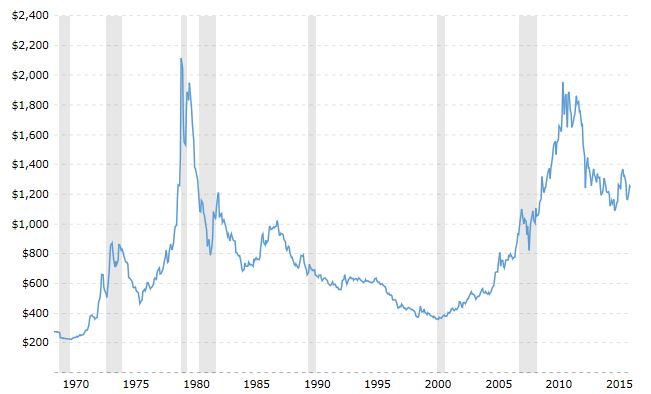 Gold in USD Adjusted for Inflation 1970-2017 – Macrotrends.net
Not only is it accessible but it remains relatively cheap from a long term perspective, at nearly less than half its real price high of $2,200 price in 1980 when adjusted for the considerable inflation of the last 37 years.
Gold is also relatively cheap compared to most stock, bond and property markets, many of which are at all time record highs. These highs are in large part due to quantitative easing (QE), zero and negative percent interest rates and global currency debasement on a scale never seen in history.
END
This should hurt our banking cartel as gold supply in the world’s largest mine, Grasberg came to a screeching halt due to problems with the Indonesian government regulations. Freeport McMoRan the operator of the big mine has laid off thousands
(courtesy Varagur/Voice of America/GATA)
Showdown in Indonesia brings world’s biggest gold mine to standstill
Submitted by cpowell on Tue, 2017-02-28 12:52. Section: Daily Dispatches
By Krithika Varagur
Voice of America, Washington
Monday, February 27, 2017
JAKARTA, Indonesia — The American mining company Freeport-McMoRan has brought the world’s biggest gold mine, in the Indonesian province of West Papua, to a standstill. The corporation is butting heads with the Indonesian government over protectionist mining regulations. And now that Freeport has started to dismiss tens of thousands of workers, the local economy is poised to take a huge hit. In Mimika Regency, the West Papua province containing the Grasberg gold mine, 91 percent of the Gross Domestic Product is attributed to Freeport.
Freeport Indonesia abruptly stopped production on February 10 and laid off 10 percent of its foreign workers. It employs 32,000 people in Indonesia, about 12,000 of whom are full-time employees. The freeze was a reaction to a shakeup in Freeport’s 30-year contract with the Indonesian government, signed in 1991. Indonesia has tried to levy additional obligations from Freeport in an attempt to increase domestic revenue from its natural resources. Freeport retaliated last week by threatening to pursue arbitration and sue the government for damages. …
… For the remainder of the report:
http://www.voanews.com/a/showdown-in-indonesia-brings-gold-mine-to-stand…
END
For your interest: treasure hunters find an Iron age gold bracelet in a farm field. It is the earliest discovered gold in Britain
(courtesy Knapton/Telegraph/London/GATA)
Treasure hunters find Iron Age gold in farm field, earliest discovered in Britain
Submitted by cpowell on Tue, 2017-02-28 12:57. Section: Daily Dispatches
By Sarah Knapton
The Telegraph, London
Tuesday, February 28, 2017
Intricate jewellery found buried in a Staffordshire field is the earliest example of Iron Age gold ever found in Britain.
The collection, made up of four twisted metal neckbands, called torcs, and a bracelet, was discovered by two metal detectorists just before Christmas.
Experts say they would have been owned by wealthy powerful women who probably moved from continental Europe to marry rich Iron Age chiefs.
The pair who discovered the find had swept the field 20 years earlier and uncovered nothing. But after abandoning a fishing trip to go treasure hunting they came across the horde, which could be worth hundreds of thousands of pounds. …
… For the remainder of the report:
http://www.telegraph.co.uk/science/2017/02/28/iron-age-gold-found-farmer..
END
Demand for gold resumes in India. The latest figures show that India imported 50 tonnes of gold in February an increase of over 82% from a year ago. The fiasco of their removal of the two highest currency notes is over and gold will resume its normal northerly projection.
(courtesy Reuters/Mbumbai)
India’s February gold imports surge on pent-up demand – GFMS
India’s February gold imports surged to 50 tonnes, up more than 82 percent from a year ago, on pent-up jeweller demand and as retail consumers ramped up purchases for weddings, provisional data from consultancy GFMS showed on Wednesday.
The rise in imports by the world’s second-biggest consumer of the precious metal will support global prices that are trading near their highest level in 3-1/2 months, but could widen the South Asian country’s trade deficit.
“Pent-up demand on the ease of the cash crunch and wedding related demand lifted imports in February,” said Sudheesh Nambiath, a senior analyst at GFMS, a division of Thomson Reuters.
In November, Prime Minister Narendra Modi scrapped 500- and 1,000-rupee banknotes, notes that were 86 percent of the value of cash in circulation, as part of a crackdown on corruption, tax evasion and militant financing.
India’s gold imports had fallen to 27.4 tonnes in February 2016 as buyers postponed purchases in anticipation of a reduction in the import duty in the budget at the time.
This February, retail demand improved due to the wedding season and as cash supplies became normal, said Bachhraj Bamalwa, a jeweller based in the eastern Indian city of Kolkata.
But imports in March could fall as a recent rally in prices has started deterring buyers.
“Consumers are struggling to adjust with higher prices. They are postponing purchases expecting a correction in prices,” said Harshad Ajmera, the proprietor of JJ Gold House, a wholesaler based in Kolkata.
In the local market, gold futures were trading at 29,380 rupees ($439) per 10 grams on Wednesday, up more than 9 percent since falling to 26,862 rupees in December 2016, its lowest in 10 months.
India’s gold imports in 2016 had fallen nearly 44 percent versus 2015 to 510.4 tonnes, the lowest level in 13 years.
“Last year was an unusual year. This year consumption and imports will rise as jewellery demand has been recovering,” said Bamalwa.
(Reporting by Rajendra Jadhav; Editing by Christian Schmollinger)
END
A great commentary from Bill Holter tonight:
(courtesy Bill Holter/Holter-Sinclair collaboration)
They are playing with a revolution… by Joe six pack!
I had a long conversation with Jim Sundayevening regarding the increase in volume and pitch to sabotage President Trump. He asked that I write an article addressing the push/pull toward impeaching or at least neutering him. The “movement” to impeach him (even before taking office) has grown and now looks like there are actual odds the “left” will try in reality.
I wrote “the left” above but in reality it is not just the left as we have seen Paul Ryan, Darrell Issa and other so called conservatives begin to change colors. The reality is Donald Trump is up against a very powerful machine that is entrenched and sucking the life out of the country. This machine is not U.S. centric but in fact has tentacles all over the world with a stranglehold on many “not so sovereign” governments.
The story has been Russia, Russia, Russia, in a he said she said fashion. To this point there is and has been zero evidence directly tying Mr. Trump to Russia…but no matter, they may make some up. Michael Flynn did resign after admitting he spoke to a Russian minister though we still do not have transcripts. We believe Mr. Flynn most certainly asked Russia to not take the bait and retaliate at further U.S. sanctions after the election but before the inauguration. For this, Jim and I believe he should be given the medal of honor for averting WW III. We ask, where was the press, where were the left AND the right when president Obama was caught on a hot microphone in conversation with Russian president Medvedev saying “I will have more flexibility after the next election”? His statement of course fully understood and followed by Mr. Medvedev responding “I will inform Vladimir”. Where was the outrage then?!!!
As quipped above, we believe something will be “made up” in an effort to impeach President Trump. It is now most likely a “race” to get something started as fast as possible, prior to AG Jeff Sessions handing down any indictments. Please understand, this is a fight to the death between light and dark, and ANYTHING goes! Ask yourself this simple question, if President Trump was truly pulling the strings …and truly in bed with Russia, then why is it five Russian diplomats have recently been assassinated or had “untimely” heart attacks? https://www.youtube.com/watch?v=u73InAPFKqE These men were all long time personal friends of Mr. Putin, it certainly looks like he is being goaded into responding with force.
But why? Why does it (and has for several years) appear like the U.S. is trying to incite a war with Russia? This question I believe is most simple of all, the “deep state” either believes they can pull off another WWI or WWII where they pull the economy from the jaws of depression, …or more likely, they know the current system cannot continue and must kick the table over. I have been on the record for at least two years, “they must place blame” on something other than their Ponzi, blood sucking policies as reason for the collapse.
This is a very dangerous game both nationally and internationally. Internationally they are playing with human annihilation. Nationally they are playing with revolution, this needs a little explaining. If Mr. Trump is impeached, it will require votes from the right to do so …immediately after the people have spoken by taking both houses and 35 governorships. Should impeachment go forward, Joe six pack will take to the streets. Mr. six pack should not be confused with a bunch of delirious snowflakes carrying signs and backed up by paid vandals. No, Mr. six pack will be PACKING! He will be packing long arms and laden with full clips. Interestingly, there are many, and a majority of “law enforcement” named “JOE SIXPACK” who actually still believe in the rule of law.
Personally, as I hear of the prospects of impeachment, unless some “evidence”, REAL evidence, were to come out that actually makes sense and not a piece of Swiss cheese logic, I (and Jim) have personally decided to be Joe six packs. We are in a fight to retain, or to lose our country altogether. True Americans put up with huge transgressions over the past eight (and many prior) years. Like it or not, we were led by a Muslim president, probably not a natural born citizen and of questionable sexuality …but we did not riot, we did not destroy our neighbors businesses. No, we voted, because that is the “civilized” thing to do…
What I am arriving at is this, Joe six pack will not stand idly by when he is finally told “your vote does not matter”. Mr. six pack was fooled for many years when his “choices” were not really a choice, a vote for either one was a vote for “the machine”. Mr. six pack got wise to this and decided throw a monkey wrench into the machine. Joe can be told, and can accept many things. What he will not accept is “your vote does not count”! We hope it does not come to this but the road map shows that most all roads do lead to it. The odds, whether you like them or not, appear to favor an internal civil war unless the bastards get us nuked first.


Your early WEDNESDAY morning currency, Asian stock market results, important USA/Asian currency crosses, gold/silver pricing overnight along with the price of oil Major stories overnight
1 Chinese yuan vs USA dollar/yuan WEAKER AT 6.8805(BIGGER DEVALUATION SOUHBOUND /OFFSHORE YUAN NARROWS TOWARDS ONSHORE TO 6.8724/ Shanghai bourse UP 5.20 POINTS OR .18% / HANG SANG CLOSED UP 35.76 POINTS OR 0.15%
2. Nikkei closed UP 274.55 POINTS OR 1.44% /USA: YEN FALLS TO 112.17
3. Europe stocks opened ALL IN THE GREEN ( /USA dollar index RISES TO 101.86/Euro DOWN to 1.0525
3b Japan 10 year bond yield: RISES TO +.065%/ !!!!(Japan buying 100% of bond issuance)/Japanese yen vs usa cross now at 113.84/ THIS IS TROUBLESOME AS BANK OF JAPAN IS RUNNING OUT OF BONDS TO BUY./JAPAN 10 YR YIELD FINALLY IN THE POSITIVE/BANK OF JAPAN LOSING CONTROL OF THEIR YIELD CURVE AS THEY PURCHASE ALL BONDS TO GET TO ZERO RATE!!
3c Nikkei now JUST BELOW 17,000
3d USA/Yen rate now well below the important 120 barrier this morning
3e WTI:: 54.12 and Brent: 56.70
3f Gold DOWN/Yen DOWN
3g Japan is to buy the equivalent of 108 billion uSA dollars worth of bond per month or $1.3 trillion. Japan’s GDP equals 5 trillion usa./“HELICOPTER MONEY” OFF THE TABLE FOR NOW /REVERSE OPERATION TWIST ON THE BONDS: PURCHASE OF LONG BONDS AND SELLING THE SHORT END
Japan to buy 100% of all new Japanese debt and by 2018 they will have 25% of all Japanese debt. Fifty percent of Japanese budget financed with debt.
3h Oil UP for WTI and UP for Brent this morning
3i European bond buying continues to push yields lower on all fronts in the EMU. German 10yr bund RISES TO +.268%/Italian 10 yr bond yield UP to 2.132%
3j Greek 10 year bond yield FALLS to : 6.97%
3k Gold at $1242.00/silver $18.33(8:15 am est) SILVER CLOSE TO RESISTANCE AT $18.50
3l USA vs Russian rouble; (Russian rouble UP 28/100 in roubles/dollar) 58.10-
3m oil into the 54 dollar handle for WTI and 56 handle for Brent/
3n Higher foreign deposits out of China sees huge risk of outflows and a currency depreciation (already upon us). This can spell financial disaster for the rest of the world/China forced to do QE!! as it lowers its yuan value to the dollar/GOT A BIGGER DEVALUATION SOUTHBOUND from POBC.
JAPAN ON JAN 29.2016 INITIATES NIRP. THIS MORNING THEY SIGNAL THEY MAY END NIRP. TODAY THE USA/YEN TRADES TO 113.84 DESTROYING JAPANESE CITIZENS WITH HIGHER FOOD INFLATION
30 SNB (Swiss National Bank) still intervening again in the markets driving down the SF. It is not working: USA/SF this morning 1.0111 as the Swiss Franc is still rising against most currencies. Euro vs SF is 1.0643 well above the floor set by the Swiss Finance Minister. Thomas Jordan, chief of the Swiss National Bank continues to purchase euros trying to lower value of the Swiss Franc.
3p BRITAIN VOTES AFFIRMATIVE BREXIT/LOWER PARLIAMENT APPROVES BREXIT COMMENCEMENT
3r the 10 Year German bund now POSITIVE territory with the 10 year RISES to +.268%
3s The Greece ELA NOW at 71.4 billion euros,AND NOW THE ECB WILL ACCEPT GREEK BONDS (WHAT A DISASTER)
The bank withdrawals were causing massive hardship to the Greek bank. the Greek referendum voted overwhelming “NO”. Next step for Greece will be the recapitalization of the banks and that will be difficult.
4. USA 10 year treasury bond at 2.440% early this morning. Thirty year rate at 3.034% /POLICY ERROR)GETTING DANGEROUSLY HIGH
5. Details Ransquawk, Bloomberg, Deutsche bank/Jim Reid.
(courtesy Jim Reid/Bloomberg/Deutsche bank/zero hedge)
Global Stocks, US Futures Surge, Bonds Tumble On “Presidential” Trump Speech, Hawkish Fed Speakers
While many Wall Street traders expecting Trump to unveil details of his economic plan went to bed empty handed last night, that was not enough to halt the market rally with the narrative shifting to Trump’s “measured”, “presidential” tone in which he offered an olive branch to both Democrats and Republicans in Congress while promising to make concessions and providing another round of grand visions for the US. Trump urged Americans to abandon conflict and help him remake the fabric of the country, a moment he hopes will turn the page on his administration’s chaotic beginning and bring clarity to his policy agenda. He offered few new proposals and made no suggestions on how he would pay for his plans, including a replacement of Obamacare, a tax overhaul including cuts for the middle class, $1 trillion in infrastructure investment and a large increase in defense spending.
“The market has been looking for reassurance that Trump intends to follow through on his campaign promises for fiscal spending, tax cuts and deregulation,” said James Woods, global investment analyst at Rivkin in Sydney. “He mentioned these policies but did not provide any actual details or time lines, which is what investors are looking for.”
For markets, the speech – either positive or negative – was overshadowed by comments from a handful of Federal Reserve policymakers, who suggested a March rate hike is live, contrary to market expectations. As a result, have tumbled, and global stocks surged following yesterday’s barrage of hawkish Fed speakers, especially Bill Dudley, who in the span of an hour managed to reprice March rate hike odds from just over 50% to 80%, meaning a March rate hike is now in play.
For those who missed it, here is a summary of Tuesday’s Fed talking heads, and what they said:
- Fed’s Dudley (Voter, Dove) said the case for rate hikes is more compelling.
- Fed’s Kaplan (Voter, Neutral) said the rate path is more important than timing of the next hike.
- Fed’s Williams (Non-Voter, Hawk) sees a March hike getting serious consideration. Williams also added he still is comfortable with 3 hikes this year and does not see need to delay rate hike.
- Fed’s Bullard (Non-Voter, Dove) stated that the Fed has essentially reached its dual mandate and should allow the balance sheet to normalize naturally. Bullard also added that the policy rate can stay relatively low over the horizon and that he still expects 2% growth, thus no reason to be aggressive on rate hikes
The most hawkish comments were out of both Dudley and Williams. In an interview with CNN, the usually dovish NY Fed President Dudley said that the case for tightening has become “a lot more compelling in recent months” and that “risks to the outlook are now starting to tilt to the upside”. Dudley was also quoted as saying that “animal spirits have been unleashed a bit post the election” and that “there’s no question sentiment has improved quite markedly”. He also said that 3-4% GDP growth in the medium term is possible should we see further improvement in productivity. Shortly before that San Francisco Fed President Williams said that a March hike is getting “serious consideration” given that the Fed is “very close” to achieving its dual mandate goals.
As expected, March hikes odds soared, rising as much as 80% after the barrage of hawks:

With March odds soaring to approximately 80% percent, they pushed the dollar higher and sent Treasuries lower.

Additionally, strong data out of China, where most PMIs came in better than expected, has eased concerns about China’s economy. The rundown:
- China’s Official Manufacturing PMI (Feb) 51.6 vs. Exp. 51.2 (Prey. 51.3).
- Chinese Non-Manufacturing PMI (Feb) 54.2 (Prey. 54.6);4-monthlow.
- Chinese Caixin Manufacturing PMI (Feb) 51.7 vs. Exp. 50.8 (Prey. 51.0).
Back to Trump: in a nutshell the long awaited Trump address had a familiar ‘America first’ theme throughout and plenty of echoes of his inaugural address. However the disappointment market wise has been the lack of detail. But there did seem to be a big effort to sound presidential. In terms of what we did get, the President returned again to the subject of rebuilding infrastructure, highlighting that he will be asking Congress to approve legislation that produces a $1tn investment financed through both public and private capital and guided by the principals of “hire American and buy American”. Trump also reconfirmed that he intends to repeal and replace Obamacare, increase defence spending, enforce immigration laws and also overhaul tax including cuts for the middle class. The tax subject was only really lightly touched. Trump said that his economic team is developing a “historic tax reform that will reduce the tax rate on our companies so that they can compete and thrive anywhere and with anyone” and also “at the same time provide massive tax relief for the middle class”. There was no specific mention whatsoever of the much anticipated border-adjusted tax. Another subject of much debate, bank regulation, was also avoided.
Overall, a speech that while disappointing on one hand (lack of specifics) was greeted as perhaps a return to Trump’s conciliatory, “presidential-sounding” roots. So as investors moved on from President Donald Trump’s address to Congress, shifting their focus to the timing of a U.S. rate increase as the dollar strengthened, stocks surged and bonds tumbled.
The Bloomberg Dollar Spot Index climbed the most in three weeks, the yield on 10-year Treasuries rose and European banking stocks gained after odds jumped for a Federal Reserve rate increase this month. Shares of commodity producers found support from a report indicating improving health for Chinese manufacturing which also helped prices for raw material exports.
“Fed speakers trump Trump,” Richard McGuire, the head of rates strategy at Rabobank International in London, wrote in a note. Trump’s speech lacked “fresh content for the market to trade off, with big tax cuts, deregulation and an infrastructure plan being mentioned but not supported by any details. Given this, all focus instead turned to the slew of hawkish rhetoric from Fed speakers.”
The dollar index climbed as much as 0.7 percent to its highest levels in seven weeks, having also been helped by data showing robust U.S. consumer spending.
“After dominating the markets since November, President Trump could now fade into the background as the focus shifts to the Fed and the prospect of rate increases,” said Kathleen Brooks, Research Director at City Index in London. “Fed members don’t just let words slip out when they speak to the press – this was a message for the markets, and the markets have duly reacted.”
European shares gained, with basic resources the top-performers on Trump’s promise of $1 trillion of infrastructure spending. The STOXX 600 index rose over 1 percent, with Germany’s DAX and France’s CAC 40 outperforming peers to climb 1.3 percent and 1.4 percent respectively, helped by strong company earnings reports. European stocks climbed the most since Feb. 1 as all industry sectors advanced. A gauge of banks gained 2 percent, leading the advance, while basic resources shares rose 1.9 percent.
Japan’s Topix index increased 1.2 percent, propelled by a weaker yen towards the the biggest rally in more than two weeks. The Shanghai Composite Index added 0.2 percent after data on the producer price rebound, giving top officials gathering in Beijing a solid economic backdrop as they seek to rein in financial risks.
The global MSCI ACWI index, which has risen more than 10 percent since Trump’s election in November, was flat, with gains in Europe offsetting earlier falls on Asian and U.S. bourses. The MSCI’s broadest index of Asia-Pacific shares outside Japan dipped 0.2 percent.
Futures on the S&P 500 Index added 0.5 percent, after the Dow Jones Industrial Average snapped a 12-day winning streak to close down 0.1 percent in the prior session. The S&P500 finished February with its best monthly gain since March, climbing 3.7
percent.
In commodity markets, crude oil prices lost more ground, with rising U.S. oil output adding pressure on the market, although OPEC production cuts continued to offer support. The stronger dollar weighed on gold, which dropped 0.3 percent to 1,244.36 an ounce, extending Tuesday’s decline.
2Y Treasury yields jumped to 1.304%, the highest since December, to match their highest levels since 2009. The gap between them and their German equivalents increased to its widest since 2000. Yields on 10-year Treasuries rose three basis points to 2.42 percent, climbing for a third straight day. Yields on benchmark German bonds climbed four basis points to 0.25 percent after a report showed unemployment continued to decline. Yields on French benchmarks and gilts both rose three basis points.
Market Snapshot
- S&P 500 futures up 0.5% to 2,375.50
- STOXX Europe 600 up 1% to 373.75
- MXAP down 0.3% to 144.70
- MXAPJ down 0.3% to 464.87
- Nikkei up 1.4% to 19,393.54
- Topix up 1.2% to 1,553.09
- Hang Seng Index up 0.2% to 23,776.49
- Shanghai Composite up 0.2% to 3,246.93
- Sensex up 0.9% to 28,990.65
- Australia S&P/ASX 200 down 0.1% to 5,704.80
- Kospi up 0.3% to 2,091.64
- Brent Futures up 0.5% to $56.81/bbl
- Gold spot down 0.3% to $1,244.68
- U.S. Dollar Index up 0.6% to 101.68
- US 10Y Yield
- German 10Y yield rose 4.1 bps to 0.249%
- Euro down 0.3% to 1.0540 per US$
- Brent Futures up 0.5% to $56.81/bbl
- Italian 10Y yield fell 4.8 bps to 2.086%
- Spanish 10Y yield rose 3.1 bps to 1.686%
Top Overnight News via BBG
- Trump’s Softer Tone Masks Hard Road Ahead for Agenda in Congress; Trump’s Scant Specifics Leave Questions on His Border-Tax Plans
- Comcast Targets Asia With Harry Potter-Featured Theme Park Deal
- Ahold Delhaize Profit Beats Analyst Estimates on Cost Cuts
- AMC Cinemas Beefs Up Marketing With Dine-In, Bottomless Popcorn
- Snap’s Investors Could Pile On Then Disappear After the IPO
- Hamilton Lane Prices 11.9m-Share IPO at $16: IPO Boutique
- Time Inc. Said to Ask Suitors to Submit Offers by Next Week
- TD Ameritrade Cuts Pricing Fee to $6.95 for Online Equity Trades
- World’s Second-Largest Copper Mine to Resume Some Operations
- Iberiabank Sees Sabadell United Deal 6% Accretive to 2018 EPS
- Apollo Commercial Got Justice Department Information Request
- Orexo Commences Patent Infringement Litigation Against Actavis
- Avianca Says It Hasn’t Been Notified of Lawsuit by Kingsland
- Femsa Sees Capex of About $1.3b in 2017
- Volkswagen Closes $256 Million Acquisition of Navistar Stake
- Euro-Area Manufacturing Picks Up as Inflation Pressures Build
- Toshiba Said to Seek Bids for Chip Unit at $13 Billion Value
Asia equity markets traded higher as the region digested a deluge of data including better than expected Chinese PMIs figures. Despite this, ASX 200 (-0.1%) was dampened by the negative lead from Wall St where the DJIA snapped a 12-day win streak, while better than expected Australian GDP also failed to inspire as the strong data also reduces prospects of future RBA action. Nikkei 225 (+1.4%) was underpinned by a weaker JPY, while Shanghai Comp (+0.3%) and Hang Seng (+0.2%) gained after the latest PMI figures in which the Official Manufacturing PMI and Caixin Manufacturing PMI surpassed estimates, although upside was capped on a weak PBoC liquidity operation and after Non-Manufacturing PMI fell to a 4-month low. 10yr JGBs saw spill-over selling from T-notes which were weakened following hawkish Fed comments that suggested a March hike was firmly on the table, while the BoJ’s Rinban announcement also added to the pressure as the central bank reduced its purchases in 1yr-3yr and 3yr-5yr government debt.
Top Asian News
- China Plans to Cut 500,000 Jobs This Year in Smokestack Sectors
- China’s Factory Gauge Strengthens as Producer Prices Rebound
- China’s Policy Balancing Act Faces Bumps as Bond Pain Swells
- Hedge Fund Oasis’s Wosner Named Director of Premier Foods
- Hong Kong Stocks Eke Out Gains as Galaxy Reports Higher Earnings
- Foxconn’s Gou Says Very Serious About Bid for Toshiba Chip Unit
- Being a Woman Means 43% Less Pay Than Men on Singapore Boards
- Stock Investors Have Seven Reasons to Be Cheerful: Markets Live
- Bouncing Back From Cash Ban, India Chasing V-Shaped Recovery
European bourses were also propelled higher, with the Stoxx 600 index rising more than 1%, after a barrage of hawkish comments from FOMC members yesterday has supported EU bourses in tandem with US equity futures with notable outperformance in financial names as the futures market raised the probability of a March hike (pricing stands at 80%). While markets were somewhat unresponsive to President Trumps speech in congress who failed to provide any significant surprises. Elsewhere, despite the build in API’s overnight, WTI and Brent crude futures are at elevated levels amid increased optimism over the prospects of the US economy. In fixed income markets, the overnight weakness in treasuries saw bunds opened lower, while the gains in equities have also weighed on prices. While the German curve has seen some notable bear steepening this morning, elsewhere the GE-FR spread is a touch tighter with reports that Presidential candidate Fillon called to speak to judges over probes in fake jobs. Additionally, he will give a speech at 1100GMT.
Top European News
- Euro-Area Manufacturing Picks Up as Inflation Pressures Build
- U.K. Manufacturing Growth Weakens as Price Pressures Slip
- German Unemployment Declines as Confidence in Economy Improves
- BP Targets $40 Break-Even Oil Price to Reassure Investors
- FCA to Overhaul IPO Information Flow Over Conflict Concerns
- CRH Capacity for Buys EU2b-EU3b in Next 18 Months, CEO Says
- London Home Price Cuts Spread and Deepen as Market Stagnates
- French Candidate Fillon Called in to Speak to Judges, JDD Says
- OATs Dip After Fillon Said to Continue Presidential Race
- European Miners Rebound as China Economic Data Spur Optimism
- Fillon Wife in Custody, Search Ongoing: Mediapart
- U.K. Consumer Borrowing Remains Below Average as Confidence Ebbs
In currencies, the Bloomberg Dollar Spot Index jumped 0.4 percent as of 9:53 a.m. in London, climbing for a fourth straight day and heading for the biggest advance since Feb. 7. The yen slumped 0.7 percent to 113.52 per dollar, for a third day of losses. The euro fell 0.3 percent to $1.0545 and the British pound was little changed at $1.2383 after slipping 0.5 percent Tuesday.FX markets have followed the lead set by Fed members Williams and Dudley yesterday, setting the USD free on the upside as has been threatening given the US rate profile. Along with hesitancy over president Trump’s general conduct and communication, the market has been split between the prospect of 2 or 3 rate hikes this year, but with March now firmly on the table, the short end of the Treasury yield curve has rallied, putting the 2yr back to the highs just shy of 1.30%. Gains in the belly look a little more reluctant, and the modest 5-6bp rise in the 10yr sees USD/JPY back in the mid 113.00’s, but struggling ahead of 114.00. EUR/USD has been pulled back into mid-low 1.0500’s, but sizeable expiries in the 1.0500-50 area look to be containing for now. German regional inflation rates are all higher, but within expectation levels, while unemployment was also largely as expected.
In commodities, gold dropped for a third day, falling 0.3 percent to $1,244.66 an ounce after completing a 3.1 percent gain in February. West Texas Intermediate Crude rose 0.5 percent to $54.26. Oil ended last month 2.3 percent higher. Copper added 1.7 percent, advancing for a fourth straight session. Oil prices have edged higher despite the impact of a stronger USD, but near term price action is all base on production cuts, with strong compliance to the agreement from OPEC members edging towards 95%. Non OPEC members are lagging according to the latest figures, but sources suggest the current path will lead to WTI rising to USD60.00. In light of this, hesitant gains through USD55.00 may be taking this into account, but price stability will clearly be welcomed all round. Precious metals have softened inversely with the USD, with Gold now trading just under USD1245.00, with Silver dipping to USD18.24/5 before finding support. Base metals find support from the latest China manufacturing stats — Copper rising close to 2% on the day, but Zinc outperforming 2.5% up on the day. Zinc prices still set to rise higher on mine closures, but the latest appointment of the environment minister has/is running into some opposition.
In terms of the day ahead, while the bulk of the attention will be on Trump’s speech there is still a reasonable amount of data to get through. Much of the focus will be on the January personal spending and income reports, alongside the core and deflator PCE readings. Also due out is the ISM manufacturing print for February as well as the final manufacturing PMI revision, while construction spending and vehicle sales round out the releases. If that wasn’t enough already, the Fed’s Beige Book is also due out this evening while Kaplan (6pm GMT) and Brainard (11pm GMT) are both due to speak.
US Event Calendar
- Wards Total Vehicle Sales, est. 17.7m, prior 17.5m; Wards Domestic Vehicle Sales, est. 13.7m, prior 13.6m
- 7am: MBA Mortgage Applications, prior -2.0%
- 8:30am: Personal Income, est. 0.3%, prior 0.3%; Personal Spending, est. 0.3%, prior 0.5%
- 8:30am: Real Personal Spending, est. -0.1%, prior 0.3%; PCE Deflator MoM, est. 0.5%, prior 0.2%; PCE Deflator YoY, est. 2.0%, prior 1.6%; PCE Core MoM, est. 0.3%, prior 0.1%; PCE Core YoY, est. 1.7%, prior 1.7%
- 9:45am: Markit US Manufacturing PMI, est. 54.5, prior 54.3
- 10am: ISM Manufacturing, est. 56.2, prior 56; ISM Prices Paid, est. 68, prior 69; ISM New Orders, prior 60.4; ISM Employment, prior 56.1
- 10am: Construction Spending MoM, est. 0.6%, prior -0.2%
- 1pm: Fed’s Kaplan Speaks in Dallas
- 2pm: U.S. Federal Reserve Releases Beige Book
- 2pm: U.S. Federal Reserve Releases Beige Book
- 6pm: Fed’s Brainard Speaks at Harvard
DB’s Jim Reid concludes the overnight wrap
Welcome to a new month and in reality only one place to start this morning and that is President Trump’s prime time address to Congress that started at 9pm EST last night. Before we delve into the details a reminder that as it’s the first of the month we’ll be doing our usual performance review at the end with all the tables and charts in the PDF. It’s our second performance review in a row as yesterday we looked back on 10 years of the EMR and looked at how assets have performed over what is essentially the period since the start of the financial crisis in February 2007. So if you missed it, see yesterday’s EMR at your leisure.
So in a nutshell the long awaited Trump address had a familiar ‘America first’ theme throughout and plenty of echoes of his inaugural address. However the disappointment market wise has been the lack of detail. But there did seem to be a big effort to sound presidential. In terms of what we did get, the President returned again to the subject of rebuilding infrastructure, highlighting that he will be asking Congress to approve legislation that produces a $1tn investment financed through both public and private capital and guided by the principals of “hire American and buy American”. Trump also reconfirmed that he intends to repeal and replace Obamacare, increase defence spending, enforce immigration laws and also overhaul tax including cuts for the middle class. The tax subject was only really lightly touched. Trump said that his economic team is developing a “historic tax reform that will reduce the tax rate on our companies so that they can compete and thrive anywhere and with anyone” and also “at the same time provide massive tax relief for the middle class”. There was no specific mention whatsoever of the much anticipated border-adjusted tax. Another subject of much debate, bank regulation, was also avoided.
Markets in Asia are mostly higher following Trump’s speech. The Nikkei (+1.03%), Hang Seng (+0.17%) and Shanghai Comp (+0.38%) are all up although the ASX (-0.13%) has struggled slightly. US equity index futures are also up +0.20% although they are little changed relative to the minutes prior to Trump speaking. Rates have crept higher however that may in part be to do with the Fedspeak late last night which we’ll touch on shortly. 2y yields are up +3.6bps and 10y yields up +2.9bps. The Dollar index is +0.45%, Gold (-0.42%) is weaker and other commodities little changed. We may have to wait for the European session to really kick in though for markets to digest the speech.
It would be fairly easy to wrap up here and move on to today’s calendar given that for the most part yesterday’s session was a fairly dull one and essentially just preparing the stage for Trump. However, there was some last minute month end excitement as after the US close we got some pretty hawkish comments out of both the Fed’s Dudley and Williams. In an interview with CNN, the usually dovish NY Fed President Dudley said that the case for tightening has become “a lot more compelling in recent months” and that “risks to the outlook are now starting to tilt to the upside”. Dudley was also quoted as saying that “animal spirits have been unleashed a bit post the election” and that “there’s no question sentiment has improved quite markedly”. He also said that 3-4% GDP growth in the medium term is possible should we see further improvement in productivity. Shortly before that San Francisco Fed President Williams said that a March hike is getting “serious consideration” given that the Fed is “very close” to achieving its dual mandate goals.
After trading fairly flat for much of the session short-end Treasury yields spiked in the last 30 minutes or so (and have continued to rise this morning as highlighted above). 2y yields closed 6.6bps higher at 1.260% and 5y yields finished 6.4bps higher at 1.929%. 10y yields also ended 2.5bps higher at 2.390%. Unsurprisingly Fed Funds contracts were also on the move with the March contract now at 0.750% (+3.5bps). It’s worth noting that one of the more dovish Fed officials, Lael Brainard, is due to speak this evening, while Fed Chair Yellen then speaks on Friday. The imperfect Bloomberg calculator (which overstates the chances but offers a good history of pricing) has also seen the March hike probability jump to 80% this morning from 52% yesterday and just 40% at the end of last week. Prior to that excitement, equity markets had largely limped through much of the session. The Dow (-0.12%) finally brought to an end a streak of 12 consecutive record highs while the S&P 500 (-0.26%) also finished in the red not helped by Senate Finance Chairman Orrin Hatch telling CNBC that he has real reservations about the border adjustment tax. In Europe the Stoxx 600 (+0.19%) recovered from a slow start. Commodities were generally a non-event for much of the session.
The rest of yesterday’s session was largely focused on the data. In the US the main release was the second estimate of Q4 GDP which came in at an unrevised +1.9% qoq annualized. The consensus had been for an upward revision to +2.1%. In the details growth in final sales was unrevised at +0.9% while personal consumption was revised up five-tenths to +3.0%. This was offset by a 1.1pt downward revision for business investment to +1.3% while the core PCE was also revised down one-tenth to +1.2%. Away from that there was some good news in the latest consumer confidence reading for February which was revealed as rising 3.2pts to 114.8 (vs. 111.0 expected) and the highest since July 2001. The Chicago PMI also surprised to the upside with the index up 7.1pts to 57.4 (vs. 53.5 expected) in February and the highest since January 2015. The Richmond Fed manufacturing index reading also rose 5pts to +17. Finally the advance goods trade balance reading in January revealed a wider than expected deficit ($69.2bn vs. $66.0bn expected). Over in Europe the only notable data came from France where headline CPI was revealed as rising a fairly benign +0.1% mom in February (vs. +0.4% expected). Q4 GDP did however come in as expected at +0.4% qoq.
Quickly coming back to Asia, this morning we also had some data out of China which very much played second fiddle to Trump. The official manufacturing PMI was confirmed as rising 0.3pts to 51.6 in February (vs. 51.2 expected) while the non-manufacturing PMI declined 0.4pts to 54.2. The Caixin manufacturing PMI also came in at 51.7 and up 0.7pts from January.
In terms of the day ahead, while the bulk of the attention will be on Trump’s speech there is still a reasonable amount of data to get through. The European session will also see a continuation of the February PMI releases with the final manufacturing prints to be confirmed alongside a first look at the data for the periphery and UK. We’ll also get the February CPI report in Germany as well money and credit aggregates data in the UK. It’s set to be another busy afternoon for data releases in the US again too. Much of the focus will be on the January personal spending and income reports, alongside the core and deflator PCE readings. Also due out is the ISM manufacturing print for February as well as the final manufacturing PMI revision, while construction spending and vehicle sales round out the releases. If that wasn’t enough already, the Fed’s Beige Book is also due out this evening while Kaplan (6pm GMT) and Brainard (11pm GMT) are both due to speak.
3. ASIAN AFFAIRS
i)Late TUESDAY night/WEDNESDAY morning: Shanghai closed UP 5.20 POINTS OR .16%/ /Hang Sang CLOSED UP 35.76 POINTS OR 0.15% . The Nikkei closed UP 274.55 POINTS OR 1.44% /Australia’s all ordinaires CLOSED DOWN 0.18%/Chinese yuan (ONSHORE) closed DOWN at 6.8805/Oil ROSE to 54.12 dollars per barrel for WTI and 56.70 for Brent. Stocks in Europe ALL IN THE GREEN ..Offshore yuan trades 6.8724 yuan to the dollar vs 6.8805 for onshore yuan.THE SPREAD BETWEEN ONSHORE AND OFFSHORE NARROWS CONSIDERABLY AS POBC ATTEMPTS TO STOP USA DOLLARS FROM LEAVING CHINA’S SHORES. ONSHORE YUAN WEAKER AS IS OFFSHORE YUAN COUPLED WITH THE STRONGER DOLLAR
3a)THAILAND/SOUTH KOREA/NORTH KOREA
b) REPORT ON JAPAN
none today
c) REPORT ON CHINA
China backs Russia as it vetoes western backed UN sanctions against Syria:
(courtesy zerohedge)
China Backs Russia To Veto Western-Backed UN Sanctions On Syria
The Trump administration’s early attempts to change, and restore, ties with Russia may be fading fast, but at least when it comes to relations between Russia and its western counterparts at the United Nations, absolutely nothing has changed. And, as has been the case for the past three years, the antagonism was on full front display when Russia, now without the recently deceased Vitaly Churkin, on Tuesday cast its seventh veto to protect the Syrian government from United Nations Security Council action, blocking an attempt by Western powers to impose yet another sanction over accusations of the recurring strawman, i.e., chemical weapons attacks, during the six-year Syrian conflict.
While the Russia vote was to be expected, what was surprising is that China once again backed Russia with its sixth veto on Syria according to Reuters, making it clear that at least when it comes to the UN and matters involving Syria, China is firmly in the Russia camp, and thus opposing the west.

Russian Deputy Ambassador to the United Nations Vladimir Safronkov
Russia had said the vote on the resolution, drafted by France, Britain and the United States, would harm U.N.-led peace talks between the warring Syrian parties in Geneva, which began last week. Nine council members voted in favor, Bolivia voted against, while Egypt, Ethiopia and Kazakhstan abstained. A resolution needs nine votes in favor and no vetoes by the United States, France, Russia, Britain or China to be adopted.
Russian President Vladimir Putin described the draft resolution on Tuesday as totally inappropriate. “As for sanctions against the Syrian leadership, I think the move is totally inappropriate now,” Putin said at a news conference. “It does not help, would not help the negotiation process. It would only hurt or undermine confidence during the process.”
Doing her best Samantha Power impression, the new US ambassador to the UN Nikki Haley told the council after the vote that ““For my friends in Russia, this resolution is very appropriate,” said US Ambassador to the United Nations Nikki Haley after the vote. “It is a sad day on the Security Council when members start making excuses for other member states killing their own people. The world is definitely a more dangerous place.”
The vote was one of the first confrontations at the United Nations between Russia and the United States since U.S. President Donald Trump took office in January, pledging to build closer ties with Moscow.
Russia’s Deputy U.N. Ambassador Vladimir Safronkov described the statements made against Moscow in the Security Council as “outrageous” and declared that “God will judge you.”
“Today’s clash or confrontation is not a result of our negative vote. It is a result of the fact that you decided on provocation while you knew well ahead of time our position,” said Safronkov. “The problem is that the basis of expert work on Syria come from dubious information submitted by the armed opposition, international NGOs sympathetic to it, the media and so-called ‘Friends of Syria’,” he argued.
“The co-sponsors [of the proposal] have chosen and odious and erroneous concept, which is totally unacceptable. The fact that the resolution wasn’t supported by six of the fifteen security council members should make the co-sponsors seriously think,” Safronkov said.
On the other hand, western powers put forward the resolution in response to the results of an investigation by the U.N. and the Organization for the Prohibition of Chemical Weapons (OPCW). The international inquiry “found” that as reported a month ago, Syrian government forces were responsible for three chlorine gas attacks and that Islamic State militants had used mustard gas. British U.N. Ambassador Matthew Rycroft told the council before the vote: “This is about taking a stand when children are poisoned. It’s that simple. It’s about taking a stand when civilians are maimed and murdered with toxic weapons.”
This reminds us of the first such fabricated attempt to start a war in Syria in the summer of 2013 when a produced YouTube clip was used as evidence of a chemical attack, only to be refuted several month later, although by then Russia and the US were already engaged in the Syrian proxy war.
To be sure, Syrian President Bashar al-Assad’s government has denied its forces have used chemical weapons. Russia has questioned the results of the U.N./OPCW inquiry and long said there was not enough proof for the Security Council to take any action.
French U.N. Ambassador Francois Delattre said the failure by the council to act would “send a message of impunity.”
Meanwhile China’s U.N. Ambassador Liu Jieyi said it was too early to act because the international investigation was still ongoing. “We oppose the use of chemical weapons,” he said.
* * *
And while the sanctions were being debated, a new round of UN-sponsored Syria peace talks between the warring sides kicked off in Geneva last week. Saying that he is not expecting a breakthrough, UN envoy Staffan de Mistura said he was nonetheless determined not to lose the momentum towards a resolution. Although the liberation of the city of Aleppo and the loss of key territories by Islamist rebels have tipped the balance in the Syrian conflict, potential disagreements could arise over the opposition’s continued insistence that the fate of the Syrian government of President Bashar Assad be settled as a precondition – something that is not currently on the table.
Russia announced that it has asked the Syrian government to halt all military operations for the duration of the talks, while other countries were expected to deliver the same message to the rebels. The last round of the Geneva talks was broken off nine months ago amid a sharp escalation in hostilities.
Bashar al-Jaafari, the Syrian government’s negotiator at the Geneva talks, warned on Saturday that Damascus will view opposition groups that refuse to condemn the deadly suicides attacks in Homs as accomplices of terrorists. In another comment on the attack, Jaafari said that “the terrorist explosions that hit Homs city are a message to Geneva from sponsors of terrorism, and we tell everyone that the message is received and this crime won’t pass unnoticed.”
end
4. EUROPEAN AFFAIRS
My goodness: Fillon is charged and yet he will stay in the French Presidential race
(courtesy zero hedge)
Defiant Fillon Reveals He Is Facing Criminal Charges, Will Stay In French Presidential Race
In yet another impromptu press conference delivered moments ago, French presidential contender Francois Fillon addressed the nation, and contrary to expectations the embattled candidate, fighting an escalating corruption probe, would announce he would drop out of the race, Fillon vowed to fight on, even as he revealed that judges planned to charge him with misuse of public funds.
Fillon confirmed that he was summoned to court on March 15 after earlier on Wednesday being questioned by magistrates investigating a ‘fake work’ scandal involving his wife. The summons prompted Fillon to cancell a campaign appearance at Paris’s farm show, triggering speculation he was preparing to pull out of the race. But at a press conference later in the morning, Fillon angrily denounced the investigation into the jobs affair, saying the probe was a challenge to the democratic process.
Fillon blasted the ongoing judicial inquiry as an attempt of “political assassination” directed at him. Having pleaded not guilty in the case of employment of his family members, Fillon will now have to prove it in court.
“I won’t give in, I won’t surrender, I won’t withdraw, I’ll fight to the end,” Fillon said ending his speech
Earlier, French media reported that Fillon’s presidential campaign director Patrick Stefanini had offered his resignation. There has been no confirmation yet.
Fillon, who was initially one of the pollsters’ favorites, saw his ratings drop after the scandal broke out in late January around his wife allegedly having been paid for jobs without exercising her duties. French media also questioned Fillon’s children’s employment as his parliamentary assistants between 2005 and 2007.
The French financial prosecutor’s office launched an official investigation on February, 24 into an allegedly fake employment of Fillon’s wife. The investigation is devoted to assignment of state funds, complicity, concealment of offenses and trading in influence.
French presidential elections are due to take place in two rounds on April 23 and May 7.
So far, French assets have reacted mutedly, with the French-German 2Y spread pushing modestly wider.

END
The ECB now has a problem: German inflation jumps higher than the targeted 2.0% at 2.2%. This will heighten concerns that the ECB must stop it’s QE
(courtesy zerohedge)
German Inflation Jumps 2.2%, Surpassing ECB Target And Highest Since 2012
Following a series of “hot” inflation prints from Germany’s states, moments ago German inflation rose more than expected, printing at 2.2% above the 2.1% consensus estimate, up from 1.9% in January and surpassing the ECB’s target of a rate just under 2 percent for the first time since August 2012, the peak of the Eurozone debt crisis.

With Germany headed for federal elections in September, the inflation figures will add more fuel to the debate about an end to the European Central Bank’s loose monetary policy.
Earlier on Wednesday, preliminary data from several German states showed that consumer price inflation accelerated across the country, mainly driven by higher food, energy and transportation costs. In the most populous state, North Rhine-Westphalia, annual inflation rose to 2.3 percent from 1.9 percent in January. It reached 2.5 percent in Hesse, 2.2 percent in Baden-Wuerttemberg, 2.1 percent in Bavaria, 2.0 percent in Brandenburg and 2.4 percent in Saxony.

The state readings, which are not harmonised to compare with other euro zone countries, fed into the just as hot nationwide inflation print released moments ago.
Yet not everyone was convinced Germany’s blistering headline inflation would be a hindrance to the ECB. Cited by Reuters, Capital Economics analyst Jennifer McKeown said the state readings supported the forecast, but German core inflation, which strips out volatile energy and food costs, was likely to remain weak in the coming months. “This should encourage the ECB to implement its asset purchases as planned,” McKeown said.
That said, a sustained rebound in German inflation would give Bundesbank President and ECB rate setter Jens Weidmann more grounds to argue for a reduction in the ECB’s bond-buying programme, a scheme that he has often criticised. The German central bank has warned that homes in large German cities are 15 to 30% overpriced, in a message that stoked further fears about the side-effects of the ECB’s stimulus.
The inflation rate for the entire euro zone is expected to rise to 2.0 percent in February from 1.8 percent in January, economists polled by Reuters said. Those figures are due on Thursday.
end
This is fascinating: the Euro Contagion Risk index authored by Sentix is exploding:
(courtesy Sentix/zero hedge)
Euro Breakup Contagion Risk Is Exploding
With existential elections looming, Sentix Euro Break-up Contagion Index – a market measure of the contagion risk from one or more countries leaving the euro area within the next 12 months period – has hit its post-2012 record recently…
As Sentix notes, the Eurocrisis is once again in the limelight. And this time the
drama consists of three main actors: Greece, Italy and France.
How dangerous this tendency for the cohesion of the eurozone could become is
a look at the index to the spreading risk, which has almost climbed to
the 50% mark – an all-time high!

France and Italy both seeing Euro-exit odds rising…

The Eurozone has now developed many more breaking points than just Greece. Although it has now been somewhat calmer about Italy, the euro exit probability remains almost unchanged at 13.9%. Added to this is the strong rise in the probability of exit from France. This is now 8.4% – compared to 5.7% in January! An all-time high.
end
5. RUSSIAN AND MIDDLE EASTERN AFFAIRS
This is interesting: UAE a close ally of the USA signs a breakthrough military deal with Russia!!!..
(courtesy Korzun/StrategicCulture Foundation)
Russia, UAE Sign Breakthrough Military Deal
Via Peter Korzun of The Strategic Culture Foundation,

The United Arab Emirates (UAE) has signed an outline agreement to buy Russian aircraft. It also plans to implement a joint project with Russia to develop a next-generation fighter that could enter service in seven or eight years.
According to Russian Industry and Trade Minister Denis Manturov, who led the Russian delegation at the IDEX 2017 exhibition, the UAE is to purchase a batch of advanced Sukhoi Su-35 Flanker-E fighters.
«We signed an agreement of intent for the purchase of the Su-35», Sergei Chemezov, CEO of Rostec Corporation, told Russian news agency TASS. He did not provide details about the deal. A total of 24 Su-35 fighters were sold to China under the first export contract.
The significance of signing ceremony was illustrated by the fact that it was attended by Sheikh Mohamed bin Zayed Al Nahyan, Crown Prince of Abu Dhabi and Deputy Supreme Commander of the UAE Armed Forces. As reported, the agreement «provides for procurement, development and partial manufacturing of advanced air, land and naval equipment to serve the requirements of the UAE armed forces».
According to The National Interest, «More troubling for the United States, the deal is an indication that the UAE—a long-time U.S. ally—is drifting into Moscow’s orbit».
According to Mr. Chemezov, work on the fifth generation joint light fighter is to start as early as 2018. The aircraft is expected to be a variation of the MiG-29 fighter jet. The future warplane proposed by Russia would be built in the UAE »full cycle» following completion of design work and the production of test aircraft. The memorandum of understanding between Russia and the UAE to jointly develop the fighter aircraft follows a similar fighter jet collaboration deal agreed between Russia and India last year.
The Su-35 is a multifunctional 4++ generation fighter, employing fifth-generation combat avionics. The one seater two-engine high-wing aircraft features a retractable tricycle-type landing gear and nose gear strut. Equipped with AL-41F1S turbojet engines with an afterburner and a controlled thrust vector, it is capable of «pivot turning» and deceiving enemy missiles.
The plane boasts a maximum speed of 2,400 km/h. Its maximum flying range is 3,600 km without external fuel tanks and 4,500 km with external fuel tanks. The service ceiling is 20,000 meters. The specifications allow it to easily outrun every Western fighter.
The aircraft has 12 external bays for precision missiles and air bombs and two bays for electronic warfare containers.
The armament includes 30mm guns, a huge number of missiles and rockets. The combat load is 8 tons. It has 12 hardpoints for carrying external weapons and stores. The aircraft would be launching its weapons from high supersonic speeds around Mach 1.5 at altitudes greater than 45,000 feet. This means the missiles could reach with their targets faster, giving opponents less time to maneuver or respond in kind.
Military experts are especially impressed with the Su-35’s sophisticated phased-array radar control system Irbis-E, which allows the plane to detect targets at distances of up to 400 kilometers. It can simultaneously track up to four ground targets or up to 30 airborne targets, as well as engage up to eight airborne targets at the same time. The radar has a friend-or-foe identification capability for aerial and maritime objects. It is capable of identifying the class and type of airborne targets and can take aerial photos of the ground. An oscillator with peak power output of 20 kW used in the passive phased array radar makes Irbis-E the most powerful radar control system on par with the best international designs, and ahead of most US and European active and passive phased array radars.
The aircraft is also equipped with «Khibiny-M» – a state-of-the-art electronic warfare equipment, which includes a radar warning system, radar jammer, co-operative radar jamming system, missile approach warner, laser warner and chaff and flare dispenser. A relatively small container in the shape of a torpedo is mounted on the wingtips of the aircraft to make the jets invulnerable to all modern means of defense and enemy fighters.
The pilot has two VHF/UHF encrypted radio communications systems and a jam-resistant military data link system between squadron aircraft and between the aircraft and ground control. The navigation system is based on a digital map display with a strapdown inertial navigation system and global positioning system.
High-strength, low-weight, composite materials have been used for non-structural items such as the radomes, nose wheel, door and leading-edge flaps. Some of the fuselage structures are of carbon fibre and aluminium lithium alloy.
The aircraft was deployed to Syria a year ago.
German magazine Stern stated that the Su-35 can be considered the world’s deadliest fighter jet other than the fifth-generation US F-22.
The UAE has already purchased Russian ground weapons, such as BMP-3 infantry combat vehicles and Pantsir S1 air-defense systems. The acquisition of the military aircraft is another big step on the way of developing military cooperation with Russia.
The Emirates is not the only Russian customer in the Persian Gulf. Russian Defense Minister Sergey Shoigu and Qatar’s State Minister for Defense Khalid bin Mohammad Al Attiyah signed a military cooperation agreement in September on the sidelines of the Army-2016 international military-technical forum in Kubinka near Moscow.
Kuwait and the UAE have purchased Russian infantry fighting vehicles.
Saudi Arabia has expressed interest in Russian “Iskander-E” short-range ballistic missiles, S-400 long-range air defense systems, missile patrol boats and medium landing ships. Saudi Arabia paid for Russian arms supplies to Egypt.
The Su-35 and the fifth generation aircraft deal with the UAE reflects the fact that Russia’s geopolitical influence and soft power in the Persian Gulf has increased recently. It is not limited to military cooperation only.
A $10 billion package deal has been signed between Russia and Saudi Arabia on various projects. As part of the agreement, Russia too will invest in the Saudi Arabian market. President Putin met with King Salman in Antalya in November 2015, and with Deputy Crown Prince Mohammad bin Salman Al Saud in June 2015 in St. Petersburg, as well as in October of the same year in Sochi.
Russian energy giant Gazprom has expanded its cooperation with Qatargas on liquefied natural gas production. Trade with Oman has grown exponentially. Businessmen from the UAE have invested in the infrastructure for the 2014 winter Olympic games in Sochi. They took part in the construction of a major port near St. Petersburg and cooperated with Rosneft in pipeline construction projects. Political contacts are also intensive.
The relations with Bahrain are on the rise in all spheres. His Majesty the King Hamad has visited Russia four times during the last six years.
The Gulf Cooperation Council (GCC) member states GCC countries did not join the United States and the EU in imposing economic sanctions against Russia over Ukraine. Moscow has said many times it would welcome the formation of a broad-based Arab coalition around a political solution to the Syrian crisis.
The growing cooperation with the Arab states of the Persian Gulf are part of the broader process, with Russia’s foothold strengthened in the Middle East amid the tectonic changes taking place to change the political landscape of the region.
END
6.GLOBAL ISSUES
The Mexican Peso surges on word that the Fed will give it a helping hand. I wonder what Donald will think of the Fed helping the Meixcans?
(courtesy zerohedge)
Mexican Peso Surges On Chatter Fed Will Rescue Currency From Trump’s Damage
After President Trump’s plans for renegotiating NAFTA and building a border wall have monkeyhammered the Mexican Peso to record weakness, it appears Banxico has found a friend to help defend its currency – The Fed.
Bloomberg reports that, according to three people with knowledge of the discussions, Banxico is considering requesting swap line with Fed to ensure liquidity in peso trading should volatility jump.
And The peso is surging…

Swap lines, similar to those used in 2008-2009 financial crisis, are being considered in addition to other liquidity measures, the people said.
A fourth person said interest-rate swap auctions have been prepared in case Mexico needs to bolster bond market in future.
All four people declined to be named because they aren’t authorized to speak publicly about the matter.
Banxico Governor Agustin Carstens was scheduled to meet with Fed Chair Janet Yellen earlier this week, according to one of the people.
* * *
We wonder just what President Trump will make of the fact that Janet Yellen is ‘helping’ the Mexicans?
7. OIL ISSUES
DOE reports a huge increase in crude inventories. The economy is just not performing well
‘(courtesy DOE/zero hedge)
WTI/RBOB Tumble As US Crude Inventories Hit New Record High, Production Surges
After API’s surprise gasoline build (sending RBOB prices lower), DOE reported a draw (though smaller than expected) but crude saw the 8th weekly build in a row – pushing US crude inventories to a new record high. Production continued to surge (above 9mm) to new cycle highs.
API
- Crude +2.502mm (+3mm exp)
- Cushing +544k
- Gasoline +1.84mm (-1.5mm exp)
- Distillates -3.73mm
DOE
- Crude +1.501mm (+2.2mm whisper)
- Cushing +495k (-400k whisper)
- Gasoline -546k (-1mm whisper)
- Distillates -925k (-2.1mm whisper)
The 8th weekly build in a row for crude but Gasoline’s draw is the most notable (relative to API)…

This is a new record high for US crude inventories…

As Bloomberg’s Javier Blas notes, U.S. crude inventories have increased eight consecutive weeks. I think we can conservatively say the rebalancing isn’t happening — or isn’t happening as the bulls expected.
US Crude production continues to rise in trend with the lagged rig count…

WTI prices were higher and RBOB lower post-API heading into the DOE data – RBOB erased the decline then faded…


Remember what happens about 15 minutes after the data – the algo panic bid.
8. EMERGING MARKETS
none today
Your early morning currency/gold and silver pricing/Asian and European bourse movements/ and interest rate settings WEDNESDAY morning 7:00 am
Euro/USA 1.0525 DOWN .0042/REACTING TO + huge Deutsche bank problems + USA election:/TRUMP WINS THE ELECTION/USA READY TO GO ON A SPENDING BINGE WITH THE TRUMP VICTORY/ITALIAN REFERENDUM DEFEAT/AND NOW ECB TAPERING BOND PURCHASES/USA RAISING INTEREST RATE/EUROPE BOURSES ALL IN THE GREEN
USA/JAPAN YEN 113.84 UP 0.775(Abe’s new negative interest rate (NIRP), a total DISASTER/SIGNALS U TURN WITH INCREASED NEGATIVITY IN NIRP/JAPAN OUT OF WEAPONS TO FIGHT ECONOMIC DISASTER/KURODA: HELICOPTER MONEY ON THE TABLE AND DECISION ON SEPT 21 DISAPPOINTS WITH STIMULUS/OPERATION REVERSE TWIST
GBP/USA 1.2303 DOWN .0073 (Brexit by March 201/UK government loses case/parliament must vote/PRIME MINISTER MAY DECIDES ON A HARD BREXIT/LOWER HOUSE PASSES BILL TO BEGIN THE BREXIT PROCESS/AND NOW A NEW SCOTLAND REFERENDUM IS ON THE TABLE)
USA/CAN 1.3322 UP .0011 (CANADA WORRIED ABOUT TRADE WITH THE USA WITH TRUMP ELECTION/ITALIAN EXIT AND GREXIT FROM EU)
Early THIS WEDNESDAY morning in Europe, the Euro FELL by 44 basis points, trading now WELL BELOW the important 1.08 level FALLNG to 1.0525; Europe is still reacting to Gr Britain HARD BREXIT,deflation, announcements of massive stimulation (QE), a proxy middle east war, and the ramifications of a default at the Austrian Hypo bank, an imminent default of Greece, Glencore, Nysmark and the Ukraine, along with rising peripheral bond yield further stimulation as the EU is moving more into NIRP, and now the Italian referendum defeat AND NOW THE ECB TAPERING OF ITS PURCHASES/ THE USA’S NON tightening by FAILING TO RAISE THEIR INTEREST RATE AND NOW THE HUGE PROBLEMS FACING TOO BIG TO FAIL DEUTSCHE BANK + THE ELECTION OF TRUMP IN THE USA+ AND MONTE DEI PASCHI NATIONALIZATION / Last night the Shanghai composite CLOSED UP 5.20 POINTS OR 0.40% / Hang Sang CLOSED UP 35.76 POINTS OR 0.15% /AUSTRALIA CLOSED DOWN 0.18% / EUROPEAN BOURSES ALL IN THE GREEN
We are seeing that the 3 major global carry trades are being unwound. The BIGGY is the first one;
1. the total dollar global short is 9 trillion USA and as such we are now witnessing a sea of red blood on the streets as derivatives blow up with the massive rise in the rise in the dollar against all paper currencies and especially with the fall of the yuan carry trade. The emerging market which house close to 50% of the 9 trillion dollar short is feeling the massive pain as their debt is quite unmanageable.
2, the Nikkei average vs gold carry trade ( NIKKEI blowing up and the yen carry trade HAS BLOWN up/and now NIRP)
3. Short Swiss franc/long assets blew up ( Eastern European housing/Nikkei etc.
These massive carry trades are terribly offside as they are being unwound. It is causing global deflation ( we are at debt saturation already) as the world reacts to lack of demand and a scarcity of debt collateral. Bourses around the globe are reacting in kind to these events as well as the potential for a GREXIT>
The NIKKEI: this WEDNESDAY morning CLOSED UP 274.55 POINTS OR 1.44%
Trading from Europe and Asia:
1. Europe stocks ALL THE GREEN
2/ CHINESE BOURSES / : Hang Sang CLOSED UP 35.76 POINTS OR 0.15% / SHANGHAI CLOSED UP 5.20 OR 0 .16%/Australia BOURSE CLOSED DOWN 0.16% /Nikkei (Japan)CLOSED UP 274.55 POINTS OR 1.44% / INDIA’S SENSEX IN THE GREEN
Gold very early morning trading: $1241.60
silver:$18.32
Early WEDNESDAY morning USA 10 year bond yield: 2.440% !!! UP 5 IN POINTS from TUESDAY night in basis points and it is trading JUST BELOW resistance at 2.27-2.32%. THE RISE IN YIELD WITH THIS SPEED IS FRIGHTENING
The 30 yr bond yield 3.034, UP 5 IN BASIS POINTS from TUESDAY night.
USA dollar index early WEDNESDAY morning: 101.86 UP 50 CENT(S) from TUESDAY’s close.
This ends early morning numbers WEDNESDAY MORNING
xxxxxxxxxxxxxxxxxxxxxxxxxxxxxxxxxxxxxxxxxxxxxxxxxxxxxxxxxxxxxxxxxxxxxxxxxxxxxxxxxxxxxxxxxxxxxxxxxxxxxxxxxxxxxxx
And now your closing WEDNESDAY NUMBERS
Portuguese 10 year bond yield: 3.936% UP 7 in basis point yield from TUESDAY
JAPANESE BOND YIELD: +.065% UP 1 in basis point yield from TUESDAY/JAPAN losing control of its yield curve
SPANISH 10 YR BOND YIELD:1.691% UP 4 IN basis point yield from TUESDAY (this is totally nuts!!/
ITALIAN 10 YR BOND YIELD: 2.124 UP 4 POINTS in basis point yield from TUESDAY
the Italian 10 yr bond yield is trading 44 points HIGHER than Spain.
GERMAN 10 YR BOND YIELD: +.282% UP 7 IN BASIS POINTS ON THE DAY
END
xxxxxxxxxxxxxxxxxxxxxxxxxxxxxxxxxxxxxxxxxxxxxxxxxxxxxxxxxxxxxxxxxxxxxxxxxxxxxxxxxxxxxxxxxxxxxxxxxxxxxxxxxxxxxxxxxxxxxxxxxxxxxxxxxxxxx
IMPORTANT CURRENCY CLOSES FOR WEDNESDAY
Closing currency crosses for TUESDAY night/USA DOLLAR INDEX/USA 10 YR BOND YIELD/1:00 PM
Euro/USA 1.0565 DOWN .0005 (Euro DOWN 5 basis points/ represents to DRAGHI A COMPLETE POLICY FAILURE/
USA/Japan: 113.69 UP: 0.602(Yen DOWN 61 basis points/
Great Britain/USA 1.2310 DOWN 0.0066( POUND DOWN 66 basis points)
USA/Canada 1.3344 UP 0.0077(Canadian dollar DOWN 33 basis points AS OIL FELL TO $53.88
xxxxxxxxxxxxxxxxxxxxxxxxxxxxxxxxxxxxxxxxxxxxxxxxxxxxxxxxxxxxxxxxxxxxxxxxxxxxxxxxx
This afternoon, the Euro was DOWN by 5 basis points to trade at 1.0565
The Yen FELL to 113.69 for a LOSS of 60 Basis points as NIRP is STILL a big failure for the Japanese central bank/HELICOPTER MONEY IS NOW DELAYED/BANK OF JAPAN NOW WORRIED AS AS THEY ARE RUNNING OUT OF BONDS TO BUY AS BOND YIELDS RISE /OPERATION REVERSE TWIST ANNOUNCED SEPT 21.2016
The POUND FELL 66 basis points, trading at 1.2310/
The Canadian dollar FELL by 33 basis points to 1.3344, WITH WTI OIL FALLING TO : $53.88
Your closing 10 yr USA bond yield UP 11 IN basis points from TUESDAY at 2.456% //trading well ABOVE the resistance level of 2.27-2.32%) very problematic USA 30 yr bond yield: 3.0700 UP 12 in basis points on the day /
Your closing USA dollar index, 100.60 DOWN 24 CENT(S) ON THE DAY/1.00 PM
Your closing bourses for Europe and the Dow along with the USA dollar index closing and interest rates for WEDNESDAY: 1:00 PM EST
London: CLOSED UP 119.46 OR 1.64%
German Dax :CLOSED UP 232.78 POINTS OR 1.78%
Paris Cac CLOSED UP 102.25 OR 2.10%
Spain IBEX CLOSED UP 196.00 POINTS OR 2.05%
Italian MIB: CLOSED UP 451.11 POINTS OR 2.39%
The Dow closed UP 303.31 OR 1.46%
NASDAQ WAS closed UP 78.59 POINTS OR 1.35% 4.00 PM EST
WTI Oil price; 53.88 at 1:00 pm;
Brent Oil: 56.27 1:00 EST
USA /RUSSIAN ROUBLE CROSS: 58.30 UP 8/100 ROUBLES/DOLLAR
TODAY THE GERMAN YIELD RISES TO +0.282% FOR THE 10 YR BOND 1:30 EST
END
This ends the stock indices, oil price, currency crosses and interest rate closes for today
Closing Price for Oil, 5 pm/and 10 year USA interest rate:
WTI CRUDE OIL PRICE 5 PM:$53.66
BRENT: $56.25
USA 10 YR BOND YIELD: 2.4545% (ANYTHING HIGHER THAN 2.70% BLOWS UP THE GLOBE)
USA 30 YR BOND YIELD: 3.064%
EURO/USA DOLLAR CROSS: 1.0544 down .0024
USA/JAPANESE YEN:113.71 up 0.614
USA DOLLAR INDEX: 101.75 up 39 cents ( HUGE resistance at 101.80)
The British pound at 5 pm: Great Britain Pound/USA: 1.2286 : down 90 BASIS POINTS.
German 10 yr bond yield at 5 pm: +.282%
END
And now your more important USA stories which will influence the price of gold/silver
TRADING IN GRAPH FORM
Stocks Soar To Record Highs As Hawkish Fed, Dovish Trump Spark Bond Bloodbath
Just to clarify – Trump said nothing new at all – and added no detail, another major US retailer blew up, ‘hard data’ disappointed (soft surveys gained), Fed speakers were the most hawkish since Volcker, and The Dow soars 350 points to top 21,100… makes perfect sense…
Hawkish FedSpeak sent March rate-hike odds soaring over 80%…

But the probability of a rate hike is rising as GDP expectations collapse…

The Dow broke 21,000 (and 21,100) as it gapped open and never looked back…best day since the election…on the day when GDP expectations were smashed lower…

VIX was slammed back below 12 again…

Pushing The Dow to the most overbought in decades once again…

Since Feb 2nd when The Dow last crossed above 20,000, 4 stocks are responsible for over 500 points of the gains…GS, BA, MMM, and AAPL

While the day’s rally was assigned to Trump not blowing it, we note that it appears more Fed (hawks) and PMIs driven…

So it appears Fed and EU/China PMI data sparked an initial move and then gamma sent stocks soaring during the US day session – once again confirming, as WSJ reports, if you bought at the open and sold at the close each day since the beginning of 2009, you’d be up 85%. Buying at the close and holding overnight to sell at the open would have netted you just about half of that.

What’s interesting is that most of that divergence came about in the last year. But they began moving apart in early 2016: Since the market hit a recent low on Feb. 11, 2016, stocks have risen 26% during the daytime, and just 3.2% during the night-time.
All on the back of the biggest short-squeeze in a month…

The big move was all overnight to gap stocks open…Small Caps and Trannies led the day (squeeze)

The 56 day streak of no 1% moves is now over (with today’s 1.5% gain) but it’s been 96 days since the S&P had a 1% down day…as The S&P 500 topped 2400 for the first time.

Financials were the day’s biggest winner…Up over 3% – the best day since the election

NOTE – today’s surge in bank stocks took them above gold for the first time in 2017…

Pushing S&P Financials to the highest since Dec 2007… (and is the most overbought in 3 months)

VIX remains entirely decoupled from stocks…

Bonds bloodbath’d – worst day for Treasuries since the election…pushing them higher in yield on the year

In Futures only the long-bond is red for the year…

As bond yields ripped up to the decoupling point from stocks from two weeks ago…

And bonds notably decoupled from the USD after US stocks opened…

The Dollar Index surged yesterday late and overnight on hawkish Fedspeak but then sold off all day once the day sesssion started… Looks like a stop hunt to us…

The Loonie is weakest on the week…

Despite a collapse in Mexican manufacturing…

The peso surged (thanks to chatter of a Fed swap line bailout) and then dumped when Carstens denied the rumors…

WTI and RBOB kneejerked hgher on DOE data but found no wild algo support this time and tumbled…

Gold and Silver rallied non-stop through the day session…

Finally we note that US Sovereign Risk spiked in the last two days…

And debt ceiling concerns remain extreme in swap spreads…

Oh and this…

end
Early trading:
The 30 yr yield rises above 3% as the march rate hike spikes above 80%. Remember that Stockman states that the rate hike will occur because the Fed has no choice with the huge inflationary pressures.
(courtesy zero hedge)
30Y Yields Tops 3% As March Rate Hike Odds Spike Above 80%
An avalanche of hawkish Fed speakers appear to have got their way as March rate-hike odds have extended yesterday’s move to 82% this morning. As stocks soar after a more presidential Trump, bond yields are also rising, catching up to stocks after diverging for two weeks.
From 24% to 82% in 3 weeks… did the economic data shift that much?
Umm no…

Stocks are soaring… bonds playing catch up for now.

But while bond yields are higher – 30Y above 3.00% – though the move is fading now…

2Y Yields are the highest since 2009. The yield curve has collapsed to its flattest since 2008…

That does not look like a market that is buying what The Fed is selling?!
end
Then bonds and gold were hammered on heavy short volume as the Dow approaches 21,000. Remember however March 15 is the debt ceiling official day as it “comes out of the closet”
(courtesy zero hedge)
Bonds & Bullion Battered On Heavy Volume As Dow Nears 21,000
The moves in markets have acelerated notably in the last few minutes with a few billion dollars of notional gold being dumped, silver down, and Treasury yields exploding higher as The Dow pushes to open at 21,000…
Gold is being monkey-hammered…

Silver holding for now…

But bonds are worse for now…30Y at 3.07%

The peso is being dumped as Dow Futures push to 21,000

end
Incomes are rising faster than spending. However the gains in income is from the service sector and not from our “ordinary joe” on the assembly line. This is coupled with rising inflation and also our ordinary joes are having real trouble with rising inflationary pressures.
(courtesy zerohedge_
Real Personal Spending Crashes Most Since 2009
While the key number analysts were looking for in today’s Personal Spending data was the PCE Price Index, both headline and core, which rose by 1.9% and 1.7% respectively, the latter coming in as expected, just shy of the Fed’s 2.0% inflation target, the internals on US incomes and spending were just as notable. Here, the silver lining of a rise in incomes (+0.4% MoM vs +0.3% exp) was dashed by a disappointingly slow growth in spending (+0.2% vs +0.5% prev).

With incomes rising more than spending, the savings rate predictably ticked up from multi year lows, rising from 5.4% to 5.5% in January.

On the income side, the increase in personal income was almost entirely from service-producing industries wages, which increased by $22.5BN, while Goods-producing was higher by just $4 billion. Additionally, Social Security transfer benefits added another $9 billion.
However, for the ‘average joe’, facing a rising cost of goods, real personal spending plunged 0.3% in January: the biggest drop since September 2009.

Finally, as a result of surging inflation, and disposable incomes suddenly unable to keep up, the real annual growth in disposable income per capita fell to just 1.5%, the weakest in over 3 years and a red flag for those calling for another renaissance for US consumers.

end
Markit’s PMI in the uSA drops despite a surge in ISM new orders
(courtesy zero hedge)
“Manufacturing Is Far From Booming” – PMI Drops Despite Surge In ISM New Orders
With real spending declining and core durables goods orders and shipments fading, it’s perhaps not a surprise that Markit PMI Manufacturing turned lower in Feb to 54.2 (missing expectations) with their chief economist warning “manufacturing is far from booming.” Of course, just as with China, ISM provided an opposite perspective on US Manufacturing, beating expectations and rising to Aug 2014 highs.
This largely reflected a moderation in new order growth from January’s 28-month peak, alongside a slightly softer increase in output volumes. Meanwhile, manufacturers reported a sustained rise in inventory levels, which was linked to greater production schedules and expected improvements in client demand.

And stagflation fears should be mounting… as output slows, input prices are soaring…
February data pointed to a robust rate of input price inflation across the manufacturing sector. Although slightly slower than in January, the latest rise in average cost burdens was still one of the fastest recorded over the past two-and-a-half years. Rising prices for raw materials in turn led to another moderate increase in average prices charged by manufacturing companies.
Of course, while PMI missed, ISM beat (just like China data!!) to the highest since 2014 (with new orders at the highest since Dec 2013)

- New orders rose to 65.1 vs 60.4

- Employment fell to 54.2 vs 56.1
- Supplier deliveries rose to 54.8 vs 53.6
- Inventories rose to 51.5 vs 48.5
- Customer inventories fell to 47.5 vs 48.5
- Prices paid fell to 68.0 vs 69.0
- Backlog of orders rose to 57.0 vs 49.5
- New export orders rose to 55.0 vs 54.5
- Imports rose to 54.0 vs 50.0

Commenting on the final PMI data, Chris Williamson, Chief Business Economist at IHS Markit said:
“The February survey points to a modest cooling in the rate of expansion of the manufacturing sector, but it remains too early to tell if this is the start of a more prolonged slowdown.
“Even with the latest slowing, the goods-producing sector is still on course for its best quarter for two years, representing a markedly improved picture compared to this time last year.
“Growth is being driven by robust domestic demand, stemming in turn from buoyant consumers and increased investment spending by the energy sector in particular.
“Manufacturing is far from booming, however, as the strong dollar means near-stagnant exports continue to act as a drag on growth.”
end
USA construction spending tumbles on all fronts. This goes against “soft data” which suggests an economy booming along with the stock market.
(courtesy zero hedge)
US Construction Spending Tumbles As Federal Building Crashes Most Since 2010
Headline US construction spending tumbled 1.0% MoM in January – the biggest drop since April 2016.

The biggest driver was a collapse in Federal construction (tumbled 7.4% MoM) with public residential building crashing over 15% – the most since 2010.

Which seems odd given the exuberant hope being seen across the markets. It appears ‘hope’ is not a strategy after all and when it comes to putting your construction money where your confident mouth is… America is lacking (for now).
end
Wow!! that did not take long: Goldman Sachs, the Atlanta Fed cut their estimate for the first quarter GDP to only 1.7%. JPMorgan cuts its estimate to 1.5% and Bank of American down to 1.3%. Great time for the Fed to raise rates!
(courtesy zero edge)
Q1 GDP Estimates Tumble: Goldman, Atlanta Fed Cut To 1.8%, JPM At 1.5%, Bank Of America Sees Only 1.3%
With the Fed telegraphing an imminent rate hike, one which together with the “tempered” Trump speech has once again unleashed the reflation trade, and sent the Dow Jones soaring above 21,000, it appears the Federal Reserve will be hiking in a quarter in which GDP comes in in the mid 1%-range.
The reason: while “soft data” – which is important to animal spirits if not actual economic output – continues to surge as shown most recently by today’s Manufacturing ISM survey, the “hard data”, that which actually matters to the economy, is still disappointing.

On Wednesday morning, this divergence was noticed by the Atlanta Fed, which after forecasting Q1 GDP as high as 3.4% one month ago, revised its forecast sharply lower and moments ago reported that its GDPNow model forecast for real GDP growth in the first quarter of 2017 is 1.8 percent on March 1, down from 2.5 percent on February 27. The forecast for first-quarter real personal consumption expenditures growth fell from 2.8 percent to 2.1 percent after this morning’s personal income and outlays release from the U.S. Bureau of Economic Analysis.

According to the “beancount” breakdown of details, this is what the Atlanta Fed sees as of this moment:
PCE contribution est. at 1.44%
- Nonresidential equipment investment contribution est. at 0.50%
- Nonresidential intellectual property products Investment contribution est. at 0.21%
- Nonresidential structures investment contribution est. at 0.18%
- Residential investment contribution est. at 0.54%
- Government contribution est. at -0.10%
- Net exports contribution est. at -0.47%
- Change in inventory investment contribution est. at -0.52%
* * *
What crushed the Atlanta Fed’s recent exuberant optimism? Perhaps it was a similar cut to GDP forecasts unveiled earlier today by Goldman Sachs, which now likewise expects Q1 GDP of 1.8%, down from 2.1% previously. The reason: disappointing data in both consumer spending and residential investment, to wit:
Personal income rose 0.4% (mom) in January, slightly above consensus expectations for a 0.3% rise. Nominal wage and salary incomes increased by 0.4% (mom), but real disposable personal income fell -0.2%. Consumer spending increased by 0.2% in nominal terms – below expectations – and fell 0.3% adjusted for inflation. The personal saving rate edged up to 5.5% from 5.4% previously. The core PCE price index (excluding food and energy) increased 0.30% month-over-month and rose to 1.74% year-over-year, rounding down to +1.7%. This result was very slightly below our expectations, reflecting a 3bp miss on the mom change and yesterday’s small downward revision to core PCE inflation for Q4. Headline PCE inflation firmed but also a touch less than expected, rising 0.43% mom and 1.89% yoy.
Construction spending edged down by 1.0% (mom) in January, against consensus expectations for an increase (+0.6%). January construction spending showed an increase in private residential investment (+0.5%) that was offset by softer public residential (-15.1%) and nonresidential (-4.7%) spending and flat private nonresidential building. Total public spending is now 9% lower than a year ago, driven by declines in public spending on residential construction (-16.3%) and infrastructure-related categories, including power (-28.8%), sewage and waste (-27.3%), transportation (-11.7%) and highways (-10.1%).
Goldman’s conclusion: “Following this morning’s data we have lowered our tracking estimate for Q1 GDP growth by three tenths to +1.8%, primarily due to weaker-than-expected real consumer spending for January.”
* * *
JPMorgan was not far behind, and the bank similarly cut its 1Q GDP forecast to 1.5% from 2.0%, tied to “weak” January real consumer spending, which declined 0.3% in the month, economist Michael Feroli wrote in in note. He maintained his call for Fed’s next rate hike to come in May, with March meeting used to signal the move. “The market is clearly giving the Fed a free pass to hike two weeks from today. However, in doing so the Fed would be opening the door to possibly hiking as many as four times this year”; unlikely Yellen wants to go that route
* * *
And then there was Bank of America, which first cut its 1.8% GDP estimate coming into today to 1.4% following the poor consumer spending data, then took another 0.1% off the number after the plunge in construction spending.
Real consumption contracted 0.3% mom in January, missing consensus expectations of -0.1% and our expectations of 0.1%. While retail sales were strong during the month, auto sales saw a large payback after reaching a cyclical high in December. Utilities consumption was also very weak amid above-average temperatures in the US. On balance, these data chopped 0.4pp from 1Q GDP tracking, bringing us down to 1.4%.
And then this:
Construction spending declined 1.0% mom in January, owing largely to a 5.0% plunge in public spending. Private spending was up 0.4% mom, as residential spending grew 0.5%. Meanwhile, private nonresidential spending was unchanged. The disappointing January data nudged 1Q GDP tracking 0.1pp lower, leaving us at 1.3%. Meanwhile, the revisions did not move the needle for 4Q, which remains at 1.9%. Table 1 provides a breakout for the composition of growth, with changes to tracking highlighted.

Assuming the two banks (and their other peers who similarly have slashed their GDP forecasts), and the regional Fed are right, and Q1 GDP prints around 1.5%, this will be worst quarter since Q1-Q2 2016, when rate hike odds for the “data dependent” Fed were effectively non-existent, making one wonder just what data is the Fed looking at this time around?
end
The analysts react to Trump’s presidential address yesterday. Great speech but no details. The fun will begin on March 15.
(courtesy zero hedge)
Wall Street Analysts React To Trump’s “Presidential, Low On Details” Address
In his much anticipated address to Congress that was widely described as “presidential” avoiding attacks on the media and Democrat opponents, even if once again thin on detail, President Donald Trump reaffirmed his pledge on infrastructure, defense spending and tax overhaul, in broad brush strokes, and judging by the surging futures and US Dollar this morning, investors are giving him the benefit of the doubt for now.
Among the more notable economic highlight, Trump flagged plans for $1 trillion in infrastructure investment, and repeated earlier comments on trade and corporate tax reform without giving details. After the speech, the dollar extended gains as investors refocus on comments by Fed officials, which have spurred market expectations for a possible interest rate increase as soon as this month with March rate hike odds soaring yesterday.
Before we breakdown Wall Street’s take of Trump’s speech, here is a list of the 12 key things that mattered in Trump’s speech courtesy of Axios:
A rundown of what to note from Trump’s first address to a joint session of Congress.
- Tone: The speech was, by some distance, his most “presidential” since running for the office. He was totally on message, controlled, uncaffeinated, un-Trumpian.
- Breaking the ice: Trump began his speech with riffs on Black History, civil rights, and a condemnation of anti-Semitic violence. He received standing ovations.
- Head fake on immigration: As we reported, there was no way Trump was going to have a conversion to Jeb Bush-style immigration reform. He spent much of the speech highlighting the crimes committed by immigrants in the country illegally, and he gave no concessions on immigration
- Declined to endorse the border adjustment tax: “We must create a level playing field for American companies and workers. Currently, when we ship products out of America, many other countries make us pay very high tariffs and taxes — but when foreign companies ship their products into America, we charge them almost nothing.”
- More detail on healthcare: Trump gave Speaker Paul Ryan a big win by listing some components of the House GOP plan — and, as we forecast, the big one was tax credits. See David Nather’s analysis.
- Says his budget will increase funding for veterans. A well-received line: “Our veterans have delivered for this Nation –- and now we must deliver for them.”
- Crucial language on infrastructure: “To launch our national rebuilding, I will be asking the Congress to approve legislation that produces a $1 trillion investment in the infrastructure of the United States — financed through both public and private capital –- creating millions of new jobs.” The key phrase — “that produces” — coupled with the mention of private capital — means the Bernie Sanders dream of $1 trillion in new government spending remains a fantasy.
Sought to tie the African-American experience to nationalism: “We’ve financed and built one global project after another, but ignored the fates of our children in the inner cities of Chicago, Baltimore, Detroit — and so many other places throughout our land.” - Promises: Listed pledges made and kept. He gave plenty of applause lines for (at least some) Democrats, including withdrawal from the Trans-Pacific Partnership trade deal and his request that “new American pipelines be made with American steel.”
- “Radical Islamic Terrorism”: Trump is still using the phrase, despite the reported disapproval of his new national security advisor.
- NATO: Trump made a happy man of Defense Secretary Mattis and the rest of the foreign policy establishment, which has worried about his previous comments that NATO is “obsolete.” Tonight, Trump said: “We strongly support NATO, an alliance forged through the bonds of two World Wars that dethroned fascism, and a Cold War that defeated communism. But our partners must meet their financial obligations.”
- A emotional moment — and the longest applause of the night: “We are blessed to be joined tonight by Carryn Owens, the widow of a U.S. Navy Special Operator, Senior Chief William “Ryan” Owens. Ryan died as he lived: a warrior, and a hero –- battling against terrorism and securing our Nation.”
And here are select excerpts from Wall Street analysts giving their first impressions of the Trump address:
TD Securities (Priya Misra)
- Speech was risk positive and reiterated pro-growth policy
- Market has given administration benefit of doubt and could continue for a little longer
- Equities may look “vulnerable” if markets don’t get details and progress on tax reform
Matsui Securities (Tomoichiro Kubota)
- Drug prices comment negative, though not particularly surprising
- Investors may switch even more to equities from bonds if Trump’s policies are put into practice
BDO Unibank (Jonathan Ravelas)
- Speech “very general, disappointing investors looking for specifics”
- Uncertainty continues as potential reforms are still work in progress
- U.S. and global markets are in limbo and will stay in consolidation in short term, given lack of reform details
- Next focus will be Fed
Rivkin Securities (William O’Loughlin)
- Trump’s speech was “enough to keep the optimism alive”
- Investors are now “just expecting that sometime in the near future he will give specifics”
Societe Generale (Kyosuke Suzuki, head of FX & money-market sales)
- Positions largely squared ahead of this event and in absence of any negative comments from Trump, USD is underpinned for now by expectations for a Fed rate hike this month
- With timeline for tax and budget already known, and markets having little expectations for any details to come out of Trump’s speech, focus is turning to a slew of monetary, budget and currency events in mid-March
Scotiabank (Qi Gao, FX strategist )
- “Dollar retreated somewhat during Trump’s speech, partly due to profit-taking. His speech hasn’t spurred another wave of Trumpflation trade. He repeated what he said before. We are awaiting Yellen’s speech due at 2am HKT on Saturday.”
National Australia Bank (Julian Wee, senior market strategist)
- Speech contains little that’s new and “what might be more pertinent for EM Asian FX is the presence of an overt protectionist tone, which would be supportive of USD/Asia”
- Still, the lack of details on many of his plans and how they will be funded will dominate market sentiment
- “Chances are this delicate balance between the two factors could remain for the near future given almost no mention has been made of how all this spending will be funded, leading to the USD/Asia remaining relatively directionless”
Mizuho Bank (Vishnu Varathan, economist)
- Emphasis on immigration, with skew toward skilled immigration, suggests wage pressures will be reinforced
- “All else being equal, this should be bearish for bonds and bullish for the dollar. Yet the ‘fair trade’ stance could suggest that too much dollar strength will face criticisms so there’s a rather twitchy path for dollar bulls”
- Dollar upside will be susceptible to spurts of reversals; long dollar bets will be fraught with fears of jawboning and EM currencies could be knocked back for now
- Cost-reduction emphasis also sets up yields and the dollar for two-way swings
Oanda Corp (Jeffrey Halley)
- Speech that was high on rhetoric and low on detail has been mostly built into the USD price already and bulls may be slightly disappointed
- “I would expect a ‘no news is good news response’ in EMFX today with most regionals to stay gently bid against the USD. Key now will be Yellen’s speech Friday and if hawkish, will see the March FOMC meeting unexpectedly ‘live’ ”

END
New car sales are quite slow which forces one deal to rent extra space to house the overflow
(courtesy zero hedge)
US Auto Dealers Forced To Rent First “Overflow Lots” In 37 Years Amid Inventory Glut
Yesterday we noted that GM launched an aggressive incentive program in the month of February to clear out some of its pickup truck inventory. In fact, incentives on the company’s Silverado were up 56% YoY to $6,996, while discounts on the Sierra were up 82% to $5,315 (see “GM Pickup Incentives Surge Over 80% As Auto Bubble Continues To Show Signs Of An Imminent Bust“).
But apparently GM isn’t the only auto OEM who may have had to splurge on incentive spending in February to clear out inventory piling up on dealer lots. Inventory days across the industry are up massively YoY and stood at 85 days at the beginning of February, up 22 days from January 1st and up 8 days compared to the same time last year. As one Honda dealer told Bloomberg, the inventory pile up at his dealership has become so excessive that for the first time in 37 years of business he was forced to rent an overflow lot to park unsold cars in February.
For the first time in his 37 years working at New Jersey car dealerships, Larry Kull had to rent extra space to store unsold new Honda vehicles — one of the latest signs that the record U.S. auto market is cooling.
Across dealer lots in America, inventory is piling up as automakers produce more cars than are being bought. Dealers had about 85 days worth of cars and trucks on hand at the beginning of February — about 22 days more than at the beginning of 2017 and eight days more than a year earlier, according to Automotive News Data Center.
“The sales are good, I just have more product on the ground than I’ve had before,” said Kull, who has about 60 days of passenger cars including Civic compacts and Accord sedans stocked at an office parking lot down the road from his Honda store in Marlton, New Jersey. He prefers to have just 45 days worth of cars on hand.
Meanwhile, this news comes just as wall street prepares to digest new car sales data tomorrow. Overall sales for February are expected to be down slightly while GM is expected to perform ‘best’ among the D3 on their massive incentive spending (though we’re not sure it’s much of a victory if you’re giving the cars way).

And the import brands are expected to have mixed results as well with VW benefiting from an easy YoY comp associated with their emissions scandal that effectively halted sales a year ago.

As we noted yesterday, there are only two ways to deal with the rising inventory conundrum: i) cut production or ii) splurge on incentives to sell more cars. Unfortunately, financing terms for autos are about as loose as they can get and interest rates are now headed in the wrong direction so selling more cars the old fashioned way seems unlikely.
Production cutbacks also have already begun. GM and Fiat Chrysler have eliminated shifts, laid off employees or scheduled days off early this year at plants making slower selling models including the Chevrolet Cruze compacts, Chrysler Pacifica minivans and Buick Lacrosse sedans.
While heavy inventory is a signal of potential pressure on automakers’ profits, it also boosts costs for dealers, which pay interest on inventory as well as any extra expense to store vehicles.
“No one likes to cut production or dial up incentives, and we’re seeing a bit of both,” Thomas King, an analyst with J.D. Power, said by phone. “We’ve got a lot of cars on the ground when the market is moving away from cars.”
Meanwhile, as one dealer points out, part of the inventory problem is a heavy mix towards cars when buyers are now looking to take advantage of low fuel prices and trade up to an SUV.
Raj Murjani, a sales manager at a Lexus dealership in Queens, said he’s selling about 40 or 50 fewer vehicles than usual this month. He sees the gap in popularity between SUVs and sedans continuing to widen, as low gasoline prices encourage consumers to switch to bigger vehicles.
“If it’s a person who’s been in a sedan and they got just the slightest taste of an SUV, they don’t ever want to go back,” he said. “They think going back into a sedan is a downgrade.”
Of course, we’re sure each of these buyers has done extensive modeling on the long-term equilibrium price for crude oil…
END
Here is an update on the Dallas firefighter/police pension debacle. The recovery on the fraud on the purchase of real estate only recovers 2.2 million dollars out of a loss of 320 million
(courtesy zero hedge)
Dallas Police Pension ‘Wins’ $2mm Settlement From Real Estate Fund That Lost Them Roughly $320mm
In the first bit of good news to surface for the Dallas Police and Fire Pension (DPFP) in quite some time, the Dallas News is reporting the pension board has “won” a $2 million settlement against their former real estate fund advisor, CDK Realty Advisors. Of course, the settlement falls slightly short of the $320mm in losses allegedly caused by CDK, but a win’s a win, right?
Meanwhile, city officials who complain they had little control over the fund’s activities but are now being forced to find a way to bail it out, had mixed reactions to the settlement.
“We need every dime possible coming into the fund, especially from those that played a role in its downfall,” Mayor Mike Rawlings said in a statement. “This settlement appears to be a small step in the right direction, though I still hope to see more transparency and details about the scope of the alleged wrongdoing by CDK.”
Lee Kleinman, a City Council member and former member of the fund’s board, said he was “shocked CDK got off the hook for a mere $2 million considering the amount of fees they bilked out of the system over the past decade.”
But others highlighted the importance of getting CDK’s cooperation. “We could have hammered these guys a lot harder perhaps” by taking the matter to trial, said Philip Kingston, another city councilman who serves on the fund’s board. “But getting their cooperation to chase down other potential sources of recovery I think was really important.”
For those who missed it, here is some background on how CDK Realty same to find themselves to be the target of an FBI raid in April 2016 related to their management of real estate investments on behalf of the DPFP…turns out they may have had some issues marking their real estate portfolio to market (see “Dallas Cops’ Pension Fund Nears Insolvency In Wake Of Shady Real Estate Deals, FBI Raid“).
To provide a little background, per the Dallas Morning News, Richard Tettamant served as the DPFP’s administrator for a couple of decades right up until he was forced out in June 2014. Starting in 2005, Tettamant oversaw a plan to “diversify” the pension into “hard assets” and away from the “risky” stock market…because there’s no risk if you don’t have to mark your book every day. By the time the “diversification” was complete, Tettamant had invested half of the DPFP’s assets in, effectively, the housing bubble. Investments included a $200mm luxury apartment building in Dallas, luxury Hawaiian homes, a tract of undeveloped land in the Arizona desert, Uruguayan timber, the American Idol production company and a resort in Napa.
Despite huge exposure to bubbly 2005/2006 vintage real estate investments, DPFP assets “performed” remarkably well throughout the “great recession.” But as it turns out, Tettamant’s “performance” was only as good as the illiquidity of his investments. We guess returns are easier to come by when you invest your whole book in illiquid, private assets and have “discretion” over how they’re valued.
In 2015, after Tettamant’s ouster, $600mm of DPFP real estate assets were transferred to new managers away from the fund’s prior real estate manager, CDK Realty Advisors. Turns out the new managers were not “comfortable” with CDK’s asset valuations and the mark downs started. According to the Dallas Morning News, one such questionable real estate investment involved a piece of undeveloped land in the Arizona desert near Tucson which was purchased for $27mm in 2006 and subsequently sold in 2014 for $7.5mm. Per the DPFP 2015 Annual Report:
In August 2014, the Board initiated a real estate portfolio reallocation process with goals of more broadly diversifying the investment manager base and adding third party fiduciary management of separate account and direct investment real estate assets where an investment manager was previously not in place. The reallocation process resulted in the transfer of approximately $600 million in DPFP real estate investments to four new investment managers during 2015. The newly appointed managers conducted detailed asset-level reviews of their takeover portfolios and reported their findings and strategic recommendations to the Board over the course of 2015 and into 2016. A significant portion of the real estate losses in 2015 were a direct result of the new managers’ evaluations of the assets.
Then the plot thickened when, in April 2016, according the Dallas Morning News, FBI raided the offices of the pension’s former investment manager, CDK Realty Advisors. There has been little disclosure on the reason for the FBI raid but one could speculate that it might have something to do with all the markdowns the pension was forced to take in 2015 on its real estate book. At it’s peak, CDK managed $750mm if assets for the DPFP.
And for those curious what an actual FBI raid looks like…here you go…though it’s slightly less exciting than you might think.
Of course, as you might expect, CDK has denied any wrong doing…
A lawyer for CDK stressed Monday that the settlement is not an “admission of any wrongdoing or liability for any claims.”
“CDK Realty Advisors was one of several commercial real estate managers hired by the Pension System,” Steven A. Schneider said in a statement. “CDK was not involved in or responsible for the design and construction” of the controversial Museum Tower in the city’s Arts District. He said the firm was also not involved in the fund’s high-profile investments in luxury homes in Hawaii and a resort and vineyard in Napa County, Calif.
The firm has contended in a court filing that the real-estate investments it recommended were profitable for the fund.
…and it’s previous managers were able to quickly launch a new firm called “Harvest Interests” which is actively pitching the Lubbock Fire Pension Fund for new capital.
CDK’s principals started a new firm last year called Harvest Interests. Cooley spoke to the Lubbock Fire Pension Fund in November about moving forward with real estate investments,according to meeting minutes.
Cooley said “they had settled with Dallas Police and Fire, but the paperwork was still being worked through,” according to the minutes. Cooley told the Lubbock fund that CDK will become defunct at some point in the future after investments it manages are sold, the minutes say.
What more is there to say really?
end
The Fed’s Beige Book notes a decline in optimism about the uSA economy. Also noted was a drop in BROADWAY attendance for NY shows.
(courtesy zero hedge/BeigeBook)
Fed’s Beige Book Notes Decline In Optimism About The Outlook, Sharp Drop In Broadway Attendance
While largely considered among the less relevant of Fed indicators, once one gets beyond the traditional “modest to moderate expansion pace” summary of the economy, the Fed’s Beige Book release does in fact contain informative, and oftentimes useful anecdotes about the state of the economy as disclosed to the Federal Reserve. And since the latest, February, beige book comes at a time of major economic overhaul, it contained several particularly notable observations.
At the headline level, the Beige Book confirmed what is largely known, i.e., that the economy continues to expand at “a modest to moderate pace from early January through mid-February.” Some other observations:
- Consumer spending expanded modestly since the last report.
- Retail sales increased at a subdued pace across most of the nation, with a number of Districts noting an ongoing shift from in-store to internet purchasing.
- Auto sales varied widely, but were said to be up in most Districts.
- Tourism activity was mixed but mostly stronger.
- Manufacturing activity accelerated somewhat, with most Districts characterizing the pace of growth as moderate.
- The energy sector showed modest growth in early 2017, and transportation activity was steady to somewhat higher across the nation.
- Home construction and sales continued to expand modestly in most Districts, while residential rental markets were mixed.
- Home prices were steady to up modestly in most Districts, and a number of Districts noted low inventories of existing homes.
- Commercial real estate construction grew modestly, and sales and leasing activity grew moderately. Lending activity was steady to somewhat higher.
And yet, at the very end of the economic activity summary was this somewhat surprising note: “Businesses were generally optimistic about the near-term outlook but to a somewhat lesser degree than in the prior report.” So was this the beginning of the end of the hope trade? Perhaps, although following today’s blow off top in the S&P, the trade may have reset itself again.
On the topic of employment and wages, the Beige Book had the following observations:
- Labor markets remained tight in early 2017, with some Districts noting widening labor shortages
- A number of Districts noted that staffing firms were seeing brisk business for this time of year, and one noted more conversions from temporary to permanent workers
- A number of Districts noted that shortages of skilled workers—particularly engineers and IT workers—were driving up their wages, and there were also some reports of labor shortages in the leisure and hospitality, construction and manufacturing industries
- Employment grew moderately in most of the nation, though three Districts characterized growth as modest and two reported that it was little changed.
As for pricing pressures, the Fed said that these were little changed from the prior report, and added that “most Districts reported that selling prices were up modestly or moderately, though four indicated that prices had largely leveled off. Input prices were up modestly, on balance.”
It also reported that energy prices and farm prices were mixed but mostly steady, on balance, while prices for construction materials climbed in a number of Districts. Overall, businesses said they expected both input prices and selling prices to increase modestly in the months ahead. Considering the surge in headline inflation on the back of surging energy prices in recent weeks, it is not exactly clear if the Fed was looking at the same data as us.
That said, what was most interesting in the Beige Book was not the comprehensive summary but what the various districts reported. It was here that the Fed revealed anecdotes about the impact of the stronger dollar, concerns about the repeal of Obamacare, Atlantic City casino revenues, retailer fears about online competition, shipping container volumes, the impact of immigration policy on labor supply and even a sharp drop in Broadway theater attendance.
The key observations:
- Several Districts indicated concern about the affects of the strong dollar.
- Boston: Some hotel and restaurant groups feel that the executive order limiting travel from certain countries may have adverse business effects as the United States may not be perceived as a welcoming country. One healthcare staffing firm, for example, lost a substantial number of listings a few weeks ago when one of its clients issued a hiring freeze in Boston, waiting to see what happens with Obamacare.
- New York: An agency in New York City reported brisk hiring from small to medium sized financial firms. Tourism activity has shown signs of continued softening, with Broadway theaters reporting sharp declines in attendance in January and especially February, and hotels generally reporting lower occupancy rates
- Philadelphia: Contacts at the Jersey Shore indicated that peak summer bookings are filling up earlier each year. Even casino revenues in Atlantic City have finally begun to register some year-over-year gains on a more consistent basis
- Cleveland: A data analytics firm reported that brick-and-mortar retailers generally are experiencing 1.5 percent to 3 percent price declines. One factor driving the declines is competition from their Internet counterparts
- Richmond: Port officials reported record strength in container volume since the previous Beige Book. At one port, volume was described as “off the charts,” and another had its best month ever for loaded containers
- Atlanta: Many commercial contractors indicated that the pace of nonresidential construction activity had increased from a year ago, with many reporting backlogs greater than one year
- Chicago: An auto dealer expressed concerns that standards were loosening further for sub-prime auto financing
- St. Louis: Contacts reported moderate wage growth since the previous report. On net, 63 percent of contacts reported wages were slightly higher or higher than a year ago
- Minneapolis: Casino-related revenues in Deadwood, S.D., suffered a significant decline — as much as 25 percent at some operators — leaving one industry spokesperson to comment that the drop was “alarming”
- Kansas City: The number of active oil and gas drilling rigs continued to increase modestly, primarily in Oklahoma and New Mexico
- Dallas: Energy contacts were unanimously negative in their expectations about the impact of the proposed border adjustment tax on their firms. One clothing retailer said sales in border cities and energy-related areas remained sluggish
- San Francisco: Contacts in the agriculture sector noted that proposed changes in immigration policy could limit labor supply, particularly during harvest season, and drive up wage costs
end
Bloomberg is just received a document which outlines that Washington is preparing for a trade war and that they are not bound by WTO decisions as they never agreed to it when they entered the trade organization. It sure seems that Trump will do is border tax
(courtesy zero hedge/Bloomberg)
White House Prepares For Trade War, Warns US “Will Not Be Bound By WTO Decisions”
In the latest warning from the White House that it is set to unleash trade policy that will be in sharp conflict with generally accepted trade norms, most likely a reference to some form of Border Adjustment Tax, the Trump administration has warned that the U.S. isn’t and won’t bound by decisions made at the World Trade Organization, in outlining a new trade agenda that “promises to root out unfair practices by foreign countries” and to escalate what are already simmering trade conflicts.
According to a document obtained by Bloomberg News and titled “2017 Trade Policy Agenda”, the US plans to defend its “national sovereignty over trade policy,” the Office of the U.S. Trade Representative said in an annual document laying out the president’s trade agenda. The reason for the loophole: under the terms of its entry into the WTO, the U.S. didn’t abandon its trade rights. “Given this history, it is important to recall also that Congress had made clear that Americans are not directly subject to WTO decisions,” according to the trade office, which takes the lead in negotiating trade deals.
As Bloomberg adds the Trump administration’s skepticism toward the WTO, the Geneva-based body that referees trade disputes, signals a new willingness by the world’s biggest economy to pursue its interests – even if it means undermining the global order the U.S. has led since World War II.
“It reflects their belief that the global system isn’t serving U.S. interests and they’re going to do all they can to rewrite in favor of U.S. interests,” said Adam Taylor, a former senior Canadian trade official based in Ottawa. “The biggest worry is that you can’t have the rules that govern the global trading system being ignored by one party and expect the system to keep functioning.”
The Bloomberg report confirms what we reported several weeks ago when according to the FT, the EU and other US trading partners have begun preparing for a legal challenge to a US border tax proposal in a move that “could trigger the biggest case in World Trade Organization history.” The reason is that “the EU and other US trading partners are worried about the impact on their exports and have been deploying lawyers with a view to eventually challenging it before the global trade watchdog.”
However, if according to the Trump administration, such claims are unfounded as the US never agreed to be bound by them, it virtually guarantees significant complications when it comes to global trade relations as soon as more details of Trump’s protectionist trade policies emerge.
The overarching purpose of the administration’s trade policy will be to “expand trade in a way that is freer and fairer for all Americans,” according to the report. “Every action we take with respect to trade will be designed to increase our economic growth, promote job creation in the United States, promote reciprocity with our trading partners, strengthen our manufacturing base and our ability to defend ourselves, and expand our agricultural and services industry exports,” it said.
These goals can be better met by focusing on bilateral negotiations than multilateral deals, the government said. Trump has withdrawn the U.S. from the Trans-Pacific Partnership, an agreement with 11 other nations. He has also said the U.S. plans to renegotiate the North American Free Trade Agreement with Mexico and Canada and level the playing field with China.
Additionally, the U.S. will work to break down unfair trade barriers in markets that block U.S. exports, while strictly enforcing U.S. trade laws to prevent the U.S. market from being “distorted by dumped and/or subsidized imports that harm domestic industries and workers,” the USTR report said. The U.S. will update existing trade deals as necessary to “reflect changing times and market conditions.”
It is such bilateral relations, however, that concern existing US trade partners who have carefully constructed pre-existing trade arrangements, and which the White House implicitly warns will be abrogated without fears of penalty or legal consequence.
The Trump administration will also resist efforts by other countries, or international bodies such as the WTO, to “advance interpretations that would weaken the rights and benefits” of the U.S. under its trade agreements, the government said.
In short: despite Trump’s “paliative” speech last night, at least when it comes to global commerce relations, trade wars are virtually assured.
I will leave you tonight with this great interview of Rob Kirby by Greg Hunter
(courtesy Greg hunter/USAWatchdog/RobKirby):
Crack-up Boom Here Now-Rob Kirby
By Greg Hunter’s USAWatchdog.com
Macroeconomic researcher Rod Kirby thinks the world is well on its way to much higher inflation. Kirby explains, “Some people say there is a dollar shortage in the world. I do not believe there is a dollar shortage. I think we are seeing evidence that there are too many dollars in the world, not too few. Look at real estate prices around the world. In Canada, they are at record levels. In America, they are at record levels. Real estate prices are at record levels in Britain. There are record levels in Australia. They are at record levels in China. This is not what you’d expect in an environment where there are too few dollars. We are seeing the equity markets rally day after day and make new all-time highs. These are not the kinds of things you see when there are too few dollars. In my view, this might be the thin edge of the wedge of a crack-up boom. Money is getting to the street because money is being taken out of dark pools on the dark side of the U.S. Treasury and is being injected into the market place as bonds are being sold off and redeemed. The world is flush with money, extremely flush with money.”
So, is this the reason some of the biggest money managers and investors on the planet are talking about moving money into gold and silver? Kirby, who sources gold and silver by the ton for clients, says, “These people are very perceptive. . . . These people are aware that there are too many dollars chasing too few things, and they realize what they are witnessing around them can’t be happening unless money is being expanded, and money is being expanded around the world. As I say, I believe it’s coming out of the dark side of the U.S. Treasury. This can make things very unstable going forward. If you produce too much money, you run the risk of triggering a hyperinflation. If we do end up in a hyperinflationary event, the price of metals will soar. They will soar measured against anything else that goes up in value as well.”
Kirby also thinks that Trump is meeting resistance from both parties because top people are involved in human trafficking. Kirby contends, “There are emails suggesting that vast, vast numbers of highly connected politicos are engaged in human trafficking and possibly pedophilia. To me, there is enough smoke surrounding the issue that there is very likely something to it. My feeling is the powers that be are trying to cripple Trump. Trump has put these people on notice that he’s going to root out these people in human trafficking and in the sex trade. If the allegations are factual, this would be a reason why both sides of the aisle are showing animosity towards Trump and his agenda. . . . There are some people with good track records who say some very, very big names are going to be consumed with this whole issue.”
On the upcoming debt ceiling and the hard stop on March 15th, Kirby says, “If the debt ceiling is not raised, Trump is going to have a very, very hard time conducting his agenda. Also, many of the higher echelons on both sides of the aisle, who could possibly be tainted by the sex trafficking issue, are going to have very little interest in funding Donald Trump’s agenda, particularly if his agenda is outing them for unthinkable acts. So, there is a motivation in officialdom not to give Trump a clean credit card. . . . In all my life, I have never seen the angst, the vitriol and the hate being expressed towards the leader of your country from both sides of the aisle. There has to be a reason for this, and we are seeing things we have never seen before in the history of the U.S.
Join Greg Hunter as he goes One-on-One with Rob Kirby of KirbyAnalytics.com.
(There is much more in the video interview.)
Kirby says the silence surrounding the human trafficking issue, where in the last 30 days more than 1,500 traffickers have been arrested, is deafening.
There is some free information on KirbyAnalytics.com. You can also become a subscriber for $145 a year. Click here to become a subscriber.
(To donate to USAWatchdog.com Click Here.)
I will see you tomorrow night
H


 harveyorganblog.com
[…] MARCH 1/GOLD AND SILVER HOLD UP QUITE WELL WITHSTANDING ANOTHER CARTEL ATTACK/GLD AND SLV HOLD CONST… […]
LikeLike
[…] by Harvey Organ Harvey Organ’s Blog […]
LikeLike
[…] from Harvey Organ: […]
LikeLike