
Gold: $1200.10 DOWN $1.80
Silver: $16.88 DOWN 1 cent
Closing access prices:
Gold $1220.00
silver: $17.34
SHANGHAI GOLD FIX: FIRST FIX 10 15 PM EST (2:15 SHANGHAI LOCAL TIME)
SECOND FIX: 2:15 AM EST (6:15 SHANGHAI LOCAL TIME)
SHANGHAI FIRST GOLD FIX: 1219.31 DOLLARS PER OZ
NY PRICE OF GOLD AT EXACT SAME TIME: 1201.10
PREMIUM FIRST FIX: $18.21
xxxxxxxxxxxxxxxxxxxxxxxxxxxxxxxxxxxxxxxxxxxxxx
SECOND SHANGHAI GOLD FIX: 1221.37
NY GOLD PRICE AT THE EXACT SAME TIME: 1205.25
Premium of Shanghai 2nd fix/NY:$16.12
xxxxxxxxxxxxxxxxxxxxxxxxxxxxxxxxxxxxxxxxxxxxxxxxxxx
LONDON FIRST GOLD FIX: 5:30 am est 1202.25
NY PRICING AT THE EXACT SAME TIME: 1203.60
LONDON SECOND GOLD FIX 10 AM: 1198.80
NY PRICING AT THE EXACT SAME TIME. 1200.00
For comex gold:
MARCH/
NOTICES FILINGS TODAY FOR MARCH CONTRACT MONTH: 0 NOTICE(S) FOR nil OZ. TOTAL NOTICES SO FAR: 59 FOR 5900 OZ (0.1835 TONNES)
For silver:
For silver: MARCH
78 NOTICES FILED TODAY FOR 390,000 OZ/
Total number of notices filed so far this month: 3070 for 15,350,000
As I indicated to you yesterday, March 15 would be a very interesting day and indeed it was. Gold and silver both skyrocket once Yellen announces her 1/4% rise. Also the GLD added another 4.44 tonnes of gold to its inventory. Physical gold is in quite demand! The debt ceiling was reached today and tomorrow the clowns start borrowing from trust funds. By Memorial day, they will no doubt run out of money. They need 60% of the House Republican votes to pass the debt ceiling. The hard line tea party members will give the Trump administration heart palpitations as they may refuse to extend the debt ceiling.
Let us have a look at the data for today
.
xxxxxxxxxxxxxxxxxxxxxxxxxxxxxxxxxxxxxxxxxxxxxxxxxxxxxxxxxxxxxxxxxxxxxxxxxx
In silver, the total open interest FELL by 1683 contracts DOWN to 186,936 with respect to YESTERDAY’S TRADING. In ounces, the OI is still represented by just less THAN 1 BILLION oz i.e. 0.935 BILLION TO BE EXACT or 134% of annual global silver production (ex Russia & ex China).
FOR THE NEW FRONT MARCH MONTH: THEY FILED: 78 NOTICE(S) FOR 390,000 OZ OF SILVER
In gold, the total comex gold ROSE BY A TINY 150 contracts EVEN WITH THE FALL IN THE PRICE OF GOLD ($0.50 with YESTERDAY’S TRADING) The total gold OI stands at 426,170 contracts.
we had 0 notice(s) filed upon for NIL oz of gold.
xxxxxxxxxxxxxxxxxxxxxxxxxxxxxxxxxxxxxxxxxxxxxxxxxxxxxxxxxxxx
With respect to our two criminal funds, the GLD and the SLV:
GLD:
We had a big change in tonnes of gold at the GLD: this time another huge deposit of 4.44 tonnes
Inventory rests tonight: 839.43 tonnes
.
SLV
We had no changes in inventory at the SLV/
THE SLV Inventory rests at: 331.272 million oz
end
.
First, here is an outline of what will be discussed tonight:
1. Today, we had the open interest in silver FELL by 1,683 contracts DOWN to 186,936 AS SILVER WAS DOWN 4 CENTS with YESTERDAY’S trading. The gold open interest ROSE BY A TINY 150 contracts UP to 426,170 DESPITE THE FALL IN THE PRICE OF GOLD OF $0.50 (YESTERDAY’S TRADING).
(report Harvey
.
2.a) The Shanghai and London gold fix report
(Harvey)
2 b) Gold/silver trading overnight Europe, Goldcore
(Mark O’Byrne/zerohedge
and in NY: Bloomberg
3. ASIAN AFFAIRS
3a)THAILAND/SOUTH KOREA/NORTH KOREA
b) REPORT ON JAPAN
c) REPORT ON CHINA
4. EUROPEAN AFFAIRS
i)The Netherlands
Here is a great outline as we watch the important Dutch election today:
(courtesy Mish Shedlock/Mishtalk)
ib)And here are the first exit polls taken and Prime Minister Rutte is in a big lead and will get 31 seats. Wilder only 19 seats
( zerohedge)
A commentary on the upcoming French elections
(courtesy Matt Purple/StrategicCultureFoundation)
5. RUSSIAN AND MIDDLE EASTERN AFFAIRS
i)Turkey/Europe
The Turkish Foreign Minister tells the truth: The EU is falling apart
( zerohedge)
The USA dept of Justice is charging two Russian spies over the Yahoo breach 2 years ago. We do not know how justice will be served because there is no extradition treaty with Russia and there is no way that they will come willingly. The only way is if these two travel to a country with extradition and the country sends the two over to the uSA. One of the guys was named by Obama in December 2016 and sanctions was applied to him
( zero hedge)
6.GLOBAL ISSUES
ii)All Canadian banks now admit lying to customers to boost sales
( zero hedge)
7. OIL ISSUES
Down goes West Texas intermediate oil as production surges. The all important Cushing OK refining sector saw a huge build since the first week of December
( zerohedge)
8. EMERGING MARKETS
9. PHYSICAL MARKETS
i)No evidence of manipulation..Keith Weiner is totally wrong and Chris Powell highlights this to you;
( Chris Powell.GATA)
ii0The following is true: the only way you are going to stop citizens of India from buying gold is to take away their cash
( Afonso/Bloomberg)
10.USA STORIES
A. Fed raises rates by 1/4%
B. Initial trading after the release
i)Surprisingly 2 hrs before the Fed’s rate hike, the Atlanta Fed lowered its estimate of first quarter GDP to only .9%
(courtesy zero hedge)
ii)Wow!! this is damaging to Monsanto. Unsealed court documents real that Monsanto colluded with the EPA on studies that the weedkiller Roundup does cause cancer and that the kooky conspiracy theories were correct. Monsanto did not do any independent studies to prove otherwise
( zero hedge)
( Mish Shedlock/.Lucci)
iv)What absolute garbage: MSNBC hypes that it will reveal tax records on Trump. Meadows reveals 2005 taxes for Trump and he paid 38 million dollars on 150 million dollars he made and thus a 25% tax rate: better than Romney and Sanders and Obama.
( zero hedge)
v)Real earnings ( Earnings – inflation) tumbles for the second straight month. This is important to Yellen who needs to see real wage growth
(courtesy zero hedge)
vi)Goldman Sachs’ alumni taking over the White House as banker Donovan has the key deputy Treasurer position
( zerohedge)
vii)Homebuilders are now completely confident as Trump will ease the burden on permitting:
( zero hedge)
viii)Intelligence sources reveal how Obama was able to spy on Trump: he used British agents who have 24/7 access to the NSA data base. They would then forward the conversations over to Obama.
such crooks
( Mac Slavo.SHTFPlan.com)
ix) Tomorrow the Debt ceiling is re instated at 20.1 trillion. They have burned through $2. billion dollars per day. They will reach this level in a few days once their cash treasury account runs out. Carson Block agrees with Trump that they will not have enough votes to obtain a new debt ceiling as they need 237 votes and will get 207 votes as the Tea party members will vote against it.
( Carson Block/Bloomberg)
x)Throughout the past several weeks, I have been telling you the bricks and mortar operations in the uSA are in trouble especially malls. Department store sales did falter badly last month with today’s reading of 5.6% down year over year.
It seems that there is blood on the table and the bankers will be going after debt instruments on these malls.
( zero hedge)
xi)Retail sales falter:
( Bloomberg)
Let us head over to the comex:
The total gold comex open interest ROSE BY A TINY 150 CONTRACTS UP to an OI level of 426,170 WITH THE FALL IN THE PRICE OF GOLD ( $0.50 with YESTERDAY’S trading). We are probably only 33,000 contracts away from rock bottom (393,000). We are now in the contract month of MARCH and it is one of the poorer delivery months of the year. In this MARCH delivery month we had a LOSS of 5 contract(s) DOWN to 26. We had 0 contact(s) served YESTERDAY, so we LOST 5 CONTRACT(S) or AN ADDITIONAL 500 ounces will NOT stand for delivery. The next active contract month is April and here we saw it’s OI FALL by 9016 contracts DOWN TO 190,041 contracts.
For comparison purposes, the April 2016 contract at this time had an OI of 253,325 contracts. At the end of April/2016 only 12.3917 tonnes stood for physical delivery, although 21.306 tonnes stood initially at the beginning of April 2016.
The non active May contract month GAIN 125 contract(s) and thus its OI is 874 contracts. The next big active month is June and here the OI ROSE by 6826 contracts up to 144,104.
We had 0 notice(s) filed upon today for NIL oz
We are in the active delivery month is March and here the OI decreased by 241 contracts down to 876 contracts. We had 241 notices served upon yesterday so we neither lost nor gained any silver ounces (contracts) standing in this active delivery month of March.
For historical reference: on the first day notice for the March/2016 silver contract: 19,020,000 oz stood for delivery . However the final amount standing at the end of March 2016: 6,755,000 oz as the banker boys were busy convincing holders of many silver contracts to cash settle just like they did today.
The April/2017 contract month gained 4 contract(s) to 994 contracts. The next active contract month is May and here the open interest lost 3264 contracts DOWN to 143,368 contracts.
FOR COMPARISON
Initially for the April 2016 contract, 1,180,
000 oz stood for delivery. At the end of April 2016: 6,775,000 oz as bankers needed much silver to fill major holes elsewhere.
We had 78 notice(s) filed for 390,000 oz for the MARCH 2017 contract.
VOLUMES: for the gold comex
Today the estimated volume was 185,989 contracts which is fair.
Yesterday’s confirmed volume was 220,210 contracts which is good
volumes on gold are getting higher!
| Gold | Ounces |
| Withdrawals from Dealers Inventory in oz | nil |
| Withdrawals from Customer Inventory in oz |
160.75 OZ
Manfra
5 kilobars
|
| Deposits to the Dealer Inventory in oz | nil oz |
| Deposits to the Customer Inventory, in oz |
48,407.66 oz HSBC
|
| No of oz served (contracts) today |
0 notice(s)
NIL oz
|
| No of oz to be served (notices) |
26 contracts
2600 oz
|
| Total monthly oz gold served (contracts) so far this month |
59 notices
5900 oz
0.1835 tonnes
|
| Total accumulative withdrawals of gold from the Dealers inventory this month | NIL oz |
| Total accumulative withdrawal of gold from the Customer inventory this month | 51,839.3 oz |
Today, 0 notice(s) were issued from JPMorgan dealer account and 0 notices were issued from their client or customer account. The total of all issuance by all participants equates to 0 contract(s) of which 0 notices were stopped (received) by jPMorgan dealer and 0 notice(s) was (were) stopped/ Received) by jPMorgan customer account.
March 2016: 2.311 tonnes (March is a non delivery month)
| Silver | Ounces |
| Withdrawals from Dealers Inventory | nil |
| Withdrawals from Customer Inventory |
1,998.85 oz
Delaware
|
| Deposits to the Dealer Inventory |
nil oz
|
| Deposits to the Customer Inventory |
6,255.358 oz
Delaware
|
| No of oz served today (contracts) |
78 CONTRACT(S)
(390,000 OZ)
|
| No of oz to be served (notices) |
798 contracts
(3,990,000 oz)
|
| Total monthly oz silver served (contracts) | 3070 contracts (15,350,000 oz) |
| Total accumulative withdrawal of silver from the Dealers inventory this month | NIL oz |
| Total accumulative withdrawal of silver from the Customer inventory this month | 3,388,168.1 oz |
end
And now the Gold inventory at the GLD
March 15/ANOTHER HUGE DEPOSIT OF 4.44 TONNES/inventory rests at 839.43 tonnes
March 14/strange they whack gold and yet the GLD adds 2.93 tonnes of gold./inventory rests at 834.99 tonnes
March 13/a deposit of 6.78 tonnes of gold into the GLD/Inventory rests at 832.03 tonnes
March 10/ a withdrawal of 4.886 tonnes from the GLD/Inventory rests at 830.25
this tonnage no doubt is off to Shanghai
March 9/a withdrawal of 2.67 tonnes from the GLD/Inventory rests at 834.10
March 8/no change in gold inventory at the GLD/inventory rests at 836.77 tones
march 7/a huge withdrawal of 3.81 tonnes from the GLD inventory/inventory rests at 836.77 tonnes
March 6/No change in gold inventory at the GLD/Inventory rests at 840.58 tonnes
March 3/ a huge withdrawal of 2.96 tonnes of gold from the GLD/Inventory rests at 840.58 tonnes
March 2/a deposit of 2.37 tonnes of gold into the GLD/Inventory rests tat 843.54 tonnes
March 1/no change in gold inventory at the GLD/Inventory rests at 841.17 tonnes
FEB 28/no changes in gold inventory at the GLD/Inventory rests at 841.17 tonnes
feb 27/no change in gold inventory at the GLD/Inventory rests at 841.17 tonnes
Feb 24/no changes in gold inventory at the GLD/Inventory rests at 841.17 tonnes
FEB 23/no changes in gold inventory at the GLD/Inventory rests at 841.17 tonnes
FEB 22/no changes in gold inventory at the GLD/Inventory rests at 841.17 tonnes
FEB 21/no changes in gold inventory at the GLD/Inventory rests at 841.17 tonnes
feb 17/a withdrawal of 2.37 tonnes of gold from the GLD/Inventory rests at 841.17 tonnes
FEB 16/we had no changes in the GLD inventory today/Inventory rests at 843.54 tonnes
Feb 15./another deposit of 2.67 tonnes of gold into the GLD inventory despite another attempted whacking of gold/inventory rests at 843.54 tonnes
FEB 14/another deposit of 4.14 tonnes of gold into the GLD inventory/rests at 840.87 tonnes
FEB 13/another deposit of 4.15 tonnes of gold into the GLD/Inventory rests at 836.73 tonnes
Feb 10/no changes at the GLD/Inventory rests at 832.58 tonnes
feb 9/no changes at the GLD/Inventory rests at 832.58 tonnes
end
NPV for Sprott and Central Fund of Canada
will update later tonight the central fund of Canada figures
Sprott’s hostile 3.1 billion bid to take over Central Fund of Canada
(courtesy Sprott/GATA)
Sprott makes hostile $3.1 billion bid for Central Fund of Canada
Submitted by cpowell on Thu, 2017-03-09 01:19. Section: Daily Dispatches
From the Canadian Press
via Canadian Broadcasting Corp. News, Toronto
Wednesday, March 8, 2017
http://www.cbc.ca/news/canada/calgary/sprott-takeover-bid-central-fund-c…
Toronto-based Sprott Inc. said Wednesday it’s making an all-share hostile takeover bid worth $3.1 billion US for rival bullion holder Central Fund of Canada Ltd.
The money-management firm has filed an application with the Court of Queen’s Bench of Alberta seeking to allow shareholders of Calgary-based Central Fund to swap their shares for ones in a newly-formed trust that would be substantially similar to Sprott’s existing precious metal holding entities.
The company is going through the courts after its efforts to strike a friendly deal were rebuffed by the Spicer family that controls Central Fund, said Sprott spokesman Glen Williams.
“They weren’t interested in having those discussions,” Williams said.
Sprott is using the courts to try to give holders of the 252 million non-voting class A shares a say in takeover bids, which Central Fund explicitly states they have no right to participate in. That voting right is reserved for the 40,000 common shares outstanding, which the family of J.C. Stefan Spicer, chairman and CEO of Central Fund, control.
If successful through the courts, Sprott would then need the support of two-thirds of shareholder votes to close the takeover deal, but there’s no guarantee they will make it that far.
“It is unusual to go this route,” said Williams. “There’s no specific precedent where this has worked.”
Sprott did have success last year in taking over Central GoldTrust, a similar fund that was controlled by the Spicer family, after securing support from more than 96 percent of shareholder votes cast.
The firm says Central Fund’s shares are trading at a discount to net asset value and a takeover by Sprott could unlock US$304 million in shareholder value.
Central Fund did not have any immediate comment on the unsolicited offer. Williams said Sprott had not yet heard from Central Fund on the proposal but that some shareholders had already contacted them to voice their support.
Sprott’s existing precious metal holding companies are designed to allow investors to own gold and other metals without having to worry about taking care of the physical bullion.
end
Major gold/silver trading/commentaries for WEDNESDAY
GOLDCORE/BLOG/MARK O’BYRNEet.
Most Overvalued Stock Market On Record — Worse Than 1929?
By Mark O’Byrne March 15, 2017
Worse Than 1929?
The US stock market today has never been more dangerous and overvalued, according to respected Wall Street market analyst John Hussman.
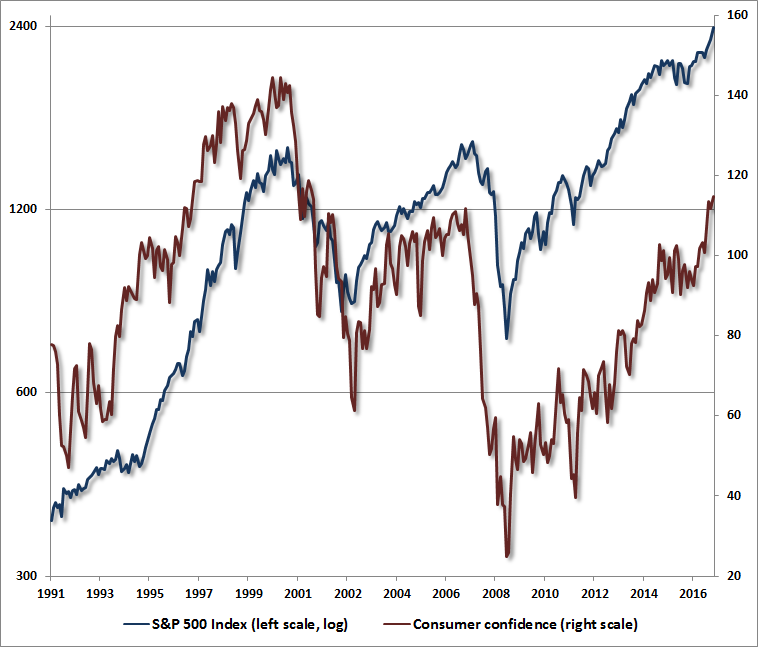
Indeed, Hussman goes as far as to say that “this is the most dangerous and overvalued stock market on record — worse than 2007, worse than 2000, even worse than 1929” as reported by Marketwatch.
For some months now, Hussman of Hussman Funds’ has been warning in his research that investors are ignoring extremely high stock market valuations and are being lulled into a false sense of security by central bank liquidity, massive quantitative easing and zero percent and negative interest rates.
Hussman begins his latest research note by quoting the late, great Sir John Templeton:
“Bull markets are born on pessimism, grow on scepticism, mature on optimism, and die on euphoria.”
He then warns
“A week ago, bullish sentiment among investment advisers soared to the highest level in 30 years (Investor’s Intelligence), joined last week by a 16-year high in consumer confidence. When one recognises that the prior peak in bullish sentiment corresponds to the 1987 market extreme, and the prior peak in consumer confidence corresponds to the 2000 bubble, Sir Templeton’s words take on both relevance and urgency.”
Hussman advises investors become more defensive, because the market could be about to enter a brutal bear market as seen throughout history.

Huge crowds gather in shock at the New York Stock Exchange after 1929 stock-market crash. Getty Images/Keystone/Staff
Hussman Funds provide in-depth analytical research on the US stock market. They use long-term valuation models, reversion to the mean and mathematics to support their views.
Dr Hussman says what we’re currently seeing is worse than 2007 when the global financial crisis brought the world economy to its knees, worse than 2000 when the tech bubble popped and caused a market catastrophe, and even worse than the biblical Wall Street 1929 crash.
The Dow Jones Industrial Average recently breached the hugely important psychological level of 20,000 and has recently surged over 20,100 to 21,115.
Throughout history, the first breach of these important psychological resistance levels is usually the end of — rather than the beginning of — a stock market boom. After the initial breach of the barrier, it takes years for the market to make a permanent breach through these ‘barriers’ (see below).

Is this time different?
We do not know and no one has a crystal ball, however it is important to realise that the U.S. stock markets and bond markets are priced for perfection, despite a very uncertain outlook for the U.S. and the world.
Brexit, the risk of Frexit and EU contagion, uncertainty created by the Trump Presidency and considerable geopolitical risk from a myriad of unresolved conflicts – from North Korea to Russia to Iran and the geo-political mess that is the Middle East.

These over valued stock markets are also vulnerable given the scale of over valuation that is evident in bond markets and the real risk of a very significant sell off in global bond markets.
Bond markets have come under pressure in recent days with yields rising in many key markets. Italian debt looks particularly vulnerable with Italian 10 year yields rising and concerns that a break above 2.50% in the third largest bond market in the world (debt valued at €2.2 Trillion) has the potential to jettison Italy out of the European monetary union.
Bond guru Bill Gross is also warning that investors need to keep an watchful eye on the U.S. 10 year bond yield as a breach of 2.6% will mean that “a secular bear bond market has begun.”
A massively indebted EU and U.S., which reaches the debt ceiling today, with indebted households and fragile economic recoveries will struggle when interest rates revert back to more normal levels.
Markets are priced for perfection and yet the political, financial, economic and monetary outlook is less than perfect. Euphoria and “irrational exuberance” will inevitably revert to “fear and loathing”.
The question is when and by what one catalyst or combination of catalysts?
Given the scale of the risks facing investors and pension owners today, it is prudent to reduce allocations to stocks and bonds and increase allocations to physical gold.
END
No evidence of manipulation..Keith Weiner is totally wrong and Chris Powell highlights this to you;
(courtesy Chris Powell.GATA)
Love of technical analysis blinds fund manager to evidence of market manipulation
Submitted by cpowell on Tue, 2017-03-14 20:14. Section: Daily Dispatches
4:21p ET Tuesday, March 14, 2017
Dear Friend of GATA and Gold:
Keith Weiner of gold fund management company Monetary Metals in Scottsdale, Arizona, is scoffing again at complaints of market manipulation, this time involving the silver market particularly.
In his commentary Sunday, “Why Did Silver Fall?” —
https://monetary-metals.com/why-did-silver-fall-report-12-mar-2017/
— Weiner writes: “With no need of evidence — indeed, with no evidence — one can assert this” — that is, market manipulation — “and not be questioned in the gold and silver communities. We have recently come across a term normally used to describe leftists and social justice warriors, ‘virtue signaling.’ One piously declares that one supports the cause, one speaks truth to power, one sticks it to The Man — well, you get the idea. The concept of ‘virtue signaling’ seems equally appropriate to those who sing the chorus on every price drop, ‘manipulation.'”
GATA may be glad if Weiner finds the gold and silver communities overwhelmingly convinced of its years of work, though of course this convincing does not yet seem to have succeeded with gold and silver mining companies themselves. But we can’t be glad that Weiner himself maintains that there is no evidence of this market manipulation — that, to the contrary, he believes, as other technical analysts do, that gold and silver prices are the products of his technical analysis and mathematical formulas.
Documentation of the longstanding Western government policy of gold price suppression, much of it culled from both public and secret government archives, has been compiled by GATA here —
http://www.gata.org/node/14839
— and Weiner is welcome to rebut even one item, though he writes as if he has never heard even of Deutsche Bank’s recent confession to gold and silver market manipulation and the bank’s incrimination of other investment banks:
http://www.gata.org/node/16964
http://www.gata.org/node/16986
“No evidence”? Deutsche Bank has just agreed to pay nearly $100 million in damages precisely because there is overwhelming evidence — that is, proof.
GATA concedes that documentation of government involvement in manipulation of the silver market is far less extensive than the documentation for gold. And yet Weiner must be trying hard to avert his eyes from the recent official filings by CME Group, operator of the major U.S. futures exchanges, with the U.S. Securities and Exchange Commission and U.S. Commodity Futures Trading Commission, filings discovered and publicized in 2014 by Eric Scott Hunsader of the market data firm Nanex in Winnetka, Illinois. The filings showed that governments and central banks secretly trade all U.S. futures markets on CME Group exchanges and even receive volume discounts for their trading:
http://www.gata.org/node/14385
http://www.gata.org/node/14411
Of course those filings don’t disclose government and central bank trading in silver futures particularly. But they refute Weiner’s claim of “no evidence.”
Also refuting that claim is the heavy involvement in the silver market of JPMorganChase. While the company has said that in silver it only executes trades for clients and has no interest of its own in whether silver prices rise or fall —
http://www.gata.org/node/11216
— the company also long has been a primary dealer in U.S. government securities and an intimate agent of the U.S. government in many other important respects. So it is entirely possible that JPMorganChase’s clients in silver (and gold) include governments and central banks, just as CME Group’s clients do.
Further, of course, JPMorganChase is also custodian of the silver purportedly held by the largest silver exchange-traded fund, SLV. In serving as custodian, can the firm always be indifferent to the interests of its far bigger client, the U.S. government, interests that presumably include not letting monetary metals be perceived as money superior to the money issued by the U.S. government?
For that matter, will Weiner reveal whether Monetary Metals directs any of its metal business to JPMorganChase? If, as Weiner writes, the gold and silver communities are so convinced of manipulation of the monetary metals markets, some of his firm’s own clients might like to know.
Last year at the Mining Investment Asia conference in Singapore your secretary/treasurer questioned Weiner and his new associate, Bron Suchecki, formerly of the Perth Mint, about central bank involvement in the gold market. If your secretary/treasurer’s memory of that exchange is accurate, Weiner and Suchecki acknowledged that central banks are involved in the gold market through gold leasing.
So does Weiner really not remember Federal Reserve Chairman Alan Greenspan’s explanation of gold leasing in his testimony to Congress in July 1998?:
https://www.federalreserve.gov/boarddocs/testimony/1998/19980724.htm
Greenspan said: “Nor can private counterparties restrict supplies of gold, another commodity whose derivatives are often traded over the counter, where central banks stand ready to lease gold in increasing quantities should the price rise.”
That is, even Greenspan acknowledged officially that the purpose of gold leasing by central banks is to keep the gold price down.
Less well known but perhaps just as incriminating were the remarks to the London Bullion Market Association meeting in Rome in September 2013 by the Banque de France’s director of market operations, Alexandre Gautier. The French central bank, Gautier revealed, trades gold for its own account “nearly on a daily basis” and is “active in the gold market for central banks and official institutions”:
http://www.gata.org/node/13373
Maybe Weiner thinks that this trading is just for fun and has no policy purposes. But “no evidence”?
One must be blindly in love with one’s technical analysis and mathematical formulas to overlook all this stuff and tell people it doesn’t exist.
CHRIS POWELL, Secretary/Treasurer
Gold Anti-Trust Action Committee Inc.
CPowell@GATA.org
END
The following is true: the only way you are going to stop citizens of India from buying gold is to take away their cash
(courtesy Afonso/Bloomberg)
The only way to stop Indians from buying gold? Take away their cash
Submitted by cpowell on Wed, 2017-03-15 01:32. Section: Daily Dispatches
By Swansy Afonso
Bloomberg News
Tuesday, March 14, 2017
It seems the only way to stop Indians from buying more gold is to take their money away.
Prime Minister Narendra Modi’s government spent 16 months trying to persuade Indians to deposit their jewelry in the bank to earn interest, in an effort to curb soaring imports of the precious metal. But the program has only lured a tiny fraction of the $900 billion of gold that families and temples are estimated to have stashed away.
On the other hand, Modi’s controversial decision to withdraw all high-value banknotes did the job instead.
Coupled with a higher import tax, the abolition of 86 percent of the nation’s banknotes in an anti-corruption drive helped push gold imports down 39 percent last year to 558 metric tons. Overall consumption in India tumbled to 676 tons, the lowest since 2009, according to the World Gold Council.
That’s bought Modi some breathing space to persuade Indians to recycle their gold in a country where jewelry plays an important role in weddings and festivals and is handed down to daughters for their own weddings. …
… For the remainder of the report:
https://www.bloomberg.com/news/articles/2017-03-14/where-modi-s-recycled…
END
Your early WEDNESDAY morning currency, Asian stock market results, important USA/Asian currency crosses, gold/silver pricing overnight along with the price of oil Major stories overnight
1 Chinese yuan vs USA dollar/yuan STRONGER AT 6.9121( REVALUATION NORTHBOUND /OFFSHORE YUAN NARROWS TO 6.8903/ Shanghai bourse UP 2.43 POINTS OR .08% / HANG SANG CLOSED DOWN 35.10 POINTS OR 0.15%
2. Nikkei closed DOWN 32.12 POINTS OR 0.16% /USA: YEN FALLS TO 114.61
3. Europe stocks opened ALL IN THE GREEN EXCEPT GERMAN DAX ( /USA dollar index FALLS TO 101.57/Euro UP to 1.0623
3b Japan 10 year bond yield: REMAINS AT +.097%/ !!!!(Japan buying 100% of bond issuance)/Japanese yen vs usa cross now at 114.61/ THIS IS TROUBLESOME AS BANK OF JAPAN IS RUNNING OUT OF BONDS TO BUY./JAPAN 10 YR YIELD FINALLY IN THE POSITIVE/BANK OF JAPAN LOSING CONTROL OF THEIR YIELD CURVE AS THEY PURCHASE ALL BONDS TO GET TO ZERO RATE!!
3c Nikkei now JUST BELOW 17,000
3d USA/Yen rate now well below the important 120 barrier this morning
3e WTI:: 48.73 and Brent: 51.84
3f Gold UP/Yen UP
3g Japan is to buy the equivalent of 108 billion uSA dollars worth of bond per month or $1.3 trillion. Japan’s GDP equals 5 trillion usa./“HELICOPTER MONEY” OFF THE TABLE FOR NOW /REVERSE OPERATION TWIST ON THE BONDS: PURCHASE OF LONG BONDS AND SELLING THE SHORT END
Japan to buy 100% of all new Japanese debt and by 2018 they will have 25% of all Japanese debt. Fifty percent of Japanese budget financed with debt.
3h Oil UP for WTI and UP for Brent this morning
3i European bond buying continues to push yields lower on all fronts in the EMU. German 10yr bund RISES TO +.425%/Italian 10 yr bond yield DOWN to 2.312%
3j Greek 10 year bond yield RISES to : 7.30%
3k Gold at $1201.55/silver $16.89(8:15 am est) SILVER RESISTANCE AT $18.50
3l USA vs Russian rouble; (Russian rouble UP 17/100 in roubles/dollar) 59.03-
3m oil into the 48 dollar handle for WTI and 51 handle for Brent/
3n Higher foreign deposits out of China sees huge risk of outflows and a currency depreciation (already upon us). This can spell financial disaster for the rest of the world/China forced to do QE!! as it lowers its yuan value to the dollar/GOT REVALUATION NORTHBOUND from POBC.
JAPAN ON JAN 29.2016 INITIATES NIRP. THIS MORNING THEY SIGNAL THEY MAY END NIRP. TODAY THE USA/YEN TRADES TO 114.61 DESTROYING JAPANESE CITIZENS WITH HIGHER FOOD INFLATION
30 SNB (Swiss National Bank) still intervening again in the markets driving down the SF. It is not working: USA/SF this morning 1.0089 as the Swiss Franc is still rising against most currencies. Euro vs SF is 1.0718 well above the floor set by the Swiss Finance Minister. Thomas Jordan, chief of the Swiss National Bank continues to purchase euros trying to lower value of the Swiss Franc.
3p BRITAIN VOTES AFFIRMATIVE BREXIT/LOWER PARLIAMENT APPROVES BREXIT COMMENCEMENT
3r the 10 Year German bund now POSITIVE territory with the 10 year FALLS to +.425%
The bank withdrawals were causing massive hardship to the Greek bank. the Greek referendum voted overwhelming “NO”. Next step for Greece will be the recapitalization of the banks and that will be difficult.
4. USA 10 year treasury bond at 2.584% early this morning. Thirty year rate at 3.160% /POLICY ERROR)GETTING DANGEROUSLY HIGH
5. Details Ransquawk, Bloomberg, Deutsche bank/Jim Reid.
(courtesy Jim Reid/Bloomberg/Deutsche bank/zero hedge)
S&P Futures, Global Stocks Rise Ahead Of The Fed; Oil Rebounds
It is fitting that just a few hours until the Fed’s second rate hike in two quarters, and one day after Goldman downgraded global stocks to Neutral for the next 3 months, not to mention with the results of the anticipated Dutch election due shortly, that global stocks as well as S&P futures are higher, while crude oil has finally managed to stage a rebound as the Dollar DXY index is fractionally in the red.
In addition to the Fed, a barrage of monetary policy decisions at the BOE, the BOJ, the SNB and Bank of Indonesia within the next 36 hours were further reasons for investors’ cautious stance.
East Coast traders return to their desks following a rather disapponting nor’easter, where they will be prompted bombarded by data over the next 2 days. Here is a quick summary of main events over the next 36 hours courtesy of Bloomberg:
- The Fed’s decision will be announced at 2 p.m. in Washington, followed by Chair Janet Yellen’s news conference a half hour later. Investors are focused on any hints of a change in the number of increases the central bank foresees this year.
- Wednesday’s vote in the Netherlands will deliver a reading on the state of populism in Europe as races in France and Germany heat up.
- The Bank of Japan is set to keep its rates and yield-curve policy unchanged in its policy decision on Thursday. The Bank of England, Swiss National Bank and Bank Indonesia are also expected to stand pat with policy decisions.
- U.S. Secretary of State Rex Tillerson travels to Japan, South Korea and China in his first visit to the region since taking office.
- U.S. President Donald Trump’s first budget outline for fiscal 2018 is expected on Thursday. He’s said he’ll seek a $54 billion boost in defense spending, paid for by an equal amount of cuts to non-defense agencies.
Asian stocks have consolidated much of their recent gains on Wednesday before an FOMC meeting that braved yesterday’s non-blizzard and which is expected to signal not only another 25 bps interest rate increase but also how many more hikes traders can expect during the remainder of the year. Though recent data, particularly out of China, has fueled a rally in Asian equities since the start of the year, Reuters notes that investors are expecting more headwinds for emerging markets due to an increasingly hawkish Fed. “The positive sentiment towards emerging markets is not sustainable as the interest rate differential advantage in Asia’s favor is likely to reduce in the coming months,” said Frances Cheung, head of rates strategy for Asia ex-Japan at Societe Generale in Hong Kong.
Having posted its second-biggest daily gain this year in the previous session, MSCI’s index of Asia-Pacific shares ex-Japan was up 0.2% near the day’s highs in cautious trading. Asian had a good start to the week thanks to positive news out of China and India. Strong data out of China this week sparked a fresh rally in Hong Kong stocks while Indian shares climbed to a record high on Tuesday as investors regarded Prime Minister Narendra Modi’s landslide victory in the northern state of Uttar Pradesh as an endorsement for his economic reforms. While recent economic Chinese data has been supportive, Premier Li warned at a press conference that China’s economy faces domestic and external risks this year, but added the country has many policy tools to cope with them.
“China’s economy had pretty good performance in January and February. March data will be crucial as investors are anxious for any hint on whether the recovery is sustainable,” said Linus Yip, strategist at First Shanghai Securities Ltd.
Bucking the trend, Japan’s Nikkei was down 0.2% while stocks in mainland China and Korea were fractionally lower, by 0.08 and 0.04 percent respectively. Hong Kong shares pared declines as Chinese Premier Li Keqiang played down the risk of a trade conflict. Speaking at a press conference after the close of the annual National People’s Congress, Li said it’s important for both China and the U.S. to keep talking to build trust. Furthermore, a worrying drop in global oil prices has cast doubt on how much Asian policymakers are likely to raise interest rates this year to maintain their premium over U.S. rates, with risks of another global tantrum rising.
The S&P is set to open higher, with E-minis trading 0.2% in the green in early Tuesday trading.
The big commodity story of the past week continues to be oil, and crude prices remain a dominant story in markets, with oil’s rebound helping underpin European stocks as investors wait for Wednesday’s expected U.S. interest rate increase. As Bloomberg notes, WTI trades above $48.50/bbl as Tuesday’s API drop in U.S. crude stockpiles counters Saudi boost in production reported by OPEC. IEA says market is still working to clear surge in output from end of last year. “The OPEC data sent us lower on the idea that there’s higher supply there, but we’ve flipped and now the APIs are suggesting inventories in the U.S. are ticking lower,” says Jasper Lawler, senior market analyst at London Capital Group. “The market is massively oversold and that’s been enough to trigger a bounceback.”

The swings in oil added some drama to financial markets that have entered a two-day period brimming with central bank decisions, European political drama and a raft of economic data. With the Federal Reserve seen as all but certain to raise rates, investors have been weighing how precarious energy prices will feed into the central bank’s path for future moves.
In currencies, the U.S. dollar was broadly unchanged against major rivals ahead of the FOMC meeting, and most attention will be focused on what Fed Chair Janet Yellen says about the future path of interest rates. The dollar index was flat at 101.69, staying in a well worn recent range. The British pound led gains in the Group-of-10 currencies, rising by as much as 0.9 percent before trading 0.4 percent higher. The euro rose by 0.2 percent to $1.0623, following its 0.5 percent drop a day earlier.
“Of course, everyone is waiting for the Fed, so we’re expecting range-bound trading until we get some clear signals about expectations for the rest of the year,” said Kaneo Ogino, director at foreign exchange research firm Global-info Co in Tokyo. Markets are also awaiting a meeting of the Group of 20 finance ministers and central bankers in the German town of Baden-Baden starting on Friday, their first meeting since Donald Trump won the U.S. presidential election.
Bulletin headline summary from RanSquawk
- European equities trade modestly higher ahead of upcoming key risk events with energy and material names the notable outperformers
- Early FX trade has focused on GBP once again, with the early European hit on GBP yesterday reversed today, seeing 1.2200 reclaimed in Cable
- Looking ahead, highlights include FOMC rate decision, US CPI and Retail Sales, UK employment data and comments from ECB’s Praet
Market Snapshot
- S&P 500 futures up 0.2% to 2,367.25
- STOXX Europe 600 up 0.2% to 374.21
- MXAP up 0.06% to 145.77
- MXAPJ up 0.2% to 470.09
- Nikkei down 0.2% to 19,577.38
- Topix down 0.2% to 1,571.31
- Hang Seng Index down 0.2% to 23,792.85
- Shanghai Composite up 0.08% to 3,241.76
- Sensex down 0.01% to 29,440.36
- Australia S&P/ASX 200 up 0.3% to 5,774.00
- Kospi down 0.04% to 2,133.00
- German 10Y yield unchanged at 0.445%
- Euro up 0.2% to 1.0629 per US$
- Brent Futures up 1.4% to $51.64/bbl
- Italian 10Y yield fell 2.3 bps to 2.341%
- Spanish 10Y yield rose 0.8 bps to 1.879%
- Brent Futures up 1.4% to $51.64/bbl
- Gold spot up 0.3% to $1,203.16
- U.S. Dollar Index down 0.2% to 101.51
Top Overnight News
- President Donald Trump made more than $152.7 million and paid $38.4 million in federal taxes in 2005, according to two pages of his federal income tax return for that year that were broadcast by MSNBC and posted online
- Dutch voters are heading to the polls in a general election that will provide the first gauge of the spread of populism into the core of Europe
- Oil Market Still Digesting Pre-Deal OPEC Output Surge, IEA Says
- EON Posts Record Loss as German Power-Plant Writedowns Mount
- Zara Owner’s Margin Shrinks to Lowest Level in Eight Years
- Walgreens Said Poised to Sell More Assets to Win Rite Aid Nod
- China Lodging 4Q Adj. Profit Per ADS Misses Est.
- Cellcom Won’t Pay 4Q Dividend as Competition Affects Results
- General Electric to Build 200 MW Power Plant in Ghana: Graphic
- Deutsche Securities Warned by Japan Over Bond Trading Collusion
- Osaka Gas Says LNG From Freeport Project to Be Price Competitive
- MoneyGram Says to Carefully Review & Consider Euronet Proposal
- Manulife Receives China Investment Company WFOE License
- Chevron Says Oil Well in Bay Marchand Field Shut After Spill
- Ant Financial Still ‘Highly Committed’ to Merger With MoneyGram
- Amazon Poses Opportunity, Not Threat in Australia: Kogan.com CEO
In Asia, markets traded mostly lower as global sentiment remained dampened by pre-FOMC caution. This weighed on Nikkei 225 (-0.2%) from the open, while ASX 200 (+0.3%) recovered amid resilience in commodity stocks, aside from the gold miners which suffered after the precious metal briefly dropped below USD 1200/oz. Shanghai Comp. (+0.1%) and Hang Seng (-0.1%) conformed to the lacklustre tone, although losses have been stemmed after the PBoC slightly upped its liquidity injections to a total CNY 60bIn. 10yr JGBs are only marginally higher despite a subdued risk tone and the BoJ’s presence in the market for a total of JPY 1tIn, with demand weak ahead of tomorrow’s BoJ announcement in which consensus is for the central bank to hold off on any policy tweaks.
Chinese Premier Li concluded the NPC in which he stated that the GDP target of around 6.5% is not low and is not easy to reach. Premier Li also ruled out systemic risks in finance system which he described as generally safe and added that China has many policy tools to cope with risks. PBoC injected CNY 10bIn in 7-day reverse repos, CNY 10bIn in 14-day reverse repos and CNY 40bIn in 28-day reverse repos. PBoC set CNY mid-point at 6.9115 (Prey. 6.9118).
Top Asian News
- Singapore 2017 GDP Forecasts Boosted in MAS Survey of Economists
- China to Let Investors Buy Onshore Debt via Hong Kong This Year
- INR Rally Continues Even as RBI Seen Intervening: Asian NDFs
- BOJ Bond Purchases Draw Higher Demand Before Fed, BOJ Decisions
- Chinese Shares Decline in Hong Kong as Oil Tumbles, Fed Ponders
- RBI Seen Intervening as Modi’s Win Sparks Rupee Rally: Roundup
- For Pound Traders, Brexit Giveth and Taketh Away: Markets Live
- Japan Ex-Econ Minister Amari Says Still Too Soon for BOJ Taper
- Premier Li Says China Supports Integrated Europe and Strong Euro
European equities trade modestly higher with energy and material names the notable outperformers with the former lifted by last nights unexpected drawdown in API inventories. Utilities are underperforming, dragged lower by Eon, despite the Co. opening higher in the wake of their earnings as investors continue to remain concerned over the record losses at the Co. That said, markets are ultimately in wait-and-see mode as investors await the upcoming FOMC policy announcement and Dutch election. In fixed income markets, Bunds reside modestly in the green but with trade likely to remain subdued ahead of the aforementioned FOMC. More specifically, Gilts have continued to underperform their German peers with the latest jobs report out of the UK doing very little to sway prices whilst peripheral markets remain relatively subdued.
Top European News
- Och-Ziff Executives Said to Leave After $13 Billion Withdrawn
- Oil Rebounds on U.S. Stockpile Drop Report as Saudis Lift Output
- Croat Govt Meets With Agrokor’s Russian Creditors, N1 TV Says
- Zodiac Tumbles; Profit Warning Undermines Deal Valuation: Kepler
- French Bank Shares Could Lose 25% on Le Pen Victory, Citi Says
- Twitter Accounts Globally Posting Swastikas, Pro-Erdogan Content
In currencies, the Bloomberg Dollar Spot Index slipped by 0.2 percent. The British pound pared gains after wage growth slowed. A YouGov poll for The Times showed that 57 percent of Scottish voters want to remain inside the U.K. compared to 43 percent who seek independence. It traded 0.4 percent higher after jumping as much as 0.9 percent earlier. The euro rose by 0.3 percent to $1.0629, following its 0.5 percent drop a day earlier. Early FX trade has focused on GBP once again, with the early European hit on GBP yesterday reversed today, seeing 1.2200 reclaimed in Cable, while EUR/GBP was pushed under 0.8700, but tentatively so as yet. The UK employment report this morning highlighted wage growth slowing, but we saw the rate ease off to 4.7% and a higher than expected claimant count fall. Price action has since moderated. For the EUR, Dutch election risk has been relatively muted but should hamper the upside across the board. EUR/GBP we have already mentioned, but EUR/USD is naturally struggling south of 1.0650, with the upcoming FOMC rate announcement also keeping the USD supported despite a tailing off of UST yield in the mid curve. USD/JPY is looking heavy in this respect, but support from 114.50-20 propping up here for now.
In commodities, WTI gained 1.7 percent to $48.54 as of 10:03 a.m. in London. U.S. inventories fell by 531,000 barrels last week, the industry-funded American Petroleum Institute was said to report.
Gold climbed 0.3 percent to $1,202.24 an ounce after falling 0.4 percent Tuesday. Iron ore jumped 3.4 percent, adding to a 4.3 percent advance in the previous session. The notable moves in commodities in Oil once again, but this time in favour of the black stuff, which sees WTI back through USD48.00 and holding these levels in the wake of the surprise drawdown reported in the API late yesterday. Brent is pushing session highs ahead of USD52.00, but not too much price action anticipated here, or indeed across the board as Fed policy dominates (later) today. Copper rises a little higher amid the ongoing impasse at the Escondida mine, though operations in some areas ‘not connected’ to wage talks may resume. Base metals higher across the board in fact, with Zinc leading.
Looking at today’s calendar, the big releases start at 8:30am and include the February CPI report where the market consensus is for 0.0% mom and +0.2% mom for the headline and core respectively. At the same time we will also get the latest retail sales data for February where the consensus is for a +0.1% mom headline print and +0.2% mom ex auto and gas print. Due out at the same time will be the March empire manufacturing print where a modest decline is expected. Later we will then get the NAHB housing market index print for March and January business inventories. All of this comes before the FOMC meeting this evening followed by Yellen’s press conference shortly after. The other focus today will of course be the Dutch election.
US Event Calendar
- 7am: MBA Mortgage Applications, prior 3.3%
- 8:30am: Empire Manufacturing, est. 15, prior 18.7
- 8:30am: US CPI MoM, est. 0.0%, prior 0.6%; CPI Ex Food and Energy MoM, est. 0.2%, prior 0.3%
- 8:30am: US CPI YoY, est. 2.7%, prior 2.5%; CPI Ex Food and Energy YoY, est. 2.2%, prior 2.3%
- 8:30am: Real Avg Weekly Earnings YoY, prior -0.63%; Real Avg Hourly Earning YoY, prior 0.0%
- 8:30am: Retail Sales Advance MoM, est. 0.1%, prior 0.4%; Ex Auto MoM, est. 0.1%, prior 0.8%; Ex Auto and Gas, est. 0.2%, prior 0.7%; Retail Sales Control Group, est. 0.2%, prior 0.4%
- 10am: NAHB Housing Market Index, est. 65, prior 65
- 10am: Business Inventories, est. 0.3%, prior 0.4%
- 2pm: FOMC Rate Decision
- 4pm: Total Net TIC Flows, prior $42.8b deficit; Net Long-term TIC Flows, prior $12.9b deficit
* * *
DB’s Jim Reid concludes the overnight wrap
As the east coast gets back to normal today we’re set for a busy day of US data (CPI the highlight) with a likely Fed hike and Dutch election thrown in for good measure. To start with today we’ll preview the FOMC and Dutch election.
With a Fed rate hike virtually nailed on today thanks to some skilful Fed speak over the past two weeks, the main focus for the market will be the dots. DB’s Joe LaVorgna expects the median 2017 “dot” to remain at 1.375%, because it would take four of the six policymakers currently at the median to raise their forecasts, which he thinks is a lot given the uncertainties over Trump’s fiscal policy. However he does expect about one or two policymakers to increase their year-end 2017 fed funds projection, and this could impact next year’s median forecast. Only two participants currently at the 2018 median of 2.125% need to raise their forecasts for the 2018 median to rise to 2.375%. In addition, only one of the two Fed officials currently at the 2019 median of 2.875% would need to raise their forecast for the median to increase to 3.0% or possibly 3.125%. So Joe believes there is roughly a one in three chance that the 2017 median dot goes up 25 bps to 1.625%, but the 2018 and 2019 median dots will likely increase. Joe is overall of the opinion that a ‘dovish hike’ is going to be tough with the dots edging up and a Committee that is getting more confident in its outlook which Chair Yellen will want to emphasize. So all eyes on 6pm GMT.
Today also brings the Dutch elections which DB’s Jochen Moebert fully previewed in this week’s Focus Europe (pages 15-18 of https://goo.gl/QBifW6). Exit polls will be available soon after polls close at 21:00. The latest polls suggest established parties have slightly gained ground at the expense of the right-wing PVV and other Euro sceptic parties. Although the PVV have lost the lead in the polls they are still expected to come second in a tight race. However their current opinion polling is around half the 30% our economists think is necessary for the other parties to be unable to ignore them in forming the coalition. So a Euro friendly coalition is likely but the PVVs success (or lack of it) relative to their recent polling might give us clues as to how pollsters are doing in capturing non-establishment movements after poor performance with Brexit and President Trump. A big outperformance might renew fears of a Le Pen victory in France or at least increase the probabilities. Obviously the opposite is also true. So for us that’s the subplot to this election. If we take the latest poll from each of the 5 main pollsters (I&O, Ispos, TNS and Peil published yesterday and Monday), the average is just under 15% for the PVV (range: from 10.7% to 16.0%) and just under 18% for the VVD (from 16.0% to 19.3%). There are 3 other parties in the low teens (the best of these are CDA who are only slightly behind PVV). So for PVV and populism not finishing first will be a disappointment relative to a few weeks ago but now with support supposedly waning maybe hanging onto second and only 2-3% behind the VVD will be par.
Ahead of today’s main events markets have been fairly reluctant to really get going so far this week. That said Oil has been doing its best to keep everyone on their toes. The main news yesterday was the monthly OPEC report which revealed that Saudi Arabia’s production had increased in February to the tune of about 263k barrels a day to more than 10 million barrels again which reverses around a third of the cuts the kingdom had made in January in the wake of the OPEC agreement. In conjunction with OPEC also raising their forecast for non-OPEC supply growth in 2017, WTI tumbled to an intraday low yesterday of $47.09/bbl (about -2.70% on the day) which is the lowest price since the end of November. However the report prompted a rare public response from Saudi Arabia with the energy minister issuing a statement saying that the kingdom “assures the market that it is committed and determined to stabilising the global oil market by working closely with all other participating OPEC and non-OPEC producers”. WTI has actually ended up doing a complete u-turn since and is back to $48.56/bbl this morning which is pretty much where it closed on Monday with some suggestion that the API data showing a drop in US crude inventories last week also helped provide some support.
The turnaround for Oil did however come too late in the day for risk assets. With the energy sector alone down -1.10% the S&P 500 closed -0.34%, albeit on volumes some 20% below the usual average reflecting the impact of the storm. It’s worth noting that the index hasn’t closed down more than 1% in 105 sessions now which is the longest streak since 1995. In Europe a similar drag from energy stocks saw the Stoxx 600 finish -0.31%. Commodity-sensitive and EM currencies also suffered with the Russian Ruble (-0.59%) and Norwegian Krone (-0.54%) standing out. Sterling also fell -0.54% albeit for a different reason following that confirmation from Parliament which cleared PM May for the triggering of Article 50. A Bloomberg report yesterday suggested that the EU is considering forcing May to wait until June before discussing negotiating the formal Brexit terms. That throws up a few issues not least limiting the amount of time May will have to complete negotiations. Our FX colleagues reiterated yesterday in their FX daily that Sterling has room to fall much further given that; (i) financial fair value metrics point much lower, (ii) longer-run valuation metrics are not stretched, (iii) inflows are drying up, (iv) growth expectations are not pricing hard Brexit and (v) political risks have yet to materialize. Their H2’17 target is 1.14 in GBP/USD. A link to the report is attached here https://goo.gl/wbStod.
Meanwhile credit markets continue to feel a bit sluggish. The CDX IG and iTraxx Main indices were 1bp and 1.5bps wider yesterday while US HY spreads were 10bps wider in cash terms. In fact US HY spreads have now widened for 8 sessions in a row and in that time are 42bps wider and at the widest level now (at 408bps) since February 8th. US HY energy spreads were also 13bps wider yesterday and at 475bps are now at the widest level since December 8th. Those moves in credit also came despite a backdrop of stronger rates with 10y Treasuries and Bunds finishing -2.6bps and -2.5bps lower respectively.
This morning in Asia it’s been a similarly subdued session. While the Nikkei (-0.25%), Hang Seng (-0.05%) and Kospi (-0.13%) are modestly in the red, the ASX (+0.09%) along with bourses in China (Shanghai Comp +0.08%) are a touch firmer. The latter coming while China premier Li Keqiang is making final remarks at China’s NPC. Li told his audience that he doesn’t want to see a trade war with the US, emphasised that China will maintain basic stability in the renminbi and is not looking at depreciating the currency in order to boost exports.
Moving on. With regards to the data yesterday, in the US the main highlight was the February PPI report. Headline PPI was reported as rising a bit more than expected during the month (+0.3% mom vs. +0.1% expected) lifting the annual rate to +2.2% yoy while the same could also be said for the ex food, energy and trade print (+0.3% mom vs. +0.2% expected). Meanwhile the NFIB small business optimism reading came in at 105.3 for February which was down a tad from the 105.9 in January. Closer to home there were no surprises in the final revisions to the February CPI report in Germany with headline inflation confirmed at +0.7% mom and +2.2% yoy. The ZEW survey was also released and showed a rise in the current situations index this month to 77.3 from 76.4, albeit a slight miss versus expectations for 78.0.
Before we wrap up, yesterday our European equity strategists published a report looking at what’s being priced for global growth. While some investors expect an acceleration in US GDP growth over the coming quarters to lead to further upside for equities, Tom Pearce on DB’s European equity strategy team argues that much of the good news is already in the price. European equities, which are up by 9% over the past six months, have continued to track global PMIs, which have just seen the largest rise in nearly five years. Even if US GDP growth were to hit 4%, this would be consistent with only marginal further upside for global PMIs and, hence, European equities. What is more, our strategist thinks the most likely scenario is a slight fade in global PMIs over the coming months. This would point to a pull-back of around 5% for European equities. A link to the report can be found here. https://goo.gl/oT6fCf.
Looking at today’s calendar, this morning in Europe the early data due out is from France where any final revisions to the February CPI report will be made. Thereafter we will get the January and February employment data in the UK before Q4 employment data for the Euro area is released. Over in the US this afternoon the calendar is packed. The big releases are due out shortly after lunch and include the aforementioned February CPI report where the market consensus is for 0.0% mom and +0.2% mom for the headline and core respectively. Our US economists are forecasting +0.1% and +0.2%. At the same time we will also get the latest retail sales data for February where the consensus is for a +0.1% mom headline print and +0.2% mom ex auto and gas print. Due out at the same time will be the March empire manufacturing print where a modest decline is expected. Later in the afternoon we will then get the NAHB housing market index print for March and January business inventories. All of this comes before the aforementioned FOMC meeting this evening followed by Yellen’s press conference shortly after. The other focus today will of course be the Dutch election. It’s worth also keeping an eye on Brexit Secretary David Davi
3. ASIAN AFFAIRS
i)Late TUESDAY night/WEDNESDAY morning: Shanghai closed UP 2.43 POINTS OR .08%/ /Hang Sang CLOSED DOWN 35.10POINTS OR 0.15% . The Nikkei closed DOWN 32.12 POINTS OR 0.16% /Australia’s all ordinaires CLOSED UP 0.27%/Chinese yuan (ONSHORE) closed UP at 6.9121/Oil ROSE to 48.73 dollars per barrel for WTI and 51.84 for Brent. Stocks in Europe ALL IN THE GREEN EXCEPT GERMAN DAX ..Offshore yuan trades 6.8903 yuan to the dollar vs 6.9121 for onshore yuan.THE SPREAD BETWEEN ONSHORE AND OFFSHORE NARROWS CONSIDERABLY/ ONSHORE YUAN STRONGER AS IS THE OFFSHORE YUAN AND THIS IS COUPLED WITH THE SLIGHTLY WEAKER DOLLAR. CHINA SENDS A MESSAGE TO THE USA NOT TO RAISE RATES
3a)THAILAND/SOUTH KOREA/NORTH KOREA
b) REPORT ON JAPAN
c) REPORT ON CHINA
4. EUROPEAN AFFAIRS
The Netherlands
Here is a great outline as we watch the important Dutch election today:
(courtesy Mish Shedlock/Mishtalk)
What To Watch For As The Dutch Go To The Polls
Dutch citizens will vote today for a new government in one of the most-watched elections in years. While polls have tilted towards PM Rutte’s VVD Party in recent days, the euroskeptic leader of the Freedom Party, Geert Wilders, looks set to gain the most seats but the necessary coalition will be anything but clean (since World War II, it’s taken an average of 72 days to form a government).

The timing of the vote results is as follows (via Bloomberg):
Polling stations across the Netherlands close at 9pm (4pm ET), and counting of the votes, which is done by hand, starts immediately. Polls will still be open for five more hours on three Dutch islands in the Caribbean — Bonaire, Saba and St. Eustatius — but they represent only a tiny fraction of the overall electorate of 12.7 million.
Ipsos is conducting one exit poll for broadcasters NOS and RTL, to be published just after 9pm (4pm ET) . The first version, which will estimate turnout and the distribution of seats, is based on responses up to 830pm (330pmET); it’s updated at 930pm (430pmET) with last-minute voters. It’s a big exercise: The pollsters expect to get about 38,000 respondents. By comparison, the 2015 exit poll in the U.K., a country with more than three times as many voters, had a sample of 20,000 respondents. Usually the exit poll is a pretty accurate prediction of the end result in the Netherlands. In 2012, it was a total of six seats off out of 150.
The total number of votes cast is divided by 150, the total number of seats, to determine the threshold for winning a seat. In 2012, it was 62,828. Then the cumulative total for each party is divided by the threshold to determine the number of seats it’s entitled to. The handful of seats left over are shared out according to a mathematical formula.
What will determine the next prime minister?
Basically, the ability to form coalitions. The Netherlands has so many political parties — a dozen hold seats in parliament — that no one party has ever won a majority on its own. Win or lose, this will pose a challenge to Wilders, since most other parties have ruled out a tie-up with his Freedom Party.
As MishTalk’s Mike Shedlock explains, this will get messy…
Political Party Explanation
- VVD is the People’s Party for Freedom and Democracy. VVD is led by prime minister Mark Rutte.
- PvdA is the Labour party. PvdA is in a current coalition with VVD.
- PVV is Partij voor de Vrijheid, Geet Wilders’ annti-immigraton eurosceptic Party for Freedom.
- SP is the Socialist party. SP is in opposition against the Second Rutte cabinet.
- CDA is the Christian Democratic Appeal party. From 2010 to 2012 the CDA was a junior coalition partner in a right-wing minority cabinet with the People’s Party for Freedom and Democracy (VVD), supported in parliament by the Party for Freedom (PVV).
- D66 is the Democrats 66 party whose main objective is to democratize the political system. It seeks to create an American-style presidential system.
- CU is the Christian Union. The CU holds socially conservative positions on issues such as same-sex marriage, abortion, and euthanasia. It is Eurosceptic while maintaining progressive stances on economic, immigration and environmental issues.
- GL is the GroenLinks (green) party. GroenLinks describes itself as “green”, “social” and “tolerant”
- SGP is the Reformed Political Party. The term Reformed is not a reference to political reform but is a synonym for Calvinism. The party favors the re-introduction of the death penalty in the Netherlands. They base this on the Bible, specifically on Genesis 9:6, “Whoso sheddeth man’s blood, by man shall his blood be shed: for in the image of God made he man.” The SGP opposes feminism, and concludes, on Biblical grounds, that men and women are of equal value (gelijkwaardig) but not equal.
- PvdD, Partij voor de Dieren, is the Party for the Animals. Among its main goals are animal rights and animal welfare, though it claims not to be a single-issue party. The party does consider itself to be a testimonial party, which does not seek to gain political power, but only to testify to its beliefs and thereby influence other parties.
- 50+, 50 Plus, is a pensioners’ interests political party.
When do we get the final result?
Not until 4 p.m on March 21, when the the Dutch Electoral Council makes its formal announcement. But unless it’s really very close, the seat distribution shouldn’t change.
Coalition Math
- It takes 76 seats to form a coalition.
- All of the parties have ruled out entering a coalition that contains Geet Wilders’ PVV.
- Take away Wilders’ 24 PVV seats and another 14 seats from SP and it gets rather problematic coming up with 76 seats given the varying views.
- VVD+PvdA+D66+GL = 27+9+16+19=71
- VVD+PvdA+D66+CDA = 27+9+16+21=73
In regards to point number 3, is the CU or SGP likely to agree with the socially tolerant GL Green party?
At Least Four to Tango
In a Bellwether to European Populism, Bloomberg reports that it will take at least 4 to tango.
A coalition of 5 looks even more likely, and if PVV hits the high 20s, I wonder if it takes a coalition of 6.
Don’t Hold Your Breath

“Since World War II, it’s taken an average of 72 days to form a government. The speed record, dating from 1958, is 10 days. But be warned: A total of 208 days were required in 1977 to establish a coalition that consisted of only two parties.”
END
And here are the first exit polls taken and Prime Minister Rutte is in a big lead and will get 31 seats. Wilder only 19 seats
(courtesy zerohedge)
Dutch Election Exit Polls: Prime Minister Rutte Top, Defeating Wilders Freedom Party
In a setback for Dutch firebrand Geert Wilders, the first Dutch exit polls are out and his Partij voor de Vrijheid, or Party for Freedom, has only won 19 seats, tied with most of the secondary parties, in line with polls that were predicting a sharp drop off in support in recent days. The winner: prime minister Mark Rutte’s PVV, or People’s Party for Freedom and Democracy, with 31 seats.

Other exit polls show a similar breakdown:
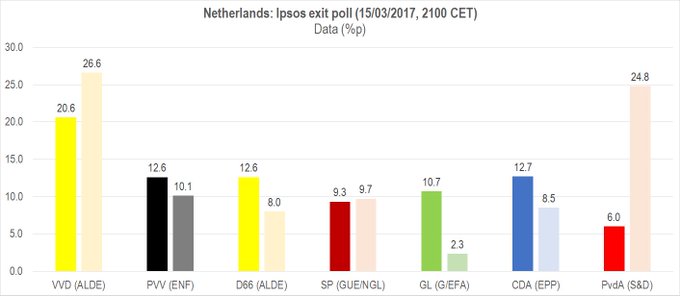
Netherlands, Ipsos exit poll:
VVD-ALDE: 21%
CDA-EPP 13%
PVV-ENF 13%
D66-ALDE 13%
GL-G/EFA 11%
SP-LEFT 9%
PvdA-S&D 6%#DutchVote #TK2017

Developing.
A commentary on the upcoming French elections
(courtesy Matt Purple/StrategicCultureFoundation)
Marine Le Pen’s Perfect Storm
Authored by Matt Purple via The Strategic Culture Foundation,
Polls missed the last two nationalist tremors; they may miss a third

Think of François Fillon as a more polished and experienced Ted Cruz. He might have been president of France until everything came crashing down.
Fillon is a former French prime minister and admirer of Margaret Thatcher whose libertarian-influenced agenda includes a pledge to ax half a million civil service jobs. He was initially dismissed as an also-ran in the center-right Les Républicains presidential primary, up against the seasoned Nicolas Sarkozy and the moderate Alain Juppé. Instead, Fillon thrashed them both, and polls showed him an early favorite for the French presidency, backed by energized conservatives and the Catholic Right. Eschewing first-past-the-post, France holds a runoff election between its top two finishing presidential candidates if neither secures a majority, and forecasts last year showed the finalists would be Fillon and the National Front’s Marine Le Pen. It was to be a rumble on the right, and Fillon was predicted to win in a rout as French leftists and centrists clothespinned their noses and voted to block the radioactive Le Pen.
Or at least, that’s what was supposed to happen. Instead, Fillon was quickly submerged in controversy as it came out that he’d funneled 900,000 euros in public money to his family, a scandal that became known as “Penelopegate” after his implicated wife. An investigation was launched and Fillon’s poll numbers sagged into third place, drawing an intervention from the omnipresent Sarkozy and whispers that Juppé might take over as nominee. But Juppé ultimately declined to run, cognizant of being a moderate beached in a year of fury, and Fillon remained defiant. He would only step down, an aide said, if a planned rally last Sunday turned out to be a dud. Lo and behold, tens of thousands of conservative faithful turned out, and he limped onwards.
France’s political dichotomy has thus been plunged into the unknown. The major parties are sidelined for now, with Fillon a boulder on the back of the center-Right Républicains and the center-Left Parti Socialiste floundering under the stewardship of detested current president François Hollande who is not standing for reelection. Amidst all this, the polling service Oxoda now finds Le Pen running neck-in-neck with another candidate, Emmanuel Macron, an independent whose En Marche! movement is serving as an outlet for the forlorn political center. Macron is a novelty in French politics: an investment banker who was appointed economic minister at the age of thirty seven and who’s still never been elected to public office in his life. He has a youthful charisma that this cliché-deploring writer only reluctantly describes as “Kennedyesque” and his rallies have grown exponentially in size since he entered the race.
The 2016 presidential election in the United States embodied the old versus the new, with Hillary Clinton the conventional and choreographed handmaiden of our hoary political consensus and Donald Trump the populist stick of TNT primed to blow underneath. Assuming present trends hold, the French election this April will be one step advanced, leapfrogging over the mainstream parties entirely and pitting against each other the two flavors of reform that are most likely to dominate Western politics in the years to come. Neither Macron nor Le Pen believes France can continue on its current track and both are proposing ambitious overhauls to the French social contract. After a year that’s seen economic stagnation and rowdy strikes, protests targeting abusive cops and demonstrations against immigration, terrorist attacks, soccer riots, and the southward seeping shock of Brexit, the only thing certain in France is that much has to change.
Le Pen’s appeal is obvious. She’s the Gallic Trump, France’s vessel for the West’s recent flirtation with populism. Head of the Front National, which had long been dismissed as bigoted until she vigorously resuscitated it and expelled its former leader and her father Jean-Marie Le Pen, she’s successfully blended anti-immigrant and anti-Islamic politics with a dedication to the welfare state that isn’t shared by more established French conservatives like Fillon. The nut of her message is that French institutions, benefits, handouts, society, all of it, ought to be reserved for the French and not its newcomers. Because the European Union stands for the globalism and multiculturalism she abhors, she energetically backed Brexit and has promised to hold a referendum on France’s membership in the EU.
The parallels between her candidacy and the Trump Train are undeniable: French voters shrugging that they’ve tried everything else so may as well take a gamble on the neophyte, blue-collar workers ditching the socialists after decades of perceived neglect, immigration as a political keystone joining Left and Right in fury wrought from economic pain. In northeastern France, industrial workers battered by globalization and the shuttering of their blast furnaces—“cathedrals” they call them—are breaking for Le Pen. In the rural middle, farmers, their livelihoods buttressed by Brussels, are stomaching Le Pen’s anti-EU rhetoric in favor of her promise to displace their loathed political class. The cultural flashpoints touted by the Front National—like its pledge to ban the chaste “burqini” swimwear popular among Muslims; “France isn’t burqinis on the beach. France is Brigitte Bardot,” Le Pen told CBS News—have real resonance with both demographics.
Like Le Pen, Macron is also determined to discomfit the French political establishment, which he views as quiescent and self-serving, and he too repudiates traditional party labels, defining himself as “neither left nor right.” But once you place him off the traditional political grid, it becomes evident he’s Le Pen’s antithesis in nearly every other way. He’s a devotee of Europe who believes the solution to the EU’s woes is reform rather than the scrap heap. He advocates for refugees whom he says present an “economic opportunity” and have “remarkable qualifications.” He espouses that inchoate mixture of social liberalism and economic liberalization with which many young people functionally identify. He understands that France’s overregulated and hamstrung economy can’t continue to function as is. He warned President Hollande that a proposed 75 percent tax on millionaires would turn France into “Cuba without the sun.”
The Le Pen-Macron dichotomy, which in many ways runs orthogonal to traditional Left and Right, is far more representative of where the peoples of the West are right now than the mainstream party duopoly. The issues are many. Do economies function better open or half-closed? Is a job something portable and ephemeral or is it a singular and sturdy column of well-being rooted in place? Can the globalization genie be put back in the bottle? Are we citizens of nations or citizens of nations and the world? Should our cardinal civic virtue be tolerance or patriotism? Le Pen’s and Macron’s answers to those questions, splayed on their respective platforms, could not be more diametrically opposed.
France is thus a microcosm of the present, fraught, unsteady Western world, and her election could be a dress rehearsal for our coming political realignment. The conjecture on the lips of European elites is whether Le Pen, whose brand of disruption is far greater anathema to them than Macron’s, can win the presidency. Conventional wisdom dictates that this won’t happen, that Macron will crush Le Pen in the runoff election, flush with support from Socialistes and Républicains determined to obstruct the Front National. But don’t be so certain. Portents were to be found at that Fillon rally last weekend where, amidst pouring rain and wind, conservative activists brimmed with tea party-esque rage towards their own party grandees. “If Fillon is out,” one demonstrator warned, “many of us will vote extreme, I am convinced.” If Le Pen can shepherd those disgruntled Républicains foot soldiers into her fold for the runoff, her chances will improve significantly.
Of course, the polls show . . . but who really cares what the polls show? They failed to register the last two nationalist tremors and it’s entirely possible they’re about to miss another one.

END
5. RUSSIAN AND MIDDLE EASTERN AFFAIRS
Turkey/Europe
The Turkish Foreign Minister tells the truth: The EU is falling apart
(courtesy zerohedge)
Turkish Foreign Minister: EU Falling Apart, “The Futures Of Europe Will Not Be Pleasant”
The diplomatic scandal between Turkey and the Netherlands continued for a fourth day on Tuesday, just hours ahead of the Dutch general election on Wednesday, when Turkish President Recep Tayyip Erdogan once again accused the Netherlands of state terrorism and having a “rotten” character as the diplomatic spat between the two countries deepens, adding he would mobilize the Islamic world to fight xenophobia, racism and Islamophobia.
Speaking at a medical conference in Ankara on Tuesday, Erdogan accused the Netherlands of being responsible for the 1995 Srebrenica massacre during the Bosnian War. Dutch peacekeepers have been accused of standing down and letting Bosnian Serb forces kill up to 8,000 Bosnian Muslims in the city considered a UN “safe area.”
“We know the Netherlands and the Dutch from the Srebrenica massacre,” Erdogan told his audience. “We know how rotten their character is from their massacre of 8,000 Bosnians there. Nobody should try to give us lessons on morality, especially not those who have blood on their hands.”
“The Netherlands, with its display of state terrorism, has caused huge damage to Europe and the EU,” Erdogan said on Tuesday as cited by the Hurriyet. “Now, for those who want to cooperate with the EU, it has ceased to be a symbol of human rights and freedom. Europe is too important to be left at the mercy of rogue states.”
But it was the statement by Erdogan’s foreign minister Melvut Cavusoglu that was more notable than the, by now repetitive Erdogan, because what Cavusoglu said was far more accurate than Erdogan’s deranged accusations of fascism this, and naxism that..

The Turkish Foreign Minister accused the European Union of resorting to double standards in relations with Turkey. “Do you know why? It is due to fear… The European Union is falling apart,” the foreign minister said, as quoted by the Anadolu news agency.
Cavusoglu pointed out that the European countries were united around certain values, which were now “disappearing one-by-one” and added that “the future of Europe will not be pleasant at all.”
For those who may have missed the events over the past few days, Turkish-EU relations have collapsed in recent days amid the Netherlands’ refusal to let Turkish officials organize demonstrations supporting the constitutional amendments that will be subject to the referendum scheduled for April 16 and, if endorsed, will give more powers to country’s President Recep Tayyip Erdogan. Ankara reacted furiously, promising reciprocal actions and launching sanctions against the Netherlands, while Turkish President Recep Tayyip Erdogan labeled the Dutch authorities’ behavior as “Nazism.” On Monday, Ankara suspended high-level political contacts with the Netherlands and sent the country a diplomatic note, criticizing the treatment of Cavusoglu. Dutch authorities, in turn, demanded an apology for being compared to Nazis.
The diplomatic fallout has boosted the approval rating of Dutch anti-immigration populist Geert Wilders, although as Bloomberg notes, it is not clear if it will be enough just hours before the Netherlands general election.
end
Russia/USA
The USA dept of Justice is charging two Russian spies over the Yahoo breach 2 years ago. We do not know how justice will be served because there is no extradition treaty with Russia and there is no way that they will come willingly. The only way is if these two travel to a country with extradition and the country sends the two over to the uSA. One of the guys was named by Obama in December 2016 and sanctions was applied to him
(courtesy zero hedge)
“Largest Hacking Case Ever”: DOJ To Charge Two Russian Spies Over Yahoo Breach
With Yahoo having previously accused “state actors” in its historic breach, which exposed the personal data of one billion users, and led to a drop in the price which Verizon ultimately paid for the core business, the WaPo reports, that the Justice Department is set to announce the indictments of two Russian spies and two criminal hackers in connection with the heist of 500 million Yahoo user accounts in 2014, marking the first U.S. criminal cyber charges ever against Russian government officials.
The indictments is said to target two members of the Russian intelligence agency FSB, and two hackers hired by the Russians. The charges include hacking, wire fraud, trade secret theft and economic espionage.
According to government officials, in the 2014 hack, Russia’s Federal Security Service, the FSB – a successor to the KGB – supposedly sought information for intelligence purposes, targeting journalists, dissidents and U.S. government officials, but allowed the criminal hackers to use the email cache for the officials’ and the hackers’ financial gain, through spamming and other operations. Breaking into a Yahoo account would give the hackers access to a user’s activity on Flickr, Tumblr, fantasy sports and other Yahoo applications.
The charges “illustrate the murky world of Russian intel services using criminal hackers in a wide variety of ways,” said Milan Patel, a former FBI Cyber Division supervisory special agent who is now a managing director at K2 Intelligence, a cyber firm.
While the indictments will be part of the largest hacking case brought by the United States, the charges are unrelated to the hacking of the Democratic National Committee and the FBI’s investigation of Russian interference in the 2016 presidential campaign. However, the charge of FSB individuals clearly reflects the U.S. government’s increasing desire to hold foreign governments accountable for malicious acts in cyberspace.
Once charged, however, it is unclear how the Russian “spies” will be brough to justice as the US does not have an extradition treaty with Russia. The WaPo however, notes thatofficials have said that taking steps such as charges and imposing sanctions can have a deterrent effect.
“People also sometimes slip up and travel to a country that is able and willing to transfer them to the United States for prosecution.”
The 2014 Yahoo hack was first reported last fall, in what was then considered the largest data breach in history. The firm later disclosed another intrusion affecting more than 1 billion user accounts in 2013, far surpassing the 2014 event, although officials have not determined if there is a link between the two.
The twin hacks clouded the prospects for the sale of Yahoo’s core business to telecommunications giant Verizon. The deal is proceeding after Verizon negotiated the price down in the wake of the data breaches.
Some more details on the soon to be charged individuals:
The indicted FSB officers are Dmitry Dokuchaev and Igor Sushchin, his superior. The men worked for the cyber investigative arm of the FSB — a rough equivalent of the FBI’s Cyber Division. “That the agency that is supposed to investigate computer intrusions Russia is engaged in hacking is pretty sad,” an official was quoted by the WaPo.
Dokuchaev, whose hacker alias was “Forb,” was arrested in December in Moscow, according to the news agency Interfax, on charges of state treason for passing information to the CIA. He had reportedly agreed to work for the FSB to avoid prosecution for bank card fraud.
Another man indicted in the case is Alexsey Belan, who is on the most-wanted cyber list and has been charged twice before, in connection with intrusions into three major tech firms in Nevada and California in 2012 and 2013. He was in custody in Greece for a time, but made his way back to Russia, where he is being protected by authorities, officials said. The other hacker-for-hire is Karim Baratov, who was born in Kazakhstan but has Canadian citizenship. He was arrested in Canada on Tuesday.
The WaPo adds that the indictments grew out of a nearly two-year investigation by the San Francisco FBI with the aid of international law enforcement, officials said. “They have the effect of galvanizing other countries that are watching what’s happening,” said Luke Dembosky, a former deputy assistant attorney general for national security. “They show that we have the resources and capabilities to identify the people at the keyboard, even in the most sophisticated cases.”
In a similar crackdown against a state hacker, three years ago, the United States brought charges against five Chinese military hackers for economic espionage, marking the first time cyber-related charges were levied against foreign government officials. After the Chinese military hackers were indicted, officials said their activity seemed to dwindle. And the indictments, Dembosky said, helped wrest a pledge in 2015 from the Chinese to stop economic cyber espionage against U.S. firms.
In late December, the Obama administration levied economic sanctions on Moscow for its election-year meddling. At the same time, the government sanctioned two Russian criminal hackers with no apparent connection to the Kremlin’s interference campaign. They included Belan, who is one of the four indicted in the Yahoo case.
It is unclear how the Kremlin will respond to this latest escalation in the alleged cyberwar between the two nations, although an “in kind” allegation of hacking charges against US-based entities is to be expected.
6.GLOBAL ISSUES
Canada Flagged For Recession By BIS
Authored by Caleb McMillan via Mises.ca,
As if Canadians needed more proof that the country’s real estate is in a bubble, and that this misallocation has spread to other sectors of the economy, the Bank of International Settlements released its latest quarterly confirming what any critical observer can see: binging on debt is rarely a good idea.
Canada’s debt-to-GDP gap is widening and even the central bank of central banks is concerned.

The BIS uses its credit-to-GDP analysis as an indicator and predictor of troubling economic waters. They claim successes in predicting financial crises in the United States, England and a few other economies. Generally speaking, according to the BIS, when a country’s credit-to-GDP gap is higher than 10% for more than a few years, a banking crisis emerges which is followed by a recession.
Canada entered that territory in 2015, warmly welcomed by the Chinese who’s debt-to-GDP gap has put them in the danger zone for at least the last five years.
In another parallel universe, perhaps Canadian authorities took the correct measures to counteract this high credit-to-GDP gap or to even prevent it from getting this out of control. But in our reality, we kept trudging across the tundra, mile after mile, pushing our credit-to-GDP gap up to 17.4%.
China’s “basic dictatorship” means they can turn their economy around on a dime, or so goes the thinking. Perhaps they will better absorb the economic slap in the face compared to Canada’s relatively freer market and less dictatorial government.
Still, both countries have a massive real estate bubble. In China, entire cities are centrally planned and built by government-connected contractors only to house absolutely nobody.
Wealthy Chinese families, witnessing the crony-capitalist chaos and subsequent malinvestments, have taken their hard-earned cash and moved it overseas. Enter stage-right the true north strong and free enough. Foreign speculation has helped drive up real estate prices in places like Vancouver and Toronto.
Of course, despite the pandering of Vancouver’s local politicians to angry locals that have been priced out of their home markets, foreign buyers are not the sole cause of Canada’s housing bubble and may in fact have little if anything to do with it.
Foreign speculation on Canadian real estate is to Canada’s housing bubble what subprime mortgages was to America’s infamous bubble. It’s more of an effect than a cause.
So what is the cause?
Don’t look to the BIS to own up to the disastrous and downright criminal actions of central banks around the world.
They’ve identified the disease of debt, but they’re mum on the cure as well as where all this speculative credit is coming from.
The Bank of Canada revealed that Canadians have taken on $2 trillion dollars in consumer debt. And while large numbers like these are thrown around a lot in the age of low interest rates, deficit spending and quantitive easing, it helps to have some perspective. It takes 31,709 years to count to one trillion. Now multiply that by two.
71.6% of that $2 trillion consumer debt is in mortgages. The BIS warns that large debt binges like this are almost always followed by a proportional recession. Thus, Canada has been flagged for bad times in 2018.
Of course, one doesn’t need the BIS’ empirical analysis to arrive at these conclusions. Following the sound economic logic of Mises and Rothbard not only reveals exactly what’s going on here but how we got here, what to do about it, and how to avoid it in the future.
end
All Canadian banks now admit lying to customers to boost sales
(courtesy zero hedge)
“We Are All Doing It”: Thousands Of Canadian Bankers Admit Lying To Customers To Boost Sales
Several days after shares of Canada’s TD Bank tumbled following reports that its employees were engaging in practices similar to those which led to a major scandal at Wells Fargo, which cost CEO John Stumpf his job and led to bonus clawbacks and numerous terminations over the practice of “cross-selling”, employees from all five of Canada’s big banks have flooded CBC’s “Go Public” whistleblower hotline with stories of how they too feel pressured to upsell, trick and even lie to customers to meet unrealistic sales targets and keep their jobs.
In nearly 1,000 emails, employees from RBC, BMO, CIBC, TD and Scotiabank locations across Canada describe the pressures to hit targets that are monitored weekly, daily and in some cases hourly. “Management is down your throat all the time,” said a Scotiabank financial adviser. “They want you to hit your numbers and it doesn’t matter how.”
The deluge is fuelling multiple calls for a parliamentary inquiry similar to that which followed the Wells Fargo revelations, even as the banks claim they’re acting in customers’ best interests, CBC reported, adding it has agreed to protect their identities because the workers are concerned about current and future employment.
Some examples:
An RBC teller from Thunder Bay, Ont., said even when customers don’t need or want anything, “we need to upgrade their Visa card, increase their Visa limits or get them to open up a credit line.” “It’s not what’s important to our clients anymore,” she said. “The bank wants more and more money. And it’s leading everyone into debt.”
A CIBC teller said, “I am expected to aggressively sell products, especially Visa. Hit those targets, who cares if it’s hurting customers.”
A financial services manager who left BMO in Calgary two months ago said he quit after having a full-blown panic attack in his branch manager’s office as she threatened to stifle his banking career because he hadn’t met sales targets. “It was like the only thing they cared about at BMO,” he said. “If you weren’t selling, you weren’t worth having around.”
He claims his manager once told him not to tell clients who wanted to invest more than $40,000 that the markets were down, because putting their money into GICs wouldn’t earn the branch as much sales revenue.
He said she also told him to attach high interest rates on mortgages and lines of credit and to not tell clients those interest rates are negotiable. He said he was “pressured to lie and cheat customers,” but refused to do it.
As CBC adds, the revelations about other banks came pouring in after Go Public revealed last week that front-line staff at TD were under pressure to sell customers products and services they may not need and that some employees were breaking the law to hit their sales revenue targets. Those stories, experts say, prompted the largest drop in TD Bank shares since the financial market downturn of 2009.
They also resulted in hundreds more emails from TD workers past and present, including a teller who recently stopped working in Bramalea, Ont., who said the requirement to meet ever-increasing goals was so unprofessional, “I thought this was not a bank but a flea market.”
He admits to acting unethically because he says he feared being fired. “I bumped up credit cards, overdraft or account types just because of the pressures.”
A TD insurance broker in Barrie, Ont., wrote, “We are straight up told to tell false stories (lie) to sell products.” And an RBC financial adviser told Go Public, “We are all doing it.”
It gets worse: many bank employees described pressure tactics used by managers to try to increase sales. An RBC certified financial planner in Guelph, Ont., said she’s been threatened with pay cuts and losing her job if she doesn’t upsell enough customers. “Managers belittle you,” she said. “We get weekly emails that highlight in red the people who are not hitting those sales targets. It’s bullying.”
Employees at several RBC branches in Calgary said there are white boards posted in the staff room that list which financial advisers are meeting their sales targets and which advisers are coming up short. Similar white board results are reported at Scotiabank branches in Toronto.
“The entire team can see who is keeping them down. It’s shaming,” said a Scotiabank financial adviser who told Go Public she’s taking early retirement “because this environment is not for me.”
* * *
Go Public requested interviews with the CEOs of the five big banks — BMO, CIBC, RBC, Scotiabank and TD — but all predictably declined. Instead, they sent statements, essentially saying the banks act in the best interest of their clients, and that employees are expected to follow codes of conduct. The statements did not address employees’ concerns about high-pressure sales tactics.
Meanwhile, calls for a government probe are growing. NDP finance critic Alexandre Boulerice is now calling for a parliamentary inquiry into the sales practices of Canada’s banks. “We expect banks to be honest with their clients … and now we are learning that those employees are under considerable pressure to sell, sell, sell to boost profits of the banks,” he said. “This is so greedy. It is not acceptable.”
Stan Buell, founder of the Small Investor Protection Association, agrees it’s time for the federal government to take action. “We’ve got a culture that exists on greed, lying and deceiving people, and it’s not going to end soon,” he said. “This is why the only solution really is to have government step in and look after the Canadian people. Because I feel the Canadian people deserve better than to serve as grist for the mill of these great financial organizations.”
A spokesperson for Finance Minister Bill Morneau said the minister wasn’t available for an interview, but sent a statement that says Morneau “expects all financial institutions in Canada to adhere to the highest standards when it comes to their consumer protection obligations.”
* * *
TD shareholder Allan Best says he’s concerned about more than the bank’s bottom line after last week’s stock dip, telling Go Public, “It is my position that employees are our most important asset and we have to do all we can to keep them in good mental and physical condition.” The emails Go Public received from bank employees suggest not only have the sales targets increased dramatically in recent years, so has the pressure to meet them.
“I want the world to know how much pressure we are all under on a daily basis,” wrote an RBC teller in Ontario. “We hit our target and the next week, they up them again. It’s out of control.”
end
Late in the morning but the Loonie and the Mexican Peso rise on Navarro’s wish for a powerhouse Canadian–USA-Mexico alliance. To tell you the truth, I do not think the USA knows where they re going. It sure looks like civil war amongst the major players
(courtesy zero hedge)
Loonie, Peso Jump After Peter Navarro Says He Wants US, Canadian, Mexican Trade “Powerhouse”
Peter Navarro is again making headlines, and moving markets, when moments ago Trump’s Trade advisor was quoted by Bloomberg as saying he wants the US, Canada and Mexico to form a trade “powerhouse”, still supposedly one which is different from the current “NAFTA” trade arrangement.
As Bloomberg adds, Navarro is “quietly working to forge an alliance with Mexico, even as U.S. plans to build a border wall and threats to withdraw from Nafta continue to inflame tensions with its third-largest trading partner.”
Navarro, who as head of the White house National Trade Council will play a leading role in the effort to re-negotiate the North American Free Trade Agreement, said in an interview the U.S. wants Mexico and Canada to unite in a regional manufacturing “powerhouse” that will keep out parts from other countries.
The Trump administration is re-examining a critical component of the free trade pact: the rules of origin, which dictate what percentage of a product must be manufactured in the U.S. for it to carry a Made in America label, Navarro said.
“We have a tremendous opportunity, with Mexico in particular, to use higher rules of origin to develop a mutually beneficial regional powerhouse where workers and manufacturers on both sides of the border will benefit enormously,” said Navarro. “It’s just as much in their interests as it is in our interests to increase the rules of origin.”
For example, under the current agreement, 62.5 percent of the total value of cars sold in North America must originate in the U.S., Canada or Mexico to avoid import tariffs. The U.S. wants to raise that threshold, making it harder for parts from other countries to enter the supply chain.
As Bloomberg also adds, Navarro’s comments hint at the strategy the U.S. may use to negotiate a successor to the 23-year-old NAFTA agreemenet. Commerce Secretary Wilbur Ross has said serious talks with Mexico and Canada should begin in the “latter part” of this year.
Since the comment appears less combative than some more aggressive trade-related statements out of the administration, the market has taken it in stride and has sent both the Canadian Loonie and the Mexican Peso to session highs.

It is unclear if the statement was provoked by the recently disclosed “civil war” taking palce at the White House between Navarro and Trump’s ex-Goldman advisors who are seeking to push the “isolationist” as far from Trump’s circle of influence as possible.
end
7. OIL ISSUES
Down goes West Texas intermediate oil as production surges. The all important Cushing OK refining sector saw a huge build since the first week of December
(courtesy zerohedge)
WTI/RBOB Sink As Production Surge Trumps Inventory Drawdowns
API’s surprise crude draw sparked a recovery off Saudi production lows overnight in WTI and RBOB, and DOE’s data confirmed it with a 237k crude draw (against expectations for a 3.13mm build). Cushing saw the biggest build since the first week of December but Gaosline and Distillates saw big draws. However, yet another surge in US crude production appears to have teumped the inventory data and WTIO/RBOB are fading for now.
API
- Crude -531k (+3.13mm exp)
- Cushing +2.06mm
- Gasoline -3.875mm (-2mm exp)
- Distillates -4.07mm
DOE
- Crude -237k (+3.13mm exp)
- Cushing +2.13mm (+500k exp)
- Gasoline -3.055mm (-2mm exp)
- Distillates -4.229mm (-1.5mm exp)
The 9 week streak of crude builds is over…

Bloomberg’s Javier Blas points out that if seasonal trends hold, the peak of the refinery maintenance is behind us. Traditionally, turnarounds reach a high point in late February and early March, and if refinery intake starts to climb, products stocks should increase and crude inventories come down.
Notably Genscape showed significant inflows into Cushing in the prior week
With crude inventories hovering just shy of record highs. As Bloomberg’s Bert Gilbert notes, the SPR drew by -251,000 barrels last week as barrels from the strategic reserve start to be delivered as part of a sale approved by Congress last year. These barrels will likely end up in commercial inventory. Data from the SPR suggest that this week we will see an SPR draw of roughly 800k barrels, all of which were sweet. The SPR is expected to drawdown by 3.6 million barrels in March so last week’s pace is slightly below the more than 116k bbls/d needed to reach that target in March.
The bane of Saudi Arabia – US shale production – continues to trend notably higher with rising rig counts…up 0.23% to 9.109mm…

The overnight bounce in WTI/RBOB (after API) held into the DOE print (note – oil has fallen seven sessions in a row and 10 of the past 11). It appears slightly weaker data in DOE than API combined with production surge is taking the exuberance out of the enrgy complex…

end
8. EMERGING MARKETS
Your early morning currency/gold and silver pricing/Asian and European bourse movements/ and interest rate settings WEDNESDAY morning 7:00 am
Euro/USA 1.0623 UP .0012/REACTING TO + huge Deutsche bank problems + USA election:/TRUMP WINS THE ELECTION/USA READY TO GO ON A SPENDING BINGE WITH THE TRUMP VICTORY/ITALIAN REFERENDUM DEFEAT/AND NOW ECB TAPERING BOND PURCHASES/USA RAISING INTEREST RATE/EUROPE BOURSES all in the GREEN EXCEPT GERMAN DAX/
USA/JAPAN YEN 114.61 DOWN 0.044(Abe’s new negative interest rate (NIRP), a total DISASTER/SIGNALS U TURN WITH INCREASED NEGATIVITY IN NIRP/JAPAN OUT OF WEAPONS TO FIGHT ECONOMIC DISASTER/KURODA: HELICOPTER MONEY ON THE TABLE AND DECISION ON SEPT 21 DISAPPOINTS WITH STIMULUS/OPERATION REVERSE TWIST
GBP/USA 1.2190 UP .0035 (Brexit by March 201/UK government loses case/parliament must vote/PRIME MINISTER MAY DECIDES ON A HARD BREXIT/PARLIAMENT PASSES BILL TO BEGIN THE ARTICLE 50 PROCESS AND THE BREXIT/AND NOW A NEW SCOTLAND REFERENDUM IS ON THE TABLE)
USA/CAN 1.3453 DOWN .0017 (CANADA WORRIED ABOUT TRADE WITH THE USA WITH TRUMP ELECTION/ITALIAN EXIT AND GREXIT FROM EU)
Early THIS WEDNESDAY morning in Europe, the Euro ROSE by 12 basis points, trading now WELL BELOW the important 1.08 level RISING to 1.0623; Europe is still reacting to Gr Britain HARD BREXIT,deflation, announcements of massive stimulation (QE), a proxy middle east war, and the ramifications of a default at the Austrian Hypo bank, an imminent default of Greece, Glencore, Nysmark and the Ukraine, along with rising peripheral bond yield further stimulation as the EU is moving more into NIRP, and now the Italian referendum defeat AND NOW THE ECB TAPERING OF ITS PURCHASES/ THE USA’S NON tightening by FAILING TO RAISE THEIR INTEREST RATE AND NOW THE HUGE PROBLEMS FACING TOO BIG TO FAIL DEUTSCHE BANK + THE ELECTION OF TRUMP IN THE USA+ AND MONTE DEI PASCHI NATIONALIZATION / Last night the Shanghai composite CLOSED UP 2.43 POINTS OR 0.08% / Hang Sang CLOSED DOWN 35.10 POINTS OR 0.15% /AUSTRALIA CLOSED UP 0.27% / EUROPEAN BOURSES ALL IN THE GREEN EXCEPT GERMAN DAX
We are seeing that the 3 major global carry trades are being unwound. The BIGGY is the first one;
1. the total dollar global short is 9 trillion USA and as such we are now witnessing a sea of red blood on the streets as derivatives blow up with the massive rise in the rise in the dollar against all paper currencies and especially with the fall of the yuan carry trade. The emerging market which house close to 50% of the 9 trillion dollar short is feeling the massive pain as their debt is quite unmanageable.
2, the Nikkei average vs gold carry trade ( NIKKEI blowing up and the yen carry trade HAS BLOWN up/and now NIRP)
3. Short Swiss franc/long assets blew up ( Eastern European housing/Nikkei etc.
These massive carry trades are terribly offside as they are being unwound. It is causing global deflation ( we are at debt saturation already) as the world reacts to lack of demand and a scarcity of debt collateral. Bourses around the globe are reacting in kind to these events as well as the potential for a GREXIT>
The NIKKEI: this WEDNESDAY morning CLOSED DOWN 32.12 POINTS OR 0.16%
Trading from Europe and Asia:
1. Europe stocks ALL IN THE GREEN EXCEPT GERMAN DAX
2/ CHINESE BOURSES / : Hang Sang CLOSED DOWN 35.10 POINTS OR 0.15% / SHANGHAI CLOSED UP 2.304 OR .07%/Australia BOURSE CLOSED UP 0.27%/Nikkei (Japan)CLOSED DOWN 32.12 POINTS OR 0.16% / INDIA’S SENSEX IN THE RED
Gold very early morning trading: $1201.45
silver:$16.90
Early WEDNESDAY morning USA 10 year bond yield: 2.584% !!! DOWN 2 IN POINTS from TUESDAY night in basis points and it is trading JUST BELOW resistance at 2.27-2.32%. THE RISE IN YIELD WITH THIS SPEED IS FRIGHTENING
The 30 yr bond yield 3.160, DOWN 2 IN BASIS POINTS from TUESDAY night.
USA dollar index early WEDNESDAY morning: 101.57 DOWN 17 CENT(S) from TUESDAY’s close.
This ends early morning numbers WEDNESDAY MORNING
xxxxxxxxxxxxxxxxxxxxxxxxxxxxxxxxxxxxxxxxxxxxxxxxxxxxxxxxxxxxxxxxxxxxxxxxxxxxxxxxxxxxxxxxxxxxxxxxxxxxxxxxxxxxxxx
And now your closing WEDNESDAY NUMBERS
Portuguese 10 year bond yield: 3.98% DOWN 1/2 in basis point yield from TUESDAY
JAPANESE BOND YIELD: +.097% UP 0 in basis point yield from TUESDAY/JAPAN losing control of its yield curve
SPANISH 10 YR BOND YIELD: 1.818% DOWN 7 IN basis point yield from TUESDAY (this is totally nuts!!/
ITALIAN 10 YR BOND YIELD: 2.277 DOWN 7 POINTS in basis point yield from TUESDAY
the Italian 10 yr bond yield is trading 47 points HIGHER than Spain.
GERMAN 10 YR BOND YIELD: +.412% DOWN 4 IN BASIS POINTS ON THE DAY
END
xxxxxxxxxxxxxxxxxxxxxxxxxxxxxxxxxxxxxxxxxxxxxxxxxxxxxxxxxxxxxxxxxxxxxxxxxxxxxxxxxxxxxxxxxxxxxxxxxxxxxxxxxxxxxxxxxxxxxxxxxxxxxxxxxxxxx
IMPORTANT CURRENCY CLOSES FOR WEDNESDAY
Closing currency crosses for WEDNESDAY night/USA DOLLAR INDEX/USA 10 YR BOND YIELD/1:00 PM
Euro/USA 1.0627 UP .0016 (Euro UP 16 basis points/ represents to DRAGHI A COMPLETE POLICY FAILURE/
USA/Japan: 114.68 DOWN: 0.025(Yen UP 3 basis points/
Great Britain/USA 1.2214 UP 0.0058( POUND up 58 basis points)
USA/Canada 1.3453 DOWN 0.0018(Canadian dollar UP 18 basis points AS OIL ROSE TO $48.61
xxxxxxxxxxxxxxxxxxxxxxxxxxxxxxxxxxxxxxxxxxxxxxxxxxxxxxxxxxxxxxxxxxxxxxxxxxxxxxxxx
This afternoon, the Euro was UP by 16 basis points to trade at 1.0627
The Yen ROSE to 114.68 for a GAIN of 3 Basis points as NIRP is STILL a big failure for the Japanese central bank/HELICOPTER MONEY IS NOW DELAYED/BANK OF JAPAN NOW WORRIED AS AS THEY ARE RUNNING OUT OF BONDS TO BUY AS BOND YIELDS RISE /OPERATION REVERSE TWIST ANNOUNCED SEPT 21.2016
The POUND ROSE BY 58 basis points, trading at 1.2214/
The Canadian dollar ROSE by 18 basis points to 1.3453, WITH WTI OIL FALLING TO : $48.61
Your closing 10 yr USA bond yield DOWN 2 IN basis points from MONDAY at 2.578% //trading well ABOVE the resistance level of 2.27-2.32%) very problematic USA 30 yr bond yield: 3.147 DOWN 3 in basis points on the day /
Your closing USA dollar index, 101.50 DOWN 24 CENT(S) ON THE DAY/1.00 PM
Your closing bourses for Europe and the Dow along with the USA dollar index closing and interest rates for WEDNESDAY: 1:00 PM EST
London: CLOSED UP 9.23 OR 0.13%
German Dax :CLOSED UP 1.24 POINTS OR 0.01%
Paris Cac CLOSED UP 25.34 OR 0.51%
Spain IBEX CLOSED UP 94.00 POINTS OR 0.94%
Italian MIB: CLOSED UP 169.55 POINTS OR 0.86%
The Dow closed UP 112.73 OR 0.54%
NASDAQ WAS closed UP 43.23 POINTS OR 0.74% 4.00 PM EST
WTI Oil price; 48.61 at 1:00 pm;
Brent Oil: 51.59 1:00 EST
USA /RUSSIAN ROUBLE CROSS: 59.03 UP 17/100 ROUBLES/DOLLAR
TODAY THE GERMAN YIELD RISES TO +0.412% FOR THE 10 YR BOND 1:30 EST
END
This ends the stock indices, oil price, currency crosses and interest rate closes for today
Closing Price for Oil, 5 pm/and 10 year USA interest rate:
WTI CRUDE OIL PRICE 5 PM:$49.00
BRENT: $51.95
USA 10 YR BOND YIELD: 2.498% (ANYTHING HIGHER THAN 2.70% BLOWS UP THE GLOBE)
USA 30 YR BOND YIELD: 3.108%
EURO/USA DOLLAR CROSS: 1.0725 UP .01132
USA/JAPANESE YEN:113.42 DOWN 1.223
USA DOLLAR INDEX: 100.59 DOWN 115 cents ( HUGE resistance at 101.80 broken TO THE DOWNSIDE)
The British pound at 5 pm: Great Britain Pound/USA: 1.2288 : UP .01323 OR 132BASIS POINTS.
Canadian dollar: 1.3309 DOWN .0161
German 10 yr bond yield at 5 pm: +.412%
END
And now your more important USA stories which will influence the price of gold/silver
TRADING IN GRAPH FORM
Rate Hike Hammers Dollar; Stocks, Bonds, & Bullion Soar
Before we start, we want to point out that if the Atlanta Fed GDPNOW forecast of 0.9% for Q1 is correct, this will be the weakest economic backdrop for the economy for a rate hike since 1980!! (according to Bloomberg data).

All we can say is…
The reaction post-Fed was dramatic to say the least – the Dollar dumped and bonds, stocks, and bullion jumped higher in price…

VIX flash-crashed as The Fed statement hit…

The Dollar plunged to 6 week lows…this is the biggest daily drop in the Bloomberg dollar index since July 29th…

Emerging Market FX soared after The Fed – the best day since Feb 2016…

The Treasury yield curve steepened dramatically…

Gold outperformed post-Fed, as Bank stocks sank on the day…

Stocks all gained post-Fed, with Small Caps surging…

Thanks to a big short squeeze…

AUD is the big winner on the week as the USD got pounded…

Treasury yields remain higher since the first Fed hike in 2015 but notably (20bps flatter)…

Yields all tumbled across the curve after the rate-hike…

Dollar weakness sent commodities higher but they all remain lower on the month…

For now it appears what matters to The Fed is not ‘hard’ real economic data but ‘soft’ survey and confidence data…

Finally, we note that Goldman Sachs is down 8 straight days…

It has not suffered a longer losing streak since May 2008

end
Surprisingly 2 hrs before the Fed’s rate hike, the Atlanta Fed lowered its estimate of first quarter GDP to only .9%
(courtesy zero hedge)
Atlanta Fed Slashes Q1 GDP Forecast To Just 0.9% Hours Before Fed Rate Hike
While it may not be the very definition of irony, we do find the fact that the Atlanta Fed has just cut its Q1 GDP forecast from 1.2% to 0.9%, a number which if confirmed would be the lowest quarterly print in year, just two hours before the Fed’s rate hike quite humorous. As a reminder, the number was as high as 3.4% one and a half months ago.
From the Atlanta Fed:
Latest forecast: 0.9 percent — March 15, 2017
The GDPNow model forecast for real GDP growth (seasonally adjusted annual rate) in the first quarter of 2017 is 0.9 percent on March 15, down from 1.2 percent on March 8. The GDP growth forecast declined 0.3 percentage points on Friday when the February estimate of the model’s latent dynamic factor used to forecast yet-to-be released GDP source data declined after the employment situation release from the U.S. Bureau of Labor Statistics (BLS). The forecast for first-quarter real consumer spending growth inched down from 1.6 percent to 1.5 percent after this morning’s retail sales report from the U.S. Census Bureau and the Consumer Price Index release from the BLS.

The chart below reveals that the worse the economy was doing, the higher the odds of a rate hike.

Putting the Atlanta Fed’s forecast in context, 0.9% GDP would mark the weakest quarter since 1987 in which rates were raised, according to Julian Emanuel at UBS.
And since the Fed is hardly raising rates in light of the ongoing slowdown in the economy, one can only assume that the reason for the Fed’s hike is to put the breaks on runaway inflation and/or various asset bubbles.
end
Now the official release by the Fed: 2 pm est
(courtesy zero hedge)
Fed Hikes Rates For 3rd Time In 11 Years, Sees Two More Rate Hikes In 2017
For the third time since June 2006, The Federal Reserve has hiked rates by 25bps (as 100% expected). If GDP forecasts for Q1 are correct, this will be the weakest economy since 1987 in which rates were increased.
In fact this could be the lowest since Q4 1980 according to BBG data…
Fed Headlines:
- FED RAISES BENCHMARK RATE TO 0.75%-1%; KASHKARI DISSENTS
- FED: INFLATION CLOSE TO GOAL, REFERS TO TARGET AS `SYMMETRIC’
- MINNEAPOLIS FED’S KASHKARI PREFERRED NO CHANGE IN RATES
RATES:
The target range for fed funds rate raised to 0.75%-1%; decision includes dissent from Minneapolis Fed’s Neel Kashkari, who preferred to keep rates unchanged; previous hike was last December
RATE OUTLOOK:
- Deletes the word “only” from expectation that U.S. economy to evolve in way that warrants “only gradual increases” in rates.
- Keeps reference to fed funds rates as likely to remain below long-run levels “for some time”
- Monetary policy will support “some further strengthening” in labor market, inflation’s return to 2%
INFLATION:
- Now says that inflation will “stabilize around” 2 percent over medium term vs prior description that it would rise to 2%
- Now says inflation’s moving close to 2% objective
ECONOMY:
- Fed continues to say economic activity expanded at “moderate pace,” U.S. labor market has continued to strengthen, and job gains are “solid”
RISKS:
- FOMC keeps previous assessment that near-term risks to outlook appear “roughly balanced”; continues to say it’s “closely” monitoring inflation indicators and global economic/financial developments
REINVESTMENT POLICY:
- Fed continues to say it will keep existing reinvestment policy in place until normalization of fed funds rate “is well under way”; FOMC’s holdings of longer-term securities to stay “at sizable levels”
The key thing going into the FOMC was what happens to the ‘2018’ dot (in the dot plot), and also whether the ‘Longer Run’ dot will be above 3% – which would be perceived as a very hawkish signal.

- MEDIAN FED OFFICIAL FORECASTS TWO MORE RATE HIKES IN 2017
- FIVE FED OFFICIALS SEE 4 OR MORE HIKES IN 2017, UNCH. VS DEC.

Simple before and after:

Some more dot details:
- 2017 median Fed funds 1.4% vs 1.4%
- 2018 median Fed funds 2.1% vs 2.1%
- 2019 median Fed funds 3.0% vs 2.9%
- Longer run Fed funds median at 3.0% compares to previous forecast of 3.0%
More hawkish.
* * *
It appears that, the worse the economy was doing, the higher the odds of a rate hike.
Putting the Atlanta Fed’s forecast in context, 0.9% GDP would mark the weakest quarter since 1987 in which rates were raised, according to Julian Emanuel at UBS.
And since the Fed is hardly raising rates in light of the ongoing slowdown in the economy, one can only assume that the reason for the Fed’s hike is to put the breaks on runaway inflation and/or various asset bubbles.

The big question going in was – why is the dollar fading if everything’s so hawkishly awesome?

Banks stocks are the biggest winners since The Fed started hiking rates (but that is almost 100% driven since Trump won the election)…

Notably since The Fed first hiked rate in Dec 2015, 30Y yields have risen 14bps and 2Y yields have soared 38bps… (and after each hike, yields have tumbled)

The yield curve has dramatically flattened since The Fed started hiking rates, but that hasn’t stopped bank stocks from soaring…

Full Redline below:

* * *
Finally, we note that, if history is any guide, stocks could be in for trouble after this 3rd rate hike…
“Many are familiar with the Wall Street adage ‘3 Steps and a Stumble’ popularized by Marty Zweig for the tendency of stocks to sell off after the 3rd Fed rate hike in the cycle,” said Nautilus Investment Research’s Tom Leveroni and Shourui Tian.
“The S&P 500 has endured significantly below average results from 1 to 12 months after 3rd rate hikes in 11 events back to 1955,” they wrote in a note on Tuesday. “Six (more than half) of those hikes occurred within a year of a major cyclical top for stocks (1955, 1965, 1968, 1973, 1980, 1999).”
The only exception was in 2004, when stocks continued to rally for another three years before the Great Recession. “Hikes are generally bad for stocks, somewhat bad for the US dollar, and bullish for 10-year yields and commodities,” Leveroni and Tian said.

end
Initial trading after the announcement:
Stocks, Bonds, & Bullion Surge As Fed Hike Sparks Dollar Dump
The lack of uber-hawkishness in the dot-plot appears to have been enough for dollar-buyers to desert the trade in the short-term.

The reaction to The Fed’s 3rd hike in 11 years is buying bonds, buying stocks, and buying bullion…

For now banks are losing and gold is winning…

Goldman Sachs is now down for the 8th straight day – the longest losing streak since Sept 2012

end
Wow!! this is damaging to Monsanto. Unsealed court documents real that Monsanto colluded with the EPA on studies that the weedkiller Roundup does cause cancer and that the kooky conspiracy theories were correct. Monsanto did not do any independent studies to prove otherwise
(courtesy zero hedge)
Monsanto Colluded With EPA, Was Unable To Prove Roundup Does Not Cause Cancer, Unsealed Court Docs Reveal
If we had a dime for every kooky, left-wing theory we’ve heard alleging some vast corporate conspiracy to exploit the treasures of the earth, destroy the environment and poison people with unknown carcinogens all while buying off politicians to cover their tracks, we would be rich. The problem, of course, is that sometimes the kooky conspiracy theories prove to be completely accurate.
Lets take the case of the $60 billion ag-chemicals powerhouse, Monsanto, and their controversial herbicide, Roundup as an example. For those who aren’t familiar, Roundup Ready is Monsanto’s blockbuster weedkiller, credited with transforming U.S. agriculture, with a majority of farm production now using genetically modified seeds resistant to the chemical.
For years the company has assured farmers that their weed killing product was absolutely safe to use. As proof, Monsanto touted the approval of the chemical by the Environmental Protection Agency (EPA).
That said, newly unsealed court documents released earlier today seemingly reveal a startling effort on the part of both Monsanto and the EPA to work in concert to kill and/or discredit independent, albeit inconvenient, cancer research conducted by the World Health Organization’s International Agency for Research on Cancer (IARC)….more on this later.
But, before we get into the competing studies, here is a brief look at the ‘extensive’ work that Monsanto and the EPA did prior to originally declaring Roundup safe for use (hint: not much). As the excerpt below reveals, the EPA effectively declared Roundup safe for use without even conducting tests on the actual formulation, but instead relying on industry research on just one of the product’s active ingredients.
“EPA’s minimal standards do not require human health data submissions related to the formulated product – here, Roundup. Instead, EPA regulations require only studies and data that relate to the active ingredient, which in the case of Roundup is glyphosate. As a result, the body of scientific literature EPA has reviewed is not only primarily provided by the industry, but it also only considers one part of the chemical ingredients that make up Roundup.”
Meanwhile, if that’s not enough for you, Donna Farmer, Monsanto’s lead toxicologist, even admitted in her deposition that she “cannot say that Roundup does not cause cancer” because “[w]e [Monsanto] have not done the carcinogenicity studies with Roundup.”

And just in case you’re the super skeptical type, here is Farmer’s actual email, from back in 2009, which seems pretty clear:
“you cannot say that Roundup does not cause cancer..we have not done carcinogenicity studies with “Roundup”.

And while the revelations above are quite damning by themselves, this is where things get really interesting.
In early 2015, once it became clear that the World Health Organization’s IARC was working on their own independent study of Roundup, Monsanto immediately launched their own efforts to preemptively discredit any results that might be deemed ‘inconvenient’.
That said, Monsanto, the $60 billion behemoth, couldn’t possibly afford the $250,000 bill that would come with conducting a legitimate scientific study led by accredited scientists. Instead, they decided to “ghost-write” key sections of their report themselves and plotted to then have the independent scientists just “sign their names so to speak.”
“A less expensive/more palatable approach might be to involve experts only for the areas of contention, epidemiology and possibly MOA (depending on what comes out of the IARC meeting), and we ghost-write the Exposure Tox & Genetox sections…but we would be keeping the cost down by us doing the writing and they would just edit & sign their names so to speak.”

Finally, when all else fails, you call in those “special favors” in Washington D.C. that you’ve paid handsomely for over the years.
And that’s where Jess Rowland, the EPA’s Deputy Division Director for the Office of Chemical Safety and Pollution Prevention and chair of the Agency’s Cancer Assessment Review Committee, comes in to assure you that he’s fully exploiting his role as the “chair of the CARC” to kill any potentially damaging research…”if I can kill this I should get a medal.”

All of which begs the question of whether the D.C. swamp is just too large to be drained.
end
The total student loan account amounts to 1.4 trillion. Today we see that the amount in default soars to over 137 billion dollars
(courtesy zero hedge)
Balance Of Student Loans In Default Soars To Over $137 Billion
Last week we noted a survey from LendEDU which found that 31% of college co-eds spend at least some portion of their student loan debt proceeds to fund week-long hedonistic, binge drinking trips to Cancun and Daytona Beach for spring break. And, just to add insult to injury, 24% said they spend those taxpayer-subsidized loan dollars on drinking at school and 7% even splurge on drugs (see “31% Of College Students Spend Their Loans On Spring Break“).
In light of those findings, it probably shouldn’t be terribly surprising that, according to new data published by the U.S. Department of Education, $137 billion of federal student loans were in default as of December 2016, a 14% year-over-year increase. Key findings from the Consumer Federation of America:
Average amount owed is $30,650 per federal student loan borrower. Average amount owed per borrower continues to tick up, rising 17% since the end of 2013, when borrowers owed on average of $26,300.
$137 billion in default. For federal loans originated by financial institutions (FFEL) and the US Department of Education (Direct), a total of $137.4 billion in balances were in default, a 14% increase from 2015. This cumulative level of defaulted balances includes loans which defaulted in previous years. Defaulting on a federal student loan comes with severe consequences. Borrowers can face seizure of their tax refund, garnishment of their wages, and an inability to pass employment verification checks.
1 million Direct Loan defaults in 2016. In 2016, 1.1 million Federal Direct Loan borrowers defaulted. Federal law typically defines a federal student loan default as being 270 days past due. Borrowers defaulting for the first time slightly decreased compared to 2015, though borrowers re-defaulting slightly increased compared to 2015.
Data withheld for new defaults in bank-based student loan program. The Education Department did not release data on loans entering default in the bank-based FFEL program. The largest holder of these loans is Navient, with $87.7 billion in outstanding loans as of the end of 2016. “With more than 16 million Americans still on the hook for bank-based federal student loans, the cost of being kept in the dark is real,” said Chopra.
Total federal student loan portfolio increases $79.4 billion. Total outstanding federal student loans, including loans owned or guaranteed by the government, increased $79.4 billion in 2016, roughly the same as the $80.2 billion increase in 2015.

Ironically, these soaring defaults come despite Obama’s executive actions setting up “income-driven repayment” (IDR) plans specifically intended to lower the burden on borrowers and avoid defaults. As the Wall Street Journal recently pointed out, Obama’s so-called IDR plans set caps on borrowers’ monthly student loan payments at 10% of discretionary income, which is defined as earnings above 150% of the poverty level. Then, whatever principal balance is left over on the loans at their maturity date is simply ‘forgiven’ (which is government speak for “repaid by taxpayers”).
The report, to be released on Wednesday by the Government Accountability Office, shows the Obama administration’s main strategy for helping student-loan borrowers is proving far more costly than previously thought. The report also presents a scathing review of the Education Department’s accounting methods, which have understated the costs of its various debt-relief plans by tens of billions of dollars.
Senate Budget Committee Chairman Mike Enzi (R., Wyo.) ordered the report last year amid a sharp increase in enrollment in income-driven repayment plans, which the Obama administration has heavily promoted to help borrowers avoid default. The most generous version caps a borrower’s monthly payment at 10% of discretionary income, which is defined as any earnings above 150% of the poverty level.
That formula typically reduces monthly payments of borrowers by hundreds of dollars. Any remaining balance is then forgiven after 10 or 20 years, depending on whether the borrower works in the public or private sector.
Enrollment in the plans has more than tripled in the past three years to 5.3 million borrowers as of June, or 24% of all former students who borrowed directly from the government and are now required to be making payments. They collectively owe $355 billion.
While Congress originally approved the IDR plans in the 1990s and 2000s, Obama used executive actions, starting in 2010, to extend the most-generous terms to millions of borrowers which is precisely when loan volumes under the program started to skyrocket.

Congrats, taxpayers…you’ll soon have the privilege of repaying $137 billion worth of debt spent by entitled millennials on binge-drinking trips Cancun and drugs…life, after all, is just a little bit better when we spread the wealth around..
end.
A great look at the Illinois Pension fund and how it is hugely underfunded. They are totally broke:
(courtesy Mish Shedlock/.Lucci)
Illinois General Assembly Retirement System Only 13.52% Funded
Authored by Michael Shedlock via MishTalk.com,
Despite a massive rally in the stock market, Illinois public pension liabilities continue to grow.
GARS, the Illinois General Assembly Retirement System, is only 13.52% funded, down from 17% funded in 2013. How long can GARS last?
Meanwhile, Illinois has accrued a combined net pension liability of roughly $130 billion on which it assumes a 7% return.
Effectively, that is an interest liability of $9.1 billion a year even though that liability technically does not bear interest.
This is a guest post from Michael Lucci at the Illinois Policy Institute.
Interest on Illinois’ Pension Debt is $9.1 Billion Per Year
Illinois isn’t covering the interest payments on its pension debt. Those interest payments total $9.1 billion a year.
This is the reason Illinois’ pension debt continues to grow. As with personal credit card debt, until the interest is paid off none of the actual debt gets erased. Illinois’ pension debt is so large that it’s unlikely payments will cover the interest on the pension debt until 2028, according to a November 2016 special pension briefing from the Commission on Government Forecasting and Accountability.
Illinois politicians have known for years about the state’s pension crisis, even if they have not taken serious steps to address the problem. Gov. Bruce Rauner recently spoke out on the cost of interest on the pension debt. Former Gov. George Ryan weighed in as well, saying:
“First off, the biggest problem we got with the budget right now is the interest they are paying on the debt. If I were the governor, … I’d say we are never going to be able to pay the full debt back, so let’s eliminate half the debt right now and write it off.
“If that’s not constitutional, it might be worth changing the constitution. That would dramatically reduce the amount of interest that they’re paying. The bond ratings would go up and the interest would go down.”
Ryan seemed to be referring to the annual “interest cost” on Illinois’ pension debt, which is about $9.1 billion per year, or $25 million per day. The portion of interest cost that isn’t covered each year is simply added to the debt.

Why Illinois’ pension debt keeps growing
Illinois has about $78 billion in assets on hand to pay for pensions. But the present value of the state’s accrued liability is $208 billion. That leaves a difference of $130 billion, which is money the state owes – but doesn’t have.

Illinois pension math assumes an annual investment return rate of just over 7 percent on $208 billion in pension assets. If pension assets end up returning less than 7 percent per year, then the actual pension liability will end up being much larger than is currently assumed.
However, $130 billion of that accrued pension liability doesn’t exist, which is considered the pension debt. This debt does not bear interest like a bond does – but it functions the same way in reality. Because $130 billion is missing, Illinois will automatically miss out on the 7 percent annual investment return on that nonexistent $130 billion. This “missed” investment return is about $9.1 billion per year, and is essentially the interest cost on the $130 billion pension debt.
Illinois’ type of payment plan, which fails to cover interest, is called “negative amortization.” The debt principal continues to grow because the pension payment does not cover the interest cost. The portion of the interest payment that isn’t covered is added to the debt.
As actuary Tia Goss Sawhney explained, a full pension payment is made up of three parts:
Full payment = Employer normal cost + interest cost + principal reduction payment
However, Illinois’ scheduled pension payments are too small to cover the normal cost and interest cost, causing the unfunded liability to go up. For example, in fiscal year 2018, Illinois will make an $8.9 billion pension payment, which will cover the $2.1 billion employer normal cost and $6.8 billion of annual interest cost. However, the annual interest cost is actually $9.1 billion, meaning that after the employer’s portion of the normal cost, Illinois will come up $2.3 billion short on the interest payment. The unpaid portion of the interest cost is added to the debt, just as if a person didn’t cover the full interest payment on a home loan or credit card. In Illinois’ case, that $2.3 billion shortfall will be added to the pension debt.

The reason the principal reduction payment is negative is because the debt grows.
Illinois needs a constitutional amendment to allow for real pension reform
As Ryan pointed out, Illinois’ pension math might never add up without reducing the $130 billion pension debt, which the Illinois Constitution currently protects from being restructured. Even though Illinois is already overtaxed, and pension costs are driving up taxes more each year, the state still can’t cover the interest cost on the pension debt until 2028. On top of that, many local communities like Chicago have pension problems that are even more severe than the state’s problems. And the math gets even worse if Illinois doesn’t hit investment returns of 7 percent per year.
A golden rule of finance is this: Debt that can’t be paid won’t be paid. The state should develop a contingency plan to repeal the Illinois Constitution’s pension protection clause and restructure pension obligations to pull Illinois out of a potential death spiral should the need arise. Such a plan should preserve benefits for government workers with modest pensions while means-testing the richer pension benefits. This would almost certainly be challenged as a violation of the contracts clause of the U.S. Constitution, and the U.S. Supreme Court might ultimately decide the matter.
Illinois might be one serious recession away from a financial death spiral. A deep recession would reduce the value of pension assets while also causing tax revenues to decline. Illinois’ pension obligations would increase just as tax revenues dried up. After such a recession ended, out-migration would likely surge as Illinoisans increasingly realized the impossibility of financing their government’s spending promises. If financial assets fall and do not recover, Illinois’ pension math might be doomed.
The battered ship of Illinois’ finances is lurching toward a rocky shore. Lawmakers should develop a contingency plan for an emergency situation, and be prepared to enact it in order to salvage the state’s finance.
Michael Lucci
Start Mish Comments – Death Spiral
Lucci noted: “Illinois might be one serious recession away from a financial death spiral.”
He is too optimistic. Illinois’ pension is in a financial death spiral whether a recession hits or not.

Despite a massive rally, state of Illinois pension liabilities grew. It will not take a recession for a crisis to hit. Illinois is in a crisis now.
That crisis will be obvious to everyone when a big correction hits the stock market. Like it or not, a big correction is guaranteed at some point.
Blowing Bubbles
Thanks to the monetary policies of the Fed, ECB, Bank of China, Bank of Japan, and central banks in general, stock markets have now surpassed the 1929 high in bubbliness.
Only the dot-com bubble was bigger.
John Hussman has an excellent write-up of the bubble in When Speculators Prosper Through Ignorance.

Pater Tenebrarum at the Acting Man blog continues the discussion with Speculative Blow-Offs in Stock Markets – Part 2
Destructive Bubbles
Central banks’ seriously misguided attempts to fight routine consumer price deflation, fueled very destructive asset bubbles that eventually collapse.
Worse yet, many pension plans did not even benefit from the speculative boom, but they sure will participate in the next collapse.
GMO 7-Year Forecast

As of the end of 2016, GMO forecast real (inflation-adjusted) losses in both US stocks and bonds for the next seven years!
Things are so bubbly now, that GMO now foresees nominal losses in US equities. At this juncture, even gains of say 3.5% for the next seven years would sink the system.
Pension Reality
Public unions are already screaming for tax hikes to bail them out. Giving in to such an approach would do nothing but further drive businesses and wealthy Illinoisans out of the state, compounding the problem.
It’s time to admit reality: The Illinois pension system is insolvent, and not just at the state level. Illinois cities are also impacted.
Illinois Cure
- At the municipal level, we need bankruptcy legislation so that cities and municipalities can shed liabilities in bankruptcy proceedings.
- At the state level, we need pension reform. I propose taxing pension benefits above a certain level at a high enough rate to make the system solvent.
How likely is that?
For the answer, please recall my opening remarks: GARS, the Illinois General Assembly Retirement System, is only 13.52% funded, down from 17% funded in 2013.
Illinois is in a pension crisis. Forced admission of that fact will soon be thrust on Illinois politicians who will undoubtedly have an eye on your pocketbook. In fact, they already do: Mary Pat at Stump reports Illinois wants to tax ALL THE THINGS!
National Problem
Lest you think only Illinois is affected by this mess please consider:
- Dallas on Verge of Bankruptcy Due to Pensions; Just a Matter of Time (For Dallas, Houston, LA, Oakland, Chicago, etc)
- Criminal Witch Hunt in Dallas Pension Fiasco
- In Search of a Fix (When None is Possible): What Happens?
National Cure
Every state in the union will be affected as soon as the stock rally subsides. Even flat returns for seven years would bankrupt most state pension systems.
Corrupt states like Illinois will never address the problem properly.
We need national bankruptcy legislation to allow municipal bankruptcies in every state, national right-to-work legislation, and the end of prevailing wage laws to lower cost burdens on cash-strapped cities and states
end
What absolute garbage: MSNBC hypes that it will reveal tax records on Trump. Meadows reveals 2005 taxes for Trump and he paid 38 million dollars on 150 million dollars he made and thus a 25% tax rate: better than Romney and Sanders and Obama.
(courtesy zero hedge)
MSNBC’s “Tax Records” Non-Story: Trump Made $150MM, Paid 25% Tax Rate, More Than Romney, Bernie
While Rachel Maddow drones on with the coherence of Janet Yellen, losing thousands of viewers by the minute, the MSNBC anchor was promptly scooped not only by the White House which revealed her “secret” one hour in advance, but also by the Daily Beast which reported that its contributor David Cay Johnston had obtained the first two pages of Trump’s 2005 federal income tax return, allegedly receiving them in the mail, and posted his “analysts” on his website, DCReport.org.
According to the documents, Trump and his wife Melania paid $38 million in total income tax, consisting of $5.3 million in regular federal income tax, and an additional $31 million of “alternative minimum tax,” or AMT.
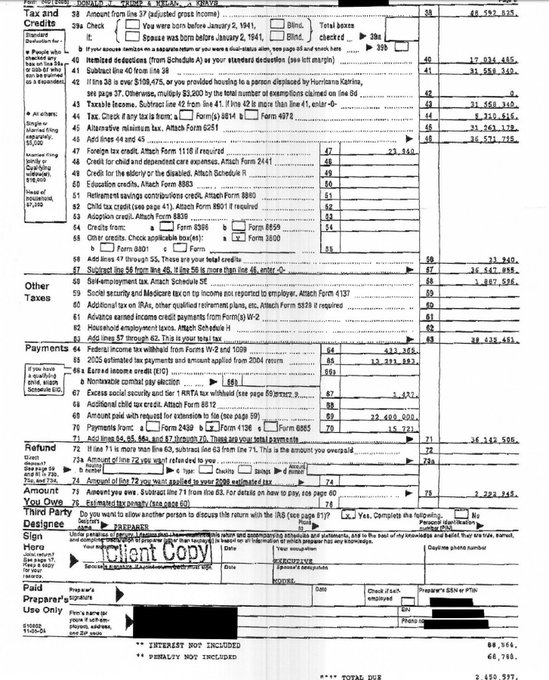
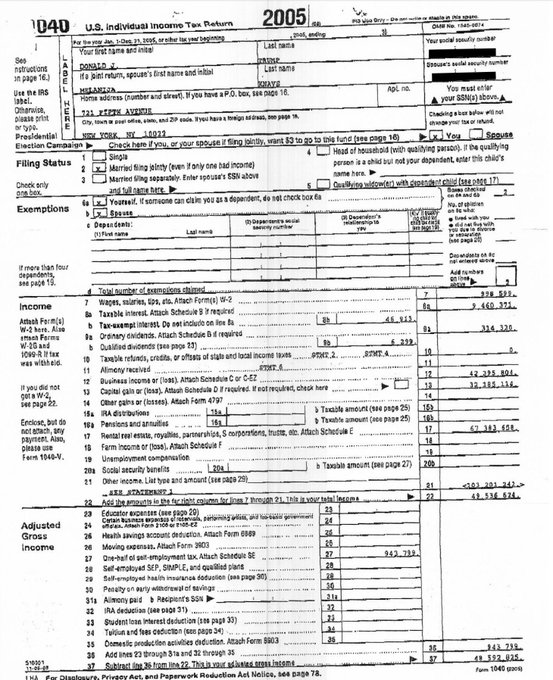
Clean copies of Trump’s tax returns

The White House statement confirmed the finding: “Before being elected President, Mr. Trump was one of the most successful businessmen in the world with a responsibility to his company, his family and his employees to pay no more tax than legally required,” the White House said in a statement. “That being said, Mr. Trump paid $38 million dollars even after taking into account large scale depreciation for construction, on an income of more than $150 million dollars, as well as paying tens of millions of dollars in other taxes such as sales and excise taxes and employment taxes and this illegally published return proves just that.”
As the Beast notes, 2005 was the year that Trump, then a newly minted reality star, made his last big score as a real-life real estate developer, when he sold two properties, one on Manhattan’s west side and one in San Francisco, to Hong Kong investors, accounting for the lion’s share of his income that year.
“It is totally illegal to steal and publish tax returns,” the White House statement concluded. “The dishonest media can continue to make this part of their agenda, while the President will focus on his, which includes tax reform that will benefit all Americans.”
But the real story here is that there is no story: what MSNBC confirmed is that Trump made more money than some of his critics said he made in the period in question, and more importantly, that he paid a generous effective income tax rate, well above the 14.1% rate paid by Mitt Romney, and even higher than the 13.5% federal tax rate paid by Bernie Sanders in 2014.
Trump 2005 tax rate: 25%
Romney 2011 tax rate: 14.1%
Sanders 2014 tax rate: 13.5%

Sadly for Maddow, with this attempt at a “blockbuster” story which has quickly backfired, she may well have killed the great distraction that was the trope of Trump’s tax returns, and which the rest of the “resistance” press hammered on every now and then.
It took over 30 years for someone to top @GeraldoRivera for biggest over-hyped live TV epic fail in history. You did it Rachel Maddow !

end
The GPO chair of the House Intelligence Pane states after hearing closed door testimony that there was not an actual tap of the Trump Tower. That will not go over to well with the Trump camp.
(courtesy zero hedge)
GOP Chair Of House Intel Panel: “I Don’t Think There Was An Actual Tap Of Trump Tower”
In the starkest denial of Donald Trump’s allegations yet that the Trump Tower had been hacked by the Obama administration, the GOP’s Chair of the House Intelligence Panel, Devin Nunes, confirmed what he said last week, namely that his panel has still not received any evidence that President Trump was wiretapped during the election campaign. “As I told you last week about the issue with the president talking about tapping Trump Tower, that evidence still remains the same, that we don’t have any evidence that that took place.” Nunes told reporters.
House intelligence chair: “We don’t have any evidence…I don’t think there was an actual tap of Trump Tower.” http://cnb.cx/2nspQNY

It is not the first time Nunes has stated that there is no evidence to suggest Trump was wiretapped. However, today for the first time he took a formal position, in effect accusing Trump of fabricating his allegation, saying that “in fact, I don’t believe just in the last week of time, the people we’ve talked to, I don’t think there was an actual tap of Trump Tower.”
Additionally, also today Jeff Sessions said he did not give Trump a reason to believe he was being wiretapped.

Attorney General Jeff Sessions says he did not give Trump a reason to believe he was wiretapped. http://cnb.cx/2nspQNY
While previously FBI Director James Comey urged the DOJ to refute Trump’s statement because of a lack of evidence, the agency has not done so. The DOJ was expected to turn over to the House Intelligence Committee any information backing up Trump’s claim by Monday, however it has since requested for more time.
Meanwhile White House press secretary Sean Spicer on Tuesday said Trump is “extremely confident” that the Justice Department will produce evidence to back up his assertion. He said Trump believes the evidence will “vindicate him.”
“I think there’s significant reporting about surveillance techniques that existed throughout the 2016 election,” Spicer said.
END
Goldman Sachs’ alumni taking over the White House as banker Donovan has the key deputy Treasurer position
(courtesy zerohedge)
Trump Nominates Another Goldman Banker For Key Treasury Position
In the latest creeping takeover by Goldman Sachs of the White House, overnight the White House announced that Donald Trump will nominate another Goldman Sachs banker, James Donovan, for a key financial post as deputy Treasury secretary, the White House said on Tuesday, adding another alumnus of the Wall Street investment bank to his administration. Donovan joins his former peers, Treasury Secretary Steven Mnuchin and chief Economic advisor, Gary Cohn, who are also former Goldman executives who occupy senior economic posts within the administration.

Donovan’s work at the bank as a managing director has included work on corporate strategy, investment banking and investment management, the White House said in a statement. He is expected to work on the Trump administration’s domestic policy agenda at Treasury.
In a note from Capital Alpha’s Ian Katz following the announcement, the strategist writes that Donald Trump and his team are “shrugging off” concerns they’ll be accused of turning the administration into a “Goldman Sachs reunion.” He adds that with other appointments, including Justin Muzinich, formerly of Morgan Stanley, and former BlackRock exec Craig Phillips as counselors to Treasury Secretary Steven Mnuchin, the Treasury lineup now has “a distinctly financey feel”; that’s good for the finance industry as the team “speaks its language, understands its issues.”
Sadly, as history has shown, what’s “good for Wall Street” ends up being rather bad for Main Street.
Additionally, Trump also nominated David Malpass – who served as a former economist at Bear Stearns prior to its 2008 collapse and most recently served as an economic adviser to Trump’s campaign – as its nominee for Treasury undersecretary for international affairs, a key economic diplomacy post. Malpass is also a former official in the Ronald Reagan and George H.W. Bush administrations.
The White House also named former national security and federal law enforcement official Sigal Mandelker to the Treasury’s top sanctions post as undersecretary for terrorism and financial intelligence. A former law clerk for Supreme Court Justice Clarence Thomas, Mandelker later held a series of criminal prosecution positions at the Department of Justice and advised the Secretary of Homeland Security during the George W. Bush administration.
While the swarm of Goldman bankers at the White House is indisputable, what is perhaps more notable is that Goldman appears to no longer have as much an interest in populating central banks as the executive branch, suggesting that the key policy going forward will be, as many have suspected, not monetary but fiscal, unless of course Congress is unable to come to an agreement on any one core issue, in which case we estimate that many of the new Goldman hires will quietly depart over the next year as they realize that their agenda will be difficult to implement under Trump.
end
Intelligence sources reveal how Obama was able to spy on Trump: he used British agents who have 24/7 access to the NSA data base. They would then forward the conversations over to Obama.
such crooks
(courtesy Mac Slavo.SHTFPlan.com)
Intelligence Sources Reveal: Obama Used British Agents For Trump Wire Tap Surveillance
Authored by Mac Slavo via SHTFplan.com,
While President Obama has vehemently denied issuing direct orders to the Justice Department or other domestic agencies to monitor President Trump during the 2016 election campaign, it is common knowledge that the National Security Agency has the ability to access video and audio from any number of devices in real time. In fact, according to Edward Snowden and documented in the recently released Snowden motion picture, U.S. spy agencies can simply flip a switch to watch or listen in on anything going on in a particular room by turning on a particular device’s cameras and microphones.
Here’s how it works:
The technology is real, but according to legal scholars, would have been illegal to use on Donald Trump or his surrogates without a warrant or probable cause indicating links to terrorist organizations.
But while domestic spy agencies like the NSA and CIA can’t actively monitor a citizen on U.S. soil, there is a very convenient work-around that has been used for over a decade to accomplish this task without technically breaking the law.
According to three intelligence sources who spoke with Judge Napolitano, this is exactly what President Obama did to then-candidate Donald Trump.
Steve Watson of Infowars.com explains:
Three separate intelligence sources believe that former President Obama veered ‘outside the chain of command’ and employed British surveillance agents to conduct surveillance on Donald Trump’s team prior to the election, according to a legal analyst.
Judge Andrew Napolitano revealed on ‘Fox & Friends’ this morning that the sources spilled the details to him as the controversial case continues to dominate headlines.
“Three intelligence sources have informed Fox News that President Obama went outside the chain of command,” Napolitano said. “He didn’t use the NSA, he didn’t use the CIA, he didn’t use the FBI, and he didn’t use the Department of Justice.”
“He used GCHQ.” Napolitano explained.
“What the heck is GCHQ? That’s the initials for the British spying agency. They have 24/7 access to the NSA database.” The Judge explained.
Napolitano noted that this was done to secure plausible deniability. In other words, even if the Obama administration did spy on Trump, there may never be a way to prove it.
“So by simply having two people go to them saying, ‘President Obama needs transcripts of conversations involving candidate Trump, conversations involving president-elect Trump,’ he’s able to get it, and there’s no American fingerprints on this. ”Napolitano added.
Video:
.@Judgenap: Three intel sources have disclosed that Pres. Obama turned to British spies to get surveillance on Trump

Real earnings ( Earnings – inflation) tumbles for the second straight month. This is important to Yellen who needs to see real wage growth
(courtesy zero hedge)
What Wage Growth? Real Earnings Tumble For Second Straight Month
Despite the surge in consumer confidence and exuberance at what lies ahead, real wages for America’s average joes declined year-over-year in February (down 0.3%). This is the first consecutive monthly drop in real wages since 2011(which forced Bernanke to to hint at and then unleash QE2 later that year).

So not only is The Fed hiking into the weakest GDP growth outlook since 1987, now they are hiking into declining real wage growth (something that has previously driven The Fed to a massively dovish stance).
end
Retail sales falter:
(courtesy Bloomberg)
U.S. Retail Sales in February Post Smallest Gain in Six Months
BloombergMarch 15, 2017, 8:30 AM EDT
U.S. retail sales in February posted the smallest gain in six months, indicating a tempering of the consumer spending that’s been carrying the economy.
Purchases rose 0.1 percent, matching the Bloomberg survey median estimate, after a 0.6 percent increase in the prior month that was stronger than previously reported, Commerce Department figures showed Wednesday. Just four of the 13 major retail categories saw gains in February sales.
Receipts dropped at electronics and appliances stores, apparel outlets and car dealers, a sign of more moderate consumption in the first quarter. While purchases may have been restrained by a temporary slowdown in individual tax refunds, robust confidence, healthy job growth and steady incomes may provide some fuel for a recovery in spending.
February was “relatively weak, and one of the reasons is the delay of tax refunds,” Eugenio Aleman, senior economist at Wells Fargo Securities LLC in Charlotte, North Carolina, said before the report. Still, “confidence numbers are through the roof and if employment continues to grow it’s only going to strengthen the consumer.”
Estimates for retail sales in the Bloomberg survey ranged from a 0.3 percent decrease to a 0.5 percent advance. The January reading was previously reported as a 0.4 percent rise.
The figures used to calculate gross domestic product, which exclude categories such as food services, auto dealers, home-improvement stores and service stations, rose 0.1 percent. That followed the prior month’s 0.8 percent increase in the so-called retail control group.
A separate report Wednesday from the Labor Department showed inflation is slowly emerging. The consumer-price index rose 0.1 percent after a 0.6 percent jump in January. Compared with a year earlier, the CPI was up 2.7 percent, the most since March 2012.
The pickup in price pressures at the start of the year led to the biggest drop in inflation-adjusted spending since 2009, according to separate Commerce Department data earlier this month.
Tax Refunds
Part of the reason for the weaker retail sales figures, which aren’t adjusted for changes in prices, may be due to a change in the law that affects tax refunds. The Internal Revenue Service said that some filers wouldn’t receive refunds until the last week of February.
About $127 billion in refunds were processed this year through the week ended Feb. 24, about 10.5 percent less than in the same period in 2016.
The Commerce Department’s report also showed retail sales excluding automobiles and service stations increased 0.2 percent.
Industry data earlier this month showed car sales in February were little changed from a month earlier. Cars and light trucks sold at an annualized 17.5 million pace, based on Ward’s Automotive data.
Sales at stores that sell electronics and appliances slumped 2.8 percent, the most since December 2011. Receipts at gasoline stations fell 0.6 percent, while sales dropped 0.5 percent at clothing chains and 0.2 percent at general merchandise stores.
Internet-based purchases rose, while sales of furniture, personal-care products and building materials also increased.
-END-
Homebuilders are now completely confident as Trump will ease the burden on permitting:
(courtesy zero hedge)
Homebuilders Have Not Been This Confident Since The Peak Of The Last Housing Bubble
Builder confidence in the market for newly-built single-family homes jumped six points to a level of 71 on the National Association of Home Builders/Wells Fargo Housing Market Index (HMI). This is the highest reading since June 2005 – the ultimate peak of the last housing bubble.
What happens next?

“Builders are buoyed by President Trump’s actions on regulatory reform, particularly his recent executive order to rescind or revise the waters of the U.S. rule that impacts permitting,” said NAHB Chairman Granger MacDonald, a home builder and developer from Kerrville, Texas.
“While builders are clearly confident, we expect some moderation in the index moving forward,” said NAHB Chief Economist Robert Dietz. “Builders continue to face a number of challenges, including rising material prices, higher mortgage rates, and shortages of lots and labor.”
All three HMI components posted robust gains in March. The component gauging current sales conditions increased seven points to 78 while the index charting sales expectations in the next six months rose five points to 78. Meanwhile, the component measuring buyer traffic jumped eight points to 54. Looking at the three-month moving averages for regional HMI scores, the Midwest increased three points to 68 and the South rose one point to 68. The West dipped three points to 76 and the Northeast edged one point lower to 48.
Of course, “It is difficult to get a man to understand something, when his salary depends upon his not understanding it!”

end
Tomorrow the Debt ceiling is re instated at 20.1 trillion. They have burned through $2. billion dollars per day. They will reach this level in a few days once their cash treasury account runs out. Carson Block agrees with Trump that they will not have enough votes to obtain a new debt ceiling as they need 237 votes and will get 207 votes as the Tea party members will vote against it.
(courtesy Carson Block/Bloomberg)
Carson Block: “The Possibility Of US Default Is Greater Than Anyone Seems To Realize”
Authored by Carson Block via Bloomberg.com,
Euphoria has been pervasive in the stock market since the election. But investors seem to be overlooking the risk of a U.S. government default resulting from a failure by Congress to raise the debt ceiling. The possibility is greater than anyone seems to realize, even with a supposedly unified government.
In particular, the markets seem to be ignoring two vital numbers, which together could have profound consequences for global markets: 218 and $189 billion. In order to raise or suspend the debt ceiling (which will technically be reinstated on March 16), 218 votes are needed in the House of Representatives. The Treasury’s cash balance will need to last until this happens, or the U.S. will default.
The opening cash balance this month was $189 billion, and Treasury is burning an average of $2 billion per day – with the ability to issue new debt. Net redemptions of existing debt not held by the government are running north of $100 billion a month. Treasury Secretary Steven Mnuchin has acknowledged the coming deadline, encouraging Congress last week to raise the limit immediately.

Reaching 218 votes in favor of raising or suspending the debt ceiling might be harder than in any previous fiscal showdown. President Donald Trump almost certainly wants to raise the ceiling, but he may not have the votes. While Republicans control 237 seats in the House, the Tea Party wing of the party has in the past has steadfastly refused to go along with increases.
The Republican Party is already facing a revolt on its right flank over its failure to offer a clean repeal of the Affordable Care Act. Many members of this resistance constitute the ultra-right “Freedom Caucus,” which was willing to stand its ground during previous debt ceiling showdowns. The Freedom Caucus has 29 members, which means there might be only 208 votes to raise the ceiling. (It’s interesting to recall that, in 2013, President Trump himself tweeted that he was “embarrassed” that Republicans had voted to extend the ceiling.)
It may be unrealistic to expect Democrats to save the day – at least initially. House Democrats may be more than happy to sit back and watch Republicans fight among themselves. If the Democrats eventually ride to the rescue, it probably won’t be until after a period of Republican-on-Republican violence.
Nobody wants the Treasury to reach the point where it has to prioritize payment of interest over other obligations – a threshold where creditworthiness and market confidence will have begun to retreat. The bond market already seems to be reacting to this possibility, sending yields higher and prices lower, even as the S&P/Dow/Nasdaq have been on a tear and are showing scant concern over the potential turmoil.
In an ideal world, all sides would come together and not play politics with the debt ceiling again. Clearly that’s not the world in which we live. America’s partisan divide may now be so wide that a default will occur. That isn’t my base case scenario, but we will probably come down to the wire
end
Throughout the past several weeks, I have been telling you the bricks and mortar operations in the uSA are in trouble especially malls. Department store sales did falter badly last month with today’s reading of 5.6% down year over year.
It seems that there is blood on the table and the bankers will be going after debt instruments on these malls.
(courtesy zero hedge)
The Next “Big Short” Tumbles To 13-Month Lows As Dept Store Sales Crash
This arcane financial instrument appears to be quickly becoming ‘ground zero’ for the “next big short” of this bull cycle.
Last week we introduced the CMBX Series 6 as potentially the next ‘big short’ – a credit derivative contract that allows betting against securities backed by malls in weaker locations where stores could close in quick succession, triggering debt defaults. Based on fundamentals, the trade indeed appears justified: “Sold in 2012, the mortgage bonds have a higher concentration of loans to regional malls and shopping centers than similar securities issued since the financial crisis. And because of the way CMBS are structured, the BBB- and BB rated notes are the first to suffer losses when underlying loans go belly up.”
“These malls are dying, and we see very limited prospect of a turnaround in performance,” according to a January report from Alder Hill, which began shorting the securities. “We expect 2017 to be a tipping point.”
Cracks have started to appear. Prices on the BBB- pool of CMBS have slumped from roughly 96 cents on the dollar in late January to 87.08 cents last week, index data compiled by Markit show.
And now a few days later, we see Department Store sales crashing by the most on record. One particular chart revealed in the latest monthly Bank of America debit and credit card spending report shows that things may be about to get a whole lot worse for America’s department stores, as well as malls where they are for the most part the anchor tenants.

And today’s official retail sales data confirms the collapse – department store sales down 5.6% YoY.
And, as we would expect, CMBX S6 BBB- tranche prices have tumbled further – to their lowest since February 2016…

Bloomberg followed up our post with a not-so-subtly-titled “Wall Street Has Found Its Next Big Short” in which it writes that “Wall Street speculators are zeroing in on the next U.S. credit crisis: the mall…. It’s no secret many mall complexes have been struggling for years as Americans do more of their shopping online. But now, they’re catching the eye of hedge-fund types who think some may soon buckle under their debts, much the way many homeowners did nearly a decade ago.”

The trade, as we discussed before, is not so much shorting the equities where a persistent threat of a short squeeze has burned the bears on more than one occasion, but going long default risk via CMBX or otherwise shorting the CMBS complex.
Like the run-up to the housing debacle, a small but growing group of firms are positioning to profit from a collapse that could spur a wave of defaults. Their target: securities backed not by subprime mortgages, but by loans taken out by beleaguered mall and shopping center operators. With bad news piling up for anchor chains like Macy’s and J.C. Penney, bearish bets against commercial mortgage-backed securities are growing.
To be sure, as we first noted last week and as Bloomberg confirms, the activity surrounding CMBS shorting has soared:
In recent weeks, firms such as Alder Hill Management — an outfit started by protégés of hedge-fund billionaire David Tepper — have ramped up wagers against the bonds, which have held up far better than the shares of beaten-down retailers. By one measure, short positions on two of the riskiest slices of CMBS surged to $5.3 billion last month — a 50 percent jump from a year ago.
The trade itself is similar to those that Michael Burry and Steve Eisman made against the housing market before the financial crisis, made famous by the book and movie “The Big Short.” Often called credit protection, buyers of the contracts are paid for CMBS losses that occur when malls and shopping centers fall behind on their loans. In return, they pay monthly premiums to the seller (usually a bank) as long as they hold the position.
This year, traders bought a net $985 million contracts that target the two riskiest types of CMBS, according to the Depository Trust & Clearing Corp. That’s more than five times the purchases in the prior three months.
Whatever the case, here’s what the endgame might look like. About two hours north of Manhattan, in Kingston, New York, stands the Hudson Valley Mall. It used to house J.C. Penney and Macy’s. But both then left, gutting the complex. In January, the mall was sold for less than 20 percent of the original $50 million loan. Mortgage-bond holders exposed to the loan were partly wiped out.
“When a mall starts to falter, the end result is typically binary in nature,” said Matt Tortorello, a senior analyst at Kroll Bond Rating Agency. “It’s either the mall is going to survive or it’s going take a substantial loss.”
end
Well that is all for today
I will see you tomorrow night
H


 harveyorganblog.com
[…] READ MORE […]
LikeLike
[…] MARCH 15/GLD GAINS ANOTHER 4.44 TONNES OF INVENTORY!!/SLV: NO GAIN IN INVENTORY/GOLD GAINS OVER 20 D… […]
LikeLike
[…] from Harvey Organ: […]
LikeLike