
Gold: $1249.30 UP $3.20
Silver: $17.54 DOWN 1 cent
Closing access prices:
Gold $1248.90
silver: $17.55
XXXXXXXXXXXXXXXXXXXXXXXXXXXXXXXXXXXXXXXXXXXXXXXXXXXXXXXXXXXX
SHANGHAI GOLD FIX: FIRST FIX 10 15 PM EST (2:15 SHANGHAI LOCAL TIME)
SECOND FIX: 2:15 AM EST (6:15 SHANGHAI LOCAL TIME)
SHANGHAI FIRST GOLD FIX: 1257.16 DOLLARS PER OZ
NY PRICE OF GOLD AT EXACT SAME TIME: 1245.50
PREMIUM FIRST FIX: $11.66
xxxxxxxxxxxxxxxxxxxxxxxxxxxxxxxxxxxxxxxxxxxxxx
SECOND SHANGHAI GOLD FIX: 1258.18
NY GOLD PRICE AT THE EXACT SAME TIME: 1246.25
Premium of Shanghai 2nd fix/NY:$11.93
xxxxxxxxxxxxxxxxxxxxxxxxxxxxxxxxxxxxxxxxxxxxxxxxxxx
LONDON FIRST GOLD FIX: 5:30 am est 1246.10
NY PRICING AT THE EXACT SAME TIME: 1246.80
LONDON SECOND GOLD FIX 10 AM: 1249.05
NY PRICING AT THE EXACT SAME TIME. 1248.90
For comex gold:
MARCH/
NOTICES FILINGS TODAY FOR MARCH CONTRACT MONTH: 0 NOTICE(S) FOR NIL OZ. TOTAL NOTICES SO FAR: 72 FOR 7200 OZ (0.2239 TONNES)
For silver:
For silver: MARCH
7 NOTICES FILED TODAY FOR 35,000 OZ/
Total number of notices filed so far this month: 3421 for 17,105,000 oz
Let us have a look at the data for today
.
xxxxxxxxxxxxxxxxxxxxxxxxxxxxxxxxxxxxxxxxxxxxxxxxxxxxxxxxxxxxxxxxxxxxxxxxxx
In silver, the total open interest ROSE BY 3,750 contracts UP to 190,819 with the RISE IN PRICE ( 15 CENTS) WITH RESPECT TO YESTERDAY’S TRADING. In ounces, the OI is still represented by just less THAN 1 BILLION oz i.e. 0.954 BILLION TO BE EXACT or 136% of annual global silver production (ex Russia & ex China).
FOR THE NEW FRONT MARCH MONTH: THEY FILED: 7 NOTICE(S) FOR 35,000 OZ OF SILVER
In gold, the total comex gold also ROSE BY A WHOPPING 17,727 contracts WITH THE RISE IN THE PRICE OF GOLD ($12.50 with YESTERDAY’S TRADING). The total gold OI stands at 446,880 contracts.
we had 0 notice(s) filed upon for NIL oz of gold.
xxxxxxxxxxxxxxxxxxxxxxxxxxxxxxxxxxxxxxxxxxxxxxxxxxxxxxxxxxxx
With respect to our two criminal funds, the GLD and the SLV:
GLD:
We had no changes in tonnes of gold at the GLD:
Inventory rests tonight: 834.40 tonnes
.
SLV
We had no changes in inventory at the SLV/
THE SLV Inventory rests at: 332.504 million oz
end
.
First, here is an outline of what will be discussed tonight:
1. Today, we had the open interest in silver ROSE BY 3750 contracts UP TO to 190,819 AS SILVER WAS UP 15 CENT(S) with YESTERDAY’S trading. The gold open interest ROSE BY 16,494 contracts UP to 446,880 WITH THE RISE IN THE PRICE OF GOLD OF $12.50 (YESTERDAY’S TRADING).
(report Harvey
.
2.a) The Shanghai and London gold fix report
(Harvey)
2 b) Gold/silver trading overnight Europe, Goldcore
(Mark O’Byrne/zerohedge
and in NY: Bloomberg
3. ASIAN AFFAIRS
i)Late TUESDAY night/WEDNESDAY morning: Shanghai closed DOWN 16.39 POINTS OR .50%/ /Hang Sang CLOSED DOWN 272.71 POINTS OR 1.11% . The Nikkei closed down 414.50 OR 2.13% /Australia’s all ordinaires CLOSED DOWN 1.50%/Chinese yuan (ONSHORE) closed UP at 6.8875/Oil FELL to 47.66 dollars per barrel for WTI and 50.30 for Brent. Stocks in Europe ALL IN THE RED ..Offshore yuan trades 6.8658 yuan to the dollar vs 6.8875 for onshore yuan.THE SPREAD BETWEEN ONSHORE AND OFFSHORE NARROWS CONSIDERABLY AGAIN/ ONSHORE YUAN STRONGER AS IS THE OFFSHORE YUAN AND THIS IS COUPLED WITH THE SLIGHTLY STRONGER DOLLAR. CHINA SENDS HER DISPLEASURE SIGNAL TO WASHINGTON
3a)THAILAND/SOUTH KOREA/NORTH KOREA
North Korea test fires several missiles and they all reportedly failed.
(courtesy zero hedge)
b) REPORT ON JAPAN
c) REPORT ON CHINA
China tightened their money rates two weeks ago. However last night, one small lender failed to repay its borrowings in the interbank market. This caused the POBC to interject hundred of billions of dollars into Chinese banks as the key interbank rate plummeted by 64 basis points down to 2.45% from 3.09%
(courtesy zero hedge)
4. EUROPEAN AFFAIRS
LONDON,UK
Terrorist attack at the Parliament building in London UK
(courtesy zero hedge)
5. RUSSIAN AND MIDDLE EASTERN AFFAIRS
i)Saudi Arabia
Saudi Arabia downgraded by Fitch to A+ on a soaring fiscal deficit and a deteriorating balance sheet
( zerohedge)
ii)TURKEY/EU
Turkey again threatens Europe with the release of all the migrants:
(courtesy zero hedge)
6.GLOBAL ISSUES
7. OIL ISSUES
The DOE confirms the huge build in oil and distillates and thus crude falls badly:
(courtesy zerohedge)
8. EMERGING MARKETS
9. PHYSICAL MARKETS
i)the libor scandal/the mastermind but he deserves company
( BLOOMBERG/GATA)
ii)The crime of the century: the manipulation of gold and silver
( Stewart Dougherty/silverdoctors.com)
10.USA STORIES
i)Puerto Rico bonds plummet again as the Governor declares that its debts are “unpayable”. The total amount of debt is 70 billion uSA and much of that debt is held by USA mutual and other funds. The 8% Puertop Rico bond due to 2035 from 74 down to 64 a huge loss!
( zerohedge)
ii)Ally Financial, the former GMAC, slashes guidance as used car prices falter. They claim that this is the worst decline in 20 years:
(courtesy zero hedge)
iii a ) Home prices remain unchanged in January from december..the weakest month over month growth for 3 years:
( zero hedge)
iii b)Existing home sales tumble and the NAR states the prices are becoming increasingly unaffordable to the masses:
( zero hedge)
iv a )Donald trump heads to the Capitol again as their are still 27 health plan holdouts
( zero hedge)
iv b)It seems that Trump has lowered his expectations ahead of the critical healthcare vote:
( zero hedge)
v)Two retail giants disclosed massive problems last night. First perennial zombie Sears reports on the fact that they have “substantial doubt” about its ability to keep operating after it has lost over 10 billion dollars in recent years. The CEO has provided loans while the company has sold out many brands to keep them alive. The problem will occur shortly when the trade only accepts cash for merchandise.
( zerohedge)
vi)THE FOLLOWING IS A BOMBSHELL: NUNES CONFIRMS “INCIDENTAL SURVEILLANCE” OF TRUMP DURING THE OBAMA ADMINISTRATION. THEY CALLED THIS GATHERING OF INFORMATION “LEGAL” BUT THE DISSEMINATION IS NOT.
(COURTESY ZERO HEDGE)
vii) David Stockman describes in detail what is wrong with the USA health care system and why tomorrow some of the Republicans will not support Obamacare light.
(courtesy David Stockman/Daily Reckoning.
Let us head over to the comex:
The total gold comex open interest ROSE BY 16,494 CONTRACTS UP to an OI level of 446,880 WITH THE RISE IN THE PRICE OF GOLD ( $12.50 with YESTERDAY’S trading).THE BANKERS SUPPLIED ALL THE NECESSARY CONTRACTS SHORT TO OUR NEWBIE LONGS. We are now in the contract month of MARCH and it is one of the poorer delivery months of the year. In this MARCH delivery month we had a GAIN of 4 contract(s) UP to 21. We had 0 contact(s) served UPON YESTERDAY, so we GAINED 4 CONTRACT(S) or AN ADDITIONAL 400 ounces will stand for delivery. The next active contract month is April and here we saw it’s OI LOST 1,656 contracts DOWN TO 170,923 contracts.
For comparison purposes, the April 2016 contract at this time had an OI of 208,851 contracts. At the end of April/2016 only 12.3917 tonnes stood for physical delivery, although 21.306 tonnes stood initially at the beginning of April 2016.
The non active May contract month GAINED 40 contract(s) and thus its OI is 1128 contracts. The next big active month is June and here the OI ROSE by 17,727 contracts up to 179,258.
We had 0 notice(s) filed upon today for NIL oz
We are in the active delivery month is March and here the OI decreased by 119 contracts down to 430 contracts. We had 118 notices served upon yesterday so we LOST 1 CONTRACT(S) OR AN ADDITIONAL 5,000 OZ WILL NOT STAND in this active delivery month of March.
For historical reference: on the first day notice for the March/2016 silver contract: 19,020,000 oz stood for delivery . However the final amount standing at the end of March 2016: 6,755,000 oz as the banker boys were busy convincing holders of many silver contracts to cash settle just like they did today.
The April/2017 contract month LOST 73 contract(s) to 936 contracts. The next active contract month is May and here the open interest GAINED 2255 contracts UP to 142,961 contracts.
FOR COMPARISON
Initially for the April 2016 contract, 1,180,000 oz stood for delivery. At the end of April 2016: 6,775,000 oz as bankers needed much silver to fill major holes elsewhere.
We had 7 notice(s) filed for 35,000 oz for the MARCH 2017 contract.
VOLUMES: for the gold comex
Today the estimated volume was 227,708 contracts which is very good.
Yesterday’s confirmed volume was 341,561 contracts which is very huge
volumes on gold are getting higher!
| Gold | Ounces |
| Withdrawals from Dealers Inventory in oz | nil |
| Withdrawals from Customer Inventory in oz |
nil OZ
|
| Deposits to the Dealer Inventory in oz | nil oz |
| Deposits to the Customer Inventory, in oz |
nil oz
|
| No of oz served (contracts) today |
0 notice(s)
NIL oz
|
| No of oz to be served (notices) |
21 contracts
2100 oz
|
| Total monthly oz gold served (contracts) so far this month |
72 notices
7200 oz
0.1835 tonnes
|
| Total accumulative withdrawals of gold from the Dealers inventory this month | NIL oz |
| Total accumulative withdrawal of gold from the Customer inventory this month | 57,961.1 oz |
Today, 0 notice(s) were issued from JPMorgan dealer account and 0 notices were issued from their client or customer account. The total of all issuance by all participants equates to 0 contract(s) of which 0 notices were stopped (received) by jPMorgan dealer and 0 notice(s) was (were) stopped/ Received) by jPMorgan customer account.
March 2016: 2.311 tonnes (March is a non delivery month)
| Silver | Ounces |
| Withdrawals from Dealers Inventory | nil |
| Withdrawals from Customer Inventory |
3929.0000 oz???
Brinks
|
| Deposits to the Dealer Inventory |
nil oz
|
| Deposits to the Customer Inventory |
nil oz
|
| No of oz served today (contracts) |
7 CONTRACT(S)
(35,000 OZ)
|
| No of oz to be served (notices) |
423 contracts
(2,115,000 oz)
|
| Total monthly oz silver served (contracts) | 3421 contracts (17,105,000 oz) |
| Total accumulative withdrawal of silver from the Dealers inventory this month | NIL oz |
| Total accumulative withdrawal of silver from the Customer inventory this month | 3,747,959.1 oz |
end
And now the Gold inventory at the GLD
March 22/no changes in gold inventory at the GLD/Inventory rests at 834.40 tonnes
March 21/a deposit of 4.15 tonnes of gold into the GLD/Inventory rests at 834.40 tonnes
March 20/WE HAD A MASSIVE 6.81 TONNE WITHDRAWAL FROM THE GLD/INVENTORY RESTS AT 830.25 TONNES/THIS GOLD MUST BE ON ITS WAY TO SHANGHAI. WITH GOLD RISING THESE PAST FEW DAYS, IT MAYS NO SENSE WHATSOEVER ON GOLD LIQUIDATION.
March 17/a huge withdrawal of 2.37 tonnes from the GLD/Inventory rests at 837.06 tonnes
March 16/no changes in gold inventory at the GLD/Inventory rests at 839.43 tonnes
March 15/ANOTHER HUGE DEPOSIT OF 4.44 TONNES/inventory rests at 839.43 tonnes
March 14/strange they whack gold and yet the GLD adds 2.93 tonnes of gold./inventory rests at 834.99 tonnes
March 13/a deposit of 6.78 tonnes of gold into the GLD/Inventory rests at 832.03 tonnes
March 10/ a withdrawal of 4.886 tonnes from the GLD/Inventory rests at 830.25
this tonnage no doubt is off to Shanghai
March 9/a withdrawal of 2.67 tonnes from the GLD/Inventory rests at 834.10
March 8/no change in gold inventory at the GLD/inventory rests at 836.77 tones
march 7/a huge withdrawal of 3.81 tonnes from the GLD inventory/inventory rests at 836.77 tonnes
March 6/No change in gold inventory at the GLD/Inventory rests at 840.58 tonnes
March 3/ a huge withdrawal of 2.96 tonnes of gold from the GLD/Inventory rests at 840.58 tonnes
March 2/a deposit of 2.37 tonnes of gold into the GLD/Inventory rests tat 843.54 tonnes
March 1/no change in gold inventory at the GLD/Inventory rests at 841.17 tonnes
FEB 28/no changes in gold inventory at the GLD/Inventory rests at 841.17 tonnes
feb 27/no change in gold inventory at the GLD/Inventory rests at 841.17 tonnes
Feb 24/no changes in gold inventory at the GLD/Inventory rests at 841.17 tonnes
FEB 23/no changes in gold inventory at the GLD/Inventory rests at 841.17 tonnes
FEB 22/no changes in gold inventory at the GLD/Inventory rests at 841.17 tonnes
FEB 21/no changes in gold inventory at the GLD/Inventory rests at 841.17 tonnes
feb 17/a withdrawal of 2.37 tonnes of gold from the GLD/Inventory rests at 841.17 tonnes
FEB 16/we had no changes in the GLD inventory today/Inventory rests at 843.54 tonnes
Feb 15./another deposit of 2.67 tonnes of gold into the GLD inventory despite another attempted whacking of gold/inventory rests at 843.54 tonnes
FEB 14/another deposit of 4.14 tonnes of gold into the GLD inventory/rests at 840.87 tonnes
FEB 13/another deposit of 4.15 tonnes of gold into the GLD/Inventory rests at 836.73 tonnes
Feb 10/no changes at the GLD/Inventory rests at 832.58 tonnes
feb 9/no changes at the GLD/Inventory rests at 832.58 tonnes
end
NPV for Sprott and Central Fund of Canada
will update later tonight the central fund of Canada figures
Sprott’s hostile 3.1 billion bid to take over Central Fund of Canada
(courtesy Sprott/GATA)
Sprott makes hostile $3.1 billion bid for Central Fund of Canada
Submitted by cpowell on Thu, 2017-03-09 01:19. Section: Daily Dispatches
From the Canadian Press
via Canadian Broadcasting Corp. News, Toronto
Wednesday, March 8, 2017
http://www.cbc.ca/news/canada/calgary/sprott-takeover-bid-central-fund-c…
Toronto-based Sprott Inc. said Wednesday it’s making an all-share hostile takeover bid worth $3.1 billion US for rival bullion holder Central Fund of Canada Ltd.
The money-management firm has filed an application with the Court of Queen’s Bench of Alberta seeking to allow shareholders of Calgary-based Central Fund to swap their shares for ones in a newly-formed trust that would be substantially similar to Sprott’s existing precious metal holding entities.
The company is going through the courts after its efforts to strike a friendly deal were rebuffed by the Spicer family that controls Central Fund, said Sprott spokesman Glen Williams.
“They weren’t interested in having those discussions,” Williams said.
Sprott is using the courts to try to give holders of the 252 million non-voting class A shares a say in takeover bids, which Central Fund explicitly states they have no right to participate in. That voting right is reserved for the 40,000 common shares outstanding, which the family of J.C. Stefan Spicer, chairman and CEO of Central Fund, control.
If successful through the courts, Sprott would then need the support of two-thirds of shareholder votes to close the takeover deal, but there’s no guarantee they will make it that far.
“It is unusual to go this route,” said Williams. “There’s no specific precedent where this has worked.”
Sprott did have success last year in taking over Central GoldTrust, a similar fund that was controlled by the Spicer family, after securing support from more than 96 percent of shareholder votes cast.
The firm says Central Fund’s shares are trading at a discount to net asset value and a takeover by Sprott could unlock US$304 million in shareholder value.
Central Fund did not have any immediate comment on the unsolicited offer. Williams said Sprott had not yet heard from Central Fund on the proposal but that some shareholders had already contacted them to voice their support.
Sprott’s existing precious metal holding companies are designed to allow investors to own gold and other metals without having to worry about taking care of the physical bullion.
end
Major gold/silver trading/commentaries for WEDNESDAY
GOLDCORE/BLOG/MARK O’BYRNEet.
Peak Gold – Biggest Gold Story Not Being Reported
– Peak gold – Biggest gold story not being reported
– Gold ‘Mining Zombie Apocalypse’ caused miners to slash exploration budgets
– Decline in gold production at world’s top 10 gold mining companies – Byron King
– “No new big mines being built in the world today” – Glencore CEO Glasenberg
– Primary global gold output declined in 2016 – Thomson Reuters via Mining.com
– 2016 was first year of fall in mine production since 2008
– Rising safe haven demand from ‘Trumpflation’ and geopolitical tensions and falling mine supply should lead to “much higher gold prices”
– What happens when the unstoppable force of robust global demand for gold meets the immovable object of a small, finite, rare and dwinding supply of physical gold?
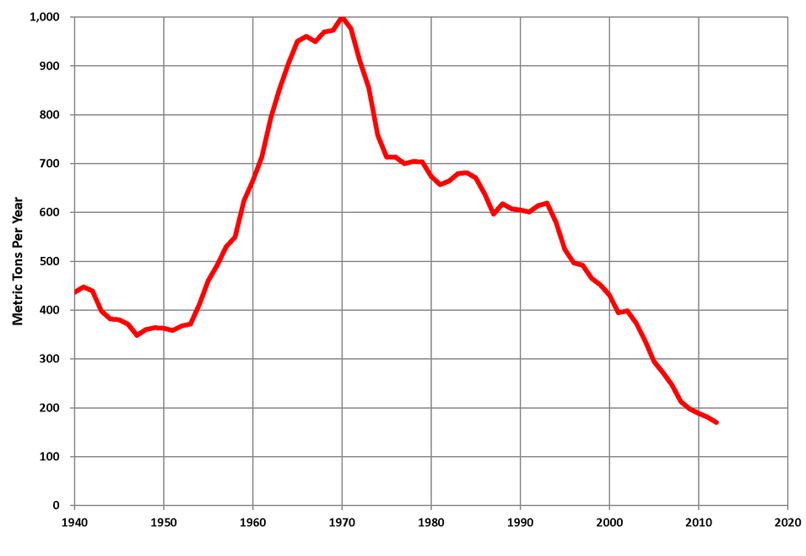 South Africa Gold Production
We have written about ‘peak gold’ and the ramifications of the underappreciated peak gold phenomenon for the gold market since 2008. The risk of falling gold production and a consequent reduction in supply are slowly percolating into the mainstream and analysts are asking whether 2015 or 2016 marked the year of peak gold production.
Byron King has written about this increasingly important supply factor in the gold market and brings together the views and research of Glencore CEO, Ivan Glasenberg, Thomson Reuters GFMS and others.

Goldman Sachs
The collapse in South African gold production (see chart above) is the ‘classic canary in the coal mine’ and likely foreshadows the coming decline in global gold production.
South Africa produced over 1,000 tonnes of gold in 1970 but production has fallen to below 250 tonnes in recent years (see chart above). This is a collapse as these are levels last seen in 1922 and happened despite the massive technological advances of recent years and more intensive mining practices.
Regarding global gold production, the world’s largest gold producer and now the world’s largest gold buyer China, has been the only major producer to see an increase in gold production in the last few years.
There has been a huge increase in Chinese gold mining supply in recent years. We wonder about the accuracy of some of this data and whether the figures are being exaggerated by gold mining companies in China and by bureaucrats. Gold mining companies sometimes exaggerate the scale of their assets in the ground and sometimes of their production as was seen in Bre-X, recently popularized in the movie ‘Gold’.
There is concern that gold production in China may actually be declining as older mines see reduced production.
From the Daily Reckoning:
Gold has performed exceedingly well since last Wednesday’s much-anticipated rate hike. It shot up about $25 Wednesday alone. Today it’s up another three bucks, to $1,233.
The most common argument for gold is fairly well-known. Trump’s massive new spending proposals will goose inflation, meaning a higher gold price.
But while most investors focus on the potential for increasing demand, few consider if supplies will be able to meet that demand. And if supplies can’t keep up with demand, that should lead to much higher gold prices.
After three years of drifting lower, gold prices began to recover last year. Still, despite last year’s gold price move, the world’s top 10 gold mining companies were focused more on cost cutting. The result was a decline in gold production from mines run by majors.
And Ivan Glasenberg, CEO of mining giant Glencore, says that “there are no new big mines being built in the world today.” That’s because the industry downturn between 2012 and 2015 — the Mining Zombie Apocalypse, as I like to call it — caused miners to slash exploration budgets, in essence storing up trouble for the future.
Thus, it’s worth taking note of a recent article at Mining.com by Frik Els — with whom I spent a week in the Yukon last summer.
Frik dissects a recent report by Thomson Reuters about how primary global gold output declined in 2016. Specifically, Mining.com sums up the report: “World gold mine supply fell by 22 tonnes, or 3%, year on year according to the GFMS Gold Survey, to 827 tonnes in the third quarter of 2016.
By all indications, mine supply contracted in the fourth quarter of 2016 as well.
That means 2016 was the first year of a fall in mine production since 2008.
And according to the Thomson Reuters report, there are “few new projects and expansions expected to begin producing this year, and those in the near-term pipeline are generally fairly modest in scale, hence our view that global mine supply is set to continue a multiyear downtrend in 2017.”
END
the libor scandal/the mastermind but he deserves company
(COURTESY BLOOMBERG/GATA)
Libor mastermind Tom Hayes deserves a lot of company in prison
Submitted by cpowell on Wed, 2017-03-22 10:33. Section: Daily Dispatches
By Nick Summers
Bloomberg News
Wednesday, March 22, 2017
For anyone burning to see financial wrongdoers put behind bars, Tom Hayes might seem like an ideal white-collar villain. As a superstar derivatives trader at a series of investment banks in London and Tokyo, Hayes masterminded a conspiracy to manipulate a benchmark interest rate that underlies hundreds of trillions of dollars’ worth of loans. British prosecutors — armed with gigabytes of evidence showing Hayes caught in the act, plus his own taped confessions — put him on trial in 2015; he’s now serving an 11-year sentence. It was an epic downfall, and David Enrich, an editor at the Wall Street Journal, recounts it well in The Spider Network: The Wild Story of a Math Genius, a Gang of Backstabbing Bankers, and One of the Greatest Scams in Financial History (HarperCollins, $29.99). One thing readers won’t get out of this exhaustively reported tale, however, is schadenfreude.
In Enrich’s telling, Hayes is more of a pitiable figure than a master fiend. He certainly never looked the part of a smooth operator: Carelessly dressed and shabbily groomed, Hayes had difficulty interacting with people, preferring the cold logic of spreadsheets. He didn’t party or jet-set like a typical overpaid banker, opting for juice or hot chocolate on the occasions he was forced to socialize outside of work. More substantially, Hayes wasn’t a top executive, and when he acted to rig the interest rate in question — the London interbank offered rate, aka Libor — he often did so with the knowledge of his bosses. The reason Hayes is in jail and his superiors aren’t seems to have more to do with his personality, and maybe his mild case of autism, than the severity of his crimes.
Don’t get me wrong — as Enrich makes clear, those crimes were pretty severe. Libor is a set of numbers, published every business day, that reflects what London banks charge each other to borrow money. A handy barometer of risk, it’s baked into a vast range of financial instruments, including complicated derivatives contracts as well as more mundane mortgages, car loans, and credit cards. Hayes colluded to nudge Libor higher or lower to benefit his trading positions; when he did, he made ordinary people’s interest payments go up and deprived municipalities and businesses of income. What sticks in the mind after reading The Spider Network is not that Hayes doesn’t belong in jail, but that he deserves a lot of company. …
… For the remainder of the review:
https://www.bloomberg.com/news/articles/2017-03-22/libor-mastermind-tom-…
END
The crime of the century: the manipulation of gold and silver
(courtesy Stewart Dougherty/silverdoctors.com)
Gold & Silver Manipulation: The Biggest Financial Crime In HISTORY
Posted on March 21, 2017 by The Doc 20 Comments 2,552 views
Share this post:
Home » Gold » Gold News » Gold & Silver Manipulation: The Biggest Financial Crime In HISTORY
“This crime is already 285 times bigger than the LIBOR scandal, and 500 times bigger than Madoff’s swindle. It is, in fact, the largest, most destructive financial crime in history.”
Stewart Dougherty Explains Why Gold & Silver Manipulation is the Biggest Financial Crime OF ALL TIME:
By Stewart Doughtery:
This crime is already 285 times bigger than the LIBOR scandal, and 500 times bigger than Madoff’s swindle. It is, in fact, the largest, most destructive financial crime in history.
According to the mainstream financial media (MFM), the biggest financial frauds in history are the Bernie Madoff Ponzi scheme, with roughly $20 billion in net investor losses, and the Bank State rigging of LIBOR, which resulted in 16 guilty banks paying $35 billion in fines, which supposedly equated to their theft.
The MFM have conveniently ignored a far larger financial crime that has been perpetrated for 37 years and counting, and that has netted its orchestrators more than $1,000,000,000,000.00 ($1 trillion) in stolen profits. This crime is so powerful that it can produce fraudulent proceeds of $1+ billion on demand and in minutes, making it unique in the annals of theft. It is a crime that has been committed literally thousands of times since 1980, and is now being committed in the most blatant and brazen manner ever. This crime is already 285 times bigger than the LIBOR scandal, and 500 times bigger than Madoff’s swindle. It is, in fact, the largest, most destructive financial crime in history.
As this immensely profitable fraud has been perpetrated, the MFM have bombarded the populace with a propaganda campaign that smears and mis-characterizes gold. Rising precious metals prices are always presented as being ominous, negative and inimical to the people, while declining prices are consistently placed in a favorable light. This propaganda has been carefully crafted and timed so that when massive, coordinated price attacks occur, market observers actually view them as positive market developments and move on, in the belief that all is well and there is nothing to see.
Buy United States Mint Coins Online
Whenever true prices start to exert themselves, the MFM go into overdrive to demonize and discredit gold. Truly disgracing themselves, which is increasingly difficult for them to do given the depths to which their fake financial journalism has plunged, they have actually published articles calling gold a “Pet Rock,” and in another instance, a “Ponzi scheme.” By the latter’s idiotic logic, all natural elements and tangible goods are Ponzi schemes, too. If you listen to them, milk and eggs are criminal conspiracies also. They know it’s absurd, but they throw the spaghetti against the wall anyhow, to flog the agenda and please their Deep State owners.
Last week, Bloomberg Magazine ran a cover story about a two-bit nobody smuggling meaningless quantities of gold as if this were the gravest threat to humanity in the 21st Century. It was yet another effort to make the gold market look seedy, shady and dirty. The lengths to which they go in order to slam precious metals prove that this is a very important Deep State agenda. And it is, because its purpose is to deflect attention away from the Deep State’s unprecedented financial criminality.
In the late 1970s, oil barons Bunker and Lamar Hunt became interested in the favorable fundamentals of silver. They steadily bought the metal, ramping up its price. The Bank State went short against the Hunts, in size. But buying demand persisted, and by January, 1980, silver had reached a record $49.45 per ounce ($147.68 in today’s dollars) and the Bank State was choking on massive paper losses.
The Bank State did what it always does when the chips are down: it lied, cheated and stole. First, it ordered the MFM to character assassinate the Hunts by labeling them greedy profiteers who were attempting to corner the silver market at what would be an exorbitant cost to society. Which was a deliberate lie. Later evidence proved that the Hunts bought silver based upon extensive quantitative analysis that showed it to be significantly undervalued, just as others throughout history have been attracted to undervalued assets. There was no evidence at all that the Hunts were trying to corner the silver market. But the media onslaught overwhelmed the truth, and set the stage for Act 2.
In Act 2, the Bank State ordered its’ captured, bribed CFTC regulators to change silver futures rules so as to force the Hunts to liquidate their positions. Predictably, silver’s price plunged from $49.45 to $10.80 between January and March, 1980, as a result of the out-of-the-blue, “liquidation only” CFTC mandate. This wiped out the Hunts and bailed out the Bank State of its massive losses, which, of course, was the corrupt point of the exercise.
In the process, the Bank State saw first-hand the enormous profit potential inherent in precious metals price manipulation. And it raced to invent a new form of alchemy that would enable it to make those potential profits go exponential: the transmutation of printed paper and costless, ethereal computer digits into what they would say were the equivalent of physical gold and silver. Honest precious metals price discovery died when the Hunts were cheated and fake gold and silver were invented. The precious metals futures market has been an organized crime scene ever since.
Prior to the Deep State’s successful overthrow and corruption of the metals market, gold and silver reached 1980 highs of $850 and $49.45, respectively. We regard those as legitimate prices that actually would have been exceeded if the free market had prevailed. Fundamental forces were enormously bullish for metals at that time, and have been so ever since.
Using the U.S. government’s inflation statistics, which are deliberately understated and therefore conservative, today’s prices would be $2,510.55 for gold and $147.68 for silver. Therefore, current fake gold and silver prices are roughly $1,300.00 and $130.00 per troy ounce beneath their 1980 inflation adjusted highs, respectively. This is extraordinary given the radical deterioration of monetary, financial, fiscal, economic and geopolitical conditions since 1980. Prices should now be far above the 1980 inflation-adjusted highs, not far below them.
With 5.8 billion ounces of owned physical gold in the world, the $1,300 per ounce price oppression results in an aggregate gold market undervaluation of $7.54 trillion. And with 20.5 billion ounces of owned physical silver in the forms of jewelry, silverware, coins, bars and rounds, the $130 per ounce price oppression amounts to an additional market undervaluation of $2.67 trillion. Combined, this totals $10.21 trillion that has been stolen from the owners of gold and silver worldwide as a result of the Deep State’s price manipulation fraud. This $10.21 trillion amount is an absolute minimum, because for dozens of objective, quantifiable reasons, gold and silver prices should exceed their 1980 inflation adjusted highs by at least two and up to four times. Therefore, the true cost to the global owners of gold and silver is actually in the range of $20 to $40 trillion. The people have paid a staggering price for the Deep State’s precious metals crime spree, as there is no fraud in history whose financial impact even come close to this. Yet the corrupt MFM doesn’t say a word.
From 2009 through 2013, former Goldman Sachs partner Gary Gensler, protégé of (among others) Robert Rubin (former U.S. Treasury Secretary and now Chairman of the Council on Foreign Relations, the embodiment and epitome of the Deep State) and Larry Summers (also a former U.S. Treasury Secretary (put there by his mentor, Robert Rubin), Group of 30 member and a leading Deep State cash elimination mouthpiece), was the Chairman of the Commodities Futures Trading Commission (CFTC). During virtually his entire tenure, the CFTC conducted a so-called investigation into silver market price manipulation. In 2013, the CFTC closed the investigation, saying it had not found any improprieties whatsoever, not even one. According to them, the silver market was squeaky clean.
In 2016, completely without any CFTC involvement, Deutsche Bank admitted that it and numerous other major, international, SIFI (Significantly Important Financial Institution, aka, Too Big to Fail) banks had massively manipulated the silver market for years, including during the entire duration of the CFTC’s fake investigation. A few days later, Deutsche Bank admitted that it and numerous other SIFI banks had also rigged the gold market.
Gensler left the CFTC in early 2014, and went to work for Hillary Clinton’s presidential campaign. In 2015, he was named Chief Financial Officer of her campaign. A Clinton victory was fully expected, and it was understood that Clinton would name Gensler Secretary of the Treasury. (Now do you see how this works?) In that role, he would have been far more helpful to the Deep State than he was in his CFTC role of protecting their $1 trillion precious metals fraud from being exposed or interfered with. In the Treasury Secretary position, the top marching order from his Deep State masters would have been simple and clear: get cash eliminated once and for all, and we will make you richer than you can ever imagine. He would have been all over it.
Cash elimination is the Deep State’s upcoming, Main Event. They will steal far more by eliminating cash than they have stolen to date by all their other frauds, combined. While the rigging of the precious metals markets is currently the largest financial crime in history, it will be left in the dust when they come to steal the dollars, Euros and other fiat currencies that they are working to corral in their monetary prisons. They lurch from one record to another, on the bent and hurting backs of the people.
Trump’s victory threatens to slow down the implementation of their cash elimination agenda, and this is why they are incensed, and will do literally anything to get rid of him. Trump is brave, and in extreme danger the 86,400 seconds of every day. There have never in history been richer, greedier, or more power-hungry character assassins than the Deep State elite. The silver lining is that their evil is now so cancerous and metastasized that it has driven them completely insane, and the insane have a way of destroying themselves before they can destroy the rest of us.
Implications: We know for an absolute fact that precious metals prices are manipulated. (The evidence is absolutely overwhelming, and we would like to offer special thanks to GATA (and now Deutsche Bank) for proving it without a shadow of doubt over many years’ worth of tireless work.) Current prices of gold and silver are therefore fake, and in our view, far below what they would be in an honest market. When the Deep State Crime Syndicate loses control over prices, which could result from any one of a large number of likely developments, true prices will be re-established, a process that was occurring in 1980 and again in 2011 before being sabotaged both times. As fake prices are crushed and honest ones return, a global “herd” buying phenomenon could develop, as has happened in the past. This would lead to significant shortages of available physical metals and a meaningful increase in premiums. History has been clear that when it comes to precious metals, it is always best to buy in halcyon times, particularly if one can do so at a good price. We are not registered investment advisors, and are not providing financial advice. We are simply sharing with you our thoughts, which are born of extensive, independent research. Thank you for taking the time to read this article, good luck and all the best to you.
Stewart Dougherty
end
Your early WEDNESDAY morning currency, Asian stock market results, important USA/Asian currency crosses, gold/silver pricing overnight along with the price of oil Major stories overnight
1 Chinese yuan vs USA dollar/yuan STRONGER AT 6.8875( SMALL REVALUATION NORTHBOUND /OFFSHORE YUAN MOVES STRONGER TO ONSHORE AT 6.8658/ Shanghai bourse DOWN 16.39 POINTS OR .50% / HANG SANG CLOSED DOWN 272.71 POINTS OR 1.11%
2. Nikkei closed DOWN 414.50 POINTS OR 2.13% /USA: YEN FALLS TO 111.34
3. Europe stocks opened ALL IN THE RED ( /USA dollar index RISES TO 99.87/Euro DOWN to 1.0789
3b Japan 10 year bond yield: FALLS TO +.061%/ !!!!(Japan buying 100% of bond issuance)/Japanese yen vs usa cross now at 111.34/ THIS IS TROUBLESOME AS BANK OF JAPAN IS RUNNING OUT OF BONDS TO BUY./JAPAN 10 YR YIELD FINALLY IN THE POSITIVE/BANK OF JAPAN LOSING CONTROL OF THEIR YIELD CURVE AS THEY PURCHASE ALL BONDS TO GET TO ZERO RATE!!
3c Nikkei now JUST BELOW 17,000
3d USA/Yen rate now well below the important 120 barrier this morning
3e WTI:: 47.66 and Brent: 50.30
3f Gold DOWN/Yen UP
3g Japan is to buy the equivalent of 108 billion uSA dollars worth of bond per month or $1.3 trillion. Japan’s GDP equals 5 trillion usa./“HELICOPTER MONEY” OFF THE TABLE FOR NOW /REVERSE OPERATION TWIST ON THE BONDS: PURCHASE OF LONG BONDS AND SELLING THE SHORT END
Japan to buy 100% of all new Japanese debt and by 2018 they will have 25% of all Japanese debt. Fifty percent of Japanese budget financed with debt.
3h Oil DOWN for WTI and DOWN for Brent this morning
3i European bond buying continues to push yields lower on all fronts in the EMU. German 10yr bund FALLS TO +.416%/Italian 10 yr bond yield DOWN to 2.286%
3j Greek 10 year bond yield RISES to : 7.401%
3k Gold at $1245.50/silver $17.49(8:15 am est) SILVER RESISTANCE AT $18.50
3l USA vs Russian rouble; (Russian rouble DOWN 25/100 in roubles/dollar) 57.97-
3m oil into the 47 dollar handle for WTI and 50 handle for Brent/
3n Higher foreign deposits out of China sees huge risk of outflows and a currency depreciation (already upon us). This can spell financial disaster for the rest of the world/China forced to do QE!! as it lowers its yuan value to the dollar/GOT REVALUATION NORTHBOUND from POBC.
JAPAN ON JAN 29.2016 INITIATES NIRP. THIS MORNING THEY SIGNAL THEY MAY END NIRP. TODAY THE USA/YEN TRADES TO 111.34 DESTROYING JAPANESE CITIZENS WITH HIGHER FOOD INFLATION
30 SNB (Swiss National Bank) still intervening again in the markets driving down the SF. It is not working: USA/SF this morning 0.9934 as the Swiss Franc is still rising against most currencies. Euro vs SF is 1.0718 well above the floor set by the Swiss Finance Minister. Thomas Jordan, chief of the Swiss National Bank continues to purchase euros trying to lower value of the Swiss Franc.
3p BRITAIN VOTES AFFIRMATIVE BREXIT/LOWER PARLIAMENT APPROVES BREXIT COMMENCEMENT
3r the 10 Year German bund now POSITIVE territory with the 10 year FALLS to +.416%
The bank withdrawals were causing massive hardship to the Greek bank. the Greek referendum voted overwhelming “NO”. Next step for Greece will be the recapitalization of the banks and that will be difficult.
4. USA 10 year treasury bond at 2.409% early this morning. Thirty year rate at 3.020% /POLICY ERROR)GETTING DANGEROUSLY HIGH
5. Details Ransquawk, Bloomberg, Deutsche bank/Jim Reid.
(courtesy Jim Reid/Bloomberg/Deutsche bank/zero hedge)
Global Stocks Tumble; Gold, Safe Havens Jump On Doubts Trump Tax Cuts Will Pass
“Warning! US equities can occasionally go down as well as up a lot.”
That’s how Deutsche Bank’s Jim Reid begins his morning wrap note, and sure enough after months of warnings that the market has gotten way ahead of itself in pricing in the success of Trump’s various domestic policies (confused? read last week’s preview of just this event occurring from JPM), global markets are waking up to a sea of red as the US risk rout spreads, leading to a slide in European stocks for the third consecutive day led by banks and miners, Asian markets suffering their worst day of the year, and S&P 500 futures pointing to a modestly lower open again as the yen and gold rise.
The catalyst, it will come as no surprise, is the end of the Trump rally which yesterday finally ended with a bang, not a whimper, as investors questioned the U.S. president’s ability to enact his pro-growth policies, casting doubt on the so-called reflation trade. Equities dropped across the globe as safe-haven assets advanced. A rally in government bonds continued and gold and the yen both extended gains. Base metals tumbled, with iron ore approaching a bear market. Investors’ flight to safety pushed down U.S. Treasury yields. The closely watched gap between U.S. and German 10-year yields touched its narrowest since November at around 195 basis points. German 10-year yields fell further and were last down 4.8 basis points at 0.41 percent.
“Market participants are worried about the effects and feasibility of Donald Trump’s growth program,” DZ Bank strategist Birgit Figge said.

As noted last night, bank and commodity shares led the selloff as the benchmark index in Europe fell a third day, following markets in Asia. Futures on the S&P 500, down 3% as of 6:15am ET, showed the broad US stock market index to extend its decline from Tuesday, when it sank more than 1% for the first time since October. Emerging-market stocks halted an eight-day winning streak.

The dollar touched a four-month low against the Japanese currency, whose strength helped push Tokyo stocks to a three-week low, while the euro held close to its highest since early February at around $1.08.
As Bloomberg puts it, “volatility in financial markets is soaring after a period of relative calm as concern mounts that Donald Trump’s flagship policies, which have underpinned a global rally since his election, won’t sail through Congress.” Attention will next turn to Thursday’s crucial vote on the plan to repeal and replace Obamacare; top Republicans have warned failure to pass the health-care bill could imperil tax and spending reforms.
“This bill has wide implications for President Trump’s plans for the U.S. economy as it is due to reduce government spending, with the freed up funds being used for the proposed tax cuts/reform and infrastructure spending” Rabobank wrote in a note to clients.
Societe Generale currency strategist Alvin Tan, in London, said an FBI investigation into possible ties between Trump’s campaign and Russia was also adding to investor worries. “All in all, that’s adding to a picture that the much hoped-for and hyped fiscal stimulus package may not be coming as soon as markets would like it to come, if at all,” he said.
The dollar swung between gains and losses as a slump in stock markets spurred haven demand for the yen, while investors reduced their exposure. Risk aversion was evident in both the spot and options markets: dollar-yen was lower a seventh day, set for its longest losing streak in two months, while bearish sentiment as expressed through risk reversals touched its strongest level in six weeks. Aussie-yen, a common risk barometer, was lower by the most in three months on a two-day basis.
Refuge seeking amid equities tumble and the possibility that President Donald Trump’s fiscal policies will be delayed until Autumn didn’t result in a sharp drop for the greenback. According to Europe-based traders, quoted by BLoomberg, opposing market forces kept the greenback in consolidation mode. Some investors were seen cutting back on their longs given the currency’s latest weakness while others, mainly short-term accounts and fast-money names, faded the latest dip. The greenback as measured by the Dollar Index may be due for a rebound, a relief one at least. DeMark’s TD Sequential points to a recovery as a Buy Countdown was completed on March 17 while Wednesday price action also satisfies a Buy Setup series.
Meanwhile, in equities, the MSCI Asia Pacific Index dropped 1.4 percent as benchmark indexes in Tokyo and Sydney slid the most since Trump’s election. Japan’s Topix lost 2.1 percent as the yen rose for a seventh day, touching the highest since November. A measure of Chinese shares traded in Hong Kong lost 1.8 percent after closing at the highest in almost 17 months on Tuesday. Japanese stocks fell 2 percent, Australian shares tumbled 1.6 percent and mainland Chinese shares closed down 0.5 percent. MSCI’s main measure of emerging market equities slid nearly 1 percent.
In Europe, the MSCI Emerging Market Index fell 1 percent in its first retreat in almost two weeks. MSCI’s broadest index of Asia-Pacific shares outside Japan fell 1.4 percent at one point, its biggest intraday percentage fall since Dec. 15. In the previous session, the index hit its highest level since June 2015.
The Stoxx Europe 600 Index dropped 0.8 percent as of 9:51 a.m. in London, the biggest decrease in a month. The European STOXX 600 index fell 0.9% to a two-week low, led lower by banks and miners. Britain’s FTSE 100 index fell 0.9 percent.
E-mini futures on the S&P500 and Dow Jones Industrial Average indicated Wall Street would open lower and the CBOE VIX index topped 13 percent for the first time since mid-January.
“Alongside this, speculation is persisting … that the ECB may possibly scale back its ultra-expansionary policy stance to some extent at an earlier point in time than is currently being assumed.”
Gold hit a three-week peak of $1,248.47 and last traded up 0.2 percent at $1,247 an ounce. It has rallied almost $50 from last Wednesday’s low after a less hawkish policy statement than many investors had expected from the U.S. Federal Reserve. Waning risk appetite also hit commodities: Brent crude oil fell 20 cents to $50.76 a barrel, while copper fell 0.5 percent to $5.747 a ton.
Bulletin Headline Summary from RanSquawk
- Risk off tone across EU bourses with stocks led lower by softness in financial and commodity names
- JPY remaining firm against its major counterparts as USD/JPY touches 4-month lows
- Looking ahead, highlights include US existing home sales and DoE Crude Oil Report
Market Snapshot
- S&P 500 futures down 0.1% to 2,339.5
- Stoxx Europe 600 down 0.9% to 372.29
- MXAP down 1.4% to 147.11
- MXAPJ down 1.2% to 477.10
- Nikkei down 2.1% to 19,041.38
- Topix down 2.1% to 1,530.20
- Hang Seng Index down 1.1% to 24,320.41
- Shanghai Composite down 0.5% to 3,245.22
- Sensex down 0.7% to 29,275.30
- Australia S&P/ASX 200 down 1.6% to 5,684.51
- Kospi down 0.5% to 2,168.30
- German 10Y yield fell 3.8 bps to 0.421%
- Euro down 0.1% to 1.0796 per US$
- Brent Futures down 0.7% to $50.63/bbl
- Italian 10Y yield fell 4.5 bps to 2.319%
- Spanish 10Y yield fell 4.8 bps to 1.767%
- Brent Futures down 0.7% to $50.63/bbl
- Gold spot up 0.3% to $1,248.02
- U.S. Dollar Index down 0.02% to 99.79
Top Overnight News from RanSquawk
- Akzo Nobel Rejects PPG’s Sweetened, $24 Billion Takeover Bid
- Nike Gives Doubters Fresh Ammunition as Sales Miss Estimates
- FedEx Sees Rebound in Ground Unit as E-Commerce Fuels Expansion
- Takata Said to Be Ready to Let Carmakers Decide on Revamp
- Blackrock Reports New Stakes in Nintendo, 12 Others; Raises Sony
- Bats Indexes to Measure Brexit Impact on U.K. Companies
- Movado CFO Says Watchmaker in Talks to Reduce Swiss Job Cuts
- Galapagos Starts Phase 1 Study With Cystic Fibrosis Potentiator
- Indonesia to Own Majority Stake in Local Freeport Unit 2019
- Gemalto Warning on U.S. Payment Business Drags Down Ingenico
- Amazon’s Alexa Takes Its Fight With Siri to Marriott Hotel Rooms
- Billionaire Lifts Stake in L.A. Times Publisher, Exits Board
- Meredith Boosts 3Q EPS View on Strong Advertising
- Novartis Heart Medicine Fails in Late-Stage Clinical Trial
- Apple May Invest in China Phone Apps Besides Didi: Caixin
- Sun Basket Said to Hire BofA, Jefferies for IPO: Reuters
Asian equity markets traded negative as the downbeat tone rolled over from the US where stocks posted their worst day YTD amid a slump in financials. ASX 200 (-1.6%) suffered from the weak financial sector as well as declines in commodities, while Nikkei 225 (-2.1%) underperformed amid a firmer currency with USD/JPY below the 112.00 handle. Elsewhere, Hang Seng (-1.2%) and Shanghai Comp. (-0.5%) conformed to the negative tone with earnings in focus, despite the PBoC’s efforts to inject liquidity. Finally, 10yr JGBs traded higher as they benefited from safe-haven flows, with support also seen following a well-received 40yr bond auction. PBoC injected CNY 50bIn 7-day reverse repos, CNY 20bIn in 14-day reverse repos and CNY 20bIn in 28-day reverse repos PBoC set CNY mid-point at 6.8889. BoJ minutes from January 30th-31st meeting stated that Japan’s economy continues its moderate recovery trend and that most members agreed that price momentum is not firm yet. The minutes stated that exports picked up led by auto-related exports and that industrial production picked up reflecting moderate increase in demand at home and abroad, while 1 member suggested the BoJ should accommodate rising yields.
Top Asian News
- PBOC Injects Funds for Third Day After Money-Market Rates Climb
- China Shadow Banks Squeezed by Record Premium for One-Week Cash
- Japanese Exports Jump Most in Two Years, Led by Sales to China
- Asia Trade Talks Chief Warns Against Turning Pact Into New TPP
- China H Shares Join Regional Selloff to Fall the Most This Year
- MediaTek Cuts 1Q Operating Profit Forecast, Raises Pretax View
- PHP Falls Before BSP Meeting as INR, TWD Consolidate: Asian NDFs
European equity indices are down an average of 0.8% in early trade as risk off sentiment bites. The financial and materials sector are the amongst the worst performers with the latter being hit by poor performing commodities prices today. In equity specific news, Gemalto (GTO NA) are by far the worst performer this morning, down 22% after the Co. downgraded its forecasts for both profit and revenue. Fixed Income markets have benefitted from the aforementioned risk off sentiment as bunds now trade and are approaching the 160.46 resistance level. In line with this price action the USD 10yr yield is also falling down to 2.40% ahead of the 2.30% base which was noted in Feb and Jan this year.
Top European News
- Goldman, Morgan Stanley Signal London Job Moves as Brexit Looms
- Hermes 2016 Profit Climbs on Handbag Sales, Europe Growth (1)
- Warburg to Buy Stake in Swiss Banking Software Maker Avaloq
- BBVA Completes Acquisition of Additional Garanti Stake
In currencies, the Bloomberg Dollar Spot Index rose 0.1 percent in its first advance in more than a week. The British pound fell 0.2 percent. The euro decreased 0.3 percent to $1.0783. The Japanese yen rose 0.4 percent to 111.26 per dollar, hitting the strongest in almost four months with its seventh straight advance. USD/JPY broke through 111.60 as stock markets in the US sold off yesterday, subsequently spurring safe haven flow back into the JPY. Today we get the latest from the RBNZ with rates expected to remain at all-time lows, the key note for today will be the tone of the accompanying statement. The market will be looking for clues regarding the future path of policy but this is also expected to be neutral. Commodities currency have been hit in general with morning in line with both copper and oil, USD/CAD has retraced some of its recent losses and is looking to test 1.34. AUD/USD rejected the 0.7740 area which had been tested on the 23rd Feb and the next significant area of support is the psychological 0.76 level.
In commodities, the big mover was gold which pushed firmly through the USD 1245/oz resistance level with the next resistance higher up at the 27th Feb high of roughly USD 1263/oz. WTI and Brent crude trade near session lows amid no real fundamental data but today we look out for the DOE inventory levels after the API’s produced a build of 4529k barrels. Copper is looking heavy after a poor day yesterday the next level of support on the downside USD 2.552 after US policy doubts loom.
Looking at the day ahead, the calendar is again fairly sparse today. There is nothing of note in the European session this morning while in the US we’ll get the January FHFA house price index reading followed then by the February existing home sales data. Away from the data the ECB’s Villeroy and Lautenschlaeger are both scheduled to speak this morning. The EIA weekly crude oil inventory report is also due out.
US Event Calendar
- 7am: MBA Mortgage Applications, prior 3.1%
- 9am: FHFA House Price Index MoM, est. 0.4%, prior 0.4%
- 10am: Existing Home Sales, est. 5.55m, prior 5.69m
- 10am: Existing Home Sales MoM, est. -2.46%, prior 3.3%
DB’s Jim Reid concludes the overnight wrap
Warning! US equities can occasionally go down as well as up a lot. Yesterday actually saw the fourth consecutive daily decline for the S&P 500 and the first > -1% down day since October 11th after the index tumbled -1.24%. It was a streak which lasted 109 days and fell just short of the 110 day streak in 1995. For those interested, there have only been 8 instances of a longer run than the one that just ended with the longest being 184 days set all the way back in 1963. There didn’t seem to be one overriding issue for the market but US banks were weak (-3.86%) on lower yields and perhaps a relatively measured update from Morgan Stanley. The sector had its worst day since June 27th . Stretched valuations were also cited as a factor while markets were also concerned about the increasingly fractious health care debate in the US with a bill struggling to get the numbers to pass at the moment. This in turn leaves the market wondering about the efficacy and timing of tax reform plans supposedly coming over the coming months. The noise over the FBI probe into Trump and possible Russian connections isn’t helping and neither is the bad run for oil with yesterday seeing the tenth fall in twelve days with WTI tumbling -1.82% to $47.34/bbl. That is the lowest closing price since November 29th.
Just on the health care bill quickly, it was House Freedom Caucus Chairman Mark Meadows who said that “currently there are not enough votes to pass the legalisation” after House conservatives were said to have not gotten the changes that they were demanding. The House is expected to vote on the repeal of Obamacare on Thursday and President Trump fired back at those critics yesterday by telling lawmakers that “the danger of your not voting for the bill is people could lose their seats”. Losing more than 21 Republican lawmakers through the 435-seat House is likely to result in the bill not getting through, assuming all Democrats vote against. So it’s one to watch given the potential implications for other reforms further down the line.
It’s worth highlighting that our US economists do think that the health care reform will pass however. They highlight that while there is some concern that the Freedom Caucus, a group of roughly 40 House conservatives who have not endorsed the bill, may indeed block, this is a low probability event. Since much of the Trump agenda rests on the ability of the Republicans to pass healthcare reform, its failure would seriously dent the party’s political capital and imperil other legislative actions. For this reason, they expect Republicans to ultimately come together, even in the Senate, with the contours of the health care act to take shape before April 6th.
Meanwhile, adding to the string of risk-off news and helping to push the selloff into the US close was a Reuters article suggesting that North Korea is to pursue an “acceleration” of its nuclear and missile programs. This is said to include a “preemptive first-strike capability”. The article also cited a US official in Washington as saying that Trump is considering sweeping sanctions to counter North Korea’s nuclear threat.
Back to markets where, as well as that fall for the S&P, the Dow closed last night -1.14% and fell to its lowest level since February 17th. The Russell 2000 index also tumbled -2.71% and had its worst day since September 9th. That index is now actually into negative territory YTD (-0.78%) which seems hard to believe given the optimism that has prevailed in 2017. In contrast the MSCI EM index closed up a very modest +0.08% yesterday, but still finished higher for the eighth consecutive session. This morning in Asia the risk off tone has continued with heavy falls across most major bourses including the Nikkei (-1.82%), Hang Seng (-1.16%), Shanghai Comp (-0.46%), Kospi (-0.67%) and ASX (-1.35%).
Credit markets also got swept up in the selloff yesterday in the US with CDX IG 1.3bps wider and CDX HY 9bps wider. Those moves came despite a backdrop of falling Treasury yields. The 10y dropped 4.3bps to 2.418% and has now fallen at least 4bps in each of the last 3 sessions. In fact the 10y is now trading at the lowest yield since March 1st. In FX the USD index (-0.59%) fell for the fourth time in the last five sessions and closed below 100 for the first time since February 6th. Elsewhere in commodities, Iron Ore (-4.26%) suffered its biggest one-day fall since December 14th while Copper (-1.77%) and Zinc (-1.22%) also fell sharply.
Gold (+0.86%) was the clear outlier benefiting from a safe haven bid.
Over in Europe yesterday equity markets were much more of a tale of two halves. Sentiment was generally positive for the most part in the morning session and into the early afternoon before the US led markets lower into the close. The Stoxx 600 finished -0.53% having been up as much as +0.40%. There was a similar pattern in credit with iTraxx Main finishing unchanged on the day but trading in a 2.5bp range after doing a roundtrip. Meanwhile in bonds 10y OAT yields were just over 2bps lower following that first presidential debate in France. We noted yesterday that a snap poll following the debate found that Macron was seen as the victor at 29%, while Le Pen was seen as most favoured by 19% of respondents. Following that an Elabe poll last night found that first round support for Macron has grown to 26% while support for Le Pen has dipped to 24.5%. That 1.5% advantage for Macron compares to a 0.5% margin advantage in an Elabe poll from a few days ago. Filllon is running at 17% (from 17.5%) and Melenchon at 13.5% (from 13%). In the second round a Macron Le Pen race has the former coming out on top at 64% to 36%. That is up from 63% versus 37% previously. The odds on Fillon getting through the first round have fallen but nevertheless a second round head to head between Fillon and Le Pen has the former coming out on top at 54% to 46%. That is down from 56% to 44% previously and that is now the tightest margin of victory in polls that we have seen.
Before we look at today’s calendar, despite politics largely dominating the front pages yesterday there was also some interesting data in the UK to comb through. It was the latest inflation data which really caught investors’ attention after headline CPI was reported as rising +0.7% mom in February, exceeding expectations for a +0.5% rise. That has pushed the annual rate up five-tenths to +2.3% yoy and the highest since September 2013 while the core also rose fourtenths to +2.0% yoy and so equalling the high mark set back in June 2014. The consensus was only for a one-tenth rise in the core. Meanwhile headline RPI also rose more than expected (+1.1% mom vs. +0.8% expected) last month while at the upstream level the PPI outputs index rose +0.2% mom. Away from that the CBI’s industrial trends survey for March edged down 3pts to 29 but still remains at elevated levels. Sterling was the big winner in currencies yesterday, closing up +0.97% versus the US Dollar and edging closer to $1.250. Gilt yields also ticked higher, particularly at the short end of the curve where 2y and 5y yields were up 5.5bps and 4.1bps respectively.
This morning in Asia the data has largely been focused in Japan with the latest trade numbers out. In February, exports were reported as rising +11.3% yoy (vs. +10.1% expected) which is up notably from +1.3% in January. Imports also declined to +1.2% yoy from +8.5% helping to fuel a larger than expected surplus. Sales into China were reported as increasing +28.2% yoy from +3.1% in January although that will likely be impacted by the timing of the Lunar New Year celebrations. Finally, the BoJ minutes from the January meeting were also out this morning with the most interesting takeaway being a slight change in inflation perceptions between members with the latest minutes revealing that only “a few members” expected CPI not to reach 2% during the projected period, compared to “many members” in December. The Yen is little changed this morning after rallying +0.75% yesterday.
Looking at the day ahead, the calendar is again fairly sparse today. There is nothing of note in the European session this morning while in the US we’ll get the January FHFA house price index reading followed then by the February existing home sales data. Away from the data the ECB’s Villeroy and Lautenschlaeger are both scheduled to speak this morning. The EIA weekly crude oil inventory report is also due out
3. ASIAN AFFAIRS
i)Late TUESDAY night/WEDNESDAY morning: Shanghai closed DOWN 16.39 POINTS OR .50%/ /Hang Sang CLOSED DOWN 272.71 POINTS OR 1.11% . The Nikkei closed down 414.50 OR 2.13% /Australia’s all ordinaires CLOSED DOWN 1.50%/Chinese yuan (ONSHORE) closed UP at 6.8875/Oil FELL to 47.66 dollars per barrel for WTI and 50.30 for Brent. Stocks in Europe ALL IN THE RED ..Offshore yuan trades 6.8658 yuan to the dollar vs 6.8875 for onshore yuan.THE SPREAD BETWEEN ONSHORE AND OFFSHORE NARROWS CONSIDERABLY AGAIN/ ONSHORE YUAN STRONGER AS IS THE OFFSHORE YUAN AND THIS IS COUPLED WITH THE SLIGHTLY STRONGER DOLLAR. CHINA SENDS HER DISPLEASURE SIGNAL TO WASHINGTON
3a)THAILAND/SOUTH KOREA/NORTH KOREA
North Korea test fires several missiles and they all reportedly failed.
(courtesy zero hedge)
North Korea Test-Fires Several Missiles, Reportedly Fail To Launch
Just hours after US military officials warned of a North Korea missile launch, Japanese media is reporting that Japanese officials said North Korea may have launched four missiles from the vicinity of Eastern Motoyama. Kyodo additionally reports that the missile launch may have failed, citing unnamed government officials.
- *SUGA RESPONDS TO REPORTS OF NORTH KOREA LAUNCHING MISSILES
- *SUGA: JAPAN HASN’T CONFIRMED MISSILES FLYING
- *N. KOREA MISSILE LAUNCH MAY HAVE FAILED: KYODO
- *KYODO SAYS DETAILS INCLUDING TYPE OF N. KOREA MISSILE UNKNOWN
Yonhap news is now reporting that:
- *S. KOREA SAYS N. KOREA MISSILE DIDN’T LAUNCH PROPERLY: YONHAP
- *YONHAP NEWS CITES UNIDENTIFIED S. KOREA MILITARY OFFICIAL
* * *
As we detailed earlier, on the same day as Kim Jong Un threatens the US with “first-strike’ nuclear ICBM and unveils propaganda showing the destruction of American forces, AP reports U.S. military officials expect another North Korean missile launch in the next several days.
Earlier today a Pyongyang envoy stated that North Korea will pursue “acceleration” of its nuclear and missile programs. This includes developing a “pre-emptive first strike capability” and an inter-continental ballistic missile, according to Choe Myong Nam, deputy ambassador at the DPRK (North Korean) mission to the United Nations in Geneva.
The latest development follows a previous report also from Reuters, in which it said the Trump administration is considering sweeping sanctions as part of a broad review of measures to counter North Korea’s nuclear and missile threat. “I think this is stemming from the visit by the Secretary of State (Rex Tillerson) to Japan, South Korea and China…We of course are not afraid of any act like that,” Choe told Reuters.
“Even prohibition of the international transactions system, the global financial system, this kind of thing is part of their system that will not frighten us or make any difference.” He called existing sanctions “heinous and inhumane”.

Choe said his country wants a forum set up to examine the “legality and legitimacy of the sanctions regime” and denounced joint annual military exercises currently being carried out by the United States and South Korea on the divided peninsula and criticized remarks by Tillerson during his talks with regional allies last week.
“All he was talking about is for the United States to take military actions on DPRK (the Democratic People’s Republic of Korea,” Choe said.
Additionally, North Korea rejects claims by Washington and Seoul that the military drills taking place at this moment are defensive. They involve strategic nuclear bombers and a nuclear submarine Columbus that recently entered South Korean ports, he said.
And then, just days after Kim threatened to reduce the US “to ashes” as tensions with North Korea continue to increase, which in turn followed a warning by Tillerson that the US is preparing for a “first strike” against the irrational dictator, while US special forces conduct drills in South Korea to “eliminate” the country’s ruler, the Supreme Leader released his latest materpiece of propaganda, showing the USS Carl Vinson nuclear-powered aircraft carrier up in flames.

And now, AP reports that the U.S. military expects another North Korean missile launch in the next several days, American defense officials said Tuesday.

The officials said the U.S. has increased its surveillance over the isolated, communist country and has seen a North Korean missile launcher moving around, as well as construction of VIP seating in the eastern coastal city Wonsan.
The officials, who weren’t authorized to discuss the matter publicly and spoke on condition of anonymity, said the new surveillance includes satellites, drones and other aircraft.
The U.S. officials on Tuesday said it’s unclear what type of missile launch may be coming. North Korea previously has conducted tests in Wonsan of its medium-range ballistic Musudan missile.

White House press secretary Sean Spicer on Tuesday described the North Korean threat as “grave and escalating,” and a National Security Council official told a nuclear conference that the administration is conducting a high-priority review of North Korea policy.
Christopher Ford, senior director for weapons of mass destruction and nonproliferation on the NSC staff, said reviewers are considering a “full spectrum of possibilities.”
“There’s this enormously broad continuum, and we are looking at that entire conceptual space,” Ford told the Carnegie International Nuclear Policy Conference. He gave no concrete examples, but in an attempt to illustrate his point that the choices run the gamut, he said they range from “warm hamburger” to “war hammers.”
end
b) REPORT ON JAPAN
c) REPORT ON CHINA
China tightened their money rates two weeks ago. However last night, one small lender failed to repay its borrowings in the interbank market. This caused the POBC to interject hundred of billions of dollars into Chinese banks as the key interbank rate plummeted by 64 basis points down to 2.45% from 3.09%
(courtesy zero hedge)
PBOC Injects Hundreds Of Billions Into Chinese Banks After Sudden Defaults In Interbank Payments
As is customary virtually every time the Chinese central bank commences some form of tightening, overnight the PBOC injected “hundreds of billions of yuan into the financial system after some smaller lenders failed to repay borrowings in the interbank market”, according to people familiar with the matter.
According to a brief note by Bloomberg, Tuesday’s injections followed missed interbank payments on Monday, anonymous sources said; the matter is not made public over concerns of bank deposit flight risk. The institutions that missed payments included rural commercial banks. One of Bloomberg’s trader sources said a borrower failed to repay an overnight repo of less than 50 million yuan ($7.3 million). China’s smaller lenders have been squeezed by a rise in money market rates this week, with the benchmark seven-day repurchase rate jumping to the highest level since April 2015 on Tuesday. As we described last Wednesday, the PBOC for the second time in a month engaged in tightening by hiking the rate on reverse repos as well as various liquidity conduit operations such as the MLS.

While the tightening of liquidity reflects factors including quarter-end regulatory checks and a wall of maturing certificates of deposit, BBVA said the People’s Bank of China may also be sending a message to over-leveraged firms to rein in borrowing.
“The PBOC wants to warn the smaller lenders not to play the leverage game excessively,” said Xia Le, chief economist at BBVA in Hong Kong. “It’s a tug of war between the central bank and the financial institutions.”
And while some smaller banks were on the verge of failure, overnight virtually everyone felt the surge in the 7-day repo fixing to the highest since 2014, driven by China’s liquidity squeeze amid policy tightening and continued high leverage
As Goldman’s MK Tan explains, China’s 7-day repo fixing interest rate rose to 5.5% on Tuesday, the highest level since late 2014. This followed PBOC’s statement last Thursday signaling a deviation from the previous framework of regarding interbank rates as de facto “policy rates”. Reflecting the prospective quarter-end MPA (macro-prudential assessment) examination and continued tightening bias from the PBOC, interbank rates may remain fairly volatile in the coming days, although most analysts do not expect such elevated rates to be sustained, especially since the PBOC will promptly have to bail out any banks suffering a liquidity squeeze.
Some more details for those unfamiliar with China’s stealth tightening process.
Interbank interest rates had been more clearly drifting higher in the past month, especially following the PBOC’s OMO rate increase last Thursday. In particular, the gap between R007 (general repo rate covering all counterparties including funds) and DR007 (covering only banks) has widened again in recent days, suggesting tight liquidity conditions faced by non-bank financial institutions (NBFIs) (Exhibit 1).
Exhibit 1: Interbank rates spiked as liquidity scramble by NBFIs intensified (as seen in the widened R007-DR007 spread)

Tuesday’s fixing rate (set at 11:30am based on morning transactions) spiked, although funding conditions in the afternoon seem to have moderated somewhat (fixing is non-weighted average interest rate; see the appendix below for more on the fixing process). The rate surge reflects a combination of:
- A tightening bias by the PBOC. The central bank has shifted policy stance since autumn last year, but the clearer interbank rate rise in recent days suggests that the hawkish bias has stepped up further.
- Diminished clarity of the role of interbank rates in the PBOC’s policy framework. Since mid-2015, interbank rates had been kept largely steady, partly reflecting the PBOC’s efforts to build up a policy rate framework centering on interbank rates. The PBOC has also introduced SLF (standing lending facility), which is understood as a tool to keep volatility in interbank funding conditions low. However, in a signal that deviates from these previous efforts, the PBOC last Thursday tried to dissociate interbank rates from “policy rates”, which the PBOC said should mean benchmark bank lending and deposits rates. The comment appeared to open up a bigger scope for the PBOC to allow interbank rates to move higher (with the possible intention to avoid conflict with its official “stable and neutral” policy stance or potential pushback from other policy authorities).
- The SLF mechanism appears to have not functioned effectively in recent days. There have been occasional breaches of the general 7-day repo rate above the SLF rate (3.35% per PBOC’s official communication, although it was reportedly raised to 3.45% last week). This suggests that SLF has not effectively fulfilled its supposed function of imposing a ceiling to interbank rates. One possible reason is that SLF is accessible only by banks, and much of the spikes of the general 7-day repo rate have been a result of liquidity scramble by NBFIs (which have no SLF access), while banks’ interbank funding cost (as measured by DR007; Exhibit 1) has remained more moderate and still below the SLF rate (note that the 7-day repo fixing rate is partly based on funding cost of NBFIs as well). Nevertheless, the apparent lack of effectiveness of SLF in suppressing interbank rate volatility might have weakened the anchoring of the market’s rate expectations in the near term, and such uncertainty could have compounded the liquidity squeeze.
- Continued high interbank repo borrowing by funds. The wide gap of R007-DR007 reflects continued stress imposed by NBFIs, likely particularly funds, on the funding market. Indeed, as of end-Feb, interbank repo borrowing by funds remained high at over 30% of the interbank repo borrowing (Exhibit 2) despite the increased pressure on the commercial viability of repo trades (borrowing via interbank repo to finance long-dated bond holdings).
- Regulatory impact. The PBOC has tightened the prudential requirements (particularly on the growth of banks’ balance sheet) under its MPA examination, which is to be conducted at quarter-end. This has likely further contributed to, and amplified the impact of, a tightening in the interbank market.
In total, the interbank rate volatility may remain quite high in the coming days, especially in light of the near-term consideration of MPA examination at quarter-end and the PBOC’s apparent deviation from the previous monetary policy framework. Alternatively, today’s plunge in the dollar may have had a secondary purpose of easing Chinese financial conditions, where the ongoing dollar rally has pushed the local financial sector to the brink of illiquid collapse.
Analysts – Goldman included – expect the PBOC policy stance to remain in tightening mode, but do not expect interbank interest rates to remain at today’s elevated levels in the weeks ahead. Sustained elevated rates could cause significant volatility in financial markets–particularly the bond market–given still-significant repo leverage of funds. More importantly, the recent rise in interbank rates will contribute to a moderation in growth later this year, and bank lending rates might also face upward pressures amid higher market rates and thereby increase corporates’ borrowing cost (Exhibit 3).
Exhibit 2: Funds’ borrowing still accounts for a large share of the interbank repo market

Exhibit 3: The ongoing rise in market rates may feed through to banks’ lending rates (and corporates’ funding cost) in the months ahead .

For now, however, the PBOC may have come up with a deus ex machina again: moments ago the first print of the recently soaring seven-day money rate tumbled 64 bps from a two-year high to 2.45%, affording banks some time to get their financial matters in order. Of course, none will, which means the next time repo rates soar again, it will be up to the PBOC to bail out the local banking system, all over again.
end
4. EUROPEAN AFFAIRS
Terrorist attack at the Parliament building in London UK
(courtesy zero hedge)
LONDON,UK
Four People Killed, At Least 20 Injured After Terrorist In SUV “Mows Down” Pedestrians In London
Live feed from SkyNews:
The moment that shots rang out…

Images show aftermath of terror attack on Westminster Bridge, where a vehicle mowed down several people

A summary of the latest development from today’s London terrorist attack, which has taken place on the one year anniversary of the March 2016 Brussels Massacre:
- An SUV drove over Westminster Bridge knocking down pedestrians this afternoon killing at least four people in the process, while injuring 20 others
- Victims were said to have been left scattered in the road, with some reportedly floating in the River Thames
- A knifeman, described as ‘middle-aged and Asian’ then got into the grounds of Parliament where he reportedly stabbed a police officer
- He as then shot by armed officers as the area was cleared by emergency services
- According to a Scotland yard conference, there are numerous casualties, including police officers;
- The London police requests the public to avoid the area around parliament and nearby bridges.
- Parliament was suspended and the Prime Minister was rushed from the scene in an unmarked police car
- As SkyNews summarizes the chaotis sequence of events, the attacker drove into people on Westminster bridge, drove to Parliament Square, stabbed police officer and was shot by police
According to the UK’s Mirror, the following is a photo of the moment the Parliament terror attack suspect is wheeled into an ambulance after being shot by police. The man, who was said to be “Asian, and middle-aged” in appearance, entered the grounds of the Houses of Parliament and stabbed a policeman just after 2.30pm this afternoon.

This is what is believed to be the series of events this afternoon where a knife attacker drove into pedestrians before he was shot
As the Daily Mail reports, a terror attacker brought carnage to central London today by mowing down pedestrians on Westminster Bridge and attacking police with a knife in the grounds of the Houses of Parliament. More than 12 people are said to have been hit by a car on the bridge after a vehicle
described as a ‘4×4’ drove into pedestrians and cyclists, with at least one woman reportedly killed.
The alleged vehicle that mowed down people
An
intruder, described by a witness as ‘middle-aged and Asian’, then managed to break into the grounds of the Parliament and stabbed a police officer before he was shot. An hour after the attack, paramedics removed one person from the scene after extensive CPR. Another body appeared to have been left on the ground covered by a red blanket.
A police officer was stabbed by the knifeman before he was shot by other officers.
Prime Minister Theresa May is said to have been bundled into a car by a plain-clothes police officer and driven quickly from the scene.
Scotland Yard said the attack, which comes a year to the day after the terrorist
atrocities in Brussels, is being treated ‘as a terrorist incident until we know otherwise’.
Commons Leader David Lidington told MPs a ‘police officer has been stabbed’ and the ‘alleged assailant was shot by armed police’ following a ‘serious’ incident within the parliamentary estate.
Witness Jayne Wilkinson said: ‘We were taking photos of Big Ben and we saw all the people running towards us, and then there was an Asian guy in about his 40s carrying a knife about seven or eight inches long. ‘And then there were three shots fired, and then we crossed the road and looked over. The man was on the floor with blood.‘
He had a lightweight jacket on, dark trousers and a shirt. He was running through those gates, towards Parliament, and the police were chasing him.’
Emergency teams were seen carrying out CPR inside the palace grounds in New Palace Yard
Her partner David Turner added: ‘There was a stampede of people running out. You saw the people and you thought ‘what the hell is going on’.’
Steve Voake, 55, was walking across the Westminster Bridge and saw at least two bodies lying on the road and one in the water.
‘I saw a trainer lying in the road and when I looked more closely I saw that there were a couple of bodies the other side of the road,’ he told the Press Association. ‘And when I looked over the side there was another body lying in the water with blood all around it.’
An injured victim walks from the scene on Westminster Bridge where at least 10 people were reported knocked down
Mail journalist Quentin Letts saw the incident out of the window of a Commons office. He told the BBC: ‘We heard this sound that sounded like a car crash… ‘Then we saw a thick set man in black clothes come through the gates where people would normally drive cars ‘This man had something in his hand. It looked like a stick. He was challenged by two policemen. The policeman fell down. ‘We could see the man in black movinghis arm in a way that suggested he was either striking or stabbing.’
Kevin Schofield, the editor of PoliticsHome.com heard ‘a very loud bang’ from the press gallery inside the Houses of Parliament followed by lots of shouting and men running around. He initially thought it was a car crash but then he looked outside the window to a heavily-guarded area outside which is out of bounds to the public.
He told Sky News: ‘Someone rushed through, attacked a policeman, a policeman went down, another policeman came and he was rescued. ‘The man who had assaulted him got up and he appeared to be carrying either a knife or a gun. Then we heard gunfire, lots of gunfire, maybe five or six rounds. ‘All I remember seeing is the man approaching the police officer probably with a knife and then there was gunfire.’
Eyewitness Rick Longley described the attack saying: ‘We were just walking up to the station and there was a loud bang and a guy, someone, crashed a car and took some pedestrians out. ‘They were just laying there and then the whole crowd just surged around the corner by the gates just opposite Big Ben. ‘A guy came past my right shoulder with a big knife and just started plunging it into the policeman. I have never seen anything like that. I just can’t believe what I just saw.’
After the incident, Radoslaw Sikorski posted a video to Twitter purporting to show people lying injured in the road on Westminster Bridge. Mr Sikorski, a senior fellow at Harvard’s Centre for European Studies, wrote: ‘A car on Westminster Bridge has just mowed down at least 5 people.’
People outside the palace could be seen running from the scene when the shots were heard. An eye witness said that a car was seen to mow down five people on Westminster Bridge. Police are then believed to have shot a man who tried to enter the Parliamentary Estate. The dramatic incident comes weeks after it was revealed that UK security services have foiled 13 potential attacks in less than four years, while counter-terrorism units are running more than 500 investigations at any time.
The official threat level for international terrorism has stood at severe, meaning an attack is ‘highly likely’, for more than two years. Liberal Democrat transport spokeswoman Baroness Randerson said countries seem to have been ‘singled out based on religious beliefs’.
‘Of course safety is paramount at all times and we all need to remain vigilant but this ban needs to be explained in detail,’ she said.
END
5. RUSSIAN AND MIDDLE EASTERN AFFAIRS
Saudi Arabia
Saudi Arabia downgraded by Fitch to A+ on a soaring fiscal deficit and a deteriorating balance sheet
(courtesy zerohedge)
Saudi Arabia Downgraded By Fitch To A+ On Soaring Fiscal Deficit, Deteriorating Balance Sheet
With Saudi Arabia scrambling to respond to surging US shale production in what many analysts warn is a lose-lose decision, as either Saudi Arabia will lose market share under the current status quo, or government revenue will tumble should the Vienna 2016 production cut deal be cancelled, moments ago Fitch poured some fuel on the fire, when it downgraded the Saudi Kingdom from AA- to A+, as a result of the country’s soaring deficit, declining reserves, and a deteriorating balance sheet.
Fitch Downgrades Saudi Arabia to ‘A+’; Outlook Stable
Fitch Ratings-Hong Kong-22 March 2017: Fitch Ratings has downgraded Saudi Arabia’s Long-Term Foreign and Local Currency Issuer Default Ratings (IDRs) to ‘A+’ from ‘AA-‘. The Outlooks are Stable. The issue ratings on Saudi Arabia’s senior unsecured foreign-currency bonds have also been downgraded to ‘A+’ from ‘AA-‘. The Country Ceiling has been downgraded to ‘AA’ from ‘AA+’ and the Short-Term Foreign and Local Currency IDRs have been affirmed at ‘F1+’.
KEY RATING DRIVERS
The downgrade of Saudi Arabia’s Long-Term IDRs reflects the continued deterioration of public and external balance sheets, the significantly wider than expected fiscal deficit in 2016 and continued doubts about the extent to which the government’s ambitious reform programme can be implemented.
Government deposits declined by SAR240bn to SAR841bn (35% of 2016 GDP) between June 2016 and January 2017, only about half the peak level of SAR1,643bn in August 2014, although this decline partly reflects transfers between the government and the Public Investment Fund (PIF). General government debt rose to 9.7% of GDP, from 4% in 2015. This included sales of local-currency bonds during the first three quarters of last year and a USD17.5bn Eurobond issued in October. The government balance sheet remains strong relative to ‘A’ and ‘AA’ category peers but will become less of a support for the rating unless the deterioration in public debt dynamics is arrested.
The deterioration in the government balance sheet reflects the large central government budget deficit of SAR416bn or 17.3% of GDP in 2016, up from SAR362bn in 2015 and much higher than the budget target of SAR326bn. The deterioration was mainly due to the clearance of arrears on capital expenditure of SAR75bn. The arrears arose in 2015 because payments for many projects were halted while the government was seeking greater visibility on the entirety of outstanding project commitments.
In its budget for 2017, the government has targeted a central government deficit of SAR198bn or 7.7% of GDP for 2017. The main factors behind the improvement will be the rise in crude oil prices, which will more than offset the effect of OPEC production cuts on government oil revenue, and the absence of further arrears payments. According to the budget, oil revenue will rise by SAR151bn in 2017 which is in line with our projections. The government projects a decline in expenditure, mainly because it expects no further need for arrears clearance and no further accumulation of arrears. We expect the central government deficit to fall to 9.2% of GDP in 2017 and 7.1% of GDP in 2018. This will again be financed by some further run-down in deposits as well domestic and international issuance. As a result, general government debt will rise to 14.5% of GDP in 2018.
The government has already taken several fiscal consolidation measures, including cuts in civil service allowances and a hike in administered utility prices. Further measures are being implemented under the government’s consolidation plan, the Fiscal Balance Programme (FBP), which targets to eliminate the fiscal deficit by 2020. According to the FBP, phased hikes in regulated energy and water prices will bring additional revenue of SAR209bn per year in 2020. Gradual implementation of non-oil revenue measures (including a levy on expats to be phased in over several years and a value-added tax to be introduced at the beginning of 2018) will bring SAR152bn and operational and capital expenditure control will also be enhanced. To raise the social acceptance of these measures, an allowance for the poorest households with an annual cost of ultimately SAR60bn-SAR70bn per year in 2020 will be phased in.
These measures will help to contain further balance sheet erosion, but in Fitch’s view it is unlikely that they will all be achieved. The FBP itself is ambitious and comes together with reforms to reduce Saudi Arabia’s oil dependence, including the IPO of Saudi Aramco planned for 2018 and an ambitious privatisation agenda (our fiscal forecasts contain no IPO/privatisation receipts as these will probably be transferred to the Public Investment Fund) as well as numerous sectoral initiatives. The commitment of the political leadership to the reform programme is very strong. However, in Fitch’s view, the scale of the reform agenda risks overwhelming the government’s administrative capacity. In addition, the economy may not be able to absorb rises in administered energy prices, which could severely affect energy-intensive industries, or the planned expat levies, which could undermine large parts of the domestic private sector.
On the external side, partly as a result of the fall in government deposits, the Saudi Arabian Monetary Authority’s (SAMA) net foreign assets fell USD49.5bn or 7.7% of GDP between June 2016 and January 2017 to USD555bn. We estimate the current account deficit at 6.1% for all of 2016, down from 8.7% in 2015, reflecting largely the rise in oil prices. The reduction in government imports of goods and services during the build-up of arrears in the first three quarters, which improved the current account further, was probably reversed in 4Q16 as the arrears were cleared. The deficit in 2017 will fall further to 3% boosted by higher oil prices.
Saudi Arabia’s ratings also reflect the following rating drivers:
GDP grew by 1.4% in 2016 according to preliminary data, with a rise in oil sector GDP of 3.4% and an increase in the non-oil sector by just 0.2%. Weak non-oil growth reflected the liquidity crunch due to the delay of government payments during the first three quarters of last year and the increased uncertainty as a result of the reform efforts, which may have held back investment. In 2017, oil production will be scaled back as a result of the OPEC production cuts, with Saudi Arabia committed to cutting its production by 323b/d. Fitch expects the non-oil sector to grow by 1.4%, supported by arrears payments in late 2016 and early 2017 and a slower pace of fiscal consolidation. After turning negative in January 2017, inflation is likely to be boosted by rises in excise taxes, utility price hikes and the VAT introduction but will remain moderate given limited demand pressures.
Fitch views Saudi Arabia’s banking sector as strong and stable. Fitch’s banking sector indicator for Saudi Arabia remains ‘a’, which is one of the strongest indicators for all Fitch-rated sovereigns and weaker only than Australia, Canada, Singapore and Sweden. The non-performing loan ratio, at 1.4%, and the capital adequacy ratio, at 17.5% in 4Q16, remain very healthy despite the more difficult economic environment. Banking liquidity tightened up to 3Q16, but these pressures eased due to the clearing of government arrears, measures taken by SAMA and increased confidence following the successful Eurobond issuance in October. Nonetheless, private sector credit growth slowed to 1.8% in January 2017, down from 8.1% in June 2016, due to tighter lending conditions by banks and the weak investment environment.
Geopolitical risks remain high relative to ‘A’ category peers. Saudi Arabia and its allies are fighting a war against Houthi rebels in Yemen and an end to the conflict remains elusive. Tensions with Iran, Saudi Arabia’s main regional rival, also persist and could escalate, although direct military conflict remains highly unlikely. The line of succession has been clearly defined, but Fitch believes rivalries within the royal family could become a source of instability. Austerity measures, although very carefully phased in and combined with offsetting citizen account benefits, could raise discontent among the population but major sustained civil unrest remains unlikely.
Income per capita is in line with the ‘A’ category median, but the World Bank governance indicator and the business climate are well below the medians for ‘A’ category peers.
end
TURKEY/EU
Turkey again threatens Europe with the release of all the migrants:
(courtesy zero hedge)
Turkey Threatens Europeans: You “Will Not Walk Safely In The Streets” If Current Attitude Persists
Having already told Europe “we’ll blow your mind” with a threat to unleash 15,000 immigrants per month,Turkish President Tayyip Erdogan escalated his rhetoric this morning warning Europeans across the world would not be able to walk safely on the streets if they kept up their current attitude.
Tensions have accelerated since Turkey became embroiled in a row with Germany and the Netherlands over the barring of campaign appearances by Turkish officials seeking to drum up support for an April referendum on boosting Erdogan’s powers. Today’s comments are the most aggressive yet…(via Reuters)
“If Europe continues this way, no European in any part of the world can walk safely on the streets. We, as Turkey, call on Europe to respect human rights and democracy,” Erdogan said at event for local journalists in Ankara.
As we noted previously, should Turkey execute on its threat, it is likely that the anti-immigrant, populist wave that has swept Europe in 2015 and 2016, and which has subsided modestly in the subsequent period, will find a second, and very dangerous to the European establishment, wind.

6.GLOBAL ISSUES
7. OIL ISSUES
The DOE confirms the huge build in oil and distillates and thus crude falls badly:
(courtesy zerohedge)
WTI/RBOB Plunge After Inventory Hits Record High, Production Surges
After a sizable build in crude and draw in gasoline overnight from API, WTI and RBOB are lower (legged down on Libya production news). DOE data confirmed the API data with a sizable crude build and gasoline and distillates extending their draw streak. US crude production rose once again – the highest in 13 months.
API
- Crude +4.539mm (+3mm exp)
- Cushing +1.968mm
- Gasoline -4.934mm (-2.4mm exp)
- Distillates -883k
DOE
- Crude +4.945mm (+3mm exp)
- Cushing +1.42mm (+1.1mm exp)
- Gasoline -2.81mm (-2.4mm exp)
- Distillates -1.91mm (-1.5mm exp)
Crude inventory expctations had risen into the print and DOE data confirmed a notable build. Gaosline drew down but less than API and Cushing saw another notable build…

A new record high for US crude inventories… (note that Crude storage in ARA rises 7.3%, Genscape weekly data show, so European inventories are also soaring)

Last week’s stats showed a decline of 816,000 barrels from the SPR. This draw was expected as part of the ongoing sale from the SPR. This week we should see another draw, though likely less, around 600,000 barrels or 86k bbls/d. These stocks will likely be added to commercial storage.
Still no real sign of the output cuts having an impact on inventory levels in the U.S.
US Crude Production contonues to trend higher to 13-month highs with lagged rig counts…

WTI/RBOB pumped-n-dumped after API data then tumbled this morning on Libya production data. The DOE data sent both plunging but RBOB is bouncing back a little. NOTE – Brent tumbled below $50

It appears the panic-buying-algo is back…

end
8. EMERGING MARKETS
Your early morning currency/gold and silver pricing/Asian and European bourse movements/ and interest rate settings WEDNESDAY morning 7:00 am
Euro/USA 1.0789 DOWN .0023/REACTING TO + huge Deutsche bank problems + USA election:/TRUMP WINS THE ELECTION/USA READY TO GO ON A SPENDING BINGE WITH THE TRUMP VICTORY/ITALIAN REFERENDUM DEFEAT/AND NOW ECB TAPERING BOND PURCHASES/USA RAISING INTEREST RATE/EUROPE BOURSES all in the RED
USA/JAPAN YEN 111.34 DOWN 0.185(Abe’s new negative interest rate (NIRP), a total DISASTER/SIGNALS U TURN WITH INCREASED NEGATIVITY IN NIRP/JAPAN OUT OF WEAPONS TO FIGHT ECONOMIC DISASTER/KURODA: HELICOPTER MONEY ON THE TABLE AND DECISION ON SEPT 21 DISAPPOINTS WITH STIMULUS/OPERATION REVERSE TWIST
GBP/USA 1.2455 DOWN .0026 (Brexit by March 2017/UK government loses case/parliament voted to the affirmative/PRIME MINISTER MAY DECIDES ON A HARD BREXIT/PARLIAMENT PASSES BILL TO BEGIN THE ARTICLE 50 PROCESS AND THE BREXIT/AND NOW A NEW SCOTLAND REFERENDUM IS ON THE TABLE)
USA/CAN 1.3394 UP .0035 (CANADA WORRIED ABOUT TRADE WITH THE USA WITH TRUMP ELECTION/ITALIAN EXIT AND GREXIT FROM EU)
Early THIS WEDNESDAY morning in Europe, the Euro FELL by 23 basis points, trading now BELOW the important 1.08 level FALLING to 1.0789; Europe is still reacting to Gr Britain HARD BREXIT,deflation, announcements of massive stimulation (QE), a proxy middle east war, and the ramifications of a default at the Austrian Hypo bank, an imminent default of Greece, Glencore, Nysmark and the Ukraine, along with rising peripheral bond yield further stimulation as the EU is moving more into NIRP, and now the Italian referendum defeat AND NOW THE ECB TAPERING OF ITS PURCHASES/ THE USA’S NON tightening by FAILING TO RAISE THEIR INTEREST RATE AND NOW THE HUGE PROBLEMS FACING TOO BIG TO FAIL DEUTSCHE BANK + THE ELECTION OF TRUMP IN THE USA+ AND MONTE DEI PASCHI NATIONALIZATION / Last night the Shanghai composite CLOSED DOWN 16.39 POINTS OR 0.50% / Hang Sang CLOSED DOWN 272.71POINTS OR 1.11% /AUSTRALIA CLOSED DOWN 1.50% / EUROPEAN BOURSES ALL IN THE RED
We are seeing that the 3 major global carry trades are being unwound. The BIGGY is the first one;
1. the total dollar global short is 9 trillion USA and as such we are now witnessing a sea of red blood on the streets as derivatives blow up with the massive rise in the rise in the dollar against all paper currencies and especially with the fall of the yuan carry trade. The emerging market which house close to 50% of the 9 trillion dollar short is feeling the massive pain as their debt is quite unmanageable.
2, the Nikkei average vs gold carry trade ( NIKKEI blowing up and the yen carry trade HAS BLOWN up/and now NIRP)
3. Short Swiss franc/long assets blew up ( Eastern European housing/Nikkei etc.
These massive carry trades are terribly offside as they are being unwound. It is causing global deflation ( we are at debt saturation already) as the world reacts to lack of demand and a scarcity of debt collateral. Bourses around the globe are reacting in kind to these events as well as the potential for a GREXIT>
The NIKKEI: this WEDNESDAY morning CLOSED DOWN 414.50 POINTS OR 2.13%
Trading from Europe and Asia:
1. Europe stocks ALL IN THE RED
2/ CHINESE BOURSES / : Hang Sang CLOSED DOWN 272.71 POINTS OR 1.11% / SHANGHAI CLOSED DOWN 16.39 OR .50%/Australia BOURSE CLOSED DOWN 1.50%/Nikkei (Japan)CLOSED DOWN 414.50 OR 2.13% / INDIA’S SENSEX IN THE RED
Gold very early morning trading: $1244.90
silver:$17.49
Early WEDNESDAY morning USA 10 year bond yield: 2.409% !!! PAR IN POINTS from TUESDAY night in basis points and it is trading JUST BELOW resistance at 2.27-2.32%. THE RISE IN YIELD WITH THIS SPEED IS FRIGHTENING
The 30 yr bond yield 3.02, DOWN 1 IN BASIS POINTS from TUESDAY night.
USA dollar index early WEDNESDAY morning: 99.87 UP 5 CENT(S) from TUESDAY’s close.
This ends early morning numbers WEDNESDAY MORNING
xxxxxxxxxxxxxxxxxxxxxxxxxxxxxxxxxxxxxxxxxxxxxxxxxxxxxxxxxxxxxxxxxxxxxxxxxxxxxxxxxxxxxxxxxxxxxxxxxxxxxxxxxxxxxxx
And now your closing WEDNESDAY NUMBERS
Portuguese 10 year bond yield: 4.163% DOWN 4 in basis point yield from TUESDAY
JAPANESE BOND YIELD: +.061% DOWN 1/2 in basis point yield from TUESDAY/JAPAN losing control of its yield curve
SPANISH 10 YR BOND YIELD: 1.731% DOWN 6 IN basis point yield from TUESDAY (this is totally nuts!!/
ITALIAN 10 YR BOND YIELD: 2.259 DOWN 5 POINTS in basis point yield from TUESDAY
the Italian 10 yr bond yield is trading 52 points HIGHER than Spain.
GERMAN 10 YR BOND YIELD: +.406% DOWN 5 IN BASIS POINTS ON THE DAY
END
xxxxxxxxxxxxxxxxxxxxxxxxxxxxxxxxxxxxxxxxxxxxxxxxxxxxxxxxxxxxxxxxxxxxxxxxxxxxxxxxxxxxxxxxxxxxxxxxxxxxxxxxxxxxxxxxxxxxxxxxxxxxxxxxxxxxx
IMPORTANT CURRENCY CLOSES FOR WEDNESDAY
Closing currency crosses for WEDNESDAY night/USA DOLLAR INDEX/USA 10 YR BOND YIELD/1:00 PM
Euro/USA 1.0805 DOWN .0007 (Euro DOWN 7 basis points/ represents to DRAGHI A COMPLETE POLICY FAILURE/
USA/Japan: 110.98 DOWN: 0.5520(Yen UP 55 basis points/
Great Britain/USA 1.2473 DOWN 0.0008( POUND DOWN 8 basis points)
USA/Canada 1.3354 UP 0.0005(Canadian dollar DOWN 5 basis points AS OIL FELL TO $47.74
xxxxxxxxxxxxxxxxxxxxxxxxxxxxxxxxxxxxxxxxxxxxxxxxxxxxxxxxxxxxxxxxxxxxxxxxxxxxxxxxx
This afternoon, the Euro was DOWN by 7 basis points to trade at 1.0805
The Yen ROSE to 110.98 for a GAIN of 55 Basis points as NIRP is STILL a big failure for the Japanese central bank/HELICOPTER MONEY IS NOW DELAYED/BANK OF JAPAN NOW WORRIED AS AS THEY ARE RUNNING OUT OF BONDS TO BUY AS BOND YIELDS RISE /OPERATION REVERSE TWIST ANNOUNCED SEPT 21.2016
The POUND FELL BY 8 basis points, trading at 1.2473/
The Canadian dollar FELL by 5 basis points to 1.3354, WITH WTI OIL FALLING TO : $47.74
Your closing 10 yr USA bond yield DOWN 4 IN basis points from TUESDAY at 2.396% //trading well ABOVE the resistance level of 2.27-2.32%) very problematic USA 30 yr bond yield: 3.013 DOWN 4 in basis points on the day /
Your closing USA dollar index, 99.67 DOWN 14 CENT(S) ON THE DAY/1.00 PM
Your closing bourses for Europe and the Dow along with the USA dollar index closing and interest rates for WEDNESDAY: 1:00 PM EST
London: CLOSED DOWN 53.62 OR 0.73%
German Dax :CLOSED DOWN 58.01 POINTS OR 0.48%
Paris Cac CLOSED DOWN 7.73 OR 0.15%
Spain IBEX CLOSED UP 29.40 POINTS OR 0.29%
Italian MIB: CLOSED UP 34.60 POINTS OR 0.17%
The Dow closed DOWN 6.71 OR 0.03%
NASDAQ WAS closed UP 27.82 POINTS OR 0.48% 4.00 PM EST
WTI Oil price; 47.74 at 1:00 pm;
Brent Oil: 50.29 1:00 EST
USA /RUSSIAN ROUBLE CROSS: 57.87 UP 19/100 ROUBLES/DOLLAR
TODAY THE GERMAN YIELD RISES TO +0.406% FOR THE 10 YR BOND 1:30 EST
END
This ends the stock indices, oil price, currency crosses and interest rate closes for today
Closing Price for Oil, 5 pm/and 10 year USA interest rate:
WTI CRUDE OIL PRICE 5 PM:$48.13
BRENT: $50.71
USA 10 YR BOND YIELD: 2.403% (ANYTHING HIGHER THAN 2.70% BLOWS UP THE GLOBE)
USA 30 YR BOND YIELD: 3.017%
EURO/USA DOLLAR CROSS: 1.0798 DOWN .0014
USA/JAPANESE YEN:111.14 DOWN .385
USA DOLLAR INDEX: 99.68 down 7 cents ( HUGE resistance at 101.80 broken TO THE DOWNSIDE)
The British pound at 5 pm: Great Britain Pound/USA: 1.2482 : UP .0005 OR 5 BASIS POINTS.
Canadian dollar: 1.3321 DOWN .0038
German 10 yr bond yield at 5 pm: +.406%
END
And now your more important USA stories which will influence the price of gold/silver
TRADING IN GRAPH FORM FOR THE DAY
Banks, Bonds, & Bullion Bid As Healthcare Hope Trumps Terror Attack Turmoil
Gartman did it again – as we warned pre-open – Which means one thing: both Goldman and Gartman are now short stocks, and expecting further selling – perhaps just the catalyst bulls were waiting for to step in and BTFD…

The machines were working over time to keep stocks up today to prove confidence in Trump and the economic hope remains…

But by the close they failed to hold The Dow green…Nasdaq surged (AAPL helped)

NOTE the massive pairs trade unwind at the open (blue rectangle) – buying back Utes and Selling Financials…

And the media worked hard too…
No big bounce back after yesterday’s dump BUT between terror turmoil and Trump headlines over healthcare, investors sought safety and some BTFD cheapness…
Bank stocks bounced off their 100DMA…

Gold prices rose above $1250… (up 5 days in a row)

And The Long Bond rallied for the 6th day of the last 7, breaking above its 100DMA…

Biotech stocks stumbled a littel as Trump said “we’re going to bid out drug prices“…but ended higher but it seemed the big tech names saved the Nasdaq

De minimus bounce in the big bank stocks…

Trannies and Small Caps remain in the red for 2017…

High yield bonds bounced modestly once again off their 200-day mocing average…

Bonds rallied on the day…notably flatter post-Fed rate hike…

…with 30Y yields dropping below 3.00% intraday and erasing March losses…

The Dollar Index has erased 75% of its gains post-election…

Cable rallied after dropping in the terror attack…

Yen is the strongest of the majors in the last few days – with USDJPY plunging to the lowest since Nov 23rd (right as Yen weakend on another quake)

WTI and RBOB ended the day lower but the machines ripped them off their post-DOE production/inventory data lows…

USD weakness continues to help send PMs higher (Gold over $1250 and SIlver over $17.50 today)

Finally, as we noted earlier, the S&P’s six-month cycle is peaking…

end
Puerto Rico bonds plummet again as the Governor declares that its debts are “unpayable”. The total amount of debt is 70 billion uSA and much of that debt is held by USA mutual and other funds. The 8% Puertop Rico bond due to 2035 from 74 down to 64 a huge loss!
(courtesy zerohedge)
Muni Massacre – Puerto Rico Bonds Plunge Near Record Lows
The last 5 days have seen the biggest crash in Puerto Rico muni bonds since June 2015 when the Governor declared debts “unpayable.” As Bloomberg notes, investor speculation about the scale of the losses Puerto Rico will foist on bondholders caused the price of the island’s most active bond to continue to slide in the heaviest trading in nearly four months.

As Bloomberg detailed previously, the Puerto Rico fiscal recovery plan that was approved by the island’s federal overseers isn’t good news for investors holding its $70 billion of debt. The proposal, which was redrawn by Governor Ricardo Rossello to address concern that he was relying on overly optimistic forecasts, would leave less than $7 billion for debt-service costs from 2018 through 2026, according to figures included in the most recently released proposal.

That’s less than a quarter of what’s coming due and nearly $4 billion less than in Rossello’s initial proposal last month, which the board said didn’t do enough to steady the territory’s finances.
John Oliver explained the PR disaster a year ago…it’s only got worse.
end
Ally Financial, the former GMAC, slashes guidance as used car prices falter. They claim that this is the worst decline in 20 years:
(courtesy zero hedge)
Ally Financial Slashes Guidance As Used Car Prices Suffer “Worst Decline In 20 Years”
For those of you holding out hope that the North American auto market is anything but a massive debt-fueled bubble on the verge of imminent collapse, you may want to avert your eyes now. For the rest of us who prefer to live in reality, as painful as it can be, today’s FY2017 earnings warning from Ally Financial offers a stinging wakeup call to auto investors.
And while Ally’s CEO, Chris Hanley, tried to downplay the company’s 2017 earnings guidance cut to “5% – 15%” on today’s call by saying that it was “generally in line with a 15% EPS growth path that we previously described to analysts and investors,” the market didn’t buy it.
And, for an equity market that often, at least to us, seems to be math-challenged, we take some solace from the fact that investors were able to quickly decide that “5% – 15%” earnings growth is not quite the same as “15%” growth.

Unfortunately for the rest of the auto industry, the reasoning behind Ally’s earnings cut was in no way company specific and was instead attributed to all the warning signs we’ve been writing about for months now, including: sinking used car prices courtesy of a flood of lease returns, spiking consumer delinquencies and rising OEM incentives.
“As mentioned on the last earnings call, the lease portfolio and used vehicle declines and transition of the retail loan book with respect to provision are some things we need to work through, and makes 2017 a bit of a transition year.”
“As you’ve heard from many lenders, we’re closely watching the environment, and we’ve seen some more noticeable shifts recently.”
“Consumer losses have also been drifting higher, and most notably in lower credit tiers. You’ve heard back from others as well. We have seen some additional deterioration in the first quarter, and we believe that the
delayed tax refunds may have had an impact here.”
“Used vehicle prices continue to decline at a manageable rate, but a bit higher than last year’s pace. We’ve seen manufacturer incentive levels creep up, so we’re watching that closely, and we’ve seen captives continuing to increase their lease presence.”
All of which seems to align perfectly with the data presented in J.D. Power’s latest “NADA Used Car Guide Industry Update” which recently revealed that wholesale prices of used vehicles dropped 1.6% sequentially in February 2017, marking the biggest February decline in at least 20 years.
In a reversal of what typically occurs in February, wholesale prices of used vehicles up to eight years old fell substantially last month, dropping 1.6% compared to January. The drop was counter to the 1% increase expected for the month and marked just the second time in the past 20 years prices fell in February (last years’ scant 0.2% being the other instance).
NADA Used Car Guide’s seasonally adjusted used vehicle price index fell for the eighth straight month, declining 3.8% from January to 110.1. The drop was by far the worst recorded for any month since November 2008 as the result of a recession-related 5.6% tumble. February’s index figure was also 8% below February 2016’s 119.4 result and marked the index’s lowest level since September 2010.

Of course, cars continue to be the hardest hit segment while trucks and SUV’s are holding up slightly better (you know, because oil will trend to $0 over the long-term).

Meanwhile, the OEM’s continue to undermine their own pricing by increasing incentives YoY by 15-25% in order to prop up new car volumes…

…even though it still hasn’t been enough to keep inventory under control.

But, it’s all probably nothing…those tier 2 auto suppliers probably do deserve to be trading at all-time highs.
end
Two retail giants disclosed massive problems last night. First perennial zombie Sears reports on the fact that they have “substantial doubt” about its ability to keep operating after it has lost over 10 billion dollars in recent years. The CEO has provided loans while the company has sold out many brands to keep them alive. The problem will occur shortly when the trade only accepts cash for merchandise.
On another issue Payless will be heading for bankrupcy court
(courtesy zerohedge)
Retail Nightmare Just Won’t End: Sears Crashes On “Going Concern” Warning, Payless To File Bankruptcy In Days
Lately not a day seems to pass without some materially adverse news hitting a prominent retailer, or the broader space, and today it is perennial default candidate Sears to crash at the open after issuing a “going concern” in its latest 10-K, warning overnight, warning “substantial doubt” about its ability to keep operating, raising fresh concerns about a company that has lost more than $10 billion in recent years.

“Our historical operating results indicate substantial doubt exists related to the company’s ability to continue as a going concern,” Eddie Lampert’s company said although always eager to put a positive twist on the worst of news, the company added that its comeback plan may help alleviate the concerns, “satisfying our estimated liquidity needs 12 months from the issuance of the financial statements.” Of course, the question is what happens when vendors start demanding cash on delivery as concerns about SHLD’s liquidity concerns continue to grow.
Sears’s stock fell as low as $7.30 in premarket trading before rebounding modestly . It had been down 2 percent this year through Tuesday’s close.
The disclosure comes after more optimistic signs from the company, which has been working on a turnaround under Chief Executive Officer Eddie Lampert. As Bloomberg notes, Sears posted a narrower loss than predicted in the fourth quarter, and it has pledged to lower its debt burden and cut annual expenses by at least $1 billion.
As discussed one month ago, Lampert said he aims to reduce debt and pension obligations by $1.5 billion, an announcement which sent the stock surging although the optimism has been largely eliminated by now. The CEO has helped keep the ailing retailer afloat by offering more than $1 billion of assistance, including a $500 million loan facility announced in January.
As part of its comeback plan, Sears had closed stores, sold real estate and offloaded businesses. Earlier this month, the department-store chain completed the sale of its Craftsman tool brand to Stanley Black & Decker Inc. for about $900 million. “While our historical operating results indicate substantial doubt exists, we want to be very clear that we’re taking decisive actions to mitigate that doubt,” Howard Riefs, a Sears spokesman, told Bloomberg.
* * *
In a separate report, Payless Inc., yet another struggling discount shoe chain, was preparing to file for bankruptcy as soon as next week, according to people familiar with the matter Bloomberg noted, and added that the company is initially planning to close 400 to 500 stores as it reorganizes operations. Payless had originally looked to shutter as many as 1,000 locations, and the number may still be in flux, according to one of the people.
Payless’s bankruptcy would add to a tumultuous year in retail, with several bankruptcies and hundreds of store closings — even at companies that aren’t distressed. The industry is racing to try to adapt to more online purchasing and a shift away from mall shopping.
Payless was bought by private equity firms Golden Gate Capital and Blum Capital Partners in 2012 as part of the breakup of publicly traded Collective Brands Inc. The company, founded in 1956 in Topeka, Kansas, employs almost 22,000 people, according to its website. It has more than 4,000 stores in 30 countries.
As a result of the hundreds of upcoming storefronts between just these two companies, mall operators are bracing for another collapse in rental revenue, which in turn continues to provide fuel to the “big short” trade, namely shorting the debt of mall REITs via CMBX, which as of this morning, hit new lows.

end
Donald trump heads to the Capitol again as their are still 27 health plan holdouts
(courtesy zero hedge)
A Nervous Trump Heads To The Capitol Again As 27 Health Plan Holdouts Remain
It was 17 yesterday morning, 25 by the close of the day, and now 27 Republicans are opposing (or leaning strongly against) the GOP healthcare plan.
It appears President Trump’s “threats” yesterday – which Paul Ryan dismissed using the “he was just kidding” excuse – appears to have failed.
The 27 House Republicans who are against or leaning against the House GOP bill
- Rep. Jim Jordan (R-OH)
- Rep. Mark Meadows (R-NC)
- Rep. Justin Amash (R-MI)
- Rep. Dave Brat (R-VA)
- Rep. Raul Labrador (R-ID)
- Rep. Mo Brooks (R-AL)
- Rep. Rob Wittman (R-VA)
- Rep. Thomas Massie (R-KY)
- Rep. Tom Garrett (R-VA)
- Rep. Ileana Ros-Lehtin (R-FL)
- Rep. Leonard Lance (R-NJ)
- Rep. Mark Amodei (R-NV)
- Rep. Jim Bridenstine (R-OK)
- Rep. Louie Gohmert (R-TX)
- Rep. Mark Sanford (R-SC)
- Rep. John Katko (R-NY)
- Rep. Brian Fitzpatrick (R-PA)
- Rep. Walter Jones (R-NC)
- Rep. Ted Budd (R-NC)
- Rep. Rick Crawford (R-AR)
- Rep. Lou Barletta (R-PA)
- Rep. Ted Yoho (R-FL)
- Rep. Scott DesJarlais (R-TN)
- Rep. Warren Davidson (R-OH)
- Rep. Paul Gosar (R-AZ)
- Rep. Rod Blum (R-IA)
- Rep. Andy Harris (R-MD)
The Hill reports, as the “RyanCare” battle rages in House of Representatives, many are questioning why so many conservatives find the Speaker’s approach noxious.
Fortunately, the Texas Public Policy Forum has listed 10 reasons why the Speaker’s healthcare bill falls short — not just when it comes to repealing ObamaCare, but its failure to refocus our nation’s healthcare system toward patient care and away from worrying about insurance coverage.
The first two reasons are quoted below:
1. Doesn’t Improve Care. Obama[C]are expanded the federal bureaucracy at the expense of quality care. Tax dollars were taken from providers and used to pay administrators, consultants, lobbyists, insurers, and regulators. The House bill does nothing to change that dynamic.
2. Raises Insurance Premiums. The Congressional Budget Office believes that the bill will raise insurance premiums by 15-20 percent on average in the next two years, with even higher spikes in some areas. Americans care most about lowering health costs and making coverage affordable — yet the bill falls short on that count, retaining all but one of Obama[C]are’s costly mandated benefits and insurance regulations.
On Washington’s political scoresheet, though, the real story is the willingness of Meadows, the Freedom Caucus chairman, to stand up and oppose what can only be described as a bad, bad bill.
But, as NBC News reports, there’s still a chance that the bill can still pass because – It’s the GOP’s last best chance to repeal/replace Obamacare
And the threat of losing that chance – not the threat of losing a congressional seat – could still be a powerful motivating force for opponents and fence-sitters.
And for Trump himself, losing health care this week – especially after FBI Director James Comey’s declarations on Monday – could be politically catastrophic for him at this stage of his presidency.
So never underestimate the chances of people who have A LOT to lose if they don’t win.
And that is likely what President Trump will remind the holdouts today as he heads to Capitol Hill – due to meet The Freedom Caucus at 1130 reportedly.
end
It seems that Trump has lowered his expectations ahead of the critical healthcare vote:
(courtesy zero hedge)
Trump “Lowers Expectations” Ahead Of Critical Healthcare Vote
It appears President Trump is managing expectations ahead of tomorrow’s critical healthcare reform vote.
Instead of his usual bullyingly positive perspective, Bloomberg’s Jenniger Jacobs reports that President Trump told reporters after his women in healthcare panel that:
“we’ll see what happens”
No market reaction to this comment as yet.
Additionally, CNBC’s John Harwood confirms tomorrow’s vote is a ‘go’ for now…
GOP leadership aide on AHCA: “We’re still going forward tomorrow. Everything is a go.”

Suggesting at a minimum some confidence going in, despite 27 holdouts.
END
David Stockman describes in detail what is wrong with the USA health care system and why tomorrow some of the Republicans will not support Obamacare light.
(courtesy David Stockman/Daily Reckoning.
It’s Time to Kill “Obamacare Lite”
[Ed. Note: To see exactly what this former Reagan insider has to say about Trump and the fiscal threats from politics and the debt ceiling, David Stockman is sending out a copy of his book Trumped! A Nation on the Brink of Ruin… And How to Bring It Back to any American willing to listen – before it is too late. To learn how to get your free copy CLICK HERE.]
Speaker Ryan’s Obamacare “repeal and replace” plan — “Obamacare Lite” — is a complete fiscal disaster and a political millstone around Republican necks, as I’ve been predicting.
In fact, I call the Ryan Plan a Profile in Cowardice.
I’ve always said “repeal and replace” was just a political scam perpetuated by the spineless GOP congressional leadership, and that it would soon bite the clueless Team Trump in the posterior.
Well, Kentucky Senator Rand Paul said yesterday that the Ryan fiasco doesn’t have the votes to make it through Congress and that they’d have to start from scratch. The House votes on Thursday.
If it dies, Obamacare Lite is uniquely deserving of its fate.
Health care socialism — that is, cost pool averaging and elimination of market pricing — is what will finally bankrupt America. Obamacare Lite doesn’t address that growing menace.
Obamacare Lite does not challenge the failing fundamentals of the current health care system; it’s a cop-out which reinforces everything which is wrong with it.
Under current law, government programs will cost at least $24 trillion over the next decade. That staggering sum includes the Congressional Budget Office’s (CBO) $16.5 trillion cost estimate for the Federal medical programs — plus $4 trillion in tax benefits for employer health plans and $3.5 trillion for the state share of Medicaid.
The nation’s bloated and unsustainable health care system consumes 18% of GDP compared to 10-12% in most of the world’s social welfare democracies. And it’s an open-ended fiscal time bomb because unlike the state controlled single payor systems elsewhere, the U.S. system is a mutant hybrid of socialism for the recipients and crony capitalism for the providers.
Not only will Obamacare Lite add over $1 trillion to the Federal deficit over the next decade, it reforms nothing at all.
It leaves Obama’s big Medicaid expansion virtually in place, swaps one kind of tax credit for another in the individual insurance market and leaves the huge, perverse tax subsidy — amounting to upwards of $350 billion per year — for employer plans completely untouched.
And if the Ryan Plan does make it through the House and Senate, it will cost every penny as much as Obamacare when all the vote getting deals are finally done.
Consider where all of this started circa say 1960.
At that time the GDP was about $550 billion and the nation spent only $27 billion on health care in all forms — from doctors to hospitals and vocational rehab — or about 5% of GDP.
In per capita terms that amounted to just $145 per person. But the startling thing is that $70 of that, or nearly half the total, was paid for out-of-pocket.
Indeed, third-party insurance of all types only paid $40 per capita and just $9 per capita was from government programs.
Fast forward 55 years and the health care payments landscape is unrecognizable.
Third-party payments in 2015 amounted to $7,450 per capita or 186X more than in 1960. And that is not all inflation or economic growth. The consumer price index (CPI) has risen by about 8X during that span and nominal GDP per capita is up by about 18X.
Stated differently, total health care spending of $3.2 trillion in 2015 amounted to 17.8% of GDP compared to just 5% back in 1961.
By contrast, out-of-pocket spending for health care by U.S. households in 1960 amounted to 3.2% of personal income compared to only 2.0% in 2015.
That is, the share of national income devoted to health care has risen 3.5X while the bite out of household cash budgets has declined by nearly 40%.
Moreover, there is no doubt about how this transpired.
The greatest of all abominations on the free market is employer provided health insurance, a product that would not exist if it were taxed like other wage income and which is not insurance at all but merely a form of prepayment for health services.

Like many of the other deformations which distort the free market, today’s giant $350 billion per year tax subsidy for employer health plans was a New Deal special (wartime phase when health plans were excluded from wage controls).
The rest was history: So-called employer health insurance plans drove a giant wedge between the higher prices received by doctors and hospitals and the steadily shrinking out-of-pocket costs felt by medical service consumers.
And, yes, it was some kind of wedge. In 1960, private insurance amounted to $5.8 billion. That covered just 22%of total health care expenditures and amounted to only 1.3% of personal income.
By contrast, private health insurance — almost entirely employer plan provided — was $1.07 trillion in 2015, or 107X its 1960 level on a per capita basis.
Due to the inherent dynamics of the third-party payment system, health-care inflation came to occupy its own perch far above all others. During the last half-century, for example, the consumer price index has risen by 8X, average wages by 10X and hospital costs per day by 40X.
Inflation in physician costs, drugs, lab tests, and most other health services has been only slightly less explosive, but the underlying cause is the same. That is, routine health services are not insurable risks because both providers and consumers heavily drive the frequency and cost of service.
In certain extreme demographic strata, for instance, the rate of obesity and diabetes is so high that health coverage amounts to providing arsonists with fire insurance.
In truth, employer-provided health insurance is one of the great deformations of our times, and is no more an honest form of free market insurance than Social Security pensions. Instead, it is a form of tax-subsidized cost pooling in which overutilization, overpricing, and free-riding is endemic.
But the insuperable problem is the massive spillover on innocent citizens.
Rampant health-care inflation means that much of the non-employer-plan population is eventually priced out of the health-care system, including the poor, the retired, the self-employed, and those with preexisting conditions. And so we got Medicare, Medicaid and Obamacare, respectively.
That is, one market disturbance by the state begat another and another, and now the GOP delivers up Obamacare Lite, too.
Needless to say, use of health-care services thereby became utterly divorced from financing their costs, and in the process two great deformations of the state quickly emerged.
Since there was no means test on Medicare, the entire retired population became a potent political force against any patient cost-sharing measures that might have helped contain the explosion of costs owing to the third party (i.e., taxpayer) payment system.
Before these programs were enacted, total government insurance and other health care funding in 1960 amounted to just $1.7 billion or 0.3% of GDP and $9 per capita.
Today the combined cost of Medicare/Medicaid and other government programs amounts to $1.5 trillion or 8.5% of GDP. That amounts to $4,800 per capita or 530X more than was spent per capita in 1960.
It goes without saying that the medical needs of the elderly and the poor did not escalate by a factor of 9% of GDP over the last fifty years.
The combination of giant employer-based health cost pools and the even larger ones run by Medicare and Medicaid have not only driven health inflation skyward, but have also generated a noxious system of price discrimination that would be wholly unnatural on the free market.
At the end of the day this is health care socialism and it is what will finally bankrupt America.
So what needs to happen now is that Obamacare Lite is ash-canned this week — so that the GOP can launch a fresh start plan.
Liberating consumers to drive an honest, efficient, innovative health care market is the essential cure for what ails America’s health care system today.
Regards,
end
David Stockman outlines exactly what a brand new health bill should look like
(courtesy David Stockman/ContraCorner)
Stockman On Thursday’s Defining Moment: Defeat Obamacare Lite Or Be Buried By The Welfare State
Authored by David Stockman via Contra Corner blog,
Thursday’s vote on Speaker Ryan’s wrong-headed plan to repeal and replace Obamacare involves far more than keeping faith with a crucial campaign pledge or the Donald’s notion that it’s just the preliminaries to “cutting the hell out of taxes”.
In fact, the passage of Obamacare Lite would mean the triumph of a runaway Welfare State in aging and job-deficient America. It would eventually result in fiscal catastrophe and the certainty of tax increases – not cuts – as far as the eye can see.
As we pointed out the other day, the nation’s bloated and unsustainable health care system consumes 18% of GDP compared to 10-12% in most of the world’s social welfare democracies. And it’s an open-ended fiscal time bomb because unlike the state controlled single payor systems elsewhere, the US system is a mutant hybrid of socialism for the recipients and crony capitalism for the providers.
Consequently, there is no brake on the volume and price of services. Health care demand is only limited by what the crony capitalist lobbies for every medical specialty and delivery system vertical can extract from payors—mainly the state.
We refer here to the staggering sum of $24 trillion in health care entitlement spending. That’s what government financing of medical programs will cost over the next decade. This total includes CBO’s $16.5 trillion cost estimate for the Federal medical programs—-plus $4 trillion in tax exclusion benefits for employer health plans and $3.5 trillion for the state share of Medicaid.
For perspective, that sum is nearly 2X the projected $13.2 trillion cost of the entire Social Security system over the next ten years, which will have 8o million retires, dependents and disability recipients by 2027.
Needless to say, the Speaker’s Obamacare Lite plan does not even address the runaway costs drivers of the medical delivery system and merely fiddles with the entitlements along the edges. For example, the combined Federal/State cost of Medicaid over the next decade would be $8.5 trillion under current Obamacare law, representing the single most explosively growing entitlement in existence.
Under the Ryan plan’s rollback of the matching ratios and the indexed per capita funding formula, the “savings” would be about $500 billion after off-setting the added costs of the State Stability Fund, repeal of the disproportionate share hospital cuts and the 11th hour “manager’s amendment” to index state Medicaid grants to a more generous medical inflation factor. But spending $8.0 trillion on Medicaid—a mere 7% cut—- from a veritable fiscal time bomb is not remotely what the doctor ordered.
Likewise, Ryan replaces the income-based Obamacare health exchange subsidies with age-based tax credits bedecked with phony eligibility caps. The former provision would save $673 billion over the decade according to the CBO, while Ryan’s tax credits and HSA (health savings account)
expansion would cost around $400 billion as presented; and would eventually eat-up the full Obamacare exchange subsidy savings via the more generous tax credits that would be needed to have any hope of passage in the Senate.
Moreover, we doubt whether anyone who can do 5th grade math will be fooled by Ryan’s double shuffle. The new provisions still amount to a massive tax credit entitlement that in some ways is for more profligate than Obama’s health exchange premium subsidies for families up to 4X the poverty line or about $100k per year.
For example, consider a family consisting of three children under 20-years old and two mid-40s adults with an annual income of $149,000—putting them on the top 5% of the income ladder. Yet under the new Ryan plan, this family would be eligible for $12,000 of tax credits against its insurance premiums compared to zero under Obamacare.
Finally, the Ryan plan merely fiddles with the regulatory straight jacket on the insurance market that caused premiums to soar under Obamacare. Ryan’s nanny state requisites include retention of the ban on annual and lifetime benefit caps, limits on age based premium variation, mandated coverage of preexisting conditions, coverage of children until the age of 26 and etc.
But these serious structural deficiencies are not the half of it. What is missing entirely in Ryan’s plan is an alternative policy vision and, even more importantly, a political model that can actually connect with Trump’s Flyover America constituency.
As written, the bill is just the opposite—-an embodiment of Ryan’s small-ball beltway wonkdom that truly amounts to Obamacare Lite. For that reason it is destined to be a political looser and to never make it through the Senate and conference to the Donald’s desk. And in the process of failure—-or legislative compromise nearly all the way back to full Obamacare—-the GOP will pay an enormous political price.
That’s because its watered-down version of Obamacare can’t compete on a Washington playing field that measures policy effectiveness by the number of people provided coverage and the amount of “help” with medical costs supplied by Uncle Sam.
We actually believe there is a better way, which is briefly described below. It re-mixes the policy menu drastically and provides a fresh start political model that would actually allow the GOP to fundamentally change the terms of debate in its favor.
But first Ryan’s plan must be stopped dead in its tracks and Obamacare allowed to continue its built-in death spiral until the GOP can come back with an altogether different Plan B. Fortunately, the two dozen or so members of the House Freedom Caucus seem to grasp the enormity of the historic inflection point at hand.
In particular, caucus chairman Mark Meadows appears fully cognizant that it is up to him and his small band to stop the nation’s slide into welfare state bankruptcy:
This is a defining moment for the Freedom Caucus,” he added. 7 don’t think there is a more critical vote for the Freedom Caucus than this particular one.”
Another stalwart Freedom Caucus member, Justin Amash of Michigan, also believes the group must hold together to block the bill after the GOP leadership ignored their demands.
“We’ve made suggestions all the way through,” he said Monday night. “If they don’t want to listen to them then that’s on them.”
So here is the outline of a true policy and political alternative to Obamacare Lite.
It starts with a fundamental parsing of the issue into three separate domains.These are workfare, welfare and free market reform of medical care.
The underlying idea is that: (1) the Federal government retains responsibility for “workfare” by supplementing lower-end market wages with earned income tax credits (EITC); (2) the states takeover all means-tested welfare included Medicaid, food stamps, housing and family assistance via a Super-Block Grant; and (3) the free market is powerfully activated in the cause of medical cost control and delivery innovation via deregulation and by permitting millions of workers with employer plans to elect an equivalent amount of tax-free cash to spend for their own health care needs via HSAs (health savings accounts).
Needless to say, these three policy domains cannot be addressed through the awkward tool of a single reconciliation bill—so that dead-end legislative expedient needs to be ash-canned at the get-go.
Instead, we would envision the “workfare” component to be incorporated into the pending tax cut and reform bill and that the welfare Super-Block Grant and Free Market Health Care Plan would be developed separately and carefully on their own legislative tracks. No more Nancy Pelosi moments of passing thousands of pages of statute so Congress can find out what’s in the bill—-as happened with the ferociously negative public feedbacks on Obamacare.
Embedded in the above approach is an exciting opportunity to bring sweeping disruptive change to America’s bloated, moribund medical care delivery system by unleashing tens of millions of cost and service conscience health care consumers on the market. At the same time, financial empowerment of lower income workers with an enhanced system of pro-work earned income tax credits would be a huge positive politically, as would a $650 billion Super-Block Grant to the mostly GOP-run state governments .
A decided advantage is that this approach would get the welfare question and helping the poor out of Washington once and far all. Better that coverage of the welfare policy debate be handled by the Arkansas Gazette and the Indianapolis Star rather than CNN and the New York Times.
Likewise, in the kind of atomized HSA/consumer driven health market this approach envisions, the liberal media’s focus on counting the number of covered persons would be eliminated entirely; and the CBO’s green-eyes shades would be precluded from their current de facto policy-making role. That is, pricing-out the fiscal dimension would involve nothing more than tabulating the cost of the EITC and tracking a hard statutory number for the block grant.
As to the details of this potential Plan B, the first point is to recognize that Medicaid is essentially a welfare issue and must be separated from health care reform. That’s because Medicaid does nothing for the supply side of the delivery system. It is designed to subsidize access to health care for the poor and is ultimately a form of income transfer payment. In Milton Friedman’s ideal world of pure cash transfers, it would better be accomplished through a negative income tax.
That would be a Super-Block Grant for all Federal welfare programs that would permit the states to become true “laboratories of democracy” in Justice Brandeis’ felicitous phrase.
That is to say, it should be clear by now that there is no one-size fits all welfare policy design with respect to the mix of cash versus in-kind (medical, food, housing) benefits, the manner in which benefit loss and work incentives and requirements are structured, the interactive effects of multiple benefit programs and the level of transfer payments relative to the huge cost of living variances across the US.
So we would let the states experiment and compete for the best designs and solutions to the welfare problem by giving to each a single no-stings block grant that could be spent on medical, housing, cash welfare or any other form of means-tested assistance they would choose. In that context, the current policy baseline for 2020 includes $450 billion for Medicaid, $67 billion for food stamps, $95 billion for family assistance and SSI and another $50 billion for housing aid, child nutrition and several smaller programs.
We are here also talking about reviving a vibrant Federalism. The Imperial City cannot run every government function in America—-and transfer payments to the poor is one of those functions, albeit a complex and vexing one. So whack up the $650 billion that Uncle Sam is now spending for welfare and devolve it to the states, which are knee deep in that function already.
In fact, when you add-in the $350 billion state share of Medicaid, it is evident that America already has a $1 trillion per year welfare program for the needy. Moreover, when you acknowledge that welfare is not a constitutional right and that there is no right way to design these programs—-then there is nothing at all wrong with delegating that function of government to the states, which are far closer to the facts and circumstances of their communities and people, anyway.
Needless to say, under this grand scheme of a welfare Super-Block Grant the coverage counting fetish of the elite media and Democrat politicians would be entirely abrogated. Dollars would flow into many different designs and cash versus in-kind mixes, thereby transforming the issue into questions about the efficacy of the help being given and the results being obtained, not the beneficiary count in each basket of Federal aid.
On the question of “workfare” there is a good reason to retain Federal responsibility via the EITC. The latter piggybacks on the income tax collection machinery that exits anyway and is a form of transfer payment that is job-based and pro-work. While the design of the current EITC may not be ideal, it does reward rising earnings with more benefits; and after $50,000 of family income, it phases out at a low 21% rate, thereby avoiding the so-called “notch” effects that plague most welfare programs.
Under current law, the EITC is projected to cost about $90 billion per year—or upwards of $1 trillion over the next decade. It would not even be unreasonable to allocate some of the $675 billion saved from repealing the Obamacare exchange subsidies to enhancing benefit levels under the EITC.
After all, the target for the exchange subsidies was working families who needed help purchasing their health care. Under an enhanced EITC, a family of four earning $37,000 per year, for example, could be rewarded with a $13,000 tax credit, bringing their total income to $501c.
The difference, of course, is that they would not have a Washington nanny telling them how much of that to spend on health insurance or what policy structure best fits their needs. In a free society, adult citizens and their families do that.
Finally, the most exciting part of this potential Plan B is to truly liberate the free market in health care, and there is one mind-blowing way to do it that would be enormously popular among the Trump constituencies of Flyover America.
To wit, get the dead-hand of Franklin Roosevelt (owing to the 1944 IRS decision) off the large and growing portion of their wages that are paid in tax free group health plans. Instead, give every employee the option to elect to receive the actuarial cash equivalent from their employer, and make it tax-free as long as it’s put in an HSA.
In the mainstream job market with employer plans, the cash equivalent would range between $8,000 and $20,000 per year for workers with families. Turn them loose to shop with their own HSA dollars, and the health care delivery system will be Wal-Martized in no time.
So doing, the American public—not Washington bureaucrats and rule-writers—-would be enlisted in attacking the heart of our roaring health inflation problem. That is, the current giant third-party payment system which essentially eliminates market pricing and consumer shopping behavior.
Instead, what passes for government and private “insurance” amounts to aforrn of health service pre payment under which cost pooling and community rating ofpremiums generates endemic overutilization, overpricing, andfree-riding.
In fact, when virtually everything is paid for by third-parties, you do not have price-conscious, shopping-oriented, cost-minimizing consumers who have their own money at risk—-just several hundred million cost-indifferent patients with various kinds of prepaid cards (e.g. medicare, Medicaid, blue cross, employer plans etc.).
Needless to say, there is no such thing as an efficacious free market when their are no real consumers. What passes for the health care market today is just a bureaucratic clearing house where provider cartels attempt to maximize their billings while insurance companies, HMOs, PPOs and utilization review and pre-approval agencies seek to minimize what they certify for payment.
As a result, the medical professions and delivery system have morphed into Washington’s greatest crony capitalist lobby. Their ability to milk the payment pools and maximize their incomes is entirely a function of reimbursement rules under Medicare/Medicaid and collective bargaining power versus private insurers and employer plans.
The consequence, in turn, is high prices, endless hassles over coverage and pre-approvals and a complete loss of consumers’ sovereignty over their own health care costs and quality. And that is what the public–whether it fully recognizes it or not—-is fundamentally objecting to under the rubric of “Obamacare”.
At the end of the day this is health care socialism and it is what will finally bankrupt America, yet Speaker Ryan’s Obamacare Lite plans keeps that system fully in place. After all, the K-Street lobbies which essentially drafted his bill would have it no other way.
So what needs to happen now is that Obamacare Lite is ash-canned this week—so that the GOP can launch a fresh start plan. Liberating consumers to drive an honest, efficient, innovative health care market is the essential RX for what ails America’s health care system today.
And when America’s middle class families go to work driving down the cost of health care in their own interest, it will redound to the less fortunate part of the population as well. Medicare will buy more for less, and the state based welfare systems will do the same.
end
THE FOLLOWING IS A BOMBSHELL: NUNES CONFIRMS “INCIDENTAL SURVEILLANCE” OF TRUMP DURING THE OBAMA ADMINISTRATION. THEY CALLED THIS GATHERING OF INFORMATION “LEGAL”(WHICH I DOUBT) BUT THE DISSEMINATION IS CERTAINLY CRIMINAL.
(COURTESY ZERO HEDGE)
Nunes Confirms There Was “Incidental Surveillance” Of Trump During Obama Administration
It appears Trump may have been right, again.
Two days after FBI director Comey shot down Trump’s allegation that Trump was being wiretapped by president Obama before the election, it appears that president Trump may have been on to something because moments ago, the House Intelligence Chairman, Devin Nunes, told reporters that the U.S. intelligence community incidentally collected information on members of President Trump’s transition team, possibly including Trump himself, and the information was “widely disseminated” in intelligence reports.

As AP adds, Nunes said that President Donald Trump’s communications may have been “monitored” during the transition period as part of an “incidental collection.”
Nunes told a news conference Wednesday that the communications appear to be picked up through “incidental collection” and do not appear to be related to the ongoing FBI investigation into Trump associates’ contacts with Russia. He says he believes the intelligence collections were done legally, although in light of the dramatic change in the plotline it may be prudent to reserve judgment on how “incidental” it was.
“I recently confirmed that on numerous occasions, the intelligence community collected information on U.S. individuals involved in the Trump transition,” Nunes told reporters.
“Details about U.S. persons involved in the incoming administration with little or no apparent foreign intelligence value were widely disseminated in intelligence community reports.”
The information was “legally brought to him by sources who thought we should know it,” Nunes said, though he provided little detail on the source.
BREAKING!!! Rep Devin Nunes (Intel Cmte Chmn):
There was “Incidental collection” of @realDonaldTrump thru IC surveillance <- BOMBSHELL

Nunes also said that “additional names” of Trump transition officials had been unmasked in the intelligence reports. He indicated that Trump’s communications may have been swept up.
The House Intel Chair said he had viewed dozens of documents showing that the information had been incidentally collected. He said that he believes the information was legally collected. Nunes said that the intelligence has nothing to do with Russia and that the collection occurred after the presidential election.
Nunes said he briefed House Speaker Paul Ryan (R-Wis.) on the revelation and will inform the White House later today. Nunes’ statement comes after he and other congressional leaders pushed back on Trump’s claims that former President Obama had his “wires tapped” in Trump Tower ahead of the election.
Nunes said Wednesday that it was unclear whether the information incidentally collected originated in Trump Tower.
The revelation comes in the wake of the committee’s explosive hearing on Monday, at which FBI Director James Comey confirmed that the bureau has been investigating Russia’s election hacking since July, which includes probing possible coordination between members of Trump’s presidential campaign and Moscow.
The meeting represented the panel’s first open hearing on its investigation into Russia’s election meddling and also featured testimony from NSA Director Adm. Mike Rogers.
Nunes says the communications of Trump associates were also picked up, but he did not name those associates. He says the monitoring mostly occurred in November, December and January. He added that he learned of the collection through “sources” but did not specify those source
Politico adds that Nunes is going to the White House later Wednesday to brief the Trump administration on what he has learned, which he said came from “sources.”
Nunes says he is “bothered” by this. Won’t say whether or not intel community spied on Trump et. al. But says he is “concerned.”

While there are no further details, we look forward to how the media narrative will change as a result of today’s latest dramatic development
END
Home prices remain unchanged in January from December..the weakest month over month growth for 3 years:
(courtesy zero hedge)
FHFA Home Price Growth Weakest Since Nov 2013
January saw home prices unchanged from December – the weakest MoM growth since November 2013.

This was below the lowest of 16 economists’ estimates…

Mortgage Apps remain notably lower YoY…

The biggest drag on the home price index was in the East South Central region (Alabama, Kentucky, Mississippi, and Tennessee) which saw a 2% decline MoM.
end
Existing home sales tumble and the NAR states the prices are becoming increasingly unaffordable to the masses:
(courtesy zero hedge)
Existing Home Sales Tumble As NAR Warns Prices Becoming Increasingly Unaffordable
After starting the year at the fastest pace in almost a decade, existing-home sales slid in February some 3.7%, below the 2.0% drop expected, as 5.48 million existing houses were sold last month which was marked by a paradoxe: on one hand, NAR reported that the median existing-home price in February was $228,400, up 7.7% from February 2016 and was the fastest increase since last January (8.1 percent). On the other hand, as the NAR itself admits, affordability has collapsed which together with too little inventory of homes for sale, meant that buyers and sellers were unable to meet in the middle, leading to the 3rd worst month in the past 6 years, the lowest since September 2016.

As Lawrence Yun, NAR chief economist, said, closings retreated in February as too few properties for sale and weakening affordability conditions stifled buyers in most of the country. “Realtors are reporting stronger foot traffic from a year ago, but low supply in the affordable price range continues to be the pest that’s pushing up price growth and pressuring the budgets of prospective buyers,” he said. “Newly listed properties are being snatched up quickly so far this year and leaving behind minimal choices for buyers trying to reach the market.”
Added Yun, “A growing share of homeowners in NAR’s first quarter HOME survey said now is a good time to sell, but until an increase in listings actually occurs, home prices will continue to move hastily.”
Some other observations:
- The median existing-home price 2 for all housing types in February was $228,400, up 7.7% from February 2016 ($212,100). February’s price increase was the fastest since last January (8.1 percent) and marks the 60th consecutive month of year-over-year gains.
- Total housing inventory 3 at the end of February increased 4.2 percent to 1.75 million existing homes available for sale, but is still 6.4 percent lower than a year ago (1.87 million) and has fallen year-over-year for 21 straight months. Unsold inventory is at a 3.8-month supply at the current sales pace (3.5 months in January).
- All-cash sales were 27 percent of transactions in February (matching the highest since November 2015), up from 23 percent in January and 25 percent a year ago. Individual investors, who account for many cash sales, purchased 17 percent of homes in February, up from 15 percent in January but down from 18 percent a year ago. Seventy-one percent of investors paid in cash in February (matching highest since April 2015).
- First-time buyers were 32 percent of sales in February, which is down from 33 percent in January but up from 30 percent a year ago. NAR’s 2016 Profile of Home Buyers and Sellers — released in late 2016 4 — revealed that the annual share of first-time buyers was 35 percent.
- Properties typically stayed on the market for 45 days in February, down from 50 days in January and considerably more than a year ago (59 days). Short sales were on the market the longest at a median of 214 days in February, while foreclosures sold in 49 days and non-distressed homes took 45 days. Forty-two percent of homes sold in February were on the market for less than a month.
- annual rate of 4.89 million in February from 5.04 million in January, and are now 5.8 percent above the 4.62 million pace a year ago. The median existing single-family home price was $229,900 in February, up 7.6 percent from February 2016.
- Existing condominium and co-op sales descended 9.2 percent to a seasonally adjusted annual rate of 590,000 units in February, but are still 1.7 percent higher than a year ago. The median existing condo price was $216,100 in February, which is 8.2 percent above a year ago.
Some additional thoughts on the collapsing affordability as a result of rising rates, and – of course- nearly double-digit increases in home prices.
“The affordability constraints holding back renters from buying is a signal to many investors that rental demand will remain solid for the foreseeable future,” said Yun. “Investors are still making up an above average share of the market right now despite steadily rising home prices and few distressed properties on the market, and their financial wherewithal to pay in cash gives them a leg-up on the competition against first-time buyers.”
Finally, judging by the collapse in mortgage apps and rising mortgage rates, unless all cash buyers – mostly foreign money laundering oligarchs and members of the US 1% – continue to buy up existing homes without resorting to mortgages, expect a sharp drop off in existing homes in the near future.


END
Today is the third day in Neil Gorsuch’s hearings in his nomination for the Supreme Court. If the Democrats do not support him, then the nuclear switch will occur:
(courtesy zero hedge)
Watch Live: Gorsuch Takes The Stand For Day 3 As Republicans Mull “Nuclear Option”
Neil Gorsuch will take the stand again today before the Senate Judiciary Committee to once again school Senate politicians on the value of “separations of power” despite their endless attempts to make him offer up his personal opinions on controversial legislation.
* * *
Per Politico, here are some of the key takeaways from yesterday’s testimony.
On being Trump’s puppet:
Several Democrats noted that Trump publicly and repeatedly vowed that the judges he’d put on the bench would overturn the Supreme Court precedent finding a constitutional right to abortion, Roe v. Wade.
However, Gorsuch insisted he’d made no promises on that issue. In fact, he suggested he’d have stormed out in a huff if asked to do so.
“Senator, I would have walked out the door,” Gorsuch said to Sen. Lindsey Graham (R-S.C.). “It’s not what judges do. They don’t do it at the other end of Pennsylvania Avenue, and they shouldn’t do it here.”
Sen. Al Franken (D-Minn.) pressed Gorsuch about why he was being so evasive, given that officials like White House chief of staff Reince Priebus appeared to have promised conservative activists that Gorsuch would advance Trump’s agenda.
“Mr. Priebus went on to say your nomination was central to President Trump fulfilling his policy objectives,” Franken noted. “’Neil Gorsuch represents the type of judge that has the vision of Donald Trump.’”
Gorsuch said, in essence, that he had no idea what Priebus was talking about.
“Respectfully, Senator, Mr. Priebus doesn’t speak for me, and I don’t speak for him,” the nominee said. “I don’t appreciate it when people characterize me, as I’m sure you don’t appreciate it when people characterize you. I like to speak for myself. I am a judge. I am my own man.”
On gay marriage:
No matter how hard Democrats tried, Gorsuch refused to be pinned down on specific policies spanning from abortion to campaign finance to gun regulations.
But on at least one hot-button matter, the Supreme Court nominee said the issue was all but settled: same-sex marriage, which was legalized after the high court’s landmark decision in Obergefell s. Hodges in 2015.
“It is absolutely settled law,” Gorsuch said under questioning from Franken. He added that he would not weigh in with his personal views toward gay marriage, noting that his comments could inaccurately signal that he would not rule fairly in other cases and added: “There is ongoing litigation about its impact and its application right now.”
Later, pressed by Sen. Mazie Hirono (D-Hawaii), Gorsuch again said of gay marriage: “That’s a right that the Supreme Court has recognized.”
And, of course, a series of baseless Democrat attacks that failed miserably:
Sen. Dick Durbin (D-Ill.) brought up a former Gorsuch professor who once compared homosexuality to bestiality. Franken called one of Gorsuch’s legal opinions — against a trucker who nearly froze to death — “absurd.” And Sen. Richard Blumenthal (D-Conn.) noted that even Chief Justice John Roberts said the landmark desegregation case Brown v. Board of Education was correctly decided, yet Gorsuch was unwilling to say so.
Durbin also raised one of the most uncomfortable recent revelations about Gorsuch. A former law student accused the Supreme Court nominee of making insensitive remarks about women and maternity leave in one of Gorsuch’s courses at the University of Colorado law school. Gorsuch denied the charge and said he was actually raising another matter through his teaching method, and the issue wasn’t brought up again.
The sprawling litany of attacks made it harder for one single negative narrative against Gorsuch to stick. But one may resonate more than others: Gorsuch was repeatedly unwilling to answer directly on multiple hot-button issues.
Yes, Gorsuch can’t say specifically how he would rule on a certain case, Democrats acknowledge — but he can certainly do better than the answers he was giving before the Judiciary Committee on Tuesday.
“I think he’s made a very poor impression on most, many of our members in his refusal to answer questions,” Senate Minority Leader Chuck Schumer (D-N.Y.) told reporters. “There’s absolutely no legal basis, other than hiding.”
end
Well that about does it for tonight
I will see you tomorrow night
Harvey


 harveyorganblog.com
[…] READ MORE […]
LikeLike
[…] MARCH 22GOLD RISES ANOTHER $3.20 BUT SILVER DOWN 1 CENT/CONFIRMED VOLUME ON THE GOLD COMEX YESTERDAY… […]
LikeLike