
Gold: $1245.00 DOWN $8.70
Silver: $18.18 DOWN 4 cents
Closing access prices:
Gold $1244.00
silver: $18.14!!!
XXXXXXXXXXXXXXXXXXXXXXXXXXXXXXXXXXXXXXXXXXXXXXXXXXXXXXXXXXXX
SHANGHAI GOLD FIX: FIRST FIX 10 15 PM EST (2:15 SHANGHAI LOCAL TIME)
SECOND FIX: 2:15 AM EST (6:15 SHANGHAI LOCAL TIME)
SHANGHAI FIRST GOLD FIX: 1260.52 DOLLARS PER OZ
NY PRICE OF GOLD AT EXACT SAME TIME: 1249.00
PREMIUM FIRST FIX: $11.52
xxxxxxxxxxxxxxxxxxxxxxxxxxxxxxxxxxxxxxxxxxxxxx
SECOND SHANGHAI GOLD FIX: 1262.85
NY GOLD PRICE AT THE EXACT SAME TIME: 1250.80
Premium of Shanghai 2nd fix/NY:$13.46
xxxxxxxxxxxxxxxxxxxxxxxxxxxxxxxxxxxxxxxxxxxxxxxxxxx
LONDON FIRST GOLD FIX: 5:30 am est 1250.90
NY PRICING AT THE EXACT SAME TIME: 1250.80
LONDON SECOND GOLD FIX 10 AM: 1248.80
NY PRICING AT THE EXACT SAME TIME. 1249.20
For comex gold:
MARCH/
NOTICES FILINGS TODAY FOR MARCH CONTRACT MONTH: 44 NOTICE(S) FOR 4400 OZ. TOTAL NOTICES SO FAR: 187 FOR 18,700 OZ (0.5816 TONNES)
For silver:
For silver: MARCH
17 NOTICES FILED TODAY FOR 85,000 OZ/
Total number of notices filed so far this month: 3872 for 19,360,000 oz
We have now entered options expiry week so expect gold and silver to be subdued from today forward.
The OTC/LBMA options expiry is the morning of March 31.
I wrote the following yesterday:
“I would expect the bankers to raid tomorrow, probably beginning in the access market and continuing on into first day notice on Friday. They will be hugely concerned if the open interest for silver is another strong gain.”
I guess I should have been a little earlier with my prognostication of when the crooks will raid. And yes the silver OI had a very strong gain and that cemented the raid.
Let us have a look at the data for today
.
xxxxxxxxxxxxxxxxxxxxxxxxxxxxxxxxxxxxxxxxxxxxxxxxxxxxxxxxxxxxxxxxxxxxxxxxxx
In silver, the total open interest ROSE BY UNBELIEVABLE 5,940 contracts UP to 207,769 with NO CHANGE IN PRICE ( 0 CENTS) WITH RESPECT TO YESTERDAY’S TRADING. THE HEDGE FUNDS (MANAGED MONEY) CONTINUES TO HASTILY ADD TO THEIR POSITIONS WITH THE BANKERS TRYING TO COVER THEIR EVER BURGEONING SHORTS (OVER 555 MILLION OZ) BUT TO NO AVAIL. In ounces, the OI is still represented by just OVER 1 BILLION oz i.e. 1.039 BILLION TO BE EXACT or 149% of annual global silver production (ex Russia & ex China).
FOR THE NEW FRONT MARCH MONTH: THEY FILED: 17 NOTICE(S) FOR 85,000 OZ OF SILVER
In gold, the total comex gold also FELL BY A GIGANTIC 20,638 contracts WITH THE SLIGHT FALL IN THE PRICE OF GOLD ($1.90 with YESTERDAY’S TRADING).We thus continue with the strange events that every time we enter an active month, the open interest obliterates, rather than rolling to the next active month. The total gold OI stands at 428,780 contracts.
we had 44 notice(s) filed upon for 4400 oz of gold.
xxxxxxxxxxxxxxxxxxxxxxxxxxxxxxxxxxxxxxxxxxxxxxxxxxxxxxxxxxxx
With respect to our two criminal funds, the GLD and the SLV:
GLD:
We had no changes in tonnes of gold at the GLD:
Inventory rests tonight: 833.51 tonnes
.
SLV
We had a huge change in inventory at the SLV/a withdrawal of 2.746 million oz of silver out of the SLV/
THE SLV Inventory rests at: 330.894 million oz
end
.
First, here is an outline of what will be discussed tonight:
1. Today, we had the open interest in silver ROSE BY UNBELIEVABLE 5,940 contracts UP TO to 207,769 AS SILVER WAS UP 0 CENT(S) with YESTERDAY’S trading. The gold open interest FELL BY A HUGE 20,638 contracts DOWN to 428,780 DESPITE THE SLIGHT FALL IN THE PRICE OF GOLD TO THE TUNE OF $1.90 (YESTERDAY’S TRADING).
(report Harvey
.
2.a) The Shanghai and London gold fix report
(Harvey)
2 b) Gold/silver trading overnight Europe, Goldcore
(Mark O’Byrne/zerohedge
and in NY: Bloomberg
3. ASIAN AFFAIRS
i)Late WEDNESDAY night/THURSDAY morning: Shanghai closed DOWN 31.07 POINTS OR .96%/ /Hang Sang CLOSED DOWN 90.96 POINTS OR 0.37% . The Nikkei closed DOWN 154.26 OR 0.80% /Australia’s all ordinaires CLOSED UP 0.36%/Chinese yuan (ONSHORE) closed DOWN at 6.8898/Oil ROSE to 49.41 dollars per barrel for WTI and 52.17 for Brent. Stocks in Europe ALL IN THE RED ..Offshore yuan trades 6.8759 yuan to the dollar vs 6.8898 for onshore yuan.THE SPREAD BETWEEN ONSHORE AND OFFSHORE NARROWS AGAIN/ ONSHORE YUAN WEAKER AND THE OFFSHORE YUAN MUCH WEAKER AND THIS IS COUPLED WITH THE SLIGHTLY STRONGER DOLLAR. CHINA IS SATISFIED WITH WASHINGTON’S RESPONSE
3a)THAILAND/SOUTH KOREA/NORTH KOREA
SOUTH KOREA
Two weeks after her impeachment, South Korea’s ex President is arrested on bribery charges
( zero hedge)
b) REPORT ON JAPAN
i)WESTINGHOUSE/TOSHIBA
As I reported to you yesterday, Westinghouse has declared bankruptcy protection in the USA. These guys are a subsidiary of Japanese based Toshiba who is also in trouble with bribery and other nefarious things. Will Trump force Japan to complete the projects as the USA nuclear reactor owners are claiming that they have been cheated by the Japanese
popcorn anyone..
( zero hedge)
c) REPORT ON CHINA
CHINA AND RUSSIA/ PUTIN
This will be a big meeting as Xi is set to meet Trump at Mar a Lago in Florida on April 6 to 7. Putin also announces that he is ready to meet Trump
( zero hedge)
4. EUROPEAN AFFAIRS
none today
5. RUSSIAN AND MIDDLE EASTERN AFFAIRS
IRAN/RUSSIA
A great commentary explaining the importance of the Russian/Iranian alliance. Rouhani is set to visit Putin
( Peter Korzun)
6.GLOBAL ISSUES
none today
7. OIL ISSUES
Here is a good reason why the price of oil will be heading south as production continues to rise for a shale boys:
( Cunningham/OilPrice.com)
8. EMERGING MARKETS
The situation in Venezuela is getting dire by the minute. Now the Supreme Court who is siding with Maduro has basically silenced the opposition.
( zero hedge)
9. PHYSICAL MARKETS
i)Pakiam states that gold is set to soar above 1500.00 dollars per oz as inflation is making a comeback
( Pakiam/Stoeferle)
ii)A very important article tonight from Chris Powell. Our good friend Craig Hemke filed an official complaint against JPMorgan as they stopped (acquired) 2689 contracts or 13.445 million oz of silver even though the limits mandated by low is a maximum of 1500 contracts( 7.5 million oz). Chris Powell wonders if JPMorgan is sidestepping the legality with the bank acting as proxy for either the USA government or the Chinese government. Remember it has been mine contention that China lent silver to the uSA to engage in their nefarious activities of controlling the precious metal prices.
a very important read..
( Craig Hemke/Chris Powell/GATA)
10. USA stories
i)The dollar is getting hit this morning with the Cdn dollar, the Japanese yen, and the British pound the winners as Trump is now studying ways to penalize currency manipulators.
(courtesy zero hedge)
ii)We have been highlighting to you the vast problems in the auto sector. Here we see soaring delinquencies in 266 subprime ABS deals and that spells trouble. The total auto loans total in excess of 1 trillion USA
( zero hedge)
iii)The CBO warns of a fiscal catastrophe due to the burgeoning exponential debt growth which is causing debt to GDP to rise as well as per year deficits
(/zero hedge)
iv)Nunes: the source that provided information to him was a “whistleblower type”
(courtesy zero hedge)
v)Ryan does not want Trump working with any Democrats on Obamacare. Obamacare will be dead on its own by May 22.2016.
( zero hedge)
vi)
As promised: Trump going nowhere with the Freedom Caucus. The Republicans seem to abandoning Obamacare for now:
( zero hedge)
Let us head over to the comex:
The total gold comex open interest COLLAPSED BY A HUGE 20,638 CONTRACTS DOWN to an OI level of 428,780 DESPITE THE SLIGHT FALL IN THE PRICE OF GOLD ( $1.90 with YESTERDAY’S trading). We continue to witness the same events as the open interest obliterates once we are about to enter an active delivery month. We are now in the contract month of MARCH and it is one of the poorer delivery months of the year. In this MARCH delivery month we had a GAIN OF 31 contract(s) RISING TO 44. We had 10 contact(s) served YESTERDAY, so we GAINED 21 gold contracts or an additional 2100 oz will not stand for delivery in this non active delivery month of March. The next active contract month is April and here we saw it’s OI LOST 46,158 contracts DOWN TO 32,498 contracts.
We have one reading day, before first day notice which is on Friday. It looks like we are going to have a humdinger of a delivery for gold!!
For comparison purposes, the April 2016 contract at this time had an OI of 29,571 contracts. At the end of April/2016 only 12.3917 tonnes stood for physical delivery, although 21.306 tonnes stood initially at the beginning of April 2016.
The non active May contract month GAINED 206 contract(s) and thus its OI is 2214 contracts. The next big active month is June and here the OI ROSE by 22,517 contracts up to 282,695.
We had 44 notice(s) filed upon today for 4400 oz
We are in the active delivery month is March and here the OI decreased by 30 contracts falling to 17 contracts. We had 30 notices served yesterday so we neither gained nor lost any silver oz (contracts) in this active delivery month of March.
For historical reference: on the first day notice for the March/2016 silver contract: 19,020,000 oz stood for delivery . However the final amount standing at the end of March 2016: 6,755,000 oz as the banker boys were busy convincing holders of many silver contracts to cash settle just like they did today.
The April/2017 contract month LOST 38 contract(s) to 737 contracts. The next active contract month is May and here the open interest GAINED 4321 contracts UP to 152,069 contracts.
FOR COMPARISON
Initially for the April 2016 contract, 1,180,000 oz stood for delivery. At the end of April 2016: 6,775,000 oz as bankers needed much silver to fill major holes elsewhere.
We had 17 notice(s) filed for 85,000 oz for the MARCH 2017 contract.
VOLUMES: for the gold comex
Today the estimated volume was 124,135 contracts which is fair.
Yesterday’s confirmed volume was 369,146 contracts which is excellent.(tiny rolls)
volumes on gold are getting higher!
| Gold | Ounces |
| Withdrawals from Dealers Inventory in oz | nil |
| Withdrawals from Customer Inventory in oz |
nil oz
|
| Deposits to the Dealer Inventory in oz | 4007.700 oz
brinks |
| Deposits to the Customer Inventory, in oz |
33,114.500 oz
Scotia
1030 kilobars |
| No of oz served (contracts) today |
44 notice(s)
4400 oz
|
| No of oz to be served (notices) |
0 contracts
nil oz
|
| Total monthly oz gold served (contracts) so far this month |
187 notices
18,700 oz
0.5816 tonnes
|
| Total accumulative withdrawals of gold from the Dealers inventory this month | NIL oz |
| Total accumulative withdrawal of gold from the Customer inventory this month | 122,843.3 oz |
Today, 0 notice(s) were issued from JPMorgan dealer account and 0 notices were issued from their client or customer account. The total of all issuance by all participants equates to 44 contract(s) of which 0 notices were stopped (received) by jPMorgan dealer and 0 notice(s) was (were) stopped/ Received) by jPMorgan customer account.
March 2016: 2.311 tonnes (March is a non delivery month)
| Silver | Ounces |
| Withdrawals from Dealers Inventory | nil |
| Withdrawals from Customer Inventory |
2,023,837.500 oz
brinks
JPMorgan
|
| Deposits to the Dealer Inventory |
nil oz
|
| Deposits to the Customer Inventory |
605,406.287 oz
Delaware
CNT
|
| No of oz served today (contracts) |
17 CONTRACT(S)
(85,000 OZ)
|
| No of oz to be served (notices) |
0 contracts
(nil oz)
|
| Total monthly oz silver served (contracts) | 3872 contracts (19,360,000 oz) |
| Total accumulative withdrawal of silver from the Dealers inventory this month | NIL oz |
| Total accumulative withdrawal of silver from the Customer inventory this month | 6,751,590.6 oz |
iii) Out of Scotia; 250,549.870 oz leaves the customer and enters the dealer account of Scotia
end
And now the Gold inventory at the GLD
March 30/no changes in gold inventory at the GLD/Inventory rests at 833.51 tonnes
March 29/a withdrawal of 1.78 tonnes of gold out of the GLD/Inventory rests tongith at 833.51 tonnes
March 28/this is good!! A deposit of 2.67 tonnes of gold into the GLD/Inventory rests at 835.29 tonnes.
March 27/no changes in gold inventory at the GLD/Inventory rests at 832.62 tonnes
March 24/another withdrawal of 1.78 tonnes from the GLD/Inventory rests at 832.62 tonnes
March 23/no change in gold inventory at the GLD/Inventory rests at 834.40 tonnes
March 22/no changes in gold inventory at the GLD/Inventory rests at 834.40 tonnes
March 21/a deposit of 4.15 tonnes of gold into the GLD/Inventory rests at 834.40 tonnes
March 20/WE HAD A MASSIVE 6.81 TONNE WITHDRAWAL FROM THE GLD/INVENTORY RESTS AT 830.25 TONNES/THIS GOLD MUST BE ON ITS WAY TO SHANGHAI. WITH GOLD RISING THESE PAST FEW DAYS, IT MAYS NO SENSE WHATSOEVER ON GOLD LIQUIDATION.
March 17/a huge withdrawal of 2.37 tonnes from the GLD/Inventory rests at 837.06 tonnes
March 16/no changes in gold inventory at the GLD/Inventory rests at 839.43 tonnes
March 15/ANOTHER HUGE DEPOSIT OF 4.44 TONNES/inventory rests at 839.43 tonnes
March 14/strange they whack gold and yet the GLD adds 2.93 tonnes of gold./inventory rests at 834.99 tonnes
March 13/a deposit of 6.78 tonnes of gold into the GLD/Inventory rests at 832.03 tonnes
March 10/ a withdrawal of 4.886 tonnes from the GLD/Inventory rests at 830.25
this tonnage no doubt is off to Shanghai
March 9/a withdrawal of 2.67 tonnes from the GLD/Inventory rests at 834.10
March 8/no change in gold inventory at the GLD/inventory rests at 836.77 tones
march 7/a huge withdrawal of 3.81 tonnes from the GLD inventory/inventory rests at 836.77 tonnes
March 6/No change in gold inventory at the GLD/Inventory rests at 840.58 tonnes
March 3/ a huge withdrawal of 2.96 tonnes of gold from the GLD/Inventory rests at 840.58 tonnes
March 2/a deposit of 2.37 tonnes of gold into the GLD/Inventory rests tat 843.54 tonnes
March 1/no change in gold inventory at the GLD/Inventory rests at 841.17 tonnes
FEB 28/no changes in gold inventory at the GLD/Inventory rests at 841.17 tonnes
feb 27/no change in gold inventory at the GLD/Inventory rests at 841.17 tonnes
end
NPV for Sprott and Central Fund of Canada
will update later tonight the central fund of Canada figures
Sprott’s hostile 3.1 billion bid to take over Central Fund of Canada
(courtesy Sprott/GATA)
Sprott makes hostile $3.1 billion bid for Central Fund of Canada
Submitted by cpowell on Thu, 2017-03-09 01:19. Section: Daily Dispatches
From the Canadian Press
via Canadian Broadcasting Corp. News, Toronto
Wednesday, March 8, 2017
http://www.cbc.ca/news/canada/calgary/sprott-takeover-bid-central-fund-c…
Toronto-based Sprott Inc. said Wednesday it’s making an all-share hostile takeover bid worth $3.1 billion US for rival bullion holder Central Fund of Canada Ltd.
The money-management firm has filed an application with the Court of Queen’s Bench of Alberta seeking to allow shareholders of Calgary-based Central Fund to swap their shares for ones in a newly-formed trust that would be substantially similar to Sprott’s existing precious metal holding entities.
The company is going through the courts after its efforts to strike a friendly deal were rebuffed by the Spicer family that controls Central Fund, said Sprott spokesman Glen Williams.
“They weren’t interested in having those discussions,” Williams said.
Sprott is using the courts to try to give holders of the 252 million non-voting class A shares a say in takeover bids, which Central Fund explicitly states they have no right to participate in. That voting right is reserved for the 40,000 common shares outstanding, which the family of J.C. Stefan Spicer, chairman and CEO of Central Fund, control.
If successful through the courts, Sprott would then need the support of two-thirds of shareholder votes to close the takeover deal, but there’s no guarantee they will make it that far.
“It is unusual to go this route,” said Williams. “There’s no specific precedent where this has worked.”
Sprott did have success last year in taking over Central GoldTrust, a similar fund that was controlled by the Spicer family, after securing support from more than 96 percent of shareholder votes cast.
The firm says Central Fund’s shares are trading at a discount to net asset value and a takeover by Sprott could unlock US$304 million in shareholder value.
Central Fund did not have any immediate comment on the unsolicited offer. Williams said Sprott had not yet heard from Central Fund on the proposal but that some shareholders had already contacted them to voice their support.
Sprott’s existing precious metal holding companies are designed to allow investors to own gold and other metals without having to worry about taking care of the physical bullion.
end
Major gold/silver trading/commentaries for THURSDAY
GOLDCORE/BLOG/MARK O’BYRNE.
Brexit Gold Buying – UK Demand for Gold Bars Surges 39%
– Brexit Day sees Article 50 triggered and pound weakens
– “Brexit nerves” see “Brits hoard gold” reports WSJ
– End of 44 year relationship with closest economic partner
– May sets Brexit clock ticking in letter to Tusk
– UK PM says “A great turning point in our story”
– Threat as security raised as negotiating tool
– Brexit uncertainty to impact business and economy
– Robust demand for gold coins, bars due to political and economic uncertainty
– French elections in 3 weeks & U.S. ‘Civil War’ politics
– UK National Debt now £1.84 trillion As the UK triggered its formal departure from the European Union yesterday, gold demand from UK investors remained ongoing and robust with increased numbers of British investors diversifying into physical gold in order to hedge the considerable uncertainty and volatility that the coming months and years will bring.
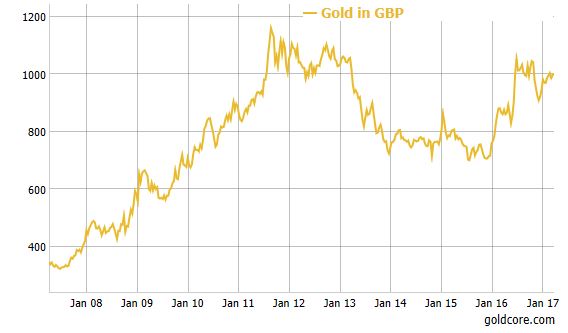
Gold in GBP – 10 Years
The U.K. government yesterday triggered Article 50–the legal mechanism which will start negotiations on how the UK will exit the EU – after the British voted to leave the EU last June.
This is creating considerable uncertainty and concerns about the political and economic outlook – both for the UK and for the EU itself.
Demand for gold bars by UK investors has surged 39% in 2016 according to GFMS as reported by the WSJ:
The resulting political and economic uncertainty helped drive a 39% rise in U.K. gold bar hoarding in 2016, according to Ross Strachan from GFMS, part of media group Thomson Reuters.
“Macroeconomic fears are conducive to increased investment demand in gold,” Mr. Strachan said. During and after the global financial crisis, he pointed out, global gold bar investment increased from 237.7 metric tons in 2007 to 1246.9 metric tons in 2011.
Given the scale of the uncertainty created by the UK decision to leave the EU, robust gold demand in the UK should continue.
Indeed, given the fact that cohesion of the European Union itself will be tested and there is the risk of contagion, gold demand in the EU should also remain robust. Ireland and the Irish economy is particularly vulnerable.
Gold has edged up in recent days and appears to be consolidating at the $1,250 level. In sterling terms, the pound has fallen against gold and gold in sterling terms is back above the important psychological level of £1,000 per ounce.
The pound fluctuated wildly yesterday against other currencies after the Prime Minister triggered Article 50. A period of intense uncertainty for financial markets, both UK and EU markets and for sterling and indeed the euro awaits.
The negotiations are likely to be fractious and divisive and this uncertainty for UK companies, business in general and for the already indebted UK economy does not bode well for sterling.

It is not not just uncertainty about Brexit talks that will likely support gold. The French elections are now just three weeks away (April 23 and May 7) and the mess that is politics in the U.S. should lead to further safe-haven diversification in the coming weeks.
The ‘Trumpflation’ meme has run its course in markets and stocks and the dollar looks vulnerable to weakness which should support gold.
The failure last week to overturn ‘Obamacare’ and the ‘Civil War’ style politics in the U.S. should also support and those seeking to allocate to gold should continue to do so on price weakness.
END
Pakiam states that gold is set to soar above 1500.00 dollars per oz as inflation is making a comeback
(courtesy Pakiam/Stoeferle)
Gold to soar to $1,500 as inflation makes comeback, Incrementum’s Stoeferle says
Submitted by cpowell on Wed, 2017-03-29 14:16. Section: Daily Dispatches
By Ranjeetha Pakiam
Bloomberg News
Tuesday, March 28, 2017
Gold is poised to rally to levels last seen four years ago as rising inflation and negative real interest rates combine to boost demand, according to Incrementum AG, which says that the precious metal may be in the early stages of a bull market.
Prices may climb to $1,400 to $1,500 an ounce this year, said Ronald-Peter Stoeferle, managing partner at the Liechtenstein-based company, which oversees 100 million Swiss francs ($101.5 million). Spot bullion — which was at $1,249 on Wednesday — last traded at $1,400 in September 2013. …
… For the remainder of the report:
https://www.bloomberg.com/news/articles/2017-03-29/gold-seen-soaring-by-…
END
A very important article tonight from Chris Powell. Our good friend Craig Hemke filed an official complaint against JPMorgan as they stopped (acquired) 2689 contracts or 13.445 million oz of silver even though the limits mandated by low is a maximum of 1500 contracts( 7.5 million oz). Chris Powell wonders if JPMorgan is sidestepping the legality with the bank acting as proxy for either the USA government or the Chinese government. Remember it has been mine contention that China lent silver to the uSA to engage in their nefarious activities of controlling the precious metal prices.
a very important read..
(courtesy Craig Hemke/ChrisPowell/GATA)
Guess why JPM might get away with exceeding position limits in silver futures
Submitted by cpowell on Thu, 2017-03-30 00:50. Section: Daily Dispatches
9:10a SST Thursday, March 29, 2017
Dear Friend of GATA and Gold:
The TF Metals Report’s Turd Ferguson (aka Craig Hemke) announced Wednesday that he has made a formal complaint to the U.S. Commodity Futures Trading Commission about what looks like JPMorganChase’s exceeding trader position limits in silver futures.
Ferguson writes: “Since there is a stated position limit of just 1,500 contracts for each front/delivery month, you might be asking yourself how JPM gets away with stopping far more than that number. If you go back and look at the 2015 and 2016 tables, note that JPM seems to adhere to these limits each month. So why and how did they manage to stop 2,689 in March? That’s a good question so I took the time yesterday to submit a formal complaint to the CFTC.
“Given my experience in dealing with the CFTC, in no way do I expect any aggressive action from this neutered and fully-controlled agency. Instead, I just thought it would be fun to see if I heard anything back from them at all. Will I even get a response? I can tell you that, so far, I haven’t even received one of those ‘thank you for writing us, we’ll look into it’ e-mails, so it’s not looking good. However, if I do eventually hear from them, I’ll be sure to write follow up to this post.”
Since a few years ago JPMorganChase CEO Jamie Dimon said the bank had no position of its own in silver and was just trading on behalf of clients, its seeming violation of position limits supports suspicion that the bank’s clients in silver (as well as gold) are governments, particularly the governments of the United States and China.
After all, the U.S. government’s Exchange Stabilization Fund, established by the Gold Reserve Act of 1934, which was amended in the 1970s, is authorized to trade not just gold and foreign exchange but “other instruments of credit and securities,” apparently without limit as to jurisdiction:
https://www.treasury.gov/resource-center/international/ESF/Pages/esf-ind…
And in its filings to the Commodity Futures Trading Commission and the Securities and Exchange Commission, CME Group, operator of the major futures exchanges in the United States, has reported that its clients include governments and central banks and even that they are offered volume trading discounts for trading all futures contracts offered by CME Group exchanges, not just financial futures:
http://www.gata.org/node/14385
http://www.gata.org/node/14411
Fortunately for governments and practitioners of technical analysis of markets, this futures trading by governments is of no interest to mainstream financial news organizations, since such journalism might reveal that what the world perceives as markets are actually mere holograms.
The TF Metals Report’s commentary is prosaically headlined “March Comex Silver ‘Deliveries'” and can be found here:
https://www.tfmetalsreport.com/blog/8243/march-comex-silver-deliveries
CHRIS POWELL, Secretary/Treasurer
Gold Anti-Trust Action Committee Inc.
CPowell@GATA.org
END
Your early THURSDAY morning currency, Asian stock market results, important USA/Asian currency crosses, gold/silver pricing overnight along with the price of oil Major stories overnight
1 Chinese yuan vs USA dollar/yuan WEAKER AT 6.8898( SMALLER DEVALUATION SOUTHBOUND /OFFSHORE YUAN MOVES WEAKER FROM ONSHORE AT 6.8759/ Shanghai bourse DOWN 31.07 POINTS OR .96% / HANG SANG CLOSED DOWN 90.96 POINTS OR 0.37%
2. Nikkei closed DOWN 154.26 POINTS OR 0.80% /USA: YEN RISES TO 111.14
3. Europe stocks opened ALL IN THE RED ( /USA dollar index RISES TO 100.07/Euro DOWN to 1.0742
3b Japan 10 year bond yield: RISES TO +.068%/ !!!!(Japan buying 100% of bond issuance)/Japanese yen vs usa cross now at 111.14/ THIS IS TROUBLESOME AS BANK OF JAPAN IS RUNNING OUT OF BONDS TO BUY./JAPAN 10 YR YIELD FINALLY IN THE POSITIVE/BANK OF JAPAN LOSING CONTROL OF THEIR YIELD CURVE AS THEY PURCHASE ALL BONDS TO GET TO ZERO RATE!!
3c Nikkei now JUST BELOW 17,000
3d USA/Yen rate now well below the important 120 barrier this morning
3e WTI:: 49.41 and Brent: 52.17
3f Gold DOWN/Yen DOWN
3g Japan is to buy the equivalent of 108 billion uSA dollars worth of bond per month or $1.3 trillion. Japan’s GDP equals 5 trillion usa./“HELICOPTER MONEY” OFF THE TABLE FOR NOW /REVERSE OPERATION TWIST ON THE BONDS: PURCHASE OF LONG BONDS AND SELLING THE SHORT END
Japan to buy 100% of all new Japanese debt and by 2018 they will have 25% of all Japanese debt. Fifty percent of Japanese budget financed with debt.
3h Oil UP for WTI and UP for Brent this morning
3i European bond buying continues to push yields lower on all fronts in the EMU. German 10yr bund FALLS TO +.328%/Italian 10 yr bond yield UP to 2.145%
3j Greek 10 year bond yield RISES to : 6.951%
3k Gold at $1250.25/silver $18.16 (8:15 am est) SILVER RESISTANCE AT $18.50
3l USA vs Russian rouble; (Russian rouble UP 41/100 in roubles/dollar) 56.21-
3m oil into the 49 dollar handle for WTI and 52 handle for Brent/
3n Higher foreign deposits out of China sees huge risk of outflows and a currency depreciation (already upon us). This can spell financial disaster for the rest of the world/China forced to do QE!! as it lowers its yuan value to the dollar/GOT SMALL DEVALUATION SOUTHBOUND from POBC.
JAPAN ON JAN 29.2016 INITIATES NIRP. THIS MORNING THEY SIGNAL THEY MAY END NIRP. TODAY THE USA/YEN TRADES TO 111.14 DESTROYING JAPANESE CITIZENS WITH HIGHER FOOD INFLATION
30 SNB (Swiss National Bank) still intervening again in the markets driving down the SF. It is not working: USA/SF this morning 0.9956 as the Swiss Franc is still rising against most currencies. Euro vs SF is 1.0695 well above the floor set by the Swiss Finance Minister. Thomas Jordan, chief of the Swiss National Bank continues to purchase euros trying to lower value of the Swiss Franc.
3p BRITAIN VOTES AFFIRMATIVE BREXIT/LOWER PARLIAMENT APPROVES BREXIT COMMENCEMENT/ARTICLE 50 COMMENCES MARCH 29/2017 (TODAY)
3r the 10 Year German bund now POSITIVE territory with the 10 year FALLS to +.328%
The bank withdrawals were causing massive hardship to the Greek bank. the Greek referendum voted overwhelming “NO”. Next step for Greece will be the recapitalization of the banks and that will be difficult.
4. USA 10 year treasury bond at 2.377% early this morning. Thirty year rate at 2.982% /POLICY ERROR)GETTING DANGEROUSLY HIGH
5. Details Ransquawk, Bloomberg, Deutsche bank/Jim Reid.
(courtesy Jim Reid/Bloomberg/Deutsche bank/zero hedge)
S&P Futures Fade Overnight Gains As Euro Slides; China Stumbles
Asian shares and oil are lower, European shares are little changed, and S&P futures are fractionally in the red after gaining for most of the overnight session, perhaps troubled by warnings from two Fed presidents who warned that markets and valuations appear frothy, and the Federal Reserve may have to raise rates more times than currently forecast. The latest round of Fed hawkishness helped the dollar gain further after recent losses which earlier this week pushed it to 4 month lows. That said, overnight the USDJPY appeared to fade much of yesterday’s gains, dipping back under 111 around the European open, only to see another unexplained jerk higher shortly before 6am eastern.
Summarizing some of yesterday’s key macro events, SocGen’s Kit Juckes writes that “the unnamed ECB source is back, telling Reuters that markets had over-interpreted Mario Draghi’s comments at the last meeting and that a further rise in bond yields would be problematic. Cue lower bond yields, and a slightly weaker Euro. If this morning’s preliminary March German CPI data deliver the expected base—effect-induced slip from 2.2% to 1.6%, we can look forward to this trend going a little further. I’m not sure how far we can go in the absence of a return of political concerns however. The FX market doesn’t have a significant Euro long position that can be flushed out (it probably has a small euro short, instead). And I’m not convinced that interest rate expectations can go that far.”
Juckes was right, and the EURUSD indeed slid further after a series of weak German regional CPIs, which has seen continued pressure following yesterday’s ECB rumors and hawkish Fed commentary. European traders will now look at German prices which are expected to rise 1.8% from the year before after CPI accelerated 2.2% in February.
The ECB’s dovish tone has once again established the diverging outlook between U.S. and European monetary policy, manifesting itself in some recent spread widening between German and US 10-Year yields.

Juckes had some observations on this too, and said that “in recent months, the US/German nominal yield differential has overtaken the real yield differential in terms of its correlation with EUR/USD. Both are better-correlated with the exchange rate than shorter-dated rates. The 10-year yield spread had narrowed from a wide position of 235bp in late December to as little as 196bp last week and is back above 200bp this morning. If the ECB is trying to anchor bond yields (and if they succeed in limiting how much they follow US moves), then the real driver of EUR/USD for a while will be what happens to US yields. The 2.3-2.65% range looks pretty strong and dooms EUR/USD to its current 1.04-1.09 range. That’ll change if the ECB’s view of the world changes after the French elections (which i suspect it will) and there’s a greater tolerance of higher Bund yields in particular. But for now, we’re stuck.”

Back to equities, where we find Asian shares turning mildly lower on Thursday after touching near two-year highs. MSCI’s broadest index of Asia-Pacific shares outside Japan was down 0.2 percent, stepping back from morning trade when it nudged close its loftiest levels since June 2015. Australian shares firmed 0.4 percent, helped by an overnight gain in oil prices.
China stocks were headed for a fourth day of losses amid worries over property market prospects, sharp declines in newly-listed stocks, and liquidity stress as the month-end approached. The CSI300 index was down 1.0 percent, while the Shanghai Composite Index lost 1 percent.
The tightening trend in China continued, with the one-day loan rate on the Shanghai Stock Exchange, which reflects demand from non-bank financial institutions, jumping before a long weekend (China markets closed Monday and Tuesday) and as the PBOC holds off on using a liquidity tool for the fifth day in a row. The overnight repurchase rate traded on the Shanghai exchange surges as much as 21.67% points to 32%, before closing at 14.96%; in Hong Kong’s offshore market, yuan tomorrow next forward points surge as much as 44 points, the most since Jan. 25. The PBOC again skipped reverse-repurchase operations for the fifth day in a row, taking net withdrawals during the period to 290 billion yuan due to maturities. On the first two days, the PBOC cited “high liquidity,” then over the next two days it referred to “appropriate liquidity.” On Thursday the monetary authority said that there was “high liquidity” in the banking system, and that fiscal spending toward the end of the month offsets reverse repo maturities.
In Europe, the Stoxx Europe 600 Index rose 0.1% at 10:29 a.m. in London after closing Wednesday at the highest since December 2015; the Germany’s DAX continues to close in on record highs seen in 2015.
The dollar index, which tracks the U.S. currency against a basket of six major rivals, was slightly up on the day at 100.030 . It was lifted to a one-week high overnight as the euro slipped on concerns about the impact of Brexit as well as news that ECB policymakers are keen to reassure investors that their easy-money policy is far from ending. Sterling steadied at after skidding to a one-week low of $1.2377 previously.
“Brexit, to some extent, has been covered in the market already. People went short, covered, and went short again,” said Kaneo Ogino, director at foreign exchange research firm Global-info Co in Tokyo. “As for the dollar, demand is still steady from pure commercial orders, but the Japanese fiscal year ends this week and Tokyo investors don’t want to take new positions,” Ogino said.
Despite the dollar’s gains on the day, it was far lower than levels above 115 yen hit a few weeks ago, and Japan’s Nikkei stock index shed 0.8 percent. “Investors have bought Japanese stocks mainly because of the strong dollar-yen trend. Trump’s healthcare defeat threw a wet blanket on the Japan market’s rally since last November,” said Takuya Takahashi, a strategist at Daiwa Securities.
As we observed yesterday, comments from Boston Fed President Eric Rosengren and San Francisco Fed President John Williams also backed multiple rate hikes, though those officials are non-FOMC voters.
“There’s a huge political fog around the world, in Asia, in the U.S., but underneath it, there’s actually quite a decent economic recovery. And that’s what’s driving markets more than the worries about politics,” said Sean Taylor, Asia Pacific chief investment officer at Deutsche Asset Management. “The U.S. is continuing to do well. Europe isn’t doing as badly as it was and because of the commodity pickup last year, emerging markets are doing okay,” he said.
The commodity space saw some profit taking, with West Texas Intermediate dropping 0.3% to $49.38 a barrel, after surging 2.4% on Wednesday after a bigger-than-forecast decline in U.S. gasoline stockpiles. Gold slipped 0.2 percent to $1,250.48 an ounce.
Today, traders will look for the latest data on jobless claims and personal spending.
* * *
Bulletin Headline Summary from RanSquawk
- German regional CPIs add pressure on the EUR which continues to remain out of favour from yesterday’s source comments
- Away from the German data, European equities have had a slow start to the morning with little in terms of firm direction
- Looking ahead, highlights include US GDP, Fed’s Mester, Kaplan, Dudley and Williams
Market Snapshot
- S&P 500 futures unchanged at 2,357.00
- STOXX Europe 600 up 0.09% to 378.87
- MXAP down 0.5% to 148.19
- MXAPJ down 0.2% to 482.36
- Nikkei down 0.8% to 19,063.22
- Topix down 0.9% to 1,527.59
- Hang Seng Index down 0.4% to 24,301.09
- Shanghai Composite down 1% to 3,210.24
- Sensex up 0.1% to 29,564.01
- Australia S&P/ASX 200 up 0.4% to 5,896.23
- Kospi down 0.1% to 2,164.64
- German 10Y yield fell 0.9 bps to 0.335%
- Euro down 0.2% to 1.0740 per US$
- Brent Futures down 0.2% to $52.30/bbl
- Italian 10Y yield fell 2.4 bps to 2.137%
- Spanish 10Y yield fell 0.5 bps to 1.638%
- Brent Futures down 0.2% to $52.30/bbl
- Gold spot down 0.3% to $1,250.22
- U.S. Dollar Index up 0.1% to 100.13
Top Overnight News
- Trump Travel Ban Blocked for as Long as Court Battle Goes On
- Oil Stays Above $49 as U.S. Fuel Demand Blunts Crude Supply Gain
- Zuma Said to Face Mass Cabinet Walkout If He Fires Gordhan
- Turkey’s TAI Renews 787 Dreamliner Parts Contract With Boeing
- Autodesk Says It Expects Revenue Growth in Next Two Quarters
- Hikma, Vectura Fall as Mylan Advair Generic Fails to Get Nod
- Great Elm Capital to Start Tender Offer for Up to $10m in Shrs
- Lazard’s Peter Kuo to Join Canyon Bridge as Founding Partner
- GE CEO Says ‘Climate Change Is Real,’ Science ‘Well Accepted’
- GE Renewable Energy Gets $56m Hydro Contract in China
- Lululemon 1Q EPS View Misses Est.
- Partners in Leviathan, Aphrodite Mull Joint Gas Pipeline: Delek
- Ford South Africa Recall to Include Fiesta Model: Star
Asian equities traded mostly in the red after the region shrugged off the mostly positive lead from Wall Street where the energy sector outperformed following a smaller than expected build in DoEs. Nikkei 225 (-0.8%) failed to benefit from a weaker JPY amid fiscal year-end rebalancing, while ASX 200 (+0.4%) bucked the trend and was led by the strength in the commodities complex. Hang Seng (-0.3%) and Shanghai Comp. (-1.0%) were dampened despite a positive earnings report from Big 4 bank China Construction Bank, as the PBoC refrained again from conducting open market operations for the 5th consecutive day while there were also reports the Trump administration are to make preparations to keep large tariffs on Chinese goods. 10yr JGBs were lower despite the cautious risk tone with demand
dampened after the latest weekly securities transactions data showed foreign investors increased their selling of Japanese bonds by more than 3-fold, while today’s 2 year auction also failed to provide any meaningful support with the b/c and lowest accepted price below prior. PBoC refrained from open markets operations again, which resulted to a net daily drain of CNY 40bIn.
Top Asian News
- PBOC Seen Raising Money Rates Twice This Year in Leverage Battle
- Thailand Says National Oil Co. to Be Set Up Only When Time Right
- Hong Kong Feb. Retail Sales Value Fall 5.7% Y/y; Est. -0.6%
- Ajinomoto Seeks Overseas Deals With $1.8 Billion War Chest
- Kotak Mahindra Bank Approves Issue of Up to 62m Shares
- China’s Xi to Meet Trump Next Week at Mar-a-Lago, Xinhua Reports
- Posco Almost Doubles Profit as Global Steel Rally Sustained
In European markets, the notable highlight of the morning has come in the form of the regional CPIs from Germany, which have generally printed lower than previous, while also coming in under the expected figure for the national reading. The softer CPI numbers have seen upside in Bunds. While periphery yields are lower in tandem this morning, with much of the attention here falling on the supply from Italy, which was relatively well digested. Away from the German data, European equities have had a slow start to the morning with little in terms of firm direction. On a sector specific basis, energy names are the significant outperformers, with this coming in tandem with WTI futures briefly retaking USD 49.50/bbl to the upside. Elsewhere H&M are firmly at the bottom of the Stoxx 600 after a downbeat sales update.
Top European News
- Italy Finance Chief Says Le Pen Victory Would Add Permanent Risk
- May’s Opening Brexit Bid to Tie Security to Trade Hits Wall
- OPEC Oil-Cuts Extension Unlikely, Russian VEB Economist Says
- SNB Will Scrap Negative Rate as Soon as Possible, Maechler Says
- H&M 1Q Pretax Beats; New Brand to Be Launched in 2H
In currencies, the euro fell 0.3 percent to $1.0736, after declining 0.9 percent over the previous two days. The British pound was little changed. The Bloomberg Dollar Spot Index rose 0.2 percent. Not too much to note in the FX markets other than some calm in GBP trade. Some modest weakness seen early on, but this looks to have dissipated in the wake of the Article 50 activation yesterday. All eyes on EUR/GBP to see whether the usual month end flow will impact, but the pair looks well contained in the mid 0.8600’s for now. From the EUR perspective, regional German inflation has softened in March, while the EU wide sentiment indices for business and consumers have missed on expectations, softening a tad on the month also. EUR/USD has drifted (very) steadily lower through the session, but we expect to find support around 1.0700 – if we get there – with close to 2 yards rolling off at the NY cut later today. USD/JPY has traded a very tight range around 111.00, with limited movement in UST yields to trade off. The key 10yr rate is hemmed inside 2.35-2.40%, with the recent Fed speak doing little to spark fresh movement on the curve. More to come from Mester, Kaplan, Williams and Dudley, but we see little that can change sentiment other than from Yellen herself. Hard data now counts for more – as the FOMC consistently communicate data dependency – with core PCE prices due out alongside the final reading of Q4 GDP today and the usual weekly claims data.
In commodities, the broader recovery in the global risk mood looks to have aided the rise in base metals if nothing else, with little to differentiate in terms of the latest gains seen across the board. Copper gains have pushed tentatively through USD2.65, and is struggling a little, with similar price action elsewhere. Given the recent pull-back in the USD, some would have expected a little more upside, which has also helped Oil prices to a modest degree, but the lower rise in inventory as reflected in both the DoE and APIs has largely been the driver here, further ‘supported’ by the disruptions in Libya. WTI still struggling ahead of USD50.00 however. Gold still trading on a USD1250.00 handle, as Silver is above USD18.00, with the tentative recovery in the greenback prompting cautious trade from here.
On today’s calendar, in the US this afternoon we’ll get the third and final revision to Q4 GDP (expected to be nudged up to +2.0% qoq annualized) along with core PCE. The latest weekly initial jobless claims print will also be released. It’s another busy day for Fedspeak with Mester, Kaplan, Williams and Dudley all scheduled to speak. Over at the ECB board members Praet and Nowotny are also due to speak this morning. Also worth watching today is a meeting between President Trump and head of the National Economic Council Gary Cohn where it is expected that the President will be briefed on outlines over options for tax reform.
US Event Calendar
- 8:30am: GDP Annualized QoQ, est. 2.0%, prior 1.9%; Personal Consumption, est. 3.0%, prior 3.0%; GDP Price Index, est. 2.0%, prior 2.0%; Core PCE QoQ, est. 1.2%, prior 1.2%
- 8:30am: Initial Jobless Claims, est. 247,000, prior 261,000; Continuing Claims, est. 2.03m, prior 1.99m
- 9:45am: Bloomberg Consumer Comfort, prior 51.3
Central Banks
- 9:45am: Fed’s Mester Speaks in Chicago on Payment System Improvement
- 11am: Dallas Fed’s Kaplan Speaks in Washington
- 11:15am: Fed’s Williams Speaks at Learning Community Event in New York
- 4:30pm: Fed’s Dudley Speaks in Sarasota
DB’s Jim Reid concludes the overnight wrap
So the grind higher in markets following the AHCA vote debacle last week continues to trudge along in a fairly orderly fashion. With the S&P 500 nudging up another +0.11% yesterday the index is now up +1.68% from Monday’s low point and has barely looked back. We’ve highlighted a few times this week that we think that Trump trades had already been priced out to a large degree and so therefore the disappointment over last Friday’s news may be limited with global growth being the most important factor for now. Indeed it perhaps tells you something that yesterday was the third lowest volume day for the S&P 500 this year and the VIX declined for the fourth session in a row and is not far off the lows of the recent year to date range again. While politics will continue to be an important theme – indeed there are reports this morning suggesting that Republicans are considering a resurrection of the healthcare bill vote again next week – global data surprises are approaching six-year highs and for now it feels like this might be the more important near term driver.
The more significant moves in markets yesterday however came in bonds where yields fell across the board seemingly sparked by a Reuters story which suggested that ECB policymakers are becoming wary of making any new change to their policy message next month. This follows concerns at the ECB that the market over interpreted the message sent out at its March 9th meeting and were swift to start pricing in hikes. The article stated that the intention of the ECB was to communicate reduced tail risk but that instead the market took it as a step to the exit. The article also quoted its sources for the report saying that a previously mentioned deposit rate hike prior to the unwind of QE purchases “would be a communication nightmare” and that “if you raise rates, you can’t communicate that it’s a one-off” and that instead “the market would immediately price in a new rate path”.
As is always the case with these stories there’s always a validity question with regards to the origin of the content and in this case the report quotes ‘six sources’ without any more specifics. That said there’s no smoke without fire and bond yields were quick to move lower in the wake of the story hitting the wires. By the end of play 10y Bund yields had finished 4.5bps lower at 0.342% and are now at the lowest yield in 3 weeks. Yields in Spain, Italy and Portugal fell 4.6bps, 2.3bps and 6.0bps respectively also. Market implied pricing for a 15bp hike in the deposit rate was also pushed back from April 2018 to August 2018 midway through the day. The story also appeared to be attributed to the decent bid for Treasuries which saw the 10y yield tumble 4.1bps and hit the lowest closing yield, at 2.377%, since February 27th. That was despite a chorus of relatively hawkish Fedspeak which we’ll touch on shortly. The Euro (-0.45%) was also the second worst performing G10 currency yesterday while European Banks fell nearly -1% intraday but pared losses to a more modest -0.21% decline. Still, that was in the context of a +0.33% gain for the broader Stoxx 600 after the energy complex rose on the back of a +2.36% rise for WTI Oil and the most in two weeks.
Away from that there was also a close eye kept on UK PM Theresa May’s statement to the House of Commons yesterday as well as the official withdrawal letter following the confirmation of Article 50 being triggered. In a nutshell there wasn’t a huge amount new on the UK side of things compared to what was revealed in the government’s White Paper last month. As our economists noted the UK continues to want to reach agreement on a comprehensive new deal with the EU27 in parallel with the terms of the divorce by March 2019, an unrealistic timetable and one the EU27 opposes. From the EU27 side, EU Council President Donald Tusk responded with a statement of his own and the EU Council released an official statement. The body language from Tusk was negative. Tusk mentioned damage limitation as the primary goal. Combined with last week’s comments from Commission negotiator Barnier on the priority of divorce negotiations and recent press reports, an early assessment of the EU’s stance is that they plan to offer the UK a take-it-or-leave-it option (settlement of the divorce including the UK’s budgetary commitments, then a limited transitional deal), but are preparing for a hard outcome. So with mutually contradictory goals and significant political obstacles for compromise it looks set to be a long drawn out negotiation process with the two year clock now quietly ticking away.
It’s also worth highlighting that today the UK government will release a White Paper concerning the repeal of the EU acquis, and its translation into domestic law. Our economists highlight that this is important for negotiations as the EU27 argue the UK will have to remain under the authority of the ECJ under a transitional deal. On April 27th a special EU Council will be convened to discuss the broad framework for the negotiations. Detailed negotiations are only likely to start in June. In the next few days, it will also be worth closely monitoring rhetoric from both the UK and EU27. So a few things to watch out for.
To the latest in Asia now where bourses have slowly drifted lower over the course of the session despite there being little in the way of newsflow. The Nikkei (-0.25%), Hang Seng (-0.40%), Shanghai Comp (-0.86%) and Kospi (-0.23%) are all in the red while the ASX (+0.30%) is just about holding on to gains. It’s possible that the moves reflect some quarter end profit taking following a strong run for Asia equities so far this year. Futures in the US are little changed and in commodities Oil is holding onto yesterday’s gains while Gold is slightly lower. Back to that Fedspeak yesterday which as we briefly mentioned earlier was fairly hawkish despite limited market reaction. Boston Fed President Rosengren said that “my own view is that an increase at every other FOMC meeting over the course of this year could and should be the committee’s default”, in other words suggesting that he favours 4 hikes this year. This was a view somewhat echoed by the San Francisco Fed President Williams who said that he “would not rule out more than three increases total for this year” and also that the Fed could look to begin shrinking its balance sheet before knowing the size it ultimately should be.
Away from that the economic data was especially thin on the ground yesterday. In the US pending home sales rebounded +5.5% mom in February and more than expected. In the UK mortgage approvals nudged down to 68.3k while net consumer credit printed at £1.4bn in February which was a slowdown compared to the £1.6bn average over the prior six months.
Before we look at today’s calendar, it’s worth highlighting that yesterday our Global Economics Perspectives team published a new report in which they provide ‘quick’ answers to a list of questions they have received from clients globally in recent days. The bulk of the questions this week have been on policy (both fiscal and monetary) and the team also detail their views on US growth and inflation prospects. You can find the link to the report here https://goo.gl/AtY36U.
To the day ahead now where this morning in Europe we’ll be kicking off with the latest confidence indicators for the Euro area before we then get the March CPI report out of Germany. Over in the US this afternoon we’ll get the third and final revision to Q4 GDP (expected to be nudged up to +2.0% qoq annualized) along with core PCE. The latest weekly initial jobless claims print will also be released.
It’s another busy day for Fedspeak with Mester (1.45pm GMT), Kaplan (3.00pm GMT), Williams (3.15pm GMT) and Dudley (8.30pm GMT) all scheduled to speak. Over at the ECB board members Praet and Nowotny are also due to speak this morning. Also worth watching today is a meeting between President Trump and head of the National Economic Council Gary Cohn where it is expected that the President will be briefed on outlines over options for tax reform.
3. ASIAN AFFAIRS
i)Late WEDNESDAY night/THURSDAY morning: Shanghai closed DOWN 31.07 POINTS OR .96%/ /Hang Sang CLOSED DOWN 90.96 POINTS OR 0.37% . The Nikkei closed DOWN 154.26 OR 0.80% /Australia’s all ordinaires CLOSED UP 0.36%/Chinese yuan (ONSHORE) closed DOWN at 6.8898/Oil ROSE to 49.41 dollars per barrel for WTI and 52.17 for Brent. Stocks in Europe ALL IN THE RED ..Offshore yuan trades 6.8759 yuan to the dollar vs 6.8898 for onshore yuan.THE SPREAD BETWEEN ONSHORE AND OFFSHORE NARROWS AGAIN/ ONSHORE YUAN WEAKER AND THE OFFSHORE YUAN MUCH WEAKER AND THIS IS COUPLED WITH THE SLIGHTLY STRONGER DOLLAR. CHINA IS SATISFIED WITH WASHINGTON’S RESPONSE
3a)THAILAND/SOUTH KOREA/NORTH KOREA
Two weeks after her impeachment, South Korea’s ex President is arrested on bribery charges
(courtesy zero hedge)
South Korea’s Ex-President Park Arrested On Bribery Charges
After being formally impeached just three weeks ago, former South Korea President Park Geun-hye was arrested on Friday in connection with a corruption scandal that led to her removal from office, Yonhap reports.

The Seoul Central District Court issued a warrant to detain Park on charges of bribery, abuse of authority, coercion and leaking government secrets, after a marathon hearing the previous day. State prosecutors filed the request on Monday to arrest Park, citing the graveness of the alleged crimes and the possibility of the destruction of evidence.
Park, ousted in a historic ruling on March 10, became the country’s third former president to be arrested over criminal allegations, following Roh Tae-woo and Chun Doo-hwan.
A full timeline of Park’s fall from grace can be found in our most recent post on the topic.
b) REPORT ON JAPAN
WESTINGHOUSE/TOSHIBA
As I reported to you yesterday, Westinghouse has declared bankruptcy protection in the USA. These guys are a subsidiary of Japanese based Toshiba who is also in trouble with bribery and other nefarious things. Will Trump force Japan to complete the projects as the USA nuclear reactor owners are claiming that they have been cheated by the Japanese
popcorn anyone..
(courtesy zero hedge)
Westinghouse Bankruptcy Puts Fate Of Four U.S. Nuclear Reactors In Limbo
When Westinghouse Electric filed for Chapter 11 bankruptcy protection on Wednesday morning, few were surprised as the outcome was the only one which allowed the company’s troubled, and near-insolvent Japanese parent, Toshiba, to continue operating, even if it meant the bankruptcy of the iconic company. Westinghouse was one of the originators of the nuclear age, building the world’s first commercial nuclear reactor 60 years ago. Its pressurized water reactor design is in 430 power plants and accounts for 10% of electricity generated in the world.
However, few were prepared for the unexpected aftermath of this particular bankruptcy, which has set off a showdown between Toshiba and a major U.S. utility, has left the fate of four half-finished nuclear reactors and is threatening to drive a wedge between the US and Japanese governments over the fate of industries each considers vital.

The Vogtle Unit 3 and 4 site, a Westinghouse project, near Waynesboro, Ga., in February
For those who have missed our previous discussion on the underlying cause for today’s default, Westinghouse incurred billions in runaway cost overruns related to four nuclear reactors it is building in the southeastern U.S. These costs from the half-finished reactors had spiraled so large, they threatened the viability of its Japanese parent company, Toshiba, which in turn has been engulfed in a series of accounting and fraud scandals in recent years, has seen its profitability plummet and whose precarious finances have attracted attention of Japan’s government.
Admitting defeat in the nuclear business, Toshiba CEO Satoshi Tsunukawa said that “this is a de facto withdrawal from the overseas nuclear business for us. Therefore, we don’t see any more risk.”
Others, however, see substantial risk now that their claims against Westinghouse are reduced to the status of a prepetition unsecured claim. First and foremost, is Toshiba’s now former, and quite angry customer, Tom Fanning, CEO of Southern Co., the Atlanta power company and primary owner of two of the reactors being built in Georgia, who on Wednesday characterized the completion of the reactors as an international political issue, calling it a test of Prime Minister Shinzo Abe’s commitments with President Donald Trump at a summit in February to help create American jobs.
“The commitments are not just financial and operational, but there are moral commitments as well,” Mr. Fanning said in an interview from Tokyo, where he had traveled to lobby for a resolution to the mounting dispute. Quoted by the WSJ, Fanning said there are 5,000 jobs directly at stake at the two Georgia reactors, jobs that could be lost if Toshiba doesn’t commit to paying billions in future costs, which it won’t now that it has severed ties with its insolvent subsidiary.
Westinghouse designed the reactors and also is building them for Southern, and contractually had agreed to shoulder cost overruns, at least until its Chapter 11 filing this morning.
Perhaps unaware of the ramifications, Trump administration officials were quiet on the bankruptcy Wednesday.
According to the WSJ, the U.S. Department of Energy, which has provided an $8 billion loan guarantee for the Georgia reactors, said it was in discussions with various companies. “We are keenly interested in the bankruptcy proceedings and what they mean for taxpayers and the nation,” said Lindsey Geisler, an agency spokeswoman.
Ironically, based on a new Westinghouse design, the reactors, the first to be constructed in the U.S. in nearly four decades, were supposed to be an answer to cost overruns and delays that have dogged the nuclear power industry. We say ironically, because it is cost overruns and delays that eventually led to the company’s bankruptcy. Worse, these plants are already years behind schedule in addition to causing huge losses for Toshiba.
Toshiba said it expected to lose about $9 billion in the fiscal year ending March 31, largely because it guaranteed nearly $6 billion in Westinghouse’s obligations to Southern and Scana Corp.—the company for which Westinghouse is building the other two reactors in South Carolina.
What happens next is unclear. After the bankruptcy filing, Southern and Scana have said they would finance continued construction of the reactors for 30 days, but weren’t clear where construction funding would come from after that time. Scana also said, for the first time, that it would consider abandoning the two reactors underway if costs changed dramatically.
More problematic are the potential political implications: Southern’s CEO has made it clear he intends to escalate this to the level of an international conflict if he must. Fanning, who said he has spoken to Vice President Mike Pence, Commerce Secretary Wilbur Ross and Energy Secretary Rick Perry about the importance of completing the reactors, argued that more was at stake economically than the direct future of the facilities.
“Westinghouse declaring bankruptcy has national security implications,” said Mr. Fanning, who also happens to be chair of the board of the Atlanta Fed.
Fanning said the estimated cost of the entire project was roughly $16 billion, but cautioned that the companies were unsure of how much more was needed to finish the partially built reactors. The current target dates for completion of the Georgia reactors are 2019 and 2020, three years behind the original schedule.
Richard Nephew, a fellow at the Center on Global Energy Policy at Columbia University, said Mr. Fanning appeared to be using the Trump administration’s reputation for defending U.S. jobs and taking a tough stance even with allies, to his advantage.
“This is someone who knows what the triggers are for this administration,” Mr. Nephew said. “Everyone now has a sense of what the president’s triggers are and I wouldn’t be surprised if a lot of companies use those triggers to gain an advantage in negotiations with foreign companies.”
Another problem is the overall viability of nuclear energy. Toshiba casting away Westinghouse is merely the latest indication of an industry in turmoil, demonstrated recently by Siemens’ decision to abandon the industry, Areva SA’s financial and safety problems, the falling market value of China General Nuclear Power Group and the junk-bond status of Russia’s Atomenergoprom.
“I don’t see how this can mean anything but even greater cost growth for the plants under construction and an unacceptable risk for any that are under consideration,” said Fred Beach, assistant director of the Energy Institute at the University of Texas at Austin.
Meanwhile, the biggest threat from the bankruptcy is fallout in the already tense diplomatic relations between the US and Japan.
A Japanese government official said the U.S. had not raised Mr. Fanning’s complaints with the Abe administration and that there had been no request for help to keep the projects alive. “This is a private company’s business and operation,” the person said.
It will hardly remain that way, and it remains to be seen what will happen if and when Trump demands that Japan make whole the US companies that were cheated by Toshiba’s decision.
end
Foreign investors are dumping Japanese bonds by the bucketful and they should. The only purchaser of these bonds is the Japanese government
(courtesy zero hedge)
Foreign Investors Are Dumping Japanese Bonds & Stocks At Almost Record Pace
Foreigners selling Japanese assets has become very seasonal as liquidity needs appear critical at quarter-ends for much of the last three years.
Last week – as Q1 ends – Foreigners sold 1.923 trillion Yen in Japanese bonds and 754 billion Yen in Japanese stocks. That was the second largest dump of Japanese assets in history…
This is also the biggest Q1 plunge ever – worse than in 2008.

The size of this combined selling of Japanese bonds and stocks at $24 billion in one week, was only bettered by the Q3 2016-end.
c) REPORT ON CHINA
CHINA AND RUSSIA/ PUTIN
This will be a big meeting as Xi is set to meet Trump at Mar a Lago in Florida on April 6 to 7. Putin also announces that he is ready to meet Trump
(courtesy zero hedge)
China’s President To Meet Trump Next Week; Putin “Ready” For Meeting In Finland
Confirming recurring rumors from the past month, overnight both China’s Foreign Ministry and the White House confirmed that China’s president Xi Jinping will meet with President Trump at Mar-a-Lago in Florida on April 6-7. It will be Xi’s first meeting with Trump, a little over a month after Trump used the same venue to meet with Japan’s PM Abe, and comes at a time when the two sides face pressing issues, ranging from North Korea and the South China Sea to trade disputes.
Foreign Ministry spokesman Lu Kang, who made the announcement at a daily news briefing on Thursday, did not give any more details of the meeting agenda, but spoke of the need to see the big picture while fostering mutual interests in trade relations.
“The market dictates that interests between our two countries are structured so that you will always have me and I will always have you,” Lu said.
“Both sides should work together to make the cake of mutual interest bigger and not simply seek fairer distribution,” he said in response to a question about trade frictions.
Beijing had previously said that preparatory work for the meeting was underway. But it had not yet confirmed the trip, despite western media reports on a scheduled meeting and an announcement by the Finnish government that Xi would make a brief stop in Finland on April 5.
The summit follows a series of other recent U.S.-China meetings and conversations aimed at mending ties after strong criticism of China by Trump during his election campaign. Rex Tillerson ended a trip to Asia this month in Beijing, agreeing to work together with China on North Korea and stressing Trump’s desire to enhance understanding.
Among the most pressing recent issues, China has been irritated at being repeatedly told by Washington to rein in North Korea’s nuclear and missile programs and by the U.S. decision to base an advanced missile defense system in South Korea. Beijing also remains suspicious of U.S. intentions towards self-ruled Taiwan, which China claims as its own.
Of course, trade will be a dominant topic: Trump has repeatedly accused China of unfair trade policies, criticized its island-building in the strategic South China Sea, and accused it of doing too little to constrain North Korea, although with the “Goldman” block silencing Peter Navarro in recent months, Trump has significantly moderated his tone.
* * *
Meanwhile, setting the stage for a just as critical summit, Russian President Vladimir Putin said on Thursday that he was ready to meet U.S. president Donald Trump at an Arctic summit in Finland. According to Reuters, the Russian president made this remark responding to his Finnish counterpart, who said he would be happy to receive Russian and U.S. presidents in Finland.
“I believe Finland suits this purpose well, and Helsinki is a very convenient platform to organize an event like this,” Putin said, when asked if he thought a meeting between him and Trump was possible in Finland. However, he added that the event should be well prepared “by both sides.”
“If this happens, we – and I personally – would be glad to take part in such an event. If not, the meeting [with Trump] could take place in the framework of the G20 summit [set to take place in July],” Putin concluded.
Finnish President Sauli Niinisto said earlier that his country would “certainly be very happy to have the opportunity to hold such a summit.”
The summit is set to take place at Finlandia Hall in Helsinki on September 18-20, 2017, according to the event’s official website.
4. EUROPEAN AFFAIRS
5. RUSSIAN AND MIDDLE EASTERN AFFAIRS
IRAN/RUSSIA
A great commentary explaining the importance of the Russian/Iranian alliance. Rouhani is set to visit Putin
(courtesy Peter Korzun)
Iran’s President Rouhani Visited Russia: Another Step To A Multipolar World
Authored by Peter Korzun via The Strategic Culture Foundation,

The significance of Iranian President Hassan Rouhani’s visit to Russia on March 27-28 goes far beyond the bilateral relationship. Iran is one of the main actors in Syria and Iraq. It has an importance place in the geopolitical plans of US President Donald Trump. Its relationship with Russia is an important factor of international politics. The future of the entire Middle East depends to a great extent on what Russia and Iran do and how effectively they coordinate their activities.
Less than two months are left till the presidential election in Iran. The presidential race formally starts on April 17 and Rouhani has a good chance to win. True, the country’s foreign policy at the strategic level is defined by Iran’s Supreme Leader, Ayatollah Ali Khamenei, but the executive branch of the government led by president implements it. The spiritual leader does not pay visits to other countries but Russian President Vladimir Putin met him in Tehran last year – the second time in the recent 17 years.
This was Rouhani’s first official visit to Russia and the first time he and Putin met within a bilateral framework. The trip took place against the background of growing partnership as both countries have become leading forces of the Astana process that made Iran, Russia and Turkey guarantors of the Syrian cease-fire.
True, the cooperation in Syria is of utmost importance but there is each and every reason to believe that Russia and Iran will have to join together in an attempt to settle the conflict in Afghanistan. As a regional superpower, Iran will gain much by coordinating activities with Russia in that country after the US withdrawal that seems to be inevitable. Such cooperation would become a game-changing factor with far-reaching consequences for the region from the Mediterranean to Pakistan.
The emerging triangle, including Russia, Iran and Turkey, becomes an alliance, could reshape the region. A ceasefire in Syria reached as a result of the Astana process led by the «big three» would reduce the clout of the US, the UK and France. Actually, their influence has already been diminished. The neighboring states will see that progress can be achieved without the «traditional players» representing the West.
Russia is the country that can debunk the myth that the Middle East is threatened by a «Shia threat» emanating from Tehran. It can use its close and friendly relations with leading Sunni states – Egypt, Jordan, the UAE and, perhaps, Saudi Arabia – to play the stabilizing role of mediator between the Shia and Sunni camps. Russia has a unique position to act as an intermediary between Iran and Israel – something nobody else can do.
It’ll take years to heal the wounds and mitigate the contradictions between Shia and Sunni Muslims in Lebanon, Syria and Iraq. Today, the West does not enjoy the clout it once had there. The borders drawn by Western countries caused many conflicts; direct military interventions made them lose trust and support. Under the circumstances, Russia is not exactly an outside actor. Moscow needs peace and stability in the region. This goal can be achieved in tandem with Turkey and Iran. Iraq and Syria can join the trio after they overcome the devastating results of wars. It makes the cooperation with Tehran an issue of paramount importance for Russia.
The bilateral relationship is going to be strengthened by large-scale economic projects.
Despite the importance of foreign policy issues, the talks mainly focused on prospects for deepening trade, economic and investment cooperation, including under large joint projects in energy and transport infrastructure. More than ten major trade and economic agreements were signed during the visit. Russia has already pumped about one billion euros into Iran’ railway network, with serious financial injections into bilateral projects yet to be implemented.
Exports to Iran stand at only around 1 percent of Russian foreign trade, but a trade surplus and the existence of a large market for Russian manufactured goods make Iran an important partner. The bilateral trade grew by 60 percent from $1.2 billion in 2015 to almost $2 billion in 2016.
The resumption of weapons deliveries and participation in infrastructure projects financed by Russian loans have led to the doubling of exports of non-energy products from Russia to Iran. The first batch of S-300 air defense systems was delivered in April 2016.
Russia has agreed to provide Iran with a loan of $2.2 billion for infrastructure projects involving Russian companies. It is planned to build a power plant and enhance generation at another in Iran in a contract worth several billion dollars. Under an agreement signed between the two sides, the Russians will improve efficiency at the Ramin power plant in Khuzestan province to 50-55% from 36% now. Another Russian company will build a 1,400-megawatt power plant in the Iranian city of Bandar Abbas in Hormuzgan province. Russian truck manufacturer Kamaz plans to export 300 trucks in 2017, GAZ signed a memorandum with the Iranian authorities for the supply of 900 buses.
Russia’s role in reaching the Iran nuclear deal, the cooperation in Syria and the allegiance to the policy of rapprochement declared by President Putin provide ample evidence of Moscow’s desire to boost the bilateral ties.
A momentous event to take place this year will provide an impetus to the development of Russia-Iran relations. Tehran is expected to become a full-fledged member of the Shanghai Cooperation Organization (SCO) this June. Iran also has expressed interest in signing a trade agreement with the Eurasian Union.
Russia and Iran are united by common goals and interests. The development of relations between the two great powers is a significant contribution into creating alternative poles of power to change the world for the better.
END
6.GLOBAL ISSUES
7. OIL ISSUES
Here is a good reason why the price of oil will be heading south as production continues to rise for a shale boys:
(courtesy Cunningham/OilPrice.com)
Huge 300,000 Bpd Fracklog Could Derail Oil Price Recovery
Authored by Nick Cunningham via OilPrice.com,
Thousands of drilled shale wells are sitting idle, unfracked and uncompleted.
The backlog of drilled but uncompleted wells (DUCs) grew dramatically beginning in 2014, as low oil prices forced drillers to hold off on completion in hopes of higher prices at a later date. After all, why bring production online in a low price environment when the same oil could earn more in the future if prices rebound. That calculation is particularly important given that a shale well typically sees an initial burst of production in its first few months of operation followed by a precipitous decline in output.
The surge in DUCs created an enormous backlog of wells awaiting completion. This “fracklog” loomed over the oil market, threatening to derail any sign of an oil price recovery. As soon as oil prices rebounded to some higher point, the shale industry would bring thousands of already-drilled wells online, and that sudden rush of new supply would push prices back down.
But that was a necessary process in order to shrink the huge inventory of DUCs – and that’s exactly what started to play out last year. As oil prices moved up from $27 per barrel in February 2016 to around $50 per barrel by early summer, the industry began completing a lot of wells. The DUC inventory fell from over 5,600 to just over 5,000 between January and August, a decline of 10 percent, according to the EIA’s Drilling Productivity Report.

By late November, when OPEC announced an ambitious plan to take 1.2 million barrels per day off of the market, combined with nearly 600,000 bpd of non-OPEC cuts, oil prices shot up. One would have thought that the DUC inventory would see another round of completions, reducing the backlog even further.
But that didn’t happen. The DUC list has grown since then, increasing to 5,443 as of February 2017, an increase of roughly 8 percent since October. Why did this happen even though WTI and Brent moved up well into the $50s per barrel? The rig count has increased sharply since the OPEC deal was announced, but why are companies adding rigs back into operation if they are not completing the new wells that they are drilling? For example, in the Permian Basin, the industry drilled 395 new wells, but they only completed 300 of them.

Reuters interviewed industry experts and lawyers and found that a lot of companies are drilling new wells because the terms of their leases require drilling by a certain date or else the companies forfeit their rights to the acreage. Standard leases typically have three-year terms, Reuters says, with an option for a two-year extension. They can drill the wells, but keep them uncompleted and still comply with the terms of the lease, allowing the companies to hold onto the acreage and then come back at a later date to complete the well.
Holding onto land is particularly important these days because land prices in West Texas have skyrocketed, with acreage costing five times as much as it once did a few years ago. Nobody wants to forfeit any prospects amid such a land rush.
Another element contributing to the DUC buildup is that market for fracking crews is tightening, according to Reuters. After a well is drilled, producers contract with fracking crews to complete the well.
“There were a number of completions that were originally scheduled in first quarter and you’ve seen those slide to Q2 and that’s really being driven by…access to service crews and things like that,” Tom Stoelk, the CFO and interim CEO of Northern Oil & Gas Inc, told Reuters. So the uptick in the backlog could just be temporary.
But with drilling activity picking up, oilfield services companies are seeing such an uptick in demand that they are charging more. The rising cost of frac sand, well completions, drilling rigs and even labor are leading to cost inflation across the industry, cancelling out some of the “savings” achieved since the market downturn began in 2014. As such, some companies might be waiting for higher prices.
Once the DUCs are completed, new production will come online. And just as before, that backlog still weighs on the market. Wood Mackenzie estimates that if the Permian Basin’s DUC list was completed, it would add 300,000 bpd in new supply.
That supply sitting on the sidelines will put downward pressure on any new oil price rally.
END
8. EMERGING MARKETS
The situation in Venezuela is getting dire by the minute. Now the Supreme Court who is siding with Maduro has basically silenced the opposition.
(courtesy zero hedge)
Venezuela Opposition Calls For Military Intervention After Supreme Court “Coup”
The leader of Venezuela’s coalition of opposition forces and the president of the National Assembly, Julio Borges, said President Nicolas Maduro had staged a coup and called for a military intervention.
Borges remarks followed a decision by the Supreme Court to take over legislative powers from the National Assembly for being in contempt of court. As the BBC reports, the charge stems from alleged electoral irregularities by three opposition lawmakers in the country’s elections 2015. The power struggle between President Maduro and the main opposition coalition (MUD) has been ongoing since the government lost its majority in the National Assembly in 2015. Since then, the top court which is allied with Maduro, has annulled many of the assembly’s decisions. But it had not directly taken over the assembly’s functions.
That changed on Wednesday when the court gave President Maduro the authority to create joint oil ventures without congressional approval, by-passing the assembly.
The government-stacked Supreme Court argued that the Congress is in contempt of court for swearing in three – opposition – lawmakers from the state of Amazonas who have been accused of electoral fraud. The court said it will take over all “parliamentary capacities” until the conflict is resolved.
“As long as the National Assembly’s contempt of court and invalidity persist, parliamentary powers shall be exercised directly by (the Supreme Court’s) constitutional chamber or by the body it stipulates to safeguard the rule of law,” the high court said in the ruling.
And, in what has been called a point of no return, Wednesday night’s ruling effectively shuts down the opposition-controlled Congress or National Assembly, as it is called in Venezuela.
The reaction from the opposition was swift, with Borges appealing to the public that “we have to call on the National Armed Forces (FAN), they cannot remain silent, they cannot remain silent in the face of the violation of the Constitution.”
Quoted by El Nacional, Borges said that “we know that FAN officers are also going through drama caused by the high cost of life. We want to make a call on them to be the first guardians of democracy and the Venezuelan Constitution and that they become part of the solution,” Borges said in a press conference.
Borges also called on the international community to “sound the alarms” and help pressure the socialist government of Nicolas Maduro to respect the Constitution and call for elections.
“This is a dictatorship and the world has to help Venezuelans to sound all the alarms,” Borges said. “We need the solidarity of all countries to continue the pressure (…) to carry out this year, as it is mandated by law and by the Constitution, elections for governors, mayors and also a general election,” he said.
Borges also called for a national protest this weekend and urged Venezuelans to raise their voice. “We know there is fear, there is repression, but it is time to stand up,” he said at a press conference.
Borges was joined by assembly’s Vice President Freddy Guevara who said earlier the ruling “marks a point of no return for the dictatorship.” Many are comparing it with the so-called “Fujimorazo” of April 1992, when Peruvian President Alberto Fujimori shut down Congress.
“It is no longer just a question of annulling everything that the National Assembly does,” Guevara said, “but of usurping all its powers, allowing them to approve new ‘sentencing laws’ that give more power to the dictator to continue hurting the people.”
Maduro has jailed scores of opponents ever since the opposition swept congressional elections by a landslide in 2015 and immediately set out to remove the socialist leader from office through a recall referendum. The high court a year ago issued an order automatically nullifying all legislation coming out of Congress, and earlier this week it moved to limit lawmakers’ immunity from prosecution.
Most recently, President Maduro accused opposition lawmakers of treason, after they asked the Organization of American States to consider suspending Venezuela for violating democratic norms.
But foreign governments are increasingly decrying the shift toward authoritarian, one-party rule. Earlier this week, diplomats from the hemisphere gathered at the Organization of American States in Washington to debate whether to punish Maduro for breaking the democratic order and rule of law.
Meanwhile, the Venezuela hyperinflating economy continues to disintegrate, and as reported yesterday the country with the world’s largest proven petroleum reserves ran out of gasoline for its citizens, ahead of billions in upcoming bond payments to be made by the state-owned PDVSA energy company, which instead of providing supplies is saving every dollar to avoid a default.
Your early morning currency/gold and silver pricing/Asian and European bourse movements/ and interest rate settings THURSDAY morning 7:00 am
Euro/USA 1.0742 DOWN .0016/REACTING TO + huge Deutsche bank problems + USA election:/TRUMP HEALTH CARE DEFEAT//ITALIAN REFERENDUM DEFEAT/AND NOW ECB TAPERING BOND PURCHASES/USA RAISING INTEREST RATES/EUROPE BOURSES IN THE RED
USA/JAPAN YEN 111.14 UP 0.050(Abe’s new negative interest rate (NIRP), a total DISASTER/SIGNALS U TURN WITH INCREASED NEGATIVITY IN NIRP/JAPAN OUT OF WEAPONS TO FIGHT ECONOMIC DISASTER/KURODA: HELICOPTER MONEY ON THE TABLE AND DECISION ON SEPT 21 DISAPPOINTS WITH STIMULUS/OPERATION REVERSE TWIST
GBP/USA 1.2462 UP .0022 (Brexit March 29/ 2017/ARTICLE 50 SIGNED
USA/CAN 1.3340 UP .0008 (CANADA WORRIED ABOUT TRADE WITH THE USA WITH TRUMP ELECTION/ITALIAN EXIT AND GREXIT FROM EU)
Early THIS THURSDAY morning in Europe, the Euro FELL by 16 basis points, trading now BELOW the important 1.08 level FALLING to 1.0742; Europe is still reacting to Gr Britain HARD BREXIT,deflation, announcements of massive stimulation (QE), a proxy middle east war, and the ramifications of a default at the Austrian Hypo bank, an imminent default of Greece, Glencore, Nysmark and the Ukraine, along with rising peripheral bond yield further stimulation as the EU is moving more into NIRP, and now the Italian referendum defeat AND NOW THE ECB TAPERING OF ITS PURCHASES/ THE USA’S NON tightening by FAILING TO RAISE THEIR INTEREST RATE AND NOW THE HUGE PROBLEMS FACING TOO BIG TO FAIL DEUTSCHE BANK + THE ELECTION OF TRUMP IN THE USA+ TRUMP HEALTH CARE BILL DEFEAT AND MONTE DEI PASCHI NATIONALIZATION / Last night the Shanghai composite CLOSED DOWN 31.07 POINTS OR 0.96% / Hang Sang CLOSED DOWN 90 POINTS OR 0.37% /AUSTRALIA CLOSED UP 0.36% / EUROPEAN BOURSES IN THE RED
We are seeing that the 3 major global carry trades are being unwound. The BIGGY is the first one;
1. the total dollar global short is 9 trillion USA and as such we are now witnessing a sea of red blood on the streets as derivatives blow up with the massive rise in the rise in the dollar against all paper currencies and especially with the fall of the yuan carry trade. The emerging market which house close to 50% of the 9 trillion dollar short is feeling the massive pain as their debt is quite unmanageable.
2, the Nikkei average vs gold carry trade ( NIKKEI blowing up and the yen carry trade HAS BLOWN up/and now NIRP)
3. Short Swiss franc/long assets blew up ( Eastern European housing/Nikkei etc.
These massive carry trades are terribly offside as they are being unwound. It is causing global deflation ( we are at debt saturation already) as the world reacts to lack of demand and a scarcity of debt collateral. Bourses around the globe are reacting in kind to these events as well as the potential for a GREXIT>
The NIKKEI: this THURSDAY morning CLOSED DOWN 154.26 POINTS OR 0.80%
Trading from Europe and Asia:
1. Europe stocks ALL IN THE RED
2/ CHINESE BOURSES / : Hang Sang CLOSED DOWN 90.96 POINTS OR 0.37% / SHANGHAI CLOSED DOWN 31.07 OR .96%/Australia BOURSE CLOSED UP 0.36%/Nikkei (Japan)CLOSED DOWN 154.26 OR 0.80% / INDIA’S SENSEX IN THE GREEN
Gold very early morning trading: $1250.25
silver:$18.15
Early THURSDAY morning USA 10 year bond yield: 2.377% !!! DOWN 1/3 IN POINTS from WEDNESDAY night in basis points and it is trading JUST BELOW resistance at 2.27-2.32%. THE RISE IN YIELD WITH THIS SPEED IS FRIGHTENING
The 30 yr bond yield 2.982, PAR IN BASIS POINTS from WEDNESDAY night.
USA dollar index early THURSDAY morning: 100.07 UP 14 CENT(S) from WEDNESDAY’s close.
This ends early morning numbers THURSDAY MORNING
xxxxxxxxxxxxxxxxxxxxxxxxxxxxxxxxxxxxxxxxxxxxxxxxxxxxxxxxxxxxxxxxxxxxxxxxxxxxxxxxxxxxxxxxxxxxxxxxxxxxxxxxxxxxxxx
And now your closing THURSDAY NUMBERS
Portuguese 10 year bond yield: 3.95% DOWN 5 in basis point yield from WEDNESDAY
JAPANESE BOND YIELD: +.068% UP 1 in basis point yield from WEDNESDAY/JAPAN losing control of its yield curve
SPANISH 10 YR BOND YIELD: 1.649% UP 1/ 2 IN basis point yield from WEDNESDAY (this is totally nuts!!/
ITALIAN 10 YR BOND YIELD: 2.147 UP 1 POINTS in basis point yield from WEDNESDAY
the Italian 10 yr bond yield is trading 50 points HIGHER than Spain.
GERMAN 10 YR BOND YIELD: +.333% DOWN 1 IN BASIS POINTS ON THE DAY
END
xxxxxxxxxxxxxxxxxxxxxxxxxxxxxxxxxxxxxxxxxxxxxxxxxxxxxxxxxxxxxxxxxxxxxxxxxxxxxxxxxxxxxxxxxxxxxxxxxxxxxxxxxxxxxxxxxxxxxxxxxxxxxxxxxxxxx
IMPORTANT CURRENCY CLOSES FOR THURSDAY
Closing currency crosses for THURSDAY night/USA DOLLAR INDEX/USA 10 YR BOND YIELD/1:00 PM
Euro/USA 1.0724 DOWN .0036 (Euro DOWN 36 basis points/ represents to DRAGHI A COMPLETE POLICY FAILURE/
USA/Japan: 111.32 up: 0.173(Yen down 17 basis points/
Great Britain/USA 1.2493 up 0.0053( POUND up 53 basis points)
USA/Canada 1.3287 DOWN 0.0045(Canadian dollar UP 45 basis points AS OIL ROSE TO $50.22
xxxxxxxxxxxxxxxxxxxxxxxxxxxxxxxxxxxxxxxxxxxxxxxxxxxxxxxxxxxxxxxxxxxxxxxxxxxxxxxxx
This afternoon, the Euro was DOWN by 36 basis points to trade at 1.0724
The Yen FELL to 111.32 for a LOSS of 17 Basis points as NIRP is STILL a big failure for the Japanese central bank/HELICOPTER MONEY IS NOW DELAYED/BANK OF JAPAN NOW WORRIED AS AS THEY ARE RUNNING OUT OF BONDS TO BUY AS BOND YIELDS RISE /OPERATION REVERSE TWIST ANNOUNCED SEPT 21.2016
The POUND ROSE BY 53 basis points, trading at 1.2493/
The Canadian dollar ROSE by 45 basis points to 1.3287, WITH WTI OIL RISING TO : $50.22
Your closing 10 yr USA bond yield UP 2 IN basis points from WEDNESDAY at 2.411% //trading well ABOVE the resistance level of 2.27-2.32%) very problematic USA 30 yr bond yield: 3.023 UP 2 in basis points on the day /
Your closing USA dollar index, 100.15 UP 22 CENT(S) ON THE DAY/1.00 PM
Your closing bourses for Europe and the Dow along with the USA dollar index closing and interest rates for THURSDAY: 1:00 PM EST
London: CLOSED DOWN 4.20 OR 0.06%
German Dax :CLOSED UP 53.43 POINTS OR 0,44%
Paris Cac CLOSED UP 20.60 OR 1.11%
Spain IBEX CLOSED UP 38.30 POINTS OR 0.37%
Italian MIB: CLOSED UP 90.95 POINTS OR 0.45%
The Dow closed UP 62.42 OR 0.30%
NASDAQ WAS closed UP 16.80 POINTS OR 0.28% 4.00 PM EST
WTI Oil price; 50.22 at 1:00 pm;
Brent Oil: 52.76 1:00 EST
USA /RUSSIAN ROUBLE CROSS: 56.05 up 55/100 ROUBLES/DOLLAR
TODAY THE GERMAN YIELD FALLS TO +0.333% FOR THE 10 YR BOND 1:30 EST
END
This ends the stock indices, oil price, currency crosses and interest rate closes for today
Closing Price for Oil, 5 pm/and 10 year USA interest rate:
WTI CRUDE OIL PRICE 5 PM:$50.39
BRENT: $52.89
USA 10 YR BOND YIELD: 2.422% (ANYTHING HIGHER THAN 2.70% BLOWS UP THE GLOBE)
USA 30 YR BOND YIELD: 3.033%
EURO/USA DOLLAR CROSS: 1.0674 down .0084
USA/JAPANESE YEN:111.90 UP .755
USA DOLLAR INDEX: 100.57 up 64 cents ( HUGE resistance at 101.80 broken TO THE DOWNSIDE)
The British pound at 5 pm: Great Britain Pound/USA: 1.2467 : UP .0026 OR 26 BASIS POINTS.
Canadian dollar: 1.3339 UP .0004
German 10 yr bond yield at 5 pm: +.333%
END
And now your more important USA stories which will influence the price of gold/silver
TRADING IN GRAPH FORM FOR THE DAY
Reflation Roars Back From The Dead: Stocks Jump On Stronger Dollar, Oil Back Over $50
As RBC pointed out earlier today, there were two key drivers (in addition to month end “black box” rebalancing) behind today’s volumeless equity rally: the jump in the dollar, which rose on the previously discussed Fed-ECB policy divergence as well as upward revisions to Q4 GDP, and which has put the BBG dolLar index on track for its first weekly advance in three …

… and today’s jump in crude, which rose by nearly $1, and managed to reclaim $50/barrel for the first time in two weeks, after Kuwait’s oil minister said OPEC is in talks to extend production cuts, saying nothing that the market did not already know.

And since the reflation trade appeared to return, the biggest beneficiaries were those sectors that recently had seen some greater weakness, namely small caps and trannies, while gains in the Dow, S&P and Nasdaq were roughly in line.

And with the reflation trade back on, banks were predictably higher across the board.

After a quiet overnight session, the S&P surged higher out of the gates, and after a close call with going unchanged around lunchtime, found a second wind later in the afternoon…

…. courtesy of several USDJPY momentum ingition events…

… which helped slam gold to the lowest level in a week.

… even as VIX went was rangebound and ultimately went nowhere.

A return of the reflation trade also meant that Treasuries fell, with the 30Y rising back above 3.00%.

Then again that is the narrative: all of the above could simply be one big fund rebalancing positions ahead of week, and month end. Which is why, as Charlie McElligott warned earlier, to see if the reflation trade has indeed returned, tune back in tomorrow.
end
The dollar is getting hit this morning with the Cdn dollar, the Japanese yen, and the British pound the winners as Trump is now studying ways to penalize currency manipulators.
(courtesy zero hedge)
Dollar Tumbles On Report Trump Studying Ways To “Penalize Currency Manipulators”
Moments ago, all three main US FX pairs, the yen, euro and yuan snapped higher, following a CNBC report according to which the Trump administration is studying ways to penalize countries whose currencies it believes are undervalued. CNBC cited two unidentified people with direct knowledge of the review who work within the administration.
Trump’s econ team is studying alternative strategies to labeling China a currency manipulator, the people say and add that the “effort” includes Treasury, Commerce Dept, National Economic Council, National Trade Council and the office of the U.S. Trade Representative One law that has generated particular attention is the Trade Enforcement and Trade Facilitation Act.
The result: an immediate plunge in the USD as follows:
USDJPY

USDCNH:

In the report, CNBC notes that the Trump administration is assessing the scope of its power to penalize countries whose currencies it believes are undervalued, according to two people with direct knowledge of the review, “an effort to fulfill the president’s campaign pledge to crack down on what he frequently called unfair trade.”
President Donald Trump promised to label China as a currency manipulator on day one of his presidency, but has not done so. That process is actually directed by the Treasury Department, which is not slated to release its official analysis of international currency until later this spring. Even then, many analysts are skeptical that the administration would take the aggressive step of slapping China with such a label.
In the meantime, the administration’s economic team is looking at alternative strategies, said the two people, both of whom work within the administration. The effort includes not only Treasury, but also the Commerce Department, National Economic Council, National Trade Council and the office of the U.S. Trade Representative, one of the officials said.
According to CNBC one approach that has garnered particular attention is the Trade Enforcement and Trade Facilitation Act, which was enacted during the final months of President Barack Obama’s administration. “It was intended to act as a check on separate legislation that gave Obama broad latitude to negotiate the Asian trade deal known as the Trans-Pacific Partnership, or TPP. Critics of that agreement argued that it did not sufficiently protect against currency manipulation.”
The Trade Enforcement and Trade Facilitation Act details several consequences for nations that have devalued their currency and also have large current account surpluses. It allows the president to block future federal contracts with those countries and to choke off government financing for U.S. businesses seeking to invest there. The law also calls for pressuring the International Monetary Fund for heightened surveillance and for currency valuation to be considered in trade negotiations.
“China is likely to take overt as well as covert retaliatory actions, that could include restricting American companies’ access to markets and investment opportunities in China, as well as disrupting the supply chains of U.S. businesses that rely on Chinese intermediaries,” said Eswar Prasad, a trade professor at Cornell University. “The U.S. economy, especially U.S. multinational corporations that operate in China in one form or another, could suffer significant collateral damage if an open trade war were to break out.”
That said, it is unlikely that China, or any other nation will be branded a currency manipulator outright: as CNBC notes, “to be labeled a currency manipulator, China would need to meet three rigorous requirements: a U.S. trade surplus of more than $20 billion, a current-account surplus of more than 3 percent of its economy and purchases of foreign assets totaling more than 2 percent of GDP. The last analysis by the Obama administration found that China met only the standard on bilateral trade.”
end
We have been highlighting to you the vast problems in the auto sector. Here we see soaring delinquencies in 266 subprime ABS deals and that spells trouble. The total auto loans total in excess of 1 trillion USA
(courtesy zero hedge)
Signs Of An Auto Bubble: Soaring Delinquencies In These 266 Subprime ABS Deals Can’t Be Good
If you’re among the growing minority of investors still under the impression that ‘everything if awesome’ in the auto industry simply because new car sales volumes continue to hover around all time highs, while turning a blind eye to soaring incentive spending and that pesky little debt bubble, then we may need your help with how we should be interpreting the following subprime auto loan delinquency stats from Morgan Stanley.
In a recent report, Jeen Ng of Morgan Stanley took a look at 266 subprime auto ABS deals to assess the underlying ‘health’ of the auto loan market and this is a recap of what he found.
First, despite low unemployment, high consumer confidence and debt-to-income ratios at 30-year lows, 60+ day delinquencies and default rates are soaring back to ‘great recession’ levels for prime and subprime auto securitizations.

Meanwhile, loss severities are also starting to rise…

….just as used car prices come under pressure…

…which likely has something to do with the flood of lease returns that are about to hit the market…

Of course, it can’t be that these deteriorating credit metrics are the result of 21 consecutive quarters of loosening lending standards from 2Q 2011 through 2Q 2016, right?
Lending Standards Have Eased…: While overall household debt remains below pre-crisis peaks, auto debt has ballooned to all-time highs. While this debt grew, the median FICO score of borrowers receiving auto loans fell roughly 30 points from peak to trough. According to the Senior Loan Officer Opinion Survey (SLOOS), auto lenders eased lending standards for 21 consecutive quarters from 2Q 2011 through 2Q 2016.
…but Lenders Now Appear to Be Reversing Course and Tightening Standards: While FICO scores did drop precipitously, they have recovered in recent months, and the SLOOS reports 3 quarters of tightening standards after the 21 of easing. A look at the weighted average FICO scores of loans going into subprime ABS deals reveals similar trends, with a number of lenders reporting increases in these scores over recent years. However, the overall trend has moved lower since 2013.

Meanwhile, just like in the past housing crash, the mix of “deep subprime” collateral being pawned off on the ABS market is soaring…because who else would buy it?
Shift in Deal Mix the Real Culprit: The main driver of this dynamic appears to be that, while individual lenders are increasing their weighted average FICO scores, the securitization market has become more heavily weighted towards issuers that we would consider deep subprime – those with a weighted average FICO score below 550. In fact, since 2010, the share of Subprime Auto ABS origination that has come from these deep subprime deals has increased from 5.1% to 32.5%.
Deep Subprime Driving Delinquencies: Since 2012, 60+ delinquencies of non-deep subprime deals picked up from 3.03% to 3.92%. While that 89bps increase certainly demonstrates deterioration, it pales in comparison to the over 300bps increase coming from these deep subprime deals.

But sure, 18mm new cars per year is probably a ‘normalized’ level of demand for the U.S. market…just like 1.3mm in new home sales was ‘normal’ in 2005.
end
The CBO warns of a fiscal catastrophe due to the burgeoning exponential debt growth which is causing debt to GDP to rise as well as per year deficits
(courtesy/zero hedge)
CBO Warns Of Fiscal Catastrophe As A Result Of Exponential Debt Growth In The U.S.
In a just released report from the CBO looking at the long-term US budget outlook, the budget office forecasts that both government debt and deficits are expected to soar in the coming 30 years, with debt/GDP expected to hit 150% by 2047 if the current government spending picture remains unchanged.

The CBO’s revision from the last, 2016 projection, shows a marked deterioration in both total debt and budget deficits, with the former increasing by 5% to 146%, while the latter rising by almost 1% from 8.8% of GDP to 9.6% by 2017.

According to the CBO, “at 77 percent of gross domestic product (GDP), federal debt held by the public is now at its highest level since shortly after World War II. If current laws generally remained unchanged, the Congressional Budget Office projects, growing budget deficits would boost that debt sharply over the next 30 years; it would reach 150 percent of GDP in 2047.“
In addition to the booming debts, the office expects the deficit to more than triple from the projected 2.9% of GDP in 2017 to 9.8% in 2047. The deficit at the end of fiscal year 2016 stood at $587 billion.
A comaprison of government spending and revenues in 2017 vs 2047 shows the following picture:

The CBO also mentions rising rates as another key reason for the increasing debt burden. The Federal Reserve has kept rates low since the financial crisis but is on track to gradually hike rates in the coming year.
On the growth side, the CBO expects 2% or less GDP growth over the next three decades, far below the number proposed by the Trump administration.

The budget office breaks down the primary causes of projected growth in US spending as follows: not surprisingly, it is all about unsustainable social security and health care program outlays.

The CBO’s troubling conclusion:
Greater Chance of a Fiscal Crisis. A large and continuously growing federal debt would increase the chance of a fiscal crisis in the United States. Specifically, investors might become less willing to finance federal borrowing unless they were compensated with high returns. If so, interest rates on federal debt would rise abruptly, dramatically increasing the cost of government borrowing. That increase would reduce the market value of outstanding government securities, and investors could lose money. The resulting losses for mutual funds, pension funds, insurance companies, banks, and other holders of government debt might be large enough to cause some financial institutions to fail, creating a fiscal crisis. An additional result would be a higher cost for private-sector borrowing because uncertainty about the government’s responses could reduce confidence in the viability of private-sector enterprises.
It is impossible for anyone to accurately predict whether or when such a fiscal crisis might occur in the United States. In particular, the debt-to-GDP ratio has no identifiable tipping point to indicate that a crisis is likely or imminent. All else being equal, however, the larger a government’s debt, the greater the risk of a fiscal crisis.
The likelihood of such a crisis also depends on conditions in the economy. If investors expect continued growth, they are generally less concerned about the government’s debt burden. Conversely, substantial debt can reinforce more generalized concern about an economy. Thus, fiscal crises around the world often have begun during recessions and, in turn, have exacerbated them.
If a fiscal crisis occurred in the United States, policymakers would have only limited—and unattractive—options for responding. The government would need to undertake some combination of three approaches: restructure the debt (that is, seek to modify the contractual terms of existing obligations), use monetary policy to raise inflation above expectations, or adopt large and abrupt spending cuts or tax increases.
Then again, as the past 8 years have shown, only debt cures more debt, so expect nothing to change.
Also, we find it just a little confusing why the CBO never warned of an imminent “fiscal crisis” over the past 8 years when total US debt doubled, increasing by $10 trillion under the previous administration.
end
Nunes: the source that provided information to him was a “whistleblower type”
(courtesy zero hedge)
Nunes ‘Source’ Was A “Whistleblower-Type”, Ryan Says
As the imbroglio within the House Intel Committee continues with Democrats refusing the listen to the ‘message‘ without knowing who the ‘messenger‘ was, Speaker Ryan provided a little more color on the source of Devin Nunes’ information about incidental surveillance of President Trump’s team.
As The Hill reports, Ryan said Thursday on “CBS This Morning” that:
“[Nunes] had told me that a whistleblower type person had given him some information that was new, that spoke to the last administration and part of this investigation,”
“What Chairman Nunes said was he came into possession of new information he thought was valuable to this investigation and he was going to go and inform people about it.”
We wonder what Ryan’s definition of a “whistleblower-type” is?
Ryan also said he did not urge Nunes to inform Trump of his findings, saying he told him to include it in his committee’s probe of Russia’s election interference.
“He didn’t have the documents, so I didn’t,” Ryan said when asked if he saw Nunes’s physical evidence. “He was going to brief everybody.”
Of course, ‘whistleblower’ or not, Democrats will refuse to accept the facts in the new information because it just does not fit their narrative. Is anyone surprised that multiple Democrats (and one Republican) have demanded that Nunes recuse himself (or resign) and are even beginning a probe into Nunes’ connections? Govern the bloody country already!!
end
Humour:
George W. Bush On Trump’s Inauguration: “That Was Some Weird Shit”
Perhaps just as memorable as the somewhat surreal Trump inauguration on Jan. 20, was the unforgettable crusade of George W. Bush to tame his poncho on that rainy Friday afternoon.

Some of us are sad today, but others had a great time playing peekaboo with a plastic sheet.

Whether flustered by the elements, or simply due to this residual antagonism for the president, after Trump’s short and dire speech, Bush departed the scene and never offered public comment on the ceremony. Until now.
According to a new report by New York magazine, three people present at the event say they heard Bush’s assessment of the swearing in ceremony.
“That was some weird shit.”
Bush attended Trump’s inauguration, sitting near former President and First Lady Bill and Hillary Clinton as well as former President and first lady Barack and Michelle Obama. He has kept a low profile since.
END
Ryan does not want Trump working with any Democrats on Obamacare. Obamacare will be dead on its own by May 22.2016.
(courtesy zero hedge)
“I Don’t Want That”: Ryan Opposes Trump Working With Democrats On Obamacare
With House Republicans said to make another push to pass Obamacare, perhaps as soon as next week according to a Bloomberg report, some have speculated whether Trump will engage democrats this time to assure at least a few votes from across the aisle. Overnight, however, House Speaker Paul Ryan poured cold water on the idea, saying he does not want President Donald Trump to work with Democrats on overhauling Obamacare.
In an interview with “CBS This Morning” that will air on Thursday and which was previewed by Reuters, Ryan said he fears the Republican Party, which failed last week to come together and agree on a healthcare overhaul, is pushing the president to the other side of the aisle so he can make good on campaign promises to redo Obamacare.
“I don’t want that to happen,” Ryan said, referring to Trump’s offer to work with Democrats.
Carrying out those reforms with Democrats is “hardly a conservative thing,” Ryan said, according to released interview excerpts. “I don’t want government running health care. The government shouldn’t tell you what you must do with your life, with your healthcare,” he said.
On Tuesday, Trump told senators attending a White House reception that he expected lawmakers to reach a deal “very quickly” on healthcare, but he did not offer specifics. “I think it’s going to happen because we’ve all been promising – Democrat, Republican – we’ve all been promising that to the American people,” he said. Trump said after the failure of the Republican plan last week that Democrats, none of whom supported the bill, would be willing to negotiate new healthcare legislation because Obamacare is destined to “explode.”
Meanwhile, speaking to Bloomberg, two Republicans said that leaders are discussing holding a new Obamacare repeal vote next week. The ray of hope for Trump and Ryan is that members of the Freedom Caucus, which was instrumental in derailing the bill, have been talking with some Republican moderate holdouts in an effort to identify changes that could bring them on board with the measure.
A renewed attempt to pass Obamacare repeal would come after President Trump and Republican leaders in Congress said they would move on to issues like a tax overhaul in the wake of last week’s drama, when the long-awaited bill was pulled 30 minutes ahead of a scheduled floor vote. Asked if the GOP health bill will come up again, House Majority Leader Kevin McCarthy said, “Yes. As soon as we figure it out and get the votes.”
Quoted by Bloomberg, Kevin McCarthy said nothing is currently scheduled and didn’t indicate how leadership would resolve divisions between the Freedom Caucus and moderates in the so-called Tuesday Group. “Lot of people are talking,” he said. “Lot of people are working.”
For now, it is nothing but noise.
END
As promised: Trump going nowhere with the Freedom Caucus. The Republicans seem to abandoning Obamacare for now:
(courtesy zero hedge)
Trump Slams Freedom Caucus: “We Must Fight Them”
It appears negotiations between the Trump/Ryan camps and the conservative Freedom Caucus over Obamacare repeal have not only gone nowhere but are back to square one, or perhaps zero, because moments ago Donald Trump, who had taken a modest sabbatical from his favorite social network, lashed out on Twitter against the conservative group that scuttled last Friday’s repeal vote, saying “The Freedom Caucus will hurt the entire Republican agenda if they don’t get on the team, & fast. We must fight them, & Dems, in 2018!”
The Freedom Caucus will hurt the entire Republican agenda if they don’t get on the team, & fast. We must fight them, & Dems, in 2018!

After this antagonistic tweet we doubt that relations between, already on edge between the two camps, will improve.
And with Paul Ryan speaking out against Trump negotiating with the Democrats, it appears that any renewed attempt to repeal Obamacare remains on indefinite hiatus.
end
Civil war breaks out in the Republican party as the freedom Caucus tells Trump to ‘drain the swamp’
(courtesy zero hedge)
An Angry Freedom Caucus Responds To Trump’s 2018 Threat
After Trump drew ‘first blood’ this morning with a tweet threatening to fight Freedom Caucus members in the 2018 mid-term elections, a pair of House representatives have fired back with aggressive tweets of their own implying that Trump’s healthcare plan was evidence that he had “succumb to the D.C. Establishment.”
“It didn’t take long for the swamp to drain @realDonaldTrump. No shame, Mr. President. Almost everyone succumbs to the D.C. Establishment.”
“.@realDonaldTrump it’s a swamp not a hot tub. We both came here to drain it. #SwampCare polls 17%. Sad!”
It didn’t take long for the swamp to drain @realDonaldTrump. No shame, Mr. President. Almost everyone succumbs to the D.C. Establishment. https://twitter.com/realdonaldtrump/status/847435163143454723 …

.@realDonaldTrump it’s a swamp not a hot tub. We both came here to drain it. #SwampCare polls 17%. Sad!
https://twitter.com/realdonaldtrump/status/847435163143454723 …

Ohio Representative Jim Jordan, the former chairman of the House Freedom Caucus, also defended conservative lawmakers earlier today on Fox News. Per The Hill:
“The Freedom Caucus is trying to change Washington, this bill keeps Washington the same, plain and simple,” Jordan said Thursday on Fox News’ “America’s Newsroom.”
“We appreciate the president, we are trying to help the president. But the fact is, you have to look at the legislation. It doesn’t do what we told the voters we were going to do, and the American people understand that. That’s why only 17 percent of the population supports this legislation.”
Jordan wouldn’t comment on the threat regarding the 2018 midterms, instead characterizing the scuttled healthcare vote as just a “postponement” and arguing that Republicans will succeed if they deliver on their promises to voters.
“Lets forget the blame and what may happen in the future, lets just do what we said. That’s what the Freedom Caucus and what Republicans are committed to,” he said.
Of course these latest tweets come after Trump took to twitter earlier this morning, saying “The Freedom Caucus will hurt the entire Republican agenda if they don’t get on the team, & fast. We must fight them, & Dems, in 2018!”
The Freedom Caucus will hurt the entire Republican agenda if they don’t get on the team, & fast. We must fight them, & Dems, in 2018!
So, Republican civil war it is…Ultimate winner: Democrats.
end
We now have the final revised Q4 GDP figure and it has been bumped up to 2.1% from 1.8%. Remember that the more important number is Q1 GDP and it is still at 0.9%
(courtesy zero hedge)
Q4 GDP Revised Higher To 2.1% As Consumers Splurge On “Foreign Travel And Recreation Services”
In the third and final estimate of Q4 GDP, the BEA revised the previous estimate of 1.8% notably higher to 2.1%, driven by a sharp upward revision to consumer spending, which rose 3.5% in Q4, after rising 3.0% in Q2, and contributed 2.4% to the bottom GDP line – in other words consumption alone was more than the entire GDP increase- up from 2.05% in the second revision.

The increase in real GDP reflected an increase in consumer spending, private inventory investment, residential investment, business investment, and state and local government spending. These contributions were partly offset by declines in exports and federal government spending. Imports, which are a subtraction in the calculation of GDP, increased. Trade subtracted 1.82 percentage points from growth, the most since 2004, compared with the prior estimate of a 1.7-point drag, on weaker exports and higher imports
The biggest contributor to the upward revision to consumption reflected spending on net foreign travel and recreation services, as well as gasoline and other energy goods
Prices of goods and services purchased by U.S. residents increased 2.0 percent in the fourth quarter after increasing 1.5 percent in the third quarter. Excluding energy and food, prices rose 1.6 percent after increasing 1.7 percent.
The final revision also presented the latest update to corporate profits, which according to the BEA increased 0.5% at a quarterly rate in the fourth quarter after increasing 5.8 percent in the third quarter.
Profits of nonfinancial corporations decreased 4.9 percent in the fourth quarter, profits of financial corporations increased 5.4 percent, and profits from the rest of the world increased 11.0 percent.
In total, corporate profits in the U.S. jumped 9.3 percent from a year earlier, the most since 2012, and rose 0.5 percent from the previous three months, in the first estimate for the fourth quarter.

Other details, courtesy of Bloomberg:
- Nonresidential fixed investment revised lower on intellectual-property products, reflecting Census data and company financial reports
- Data represent the last of three GDP estimates for the quarter before annual revisions in July
- Pre-tax corporate profits were down 0.1 percent for all of 2016, after a 3 percent drop in 2015
- Inventories added 1.01 percentage point to growth, revised from 0.94 point
- Stripping out inventories and trade, so-called final sales to domestic purchasers increased at a 2.8 percent rate, revised from a 2.6 percent pace
END
Well that about does it for tonight
The whacking of gold/silver should be over by tomorrow afternoon
Tomorrow is first day notice and I will provide all the details to you.
H.


 harveyorganblog.com
[…] by Harvey Organ Harvey Organ’s Blog […]
LikeLike
Hi Harvey,
I scan through your posts almost daily and appreciate your efforts. I have a question.
We hear JP Morgan maintains they themselves don’t trade in physical silver any more but are only ever acting on their clients behalf. Most comments I read suggest those clients must be either the US or China governments due to the values involved. We hear about the massive physical silver holding JP Morgan have acquired over time (thanks to being party to cornering the paper based market). I also recall JP Morgan sold their vaults in NY cheap (it was suggested at the time that maybe this was a settlement due to a default but I haven’t heard if this was actually true or if it was China that bought them) So, is China using NY vaults to store the physical silver? Its unlikely the US government could afford to buy all that silver. Could it be then that China actually owns all that silver and the vaults? If so, then China is holding their gold in China and their silver in the US. Thus they would be well positioned to control both the gold and silver price once the paper market blows up?
I’d appreciate your thoughts
regards
Brendan
(Australia)
LikeLike