
GOLD: $1254.00 UP $1.80
Silver: $16.64 DOWN 5 cent(s)
Closing access prices:
Gold $1253.40
silver: $16.67
SHANGHAI GOLD FIX: FIRST FIX 10 15 PM EST (2:15 SHANGHAI LOCAL TIME)
SECOND FIX: 2:15 AM EST (6:15 SHANGHAI LOCAL TIME)
SHANGHAI FIRST GOLD FIX: $1260.95 DOLLARS PER OZ
NY PRICE OF GOLD AT EXACT SAME TIME: $1252.61
PREMIUM FIRST FIX: $8.34
xxxxxxxxxxxxxxxxxxxxxxxxxxxxxxxxxxxxxxxxxxxxxx
SECOND SHANGHAI GOLD FIX: $1263.73
NY GOLD PRICE AT THE EXACT SAME TIME: $1253.80
Premium of Shanghai 2nd fix/NY:$9.93
xxxxxxxxxxxxxxxxxxxxxxxxxxxxxxxxxxxxxxxxxxxxxxxxxxx
LONDON FIRST GOLD FIX: 5:30 am est $1256.60
NY PRICING AT THE EXACT SAME TIME: $1255.90
LONDON SECOND GOLD FIX 10 AM: $1255.40
NY PRICING AT THE EXACT SAME TIME. $1254.50
For comex gold:
JUNE/
NOTICES FILINGS TODAY FOR APRIL CONTRACT MONTH: 336 NOTICE(S) FOR 33,600 OZ.
TOTAL NOTICES SO FAR: 2544 FOR 254400 OZ (7.912 TONNES)
For silver:
For silver:
JUNE 10 NOTICES FILED TODAY FOR
50,000 OZ/
Total number of notices filed so far this month: 911 for 4,555,000 oz
XXXXXXXXXXXXXXXXXXXXXXXXXXXXXX
END
Over at the comex, the amount standing for the silver metal again rose in similar fashion to what we witnessed last month and also in April. It is up for the 12th consecutive trading day. We certainly have a determined entity trying to get its hands on whatever silver is available.
Last night we brought you the following story:
“The big news of the day came from China where the large conglomerate insurance giant Anbang chairman, Wu has just been detained by the authorities. Anbang’s revenue dropped by 90% this month and that has scared the living daylights out of investors. These guys were the huge funders of those shadow banking WMP’s and a default with Anbang will no doubt cause a systemic mess throughout China.”
Today’s Kyle Bass confirms that China’s debt is metastasizing. Also China lied about USA treasuries having an inflow. In reality it had a 21 billion outflow.
David Stockman also delivered a powerful commentary as he suggests in detail what is going to happen in September when the USA finally reaches the end of the game with respect to its debt ceiling crisis.
Let us have a look at the data for today
xxxxxxxxxxxxxxxxxxxxxxxxxxxxxxxxxxxxxxxxxxxxxxxxxxxxxxxxxxxxxxxxxxxxxxxxxx
This is where we are heading: (JB Slear/Jim Sinclair)
According to JB Slear, this is what the future holds. Why should I write words. Get into the cellar as fast as you can!
Jim

In silver, the total open interest FELL BY ONLY 4,087 contract(s) DOWN to 198,306 WITH THE HUGE FALL IN PRICE OF SILVER THAT TOOK PLACE WITH YESTERDAY’S TRADING (DOWN 42 CENT(S). In ounces, the OI is still represented by just UNDER 1 BILLION oz i.e. .991 BILLION TO BE EXACT or 142% of annual global silver production (ex Russia & ex China).
FOR THE NEW FRONT MAY MONTH/ THEY FILED: 10 NOTICE(S) FOR 50,000 OZ OF SILVER
In gold, the total comex gold FELL BY monstrous 14,393 contracts WITH THE HUGE FALL IN PRICE OF GOLD ($20.40 with YESTERDAY’S TRADING). The total gold OI stands at 459,608 contracts.
we had 336 notice(s) filed upon for 33600 oz of gold.
xxxxxxxxxxxxxxxxxxxxxxxxxxxxxxxxxxxxxxxxxxxxxxxxxxxxxxxxxxx
With respect to our two criminal funds, the GLD and the SLV:
GLD:
We had no changes in tonnes of gold at the GLD:
Inventory rests tonight: 853.68 tonnes
.
SLV
Today: no changes in silver inventory at the SLV
THE SLV Inventory rests at: 336.200 million oz
end
.
First, here is an outline of what will be discussed tonight:
1. Today, we had the open interest in silver FELL BY A RATHER TAME 4,087 contracts DOWN TO 198,306 (AND now A LITTLE FURTHER FROM THE NEW COMEX RECORD SET ON FRIDAY/APRIL 21/2017 AT 234,787), WITH THE FALL IN PRICE FOR SILVER WITH YESTERDAY’S TRADING (DOWN 42 CENTS).We LOST a few of our paper players BUT our core players remain firm and determined.
(report Harvey)
.
2.a) The Shanghai and London gold fix report
(Harvey)
2 b) Gold/silver trading overnight Europe, Goldcore
(Mark O’Byrne/zerohedge
and in NY: Bloomberg
3. ASIAN AFFAIRS
i)Late THURSDAY night/FRIDAY morning: Shanghai closed DOWN 9.32 POINTS OR 0.30% / /Hang Sang CLOSED UP 61.15 POINTS OR 0.24% The Nikkei closed UP 111.44 POINTS OR 0.56%/Australia’s all ordinaires CLOSED UP 0.20%/Chinese yuan (ONSHORE) closed DOWN at 6.8129/Oil UP to 44.89 dollars per barrel for WTI and 47.55 for Brent. Stocks in Europe OPENED IN THE GREEN,, ..Offshore yuan trades 6.8175 yuan to the dollar vs 6.8129 for onshore yuan. NOW THE OFFSHORE IS WEAKER TO THE ONSHORE YUAN/ ONSHORE YUAN A LOT WEAKER (TO THE DOLLAR) AND THE OFFSHORE YUAN IS A LOT WEAKER TO THE DOLLAR AND THIS IS COUPLED WITH THE WEAKER DOLLAR.
3a)THAILAND/SOUTH KOREA/NORTH KOREA
i)NORTH KOREA
b) REPORT ON JAPAN
i)The Bank of Japan leaves policy unchanged. However they are buying fewer bonds due to the fact that they own most of the bonds
( zerohedge)
ii)This will be a huge bankruptcy: Takata/ they are the largest manufacturer of airbags
c) REPORT ON CHINA
i)Kyle Bass (shortly before the announcement of Anbang’s CEO WU arrest and total collapse in revenue) states that China’s credit bubble is metastasizing and that he is still short the yuan despite attempts by the PBOC to thwart his efforts
( zero hedge/Kyle Bass)
ii)A very big story!!
Beijing totally lied about Chinese inflows of USA treasuries last month. Instead of inflows the true number is a 21 billion uSA outflow according to numbers provided by Goldman Sachs. No wonder Chinese citizens are bidding up bitcoin and also buying gold.
(courtesy zero hedge)
4. EUROPEAN AFFAIRS
5. RUSSIAN AND MIDDLE EASTERN AFFAIRS
i)ISIS LEADER/BAGHDADI/RUSSIA
Russia reports that Baghdadi was killed (again) in a Russian airstrike last month
( zero hedge)
Afghanistan is nothing but a basket case: Trump orders 4,000 more troops into the country trying to break the stalemate in the war that is now 12 yrs old:
(zerohedge)
6 .GLOBAL ISSUES
7. OIL ISSUES
i)Rig count has now peaked for the 22nd week and this will without a doubt cause increase production from the shale boys
( zerohedge)
ii)Libya is exempt from all OPEC production cuts. Now the state’s national oil company has made a deal with Germany’s Wintershall to commence production on their assets in Libya which will increase production by over 20% from their current 830,000 barrels per day.
( Dave Forest/OilPrice.com)
8. EMERGING MARKET
9. PHYSICAL MARKETS
i)Dave Kranzler states that the Fed has only raised short term rates and that long term rates are actually falling indicating a policy error. If the economy was growing, long term rates would be rising
( Dave Kranzler/IRD/GATA)
ii)It is about time: India is said to plan a new gold policy to help reform the beleaguered 19 billion jewelry sector
( Bloomberg)
iii)Barrick in discussions with the President of Tanzania to end their mining bypass disagreements
( London/Economist)
10. USA Stories
i)We now generally get two Fed accounts on GDP:
a) Atlanta Fed
b) New York Fed
today, the New York Fed slashed Q2 GDP forecasts down to 1.86% from earlier estimates of 3%
We await the Atlanta Fed’s response!
(courtesy NYFed/zero hedge)
ii)This is rather stunning; The Department of Justice warns USA citizens not to trust stories based on “anonymous officials”.
Trump does not offer an opinion on this as of yet.
( zero hedge)
iii a)Trump now blasts Deputy Attorney General Rosenstein. Trump is correct: he is being investigated by the man who told him to fire the FBI director and thus : this whole thing is a “witch hunt”
iiib)Rosenstein states that he may have to recuse himself as it seems the probe is widening (unbelievable!!)
_( zero hedge)
iiic)Meet the next Attorney General to handle the Russian fiasco: Rachel Brand
(zerohedge)
iiid)then late in the day, the Dept of Justice reports that there is no reason for Rosenstein’s recusal
the dept of Justice is now in disarray
( zerohedge)
iiie)THE FUN BEGINS: THE REPUBLICANS FINALLY DECIDE TO PLAY HARDBALL: THEY CALL FOR A SPECIAL COUNSEL TO INVESTIGATE FORMER ATTORNEY GENERAL LYNCH:
( zerohedge)
( zero hedge)
vi)The Republicans finally are worried as the soft data U. of Michigan confidence slumps to the lowest level since the Trump election
(courtesy zero hedge)
(courtesy John Rubino/DollarCollapse.com)
why the 2nd week of September will be critical. Trump is planning to allocate funds once we reach the total impasse on the debt ceiling (which will occur on the first or second week of September)
(courtesy David Stockman/Dailyreckoning)
ix) this week’s wrap up courtesy of Greg Hunter of uSAWatchdog
Let us head over to the comex:
The total gold comex open interest FELL BY A HUGE 14,393 CONTRACTS DOWN to an OI level of 459,608 WITH THE MONSTROUS FALL IN THE PRICE OF GOLD ($20.40 with YESTERDAY’S trading)., The bankers were probably expecting even more gold leaves to fall from the gold tree with the raid yesterday. An open interest of around 390,000 to 400,000 is core and nothing will move these guys from their contracts.
We are now in the contract month of JUNE and it is one of the BETTER delivery months of the year. In this JUNE delivery month we had A LOSS OF 369 contract(s)FALLING TO 1204. We had 2 notices filed yesterday so we LOST 367 contracts or an additional 36,700 oz will NOT stand for delivery in this very active delivery month of June AND 367 CONTRACTS RECEIVED AN EFP CONTRACT WHICH ENTITLES THEM TO A FIAT BONUS PLUS A FUTURE GOLD CONTRACT/OR A LONG CALL OR MOST LIKELY A LONDON BASED FORWARD GOLD CONTRACT. THESE EFP’S ARE PRIVATE OFF COMEX TRANSACTIONS. THE STUBBORN LONGS WHO ARE REMAINING STOIC AT THE COMEX ARE SO FAR REFUSING THAT FIAT BONUS (OVER 11 TONNES STANDING)
The non active July contract LOST 28 contracts to stand at 1880 contracts. The next big active month is August and here the OI LOST 16,251 contracts DOWN to 330,735, as the bankers trying to keep this month down to manageable size.
We had 336 notice(s) filed upon today for 33,600 oz
The next big active month will be July and here the OI LOST 7037 contracts DOWN to 89,791 as we start to wind down before first day notice Friday, June 30. July will be interesting to watch in silver as we witness fewer players pitching for EFP contracts than with gold.
The month of August, a non active month picked up 9 contracts to stand at 74. The next big active delivery month for silver will be September and here the OI already jumped by another 3243 contracts up to 67,704.
I will give you a snapshot as to what happened last year at the exact number of days before first day notice:
Monday, June 16.2016: 90,828 contracts were still outstanding vs 89,791 contracts June 16.2017
At the conclusion of June, the final standing for physical silver was 3,080,000 oz and we have already surpassed that number this year (3,945,000 oz).
The line in the sand is $18.50 for silver and again it has been defended by the criminal bankers. Once this level is pierced, the monstrous billion oz of silver shorts will blow up. The bankers are defending the Alamo with their last stand at the $18.50 mark. THE NEW RECORD HIGH IN OPEN INTEREST WAS SET FRIDAY APRIL 21/2017 AT: 234,787.
As for the July contracts:
Initial amount of silver standing for the July 2016 contract: 14.785 million oz
Final standing: 12.370 million with the difference being EFP’s taking delivery in London.
We had 10 notice(s) filed for 50,000 oz for the June 2017 contract
VOLUMES: for the gold comex
Today the estimated volume was 139,332 contracts which is poor
Yesterday’s confirmed volume was 266,134 contracts which is EXCELLENT
volumes on gold are STILL HIGHER THAN NORMAL!
| Gold | Ounces |
| Withdrawals from Dealers Inventory in oz | nil |
| Withdrawals from Customer Inventory in oz |
8037.500 oz
250 kilobars
Scotia
|
| Deposits to the Dealer Inventory in oz | nil oz |
| Deposits to the Customer Inventory, in oz |
803.75 oz
Manfra
25 kilobars
|
| No of oz served (contracts) today |
336 notice(s)
33,600 OZ
|
| No of oz to be served (notices) |
868 contracts
86,800 oz
|
| Total monthly oz gold served (contracts) so far this month |
2544 notices
254400 oz
7.912 tonnes
|
| Total accumulative withdrawals of gold from the Dealers inventory this month | NIL oz |
| Total accumulative withdrawal of gold from the Customer inventory this month | 290,833.2 oz |
Today, 0 notice(s) were issued from JPMorgan dealer account and 0 notices were issued from their client or customer account. The total of all issuance by all participants equates to 336 contract(s) of which 0 notices were stopped (received) by j.P. Morgan dealer and 192 notice(s) was (were) stopped/ Received) by j.P.Morgan customer account.
| Silver | Ounces |
| Withdrawals from Dealers Inventory | nil |
| Withdrawals from Customer Inventory |
nil oz
|
| Deposits to the Dealer Inventory |
NIL oz
|
| Deposits to the Customer Inventory |
628,668.300 oz
JPMorgan
|
| No of oz served today (contracts) |
10 CONTRACT(S)
(50,000 OZ)
|
| No of oz to be served (notices) |
8 contracts
( 40,000 oz)
|
| Total monthly oz silver served (contracts) | 911 contracts (4,555,000 oz) |
| Total accumulative withdrawal of silver from the Dealers inventory this month | NIL oz |
| Total accumulative withdrawal of silver from the Customer inventory this month | 2,735,819.5 oz |
NPV for Sprott and Central Fund of Canada
Sprott’s hostile 3.1 billion bid to take over Central Fund of Canada
(courtesy Sprott/GATA)
Sprott makes hostile $3.1 billion bid for Central Fund of Canada
Submitted by cpowell on Thu, 2017-03-09 01:19. Section: Daily Dispatches
From the Canadian Press
via Canadian Broadcasting Corp. News, Toronto
Wednesday, March 8, 2017
http://www.cbc.ca/news/canada/calgary/sprott-takeover-bid-central-fund-c…
Toronto-based Sprott Inc. said Wednesday it’s making an all-share hostile takeover bid worth $3.1 billion US for rival bullion holder Central Fund of Canada Ltd.
The money-management firm has filed an application with the Court of Queen’s Bench of Alberta seeking to allow shareholders of Calgary-based Central Fund to swap their shares for ones in a newly-formed trust that would be substantially similar to Sprott’s existing precious metal holding entities.
The company is going through the courts after its efforts to strike a friendly deal were rebuffed by the Spicer family that controls Central Fund, said Sprott spokesman Glen Williams.
“They weren’t interested in having those discussions,” Williams said.
Sprott is using the courts to try to give holders of the 252 million non-voting class A shares a say in takeover bids, which Central Fund explicitly states they have no right to participate in. That voting right is reserved for the 40,000 common shares outstanding, which the family of J.C. Stefan Spicer, chairman and CEO of Central Fund, control.
If successful through the courts, Sprott would then need the support of two-thirds of shareholder votes to close the takeover deal, but there’s no guarantee they will make it that far.
“It is unusual to go this route,” said Williams. “There’s no specific precedent where this has worked.”
Sprott did have success last year in taking over Central GoldTrust, a similar fund that was controlled by the Spicer family, after securing support from more than 96 percent of shareholder votes cast.
The firm says Central Fund’s shares are trading at a discount to net asset value and a takeover by Sprott could unlock US$304 million in shareholder value.
Central Fund did not have any immediate comment on the unsolicited offer. Williams said Sprott had not yet heard from Central Fund on the proposal but that some shareholders had already contacted them to voice their support.
Sprott’s existing precious metal holding companies are designed to allow investors to own gold and other metals without having to worry about taking care of the physical bullion.
end
And now the Gold inventory at the GLD
June 16/no changes in gold inventory at the GLD/Inventory rests at 853.68 tonnes
June 15/ a monstrous “paper” withdrawal of 13.32 tonnes/Inventory rests at 853.68 tonnes
June 14./NO CHANGE IN GOLD INVENTORY AT THE GLD/INVENTORY RESTS AT 867.00 TONNES
June 13. No change in gold inventory at the GLD/Inventory rests at 867.00 tonnes
June 12/No change in gold inventory at the GLD/Inventory rests at 867.00 tonnes
June 9/no change in inventory at the GLD/Inventory rests at 867.00 tonnes
June 8/AN ADDITION OF 3.07 TONNES OF GOLD ADDED TO THE GLD/INVENTORY RESTS AT 867.00 TONNES
June 7 a huge change in inventory/a deposit of 13.93 tonnes/inventory rests at 864.93 tonnes
June 6/ no changes in inventory at the GLD/Inventory remains at 851.00 tonnes
June 5.2017/no changes at the GLD/Inventory remain at 851.00 tonnes
June 2/2017/a huge deposit of 3.55 tonnes of gold into the GLD/Inventory rests at 851.00 tonnes
June 1/NO CHANGE IN GOLD INVENTORY AT THE GLD/INVENTORY RESTS AT 847.45 TONNES
May 31./ no change in gold inventory at the GLD/Inventory rests at 847.45 tonnes
May 30/no change in gold inventory at the GLD/Inventory rests at 847.45 tonnes
May 26./no change in inventory at the GLD/Inventory rests at 847.45 tonnes
May 25./no change in inventory at the GLD/Inventory rests at 847.45 tonnes
May 24/no change in inventory at the GLD/inventory rests at 847.45 tonnes
May 23/a paper withdrawal of 5.03 tonnes of gold from the GLD/Inventory rests at 847.45 tonnes
May 22/A DEPOSIT OF 1.77 TONNES IN GOLD INVENTORY AT THE GLD/INVENTORY RESTS AT 852.48 TONNES
May 19/NO CHANGE IN GOLD INVENTORY AT THE GLD/INVENTORY RESTS AT 850.71 TONNES
May 18/a withdrawal of 1.18 tonnes of gold from the GLD/Inventory rests at 850.71
May 17/no change in the GLD inventory/inventory rests at 851.89 tonnes
May 16./ no change in the GLD inventory/inventory rests at 851.89 tonnes
May 15/no change in the GLD inventory/inventory rests at 851.89 tonnes
May 12/no changes in GLD/inventory rests at 851.89 tonnes
may 11/no changes in GLD inventory/inventory rests at 851.89 tonnes
May 10/no changes in GLD inventory/inventory rests at 851.89 tonnes/
May 9/a withdrawal of 1.19 tonnes from the GLD/Inventory rests tonight at 851.89 tonnes
end
Now the SLV Inventory
June 16/no changes in inventory at the SLV/inventory rests at 336.200 million oz
June 15/ a massive “paper withdrawal” of 3.405 million oz of silver/Inventory rests at 336.200 million oz/
June 14/NO CHANGE IN SILVER INVENTORY AT THE SLV/INVENTORY RESTS AT 339.605 MILLION OZ/
June 13/no change in silver inventory at the SLV/Inventory rests at 339.605 million oz
June 12/no change in silver inventory at the SLV/Inventory rests at 339.605 million oz/
June 9/no change in silver inventory at the SLV/Inventory rests at 339.605 million oz/
June 8/NO CHANGE IN SILVER INVENTORY AT THE SLV/INVENTORY RESTS AT 339.605 MILLION OZ/
June 7/no change in inventory at the SLV/inventory rests at 339.605 million oz/
June 6/no change in inventory at the SLV/Inventory rests at 339.605 million oz.
June 5/a huge change at the SLV/a withdrawal of 1.371 million oz /inventory rests at 339.605 million oz/
June 2/no change in silver inventory at the SLV/Inventory rests at 340.976 million oz/
June 1/NO CHANGE IN INVENTORY AT THE SLV/INVENTORY RESTS AT 340.976 MILLION OZ
May 31./ no change in silver inventory at the SLV/inventory rests at 340.976 million oz/
May 30/no change in silver inventory at the SLV/inventory rests at 340.976 million oz
May 26/another paper withdrawal of 946,000 oz of silver from the SLV with silver rising/inventory rests at 340.976 million oz
May 25/no change in silver inventory at the SLV/Inventory rests at 341.922 million oz
May 24./a “paper” withdrawal of 1.893 million oz from the SLV/inventory rests tonight at 341.922 million oz
May 23/no change in silver inventory at the SLV/inventory rests at 343.815 million oz
May 19/no change in silver inventory at the SLV/Inventory rests at 343.815 million oz.
may 18/2017/another big deposit of 1.42 million oz added to the SLV/inventory rests at 343.815 million oz.
may 17/no change in silver inventory at the SLV/Inventory rests at 342.395 million oz/
May 16./we had a huge addition of 1.416 million oz of silver into the SLV/inventory rests at 342.395 million oz
May 15/no changes in silver inventory/inventory rests at 340.979 million oz/
May 12/a huge change in silver: a deposit of 2.369 million oz/inventory rests at 340.979 million oz
May 11/no changes in silver inventory at the SLV/Inventory rests at 338.610 million oz
May 10/ a gigantic 3.833 million oz of silver added to the SLV and this occurred with the constant whacking of silver for the past 17 trading sessions/inventory rests at 338.610 million oz
may 9Again, no movement of inventory at the SLV. Inventory rests at 334.777 million oz
| Gold COT Report – Futures | ||||||
| Large Speculators | Commercial | Total | ||||
| Long | Short | Spreading | Long | Short | Long | Short |
| 297,178 | 106,904 | 28,577 | 105,193 | 308,804 | 430,948 | 444,285 |
| Change from Prior Reporting Period | ||||||
| -15,062 | -871 | -898 | -3,105 | -15,848 | -19,065 | -17,617 |
| Traders | ||||||
| 174 | 99 | 80 | 48 | 58 | 259 | 206 |
| Small Speculators | ||||||
| Long | Short | Open Interest | ||||
| 40,186 | 26,849 | 471,134 | ||||
| -3,842 | -5,290 | -22,907 | ||||
| non reportable positions | Change from the previous reporting period | |||||
Our large speculators:
Those large specs that have been long in gold pitched 15,062 contracts from their long side
Those large specs who have been short in gold covered 871 contracts from their short side.
Our Commercials:
those commercials that have been long in gold pitched 3105 contracts from their long side
those commercials who have been short in gold covered 15,848 contracts from their short side.
Our Small Specs:
those small specs that have been long in gold covered 3842 contracts from their long side
those small specs that have been short in gold covered a large 5290 contracts fro their short side.
silver
| Silver COT Report: Futures | |||||||
| Large Speculators | Commercial | ||||||
| Long | Short | Spreading | Long | Short | |||
| 102,702 | 42,044 | 21,960 | 51,617 | 123,530 | |||
| 989 | 6,272 | -10,013 | -812 | -4,523 | |||
| Traders | |||||||
| 94 | 53 | 55 | 34 | 36 | |||
| Small Speculators | Open Interest | Total | |||||
| Long | Short | 201,214 | Long | Short | |||
| 24,935 | 13,680 | 176,279 | 187,534 | ||||
| 2,083 | 511 | -7,753 | -9,836 | -8,264 | |||
| non reportable positions | Positions as of: | 153 | 124 | ||||
| Tuesday, June 13, 2017 | © SilverSeek. | ||||||
Our large speculators:
those large specs that have been long in silver surprisingly added 989 contracts to their long side
those large specs that have been short in silver pitched a huge 6272 contracts from their short side ??
Our Commercials:
those commercials that have been long in silver pitched a tiny 912 contracts from their long side
those commercials that have been short in silver covered a smallish 4523 contracts from their short side
Our Small Specs:
those small specs that have been long in silver added 2276 contracts to their long side
those small specs that have been short in silver added 467 contracts to their short side.
Conclusions:
note the difference between gold and silver. In gold EFP’s have been handed out like candy. In silver, they so far are refusing to accept any EFP’s
end
The actual figures can be found on our home page https://monetary-metals.com/
with this box in the left side
GOFO
6 month: 1.30% (yesterday 1.30%)
12 month: 1.45% (yesterday 1.45%)
| BRON SUCHECKI | VP Operations |
 |
| Unlocking the Productivity of Gold |
| MONETARY METALS & CO |
| M: +61 4 1210 1912 | bron@monetary-metals.com |
| Skype: bron.suchecki |
| Twitter: @bronsuchecki |
| Website: monetary-metals.com |
| Use this link to encrypt and safely send confidential documents to Monetary Metals® |
| https://cloud.sookasa.com/upload_page/f840a3c3-54e5-42b0-85b4-15c9e94ea5e |
end
Major gold/silver trading/commentaries for FRIDAY
GOLDCORE/BLOG/MARK O’BYRNE.
GOLD/SILVER
Billionaires Invest In Gold
Billionaires Invest In Gold
by Visual Capitalist
There are always lessons that can be learned from the “smart money”.
 Source: Visual Capitalist
Unlike regular investors, billionaire money managers like Ray Dalio and Stan Druckenmiller are professional investors. They have entire institutional teams at their disposal, dive deep into the nuances and complexities of the market, and spend every waking moment of their lives thinking about how to get more from their investments.
They want to make money – but they also want to execute on strategies that will protect their wealth and build robust portfolios that can withstand any type of macro event.
Family Offices and Billionaires invest in gold
In recent months, some of these elite investors have turned to precious metals like gold as a part of their overall investment strategies.
In the following infographic from Sprott Physical Bullion Trusts, Visual Capitalist explain why these investors are adding precious metals to their portfolios, the underlying tactics, and the best quotes each investor has on assessing today’s market.
Why do these billionaires buy gold?
Their cited reasons can basically be summed up with six categories: wealth preservation, store of value, inflation hedge, portfolio diversification, future upside, and investment fundamentals.
What Billionaire Investors Are Doing?
1. Lord Jacob Rothschild
In late summer 2016, Rothschild announced changes to the RIT Partners portfolio because he was worried about very low interest rates, negative yields, and quantitative easing, saying they are part of the “greatest monetary experiment in monetary policy in the history of the world”.
His solution? Buy gold to help preserve wealth, and as a store of value for the future.

Read original article on Visual Capitalist
News and Commentary
Gold eases after Fed raises interest rate (MarketWatch.com)
Fed raises rates, unveils balance sheet cuts in sign of confidence (Reuters.com)
ETF rebalancing on Friday – Bumpy ride for junior gold miners (TheGlobeAndMail.com)
Oil settles at a 7-month low under $45 a barrel (MarketWatch.com)
Gold jumps, but traders see limited upside ahead of the Fed (CNBC.com)

Is Gold Undervalued? (MorningStar.co.uk)
Bundesbank’s Weidmann: Digital Currencies Will Make The Next Crisis Worse (ZeroHedge.com)
You won’t believe this stupid new law against Cash and Bitcoin (SovereignMan.com)
How the U.S. government tried to convict a golden rooster (QZ.com)
end
Dave Kranzler states that the Fed has only raised short term rates and that long term rates are actually falling indicating a policy error. If the economy was growing, long term rates would be rising
(courtesy Dave Kranzler/IRD/GATA)
Dave Kranzler: Has the Fed really raised interest rates this year?
Submitted by cpowell on Thu, 2017-06-15 16:02. Section: Daily Dispatches
12:04p ET Thursday, June 15, 2017
Dear Friend of GATA and Gold:
Dave Kranzler of Investment Research Dynamics notes today that while the Federal Reserve purports to be raising interest rates, only the shortest-term rates are rising. Longer-term rates are actually falling, Kranzler shows, contradicting claims of a stronger U.S. economy.
Kranzler writes: “This illusion of ‘tighter’ monetary policy serves the purpose of supporting the idea of a strong dollar and enabling a highly orchestrated — albeit temporary — manipulated hit on the gold price using paper gold derivatives.”
Kranzler’s analysis is headlined “Has the Fed Really Raised Rates This Year?” and it’s posted at IRD here:
http://investmentresearchdynamics.com/has-the-fed-actually-raised-rates-…
CHRIS POWELL, Secretary/Treasurer
Gold Anti-Trust Action Committee Inc.
CPowell@GATA.org
END
It is about time: India is said to plan a new gold policy to help reform the beleaguered 19 billion jewelry sector
(courtesy Bloomberg)
India said to plan gold policy reform for $19 billion sector
Bloomberg News
Thursday, June 15, 2017India, which vies with China as the top consumer of bullion, is working on new policies to improve transparency and help expand its $19 billion gold jewelry industry, according to people with knowledge of the matter.The plans being worked out by the finance and commerce ministries along with industry groups should be finalized by the end of March, the people said, asking not to be identified because they aren’t authorized to speak publicly. D.S. Malik, spokesman for the finance ministry, didn’t answer calls to his cellphone, while a spokeswoman for the commerce ministry didn’t reply to an email seeking comment.The start of a spot bullion exchange, to make gold supply more transparent and help enforce purity standards, is under consideration, the people said. An import tax of 10 percent could also be reduced as the government seeks to eliminate smuggling, they said. The plans also include a dedicated bank for the jewelry industry, according to one of the people.The overhaul of India’s disorganized and fragmented gold jewelry industry is meant to bolster confidence among consumers, where the gifting of gold at weddings and festivals or its purchase as a store of value are deeply held traditions. Ensuring quality standards and allowing supply chains to be easily tracked are ways to enhance trust. The estimate for the size of the sector was given by the Mumbai-based India Bullion and Jewellers Association Ltd.The measures could help underpin Indian demand, which is recovering after slumping to a seven-year low in 2016. …… For the remainder of the report:https://www.bloomberg.com/news/articles/2017-06-15/india-said-to-plan-go…
*END
Barrick in discussions with the President of Tanzania to end their mining bypass disagreements
(courtesy London/Economist)
Tanzania’s firebrand leader takes on its largest gold miner
Submitted by cpowell on Fri, 2017-06-16 11:19. Section: Daily Dispatches
From The Economist, London
Thursday, June 15, 2017
“If they accept that they stole from us and seek forgiveness in front of God and the angels and all Tanzanians and enter into negotiations, we are ready to do business.”
As conciliatory gestures go, that one by John Magufuli, Tanzania’s president, to Acacia Mining, the country’s largest foreign investor, could hardly have been more fork-tongued.
Nonetheless, two days later John Thornton, head of Barrick Gold, Acacia’s largest shareholder, met Mr. Magufuli to start talks on ending a dispute that has halved Acacia’s market value since the government in March imposed a ban on the export of gold and copper concentrates. It is a mark of the seriousness of the standoff that he is ready to negotiate on all points of contention between the two sides.
The context of the row is increasingly typical of Africa’s mining industry. The Tanzanian government is seeking more tax revenue from a foreign mining firm that was initially wooed into the country by generous tax concessions. The state also wants to generate more value and jobs by smelting Acacia’s concentrates domestically, rather than abroad. …
… For the remainder of the report:
http://www.economist.com/news/business/21723427-row-raises-concerns-mini…
Your early FRIDAY morning currency, Asian stock market results, important USA/Asian currency crosses, gold/silver pricing overnight along with the price of oil Major stories overnight
1 Chinese yuan vs USA dollar/yuan WEAKER 6.8129(DEVALUATION SOUTHBOUND /OFFSHORE YUAN MOVES MUCH WEAKER TO ONSHORE AT 6.8175/ Shanghai bourse CLOSED DOWN 9.32 POINTS OR 0.30% / HANG SANG CLOSED UP 61.15 POINTS OR 0.24%
2. Nikkei closed UP 111.44 POINTS OR 0.56% /USA: YEN RISES TO 111.39
3. Europe stocks OPENED IN THE GREEN ( /USA dollar index FALLS TO 97.38/Euro UP to 1.1164
3b Japan 10 year bond yield: RISES TO +.056%/ !!!!(Japan buying 100% of bond issuance)/Japanese yen vs usa cross now at 110.06/ THIS IS TROUBLESOME AS BANK OF JAPAN IS RUNNING OUT OF BONDS TO BUY./JAPAN 10 YR YIELD FINALLY IN THE POSITIVE/BANK OF JAPAN LOSING CONTROL OF THEIR YIELD CURVE AS THEY PURCHASE ALL BONDS TO GET TO ZERO RATE!!
3c Nikkei now JUST BELOW 17,000
3d USA/Yen rate now well below the important 120 barrier this morning
3e WTI:: 44.89 and Brent: 47.55
3f Gold UP/Yen DOWN
3g Japan is to buy the equivalent of 108 billion uSA dollars worth of bond per month or $1.3 trillion. Japan’s GDP equals 5 trillion usa./“HELICOPTER MONEY” OFF THE TABLE FOR NOW /REVERSE OPERATION TWIST ON THE BONDS: PURCHASE OF LONG BONDS AND SELLING THE SHORT END
Japan to buy 100% of all new Japanese debt and by 2018 they will have 25% of all Japanese debt. Fifty percent of Japanese budget financed with debt.
3h Oil UP for WTI and UP for Brent this morning
3i European bond buying continues to push yields lower on all fronts in the EMU. German 10yr bund RISES TO +.300%/Italian 10 yr bond yield DOWN to 1.978%
3j Greek 10 year bond yield FALLS to : 5.68???
3k Gold at $1255.15 silver at:16.79 (8:15 am est) SILVER BELOW RESISTANCE AT $18.50
3l USA vs Russian rouble; (Russian rouble UP 32/100 in roubles/dollar) 57.53-
3m oil into the 44 dollar handle for WTI and 47 handle for Brent/
3n Higher foreign deposits out of China sees huge risk of outflows and a currency depreciation (already upon us). This can spell financial disaster for the rest of the world/China forced to do QE!! as it lowers its yuan value to the dollar/GOT A GOOD SIZED DEVALUATION SOUTHBOUND
JAPAN ON JAN 29.2016 INITIATES NIRP. THIS MORNING THEY SIGNAL THEY MAY END NIRP. TODAY THE USA/YEN TRADES TO 111.39 DESTROYING JAPANESE CITIZENS WITH HIGHER FOOD INFLATION
30 SNB (Swiss National Bank) still intervening again in the markets driving down the SF. It is not working: USA/SF this morning 0.9749 as the Swiss Franc is still rising against most currencies. Euro vs SF is 1.0894 well above the floor set by the Swiss Finance Minister. Thomas Jordan, chief of the Swiss National Bank continues to purchase euros trying to lower value of the Swiss Franc.
3p BRITAIN VOTES AFFIRMATIVE BREXIT/LOWER PARLIAMENT APPROVES BREXIT COMMENCEMENT/ARTICLE 50 COMMENCES MARCH 29/2017
3r the 10 Year German bund now POSITIVE territory with the 10 year RISES to +0.300%
The bank withdrawals were causing massive hardship to the Greek bank. the Greek referendum voted overwhelming “NO”. Next step for Greece will be the recapitalization of the banks and that will be difficult.
4. USA 10 year treasury bond at 2.168% early this morning. Thirty year rate at 2.791% /POLICY ERROR)GETTING DANGEROUSLY HIGH
5. Details Ransquawk, Bloomberg, Deutsche bank/Jim Reid.
(courtesy Jim Reid/Bloomberg/Deutsche bank/zero hedge)
Quiet Start To Quad Witching: Stocks Rebound Around The Globe, BOJ Hits Yen
Today is quad-witching opex Friday, and according to JPM, some $1.3 trillion in S&P future will expire. Traditionally quad days are associated with a rise in volatility and a surge in volumes although in light of recent vol trends and overnight markets, today may be the most boring quad-witching in recent history: global stocks have again rebounded from yesterday’s tech-driven losses as European shares rose 0.6%, wiping out the week’s losses.
USD/JPY climbed to two-week high, pushing the Nikkei higher as the BOJ maintained its stimulus and raised its assessment of private consumption without making a reference to tapering plans, all as expected. Asian stocks were mixed with the Shanghai Composite slightly softer despite the PBOC injecting a monster net 250 billion yuan with reverse repos to alleviate seasonal liquidity squeeze, and bringing the net weekly liquidity injection to CNY 410 billion, the highest in 5 months, while weakening the CNY fixing most since May. WTI crude is up fractionally near $44.66; Dalian iron ore rises one percent. Oil rose with metals. Treasuries held losses as traders focused on Yellen hawkish tone.
The MSCI All Country World Index was up 0.2%, and after the latest global rebound, the value of global stocks is almost equal to that of the world’s GDP, the highest such ratio since th great financial crisis, BBG reported.

The key overnight event was the Bank of Japan which concluded the latest round of central bank meetings and maintained its extraordinary stimulus intact. Governor Kuroda calmed market speculation that an exit- plan communication was under way as he noted that the BOJ is only halfway to its inflation target. The yen dropped versus all of its Group-of-10 peers and was down by 0.3 percent to 111.3 per dollar as of 6:00 a.m. EDT. The euro rose 0.3 percent to $1.1175.
The dollar stood little changed on a weekly basis as demand for its major peers waned given policy makers outside the U.S. showed no intention of altering their monetary stance
European stocks advanced in a broad rally following two days of declines. Investors bought automakers after solid car sales data, while food and beverage makers led the advance which swept across all European industry group, with Nestle S.A. the biggest gainer after it revealed plans to shake up U.S. operations. U.K. retailer Tesco Plc registered its best quarter in seven years. The Stoxx Europe 600 Index rose 0.6 percent as of 9:58 a.m. in London, paring its weekly decline to 0.6 percent. France’s CAC 40 rose 1 percent, the most among European peers, outperforming ahead of the weekend’s election.

As Bloomberg notes, the latest positive change in mood comes at the end of a difficult week for stocks, with the benchmark European index recovering from the lowest close in almost two months. The markets appear to be shacking off bearish sentiment brought about by the Fed’s third interest rate increase since December. In France, newly elected Emmanuel Macron looks set for an historic majority in the National Assembly on Sunday.
In rates, 10Y yields rose one basis point to 2.17% after rising four basis points in the previous session. The rate dropped on Wednesday to 2.13%, the lowest level since November. U.K. benchmark yield advanced three basis points after the BOE surprised the market with an unexpectedly hawkish vote split in yesterday’s MPC decision. The German 2Y yield jumped to the highest level since November, although it still remains deeply in negative territory.

West Texas crude futures rose 0.6 percent to $44.71 a barrel. Oil is down about 2.4 percent for the week. Gold rose 0.1 percent to $1,254.80. The metal is heading for a second weekly loss, falling 0.9 percent. Copper rose 0.1 percent to $5,669 per ton.
Housing starts and Michigan consumer sentiment reports are scheduled to come out in the U.S. on Friday.
Bulletin Headline Summary from RanSquawk
- European equities enter the North American open in positive territory on quadruple witching day with tech names providing support
- A quiet morning in FX land, where we see meandering across the board. There was some early focus on the JPY pairs after the BoJ meeting stuck to the script, but through 111.00, the spot rate is starting to struggle
- Looking ahead, highlights include US housing starts, Uni. Of Michigan and building permits
Market Snapshot
- S&P 500 futures up 0.1% to 2,437.25
- STOXX Europe 600 up 0.6% to 388.26
- MXAP down 0.05% to 153.94
- MXAPJ unchanged at 501.51
- Nikkei up 0.6% to 19,943.26
- Topix up 0.5% to 1,596.04
- Hang Seng Index up 0.2% to 25,626.49
- Shanghai Composite down 0.3% to 3,123.17
- Sensex up 0.1% to 31,119.92
- Australia S&P/ASX 200 up 0.2% to 5,774.03
- Kospi up 0.01% to 2,361.83
- German 10Y yield rose 2.6 bps to 0.308%
- Euro up 0.2% to 1.1171 per US$
- Brent Futures up 0.9% to $47.33/bbl
- Italian 10Y yield rose 2.7 bps to 1.676%
- Spanish 10Y yield rose 4.8 bps to 1.464%
- Brent Futures up 0.9% to $47.33/bbl
- Gold spot up 0.1% to $1,255.04
- U.S. Dollar Index down 0.1% to 97.37
Overnight Top News from Bloomberg
- Mueller said to probe Jared Kushner’s business dealings: Washington Post.
- Trump Faces Yet Another Senate Probe as Judiciary Panel Gears Up
- Trump Said to Announce Ban on Doing Business With Cuban Military
- Eurogroup reaches agreement to approve 8.5 billion euro payout to Greece
- EU, U.K. Brexit negotiations to start on Monday
- BOJ keeps policy unchanged; says consumption has ’increased resilience’
- China’s holdings of U.S. Treasuries rise to six-month high in April
- Info Daily: China must monitor Fed’s balance sheet unwind plan
- Bain, INCJ Said to Offer $19 Billion for Toshiba Chip Unit
- BlackRock, Elliott and Pimco Want These Changes to Finance Rules
- GE’s $31 Billion Hangover: Immelt Leaves Behind Big Unfunded Tab
- U.K. Crohn’s Patients to Get Routine Access to J&J’s Stelara
- European Car Sales Rebounded in May as Economy Buoyed Buyers
- Global Fund Managers Voice Support for China’s MSCI Entry
- Booz Allen Falls 13.8% After Disclosing DOJ Accounting Probe
- Caterpillar Says Three VPs to Retire Amid Rejig
- U.S. Navy Can’t Find Why F-18 Pilots Running Short of Oxygen
- Optical Stocks Fall After Finisar’s 1Q Rev. View Misses Estimate
- N.Y. Subpoenas Fiat Over Possible Use of Diesel Cheating Devices
- Elliott Backs New BHP Chair Ken Mackenzie, Renews Change Call
- Microsoft Must Face Claims Porn Potters Were Traumatized
Asian equity markets were mostly higher after the region shrugged off the negative Wall Street price action, where tech resumed its sell-off and participants pondered over the recent Fed rate hike as well as ongoing political woes. ASX 200 (+0.1%) and Nikkei 225 (+0.8%) gained from the open, with exporter names in the latter underpinned by a weaker currency. Shanghai Comp. (-0.3%) and Hang Seng (+0.3%) were mixed with the mainland underperforming as a firm liquidity operation by the PBoC, was overshadowed by credit bubble concerns. 10yr JGBs were relatively flat with some marginal upside seen throughout the session, while today’s BoJ policy decision also provided no fresh insights with the bank sticking to its policy framework. PBoC injected CNY 30bIn in 7-day reverse repos, CNY 160bIn in 14-day reverse repos and CNY 100bIn in 28-day reverse repos, for a net weekly injection of CNY 410bIn vs. Prey. net drain of CNY 10bIn last week
BoJ kept rates unchanged at -0.1% as expected and maintained QQE with Yield Curve Control as expected via 7¬2 votes. BoJ maintained annual pace of JGB holdings at JPY 80tIn and to target 10yr yields at around 0%, while it also kept its economic assessment unchanged in which it stated that the economy turned to moderate expansion.
Top Asian News
- BOJ Maintains Stimulus as Pressure Rises to Talk About Exit
- Vanke Said in Talks to Join Chinese Consortium in GLP Bidding
- CIMB Hires Credit Suisse’s Jefferi as Investment Bank Deputy CEO
- Indonesian Yields Approach Four-Year Low as Carry Draws Demand
- Buffett’s Favorite Chart Says ‘Have No Fear’ to India Stock Bull
- China’s Steel Mills Still Seen Struggling Even as Margins Climb
European markets have seemingly shrugged off a hawkish, busy week, trading in the green throughout morning trade. Individual stock news has contributed to the bullish open, with positive pre-market figures for Tesco, alongside May’s EU new car registrations bolstering the automobile names. The Tech and Energy sectors outperform, with the former supported by the late buying seen in the US tech names yesterday and the latter has been supported by some oil buying from the USD 44/bbl level. Materials trade in the red following continued selling as a result of yesterday’s reports stating that South African Miners will need to be 30% back owned. Fixed income markets have grinded lower as a result of the risk on sentiment, with some European unification evident, as Greece is said to have reached a bailout deal with creditors with the full disbursement expected at the beginning of July. The biggest mover in the bond markets has been Greek paper, with the 2y trading at its lowest yield level since October 15, further the Greece/Germany lOy spread heading for 532bps then 519bps again
Top European News
- Greece Wins 8.5 Billion Euro Payout as Debt Clarity Deferred
- Tesco Targets Cheaper, Healthier Food to Get Back in the Game
- Brexit Talks To Be Pragmatic, Show Sincere Cooperation: Hammond
- EU May Tweak Resolution Rule Based on Banco Popular: Dombrovskis
In currencies, the Bloomberg Dollar Spot Index fell 0.1 percent, after rising 0.5 percent on Thursday to snap three days of losses. The yen fell 0.4 percent to 111.34 per dollar, after dropping 1.2 percent in the previous session, the most since January. The euro rose 0.3 percent to $1.1175. A quiet morning in FX land, where we see meandering across the board. There was some early focus on the JPY pairs after the BoJ meeting stuck to the script, but through 111.00, the spot rate is starting to struggle a little with sellers coming in ahead of pre 112.00 offers. EUR/USD has redressed some of the losses seen from the aftermath of the FOMC meeting this week, with ‘over-positioning’ taking its toll with 1.1300 a near term line in the sand. Demand into the lower half of the 1.1100’s has supported for now, with a tentative move on 1.1200 in the making. EUR/GBP is trying to base out also, but is struggling against buyers in Cable who take their lead of the hawkish reflections from the BoE vote split yesterday. 1.2800 looks to be well protected in the meantime, but expect pre 0.8800 to also garner some interest as range trading looks to be the order of the day for the most part.
In commodities, headlines have been thin on the ground this week, with traders taking their cue from the longer-term backdrop(s). This has been headlined by the ongoing drift lower in Oil prices, with recoveries mute as this broad-based selling interest is deterring bargain hunters for now. This looks to be the only major catalyst for a sustained move higher, but with WTI staying below USD45, a move towards USD40 is now widely anticipated. Metals prices have been mixed, but looking at Copper, we see upside levels also contained, with the foray through USD2.60 short lived. On the day, Zinc is outperforming and showing a 1.0%+ gain on the day. Gold prices look to have further to go on the downside if you believe the USD is set to recoup further ground. Technically, USD1225-30 is the next major support point to watch for.
Looking at the day ahead, we’ll receive the May housing starts and building permits data as well as the May labour market conditions index, before ending the week with the flash June University of Michigan consumer sentiment reading. We’ll also hear from the Fed’s Kaplan this evening while EU finance ministers are again due to meet in Luxembourg to discuss economic policy coordination and surveillance. It’s worth noting that on Sunday France will complete the election of its new National Assembly with a second round of voting where Macron is expected to achieve a comfortable legislative majority.
US Event Calendar
- 8:30am: Housing Starts, est. 1.22m, prior 1.17m; MoM, est. 4.1%, prior -2.6%
- 8:30am: Building Permits, est. 1.25m, prior 1.23m; MoM, est. 1.71%, prior -2.5%
- 10am: Labor Market Conditions Index Change, est. 3, prior 3.5
- 10am: U. of Mich. Expectations, est. 87.6, prior 87.7; 1 Yr Inflation, prior 2.6%; 5-10 Yr Inflation, prior 2.4%
DB’s Jim Reid concludes the overnight wrap
It was a twin move lower for markets yesterday as both bonds and equities sold off. With a more hawkish than expected Fed still very much the focus 10y Treasury yields closed last night up nearly 4bps at 2.165% after touching a low of 2.101% on Wednesday morning immediately following the soft inflation data. Yields are now back to within 4bps of where they were prior to that inflation data. Across the curve, after testing the recent lows in spread, the 2y10y spread was also 2bps higher yesterday at 81bps. It was a similar story in Europe with Bunds (+5.6bps) and OATs (+4.5bps) also making near complete u-turns with European supply congestion also playing a part.
Meanwhile it was a weak day for global equities but the S&P 500 (4th down day in 5) pared bigger losses near the open to only close -0.22%. The underperforming Nasdaq (-0.47%) did the same and has now retraced -2.47% in the last week. The Stoxx 600 (-0.39%) and DAX (-0.89%) also finished in the red not helped by a fairly soft day for commodities. WTI Oil (-0.60%) extended declines further below $45/bbl while a softer day for Gold (-0.55%), Copper (-0.67%) and Aluminium (-0.56%) all put pressure on commodity producers.
However the big story yesterday in markets was the BoE meeting. A slightly more hawkish than expected tone saw Gilt yields rise sharply with the 10y rising 10.6bps to 1.029% and more or less completely reversing Wednesday’s rally. Sterling also rallied as much as +0.81% from its lows although it finished the day little changed. As expected, the MPC voted in favour of holding current policy steady however by a more marginal 5-3 split. That meant that 2 members joined Kristin Forbes in voting for a hike – Michael Saunders and Ian McCafferty. DB’s Mark Wall had been of the view going into the meeting that the mix of data – including the aggravated household real income squeeze via the continuation of accelerating CPI inflation and slowing wage inflation – could see the BoE adopt less hawkish rhetoric, however the opposite happened. Instead the BoE was more hawkish than expected and the risks of a rate hike have increased. That said Mark does not think that this surprisingly hawkish outcome means a rate hike is more likely than not. Indeed he notes that how this 5-3 split resolves itself will depend on three things. First, economic momentum. Any sense of disappointment should entrench the majority. Second, the inflation overshoot. More relevant here is wages than sterling and pass-through. The government’s response to (public sector) pay could be particularly important for how this element of the BoE dilemma resolves. The third point is whether or not the replacements for Forbes and Hogg are hawks. Since this was Forbes’ last meeting the vote being carried forward is a less hawkish 5-2. This will make any upcoming BoE speeches important to keep an eye on.
Prior to the BoE we also got May retail sales data in the UK yesterday. Like Wednesday’s wages data the numbers were disappointing with sales including fuel falling more than expected (-1.2% mom vs. -0.8% expected) resulting in the annual rate dropping to just +0.9% yoy from +4.2%. There was similarly disappointing data for sales excluding fuel. Staying with the UK for a second, it’s worth highlighting that yesterday we got confirmation that Brexit talks will begin on Monday with David Davis and Michel Barnier due to open formal negotiations in Brussels. On top of that the UK government confirmed yesterday that it will press ahead with the State Opening of Parliament next Wednesday. Sky News was reporting yesterday that a deal between the Conservatives and DUP was “95% done”.
Before we go any further we’ve got the final big central bank meeting of the week to recap this morning with the BoJ having just wrapped up. As expected the BoJ kept monetary policy on hold while also sticking to its pledge to keep 10y JGB yields around zero. The ¥80tn target on JGB purchases was also maintained. The Bank also used its policy statement to reiterate that Japan’s economy “has been turning toward a moderate expansion”. The Bank was also upbeat on consumption but there was no mention of any exit guidance, which will likely be the focus of Kuroda’s press conference due to start now.
The Nikkei and Topix are +0.53% and +0.52% respectively although those gains came prior to the meeting outcome and supported by a weaker Yen (-0.22%) while JGB yields are little moved (10y around 0.048%). Bourses elsewhere in Asia are mixed with the Hang Seng (+0.29%) and ASX (+0.33%) up but the Shanghai Comp (-0.17%) and Kospi (-0.05%) weaker.
Moving on. Away from the BoE the other notable update in Europe yesterday was the news that Greece and its creditors have reached a deal on the next stages of its bailout following a finance ministers meeting in Luxembourg last night. A Eurogroup statement after the meeting stated that the deal “paves the way for a successful completion of the second review of the ECM programme” and that a disbursement of €8.5bn is expected to be approved, helping to remove some of the concerns around a heavy debt repayment schedule next month. The deal is expected to include further deferral of EFSF interest and amortization by up to 15 years. The key sticking point over debt relief remains however and while the IMF has agreed to join in principle, a final decision on debt relief is not expected until next year. The IMF’s Lagarde confirmed last night that the deal “allows us to lock in the gains made by Greece in its reforms and it allows for more time for negotiations to be concluded on the required debt relief”.
Away from this, there was a fair bit of data released in the US yesterday and which in summary was mostly a mixed bag. Most of it was focused on the factory sector. Notable was the softer than expected industrial production reading for May (0.0% mom vs. +0.2% expected) following a +1.1% reading in April (revised up one-tenth). Capacity utilization also slipped one-tenth to 76.6% while manufacturing production was revealed as falling -0.4% mom (vs. +0.1% expected). June data was a bit more optimistic however. The empire manufacturing reading rose 20.8pts to 19.8 and well ahead of expectations (5.0 expected) – it was also the best reading since September 2014. Meanwhile the Philly Fed manufacturing index slipped 11.2pts but still came in at an elevated and better than expected 27.6 (vs. 24.9 expected). Away from this the NAHB housing market index for June declined 2pts to 67. Initial jobless claims fell a further 8k last week to 237k while finally the import price index reading for May fell -0.3% mom reflecting some of the weakness in energy prices.
Looking at the day ahead, this morning in Europe the main focus will be on the final May CPI readings for the Euro area. Q1 wages data in France will also be released. This afternoon in the US we’ll receive the May housing starts and building permits data as well as the May labour market conditions index, before ending the week with the flash June University of Michigan consumer sentiment reading. We’ll also hear from the Fed’s Kaplan this evening while EU finance ministers are again due to meet in Luxembourg to discuss economic policy coordination and surveillance. Before we wrap up it’s worth noting that on Sunday France will complete the election of its new National Assembly with a second round of voting where Macron is expected to achieve a comfortable legislative majority. We’ll have a full wrap-up of that in Monday’s EMR.
3. ASIAN AFFAIRS
i)Late THURSDAY night/FRIDAY morning: Shanghai closed DOWN 9.32 POINTS OR 0.30% / /Hang Sang CLOSED UP 61.15 POINTS OR 0.24% The Nikkei closed UP 111.44 POINTS OR 0.56%/Australia’s all ordinaires CLOSED UP 0.20%/Chinese yuan (ONSHORE) closed DOWN at 6.8129/Oil UP to 44.89 dollars per barrel for WTI and 47.55 for Brent. Stocks in Europe OPENED IN THE GREEN,, ..Offshore yuan trades 6.8175 yuan to the dollar vs 6.8129 for onshore yuan. NOW THE OFFSHORE IS WEAKER TO THE ONSHORE YUAN/ ONSHORE YUAN A LOT WEAKER (TO THE DOLLAR) AND THE OFFSHORE YUAN IS A LOT WEAKER TO THE DOLLAR AND THIS IS COUPLED WITH THE WEAKER DOLLAR.
3a)THAILAND/SOUTH KOREA/NORTH KOREA
NORTH KOREA
b) REPORT ON JAPAN
The Bank of Japan leaves policy unchanged. However they are buying fewer bonds due to the fact that they own most of the bonds
(courtesy zerohedge)
Bank Of Japan Leaves Policy, Economic Outlook Unchanged
As expected by all 43 economists who estimate such things, the Bank of Japan left their policy mix unchanged and in a desperate bid to appear modestly positive about how things are going, maintained that “Japan’s economy has been turning toward a moderate expansion,” adding that that consumer spending “increased its resilience.” Hardly a rousing evaluation of the state of the economy after who-knows-how-many-years of so-called ‘stimulus’.
Following The Fed’s 4th rate hike in 11 years, The Bank of Japan sat on its hands once again…
- The BOJ maintained its short-term policy rate on some bank reserves at -0.1 percent and…
- left its target for 10-year government bond yields at around 0 percent.
- It kept the pace of its asset purchases unchanged at about 80 trillion yen ($700 billion) annually.
As Bloomberg’s Enda Curran notes, looking through the statement, there’s not much new in terms of signalling or a change to the narrative. This may suggest the BOJ is reasonably comfortable with where the economy is headed and policy makers are happy to tread water.
USDJPY chopped around a litle, but NKY futures were entirely unimpressed as Kuroda delivered the anticipated ‘nothing-burger’.

The vote to do nothing was 7 to 2 with the two dissenters, Mr. Sato and Mr. Kiuchi, having one more policy meeting — July 19-20 — before their terms are up. Assuming they are sworn in by then, their replacements could change the 7-2 vote tallies that we’ve been seeing.
Kuroda’s news conference today could be interesting. Will he stick to being evasive about the topic of an exit, or will he drop any hints that the BOJ is starting to think about it?
As we noted earlier, the central bank is “technically tapering,” said Hiroshi Shiraishi, senior economist at BNP Paribas in Tokyo. This can be clearly seen in the following chart from Bank of America.

Aside from the a declining supply of bonds held by the private sector, one tactical reason why the BOJ may be buying fewer bonds is its “yield curve control” policy, which aims to keep the yield on 10-year government bonds at zero. This implies it can buy fewer bonds when the yield is close to that target. Wednesday, the yield was at 0.06%.
Previously, Kuroda has acknowledged this slowdown, but has been quick to declare that what effectively amounts to a 35% taper doesn’t signal a retreat from easy-money policies. “At this stage, we are not exiting,” Kuroda said at The Wall Street Journal’s CEO Council meeting in Tokyo on May 16.
end
This will be a huge bankruptcy: Takata/ they are the largest manufacturer of airbags
Takata close to filing for bankruptcy protection in Japan
Troubled air bag maker’s liabilities seen at $9bn

TOKYO — Embattled air bag maker Takata is expected to file for bankruptcy protection here as early as this month, likely marking the biggest corporate failure in Japanese manufacturing in the postwar era.
Takata’s liabilities are seen exceeding 1 trillion yen ($9.02 billion) following a massive global recall of air bags linked to deadly explosions. U.S.-based subsidiary TK Holdings’ board is expected to approve a filing for Chapter 11 bankruptcy there later this month.
American autoparts maker Key Safety Systems, owned by China’s Ningbo Joyson Electronic, will sponsor Takata’s turnaround process.
A new company created under Key Safety is to purchase Takata operations for about 180 billion yen and continue supplying air bags, seat belts and other products. The shrunken Takata will remain responsible for recall-related liabilities.
Founding family pressured to give up on out-of-court debt settlement
Meanwhile, Takata’s creditor banks are expected to continue providing financial assistance to the company to ensure it can pay its suppliers and deliver products to its clients.
As of October 2016, Takata air bags had killed 11 people in the U.S. alone. The deaths have been blamed on rupturing inflators. Some 100 million units have been recalled worldwide, with the entire process expected to cost about 1.3 trillion yen. Automakers have shouldered most of the burden for now, since Takata claims it cannot determine where the fault for the defect lies and is unable to make “a reasonable estimate of the costs likely to be borne by the group.”
Automakers seek to recoup those costs through the rehabilitation process. Takata’s total liabilities came to 397.8 billion yen as of the end of March. But with the recall costs, that figure will likely climb above 1 trillion yen. The current postwar record for a bankruptcy by a Japanese manufacturer is held by Panasonic Plasma Display, which had 500 billion yen in liabilities when it was liquidated last year.
Takata’s founding family, which controls about 60% of the air bag maker’s stock, originally favored an out-of-court settlement with creditors for the core Japanese unit. But even with partial debt forgiveness by some major creditors, the company could have faced bankruptcy eventually owing to damages paid out to air bag victims and other problems.
To prevent this, automaker clients had insisted on a court-mediated process, which would pin down Takata’s liabilities and make a recovery more likely. The founding family, including Chairman and CEO Shigehisa Takada, appears to have bowed to the pressure.
Takata holds a roughly 20% share of the world’s air bag and seat belt markets. It posted 662.5 billion yen in group sales and a 79.5 billion yen net loss for the year ended in March. Japanese automakers have already accounted for the costs of the ongoing recalls, and would be unlikely to see a significant financial impact from a Takata bankruptcy filing.
(Nikkei)
c) REPORT ON CHINA
Kyle Bass (shortly before the announcement of Anbang’s CEO WU arrest and total collapse in revenue) states that China’s credit bubble is metastasizing and that he is still short the yuan despite attempts by the PBOC to thwart his efforts
(courtesy zero hedge/Kyle Bass)
Kyle Bass: “China’s Credit Bubble Metastasizing”, Still Short The Yuan
Hayman Capital’s Kyle Bass made a brief media appearance today, when he confirmed to Reuters that unlike some other “China tourist bears”, he remains staunchly negative on China, saying he is still short the Yuan because problems from China’s credit bubble are “metastasizing.”
Speaking to Reuters’ Jennifer Aboan, Bass said that “what the public narrative is and what they have been doing behind the scenes are two completely different stories,” and added that “China has been masterful controlling the public narrative. As a fiduciary, I have no idea how anyone can invest in China.”
Discussing his specific trades, Bass said Hayman’s yuan short is a “core” position and has “always been meaningful.” He also identified “fresh” warning signs that China’s credit problems are spreading.
First, Bass pointed to the yield on five-year MTNs, which are trading at 5%, exceeding the bank loan rate, about 4.75%, for the first time. We first highlighted this paradoxical “cross” one month ago when we observed that “rising base funding costs and interbank credit risk concerns have pushed banks’ cost of borrowing beyond the rate they charge customers for loans for the first time in history.”

Bass then noted last month’s downgrade of China by Moody’s – the first since 1989 – which however did not have a material impact on China so far, aside from prompting a panicked response by Beijing which actually sent the Yuan surging as the PBOC engaged every trick in the book to prevent Yuan bears from gaining momentum, including the recent change in the Yuan fixing mechanism. Next, he discussed his concerns about China’s shadow-banking system and the country’s capital controls as “multi-nationals can’t get their money out.”
Indeed, CBRC vice-chairman Cao Yu said China established 12,836 creditor committees by the end of last year, to help manage credit of 14.85 trillion yuan. Bass said this amount represents 20 percent of the loans in Chinese banks, net of mortgages.
Going back to the original “bear” thsis, Bass also said he believes that non-performing loans at Chinese financial institutions are currently approximately 20%, not the 1.7% rate that has been widely reported. “14.85 trillion is more than all of the equity in the entire banking system,” he said. “The Chinese have masterfully swept all of this under the rug.”
Bass also addressed the recent change to China’s Yuan fixing mechanism and said Beijing has been looking to force out one-way bearish bets on the yuan with the previously discussed second change this year in how the currency’s guidance rate is calculated. “This fixing mechanism throws a bit of unknown into the calculation,” he said.
Still, he said he was not throwing in the towel on his short position. “The PBOC wants you to do that,” Bass said. “I don’t know how they can hold this all together. The numbers are telling me that we are right. The numbers are getting so bad so quickly.”
Finally, a couple other things Bass should have thrown in the mix are the recent reemergence of China’s “ghost collateral” as a major risk factor, one which as Reuters framed, “lax lending practices and overvalued collateral spurred the U.S. financial crisis in 2008. Now, banks in China face risks of their own as fraudulent borrowers and corrupt bankers burden the financial system with loans lacking genuine collateral.” There is also the recent, rapid rise in interest rates which as explained last night, has led to a record plunge in net corporate bond financing, as companies find it increasingly difficult to issue new and rollover existing debt, especially that maturing in under one year.

Reuters notes as much, pointing out that “as credit conditions have tightened in the world’s second-largest economy, borrowing costs for companies have been rising. Banks are raising lending rates, including mortgage rates, and are wary of taking on more exposure to overheated sectors such as property. That trend will set the stage for a gradual slowdown in economic activity in coming months, analysts believe, though no one foresees a sharp decline as stability is the watchword ahead of a major political leadership reshuffle later this year”
Finally, as noted earlier this week, the near record plunge in China’s credit impulse remains a major deflationary risk, and one which remains unclear how it will be resolved, unless Beijing gives up on its latest deleveraging ambition and once again engages in a full bore liquidity

Then again, maybe none of the above matters. As Zhu Ning, China’s “Bubble Prophet” remarked laconically earlier this week “China may be different.”
END
A very big story!!
Beijing totally lied about Chinese inflows of USA treasuries last month. Instead of inflows the true number is a 21 billion uSA outflow according to numbers provided by Goldman Sachs. No wonder Chinese citizens are bidding up bitcoin and also buying gold.
(courtesy zero hedge)
Beijing Lied Again: Goldman Finds Chinese FX Outflows Are Accelerating, Hitting 4 Month Highs
According to official PBOC data released two weeks ago, the Chinese foreign exchange stockpile rose by $24 billion in May, the fourth consecutive month of increases, taking it to $3.056 the highest level this year, easing concerns about ongoing capital flight and preventing a self-fulfilling prophecy of capital outflows prompting more capital outflows. There is just one problem: China appears to have lied again.
Based on a separate gauge released overnight, which tracks onshore FX settlement as well as cross-border RMB flows, what happened in May was the opposite of what the PBOC reported as net renminbi outflows accelerated to $21 billion, up from $13 billion in April, and the highest monthly capital flight in 5 months. And, as Goldman writes, “the persistence of FX outflows might have contributed to the recent shift in the authorities’ CNY management strategy” and will certainly explain last month’s unexpected second revision to the Yuan fixing mechanism.
What is just as concerning, according to the revised FX flow calculation methodology, China has not had a single month of FX inflows since its mid-2015 Yuan devaluation as shown in the chart below.
Goldman explains:
We focus on two separate sets of SAFE data to gauge the underlying FX flow situation:
- According to the SAFE dataset on “onshore FX settlement”, net FX demand by non-banks onshore in May remained low at US$4.0bn (vs. US$2.8n in Apr). This is composed of net outflow of US$7.4bn via net outright spot transactions and net inflow of US$3.4bn via net freshly-entered forward transactions.
- Another SAFE dataset on “cross-border RMB flows” shows that net flow of RMB from onshore to offshore rose to US$17.1bn in May (vs. US$10.0bn in Apr). The PBOC reportedly relaxed to some degree the restrictions on outbound RMB flow in mid-April. This might have contributed to the increase in RMB outflow.
Our preferred gauge of underlying flow therefore suggests a total net FX outflow of US$21bn in May (US$4.0bn from net FX demand onshore plus US$17.1bn in FX outflow routed through the CNH market). Exhibit 1 shows our FX flow measure.
While the underlying flow picture has remained much better than last year, the persistence of net FX outflow (even as USD/CNY was broadly stable) might have been one reason for the recent shift in the authorities’ CNY management strategy. In particular, the abrupt step-appreciation in the CNY two weeks ago might be partly intended to stem any entrenched speculative outflow pressures. Also, the introduction of the counter-cyclical factor in the CNY fixing mechanism could potentially allow the authorities to increase their CNY support through “signaling” rather than only through actual FX sales.
Exhibit 1: Our measure of FX outflows rose moderately to US$21bn in May

If Goldman’s take is accurate, and in the past this calculation has proven to be far more accurate than the official monthly reserve data from the PBOC, it has implications for not only the future value of the Chinese currency – considered by many China’s fulcrum security – which is now artificially stronger due to “fake data”, but also for the Chinese economy, because if Beijing is resorting to outright misreporting on an dataset that can be easily double-checked, it would suggest that the turmoil inside China’s financial system is far greater than what is officially reported. The good news is that for now at least, the discrepancy between the official data and the calculated outflow remains relatively subdued.
Goldman’s take would certainly explain the relentless bid for bitcoin, which this morning has rebounded over 20% from yesterday’s “crash” lows.
Finally, if Chinese reserves are still being drained, then the recent Bloomberg “trial balloon” that China is “ready to buy more Treasuries as the Yuan stabilizes” was merely an attempt by Beijing to get a better price into which to sell US TSYs as it seeks to offset the capital flight.
END
4. EUROPEAN AFFAIRS
(courtesy zerohedge)
“That Must Not Happen”: Germany Threatens US With Retaliation Over New Russia Sanctions
One day after the Senate almost unanimously passed a bill to impose new sanctions on Russia, an unexpected outcry against the US decision emerged from two of America’s closest allies, Germany and Austria, who yesterday slammed the new sanctions and accused the U.S. of having ulterior motives in seeking to enforce the energy blockade, which they said is trying to help American natural gas suppliers at the expense of their Russian rivals. And they warned the threat of fining European companies participating in the Nord Stream 2 project “introduces a completely new, very negative dimension into European-American relations.”
Today’s the unexpected fallout from the latest round of US sanctions has escalated, and according to Reuters, Germany has threatened to retaliate against the United States if the new US sanctions on Russia end up penalizing German firms, which they almost will as it foresees punitive measures against entities that provide material support to Russia in building energy export pipelines. Such as Germany, Austria and host of other European nations. Berlin is concerned that if passed in the House, the sanctions will pave way for fines against German and European firms involved in Nord Stream 2, a project to build a pipeline carrying Russian gas across the Baltic.
And it’s not just the Germans who are sweating: among the European companies involved in the project are German oil and gas giant Wintershall, German energy trading firm Uniper, Royal Dutch Shell, Austria’s OMV and France’s Engie. In other words, if the Senate proposed sanctions pass, the US will have to fine virtually every energy giant in Europe.
Quoted by Reuters, Merkel’s spokesman Steffen Seibert described the Senate bill, which must be approved by the House of Representatives and signed by Trump before it becomes law, as “a peculiar move”. He said it was “strange” that sanctions intended to punish Russia for alleged interference in the U.S. elections could also trigger penalties against European companies. “That must not happen,” said Seibert.
Confirming the seriousness of Germany’s resolve, in an interview with Reuters, German Economy Minister Brigitte Zypries said “Berlin would have to think about counter-measures” if Trump backed the plan. “If he does, we’ll have to consider what we are going to do against it.“
The unexpectedly sharp response from Germany comes at a time of deep strain in the transatlantic relationship due to shifts in U.S. policy and a more confrontational rhetoric towards Europe under Trump, who has not only demanded more funding for NATO, slammed Germany over its trade balance and cheap currency but also most recently exited Europe’s precious Paris climate treaty, Ironically, the part of the bill that threatens to impair the already precarious relations with Europe was introduced by some of the president’s top critics, including Republican hawk John McCain.
As Reuters notes, “they are intent on limiting Trump’s ability to forge warmer ties with Russia, a key foreign policy pledge during his campaign for the presidency, but once he has been unable to deliver on amid investigations into alleged Russian meddling in the U.S. election.” Judging by Germany’s response this attempt to further alienate Russia may backfire dramatically, not only alienating Berlin but bringing Europe and Russia closer, now that the Qatar gas pipeline – courtesy of Saudi Arabia – is a non-starter.
Back to Zypries who continued to lash out at the US saying “I regret that the joint approach of Europe and the United States on Russia and sanctions has been undermined and abandoned in this way.”
What she may not understand is that in the US – at least for the vast majority of the media – the only thing that matters now is the anti-Russia narrative, and Congress will do anything to perpetuate that. If that means hurting the income statement of a handful of “ally” corporations, so be it: there are newspapers to sell, after all.
In addition to Germany, France and the European Commission also urged the United States to coordinate with its partners on such matters. “For several years, we have underlined to the United States the difficulties that extraterritorial legislation spark,” a French foreign ministry spokesman told reporters.
Finally, some European diplomats said they fear the threat of new measures out of Washington may harden Germany’s defense of Nord Stream and complicate already difficult talks among EU nations over whether to seek joint talks with Russia over the pipeline. “This is not helpful now. It tends to stir up desires to protect our territorial space,” one EU diplomat said, clearly another European who does not understand that when it comes to promoting US policy, whatever it may be, foreign sovereignty – even that of friendly nations – is never a concern.
end
5. RUSSIAN AND MIDDLE EASTERN AFFAIRS
ISIS LEADER/BAGHDADI/RUSSIA
Russia reports that Baghdadi was killed (again) in a Russian airstrike last month
(courtesy zero hedge)
ISIS Leader Baghdadi Reportedly Killed In Russian Airstrike
ISIS leader Abu Bakr al-Baghdadi was reportedly killed during a Russian airstrike late last month in Raqqa that also claimed the lives of several other high-ranking ISIS leaders, according to the Russian Defense Ministry.

“According to information, which is being checked through various channels, IS leader Ibrahim Abu-Bakr al-Baghdadi was also present at the meeting and was killed as a result of the strike,” the ministry said in a statement.
Russian Defence Ministry reports about the elimination of a number of leaders of ISIS in #SYRIA by Aerospace Forces http://s.mil.ru/2rCBGpG

Russian aircraft carried out airstrikes near the (now former) ISIS capital of Raqqa in northern Syria on May 28, the ministry said. The strikes targeted a meeting of high-ranking Islamic State chiefs where al-Baghdadi was said to be present, Reuters and Russia Today reported. The ISIS leaders had gathered to discuss “routes for the exit of militants from Raqqa through the so-called ‘southern corridor’.”
Al-Baghdadi could be among about 30 Islamic State commanders killed by the attack, the ministry added though it provided no explanation for the delay in reporting the strike, which is said also killed about 300 Islamic State fighters, Bloomberg added.
The US-led coalition has not confirmed the Russian reprort “We cannot confirm these reports at this time,” said Colonel Ryan Dillon, a military spokesman, in a statement.
Others raised doubts about the likelihood that Baghdadi died in the strikes. Rami Abdulrahman, director of the Syrian Observatory for Human Rights, said that according to his information, Baghdadi was located in another part of Syria at the end of May.
“The information is that as of the end of last month Baghdadi was in Deir al-Zor, in the area between Deir al-Zor and Iraq, in Syrian territory,” he said by phone.
Questioning what Baghdadi would have been doing in that location, he said: “Is it reasonable that Baghdadi would put himself between a rock and a hard place of the (U.S.-led) coalition and Russia?”
Considered the leader of ISIS, Abu Bakr al-Baghdadi, Born Ibrahim al-Samarrai, is a 46-year-old Iraqi who broke away from al Qaeda in 2013. Since the US-led coalition became involved in the battle against ISIS back in 2014, al-Baghdadi’s death has been reported a handful of times, but never confirmed. The ISIS leader is reclusive; the last public video footage of Baghdadi shows him dressed in black clerical robes declaring his caliphate from the pulpit of Mosul’s medieval Grand al-Nuri mosque back in 2014, according to Reuters.
To be sure, reports of Baghdadi’s death may be – once again – greatly exaggerated: as Bloomberg reminds us, there have been several previous unconfirmed reports of his death, including in March 2015 and in June 2016, that al-Baghdadi was seriously wounded in air strikes carried out by U.S.-led coalition forces. In March 2017, U.S. defense officials said he left Mosul before Iraqi forces began their offensive there.
end
AFGHANISTAN/USA
Afghanistan is nothing but a basket case: Trump orders 4,000 more troops into the country trying to break the stalemate in the war that is now 12 yrs old:
(courtesy zerohedge
Pentagon To Send 4,000 Troops To Afghanistan In Trump’s Largest Deployment Yet
Two days after Trump ceded unilateral authority on Afghan troop deployments to the Department of Defense, the Pentagon wasted on time and according to AP, the Pentagon will send 4,000 additional American forces to Afghanistan to support existing forces and in hopes of breaking a stalemate in a war that has now been passed on to a third U.S. President. The deployment will be the largest of American manpower under Donald Trump’s young presidency.

According to AP, the decision by Defense Secretary Jim Mattis could be announced as early as next week, and was prompted by “the rising threat posed by Islamic State extremists, evidenced in a rash of deadly attacks in the capital city of Kabul, has only fueled calls for a stronger U.S. presence, as have several recent American combat deaths.” Asked for comment, a Pentagon spokesman, Navy Capt. Jeff Davis, said, “No decisions have been made.”
Trump’s decision Tuesday to give Mattis authority to set force levels in Afghanistan mirrored similar powers he handed over earlier this year for U.S. fights in Iraq and Syria. The change was made public hours after Sen. John McCain, the Senate Armed Services Committee’s Republican chairman, blasted Mattis for the administration’s failure to present an overarching strategy for Afghanistan. McCain said the U.S. is “not winning” in Afghanistan, and Mattis agreed.
The finality of the decision isn’t entirely clear. While Trump has handed over the troop level decision-making, there is nothing preventing him from taking it back.
Mattis has repeatedly stressed that increasing the number of U.S. troops in Afghanistan would take place within a broader, long-term strategy for stabilizing Afghanistan. In congressional testimony this week, he said the strategy will take into account regional influences, such as Pakistan’s role as a Taliban sanctuary. Regional powers Iran, India and China, which all have political stakes in the fate of Afghanistan, also must be considered.
The bulk of the additional troops will train and advise Afghan forces, according to the administration official, who wasn’t authorized to discuss details of the decision publicly and spoke on condition of anonymity. A smaller number would be assigned to counterterror operations against the Taliban and IS, the official said.
From the Afghan side, reactions were split: Daulat Waziri, spokesman for Afghanistan’s defense ministry was reluctant to comment on specifics Friday but said the Afghan government supports the U.S. decision to send more troops. “The United States knows we are in the fight against terrorism, ” he said. “We want to finish this war in Afghanistan with the help of the NATO alliance.”
However, another Afghan lawmaker, Nasrullah Sadeqizada, however, was skeptical about additional troops and cautioned that the troop surge should be coordinated with the Afghan government and should not be done unilaterally by the United States. “The security situation continues to deteriorate in Afghanistan and the foreign troops who are here are not making it better,” he said.
The gamble to send even more troops in Afghanistan is a big one for the president who inherited America’s longest conflict with no clear endpoint or a defined strategy for American success, though U.S. troop levels are far lower than they were under Presidents Barack Obama and George W. Bush. In 2009, Obama authorized a surge of 30,000 troops into Afghanistan, bringing the total there to more than 100,000, before drawing down over the rest of his presidency.
Trump, who barely spoke about Afghanistan as a candidate or president, concentrating instead on crushing the Islamic State group in Syria and Iraq, may be underestimating the potential risk he faces by sending more troops in harms way. His predecessors both had hoped to win the war. Bush scored a quick success, helping allied militant groups oust the Taliban shortly after the Sept. 11, 2001, attacks, before seeing the gains slip away as America’s focus shifted to the Iraq war. In refocusing attention on Afghanistan, Obama eliminated much of the country’s al-Qaida network and authorized the mission that killed Osama bin Laden, but failed to snuff out the Taliban’s rebellion.
Obama set a cap a year ago of 8,400 troops in Afghanistan after slowing the pace of what he hoped would be a U.S. withdrawal. Nevertheless, there are at least another 2,000 U.S. troops in Afghanistan not included in the official count. These include forces that are technically considered temporary even if they’ve been in the war zone for months.
That said, Mattis’ deployment of more troops will be far smaller than Obama’s. While the new troops could raise fears of mission creep, Mattis told lawmakers this week he didn’t envision returning to the force levels of 2010-11, when Obama thought he could pressure the Taliban into peace talks. Despite heavy losses, the Taliban fought on and in recent months appear to be gaining traction.
Meanwhile, this is the kind of news that awaits Trump: there have been almost 2,400 U.S. military deaths in Afghanistan since 2001. Three U.S. soldiers were killed and another was wounded in eastern Afghanistan this weekend in an attack claimed by the Taliban.
6 .GLOBAL ISSUES
7. OIL ISSUES
Rig count has now peaked for the 22nd week and this will without a doubt cause increase production from the shale boys
(courtesy zerohedge)
Shale Efficiency Has Peaked For Now As Rig Count Surges For 22nd Straight Week
For the 22nd week in a row, the number of US oil rigs rose (up 6 to 747) to the highest since April 2015.
Given the historical relationship between lagged prices and rig counts, we suspect the resurgence in rigs may begin to stall…

Oil is headed for the longest run of weekly losses since August 2015 as OPEC member Libya restored production and the surplus in the U.S. shows little sign of abating.
“Inventory levels remain stubbornly high,” said Bill O’Grady, chief market strategist at Confluence Investment Management in St. Louis.
“The reality is, the things that have caused this trading range remain in place. Nothing’s changed.”
US Crude Production from the Lower 48 rebounded this week (after a modest fall the week before) to new cycle highs…

The growth in rigs has been almost entirely in The Permian…

But, as Reuters reports, while cash, people and equipment are pouring into the prolific Permian shale basin in Texas as business booms in the largest U.S. oilfield, one group of investors is heading the other way – concerned that shale may become a victim of its own success.
Eight prominent hedge funds have reduced the size of their positions in ten of the top shale firms by over $400 million, concerned producers are pumping oil so fast they will undo the nascent recovery in the industry after OPEC and some non-OPEC producers agreed to cut supply in November.
The funds, with assets of $286 billion and substantial energy holdings, cut exposure to firms that are either pure-play Permian companies or that derive significant revenues from the region, according to an analysis of their investments based on Reuters data.
“Margins will continue to be squeezed by a 15 to 20 percent increase in service costs in the Permian basin,” said Michael Roomberg, portfolio manager of the Miller/Howard Drill Bit to Burner Tip Fund.
Which, despite the forecasts for increasing production, fits with OilPrice.com’s Peter Tertzakian warning that shale efficiency has peaked… for now.
Learning takes time and effort. But a good education pays off.
North America’s oil industry has been in school for the past three years, studying how to become more productive in a fragile $50-a-barrel world. Many companies in the class of 2017 have graduated and are now competing hard for a greater share of global barrels.
Having said that, North America’s education on how to make oilfields more productive appears to be stalling. After a breathtaking uphill sprint, productivity data from the U.S. Energy Information Agency (EIA) shows that the last few thousand oil wells in top-class American plays may have hit a limit—at least for now.
Our Figure this week shows a classic S-curve learning pattern in the mother lode of all oil plays: the Permian Basin. Slow improvements to rig productivity (2012 to 2015) were followed by a steep period of rapid learning (2015 to 2017). Eventually limitations set in and advancement quickly stalled upon mastering new processes (2017 to the present).

(Click to enlarge)
As with many things in life it’s repetition that leads to mastery. Getting to know the rocks better and using progressively better techniques to extract the hydrocarbons facilitate learning in the oil and gas business. Each subsequent well that’s drilled yields a better understanding on how to drill and extract the oil buried several kilometers beneath a prospector’s feet. Trial, error and breakthroughs through repetitive drilling have been a longstanding hallmark of this 150-year-old business.
The “light tight oil” (LTO) revolution began in North America circa 2010. It took about 30,000 wells and three years before the learning in the Permian Basin kicked in. The next 20,000 wells yielded an impressive doubling of productivity. But it was innovation from the following 10,000 wells when mastery set in; by the time the 60 thousandth well was drilled the amount of new oil produced by a single drilling rig (averaged over a month) more than tripled to 700 B/d.
Aside from learning more about the rocks, the following six factors have contributed to the tight oil learning curve:
1. Walking rigs – Assembling and dismantling rigs for each new well used to be an unproductive, time consuming process. Wrenches and bolts are passé; new rigs “walk” on large well pads needling holes in the ground like a sewing machine on a patch.
2. Bigger, better gear – From drill bits to motors, pump and electronic sensors, all the gear on a rig is now more powerful and more precise.
3. Longer lateral wells – A horizontal well is like a trough that gathers oil in the rock formation. Why stop at one kilometer when you can drill out two or three with the better gear?
4. Fracturing with greater intensity – Hydraulic fracturing used to be a one-off, complicated process. Today, liberating tight oil is like unzipping a zipper down the length of a lateral well section.
5. Smarter, better logistics – Idle time on well sites can cost tens of thousands of dollars an hour. Modern supply chain management and logistics are helping operators use every hour of the clock more cost effectively.
6. ‘High grading’ of prospects – Low oil prices culled the industry’s spreadsheets of uneconomic play areas. Activity migrated to high quality ‘sweet spots’, which are turning out to be more plentiful than originally thought.
How much better can it all get?
The data in our chart, and from other plays, suggests that the collective learning from these factors may have peaked; ergo a high school conclusion might lead us to believe that the golden geese—tight oil wells drilled into prolific plays like the US Permian and Eagle Ford—may have finally finished laying bigger and bigger eggs.
But it’s not wise to be fooled into that sort of undergraduate thinking. Productivity may have stalled for now, but the learning is paying off. The rate of output growth in the new genre of light tight oil plays isn’t about to lose momentum around the $50/B mark.
Learning is infectious. And what good student starts from the proverbial “square one?” Only fools reinvent the wheel. Knowledge gained from American “tight oil” plays is spreading to other plays and has already spread north into Canada where conditions favour copycat learning. Plays like the Montney and Duvernay are already climbing up their learning curves.
All this learning sounds like bad news for oversupplied oil markets. Yet there is a flip side: The good news for North America is that not everyone is going to the same school. Those on the other side of the world aren’t drilling thousands of wells from which they can learn. They’re relying on OPEC valve closures to save their competitiveness in the old-school way of doing things.
The irony is that OPEC’s artificially supported oil price is tuition for North America’s industry. On their tab we’re learning how to produce more oil at lower prices.
end
Libya is exempt from all OPEC production cuts. Now the state’s national oil company has made a deal with Germany’s Wintershall to commence production on their assets in Libya which will increase production by over 20% from their current 830,000 barrels per day.
(courtesy Dave Forest/OilPrice.com)
Did This Backroom Deal Just Bust OPEC’s Control On Oil Prices?
Authored by Dave Forest via OilPrice.com,
Libya has been one of the biggest x-factors in the global crude markets the past year. With on-again, off-again production in this key nation alternately supporting and suppressing prices.
But news this week suggests things are looking up for Libya’s crude output.
And down for global oil markets.

Reuters reported that Libya’s National Oil Company has struck a backroom deal with German energy developer Wintershall, which will see that firm restart a major chunk of oil production in the east of the country.
The Wintershall assets covered by the deal have production potential of 160,000 b/d. But have been shut-in since earlier this year after a dispute broke out between the company and the Libyan government over an alleged $900 million in unpaid taxes.
The two parties however, said Tuesday they have reached an “interim arrangement” to end the dispute. Opening the door for Wintershall’s significant swath of production to return to market.
That would be a big happening for Libya’s overall oil output. The country is currently producing an estimated 830,000 b/d — meaning a return of the Wintershall fields would lift national production by nearly 20 percent overnight.
Such a rise would continue an upward trend in Libya’s production the last few months. With production having been as low as 700,000 b/d as recently as March.
Libyan officials said they are indeed targeting production of 1 million barrels per day by the end of July. Meaning the crude market might have a lot more supply coming over the next six weeks.
All of which is critical for global crude prices. With Libya being exempted from OPEC production quotas — and thus one of the few nations on Earth free right now to ramp up output and exports.
Stats this week in fact showed that Libya’s rise the last few months is having a notable effect on supply. With OPEC’s production for May coming in 336,000 barrels higher than the previous month — at 32.1 million barrels per day.
Much of that rise was due to Libya’s surging output — with contributions from Iraq and Nigeria. Watch to see if Libyan production continues to lift overall supply, which could further dampen recently-falling oil prices.
Here’s to the odd man out.
8. EMERGING MARKET
end
Your early morning currency/gold and silver pricing/Asian and European bourse movements/ and interest rate settings FRIDAY morning 7:00 am
Euro/USA 1.1164 UP .0015/REACTING TO + huge Deutsche bank problems + USA election:/TRUMP HEALTH CARE DEFEAT//ITALIAN REFERENDUM DEFEAT/AND NOW ECB TAPERING BOND PURCHASES/ /USA RAISING INTEREST RATES AGAIN/EUROPE BOURSES ALL IN THE GREEN
USA/JAPAN YEN 111.39 UP 0.394(Abe’s new negative interest rate (NIRP), a total DISASTER/SIGNALS U TURN WITH INCREASED NEGATIVITY IN NIRP/JAPAN OUT OF WEAPONS TO FIGHT ECONOMIC DISASTER/KURODA: HELICOPTER MONEY ON THE TABLE AND DECISION ON SEPT 21 DISAPPOINTS WITH STIMULUS/OPERATION REVERSE TWIST
GBP/USA 1.2764 UP .0004 (Brexit March 29/ 2017/ARTICLE 50 SIGNED
THERESA MAY FORMS A NEW GOVERNMENT
USA/CAN 1.3232 DOWN .0025 (CANADA WORRIED ABOUT TRADE WITH THE USA WITH TRUMP ELECTION/ITALIAN EXIT AND GREXIT FROM EU/TRUMP INITIATES LUMBER TARIFFS ON CANADA)
Early THIS FRIDAY morning in Europe, the Euro ROSE by 15 basis points, trading now ABOVE the important 1.08 level RISING to 1.1164; Europe is still reacting to Gr Britain HARD BREXIT,deflation, announcements of massive stimulation (QE), a proxy middle east war, and the ramifications of a default at the Austrian Hypo bank, an imminent default of Greece, Glencore, Nysmark and the Ukraine, along with rising peripheral bond yield further stimulation as the EU is moving more into NIRP, and now the Italian referendum defeat AND NOW THE ECB TAPERING OF ITS PURCHASES/ THE USA’S NON tightening by FAILING TO RAISE THEIR INTEREST RATE AND NOW THE HUGE PROBLEMS FACING TOO BIG TO FAIL DEUTSCHE BANK + THE ELECTION OF TRUMP IN THE USA+ TRUMP HEALTH CARE BILL DEFEAT AND MONTE DEI PASCHI NATIONALIZATION / Last night the Shanghai composite CLOSED DOWN9.32 POINTS OR 0.30% / Hang Sang CLOSED UP 61.15 POINTS OR 0.24% /AUSTRALIA CLOSED UP 0.20% / EUROPEAN BOURSES OPENED ALL IN THE GREEN
We are seeing that the 3 major global carry trades are being unwound. The BIGGY is the first one;
1. the total dollar global short is 9 trillion USA and as such we are now witnessing a sea of red blood on the streets as derivatives blow up with the massive rise in the rise in the dollar against all paper currencies and especially with the fall of the yuan carry trade. The emerging market which house close to 50% of the 9 trillion dollar short is feeling the massive pain as their debt is quite unmanageable.
2, the Nikkei average vs gold carry trade ( NIKKEI blowing up and the yen carry trade HAS BLOWN up/and now NIRP)
3. Short Swiss franc/long assets blew up ( Eastern European housing/Nikkei etc.
These massive carry trades are terribly offside as they are being unwound. It is causing global deflation ( we are at debt saturation already) as the world reacts to lack of demand and a scarcity of debt collateral. Bourses around the globe are reacting in kind to these events as well as the potential for a GREXIT>
The NIKKEI: this FRIDAY morning CLOSED UP 111.44 POINTS OR 0.56%
Trading from Europe and Asia:
1. Europe stocks OPENED ALL IN THE GREEN
2/ CHINESE BOURSES / : Hang Sang CLOSED UP 61.15 POINTS OR 0.24% / SHANGHAI CLOSED DOWN 9.32 POINTS OR 0.30% /Australia BOURSE CLOSED UP 0.20% /Nikkei (Japan)CLOSED UP 111.44 POINTS OR 0.56% / INDIA’S SENSEX IN THE GREEN
Gold very early morning trading: 1254.60
silver:$16.77
Early FRIDAY morning USA 10 year bond yield: 2.168% !!! UP 0 IN POINTS from THURSDAY night in basis points and it is trading JUST BELOW resistance at 2.27-2.32%.
The 30 yr bond yield 2.791, UP 1 IN BASIS POINTS from THURSDAY night.
USA dollar index early FRIDAY morning: 97.38 DOWN 6 CENT(S) from THURSDAY’s close.
This ends early morning numbers FRIDAY MORNING
xxxxxxxxxxxxxxxxxxxxxxxxxxxxxxxxxxxxxxxxxxxxxxxxxxxxxxxxxxxxxxxxxxxxxxxxxxxxxxxxxxxxxxxxxxxxxxxxxxxxxxxxxxxxxxx
And now your closing FRIDAY NUMBERS
Portuguese 10 year bond yield: 2.919% UP 6 in basis point(s) yield from THURSDAY
JAPANESE BOND YIELD: +.056% UP 3/10 in basis point yield from THURSDAY/JAPAN losing control of its yield curve
SPANISH 10 YR BOND YIELD: 1.456% UP 4 IN basis point yield from THURSDAY (this is totally nuts!!/
ITALIAN 10 YR BOND YIELD: 1.986 UP 2 POINTS in basis point yield from THURSDAY
the Italian 10 yr bond yield is trading 47 points HIGHER than Spain.
GERMAN 10 YR BOND YIELD: +.276% DOWN 1 IN BASIS POINTS ON THE DAY
END
xxxxxxxxxxxxxxxxxxxxxxxxxxxxxxxxxxxxxxxxxxxxxxxxxxxxxxxxxxxxxxxxxxxxxxxxxxxxxxxxxxxxxxxxxxxxxxxxxxxxxxxxxxxxxxxxxxxxxxxxxxxxxxxxxxxxx
IMPORTANT CURRENCY CLOSES FOR FRIDAY
Closing currency crosses for FRIDAY night/USA DOLLAR INDEX/USA 10 YR BOND YIELD/1:00 PM
Euro/USA 1.1189 UP .0041 (Euro UP 41 Basis points/ represents to DRAGHI A COMPLETE POLICY FAILURE/
USA/Japan: 110.788 DOWN 0.121 (Yen UP 12 basis points/
Great Britain/USA 1.2784 UP 2 ( POUND UP 24 basis points)
USA/Canada 1.3230 DOWN .0028 (Canadian dollar UP 28 basis points AS OIL ROSE TO $44.72
xxxxxxxxxxxxxxxxxxxxxxxxxxxxxxxxxxxxxxxxxxxxxxxxxxxxxxxxxxxxxxxxxxxxxxxxxxxxxxxx
This afternoon, the Euro was UP by 41 basis points to trade at 1.1189
The Yen ROSE to 110.88 for a GAIN of 12 Basis points as NIRP is STILL a big failure for the Japanese central bank/HELICOPTER MONEY IS NOW DELAYED/BANK OF JAPAN NOW WORRIED AS AS THEY ARE RUNNING OUT OF BONDS TO BUY AS BOND YIELDS RISE /OPERATION REVERSE TWIST ANNOUNCED SEPT 21.2016
The POUND ROSE BY 24 basis points, trading at 1.2784/
The Canadian dollar ROSE by 28 basis points to 1.3230, WITH WTI OIL FALLING TO : $44.72
Your closing 10 yr USA bond yield DOWN 1 IN basis points from THURSDAY at 2.151% //trading well ABOVE the resistance level of 2.27-2.32%) very problematic USA 30 yr bond yield: 2.781 UP 0 in basis points on the day /
Your closing USA dollar index, 97.18 DOWN 26 CENT(S) ON THE DAY/1.00 PM
Your closing bourses for Europe and the Dow along with the USA dollar index closing and interest rates for FRIDAY: 1:00 PM EST
London: CLOSED UP 44.18 POINTS OR 0.60%
German Dax :CLOSED UP 60.92 POINTS OR 0.48%
Paris Cac CLOSED UP 46.42 POINTS OR 0.89%
Spain IBEX CLOSED UP 59.80 POINTS OR 0.56%
Italian MIB: CLOSED UP 93.22 POINTS/OR 0.45%
The Dow closed UP 24.38 OR 0.11%
NASDAQ WAS closed DOWN 13.74 POINTS OR 0.22% 4.00 PM EST
WTI Oil price; 44.72 at 1:00 pm;
Brent Oil: 47.28 1:00 EST
USA /RUSSIAN ROUBLE CROSS: 57.75 DOWN 10/100 ROUBLES/DOLLAR
TODAY THE GERMAN YIELD RISES T0 +0.276% FOR THE 10 YR BOND 4.PM EST EST
END
This ends the stock indices, oil price, currency crosses and interest rate closes for today
Closing Price for Oil, 5 pm/and 10 year USA interest rate:
WTI CRUDE OIL PRICE 5:00 PM:$44.72
BRENT: $47.33
USA 10 YR BOND YIELD: 2.151% (ANYTHING HIGHER THAN 2.70% BLOWS UP THE GLOBE)
USA 30 YR BOND YIELD: 2.773%
EURO/USA DOLLAR CROSS: 1.1198 UP .0049
USA/JAPANESE YEN:110.86 DOWN 0.134
USA DOLLAR INDEX: 97.13 DOWN 30 cent(s) ( HUGE resistance at 101.80 broken TO THE DOWNSIDE)
The British pound at 5 pm: Great Britain Pound/USA: 1.2779 : UP 19 POINTS FROM last NIGHT
Canadian dollar: 1.3217 UP 40 BASIS pts
German 10 yr bond yield at 5 pm: +0.276%
END
And now your more important USA stories which will influence the price of gold/silver
TRADING IN GRAPH FORM FOR THE DAY
‘Bricks & Slaughter’ – Amazon Deal Slams Stocks As Yield Curve Crashes
Seemed appropriate…
As a reminder, US economic data has not disappointed this much since August 2011… This is the 13th straight week of disappointment for US economic data, and this week is the 2nd worst weekly economic disappoitment since June 2011.

The week saw Tech stocks hurt the most (this is the biggest two-week drop for S&P Tech Sector since Brexit) leaving the S&P scrmabled barely into the green, Trannies best, but Nasdaq and Small Caps the biggest losers…

(NOTE the panic bid into the close as quad witch closed out…)

VIX was crushed into the close as quad-witch caught up with the market. in a desperate attempt to close S&P green… even USDJPY was dragged in to play too

Retailers were the worst hit on the week as Amazon’s acquisition rippled through almost everything…

While value and growth remain divergent, we note that on the week, growth outperformed value…

Despite AMZN’s big bounce (paying for its WFM acquisition in market cap gains), it remains well below last Thursday’s pre-plunge close…

This is the worst drop for FANG Stocks since the post-election hangover…

Of course, today’s headlines were all about Amazon (and Whole Foods)…

Notably the correlation between the market and retailer stocks has collapsed…

Despite the 36-hour meltup in the dollar after The Fed hiked rates, the Dollar Index is closing lower for 3rd week in a row, at its lowest weekly close since September…

CAD and AUD were strongest on the week and JPY weakest…

Treasury yields fell on the week, retracing yesterday’s loses today back to pre-Fed lows…

The yield curve collapsed…

Notably, HY Energy credit risk is beginning to get very serious again…

As RBC notes, US HY Energy spreads hit 7 month highs yesterday, not surprisingly as crude broke to new lows. Here is further color from my man on the desk Dave Schulte, who highlights that some of these sellers are actually now harvesting LOSSES as opposed to taking-profits, which is amazing considering the enormous scale of the rally seen since early last year:
“High yield E&P bonds tracked oil prices downward, hitting a succession of lower lows as the week progressed. Crude-focused beta credits (i.e. lower quality assets and/or high financial leverage) are weaker by as much as 6.5pts. Higher quality names (good assets in core plays with manageable capital structures) held up better, in part due to greater interest rate sensitivity, closing the week 2-3pts lower.
Trading activity was very balanced until today; buyers now seem to be on hold, leaving sellers to push paper lower despite a modest uptick in crude.”
The historically tight correlation between breakevens and risk appetite for stocks has collapsed with the former tumbling below pre-Trump levels as stocks hit record highs…

Commodities were all broadly lower on the week, despite a weaker dollar week-over-week..

This is the 4th weekly drop in a row – the longest losing streak for crude since Aug 2015, closing at the lowest weekly close since the election…

Notably, the copper-to-crude ratio has reached back above the 5.5x historical resistance level…

Gold was sold once again after tagging pre-Trump levels…

Bonus Chart: WTF!!!

END
We now generally get two Fed accounts on GDP:
a) Atlanta Fed
b) New York Fed
today, the New York Fed slashed Q2 GDP forecasts down to 1.86% from earlier estimates of 3%
We await the Atlanta Fed’s response!
(courtesy NYFed/zero hedge)
NY Fed Crashes Trump’s Party, Slashes Q2 GDP Forecast
A day after President Trump proclaimed Q2 GDP “numbers are going to be shockingly good,” The New York Fed has slashed its forecast for America’s growth to just 1.86%.
Wednesday…
“I think this quarter’s GDP numbers are going to be shockingly good given all the facts we’re seeing”
Thursday…
“I think some very good numbers are going to be announced, by the way, in the very near future, as to GDP,”
Friday…
Thanks to the collapse in housing data this morning,The New York Fed has slashed its growth expectations for Q2 GDP to just 1.86% (from 3% in March)…

NOTE – the factors weakening the forecast are ‘hard’ data points (red squares) while the surveys are adding to GDP.

It is hardly surprising that both The Atlanta Fed (which cut its guess from 3.2% to a series low 2.878%) and New York Fed are cutting their expectations as US macro data disappoints gravely…

Given the plunge in US Macro data, we wonder if President Trump meant the GDP numbers are going to be “shocking.”
end
This is rather stunning; The Department of Justice warns USA citizens not to trust stories based on “anonymous officials”.
Trump does not offer an opinion on this as of yet.
(courtesy zero hedge)
In Stunning Announcement, DOJ Warns Not To Trust Stories Based On “Anonymous Officials”
In a move that stunned many members of the media, on Thursday night Deputy Attorney General Rod Rosenstein, who is overseeing the Russia probe due to Jeff Sessions’ recusal and who earlier this week confirmed only he has authority to fire Special Counsel Robert Mueller, released an unorthodox statement to be “skeptical about anonymous allegations” following the relentless barrage of news reports emerging from the WaPo and the NYT about the evolving probe into Russia’s “election interference” and possible collusion with Trump, all based on “anonymous sources.”
“Americans should exercise caution before accepting as true any stories attributed to anonymous ‘officials,’ particularly when they do not identify the country — let alone the branch or agency of government — with which the alleged sources supposedly are affiliated. Americans should be skeptical about anonymous allegations. The Department of Justice has a long-established policy to neither confirm nor deny such allegations.
Rosenstein, who many had seen as a Trump foil at the DOJ, did not cite specific reports. The DOJ released Rosenstein’s statement after 9 p.m., shortly after The Washington Post reported that the special counsel was investigating the business dealings of Jared Kushner, Mr. Trump’s son-in-law and adviser. That report was attributed to unnamed American officials.
As we said, the media and punditry was “stunned” by the official statement: the NYT’ Maggie Haberman said “Have literally never seen a statement like this.” The new leader of the Trump “resistance”, Preet Bharara also chimed in, tweeting “Americans should also exercise caution before accepting as true lies about firing of FBI Director & defamation of a war hero special counsel”
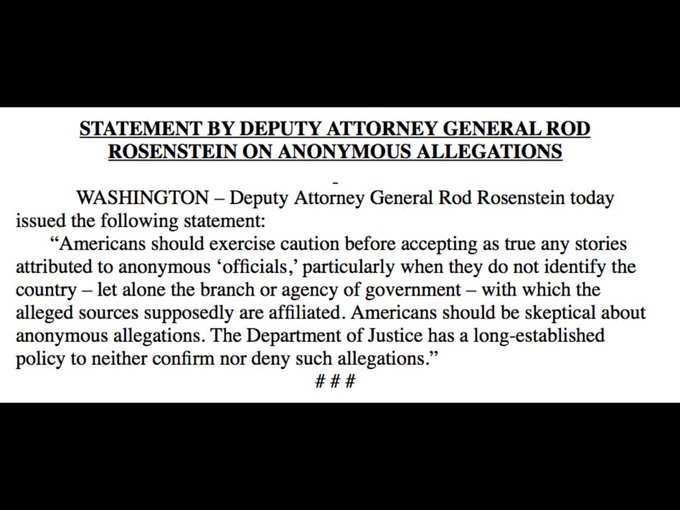
Americans should also exercise caution before accepting as true lies about firing of FBI Director & defamation of a war hero special counsel

To be expected, Rosenstein – who the media was ambivalent about and following his recent testimony in which he said there was “no grounds” to fire Mueller, praised – promptly became the latest pariah for insinuating that the media’s Trump reportage may be, in fact, fake news.
As the NYT reported this morning, the “statement aligned with the president’s open frustration with unflattering leaks. Mr. Trump has called stories about the investigation “fake news” and complained on Twitter about a Washington Post report on Wednesday night that the special counsel, Robert S. Mueller III, was investigating the president himself for possible obstruction of justice. That story was also attributed to unnamed sources, as was a New York Times article that same evening about Mr. Mueller’s request for interviews with three top intelligence officials.”
What to make of Rosenstein’s statement?
On one hand, it could be seen as a validation of Trump’s repeated allegations that much of what has emerged in press in recent weeks is “fake news.” On the other, as some in the media suggested, it could be an attempt to “chill” communications and leaks to the press. Yet others saw this as a preview of what may be another upcoming story. As Bloomberg’s Jennifer Epstein who said “If this statement is preemptive: oh, boy, is the story going to be explosive.”
Is this about a specific story or just a general alert? https://twitter.com/zekejmiller/status/875526604671373312 …

If this statement is preemptive: oh, boy, is the story about going to be explosive.
Trump has yet to tweet his approval of Rosenstein’s comment, although moments ago he did tweet the following:
After 7 months of investigations & committee hearings about my “collusion with the Russians,” nobody has been able to show any proof. Sad!

Trump Blasts Deputy AG: “I’m Being Investigated By Man Who Told Me To Fire The FBI Director! Witch Hunt”
President Trump’s latest twitter target seems to be his own Deputy Attorney General Rod Rosenstein who he blasts for the hiring of a Special Counsel to investigate the firing of former FBI Director James Comey, after writing a letter himself explicitly calling for the firing of James Comey.
“I am being investigated for firing the FBI Director by the man who told me to fire the FBI Director! Witch Hunt”
I am being investigated for firing the FBI Director by the man who told me to fire the FBI Director! Witch Hunt
Of course, Trump’s message isn’t crystal clear on exactly who the subject of the tweet is and has left some wondering whether he might actually be referring to Special Counsel Mueller.
That said, since Rosenstein did, in fact, draft a letter calling for the termination of James Comey, a letter which Trump revealed publicly on May 9th, it would seem more logical that the tweet is directed at him. Here is an excerpt from our post back in May:
In the letter from Deputy Attorney General Rod Rosenstein, he cites the handling of Comey’s Clinton investigation, and says that Comey was wrong to cite his conclusions about the Clinton email probe in July of 2016: “I cannot defend the Director’s handling of the conclusion of the investigation of Secretary Clinton’s emails, and I do not understand his refusal to accept the nearly universal judgment that he was mistaken,” Rosenstein wrote.
Rosenstein was referring to Comey’s decision to announce in July last year that the probe of Hillary Clinton should be closed without prosecution, but then declared – 11 days before the Nov. 8 election – that he had reopened the investigation because of a discovery of a new trove of Clinton-related emails. Democrats say the decision cost Clinton victory.
Rosenstein also identified several areas in which he said Comey had erred, saying it was wrong of him to “usurp” then-Attorney General Loretta Lynch’s authority by announcing the initial conclusion of the email case on July 5.
Comey “announced his own conclusions about the nation’s most sensitive criminal investigation, without the authorization of duly appointed Justice Department leaders,” Rosenstein wrote. Comey also “ignored another longstanding principle” by holding a news conference to “release derogatory information about the subject of a declined criminal investigation.”


Of course, despite Rosenstein’s letter, critics will note that Trump later admitted that he had been considering the termination of James Comey from the moment he took office.
end
Rosenstein states that he may have to recuse himself as it seems the probe is widening (unbelievable!!)_
(courtesy zero hedge)
Rosenstein Says He May Need To Recuse Himself In Russia Probe: ABC
This morning is becoming very chaotic for Deputy Attorney General Rod Rosenstein, a man who has historically maintained a very low profile at the Department of Justice. After issuing a rather uncharacteristic and cryptic statement last night urging Americans not to trust “anonymously-sourced” new stories (a statement that many have speculated is attributable to Wapo’s latest anonymously-sourced headline from last night) and being blasted by President Trump this morning, ABC is reporting that Rosenstein has privately acknowledged that he may need to recuse himself in Mueller’s Russia probe.
The senior Justice Department official with ultimate authority over the special counsel’s probe of Russia’s alleged meddling in the 2016 election has privately acknowledged to colleagues that he may have to recuse himself from the matter, which he took charge of only after Attorney General Jeff Sessions’ own recusal, sources tell ABC News.
Those private remarks from Deputy Attorney General Rod Rosenstein are significant because they reflect the widening nature of the federal probe, which now includes a preliminary inquiry into whether President Donald Trump attempted to obstruct justice when he allegedly tried to curtail the probe and then fired James Comey as FBI director.

Of course, the next most logical question becomes who would step in to fill Rosenstein’s shoes? According to ABC, that obligation would fall upon Associate Attorney General Rachel Brand.
Rosenstein, who authored an extensive and publicly-released memorandum recommending Comey’s firing, raised the possibility of his recusal during a recent meeting with Associate Attorney General Rachel Brand, the Justice Department’s new third-in-command, according to sources.
In the recent meeting with Brand, Rosenstein told her that if he were to recuse himself, she would have to step in and take over those responsibilities. She was sworn-in little more than a month ago.
That is, until Rachel Brand becomes ‘conflicted’ and also has to be recused.
In the end, we suspect liberals in Congress will not be satisfied with anyone chosen to oversee Special Counsel Mueller’s investigation until that ‘someone’ becomes Nancy Pelosi or Maxine Waters.
END
Meet the next Attorney General to handle the Russian fiasco: Rachel Brand
(zerohedge)
Meet DOJ’s Rachel Brand: She’ll Be A Russian Spy By Next Week
Before this morning, most people in the United States had never heard of Associate Attorney General Rachel Brand. But, an ABC story (which we covered here) suggesting that Acting Attorney General Rod Rosenstein may have to recuse himself from overseeing Special Counsel Mueller’s Russia probe, and that Brand would be the next inline to step into that position, changed all that.
So what do we know about Rachel Brand? Well, we know 4 things with absolute certainty:
- She was appointed by the Trump administration and confirmed on May 18, 2017
- She is an active contributor to Republican campaigns
- Democrats hate her
- Therefore, by the transitive property, we also know with absolute certainty she is a Russian spy

This is how ABC described Brand:
As for Brand, she previously led the Justice Department’s Office of Legal Policy, and she most recently served as a member of the government’s Privacy and Civil Liberties Oversight Board. She graduated from Harvard Law School and clerked for Supreme Court Justice Anthony Kennedy, according to the Justice Department.
Sessions recently said she “has proven herself to be a brilliant lawyer.”
“She is also a dedicated public servant who is strongly committed to upholding the rule of law and our Constitution,” he added.
Of course, a couple of quick internet searches revealed far more ‘suspicious’ discoveries…
First, Brand is clearly a Conservative and has been an active contributor to several Republican campaigns in recent years, including “Ted Cruz For President” and “Ted Cruz For Senate.”

Moreover, Democrats hate her as evidenced by the fact that she was only confirmed in the Senate via a 52-46 vote along party lines…
…and Senator Elizabeth Warren’s opposition speech in which Brand was “branded” as just another greedy capitalist:
“…has extensive experience, years of experience, fighting on behalf of the biggest and richest companies in the world.”
Finally, since Democrats have been hyper sensitive, in recent hearings, to the Acting Attorney General’s authority to fire Special Counsel Mueller…
…an authority which could soon be passed to Associate Attorney General Rachel Brand, it’s only logical to conclude that Democrats and the Washington Post will spend the weekend telling you why Rachel Brand is most likely a Russian spy.
So, what’s the over/under on how many days it takes Brand to recuse herself…two? Four?
end
then late in the day, the Dept of Justice reports that there is no reason for Rosenstein’s recusal
the dept of Justice is now in disarray
(courtesy zerohedge)
DOJ: No Reason For Rosenstein Recusal; “Nothing Has Changed”
What exactly is going on at the Department of Justice today? That is the question that everyone should be asking themselves right about now.
Just a couple of hours ago, ABC warmed the hearts of disaffected Hillary voters all around the country when they reported, courtesy of anonymous sources of course, that Deputy Attorney General Rod Rosenstein had “privately acknowledged to colleagues that he may have to recuse himself from” overseeing Special Counsel Mueller’s Russia probe (see our note: “Rosenstein Says He May Need To Recuse Himself In Russia Probe: ABC“).
This latest “bombshell” report drove an all new round of hysteria in Washington D.C. as people began to immediately speculate as to what new ‘development’ could have prompted Rosenstein’s sudden change of heart on his own independence…clearly Trump must have threatened him, right?
Alas, it seems that it might have all just been more ‘fake news’ courtesy of more anonymous sources as the DOJ is now reporting that precisely “nothing has changed.” Per the Washington Post, here is the statement released by DOJ spokesman Ian Prior:
“As the deputy attorney general has said numerous times, if there comes a point when he needs to recuse, he will. However, nothing has changed.”

Of course, Trump’s tweet, presumably directed at Rosenstein, from earlier this morning only served to add to the mass confusion…
I am being investigated for firing the FBI Director by the man who told me to fire the FBI Director! Witch Hunt
…as did the bizarre overnight statement from Rosenstein instructing Americans to ignore anonymously sourced news stories.
“Americans should exercise caution before accepting as true any stories attributed to anonymous ‘officials,’ particularly when they do not identify the country — let alone the branch or agency of government — with which the alleged sources supposedly are affiliated.”
Meanwhile, Senator Dianne Feinstein, the ranking Democrat on the Senate Judiciary Committee, continues to repeat that she is growing “increasingly concerned” that Trump will try to fire special counsel Mueller and Rosenstein…an accusation that liberals continue to repeat despite the fact that even the Washington Post can’t seem to find an anonymous source willing to ‘confirm’ that such a proposal has even been floated within the Trump administration.
“The message the president is sending through his tweets is that he believes the rule of law doesn’t apply to him and that anyone who thinks otherwise will be fired.”
All of which brings us back to our original question: What exactly is going on at the Department of Justice today?
THE FUN BEGINS: THE REPUBLICANS FINALLY DECIDE TO PLAY HARDBALL: THEY CALL FOR A SPECIAL COUNSEL TO INVESTIGATE FORMER ATTORNEY GENERAL LYNCH:
(courtesy zerohedge)
Republicans Go On Offensive Against Mueller; Call For ‘Special Counsel’ To Investigate AG Lynch
Last night, after Trump launched yet another furious tweetstorm intended to expose the double standard applied in the Hillary investigation compared to the Russia probe, we noted that Republicans might be well served to stop sitting around twiddling their thumbs and actually go on the offensive against an investigation that has obviously morphed into mass hysteria courtesy of free-flowing leaks from a conflicted “intelligence community” intent upon bringing down a presidency. Here’s what we said:
Of course, until someone within the Trump administration or Republican Party smartens up and calls for the appointment of a ‘Special Counsel’ to look into Hillary’s email scandal, something that should have been done long ago, and not for retaliatory reasons but simply due to Comey’s and AG Lynch’s blatant mishandling of the investigation (a point which Deputy AG Rosenstein obviously agreed with), the Democrats have no reason to calm their mass hysteria. Then, and only then, do we suspect that Hillary might just be able to ‘convince’ her party to exercise some form of reasonable judgement.
Now, according to a note this morning from The Hill, Republicans seem to be doing just that with several members of the GOP calling on the Special Counsel to look into whether former Attorney General Loretta Lynch illegally meddled in the Hillary investigation when she met with Bill Clinton on the tarmac in Phoenix and/or instructed Comey to refer to his case as a “matter” rather than an “investigation.”
Rather than wasting resources on investigating Trump, the GOP says the special counsel must look into whether former attorney general Loretta Lynch meddled with the FBI’s criminal investigation into Hillary Clinton’s email server. Comey testified that Lynch told him to downplay the seriousness of the FBI’s email server investigation.
For those who missed it, here is Comey’s testimony in which he confirms that Lynch “directed” him to refer to the Hillary email case as a “matter” rather than an ‘investigation”…not to mention that ill-advised meeting with Bill Clinton on the Phoenix tarmac just days before the Justice Department was set to announce the results of their investigation.
Now, and perhaps because of a recent attack which targeted Republicans and in which the shooter seemed to be fueled by rage from largely fake, anonymously-sourced new stories, it appears that the GOP is finally starting to push back.
“These special counsels have a way of going off the rails,” Rep. Trent Franks (R-Az.) told The Hill. “And the ostensible purpose of the special counsel has now been essentially vitiated and everybody knows that. And so they’ve got to try to find something to do. In this case, it was almost the intent from the beginning to try to create something out of nothing. And it doesn’t work in physics, but in politics it seems to be pretty effective.”
“This is the most coordinated communications effort on behalf of the president that we’ve seen in a long time,” said Barry Bennett, a former adviser to Trump. “They need it — it’s tough to fight nameless, faceless quotes from people purposefully twisting these stories on you.”
Trump’s lead outside counsel, Mark Kasowitz responded to the Post story by decrying the “illegal” leaks, which he said had come directly from the FBI.
Jay Sekulow, a new member of Trump’s legal team, went on Fox News Channel to say that the leaks may have come from inside Mueller’s special counsel. Sekulow asked why the FBI is “not sending agents to people’s houses” to put an end to it.
Meanwhile, the Republican National Committee, which chairwoman Ronna McDaniel has described as the “political arm” of the White House, has led the effort to cast doubt on the special counsel investigation.
Of course, Trump has been fairly direct and open with his feelings about the ongoing “witch hunt.”
They made up a phony collusion with the Russians story, found zero proof, so now they go for obstruction of justice on the phony story. Nice
You are witnessing the single greatest WITCH HUNT in American political history – led by some very bad and conflicted people! #MAGA
Crooked H destroyed phones w/ hammer, ‘bleached’ emails, & had husband meet w/AG days before she was cleared- & they talk about obstruction?
Meanwhile, as we noted earlier this morning, even Deputy Attorney General Rod Rosenstein has grown weary of the constant leaks and what they mean for the credibility of Special Counsel Mueller’s investigation….which seems to have prompted him to release the following statement:
“Americans should exercise caution before accepting as true any stories attributed to anonymous ‘officials,’ particularly when they do not identify the country — let alone the branch or agency of government — with which the alleged sources supposedly are affiliated. Americans should be skeptical about anonymous allegations. The Department of Justice has a long-established policy to neither confirm nor deny such allegations.
Of course, it’s only a matter of time until the Washington Post uses to the Republican fury to allege guilt…after all, why would they attempt to fight back if they’re innocent? Surely it can’t have anything to do with the barrage of anonymously-sourced, fake news stories released daily with the sole intent of bringing down a Republican President while never producing a shred of actual evidence.
end
Housing Starts Suffer Worst Streak Since Jan 2009, Permits Plunge
For the first time since Jan 09, Housing Starts dropped for the 3rd month in a row in May, drastically missing expectations (-5.5% vs +4.1% exp.) with both March and April revised notably lower. Building Permits also tumbled in May and massively missed expectations (-4.9% vs +1.7% exp.).
No one saw it coming…

Worst streak of performance for Housing Starts since Jan 2009…

Both Single- and Multi-Family Starts tumbled… This is the lowest level for overall housing starts since September 2016.

And looking forward the picture is bad with both single- and multi-family-unit permits plunging…

Probably a good time to hike rates some more!!
end
Grocery stocks are plummeting after Amazon buys Whole Foods for $42.00. The fear of course is that there is fear that Amazon would do to grocery operations what it has done to bricks and mortar!
(courtesy zero hedge)
Grocery Stocks Are Crashing After Amazon Buys Whole Foods For $42 Per Share
Whole Foods stock was halted for ‘news pending’… and now we have the answer – Amazon to acquire Whole Foods Market for $42/share in an all-cash transaction valued at ~$13.7b, including Whole Foods Market’s net debt.
With 9% of the float short this stock, we can only imagine the squeeze onm this 27% premium over last night’s close…

Full Statement:
Amazon (NASDAQ:AMZN) and Whole Foods Market, Inc. (NASDAQ:WFM) today announced that they have entered into a definitive merger agreement under which Amazon will acquire Whole Foods Market for $42 per share in an all-cash transaction valued at approximately $13.7 billion, including Whole Foods Market’s net debt.
“Millions of people love Whole Foods Market because they offer the best natural and organic foods, and they make it fun to eat healthy,” said Jeff Bezos, Amazon founder and CEO.
“Whole Foods Market has been satisfying, delighting and nourishing customers for nearly four decades – they’re doing an amazing job and we want that to continue.”
“This partnership presents an opportunity to maximize value for Whole Foods Market’s shareholders, while at the same time extending our mission and bringing the highest quality, experience, convenience and innovation to our customers,” said John Mackey, Whole Foods Market co-founder and CEO.
Whole Foods Market will continue to operate stores under the Whole Foods Market brand and source from trusted vendors and partners around the world. John Mackey will remain as CEO of Whole Foods Market and Whole Foods Market’s headquarters will stay in Austin, Texas.
Completion of the transaction is subject to approval by Whole Foods Market’s shareholders, regulatory approvals and other customary closing conditions. The parties expect to close the transaction during the second half of 2017.
Amazon expects to finance the acquisition with debt…
- Amazon enters into commitment letter for 364-day senior unsecured bridge term loan facility in an aggregate principal amount of up to $13.7 billion.
- Expects to finance deal with debt financing, which may include senior unsecured notes issued in capital markets transactions, term loans, bridge loans, or any combination thereof, together with cash on hand, co says in a filing
- Goldman Sachs, BofA-Merrill Lynch to lead debt financing
Amazon stock is up 3% on the news…

Some context on the relative size…

And Kroger, Wal-Mart, Sprouts, and Target are plunging… (WMT -4%, TGT -5.5%, SFM -7.6%, KR -12%)

And European supermarkets are getting hammered –
- *AHOLD, CARREFOUR, TESCO FALL TO LOWS ON AMAZON/WHOLE FOODS DEAL
- *AHOLD DELHAIZE SLUMPS 6.8% IN AMSTERDAM ON AMAZON NEWS
With good reason probably. Grocery margin are 1-2% at best, and if Amazon can truly create smart stores with no check outs and cut employees in half they can kill regular supermarkets…
As Bloomberg’s Gadfly recently opined, Amazon wil kill your local grocer…
Amazon’s done it to books. And electronics. And clothing. Now it wants to rule the grocery aisles.
But Amazon still has a ways to go — the online retailing behemoth has taken a slow, yet calculated approach to attacking the grocery store. After years of testing the AmazonFresh program in its Seattle hometown, it began expanding the grocery delivery service to other cities in 2013. Today, it delivers fresh fruit and meat in parts of New York, New Jersey, Pennsylvania, Connecticut, California, Washington and Maryland. It also delivers food through its Amazon.com website and its Prime Now program.
And even though research from Cowen & Co. pegs Amazon’s market share of food and beverages sold online in 2015 at about 22 percent, that overall online grocery market in the U.S. is pretty small. Out of the $795 billion Cowen expects Americans to spend on food and drinks this year, it estimates only about $33 billion of it will be spent online.
That’s because it has taken shoppers a long time to grow comfortable with buying their apples, chicken breasts and granola online when they can stop by a physical store on the way home from work and actually touch and smell the food they’re buying. Companies struggle to profit from the very expensive business of picking, packing and transporting fresh food to their customers. It’s much easier to mail a video game or book, which doesn’t have to be kept cold or free of bruises.
But for Amazon, the grocery business not only brings more sales, it could also make its business more profitable. People tend to buy groceries weekly or daily, so getting them hooked on delivery justifies sending trucks out more frequently. Then any general merchandise, like a book or toy, that Amazon sells along with the food adds to profits. And since Amazon will need more trucks for grocery delivery, it could reduce its reliance on shipping companies, which have contributed to soaring costs. For now, Amazon is likely to take added grocery costs on the chin, in hopes it will pay off down the line.
Growing its AmazonFresh and Prime Now offerings suggests Amazon is gearing up for the long haul in grocery. Though traditional grocers are not likely to see sales migrate to Amazon right away, that luxury won’t last. And just like bookstores, your local grocer could be toast.
Thank you Feds…

end
The Republicans finally are worried as the soft data U. of Michigan confidence slumps to the lowest level since the Trump eleciton
(courtesy zero hedge)
Republicans Crack – UMich Confidence Slumps To Lowest Since Trump Elected
Republican finally cracked. After months of extremely partisan divergence in the UMich confidence data, the loss in confidence for self-identified Republicans fell notably more than for Democrats (who were already significantly lower). Both current and future expectations tumbled to their lowest since Nov 2016.

As UMich explains…
While this break corresponds with James Comey’s testimony, only a few consumers spontaneously referred to him or his testimony when asked to explain their views.
Importantly, the decline was observed across all political parties, but the loss in confidence among self-identified Republicans since June 8th was larger than among Democrats (9.2 vs. 6.8 Index-points), with Independents showing the greatest falloff (11.5 Index-points).
The size of the partisan difference between Democrats and Republicans in the Expectations Index, however, was largely unchanged (55.6 Index-points prior to June 8th, and 51.2 after).
The recent erosion of confidence was due to more negative perceptions of the proposed economic policies among Democrats and the reduced likelihood of passage of these policies among Republicans. Fortunately, a strong job market, improved household income and wealth have provided a financial buffer against rising uncertainties.
Nonetheless, consumers have become less optimistic about the future course of the domestic economy. Even with the expected bounce back in spending in the current quarter, personal consumption is expected to advance by 2.3% for all of 2017.
Interestingly medium-term inflation expectations jumped from 2.4% to 2.6% but short-term remained unchanged at 2.6%.
end
We finally get a semi truthful answer from Neil Kashkari as to why he decented yesterday. It was a choice between faith and data. The real reason for the rise in rates is to keep asset prices elevated or the whole enchilada breaks down.
(courtesy zero hedge)
One Fed President Says The Rate Hike Decision Was A Choice “Between Faith And Data”
Over the years many have accused central banking of being the world’s latest (and most profitable) religion, with central bankers the only modern day priests left that still matter (to the tune of $75 trillion, the market cap of all stocks in the world).
Today, in a blog post from Minneapolis Fed president Neel Kashkari explaining why he dissented from the latest Fed rate hike decision, he admits as much when he says “for me, deciding whether to raise rates or hold steady came down to a tension between faith and data. On one hand, intuitively, I am inclined to believe in the logic of the Phillips curve: A tight labor market should lead to competition for workers, which should lead to higher wages. Eventually, firms will have to pass some of those costs on to their customers, which should lead to higher inflation. That makes intuitive sense. That’s the faith part.”
In a surprisingly honest assessment, he then says that “unfortunately, the data aren’t supporting this story, with the FOMC coming up short on its inflation target for many years in a row, and now with core inflation actually falling even as the labor market is tightening. If we base our outlook for inflation on these actual data, we shouldn’t have raised rates this week. Instead, we should have waited to see if the recent drop in inflation is transitory to ensure that we are fulfilling our inflation mandate.”
Which inductively suggests that the rest of the FOMC is still driven by, well, faith alone. Unfortunately, this time the faith has consequences, and as Citi’s Matt King explained earlier, the Fed’s decision to not only hike rates but also to begin a $450 billion annual reduction in its balance sheet, will have “significant adjustment in valuations.”
Which is perhaps ironic, because while Kashkari’s opinion is quite objective on the topic of America’s economic realities, he continues to be disappointing blind about the Fed’s true purpose, namely to prop up asset prices, to wit:
“while some asset prices appear elevated, I don’t see a correction as being likely to trigger financial instability. Investors would face losses from a stock market correction, but it’s not the Fed’s job to protect investors from losses. Our jobs are to achieve our dual mandate and to promote financial stability.”
Which is funny, because while the priests over at the Fed continue to live in their ivory towers, everyone figured out what was going on, and as Citi said earlier this week,”the principal transmission channel to the real economy has been lifting asset prices.”

Kashkari’s full Kashsplainer can be found here.
end
S&P Warns It May Downgrade Amazon
Unlike Apple, Amazon does not have a quarter trillion in (mostly offshore held) cash. Which means, it will issue debt to fund the Whole Foods purchase. Which means its leverage will rise above 1x. Which means S&P just warned of a downgrade of Amazon’s AA- rating.
From S&P:
Amazon.com Inc. Ratings Placed On CreditWatch Negative On Debt-Financed Acquisition Of Whole Foods
- Amazon has announced an agreement to purchase Whole Foods Market Inc. in a debt-financed purchase of about $14 billion.
- We are placing our ‘AA-‘ corporate credit rating on Amazon on CreditWatch with negative implications.
- Our preliminary view is that Amazon’s leverage will approach 1.5x, but mostly likely remain below 2x. We see the purchase as a major strategic initiative for Amazon, with execution risk, but also potential significant implications for Amazon’s market strategy as well as for the broader U.S. grocery market.
S&P Global Ratings placed its ratings, including the ‘AA-‘ corporate credit rating, on Amazon.com Inc. on CreditWatch with negative implications.
“The CreditWatch placement reflects our expectation that Amazon’s leverage will increase as a result of its plan to purchase Whole Foods for about $14 billion,” said S&P Global Ratings credit analyst Robert Schulz.
The rating action also reflects our intent to review implications for Amazon’s financial policies and retail market strategy.
We believe the company will maintain leverage above the target of less than 1x, currently incorporated into the rating. Our assessment of the impact of this transaction on Amazon’s competitive positioning and profitability will also be part of our review.
While the transaction would result in leverage consistent with our current target for a downgrade of adjusted leverage approaching 1.5x, we would also review Amazon’s prospective strategic and financial policies as part of any downgrade. We would expect to conclude our review once more details such as the timing of any required shareholder and regularly approvals become clear along with our understanding of the policies noted above.
end
The following is a must, must read:
why the 2nd week of September will be critical. Trump is planning to allocate funds once we reach the total impasse on the debt ceiling (which will occur on the first or second week of September)
(courtesy David Stockman/Dailyreckoning)
Orange Is the New Black (Swan)
Black swans are supposedly unexpected, stealthy and come of a sudden. But not this one — it is bright orange, and in your face day and night.
I refer to the Donald, of course, and the fact that he is truly the Great Disrupter.
He is not only impetuous, mercurial, undisciplined and unpredictable. But for reasons I will elaborate below, totally clueless about how to manage his presidency or cope with the circling long knives of the Deep State which are hell bent on removing him from office.
Accordingly, the single most important thing to know about the present risk environment is that it is extreme and unprecedented. In essence, the ruling elites and their mainstream media megaphones have arrogantly decided that the 2016 election was a correctable error.
And that makes the Donald the ultimate bull in an exceedingly fragile China shop — and an already badly wounded one at that.
So it is no understatement to suggest that the S&P 500 at 2440 is about as fragile as the “market” has ever been. Any pinprick could send it to a bubbly grave. It’s the mighty Orange Swan that will break the casino like never before.
The utter fragility of the latest and greatest Fed bubble could not be better represented than by this astounding fact:
During the last 5,000 trading days (20 years) Wall Street’s “fear gauge,” the VIX, has closed below 10 on just 11 occasions. And 7 of those have been during the last month!
Stated differently, in just the last 0.6% of the trading days since 1997, 65% of the ultra-low VIX readings have occurred. That’s complacency begging to be monkey-hammered.
The always astute Doug Kass said it best in his recent commentary:
Over history, as we have learned, a Minksy Moment develops when investor sentiment becomes complacent after long periods of prosperity and the data is ignored and doesn’t seem to matter anymore, as I wrote in “It’s a ‘Bohemian Rhapsody’ Market: Nothing Really Matters … to Investors.”
To this observer, the summer of 2017 feels similar to the important market highs of the first half of 2000 and the last half of 2007.
At the kind of bubble inflection points of which Kass speaks, the punters become not only stupidly complacent, but thoroughly delirious. Hockey sticks laid on the rising trajectory of stock prices go parabolic.
That was surely true in late 1999 and early 2000 when the NASDAQ 100 rose 30% in three months — just as has been recently when the FAAAM Five (Facebook, Apple, Amazon, Alphabet and Microsoft) gained 33% or $600 billion since the turn of the year.
But this time is actually different in a special sense.
We are now at the inflection points not just of the post-crisis bubble engineered by the Bernanke-Yellen Fed and their fellow central bankers around the world. But the inflection point for the whole multi-decade enterprise of monetary central planning.
In that sense, it is a generational high. The casino is infested not only with new-age snowflakes who have never seen a dip of more than 7%. But also complacent veterans of the entire era of bubble finance who have generated untold financial wealth by riding the bull from one bubble to the next, and now remain fearless with a vengeance.
Tuesday, MarketWatch featured one of these operators — the legendary money manager, Ron Baron. He’s been at the game since the 1970s and has $23 billion of assets under management (AUM).
Baron said on CNBC that the bull is just getting started:
Bubble? What bubble?
To say billionaire investor Ron Baron, who oversees some $23 billion in assets, waxed bullish on CNBC Tuesday morning would be an understatement, particularly with all the jitters and negativity swirling around the stock market lately.
The 74-year-old founder of Baron Capital said that interest rates and oil prices will stay low for “a very long time,” and that the economy will grow “much faster” than it would have otherwise, bringing the market along for the ride. Hence, he sees the Dow potentially taking out the 40,000 level by 2030.
So as Doug Kass observed, this really is a ‘Bohemian Rhapsody’ market where “nothing really matters” to the bullish punters who have spent a lifetime riding the Fed’s serial bubbles.
And that gets me to the Orange Swan…
There is no point in saying any longer that the giant Trump tax cut and pro-growth Stimulus is a pure pipe dream. That’s evident from the fact that the so-called GOP congressional majorities are so tied up in their own underwear that they can’t even pass Obamacare repeal and replace.
Moreover, the “help” they are getting from the White House needs no further explanation, either. That is to say, the Donald just stepped all over his own parade by telling the Senate GOP that the House bill, which passed by a hair and is his only symbolic legislative achievement, is actually “mean” and needs a lot more money to remedy its defects.
You can’t make this up. You also don’t need any vote counting expertise in the House to know that if it comes back un-mean and pumped-up with more tax credits and Medicaid expansion money it will be shouted down by the Freedom Caucus. After all, they did say to the Senate, change one comma and the bill is dead in the water.
So much for handing off the Stimulus baton to fiscal policy.
Nor is there any chance that the desperate Keynesians running the Fed will turn their back any time soon on their current campaign to raise interest rates and shrink the Fed’s mountainous balance sheet.
And that’s not because they have suddenly grasped that free money for 100 months running is an exceedingly dangerous, combustible thing. It’s because they need to get interest rates back high enough so that they have ammo to combat the next recession!
In that context, here is what will take the Donald down, and it’s not some new smoking gun about RussiaGate. Instead, it’s actually the growing possibility that he will do the right thing when the Treasury runs out of cash around Labor Day, and there is no capacity to assemble a majority in both houses to raise the debt ceiling by trillions.
I’m referring to the dreaded “A” word. That is, use of the President’s constitutional authority to “allocate” the incoming revenue flows — which are running about $700 billion per year lower than outlays — to what he determines are the government’s highest priority purposes.
Undoubtedly, among these would be paying interest on the debt, sending-out the Social Security and veterans checks, paying military contractors and payrolls and the like.
Needless to say, resort to “allocation” would be the ultimate sin in the eyes of the bipartisan establishment. They would instantly start bellowing from every corner of the Swamp about an unconstitutional power grab by the White House.
And the mainstream media would go to DEFCON 1 about the alleged unlawful and dictatorial actions of a President who should never have been in the Oval Office in the first place.
So why do I think the Orange Swan might arrive in this fashion?
Here is what Trump’s completely inexperienced and unschooled Treasury Secretary said Tuesday. What he means by “super powers” is that he’s contemplating use of the allocation authorities.
This is not an issue, but I don’t want to leave any doubt that we have plans and backup plans,” said the former Goldman Sachs banker following a one-day bilateral meeting between the U.S. and Canada.
When asked what those backup plans would be, Mnuchin referred to them as “Treasury secretary’s “super powers.”
I say more power to him — even if it is the 50,000 pound pin that punctures the Great Bubble now at hand.
On the other hand, I’m quite confident there is only one other alternative — a prolonged government shutdown and a thundering breakdown of governance and all government function.
Either way, the bubble’s days are numbered. Dow 40,000 will soon join the ranks of the Tulip Bulb Mania and all the others which followed.
Regards,
David Stockman
for The Daily Reckoning
(courtesy John Rubino/DollarCollapse.com)
Welcome To The Third World, Part 23: Illinois Death Watch
JUNE 16, 2017
It’s been a long time coming, but Illinois’ slow-mo financial disaster is now front page news. A few recent examples:
Roadwork Could Shut Down Across Illinois Due To Budget Impasse
(Chicagoist) – Roadwork across Illinois may grind to a halt at the end of June due to the continued state budget impasse, a representative for the Illinois Department of Transportation (IDOT) announced Wednesday. IDOT will be unable to pay contractors on July 1, unless the state passes a stopgap funding measure.
IDOT has told contractors that “all construction work is to shut down on June 30,” according to a statement. “Contractors will be advised to secure work zones to ensure their safety during any potential shutdown.”
Illinois has gone almost two full years without a state budget, which has hit education funding throughout the state and generated more than $10 million in unpaid bills.
Summer is both a high-volume construction season and a vaguely ominous time to cease road repairs; just last week, IDOT released a statement warning that the heat could lead to pavement “buckling or blowing out.”
https://dollarcollapse.com/debt/welcome-third-world- illinois-death-watch/
—————
Powerball, Mega Millions to Halt Illinois Lottery Due to State’s Inability to Pay Winners
(Mish) – Both Powerball and Mega Millions Lotteries Will Pull Out of Illinois on June 30 due to the budget impasse.
Without a budget in place, the state is not authorized to make payments to the association or Mega Millions.
Lottery proceeds are about 2% of state revenue. Speaking of revenue corporate income tax collection is down 41.3%. Sales taxes are flat. How is this supposed to work?
—————
Could Illinois be the first state to file for bankruptcy?
(CBS) – Illinois residents may feel some solidarity with the likes of Puerto Rico and Detroit.
A financial crunch is spiraling into a serious problem for Illinois lawmakers, prompting some observers to wonder if the state might make history by becoming the first to go bankrupt. At the moment, it’s impossible for a state to file for bankruptcy protection, which is only afforded to counties and municipalities like Detroit.
Chapter 9 bankruptcy protection could be extended to states if Congress took up the issue, although Stanford Law School professor Michael McConnell noted in an article last year that he believed the precedents are iffy for extending the option to states. Nevertheless, Illinois is in a serious financial pickle, which is why radical options such as bankruptcy are being floated as potential solutions.
Ratings agency Moody’s Investor Service earlier this month downgraded Illinois’ general obligation bonds to its lowest investment grade rating, citing the state’s growing pile of unpaid bills and its mounting pension deficit. Illinois, by the way, has the lowest credit rating of any state. Lower ratings mean higher borrowing costs, since lenders view such borrowers as riskier bets.
“Legislative gridlock has sidetracked efforts not only to address pension needs but also to achieve fiscal balance, allowing a backlog of bills to approach $15 billion, or about 40 percent of the state’s operating budget,” the agency noted.
As noted by the Fiscal Times, Illinois is the only state that’s been operating without a balanced and complete budget for almost two years.
“We’re like a banana republic. We can’t manage our money,” Gov. Bruce Rauner said after the Illinois Legislature failed to produce a full 2017 budget earlier this month.
Two Big Questions
Based on the immensity of its pension obligations, the legal barriers to simply cutting benefits, and falling tax revenues, Illinois is a lock to default on some or all of its obligations in the next few years. That’s a problem for pensioners, state contractors and pretty much anyone who cares about local public services. In other words, life is going to get a lot harder for people living in the state, and especially for those living in double-bankrupt Chicago.
But the real impact will be felt farther afield, when everyone with money at risk starts asking who’s next – and finding a long list of likely suspects. If Illinois defaults, how far behind can New Jersey, Kentucky, or Connecticut be? Not far, according to current trends. And if those states follow Illinois, what are Italian bonds worth? Not much.
The second big question is: How will stronger governments respond to the implosion of weaker ones? If the failed states are bailed out by the still-solvent, what does that do to the latters’ balance sheets? In some cases it decimates them.
The dilemma? Allowing failed states to default will rock the global banking system, but bailing them out replaces a debt bust with a currency crisis. In a priced-for-perfection world, either will lead to global asset repricing — in other words an epic bear market.
-END-
MSM Propaganda Cause Left Hate, Trump Obstruction – Not, Obama Administration TreasonBy Greg Hunter On June 16, 2017 In Weekly News Wrap-Ups

You want to know why the “Left” hates Donald Trump? Look no further than the lies, false narratives and fake news of the mainstream media (MSM). Several U.S. Congressmen were shot while practicing for a charity baseball game in Washington, D.C. The lone shooter is a self-described Trump hater and volunteered for the Bernie Sanders campaign. Looks like the propaganda of the MSM worked on the extreme in the thought shaping in this case.
For weeks, everybody on Capitol Hill knew that Donald Trump was NOT the subject of the so-called Russian collusion and Russian hacking stories. Funny how the MSM propaganda machine never brought this up. Funny how the FBI never “leaked” this fact out. The MSM propaganda machine continued to paint a false narrative that the investigation centered on President Trump when, according to fired FBI Director James Comey, it did not. Now, a new story leaks that Trump is the center of an Obstruction of Justice case by the Special Prosecutor, even though James Comey testified there was no obstruction by Trump or his Administration. Trump calls this a “witch hunt” and points to several instances of obvious obstruction that James Comey and the Obama Justice Department refused to prosecute in the Hillary Clinton email investigation. There is no “there” there on this story, just like the phony Russian collusion story.
You wonder why all the leaks and so-called investigations that go on and on lead to nowhere? Why the real story of an outgoing Administration using the resources of the FBI and Intel agencies to try to sink Trump and his Administration are not reported? Could it be the Obama Administration is desperate to cover up crime and treason that will surely be revealed by the Trump Administration? The only reason I can come up with why people would commit felony leaks is to cover up bigger felonies and even treason.
Join Greg Hunter as he talks about these stories and more in the Weekly News Wrap-Up.
Video Link
end
We will see you Monday night
have a great weekend
Harvey.


[…] JUNE 16/DEPT OF JUSTICE SHENANIGANS/NY FED LOWERS ESTIMATE OF 2ND QUARTER GDP TO 1.8%/GOLD RISES $1.… […]
LikeLike