
GOLD: $1248.60 UP $5.10
Silver: $16.55 up 18 cent(s)
Closing access prices:
Gold $1250.50
silver: $16.56
SHANGHAI GOLD FIX: FIRST FIX 10 15 PM EST (2:15 SHANGHAI LOCAL TIME)
SECOND FIX: 2:15 AM EST (6:15 SHANGHAI LOCAL TIME)
SHANGHAI FIRST GOLD FIX: $1263.33 DOLLARS PER OZ
NY PRICE OF GOLD AT EXACT SAME TIME: $1253.85
PREMIUM FIRST FIX: $9.48
xxxxxxxxxxxxxxxxxxxxxxxxxxxxxxxxxxxxxxxxxxxxxx
SECOND SHANGHAI GOLD FIX: $1262.39
NY GOLD PRICE AT THE EXACT SAME TIME: $1253.50
Premium of Shanghai 2nd fix/NY:$8.89
xxxxxxxxxxxxxxxxxxxxxxxxxxxxxxxxxxxxxxxxxxxxxxxxxxx
LONDON FIRST GOLD FIX: 5:30 am est $1251.40
NY PRICING AT THE EXACT SAME TIME: $1252.20 ??
LONDON SECOND GOLD FIX 10 AM: $1250.80
NY PRICING AT THE EXACT SAME TIME. $1252.50 ????
For comex gold:
JUNE/
NOTICES FILINGS TODAY FOR APRIL CONTRACT MONTH: 7 NOTICE(S) FOR 700 OZ.
TOTAL NOTICES SO FAR: 2628 FOR 262,800 OZ (8.174 TONNES)
For silver:
JUNE 21 NOTICES FILED TODAY FOR
105,000 OZ/
Total number of notices filed so far this month: 978 for 4,890,000 oz
XXXXXXXXXXXXXXXXXXXXXXXXXXXXXX
END
Over at the comex, the amount standing for the silver metal again rose in similar fashion to what we witnessed last month and also in April. It is up for the 16th consecutive trading day. We certainly have a determined entity trying to get its hands on whatever silver is available.
We have now officially entered options expiry week:
comex options expiry: Tuesday June 27
London options expiry: Friday June 30
first day notice Friday June 30
expect continual whacking by the crooked banks.
end
Let us have a look at the data for today
xxxxxxxxxxxxxxxxxxxxxxxxxxxxxxxxxxxxxxxxxxxxxxxxxxxxxxxxxxxxxxxxxxxxxxxxxx
This is where we are heading: (JB Slear/Jim Sinclair)
According to JB Slear, this is what the future holds. Why should I write words. Get into the cellar as fast as you can!
Jim

In silver, the total open interest SURPRISINGLY ROSE BY 1,253 contract(s)UP to 201,182 DESPITE THE FALL IN PRICE OF SILVER THAT TOOK PLACE WITH YESTERDAY’S TRADING (DOWN 4 CENT(S). In ounces, the OI is still represented by just OVER 1 BILLION oz i.e. 1.0005 BILLION TO BE EXACT or 144% of annual global silver production (ex Russia & ex China).
FOR THE NEW FRONT MAY MONTH/ THEY FILED: 21 NOTICE(S) FOR 105,000 OZ OF SILVER
In gold, the total comex gold SURPRISINGLY ROSE BY 862 CONTRACTS WITH THE RISE IN PRICE OF GOLD ($2.40 with YESTERDAY’S TRADING). The total gold OI stands at 446,703 contracts.
we had 7 notice(s) filed upon for 700 oz of gold.
xxxxxxxxxxxxxxxxxxxxxxxxxxxxxxxxxxxxxxxxxxxxxxxxxxxxxxxxxxx
With respect to our two criminal funds, the GLD and the SLV:
GLD:
We had no changes in tonnes of gold at the GLD:
Inventory rests tonight: 853.68 tonnes
.
SLV
Today: a big change in silver inventory at the SLV: a deposit of 2.175 million oz into the SLV inventory
THE SLV Inventory rests at: 339.888 million oz
end
.
First, here is an outline of what will be discussed tonight:
1. Today, we had the open interest in silver ROSE BY 1253 contracts UP TO 201,182 (AND now A LITTLE CLOSER FROM THE NEW COMEX RECORD SET ON FRIDAY/APRIL 21/2017 AT 234,787), DESPITE THE FALL IN PRICE FOR SILVER WITH YESTERDAY’S TRADING (DOWN 4 CENTS).We LOST NOBODY AS EVERYBODY remains firm and determined.
(report Harvey)
.
2.a) The Shanghai and London gold fix report
(Harvey)
2 b) Gold/silver trading overnight Europe, Goldcore
(Mark O’Byrne/zerohedge
and in NY: Bloomberg
3. ASIAN AFFAIRS
i)Late WEDNESDAY night/THURSDAY morning: Shanghai closed DOWN 8.76 POINTS OR 0.28% / /Hang Sang CLOSED DOWN 20.05 POINTS OR 0.08% The Nikkei closed DOWN 28.28 POINTS OR 0.14%/Australia’s all ordinaires CLOSED UP 0.76%/Chinese yuan (ONSHORE) closed DOWN at 6.8330/Oil DOWN to 42.80 dollars per barrel for WTI and 45.10 for Brent. Stocks in Europe OPENED ALL IN THE RED,, ..Offshore yuan trades 6.8347 yuan to the dollar vs 6.8330 for onshore yuan. NOW THE OFFSHORE IS WEAKER TO THE ONSHORE YUAN/ ONSHORE YUAN WEAKER (TO THE DOLLAR) AND THE OFFSHORE YUAN IS A LITTLE WEAKER TO THE DOLLAR AND THIS IS COUPLED WITH THE WEAKER DOLLAR. CHINA IS NOT SO HAPPY TODAY
3a)THAILAND/SOUTH KOREA/NORTH KOREA
i)NORTH KOREA
b) REPORT ON JAPAN
c) REPORT ON CHINA
i)CHINA
China’s response to Trump is not helpful
( zero hedge)
ii)Last week, we brought to you a story that Anbang Insurance’s stock fell dramatically as its revenue collapsed in May by over 90% and this caused quite a concern with the funding apparatus of Anbang which got most of its financing money through the shadow banking sector. Last night, stocks of China’s foreign acquirers collapsed and regulators are now quite concerned on “systemic risk”..the Chinese nightmare is now beginning…
4. EUROPEAN AFFAIRS
5. RUSSIAN AND MIDDLE EASTERN AFFAIRS
Israel/Saudi Arabia
According to Fars, (and Israel has not commented on the story) Israel has deployed 18 fighter jets to Saudi Arabia to prevent a coup of Bin Salman by his cousin. This may be true as the probability of a strike by Saudi Arabia against Iran increased dramatically with the appointment of crown Prince Mohammed Bin Salman. Iran has been Israel’s formal enemy for centuries
(courtesy zerohedge)
6 .GLOBAL ISSUES
i)Canada
Strange: Warren Buffet has taken a 38.4% interest in liar loan company Home Capital Group.
( zerohedge)
ii)It is official: Sears Canada announces bankruptcy:
( zero hedge)
iii)Mexico
Mexico’s central bank, Banxico has now hiked rates for the 7th time amid inflation that is ripping this nation apart.
( zero hedge)
7. OIL ISSUES
ii) Now Macquarie bank warns the OPEC production cut deal will collapse sometime next year:(courtesy Paraskova/OilPrice.com
8. EMERGING MARKET
9. PHYSICAL MARKETS
i)China and the SGE is now tired of the phony USA pricing of gold. They want to expand their fixes to Budapest and other countries
( GATA/SCMP)
ii)You know that gold is ready to skyrocket when you see negative propaganda on gold flare up
( Dave Kranzler/IRD/GATA)
iii)for those of you who are still none believers that central authorities manipulate gold, the following commentary is for you
( Chris Powell/GATA/Focus Money)
10. USA Stories
i)I do not like the looks of this; Democratic Election Commissioner goes on the warpath and demands probe of Russian links to Facebook, Drudge, Huffington Post etc
(courtesy zero hedge)
ib)Trump on the warpath claiming the Russian interference is nothing but a big Democratic hoax as to why they lost the 2016 Presidential election
( zero hedge)
ii)This does not look good for the Democrats. They have raised a small 4.3 million dollars in May. These guys are in trouble
( zero hedge)
iii)Both BlackRock and Pimco are stating that somebody is wrong, either the market or the Fed and it sure looks like a policy error from the Fed
( zerohedge/Reynolds/Bloomberg/BlackRock/Pimco)
iv)I like to include some of Graham Summers comments as it is “short and sweet” and to the point.
Here he correctly describes how the great global debt binge is coming to an end. Note the uptrend on junk bonds is turning over:
(courtesy Graham Summers/Phoenix Capital)
v)The Senate ready to reveal details of its version of Trumpcare as a replacement for Obamacare. They need basically all 52 Republicans to vote in the affirmative as all 48 Democrats will vote no.
( zero hedge)
vi)Well that did not last long. Already 3 Republicans plan to oppose the bill. Strange! they haven’t even sent the bill to the House where more Republicans will surely be against some of the features
( zero hedge)
vii)Now 5 are opposed:
( zero hedge)
( zero hedge)
Let us head over to the comex:
The total gold comex open interest ROSE BY 862 CONTRACTS UP to an OI level of 446,703 WITH THE RISE IN THE PRICE OF GOLD ($2.40 with YESTERDAY’S trading). An open interest of around 390,000 to 400,000 is core and nothing will move these guys from their contracts.
We are now in the contract month of JUNE and it is one of the BETTER delivery months of the year. In this JUNE delivery month we had A LOSS OF 131 contract(s)FALLING TO 572. We had 9 notices filed yesterday so we LOST 122 contract(s) or an additional 12,200 oz will NOT stand for delivery in this very active delivery month of June AND 122 CONTRACT(S) RECEIVED AN EFP CONTRACT WHICH ENTITLES THEM TO A FIAT BONUS PLUS A FUTURE GOLD CONTRACT/OR A LONG CALL OR MOST LIKELY A LONDON BASED FORWARD GOLD CONTRACT. THESE EFP’S ARE PRIVATE OFF COMEX TRANSACTIONS. THE STUBBORN LONGS WHO ARE REMAINING STOIC AT THE COMEX ARE SO FAR REFUSING THAT FIAT BONUS (OVER 10 TONNES STANDING)
The non active July contract LOST 216 contracts to stand at 1389 contracts. The next big active month is August and here the OI LOST 616 contracts DOWN to 307,252, as the bankers trying to keep this month down to manageable size.
We had 7 notice(s) filed upon today for 700 oz
The next big active month will be July and here the OI LOST 9141 contracts DOWN to 66.891 as we start to wind down before first day notice Friday, June 30. July will be interesting to watch in silver as we witness fewer players pitching for EFP contracts than with gold.
The month of August, a non active month picked up 33 contracts to stand at 125. The next big active delivery month for silver will be September and here the OI already jumped by another 10,111 contracts up to 92,082.
I will give you a snapshot as to what happened last year at the exact number of days before first day notice:
WEDNESDAY, June 22.2016: 67,067 contracts were still outstanding vs 66.891 contracts June 22.2017
At the conclusion of June, the final standing for physical silver was 3,080,000 oz and we have already surpassed that number this year (4,595,000 oz).
The line in the sand is $18.50 for silver and again it has been defended by the criminal bankers. Once this level is pierced, the monstrous billion oz of silver shorts will blow up. The bankers are defending the Alamo with their last stand at the $18.50 mark. THE NEW RECORD HIGH IN OPEN INTEREST WAS SET FRIDAY APRIL 21/2017 AT: 234,787.
As for the July contracts:
Initial amount that stood for silver for the July 2016 contract: 14.785 million oz
Final standing: 12.370 million with the difference being EFP’s taking delivery in London.
We had 21 notice(s) filed for 105,000 oz for the June 2017 contract
VOLUMES: for the gold comex
Today the estimated volume was 182,380 contracts which is FAIR
Yesterday’s confirmed volume was 176,133 contracts which is fair
volumes on gold are STILL HIGHER THAN NORMAL!
| Gold | Ounces |
| Withdrawals from Dealers Inventory in oz | nil |
| Withdrawals from Customer Inventory in oz |
nil
|
| Deposits to the Dealer Inventory in oz | nil oz |
| Deposits to the Customer Inventory, in oz |
nil oz
|
| No of oz served (contracts) today |
7 notice(s)
700 OZ
|
| No of oz to be served (notices) |
565 contracts
56,500 oz
|
| Total monthly oz gold served (contracts) so far this month |
2628 notices
262,800 oz
8.174 tonnes
|
| Total accumulative withdrawals of gold from the Dealers inventory this month | NIL oz |
| Total accumulative withdrawal of gold from the Customer inventory this month | 326,769.0 oz |
Today, 0 notice(s) were issued from JPMorgan dealer account and 0 notices were issued from their client or customer account. The total of all issuance by all participants equates to 7 contract(s) of which 0 notices were stopped (received) by j.P. Morgan dealer and 4 notice(s) was (were) stopped/ Received) by j.P.Morgan customer account.
| Silver | Ounces |
| Withdrawals from Dealers Inventory | nil |
| Withdrawals from Customer Inventory |
1,633,803.720 oz
Scotia
|
| Deposits to the Dealer Inventory |
nil oz
|
| Deposits to the Customer Inventory |
nil oz
|
| No of oz served today (contracts) |
21 CONTRACT(S)
(105,000 OZ)
|
| No of oz to be served (notices) |
2 contracts
( 10,000 oz)
|
| Total monthly oz silver served (contracts) | 978 contracts (4,890,000 oz) |
| Total accumulative withdrawal of silver from the Dealers inventory this month | NIL oz |
| Total accumulative withdrawal of silver from the Customer inventory this month | 5,984,374.1 oz |
NPV for Sprott and Central Fund of Canada
Sprott’s hostile 3.1 billion bid to take over Central Fund of Canada
(courtesy Sprott/GATA)
Sprott makes hostile $3.1 billion bid for Central Fund of Canada
Submitted by cpowell on Thu, 2017-03-09 01:19. Section: Daily Dispatches
From the Canadian Press
via Canadian Broadcasting Corp. News, Toronto
Wednesday, March 8, 2017
http://www.cbc.ca/news/canada/calgary/sprott-takeover-bid-central-fund-c…
Toronto-based Sprott Inc. said Wednesday it’s making an all-share hostile takeover bid worth $3.1 billion US for rival bullion holder Central Fund of Canada Ltd.
The money-management firm has filed an application with the Court of Queen’s Bench of Alberta seeking to allow shareholders of Calgary-based Central Fund to swap their shares for ones in a newly-formed trust that would be substantially similar to Sprott’s existing precious metal holding entities.
The company is going through the courts after its efforts to strike a friendly deal were rebuffed by the Spicer family that controls Central Fund, said Sprott spokesman Glen Williams.
“They weren’t interested in having those discussions,” Williams said.
Sprott is using the courts to try to give holders of the 252 million non-voting class A shares a say in takeover bids, which Central Fund explicitly states they have no right to participate in. That voting right is reserved for the 40,000 common shares outstanding, which the family of J.C. Stefan Spicer, chairman and CEO of Central Fund, control.
If successful through the courts, Sprott would then need the support of two-thirds of shareholder votes to close the takeover deal, but there’s no guarantee they will make it that far.
“It is unusual to go this route,” said Williams. “There’s no specific precedent where this has worked.”
Sprott did have success last year in taking over Central GoldTrust, a similar fund that was controlled by the Spicer family, after securing support from more than 96 percent of shareholder votes cast.
The firm says Central Fund’s shares are trading at a discount to net asset value and a takeover by Sprott could unlock US$304 million in shareholder value.
Central Fund did not have any immediate comment on the unsolicited offer. Williams said Sprott had not yet heard from Central Fund on the proposal but that some shareholders had already contacted them to voice their support.
Sprott’s existing precious metal holding companies are designed to allow investors to own gold and other metals without having to worry about taking care of the physical bullion.
end
And now the Gold inventory at the GLD
June 22/no change in gold inventory at the GLD/Inventory rests at 853.68 tonnes
June 21/no change in gold inventory at the GLD/Inventory rests at 853.68 tonnes
June 20/no change in gold inventory at the GLD//Inventory rests at 853.68 tonnes
June 19/NO CHANGE IN GOLD INVENTORY AT THE GLD/INVENTORY RESTS AT 853.68 TONNES
June 16/no changes in gold inventory at the GLD/Inventory rests at 853.68 tonnes
June 15/ a monstrous “paper” withdrawal of 13.32 tonnes/Inventory rests at 853.68 tonnes
June 14./NO CHANGE IN GOLD INVENTORY AT THE GLD/INVENTORY RESTS AT 867.00 TONNES
June 13. No change in gold inventory at the GLD/Inventory rests at 867.00 tonnes
June 12/No change in gold inventory at the GLD/Inventory rests at 867.00 tonnes
June 9/no change in inventory at the GLD/Inventory rests at 867.00 tonnes
June 8/AN ADDITION OF 3.07 TONNES OF GOLD ADDED TO THE GLD/INVENTORY RESTS AT 867.00 TONNES
June 7 a huge change in inventory/a deposit of 13.93 tonnes/inventory rests at 864.93 tonnes
June 6/ no changes in inventory at the GLD/Inventory remains at 851.00 tonnes
June 5.2017/no changes at the GLD/Inventory remain at 851.00 tonnes
June 2/2017/a huge deposit of 3.55 tonnes of gold into the GLD/Inventory rests at 851.00 tonnes
June 1/NO CHANGE IN GOLD INVENTORY AT THE GLD/INVENTORY RESTS AT 847.45 TONNES
May 31./ no change in gold inventory at the GLD/Inventory rests at 847.45 tonnes
May 30/no change in gold inventory at the GLD/Inventory rests at 847.45 tonnes
May 26./no change in inventory at the GLD/Inventory rests at 847.45 tonnes
May 25./no change in inventory at the GLD/Inventory rests at 847.45 tonnes
May 24/no change in inventory at the GLD/inventory rests at 847.45 tonnes
May 23/a paper withdrawal of 5.03 tonnes of gold from the GLD/Inventory rests at 847.45 tonnes
May 22/A DEPOSIT OF 1.77 TONNES IN GOLD INVENTORY AT THE GLD/INVENTORY RESTS AT 852.48 TONNES
May 19/NO CHANGE IN GOLD INVENTORY AT THE GLD/INVENTORY RESTS AT 850.71 TONNES
May 18/a withdrawal of 1.18 tonnes of gold from the GLD/Inventory rests at 850.71
May 17/no change in the GLD inventory/inventory rests at 851.89 tonnes
end
Now the SLV Inventory
June 22/ a big change; a huge deposit of 2.175 million oz into the SLV/Inventory rests at 339.888 million oz
June 21/no change in silver inventory at the SLV/inventory rests at 337.713 million oz
June 20/a deposit of 1.513 million oz/inventory rests at 337.713 million oz/.
June 19/NO CHANGE IN SILVER INVENTORY AT THE SLV/INVENTORY RESTS AT 336.200 MILLION OZ
June 16/no changes in inventory at the SLV/inventory rests at 336.200 million oz
June 15/ a massive “paper withdrawal” of 3.405 million oz of silver/Inventory rests at 336.200 million oz/
June 14/NO CHANGE IN SILVER INVENTORY AT THE SLV/INVENTORY RESTS AT 339.605 MILLION OZ/
June 13/no change in silver inventory at the SLV/Inventory rests at 339.605 million oz
June 12/no change in silver inventory at the SLV/Inventory rests at 339.605 million oz/
June 9/no change in silver inventory at the SLV/Inventory rests at 339.605 million oz/
June 8/NO CHANGE IN SILVER INVENTORY AT THE SLV/INVENTORY RESTS AT 339.605 MILLION OZ/
June 7/no change in inventory at the SLV/inventory rests at 339.605 million oz/
June 6/no change in inventory at the SLV/Inventory rests at 339.605 million oz.
June 5/a huge change at the SLV/a withdrawal of 1.371 million oz /inventory rests at 339.605 million oz/
June 2/no change in silver inventory at the SLV/Inventory rests at 340.976 million oz/
June 1/NO CHANGE IN INVENTORY AT THE SLV/INVENTORY RESTS AT 340.976 MILLION OZ
May 31./ no change in silver inventory at the SLV/inventory rests at 340.976 million oz/
May 30/no change in silver inventory at the SLV/inventory rests at 340.976 million oz
May 26/another paper withdrawal of 946,000 oz of silver from the SLV with silver rising/inventory rests at 340.976 million oz
May 25/no change in silver inventory at the SLV/Inventory rests at 341.922 million oz
May 24./a “paper” withdrawal of 1.893 million oz from the SLV/inventory rests tonight at 341.922 million oz
May 23/no change in silver inventory at the SLV/inventory rests at 343.815 million oz
May 19/no change in silver inventory at the SLV/Inventory rests at 343.815 million oz.
may 18/2017/another big deposit of 1.42 million oz added to the SLV/inventory rests at 343.815 million oz.
may 17/no change in silver inventory at the SLV/Inventory rests at 342.395 million oz/
The actual figures can be found on our home page https://monetary-metals.com/
with this box in the left side
GOFO
6 month: 1.19% (yesterday 1.22%)
12 month: 1.41% (yesterday 1.42%)
| BRON SUCHECKI | VP Operations |
 |
| Unlocking the Productivity of Gold |
| MONETARY METALS & CO |
| M: +61 4 1210 1912 | bron@monetary-metals.com |
| Skype: bron.suchecki |
| Twitter: @bronsuchecki |
| Website: monetary-metals.com |
| Use this link to encrypt and safely send confidential documents to Monetary Metals® |
| https://cloud.sookasa.com/upload_page/f840a3c3-54e5-42b0-85b4-15c9e94ea5e |
end
Major gold/silver trading/commentaries for THURSDAY
GOLDCORE/BLOG/MARK O’BYRNE.
GOLD/SILVER
Only Gold Lasts Forever
This current state of play won’t last forever. Only Gold lasts forever
Some days it can feel a little rough being a gold investor. In today’s article Dominic Frisby is certainly feeling that way. Sometimes it can be all too easy to get caught up in the day to day chat around prices. Some forget that the reasons why they invested are still strong, even if it feels like the price isn’t.
Frisby reminds us that ‘We know government finances do not pass basic safety standards. We know there’s too much debt. We know asset prices are overvalued.’ and we must keep reminding ourselves that this is unsustainable and cannot go on forever.
What will last forever is gold. This is one of the major reasons for investing in bullion; it is not just because of the price. Prices change according to the damage done by governments as well as other factors, but gold’s physical form, intrinsic value and role is here to stay.

Dominic Frisby via MoneyWeek
Remember the Noughties? What a decade that was for the gold bug.
“Gold is undervalued”, you began the decade by saying. “Silver too – even more so. Gordon Brown is a fool to have sold at these prices. There is only one way this market can go and that’s higher.”
Gold? Silver?” people would say with a slightly confused expression on their faces. “Why would I buy them? Why would anybody buy them? And how do you buy them? Do I just go and buy ingots or something?”
“Yes”, you would say. And they thought you were even more barking.
But then the gold price rose. Silver too. By 15% one year, by 20% the next. You might have been potty, but, fair play, you’d called the market. Anyway, it’s moved now. Too late.
“No, you don’t understand”, you would say by about 2005. “It’s not too late. There are new ways to buy now. Exchange-traded funds, online bullion dealers, you name it. You really should buy some. You want to have some of your wealth outside of the system.”
You may as well have been howling at the moon. Yet every year the price would rise by another 10%, 15% or 20%. Sometimes by even more. When they called you batty, you just shrugged and pointed to the ticker. There’s no arguing with the ticker.
House prices got more and more inflated. Stock prices did too. Fine art and other collectibles reached stupidity pitch.
“The monetary system’s broken”, you warned. “There’s too much debt. There’s too much leverage. It’s going to go tits up.”
“He’s really lost it this time,” they would think. “Apparently there’s going to be some kind of meltdown. LOL.”
And sure enough, 2008 came along. By now, you might not have achieved guru status, but you certainly weren’t the crackpot people once thought you were. People quietly came to you for advice – out of the earshot of their friends – “so how do I go about buying gold?”
And you would tell them. And the bull market went on. Every year another gain. Every year, the S&P 500 was outperformed by gold. Every year a chart showing gold v. other assets since 2000 – gold always the winner.
It was all happening just like you said it would.
The turning tides of fashion leave gold stranded
And then something changed. It’s hard to say what, but since 2011-12, the golden dream has turned base. Instead of rising by 10%, 15% or 20% a year, it has fallen by a similar amount.
With each decline in price, the arguments of the Noughties have started to look more and more far-fetched. Many have deserted the cause altogether. With each 10% fall, the stockmarket has risen by 10%. When you factor in the opportunity cost, the loss to the gold bug has been enormous.
Then some tech whizz called Satoshi Nakamoto invents something called bitcoin – and deliberately models it on gold. It does everything gold was supposed to do. It rises by thousands of percent. A cult of devotees proclaims it spells the end of government currency. People actually use it to buy and sell stuff. The young embrace it – and thus the future embraces it. $10,000 bitcoin is coming, they say.
“We used to say the same thing about gold”, mutter a few wise, grey-haired men. They shake their heads. They know they were right. But somehow the once and future money was not the right vehicle.
Like an improbable Rocky movie, in 2016 gold somehow staged a comeback. The price rallied. The mining companies rallied by even more. The Brexit vote happened. Sterling plummeted. UK gold owners saw the value of their holding rise by close to 50% at one stage.
“They’re losing control again”, said the gold bugs, no longer muttering, but gaining in confidence.
But then it all petered out again. By the end of 2016, the gains were OK, but negligible in the context of what had gone earlier. Gold continues to go nowhere in 2017, up for a bit, then down for a bit. The price as I write is $1,245 an ounce – same as it was in 2010.
Once upon a time gold charts began in the bottom left and finished on the top right. Now they start in the middle and end in the middle. Below we see the last four years of frustrating meandering. False dawns a plenty – but not crashing either. Just a boring nowhere investment, while money is made elsewhere.
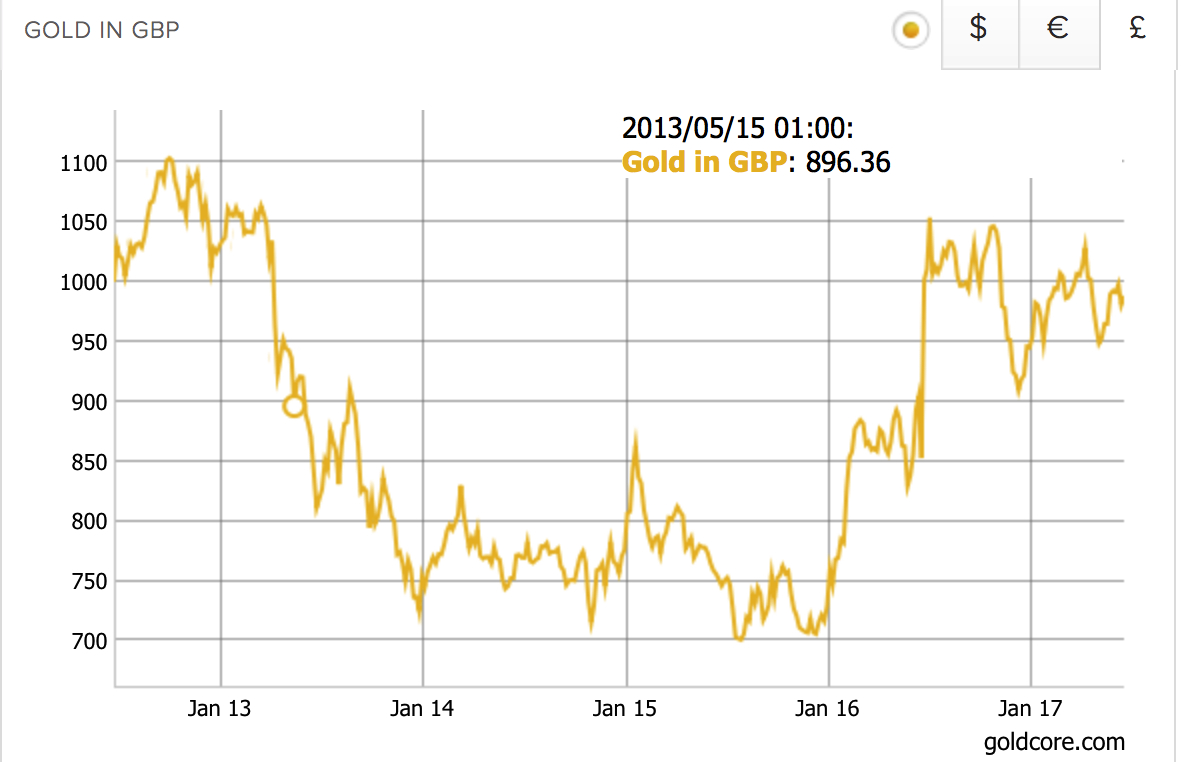
In Frisby Towers we survey the lay of the land and we sigh. We know government finances do not pass basic safety standards. We know there’s too much debt. We know asset prices are overvalued.
We know that quantitative easing (QE) and zero-interest-rate policy (ZIRP) have breathed life into that which should long be six-feet under. We know rates have to go up eventually. We know that when they do, all hell breaks loose. We know that gold’s time will come again, even more so than before.
The problem is we don’t think that time is nigh. We hope we’re wrong. But that’s what we think. We just can’t see a major imminent move or a change in sentiment.
We note that each low gold makes is higher than the last – $1,120, then $1,180, then $1,200, then $1,220. Some might call that an uptrend.
But we also note that this move is unconfirmed by the miners, which have yet again been bleeding investors’ capital, as is their wont. For a proper bull market to happen, the two must dance together.
Our outlook is for more frustrating range-trading. As it stands, $1,050 looks like it’s the low. Maybe it needs to be re-tested again – just as $250 was in 1999 and 2001. Maybe not. The next line of support must be the $1,130-$1,140 zone.
On the upside, $1,300 is a barrier, $1,380 another. There’s a long way to go even before we get the almost insurmountably large hurdle that is $1,500.
I’m sorry to say it, but we could be range-trading for a few years yet. But this current state of play won’t last forever. Nothing lasts forever.
I take that back. One thing does last forever – gold. Gold is, by its very nature, eternal. The current mood of investors is not. There are worse things to own – for the long term.
This is Dominic Frisby’s latest article for MoneyWeek.
News and Commentary
Gold prices rise from 5-week lows as dollar eases (Marketwatch)
Gold steadies as oil plunge dampens U.S. rate hike expectations (Reuters)
U.S. Stocks Drop on Brent Bear Slump, Gold Rises: Markets Wrap (Bloomberg)
U.S. existing home sales unexpectedly rise in May (Reuters)
Belgium Tightens Security After Failed Brussels Bombing (Bloomberg)
end
Ted Butler…
A Rigged Game
June 22, 2017 – 10:03am
76 years ago, “Joltin’ Joe” DiMaggio was in the middle of the hitting streak of streaks that would come to 56 consecutive games and which has remained a major league baseball record to this day. That season (1941), the Yankee Clipper would bat .408 during the epic streak or more than 4 hits for every 10 at bats. Ted Williams, of the Boston Red Sox, had the highest batting average in 1941, hitting .406 for the entire season.
What would you say if I told you that a batter had hit 1.000 for an entire season? Or that a pitcher threw no- hitters every time he played a game? I’m pretty sure you would say that’s impossible or that something was definitely wrong. And, of course, you would be correct – somethings are too impossible or outlandish to be true. Not just in baseball, but there are limits in almost every endeavor.
Therefore, I wouldn’t blame you if you questioned what I claim is the winning streak of all winning streaks in trading COMEX silver futures. Data published by the CFTC, the federal commodities regulator, indicate that JPMorgan and two or three other large financial institutions, have never taken a loss, only profits on every single silver trading position they have established over the past nine years and, in fact, for a lot longer than that. You can question what I claim all you want, but do yourself a favor and make sure you question me deeply enough – please don’t let me off the hook easily.
Let me first define what I mean by establishing a COMEX silver position and never taking a loss. I’m not talking about high-speed computer day trading (HFT) which makes up the lion’s share of trading volume in silver and just about everything else. I’m talking about positions taken and held for weeks and months before they are closed out. Since JPMorgan and the two or three institutions which together hold the impossibly-perfect trading record in silver have never been net long COMEX silver futures, the trading positions established and closed out without loss, only profits, have all been short positions. If you are always net short on the COMEX, which JPMorgan and the other big perfect traders have always been, you can’t take long positions – only close out or add new shorts.
Therefore, JPMorgan and the two or three other large “never wrong, always right” COMEX traders only trade from the short side; always adding new short contracts first at higher prices than where those contracts are later bought back and closed out at. From studying silver intensely for more than 30 years, I don’t think I would be able to sleep peacefully for a minute if I ever found myself actually short the metal. I think I’d rather go skydiving without a parachute. Given silver’s long history of sudden price spikes, including the spike to nearly $50 six years ago, one would think a silver short position taken by JPM and the others, would end in a loss, at least once in a while. One would be wrong to think that.
Any thought of a baseball player hitting 1.000 or pitching no-hitters for a season is, I admit, far-fetched – that’s why I chose this example. And if it did occur, the only possible explanation would be that the game was somehow rigged. No player is that good, not even Joltin’ Joe or Ted Williams. Likewise, I admit that the thought is far-fetched that anyone could trade silver from the short side and bat 1.000, never taking a loss, only profits, not just for a season, but for nine years and longer…
-END-
China and the SGE is now tired of the phony USA pricing of gold. They want to expand their fixes to Budapest and other countries
(courtesy GATA/SCMP)
Shanghai Gold Exchange to offer yuan-back futures contract in Budapest
Submitted by cpowell on Wed, 2017-06-21 18:46. Section: Daily Dispatches
By Maggie Zhang
South China Morning Post, Hong Kong
Wednesday, June 21, 2017
China is looking to expand the use of its yuan-denominated gold fix overseas, the chairman of the mainland China’s sole gold bourse said today, reflecting on Beijing’s attempt to vie for a bigger say in the price-setting of the precious metal.
It is now expected that a gold futures contract based on China’s yuan-backed gold benchmark price could be listed on the Budapest Stock Exchange in Hungary as soon as the second half of this year, said Jiao Jinpu, chairman of the Shanghai Gold Exchange (SGE) at the Lujiazui Forum, which ends in Shanghai today.
SGE is considered the world’s largest physical bullion exchange.
The yuan-backed benchmark fix, launched by the SGE in April 2016, reflects Beijing’s hopes of reducing its reliance on U.S.-dollar based prices of the metal, he said.
It also reflects Beijing’s latest step to push ahead its plan to make the yuan a global currency, analysts added. …
… For the remainder of the report:
http://www.scmp.com/business/china-business/article/2099370/shanghai-gol…
END
You know that gold is ready to skyrocket when you see negative propaganda on gold flare up
(courtesy Dave Kranzler/IRD/GATA)
Dave Kranzler: Anti-gold propaganda flares up
Submitted by cpowell on Wed, 2017-06-21 19:56. Section: Daily Dispatches
By Dave Kranzler
Investment Research Dynamics, Denver
Wednesday, June 21, 2017
Predictably, after the gold price has been pushed down in the paper market by the Western central banks — primarily the Federal Reserve — negative propaganda to outright fake news proliferates.
The latest smear-job comes from London-based Capital Economics by way of Kitco.com. Some “analyst” — Simona Gambarini — with the job title of “commodity economist,” reports that “gold’s luck has run out” with the 25-basis-point nudge in rates by the Fed. She further explains that her predicted two more rate hikes will cause even more money to leave the gold market.
Hmmm. … If Gambarini were a true economist, she would have conducted enough research of interest rates to know that every cycle in which the Fed raises the Fed Funds rate is accompanied by a rise in the price of gold. This is because the market perceives the Fed to be “behind the curve” on rising inflation, something to which several Fed heads have alluded. …
… For the remainder of the report:
http://investmentresearchdynamics.com/anti-gold-propaganda-flares-up/
END
for those of you who are still none believers that central authorities manipulate gold, the following commentary is for you
(courtesy Chris Powell/GATA/Focus Money)
German business magazine publishes major article on gold market manipulation
Submitted by cpowell on Wed, 2017-06-21 20:29. Section: Daily Dispatches
4:31p ET Wednesday, June 21, 2017
Dear Friend of GATA and Gold:
Focus Money, a German-language business magazine published in Munich with circulation of more than 100,000, this month included a major article about gold market manipulation. It cites GATA’s work and quotes your secretary-treasurer and the economist and market manipulation researcher Rosa Abrantes-Metz. The article, written by Johannes Heinritzi, is well-illustrated and is posted in PDF format at GATA’s internet site here:
http://www.gata.org/files/FocusMoney-06-07-2017.pdf
CHRIS POWELL, Secretary/Treasurer
Gold Anti-Trust Action Committee Inc.
CPowell@GATA.org
end
Your early THURSDAY morning currency, Asian stock market results, important USA/Asian currency crosses, gold/silver pricing overnight along with the price of oil Major stories overnight
1 Chinese yuan vs USA dollar/yuan WEAKER 6.8330(DEVALUATION SOUTHBOUND /OFFSHORE YUAN MOVES A LITTLE WEAKER TO ONSHORE AT 6.8347/ Shanghai bourse CLOSED DOWN 8.76 POINTS OR 0.28% / HANG SANG CLOSED DOWN 20.05 POINTS OR 0.08%
2. Nikkei closed D0WN 28.28 POINTS OR 0.14% /USA: YEN FALLS TO 111.26
3. Europe stocks OPENED ALL IN THE RED ( /USA dollar index FALLS TO 97.54/Euro DOWN to 1.1163
3b Japan 10 year bond yield: FALLS TO +.058%/ !!!!(Japan buying 100% of bond issuance)/Japanese yen vs usa cross now at 110.06/ THIS IS TROUBLESOME AS BANK OF JAPAN IS RUNNING OUT OF BONDS TO BUY./JAPAN 10 YR YIELD FINALLY IN THE POSITIVE/BANK OF JAPAN LOSING CONTROL OF THEIR YIELD CURVE AS THEY PURCHASE ALL BONDS TO GET TO ZERO RATE!!
3c Nikkei now JUST BELOW 17,000
3d USA/Yen rate now well below the important 120 barrier this morning
3e WTI:: 42/80 and Brent: 45.10
3f Gold UP/Yen UP
3g Japan is to buy the equivalent of 108 billion uSA dollars worth of bond per month or $1.3 trillion. Japan’s GDP equals 5 trillion usa./“HELICOPTER MONEY” OFF THE TABLE FOR NOW /REVERSE OPERATION TWIST ON THE BONDS: PURCHASE OF LONG BONDS AND SELLING THE SHORT END
Japan to buy 100% of all new Japanese debt and by 2018 they will have 25% of all Japanese debt. Fifty percent of Japanese budget financed with debt.
3h Oil DOWN for WTI and DOWN for Brent this morning
3i European bond buying continues to push yields lower on all fronts in the EMU. German 10yr bund FALLS TO +.256%/Italian 10 yr bond yield DOWN to 1.869%
3j Greek 10 year bond yield RISES to : 5.59???
3k Gold at $1249.90 silver at:16.53 (8:15 am est) SILVER BELOW RESISTANCE AT $18.50
3l USA vs Russian rouble; (Russian rouble UP 46/100 in roubles/dollar) 59.82-
3m oil into the 42 dollar handle for WTI and 45 handle for Brent/
3n Higher foreign deposits out of China sees huge risk of outflows and a currency depreciation (already upon us). This can spell financial disaster for the rest of the world/China forced to do QE!! as it lowers its yuan value to the dollar/GOT A SMALL SIZED DEVALUATION SOUTHBOUND
JAPAN ON JAN 29.2016 INITIATES NIRP. THIS MORNING THEY SIGNAL THEY MAY END NIRP. TODAY THE USA/YEN TRADES TO 111.26 DESTROYING JAPANESE CITIZENS WITH HIGHER FOOD INFLATION
30 SNB (Swiss National Bank) still intervening again in the markets driving down the SF. It is not working: USA/SF this morning 0.9736 as the Swiss Franc is still rising against most currencies. Euro vs SF is 1.0868 well above the floor set by the Swiss Finance Minister. Thomas Jordan, chief of the Swiss National Bank continues to purchase euros trying to lower value of the Swiss Franc.
3p BRITAIN VOTES AFFIRMATIVE BREXIT/LOWER PARLIAMENT APPROVES BREXIT COMMENCEMENT/ARTICLE 50 COMMENCES MARCH 29/2017
3r the 10 Year German bund now POSITIVE territory with the 10 year FALLING to +0.256%
The bank withdrawals were causing massive hardship to the Greek bank. the Greek referendum voted overwhelming “NO”. Next step for Greece will be the recapitalization of the banks and that will be difficult.
4. USA 10 year treasury bond at 2.151% early this morning. Thirty year rate at 2.719% /POLICY ERROR)GETTING DANGEROUSLY HIGH
5. Details Ransquawk, Bloomberg, Deutsche bank/Jim Reid.
(courtesy Jim Reid/Bloomberg/Deutsche bank/zero hedge)
Europe Slides For Third Day As Oil Attempts A Rebound; US Futures Flat
US equity futures were marginally in the red, while Asian markets rose and European stocks dropped. WTI oil rose 0.6% to $42.79 as some suggest the time to go long has arrived; oil tumbled 2.3% in the previous session. The Bloomberg Dollar Spot Index fell 0.1 percent.
Here are the main market developments while you were sleeping.
In Asia, the MSCI’s index of Asia-Pacific shares ex-Japan climbed 0.6% but Japan’s Nikkei ended a touch lower as a stronger yen and a plunge in the shares of auto air bag-maker Takata Corp took a toll on sentiment. The kiwi jumped after RBNZ kept rates on hold and focused on the positive growth outlook. The yen gained for the third day, its longest winning streak since May, after dovish comments from the Fed’s Harker supported Treasury futures. Australian 10-year sovereign yield declines a basis point; ASX 200 stabilizes after two days of losses. the PBOC drained a net 80 billion yuan via open market operations; CNY drops for sixth straight day; the Shanghai Composite dropped 0.3% in a late day selloff after advancing 0.8% earlier, as the MSCI index inclusion is now just a memory. Still, the blue-chip CSI300 index rose to the highest level in 1-1/2 years. Dalian iron ore futures unchanged. Also in China, the onshore yuan falls for a sixth day, the longest stretch of losses in eight months, as China’s Yield curve steepened following longest-ever period of inversion. CNY edges 0.03% lower to 6.8319 per dollar, poised for sixth straight day of declines, the longest since Oct. 18;
In Europe, stock markets fell for a third straight day on Thursday, as a selloff in energy shares continued and miners resumed declines. Energy companies led the Stoxx Europe 600 Index lower by 0.2% as of 6:45am EDT, after crude Wednesday dropped further into a bear market.2 out of 19 Stoxx 600 sectors rise; insurance is the most active -0.7% on 120% 30-day average volume followed by retail -0.1% on 112% average volume; autos is the least active sector -0.3% on 72% average volume. 196 Stoxx 600 members gain, 388 decline
In the US, S&P futures fell 0.1 percent. The cash index fell 0.1% on Wednesday, with Exxon Mobil and Chevron hit hardest in the decline. The Nasdaq 100 Index climbed 1%, continuing its rebound from a two-week selloff.
Elsewhere, all eyes remain on oil, where prices tried to stage a modest rebound even as investors’ doubts that OPEC-led output cuts would dent a three-year glut offset data showing a drop in U.S. inventories. WTI was a touch higher at $42.79 after sliding 2.3% on Wednesday, touching the lowest price since August. Brent was also higher at around $45.22 but within striking distance of seven-month lows hit on Wednesday. Since peaking in late February, crude has dropped over 20%, with only brief rallies, completely erasing gains at the end of the year in the wake of the initial OPEC-led production cut. OPEC and its allies focused on rising output from Libya and Nigeria, rather than deeper cuts, at a meeting in Vienna. Tropical Storm Cindy makes landfall near Texas-Louisiana border, disrupting energy shipments. OPEC: Talks this week in Vienna between OPEC and non-OPEC producers said to highlight rising Libyan and Nigerian production. There was no serious discussion of making further production cuts, according to delegates; while the option came up briefly, no numbers were mentioned.
“After the massive price drops in the last days we are asking ourselves how far this excessive pessimism goes on,” says Eugene Weinberg, head of commodities research at Commerzbank. “The market has seemed to ignore positive news in the same way it ignored negative news earlier in the year” and says today’s gains likely result of traders focusing on inventory data and changes in Saudi leadership, both of which he perceives as bullish.
“In a longer-term perspective current levels are attractive,” though prices likely to remain under pressure in short-term.
“The time for contrarian trades in oil is fast approaching, but I would want to see some stability in price and the technicals start to become more convincing,” said Chris Weston, chief market strategist at IG in Melbourne.
“As far as the market mentality is concerned, as long as the oil price keeps weakening, this is going to tell us something about the underlying capacity of the global economy to generate inflation on a sustained basis,” said Chris Scicluna, head of economic research at Daiwa Capital Markets.
In rates, the gap between yields on U.S. five-year notes and 30-year bonds flattened to 95 bps, its narrowest since December 2007. As Gundlach explained on Wednesday, a flattening yield curve is often viewed as a negative economic indicator as it shows concerns about the future pace of growth and inflation, because buyers of long-dated debt would demand higher yields if they expected higher costs. The yield on 10-year Treasuries fell one basis point to 2.15 percent. Yields on European government bonds were broadly lower, with benchmark gilts in the U.K. falling two basis points and those in France and Germany slipping one basis point.
In currency markets, the New Zealand dollar gained 0.5 percent to $0.7257 after the central bank held official cash rates at record lows but sounded less dovish than bears in the market had wagered on. The U.S. dollar eased against the Yen, while the dollar index was roughly flat at 97.54, having retreated from a one-month high of 97.871 set on Tuesday. The euro EUR was also flat at $1.1167, after Wednesday’s 0.3 percent gain. The weaker dollar lifted spot gold 0.6% to $1,253.20 an ounce
Central Banks remained on hold:
Norway’s Norges Bank kept rates at 0.50% as expected. The Executive Board’s current assessment of the outlook and the balance of risks suggests that the key policy rate will remain at today’s level in the period ahead,” says Governor Oystein Olsen.
RBNZ kept the OCR Unchanged at 1.75% as expected and said that policy is to remain accommodative for some time. RBNZ also commented that uncertainties remain and that policies may need to adjust accordingly, although it was upbeat on the economy as it stated that the outlook for domestic economic growth remains positive and that changes announced in the 2017 budget should support growth.
Market Snapshot
- S&P 500 futures down 0.1% to 2,430.25
- STOXX Europe 600 down 0.2% to 387.68
- MXAP up 0.4% to 155.06
- MXAPJ up 0.4% to 504.07
- Nikkei down 0.1% to 20,110.51
- Topix down 0.07% to 1,610.38
- Hang Seng Index down 0.08% to 25,674.53
- Shanghai Composite down 0.3% to 3,147.45
- Sensex up 0.5% to 31,449.47
- Australia S&P/ASX 200 up 0.7% to 5,705.95
- Kospi up 0.5% to 2,370.37
- German 10Y yield fell 1.1 bps to 0.254%
- Euro down 0.04% to 1.1163 per US$
- Italian 10Y yield fell 0.2 bps to 1.618%
- Spanish 10Y yield fell 0.5 bps to 1.365%
- Gold spot up 0.4% to $1,251.87
- U.S. Dollar Index down 0.03% to 97.53
Bulletin Headline Summary from RanSquawk
- EU bourses trade lower, weighed upon by energy prices, particularly Oil, where global supply concerns continue
- GBP is struggling for direction as traders do not know how to take the latest developments surrounding fresh challenges to Theresa May’s approach to EU negotiations.
- Looking ahead, highlights include US weekly jobs and Fed’s Powell
Top Overnight News
- Norway’s central bank signaled that it has finished cutting interest rates amid signs the economy weathered the collapse of its oil industry over the past three years
- New Zealand’s central bank kept interest rates at a record low and indicated it won’t raise them anytime soon
- The European Central Bank won’t overhaul or substitute Euribor, insisting instead that the financial industry take the lead, according to a euro-area official familiar with the matter
- Bank of Japan Deputy Governor Kikuo Iwata says it’s better for the central bank to keep its rough guideline for the pace of increasing its JGB holdings
- The Conservatives and Democratic Unionist Party are close to a deal to keep U.K. Prime Minister Theresa May in power, senior figures on both sides signaled
- Yellen’s candidacy for another term is encountering resistance from some Trump administration advisers who want a new leader at the U.S. central bank, according to two administration officials, even as the Treasury secretary indicated she may still be in the running
- Fed’s Harker says ’prudent’ to pause on the next rate increase
- Germany’s May tax revenue rises 1.4%, economy in ’solid upturn’: Finance Ministry
- BOJ’s Iwata says too early to hike rates, risks are skewed to the downside
- PBOC won’t unwind balance sheet like Fed, adviser says: Securities News
- RBNZ keeps rates unchanged, policy to remain accommodative for considerable period
- Global Bank-Capital Talks Falter as Germany Hardens Dissent
- Boeing Wins $14b Commitment for 125 737 Max 8 Airliners
- Saudi Gain Is Loss for Qatar Reeling From $13 Billion Slump
- Bonds Get Junkier, Yields Fall and Funds Don’t Seem to Mind
- Berkshire Hathaway Invests in Embattled Lender Home Capital
- Alibaba To Sell Shipment of U.S. Beef in China on Virtual Mall
- Uber’s Hired Forensics Firm Must Reveal Downloaded Waymo Files
- Braskem Approves New Plant in Texas With $675m Investment
- Altice USA IPO Prices 63.9m Shares at $30: IPO Boutique
- Caterpillar Shares Dragged Down by Oil as Energy Outlook Dims
- House Armed Services Panel Adopts Measure Backing Key Weapons
In the US, Republican leaders in the Senate are set to unveil a closely held plan to replace Obamacare today that includes a longer transition period than a House-passed bill, though there’s no indication they have enough support for it to pass in a vote that could come as early as next week. US policymakers are set to offer Congress means to ease regulations of banks, according to a testimony released yesterday.
In Asia, stocks were mostly higher after the region gradually shrugged-off an indecisive tone which lingered from Wall Street where energy dragged the majority of indices lower, but the Nasdaq deviated from its peers amid tech strength. This initially saw a lack of unison in the region, although sentiment eventually picked up with ASX 200 (+0.75%) the outperformer amid a rebound in financials and basic materials, while Nikkei 225 (-0.1%) traded choppy with upside capped by a firmer JPY. Shanghai Comp. (-0.3%) and Hang Seng (flat) initially conformed to the improved risk-tone despite the PBoC keeping liquidity operations to a minimal, as some reports suggested that liquidity in the banking sector was very high due to recent fiscal expenditure. However, gains were trimmed heading into their respective closes. 10yr JGBs were marginally lower amid an improvement in risk appetite and reduced demand at today’s enhanced liquidity auction for longer dated bonds. In addition, the latest weekly securities transactions data also showed foreign investors turned net sellers of Japanese bonds in the prior week.
Top Asian News
- CBRC Said to Ask Banks to Provide Details on Wanda, Fosun Loans
- Tesla Signs Framework Agreement With Shanghai Lingang Govt: 21st
- Shell in Talks With ONGC to Collaborate on Enhanced Oil Recovery
- India’s Modi to Discuss Visas With Trump During U.S. Visit
- China Tower Said to Pick CICC, Goldman Sachs for $10 Billion IPO
- China’s MSCI Rally Fizzles as Billionaire Rout Highlights Risks
- India’s Nasscom Sees FY18 Outsourcing Revenue Growth 7-8%
- Australia’s Biggest Banks Blindsided by Another New Tax Demand
In Europe, markets trade with subdued behaviour as the quiet week begins to edge to a close, the UK continues to take centre stage, with PM May facing a constitutional crisis after Labour and the Liberal Democrats threatened to use the House of Lords to water down Brexit. EU bourses trade lower, weighed upon by energy prices, particularly Oil, where global supply concerns continue. Reports yesterday stated that three OPEC delegates reject the idea of deeper production cuts, as referenced by Iran OilMin Zanganeh, further one OPEC delegate doesn’t think OPEC would agree to deeper cuts unless Iran is included. The comments resulted in Brent to trade through USD 45.00/bbl for the first time this year. Fixed Income markets trade marginally higher, amid the risk tone. It is worth noting that there has been a steady rally in BTPs, with the coupon being the noticeably strengthening paper. Gilts have also been bid, as they slowly recover following Haldane’s hawkish comments yesterday, and the Sep’17 future looks to retest 128.60 – 70, the current long-term range high.
Top European News
- Nomura Said to Choose Frankfurt as EU Base Following Brexit
- Europe’s Next Housing Boom Raises Red Flags in Ex- Communist East
- ECB Says Substantial Stimulus Still Needed: Economic Bulletin
- Novartis Drug Shows Unlikely Heart Benefit, Blockbuster Promise
- European Coal Rally Poised to Fizzle Out as Production Rises
- Norges Bank Abandons All Talk of Easing as Oil Crisis Fades
- Swiss Watch Exports Jump Most in Four Years on Asia Recovery
- Imagination Soars as Buyer Interest Spurs Formal Sale Talks
In currencies, it has been a very quiet morning with all the major currencies holding tight ranges in familiar territory. After the RBNZ, traders have been trying to extend the favourable outlook from the central bank through NZD/USD and AUD/NZD, pushing on key resistance levels at 0.7270 and 1.0380 respectively, but with limited success as yet. There is little reason to reverse these moves in the interim, so the grind higher looks set to continue. GBP is struggling for direction as traders do not know how to take the latest developments surrounding fresh challenges to Theresa May’s approach to EU negotiations. On the one hand, we have the prospect of a softer Brexit ahead, but on the other, is tempered by the overall uncertainty factor. Heavy congestion in the mid 1.2600’s in Cable, but EUR/GBP is grinding higher again to set up another challenge on the upper 0.8800’s. Tight trade in EUFt/USD and USD/JPY is purely reflective on the mixed messages on the US rate path, with the more optimistic/hawkish Yellen and Dudley met with scepticism and more relaxed tone by Messrs Evans, Harker and Kaplan.
In commodities, there is no escaping the rout in Oil price as the concerns over supply have been overrun by US production levels on the rise. Their drive towards self-sufficiency also has implications for the demand side economics, so this combined impact has driving WTI ever closer to the USD40.00 mark which will surely crank up the (attempted) verbal interventions from the major producers led by OPEC. Lows ahead of USD42.00 seen so far, but no sign of a bounce. Elsewhere, base metals are showing some resilience again. Copper has moved up to USD2.60+ levels, but we saw strong resistance at these levels last time around. Zinc is the outperformer on the day and is 2.0% up on the day. Gold has recovered back above USD1250.00, in line with the downturn in the USD.
US event calendar
- 8:30am: Initial Jobless Claims, est. 240,000, prior 237,000; Continuing Claims, est. 1.93m, prior 1.94m
- 9am: FHFA House Price Index MoM, est. 0.5%, prior 0.6%
- 9:45am: Bloomberg Consumer Comfort, prior 50; Economic Expectations, prior 49.5
- 10am: Leading Index, est. 0.3%, prior 0.3%
- 11am: Kansas City Fed Manf. Activity, est. 8.5, prior 8
DB’s Jim Reid concludes the overnight wrap
The main story in markets over the last 24 hours has again been the beating drumof falling Oil prices. Brent (-2.61%) fell below $45/bbl yesterday and joined WTI (-2.25%) in falling into a bear market having slid 21% from its highs of over $56/bbl back in February. WTI is now down 22% from the February highs based on closing prices and a little over 23% based on intraday prices. Oil had actually bounced higher yesterday afternoon and traded up as much as +1.50% but then reversed nearly 5% off its highs to hit its lows for the session in the early evening. Yesterday’s better than expected EIA data failed to provide the helping hand the Oil market needed with the market continuing to question the response, or lack of it, from major producers in providing the cutbacks needed. Indeed Oil is now back to the lowest level since August 10th and a quick refresh of the analysis we did yesterday shows that WTI has only ever traded lower than this on 5% or 168 days since the start 2005 (most of which came in 2008/09 and 2015/16). So as we noted yesterday, these are pretty stressed levels relative to the last twelve and a half years.
Anything energy related was hit pretty hard yesterday. EM currencies were big underperformers while the S&P 500 energy sector fell -1.60% and has now declined -3.49% this week. However some support from the tech (Nasdaq +0.74%) and healthcare sectors did help to offset the move for the broader S&P 500 which helped it finish only a smidgen lower (-0.06%) by the closing bell. Europe was softer too (Stoxx 600 -0.18%) although the move in Oil was mostly felt after markets on the continent had closed. Perhaps the most notable standout yesterday was the underperformance for US credit and particularly HY. CDX IG was 1.3bps wider while CDX HY was 12bps wider and is now at the widest level since mid-April. The two big HY ETF’s also had their worst days in three months. Meanwhile US HY energy cash spreads leaked 21bps wider yesterday and are now 46bps wider in the last two days and 82bps wider in June to date. The current spread level of 531bps is also easily the widest this year although the extent of the recent move is worth putting in some context relative to the 2016 sell-off when spreads blew out as wide as 1932bps (from about 650bps prior to the sell-off). It’s worth watching but we are a long way away from the stress levels of just over 12 months ago.
The other big story for markets yesterday was the hawkish comments from BoE Chief Economist Andy Haldane. He said that “the risks of tightening too early have shrunk as growth and, to a lesser extent, inflation have shown greater resilience than expected”. In terms of what this means for policy Haldane said that “provided the data are still on track, I do think that beginning the process of withdrawing some of the incremental stimulus provided last August would be prudent into the second half of the year”. Gilt yields spiked higher on the comments with 2y yields in particular darting up over 7bps to finish at 0.193%. 10y yields finished a little under 4bps higher at 1.029% while Sterling was at one stage up as much as +0.96% from its intraday lows before settling up +0.33% at $1.267.
Remember that Haldane’s comments follow a slightly more hawkish BoE statement last week and then a much more dovish Carney on Tuesday. Deciphering BoE communication is becoming a bigger challenge and there is little doubt that there is disagreement within the committee. Indeed it’s becoming clearer that one can no longer consider Carney as representing the centre of the committee given all the recent talk. So this is causing a bit of debate about the UK’s policy outlook for the rest of the year and it’s perhaps not ironic that all this comes as the first week of the still very early stage Brexit negotiations get underway with only small snippets of information so far being released with the much more material updates still to come. On that PM May suggested yesterday that Scotland could get a separate vote on Brexit law with officials in talks over whether the Scottish Parliament will be legally required to give consent on the Repeal Bill. This followed a mostly uneventful Queen’s Speech while there was no further update on the Conservatives-DUP talks although the BBC ran a story yesterday suggesting that the DUP is seeking £2bn in health services and infrastructure projects in Northern Ireland as part of a parliamentary deal, suggesting a still tough negotiating stance.
Meanwhile over at the Fed there was a bit of focus on comments from Philadelphia Fed President Harker in an interview with the FT. Harker argued that it might be prudent to “pause on the next rate increase” while forging ahead on balance sheet reduction. He also said that unwinding the balance sheet could begin in September however “I wouldn’t want to do it if we are starting to see further erosion of inflation and other negative economic data”. Treasuries weren’t hugely moved by the comments with the 10y consolidating around 2.164%. This morning in Asia the lack of any further declines for Oil appears to be helping to support a modest rebound for most equity markets in the region. The Hang Seng (+0.44%), Kospi (+0.29%) and ASX (+0.80%) are all up while in China, having joined the MSCI club, the CSI 300 (+1.04%) and Shanghai Comp (+0.76%) have bounced for the second consecutive day. Markets in Japan are little changed with the Yen strengthening this morning.
Wrapping up, in terms of yesterday’s economic data, in the US we learned that existing home sales climbed +1.1% mom in May which was a beat compared to market expectations for a small decline. Meanwhile in the UK a public sector net borrowing requirement of £6bn in May was a little smaller than expected but left the 12-month running deficit essentially unchanged.
Looking at the day ahead, this morning in Europe we’ll be kicking off in France where we are due to receive various June confidence indicators before the UK then releases the latest CBI business survey results for June. In the afternoon we’ll then get the flash consumer confidence reading for the Euro area in June. In the US the data includes initial jobless claims, FHFA house price index, conference board’s leading index and Kansas City Fed’s manufacturing activity index. Away from the data the Fed’s Powell is scheduled to speak before the Senate Banking Committee at 3pm BST while the BoE’s soon to depart Kristin Forbes also speaks this evening. The other event to keep an eye on today is the start of the two-day EU leaders’ summit in Brussels.
3. ASIAN AFFAIRS
i)Late WEDNESDAY night/THURSDAY morning: Shanghai closed DOWN 8.76 POINTS OR 0.28% / /Hang Sang CLOSED DOWN 20.05 POINTS OR 0.08% The Nikkei closed DOWN 28.28 POINTS OR 0.14%/Australia’s all ordinaires CLOSED UP 0.76%/Chinese yuan (ONSHORE) closed DOWN at 6.8330/Oil DOWN to 42.80 dollars per barrel for WTI and 45.10 for Brent. Stocks in Europe OPENED ALL IN THE RED,, ..Offshore yuan trades 6.8347 yuan to the dollar vs 6.8330 for onshore yuan. NOW THE OFFSHORE IS WEAKER TO THE ONSHORE YUAN/ ONSHORE YUAN WEAKER (TO THE DOLLAR) AND THE OFFSHORE YUAN IS A LITTLE WEAKER TO THE DOLLAR AND THIS IS COUPLED WITH THE WEAKER DOLLAR. CHINA IS NOT SO HAPPY TODAY
3a)THAILAND/SOUTH KOREA/NORTH KOREA
NORTH KOREA
end
b) REPORT ON JAPAN
c) REPORT ON CHINA
China’s response to Trump is not helpful
(courtesy zero hedge)
China Responds To Trump’s North Korea Tweet
Following President Trump’s somewhat ominous ‘thanks for nothing in North Korea’ tweet last night, somewhat ominously, last night…
While I greatly appreciate the efforts of President Xi & China to help with North Korea, it has not worked out. At least I know China tried!

Perhaps suggesting: first that his ‘good friend’ Xi was not much help after all; and second, he will act unilaterally.

China has now responded, saying that its efforts on North Korea have been “indispensable.” As Bloomberg reports,
China has “played an important and constructive role” in seeking peace on the Korean peninsula, Foreign Ministry spokesman Geng Shuang told reporters in Beijing.
China strictly implements United Nations Security Council resolutions and isn’t the crux of the North Korean issue, he said.
The spat underscores the risk of conflict between the world’s biggest economies even as the overall relationship is on more stable ground than when Trump took office in January, and comes just a day after the death of Otto Warmbier (after being imprisoned in North Korea for 18 months).
Warmbier’s death is “an outrage even by North Korean standards,” said John Delury, an associate professor of Chinese studies at Yonsei University in Seoul.
“It does demand something that’s beyond the typical response. But what do you do? How do you punish North Korea? The instinctive response, such as a travel ban, would not punish the people who killed Otto Warmbier.”
China provides most of North Korea’s food and fuel imports. It has backed the Kim dynasty since the Korean War, in part to keep U.S. troops away from its border. While China has taken some steps on North Korea — including halting coal purchases this year after Kim’s estranged half-brother was murdered in Malaysia — its efforts haven’t produced a breakthrough so far.
Spy satellites have detected what appear to be modifications around a tunnel entrance to an underground test area at North Korea’s nuclear test site, CNN reported Wednesday, citing two U.S. officials it did not identify. It said military options for North Korea had been updated and would be presented to Trump.
Trump’s administration talked up the threat of military action earlier this year, sending aircraft carrier strike groups to the region. In April, Chinese Foreign Minister Wang Yi warned a war would devastate the region.
Top diplomats and defense chiefs from the two nations will meet in Washington later Wednesday, while China separately has invited Trump’s daughter Ivanka and son-in-law Jared Kushner to visit Beijing later this year.
However, Warmbier’s death undercuts any progress from those meetings.
“This makes dealing with Kim Jong Un so toxic,” Ralph Cossa, president of the Pacific Forum CSIS in Honolulu. “If there are any U.S. preconditions for the talks, the number one priority has to be the release of the three other prisoners.”
Stocks Of China’s Serial Foreign Acquirers Crash Amid “Systemic Risk” Crackdown
Last February we described some of the “horror stories” of corporate leverage that emerged as a result of China’s unprecedented offshore M&A spree that emerged in 2015 and raged through most of 2016: after all, with over $100 billion in foreign acquisitions, the bulk of the funding would inevitably come from debt. These were some of the examples we highlighted:
- Take Zoomlion, a lossmaking Chinese machinery company that is partially state-owned: its total debt stands at 83 times its EBITDA. “Zoomlion’s bid is a desperate attempt to remain relevant,” said Mr Pillay.
- Or how about Fosun, a serial Chinese acquirer that spent $6.5bn on stakes in 18 overseas companies during a six-month period last year, had a a 55.7x total debt/EBITDA in June 2015. “Fosun has bought brand names such as Club Med and Cirque du Soleil as well as a host of other assets including the German private bank Hauck & Aufhaeser.”
- Or maybe the highly publicized purchase of China Cosco Holdings of the Greek Piraeus Port Authority for €368.5m. Cosco has promised to invest €500m in the Greek port despite having total debt at 41.5x its EBITDA!
- Or Cofco Corporation, which recently reached an agreement with Noble Group under which its subsidiary, Cofco International, would acquire a stake in Noble Agri for $750m (in the process preventing the insolvency of the biggest Asian commodities trader), has total debt equivalent to 52 times its EBITDA!
- Or how about Bright Food, which bought the breakfast group Weetabix for $1.2bn last year, and has total debt at 24 times EBITDA!
The visual summary was far more stunning, and showed some Chinese foreign acquirers ompanies had levered up as much as 83x.

As we summarized, “what is going on in China’s massively overlevered corporate sector, is that virtually every company has become one massive “rollup” a la Valeant, hoping to deflect investors’ and analysts attention from their deplorable credit metrics by engaging in a scramble of global M&A at any price, just to buy 1-2 more quarters of silence from skeptics, even as leverage continues to build at multiple turns of EBITDA every single quarter.”
The offshore merger spree did not last long: following a recent crackdown by Beijing on offshore (debt-funded) M&A, China’s foreign acquisition spree came to a screeching halt earlier this year, when virtually no new Chinese deals have been announced.
And now comes the hangover, because overnight China’s regulator finally started a crackdown on the debt-funded mess that emerged in China as a result of this spree.
It started with a report in China’s Caixin, which said that the China Banking Regulatory Commission has expressed concerns about “systemic risks” at some big companies, which just happen to be China’s most prolific overseas acquirers, and has asked banks to report their exposures to the companies after last year’s unprecedented outbound takeover spree.
Warning companies can transmit risks to upstream and downstream industries and banks, the CBRC added that it will closely track risks when problems occur in big companies. More to the point, the CBRC ordered checks on HNA, Dalian Wanda, Fosun and other prominent foreign buyers and asked banks in mid-June to conduct risk analysis and check loans made to these companies.
As Bloomberg adds, the regulator asked some banks to provide information on overseas loans made to Dalian Wanda Group Co., Anbang Insurance Group Co., HNA Group Co., Fosun International Inc. and the owner of Italian soccer team AC Milan. “The inquiries, which come a week after reports of an investigation into Anbang’s chairman, are likely to put a further chill on China’s outbound takeovers after tighter capital controls cut deal activity this year by 56 percent from the same period in 2016.
Why the crackdown now? By targeting some of the country’s most powerful tycoons, Xi Jinping’s government may be sending a signal of its commitment to cleaning up the financial system before a key Communist Party leadership reshuffle later this year, according to Bloomberg.
“We are now in an environment where preventing financial risks is lifted as the top priority, so I think the regulators are trying to gauge the total exposure,” said Wei Hou, a Hong Kong-based analyst at Sanford C. Bernstein. “Regulators must have seen some red flags.”
The market reaction was prompt, and led to the negative close of the Shanghai Composite noted earlier, despite the solid green start in Chinese trading: as news of the CBRC’s request spread through China’s financial markets on Thursday, shares of companies linked to Wanda and Fosun tumbled and the Shanghai Composite Index erased an early gain. The turbulence came less than 36 hours after MSCI Inc. said China’s domestic equities would join its benchmark indexes, a stark reminder for international money managers of the risks in a market where opaque regulatory decisions are commonplace.
The market impact was swift as shares of billionaire Guo Guangchang’s Fosun and various related companies tumbled in Hong Kong, in line with the plunge of Wanda shares. Fosun fell as much as 9.6%, while Fosun Pharmaceutical Group dropped as much as 7.8%.

The sudden drop dragged down the entire Chinese market.

When asked by Bloomberg to comment on their sharp stock price declines all the named companies denied they had any idea what was going on: Fosun spokesman Chen Bo said “all is normal” at the company, representatives at Anbang and Wanda declined to comment, while HNA didn’t immediately comment. A representative for AC Milan’s owner didn’t return calls seeking comment.
The regulator, however, provided some additional details: Zhiqing Liu, a deputy director at the CBRC, said “we are generally concerned with systemic risks posed by big firms.”
The CBRC required banks to provide information on loans related to the five companies’ overseas investments, especially in property, cinemas, hotels, entertainment businesses and sports clubs, people familiar with the matter said. Banks need to submit their assessment of potential risks for such investments and any measures they have in place to deal with risks, the people said.
We have previously profiled the extensive acquisitions undertaken by Chinese companies, but here as a reminder, is the case study of HNA, an “acquisition airline group” as the FT puts it.
HNA has announced more than $30 billion of asset purchases since last year, according to data compiled by Bloomberg, ranging from from stakes in hotel operator Hilton Worldwide Holdings Inc. to asset manager SkyBridge Capital and Deutsche Bank AG.
Wanda has spent more than $10 billion, including the purchase of Hollywood film producer Legendary Entertainment, since 2016.
Fosun, which owns stakes in Club Med and Cirque du Soleil Inc., has also been pursuing billions of dollars of assets overseas.
Anbang’s international holdings include New York’s Waldorf Astoria hotel.
Among the more notable acquisitions by these Chinese companies were AC Milan, Club Med, the Wolverhampton Wanderers Football club, Cirque du Soleil, and real estate in NYC, London, and Sydney, but that period of wanton foreign purchases, many of which led to what was dubbed the “Chinese M&A premium”, is now over.
To be sure, as a result of last year’s crackdown on capital outflows, today’s move was largely expected: as Bloomberg points out, “Chinese policy makers have already made it more difficult for acquirers to move money overseas as the government tries to stem capital outflows and prop up the yuan. The curbs have contributed to a spate of canceled deals, including the $1 billion purchase of Dick Clark Productions Inc. by billionaire Wang Jianlin’s Wanda. This year’s drop in announced deals is the biggest for a comparable period since the depths of the global financial crisis in 2009, according to data compiled by Bloomberg.”
Meanwhile, the focus on banks’ exposures to foreign acquisitions comes against a backdrop of tightening financial conditions in China and a regulatory crackdown on risky behavior by banks, shadow-lending institutions and insurers, as well as the detention of the chairman of one of China’s most aggressive foreign acquirors: Anbang.
As reported last week, Anbang’s Chairman Wu Xiaohui was detained as part of a probe that includes looking into the sources of funding for Anbang’s overseas acquisitions, possible market manipulation, and “economic crimes.” Anbang said last week that Wu was unable to perform his duties for personal reasons.
* * *
Meanwhile, going back to the Chinese stock market which just two days ago was added to the MSCI EM index, the Beijing intervention showed just why anyone rushing to invest in China may want to think twice. “I don’t think it’s the right time to invest or buy into these companies,” said Alex Wong, director at Ample Capital in Hong Kong. “Sometimes this kind of event can accelerate very quickly.”
And while the latest Chinese crackdown is bad news for local stocks, it is good news for US equities where the Chinese potential “merger premium” can now be eliminated, resulting in a fractionally more rational market. As for how far Beijing’s attempt to “normalize” its corporate sector will reach, and whether it will lead to even more deflationary outflows from the mainland, jury selection has only just started.
Trump Trade Tsar Warns Of “Cataclysmic” Consequences If China Gets “Market” Status
Trump’s trade tsar, Robert Lighthizer, aka the US Trade Representative speaking before Congress on Wednesday, fired a warning shot at both Beijing and the World Trade Organization, warning that any decision to label China a “market economy” would have “cataclysmic” consequences for the body which has governed over international trade for decades. The statement comes in the context of a possible trade war over steel imports, further distancing the Trump administration from the WTO, and as UBS wryly adds, “President Xi of China may not be getting the return he expected on his investment of political capital in the US.”
As the FT details, Lighthizer said the US was eager to see changes in the WTO’s dispute resolution system, arguing that the country had unfairly ended up as the top target for complaints in the global trade court. But the US trade rep singled out a dispute brought last December by China against the EU and US over whether it should be deemed a market economy as the “most serious litigation that we have at the WTO right now”.
“I have made it very clear that a bad decision with respect to the non-market economy status of China . . . would be cataclysmic for the WTO,” he said.

While the trade tzar did not elaborate what US action that would lead to and he added he was “assuming . . . that the WTO is going to do the right thing”, the warning pointed to how the Trump administration is changing the US relationship with the WTO and other multilateral institutions it helped create following the second world war.
As a reminder, designating China as a “market economy” would recognize its commitment to free market policies, and if China – whose import tariffs and protectionist measures are well known – were to win this qualification, it would make it more difficult for the U.S. to win cases the US brings against China for violations such as dumping steel, a practice China has regularly engaged in when prices drop low enough.
To be sure, Lighthizer has been a longstanding critic of the WTO and has argued for the US to take a far more aggressive approach in its relationship with both the WTI and China. In written testimony to Congress in 2010 he called for the US to end what he called its “unthinking, simplistic and slavish dedication” to WTO rules. Building on this, during his presidential campaign, Trump repeatedly threatened to pull the US from the WTO, although his stance has since softened.
That said, there is good evidence that Lighthizer’s skepticism is justified: there is evidence that allowing China’s accession to the WTO fifteen years ago was the trade policy decision that most led to joblessness and stagnant incomes, specifically in the manufacturing sector. Or, as Barclays puts it, unleashed the current round of hyperglobalization…

… leading to stagnant incomes for the middle class.

The US Trade repo continued his criticism of China on Thursday, when he said he’d like to study the reason for Ford’s previously reproted plan to shift production of Focus-model cars to a Chinese factory and learn about its “incentives.” Lighthizer, speaking before House Ways and Means Committee, said if it’s found that Ford made the decision for “non-economic reasons” then the administration “should take action.”
Meanwhile, Beijing contends that the agreement when it joined the WTO in December 2001 was that it would automatically be awarded market economy status for the purpose of the calculations used in anti-dumping cases. Currently, its non-market economy status means that the US and other countries can use prices in third countries to determine the size of punitive tariffs used to combat dumping, or the selling below cost of products, by Chinese companies.
The aggressive push comes three months after Trump’s meeting with Chinese president Xi Jinping where Trump announced a 100-day plan to tackle trade issues and promised a friendlier tone if Beijing reined in North Korea. As part of that process Washington and Beijing announced an interim deal last month that allowed a resumption of US beef exports to China and paved the way for other measures including additional US LNG exports. Perhaps as a preemptive loophole, Trump tweeted earlier this week that China has failed to keep its part of the bargain and rein in North Korea.
Lighthizer said on Wednesday that this was just one strand of discussions and warned that many other tough negotiations lay ahead. Among the issues the US was now focusing on were new barriers to US tech companies doing business in China, he said. “The pressure is still on,” he said. “The trade deficit still hasn’t come down.”
And while trade with China remains a very open, and potentially escalating issue should trade war eventually break out as some suggest, a far greater problem for the US in terms of countering the impact of “globalization” looms elsewhere: robots.

end
4. EUROPEAN AFFAIRS
5. RUSSIAN AND MIDDLE EASTERN AFFAIRS
end
Israel/Saudi Arabia
According to Fars, (and Israel has not commented on the story) Israel has deployed 18 fighter jets to Saudi Arabia to prevent a coup of Bin Salman by his cousin. This may be true as the probability of a strike by Saudi Arabia against Iran increased dramatically with the appointment of crown Prince Mohammed Bin Salman. Iran has been Israel’s formal enemy for centuries
(courtesy zerohedge)
Israel Deployed 18 Fighter Jets To Saudi Arabia To “Prevent A Coup”: Fars
While according to the official narrative, the Saudi power transition on Wednesday, when King Salman bin Abdulaziz announced his decision to replace Crown Prince Mohammed bin Nayef bin Abdulaziz with his own son, Mohammed bin Salman, went smooth and by the numbers, what took place behind the scenes is more interesting.
Here, events were decidedly more interesting, because as Fars News reports (so take it with a grain of salt), after the decision was announced, the Israeli air force sent 18 of its fighter jets, including F16-I, F15-CD and F16-CD, along with two Gulfstream aircraft, two tanker airplanes and two C130 planes, special for electronic warfare, to Saudi Arabia at the demand of the new crown prince bin Salman to block his cousin (bin Nayef)’s possible measures.
On the surface, such close ties between the existing Saudi regime and Israel would appear a stretch, although it is far more plausible after this week’s WSJ report that when it comes to the Saudi proxy war, Israel and Saudi Arabia had been alligned from the onset of the Syrian conflict, with Israel secretly supplying Syrian rebels near its border with cash as well as food, fuel and medical supplies for years, “a secret engagement in the enemy country’s civil war aimed at carving out a buffer zone populated by friendly forces.”
If true, the Fars report would be rather striking because, in addition to other geopolitical implications, Israel and Saudi Arabia do not have formal diplomatic relations.
According to the Times of Israel, “a spokesperson for the IDF said the army does not comment on foreign media reports. An Israeli military insider ridiculed the report as absurd.”
As a reminder, just days ago, the Saudi king stripped Nayef – who was against Saudi involvement in the Yemen civil war – of his powers overseeing criminal investigations and designated a new public prosecution office to function directly under the king’s authority. In a similar move back in 2015, the Saudi king had appointed his nephew, then deputy crown prince Mohammed bin Nayef as the heir to the throne after removing his own half-brother Prince Muqrin bin Abdulaziz Al Saud from the position. His replacement as the new Crown Prince, Mohammed bin Salman, 31, was also named deputy prime minister, and shall maintain his post as defense minister. He has been described as the real power behind his father’s throne.
The power struggle inside the House of Saud came to light earlier this year when the Saudi king began to overhaul the government and offered positions of influence to a number of family members. In two royal decrees in April, the Saudi king named two of his other sons, Prince Abdulaziz bin Salman and Prince Khaled bin Salman, as state minister for energy affairs and ambassador to the United States, respectively.
None of this is new, but where Fars provides new details is that in late April, Mohammad bin Salman “literally bribed the new US administration by paying $56m to Donald Trump.” There is no official confirmation of this allegation. Fars further adds that “bin Salman was paying off the US to buy its support for finding a grip over the crown.”
“Since Uncle Sam’s satisfaction is the first step for the Saudi princes to get on the crown, paying off Washington seems to be a taken-for-granted fact,” Rami Khalil, a reporter of Naba’ news website affiliated to the Saudi dissidents wrote.
He added that since the Justice Against Sponsors of Terrorism Act (JASTA) is like a sword over the head of the al-Saud, they have no way out but to bribe the US, noting that the Yemen quagmire is also another reason for Riyadh to seek Washington’s support.
Also, a prominent Yemeni analyst said earlier this month that the US has been paid several trillion dollars by Saudi Arabia to protect its crown, adding that Riyadh has recently bribed Washington’s support for the Yemen war with $200bln.
“Washington has asked for more money to defend the Saudi regime and Riyadh has recently paid $200bln to the US for the costs of its support for the war in Yemen,” Saleh al-Qarshi told Fars News Agency. “This is apart from the huge amounts of money that Saudi Arabia pays to the US treasury for protecting its crown,” he added. According to al-Qarshi, “former Saudi Intelligence Chief Turki al-Feisal revealed last year that his country has bought US treasury bonds to help the US economy.”
Meanwhile, as defense minister, Mohammed bin Salman has faced strong international criticism for the bloody military campaign he launched against neighboring Yemen in 2015 amid his rivalry with bin Nayef, the then powerful interior minister. Saudi Arabia has been striking Yemen since March 2015 to restore power to fugitive president Mansour Hadi, a close ally of Riyadh. The Saudi-led war has so far killed at least 14,000 Yemenis, including hundreds of women and children.
* * *
It was not immediately clear if, assuming the Fars report is accurate, Israeli forces are still located in Saudi Arabia, or if the fears of a coup have since dissipated.
Separately, the Times of Israel reports that in a recent television interview aired in May on Saudi TV, bin Salman delivered a strong warning to Iran and ruled out any dialogue with officials there. Framing the tensions with Iran in sectarian terms, he said it is Iran’s goal “to control the Islamic world” and to spread its Shiite doctrine.
“We know we are a main target of Iran,” the prince said, warning that he “will work so that it becomes a battle for them in Iran and not in Saudi Arabia.”
For its part, Iran’s state TV, when it isn’t claiming that bin Salman is propped up by Israel or the US, described the appointment of bin Salman this week as a “soft coup in Saudi Arabia.”
Credibility of the Fars report aside, as Petromatrix’ Olivier Jakob reported yesterday, the shocking Saudi shakeup means it is “Not A Question Of If But When New Escalation With Iran Starts.”
Finally keep in mind that with Saudi Arabia desperate to raise the price of oil, and with every other measure failing, there is always one dependable fall back when all else fails: war.
6 .GLOBAL ISSUES
Canada
Strange: Warren Buffet has taken a 38.4% interest in liar loan company Home Capital Group.
(courtesy zerohedge)
Buffett Stuns Market After Berkshire Acquires 38.4% Of Home Capital Group, Provides C$2 Billion Loan
In a stunning development involving Canada’s largest alternative lender which as recently as a month ago was facing virtually certain insolvency after a furious depositor run drained it of liquidity, overnight Home Capital Group announced that billionaire Warren Buffett’s Berkshire Hathaway will indirectly acquire C$400 million ($300 million) of the firm’s shares in a private placement through its Columbia Insurance unit, for about a 38.4% stake, and will aso provide a new C$2 billion ($1.50 billion) line of credit to its unit Home Trust Co, ending the Canadian lender’s strategic review process.
“Home Capital’s strong assets, its ability to originate and underwrite well-performing mortgages, and its leading position in a growing market sector make this a very attractive investment,” said Warren Buffett, Berkshire chairman and CEO, failing to comment on the lender’s numerous regulatory problems.
Aside from the rescue loan, Berkshire will make an initial investment of C$153.2 million to buy 16 million common shares and an additional investment of C$246.8 million to purchase 24 million shares through a private placement. In total, Berkshire will hold an about 38.39% equity stake in Home Capital after buying 40 million shares at an average price of about C$10.00 per common share, a 33% discount compared with yesterday’s closing price of C$14.94.
“Berkshire’s investment is a strong vote of confidence,” in the long-term value of the business, Brenda Eprile, Home Capital’s chairwoman. Canada’s biggest non-bank lender also said it will continue to explore further asset sales and financing deals over the next year, but has concluded its strategic review process that began in April.
Many market watchers were stunned by this news, and were scratching their heads at why Berkshire would take the reputation risk of having exposure to a company which as recently as a month ago was in the regulator’s crosshairs for peddling “liar loans.” As a reminder, last week, Home Capital reached a C$30.5 million settlement with the Ontario Securities Commission, settled a class action lawsuit and accepted responsibility for misleading investors about problems with its mortgage underwriting procedures.
Once upon a time, Buffett would run from companies such as this; now he is actively drawn to them.
In any case, the move will likely assure an interim turnaround in the 30-year-old lender after a regulator in April accused it of misleading shareholders on mortgage fraud, which sent its shares tumbling, sparked withdrawals and threatened to disrupt Canada’s real estate sector. Earlier this week, Home Capital agreed to sell a clutch of commercial mortgages to affiliates of KingSett Capital Inc. for C$1.16 billion in cash.
“This investment from Berkshire not only addresses Home Capital’s near-term requirements for additional liquidity and a lower-cost credit agreement, but also facilitates what the Board feels is the best available path to long-term success,” Home Capital’s Chair Brenda Eprile said.
According to Bloomberg, the deal replaces an existing emergency credit facility on better terms, Home Capital said. The share purchase will be done in two parts: an initial investment of C$153 million for about a 20 percent equity stake, then an additional investment of C$247 million taking the stake to about 38 percent. The second phase requires extra approvals. Berkshire will not be granted any rights to nominate directors and has agreed to only vote shares representing 25 percent of the company’s stock, Home Capital said.
Home Capital shares have more than doubled since bottoming in April when its troubles began to accelerate but remain about 73 percent down from their peak in 2014. The company last week took full responsibility over allegations the lender misled shareholders about mortgage fraud and agreed with three former executives to pay more than C$30 million to reach settlements with regulators and investors.
So why is the octogenarian taking on the credibility risk through this particular investment? For the same reason as explained two months ago in “Warren Buffett Now Selling US Houses To Chinese Oligarchs” – Berkshire is seeking offshore housing markets, and after seeking access to the “desirable” Chinese homebuyer universe with its HomeServices unit, it now is hoping to access Canada.
He may find a cool reception: Buffett’s Berkshire Hathaway is wading into a tense Canadian housing market, with Toronto house prices cooling after being hit with a 15 percent tax on foreign buyers and tighter mortgage regulations, and confidence shake by the Home Capital drama. Meanwhile, prices are surging in Vancouver again after being sideswiped by similar policy moves
end
It is official: Sears Canada announces bankruptcy: this may become quite messy!!
(courtesy zero hedge)
Sears Canada Announces Bankruptcy
It’s official – the US ‘retail apocalypse’ has moved north as Sears Canada (and some of its subsidiaries) have applied to Ontario Superior Court of Justice for protection under the companies’ Creditors Arrangement Act (CCAA), in order to continue to restructure its business.
Sales at Sears Canada have fallen sharply since it was spun off from its equally-troubled US-based parent in 2012; the slump coincides with a broader shift in consumer preferences away from brick and mortar retailers and toward e-commerce.

Statement from Sears Canada (note you would hardly think this is a ‘bad’ thing judging by this PR spin)
Sears Canada Reinvention Continues
Over the past 18 months, Sears Canada embarked on a reinvention plan that has now begun to gain traction with customers. Sears Canada rebuilt its front and back-end technology platform, redefined its brand positioning, revamped its product assortment, and rebooted its customer experience and service standards. The new product assortment is reflected in two pillars, The Cut @ Sears, which offers designer labels at everyday value prices, and the Sears Label, which offers premium quality and enduring styles, also at everyday value prices. The customer experience was reinvented, both online, with a newly designed site built in-house by a new technology team, and in-store with a new format called Sears 2.0. Sears Canada also redefined its customer service standards to be best-in-class, and launched a new store in downtown Toronto to showcase its reinvention to an entirely new audience.
The Company’s hard work to bring its vision to reality is reflected in reported growth in same store sales in its two most recently completed quarters. Sears Canada believes this indicates that the new brand positioning is starting to resonate with consumers. The brand reinvention work Sears Canada has begun requires a long-term effort, but the continued liquidity pressures facing the Company as well as legacy components of its business are preventing it from making further progress and from restructuring its legacy assets and businesses outside of a CCAA proceeding. If granted, the Sears Canada Group will work to complete its restructuring in a timely fashion and hopes to exit CCAA protection as soon as possible in 2017, better positioned to capitalize on the opportunities that exist in the Canadian retail marketplace.
As a reminder, we noted last week that if Sears Canada was to go bankrupt, Lambert loses his equity stake, but he remains the company’s principal creditor. Already, Lampert has effectively laid claim to enormous amounts of the company’s assets through loans he’s made. His hedge fund, ESL Investments, also owns large stakes in Lands’ End and a Real Estate Investment Trust that gained control of some of Sears’ best properties in a $2.8 billion deal back in 2015, then leased them back to the company. Lambert owns a stake in that vehicle, too.
In other words, while Sears was floundering, Lambert was busy shielding himself from the worst of the fallout. His former employees will need to make due with the public safety net
end
Wolf Richter explains the Sears meltdown:
Sears Canada Melts Down
Files for bankruptcy protection. Shareholders rue the day.
by Wolf Richter • Jun 22, 2017
Sears Canada and its subsidiaries, which operate 95 department stores, 29 Sears Home stores, 71 Hometown stores, 16 Outlet stores, 69 Sears Travel offices, and 32 Corbeil appliance stores, and thus lease a lot of mall space, filed for bankruptcy protection today.
The company was partially spun off from similarly struggling Sears Holdings in the US in 2012, which still holds a 12% stake, and whose CEO Eddie Lampert owns a 45% stake in part via his hedge fund, ESL Investments.
In the announcement, Sears Canada said that it has applied to the Ontario Superior Court of Justice for protection under the Companies’ Creditors Arrangement Act (“CCAA”), in order to restructure its debts. It doesn’t plan to liquidate.
“Sears Canada Reinvention Continues,” it says. Despite sales having plunged for years, it points at its “brand reinvention,” how it “rebooted its customer experience and service standards,” and how its “newly designed site built in-house by a new technology team” and some other factors are going to make this work.
But retail businesses are notoriously difficult to restructure because they have so few assets and so much debt once they get to this stage, and because the collateral isn’t worth much. Most end up being liquidated. To stay alive over the years, Sears Canada has sold off most its real estate holdings, so the most valuable assets are already gone.
On June 13, I reported that Sears Canada had hired the same leading bankruptcy and insolvency advisory firm (Osler, Hoskin & Harcourt LLP) that represents Target Canada, which ended up in insolvency proceedings in 2015 when it shuttered its 133 stores and 7 more locations it hadn’t even occupied. Hiring that firm was a dead giveaway.
June 13 was also the day Sears Canada disclosed another fiasco for quarterly results, that there were “material uncertainties” about its “ability to continue to satisfy its obligations,” given the rate at which it was bleeding cash, that it had doubts about its ability “to continue as a going concern,” and that lenders weren’t willing to keep it afloat for the next 12 months.
It added that, “in light of these developments,” it had canceled its annual shareholder meeting scheduled for the next day, and “as a result,” Jeff Stollenwerck, a SVP at Sears Holdings, had “resigned as a director effective today.”
It took only nine days for its warning to turn into the reality of the ongoing brick and mortar retail meltdown.
In today’s announcement, Sears Canada projects some optimism that it would actually, against all odds, be able to restructure its business and go on, rather than liquidate and disappear:
The brand reinvention work Sears Canada has begun requires a long-term effort, but the continued liquidity pressures facing the Company as well as legacy components of its business are preventing it from making further progress and from restructuring its legacy assets and businesses outside of a CCAA proceeding. If granted, the Sears Canada Group will work to complete its restructuring in a timely fashion and hopes to exit CCAA protection as soon as possible in 2017, better positioned to capitalize on the opportunities that exist in the Canadian retail marketplace.
Even if it succeeds in restructuring, current shareholders – including Sears Holdings, its CEO Eddie Lampert, and his hedge fund, ESL Investments – will likely end up with shares that are worth nearly nothing or nothing. A restructuring essentially hands ownership of the company to its creditors that will also take a massive haircut, depending on their seniority.
Trading in its shares is currently halted. They’ve been reduced to penny-stock status long ago, and their value has become inconsequential.
Shares of Sears Holding in the US hit a new all-time low yesterday of $6.21. Today, once again, the dip buyers that have been playing this game for years, are trying to pick up pennies in front of a slow-moving steam roller, which works for a while if you’re fast enough to get out of the way.
Sears Holdings is skidding the same direction as its sister company. The ingenious strategy of cost-cutting and store-closing its way out of trouble is leaving marks: Pretty soon, it leads to zero.
end
Mexico
Mexico’s central bank, Banxico has now hiked rates for the 7th time amid inflation that is ripping this nation apart.
(courtesy zero hedge)
Peso Strengthens After Banxico Hikes Rates For 7th Time In A Row Amid Soaring Inflation
Mexico’s central bank raised borrowing costs for a seventh straight time as the country’s annual inflation rate more than doubled since September. The hike was expected by all but one of 27 economists and the peso (which rallied into the decision) is extending gains.
Some more details:
- Banxico Removes Reference to Future Measures From Statement End
- Global Growth Outlook Faces Downside Risks
- Achieving Anchoring of Mid-Long-Term CPI Expectation
- Policy Decisions to Keep Affecting CPI in Coming Qtrs
- CPI to Reach Target Around 4Q 2018
After a brief paus, the peso has rallied since the hike…

As Bloomberg reports, the most hawkish central bank in the Group of 20 nations extended its hiking cycle amid price shocks on items from gasoline to farm products and after the U.S. Federal Reserve raised interest rates. Carstens has said inflation will dip substantially in the second half of 2017 and the peso’s strength will help it reach the target next year, leading some economists to forecast that Mexico’s rate hikes are drawing to a close.

“With still increasing inflation, Banxico is likely to keep its guard up,” Carlos Capistran, chief Mexico economist at Bank of America Corp., said before the rate decision, which he forecast would increase borrowing costs. “But we expect this movement to end the hiking cycle.”
7. OIL ISSUES
WTI Crude Tops $43 After More Noise From Saudi ‘Officials’
The machines are still programmed to insta-bid on any and every headline from “Saudi officials” it would appear… even if the effects are fading in their efficacy.
As Citi notes, WSJ headlines explain the uptick in oil, suggesting that Saudi is targeting a $60 barrel oil price for its bigger picture strategy…

While that reads well and all, Citi notes that the full story concludes that Saudi’s leverage might be limited unless it shows other OPEC members that it too will take on a large share of the production cuts.
END
Now Macquarie bank warns the OPEC production cut deal will collapse sometime next year:
(courtesy Paraskova/OilPrice.com
Macquarie Warns OPEC Deal To Collapse In 2018
Authored by Tsvetana Paraskova via OilPrice.com,

OPEC’s production cut deal is unlikely to survive beyond its current deadline in March 2018, with the agreement seen falling apart towards the middle of next year, in which case a huge amount of extra oil would hit the market, Ian Reid, head of European oil and gas research at Macquarie, told CNBC on Thursday.
OPEC’s deal has not had the cartel’s desired effect on the markets, neither in terms of oil prices nor in drawing down the global glut.
According to Reid, the volume of U.S. shale output is basically nullifying OPEC’s efforts.

The key question for OPEC now is if they can extend the production cut deal into 2019, Macquarie’s manager said, but added that he did not see the cartel being able to do that.
“I think that’s going to be a very hard ask to be honest,” Reid noted.
“They can’t get the price up to a level where they can keep the shale guys out of the game so unfortunately they’re just chasing their tail at the moment,” he said, commenting on OPEC’s current strategy.
On Wednesday, Macquarie slashed its Brent price forecasts for the rest of this year as well as for 2018 and 2019, saying,
“We believe OPEC has few options. Option 1 is to maintain cuts through 2019 and allow time for demand to grow and easy growth to slow; option 2 is stop the cuts immediately. The current strategy is probably the worst. The reality is even the most optimal of OPEC’s potential strategies probably will not work.”
Mounting fears of rising oversupply, coupled with no tangible signs for traders and analysts that OPEC’s agreement is working, sank oil prices to a 10-month low on Wednesday, with WTI touching its lowest intraday level since August last year.
8. EMERGING MARKET
end
Your early morning currency/gold and silver pricing/Asian and European bourse movements/ and interest rate settings THURSDAY morning 7:00 am
Euro/USA 1.1163 DOWN .0004/REACTING TO + huge Deutsche bank problems + USA election:/TRUMP HEALTH CARE DEFEAT//ITALIAN REFERENDUM DEFEAT/AND NOW ECB TAPERING BOND PURCHASES/ /USA RAISING INTEREST RATES AGAIN/EUROPE BOURSES ALL IN THE RED
USA/JAPAN YEN 111.26 DOWN 0.074(Abe’s new negative interest rate (NIRP), a total DISASTER/SIGNALS U TURN WITH INCREASED NEGATIVITY IN NIRP/JAPAN OUT OF WEAPONS TO FIGHT ECONOMIC DISASTER/KURODA: HELICOPTER MONEY ON THE TABLE AND DECISION ON SEPT 21 DISAPPOINTS WITH STIMULUS/OPERATION REVERSE TWIST
GBP/USA 1.2670 DOWN .0004 (Brexit March 29/ 2017/ARTICLE 50 SIGNED
THERESA MAY FORMS A NEW GOVERNMENT/STARTS BREXIT TALKS
USA/CAN 1.3311 DOWN .0017 (CANADA WORRIED ABOUT TRADE WITH THE USA WITH TRUMP ELECTION/ITALIAN EXIT AND GREXIT FROM EU/TRUMP INITIATES LUMBER TARIFFS ON CANADA)
Early THIS THURSDAY morning in Europe, the Euro FELL by 4 basis points, trading now ABOVE the important 1.08 level FALLING to 1.1163; Europe is still reacting to Gr Britain HARD BREXIT,deflation, announcements of massive stimulation (QE), a proxy middle east war, and the ramifications of a default at the Austrian Hypo bank, an imminent default of Greece, Glencore, Nysmark and the Ukraine, along with rising peripheral bond yield further stimulation as the EU is moving more into NIRP, and now the Italian referendum defeat AND NOW THE ECB TAPERING OF ITS PURCHASES/ THE USA’S NON tightening by FAILING TO RAISE THEIR INTEREST RATE AND NOW THE HUGE PROBLEMS FACING TOO BIG TO FAIL DEUTSCHE BANK + THE ELECTION OF TRUMP IN THE USA+ TRUMP HEALTH CARE BILL DEFEAT AND MONTE DEI PASCHI NATIONALIZATION / Last night the Shanghai composite CLOSED DOWN 8.76 POINTS OR 0.28% / Hang Sang CLOSED DOWN 20.05 POINTS OR 0.08% /AUSTRALIA CLOSED UP 0.69% / EUROPEAN BOURSES OPENED ALL IN THE RED
We are seeing that the 3 major global carry trades are being unwound. The BIGGY is the first one;
1. the total dollar global short is 9 trillion USA and as such we are now witnessing a sea of red blood on the streets as derivatives blow up with the massive rise in the rise in the dollar against all paper currencies and especially with the fall of the yuan carry trade. The emerging market which house close to 50% of the 9 trillion dollar short is feeling the massive pain as their debt is quite unmanageable.
2, the Nikkei average vs gold carry trade ( NIKKEI blowing up and the yen carry trade HAS BLOWN up/and now NIRP)
3. Short Swiss franc/long assets blew up ( Eastern European housing/Nikkei etc.
These massive carry trades are terribly offside as they are being unwound. It is causing global deflation ( we are at debt saturation already) as the world reacts to lack of demand and a scarcity of debt collateral. Bourses around the globe are reacting in kind to these events as well as the potential for a GREXIT>
The NIKKEI: this THURSDAY morning CLOSED DOWN 28.28 POINTS OR 0.14%
Trading from Europe and Asia:
1. Europe stocks OPENED ALL IN THE RED
2/ CHINESE BOURSES / : Hang Sang CLOSED DOWN 20.05 POINTS OR 0.08% / SHANGHAI CLOSED DOWN 8.76 POINTS OR 0.28% /Australia BOURSE CLOSED UP 0.69% /Nikkei (Japan)CLOSED DOWN 28.28 POINTS OR 0.14% / INDIA’S SENSEX IN THE RED
Gold very early morning trading: 1251.10
silver:$16.58
Early THURSDAY morning USA 10 year bond yield: 2.151% !!! DOWN 1 IN POINTS from WEDNESDAY night in basis points and it is trading JUST BELOW resistance at 2.27-2.32%.
The 30 yr bond yield 2.719, DOWN 2 IN BASIS POINTS from WEDNESDAY night.
USA dollar index early THURSDAY morning: 97.54 DOWN 2 CENT(S) from WEDNESDAY’s close.
This ends early morning numbers THURSDAY MORNING
xxxxxxxxxxxxxxxxxxxxxxxxxxxxxxxxxxxxxxxxxxxxxxxxxxxxxxxxxxxxxxxxxxxxxxxxxxxxxxxxxxxxxxxxxxxxxxxxxxxxxxxxxxxxxxx
And now your closing THURSDAY NUMBERS
Portuguese 10 year bond yield: 2.956% UP 3 in basis point(s) yield from WEDNESDAY
JAPANESE BOND YIELD: +.058% DOWN 4/10 in basis point yield from WEDNESDAY/JAPAN losing control of its yield curve
SPANISH 10 YR BOND YIELD: 1.386% UP 2 IN basis point yield from WEDNESDAY (this is totally nuts!!/
ITALIAN 10 YR BOND YIELD: 1.907 DOWN 0 POINTS in basis point yield from WEDNESDAY
the Italian 10 yr bond yield is trading 52 points HIGHER than Spain.
GERMAN 10 YR BOND YIELD: +.252% DOWN 2 IN BASIS POINTS ON THE DAY
END
xxxxxxxxxxxxxxxxxxxxxxxxxxxxxxxxxxxxxxxxxxxxxxxxxxxxxxxxxxxxxxxxxxxxxxxxxxxxxxxxxxxxxxxxxxxxxxxxxxxxxxxxxxxxxxxxxxxxxxxxxxxxxxxxxxxxx
IMPORTANT CURRENCY CLOSES FOR THURSDAY
Closing currency crosses for THURSDAY night/USA DOLLAR INDEX/USA 10 YR BOND YIELD/1:00 PM
Euro/USA 1.1148 DOWN .0018 (Euro DOWN 18 Basis points/ represents to DRAGHI A COMPLETE POLICY FAILURE/
USA/Japan: 111.34 UP 0.080 (Yen DOWN 8 basis points/
Great Britain/USA 1.2665 DOWN 0.0009( POUND DOWN 9 basis points)
USA/Canada 1.3225 DOWN .01020 (Canadian dollar UP 102 basis points AS OIL ROSE TO $43.12
xxxxxxxxxxxxxxxxxxxxxxxxxxxxxxxxxxxxxxxxxxxxxxxxxxxxxxxxxxxxxxxxxxxxxxxxxxxxxxxx
This afternoon, the Euro was DOWN by 18 basis points to trade at 1.1148
The Yen FELL to 111.34 for a LOSS of 8 Basis points as NIRP is STILL a big failure for the Japanese central bank/HELICOPTER MONEY IS NOW DELAYED/BANK OF JAPAN NOW WORRIED AS AS THEY ARE RUNNING OUT OF BONDS TO BUY AS BOND YIELDS RISE /OPERATION REVERSE TWIST ANNOUNCED SEPT 21.2016
The POUND FELL BY 30 basis points, trading at 1.2661/
The Canadian dollar FELL by 9 basis points to 1.3225, WITH WTI OIL RISING TO : $43.12
Your closing 10 yr USA bond yield UP 1 IN basis points from WEDNESDAY at 2.156% //trading well ABOVE the resistance level of 2.27-2.32%) very problematic USA 30 yr bond yield: 2.728 DOWN 1 in basis points on the day /
Your closing USA dollar index, 97.59 UP 3 CENT(S) ON THE DAY/1.00 PM
Your closing bourses for Europe and the Dow along with the USA dollar index closing and interest rates for THURSDAY: 1:00 PM EST
London: CLOSED DOWN 8.50 POINTS OR 0.11%
German Dax :CLOSED UP 19.74 POINTS OR 0.15%
Paris Cac CLOSED UP 7,67 POINTS OR 0.15%
Spain IBEX CLOSED DOWN 30.80 POINTS OR 0.29%
Italian MIB: CLOSED UP 141.65 POINTS/OR 0.67%
The Dow closed DOWN 12.74 OR 0.06%
NASDAQ WAS closed UP 2.73 POINTS OR 0.04% 4.00 PM EST
WTI Oil price; 43.12 at 1:00 pm;
Brent Oil: 45.54 1:00 EST
USA /RUSSIAN ROUBLE CROSS: 59.87 DOWN 3/100 ROUBLES/DOLLAR
TODAY THE GERMAN YIELD FALLS TO +0.252% FOR THE 10 YR BOND 4.PM EST EST
END
This ends the stock indices, oil price, currency crosses and interest rate closes for today
Closing Price for Oil, 5 pm/and 10 year USA interest rate:
WTI CRUDE OIL PRICE 5:00 PM:$42.81
BRENT: $45.23
USA 10 YR BOND YIELD: 2.147% (ANYTHING HIGHER THAN 2.70% BLOWS UP THE GLOBE)
USA 30 YR BOND YIELD: 2.716%
EURO/USA DOLLAR CROSS: 1.1151 DOWN .0015
USA/JAPANESE YEN:111.30 DOWN 0.026
USA DOLLAR INDEX: 97.53 DOWN 3 cent(s) ( HUGE resistance at 101.80 broken TO THE DOWNSIDE)
The British pound at 5 pm: Great Britain Pound/USA: 1.2678 : UP 9 POINTS FROM last NIGHT
Canadian dollar: 1.3227 UP 100 BASIS pts
German 10 yr bond yield at 5 pm: +0.252%
END
And now your more important USA stories which will influence the price of gold/silver
TRADING IN GRAPH FORM FOR THE DAY
Bonds Bid, Banks Skid But Healthcare Hope Saves Stocks
Oil bounced a bit (on Saudi noise)… banks dropped (ahead of CCAR)… Healthcare ripped again (on a bill that appears to be DOA)… and stocks gave up hope in the last few minutes…
Everything was awesome briefly – an opening ramp on crude and some healthcare hope steadied stocks early but that was it. After Europe closed, stocks went nowhere until slumping into the close…

FANG Stocks ended marginally lower, stuck in a very tight range fo rthe last 4 days…

Equities advanced after two days of losses as crude broke a three-day downturn. Treasury yields continued lower with a flatter 2s/10s curve as a strong reopening of a $5b 30-year TIPS auction helped to keep yields in check throughout the afternoon. Fed’s Bullard, in an interview with WSJ, said the Fed’s projected rate path may be too aggressive. S&P reversed early session losses led by advances in health-care stocks with biotech and pharmaceuticals leading the way. The Canadian dollar advanced after a strong retail sales beat while Mexico’s peso gained over 1% vs the greenback.
VIX was clubbed like a baby seal today, but notably S&P Futs did not react too exuberantly… and once VIX had reached Tueaday;s losw it snapped back higher…

Banks were the biggest losers today as Healthcare soared after the GOP Bill was released… (and retail bounced)

Bank Stocks have taken a hit in the last few days…

Hospital stocks soared after the release of the Obamacare replacement bill…

And Biotech stocks are now up almost 10% in the last 4 days to its highest since Jan 2016…

HY Energy credit risk has spiked back to 7-month wides…

But Credit markets continue to show signs of stress…(HY CDX at 2-month wides)

NOTE: Virgin Media pulled a $3.43b 1L TL refinancing from syndication due to market conditions, according traders and portfolio managers who aren’t authorized to speak publicly. Co. launched the repricing on June 15, seeking to shave 25bps off its existing loan. Virgin Media is the 16th loan to be pulled this year…About 10 loans in all were withdrawn from syndication in 2016.
Treasury yields fell on the day across the entire complex (even as stocks rallied) with further flatteniing in 2s30s…

All yield curve bets are collapsing…

Banks remain at a premium to the yield curve’s collapse (ahead of tonight’s CCAR)

The Dollar Index fell for the 2nd day in a row, having stalled at the payrolls-ledge…

WTI and RBOB rallied modestly on the day after Saudi comments on $60 oil price hope for the Aramco IPO….

Gold rose for the second day (as the dollar slid), pushing back above the 200-day moving average

Dip-Buyers remain absent as Central Bank balance sheets drop most since December…

end
I do not like the looks of this; Democratic Election Commissioner goes on the warpath and demands probe of Russian links to Facebook, Drudge, Huffington Post etc
(courtesy zero hedge)
Democratic Election Commissioner Demands Probe Of Russian Links To Facebook, Drudge, HuffPo; “Faith In Democracy” Shaken
In what she has called an “all-hands-on-deck moment for our democracy,” Federal Election Commissioner Ellen Weintraub has inserted herself into the fading ‘Russia-did-it’ narrative demanding the federal government’s probe into alleged Russian influence is widened to foreign companies and internet sites that take political ads, like Facebook or the Drudge Report.

Citing petitions from leftist anti-Trump groups…

Her proposal was not posted on the FEC website that was revamped in part to provide more transparency. Campaign finance reporter David Levinthal of the Center for Public Integrity tweeted it out…

Commissioner @EllenLWeintraub of @FEC wants briefings by @USDOJ or @USTreasury, re: foreign activity in elections https://www.documentcloud.org/documents/3870729-FEC-Foreign-Money.html …

Some key fearmongeringly over-reaching excerpts include…
This Commission is sworn to fulfill “the sovereign’s obligation to preserve the basic conception of a political community.”
This is an all-hands-on-deck moment for our democracy. Former Vice President Dick Cheney has said that Russia’s alleged actions could be considered “an act of war” against the United States.
…
The mere allegation that foreign interference may have occurred shakes the faith of Americans in our democracy.
The FEC must find out the facts of what happened during the 2016 U.S. presidential election and move swiftly and firmly to fix any problems we find.
Only then can we begin to restore the American people’s resilient but battered faith that our federal elections belong to us – and not to some foreign power.
As The Washington Examiner’s Paul Bedard notes,critics of the idea called it a “federal power grab” beyond the scope of the FEC’s powers.
In her new proposal, she goes much further than earlier concerns about corporations and internet sites, though offered no evidence of interference other than news reports and two petitions from leftist groups.
She is urging the FEC to look into political spending by foreign sources on the internet, including Facebook, and presumably any other site that runs political ads, like the Drudge Report or Huffington Post.
As part of that she called for open- and closed-door briefings by Justice and Treasury financial officials on the issue.
She also suggested that the FEC get investigators from other agencies, prompting a critic to ask, “why would the FEC take resources away from other agencies, like DOJ, that have far more authority to actually do something about Russia?”
What’s more, she wants to assure public that state and federal databases are safe, though the agency doesn’t have any authority over state elections boards, and has reportedly farmed out large portions of its U.S. campaign data entry tasks to workers in India.
Perhaps notably, her previous efforts to focus on politically active U.S. corporations with foreign ownership have been blocked by Republicans on the FEC.
end
Trump on the warpath claiming the Russian interference is nothing but a big Democratic hoax as to why they lost the 2016 Presidential election
(courtesy zero hedge)
Trump Rages “It’s All A Big Dem Hoax”
President Trump is on a warpath this morning, raging against the hypocrisy of Obama excuse-maker Jeh Johnson’s comments. First, Trump asked a tough question…
By the way, if Russia was working so hard on the 2016 Election, it all took place during the Obama Admin. Why didn’t they stop them?
And then slammed the Democratic Nation Committee’s seeming ignorance…
…Why did Democratic National Committee turn down the DHS offer to protect against hacks (long prior to election). It’s all a big Dem HOAX!
…Why did the DNC REFUSE to turn over its Server to the FBI, and still hasn’t? It’s all a big Dem scam and excuse for losing the election!
These are good questions, which, of course, will never be answered. As The Hill notes,Trump’s comments are the latest indication he does not accept the intelligence community’s unanimous conclusion — released last October — that Russia tried to interfere in contest by hacking political groups and spreading fake news.
White House press secretary Sean Spicer on Tuesday refused to say whether the president believes that occurred.
Ironically, Trump did have something positive to say about Johnson. The comments come as Trump is battling a special counsel investigation into whether any of his associates colluded with the Russian meddling effort, which the president has repeatedly labeled a “witch hunt.” Trump on Thursday pointed to congressional testimony from former Homeland Security Secretary Jeh Johnson to back up his case…
Former Homeland Security Advisor Jeh Johnson is latest top intelligence official to state there was no grand scheme between Trump & Russia.
But of course The Left will simply ignore that ‘fact’.
end
This does not look good for the Democrats. They have raised a small 4.3 million dollars in May. These guys are in trouble
(courtesy zero hedge)
Democrats Raise Paltry $4.3 Million In Worst May Total Since 2003
Embattled Democrats couldn’t catch a break on Wednesday: not only did the party go 0-5 in a series of special elections for the House of Representatives, but the Democratic National Committee disclosed that it raised just $4.3 million last month – its worst tally for the month of May since 2003, when the DNC raised just $2.7 million.
Meanwhile, the party’s bundlers plowed money into the special election campaign of Jon Ossoff, who lost his bid for Health and Human Services Secretary Tom Price’s old seat in Georgia’s 6th Congressional district.

Ossoff’s defeat echoed the failure of the Clinton campaign: Ahead of the vote, pollsters and party leaders assured the public that Ossoff’s strong polling in a staunchly red district was emblematic of the public’s dissatisfaction with President Donald Trump.
Instead, Republican Karen Handel carried the day, defeating Ossoff by a comfortable margin of more than 10,000 votes. The loss was especially demoralizing for Democrats, who’d hoped that a victory in a staunchly red district would cement the party’s chances of winning a majority in the House during next year’s midterm election.
Ossoff’s defeat appears to have ended the 31-year-old’s burgeoning political career before it could truly begin. Ossoff, a documentary filmmaker and former political aide, garnered national attention with his aggressively anti-Trump rhetoric, epitomized by his slogan, “Make Trump Furious.”
Unfortunately for the Democrats, Ossoff’s defeat was remarkable for all the wrong reasons. As we reported last night, Ossoff spent a staggering $22 million dollars – or about $176 per vote – versus only $3 million for Handel. In the past, candidates vying for Georgia’s sixth district have typically spent about $1 million. In fact, rather than losing ground since Trump moved into the White House, Republicans actually performed better.


In terms of fundraising, the Republican National Committee fared far better than DNC last month, raising $10.8 million, a record amount for an off year. As one might expect, Democratic leadership refused to take responsibility for Ossoff’s crushing defeat, as the Hill reports…
“DNC Chairman Tom Perez defended the party’s fundraising in April, noting that he had just taken over at the helm of the organization. In an NBC interview, Perez was asked about his progress on his goal of doubling the DNC’s budget from $50 million to $100 million in 2017.
“Well again, I got there on March 1. And so, I was the first to say, ‘We have a lot of rebuilding to do,'” Perez told NBC’s Hallie Jackson.
The decline in fundraising looks like a startling new trend: The DNC brought in $4.9 million, making it the worst fundraising April for the DNC since 2009.
Trump mocked Ossoff during a victory-lap rally in Cedar Rapids, Iowa Wednesday evening. “They spent close to $30 million on this kid who forgot to live in the community he was running in,” Trump said.
Though Ossoff was allowed to run for the 6th district seat despite his lack of residency, he wasn’t able to vote for himself. After Democrats identified the race as a must-win for the party, out-of-state cash came flooding into Ossoff’s campaign coffers, transforming his candidacy into the most expensive race in the history of the House,according to the Hill.
end
Both BlackRock and Pimco are stating that somebody is wrong, either the market or the Fed and it sure looks like a policy error from the Fed
(courtesy zerohedge/Reynolds/Bloomberg/BlackRock/Pimco)
If BlackRock And Pimco Are Right, “Another Fed Shock Looms”
Discussing the market’s ongoing reaction to the schizophrenic split between the hawkish Fed and a market which now sees a 50% lower terminal Fed Funds rate than the FOMC, yesterday Jeff Gundlach said that the flattening yield curve could become a concern for US economic growth when two and three-year notes yield about the same.

“Lower CPI in the next couple of months will be a cold bucket of water for the Fed tightening dreams,” Gundlach said. “Commodities are super weak, with the dollar down year-to-date, no less.”

In not so many words, an error is forming: either “policy error” by the Fed, or one by the market, which will be forced to reconcile its dovish stance, potentially in violent fashion, with the Fed’s relentless “data independence.”
It was this issue that was the topic of a note by Bloomberg’s macro commentator Garfield Reynolds, who noted in his overnight Macro View note, that in addition to the Gundlach “quandary”, if recent commentary by BlackRock and Pimco is right, then “another Fed shock looms.”
His full note below:
Another Fed Shock Looms If BlackRock, Pimco Right: Macro View
Once bitten, twice eager sounds like a contradiction but it can often seem like standard operating procedure in global markets – just look at the money piling into bets that the Federal Reserve is going nowhere soon with monetary tightening. It’s as if the February shock – when a deluge of Fedspeak made traders realize their bets against a March hike were wrong – never happened.
Even after Fed Chair Janet Yellen made it clear she anticipates further rate increases, the “policy error” narrative is going full bore. Eurodollar options and fed funds futures signal no more moves for at least three months and no more than one more this year.
Inflation is stubbornly low. Continuing sluggishness in U.S. data (surprise indexes are at about full disappointment settings) could stay the Fed’s hand, especially if employment joins the pity party.
But BlackRock and Pimco, who between them manage more than $6.5 trillion, indicated separately this week that weaker data may not necessarily be the end-all and be-all for the rate outlook.
Fed officials have noted their mandate goes beyond just looking at the current pace of inflation. That means the “excessive obsession some market watchers have with the Fed hewing to its 2% inflation target is shortsighted,” according to Rick Rieder, BlackRock’s global chief investment officer of fixed-income.
Pimco’s Joachim Fels says Yellen may be willing to accept lower inflation as she continues with the Fed’s policy path because for one thing it would then give greater scope for policy action down the road, and it could enhance financial stability amid concerns of rates being too low. And he cites interesting theories about higher nominal rates leading to higher longer-term inflation.
The complacency in the bond market (10-year yields are heading for their narrowest monthly range since 2004!) and elsewhere seems especially brave considering how recently the market completely failed to read the Fed.
Of course, there is another explanation, one offered by BofA earlier this week which suggested that the decoupling between the Fed’s tightening intentions and the underlying economy has little to do with the data, and everything to do with the market bursting the stock market bubble. As BofA’s chief strategist David Woo said, “Can it be the case that its hawkishness was prompted by something other than its reading of the economy? For example, is it possible that the Fed has become concerned about the recent surge in the equity market, especially tech stocks that has been feeding off low interest rates and low volatility?” If so, a “market shock” is indeed inevitable, the question is when.
Then again, the market may be doubly-right: if Yellen does indeed “shock” the market, sending yields surging and risk assets tumbling, then a recession is virtually assured. As such, bond bulls are predicting not only its own near-term demise, but their long-term vindication after the shake out that will follow the “post shock” period.
END
I like to include some of Graham Summers comments as it is “short and sweet” and to the point.
Here he correctly describes how the great global debt binge is coming to an end. Note the uptrend on junk bonds is turning over:
(courtesy Graham Summers/Phoenix Capital)
Junk Bonds Signal the Great Global Debt Binge Is Coming to an End

The market has gone absolutely nowhere for 15 weeks now.
That is not a typo, nor am I bearing overly negative. Since the end of February, when President Trump last tweeted that he had big plans for the economy, the S&P 500 is up a total of just 1.6% or roughly 39 points.

And THIS is the raging bull market that everyone is so crazy about? A market in which it took almost FOUR months for stocks to eek out a 1.6% gain?
Meanwhile against this backdrop of unhinged bullishness, the credit markets are flashing MAJOR warning signals.
Junk Bonds have broken their bull market trendline from the 2016 bottom. This is a MAJOR warning that the markets are switching into “risk off” mode.

Even worse, the rally higher from the 2016 bottom FAILED to reclaim the bull market trendline that has driven HUG higher since mid-2009. This is the hallmark of a major top formation, and it strongly suggests that the Central Bank driven credit bubble from 2009 is now ending.

A Crash is coming…
And smart investors will use it to make literal fortunes from it.
We offer a FREE investment report outlining when the market will collapse as well as what investments will pay out massive returns to investors when this happens. It’s called Stock Market Crash Survival Guide.
We made 1,000 copies to the general public.
As I write this, only 67 are left.
To pick up one of the last remaining copies…
Best Regards
Graham Summers
Chief Market Strategist
Phoenix Capital Research
end
The Senate ready to reveal details of its version of Trumpcare as a replacement for Obamacare. They need basically all 52 Republicans to vote in the affirmative as all 48 Democrats will vote no.
(courtesy zero hedge)
Senate Reveals Details Of TrumpCare Bill; Vote Expected Next Week
After weeks of drafting in private, much to the dismay of Chuck Schumer, details of the Senate’s healthcare bill are set to be revealed today. While we’re still awaiting the official text of the bill, the New York Times, courtesy of leaks from some D.C. lobbyists, has previewed some of the details which apparently include large cuts to Medicaid, an end to the “mandate” that requires everyone to have health care and a repeal of “virtually all the tax increases imposed by the Affordable Care Act.”
Senate Republicans, who have promised a repeal of the Affordable Care Act for seven years, took a major step on Thursday to achieve that goal as they unveiled a bill to end the health law’s mandate that nearly everyone have health care, remake and cut the Medicaid program and create a new system of federal tax credits to help people buy health insurance.
The Senate bill — once promised as a top-to-bottom revamp of the health bill passed by the House last month — instead maintains its structure, with modest adjustments. The Senate version is, in some respects, more moderate than the House bill, offering more financial assistance to some lower-income people to help them defray the rapidly rising cost of private health insurance.
But the Senate measure, like the House bill, would phase out the extra money that the federal government has provided to states as an incentive to expand eligibility for Medicaid. And like the House measure, it would put the entire Medicaid program on a budget, ending the open-ended entitlement that now exists.
It would also repeal virtually all the tax increases imposed by the Affordable Care Act to pay for itself, in effect handing a broad tax cut to the affluent, paid for by billions of dollars sliced from Medicaid, a health care program that serves one in five Americans, not only the poor but two-thirds of those in nursing homes. The bill, drafted in secret, is likely to come to the Senate floor next week, and could come to a vote after 20 hours of debate.
Bloomberg has provided additional details:
The plan, to be released Thursday after a private Senate GOP meeting, includes $15 billion a year in market-stabilizing funds over the next two years and $10 billion a year in 2020 and 2021, the person said.
It also would provide $62 billion allocated over eight years to a state innovation fund, which can be used for coverage for high-risk patients, reinsurance and other items. The draft bill would phase out Obamacare’s expansion of Medicaid over three years, starting in 2021.
The assessment being made by senators will be shaped in part by an analysis of the bill to be released by the Congressional Budget Office, the official scorekeeper on Capitol Hill.
Of course, time is of the essence as the deadline for insurers to finalize their coverage and pricing plans for 2018 is just around the corner on August 16th.
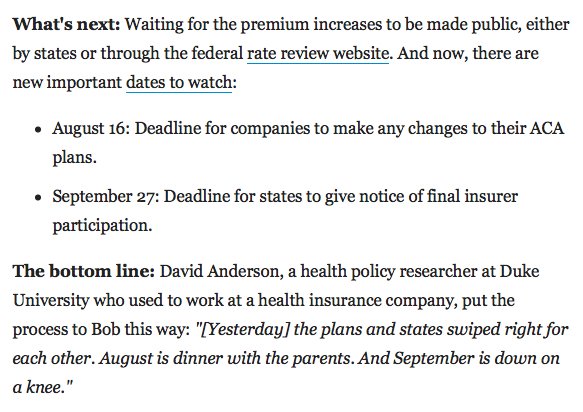
What’s next for the ACA marketplaces? Two more important dates, which @bjdickmayhew described to me perfectly. https://www.axios.com/vitals-2445778162.html?rebelltitem=3&utm_source=newsletter&utm_medium=twsocialshare#rebelltitem3 …

Meanwhile, with the bill now up for debate and all 48 Democrats expected to vote ‘no’, the race is on to figure out which Republicans will join them. Of course, Mitch McConnell can only afford to lose 2 Republican votes which would result in a tie and leave Mike Pence the deciding tie-breaker vote.
end
Well that did not last long. Already 3 Republicans plan to oppose the bill. Strange! they haven’t even sent the bill to the House where more Republicans will surely be against some of the features
(courtesy zero hedge)
Trumpcare DOA? At Least 3 Republican Senators Plan To Oppose Bill: NBC
The Senate healthcare bill has been “in the open” for less than an hour, and already NBC’s Chuck Todd reports that it may be DOA after “at least” 3 senators plan to publicly announce their opposition to the bill.
In a tweet, NBC anchor Chuck Todd said that according to a “solid” unnamed source “at least 3 GOP sens (perhaps more) plan to announce public opposition to McConnell health bill later today.”
Per solid source: at least 3 GOP sens (perhaps more) plan to announce public opposition to McConnell health bill later today. Developing

As a reminder, Republicans can lose no more than two Republicans, assuming all Democrats in the Senate oppose measure, as expected.
For now, hospital stocks far more excited by the announced provisions noted earlier, don’t buy it, or at least assume that it will be relatively easy to “flip” one or more of the three holdouts.

end
Now 5 are opposed:
(courtesy zero hedge)
Republican Rebellion: 5 GOP Senators Oppose Health Bill
Update: As it turns out, the Senate’s healthcare bill may be even ‘dead-er’ on arrival than originally thought as Senators Rand Paul (KY), Ted Cruz (TX), Ron Johnson (WI) and Mike Lee (UT) have issued a joint statement saying they will oppose the bill, as it is currently written, because it does not fulfill a promise made to the American public to “repeal Obamacare and lower their health care costs.”
“Currently, for a variety of reasons, we are not ready to vote for this bill, but we are open to negotiation and obtaining more information before it is brought to the floor. There are provisions in this draft that represent an improvement to our current health care system, but it does not appear this draft as a written will accomplish the most important promise that we made to Americans: to repeal Obamacare and lower their health care costs.“
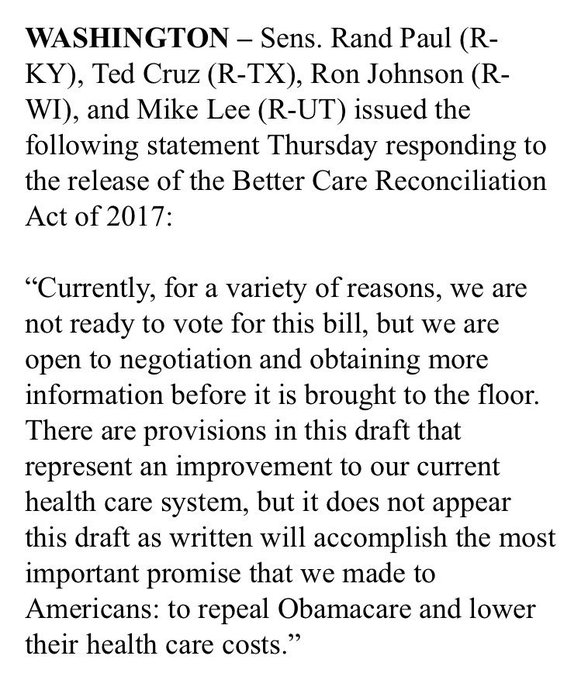
Statement from. Rand Paul, Ted Cruz, Mike Lee, Ron Johnson (!) opposing health care bill as it currently stands

* * *
end
And now Obama lashes out at the GOP healthcare plan:
(courtesy zero hedge)
Obama Lashes Out At GOP Healthcare Plan: “This Bill Will Do You Harm”
Laying the groundwork of Leftist talking points for the next few days, former President Barack Obama took to his Facebook page to defend Obamacare against the GOP’s Healthcare Plan… [emphasis added]
Our politics are divided. They have been for a long time. And while I know that division makes it difficult to listen to Americans with whom we disagree, that’s what we need to do today.
I recognize that repealing and replacing the Affordable Care Act has become a core tenet of the Republican Party. Still, I hope that our Senators, many of whom I know well, step back and measure what’s really at stake, and consider that the rationale for action, on health care or any other issue, must be something more than simply undoing something that Democrats did.
We didn’t fight for the Affordable Care Act for more than a year in the public square for any personal or political gain – we fought for it because we knew it would save lives, prevent financial misery, and ultimately set this country we love on a better, healthier course.
Nor did we fight for it alone. Thousands upon thousands of Americans, including Republicans, threw themselves into that collective effort, not for political reasons, but for intensely personal ones – a sick child, a parent lost to cancer, the memory of medical bills that threatened to derail their dreams.
And you made a difference. For the first time, more than ninety percent of Americans know the security of health insurance. Health care costs, while still rising, have been rising at the slowest pace in fifty years. Women can’t be charged more for their insurance, young adults can stay on their parents’ plan until they turn 26, contraceptive care and preventive care are now free. Paying more, or being denied insurance altogether due to a preexisting condition – we made that a thing of the past.
We did these things together. So many of you made that change possible.
At the same time, I was careful to say again and again that while the Affordable Care Act represented a significant step forward for America, it was not perfect, nor could it be the end of our efforts – and that if Republicans could put together a plan that is demonstrably better than the improvements we made to our health care system, that covers as many people at less cost, I would gladly and publicly support it.
That remains true. So I still hope that there are enough Republicans in Congress who remember that public service is not about sport or notching a political win, that there’s a reason we all chose to serve in the first place, and that hopefully, it’s to make people’s lives better, not worse.
But right now, after eight years, the legislation rushed through the House and the Senate without public hearings or debate would do the opposite. It would raise costs, reduce coverage, roll back protections, and ruin Medicaid as we know it. That’s not my opinion, but rather the conclusion of all objective analyses, from the nonpartisan Congressional Budget Office, which found that 23 million Americans would lose insurance, to America’s doctors, nurses, and hospitals on the front lines of our health care system.
The Senate bill, unveiled today, is not a health care bill. It’s a massive transfer of wealth from middle-class and poor families to the richest people in America. It hands enormous tax cuts to the rich and to the drug and insurance industries, paid for by cutting health care for everybody else. Those with private insurance will experience higher premiums and higher deductibles, with lower tax credits to help working families cover the costs, even as their plans might no longer cover pregnancy, mental health care, or expensive prescriptions. Discrimination based on pre-existing conditions could become the norm again. Millions of families will lose coverage entirely.
Simply put, if there’s a chance you might get sick, get old, or start a family – this bill will do you harm. And small tweaks over the course of the next couple weeks, under the guise of making these bills easier to stomach, cannot change the fundamental meanness at the core of this legislation.
I hope our Senators ask themselves – what will happen to the Americans grappling with opioid addiction who suddenly lose their coverage? What will happen to pregnant mothers, children with disabilities, poor adults and seniors who need long-term care once they can no longer count on Medicaid? What will happen if you have a medical emergency when insurance companies are once again allowed to exclude the benefits you need, send you unlimited bills, or set unaffordable deductibles? What impossible choices will working parents be forced to make if their child’s cancer treatment costs them more than their life savings?
To put the American people through that pain – while giving billionaires and corporations a massive tax cut in return – that’s tough to fathom. But it’s what’s at stake right now. So it remains my fervent hope that we step back and try to deliver on what the American people need.
That might take some time and compromise between Democrats and Republicans. But I believe that’s what people want to see. I believe it would demonstrate the kind of leadership that appeals to Americans across party lines. And I believe that it’s possible – if you are willing to make a difference again. If you’re willing to call your members of Congress. If you are willing to visit their offices. If you are willing to speak out, let them and the country know, in very real terms, what this means for you and your family.
After all, this debate has always been about something bigger than politics. It’s about the character of our country – who we are, and who we aspire to be. And that’s always worth fighting for.
Yeah, but apart from that…
We are still somewhat bemused at why the Trump’s administration didn’t just let this disaster fail totally and utterly before saving it, especially as NBC proclaims today – in a poll – that Americans now love Obamacare more than ever (must be the collapsing coverage and spiking premiums).

end
Another retailer in trouble: Bed Bath and Beyond..
(courtesy zero hedge)
Bed, Bloodbath, & Beyond
Bed, Bath, & Beyond collapsed in after-hours trading to below $30 per share – the lowest since July 2009 – as yet another retailer hits the wall.
- Bed Bath & Beyond 1Q comparable sales -2.0%, est. +0.3% (Consensus Metrix, average of 18)
- 1Q EPS 53c, est. 66c (range 59c to 74c)
- 1Q net sales $2.74b, est. $2.79b (range $2.75b to $2.84b)
Management said it experienced “softness in transactions in stores,” as well as higher net-direct-to-customer shipping expense, coupon expense and advertising costs.
And the share price dropped 13% after hours before a modest bounce…

To the lowest levels since July 2009…

Peers like Pier 1 Imports (-13%) and Williams-Sonoma (-2.5%) were also hit.
We will see you FRIDAY night
Harvey.


[…] JUNE 22/GOLD AND SILVER UP TODAY DESPITE THE ANTICS OF THE BANKS/CHINA’S SHADOW BANKING SECTOR… […]
LikeLike