
GOLD: $1219.70 DOWN $20.80
Silver: $16.10 DOWN 47 cent(s)
Closing access prices:
Gold $1220.35
silver: $16.17
SHANGHAI GOLD FIX: FIRST FIX 10 15 PM EST (2:15 SHANGHAI LOCAL TIME)
SECOND FIX: 2:15 AM EST (6:15 SHANGHAI LOCAL TIME)
SHANGHAI FIRST GOLD FIX: $1247.27 DOLLARS PER OZ
NY PRICE OF GOLD AT EXACT SAME TIME: $1238.25
PREMIUM FIRST FIX: $9.02
xxxxxxxxxxxxxxxxxxxxxxxxxxxxxxxxxxxxxxxxxxxxxx
SECOND SHANGHAI GOLD FIX: $1244.88
NY GOLD PRICE AT THE EXACT SAME TIME: $1235.85
Premium of Shanghai 2nd fix/NY:$9.03
xxxxxxxxxxxxxxxxxxxxxxxxxxxxxxxxxxxxxxxxxxxxxxxxxxx
LONDON FIRST GOLD FIX: 5:30 am est $1235.20
NY PRICING AT THE EXACT SAME TIME: $1235.80
LONDON SECOND GOLD FIX 10 AM: $1229.25
NY PRICING AT THE EXACT SAME TIME. $1227.90
For comex gold:
JULY/
NOTICES FILINGS TODAY FOR APRIL CONTRACT MONTH: 8 NOTICE(S) FOR 800 OZ.
TOTAL NOTICES SO FAR: 38 FOR 3800 OZ (.1181 TONNES)
For silver:
JULY
326 NOTICES FILED TODAY FOR
1,630,000 OZ/
Total number of notices filed so far this month: 1204 for 6,020,000 oz
XXXXXXXXXXXXXXXXXXXXXXXXXXXXXX
end
Let us have a look at the data for today
xxxxxxxxxxxxxxxxxxxxxxxxxxxxxxxxxxxxxxxxxxxxxxxxxxxxxxxxxxxxxxxxxxxxxxxxxx
In silver, the total open interest SURPRISINGLY ROSE BY 171 contract(s) UP to 201,056 DESPITE THE FALL IN PRICE OF SILVER THAT TOOK PLACE WITH FRIDAY’S TRADING (DOWN 2 CENT(S). AND THE CONSTANT TORMENT THESE PAST FEW WEEKS.
In ounces, the OI is still represented by just OVER 1 BILLION oz i.e. 1.0050 BILLION TO BE EXACT or 144% of annual global silver production (ex Russia & ex China).
FOR THE NEW FRONT MAY MONTH/ THEY FILED: 326 NOTICE(S) FOR 1,630,000 OZ OF SILVER
In gold, the total comex gold SURPRISINGLY ROSE BY 7873 CONTRACTS DESPITE THE FALL IN THE PRICE OF GOLD ($3.50 with FRIDAY’S TRADING). The total gold OI stands at 460,557 contracts.
we had 30 notice(s) filed upon for 3000 oz of gold.
xxxxxxxxxxxxxxxxxxxxxxxxxxxxxxxxxxxxxxxxxxxxxxxxxxxxxxxxxxx
With respect to our two criminal funds, the GLD and the SLV:
GLD:
We had A HUGE change in tonnes of gold at the GLD: A MASSIVE WITHDRAWAL OF 7.37 TONNES WHICH MOST LIKELY WAS USED IN THE RAID.
Inventory rests tonight: 853.66 tonnes
.
SLV
Today: STRANGE: IN THE HUGE WHACK IN SILVER WE GOT AN ADDITION OF: 357,000 oz in silver inventory at the SLV:
THE SLV Inventory rests at: 339.605 million oz
Please note the difference between gold and silver
end
.
First, here is an outline of what will be discussed tonight:
1. Today, we had the open interest in silver ROSE BY 171 contracts UP TO 201,056 (AND now A LITTLE CLOSER FROM THE NEW COMEX RECORD SET ON FRIDAY/APRIL 21/2017 AT 234,787), WITH THE FALL IN PRICE FOR SILVER WITH FRIDAY’S TRADING (DOWN 2 CENTS).We LOST NOBODY AS EVERYBODY ELSE remains firm and determined. WE MUST WAIT TO SEE TOMORROW’S READING WITH THE DAMAGE TO OI WITH TODAY’S RAID ON GOLD/SILVER
(report Harvey)
.
2.a) The Shanghai and London gold fix report
(Harvey)
2 b) Gold/silver trading overnight Europe, Goldcore
(Mark O’Byrne/zerohedge
and in NY: Bloomberg
3. ASIAN AFFAIRS
i)Late SUNDAY night/MONDAY morning: Shanghai closed UP 3.48 POINTS OR 0.11% / /Hang Sang CLOSED UP 19.59 POINTS OR 0.08% The Nikkei closed UP 22.37 POINTS OR 0.11%/Australia’s all ordinaires CLOSED DOWN 0.63%/Chinese yuan (ONSHORE) closed DOWN at 6.7951/Oil UP to 46.13 dollars per barrel for WTI and 48.88 for Brent. Stocks in Europe OPENED ALL IN THE GREEN,, Offshore yuan trades 6.7949 yuan to the dollar vs 6.7951 for onshore yuan. NOW THE OFFSHORE IS A TOUCH WEAKER TO THE ONSHORE YUAN/ ONSHORE YUAN WEAKER (TO THE DOLLAR) AND THE OFFSHORE YUAN IS LESS WEAKER TO THE DOLLAR AND THIS IS COUPLED WITH THE STRONGER DOLLAR. CHINA IS NOT VERY HAPPY TODAY
3a)THAILAND/SOUTH KOREA/NORTH KOREA
NORTH KOREA
Trump’s call to China (and also Japan) to discuss the North Korean problem ended in a warning from Beijing instead. China it seems refuses to deal with more sanctions against North Korea but it focusing on the Taiwan problem and the uSA incursion into the South China Seas.
( zero hedge)
b) REPORT ON JAPAN
The LDP party of are in charge of Japan under Abe, suffers a huge loss in local elections in Toyko. This is generally a harbinger of what the voting willl be like when general elections come to the upper house in late 2017. The lower house faces an election in 2018
( zerohedge)
c) REPORT ON CHINA
i)Kyle Bass warns that there has been a huge shift to the negative in USA China relations. The sale of 1.4 billion dollars to Taiwan was not helpful. Trump also claims that China is not doing enough to stop the testing of missiles in North Korea.
( zerohedge)
ii)A great reason to send gold lower this morning: China sends warships and fighter jets to intercept the USA destroyer in the South China Seas:
( zero hedge)
4. EUROPEAN AFFAIRS
GREECE/TURKEY
this may escalate to big things: The Greek coast guard fires 16 bullets into the hull of a Turkish freighter
( zero hedge)
5. RUSSIAN AND MIDDLE EASTERN AFFAIRS
i)SAUDI ARABIA/QATAR
ii)Even though no headway has been recorded in the dispute with Saudi Arabia and other Gulf states against Qatar, surprisingly the Saudi’s granted a 2 day extension in the ultimatum and also strangely the Saudi King will skip the G20 meeting later this week
( zero hedge)
iii)SYRIA/USA/RUSSIA
Tillerson admits defeat. Syria’s fate and that of Assad will be decided upon by Russia
(courtesy zerohedge)
6 .GLOBAL ISSUES
A good economy that explores Canada and what it’s citizens are facing. Already Canada has the highest debt to GDP of all nations and an extremely high debt/disposable income of around 170%. This means that it will take 21 months of debt payments only and nothing else to eliminate that debt. You can imagine what a rate increase will do on the debt..it is obvious that spending in other areas must contract and that is why Canada is in such a precarious state.
( Secular Investor)
7. OIL ISSUES
8. EMERGING MARKET
9. PHYSICAL MARKETS
i)The stockpiling of gold and silver coins in the uSA is the lowest since 2008 as investors would rather put their money into stocks (equities)
( Nicholson/Reuters)
ii)This seems to work in India: the firm PAYTM has a platform where investors can take digital gold and turn it into real gold:
( Bhargave/Hindu, India/)
iii)Finally we will get to see how many bars of silver is stored at the LBMA facilities. It will be between 12,600 tonnes (405 million oz )up to 20,000 tonnes or 643 million oz)
( Ronan Manly/Bullionstar)
iv)Important figures on USA gold exports. In the first 4 months of the year they exported 173 tonnes of gold. They produce only 77 tonnes. The USA imports 88 tonnes of gold. So 88 tonnes + 77 tonnes = 165 tonnes. They must have used 8 tonnes of central bank gold to supply the east.
a must read..
(courtesy SRSRocco report/Steve St Angelo)
10. USA Stories
i)Saturday morning
All three states outlined to you on Friday have failed to come up with a fiscal budget for 2018. Illinois does not have a budget from 2015 and things went from horrific to catastrophic on a court ruling. Illinois by August may run out of money to pay essentials
( zero hedge)
ii)Saturday morning
and now add a fourth state to not deliver a budget: New Jersey, the second worst rated state in the union: New Jersey. Chaos runs supreme over a Horizon health bill that Christie wants included in the budget but the Speaker Prieto will not consider it. This caused a stalemate and in voting on the current proposed 34.7 billion budget, causing abstentions in the voting as well as Democrats fighting Democrats. In order words, New Jersey is in a mess but not like no 1 rated Illinois.
( zero hedge)
iib)More stuff on the New Jersey shutdown. It seems that Horizon, the health care provider has a huge surplus on its books and Christie wants legislation that the insurance company provide 300 million to the state. This is the first time that a Democrat protected a company which is usually reserved for Republicans
( zerohedge)
iii)Sunday afternoon: ILLINOIS
The taxoholics seems to have won suggest to a vote:
they are raising taxes on just about everything (see below) with no reforms on pensions nor schools etc..The vote is set for Sunday. Then citizens will revolt! A mass exodus will happen as citizens will leave the state for other favourable states
( Mish Shedlock/Mishtalk)
iv)Sunday night/Monday morning Illinois
v)The phony jobs report comes out on Friday and it will be another excuse for the crooks to raid:
here are the key reports leading up to the jobs report.
( zero hedge)
vii)More soft data garbage: see for yourself:
( zero hedge)
Let us head over to the comex:
The total gold comex open interest SURPRISINGLY ROSE BY 7,873 CONTRACTS UP to an OI level of 460,557 DESPITE THE FALL IN THE PRICE OF GOLD ($3.50 with FRIDAY’S trading). An open interest of around 390,000 to 400,000 is core and nothing will move these guys from their contracts.
We are now in the contract month of JULY and it is one of the POORER delivery months of the year. .
The non active July contract LOST 42 contracts to stand at 104 contracts. We had 30 notices filed on Friday morning, so we lost 12 contracts that will not stand in this non active month of July. However 12 EFP notices were given which gives the long holder a fiat bonus plus a futures contract for delivery and most likely these are London based forwards. The contracts are private so we do not get to see all the particulars. The next big active month is August and here the OI LOST 1172 contracts DOWN to 293,137, as the bankers trying to keep this month down to manageable size. The next non active contract month is September and here they picked up its first 80 contracts. The next active delivery month is October and here we lost 349 contracts down to 15,903. October is the poorest of the active gold delivery months as most players move right to December.
We had 30 notice(s) filed upon today for 3000 oz
We are now in the next big active month will be July and here the OI LOST 899 contracts DOWN to 1,524. We had 878 notices served on Friday so we only lost a paltry 21 notices or 105,000 oz will not stand at the comex, but the longs received 21 EFP contracts which entitle them to receive a fiat bonus and a future delivery contract which no doubt is a London based forward.
The month of August, a non active month lost 5 contracts to stand at 427. The next big active delivery month for silver will be September and here the OI already jumped by another 896 contracts up to 153,117.
The line in the sand is $18.50 for silver and again it has been defended by the criminal bankers. Once this level is pierced, the monstrous billion oz of silver shorts will blow up. The bankers are defending the Alamo with their last stand at the $18.50 mark. THE NEW RECORD HIGH IN OPEN INTEREST WAS SET FRIDAY APRIL 21/2017 AT: 234,787.
As for the July contracts:
Initial amount that stood for silver for the July 2016 contract: 14.785 million oz
Final standing JULY 2016: 12.370 million with the difference being EFP’s taking delivery in London. Thus we are basically on par to what happened a year ago as to the total amount of silver ounces standing.
We had 826 notice(s) filed for 1,630,000 oz for the June 2017 contract
VOLUMES: for the gold comex
Today the estimated volume was 296,913 contracts which is excellent/no wonder the raid/
Yesterday’s confirmed volume was 256,130 contracts which is very GOOD
volumes on gold are STILL HIGHER THAN NORMAL!
| Gold | Ounces |
| Withdrawals from Dealers Inventory in oz | nil |
| Withdrawals from Customer Inventory in oz |
NIL
OZ
|
| Deposits to the Dealer Inventory in oz | NIL oz |
| Deposits to the Customer Inventory, in oz |
NIL oz
|
| No of oz served (contracts) today |
8 notice(s)
800 OZ
|
| No of oz to be served (notices) |
96 contracts
9600 oz
|
| Total monthly oz gold served (contracts) so far this month |
38 notices
3,800 oz
.1181 tonnes
|
| Total accumulative withdrawals of gold from the Dealers inventory this month | NIL oz |
| Total accumulative withdrawal of gold from the Customer inventory this month | NIL oz |
Today, 0 notice(s) were issued from JPMorgan dealer account and 12 notices were issued from their client or customer account. The total of all issuance by all participants equates to 8 contract(s) of which 0 notices were stopped (received) by j.P. Morgan dealer and 0 notice(s) was (were) stopped/ Received) by j.P.Morgan customer account.
| Silver | Ounces |
| Withdrawals from Dealers Inventory | nil |
| Withdrawals from Customer Inventory |
70,990.210 oz
BRINKS
DELAWARE
|
| Deposits to the Dealer Inventory |
nil oz
|
| Deposits to the Customer Inventory |
nil oz
|
| No of oz served today (contracts) |
326 CONTRACT(S)
(1,630,000 OZ)
|
| No of oz to be served (notices) |
1198 contracts
( 5,990,000 oz)
|
| Total monthly oz silver served (contracts) | 1204 contracts (6,020,000 oz) |
| Total accumulative withdrawal of silver from the Dealers inventory this month | NIL oz |
| Total accumulative withdrawal of silver from the Customer inventory this month | 178,970.1 oz |
NPV for Sprott and Central Fund of Canada
Sprott’s hostile 3.1 billion bid to take over Central Fund of Canada
(courtesy Sprott/GATA)
Sprott makes hostile $3.1 billion bid for Central Fund of Canada
Submitted by cpowell on Thu, 2017-03-09 01:19. Section: Daily Dispatches
From the Canadian Press
via Canadian Broadcasting Corp. News, Toronto
Wednesday, March 8, 2017
http://www.cbc.ca/news/canada/calgary/sprott-takeover-bid-central-fund-c…
Toronto-based Sprott Inc. said Wednesday it’s making an all-share hostile takeover bid worth $3.1 billion US for rival bullion holder Central Fund of Canada Ltd.
The money-management firm has filed an application with the Court of Queen’s Bench of Alberta seeking to allow shareholders of Calgary-based Central Fund to swap their shares for ones in a newly-formed trust that would be substantially similar to Sprott’s existing precious metal holding entities.
The company is going through the courts after its efforts to strike a friendly deal were rebuffed by the Spicer family that controls Central Fund, said Sprott spokesman Glen Williams.
“They weren’t interested in having those discussions,” Williams said.
Sprott is using the courts to try to give holders of the 252 million non-voting class A shares a say in takeover bids, which Central Fund explicitly states they have no right to participate in. That voting right is reserved for the 40,000 common shares outstanding, which the family of J.C. Stefan Spicer, chairman and CEO of Central Fund, control.
If successful through the courts, Sprott would then need the support of two-thirds of shareholder votes to close the takeover deal, but there’s no guarantee they will make it that far.
“It is unusual to go this route,” said Williams. “There’s no specific precedent where this has worked.”
Sprott did have success last year in taking over Central GoldTrust, a similar fund that was controlled by the Spicer family, after securing support from more than 96 percent of shareholder votes cast.
The firm says Central Fund’s shares are trading at a discount to net asset value and a takeover by Sprott could unlock US$304 million in shareholder value.
Central Fund did not have any immediate comment on the unsolicited offer. Williams said Sprott had not yet heard from Central Fund on the proposal but that some shareholders had already contacted them to voice their support.
Sprott’s existing precious metal holding companies are designed to allow investors to own gold and other metals without having to worry about taking care of the physical bullion.
end
And now the Gold inventory at the GLD
July 3/ A MASSIVE 7.37 TONNES OF GOLD LEAVE THE GLD/INVENTORY RESTS AT 846.29 TONNES
June 30/no change in gold inventory at the GLD/Inventory rests at 853.66 tonnes
June 29/no change in inventory at the GLD/inventory rests at 853.66 tonnes
June 28/no change in inventory at the GLD/Inventory rests at 853.66 tonnes
June 27.2017/a deposit of 2.64 tonnes into the GLD/inventory rests at 853.66 tonnes
June 26/a withdrawal of 2.66 tonnes from the GLD and this gold no doubt was part of the raid/Inventory rests at 851.02
June 23/no change in gold inventory at the GLD/Inventory rests at 853.68 tonnes
June 22/no change in gold inventory at the GLD/Inventory rests at 853.68 tonnes
June 21/no change in gold inventory at the GLD/Inventory rests at 853.68 tonnes
June 20/no change in gold inventory at the GLD//Inventory rests at 853.68 tonnes
June 19/NO CHANGE IN GOLD INVENTORY AT THE GLD/INVENTORY RESTS AT 853.68 TONNES
June 16/no changes in gold inventory at the GLD/Inventory rests at 853.68 tonnes
June 15/ a monstrous “paper” withdrawal of 13.32 tonnes/Inventory rests at 853.68 tonnes
June 14./NO CHANGE IN GOLD INVENTORY AT THE GLD/INVENTORY RESTS AT 867.00 TONNES
June 13. No change in gold inventory at the GLD/Inventory rests at 867.00 tonnes
June 12/No change in gold inventory at the GLD/Inventory rests at 867.00 tonnes
June 9/no change in inventory at the GLD/Inventory rests at 867.00 tonnes
June 8/AN ADDITION OF 3.07 TONNES OF GOLD ADDED TO THE GLD/INVENTORY RESTS AT 867.00 TONNES
June 7 a huge change in inventory/a deposit of 13.93 tonnes/inventory rests at 864.93 tonnes
June 6/ no changes in inventory at the GLD/Inventory remains at 851.00 tonnes
June 5.2017/no changes at the GLD/Inventory remain at 851.00 tonnes
June 2/2017/a huge deposit of 3.55 tonnes of gold into the GLD/Inventory rests at 851.00 tonnes
June 1/NO CHANGE IN GOLD INVENTORY AT THE GLD/INVENTORY RESTS AT 847.45 TONNES
May 31./ no change in gold inventory at the GLD/Inventory rests at 847.45 tonnes
May 30/no change in gold inventory at the GLD/Inventory rests at 847.45 tonnes
May 26./no change in inventory at the GLD/Inventory rests at 847.45 tonnes
May 25./no change in inventory at the GLD/Inventory rests at 847.45 tonnes
May 24/no change in inventory at the GLD/inventory rests at 847.45 tonnes
May 23/a paper withdrawal of 5.03 tonnes of gold from the GLD/Inventory rests at 847.45 tonnes
May 22/A DEPOSIT OF 1.77 TONNES IN GOLD INVENTORY AT THE GLD/INVENTORY RESTS AT 852.48 TONNES
May 19/NO CHANGE IN GOLD INVENTORY AT THE GLD/INVENTORY RESTS AT 850.71 TONNES
May 18/a withdrawal of 1.18 tonnes of gold from the GLD/Inventory rests at 850.71
May 17/no change in the GLD inventory/inventory rests at 851.89 tonnes
end
Now the SLV Inventory
July 3/strange! with the huge whacking of silver we got an increase of 379,000 oz into inventory.
June 30/no change in silver inventory at the SLV/Inventory rests at 339.226 million oz
June 29/no change in silver inventory at the SLV/Inventory rests at 339.226 million oz/
June 28/ a small withdrawal of 662,000 oz form the SLV/Inventory rests at 339.226 million oz/
June 27/no change in the silver inventory at the SLV/Inventory rests at 339.888 million oz/
June 26/no change in the silver inventory at the SLV/Inventory rests at 339.888 million oz/
June 23/no change in silver inventory at the SLV/Inventory rests at 339.888 million oz
June 22/ a big change; a huge deposit of 2.175 million oz into the SLV/Inventory rests at 339.888 million oz
June 21/no change in silver inventory at the SLV/inventory rests at 337.713 million oz
June 20/a deposit of 1.513 million oz/inventory rests at 337.713 million oz/.
June 19/NO CHANGE IN SILVER INVENTORY AT THE SLV/INVENTORY RESTS AT 336.200 MILLION OZ
June 16/no changes in inventory at the SLV/inventory rests at 336.200 million oz
June 15/ a massive “paper withdrawal” of 3.405 million oz of silver/Inventory rests at 336.200 million oz/
June 14/NO CHANGE IN SILVER INVENTORY AT THE SLV/INVENTORY RESTS AT 339.605 MILLION OZ/
June 13/no change in silver inventory at the SLV/Inventory rests at 339.605 million oz
June 12/no change in silver inventory at the SLV/Inventory rests at 339.605 million oz/
June 9/no change in silver inventory at the SLV/Inventory rests at 339.605 million oz/
June 8/NO CHANGE IN SILVER INVENTORY AT THE SLV/INVENTORY RESTS AT 339.605 MILLION OZ/
June 7/no change in inventory at the SLV/inventory rests at 339.605 million oz/
June 6/no change in inventory at the SLV/Inventory rests at 339.605 million oz.
June 5/a huge change at the SLV/a withdrawal of 1.371 million oz /inventory rests at 339.605 million oz/
June 2/no change in silver inventory at the SLV/Inventory rests at 340.976 million oz/
June 1/NO CHANGE IN INVENTORY AT THE SLV/INVENTORY RESTS AT 340.976 MILLION OZ
May 31./ no change in silver inventory at the SLV/inventory rests at 340.976 million oz/
May 30/no change in silver inventory at the SLV/inventory rests at 340.976 million oz
May 26/another paper withdrawal of 946,000 oz of silver from the SLV with silver rising/inventory rests at 340.976 million oz
May 25/no change in silver inventory at the SLV/Inventory rests at 341.922 million oz
May 24./a “paper” withdrawal of 1.893 million oz from the SLV/inventory rests tonight at 341.922 million oz
May 23/no change in silver inventory at the SLV/inventory rests at 343.815 million oz
May 19/no change in silver inventory at the SLV/Inventory rests at 343.815 million oz.
may 18/2017/another big deposit of 1.42 million oz added to the SLV/inventory rests at 343.815 million oz.
may 17/no change in silver inventory at the SLV/Inventory rests at 342.395 million oz/
-
 Indicative gold forward offer rate for a 6 month duration+ 1.16%
 -
+ 1.43%

end
Major gold/silver trading/commentaries for MONDAY
GOLDCORE/BLOG/MARK O’BYRNE.
GOLD/SILVER
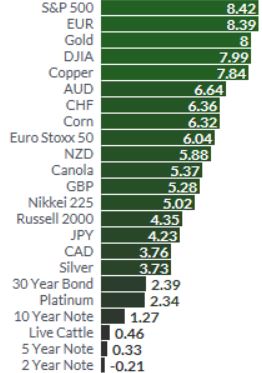
Gold Up 8% In First Half 2017; Builds On 8.5% Gain In 2016
– Gold up 8% in first half 2017; builds on 8.5% gain in 2016
– U.S. dollar down 6.5% – worst quarter in seven years
– Gold higher in all currencies except Draghi’s euro
– Gold outperforms bonds; similar gains as stock indices
– S&P 500 and Dax outperform gold marginally
– World stocks (MSCI World) up 10%; gold outperforms Eurostoxx (+6%) & FTSE (+2.3%)
– Silver up 3.7% in first half ; builds on 15% gain in 2016
– Stocks, bonds, property buoyed by stimulus
– Resilience in gold as world struggles to hold confidence
– “If one hasn’t diversified this would be a good time to do that” – Shiller
Editor: Mark O’Byrne
Finviz.com
From President Trump taking office, Fed policy tightening to European and UK elections, Brexit rumblings and growing Middle Easternrisks, the first half of 2017 gave witness to a few trends which look set to impact markets in the coming months.
Gold and silver are amongst the best performing assets in 2017, with gains of 8% and 4% respectively and stayed resilient despite poor sentiment.
Demand drivers such as geopolitical uncertainty, a weak dollar and low interest rates continue to provide support for the precious metals as does renewed robust demand in the Middle East, India and China.

Given 2016 finished with a sell-off in the precious metals, both gold and silver have remained impressively resilient in the face of overwhelmingly bearish sentiment in much of the media and with the retail investing public in the U.S. and most of the western world.
Gold rose in value in all currencies except the euro in which it fell 1.2%.
This is compared to say the likes of crude oil which has been under pressure of late and experienced a 20% correction. Not even the world’s two top oil producers agreeing in May to prolong their ongoing output cut from the first half of 2017 to the end of the first quarter of 2018 has been enough to prop up the price.
For silver fans, the last few weeks have been disappointing as silver has dropped 4.9%, while gold has dropped only 1.9%. Silver often mimics gold but of late industrial traits in the metal have affected its price more than usual.
We may have seen a turnaround this week however as silver has traded near a two-week highs as a stumbling dollar provided a boost to both precious metals.
Trump’s arrival in January set off quite a Trump rally in the first quarter of the year however this was not able to be maintained. Multiple distractions have meant that Trump’s policy agenda has been thrown off course and delayed.
The Trump rally in the first quarter appears to be stalling badly as false promises come to fruition and he struggles to execute policies in the face of powerful vested interests in corporate America and on Wall Street.
The world is changing rapidly posing risks to any sort of conventional economic recovery.
As a McKinsey study highlighted this week, ‘Even if we rebuild factories here and you build plants here, they’re just not going to employ thousands of people — that just doesn’t happen,” said report co-author and McKinsey Global Institute Director James Manyika. “Find a factory anywhere in the world built in the last 5 years — not many people work there.”
Robert Shiller, Nobel Laureate economist, told CNBC this week that investors should be cautious about investing in US stocks in such ‘an unusual market.’ The CAPE index he devised thirty years ago is at ‘unusual highs’ which is concerning. The Yale professor advised,
‘One should have a little of everything if one hasn’t diversified this would be a good time to do that.’
Trump delays and scandal has weakened the US currency and benefited gold. Despite this record-high equity prices and bond prices with higher U.S. bond yields appear to have kept a lid on gold and silver prices which would normally have seen greater gains in an environment of such uncertainty.
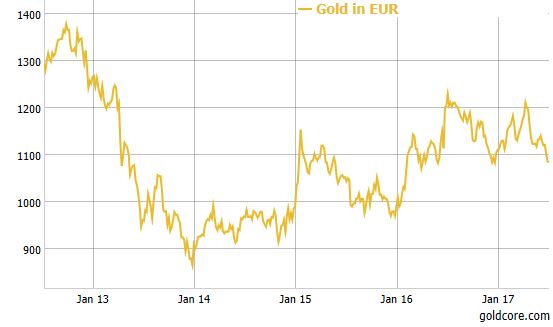
Speaking of currencies, strength in the euro has meant investors are currently paying the least for gold than they have in earlier months as the currency climbs amid speculation that the ECB plans to reduce monetary stimulus.
Gold priced in euros is currently down more than 10% from its 2017 peak in April. However, further euro gains against the US dollar would likely support the sentiment surrounding gold and could lead to gold breaking out in dollar terms above the key $1,300/oz level.
 Gold in Euros (5 Years)
Positivity around the euro is unlikely to last as fears regarding contagion in the eurozone begin to resurface.
The government of Italy’s bailout of two Italian banks of a sum equal to the country’s defence budget will be enough to remind markets that a couple of positive election results is not enough to support the eurozone which is just balancing on a precipice of unsustainable debt levels.
Eurozone banks in Spain, Portugal, Greece and Ireland remain vulnerable.
Central banks elsewhere continue to affect sentiment around precious metals and sometimes in an unexpected fashion. Federal Reserve rate policy was expected to weaken gold, however rate hikes prior to June prompted gold to climb as opposed to tumble, as one might expect. Across markets interest rates remain historically low and government bond yields are low to negative.
Worries over this situation are exacerbated further as disparities between how central banks move forward are becoming clear. For example the U.S. Federal Reserve is starting to raise interest rates but some major central banks continue to keep rates low and print more money.
As a result, gold and silver both remain far more attractive stores of value.
Brexit has and will continue to provide support for both metals. Gold has outperformed sterling this year (+2%) as the currency continues to suffer thanks to uncertainty regarding the divorce talks between the sovereign country and the European economic union.
The country’s assumed fail safe London property market is rapidly coming undone as 75% of houses sell for below asking price.
Goldman Sachs explained this week that the bank is bullish on the yellow due to ‘global growth momentum likely having peaked’ and gold therefore representing a ‘good hedge for equity.’
More importantly it pointed towards peak gold mine supply in 2017 as a reason for gold to head above it’s commodity team year-end target of $1,250.
Supply of gold will continue to be anaemic while demand remains robust as the likes of China, India and Russia buy up physical gold. Yuan weakening and a slowing property market has helped to drive demand in China, while India saw its gold imports rise fourfold in May compared to last year.
Considering Robert Shiller’s comments, the reasons for diversification continue to grow every day, mainly due to fear trades and poor economic management. Where should we start?
Worsening relations in the Middle East, worries over North Korea’s nuclear program and therefore US-China relations, Brexit uncertainty, the gaping difference between central banks’ monetary policies, lack of progress in US congress and finally the looming threat of inflation following on from years of QE around the world.
Whilst gold and silver may not have performed to the same extent they did in the first-half of 2016, we can be assured as they have held themselves well despite a bearish environment in terms of U.S. and western sentiment. There seems little cause for the precious metals to be pushed lower in the medium to long-term.
The primary cause of the global financial crisis was insolvent banks and massive debt in all segments of society. This has yet to be addressed in any sustainable manner.
Arguably, the financial position of banks and even more so western sovereign nations is in a far worse place than in 2008 whilst political instability is very real and poses very real risks to markets and risk assets.
Gold and silver’s continuing gains reflect both the massive global financial bubble and increasing geopolitical dangers.
Investment and savings diversification is now more important than ever.
News and Commentary
Gold steady ahead of U.S. Independence day holiday (Reuters.com)
Asia Stocks Mixed While Oil Gains for Eighth Day (Bloomberg.com)
Industrials Push Rebound in U.S. Stocks; Oil Gains (Bloomberg.com)
U.S. Consumers Sour on Outlook While Happy With Their Finances (Bloomberg.com)
UK household savings ratio plunges to all time low (Nasdaq.com)
 Source: bmgbullion
Blowing bubbles: New world economic order (ABC.net.au)
The Coming Carmageddon (DailyReckoning.com)
World’s Most Dangerous Man (DailyReckoning.com)
U.S. Gold Exports Surge As Its Gold Trade Deficit Continues (SRSRoccoReport.com)
Bitcoin Nears Bear Market Territory (Fortune.com)
Gold Prices (LBMA AM)
03 Jul: USD 1,235.20, GBP 952.09 & EUR 1,085.00 per ounce
30 Jun: USD 1,243.25, GBP 957.43 & EUR 1,090.83 per ounce
29 Jun: USD 1,246.60, GBP 959.88 & EUR 1,093.14 per ounce
28 Jun: USD 1,251.60, GBP 976.25 & EUR 1,101.91 per ounce
27 Jun: USD 1,250.40, GBP 980.31 & EUR 1,111.36 per ounce
26 Jun: USD 1,240.85, GBP 975.56 & EUR 1,109.32 per ounce
23 Jun: USD 1,256.30, GBP 987.70 & EUR 1,125.27 per ounce
Silver Prices (LBMA)
03 Jul: USD 16.48, GBP 12.72 & EUR 14.49 per ounce
30 Jun: USD 16.47, GBP 12.69 & EUR 14.44 per ounce
29 Jun: USD 16.83, GBP 12.98 & EUR 14.76 per ounce
28 Jun: USD 16.78, GBP 13.08 & EUR 14.78 per ounce
27 Jun: USD 16.66, GBP 13.07 & EUR 14.79 per ounce
26 Jun: USD 16.53, GBP 12.98 & EUR 14.79 per ounce
23 Jun: USD 16.71, GBP 13.12 & EUR 14.97 per ounce
Recent Market Updates
– Pensions Timebomb In America – “National Crisis” Cometh
– London Property Bubble Bursting? UK In Unchartered Territory On Brexit and Election Mess
– Shrinkflation – Real Inflation Much Higher Than Reported
– Goldman, Citi Turn Positive On Gold – Despite “Mysterious” Flash Crash
– Worst Crash In Our Lifetime Coming – Jim Rogers
– Go for Gold – Win a beautiful Gold Sovereign coin
– Only Gold Lasts Forever
– Your Future Wealth Depends on what You Decide to Keep and Invest in Now
– Inflation is no longer in stealth mode
– James Rickards: Gold Will Start Heading Higher On “Dwindling” Supply
– Billionaires Invest In Gold
– Brexit and UK election impact UK housing
– In Gold we Trust: Must See Gold Charts and Research
end
Important figures on USA gold exports. In the first 4 months of the year they exported 173 tonnes of gold. They produce only 77 tonnes. The USA imports 88 tonnes of gold. So 88 tonnes + 77 tonnes = 165 tonnes. They must have used 8 tonnes of central bank gold to supply the east.
a must read..
(courtesy SRSRocco report/Steve St Angelo)
U.S. Gold Exports Surge As Its Gold Trade Deficit Continues
POSTED BY SRSROCCO IN NEWS , PRECIOUS METALS ON JUNE 30, 2017
It’s no secret that the East (Asians and Indians) continue to acquire a lot of gold as Western demand has weakened this year. According to the most recent data released by the USGS – United States Geological Survey, U.S. gold exports surged during the first four months of the 2017 versus the same period last year.
How much? A great deal. In the first four months of 2017, the U.S. exported a stunning 173 metric tons of gold (5.5 million oz) compared to 119 metric tons (3.8 million oz) during the same period last year. Thus, U.S. gold exports Jan-Apr 2017 surged 45% versus last year:

This is quite a large increase. I would imagine part of the increase is due to the fact that U.S. precious metals retail demand is off considerably ever since Trump was elected President. U.S. Gold Eagle sales are down a whopping 62% 1H 2017 versus the same period last year.
For example, the U.S. Mint sold 501,000 oz of Gold Eagles during the first half of 2016, versus 192,000 oz for the first half of 2017. This is a drop of 309,000 oz.
That being said, the drop off in physical gold investment demand in the U.S. has been offset by elevated demand in the East. As I mentioned in a previous article, the U.S. exported 31.4 metric tons to Hong Kong alone in January. Thus, Hong Kong received more than half (57%) of all U.S. gold exports during January this year.
So, what were the top five countries that received the majority of the 173 metric tons of U.S. gold exports?
Top 5 U.S. Gold Exports JAN-APR 2017 (mt =metric tons)
Hong Kong = 66.7 mt (38%)
Switzerland = 48.3 mt (28%)
U.K. = 25.5 mt (15%)
India = 22.9 mt (13%)
U.A.E = 6.1 mt (4%)
Of the 173 mt of U.S. gold exports, these five countries received 169.5 mt, or 98% of the total. Hong Kong and India received 51%, while Switzerland and the U.K received 43% of the total. However, much of the gold that is exported to Switzerland and the U.K. make its way to China, India or other Asian countries. So, it is safe to assume that the majority of U.S. gold exports are eventually making their way to the East.
What is also quite interesting is that the U.S. continues to export more gold than it produces and imports. During Jan-Apr 2017, the U.S. produced 77 mt of gold, while it imported 88 mt, for a total of 165 mt. However, total U.S. gold exports for the first four months of the year equaled 173 mt, or 8 mt more than it produced and imported.
Thus, the U.S. continues to run a GOLD TRADE DEFICIT.
While precious metals investors in the West are frustrated by the low gold price (and the failure to break above $1,300), the East doesn’t seem to mind a bit. The Eastern philosophy for owning gold is to acquire it on price dips for the longer term, while the West tends to become frustrated over the shorter term.
So, I don’t look at the 62% decline in U.S. Gold Eagle sales Jan-Apr versus last year, as a bad thing. Rather, I just brush it off as the West ‘s FICKLE investment nature.
Lastly, I had the pleasure of chatting with Chris Martenson of PeakProsperity.com this week. It was way overdue because Chris is one of the few analysts whose work is quite similar to what we do here at the SRSrocco Report. I will be releasing our interview when it is posted on their site.
https://srsroccoreport.com/u-s-gold-exports-surge-as-its- gold-trade-deficit-continues/
-END
The stockpiling of gold and silver coins in the uSA is the lowest since 2008 as investors would rather put their money into stocks (equities)
(courtesy Nicholson/Reuters)
Few in U.S. want gold and silver coins when stocks seem strong
Submitted by cpowell on Sat, 2017-07-01 13:07. Section: Daily Dispatches
U.S. Mint’s 1st-Half Sales of American Eagle Gold Coins Weakest Since 2007
By Marcy Nicholson
Reuters
Friday, June 30, 2017
U.S. Mint American Eagle gold coin sales in the first half of 2017 were the lowest for this period in a decade, while sales of silver in the period were the weakest since 2008, government data showed on Friday. …
“U.S. investors seem to be interested in equities since every day seems like a bull market,” said Terry Hanlon, president of Dillon Gage Metals. “The news is positive for stocks and mostly negative for metals. Therefore, money is not going into the purchase of U.S. Mint American Eagles.” …
… For the remainder of the report:
http://www.reuters.com/article/us-usmint-coins-idUSKBN19L2RT
END
This seems to work in India: the firm PAYTM has a platform where investors can take digital gold and turn it into real gold:
(courtesy Bhargave/Hindu, India/)
Digital-payments firm Paytm joins jewellers in India to promote gold
Submitted by cpowell on Sun, 2017-07-02 20:48. Section: Daily Dispatches
Paytm Goes Gaga over Gold
By Yuthika Bhargave
The Hindu, Chennai, India
Saturday, July 2, 2017
http://www.thehindu.com/business/Industry/paytm-goes-gaga-over-gold/arti…
Paytm, which has sold more than 100 kilograms of gold on its platform, is in discussions with jewellers across the country to enable buyers to redeem their digital gold in the form of jewellery.
In April this year the digital-payments firm had partnered with MMTC-PAMP to allow consumers to purchase 24-karat 999.9-purity gold on its platform and store it in MMTC-PAMP’s secure vaults free of charge. Customers, who could invest one rupee onwards, currently can either sell the gold back online or can get accumulated gold of more than 1 gram delivered to their homes
“The response has exceeded our expectations. We are in the process of enabling customers to convert this gold into jewellery of their choice at their favourite outlets across India,” said Krishna Hegde, senior vice president of Paytm.He added that this would help Paytm reach out to a “wider set of customers” while also benefiting jeweller partners.
“Paytm customers will be able to find jewellers near them where they can convert Digital Gold into jewellery instantly by paying a making charge,” he added.
He said users had been buying gold in a variety of denominations right from 1 rupee to a few lakhs of rupees.
“Some are buying gold worth 11 rupees every day while there are some who are buying 1 gram every week,” he added.
He added that the company is seeing 150 percent month-on-month growth in terms of number of transactions for gold on the platform.
“People in the 25-35 age group are our core buyers for gold, but increasingly we are seeing 50+ users embrace the product,” Hedge said, adding that Goa, Karnataka, Himachal Pradesh, Tamil Nadu, Punjab, Haryana, West Bengal, Gujarat, and Chhattisgarh have emerged as the top markets for the product.
On the partnership with jewellers, Rajesh Khosla, managing director at MMTC-PAMP, said once the consumer wants to convert gold holding into jewellery, the gold is transferred from the customer’s account to the jeweller’s account providing complete flexibility in its redemption.
* * *
end
Finally we will get to see how many bars of silver is stored at the LBMA facilities. It will be between 12,600 tonnes (405 million oz )up to 20,000 tonnes or 643 million oz)
(courtesy Ronan Manly/Bullionstar)
Ronan Manly: How many silver bars are in the LBMA vaults in London?
Submitted by cpowell on Mon, 2017-07-03 11:10. Section: Daily Dispatches
7:14a ET Monday, July 3, 2017
Dear Friend of GATA and Gold:
Monetary metals researcher Ronan Manly reports today that the London Bullion Market Association is expected to announce soon just how much silver is held in its members’ vaults in London, which presumably will bring some transparency to an exceedingly opaque market, in which claims to the metal greatly surpass the amount of metal supporting them. Manly’s analysis is headlined “How Many Silver Bars Are in the LBMA Vaults in London?” and it’s posted at Bullion Star here:
https://www.bullionstar.com/blogs/ronan-manly/much-silver-held-lbma-vaul…
CHRIS POWELL, Secretary/Treasurer
Gold Anti-Trust Action Committee Inc.
CPowell@GATA.org
Your early MONDAY morning currency, Asian stock market results, important USA/Asian currency crosses, gold/silver pricing overnight along with the price of oil Major stories overnight
1 Chinese yuan vs USA dollar/yuan WEAKER 6.7807(DEVALUATION SOUTHBOUND /OFFSHORE YUAN MOVES WEAKER TO ONSHORE AT 6.7949/ Shanghai bourse CLOSED UP 3.48 POINTS OR 0.11% / HANG SANG CLOSED UP 19.59 POINTS OR 0.08%
2. Nikkei closed UP 22.37 POINTS OR 0.11% /USA: YEN RISES TO 113.02
3. Europe stocks OPENED ALL IN THE GREEN ( /USA dollar index RISES TO 96.12/Euro DOWN to 1.1369
3b Japan 10 year bond yield: REMAINS AT +.086%/ !!!!(Japan buying 100% of bond issuance)/Japanese yen vs usa cross now at 110.06/ THIS IS TROUBLESOME AS BANK OF JAPAN IS RUNNING OUT OF BONDS TO BUY./JAPAN 10 YR YIELD FINALLY IN THE POSITIVE/BANK OF JAPAN LOSING CONTROL OF THEIR YIELD CURVE AS THEY PURCHASE ALL BONDS TO GET TO ZERO RATE!!
3c Nikkei now JUST BELOW 17,000
3d USA/Yen rate now well below the important 120 barrier this morning
3e WTI:: 46.13 and Brent: 48.88
3f Gold DOWN/Yen DOWN
3g Japan is to buy the equivalent of 108 billion uSA dollars worth of bond per month or $1.3 trillion. Japan’s GDP equals 5 trillion usa./“HELICOPTER MONEY” OFF THE TABLE FOR NOW /REVERSE OPERATION TWIST ON THE BONDS: PURCHASE OF LONG BONDS AND SELLING THE SHORT END
Japan to buy 100% of all new Japanese debt and by 2018 they will have 25% of all Japanese debt. Fifty percent of Japanese budget financed with debt.
3h Oil UP for WTI and UP for Brent this morning
3i European bond buying continues to push yields lower on all fronts in the EMU. German 10yr bund RISES TO +.450%/Italian 10 yr bond yield DOWN to 2.12%
3j Greek 10 year bond yield FALLS to : 5.41???
3k Gold at $1233.80 silver at:16.47 (8:15 am est) SILVER BELOW RESISTANCE AT $18.50
3l USA vs Russian rouble; (Russian rouble DOWN 37/100 in roubles/dollar) 59.24-
3m oil into the 46 dollar handle for WTI and 48 handle for Brent/
3n Higher foreign deposits out of China sees huge risk of outflows and a currency depreciation (already upon us). This can spell financial disaster for the rest of the world/China forced to do QE!! as it lowers its yuan value to the dollar/GOT A SMALL SIZED DEVALUATION SOUTHBOUND
JAPAN ON JAN 29.2016 INITIATES NIRP. THIS MORNING THEY SIGNAL THEY MAY END NIRP. TODAY THE USA/YEN TRADES TO 113.02 DESTROYING JAPANESE CITIZENS WITH HIGHER FOOD INFLATION
30 SNB (Swiss National Bank) still intervening again in the markets driving down the SF. It is not working: USA/SF this morning 0.9624 as the Swiss Franc is still rising against most currencies. Euro vs SF is 1.0942 well above the floor set by the Swiss Finance Minister. Thomas Jordan, chief of the Swiss National Bank continues to purchase euros trying to lower value of the Swiss Franc.
3p BRITAIN VOTES AFFIRMATIVE BREXIT/LOWER PARLIAMENT APPROVES BREXIT COMMENCEMENT/ARTICLE 50 COMMENCES MARCH 29/2017
3r the 10 Year German bund now POSITIVE territory with the 10 year RISING to +0.450%
The bank withdrawals were causing massive hardship to the Greek bank. the Greek referendum voted overwhelming “NO”. Next step for Greece will be the recapitalization of the banks and that will be difficult.
4. USA 10 year treasury bond at 2.314% early this morning. Thirty year rate at 2.8477% /POLICY ERROR)GETTING DANGEROUSLY HIGH
5. Details Ransquawk, Bloomberg, Deutsche bank/Jim Reid.
(courtesy Jim Reid/Bloomberg/Deutsche bank/zero hedge)
S&P Futures, Euro Shares Start 2nd Half Solidly In The Green; Oil Rises For 8th Day
S&P500 futures have started the second half solidly in the green, up 0.3% to 2,429, tracking European markets broadly in the green, while Asian stocks fell slightly and crude oil is little changed. With US markets set to close at 1pm today trading volumes in many markets remain light before Tuesday’s July 4th holiday and as investors await Friday’s report on the American jobs market. Traders will be looking at key upcoming economic data for validation of the hawkish shift from central banks that roiled markets last week.
The Asian session opened with the Yen initially strengthens following Prime Minister Abe’s shocking election loss in the Tokyo Assembly elections, but later reversing gains to trade materially weaker at 112.95 last, on speculation Abe will be forced to inject more stimulus to salvage his standing amid a muted reaction to strongest Tankan survey since 2014. Australian 10-year yield rise four basis points; T-note yield two basis points firmer at 2.32%; shares in Tokyo and Sydney steady in narrow ranges. MSCI’s broadest index of Asia-Pacific shares outside Japan held steady, staying within a stone’s throw of a two-year peak hit last week. Japan’s Nikkei ticked up 0.1 percent, helped by the solid Tankan report.
In China, the PBOC drained liquidity for ninth day, pulling a net 70 billion yuan; Hong Kong’s Hang Seng and the Shanghai Composite climbed 0.1 percent amid concerns the world’s second-biggest economy could be slowing down. In Hong Kong financial shares benefited from the launch on Monday of the “Bond Connect” scheme linking China’s $9 trillion bond market with overseas investors. Industrial metals rose across the board after the Chinese Caixin Mfg PMI rebounded back into expansion territory, rising to 50.4 in June from 49.6 in May, and beating estimates. Dalian iron ore 2.3% higher: the benchmark iron ore contract climbed on Friday for its best one-week gain since November and is up almost 22% from its $53.36 June 13 low, which by definition places it in a bull market. China’s bond connect program with Hong Kong will give offshore investors another way to access the mainland’s $10 trillion debt market.
European stocks started the new quarter with solid gains, rising for the first time in five days as oil and metal gains spurred energy companies and miners. Bank stocks rallied, supported by an FT report of a secret Brexit plan for financial services, sending the Stoxx Europe 600 Index solidly in the green, up 0.7% to 382.03, after suffering its biggest monthly loss in a year in June on worries over tightening monetary conditions. France’s CAC 40 index rose 0.8 percent, Spain’s IBEX 0.9 percent and Italy’s FTSE MIB 1 percent. Britain’s main FTSE 100 index added 0.3 percent.
European economic data showed a modest retreat with most final Eurozone PMIs backing off slightly from recent flash reading (except for Germany which printed at 59.6, above the 59.3 exp.). Final Eurozone Manufacturing PMI was at 57.4 in June (Flash: 57.3, May Final: 57.0), with a notable observation that Greece returned to expansion while job creation stayed close to May’s survey record.

While the final PMIs disappointed modestly from the preliminary prints, this is how Eurozone’s various mfg sentiment surveys close the month of June:
- Austria, 60.7: 76-month high
- Germany, 59.6: 74-month high
- Netherlands, 58.6: 74-month high
- Ireland, 56.0: 23-month high
- Italy, 55.2: 2-month high
- France, 54.8: 2-month high
- Spain, 54.7: 2-month low
- Greece, 50.5: 37-month high
Meanwhile, unemployment in Italy rose to 11.3% in May, higher than the expectation of an unchanged 11.2% April print.

Crude was modestly in the green, climbing for an eighth day running, the longest winning streak this year extending gains after Baker Hughes data on Friday showed the number of active U.S. rigs falling for the first time in 24 weeks. WTI has climbed 8% in the past 8 days. Hedge fund wagers on lower prices in the week through June 27 increased at a slower pace than the two previous weeks, according to data from the Commodity Futures Trading Commission, suggesting the bearish sentiment may be about to turn. Prices surged last week while WTI and Brent still posted a monthly loss in June on concerns over rising global supply; Libyan production has climbed to more than 1m b/d for 1st time in 4 years.
“Given the recent upward momentum, it wouldn’t be surprising to see oil fairly close to some sort of downward correction,” says Ric Spooner, a market analyst at CMC Markets in Sydney. “Libya is probably close to its peak production. Nevertheless, the fact its output reached these levels faster than some had anticipated is a negative for the overall supply situation.”
Elsewhere, wheat jumped to a two-year high on the Chicago Board of Trade as agriculture markets soared on an expanding drought in the U.S. and disappointing data on sowed acreage. Gold slipped 0.5 percent to $1,235.89 an ounce.
The yen fell 0.4 percent to 112.87 per dollar, after erasing an earlier advance of as much as 0.4 percent. The Bloomberg Dollar Spot Index rose 0.3 percent after dropping 1 percent last week and touching the lowest level since October. The euro, which hit 14-month highs against the dollar last week after European Central Bank President Mario Draghi hinted at tweaks to the bank’s bond-buying stimulus program, fell 0.3 percent to $1.1394.
The pound finally fell 0.4% to $1.2973 after an eight-day rally…

… following weaker than expected June PMI data (54.3, vs Exp. 56.3, Last 56.3).

The yield on 10-year Treasuries rose one basis point to 2.31 percent, adding to a 16-basis point surge last week, the steepest since March. U.K. 10-year yields added two basis points to 1.27 percent. While French and German 10-year yields fell one basis point, the hawkish sentiment hardly looks exhausted, with 0.50% on the 10Y Bund looking increasingly likely.

Later today, investors can look forward to ISM data and Wards vehicle sales data later on Monday.
Market Snapshot
- S&P 500 futures up 0.3% to 2,429.00
- STOXX Europe 600 up 0.7% to 382.14
- MXAP down 0.2% to 154.32
- MXAPJ down 0.09% to 504.51
- Nikkei up 0.1% to 20,055.80
- Topix up 0.2% to 1,614.41
- Hang Seng Index up 0.08% to 25,784.17
- Shanghai Composite up 0.1% to 3,195.91
- Sensex up 0.8% to 31,173.55
- Australia S&P/ASX 200 down 0.7% to 5,684.49
- Kospi up 0.1% to 2,394.48
- German 10Y yield fell 0.4 bps to 0.462%
- Euro down 0.3% to 1.1387 per US$
- Italian 10Y yield rose 0.6 bps to 1.865%
- Spanish 10Y yield fell 4.6 bps to 1.493%
- Brent Futures up 0.3% to $48.91/bbl
- Gold spot down 0.5% to $1,236.08
- U.S. Dollar Index up 0.3% to 95.95
Top Overnight News
- ECB’s Mersch says patience needed as upturn in inflation not yet self-sustained, don’t need 2% inflation to adjust policy; Weidmann says council agrees expansive policy needed, will normalize once inflation justifies it
- European June Manufacturing PMIs: Spain 54.7 vs 55.6 est; Italy 55.2 vs 55.3 est; France 54.8 vs 55.0 est; Germany 59.6 vs 59.3 est; U.K. 54.3 vs 56.3 est.
- FT: a City of London delegation will negotiate a secret plan for a free-trade deal on financial services based on the concept of “mutual access” according to people familiar
- U.S. Navy sends a guided- missile destroyer near disputed Triton Island
- China June Caixin manufacturing PMI 50.4 vs 49.6 previously
- Japan PM Abe’s LDP suffers a surprise defeat in Tokyo assembly election
- Abe adviser Nakahara says BOJ needs fresh face as Kuroda out of ideas
- Goldman Said to Review Commodities After Worst Start in a Decade
- Trump’s Rural Broadband Goal Won’t Be Easy. It Will Be Costly
- Qatar to Respond to Saudi-Led Bloc Demands as Trump Works Phones
- Kindred Sells Nursing Unit to BlueMountain-Led JV for $700m
- Autoliv Enters LiDAR Commercialization Deal with Velodyne
- Rakuten, Lifull Team Up With Homeaway on Home Sharing in Japan
- CN Resumes Service Near Chicago After Derailment, Crude Leak
- Delek Drilling Says Tamar Reserve 13% Bigger Than Pvs Estimate
- EU’s Vestager Says Received No U.S. Reaction to Google Fine
- HuntsmanClariant May Sell Units for M&A Cash, FuW Cites Next CEO
- VTG Aktiengesellschaft to Buy CIT’s Nacco Unit for About EUR780m
- Jakks Pacific Files Up to 5.24m- Share Offer for Holder Meisheng
- Facebook Wins Dismissal of Privacy Suit Over Internet Tracking
- Facebook’s Small Print Might Be Antitrust’s Next Big Target
- Tesla CEO Says Model 3 Passes All Regulatory Requirements
Asian markets traded mixed following an indecisive close last Friday on Wall St. where US indices finished their best H1 performance since 2013 in a choppy manner, as energy posted a 7th consecutive gain and tech underperformed. ASX 200 (-0.6%) slipped below 5,700 with utilities and healthcare weighing on the index, while Nikkei 225 (+0.2%) was kept afloat following the mostly better than expected Japanese Tankan data. Shanghai Comp. (Unch.) and Hang Seng (Unch.) failed to benefit from better than expected Caixin Manufacturing PMI data (50.4 vs. Exp. 49.8) and the launch of the bond connect, with participants despondent after the PBoC refrained from liquidity injections for the 7th consecutive session. However, Chinese markets then recovered gradually throughout the session to return flat. Finally, 10yr JGBs were flat alongside an inconclusive risk tone, although mild support was seen after the BoJ’s JPY 880b1n Rinban operation. Chinese Caixin Manufacturing PMI moved back into expansion overnight, rising to 50.4 for June, vs. Exp. 49.8 (Prey. 49.6). The Japanese Tankan Large Manufacturers Index also beat expectations for Q2 rising to 17 vs. Exp. 15 (Prey. 12). Tankan Large Manufacturing Outlook (Q2) Q/Q 15 vs. Exp. 14 (Prey. 11) Tankan All Large CAPEX (Q2) Q/Q 8.00% vs. Exp. 7.40% (Prey. 0.60%)
Top Asian News
- Tarnished Abe Plunged Into Crisis After Tokyo Election Loss
- Xi, Abe Get Phone Calls From Trump as Asian Tensions Rise
- Idemitsu to Sell Shares, Diluting Founding Family’s Stake
- Tata Steel 1Q Sales Volume Jumps 28% to 2.75m Tons
- Toshiba Mulls a Swiss IPO for Landis+Gyr by September
European stocks traded in the green in subdued fashion amid cautious trade as we open the second half of the year. Markets have opened in the green; with global equities trading near record highs on bets of improving growth. All ten sectors trade in the green, as Energy is one of the noticeable out performers as a result of oil continuing to extend on gains, now in the green for the eighth consecutive day — longest winning streak of the year.
The uncertainty out of Japan, following a crushing defeat of Japanese Prime Minister’s Shinzo Abe’s party in the Tokyo elections did not weigh on stock markets, however the flight to safety was clear, as initial buying was seen in safe haven assets. The Asian buying was short lived, as last week’s hawkish tone continued to weigh on treasuries through the afternoon of Asian trade. lOy paper is struggling, despite some reprieve seen in Bunds and Gilts, the selling pressure is evident with Gilts trading near session lows around 124.96.
- Top European News
- BOE Staff Vote in Favor of Strike Action Over Pay, Unite Says
- U.K. Manufacturing Slowdown Raises Doubts About Economic Outlook
- Euro-Area Manufacturing Accelerates as Orders Fuel Optimism
- Nets Rises on Deal Report; Wirecard Leads Payments Peers Higher
- Poland’s Kaczynski Invokes Nazis as EU Refugee Clash Deepens
- EU Presidency Clouded by Feud Threatening Host’s Government
- Thyssenkrupp Rises on HB News; Bankhaus Lampe Expects Tata Deal
Looking at Monday’s economic data, we’re kicking off in Europe with the final revisions to the June manufacturing PMIs along with a first look at the data for the UK and periphery. Also due out this morning is the Euro area unemployment rate for May. Over in the US we’ll also receive the final manufacturing PMI revision along with the manufacturing ISM for June and May construction spending. Later in the day we’ll also get June vehicle sales data.
US Event Calendar
- 9:45am: Markit US Manufacturing PMI, est. 52.1, prior 52.1
- 10am: ISM Manufacturing, est. 55.2, prior 54.9; Prices Paid, est. 58.5, prior 60.5; New Orders, prior 59.5; Employment, prior 53.5
- 10am: Construction Spending MoM, est. 0.25%, prior -1.4%
- Wards Total Vehicle Sales, est. 16.5m, prior 16.6m
- Wards Domestic Vehicle Sales, est. 12.9m, prior 12.8m
DB’s Jim Reid concludes the overnight wrap
As I reflected on H1 over the weekend, the highlight at home was welcoming back my wife and Maisie yesterday from “In the Night Garden” live. For those not in the know this is basically hallucinogenic Teletubbies. My wife bought Maisie a huge replica of star character Upsy Daisy (who she also had a meet and greet with) and from the moment she got given her to the moment she went to bed 8 hours later she refused to let her go. She wouldn’t eat lunch or dinner without her by her side. She wouldn’t walk around in the house or garden without dragging her along (impressive as she’s bigger than her) and wouldn’t let me change her nappy without Upsy helping and she wouldn’t go to bed without her in her cot. It was very sweet but she really wasn’t interested in Daddy all day. Good preparation for the teenage years.
Bond markets went a bit Upsy Daisy last week and it’s hard to imagine that it was only this time last week that we were saying there wasn’t much to get excited about in markets but that there were a couple of events that we should keep an eye on in the week ahead. One of these was the ECB forum in Sintra. Although a big focus, little did we know what that event would unleash in financial markets last week. I suppose one of the big questions is whether the slew of hawkish central bank speak was vaguely co-ordinated or whether there was an element of randomness to it. It felt like the former but these words will be meaningless if the data (growth and inflation) doesn’t come through but last week’s comments probably indicate that the data bar has been lowered for tightening. Rather than looking for a reason to tighten it feels that we’ve entered a period where central banks might be looking for a reason not to.
So we will perhaps become a little more sensitive to data and as we highlight in the week ahead, today is global PMI/ISM day and a big event in the monthly calendar. The US is off for Independence Day tomorrow so trading might be thin this week especially in the early half. By the end of the week we have another payroll number to look forward to after last month’s disappointing 138k print. Before we get there, it’s not been a particularly busy weekend for newsflow but there are a few bits and bobs worth pointing out. The first concerns more chatter out of the ECB. Bundesbank President Jens Weidmann told an audience in Germany that “at the moment we see that the economic situation is rather positive” and that “if this sustainably passes on to inflation rates then monetary policy needs to be more taut, and it’s not about putting full brakes on monetary policy, but to lift one’s foot off the gas a little”. His fellow board member, Yves Mersch, said a day later that recent ECB policy has been successful but it is not yet self-sustained and the ECB needs to continue to have “patience with this policy”. Mersch also indicated that the ECB doesn’t necessarily have to wait for inflation to hit 2% before adjusting policy.
The other significant news to report is out of Japan where PM Abe has suffered a landslide defeat in the Tokyo elections with city governor Yuriko Koike’s new party appearing to be headed for a big victory. Koike’s Tomin First party captured 49 of the 127 assembly seats while Abe’s Liberal Democratic Party won just 23 seats (down from its current 57 seats). That total for Abe is less than the previous record low for his party of 38 seats set in 1995 and 2009. With the support of the Komei Party, the Tomin First will easily secure a comfortable majority in the assembly. The FT is reporting that the result could spur Yurkio Koike to mount a similar challenge against Abe in a national election. Abe has called for an extraordinary meeting within his party this morning while reports are suggesting that the result could force Abe to reshuffle his cabinet and, according to Bloomberg, slow down his push to revise Japan’s pacifist constitution.
While seemingly a surprise, the Yen is little moved post that result although that may in part reflect an overall upbeat Q2 Tankan survey in Japan this morning. The headline manufacturing index for large manufacturers rose 5pts to +17 (vs. +15 expected) while the outlook index rose 4pts to +15 (vs. +14 expected). Nonmanufacturing readings also rose, as did readings for smaller manufacturers. Meanwhile the Nikkei manufacturing PMI in Japan this morning was revised up 0.4pts to 52.4 (versus 53.1 in May). The Nikkei (+0.13%) and Topix (+0.10%) are a shade higher as we go to print. Meanwhile in China this morning the Caixin manufacturing PMI printed back above 50 again at 50.4 (vs. 49.8 expected) which is a rise of 0.8pts from May. Despite that bourses in China are weaker (Shanghai Comp -0.30%) while the Hang Seng is little changed. It’s worth also highlighting this morning that it is the first day of the China-Hong Kong bond connect which mirror the two stock-connect programmes.
Moving on and quickly recapping how markets finished up on Friday. Given the magnitude of the moves for bonds over the week, while weakening a bit more of Friday the moves were relatively subdued all things considered. 10y Bund yields finished 1.4bps higher at 0.465% which means for the week as a whole they were 21.2bps higher. That is the biggest weekly sell-off since December 2015. Gilts were 0.7bps higher on Friday at 1.257% and for the week were 22.6bps higher (weakest since November 2016). OATs were less than 1bp higher on Friday and 20.8bps higher for the week. Meanwhile the periphery finished up to 1.8bps higher on Friday and for the week yields were higher by 11.9bps to 23.9bps. As we know, Treasuries got swept up in the moves too. Yields were another +3.7bps on Friday to close above 2.300% and for the week were 16.1bps higher (most since March 2017). As we’d seen over the week the sell-off for bonds continued to weigh on equity markets in Europe with the Stoxx 600 (-0.34%) ending lower for the fourth consecutive day. For the week the index was down -2.13% which is the fourth down week in succession and the weakest since November last year. It was however a slightly better story across the pond where the S&P 500 edged up +0.15% on Friday to trim its weekly loss to a more modest -0.61%. Further gains across the commodity complex and particularly late in the day for Oil (WTI +2.47% and back above $46/bbl) certainly seemed to help.
Friday’s moves for bonds in Europe could probably be put down to the flash June inflation report for the Euro area. As indicated by some of the regional reports, inflation was a little firmer than expected with headline CPI of +1.3% yoy beating estimates for +1.2% (although down from +1.4%) and core CPI of +1.1% yoy beating the consensus estimate for +1.0%. That core reading marked an increase of two-tenths from May.
Meanwhile in the US the core PCE deflator for June was confirmed as rising +0.1% mom as expected which puts the annual rate at +1.4% yoy and down one-tenth from May. Elsewhere personal spending nudged up +0.1% mom which matched the consensus although real personal spending (+0.1% mom vs. +0.2% expected) was a modest disappointment. Personal income was up a relatively robust +0.4% mom in May and a tenth more than expected. Away from that the Chicago PMI for June rose to a surprisingly high 65.7 (vs. 58.0 expected) which marked a jump of 6.3pts. That was in fact the higher level since May 2014 which is likely to be a supportive read through for today’s manufacturing data. The other data out on Friday across the pond was the final revision to the June University of Michigan consumer sentiment reading (revised up 0.6pts to 95.1). 1-year ahead inflation expectations were left unchanged at 2.6% however 5-10 year expectations were revised down one-tenth to 2.5%. It’s worth noting that the Atlanta Fed revised down their Q2 GDP forecast by two-tenths to 2.7% on Friday.
On to the week ahead now. Today we’re kicking off in Europe with the final revisions to the June manufacturing PMIs along with a first look at the data for the UK and periphery. Also due out this morning is the Euro area unemployment rate for May. Over in the US this afternoon we’ll also receive the final manufacturing PMI revision along with the manufacturing ISM for June and May construction spending. Later this evening we’ll also get June vehicle sales data. Tuesday looks to be quiet with Independence Day in the US. The main attraction is likely the RBA meeting overnight while the only data due out is Euro area PPI. Wednesday looks to be much busier. Overnight in Asia we’ll receive the remaining Caixin PMIs in China and Nikkei PMIs in Japan. In Europe we’ll also get the remaining services and composite PMI revisions as well as retail sales data for the Euro area. In the US on Wednesday data due out includes factory orders for May and the final durable and capital goods orders revisions for May. The FOMC minutes from the June meeting will then be out in the evening. Turning to Thursday, factory orders in Germany is the only release of note in Europe while in the US we’ll get the June ADP print, initial jobless claims, May trade balance, ISM non-manufacturing for June and the final PMI revisions (services and composite). We close out the week in Europe on Friday with industrial production in Germany and trade data and industrial production in France and the UK. In the US on Friday it’s all about the June employment report including nonfarm payrolls.
Away from the data, the Fedspeak this week consists of Bullard this morning, Powell on Thursday and Fischer on Friday. The ECB’s Praet and Nowotny speak tomorrow and Weidmann and Nowotny speak on Thursday on the future of the euro. The ECB minutes are also due out on Thursday. Other events to note this week are China President Xi Jinping’s visit to Moscow on Tuesday where he is due to meet Putin. Germany’s Merkel and China’s Xi meet ahead of the G20 summit on Wednesday and the summit itself is on Friday and Saturday. The Fed will also publish its 2017 monetary policy report to Congress on Friday ahead of Yellen’s testimony on July 12th.
end
FX Week Ahead Preview: All Eyes On Payrolls Friday
FX Week Ahead, courtesy of Rajan Dhall from fxdaily.co.uk
Despite the NY market holiday over Independence day in the US, we have a number of notable data releases leading up to the main event next week in the May employment report (Friday).
In a half day session on Monday we get the ISM manufacturing index and alongside the new orders component, the employment index should carry some weight due to the strong correlation with headline jobs growth of late. The non mannufacturing ISM is not until Thursday, ahead of which is the ADP private jobs survey which somewhat wrong-footed the market last month. The lead non farm payrolls number at the end of the week is expected to show a 180k rise after the disappointing 138k print for April, but the Fed are also keen to see a pick up in wage growth again with average hour earnings expected to improve slightly at rate of +0.3%.
In the mix, Wednesday’s FOMC minutes are unlikely to alter sentiment on the USD, as scepticism over the Fed rate path espoused by Fed chair Yellen and colleagues such as the NY Fed’s Dudley have been at odds with the economic feedback. Recent weakness has been seen to be transitory and there have been certain elements in the latest stats for enouragement. The Q1 GDP figure was revised a little higher to 1.4% last week despite core PCE still slipping, but personal income growth for May also exceeded expectations.
Until we get improvement in the hard data, the USD will remain on the back foot, but going against the drop in the ($) index has been a resilient USD/JPY rate. That said, we hit a wall of resistance at 113.00 las week, but 113.40-50 is the area we are watching here. Calls for levels north of 115.00 have been pretty quiet of late, and this in spite of moderate acceleration in Japanese divestment flow. Europe has been a key beneficiary with notable economic momentum building up and a relative underperformance in the EU bourses offering value against Wall Street. EUR/JPY is destined for 130.00 or higher as a result, while elsewhere we see GBP/JPY with an eye on 150.00 and CAD/JPY having outpaced its commodity counterparts.

From the Japanese perspective, the BoJ continues to plug away with their stimulus program as domestic inflation remains frustratingly sluggish, as are improvements in broader activity and growth. The Tankan survey has lost its influence under the present circumstances, but we get the latest activity reports on Sunday night.
The Canada day holiday on Monday may tame some of the CAD gains, which have now taken out 1.3000 vs the greenback, and below here we watch the 1.2950-20 zone which will has been pressured by the ongoing reversal in the record short positioning seen recently. It took a change in BoC rhetoric to prompt the more aggressive moves to the downside here, responding to the healthy growth and employment data in the last 6 months, but we would not be surprised to see a near term correction as the RSIs (4hr and daily) delve into oversold territory. Manufacturing PMI’s due out when Canada returns on Tuesday, and trade on Thursday but Canadian jobs Friday are the main event.

Onto Europe, and the concern over the strong EUR gains are clearly starting to unnerve the ECB, ever wary of sparking a full-on taper tantrum. In the latest EUR/USD run higher, we have seen the 1.1300 level removed, and it was not long before we were testing the next area of note up at 1.1440-50. We are likely to see continued tests higher, especially as USD bears need little encouragement, but we are also seeing traders taking up any slack in the other notable EUR pairs, with the CHF rate now into the mid 1.0900’s where 1.1000 higher up has been particularly strong.

It is unlikely that the pan European PMI data will materially impact on the aggressive positioning for an eventual QE taper later this year, but if EUR/USD rushes up to 1.1500-1.1600 in the week (or two) ahead, we expect to see a more sizeable pullback. Many anticipated a deeper pullback through 1.1100 a little over a week ago. The ECB minutes will likely serve as a reminder of the turn in sentiment, with presdident Draghi’s comments this week on ‘reflationary pressures’ still ringing in the ears.
EUR/GBP also shows signs that it is ‘waiting in the wings’ for the next push up. UK rate hike jitters were set off on Haldane’s shift in sentiment and were compounded by gov Carney later in the week sending Cable on another jaunt through 1.3000. As a result, we may have to weather some further downside in to the low 0.8700’s, if not 0.8650 or so. If GBP is indeed gaining on the hawkish developments at the MPC, then we expect the initial target in Cable will be 1.3200-1.3300, with the higher end representing levels seen just ahead of the pre-emptive rate cut last August post Brexit.
There is also an element of a more conciliatary mood over the EU talks ahead with PM May’s weakened hand (of her own making) suggesting to some that she may have little option other than to adopt a softer line. We maintain that in the lengthy period of talks ahead, there is far too much uncertainty to base a bullish call on GBP at this stage, but our perceived 1.2400-1.3000 range may have to be widened – in both directions!
All three PMI releases in the UK are released in the first half of the week, but there is little need to emphasise the services component due out on Wednesday. Trade stats and industrial production also on the schedule later on.

Back to Asia, and also at the very start of the week, we get the release of Caixin manufacturing PMIs, and this comes after last week’s official figures showing modest improvement (from 51.2 to 51.7). This fuelled a little more of the recovery in Iron ore prices after some heavy losses of late, while the broader risk tone also benefited.
As we mentioned above, cross/JPY is on an upward trajectory but in some cases we are moving into overbought territory. Carried along with the buoyant outlook on the NZ economy, NZD/JPY is now moving ever closer to the highs seen at the start of the year. We ended last week near the weekly top a little shy of 82.50, coinciding with ongoing congestion in the key 0.7330-50 area in NZD/USD. There is little next week to derail positive sentiment on NZ other than the Fonterra dairy auctions on Tuesday, but prices will have to deviate significantly from futures pricing to impact on NZD. Fluctuations have been much tighter this year.

AUD/NZD has also reflected the mood in NZ, such that we have tested key support levels below 1.0400. The weekly series of higher lows now show 1.0350-70 as major area, but as noted, metals prices have recovered well and this has revived the AUD upturn. AUD/USD breached 0.7700 last week in line with Copper tipping USD2.70, but we look to the RBA meeting ahead, where we expect another balanced outlook to preserve their neutral stance near term. The prospects for AUD remain to the upside, as recent central bank rhetoric has been relatively upbeat, and this can only have been enhanced by the commodities backdrop. 0.7750-0.7850 is a major target area, but just as we expect with NZD near 0.7500, higher levels may push both the RBA and RBNZ to try and rein in some of this strength with some well chosen words. Nb, RBNZ were pretty relaxed in their recent views on the currency, and we expect it will be a similar line from the RBA. Through the week, we also have the AIG PMIs – manufacturing on Monday – with trade data later in the week.

Manufacturing PMIs in Sweden and Norway are also due out next with both indices firmly above thre expansionary 50.0 – Sweden now close to 60.0. Focus will be on the Riksbank, where the market feels the central bank is delaying a move on its ultra loose policy stance. However, the ECB are set to rein in purchases and neutralise rates, pre-emptive SEK buying shows the market is positioning for a potential change in tack. In contrast, the Norges bank have highlighted the improvement in the economy, notably higher capacity utilisation, but maintain rates are not likely to move (up) until 2019. The NOK/SEK cross rate has been hit down towards parity as a result, though has held up on initial attempts.
3. ASIAN AFFAIRS
i)Late SUNDAY night/MONDAY morning: Shanghai closed UP 3.48 POINTS OR 0.11% / /Hang Sang CLOSED UP 19.59 POINTS OR 0.08% The Nikkei closed UP 22.37 POINTS OR 0.11%/Australia’s all ordinaires CLOSED DOWN 0.63%/Chinese yuan (ONSHORE) closed DOWN at 6.7951/Oil UP to 46.13 dollars per barrel for WTI and 48.88 for Brent. Stocks in Europe OPENED ALL IN THE GREEN,, Offshore yuan trades 6.7949 yuan to the dollar vs 6.7951 for onshore yuan. NOW THE OFFSHORE IS A TOUCH WEAKER TO THE ONSHORE YUAN/ ONSHORE YUAN WEAKER (TO THE DOLLAR) AND THE OFFSHORE YUAN IS LESS WEAKER TO THE DOLLAR AND THIS IS COUPLED WITH THE STRONGER DOLLAR. CHINA IS NOT VERY HAPPY TODAY
3a)THAILAND/SOUTH KOREA/NORTH KOREA
NORTH KOREA
Trump’s call to China (and also Japan) to discuss the North Korean problem ended in a warning from Beijing instead. China it seems refuses to deal with more sanctions against North Korea but it focusing on the Taiwan problem and the uSA incursion into the South China Seas.
(courtesy zero hedge)
Trump Calls China, Japan Leaders To Discuss North Korea, Gets A Warning From Beijing Instead
Ahead of this week’s G-20 summit in Hamburg, Germany, Donald Trump called the leaders of China and Japan to discuss the “threat posed by North Korea’, along with trade issues, the White House said on Sunday. Trump spoke with Chinese President Xi Jinping and Japanese Prime Minister Shinzo Abe, whose LDP had just suffered a devastating loss in the Tokyo Assembly elections, and according to the White House read out, “both leaders reaffirmed their commitment to a denuclearized Korean Peninsula” adding that “President Trump reiterated his determination to seek more balanced trade relations with America’s trading partners.”
The terse statement did not provide further details of the call or say if Trump managed to persuade Xi to endorse his approach of exerting maximum pressure on North Korea, including a slew of further economic and trade sanctions.
According to Reuters, the call may have been prompted by Trump increasing frustration with China’s inability to rein in North Korea, and the reference to trade was an indication the president may be ready to return to his tougher-talking ways on business with Beijing after holding back in hopes it would put more pressure on Pyongyang. Trump and Xi discussed the “peace and stability of the Korean peninsula”, China’s Foreign Ministry said, without elaborating.
Ministry spokesman Geng Shuang later told a daily briefing that the United States was “very clear” about China’s position on North Korea. Geng did not elaborate on what Xi told Trump about North Korea.
And while Trump may have been pushing for another PR push to demonstrate that he is on top of the N. Korea situation, what he got in return was a clear debuke from President Xi Jinping, who urged Trump to abide by Washington’s decades-old “one-China” policy during the phone call “as tensions between the two countries resurfaced over Taiwan, disputes in the South China Sea and how to handle North Korea’s nuclear weapons programme”SCMP reported.
Confirming that US-Sino relations have deteriorated substantially in recent weeks, Xi issued an implied warning to the US president, saying US-China relations have been affected by “negative factors” since the two men met for the first time at the Mar-a-Lago summit in Florida in April, the state broadcaster China Central Television reported.
“We attach great importance to the US government’s reaffirmation of the one-China policy and hope the US side will properly handle the Taiwan problem by adhering to the one-China principle and the three communiqués between the two sides,” Xi was quoted as saying. The call came after the Trump administration agreed a US$1.4 billion arms sales package with Taiwan, which China slammed over the weekend.
In the past week, diplomatic realtions between China and the US have chilled substantially, after Beijing lodged protests following Washington’s announcement of the Trump administration’s first arms sales to Taiwan. China has also protested against the blacklisting of a small Chinese bank accused of illicit dealings with North Korea.
Beijing was further infuriated last week with a bill approved by the US Senate Armed Services Committee that would allow regular stops by American naval vessels to Taiwan’s ports. Tensions have also been raised between the two countries over China’s assertive claims to islands in the South China Sea.
Adding to Beijing’s anger, on Sunday, the USS Stethem, a guided-missile destroyer, sailed within 12 nautical miles of Triton Island, part of the Paracel Islands in the South China Sea, to which China responded by dispatching military vessels and fighter jets to intercept the US warship. Analysts quotedb y SCMP said Beijing may in future have to deal with a more confrontational approach from the Trump administration, which appears to be using Taiwan as leverage against Beijing.

The Arleigh Burke-class guided-missile destroyer USS Stethem
The former Taiwanese deputy defence minister Lin Chong-pin said US moves signalled Trump was likely to shift his China policy towards a harder approach. “Apparently, Trump still wants to step up pressure on Beijing in exchange for China’s support on North Korea. But given Trump’s track record of being unconventional and unpredictable, it remains to be seen how far he will go to get tough on China,” he said.
Robert Daly, the director of the Kissinger Institute on China at the Wilson Centre in the US, said Washington’s recent critique of China’s human rights record, its imposition of secondary sanctions on China, the arms sales to Taiwan and pending tariffs on Chinese steel exports to the US may represent a hardening of Trump’s views on China.
“They are a return to normalcy for American China policy. This hardening is in keeping with China’s long-term expectations for the relationship, but it disappoints China’s unrealistic short-term hopes for managing the Trump administration,” he said. “Of course, the Trump administration’s return to the mean in China relations could be as short-lived as its experiments with scrapping the one-China policy and cosying up to Xi Jinping. The relationship remains dangerously unstable.”
Separately, Trump talked to Japanese Prime Minister Shinzo Abe by phone as well as Xi. The call was focused on the threat posed by North Korea’s accelerated nuclear weapons programme, the White House said.
“They reaffirmed that the United States-Japan Alliance stands ready to defend and respond to any threat or action taken by North Korea,” the White House statement said. After the call, Japan’s Chief Cabinet Secretary Yoshihide Suga told a news conference the two countries and South Korea will have a trilateral summit at the G20 meeting, but he didn’t want to speculate on what might be said there.
“It’s important for these three nations to show their strong unity and cooperation both within and without,” Suga said. “Things such as strengthening pressure on North Korea or urging China to fulfill even more of a role. Things like this have been agreed on before as well.
END
b) REPORT ON JAPAN
The LDP party of are in charge of Japan under Abe, suffers a huge loss in local elections in Toyko. This is generally a harbinger of what the voting willl be like when general elections come to the upper house in late 2017. The lower house faces an election in 2018
(courtesy zerohedge)
Abe “Plunges Into Crisis” After LDP Suffers “Historic Defeat” In Tokyo Elections, USDJPY Slides
On Sunday Japanese PM Shinzo Abe’s Liberal Democratic Party suffered what Reuters called a “historic defeat” in the Tokyo assembly election, and “plunged into a crisis” after losing to an upstart outfit in an vote that is seen as a harbinger for Japan’s national elections, and signaling trouble ahead for the premier who has suffered from slumping support after a series of political scandals.
“We must recognize this as an historic defeat,” former defense minister Shigeru Ishiba was quoted by NHK as saying. “Rather than a victory for Tokyo Citizens First, this is a defeat for the LDP,” said Ishiba, who is widely seen as an Abe rival within the ruling party.
“We must accept the results humbly,” said Hakubun Shimomura, a close Abe ally and head of the LDP’s Tokyo chapter. “The voters have handed down an extremely severe verdict.”
According to Bloomberg, the ruling LDP party was projected to win its lowest number of seats ever in the capital, a crushing blow for Abe, which sent the USDJPY sliding after suddenly the very fate of Abenomics is in question, as past Tokyo elections have been bellwethers for national trends. A 2009 Tokyo poll in which the LDP won just 38 seats was followed by its defeat in a general election that year, although this time no lower house poll need be held until late 2018.

Tokyo Governor and head of Tokyo Citizens First party Yuriko Koike
As Reuters adds, the Tokyo Metropolitan assembly election was a referendum on Governor Yuriko Koike’s year in office, but the dismal showing for Abe’s party is also a stinging rebuke of his 4-1/2-year-old administration. Koike’s Tokyo Citizens First party and its allies were on track for between 73 to 85 seats in the 127-seat assembly, according to NHK TV exit polls. Later vote counts showed the LDP was certain to post its worst-ever result, winning at most 37 seats compared with 57 before the election, NHK said, while Koike’s party and allies were assured a majority.
Koike, a media-savvy ex-defense minister and former LDP member, took office a year ago as the first female governor in the capital, defying the local LDP chapter to run and promising to reform governance of a megacity with a population of 13.7 million and an economy bigger than Holland’s.
Among her allies is the Komeito party, the LDP’s national coalition partner.
“I am excited but at the same time, I am also keenly aware of the weight of my responsibility,” Koike told NHK, adding the results had exceeded her expectations.
It was not immediately clear how the LDP’s loss would alter Japan’s political landscape: according to Japanese press, the strong showing by Koike’s party will fuel speculation that she will make a bid for the nation’s top job, though that may not be until after the 2020 Tokyo Olympics. It could also widen cracks between the LDP and the Komeito while damaging prospects for the opposition Democratic Party.
What is more troubling for the Yen and global capital markets, is that Abe’s rivals in his party could be encouraged by the LDP’s dismal performance to challenge him in a leadership race in September 2018, victory in which would set Abe on course to become Japan’s longest-serving leader and bolster his hopes of revising the post-war, pacifist constitution.
Meanwhile, according to Gerry Curtis, professor emeritus at Columbia University, Japan’s political landscape could be set for a shake-up.
“We may discover that Japan is not all that different from Britain, France, and the U.S. in its ability to produce a big political surprise,” he said, referring to recent elections in those countries.
The LDP’s thrashing could also make it harder for Abe to pursue his cherished goal of revising the U.S.-drafted constitution’s pacifist Article 9 by 2020, a politically divisive agenda, said Sophia University professor Koichi Nakano.
“His prime motive to stay in power is his desire to revise the constitution, but once his popularity really starts to fall, that becomes very difficult to do,” Nakano said.
Having been hit by a wave of favoritism scandals in recent months, Abe’s the most recent troubles center on concern he may have intervened to help Kake Gakuen (Kake Educational Institution), whose director, Kotaro Kake, is a friend, win approval for a veterinary school in a special economic zone. As noted here previously, Abe got in trouble because the government has not granted such an approval in decades due to a perceived glut of veterinarians. Abe and his aides have denied doing Kake any favors.
But potentially more devastating – according to Reuters – is “the impression among many voters that Abe and his inner circle have grown arrogant.” Perhaps it is because instructing your central banker to monetize all your GDP in debt, and boost the stock market takes some serious skills?
Meanwhile, the scapegoating process is being prepared: Abe is expected to reshuffle his cabinet in coming months in an effort to repair his damaged ratings, a step often taken by beleaguered leaders but one that can backfired if novice ministers become embroiled in scandals or commit gaffes. Among those many political insiders expect to be replaced is Defense Minister Tomomi Inada. Inada’s remark during the Tokyo campaign seeking voter support in the name of the Self-Defense Forces, as the military is known, came under heavy fire. By law, the military is required to be politically neutral.
In a kneejerk response, the USD/JPY fell as much as 0.4% to 111.90 in early Asia trading Monday in the wake of the shock loss.

The reason why suddenly Japan’s political process may go under the microscope, is that if indeed the LDP and Abe are in trouble, then the future of the BOJ’s QQE (with Yield Control) are in question. This is a problem because as Deutsche Bank reported late on Friday, “[our model] highlights the relative importance of BoJ purchases to Fed and ECB. For a 100 bn in annualized purchases of each, the BoJ has been associated with a 15 bps decline in term premium, almost twice the impact of either the Fed or the ECB. While the market is rightly concerned about the extent and timing of ECB taper, the BoJ is potentially much more important to the rate outlook as it was in the middle of last year.”
But maybe Abe doesn’t even need to be ousted: according to Nobuyuki Nakahara, a former BOJ board member and Abe advisor, Kuroda shouldn’t serve another term as governor of the BOJ “because the central bank will need fresh ideas as it moves toward exiting years of unprecedented monetary easing.”
“An exit will surely come up within the next five years and we need someone who can prepare for it,” said Nobuyuki Nakahara, a former BOJ board member.
“He will fall into inertia and struggle to come up with bold new ideas. It’s the same in the private sector when a corporate president stays too long,” he said.
With everyone expecting a political black swan to emerge out of Europe at the start of the year – only for all concerns to be laid to rest by the summer – could the source of 2017’s true political shock end up being Japan?

Shinzo Abe shouts ‘Banzai!’ with members of the ruling Liberal Democratic Party
during the annual party convention in Tokyo
end
c) REPORT ON CHINA
Kyle Bass warns that there has been a huge shift to the negative in USA China relations. The sale of 1.4 billion dollars to Taiwan was not helpful. Trump also claims that China is not doing enough to stop the testing of missiles in North Korea.
(courtesy zerohedge)
Kyle Bass Warns Of “Tectonic Shift” In US-China Relationship
Hayman Capital’s Kyle Bass ventured on to CNBC this morning to drop some painful truth bombs about Trump’s “drastically changed Chinese diplomacy” and China’s looming “come-uppance.”
Bass began by highlighting what he calls a “tectonic shift” in US-China relations in the last few days, pointing to two crucial events…
1. Things changed drastically when US launched unilateral sanctions on China over North Korea…
“Xi is a control freak and he absolutely doesn’t appreciate the United States acting unilaterally”
2. Things escalated when Trump sold $1.4bn in weapons to Taiwan, angering Beijing more as Bass notes:
“Taiwan was the one area which Beijing has asked Trump to stay away from during his meeting at Mar-a-Lago.”
“Since the death of Otto Warmbier, any chance of meetings with North Korea are now off.. and our diplomatic relationship with China took a major step for the worse yesterday.“
Bass notes that “China is trying to make marginal changes in its balance of trade with US – buying beef once again and importing a lot more crude oil from the US.”
But then Bass shifts to the potentially even more precarious situation under the hood of China’s economy. As Reuters reports, China’s leaders want the restructuring of their massive non-performing loans problem to address financial risks while avoiding big employee lay-offs, and have instigated ‘cure by committee’…
“The solution for zombie firms isn’t just bankruptcy,” a Shandong-based banking official told Reuters. “The impact of bankruptcy is just too big. Just think about the thousands of workers. Social stability is key.”
Stability is always uppermost in the minds of Chinese leaders, and even more so this year, ahead of the five-yearly party congress this autumn, when a new generation of senior leaders will be selected.
“China is avoiding the crisis of calling in loans that can’t be repaid anyway,” said Paul Gillis, professor of accounting at Peking University’s Guanghua School of Management. “This buys time to do things in an orderly way.”
But Bass makes the crucial point that there are over 12,800 credit committees in China right now – overseeing CNY 14.5 trillion ($2.13 trillion) in debt for equity swaps – which is 8% of China’s total non financial debt, and is over 3x the official NPL figure of 1.6%-1.9% of GDP.
His final blow to any hopes that this solution will work…
“This exceeds all the equity in the entire Chinese banking system.”
However, Bass’s final warning of the endgame of this credit bubble is far more ominous, because all of the new-found economic confidence and military confidence is “based upon a massive credit expansion and they’re going to have a comeuppance…”
end
A great reason to send gold lower this morning: China sends warships and fighter jets to intercept the USA destroyer in the South China Seas:
(courtesy zero hedge)
China Sends Warships, Fighter Jets To Intercept US Destroyer In South China Sea
Just days before Trump’s meeting with the Chinese president in Hamburg later this week for the G-20 summit, the Trump administration sent a guided-missile destroyer near Triton Island in the South China Sea, Bloomberg reported, a move “which may cause concern ahead of President Donald Trump’s meeting with his Chinese counterpart.”
According to an anonymous official cited by Bloomberg, the U.S. Navy sent the destroyer USS Stethem within 12 nautical miles (22 kilometers) of Triton Island on Sunday, passing through the contested waters on the basis of “innocent passage.”
The Arleigh Burke-class guided-missile destroyer USS Stethem
It was the second such operation conducted by the US during Donald Trump’s presidency. On May 24, the US Navy guided-missile destroyer, the USS Dewey, came within 12 miles of the Mischief Reef in the Spratly Islands, another disputed archipelago that lies in the southern part of the South China Sea. At that time, the Chinese Defense Ministry also sent two frigates to “warn off” the US vessel and said that it was “firmly opposed to the US behavior of showing force and boosting regional militarization.”
The news of the US ship deployment to the contested area comes just days after reports suggest China has completed construction of new missile shelters on Mischief and Fiery Cross reefs.

The sea patrol move could signal that the U.S. is displeased with China based on the extent of its efforts to pressure North Korea to curb its missile and nuclear programs. The White House has made several moves in recent weeks, including announcing economic sanctions against Chinese companies with ties to North Korea.
And while in recent weeks China has shown remarkable restraint in not responding, or retaliating, to US escalations today Beijing finally reacted instantly and with “outrage” with People’s Daily reporting that China deployed military vessels and warplanes to “warn off” the USS Stethem, according to Chinese Foreign Ministry spokesperson Lu Kang.
“Under the pretext of ‘freedom of navigation,’ the US side once again sent a military vessel into China’s territorial waters off the Xisha Islands without China’s approval,” the spokesperson said in a statement, adding that such US behavior “has violated the Chinese law and relevant international law, infringed upon China’s sovereignty, disrupted peace, security and order of the relevant waters and put in jeopardy the facilities and personnel on the Chinese islands, and thus constitutes a serious political and military provocation.”
“The Chinese side is dissatisfied with and opposed to the relevant behavior of the US side,” Lu added.
Escalating matter further, China’s foreign ministry also accused the US of “deliberatrely stirring up troubles” in the contested waters and warned Washington to “immediately stop such kind of provocative operations that violate China’s sovereignty.”
“Working together, China and ASEAN member states have cooled down and improved the situation in the #SouthChinaSea. The US, who deliberately stirs up troubles in the South China Sea, is running in the opposite direction from countries in the region who aspire for stability, cooperation and development,” Lu added.
“The Chinese side strongly urges the US side to immediately stop such kind of provocative operations that violate China’s sovereignty and threaten China’s security. The Chinese side will continue to take all necessary means to defend national sovereignty and security,” the statement reads.
The head of US Pacific Command, Admiral Harry Harris, recently criticized China’s activity in the region. “China is using its military and economic power to erode the rules-based international order,” he said in a speech delivered on Wednesday in Brisbane during the joint US-Australian military exercises.
“Fake islands should not be believed by real people,” he added, as reported by Fox News.
* * *
The Paracel Islands, of which Triton is a member, are contested by China, Taiwan and Vietnam. China has already built runways, aircraft hangars, radar sites and hardened surface-to-air missile shelters on its artificially-created islands in the region, according to photos analyzed by the Washington-based Center for Strategic and International Studies (CSIS).

Beijing’s actions have sparked concerns in Washington and the US Navy, which is fiercely opposed to this Chinese initiative, has deployed additional warships in the disputed zone, conducted maneuvers near China’s artificial islands, and flown over them, claiming it has been done in the interest of the “freedom of navigation.” In response, China called Washington’s involvement in the dispute the “greatest” threat to the region.
In early June, China and the US both held exercises involving air and navy forces, in another episode of confrontation over the disputed South China Sea. The US sent two B-1B Lancer supersonic bombers to fly a 10-hour mission from Andersen Air Force Base, Guam, which was conducted in conjunction with the US Navy’s Arleigh Burke-class guided-missile destroyer the USS Sterett.
A day earlier, the Chinese People’s Liberation Army (PLA) conducted its own air and navy exercise off Hong Kong. The patrol mission involved three helicopters and two Type 056 corvettes, the Qinzhou and the Huizhou, the Defense Ministry reported
end
4. EUROPEAN AFFAIRS
GREECE/TURKEY
this may escalate to big things: The Greek coast guard fires 16 bullets into the hull of a Turkish freighter
(courtesy zero hedge)
Greek Coast Guard Fires At Turkish Freighter, 16 Bullet Holes Reported
A Turkish-flagged ship has comes under fire off the Greek island of Rhodes, according to Turkey’s Deniz news, citing the ship’s captain, Haluk Sami Kalkavan, who told CNN TURK there were at least 16 bullet holes on board, although no injuries have been reported.
Son dakika… Yunan Sahil Güvenli?i’nden Türk gemisine uyar? ate?i
More details from CNN Turk, google translated:
According to the Deniz News Agency, the Greek Coast Guard boats from Iskenderun to the Gulf of Izmit have armed attack on the Turkish flagged M / V ACT named freighter. It was fired by Greek SSI boats on the island of Rhodes on the Turkish flagged dry dock named M / V ACT, which has a capacity of 4300 DWT carrying capacity towards the Izmit Gulf with the load it has loaded from ?skenderun.
M / V ACT named load cargo going to Izmit Gulf after ?skenderun’s iron steel load, Greek Coast Guard boats in international waters on the outskirts of Rhodes are required to dock to Greek Harbor but the captain can not comply with this directive. he gave. While heading to Turkish territorial waters, the Greek Coast Guard M / V ACT carried out a military attack on the named freighter.
‘There are 16 holes on board’
Sami Kalkavan, the captain of the island told CNN TURK. Kalkavan said, ‘Coast guard wanted immediate withdrawal of the ship from Port of Lodos, we did not accept it. They wanted to check, we did not accept it. They told us they would shoot if we did not stop. They did it. Now there are 16 holes in the ship. There’s no danger of water getting in the ship, but we’ve done a great deal of danger. These were all good things about us, ” he said.

Turkey’s NTV adds that the Turkish Foreign Ministry is “in contact with relevant institutions” over the incident.
While it is unclear yet if this is the start of another major diplomatic incident between the volatile neighbors, NTV also adds that there are now 2 Turkish coast guard vessels off Rhodes following the incident.
5. RUSSIAN AND MIDDLE EASTERN AFFAIRS
SAUDI ARABIA/QATAR
One Day Before The Saudi Ultimatum Expires, A Defiant Qatar Is “Ready To Face The Consequences”
Two days ago, when previewing the showdown in the Qatar “diplomatic quagmire“, we reminded readers that “Qatar only has until July 3 to comply with the 10-day ultimatum of 13 demands imposed by the Saudi-led bloc”, a list which the Saudis described as non-negotiable, with Riyadh’s foreign minister Adel al-Jubeir saying Doha must “amend its behavior” or “remain isolated.”
Fast forward to just one day before the Saudi ultimatum expires, when Qatari Foreign Minister Mohammed Al Thani said his nation is unwilling to concede to any demands that threaten its sovereignty or violate international law. The small but wealthy Gulf emirate said it was prepared “to let pass the deadline for complying with 13 demands set down by the bloc“, including shutting down Al Jazeera and cutting back ties with Iran, Al Thani said in Rome quoted by Bloomberg, where he met the Italian foreign minister.
“There is no fear from our direction. We are ready to face the consequences,” Al Thani said. “There is an international law that should be respected and not violated.”
And while Al Thani repeated that Qatar is willing to sit down and negotiate under the right circumstances, he repeated that the ultimatum issued June 23 was made to be rejected.
As a reminder, nearly a month ago, Saudi Arabia, Bahrain, the U.A.E and Egypt severed commercial, diplomatic and financial links with Qatar saying they were isolating the sheikdom over what they see as its tolerant attitude to Iran and support for Islamist groups, which is ironic since Saudi Arabia is widely acknowledged as the world’s premier supporter of offshore terrorism. The group’s demands also include Qatar severing relations with the Muslim Brotherhood and ending Turkey’s military presence in the country. On June 23, Qatar was given 10 days to respond.
Meanwhile, not mincing his words, Al Thani accused the blockading nations – it’s clear who he was referring to here – of themselves having ties to groups and individuals accused of terrorism.
“As for the countries that accuse Qatar of financing terrorism, they have the same problems as Qatar, more so, they are on top of the list in that area,” he said. “There are financial institutes in these countries involved in financing terrorist organization and financing terrorist operations in western countries.”
The coalition presented Qatar with its requirements to end the standoff after U.S. Secretary of State Rex Tillerson urged the Saudi-led bloc to lay out its demands. In a statement on June 25, Tillerson conceded that Qatar would find it “very difficult” to comply with some of the requests. On June 27, during a visit in Washington, Saudi Foreign Minister Adel al-Jubeir called the demands non-negotiable.
As previewing the outcome of the ultimatum, earlier this week Citi said that unless the demands are met by July 3 “then this situation is likely to get a lot worse before it gets any better.”
Meanwhile, Citi added, there has been a continued lack of reaction from ‘the West’: there is also confusion as to the stance of key historical players in the Middle East, such as the UK and the US, who have either said very little – Trump once called Qatar a “haven for terrorism”, while Rex Tillerson has twice upbraided Saudi Arabia’s approach. Last Friday, a White House spokesman told the Guardian: “The United States is still accessing the list and we are in communication with all parties. As we have said, we want to see the parties resolve this dispute and restore unity among our partners in the region, while ensuring all countries are stopping funding for terrorist groups.”
* * *
And while the US is still trying to decide on whose side it wants to be in the ongoing conflict, Russia wasted no time and as Reuters reported yesterday, Russian President Vladimir Putin had telephone discussions with the leaders of Qatar and Bahrain, stressing the need for diplomacy to end the dispute between Qatar and several other Arab states.
Moscow is trying to tread cautiously in the dispute, since it wants good relations with both Qatar and Saudi Arabia. Russia backs President Bashar al-Assad in the six-year-long Syria conflict and is close to Iran, which has fraught ties with the Saudis.
Moscow sold a stake in its state oil champion Rosneft to Qatar last year and has been coordinating oil output cuts with the Saudis as part of a global pact to lift oil prices.
The Kremlin, which announced the phone calls with the leaders of Qatar and Bahrain in two separate statements on its website on Saturday, did not say when they happened. It clarified that they happened on the initiative of Qatar and Bahrain.
“Vladimir Putin stressed the importance of political-diplomatic efforts aimed at overcoming differences of opinion and the normalization of the difficult situation that exists,” said the statement on the talks between Putin and Qatar’s emir, Sheikh Tamim bin Hamad al-Thani.
And the punchline: “the Russian and Qatari leaders also discussed cooperation between their countries in energy and investment.” In other words, as the Gulf region continues to split itself apart, and the strategic role of the US in the region remains unclear, Russia is more than happy to step in and fill whatever power void has been created. We look forward to Russian hacker being blamed for yet another tactically prudent and rational move by the Kremlin.
end
Even though no headway has been recorded in the dispute with Saudi Arabia and other Gulf states against Qatar, surprisingly the Saudi’s granted a 2 day extension in the ultimatum and also strangely the Saudi King will skip the G20 meeting later this week
(courtesy zero hedge)
Saudi Grants Qatar 2-Day Ultimatum Extension As Saudi King Unexpectedly Skips G-20 Summit
With the original ultimatum issued by four Arab states accusing Qatar of supporting terrorism, expiring at midnight on Sunday, the Saudi-led coalition agreed to extend the deadline for Doha to comply with its list of demands until late on Tuesday a, even as U.S. President Donald Trump voiced concern to both sides about the dispute. According to a joint statement posted on Saudi state news agency SPA, the four countries agreed to a request by Kuwait to extend by 48 hours Sunday’s deadline for compliance. They have not specified what further sanctions they could impose on Doha, but commercial bankers in the region believe that Saudi, Emirati and Bahraini banks might receive official guidance to pull deposits and interbank loans from Qatar.
As Reuters adds, foreign ministers from the four countries will meet in Cairo on Wednesday to discuss Qatar, while Arab media reported that Qatari foreign minister Sheikh Mohammed bin Abdulrahman al-Thani arrived in Kuwait on Monday to deliver Doha’s formal response to the Arab demands. Mediation efforts, including by the U.S., have so far proven fruitless after the four states cut diplomatic and commercial ties with Qatar on June 5, accusing it of supporting terrorism, meddling in their internal affairs and advancing the agenda of regional foe Iran, all of which Qatar denies.
Separately, Trump spoke to the leaders of Saudi Arabia, Qatar and the Crown Prince of Abu Dhabi in the UAE to discuss his “concerns about the ongoing dispute”, the White House said.
“He reiterated the importance of stopping terrorist financing and discrediting extremist ideology. The president also underscored that unity in the region is critical to accomplishing the Riyadh Summit’s goals of defeating terrorism and promoting regional stability,” the White House said. “President Trump, nevertheless, believes that the overriding objective of his initiative is the cessation of funding for terrorism,” it said.
On Monday morning, Trump tweeted that he “spoke yesterday with the King of Saudi Arabia about peace in the Middle-East. Interesting things are happening!”
Spoke yesterday with the King of Saudi Arabia about peace in the Middle-East. Interesting things are happening!

Meanwhile, Qatari officials say the demands are so strict that the four countries never seriously intended them as a negotiating position and see them as being aimed at hobbling Doha’s sovereignty. As we reported over the weekend, Qatar called the charges baseless and says the demands, which include closing al Jazeera TV and ejecting Turkish troops based there, are so severe that they seem intended to be rejected with the Qatar Foreign Minister saying that “There is no fear from our direction. We are ready to face the consequences.”
Still, Qatar said it is interested in negotiating a fair and just solution to “any legitimate issues” of concern to fellow member states of the Gulf Cooperation Council.
As we discussed last weekend, the UAE’s minister of state for foreign affairs, Anwar Gargash, has played down the chances of an escalation, saying “the alternative is not escalation but parting ways”, suggesting Qatar may be forced out of the GCC. Gulf countries have insisted the demands were non- negotiable.
While it appears that neither side is particularly interested in escalating the Qatar “crisis” to its next level, whatever it may be, the most interesting news came out this morning when Reuters reported that Saudi Arabia’s King Salman bin Abdulaziz will not attend a July 7-8 summit of the Group of 20 leading global economies in Hamburg, Germany, a German government spokesman said on Monday, providing no reason for the decision.
Steffen Seibert said the Saudi government had notified Berlin that the 81-year-old monarch would not participate in the annual meeting of G20 leaders. It was not immediately clear what prompted the monarch’s sudden change in plans.
end
SYRIA/USA/RUSSIA
Tillerson admits defeat. Syria’s fate and that of Assad will be decided upon by Russia
(courtesy zerohedge)
Tillerson: Russia Should Decide Assad’s Fate
And so, three months after the US State Department famously flip-flopped, when first at the end of March Rex Tillerson said at a news conference that “the longer term status of President Assad will be decided by the Syrian people” adding that “our priority is no longer to sit and focus on getting Assad out” only to follow one week later with Tillerson’s warning to Russia that “coalition steps are underway to remove Assad” which in turn segued into the first US attack on Syrian soil with the launch of no less than 59 cruise missiles, the US has done it again and according to Foreign Policy, Secretary of State Rex Tillerson has once again told the U.N. Secretary General Antonio Guterres that the fate of Syrian leader Bashar Al-Assad now lies in the hands of Russia, and that the Trump administration’s priority is limited to defeating the Islamic State.
The striking reversal was announced during a private State Department meeting last week, according to three diplomatic sources cited by FP.
And, as FP adds, “the remarks offer the latest stop on a bumpy U.S. policy ride that has left international observers with a case of diplomatic whiplash as they try to figure out whether the Trump administration will insist that Assad step down from power. Nearly three months ago, Tillerson had insisted that Assad would have to leave office because of his alleged use of chemical weapons.”
The news, which will again be met with an angry response by neocons like John McCain – as happened in March – signaled the Trump administration’s increasing willingness to let Russia take the driver’s seat in Syria. Tillerson also signaled that U.S. military action against Assad’s forces in recent months is intended to achieve only limited tactical goals–deterring future chemical weapons attacks and protecting U.S. backed-forces fighting the Islamic State in Syria–not weakening the Assad government or strengthening the opposition’s negotiating leverage.
And a startling admission by the website owned by the Slate Group:
Tillerson’s position reflects a recognition that Syria’s government, backed by Russia and Iran, is emerging as the likely political victor in the country’s six year long civil war. It also marks a further retreat from the 2012 U.N.-brokered Geneva Communique — signed by Russia, the United States, and other key powers — which called for the establishment of a transitional government with members of the regime and the opposition. The Geneva pact, according to the Obama administration and other Western allies, was to result in Assad’s departure from power.
When asked for a comment, a State Department official insisted that the U.S. remains “committed to the Geneva process” and supports a “credible political process that can resolve the question of Syria’s future. Ultimately, this process, in our view, will lead to a resolution of Assad’s status.” He added that “The Syrian people should determine their country’s political future through a political process.”
Some more details:
The decision to cede ground to Russia on the question of Assad’s future comes on the eve of President Donald Trump’s first face-to-face meeting next week with President Vladimir Putin on the sidelines of the G20 Summit in Hamburg, Germany. It also comes at a time when the Trump administration is seeking to repair relations with the Kremlin despite a series of scandals that have plagued the White House since Trump’s election.
Tillerson said earlier this month that Trump tasked him with repairing the broken U.S.-Russia relationship. The secretary of state has also cautioned Congress that new sanctions against Russia for its alleged role in interfering in the U.S. election could undercut efforts to cooperate with Moscow on Syria.
And this is the part the neocons will hate the most:
Tillerson made clear to Guterres that the U.S. was once again shifting gears. “What happens to Assad is Russia’s issue, not the U.S. government’s,” one source said Tillerson told the U.N. chief in last week’s meeting. Tillerson’s message, the official added, was that “the U.S. government will respond to the terrorist threat,” but that it is largely agnostic about “whether Assad goes or stays.”
Tillerson’s retreat suggests the State Department is willing to skirt the ethical morass of what to do about the Assad regime as it navigates the dense thicket of conflicting alliances fighting in Syria.
“The reason the United States is involved in Syria is to take out ISIS,” State Department Spokeswoman Heather Nauert told reporters Wednesday. “That’s why we care and that’s why we are there.” Fred Hof, former State Department special advisor for transition in Syria, called the Trump administration’s stance on Russia in Syria “confusing.”
He pinned the blame on Trump’s lack of a coherent, overarching national security strategy. “There’s no hymnal that’s supposed to guide how everybody sings,” he said. “The fact that there are multiple voices and stances coming out on this doesn’t surprise me.”
On ceding Assad’s fate to Russia: “It is one thing to walk away from the problem and say let the Russians take care of it,” he said. “It’s another thing to assume you can actually get somewhere policy-wise by relying on the Russians to deliver good results.”
FP observes the anger already building following the latest pivot, mostly among legacy staffers from the Obama administration:
Former senior U.S. officials are vexed by how the Trump administration is ceding political ground on Syria to the Kremlin for almost nothing in return. “The things we’re hearing coming out of the administration have mainly to do with what the U.S. might offer Russia, and not the other way around,” said Evelyn Farkas, former deputy assistant secretary of defense for Russia.
Moscow stands to benefit the most from a slew of contradictory Syria messages coming out of Washington, according to Farkas. Without a clear agenda going into the meeting next week with Putin at the G20, she said, “there’s a danger the president will get outfoxed.”
The latest pivot by the Trump administration back to its stance to before the US president launched missiles at a Syrian airfield for allegedly using chemical weapons on rebels means that it is only a matter of time before yet another staged “chemical attack” is widely publicized by the press, greenlighting yet another escalation of hostilities against the Assad regime, and so on, because to those in the deep state hell bent on preserving the new cold war between the US and Russia, there is no such thing as a discredited narrative.
6 .GLOBAL ISSUES
A good economy that explores Canada and what it’s citizens are facing. Already Canada has the highest debt to GDP of all nations and an extremely high debt/disposable income of around 170%. This means that it will take 21 months of debt payments only and nothing else to eliminate that debt. You can imagine what a rate increase will do on the debt..it is obvious that spending in other areas must contract and that is why Canada is in such a precarious state.
(courtesy Secular Investor)
CANADA: 2008 all over again?

A major issue arising in Canada hasn’t received too much attention lately. Year after year, quarter after quarter, the level of the household debt is increasing both in absolute and relative numbers:

Source: tradingeconomics.com
The net debt versus disposable income tells you the total amount of debt in a household versus that household income and is a bit comparable to a net debt/EBITDA ratio on a company basis. A ratio of 170% means a Canadian household would have to spend 21 months of its (entire!) disposable income on debt repayment before being debt free. If a repayment capability is for instance just 20% of the disposable income, you’re talking about a repayment period of 10 years – excluding the additional interest expenses.
Did you want to see another perspective? The next chart shows the net debt versus Canada’s GDP. As you can see, this ratio has increased sharply, indicating Canadians are outspending.

Source: tradingeconomics.com
And finally, a third chart which should worry you; the total amount of car loans.

Source: globalnews.ca
One of the ‘arguments’ from those who consider the elevated debt levels ‘not too bad’ is the argument the asset value of the households is increasing as well, predominantly due to increasing real estate prices. Technically, one is correct when assuming the increasing asset prices keep the debt/equity ratio in balance despite an increasing debt level.
However, the real estate market is actually a major part of the problem in Canada, and that’s also something the Bank of Canada has pointed out in a recent update. The total indebtedness of the Canadian households actually increased exactly due to the increasing real estate prices, increasing the need for its citizens to apply for larger mortgages.
Canadians seem to think the only way the real estate prices are going, is up. Does this sound familiar to you? Because it definitely sounds familiar to us, as inflated real estate prices and ‘over-borrowing’ homeowners were the main culprits of the global financial crisis in the USA in 2008.
Back then, the Canadian banks were seen as some of the safest banks in the world, but the stability of the main banks is now being threatened by losses related to loans to oil companies and a negative shock in the real estate market might have very negative consequences. Even if we wouldn’t expect the housing prices to drop but to level off, the expected increases in the benchmark interest rates will make a mortgage much more expensive.

Source: globalnews.ca
Whereas the average cost of a mortgage is currently approximately 3%, this could easily increase towards the 5% level by the end of the current decade. If you’re a Vancouver- or Toronto-based homeowner who borrowed $1M, your interest expenses will increase by $20,000 per year or $1,500 per month. That’s a pure cost increase and doesn’t reduce the principal payments on your loan.
According to the Bank of Canada, the total amount of mortgage debt increased by 6% in the past year to C$1.45T. A 2% increase in the average cost of debt would increase the total annual payment by C$30B. To put this in perspective (as the C$30B will have to be funded by slashing other expenses), that’s approximately 2% of the country’s GDP so you can be pretty certain the trickle down effect will be substantial.

Source: Bank of Canada
And the higher mortgage rates will have another negative consequence. Exactly because the cost of debt is increasing, fewer people will be able to afford a mortgage, and banks will tighten their conditions. This by itself will cause the real estate prices to stall, and very likely to decrease. After all, unless the foreign buyers are filling the gap, there will be fewer buyers in the market for the available properties. The central bank is absolutely right when it says the ‘household vulnerabilities have moved higher’.
A low oil price, low (hard) commodity prices, an ‘over-borrowing’ population and an overvalued real estate market. Oh, what could possibly go wrong?
> Protect yourself with HARD assets. Read our Guide to Gold right now!
7. OIL ISSUES
8. EMERGING MARKET
end
Your early morning currency/gold and silver pricing/Asian and European bourse movements/ and interest rate settings MONDAY morning 7:00 am
Euro/USA 1.1369 DOWN .0056/REACTING TO + huge Deutsche bank problems + USA election:/TRUMP HEALTH CARE DEFEAT//ITALIAN REFERENDUM DEFEAT/AND NOW ECB TAPERING BOND PURCHASES/ /USA RISING INTEREST RATES AGAIN/EUROPE BOURSES ALL IN THE GREEN
USA/JAPAN YEN 113.02 UP 0.891(Abe’s new negative interest rate (NIRP), a total DISASTER/SIGNALS U TURN WITH INCREASED NEGATIVITY IN NIRP/JAPAN OUT OF WEAPONS TO FIGHT ECONOMIC DISASTER/KURODA: HELICOPTER MONEY ON THE TABLE AND DECISION ON SEPT 21 DISAPPOINTS WITH STIMULUS/OPERATION REVERSE TWIST/LABOUR PARTY LOSES IN LOCAL ELECTIONS
GBP/USA 1.2950 DOWN .0064 (Brexit March 29/ 2017/ARTICLE 50 SIGNED
THERESA MAY FORMS A NEW GOVERNMENT/STARTS BREXIT TALKS
USA/CAN 1.2980 UP .0034 (CANADA WORRIED ABOUT TRADE WITH THE USA WITH TRUMP ELECTION/ITALIAN EXIT AND GREXIT FROM EU/TRUMP INITIATES LUMBER TARIFFS ON CANADA)
Early THIS MONDAY morning in Europe, the Euro FELL by 56 basis points, trading now ABOVE the important 1.08 level FALLING to 1.1405; Europe is still reacting to Gr Britain HARD BREXIT,deflation, announcements of massive stimulation (QE), a proxy middle east war, and the ramifications of a default at the Austrian Hypo bank, an imminent default of Greece, Glencore, Nysmark and the Ukraine, along with rising peripheral bond yield further stimulation as the EU is moving more into NIRP, and now the Italian referendum defeat AND NOW THE ECB TAPERING OF ITS PURCHASES/ THE USA’S NON tightening by FAILING TO RAISE THEIR INTEREST RATE AND NOW THE HUGE PROBLEMS FACING TOO BIG TO FAIL DEUTSCHE BANK + THE ELECTION OF TRUMP IN THE USA+ TRUMP HEALTH CARE BILL DEFEAT AND MONTE DEI PASCHI NATIONALIZATION / Last night the Shanghai composite CLOSED UP 3.48 POINTS OR 0.11% / Hang Sang CLOSED UP 19.59 POINTS OR 0.08% /AUSTRALIA CLOSED DOWN 0.63% / EUROPEAN BOURSES OPENED ALL IN THE GREEN
We are seeing that the 3 major global carry trades are being unwound. The BIGGY is the first one;
1. the total dollar global short is 9 trillion USA and as such we are now witnessing a sea of red blood on the streets as derivatives blow up with the massive rise in the rise in the dollar against all paper currencies and especially with the fall of the yuan carry trade. The emerging market which house close to 50% of the 9 trillion dollar short is feeling the massive pain as their debt is quite unmanageable.
2, the Nikkei average vs gold carry trade ( NIKKEI blowing up and the yen carry trade HAS BLOWN up/and now NIRP)
3. Short Swiss franc/long assets blew up ( Eastern European housing/Nikkei etc.
These massive carry trades are terribly offside as they are being unwound. It is causing global deflation ( we are at debt saturation already) as the world reacts to lack of demand and a scarcity of debt collateral. Bourses around the globe are reacting in kind to these events as well as the potential for a GREXIT>
The NIKKEI: this MONDAY morning CLOSED UP 22.37 POINTS OR 0.11%
Trading from Europe and Asia:
1. Europe stocks OPENED ALL IN THE GREEN
2/ CHINESE BOURSES / : Hang Sang CLOSED UP 19.59 POINTS OR 0.08% / SHANGHAI CLOSED UP 3.48 POINTS OR 0.11% /Australia BOURSE CLOSED DOWN 0.63% /Nikkei (Japan)CLOSED UP 22.37 POINTS OR 0.11% / INDIA’S SENSEX IN THE GREEN
Gold very early morning trading: 1233.45
silver:$16.45
Early MONDAY morning USA 10 year bond yield: 2.314% !!! UP 1 IN POINTS from FRIDAY night in basis points and it is trading JUST BELOW resistance at 2.27-2.32%.
The 30 yr bond yield 2.8477, UP 1 IN BASIS POINTS from FRIDAY night.
USA dollar index early MONDAY morning: 96.12 UP 49 CENT(S) from THURSDAY’s close.
This ends early morning numbers MONDAY MORNING
xxxxxxxxxxxxxxxxxxxxxxxxxxxxxxxxxxxxxxxxxxxxxxxxxxxxxxxxxxxxxxxxxxxxxxxxxxxxxxxxxxxxxxxxxxxxxxxxxxxxxxxxxxxxxxx
And now your closing MONDAY NUMBERS
Portuguese 10 year bond yield: 3.001% DOWN 2 in basis point(s) yield from FRIDAY
JAPANESE BOND YIELD: +.086% par in basis point yield from FRIDAY/JAPAN losing control of its yield curve
SPANISH 10 YR BOND YIELD: 1.526% DOWN 2 IN basis point yield from FRIDAY
ITALIAN 10 YR BOND YIELD: 2.135 DOWN 2 POINTS in basis point yield from FRIDAY
the Italian 10 yr bond yield is trading 62 points HIGHER than Spain.
GERMAN 10 YR BOND YIELD: +.476% UP 1 IN BASIS POINTS ON THE DAY
END
xxxxxxxxxxxxxxxxxxxxxxxxxxxxxxxxxxxxxxxxxxxxxxxxxxxxxxxxxxxxxxxxxxxxxxxxxxxxxxxxxxxxxxxxxxxxxxxxxxxxxxxxxxxxxxxxxxxxxxxxxxxxxxxxxxxxx
IMPORTANT CURRENCY CLOSES FOR MONDAY
Closing currency crosses for MONDAY night/USA DOLLAR INDEX/USA 10 YR BOND YIELD/1:00 PM
Euro/USA 1.1364 DOWN .0060 (Euro DOWN 60 Basis points/ represents to DRAGHI A COMPLETE POLICY FAILURE/
USA/Japan: 113.33 UP 1.161 (Yen DOWN 116 basis points/
Great Britain/USA 1.2956 DOWN 0.0058( POUND DOWN 58 basis points)
USA/Canada 1.3002 UP .0062 (Canadian dollar DOWN 62 basis points AS OIL ROSE TO $46.79
xxxxxxxxxxxxxxxxxxxxxxxxxxxxxxxxxxxxxxxxxxxxxxxxxxxxxxxxxxxxxxxxxxxxxxxxxxxxxxxx
This afternoon, the Euro was DOWN by 60 basis points to trade at 1.1364
The Yen FELL to 113.33 for a LOSS of 116 Basis points as NIRP is STILL a big failure for the Japanese central bank/HELICOPTER MONEY IS NOW DELAYED/BANK OF JAPAN NOW WORRIED AS AS THEY ARE RUNNING OUT OF BONDS TO BUY AS BOND YIELDS RISE /OPERATION REVERSE TWIST ANNOUNCED SEPT 21.2016
The POUND FELL BY 58 basis points, trading at 1.2956/
The Canadian dollar FELL by 62 basis points to 1.3002, WITH WTI OIL RISING TO : $46.79
Your closing 10 yr USA bond yield UP 6 IN basis points from FRIDAY at 2.343% //trading well ABOVE the resistance level of 2.27-2.32%) very problematic USA 30 yr bond yield: 2.8615 UP 2 in basis points on the day /
Your closing USA dollar index, 96.22 UP 60 CENT(S) ON THE DAY/1.00 PM
Your closing bourses for Europe and the Dow along with the USA dollar index closing and interest rates for MONDAY: 1:00 PM EST
London: CLOSED UP 64.37 POINTS OR 0.88%
German Dax :CLOSED UP 150.19 POINTS OR 1.22%
Paris Cac CLOSED UP 75.04 POINTS OR 1.47%
Spain IBEX CLOSED UP 159.70 POINTS OR 1.53%
Italian MIB: CLOSED UP 428.91 POINTS/OR 2.08%
The Dow closed UP 62.60 OR 0.29%
NASDAQ WAS closed DOWN 3.93 POINTS OR 1.44% 4.00 PM EST
WTI Oil price; 46.79 at 1:00 pm;
Brent Oil: 49.34 1:00 EST
USA /RUSSIAN ROUBLE CROSS: 59.35 UP 48/100 ROUBLES/DOLLAR (ROUBLE LOWER BY 48 BASIS PTS)
TODAY THE GERMAN YIELD RISES TO +0.476% FOR THE 10 YR BOND 4.PM EST EST
END
This ends the stock indices, oil price, currency crosses and interest rate closes for today
Closing Price for Oil, 5 pm/and 10 year USA interest rate:
WTI CRUDE OIL PRICE 5:00 PM:$47.05
BRENT: $49.50
USA 10 YR BOND YIELD: 2.35% (ANYTHING HIGHER THAN 2.70% BLOWS UP THE GLOBE)
USA 30 YR BOND YIELD: 2.867%
EURO/USA DOLLAR CROSS: 1.1363 down .0062
USA/JAPANESE YEN:113.41 up 1.23
USA DOLLAR INDEX: 96.21 up 58 cent(s)
The British pound at 5 pm: Great Britain Pound/USA: 1.2935 : DOWN 79 POINTS FROM last NIGHT
Canadian dollar: 1.3008 UP 63 BASIS pts
German 10 yr bond yield at 5 pm: +0.476%
END
And now your more important USA stories which will influence the price of gold/silver
TRADING IN GRAPH FORM FOR THE DAY
off today
end
Trading today:
Bond Bloodbath Continues, Tech Stocks Sink To 2-Month Lows
It all started off well, dip-buyers moved in on quiet volume and everything was awesome. But then the cash market opened and selling started in both bonds and stocks, slamming both to 2-month lows…
The dead cat bounce in FANG stocks is over…

And the bond bloodbath continues…

As the dollar strengthens…

-END-
Saturday morning
All three states outlined to you on Friday have failed to come up with a fiscal budget for 2018. Illinois does not have a budget from 2015 and things went from horrific to catastrophic on a court ruling. Illinois by August may run out of money to pay essentials
(courtesy zero hedge)
“From Horrific To Catastrophic”: Court Ruling Sends Illinois Into Financial Abyss
First Maine, then Connecticut, and finally late on Friday, confirming the worst case outcome many had expected, Illinois entered its third straight fiscal year without a budget as Republican Governor Bruce Rauner and Democratic lawmakers failed to agree on how to compromise over the government’s chronic deficits, pushing it closer toward becoming the first junk-rated U.S. state.
By the end of Friday – the last day of the fiscal year – Illinois legislators failed to enact a budget, and while negotiations continued amid some glimmers of hope and lawmakers planned to meet over the weekend, the failure marked a continuation of the historic impasse that’s left Illinois without a full-year budget since mid-2015, and which, recall, S&P warned one month ago will likely result in a humiliating and unprecedented downgrade of the 5th most populous US state to junk status.
Then came the begging.
According to Bloomberg, on Friday Illinois House Speaker Michael Madigan, a Democrat who controls much of the legislative agenda, pleaded with rating companies to “temporarily withhold judgment” as lawmakers negotiate. “Much work remains to be done,” the Democrat said on the floor of the House Friday, before the chamber adjourned for the day. “We’ll get the job done.”
Meanwhile, the state remains without a spending plan, its tax receipts and outlays mostly on “autopilot”, leaving it with a record $15 billion of unpaid bills as it spent over $6 billion more than it brought in over the past year, and with $800 million in interest on the unpaid bills alone. The impasse has devastated social-service providers, shuttering services for the homeless, disabled and poor. The lack of state aid has wrecked havoc on universities, putting their accreditation at risk.
However, in a “shocking” development, just hours remaining before the midnight deadline to pass the Illinois budget, and Illinois’ imminent loss of its investment grade rating, federal judge Joan Lefkow in Chicago ordered Illinois to come up with hundreds of millions of dollars it owes in Medicaid payments that state officials say the government doesn’t have, the Chicago Tribune reported. Judge Lefkow ordered the state to make $586 million in monthly payments (from the current $160 million) as well as another $2 billion toward a $3 billion backlog of payments – a $167 million increase in monthly outlays – the state owes to managed care organizations that process payments to providers.
While it is no secret that as part of its collapse into the financial abyss, Illinois has accumulated $15 billion in unpaid bills, the state’s Medicaid recipients had had enough, and went to court asking a judge to order the state to speed up its payments. On Friday, the court ruled in their favor. The problem, of course, is that Illinois can no more afford to pay the outstanding Medicaid bills, than it can to pay any of its $14,711,351,943.90 in overdue bills as of June 30.

The backlog of unpaid claims the state owes to managed-care companies directly, as well as to the doctors, hospitals, clinics and other organizations “is crippling these providers and thereby dramatically reducing the Medicaid recipients’ access to health care,” Lefkow said in her ruling (attached below).
* * *
Friday’s court ruling, which meant that the near-insolvent state must pay an additional $593 million per month, may have been the straw that finally broke the Illinois camel’s back.
“Friday’s ruling by the U.S. District Court takes the state’s finances from horrific to catastrophic,” Comptroller Susana Mendoza, a Democrat, said in an emailed statement after the ruling.
As a result of the court decision, “payments to the state’s pension funds; state payroll including legislator pay; General State Aid to schools and payments to local governments — in some combination — will likely have to be cut.”
“As if the governor and legislators needed any more reason to compromise and settle on a comprehensive budget plan immediately, Friday’s ruling by the U.S. District Court takes the state’s finances from horrific to catastrophic,” Mendoza said in a statement. “A comprehensive budget plan must be passed immediately.” Realizing where all this is headed, she said that payments to bond holders won’t be interrupted (more below).

Illinois Comptroller Susana Mendoza
Friday night’s legal decision followed a previously discussed ruling, when on June 7, Judge Lefkow ordered lawyers for the state to negotiate with Medicaid recipients to come up with more money, but she stopped short of dictating how much more the state should pay each month, or when. That decision sent Illinois General Obligation bond soaring.
Earlier this week, the parties again went before the judge to say they were at an impasse, with lawyers for Medicaid recipients asking for more than $1 billion a month to cover past and ongoing costs.

Lawyers for Illinois countered that they could only come up with approximately $75 million more a month, which would translate to $150 million with federal matching dollars. Although the state is way behind, state officials said in court filings that they have been making more than $1 billion in Medicaid related payments each month in 2017, “including payments to safety net hospitals, MCOs, and other providers.”
While the state was livid over the decision, plaintiffs were delighted. Tom Yates, one of the lawyers who represented the Medicaid recipients. said the judge’s ruling is a “fair result” that will help them have access to care. “Medicaid is an incredibly important program for 25 percent of the state’s population,” Yates said. It remains unclear, however, where Illinois would find the required funds.
In her ruling, Lefkow said the state must pay the $2 billion toward its past obligations beginning July 1 and ending June 30, 2018. She ordered the state to file monthly reports showing that it’s making the payments consistent with the ruling. The Judge said she considered submissions by managed care organizations, including The Meridian MCO and Aetna Better Health Inc., in reaching her decision. Meridian is owed $540 million and Aetna is owed $700 million, the judge said. In addition, she considered submissions from doctors and clinics.
Adding insult to crippling financial injury, the judge also ordered the state to file monthly reports showing that they are making the payments consistent with the ruling.
* * *
Meanwhile, despite the recent fireworks, things in Illinois remain on autopilot as the state needs a new budget to change financial direction.
Without a budget, Bloomberg writes, the state has continued to spend more than it brings in. That’s forced it to cover “core priority” payments first, including payroll, debt service and pensions that total about $1.85 billion a month. While those bills include some Medicaid-covered payments like health services for children and adults, the state has said there aren’t enough funds to include general payments to managed-care organizations as a top priority.
Also, without a budget that includes borrowing to pay down the bill backlog, Illinois by August will run out of money for key expenses for the first time since the stalemate began, according to Comptroller Mendoza. That means school funding, state payroll, and pension payments could be affected, she said. There won’t be enough money for these mandated or court-ordered payments.
As noted above, Mendoza said that this won’t jeopardize debt-service payments, however she probably should have added “for now.” For now, Illinois hasn’t missed any bond payments and state law requires it to make monthly deposits to its debt-service funds.
For now, despite the Illinois deadline coming and going, the political standoff shows no signs of ending.
And now the market is set to react: investors have already punished Illinois for its fiscal woes. Yields on the state’s 10-year bonds have soared to 4.8%, 2.8% points higher than benchmark debt. That’s the highest yield of all 22 states that Bloomberg tracks.
Summarizing best the chaos in Illinois was John Humphrey, the head of credit research for Gurtin Municipal Bond Management, which oversees about $10.1 billion of state and local debt who said that “recognizing that they’re continuing to work through the weekend, it doesn’t look good to adjourn halfway through your last day.”
end
* * *
The case is Memisovski v. Wright, 92-cv-01982, U.S. District Court, Northern District of Illinois.
end
Saturday morning
and now add a fourth state to not deliver a budget: New Jersey, the second worst rated state in the union: New Jersey. Chaos runs supreme over a Horizon health bill that Christie wants included in the budget but the Speaker Prieto will not consider it. This caused a stalemate and in voting on the current proposed 34.7 billion budget, causing abstentions in the voting as well as Democrats fighting Democrats. In order words, New Jersey is in a mess but not like no 1 rated Illinois.
(courtesy zero hedge)
Chris Christie Announces New Jersey Government Shutdown, Orders State Of Emergency
Illinois, Maine, Connecticut: the end of the old fiscal year and the failure of numerous states to enter the new one with a budget, means that some of America’s most populous states have seen their local governments grind to a halt overnight until some spending agreement is reached. Now we can also add New Jersey to this list.
On Saturday morning, New Jersey Gov. Chris Christie declared a state of emergency in the state, and announced a partial state government shutdown as New Jersey become the latest state to enter the new fiscal year without an approved budget after the Republican governor and the Democrat-led Legislature failed to reach an agreement by the deadline at midnight Friday, CBS New York reports.
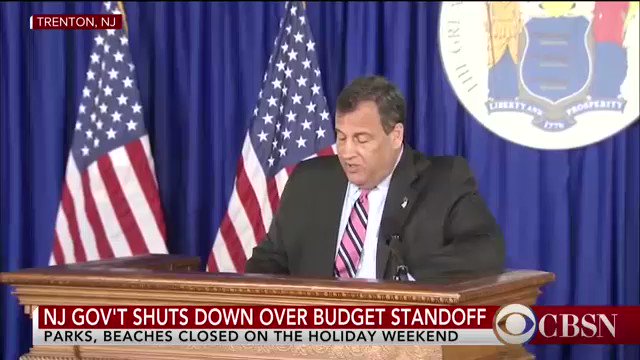
WATCH: New Jersey Gov. Chris Christie announces state government shutdown amid budget impasse http://cbsn.ws/2k2WwLh

In a news conference Saturday morning, Christie blamed Democratic State Assembly Speaker Vincent Prieto for causing the shutdown. And, just like Illinois and Connecticut, Christie and the Democrat-led Legislature are returning to work in hopes of resolving the state’s first government shutdown since 2006 and the first under Christie, before NJ is downgraded further by the rating agencies.
“If there’s not a resolution to this today, everyone will be back tomorrow,” Christie said, calling the shutdown “embarrassing and pointless.” He also repeatedly referred to the government closure as “the speaker’s shutdown.” Christie later announced that he would address the full legislature later at the statehouse on Saturday.
Prieto remained steadfast in his opposition, reiterating that he won’t consider the plan as part of the budget process but would consider it once a budget is signed. Referring to the shutdown as “Gov. Christie’s Hostage Crisis Day One,” Prieto said he has made compromises that led to the budget now before the Legislature.
“I am also ready to consider reasonable alternatives that protect ratepayers, but others must come to the table ready to be equally reasonable,” Prieto said. “Gov. Christie and the legislators who won’t vote ‘yes’ on the budget are responsible for this unacceptable shutdown. I compromised. I put up a budget bill for a vote. Others now must now do their part and fulfill their responsibilities.”
Politics aside, the diplomaitc failure has immediate consequences for Jersey residents: Christie ordered nonessential services to close beginning Saturday. New Jerseyans were feeling the impact as the shutdown took effect, shuttering state parks and disrupting ferry service to Liberty and Ellis islands. Among those affected were a group of Cub Scouts forced to leave a state park campsite and people trying to obtain or renew documents from the state motor vehicle commission, among the agencies closed by the shutdown.
As funds run out elsewhere, it will only get worse. Police were turning away vehicles and bicyclists at Island Beach state park in Ocean County.

BREAKING: NJ Park cops turn away dozens at Island Beach State Park in Govt #Shutdown@NBCNewYork@JSHurricaneNews@tedgreenbergNBC

A sign posted at the park entrance featured a photo of Prieto and the phone number of his district office in Secaucus, along with the caption: “This facility is CLOSED because of this man.”
When asked about the sign, Christie spokesman Jeremy Rosen said the governor wanted to make sure people knew why the site was shuttered. “Speaker Prieto singlehandedly closed state government,” Rosen said, adding that the governor wanted to make sure families “knew that the facilities were closed and who is responsible.”
Not all things will be affected: remaining open under the shutdown will be New Jersey Transit, state prisons, the state police, state hospitals and treatment centers as well as casinos, race tracks and the lottery.
A major point of disagreement is the ongoing stalemate between Christie and lawmakers over whether to include legislation affecting the state’s largest health insurer into the state budget.
Christie and Senate President Steve Sweeney agree on legislation to make Horizon Blue Cross Blue Shield, including allowing the state insurance commissioner to determine a range for the company’s surplus that if exceeded must be put to use benefiting the public and policyholders. But Prieto opposes the plan, saying that the legislation could lead to rate hikes on the insurer’s 3.8 million subscribers and that the legislation is separate from the budget. Prieto has said he will leave open a vote on the $34.7 billion budget that remains deadlocked 26-25, with 24 abstentions, until those 24 abstentions change their mind.
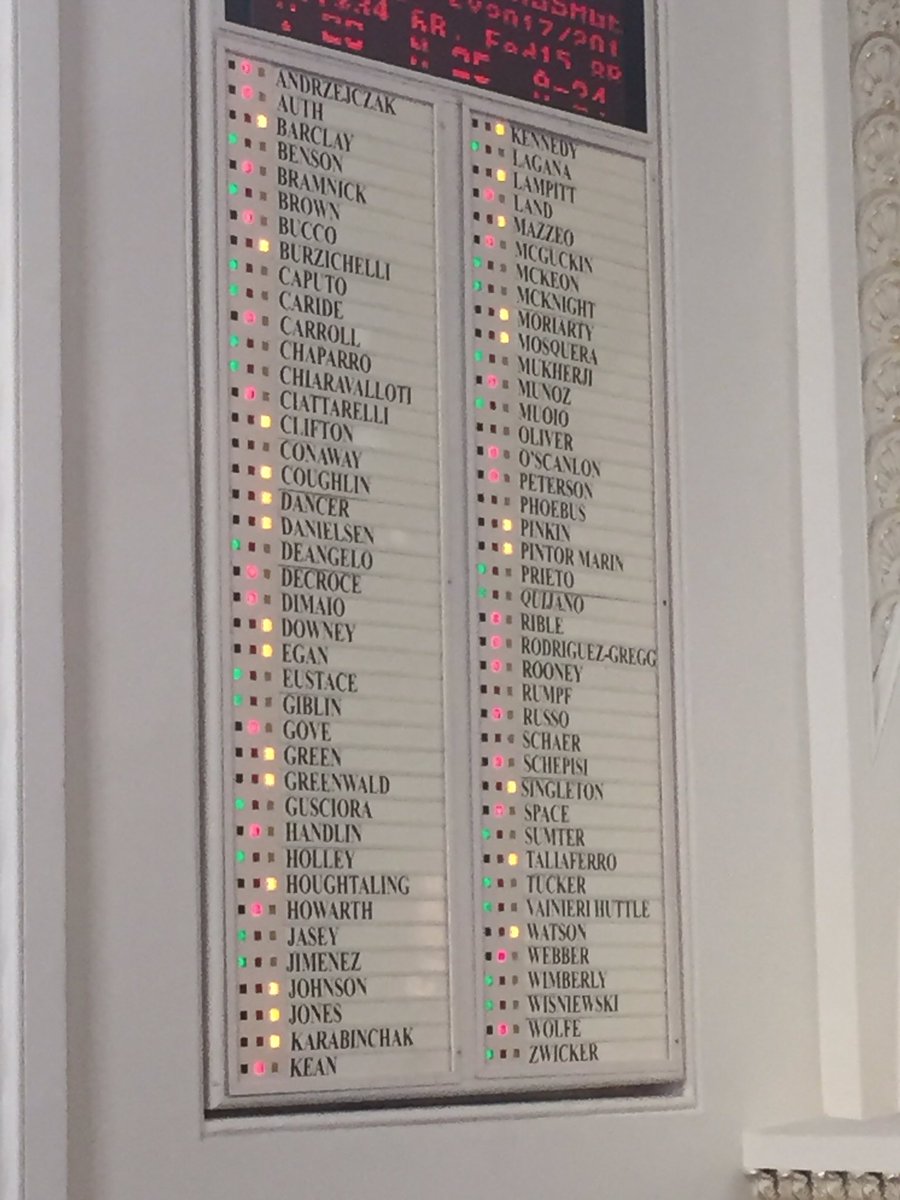
Real-time view of NJ government shutdown. Green/red indicates votes either way on budget. Yellow lights the culprits, says Assembly speaker

Democratic Assemblyman Vince Mazzeo, of Northfield, was among those abstaining. He reasoned that if the governor did not get the Horizon bill, then nearly $150 million in school funding — $9.6 million of which would go to his district — would be line-item vetoed out of the budget. And indeed, Christie said Friday during a news conference that he would slash the Democratic spending priorities if he did not get the Horizon bill as part of a package deal on the budget. “You want me to wave a magic wand to get a budget?” Christie said. “I can’t get a budget to my desk. Only the Senate and Assembly can get the budget to my desk.”
But where things may get nasty quick, is that Christie said public workers should not expect any back pay. “Yeah, don’t count on it.” Christie said of furlough pay. “That was Jon ‘I’ll Fight For a Good Contract For You’ Corzine. I ain’t him.”
@MichaelSymons_ Remember the longer this goes ends up being a free vacation day. Last time they gave back pay to all State of NJ employees. What a waste!

@dennissymons Christie says no furlough pay now: “Yeah, don’t count on it. That was Jon ‘I’ll Fight For a Good Contract For You’ Corzine. I ain’t him.”

Meanwhile, the fingerpointing has begun, including Democrats pointing at other Democrats.
“It seems like he’s just being stubborn,” Mazzeo said of Prieto. “With all due respect to the speaker, then there should be some type of negotiations.” But Prieto said it’s lawmakers – fellow Democrats – like Mazzeo who are to blame for the shutdown. He said he is willing to discuss the Horizon legislation but after the budget is resolved.
Christie has balked at the proposal because he says lawmakers plan to leave town to campaign for re-election and he will be a lame duck. According to CBS, all 120 lawmakers face voters this year.
Finally, putting the sheer chaos of it all in context, Christie who is term-limited and is expected to be out of office by January, has his family staying for the holiday weekend in a state-owned house at Island Beach State Park. The park is closed because of the shutdown.
end
More stuff on the New Jersey shutdown. It seems that Horizon, the health care provider has a huge surplus on its books and Christie wants legislation that the insurance company provide 300 million to the state. This is the first time that a Democrat protected a company which is usually reserved for Republicans
(courtesy zerohedge)
New Jersey Shutdown Enters Day 3 As Christie Roasted For “A Day At The Beach”
The New Jersey government shutdown and state of emergency entered its third day, as lawmakers failed to approve a budget for fiscal 2018.
As reported on Saturday, as many as 35,000 state workers remained furloughed and governor Christie has said they will not be paid for time off once the stalemate ends. Various non-emergency services such as motor-vehicle offices, courts, parks and ferries were closed, while essential state services including state police, New Jersey Transit bus and rail and welfare services, were operating. New Jersey is one of nearly a dozen states states that is scrambling to enact a spending budget for the fiscal year end, even as the local legislature appears deadlocked over any potential compromise.
According to Bloomberg, NJ Senate President Stephen Sweeney, a Democrat, told reporters in Trenton that he didn’t expect budget votes in either house Monday. As discussed previously, the impasse is due to the refusal by Assembly Speaker Vincent Prieto, also a Democrat, to post a bill compelling Horizon Blue Cross Blue Shield of New Jersey to give the state $300 million annually from its surplus account. Horizon, which administers the state’s Medicaid contract, has said the company’s $2.5 billion cushion is a safety net while Christie has said it’s excessive for a private not-for-profit health insurer that grew on taxpayer funding. This may be one of the rare occasions in US history in which a Democrat is defending a major corporation from being overtaxed, while a Republican is doing the opposite.
And while the NJ governor has vowed not to sign a budget unless the Horizon bill also comes to his desk, on Monday Chris Christie had bigger problems. As Christie ordered special legislative sessions over the weekend, and again today, yesterday an aircraft of the news site NJ.com photographed the governor and his family as they relaxed at Island Beach State Park outside a vacation home owned by the state for the governor’s use.

NJ Gov. Chris Christie, right, uses the beach with his family and friends at the
governor’s summer house at Island Beach State Park in New Jersey.
The photos ignited social media, with Twitter users blistering and roating Christie for blocking access to a public park while the state’s highest elected official could continue to enjoy it, particularly during the weekend lead-up to the Independence Day holiday on July 4.

People mocked the governor as selfish and arrogant and cracked jokes about the sight of the heavyset Christie in a beach chair in sandals, shorts and a T-shirt. Jokesters soon inserted the photo into an Oval Office picture and scenes from “Planet of the Apes,” ”From Here to Eternity” and “The Sopranos.”
As the Associated Press adds, users made fun of Christie’s weight. Others likened the beach closing to the 2013 scheme by Christie allies to close lanes and cause huge traffic jams at the George Washington Bridge. Some said Christie was trying to outdo President Donald Trump in low approval ratings. “SON OF A BEACH,” screamed London’s Daily Mail.
“I didn’t get any sun today,” Christie told reporters at a news conference later in the day in Trenton. Then, when told of the photos, his spokesman told NJ.com that the governor was telling the truth because he was wearing a baseball hat.
“It’s beyond words,” Republican Lieutenant Governor Kim Guadagno said on Twitter. She’s running for governor. “If I were gov, sure wouldn’t be sitting on beach if taxpayers didn’t have access to state beaches.”
Christie, who is term-limited and is heading into his final six months in office with his approval rating at an abysmal 15% was also lambasted for what many saw as a let-them-eat-cake gesture by the state’s chief executive.
“Taxpayers can’t use the parks and other public sites they pay for, but he and his family can hang out at a beach that no one else can use?” asked Mary Jackson, a Freehold resident walking through a mostly empty downtown near the Capitol in Trenton. “Doesn’t he realize how that looks, how people will see it as a slap in the face?”
Apparently not: “That’s the way it goes,” Christie said Saturday about his family’s use of the beach home. “Run for governor, and you can have the residence.”
Later, after he was photographed on the beach, he sarcastically called it a “great bit of journalism.”
Christie’s ratings have been thrown into a nosedive by the bridge scandal, his run for president and his support for Trump. Adding insult to injury, over the past year, he was passed over for vice president, demoted as Trump transition chairman, and denied a top-level administration post of his liking.
To be fair, last week Christie reporters that he would head to the retreat while lawmakers negotiated, and this morning he told Fox News that the media had “actually caught a politician being where he said he was going to be with the people he said he was going to be with, his wife and children and their friends,” adding “I am sure they will get a Pulitzer for this one.”
Disappointed park visitors, he said, could visit municipal-run beaches elsewhere on the coast, although that particular suggestion would hardly win him any popularity points.
“It is hard to imagine a worse optic for public relations on a hot July day. Pollsters may find out how low approval ratings can go in New Jersey,” said Fairleigh Dickinson University political science professor Peter Woolley. “Because the story and the photos have gone national, it makes it harder for Christie to rehabilitate his career outside of the state.”
Then again, Christie regularly says that the only time popularity counts is when you’re running for something — and he’s not. “I don’t care,” he said recently when asked about the fall in his ratings, in what if nothing else was a breath of honesty in a political world gone mad.
And to provie it, Christie on Monday morning began retweeting posts by some of those towns promoting their beaches. “Come and enjoy them,” the governor tweeted, “but use sunscreen and hydrate.”
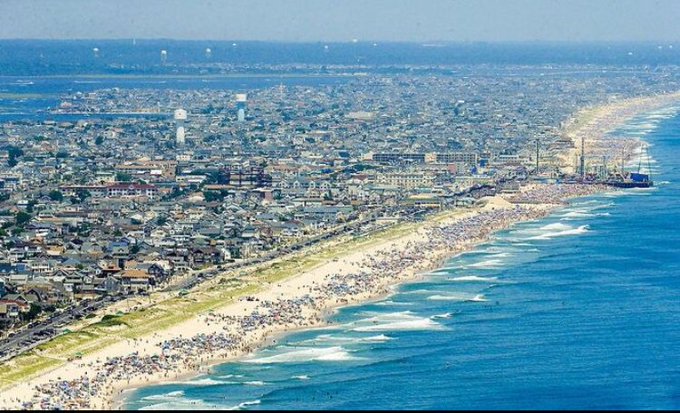
NJ beaches are open in 119 of our our 130 miles of coastline. Come and enjoy them–but use sunscreen and hydrate!

Sunday afternoon: ILLINOIS
The taxoholics seems to have won suggest to a vote:
they are raising taxes on just about everything (see below) with no reforms on pensions nor schools
etc..The vote is set for Sunday. Then citizens will revolt! A mass exodus will happen as citizens will leave the state for other favourable states
(courtesy Mish Shedlock/Mishtalk)
Illinois Taxoholics Wear Down Rauner: Massive Tax Hikes In The Works
Authored by Mike Shedlock via MishTalk.com,

Total capitulation by Governor Bruce Rauner is in the works. The taxoholics wore him down.
In the emergency session, Rauner has agreed to hike the personal income tax rate to 4.95% from the current 3.75%.The corporate income tax rate will rise to 7% from the current 5.25% rate.
For what? Nothing. Reforms are non-existent.
Another Deadline Come and Gone
Illinois failed to approve a budget today and thus heads into its third fiscal year without one.
A vote has been scheduled for Sunday.
I do not expect your opinion will matter, but in the slim chance I am wrong, Please Email Your Representative voicing displeasure of the tax hike.
The preceding link will find your rep based on your address.
Rule of Nothing
A zombified Rauner has capitulated in every way but the final signing.
Tax hikes have been agreed to with no reforms in return.
The Rule of Nothing is clearly in play.
Rule of Nothing
In any given political situation, the best outcome one can reasonably expect generally happens when politicians do nothing.
Implied corollary#1: When politicians attempt to fix any problem, they are highly likely to make matters worse.
Corollary #2: Politicians almost never do nothing. It’s why we have a messed up healthcare system, education system, public pension system, etc..
Taxoholics Win Again
Chicago schools will not get fixed. The hikes will not shore up pension plans.
Within one month of tax hikes, public unions will ask for more money. And people will leave the state. So will corporations.
Rauner pledged 44 reforms. He is 0-44 on his pledges.
The property tax freeze currently under debate has so many holes it is as useful as a bucket with no bottom.
Trading tax hikes for nothing is a horrible deal. Nonetheless, the taxohalics won again.
More business flight and human capital flight is the guaranteed outcome. Doing nothing at all would have been a far better outcome.
Illinois House Approves Historic 32% Tax Increase, Governor Vows Veto
With Illinois, which on Saturday morning entered its third fiscal year without a budget, facing a catastrophic downgrade, late on Sunday evening the Illinois House approved the most controversial element of a budget package, a tax hike which will increase the income tax rate by 32% from 3.75% to 4.95%, and the corporate income tax rate from 5.25% to 7%, to try and end a historic budget impasse. The bill passed 72-45. The House also approved a $36 billion spending plan minutes later on a 81-34 vote. According to the Sun Times, it cleared an initial hurdle on Friday with 23 Republicans voting “yes.”
“While no one could say this was an easy decision, it was the right decision,” House Speaker Mike Madigan said after the spending bill vote. “There is more work to be done.” Dems said they would work with Republicans on other resolution of other issues on table.
The proposed tax increase will now head back to the Illinois Senate, which approved a revenue bill on May 23 with all Democratic votes as part of its “grand bargain” package. But Governor Bruce Rauner has said he’ll only support an income tax hike if it’s limited to four years and paired with a four-year property tax freeze. He’s also still seeking changes in workers’ compensation and pensions.
Commenting on the just passed House bill, Rauner said he’ll veto the revenue bill.
“I will veto Mike Madigan’s permanent 32% tax hike. Illinois families don’t deserve to have more of the hard-earned money taken from them when the legislature has done little to restore confidence in government or grow jobs,” Rauner said.
“Illinois families deserve more jobs, property tax relief and term limits. But tonight they got more of the same.” He also said in an emailed statement that “if the legislature is willing to pass the largest tax hike in state history with no reforms, then we must engage citizens and redouble our efforts to change the state.”
Some commentators promptly countered that Rauner’s veto will likely be overriden.
The tax bill passed with some essential Republican support: it needed 71 votes. But Illinois House Republican Leader Jim Durkin questioned how it will address the state’s $14 billion backlog. Durkin is seeking to get Rauner the “balanced budget package,” he wants, which includes spending reductions and “meaningful reforms.”
“I am disappointed that we’re taking this up at this moment when there has been significant, significant progress to address the priorities of the governor and also the priorities of this caucus,” Durkin said.
There are, of course, political ramifications to supporting a tax hike, on both sides of the aisle. Some House Democrats were expected to vote no to try to shield themselves from Illinois Republican Party attacks in next year’s election. But some House Republicans, knowing they’d too be targeted for supporting it. said there’s no other choice.
Others were even more fatalistic: “If I lose my seat so be it,” state Rep. Michael Unes, R-Pekin said, adding the state shouldn’t have gotten so close to a financial collapse. “Without this, we will lose thousands of lives and thousands of jobs and the alternative is so much worse. I don’t like this. This is not easy. This is really, really difficult,” Unes said. “But the alternative is much worse than this. The alternative is literally taking our state off the cliff.”
David Harris was among the Republicans who supported the bill, while also urging the governor to sign the revenue and spending bills if passed: “Have the courage to do what is right and bring this madness to an end.”
“I was not elected as a state legislator to help preside over the financial destruction of this great state,” Harris said. “I respect my colleagues who are voting no. But to me, enough is enough.”
Meanwhile, changes made by House Democrats from the original Senate bill include the removal of streaming and satellite fees. It also closed corporate tax loopholes, increased the earned income tax credit, and restored the research and development and manufacturers’ tax credit to attract more businesses.
House Democrats filed amendments to both the tax and spending measures on Sunday, which included nearly $400 million more in cuts. Although some House Republicans voiced frustrations over changes, House Democrats said they were reflective of topics discussed during negotiations.
It is unclear if the passed tax increase will be sufficient to placate S&P. Recall July 1 was the date when the credit agencies said they would drop the state to “junk” status without a budget. Ultimately, the fate of Illinois’ credit rating is now in the hands of Rauner, and whether and how fast his imminent veto is overriden.
Ultimately, Illinois faces a lose-lose dilemma: get junked and see its funding costs soar, or save its lowest possible investment grade rating, and watch as what is already the worst metropolitan exodus (recently the population of Chicago shrank the most of any US city), go into overdrive as tens of thousands more scramble to escape the state’s soaring tax rates.
end
The phony jobs report comes out on Friday and it will be another excuse for the crooks to raid:
here are the key reports leading up to the jobs report.
(courtesy zero hedge)
FX Week Ahead Preview: All Eyes On Payrolls Friday
FX Week Ahead, courtesy of Rajan Dhall from fxdaily.co.uk
Despite the NY market holiday over Independence day in the US, we have a number of notable data releases leading up to the main event next week in the May employment report (Friday).
In a half day session on Monday we get the ISM manufacturing index and alongside the new orders component, the employment index should carry some weight due to the strong correlation with headline jobs growth of late. The non mannufacturing ISM is not until Thursday, ahead of which is the ADP private jobs survey which somewhat wrong-footed the market last month. The lead non farm payrolls number at the end of the week is expected to show a 180k rise after the disappointing 138k print for April, but the Fed are also keen to see a pick up in wage growth again with average hour earnings expected to improve slightly at rate of +0.3%.
In the mix, Wednesday’s FOMC minutes are unlikely to alter sentiment on the USD, as scepticism over the Fed rate path espoused by Fed chair Yellen and colleagues such as the NY Fed’s Dudley have been at odds with the economic feedback. Recent weakness has been seen to be transitory and there have been certain elements in the latest stats for enouragement. The Q1 GDP figure was revised a little higher to 1.4% last week despite core PCE still slipping, but personal income growth for May also exceeded expectations.
Until we get improvement in the hard data, the USD will remain on the back foot, but going against the drop in the ($) index has been a resilient USD/JPY rate. That said, we hit a wall of resistance at 113.00 las week, but 113.40-50 is the area we are watching here. Calls for levels north of 115.00 have been pretty quiet of late, and this in spite of moderate acceleration in Japanese divestment flow. Europe has been a key beneficiary with notable economic momentum building up and a relative underperformance in the EU bourses offering value against Wall Street. EUR/JPY is destined for 130.00 or higher as a result, while elsewhere we see GBP/JPY with an eye on 150.00 and CAD/JPY having outpaced its commodity counterparts.
From the Japanese perspective, the BoJ continues to plug away with their stimulus program as domestic inflation remains frustratingly sluggish, as are improvements in broader activity and growth. The Tankan survey has lost its influence under the present circumstances, but we get the latest activity reports on Sunday night.
The Canada day holiday on Monday may tame some of the CAD gains, which have now taken out 1.3000 vs the greenback, and below here we watch the 1.2950-20 zone which will has been pressured by the ongoing reversal in the record short positioning seen recently. It took a change in BoC rhetoric to prompt the more aggressive moves to the downside here, responding to the healthy growth and employment data in the last 6 months, but we would not be surprised to see a near term correction as the RSIs (4hr and daily) delve into oversold territory. Manufacturing PMI’s due out when Canada returns on Tuesday, and trade on Thursday but Canadian jobs Friday are the main event.
Onto Europe, and the concern over the strong EUR gains are clearly starting to unnerve the ECB, ever wary of sparking a full-on taper tantrum. In the latest EUR/USD run higher, we have seen the 1.1300 level removed, and it was not long before we were testing the next area of note up at 1.1440-50. We are likely to see continued tests higher, especially as USD bears need little encouragement, but we are also seeing traders taking up any slack in the other notable EUR pairs, with the CHF rate now into the mid 1.0900’s where 1.1000 higher up has been particularly strong.
It is unlikely that the pan European PMI data will materially impact on the aggressive positioning for an eventual QE taper later this year, but if EUR/USD rushes up to 1.1500-1.1600 in the week (or two) ahead, we expect to see a more sizeable pullback. Many anticipated a deeper pullback through 1.1100 a little over a week ago. The ECB minutes will likely serve as a reminder of the turn in sentiment, with presdident Draghi’s comments this week on ‘reflationary pressures’ still ringing in the ears.
EUR/GBP also shows signs that it is ‘waiting in the wings’ for the next push up. UK rate hike jitters were set off on Haldane’s shift in sentiment and were compounded by gov Carney later in the week sending Cable on another jaunt through 1.3000. As a result, we may have to weather some further downside in to the low 0.8700’s, if not 0.8650 or so. If GBP is indeed gaining on the hawkish developments at the MPC, then we expect the initial target in Cable will be 1.3200-1.3300, with the higher end representing levels seen just ahead of the pre-emptive rate cut last August post Brexit.
There is also an element of a more conciliatary mood over the EU talks ahead with PM May’s weakened hand (of her own making) suggesting to some that she may have little option other than to adopt a softer line. We maintain that in the lengthy period of talks ahead, there is far too much uncertainty to base a bullish call on GBP at this stage, but our perceived 1.2400-1.3000 range may have to be widened – in both directions!
All three PMI releases in the UK are released in the first half of the week, but there is little need to emphasise the services component due out on Wednesday. Trade stats and industrial production also on the schedule later on.
Back to Asia, and also at the very start of the week, we get the release of Caixin manufacturing PMIs, and this comes after last week’s official figures showing modest improvement (from 51.2 to 51.7). This fuelled a little more of the recovery in Iron ore prices after some heavy losses of late, while the broader risk tone also benefited.
As we mentioned above, cross/JPY is on an upward trajectory but in some cases we are moving into overbought territory. Carried along with the buoyant outlook on the NZ economy, NZD/JPY is now moving ever closer to the highs seen at the start of the year. We ended last week near the weekly top a little shy of 82.50, coinciding with ongoing congestion in the key 0.7330-50 area in NZD/USD. There is little next week to derail positive sentiment on NZ other than the Fonterra dairy auctions on Tuesday, but prices will have to deviate significantly from futures pricing to impact on NZD. Fluctuations have been much tighter this year.
AUD/NZD has also reflected the mood in NZ, such that we have tested key support levels below 1.0400. The weekly series of higher lows now show 1.0350-70 as major area, but as noted, metals prices have recovered well and this has revived the AUD upturn. AUD/USD breached 0.7700 last week in line with Copper tipping USD2.70, but we look to the RBA meeting ahead, where we expect another balanced outlook to preserve their neutral stance near term. The prospects for AUD remain to the upside, as recent central bank rhetoric has been relatively upbeat, and this can only have been enhanced by the commodities backdrop. 0.7750-0.7850 is a major target area, but just as we expect with NZD near 0.7500, higher levels may push both the RBA and RBNZ to try and rein in some of this strength with some well chosen words. Nb, RBNZ were pretty relaxed in their recent views on the currency, and we expect it will be a similar line from the RBA. Through the week, we also have the AIG PMIs – manufacturing on Monday – with trade data later in the week.
Manufacturing PMIs in Sweden and Norway are also due out next with both indices firmly above thre expansionary 50.0 – Sweden now close to 60.0. Focus will be on the Riksbank, where the market feels the central bank is delaying a move on its ultra loose policy stance. However, the ECB are set to rein in purchases and neutralise rates, pre-emptive SEK buying shows the market is positioning for a potential change in tack. In contrast, the Norges bank have highlighted the improvement in the economy, notably higher capacity utilisation, but maintain rates are not likely to move (up) until 2019. The NOK/SEK cross rate has been hit down towards parity as a result, though has held up on initial attempts.
Steve Bannon Reportedly Pushing Trump To Raise Taxes On The Wealthy
The tensions between the Trump administration’s populist win and its more traditionally Republican establishment types have been well-documented in recent months. And now, more than two months after Treasury Secretary Steven Mnuchin and National Economic Council chief Gary Cohn unveiled an outline of the administration’s tax-reform ambitions, another battle between the two wings appears to be brewing.
Trump’s chief strategist Steve Bannon is said to be pushing to raise the top tax rate on individuals, with Axios saying the former Breitbart CEO would like the top rate to have “a 4 in front of it” – currently, the highest income-tax bracket in the US is 39.6% for individuals earning more than $414,000 a year.

Some officials – code for Mnuchin, Cohn and the other members of the more traditionally corporatist (or rather Goldmanist) wing of the Trump administration – believe Bannon’s ideas are crazy. But Bannon believes raising taxes on the wealthy could help the administration boost its populist bona fides, an angle which Trump appears to be actively pursuing once again having recently failed with his more traditional fiscal reform push. But as tax reform is shaping up to be a must-win for the Trump administration, it would hardly be a surprise to see Bannon’s plan shelved in favor of across-the-board cuts that would help rally the Republican Party’s conservatives to support whatever reform package Trump ultimately presents.
Cohn and Mnuchin reportedly view tax reform as a top priority for the administration. However, as Axios notes, time to pass comprehensive reform is quickly running out.
- Lobbyists who have met with Gary Cohn and Treasury Secretary Steven Mnuchin say they’ve been struck by how impatient the two appear:
- Cohn has told associates that if tax reform doesn’t get done this year, it’s probably never going to happen.
- Sources who know Cohn speculate that he’ll leave the White House the instant he concludes tax reform is dead.
- While Cohn and Mnuchin differ stylistically — Cohn is brash and physically imposing while Mnuchin is mild-mannered — sources who’ve been meeting with them say they share the same philosophy: Go big or go home.
Ironically, Cohn and Mnuchin are warming to an idea that Bannon supported in the aftermath of the election, when he claimed that he’s “not a conservative” and said he would support spending packages that blow out the deficit, arguing that the US should rebuild its infrastructure now while interest rates are low. Mnuchin, for his part, has refused to promise that tax reform wouldn’t lead to wider deficits when he and Cohn unveiled the outline for the administration’s reform plan back in April.
Cohn and Mnuchin aren’t bluffing when they say they want to slash the corporate tax rate to 15% from the current 35%. Neither man has any interest in timid tax cuts, and they wager that special interests will relinquish their loopholes if they become convinced their tax rate really will be in the teens.
- They’re becoming far less wedded to revenue neutrality — the idea, favored by House and Senate Republican leadership, that tax cuts mustn’t add to the deficit.
- They’re increasingly tantalized by an idea some conservatives (like Grover Norquist and Sen. Pat Toomey) are pushing: Allow major tax cuts to last longer than 10 years without having to balance the budget.
- Conservatives like Toomey favor a more expansive 20- or 25-year period. But top White House officials are more cautious, and are said to be weighing a 15-year period.
The last time the US passed comprehensive tax reform, the legislative battle took two years. Thus, a new theme is emerging that applies not just to tax reform, but to Trump’s agenda more broadly: Do it now, or let it go.
Context: The last time Congress passed major tax reform, in 1986, it was a two-year rollercoaster. This time, the White House officials driving the process have concluded there’s no chance of getting Democrats to support what Trump wants to do. So, they believe it must be done before the 2018 midterm elections or not at all.
That’s going to be a heck of a challenge. They need to first pass a budget, which is embroiled in fights over defense spending and welfare reform. And they need to finish with health care. Some top Republicans have come to believe, contrary to conventional wisdom, that tax reform stands a better chance if health care fails — so desperate will Trump and Republican leaders be for a victory.
The x-factor here, of course, is Trump. How does he feel about raising taxes on the wealthy? And, more importantly, is Bannon succeeding in moving the Trump administration in a more populist direction, following Trump’s decision to largely abandon his protectionist rhetoric? A few more tweets from the president should provide the answer.
END
More soft data garbage: see for yourself:
(courtesy zero hedge)
US Manufacturing Schizophrenia Continues – Best ISM Since Aug 2014, Worst PMI Since Dec 2016
US Manufacturing stumbled to its lowest since Dec 2016 according to the latest ‘soft’ survey from Markit, as respondents reported a“disappointing end to the second quarter, with few signs of growth picking up any time soon.” However, if ISM’s seasonal adjustments are listened to, US Manufacturing just surged to its highest since Aug 2014… you decide.

Under the covers of the ISM data, everything is awesome…

Which is an oddly divergent picture from the one painted by Markit respondents… Commenting on the final PMI data, Chris Williamson, Chief Business Economist at IHS Markit said:
“Manufacturers reported a disappointing end to the second quarter, with few signs of growth picking up any time soon.
“The PMI has been sliding lower since the peak seen in January and the June reading points to a stagnation – at best – in the official manufacturing output data.
“The survey’s employment index meanwhile suggests that factories will make little or no contribution to non-farm payroll growth in June.
“Forward looking indicators – notably a further slowdown in inflows of new business to a nine-month low and a sharp drop in the new orders to inventory ratio – suggest that the risks are weighted to the downside for coming months.
“Any good news was saved for inflation, with price pressures easing substantially in June on the back of waning global commodity prices.”
It’s probably transitory though…

GM Reports Record “Channel Stuffing”: Dealer Auto Inventory Highest Since June 2007
As we await all US carmakers to report June auto sales, we remind readers that when we discussed last month’s disappointing monthly car sales report, which badly missed expectations showing the fifth consecutive month of declining auto sales – the first time this has happened since July 2009 – with domestic light vehicle auto sales printing at an annualized 12.59, the lowest sales number going back more than three years – we noted what may be the biggest concern for the auto industry: inventory days continued to trend higher as OEMs push product on to dealer lots even though sale-through to end customers has seemingly stalled.
Of note, we highlighted GM, one of the few OEMs to actually disclose dealer inventories in monthly sales releases, which reported that May inventories increased to 101 days (963,448 vehicles) from 100 days at the end of April and just 71 days (681,402 vehicles) in April 2016. Indicatively, analysts say an overall inventory level of 60 to 70 days is healthy. 100 is not. GM management was eager to deflect attention from this troubling statistic, and said that soaring inventories are normal and, somehow, “reflect strong sales”, as per the press release: “As planned, GM’s inventories reflect strong sales, lower car production and strategic, launch-related growth in truck and crossover stocks.”
Or maybe not, because as Automotive News reporter Nick Bunkley pointed out something troubling: with 935,758 unsold GM units collecting dust in dealer lots at the end of June, this was the highest inventory number in 9.5 years, the highest since November 2007, one month before the recession began.
Fast forward to today when GM reported its June results which again disappointed, and were down 4.7%, more than the expected 3.4% decline (although one wouldn’t know it by looking at the stock which was up as much as 3%). GM sales were dragged by most brands: Chevy -6.4%, GMC -3.6%, Buick +16.4%, Cadillac -11.8%. But that’s not what caught our attention: a bigger problem is what GM revealed in its deliveries report which disclosed a whopping 980,454 units in dealer inventory at the end of June, up nearly 17k from the past month, and representing 105 days of supply, up from an already red-flag raising 101 in May. As Buntkley notes, “GM’s inventory has officially hit a 10-year high. 980,454 units in stock (a 105-day supply) as of June 30, the most since June 2007.“
GM’s inventory has officially hit a 10-year high. 980,454 units in stock (a 105-day supply) as of June 30, the most since June 2007.

In short: GM “channel stuffing” just hit a new all time high for the restructured company, with the number of GM vehicles parked at dealer lots and patiently waiting for a buyer rising to the highest since the summer before recession officially began, when GM was still pre-bankruptcy GM, with far greater (if ultimately superfluous and in need of restructuring) production.

end
A huge miss: the big 3 autos crash in sales down 6% year over year.
‘Detroit 3’ June Auto Sales Crash 6% YoY…Just Enough To Spark A Massive Equity Buying Binge
It seems that “Big 3” auto sales for the month of June managed to hit a sweet spot whereby they were down just enough year-over-year to spark a massive equity buying binge on a shortened holiday trading session. GM, Ford and Chrysler posted YoY sales declines of 6% on average, which was less negative than expected, so positive (negative x negative = positive…it’s just math).

Meanwhile, in another positive sign for the auto industry, Ford, which previously described the current sales environment as a ‘plateau’, confirmed on their sales call that the “industry peaked” last year and was unlikely to top 2016 sales figures at any point in the near future.

Overall inventory days continue to come in at roughly ~15% higher YoY…which we assume the market also views as a ‘positive’ because it provides consumers with a better selection?

Meanwhile, GM’s inventory days were up a modest 46% YoY to an all new record high of 105 days…a rather staggering negative statistic which was also promptly dismissed by the market.
Finally, as Stone McCarthy Research points out, Americans, flush with their $0 down, 0% interest for 84 month auto loans, continued to shun cars for much more expensive, and profitable, trucks and SUV’s.
General Motors domestic car sales came in much lower than we expected, and declined nearly 34% from June 2016. Their domestic light truck sales were much stronger than we expected, and were up over 7% from last year.
Domestic car sales were weaker than expected for Ford as well, and fell 23% from last year. Ford domestic light truck sales also came in below our expectations, though were not weak as ford domestic car sales, and were only up about 6% from June 2016.
Chrysler domestic light car sales came in right where we expected, down 19% from last year. Domestic light truck sales for Chrysler were below our expectations though, and fell around 3% from last year.
Car sales:

Truck sales:

In summary, it was a good news day for auto investors.

end
The following David Stockman article on the upcoming CARMAGEDDON is a must must read.
He explains to us how industrial production never really advanced from 2008. It was a phony created by phony debt in the auto sector. Used prices on cars are rapidly declining which will put a dent in:
i. new car sales
ii) put a whole in the financing scheme (subprime etc)
a must read…
(courtesy David Stockman/Daily Reckoning)
David Stockman On The Coming Carmageddon
Authored by David Stockman via The Daily Reckoning,
Ben Bernanke’s successors at the Fed and other global central banks still don’t get it.
Falsified debt prices do not promote macroeconomic stability. They lead to reckless credit expansion cycles that eventually collapse due to borrower defaults. We’re now seeing that play out in the auto sector, especially since anyone who can fog a rearview mirror has been eligible for a car loan or lease.
If that reminds you of the sub-prime housing disaster, you’d be right.
That, in turn, will make the looming collapse even worse, due to the sudden drastic shrinkage of credit in response to escalating lender losses.
How did we get here?
Let’s start by looking at the Fed. Its reckless monetary reflation cycle in response to the Great Recession caused auto credit, sales and production to spring back violently after early 2010.
Accordingly, that reflation has powerfully impacted the growth rate of total U.S. domestic output. And it’s had a massively distorting effect.
Auto production has seen a 15% gain over its prior peak, and a 130% gain from the early 2010 bottom. But overall industrial production is actually no higher today than it was in the fall of 2007. Real production in most sectors of the U.S. economy has actually shrunk considerably.
That means if you subtract the auto sector, there has been zero growth in the aggregate industrial economy for a full decade.
So the auto industry has actually distorted the effects of monetary central planning.
But the real point here is that the financial asset boom-and-bust cycle caused by monetary central planning is making the main street business cycle more unstable, not less. And it means the next auto cycle bust is certain to be a doozy.
It also means the weak expansion of real sales and GDP over the past seven years has been artificially supported by a rapid but unsustainable snapback in the auto sector. But that is now over.
And what I call Carmegeddon will soon be now metastasizing rapidly.
Consider that credit analysis in the auto sector is now being overwhelming driven by the collateral value of the vehicle — not the creditworthiness of the borrower.
Accordingly, when car prices fall sharply, losses from loan defaults will soar. During the last cycle, used car prices peaked in early 2006 and then fell nearly 25% through the 2009 bottom. Total auto credit cratered during the same period.
And today, after plateauing for more than two years, used car prices have now begun a steep descent. During April, for example, prices of most classes of used vehicles plunged sharply. The J.D. Power index was down 13%. Needless to say, the drop in used car prices is now accelerating.
But it still has a long way to go due to the rising tide of used cars from maturing leases and loans that are hitting the markets.
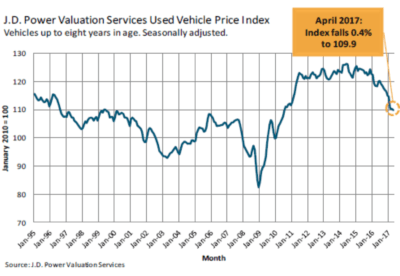
Looking back to the last credit cycle, the crash of new cars sales after 2007 resulted in a drastic shrinkage of leased vehicles. Accordingly, volumes of pre-owned vehicles hitting the used car auctions hit a modern low of 13 million vehicles during 2011-2013. That supply shortage obviously fueled a sharp rebound of used car prices.
By contrast, the post-2010 auto sales boom is now generating an all-time record tsunami of pre-owned vehicles. During the period 2016-2018, an estimated total of 21 million used vehicles will have hit the market.
That 62% surge in used vehicle supply has clear, negative implications for used car prices.
The most immediate negative effect of plunging used vehicle prices, of course, is sharply reduced values among leased vehicle portfolios. That, in turn, not only results in losses for equity holders, but also causes monthly payment rates to rise sharply on new leases.
Lease volumes dropped by 45% during the last down cycle. But at current all-time highs of 4.3 million newly leased vehicles last year, volumes could drop by upwards of 70% during the years just ahead.
Indeed, more than 30% of new vehicle sales were leased in 2016. And the all-time record of 4.3 million new leased vehicles in 2016 was nearly double the 2007 peak, and 4X the 2009 bottom.
The impending plunge in used car prices will also have an even more damaging impact on the loan market.
This means an increased share of old used car loans will be even deeper underwater because cars depreciate faster than loan balances can be paid down. That growing gap, in turn, will cause loan loss severities to rise during the down-cycle ahead.
Driven by the Fed’s ultra-low rates, the eruption of subprime auto finance led to a stampede toward yield. And a large share of the $100 billion gain in subprime volume was due to financing almost entirely in the junk bond market.
The precarious nature of the debt pyramid that underlies the auto market is undeniable. The auto sector is a prime example of a false debt-fueled prosperity. It underscores how the Fed’s fake prosperity actually intensifies — if not creates — the boom/bust cycle.
Consider that nearly one-third of vehicle trade-ins are now carrying negative equity, as the below chart shows.
That means that prospective new-car buyers are having to raise increasing amounts of cash to pay off old loans.
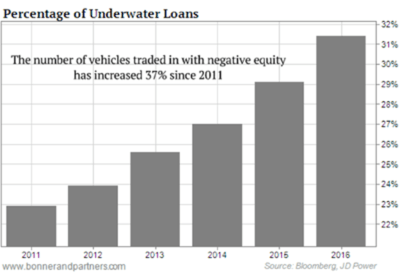
Furthermore, outstanding subprime auto debt is nearly 3X higher than it was on the eve of the 2008 financial crisis. So the coming correction in auto loan extensions is certain to be far deeper than the 15% decline last time.
And payback time is just around the corner. The cycle of declining used-car volumes and rising used-car prices has exhausted itself. In fact, car loan delinquency rates have been rising sharply during the last several quarters.
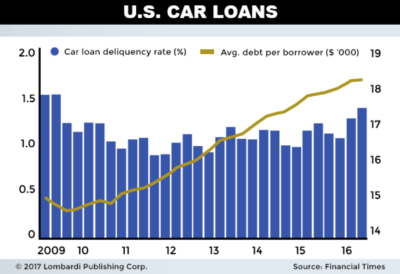
In fact, the remaining leg of the so-called recovery is now faltering rapidly as the last subprime auto borrower who could fog a rearview mirror has been loaned a car.
Even Morgan Stanley now expects a veritable crash of used car prices. This means the auto credit auto boom is over, since the whole thing ultimately depended upon rising used car prices and collateral value for car loans and leases.
The simple reality is that the auto boom was one giant credit-driven accident waiting to happen. They called it “putting money on the hood” in the trade.
The explosion of auto credit described above — from $800 billion at the 2010 bottom to more than $1.5 trillion today — was fundamentally driven by asset inflation.
But with used car prices now plummeting, the last gasp of “borrow and spend” on the dealer lots has been exhausted. That’s why Morgan Stanley is now projecting a huge decline in car sales during the balance of this decade.
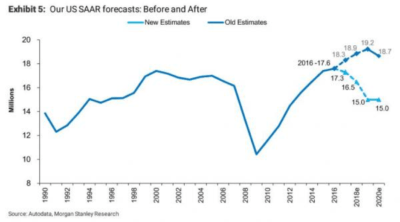
If you add faltering auto sales to the on-going Armageddon in retail and the topping out of the shale oil patch at $50 per barrel, you don’t have much of a recovery left.
In fact, you are back to the stunning reality with which I started. Namely, that a real recovery of the U.S. industrial economy never actually happened. Industrial production last month is still below its September 2007 level. And now the auto credit, sales and production bust will take it significantly lower.
So much for the Great Moderation. Monetary central planning is wrong in principle and doesn’t work in practice.
The unfolding “Carmageddon” is dramatic proof.
end
We will see you WEDNESDAY night
.
To all our American friends, a very happy 4th of July holiday to you all.
Harvey.


 harveyorganblog.com

Thanks for reporting during your holiday. I hope you enjoyed the great day – Canada150. I sang and stood on guard for you and your countrymen on Saturday. Wish I could have been there. A Canadian holiday has a unique and special spirit. Long live a beautiful country and beautiful people.
Thanks again, Harvey, for your continued reports. You stand on guard for all of us.
LikeLike
[…] JULY 3/MASSIVE RAID ON SILVER AND GOLD AT THE COMEX/CARMAGEDDON IN USA CAR INDUSTRY./4 STATES DO NOT… […]
LikeLike