
GOLD: $1242.00 UP $7.50
Silver: $16.29 UP 16 cent(s)
Closing access prices:
Gold $1243.00
silver: $16.28
SHANGHAI GOLD FIX: FIRST FIX 10 15 PM EST (2:15 SHANGHAI LOCAL TIME)
SECOND FIX: 2:15 AM EST (6:15 SHANGHAI LOCAL TIME)
SHANGHAI FIRST GOLD FIX: $1247.67 DOLLARS PER OZ
NY PRICE OF GOLD AT EXACT SAME TIME: $1237.65
PREMIUM FIRST FIX: $10.02
xxxxxxxxxxxxxxxxxxxxxxxxxxxxxxxxxxxxxxxxxxxxxx
SECOND SHANGHAI GOLD FIX: $1247.08
NY GOLD PRICE AT THE EXACT SAME TIME: $1237.55
Premium of Shanghai 2nd fix/NY:$9.53
xxxxxxxxxxxxxxxxxxxxxxxxxxxxxxxxxxxxxxxxxxxxxxxxxxx
LONDON FIRST GOLD FIX: 5:30 am est $1237.10
NY PRICING AT THE EXACT SAME TIME: $1237.45
LONDON SECOND GOLD FIX 10 AM: $1240.75
NY PRICING AT THE EXACT SAME TIME. $1240.95
For comex gold:
JULY/
NOTICES FILINGS TODAY FOR APRIL CONTRACT MONTH: 4 NOTICE(S) FOR 400 OZ.
TOTAL NOTICES SO FAR: 124 FOR 12400 OZ (.3856 TONNES)
For silver:
JULY
24 NOTICES FILED TODAY FOR
120,000 OZ/
Total number of notices filed so far this month: 2890 for 14,450,000 oz
XXXXXXXXXXXXXXXXXXXXXXXXXXXXXX
end
Let us have a look at the data for today
xxxxxxxxxxxxxxxxxxxxxxxxxxxxxxxxxxxxxxxxxxxxxxxxxxxxxxxxxxxxxxxxxxxxxxxxxx
In silver, the total open interest ROSE BY A TINY 162 contract(s) UP to 206,753 DESPITE THE HEALTHY RISE IN PRICE THAT SILVER TOOK WITH YESTERDAY’S TRADING (UP 17 CENT(S). THE ONLY EXPLANATION THAT I CAN THINK OF IS SOMETHING HAS SCARED OUR BANKERS TO NO END AS THEY HAVE STARTED TO COVER THEIR SHORTFALL IN EARNEST ALONG WITH OUR SPECULATOR SHORTS. HOWEVER THE BANKERS ARE HAVING AN AWFUL TIME TRYING TO SHAKE THE SILVER LEAVES FROM THE SILVER TREE.
In ounces, the OI is still represented by just OVER 1 BILLION oz i.e. 1.034 BILLION TO BE EXACT or 148% of annual global silver production (ex Russia & ex China).
FOR THE NEW FRONT MAY MONTH/ THEY FILED: 24 NOTICE(S) FOR 120,000 OZ OF SILVER
In gold, the total comex gold ROSE BY A RATHER SMALL 2,039 CONTRACTS WITH THE RISE IN THE PRICE OF GOLD ($4.20 with YESTERDAY’S TRADING). The total gold OI stands at 485,866 contracts. AGAIN, AS IN SILVER SOMETHING HAS SCARED OUR BANKERS AS THEY STARTED TO COVER THEIR GOLD SHORTS IN EARNEST ALONG WITH THE NEWBIE SPECULATOR SHORTS. THE PLETHORA OF DATA RELEASED ON FRIDAY SHOWING RETAIL SPENDING BASICALLY COLLAPSING ALONG WITH SMALLER INFLATION NUMBERS MUST BE SCARING THESE GUYS TO DEATH.
we had 4 notice(s) filed upon for 400 oz of gold.
xxxxxxxxxxxxxxxxxxxxxxxxxxxxxxxxxxxxxxxxxxxxxxxxxxxxxxxxxxx
With respect to our two criminal funds, the GLD and the SLV:
GLD:
Today another huge withdrawal of 5.62 tonnes with gold up $7.50
Inventory rests tonight: 821.45 tonnes
for 3 consecutive days, gold rises appreciably and yet gold inventory drops at the GLD
GLD IS A MASSIVE FRAUD/INVENTORY SHOULD BE RISING NOT FALLING.
.
SLV
Today: : WE HAD A HUGE CHANGE AT THE SLV/ A WITHDRAWAL OF 946,000 OZ FROM THE SLV DESPITE SILVER’S RISE TODAY
INVENTORY RESTS AT 348,066 MILLION OZ
end
.
First, here is an outline of what will be discussed tonight:
1. Today, we had the open interest in silver ROSE BY A TINY 162 contracts UP TO 206,753 (AND now A LITTLE CLOSER TO THE NEW COMEX RECORD SET ON FRIDAY/APRIL 21/2017 AT 234,787), DESPITE THE RISE IN PRICE FOR SILVER WITH RESPECT TO YESTERDAY’S TRADING (UP 17 CENTS ). JUDGING FROM WHAT HAPPENED IN GOLD, OUR BANKERS TRIED TO COVER THEIR SHORTS TO NO AVAIL. THE LONGS STOOD STOIC AND THE SHORTS (BOTH NEWBIE SPECS AND BANKERS) ARE TRAPPED AND CANNOT GET OUT OF THEIR MESS.
(report Harvey)
.
2.a) The Shanghai and London gold fix report
(Harvey)
2 b) Gold/silver trading overnight Europe, Goldcore
(Mark O’Byrne/zerohedge
and in NY: Bloomberg
3. ASIAN AFFAIRS
i)Late MONDAY night/TUESDAY morning: Shanghai closed UP 11.10 POINTS OR 0.35% / /Hang Sang CLOSED UP 54.36 POINTS OR 0.26% The Nikkei closed DOWN 118.95 POINTS OR .59%/Australia’s all ordinaires CLOSED DOWN 1.08%/Chinese yuan (ONSHORE) closed UP at 6.7504/Oil DOWN to 46.21 dollars per barrel for WTI and 48.66 for Brent. Stocks in Europe OPENED IN THE RED,, Offshore yuan trades 6.7449 yuan to the dollar vs 6.7504 for onshore yuan. NOW THE OFFSHORE IS STRONGER TO THE ONSHORE YUAN/ ONSHORE YUAN STRONGER (TO THE DOLLAR) AND THE OFFSHORE YUAN IS MUCH STRONGER TO THE DOLLAR AND THIS IS COUPLED WITH THE WEAKER DOLLAR. CHINA IS EXTREMELY HAPPY TODAY
3a)THAILAND/SOUTH KOREA/NORTH KOREA
i)NORTH KOREA
b) REPORT ON JAPAN
c) REPORT ON CHINA
USA/China exporting deflation
USA data released today using both USA import prices and USA export prices both tumbling and this is the 2nd month in a row that this has happened. Only one explanation: China is exporting deflation to the world and the USA et al are having trouble passing on higher input costs.
(zerohedge)
4. EUROPEAN AFFAIRS
i)ITALY
Now wonder Italy is saddled with huge problems: It’s poorer population has tripled in this last decade as the youth simply cannot find jobs. Italy has the lowest fertility rates as women realize that jobs are scarce and so they do not have children.
( zero hedge)
ii)UK
Because British university graduates pay higher interest rates on loans, a new study suggests at 75% of all UK graduates will never repay their loans, worse than Americans.
( zero hedge)
iii)DEUTSCHE BANK/CHINA’S NHA
the blind leading the blind??
Troubled HNA becomes Deutsche bank’s largest shareholder
(courtesy Henning/Steve Arons)
5. RUSSIAN AND MIDDLE EASTERN AFFAIRS
i)TURKEY
An extremely important commentary from Peter Kozun. We have been pointing out to you that Turkey is turning to Russia and China. Russia’s new S 400 will certainly aid in Turkey’s defense strategies. Turkey wishes to become a full member of China’s SCO and with Russia it wants the Turkish stream gas pipelines to be implemented. The danger to the west is of course, the huge 3 million migrants housed in Turkey and in a moments notice they could be unleashed onto Greece who has no capability of handling them
( Peter Kozun/StrategicCultureFoundation).
6 .GLOBAL ISSUES
7. OIL ISSUES
Ecuador breaks with OPEC as this cash starved country cannot cope with smaller outputs
( zero hedge)
8. EMERGING MARKET
9. PHYSICAL MARKETS
ii)Such fine and upstanding citizens: the large BNP Paribas fined 246 million over currency manipulation( zero hedge)
iii)Bitcoin soars as the split seems to have been avoided
( zero hedge)
10. USA Stories
i)The sinking of the titanic: bricks and mortar operations dropping like flies
( zero hedge)
ii)Now wonder the USA had to mark to mark losses on student loans. It seems we have another subprime mess as documentation of loans is faulty
( zerohedge)
iii)Trumpcare is now dead when two more senators defected.
( zero hedge)
iv)It looks like the Republicans are heading for a repeal of Obamacare with a two year delay. Then they will call for a bipartisan effort to fix healthcare once and for all. One small problem: the huge cost.
iv b) MY GOODNESS THAT DID NOT LAST LONG: The Republicans are divided like no tomorrow. They cannot even repeal Obamacare with a 2 yr delay( zero hedge)
v)Ron Paul warns that the big military spending boost just approved will threaten the USA economy and maybe its security:( Ron Paul/Peace and Prosperity)
vi)Homebuilder confidence plunges despite its rising price in stocks
( zerohedge)
Let us head over to the comex:
The total gold comex open interest ROSE BY A RATHER SMALL 2,039 CONTRACTS DOWN to an OI level of 485,866 DESPITE THE RISE IN THE PRICE OF GOLD ($4.20 with YESTERDAY’S trading). We must have had some banker short covering along with newbie spec short covering.
We are now in the contract month of JULY and it is one of the POORER delivery months of the year. .
The non active July contract LOST 1 contract(s) to stand at 40 contracts. We had only 3 notices filed YESTERDAY morning, so we GAINED 2 contracts or an additional 200 oz will stand in this non active month of July. Thus 0 EFP notice(s) was given which gives the long holder a fiat bonus plus a futures contract for delivery and most likely these are London based forwards. The contracts are private so we do not get to see all the particulars. The next big active month is August and here the OI LOST 5601 contracts DOWN to 223,657, as this month winds down prior to first day notice. The next non active contract month is September and here they GAINED another 89 contracts to stand at 633. The next active delivery month is October and here we gained 757 contracts up to 23,224. October is the poorest of the active gold delivery months as most players move right to December.
We had 4 notice(s) filed upon today for 400 oz
For those keeping score: in the upcoming front delivery month of August:
On July 19.2016: open interest for the front month: 306,757 contracts compared to July 18.2017: 223,657.
However last yr at this time we had a record OI in gold at 655,000 contract for the entire complex.
We are now in the next big active month will be July and here the OI LOST 11 contracts DOWN to 138. We had 51 notices served yesterday so we gained 40 notices or an additional 200,000 oz will stand at the comex, and 0 EFP contracts were issued which entitles them to receive a fiat bonus and a future delivery contract (which no doubt is a London based forward).
The month of August, a non active month LOST 40 contracts to stand at 454. The next big active delivery month for silver will be September and here the OI already LOST ANOTHER 112 contracts DOWN to 153,375.
The line in the sand is $18.50 for silver and again it has been defended by the criminal bankers. Once this level is pierced, the monstrous billion oz of silver shorts will blow up. The bankers are defending the Alamo with their last stand at the $18.50 mark. THE NEW RECORD HIGH IN OPEN INTEREST WAS SET FRIDAY APRIL 21/2017 AT: 234,787.
As for the July contracts:
Initial amount that stood for silver for the July 2016 contract: 14.785 million oz
Final standing JULY 2016: 12.370 million with the difference being EFP’s taking delivery in London. Thus we have an increasing amount of silver standing in comparison to what happened a year ago
amt standing tonight: 15.020 million oz.
We had 24 notice(s) filed for 120,000 oz for the June 2017 contract
VOLUMES: for the gold comex
Today the estimated volume was 260,344 contracts which is excellent/
Yesterday’s confirmed volume was 197,778 contracts which is good
volumes on gold are STILL HIGHER THAN NORMAL!
| Gold | Ounces |
| Withdrawals from Dealers Inventory in oz | nil |
| Withdrawals from Customer Inventory in oz |
107,761.622 oz
Brinks
Scotia
|
| Deposits to the Dealer Inventory in oz | NIL oz |
| Deposits to the Customer Inventory, in oz |
nil oz
|
| No of oz served (contracts) today |
4 notice(s)
400 OZ
|
| No of oz to be served (notices) |
36 contracts
3600 oz
|
| Total monthly oz gold served (contracts) so far this month |
124 notices
12400 oz
.3856 tonnes
|
| Total accumulative withdrawals of gold from the Dealers inventory this month | NIL oz |
| Total accumulative withdrawal of gold from the Customer inventory this month | 136,361.4 oz |
Today, 0 notice(s) were issued from JPMorgan dealer account and 0 notices were issued from their client or customer account. The total of all issuance by all participants equates to 4 contract(s) of which 0 notices were stopped (received) by j.P. Morgan dealer and 0 notice(s) was (were) stopped/ Received) by j.P.Morgan customer account.
| Silver | Ounces |
| Withdrawals from Dealers Inventory | nil |
| Withdrawals from Customer Inventory |
299,250.05 oz
BRINKS
|
| Deposits to the Dealer Inventory |
nil oz
|
| Deposits to the Customer Inventory |
600,262.445 oz
CNT
|
| No of oz served today (contracts) |
24 CONTRACT(S)
(120,000 OZ)
|
| No of oz to be served (notices) |
114 contracts
( 570,000 oz)
|
| Total monthly oz silver served (contracts) | 2890 contracts (14,450,000 oz) |
| Total accumulative withdrawal of silver from the Dealers inventory this month | NIL oz |
| Total accumulative withdrawal of silver from the Customer inventory this month | 1,173,961.8 oz |
NPV for Sprott and Central Fund of Canada
Sprott’s hostile 3.1 billion bid to take over Central Fund of Canada
(courtesy Sprott/GATA)
Sprott makes hostile $3.1 billion bid for Central Fund of Canada
Submitted by cpowell on Thu, 2017-03-09 01:19. Section: Daily Dispatches
From the Canadian Press
via Canadian Broadcasting Corp. News, Toronto
Wednesday, March 8, 2017
http://www.cbc.ca/news/canada/calgary/sprott-takeover-bid-central-fund-c…
Toronto-based Sprott Inc. said Wednesday it’s making an all-share hostile takeover bid worth $3.1 billion US for rival bullion holder Central Fund of Canada Ltd.
The money-management firm has filed an application with the Court of Queen’s Bench of Alberta seeking to allow shareholders of Calgary-based Central Fund to swap their shares for ones in a newly-formed trust that would be substantially similar to Sprott’s existing precious metal holding entities.
The company is going through the courts after its efforts to strike a friendly deal were rebuffed by the Spicer family that controls Central Fund, said Sprott spokesman Glen Williams.
“They weren’t interested in having those discussions,” Williams said.
Sprott is using the courts to try to give holders of the 252 million non-voting class A shares a say in takeover bids, which Central Fund explicitly states they have no right to participate in. That voting right is reserved for the 40,000 common shares outstanding, which the family of J.C. Stefan Spicer, chairman and CEO of Central Fund, control.
If successful through the courts, Sprott would then need the support of two-thirds of shareholder votes to close the takeover deal, but there’s no guarantee they will make it that far.
“It is unusual to go this route,” said Williams. “There’s no specific precedent where this has worked.”
Sprott did have success last year in taking over Central GoldTrust, a similar fund that was controlled by the Spicer family, after securing support from more than 96 percent of shareholder votes cast.
The firm says Central Fund’s shares are trading at a discount to net asset value and a takeover by Sprott could unlock US$304 million in shareholder value.
Central Fund did not have any immediate comment on the unsolicited offer. Williams said Sprott had not yet heard from Central Fund on the proposal but that some shareholders had already contacted them to voice their support.
Sprott’s existing precious metal holding companies are designed to allow investors to own gold and other metals without having to worry about taking care of the physical bullion.
end
And now the Gold inventory at the GLD
July 18/STRANGE AGAIN/WITH GOLD UP $7.50 WE HAD ANOTHER HUGE 5.62 TONNES WITHDRAWAL FROM THE GLD/INVENTORY RESTS AT 821.45 TONNES
July 17/strange again! with gold up $4.20 we had another huge withdrawal of 1.77 tonnes/inventory rests at 827.07 tonnes
July 14/strange@!!with gold up $12.00 today, we had a huge withdrawal of 3.55 tonnes/inventory rests at 828.84 tonnes
July 13/no change in gold inventory at the GLD/inventory rests at 832.39 tonnes
JULY 12/no change in gold inventory at the GLD/inventory rests at 832.39 tonnes
July 11/strange!@! we had a big withdrawal of 2.96 tonnes despite gold’s advance today/inventory rests tonight at 832.39 tonnes
July 10/no changes in gold inventory at the GLD/inventory rests at 835.35 tonnes
July 7/a massive withdrawal of 5.32 tonnes of paper gold were removed and this was used in the attack today/inventory rests at 835.35 tonnes
July 6/no changes in tonnage at the GLD/Inventory rests at 840.67 tonnes
July 5/A MASSIVE 5.62 TONNES OF GOLD LEFT THE GLD AND NO DOUBT WAS USED IN THE RAID THIS MORNING/INVENTORY REST
July 3/ A MASSIVE 7.37 TONNES OF GOLD LEAVE THE GLD/INVENTORY RESTS AT 846.29 TONNES
June 30/no change in gold inventory at the GLD/Inventory rests at 853.66 tonnes
June 29/no change in inventory at the GLD/inventory rests at 853.66 tonnes
June 28/no change in inventory at the GLD/Inventory rests at 853.66 tonnes
June 27.2017/a deposit of 2.64 tonnes into the GLD/inventory rests at 853.66 tonnes
June 26/a withdrawal of 2.66 tonnes from the GLD and this gold no doubt was part of the raid/Inventory rests at 851.02
June 23/no change in gold inventory at the GLD/Inventory rests at 853.68 tonnes
June 22/no change in gold inventory at the GLD/Inventory rests at 853.68 tonnes
June 21/no change in gold inventory at the GLD/Inventory rests at 853.68 tonnes
June 20/no change in gold inventory at the GLD//Inventory rests at 853.68 tonnes
June 19/NO CHANGE IN GOLD INVENTORY AT THE GLD/INVENTORY RESTS AT 853.68 TONNES
June 16/no changes in gold inventory at the GLD/Inventory rests at 853.68 tonnes
June 15/ a monstrous “paper” withdrawal of 13.32 tonnes/Inventory rests at 853.68 tonnes
June 14./NO CHANGE IN GOLD INVENTORY AT THE GLD/INVENTORY RESTS AT 867.00 TONNES
June 13. No change in gold inventory at the GLD/Inventory rests at 867.00 tonnes
June 12/No change in gold inventory at the GLD/Inventory rests at 867.00 tonnes
June 9/no change in inventory at the GLD/Inventory rests at 867.00 tonnes
June 8/AN ADDITION OF 3.07 TONNES OF GOLD ADDED TO THE GLD/INVENTORY RESTS AT 867.00 TONNES
June 7 a huge change in inventory/a deposit of 13.93 tonnes/inventory rests at 864.93 tonnes
June 6/ no changes in inventory at the GLD/Inventory remains at 851.00 tonnes
June 5.2017/no changes at the GLD/Inventory remain at 851.00 tonnes
June 2/2017/a huge deposit of 3.55 tonnes of gold into the GLD/Inventory rests at 851.00 tonnes
June 1/NO CHANGE IN GOLD INVENTORY AT THE GLD/INVENTORY RESTS AT 847.45 TONNES
end
Now the SLV Inventory
July 18/a huge 946,000 oz withdrawal from the SLV despite silver’s 16 cent gain!
Inventory rests at 348.066 million oz
July 17/no change in silver inventory at the SLV/Inventory rests at 349.012 million oz
July 14/no change in silver inventory/inventory rests at 349.012 million oz/
July 13/no change in silver inventory/inventory at the SLV rests at 349.012 million oz/
JULY 12/another massive 1.986 million oz of silver added into the SLV/inventory rests at 349.012 million oz/the last 3 days saw 7.281 million oz added into the SV
July 11/ANOTHER MASSIVE INCREASE OF 2.364 MILLION OZ into the SLV inventory/inventory rests at 347.026 million oz
July 10/ A HUGE INCREASE OF 2.931 MILLION OZ OF SILVER DESPITE THE EARLY HIT ON SILVER THIS MORNING/INVENTORY RESTS AT 344.662 MILLION OZ.
July 7/Strange: no change in inventory (compare that with gold) Inventory rests at 341.731 million oz
July 6/ANOTHER MASSIVE DEPOSIT OF 2.126 MILLION OZ INTO THE SLV INVENTORY/INVENTORY RESTS AT 341.731 MILLION OZ.
July 5/STRANGE! NO CHANGE IN SILVER INVENTORY AT THE SLV/INVENTORY RESTS AT 339.605 MILLION OZ
July 3/strange! with the huge whacking of silver we got an increase of 379,000 oz into inventory.
June 30/no change in silver inventory at the SLV/Inventory rests at 339.226 million oz
June 29/no change in silver inventory at the SLV/Inventory rests at 339.226 million oz/
June 28/ a small withdrawal of 662,000 oz form the SLV/Inventory rests at 339.226 million oz/
June 27/no change in the silver inventory at the SLV/Inventory rests at 339.888 million oz/
June 26/no change in the silver inventory at the SLV/Inventory rests at 339.888 million oz/
June 23/no change in silver inventory at the SLV/Inventory rests at 339.888 million oz
June 22/ a big change; a huge deposit of 2.175 million oz into the SLV/Inventory rests at 339.888 million oz
June 21/no change in silver inventory at the SLV/inventory rests at 337.713 million oz
June 20/a deposit of 1.513 million oz/inventory rests at 337.713 million oz/.
June 19/NO CHANGE IN SILVER INVENTORY AT THE SLV/INVENTORY RESTS AT 336.200 MILLION OZ
June 16/no changes in inventory at the SLV/inventory rests at 336.200 million oz
June 15/ a massive “paper withdrawal” of 3.405 million oz of silver/Inventory rests at 336.200 million oz/
June 14/NO CHANGE IN SILVER INVENTORY AT THE SLV/INVENTORY RESTS AT 339.605 MILLION OZ/
June 13/no change in silver inventory at the SLV/Inventory rests at 339.605 million oz
June 12/no change in silver inventory at the SLV/Inventory rests at 339.605 million oz/
June 9/no change in silver inventory at the SLV/Inventory rests at 339.605 million oz/
June 8/NO CHANGE IN SILVER INVENTORY AT THE SLV/INVENTORY RESTS AT 339.605 MILLION OZ/
June 7/no change in inventory at the SLV/inventory rests at 339.605 million oz/
June 6/no change in inventory at the SLV/Inventory rests at 339.605 million oz.
June 5/a huge change at the SLV/a withdrawal of 1.371 million oz /inventory rests at 339.605 million oz/
June 2/no change in silver inventory at the SLV/Inventory rests at 340.976 million oz/
June 1/NO CHANGE IN INVENTORY AT THE SLV/INVENTORY RESTS AT 340.976 MILLION OZ
-
 Indicative gold forward offer rate for a 6 month duration+ 1.16%
 -
+ 1.44%

end
END
Major gold/silver trading/commentaries for TUESDAY
GOLDCORE/BLOG/MARK O’BYRNE.
GOLD/SILVER
Bloomberg Silver Price Survey – Median 12 Month Forecast Of $20
– Bloomberg silver price survey – Large majority bullish on silver
– Silver median “12 month-forecast” of $20
– Precious metal analysts see silver “24 percent rally from current levels”
– Investors are pouring money into silver ETFs
– Speculative funds bearish even as ETF assets rise to record
– Spec funds being bearish is bullish as frequently signals bottom
– Important to focus not just on silver price but on silver value
– “Important to note that all portfolios under all conditions actually perform better with exposure to gold and silver” – David Morgan (see video)
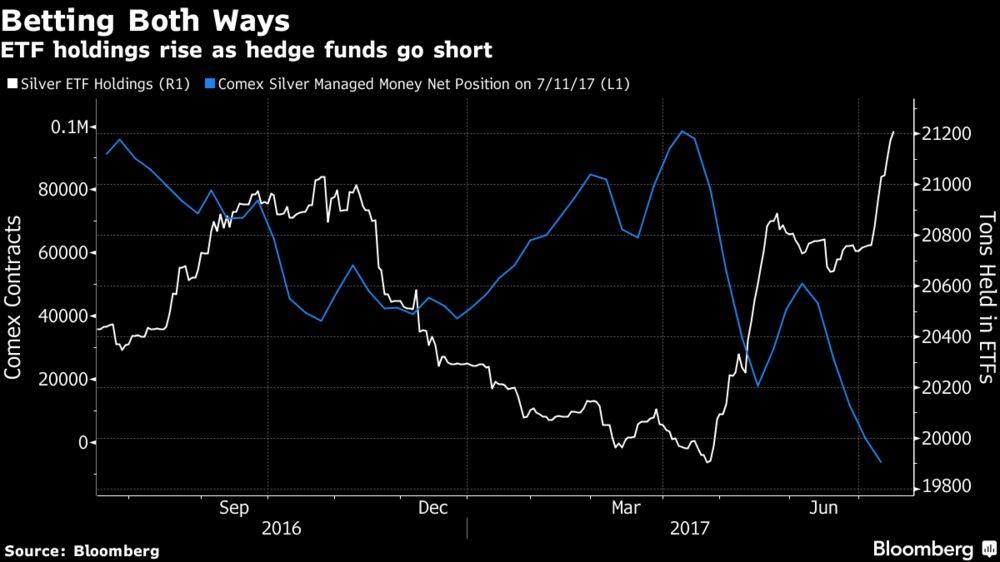
From Bloomberg:
In a Bloomberg survey of 13 traders and analysts, the majority were bullish. 11 people said silver prices would rise and two predicted declines.
Among the seven respondents that provided estimates, the median 12-month forecast was $20 — indicating a 24 percent rally from current levels.
Assets in exchange-trade funds backed by silver have risen 6.6 percent since April 24 to 21,211 tons, according to data compiled by Bloomberg.
In the same time, hedge funds turned negative as prices tumbled. In the week ended July 11, hedge funds were net short by 5,402 contracts, according to U.S. Commodity Futures Trading Commission data. Short positions have tripled since the week of April 25 to 60,775 contracts.
From GoldCore:
We continue to see silver as undervalued vis a vis gold but more especially vis a vis stocks, bonds and many property markets. Rather than selling the financial insurance that is gold, we would advise reducing allocations to stocks, bonds and property and allocating to silver.
If one is very overweight gold in a portfolio and has no allocation to silver than there is of course a case for selling some gold and reweighting a portfolio in order to diversify into silver.
 Gold Silver Ratio – 10 Years
With the gold to silver ratio at 76 ($1235/$16.20/oz), the silver price is attractive at these levels and has the potential to be the surprise out performer in H2, 2017.
Silver’s industrial uses and coin and bar demand should see the gold/silver ratio gradually revert to the mean average in the last 100 hundred years which is close to 35:1. This was seen again in April, 2011 when the gold silver ratio fell to 32.4 with silver at $48/oz and gold at over $1,500/oz.
If the small silver market sees high net worth or institutional funds enter it, then the ratio could return closer to the long term, historical average of 15:1 as it did in 1980. We this as likely in the coming months given how cheap silver has become and the degree of risk in stock, bond and property markets today.
Silver prices back at $20 per ounce seems quite possible in the coming months and we believe we will see a significant rally from today’s depressed prices. Longer term we see silver returning to the record nominal high of just below $50 per ounce – which was seen in 1980 and came very close to again in April 2011.
Silver remains a valuable diversification in a portfolio in that it tends to rise sharply when traditional assets like stocks and bonds are falling.
History shows this, as did the recent global financial crisis when silver surged from $12/oz (not far above the depressed levels of today at $16) in 2007 to nearly $50 at the height of the crisis in 2011.
Recent research has confirmed this that both gold and silver are safe haven assets. They tend to rise sharply when there is uncertainty and in economic crisis. The research shows a 10% allocation to gold is optimal and 1% to 5% allocation to silver is optimal in normal market conditions but a 10% allocation to silver is optimal in a financial crisis – See Lessons from gold and silver: Reviewing the research by Dr Brian Lucey.
In a recent note to subscribers David Morgan, the Silver Guru, underlined the importance of not viewing silver simply as a speculative asset to make a return on and to focus on silver’s diversification benefit:
“It is important to note that all portfolios under all conditions actually perform better with exposure to gold and silver” – David Morgan
We recently had the pleasure of David’s company in GoldCore’s head office in Dublin, Ireland.
In the short video above, David speaks briefly about the importance of owning silver bullion coins and bars as financial insurance in an uncertain world. He speaks about GoldCore Secure Storage and how he recommends GoldCore’s ultra secure allocated and segregated gold, silver, platinum and palladium bullion storage (Zurich, London, Singapore and Hong Kong) to his retail and high net worth clients.
Related Content
Why Silver Bullion Is Set To Soar – GoldCore Interview on YouTube
News and Commentary
Gold steady as cloudy U.S. rate hike outlook drags on dollar (Reuters.com)
Palladium prices seen hitting record average high in 2017: Reuters poll (Reuters.com)
Dollar Drops With Stocks as U.S. Reform Hopes Fade (Bloomberg.com)
Empire State manufacturing index retreats in July from two-year high (MarketWatch.com)
Stocks Flat, Metals Rise as Markets Await Earnings (Bloomberg.com)
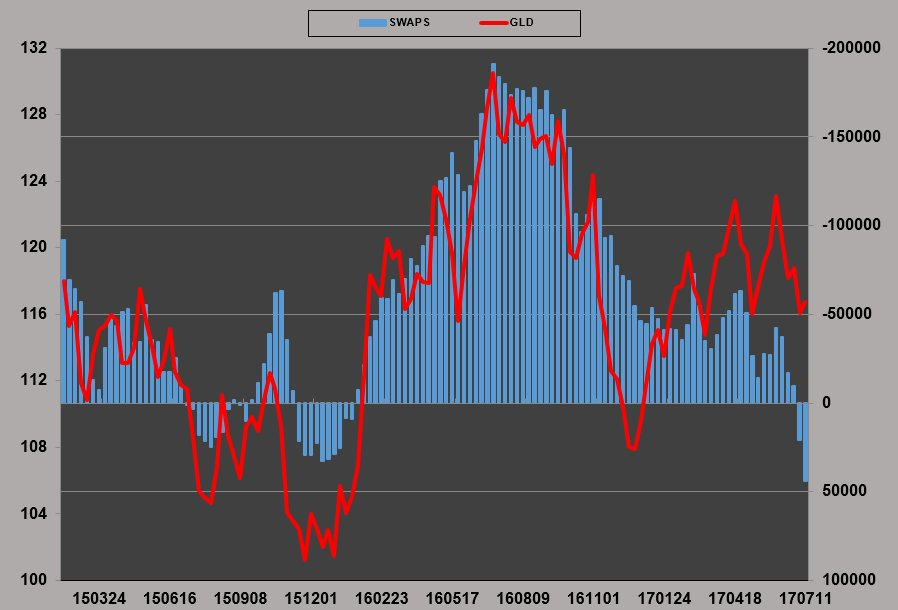
Gold COT: Banks race to their longest position since at least 2006. Source: David Brady, CFA @GlobalProTrader
Bullion banks closed huge number of short positions last week (AveryBGoodMan.com)
COT Report Gets Even More Favorable For Gold And Silver (DollarCollapse.com)
Single most important rule for buying investment real estate (StansBerryChurcHouse.com)
Who’s responsible for the mess the world is in? Somerset Webb (MoneyWeek.com)
Passive investing boom is creating a ‘frightening’ risk for markets – Morgan Stanley (CNBC.com)
Gold Prices (LBMA AM)
18 Jul: USD 1,237.10, GBP 949.47 & EUR 1,071.82 per ounce
17 Jul: USD 1,229.85, GBP 940.71 & EUR 1,074.03 per ounce
14 Jul: USD 1,218.95, GBP 940.54 & EUR 1,067.92 per ounce
13 Jul: USD 1,221.40, GBP 944.51 & EUR 1,071.05 per ounce
12 Jul: USD 1,219.40, GBP 947.60 & EUR 1,064.29 per ounce
11 Jul: USD 1,211.90, GBP 938.98 & EUR 1,063.68 per ounce
10 Jul: USD 1,207.55, GBP 938.63 & EUR 1,060.11 per ounce
Silver Prices (LBMA)
18 Jul: USD 16.17, GBP 12.41 & EUR 13.99 per ounce
17 Jul: USD 16.07, GBP 12.30 & EUR 14.02 per ounce
14 Jul: USD 15.71, GBP 12.11 & EUR 13.76 per ounce
13 Jul: USD 15.95, GBP 12.34 & EUR 14.00 per ounce
12 Jul: USD 15.83, GBP 12.31 & EUR 13.82 per ounce
11 Jul: USD 15.51, GBP 12.02 & EUR 13.61 per ounce
10 Jul: USD 15.22, GBP 11.82 & EUR 13.36 per ounce
Recent Market Updates
– “Bigger Systemic Risk” Now Than 2008 – Bank of England
– “Financial Crisis” Coming By End Of 2018 – Prepare Urgently
– Video – “Gold Should Probably Be $5000” – CME Chairman
– India Gold Imports Surge To 5 Year High – 220 Tons In May Alone
– “Silver’s Plunge Is Nearing Completion”
– China, Russia Alliance Deepens Against American Overstretch
– Silver Prices Bounce Higher After Futures Manipulated 7% Lower In Minute
– Precious Metals Are “Best Defence” Against Bail-ins In Economic Crisis
– Buy Gold Near $1,200 “As Insurance” – UBS Wealth
– UK House Prices ‘On Brink’ Of Massive 40% Collapse
– Gold Up 8% In First Half 2017; Builds On 8.5% Gain In 2016
– Pensions Timebomb In America – “National Crisis” Cometh
– London Property Bubble Bursting? UK In Unchartered Territory On Brexit and Election Mess
Important Guides
Avery Goodman: Bullion banks closed huge number of short positions last week
Submitted by cpowell on Mon, 2017-07-17 16:49. Section: Daily Dispatches
12:52p ET Monday, July 17, 2017
Dear Friend of GATA and Gold:
Examining the U.S. Commodity Futures Trading Commission’s reports, securities lawyer and market analyst Avery Goodman writes today bullion banks continue to close huge volumes of short positions in the monetary metals that they have been carrying for years. If the bullion banks know what they’re doing, Goodman writes, this foretells a major rise in metal prices in coming months. Goodman’s analysis is headlined “Bullion Banks Closed a Huge Number of Short Positions Last Week” and it’s posted at his internet site here:
http://averybgoodman.com/myblog/2017/07/17/gold-bullion-banks-close-huge…
CHRIS POWELL, Secretary/Treasurer
Gold Anti-Trust Action Committee Inc.
CPowell@GATA.org
a must read////
MASSIVE ADDITIONAL SHORT LIQUIDATION BY BANKS FORETELL A BIG RISE IN ALL PRECIOUS METALS PRICES

July 17, 2017
In my most recent commentary, “RECENT GOLD PRICE DECLINES = THE CUSP OF A MAJOR UPWARD MOVE”, I explained how stop-loss and margin call selling can help catalyze a huge decline, in highly leveraged markets like gold, silver and other precious metals. Quick, massive and seemingly senseless price declines shell-shock market participants and facilitate the unloading of legacy short positions on the cheap.
Last week, I showed you how the CFTC’s “Commitments of Traders Report” corroborated the fact that the big bullion banks used the big sudden decline on July 3rd to massively reduce their long-standing legacy short positions. I predicted that the big decline on Friday, July 7th was going to be used to do more of the same. Now, we have the proof that this is exactly what happened.
I don’t have space to cover the entire process by which price falls are catalyzed. For a fuller understanding, I suggest that you read both last week’s article (and my other previous articles) as well as the novel, “The Synod” (eBook)(paperback). Suffice it to say that the big decline on July 7th was used to close the book on yet an even more enormous number of legacy short positions, this time concentrating on silver and platinum, but also in gold.
The latest Commitment of Traders Report’s statistics were tabulated as of the close of trading July 11, 2017. As of that moment, the bullion banks had closed 2,823 platinum short contracts (141,150 troy ounces of platinum); 9,560 silver short contracts (47,800,000 troy ounces of silver) and 19,392 gold short contracts (1,939,200 troy ounces of gold.
The amount of platinum shorts they closed may seem very small, compared to what they did in silver and gold, but remember that it is a much smaller market. Platinum mines produce only 1/20th the tonnage each year as gold mines, and 1/180th the tonnage of silver mines every year. The numbers, with respect to all the precious metals, each represent a massive percentage of the total short position held by the banks. What makes it even more noteworthy is the fact that it comes on top of the massive percentage they closed last week!
The bottom line? The most knowledgeable people in the world must believe that precious metals prices are going to be rising fast and hard in the next few months. Otherwise, they wouldn’t be fleeing from short positions they’ve rolled over for years! Just take a look at the report…


Frankly speaking, no one in the world has a better handle on what is really going on in the precious metals markets than these bullion bankers. Don’t expect, however, that they are going to tell you the truth. Their analysts won’t be writing about how stocks of physical metal are growing perilously low, nor will there be any discussion of the massive excess of demand over limited supply. It simply isn’t in their interest to do so. They want profits, not losses. If they told you, instead of helping get rid of the short positions they are running away from, you would be helping to bid up the price. They are not ready for that. They need to jettison more short positioning first.
Look at what they do, not what they say. They are fleeing from long-standing downside bets they’ve rolled over, year after year, for many years. Some clueless hedge funds (the so-called “managed money”) are taking them over. They will pay an enormous price for doing that. Come mid to late August, for example, some of them are going to be forced to deliver real gold they don’t have. By October, some will be scrambling to source gold bars for delivery. Others will get out sooner than that, but they will pay a very heavy paper money price to do it.
END
Such fine and upstanding citizens: the large BNP Paribas fined 246 million over currency manipulation
(courtesy zero hedge)
BNP Paribas fined $246 million over currency manipulation
Submitted by cpowell on Tue, 2017-07-18 02:43. Section: Daily Dispatches
By Jesse Hamilton
Bloomberg News
Monday, July 17, 2017
BNP Paribas SA agreed to pay $246 million to settle Federal Reserve claims that the bank failed to keep its currency traders from using electronic chatrooms to manipulate prices, the U.S. central bank said in a statement today.
The Fed said the Paris-based lender’s deficiencies — which also led to a $350 million settlement in May with the New York Department of Financial Services — constituted unsafe and unsound practices and ordered the bank to improve its oversight and internal controls over foreign-exchange trading.
BNP Paribas was among several global banks that have faced billions in fines, regulatory sanctions, and legal challenges over the use of chatrooms to influence currency rates, and some of the individuals involved were the targets of criminal prosecutions. …
… For the remainder of the analysis:
https://www.bloomberg.com/news/articles/2017-07-17/bnp-paribas-fined-246…
end
Bitcoin soars as the split seems to have been avoided
(courtesy zero hedge)
Bitcoin Soars As Much-Feared Network Split Appears To Be Avoided
Bitcoin and other virtual currencies have rallied this week as growing support for a controversial software update suggests that a long-feared network split might be averted, and the issue settled…at least for now.
“Traders are excited by the prospect of a resolution to the scaling debate, which is why the price has rallied,” Thomas Glucksmann, head of marketing at Hong Kong-based bitcoin exchange Gatecoin, told Bloomberg.
Indeed, bitcoin is up 10% in early trade Tuesday, building on Monday’s 20% climb:

And Ethereum is surging…

The reason? Bitcoin miners weren’t expected to start signaling for Segwit2x until July 21, but some are already moving to show support in advance of another round of software testing, according to CoinDesk. Support topped 45% of hashing power on Tuesday, including AntPool, BitClub, Bixin, BTC.com and BitFury.

However, many professional bitcoin traders believe more pain lies ahead, especially if support for SegWit2x doesn’t move toward the key threshold of 80% adoption – an accomplishment that would avert a network split – as we draw nearer to the Aug. 1 deadline, according to Bloomberg. The only way for bitcoin to avoid a network split is for SegWit support to reach this threshold by or on Aug. 1.
“Despite the progress with SegWit2x, some warned that bitcoin isn’t out of the woods yet. Many Core members still vehemently oppose the software, which they say hasn’t been properly vetted for bugs. Also, not all miners support SegWit2x, which they say is a flawed compromise that doesn’t solve the root scaling problem.
‘This price rally is a bounce, we are very bearish in the near term for a number of reasons,’ said Harry Yeh, managing partner at digital currency dealer Binary Financial, who cites the lack of support from Core developers as one of his biggest worries. ‘Anytime the price rockets up quickly, it will be followed by a strong correction which we are starting to see. We are definitely headed for some turbulent and volatile times in the short term.’”
One trader put it more bluntly: “Shit’s getting real, no one is sure what happens after August 1st, so traders are taking profits, squaring positions into the scaling deadline.” As Bloomberg explains, the scaling debate began more than two years ago, and has persisted despite several “make or break” deadlines as none of the constantly evolving scaling solutions have garnered a large enough share of support from the mining community to legitimately threaten a network split.
“Bitcoin’s community has been at bitter odds for more than two years about how to solve its scaling problem, which has hampered the cryptocurrency’s growth and allowed rivals like ethereum to steal some of the spotlight. The new software, known as SegWit2x, is seen as a compromise for the two sides of the debate: miners who act as the backbone of the blockchain, and developers known as Core who uphold bitcoin’s bug-free software. While both sides have incentives to reach a consensus, bitcoin’s lack of central authority has made reaching agreement difficult.”
Worries about a network split have even started to rattle national regulators and trade groups. After holding discussions over the possible currency split, the Japan Cryptocurrency Business Association says member exchanges will suspend trading of bitcoin beginning Aug. 1, according to a Bloomberg headline.
A growing number of central banks have warned citizens about the inherent riskiness of investing in unregulated markets like bitcoin and its peers, with the Central Bank of Albania the latest to denounce the cryptocurrency market.
“We appeal to the Albanian public to be mature and responsible in the administration of savings or liquidity they possess. One should orient investments toward financial products and instruments offered by institutions licensed and supervised by the Bank of Albania and the Financial Supervisory Authority.”
Of course, there is an obvious solution here, though it may not be as easy to implement as it sounds: Global regulators could, working with the BIS or some other transnational institution, develop a global regulatory framework, assuaging some of the concerns raised by the SEC in its decisions to reject two proposed bitcoin ETFs. Such a framework might open the door to more officially sanctioned investment products, opening the door to investors who’d like to include bitcoin exposure in their retirement accounts.
Your early TUESDAY morning currency, Asian stock market results, important USA/Asian currency crosses, gold/silver pricing overnight along with the price of oil Major stories overnight
1 Chinese yuan vs USA dollar/yuan STRONGER 6.7504(REVALUATION NORTHBOUND /OFFSHORE YUAN MOVES STRONGER TO ONSHORE AT 6.7449/ Shanghai bourse CLOSED UP 11.10 POINTS OR 0.35% / HANG SANG CLOSED UP 54.36 POINTS OR 0.26%
2. Nikkei closed DOWN 118.05 POINTS OR .59% /USA: YEN FALLS TO 112.09
3. Europe stocks OPENED ALL IN THE RED ( /USA dollar index RISES TO 94.62/Euro UP to 1.1556
3b Japan 10 year bond yield: LOWERS TO +.072%/ GOVERNMENT INTERVENTION !!!!(Japan buying 100% of bond issuance)/Japanese yen vs usa cross now at 114.34/ THIS IS TROUBLESOME AS BANK OF JAPAN IS RUNNING OUT OF BONDS TO BUY./JAPAN 10 YR YIELD FINALLY IN THE POSITIVE/BANK OF JAPAN LOSING CONTROL OF THEIR YIELD CURVE AS THEY PURCHASE ALL BONDS TO GET TO ZERO RATE!!
3c Nikkei now JUST BELOW 17,000
3d USA/Yen rate now well below the important 120 barrier this morning
3e WTI:: 46.21 and Brent: 48.66
3f Gold UP/Yen DOWN
3g Japan is to buy the equivalent of 108 billion uSA dollars worth of bond per month or $1.3 trillion. Japan’s GDP equals 5 trillion usa./“HELICOPTER MONEY” OFF THE TABLE FOR NOW /REVERSE OPERATION TWIST ON THE BONDS: PURCHASE OF LONG BONDS AND SELLING THE SHORT END
Japan to buy 100% of all new Japanese debt and by 2018 they will have 25% of all Japanese debt. Fifty percent of Japanese budget financed with debt.
3h Oil DOWN for WTI and DOWN for Brent this morning
3i European bond buying continues to push yields lower on all fronts in the EMU. German 10yr bund FALLS TO +.557%/Italian 10 yr bond yield UP to 2.187%
3j Greek 10 year bond yield FALLS to : 5.257???
3k Gold at $1237.10 silver at:16.14 (8:15 am est) SILVER BELOW RESISTANCE AT $18.50
3l USA vs Russian rouble; (Russian rouble UP 18/100 in roubles/dollar) 59.16-
3m oil into the 46 dollar handle for WTI and 48 handle for Brent/
3n Higher foreign deposits out of China sees huge risk of outflows and a currency depreciation (already upon us). This can spell financial disaster for the rest of the world/China forced to do QE!! as it lowers its yuan value to the dollar/GOT A GOOD SIZED REVALUATION NORTHBOUND
JAPAN ON JAN 29.2016 INITIATES NIRP. THIS MORNING THEY SIGNAL THEY MAY END NIRP. TODAY THE USA/YEN TRADES TO 112.09 DESTROYING JAPANESE CITIZENS WITH HIGHER FOOD INFLATION
30 SNB (Swiss National Bank) still intervening again in the markets driving down the SF. It is not working: USA/SF this morning 0.9542 as the Swiss Franc is still rising against most currencies. Euro vs SF is 1.1025 well above the floor set by the Swiss Finance Minister. Thomas Jordan, chief of the Swiss National Bank continues to purchase euros trying to lower value of the Swiss Franc.
3p BRITAIN VOTES AFFIRMATIVE BREXIT/LOWER PARLIAMENT APPROVES BREXIT COMMENCEMENT/ARTICLE 50 COMMENCES MARCH 29/2017
3r the 10 Year German bund now POSITIVE territory with the 10 year FALLING to +0.557%
The bank withdrawals were causing massive hardship to the Greek bank. the Greek referendum voted overwhelming “NO”. Next step for Greece will be the recapitalization of the banks and that will be difficult.
4. USA 10 year treasury bond at 2.296% early this morning. Thirty year rate at 2.883% /POLICY ERROR)GETTING DANGEROUSLY HIGH
5. Details Ransquawk, Bloomberg, Deutsche bank/Jim Reid.
(courtesy Jim Reid/Bloomberg/Deutsche bank/zero hedge)
Dollar Tumbles, Euro Soars After Obamacare Repeal Dies; China Intervenes To Halt Rout
Bulletin headline summary from RanSquawk
- The USD-index dropped to 10 month lows amid fading hopes of US reforms after Obamacare repeal effectively died last night.
- Soft CPI from the UK and NZ weigh on both currencies
- Looking ahead, highlights include BoE’s Carney and the API Crude report
The Dollar Index sank to its lowest level since September, a fresh 10-month low, after two more Republican defections on Monday night doomed the proposed GOP healthcare plan in the Senate. And while Treasuries rose on concerns about inflationary pressures and the viability of the Trump stimulus agenda, S&P futures rebounded gingerly from session lows, and were up 0.01% after posting nominal declines earlier in kneejerk reaction to the Senate news.

The sliding dollar sent the Euro surging as high as 1.560, the highest since May of 2016, and sending European lower for first time in five days amid concern a stronger euro would damp exporters earnings.

“Any hopes of dollar support from a successful vote on the Senate’s health-care bill look to be vanishing,” said Rodrigo Catril, a currency strategist at National Australia Bank quoted by Bloomberg. “Near term, the dollar path of least resistance is down. We still think the data – inflation in particular – will provide the Fed with enough ammunition to hike in December and boost the dollar, but this is a fourth-quarter story.”
There were no Chinese fireworks today and no ChiNext “Black Tuesday” largely because Beijing was determined to stop the rout after what appeared to be another “national team” intervention in the last two hours of trading. Earlier in the session, Chinese stocks fell after Monday’s selloff as concern about tougher regulations still unnerved the market.

Sunac China Holdings tumbled in Hong Kong after a local media report that banks are reviewing the company’s credit risk. The Shanghai Composite had dropped as much as 0.6% at the midday break local time after falling 1.4% on Monday, its biggest one-day plunge in seven months, while the ChiNext gauge slipped 0.8% after sinking 5.1% on Monday, however the now familiar late trading levitation sent the SHCOMP up 0.4% while the ChiNext closed 0.7% higher. Meanwhile, Sunac China – which we will have more to say about later – plunged as much as 13%. The company, one of China’s most aggressive acquirors, has seen its proposed plan to buy Dalian Wanda assets trigger concern among lenders and Beijing.
it was a busy overnight session in macro with the Aussie soaring to the highest since May 2015 after upbeat RBA minutes flagged improved 2Q growth alongside expectations of increased fiscal spending while suggesting growth is picking up and the estimated nominal neutral cash rate at 3.5%. The announcement caught AUD shorts wrongfooted and started a major squeeze while sending Australian 3-month bank bills sharply lower in heavy selling while 3-year yield rose as much as eight bps to 2.11%. To stabilize the financial system ahead of a surge in liquidity demands, the PBOC injected net 170 billion yuan of liquidity which some however said would not be enough and as a result interbank rates jumped the most in one month; the Yuan gained against dollar while the Shanghai Composite 0.6% lower. Dalian iron ore jumped 4.8% with futures hitting the highest level since May on strong demand from Chinese steel mills.
Tempered expectations for Trump’s spending plans weighed on European bond yields which edged lower, tracking U.S. equivalents, after the collapse of the second healthcare bill. U.S. 10-year bond yields fell after the news, while German 10-year yields dipped 2 basis points to 0.57 percent when European trading started on Tuesday. In European stocks, the Stoxx Europe 600 Index fell following a grim earnings report from Ericsson AB, which led the decline.
Elsehwhere, the pound tumbled by 100 pips to just above 1.30 after UK CPI disappointed to the downside, sliding to 2.6%, from 2.9%, missing expectation, potentially putting the BOE’s rate hike expectations on hold.
Meanwhile, in the US, S&P futures were little changed ahead of earnings reports by Bank of America and Goldman Sachs. IBM reports after the close.
In commodity markets, oil prices steadied as expectations of firm demand, particularly from China, was met ample supply despite Ecuador announcing it would exit the OPEC production cut deal. Brent crude futures eased 0.1 percent to $48.35 a barrel while U.S. crude oil fell 0.2 percent to $45.93. The ongoing dollar weakness sent gold higher for another day, with the yellow metal trading as high as $1,238 overnight.

Market Snapshot
- S&P 500 futures up 0.01% to 2,458
- STOXX Europe 600 down 0.3% to 385.64
- MXAP up 0.1% to 157.81
- MXAPJ up 0.2% to 520.60
- Nikkei down 0.6% to 19,999.91
- Topix down 0.3% to 1,620.48
- Hang Seng Index up 0.2% to 26,524.94
- Shanghai Composite up 0.4% to 3,187.57
- Sensex down 0.6% to 31,868.93
- Australia S&P/ASX 200 down 1.2% to 5,687.39
- Kospi up 0.04% to 2,426.04
- German 10Y yield fell 1.4 bps to 0.567%
- Euro up 0.4% to 1.1527 per US$
- Brent Futures up 0.2% to $48.53/bbl
- Italian 10Y yield fell 5.2 bps to 1.942%
- Spanish 10Y yield fell 3.7 bps to 1.555%
- Brent Futures up 0.2% to $48.53/bbl
- Gold spot up 0.2% to $1,236.46
- U.S. Dollar Index down 0.3% to 94.84
Top overnight news:
- U.K. inflation unexpectedly slowed in June, giving respite to Bank of England policy makers concerned that price growth was getting out of hand
- Citigroup Inc. has chosen Frankfurt as its newest trading hub in the European Union and plans to present that option to its board of directors this week for approval, according to a person with knowledge of the decision
- Policy makers from Stockholm to Bucharest are now waiting for their colleagues at the European Central Bank to kick off unwinding the record stimulus that was unleashed in the aftermath of the global financial crisis. This Thursday, they’ll be watching for any new signals from President Mario Draghi, who hinted last month that the end of the road was approaching
- Senate Majority Leader McConnell abandons broad Obamacare replacement vote to seek straight repeal; Trump urges GOP to work on new plan, start from ’clean slate’
- RBA minutes say growth likely increased in 2Q; stronger labor market removes ’some of the downside risk’ to wage growth forecast; estimates neutral nominal cash rate of around 3.5%
- CBRC told some Chinese lenders to lower returns on wealth products
- China should achieve ’clean floating’ yuan exchange rate: Financial News
- New Zealand 2Q CPI 0.0% vs 0.2% estimate, y/y 1.7% vs 1.9% estimate
- Wells Fargo Buys Rest of $10 Billion ‘Active Quant’ Firm Golden
- BNP Paribas Fined $246 Million Over Currency Manipulation
- Fed’s Long-Run Miss of Inflation Goal Undermines Rate Hike Case
- Medtronic Computer Crash to Crimp Quarterly Sales, CFO Says
Asian equity markets traded higher as investors await quarterly results this week. ASX 200 (-1.1 %) traded negative with the financial and utilities sectors weighing on the index, whilst Nikkei 225 (-0.6%) was also in the red amid a stronger JPY, following safe-haven flows into the Japanese currency after news that two US Republican Senators are to vote against the Senate Healthcare bill. Elsewhere, Shanghai Comp. (+0.4%) and Hang Seng (+0.2%) jumped following the latest PBOC intervention helped by a CNY 170bIn liquidity injection by the PBoC. Finally, 10yr JGBs traded higher amid caution in the region, with flattening seen in the belly of the curve.
Top Asian News
- BOJ ETF Buying Is Said to Raise Concern Among Some Officials
- China Is Said to Tell Banks to Cut Yields on Wealth Products
- China Liquidity Tightens as Tax Demands Outweigh Fund Injections
- Chinasoft Rises After Announcing Cloud Partnership with Huawei
- Asia’s Biggest Buyout Prompts Concerns on GLP’s Credit Score
- S&P Says Wider Indonesia Budget Gap Isn’t Material Policy Easing
- Alphadyne Hires Ayad Butt as Portfolio Manager in Singapore
European bourses were marginally affected by the data, with the FTSE benefiting of the lower chance for an august move. Ericson is the clear under-performing stock amid reporting poor results, with the majority of indices being dictated by earnings. Gilts saw the most influential reaction to the UK data, as the UK paper traded up around 70 ticks following the result, the lOy did slow however, around the 126.80 level (July’s High). Periphery bonds trade higher, led by Greece which trade at record levels, set to hit the market this week.
Top European News
- BC Partners Is Said to Be Close to Deal for GoDaddy’s PlusServer
- STM/Infineon M&A Has Large Cost-Cutting Potential: Natixis
- REVISED GUIDANCE: EFSF EU3b 10Y, Min. EU500m 2/2056 Tap
- Economic Growth, Low Rates Boost Bulgarian Bourse: Karaivanova
- European Miners Snap Gains After Run Into Overbought Territory
- Gecina Plans to Raise $1.2 Billion to Fund Eurosic Purchase
In currencies, markets awaited the UK, CPI, PPI and RPI figures, where the headline CPI figures missed on expected. Focus will remain on the UK as BoE’s Carney is expected to speak at 14.30 London time. GBP saw volatility coming into the figure, and following the result, sterling bears continued to attack the currency. GBP/USD trades back towards 1.30, expected to be physiological support, with further support likely at 1.2980. The headline news overnight, came from the US, where reports emerged that US Republican Senators Moran and Lee are to vote against Senate Healthcare Bill, all but confirming that the bill will not succeed. The dollar weakness was clear, as the news triggered stops through last week’s highs in EUR/USD, followed by a break of the 1.15 handle. The pair now trades around highs of the 2015/2016 range, with any break through 1.16, aided by more poor US data and a continued dovish tone from the Fed could see a clear change of direction.
In commodities, the commodity complex continues to be led by precious metals, albeit marginally so. The safe haven flow has been evident following the overnight reports that US Republican Senators Moran and Lee are to vote against Senate Healthcare Bill, as markets begin to prepare for an imminent winter for President Trump. Oil markets trade marginally higher, with WTI bouncing off the 46.00 area, further support from a trendline beginning on July the 10th.
Looking at the day ahead, in the US this afternoon we’ll get the June import price index print along with the NAHB housing market index reading for July. Earnings should be a decent focus for the market today too with Goldman Sachs and Bank of America the latest banks to report (both prior to the open), while Johnson & Johnson (pre-open) and IBM (post-close) are also scheduled.
US event calendar
- 8:30am: Import Price Index MoM, est. -0.2%, prior -0.3%; Import Price Index ex Petroleum MoM, est. 0.01%, prior 0.0%
- Import Price Index YoY, est. 1.25%, prior 2.1%
- Export Price Index MoM, est. 0.0%, prior -0.7%; Export Price Index YoY, prior 1.4%
- 10am: NAHB Housing Market Index, est. 67, prior 67
- 4pm: Total Net TIC Flows, prior $65.8b; Net Long-term TIC Flows, prior $1.8b
DB’s Jim Reid concludes the overnight wrap
Well that was an epic start to Game of Thrones, although the biggest shock was seeing one of the most famous pop star in the world making his acting debut in last night’s show. Talking of world famous singers I have an apology for you this morning. For the last three weeks I’ve had to manually override an autocorrect on my iPad that changes Sintra to Sinatra. I must have done this 30-40 times in the EMR over the last three weeks but yesterday it finally caught up with me and I failed to edit a mention of the latter to the former. This heralded a string of amusing email replies mostly about how Draghi had done it “My Way” last month. Anyway we look forward to him spreading the news later this week at the post ECB meeting press conference.
To be frank, yesterday was relatively dull and my train definitely had an air of emptiness that only arrives with the start of school holidays. Of the main DM equity markets, the S&P, Dow, Nasdaq, Stoxx 600, CAC, IBEX, FTSE MIB, PSI and SMI all finished less than +\- 0.10%. That was even after all the excitement of the huge swings in Chinese bourses 24 hours ago with the Shanghai Comp and Shenzhen in particular seeing high to low swings of 2.81% and 4.09% respectively as the market balanced that strong data versus the potential for tougher financial regulation following the PBoC meeting over the weekend.
By and large it was China-sensitive assets which were really the only markets to see any significant moves yesterday. That was most apparent in base metals with Iron Ore (+1.63%), Copper (+1.18%) and Zinc (+1.04%) all standing out. Bond markets were also a smidgen stronger on fairly limited newsflow and thin volumes as the market awaits the ECB meeting later this week. Benchmark 10y Treasury yields edged down 1.8bps to 2.315% while Bunds finished just over a basis point lower at 0.576% with the periphery down 3-5bps. Away from that Sterling (-0.33%) struggled from the get go yesterday and weakened as the day progressed as the second round of Brexit talks between David Davis and Michel Barnier got underway. There wasn’t any significant new updates to report and instead it’s expected that technical teams will carry on work behind the scenes to iron out the details for EU citizens’ rights in the UK with a further update to possibly come on Thursday.
This morning in Asia the tone for the most part has been modestly risk-off. The Nikkei (-0.62%), Hang Seng (-0.20%), Shanghai Comp (-0.32%) and ASX (-1.27%) have all weakened. This more than likely reflects a combination of news out of both China – where the banking regulator has imposed lower rates on wealth management products – and the news out of Washington that two more Republican senators have opposed the latest version of the health care plan. This doesn’t look good for Mr Trump and his legislative agenda. US equity index futures are also in the red, while the USD has weakened -0.43%. Some of the macro data this morning has garnered some attention too. In Australia the latest RBA meeting minutes included a new reference to a neutral nominal cash rate which partly explains a +1.20% rally for the Aussie Dollar. Across the Tasman, New Zealand Q2 CPI disappointed (0.0% mom vs. +0.2% expected) which continues the theme of some disappointing global CPI reports in recent days. As we’ll see in the data ahead it’s the UK’s turn this morning on inflation.
It’s worth noting that following the close last night in the US, Netlifx shares surged as much as 11% following the latest quarterly earnings report. While earnings were largely in line, revenue topped forecasts and subscriber growth surged more than expected. While Nasdaq futures have weakened overnight in line with other bourses following the latest health care developments, it’ll be interesting to see if the results help cap a full recovery in the Nasdaq which was down as much as 4% from the peak on June 9th to the lows on July 6th. It closed last night off just 0.40% from the highs so that Netflix boost might help sentiment in tech stocks again after a more difficult month or so. Moving on. Yesterday also saw a landmark day for the ECB as the CSPP holdings went above €100bn for the first time. To put things in perspective, a similar market cap company would be the 18th largest in the Stoxx 600 and 42nd largest in the S&P 500. It’s also roughly equivalent to the annual national output of Kuwait – the 59th largest economy in the world as of 2016.
While we’re on such comparisons, the entire ECB balance sheet now stands at €4.21tn, which now has the largest central bank holding in the World. This is comparable to the annual GDP of Japan (€4.30tn) – the 3rd biggest economy in the world and a decent distance ahead of Germany (€3.02tn) – the fourth largest. It’s staggering to think of it in those terms.
Back to the more mundane, net CSPP averaged €286mn/day last week, well below the €365mn average since the program started. However last week saw European markets wind down a little with Bastille Day on Friday and the strong buying recently perhaps reflected a desire to front load ahead of what will now be relatively illiquid summer markets. The CSPP/PSPP ratio was 10.4% last week, which is below the long-term average (even before QE was trimmed in April). However the same ratio for the past two weeks is 13.4%. Indeed the evidence from the more than three months of purchases since QE was trimmed continues to be that the CSPP has been trimmed notably less than the PSPP (CSPP/PSPP ratio 13.6% since April compared to 11.6% before then).
Staying with bonds, it was interesting to note the various stories doing the rounds yesterday suggesting that Greece may be returning to the primary bond market for the first time since August 2014. Both Bloomberg and the FT are reporting that Greece is looking to bring a 5y deal to market this week or next following the repayment of a 3y bond yesterday. Notwithstanding the fact that debt relief debates are still yet to be concluded, with 3 bailouts in the last 7 years, and the fact that the country also came close to exiting the Euro, it would make for a fairly symbolic step.
Before we look at today’s calendar, a quick wrap up of the few data releases out yesterday post the China numbers. In Europe there were no surprises to come from the final June CPI revisions with headline CPI confirmed at 0.0% mom and +1.3% yoy respectively (unrevised) and the core confirmed at +1.1% yoy (also unrevised and up from +0.9% in May). In the US the NY Fed’s empire manufacturing survey for July dipped 10pts to 9.8 (vs. 15.0 expected), albeit still above the level seen in both April and May.
Looking at the day ahead now, this morning in Europe the early focus is likely to be on the ECB bank lending survey for Q2 which we are expecting to receive at around 9am BST. Shortly following that we’ll receive the June CPI/RPI/PPI data docket out of the UK where market expectations for headline and core CPI are expected to hold steady at 2.6% yoy and 2.9% yoy, respectively. Following that we’ll receive the July ZEW survey in Germany. Over in the US this afternoon we’ll get the June import price index print along with the NAHB housing market index reading for July. Earnings should be a decent focus for the market today too with Goldman Sachs and Bank of America the latest banks to report (both prior to the open), while Johnson & Johnson (pre-open) and IBM (post-close) are also scheduled.
3. ASIAN AFFAIRS
i)Late MONDAY night/TUESDAY morning: Shanghai closed UP 11.10 POINTS OR 0.35% / /Hang Sang CLOSED UP 54.36 POINTS OR 0.26% The Nikkei closed DOWN 118.95 POINTS OR .59%/Australia’s all ordinaires CLOSED DOWN 1.08%/Chinese yuan (ONSHORE) closed UP at 6.7504/Oil DOWN to 46.21 dollars per barrel for WTI and 48.66 for Brent. Stocks in Europe OPENED IN THE RED,, Offshore yuan trades 6.7449 yuan to the dollar vs 6.7504 for onshore yuan. NOW THE OFFSHORE IS STRONGER TO THE ONSHORE YUAN/ ONSHORE YUAN STRONGER (TO THE DOLLAR) AND THE OFFSHORE YUAN IS MUCH STRONGER TO THE DOLLAR AND THIS IS COUPLED WITH THE WEAKER DOLLAR. CHINA IS EXTREMELY HAPPY TODAY
3a)THAILAND/SOUTH KOREA/NORTH KOREA
NORTH KOREA
end
b) REPORT ON JAPAN
end
c) REPORT ON CHINA
USA/China exporting deflation
USA data released today using both USA import prices and USA export prices both tumbling and this is the 2nd month in a row that this has happened. Only one explanation: China is exporting deflation to the world and the USA et al are having trouble passing on higher input costs.
(courtesy zerohedge)
US Import, Export Prices Tumble For 2nd Month As China Deflation Exports Accelerate
For the second month in a row both import and export prices fell MoM (imports -0.2%; exports -0.2%)…
This is the equal biggest MoM drop in import prices since Feb 2016…

Petroulem prices dropped 2.2% – the biggest driver – along with Foods & Beverages (-1.6%) and Agricultural (-1.5%).
Year over year, import and export price growth fell to their lowest since Nov 2016.
After a modest rebound in Q1, China import prices have resumed their downward trend, falling to February lows…

It appears that US companies are unable to pass through any input cost increases to the rest of the world as China exports its own brand of deflation once again.
4. EUROPEAN AFFAIRS
ITALY
Now wonder Italy is saddled with huge problems: It’s poorer population has tripled in this last decade as the youth simply cannot find jobs. Italy has the lowest fertility rates as women realize that jobs are scarce and so they do not have children.
(courtesy zero hedge)
Recovery? Italy’s Poor Population Has Tripled In Last Decade
Is it any wonder the Italians are revolting against the European Union?

Italians living below the level of absolute poverty almost tripled over the last decade as the country went through a double-dip, record-long recession. As Bloomberg reports, the absolute poor, or those unable to purchase a basket of necessary goods and services, reached 4.7 million last year, up from almost 1.7 million in 2006, national statistics agency Istat said Thursday. That is 7.9 percent of the population, with many of them concentrated in the nation’s southern regions.
For decades, Italy has grappled with a low fertility rate — just 1.35 children per woman compared with a 1.58 average across the 28-nation European union as of 2015, the last year for which comparable data are available.
“The poverty report shows how it is pointless to wonder why there are fewer newborn in Italy,” said Gigi De Palo, head of Italy’s Forum of Family Associations.
“Making a child means becoming poor, it seems like in Italy children are not seen as a common good.”
The number of absolute poor rose last year in the younger-age classes, reaching 10 percent in the group of those between 18 and 34 years old. It fell among seniors to 3.8 percent in the age group of 65 and older, the Istat report also showed.
Just a good job the government spent the equivalent of its entire defense budget bailing-out the bankers…
END
UK
Because British university graduates pay higher interest rates on loans, a new study suggests at 75% of all UK graduates will never repay their loans, worse than Americans.
(courtesy zero hedge)
3/4 UK Graduates Will Never Repay Student Loans
With tuition costs rising more than twice as quickly as consumer prices, a generation of recent college graduates are struggling to strike out on their own, burdened by a $1.4 trillion pile of debt that ineligible to be erased by the tonic of bankruptcy protection. Tuition costs have been blamed for nearly all of the ills facing the millennial generation. The rate at which recent graduates are moving back home with mom and dad has never been higher, with nearly a third retreating back to the basement as they struggle to jobs with adequate pay. Household formation rate have plummeted as women put off childbirth. Meanwhile, those who have made it out are clustering in popular urba like NYC, San Francisco or DC where they’re spending more than 50% of their income on rent.
There’s no question that US graduates have it rough, but a recent study by the UK-based Institute for Fiscal Studies suggests that students in the UK are facing obstacles that’re even more overwhelming than their peers in the US. As the Financial Times reported earlier this month, Three-quarters of UK university leavers will never pay off their student loans, even if they are still contributing in their 50s.
This means the UK government will have to write off some or all of the debt taken out by 77% of students because they will not earn enough to repay their loans within 30 years of graduating, according to the study, which was written up in the Financial Times.

The study amounts to more unwelcome news for the UK college students, who will soon contend with an interest-rate increase of more than a third, to an annualized 6.1%, slated for September. That increase, experts say, is a byproduct of the UK’s decision to leave the European Union – a decision that resulted in a more than 10% drop in the British pound’s value relative to the dollar and euro, according to the Guardian.
“Graduates in England were saddled with the highest student debt in the developed world, the IFS said, adding that the benefits of earlier reforms to the tuition fee system — which took pressure off the lowest-earning students — had been wiped out by subsequent changes such as the replacement of maintenance grants with loans.
The IFS said that because graduates repaid their student loans at 9 per cent of their earnings, above a certain threshold, and over a 30-year period, in many cases interest accrued on their debt too fast for repayments to keep up.
One key finding is that because interest rates on student debt are very high — up to 3 per cent above RPI — the average student accrues £5,800 of interest while studying, meaning they borrow £45,000 but have a debt of £50,800 on the day of graduation.
By contrast, the average debt burden on students in the US is far lower at $36,000 (£27,900), even though the cost of tuition varies far more at US institutions.”
Financial researher researcher Martin Lewis, who runs his own personal-finance website moneysavingexpert.com, says he has been “swamped” by UK graduates terrified by new statements that show their debt spiraling in size after interest is added later this year, he told the Guardian.
“Many graduates are starting to panic. First they look in shock at their student loan statements after noticing interest totalling thousands has been added. Then they read the headline interest rate for the 2017-18 academic year will increase from 4.6% to 6.1%. It’s no surprise I’ve been swamped with people asking if they should be trying to overpay the loans to reduce the interest.”
Counterintuitively, Lewis warns these graduates that there’s little benefit in paying off their loans early thanks to a government program that will pay off the remaining balance after 30 years. Only if the student lands a job earning £40,000 a year on graduation, and then enjoys big pay rises after, should they consider repaying their loan early, says Lewis. Here’s why:
A graduate earning £36,000 a year will repay £40,500 of a £55,000 total student loan over 30 years, said Lewis, at the current repayment rates. The remaining debt will be wiped clean after 30 years. If the same graduate cuts the total £55,000 balance to £45,000 with an overpayment of £10,000, they will still have to repay the same amount of student loan over 30 years, making the overpayment entirely pointless.
Just like in the US, student-loan debt in the UK has been soaring. Its total value rose above £100 billion ($131 billion) for the first time earlier this year, according to figures released by the Student Loans Company.
Lewis says students might as well “rip up their loan statements” and just accept the fact that they will be paying a tax equivalent to 9% of their income above £21,000, thanks to a UK government program ostensibly meant to assuage the student-loan hysteria by spreading around the cost of debt repayments.
“‘For most university leavers, the student loan’ is a misnomer – it should be renamed the more accurate term: a ‘graduate contribution’ system. That doesn’t mean it’s cheap or fair, simply that people would make better financial decisions if they focus on the fact they’ll have to pay the equivalent of 9% extra tax above £21,000 for 30 years,’ Lewis said.”
As the FT notes, the 2012 reforms, carried out by David Cameron and Nick Clegg, tripled tuition fees to £9,000 and increased average university funding by a quarter. But the majority of the cost rises were borne by richer graduates, resulting in the lowest-earning third of graduates benefiting by an average of £1,500.
Recent reforms have eroded this advantage: cutting maintenance grants has reduced the government deficit but meant students from low-income families are graduating with the highest debt levels, often over £57,000.
Laura van der Erve, one of the report’s authors, said told the FT that universities are “undoubtedly” better off under the current system than they were before the 2012 reforms. But she warned that the changes had shifted incentives towards institutions offering low-cost arts and humanities courses, which now attract 47 per cent more income per student than they did in 2011. By contrast, the highest-cost subjects only attract 6 per cent_more income. “This does not sit comfortably with the government’s intention to promote typically high-cost [science, technology, engineering and maths] subjects,” she said.
Intensifying student-debt burdens have been blamed for helping Labour leader Jeremy Corbyn won support from a swath of young voters on the back of his election promise to abolish £9,250 annual tuition fees altogether.
One Conservative heavyweight noted the most pressing issue related to college costs: The question of whether these costly educations represent an adequate value for students. One study in the US revealed that graduates at large state flagship universities are often leaving college with worse cognitive skills than they had upon enrolling.
“Damian Green, the Conservatives’ first secretary of state, told the FT earlier this month that the debt burden on young people was “clearly a huge issue” and something his party would have to address. “I think in the long term we’ve got to show that [students] are getting value for the money,” he said.
Even liberal politicians criticized the government’s plan to focus student debt reforms on percentages and interest rates.
“Responding to the research Sarah Stevens, head of policy at the Russell Group, said that increased undergraduate fees have been “crucial” to universities at a time of cuts to government teaching grants. She suggested that in order to make higher education more affordable for students, ministers should address concerns over the interest rates applied to loans.
Nick Hillman, director of the Higher Education Policy Institute, agreed that issues such as interest rates, repayment thresholds and the period allowed for repayment affect graduates far more than the “sticker price” of university courses, which receive far more political attention.
‘The debate about fee levels is a bit of a red herring because what matters is what you are paying back later,’ he said. ‘The point at which you feel it in your pocket is when you’re in your 30s, with a mortgage and childcare costs, and 9 per cent of your salary above a certain threshold is going to pay back your student loan.’”
Judging by the IFS report, and other the recent warnings about the metastasizing consumer-debt crisis issued by the BOE, most contemporary students and recent graduates will be feeling this burden until they’re just about ready to retire. Let’s hope, for their sakes, that they can find some way to afford it.
end
the blind leading the blind??
Troubled HNA becomes Deutsche bank’s largest shareholder
(courtesy Henning/Steve Arons)
and a special thank you to Robert H for sending this to us
|
5. RUSSIAN AND MIDDLE EASTERN AFFAIRS
TURKEY
An extremely important commentary from Peter Kozun. We have been pointing out to you that Turkey is turning to Russia and China. Russia’s new S 400 will certainly aid in Turkey’s defense strategies. Turkey wishes to become a full member of China’s SCO and with Russia it wants the Turkish stream gas pipelines to be implemented. The danger to the west is of course, the huge 3 million migrants housed in Turkey and in a moments notice they could be unleashed onto Greece who has no capability of handling them
(courtesy Peter Kozun/StrategicCultureFoundation).
NATO Member Turkey Turns To Russia For Air Defense Cooperation
Authored by Peter Korzun via The Strategic Culture Foundation,
Turkey has agreed to pay $2.5 billion to acquire S-400 – the Russia-made most advanced long-range missile defense system in the world. Russian President Vladimir Putin has already said that Moscow is ready to sell it. According to Russian Presidential Adviser for Military and Technical Cooperation Vladimir Kozhin, Russia’s contract with Turkey has been agreed in general, with financial details still to be ironed out. The system is capable of intercepting all types of modern air weaponry, including fifth-generation warplanes, as well as ballistic and cruise missiles at a maximum range of nearly 250 miles.

According to the preliminary agreement, Ankara is to receive two S-400 missile batteries within the next year, and then produce another two inside Turkey, although the Turkish defense industry has no experience of producing such systems. Not yet.
Unlike NATO’s US-made Patriots temporarily deployed in Turkey some time ago, the Russian S-400 deal has no political strings attached, and could, potentially, boost Turkey’s defense industry bringing Russian-Turkish military cooperation to an unprecedented level. The two nations will work together for many years and the process is likely to encompass other areas of interaction.
Last year, Russia and Turkey signed a declaration on partnership in defense industry. The parties agreed to form a joint military and intelligence mechanism to coordinate their activities in the Middle East. Ankara also seeks procurement deals with Russia in electronic systems, ammunitions and missile technology.
In 2013, Turkey wanted to purchase the HQ-9 long-range air defense system from China but had to scupper the deal in 2015 due to political pressure from NATO allies. Not this time. The pressure is there but Turkey stands tall – it wants the best and the best is S-400. Today, the Turkish government is pursuing a more independent policy while its ties with NATO, the EU and the US are getting increasingly strained.
The deal is a clear shift of Turkey away from NATO and the West. The system won’t be compatible with the rest of the alliance for the purposes of integration. In March, 2017, Turkish President Recep Tayyip Erdogan said, «Being a NATO member does not mean we are not independent. We can have close ties with Russia while performing our responsibilities toward NATO. We find objections on this matter inappropriate».
Turkey has been angered by what it sees as lukewarm condemnation by its Western allies of the abortive July 2016 putsch against President Tayyip Erdogan. Ankara suspected that the West had a role to play. Russia was the first country to be visited by the Turkish president after the failed coup.
The idea of joining the EU has lost its attraction for Ankara as the union is facing a number of problems, including Brexit, the refugee crisis, the surge of far-right movements and the creation of blocs within the bloc while the concepts of «two-speed Europe» and «multi-speed Europe» are seriously considered as alternatives to the EU we know today.
The territorial dispute between Greece and Turkey in the Aegean Sea and Turkey’s support for Northern Cyprus has traditionally spoiled relations between Turkey and NATO. According to the NATO 2016 annual report, Turkey took part in only four of the 18 key NATO exercises held last year. Despite having the fourth-strongest military in the bloc and the second-highest number of military personnel, Turkey’s involvement in NATO’s deployments amounts to just 4 percent of the personnel in the mission to train the Afghan security forces, and 7 percent of the Kosovo force.
Turkey has recently blocked some rolling programs with NATO, including political events, civilian projects and military training, in an escalation of its diplomatic dispute with a number of European states. The action encompasses many more areas of NATO’s activities as the programs cover most of Europe, plus many countries in the Middle East and Asia. As its relations with the West sour, Turkey is looking for other partners.
Russia and Turkey lead the management crisis process in Syria. With the Islamic State (IS) retreating everywhere, the time draws nearer when Russia and Turkey will face the question about what to do next. It could be the start of forming a broader alliance.
If the coordination of efforts in Syria is successful, the lucrative prospect in bilateral trade, mutual investment, tourism and the Turkish Steam gas project will provide a powerful impetus to the development of relationship.
Turkish President Recep Tayyip Erdogan made the first statement about the possibility of Turkey’s accession to the Shanghai Cooperation Organization as far back as 2013. In 2016, he repeated it again, saying «Some may criticize me but I express my opinion. For example, I have said ‘why shouldn’t Turkey be in the Shanghai 5?» Turkey was granted dialogue partner status in the SCO in 2012. This year, Ankara chairs the Shanghai Cooperation Organization (SCO) Energy Club. The SCO’s clout is rapidly increasing in the world. The accession would bring economic benefits for Turkey.
Ankara is also showing increasing interest in the Eurasian Economic Union (EAEU). It was invited to join the organization in 2014. Many of the present and potential members of the EAEU are countries with whom Turkey already has close relations in many fields.
Ankara is also getting closer to Beijing. The two countries are closely cooperating to implement China’s the One Belt One Road project. Turkey is again taking the position as a key investment and cooperation partner that will help bridge the East and the West.
Turkey’s gradual shift from the West to Eurasia and other partners is part of a broader process as the West gets weakened, divided and less attractive. The very notion of «Western unity» is fading away. Unsurprisingly, as its relations with the West sour, Turkey is reaching out to other poles of power. The S-400 deal conforms to the trend.
“We Are Ready To Retaliate” Russia Warns After “Diplomatic Row” Ends Without A Deal
Shortly after CNN reported late on Monday that according to Russian deputy foreign minister Rybakov, the Russian government was “almost” at a deal on getting back property seized by the US…
Just in: Russian Dep Foreign Minister Rybakov says Russian government “almost” at a deal on getting back property seized by the US

… the Russian rejected the report, instead saying that the U.S. must return the seized properties after diplomatic talks with the U.S. in Washington ended without a deal, with the Russian Foreign Ministry saying that Moscow reserved the right to
take “retaliatory measures” against the United States. The ongoing “diplomatic row” as Reuters puts it regards the December 2016 seizure by Barack Obama of two Russian diplomatic compounds and the expulsion of 35 Russian diplomats over what he said was their involvement in hacking the 2016 U.S. presidential election campaign.

“The Russian side stressed (in the meeting) that if Washington does not remove this and other irritants, including continued obstacles to the work of our diplomatic institutions, we reserve the right to take retaliatory measures based on the principle of reciprocity,” the Russian foreign ministry statement said.
Bloomberg reports that Russian Deputy Foreign Minister Sergei Ryabkov discussed the “Illegal” seizure by U.S. of diplomatic properties near New York and Washington at talks with Undersecretary of State Thomas Shannon on Monday, the Russian Foreign Ministry in Moscow says in statement. Russia’s Foreign Ministry said on Tuesday Moscow reserved the right to take retaliatory measures against the United States after a meeting in Washington ended without a deal on returning seized Russian diplomatic property.
Moscow has said a lot would depend on the outcome of a meeting in Washington on Monday between Russian Deputy Foreign Minister Sergei Ryabkov and U.S. Undersecretary of State Thomas Shannon who discussed the diplomatic row. But the Foreign Ministry said in a statement on Tuesday a resolution to the problem had not yet been found.
Meanwhile, the deputy foreign minister said that Russia could impose retaliatory measures soon if the United States does not return the szied property. Recounting his talks with Shannon in Washington on Monday, he noted that Moscow finds unacceptable the US position that it seized the Russian diplomatic compounds in Maryland in New York in December 2016 legally. “The longer the US persists, the less likely a solution could be found that does not infringe on interests, including theirs,” Ryabkov said.
Ryabkov also said that the date of his next meeting with Shannon depends on progress with the seized diplomatic property. “There is an understanding that contacts at this level and in this format will be continued. We will agree on the date as the situation becomes clearer around our diplomatic property and as the US side’s reaction to our ideas comes in.”
Ryabkov added that the agenda of his meeting with US Under Secretary of State for Political Affairs Thomas Shannon was not solely centered around the issue of Russia’s diplomatic property in the United States, there were signals that Moscow and Washington could work more constructively on certain issues.
“The agenda of the meeting was much broader. There is evident intent of Moscow and Washington to broaden their common stances on some issues and to work more constructively than before. We conveyed certain specific ideas on these questions to the US side and will wait for its reaction.”
Russia said it also wanted to resume regular dialogue with the United States about strategic stability too, it said, saying it was up to Washington to make a move on the issue.
6 .GLOBAL ISSUES
7. OIL ISSUES
Ecuador breaks with OPEC as this cash starved country cannot cope with smaller outputs
(courtesy zero hedge)
OPEC Deal Splinters: Ecuador Will No Longer Comply With Production Quota Due To “Difficult Economic Situation”
Ever since the OPEC production cut deal was announced last year in Vienna, there have been two key wildcards fascinating the oil trader and analyst community: what would be the deal compliance (in other words, how pervasive would cheating be), and which country would break away from the deal first. When it comes to the former, after an impressive run in which compliance hit and in some months surpassed 100%, mostly due to Saudi Arabia shouldering the extra production cut burden, in June it finally slid back to 92%, the lowest in months, and the first indication that the recent Saudi rising production is starting to weigh on the cartel members who are growing concerned that the Saudi commitment to production cuts may be waning.

As for the first country to defect, the odds were always highest on Venezuela, however as of today that has turned out to be a losing wager because as Argus reported, Ecuador’s oil minister said the cash-strapped country faces a “difficult economic situation” and is no longer able to comply with its pledge to Opec to cut 26,000 b/d of oil production.
Today’s announcement comes after the small Latin American nation had strictly followed the quota set by the Vienna deal, and from January to May Ecuador reduced its output by some 16,000 b/d. However, that ended today, when oil minister Carlos Perez said today the country is no longer complying with the quota because of its fiscal challenges. These include a public debt close to 50% of gross domestic product and an expected 7.5% fiscal deficit for the year.
Perez claimed Ecuador has a non-written agreement with Opec that gives Quito some flexibility. In the last month and a half instead of reducing output, Ecuador has slightly increased it.
Perez said state-owned downstream company PetroAmazonas is now producing about 430,000 b/d and foreign oil companies, such as Spain’s Repsol, China’s AndesPetroleum and Italy’s Agip, are producing another 115,000 b/d. That combined 545,000 b/d is a 2.19pc increase over the production average of the first four months of the year, according to oil regulator Arch.
As a reminder, this is what the agreed upon production adjustments and quotas looked like per the Vienna deal.

And so with one country of the 11 OPEC states who pledged to throttle their production already out of the agreement just six months after it was implemented, the next logical question is how much longer can the deal last in its entirety, and, obviously, who will defect next citing a “difficult economic situation” something which virtually every OPEC member nation can claim.
8. EMERGING MARKET
end
Your early morning currency/gold and silver pricing/Asian and European bourse movements/ and interest rate settings TUESDAY morning 7:00 am
Euro/USA 1.1556 UP .0084/REACTING TO + huge Deutsche bank problems + USA election:/TRUMP HEALTH CARE DEFEAT//ITALIAN REFERENDUM DEFEAT/AND NOW ECB TAPERING BOND PURCHASES/ /USA RISING INTEREST RATES AGAIN/EUROPE BOURSES ALL RED
USA/JAPAN YEN 112.09 DOWN 0.503(Abe’s new negative interest rate (NIRP), a total DISASTER/SIGNALS U TURN WITH INCREASED NEGATIVITY IN NIRP/JAPAN OUT OF WEAPONS TO FIGHT ECONOMIC DISASTER/KURODA: HELICOPTER MONEY ON THE TABLE AND DECISION ON SEPT 21 DISAPPOINTS WITH STIMULUS/OPERATION REVERSE TWIST/LABOUR PARTY LOSES IN LOCAL ELECTIONS
GBP/USA 1.3025 DOWN .0025 (Brexit March 29/ 2017/ARTICLE 50 SIGNED
THERESA MAY FORMS A NEW GOVERNMENT/STARTS BREXIT TALKS
USA/CAN 1.2610 DOWN .0086 (CANADA WORRIED ABOUT TRADE WITH THE USA WITH TRUMP ELECTION/ITALIAN EXIT AND GREXIT FROM EU/TRUMP INITIATES LUMBER TARIFFS ON CANADA)
Early THIS TUESDAY morning in Europe, the Euro ROSE by 84 basis points, trading now ABOVE the important 1.08 level RISING to 1.1556; Europe is still reacting to Gr Britain HARD BREXIT,deflation, announcements of massive stimulation (QE), a proxy middle east war, and the ramifications of a default at the Austrian Hypo bank, an imminent default of Greece, Glencore, Nysmark and the Ukraine, along with rising peripheral bond yield further stimulation as the EU is moving more into NIRP, and now the Italian referendum defeat AND NOW THE ECB TAPERING OF ITS PURCHASES/ THE USA’S NON tightening by FAILING TO RAISE THEIR INTEREST RATE AND NOW THE HUGE PROBLEMS FACING TOO BIG TO FAIL DEUTSCHE BANK + THE ELECTION OF TRUMP IN THE USA+ TRUMP HEALTH CARE BILL DEFEAT AND MONTE DEI PASCHI NATIONALIZATION / Last night the Shanghai composite CLOSED UP 11.10 POINTS OR 0.35% / Hang Sang CLOSED UP 54.32 POINTS OR 0.26% /AUSTRALIA CLOSED DOWN 1.08% / EUROPEAN BOURSES OPENED ALL IN THE RED
We are seeing that the 3 major global carry trades are being unwound. The BIGGY is the first one;
1. the total dollar global short is 9 trillion USA and as such we are now witnessing a sea of red blood on the streets as derivatives blow up with the massive rise in the rise in the dollar against all paper currencies and especially with the fall of the yuan carry trade. The emerging market which house close to 50% of the 9 trillion dollar short is feeling the massive pain as their debt is quite unmanageable.
2, the Nikkei average vs gold carry trade ( NIKKEI blowing up and the yen carry trade HAS BLOWN up/and now NIRP)
3. Short Swiss franc/long assets blew up ( Eastern European housing/Nikkei etc.
These massive carry trades are terribly offside as they are being unwound. It is causing global deflation ( we are at debt saturation already) as the world reacts to lack of demand and a scarcity of debt collateral. Bourses around the globe are reacting in kind to these events as well as the potential for a GREXIT>
The NIKKEI: this TUESDAY morning CLOSED DOWN 118.95 POINTS OR .59%
Trading from Europe and Asia:
1. Europe stocks OPENED ALL IN THERED
2/ CHINESE BOURSES / : Hang Sang CLOSED UP 54.36 POINTS OR 0.26% / SHANGHAI CLOSED UP 11.10 POINTS OR 0.35% /Australia BOURSE CLOSED DOWN 1.08% /Nikkei (Japan)CLOSED DOWN 118.95 POINTS OR .59% / INDIA’S SENSEX IN THE RED
Gold very early morning trading: 1237.70
silver:$16.16
Early TUESDAY morning USA 10 year bond yield: 2.296% !!! DOWN 2 IN POINTS from MONDAY night in basis points and it is trading JUST BELOW resistance at 2.27-2.32%.
The 30 yr bond yield 2.8837, DOWN 2 IN BASIS POINTS from MONDAY night.
USA dollar index early TUESDAY morning: 94.62 DOWN 51 CENT(S) from MONDAY’s close.
This ends early morning numbers TUESDAY MORNING
xxxxxxxxxxxxxxxxxxxxxxxxxxxxxxxxxxxxxxxxxxxxxxxxxxxxxxxxxxxxxxxxxxxxxxxxxxxxxxxxxxxxxxxxxxxxxxxxxxxxxxxxxxxxxxx
And now your closing TUESDAY NUMBERS
Portuguese 10 year bond yield: 3.065% DOWN 5 in basis point(s) yield from MONDAY
JAPANESE BOND YIELD: +.072% DOWN 1 in basis point yield from MONDAY/JAPAN losing control of its yield curve
SPANISH 10 YR BOND YIELD: 1.555% DOWN 4 IN basis point yield from MONDAY
ITALIAN 10 YR BOND YIELD: 2.194 DOWN 4 POINTS in basis point yield from FMONDAY
the Italian 10 yr bond yield is trading 63 points HIGHER than Spain.
GERMAN 10 YR BOND YIELD: +.554% down 5 IN BASIS POINTS ON THE DAY
END
xxxxxxxxxxxxxxxxxxxxxxxxxxxxxxxxxxxxxxxxxxxxxxxxxxxxxxxxxxxxxxxxxxxxxxxxxxxxxxxxxxxxxxxxxxxxxxxxxxxxxxxxxxxxxxxxxxxxxxxxxxxxxxxxxxxxx
IMPORTANT CURRENCY CLOSES FOR TUESDAY
Closing currency crosses for TUESDAY night/USA DOLLAR INDEX/USA 10 YR BOND YIELD/1:00 PM
Euro/USA 1.1574 UP .0102 (Euro UP 102 Basis points/ represents to DRAGHI A COMPLETE POLICY FAILURE/
USA/Japan: 111.89 DOWN 0.707(Yen UP 71 basis points/
Great Britain/USA 1.3055 UP 0.0004( POUND UP 4 basis points)
USA/Canada 1.2651 UP .0046 (Canadian dollar DOWN 46 basis points AS OIL ROSE TO $46.26
xxxxxxxxxxxxxxxxxxxxxxxxxxxxxxxxxxxxxxxxxxxxxxxxxxxxxxxxxxxxxxxxxxxxxxxxxxxxxxxx
This afternoon, the Euro was UP by 102 basis points to trade at 1.1574
The Yen ROSE to 111.89 for a GAIN of 71 Basis points as NIRP is STILL a big failure for the Japanese central bank/HELICOPTER MONEY IS NOW DELAYED/BANK OF JAPAN NOW WORRIED AS AS THEY ARE RUNNING OUT OF BONDS TO BUY AS BOND YIELDS RISE /OPERATION REVERSE TWIST ANNOUNCED SEPT 21.2016
The POUND ROSE BY 4 basis points, trading at 1.3055/
The Canadian dollar FELL by 46 basis points to 1.2651, WITH WTI OIL RISING TO : $46.26
Your closing 10 yr USA bond yield DOWN 5 IN basis points from MONDAY at 2.2610% //trading well ABOVE the resistance level of 2.27-2.32%) very problematic USA 30 yr bond yield: 2.851 DOWN 5 in basis points on the day /
Your closing USA dollar index, 94.53 DOWN 59 CENT(S) ON THE DAY/1.00 PM
Your closing bourses for Europe and the Dow along with the USA dollar index closing and interest rates for TUESDAY: 1:00 PM EST
London: CLOSED DOWN 42.91 POINTS OR 0.19%
German Dax :CLOSED DOWN 156.77 POINTS OR 1.25%
Paris Cac CLOSED DOWN 56.80 POINTS OR 1.09%
Spain IBEX CLOSED DOWN 126.70 POINTS OR 1.19%
Italian MIB: CLOSED DOWN 126.64 POINTS/OR 0.59%
The Dow closed DOWN 54.99 OR 0.25%
NASDAQ WAS closed UP 29.87 POINTS OR 0.47% 4.00 PM EST
WTI Oil price; 46.26 at 1:00 pm;
Brent Oil: 48.74 1:00 EST
USA /RUSSIAN ROUBLE CROSS: 59.14 DOWN 20/100 ROUBLES/DOLLAR (ROUBLE HIGHER BY 20 BASIS PTS)
TODAY THE GERMAN YIELD FALLS TO +0.554% FOR THE 10 YR BOND 4.PM EST EST
END
This ends the stock indices, oil price, currency crosses and interest rate closes for today
Closing Price for Oil, 5 pm/and 10 year USA interest rate:
WTI CRUDE OIL PRICE 5:00 PM:$46.30
BRENT: $48.66
USA 10 YR BOND YIELD: 2.261% (ANYTHING HIGHER THAN 2.70% BLOWS UP THE GLOBE)
USA 30 YR BOND YIELD: 2.848%
EURO/USA DOLLAR CROSS: 1.1584 UP .0082
USA/JAPANESE YEN:112.04 down 0.561
USA DOLLAR INDEX: 94.65 DOWN 48 cent(s)
The British pound at 5 pm: Great Britain Pound/USA: 1.3041 : down 10 POINTS FROM LAST NIGHT
Canadian dollar: 1.2627 up 69 BASIS pts
German 10 yr bond yield at 5 pm: +0.554%
END
And now your more important USA stories which will influence the price of gold/silver
TRADING IN GRAPH FORM FOR THE DAY
S&P Goes Longest Without A 5% Pullback In 20 Years As NFLX Leads Nasdaq To Record Highs
‘Hard’ Data takes another dip to 28-month lows (as Import Prices disappoint)…

But as Leslie Nielsen says…
While the S&P 500 Index has notched one record after another over the past year, its climb has been the most stable in two decades.

As Bloomberg notes, there hasn’t been a single instance when the U.S. equity benchmark pulled back 5 percent from its highs during the period. The last time the market slumped at least that much was in the aftermath of the June 2016 Brexit vote — marking a 267-day streak that’s the longest since 1996, according to data compiled by Bloomberg.
And for good measure, the lows were in again by the European close then slow meltup for the rest of the day… tough day for Trannies (FDX and airlines big drag), S&P scrambled back to green and Nasdaq hit a new all-time high today.

Oh and in case you were wondering, yeah it was all NFLX… Nasdaq hit record highs on negative advance/decline…

Once again traders are making a molehill out of a mountain… of risks – with VIX tagging 9.66 lows intraday

Banks were the biggest losers (as Goldman and BofA couldn’t hide reality) but Tech and Utes were best…

Some big movers in the headlines – Chipotle tumbles 6% on Norovirus, Blue Apron just keeps plunging (along with Snap) to new record lows, and of course, there’s Netflix which single-handedly saved Tech today and FANG Stocks soared…

A FANGtastic Day…

TWTR teetered on the brink of breaking its streak of positive gains (9 days until today) but the machine made sure… 10 up days in a row – a record!

Treasury yields bull-flattened further today as yet more weak data crossed the wires…

10Y yield has retraced half its swing higher from hawkish Draghi comments and 30Y yield is back at 2.85% – the same level before The Fed hiked rates in June…

After a brief respite yesterday, the Dollar Index continues to slump…

Driven by an ever-stronger EUR – when will Draghi cut rates? It seems EURUSD has got a little ahead of itself once again…

Commodities were all up on the day as the dollar sank with WTI very noidy into the API print tonight (on Saudi jawboning and Saudi fact)…

Gold’s gain pushed it above the 200DMA…

And with hope surging through the crypto world that the civil war may be over, virtual currencies soared…
Bitcoin is up 30% from weekend lows…

And Ethereum up over 20%, back above $200… (up 54% from the weekend’s low at $132.65 to over $205)

So stocks v-shape-recovered on absolutely nothing but bad news (economic and political) but every thing else flatlined this afternoon…

This seemed to sum things up nicely…
“Stocks climb to record highs as political turmoil in Washington spins out of control”. “The Fed has our back” commented one trader

END
The sinking of the titanic: bricks and mortar operations dropping like flies
(courtesy zero hedge)
“Retail Is The Titanic”: This Is The Biggest Threat From The Coming Amazon Monopoly
In the latest in-depth overview of the troubles facing the US retail sector, which also serves as a recap of several previous articles posted on Zero Hedge, the FT’s Robin Wigglesworth asks “Will the death of US retail be the next big short“, something covered here back in March in “Why Some Think This Is The Next “Big Short” and subsequently in “The Retail Bubble Has Now Burst”: A Record 8,640 Stores Are Closing In 2017.”
That said, there are several notable incremental data points, including dramatic soundbites by what appear to be new shorts in the space such as Stephen Kethcum of Sound Point…
The reshaping of how Americans shop by the internet is accelerating. The US retail industry faces a growing headache, with 10 companies pushed into bankruptcy already in 2017, according to Standard & Poor’s. Even Sears, a once mighty department store chain founded in 1886, is now tottering.
“We think the magnitude of this short could be bigger than subprime,” says Stephen Ketchum, the head of Sound Point Capital, a hedge fund that manages more than $13bn in assets. “Go to the Amazon website and type in ‘batteries’. What you see is just the tip of the future iceberg. And retail is the Titanic.”
“Because it is such a slow bleed, it is important to get both the direction and the timing right,” Mr Ketchum says. “We are focused on shorting the companies that have reached a tipping point for one reason or another.”
… as well as some familiar faces:
Victor Khosla, founder and senior managing partner of Strategic Value Partners, a $6bn distressed debt hedge fund, says the list of troubled retailers his firm now monitors is “extraordinarily long”, but he is staying well away.
“Trying to figure out the bottom is hard. We have spent a lot of energy understanding these businesses, and have concluded that the vast majority of them are uninvestable,” he says. “Many of these were great businesses at some point in time, but the internet and changing consumer habits have destroyed them.”
… and some skeptics:
David Tawil, president of Maglan Capital, says: “Although it is a good short, I don’t think that, at this point, it is the short, nor is it a big short.”
The balance represents several charts familiar to regular readers such as the collapse of traditional retail offset by the surge of online stores:

… the relentless capture by Amazon of not only market share but also market cap:

… both underscoring the so-called Amazon effect:
Shuttered shopping malls and struggling department stores are the most visible example of what analysts have termed “the Amazon effect”, as spending migrates from bricks-and-mortar shops to the online realm dominated by the likes of Jeff Bezos’s internet retailing giant. But it is also likely just the first stage, with some investors predicting that every corner of commerce is about to experience a painful burst of creative destruction as shoppers migrate online.
“There’s a big shakeout in how people consume goods,” says another big hedge fund manager. “It will have a massive economic impact . . . It is already a bad year, and it feels like it has the momentum to become something bigger.”
Wigglesworth also points out the familiar CS chart of upcoming store closures by square footage…

…and by total units:

The FT also provides a debatable defense of why brick-and-mortar is better than online:
… retail is not going away, and as some chains go out of business the survivors will pick up some of their customers. Most economists expect wage growth in the US labour market to pick up in the coming years, helping to support consumer spending.
“Websites cannot give you goosebumps, and that is where physical stores still have an advantage,” says Byron Carlock, head of PwC’s US real estate practice. “I don’t see consumers shying away from consuming. Good retailers will figure it out.”
But what we found most interesting was two-fold: first the realistic assessment of what happens once the next recession strikes, due any minute according to the near negative print in C&I loan growth:
… what looks like a slow-moving train wreck could speed up should American consumers — who at the moment are enjoying low interest rates and subdued unemployment — suffer another shock. For example, in the unlikely event that the Federal Reserve embarks on aggressive rate rises and pushes the economy into a recession, retailers could be hit both by higher borrowing costs and consumers tightening their belts.
And the second was the FT’s catch of a data point first observed by Goldman, namely the dramatic difference in labor intensity between online and conventional retail companies. Here’s the punchline:
The impact of the retail sector’s problems on the fabric of the US labour market is likely to be severe. Goldman Sachs estimates that ecommerce companies only require 0.9 employees per $1m of sales compared with 3.5 for a bricks-and-mortar store, and the sector is on course to lose about 100,000 jobs this year.
As WIgglesworth points out, while initially modest, this transition is “only the beginning of a broad, accelerating trend as even more shopping migrates online.”
He is correct, because it is this labor transformation that is the biggest threat from the quasi-robotic, mostly part-time labor Amazon, and its upcoming monopoly: the bigger Amazon, and other online retailers become, the fewer workers will be needed to operate with the same revenue efficiency in what has traditionally been one of the largest employment sectors in the US. Here it is charted:

For the concluding soundbite we go to, Nadeem Meghji, head of North American real estate at Blackstone, the world’s biggest investor in property, who says that “it’s a slower bleed than the housing crash, but that was a cyclical story. Retail is different because it’s slower, but secular.”
“The social and economic consequences are going to be huge,” warns Mr Meghji. “It’s a massive secular change to how our economy and society operates.”
* * *
For our take on this disturbing social and economic transformation, we urged readers to skim “The Retail Bubble Has Now Burst”: A Record 8,640 Stores Are Closing In 2017
end
Now wonder the USA had to mark to mark losses on student loans. It seems we have another subprime mess as documentation of loans is faulty
(courtesy zerohedge)
How 1,000s Of Student Loans Worth Billions Are Getting Erased On A Technicality
National Collegiate Funding (NCF) is an umbrella name for 15 trusts that collectively hold 800,000 private student loans, totaling some $12 billion in outstanding obligations. The only problem is that roughly $5 billion worth of those loans, or over 40%, are currently in default(and you thought auto delinquencies were bad).
Now, ordinarily when a student defaults on their loan, NCF simply files a lawsuit in local or state court as a means for negotiating a settlement or payment plan with the borrower. Often times, NCF wins these cases automatically as the borrowers don’t even bother to show up for their court date. In cases like that, NCF can use their court victory to garnish wages and/or federal benefits from entitlement programs like Social Security which can haunt borrowers for decades (we actually wrote about it here: Baby Boomers Increasingly Having Social Security Checks Garnished To Cover Student Loan Payments).
That said, NCF is increasingly finding that, much like the subprime mortgage debacle from 10 years ago, student lending institutions apparently had a really hard time keeping tracking of paperwork over the years and/or processed deeply flawed contracts with incomplete ownership records and mass-produced documentation(who can forget that whole robo-signing catastrophe).
As the New York Times points out today, student loans, much like mortgages, are often originated at large commercial banks before being sold to numerous other financial institutions and ultimately ending up in a securitization owned by some unsuspecting European pension funds. And while pooling these student loans in such a complicated way into securitizations apparently magically eradicates all default risk associated with the underlying loans (just ask any 22 year old on the JPM securitization desk and he/she will confirm the same), it also makes it extremely difficult to prove ownership.

Of course, courts generally shy away from awarding judgements to folks who can’t adequately prove they actually own something. And, as a result, 1,000s of students are finding they can easily get their student loans expunged on a technicality.
Take the case of Samantha Watson, a 33-year-old graduate of Lehman College in New York who fell behind on her student loans primarily because she “didn’t really understand about things like interest rates.” Luckily, she doesn’t need to invest the time to learn how to multiply by fractions because, when NCF failed to provide adequate ownership records, some $31,000 worth of her student debt was magically erased.
Last year, National Collegiate unleashed a fusillade of litigation against Samantha Watson, a 33-year-old mother of three who graduated from Lehman College in the Bronx in 2013 with a degree in psychology.
Ms. Watson, the first in her family to go to college, took out private loans to finance her studies. But she said she had trouble following the fine print. “I didn’t really understand about things like interest rates,” she said. “Everybody tells you to go to college, get an education, and everything will be O.K. So that’s what I did.”
Ms. Watson made some payments on her loans but fell behind when her daughter got sick and she had to quit her job as an executive assistant. She now works as a nurse’s aide, with more flexible hours but a smaller paycheck that barely covers her family’s expenses.
When National Collegiate sued her, the paperwork it submitted was a mess, according to her lawyer, Kevin Thomas of the New York Legal Assistance Group. At one point, National Collegiate presented documents saying that Ms. Watson had enrolled at a school she never attended, Mr. Thomas said.
“I tried to be honest,” Ms. Watson said of her court appearance. “I said, ‘Some of these loans I took out, and I’ll be responsible for them, but some I didn’t take.’”
In her defense, Ms. Watson’s lawyer seized upon what he saw as the flaws in National Collegiate’s paperwork. Judge Eddie McShan of New York City’s Civil Court in the Bronx agreed and dismissed four lawsuits against Ms. Watson. The trusts “failed to establish the chain of title” on Ms. Watson’s loans, he wrote in one ruling.
When the judge’s rulings wiped out $31,000 in debt, “it was such a relief,” Ms. Watson said. “You just feel this whole weight lifted. My mom started to cry.”
But Watson’s experience is hardly unique. One defense attorney in Iowa told the New York Times that she represented some 30 borrowers in cases against NCF and only lost 1 of them.
Jason Mason, 35, was sued over $11,243 in student loans he took out to finance his freshman year at California State University, Dominguez Hills. His lawyer, Joe Villaseñor of the Legal Aid Society of San Diego, got the case dismissed in 2013, after the trust’s representative did not show up for a court-ordered deposition. It is unclear if the trusts had the paperwork they would have needed to prove their case, Mr. Villaseñor said.
“It was a scary time,” Mr. Mason said of being taken to court. “I didn’t know how they would come after me, or seize whatever I had, to get the money.”
Nancy Thompson, a lawyer in Des Moines, represented students in at least 30 cases brought by National Collegiate in the past few years. All were dismissed before trial except three. Of those, Ms. Thompson won two and lost one, according to her records. In every case, the paperwork Transworld submitted to the court had critical omissions or flaws, she said.
It almost makes you want to sign up for a masters degree, load up on some student loans and head off to Cancun for spring break…it all seems to be working out really well for millennials (see “31% Of College Students Spend Their Loans On Spring Break“)
end
Trumpcare is now dead when two more senators defected.
(courtesy zero hedge)
Republican Healthcare Bill Dead After Two More Senators Defect
Senator Schumer has helpfully chimed in on the “Second Failure of Trumpcare”
Washington, D.C. – U.S. Senator Charles E. Schumer released the following statement regarding the second failure of Trumpcare:
“This second failure of Trumpcare is proof positive that the core of this bill is unworkable.”
“Rather than repeating the same failed, partisan process yet again, Republicans should start from scratch and work with Democrats on a bill that lowers premiums, provides long term stability to the markets and improves our health care system.”
* * *
With two Republican senators – Susan Collins of Maine, a moderate, and Rand Paul of Kentucky, a conservative – having said previously they would not support the Senator version of the GOP healthcare bill and would not be swayed – even on a procedural motion to take up the bill for debate – it meant Republicans in the Senate could afford to lose just one more vote (assuming John McCain does return in the near future). Moments ago they lost two, when first Sen. Mike Lee (Utah) and then Sen. Jerry Moran (Kansas) announced on Monday night they will not support taking up the current bill repealing and replacing ObamaCare, thereby blocking the legislation.
“This closed-door process has yielded the [bill], which fails to repeal the Affordable Care Act or address healthcare’s rising costs. For the same reasons I could not support the previous version of this bill, I cannot support this one,” Moran said.

Moments earlier, Mike Lee (R-UT) did the same…
My colleague @JerryMoran and I will not support the MTP to this version of BCRA #HealthcareBill

… and issued the following statement Monday regarding the Better Care Reconciliation Act:
“After conferring with trusted experts regarding the latest version of the Consumer Freedom Amendment, I have decided I cannot support the current version of the Better Care Reconciliation Act,” Sen. Lee said. “In addition to not repealing all of the Obamacare taxes, it doesn’t go far enough in lowering premiums for middle class families; nor does it create enough free space from the most costly Obamacare regulations.”
On Twitter, both Moran and Less said that “my colleague @JerryMoran/@SenMike Lee and I will not support the MTP to this version of BCRA.”
My colleague @SenMikeLee and I will not support the MTP to this version of BCRA. #HealthcareBill

The two defections mean that Sen. Majority Leader Mitch McConnell won’t have enough support to bring the bill to the floor, and that Obamacare “repeal and replace” is now – if only for the time being – officially dead. The good news: John McCain can come back to work now.
It looks like the Republicans are heading for a repeal of Obamacare with a two year delay. Then they will call for a bipartisan effort to fix healthcare once and for all. One small problem: the huge cost.
McConnell Abandons ‘Replace’ Plan, Calls For ObamaCare ‘Repeal & Delay’ Vote; Trump Tweets “We Will Return!”
President Trump just tweeted who he sees as responsible for the failure…
We were let down by all of the Democrats and a few Republicans. Most Republicans were loyal, terrific & worked really hard. We will return!

As I have always said, let ObamaCare fail and then come together and do a great healthcare plan. Stay tuned!
* * *
As we detailed earlier, with the tweeted support of President Trump – “Republicans should just REPEAL failing ObamaCare now” – Senate Majority Leader Mitch McConnell has called for a vote to repeal Obamacare with a two-year delay.
After two more Republican senators announced their opposition to the Republican health care bill on Monday night, leaving the party leadership short of the required votes to move the legislation forward, President Trump expressed his view clearly…
Republicans should just REPEAL failing ObamaCare now & work on a new Healthcare Plan that will start from a clean slate. Dems will join in!
Despite having said before this was not his preferred path.And as ABC reports, Senate Majority Leader Mitch McConnell has called for a vote to repeal Obamacare with a two-year delay.
“Regretfully, it is now apparent that the effort to repeal and immediately replace the failure of Obamacare will not be successful,” McConnell said in a statement.
McConnell said that “in the coming days,” the Senate would vote on “a repeal of Obamacare with a two-year delay to provide for a stable transition period to a patient-centered health care system that gives Americans access to quality, affordable care.”
The lack of support from within his own party left the majority leader with few options to make good on what has been a top Republican priority since the law was passed in 2010.
Conservatives, obviously, are in support of this move, as The Hill reports…
“Clean repeal now!” tweeted Sen. Rand Paul (R-Ky.)
“Time for full repeal of #Obamacare–let’s put the same thing on President Trump’s desk that we put on President Obama’s desk,” added Rep. Mark Meadows (R-N.C.), chairman of the conservative House Freedom Caucus.
In contrast, other Republicans called for working with Democrats on a new plan.
“The Congress must now return to regular order, hold hearings, receive input from members of both parties, and heed the recommendations of our nation’s governors so that we can produce a bill that finally provides Americans with access to quality and affordable health care,” Sen. John McCain (R-Ariz.) said in a statement… from his hospital bed?
Some Republicans have raised the idea of a bipartisan bill to stabilize ObamaCare markets, which could include funding for key payments to insurers known as cost-sharing reductions, as well as possibly funding to bring down premiums for high-cost enrollees, known as “reinsurance.”
But conservative Republicans, including No. 2 Senate Republican John Cornyn (Texas), have objected to the idea of a stabilization bill as simply throwing more money at the health law.
Meanwhile, Sen. Lindsey Graham (R-S.C.) put forward a third approach on Monday night, touting a bill he recently proposed with Cassidy to give states a chunk of money and let them decide whether to keep much of ObamaCare or try something new.
That approach has been attacked from both the left and right.
end
MY GOODNESS THAT DID NOT LAST LONG: The Republicans are divided like no tomorrow. They cannot even repeal Obamacare with a 2 yr delay
(courtesy zero hedge)
Senate Republicans Humiliated, Lack Votes For Straight Obamacare Repeal

Well that did not take long. Somewhat unsurprisingly, Senate Majority Leader Mitch McConnell’s new proposal to simply repeal Obamacare is already dead after GOP Senators Susan Collins, Shelley Moore Capito and Lisa Murkowski said Tuesday they’ll oppose a repeal of the Affordable Care Act.

Murkowski, who previously balked at the last version of the ObamaCare bill, said she is a “no” on the motion to proceed to a repeal-only plan. She is the third Republican senator to take that position.
“No. I said back in January that if we’re going to do a repeal there has to be a replacement. There’s enough chaos and uncertainty already,” she told reporters Tuesday.
Earlier in the day, Republican Senators Shelley Moore Capito and Susan Collins said on Tuesday that they will not support moving forward with the plan to repeal ObamaCare with a delayed replacement.
“My position on this issue is driven by its impact on West Virginians. With that in mind, I cannot vote to repeal ObamaCare without a replacement plan that addresses my concerns and the needs of West Virginians,” Capito said in a statement.
Collins said that she is still a “no” on proceeding to the House-passed bill, which would be used as a vehicle for any Senate action.
“We can’t just hope that we will pass a replacement within the next two years. Repealing without a replacement would create great uncertainty for individuals who rely on the [Affordable Care Act] and cause further turmoil in the insurance markets,” she said.
And to kill the bill, Senator Lisa Murkowski of Alaska also said she wouldn’t vote to take up a repeal-alone measure.
“There’s enough chaos and uncertainty already and this would just contribute to it,” Murkowski told reporters.
The announcements effectively put the healthcare push in limbo. With a 52-seat majority, Senate Majority Leader Mitch McConnell (R-Ky.) can only afford to lose two senators and still let Vice President Pence break a tie.
Reuters reports that President Trump says:
“We are at a point where we likely need to let ObamaCare fail… Democrats will then come to us.”
Confirming his earlier tweet:
As I have always said, let ObamaCare fail and then come together and do a great healthcare plan. Stay tuned!
Senate Democratic Leader Chuck Schumer urged Republicans to start over and work with Democrats.
“The door to bipartisanship is open right now, not with repeal, but with an effort to improve the existing system,” he said on the Senate floor.
As usual, the markets does not care because Netflix is up.
end
Finally, Trump gets it right: “Let Obamacare fail” and then they will pick up the pieces and start all over again
(courtesy zero hedge)
Trump Says “Let ObamaCare Fail” As Senate GOP Lack Votes For Repeal
Following the news that ‘repeal’ would not garner the votes required to pass, President Trump said he was disappointed in the Senate’s failure to repeal and replace the Affordable Care Act and argued that Republicans should now let the law fail on its own.
As The Hill reports, in his first on-camera remarks about the stalemate in the Senate, Trump said that Republicans should now “let ObamaCare fail”following the collapse of their effort to repeal and replace the law.
He added that it “will be a lot easier” to allow ObamaCare to falter on its own.“I think we’re probably in that position where we’ll let ObamaCare fail,” he said.“We’re not going to own it. I’m not going to own it. I can tell you the Republicans are not going to own it. We’ll let ObamaCare fail and then the Democrats are going to come to us.”

Well that did not take long. Somewhat unsurprisingly, Senate Majority Leader Mitch McConnell’s new proposal to simply repeal Obamacare is already dead after GOP Senators Susan Collins, Shelley Moore Capito and Lisa Murkowski said Tuesday they’ll oppose a repeal of the Affordable Care Act.
Murkowski, who previously balked at the last version of the ObamaCare bill, said she is a “no” on the motion to proceed to a repeal-only plan. She is the third Republican senator to take that position.
“No. I said back in January that if we’re going to do a repeal there has to be a replacement. There’s enough chaos and uncertainty already,” she told reporters Tuesday.
Earlier in the day, Republican Senators Shelley Moore Capito and Susan Collinssaid on Tuesday that they will not support moving forward with the plan to repeal ObamaCare with a delayed replacement.
“My position on this issue is driven by its impact on West Virginians. With that in mind, I cannot vote to repeal ObamaCare without a replacement plan that addresses my concerns and the needs of West Virginians,” Capito said in a statement.
Collins said that she is still a “no” on proceeding to the House-passed bill, which would be used as a vehicle for any Senate action.
“We can’t just hope that we will pass a replacement within the next two years. Repealing without a replacement would create great uncertainty for individuals who rely on the [Affordable Care Act] and cause further turmoil in the insurance markets,” she said.
And to kill the bill, Senator Lisa Murkowski of Alaska also said she wouldn’t vote to take up a repeal-alone measure.
“There’s enough chaos and uncertainty already and this would just contribute to it,” Murkowski told reporters.
The announcements effectively put the healthcare push in limbo. With a 52-seat majority, Senate Majority Leader Mitch McConnell (R-Ky.) can only afford to lose two senators and still let Vice President Pence break a tie.
Reuters reports that President Trump says:
“We are at a point where we likely need to let ObamaCare fail… Democrats will then come to us.”
Confirming his earlier tweet:
As I have always said, let ObamaCare fail and then come together and do a great healthcare plan. Stay tuned!
Senate Democratic Leader Chuck Schumer urged Republicans to start over and work with Democrats.
“The door to bipartisanship is open right now, not with repeal, but with an effort to improve the existing system,” he said on the Senate floor.
As usual, the markets does not care because Netflix is up
end
Ron Paul warns that the big military spending boost just approved will threaten the USA economy and maybe its security:
(courtesy Ron Paul/Peace and Prosperity)
Ron Paul Warns The Big Military Spending Boost Threatens Our Economy And Security
Authored by Ron Paul via The Ron Paul Institute for Peace & Prosperity,
On Friday the House overwhelmingly approved a massive increase in military spending, passing a $696 billion National Defense Authorization bill for 2018. President Trump’s request already included a huge fifty or so billion dollar spending increase, but the Republican-led House found even that to be far too small. They added another $30 billion to the bill for good measure. Even President Trump, in his official statement, expressed some concern over spending in the House-passed bill.
According to the already weak limitations on military spending increases in the 2011 “sequestration” law, the base military budget for 2018 would be $72 billion more than allowed.
Don’t worry, they’ll find a way to get around that!
The big explosion in military spending comes as the US is planning to dramatically increase its military actions overseas. The president is expected to send thousands more troops back to Afghanistan, the longest war in US history. After nearly 16 years, the Taliban controls more territory than at anytime since the initial US invasion and ISIS is seeping into the cracks created by constant US military action in the country.
The Pentagon and Defense Secretary James Mattis are already telling us that even when ISIS is finally defeated in Iraq, the US military doesn’t dare end its occupation of the country again. Look for a very expensive array of permanent US military bases throughout the country. So much for our 2003 invasion creating a stable democracy, as the neocons promised.
In Syria, the United States has currently established at least eight military bases even though it has no permission to do so from the Syrian government nor does it have a UN resolution authorizing the US military presence there. Pentagon officials have made it clear they will continue to occupy Syrian territory even after ISIS is defeated, to “stabilize” the region.
And let’s not forget that Washington is planning to send the US military back to Libya, another US intervention we were promised would be stabilizing but that turned out to be a disaster.
Also, the drone wars continue in Somalia and elsewhere, as does the US participation in Saudi Arabia’s horrific two year war on impoverished Yemen.
President Trump often makes encouraging statements suggesting that he shares some of our non-interventionist views. For example while Congress was shoveling billions into an already bloated military budget last week, President Trump said that he did not want to spent trillions more dollars in the Middle East where we get “nothing” for our efforts. He’d rather fix roads here in the US, he said. The only reason we are there, he said, was to “get rid of terrorists,” after which we can focus on our problems at home.
Unfortunately President Trump seems to be incapable of understanding that it is US intervention and occupation of foreign countries that creates instability and feeds terrorism.
Continuing to do the same thing for more than 17 years – more US bombs to “stabilize” the Middle East – and expecting different results is hardly a sensible foreign policy. It is insanity. Until he realizes that our military empire is the source of rather than the solution to our problems, we will continue to wildly spend on our military empire until the dollar collapses and we are brought to our knees. Then what?
end
We doubt that this will pass as well
(courtesy zerohedge)
House GOP Unveils 2018 Budget: Here Are The Highlights
On Tuesday morning, House Republicans released a fiscal 2018 budget plan that will pose the next major political test for President Donald Trump’s legislative agenda by combining tax reform with controversial spending cuts. While unlikely, the spending plan, which covers the fiscal year beginning Oct. 1, aims to move the government from a $472 billion deficit in 2018 to a $9 billion budget surplus in 2027 (the full forecast can be found here).

As Reuters reports, the change is mostly due to the House Budget Committee forecast of U.S. economic growth of 2.6% annually that assumes future changes in tax, healthcare and financial laws, as well as deregulation. Meanwhile, the nonpartisan Congressional Budget Office has forecast economic growth of 1.9 percent from 2017 to 2027, and does not anticipate a budget surplus over the next decade.
The proposed 10 year, $4 trillion budget ignores Trump’s request for $54 billion in cuts to departments and agencies such as State and the National Institutes of Health. Instead, spending outside of defense would be reduced by $5 billion. Meanwhile, the GOP proposal would boost funding for the nation’s defense by $72 billion, $18 billion more than Trump sought. The $4 trillion blueprint also allows an overhaul of the U.S. tax code to pass Congress without support from Democrats, along with a partial repeal of the 2010 Dodd-Frank Wall Street reform law and $203 billion in savings from mandatory federal programs including food stamps over the next decade.
Here are the highlights, courtesy of Citi (the GOP’s own 1-page summary can be found here):
- Total USD4tn proposal, calling for USD203bn in mandatory cuts.
- Promises to leave the US with an USD8bn surplus by 2027. This is versus a USD427bn deficit for 2018.
- Estimates assume GDP of 2.6% annually for the 10y period through 2027, including future changes in tax, healthcare, financial laws and deregulation. This compares to the Congressional Budget Office’s GDP assumption of 1.9%.
- The Washington Post explains that it looks to turn Medicare into a voucher-like program in which future retirees would receive a fixed benefit to purchase health insurance on the open market. The plan looks to cut near USD500bn from the Medicate program.
- It also looks for a 1.5tn cut from Medicaid and Obamacare.
- Includes USD621.5bn in defense spending and 511bn on non-defense discretionary spending in 2018.
- Target cuts in federal employee pensions, food stamps and tax credits for working poor.
- CNN notes that “as they did with their Obamacare repeal plan in the 2017 budget, GOP leaders are employing a budget tool called ‘reconciliation’ to move tax legislation through the Senate with a simple majority.”
Below is the infrgraophic supplied by the House GOP:

As its is based on “reconciliation”, the final legislation would pass the Senate with a simple majority. Without reconciliation, tax reform would require 60 Senate votes, and would not pass.
The House Budget Committee is expected to approve the plan later this week and send it to the House floor for a full vote. However, CNN says that GOP leaders are still debating if they have enough votes to pass it.
As Reuters adds, “the plan is vital to Republican aims of overhauling the U.S. tax code while avoiding a Democratic filibuster in the Senate.” The plan instructs 11 House committees to find savings from programs and policies they oversee, including taxes, financial regulation, food stamps and federal pensions.
The full blueprint can be found here.
end
Homebuilder confidence plunges despite its rising price in stocks
(courtesy zerohedge)
Homebuilder Stocks Hit Record High As Homebuilder Confidence Plunges To 8-Month Lows
While homebuilder stocks are hovering near record highs, confidence among homebuilders has tumbled to its lowest since before Trump’s election. As opposed to blaming stagnating wages, or higher rates, the NAHB chooses to blame President Trump’s Canadian Lumber tariffs for making costs unaffordable…
Builder confidence fell two points in July to its lowest reading since November 2016
- Present single family sales falls to 70 vs 72 last month
- Future single family sales falls to 73 vs 75 last month
- Prospective buyers traffic falls to 48 vs 49 last month
But homebuilder stocks love it…

NAHB Chief Economist Robert Dietz said, “builders will need to manage some increasing supply-side costs to keep home prices competitive.”
“Our members are telling us they are growing increasingly concerned over rising material prices, particularly lumber,” said NAHB Chairman Granger MacDonald, a home builder and developer from Kerrville, Texas.
“This is hurting housing affordability even as consumer interest in the new-home market remains strong.”
Which is odd because Lumber prices are still below the April 25th levels when Trump invoked the tariff...
end
Let us close with this great commentary on USA commercial real estate vs Chinese money which has been funding this growth
(courtesy Wolf Richter/WolfStreet)
What’ll Happen to US Commercial Real Estate as Chinese Money Dries Up?
by Wolf Richter • Jul 17, 2017 • 43 Comments
See Manhattan.
In the second quarter in Manhattan, Chinese entities accounted for half of the commercial real estate purchases with prices over $10 million. By comparison, in 2011 through 2014, total cross-border purchases from all over the world (not just from China) were in the mid-20% range.
“At a time when domestic investors have pulled back, foreign parties have ramped up their holdings in Manhattan,” according to Avison Young’s Second Quarter Manhattan Market Report.
This includes the $2.2 billion purchase in May of 245 Park Avenue by the Chinese conglomerate HNA Group, the sixth largest transaction ever in Manhattan. And at $1,282 per square foot, it was “among the highest price per pound for this type of asset.”
The purchase of the 45-story trophy tower is being funded in part by money borrowed in the US via a $508 million loan from JPMorgan Chase, Natixis, Deutsche Bank, Barclays, and Societe Generale, according to CommercialCafé. The rest is funded by HNA’s other sources, presumably in China.
The influx of Chinese money and the propensity by Chinese companies to hunt down trophy assets have propped up prices in Manhattan. And yet, despite the Chinese hunger, total sales volume has plunged, according to Avison Young:
At the end of the first half of 2017, the annualized forecast of total transaction volume was on pace to be 40% lower than 2016, and a 60% drop-off from 2015. At the current pace, 2017 is shaping up to have the lowest sales count since the period from 2008 to 2010, the last market trough.
Dollar volumes tell a similar story at the year’s halfway mark. The first quarter’s $3.2 billion in dollar transactions was improved to $5.6 billion in the second quarter, but this increase was largely attributable to a single $2.2 billion purchase while the first quarter lacked any billion dollar transactions.
From the third quarter of 2013 through the second quarter of 2016, the Manhattan market averaged 141 transactions per quarter and never recorded less than 112 in that 12-quarter span. In the trailing four quarters ending 2Q 2017, the average transaction count dropped to 71, with the most recent tally [in Q2] at 66 for this second quarter.
This chart by Avison Young shows the peak in 2015 and the plunge since (click to enlarge):
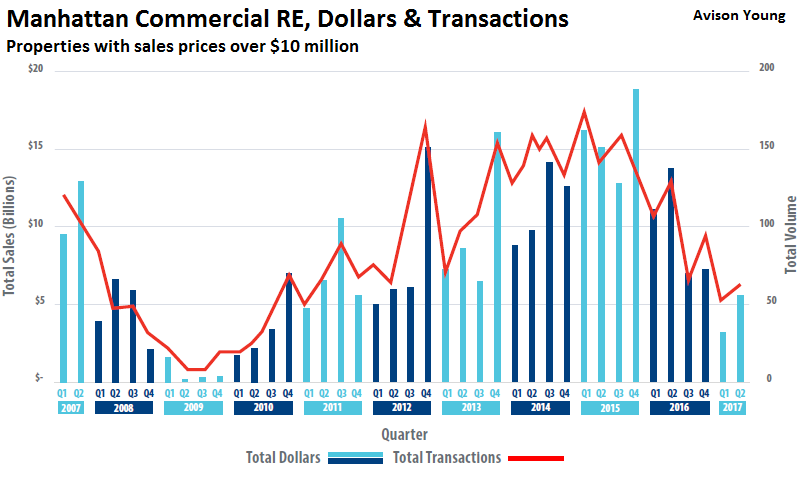
That’s the gloomy data on investment activity. Office leasing activity, the underpinning of the office market, isn’t exactly booming either. According to Avison Young’s report, office leasing volume in the second quarter plunged 32% year-over-year to 5.0 million square feet.
Both in Midtown and Downtown, leasing volume in Q2 plunged 35%. In Midtown, the vacancy rate rose to 11.0%, up from 10.1% a year ago; Downtown, it rose to 12.1%, up from 10.4% a year ago.
So the Chinese money is sorely needed to prop up the market. “Since the beginning of 2013, Chinese companies alone have poured nearly $18 billion into Manhattan real estate,” the report says, but cautions: “This flow of funds, however, may soon be threatened.”
Last year, the Chinese government got serious about imposing capital control. This year, it’s trying to crack down on lenders to get a grip on the ballooning risks threatening its financial system.Just over the weekend, top Chinese authorities struggled at the National Financial Work Conference with the rampant risk-taking and leverage. The Wall Street Journal:
Fear permeated markets, which tumbled Monday after President Xi Jinping gave a speech that supported efforts to tamp down complicated lending along with other financial-system risks. Frightened investors – seeing room for yet more policy tightening after cheery GDP growth data – are now searching for signs of the regulators’ next hit.
At hand is an ever-growing asset-management industry – now around 60 trillion yuan ($8.8 trillion) – and the deepening nexus of banks, brokers, trusts and insurance companies. The central bank elaborated on the linkages it uncovered in the asset-management industry in its recently published financial-stability report. That is likely telling of where regulators will go digging.
If regulators do take on the asset-management business, it could spell trouble for corporate borrowers. Corporate bonds account for more than 40% of underlying assets in wealth-management products sold by banks. Asset managers have been the only active buyers of these bonds so far this year.
On Monday, following the conference, the Shanghai Composite Index dropped 1.4%, and the small-cap index, ChiNext, which includes a lot of tech companies, plunged 5.1%, to the lowest level since January 2015.
China’s crackdown on leverage and fund-flows already had some consequences in the US and elsewhere: quashing a slew of Chinese cross-border deals, including Anbang Insurance Group’s $14 billion bid to acquire Starwood Hotels & Resorts.
These efforts by Chinese authorities to get financial risks and capital flows under control could have the effect, according Avison Young’s report, that “the major Chinese players may be regulated out of the market.” And with Manhattan being “a primary target for funds, it is likely to experience the greatest impact.”
This will happen just when domestic buyers have lost their appetite for overpriced commercial real estate after a breath-taking seven-year boom. The report identified “near-term impediments” to the commercial property market, among them:
- “Chinese governmental regulations on capital allocations outside the country.”
- “General investor sentiment.”
- “Rising interest rates.”
- Pre-recession 10-year commercial mortgages that have been packaged into Commercial Mortgage Backed Securities that are now struggling to refinance. Ratings agencies have also been warning about CMBS.
- “Slumping residential market, slow condo sales, and heavy concessions in rental market” as asking rents have been declining.
- “Dearth of construction financing and stalled construction sites needing funding.”
- “E-retail depressing brick-and-mortar retail values.” This meltdown has reached the Crown Jewel in American retailing as seen in haunting photos of Shuttered Stores on Madison Avenue
But unlike last time, there’s no Financial Crisis tripping up the property market. Stocks and bonds are booming. Wall Street is exuberant. There’s “no catastrophic event causing the current correction,” as the report explains. In other words, these are still the best of times.
And it’s not just in Manhattan. Chilling photos of for-lease signs are lining the Great America Parkway in Santa Clara, Silicon Valley. Read… Silicon Valley Begins to Crack Visibly
end
We will see you WEDNESDAY night
Harvey.


[…] JULY 18/TRUMPCARE COLLAPSES WHICH CAUSES THE DOLLAR TO DRAMATICALLY FALL: THIS RESULTS IN GOLD RISIN… […]
LikeLike