
GOLD: $1242.50 UP $0.50
Silver: $16.33 UP 4 cent(s)
Closing access prices:
Gold $1241.00
silver: $16.28
SHANGHAI GOLD FIX: FIRST FIX 10 15 PM EST (2:15 SHANGHAI LOCAL TIME)
SECOND FIX: 2:15 AM EST (6:15 SHANGHAI LOCAL TIME)
SHANGHAI FIRST GOLD FIX: $1250.26 DOLLARS PER OZ
NY PRICE OF GOLD AT EXACT SAME TIME: $1241.50
PREMIUM FIRST FIX: $8.76
xxxxxxxxxxxxxxxxxxxxxxxxxxxxxxxxxxxxxxxxxxxxxx
SECOND SHANGHAI GOLD FIX: $1249.51
NY GOLD PRICE AT THE EXACT SAME TIME: $1240.90
Premium of Shanghai 2nd fix/NY:$8.61
xxxxxxxxxxxxxxxxxxxxxxxxxxxxxxxxxxxxxxxxxxxxxxxxxxx
LONDON FIRST GOLD FIX: 5:30 am est $1239.85
NY PRICING AT THE EXACT SAME TIME: $1239.30
LONDON SECOND GOLD FIX 10 AM: $1242.15
NY PRICING AT THE EXACT SAME TIME. $1241.25
For comex gold:
JULY/
NOTICES FILINGS TODAY FOR APRIL CONTRACT MONTH: 25 NOTICE(S) FOR 2500 OZ.
TOTAL NOTICES SO FAR: 149 FOR 14900 OZ (.4634 TONNES)
For silver:
JULY
32 NOTICES FILED TODAY FOR
160,000 OZ/
Total number of notices filed so far this month: 2922 for 14,610,000 oz
XXXXXXXXXXXXXXXXXXXXXXXXXXXXXX
end
Let us have a look at the data for today
xxxxxxxxxxxxxxxxxxxxxxxxxxxxxxxxxxxxxxxxxxxxxxxxxxxxxxxxxxxxxxxxxxxxxxxxxx
In silver, the total open interest ROSE BY A HUGE 2936 contract(s) UP to 209,689 WITH THE HEALTHY RISE IN PRICE THAT SILVER TOOK WITH YESTERDAY’S TRADING (UP 16 CENT(S).TODAY WE HAD NEW SPECULATOR LONGS ENTER THE MARKET WITH THE BANKERS SUPPLING THE NECESSARY PAPER. THE BANKERS ARE HAVING AN AWFUL TIME TRYING TO SHAKE THE SILVER LEAVES FROM THE SILVER TREE.
In ounces, the OI is still represented by just OVER 1 BILLION oz i.e. 1.049 BILLION TO BE EXACT or 150% of annual global silver production (ex Russia & ex China).
FOR THE NEW FRONT MAY MONTH/ THEY FILED: 32 NOTICE(S) FOR 160,000 OZ OF SILVER
In gold, the total comex gold FELL BY 1662 CONTRACTS DESPITE THE RISE IN THE PRICE OF GOLD ($7.50 with YESTERDAY’S TRADING). The total gold OI stands at 484,204 contracts. THE BANKERS ARE STILL LOATHE TO SUPPLY THE GOLD PAPER AND WISH TO COVER MORE OF THEIR SHORTS. SOME NEWBIE SPEC LONGS STARTED TO ENTER THE GOLD COMEX ARENA AGAIN. THE PLETHORA OF DATA RELEASED ON FRIDAY SHOWING RETAIL SPENDING BASICALLY COLLAPSING ALONG WITH SMALLER INFLATION NUMBERS MUST BE SCARING OUR BANKERS TO DEATH.
we had 25 notice(s) filed upon for 2500 oz of gold.
xxxxxxxxxxxxxxxxxxxxxxxxxxxxxxxxxxxxxxxxxxxxxxxxxxxxxxxxxxx
With respect to our two criminal funds, the GLD and the SLV:
GLD:
Today another huge withdrawal of 5.32 tonnes with gold up $0.50
Inventory rests tonight: 816.13 tonnes
for 4 consecutive days, gold rises appreciably and yet gold inventory drops at the GLD
GLD IS A MASSIVE FRAUD/INVENTORY SHOULD BE RISING NOT FALLING.
.
SLV
Today: : WE HAD A NO CHANGES IN SILVER INVENTORY TONIGHT
INVENTORY RESTS AT 348,066 MILLION OZ
end
.
First, here is an outline of what will be discussed tonight:
1. Today, we had the open interest in silver ROSE BY A HUGE 2936 contracts UP TO 209,689 (AND now A LITTLE CLOSER TO THE NEW COMEX RECORD SET ON FRIDAY/APRIL 21/2017 AT 234,787), DESPITE THE RISE IN PRICE FOR SILVER WITH RESPECT TO YESTERDAY’S TRADING (UP 16 CENTS ). JUDGING FROM WHAT HAPPENED IN GOLD, OUR BANKERS TRIED TO COVER THEIR SHORTS TO NO AVAIL. THE LONGS STOOD STOIC AND AGAIN ENTERED THE ARENA TAKING ON THE BANKERS AND IT SEEMS THAT SHORTS (BOTH NEWBIE SPECS AND BANKERS) ARE TRAPPED AND CANNOT GET OUT OF THEIR MESS.
(report Harvey)
.
2.a) The Shanghai and London gold fix report
(Harvey)
2 b) Gold/silver trading overnight Europe, Goldcore
(Mark O’Byrne/zerohedge
and in NY: Bloomberg
3. ASIAN AFFAIRS
i)Late TUESDAY night/WEDNESDAY morning: Shanghai closed UP 43.41 POINTS OR 1.36% / /Hang Sang CLOSED UP 147.22 POINTS OR 0.56% The Nikkei closed UP 20.95 POINTS OR .10%/Australia’s all ordinaires CLOSED UP 1.36%/Chinese yuan (ONSHORE) closed DOWN at 6.7544/Oil UP to 46.58 dollars per barrel for WTI and 49.09 for Brent. Stocks in Europe OPENED MIXED,, Offshore yuan trades 6.7534 yuan to the dollar vs 6.7544 for onshore yuan. NOW THE OFFSHORE IS STRONGER TO THE ONSHORE YUAN/ ONSHORE YUAN WEAKER (TO THE DOLLAR) AND THE OFFSHORE YUAN IS MUCH WEAKER TO THE DOLLAR AND THIS IS COUPLED WITH THE STRONGER DOLLAR. CHINA IS LESS HAPPY TODAY
3a)THAILAND/SOUTH KOREA/NORTH KOREA
i)NORTH KOREA
North Korea’s fuel prices soar after China suspends exports
(courtesy Paraskova/OilPrice.com
b) REPORT ON JAPAN
Japan now plans to drop its all important 2% inflation guide as deflation is again rearing its ugly head around the world
( zero hedge)
c) REPORT ON CHINA
4. EUROPEAN AFFAIRS
5. RUSSIAN AND MIDDLE EASTERN AFFAIRS
6 .GLOBAL ISSUES
Goldman Sachs answers Deutsche bank as to whether Canada is in serious trouble
Their answer: yes and no
( zero hedge)
7. OIL ISSUES
i)Oil sinks initially after a surprise crude inventory build
( zero hedge)
ii)then WTI jumps back above 47 dollars despite production at its highest levels since 2015:
( zero hedge)
8. EMERGING MARKET
i)VENEZUELA
USA set to initiate sanctions on Maduro if he creates a new constitution giving him more power
(courtesy zero hedge)
9. PHYSICAL MARKETS
ii)Reuters reports that the two giant mining companies inside China may merge: MinMetals with China’s National Gold
iii)The truth behind gold’s advance
iv)Actually today JPMorgan added another 630,000 oz of silver
v)Ronan Manly comments on who the comex is designed to rig the gold/silver markets
10. USA Stories
i)General Motors is forced to extend the shutdown of the Chevy Bolt plant after they finally realize that nobody wants to buy a Bolt. Sales are non existent
( zero hedge)
ii)IBM records its 21st consecutive quarter of declining sales despite a low tax rate
( zero hedge)
( Mac Slavo.SHTFPlan.com)
iv)Trump correctly states that Obama lied about his healthcare plan stating that premiums would not rise; instead they are escalating
Trump tells Republicans not to leave town until they pass Trumpcare
( zero hedge)
v)The CBO states that the government has until mid October to raise the debt ceiling.
Let us head over to the comex:
The total gold comex open interest FELL BY 1662 CONTRACTS DOWN to an OI level of 484,204 DESPITE THE RISE IN THE PRICE OF GOLD ($7.50 with YESTERDAY’S trading). We must have had some bankers cover their shorts with the combination of newbie specs entering the comex casino.
We are now in the contract month of JULY and it is one of the POORER delivery months of the year. .
The non active July contract LOST 3 contract(s) to stand at 37 contracts. We had only 4 notices filed YESTERDAY morning, so we GAINED 1 contracts or an additional 100 oz will stand in this non active month of July. Thus 0 EFP notice(s) was given which gives the long holder a fiat bonus plus a futures contract for delivery and most likely these are London based forwards. The contracts are private so we do not get to see all the particulars. The next big active month is August and here the OI LOST 15,261 contracts DOWN to 208,396, as this month winds down prior to first day notice. The next non active contract month is September and here they GAINED another 187 contracts to stand at 820. The next active delivery month is October and here we gained 906 contracts up to 24,130. October is the poorest of the active gold delivery months as most players move right to December.
We had 25 notice(s) filed upon today for 2500 oz
For those keeping score: in the upcoming front delivery month of August:
On July 19.2016: open interest for the front month: 306,757 contracts compared to July 19.2017: 207,458.
However last yr at this time we had a record OI in gold at 655,000 contract for the entire complex.
We are now in the next big active month will be July and here the OI GAINED 25 contracts UP to 163. We had 24 notices served yesterday so we gained 49 notices or an additional 245,000 oz will stand at the comex, and 0 EFP contracts were issued which entitles them to receive a fiat bonus and a future delivery contract (which no doubt is a London based forward).
The month of August, a non active month LOST 45 contracts to stand at 409. The next big active delivery month for silver will be September and here the OI GAINED ANOTHER 1659 contracts UP to 155,034.
The line in the sand is $18.50 for silver and again it has been defended by the criminal bankers. Once this level is pierced, the monstrous billion oz of silver shorts will blow up. The bankers are defending the Alamo with their last stand at the $18.50 mark. THE NEW RECORD HIGH IN OPEN INTEREST WAS SET FRIDAY APRIL 21/2017 AT: 234,787.
As for the July contracts:
Initial amount that stood for silver for the July 2016 contract: 14.785 million oz
Final standing JULY 2016: 12.370 million with the difference being EFP’s taking delivery in London. Thus we have an increasing amount of silver standing in comparison to what happened a year ago
amt standing tonight: 15.265 million oz.
We had 32 notice(s) filed for 160,000 oz for the June 2017 contract
VOLUMES: for the gold comex
Today the estimated volume was 229,315 contracts which is good/
Yesterday’s confirmed volume was 289,547 contracts which is very good
volumes on gold are STILL HIGHER THAN NORMAL!
| Gold | Ounces |
| Withdrawals from Dealers Inventory in oz | nil |
| Withdrawals from Customer Inventory in oz |
nil oz
|
| Deposits to the Dealer Inventory in oz | NIL oz |
| Deposits to the Customer Inventory, in oz |
nil oz
|
| No of oz served (contracts) today |
25 notice(s)
2500 OZ
|
| No of oz to be served (notices) |
12 contracts
1200 oz
|
| Total monthly oz gold served (contracts) so far this month |
149 notices
14900 oz
.4150 tonnes
|
| Total accumulative withdrawals of gold from the Dealers inventory this month | NIL oz |
| Total accumulative withdrawal of gold from the Customer inventory this month | 136,361.4 oz |
Today, 0 notice(s) were issued from JPMorgan dealer account and 0 notices were issued from their client or customer account. The total of all issuance by all participants equates to 25 contract(s) of which 0 notices were stopped (received) by j.P. Morgan dealer and 0 notice(s) was (were) stopped/ Received) by j.P.Morgan customer account.
| Silver | Ounces |
| Withdrawals from Dealers Inventory | nil |
| Withdrawals from Customer Inventory |
27,075.35 oz
BRINKS
|
| Deposits to the Dealer Inventory |
nil oz
|
| Deposits to the Customer Inventory |
629,602.600 oz
JPMorgan
|
| No of oz served today (contracts) |
32 CONTRACT(S)
(160,000 OZ)
|
| No of oz to be served (notices) |
131 contracts
( 655,000 oz)
|
| Total monthly oz silver served (contracts) | 2922 contracts (14,610,000 oz) |
| Total accumulative withdrawal of silver from the Dealers inventory this month | NIL oz |
| Total accumulative withdrawal of silver from the Customer inventory this month | 1,201,044.5 oz |
NPV for Sprott and Central Fund of Canada
Sprott’s hostile 3.1 billion bid to take over Central Fund of Canada
(courtesy Sprott/GATA)
Sprott makes hostile $3.1 billion bid for Central Fund of Canada
Submitted by cpowell on Thu, 2017-03-09 01:19. Section: Daily Dispatches
From the Canadian Press
via Canadian Broadcasting Corp. News, Toronto
Wednesday, March 8, 2017
http://www.cbc.ca/news/canada/calgary/sprott-takeover-bid-central-fund-c…
Toronto-based Sprott Inc. said Wednesday it’s making an all-share hostile takeover bid worth $3.1 billion US for rival bullion holder Central Fund of Canada Ltd.
The money-management firm has filed an application with the Court of Queen’s Bench of Alberta seeking to allow shareholders of Calgary-based Central Fund to swap their shares for ones in a newly-formed trust that would be substantially similar to Sprott’s existing precious metal holding entities.
The company is going through the courts after its efforts to strike a friendly deal were rebuffed by the Spicer family that controls Central Fund, said Sprott spokesman Glen Williams.
“They weren’t interested in having those discussions,” Williams said.
Sprott is using the courts to try to give holders of the 252 million non-voting class A shares a say in takeover bids, which Central Fund explicitly states they have no right to participate in. That voting right is reserved for the 40,000 common shares outstanding, which the family of J.C. Stefan Spicer, chairman and CEO of Central Fund, control.
If successful through the courts, Sprott would then need the support of two-thirds of shareholder votes to close the takeover deal, but there’s no guarantee they will make it that far.
“It is unusual to go this route,” said Williams. “There’s no specific precedent where this has worked.”
Sprott did have success last year in taking over Central GoldTrust, a similar fund that was controlled by the Spicer family, after securing support from more than 96 percent of shareholder votes cast.
The firm says Central Fund’s shares are trading at a discount to net asset value and a takeover by Sprott could unlock US$304 million in shareholder value.
Central Fund did not have any immediate comment on the unsolicited offer. Williams said Sprott had not yet heard from Central Fund on the proposal but that some shareholders had already contacted them to voice their support.
Sprott’s existing precious metal holding companies are designed to allow investors to own gold and other metals without having to worry about taking care of the physical bullion.
end
And now the Gold inventory at the GLD
jULY 19/STRANGE!! AGAIN WITH GOLD UP $0.50 WE HAD ANOTHER HUGE 5.32 TONNES WITHDRAWAL FROM THE GLD/INVENTORY RESTS AT 816.13 TONNES THIS GOLD IS HEADING TO SHANGHAI
July 18/STRANGE AGAIN/WITH GOLD UP $7.50 WE HAD ANOTHER HUGE 5.62 TONNES WITHDRAWAL FROM THE GLD/INVENTORY RESTS AT 821.45 TONNES
July 17/strange again! with gold up $4.20 we had another huge withdrawal of 1.77 tonnes/inventory rests at 827.07 tonnes
July 14/strange@!!with gold up $12.00 today, we had a huge withdrawal of 3.55 tonnes/inventory rests at 828.84 tonnes
July 13/no change in gold inventory at the GLD/inventory rests at 832.39 tonnes
JULY 12/no change in gold inventory at the GLD/inventory rests at 832.39 tonnes
July 11/strange!@! we had a big withdrawal of 2.96 tonnes despite gold’s advance today/inventory rests tonight at 832.39 tonnes
July 10/no changes in gold inventory at the GLD/inventory rests at 835.35 tonnes
July 7/a massive withdrawal of 5.32 tonnes of paper gold were removed and this was used in the attack today/inventory rests at 835.35 tonnes
July 6/no changes in tonnage at the GLD/Inventory rests at 840.67 tonnes
July 5/A MASSIVE 5.62 TONNES OF GOLD LEFT THE GLD AND NO DOUBT WAS USED IN THE RAID THIS MORNING/INVENTORY REST
July 3/ A MASSIVE 7.37 TONNES OF GOLD LEAVE THE GLD/INVENTORY RESTS AT 846.29 TONNES
June 30/no change in gold inventory at the GLD/Inventory rests at 853.66 tonnes
June 29/no change in inventory at the GLD/inventory rests at 853.66 tonnes
June 28/no change in inventory at the GLD/Inventory rests at 853.66 tonnes
June 27.2017/a deposit of 2.64 tonnes into the GLD/inventory rests at 853.66 tonnes
June 26/a withdrawal of 2.66 tonnes from the GLD and this gold no doubt was part of the raid/Inventory rests at 851.02
June 23/no change in gold inventory at the GLD/Inventory rests at 853.68 tonnes
June 22/no change in gold inventory at the GLD/Inventory rests at 853.68 tonnes
June 21/no change in gold inventory at the GLD/Inventory rests at 853.68 tonnes
June 20/no change in gold inventory at the GLD//Inventory rests at 853.68 tonnes
June 19/NO CHANGE IN GOLD INVENTORY AT THE GLD/INVENTORY RESTS AT 853.68 TONNES
June 16/no changes in gold inventory at the GLD/Inventory rests at 853.68 tonnes
June 15/ a monstrous “paper” withdrawal of 13.32 tonnes/Inventory rests at 853.68 tonnes
June 14./NO CHANGE IN GOLD INVENTORY AT THE GLD/INVENTORY RESTS AT 867.00 TONNES
June 13. No change in gold inventory at the GLD/Inventory rests at 867.00 tonnes
June 12/No change in gold inventory at the GLD/Inventory rests at 867.00 tonnes
June 9/no change in inventory at the GLD/Inventory rests at 867.00 tonnes
June 8/AN ADDITION OF 3.07 TONNES OF GOLD ADDED TO THE GLD/INVENTORY RESTS AT 867.00 TONNES
June 7 a huge change in inventory/a deposit of 13.93 tonnes/inventory rests at 864.93 tonnes
June 6/ no changes in inventory at the GLD/Inventory remains at 851.00 tonnes
June 5.2017/no changes at the GLD/Inventory remain at 851.00 tonnes
June 2/2017/a huge deposit of 3.55 tonnes of gold into the GLD/Inventory rests at 851.00 tonnes
June 1/NO CHANGE IN GOLD INVENTORY AT THE GLD/INVENTORY RESTS AT 847.45 TONNES
end
Now the SLV Inventory
July 19/NO CHANGE IN SILVER INVENTORY AT THE SLV/INVENTORY RESTS AT 348.066 MILLION OZ
July 18/a huge 946,000 oz withdrawal from the SLV despite silver’s 16 cent gain!
Inventory rests at 348.066 million oz
July 17/no change in silver inventory at the SLV/Inventory rests at 349.012 million oz
July 14/no change in silver inventory/inventory rests at 349.012 million oz/
July 13/no change in silver inventory/inventory at the SLV rests at 349.012 million oz/
JULY 12/another massive 1.986 million oz of silver added into the SLV/inventory rests at 349.012 million oz/the last 3 days saw 7.281 million oz added into the SV
July 11/ANOTHER MASSIVE INCREASE OF 2.364 MILLION OZ into the SLV inventory/inventory rests at 347.026 million oz
July 10/ A HUGE INCREASE OF 2.931 MILLION OZ OF SILVER DESPITE THE EARLY HIT ON SILVER THIS MORNING/INVENTORY RESTS AT 344.662 MILLION OZ.
July 7/Strange: no change in inventory (compare that with gold) Inventory rests at 341.731 million oz
July 6/ANOTHER MASSIVE DEPOSIT OF 2.126 MILLION OZ INTO THE SLV INVENTORY/INVENTORY RESTS AT 341.731 MILLION OZ.
July 5/STRANGE! NO CHANGE IN SILVER INVENTORY AT THE SLV/INVENTORY RESTS AT 339.605 MILLION OZ
July 3/strange! with the huge whacking of silver we got an increase of 379,000 oz into inventory.
June 30/no change in silver inventory at the SLV/Inventory rests at 339.226 million oz
June 29/no change in silver inventory at the SLV/Inventory rests at 339.226 million oz/
June 28/ a small withdrawal of 662,000 oz form the SLV/Inventory rests at 339.226 million oz/
June 27/no change in the silver inventory at the SLV/Inventory rests at 339.888 million oz/
June 26/no change in the silver inventory at the SLV/Inventory rests at 339.888 million oz/
June 23/no change in silver inventory at the SLV/Inventory rests at 339.888 million oz
June 22/ a big change; a huge deposit of 2.175 million oz into the SLV/Inventory rests at 339.888 million oz
June 21/no change in silver inventory at the SLV/inventory rests at 337.713 million oz
June 20/a deposit of 1.513 million oz/inventory rests at 337.713 million oz/.
June 19/NO CHANGE IN SILVER INVENTORY AT THE SLV/INVENTORY RESTS AT 336.200 MILLION OZ
June 16/no changes in inventory at the SLV/inventory rests at 336.200 million oz
June 15/ a massive “paper withdrawal” of 3.405 million oz of silver/Inventory rests at 336.200 million oz/
June 14/NO CHANGE IN SILVER INVENTORY AT THE SLV/INVENTORY RESTS AT 339.605 MILLION OZ/
June 13/no change in silver inventory at the SLV/Inventory rests at 339.605 million oz
June 12/no change in silver inventory at the SLV/Inventory rests at 339.605 million oz/
June 9/no change in silver inventory at the SLV/Inventory rests at 339.605 million oz/
June 8/NO CHANGE IN SILVER INVENTORY AT THE SLV/INVENTORY RESTS AT 339.605 MILLION OZ/
June 7/no change in inventory at the SLV/inventory rests at 339.605 million oz/
June 6/no change in inventory at the SLV/Inventory rests at 339.605 million oz.
June 5/a huge change at the SLV/a withdrawal of 1.371 million oz /inventory rests at 339.605 million oz/
June 2/no change in silver inventory at the SLV/Inventory rests at 340.976 million oz/
June 1/NO CHANGE IN INVENTORY AT THE SLV/INVENTORY RESTS AT 340.976 MILLION OZ
-
 Indicative gold forward offer rate for a 6 month duration+ 1.16%
 -
+ 1.44%

end
END
Major gold/silver trading/commentaries for WEDNESDAY
GOLDCORE/BLOG/MARK O’BYRNE.
GOLD/SILVER
“Time To Position In Gold Is Right Now” says Jim Rickards
– “Time to position in gold is right now” – James Rickards
– Fed has hit the ‘pause’ button; No more rate hikes for foreseeable future
– Fed’s theories “bear no relation to reality” and has “blundered by raising rates”
– Growth is weak, inflation is weak, retail sales and real incomes are weak
– Tight money, weak economy & stock bubble classic recipe for market crash
– Reduce allocations to stocks and reallocate to defensive assets such as gold
– “Gold will be the big winner when the Fed suddenly realizes its blunder”
 Gold in USD – 10 Years
James Rickards, geopolitical and monetary analyst and best selling author of ‘Currency Wars’, ‘The Death of Money’ and ‘The New Case for Gold’ wrote yesterday in the Daily Reckoning that the “time to position in gold is right now.”
In an timely piece, Rickards points out how the Federal Reserve is behind the curve, has “theories that bear no relation to reality” and has “blundered by raising rates.” This is happening at a time when the U.S. economy and stock markets are very vulnerable.

Rickards warns that growth in the U.S. remains weak, as are inflation, retail sales and real incomes. Tighter money in a weak economy with a stock market bubble is a classic recipe for stock market crash.
After making his case succinctly Jim concludes:
“It’s time for investors to go into a defensive crouch by selling stocks and reallocating assets to cash, Treasury notes, gold and gold mining shares.
In particular, gold will be the big winner when the Fed suddenly realizes its blunder and has to pivot quickly to ease, probably by late summer. The time to position in gold is right now.”
Jim Rickards
for The Daily Reckoning
News and Commentary
Dollar Falls as Trump Agenda Falters; Gold Climbs (Bloomberg.com)
Gold Prices Aim Higher as Fed Rate Hike Bets Continue to Wilt (DailyFX.com)
Gold steady near highest in over two weeks on weaker dollar (Reuters.com)
U.S. Republicans left scrambling after health bill sinks again (Reuters.com)
Homebuilder Sentiment in U.S. Declines to an Eight-Month Low (Bloomberg.com)
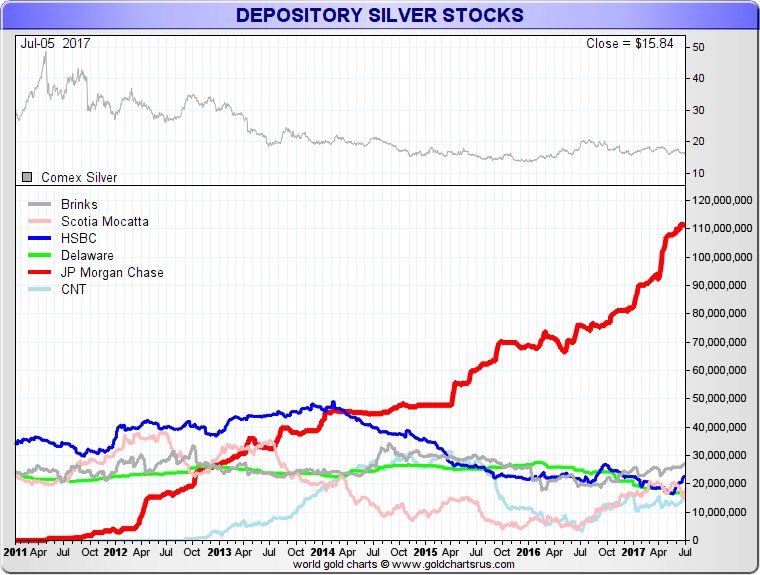
Depository Silver Stocks. Source: Goldchartsrus.com
New U.S. Subprime Boom, Same Old Sins: Auto Defaults Are Soaring (Bloomberg.com)
Financial Repression To See Balanced Portfolio Return Just 1% Annually (HussManFunds.com)
China just had a ‘Black Monday’ (BusinessInsider.com)
JPM seems to have stopped stacking Comex metal (TFMetalsReport.com)
Gold gains new lustre as global threats go (DailyMail.co.uk)
Gold Prices (LBMA AM)
19 Jul: USD 1,239.85, GBP 950.84 & EUR 1,074.83 per ounce
18 Jul: USD 1,237.10, GBP 949.47 & EUR 1,071.82 per ounce
17 Jul: USD 1,229.85, GBP 940.71 & EUR 1,074.03 per ounce
14 Jul: USD 1,218.95, GBP 940.54 & EUR 1,067.92 per ounce
13 Jul: USD 1,221.40, GBP 944.51 & EUR 1,071.05 per ounce
12 Jul: USD 1,219.40, GBP 947.60 & EUR 1,064.29 per ounce
11 Jul: USD 1,211.90, GBP 938.98 & EUR 1,063.68 per ounce
Silver Prices (LBMA)
19 Jul: USD 16.23, GBP 12.44 & EUR 14.08 per ounce
18 Jul: USD 16.17, GBP 12.41 & EUR 13.99 per ounce
17 Jul: USD 16.07, GBP 12.30 & EUR 14.02 per ounce
14 Jul: USD 15.71, GBP 12.11 & EUR 13.76 per ounce
13 Jul: USD 15.95, GBP 12.34 & EUR 14.00 per ounce
12 Jul: USD 15.83, GBP 12.31 & EUR 13.82 per ounce
11 Jul: USD 15.51, GBP 12.02 & EUR 13.61 per ounce
Recent Market Updates
– Bloomberg Silver Price Survey – Median 12 Month Forecast Of $20
– “Bigger Systemic Risk” Now Than 2008 – Bank of England
– “Financial Crisis” Coming By End Of 2018 – Prepare Urgently
– Video – “Gold Should Probably Be $5000” – CME Chairman
– India Gold Imports Surge To 5 Year High – 220 Tons In May Alone
– “Silver’s Plunge Is Nearing Completion”
– China, Russia Alliance Deepens Against American Overstretch
– Silver Prices Bounce Higher After Futures Manipulated 7% Lower In Minute
– Precious Metals Are “Best Defence” Against Bail-ins In Economic Crisis
– Buy Gold Near $1,200 “As Insurance” – UBS Wealth
– UK House Prices ‘On Brink’ Of Massive 40% Collapse
– Gold Up 8% In First Half 2017; Builds On 8.5% Gain In 2016
– Pensions Timebomb In America – “National Crisis” Cometh
Gold Recovers Losses After Overnight “Flash-Crash”

Amid a post-holiday Asian open, gold futures were flash-crashed as someone decided it was an opportune time to trade over $275 million worth of the precious metal.

Since hitting those China open lows at $1206, gold has rallied back to unchanged near $1223…

Reuters: China may merge metals giants Minmetals and China National Gold
Submitted by cpowell on Tue, 2017-07-18 11:11. Section: Daily Dispatches
By Kane Wu and Julie Zhu
Reuters
Tuesday, July 18, 2017
HONG KONG — China is considering a merger between China Minmetals Corp, one of the country’s largest miners and metals traders, and China National Gold Group, as Beijing pushes consolidation of its state-run firms, sources with knowledge of the matter said.
Three sources with knowledge of the discussions said the two state-owned firms have been in negotiations for months, though any agreement could still be some time away.
The talks between two of China’s largest metals producers are part of Beijing’s broad efforts to shake up its indebted and inefficient state sector, streamline the number of companies and create globally competitive firms in sectors including power generation, shipping, and metals. …
… For the remainder of the report:
https://www.reuters.com/article/us-china-minmetals-m-a-idUSKBN1A30JR
Proletarian Daily Mail blurts out truth that will never make Financial Times
Submitted by cpowell on Tue, 2017-07-18 14:00. Section: Daily Dispatches
Gold Gains New Luster in Recent Months as Global Threats Grow
By Joanne Hart
Daily Mail, London
Sunday, July 16, 2017
Gold is one of the most unusual investments that anyone can make. It does not pay dividends, it does not produce earnings, and it does not make promises about growth prospects — like most firms do.
But it does deliver returns, outperforming property and the FTSE 100 Index over the past 10 years.
If someone had put L1,000 into the FTSE in 2007, for example, it would be worth L1,640 today, while the same amount invested in 20-year gilts would be worth L1,350, or L1,190 if the cash had been ploughed into UK property.
An equal investment in gold would be worth more than L2,300. …
… For the remainder of the report:
http://www.dailymail.co.uk/money/investing/article-4699706/MIDAS-SHARE-T…
TF Metals Report: JPM seems to have stopped stacking Comex metal
Submitted by cpowell on Tue, 2017-07-18 14:28. Section: Daily Dispatches
10:34a ET Tuesday, July 18, 2017
Dear Friend of GATA and Gold:
JPMorganChase & Co. seems to have gotten out of the Comex gold and silver markets in recent weeks, after accumulating huge stocks of both monetary metals, the TF Metals Report asserts today.
The TF Metals Report wonders if this change has resulted from the U.S. Commodity Futures Trading Commission’s starting to enforce position limit rules against the bank, or if the bank has decided that it now has enough gold and silver to allow their prices to rise.
Of course since JPM’s commodity chief, Blythe Masters, insisted five years ago that the firm was trading the monetary metals only for clients, not for its own accounts —
http://www.cnbc.com/video/2012/04/05/jpmorgans-masters-one-on-one.html
https://www.youtube.com/watch?v=gc9Me4qFZYo
https://www.benzinga.com/media/cnbc/12/04/2478161/jp-morgan-commodities-…
— it may be fair to suspect that the firm’s clients in the monetary metals market include the U.S. government and other governments and central banks. Or maybe the bank’s metal stockpiles have been amassed on behalf of one government client for delivery to another government.
Unfortunately no one in the mainstream financial news media dares to raise such obvious questions.
The TF Metals Report’s analysis is headlined “A Specific Peculiarity” and it’s posted here:
https://www.tfmetalsreport.com/blog/8451/specific-peculiarity
CHRIS POWELL, Secretary/Treasurer
Gold Anti-Trust Action Committee Inc.
CPowell@GATA.org
Ronan Manly: Comex is designed to facilitate gold market rigging
Submitted by cpowell on Tue, 2017-07-18 18:20. Section: Daily Dispatches
2:24p ET Tuesday, July 18, 2017
Dear Friend of GATA and Gold:
Gold researcher Ronan Manly today explains how the New York Commodities Exchange’s futures market in gold, the Comex, is designed to separate gold’s nominal price from actual metal and to facilitate manipulation of the market by its biggest participants.
Manly concludes: “As the Comex pursues its record-breaking attempt in 2017 to trade gold futures representing more than 200,000 tonnes of gold, the disconnect between the Comex and the real world is becoming all too clear. Comex flash crashes will continue as long as the CME Group [owner of the Comex] and U.S. Commodity Futures Trading Commission let them continue. And many people will continue to believe that these flash crashes were deliberately orchestrated.
“But at the heart of the contradiction between paper gold and real gold is not whether such and such a flash crash was deliberate. The heart of the contradiction is that the very structure of the Comex system is detached from reality of physical gold and can easily allow flash crashes that may or may not be deliberate attempts to rig the gold price.”
Manly’s analysis is headlined “Is the Comex Rigged?” and it’s posted at Bullion Star here:
https://www.bullionstar.com/blogs/ronan-manly/comex-rigged/
CHRIS POWELL, Secretary/Treasurer
Gold Anti-Trust Action Committee Inc.
CPowell@GATA.org
Ethereum Suddenly Crashes 20% Amid Chatter Of More ICO Fraud; But Goldman Sees Bitcoin Testing $3000
Two days ago we saw the first ICO fraud exposed (as CoinDash was hacked), and after a big rebound the last two days (as civil war seems to have been peacefully resolved with 80% of hashers reportedly accepting SegWit), Ether is suddenly crashing again as several tweets mention more (and larger) ICO hacks.
Someone stole ~$32M (~153k ether) from three multisig wallets. More info and blog post coming soon.https://etherscan.io/address/0xb3764761e297d6f121e79c32a65829cd1ddb4d32#internaltx …

Positive news on the scaling deadline helped early but then ETH started to tumble…

Amid heavy volume…

No clear catalyst but we note several social media accounts pointing to this…
~$32M (~153k ether) stolen from three ICOs today. What is that, like 3% of total ICO money raised? https://twitter.com/maraoz/status/887755889897295872 …

Multisig wallets created with Parity 1.5 or later affected. pic.twitter.com/847tOxQ1C4
Multisig wallets affected by this hack:
– Edgeless Casino (@edgelessproject)
– Swarm City (@swarmcitydapp)
– æternity blockchain (@aetrnty)
Ironically, Goldman is also out wth a new bullish note on Bitcoin…
Bitcoin has reached/so far held notable support at 1,857-1,789. The area includes an ABC equality target off the June high as well as the 100-dma. The 100-dma has been particularly reliable in holding pullbacks since the late-’15 lows. Moreover, due the corrective nature of the pullback, this ABC target seems like a reasonable place to watch for signs of a turn. Additionally, daily momentum is nearing similar levels to where they previously based in March. All in all, the balance of signals appear to be shifting to a more positive tone.
From a wave count perspective, this entire retracement can be viewed as a counter-trend 4th wave in a V-wave advance that started in ’11. From this perspective, it’s either completed a full ABC or only the first A leg of a 3-3-3 type correction. Either way, this 1,856-1,790 area has potential to act as strong support. The first level to note above is gap resistance at 2,159.

Finally, GS says a minimum target for eventuial Vth wave is around $3000…

end
Your early WEDNESDAY morning currency, Asian stock market results, important USA/Asian currency crosses, gold/silver pricing overnight along with the price of oil Major stories overnight
1 Chinese yuan vs USA dollar/yuan WEAKER 6.7544(DEVALUATION SOUTHBOUND /OFFSHORE YUAN MOVES STRONGER TO ONSHORE AT 6.7535/ Shanghai bourse CLOSED UP 43.41 POINTS OR 1.36% / HANG SANG CLOSED UP 147.22 POINTS OR 0.56%
2. Nikkei closed UP 20.95 POINTS OR .10% /USA: YEN RISES TO 112.00
3. Europe stocks OPENED MIXED ( /USA dollar index RISES TO 94.78/Euro DOWN to 1.1528
3b Japan 10 year bond yield: RISES TO +.075%/ GOVERNMENT INTERVENTION !!!!(Japan buying 100% of bond issuance)/Japanese yen vs usa cross now at 114.34/ THIS IS TROUBLESOME AS BANK OF JAPAN IS RUNNING OUT OF BONDS TO BUY./JAPAN 10 YR YIELD FINALLY IN THE POSITIVE/BANK OF JAPAN LOSING CONTROL OF THEIR YIELD CURVE AS THEY PURCHASE ALL BONDS TO GET TO ZERO RATE!!
3c Nikkei now JUST BELOW 17,000
3d USA/Yen rate now well below the important 120 barrier this morning
3e WTI:: 46.58 and Brent: 49.06
3f Gold DOWN/Yen DOWN
3g Japan is to buy the equivalent of 108 billion uSA dollars worth of bond per month or $1.3 trillion. Japan’s GDP equals 5 trillion usa./“HELICOPTER MONEY” OFF THE TABLE FOR NOW /REVERSE OPERATION TWIST ON THE BONDS: PURCHASE OF LONG BONDS AND SELLING THE SHORT END
Japan to buy 100% of all new Japanese debt and by 2018 they will have 25% of all Japanese debt. Fifty percent of Japanese budget financed with debt.
3h Oil UP for WTI and UP for Brent this morning
3i European bond buying continues to push yields lower on all fronts in the EMU. German 10yr bund FALLS TO +.547%/Italian 10 yr bond yield UP to 2.192%
3j Greek 10 year bond yield RISES to : 5.27???
3k Gold at $1240.05 silver at:16.23 (8:15 am est) SILVER BELOW RESISTANCE AT $18.50
3l USA vs Russian rouble; (Russian rouble UP 43/100 in roubles/dollar) 59.04-
3m oil into the 46 dollar handle for WTI and 49 handle for Brent/
3n Higher foreign deposits out of China sees huge risk of outflows and a currency depreciation (already upon us). This can spell financial disaster for the rest of the world/China forced to do QE!! as it lowers its yuan value to the dollar/GOT A GOOD SIZED DEVALUATION SOUTHBOUND
JAPAN ON JAN 29.2016 INITIATES NIRP. THIS MORNING THEY SIGNAL THEY MAY END NIRP. TODAY THE USA/YEN TRADES TO 112.00 DESTROYING JAPANESE CITIZENS WITH HIGHER FOOD INFLATION
30 SNB (Swiss National Bank) still intervening again in the markets driving down the SF. It is not working: USA/SF this morning 0.9543 as the Swiss Franc is still rising against most currencies. Euro vs SF is 1.0999 well above the floor set by the Swiss Finance Minister. Thomas Jordan, chief of the Swiss National Bank continues to purchase euros trying to lower value of the Swiss Franc.
3p BRITAIN VOTES AFFIRMATIVE BREXIT/LOWER PARLIAMENT APPROVES BREXIT COMMENCEMENT/ARTICLE 50 COMMENCES MARCH 29/2017
3r the 10 Year German bund now POSITIVE territory with the 10 year FALLING to +0.547%
The bank withdrawals were causing massive hardship to the Greek bank. the Greek referendum voted overwhelming “NO”. Next step for Greece will be the recapitalization of the banks and that will be difficult.
4. USA 10 year treasury bond at 2.2767% early this morning. Thirty year rate at 2.8591% /POLICY ERROR)GETTING DANGEROUSLY HIGH
5. Details Ransquawk, Bloomberg, Deutsche bank/Jim Reid.
(courtesy Jim Reid/Bloomberg/Deutsche bank/zero hedge)
Global Stocks Hit Record High, Set For Longest Winning Streak Since 2015
In what has been a less exciting session than the previous two, the euro retraced some recent gains as traders grew concerned they may have overestimated the ECB’s hawkish bias ahead of Thursday’s rate decision; in turn the dollar edged higher after the collapse of the GOP healthcare bill sent it to the lowest since September on Tuesday.
Not even Citi could infuse any excitement in the overnight session, which its called “Purgatorial”:
Markets are more or less flat so far today as we face a temporary dearth of data and speakers. USD remains weak, but there has been no real excuse to continue selling yet. The ECB and the BoJ are both up tomorrow and any potential moves may be linked to pre-positioning/squaring rather than anything that today may offer us…
There is little of note this afternoon that could tickle the fancy of even the most excitable FX watcher – We are staring into the abyss… and DoE inventories are staring right back. As oil is flat so far today, that print could provoke a small twitch. Elsewhere, we get US housing starts and Canadian manufacturing shipments…
In Dante’s inferno, Purgatorio immediately precedes Paradiso. Fingers’ firmly crossed.
European equities got a boost from both the weaker euro and from corporate results, while oil fluctuated and gold fell. The Stoxx Europe 600 gained 0.3% in early trading after falling 1.1% Tuesday, its largest drop this month as concerns emerged that the stronger Euro would pressure exporters, leading to the first decoupling between the EURUSD and the Stoxx in two months.

S&P 500 futures were little changed (up 0.05%) after the cash index closed at another record on Tuesday.
With the USD just off 10-month lows, there continues to be an easing of loosening of financial conditions for emerging markets which also supports equities. After decent gains in Asia on the back of positive signs from China this week, MSCI’s world stocks index looked set for a ninth day of gains which would mark its longest winning streak since October 2015.

Cited by Reuters, Marijke Zewuster, Head EM research at ABN AMRO said “Most emerging markets are doing quite well at the moment, especially in Asia. The figures for China are positive. If you look at the underlying figures they are relatively strong at the moment.”
In Asia, MSCI’s index of Asia-Pacific shares outside Japan and its index of emerging market shares were both up 0.5 percent at their highest since April 2015. China’s Monday fireworks were long forgotten, with the CSI 300 index leading winners as mainland stocks rallied sending the Shanghai Composite and ChiNext higher by 1.4% and 1% respectively. Hong Kong’s Hang Seng Index was up 0.6 percent. Japan’s Topix Index swung between gains and losses, while South Korea’s Kospi Index rose 0.2 percent. The Yuan weakened for first time in eight days despite strongest daily fixing since October; seven-day repo falls five basis points after PBOC injects 100 billion yuan of liquidity. Following Tuesday’s unexpectedly hawkish RBA announcement, Australian bonds were firmer with the 10-year yield dropping 3 bps. Australia’s S&P/ASX 200 Index rose 0.8 percent as bank shares climbed. Analysts said new capital requirements looked fairly benign.
The U.S. dollar, which dropped sharply on Tuesday after the collapse of the GOP healthcare bill, managed a modest rebound on Wednesday. Against a basket of other major currencies, it was up 0.3 percent at 94.878, but still down around 7 percent on the year and within sight of Tuesday’s low of 94.476. The modest USD gains were due to expectations the European Central Bank and the Bank of Japan may strike dovish tones when they meet on Thursday which could dent recent strength in the euro and the Japanese Yen. Meanwhile, the bearish pileup continues, with hedge funds most bearish on the dollar since 2013.

On Thursday, the ECB is expected to adjust their language but substantive changes to their policy will likely come later in the year. The BOJ is expected to raise its growth forecast but cut its inflation outlook, underlining the cautious tone adopted recently by major central banks.
Emerging-market stocks climbed for an eighth-straight day to the highest since April 2015, lifted by strong finish for Chinese equities, iron ore futures also +3.7%, helping AUD and NZD marginally outperform with domestic equity markets. MXN initially rallies after S&P raises country’s outlook.
Treasuries pare rally with longer maturities leading declines; 10-year yield +1bp to 2.27%. USD swap spreads are edging wider across the curve, led by 10-year sector as swapped issuance is expected to dry up after the latest wave of financial issuance pricings, tempting fast-money dip buyers. Open interest points to liquidations of longs in 10-year futures into Tuesday’s rally.
In commodities, WTI crude fluctuated before slipping 0.2 percent to $46.29 a barrel after API reported an unexpected rise in inventories on Tuesday; today’s DOE number will be closely watched. Gold dropped 0.3 percent to $1,238.74 an ounce. Iron ore futures jumped 2.6 percent, building on a 7 percent advance over Monday and Tuesday.
Bulletin Headline Summary From RanSquawk
- Quiet thus far in Europe with EU bourses trading with marginal gains.
- EUR loses its shine amid slight profit taking ahead of tomorrow’s ECB meeting.
- Looking ahead, highlights include US Building Permits, Housing Starts and DoE Crude Report
Market Snapshot
- S&P 500 futures up 0.04% to 2,458.75
- Brent Futures down 0.2% to $48.74/bbl
- Gold spot down 0.3% to $1,238.23
- U.S. Dollar Index up 0.2% to 94.83
- STOXX Europe 600 up 0.2% to 383.29
- Dax up 0.05% to 12,437.20
- Shanghai Composite up 1.36% to 3,230.98
- ChiNext up 1.04% to 1684.77
- Hang Seng Index up 0.6% to 26,672.16
- Nikkei 225 up 0.1% to 20,020.86
- Topix up 0.09% to 1,621.87
- MXAP up 0.3% to 158.63
- MXAPJ up 0.6% to 524.27
- Sensex up 0.5% to 31,856.89
- Australia S&P/ASX 200 up 0.8% to 5,732.13
- Kospi up 0.2% to 2,429.94
- German 10Y yield fell 0.7 bps to 0.547%
- Euro down 0.3% to 1.1525 per US$
- Italian 10Y yield fell 4.3 bps to 1.9%
- Spanish 10Y yield fell 1.4 bps to 1.541%
- Natgas down 0.3% to $3.08/Mmbtu
- Crude oil up 0.2% to $46.49/bbl
- Gold down 0.3% to $1,238.60/oz
- Silver down 0.6% to $16.13/oz
Top overnight news
- ECB’s Villeroy: Euro-zone economic situation is improving; ECB has defeated the risk of deflation
- Japan Cabinet Office monthly assessment: repeats the Japanese economy is on a moderate recovery
- Treasuries Soar as Big Futures Trades Show Bulls Are in Control
- The ECB’s Frankfurt-based staff are examining scenarios for the future path of quantitative easing ahead of a Governing Council decision that is expected to take place in September or later, according to euro-area officials familiar with the matter
- President Donald Trump is now more likely than ever to end his first year in office without a single major legislative accomplishment
- Greece’s much anticipated return to bond markets this week has been held off partly due to a ceiling set by the International Monetary Fund on the amount of debt the country can hold, according to three officials familiar with the matter who asked not to be identified as the talks are confidential
- ECB said to study QE wind down options for decision seen in fall
- China increases U.S. Treasury holdings for a fourth straight month
- BOJ easing likely to continue past 2019, ex-director Hayakawa says
- S&P raises Mexico’s credit rating outlook to stable
- API inventories according to people familiar w/data: Crude +1.6m; Cushing +0.6m; Gasoline -5.5m; Distillates -2.9m
- Libya’s ascendant oil boss poses challenge for OPEC and Russia
- As OPEC wrestles over oil output, top importer’s demand in peril
- BP mulls partnership for pipeline assets, with possible IPO
- BHP to double spending in U.S. shale unit amid investor disquiet
- Hungry oil upstart outsmarts majors in race for Mexico’s riches
- China drafts rules to regulate crude, fuel retailers
Asian stocks traded mixed, following a similar lead in the US where Goldman Sachs’ quarterly revenue weighed on the DJIA, while Netflix led the NASDAQ 100 into positive territory following its beat on earnings. ASX 200 (+0.6%) finished positive, with the financial sector providing the support, whilst Nikkei 225 (+0.1%) was choppy amid a lack of news flow and tier-1 data releases to provide a catalyst. Elsewhere, Shanghai Comp. (+0.9%) and Hang Seng (+0.5%) traded in an upbeat fashion, gaining influence from the CNY 140b1n liquidity injection by the PBoC. Finally, 10yr JGBs were flat with some underperformance seen in the long end, while the JGB auction for enhanced liquidity auction added no direction for the market. PBoC set CNY mid-point at 6.7451 PBoC injected CNY 100bln via 7-day reverse repos and CNY 40bln in 14-day reverse repos.
Top Asian News
- R&F Properties Is Said to Join Wanda-Sunac Transaction: 21st
- New BHP Chairman Flags Board Changes, Asset Review to Investors
- Murata, CyberAgent, Japan Post May Be Added to Nikkei 225: Daiwa
- Hong Kong Skyscrapers World’s Most Expensive, Knight Frank Says
- Apple’s IPhone Manufacturers Join Legal Counter Against Qualcomm
- Won Bears Stymied as Rally Defies Rate Hawks and Missiles
In Europen bourses, the week’s subdued summer trade continues, with equities trading in marginal green territory in what has been a fairly quiet session thus far. Nonetheless, notable moves has been seen in the Scandi stocks with the likes of Volvo, Swedbank and Assa Abloy all reporting before the European open. Across fixed income markets, German yields have been slipping with the curve slightly steeper, while the move had been exacerbated by a firm 30year auction. Elsewhere, gilts climbed higher after strong demand for the new 5 year gilt at today’s auction.
Top European News
- French Military Chief Quits After Public Budget Spat With Macron
- European Stock Traders’ Draghi Addiction Ebbs Ahead of ECB
- Santander Agrees to Buy Back 51% of Elavon: EL Confidencial
- London’s Home Price Growth Has Flatlined. What Happens Next?
- Aena Parent Is Said Set to Rule Out Bid for Abertis
- Cairo, Asia Have Cheapest Taxi Fares in World: Chart (Correct)
In currencies, the AUD has continued to grind higher in Asia to further pull away from 0.79, extending on its post RBA gains, while sentiment has also been boosted by rising iron ore prices. Subsequently, this has further supported AUDNZD which is now hovering around 1.0750. Focus will be on the Australian jobs data tonight, while later in the week RBA speakers could look to tame the upside in AUD. EUR slightly pulled off the mid-1.15 with the rally likely to hold until the ECB monetary policy decision tomorrow. A move to 1.16 looks to be on the card unless Draghi deviates from his recent hawkish comments made at the Sintra conference. JPY holding just north of 112.00 after making a slight breach of that level, however support from 111.80 kept USD/JPY afloat. Of note, the BoJ announce their latest decision on monetary policy tonight, with the general consensus that the central bank will maintain its monetary policy and YCC, while they are also expected to lift growth forecasts and cut inflation targets.
In commodities, Slight recovery in the USD has pressured the commodity complex with Gold prices slipping slightly. Crude prices trickling lower following last night’s API crude report which showed a 1.6m1n build in inventories.
Looking at the day ahead, the UK and Europe will be fairly quiet. The US will release data on housing starts for June (est: 1,160k), building permits (est: 1,201K) and MBA mortgage applications. Away from the data, the inaugural meeting of the US-China Comprehensive Economic Dialogue will take place in Washington to discuss economic and trade issues which should be worth a watch. US earnings seasons remains a focus too, with Morgan Stanley, AMEX, Reynolds American and Qualcomm schedule to report.
US Event Calendar
- 7am: MBA mortgage applications July 14; prior -7.4%
- 8:30am: Housing starts June; est. 1160k, prior 1092k; Building permits June; est. 1201k, prior 1168k
- 10:30am: DOE weekly petroleum status report July 14
- U.S. crude oil inventories; est. -3500k, prior -7564k
- U.S. gasoline inventories; est. -1300k, prior -1647k
- U.S. distillate inventory; est. 1200k, prior 3131k
- U.S. refinery utilization; est. 0.3%, prior 0.9%
DB’s Jim Reid concludes the overnight wrap
We might be inching closer to the dog days of summer but there has still been a steady slate of interesting newsflow for markets to feed off this week. Indeed the last 24 hours has had a bit of everything with data, politics and earnings all in vogue. Softer than expected inflation in the UK, further disappointment with the latest US healthcare bill developments – albeit where expectations were hardly high in the first place – and a fairly mixed read-through from the latest US bank earnings all had a say in markets one way or another yesterday.
Tackling those one at a time, the inflation versus central bank battle continued yesterday following the June inflation report in the UK. Headline CPI missed (0.0% mom vs. +0.2% expected) which pushed the annual rate down three-tenths and more than expected to +2.6% yoy. The core also fell two-tenth to +2.4% yoy, albeit back to where it was in April, after expectations were for no change. Lower prices for clothing, recreation, food and alcohol all appeared to weigh on the slightly softer reading. Interestingly that is the fifth time in the last nine months that YoY headline inflation has deviated at least 0.2ppts from the consensus in either direction (of those five occurrences, two have been misses to the downside) which seems to emphasise some of the difficulty in forecasting inflation at the moment. In any case yesterday’s data will perhaps give the BoE doves a little bit of breathing room at next month’s MPC meeting but the wider story in markets is that the last three global inflation readings (UK, NZ and US) have all disappointed (excluding the Euro area reading given it was more of a rubber stamping). It’s worth noting that in the next week we’ll get inflation prints out of both Canada and Australia so it’ll be interesting to see if the softer
momentum continues.
After trading a little firmer leading into the data, Sterling tumbled as much as -0.90% from its highs although only ended the day a shade weaker (-0.11%) after Governor Carney added later in the session that the data doesn’t change the outlook that price gains will remain above target “for a period of time”. Gilt yields were also sharply lower and stayed so into the close. 10y Gilt yields ended the day down 6.4bps at 1.207% and are now down over 10bps in the first two days of this week so far. Other European bond markets were stronger too with Bunds down 2.9bps to 0.547% and the periphery 5bps to 6bps lower. An ECB story was also doing the rounds on Bloomberg suggesting that the Bank is examining scenarios for the future path of QE including the studying of a tapering path, asset purchase extension and reduced pace and combination of the two strategies. That didn’t seem to suggest any new information however and was subsequently downplayed.
Across the pond Treasuries were also well bid (10y -5.5bps to 2.260%) from the off yesterday as the market digested the latest setback in the healthcare bill debacle. After a replacement of the Obamacare bill was ruled out due to a lack of Republican support, it was revealed that a subsequent repeal also lacked the sufficient support. Senate majority leader Mitch McConnell announced that a procedural vote will still be held next week regardless. President Trump had plenty to say but it’s looking more likely that the administration will be moving on to tax reform and infrastructure now, however it remains to be seen how damaging the internal conflicts have been on the outlook for some of the more market-sensitive policies to pass. The USD index fell another -0.55% and is down four sessions in a row to the lowest since August last year.
In fairness the healthcare bill headlines didn’t have a huge impact on risk assets in the US. The initial leg lower for the S&P 500 (which was down as much as -0.35%) appeared to have more to do with the latest earnings reports out of Goldman Sachs and BofA. While both banks reported beats at both the earnings and revenue lines the market picked up on some of the softer finer details of the report. In the case of Goldman’s there was a disappointing read-through from some of the core businesses and particularly FICC. The US bank sector closed down -0.39% and lower for the third session in a row however the broader S&P 500 managed to claw back to a small +0.06% gain and with it, yet another record high. A big boost from Netflix post results on Monday evening saw the Nasdaq turn in a +0.47% gain and so joining the S&P again at a new record high. In fact after falling to a two month low back on July 6th, the index has now turned in a positive session every day since (8 sessions) which is the longest such winning streak since February 2015. Another eye opening stat is that the S&P 500 has now gone 267 days without a 5% correction – the longest such streak since 1996. For completeness European equity markets (Stoxx 600 -1.11%) suffered their weakest day this month largely as a result of the stronger Euro (+0.66%) and some earnings releases.
This morning in Asia, most key bourses are slightly up, with the Nikkei (+0.11%), Hang Seng (+0.41%) and the three Chinese bourses (+0.70% to +1.09%) paring back losses in recent days. The ASX200 strengthened +0.67%, supported by the banks (+~3%), which received a broadly benign regulatory outcome on target capital levels. US equity index futures are also a smidgen firmer, while bond markets in Asia have largely followed the lead from Wall Street and Europe in rallying overnight.
Staying with the ECB, yesterday’s Q2 ECB bank lending survey showed a net easing in credit standards for corporates as well as a strengthening in loan and CAPEX demand. On a forward basis, the survey suggests banks in Germany and Netherlands expect more easing in credit conditions, while Italian banks expect a net tightening. Loan demand is expected to strengthen further, in both corporates and consumer loans, but slightly lower in mortgages. 2Q17 demand for fixed investment by corporates increased in the Euro area, particularly in Italy, Netherlands and Germany. Before we look at today’s calendar, wrapping up the remaining data from yesterday, in the US the NAHB housing index fell 2pts to 64 in July. Whilst still at a high level, the index is down 7pts from the March peak and is at its lowest level since November 16. Over in Germany, the ZEW survey for July was slightly down to 86.4, suggesting little changes over the past month in analysts’ assessment of current conditions or the economic outlook for the German and wider broader euro area economies.
Looking at the day ahead now, the UK and Europe will be fairly quiet. Across the Atlantic, the US will release data on housing starts for June (est: 1,160k), building permits (est: 1,201K) and MBA mortgage applications. Away from the data, the inaugural meeting of the US-China Comprehensive Economic Dialogue will take place in Washington to discuss economic and trade issues which should be worth a watch. US earnings seasons remains a focus too, with Morgan Stanley, AMEX, Reynolds American and Qualcomm schedule to report.
3. ASIAN AFFAIRS
i)Late TUESDAY night/WEDNESDAY morning: Shanghai closed UP 43.41 POINTS OR 1.36% / /Hang Sang CLOSED UP 147.22 POINTS OR 0.56% The Nikkei closed UP 20.95 POINTS OR .10%/Australia’s all ordinaires CLOSED UP 1.36%/Chinese yuan (ONSHORE) closed DOWN at 6.7544/Oil UP to 46.58 dollars per barrel for WTI and 49.09 for Brent. Stocks in Europe OPENED MIXED,, Offshore yuan trades 6.7534 yuan to the dollar vs 6.7544 for onshore yuan. NOW THE OFFSHORE IS STRONGER TO THE ONSHORE YUAN/ ONSHORE YUAN WEAKER (TO THE DOLLAR) AND THE OFFSHORE YUAN IS MUCH WEAKER TO THE DOLLAR AND THIS IS COUPLED WITH THE STRONGER DOLLAR. CHINA IS LESS HAPPY TODAY
3a)THAILAND/SOUTH KOREA/NORTH KOREA
NORTH KOREA
North Korea’s fuel prices soar after China suspends exports
(courtesy Paraskova/OilPrice.com
North Korea’s Fuel Prices Soar After China Suspends Exports
Authored by Tsvetana Paraskova via OilPrice.com,
Diesel and gasoline prices in North Korea have jumped since China National Petroleum Corp (CNPC) halted sales of fuel to Pyongyang, Reuters reported on Monday, citing data on prices collected by North Korean defectors.

At the end of last month, reports emerged that CNPC, the main supplier of diesel and gasoline to North Korea, has suspended fuel sales to North Korea because it is worried that it may not receive payments.
North Korea imports all the oil and oil products it consumes – mostly from China – and a prolonged suspension by CNPC would choke out supplies at a time when the international community is increasing pressure on North Korea to stop its nuclear and missile ambitions, and is intensifying checks over Chinese business relations with Pyongyang.
According to a Reuters analysis of data by the Daily NK website – which is run by North Korean defectors who collect price data via phone calls with fuel traders in North Korea – private dealers in the north were selling gasoline at US$2.18 per kilogram, or US$2.92 per liter, as of July 5, a 50-percent surge compared to US$1.46 per kg on June 21. Gasoline prices fell slightly to US$2.05 per kg by July 12, but still, they were more than double compared to prices at the beginning of the year, Reuters’ analysis of the data shows.
Diesel prices jumped by 20 percent in the three weeks to July 12.After the initial price surges in early July, prices of both diesel and gasoline have stabilized, probably because North Korea has encouraged fuel smuggling across the Chinese border, according to defector Kang Mi-jin who is in communication with traders in North Korea.
“After North Korea’s frequent missile tests including its very first ICBM test, the international community has vowed to tighten sanctions and China simply cannot exclude itself from the recent movement, although it probably does not want to indefinitely cut off fuel sales to the North,” Kang told Reuters.
China said in February that it was suspending until the end of this year all imports of coal from North Korea as part of its effort to implement United Nations Security Council sanctions aimed at stopping the country’s nuclear weapons and ballistic-missile program.
In April, gas prices in North Korea jumped on reports that China may be mulling an oil embargo.
end
b) REPORT ON JAPAN
Japan now plans to drop its all important 2% inflation guide as deflation is again rearing its ugly head around the world
(courtesy zero hedge)
BOJ Plans To Drop Inflation Target At Thursday’s Meeting
The Bank of Japan is finally acknowledging something that Federal Reserve policy makers like San Francisco Fed President John Williams acknowledged months ago, when he published a paper highlighting the growing disconnect between the tightening labor market and consumer prices. As Credit Suisse strategist Burkhard Varnholt explained two months ago, the growing heft of e-commerce companies like Amazon represents a new disinflationary paradigm, weighing on the costs of consumer goods. Meanwhile, the intensifying three-way battle between Amazon, its chief brick-and-mortar rival Wal-Mart and discount grocers like Aldi have helped keep consumer prices anchored, while rent, tuition and medical costs have continued racing higher.
And now that the company is preparing to take over Whole Foods Market, fire the grocers’ human employees and replace them with kiosks and sensors, allowing customers to walk out of the store with their items without waiting in a checkout line, the disinflationary trend is expected to continue. In fact, as the Washington-based e-commerce giant expands aggressively in other major developed and emerging economies, price pressures are expected to abate as the Bezos behemoth tightens the screws on its rivals.

Which brings us to the Bank of Japan, which the Wall Street Journal reports is planning to finally discard its controversial 2% inflation target during Thursday’s policy meeting, according to people familiar with the CB’s thinking. The target will be suspended for the coming year, WSJ says, because of what it’s calling “the Amazon effect.”
Prime Minister Shinzo Abe was elected in 2012, promising to revive Japan’s stagnant economy by pushing unprecedented monetary loosening. The BOJ’s QQE program has been buying bonds and stocks while lowering interest rates to record lows.
Unfortunately for Abe, Japanese retailers have been cutting prices in response to the rise of online rivals like Amazon.com Inc., disrupting what had seemed like perfect conditions for Japan to get the stable dose of inflation it has long been looking for, according to WSJ.
This reflects continued resistance to price rises, despite Japan’s longest economic expansion in 11 years and its tightest labor market in decades. The Bank of Japan is also likely to raise its view on the economy while keeping its policy settings on hold, the people said.
“Japan isn’t alone in its surprise at the slow response of prices to improved economic strength. Policy makers, economists and central bankers in the U.S. and Europe are also scratching their heads about why prices around the world can move so little while economic growth gathers momentum—a factor that usually drives inflation.
Aeon Co., one of Japan’s largest retailers, said e-commerce has made competition more severe, especially when consumers remain budget-minded. Aeon, which operates Wal-Mart -like superstores that sell food and general merchandise, cut prices on milk, shampoo and more than 250 other products in April and is planning to do so again in August.”
Japan was the third-largest global market for Amazon.com Inc. in 2016 after the US and Germany, accounting for sales of nearly $11 billion, while some local websites offering cut-rate fashion such as Zozotown are also growing fast.
The importance of stable price growth is often lost on consumers who don’t have a nuanced understanding of economics. Below, WSJ explains the critical link between prices and economic growth.
“…the BOJ and other central banks have long been concerned that broad overall price declines can hurt an economy by fostering a negative cycle of low corporate investment, low wage growth and general lack of vitality. The BOJ has targeted inflation of 2%, and it has pumped the equivalent of hundreds of billions of dollars into the economy each year through purchasing government bonds and other assets.”
Aeon President Motoya Okada said in April that consumer trends, including the low prices offered by internet retailers, left Japan unable to return to inflation after nearly 20 years in which prices have often been in decline.

“The end of deflation was a great illusion,” Okada said.
Previously, the BOJ and other major central banks blamed low oil prices for the dramatic slide in inflation witnessed since the summer of 2014, when prices peaked at more than $110 a barrel.
But oil prices have stabilized recently, and although Japan’s price index edged into positive territory this year, still, the core inflation rate in May—covering all prices except for fresh food—was just 0.4%, suggesting that the central bank was missing something.
BOJ officials are finding it difficult to convince Japanese consumers that prices can, in fact, rise. One individual close to the central bank’s policy makers told WSJ that said Amazon was helping to further entrench this view.
The BOJ predicted in April that core consumer prices would increase 1.4% in the year ending March 2018, but it is likely to reduce that estimate, said people familiar with its thinking. Some of those people said recent data suggest it will be hard for inflation to reach the 2% target by March 2019 as the BOJ has projected. Another theory gaining ground at the BOJ is that Japanese companies are investing in automation to improve productivity and offset the higher costs of labor and raw materials, allowing them to avoid passing cost increases on to customers.
end
c) REPORT ON CHINA
4. EUROPEAN AFFAIRS
END
5. RUSSIA AND MIDDLE EASTERN AFFAIRS
Pentagon Furious After Turkey Leaks U.S. Base Locations In Syria: “Hard Not To See This As A F-You”
So much for NATO-alliance members working for the common good.
In a move that has angered the U.S. for obvious reason, Turkey’s state-run news agency Anadolu Agency has leaked the precise locations of U.S. bases in northern Syria. The move – which exposes the exact locations of American soldiers on the front lines in the war-torn nation – has sent the ongoing feud between the two NATO allies to new lows. As Bloomberg details, in reports published in both Turkish and English on Tuesday, Anadolu provided detailed information about 10 U.S. bases in northern Syria, including troop counts and a map of the U.S. force presence in the Turkish version.

#AA‘nın ‘PKK/PYD’ye ABD desteği’ haberi uluslararası basında yankı uyandırdı http://aane.ws/TCu

Without citing specific sources, the state-run news agency unveiled the ten US outposts located in areas controlled by “terrorist” Kurdish militias in the provinces of Aleppo, Hasakah and Raqqa. The reports said that the military outposts are “usually hidden for security reasons, making it hard to be detected.” It said they were located “in the terrorist PKK/PYD-held Syrian territories,” a reference to Kurdish groups that Turkey’s government considers terrorist organizations.
While locations of two of the bases, in Rmeilan district (in Hasakah province) and Harab Isk village (near Kobani, in Aleppo province), had already been widely publicized, the others had been mentioned only in outside reports, or were completely unknown. Anadolu’s story also provided systematic and detailed information about troop numbers, equipment, and US operational procedures at the outposts.
Needless to say, the Pentagon was furious.
According to the Daily Beast, Washington was so incensed that it even tried to prevent US media from reprinting the story, after it had already appeared in the Turkish media.
“The discussion of specific troop numbers and locations would provide sensitive tactical information to the enemy which could endanger Coalition and partner forces,” Colonel Joe Scrocca, director of public affairs for Operation Inherent Resolve, reportedly wrote to the New York-based Daily Beast, which was the only major US outlet to pick up the story by Wednesday morning.
“Publishing this type of information would be professionally irresponsible and we respectively request that you refrain from disseminating any information that would put Coalition lives in jeopardy,” Scrocca added.
It is no secret that over the past few years Turkey and the U.S. have been at odds over the U.S. backing of Kurdish fighters in Syria who are affiliated with separatist movements inside Turkey. The Turkish government probably leaked U.S. troop locations to Anadolu as retaliation, according to Aaron Stein, a fellow at the Atlantic Council in Washington.
“The U.S. takes force protection seriously, obviously,” Stein said by email on Wednesday. “The Turkish government knows this, and still decided to leak the locations of U.S. bases in Syria. Hard not to see this as a F-you.”
Indeed, on Monday, Turkey’s National Security Council proclaimed that the Syrian-based YPD is the “same organization” as the separatist PKK that operates inside the country, and which Turkey has branded as terrorist. Turkish officials said that weapons freely flow between the two groups, and last month accused Washington of arming “terrorists,” saying that “some allies” apply “double standards.”
Meanwhile, the Pentagon said it had conveyed its concern to the Turkish government.
“While we cannot independently verify the sources that contributed to this story, we would be very concerned if officials from a NATO ally would purposefully endanger our forces by releasing sensitive information,” Major Adrian J.T. Rankine-Galloway, a Defense Department spokesman, said in an emailed statement. “The release of sensitive military information exposes Coalition forces to unnecessary risk and has the potential to disrupt ongoing operations to defeat ISIS.”
According to Bloomberg, Levent Tok, an Anadolu Agency reporter on the story, said the information about U.S. troop positions wasn’t leaked. “The story was based on field work by Anadolu’s Syria reporters and some of the information on bases had been broadcast on social media by Kurdish fighters”, he told Bloomberg on Wednesday. “The U.S. should have thought about this before it cooperated with a terrorist organization,” he said.
The Anadolu report claims that the US operates several types of facilities in the Kurdish-controlled territories. Some are “field-type military points” which are “usually hidden for security reasons, making it hard to be detected.” The most prominent of these is Rmeilan, established in the Al-Hasakah province in October 2015. It has an airfield through which cargo planes deliver weapons to the fighters – one of the two major arms routes into the country, along with a land route from Iraq, according to the news agency. Another is Harab Isk, a helicopter base set up near Kobani in March 2016.
Apart from the more traditional facilities, the US-led coalition “uses some other places which are hard to be detected like residential areas, PKK/YPD camps, easily transformed factories.” Eight of the facilities are staffed with officers responsible “for airstrikes and artillery shelling, military consultants, training officers, [and] operational planning officers.”
“The equipment in the military points includes artillery batteries with high maneuverability, multi-barrel rocket launchers, various mobile equipment for intelligence and armored vehicles such as ‘Stryker’ for general patrols and security,” the report adds.
* * *
The incident was the latest to strain relations between Turkey and a major NATO ally.
Last week, a senior Turkish official told Bloomberg that Turkey had agreed to purchase a missile defense system from Russia, a move that could jeopardize Turkey’s relations with the Western security bloc. Germany is in the process of withdrawing from Turkey’s most important NATO base, Incirlik, after Turkey repeatedly refused to allow German lawmakers to visit troops there.
6 .GLOBAL ISSUES
Goldman Sachs answers Deutsche bank as to whether Canada is in serious trouble
Their answer: yes and no
(courtesy zero hedge)
Is Canada Really “In Serious Trouble”: Goldman Responds
One week after we channeled Deutsche Bank’s Torsten Slok, who two years ago warned that “Canada is in serious trouble“, a warning which was especially resonant after last week’s rate hike by the Bank of Canada – the first since 2010 – which we argued threatens to burst Canada’s gargantuan housing bubble…

… resulting in dramatic negative consequences for Canada’s construction-heavy economy…

… Goldman has released a report titled “Does Canada 2017 = US 2007?” seeking to answer whether Canada’s economy is indeed on the verge of a housing bubble burst and which – considering it was the most read piece on GS360 this morning – touches on a question many investors the seeking the answers, especially after the IMF echoed our concerns last Thursday, when it issued a report in which it warned about the “danger of a sharp correction in the housing market.”
By way of background, Goldman notes the following:
“nominal home prices in Canada have grown by 13% over the past year, and by 200% since 2000. These sharp increases in home prices in Canada have invited comparisons with the US housing market in the period leading up to the Global Financial Crisis (Exhibit 1). A large downturn in the Canadian housing market in 2017 would seem particularly untimely given the likelihood of rising mortgage rates in Canada. Most Canadian mortgages have 25-year amortization schedules but 5-year terms, and so borrowers typically have to re-qualify for new mortgages every 5 years. Under our rates view, many Canadian mortgage borrowers may be forced in the coming years to refinance their loans at higher mortgage rates.
To frame Goldman’s take, the bank’s housing strategist Marty Young writes that “given the potential risks that a housing downturn could pose to the Canadian economy, we address here the questions (1) “is Canada’s housing market in 2017 comparable to the US’s in 2007?”, and (2) “will rising interest rates lead to significant payment shocks and mortgage defaults among Canadian homeowners?”.
Young’s answer to the first question is as follows:
Our answer is “in some respects, Canada in 2017 and US in 2007 are similar, but in many respects they are not”. One important difference is with respect to the mortgage lending standards prevailing in the two times and places. Exhibit 2 charts an indicator of US lending standards vs. the US house price index, showing that standards were still loosening during 2005-2007 even as house prices were approaching a peak. In 2006, over 40% of US mortgages were funded via the non-agency RMBS market, where no-doc and low-doc lending and usage of “exotic” loan products such as negatively amortizing adjustable rate mortgages were most common.
By comparison, Canadian banking regulators have generally tightened lending standards since the financial crisis, including reducing maximum LTV ratios and amortization terms, and, more recently, Vancouver and Toronto have introduced foreign buyer taxes to dampen house price growth… Canada’s mortgage delinquency rates have remained structurally lower than the delinquency rates in the US for the past several decades (Exhibit 3). These lower delinquency rates reflect a combination of more conservative underwriting and more lender-friendly mortgage foreclosure laws in Canada. The lower baseline mortgage default rates in Canada, combined with stronger bank capitalization, suggest that a house price decline in Canada of the magnitude experienced in the US during 2007-2011 would likely pose smaller systemic risks than were realised in the US during the financial crisis period.

Another argument from Goldman: household mortgage debt service ratios remain low.
Exhibit 3 shows that delinquency rates in the US had already started trending up by 2007, whereas delinquency rates in Canada remain low, suggesting that Canada’s mortgage market is at least not yet at the same distressed stage as the US’s was in 2007. Similarly, Exhibit 4 shows that the mortgage debt service ratio in US was historically elevated by 2007, whereas the comparable ratio in Canada remains near historically normal levels. Rental vacancy rates and unsold housing inventories are among the other indicators that were already showing stress in the US by 2007, but which still appear healthy in Canada as of 2017.

To this, however, once can simply respond that while mortgage debt service ratios remain low, simply due to sticky low rates, total Canadian household debt service is substantially higher than in the US:

Putting the above together, Goldman says that while a Canadian housing bubble burst would be bad, it would not be quite as bad as what happened in the US a decade ago.
As for the second question, will rising rates leads to payment shocks and a spike in mortgage defaults, here Goldman is less sanguine, even if it contends that the outcome would not be “disastrous”:
Whereas backward-looking indicators of the Canada housing market may still appear relatively benign, market observers have expressed concern that rising interest rates will lead to significant stress, since most Canadian mortgages have only 5-year terms and thus will need to be refinanced at higher rates. Our calculations suggest that this risk, while non-negligible, may not be disastrous. As an example, a borrower who took out a 25-year amortization, 5-year term, 4% mortgage for $300K in 2013 would have been paying a monthly principal plus interest payment of $1,584. If this borrower is forced to refinance the remaining $262K balance in 2018 at a higher 6% rate – a fairly extreme scenario – and takes another 25-year amortization loan, the monthly payment would increase to $1,688, just a 7% increase relative to the original loan payment.
…
The payment increase is relatively modest because (a) the rising interest rate leads to a higher interest payment but also to a smaller monthly principal payment; and (b) the original 2013 loan was scheduled to fully amortize by 2038, but the new 2018 mortgage is not scheduled to pay down until 2043. By extending the final amortization date, the payment shock is partly mitigated. We thus do not expect a large pickup in mortgage defaults due to higher payment burdens among existing borrowers.
So while the modest – for now – rate increase won’t lead to a payment “shock”, and induce a surge of defaults among existing borrowers, Goldman admits that “higher rates can negatively affect housing affordability for future potential homebuyers” adding that “our previous research in the US and other international housing markets has suggested that if higher rates are associated with a strengthening economy or stronger inflation, then the overall impact on house prices can be limited, but if higher rates are driven by an adverse policy shock, the impact may be more negative.”
Considering that Canadian hourly wages have plunged in recent months, it is difficult to make the case that the BOC’s rate hike was warranted, and may indeed by interpreted as an “adverse policy shock”

Goldman tries to spin the reality, suggesting that “In the case of Canada, we expect rising rates to be correlated with a stronger labor market, and thus expect the negative impact on housing affordability to be real but manageable.” That said, this “stronger labor market”, at least in the form of rising wages, has yet to emerge.
Goldman’s summary:
The recent rapid rise in house prices in Canada presents a risk of eventual over-heating. A model of bust risk that accounts for house price-to-rent ratios, past changes in real house prices, investment-to-GDP ratios, real GDP growth and inflation puts the probability of a 5% or larger downturn in real house prices over the next 5-8 quarters at around 30%. At the same time, we see significant differences between the US housing market in 2007 and the Canadian market in 2017, and for this reason we think it may be early to look for a downturn in Canadian house prices of close to the magnitude seen in the US before the financial crisis.
It was not immediately clear if it is “early to look for a downturn” because of Goldman’s infamous, chronic sellside overoptimism about, well, everything (recall the bank had initially forecast US GDP would grow just shy of 3% by the end of 2018, and now a 2% print appears optimistic), or because Goldman needs some more time to put on Canadian housing shorts for its prop group and its best clients.
7. OIL ISSUES
Oil sinks initially after a surprise crude inventory build
(courtesy zero hedge)
WTI Sinks After Surprise Crude Inventory Build
WTI has roller-coastered higher since last week’s ‘bullish’ API report and rose today for the 6th of the last 7 days (on Saudi cut hype). While many eyes are on record high shale production, the recent trend in inventory draws remains key but API upset that dream briefly as Crude saw an unexpected build (+1.628mm vs -3.5mm exp). Gasoline and Distillates saw major draws (much bigger than expected) and Cushing saw its first build in 8 weeks.
API
- Crude +1.628mm (-3.5mm exp)
- Cushing +608k
- Gasoline -5.448mm (-1.3mm exp)
- Distillates -2.888mm
Big draws in crude, and Gasoline (and at Cushing) in the last few weeks have set the scene for some normalization but tonight’s API data shows an awkward build in crude stockpiles (and at Cushing) even though Gasoline and Distillates saw big draws…

It’s been quite a ride since last week’s API data sparked buying (DOE production sparked selling, and OPEC jawboning did the rest)…(NOTE – for the second day in a ro WTI tagged $47 and fell). When the API data hit, the initial reaction was selling pressure…

“The market is waiting for the proof in the pudding,” Michael Loewen, a strategist at Scotiabank in Toronto, says by phone, “There’s a lot of chatter these days. If Saudi Arabia is actually going to reduce exports” investors will need to see it in tanker-tracking data before they believe it, he says
END
then WTI jumps back above 47 dollars despite production at its highest levels since 2015:
(courtesy zero hedge)
WTI Jumps Back Above $47 After Crude Draw; Production At Highest Since July 2015
After API’s surprise crude build, DOE dashed bears’ hopes with a bigger than expected crude draw (-4.727mm vs -3.5mm exp) as the entire energy complex was inventoires decline. WTI prices kneejerked back above $47 on the proint but stalled a little as once again production jumped (to its highest since July 2015).
API
- Crude +1.628mm (-3.5mm exp)
- Cushing +608k
- Gasoline -5.448mm (-1.3mm exp)
- Distillates -2.888mm
DOE
- Crude -4.727mm (-3.5mm exp)
- Cushing -23k
- Gasoline -4.445mm (-1.3mm exp)
- Distillates -21.37mm (+1.2mm exp)
Amid peak demand season, the large gasoline draws are unsurprising but the bid crude draw (especialy compared to API’s build) was a bullish surprise…

The latest 4.7mmbbl draw dragged down commercial stocks to 491 million, approaching the top end of the historical range.

With the latest draw, YTD crude stocks are now just 1.1mm barrels above 2016 levels, although as Reuters notes, still 154MM bbl above the 10Year average:

From the start of the year, commercial stocks are up 11 mm bbls, compared to a 38mm bbl increase in 2016, 81mm in 2015 and +29mm in the last 10 years.

Meanwhile, total imports rebounded from last week’s 7.6mm bbls to 8.0mm in the latest week.

Overall, much is being made of the notable decline in US stockpiles since its peak in late March, however, as the chart below shows, US Crude stockpiles remain 37% above historical average…

Of course, last week it was the resurgence in US crude production that stymied bullish exuberance at inventory draws. After rebounding last week, it looks like the Alaskan component of US oil production slowed this week as maintenance work continues in the Alaskan North Slope, but the Lower 48 saw production hit 2 year highs…

And demand slumped…just when seasonally it should be surging

The crude draw last night sent prices kneejerking lower but WTI has leaked higher overnight, testing $47 once again prior to the DOE data. As the data hit, machines ran stops and burst WTI through $47…

But the biggest highlight of the report, at least according to Bloomberg, is the collapse in Saudi shipments into the U.S., with last week arrivals at a 7-year low of just 524,000 barrels a day, down from 851,000 the previous week. That’s the lowest weekly U.S. imports from Saudi since June 2010.
“Riyadh has promised to cut supplies this summer to the market that traders care the most (and where the data is most visible) and it seems to be delivering. If the trend holds, it could put upward pressure on prices… Saudi oil minister Khalid Al-Falih promised big cuts and he’s delivering.”

One Way Or Another – Venezuela Will Send Oil Prices Up
Authored by Nick Cunningham via OilPrice.com,
In a desperate bid to survive its economic meltdown, Venezuela is lobbying other OPEC members to agree to steeper oil production cuts, a move that would likely lead to higher oil prices.
Venezuelan officials have reached out to their counterparts in Iran, Russia and Saudi Arabia to press them on more collective action, according to Argus Media. If there was enough interest, the next step would be an “extraordinary meeting,” which would weigh the option of cutting deeper.
The rumors about deeper OPEC cuts have been floating around since June, when oil prices collapsed into the low-$40s. The markets have grown deeply pessimistic about the health of the oil market, and doubt the OPEC cuts will balance the market by the end of the compliance period in March 2018.
But the behind-the-scenes effort from Venezuelan officials is notable, if only because the South American OPEC members was one of the earliest and most aggressive supporters of the original deal to reduce output. In 2016, for months the more powerful members of the cartel rebuffed Venezuelan pleas, but in the end they agreed to reductions in November after oil prices continued to wallow below $50 per barrel.
The deal pushed prices above $50 for a period of time, but after six months of restraint, the market is back in sub-$50 territory.
However, the urgency for higher prices is more acute now for Venezuela. Protests have spread nationwide in the South American nation as the economy contracts at a torrid rate. Violence is becoming more widespread, and the nation is suffering from political gridlock and economic and social disaster.
Over the weekend, the opposition organized an informal referendum, which attracted more than 7 million votes, to oppose anti-democratic moves by the government. The vote demonstrated widespread anger and opposition towards the government’s upcoming effort to consolidate power in a July 30 vote to rewrite the constitution, a move that would weaken competing institutions like the National Assembly. The referendum opposing the July 30 vote was not recognized by the government, but it was a show of force for the opposition.
There is no way out of the downward economic spiral for Venezuela in the short run without significantly higher oil prices.

Argus Media reports that Venezuelan officials fear that state-owned oil company PDVSA might default “within five months if oil prices remain stuck below $50/bl in second half 2017.”
The Venezuelan government and PDVSA both have a large pile of debt maturing later this year, with $4.9 billion in payments due between August and December, although two-thirds of that belong to the oil company. The key deadlines to watch are October and November – the sovereign and PDVSA have to pay bondholders a combined $3.63 billion in those two months.
The problem is that cash on hand has been in freefall for the last few years, with total holdings somewhere around $10 billion.
At the same time, Venezuela’s oil sector is in a state of crisis. Production has been falling for years, although the declines really started to accelerate since the market downturn that began in 2014. Production stood at 1.938 mb/d in June, down 221,000 bpd from the end of last year. The declines will continue because the state has no money left to invest in maintenance at existing fields, let alone invest in new projects.
Worse, few companies are interested in investing in such an unstable environment, leaving little hope that the private sector can turn things around.
There was even talk recently about the prospect of the state nationalizing some privately-owned assets, a move that would surely scare away the remaining companies doing business in Venezuela. A prominent ally of President Nicolas Maduro said that the upcoming rewrite of the constitution could include state ownership of the oil industry, comments interpreted as a threat at full-scale nationalization
PDVSA was forced to issue a statement earlier this month guaranteeing the “legal security” of foreign companies operating in the country in an effort to tamp down fear that the company’s international partners would see their assets taken by the state. Indeed the company is seeking more cooperation from the private sector, not less. Without any cash to invest or maintain production, PDVSA has reportedly offered stakes in projects to companies such as Russia’s Rosneft in exchange for investment.
“Imagine justifying to your board of directors that you put more money into Venezuela when there was an announcement from the president’s top adviser that he was going to nationalize companies,” Francisco Monaldi, fellow in Latin American energy policy at the Baker Institute at Rice University in Houston, told Reuters in an interview.
Monaldi made similar comments in a separate interview with Bloombergin early July: “It would be suicide,” Monaldi said, referring to nationalization. “It would have an enormous cost given that production has fallen so much and that about half of the country’s current output comes from these joint ventures with foreign companies.”
What happens next is unclear. The government and the opposition are heading for a major clash over the July 30 vote to revise the constitution. The opposition fears a dictatorship-in-the-making. But either way the country’s economy is standing at the abyss.
To complicate matters further, the U.S. government warned about “swift economic actions” if Maduro’s government moves forward with the July 30 vote. “The United States will not stand by as Venezuela crumbles,” President Trump said in a statement. The White House could target PDVSA in an effort to cut into Venezuela’s oil revenues, a move that could very well destabilize the country further.
Venezuela’s roughly 2 mb/d of oil production hangs in the balance, which, if lost in some sort of sudden calamity, would certainly send oil prices sharply up.
end
8. EMERGING MARKET
USA set to initiate sanctions on Maduro if he creates a new constitution giving him more power
(courtesy zero hedge)
“All Options On Table” – US Threatens Sanctions As Venezuela’s Maduro Vows To Create New Constitution
The US is weighing whether to impose sanctions on Venezuela’s defense minister and several other top officials for human-rights violations, according to Bloomberg, citing officials familiar with the government’s deliberations. They added that the action was one of several under consideration by the Trump administration against President Nicolas Maduro’s government.
Despite these and other threats from the US, the country’s embattled leadership remains defiant, vowing to proceed with plans for a controversial new congress despite what it called a “brutal interventionist” threat by Washington to impose economic sanctions, according to Reuters.
The above-mentioned comments – pushing back against what some view as the United States meddling in the affairs of a foreign power– followed the president’s threat to take “strong and swift economic actions” if Maduro goes ahead with the new body. As some have pointed out, his threats relating to Venezuela are sounding increasingly militaristic, prompting taunts from Maduro, who last month dared Trump to “send in the Marines.”
A vote on whether to create the new Congress is set for July 30 – a vote that is widely expected to succeed. The legislative super-body, known as a Constituent Assembly, would help Maduro rewrite the country’s constitution, ultimately helping him consolidate his authority.
As Bloomberg noted, the US Treasury could announce the sanctions, which would freeze the handful officials out of the US financial system, as soon as Tuesday, the people said. Among those named would be Defense Minister Vladimir Padrino Lopez, 54, and Diosdado Cabello, 54, a longtime ally of late President Hugo Chavez and power broker within the ruling Socialist party, they said.

Venezuelan President Nicolas Maduro
The move against top officials – potentially the third round of sanctions against Venezuelans under the Trump administration – are one offshoot of a broader U.S. probe into allegations of Venezuelan corruption that began several years ago and has resulted in some criminal charges. Other Venezuela-related measures are also in the works, the people said, adding that U.S. officials have given briefings on the potential actions in recent weeks to lawmakers including Senator Marco Rubio of Florida. Giving his government’s response, Foreign Minister Samuel Moncada said the July 30 vote for the legislative super-body known as a Constituent Assembly would go ahead anyway, according to Bloomberg.
Moncada say it’s “a dark day for U.S.-Venezuela relations” in a televised address.
“These are unacceptable threats” Moncada says. Venezuela will “thoroughly” review relations with US, he added.
“Nothing and no one can stop the constituent assembly.”
Maduro only narrowly won election in 2013 to replace the late Hugo Chavez.

Foreign Minister Samuel Moncada
Even Venezuela’s neighbors have voiced their opposition to the legislative body.
“The Constituent Assembly should be abandoned to achieve a negotiated, safe and peaceful solution in Venezuela. The whole world is asking for that,” Colombia’s President Juan Manuel Santos tweeted.
Emerging-market investors are also worried that the country will soon run out of cash as its foreign-currency reserves have dwindled to $10 billion, begging the question: Will Venezuela repay its debt? Even leadership change wouldn’t be enough to draw some seasoned Latam investors back into the country’s capital markets.
“We don’t want to pick up pennies in front of a steamroller. Looking at the numbers, they’ve run out of money. These guys are scraping the barrel. They had to sell ‘hunger bonds’ and do a repo transaction with Fintech Advisory Inc. That’s not a sustainable debt model.”
Although the fund has no exposure to Venezuela, Robert Koenigsberger says he expects the recovery value on the nation’s bonds to eventually exceed 65 cents on the dollar. He compares it to Peruvian bonds, which traded in the low single digits in 1990, yet eventually were worth 125 cents through a consensual restructuring in 1996.
“In 30 years, I can’t recall human conditions being so bad beneath a debt stock. When President Nicolas Maduro is gone, some people think there might be a ‘Macri of Venezuela’ that will quickly solve the problem. That’s a bit crazy because the issues are so much more dire.”
Maduro’s beleagured political opponents have been largely marginalized by his administration, part of the president’s clampdown on dissent amid a worsening economic collapse that has led to widespread famine as well as a breakdown in social order. In the streets of Caracas, the Venezuelan capitol, citizens have begun taking the law into their own hands. As we’ve previously reported, the number of lynchings has risen sharply over the past year. Maduro has also ratcheted up the pressure on the country’s top prosecutor, who has emerged as a top antagonist to his regime Maduro. Maduro’s opponents say they drew 7.5 million people onto the streets at the weekend to vote in a symbolic referendum where 98 percent said they disagreed with the assembly plan.
Polls show the ruling Socialist Party would likely be thrashed in any normal vote due to many Venezuelans’ anger against Maduro and over their economic hardships.
And while many question the ‘unriggedness’ of any former and potential election in Venezuela; wouldn’t this be seen by some as “meddling” in the affairs of another country? We are sure there are Congressional probes being readied right now to question the sanctity of democracy itself as the United States steps in the middle of another LatAm crisis… because they have always worked out so well in the past.
end
One Way Or Another – Venezuela Will Send Oil Prices Up
Authored by Nick Cunningham via OilPrice.com,
In a desperate bid to survive its economic meltdown, Venezuela is lobbying other OPEC members to agree to steeper oil production cuts, a move that would likely lead to higher oil prices.
Venezuelan officials have reached out to their counterparts in Iran, Russia and Saudi Arabia to press them on more collective action, according to Argus Media. If there was enough interest, the next step would be an “extraordinary meeting,” which would weigh the option of cutting deeper.
The rumors about deeper OPEC cuts have been floating around since June, when oil prices collapsed into the low-$40s. The markets have grown deeply pessimistic about the health of the oil market, and doubt the OPEC cuts will balance the market by the end of the compliance period in March 2018.
But the behind-the-scenes effort from Venezuelan officials is notable, if only because the South American OPEC members was one of the earliest and most aggressive supporters of the original deal to reduce output. In 2016, for months the more powerful members of the cartel rebuffed Venezuelan pleas, but in the end they agreed to reductions in November after oil prices continued to wallow below $50 per barrel.
The deal pushed prices above $50 for a period of time, but after six months of restraint, the market is back in sub-$50 territory.
However, the urgency for higher prices is more acute now for Venezuela. Protests have spread nationwide in the South American nation as the economy contracts at a torrid rate. Violence is becoming more widespread, and the nation is suffering from political gridlock and economic and social disaster.
Over the weekend, the opposition organized an informal referendum, which attracted more than 7 million votes, to oppose anti-democratic moves by the government. The vote demonstrated widespread anger and opposition towards the government’s upcoming effort to consolidate power in a July 30 vote to rewrite the constitution, a move that would weaken competing institutions like the National Assembly. The referendum opposing the July 30 vote was not recognized by the government, but it was a show of force for the opposition.
There is no way out of the downward economic spiral for Venezuela in the short run without significantly higher oil prices.
Argus Media reports that Venezuelan officials fear that state-owned oil company PDVSA might default “within five months if oil prices remain stuck below $50/bl in second half 2017.”
The Venezuelan government and PDVSA both have a large pile of debt maturing later this year, with $4.9 billion in payments due between August and December, although two-thirds of that belong to the oil company. The key deadlines to watch are October and November – the sovereign and PDVSA have to pay bondholders a combined $3.63 billion in those two months.
The problem is that cash on hand has been in freefall for the last few years, with total holdings somewhere around $10 billion.
At the same time, Venezuela’s oil sector is in a state of crisis. Production has been falling for years, although the declines really started to accelerate since the market downturn that began in 2014. Production stood at 1.938 mb/d in June, down 221,000 bpd from the end of last year. The declines will continue because the state has no money left to invest in maintenance at existing fields, let alone invest in new projects.
Worse, few companies are interested in investing in such an unstable environment, leaving little hope that the private sector can turn things around.
There was even talk recently about the prospect of the state nationalizing some privately-owned assets, a move that would surely scare away the remaining companies doing business in Venezuela. A prominent ally of President Nicolas Maduro said that the upcoming rewrite of the constitution could include state ownership of the oil industry, comments interpreted as a threat at full-scale nationalization
PDVSA was forced to issue a statement earlier this month guaranteeing the “legal security” of foreign companies operating in the country in an effort to tamp down fear that the company’s international partners would see their assets taken by the state. Indeed the company is seeking more cooperation from the private sector, not less. Without any cash to invest or maintain production, PDVSA has reportedly offered stakes in projects to companies such as Russia’s Rosneft in exchange for investment.
“Imagine justifying to your board of directors that you put more money into Venezuela when there was an announcement from the president’s top adviser that he was going to nationalize companies,” Francisco Monaldi, fellow in Latin American energy policy at the Baker Institute at Rice University in Houston, told Reuters in an interview.
Monaldi made similar comments in a separate interview with Bloombergin early July: “It would be suicide,” Monaldi said, referring to nationalization. “It would have an enormous cost given that production has fallen so much and that about half of the country’s current output comes from these joint ventures with foreign companies.”
What happens next is unclear. The government and the opposition are heading for a major clash over the July 30 vote to revise the constitution. The opposition fears a dictatorship-in-the-making. But either way the country’s economy is standing at the abyss.
To complicate matters further, the U.S. government warned about “swift economic actions” if Maduro’s government moves forward with the July 30 vote. “The United States will not stand by as Venezuela crumbles,” President Trump said in a statement. The White House could target PDVSA in an effort to cut into Venezuela’s oil revenues, a move that could very well destabilize the country further.
Venezuela’s roughly 2 mb/d of oil production hangs in the balance, which, if lost in some sort of sudden calamity, would certainly send oil prices sharply up
Your early morning currency/gold and silver pricing/Asian and European bourse movements/ and interest rate settings WEDNESDAY morning 7:00 am
Euro/USA 1.1528 DOWN .0020/REACTING TO + huge Deutsche bank problems + USA election:/TRUMP HEALTH CARE DEFEAT//ITALIAN REFERENDUM DEFEAT/AND NOW ECB TAPERING BOND PURCHASES/ /USA RISING INTEREST RATES AGAIN/EUROPE BOURSES ALL MIXED
USA/JAPAN YEN 112.00 UP 0.016(Abe’s new negative interest rate (NIRP), a total DISASTER/SIGNALS U TURN WITH INCREASED NEGATIVITY IN NIRP/JAPAN OUT OF WEAPONS TO FIGHT ECONOMIC DISASTER/KURODA: HELICOPTER MONEY ON THE TABLE AND DECISION ON SEPT 21 DISAPPOINTS WITH STIMULUS/OPERATION REVERSE TWIST/LABOUR PARTY LOSES IN LOCAL ELECTIONS
GBP/USA 1.3046 UP .0021 (Brexit March 29/ 2017/ARTICLE 50 SIGNED
THERESA MAY FORMS A NEW GOVERNMENT/STARTS BREXIT TALKS
USA/CAN 1.2625 DOWN .0007 (CANADA WORRIED ABOUT TRADE WITH THE USA WITH TRUMP ELECTION/ITALIAN EXIT AND GREXIT FROM EU/TRUMP INITIATES LUMBER TARIFFS ON CANADA)
Early THIS WEDNESDAY morning in Europe, the Euro FELL by 20 basis points, trading now ABOVE the important 1.08 level FALLING to 1.1528; Europe is still reacting to Gr Britain HARD BREXIT,deflation, announcements of massive stimulation (QE), a proxy middle east war, and the ramifications of a default at the Austrian Hypo bank, an imminent default of Greece, Glencore, Nysmark and the Ukraine, along with rising peripheral bond yield further stimulation as the EU is moving more into NIRP, and now the Italian referendum defeat AND NOW THE ECB TAPERING OF ITS PURCHASES/ THE USA’S NON tightening by FAILING TO RAISE THEIR INTEREST RATE AND NOW THE HUGE PROBLEMS FACING TOO BIG TO FAIL DEUTSCHE BANK + THE ELECTION OF TRUMP IN THE USA+ TRUMP HEALTH CARE BILL DEFEAT AND MONTE DEI PASCHI NATIONALIZATION / Last night the Shanghai composite CLOSED UP 43.41 POINTS OR 1.36% / Hang Sang CLOSED UP 147.22 POINTS OR 0.56% /AUSTRALIA CLOSED UP 1.36% / EUROPEAN BOURSES OPENED MIXED
We are seeing that the 3 major global carry trades are being unwound. The BIGGY is the first one;
1. the total dollar global short is 9 trillion USA and as such we are now witnessing a sea of red blood on the streets as derivatives blow up with the massive rise in the rise in the dollar against all paper currencies and especially with the fall of the yuan carry trade. The emerging market which house close to 50% of the 9 trillion dollar short is feeling the massive pain as their debt is quite unmanageable.
2, the Nikkei average vs gold carry trade ( NIKKEI blowing up and the yen carry trade HAS BLOWN up/and now NIRP)
3. Short Swiss franc/long assets blew up ( Eastern European housing/Nikkei etc.
These massive carry trades are terribly offside as they are being unwound. It is causing global deflation ( we are at debt saturation already) as the world reacts to lack of demand and a scarcity of debt collateral. Bourses around the globe are reacting in kind to these events as well as the potential for a GREXIT>
The NIKKEI: this WEDNESDAY morning CLOSED UP 20.95 POINTS OR .10%
Trading from Europe and Asia:
1. Europe stocks OPENED ALL MIXED
2/ CHINESE BOURSES / : Hang Sang CLOSED UP 147.22 POINTS OR 0.56% / SHANGHAI CLOSED UP 43.41 POINTS OR 1.36% /Australia BOURSE CLOSED UP 1.36% /Nikkei (Japan)CLOSED UP 20.95 POINTS OR .10% / INDIA’S SENSEX IN THE GREEN
Gold very early morning trading: 1239.95
silver:$16.22
Early WEDNESDAY morning USA 10 year bond yield: 2.2767% !!! UP 1 IN POINTS from TUESDAY night in basis points and it is trading JUST BELOW resistance at 2.27-2.32%.
The 30 yr bond yield 2.8591, UP 1 IN BASIS POINTS from TUESDAY night.
USA dollar index early WEDNESDAY morning: 94.78 UP 18 CENT(S) from TUESDAY’s close.
This ends early morning numbers WEDNESDAY MORNING
xxxxxxxxxxxxxxxxxxxxxxxxxxxxxxxxxxxxxxxxxxxxxxxxxxxxxxxxxxxxxxxxxxxxxxxxxxxxxxxxxxxxxxxxxxxxxxxxxxxxxxxxxxxxxxx
And now your closing WEDNESDAY NUMBERS
Portuguese 10 year bond yield: 3.065% DOWN 5 in basis point(s) yield from TUESDAY
JAPANESE BOND YIELD: +.072% DOWN 1 in basis point yield from TUESDAY/JAPAN losing control of its yield curve
SPANISH 10 YR BOND YIELD: 1.555% DOWN 4 IN basis point yield from TUESDAY
ITALIAN 10 YR BOND YIELD: 2.194 DOWN 4 POINTS in basis point yield from TUESDAY
the Italian 10 yr bond yield is trading 63 points HIGHER than Spain.
GERMAN 10 YR BOND YIELD: +.554% down 5 IN BASIS POINTS ON THE DAY
END
xxxxxxxxxxxxxxxxxxxxxxxxxxxxxxxxxxxxxxxxxxxxxxxxxxxxxxxxxxxxxxxxxxxxxxxxxxxxxxxxxxxxxxxxxxxxxxxxxxxxxxxxxxxxxxxxxxxxxxxxxxxxxxxxxxxxx
IMPORTANT CURRENCY CLOSES FOR WEDNESDAY
Closing currency crosses for WEDNESDAY night/USA DOLLAR INDEX/USA 10 YR BOND YIELD/1:00 PM
Euro/USA 1.1574 UP .0102 (Euro UP 102 Basis points/ represents to DRAGHI A COMPLETE POLICY FAILURE/
USA/Japan: 111.89 DOWN 0.707(Yen UP 71 basis points/
Great Britain/USA 1.3055 UP 0.0004( POUND UP 4 basis points)
USA/Canada 1.2651 UP .0046 (Canadian dollar DOWN 46 basis points AS OIL ROSE TO $46.26
xxxxxxxxxxxxxxxxxxxxxxxxxxxxxxxxxxxxxxxxxxxxxxxxxxxxxxxxxxxxxxxxxxxxxxxxxxxxxxxx
This afternoon, the Euro was UP by 102 basis points to trade at 1.1574
The Yen ROSE to 111.89 for a GAIN of 71 Basis points as NIRP is STILL a big failure for the Japanese central bank/HELICOPTER MONEY IS NOW DELAYED/BANK OF JAPAN NOW WORRIED AS AS THEY ARE RUNNING OUT OF BONDS TO BUY AS BOND YIELDS RISE /OPERATION REVERSE TWIST ANNOUNCED SEPT 21.2016
The POUND ROSE BY 4 basis points, trading at 1.3055/
The Canadian dollar FELL by 46 basis points to 1.2651, WITH WTI OIL RISING TO : $46.26
Your closing 10 yr USA bond yield DOWN 5 IN basis points from MONDAY at 2.2610% //trading well ABOVE the resistance level of 2.27-2.32%) very problematic USA 30 yr bond yield: 2.851 DOWN 5 in basis points on the day /
Your closing USA dollar index, 94.53 DOWN 59 CENT(S) ON THE DAY/1.00 PM
Your closing bourses for Europe and the Dow along with the USA dollar index closing and interest rates for WEDNESDAY: 1:00 PM EST
London: CLOSED DOWN 42.91 POINTS OR 0.19%
German Dax :CLOSED DOWN 156.77 POINTS OR 1.25%
Paris Cac CLOSED DOWN 56.80 POINTS OR 1.09%
Spain IBEX CLOSED DOWN 126.70 POINTS OR 1.19%
Italian MIB: CLOSED DOWN 126.64 POINTS/OR 0.59%
The Dow closed DOWN 54.99 OR 0.25%
NASDAQ WAS closed UP 29.87 POINTS OR 0.47% 4.00 PM EST
WTI Oil price; 46.26 at 1:00 pm;
Brent Oil: 48.74 1:00 EST
USA /RUSSIAN ROUBLE CROSS: 59.14 DOWN 20/100 ROUBLES/DOLLAR (ROUBLE HIGHER BY 20 BASIS PTS)
TODAY THE GERMAN YIELD FALLS TO +0.554% FOR THE 10 YR BOND 4.PM EST EST
END
This ends the stock indices, oil price, currency crosses and interest rate closes for today
Closing Price for Oil, 5 pm/and 10 year USA interest rate:
WTI CRUDE OIL PRICE 5:00 PM:$46.30
BRENT: $48.66
USA 10 YR BOND YIELD: 2.261% (ANYTHING HIGHER THAN 2.70% BLOWS UP THE GLOBE)
USA 30 YR BOND YIELD: 2.848%
EURO/USA DOLLAR CROSS: 1.1584 UP .0082
USA/JAPANESE YEN:112.04 down 0.561
USA DOLLAR INDEX: 94.65 DOWN 48 cent(s)
The British pound at 5 pm: Great Britain Pound/USA: 1.3041 : down 10 POINTS FROM LAST NIGHT
Canadian dollar: 1.2627 up 69 BASIS pts
German 10 yr bond yield at 5 pm: +0.554%
END
And now your more important USA stories which will influence the price of gold/silver
TRADING IN GRAPH FORM FOR THE DAY
Nasdaq Record Highs But Trannies Tumble Most In 2 Months As T-Bills Turmoil
Bonds go nowhere, Dollar goes nowhere, Gold goes nowhere… news is dead… But stocks limp higher on near-record low volumes as volatility is curb-stomped asymptotically to zero…
Small Caps were the day’s best performer (on another squeeze) as Russell VIX plunged to a new record low (12.3)

The Dow managed gains on the day (thanks to Boeing and United Health) even with BM eating away half the points (IBM 6.8% drop represents 47 Dow points)…NOTE The Dow was desperately lifted to try to get it unch on the week.
Trannies stumbled again for the 3rd day in a row – biggest drop in 2 months (led lower by United, CSX, Norfolk Southern, and Union Pacific)…

Nasdaq up 9 days in a row… (longest streak since Feb 2015)

S&P VIX hit 9.58 but stocks were a one-way uninterrupted street higher…

Another short squeeze…

Financials limped into the green by the close as Energy stocks were panic bid…Retailers continue to bounce…

Treasury markets ended the day practically flat…

(with a slight bias lower in yield at the long-end)…

But the T-Bill market ‘turmoil-ed’ as anxiety over the debt-ceiling begins to show…

With a notable inversion…

The Dollar Index took a rest from its recent freefall today…

Gold ended the day unchanged, back above its 200DMA after an overnight flash-crash…

WTI scrambled above $47 and held there after bullish inventory data…

Spot The Odd One Out..

end
General Motors is forced to extend the shutdown of the Chevy Bolt plant after they finally realize that nobody wants to buy a Bolt. Sales are non existent
(courtesy zero hedge)
Chevy Forced To Extend Shutdown Of Bolt Plant After Realizing That Literally No One Wants A Bolt
General Motors launched it’s much-hyped, all electric Chevy Bolt at the end of 2016. The Bolt was expected to make a splash as it was the first electric car in the U.S. market to offer 200 miles of driving range at an affordable price starting around $35,000. The only problem is that pretty much no one seems to want one.
Unfortunately, that lack of demand is about to earn a bunch of UAW workers at GM’s Orion, Michigan plant an extended summer vacation.
As AOL Finance points out today, GM has managed to sell just over 7,500 Chevy Bolts through the first six months of 2017. Moreover, since dealers are sitting on about 111 days worth of inventory, we’re going to go out on a limb and say the Bolt launch slightly underperformed expectations. All of which has resulted in GM’s decision to extend the shutdown currently in effect at it’s Orion plant for just a little while longer.
General Motors Co has extended a shutdown at the Michigan factory that builds the new Chevrolet Bolt electric car as part of a broader effort to get control of bulging inventories of unsold vehicles in the United States.
“Shutdown periods vary by plant based on launch timing of new or refreshed models across the portfolio and our ongoing efforts to align production with market demand,” GM said in a statement.

But it’s not just the Chevy Bolt that GM is having a hard time selling. Overall, the company is battling a massive inventory glut, some 126 days of supplies, in passenger cars. As such, the company has extended summer vacation shutdowns at three other North American assembly plants. The assembly plant at Lordstown, Ohio, that makes the Chevrolet Cruze and a plant near Kansas City, Missouri, that produces the Malibu sedan both have three additional weeks of downtime. An assembly plant in Oshawa, Ontario, will be idled for two extra weeks to reduce inventories of the Chevrolet Impala large sedan.
Of course, this shouldn’t be much of a surprise for our readers as we recently pointed out that GM’s “channel stuffing” hit a new all time high for the restructured company in June 2017, with the number of GM vehicles parked at dealer lots and patiently waiting for a buyer rising to the highest since the summer before recession officially began, when GM was still pre-bankruptcy GM, with far greater (if ultimately superfluous and in need of restructuring) production.

All of which kind of makes you wonder just how well that other, highly-anticipated, mass-produced, affordable, all-electric vehicle will perform when/if it officially starts to ship later this year.
First Production Model 3

end
IBM records its 21st consecutive quarter of declining sales despite a low tax rate
(courtesy zero hedge)
IBM Reports 21st Consecutive Quarter Of Declining Sales, Record Low Effective Tax Rate
Last quarter, IBM almost fooled the market when it “beat” but only thanks to using the lowest (until then) effective non-GAAP tax rate in recent history (excluding one charge-filled quarter when the rate was negative and thus N/M).
Fast forward one quarter when IBM has done it again: in the three months ended June 30, IBM reported GAAP EPS of $2.48, below the expected $2.75. Of course, when it comes to IBM it is all about non-GAAP results, which in Q1 were $2.97, “beating” estimates by 22c. How did IBM “beat” again, on a non-GAAP basis that is? By applying the lowest non-GAAP tax rate in company history, a paltry 9.2% (and just 4.5% GAAP). To wit:
IBM’s reported GAAP and operating (non-GAAP) tax rates of 4.5 percent and 9.2 percent, respectively, include the effect of discrete tax benefits in the quarter, which contributed $0.18 to the company’s earnings per share.
And visually:

Amusingly, while both GAAP EPS and margins declined Y/Y, non-GAAP EPS was the only thing that was magically higher (with even non-GAAP net income down):

At this rate IBM will soon need a negative non-GAAP tax rate to make its negative non-GAAP earnings turn positive.

Although for some reason IBM is confident it won’t need to:
The company continues to expect a full-year ongoing effective operating (non-GAAP) tax rate of 15 percent plus or minus 3 points, excluding discrete items.
Good luck.
However while IBM is truly a wizard when it comes to fudging the bottom line, there was nothing it could do about the top line, and it was here that IBM’s troubles emerged, because not only did IBM once again not beat modest estimates of $19.47 billion, instead generating $19.3 billion in revenue…

… but this was also the 21st consecutive quarter of declining revenues for the company which lately can’t seem to get any traction on the top line.

Revenue in IBM’s technology services and cloud platforms business — its largest — fell 5.1% to $8.41 billion, below consensus expectations of $8.58 billion. Total revenue was down 4.7%, the steepest fall in five quarters. IBM has not posted growth in annual revenue since 2011.
Away from the top and bottom line, IBM reported that in Q1 it generated net cash from operating activities of $3.5 billion, and free cash flow of $2.6 billion. What is amusing is that IBM returned more than all the cash it generated to shareholders in the form of $1.4 billion in dividends and $1.4 billion of gross share repurchases. At the end of June 30, IBM had $2.4 billion remaining in the current share repurchase authorization, which means that in two more quarter IBM will have to authorize another $5BN or so in stock buybacks.
“We finished the first half of the year where we expected, including continued strong free cash flow generation,” said Martin Schroeter, IBM senior vice president and chief financial officer. “This allowed us to continue our strong R&D investment levels and return more than $5 billion to shareholders through dividends and gross share repurchases during the first half.”
IBM ended the second quarter with $12.3 billion in cash, an increase of $1.6 billion from Q1. And since it burned more cash than it generated, debt logically swelled to $45.7 billion, up from $42.8 billion in Q1 and from $42.2 billion at the end of 2016.
The stock, just like last quarter, appears to have grown wise to IBM’s endless non-GAAP/tax shenanigans and is down 2% after hours.

END
A terrific commentary from Mac Slavo as he discusses how Social Security will be paying out more than in receives in just 5 years
(courtesy Mac Slavo.SHTFPlan.com)
Social Security Will Be Paying Out More Than It Receives In Just Five Years
Authored by Mac Slavo via SHTFplan.com,
When social security was first implemented in the 1930’s, America was a very different country. Especially in regards to demographics. The average life expectancy was roughly 18 years younger than it is now, and birth rates were a bit higher than they are now. By the 1950’s, the fertility rate was twice as high as it is in the 21st century.
In other words, for the first few decades, social security seemed very sustainable. Most people would only live long enough to benefit from it for a few years, and there was an abundance of young workers who could pay into the system.

Those days are long gone. As birth rates plummet and people live longer, (which otherwise should be considered a positive development) social security’s future is looking more and more bleak.
No matter how you slice it, it doesn’t seem possible to keep social security funded. In fact, social security is going to start paying out more money than it receives in just a few short years. It may even be insolvent before the baby boomer generation dies off.
According to the Social Security Board of Trustees, the Old-Age and Survivors Insurance, and Disability Insurance (OASDI) Trust Funds will be depleted in 2034.
When this happens, only 77 percent of benefits will be payable. That estimate is no change from last year’s estimate.
In addition, the Disability Insurance trust fund will be depleted in 2028, which is an improvement from last year’s estimate of 2023. Once that fund is depleted, 93 percent of benefits will be paid.
Right now, Social Security continues to take in through revenue more than it pays it through benefits, which is expected to continue until 2022. Once Social Security begins to pay out more than it takes in, it will be forced to liquidate the assets held by the trust funds.
In 2016, Social Security generated $957 billion in income. It only paid out $922 billion including $911 billion in benefits to 61 million beneficiaries.
But the solutions that have been proposed for this problem don’t hold much promise. For instance, we know that simply raising taxes won’t work.
But increasing the payroll tax is not a good long-term solution to fixing Social Security. For example a higher payroll tax would have negative economic effects. In addition, it’s not even clear that raising the payroll tax would even generate enough revenue.
“Some claim that the solution to preserving Social Security is to raise more taxes, but history shows that doesn’t work,” said David Barnes who is the director of policy engagement for Generation Opportunity in a statement to the Washington Free Beacon. “In fact, since Social Security was created, payroll taxes have been raised more than 20 times. Twenty times! Yet, the program is still headed towards insolvency.”
This is one reason why so many Western countries, almost all of which are suffering from declining birth rates, have been so eager to open their borders to more immigrants. They’re trying to bring in as many young workers as they can.
But that’s not going to work either. Forget about the high crime rates, terrorist attacks, and social disintegration that Europe is facing now after bringing in millions of immigrants. Even if those problems didn’t exist, immigration isn’t the solution. The West has had wide open borders for decades, and it hasn’t made a dent in the liabilities faced by social security programs (perhaps these immigrants aren’t paying as many taxes as these governments had hoped).
We could let younger generations opt out of social security to stave off future obligations, but that wouldn’t help fund the current generation of retirees. Social security is already on the path to being underfunded for them, and letting young people opt out would obviously make things worst for current retirees.
There isn’t really any viable solution for paying off the future liabilities of social security, aside from cutting the benefits or increasing the retirement age. Otherwise it’s going to run out of money eventually, which is the same story with private and public pensions. We are all paying for our retirements in one form or another, but few of us living right now are going to fully benefit from it.
end
Trump correctly states that Obama lied about his healthcare plan stating that premiums would not rise; instead they are escalating
Trump tells Republicans not to leave town until they pass Trumpcare
(courtesy zero hedge)
Trump Blasts Obama “He Knew [Obamacare] Was A Lie”; Tells GOP: “Don’t Leave Town Until Healthcare Is Done”
A clearly frustrated President Trump lambasted GOP senators at The White House this morning demanding that they cancel their August recess and not leave town until acting to repeal ObamaCare.
“We can repeal, but we should repeal and replace, and we shouldn’t leave town until this is complete — until this bill is on my desk,” the president told senators at the beginning of a lunch meeting at the White House.
“Any senator who votes against debate says you are fine with Obamacare,” Trump said.
As Bloomberg reports, The Senate was originally scheduled to go on its traditional August recess on July 29, but McConnell delayed it by two weeks.
McConnell of Kentucky has spoken of moving to a scaled-back, bipartisan measure, and the Senate Health Committee plans hearings in the coming weeks on how to stabilize markets (facing no apparent way to win over conservative and moderate holdouts seeking to pull the health care measure in opposite directions — with conservatives demanding a fuller repeal of Obamacare and moderates seeking to preserve aid to Medicaid patients and people with pre-existing conditions.)
The inability to deliver on seven years of GOP promises to repeal and replace the Affordable Care Act would be the biggest failure yet for Trump and Republicans since they won control of Congress and the White House.
“I’m not going to own it,” Trump told reporters at the White House on Tuesday.
It appears even President ‘Teflon’ Trump is starting to realize that time is running out…

During his meeting with Senators, Trump blasted former president Obama over his many lies on Obamacare… (as GatewayPundit notes)
President Trump slammed President Obama for his many lies “He knew they were lies!”
“Since 2013 Obamacare premiums have skyrocketed… Despite the promise that premiums would decrease by $2,500 on average, they’ve almost increased by $3,000 and even much more than that in some cases. It’s crushing the Middle Class and the families of the Middle Class. It’s frankly crushing our country.
Obamacare was a big lie. You can keep your doctor – Lie! You can keep your plan – Lie! It was a lie directly from the president. You can keep your doctor. You can keep your plan. 28 times he said that. 28 times. And it was a lie and he knew it was!”
T-Bill Tantrum: Yields Spike As Debt-Ceiling Anxiety Begins To Show
US default risk has flatllined for weeks, market risk has leaked to record lows, and Treasury Bills have ‘behaved’… until now. The last two days have seen a sudden aggressive spike in the yields of T-Bills around mid-October, inverting the yirld curve as debt-ceiling anxiety starts to build quietly away from NFLX and AMZN shares.

And the yield curve has inverted as analysts start to consider the chances of a two-week government shutdown as a base-case…

For now there is no perturbation in the VIX curve for the same period.
This move should not be a total surprise to readers as the CBO warned recently that Treasury will run out of cash in mid-October.
With Trump tax reform far on the backburner, the CBO reminded that in just 3 months a more material threat is facing the US: according to the latest CBO calculations, the Treasury will “most likely” run out of cash in early to mid-October, unless the most polarized Congress in history raises the debt ceiling.
This is what the CBO just said in its latest report on the “Federal Debt and the Statutory Limit”, released moments ago.
If the debt limit is not increased above the amount that was established on March 16, 2017, the Treasury will not be authorized to issue additional debt that increases the amount outstanding. (It will be able to issue additional debt only in the amount of maturing debt or the amounts cleared by taking extraordinary measures.) That restriction would ultimately lead to delays of payments for government programs and activities, a default on the government’s debt obligations, or both. CBO estimates that without an increase in the debt limit, the Treasury, by using all available extraordinary measures, would most likely be able to continue borrowing and have sufficient cash to make its usual payments until early to mid-October of this year.
In recent weeks, Treasury Secretary Mnuchin has urged Congress to lift the debt limit before its August recess (with others calling to abolish it altogether) although he also conceded that the nation can likely pay its bills if action waited until September, which is all lawmakers needed to know they don’t have to rush until the very last minute.
He has also warned that the closer the U.S. gets to breaching the debt ceiling in mid-October, the more likely financial markets are to react unfavorably, although that warning appears to have been negated by his first one. On Thursday following the release of the CBO report, he again urged Congress to take action.
“For the benefit of everybody, the sooner that they do this the better,” he said at a White House briefing, although he once again diluted his case by adding that “we have contingency plans” if Congress doesn’t raise debt ceiling by a certain date, so the market “shouldn’t be concerned.” Which is all the market needed to know to keep rising until some time in early October, when it freaks out again.
Furthermore, as Cowen’s Chris Krueger wrote today, a government shutdown is now more likely than tax relief.
Cowen doesn’t agree with conventional wisdom that tax changes are now easier because GOP self-preservation will kick in, and no longer has tax cuts next year in its base case.
Two-week October shutdown now part of base case;recalls Donald Trump’s animosity about media reporting on “bad” April govt funding deal and Democratic cheering; expects much tougher White House negotiating perspective on core issues, including Mexico border wall, Planned Parenthood, EPA and defense spending.
Health care may reappear post-Labor Day, with expiration of 5-year funding authorization of SCHIP program for children, pregnant women on Sept. 30; may become vehicle for some type of ObamaCare repair operation.
Of course, don’t tell the equity markets, we would not want them getting all worried about the world’s reserve currency’s status…
end
We will see you THURSDAY night
Harvey.


 harveyorganblog.com
[…] JULY 19/ANOTHER HUGE 5.32 TONNES OF GOLD WITHDRAWAL FROM THE GLD DESPITE GOLD’S SMALL ADVANCE/… […]
LikeLike