
GOLD: $1325.50 UP $8.65
Silver: $17.73 UP 22 CENT(S)
Closing access prices:
Gold $1325.50
silver: $17.71
SHANGHAI GOLD FIX: FIRST FIX 10 15 PM EST (2:15 SHANGHAI LOCAL TIME)
SECOND FIX: 2:15 AM EST (6:15 SHANGHAI LOCAL TIME)
SHANGHAI FIRST GOLD FIX: $1323.35 DOLLARS PER OZ
NY PRICE OF GOLD AT EXACT SAME TIME: $1319.70
PREMIUM FIRST FIX: $3.65
xxxxxxxxxxxxxxxxxxxxxxxxxxxxxxxxxxxxxxxxxxxxxx
SECOND SHANGHAI GOLD FIX: $1324.95
NY GOLD PRICE AT THE EXACT SAME TIME: $1320.15
Premium of Shanghai 2nd fix/NY:$4.80
xxxxxxxxxxxxxxxxxxxxxxxxxxxxxxxxxxxxxxxxxxxxxxxxxxx
LONDON FIRST GOLD FIX: 5:30 am est $1318.40
NY PRICING AT THE EXACT SAME TIME: $1318.15
LONDON SECOND GOLD FIX 10 AM: $1320.40
NY PRICING AT THE EXACT SAME TIME. 1319.15
For comex gold:
SEPTEMBER/
NOTICES FILINGS TODAY FOR SEPT CONTRACT MONTH: 9 NOTICE(S) FOR 900 OZ.
TOTAL NOTICES SO FAR: 49 FOR 4900 OZ (0.1524 TONNES)
For silver:
SEPTEMBER
364 NOTICES FILED TODAY FOR
1,820,000 OZ/
Total number of notices filed so far this month: 2545 for 12,725,000 oz
XXXXXXXXXXXXXXXXXXXXXXXXXXXXXX
end
I wrote this yesterday:
“Tomorrow is the dreaded non farm payrolls. This report is fabricated to the highest degree. However if the report is bad even with the fake numbers, gold/silver will be off to the races.”
I guess I got this one right!
the bankers are trapped with their mega shorts and they will now look for divine intervention over this long weekend hoping a miracle will extricate them from their mess..
Let us have a look at the data for today
xxxxxxxxxxxxxxxxxxxxxxxxxxxxxxxxxxxxxxxxxxxxxxxxxxxxxxxxxxxxxxxxxxxxxxxxxx
In silver, the total open interest ROSE BY AN SMALL BUT STEADY 554 contracts from 178,343 UP TO 178,897 WITH THE SMALL GAIN IN PRICE THAT SILVER UNDERTOOK WITH YESTERDAY’S TRADING (UP 7 CENTS). WE NOW HAVE SOME NEWBIE LONGS ENTER THE SILVER CASINO WITH NO SILVER LONGS EXITING FOR EFP’S. THE BANKERS ARE STILL LOATHE TO SUPPLY THE SHORT PAPER
RESULT: A SMALL RISE IN OI COMEX WITH THE 7 CENT PRICE RISE.
In ounces, the OI is still represented by just UNDER 1 BILLION oz i.e. 0.894 BILLION TO BE EXACT or 128% of annual global silver production (ex Russia & ex China).
FOR THE NEW FRONT MAY MONTH/ THEY FILED: 364 NOTICE(S) FOR 1,820,000 OZ OF SILVER
In gold, the open interest ROSE BY A MONSTROUS 15,279 CONTRACTS WITH THE RISE in price of gold ($8.35 GAIN YESTERDAY). The new OI for the gold complex rests at 550,171.
AS IN SILVER, THE GEOPOLITICAL LANDSCAPE WITH TRUMP THREATENING TO CLOSE GOVERNMENT IF HE DID NOT GET HIS WALL , THE DOVISH SPEECHES BY BOTH DRAGHI AND YELLEN ON FRIDAY AT JACKSON HOLE, THE HOUSTON FLOODING & NORTH KOREA FIRING MORE MISSILES IS STILL AMPLE FUEL FOR ANOTHER HUGE RISE IN THE NUMBER OF NEWBIE SPECS ENTERING THE GOLD ARENA WITH THE COMMERCIALS SUPPLYING THE NECESSARY PAPER LIKE DRUNKEN SAILORS. ONCE YESTERDAY’S FLASH CRASH WAS A COMPLETE FAILURE AS 1300 DOLLAR GOLD HELD BEAUTIFULLY, MORE NEWBIE LONGS CAME EMBOLDENED CONTINUING THEIR QUEST OF TAKING ON THE BANKERS WHO RECIPROCATED IN KIND WITH SHORT PAPER.
Result: A MONSTROUS SIZED GAIN IN OI WITH THE RISE IN PRICE IN GOLD COUPLED WITH A FAILED FLASH CRASH RAID ON THURSDAY
we had: 9 notice(s) filed upon for 900 oz of gold.
xxxxxxxxxxxxxxxxxxxxxxxxxxxxxxxxxxxxxxxxxxxxxxxxxxxxxxxxxxx
With respect to our two criminal funds, the GLD and the SLV:
GLD:
Tonight , we had no changes in gold inventory:
Inventory rests tonight: 816.43 tonnes
IN THE LAST 35 TRADING DAYS: GLD SHEDS 20.54 TONNES YET GOLD IS HIGHER BY $92.25 .
SLV
Today: STRANGE!! WE HAD A HUGE CHANGE IN SILVER INVENTORY TONIGHT: A WITHDRAWAL OF 2.019 MILLION OZ
INVENTORY RESTS AT 331.178 MILLION OZ
end
.
First, here is an outline of what will be discussed tonight:
1. Today, we had the open interest in silver ROSE BY A SMALLISH 554 contracts from 178,343 UP TO 178,897 (AND now A LITTLE CLOSER TO THE NEW COMEX RECORD SET ON FRIDAY/APRIL 21/2017 AT 234,787) WITH YESTERDAY’S 7 CENT GAIN IN TRADING. SILVER RESPONDED TO 1) THE GEOPOLITICAL CLIMATE WHEREBY TRUMP THREATENED TO SHUT DOWN GOVERNMENT UNLESS HE GOT HIS WALL , 2) THE TWO DOVISH SPEECHES BY YELLEN 3) NORTH KOREA FIRING MORE MISSILES,4) THE HOUSTON FLOODING AND 5 . THE COMPLETE FAILURE OF ANOTHER FLASH CRASH AS SILVER HELD ITS FORMER RESISTANCE LEVEL AND NOW NEW SUPPORT LEVEL OF $17.25. NEWBIE LONGS ENTERED THE ARENA WHEN THEY SAW ANOTHER FAILED RAID ATTEMPT. HOWEVER IN TOTAL CONTRAST TO GOLD, THE BANKERS REFUSE TO SUPPLY THE SHORT PAPER AND IN FACT ARE DESPERATELY TRYING TO COVER. SOME NEWBIE LONGS EXITED AT THE HIGHER PRICE. HOWEVER DEMAND FOR SILVER IS STILL QUITE STRONG AND YOU CAN SEE THAT FOR YOURSELF AS AGAIN THE AMOUNT STANDING FOR SILVER IN THE MONTH OF SEPTEMBER INCREASED. WE HAVE BEEN WITNESSING THIS PHENOMENA FOR THE PAST 5 MONTHS.
RESULT: A HIGHER OI AT THE COMEX WITH THE INCREASE IN PRICE OF 7 CENTS. BANKERS REFUSE TO SUPPLY THE SHORT PAPER AND ARE TRYING TO GET OUT OF THEIR SHORTFALL
(report Harvey)
.
2.a) The Shanghai and London gold fix report
(Harvey)
2 b) Gold/silver trading overnight Europe, Goldcore
(Mark O’Byrne/zerohedge
and in NY: Bloomberg
3. ASIAN AFFAIRS
i)Late THURSDAY night/FRIDAY morning: Shanghai closed UP 6.31 POINTS OR 0.19% / /Hang Sang CLOSED DOWN 17.14 POINTS OR 0.06%/ The Nikkei closed UP 45.23 POINTS OR 0.23%/Australia’s all ordinaires CLOSED UP 0.17%/Chinese yuan (ONSHORE) closed UP at 6.5620/Oil UP to 46.74 dollars per barrel for WTI and 52.52 for Brent. Stocks in Europe OPENED DEEPLY IN THE GREEN. Offshore yuan trades 6.5650 yuan to the dollar vs 6.5620 for onshore yuan. NOW THE OFFSHORE MOVED SLIGHTLY WEAKER TO THE ONSHORE YUAN/ ONSHORE YUAN MUCH STRONGER (TO THE DOLLAR) AND THE OFFSHORE YUAN IS MUCH STRONGER TO THE DOLLAR AND THIS IS COUPLED WITH THE WEAKER DOLLAR. CHINA IS HAPPY TODAY
3a)THAILAND/SOUTH KOREA/NORTH KOREA
i)NORTH KOREA/USA/SOUTH KOREA
This professor backs Bannon: the USA cannot pre emptive a strike on North Korea simply because South Korea will turn into a desert( Mac Slavo/SHFTPlan.com)
b) REPORT ON JAPAN
c) REPORT ON CHINA
4. EUROPEAN AFFAIRS
It is obvious that the ECB is not happy with the higher Euro as they now signal that they will delay signaling their QE decision. This forced the Euro down and the dollar up despite the lousy jobs report. We may get currency wars commencing.
( zero hedge)
5. RUSSIAN AND MIDDLE EASTERN AFFAIRS
i)Russia/USA
Russia is not happy with the latest sanctions imposed by the USA i.e. the closing of two diplomatic annexes in Washington DC and NY City plus the shuttering of the consulate in San Francisco
( zerohedge)
ii)Russia/North Korea
Putin warns of a large scale conflict unless they undergo dialogue with preconditions
( zerohedge)
6 .GLOBAL ISSUES
7. OIL ISSUES
i)Goldman Sachs states that the supply outages could very well be outweighed by the destruction in demand
( Nick Cunningham/Oil Price.com)
ii) The rig count stabilized as it actually fell last week as USA crude production also stalls.
( zerohedge)
8. EMERGING MARKET
VENEZUELA
9. PHYSICAL MARKETS
ii)Amazing!! six global banks are joining forces to create a digital currency. None of these currencies is backed by gold or silver and that is why this will end in failure
(Arnold./London’s Financial Times/GATA)
iii) gold trading today
(zerohedge)
10. USA Stories
i)And now the official ugly jobs report: only 156,000 job gain but mot important a big miss on hourly earnings rising to only 2.5% on a yearly basis..from 2.6%. Unemployment rises to 4.4% from 4.3%
( zerohedge)
ii)August and September payroll numbers have traditionally been weaker than other months due to lesser amount of seasonal adjustments. Thus if you use year/year figures, we get the true numbers without these phony adjustments. In reality it shows that this latest month had a 16% drop in jobs year/year.
( zerohedge)
iii)Finally we see that the huge increase in our bartender and waiter section has ended. However we have a new category of phony data: increase in jobs in the auto sector!!
( zero hedge)
iv)Hard data USA construction just collapsed in July with year over growth of just 1.8%
( zero hedge)
v)What a riot!! Markit’s PMI correctly shows renewed stuttering of USA manufacturing. Yet ISM manufacturing which also reports on the same manufacturing data for the USA shows a huge increase in manufacturing. That is why you pay no attention to soft data anymore
( Markit/ISM manufacturing/zerohedge)
vi)As I have been reporting to you on a daily basis cash balances have dropped to 67 billion dollars and pension payments coming due today (will be recorded on Tuesday). They are rapidly losing money due to spending and we have big payments because of Hurricane Harvey. The saving grace will be corporate taxes coming into the kitty on September 15. They are pricing in an inevitable default
( zerohedge)
vii)This morning, Trump lashes out at the rigged system:
( zerohedge)
viii)The Democrats are furious as Trump announces a huge 90% cut in Obamacare marketing funds/from 100 million dollars down to 10 million.
( zero hedge)
ix)Our newest hurricane IRMA is gaining speed and is heading straight for the Caribbean and the Southeast coast of the uSA
( zerohedge)
x)scientists now confirm Hurricane Harvey caused a 1 and 1,000 year massive flood
( zero hedge)
xi)Hurricane Harvey has caused destruction in the chemical industry as well to which we have highlighted to you. The big Arkema chemical factory has stopped the production of two key chemicals:
c)Chevron Phillips Chemical Co. in Port Arthur by the Louisiana border.Polypropylene is also a major ingredient in the manufacture of plastic bottles.
xii)here is the list of toxic chemicals stored at the doomed Texas plant Arkema( zerohedge)
xiii)Houston resident Lance Roberts explains 4 ways how to gain access to money for Harvey repairs. He states that 80% of those affected by the flood damage do not have insurance protection.
(courtesy Lance Roberts)
xiv)Trump blinks again: will not shut down government over wall funding. Looks like Donald is not running the country
( zerohedge)
Let us head over to the comex:
The total gold comex open interest ROSE BY A MONSTROUS SIZED 15,279 CONTRACTS UP to an OI level of 550,171 WITH THE FAIR SIZED GAIN IN THE PRICE OF GOLD ($8.35 GAIN IN YESTERDAY’S trading). This time the bankers again supplied the necessary gold short paper when newbie longs took on our criminal bankers realizing that the geopolitical climate in the states was getting to their liking as Trump threatened to close government unless he got his wall plus the two dovish speeches by Yellen and Draghi at Jackson Hole, THE FLOODING OF HOUSTON , and the firing of those North Korean missiles and yesterday’s failed flash crash whereby a huge 2 billion notional short was supplied by the bankers and it is this number that you are seeing in OI today. Today for the first time in 5 years, I was shocked to see the amount of gold standing for delivery increase on 2nd day notice. (see below). In other words we lost nobody to EFP’s.
Result: a MONSTROUS SIZED open interest increase with an good sized rise in the price of gold with GOLD’S HOLDING OF ITS 1300 SUPPORT LEVEL AND WITHSTANDS A MASSIVE FLASH CRASH ORCHESTRATED BY THE BANKERS YESTERDAY.
The new non active September contract month saw it’s OI LOSE 16 contracts DOWN to 851.
The next active contract month is Oct and here we saw a GAIN of 393 contracts UP to 45,844.
The November contract saw its first gain of 10 contracts up to 10.
The very big active December contract month saw it’s OI gain 13,315 contracts up to 436,466.
We had 9 notice(s) filed upon today for 900 oz
We are not in the active contract month of September (and the last active month until December). Today we witness Sept. OI fall by 1924 contacts down to 2179. We had 2181 notices filed yesterday, so we again gained 257 contracts or an additional 1,285,000 oz will stand for delivery. The next non active contract month for silver after September is October and here the OI GAINED 9 contacts UP TO 899. November saw its first gain of 6 contracts up to 6. After November, the NEXT big active contract month is December and here the OI GAINED by 1,755 contracts UP to 158,485 contracts.
We had 364 notice(s) filed for 1,820,000 oz for the SEPT. 2017 contract
VOLUMES: for the gold comex
ESTIMATED VOLUME TODAY: 193,553 CONTRACTS WHICH IS GOOD
YESTERDAY’S confirmed volume was 420,246 which is HUGE
volumes on gold are STILL HIGHER THAN NORMAL!
Sept. 1/2017.
| Gold | Ounces |
| Withdrawals from Dealers Inventory in oz | nil |
| Withdrawals from Customer Inventory in oz |
nil oz
|
| Deposits to the Dealer Inventory in oz | nil oz |
| Deposits to the Customer Inventory, in oz |
NIL oz
|
| No of oz served (contracts) today |
9 notice(s)
900 OZ
|
| No of oz to be served (notices) |
842 contracts
(84200 oz)
|
| Total monthly oz gold served (contracts) so far this month |
49 notices
4900 oz
0.1524 tonnes
|
| Total accumulative withdrawals of gold from the Dealers inventory this month | NIL oz |
| Total accumulative withdrawal of gold from the Customer inventory this month | 2,539.9 oz |
Today, 0 notice(s) were issued from JPMorgan dealer account and 0 notices were issued from their client or customer account. The total of all issuance by all participants equates to 9 contract(s) of which 0 notices were stopped (received) by j.P. Morgan dealer and 0 notice(s) was (were) stopped/ Received) by j.P.Morgan customer account.
| Silver | Ounces |
| Withdrawals from Dealers Inventory | nil |
| Withdrawals from Customer Inventory |
1,838,256.200 oz
CNT
Scotia
|
| Deposits to the Dealer Inventory |
nil oz
|
| Deposits to the Customer Inventory |
600,590.790 oz
Scotia
|
| No of oz served today (contracts) |
364 CONTRACT(S)
(1,820,000 OZ)
|
| No of oz to be served (notices) |
1815 contracts
( 9,075,000 oz)
|
| Total monthly oz silver served (contracts) | 2545 contracts (12,725,000 oz) |
| Total accumulative withdrawal of silver from the Dealers inventory this month | NIL oz |
| Total accumulative withdrawal of silver from the Customer inventory this month | 1,838,256.200 oz |
NPV for Sprott and Central Fund of Canada
Sprott’s hostile 3.1 billion bid to take over Central Fund of Canada
(courtesy Sprott/GATA)
Sprott makes hostile $3.1 billion bid for Central Fund of Canada
Submitted by cpowell on Thu, 2017-03-09 01:19. Section: Daily Dispatches
From the Canadian Press
via Canadian Broadcasting Corp. News, Toronto
Wednesday, March 8, 2017
http://www.cbc.ca/news/canada/calgary/sprott-takeover-bid-central-fund-c…
Toronto-based Sprott Inc. said Wednesday it’s making an all-share hostile takeover bid worth $3.1 billion US for rival bullion holder Central Fund of Canada Ltd.
The money-management firm has filed an application with the Court of Queen’s Bench of Alberta seeking to allow shareholders of Calgary-based Central Fund to swap their shares for ones in a newly-formed trust that would be substantially similar to Sprott’s existing precious metal holding entities.
The company is going through the courts after its efforts to strike a friendly deal were rebuffed by the Spicer family that controls Central Fund, said Sprott spokesman Glen Williams.
“They weren’t interested in having those discussions,” Williams said.
Sprott is using the courts to try to give holders of the 252 million non-voting class A shares a say in takeover bids, which Central Fund explicitly states they have no right to participate in. That voting right is reserved for the 40,000 common shares outstanding, which the family of J.C. Stefan Spicer, chairman and CEO of Central Fund, control.
If successful through the courts, Sprott would then need the support of two-thirds of shareholder votes to close the takeover deal, but there’s no guarantee they will make it that far.
“It is unusual to go this route,” said Williams. “There’s no specific precedent where this has worked.”
Sprott did have success last year in taking over Central GoldTrust, a similar fund that was controlled by the Spicer family, after securing support from more than 96 percent of shareholder votes cast.
The firm says Central Fund’s shares are trading at a discount to net asset value and a takeover by Sprott could unlock US$304 million in shareholder value.
Central Fund did not have any immediate comment on the unsolicited offer. Williams said Sprott had not yet heard from Central Fund on the proposal but that some shareholders had already contacted them to voice their support.
Sprott’s existing precious metal holding companies are designed to allow investors to own gold and other metals without having to worry about taking care of the physical bullion.
end
And now the Gold inventory at the GLD
Sept 1/WE HAD NO CHANGES IN GOLD INVENTORY AT THE GLD/INVENTORY REMAINS AT 816.43 TONNES
AUGUST 31/no change in gold inventory at the GLD. Inventory rests at 816.43 tonnes
August 30/another deposit of 2.07 tonnes into the GLD inventory/inventory rests at 816.43 tonnes
August 29/a huge deposit of 9.16 tonnes of probable paper gold/inventory rests at 814.36 tonnes
AUGUST 28/a huge deposit f 5.91 tonnes of gold into GLD inventory/inventory rests at 805.20 tonnes
AUGUST 25/NO CHANGE IN GOLD INVENTORY/INVENTORY RESTS AT 799.29 TONNES
AUGUST 24/no change in gold inventory at the GLD/inventory rests at 799.29 tonnes
August 23/no change in gold inventory at the GLD/Inventory rests at 799.29 tonnes
August 22/no change in gold inventory at the GLD/Inventory rests at 799.29 tonnes/
AUGUST 21/this is good!! a huge deposit of gold into the GLD to the tune of 3.85 tonnes/Inventory rests at 799.29 tonnes
August 18/NO CHANGE IN GOLD INVENTORY AT THE GLD/INVENTORY RESTS AT 795.44 TONNES
August 17/late last night, a deposit of 4.43 tonnes of gold at the GLD/inventory rests at 795.44 tonnes/the bleeding of gold has stopped.
August 16/no change in gold inventory at the GLD. Inventory rests at 791.01 tonnes
August 15/no change in gold inventory at the GLD/inventory rests at 791.01 tonnes
August 14/this is good!!: a gain of 4.14 tonnes of gold into the GLD inventory/the removal of GLD gone to the east has now stopped probably because there is no physical to send/inventory rests at 791.01 tonnes
August 11/no change in gold inventory/Inventory rests at 786.87 tonnes
August 7/no changes in gold inventory at the GLD/Inventory rests at 787.14 tonnes
AUGUST 4/ANOTHER LOSS OF 4.48 TONNES OF GOLD FROM GLD INVENTORY/INVENTORY RESTS AT 787.14 TONNES.THIS IS A HUGE CRIME SCENE!!
August 3/no change in gold inventory at the GLD/Inventory rests at 791.88 tonnes
August 2/NO CHANGES IN GOLD INVENTORY AT THE GLD/INVENTORY RESTS AT 791.88 TONNES
Aug 1/NO CHANGE IN GOLD INVENTORY AT THE GLD/INVENTORY RESTS AT 791.88 TONNES
July 31/NO CHANGES AT THE GLD/INVENTORY RESTS AT 791.88 TONNES
July 28/ANOTHER MASSIVE WITHDRAWAL OF 3.54 TONNES OF GOLD WITH GOLD UP $9.15/INVENTORY RESTS AT 791.88 TONNES
end
Now the SLV Inventory
Sept 1./no changes at the SLV/Inventory remains at 331.178 million oz/
AUGUST 31/STRANGE!! a huge withdrawal of 2.019 million oz with silver up today.
August 30/no change in silver inventory at the SLV/inventory rests at 333.178 million oz
August 29/NO CHANGE IN SILVER INVENTORY AT THE SLV/INVENTORY RESTS AT 333.178 MILLION OZ
AUGUST 28/no change in silver inventory at the SLV/Inventory rests at 333.178 million oz/
AUGUST 25/NO CHANGE IN SILVER INVENTORY AT THE SLV/INVENTORY RESTS AT 333.178 MILLION OZ
AUGUST 24/A HUGE WITHDRAWAL OF 1.229 MILLION OZ FROM THE SLV/INVENTORY RESTS AT 333.178 MILLION OZ
August 23/no change in silver inventory at the SLV/Inventory rests at 334.407 million oz
August 22/no change in silver inventory at the SLV/inventory rests at 334.407 million oz.
AUGUST 21/no change in silver inventory/inventory rests at 334.407 million oz/
August 18/NO CHANGE IN SILVER INVENTORY AT THE SLV/INVENTORY REST AT 334.407 MILLION OZ
August 17/A WITHDRAWAL OF 1.418 MILLION OZ LEAVES THE VAULTS OF THE SLV (WITH SILVER UP 25 CENTS YESTERDAY?)/INVENTORY RESTS AT 334.407 MILLION OZ
August 16/no change in silver inventory at the SLV/Inventory rests at 335.825 million oz/
August 15/no change in silver inventory at the SLV/Inventory rests at 335.825 million oz.
August 14./no change in silver inventory/inventory rests at 335.825 million/
August 11/no change in silver inventory tonight. However we lost 3,781 million oz from Tuesday through Thursday. Inventory rests at 335.825 million oz/
August 7/no change in silver inventory at the SLV/Inventory rests at 339.606 million oz
AUGUST 4/A WITHDRAWAL OF 945,000 OZ/INVENTORY RESTS AT 339.606 MILLION OZ
August 3/A WITHDRAWAL OF 1,181,000 OZ FROM THE SLV/INVENTOR RESTS AT 340.551 MILLION OZ/
August 2/NO CHANGES IN SILVER INVENTORY AT THE SLV
INVENTORY RESTS AT 341.732 MILLION OZ/
August 1/A HUGE WITHDRAWAL OF 945,000 OZ/INVENTORY RESTS AT 341.732 MILLION OZ/
July 31/no change in silver inventory at the SLV/inventory rests at 342.677 million oz
July 28/ A HUGE WITHDRAWAL OF 1.15 MILLION OZ OF SILVER LEAVES THE SLV DESPITE SILVER BEING UP 11 CENTS TODAY/INVENTORY RESTS AT 342.677 MILLION OZ
Sept 1.2017:
-
 Indicative gold forward offer rate for a 6 month duration+ 1.37%
 -
+ 1.47%

end
At 3:30 pm est we receive the COT report which gives us position levels of our major players. Since this report incorporates the last week for silver in which some players tendered for EFP’s, the data is certainly tainted
Let us now see our GOLD COT
my goodness!!
looks like we entered the Battle of Waterloo!!
| Gold COT Report – Futures | ||||||
| Large Speculators | Commercial | Total | ||||
| Long | Short | Spreading | Long | Short | Long | Short |
| 318,883 | 87,836 | 53,981 | 119,030 | 367,059 | 491,894 | 508,876 |
| Change from Prior Reporting Period | ||||||
| 23,172 | 563 | 16,355 | -6,006 | 22,105 | 33,521 | 39,023 |
| Traders | ||||||
| 190 | 98 | 78 | 53 | 62 | 275 | 211 |
| Small Speculators | ||||||
| Long | Short | Open Interest | ||||
| 46,981 | 29,999 | 538,875 | ||||
| 4,911 | -591 | 38,432 | ||||
| non reportable positions | Change from the previous reporting period | |||||
| COT Gold Report – Positions as of | Tuesday, August 29, 2017 | |||||
Our large speculators
those large specs that have been long in gold added a whopping 23,172 contracts to their long side
those large specs that have been short in gold added only 525 contracts to their short side
large specs go net long by 22,500 contracts.
Our Commercials
those commercials who have been long in gold pitched a large 6006 contracts from their long side
those commercials who have been short in gold added 22,105 contracts to their short side
commercials go net short by a huge 28,000 contracts.
Our small specs
those small specs who have been long in gold added 4911 contracts to their long side
those small specs who have been short in gold covered a tiny 591 contracts.
Conclusions: the boat is getting lopsided again with the huge long specs congregating on the front of boat and the criminal commercials at the other end.
something has got to give..
and now silver:
| Silver COT Report: Futures | |||||
| Large Speculators | Commercial | ||||
| Long | Short | Spreading | Long | Short | |
| 92,930 | 39,285 | 12,890 | 51,479 | 117,067 | |
| 1,625 | -7,474 | -4,042 | -3,581 | 6,958 | |
| Traders | |||||
| 97 | 50 | 39 | 34 | 40 | |
| Small Speculators | Open Interest | Total | |||
| Long | Short | 182,823 | Long | Short | |
| 25,524 | 13,581 | 157,299 | 169,242 | ||
| 1,594 | 154 | -4,404 | -5,998 | -4,558 | |
| non reportable positions | Positions as of: | 150 | 115 | ||
| Tuesday, August 29, 2017 | |||||
Our large speculators
those large specs that have been long in silver added only 1625 contracts to long side (but they also added a huge number of EFPs which are deliverable contracts over in London)
those large specs that have been short in silver pitched 7474 contracts from their long side (and they received a huge amount of EFP’s)
large specs go net long by 9000 contracts.
Our Commercials
those commercials who have been long in silver pitched 3581 contracts from their long side
those commercials who have been short in silver added only 6958 contracts to their short side.
commercials go net short by 10300 contracts.
Our small specs
those small specs who have been long in silver added 1594 contracts to their long side
those small specs who have been short in silver added 154 contracts to their short side.
Conclusions:
it sure looks like our bankers are getting a little antsy in supplying the necessary silver short paper.
however the boat is lopsided but not as bad as gold.
end
Major gold/silver trading/commentaries for FRIDAY
GOLDCORE/BLOG/MARK O’BYRNE.
GOLD/SILVER
Precious Metals Outperform Markets In August – Gold +4%, Silver +5%
September 1
– All four precious metals outperform markets in August
– Gold posts best month since January, up nearly 4%
– Gold reaches highest price since US election, climbs due to uncertainty and safe haven demand
– S&P 500 marginally higher; Euro Stoxx, Nikkei lower for month
– Platinum is best performing metal climbing over 5%
– Palladium climbs over 4% thanks to seven year supply squeeze
– Fear, uncertainty and political sanctions are amongst biggest drivers for precious metals
– Never been a better time to diversify and rebalance portfolios with stocks and bonds near record highs and looking vulnerable
Editor: Mark O’Byrne
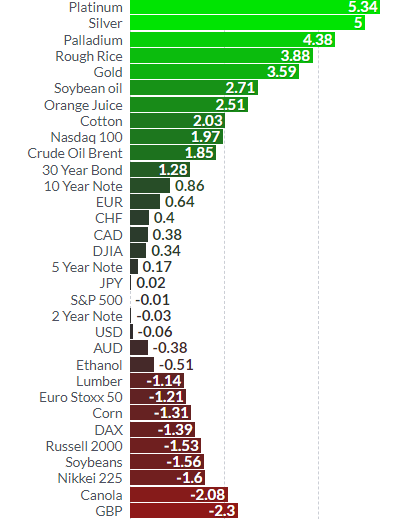
Market Performance in August (Finviz.com)
All four precious metals have made gains in the month of August.
Whilst platinum and palladium’s leading performances can largely be attributed to industrial factors they have also benefited from the safe haven demand which is driving gold and silver prices.
Safe haven demand really came into its own this last month. Issues with North Korea have stepped up a level whilst markets have finally begun to question the complacency they have been feeling in regard to the US political and financial situation, geopolitical risk and the increasingly uncertain outlook for the global economy.
Ultimately very little is known about what will happen with the US debt ceiling, increasingly overvalued stocks (both the NASDAQ and the S&P500), Trump’s plans for corporate tax, dealings with North Korea and (not forgetting) Venezuela.
We are living in very uncertain times indeed and investors decided to allocate funds to the ultimate safe havens – the precious metals.
Gold shines as investors rush into safe havens

This week gold rose to its highest point so far in 2017 as tensions between North Korea (but really, the rest of the world) and the US ramped up. For the month of August the price is up 3.59%.
Silver was also up thanks to safe haven demand, but its 5% climb was also in part due to manufacturing demand. Currently, about 55% of all silver consumed is for industrial use.
Gold has so far risen in every month, bar June.
Gold’s climb has in part been due to ongoing demand from countries such as China and India, but it has primarily been driven by the desire in the West to own a safe haven. This is not surprising given the ongoing concerns regarding North Korea, Venezuela, the Middle East and a lack of cohesion in the Trump administration.
One of the dampeners on gold and silver has been the Federal Reserve’s plans to raise interest rates. However, when they did so it had little effect. Expectations for further hikes are falling. Going forward Yellen and team are expected to slow down on further interest-rate increases which has provided an additional boost for the gold price.
In the very short-term storm Harvey in Houston, Texas has also impacted the price of gold and silver. As a result of lost income and recovery operations, US GDP is expected to be lower in the third-quarter than was initially expected.

In the long-term investors will look to gold and silver as they begin to price risk into the market. Yesterday we expressed our concerns over market complacency whilst other financial organisations have begun to warn clients about the overpriced equity markets and lack of perceived risk.
It is also worth noting an expected climb in demand from China. Mark Tinker, Head of AXA Framlington wrote in a note that China’s pricing of assets in yuan (together with the plan by the Hong Kong Stock Exchange to sell yuan-priced physical gold contracts) could allow them to trade out of the banking system in the US
“Having accepted payment for oil or gas in RMB, the seller, be it Russia or Saudi Arabia or anyone else for that matter, does not have to worry about having excess RMB, they can simply trade it back into gold,” Tinker said. “We are moving to a multi-polar world.”
Platinum gains as Russia feels the pain

Platinum has performed very well so far in the second half of the year. This most recent surge has likely come about thanks to further sanctions being placed on Russia by the US. Russia is the world’s second biggest producer of the metal.
The World Platinum Investment Council outlined the following arguments for platinum’s role as a safe haven investment asset:
– Supply demand fundamentals are strong and ETF holdings are stable, despite price volatility
– Risks of supply declines are underestimated – cost pressure and falling mining investment continue – Downside risks to platinum automotive demand are overestimated
– Futures positioning follows poor sentiment with high correlation to price
– Platinum is undervalued against its past, its production cost and against gold
Palladium climbs on Vauxhall’s woes

Palladium is currently at a 16 year high. There is a major tightening in the supply of palladium because of increased demand for it in engines. 67% of palladium supply is used in car engines to clean exhaust gases from gasoline engines. There is obviously a major push for ‘clean’ transport and the Vauxhall emissions scandal and obviously helped boost demand.
Inventories of palladium supply are down by abut 45% this year, whilst supply trails demand by the most in the seven years.
Despite the increase in supply, there has been a significant number of redemptions in the the two main U.S. and European palladium ETFs – the ETFS Physical Palladium Shares and the ZKB Palladium. By the 22nd August $49 million had been traded in. Supply in the spot market is reportedly so tight that companies are being forced to trade in multiple ETF shares in order to redeem them with the issuer in exchange for physical palladium.
ETFs are now being treated like palladium warehouses.
It is also important to note that, like platinum, palladium is also hugely affected by the sanctions on Russia.
It is also important to note that ETFs are a risky way to invest in precious metals and most investors would be better served owning actual precious metals rather than paper or digital proxies.
Conclusion: Stars aligning? Outlook good for rest of 2017
Earlier this week we explained how investors shouldn’t always be focused on price. Whilst it is nice to look at the metrics for August and see that all precious metals are up, we should instead focus on why they are up and most importantly the diversification benefits for our portfolios.
Precious metals are largely climbing because the perceived risk in the political and financial system is also climbing. Interestingly many commentators do not feel some risky issues have been wholly appreciated by the markets.
Problems such as North Korea are such serious risks that even someone who pays no attention to markets could spot it. The issue is that you have an overvalued stock market and a US President who cannot get his people together. This means that the US debt ceiling issue might ground the U.S. government to a halt.
These issues are ones which have not yet been fully priced into the markets. They likely will be in the coming months and then the safe haven role of the precious metals and gold in particular will come into its own.
-END-
Bitcoin exchange sees complaints soar
Submitted by cpowell on Thu, 2017-08-31 12:58. Section: Daily Dispatches
By Lily Katz and Julie Verhage
Bloomberg News
Wednesday, August 30, 2017
The most popular online exchange for trading digital currencies is generating a surge in customer complaints this year even as investors are lured by a dramatic rise in prices.
The U.S. Consumer Financial Protection Bureau has received at least 293 complaints about Coinbase Inc., according to data reviewed by Bloomberg. That compares with about six complaints for all of 2016 and makes Coinbase the biggest recipient of CFPB virtual currency complaints this year. The website has struggled to keep up with spiking volume and longer transaction processing times as the value of bitcoin and other cryptocurrencies soared to record highs.
More than a third of the grievances came from individuals who said they were unable to access their money when promised. Many people also complained about other transaction or service problems. Accusations of fraud represented less than 15 percent of the complaints. …
… For the remainder of the report:
https://www.bloomberg.com/news/articles/2017-08-30/bitcoin-exchange-see
END
Bitcoin rises to 4800.00 This is where gold will trade once Bitcoin crashes along with all of the other cryptocurrencies except Bullion coin, which is backed by gold and silver (e.g. Andrew Maguire’s ABX platform)
Bitcoin Surge To New Record Highs Above $4800 Amid Renewed ETF Hope
Bitcoin has surged to a new record high this morning over $4850 amid increased debt ceiling anxiety, continuing demand from South Korea and Japan amid the North Korea chaos, a potential short squeeze, and renewed hopes of SEC approval of a Bitcoin ETF.
The six biggest virtual currencies are all higher today…

NOTE – Litecoin and Veritaseum are among the day’s best performers.
Bitcoin is now up 165% from pre-Fork-anxiety lows in late July…

Bloomberg’s Eric Balchunas notes that Dalia Blass is set to head the SEC Division of Investment Management – which regulates, among other things ETFs. What is of note is that she is a lawyer at Ropes & Gray – the same form representing the Winklevoss twins Bitcoin ETF case. This has prompted excitement that a ‘proper’ (not GBTC, see below), Bitcoin ETF may be sooner than expected.
As CoinTelegraph reports, the SEC famously rejected two Bitcoin ETF proposals earlier this year, citing largely unregulated markets. They did leave themselves an out, however. The Commission indicated that in the event that a regulated futures market for Bitcoin were developed, they might reconsider. Not long ago, the Commodity Futures Trading Commission (CFTC) gave LedgerX permission to create such a futures market. The SEC agreed to hear an appeal from the Winklevoss twins earlier this year, but few watchers expected the twins to receive a different answer.
With Blass at the helm and regulated futures markets being developed, however, this could change.
Some have argued that the recent rise in the price of cryptocurrencies is driven by anxiety over the debt ceiling in the US…

And also of note, as Alistar Milne notes, there are now more open short Bitcoin positions than longs on Bitfinex, potentially causing a short squeeze…

* * *
Finally we note that not everyone is buying into Bitcoin…
First, GBTC (Bitcoin Investment Trust) – which we have discussed numerous times (here and here most recently) – made some headlines overnight as it topped $1000 (implying a $10,000 price for Bitcoin) and Citron’s Andrew Left went on CNBC and explained why he was short…
https://player.cnbc.com/p/gZWlPC/cnbc_global?playertype=synd&byGuid=3000650505&size=530_298
The reaction this morning was an immediate dump (but buyers came right back in)…

Despite still trading at over 100% premium to NAV…

Aditionally, CoinTelegraph reports that David Ader, chief macro strategist at Informa Financial Intelligence, is now trying to show how Bitcoin’s gains resemble that of the Nasdaq Telecommunications Index before the tech bubble burst.
An overly frothy market
Placing Bitcoin’s growth chart over that of the Nasdaq Telecommunications Index, and its subsequent rise, Adler is surmising that Bitcoin has hit the same peak and thus should be ready to plummet in a similar style.
Nasdaq reached its peak in 2000 before a monumental crash and for Adler, the similarities are there for Bitcoin’s run to this most recent all time high.
“This is the price chart for an overly frothy market, in my opinion. I just don’t see anything quite as comparable to this in bubblelicious terms,” said Ader, a former top-rated bond market strategist.

“I think it’s going to come to a sorry ending,” Ader said. “I don’t know anybody who’s actually used a Bitcoin for any purpose legal or otherwise. This looks like an overly frothy market and frothy markets lose their froth.
end
Amazing!! six global banks are joining forces to create a digital currency. None of these currencies is backed by gold or silver and that is why this will end in failure
(courtesy Arnold./London’s Financial Times/GATA)
Six global banks join forces to create digital currency
Submitted by cpowell on Thu, 2017-08-31 13:02. Section: Daily Dispatches
By Martin Arnold
Financial Times, London
Thursday, August 31, 2017
Six of the world’s biggest banks have joined a project to create a new form of digital cash that they hope to launch next year for clearing and settling financial transactions over blockchain, the technology underpinning bitcoin.
Barclays, Credit Suisse, Canadian Imperial Bank of Commerce, HSBC, MUFG, and State Street have teamed up to work on the “utility settlement coin,” which was created by Switzerland’s UBS to make financial markets more efficient.
The move comes as the project shifts into a new phase of development, in which its members aim to deepen discussions with central banks and to work on tightening up its data privacy and cyber security protections. …
… For the remainder of the report:
https://www.ft.com/content/20c10d58-8d9c-11e7-a352-e46f43c5825d
LAWRIE WILLIAMS: $5,000 gold – then $10,000. Gold bulls sing from same songbookJim Rickards and Eric Sprott – neither are from the truly fanatical end of the gold bull community – both reckon gold is going to $10,000 an ounce – not in the short term, but over time, and they are probably right. It’s only the timescale which is really in doubt. One to two years or 50 years – or somewhere in between, or even longer? But this may be a factor of a fall in the purchasing power of the once mighty U.S. dollar rather than of a rising gold price in real terms.
In the writer’s own lifetime gold has risen from an admittedly controlled $35 an ounce to over $1,900 at one point – a 54x increase – and over 37x to the current price level. Even a 37x gold price rise from the ca. $1,320 where its stands today would put it at over $48,000 – probably unlikely without some kind of global catastrophe, but at least it puts a rise to a mere $10,000 into context – only around a 7.5x increase from where it is at the moment. Indeed so far in the 17 ½ years of the current Century gold has risen in dollar terms a little over 4.5 times and a similar rise over the next 17 ½ years would put it at near $6,000 by 2036. In this context such seemingly mega price increases as those suggested by Messrs. Rickards and Sprott do not seem outside the bounds of possibility, or even probability!
As fiat currencies collapse and die, as history shows they all do eventually, gold is, and has been, a constant wealth protector. It carries no counterparty risk, although it is not totally risk-free as the price can be volatile in the short term as many gold investors will know to their cost. But the number of big financial names who carry a degree of gold in their portfolios, regardless of its ups and downs, is legion. It remains the ultimate insurance against total financial system collapse and has stood the test of time in this context.
So, should you buy and hold gold? Yes for the long term, although as a trading option it can be risky. If you get the timing right, trading gold can make you money, but that also applies to many other investment options too. However in the current financial climate where most countries are technically bankrupt, especially the USA, it would seem to make holding some of one’s capital in gold an imperative. The world has never before seen such a reliance on debt – to the extent that unwinding it, without currency collapse , or hyperinflation (two sides of the same coin), is virtually impossible.
History does tend to repeat itself, over and over and it is telling us that there is a time limit to dollar dominance. The world is moving in that direction and gold, as countries like China and Russia well recognise, will likely play a significant part in global financial restructuring. Barbarous relic or not, gold has stood the test of time as a global instrument of economic security and it likely will continue to do so for the foreseeable future.
01 Sep 2017
-END-
Gold Jumps, Dollar Dumps After Pitiful Payrolls
While the excuses are already flowing for the big miss in August’s payrolls, markets are reacting with currencies the biggest factor.

The dollar dumped immediately and precious metals spiked, bond yields fell marginally and while Nasdaq jumped a little initially, stocks are now all modestly lower…

Your early FRIDAY morning currency, Asian stock market results, important USA/Asian currency crosses, gold/silver pricing overnight along with the price of oil Major stories overnight
1 Chinese yuan vs USA dollar/yuan MUCH STRONGER 6.562 (REVALUATION NORTHBOUND /OFFSHORE YUAN MOVES SLIGHTLY WEAKER TO ONSHORE AT 6.5650/ Shanghai bourse CLOSED UP 6.31 POINTS OR 0.19% / HANG SANG CLOSED DOWN 17.14 POINTS OR 0.06%
2. Nikkei closed UP 45.23 POINTS OR 0.23% /USA: YEN FALLS TO 110.12
3. Europe stocks OPENED DEEPLY IN THE GREEN ( /USA dollar index FALLS TO 92.66/Euro UP to 1.1924
3b Japan 10 year bond yield: FALLS TO –.001%/ GOVERNMENT INTERVENTION !!!!(Japan buying 100% of bond issuance)/Japanese yen vs usa cross now at 114.34/ THIS IS TROUBLESOME AS BANK OF JAPAN IS RUNNING OUT OF BONDS TO BUY./JAPAN 10 YR YIELD FINALLY IN THE POSITIVE/BANK OF JAPAN LOSING CONTROL OF THEIR YIELD CURVE AS THEY PURCHASE ALL BONDS TO GET TO ZERO RATE!!
3c Nikkei now JUST BELOW 17,000
3d USA/Yen rate now well below the important 120 barrier this morning
3e WTI:: 46.74 and Brent: 52.52
3f Gold UP/Yen UP
3g Japan is to buy the equivalent of 108 billion uSA dollars worth of bond per month or $1.3 trillion. Japan’s GDP equals 5 trillion usa./“HELICOPTER MONEY” OFF THE TABLE FOR NOW /REVERSE OPERATION TWIST ON THE BONDS: PURCHASE OF LONG BONDS AND SELLING THE SHORT END
Japan to buy 100% of all new Japanese debt and by 2018 they will have 25% of all Japanese debt. Fifty percent of Japanese budget financed with debt.
3h Oil UP for WTI and UP for Brent this morning
3i European bond buying continues to push yields lower on all fronts in the EMU. German 10yr bund RISES TO +.385%/Italian 10 yr bond yield UP to 2.07%
3j Greek 10 year bond yield REMAINS AT : 5.540???
3k Gold at $1320.15 silver at:17.57 (8:15 am est) SILVER NEXT RESISTANCE LEVEL AT $18.50
3l USA vs Russian rouble; (Russian rouble UP 7/100 in roubles/dollar) 57.96-
3m oil into the 46 dollar handle for WTI and 52 handle for Brent/
3n Higher foreign deposits out of China sees huge risk of outflows and a currency depreciation (already upon us). This can spell financial disaster for the rest of the world/China forced to do QE!! as it lowers its yuan value to the dollar/GOT A FAIR SIZED DEVALUATION SOUTHBOUND
JAPAN ON JAN 29.2016 INITIATES NIRP. THIS MORNING THEY SIGNAL THEY MAY END NIRP. TODAY THE USA/YEN TRADES TO 110.12 DESTROYING JAPANESE CITIZENS WITH HIGHER FOOD INFLATION
30 SNB (Swiss National Bank) still intervening again in the markets driving down the SF. It is not working: USA/SF this morning 0.9596 as the Swiss Franc is still rising against most currencies. Euro vs SF is 1.1439 well above the floor set by the Swiss Finance Minister. Thomas Jordan, chief of the Swiss National Bank continues to purchase euros trying to lower value of the Swiss Franc.
3p BRITAIN VOTES AFFIRMATIVE BREXIT/LOWER PARLIAMENT APPROVES BREXIT COMMENCEMENT/ARTICLE 50 COMMENCES MARCH 29/2017
3r the 10 Year German bund now POSITIVE territory with the 10 year RISING to +0.385%
The bank withdrawals were causing massive hardship to the Greek bank. the Greek referendum voted overwhelming “NO”. Next step for Greece will be the recapitalization of the banks and that will be difficult.
4. USA 10 year treasury bond at 2.129% early this morning. Thirty year rate at 2.7380% /POLICY ERROR)GETTING DANGEROUSLY HIGH
5. Details Ransquawk, Bloomberg, Deutsche bank/Jim Reid.
6. USA CASH BALANCES ON HAND: $67 BILLION
(courtesy Jim Reid/Bloomberg/Deutsche bank/zero hedge)
All Eyes On August Payrolls, As Global Stocks Rise In Bullish September Start; Yuan Surge Continues
With payrolls looming (our full preview is here), carbon-based traders around the globe are leery of putting on any major trades and so the overnight session has been rather dull, dominated by the now traditional overnight algo-mediated levitation, which means the VIX is lower and S&P futures are once again modest higher as European and Asian shares continue their ascent.
“A decent payrolls number today would be the icing on the cake in a week that has seen some positive signs that the U.S. economy may be in better shape than was previously thought prior to Jackson Hole,” analyst Michael Hewson at CMC Markets writes in note. “Annual hourly wage growth is currently 2.5%, a little on the weak side for an economy supposedly at full employment, so a strong number here could increase the odds of another rate rise this year, most likely in December.”
While we have penned a longer preview of today’s jobs report, the only chart that may matter for today’s payrolls print, expected at 180K, is the following from Morgan Stanley, which predicted the July print to the dot, and which anticipates a big miss in the August jobs number, at 136K vs the 180K expected (see full preview here).

The Stocks Europe 600 Index is higher for a third day, the Stoxx 600 up 0.4%, starting off September with solid gains – after three months of strong Euro-driven declines – with media companies among the winners after Vivendi SA sales beat estimates. the final Eurozone August manufacturing PMI printed as expected, and unchanged from the flash print, at 57.4. In a month traditionally reserved for time at the beach, euro- area factories increased output at one of the fastest rates since 2011. U.K. manufacturing expanded at the strongest pace in four months in August, lifted by both export orders and domestic demand. The Markit manufacturing PMI rose to 56.9 from a revised 55.3 in July, beating the consensus estimate of 55.
The LME Index of six industrial metals soared to the highest in almost three years, with copper leading the charge following another strong Chinese PMI print overnight (see below). The U.K.’s FTSE 100 Index increased 0.9 percent to the highest in more than two weeks.

“European markets and U.S. futures are trading higher ahead of the most-watched economic data on the face of the Earth,” Naeem Aslam, chief market analyst at Think Markets U.K., said by email. “What traders have priced in very much in the market is that the Fed is going to struggle with respect to any further rate hike for this year.”
Hawkish comments from ECB’s Nowotny on Friday morning briefly lifted EUR across the board and weighed on bund futures.
Emerging market stocks were higher after still cheering their eighth straight month of gains as China’s yuan hit a fresh 14-month high and metals markets continued to rally. Industrial bellwether copper was up 0.4 percent at $6,818 a tonne. The LME contract price touched a peak of $6,872 on Thursday, the highest since September 2014.
Japan’s benchmark bond yield fell below zero percent for the first time since November 16, sliding 1.5bps to -0.005%. The decline was unexpected as earlier in the session the Bank of Japan reduced its purchases of 3-to-5-year govt notes by 30b yen, to 300b yen from 330b yen on August 28 while keeping other maturity buckets unchanged. This marked a third open market purchase reduction in the past month, with cuts in the 5-to-10 year zone previously. Banks quickly jumped on the supply-shortage driven tapering bandwagon and, as Mitsubishi UFJ said “unless the BOJ cuts purchases further, the yield decline will deepen” while Makoto Suzuki, strategist at Okasan Securities, said that “even a further decrease in bond purchases is unlikely to cause a spike in yields.”

The drop in 10-year Japanese government bond yield below zero percent paves the way for further cuts in purchases at Bank of Japan’s next relevant market operation, said Akio Kato, general manager of trading at Mitsubishi UFJ Kokusai Asset Management. “Without a cut in purchases, yields will fall too low, given that the yield today fell below zero even as the BOJ reduced amount in 3-5 year zone” Kato added. “If the BOJ continues to cut a couple more times this month, annual buying would fall below 60t yen, calling into question the 80t yen annual monetary expansion target” the strategist said, cited by Bloomberg.
Anyway, back to Asia ex Japan, where with the North Korean crisis forgotten, at least until the next time Kim lobs a handful of missiles over Japan and this time he hits something, South Korea’s won and China’s yuan gained while most other Asia’s emerging currencies were steady ahead of U.S. jobs data and amid holidays in some major Southeast Asian markets. The ASX 200 (+0.1%) and Nikkei 225 (+0.2%) were both supported at the open, but then pared some gains as the financial sector dragged alongside declining yields. Shanghai Comp. (+0.2%) and Hang Seng (flat) initially traded positive (Hang Seng pared gains heading into the close) despite a net weekly liquidity drain by the PBoC, as participants cheered better than expected Chinese Caixin Manufacturing PMI which printed a 6-month high and showed New Orders and Exports components advanced at the fastest pace in multiple years. Government bonds were mixed while the MSCI EM Asia Index of shares advanced, supporting risk sentiment.
“It’s hard to take any significant position before the U.S. jobs data,” Koji Fukaya, CEO at Tokyo-based FPG Securities, told Bloomberg. “The U.S. economy is solid and the Chinese economy has been stabilizing while the stocks are rising. Such a situation supports emerging currencies due to growing exports and portfolio inflows.”
The Bloomberg Dollar Spot Index was little changed following an overnight loss after a weak inflation report and Treasury Secretary Steven Mnuchin’s comments that a weaker dollar is “somewhat better” for U.S. trade. The yen, the Australian and New Zealand dollars weakened even after Caixin China manufacturing PMI for August beat estimates. Speaking of China’s “other” PMI indicator, one day after the official manufacturing survey sent commodities surging, the Caixin Manufacturing PMI printed at 51.6 for August, beating expectations of 51.0, and above July’s. The New orders sub-index rose by fastest pace
in more than 3 years and exports rose at the fastest pace in 7 years.

Speaking of China, the onshore yuan headed for a 1.2% gain this week, the biggest advance since at least 2007. The CNY strengthened 0.5% to 6.5595 per dollar after the PBOC strengthened the yuan reference rate 0.15% to 6.5909 to the USD. The average year end forecast is 6.5896, according to 15 traders and analysts in a Bloomberg survey, so we are already below it.

While Harvey continues to drift inland, its impact remains. Below is a summary courtesy of Bloomberg of what’s shaping the oil market on Friday:
- Explorer Pipeline planning to start lines over the weekend as full impact of storm Harvey on crude, product markets continues to play out.
- Petro-Logistics says OPEC’s August supply fell about 400k b/d. String of U.S. data due later, including nonfarm payrolls.
- Logjam grows to 29 oil tankers as 11 ports remain closed
- Total Port Arthur is said facing extended shutdown on power loss
- Texas storm bucks N.Y. traders with wild gasoline expiry swings
- NHC issues final advisory on Harvey; losing tropical character
More worrying is what is coming after Harvey, which as we described yesterday, is Hurricane Irma, which one Weather Channel meteorologist described as having the “highest windspeed forecasts I’ve ever seen.”

Oil traders in particular will be closely following Irma’s path, which some models see striking the Gulf of Mexico just two weeks after Harvey left historic damage and devastation in its wake.
Speaking of oil, crude gave up much of Thursday’s increase, while gasoline remained at an elevated level after Tropical Storm Harvey knocked out a quarter of refining capacity. West Texas Intermediate crude fell 1.2 percent to $46.65 a barrel. Copper gained 0.3 percent to $6,807.50 per metric ton, the highest in almost three years. Gold fell 0.2 percent to $1,318.20 an ounce, the biggest fall in more than a week.
In rates, the yield on 10-year Treasuries climbed one basis point to 2.12 percent. Germany’s 10-year yield gained one basis point to 0.37 percent. Britain’s 10-year yield increased less than one basis point to 1.034 percent. Japan’s 10-year yield dropped one basis point to -0.001%.
Friday’s econ data include August employment and jobless rate, Markit manufacturing PMI and ISM manufacturing as well as July construction spending and August auto sales. The second round of negotiations for The North American Free Trade Agreement (NAFTA) begins in Mexico City
Bulletin Headline Summary from RanSquawk
- European equities kick-off the month on the front-foot as participants await today’s US jobs report
- FX markets remain tentative ahead of NFP, while energy markets pull-back modestly from yesterday’s gains
- Looking ahead, highlights include US NFP, ISM Manufacturing and Baker Hughes
Market Snapshot:
- S&P 500 futures up 0.07% to 2,471.75
- VIX down 1.8%, or -0.21 to 10.38
- STOXX Europe 600 up 0.4% to 375.52
- MSCI Asia up 0.2% to 161.18
- MSCI Asia ex Japan up 0.2% to 533.64
- Nikkei up 0.2% to 19,691.47
- Topix up 0.1% to 1,619.59
- Hang Seng Index down 0.06% to 27,953.16
- Shanghai Composite up 0.2% to 3,367.12
- Sensex up 0.5% to 31,880.62
- Australia S&P/ASX 200 up 0.2% to 5,724.59
- Kospi down 0.2% to 2,357.69
- German 10Y yield fell 0.2 bps to 0.359%
- Euro down 0.1% to $1.1897
- Italian 10Y yield fell 3.3 bps to 1.753%
- Spanish 10Y yield fell 1.2 bps to 1.55%
- Brent Futures little-changed at $52.42/bbl
- Gold spot down 0.2% to $1,319.51
- U.S. Dollar Index up 0.05% to 92.72
Top Overnight News:
- Trump Is Said to Weigh Tying Debt Limit Increase to Harvey Aid
- CEOs Urge Trump to Keep ‘Dreamers’ Program for Immigrants
- Trump Cuts to Obamacare’s Ads Threaten Law’s Fragile Markets
- World’s Most Important Chemical Made Rare Commodity by Harvey
- Boeing Tanker Fuel Hose Scraping Jets Raises Air Force Alarms
- Billionaire Birla Is Said to Weigh Constellium, Aleris Bids
- Lululemon FY Adj EPS View Beats Highest Est.
- PANW 1Q Rev. View Midpoint Beats Est.; Shares Rise 3.1%
- Russia’s Power Machines Vies With GE for Hungary Contract: RIA
- Macau Aug. Casino Rev. Rises 20.4% Y/y; Est. 18.5% Rise
- Coca-Cola Eyes Number Three Spot for India Globally, TOI Says
- Google Wins Approval of Email Privacy Class Action Settlement
- Former Goldman Compliance Chief to Advise SEC’s Clayton on MiFID
- Amazon Is Said to Plan Canada Prime Now Launch This Year: WSJ
- Southwest Air Rushes to Ensure Fuel Supply Amid Storm Damage
Asia stocks traded mostly positive after the upbeat tone from Wall St where the Nasdaq printed a fresh record close and sentiment was lifted amid tax reform hopes amid comments from US Treasury Secretary Mnuchin. Furthermore, the region also welcomed strong Chinese Caixin PMI data, although gains were mild amid the looming key-risk NFP release. ASX 200 (+0.1%) and Nikkei 225 (+0.2%) were both supported at the open, but then pared some gains as the financial sector dragged alongside declining yields. Shanghai Comp. (+0.2%) and Hang Seng (flat) initially traded positive (Hang Seng pare dgains heading into the close) despite a net weekly liquidity drain by the PBoC, as participants cheered better than expected Chinese Caixin Manufacturing PMI which printed a 6-month high and showed New Orders and Exports components advanced at the fastest pace in multiple years. 10yr JGBs were mildly higher amid a decline in Asia-Pac yields and with the BoJ also present in the market for an amount just shy of JPY 1tln in JGB with maturities ranging up to 10yrs. Chinese Caixin Manufacturing PMI (Aug) 51.6 vs. Exp. 51.0 (Prev. 51.1). (Newswires) New orders sub-index rose by fastest pace in more than 3 years and exports rose at the fastest pace in 7 years. PBoC skipped open markets operations for a net weekly drain of CNY 280bln vs. last week’s CNY 330bln drain. PBoC set CNY mid-point at 6.5909 (Prev. 6.6010).
Top Asian News
- Modi to Revamp Cabinet to Revive Economy Before Key India Polls
- Tencent Music Is Said to Seek Pre-IPO Funds at $10 Billion Value
- Chinese Billionaire Plots Rescue of a Great British Carmaker
- Caixin China Aug. Manufacturing PMI 51.6; Est. 51
- Rupee Resilience After India GDP Miss ‘Surprising’: StanChart
- China Steel Futures Surge to Record as Plant Fire Fuels Gains
European stocks up for September’s first trading day after three consecutive months of losses. CAC 40 boosted by Vivendi shares which confirmed its outlook for the year and stated that its struggling Canal Plus pay TV was showing signs of improvement. Volvo shares also tracking higher after setting new financial targets. ECB’s Constancio says Euro Area recovery becoming increasingly robust. ECB’s Nowotny says that as long as inflation is low, he does not see the need for higher interest rates. Quiet trading overall with Bunds holding a relatively narrow range this morning. Peripherals performing better relative to core debt with the German-Portuguese spread tightening by some 2.7bps, Italy also narrower by circa 1.5bps.
Top European News
- Stalled Brexit Talks Pile Pressure on May to Negotiate Deal
- U.K. Manufacturing Unexpectedly Accelerates to Four-Month High
- Ruble Defies August Curse, Sanctions for Monthly Gain: Chart
- Gemalto Slides; Bryan Garnier Sees Potential for Another Warning
- Europe Miners Gain; Steel Stocks Remain Volatile: Deutsche Bank
- Sophos Gains After Palo Alto Said Demand Environment ‘Solid’
- ECB’s Nowotny Says Japan Shows EU Must Move Fast to Repair Banks
In currencies, the EUR is marginally weaker this morning, largely following from yesterday’s ECB source reports over EUR appreciation, alongside the mild uptick in the greenback. The theme for EUR as we head towards the ECB meeting may well be on speculation that Draghi and Co. may highlight risks to the appreciating currency. As such, EUR could possibly be pressured ahead of the monetary policy decision. Today, there are chunky expiries that may magnetise price action with 2.6bln worth of vanilla options from 1.1870-1.1900. The US Dollar is slightly firmer this morning, ahead of the US job numbers (Exp. 180k), also as tensions between North Korea and the US has seemingly eased off since the beginning of the week. In turn, this has seen USD/JPY break back above 110.00 amid the slight improvement in risk sentiment. Cable received a small uptick from better than expected UK Mfg. PMI which also showed an upward revision. However, sentiment remains bearish for the currency with Brexit talks showing little signs of progress.
In commodities, it is the same story for crude prices, with flooding at US refineries after Hurricane Harvey continuing to weigh on prices.
Looking at the day ahead, the final August PMIs for Germany, Eurozone, UK, France and Italy are due this morning. In the US, the highlight is the employment report for August. The August ISM manufacturing print (56.4 expected) is also worth keeping an eye while the July construction spending and University of Michigan confidence isurvey is also due. Away from the data, ECB governing council member Nowotny joins a panel discussion and ECB VP Constancio will speak. Elsewhere, the second round of NAFTA negotiations begins in Mexico City.
US event calendar
- 8:30am: Change in Nonfarm Payrolls, est. 180,000, prior 209,000
- Unemployment Rate, est. 4.3%, prior 4.3%; Underemployment Rate, prior 8.6%
- Average Hourly Earnings MoM, est. 0.2%, prior 0.3%; YoY, est. 2.6%, prior 2.5%
- Average Weekly Hours All Employees, est. 34.5, prior 34.5; Labor Force Participation Rate, prior 62.9%
- 9:45am: Markit US Manufacturing PMI, est. 52.5, prior 52.5
- ISM Manufacturing, est. 56.5, prior 56.3
- ISM Prices Paid, est. 62, prior 62
- ISM New Orders, est. 60, prior 60.4
- ISM Employment, prior 55.2
- 10am: U. of Mich. Sentiment, est. 97.5, prior 97.6; Current Conditions, est. 110.9, prior 111
- 10am: U. of Mich. 1 Yr Inflation, prior 2.6%; 5-10 Yr Inflation, prior 2.5%
- 10am: Construction Spending MoM, est. 0.5%, prior -1.3%
- Wards Total Vehicle Sales, est. 16.6m, prior 16.7m; Domestic Vehicle Sales, est. 12.9m, prior 13m
DB’s Jim Reid concludes the overnight wrap
Well August has flown by in a hurry. It wasn’t quite the typical quiet final month of summer that we might have expected with the headlines out of Washington – namely the debt ceiling debate but also signs of further friction in Trump’s inner circle – and North Korea being enough to keep markets on their toes. In the end though markets are heading into September on the front foot helped in part by some upbeat macro data in the last few days. A slight upside surprise in the July CPI data for the Eurozone yesterday continued the positive momentum, while inflation data in the US later in the afternoon, while far from spectacular, at least came in in-line with market expectations. More details on that later.
As you’ll see in the day ahead at the end we’re ending the week today with a bit of a bang too. As always payrolls will likely be front and centre. For what it’s worth the market consensus is running at 180k for August following a 209k print in July. Following the decent ADP print on Wednesday (237k vs. 185k expected) our US economists revised up their payrolls estimate to 200k from 185k. They note that the details in the ADP suggest that the Amazon hiring spree proved an upside risk and as such that was the basis for their change in forecast. All that said we have been arguing that inflation and the debt ceiling have arguably taken over as the bigger issues for the Fed outlook right now so while not completely dampening down the importance of payrolls, it feels like the data is not quite as significant as it once was in the past. With that it’ll be worth keeping an eye on the associated wages data in the employment report (+0.2% mom and +2.6% yoy consensus). Later on we’ll also get the August ISMs while this morning we’ll get the final PMI revisions in Europe. So plenty to get through.
As noted at the top, risk assets generally had a pretty decent final day of August. The S&P 500 closed +0.57% last night and with that took its run of consecutive daily gains to 5 days and the longest streak since the 7-day run in May. That came after the Stoxx 600 had closed +0.77% which means the index has rallied +1.47% in the last two sessions and the most in a month and a half. That move was once again partly helped by an early fall for the Euro which touched the lowest level since Friday, but then reversed and closed +0.22% higher for the day. The early driver appeared to be a Reuters report suggesting that the recent appreciation in the single currency was concerning a growing number of ECB policymakers, which in turn was building the pressure for a more gentle reduction in the pace of QE. Late in the afternoon the reversal came after US Treasury Secretary Steven Mnuchin said “having a weaker USD is somewhat better for us (as it relates to trade)”. Following on, he also said that the additional spending needed to help Texas may reduce the amount of time Congress have to increase the debt ceiling limit by “a couple of days”. This ties in with reports that Trump is considering attaching an increase in the US debt limit to an initial request to Congress for disaster relief funding of $6bn for Hurricane Harvey.
Sterling was also a notable mover intraday, but like the Euro also ended slightly up (+0.04%) for the day at 1.2930 after the USD weakened. All the talk yesterday was about more signs of Brexit talks failing to progress with the EU saying the UK has not outlined its position clearly, while the UK hit back by saying that the EU is not being flexible. It appears that the key sticking point is agreeing on the UK’s financial settlement. There is no confirmed figure but the European Commission’s Juncker had suggested before it could be 60bn Euros after factoring in budget commitments, pensions and pledge contingencies. A recent poll by ICM showed 65% of British tax payers believed 20bn was already too much.
Jumping over to Asia now where the Caixin manufacturing PMI for China in August was slightly stronger than expected at 51.6 (vs. 51.0 expected) and up from 51.1 in July. This confirms the manufacturing PMI earlier this week. While we’re with China, it’s worth noting a date in your diaries as later in the year on 18th October, 2,300 delegates will meet in Beijing for the 19th Communist Party Congress meeting where the focus will be on potential changes to leadership posts and a party report that will set out the key government policy for the next five years.
This morning markets are for the most part flat to modestly firmer. The Hang Seng (+0.31%), Shanghai Comp (+0.58%) and ASX (+0.15%) are all up while the Kospi and Nikkei are flat.
Moving onto yesterday’s macro data. With regards to that inflation data in the US, while the July core PCE was in line at +0.1% mom and +1.4% yoy, the annual rate is now the lowest since December 2015 and well below the Fed’s target of 2%. Elsewhere, the personal income data was solid. Personal income grew faster than expected at +0.4% mom (vs. +0.3% expected) but personal spending missed slightly at +0.3% mom (vs. +0.4% expected). Elsewhere initial jobless claims remained low at 236k and continuing claims at 1,942k. Meanwhile the Chicago PMI was higher than expected at 58.9 (vs. 58.5 expected) although flat versus last month, while pending home sales disappointed with a -0.8% mom decline (vs. +0.3% expected).
Over in Europe, the Eurozone’s headline inflation was a tad higher, driven by energy costs, but core inflation was in line at +1.2% yoy, which is above the lows of recent years but unlikely to be enough to prompt the ECB to alter course. Elsewhere, the inflation print for France was in line at +0.6% mom while Italy’s inflation was slightly higher than expected at +0.1% mom (vs. 0.0% expected). Elsewhere the unemployment rate for the Eurozone was in line at 9.1% yoy. Finally, Germany’s July retail sales remained volatile and was slightly lower than expected at -1.2% mom (vs. -0.6% expected).
Looking at the day ahead, the final August PMIs for Germany, Eurozone, UK, France and Italy are due this morning. In the US, needless to say the highlight is the aforementioned employment report for August. The August ISM manufacturing print (56.4 expected) is also worth keeping an eye while the July construction spending and University of Michigan confidence isurvey is also due. Away from the data, ECB governing council member Nowotny joins a panel discussion and ECB VP Constancio will speak. Elsewhere, the second round of NAFTA negotiations begins in Mexico City.
3. ASIAN AFFAIRS
i)Late THURSDAY night/FRIDAY morning: Shanghai closed UP 6.31 POINTS OR 0.19% / /Hang Sang CLOSED DOWN 17.14 POINTS OR 0.06%/ The Nikkei closed UP 45.23 POINTS OR 0.23%/Australia’s all ordinaires CLOSED UP 0.17%/Chinese yuan (ONSHORE) closed UP at 6.5620/Oil UP to 46.74 dollars per barrel for WTI and 52.52 for Brent. Stocks in Europe OPENED DEEPLY IN THE GREEN. Offshore yuan trades 6.5650 yuan to the dollar vs 6.5620 for onshore yuan. NOW THE OFFSHORE MOVED SLIGHTLY WEAKER TO THE ONSHORE YUAN/ ONSHORE YUAN MUCH STRONGER (TO THE DOLLAR) AND THE OFFSHORE YUAN IS MUCH STRONGER TO THE DOLLAR AND THIS IS COUPLED WITH THE WEAKER DOLLAR. CHINA IS HAPPY TODAY
3a)THAILAND/SOUTH KOREA/NORTH KOREA
NORTH KOREA/USA/SOUTH KOREA
This professor backs Bannon: the USA cannot pre emptive a strike on North Korea simply because South Korea will turn into a desert
(courtesy Mac Slavo/SHFTPlan.com)
Professor Explains Why We Can’t Pre-emptively Strike North Korea: “North Would Turn South Into A Desert”
Authored by Mac Slavo via SHTFplan.com,
Following North Korea’s recent missile test, which ominously flew over Japan, the specter of war with the hotheaded nation was raised once again.

As time goes on, it seems less and less likely that the Kim regime will back down from its nuclear program. All forms of diplomacy and appeasement have failed, and not even threats of war from the US seem to have an effect on the regime.
There’s a very good reason for that. North Korea knows something that the United States, the most powerful nation on the planet, would absolutely hate to admit. Our country is is no position to engage in a preemptive strike on north Korea, because any attack would result in unimaginable devastation. The days when Americans would tolerate massive war casualties over a short period of time are long gone, and North Korea knows it. There simply isn’t anything we can offer or threaten that will stop their nuclear program.
And that’s understandable once you know how much destruction North Korea could really bring about if the Kim regime ever decided to let its military loose on South Korea.
If the current situation in East Asia is not resolved, a number of countries “will be living under a threat of a nuclear volcano erupting,” Russian diplomat and an expert in Asian studies, professor Georgy Toloraya told RT.com.
Everyone understands perfectly well that for North Korea, if it initiates an aggressive strike, a military conflict will mean a complete and immediate destruction, because no one can deny the US military might,” Toloraya said.
“However, for the US, attempts to solve this problem militarily also bring on a retaliatory strike by North Korea that would turn South Korea into a desert,” he warned, saying the North doesn’t even need nuclear weapons for that.
While Pyongyang’s artillery is able to reach Seoul, the entire territory of South Korea will also “be no good for life,” as Pyongyang’s missiles – even without nuclear warheads – might hit nuclear facilities in the South, he explained. He said there are some 30 such sites close to North Korea’s border.
Obviously, the destruction of nuclear facilities could have more of an impact than any other attack, by causing widespread radiation leaks. If anything, it could be more devastating than dropping a nuclear weapon, since the radioactive materials in these facilities often have a significantly longer half-life than what we see in atomic bombs.
It’s threats like that which make it clear that no military option is capable of reigning in North Korea. That’s a sentiment that former White House Chief Strategist Steve Bannon expressed earlier this month.
Contrary to Trump’s threat of fire and fury, Bannon said: “There’s no military solution [to North Korea’s nuclear threats], forget it. Until somebody solves the part of the equation that shows me that ten million people in Seoul don’t die in the first 30 minutes from conventional weapons, I don’t know what you’re talking about, there’s no military solution here, they got us.”
And let’s not forget that North Korea has one of the largest chemical weapon stockpiles in the world, and is suspected of maintaining a bio-weapons program since the 1960’s. Given those possibilities, Bannon’s belief that North Korea could kill ten million people may be a gross understatement, and that doesn’t even consider the chances that war with North Korea could trigger another world war.
It’s time to accept the truth. We can bargain with the Kim regime, appease it, threaten it, and lay down sanctions on it, but nothing will actually stop that government from continuing its nuclear program without causing mass casualties. The only thing we can do is try tokeep a lid on that country until their citizens rebel, or until the Chinese decide that they’ve had enough with their ally.
b) REPORT ON JAPAN
end
c) REPORT ON CHINA
4. EUROPEAN AFFAIRS
Euro
It is obvious that the ECB is not happy with the higher Euro as they now signal that they will delay signaling their QE decision. This forced the Euro down and the dollar up despite the lousy jobs report. We may get currency wars commencing.
(courtesy zero hedge)
Euro Pumps’n’Dumps After ECB Signals Delay On QE Decision
Having spiked briefly on the back of dollar weakness following a piss-poor payrolls print, EURUSD is tumbling back to unchanged on the day after Bloomberg reports that European Central Bank policy makers may not be ready to finalize their decision on next year’s bond-purchase program until December, according to euro-area officials familiar with the matter.
As Bloomberg reports, the Governing Council has no appetite to rush into decision at Sept. 7 meeting, and complexity of the topic means full details of the plan may not be settled at Oct. 26 meeting, people say. Policy makers don’t want to surprise markets, two of the people say, in a sign that broader signals, lacking full detail, could be given at Sept. and/or Oct. meetings.
Euro’s rise after President Mario Draghi’s comment in June on “reflationary forces” and currency’s jump again last week when he opted not to try to talk it down in a speech in Jackson Hole, Wyoming, shows how sensitive markets are.
Policy makers want extreme prudence, with changes to communication and policy likely to move even slower than originally expected, two of the people say
The dovish jawboning for the second day in a row sent EURUSD back down after the payrolls pump…

It appears a new policy is emerging as currency wars reappear…

Yesterday it was leaked reports or concerns about “strong currency” and today it is delaying a decision that many expected to titl towards tapering QE.
end
5. RUSSIA AND MIDDLE EASTERN AFFAIRS
Russia/USA
Russia is not happy with the latest sanctions imposed by the USA i.e. the closing of two diplomatic annexes in Washington DC and NY City plus the shuttering of the consulate in San Francisco
(courtesy zerohedge)
Russia Responds: “The US Has Declared The Hot Phase Of Diplomatic War”
Just minutes after Russia was given 2 days to implement today’s decision by the State Department, shuttering Russia’s consulate in San Francisco, California and two diplomatic annexes in Washington, DC and New York City, in “the spirit of parity invoked by the Russians”, the Russian responses started coming in, and they were not happy.
Russia’s foreign minister Sergey Lavrov was first on the tape, saying he “expressed regret about the escalation of tensions in bilateral ties”, noting “it wasn’t Russia that started the escalation.”
Lavrov told Tillerson that Moscow would “closely study” the new US measures and would inform Washington of its reaction in due course. Ironically, earlier in the day the US said that it “is prepared to take further action as necessary and as warranted,”even as the State Department prompt tweeted that the “US hopes to avoid further retaliation & move forward with improved relations & cooperation with #Russia“
US hopes to avoid further retaliation & move forward with improved relations & cooperation with #Russiahttps://go.usa.gov/xRsTu

To be sure, former US ambassador to Moscow and vocal Putin critic, Michael McFaul, was skeptical:

And judging by the immediate outpouring Russian reactions, he has every right to be. According to AP, the newly arrived Russian ambassador to the US invoked Vladimir Lenin in saying Moscow will carefully consider its response to the latest US diplomatic escalation: Anatoly Antonov flew into Washington on Thursday, hours after the State Department’s announcement of the closure.
Russian news agencies quoted him as saying: “We have to act calmly and professionally. Speaking like Lenin, we don’t need hysterical impulses,” citing a Lenin maxim.
But the heavy artillery was as usual relegated to domestic Russian politicians: Leonid Slutsky, head of the Russian Duma’s foreign affairs committee, accused the U.S. of a sharp escalation in diplomatic tensions.
Slutsky, one of the top Russian diplomats, was quoted by Russian news agencies as saying, “It’s a highly unjust step. It means that the U.S. is declaring the hot phase of diplomatic war.”

Leonid Slutsky
Cited by AP, he also said that closing institutions abroad is more serious than the U.S. decision last year to expel 35 Russian diplomats and close two estates used by the Russian Foreign Ministry.
Other takes on the latest diplomatic spat were just as skeptical. Former US diplomat Jim Jatras said that while President Trump says he wants better relations with Russia, he recently qualified that with “some day” and “eventually.”
“For a lot of people in Washington, having bad relations with Russia is an end in itself, it’s not a means to an end. And they are calling the shots, not President Trump,” Jatras said. “If there is anybody in his administration who wants to improve ties with Russia, it is him – but as far as I can tell, he’s about the only one.”
“This is all part of an escalation of tensions between the US and Russia which, I am sad to say, the US initiated,” Dan Kovalik, who teaches international human rights at the University of Pittsburgh School of Law, told RT. “Just when there appeared to be a welcome breakthrough between the US and Russia at the G-20 Summit, the US Congress reacted to the possibility of a détente by immediately and overwhelmingly acting to impose a new round of sanctions against Russia aimed at Russia’s natural gas trade in Europe,” Kovalik said.
The sanctions were adopted with veto-proof majorities, so President Donald Trump had to sign them into law at the beginning of August.
“It appears that there is strong, bipartisan opposition in the US to a peaceful relationship with Russia, and this opposition is putting the entire world at risk of more war and conflagration,” Kovalik said. “It is high time the US pull back from such provocations of Russia and find a way to work with Russia as a friend and partner, just as Russia has wanted for many years.”
“This tit-for-tat will mean eventual catastrophe for everyone on earth, unless we finally get some sanity in US leadership, to pull back from the brink,” said Mark Crispin Miller, professor of media studies at New York University. “Judging from the warlike posture of both parties and the US media, it’s hard to see where such restraint will come from; and yet those of us who see the danger must do all we can to warn against it.”
Finally, retired FBI agent Coleen Rowley told RT that US foreign policy sometimes looks as if five-year-olds were in charge of it. “This childish tit-for-tat game will not end well unless there’s a grown-up in the room who can put an end to it.”
So far the only grown ups in the room are intent on further escalating said “game.”
END
Russia/North Korea
Putin warns of a large scale conflict unless they undergo dialogue with preconditions
(courtesy zerohedge)
Putin’s Warning To The World: North Korea “On The Verge Of A Large-Scale Conflict”
As tensions between the US, its regional allies and North Korea continue ebb and flow, depending on what and where Kim lobs the next missile and whether Kelly can block Trump from tweeting for the next few hours, Russian President Vladimir Putin has decided to personally weigh in on the conflict for the first time since the UN passed new sanctions against the North earlier this month. In an article published on the Kremlin’s web site, the Russian president warned that the two sides are “balancing on the verge of a large-scale conflict,” adding that any efforts to pressure the North to end its nuclear program would prove “futile,” and that the only tenable solution to the standoff would be a “dialogue with preconditions.”
“It is essential to resolve the region’s problems through direct dialogue involving all sides without advancing any preconditions (for such talks),” Putin wrote. “Provocations, pressure, and bellicose and offensive rhetoric is the road to nowhere.”

His remarks about a diplomatic solution alluded to a “road map” to peace formulated jointly between Russia and China…. without the U.S.
According to the joint Russian-Chinese deescalation plan, North Korea would stop work on its missile program in exchange for the US and South Korea halting large-scale war games, allowing tensions to gradually subside.
Here’s more from AJ:
“Russia believes that the policy of putting pressure on Pyongyang to stop its nuclear missile programme is misguided and futile,” he wrote in the article sent to media in Brazil, Russia, India, China and South Africa – the BRICS member states.
“The region’s problems should only be settled through a direct dialogue of all the parties concerned without any preconditions. Provocations, pressure and militarist and insulting rhetoric are a dead-end road.”
As recently as last week, tensions between the two sides appeared to be easing, with US Secretary of State Rex Tillerson praising the country’s restraint after the North went nearly a month without a new missile test, despite restrictive new UN sanctions that took effect on Aug. 5. That quickly changed with the beginning of the US and South Korea’s annual 11-day joint military exercises, which appeared to provoke an especially vitriolic response from the North this year, prompting not one but two rocket launches over the next few days.

Two days ago, Russian Foreign Minister Sergey Lavrov reportedly warned Tillerson that it would be “dangerous” to push for more sanctions against North Korea.
Here’s Newsweek:
“Russian Foreign Minister Sergey Lavrov told Tillerson that the U.S. should avoid taking military actions against Kim Jong Un’s regime and that the Russian government believes additional sanctions could prove “counterproductive and dangerous.”
Tillerson’s response to Lavrov is unclear, but the pair did condemn the North’s most recent test on Monday, when a missile sailed over U.S. ally Japan.”
Of course, the North’s missile launch earlier this week which flew over Japan airspace appeared to – at least temporarily – startle investors, triggering a short-lived selloff in global stocks. A day ago, US and South Korea insisted on a provocation of their own, conducting a bombing drill with nuclear-capable US bombers and the new F-35 stealth fighter.
Despite the bellicose rhetoric from both sides, an all-out war is much less likely than the public might believe. Echoing comments made by former White House chief strategist Steve Bannon, a professor warned yesterday that the US is in “no position” to start a war with the North because of the unprecedented devastation the North’s artillery could unleash on Seoul, the densely populated South Korean capital.
As Bannon said during an interview with the American Prospect, the US doesn’t have a tenable military option for toppling Kim Jong Un.
“Until somebody solves the part of the equation that shows me that ten million people in Seoul don’t die in the first 30 minutes from conventional weapons, I don’t know what you’re talking about, there’s no military solution here, they got us.”
As the war of words stretches into its eighth month, observers will surely keep this in mind. Investors, on the other hand, are just looking for an opportunity to “buy the fucking nuclear war dip.”
6 .GLOBAL ISSUES
7. OIL ISSUES
Goldman Sachs states that the supply outages could very well be outweighed by the destruction in demand
(courtesy Nick Cunningham/Oil Price.com)
“Goldman says that the supply outages could be outweighed by the destruction of demand. Houston alone accounts for around 750,000 bpd of oil demand. Goldman Sachs estimates the region will see demand fall by about 0.7 mb/d in the first month after the storm.”
Hurricane Harvey Is A Disaster For OPEC
Authored by Nick Cunningham via OilPrice.com,
The skies are clearing over Houston, but the damage from the remaining elements of Hurricane Harvey has spread east to Port Arthur and Lake Charles along the Texas-Louisiana border. That has knocked more refineries offline, including the largest refinery in the United States.
In the aftermath of the storm, the most serious threat to the energy industry is the extended outage of refineries and pipelines, according to Goldman Sachs. The problem actually looks worse than it did earlier this week as the deluge has shifted towards Port Arthur, another refining hub. Motiva, which runs the U.S.’ largest refinery in Port Arthur, began to completely shut down its 600,000 bpd facility on Wednesday.
Goldman says the refinery shut downs, as of August 30, have spiked to 3.9 million barrels per day (mb/d), although upstream oil production outages have dropped below 1 mb/d. More ports are now closed – in addition to Corpus Christi and Houston, the ports of Lake Charles, Beaumont, and Port Arthur have shut down.
These outages, the investment bank says, will mean that the “ongoing recovery in production will only be partial.” The refinery and pipeline closures are “leaving the oil market long 1.9 mb/d of crude vs. last Thursday, short 1.1 mb/d for gasoline and 0.8 mb/d for distillate.”
More worrying is that the recovery might not be quick. While most refineries had controlled shut downs, there are quite a few, especially in the Port Arthur region, that have been inundated with water, which means that the damage to them is still unknown. Based on the past major hurricanes of Rita and Katrina, Goldman speculates that about 10 percent of the 4 mb/d of refining capacity that has been disrupted will remain offline for several months.
Other analysts agree that the damage could result in lengthier outages than many had hoped. “I’m actually quite concerned about Beaumont-Port Arthur because they just got a huge amount of rain in 24 hours, and we’ve already seen flooding within the refineries themselves, so we don’t know exactly how bad it’s going to be,” Andy Lipow, president of Lipow Oil Associates, told CNBC. “If it is bad, you’re looking at six to eight weeks of outages over in Beaumont-Port Arthur.”
Ultimately, that could mean that upstream oil producers will be unable to return to full production. Damage to pipelines, storage and processing facilities will also inhibit a full recovery. “It will be a while before operations can return to normal and the U.S. refining industry is bracing itself for an extended shutdown,” Stephen Brennock of PVM wrote in a research note.
The prospect of lasting damage to the energy industry is sinking in. “Back to normal is months, not weeks, for exports and for the industry and the region. We have to acknowledge that,” Barclays analyst Michael Cohen wrote.
While much of the focus is (rightly) centered on the effect on gasoline supply, the refinery outages could eat into crude oil demand for quite some time. In fact, on balance, Goldman says that the supply outages could be outweighed by the destruction of demand. Houston alone accounts for around 750,000 bpd of oil demand. Goldman Sachs estimates the region will see demand fall by about 0.7 mb/d in the first month after the storm.
That will make “it harder for OPEC to rebalance the market and maintain bullish sentiment,” Barclays’ analysts said. OPEC has been struggling to drain inventories for almost a year, but without a substantial portion of U.S. refineries online, inland crude oil storage facilities in the U.S. could fill up once again. And the dip in demand could mean OPEC’s time horizon for balancing gets pushed out a bit more into the future, just as the cartel was hinting that it might have to extend its production cuts anyway.
But the problem is more complex because U.S. data will be much “noisier and less useful as a high frequency indicator at the very time OPEC needs it most,” Barclays says. Storage might increase, refinery runs will bounce around, production figures will edge up slowly – in short, the trend lines that the market has become accustomed to will be all out of whack. And because the U.S. offers the most transparent data, closest to real-time as one can get, it has an outsized impact on market psychology. The data will be really messy for weeks to come, which will complicate OPEC’s strategy.
end
The rig count stabilized as it actually fell last week as USA crude production also stalls.
(courtesy zerohedge)
US Crude Production Stalls As Oil Rig Count Rolls Over
Amid the chaos and turmoil caused by Harvey, today’s rig count data is likely to change things as much as a fart in a hurricane. US crude production in the Lower 48 actually fell last week, syncing with the stabilization in the lagged oil rig count.
The US Oil Rig count held to two-month lows last week, unchanged at 759…

US Crude production in the Lower 48 dropped last week following a stabilization in rig counts (but rose 2k overall thanks to a pick up in Alaska)…

Notably RBOB prices are down today (and WTI) as John Kilduff, a partner at Again Capital, notes “The government is actually reacting positively trying to address and do what they can,… There are some signs of life in several of the refineries already and the 1 million-barrel tapping of the SPR is also helping to ease anxieties over the storm”

8. EMERGING MARKET
VENEZUELA/USA
end
Your early morning currency/gold and silver pricing/Asian and European bourse movements/ and interest rate settings FRIDAY morning 7:00 am
Euro/USA 1.1910 up .0002/REACTING TO + huge Deutsche bank problems + USA election:/TRUMP HEALTH CARE DEFEAT//ITALIAN REFERENDUM DEFEAT/AND NOW ECB TAPERING BOND PURCHASES/ /USA FALLING INTEREST RATES AGAIN/HOUSTON FLOODING/EUROPE BOURSES DEEPLY IN THE GREEN
USA/JAPAN YEN 110.12 DOWN 0.010(Abe’s new negative interest rate (NIRP), a total DISASTER/SIGNALS U TURN WITH INCREASED NEGATIVITY IN NIRP/JAPAN OUT OF WEAPONS TO FIGHT ECONOMIC DISASTER/
GBP/USA 1.2924 DOWN .0013 (Brexit March 29/ 2017/ARTICLE 50 SIGNED
THERESA MAY FORMS A NEW GOVERNMENT/STARTS BREXIT TALKS
USA/CAN 1.2478 UP .0002 (CANADA WORRIED ABOUT TRADE WITH THE USA WITH TRUMP ELECTION/ITALIAN EXIT AND GREXIT FROM EU/(TRUMP INITIATES LUMBER TARIFFS ON CANADA)
Early THIS FRIDAY morning in Europe, the Euro ROSE by 2 basis points, trading now ABOVE the important 1.08 level RISING to 1.1843; / Last night the Shanghai composite CLOSED UP 6.31 POINTS OR 0.19% / Hang Sang CLOSED DOWN 17.14 POINTS OR 0.06% /AUSTRALIA CLOSED UP 0.17% / EUROPEAN BOURSES OPENED DEEPLY IN THE GREEN
The NIKKEI: this FRIDAY morning CLOSED UP 45.23 POINTS OR 0.23%
Trading from Europe and Asia:
1. Europe stocks OPENED DEEPLY IN THE GREEN
2/ CHINESE BOURSES / : Hang Sang CLOSED DOWN 17.14 POINTS OR 0.06% / SHANGHAI CLOSED UP 6.31 POINTS OR 0.19% /Australia BOURSE CLOSED UP 0.17% /Nikkei (Japan)CLOSED UP 45.23 POINTS OR 0.23% / INDIA’S SENSEX IN THE GREEN
Gold very early morning trading: 1318.50
silver:$17.51
Early FRIDAY morning USA 10 year bond yield: 2.129% !!! UP 1 IN POINTS from THURSDAY night in basis points and it is trading JUST BELOW resistance at 2.27-2.32%.
The 30 yr bond yield 2.7380, UP 1 IN BASIS POINTS from THURSDAY night.
USA dollar index early FRIDAY morning: 92.66 DOWN 1 CENT(S) from THURSDAY’s close.
This ends early morning numbers FRIDAY MORNING
xxxxxxxxxxxxxxxxxxxxxxxxxxxxxxxxxxxxxxxxxxxxxxxxxxxxxxxxxxxxxxxxxxxxxxxxxxxxxxxxxxxxxxxxxxxxxxxxxxxxxxxxxxxxxxx
And now your closing FRIDAY NUMBERS
Portuguese 10 year bond yield: 2.841% UP 1 in basis point(s) yield from THURSDAY
JAPANESE BOND YIELD: -.001% DOWN 1/5 in basis point yield from THURSDAY/JAPAN losing control of its yield curve/NOW NEGATIVE
SPANISH 10 YR BOND YIELD: 1.599% UP 4 IN basis point yield from THURSDAY
ITALIAN 10 YR BOND YIELD: 2.077 UP 3 POINTS in basis point yield from THURSDAY
the Italian 10 yr bond yield is trading 48 points HIGHER than Spain.
GERMAN 10 YR BOND YIELD: +.379% UP 2 IN BASIS POINTS ON THE DAY
END
xxxxxxxxxxxxxxxxxxxxxxxxxxxxxxxxxxxxxxxxxxxxxxxxxxxxxxxxxxxxxxxxxxxxxxxxxxxxxxxxxxxxxxxxxxxxxxxxxxxxxxxxxxxxxxxxxxxxxxxxxxxxxxxxxxxxx
IMPORTANT CURRENCY CLOSES FOR FRIDAY
Closing currency crosses for FRIDAY night/USA DOLLAR INDEX/USA 10 YR BOND YIELD/1:00 PM
Euro/USA 1.1883 DOWN .0025 (Euro DOWN 25 Basis points/ represents to DRAGHI A COMPLETE POLICY FAILURE/
USA/Japan: 110.10 DOWN 0.027(Yen UP 3 basis points/
Great Britain/USA 1.2970 UP 0.0031( POUND UP 31 BASIS POINTS)
USA/Canada 1.2371 DOWN .0071 (Canadian dollar UP 71 basis points AS OIL ROSE TO $47.01
xxxxxxxxxxxxxxxxxxxxxxxxxxxxxxxxxxxxxxxxxxxxxxxxxxxxxxxxxxxxxxxxxxxxxxxxxxxxxxxx
This afternoon, the Euro was DOWN by 25 basis points to trade at 1.1883
The Yen ROSE to 110.10 for a GAIN of 3 Basis points as NIRP is STILL a big failure for the Japanese central bank/HELICOPTER MONEY IS NOW DELAYED/BANK OF JAPAN NOW WORRIED AS AS THEY ARE RUNNING OUT OF BONDS TO BUY AS BOND YIELDS RISE /OPERATION REVERSE TWIST ANNOUNCED SEPT 21.2016
The POUND ROSE BY 31 basis points, trading at 1.2970/
The Canadian dollar ROSE by 97 basis points to 1.2370, WITH WTI OIL RISING TO : $47.01
Your closing 10 yr USA bond yield UP 1 IN basis points from THURSDAY at 2.138% //trading well ABOVE the resistance level of 2.27-2.32%) very problematic USA 30 yr bond yield: 2.750 UP 3 in basis points on the day /
Your closing USA dollar index, 92.71 UP 4 CENT(S) ON THE DAY/1.00 PM
Your closing bourses for Europe and the Dow along with the USA dollar index closing and interest rates for FRIDAY: 1:00 PM EST
London: CLOSED UP 7.88 POINTS OR 0.11%
German Dax :CLOSED UP 86.80 POINTS OR 0.72%
Paris Cac CLOSED UP 37.67 POINTS OR 0.74%
Spain IBEX CLOSED UP 26.00 POINTS OR 0.25%
Italian MIB: CLOSED UP 188.54 POINTS OR 0.87%
The Dow closed UP 39.46 OR 0.18%
NASDAQ WAS closed UP 6.67 POINTS OR 0.10% 4.00 PM EST
WTI Oil price; 47.01 at 1:00 pm;
Brent Oil: 52.61 1:00 EST
USA /RUSSIAN ROUBLE CROSS: 57.49 DOWN 54/100 ROUBLES/DOLLAR (ROUBLE HIGHER BY 54 BASIS PTS)
TODAY THE GERMAN YIELD RISES TO +0.379% FOR THE 10 YR BOND 4.PM EST EST
END
This ends the stock indices, oil price, currency crosses and interest rate closes for today
Closing Price for Oil, 5 pm/and 10 year USA interest rate:
WTI CRUDE OIL PRICE 5:00 PM:$47.35
BRENT: $52.73
USA 10 YR BOND YIELD: 2.166% (ANYTHING HIGHER THAN 2.70% BLOWS UP THE GLOBE)
USA 30 YR BOND YIELD: 2.770%
EURO/USA DOLLAR CROSS: 1.1842 DOWN .0066
USA/JAPANESE YEN:110.22 UP 0.089
USA DOLLAR INDEX: 92.85 UP 19 cent(s)
The British pound at 5 pm: Great Britain Pound/USA: 1.2929 : DOWN 19 POINTS FROM LAST NIGHT
Canadian dollar: 1.2337 UP 137 BASIS pts
German 10 yr bond yield at 5 pm: +0.379%
END
And now your more important USA stories which will influence the price of gold/silver
TRADING IN GRAPH FORM FOR THE DAY
Floods, Nukes, & Pitiful Payrolls Spark Best Week For Stocks In 2017
Flood Schmud, Missiles Schmissiles, Jobs Schmobs…
Gold gained the most after today’s dismal jobs data…

After a crazy run the last few days into month-end, Nasdaq slipped notably lower after the pitiful payrolls print… All major indices closed lower post payrolls

Stocks gained on the day though, thanks to overnight pumping, with Trannies tumbling into the close to leave small caps best on the day. Nasdaq record high close…

And despite Hurricane Harvey, North Korean Missiles, and Dismal Jobs, stocks soared on the week…

A crazy week:
- Nasdaq +2.75% – best week since Dec 2016
- S&P +1.5% – best week in 4 months
- Trannies +2.8% – best week in 3 months
- Gold +2.6% – best week since April 2016
FANGs and Biotechs led Nasdaq…

VIX was down for the 3rd week in a row…VIX was crushed back to a 10 handle.

Treasury yields were up across the board today.. on weak jobs data? but ended the week mixed (30Y higher in yield, belly lower)…

NOTE – the yield curve (2s10s) was flatter for the 5th week in a row.
But it was the shortest-end of the curve that was most troubled as thedebt ceiling panic really started to build…

FX markets were a little wild today as Payrolls and ECB jawboning sent EURUSD swinging wildly…

The Dollar Index rose on the week (best week in the last 4)

Yuan was the strongest against the greenback on the week and JPY weakest…

Bitcoin surged over 12% this week (up7 weeks in a row) to a new record high…

But Bitcoin Inv Trust tumbled 21% following Andrew Left’s appearance on CNBC…

WTI sank on the week (fifth weekly drop in a row)… RBOB gasoline futures spiked over 14% on the week (roll-adjusted) – the biggest week since Hurricane Irene in July 2011…

Having survived a flash crash effort Wednesday night, precious metals surged back to close the week on their highs…

And equity investors have another excuse to BTFD – equity dividend yields are higher than bond yields once again…

But Gold remains 2017’s big winner…

END
And now the official ugly jobs report: only 156,000 job gain but mot important a big miss on hourly earnings rising to only 2.5% on a yearly basis..from 2.6%. Unemployment rises to 4.4% from 4.3%
(courtesy zerohedge)
Ugly Jobs Report: August Payrolls Miss, Slide To 156K; Hourly Earnings Also Disappoint
We warned readers yesterday to “Prepare For Disappointment” with today’s jobs report, and sure enough that’s precisely what we got when moments ago the BLS reported that in August just 156K jobs were created, a big miss to the 180K expected, and following a sharp downward revision to June and July, which were revised to 210K and 189K, respectively, a 41K drop combined.

Not helping matters was the Household Survey, according to which the number of employed Americans declined by 74,000 to 153,439K.
The unemployment rate also disappointed, rising from 4.3% to 4.4%, while avg hourly earnings missed, increasing by 2.5% Y/Y in August, below the 2.6% estimate and the same as July.
The sequential increase in earnings was just 0.1%, also below the 0.2% expected, and far below the 0.3% in July. Furthermore, since average weekly hours declined also, from 34.5 to 34.4, average weekly earnings declined outright from $909.42 to $907.82 in August. Furthermore, average weekly earnings rose just 2.2% Y/Y, the lowest rate of increase since January.

While the labor force participation rate remained unchanged at 62.9%, the number of Americans not in the labor force increased once again, growing by 128K in August to 94.785 million.

More details from the report:
Total nonfarm payroll employment increased by 156,000 in August. Job gains occurred in manufacturing, construction, professional and technical services, health care, and mining. Employment growth has averaged 176,000 per month thus far this year, about in line with the average monthly gain of 187,000 in 2016.
Ironically, manufacturing employment somehow rose by 36,000 in August, (Harvey: ???)with Job gains allegedly occurring in motor vehicles and parts (+14,000) – at a time when virtually every car factory was furloughing workers, as well as fabricated metal products (+5,000), and computer and electronic products (+4,000). Manufacturing has added 155,000 jobs since a recent employment low in November 2016.
In August, construction employment rose by 28,000 (Harvey: ??), after showing little change over the prior 5 months. Employment among residential specialty trade contractors edged up by 12,000 over the month.
Employment in professional and technical services continued to trend up in August (+22,000) and has grown by 262,000 over the last 12 months. In August, job gains occurred in computer systems design and related services (+8,000).
Health care employment continued on an upward trend over the month (+20,000) and has risen by 328,000 over the year. Employment in hospitals edged up over the month (+6,000).
Mining continued to add jobs in August (+7,000), with all of the growth in support activities for mining. Since a recent low in October 2016, employment in mining has risen by 62,000, or 10 percent.
Jobs were also weaker for waiters and bartenders, aka “employment in food services and drinking places” which changed little in August (+9,000), following an increase of 53,000 in July. Over the year, the industry has added 283,000 jobs.
The average workweek for all employees on private nonfarm payrolls declined by 0.1 hour to 34.4 hours in August. In manufacturing, the workweek declined by 0.2 hour to 40.7 hours, while overtime was unchanged at 3.3 hours. The average workweek for production and nonsupervisory employees on private nonfarm payrolls was 33.7 hours for the fifth consecutive month.
In August, average hourly earnings for all employees on private nonfarm payrolls rose by 3 cents to $26.39, after rising by 9 cents in July. Over the past 12 months, average hourly earnings have increased by 65 cents, or 2.5 percent. In August, average hourly earnings of private-sector production and nonsupervisory employees increased by 4 cents to $22.12.
The change in total nonfarm payroll employment for June was revised down from +231,000 to +210,000, and the change for July was revised down from +209,000 to +189,000. With these revisions, employment gains in June and July combined were 41,000 less than previously reported. After revisions, job gains have averaged 185,000 per month over the past 3 months.
end
August and September payroll numbers have traditionally been weaker than other months due to lesser amount of seasonal adjustments. Thus if you use year/year figures, we get the true numbers without these phony adjustments. In reality it shows that this latest month had a 16% drop in jobs year/year.
(courtesy zerohedge)
About That August Seasonal Adjustment
One of the justifications for today’s poor payrolls report is that calendar effects and seasonal adjustments (which oddly are never mentioned when the jobs report is stellar) had an undue influence. And, to an extent, that is true: as the chart below shows, August (and September) have traditionally been the weakest payrolls month over the past two decades.

Conveniently, there is a simple way to normalize for seasonal adjustments: look at unadjusted data.
Unfortunately, here we get another confirmation that the economy is rapidly slowing down, because when looking at the unadjusted payrolls for August, and specifically the year-over-year increase which eliminates all intra-year seasonal noise, we find a 16% drop in the number of annual jobs added, which in August amounted to 2,100K, versus 2,502K as of August 2016 and 2.814K in 2015 when the series peaked.

In context, this was the biggest annual drop on a percentage basis for unadjusted job creation since the financial crisis. Perhaps instead of hiking, the Fed should take a long hard look at that QE4 button: after all, stocks already have…
end
Finally we see that the huge increase in our bartender and waiter section has ended. However we have a new category of phony data: increase in jobs in the auto sector!!
(courtesy zero hedge)
Where The August Jobs Were: Who Is Hiring, And Who Isn’t
As expected, last month‘s one-time, outlier surge in leisure & hospitality, and education & health jobs was not only revised lower, but is fully gone in the month of August. Furthermore, while according to the original July report not a single category had lost jobs, that is no longer the case as the chart below shows, with what the DOL now admits were losses in government, construction, retail and information jobs.
So what happened in August? There were several notable observations: as SouthBay Research points out, the recent surge in Leisure and Hospitality jobs has hit a brick wall, barely growing in August, as consumer spending on recreational activities has peaked. Furthermore, low paid retail jobs continue to stagnate as the industry implodes, offset by a surprise rebound in mining and logging.
Another surprise observations was the completely fabricated and patently untrue jump of 13,000 jobs in auto payrolls. This ridiculous number will be promptly revised lower next month as it comes at time when GM and all other OEMs are either furloughing or slashing payrolls, as several companies have announced extended factory shutdowns. With the Harvey hit, we expect this weakness to persist in coming months.

Next, as Southbay also notes, Association & Membership Payrolls continue their surge: +13K in August. Curiously, this month saw greater enrollment in clubs than the entire year for almost every year since the recession ended, thus invalidating the credibility of the number.
There was a silver lining: while the pace of job creation slowed notably, the jobs added were of the higher paying variety:
- Professional Services (+39.9K): Strong white collar hiring (technical services +22K) offset rather limp temp worker hiring.
- Manufacturing (+36K): Driven entirely by the above-noted surprise jump in Auto payrolls boosted this sector
- Construction (+28K) Not surprising given continued robust real estate demand
- Health care (+20K) To be expected as the US population ages ever faster; big job increases for physicians (+7.5K) and hospital (+6.4K) hiring.
Curiously, the strongest job category of the “Obama recovery”, waiters and bartenders, also known as “employment in food services and drinking places” was changed little in August, adding only 9,000 jobs in the past month, after a whopping increase of 53,000 in July as the US restaurant recession finally comes home to roost (and force a sharp slowdown in restaurant hiring). If this sector, which has contibuted the vast majority of marginal jobs over the past 5 years is in peril, the next recession has to be just around the corner.
But going back to the key problem area identified by SouthBay, we note that consumer spending has peaked:
- Leisure & Hospitality was flat (as expected). Restaurants were reporting sluggishness
- Retail was flat and that’s a bad sign going forward. Combined clothing+ department store payrolls were flat – despite announced layoffs and store closures. That means these layoffs have are still in the pipeline and will be a drag on the next few months’ payrolls.
Summarizing all of the above, here are two charts that breakdown job creation in July and August by key sector…

… and a more detailed breakdown from Bloomberg:

Keep in mind: none of the data above includes the effects from Hurricane Harvey, which according to estimates, is expected to wipe out at least 50-100K jobs from the September payrolls report.
end
Hard data USA construction just collapsed in July with year over growth of just 1.8%
(courtesy zero hedge)
If Everything’s So Awesome, Why Did US Construction Spending Growth Just Collapse To Its Worst Since 2011?
For the second month in a row (and 3rd of the last 4), US construction spending dropped in July. This dragged the year-over-year growth to just 1.8%.
The last two times construction spending growth slowed to this rate, the US economy collapsed into recession…

Ironically, according to BLS, construction jobs surged in the latest month – up 28k – the most since February?
But it’s probably different this time – this time we have the internet, and eyeballs, and all that AdSpend (oh wait, didn’t WPP just collapse?)
end
What a riot!! Markit’s PMI correctly shows renewed stuttering of USA manufacturing. Yet ISM manufacturing which also reports on the same manufacturing data for the USA shows a huge increase in manufacturing. That is why you pay no attention to soft data anymore
(courtesy Markit/ISM manufacturing/zerohedge)
August PMI Shows “Renewed Stuttering Of US Manufacturing Economy” But ISM Surges To 6 Year Highs
With soft survey data scrambling the macro traders minds currently (China manu good, services crash; Canada bad – despite surging GDP?), all eyes swing to US data this morning with Markit’s Manufacturing PMI weaker than July (though beating expectations modestly) with a “renewed stuttering of the manufacturing economy during August.” However, for those who need some good news, ISM’s survey of the same manufacturing economy saw them the most exuberant since April 2011!
Manufacturing PMI printed slightly above the flash reading of 52.5 but at 52.8, it is well down from July’s 53.3. Under the hood, production levels increased at the weakest rate since Brexit (June 2016), and as production weakened, prices surged – On the price front, cost burdens increased at the fastest rate since April and output price inflation was the strongest in three months. Panellists noted that input cost inflation was driven by higher raw material prices, especially steel and electrical components. Firms generally passed these rises on to clients through increased factory gate charges.
But you can ignore all that because ISM’s Manufacturing survey exploded higher to 58.8 – above all economists’ estimates – to the highest since April 2011…

This surge comes despite a drop in New Orders (and new export orders) and plunge in customer inventories.
Employment, however, spiked to its highest since June 2011.

Commenting on the final PMI data, Chris Williamson, Chief Business Economist at IHS Markit said:
“Although still above the 50 ‘no change’ level, the decline in the PMI shows signs of a renewed stuttering of the manufacturing economy during August. The latest reading indicates one of the weakest improvements in the overall health of the sector seen over the past year, and translates into disappointing signals for comparable official data.
“The survey brings more encouraging signs of improved domestic demand, however, with orders for both consumer goods and investment goods such as plant and machinery on the rise, boding well for the wider economy to continue to expand as we move through the second half of 2017.”
Additionally, Williamson warns…
“The drop in the output index indicates that manufacturing could act as a drag on the economy in the third quarter, with exports dampening order book growth.
It appears so…

end
As I have been reporting to you on a daily basis cash balances have dropped to 67 billion dollars and pension payments coming due today (will be recorded on Tuesday). They are rapidly losing money due to spending and we have big payments because of Hurricane Harvey. The saving grace will be corporate taxes coming into the kitty on September 15. They are pricing in an inevitable default
(courtesy zerohedge)
Is A US Default Imminent: Liquidation Panic Grips T-Bills Market
While the politicians and the mainstream media are playing down any concerns about the US debt ceiling, Treasury Bill market participants are seeing chaos as the yield curve has snapped across the Sept-Oct divide with panic-buying in bills that mature ahead of the September-end (Q3-end liquidity needs), and dumping of October bills.
As Treasury Cash declines…

The T-Bill curve is steepening drastically… to its steepest yet…

As the debt-ceiling anxiety indicator is exploding…

With the short-end bid and anything maturing just after September is getting crushed…

As a reminder – USA Sovereign risk has spiked to double that of Germany’s recently – the highest since Lehman…

As we noted previously, one potential catalyst for the spike in odds of an adverse outcome is that earlier today, the chairman of the conservative House Freedom Caucus said aid for victims of Hurricane Harvey should not be part of a vehicle to raise the debt ceiling.
Quoted by The Hill, Rep. Mark Meadows (R-N.C.), a Trump ally who leads the conservative caucus, said disaster aid should pass on its own, apart from separate measures the government must pick up in September to raise the nation’s borrowing limit and fund the government.
“The Harvey relief would pass on its own, and to use that as a vehicle to get people to vote for a debt ceiling is not appropriate,” he said an interview with The Washington Post, signaling agreement with Trump on the approach. It would “send the wrong message” to add $15 to $20 billion of spending while increasing the debt ceiling, Meadows added.
Ironically, it was precisely the Harvey disaster that prompted Goldman yesterday to lower its odds of a debt ceiling crisis from 50% to 33%, on the assumption that it would make conseratives more agreeable to a compromise, when in fact precisely the opposite appears to have happened, and the new dynamic is now playing out in the market where the odds of a government shutdown have never been greater.
So what does it mean for the US if the T-Bill market is correct and a debt ceiling deal is not reached in time over the next 30 or so days? For an unpleasant perspective on what may happen next, here is Deutsche Bank’s preview of what a debt ceiling crisis would look like:
Guide to a Debt Ceiling Crisis
If Congress doesn’t act in time and the above fallbacks are deemed untenable, the Treasuries with affected principal or coupon payments would likely be handled in two ways, according to scenarios considered by SIFMA. The first option would extend maturity and coupon payments, where payment decisions are explicitly announced by Treasury one day at a time, and both coupon and principal payments are ultimately made in full once the debt limit is raised. These securities would be able to be transferred normally, and a market for them would develop. While the security is not “defaulted” as its maturity date has been extended in systems, the extension would likely constitute a change in terms that triggers CDS.
The other outcome would a failure pay , where Treasury does not set a date for future payment, and there is no pre-announcement (or it comes last minute). A failure to pay would mean the affected securities drop off the Fed system and cannot be transferred normally. A market would eventually develop, but once there is a failure to pay and the securities are not extended in systems, they cannot be “unmatured” and maturity extended.
Regardless of whether it is a payment extension or a failure to pay, the longer Treasury remains in default, the worse the situation for financial markets. Market reactions and market functioning might be comparatively stable at first, but the concern is of widespread panic and systemic market disruptions.
As for immediate ramifications, noted that CDS would likely triggered either default scenario , as sovereign CDS is triggered by either a failure to pay, repudiation/moratorium, or a restructuring. A failure to pay occurs when a sovereign doesn’t pay principal or interest when due, with a 3 day grace period applying to that due date in the case of the US. In our view, a CDS trigger would apply to all debt obligations backed by the full faith and credit of the US government (including GNMA, FHA securities, etc.). A CDS event is unlikely to have much direct market impact, however, as net CDS exposure is a modest $1bn as of the end of July, down from about $4bn in 2013 and its peak near $6bn in 2011. As long there is no one particular bank that is overly short protection, we do not expect any knock-on CDS event. 5y CDS is currently suggesting no real concern, sitting at the bottom end of its 19-24bp ytd range. While the supply of deliverable securities is more than adequate to satisfy the outstanding contracts, demand deliverable bonds may cause distortions . The 2.25% Aug 2046 bonds are currently the cheapest-to-deliver into the CDS, and would likely trade upward in price towards recovery value.
Among Treasury market investors, money market funds are a key group possible propagation risk . Even after money fund reform, government funds continue to be quoted at a stable $1 NAV, leaving them vulnerable to perceptions around “breaking the buck,” and therefore large scale investor redemptions in an extreme scenario. Treasuries accounted for $678bn of money funds $2.7tn AUM as of the end of July, while Treasury repo makes up another $595bn (with about $150bn of that made up by RRP’s with the Fed). Money funds’ Treasury holdings tend to be concentrated in securities maturing in the first month – more than 40% of their Treasuries held at the end of July matured in August. This suggests that the bias will be for money funds to accumulate more securities maturing around the debt ceiling, though they may be cautious around specific issues. However, it’s worth noting that they then owned over $40bn combined in the October 5 bills, October 12 bills, and October 15 coupon maturities – more than 20% of the amount outstanding. Of the $1.3tn of Treasuries (bills and coupons) that mature between October and mid-January, money funds own about 19% – potentially an important factor in the event that a default drags out. Also note that maturing notes and bill holdings are concentrated in a relatively few fund families.
Potential outflows from money funds has implications repo market . Possible forced selling of Treasuries, money funds would likely cut back on their provision of financing to banks through repo. While reforms have reduced banks’ reliance on short term funding and put them in a place to better withstand a significant reduction in availability of things like repo funding, a sharp contraction in overall repo financing would likely have ramifications for market functioning and liquidity.
In terms of market plumbing, given the reliance Treasuries managing credit risk derivatives , a default event could spread quickly to derivatives market via a sudden drop in the valuation of UST collateral. This loss in value would trigger calls for additional collateral, and given the widespread use of UST’s, it is possible that a number of market participants fail to post sufficient collateral; this would constitute a default in a centrally cleared trade. The requirement that the surviving counterparty replace the risk of that trade could subsequently result in a major revaluation of all related trades, triggering new collateral calls, and potentially create a vicious cycle.
How might the Fed might react to a major disruption?
The question is complicated by a possible reinvestment decision in the September meeting, but extracting that for the time being, there is nothing immediately apparent in the Federal Reserve Act that would preclude the Fed from purchasing defaulted Treasury securities. This would likely not be a proactive step, as the Fed would not want to be seen “bailing out” the Treasury, but given the extremity of a default situation, the Fed would be governed by its financial stability mandate.
The Fed could intervene by removing defaulted securities from the market and sell or repo non-defaulted issues to provide the market with good collateral. Additional emergency facilities similar to those seen in 2008 are another option wherein the Fed could support money funds by accepting their assets and providing liquidity. To the extent that liquidity concerns became extreme the Fed could obviously move to add further monetary accommodation especially if it perceived knock on effects to the growth and inflation outlook.

(courtesy zerohedge)
Trump Slams Comey’s “Rigged System”; Confirms Kelly “Doing A Great Job”
President Trump is busy this morning commenting on the mainstream media’s news-du-jour.

After reports showing that former FBI Director Comey had decided to exonerate Hillary (and grant immunity to her staffers) long before any interviews were undertaken, Trump lashes out at the swamp’s “rigged system”…
Wow, looks like James Comey exonerated Hillary Clinton long before the investigation was over…and so much more. A rigged system!

And then, dismissing ‘sourced’ rumors that he is upset at his new Chief of Staff’s “handling” of him, President Trump confirmed the “great job” Kelly is doing…
General John Kelly is doing a great job as Chief of Staff. I could not be happier or more impressed – and this Administration continues to..
…get things done at a record clip. Many big decisions to be made over the coming days and weeks. AMERICA FIRST!
As The Hill reports, the president’s defense of Kelly comes after The Washington Post on Thursday reported Trump was growing peeved with Kelly’s strict regulation of the Oval Office.
“He doesn’t like how Kelly’s handling him. He’s turning on people that are very close to him,” a friend of Trump’s told The Post.
The Post also reported that Trump loyalists in the White House refer to Kelly as “the church lady” for his strict handling and that the president has reached out to people outside of the White House, including his former chief strategist Stephen Bannon.

We look forward to more ‘sourced’ reports dismissing Trump’s dismissals.
The Democrats are furious as Trump announces a huge 90% cut in Obamacare marketing funds/from 100 million dollars down to 10 million.
(courtesy zero hedge
Democrats Furious After Trump Announces 90% Cut To Obamacare Marketing Funds
It appears as though President Trump has just given the Democrats yet another reason to shift the blame for Obamacare’s epic failure to his administration, as ridiculous as that may be. According to The Hill, the Department of Health and Human Services has just announced that they’ll be slashing the Obamacare advertising budget by 90% for the 2018 plan year, from $100 million down to $10mm.
Department of Health and Human Services officials said on a call with reporters that funding for advertising and other outreach for ObamaCare enrollment will be cut from $100 million last year to $10 million this year.
An HHS official argued the administration is seeing “diminishing returns” from ObamaCare spending.
The administration will still be spending some money on signing people up for the law, despite its opposition to ObamaCare.
Officials also announced they are cutting funding for “navigators,” which are outside organizations that help sign people up. Funding will be proportional to how navigators have fared in hitting their enrollment target the previous year. If a group signed up 70 percent of their target, they will get 70 percent of the funding.

Of course, what this really means is that when enrollments start to decline, Nancy Pelosi and Chuck Schumer will have the perfect excuse lined up for immediate distribution via their own personal propaganda machines, CNN, MSNBC, etc., as to why this is all Trump’s fault.
And, right on cue, Schumer has just released the following statement:
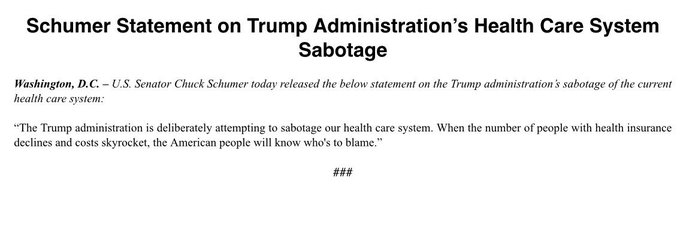
Sen. Schumer: “The Trump administration is deliberately attempting to sabotage our health care system.”

You know, because prices surging by 30% every single year couldn’t possibly have any impact on demand, right?
But, lest you forget, Nancy and Chuck have that angle covered too. You see, as the Wall Street Journal pointed out recently, 2018 Obamacare price increases are also Trump’s fault because his threats to remove the individual mandate and/or cut federal subsidies have thoroughly confused the insurance companies and forced them to raise rates.
Major health insurers in some states are seeking increases as high as 30% or more for premiums on 2018 Affordable Care Act plans, according to new federal data that provide the broadest view so far of the turmoil across exchanges as companies try to anticipate Trump administration policies.
Insurers are also concerned about whether the Trump administration will enforce the requirement for most people to have insurance coverage, which industry officials say helps hold down rates by prodding young, healthy people to sign up for plans.
In Montana, Health Care Service linked 17 percentage points of its 23% rate increase request to concerns about the cost-sharing payments and enforcement of the mandate that requires everyone to purchase insurance. Kurt Kossen, a senior vice president at Health Care Service, said the company’s rate requests are driven by causes including growing health costs and “uncertainty and the associated risks that exist within this marketplace, including uncertainty around issues like the continued funding of [cost-sharing payments] and mechanisms that encourage broad and continuous coverage.”
The impact of potentially losing the cost-sharing payments was also clear in the rates requested by Blue Cross of Idaho, which average 28%. That would probably be in the lower teens if the payments were guaranteed, said Dave Jeppesen, a senior vice president. “It’s a big swing,” he said. “There’s a lot of risk associated with the uncertainty in Congress right now, and we are pricing appropriately for that risk.”

Of course, as we’ve noted multiple times over the past couple of years, Obamacare premium increases are hardly a new phenomenon. In fact, data from the Department of Health and Human Services recently revealed that premiums across the country soared an average of 113% over the past 4 years, or nearly 30% per year. Ironically, that 30% is the same hike that many insurers are seeking for 2018…some folks would call that a trend.

But, other folks don’t believe in things like math and adverse selection bias that results in deteriorating risk pools and higher costs for insurers…no, they prefer simple, provocative narratives that can be exploited for political gain while masking the real underlying problems of a failed policy that is ruining healthcare for millions of hard working Americans
END
Our newest hurricane IRMA is gaining speed and is heading straight for the Caribbean and the Southeast coast of the uSA
(courtesy zerohedge)
Irma Turning Into Monster Hurricane: “Highest Windspeed Forecasts I’ve Ever Seen”
Hurricane Irma continues to strengthen much faster than pretty much any computer model predicted as of yesterday or even this morning. Per the National Hurricane Center’s (NHC) latest update, Irma is currently a Cat-3 storm with sustained winds of 115 mph but is expected to strengthen to a devastating Cat-5 with winds that could top out at 180 mph or more. Here is the latest from the NHC as of 5PM EST:
Irma has become an impressive hurricane with intense eyewall convection surrounding a small eye. Satellite estimates continue to rapidly rise, and the Dvorak classifications from both TAFB & SAB support an initial wind speed of 100 kt. This is a remarkable 50-kt increase from yesterday at this time.
Irma continues moving west-northwestward, now at about 10 kt. There has been no change to the forecast philosophy, with the hurricane likely to turn westward and west-southwestward over the next few days due to a building ridge over the central Atlantic. At long range, however, model guidance is not in good agreement on the strength of the ridge, resulting in some significant north-south differences in the global models. I am inclined to stay on the southwestern side of the model guidance, given the rather consistent forecasts of the ECMWF and its ensemble. In addition, the strongest members of the recent ensembles are on the southern side on the consensus, giving some confidence in that approach.
FORECAST POSITIONS AND MAX WINDS
INIT 31/2100Z 17.3N 34.8W 100 KT 115 MPH
12H 01/0600Z 17.8N 36.2W 105 KT 120 MPH
24H 01/1800Z 18.2N 38.3W 105 KT 120 MPH
36H 02/0600Z 18.3N 40.7W 105 KT 120 MPH
48H 02/1800Z 17.9N 42.9W 105 KT 120 MPH
72H 03/1800Z 16.8N 47.5W 110 KT 125 MPH
96H 04/1800Z 16.0N 52.0W 115 KT 130 MPH
120H 05/1800Z 16.5N 56.5W 120 KT 140 MPH
As of now, Irma remains in the far eastern Atlantic ocean and is moving west at roughly 11.5 mph. Based on current projections, the storm will make its first landfall in the eastern Caribbean sometime toward the middle of next week.

Longer term computer models still vary widely but suggest that Irma will make landfall in the U.S. either in the Gulf of Mexico or Florida. Meteorological Scientist Michael Ventrice of the Weather Channel is forecasting windspeeds of up to 180 mph, which he described as the “highest windspeed forecasts I’ve ever seen in my 10 yrs of Atlantic hurricane forecasting.”
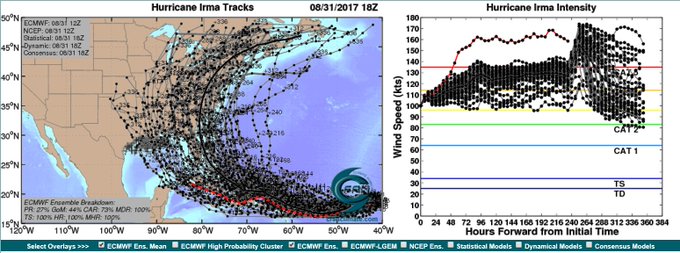
These are the highest windspeed forecasts I’ve ever seen in my 10 yrs of Atlantic hurricane forecasting. #Irma is another retiree candidate.

In a separate tweet, Ventrice had the following troubling comment: “Wow, a number of ECMWF EPS members show a maximum-sustained windspeed of 180+mph for #Irma, rivaling Hurricane #Allen (1980) for record wind”
The Weather Channel meteorologist also calculated the odds for a landfall along the eastern seaboard at 30%.
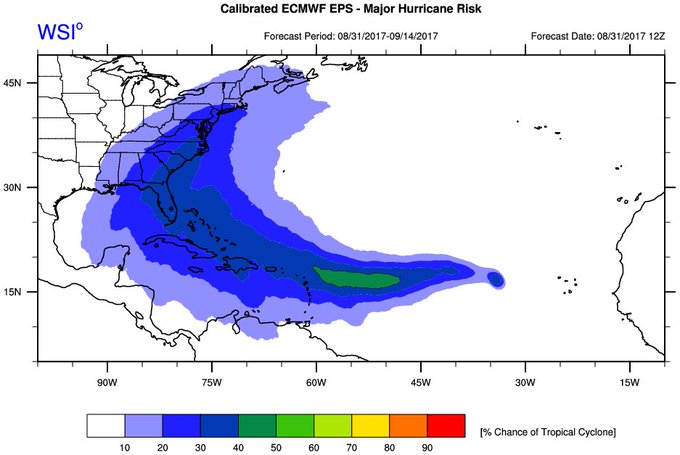
Up to a 30% chance via the 12Z Calibrated ECMWF EPS for a landfalling Major Hurricane somewhere along the eastern seaboard #Irma
Meanwhile, the Weather Channel has the “most likely” path of Irma passing directly over Antigua, Puerto Rico and Domincan Republic toward the middle of next week.
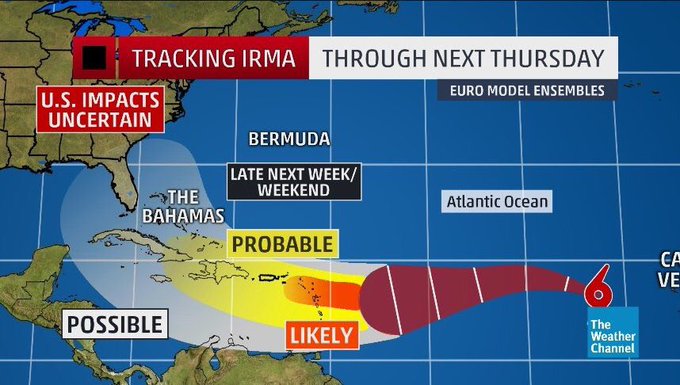

scientists now confirm Hurricane Harvey caused a 1 and 1,000 year massive flood
(courtesy zero hedge)
Scientist Confirms: Harvey Caused A “1-In-1,000-Year Flood”
Scientists have confirmed what one renowned weather forecaster has suspected for days: Hurricane Harvey was a “1-in-1,000-year flood.”
That’s according to researchers at the University of Wisconsin’s Space Science and Engineering Center, who claim there is nothing in the historical record that rivals the devastation resulting from the flooding in southwest Texas, which has forced more than 30,000 Texans into temporary shelters.

“There is nothing in the historical record that rivals this, according to Shane Hubbard, the Wisconsin researcher who made and mapped this calculation. “In looking at many of these events [in the United States], I’ve never seen anything of this magnitude or size,” he said. “This is something that hasn’t happened in our modern era of observations.”
Of course, one reason for this might be that the modern urban environment is covered in concrete and asphalt, which makes it impossible for floodwater to absorb into the ground, exacerbating the disaster.
Hubbard’s calculations, which he shared with the Washington Post, only accentuate the massive scale of the flooding.
- At least 20 inches of rain fell over an area (nearly 29,000 square miles) larger than 10 states, including West Virginia and Maryland (by a factor of more than two).
- At least 30 inches of rain fell over an area (more than 11,000 square miles) equivalent to Maryland’s size.
To that, we’d like to add the nearly 52 inches of rain recorded by the National Weather Service in Cedar Bayou, Texas, which broke the continental U.S. record.

Making matters worse, the National Hurricane Center (NHC) has just updated its forecast for what it is now referring to as a “rapidly intensifying” Category 2 hurricane in the Eastern Atlantic Ocean. Some models see the storm making landfall in Florida, while others see it landing somewhere in the Gulf of Mexico, meaning that another powerful storm could ravage Texas just two weeks after Hurricane Harvey, leaving locals little time to recover.
c)Chevron Phillips Chemical Co. in Port Arthur by the Louisiana border.
Harvey Causing “Unprecedented” Disruptions To Supplies Of “Essential” Chemicals
The unprecedented destruction wrought by Hurricane Harvey will impact the US economy in ways may not be immediately apparent. Until recently, coverage of the storm’s impact has focused on property damage and the impact on the energy industry. But in a story published Friday, Bloomberg explains the devastating impact the storm has had on Texas’s chemicals industry, which is already causing supply-chain headaches for American manufacturers who’re struggling to source the chemicals required to produce plastics and other components used in everything from milk jugs to car parts.
Indeed, if Texas’s chemicals plants are closed for an extended period, production at a potentially huge number of American manufacturers to grind to a halt.
More than 60% of the US’s production capacity for ethylene – one of the most important chemical building blocks for American manufacturers – has been taken offline by the storm, a development that could ripple across the US manufacturing industry.
“Texas alone produces nearly three quarters of the country’s supply of one of the most basic chemical building blocks. Ethylene is the foundation for making plastics essential to U.S. consumer and industrial goods, feeding into car parts used by Detroit and diapers sold by Wal-Mart Stores Inc.
With Harvey’s floods shutting down almost all the state’s plants, 61 percent of U.S. ethylene capacity has been closed, according to PetroChemWire.”
Ethylene, the gas given off by fruit as it ripens, occurs naturally, but it’s also a crucial product of the $3.5 trillion global chemical industry, with factories pumping out 146 million tons last year. Processing plants turn the chemical into polyethylene, the world’s most common plastic, which is used in garbage bags and food packaging. When transformed into ethylene glycol, it’s the antifreeze that keeps engines and airplane wings from freezing in winter. It’s used to make polyester for both textiles and water bottles. Ethylene is an ingredient in vinyl products such as PVC pipes, life-saving medical devices and sneaker soles. It helps combat global warming with polystyrene foam insulation and lighter, fuel-saving plastic auto parts. It’s used to make the synthetic rubber found in tires. It’s even an ingredient in house paints and chewing gum.

Ethylene and its derivatives account for about 40 percent of global chemical sales, according to Hassan Ahmed, an analyst at Alembic Global Advisors. And the Gulf Coast is a crucial player in the global market: US production accounts for one of every five tons on the market. International ethylene plants were running nearly full out to meet rising demand before Harvey.
And while Gulf Coast chemical plants are designed to withstand hurricane-force winds and floods, the “1-in-1,000-year flooding” unleashed by Harvey has forced many to shut down. The damage to the region’s chemicals industry is perhaps best embodied by the Arkema plant in Crosby, TX, which experienced two explosions Thursday that the company said it was powerless to prevent.
Another analyst quoted by Bloomberg said he hasn’t seen anything like this in his 18 years of following chemical stocks.
“Ethylene producers hit by the storm along the Texas Gulf Coast include LyondellBasell Industries NV at the southern end in Corpus Christi, Exxon Mobil Corp. in Baytown outside Houston, and Chevron Phillips Chemical Co. in Port Arthur by the Louisiana border.
‘The combination of Harvey’s path, duration and rainfall total is wreaking havoc with the supply side of the U.S. chemicals industry on an unprecedented scale,’ said Kevin McCarthy, an equity analyst at Vertical Research Partners. ‘We certainly haven’t seen anything quite like it in our 18 years of following chemical stocks on Wall Street.’”
Adding to the difficulties for American manufacturers, more than 60% of production capacity for polypropylene, another widely used chemical, has been taken offline. Chemical and plastics buyers can’t operate for long without replenishing their inventory, and some producers are already telling customers that they won’t be able to meet their contractual supply obligations because of the storm. According to Bloomberg, Formosa Plastics Corp., which shut its Point Comfort, Texas, ethylene and plastics plants ahead of the storm, said Aug. 30 that it won’t be able to meet commitments for polyethylene, polypropylene and PVC.

These supply-chain disruptions have contributed to the drop in demand for natural gas, which is used by plastics makers during the refining process.
“With so much chemical production in the region out of commission, demand for natural gas has plummeted. Producers such as Dow Chemical Co. use gas as a raw material for ethylene and also to power their massive cracking furnaces and other equipment. Added to the impact from widespread electricity outages, demand for gas fell by more than 5 billion cubic feet a day, according to Citigroup Inc. That’s equal to nearly 8 percent of the country’s normal consumption this time of year.”
Meanwhile, demand for ethane and butane, gases necessary for the production of ethylene and other chemicals, have fallen about 90 percent because of plant closures, according to PetroChemWire.
Because of the complexity of chemical manufacturers’ infrastructure the need to carefully assess damages – or potentially risk an Arkema-style disaster – could forestall plant reopenings for weeks, if not months. What’s worse, companies won’t know for sure whether their plants were damaged until they try to restart them, perhaps only then finding that flood waters have ruined a key piece of equipment.
“No one right now has a very good handle on the full extent of the damage,” Ahmed said.
And even if producers manage to get their plants online sooner than anticipated, other logistical challenges – like damaged train tracks – could prevent them from delivering their products to buyers.
According to IHS, polypropylene producers could face an average delay of two weeks to ship their product via rail because of the storm. Some buyers are seeking supplies outside the US in case of an extended disruption.
Already, the economic damage wrought by Harvey has surpassed even the direst forecasts. If US manufacturers are forced to halt production on such a wide range of products for an extended period, maybe Goldman and Citi’s projections that the storm will negatively impact GDP during the third and fourth quarter might actually be conservative.
end
here is the list of toxic chemicals stored at the doomed Texas plant Arkema
(courtesy zerohedge)
Arkema Releases List Of Toxic Chemicals Stored At Doomed Texas Plant, Warns “More Fires” Imminent
One day after two explosions rocked its flooded plant in Crosby, Texas, French chemicals giant Arkema said it was on “high alert” as more fires could start at the doomed facility at any moment, according to VP of US manufacturing Daryl Roberts who spoke to reporters on Friday morning. In a separate statement, that company said that “we continue to monitor the temperature in the remaining trailers and there is evidence suggesting that other trailers will soon burn, but there have been no reports of any fires or smoke.”

Residents in the vicinity of the Crosby plant, and not only, have grown especially worried about the chemicals contained in the plant, which until recently was only known for holding various forms of organic peroxides. While Arkema executive Richard Rennard said in a press conference Thursday morning that the plant was emitting “noxious” smoke, he would not respond to a question as to whether the smoke from the burning substances was toxic. Incidentally, the following clip shows what happens to the substance if not cooled properly.
Tks @maddow for covering this #Arkema issue tonight. TX govt can regulate the female body, but not chemical plants. #HurricaneHarvey, #MSNBC

@CoolHandLukeX1 This is what organic peroxide can do if not properly cooled #Crosby#Arkema plant fire & explosion pic.twitter.com/tWotkrgwsG


Responding to the rising environmental damage concerns, the Environmental Protection Agency said in a statement on Thursday night they concluded the best course of action was to allow the trailers containing organic peroxide to burn out instead of putting emergency responders in harm’s way. It also claimed that its aerial surveillance aircraft did not detect toxic concentrations of chemicals at the site.
“Following this fire, EPA sent aerial surveillance aircraft to test resulting smoke and did ground-level air quality monitoring,” read a statement. “EPA’s plane instrumentation is capable of measuring 78 different chemicals, including peroxides. Neither testing methods found toxic concentration levels in areas away from the evacuated facility.”
The EPA’s blanket dismissal of concerns, however, did little to comfort the local population which has been ordered to evacuate a 1.5 mile perimeter around the plant.
The questioning continued on Friday, when Roberts refused to disclose the exact volumes and location of the chemicals contained in the plant, citing security and terrorism as reasons why.
Instead, aggravating concerns, Arkema said it expects all 500,000 pounds of peroxides on the site to burn. In terms of timing, Arkema Americas CEO Rich Rose said containers filled with chemicals would likely ignite “in a few days” and was unsure how long the situation could last, adding that 1 out of 9 containers with chemicals have already caught fire at Crosby.

Finally, while refusing to provide more details, the company did publish a list of the toxic chemicals stored at the doomed facility on its web site, reposted below.
- 2-ETHYLHEXANOYL CHLORIDE DISTILLED
- ACETIC ACID 84%
- ACETONE
- AROMATIC 100
- BENZOYL CHLORIDE
- CAUSTIC POTASH 45%
- CAUSTIC SODA 50%
- CUMENE HYDROPEROXIDE
- CUMENE HYDROPEROXIDE
- DIMETHYL HEXADIENE
- DIMETHYL HEXANEDIOL DH-S
- EPSOM SALTS
- HEXANE
- HYDROGEN PEROXIDE 70%
- ISOAMYLENE
- ISOAMYLENE
- ISOBUTYLENE ISOPROPYL ALCOHOL
- MINERAL OIL, WHITE
- MINERAL SPIRITS ODORLESS
- MONOSODIUM PHOSPHATE
- NEODECANOYL CHLORIDE >=98.0% UNDISTILLED
- PIVALOYL CHLORIDE 95-100%
- PROPYLENE GLYCOL
- SODIUM BICARBONATE
- SODIUM CARBONATE ANHYDROUS LIGHT
- SODIUM SULFATE ANHYDROUS
- SODIUM SULFITE ANHYDROUS
- SULFUR DIOXIDE
- SULFURIC ACID 93% REAGENT ACS
- T-BUTYL HYDROPEROXIDE 70%
All of these substances are now expected to burn down, many in volatile, explosive fashion, in the coming days
end
Houston resident Lance Roberts explains 4 ways how to gain access to money for Harvey repairs. He states that 80% of those affected by the flood damage do not have insurance protection.
(courtesy Lance Roberts)
The 4 Ways To Access Money For “Harvey” Repairs
Authored by Houston resident Lance Roberts via RealInvestmentAdvice.com,
The effects of Hurricane Harvey are going to linger for years, likely decades.
According to the Consumer Federation of America, approximately 80% of those affected by flood damage do not carry flood insurance protection.
If you have suffered damage and do not carry flood insurance or seek proceeds in addition to coverage, here are four options to consider.
Apply For Assistance Through FEMA (Yes, Even Grants)
Already, over $37 billion has been allocated to assist victims of this disaster and 68,000 applications approved. FEMA partners with the U.S. Small Business Administration to help disaster survivors secure funding.
Low-interest loans to cover losses are available up to $200,000 for primary residences. Loans up to $40,000 are also available for personal property replacement, including renter losses. Interest rates on these loans generally tend to be less than 4%. The maximum loan term is 30 years. Unfortunately, interest is not tax deductible.
Secondary homes, pleasure boats, airplanes and recreational vehicles are not covered unless they’re used for business purposes. Amounts for landscaping and backyard items like swimming pools are going to be limited at best. Remember the primary purpose of the money allocated is to get primary residences livable again.
There are multiple FEMA grants available for victims. FEMA’s Housing Assistance program is available regardless of household income. Aid for other losses such as personal property, vehicle repair, replacement and moving and storage expenses is income dependent.
A rule of thumb to consider is that grants may help recipients repair damage; an SBA disaster loan can return a home to pre-disaster condition.
Consider Home-Equity Lines Or Cash Value Life Insurance
If you have the ability to tap the equity in your home, using an existing home equity line of credit is an expedited source of funds, generally available through a check book or ‘credit’ card.
With HELOCs, credit is utilized only when needed, and at interest rates much lower than those on credit cards. Credit line rates are variable over the life of the loan. Currently, interest rates tend to range between 4.25 and 5.24% but can change depending how long the loan is outstanding and moves in the Prime Rate. Also, interest on these loan types is tax deductible, which is a benefit over the SBA Disaster Loan option.
If you were lucky enough to have a HELOC established on a primary residence, it still would be best to apply for the SBA loan, initially. Then, compare your SBA loan rate to the after-tax rate on the HELOC. If anything, you may ultimately use the fixed-rate SBA loan proceeds to pay off or reduce the home equity line obligation.
Funds are quickly available through a HELOC which makes it extremely convenient. It can take 5 days at the quickest to obtain the first disbursement from the Small Business Administration, which may feel like an eternity to a displaced hurricane victim.
The cash value of permanent life insurance like whole or universal as examples, may be easily accessible recovery money. Every policy’s loan provision varies – generally proceeds withdrawn ‘tax free,’ are indeed loans (you’re borrowing against yourself, in essence), that are not required to be paid back. Your life insurance provider may offer interest rates that are lower than traditional institutions, like a bank. Some policies allow loans free of interest.
As unpaid loans are deducted from a policy’s death benefit, it’s a good idea to use this option as a temporary bridge until additional funding is secured. Once the dust settles (no pun intended), I would recommend a strategy to pay off the policy loan to ensure the full death benefit remains intact or your cash value is replenished for possible future needs such as retirement distributions.
What About Loans Against My 401(k)?
You may be eligible to borrow up to 50% of your account balance up to $50,000 that requires repayment within five years. Interest rates are set by your retirement plan provider. Generally, they’re the prime rate plus 1%.
A few caveats – Many Americans do not have enough saved for retirement in first place or lack job security which makes this a less than desirable option for hurricane relief.
Similar to permanent life insurance distributions, the money withdrawn is in essence, ‘borrowing from yourself.’ Access to the funds can be quick, and of course tax-free. Loans are typically paid through automatic paycheck deductions.
Disadvantages outweigh the positives – there’s the opportunity cost of a withdrawn balance no longer working for the end goal – retirement, interest is not tax deductible (unlike the HELOC), loan payments do not count as contributions therefore you may be frozen out of -contributing to the plan until the loan is paid off, and most important, changing employers or termination will accelerate the pay-off date.
If not fully paid within 60 days of the official termination or change date, a loan will be classified a distribution thus taxed the same as ordinary income. Under 59 ½? Be prepared to cough up an additional 10% in premature distribution penalties. Needless to say, only those confident of job security should consider this alternative.
A 401(k) loan should be perceived as a temporary, immediate source of cash. Once SBA or conventional source payments are received, it’s highly recommended to retire the retirement plan loan (see what I did there?).
What About “Hardship Withdrawals” From 401k’s?
This alternative is my least favorite but thought to share the details only because the IRS has provided “relief” to taxpayers affected by Hurricane Harvey through Announcement 2017-11.
Between August 23, 2017 and January 31, 2018, the IRS will allow victims of Hurricane Harvey to take hardship distributions from their employer-sponsored retirement plans such as 401(k), 403(b), and 457 plans.
Usually, hardship withdrawal options are restrictive. The IRS announcement allows rules to be broadened. However, other than that, I don’t see an advantage to this alternative as pre-tax distributions are considered taxable. A 10% early distribution penalty will also likely apply.
Funding for Hurricane Harvey repair efforts is now top priority.
Whether on the public or private level, it’s going to take money, lots of it, to get those adversely affected back to living their lives.
However, weigh your options carefully before taking action, as sometimes the “cure” can be worse than the “disease” in the long-run.
END
Trump blinks again: will not shut down government over wall funding. Looks like Donald is not running the country
(courtesy zerohedge)
Trump Blinks Again, Won’t Shut Down Government Over Wall Funding
Last Tuesday, during his rally in Phoenix, Trump promised the fawning public that he will follow through on his biggest campaign promise and “build that wall,” saying that “now the obstructionist Democrats would like us not to do it. But believe me, if we have to close down our government, we’re building that wall.”
The promise spooked already nervous traders, who saw in Trump’s promise the catalyst for either an extended government shutdown, or worse, a technical default as the US breached the debt ceiling in early October. That said, Trump had already flopped once on the border wall funding, and – we wrote last week – it was very likely he would do so again once his economic advisors explained to him the severity and consequences of his latest public boast.
That’s precisely what happened as moments ago, the WaPo reported that White House officials quietly notified Congress that the $1.6 billion in wall funding would not need to be in the September continuing resolution that was meant to fund government operations from October until sometime in early December, a senior GOP congressional aide said. In other words, contrary to his vow less than two weeks ago, Trump won’t shut down the government over the wall funds after all.
So how will Trump explain this latest flip-flop? The same way he did last time: by kicking the can:
White House officials have signaled to lawmakers, however, that the wall’s eventual construction remains a top priority for Trump. He wants this funding to be included in the December budget bill, GOP congressional aides said.
By then, however, nobody will care what Trump has to say:
Trump could still follow through on a threat to shut down the government in December, but this marks the second time he has pulled back from the wall demand in order to allow lawmakers to pass a budget bill. The first time came in May, when lawmakers voted to authorize government funding through September and refrained from including money that would allow for the construction of a new wall. That law, however, did allow the U.S. government to replace existing border wall with a new barrier where necessary.
What has made the bizarre situation especially “sad” is that Trump has been threatening to shut down the government for months. In May, he said in another tweet that the government needed a “good shutdown” to break the gridlock in Congress. The issue for Trump, is that every time he has the chance to enforce a “good shutdown”, he backs out.
While all democrats will be delighted by the latest retreat by the president, so will many republicans:
That’s one reason many Republicans in Congress have told Trump to focus on other parts of his agenda and postpone having a fight about constructing the border wall for now.
So does Trump have any, well, trump cards left? Not really:
If Trump decided to veto a funding bill passed by Congress, it would lead to a partial government shutdown. National parks would close, and many government agencies would send employees home without pay, causing delays at Social Security, the Internal Revenue Service, and at numerous other agencies. The last time there was a government shutdown was in 2013.
Finally, confirming the WaPo’s report, this is what a White House aide told Bloomberg:
- TRUMP WON’T PUSH BORDER WALL MONEY IN GOVT FUNDING BILL: AIDE
Curiously, while 10Y yields have risen modestly on the report, the T-Bill dislocation remains, with the October 5th bills still +9.5bps, indicating that the market remains distinctly nervous about the possibility of a debt ceiling crisis in just one month.
WELL THAT ABOUT DOES IT FOR TONIGHT
LET US CLOSE OUT THE WEEK WITH THIS OFFERING FROM GREG HUNTER OF USA WATCHDOG
(COURTESY GREG HUNTER/USAWATCHDOG)
Hurricane Harvey Disaster for America, Fuel Prices, Economy Sinking into Recession
By Greg Hunter On September 1, 2017 In Weekly News Wrap-Ups

By Greg Hunter’s USAWatchdog.com (WNW 299 9.1.17)
Hurricane Harvey has ravaged Texas and Louisiana, but losses will spread across the United States. Everyone will feel the impact in some way. Hurricane Katrina losses totaled $175 billion, and Harvey could be twice that or more. (Texas Rep. Pete Sessions: Harvey Impact Could Reach $1 Trillion.) Oil prices will spike, and banks and insurance companies, ultimately, will face big losses on flooded housed and vehicles.
At least 25% of refinery capacity has been shut down by Hurricane Harvey. Experts say that this will cause fuel and petroleum product prices to spike. How high will prices go? Will there be shortages? It will take weeks and months to find this out, but higher prices are locked in now.
The latest figures from ShadowStats.com are out, and economist John Williams says it looks like a recession is “imminent or one is already underway.”
Join Greg Hunter as he looks at these stories and more in the Weekly News Wrap-Up.
(To Donate to USAWatchdog.com Click Here )
Video Link
end
I will see you TUESDAY night
Harvey.


[…] Sept 1/Gold rises by $8.65 and silver up 22 cents/extremely poor jobs report initially sends dollar … […]
LikeLike