
GOLD: $1307.50 UP $0.15
Silver: $17.24 UP 10 CENT(S)
Closing access prices:
Gold $1311.00
silver: $17.30
SHANGHAI GOLD FIX: FIRST FIX 10 15 PM EST (2:15 SHANGHAI LOCAL TIME)
SECOND FIX: 2:15 AM EST (6:15 SHANGHAI LOCAL TIME)
SHANGHAI FIRST GOLD FIX: $1313.30 DOLLARS PER OZ
NY PRICE OF GOLD AT EXACT SAME TIME: $1307.00
PREMIUM FIRST FIX: $6.30
xxxxxxxxxxxxxxxxxxxxxxxxxxxxxxxxxxxxxxxxxxxxxx
SECOND SHANGHAI GOLD FIX: $1315.17
NY GOLD PRICE AT THE EXACT SAME TIME: $1308.60
Premium of Shanghai 2nd fix/NY:$6.57
xxxxxxxxxxxxxxxxxxxxxxxxxxxxxxxxxxxxxxxxxxxxxxxxxxx
LONDON FIRST GOLD FIX: 5:30 am est $1308.45
NY PRICING AT THE EXACT SAME TIME: $1308.70
LONDON SECOND GOLD FIX 10 AM: $1309.60
NY PRICING AT THE EXACT SAME TIME. 1310.30
For comex gold:
SEPTEMBER/
NOTICES FILINGS TODAY FOR SEPT CONTRACT MONTH: 0 NOTICE(S) FOR nil OZ.
TOTAL NOTICES SO FAR: 54 FOR 5400 OZ (0.1679 TONNES)
For silver:
SEPTEMBER
133 NOTICES FILED TODAY FOR
665,000 OZ/
Total number of notices filed so far this month: 5,810 for 29,050,000 oz
XXXXXXXXXXXXXXXXXXXXXXXXXXXXXX
end
Let us have a look at the data for today
xxxxxxxxxxxxxxxxxxxxxxxxxxxxxxxxxxxxxxxxxxxxxxxxxxxxxxxxxxxxxxxxxxxxxxxxxx
In silver, the total open interest SURPRISINGLY ROSE BY 694 contracts from 192,765 UP TO 193,459 DESPITE THE NASTY DROP IN PRICE THAT SILVER UNDERTOOK IN YESTERDAY’S TRADING (DOWN 50 CENTS ). WE HAVE NOW HAD SEVEN CONSECUTIVE TRADING DAYS OF TORMENT AND YET THE SILVER OPEN INTEREST REFUSES TO BUDGE SOUTHBOUND AND YET AGAIN TODAY IT ADVANCES NORTHBOUND. THE LONGS ARE REMAINING STOIC AND REFUSE TO GIVE IN TO THE ANTICS OF THE BANKERS. NEWBIE SPECS ARE COGNIZANT OF SILVER SCARCITY (AND DEMAND) AS THE PILE INTO THE SILVER ARENA. THE BANKERS SEEM TRAPPED IN THE OWN JUICE…THEY ARE DESPERATELY TRYING TO FORCE SOME OF THE SILVER LEAVES TO FALL FROM THE SILVER TREE BUT SO FAR TO NO AVAIL WHICH IS WHY YESTERDAY THE BOYS DECIDED THAT ANOTHER RAID WAS NECESSARY. AS YOU CAN SEE IT AGAIN ENDED IN FAILURE.
RESULT: A STEADY RISE IN OI COMEX DESPITE THE 50 CENT PRICE LOSS. BANKERS FAILED IN THEIR ATTEMPT TO CAUSE SILVER LEAVES (oi) TO FALL.ANOTHER RAID ATTEMPT WAS CALLED UPON TO FORCE OI CONTRACTION AND AGAIN IT FAILED MISERABLY.
In ounces, the OI is still represented by just UNDER 1 BILLION oz i.e. 0.96750 BILLION TO BE EXACT or 138% of annual global silver production (ex Russia & ex China).
FOR THE NEW FRONT MAY MONTH/ THEY FILED: 133 NOTICE(S) FOR 655,000 OZ OF SILVER
In gold, the open interest FELL BY A SMALLER THAN ANTICIPATED 2472 CONTRACTS DESPITE THE FALL in price of gold ($14.05 LOSS ON YESTERDAY). The new OI for the gold complex rests at 571,011. THE BANKERS ORCHESTRATED ANOTHER RAID YESTERDAY MORNING WORRIED ABOUT THE STEADY OI RISE IN SILVER AND THE HIGH OI IN GOLD. THEY CONTINUALLY FAIL MISERABLY IN SILVER AND SURPRISINGLY THEY FAILED IN GOLD AS WELL.
Result: A SMALL DECREASE IN OI DESPITE THE FALL IN PRICE IN GOLD ($14.05). THE COMMERCIALS SUPPLIED THE NECESSARY SHORT PAPER. YESTERDAY’S RAID HAD THE PURPOSE OF TRYING TO KNOCK SILVER DOWN AS WELL AS CAUSE MAJOR DISCOMFORT FOR OUR GOLD LONGS. IT ENDED IT FAILURE AS OPEN INTEREST IN SILVER ROSE ALONG WITH A TINY DROP IN GOLD OI.
we had: 0 notice(s) filed upon for nil oz of gold.
xxxxxxxxxxxxxxxxxxxxxxxxxxxxxxxxxxxxxxxxxxxxxxxxxxxxxxxxxxx
With respect to our two criminal funds, the GLD and the SLV:
GLD:
Tonight , we had another huge change in gold inventory:
a good sized 2.07 tonnes of gold deposit
Inventory rests tonight: 846.03 tonnes
This is a good sign: we have had now continual gold deposits at the GLD this past month. Gold should continue to rise
SLV
Today: a huge change in inventory. a withdrawal of 1.039 million oz
INVENTORY RESTS AT 326.049 MILLION OZ
From Sept 12 until today, we have only lost 1.039 million oz i.e. what we lost today. The other 5 days we lost zero.
end
.
First, here is an outline of what will be discussed tonight:
1. Today, we had the open interest in silver ROSE BY A STEADY 694 contracts from 192,765 UP TO 193,459(AND now A LITTLE CLOSER TO THE NEW COMEX RECORD SET ON FRIDAY/APRIL 21/2017 AT 234,787) DESPITE YESTERDAY’S 50 CENT LOSS IN TRADING. OUR LONGS CONTINUE TO BE STRONG AND REFUSE TO BUDGE WITH THE ANTICS OF OUR BANKERS. NEWBIE LONGS CONTINUE TO ENTER THE ARENA COGNIZANT OF SILVER SCARCITY AND DEMAND. BANKERS ORCHESTRATED ANOTHER RAID YESTERDAY TRYING TO FORCE SILVER OI TO CONTRACT. IT AGAIN FAILED MISERABLY
RESULT: A STEADY RISE IN OI AT THE COMEX DESPITE THE FALL IN PRICE OF 50 CENTS YESTERDAY. WE HAD ANOTHER RAID YESTERDAY MORNING BY OUR BANKERS TRYING TO FORCE SILVER LONGS TO DEPART THE SILVER TREE. THEY FAILED MISERABLY!!
(report Harvey)
.
2.a) The Shanghai and London gold fix report
(Harvey)
2 b) Gold/silver trading overnight Europe, Goldcore
(Mark O’Byrne/zerohedge
and in NY: Bloomberg
3. ASIAN AFFAIRS
i)Late MONDAY night/TUESDAY morning: Shanghai closed DOWN 6.02 POINTS OR 0.18% / /Hang Sang CLOSED DOWN 108.36 POINTS OR 0.38%/ The Nikkei closed UP 389.88 POINTS OR 1.06%/Australia’s all ordinaires CLOSED DOWN 0.11%/Chinese yuan (ONSHORE) closed WELL DOWN at 6.5846/Oil UP to 50.36 dollars per barrel for WTI and 55.69 for Brent. Stocks in Europe OPENED MIXED LEANING TO RED . Offshore yuan trades 6.5867 yuan to the dollar vs 6.5846 for onshore yuan. NOW THE OFFSHORE MOVED A LITTLE WEAKER TO THE ONSHORE YUAN/ ONSHORE YUAN MUCH WEAKER (TO THE DOLLAR) AND THE OFFSHORE YUAN IS A MUCH WEAKER TO THE DOLLAR AND THIS IS COUPLED WITH THE SLIGHTLY WEAKER DOLLAR. CHINA IS NOT HAPPY TODAY
3a)THAILAND/SOUTH KOREA/NORTH KOREA
i)North Korea
Mattis states that the USA will act on North Korean missiles that pose a threat to Japan, the USA or SouthKorea
( zero hedge)
b) REPORT ON JAPAN
c) REPORT ON CHINA
( zerohedge)
4. EUROPEAN AFFAIRS
i)ECB/EU
the Euro tumbles a bit this morning after a report suggesting that the ECB is still concerned and divided over how to end their QE
( zerohedge)
ii)ITALY
5. RUSSIAN AND MIDDLE EASTERN AFFAIRS
i)Kuridistan/Israel/Iran/Turkey/iraq
Israel now publicly supports an independent Kurdistan remembering quite well how it became a nation in 1948. Iran and Iraq are not happy with this. The Iraqi government turned down the request for an independent vote on Sept 25. Erbil has acted as if independent in the war inside Iraq. You will recall that Erbil houses many of the rich oil fields
( zerohedge)
ii)Turkey/Russia/EU
The author comments on the huge threats Turkey is receiving form NATO and the USA for their arms deal with Russia
( Alex Gorka/Strategic Culture Foundation)
6 .GLOBAL ISSUES
Huge earthquake hits Puebla province just east of Mexico city with a reading of 7.4 magnitude. Many buildings collapse
( zero hedge)
7. OIL ISSUES
WTI and Gasoline jump after a smaller than expected crude build
( zero hedge)
8. EMERGING MARKET
VENEZUELA
9. PHYSICAL MARKETS
i)I could not understand why Mexico would also so much of its silver to be imported into the USA and used in the manipulation.
and then Trump wants to end NAFTA??? because he is not getting the benefit of trade?
(courtesy Steve St Angelo/SRSRocco report)
ii)Dennis Gartman who always refuses to admit to central bank interference in the gold market finally admits that the BIS may have orchestrated an attempt to keep the price of gold down:
( Gartman/GATA)
iii)Dave Kranzler offers his reasoning for the BIS flooding the system with gold
( Dave Kranzler)
iv)Crazy!! Turkey intends to paperize 2200 tonnes of citizen’s gold
( GATA/Hurriyet)
10. USA Stories
i)Leaked reports on Donald Trump’s speech to the UN today tells that he is set to label Iran and North Korea as “global threats”. He is also demonizing Venezuela’s Maduro for his undemocratic stance in Venezuela
( zero hedge)
ii)Trump approves Puerto Rico emergency declaration as Maria first strengthens into a potentially catastrophic Cat 5 hurricane. It is now a Cat 4 heading straight for Puerto Rico
( zero hedge)
iii)Hurricane Maria causes widespread devastation in Dominica as it heads for Puerto Rico
( zero hedge)
iv)Almost one month after Harvey hit, conditions inside the Houston area are still dire:
( zero hedge)
vi)Building permits rebound in August as multiple unit demand picks up( zero hedge)
ix)It gets worse for Equifax: the company was originally hacked in March and again it did not disclose this fact to the public..however insiders sold stock
( zerohedge)
x)After the bell: Bellwether for the USA FEDEX tumbles after missing both revenue and earnings and on top of that, they future guide lower. they blame hackers and of course Hurricane Harvey
(courtesy zerohedge)
Let us head over to the comex:
The total gold comex open interest FELL BY A SMALLISH 2472 CONTRACTS DOWN to an OI level of 571,011 DESPITE THE NASTY FALL IN THE PRICE OF GOLD ($14.05 LOSS IN YESTERDAY’S TRADING). THE CONTINUAL HIGH OPEN INTEREST IN GOLD FORCES MORE BANKER TORMENT AS THESE CROOKS TRY AND LIBERATE AS MANY GOLD LEAVES (OPEN INTEREST) FROM THE GOLD TREE AS POSSIBLE. WITH THE HUGE RISE IN OPEN INTEREST IN THE GOLD COMPLEX, THEY HAVE FAILED IN LIBERATING CONSIDERABLE GOLD OPEN INTEREST. IN SILVER THEY ALSO FAILED MISERABLY AS IT’S OI ROSE APPRECIABLY! NEWBIE LONGS ENTERED THE CASINO HAPPY TO SEE A LOWER PRICE FOR GOLD TO WHICH OUR CROOKS SUPPLIED THE NECESSARY PAPER. OLDER SPECS REFUSED TO BUDGE.
Result: a SMALL SIZED open interest DECREASE DESPITE THE FALL IN THE PRICE OF GOLD TO THE TUNE OF $14.05. NEWBIE LONGS ENTERED THE COMEX HAPPY TO SEE THE LOWER PRICE. OLDER SPECS REFUSED TO BUDGE..THE BANKERS HAD NO CHOICE BUT TO SUPPLY THE PAPER.
The new non active September contract month saw it’s OI FELL BY 98 contracts DOWN to 718. We had 0 notices filed UPON YESTERDAY so we LOST 98 contracts or an additional 9800 oz will not stand A. We had 98 EFP’s WERE ISSUED which entitles them to a fiat bonus plus a deliverable contract on a different exchange and most likely that would be London. These are private deals so we do not get to see the makeup of these deals only the number of EFP’s issued.
The next active contract month is Oct and here we saw a LOSS of 3464 contracts DOWN to 35,413.
The November contract saw A GAIN OF 45 contracts UP to 480.
The very big active December contract month saw it’s OI LOSS OF 230 contracts DOWN to 448,496.
We had 0 notice(s) filed upon today for nil oz
We are now in the active contract month of September (and the last active month until December). Today we witness Sept. OI LOSS OF 115 contacts DOWN to 486. We had 198 notices filed yesterday, so we again gained 83 contracts or an additional 415,000 oz will stand for delivery. This phenomenon has been happening in silver for the past 5 months whereby the amount standing increases on each and every delivery day. This queue jumping highlights the huge demand for silver that we have been witnessing around the globe. The next non active contract month for silver after September is October and here the OI GAINED 13 contacts UP TO 984. November saw a GAIN of 7 contract(s) and thus RISING TO 64. After November, the NEXT big active contract month is December and here the OI LOST 105 contracts DOWN to 156,584 contracts.
We had 133 notice(s) filed for 665,000 oz for the SEPT. 2017 contract
VOLUMES: for the gold comex
ESTIMATED VOLUME TODAY: 256,677 CONTRACTS WHICH IS VERY GOOD
FRIDAY’S confirmed volume was 288,945 which is EXCELLENT
volumes on gold are STILL HIGHER THAN NORMAL!
Sept.19/2017.
| Gold | Ounces |
| Withdrawals from Dealers Inventory in oz | nil |
| Withdrawals from Customer Inventory in oz |
10,145.94 oz
(DELAWARE
SCOTIA)
INCL. 216 KILOBARS
|
| Deposits to the Dealer Inventory in oz | nil oz |
| Deposits to the Customer Inventory, in oz |
NIL oz
|
| No of oz served (contracts) today |
0 notice(s)
NIL OZ
|
| No of oz to be served (notices) |
718 contracts
(71,800 oz)
|
| Total monthly oz gold served (contracts) so far this month |
54 notices
5400 oz
0.1679 tonnes
|
| Total accumulative withdrawals of gold from the Dealers inventory this month | NIL oz |
| Total accumulative withdrawal of gold from the Customer inventory this month | 20,142.7 oz |
Today, 0 notice(s) were issued from JPMorgan dealer account and 0 notices were issued from their client or customer account. The total of all issuance by all participants equates to 0 contract(s) of which 0 notices were stopped (received) by j.P. Morgan dealer and 0 notice(s) was (were) stopped/ Received) by j.P.Morgan customer account.
| Silver | Ounces |
| Withdrawals from Dealers Inventory | nil |
| Withdrawals from Customer Inventory |
177,001.371 oz
Brinks
CNT
|
| Deposits to the Dealer Inventory |
nil oz
|
| Deposits to the Customer Inventory |
nil oz
|
| No of oz served today (contracts) |
133 CONTRACT(S)
(655,000 OZ)
|
| No of oz to be served (notices) |
353 contracts
(1,765,000 oz)
|
| Total monthly oz silver served (contracts) | 5810 contracts (29,050,000 oz) |
| Total accumulative withdrawal of silver from the Dealers inventory this month | NIL oz |
| Total accumulative withdrawal of silver from the Customer inventory this month | 4,603,868.6 oz |
WHICH IS HUGE
NPV for Sprott and Central Fund of Canada
Sprott’s hostile 3.1 billion bid to take over Central Fund of Canada
(courtesy Sprott/GATA)
Sprott makes hostile $3.1 billion bid for Central Fund of Canada
Submitted by cpowell on Thu, 2017-03-09 01:19. Section: Daily Dispatches
From the Canadian Press
via Canadian Broadcasting Corp. News, Toronto
Wednesday, March 8, 2017
http://www.cbc.ca/news/canada/calgary/sprott-takeover-bid-central-fund-c…
Toronto-based Sprott Inc. said Wednesday it’s making an all-share hostile takeover bid worth $3.1 billion US for rival bullion holder Central Fund of Canada Ltd.
The money-management firm has filed an application with the Court of Queen’s Bench of Alberta seeking to allow shareholders of Calgary-based Central Fund to swap their shares for ones in a newly-formed trust that would be substantially similar to Sprott’s existing precious metal holding entities.
The company is going through the courts after its efforts to strike a friendly deal were rebuffed by the Spicer family that controls Central Fund, said Sprott spokesman Glen Williams.
“They weren’t interested in having those discussions,” Williams said.
Sprott is using the courts to try to give holders of the 252 million non-voting class A shares a say in takeover bids, which Central Fund explicitly states they have no right to participate in. That voting right is reserved for the 40,000 common shares outstanding, which the family of J.C. Stefan Spicer, chairman and CEO of Central Fund, control.
If successful through the courts, Sprott would then need the support of two-thirds of shareholder votes to close the takeover deal, but there’s no guarantee they will make it that far.
“It is unusual to go this route,” said Williams. “There’s no specific precedent where this has worked.”
Sprott did have success last year in taking over Central GoldTrust, a similar fund that was controlled by the Spicer family, after securing support from more than 96 percent of shareholder votes cast.
The firm says Central Fund’s shares are trading at a discount to net asset value and a takeover by Sprott could unlock US$304 million in shareholder value.
Central Fund did not have any immediate comment on the unsolicited offer. Williams said Sprott had not yet heard from Central Fund on the proposal but that some shareholders had already contacted them to voice their support.
Sprott’s existing precious metal holding companies are designed to allow investors to own gold and other metals without having to worry about taking care of the physical bullion.
end
And now the Gold inventory at the GLD
Sept 19/another deposit of 2.07 tonnes of gold into the GLD/inventory rests at 846.03 tonnes
Sept 18/a huge 5.32 tonnes of gold deposit into the GLD despite gold’s whack today/inventory rests at 843.96 tonnes
Sept 15./strange!!no change in GLD after the whacking of gold/inventory remains at 838.64 tonnes
Sept 14./no changes at the GLD/inventory rests at 838.64 tonnes
Sept 13/late last night a huge 4.14 tonnes of gold was added to the GLD inventory/inventory rests at 838.64 tonnes.
Sept 12/as of 5: 40 pm est, no changes in gold inventory at the GLD/Inventory rests at 834.50 tonnes
Sept 11/Today we had a rather large 2.37 tonnes of gold removed from the GLD/Inventory rests at 834.50 tonnes
Sept 8/we had a tiny withdrawal of .34 tonnes and probably that would be to pay for fees like insurance etc.
Inventory rests at 836.87 tonnes
Sept 7./no changes in gold inventory at the GLD/Inventory rests at 837.21 tonnes
SEPT 6/WE HAD ANOTHER DEPOSIT OF 5.91 TONNES INTO THE GLD/IN THE LAST TWO DAYS: 20.69 TONNES/INVENTORY RESTS AT 837.21 TONES
Sept 5/we had a huge deposit of 14.78 tonnes into the GLD/Inventory rests at 831.21 tonnes
Sept 1/ no change in gold inventory at the GLD/Inventory rests at 816.43 tonnes
AUGUST 31/no change in gold inventory at the GLD. Inventory rests at 816.43 tonnes
August 30/another deposit of 2.07 tonnes into the GLD inventory/inventory rests at 816.43 tonnes
August 29/a huge deposit of 9.16 tonnes of probable paper gold/inventory rests at 814.36 tonnes
AUGUST 28/a huge deposit f 5.91 tonnes of gold into GLD inventory/inventory rests at 805.20 tonnes
AUGUST 25/NO CHANGE IN GOLD INVENTORY/INVENTORY RESTS AT 799.29 TONNES
AUGUST 24/no change in gold inventory at the GLD/inventory rests at 799.29 tonnes
August 23/no change in gold inventory at the GLD/Inventory rests at 799.29 tonnes
August 22/no change in gold inventory at the GLD/Inventory rests at 799.29 tonnes/
AUGUST 21/this is good!! a huge deposit of gold into the GLD to the tune of 3.85 tonnes/Inventory rests at 799.29 tonnes
August 18/NO CHANGE IN GOLD INVENTORY AT THE GLD/INVENTORY RESTS AT 795.44 TONNES
August 17/late last night, a deposit of 4.43 tonnes of gold at the GLD/inventory rests at 795.44 tonnes/the bleeding of gold has stopped.
end
Now the SLV Inventory
Sept 19/strange!! another withdrawal of 1.134 million oz despite the rise in silver/inventory rests at 324.915 million oz
Sept 18/a withdrawal of 1.039 million oz from the SLV/Inventory rests at 326.049 million oz
Sept 15./no change in silver inventory at the SLV/Inventory rests at 327.088 million oz/
Sept 14/no change in silver inventory at the SLV/Inventory rests at 327.088 million oz/
Sept 13/no change in silver inventory at the SLV/Inventory rests at 327.088 million oz/
Sept 12.2017/no change in silver inventory at the SLV/Inventory rests at 327.088 million oz/
Sept 11.2017: no change in silver inventory at the SLV/Inventory rests at 327.088 million oz/
Sept 8/no change in silver inventory at the SLV/Inventory rests at 327.088 million oz/
Sept 7/STRANGE!! WITH DEMAND FOR SILVER HUGE WE HAD ANOTHER 945,000 OZ WITHDRAWN. NO DOUBT THAT THIS IS CRIMINAL ACTIVITY AS SILVER IS WITHDRAWN AND USED TO CONTAIN THE RISE IN PRICE/INVENTORY RESTS AT 327.088 MILLION OZ/
SEPT 6/STRANGE WITH A HUGE DEMAND FOR SILVER THROUGHOUT THE WORLD THESE DOORKNOBS WITHDRAW A HUGE 3.148 MILLION OZ OF SILVER FROM THE SLV/INVENTORY RESTS AT 328.033 MILLION OZ
Sept 5/2017: no change in silver inventory at the SLV/Inventory rests at 331.178 million oz/
Sept 1/NO CHANGE IN SILVER INVENTORY AT THE SLV/INVENTORY RESTS AT 331.178 MILLION OZ
AUGUST 31/STRANGE!! a huge withdrawal of 2.019 million oz with silver up today./INVENTORY RESTS AT 331.178 MILLION OZ
August 30/no change in silver inventory at the SLV/inventory rests at 333.178 million oz
August 29/NO CHANGE IN SILVER INVENTORY AT THE SLV/INVENTORY RESTS AT 333.178 MILLION OZ
AUGUST 28/no change in silver inventory at the SLV/Inventory rests at 333.178 million oz/
AUGUST 25/NO CHANGE IN SILVER INVENTORY AT THE SLV/INVENTORY RESTS AT 333.178 MILLION OZ
AUGUST 24/A HUGE WITHDRAWAL OF 1.229 MILLION OZ FROM THE SLV/INVENTORY RESTS AT 333.178 MILLION OZ
August 23/no change in silver inventory at the SLV/Inventory rests at 334.407 million oz
August 22/no change in silver inventory at the SLV/inventory rests at 334.407 million oz.
AUGUST 21/no change in silver inventory/inventory rests at 334.407 million oz/
August 18/NO CHANGE IN SILVER INVENTORY AT THE SLV/INVENTORY REST AT 334.407 MILLION OZ
August 17/A WITHDRAWAL OF 1.418 MILLION OZ LEAVES THE VAULTS OF THE SLV (WITH SILVER UP 25 CENTS YESTERDAY?)/INVENTORY RESTS AT 334.407 MILLION OZ
Sept 19.2017:
-
 Indicative gold forward offer rate for a 6 month duration+ 1.34%
 -
+ 1.56%

end
Major gold/silver trading/commentaries for TUESDAY
GOLDCORE/BLOG/MARK O’BYRNE.
GOLD/SILVER
Global Debt Bubble Understated By $13 Trillion Warn BIS
– Global debt bubble may be understated by $13 trillion: BIS
– ‘Central banks central bank’ warns enormous liabilities have accrued in FX swaps, currency swaps & ‘forwards’
– Risk of new liquidity crunch and global debt crisis
– “The debt remains obscured from view…” warn BIS

Global debt may be under-reported by around $13 trillion because traditional accounting practices exclude foreign exchange derivatives used to hedge international trade and foreign currency bonds, the BIS said on Sunday.
Bank for International Settlements researchers said it was hard to assess the risk this “missing” debt poses, but that the main worry was a liquidity crunch like the one that seized FX swap and forwards markets during the financial crisis.
The $13 trillion unaccounted-for exposure exceeds the on-balance-sheet debt of $10.7 trillion that data shows was owed by firms and governments outside the United States at end-March.
The fact these FX derivatives do not appear on financial and non-financial institutions’ balance sheets under current accounting rules means little is known about where the debt lies.
“The debt remains obscured from view,” Claudio Borio, head of the BIS’s monetary and economic department, and two colleagues, Robert McCauley and Patrick McGuire, said in its latest quarterly report.
“Accounting conventions leave it mostly off-balance sheet, as a derivative, even though it is in effect a secured loan with principal to be repaid in full at maturity,” BIS said.
Explaining the risk they added: “In particular, the short maturity of most FX swaps and forwards can create big maturity mismatches and hence generate large liquidity demands, especially during times of stress.”
When buying a foreign asset, a domestic investor has three choices: buy a currency forward, undertake an FX swap or do a repurchase transaction.
But while the first two are recorded on balance sheets on a net basis without taking the notional amount into consideration, a repo transaction is recorded on a gross basis, when all these three types of trades are essentially similar – secured debt.
All these trades are used to remove the foreign exchange risk in a purchase of foreign securities.
In a swap, two parties exchange currencies and agree to reverse the swap later. In a forward contract the parties agree to exchange currencies at a fixed date and price in the future.
Swaps and forwards amounted to more than $3 trillion a day last year, equivalent to more than 60 percent of total FX turnover, the BIS said. More than 90 percent of the market was in dollars and FX swaps accounted for 75 percent of the total.
They are also overwhelmingly short-term. Three-quarters of positions had a maturity of less than a year at the end of 2016.
Though the outstanding amount of FX swaps and forward contracts has quadrupled since the early 2000s to $58 trillion – almost three times the $21 trillion value of world trade – it dropped after the financial crisis, reflecting a drop in hedging needs as both trade and investments collapsed.
The BIS said non-financial users employ FX forwards and currency swaps for speculation and to hedge international trade and foreign currency bonds.
Institutional investors, asset managers and hedge funds used forwards to hedge their holdings and take positions while financial firms used swaps to hedge international bonds.
While this debt is mostly secured as counterparties usually enter into forward transactions to reduce currency exposure, the make-up of these largely short-term transactions means they are often the most vulnerable to strains in the financial system.
For example, European banks increased their reliance on these money market instruments during the global financial crisis to secure their dollar funding while the collapse of the structured products markets during the crisis sent shockwaves rippling through the system.
“Markets calmed only after coordinated central bank swap lines to supply dollars to non-U.S. banks became unlimited in October 2008,” the BIS report said.
As for who is lending the dollars to non-U.S. banks, the BIS said the funding came from U.S. banks, central banks European agencies, supranational organizations and private non-banks.
“All of these appear to provide some funding, with U.S. banks and central banks together closing about half the gap,” it said.
Source: Global debt may be understated by $13 trillion: BIS – Reuters
Related Content
Gold Protect From $217 Trillion Global Debt Bubble
Global Debt Bubble Sees Wealthy Diversify Into Gold
World Is Now $199 Trillion In Debt
News and Commentary
Gold edges up as dollar eases; markets brace for Fed meeting (Reuters.com)
Gold ends at 3-week low as U.S. stock indexes tap record highs (MarketWatch.com)
Stocks in Asia Rise; Yen Steady After Two-Day Loss (Bloomberg.com)
World stocks reach new peak as Fed-focused week begins (Reuters.com)
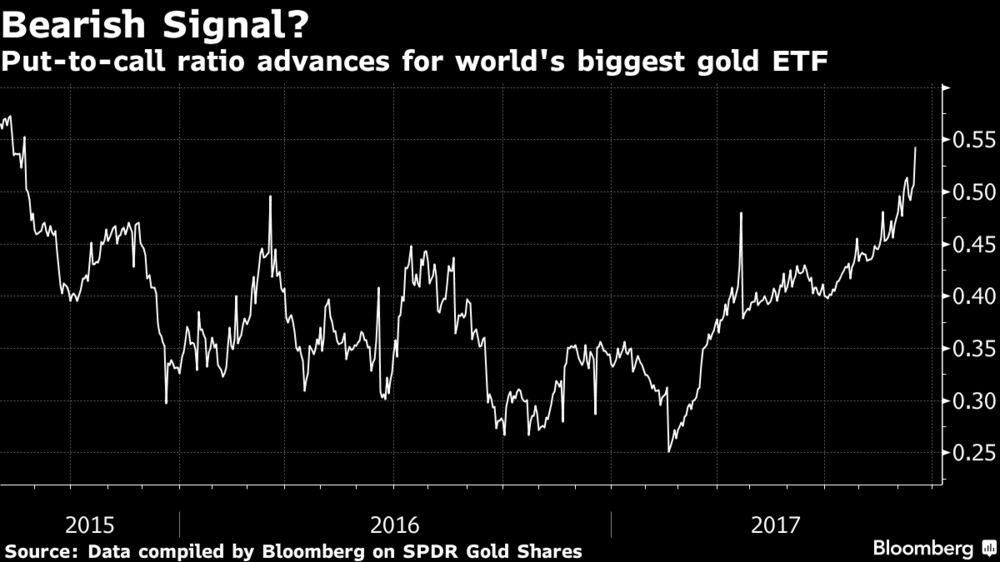
Source: Bloomberg
Global debt may be underestimated by $13 trillion, BIS warns (Reuters.com)
Largest Gold ETF Highlights Bullion Traders’ Confusion (Bloomberg.com)
In “Warning To Pyongyang”, B-1B Bombers, F-35s Hold Mock Bombing Drills (ZeroHedge.com)
India Considers Issuing Its Own Bitcoin-Like Cryptocurrency as Legal Tender (Bitcoin.com)
Mexican Congress Debates the Monetization of the ‘Libertad’ Silver Ounce (Plata.com.mx)
Gold Prices (LBMA AM)
19 Sep: USD 1,308.45, GBP 969.30 & EUR 1,091.25 per ounce
18 Sep: USD 1,314.40, GBP 970.16 & EUR 1,100.68 per ounce
15 Sep: USD 1,325.00, GBP 977.32 & EUR 1,109.16 per ounce
14 Sep: USD 1,323.00, GBP 1,002.44 & EUR 1,111.58 per ounce
13 Sep: USD 1,332.25, GBP 1,003.85 & EUR 1,112.43 per ounce
12 Sep: USD 1,326.25, GBP 1,000.66 & EUR 1,109.41 per ounce
11 Sep: USD 1,338.75, GBP 1,015.31 & EUR 1,114.24 per ounce
Silver Prices (LBMA)
19 Sep: USD 17.15, GBP 12.70 & EUR 14.31 per ounce
18 Sep: USD 17.53, GBP 12.94 & EUR 14.66 per ounce
15 Sep: USD 17.70, GBP 13.03 & EUR 14.81 per ounce
14 Sep: USD 17.75, GBP 13.40 & EUR 14.91 per ounce
13 Sep: USD 17.91, GBP 13.50 & EUR 14.94 per ounce
12 Sep: USD 17.75, GBP 13.37 & EUR 14.87 per ounce
11 Sep: USD 17.85, GBP 13.51 & EUR 14.86 per ounce
Recent Market Updates
– Bitcoin Price Falls 40% In 3 Days Underlining Gold’s Safe Haven Credentials
– Gold Up, Markets Fatigued As War Talk Boils Over
– Oil Rich Venezuela Stops Accepting Dollars
– Massive Equifax Hack Shows Cyber Risk to Deposits and Investments Today
– British People Suddenly Stopped Buying Cars
– Buy Gold for Long Term as “Fiat Money Is Doomed”
– Conor McGregor – Worth His Weight In Gold?
– Gold Has 2% Weekly Gain,18% Higher YTD – Trump’s Debt Ceiling Deal Hurts Dollar
– ‘Things Have Been Going Up For Too Long’ – Goldman CEO
– Physical Gold In Vault Is “True Hedge of Last Resort” – Goldman Sachs
– Bitcoin Falls 20% as Mobius and Chinese Regulators Warn
– Gold Surges To $1338 as U.S. Warns of ‘Massive’ Military Response
– Precious Metals Outperform Markets In August – Gold +4%, Silver +5%
end
I could not understand why Mexico would also so much of its silver to be imported into the USA and used in the manipulation.
and then Trump wants to end NAFTA??? because he is not getting the benefit of trade?
(courtesy Steve St Angelo/SRSRocco report)
Big Trouble For The Silver Market If Mexico Monetizes Its Silver Libertad Coin
By SRSROCCO on September 15, 2017
Recently, there was a debate in the Mexican Congress on the proposal to monetize the Silver Libertad Coin. The debate took place during a forum for “The Promotion of Savings for Mexicans.” If Mexico decided to monetize its Silver Libertad Coin, it could have a severe impact on the silver market and price.
How much of an impact would the monetization of the Mexican Silver Libertad have on the market? There could be serious ramifications if we consider the vast amount of silver consumed by the minting of Mexican silver coins in the past. Before I get into that data, let’s look at the following text from the article, The Mexican Congress Debates the Monetization of the ‘Libertad’ Silver Ounce, on Hugo Salinas Price’s plata.com site;
The central feature of the proposal is that the Central Bank of Mexico (Banxico) shall determine a value in pesos for the “Libertad” silver ounce; and that this value shall be slightly higher (by a percentage that would be defined in the corresponding Law) than the price of silver in the international market, in order to provide Banxico with an assured profit in minting and placing these coins in monetary circulation.
…. if the price of silver should shoot upward, Banxico would have to issue new, higher quotes for the “Libertad” silver ounce (according to the formula to be established by Law). In this way, again, the coin will remain “in circulation”, and since it has no nominal price stamped on it, it will avoid ending up – like all the old silver coins that had stamped values – at the refineries.
Most of those old silver coins, once their content was worth more than the peso stamped value on their faces, ended up in the refineries. The holders of the coins sold their coins at a profit, for their silver content.
This won’t happen with the “Libertad” silver ounce, whose value will be adjusted upward, and benefit the saver, who will thus retain his purchasing power no matter what may happen with inflation. Thanks to owning silver “Libertad” ounces, the public’s savings will float on the ocean of currency through the years.
The important feature in the proposal to monetize the Silver Libertad was that the Central Bank of Mexico would adjust the value of the coin based on the price of silver, rather than striking a permanent numerical value on the face of the coin. By basing the value of the Silver Libertad on the market value of silver, this would protect the Mexican citizen from the ongoing devaluation of the Peso.
For example, the Mexican Peso has devalued 93% versus the U.S. Dollar since the mid-1970’s:

The Mexcian Peso was valued at $0.8006 to the U.S. Dollar in the mid-1970’s but is now trading at $0.0570. Thus, the Mexican Peso has lost 93% of its value in just the past 40+ years. We can see the devaluation of the Mexican currency much better by looking at the relationship between the amount of silver contained in each coin versus the number of Pesos struck on the face of the coin.
The following table came from the MexicanSilverCoins.net site:

The Peso minted between 1869-1913, contained 0.786 (oz) of silver in the one-ounce coin. The value struck on the front of the coin was 1-Peso. However, if you look down to 1950, the 1-Peso coin only had 0.1286 (oz) worth of silver in it. The amount of silver contained in the 1-Peso coin was six times less in 1950 than compared to 1913.
Now, by examining the amount of silver in the 1913 1-Peso of 0.786 (oz) versus the 100-Peso (1977-1979) of 0.6426 (oz), we can see that there was only 0.00642 (oz) of silver backing 1-Peso in the late 1970’s than the 0.786 (oz) of silver backing the 1-Peso in 1913. Please understand that the Central Bank of Mexico stamped 100-Peso on the face of the coin with only 0.6426 (oz) of silver contained in it.
Thus, the Mexican Peso lost 99.2% of its silver content between 1913 and 1977.
Mexico Minted A Vast Amount Of Silver Coins In The 1900’s
While I knew the Official Mint Of Mexico produced a lot of silver coins in the past, I had no idea the huge amount until I looked up the data. According to figures put out by the SilverAgeCoins.com, the Mint of Mexico produced a great deal of Silver Pesos and Silver 50 Centavos in the early to mid part of the 20th Century:

I focused on the mintage figures for these two coins in 1943. Total Silver Pesos & 50 Centavos minted in 1943 were 89.2 million coins. However, the total silver contained in these two coins minted that year was 26.5 million oz (Moz):
Mexico Silver Peso & Silver 50 Centavos (silver content):
1943 Silver Peso = 47,662,000 x 0.39 (oz) = 18,588,180 oz
1943 Silver 50 Centavos = 41,512,000 x 0.19 (oz) = 7,887,280 oz
1943 Silver Coins = 89,174,000 = 26,475,460 oz
I did not do extensive research on all the silver coins produced by the Mint of Mexico in 1943, but I would imagine there were others. For example, I found on the same website listed above that 3,955,000 of the Mexican Silver 20 Centavos were produced in 1943 as well. However, the amount of silver in each of the 20 Centavos was only 0.08 (oz), which netted a total of 316,400 oz of silver consumed.
Regardless, the Mint of Mexico produced one heck of a lot of silver coins during that period. Now, if we consider that the Mexican government consumed 26.5 Moz of silver to mint the Silver Peso and Silver 20 Centavos coins for a total population of approximately 20 million in 1943, how much silver would they consume to protect the value of its current 130 million citizens?
Big Trouble For The Silver Market If Mexico Monetizes Its Silver Libertad Coin
As I stated in the previous section, the Mint of Mexico consumed 26.5 Moz of silver in producing their Silver Peso and Silver 50 Centavos coins in 1943. That being said, let’s look at Mexico’s total silver mine supply during the same year. According to the information put out by the U.S. Bureau of Mines, Mexico produced 86.4 Moz of silver in 1943:

Thus, Mexico consumed 30% of its domestic mine supply just to produce two of its silver coins in 1943. Furthermore, the population of Mexico at the time was approximately 20 million. Thus, the Mint of Mexico consumed 1.3 oz of silver in the Peso & 50 Centavos coins for each citizen. That’s a lot of silver.
Now… let’s fast forward to present day. The amount of Silver Libertads, the Mint of Mexico, produces today, are a fraction of what they were in the past. According to the data put out in the 2017 World Silver Survey, there was only 800,000 oz of Silver Libertads produced in 2016:

As we can see, the Mint of Mexico produced 800,000 oz of Silver Libertads versus 40.3 Moz of Silver Eagles fabricated by the U.S. Mint last year. The irony about those two figures is that the U.S. had to import silver to produce the 40.3 Moz of Silver Eagles as its domestic mine supply was only 35 Moz. On the other hand, Mexico produced 186 Moz of silver in 2016, more than five times that of the United States.
Something is seriously wrong here. Why is Mexico exporting all of its silver for worthless fiat money if its citizens could acquire domestically minted Silver Libertads to protect their wealth in the future? I would imagine the U.S. government has something to do with controlling Mexican officials in keeping their citizens entirely in the dark about silver as MONEY and a STORE OF VALUE.
If the proposal to monetize the Silver Libertad gains traction in Mexico, the silver market would be in serious trouble. Here’s why. Currently, Mexico produces about 186 Moz of silver:

If the Silver Libertad was monetized and 30% of Mexico’s silver production was used to produce these coins, as it was in 1943, it would consume nearly 56 Moz of the country’s domestic mine supply. Moreover, with a population of 130 million in Mexico, 56 Moz of Silver Libertads would amount to less than a third of an ounce of silver for each citizen.
While it is an excellent idea that the Silver Libertad is monetized as protection for Mexican citizens against the ongoing devaluation of the Peso, it will be an uphill battle in state politics. Unfortunately, the world depends on a lot of silver coming from Mexican mines to supply the global jewelry, electronics and investment industries. If its citizens consumed a significant portion of Mexico’s silver production in acquiring vast numbers of Silver Libertads, it could severely impact the silver market and price.
It will be interesting to see how far this proposal to monetize the Silver Libertad goes in the Mexican government.
END
Dennis Gartman who always refuses to admit to central bank interference in the gold market finally admits that the BIS may have orchestrated an attempt to keep the price of gold down:
(courtesy Gartman/GATA)
Dennis Gartman dons tinfoil hat: BIS trying to keep gold down
Submitted by cpowell on Mon, 2017-09-18 17:37. Section: Daily Dispatches
By Dennis Gartman
The Gartman Letter
Monday, September 18, 2017
https://www.thegartmanletter.com/
Regarding gold, Friday was again a day when the gold market bears ruled and they are continuing to put pressure upon prices this morning. We draw attention then to the chart of gold included this morning at the upper left of Page 1, paying heed to the trend line drawn. It is under assault and is indeed in danger of being broken to the downside.
This will not negate the bull market that has been extant since late 2015, but it does put the market rather clearly upon the defensive.
Our friend John Brimelow [editor of John Brimelow’s Gold Jottings letter] has brought something to our attention this morning that we think worthy of note. John wrote earlier today:
“GATA has produced another smoking gun: ‘BIS Gold Swaps Soar from Zero to Record High’ (http://www.gata.org/node/17646):
“Disclosures in the August statement of account published by the Bank for International Settlements indicate that during August the bank increased substantially its use of gold swaps. An estimated 130 tonnes of new gold swaps were made last month, worth about $5.9 billion at the month-end gold price, and the total level of gold swaps at the end of August was close to 500 tonnes.
“This is the BIS’ highest level of gold swaps recorded since the bank first reported the use of gold swaps in its annual report for the financial year ended March 31, 2010. A review of the previous use of gold derivatives by the BIS reveals that the transactions in the year ending March 31, 2010, were far more substantial than anything done by the bank in the years immediately before.
“The use of gold swaps reported by the BIS in recent times is summarized below:
“– March 2010: 346 tonnes.
“– March 2011: 409 tonnes.
“– March 2012: 355 tonnes.
“– March 2013: 404 tonnes.
“– March 2014: 236 tonnes.
“– March 2015: 47 tonnes.
“– March 2016: 0 tonnes.
“– March 2017: 438 tonnes.
“Gold’s friends are up against City Hall.”
Our longstanding readers/clients/friends know that we and GATA have often in the past been very much at odds, but for the moment we find this data very, very interesting. The BIS is trying, thus far vainly, to keep gold down. Do not underestimate their intentions.
* * *
END
Dave Kranzler offers his reasoning for the BIS flooding the system with gold
(courtesy Dave Kranzler_)
Dave Kranzler: Why is the BIS flooding the system with gold?
Submitted by cpowell on Mon, 2017-09-18 23:33. Section: Documentation
7:32p ET Monday, September 18, 2017
Dear Friend of GATA and Gold:
Gold swaps by the Bank for International Settlements, Dave Kranzler of Investment Dynamics writes today, correlate inversely with the gold price. That is, the more gold is swapped by the BIS, the more metal is made available to bullion banks for sale into the market and shipment to Asia to prevent demand there from boosting gold’s price.
The recent explosive rise in gold swaps by the BIS, disclosed Saturday by GATA consultant Robert Lambourne —
http://www.gata.org/node/17646
— “explains the current manipulated take-down in the price of gold despite the rising seasonal demand from India and China,” Kranzler writes.
The BIS actually advertises to prospective central bank members that its services include surreptitious interventions in the gold market —
http://www.gata.org/node/11012
— and the head of the BIS’ monetary and economic department, William R. White, told a BIS conference in 2005 that a primary purpose of central bank cooperation is “the provision of international credits and joint efforts to influence asset prices (especially gold and foreign exchange) in circumstances where this might be thought useful”:
Kranzler’s analysis is headlined “Why Is the BIS Flooding the System with Gold?” and it’s posted at IRD here:
http://investmentresearchdynamics.com/why-is-the-bis-flooding-the-system…
CHRIS POWELL, Secretary/Treasurer
Gold Anti-Trust Action Committee Inc.
CPowell@GATA.org
END
Crazy!! Turkey intends to paperize 2200 tonnes of citizen’s gold
(courtesy GATA/Hurriyet)
Turkey will strive to paperize 2,200 tonnes of gold in home savings
Submitted by cpowell on Mon, 2017-09-18 23:55. Section: Daily Dispatches
Treasury Sets Eye on 2,200 Tons of Gold ‘Kept under Mattresses’
From Hurriyet Daily News, Istanbul
Monday, September 18, 2017
ANKARA, Turkey — The Turkish Treasury will issue two types of bonds to attract into the economy 2,200 tons of gold stashed under mattresses, which has a market value of around 300 billion Turkish Liras, Deputy Prime Minister Mehmet Simsek has said.
“The first issuance of gold bonds and the gold-based rent certificates will begin between Oct. 2 and 6 in an attempt to benefit the economy with the under-the-mattress gold of citizens, which is estimated to be almost 2,200 tons in total,” Simsek said in a statement Sunday
The deputy prime minister said today during an interview broadcast on Bloomberg HT and Habertürk that the issuance of gold price-linked bonds was not related to the Treasury’s need for debt.
“The Treasury has no borrowing problem. We will dare this cost for the economy to run faster, to increase savings and solve resource problems as well as bring out the under-the-mattress savings into the economy,” he said. …
… For the remainder of the report:
http://www.hurriyetdailynews.com/-.aspx?pageID=238&nID=118121&NewsCatID=…
end
Your early TUESDAY morning currency, Asian stock market results, important USA/Asian currency crosses, gold/silver pricing overnight along with the price of oil Major stories overnight
1 Chinese yuan vs USA dollar/yuan HUGELY WEAKER AT 6.5846 (DEVALUATION SOUTHBOUND /OFFSHORE YUAN MOVES SLIGHTLY WEAKER TO ONSHORE AT 6.5867/ Shanghai bourse CLOSED DOWN 6.02 POINTS OR 0.18% / HANG SANG CLOSED DOWN 108.36 POINTS OR 0.38%
2. Nikkei closed UP 389.88 POINTS OR 1.06% /USA: YEN RISES TO 111.56
3. Europe stocks OPENED MOSTLY MIXED TO RED ( /USA dollar index FALLS TO 91.88 /Euro UP to 1.1990
3b Japan 10 year bond yield: RISES TO -+.039%/ GOVERNMENT INTERVENTION !!!!(Japan buying 100% of bond issuance)/Japanese yen vs usa cross now at 110.43/ THIS IS TROUBLESOME AS BANK OF JAPAN IS RUNNING OUT OF BONDS TO BUY./JAPAN 10 YR YIELD FINALLY IN THE POSITIVE/BANK OF JAPAN LOSING CONTROL OF THEIR YIELD CURVE AS THEY PURCHASE ALL BONDS TO GET TO ZERO RATE!!
3c Nikkei now JUST BELOW 17,000
3d USA/Yen rate now well below the important 120 barrier this morning
3e WTI:: 50,36 and Brent: 55.69
3f Gold UP/Yen DOWN
3g Japan is to buy the equivalent of 108 billion uSA dollars worth of bond per month or $1.3 trillion. Japan’s GDP equals 5 trillion usa./“HELICOPTER MONEY” OFF THE TABLE FOR NOW /REVERSE OPERATION TWIST ON THE BONDS: PURCHASE OF LONG BONDS AND SELLING THE SHORT END
Japan to buy 100% of all new Japanese debt and by 2018 they will have 25% of all Japanese debt. Fifty percent of Japanese budget financed with debt.
3h Oil UP for WTI and UP for Brent this morning
3i European bond buying continues to push yields lower on all fronts in the EMU. German 10yr bund FALLS TO +.437%/Italian 10 yr bond yield UP to 2.047%
3j Greek 10 year bond yield RISES TO : 5.527???
3k Gold at $1308.25 silver at:17.17 (8:15 am est) SILVER NEXT RESISTANCE LEVEL AT $18.50
3l USA vs Russian rouble; (Russian rouble UP 4/100 in roubles/dollar) 58.06-
3m oil into the 50 dollar handle for WTI and 55 handle for Brent/
3n Higher foreign deposits out of China sees huge risk of outflows and a currency depreciation (already upon us). This can spell financial disaster for the rest of the world/China forced to do QE!! as it lowers its yuan value to the dollar/GOT A HUGE SIZED DEVALUATION SOUTHBOUND
JAPAN ON JAN 29.2016 INITIATES NIRP. THIS MORNING THEY SIGNAL THEY MAY END NIRP. TODAY THE USA/YEN TRADES TO 111.56 DESTROYING JAPANESE CITIZENS WITH HIGHER FOOD INFLATION
30 SNB (Swiss National Bank) still intervening again in the markets driving down the SF. It is not working: USA/SF this morning 0.9628 as the Swiss Franc is still rising against most currencies. Euro vs SF is 1.1541 well above the floor set by the Swiss Finance Minister. Thomas Jordan, chief of the Swiss National Bank continues to purchase euros trying to lower value of the Swiss Franc.
3p BRITAIN VOTES AFFIRMATIVE BREXIT/LOWER PARLIAMENT APPROVES BREXIT COMMENCEMENT/ARTICLE 50 COMMENCES MARCH 29/2017
3r the 10 Year German bund now POSITIVE territory with the 10 year FALLING to +0.437%
The bank withdrawals were causing massive hardship to the Greek bank. the Greek referendum voted overwhelming “NO”. Next step for Greece will be the recapitalization of the banks and that will be difficult.
4. USA 10 year treasury bond at 2.218% early this morning. Thirty year rate at 2.792% /POLICY ERROR)GETTING DANGEROUSLY HIGH
5. Details Ransquawk, Bloomberg, Deutsche bank/Jim Reid.
(courtesy Jim Reid/Bloomberg/Deutsche bank/zero hedge)
Global Equities Hit New All Time High Ahead Of The Fed; VIX < 10; Japan Stocks Surge
S&P futures are little changed as the Fed begins its two-day FOMC meeting pushing the VIX below 10, down 1.3% and falling for the 7th day; European shares are lower as is the dollar while Japanese stocks soar on the back of a tumbling yen as a snap election in Japan now appears imminent. Despite the cautious action ahead of the Fed, the The MSCI All-Country World Index rose 0.1% to a new record high.
Among the notable overnight moves, the USDCNH climbed to highest since late August ahead of this week’s FOMC decision. Ten-year Treasury yields fell 1 bp; Australia’s 10-year gained 1 bp. Japanese equities rose 1.5% ahead of an expected snap election to be called by PM Abe this week; China and Hong Kong shares declined. WTI crude holds just below $50; Dalian iron ore contract dropped. The Bloomberg Dollar Spot Index was little changed before tomorrow’s Fed’s policy decision, when interest-rate projections are seen drawing more attention than any balance-sheet announcement as tapering is seen as a given. The euro was supported by unwinding of shorts against the pound and by yen selling amid improved risk appetite and reports of Japan PM Abe calling for snap elections. Treasuries were underpinned in Asian hours as Japanese investors returned after Monday’s holiday, while price action was muted in London trading.
Meanwhile, nobody appeared concerned about tomorrow’s Fed announcement, where the balance sheet unwind is expected while attention will focus on any revision to the Fed’s dots. “We are not overly concerned about” the Fed’s quantitative-tightening plans, Merrill Lynch and U.S. Trust head of fixed-income strategy Matthew Diczok told Bloomberg TV. “If you model it out, over about the next three years they’ll take out about $1.3 trillion or so. That’s only a third of what they put into the market. So it’s going to be very slow, very gradual, very deliberate and it shouldn’t lead to any near-term fireworks into the market at all.”
Following the recent improvement in data, December rate hike odds once again rose back to 50%, suggesting another rate hike may be possible this year.

JP Morgan Asset Management portfolio manager Iain Stealey said markets were now fully set for the Fed to officially announce it will cut, or taper, the amount it re-invests from the profits of its $4.2 trillion crisis-era bond portfolio. “They have already announced the amounts they are going to start with, $10 billion on a monthly basis and probably starting over the next month or so,” Stealey said. “What may be more important to keep an eye on is the dot-plot. We still think they will have the dots set up to expect one more hike this year, which will obviously be in December, and three next year.”
With little in terms of overnight newsflow, the highlight was Japanese shares which surged to their highest level in more than two years as the yen weakened for a third day, bolstering appetite for electronics makers, autos and banks. Japanese equities gained on expectations Prime Minister Shinzo Abe will call a snap election. As reported on Sunday, Prime Minister Abe is considering calling a poll for as early as next month to take advantage of his improved approval ratings in the wake of the North Korea crisis, and disarray in the main opposition party, according to sources. The benchmark Topix index extended gains after capping its best week since April on Friday, as investor focus shifted to economic fundamentals from concerns over North Korea. The yen dropped to an almost two-month low against the dollar Tuesday.
Abe said Monday he’ll decide on calling a snap election after he returns from a trip to the U.S., confirming our previous report that he’s considering calling a vote a vote more than a year early, prompting speculation for more fiscal stimulus while keeping the BOJ on hold. “The weaker yen is providing tail wind to export-related stocks” after the market shrugged off the North Korea’s missile launch last week, Hiroaki Hiwada, a strategist at Toyo Securities told Bloomberg. “The equity market is taking the news about a possible snap election positively as it boosts expectations Abe’s coalition parties will retain power.” As a result, “Japanese shares generally gain around calls to hold new elections”, Nomura Securities wrote in a report.
Stefan Worrall, director of Japan equity sales at Credit Suisse in Tokyo said there has been concern growing for a while among foreign investors about the future of Abe’s stimulus-focused Abenomics program. “If Abe is cemented in power for another few years, that would be a market-positive event,” he said. “Certainty is preferred to uncertainty, when it comes to market confidence.”
The Nikkei’s 2 percent jump overnight took its gain to almost 30 percent since Abe took power in late 2012.
Another notable overnight move was the sudden drop in the yuan, where the CNH tumbled to a two-and-a-half week low as a state-run firm was said to be buying dollars to make dividend payments. The onshore yuan dropped as much as 0.34% to 6.5987 per dollar and was down 0.12% at 6.5838 as of this morning. In addition to the currency move, the PBOC pumps in net 150b yuan ($23b) via reverse- repurchase agreements, after adding 300b yuan Monday.

Elsewhere in Asia the mood had been more subdued. South Korean shares dipped 0.1 percent, against a backdrop of caution ahead of the Fed meeting as well as continuing tensions on the Korean peninsula. The MSCI Emerging Market Index decreased 0.3 percent, the largest dip in more than two weeks. Asian stock traded cautiously ahead of the FOMC and as the region failed to maintain the early impetus from US where financials led the S&P 500 and DJIA to fresh record closes. Australia’s ASX 200 (-0.1%) and Nikkei 225 (+2.0%) were positive in which the latter surged as it played catch up to the gains on return from holiday, while weakness in defensive stocks restricted upside in Australia. Shanghai Comp. (-0.2%) and Hang Seng (-0.4%) were dampened despite another firm PBoC liquidity operation, with the underperformance in China the rest of the region attributed to profit taking. The PBOC injected net 150b yuan in open-market operations on Tuesday, bringing the additions since last Thursday to 750b yuan. 10yr JGBs lacked demand amid the positive risk tone in Japan and although the BoJ were present in the bond market, this was for a relatively reserved JPY 535bln total.
In Europe, the Stoxx Europe 600 Index was fractionally in the red, amid mixed regional benchmarks. Gauges from Hong Kong to South Korea had retreated earlier, even as Japan soared following a holiday on Monday. Germany’s DAX Index decreased 0.1 percent while the U.K.’s FTSE 100 Index rose 0.2%. The pound reversed an advance as investors weighed the latest political disarray over Brexit strategy, and the euro headed for a fourth daily advance. Elevated risk appetite in Europe meanwhile saw the gap between Portuguese and Italian 10-year government bond yields narrow to levels not seen since the start of the euro zone debt crisis of 2010-2012. That followed a strong rally in Portuguese debt over the last two sessions, after S&P became the first major ratings agency to give the country back an investment grade rating, more than five years after it first sank into junk territory.
In currencies, Britain’s sterling also started to retreat again having been pushed off post Brexit highs on Monday by Bank of England governor Mark Carney who said any upcoming UK rate hikes would be gradual and limited. The Bloomberg Dollar Spot Index fell less than 0.05 percent. The euro increased 0.2 percent to $1.1978, the strongest in more than a week. The British pound decreased 0.1 percent to $1.3477.
In commodity markets, metals shifted lower and oil prices steadied near last week’s multi-month highs. Traders braced for a potential stockpile build-up expected later this week, limiting the prospect for further gains. U.S. crude futures were up 19 cents at just above $50 per barrel, within sight of Thursday’s nearly four-month high of $50.50. Brent crude hovered at $55.50, not far from an almost five-month high of $55.99 it had marked that day.
In rates, the yield on 10-year Treasuries fell one basis point to 2.22 percent, the largest fall in more than a week. Germany’s 10-year yield declined one basis point to 0.45 percent, the biggest fall in more than a week. Britain’s 10-year yield declined two basis points to 1.281 percent, the largest fall in more than a week.
On the news front, President Trump is scheduled to address the United Nations on Tuesday for the first time as world leaders continue to seek a diplomatic solution to North Korea’s nuclear provocations. Data include August housing starts and 2Q current account. Adobe, AutoZone, Copart, FedEx are among companies reporting earnings. The Iraq Oil Minister said he does not think now that there is a need for more output reductions, but if there was a need for more cuts in the future, Iraq will support consensus within OPEC, Adding, that there are proposals for more cuts, but he does not think it will be implemented, but will be studied.
Bulletin Headline Summary
- European bourses trade with little in the way of firm direction ahead of upcoming risk events this week
- GBP/USD saw some selling pressure early doors with initial gains in USD/JPY trimmed throughout the session
- Looking ahead, highlights include NZ Dairy Auction and US APIs
Market Snapshot
- S&P 500 futures little changed at 2,503.20
- VIX Index down 1.3%, falling for the 7th day
- STOXX Europe 600 down 0.1% to 381.66
- MSCI Asia up 0.5% to 164.03
- MSCIA Asia ex Japan down 0.3% to 543.02
- Nikkei up 2% to 20,299.38
- Topix up 1.8% to 1,667.88
- Hang Seng Index down 0.4% to 28,051.41
- Shanghai Composite down 0.2% to 3,356.84
- Sensex up 0.09% to 32,453.75
- Australia S&P/ASX 200 down 0.1% to 5,713.58
- Kospi down 0.09% to 2,416.05
- German 10Y yield fell 0.6 bps to 0.449%
- Euro up 0.3% to $1.1984
- Italian 10Y yield fell 0.6 bps to 1.78%
- Spanish 10Y yield fell 1.4 bps to 1.573%
- Brent futures up 0.3% to $55.67/bbl
- Gold spot little changed at $1,308.52
- U.S. Dollar Index down 0.2% to 91.87
Top Overnight News
- EU wants the Paris-based regulator European Securities and Markets Authority to get a bigger role in reviewing fund managers’ activities, Financial Times reports, citing plans seen
- Japanese Prime Minister said he is considering dissolving parliament to hold a snap general election, ruling Liberal Democratic Party Secretary General Toshihiro Nikai told reporters in Tokyo; Abe to express his intention to dissolve the Lower House at a press conference on Sept. 25, FNN reports, without attribution
- French President Macron is planning to provide details on his proposals for euro-zone reforms in a speech on the future of EU on Sept. 26, FT reports, citing unidentified aides; proposal includes a separate budget, a finance ministry and a European Monetary Fund
- Norway’s sovereign wealth fund hit $1 trillion for the first time on Tuesday, driven higher by climbing stock markets and a weaker U.S. dollar
- Germany ZEW Sept. survey expectations 17 vs est. +12
- Toys ‘R’ Us Seeks Bankruptcy, Crushed by Debt and Online Rivals
- BNP Among Firms Said to Be Eyeing Axa Asset- Management Tie-Up
- Mexico’s Femsa Sells $3 Billion Stake in Brewer Heineken
- Park Hotels Is Said to Seek Over $500 Million for 15 Properties
- Bayer Sees Monsanto Transaction Closing Delayed to Early 2018
- Wall Street’s Bond Gurus Have It All Wrong as QE Unwind Looms
- Trump at UN to Urge Action on North Korea, Iran Threat; U.S. to Act on North Korea Rockets That Pose Threat, Mattis Says
- Maria Weakens as Storm Passes Dominica on Way to Puerto Rico
- Brexit Rift Widens as Johnson Talks of Life After Government
Asia equity markets traded with a cautious tone as the FOMC draws closer and after the region failed to maintain the early impetus from US where financials led the S&P 500 and DJIA to fresh record closes. ASX 200 (-0.1%) and Nikkei 225 (+2.0%) were initially positive in which the latter surged as it played catch up to the gains on return from holiday, while weakness in defensive stocks restricted upside in Australia. Shanghai Comp. (-0.2%) and Hang Seng (-0.4%) were dampened despite another firm PBoC liquidity operation, with the underperformance in China the rest of the region attributed to profit taking. 10yr JGBs lacked demand amid the positive risk tone in Japan and although the BoJ were present in the bond market, this was for a relatively reserved JPY 535bln total. PBoC injected CNY 130bln via 7-day reverse repos and CNY 20bln via 28-day reverse repos. PBoC set CNY mid-point at 6.5530 (Prev. 6.5419). Japanese PM Abe is told hold a press conference on Monday 25th September; comes in the context of recent speculation that he could call a snap election.
Top Asian News
- Hong Kong Dollar Surges With Hibor Rates as HKMA Mops Up Cash
- Goldman Sachs Names Hitchner Chairman, CEO Asia-Pacific Ex- Japan
- Markets Are Betting That Japan’s Abe Would Win a Snap Election
- Alibaba Is Said to Buy $100 Million in Best Inc.’s Downsized IPO
- Tata Is Said to Be Boosting Carmaker Stake for $312 Million
European equity markets trade in subdued fashion, as much anticipation remains on the FOMC tomorrow. EU bourses are mixed for the session, failing to gather any bullish impetus from another record close on Wall Street, not helped by a morning bullish grind in the Euro. Equity specific stories have also dragged down markets, noticeably, Heineken is a leading faller, down close to 4%, after bottler and retailer Femsa has sold a 5.24% stake in the firm. Kantar and Nielsen released their 12-week supermarket sales, helped lead to Sainsbury’s and Morrisons to be two of the out-performers in the FTSE. The grocer optimism has not spread however, with despite what appeared to be strong results for Ocado, the concerns of rising costs have seen the Co. down over 4%. Bond markets have traded in a consolidated range through the European morning. Spreads have seen some marginal volatility, the 10y Spain/Germany has been tightening on the back of Portuguese bonds. PGBs continue to stand out, being down as much as 2-4.0bps along the curve, with the 10y trading through -2.40%. Supply has come from the DMO this morning who came to market with a 30yr auction which drew a smaller b/c than previous (albeit still healthy at 1.97) and a wider tail than previous but did little to cause traction in longer duration paper.
Top European News
- Merkel Eyes BMW Homeland for Final Election Boost After Spat
- Carney Says U.K. Rate Increase Looms in Brexit-Hobbled Economy
In currencies, the pound has seen some marginal selling this morning, as cable looks to attempt a break through yesterday’s low. Position unwinding in cable is evident as the Fed is due tomorrow, with buyers potentially not convinced by Carney’s ‘gradual and limited’ comments. Elsewhere, an upbeat ZEW report from Germany failed to inspire any noteworthy price action in the EUR. USD/JPY caught a bid heading into European trade after breaking above the prior session’s highs before dissipating throughout the EU session. AUD was largely unreactive to an unsurprising minutes release where the RBA stuck to its usual rhetoric.
In commodities, oil markets have been relatively unfazed by the speech from the Iraq Oil Minister who said there are proposals for more OPEC cuts, yet with no clear clarity the OPEC extension comments seem disconcerting to markets. WTI crude futures has seemed to consolidate above 49.50, above 50/bbl and looking to break through 50.50, where stops are likely to be triggered. Price action in metals has been subdued overnight with copper also relatively subdued.
Looking at the day ahead, there are housing starts, building permits, current account balance and the import / export price index. President Trump is scheduled to address the United Nations on Tuesday for the first time as world leaders continue to seek a diplomatic solution to North Korea’s nuclear provocations.
US Event Calendar
- 8:30am: Housing Starts, est. 1.17m, prior 1.16m; Housing Starts MoM, est. 1.65%, prior -4.8%
- Building Permits, est. 1.22m, prior 1.22m; Building Permits MoM, est. -0.81%, prior -4.1%
- 8:30am: Current Account Balance, est. $116.0b deficit, prior $116.8b deficit
- 8:30am: Import Price Index MoM, est. 0.4%, prior 0.1%; Import Price Index YoY, est. 2.2%, prior 1.5%
- Export Price Index MoM, est. 0.2%, prior 0.4%; Export Price Index YoY, prior 0.8%
DB’s Jim Reid concludes the overnight wrap
It’s been a quiet start to the week ahead of the important Fed meeting today and tomorrow, but no news is good news as risk continues to recover from a few difficulties in recent weeks. In fact the VIX briefly fell below 10 yesterday for the first time since the 7th of August (closed 10.15). Elsewhere, the S&P edged up 0.15% to consolidate around its record high.
There was a bit more action in sovereign bond yields yesterday, in particular for Portugal where its 10y yields fell 37bp, mainly reflecting S&P’s upgrade of its credit rating back to investment grade (BBB-) – the first main agency to do so since 2012. The spread to Bunds has now narrowed to 196bp, which is the lowest since January 2016. Other peripherals slightly outperformed too, with Italian BTPs (2Y: -1bp; 10Y: -1bp) and Spanish (2Y: +0.5bp; 10Y: -1.6bp) yields down c1bp, with Ireland’s 10y yields unchanged after Moody’s upgraded its rating from A3 to A2-. Core bond yields underperformed, but changes were modest, with Bunds (2Y: +1bp; 10Y: +2bp) and Gilts (2Y: +3bp; 10Y: unch) up slightly, while UST 10yr also rose 2.6bp.
Turning to the UK, BOE’s governor Carney spoke at IMF’s headquarters and reiterated the need for some withdrawal of stimulus if the UK economy evolves as expected. On rates, he noted that there are global factors that could justify UK’s potential move to hike rates, in part as UK’s monetary policy “has to move in order to stand still” and that Brexit undermines UK’s supply capacity and makes it harder for the economy to grow without generating inflationary pressures. However, relative to the hawkish BOE tone set last week, some interpreted his rate hike comments of “gradual and to a limited extent” as a bit dovish, partly contributing to a softening in Sterling yesterday (-0.73%). On Brexit, he said there remains “considerable risks to the UK outlook” and that the Brexit process would weigh on the economy’s potential growth for a period.
Elsewhere, at a Reuter’s interview, ECB’s governing council member Ardo Hansson reiterated that solid Eurozone growth will allow the ECB to dial back stimulus but normalisation will be gradual. Notably, he called out that ECB’s “forward guidance could be more precise about interest rates”.
This morning in Asia, markets are paring back initial gains and are now trading broadly unchanged ahead of the FOMC meeting. As we type, the Nikkei is up 1.47%, partly playing catch up as the market was closed yesterday for holiday. Elsewhere, the Hang Seng (-0.07%), Kospi (-0.05%) and ASX 200 (+0.05%) are fairly flat. The UST 10y is also trading a bit firmer (-1bp) this morning. In his first visit to the UN, President Trump has said that a decision on Iran’s nuclear deal will be seen “very soon” and that the UN has not reached its full potential. Trump’s first official address will occur later today so eyes will be on that.
Turning back to markets yesterday. Equities strengthened further in both the US and Europe, but changes were modest, in part as investors await for the FOMC meeting. The S&P edged 0.15% higher, while the Nasdaq and the Dow rose 0.10% and 0.28% respectively. Within the S&P, gains were led by the financials (+1.02%) and materials sector, partly offset by losses from utilities. European markets were all higher, with the Stoxx and DAX both up c0.3%, while the FTSE firmed 0.52% following four consecutive days of losses.
Currency markets were fairly quiet excluding the changes for Sterling, where it weakened 0.73% and 0.77% versus the Greenback and Euro respectively. Elsewhere, the US dollar index gained 0.19% and EURUSD rose 0.08%. In commodities, WTI oil was broadly flat again while precious metals fell (Gold -0.97%; Silver -2.15%) given the bias away from safe haven assets. Elsewhere, base metals as per LME prices have broadly increased, with Copper (+0.31%), Aluminium (+0.17%) and Zinc (+2.21%) all slightly higher.
Away from the markets and onto the topic of elections. In Spain, the Catalan government has passed a law organising an independence referendum on 1 October, although the move has been ruled illegal by the Spanish courts and government. The Spanish economy minister Luis de Guindos warned yesterday that Catalonia’s independence would result in an automatic exit from the EU and that the hit to Catalonia’s economy would be “brutal”, with GDP falling 25%-30% and unemployment to double. The Catalonia region accounts for c20% of Spain’s GDP. Moody’s noted earlier the vote was negative for credit, but it expects the Catalonia region to remain part of Spain.
Over in Germany, according to ARD Deutschland-trend, the winner of the upcoming election seems to be clearly Merkel’s CDU/CSU party, but the composition of the next coalition is not so clear. DB’s Stefan Schneider takes a look at the coalition scenarios and their possible implications for Germany’s economic and EU policies as well as financial markets. For more details Turning to Japan, there were weekend reports that PM Shinzo Abe is considering an earlier Lower House election sometime in October 2017. Our Japanese team notes the move appears to be motivated by a rebound in Abe’s approval ratings and his potential intent to lengthen his time in power. Our team thinks that a key economic focus in this election (if it takes place),could be whether the consumption tax should be raised as planned in October 2019 from 8% to 10% and a transformation of the social security system from one orientated towards the elderly to one focused on all generations.
Before we move to today’s calendar a few things to wrap up. First the latest ECB CSPP holdings were released yesterday. They bought €2.12bn last week which equates to €423mn/dayvs. €348mn/day since CSPP started. After the summer lull and with more primary issuance, the ECB have made up for the low levels of summer buying with the CSPP/PSPP ratio of net purchases at 19.2% last week (vs. 13.6%, 12%, 10.3%, 9.6%, 11.4% in previous weeks). The CSPP/PSPP ratio since the taper in April has been c.12.9% which is higher than the pre-taper ratio of 11.6%. So still suggesting the ECB has tapered credit purchases less than Government bonds.
Circling back to Brexit, Oliver Robbins has left his post as the official in charge of the Brexit department to focus full time on the Brexit negotiations. This coupled with PM Theresa May’s big speech later this week could add momentum back to the stalled negotiation talks with the EU.
Finally, turning to a fairly quiet day for key macro data, in the US, the NAHB Housing market index was slightly lower than expected at 64 (vs. 67), with both the current sales and sales expectations indices returning to their July readings. In Europe, the final reading of Eurozone’s August inflation was unchanged, with headline inflation at 1.5% yoy (0.3% mom) and core at 1.2% yoy. Italy’s total trade balance for July increased to $6.6bln (vs. $4.5bln previous). In the UK, the Rightmove index pointed to a further softening of the housing market in September, with nationwide asking prices falling 1.2% mom, leaving annual growth at 1.1% yoy – the slowest pace since February 2012.
Looking at the day ahead, the Eurozone’s current account and construction output stats are due. There is the ZEW survey on economic growth for Germany and the Eurozone. Over in the US, there are housing starts, building permits, current account balance and the import / export price index. Onto other events, Germany’s Merkel will give a pre-election interview to RTL television.
3. ASIAN AFFAIRS
i)Late MONDAY night/TUESDAY morning: Shanghai closed DOWN 6.02 POINTS OR 0.18% / /Hang Sang CLOSED DOWN 108.36 POINTS OR 0.38%/ The Nikkei closed UP 389.88 POINTS OR 1.06%/Australia’s all ordinaires CLOSED DOWN 0.11%/Chinese yuan (ONSHORE) closed WELL DOWN at 6.5846/Oil UP to 50.36 dollars per barrel for WTI and 55.69 for Brent. Stocks in Europe OPENED MIXED LEANING TO RED . Offshore yuan trades 6.5867 yuan to the dollar vs 6.5846 for onshore yuan. NOW THE OFFSHORE MOVED A LITTLE WEAKER TO THE ONSHORE YUAN/ ONSHORE YUAN MUCH WEAKER (TO THE DOLLAR) AND THE OFFSHORE YUAN IS A MUCH WEAKER TO THE DOLLAR AND THIS IS COUPLED WITH THE SLIGHTLY WEAKER DOLLAR. CHINA IS NOT HAPPY TODAY
3a)THAILAND/SOUTH KOREA/NORTH KOREA
NORTH KOREA/USA
Mattis states that the USA will act on North Korean missiles that pose a threat to Japan, the USA or SouthKorea
(courtesy zero hedge)
Defense Secretary Mattis Says US Will Act On North Korea Missiles That Pose A Threat
As President Donald Trump prepares to make his first speech to the United Nations, Secretary of Defense James Mattis was pushing the administration’s line on North Korea, saying that the US has “many military options” available for toppling North Korea’s unstable regime that wouldn’t risk millions of deaths in Seoul.
“There are many military options, in concert with our allies, that we will take to defend our allies and our own interests,” Mattis said, declining to elaborate or provide any further details.
The Trump administration has repeatedly insisted that “all options” remain on the table when dealing with North Korea, and that the US wouldn’t hesitate to consider a military solution if diplomatic efforts and sanctions fail to halt the Kim regime’s rapidly progressing nuclear program. Trump and North Korean leader Kim Jong Un have been exchanging threats of nuclear annihilation for months, with Trump famously promising to deliver “fire and fury the likes of which the world has never seen” if the North doesn’t cease its threats to the US.

Of course, many believe that, despite the administration’s rhetoric, it still lacks a cohesive US military strategy for toppling the Kim regime – at least one that doesn’t involve risking millions of lives in Seoul, which is less than 50 miles from the North Korean border. Former Trump Chief Strategist Steve Bannon once said in a now famous interview that there is no military alternative for dealing with the North that wouldn’t involve potentially millions of deaths in Seoul from conventional weapons fire.
Mattis also said that he discussed deploying tactical nuclear weapons with his South Korean counterpart, but declined to elaborate on the details.
After the North has twice fired intermediate range missiles over the Northern Japanese island of Hokkaido, the former general added that the US is prepared to shoot down any North Korean missiles that pose a threat to its territory or that of its allies – comments that are particularly relevant following the North’s decision
“Those missiles are not directly threatening any of us,” Mattis said Monday when asked why the military didn’t shoot them down.
“The bottom line is that, when the missiles – were they to be a threat, whether it be to U.S. territory, Guam, obviously Japan – Japan’s territory, that would elicit a different response from us,” he said.

Mattis – confirming what investors have known for some time – said North Korea is “intentionally doing provocations that seem to press against the envelope for just how far can they push without going over some kind of a line in their minds that would make them vulnerable,” but that the country doesn’t pose a threat to the US.
When the North fires its missiles, Mattis said, “they aim for the middle of the Pacific Ocean, as you know, where at least we hope no ships are around, right?”
South Korean President Moon Jae-in suggested to Japanese Prime Minister Shinzo Abe on Sept. 15 that they should both refrain from overreacting to North Korean provocations to avoid any accidental conflict.
Mattis praised decisions by countries to expel North Korean ambassadors. Spain declared Pyongyang’s envoy to Madrid “persona non grata” on Monday, and told him to leave by the end of the month. Mexico, Peru and Kuwait have either expelled or given notice to ambassadors since the Sept. 3. nuclear test.
Kuwait will not renew permits to North Korean workers to re-enter the country after projects they are working on are completed “within one or two years,” according to Bloomberg. There are between 2,000 and 2,500 North Korean workers in Kuwait, with thousands more believed to be in other Gulf states.
Rallying international pressure against North Korea and Iran is expected to be the top priority of the Trump’s trip to the United Nations General Assembly this week. Reports that surfaced late Monday claimed that Trump is planning to label Iran and North Korea as “global threats” during his first address to the General Assembly, set to begin at 10 a.m.
b) REPORT ON JAPAN
c) REPORT ON CHINA
The jawboning by Xi seems to be working as the yuan tumbles to two week lows. Trump will not be happy
(courtesy zerohedge)
Offshore Yuan Tumbles To 2-Week Lows, Biggest Drop Since Election
Offshore yuan has now dropped almost 16 handles in the last 8 days since Chinese officials voiced their concerns “about a rallying yuan as exporters come under strain.”

Tonight’s tumble pushes the Yuan to its lowest since August for the biggest 8-day drop since the election...

And offers Trump some excuses to be mad at China for ‘devaluing’ their currency after the dollar dumped for most of the year…

Notably, while Yuan is tumbling, Hong Kong Dollar spiked back towards the peg…

4. EUROPEAN AFFAIRS
ECB/EU
the Euro tumbles a bit this morning after a report suggesting that the ECB is still concerned and divided over how to end their QE
(courtesy zerohedge)
Euro Tumbles On Report ECB Is “Concerned And Divided” Over End To QE
Talk ’em up, then slam ’em down.
The familiar pattern of “clear and transparent” central bank communication was on full display moments ago, when following months of build up to an ECB taper announcement, the ECB used its favorite mouthpiece, Reuters, to “trial balloon” that an ECB decision over whether to announce a firm end-date to the central bank’s bond buying could be “put off until December” as a result of disagreement among the ECB council stemming from “concern over Euro strength” which is leading to “uncertainty and divide within the council.”
As a result, some within the ECB want to be able to “extend or expand” buys if needed, in other words if the EURUSD rises too far above 1.20.
The highlights from Reuters:
- CONCERN OVER EURO STRENGTH IS LEADING TO UNCERTAINTY AND DIVIDE WITHIN ECB COUNCIL – SOURCES
- ECB POLICYMAKERS DISAGREE ON WHETHER TO SET FIRM END-DATE FOR BOND-BUYING PROGRAMME IN OCT – SOURCES
- SOME ECB RATE SETTERS WANT TO BE ABLE TO EXTEND OR EXPAND BUYS IF NEEDED – SOURCES
- SOME ELEMENTS OF ECB DECISION COULD BE PUT OFF UNTIL DEC – SOURCES
And the full report:
European Central Bank policymakers disagree on whether to set a definitive end-date for their money-printing programme when they meet in October, raising the chance that they will keep open at least the option of prolonging it again, six sources told Reuters. A stubbornly strong euro, with its dampening effect on inflation, is driving a rift among ECB policymakers, the sources on the ECB’s Governing Council with direct knowledge of its thinking said.
The split is between ‘hawks’ — led by richer, northern countries such as Germany — who are ready to wind down the 2.3 trillion euros bond-purchase programme and ‘doves’ who simply want to reduce its monthly pace, the sources said.
This is raising the likelihood that they will seek a compromise solution on Oct. 26, whereby any end-date for purchases would not be set in stone, or that they will put off part of the decision until December, the sources added.
The main point of contention is the euro’s continued appreciation against major currencies, which is threatening to curb inflation in the euro zone by making its imports cheaper and exports dearer
In immediate kneejerk reaction, the EURUSD tumbled from 1.1990 to as low as 1.1960 as traders scratch their heads just how will the ECB extend QE indefinitely when it is running out of bonds to buy, and wondering if the ECB will pull a BOJ and buy ETFs next as Reuters also “trial ballooned” back in 2016.
Scientists Say Italian Supervolcano Is “Becoming More Dangerous” As Magma Builds Beneath It
After the long-dormant supervolcano Campi Flegrei awakened late last year, a team of scientists that has pinpointed the now-active volcano’s magma source says a potentially devastating eruption could be just around the corner.
Campi Flegrei is a volcanic caldera to the west of Naples that last erupted in the sixteenth century. It has been mostly quiet since then, with the exception of a few small tremors in the 1980s. Seismographic data from those rumbles allowed scientists to pinpoint the source of the magma that flooded into Campi Flegrei’s chamber and caldera, according to United Press International. The results are unequivocal: An analysis of the supervolcano’s hot zone suggests Campi Flegrei could be nearing an eruption.
“What this means in terms of the scale of any future eruption we cannot say, but there is no doubt that the volcano is becoming more dangerous,” De Siena said.
“The big question we have to answer now is if it is a big layer of magma that is rising to the surface, or something less worrying which could find its way to the surface out at sea.”
Researchers liken the volcano’s hot zone to a boiling pot of soup. Over the last several years, the volcano has gotten considerably hotter.

The Campi Flegrei “hot zone”
Four years ago, scientists warned any eruption could kill millions living near or on top of the volcano.
“These areas can give rise to the only eruptions that can have global catastrophic effects comparable to major meteorite impacts,” said Giuseppe De Natale, head of a project to monitor the volcano’s activity.
Now, based on an assessment of the current flows, scientists are worried that a potentially deadly eruption could happen close to a population center like the city of Naples.
“During the last 30 years the behaviour of the volcano has changed, with everything becoming hotter due to fluids permeating the entire caldera,” Dr De Siena explained.
“Whatever produced the activity under Pozzuoli in the 1980s has migrated somewhere else, so the danger doesn’t just lie in the same spot, it could now be much nearer to Naples which is more densely populated.
“This means that the risk from the caldera is no longer just in the centre, but has migrated. Indeed, you can now characterise Campi Flegrei as being like a boiling pot of soup beneath the surface.
“What this means in terms of the scale of any future eruption we cannot say, but there is no doubt that the volcano is becoming more dangerous.
The study, which Phys.org reports provides a benchmark that could help determine the timing of future eruptions, was led by Dr. Luca De Siena at the University of Aberdeen in conjunction with the INGV Osservatorio Vesuviano, the RISSC lab of the University of Naples, and the University of Texas at Austin.
Still, scientists have some questions.
“One question that has puzzled scientists is where magma is located beneath the caldera, and our study provides the first evidence of a hot zone under the city of Pozzuoli that extends into the sea at a depth of 4 km,” Dr De Siena said.
“While this is the most probable location of a small batch of magma, it could also be the heated fluid-filled top of a wider magma chamber, located even deeper.”
Dr De Siena’s study suggests that magma was prevented from rising to the surface in the 1980s by the presence of a one-to-two-kilometer-deep rock formation that blocked its path, forcing it to release energy along a different route. While the implications of this are still not fully understood, the relatively low amount of seismic activity in the area since the 1980s suggests that pressure is building within the caldera, raising the risk of an eruption.
Just days ago, scientists warned that Mount Paektu, a long dormant supervolcano in North Korea, could be roused to a potentially humanity-threatening eruption if the isolated nation continues to conduct nuclear tests at its Punggye-ri nuclear test site.
Meanwhile, US government officials are monitoring a similar situation unfolding at the Yellowstone Caldera in Wyoming, another “supervolcano.” An eruption at Yellowstone could plunge the Earth into a volcanic winter, according to scientists at NASA, who’ve devised an incredibly risky plan to save the US from the volcano.
Of course, some scientists say NASA’s plan risks triggering the eruption it’s trying to prevent.
NASA believes the most viable solution could be to drill up to 10km down into the super volcano and pump down water at high pressure. The circulating water would return at a temperature of around 350C (662F), thus slowly day by day extracting heat from the volcano. And while such a project would come at an estimated cost of around $3.46 billion, it comes with an enticing catch which could convince politicians (taxpayers) to make the investment.

Of course, drilling into a supervolcano comes with its own risks, like the eruption that scientists are desperate to prevent.
END
It seems that England’s Brexit is heading for a Swiss style partnership where England will mirror the benefits of a single market but pay for it minus the freedom of movement. Boris Johnson threatens to resign if they do this so called EEA mins plan: the pound rises that this deal may work for England
Boris Johnson Threatens To Resign If Theresa May “Goes Against His Brexit Demands”, Pound Rises
In confirmation that Theresa May’s upcoming Florence speech this Friday is not only what many have called “the most important day for Brexit since the referendum”, but also the most opaque, the Telegraph reports that UK Foreign Secretary Boris Johnson will resign as before the weekend if Theresa May veers towards a “Swiss-style” arrangement with the EU in her upcoming speech.
The Foreign Secretary believes he will have no option but to walk out of the Cabinet if the Prime Minister advocates permanently paying for access to the single market. Stopped by reporters in New York today after going for a run, Mr Johnson said he was not going to resign and described the Cabinet as “a nest of singing birds”.
However, he has reportedly “told friends that a so-called “EEA minus” version of Brexit is something he “could not live with”.
If she tells the Cabinet she has made up her mind in favour of the Swiss-style “EEA minus” option, which would yoke Britain to the EU through payments for single market access and adherence to most EU rules and regulations, Mr Johnson could not support it and would have to resign under the convention of collective Cabinet responsibility.
As a reminder, an “EEA minus” scenario (ie like Switzerland and Norway) is one of several visions for Brexit emerging within the government. One recent sellside observation defines it as follows:
In blunt terms, the Swiss model is outside the EU, but with access to the single market (whilst not being inside it). Britain would shadow the EU’s regulatory structures and transpose European Court of Justice Judgements. They want to negotiate a similar deal for the UK but “minus” the freedom of movement. Curcially though, Switzerland had to concede and give the EU certain Freedom of Movement – the UK wants to get this deal “minus” freedom of movement (hence the name). This proposal supposedly has the backing of Chancellor Hammond, Home Secretary Amber Rudd, Cabinet Secretary Jeremy Heywood and Olly Robbins (who was, until last night, civil service head of the Department for Exiting the European Union).
The “Swiss-style” arrangement is in contrast to a “CETA Plus”, or omprehensive Economic and Trade Agreement, a la Canada, which negotiated a free-trade agreement with the EU which effectively eliminates 98% of tariffs between the two countries, which the EU Commission has said will save the EU over half a billion EUR in taxes each year, and allows “mutual recognition in regulated professions such as architects, accountants and engineers, and easier transfers of company staff and other professionals between the EU and Canada”.
Following the report GBPUSD has jumped about 30 ticks, rising above 1.353, suggesting the the market’s vote is, in fact, for EEA minus… and also a “Boris Johnson minus” outcome.
5. RUSSIA AND MIDDLE EASTERN AFFAIRS
Israel now publicly supports an independent Kurdistan remembering quite well how it became a nation in 1948. Iran and Iraq are not happy with this. The Iraqi government turned down the request for an independent vote on Sept 25. Erbil has acted as if independent in the war inside Iraq. You will recall that Erbil houses many of the rich oil fields
(courtesy zerohedge)
The Geopolitical Earthquake Of The Looming Kurdistan Referendum
In a move that was entirely expected, Iraq’s Supreme Court has ruled that the Iraqi Kurdistan independence referendum scheduled for September 25 cannot take place. The ruling comes as Turkey has begun military exercises along its border with Iraq’s Kurdish region in a show of force meant to signal that Ankara will not tolerate an independent Kurdistan either. Turkey fears that its own Kurdish separatists which it has been doing internal battle with for decades will become emboldened by the existence of a Kurdish state.
Talk of the referendum has brought down the wrath of multiple regional governments upon the Iraqi Kurdish capital of Erbil to the point of threats of war. Iraq’s Supreme Court issued a statement Monday indicating that it “issued a national order to suspend the referendum procedures scheduled … until the resolution of the cases regarding the constitutionality of said decision.” The independence vote under consideration includes three provinces that make up northern Iraq as well as disputed regions claimed by both Erbil and Baghdad. For years since the toppling of Saddam Hussein, Erbil has operated relatively autonomously while enjoying the quiet support of Western governments like the United States and United Kingdom in the oil-rich region. Though many individual politicians in the West have voiced support for Kurdish independence, no government has ever formally endorsed such a controversial move which would radically alter the region at the very moment ISIS is being squeezed in Western Iraq and Eastern Syria.
However, last week Israel added its voice to the Kurdish question.
On Wednesday (Sept. 13), Prime Minister stunned the region when he commented specifically of the referendum, “Israel supports the legitimate efforts of the Kurdish people to achieve their own state” (though he’s made similar statements starting in 2014). Netanyahu noted further that Israel still considers the Turkey-based Kurdistan Workers Party (PKK) a terrorist group. This followed more comprehensive statements made by the former Deputy Chief of the General Staff of the Israeli Defense Forces (IDF), Major General Yair Golan in Washington D.C. in early September, which were seen as generally reflective of the Israeli position. Golan said in a meeting organized by the Washington Institute for Near East Policy that he believes establishing a Greater Kurdistan (a state that will include the Kurdish-populated territories of Syria, Iraq, Iran and Turkey) in the Middle East could be a positive stabilizing force in the region. He also said that he personally does not be believe the PKK to be a terrorist organization.
Israel’s public stance has provoked a quiet diplomatic war with Turkey, which Israel accuses of supporting Hamas. Turkey has for years accused Israel of forging a secretive vengeful alliance with the PKK due to Turkey’s pro-Palestine statehood position. But Israel has consistently pointed to what it perceives as Turkish hypocrisy in failing to designated Hamas a terror organization.

Israel’s surprisingly public statements may come back to harm the Kurdish cause, however. Perceived closeness to Iran’s biggest enemy will certainly undermine Kurdish claims to legitimacy at a time when Iran’s influence seems at its height in the region. Iran worries Kurdish independence would embolden a Kurdish separatist movement within its own borders.
A senior Kurdish official in the Erbil regional government told an Israeli newspaper on Sunday that, “Particularly from Israel we would have expected quiet diplomatic activity and not a vocal policy that’s liable to undermine the delicate fabric of our relationships with neighboring states.” And added further that, “If Israel really wanted to help, it could promote the issue in the White House and get the administration to declare its support for an independent state.”
Over the weekend and early Monday massive pro-independence rallies were held in Erbil which included the unusual sight of protesters waiving both Kurdish and Israeli flags. And it appears Iraqi officials picked up on the symbolism. On Sunday Vice President Nouri al-Maliki told the AFP, “We will not allow the creation of a second Israel in the north of Iraq.”

An epic photo from Erbil, capital of the #Kurdistan Region of Iraq, taken today. #Israel

Maliki further demanded that he Kurdistan regional government must “call off the referendum that is contrary to the constitution and does not serve the general interests of the Iraqi people, not even the particular interests of the Kurds.” Iraqi Prime Minister Haider al-Abadi warned sternly that ideas of secession are “dangerous” while calling it “playing with fire.” The PM threatened that Baghdad “will intervene militarily” as independence means Iraqis are “threatened by the use of force outside the law.” Following the remarks, Washington proposed calling off the referendum in order to enter further negotiations with Baghdad.
Should the vote proceed – and there’s currently no signs of Erbil backing down – it doesn’t necessarily mean independence would happen. But it would certainly constitute a geopolitical earthquake for the region at a key moment the battle against ISIS is in its final phase in both Iraq and Syria. In Deir Ezzor especially, as the Syrian Army advances through the city, there is a tense and uncertain standoff which could break into open and broader war developing between the Syrian-Russian alliance and the US-Syrian Democratic Forces alliance (made up primarily of Kurds). While at times throughout the war Syria and the Kurdish YPJ have demonstrated mutual understanding against a common enemy (ISIS and the Islamist rebel groups), and in some instances even behind the scenes cooperation, Damascus would no doubt see the establishment of a Kurdish state as a direct and lasting threat to its sovereign territory.
Syria’s East would most certainly come further unglued at the very moment ISIS is being rolled back.
END
Turkey/Russia/EU
The author comments on the huge threats Turkey is receiving form NATO and the USA for their arms deal with Russia
(courtesy Alex Gorka/Strategic Culture Foundation)
Turkey Faces Threats For Inking Landmark Arms Deal With Russia
Authored by Alex Gorka via The Strategic Culture Foundation,
The long awaited deal has taken place. A deposit has already been paid. Turkey has finally signed the $2.5bn (£1.9bn) contract with Russia to buy S-400 advanced missile defense system. With a range of 400 kilometers (248 miles), the system can shoot down up to 80 targets simultaneously, aiming two missiles at each one, at an altitude of up to 30 km.

The system is not operationally compatible with the systems used by NATO countries, which gives Turkey a military capacity independent of the alliance. NATO commanders will not have control over it. The identification friend or foe (IFF) equipment won’t prevent Turkey from using it against NATO aircraft and missiles.Reaching full operational capability will require Russian personnel to be stationed in Turkey on advice, assistance and training missions.
The technology transfer component of the S-400 deal is especially important as it would allow Turkey to rapidly expand domestic defense industry with Russia’s help. Russia would supply two batteries and help Ankara build two more such systems. A few years ago, the US refused to let Turkey produce Patriot air defense systems on its soil and the deal was off.
Ankara does not have industrial infrastructure to produce air defense systems. Russian specialists will have to come and build it from scratch. As a result, Russia will get access to the defense infrastructure of a NATO member state. The agreement to build the Akkuyu nuclear power plant in Turkey, which is to be launched by 2023, is another example of fruitful economic cooperation.
NATO insists members of the alliance are obligated to use military hardware that is interoperable with each other’s systems. But the S-400 deal is not the first time the principle of interoperability is not observed. Greece purchased Russia’s S-300 missile system several years ago.
The move – a further sign of Ankara’s gradual estrangement from its Western allies – meets the strategic goal to acquire the nationally controlled defense capability. Turkey has also criticized the US and its allies for their reticence about selling it military arms and technology.
As had been expected, the deal triggered the anger of the United States and other NATO members. The US had long been warning Turkey against the deal. “We have relayed our concerns to Turkish officials regarding the potential purchase of the S-400. A NATO interoperable missile defense system remains the best option to defend Turkey from the full range of threats in its region,” Pentagon spokesman Johnny Michael said in a statement.
Maryland Sen. Ben Cardin, the ranking Democrat on the Senate Foreign Relations Committee, asked the US administration to assess how the deal might affect Turkey’s NATO membership and US security assistance to Ankara, which includes weapons sales. He issued the warning on September 14 in a letter to Secretary of State Rex Tillerson and Treasury Secretary Steve Mnuchin. According to him, the deal violated a bill signed into law in August that imposes sanctions “on any person that conducts a significant transaction with the Russian Federation’s defense or intelligence sectors.”
The idea of introducing sanctions against Turkey has been on the EU’s agenda for quite some time. The announcement of the deal with Russia came after German Foreign Minister Sigmar Gabriel said his country was suspending all major arms exports to Turkey because of the deteriorating human rights situation in the country and the increasingly strained ties. Gabriel added he believed that Turkey had also abandoned NATO’s common values. The idea of economic sanctions against Turkey is quite popular in Germany.
So, the three big powers, Russia, Turkey and Iran, united by the desire to end the bloodshed in Syria and rout terrorists, have become the targets of Western sanctions already imposed or still to be introduced. The pressure makes them get closer to each other. The cooperation between Russia and Turkey is on the rise and offers great prospects. Iran’s Armed Forces Chief of Staff, Major General Mohammad Bagheri visited Turkey in mid-August – the first visit by an Iranian chief of staff since Iran’s 1979 Islamic revolution. The common threat of terrorism and Western pressure nudge Russia, Turkey and Iran towards one another.
The three states work together within the framework of Shanghai Cooperation Organization (SCO) where Russia is a full-fledged member, Turkey has the status of dialogue partner and Iran, an observer, is expected to become a member soon. Last November, Turkish President Recep Tayyip Erdogan said Turkey could become part of the SCO.
Ankara is also showing increasing interest in the Eurasian Economic Union (EAEU). It was invited to join the organization in 2014. This will open new opportunities for developing trade. Furthermore, many of the present and potential members of the EAEU are countries with whom Turkey already has close relations. The Eurasian Economic Union aims to finalize a free-trade deal with Iran by the end of the year. Reaching a deal with Iran on free trade would represent a notable victory for the organization. With Turkey and Iran as members, the EAEU would acquire a global dimension.
Obviously, there is one result the Western sanctions produce – the targeted countries come together to create alternative poles of power. Threats and restrictive measures spur the process. This policy has failed to keep Turkey away from military cooperation with Russia. In the multipolar world there is always an alternative to turn to.
6 .GLOBAL ISSUES
Huge earthquake hits Puebla province just east of Mexico city with a reading of 7.1 magnitude. 27 buildings collapse 53 dead
(courtesy zero hedge)
Buildings Collapse, Thousands Take To The Street After Powerful Quake Shakes Mexico City
At Least 53 Dead, Many Trapped After Powerful Quake Rocks Mexico City
Update 4 (5:14): President Nieto has confirmed that the death toll has risen to 53. EPN has declared a national state of emergency to deal with the aftermath of the quake.
Follow along with live coverage of the quake aftermath below:
Education Minister Aurelio Nuño tweeted “all public and private schools in Mexico City are cancelled until further notice.” He said schools in the states of Puebla and Guerrero also are closed until further notice.
Update 3 (5 pm ET): Mexican President Enrique Pena Nieto will give a statement about today’s quake later tonight. In the meantime, he has urged people to stay off the streets. The water system in Puebla, the state where today’s earthquake was centered, has been damaged, according to media reports.
More footage and images of the quake are beginning to emerge, including this shot, taken by a drone camera, of a building collapsing in Mexico City. In a series of tweets, EPN warned residents returning to their homes to turn off the gas and close the door. He also noted that patients from damaged hospitals were being evacuated, and that Mexico’s IMSS and ISSSTE emergency services are open to the entire population.
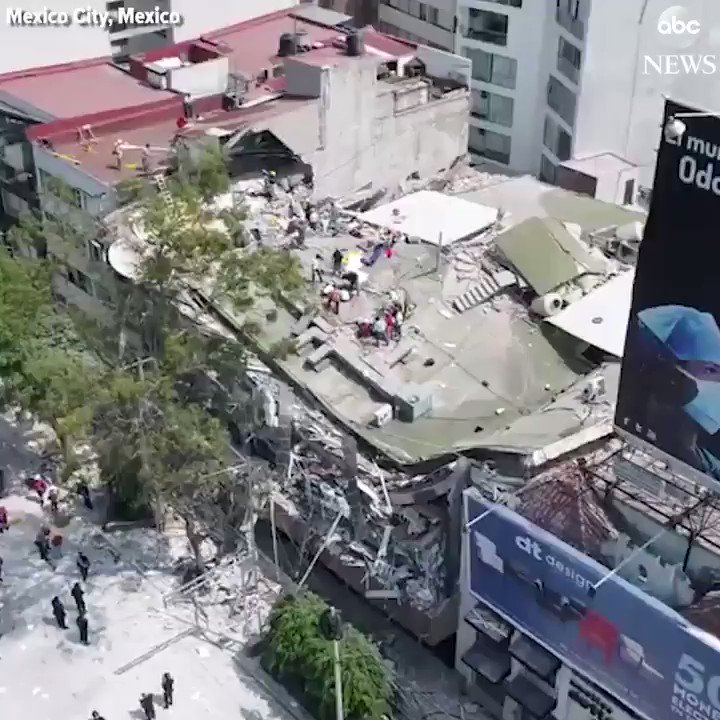
Drone footage shows destruction in Mexico City caused by the 7.1-magnitude earthquake; at least 42 people killed. http://abcn.ws/2fiNNbo

* * *
Update 2 (4:38 pm ET): The governor of the Mexican state of Morelos said at least 42 people have died in the central Mexican state, which shares a border with Puebla, the state that contains Mexico City. Counting the five confirmed deaths in the state of Puebla, the quake’s body count has risen to 47.
Meanwhile, the Mexican government has asked to restrict phone and internet use to emergency situations only as the Mexican military has arrived in the Roma and Condesa areas of the capital city.
*MEXICAN MILITARY ARRIVE IN ROMA, CONDESA AREA OF CAPITAL
*MEXICO GOV ASKS TO RESTRICT PHONE, INTERNET FOR EMERGENCIES
Mexico City’s governor says 27 buildings have collapsed…
*MEX. PRES SAYS 27 BUILDINGS IN MEX CITY HAVE COLLAPSED:TELEVISA
* * *
Update (4:05 pm ET): The BBC is reporting that several deaths have already been reported as a result of the quake. Reuters says at least five have been killed. The AP quoted Mexico City’s mayor as saying that there are reports of peole still trapped in collapsed buildings.
President Donald Trump has taken time out of his day of meetings at the UN to tweet his support: “God bless Mexico City. We are with you and we will be there for you.”
God bless the people of Mexico City. We are with you and will be there for you.

Meanwhile, there are reports that tremors were felt as far away as Guadalajara, more than 300 miles away.
On the anniversary of a massive 1985 earthquake that killed at least 5,000 people, Mexico City has been shaken by another powerful earthquake, the second the shake the city in the past two weeks. The 7.4 magnitude quake shook buildings in the capital city, sending thousands rushing into the streets, according to Reuters.
The earthquake damaged hundreds of buildings in the city, according to initial reports. Ironically, the quake hit only hours after many people participated in earthquake drills around the nation – drills specifically timed to mark the anniversary of the 1985 earthquake.

The epicenter of the quake was 5 miles (8 km) southeast of Atencingo in the central state of Puebla at a depth of 32 miles (51 km), Reuters reported, citing the US Geological Survey.
A powerful 8.1 quake hit Mexico earlier this month, killing at least 98 people.
Accordin to the Associated Press, much of Mexico City is built on former lakebed, and the soft soil can amplify earthquakes even hundreds of miles away.

The Mayor of Mexico City announced on Twitter that he had activated an earthquake-related emergency committee to organize and supervise the city’s response to the quake.

Mexican President Enrique Pena Nieto announced that he is returning to Mexico City immediately, and would convene an emergency council to supervise the federal government’s role in the disaster response. He is presently on a flight headed for Oaxaca.
En vuelo a Oaxaca. Regreso de inmediato a la Ciudad de México para atender la situación por sismo.

The breaking news headlines are still rolling in…
*MEXICO CITY QUAKE DAMAGED HUNDREDS OF BUILDINGS
*MEXICO CITY AIRPORT SUSPENDS OPS UNTIL INFRA REVIEW IS DONE
*MEXICO CITY AIRPORT SAYS IT’S INSPECTING RUNWAYS AFTER QUAKE
*MEXICO CITY AIRPORT SAYS IT’S INSPECTING TERMINALS FOR DAMAGE
*MEXICAN BOLSA CEO: STILL DECIDING WHETHER TO RESUME OPS TODAY
*MEXICO CITY QUAKE DAMAGES DOZENS BUILDINGS IN FIN. DISTRICT
*MEXICO CITY AIRPORT SAYS IT’S INSPECTING RUNWAYS AFTER QUAKE
*MEXICO CITY POLICE CLOSE OFF STREETS IN ZONA ROSA AREA
*NO QUAKE DAMAGES REPORTED AT THE MOMENT:MEXICO CIVIL PROTECTION
*7.1 MAG. EARTHQUAKE PUEBLA MEXICO :EMSC
*7.1 MAG. EARTHQUAKE CENTRAL MEXICO :GFZ
*MEXICO CITY QUAKE CAUSES POWER OUTAGE IN FINANCIAL DISTRICT
*MEXICO CITY BUILDINGS SHAKE IN EARTHQUAKE
*MEXICO BUILDINGS ROCK IN APPARENT QUAKE
*SMOKE SEEN COMING UP FROM SOME BUILDINGS IN MEXICO CITY
*MEXICO STOCKS FALL NEAR SESSIONS LOWS AFTER QUAKE
*SOME BUILDINGS IN ROMA NEIGHBORHOOD IN MEXICO CITY COLLAPSED
Here’s a map showing where the quake occurred:

Images of collapsed buildings populated twitter as residents documented the damage…


Roads around terminals at the Mexico City airport were damaged…

Roads around Terminal 2 at Mexico City International Airport are damaged. Flights diverting


Pictures of the damage are just starting to emerge on twitter:

Mexican stocks fell to the lows of the day after the quake, while the dollar surged against the peso.

Video showing the aftermath of a building collapse has emerged…

Se derrumba edificio en Alvaro Obregón, Condesa, #CDMX

…in another video, plumes of smoke can be seen rising from buildings.

BreakingNLive: BREAKING NEWS: VIDEO SHOWS DEBRIS OVER MEXICO CITY AS SEVERAL BUILDINGS HAVE COLLAPSED AFTER M 7.1-…

Another video shows a building shaking…

Nuevo #SISMO#Mexico
. Hace unos momentos. #19DeSeptiembre

Footage from tourist attraction Xochimilco showed tourists having a harrowing time as the quake caused choppy waters – “this is a bad idea to be one this boat!” one tourist can be heard shouting.

pic.twitter.com/t52sPsbLeb 7.1 #earthquake footage from #tourist attraction Xochimilco in #MexicoCity@newnewspage

7. OIL ISSUES
WTI and Gasoline jump after a smaller than expected crude build
(courtesy zero hedge)
WTI/RBOB Jump After Smaller Than Expected Crude Build

After last week’s record-breaking draw in Gasoline stocks, and big crude build, the noise from Harvey and Irma disruptions continues to add volatility to the data. API reported a smaller than expected crude build and bigger than expected gasoline (and distillates) draw sent prices for both WTI and RBOB higher.
API
- Crude +1.43mm (+3.9mm exp)
- Cushing +420k (+900k exp)
- Gasoline -5.063mm (-2.13mm exp)
- Distillates-6.13mm
A smaller than expected crude build and considerably bigger than expected draws in gasoline and distillates…

WTI and RBOB prices slipped lower on the day heading into the API print with Crude glued at $50…The kneejerk reaction was a spike in both WTI/RBOB…

8. EMERGING MARKET
VENEZUELA
end
Your early morning currency/gold and silver pricing/Asian and European bourse movements/ and interest rate settings TUESDAY morning 7:00 am
Euro/USA 1.1990 UP .0030/REACTING TO + huge Deutsche bank problems + USA election:/TRUMP HEALTH CARE DEFEAT//ITALIAN REFERENDUM DEFEAT/AND NOW ECB TAPERING BOND PURCHASES/ /USA FALLING INTEREST RATES AGAIN/HOUSTON FLOODING/EUROPE BOURSES MIXED
USA/JAPAN YEN 111.56 UP 0.079(Abe’s new negative interest rate (NIRP), a total DISASTER/SIGNALS U TURN WITH INCREASED NEGATIVITY IN NIRP/JAPAN OUT OF WEAPONS TO FIGHT ECONOMIC DISASTER/
GBP/USA 1.3493 DOWN .0021 (Brexit March 29/ 2017/ARTICLE 50 SIGNED
THERESA MAY FORMS A NEW GOVERNMENT/STARTS BREXIT TALKS
USA/CAN 1.2279 DOWN .0001 (CANADA WORRIED ABOUT TRADE WITH THE USA WITH TRUMP ELECTION/ITALIAN EXIT AND GREXIT FROM EU/(TRUMP INITIATES LUMBER TARIFFS ON CANADA)
Early THIS TUESDAY morning in Europe, the Euro ROSE by 30 basis points, trading now ABOVE the important 1.08 level RISING to 1.1990; / Last night the Shanghai composite CLOSED DOWN 6.02 POINTS OR 0.18% / Hang Sang CLOSED DOWN 108.36 POINTS OR 1.27% /AUSTRALIA CLOSED DOWN 0.11% / EUROPEAN BOURSES OPENED MIXED
The NIKKEI: this TUESDAY morning CLOSED UP 389.88 POINTS OR 1.06%
Trading from Europe and Asia:
1. Europe stocks OPENED MIXED/TO RED
2/ CHINESE BOURSES / : Hang Sang CLOSED DOWN 108.36 POINTS OR 0.38% / SHANGHAI CLOSED DOWN 6.02 POINTS OR 0.18% /Australia BOURSE CLOSED DOWN 0.11% /Nikkei (Japan)CLOSED UP 289.88 POINTS OR 1.06% / INDIA’S SENSEX IN THE RED
Gold very early morning trading: 1307.50
silver:$17.14
Early TUESDAY morning USA 10 year bond yield: 2.218% !!! DOWN 1 IN POINTS from MONDAY night in basis points and it is trading JUST BELOW resistance at 2.27-2.32%.
The 30 yr bond yield 2.7925, DOWN 1 IN BASIS POINTS from MONDAY night.
USA dollar index early TUESDAY morning: 91.88 DOWN 17 CENT(S) from MONDAY’s close.
This ends early morning numbers TUESDAY MORNING
xxxxxxxxxxxxxxxxxxxxxxxxxxxxxxxxxxxxxxxxxxxxxxxxxxxxxxxxxxxxxxxxxxxxxxxxxxxxxxxxxxxxxxxxxxxxxxxxxxxxxxxxxxxxxxx
And now your closing MONDAY NUMBERS
Portuguese 10 year bond yield: 2.422% DOWN 1 in basis point(s) yield from MONDAY
JAPANESE BOND YIELD: +.039% UP 1 in basis point yield from MONDAY/JAPAN losing control of its yield curve/
SPANISH 10 YR BOND YIELD: 1.556% DOWN 3 IN basis point yield from MONDAY
ITALIAN 10 YR BOND YIELD: 2.048 DOWN 3 POINTS in basis point yield from MONDAY
the Italian 10 yr bond yield is trading 48 points HIGHER than Spain.
GERMAN 10 YR BOND YIELD: +.452% UP 0 IN BASIS POINTS ON THE DAY
END
xxxxxxxxxxxxxxxxxxxxxxxxxxxxxxxxxxxxxxxxxxxxxxxxxxxxxxxxxxxxxxxxxxxxxxxxxxxxxxxxxxxxxxxxxxxxxxxxxxxxxxxxxxxxxxxxxxxxxxxxxxxxxxxxxxxxx
IMPORTANT CURRENCY CLOSES FOR TUESDAY
Closing currency crosses for TUESDAY night/USA DOLLAR INDEX/USA 10 YR BOND YIELD/1:00 PM
Euro/USA 1.1967 UP .0007 (Euro UP 7 Basis points/ represents to DRAGHI A COMPLETE POLICY FAILURE/
USA/Japan: 111.78 UP 0.300(Yen DOWN 30 basis points/
Great Britain/USA 1.3478 DOWN 0.01036( POUND DOWN 36 BASIS POINTS)
USA/Canada 1.2285 UP .0005 (Canadian dollar DOWN 5 basis points AS OIL FELL TO $49.54
xxxxxxxxxxxxxxxxxxxxxxxxxxxxxxxxxxxxxxxxxxxxxxxxxxxxxxxxxxxxxxxxxxxxxxxxxxxxxxxx
This afternoon, the Euro was UP by 7 basis points to trade at 1.1967
The Yen FELL to 111.78 for a LOSS of 30 Basis points as NIRP is STILL a big failure for the Japanese central bank/HELICOPTER MONEY IS NOW DELAYED/BANK OF JAPAN NOW WORRIED AS AS THEY ARE RUNNING OUT OF BONDS TO BUY AS BOND YIELDS RISE
The POUND FELL BY 36 basis points, trading at 1.3478/
The Canadian dollar FELL by 5 basis points to 1.2285, WITH WTI OIL FALLING TO : $49.54
Your closing 10 yr USA bond yield UP 3 IN basis points from MONDAY at 2.2410% //trading well ABOVE the resistance level of 2.27-2.32%) very problematic USA 30 yr bond yield: 2.815 UP 5 in basis points on the day /
Your closing USA dollar index, 91.94 DOWN 11 CENT(S) ON THE DAY/1.00 PM/BREAKS RESISTANCE OF 92.00
Your closing bourses for Europe and the Dow along with the USA dollar index closing and interest rates for TUESDAY: 1:00 PM EST
London: CLOSED UP 21.97 POINTS OR 0.30%
German Dax :CLOSED UP 2.40 POINTS OR 0.02%
Paris Cac CLOSED UP 8.12 POINTS OR 0.16%
Spain IBEX CLOSED UP 40.00 POINTS OR 0.39%
Italian MIB: CLOSED UP 60.68 POINTS OR 0.27%
The Dow closed UP 39.45 OR 0.18%
NASDAQ WAS closed UP 6.69 POINTS OR 0.10% 4.00 PM EST
WTI Oil price; 49.54 1:00 pm;
Brent Oil: 54.95 1:00 EST
USA /RUSSIAN ROUBLE CROSS: 58.35 DOWN 24/100 ROUBLES/DOLLAR (ROUBLE LOWER BY 58 BASIS PTS)
TODAY THE GERMAN YIELD RISES TO +0.452% FOR THE 10 YR BOND 4.PM EST EST
END
This ends the stock indices, oil price, currency crosses and interest rate closes for today
Closing Price for Oil, 5 pm/and 10 year USA interest rate:
WTI CRUDE OIL PRICE 5:00 PM:$49.87
BRENT: $55.34
USA 10 YR BOND YIELD: 2.245% (ANYTHING HIGHER THAN 2.70% BLOWS UP THE GLOBE)
USA 30 YR BOND YIELD: 2.8167%
EURO/USA DOLLAR CROSS: 1.1994 UP .0033
USA/JAPANESE YEN:111.54 up 0.034
USA DOLLAR INDEX: 91.84 DOWN 21 cent(s)/
The British pound at 5 pm: Great Britain Pound/USA: 1.3495 : DOWN 20 POINTS FROM LAST NIGHT
Canadian dollar: 1.2286 DOWN 5 BASIS pts
German 10 yr bond yield at 5 pm: +0.452%
END
And now your more important USA stories which will influence the price of gold/silver
TRADING IN GRAPH FORM FOR THE DAY
Bank Stocks, Bullion, & Bond Yields Jump Ahead Of Fed As Small-Cap VIX Hits Record Low
up…
While Small Caps and Trannies ended red, the other major indices held on to gains (record highs for Dow, S&P), though Mexico City’s quake took some shine off in ther afternoon…

Futures show selling pressure as Japan opened, Europe opened and as US opened…

Interestingly, “Most Shorted” stocks have been fading since shortly after yesterday’s open…

Retailers tanked today (orange) as banks (green) were panic bid once again into The Fed decision tomorrow…

Financials tagged recent high stops after smashing through the 50DMA finally…

FANG Stocks slid after the opening ramp but dip-buyers were there once again…

Mewanwhile, Russell 2000 VIX collapsed to a new all-time record low…

And then there’s this utter fucking farce…

Around 1pm local time, Mexico City was hit by a 7.2 quake which sent the peso and mexican stocks lower…

Markets are implying zero chance of a rate hike tomorrow but December’s odds surged from high teens to over 53% in the last few days…

Treasury yields ended modestly higher ahead of The Fed tomorrow…
With 10Y Yield hovering right at the same level as when FOMC Minutes hit…

The Dollar Index leaked lower in a narrow range today…

Gold and silver rose on the day (especially after Mexico) as WTI slipped in the afternoon ahead of API data…

Gold has inched back ahead of the S&P year-to-date…

And finally, as we noted earlier, 2017’s “Big Short” is paying off…

end
Leaked reports on Donald Trump’s speech to the UN today tells that he is set to label Iran and North Korea as “global threats”. He is also demonizing Venezuela’s Maduro for his undemocratic stance in Venezuela
(courtesy zero hedge)
Watch Live: President Trump Set To Label Iran, North Korea “Global Threats” During First UN Address
President Donald Trump will deliver his first address to the United Nations General Assembly Tuesday at 10 am. His remarks will be streamed on the UN’s live feed, available below…
Since late yesterday, senior members of the Trump administration, a group that may include the president himself, have been furiously leaking details of the president’s first address to the United Nations to various media outlets. The upshot, according to the WSJ, is that the president’s speech – perhaps his most highly anticipated since his first address to a joint session of Congress back in February – will focus largely on railing against the US’s many geopolitical enemies while attempting to reconcile Trump’s “America First” populism with the US’s role as a global leader. In particular, he’s expected to try and rally international support for suppressing North Korea’s nuclear program, while labeling both Iran and the isolated North as “global threats.” Moving further down the list of US enemies, Trump is expected to castigate Venezuelan President Nicolas Maduro for his anti-demoncratic crackdowns as his country continues to sink into economic chaos, driven by low oil prices and years of mismanagement.
According to WSJ, Trump will also touch on the need for reforming the UN, which he criticized in remarks made Monday during a working group for being too bloated and overly bureaucratic, while advocating a foreign policy that’s “driven by outcomes.”
“Mr. Trump will call for more burden sharing and cooperation among countries on issues including the fight on terrorism, North Korea’s nuclear and military threat, and Iran’s adherence to a multinational nuclear deal.
He will also mention reforms at the U.N. and the role countries play in enabling North Korea’s regime, though it wasn’t clear whether Mr. Trump will blame specific nations for keeping Pyongyang’s economy afloat despite global sanctions. He is expected also to address the crisis in Venezuela.
The address will combine the nationalistic theme of his campaign with an appeal to the nationalism of other countries as a new basis for international cooperation, the senior official said.
“It will be a foreign policy that is driven by outcomes, not by ideologies,” the official said. “What the president is doing is explaining how the principle of America First is not only consistent with the goal of international cooperation, but a rational basis for every country to engage in cooperation.”
The official said Mr. Trump dedicated considerable time fine-tuning his speech with his advisers because he believes Tuesday’s address is “an incredible moment and an enormous opportunity to demonstrate US leadership and USvalues.” However, while Trump is expected to find broad support for some issues, like condemining North Korea and combating terrorism, he may face pushback on others, like his demand that the Paris Accord be renegotiated, as well as his opposition to Iran, which signed a deal two years ago with the five members of the UN Security Council plus the European Union.
On those issues, French President Emmanuel Macron, who is also slated to speak Tuesday, could serve as a foil to his US counterpart and newfound friend.
“The [Iran nuclear] agreement is solid and we will make sure the agreement is strictly implemented,” French Foreign Minister Jean-Yves Le Drian told reporters Monday morning in New York, adding that so far there had been no indications of a breach by Iran.
Trump is also expected to repeat his criticisms that the US is shouldering too much of the financial and military burden of protecting the international community – a theme that was the focus of remarks he made at a NATO meeting earlier this year that elicited horrified responses from some NATO leaders, including Germany’s Angela Merkel, who will not be in attendance at the UN because of the federal elections being held in Germany. Trump is expected to ask oher countries to join in the defining battles of the early 21st century, echoing themes of his campaign rallies and previous foreign-policy speeches.

Of course, as the Hill notes, world leaders will likely hang on every word of Trump’s speech as they try to suss out which Trump they are dealing with: The conciliatory Trump epitomized by his address to Congress in February, or the fiery populist who speaks off the cuff and sometimes offers opinions or statements with little to no filter. Much of the political world, both right and left, “will be on tenterhooks” during his speech, the Hill reported. Trump started his week-long trip to the UN on a cautious note Monday, couching his desire for reform of the organization in diplomatic terms during a speech he gave to a forum of dignitaries that included the organization’s new secretary-general, António Guterres, the former prime minister of Portugal. Most observers expect Trump will continue in a similar vein — but they know that nothing is guaranteed.
Even some long-time Democratic strategists were saying the speech “could be a win” for Trump if he sticks to the teleprompter.
“I actually think if it is Teleprompter Trump, it could be good for him,” said Democratic strategist Joe Trippi. “But going off-script is always the danger.”
Most observers expect Trump will continue in a cautious vein – but as Trump’s adversaries have repeatedly learned, when dealing with Trump, nothing is guaranteed. To be sure, a more measured approach would help defeat Trump’s reputation for “conducting foreign policy in inflammatory terms, generating tension with US allies,” as the Hill describes it. During his one-on-one meetings Monday with Macron and Israeli Prime Minister Benjamin Netanyahu, Trump offered a more conventional approach – most of the time.
As the Hill recounts, Trump promised to give plans for peace between Israel and the Palestinians “an absolute go” during remarks with Netanyahu, while telling Macron that the unpopular French president pulled off “one of the great election victories of all time” and was doing “a terrific job.”
Yet Tuesday will bring a more difficult test, as Trump tries to rally an international community that is deeply skeptical of him to put greater pressure on North Korea. Notably, the leaders of Russia and China —both permanent members of the UN Security Council — are not attending the summit. Trump has had what could be described as a “love-hate” relationship with both Russian President Vladimir Putin and Chinese President Xi Jinping since taking office.
For his part, Trump admits that some of the topics he will cover may be “tricky,” but that he is looking forward to the challenge.
end
Trump approves Puerto Rico emergency declaration as Maria first strengthens into a potentially catastrophic Cat 5 hurricane. It is now a Cat 4 heading straight for Puerto Rico
(courtesy zero hedge)
Trump Approves Puerto Rico Emergency Declaration As Maria Strengthens Into “Potentially Catastrophic” Cat-5 Hurricane
Update: The National Hurricane Center reports that Hurricane Maria has just strengthened to a “potentially catastrophic” Category-5 Storm with winds expected over 160mph.

Maria’s track places her right over the top of Puerto Rico on Tueaday…

President Trump authorizs Homeland Security Dept., FEMA to coordinate all disaster relief efforts, supplementing local response efforts resulting from Hurricane Maria.

Does this look familiar?

As AP reports, Hurricane Maria has intensified into a dangerous Category 4 storm as it bears down on the Caribbean.
The National Hurricane Center in Miami said Monday the storm is growing in strength as it approaches land. The eye of the storm is expected to pass near the island of Dominica on Monday evening.
The center called the storm “extremely dangerous,” with maximum sustained winds of 130 mph (215 kph).
At 5 p.m. EDT, the storm was centered about 45 miles (70 kilometers) east-southeast of Dominica.
A Hurricane warning has been issued for Puerto Rico, Culebra, and Vieques.
* * *
As we detaile earlier, less than two weeks after Hurricane Irma hammered the Caribbean, leaving the tiny island of Barbuda uninhabitable and hundreds of thousands of Puerto Ricans without power, Hurricane Maria is expected to follow closely behind its predecessor, delivering another destructive blow to the region before most areas affected by Irma have had time to recover. As Hurricane Maria hastens toward the eastern Caribbean, forecasters are warning that it could strengthen into a major storm by the time it passes through the Leeward Islands later Monday, according to CBS. That poses a huge problem for residents of the Caribbean.
After reaching category-one hurricane strength on Sunday, CBS reports that Maria is expected to quickly become much stronger over the next two days and follow a path that would take it near many of the islands wrecked by Hurricane Irma and on to Puerto Rico, the Dominican Republic and Haiti.
The National Hurricane Center has already issued advisories for much of the Caribbean. Here’s a summary of the NHC’s latest update, including stats about Maria’s location and attributes as of 5 a.m. Monday. Note that the storm has maximum wind speeds of 90 mph….
“Significant strengthening is forecast during the next 48 hours, and Maria is expected to become a dangerous major hurricane before it moves through the Leeward Islands,” according to the National Hurricane Center’s latest update.
SUMMARY OF 500 AM AST…0900 UTC…INFORMATION
———————————————-
LOCATION…14.6N 59.5W
ABOUT 100 MI…160 KM E OF MARTINIQUE
ABOUT 130 MI…215 KM ESE OF DOMINICA
MAXIMUM SUSTAINED WINDS…90 MPH…150 KM/H
PRESENT MOVEMENT…WNW OR 290 DEGREES AT 13 MPH…20 KM/H
MINIMUM CENTRAL PRESSURE…977 MB…28.85 INCHES
SUMMARY OF WATCHES AND WARNINGS IN EFFECT:
A Hurricane Warning is in effect for…
* Guadeloupe
* Dominica
* St. Kitts, Nevis, and Montserrat
* Martinique
A Tropical Storm Warning is in effect for…
* Antigua and Barbuda
* Saba and St. Eustatius
* St. Lucia
A Hurricane Watch is in effect for…
* Puerto Rico, Vieques, and Culebra
* U.S. Virgin Islands
* British Virgin Islands
* Saba and St. Eustatius
* St. Maarten
* St. Martin and St. Barthelemy
* Anguilla
A Tropical Storm Watch is in effect for…
* Barbados
* St. Vincent and the Grenadines
Indeed, Maria is likely to be at category 3 or 4 storm by the time it moves into the extreme northeastern Caribbean Sea, according to NHC forecasts. While only one of three storms churning in the Atlantic Ocean, it poses the biggest threat to the Caribbean, which is struggling to recover from Irma.
Hurricane #Maria Advisory 7: Maria Forecast to Become a Major Hurricane as it Moves Near The Leeward Islands. http://go.usa.gov/W3H

Hurricane conditions should begin to affect parts of the Leeward Islands later Monday and Monday night, potentially causing a storm surge that raises water levels by four to six feet near Maria’s center. The storm was predicted to bring 6 to 12 inches of rain across the islands, with more in isolated areas.

But in what’s perhaps the biggest concern, at least for the US government, Maria could make landfall on Puerto Rico, causing potentially more devastation than Irma, which passed close by the island, but didn’t make landfall.

To wit, Puerto Rico Gov. Ricardo Rossello said officials had prepared about 450 shelters with a capacity for nearly 68,000 people, or even 125,000 in an emergency. He said schools were cancelled for Monday and government employees would work only a half day. Officials in the Dominican Republic urged people to leave areas prone to flooding and said fishermen should remain in port, according to CBS.
Worse still, some forecasters are warning that by the time Maria makes landfall in PR, it could be a category four storm.
#HurricaneMaria could hit Puerto Rico on Wednesday as a Cat 4. https://twitter.com/NHC_Atlantic/status/909610439008555008 …

Hurricane #Jose Advisory 52: Jose Weakens a Little. Still Moving Northward. http://go.usa.gov/W3H
Meanwhile the National Hurricane Center reports that Hurricane Jose – one of three active storms in the Atlantic – has begun to weaken as it moves northward past the east coast of the US. While the storm appears to be too far away from the coastline to threaten a landfall, it could create “potentially dangerous surf and rip currents…along the east coast of the US” from Delaware to Cape Cod. Early Monday, Jose was centered about 280 miles east-southeast of Cape Hatteras, North Carolina, and was moving north at 9 mph. It had maximum sustained winds of 85 mph.

In the Pacific, Tropical Storm Norma threatened Mexico’s Los Cabos resort area at the southern end of the Baja California peninsula seemed to ease as forecasters said the storm’s center was likely to remain offshore.
END
Hurricane Maria causes widespread devastation in Dominica as it heads for Puerto Rico
(courtesy zero hedge)
Hurricane Maria Causes “Widespread Devastation” In Dominica As It Races Toward Puerto Rico
In less than two days, Hurricane Maria has strengthened from a tropical storm to a powerful category five hurricane, dubbed in no uncertain terms as “catastrophic” by the NHC. Though it has been downgraded to a category 4 overnight, the storm made landfall on the tiny Caribbean island of Dominica, leaving it utterly “devastated,” according to the island’s prime minister.

“We’re just waiting for daybreak to do an assessment of the damage,” Dominica Prime Minister Roosevelt Skerrit told CNN’s Rosemary Church.
The storm, which made landfall Monday night, has maximum sustained winds of 155 mph, and remains on track to directly hit Puerto Rico, what would make it the first category four hurricane to directly hit the island in 85 years, according to CNN. Skerrit said the island’s “first order of business” following the storm would be to make sure “every single citizen and resident is safe.”

A statement from the National Hurricane Center said Maria’s winds reached 160 miles per hour when it hit the island nation. In an update, the Center said that reports “indicate significant damage to structures has occurred in Dominica.”
In a Facebook post, Skerrit said “initial reports are of widespread devastation. So far we have lost all what money can buy and replace. My greatest fear for the morning is that we will wake to news of serious physical injury and possible deaths as a result of likely landslides triggered by persistent rains.”

Meanwhile, the storm early Tuesday morning made landfall on the tiny island Guadalupe, where it is battering homes and businesses with torrential rains and hurricane-force winds…


Puerto Rico Gov. Ricardo Rosselló has declared a state of emergency ahead of Maria’s landfall, which will likely happen Wednesday. Fortunately, President Donald Trump issued an emergency declaration for federal assistance to augment PR’s ability to respond to the storm, as well as the US Virgin Islands.

#Maria regains category 5 intensity with maximum sustained winds of 160 mph. http://hurricanes.gov
A hurricane warning remains in effect for Guadeloupe, Dominica, St. Kitts, Nevis, and Montserrat, the US and British Virgin Islands as well as Puerto Rico, Culebra, and Vieques.
According to CNN, the ferocity of Maria bears striking similarities to Hurricane Andrew, a Category 5 hurricane that hit the Bahamas and Florida in 1992. Both storms are compact, and Maria’s wind speed comes close to that of Hurricane Andrew, 165 mph, when it hit southern Florida.


Latest graphics from @NHC_Atlantic on #Maria wind field & timeline (subject to change) of when they can be expected.

After a close brush with Irma left much of the island without power, Puerto Rico sheltered many of the evacuees who fled Hurricane Irma’s wrath in other Caribbean islands. Now those evacuees and native Puerto Ricans are bracing for another powerful hurricane. PR Governor Ricardo Rossello ordered evacuations ahead of the impact, telling CNN that extensive preparations had been made to mitigate Maria’s potential impact. The governor added that the island is as “ready as we can be” for Maria.
“We’re as ready as we can be,” he told CNN’s Don Lemon.
“This sort of event is a very dangerous event, high winds, a slow storm and a lot of rainfall. And this coming just about two weeks after Irma skirted off the northeast of Puerto Rico.
“We’ve made preparations… we’ve focused on really the only thing that matters right now, which is making sure people are safe. We have 500 shelters, (we’re) moving people to those shelters and hopefully weathering the storm so we can rebuild Puerto Rico.
Calling its potential impact “catastrophic,” Rosselló said that the island was expected to experience tropical storm force winds for about two and a half days and sustained high level hurricane winds for “the better part of a day.”
According to Bloomberg, Rossello added that residents who live in flood zones are in danger.
“If you are in a flood zone or in a wood house, your life is in danger,” Governor Ricardo Rossello said during a press conference Monday in San Juan. “There has never been an event like this in our history in the last 100 years. Our call is for all citizens to move to a safe place.”
If Maria strikes the island as forecast, it will be “more dangerous than Hugo and Georges,” Rossello said. Hurricane Hugo killed five people in Puerto Rico in 1989, and Hurricane Georges caused more than $1.7 billion in damage to the island in 1998. In Salinas, a city on the island’s southern coast where the storm is expected to hit hard, CNN saw dozens of people queuing for water and essentials ahead of the hurricane’s anticipated impact.

Round two of Hurricane shopping in 2 weeks. @CNN#HurricaneMaria

The Puerto Rico Convention Center in San Juan is still housing Hurricane Irma evacuees from other Caribbean islands. But it is preparing to accept thousands of residents who’ve been displaced by Maria.
As Bloomberg also notes, Puerto Rico, a bankrupt island that’s still dealing with the aftermath of a storm that caused as much as $1 billion of damage and left hundreds of thousands without power, faces even more upheaval with Hurricane Maria. The government of Puerto Rico ordered rationing of basic necessities, including water and batteries – although those items were already gone from some San Juan store shelves.
Prepa, PR’s government-run utility, is still trying to restore power to hundreds of thousands of residents after its electrical infrastructure sustained as much as $400 million of the nearly $1 billion of damage from Irma. The average age of the company’s plants is 44 years, meaning its infrastructure is dated and vulnerable.
* * *
Meanwhile, Hurricane Jose continues to make its way along the east coast, causing choppy surf and wind, but no real damage to the US, with the worst affects being felt along Cape Cod, according to the NHC.

end
Almost one month after Harvey hit, conditions inside the Houston area are still dire:
(courtesy zero hedge)
“I Don’t Have Anything To Start Over” – Harvey Victims Pray For Relief As 1000s Remain Stuck In Shelters
It’s been nearly a month since Hurricane Harvey, a storm that some expect to rank among the costliest natural disasters in US history, and still tens of thousands of Texans remain marooned in temporary housing, unable to return to their flood-damaged homes, while thousands more are struggling to secure hotel rooms and other types of temporary housing, according to the Wall Street Journal.
The scramble for housing has caused occupancy rates at hotels in the Houston area to surge as disaster recovery officials scramble to arrange short-term and permanent housing for those left homeless by the storm. The task of securing shelter for the displaced could take months.
“Lillian Godfrey has been sleeping on an air mattress on the floor of her friend’s shuttered night club, alongside her daughter and two pool tables, ever since floodwaters swept into her home here last month.
Ms. Godfrey, 74 years old, has a federal voucher for a hotel, but hasn’t had any luck finding a room nearby. Her daughter’s cars were lost in the flooding.
“’It’s heartbreaking,’ she said. “The Lord closes some doors and opens others. He’s going to pull me through this sooner or later.’”
As recently as Saturday night, 4,700 people remained in Red Cross shelters across Texas on Saturday night, according to the relief group. Initially as many as 450,000 Texans were displaced by the storm, while as many as 30,000 sought temporary relief in one of the state’s shelters.

Some of the displaced, uneasy with the prospect of living elsewhere, have remained in their water-damaged homes. Others were staying with friends, family or even strangers.
For the first full week of September, hotel occupancy in Houston grew to 80.5%, nearly double the occupancy rate from the same period a year earlier, according to STR Inc., a data company that tracks the hotel industry.
It is still unclear how many people in Texas will lose their homes because of the storm or how many eventually will be able to move back. But some estimates expect the total damages to property and the US economy in terms of lost productivity could tally as high as $190 billion.
“While the final scope and scale of the housing challenge is still being realized, it is already apparent that this will be one of the largest, most complex efforts ever undertaken,” said Michael Byrne, who is heading up relief efforts in Texas for the Federal Emergency Management Agency.
According to data collected by WSJ from the state, city and county level, some estimated 50,712 homes suffered major damage in the storm. Meanwhile, 14,952 were destroyed and 76,364 experienced minor damage.
Local officials say 130,000 single-family homes in Harris County, which includes Houston, were estimated to have been affected by the rampant flooding. Between 2,000 and 3,000 large apartment buildings likely sustained damage, and up to 5,000 smaller apartment buildings may have been damaged as well.
“In terms of the sheer destruction due to the flooding, this is unprecedented in modern times for Houston,” said Tom McCasland, Houston’s director of housing and community development.”
In some towns, the flooding remains so dire that even locations that were initially planned to be shelters flooded, forcing officials to convert public buildings like schools into back up shelters.
“In Port Arthur, a coastal city of about 55,000, Mayor Derrick Freeman called the housing situation “dire” in the wake of heavy flooding damage.
This past week, one shelter at a middle school was full after the city’s main shelter had flooded weeks earlier, and some 250 people had been evicted from their homes by landlords because of flood damage, according to Mr. Freeman.
Another several hundred were being housed at shelters around the state, and between 4,000 and 5,000 people were still living in flood-damaged homes, Mr. Freeman said.”
In Port Arthur, city officials had hoped to temporarily house some of the displaced on two barges that a private company was going to transport from nearby Louisiana. However, by Friday, plans had shifted, and large air-conditioned tents were brought in by FEMA and the state to house the evacuees who had been sheltering at the school.
Meanwhile, many victims who were given hotel vouchers by FEMA are finding it difficult to secure rooms thanks to sky high occupancy rates.
“Debby Valsin, a 54-year-old retiree, had been living at the middle school shelter in Port Arthur with her nine-year-old grandson. She said her landlord terminated her lease after the floods because her apartment was uninhabitable, giving her five days to haul out her belongings.
Ms. Valsin qualifies for a FEMA hotel voucher but said all the nearby hotels she called are full. For now, with the start of school Monday, Ms. Valsin expected to be moved from the shelter into the tents.
‘Your life is upside down,’ she said. ‘I don’t have anything to start over.’”
However, while the situation remains incredibly dire for people on the ground, there may at least be a silver lining in the unprecedented damage brought by the storm – for auto manufacturers, that is.
As we reported last month, while terrible news to car dealers – many of whom face bankruptcy if their insurance policies don’t cover all the damages – the storm may be just what the struggling U.S. OEM and supplier industry ordered, according to a RBC.
That is, if locals have any resources left over to purchase new vehicles after their finished covering any out-of-pocket costs, which, despite President Donald Trump signing an aid package worth $15 billion.
Toys “R” Us Files Chapter 11: Second Largest US Retail Bankruptcy In History
Toys “R” Us Inc., the largest US “brick and mortar” toys retailer, filed for bankruptcy late on Monday night, as a result of a crushing post-LBO debt load and relentless competition from warehouse and online retailers, the “latest blow to a retail industry reeling from store closures, sluggish mall traffic and the gravitational pull of Amazon.com” according to Bloomberg. The Chapter 11 filing is among the largest ever by a specialty retailer and casts doubt over the future of its about 1,600 stores and 64,000 employees. It comes just as Toys ‘R’ Us is gearing up for the holiday shopping season, which accounts for the bulk of its sales, and as vendors halt shipments to the now insolvent retailer.
With assets of $6.9 billion, it’s the second-largest retail bankruptcy, trailing the filing in 2002 by Kmart, which had $14.6 billion in assets.
The company was saddled with debt from a $6.6 billion buyout in 2005 led by KKR, Bain Capital and Vornado Realty Trust. Toys ‘R’ Us has bonds coming due over the next few years that lost most of their value this month.

“While today’s decision does not necessarily mean it is game over for Toys ‘R’ Us, it brings to a close a turbulent chapter in the iconic company’s history,” said Neil Saunders, managing director of GlobalData Retail.
“What they have going for them is they are the last major player in their market,” said David Berliner, a partner and restructuring specialist with BDO Consulting. “The vendors don’t want to see them fail, so I think they have a good opportunity to survive.”
The company listed debt and assets of more than $1 billion in its Chapter 11 filing submitted Monday at the U.S. Bankruptcy Court in Richmond, Virginia (an odd place for such a major bankruptcy filing). Prior to filing, the company said that it had secured more than $3 billion in financing from lenders including a JPMorgan Chase & Co.-led bank syndicate and certain existing lenders to fund operations while it restructures. The money will be critical to provide comfort to Toys “R” Us vendors that they will be paid on time. Yesterday the stocks of some key suppliers such as Hasbro and Mattel were hit in advance of the filing.
When reports surfaced recently that Toys “R” Us was weighing a bankruptcy filing, Chinese toy scooter maker Pinghu Mijia Child Product Co. put all of the retailer’s orders on hold, fearing it wouldn’t get paid, according to sales manager Justin Yu, Bloomberg reported. The toy retailer represents about 10 to 20 percent of the Chinese supplier’s sales. “We were shocked to hear the news last week because their orders to us have been rising every year, so we did not know they were in trouble,” Yu said. “They’re a major buyer and I would say that the majority of toy makers in China would have some contracts with them.”
The bankruptcy filing by the company also may have global implications, especially for Chinese toy manufacturers. Some 38 percent of the company’s revenue came from overseas markets in the latest fiscal year. “It’s a loss for the long-term benefit of the entire industry,” said Lun Leung, chairman of Hong Kong-based Lung Cheong Group, a toy supplier for Hasbro Inc. He said Toys “R” Us accounted for less than 5 percent of the group’s sales.
“We expect that the financial constraints that have held us back will be addressed in a lasting and effective way,” Chief Executive Dave Brandon said. “Together with our investors, our objective is to work with our debtholders and other creditors to restructure the $5 billion of long-term debt on our balance sheet.”
The company’s Canadian unit intends to seek protection in parallel proceedings under the Companies’ Creditors Arrangement Act (CCAA) in the Ontario Superior Court of Justice, Toys ‘R’ Us said in a statement. Operations outside of the United States and Canada, including about 255 licensed stores and joint venture partnerships in Asia, which are separate entities, are not part of the bankruptcy proceedings, Toys ‘R’ Us said.
As an indication of the challenges faced by the struggling retailer, the company opened a temporary store in New York City’s Times Square this year to capture more holiday shoppers, almost two years after it closed its flagship store barely a block away, driven out by high rents.
More than a dozen significant retail chains have filed for bankruptcy this year. Among them were Perfumania Inc, apparel chains rue21 Inc and Gymboree Corp, discount shoe chain Payless Holdings LLC and designer clothing chain BCBG Max Azria Global Holdings LLC.

The shakeout is also reverberating across American malls and shopping districts. More than 10 percent of U.S. retail space, or nearly 1 billion square feet, may need to be closed, converted to other uses or renegotiated for lower rent in coming years, according to data provided to Bloomberg by CoStar Group.
Major retailers including Macy’s and Sears Holding have closed hundreds of locations as they struggle to compete discounters such as Wal-Mart and Amazon.com. Amazon’s recent acquisition of high-end grocer Whole Foods Markets Inc stirred speculation that the online giant will use its pricing power and huge reach among U.S. consumers to go after market share of traditional brick-and-mortar grocers.
end
Building permits rebound in August as multiple unit demand picks up
(courtesy zero hedge)
Building Permits Rebound In August As ‘Rental Nation’ Demand Returns
Following July’s collapse in housing data (from permits to sales), August data for Housing Starts were supposed to bounce back but didn’t (falling 0.8% MoM vs +1.7% exp) and Permits were expected to fall 0.8% but spiked 5.7% MoM (thanks to a big jump in multi-family units).

So it appears last month’s ugly Housing Starts data was revised sharply higher on the back of a jump in multi-family units…

And Multi-family Permits jumped notably…

Finally for those who need simplicity – here is the performance of US Homebuilder stocks relative to the performance of US housing market data…

So, why bother looking at the housing data at all?
Study Shows Student Debt Delays Home Buying By Seven Years
Authored by Mike Shedlock via MishTalk.com,
The Student Loan Debt and Housing Report 2017 by the National Association of Realtors and the nonprofit group American Student Assistance shows the obvious: Student debt delays household formation, home buying, and saving.

The U.S. currently has a student debt load of $1.4 trillion, which accounts for 10 percent of all outstanding debt and 35 percent of non-housing debt. The magnitude of the debt continues to grow in size and share of the overall debt in the economy. While this amount of debt has risen, the homeownership rate has fallen, and fallen more steeply among younger generations.
Student loan debt impacts other life decisions including employment, the state the debt holder lives in, life choices such as continuing education, starting a family, and retirement.
Twenty-two percent were delayed by at least two years in moving out of a family member’s home after college due to their student loans.
Among non-homeowners, 83 percent cite student loan debt as the factor delaying them from buying a home. This is most frequently the case due to the fact that the borrowers cannot save for a downpayment because of their student debt. Among homeowners, 28 percent say student debt is impacting the ability to sell their existing home and move to a different home. The delay in buying a home among non-homeowners is seven years and three years for homeowners.
Awareness of Tuition Costs
- Before attending college, 28 percent of borrowers knew generally the school “might be expensive” or “might be cheap”, but had no further information.
- More than one-quarter of borrowers had an understanding of tuition, but had little understanding of other costs such as fees and housing expenses.
- One in five borrowers understood all the costs including tuition, fees, and housing.
Defaults
- Thirty-two percent of student loan borrowers surveyed had defaulted or forbore on their student loan debt
- Two-fifths of borrowers who had personal incomes of less than $25,000 in 2016 had defaulted or forbore on their student loan debt in the past.
Life Choices
- Among life choices, more than half of respondents believe they are delayed in continuing their education or starting a family due to student loan debt.
- Forty-one percent would like to get married, but are delayed from marriage due to their student loan debt.
- Only 13 percent of respondents did not have a life event delayed due to debt.
- 28 percent of respondents rent with roommates.
- Fifteen percent live with friends or family and pay rent, and 15 percent live with friends and family and do not pay rent.
- Twenty percent own their own home and 16 percent rent solo.
- Thirty-five percent of younger millennials live with family (both paying and not paying rent) compared to just 24 percent of older millennials.
Student Debt Impacts

Mish Notes
- Younger millennials are those born 1990 to 1998. Older millennials are those born 1980 to 1989.
- The study did not ask how many regretted going to college.
- The study did not ask how many regretted paying what they did pay for college.
end
Government Wiretapped Manafort Since 2014; Was Threatened With Indictment During House Raid, Report
With all of the massive hurricanes safely swirling far away from the continental U.S., for a few days at least, the New York Times and CNN has once again returned to their regularly scheduled programming: 24×7 Coverage Of Russian Collusion. Of course, just like their prior coverage, today’s ‘bombshell’ reports, which center around Paul Manafort, are heavy on the sensationalized story telling and light on the facts.
First, the New York Times brings us new, fascinating details of precisely how Robert Mueller raided Paul Manafort’s house earlier this summer using “shock-and-awe tactics to intimidate witnesses and potential targets of the inquiry.”
Paul J. Manafort was in bed early one morning in July when federal agents bearing a search warrant picked the lock on his front door and raided his Virginia home. They took binders stuffed with documents and copied his computer files, looking for evidence that Mr. Manafort, President Trump’s former campaign chairman, set up secret offshore bank accounts. They even photographed the expensive suits in his closet.
The special counsel, Robert S. Mueller III, then followed the house search with a warning: His prosecutors told Mr. Manafort they planned to indict him, said two people close to the investigation.
The moves against Mr. Manafort are just a glimpse of the aggressive tactics used by Mr. Mueller and his team of prosecutors in the four months since taking over the Justice Department’s investigation into Russia’s attempts to disrupt last year’s election, according to lawyers, witnesses and American officials who have described the approach. Dispensing with the plodding pace typical of many white-collar investigations, Mr. Mueller’s team has used what some describe as shock-and-awe tactics to intimidate witnesses and potential targets of the inquiry.
“They are setting a tone. It’s important early on to strike terror in the hearts of people in Washington, or else you will be rolled,” said Solomon L. Wisenberg, who was deputy independent counsel in the investigation that led to the impeachment trial of President Bill Clinton in 1999. “You want people saying to themselves, ‘Man, I had better tell these guys the truth.’”
Meanwhile, and perhaps more interestingly, CNN‘s anonymous sources have apparently revealed that Manafort has been under an ongoing wiretap, approved by the FISA courts, going back to 2014 and tied to his consulting arrangements with Ukraine’s former ruling party.
Ironically, CNN notes the “surveillance was discontinued at some point last year for lack of evidence” but was then restarted with a “new FISA warrant that extended at least into early this year”...all of which sounds an awful lot like the Obama administration using FISA courts to spy on a political opponent.
US investigators wiretapped former Trump campaign chairman Paul Manafort under secret court orders before and after the election, sources tell CNN, an extraordinary step involving a high-ranking campaign official now at the center of the Russia meddling probe.
The government snooping continued into early this year, including a period when Manafort was known to talk to President Donald Trump.
Some of the intelligence collected includes communications that sparked concerns among investigators that Manafort had encouraged the Russians to help with the campaign, according to three sources familiar with the investigation. Two of these sources, however, cautioned that the evidence is not conclusive.
Special counsel Robert Mueller’s team, which is leading the investigation into Russia’s involvement in the election, has been provided details of these communications.
A secret order authorized by the court that handles the Foreign Intelligence Surveillance Act (FISA) began after Manafort became the subject of an FBI investigation that began in 2014. It centered on work done by a group of Washington consulting firms for Ukraine’s former ruling party, the sources told CNN.
The surveillance was discontinued at some point last year for lack of evidence, according to one of the sources.
The FBI then restarted the surveillance after obtaining a new FISA warrant that extended at least into early this year.

Speaking of “shock and awe”, the NYT piece goes on to cast an even greater shadow over the Trump campaign by comparing it to an “organized crime syndicate.”
“They seem to be pursuing this more aggressively, taking a much harder line, than you’d expect to see in a typical white collar case,” said Jimmy Gurulé, a Notre Dame law professor and former federal prosecutor. “This is more consistent with how you’d go after an organized crime syndicate.”
The tactics reflect some of the hard-charging — and polarizing — personalities of Mr. Mueller’s team, seasoned prosecutors with experience investigating financial fraud, money laundering and organized crime.
Admirers of Andrew Weissmann, one of the team’s senior prosecutors, describe him as relentless and uncompromising, while his detractors say his scorched earth tactics have backfired in some previous cases. Greg B. Andres, another one of Mr. Mueller’s prosecutors, once ran an investigation into a Mafia kingpin. Zainab N. Ahmad made her name as a prosecutor pursing high-profile terrorism cases.
Finally, and to our complete shock, the NYT goes on to point out at the bottom of the article (you know about 2,000 words in after most folks have already fallen asleep or just moved on) that Manafort is under investigation for “possible violations of tax laws, money-laundering prohibitions and requirements to disclose foreign lobbying”…all of which seem related to the FBI’s 2014 investigation of Manafort’s consulting practice and not the Trump campaign.
Mr. Manafort is under investigation for possible violations of tax laws, money-laundering prohibitions and requirements to disclose foreign lobbying.
The wide-ranging nature of Mr. Mueller’s investigation could put him on a collision course with Mr. Trump, who has said publicly that Mr. Mueller should keep his investigation narrowly focused on last year’s presidential campaign. In an interview with The New York Times, Mr. Trump said Mr. Mueller would be overstepping his boundaries if he investigated his family’s finances unrelated to Russia.
Conclusion, Mueller’s team is desperately trying to scare anyone they can into confessing something/anything that might possibly implicate the Trump campaign. Of course, as Katy Harriger, a professor of politics at Wake Forest University, points out, the longer Mueller’s investigation goes on, the more vulnerable he will be to allegations that he is on a fishing expedition…
end
It gets worse for Equifax: the company was originally hacked in March and again it did not disclose this fact to the public..however insiders sold stock
(courtesy zerohedge)
More Equifax Lies? Company Originally Hacked Five Months Earlier Than It Disclosed
When Equifax first disclosed the shocking news on September 7 that its servers and some 143 million private account had been hacked, leaking everything from names, to addresses, to social security numbers, it stated in its press release that it had “learned of the incident on July 29, 2017″ adding that “at which point it reported the intrusion to law enforcement and contracted a cybersecurity firm to conduct a forensic review: based on the company’s investigation, the unauthorized access occurred from mid-May through July 2017.”
As we commented then, it “oddly enough took shareholders and over a third of America, more than a month longer to learn that all their personal data may have been compromised.”
And now, according to Bloomberg, it appears the company had lied again as it wasn’t “only one month” but nearly six that the company was aware that its systems had been violated without acting on the information::
Equifax Inc. learned about a major breach of its computer systems in March — almost five months before the date it has publicly disclosed, according to three people familiar with the situation
While the March breach was reportedly not related to the hack that exposed the personal and financial data on 143 million U.S. consumers, “one of the people said the breaches involve the same intruders. Either way, the revelation that the 118-year-old credit-reporting agency suffered two major incidents in the span of a few months adds to a mounting crisis at the company, which is the subject of multiple investigations and announced the retirement of two of its top security executives on Friday.” That one of the top security executives also happened to be a music major who desperately tried to scrub her public background has not helped the company’s case.
Some further details from Bloomberg:
Equifax hired the security firm Mandiant on both occasions and may have believed it had the initial breach under control, only to have to bring the investigators back when it detected suspicious activity again on July 29, two of the people said.
Equifax’s hiring of Mandiant the first time was unrelated to the July 29 incident, the company spokesperson said. Vitor De Souza, senior vice president for global marketing at FireEye Inc., Mandiant’s parent company, declined to comment.
As Bloomberg hedges, “there’s no evidence that the publicly disclosed chronology is inaccurate, but it leaves out a set of key events that began earlier this spring, the people familiar with the probe said.”
In any even, while the company’s lawyers are surely looking for just the right explanation to justify sitting on news of cyberbreach for months before it was too late, the revelation of the March hack will complicate the company’s efforts to explain a series of unusual stock sales by Equifax executives.
If it’s shown that those executives did so with the knowledge that either or both breaches could damage the company, they could be vulnerable to charges of insider trading.
As reported earlier, the U.S. Justice Department has opened a criminal investigation into the stock sales, according to people familiar with the probe. As a reminder, Equifax originally disclosed that it discovered the security breach on July 29, and shortly after – in early August – the three executives sold shares worth almost $1.8 million.
The company has said the managers didn’t know of the breach at the time they sold the shares, although in light of the latest news that appears rather inconceivable.
Insider trading charges aside, there is the question of all those piling lawsuits:
new questions about Equifax’s timeline are also likely to become central to the crush of lawsuits being filed against the Atlanta-based company. Investigators and consumers alike want to know how a trusted custodian of so many Americans’ private data could let hackers gain access to the most important details of financial identity, including social security and driver’s license numbers, and steal credit card numbers.
Meanwhile, far from keeping the original hack a secret, “in early March Equifax began notifying a small number of outsiders and banking customers that it had suffered a breach and was bringing in a security firm to help investigate. The company’s outside counsel, Atlanta-based law firm King & Spalding, first engaged Mandiant at about that time. While it’s not clear how long the Mandiant and Equifax security teams conducted that probe, one person said there are indications it began to wrap up in May.”
The revelation of an earlier breach – and one which comes from the press instead of the company itself – will likely raise questions for the company’s executives over whether that investigation was sufficiently thorough or if it was closed too soon, and also why it wasn’t disclosed as part of the Sept. 7 press release.
For example, Equifax has said that the hackers entered the company’s computer banks the second time through a flaw in the company’s web software that was known in March but not patched until the later activity was detected in July.
For now, however, what will get the most scrutiny in light of the new timeline is the stock sales by company insiders: on Aug. 1 and Aug. 2, regulatory filings show that three senior Equifax executives sold shares worth almost $1.8 million, with none of the filings listing the transactions
as being part of scheduled 10b5-1 trading plans. Equifax’s ChiefFinancial Officer John Gamble sold shares worth $946,374; Joseph Loughran, president of U.S. information solutions, exercised options to
dispose of stock worth $584,099; and Rodolfo Ploder, president of workforce solutions, sold $250,458 of stock.
Equifax has said the executives “had no knowledge that an intrusion had occurred at the time,” and the company spokesperson declined to make them available for comment.
Now, under the new timeline, the insider sales come several months after the March breach but before the public had any knowledge of major security issues at one of the country’s three big credit-reporting agencies. The new timeline is also likely to focus scrutiny on an earlier sale by Gamble of 14,000 shares on May 23. According to a regulatory filing, which didn’t indicate that the sale was part of a scheduled trading plan, the value of that transaction was $1.91 million, more than twice the size of his Aug. 1 disposal of 6,500 shares for $946,374.
Another question is who is behind the hack, and whether these were two separate incidents, or one organized breach:
If the two hacks are unrelated it could be that different hacking teams had different goals. One clue has emerged that suggests one goal of the attackers was to use Equifax as a way into the computers of major banks, according to a fourth person familiar with the matter.
This person said a large Canadian bank has determined that hackers claiming to sell celebrity profiles from Equifax on the dark web — information that appears to be fraudulent, or recycled from other breaches — did in fact steal the username and password for an application programming interface, or API, linking the bank’s back-end servers to Equifax.
According to Bloomberg, the discovery suggests that the attackers may have been trying to piggyback off of Equifax’s connections to large banks and other financial institutions as a backdoor way to hack those entities and gain access to sensitive partner systems. The company spokesperson said Equifax is “working diligently with our bank partners to assess and mitigate any impact to their operations.”
Equifax has yet to disclose that March breach to the public
end
After the bell: Bellwether for the USA FEDEX tumbles after missing both revenue and earnings and on top of that, they future guide lower. they blame hackers and of course Hurricane Harvey
(courtesy zerohedge)
Fedex Tumbles After Missing Revenue, EPS, Guiding Lower; Blames Hackers, Harvey
The earnings season is starting off on the back foot for global trade as moments ago, the company considered the world’s logistics bellwether, Fedex, reported revenue and earnings that both missed badly.
For the first quarter ended August 31, FedEx reported adjusted earnings per share of $2.51, that not only missed but also missed the lowest analyst estimate of $2.87 (going up as high as $3.20) and certainly the consensus of $3.00. Of course, on a GAAP basis the number was far worse, just $2.19 in Q1. The first quarter earnings was a 11% drop from the $2.82 adjusted EPS reported a year ago. Fedex also reported Q2 revenue of $15.3 billion, an increase from $14.7 billion a year ago, but a miss to the $15.4 billion consensus estimate.
But wait, it gets better because while traditionally one-time, non-recurring items would be excluded from non-GAAP EPS, the reason for the huge miss is that while FedEx was happy to add back everything else, it decided not to do that to the real one-time items, such as Hurricane Harvey and the June 27 hack. Instead, FedEx blamed these for reducing non-GAAP EPS by $0.79 and $0.02 respectively, or a total of $0.81. In other words, if one were to use Non-Non-GAAP or also known as “super bullshit EPS”, Fedex earnings would be $3.32/share… when in reality they were $2.19. No surprise then that the market appears “cheap” when using non-GAAP numbers: they are all utter garbage.
Just as ironic, while Fedex said most TNT Express services resumed during the quarter and substantially all TNT Express critical operational systems have been restored; however, TNT Express volume, revenue and profit “still remain below previous levels”… as if the hack had nothing to do with this particular structural decline.
Still, having found a useful scapegoat, and taking a page of the Hillary Clinton book (literally) FedEx not only blamed the quarterly miss, but also slashed guidance blaming, what else, hackers.
The company is lowering its fiscal 2018 forecast due to the estimated full-year impacts of the TNT Express cyberattack. Before year-end MTM pension accounting adjustments, earnings are now projected to be $11.05 to $11.85 per diluted share for fiscal 2018. The earnings forecast before year-end MTM pension accounting adjustments and excluding expenses related to TNT Express integration and certain first quarter FedEx Trade Networks legal matters is now $12.00 to $12.80 per diluted share for fiscal 2018. These forecasts assume moderate economic growth and continued recovery from the cyberattack.
“The impact of the cyberattack on TNT Express and lower-than-expected results at FedEx Ground reduced our first quarter earnings,” said Alan B. Graf, Jr., FedEx Corp. executive vice president and chief financial officer. “We are currently executing plans to mitigate the full-year impact of these issues.”
Previously, the company had seen $13.20-$14.00 which means a 12% cut in full year EPS due to a one-day hack.
In other news, FedEx said it still sees FY CapEx of $5.9 billion, in line with the $5.90 billion estimate and confirmed that effective January 1, 2018, it will increase shipping rates by an average of 4.9% across its various divisions, suggesting even more revenue and market share loss is imminent.
And while otherwise the idiot algos would have been eager to gobble up the company’s adjusted bullshit miss, because apparently the sellside community was unable to factor in its expectations either the June 27 hacking which FedEx had repeatedly complained about, or Hurricane Harvey, which somehow everyone on the sellside missed, this time the various CPUs were not as forgiving and FedEx tumbled as much as 4.1% after hours, although we are confident that by tomorrow morning the stock will be back to unchanged courtesy of magic.
that about does it for tonight
I will see you WEDNESDAY night
Harvey.


[…] READ MORE […]
LikeLike
[…] SEPT 19/GOLD AND SILVER HOLD: GOLD UP 15 CENTS AND SILVER UP 10 CENTS/GLD INVENTORY ADVANCES ANOTHER… […]
LikeLike