
GOLD: $1266.15 up $5.00
Silver: $16.21 UP 8 cents
Closing access prices:
Gold $1265.80
silver: $16.20
SHANGHAI GOLD FIX: FIRST FIX 10 15 PM EST (2:15 SHANGHAI LOCAL TIME)
SECOND FIX: 2:15 AM EST (6:15 SHANGHAI LOCAL TIME)
SHANGHAI FIRST GOLD FIX: $1275.42 DOLLARS PER OZ
NY PRICE OF GOLD AT EXACT SAME TIME: $1264.00
PREMIUM FIRST FIX: $11.42
xxxxxxxxxxxxxxxxxxxxxxxxxxxxxxxxxxxxxxxxxxxxxx
SECOND SHANGHAI GOLD FIX: $1277.71
NY GOLD PRICE AT THE EXACT SAME TIME: $1263.70
Premium of Shanghai 2nd fix/NY:$14.01
SHANGHAI REJECTS NY /LONDON PRICING OF GOLD
xxxxxxxxxxxxxxxxxxxxxxxxxxxxxxxxxxxxxxxxxxxxxxxxxxx
LONDON FIRST GOLD FIX: 5:30 am est $1265.95
NY PRICING AT THE EXACT SAME TIME: $1266.00
LONDON SECOND GOLD FIX 10 AM: $1264.55
NY PRICING AT THE EXACT SAME TIME. 1263.40??
For comex gold:
DECEMBER/
NUMBER OF NOTICES FILED TODAY FOR DECEMBER CONTRACT: 246 NOTICE(S) FOR 24600 OZ.
TOTAL NOTICES SO FAR: 8809 FOR 880,900 OZ (27.39 TONNES),
For silver:
DECEMBER
8 NOTICE(S) FILED TODAY FOR
40,000 OZ/
Total number of notices filed so far this month: 6235 for 31,175,000 oz
XXXXXXXXXXXXXXXXXXXXXXXXXXXXXX
Bitcoin: BID $17,333/OFFER $17,480 UP $416 (morning)
BITCOIN : BID $16,338 : OFFER 16,499 down $584 (CLOSING)
end
Let us have a look at the data for today
xxxxxxxxxxxxxxxxxxxxxxxxxxxxxxxxxxxxxxxxxxxxxxxxxxxxxxxxxxxxxxxxxxxxxxxxxx
In silver, the total open interest SURPRISINGLY FELL BY A GOOD SIZED 3572 contracts from 207,275 FALLING TO 203,703 DESPITE YESTERDAY’S 1 CENT FALL IN SILVER PRICING. WE HAD CONSIDERABLE COMEX LIQUIDATION BUT WE WERE AGAIN NOTIFIED THAT WE HAD ANOTHER GOOD SIZED NUMBER OF COMEX LONGS TRANSFERRING THEIR CONTRACTS TO LONDON THROUGH THE EFP ROUTE: A RESPECTABLE 2867 EFP’S FOR MARCH (AND ZERO FOR DEC AND OTHER MONTHS) AND THUS TOTAL ISSUANCE OF 2867 CONTRACTS. HOWEVER THE MOVEMENT ACROSS TO LONDON IS NOT AS SEVERE AS IN GOLD AS THERE SEEMS TO BE A MAJOR PLAYER TAKING ON THE BANKS AT THE COMEX. STILL, WITH THE TRANSFER OF 2867 CONTRACTS, WHAT THE CME IS STATING IS THAT THERE IS NO SILVER (OR GOLD) TO BE DELIVERED UPON AT THE COMEX AS THEY MUST EXPORT THEIR OBLIGATION TO LONDON. YESTERDAY WITNESSED 1089 EFP’S FOR SILVER ISSUED. ALSO KEEP IN MIND THAT THERE CAN BE A DELAY OF 24 HRS IN THE ISSUING OF EFP’S.
ACCUMULATION FOR EFP’S/SILVER/ STARTING FROM FIRST DAY NOTICE/FOR MONTH OF DECEMBER:
40,365 CONTRACTS (FOR 14 TRADING DAYS TOTAL 40,365 CONTRACTS OR 201.82 MILLION OZ: AVERAGE PER DAY: 2,883 CONTRACTS OR 14.416 MILLION OZ/DAY)
RESULT: A GOOD SIZED FALL IN OI COMEX DESPITE THE TINY 1 CENT FALL IN SILVER PRICE. WE HAD CONSIDERABLE COMEX SILVER LIQUIDATION BUT WE ALSO HAD A FAIR SIZED SIZED EFP ISSUANCE OF 2864 CONTRACTS WHICH EXITED OUT OF THE SILVER COMEX AND TRANSFERRED THEIR OI TO LONDON AS FORWARDS: FROM THE CME DATA 2864 EFP’S WERE ISSUED TODAY (FOR MARCH EFP’S) FOR A DELIVERABLE CONTRACT OVER IN LONDON WITH A FIAT BONUS. WE REALLY LOST 705 OI CONTRACTS i.e. 2864 open interest contracts headed for London (EFP’s) TOGETHER WITH A DECREASE OF 3572 OI COMEX CONTRACTS. AND ALL OF THIS HAPPENED WITH THE FALL IN PRICE OF SILVER BY 1 CENT AND A CLOSING PRICE OF $16.13 WITH RESPECT TO YESTERDAY’S TRADING. YET WE STILL HAVE A MASSIVE AMOUNT OF SILVER STANDING AT THE COMEX.
In ounces AT THE COMEX, the OI is still represented by just OVER 1 BILLION oz i.e. 1.018 BILLION TO BE EXACT or 146% of annual global silver production (ex Russia & ex China).
FOR THE NEW FRONT DECEMBER MONTH/ THEY FILED: 8 NOTICE(S) FOR 40,000 OZ OF SILVER
In gold, the open interest FELL BY A TINY 18 CONTRACTS DOWN TO 453,395 DESPITE THE SMALL SIZED FALL IN PRICE OF GOLD YESTERDAY ($1.45). HOWEVER, THE TOTAL NUMBER OF GOLD EFP’S ISSUED YESTERDAY FOR TODAY TOTALED A CONSIDERABLE 8815 CONTRACTS OF WHICH THE MONTH OF DECEMBER SAW 0 CONTRACTS AND FEB SAW THE ISSUANCE OF 8815 CONTRACTS. The new OI for the gold complex rests at 453,395. DEMAND FOR GOLD INTENSIFIES GREATLY AS WE CONTINUE TO WITNESS THE HUMONGOUS NUMBER OF EFP TRANSFERS TOGETHER WITH THE MASSIVE AMOUNT OF GOLD OUNCES STANDING FOR DECEMBER. EVEN THOUGH THE BANKERS ISSUED THESE MONSTROUS EFPS, THE OBLIGATION STILL RESTS WITH THE BANKERS TO SUPPLY METAL BUT IT TRANSFERS THE RISK TO A LONDON BANKER OBLIGATION AND NOT A NEW YORK COMEX OBLIGATION. LONGS RECEIVE A FIAT BONUS TOGETHER WITH A LONG LONDON FORWARD. THUS, BY THESE ACTIONS, THE BANKERS AT THE COMEX HAVE JUST STATED THAT THEY HAVE NO APPRECIABLE METAL!! THIS IS A MASSIVE FRAUD: THEY CANNOT SUPPLY ANY METAL TO OUR COMEX LONGS BUT THEY ARE QUITE WILLING TO SUPPLY MASSIVE NON BACKED GOLD (AND SILVER) PAPER KNOWING THAT THEY HAVE NO METAL TO SATISFY OUR LONGS. LONDON IS NOW SEVERELY BACKWARD IN BOTH GOLD AND SILVER AND WE ARE WITNESSING DELAYS IN ACTUAL DELIVERIES. IN ESSENCE WE HAVE A HUGE GAIN OF 8797 OI CONTRACTS: 18 OI CONTRACTS DECREASED AT THE COMEX AND A GOOD SIZED 8815 OI CONTRACTS WHICH NAVIGATED OVER TO LONDON.
FRIDAY, WE HAD 9150 EFP’S ISSUED.
ACCUMULATION OF EFP’S/ GOLD(EXCHANGE FOR PHYSICAL) FOR THE MONTH OF DECEMBER STARTING WITH FIRST DAY NOTICE: 179,361 CONTRACTS OR 17.936 MILLION OZ OR 557.88 TONNES (14 TRADING DAYS AND THUS AVERAGING: 12,881 EFP CONTRACTS PER TRADING DAY OR 1.2881 MILLION OZ/DAY)
Result: A TINY SIZED DECREASE IN OI DESPITE THE SMALL SIZED RISE IN PRICE IN GOLD TRADING YESTERDAY ($1.45). WE HAD A GOOD SIZED NUMBER OF COMEX LONG TRANSFERRING TO LONDON THROUGH THE EFP ROUTE: 8815. THERE OBVIOUSLY DOES NOT SEEM TO BE MUCH PHYSICAL GOLD AT THE COMEX AND YET WE REACHED THE HUGE DELIVERY MONTH OF DECEMBER. I GUESS IT EXPLAINS THE HUGE ISSUANCE OF EFP’S…THERE IS HARDLY ANY GOLD PRESENT AT THE GOLD COMEX FOR DELIVERY PURPOSES. IF YOU TAKE INTO ACCOUNT THE 8815 EFP CONTRACTS ISSUED, WE HAD A NET GAIN IN OPEN INTEREST OF 8,797 contracts:
8815 CONTRACTS MOVE TO LONDON AND A 18 CONTRACTS DECREASED AT THE COMEX. (in tonnes, the gain yesterday equates to 27.36)
we had: 246 notice(s) filed upon for 24,600 oz of gold.
xxxxxxxxxxxxxxxxxxxxxxxxxxxxxxxxxxxxxxxxxxxxxxxxxxxxxxxxxxx
With respect to our two criminal funds, the GLD and the SLV:
GLD:
Today, VERY STRANGE!! WITH GOLD ADVANCING UP TO $1266., THE CROOKS DECIDED TO RAID THE COOKIE JAR AGAIN/ WE HAD A GOOD SIZED WITHDRAWAL OF 1.18 TONNES in gold inventory at the GLD.
Inventory rests tonight: 836.02 tonnes.
SLV
NOTE: THEY DO NOT RAID SILVER BECAUSE THERE IS NO PHYSICAL INVENTORY TO RAID AT THE SLV:
NO CHANGE IN SILVER INVENTORY AT THE SLV:
INVENTORY RESTS AT 326.337 MILLION OZ/
end
First, here is an outline of what will be discussed tonight:
1. Today, we had the open interest in silver FELL BY A GOOD SIZED 3572 contracts from 207,945 DOWN TO 203,703 (AND now A LITTLE CLOSER TO THE NEW COMEX RECORD SET ON FRIDAY/APRIL 21/2017 AT 234,787) DESPITE THE TINY FALL IN PRICE OF SILVER OF 1 CENT YESTERDAY . HOWEVER,OUR BANKERS USED THEIR EMERGENCY PROCEDURE TO ISSUE ANOTHER 2867 PRIVATE EFP’S FOR MARCH (WE DO NOT GET A LOOK AT THESE CONTRACTS AS IT IS PRIVATE BUT THE CFTC DOES AUDIT THEM). EFP’S GIVE OUR COMEX LONGS A FIAT BONUS PLUS A DELIVERABLE PRODUCT OVER IN LONDON. WE HAD CONSIDERABLE COMEX SILVER COMEX LIQUIDATION. BUT, IF WE TAKE THE OI LOSS AT THE COMEX OF 3572 CONTRACTS TO THE 2867 OI TRANSFERRED TO LONDON THROUGH EFP’S WE OBTAIN A SMALL LOSS OF 705 OPEN INTEREST CONTRACTS, AND YET WE STILL HAVE A HUGE AMOUNT OF SILVER OUNCES THAT ARE STANDING FOR METAL IN DECEMBER (SEE BELOW). THE NET LOSS TODAY IN OZ: 3.525 MILLION OZ!!!
RESULT: A FAIR SIZED DECREASE IN SILVER OI AT THE COMEX DESPITE THE 1 CENT FALL IN PRICE (WITH RESPECT TO YESTERDAY’S TRADING). BUT WE ALSO HAD ANOTHER 2867 EFP’S ISSUED TRANSFERRING COMEX LONGS OVER TO LONDON . TOGETHER WITH THE HUGE AMOUNT OF SILVER OUNCES STANDING FOR DECEMBER, DEMAND FOR PHYSICAL SILVER INTENSIFIES DESPITE THE CONSTANT RAIDS.
(report Harvey)
.
2.a) The Shanghai and London gold fix report
(Harvey)
2 b) Gold/silver trading overnight Europe, Goldcore
(Mark O’Byrne/zerohedge
and in NY: Bloomberg
3. ASIAN AFFAIRS
i)Late TUESDAY night/WEDNESDAY morning: Shanghai closed DOWN 8.93 points or 0.27% /Hang Sang CLOSED DOWN 23.72 pts or 0.27% / The Nikkei closed UP 23.72 POINTS OR 0.10%/Australia’s all ordinaires CLOSED UP 0.08%/Chinese yuan (ONSHORE) closed UP at 6.5780/Oil UP to 57.76 dollars per barrel for WTI and 63.84 for Brent. Stocks in Europe OPENED MOSTLY IN THE RED . ONSHORE YUAN CLOSED WELL UP AGAINST THE DOLLAR AT 6.5780. OFFSHORE YUAN CLOSED DOWN AGAINST THE ONSHORE YUAN AT 6.5790 //ONSHORE YUAN STRONGER AGAINST THE DOLLAR/OFF SHORE STRONGER TO THE DOLLAR/. THE DOLLAR (INDEX) IS SLIGHTLY STRONGER AGAINST ALL MAJOR CURRENCIES. CHINA IS NOT SO HAPPY TODAY.(WEAKER MARKETS)
3a)THAILAND/SOUTH KOREA/NORTH KOREA
i)North Korea
North Korea is reported testing anthrax tipped ICBM’s!!
( zerohedge)
ii)According to London’s Telegraph, the uSA is preparing for a “bloody nose’ military attack on North Korea
( Telegraph)
( zerohedge)
b) REPORT ON JAPAN
3 c CHINA
4. EUROPEAN AFFAIRS
5. RUSSIAN AND MIDDLE EASTERN AFFAIRS
6 .GLOBAL ISSUES
i)SWEDEN
A key development: The Swedish central bank (Riksbank) has ended QE. Thus it will no longer add to its burgeoning balance sheet. However interest rate is to remain at negative 0.5%. Inflation is getting a strong foothold in Sweden.
( zerohedge)
ii) SOUTH AFRICA
Oh Boy!! this is not good. The South African rand tumbles as the ANC now decides to nationalize its Central bank and confiscate land a la Rhodesia (Zimbabwe)
( zerohedge)
7. OIL ISSUES
Oil and Gas data seems to confuse our traders. We had a good gasoline build, on top of production jumps. However also a good crude draw done was recorded. The key number: a huge production jump
( zerohedge)
8. EMERGING MARKET
9. PHYSICAL MARKETS
( zerohedge)
iii)Craig Hemke reminds us of a cable sent to NY where the author claims that the futures market in gold/silver will suppress the spot price
iv)This would be another deadly blow to the USA dollar as countries seek the use of the yuan to replace the dollar
( Gul/Voice of America/Washington)
10. USA stories which will influence the price of gold/silver
i)Existing home sales surge to 11 year highs despite mortgage application tumble
(courtesy zerohedge)
ii) the tax reform bill passes 51 to 48. Now the fun begins as the cost of this program adds 1.5 trillion dollars of debt.
( zerohedge)
iii)A must read…the upcoming fiscal derailment in the USA. David Stockman explains why FY 2019 will sink the USA economy
iv)SWAMP NEWS
v)Michael Snyder comments on the Washington Post story on “Fedcoin”. He figures that this is how the big boys are going to get rid of paper money
Let us head over to the comex:
The total gold comex open interest FELL BY A VERY TINY 18 CONTRACTS DOWN to an OI level of 453,395 DESPITE THE FALL IN THE PRICE OF GOLD ($1.45 LOSS WITH RESPECT TO YESTERDAY’S TRADING). WE DID HAVE MINIMAL COMEX GOLD LIQUIDATION BUT WE DID HAVE A HUGE GAIN IN TOTAL OPEN INTEREST AS WE HAD ANOTHER STRONG COMEX TRANSFER THROUGH THE EFP ROUTE AS THESE LONGS RECEIVED A DELIVERABLE LONDON FORWARD TOGETHER WITH A FIAT BONUS. THE CME REPORTS THAT 0 EFPS WERE ISSUED FOR DECEMBER AND 8815 EFP’S WERE ISSUED FOR FEBRUARY FOR A TOTAL OF 8815 CONTRACTS. THE OBLIGATION STILL RESTS WITH THE BANKERS ON THESE TRANSFERS.
ON A NET BASIS IN OPEN INTEREST WE GAINED TODAY: 8,797 OI CONTRACTS IN THAT 8815 LONGS WERE TRANSFERRED AS FORWARDS TO LONDON AND WE LOST 18 COMEX CONTRACTS. NET GAIN: 8797 contracts OR 879,700 OZ OR 27.36 TONNES
Result: AN SMALL SIZED INCREASE IN COMEX OPEN INTEREST DESPITE THE FALL IN THE PRICE OF GOLD TRADING YESTERDAY ($1.45.) WE HAD NO REAL GOLD LIQUIDATION . TOTAL OPEN INTEREST GAIN ON THE TWO EXCHANGES: 8797 OI CONTRACTS…
We have now entered the active contract month of DECEMBER. The open interest for the front month of December saw it’s open interest FELL by 1422 contracts DOWN to 471. We had 1469 notices filed upon yesterday so we GAINED 47 COMEX contracts or an additional 4700 oz will stand for delivery AT THE COMEX in this active delivery month of December as queue jumping returns. Bankers are still in need of physical.
January saw its open interest LOSS OF 65 contracts DOWN to 1456. FEBRUARY saw a loss of 1369 contacts down to 332,929.
We had 246 notice(s) filed upon today for 24,600 oz
PRELIMINARY VOLUME TODAY ESTIMATED; 193,434
FINAL NUMBERS CONFIRMED FOR YESTERDAY: 216,333
comex gold volumes are increasing dramatically
xxxxxxxxxxxxxxxxxxxxxxxxxxxxxxxxxxxxxxxxxxxxxxxxxxxxxxxxxxxxxxxxxxxx
And now for the wild silver comex results.
Total silver OI FELL BY A considerable 3572 CONTRACTS FROM 207,275 DOWN TO 203,703 DESPITE YESTERDAY’S TINY 1 CENT LOSS IN PRICE . HOWEVER, WE DID HAVE ANOTHER GOOD SIZED 2869 EMERGENCY EFP’S FOR MARCH ISSUED BY OUR BANKERS (ZERO FOR DECEMBER) TO COMEX LONGS WHO RECEIVED A FIAT BONUS PLUS A DELIVERABLE PRODUCT OVER IN LONDON.THE TOTAL EFP’S ISSUED: 2869. IT SURE LOOKS LIKE THE SILVER BOYS HAVE STARTED TO MIGRATE TO LONDON FROM THE START OF DELIVERY MONTH AND CONTINUING RIGHT THROUGH UNTIL FIRST DAY NOTICE JUST LIKE WE ARE WITNESSING TODAY. USUALLY WE NOTED THAT CONTRACTION IN OI OCCURRED ONLY DURING THE LAST WEEK OF AN UPCOMING ACTIVE DELIVERY MONTH. THIS PROCESS HAS JUST BEGUN IN EARNEST IN SILVER STARTING IN SEPTEMBER. HOWEVER, IN GOLD, WE HAVE BEEN WITNESSING THIS FOR THE PAST 2 YEARS. WE HAD NO LONG SILVER LIQUIDATION AS DEMAND FOR PHYSICAL SILVER INTENSIFIES ESPECIALLY AS WE WITNESS A HUGE AMOUNT OF SILVER OUNCES STANDING FOR METAL IN DECEMBER AS WELL AS THAT CONTINUAL MIGRATION OF EFPS OVER TO LONDON. ON A PERCENTAGE BASIS THERE ARE MORE EFP’S ISSUED FOR GOLD THAN SILVER AS IT SEEMS THAT A MAJOR PLAYER WISHES TO TAKE ON THE CROOKED COMEX SHORTS. ON A NET BASIS WE LOST 705 OPEN INTEREST CONTRACTS:
3572 CONTRACTS LOSS AT THE COMEX WITH THE ADDITION OF 2867 OI CONTRACTS NAVIGATING OVER TO LONDON.
NET LOSS: 705 CONTRACTS
We are now in the big active delivery month of December and here the OI FELL by 297 contracts DOWN to 667. We had 297 notice filed UPON YESTERDAY so we LOST 0 contract or an additional NIL oz will stand in this active COMEX delivery month of December.
The January contract month ROSE by 0 contracts UP to 1324. February saw a gain OF 3 OI contract RISING TO 38. The March contract LOST 3323 contracts DOWN to 164,251.
We had 8 notice(s) filed for 40,000 oz for the DECEMBER 2017 contract
INITIAL standings for DECEMBER
Dec 20/2017.
| Gold | Ounces |
| Withdrawals from Dealers Inventory in oz | nil oz |
| Withdrawals from Customer Inventory in oz |
6815.800 oz
212 kilobars
|
| Deposits to the Dealer Inventory in oz | nil oz |
| Deposits to the Customer Inventory, in oz |
nil oz
|
| No of oz served (contracts) today |
246 notice(s)
24600 OZ
|
| No of oz to be served (notices) |
225 contracts
(22,500 oz)
|
| Total monthly oz gold served (contracts) so far this month |
8809 notices
880,900 oz
27.39 tonnes
|
| Total accumulative withdrawals of gold from the Dealers inventory this month | NIL oz |
| Total accumulative withdrawal of gold from the Customer inventory this month | xxx oz |
WE HAD nil DEALER DEPOSIT:
total dealer deposits: nil oz
We had nil dealer withdrawals:
total dealer withdrawals: nil oz
we had 0 customer deposit(s):
total customer deposits nil oz
We had 1 customer withdrawal(s)
i) Into Scotia: 6815.800 oz (212 kilobars)
Total customer withdrawals: 6815.8000 oz
we had 0 adjustment(s)
For DECEMBER:
Today, 0 notice(s) were issued from JPMorgan dealer account and 0 notices were issued from their client or customer account. The total of all issuance by all participants equates to 246 contract(s) of which 138 notices were stopped (received) by j.P. Morgan dealer and 34 notice(s) was (were) stopped/ Received) by j.P.Morgan customer account.
xxxxxxxxxxxxxxxxxxxxxxxxxxxxxxxxxxxxxxxxxxxxxxxxxxxxxxxxxxxxxxxxxxxxxxxxxx
To calculate the INITIAL total number of gold ounces standing for the DECEMBER. contract month, we take the total number of notices filed so far for the month (8809) x 100 oz or 880,900 oz, to which we add the difference between the open interest for the front month of DEC. (471 contracts) minus the number of notices served upon today (246 x 100 oz per contract) equals 902,400 oz, the number of ounces standing in this active month of DECEMBER
Thus the INITIAL standings for gold for the DECEMBER contract month:
No of notices served (8809) x 100 oz or ounces + {(471)OI for the front month minus the number of notices served upon today (246) x 100 oz which equals 902,400 oz standing in this active delivery month of DECEMBER (28.07 tonnes). THERE IS 33.4 TONNES OF REGISTERED GOLD AVAILABLE FOR DELIVERY SO FAR.
WE GAINED 47 COMEX CONTRACTS STANDING OR AN ADDITIONAL 4700 OZ WILL STAND AT THE COMEX
xxxxxxxxxxxxxxxxxxxxxxxxxxxxxxxxxxxxxxxxxxxxxxxxxxxxxxxxxxxxxxxxxxxxxxx
ON FIRST DAY NOTICE FOR DECEMBER 2016, THE INITIAL GOLD STANDING: 39.038 TONNES STANDING
BY THE END OF THE MONTH: FINAL: 29.791 TONNES STOOD FOR COMEX DELIVERY AS THE REMAINDER HAD TRANSFERRED OVER TO LONDON FORWARDS.
XXXXXXXXXXXXXXXXXXXXXXXXXXXXXXXXXXXXXXXXXXXXXXXX
Total dealer inventory 1,070,309.229 or 33.29 tonnes (dealer gold continues to disappear)
Total gold inventory (dealer and customer) = 9,152,440.023 or 284.67 tonnes
I have a sneaky feeling that these withdrawals of gold in kilobars are being used in the hypothecating process and are being used in the raiding of gold!
The gold comex is an absolute fraud. The use of kilobars and exact weights makes the data totally absurd and fraudulent! To me, the only thing that makes sense is the fact that “kilobars: are entries of hypothecated gold sent to other jurisdictions so that they will not be short with their underwritten derivatives in that jurisdiction. This would be similar to the rehypothecated gold used by Jon Corzine at MF Global.
IN THE LAST 14 MONTHS 69 NET TONNES HAS LEFT THE COMEX.
end
And now for silver
AND NOW THE DECEMBER DELIVERY MONTH
DECEMBER INITIAL standings
| Silver | Ounces |
| Withdrawals from Dealers Inventory | nil oz |
| Withdrawals from Customer Inventory |
1,252,579.926 oz
brinks
Delaware
CNT
HSBC
|
| Deposits to the Dealer Inventory |
nil oz
|
| Deposits to the Customer Inventory |
599,962.600 oz
HSBC
|
| No of oz served today (contracts) |
8
CONTRACT(S)
(40,000 OZ)
|
| No of oz to be served (notices) |
362 contract
(1,810,000 oz)
|
| Total monthly oz silver served (contracts) | 6235 contracts
(31,175,000 oz) |
| Total accumulative withdrawal of silver from the Dealers inventory this month | NIL oz |
| Total accumulative withdrawal of silver from the Customer inventory this month |
today, we had 0 deposit(s) into the dealer account:
total dealer deposit: nil oz
we had 0 dealer withdrawals:
total dealer withdrawals: nil oz
we had 4 customer withdrawal(s):
i) Out of CNT: 609,606.616 oz
ii) out of Delaware: 511,526.990 oz
iii) Out of Brinks: 25,273.680 oz
iv) Out of HSBC: 106,172.640 oz
TOTAL CUSTOMER WITHDRAWAL 1,252,579.926 oz
We had 1 Customer deposit(s):
i) Into HSBC: 599,962.600 oz
***deposits into JPMorgan have stopped again
In the month of March and February, JPMorgan stopped (received) almost all of the comex silver contracts.
why is JPMorgan bringing in so much silver??? why is this not criminal in that they are also the massive short in silver
total customer deposits: 599,962.600 oz
we had 0 adjustment(s)
The total number of notices filed today for the DECEMBER. contract month is represented by 8 contract(s) FOR 40,000 oz. To calculate the number of silver ounces that will stand for delivery in DECEMBER., we take the total number of notices filed for the month so far at 6235 x 5,000 oz = 31,175,0000 oz to which we add the difference between the open interest for the front month of DEC. (370) and the number of notices served upon today (8 x 5000 oz) equals the number of ounces standing.
.
Thus the INITIAL standings for silver for the DECEMBER contract month: 6235 (notices served so far)x 5000 oz + OI for front month of DECEMBER(370) -number of notices served upon today (8)x 5000 oz equals 33,035,000 oz of silver standing for the DECEMBER contract month. This is EXCELLENT for this active delivery month of November.
WE LOST 0 CONTRACTS OR NIL OZ THAT WILL NOT STAND AT THE COMEX
ON FIRST DAY NOTICE FOR THE DECEMBER 2016 CONTRACT WE HAD 15.282 MILLION OZ STAND.
THE FINAL STANDING: 19.900 MILLION OZ AS QUEUE JUMPING INTENSIFIED.
xxxxxxxxxxxxxxxxxxxxxxxxxxxxxxxxxxxxxxxxxxxxxxxxxxxxxxxxxxx
ESTIMATED VOLUME FOR TODAY: 59,104
CONFIRMED VOLUME FOR FRIDAY: 61,229 CONTRACTS
YESTERDAY’S CONFIRMED VOLUME OF 61,229 CONTRACTS EQUATES TO 306 MILLION OZ OR 43.7% OF ANNUAL GLOBAL PRODUCTION OF SILVER
COMMODITY LAW SUGGESTS THAT OPEN INTEREST SHOULD NOT BE MORE THAN 3% OF ANNUAL GLOBAL PRODUCTION. THE CROOKS ARE SUPPLYING MASSIVE PAPER TRYING TO KEEP SILVER IN CHECK.
Total dealer silver: 57.344 million
Total number of dealer and customer silver: 238.468 million oz
The record level of silver open interest is 234,787 contracts set on April 21./2017 with the price at that day at $18.42
The previous record was 224,540 contracts with the price at that time of $20.44
end
NPV for Sprott and Central Fund of Canada
1. Central Fund of Canada: traded at Negative 2.3 percent to NAV usa funds and Negative 2.0% to NAV for Cdn funds!!!!
Percentage of fund in gold 63.1%
Percentage of fund in silver:36.6%
cash .+.3%( Dec 20/2017)
2. Sprott silver fund (PSLV): NAV RISES TO -0.97% (Dec 20 /2017)
3. Sprott gold fund (PHYS): premium to NAV RISES TO -0.65% to NAV (Dec 20 /2017 )
Note: Sprott silver trust back into NEGATIVE territory at -0.97%-/Sprott physical gold trust is back into NEGATIVE/ territory at -0.65%/Central fund of Canada’s is still in jail but being rescued by Sprott.
Sprott WINS hostile 3.1 billion bid to take over Central Fund of Canada
(courtesy Sprott/GATA)
END
And now the Gold inventory at the GLD
Dec 20/DESPITE THE GOOD ADVANCE IN PRICE TODAY/THE CROOKS RAIDED THE COOKIE JAR TO THE TUNE OF 1.18 TONNES/INVENTORY RESTS AT 836.02 TONNES
Dec 19/NO CHANGE IN GOLD INVENTORY AT THE GLD/INVENTORY RESTS AT 837.20 TONNES
Dec 18 SHOCKINGLY AFTER TWO GOOD GOLD TRADING DAYS, THE CROOKS RAID THE COOKIE JAR BY THE SUM OF 7.09 TONNES/INVENTORY RESTS AT 837.20 TONNES
Dec 15/NO CHANGES IN GOLD INVENTORY/RESTS AT 844.29 TONNES.
Dec 14/a good sized gain of 1.48 tonnes of gold into the GLD/inventory rests at 844.29 tones
Dec 13/no changes in gold inventory at the GLD/inventory rests at 842.81 tonnes
Dec 12/SURPRISINGLY NO CHANGES IN GOLD INVENTORY AT THE GLD/INVENTORY RESTS AT 842.81 TONNES
Dec 11/SURPRISINGLY NO CHANGES IN GOLD INVENTORY AT THE GLD DESPITE THE CONSTANT RAIDS ON GOLD/INVENTORY RESTS AT 842.81 TONNES
Dec 8/NO CHANGES IN GOLD INVENTORY AT THE GLD/INVENTORY RESTS AT 842.81 TONNES
Dec 7/A BIG WITHDRAWAL OF 2.66 TONNES FROM THE GLD/INVENTORY RESTS AT 842.81 TONNES
Dec 6/No changes in GOLD inventory at the GLD/Inventory rests at 845.47 tonnes
Dec 5/A WITHDRAWAL OF 2.64 TONNES FROM THE GLD/INVENTORY RESTS AT 845.47 TONNES
Dec 4/A MASSIVE DEPOSIT OF 8.56 TONNES OF GOLD INTO THE GLD/THE BLEEDING OF GLD GOLD HAS STOPPED/INVENTORY RESTS TONIGHT AT 848.11 TONNES
Dec 1/NO CHANGE IN GOLD INVENTORY AT THE GLD/INVENTORY RESTS AT 839.55 TONNES
Nov 30/no change in gold inventory at the GLD. Inventory rests at 839.55 tonnes
Nov 29/a withdrawal of 2.66 tonnes at the GLD/Inventory rests at 839.55 tonnes
NOV 28/ no change in gold inventory at the GLD/inventory rests at 842.21 tonnes
Nov 27 Strange!! we gold up by $6.40 today, we had a good sized withdrawal of 1.18 tonnes from the GLD. Here is something that is also strange: we have had exactly 1.18 tonnes of gold withdrawn from the comex on 5 separate occasions in the past 30 days..explanation?
Nov 24/no change in gold inventory at the GLD/Inventory rests at 843.09 tonnes
Nov 22/no change in gold inventory at the GLD/Inventory rests at 843.39 tonnes
xxxxxxxxxxxxxxxxxxxxxxxxxxxxxxxxxx
Dec 120/2017/ Inventory rests tonight at 836.02 tonnes
*IN LAST 295 TRADING DAYS: 104.93 NET TONNES HAVE BEEN REMOVED FROM THE GLD
*LAST 230 TRADING DAYS: A NET 52.35 TONNES HAVE NOW BEEN ADDED INTO GLD INVENTORY.
*FROM FEB 1/2017: A NET 21.24 TONNES HAVE BEEN ADDED.
end
Now the SLV Inventory
Dec 20/INVENTORY REMAINS CONSTANT AT 326.337 MILLION OZ (COMPARE WITH GLD)
Dec 19/SILVER INVENTORY REMAINS CONSTANT AT 326.337 MILLION OZ
Dec 18.2017//SILVER INVENTORY CONTINUES TO REMAIN PAT./INVENTORY REMAINS AT 326.337 MILLION OZ/
INVENTORY RESTS AT 326.337 TONNES
Dec 15/NO CHANGE IN SILVER INVENTORY AT THE SLV/INVENTORY RESTS AT 326.337 MILLION OZ/
Dec 14/a small withdrawal of 377,000 oz and that usually means to pay for fees./inventory rests at 326.337 million oz/
Dec 13/no change in silver inventory at the SLV/Inventory rests at 326.714 million oz/
Dec 12/WOW!ANOTHER STRANGE ONE: SILVER HAS BEEN DOWN FOR 10 CONSECUTIVE DAYS, YET THE SLV ADDS ANOTHER 1.415 MILLION OZ TO ITS INVENTORY. IN THAT 10 DAY PERIOD, SLV ADDS 9.584 MILLION OZ/
INVENTORY RESTS AT 326.714 MILLION OZ
Dec 11/WOW!! ANOTHER STRANGE ONE: SILVER DESPITE BEING DOWN FOR 9 CONSECUTIVE TRADING DAYS ADDS ANOTHER 944,000 OZ TO ITS INVENTORY. FROM NOV 30 UNTIL TODAY SILVER HAS BEEN DOWN EVERY DAY. HOWEVER THE INVENTORY OF SILVER HAS RISEN 8.169 MILLION OZ.
Dec 8/A HUGE DEPOSIT OF 2.642 MILLION OZ/INVENTORY RESTS AT 324.355 MILLION OZ/
Dec 7/strange!! with the continual whacking of silver, no change in silver inventory at the SLV/Inventory rests at 321.713
Dec 6/no change in silver inventory at the SLV/Inventory remains at 21.713 million oz.
Dec 5/THIS ONE HIT ME LIKE A TON OF BRICKS: SLV ADDS 2.507 MILLION OZ DESPITE THE HUGE DRUBBING SILVER TOOK TODAY. (PRICE DISCOVERY?)
Dec 4/NO CHANGE IN SILVER INVENTORY AT THE SLV
INVENTORY RESTS AT 319.207 MILLION OZ/
Dec 1/VERY STRANGE!! WITH SILVER IN THE DUMPSTER THESE PAST FEW DAYS, SLV ADDS 2.076 MILLION OZ/???
INVENTORY 319.207 MILLION OZ/
Nov 30/no changes in silver inventory despite the huge drop in price/inventory rests at 317.130 million oz
Nov 29/no changes in silver inventory at the SLV/Inventory rests at 317.130 million oz/strange!! at drop of 32 cents and no change in inventory?
Nov 28/no change in silver inventory at the SLV/Inventory rests at 317.130 million oz.
Nov 27/NO CHANGE IN SILVER INVENTORY DESPITE A ZERO GAIN IN PRICE /QUITE OPPOSITE TO GOLD WHICH SAW 1.18 TONNES OF GOLD WITHDRAWN DESPITE A RISE IN PRICE OF $6.40
Nov 24/A WITHDRAWAL OF 944,000 OZ OF SILVER FROM THE SLV//INVENTORY RESTS AT 317.130 MILLION OZ
Nov 22/no change in silver inventory at the SLV/Inventory rests at 318.074 million oz.
Dec 19/2017:
Inventory 326.337 million oz
end
6 Month MM GOFO
Indicative gold forward offer rate for a 6 month duration
+ 1.80%
12 Month MM GOFO
+ 1.95%
30 day trend
end
end
Major gold/silver trading /commentaries for WEDNESDAY
GOLDCORE/BLOG/MARK O’BYRNE.
GOLD/SILVER
What Peak Gold, Interest Rates And Current Geopolitical Tensions Mean For Gold in 2018
What Peak Gold, Interest Rates And Current Geopolitical Tensions Mean For Gold in 2018
– Peak gold will be a major driver, gold over $5,000/oz ‘not beyond the realms of possibility’
– Relationship between interest rates and inflation are one of the key catalysts for price
– Geopolitical uncertainty will continue to play a key role in determining the price of gold
– What happens when the unstoppable force of robust global demand for gold meets the immovable object of a small, finite, rare and dwinding supply of physical gold?
The editors over at The Daily Reckoning have taken some time to speak to gold market experts about their thoughts and expectations for the precious metal in the new year.
There were two main catalysts mentioned by both the experts and the editors; the relationship between interest rates and inflation, and mounting geopolitical tensions.
Within these factors peak gold was of particular interest. Goldcore’s Mark O’Byrne told the Daily Reckoning:
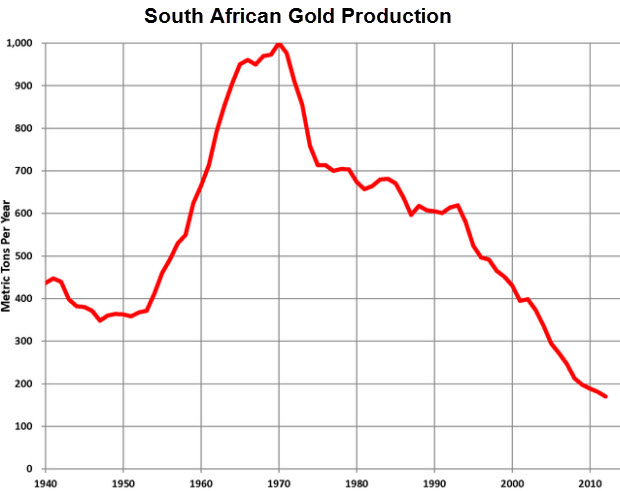
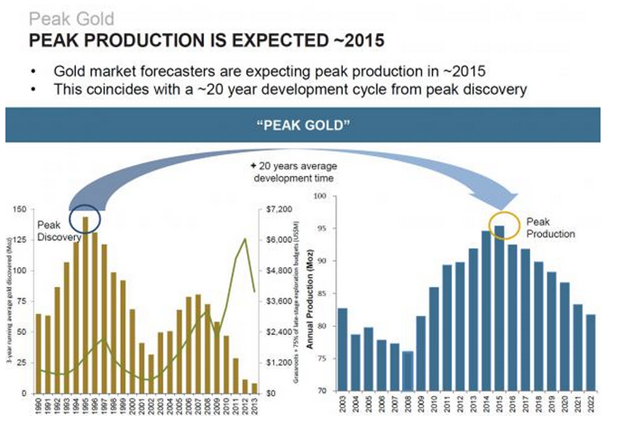
“We are on the cusp of peak gold production…Gold production in South Africa has already fallen over 75% and it is the canary in the gold mine so to speak.
All the data is suggesting this and leading people in the gold mining industry itself to say we are on the verge of a gold peak.”
According to Mark, “Uber-bull predictions of gold at over $5,000 per ounce are not beyond the realms of possibility…”
Peak gold has been an area of rising interest in recent years. The risk of falling gold production and a consequent reduction in supply are issues the mainstream are becoming slowly aware of. Some are already asking whether 2015 or 2016 marked the year of peak gold production.
As Mark mentioned in his interview with The Daily Reckoning the gold supply from South Africa has seen a dramatic fall of late. In 1970 South Africa produced over 1,000 tonnes of gold but this has since fallen to below 250 tonnes in recent years (see chart above).
Levels this low have not been seen since 1922, a year which did not have the advantage of the massive technological advances of recent years and more intensive mining practices.
As Mark asked at the beginning of the year: What happens when the unstoppable force of robust global demand for gold meets the immovable object of a small, finite, rare and dwinding supply of physical gold?
Below we bring you the rest of the Daily Reckoning’s piece entitled ‘Gold round-up: what our editors think about the yellow metal‘
The key to understanding gold price
Let’s start with our growth expert, Sean Keyes, who thinks the key to understanding gold, and predicting future price hikes, lies in interest rates and inflation:
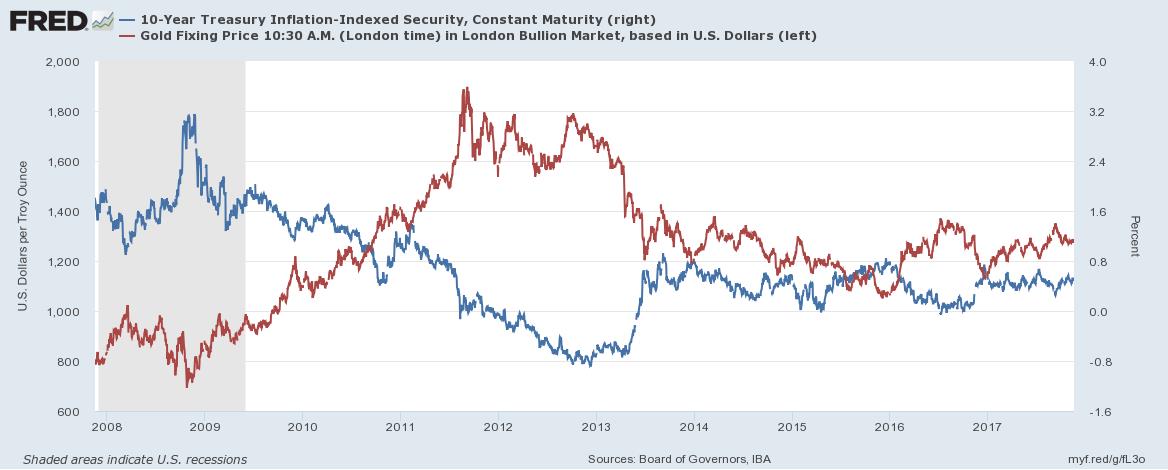
“When real rates are high gold goes down. Then real rates are low it goes up. It doesn’t really matter what’s causing real rates to change — it could be inflation or interest rates, or both together — what matters is the combination of the two.”
As Sean says here, in the past, the real interest rate has mirrored the gold price.
This, according to Sean, is the green light investors should look out for when trying to spot an incline in price.
David Stevenson agrees.
He kicked off the gold theme last week by deconstructing the popular view that interest rates could be harmful for bullion, and that inflation alone would improve value.
Both, according to David, are only partly right.
He reckons the true driver of the gold price is US real interest rate, saying:
Gold only comes under pressure when nominal rates rise faster than increases in the consumer price index.Further, before the great financial crisis that began a decade ago, the real interest rate was also viewed as being roughly equivalent to the real economic growth rate.
Now the US economy has been expanding someway faster than 0.5% in recent years. For example, 2017 Q3 annualised real growth was 3%.
So you see, according to David, negative interest rates could be a key facilitator for a rise in gold price.
But why would negative interest rates be a problem now?
In David’s view, the post-financial crisis is “very long in the tooth,” and at this point, recession looks more likely than inflation.
An obvious catalyst
So, with stock prices and junk bonds appearing more vulnerable to significant falls, central banks are likely to rely on negative interest rates to patch-up the wounds.
And this could be excellent news for the gold price:
In the next financial crisis, central banks could engineer even larger negative numbers that could lead to a gold price well in excess of $2,000 per ounce.
Gold’s time to shine
You’ve probably heard of Jim Rickards before.
Famously bullish about gold, Jim recently stated in an article for The Daily Reckoning that:
“The crisis in North Korea is not getting any better; it’s actually getting worse. Syria, Iran and the South China Sea are additional flashpoints. The headlines may fade in any given week, but geopolitical shocks will return when least expected and send gold soaring in a flight to safety.
Finally, the Fed will not raise rates in December, contrary to market expectations.
As market probabilities catch up with reality, the dollar will sink and gold will rally.”
You can read Jim’s full article here.
Should these events play out, investors may flock to gold as a safe-haven asset, and Jim’s $10,000 per ounce prediction could become a reality a lot sooner than anticipated.

Related reading
Peak Gold – Biggest Gold Story Not Being Reported
An Interview with GoldCore Founder, Mark O’Byrne
China, Russia Alliance Deepens Against American Overstretch
Gold Could Surge To $8,000/oz On Negative Interest Rates – Lassonde
News and Commentary
Gold prices little changed as dollar holds steady on tax bill hopes (Reuters.com)
Asia Stocks Mixed as Tax Vote Awaits; Yields Climb (Bloomberg.com)
U.S. stocks retreat from records (MarketWatch.com)
Single-family housing starts, permits hit 10-year high (Reuters.com)
Where Janet Yellen has fallen short as head of the Federal Reserve (MarketWatch.com)
Central banks, trade and bubbles threaten the 2018 status quo (Reuters.com)
Gold Prices (LBMA AM)
20 Dec: USD 1,265.95, GBP 944.27 & EUR 1,068.21 per ounce
19 Dec: USD 1,263.10, GBP 944.93 & EUR 1,070.10 per ounce
18 Dec: USD 1,258.65, GBP 943.11 & EUR 1,067.71 per ounce
15 Dec: USD 1,257.25, GBP 937.41 & EUR 1,065.52 per ounce
14 Dec: USD 1,255.60, GBP 935.67 & EUR 1,062.49 per ounce
13 Dec: USD 1,241.60, GBP 929.96 & EUR 1,056.97 per ounce
12 Dec: USD 1,243.40, GBP 933.92 & EUR 1,056.27 per ounce
Silver Prices (LBMA)
20 Dec: USD 16.19, GBP 12.09 & EUR 13.67 per ounce
19 Dec: USD 16.16, GBP 12.08 & EUR 13.68 per ounce
18 Dec: USD 16.09, GBP 12.04 & EUR 13.64 per ounce
15 Dec: USD 15.99, GBP 11.93 & EUR 13.55 per ounce
14 Dec: USD 16.01, GBP 11.92 & EUR 13.54 per ounce
13 Dec: USD 15.71, GBP 11.76 & EUR 13.38 per ounce
12 Dec: USD 15.78, GBP 11.82 & EUR 13.40 per ounce
Recent Market Updates
– New Rules For Cross-Border Cash and Gold Bullion Movements
– ‘Gold Strengthens Public Confidence In The Central Bank’ – Bundesbank
– WGC: 2018 Set To Be A Positive Year For Price of Gold and Investors
– Year-end Rate Hike Once Again Proves To Be Launchpad For Gold Price
– UK Stagflation Risk As Inflation Hits 3.1% and House Prices Fall
– Buy Gold, Silver Time After Speculators Reduce Longs and Banks Reduce Shorts
– Bitcoin – Plan Your Exit Strategy Now – Maybe With Gold
– Gold Demand Increases Along with Uncertainty Thanks to Trump, Brexit and North Korea
– UK Pensions Risk – Time to Rebalance and Allocate to Cash and Gold
– Bailins Coming In EU – 114 Italian Banks Have NP Loans Exceeding Tangible Assets
– Silver’s Positive Fundamentals Due To Strong Demand In Key Growth Industries
– An Interview with GoldCore Founder, Mark O’Byrne
– Risk Of Online Accounts Seen As One of Largest Brokerages In World Halts Online Trading After “Glitch”
JMcShirley.
This is very unusual for silver. Silver has been comatose in price for quite a while even though its volume is increasing. With the huge EFP’s issued, the bankers are getting nervous as their huge burgeoning shortfall is now weighing on them.
This is a very important development. I have never seen this happen twice in a week with no change in price.
end
Crypto Chaos – Bitcoin Spikes Back Above $17,000 After Flash-Crash, Bitcoin Cash Up 60%
Well that didn’t take long – Bitcoin is back at $17,000; Bitcoin Cash +60% at $3,500….
There is some logic as the forked currency gains over $1000 so the original Bitcoin loses that ‘dividend’…

Bitcoin rebounded earlier…

After futures were briefly halted on a crircuit-breaker…

For now the catalyst for the move appears to be a wave of selling from Coinbase HODLers as the exchange began allowing sends and receives in Bitcoin Cash(which split off from the original bitcoin on Aug. 1 after a group of developers decided to try to improve bitcoin transaction speeds and costs).
Investors in bitcoin at the time of the split should have received an equivalent amount of bitcoin cash, but Coinbase did not immediately do so, and said it would provide support by January. On Tuesday, Coinbase said all customers at the time of the split would have bitcoin cash.
The announcement follows news in the last few days that a large bitcoin payments processor BitPay and major cryptocurrency storage company Blockchain would support bitcoin cash.
Roger Ver (aka Bitcoin Jesus), an outspoken and early bitcoin investor, is a major supporter of bitcoin cash.
Additionally, some chatter that Tezos escaping an asset freeze of its $1.2 billion funds put some additional pressure on bitc55oin.
San Francisco federal judge refused to temporarily freeze $1.2 billion in cryptocurrency and other funds related to the Tezos Foundation and the block chain startup in a dispute between an investor and Tezos founders.
Investor Bruce MacDonald accused Tezos of engaging in the unlicensed sale of securities and use of a Swiss-based entity in an attempt to evade U.S. securities laws
* * *
Update: The entire Crypto space is under pressure as Asia opens…

Bitcoin is tumbling…

BTC flash crashed to $14,000 on GDAX…

Except Bitcoin Cash (which is up over 50% as Coinbase added the forked currency and it appears traders are rotating into it)…

* * *
Update: Bitcoin spot and futures are bid and have reebounded notably off the after-hours lows…

* * *
As we detailed earlier, shortly after the US equity market closed this evening, someone decided it was time to dump a few hundred Bitcoin, sending the price plunging below $17,000…

Did another HODLer just fold?

Potential investors in bitcoin should steer clear of a dangerous gamble and not complain to financial regulators if things do go wrong, Denmark’s central bank governor warned.
“You should stay away (from bitcoin). It is deadly,” central bank head Lars Rohde said in an interview with state broadcasterDR published online on Monday.
Additionally, CoinTelegraph reports that, according to Bitcoin.com co-founder and CTO Emil Oldenburg, Bitcoin is “useless” and has no future as a tradeable currency, citing high transaction fees and long lead times. In an interview with Swedish tech site Breakit, Oldenburg said that he had sold all of his Bitcoin and switched to Bitcoin Cash, a hard fork of Bitcoin created in August 2017.
Oldenburg justifies his actions, saying:
“An investment in Bitcoin right now I would say is the most risky investment one can make. It is extremely high-risk. I’ve actually sold all of my Bitcoins recently and switched to Bitcoin Cash.”
Despite the fact that Oldenburg’s company is in fact a Bitcoin wallet, the CTO says that he has become disenchanted with Bitcoin due to its high transaction fees and slow confirmation time, saying Bitcoin’s current performance is “completely unreasonable.”
Increased transaction speed and lower costs are the main features supporters of Bitcoin Cash point to when comparing the two coins.
Ethereum is also being sold but remain positive on the day…

Bitcoin futures are bid now…

end
Then to add to the ridiculousness of the situation, the other Bitcoin is halted on an “insider” trading probe
(courtesy zerohedge)
Bitcoin Cash Briefly Spikes To $8,500 After Massive Glitch; Trading Halted On “Insider Trading” Probe
Update: Just as we saw last night ahead of Bitcoin Cash’s release on GDAX, so this morning’s re-opening (reportedly at 12ET), Bitcoin is being dumped and Bitcoin Cash is surging…

* * *
As we detailed earlier, hours after announcing support for Bitcoin Cash, crypto-exchange Coinbase suffered a massive glitch which saw prices for the forked-cryptocurrency hit $8,500 for about an hour – around 250% higher than ‘normal’. It is unclear if any trades were executed during the spike, as trading was disabled for much of the anomaly.

As The Wall Street Journal reports, the company halted trading of the currency four minutes after trading began.
Hours later, Coinbase announced an investigation into whether any employees, contractors or their friends and family used confidential information about its plans to trade Bitcoin Cash before its announcement.
“It appears the price of bitcoin cash on other exchanges increased in the hours before our announcement… [while there’s] no indication of any wrongdoing at this time, we will be conducting an investigation…”
Coinbase in a blog post said it “maintains a strict trading policy and internal guidelines for employees.”
In bold font, the company added: “Coinbase employees have been prohibited from trading in Bitcoin Cash for several weeks.”
Noting the price increase of Bitcoin Cash in the hours before the announcement, Mr. Armstrong said Coinbase will be conducting an investigation into the matter.
“If we find evidence of any employee or contractor violating our policies—directly or indirectly—I will not hesitate to terminate the employee immediately and take appropriate legal action,” he wrote.
“Insider trading of crypto is so obvious,” Brian Hoffman, the chief executive of Open Bazaar, an online retail site that uses bitcoin, wrote on Twitter. Bitcoin Cash “skyrockets … hours later Coinbase rolls it out,” he noted.
In response, Coinbase confirms that sends and receives are still functional but trading on coinbase to resume once there is sufficient liquidity in GDAX.
[status] Monitoring: All BCH books will enter cancel-only mode, and all existing orders will be cleared. While in c… http://stspg.io/9dfaf0c30

An update on Bitcoin Cash for our customers: sends and receives are functional.
Buys and sells on http://Coinbase.com and in our mobile apps will be available to all customers once there is sufficient liquidity on GDAX. We anticipate that this will happen tomorrow. https://twitter.com/GDAX/status/943331326874214400 …
Coinbase – Buy/Sell Digital Currency
Coinbase is a secure online platform for buying, selling, transferring, and storing digital currency.
coinbase.com


Bitcoin Cash was added to both exchanges simultaneously on Tuesday. As TechCrunch‘s Fitz Tepper notes:
This is important to note because the liquidity (and price quotes) to buy and sell cryptocurrency on Coinbase come from GDAX, its sister exchange. So essentially a stable order book is needed on GDAX before Coinbase buy and sells can be functional.
This is why in the past the company has added assets (like Litecoin) to GDAX months before being added on Coinbase, so there could be sufficient liquidity at launch. On Twitter, Coinbases Ex-Director of Engineering Charlie Lee clarified that its operationally very hard to add an asset to both platforms at the same time.
To those saying I bought BCH with insider news, please stop. I had no info. I sold all the BCH I can the moment it was tradable on exchanges. And j just sold my 2 stuck BCH on Coinbase at $5000 each. Good riddance!

In hindsight, Coinbase should have listened to me. It was operationally very hard to launch on Coinbase and GDAX at the same time. Now with GDAX halted and Coinbase never opened, everyone is seeing a ridiculous price of $9500.
tons of support tickets and upset customers.
While the “Flash Spike” in Bitcoin Cash was happening, a flash crash was also taking place in Bitcoin, which tanked to the tune of $3,000 before recovering 60% to $17,000 and change.
BTC flash crashed to $14,000 on GDAX…
Prices are still volatile this morning with Bitcoin Cash moving back towards its record highs and Bitcoin fading…

Finally here is GDAX’s latest update:
We wanted to provide our customers with an update on Bitcoin Cash (BCH) trading on GDAX.
At 4:00pm PST on December 19, 2017, we launched three BCH order books on GDAX. All BCH order books opened in post-only mode, allowing customers to place open orders and establish liquidity.
At 5:20pm PST, we enabled trading on the BCH-USD book. The BCH-EUR and BCH-BTC books remained in post-only mode.
At 5:22pm PST, we paused trading in the BCH-USD order book due to significant volatility. Once paused, we cancelled resting orders and cleared all BCH order books. We made this decision to ensure a fair and orderly market.
BCH order books will reopen on December 20th at 9:00am PST. All BCH order books will open in post-only mode for a minimum of one hour to establish liquidity. We will continue to closely monitor market activity.
In a separate trading hiccup, another large cryptocurrency exchange, Gemini, was unable to transact bitcoin temporarily on Tuesday evening.
The New York-based exchange, whose bitcoin prices are referenced by futures contracts offered by Cboe Global Markets, said it couldn’t process trades temporarily because of problems on the blockchain, the technology underpinning the cryptocurrency. The outage, which lasted about 15 minutes, didn’t affect customers’ assets, the exchange said.
(courtesy zerohedge)
Litecoin Founder Cashes Out, Sells Entire Stake After 9,300% Rally
Charlie Lee, the creator of the world’s fifth-biggest cryptocurrency, Litecoin, announced shortly after midnight that he was cashing in his profits after a torrid, 9,300% rally in the past 12 months. In a post on reddit, the San Francisco-based software engineer who founded litecoin in 2013, said that he sold and donated all of his holdings over the past few days.

“Litecoin has been very good for me financially, so I am well off enough that I no longer need to tie my financial success to Litecoin’s success. For the first time in 6+ years, I no longer own a single LTC that’s not stored in a physical Litecoin” Lee said in the post.
Lee explained that his liquidation was aimed at preventing a “conflict of interest” when the creator of what is known as “Bitcoin Silver” makes comments on twitter about the digital currency – something he tends to do with chronic zeal – that could influence its price, he said. That said, Lee declined to comment in the post on how many coins he sold or at what price, and asked readers to please “don’t ask me how many coins I sold or at what price. I can tell you that the amount of coins was a small percentage of GDAX’s daily volume and it did not crash the market.”
Litecoin, which was trading at $3.67 on December 20, 2016, and $4.40 at the start of the year, has climbed 9,300% in the past 12 month. It tumbled on Wednesday, following most digital currencies lower after a flash crash in bitcoin after Coinbase announced it would finally transact in Bitcoin Cash which led to a brief avalanche of selling as traders repositioned.
However, Lee insisted in his post that his sale wasn’t a sign that he has lost faith in the cryptocurrency: “I will still spend all my time working on litecoin,” he said. “When litecoin succeeds, I will still be rewarded in lots of different ways, just not directly via ownership of coins.”
How does it feel to take profits on a high from the crypto boom that has been described as the biggest financial bubble of all time? “Weird” but also “somehow refreshing,” Lee wrote.
His full post below:
Litecoin price, tweets, and conflict of interest self
Over the past year, I try to stay away from price related tweets, but it’s hard because price is such an important aspect of Litecoin growth. And whenever I tweet about Litecoin price or even just good or bads news, I get accused of doing it for personal benefit. Some people even think I short LTC! So in a sense, it is conflict of interest for me to hold LTC and tweet about it because I have so much influence. I have always refrained from buying/selling LTC before or after my major tweets, but this is something only I know. And there will always be a doubt on whether any of my actions were to further my own personal wealth above the success of Litecoin and crypto-currency in general.
For this reason, in the past days, I have sold and donated all my LTC. Litecoin has been very good for me financially, so I am well off enough that I no longer need to tie my financial success to Litecoin’s success. For the first time in 6+ years, I no longer own a single LTC that’s not stored in a physical Litecoin. (I do have a few of those as collectibles.) This is definitely a weird feeling, but also somehow refreshing. Don’t worry. I’m not quitting Litecoin. I will still spend all my time working on Litecoin. When Litecoin succeeds, I will still be rewarded in lots of different ways, just not directly via ownership of coins. I now believe this is the best way for me to continue to oversee Litecoin’s growth.
Please don’t ask me how many coins I sold or at what price. I can tell you that the amount of coins was a small percentage of GDAX’s daily volume and it did not crash the market.
UPDATE: I wrote the above before the recent Bcash on GDAX/Coinbase fiasco. As you can see, some people even think I’m pumping Bcash for my personal benefit. It seems like I just can’t win.
On Wednesday morning, Lee was busy on twitter where he had dozens of posts defending his sale:
in a biz ppl put their money in what they have faith in. You believe in yourself right?


This is not business for me. It’s my life. I’m dedicated to Litecoin.
He also responded to a question by Mike Novogratz whether “@SatoshiLite selling all his $ltc is bullish or bearish? If @VitalikButerin or @ethereumJoseph sold all of their $eth I’d be worried.”
Is @SatoshiLite selling all his $ltc bullish or bearish? If @VitalikButerin or @ethereumJoseph sold all of their $eth I’d be worried.

I think it’s extremely bullish!

In a sense he is right, as there is no more whale overhang that can be sold at a moment’s notice.
He left off with a challenge to Satoshi Nakamoto, the creator of bitcoin, to do the same:
Craig Hemke reminds us of a cable sent to NY where the author claims that the futures market in gold/silver will suppress the spot price
(courtesy Craig Hemke)
Craig Hemke: It is what it is but it’s not what it seems
Submitted by cpowell on Tue, 2017-12-19 23:06. Section: Daily Dispatches
6:11p Tuesday, December 19, 2017
Dear Friend of GATA and Gold:
Craig Hemke of the TF Metals Report, writing today for Sprott Money, recalls the cable sent December 31, 1974, from the U.S. embassy in London to the State Department in Washington, conveying the assurances of London bullion banks that the gold futures market about to open in the United States would suppress demand for real metal. Hemke’s commentary is headlined “It Is What It Is But It’s Not What It Seems” and it’s posted at Sprott Money here:
https://www.sprottmoney.com/Blog/it-is-what-it-is-but-its-not-what-it-se…
CHRIS POWELL, Secretary/Treasurer
Gold Anti-Trust Action Committee Inc.
CPowell@GATA.org
END
This would be another deadly blow to the USA dollar as countries seek the use of the yuan to replace the dollar
(courtesy Gul/Voice of America/Washington)
Pakistan examines Chinese proposal to replace dollar with yuan
Submitted by cpowell on Tue, 2017-12-19 23:25. Section: Daily Dispatches
By Ayaz Gul
Voice of America, Washington
Tuesday, December 19, 2017
ISLAMABAD, Pakistan — Officials in Pakistan say a Chinese proposal to replace the U.S. dollar with yuan for bilateral trade is under consideration.
Beijing has already committed to investing around $60 billion in the country by 2030 under a long-term plan of development cooperation with Islamabad, known as the China Pakistan Economic Corridor, or CPEC.
Bilateral trade between the two countries stood at around $14 billion in 2015 to 2016. Officials anticipate the trade volume is likely to increase significantly under ongoing CPEC cooperation.
Pakistan Interior Minister Ahsan Iqbal, who has also been overseeing CPEC implementation, revealed this week China is seeking bilateral trade in its own currency, known as renminbi, RMB, or yuan.
“We are examining the use of RMB instead of the U.S. dollar for trade between the two countries,” Iqbal said, adding that the use of Chinese currency would benefit Pakistan. But he went on to explain that the Pakistani currency would be used domestically.
The State Bank of Pakistan has already declared yuan as an approved foreign exchange for all purposes in the country. …
… For the remainder of the report:
https://www.voanews.com/a/pakistan-examines-chinese-proposal-to-replace-…
…
Hugo Salinas Price: Wild speculation in bitcoin
Submitted by cpowell on Wed, 2017-12-20 00:02. Section: Daily Dispatches
7:02p ET Tuesday, December 19, 2017
Dear Friend of GATA and Gold:
Hugo Salinas Price of the Mexican Civic Association for Silver writes today that the price of bitcoin is rising not because the cryptocurrency has any practical use but just because it is rising and that when people start taking profits, the price will fall just because it is falling. Salinas Price’s commentary is headlined “Wild Speculation in Bitcoin” and it’s posted at the association’s internet site, Plata.com.mx, here:
http://plata.com.mx/enUS/More/335?idioma=2
CHRIS POWELL, Secretary/Treasurer
Gold Anti-Trust Action Committee Inc.
CPowell@GATA.org
END
Your early WEDNESDAY morning currency, Asian stock market results, important USA/Asian currency crosses, gold/silver pricing overnight along with the price of oil Major stories overnight/9 AM EST
i) Chinese yuan vs USA dollar/CLOSED UP AT 6.5780 /shanghai bourse CLOSED DOWN AT 8.93 POINTS 0.27% / HANG SANG CLOSED DOWN 19.57 POINTS OR 0.07%
2. Nikkei closed UP 23.72 POINTS OR 0.10% /USA: YEN RISES TO 113.19
3. Europe stocks OPENED MOSTLY RED /USA dollar index RISES TO 93.47/Euro RISES TO 1.1836
3b Japan 10 year bond yield: RISES TO . +.060/ GOVERNMENT INTERVENTION !!!!(Japan buying 100% of bond issuance)/Japanese yen vs usa cross now at 113.19/ THIS IS TROUBLESOME AS BANK OF JAPAN IS RUNNING OUT OF BONDS TO BUY./JAPAN 10 YR YIELD FINALLY IN THE POSITIVE/BANK OF JAPAN LOSING CONTROL OF THEIR YIELD CURVE AS THEY PURCHASE ALL BONDS TO GET TO ZERO RATE!!
3c Nikkei now JUST BELOW 17,000
3d USA/Yen rate now well below the important 120 barrier this morning
3e WTI:: 57.76 and Brent: 63.84
3f Gold UP/Yen DOWN
3g Japan is to buy the equivalent of 108 billion uSA dollars worth of bond per month or $1.3 trillion. Japan’s GDP equals 5 trillion usa./“HELICOPTER MONEY” OFF THE TABLE FOR NOW /REVERSE OPERATION TWIST ON THE BONDS: PURCHASE OF LONG BONDS AND SELLING THE SHORT END
Japan to buy 100% of all new Japanese debt and by 2018 they will have 25% of all Japanese debt. Fifty percent of Japanese budget financed with debt.
3h Oil UP for WTI and UP FOR Brent this morning
3i European bond buying continues to push yields lower on all fronts in the EMU. German 10yr bund RISES TO +.400%/Italian 10 yr bond yield UP to 1.917% /SPAIN 10 YR BOND YIELD UP TO 1.487%
3j Greek 10 year bond yield RISES TO : 4.122?????????????????
3k Gold at $1265.90 silver at:16.23: 6 am est) SILVER NEXT RESISTANCE LEVEL AT $18.50
3l USA vs Russian rouble; (Russian rouble UP 12/100 in roubles/dollar) 58.65
3m oil into the 57 dollar handle for WTI and 63 handle for Brent/
3n Higher foreign deposits out of China sees huge risk of outflows and a currency depreciation. This can spell financial disaster for the rest of the world/China forced to do QE!! as it lowers its yuan value to the dollar/GOT A HUGE SIZED REVALUATION NORTHBOUND
JAPAN ON JAN 29.2016 INITIATES NIRP. THIS MORNING THEY SIGNAL THEY MAY END NIRP. TODAY THE USA/YEN TRADES TO 113.19 DESTROYING JAPANESE CITIZENS WITH HIGHER FOOD INFLATION
30 SNB (Swiss National Bank) still intervening again in the markets driving down the SF. It is not working: USA/SF this morning 0.9879 as the Swiss Franc is still rising against most currencies. Euro vs SF is 1.1693 well above the floor set by the Swiss Finance Minister. Thomas Jordan, chief of the Swiss National Bank continues to purchase euros trying to lower value of the Swiss Franc.
3p BRITAIN VOTES AFFIRMATIVE BREXIT/LOWER PARLIAMENT APPROVES BREXIT COMMENCEMENT/ARTICLE 50 COMMENCES MARCH 29/2017
3r the 10 Year German bund now POSITIVE territory with the 10 year RISING to +0.400%
The bank withdrawals were causing massive hardship to the Greek bank. the Greek referendum voted overwhelming “NO”. Next step for Greece will be the recapitalization of the banks and that will be difficult.
4. USA 10 year treasury bond at 2.465% early this morning. Thirty year rate at 2.834% /
5. Details Ransquawk, Bloomberg, Deutsche bank/Jim Reid.
(courtesy Jim Reid/Bloomberg/Deutsche bank/zero hedge)
Dow 25,000 In Sight As Tax Cuts Are “Priced In” One Last Time
Dow futures are up some 80 points this morning after early on Wednesday morning the Senate passed the Tax Reform bill in a party-line vote, and is now set to become law after a follow-up vote in the House and Trump’s signature some time on Wednesday afternoon. The good news is that the biggest political drama of 2017 will then be over. The bad news is that once the bill becomes law, the market will no longer be able to “price it in” every single day as it has for the past year.
As reported overnight, and as expected, the Senate approved the tax-cut legislation in a 51-48 party line vote, bringing President Donald Trump to the brink of his first major legislative victory. The bill now moves to the House of Representatives for a final vote Wednesday. With corporate and individual tax rates set to drop, the measures are largely anticipated to add to growth over the next year or two, though they will also swell the budget deficit.
And while S&P 500 futures extended modest gains on the bill news, they have so far fallen short of yesterday’s high, in somewhat tepid reaction to the passage of the U.S. tax bill in the Senate, suggesting there is only so many times an endlessly regurgitated piece of news can be “priced in for the first time.” MSCI’s world equity index was little changed and holding just below record highs hit on Monday.
Overnight, European bonds were mixed as U.S. Treasury yields edged lower after yesterday’s jump, sparked by hawkish comments from central bankers…

… and recovered from a brief dip following the Senate tax news, while the U.S. dollar comes under renewed pressure versus its G-10 peers as investors await a second House vote on the bill.
“Last week the reaction of bond markets was one of ambivalence about the likelihood of these measures getting passed,” said Michael Hewson, chief market analyst at CMC Markets in London. “However, U.S. yields have jumped sharply higher in the last two days as the prospect of higher inflation and growth prompted some positioning adjustments in anticipation that the measures, if passed, could prompt conditions that might see rates have to rise faster than expected next year.”
In global equities, the feel-good factor from U.S. tax reform faded in Europe on Wednesday, with stocks struggling for traction after a mixed session in Asia and the dollar trading little changed.
Most European stocks weakened, led by Spain ahead of a regional Catalan election on Thursday. Basic resources sector among the biggest gainers as industrial metals rebound in London trading. German debt again leads core euro-area government bonds lower, with notable underperformance in the front end driving yield curve bear-flattening.
Europe’s Stoxx 600 Index drifted little changed, down fractionally, with Spanish equities underperforming before tomorrow’s Catalan poll. Utilities and telecoms dropped, while miners gained as the Bloomberg Commodity Index advanced for a sixth day. Steinhoff shares crashed 30% after the furniture retailer said lenders have started to cut off support as reported yesterday. RWE leads Germany’s DAX Index higher after the departure of Innogy’s CEO sparked speculation around the company’s strategy
Earlier, Japan’s Topix index closed at its highest level since November 1991, while stocks in Hong Kong and China declined. ASX 200 (+0.1%) and Nikkei 225 (+0.1%) eventually traded positive on what was a choppy session with corporate scandals clouding over Japan including the maglev bid collusion, while Subaru was the worst performer after allegations it may have falsified mileage data. Chinese stock markets fared no better as both Hang Seng (-0.1%) and Shanghai Comp. (-0.3%) traded with a lacklustre tone, amid mild profit taking from recent gains. Finally, 10yr JGBs were flat as prices failed to benefit from the sombre risk tone or Rinban announcement valued at JPY 840bln in maturities across the curve, as the BoJ also kick-started its 2-day policy meeting today.
The euro got a lift from higher euro zone rates, gaining 0.5 percent on Tuesday, when central bank governors of Estonia, Slovakia and Germany all discussed the need to shift the debate from bond purchases to other tools such as interest rates.
“That’s re-igniting the debate about ECB tightening, so despite the outlook for the U.S. tax bill passage, euro-dollar is strong right now,” Masafumi Yamamoto, chief currency strategist for Mizuho Securities in Tokyo.
Against a basket of six rival currencies, the dollar was a touch lower on the day at 93.418 . The greenback edged down 0.2 percent to 113.11 yen, while the euro was a touch firmer at $1.1850.
Elsewhere, U.S. crude oil futures extended gains, helped by a North Sea pipeline outage, OPEC-led supply cuts and expectations that U.S. crude inventories had fallen for a fifth week. WTI and Brent crude futures remain supported by the larger than expected drawdown in crude stockpiles via last night’s API release (-5.22mln vs. Exp. -3.5mln). Elsewhere, the latest reports suggest that Ineos are pressing ahead with repairs on the Forties crude pipeline with their preferred repair option. In metals markets, gold was marginally higher on a tepid greenback, while copper was uneventful overnight and held near this month’s highs. Elsewhere, Chinese iron ore futures were seen lower by 1% overnight after steel prices hit a two-week low.
Market Snapshot
- S&P 500 futures up 0.3% to 2,692.25
- Brent Futures up 0.05% to $63.83/bbl
- MSCI Asia Pacific up 0.08% to 171.74
- MSCI Asia Pacific ex Japan down 0.01% to 558.57
- Nikkei up 0.1% to 22,891.72
- Topix up 0.3% to 1,821.16
- Hang Seng Index down 0.07% to 29,234.09
- Shanghai Composite down 0.3% to 3,287.61
- Sensex down 0.02% to 33,830.46
- Australia S&P/ASX 200 up 0.06% to 6,075.62
- Kospi down 0.3% to 2,472.37
- Gold spot up 0.2% to $1,264.57
- U.S. Dollar Index up 0.01% to 93.45
- STOXX Europe 600 down 0.1% to 390.63
- German 10Y yield fell 0.5 bps to 0.374%
- Euro up 0.03% to $1.1843
- Brent Futures up 0.05% to $63.83/bbl
- Italian 10Y yield rose 10.9 bps to 1.646%
- Spanish 10Y yield fell 4.2 bps to 1.443%
Top Overnight Headlines from BBG
- Senate Republicans passed the most extensive rewrite of the U.S. tax code in more than 30 years, a bill that delivers a deep, permanent tax cut for corporations and shorter-term relief for individuals
- Before reaching President Trump’s desk, the bill must return to the House for one final vote Wednesday. After that, the president said, he’ll hold a news conference at the White House
- European Commission says the U.K. will be a third country as of March 30, 2019 and transition period to end Dec. 31, 2020; U.K. officials fear Spain will threaten to veto a Brexit transition phase if the British prime minister refuses to negotiate a separate deal with the government in Madrid that covers the disputed territory of Gibraltar
- Sweden’s central bank formally ended a program of bond purchases after almost three years, but pledged continued support for the nation’s benchmark debt market into 2019 in a step designed to ensure a smooth retreat from record stimulus
- With elections in Catalonia on Thursday seen unlikely to give a clear majority to the separatist bloc demanding the region’s secession, bargain hunters are being lured to Spanish shares as the IBEX 35 Index trades near its cheapest relative to the Euro Stoxx 50 Index in more than seven years
- Uber Technologies Inc. lost a battle over its stance that it differs from traditional taxis, after the EU Court of Justice said the car-hailing app should be regulated as a transport service. The ruling can’t be appealed
- Bonds and equities in developing countries will continue to streak ahead in 2018, outpacing their developed-nation peers into next year, according to a Bloomberg survey of 20 investors, traders and strategists while currencies could struggle
- China says monetary policy will be prudent and neutral next year while fiscal policy will be proactive; will keep basic yuan stability at reasonable level, according to statement from Xinhua News released after top officials’ planning meeting
- BOE Agents’ Summary 4Q: pay growth edged up, expected to be higher in 2018; manufacturing supported by past decline in sterling
Asia equity markets traded with an indecisive tone after the Santa rally stalled on Wall St. where the majors retreated from record highs as participants sold the news of the House passing the tax reform bill, although the passage was later nullified after some provisions broke Senate rules. ASX 200 (+0.1%) and Nikkei 225 (+0.1%) eventually traded positive on what was a choppy session with corporate scandals clouding over Japan including the maglev bid collusion, while Subaru was the worst performer after allegations it may have falsified mileage data. Chinese stock markets fared no better as both Hang Seng (-0.1%) and Shanghai Comp. (-0.3%) traded with a lacklustre tone, amid mild profit taking from recent gains. Finally, 10yr JGBs were flat as prices failed to benefit from the sombre risk tone or Rinban announcement valued at JPY 840bln in maturities across the curve, as the BoJ also kick-started its 2-day policy meeting today.
Top Asian News
- China Reiterates Prudent, Neutral Monetary Policy
- Noble Group Is Said to Seek RCF Waiver Extension to May
- Bank of India Placed Under Corrective Action Plan; Shares Drop
- Fosun to Buy Asahi Stake in Tsingtao for $847m
- Only Thing Yen Experts Agree On Is U.S. Rates Will Drive It
European equities trade modestly lower as US tax optimism fails to make its way into Europe after the Senate approved the Republican tax bill with the House due to re-vote on the issue later today. As has been the case throughout the week, European macro newsflow remains particularly light as traders eye the festive period. Sector specific moves have been relatively broad-based with little in the way of outliers. Individual movers include Stada (+8.9%) at the top of the Stoxx 600 after signing an agreement with Bain/Cinven, with troubled German-listed Steinhoff (-30.0%) at the bottom of the pile after reports that lenders have severed credit lines to the Co. Bunds were already on the turn as Gilts re-joined the fray, but it was the scale of the gap down in UK bonds and follow-through selling off the Liffe open that appeared to catch the Eurex benchmark cold and nudge it to a fresh 162.20 low (-18 ticks vs +10 ticks at best). The 10 year UK debt future slumped to 124.51 (-45 ticks), partly in corrective trade given due to different closing times, before dip buyers stepped in to push prices back up to 124.85, and this looks like some psychological resistance in the cash market ahead of the 1.25% marker. However, bears or vigilantes are still directing moves at the current juncture amidst more curve re-steepening, while seasonally light volumes are also exacerbating price action with market contacts noting that a mere 200 lot sale in Bunds pushed the contract down 3 ticks.
Top European news
- Billionaire Niel Takes Iliad to Ireland With Eir Takeover
- Steinhoff Slumps to New Lows After Investors Sue in Germany
- Italy Elections Projected to Produce Hung Parliament: Corriere
- As Shell Gambles on Gas, Leaks Loom Over Clean Credentials
- SEB Says Riksbank’s First Rate Hike Now More Likely In 3Q
- New Areva Seeks Nuclear ‘El Dorado’ in Asia as Europe Declines
- Don’t Fear Amazon, Say Backers of Revival for European Grocers
In FX markets, SEK has been a key focus in European trade following a well-managed release by the RIksbank which initially saw pressure on EUR/SEK after the Bank announced their plans to bring forward reinvestment of redemptions. Thereafter, the cross returned to unchanged levels as the Riksbank left the door open to further easing; other key aspects of the release included the Bank maintaining their repo path. Elsewhere, the USD-index trade flat despite events Stateside with the DXY unable to breach the 93.50 level with some analysts attributing upside in USD/JPY to spread widening between USTs and JGBs. Elsewhere, the remainder of FX markets trade with little in the way of notable direction as volumes continue to recede.
In commodities, WTI and Brent crude futures remain supported by the larger than expected drawdown in crude stockpiles via last night’s API release (-5.22mln vs. Exp. -3.5mln). Elsewhere, the latest reports suggest that Ineos are pressing ahead with repairs on the Forties crude pipeline with their preferred repair option. In metals markets, gold was marginally higher on a tepid greenback, while copper was uneventful overnight and held near this month’s highs. Elsewhere, Chinese iron ore futures were seen lower by 1% overnight after steel prices hit a two-week low.
Looking at the day ahead, expect Brexit headlines to continue with the European Commission due to publish its directives for the Brexit transition phase and heads of mission from EU member states due to meet to discuss Brexit. Away from that, data releases include November PPI in Germany, December CBI retail sales in the UK and November existing home sales in the US.
US Event Calendar
- 7am: MBA Mortgage Applications, prior -2.3%
- 10am: Existing Home Sales, est. 5.53m, prior 5.48m
- 10am: Existing Home Sales MoM, est. 0.91%, prior 2.0%
DB’s Jim Reid concludes the overnight wrap
One can’t wind down too much though as a lot happened yesterday and the rest
of the week still has important news-flow ahead. Not only did the tax reform bill
take another big step forward but we saw a huge sell off in Government bond
yields around the globe, making it one of the worse days of the year for fixed
income.
Firstly on US tax reforms. As we type, the Senate has just passed the bill by
51-48 in a post midnight US vote. Earlier the House voted 227-203 to pass it.
However, later on, the House Majority Leader McCarthy noted the House may
have to vote again on Wednesday morning (US time), as the Senate found three
provisions in the House bill that don’t comply with the Chamber’s budget rules.
This is not expected to change the outcome though and with the Senate news
just in, today should be the day that the bill progresses towards Mr Trump’s desk.
Before this, yesterday was all about the moves in bonds. This was led by a sudden
sell-off in Europe. 10 year Bunds (+6.9bp) and BTPs (+10.8bp) both had their
worst day for 5.5 months while OATs (+7.5bp) had the worst for c1 month.
Treasuries (+7.0bp) and Gilts (+5.7bp) were also higher with 10yr Treasuries
(2.464%) at their highest yield since March 17.
There seemed to be several contributing causes that encouraged the sell-off.
i) Firstly the hawkish comments from three ECB central bankers. The ECB’s
Makuch said ECB “discussions are increasingly moving from asset purchases
to the eventual future use of interest rates to regulate the economy”. Then the
Bundesbank’s Weidmann reiterated his call for a definitive end date for QE, he
noted “a faster conclusion of net asset purchases and a clearly communicated
end date would have been reasonable” and that increased capacity utilisation will
lead to “somewhat higher wage pressure”. Finally, the ECB’s Hansson noted that
it’s important the ECB “moves gradually when adjusting policy guidance”, but
should consider moving to communication that draws attention to multi-faceted
aspect of monetary policy in 1H. ii) Secondly, the German Finance Agency Head
Tammo Diemer has confirmed that Germany will issue more long debt issuance
and some investors are also expecting increased supply of US government bonds
next year, which appears to be weighing on bonds, and finally iii) the less liquid
pre-Christmas trading period may have also exaggerated the moves.
Following on, the US 2s10 has steepened from its record low of 51.6bp, rising
9.4bp over the past two days to 61bp, which marks the largest consecutive
increase since President Trump was elected. On the topic of yield curves, our
US economists recently took a different approach to investigate the relationship
between the yield curve slope and future growth. They note that more than half
of the flattening this year has been driven by the term premium and that their
results suggest that the yield curve is signaling only a modest slowdown in the
year ahead. Overall, they do not think the yield curve flattening should be a source
of great consternation, at least not yet.
This morning in Asia, markets are mixed but little changed. The Nikkei (+0.19%),
Kospi (-0.27%), Hang Seng (-0.07%) and China’s CSI 300 (-0.28%) are trading
sideways. Treasuries are slightly firmer with UST 10y yields down 1.6bp this
morning.
Now recapping other markets performance from yesterday. US equities
softened from record highs as investors awaited the full passage of the tax bill.
The S&P (-0.32%), Dow (-0.15%) and Nasdaq (-0.44%) all traded modestly lower.
Within the S&P, losses were led by the real estate (-1.89%) and utilities sector,
with partial offsets from consumer staples and energy stocks. European markets
were broadly lower, partly reversing the prior day’s gains, with the Stoxx 600
(-0.42%) and DAX (-0.72%) lower while the FTSE bucked the trend and rose
+0.09%. The VIX rose for the second consecutive day and was up 5.3% to be
above 10 again (10.03).
Turning to currencies, the US dollar index weakened 0.25%, while Sterling was
broadly flat and the Euro gained 0.49%. In commodities, WTI oil rose 0.59% ahead
of API data expected to show a fifth consecutive week of shrinking US crude
inventories.
Away from the market and onto Fed speak. The Fed’s Kaplan has also cautioned
on the flattening yield curve, he noted that “it limits the Fed’s operating flexibility…in terms of how fast and how much we can raise rates”. He also added that the history of inversions tends to be a pretty reliable forward indicator of recessions, while this time may be different, but he “wouldn’t count on it”. Elsewhere, the Fed’s Kashkari noted that only a few contacts in his district suggest the upcoming tax reforms will lead to substantial changes in business behaviour, so for him the tax bill is not expected to result in a dramatic gain in investment or hiring.
Turning back to Brexit, the UK’s PM May has confided with her cabinet and then reiterated her desire for a bespoke trade deal after Brexit even though EU Chief negotiator Barnier noted earlier there should be no “cherry picking” of rules. Her office released a statement noting “we should be creative in designing our (Brexit) proposal” and that the UK would be seeking a “significantly more ambitious deal than the EU’s agreement with Canada”.
Finally over at Italy, President Mattarella is expected to dissolve parliament midnext week and call for a general election on 4th or 11th of March next year, as per an unnamed government official who spoke to Bloomberg. The timing is broadly in line with prior press reports.
Before we take a look at today’s calendar, we wrap up with other data releases from yesterday. In the US, the November housing starts were above market (1,297k vs. 1,250k expected), with this month’s rise led by a 5.9% mom increase in single family starts to the highest level since 2007. Housing permits also slight beat at 1,298k (vs. 1,270k expected). Elsewhere, the 3Q US current account deficit was slightly narrower than expected at -$110.6bln (vs. -$116.2bln). As a proportion of GDP, the deficit in 3Q amounts to 2.1%.
In Germany, the December IFO current assessment was above expectations at 125.4 (vs. 124.7) – marking the second highest reading since 2007. The IFO business climate edged down 0.4pts to 117.2 from last month’s post-unification high (vs. 117.5 expected) but remains solid. Finally, the IFO expectations index was a tad softer than expectations at 109.5 (vs. 110.7). Elsewhere, labour cost inflation in the euro area slowed to 1.6% yoy in 3Q from 1.8% in 2Q. By country, labour costs rose 2.2% yoy in Germany, 1.7% yoy in France and 0.5% yoy in Italy.
Looking at the day ahead, expect Brexit headlines to continue with the European Commission due to publish its directives for the Brexit transition phase and heads of mission from EU member states due to meet to discuss Brexit. Away from that, data releases include November PPI in Germany, December CBI retail sales in the UK and November existing home sales in the US.
3. ASIAN AFFAIRS
i)Late TUESDAY night/WEDNESDAY morning: Shanghai closed DOWN 8.93 points or 0.27% /Hang Sang CLOSED DOWN 23.72 pts or 0.27% / The Nikkei closed UP 23.72 POINTS OR 0.10%/Australia’s all ordinaires CLOSED UP 0.08%/Chinese yuan (ONSHORE) closed UP at 6.5780/Oil UP to 57.76 dollars per barrel for WTI and 63.84 for Brent. Stocks in Europe OPENED MOSTLY IN THE RED . ONSHORE YUAN CLOSED WELL UP AGAINST THE DOLLAR AT 6.5780. OFFSHORE YUAN CLOSED DOWN AGAINST THE ONSHORE YUAN AT 6.5790 //ONSHORE YUAN STRONGER AGAINST THE DOLLAR/OFF SHORE STRONGER TO THE DOLLAR/. THE DOLLAR (INDEX) IS SLIGHTLY STRONGER AGAINST ALL MAJOR CURRENCIES. CHINA IS NOT SO HAPPY TODAY.(WEAKER MARKETS)
3 a NORTH KOREA/USA
NORTH KOREA/
North Korea is reported testing anthrax tipped ICBM’s!!
(courtesy zerohedge)
North Korea Reportedly Testing Anthrax-Tipped ICBMs
US intelligence believes North Korea is still between 12 and 18 months away from gaining the ability to load a nuclear warhead onto one of its ICBMs, but South Korean intelligence reportedly has credible evidence that Kim Jong Un and his regime have begun testing loading anthrax onto the country’s ICBMs, according to Japan’s Asahi newspaper.
As Asahi reports (via Google Translate)
Recently, an information source in Seoul revealed that North Korea has started experiments to mount biological weapons anthrax on the intercontinental ballistic missile (ICBM). The United States also gained similar information and said that “North Korea is threatening the United States with nuclear and biological chemical weapons” in the “National Security Strategy” announced on the 18th.
North Korea has started experiments such as heat and pressure equipment to prevent anthrax from dying even at a high temperature of over 7,000 degrees generated at the time of ICBM ‘s reentry into the atmosphere. In part, there is unconfirmed information that it has already succeeded in such experiments.
According to a former US government official, the US forces have been collecting information on the fact that North Korea is cultivating anthrax bacteria from the US for the past, the US military started spreading smallpox and anthrax I was vaccinating. In May 2011, we also conducted a joint US and Korean joint exercises assuming North Korea’s biological weapons terrorism for the first time.

Reports of the testing may have led the US to mention the threat of biological weapons in the new National Security Strategy document released earlier this week. President Donald Trump also delivered a speech yesterday explaining the essence of the strategy.
The North Koreans are trying to determine whether the anthrax virus can survive the immense temperatures generated during missile re-entry. During its most recent missile test, North Korea introduced the Hwasong-15, a new ICBM that US experts believe could strike anywhere within the continental US.
END
According to London’s Telegraph, the uSA is preparing for a “bloody nose’ military attack on North Korea
(courtesy Telegraph)
America Preparing “Bloody Nose” Military Attack On North Korea: Telegraph
While North Korea managed to once again drop off the list of immediate geopolitical concerns having kept relative quiet in recent weeks, without any notable provocations or ICBM launches, this may be changing soon, because according to the Telegraph, America is drawing up plans for a “bloody nose” military attack on North Korea to stop its nuclear weapons program. The UK newspaper’s sources claim that the White House has “dramatically” stepped up preparation for a military solution in recent months amid fears diplomacy is not working. As a result, one option currently under consideration is destroying a launch site before it is used by the regime for a new missile test. Stockpiles of weapons could also be targeted.
The explanation for what would be an act of war, is amusing: “The hope is that military force would show Kim Jong-un that America is “serious” about stopping further nuclear development and trigger negotiations.” Well, yes: launching an offensive war does tend to confirm that one is indeed serious. The question is what will China, Russia and the rest of the all too serious world do in response.
“The Pentagon is trying to find options that would allow them to punch the North Koreans in the nose, get their attention and show that we’re serious”, said one former US security official briefed on policy.
Some further details:
Donald Trump’s decision to bomb a Syrian government airfield earlier this year to defend America’s “red line” on chemical weapons use is seen as a blueprint. Details have emerged after this newspaper talked to around a dozen current and former officials in America and Britain about policy towards North Korea.
The conversations show that the Trump administration is more willing to consider military options to end the conflict than widely assumed.
And while it will hardly come as a major surprise, the Telegraph notes that it can be revealed that senior British diplomats fear America has already begun a “step by step” military build-up in the region that could escalate.
Alastair Morgan, the UK ambassador to North Korea, visited Washington DC for behind-closed-doors talks about forcing the regime to the negotiating table last month. The UK is also urging Southeast Asian and African countries to expel some North Korean diplomats amid fears they are secretly financing the regime.
Meanwhile, in a continuation of a previous US demand, the Trump administration wants North Korean ships to be stopped and searched amid fears they are being used to get round UN sanctions.
The urgency behind the plan, and the pressure to act comes from the drop in estimated time it will take for North Korea to develop a missile that could hit America with nuclear weapons.
Just a few years ago it was believed the regime was a decade away from that point, but now the figure has dropped to as little as 18 months – though estimates vary. Senior figures in the Trump administration have made clear in public that it would be unacceptable for North Korea to reach that position. While Mr Trump has always said a “military option” is on the table, the administration’s focus has been on building economic and diplomatic pressure.
But Mr Kim’s refusal to negotiate has left senior White House figures disillusioned with diplomacy and increasingly considering military avenues. One British source who recently attended a briefing with H.R. McMaster, Mr Trump’s national security adviser, and other officials left feeling alarmed.
“The Americans said deterrence doesn’t work against North Korea and negotiation doesn’t work,” the source said.
“Those who heard them left with the impression that military action is very much an option they were considering seriously.”

Kori Schake, a former director of defense strategy at the White House’s National Security Council who served under George W Bush, said military action is a real possibility. “The White House very strongly believes that either North Korea will agree to give up its nuclear weapons or we will launch a preventative attack to destroy them,” she said. “I would put the odds of them actually carrying that out at three in 10. Other policy experts say it is four in ten.”
Still, war is not a guaranteed outcome. On one hand, British officials are continuing to urge their US counterparts to focus on diplomatic solutions and are looking to increase pressure on North Korea.
Separately, while the Trump administration is considering military options, the Telegraph concedes that “it is not a foregone conclusion that the US president will choose to go down that path. There are major uncertainties about how Mr Kim would react if provoked and the regime already has missiles that could strike nearby countries including Japan and South Korea. ”
Ultimately, and as we have said since early in 2017, the decision to attack North Korea will ultimately come down to whether the generals in Trump’s circle of confidence can and will overpower the diplomats:
Experts also say there is a split in the US administration with Mr Trump and Mr McMaster more willing to consider military action than Rex Tillerson, the secretary of state, and Jim Mattis, the defence secretary.
The good news is that – for now at least – Trump no longer needs a major foreign diversion, especially after his biggest political victory of the year, with the passage of the GOP Tax Cut, which tangentially, may have also bought Kim Jong-Un a few additional quarters reprieve.
Another exchange hacking, this type North Korea linked hackers stole bitcoins from You Bit and is forcing these guys into bankruptcy. This is the reason you do not buy bitcoins
(courtesy zerohedge)
North Korea-Linked Hackers Stole Bitcoins From Seoul-Based Exchange
As we pointed out yesterday, bitcoin and other tokens across the crypto space sold off following reports that South-Korea based exchange YouBit had been hacked, forcing its owner into bankruptcy.
The exchange reported that hackers had stolen 17% of assets held in the exchange’s digital wallet. However, Yapian, YouBit’s owner, didn’t specify the value of its losses. This was the second time Yapian’s exchange had been hacked this year.

Now, with crypto prices still reeling from the hack and the reopening of US exchange GDAX after launching trading in bitcoin cash, the Wall Street Journal is reporting that South Korean intelligence believes North Korea-linked hackers perpetrated yesterday’s heist.
SEOUL—Investigators in South Korea are looking into North Korea’s possible involvement in a heist from a bitcoin exchange that collapsed here on Tuesday, according to people familiar with the situation, as the regime develops new ways to raise money as sanctions choke off its traditional revenue sources.
The investigation into the hack, led by South Korean law enforcement and a state cybersecurity agency, is still in its infancy and a review of the malware code could take weeks, the people said.
But the people said there were telltale signs and historical evidence that North Korea, which has turned in recent years to increasingly sophisticated financial warfare, was behind the hack of Seoul-based exchange Youbit.
The same cryptocurrency exchange, operating under a different name, was targeted in April by North Korean hackers, several of the people said. Yapian, the company that operates Youbit, suspended trading and filed for bankruptcy after Tuesday’s hack.
The bitcoin heist follows similar suspected Pyongyang-directed offensives against other South Korean cryptocurrency exchanges—and an increasing number of attempts to steal from individual investors.
The report follows news, also first revealed in the WSJ, that North Korea-linked hackers known as the Lazarus group were behind this spring’s WannaCry ransomware hack that affected businesses around the world.
As bitcoin and other cryptocurrencies have appreciated in value, they’ve become an increasingly tantalizing target for North Korean hackers. Furthermore, the North Korean state has likely devised strategies to liquidate its cryptocurrency holdings in exchange for fiat currency.
South Korean police and the Korea Internet & Security Agency said they had begun an investigation into the Youbit hack but were still determining the scope of the situation.
A North Korean cyber army of 7,000 hackers around the world has shifted tactics over the past two years to become more motivated by financial gain, pilfering from banks and, more recently, focusing on cryptocurrencies, according to cybersecurity researchers. North Korea has denied involvement in the hacking incidents.
…
For average consumers, online marketplaces can convert bitcoin into regular cash that can be sent to bank accounts. But North Korea is allegedly swiping vast sums of bitcoin—significantly more than individuals typically own—and must also cover its tracks.
To do that, North Korea, in theory, could divvy up the bitcoin bounty into different accounts, then move the smaller sums in and out of different cryptocurrency exchanges. Each transfer would further erode the links to the original owners. Eventually, North Korea could create enough anonymity to cash out the bitcoin like anyone else.
South Korea is among the most active bitcoin markets, ranking No. 3 after the US and Japan in terms of trading volume. However, South Korea – like most countries – has no legal protections for consumers who become victims of exchange hackings. Indeed, news of the hack led to uncomfortable comparisons to the collapse of Mt. Gox.
* * *
However, news of North Korean’s involvement with the hack hasn’t had much of an impact on the crypto market, which is still largely lower on the day…

3 b JAPAN
c) REPORT ON CHINA
4. EUROPEAN AFFAIRS
This will go nowhere: The EU triggers its unprecedented nuclear option due to 13 judicial reforms undergone by Poland to which Brussels was against. Poland is against migration to which the EU wants. All EU members most vote and it must have 100% affirmation to sanctions. Hungary already has stated that they will vote with Poland. This will no doubt begin the fracturing of the EU
(courtesy zerohedge)
EU Triggers “Unprecedented Nuclear Option” Against Poland; Sanctions May Follow
Yesterday we reported that German Chancellor Angela Merkel and French President Emmanuel Macron had publicly agreed to back Article 7 proceedings against Poland for refusing to comply with EU immigration quotas and changes to its judicial system. The only thing that was missing was the official triggering of the so-called “nuclear option” Article 7.
On Wednesday morning, in a historic development – one which may herald the future fracturing of the EU – the European Commission launched an injunction against Poland for a “serious breach” of European common values and rule of law. The European Commission said it decided to take the next step in its infringement procedure against Poland for breaches of EU law by the Law on the Ordinary Courts Organisation, referring Poland to the EU Court of Justice. And while only a warning now, Article 7 could lead to sanctions and a suspension of EU voting rights.
The unprecedented measure was taken amid two-year tensions between the EU and Poland over the latter’s judicial reforms. The bloc is concerned over “a serious breach of the rule of law” in the country, saying the reforms resulted in “the absence of judicial independence.” “It is up to Poland to identify its own model for its justice system, but it should do so in a way that respects the rule of law,” it said in a statement.
In a bizarre warning, European Council president Donald Tusk, who himself is a Polish citizen, said that “Poland is currently seen as a force for disintegration of the European Union (EU) and hence it is important to end the destruction of Warsaw’s reputation.”
In a statement posted on Twitter, the Commission said that “despite efforts for a constructive dialogue for 2 years, we have concluded that there is a clear risk of a serious breach of the rule of law in Poland.”
Despite efforts for a constructive dialogue for 2 years, we have concluded that there is a clear risk of a serious breach of the rule of law in #Poland
We therefore proposed to @EUCouncil to adopt a decision under #Article7 (1) of the Treaty on EU
http://europa.eu/!Jr48RD

“Judicial reforms in Poland mean that the country’s judiciary is now under the political control of the ruling majority. In the absence of judicial independence, serious questions are raised about the effective application of EU law,” the Commission added. One of the most worrying reforms in Poland, the Commission said, was the government’s move to grant the president greater powers to appoint judges to the Supreme Court, whose duties include confirming election results.
Germany and France are expected to back the commission’s recommendation when member states vote next year, in what is a dramatic escalation in tensions over the minimum obligations of EU membership. One senior EU diplomat tolf the FT it was a momentous decision to “cross the Rubicon”.
When announcing the decision to launch the censure process against Poland, Commission Vice President Frans Timmermans said that the ruling Law and Justice party (PiS) had adopted 13 laws in the last two years that created a situation where the state “can systematically interfere with the composition, powers, the administration and the functioning” of the judiciary. Timmermans also accused Warsaw of ignoring three warnings by the EU executive that its judicial measures were undermining the rule of law. “At the end of the day it is only the law that can protect us against naked political power, at the end of the day it is the law that keeps the European Union together,” he said.
“It is with a heavy heart that we have activated Article 7(1). But the facts leave us with no choice. We have no other option. This is not just about Poland, it is about the EU as a whole. We continue to hope that we can enter into a more fruitful dialogue” Timmermans tweeted.
It is with a heavy heart that we have activated Article 7(1). But the facts leave us with no choice. We have no other option. This is not just about Poland, it is about the EU as a whole. We continue to hope that we can enter into a more fruitful dialogue.

* * *
EU member states must now decide by a two-thirds majority whether they agree with the Commission’s recommendation to trigger Article 7. If agreed, Poland could see its voting rights suspended.
However, Poland also has three months to remedy the situation by implementing a series of recommendations by the Commission aimed at restoring judicial legitimacy.
Responding to the triggering of Article 7, Polish Prime Minister Mateusz Morawiecki said that the country is “as devoted to the rule of law as the rest of the EU,” and called on the EU partners for open and honest dialogue. “I believe that Poland’s sovereignty and the idea of United Europe can be reconciled,” Morawiecki tweeted.
PiS spokeswoman Beata Mazurek dismissed the Commission’s decision to trigger Article 7, saying the decision “had no merit” and that it was “solely a political decision.” She also stated that the EU’s actions could be related to Warsaw’s opposition to accepting Muslim refugees, according to Reuters.
Polish Justice Minister Zbigniew Ziobro told Polish state news agency PAP that he is puzzled over the “politically motivated” decision, stressing Warsaw strictly adheres to EU laws. Ziobro, who also serves as chief prosecutor as part of the judicial reforms, said Poland’s government “must continue the reforms.” Poland’s national-conservative government has justified the measures, claiming the courts need to change because they are inefficient and remain steeped in a communist-era mentality.
Siding with Poland, Hungarian Prime Minister Zsolt Semjen decried the Commission’s decision, saying Budapest will “defend” Poland by vetoing any disciplinary measures.
Meanwhile, setting the stage for a conflict between Poland and Germany, as we reported previously and ahead of Timmerman’s announcement, the German government said it would support the Commission if it decided to open proceedings against Poland. “If it comes to the decision we will support,” German Chancellor Angela Merkel’s spokesman Steffen Seibert told reporters on Wednesday morning. Earlier reports suggested that France would back the move.
The first step towards stripping Poland of its voting rights comes amid an ongoing dispute between Brussels and Warsaw. The EU says 13 reforms adopted by Poland in the space of two years have affected “the entire structure of the justice system” and enabled the executive and legislative branches “to politically interfere” with the judicial one.
The hostiel relationship between Poland and Brussels emerged earlier this year, when protests erupted over the efforts to change the judiciary system. Opposition parties, rights groups, judges’ lobbies, the Council of Europe, the EU Commission, and European countries including Germany and France also said the proposed changes would erode judicial independence by bringing the courts under the direct control of the government.
Poland and the EU have also clashed over migration, as Warsaw has refused to accept migrants as part of a quota system devised during the European refugee crisis. Then-Prime Minister Beata Szydlo said in November that the decision has resulted in her country being seen as “a country free of terrorism.”
Ironically, today’s Aritcle 7 announcement will almost certainly end up being another typically European theatrical plot which goes nowehere fast: member EU states need unity to implement the sanctions, which have already been opposed by Hungary, who promised to veto any such move. Budapest has its own dispute with Brussels over migrant issues, with its PM Viktor Orban being one of the most vocal critics of mandatory migrant quotas. He has warned that quotas would result in “tens of millions” of migrants flocking to Europe.
In other words, if Europe wants to punish the vocal offenders, it would need a carve out for Poland, Hungary and the Czech Republic, all of which are engaged in some spat with the EU.
end
5. RUSSIAN AND MIDDLE EASTERN AFFAIRS
Trump was furious with the 14 to one vote on Monday which condemned the uSA for supporting Jerusalem as the capital of Israel. It is interesting that there are 283 countries that the USA recognizes. The uSA has 282 embassies in each of those countries capital cities. Only one it does not…in Israel its embassy is in Tel Aviv and not Jerusalem. There will be a vote on Thursday which is non binding by the entire General Assembly.
(courtesy zerohedge)
Trump Threatens To Cut Foreign Financial Aid Over Upcoming UN Jerusalem Vote
As the United Nations general assembly is set to hold a rare emergency session on Thursday to consider a resolution condemning President Trump’s recent controversial move to recognize Jerusalem as the Israeli capital, American Ambassador to the UN Nikki Haley is lashing out, telling member countries that “the US will be taking names”.
She posted the warning in a Tuesday tweet after Monday’s UN vote, which pitted the United States against all other members of the UN Security Council in a 14 to 1 decision with the US as the lone veto blocking the resolution. Haley was visibly furious over the resolution, calling it an “insult” while saying the US won’t be told where it can put its embassy. Though blocked at the security council, the Palestinians moved to put the resolution before the UN’s General Assembly, where the US is not able to block it – a vote scheduled for Thursday.

Image via Tablet Mag
And on Tuesday President Trump followed up on Haley’s threat while talking to reporters at the White House, saying that American foreign aid to countries voting in favor of the resolution to condemn Trump’s decision could be pulled. According to a Reuters report:
U.S. President Donald Trump on Wednesday threatened to cut off financial aid to countries that vote in favor of a draft United Nations resolution against his decision to recognize Jerusalem as Israel’s capital.
“They take hundreds of millions of dollars and even billions of dollars, and then they vote against us. Well, we’re watching those votes. Let them vote against us. We’ll save a lot. We don’t care,” Trump told reporters at the White House.

At the UN we’re always asked to do more & give more. So, when we make a decision, at the will of the American ppl, abt where to locate OUR embassy, we don’t expect those we’ve helped to target us. On Thurs there’ll be a vote criticizing our choice. The US will be taking names.

Trump’s words which are sure to stir a fierce global reaction comes after Haley also circulated a letter to all UN member states which multiple media outlets have now seen, which further elaborated on what’s at stake with Thursday’s vote which though non-binding, carries moral weight and would further isolate the United States to a significant degree on the Israel-Palestine issue.
In the letter Haley told countries – including European delegations – that those who support a draft resolution condemning the US stance on Jerusalem will be noted and listed in direct communications with the US president, adding that Trump will take the issue personally.
“As you consider your vote, I want you to know that the President and U.S. take this vote personally,” she wrote. “The President will be watching this vote carefully and has requested I report back on those countries who voted against us.”
During today’s address to reporters at the White House Trump further indicated that he and Haley had together crafted her message beforehand. “Nikki, that was the right message that you and I agreed to be sent yesterday,” he said. “People that live here, our great citizens that love this country – they’re tired of this country being taken advantage of and we’re not going to be taken advantage of any longer.”
With international opinion of the Trump presidency already deeply unfavorable, this latest threat – or what really sounds like an ultimatum that Trump seems ready to throw muscle behind – will likely only embolden UN member countries to condemn the United States for its position on Jerusalem as the Israeli capital.
It will be interesting to see to what degree Trump follows through with these latest threats of cutting financial assistance to countries that don’t vote the US’ way. Judging by past general assembly votes involving Israel, Thursday’s resolution will almost certainly pass with overwhelming votes against the United States.
end
6. GLOBAL ISSUES
ii) SOUTH AFRICA
Oh Boy!! this is not good. The South African rand tumbles as the ANC now decides to nationalize its Central bank and confiscate land a la Rhodesia (Zimbabwe)
(courtesy zerohedge)
ZAR Tumbles As South Africa’s ANC “Decides” To Nationalize Central Bank, Confiscate Land
South Africa’s ruling African National Congress gushed a double whammy of capital-flight-creating rulings this afternoon. The Rand is tumbling on Bloomberg headlines that the ANC is said to seek constitutional changes for land expropriation (from whites) without compensation, but perhaps even more worrisome, the ruling party has decided that the Reserve Bank must be wholly owned by the state:
- SOUTH AFRICA’S ANC ECONOMIC COMMITTEE CHAIR GODONGWANA SPEAKS
- S.AFRICA ANC SEEKS CONSTITUTION CHANGES FOR LAND EXPROPRIATION
- S. AFRICA’S ANC SAYS LAND EXPROPRIATION MUSTN’T HURT ECONOMY
- S. AFRICA’S ANC SAID TO DECIDE CENTRAL BANK MUST BE STATE-OWNED
Enoch Godongwana, head of the party’s economic transformation committee, told reporters that ANC’s National Executive Committee will seek an amendment to the constitution to allow for land expropriation, noting that the confiscation must be sustainable and mustn’t damage economy and food production.
South Africa’s ruling party has also accepted a proposal that the central bank should be wholly state-owned rather than an institution with private shareholders, according to two people familiar with the matter.
Delegates at the African National Congress’ elective conference in Johannesburg decided 100 percent of the Reserve Bank should belong to the government, said the people who asked not to be identified because it hasn’t been made public yet.
It appears investors are sellers of this renewed nationalism…We last saw these headlines in the summer – sparking a ZAR selloff of over 3.0%.

The ANC will now have to ask parliament to change the South African Reserve Bank Act. The party holds more than 60 percent of the seats in the legislature.
After fighting the anti-graft ombudsman’s mandate-change proposal, Reserve Bank Governor Lesetja Kganyago said the central bank would only oppose ownership changes if there is encroachment on its independence.
end
i)SWEDEN
A key development: The Swedish central bank (Riksbank) has ended QE. Thus it will no longer add to its burgeoning balance sheet. However interest rate is to remain at negative 0.5%. Inflation is getting a strong foothold in Sweden.
(courtesy zerohedge)
Riksbank Formally Ends QE But Pledges Continued Dovish Support For Bond Market
While the Riksbank left its repo rate unchanged at -0.5%, as expected, in its decision this morning, far more interesting was the Riksbank’s decision to formally end making new bond purchases, i.e., QE, after almost three years. However, in order to ensure a smooth transition, the Riksbank said the end of QE would take place in the most dovish way possible and the central bank would continue reinvesting maturing bonds and coupons, and also announced that it will bring forward some of the large 2019 redemptions, which it will reinvet in 2018.
The Riksbank also noted the economic outlook is broadly unchanged since October, seemingly oblivious to the recent sharp plunge in local housing prices, while lifting its inflation forecast owing to energy prices.
Some observations from ING’s Jonas Goltermann on the Riksbank decision:
- The main news in the Riksbank’s statement today is the decision not to add to its QE programme further, although the decision to front-load reinvestments means that asset purchases will continue in 2018 and the first half of 2019. This means the Riksbank’s balance sheet will continue to expand in 2018 and early 2019 providing a very gradual path towards exiting the programme.
- The policy rate and the forecast for interest rates were both kept unchanged. This means the first rate hike is planned for autumn next year. However, we continue to believe the Riksbank’s final decision on when to start to increasing the policy rate depends in large part on how the ECB times its policy normalisation. That will probably only become clear by next summer. If the ECB extends QE beyond the current end-date of September 2018 (which would push its deposit rate hike in mid-2019), the Riksbank is likely to delay its first hike into early 2019 or, perhaps, start with a 10bps hike in late 2018.
- The other key forecasts in the Riksbank’s report are largely unchanged, with near-term inflation slightly higher due to currency and oil prices and slightly lower towards the end of the forecast. The GDP path was very slightly revised (lower in 2019 but higher in 2020). Importantly, the forecast for the KIX currency index continues to indicate a gradual appreciation and the statement maintains the warning that is it “important that the krona does not appreciate too quickly.” This suggests the fundamental concern around inflation weakness due to currency strength is unchanged by the recent depreciation of the KIX.
And here are the main take homes from Goldman’s Lasse Holboell Nielsen:
1. The Riksbank left the repo rate unchanged at -0.50%. It made no changes to its repo rate path: the first hike is still indicated to be around mid-or Q3 2018. The path continues to indicate an annual pace of hikes of around 35bp-50bp (Exhibit 1).
2. The Riksbank decided to end making new bond purchases. The purchase pace in the past six months has been SEK15bn (having been reduced gradually by SEK15bn per six months since its peak at SEK60bn). Re-investment of maturing bonds and coupons remains ongoing. The Riksbank indicated it will front-run and reinvest some bonds ahead of their redemption to maintain presence in the market and to smooth purchases (in particular, the Riksbank will make purchases ahead of a very large SEK45bn bond redemption in March 2019). This implies that the Riksbank’s balance sheet will temporarily rise in 2018 and early 2019.
3. The Riksbank noted that the recovery abroad is ongoing. It noted improving news and revised its forecast of Sweden’s trading partners’ GDP growth for 2018 up by 0.2pp to 2.7%. This was predominantly driven by positive revisions to the Euro area growth forecast. On domestic activity, the Riksbank’s sequential growth path for Swedish GDP was revised slightly down (Exhibit 2). The Riksbank noted that the outlook for the Swedish economy remains strong and is broadly unchanged relative to the October report. Weakness in house prices should weigh on residential investments, but this effect is broadly seen as being countered by improving external demand.
4. The Riksbank noted that inflation had surprised somewhat to the upside in November. As a result, the forecast for CPIF inflation was lifted around 0.2pp through most of 2018. The revision to CPIF excluding energy was more modest. The Riksbank left its wage forecast unchanged.
5. The Riksbank remains cautious on the currency, despite recent weakness (which is around 3% weaker than projected by the Riksbank in October). It still notes that owing to inflation concerns, the Krona should not appreciate too quickly, and that this could happen if the Riksbank’s policy differed too far from that of other central banks. The Riksbank’s expected Krona path was revised somewhat weaker in the near term reflecting the recent surprises, but with the long-term forecast left broadly unchanged (Exhibit 4).
6. The Riksbank continues to express concern regarding financial stability risks related to high household debt, but that macro-prudential policy (and other government polices) should deal with this issue. On the recent decline in house prices, the Riksbank so far seems to take a benign view on this, with the price decline being seen as temporary and moderate. Lower house prices also help reduce the increase in household debt. The main effect is viewed as implying some weakening in residential investments but without broader spill-over effects and with no major consequences for inflation.
7. The board was split on the decision to reinvest bonds early, with Flodén and Ohlsson dissenting (preferring a later decision on this issue). Today’s announcements by the Riksbank are closely in line with our expectations. We currently view the Riksbank as being in an ‘absorbing state’, showing little data sensitivity. We expect this to change over time, possibly quickly at some point. We maintain our forecast of a hike in Q2 (base case) or Q3 next year.
Exhibit 1: Riksbank leaves its repo rate path unchanged in December

Exhibit 2: The Riksbank revises growth down slightly

Exhibit 3: The Riksbank’s near-term inflation forecast lifted in December

Exhibit 4: The Riksbank marks to market its Krona forecast

7. OIL ISSUES
Oil and Gas data seems to confuse our traders. We had a good gasoline build, on top of production jumps. However also a good crude draw done was recorded. The key number: a huge production jump
(courtesy zerohedge)
WTI/RBOB Algos Confused As Crude Draws, Gasoline Builds, & Production Jumps Again
WTI/RBOB held gains overnight following API’s reported crude draw (despite the gasoline glut) but after DOE confirmed a 5th weekly crude draw and 6th weekly gasoline build, algos were confused with prices chaotic. Production hit a new record high.
North Sea and Canadian crude supply disruptions are suppressing U.S. imports and encouraging exports.
API
- Crude -5.2mm (-440k exp)
- Cushing +70k
- Gasoline +2.001mm (+2.45mm exp)
- Distillates -2.85mm (+250k exp)
DOE
- Crude -6.5mm (-3.15mm exp)
- Cushing +754k
- Gasoline +1.24mm (+2.3mm exp)
- Distillates +769k (+250k exp)
This is the 5th weekly draw in crude in a row (and sixth weekly build in gasoline), perhaps the unexpected build in Distillates is spooking markets…

Bloomberg Intelligence energy analyst Fernando Valle:
Heightened U.S. refinery utilization is shifting the supply glut from crude inventories to refined products, particularly gasoline. Exports have risen, but are not enough to offset higher production and a seasonal demand slowdown.
Distillate demand, on the other hand, is rising, domestically and abroad. Crack spreads have stayed near $20 a barrel since Hurricane Harvey, which may lead refiners to shift gasoline yield toward distillates.
Total crude inventories are the lowest since Oct 2015 (but as is clear remain well elevated from old norms)…

Production rose once again to a new record high…notably decoupled from rig counts now

WTI/RBOB prices remained higher post-API heading into the DOE data but the machines decide it was time to sell as the DOE data confirmed API (perhaps it is yet more production and the potential gasoline glut)…

“The constructive surprise that may occur today would be a similar draw to the APIs in the EIAs for distillate,” Thomas Finlon, director of Energy Analytics Group, says. “There is some dreadful weather coming in the 5-15 day window.”
8. EMERGING MARKET
YOUR HUMOUR STORY OF THE DAY:
(courtesy zeropointnow)
Mexican Man Officially Granted Disabled Status For Having Giant Penis

A man from northern Mexico has been granted official disabled status because of his 18.9 inch penis believed to be the largest in the world after it was elongated with the use of weights.

Roberto Esquivel Cabrera, 54, is now receiving government handouts for his massive schlong, and refuses to have a reduction because he hopes to work in the American porn industry.
‘I cannot wear a uniform like anybody in the companies and also I cannot get on my knees”
‘I cannot run fast and so the companies think badly of me. They say that they will call me, but they never do.‘
–Roberto Cabrera
Despite his knee issues ruling out several sexual positions, Mr. Cabrera has been offered a job as a porn actor by the man behind YouPorn and the FakeTaxi series – suggesting Cabera could perhaps do more of a “comedy porn” than an erotic flick.
Doctors say most of Cabera’s penis is actually foreskin from extensive stretching with weights, and that his actual penis underneat is six or seven inches.
As a result, Guinness Book of Records refuses to recognize his penis as the world’s larges – leaving US porn actor Jonah Falcon with the current record of 9.5 inches flaccid and 13.5 inches when erect.
Medics have urged him to have a reduction so he will be able to function normally and have children, but he has refused.
‘He’d rather have a penis bigger than the rest of the people,’ Dr Jesus David Salazar Gonzalez said. –Daily Mail
Mr Cabera responded to haters, satating: “I am famous because I have the biggest penis in the world. I am happy with my penis, I know nobody has the size I have.”
Cabera also has a variety of penis-linked health problems, including frequent urinary tract infections and chafing, which he combats by keeping his penis wrapped. He also sleeps with his penis in its own special pillow.
When asked if his giant penis affects his sex life, Cabrera said: “Some people ask me if I put some condoms on it and the answer is: I cannot. I can never penetrate anyone because it is too thick.”

Your early morning currency/gold and silver pricing/Asian and European bourse movements/ and interest rate settings WEDNESDAY morning 7:00 am
Euro/USA 1.1836 UP .00206/ REACTING TO MERKEL’S FAILED COALITION/ SPAIN VS CATALONIA/REACTING TO +GERMAN ELECTION WHERE ALT RIGHT PARTY ENTERS THE BUNDESTAG/ huge Deutsche bank problems + USA election:/TRUMP HEALTH CARE DEFEAT//ITALIAN REFERENDUM DEFEAT/AND NOW ECB TAPERING BOND PURCHASES/ /USA FALLING INTEREST RATES AGAIN/HOUSTON FLOODING/EUROPE BOURSES MOSTLY RED
USA/JAPAN YEN 113.19 UP 0.194(Abe’s new negative interest rate (NIRP), a total DISASTER/SIGNALS U TURN WITH INCREASED NEGATIVITY IN NIRP/JAPAN OUT OF WEAPONS TO FIGHT ECONOMIC DISASTER/
GBP/USA 1.3391 UP .0005 (Brexit March 29/ 2017/ARTICLE 50 SIGNED
THERESA MAY FORMS A NEW GOVERNMENT/STARTS BREXIT TALKS/MAY IN TROUBLE WITH HER OWN PARTY/
USA/CAN 1.2863 DOWN .0017 (CANADA WORRIED ABOUT TRADE WITH THE USA WITH TRUMP ELECTION/ITALIAN EXIT AND GREXIT FROM EU/(TRUMP INITIATES LUMBER TARIFFS ON CANADA)
Early THIS WEDNESDAY morning in Europe, the Euro ROSE by 6 basis points, trading now ABOVE the important 1.08 level RISNG to 1.1836`; / Last night the Shanghai composite CLOSED DOWN 8.93 POINTS OR 0.27% / Hang Sang CLOSED DOWN 19.57 POINTS OR 0.07% /AUSTRALIA CLOSED UP 0.08% / EUROPEAN BOURSES MOSTLY RED
The NIKKEI: this WEDNESDAY morning CLOSED UP 23.72 POINTS OR 0.10%
Trading from Europe and Asia:
1. Europe stocks OPENED MOSTLY RED
2/ CHINESE BOURSES / : Hang Sang CLOSED DOWN 19.57 POINTS OR 0.07% / SHANGHAI CLOSED DOWN 8.93 POINTS OR 0.27% /Australia BOURSE CLOSED UP 0.08% /Nikkei (Japan)CLOSED UP 23.72 POINTS OR 0.10%
INDIA’S SENSEX IN THE RED
Gold very early morning trading: 1265.35
silver:$16.20
Early WEDNESDAY morning USA 10 year bond yield: 2.465% !!! UP 1 IN POINTS from MONDAY night in basis points and it is trading JUST BELOW resistance at 2.27-2.32%. (POLICY FED ERROR)
The 30 yr bond yield 2.834 UP 3 IN BASIS POINTS from TUESDAY night. (POLICY FED ERROR)
USA dollar index early WEDNESDAY morning: 93.47 UP 3 CENT(S) from YESTERDAY’s close.
This ends early morning numbers WEDNESDAY MORNING
xxxxxxxxxxxxxxxxxxxxxxxxxxxxxxxxxxxxxxxxxxxxxxxxxxxxxxxxxxxxxxxxxxxxxxxxxxxxxxxxxxxxxxxxxxxxxxxxxxxxxxxxxxxxxxx
And now your closing WEDNESDAY NUMBERS \1 PM
Portuguese 10 year bond yield: 1.792% DOWN 3 in basis point(s) yield from TUESDAY
JAPANESE BOND YIELD: +.060% UP 2 in basis point yield from TUESDAY/JAPAN losing control of its yield curve/
SPANISH 10 YR BOND YIELD: 1.476% DOWN 9 IN basis point yield from TUESDAY
ITALIAN 10 YR BOND YIELD: 1.938 UP 2 POINTS in basis point yield from TUESDAY
the Italian 10 yr bond yield is trading 47 points HIGHER than Spain.
GERMAN 10 YR BOND YIELD: +.405% UP 7 IN BASIS POINTS ON THE DAY
END
xxxxxxxxxxxxxxxxxxxxxxxxxxxxxxxxxxxxxxxxxxxxxxxxxxxxxxxxxxxxxxxxxxxxxxxxxxxxxxxxxxxxxxxxxxxxxxxxxxxxxxxxxxxxxxxxxxxxxxxxxxxxxxxxxxxxx
IMPORTANT CURRENCY CLOSES FOR WEDNESDAY
Closing currency crosses for WEDNESDAY night/USA DOLLAR INDEX/USA 10 YR BOND YIELD/4:00 PM
Euro/USA 1.1879 UP.0042 (Euro UP 42 Basis points/ represents to DRAGHI A COMPLETE POLICY FAILURE/
USA/Japan: 113.30 UP 0.303(Yen DOWN 30 basis points/
Great Britain/USA 1.3406 UP 0.0021( POUND UP 21 BASIS POINTS)
USA/Canada 1.2847 DOWN .0032 Canadian dollar UP 32 Basis points AS OIL ROSE TO $57.95
xxxxxxxxxxxxxxxxxxxxxxxxxxxxxxxxxxxxxxxxxxxxxxxxxxxxxxxxxxxxxxxxxxxxxxxxxxxxxxxx
This afternoon, the Euro was UP 42 to trade at 1.1879
The Yen FELL to 113.30 for a LOSS of 30 Basis points as NIRP is STILL a big failure for the Japanese central bank/HELICOPTER MONEY IS NOW DELAYED/BANK OF JAPAN NOW WORRIED AS AS THEY ARE RUNNING OUT OF BONDS TO BUY AS BOND YIELDS RISE
The POUND ROSE BY 21 basis points, trading at 1.3406/
The Canadian dollar ROSE by 32 basis points to 1.2847/ WITH WTI OIL RISING TO : $57.95
The USA/Yuan closed AT 6.5780
the 10 yr Japanese bond yield closed at +.060% UP 2 IN BASIS POINTS / yield/
Your closing 10 yr USA bond yield UP 2 IN basis points from TUESDAY at 2.475% //trading well ABOVE the resistance level of 2.27-2.32%) very problematic USA 30 yr bond yield: 2.856 UP 4 in basis points on the day /
Your closing USA dollar index, 93.27 DOWN 18 CENT(S) ON THE DAY/1.00 PM/BREAKS RESISTANCE OF 92.00
Your closing bourses for Europe and the Dow along with the USA dollar index closing and interest rates for WEDNESDAY: 1:00 PM EST
London: CLOSED DOWN 18.87 POINTS OR 0.25%
German Dax :CLOSED DOWN 146.62 POINTS OR 1.11%
Paris Cac CLOSED DOWN 30.14 POINTS OR 0.56%
Spain IBEX CLOSED DOWN 26.60 POINTS OR 0.26%
Italian MIB: CLOSED DOWN 165.72 POINTS OR 0.74%
The Dow closed DOWN 28.10 POINTS OR 0.17%
NASDAQ WAS DOWN 2.89 Points OR 0.04% 4.00 PM EST
WTI Oil price; 57.55 1:00 pm;
Brent Oil: 64.12 1:00 EST
USA /RUSSIAN ROUBLE CROSS: 58.67 DOWN 8/100 ROUBLES/DOLLAR (ROUBLE HIGHER BY 8 BASIS PTS)
TODAY THE GERMAN YIELD RISES TO +.405% FOR THE 10 YR BOND 1.00 PM EST EST
END
This ends the stock indices, oil price, currency crosses and interest rate closes for today 4:30 PM
Closing Price for Oil, 4:30 pm/and 10 year USA interest rate:
WTI CRUDE OIL PRICE 4:30 PM:$58.08
BRENT: $64.53
USA 10 YR BOND YIELD: 2.5007% THE RAPID ASSENT IN YIELD IS VERY DANGEROUS/ANYTHING OVER 2.70% AND THE ENTIRE DERIVATIVES BLOW UP
USA 30 YR BOND YIELD: 2.879%
EURO/USA DOLLAR CROSS: 1.1875 up .0038
USA/JAPANESE YEN:113.411 UP 0.415
USA DOLLAR INDEX: 93.32 down 12 cent(s)/
The British pound at 5 pm: Great Britain Pound/USA: 1.3382 : DOWN 4 POINTS FROM LAST NIGHT
Canadian dollar: 1.2827 UP 53 BASIS pts
German 10 yr bond yield at 5 pm: +0.405%
END
And now your more important USA stories which will influence the price of gold/silver
TRADING IN GRAPH FORM FOR THE DAY
Trump Tax Bill Sparks Worst 2 Days For Stocks & Bonds In 2017
But, but, but… it wasn’t supposed to be priced in…
On the day Trannies and Small Caps managed gains…

Futures show stocks dumped again at the open, tried valiantly to bounce back… but failed…

Notably VIX crashed at the open 8.90…

FANG stocks were weak again today…

High-Tax firms outperformed Low-Tax…

Bank Stocks were weak again – giving up gains from earlier in the week…

As a reminder, yesterday was the worst day for stock and bond investors of 2017.. and today was almost as ugly…

Bonds were a bloodbath once again today… but we note once again that all the selling pressure occurred during the US session…

As the yield curve steepened dramatically… most since January 2009

So the yield curve is the steepest since the Nov FOMC Minutes, 30Y Yield are the highest since the Nov 1st FOMC meeting…

The Dollar Index dipped again today but remains somewhat rangebound over the last week…

Copper & Crude continue their bounce back…

WTI/RBOB rallied on the day after big crude draw (and smaller than expected gasoline build)…

Gold and Silver also gained – to their highest in 2 weeks…

The divergence between gold and bitcoin is closing fast…

Lots of chaotic moves in Cryto-space today.
Bitcoin and Bitcoin Cash were inversely traded as the Coinbase reopenening hit…

Bitcoin futures saw a few halts in the last 24 hours…

Ether outperformed Bitcoin on the day…

On the bright side, the outrageous premiuum in GBTC is starting to collapse…

Finally we note that Gold is now at its cheapest relative to oil since the start of the year, with an ounce buying under 22 barrels of WTI (vs 29 at the year’s highs)…

END
Early trading NY:
Despite Overnight Ramp, Stocks Are Being Dumped At The Open (Again)
Sell the news… again…
Nasdaq is now red on the week again…

VIX crashed to 8.90 as cash markets opened…

30Y yields back at the Nov 1st FOMC level…

Some are suggesting the extremely rapid long-squeeze in Treasuries is triggering Risk-Parity unwinds…

end
Important, the 10 yr USA yield just broke a 20 yr trend line and this means that inflation is coming!!
( Graham Summers/Phoenix capital)
The Most Important Rate in the World Just Broke a 20-Year Trendline

The bond market is talking, but no one is listening.
As I explain in my bestselling book The Everything Bubble: the Endgame For Central Bank Policy, the yield on the 10-Year US Treasury bond is the single most important interest rate in the financial system.
This is the “risk free” rate of return… the rate against which ALL risk is measured (stocks, commodities, corporate bonds, mortgages, etc).
With that in mind, take a look at the following chart.

As you can see, the yield on the 10-Year Treasury is breaking out to the upside, having broken above its 20-year trendline.
Why does this matter?
Because this chart is telling us, in no uncertain terms, that inflation is coming.
You see, bond yields track inflation (as well as economic growth). So as inflation rises, bond yields will also rise.
When bond yields rise, bond prices fall.
When bond prices fall, the Bond Bubble bursts.
When the Bond Bubble bursts, the EVERYTHING bubble follows.
It will take time for this to unfold, but as I recently told clients of my Private Wealth Advisory report, we’re currently in “late 2007” for the coming crisis.
The time to prepare for this is NOW before the carnage hits.
On that note, we are putting together an Executive Summary outlining all of these issues as well as what’s to come when The Everything Bubble bursts.
It will be available exclusively to our clients. If you’d like to have a copy delivered to your inbox when it’s completed, you can join the wait-list here:
https://phoenixcapitalmarketing.com/TEB.html
Best Regards
Graham Summers
Chief Market Strategist
Phoenix Capital Researc
Existing home sales surge to 11 year highs despite mortgage application tumble
(courtesy zerohedge)
Existing Home Sales Surge To 11-Year Highs (As Mortgage Applications Tumble)
Following strong starts/permits data but weak mortage apps (biggest drop in 3 mo), existing home sales broke the tie with a yuuge beat, surging 5.6% MoM (against expectations of a 0.9% jump)…

…to the strongest pace of sales since December 2006.

The median existing-home price for all housing types in November was $248,000, up 5.8 percent from November 2016($234,400). November’s price increase marks the 69th straight month of year-over-year gains.

Inventory of available properties fell 9.7% y/y to 1.67m, the second-lowest in records to 1999, the NAR said.
“Home prices continue to march higher at a very solid pace,” Lawrence Yun, NAR’s chief economist, said at a press briefing accompanying the report.
“Faster economic growth in recent quarters, the booming stock market and continuous job gains are fueling substantial demand for buying a home as 2017 comes to an end,” he said.
“As evidenced by a subdued level of first-time buyers and increased share of cash buyers, move-up buyers with considerable down payments and those with cash made up a bulk of the sales activity last month. The odds of closing on a home are much better at the upper end of the market, where inventory conditions continue to be markedly better.”
The data are “showing exceptionally tight inventory conditions.”
The overall impact from the tax reform plan “could be mildly negative,” however that could be cushioned by good market conditions including strong demand, a solid job market and the short-term fiscal stimulus from the legislation, he said. The net impact could be slower price gains of up to 3 percent in 2018, he said.
the tax reform bill passes 51 to 48. Now the fun begins as the cost of this program adds 1.5 trillion dollars of debt.
(courtesy zerohedge)
Senate Passes GOP Tax Reform Bill 51-48, Headed Back To House For Final Vote
The Senate voted 51-48 along party lines to pass the sweeping $1.5 trillion GOP tax bill a little after midnight Tuesday, leaving only the House to re-vote, likely on Wednesday morning, after it was discovered that several minor provisions in the legislation were in violation of Senate rules – requiring they be stripped from the bill. As Senator John Kennedy notably said on Tuesday “somebody screwed up.”

Watch here:

The United States Senate just passed the biggest in history Tax Cut and Reform Bill. Terrible Individual Mandate (ObamaCare)Repealed. Goes to the House tomorrow morning for final vote. If approved, there will be a News Conference at The White House at approximately 1:00 P.M.

In addition to lowering the corporate tax rate to 21% to 35%, Town Hall‘s Guy Benson noted yesterday that over 80% of Americans will see their taxes reduced under the bill according to the left-leaning Tax Policy Center, and the “losers” are limited to just 5% (largely upper income filers from high-tax blue states). “And no,” Benson writes, “the “one-percenter” rich do not disproportionately benefit from the cuts.” Furthermore, the bill eliminates the Affordable Care Act’s penalty for Americans who don’t purchase insurance.
BREAKING: The Senate has passed the GOP tax reform bill, 51-48.
Nonpartisan analysts have determined that the proposal will cut taxes for 80+% of Americans, drastically improve our globally-uncompetitive corporate tax rate, grow GDP & create jobs. Every Democrat voted no.

The average tax cut will be $1,600, according to TPC’s data (Republicans cite a different statistic: A tax cut of more than $2,000 for a median income family of four). Let those numbers marinate for a moment. We’ve been caught in a blizzard of misinformation claiming that this bill hurts the middle class. But even the Republican-hostile Tax Policy Center couldn’t escape the empirical conclusion that 80 percent of all Americans will see their taxes reduced under the bill. -Town Hall
TPC conference report:
Bottom 80% currently pays 33% of all federal income taxes, but gets 35% of the tax cuts.
Top 1% currently pays 27% of all federal taxes, but gets 21% of the tax cuts.
So the share of all federal taxes paid by wealthy will rise.http://www.taxpolicycenter.org/publications/distributional-analysis-conference-agreement-tax-cuts-and-jobs-act …
Distributional Analysis of the Conference Agreement for the Tax Cuts and Jobs Act
The Tax Policy Center has released distributional estimates of the conference agreement for the Tax Cuts and Jobs Act as filed on December 15, 2017. We find the bill would reduce taxes on average for…
taxpolicycenter.org

As previously discussed, several minor provisions in the bill were stripped ahead of the Senate vote. According to NBC, One of those provisions would allow 529 savings accounts, which are now used for college tuition, to help finance home schooling. Another would exempt a small tuition-free college in Kentucky from a new tax on endowments.
Democrats roundly opposed bill, calling it a boon to the wealthy while offering little for the middle class. House Minority Leader Nancy Pelosi (D-CA) called it “the worst bill to ever come to the floor of the House.” Moreover, several protesters showed up to Congress on Tuesday at both the House and the Senate votes – shouting “Kill the bill. Don’t kill us!”

Protestors in the House Chamber shouting “Kill the bill, don’t kill us!”
The #GOPTaxScam takes health coverage from 13 million Americans. #Shame http://TrumpTaxToolkit.org

White House Press Secretary Sarah Huckabee Sanders was in a good mood Tuesday night, telling the press “The president will have delivered the most significant tax cut in the history of the nation,” adding “We will look forward to signing it, hopefully in the next couple of days.” Sanders also hit back at claims that the bill would personally benefit President Trump, stating “certainly, on the personal side, could cost the president a lot of money.”
Today, the Senate delivered on its promise of allowing Americans to keep more of their hard-earned money, a commitment I worked to hold it to by fighting to make sure the bill became a bigger and better tax cut and included repeal of the Obamacare individual mandate.

The Coming Fiscal Derailment – Stockman Explains Why FY 2019 Will Sink The Casino
Authored by David Stockman via Contra Corner blog,
Since last November 8th the Russell 2000 has risen by 30% and the net Federal debt has expanded by an astounding $1.0 trillion dollars.
In a rational world operating with honest financial markets those two results would not be found in even remotely the same zip code; and especially not in month #102 of a tired economic expansion and at the inception of an epochal pivot by the Fed to QT (quantitative tightening) on a scale never before imagined.
And we do mean exactly those words. By next April the Fed will be shrinking its balance sheet at $360 billion annual rate and by $600 billion per year as of next October.
Altogether, the Fed’s balance is scheduled to contract by upwards $2 trillion by the end of 2020. And it’s apparently on a path that is so locked-in—-barring a recession—that Janet Yellen affirmed in her swan song that the Fed’s giant bond dumping program (euphemistically called “portfolio runoff”) would no longer even be mentioned in its post-meeting statements.
So the net of it is this: The Fed will sell more bonds in the next 3-4 years than had been accumulated by all of the central banks of the world in all of recorded history as of 1995!
That prospect alone might give a rational stock market at least some cause to pause. After all, the Fed’s $2 trillion bond selling campaign (likely to be joined by the ECB in 2019 when a German replaces wild-man Draghi) is on automatic pilotunless there is a recession.
So stock prices are either going to be battered by slumping profits if the business cycle hasn’t actually been abolished; or, in the alternative, rising bond yields will sharply inflate the carry cost of $12.5 trillion of US non-financial business debt (e.g. a 200 basis point increase in rates would lower pre-tax business profits by $250 billion or 15%) even as PE multiples shrink and stock buybacks are sharply curtailed.
And that’s not all, as the late night TV man says. There is literally a fiscal red ink eruption heading straight at the Fed’s balance sheet shrinkage campaign that will rattle the rafters in the casino.
As detailed below, Uncle Sam’s borrowing requirements are likely to hit $1.25 trillion or more than 6% of GDP in FY 2019 owing to the fact that the tax bill is so heavily front-loaded and the GOP’s wild spending spree for defense, disasters and much else.
Needless to say, this impending bond market collision has not fazed the dip-buyers in the slightest. Financial markets are in the blow-off stage of the third great central bank bubble of the present era and are therefore entirely in the grip of momentum chasing robo-machines and day traders. The latter are processing price action alone—-to the complete exclusion of a swelling tide of facts and threats which sharply contradict the bullish mania of the moment.
For instance, the now booming Russell 2000 (RUT) wasn’t exactly a laggard when the Trump Trade incepted in the wee hours of election night. At that point it traded at 1190 and was already up by 230% from the March 2009 bottom.
But at yesterday’s record 1549 close, these small and mid-cap domestic companies had a combined market cap of $4.45 trillion. That represented not only 440% of the RUT’s $1.0 trillion market cap at the March 2009 bottom, but also reflected utterly absurd multiples of the current earnings and dividends attributable to its constituent companies.
To wit, the RUT companies generated just $60 billion of dividend payments during the LTM period ending in September. In what sane world does a GDP-hugging basket of main street companies trade at 74X their dividend?
Worse still, the RUT companies are apparently borrowing money to pay even that miserly 1.35% dividend.
That’s right. Net income during the LTM period was slightly under $42 billion or just two-thirds of the RUT’s dividend payout. So this also means that America’s main street businesses are being valued at a preposterous 107X earnings.
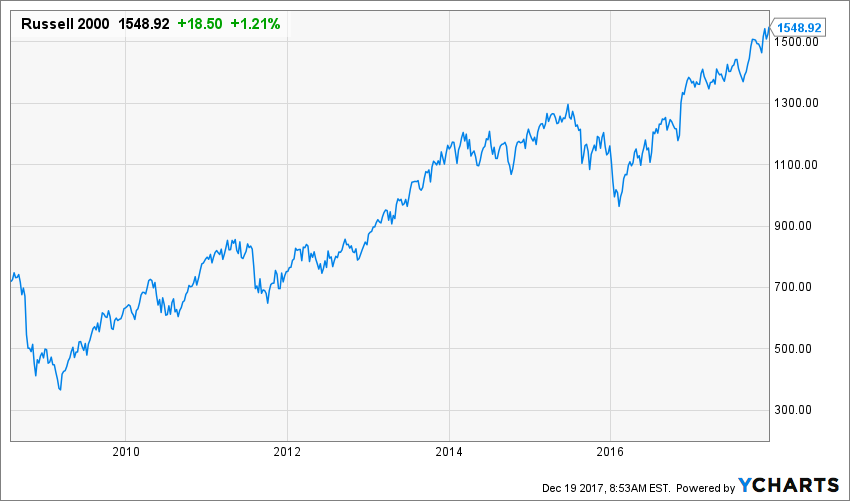
These absurd valuations would be troublesome enough if the fiscal and monetary context were stable rather than heading for a thundering dislocation. But there is no other word for a fiscal equation which is unraveling at lightening speed as we head for the onset of FY 2019 next October 1.
Under the CBO’s baseline projection of last June, the picture was already bad enough. Federal outlays were projected to rise from $4.0 trillion in the year just ended (FY2017) to $4.38 trillion in FY 2019. Notwithstanding revenue growth of 11% under current law over the two year period, the resulting baseline deficit still computed to nearly $700 billion.
But Trump has already signed into law a defense authorization bill which will raise baseline outlays from $625 billion to $700 billion. And on top of that, the House yesterday approved an $81 billion disaster aid supplemental for the hurricanes and wildfires, which will bring total spending for this year’s disasters to a staggering $133 billion.
That’s vastly more than the $51 billion spent for Hurricane Sandy or the Katrina outlays of $60 billion. More importantly, the Congressional Republicans are not contemplating any off-setting cuts elsewhere in the Federal budget—-a sharp reversal from their traditional insistence to that effect.
Indeed, the disaster fix is already in and will be attached to the next two-week installment of the FY 2018 continuing resolution (CR).
The fact that the Federal deficit is soaring and was already up by 75% in the year just ended compared to FY 2015 has apparently not registered with the Republican leadership. And that’s to say nothing of horrific timing: Upwards of half of the $133 billion of disaster aid will hit in FY 2019 at the exact time that the GOP’s front-loaded tax cut ($280 billion) will also arrive with full force.
As Bloomberg noted with respect to the disaster aid bills, fiscal rectitude is not the GOP’s flavor of the month. For instance, the “ask” of $61 billion for disaster aid from conservative Texas governor Gregg Abbott is more than has ever been spent on any previous disaster in US history.
Likewise, the Florida GOP is seeking $1.5 billion for damages suffered by the citrus industry when Irma came roaring across the peninsula. That’s especially rich because hurricanes are surely a known cost of doing business in Florida, and orange and lemon producers ought to buy insurance or self-insure, not ding taxpayers in Fargo North Dakota.
In any event, as Bloomberg explains below, the GOP’s stalwart conservatives from Florida, California and Texas are on the case because this time is apparently different:
The aid likely would be attached to a government spending bill that must be passed this week to keep the government open after Friday. The disaster spending is being pushed forward by Republicans from Texas, Florida and California who threatened to oppose the spending bill if hurricane relief wasn’t included……“The dollar figures I hear are fine,” said second-ranking Senate Republican John Cornyn of Texas. “How it’s distributed may need some changes”.
House Rules Committee Chairman Pete Sessions of Texas predicted that conservatives will support the bill, despite a lack of offsetting spending cuts, because they understand the urgent need for aid. The Texas port on the Gulf of Mexico, through which military armaments pass, is “still in shambles”, he said.
Florida has requested $1.5 billion to help its citrus industry recover from hurricane Irma. Texas Governor Greg Abbott has requested $61 billion in aid for his state, while officials in Puerto Rico have sought $94 billion.
Still, there are at least two more budget shoes to drop just around the corner, as well. The first is the House GOP leadership’s plan to bust the sequester caps for defense via a rider on the Christmas Eve CR, but to leave the cap on domestic appropriations frozen at existing levels.
Needless to say, it won’t fly. The Dems have already rejected what they are calling Ryan’s defense and disaster plan—-yet the sheer vote math in the GOP caucus is prohibitive on a strictly partisan basis. This means that to raise defense spending by about $75 billion per year or 12%—either in the current CR extension or the next one in early January—will ultimately require at least a $25 billion or 5% increase in domestic appropriations in order to obtain at least some democratic votes.
Like in so many other cases, the Speaker will lose votes from among the 40-50 member Freedom Caucus owing to the lack of off-sets for the giant disaster relief rider and would simultaneously face defections from the 50-member Tuesday Club if defense appropriations are raised by 12% while domestic appropriation for education, community development, health services and research etc are kept frozen at sequester levels.
So we expect that he will end up cobbling together a majority by pacifying the GOP moderates and buying off the requisite Dems to obtain the needed 218 votes to keep the government open—-even if only a few weeks at a time.
That baleful outcome is more or less baked into the cake based on how McConnell auctioned off the votes for the tax bill in the Senate. Specifically, he made an ironclad promise to Senator Collins to fund the ObamaCare insurance subsidies at around$20 billion per year.
Yet given that his majority will dwindle to just 51-votes after Alabama, he has no way to renege. That’s because the RINO from Maine was negotiating for Senator Alexander and a handful of other GOP Senators who insist on “stabilizing” rather than repealing ObamaCare. But when the insurance company bailout comes back to the House, there will be huge defections by the anti-ObamaCare stalwarts of the Freedom Caucus.
In all, then, we expect FY 2019 outlays to rise by upwards of $200 billion from CBO’s most recent baseline projection. That would include $75 billion for defense, $65 billion for disaster aid, $25 billion for increased of domestic appropriations above the sequester cap, $20 billion for the ObamaCare subsidies and another $15 billion for interest on higher spending and lower revenues.
Those kinds of spending increases are now virtually certain, and will take total FY 2019 outlays to around $4.575 trillion. That happens to be nearly 20% more than the $3.85 trillion spent during FY 2016 during the run-up to the presidential election—-when the GOP politicians loudly denounced the runaway spending of the Obama Administration.
And that get’s us to the tax bill and what the Wall Street Journal has dubbed “Sunset Boulevard”. What that means is the biggest tax cut occurs on the front-end in FY 2019. Thereafter, the tax bill devolves into an endless sequence of gimmicks, sunsets and implausible out-year revenue raisers that were designed to shoehorn the 10-year cost into the $1.5 trillion deficit allowance which enabled a 51-vote reconciliation process.

So the Sunset Boulevard depicted above amounts to the most blatant and dishonest abuse of the budget reconciliation process since its enactment in 1974, and we will elaborate on that in greater detail tomorrow.
But suffice it to say here that the “cliffs” built-into the graph below are not going to happen in the real world. Instead, they will soon lead to political conflicts and fiscal food fights that will make the 2012-2013 tax expiration “cliffs” look like small potatoes in comparison.
For instance, the only semblance of honesty in the claim that the bill is a “middle class tax cut” is the 2-3 points of downward adjustment in the 7 marginal rate brackets compared to current law and the doubling of the child credit to $2000.
In the sunset year of 2025, however, those measures would save taxpayers $250 billion. compared to current law. Yet if there is any certainty in this world at all, it is that a legislative and political bloodbath will ensue when the Congress comes check-by-jowl with a quarter trillion dollar per year tax increase on 150 million individual taxpayers in 2026.
Likewise, the $53 billion per year cut for pass-thru businesses expires in 2025—-even as the corporate rate cut to 21% (at a cost of $150 billion per year) stays on the books forever. That’s not going to happen in a month of Sundays, either.
From the other side of the equation (i.e. payfors), the limit on interest deductions for business debt tightens sharply in the outyears. This causes the “payfor” gain to nearly double from $20 billion per year to $37 billion (2027), while at the same time a whole new regime of amortization of corporate R&D rather than 100% expensing incepts in 2022—raising a projected $120 billion in the final six years of the bill.
Since the K-Street lobbies and business PACs essentially wrote the current bill, we have little doubt that they will have the clout to “un-write” what amounts to $200 billion in phony revenue increases in the outyears when the time comes.
In short, we will demonstrate that the true 10-year cost of the GOP’s tax bill folly is in the order of $2.5 trillion on a honest accounting basis, and that under current circumstances it doesn’t have a snowball’s chance in the hot place of paying for itself with higher growth.
But for the moment, however, the FY 2019 budget disaster also explains why coping with this fiscal monstrosity in the outyears in the context of baseline deficits which already total $10 trillion over the period will be next to impossible.
As is evident below, the FY 2019 revenue loss from the final conference bill will total $280 billion, thereby reducing Uncle Sam’s collections to just $3.40 trillion compared to the aforementioned $4.575 trillion of spending.
So there you have it: An FY 2019 budget deficit of $1.175 trillion—and you need to add another $100 billion for off-balance sheet programs that add to the borrowing requirement.
Even under the CBO’s generous estimate of nominal GDP for FY 2019 ($20.7 trillion), the Treasury’s total borrowing requirement of $1.275 trillion would amount to 6.1% of GDP.
But here’s the thing. That would be during months #111-125 of the business expansion that started in June 2009. As we have frequently noted, the US economy has never been there before—with the longest previous expansion during the far more benign 1990s totaling only 118 months.
And that is to say nothing of the fact that this purported record business expansion would be occurring at a time ultra-late in the cycle when the Fed is shrinking its balance sheet by an unprecedented rate of $600 billion per year.
In a word, something’s going to give.
We’d bet a fair amount that one of those “somethings” will be a casino so delirious with momo madness that it is valuing the RUT main street businesses of America at 107X peak earnings.
Trey Gowdy Demands FBI Counsel Lisa Page Appear Before Oversight Following “Insurance Policy” Text
Last week, the world was shocked by the disclosure of text messages exchanged between FBI agent Peter Strzok and FBI counsel Lisa Page suggesting that the FBI may have crafted and “insurance policy” to prevent a Trump presidency (we wrote about it here: FBI Texts Reveal “Insurance Policy” To Prevent Trump Presidency).
Text-from Peter Strzok to Lisa Page (Andy is Andrew McCabe): “I want to believe the path u threw out 4 consideration in Andy’s office-that there’s no way he gets elected-but I’m afraid we can’t take that risk.It’s like an insurance policy in unlikely event u die be4 you’re 40”

Text-from Peter Strzok to Lisa Page (Andy is Andrew McCabe): “I want to believe the path u threw out 4 consideration in Andy’s office-that there’s no way he gets elected-but I’m afraid we can’t take that risk.It’s like an insurance policy in unlikely event u die be4 you’re 40”
— Bret Baier (@BretBaier) December 13, 2017
Now, for the first time since these new revelations came to light, Trey Gowdy, chairman of the House Oversight Committee, and Bob Goodlatte, chairman of the Judiciary Committee, are demanding that Page appear before Congress to answer for what appear to be very troubling messages.
In a letter sent to Attorney General Jeff Sessions and his deputy, Rod Rosenstein, Goodlatte and Gowdy said they continue to investigate the FBI’s handling of the Clinton email investigation as well as the ‘Russian collusion’ investigation and demanded the appearance of FBI Deputy Director Andrew McCabe, FBI Chief of Staff Jim Rybicki, and FBI counsel Lisa Page for transcribed interviews starting tomorrow.
“In order to further the Committees’ oversight of this important matter, we request that you make the following officials available for transcribed interviews starting this Thursday, December 21, 2017: FBI Deputy Director Andrew McCabe, FBI Chief of Staff Jim Rybicki, and FBI counsel Lisa Page.“
Of course, if you missed it, we highly recommend the following epic monologue from Gowdy at last week’s hearing with Deputy Attorney General Rod Rosenstein where he masterfully explained why Special Counsel Mueller’s probe has become nothing but a farcical, politically-motivated witch hunt. Perhaps this is a good preview of what is to come…
Full letter below:
The Washington Post Propagandizes Again: Says ‘Fedcoin’ Will Be ‘Bigger’ Than Bitcoin

Authored by Michael Snyder via The Economic Collapse blog,
Fedcoin doesn’t even exist yet, and yet the Washington Post is already hyping it as the primary cryptocurrency that we will be using in the future.

Do they know something that they rest of us do not?
Just a few days ago I warned that global central banks could eventually try to take control of the cryptocurrency phenomenon, and so I was deeply alarmed to see the Post publish this sort of an article. We want cryptocurrencies to stay completely independent, and we definitely do not want the Federal Reserve and other global central banks to start creating their own versions. Because of course once they create their own versions they will want to start restricting the use of any competitors.
The one thing that could derail the cryptocurrency revolution faster than anything else would be interference by national governments or global central banks. Unfortunately, now that Bitcoin, Litecoin, Ethereum and other cryptocurrencies are getting so much attention, it is inevitable that the powers that be will make a move.
On Monday, the Washington Post published an opinion piece by Professor Campbell R. Harvey of Duke University that was entitled “Bitcoin is big. But fedcoin is bigger.” These days, there is an agenda behind virtually everything that the Washington Post publishes, and so it is not just a coincidence that they have published an article with “fedcoin” in the title. Here is how that article begins…
Over the past few weeks, investors have been flocking to bitcoin, the digital currency whose value has soared by about 2,000 percent in the past year alone. And while many economists are cautioning against excitement about bitcoin — which is caught up in what may be one of the biggest speculative bubbles in history — it’s important to note just how revolutionary the technology may be.
Indeed, the technology underlying bitcoin could fundamentally change the way we think of money.
Professor Harvey goes on to explain that it is “only a matter of time before paper money is phased out”, and that some version of “fedcoin” is inevitable.
But it doesn’t have to be.
The Federal Reserve and other global central banks could just leave us alone and allow us to create our own currencies. The cryptocurrency revolution is moving along just fine, and there is no need for any sort of interference.
But I have a feeling that the powers that be will eventually manufacture some sort of a “cryptocurrency crisis” if one does not happen naturally. In the aftermath, they will attempt to introduce some version of “fedcoin”, and many in the general public will be very thankful for the “solution” that the government has provided.
And that day may be closer than we think. In fact, the U.S. government has already invested millions into cryptocurrency research…
To add fuel to the fire, the U.S. government has been rigorously studying Bitcoin for about two years now… and instead of fighting Bitcoin, the Feds seem poised to wipe out the U.S. dollar by creating their own digital currency.
The National Science Foundation, a U.S. government agency that supports and funds research… has awarded $3 million to three U.S. universities for wide-ranging cryptocurrency research.
Cornell, the University of Maryland and the University of California Berkeley will focus on developing new cryptocurrency systems that, according to principal investigator Elaine Shi, will address “pain points” attributed to Bitcoin and other existing networks.
The Federal Reserve is far from alone. Other global central banks are doing their own research, and the Bank for International Settlements says that “all central banks” may eventually need their own cryptocurrencies. The following comes from CNBC…
Central banks may one day need to issue their own cryptocurrencies, the Bank for International Settlements said in its latest quarterly review.
“Whether or not a central bank should provide a digital alternative to cash is most pressing in countries, such as Sweden, where cash usage is rapidly declining,” the Sunday report said. “But all central banks may eventually have to decide whether issuing retail or wholesale [central bank cryptocurrencies] makes sense in their own context.”
This is going to be a critical phase for the cryptocurrency revolution, because the people of the world are going to have to make it exceedingly clear that they do not want central bank cryptocurrencies.
Central bank cryptocurrencies would simply be an extension of the current debt-based system that is systematically enslaving humanity. The thing that makes cryptocurrencies so great is the fact that they are not debt-based and they are allowing humanity to express independence from the current system.
As existing fiat currencies fail, we want there to be independent cryptocurrencies that people can use as an alternative. And we don’t have to just imagine what that would look like. In fact, it is already happening in Venezuela…
But in Venezuela, the collapse of the bolivar has forced locals to turn to alternatives like bitcoin and local community-issued currencies with fixed exchange rates. The rapid erosion of the bolivar’s value made everyday transactions like buying groceries and paying cabbies untenable – customers had to pay with large, cumbersome stacks of bolivars that were difficult to transport.
Patricia Laya, a Venezuela-based reporter, tweeted a photo of the 5,000 bolivars – the maximum amount – she was able to withdraw from an ATM in Caracas. They’re worth around $0.05. Laya stated that she had waited 20 minutes in line to obtain $0.05 in hyperinflated currency worth little to no value, according to CCN.
Even though bitcoin transactions can take hours – even days – to settle, local merchants have readily embraced the digital currency.
This is a revolution that has the potential to completely change the global financial system, but I have a feeling that global central banks will never let it get that far. The current system funnels literally trillions of dollars to the very top of the food chain, and the elite are going to jealously guard their golden goose.
* * *
Michael Snyder is a Republican candidate for Congress in Idaho’s First Congressional District, and you can learn how you can get involved in the campaign on his official website. His new book entitled “Living A Life That Really Matters” is available in paperback and for the Kindle on Amazon.com.
end
Let us close out the day with this fantastic interview of David Stockman by Greg Hunter
Gold Only Safe Asset Left – David Stockman
By Greg Hunter On December 20, 2017 In Market Analysis

By Greg Hunter’s USAWatchdog.com
Record high stock and bond prices are flashing danger signs to former Reagan White House Budget Director David Stockman. Stockman contends, “I don’t think we are going to have a liquidity crisis. I think it’s going to be a value reset. I think there is going to be a jarring downward price adjustment both in the stock market and in the bond market. This phantom or phony wealth that has been created since the last crisis is going to basically evaporate.”
So, what asset is safe? Stockman says gold and goes onto explain, “I think the time to buy (gold and silver) is ideal. Gold is the ultimate and only real money. Gold is the only safe asset when push comes to shove. They tell you to buy the government bond, that’s a safe asset. It’s not a safe asset at its current price. I am not saying the federal government is going to default in the next two or three years. I am saying the yield on a 10-year bond of 2.4% is way below of where it’s going to end up. So, the only safe asset left is gold. This crazy Bitcoin mania has drained off what would otherwise be a demand for gold. . . . When Bitcoin collapses, spectacularly, which it will because it’s sheer mania in the markets right now. When it collapses, I think a lot of that demand will come back into gold, as well as people fleeing the standard stock and bond markets for the first time in 9 or 10 years.”
What about the so-called Trump tax cuts? Stockman predicts, “I think it’s going to be a fiscal calamity of Biblical proportions. I want to be clear. I am always for tax cuts and shrinking the size of government, but you have to earn it. You have to cut spending and entitlements and this massive defense budget. Obviously, they didn’t do that. If you look at honest accounting . . . this bill will add $2.5 trillion to the public debt which, and this is a key point, is already going to rise by $10 trillion over the next decade based on the current law and taxes that is still in.”
“More importantly,” Stockman says, “The central banks realize they cannot keep printing money at these crazy rates, and by that I mean the bond buying. Now, they are going to begin to normalize and shrink their balance sheet. . . . By the fall (of 2018), they (the Federal Reserve) will be shrinking their balance sheet by $600 billion a year. What that means in plain simple English is that they (the Fed) are dumping $600 billion a year of existing bonds into the market just as Uncle Sam will be attempting to borrow $1.25 trillion more. Now, if you don’t think that is a financial collision waiting to happen, then I am not sure what would be. We are heading for a thundering collision in the bond market that will drive yields upward far more than the market is expecting. The stock market operates on the illusion of permanently low interest rates. When interest rates start to rise, everything is going to come apart because cheap debt has been priced in forever, and we are heading for far more expensive debt. . . . Bond prices are going to collapse when yields begin to rise. . . . Stock prices are going to collapse big-time when the underlying predicate of cheap debt, massive stock buy backs and M&A deals and everything else supporting the market today finally reverses. So, we are going to have deflation in the canyons of Wall Street, and that will not be a happy day.”
Join Greg Hunter as he goes One-on-One with financial expert David Stockman.
Video Link
https://usawatchdog.com/gold-only-safe-asset-left- david-stockman/
-END-
I will see you THURSDAY night
HARVEY


 harveyorganblog.com