
GOLD: $1328.00 UP $3.40
Silver: $16.57 DOWN 3 cents
Closing access prices:
Gold $1329.50
silver: $16.57
SHANGHAI GOLD FIX: FIRST FIX 10 15 PM EST (2:15 SHANGHAI LOCAL TIME)
SECOND FIX: 2:15 AM EST (6:15 SHANGHAI LOCAL TIME)
SHANGHAI FIRST GOLD FIX: $1324.85 DOLLARS PER OZ
NY PRICE OF GOLD AT EXACT SAME TIME: $1323.60
PREMIUM FIRST FIX: $1.25
xxxxxxxxxxxxxxxxxxxxxxxxxxxxxxxxxxxxxxxxxxxxxx
SECOND SHANGHAI GOLD FIX: $1334.47
NY GOLD PRICE AT THE EXACT SAME TIME: $13235.40
Premium of Shanghai 2nd fix/NY:$9.07
xxxxxxxxxxxxxxxxxxxxxxxxxxxxxxxxxxxxxxxxxxxxxxxxxxx
LONDON FIRST GOLD FIX: 5:30 am est $1329.40
NY PRICING AT THE EXACT SAME TIME: $1329.90
LONDON SECOND GOLD FIX 10 AM: $1325.35
NY PRICING AT THE EXACT SAME TIME. $1326.00
For comex gold:
FEBRUARY/
NUMBER OF NOTICES FILED TODAY FOR FEBRUARY CONTRACT: 0 NOTICE(S) FOR NIL OZ.
TOTAL NOTICES SO FAR:1783 FOR 178300 OZ (5.458 TONNES),
For silver:
FEBRUARY
89 NOTICE(S) FILED TODAY FOR
445,000 OZ/
Total number of notices filed so far this month: 215 for 1,075,000 oz
XXXXXXXXXXXXXXXXXXXXXXXXXXXXXX
Bitcoin: BID $8508/OFFER $8576: DOWN $351(morning)
Bitcoin: BID/ $8602/offer $8671: DOWN $255 (CLOSING/5 PM)
end
There are 4 tools used by the manipulators to raise stock prices while stocking down gold and silver:
- increasing the value of the USA dollar index
- shorting yen (buying usa/yen) which is your carry trade ie. buy stocks, short yen gold
- hammer vix (the volatility index) which states that everything is OK. ie. short volatility and gold buy stocks
- contain the 10 yr USA treasury yield below 2.80%
we are beginning to see fractures in all of them. today it was the yen that rose and that drove gold/silver higher.
Let us have a look at the data for today\
xxxxxxxxxxxxxxxxxxxxxxxxxxxxxxxxxxxxxxxxxxxxxxxxxxxxxxxxxxxxxxxxxxxxxxxxxx
In silver, the total open interest FELL BY A TINY SIZED 453 contracts from 195,964 FALLING TO 195,511 DESPITE YESTERDAY’S SOLID 40 CENT GAIN IN SILVER PRICING. WE HAD MINIMAL COMEX LIQUIDATION. HOWEVER, WE WERE AGAIN NOTIFIED THAT WE HAD ANOTHER GOOD SIZED NUMBER OF COMEX LONGS TRANSFERRING THEIR CONTRACTS TO LONDON THROUGH THE EFP ROUTE: 1862 EFP’S FOR MARCH AND AND 0 EFP’S FOR MAY AND ZERO FOR ALL OTHER MONTHS AND THUS TOTAL ISSUANCE OF 1864 CONTRACTS. WITH THE TRANSFER OF 1862 CONTRACTS, WHAT THE CME IS STATING IS THAT THERE IS NO SILVER (OR GOLD) TO BE DELIVERED UPON AT THE COMEX AS THEY MUST EXPORT THEIR OBLIGATION TO LONDON. ALSO KEEP IN MIND THAT THERE CAN BE A DELAY OF 24 HRS IN THE ISSUING OF EFP’S. THE 1862 CONTRACTS TRANSLATES INTO 9.32 MILLION OZ. WITH THE HUGE DROP IN OPEN INTEREST AT THE COMEX. WE SHOULD EXPECT BIGGER GAINS IN EFP TRANSFERS IN THE NEXT FEW DAYS WITH THE LARGE LOSS AT THE COMEX AS LONGS GAVE UP SEEKING METAL AT THIS EXCHANGE.
ACCUMULATION FOR EFP’S/SILVER/ STARTING FROM FIRST DAY NOTICE/FOR MONTH OF FEBRUARY:
32,254 CONTRACTS (FOR 10 TRADING DAYS TOTAL 32,254 CONTRACTS OR 161.270 MILLION OZ: AVERAGE PER DAY: 3225 CONTRACTS OR 16.125 MILLION OZ/DAY)
TO GIVE YOU AN IDEA AS TO THE HUGE SUPPLY THIS MONTH IN SILVER: SO FAR THIS MONTH: 161.3 MILLION PAPER OZ HAVE MORPHED OVER TO LONDON. THIS REPRESENTS AROUND 23.0% OF ANNUAL GLOBAL PRODUCTION
ACCUMULATION IN YEAR 2018 TO DATE SILVER EFP’S: 409.6 MILLION OZ.
ACCUMULATION FOR JAN 2018: 236.879 MILLION OZ
RESULT: A TINY SIZED GAIN IN OI SILVER COMEX DESPITE THE SOLID 40 CENT GAIN IN SILVER PRICE. WE HOWEVER HAD A GOOD SIZED EFP ISSUANCE OF 1862 CONTRACTS WHICH EXITED OUT OF THE SILVER COMEX AND TRANSFERRED THEIR OI TO LONDON AS FORWARDS. SPECULATORS CONTINUED THEIR INTEREST IN ATTACKING THE SILVER COMEX FOR PHYSICAL SILVER . FROM THE CME DATA 1862 EFP’S FOR MONTHS MARCH AND MAY WERE ISSUED FOR MONDAY FOR A DELIVERABLE FORWARD CONTRACT OVER IN LONDON WITH A FIAT BONUS. WE GAINED 1883 OI CONTRACTS i.e. 1862 open interest contracts headed for London (EFP’s) TOGETHER WITH A INCREASE OF 21 OI COMEX CONTRACTS. AND ALL OF THIS HAPPENED WITH THE CONSIDERABLE RISE IN PRICE OF SILVER OF 40 CENTS AND A CLOSING PRICE OF $16.60 WITH RESPECT TO YESTERDAY’S TRADING. YET WE STILL HAVE A FAIR AMOUNT OF SILVER STANDING AT THE COMEX.
In ounces AT THE COMEX, the OI is still represented by just UNDER 1 BILLION oz i.e. 0.980 BILLION TO BE EXACT or 140% of annual global silver production (ex Russia & ex China).
FOR THE NEW FRONT FEBRUARY MONTH/ THEY FILED: 89 NOTICE(S) FOR 445,000 OZ OF SILVER
In gold, the open interest FELL BY A TINY 590 CONTRACTS DOWN TO 510.150 DESPITE THE GOOD SIZED RISE IN PRICE OF GOLD WITH YESTERDAY’S TRADING ($12.00). HOWEVER, IN ANOTHER DEVELOPMENT, WE RECEIVED THE TOTAL NUMBER OF GOLD EFP’S ISSUED FOR MONDAY AND IT TOTALED A FAIR SIZED 3381 CONTRACTS OF WHICH APRIL SAW THE ISSUANCE OF 3381 CONTRACTS AND JUNE SAW THE ISSUANCE OF 0 CONTRACTS AND THEN ALL OTHER MONTHS ZERO. The new OI for the gold complex rests at 510,150. ALSO REMEMBER THAT THERE WILL BE A DELAY IN THE ISSUANCE OF EFP’S. THE BANKERS REMOVE LONG POSITIONS OF COMEX GOLD IMMEDIATELY. THEN THEY ORCHESTRATE THEIR PRIVATE EFP DEAL WITH THE LONGS AND THAT COULD TAKE AN ADDITIONAL 48 HRS SO WE GENERALLY DO NOT GET A MATCH WITH RESPECT TO DEPARTING COMEX LONGS AND NEW EFP LONG TRANSFERS. DEMAND FOR GOLD INTENSIFIES GREATLY AS WE CONTINUE TO WITNESS A HUGE NUMBER OF EFP TRANSFERS TOGETHER WITH THE MASSIVE INCREASE IN GOLD COMEX OI TOGETHER WITH THE TOTAL AMOUNT OF GOLD OUNCES STANDING FOR FEBRUARY COMEX. EVEN THOUGH THE BANKERS ISSUED THESE MONSTROUS EFPS, THE OBLIGATION STILL RESTS WITH THE BANKERS TO SUPPLY METAL BUT IT TRANSFERS THE RISK TO A LONDON BANKER OBLIGATION AND NOT A NEW YORK COMEX OBLIGATION. LONGS RECEIVE A FIAT BONUS TOGETHER WITH A LONG LONDON FORWARD. THUS, BY THESE ACTIONS, THE BANKERS AT THE COMEX HAVE JUST STATED THAT THEY HAVE NO APPRECIABLE METAL!! THIS IS A MASSIVE FRAUD: THEY CANNOT SUPPLY ANY METAL TO OUR COMEX LONGS BUT THEY ARE QUITE WILLING TO SUPPLY MASSIVE NON BACKED GOLD (AND SILVER) PAPER KNOWING THAT THEY HAVE NO METAL TO SATISFY OUR LONGS. LONDON IS NOW SEVERELY BACKWARD IN BOTH GOLD AND SILVER (BIG RISE IN BOTH GOFO AND SIFO) AND WE ARE WITNESSING DELAYS IN ACTUAL DELIVERIES. IN ESSENCE TODAY DESPITE YESTERDAY’S TRADING IN GOLD, WE HAVE A GAIN OF 2791 CONTRACTS: 590 OI CONTRACTS DECREASED AT THE COMEX AND A FAIR SIZED 3381 OI CONTRACTS WHICH NAVIGATED OVER TO LONDON.(2791 oi gain in CONTRACTS EQUATES TO 8.68 TONNES)
FRIDAY, WE HAD 6968 EFP’S ISSUED.
ACCUMULATION OF EFP’S/ GOLD(EXCHANGE FOR PHYSICAL) FOR THE MONTH OF FEBRUARY STARTING WITH FIRST DAY NOTICE: 102,277 CONTRACTS OR 10,227,700 OZ OR 318.10 TONNES (10 TRADING DAYS AND THUS AVERAGING: 10,227 EFP CONTRACTS PER TRADING DAY OR 1,022,700 OZ/DAY)
TO GIVE YOU AN IDEA AS TO THE HUGE SIZE OF THESE EFP TRANSFERS : SO FAR THIS MONTH IN 9 TRADING DAYS: IN TONNES: 318.10 TONNES
TOTAL ANNUAL GOLD PRODUCTION, 2017, THROUGHOUT THE WORLD EX CHINA EX RUSSIA: 2200 TONNES
THUS EFP TRANSFERS REPRESENTS 318.10/2200 x 100% TONNES = 14.5% OF GLOBAL ANNUAL PRODUCTION SO FAR IN FEBRUARY ALONE.
ACCUMULATION OF GOLD EFP’S YEAR 2018 TO DATE: 951.63 TONNES
ACCUMULATION OF GOLD EFP’S FOR JANUARY 2018: 653.22 TONNES
Result: A TINY SIZED DECREASE IN OI AT THE COMEX DESPITE THE STRONG SIZED GAIN IN PRICE IN GOLD TRADING YESTERDAY ($12.00). IT IS WITHOUT A DOUBT THAT MANY OF THE DEPARTED COMEX LONGS RECEIVED THEIR PRIVATE EFP CONTRACT FOR EITHER APRIL OR JUNE. HOWEVER, WE HAD ANOTHER GOOD SIZED NUMBER OF COMEX LONG TRANSFERRING TO LONDON THROUGH THE EFP ROUTE: 3381 AS THESE HAVE ALREADY BEEN NEGOTIATED AND CONFIRMED. THERE OBVIOUSLY DOES NOT SEEM TO BE MUCH PHYSICAL GOLD AT THE COMEX AND YET WE ALSO OBSERVED A HUGE DELIVERY MONTH FOR THE MONTH OF DECEMBER. I GUESS IT EXPLAINS THE HUGE ISSUANCE OF EFP’S…THERE IS HARDLY ANY GOLD PRESENT AT THE GOLD COMEX FOR DELIVERY PURPOSES. IF YOU TAKE INTO ACCOUNT THE 3381 EFP CONTRACTS ISSUED, WE HAD A NET GAIN IN OPEN INTEREST OF 2791 contracts ON THE TWO EXCHANGES:
3381 CONTRACTS MOVE TO LONDON AND 590 CONTRACTS DECREASED AT THE COMEX. (in tonnes, the GAIN in total oi equates to 8.68 TONNES).
we had: 0 notice(s) filed upon for NIL oz of gold.
xxxxxxxxxxxxxxxxxxxxxxxxxxxxxxxxxxxxxxxxxxxxxxxxxxxxxxxxxxx
With respect to our two criminal funds, the GLD and the SLV:
GLD
WITH GOLD UP $3.40 TODAY, THE CROOKS DECIDED NOT THE RAID THE COOKIE JAR/INVENTORY REMAINS CONSTANT/
Inventory rests tonight: 820.71 tonnes.
SLV/
NO CHANGES IN SILVER INVENTORY AT THE SLV/ AGAIN WITH TODAY’S HUGE RISE IN SILVER PRICE: NO CHANGE IN INVENTORY
/INVENTORY RESTS AT 314.045 MILLION OZ/
can someone please explain why GLD behaves differently to SLV????
end
First, here is an outline of what will be discussed tonight:
1. Today, we had the open interest in silver FELL BY A TINY 453 contracts from 195,964 UP TO 195,511 (AND now A LITTLE FURTHER TO THE NEW COMEX RECORD SET ON FRIDAY/APRIL 21/2017 AT 234,787) DESPITE THE STRONG SIZED RISE IN PRICE OF SILVER (40 CENTS WITH RESPECT TO YESTERDAY’S TRADING). OUR BANKERS USED THEIR EMERGENCY PROCEDURE TO ISSUE ANOTHER GOOD 1862 PRIVATE EFP’S FOR MARCH AND 0 EFP CONTRACTS OR MAY (WE DO NOT GET A LOOK AT THESE CONTRACTS AS IT IS PRIVATE BUT THE CFTC DOES AUDIT THEM) AND 0 EFP’S FOR ALL OTHER MONTHS . EFP’S GIVE OUR COMEX LONGS A FIAT BONUS PLUS A DELIVERABLE PRODUCT OVER IN LONDON. WE HAD SOME COMEX SILVER COMEX LIQUIDATION. IF WE TAKE THE OI LOSS AT THE COMEX OF 453 CONTRACTS TO THE 1862 OI TRANSFERRED TO LONDON THROUGH EFP’S, WE OBTAIN A GAIN OF 1409 OPEN INTEREST CONTRACTS . WE STILL HAVE A GOOD AMOUNT OF SILVER OUNCES THAT ARE STANDING FOR METAL IN JANUARY (SEE BELOW). THE NET GAIN TODAY IN OZ ON THE TWO EXCHANGES: 7.04 MILLION OZ!!!
RESULT: A TINY SIZED DECREASE IN SILVER OI AT THE COMEX DESPITE THE CONSIDERABLE SIZED RISE OF 40 CENTS IN PRICE (WITH RESPECT TO YESTERDAY’S TRADING ). BUT WE ALSO HAD ANOTHER GOOD 1862 EFP’S ISSUED TRANSFERRING COMEX LONGS OVER TO LONDON. TOGETHER WITH THE GOOD SIZED AMOUNT OF SILVER OUNCES STANDING FOR FEBRUARY, DEMAND FOR PHYSICAL SILVER INTENSIFIES AS WE WITNESS MAJOR BANK SHORT COVERING ACCOMPANIED BY INCREASES IN GOFO AND SIFO RATES INDICATING SCARCITY.
(report Harvey)
.
2.a) The Shanghai and London gold fix report
(Harvey)
2 b) Gold/silver trading overnight Europe, Goldcore
(Mark O’Byrne/zerohedge
and in NY: Bloomberg
3. ASIAN AFFAIRS
i)Late MONDAY night/TUESDAY morning: Shanghai closed UP 30.83 points or 0.93% /Hang Sang CLOSED UP 379.90 or 1.29% / The Nikkei closed DOWN 137.94 POINTS OR .65%/Australia’s all ordinaires CLOSED UP 0.63%/Chinese yuan (ONSHORE) closed DOWN at 6.3448/Oil DOWN to 59.08 dollars per barrel for WTI and 62.49 for Brent. Stocks in Europe OPENED DEEPLY IN THE RED EXCEPT LONDON . ONSHORE YUAN CLOSED DOWN AGAINST THE DOLLAR AT 6.3448. OFFSHORE YUAN CLOSED UP AGAINST THE ONSHORE YUAN AT 6.3395//ONSHORE YUAN A LOT WEAKER AGAINST THE DOLLAR/OFF SHORE A LOT STRONGER TO THE DOLLAR/. THE DOLLAR (INDEX) IS MUCH WEAKER AGAINST ALL MAJOR CURRENCIES INCLUDING ON SHORE CHINA YUAN. CHINA IS HAPPY TODAY STRONGER MARKETS IN CHINA
3a)THAILAND/SOUTH KOREA/NORTH KOREA
i)North Korea
b) REPORT ON JAPAN
3 c CHINA
4. EUROPEAN AFFAIRS
England/Ecuador embassy
The judge rejects Assange’s bid to drop his UK arrest warrant and now he is still stick inside the embassy
( zerohedge)
5. RUSSIAN AND MIDDLE EASTERN AFFAIRS
i)SYRIA/RUSSIA/USA
( zerohedge)
ii)Not good: Iran unveils two nuclear capable ballistic missiles right after Israel’s attack on Syria
( zerohedge)
iii)TURKEY/CYPRUS/ISRAEL
A little background to this story: A few years ago Israel discovered natural gas off the coast of Israel (off of Haifa) and the gas field headed right into Cyprus waters. Israel told the Cyprus government of their find and from that day forward, both Israel and Cyprus started to develop these fields. You will recall that Cyprus is divided into two sections: The Greek side to the south and the Turkish side is to the north. In the 197o’s civil war broke out between the two sides and bad blood exists between the two ever since.
Turkey is not happy that the southern side has discovered riches and they are doing everything in their power to block development of Cypriot gas fields
( zerohedge)
iv)ISRAEL
Israeli police after a long investigation has now recommended that Prime Minister Metanyahu be indicted for bribery
( zerohedge)
6 .GLOBAL ISSUES
7. OIL ISSUES
i)Basket case Venezuela must now import crude oil from Russia as its production continues to cascade
( Z. Calcuttawala/OilPrice.com)
ii)Crude oil and gasoline drop after bigger and expected buildup
8. EMERGING MARKET
SOUTH AFRICA
Zuma has been ordered to resign/the rand falls
( zerohedge)
9. PHYSICAL MARKETS
i)Giant Barrick is facing a grilling from its shareholders and they deserve to be at the bottom of the pack
( GATA/Bloomberg)
ii)You need a whistleblower to tell the CFTC that the VIX causes manipulation in the markets?
( Bloomberg/GATA)
iii)No wonder the price of gold is being capped: Robert Lambourne reports on a huge increase in gold swaps in January.
total bank exposure 580 tonnes which is huge!
(courtesy Robert Lambourne/GATA)
10. USA stories which will influence the price of gold/silver
( zerohedge)
ii)Interesting: nobody is reporting their crypto profits to the IRS
( zerohedge)
iii)Trump threatens a reciprocal tax on imported goods (border tax adjustments). However White House officials denies if they are pursuing this
( zerohedge)
iv)The White House will now add Pakistan to its list of terror financing nations
(courtesy zerohedge)
v)A must read..how the rise in the 10 yr treasury yield will kill off much of Wall Street
(courtesy David Stockman)
vi)Interbank lending plummets: banks are refusing to lend to one another. Why? Answer: the rise in the 10 yr interest rate as the Fed rolls off maturing bonds.
a very important read..
( MishShedlock/Mishtalk)
vi)SWAMP STORIES
a)Pay attention to this story. A former Federal prosecutor and husband of Victoria Toensing, a lawyer representing Campbell, the Russian informant on the Uranium one scandal states that the Schiff memo is blocked not because of Trump but because the DOJ and the FBI are under ‘criminal’ investigation. That makes sense. Also it sure looks like Priestap is the deep throat providing all the information to Jeff Sessions (USA Attorney General)
( zerohedge)
( zerohedge)
c)and the next one to go will be General Kelly
(courtesy zerohedge)
d)Very strange indeed!! Susan rise emails herself an email on a secret meeting held on Jan 5.2017, two weeks before inauguration. In that meeting there was Susan Rice, Obama, James Comey, Assist Deputy Attorney General Sally Yates and Joe Biden. What was this meeting all about..unmasking? Grassley wants to know…
(courtesy zerohedge)
PRELIMINARY COMEX VOLUME FOR TODAY: 197,095 contracts
CONFIRMED COMEX VOL. FOR YESTERDAY: 225,883 CONTRACTS
comex gold volumes are RISING AGAIN
Here is a summary of the latest gold trading volumes at the Comex per year
certainly the introduction of EFP’s has certainly had an effect:
Trading Volumes on the COMEX
Meanwhile, gold-trading volumes on the COMEX have never been higher:

end
xxxxxxxxxxxxxxxxxxxxxxxxxxxxxxxxxxxxxxxxxxxxxxxxxxxxxxxxxxxxxxxxxxxx
And now for the wild silver comex results.
Total silver OI FELL BY A TINY SIZED 590 CONTRACTS FROM 195,964 UP TO 195,511 DESPITE YESTERDAY’S STRONG SIZED 40 CENT RISE IN TRADING). HOWEVER,WE WERE ALSO INFORMED THAT WE HAD ANOTHER FAIR SIZED 1862 EMERGENCY EFP’S FOR MARCH ISSUED BY OUR BANKERS (WITH 0 EFP CONTRACTS FOR MAY AND ZERO FOR ALL OTHER MONTHS) TO COMEX LONGS WHO RECEIVED A FIAT BONUS PLUS A DELIVERABLE PRODUCT OVER IN LONDON: THE TOTAL EFP’S ISSUED: 1862. THE SILVER BOYS HAVE STARTED TO MIGRATE TO LONDON FROM THE START OF DELIVERY MONTH AND CONTINUING RIGHT THROUGH UNTIL FIRST DAY NOTICE JUST LIKE WE ARE WITNESSING TODAY. USUALLY WE NOTED THAT CONTRACTION IN OI OCCURRED ONLY DURING THE LAST WEEK OF AN UPCOMING ACTIVE DELIVERY MONTH AS WE HAVE JUST SEEN IN GOLD TODAY. THIS PROCESS HAS JUST BEGUN IN EARNEST IN SILVER STARTING IN SEPTEMBER 2017. HOWEVER, IN GOLD, WE HAVE BEEN WITNESSING THIS FOR THE PAST 2 YEARS. NICK LAIRD WAS KIND ENOUGH TO SUPPLY US THE TOTAL FOR 2017 GOLD EFP’S AND IT WAS 6600 TONNES FOR THE ENTIRE YEAR. WE OBVIOUSLY HAD MINIMAL LONG COMEX SILVER LIQUIDATION AND A GOOD SIZED GAIN IN TOTAL SILVER OI. WE ARE ALSO WITNESSING A FAIR AMOUNT OF SILVER OUNCES STANDING FOR COMEX METAL IN THIS NON ACTIVE JANUARY AS WELL AS THAT CONTINUAL MIGRATION OF EFPS OVER TO LONDON. ON A PERCENTAGE BASIS THERE ARE MORE EFP’S ISSUED FOR GOLD THAN SILVER. ON A NET BASIS WE GAINED 1409 SILVER OPEN INTEREST CONTRACTS:
453 CONTRACT LOSS AT THE COMEX COMBINING WITH THE ADDITION OF 1862 OI CONTRACTS NAVIGATING OVER TO LONDON.
NET GAIN TWO EXCHANGES: 1409 CONTRACTS
We are now in the poor non active delivery month of FEBRUARY and here the front month LOST 15 contracts DOWN TO 142 contracts. We had 16 notices filed upon yesterday so we GAINED 1 contract or 5,000 ADDITIONAL oz will stand for delivery at the comex
The March contract lost 3942 contracts DOWN to 92,463
April GAINED 38 contracts UP to 99 .
.
We had 89 notice(s) filed for 80,000 OZ for the FEBRUARY 2018 contract for silver
INITIAL standings for FEBRUARY
Feb 13/2018.
| Gold | Ounces |
| Withdrawals from Dealers Inventory in oz | nil oz |
| Withdrawals from Customer Inventory in oz |
49,820.411 oz
Brinks
JPMorgan
|
| Deposits to the Dealer Inventory in oz | nil oz |
| Deposits to the Customer Inventory, in oz |
76,864.602 oz
JPMorgan
|
| No of oz served (contracts) today |
0 notice(s)
NIL OZ
|
| No of oz to be served (notices) |
1148 contracts
(114,800 oz)
|
| Total monthly oz gold served (contracts) so far this month |
1783 notices
178300 oz
5.5458 tonnes
|
| Total accumulative withdrawals of gold from the Dealers inventory this month | NIL oz |
| Total accumulative withdrawal of gold from the Customer inventory this month | xxx oz |
For FEBRUARY:
Today, 0 notice(s) were issued from JPMorgan dealer account and 0 notices were issued from their client or customer account. The total of all issuance by all participants equates to 0 contract(s) of which 0 notices were stopped (received) by j.P. Morgan dealer and 0 notice(s) was (were) stopped/ Received) by j.P.Morgan customer account.
xxxxxxxxxxxxxxxxxxxxxxxxxxxxxxxxxxxxxxxxxxxxxxxxxxxxxxxxxxxxxxxxxxxxxxxxxx
To calculate the INITIAL total number of gold ounces standing for the FEBRUARY. contract month, we take the total number of notices filed so far for the month (1783) x 100 oz or 178,300 oz, to which we add the difference between the open interest for the front month of FEB. (1148 contracts) minus the number of notices served upon today (0 x 100 oz per contract) equals 293,100 oz, the number of ounces standing in this active month of FEBRUARY
Thus the INITIAL standings for gold for the FEBRUARY contract month:
No of notices served (1783 x 100 oz or ounces + {(1148)OI for the front month minus the number of notices served upon today (0 x 100 oz )which equals 293,100 oz standing in this active delivery month of February (9.116 tonnes). THERE IS 12.08 TONNES OF REGISTERED GOLD AVAILABLE FOR DELIVERY SO FAR.
WE LOST 1 CONTRACT OR AN ADDITIONAL 100 OZ WILL NOT STAND IN THIS ACTIVE DELIVERY MONTH OF FEBRUARY.
THE COMEX IS NOW UNDER STRESS AS THE REGISTERED GOLD FALLS BELOW 13 TONNES AS WELL AS HUGE NUMBER OF TONNES LEAVING THE CUSTOMER ACCOUNT
xxxxxxxxxxxxxxxxxxxxxxxxxxxxxxxxxxxxxxxxxxxxxxxxxxxxxxxxxxxxxxxxxxxxxxx
XXXXXXXXXXXXXXXXXXXXXXXXXXXXXXXXXXXXXXXXXXXXXXXX
IN THE LAST 17 MONTHS 70 NET TONNES HAS LEFT THE COMEX.
end
And now for silver
AND NOW THE DECEMBER DELIVERY MONTH
FEBRUARY FINAL standings
| Silver | Ounces |
| Withdrawals from Dealers Inventory | nil oz |
| Withdrawals from Customer Inventory |
928,298.505 oz
Brinks
CNT
Scotia
|
| Deposits to the Dealer Inventory |
443,526.420
oz
Brinks
|
| Deposits to the Customer Inventory |
658,702.116 OZ
JPM
CNT
|
| No of oz served today (contracts) |
89
CONTRACT(S
(445,000 OZ)
|
| No of oz to be served (notices) |
53 contracts
(265,000 oz)
|
| Total monthly oz silver served (contracts) | 304 contracts
(1,520,000 oz) |
| Total accumulative withdrawal of silver from the Dealers inventory this month | NIL oz |
| Total accumulative withdrawal of silver from the Customer inventory this month |
we had one inventory movement at the dealer side of things
i) into Brinks: 443,526.420 oz
total inventory movement dealer: 443,526.420 oz
we had 2 inventory deposits into the customer account
i) into J.P.MORGAN:655,789.316 oz ***
ii) into CNT:: 2812,800 oz
total inventory deposits: 658,702.116 oz
*** JPMorgan is continually adding to its inventory almost every single day.
we had 3 withdrawals from the customer account;
i) Out of Brinks: 5010.635 oz
ii) Out of CNT: 384m686,290
iii) Out of Scotia: 528,601.580
total withdrawals; 928,298.505 oz
we had 0 adjustment
total dealer silver: 43.384 million
total dealer + customer silver: 251.591 million oz
The total number of notices filed today for the FEBRUARY. contract month is represented by 89 contract(s) FOR 445,000 oz. To calculate the number of silver ounces that will stand for delivery in FEBRUARY., we take the total number of notices filed for the month so far at 304 x 5,000 oz = 1,520,000 oz to which we add the difference between the open interest for the front month of FEB. (142) and the number of notices served upon today (89 x 5000 oz) equals the number of ounces standing.
.
Thus the INITIAL standings for silver for the FEB contract month: 304(notices served so far)x 5000 oz + OI for front month of FEBRUARY(142) -number of notices served upon today (89)x 5000 oz equals 1,785,000 oz of silver standing for the FEBRUARY contract month.
WE GAINED 1 CONTRACT OR AN ADDITIONAL 5,000 OZ WILL STAND AT THE COMEX
xxxxxxxxxxxxxxxxxxxxxxxxxxxxxxxxxxxxxxxxxxxxxxxxxxxxxxxxxxx
ESTIMATED VOLUME FOR TODAY: 83,107 CONTRACTS
CONFIRMED VOLUME FOR YESTERDAY: 95,227 CONTRACTS
YESTERDAY’S CONFIRMED VOLUME OF 95,2278 CONTRACTS EQUATES TO 476 MILLION OZ OR 68.0% OF ANNUAL GLOBAL PRODUCTION OF SILVER
COMMODITY LAW SUGGESTS THAT OPEN INTEREST SHOULD NOT BE MORE THAN 3% OF ANNUAL GLOBAL PRODUCTION. THE CROOKS ARE SUPPLYING MASSIVE PAPER TRYING TO KEEP SILVER IN CHECK.
The record level of silver open interest is 234,787 contracts set on April 21./2017 with the price at that day at $18.42
The previous record was 224,540 contracts with the price at that time of $20.44
end
NPV for Sprott
1. Sprott silver fund (PSLV): NAV RISES TO -1.98% (FEB 13/2018)
2. Sprott gold fund (PHYS): premium to NAV RISES TO -0.03% to NAV (FEB 13/2018 )
Note: Sprott silver trust back into NEGATIVE territory at -1.98%-/Sprott physical gold trust is back into NEGATIVE/ territory at -0.03%/Central fund of Canada’s is still in jail but being rescued by Sprott.
Sprott WINS hostile 3.1 billion bid to take over Central Fund of Canada
(courtesy Sprott/GATA)
3.SPROTT CEF.A FUND (FORMERLY CENTRAL FUND OF CANADA): NAV FALLS TO -4.46%: NAV 13.74/TRADING 13.12//DISCOUNT 4.41%
END
And now the Gold inventory at the GLD/
Feb 13/WITH GOLD UP $3.40 WE HAD NO CHANGE IN GOLD INVENTORY AT THE GLD/INVENTORY REMAINS AT 820.71 TONNES
Feb 12/STRANGE!!WITH GOLD RISING BY 12.00 DOLLARS, THE CROOKS DECIDED AGAIN TO WITHDRAW 5.6 TONNES OF GOLD FOR EMERGENCY USE ELSEWHERE/INVENTORY RESTS AT 820.71 TONNES
Feb 9/AGAIN WITH HUGE TURMOIL ON THE MARKETS, THE CROOKS WITHDREW 2 TONNES OF GOLD FROM THE GLD INVENTORY/INVENTORY RESTS AT 826.31 TONNES
Feb 8/DESPITE THE GOOD GAIN IN PRICE FOR GOLD TODAY/THE CROOKS REMOVED .96 TONNES FROM THE GLD INVENTORY/INVENTORY RESTS AT 828.31 TONNES
FEB 7/AN UNBELIEVABLE 12.08 TONNES WAS REMOVED BY THE CROOKED BANKERS AND THIS GOLD WAS USED IN THE ASSAULT THESE PAST FEW DAYS/INVENTORY RESTS AT 829.27 TONNES
Feb 6/AGAIN VERY STRANGE: WITH TODAY’S TURMOIL, THE CROOKS DID NOT ADD ANY GOLD INVENTORY INTO THE GLD/INVENTORY REMAINS AT 841.35 TONNES
Feb 5 Strange,with all of today’s turmoil, the crooks at the GLD decided to add zero ounces into GLD inventory/inventory rests at 841.35 tonnes
Feb 2/no change in gold inventory at the GLD/Inventory rests at 841.35 tonnes
Feb 1/with gold up by $8.00/the crooks decided not to add any new physical gold metal into the GLD./inventory rests at 841.35 tonnes
Jan 31/with gold up $3.15 today, GLD shed another 5.32 tonnes of gold from its inventory/inventory rests at 841.35 tonnes
jan 30/with gold down by $4.85/GLD shed another 1.47 tonnes of gold from its inventory/inventory rests at 846.67 tonnes
JAN 29/with gold down $11.25, the GLD shed 1.18 tonnes of gold/inventory rests at 848.14 tonnes
jan 26/2018/no changes in gold inventory at the GLD/inventory rests at 849.32 tonnes
jan 25/no changes in gold inventory at the GLD/inventory rests at 849.32 tonnes
Jan 24/A HUGE DEPOSIT OF 2.65 TONNES OF GOLD INTO GLD/INVENTORY RESTS AT 849.32 TONNES
Jan 23/NO CHANGE IN GOLD INVENTORY DESPITE GOLD’S RISE/INVENTORY RESTS AT 846.67 TONNES
Jan 22/a huge deposit of 5.71 tonnes of gold despite a drop in price/inventory rests at 846.67 tonnes. In 3 trading days, the GLD has added 17.71 tonnes/the bankers are now in trouble!!
Jan 19/no change in gold inventory at the GLD/Inventory rests at 840.76 tonnes
Jan 18/SHOCKINGLY A HUGE DEPOSIT OF 11.80 TONNES WITH GOLD DOWN ALMOST $12.00/INVENTORY RESTS AT 840.76
Jan 17/no changes in gold inventory at the GLD/inventory rests at 828.96 tonnes
Jan 16/NO CHANGES IN GOLD INVENTORY AT THE GLD/INVENTORY RESTS AT 828.96 TONNES
Jan 12/no changes in inventory at the GLD despite the rise in gold price/inventory rests at 828.96 tonnes
Jan 11/ANOTHER IDENTICAL WITHDRAWAL OF 2.95 TONNES FROM THE GLD INVENTORY/INVENTORY RESTS AT 828.96 TONNES
xxxxxxxxxxxxxxxxxxxxxxxxxxxxxxxxxx
Feb 13/2018/ Inventory rests tonight at 820.71 tonnes
*IN LAST 324 TRADING DAYS: 120.44 NET TONNES HAVE BEEN REMOVED FROM THE GLD
*LAST 258 TRADING DAYS: A NET 36.87 TONNES HAVE NOW BEEN ADDED INTO GLD INVENTORY.
end
Now the SLV Inventory
Feb 13./NO CHANGE IN SILVER INVENTORY TODAY/INVENTORY RESTS AT 314.045 MILLION OZ/
Feb 12/AGAIN, WITH TODAY’S HUGE RISE IN SILVER PRICE, IN TOTAL CONTRAST TO GOLD: NO CHANGE IN SILVER INVENTORY/INVENTORY RESTS AT 314.045 MILLION OZ/
Feb 9/AGAIN WITH TURMOIL ON THE MARKETS, STRANGELY IN TOTAL CONTRAST TO GOLD: NO CHANGE IN SILVER INVENTORY/INVENTORY RESTS AT 314.045 MILLION OZ/
Feb 8/DESPITE THE TURMOIL TODAY AND A PRICE RISE: NO CHANGE IN SILVER INVENTORY AT THE SLV/INVENTORY RESTS AT 314.045 MILLION OZ/
FEB 7/no change in silver inventory at the SLV/Inventory rests at 314.045 million oz/
Feb 6/WITH ALL OF TODAY’S TURMOIL/NO CHANGE IN SILVER INVENTORY AT THE SLV/INVENTORY RESTS AT 314.045 MILLION OZ/
Feb 5/ we had HUGE change in silver inventory at the SLV/ A DEPOSIT OF 1.131 MILLION OZ INTO THE SLV/Inventory rests at 314.045 million oz/
Feb 2/we lost 982,000 oz from the SLV inventory /inventory rests at 312.914 million oz/
Feb 1/no change in silver inventory at the SLV/Inventory rests at 313.896 million oz/
Jan 31/ no change in inventory at the slv in total contrast to gold/inventory rests at 313.896 million oz/
Jan 30/no change in inventory/SLV inventory rests at 313.896 million oz/
Jan 29/no change in inventory/SLV inventory rests at 313.896 million oz/
Jan 26.2018/inventory rests at 313.896 million oz
Jan 25/with silver up today and yesterday, the SLV could only muster a gain of 848,000 oz
Inventory rests at 313.896 oz
jan 24/NO CHANGE IN SILVER INVENTORY DESPITE THE GOOD ADVANCE IN PRICE/INVENTORY RESTS AT 313.048 MILLION OZ/
Jan 23/ANOTHER HUGE WITHDRAWAL OF 1.131 MILLION OZ OF SILVER DESPITE THE TINY LOSS/THE CROOKS ARE USING THE INVENTORY TO RAID ON SILVER.
JAN 22.2018/with silver down by 5 cents/ the crooks at the SLV liquidate 1.321 million oz of silver/inventory rests at 314.179 million oz/
Jan 19/ no changes in silver inventory at the SLV/inventory rests at 315.500 million oz/
jan 18/A WITHDRAWAL OF 848,000 OZ OF SILVER FROM THE SLV/INVENTORY RESTS AT 315.500 MILLION OZ/
Jan 17/no changes in silver inventory at the SLV/inventory rests at 316.348 million oz/
Jan 16/NO CHANGES IN SILVER INVENTORY AT THE SLV/INVENTORY RESTS AT 316.348 MILLION OZ
Jan 12/no changes in silver inventory at the SLV/inventory rests at 316.348 million oz/
Feb 13/2017:
Inventory 314.045 million oz
end
6 Month MM GOFO
Indicative gold forward offer rate for a 6 month duration
+ 1.69%
12 Month MM GOFO
+ 2.09%
end
Major gold/silver trading /commentaries for TUESDAY
GOLDCORE/BLOG/MARK O’BYRNE.
GOLD/SILVER
Sovereign Wealth Funds Investing In Gold For “Long Term Returns” – PwC – GoldCore
January 13
February 2018
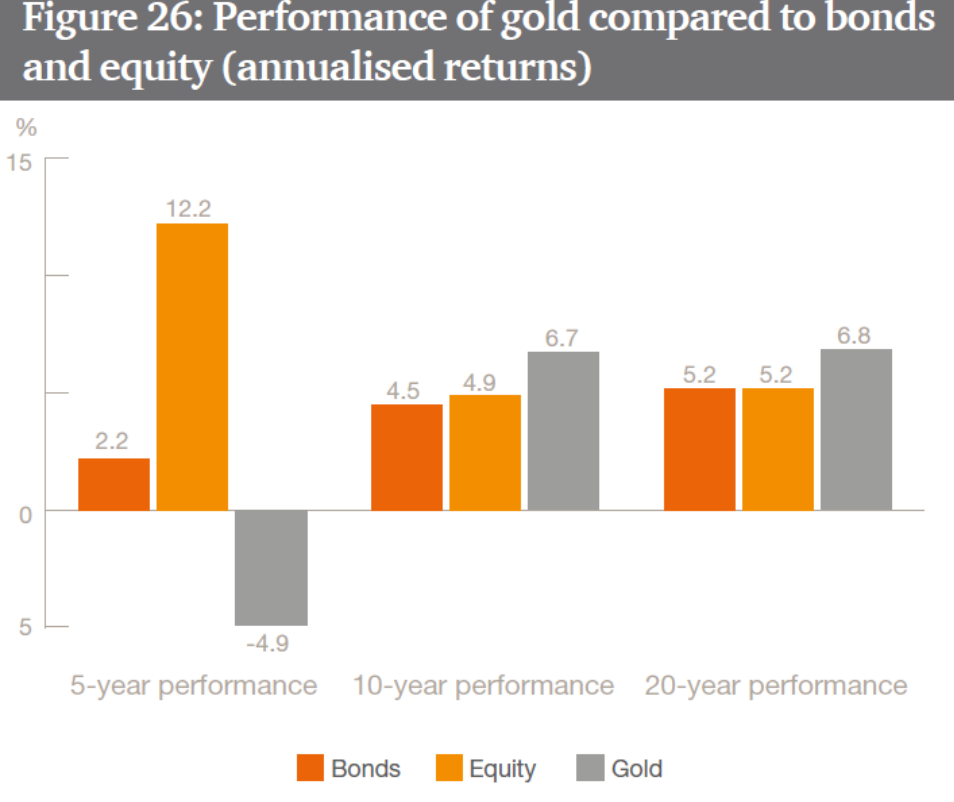
– Gold has outperformed equities and bonds over the long term – PwC Research
– Gold is up 6.7% and 6.8% per annum over 10 and 20 year periods; Stocks and bonds returned less than 5.2% respectively over same period (see PwC table)
– From 1971 to 2016 (45 years), “gold real returns were approximately 10% while inflation increased 4%”
– Gold also valuable due to lack of correlation and hedge against inflation, currency devaluation and uncertainty
– Sovereign wealth funds investing 23% of assets under management to alternative investments including gold
– Gold being diversified into by HNW, family offices, institutions, pensions, sovereign wealth funds and central banks
Source: PwC Research via Bloomberg and WGC data
In new research, entitled ‘The rising attractiveness of alternative asset classes for Sovereign Wealth Funds‘ PwC explain how gold is viewed as an important diversifier by sovereign wealth funds, as both an important hedge and for long term returns.
PwC now class gold as a ‘re-emerging asset class’ on the basis of its long-term out performance of stocks and bonds, low correlation with traditional assets, resilience and high liquidity.
Gold along with private equity, real estate and infrastructure now accounts for 23% of a total $7.4 trillion of assets under management by sovereign wealth funds.
The report notes that from a peak of 40% in 2013, sovereign wealth funds’ investment into fixed income instruments such as government bonds declined to 30% by 2016. Due to record low bond yields, the funds decided to turn their attention to alternative assets to enhance returns.
The report notes the impressiveness of both gold’s long-term performance and low correlation to other assets in the long-term, compared to other alternatives. In the short- term the benefit of gold’s liquidity is noted:
“[It] has one of the highest rates of daily volumes exchanged and can provide protection against short and medium term market corrections.”
The 23% allocation is expected to increase going forward, despite slight increases in rates recently and because of the likelihood of continuing very low interest rates.
This report comes at a time when we are seeing a growing interest by both large institutions and family offices in gold investment.
Like sovereign wealth funds, they are encouraged by gold’s long-term returns, high liquidity and resilience against economic shocks.
Long term outperformance to traditional asset classes
As we have seen in recent years gold, like all assets, has periods when it underperforms. This has been in the short-term in the last 3 to 5 years, but in the long-term – such as a 10, 20 or 40 year period, it is an entirely different story.
Indeed, gold’s recent underperformance, makes its long term outperformance all the more impressive.
The report shows that in the last ten years, gold delivered returns of 6.7% per annum, outperforming equities and bonds which returned just 4.9% and 4.5% respectively. This return was slightly greater over a 20-year period when gold returned 6.8% per annum, compared to equities and bonds which returned just 5.2% and 5.2%.
Over the long term, gold is one of the top three performing assets along with real estate and private equity.
“Gold’s long- term performance is attributed to three factors: increased demand from emerging markets, central banks becoming net buyers, and the emergence of new products, such as gold- based ETFs, which have simplified investing and made the material more accessible.” – PwC
PwC also note the importance of gold when it comes to protecting against currency devaluation:
“By introducing alternatives into the portfolio, the value of investments can be protected against a possible decrease in purchasing power of the currency the investments are denominated in. This can be done through instruments whose returns are somehow linked to inflation or have perceived intrinsic value. Assets with perceived intrinsic value, such as commodities, should increase in price alongside CPI. In cases of extreme inflation for example, gold has historically performed well, outpacing that inflation by 10%…gold performed well during inflationary periods. For example, from 1971 to 2016, gold real returns were approximately 10% while inflation increased 4% year- over-year.”
Gold doesn’t follow: Low correlation with traditional asset classes
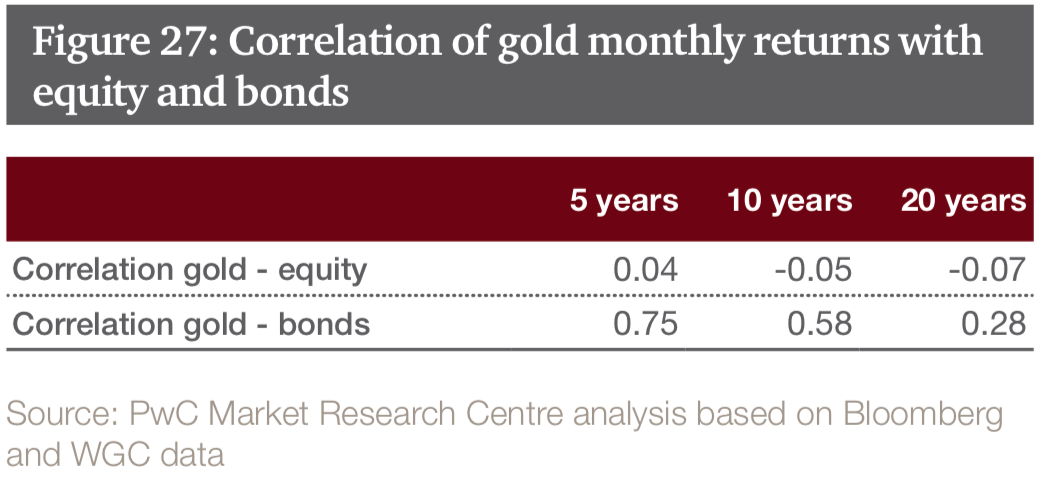
“Gold can be a useful addition to investment portfolios compared to other commodities, due to lower correlation with traditional asset classes. Between June 1997 and June 2017, the correlation between gold and equity returns was close to zero (-0.07), thus showing its diversification benefit. The asset class maintains only a negative correlation over a ten-year period as well, standing at -0.05. Gold is more correlated with bond returns, standing at 0.58 on a ten-year basis, and at 0.28 on a twenty-year correlation (see Figure 27)…Gold has, over all considered time periods, no statistically significant correlation with hedge funds, private equity, infrastructure, and real estate.”
As with the other factors discussed by PwC this is pertinent for all considering investing in gold, from retail and pension investors, larger institutions and family offices. Much of gold’s low correlation is due to the fact that it is less affected by economic cycles and geo-political risks than other financial assets. This means it shows resilience at times when others are showing weakness.
This has been seen in recent days when stock markets saw massive volatility and very sharp corrections and gold was essentially flat. Year to date in 2018, gold is nearly 1.7% higher while many stock indices are down sharply – Euro Stoxx 50 is down more than 4% year to date.
Resilient asset class during crises and instability
The gold price performs well in times of financial crises and extreme market events. During these times the correlation benefits become even more important, so it can provide portfolio insurance since it minimises portfolio losses. PwC explain that this is what distinguishes gold from other assets:
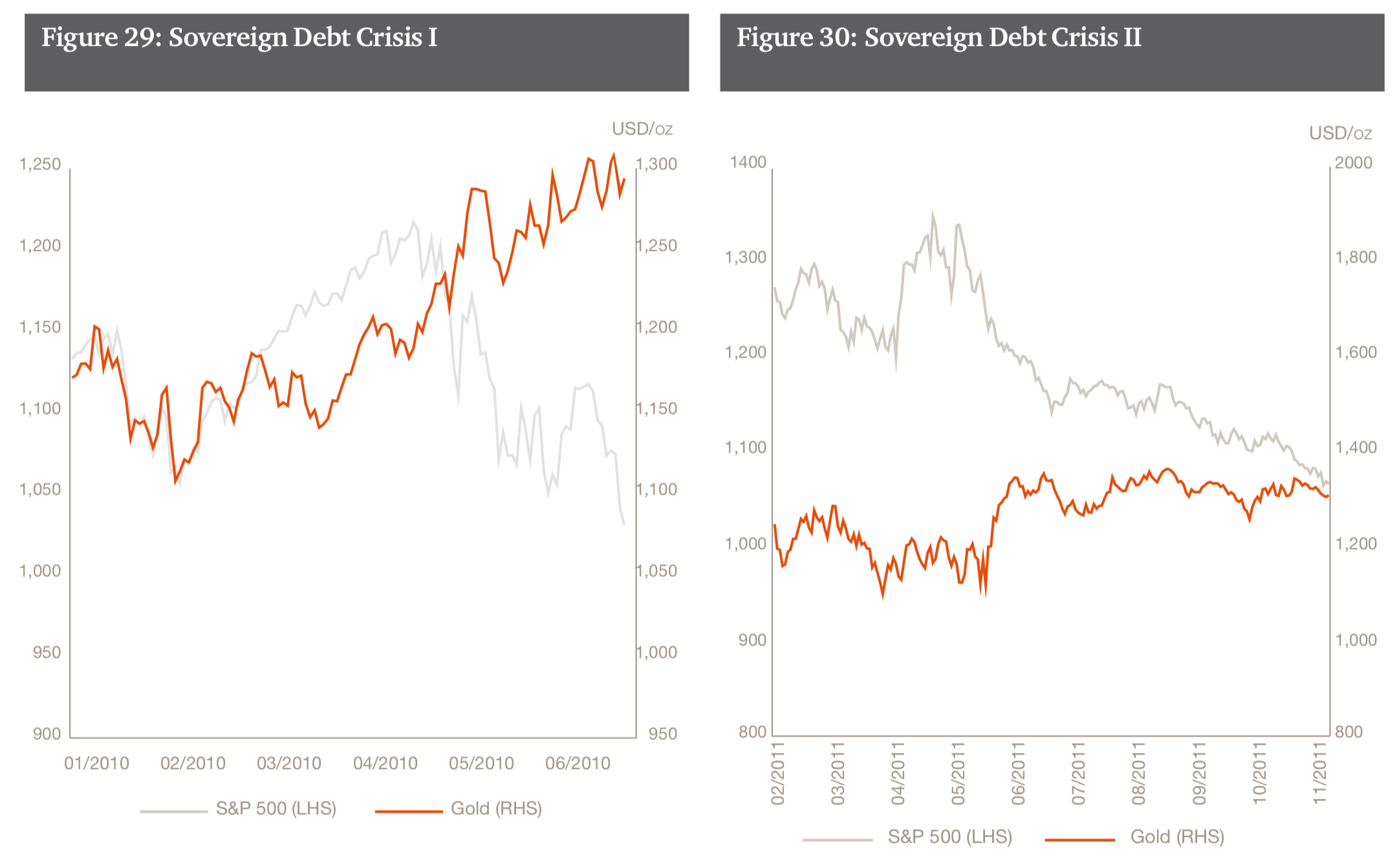
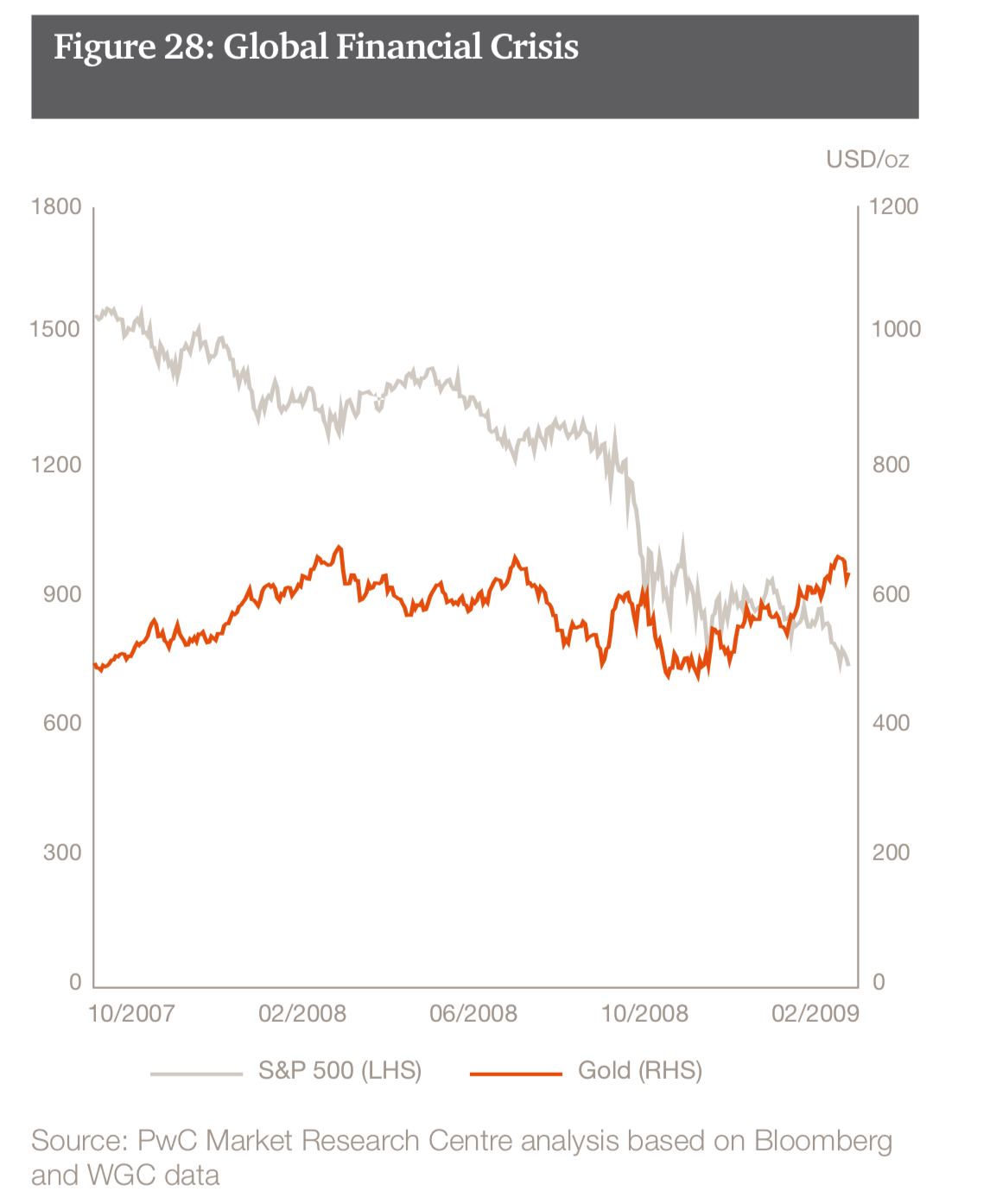
“Gold has delivered negatively correlated returns when equity indices, such as S&P 500, have plummeted. Figure 28, 29, and 30 show gold’s performance during episodes of acute market crisis (GFC and the Sovereign Debt Crisis I and II). In these cases, the gold price started to rise significantly as the S&P 500 index decreased. Generally speaking, the gold price per ounce rose as investors perceived uncertainty in the stock markets, and decreased as these markets gave signs of normalisation.”
After the bloodbath of the last week, S&P500 investors will be interested to hear how gold correlates to the market”
“Among alternatives, when examining the correlation of returns with the S&P 500 index, gold is an excellent diversifier presenting the lowest correlation on a five-, ten-, and twenty- year basis (0.04, -0.05, -0.07 respectively).”
Liquid gold
The asset is particularly liquid in contrast to many of the other assets considered by SWFs, this is something very beneficial according to PwC:
” Stabilization funds may, in particular, benefit from adding gold among their holdings as they are required to hold highly liquid assets to counter the effects of sudden macroeconomic shocks.
Gold has distinguished itself from other alternative asset classes as it has been more liquid, with USD 224 bn traded on average on a daily basis in 2016?.
Conclusion: Investment and pension case for gold is strong
PwC do not beat about the bush when it comes to their positivity towards gold as an investment. They synopsise and elucidate many of gold’s benefits which we have long been highlighting in recent years:
“All these features suggest that gold as an investment class can offer reliable support, not only during uncertain market and political conditions, such as periods of high inflation, stock market crashes, and geopolitical instability, but also under normal market conditions.”
They clearly see gold as playing a crucial role in the portfolios of sovereign wealth funds and indeed the majority of investors across the spectrum.
“The investment case for gold, during periods of market uncertainty, has proven to be strong, with the price of gold having surged rapidly and having countered the negative effects of adverse market conditions. Hence, investors can consider gold for diversification and long-term performance.”
Pwc Report on gold can be accessed here
Watch the PwC World Gold Council interview about the report here
-END-
END
Giant Barrick is facing a grilling from its shareholders and they deserve to be at the bottom of the pack
(courtesy GATA/Bloomberg)
Gold giant Barrick faces grilling after fall to the bottom of the pack
Submitted by cpowell on Mon, 2018-02-12 16:39. Section: Daily Dispatches
By Danielle Bochove
Bloomberg News
Monday, February 12, 2018
Barrick Gold Corp. executives will have some explaining to do when the company releases full-year results Wednesday.
Even with rising gold prices and a strengthened balance sheet, the world’s largest gold producer left shareholders with the worst returns among its top North American peers last year and the third-worst performance in the 15-company BI Global Senior Gold Valuation Peers index.
That’s a sharp reversal of the heady gains a year earlier when the Toronto-based company appeared unable to put a foot wrong. In 2016 Barrick’s Canadian shares soared 110 percent as it unveiled a sweeping plan to streamline the company. That same year its biggest rival, Newmont Mining Corp., rose 89 percent.
Notwithstanding the recent global stock rout that has sunk equities globally, Colorado-based Newmont’s shares have gained, while Barrick has stumbled. …
… For the remainder of the report:
https://www.bloomberg.com/news/articles/2018-02-12/gold-giant-to-face-gr…
END
You need a whistleblower to tell the CFTC that the VIX causes manipulation in the markets?
(courtesy Bloomberg/GATA)
VIX manipulation costs investors billions, whistle-blower tells CFTC
Submitted by cpowell on Tue, 2018-02-13 01:53. Section: Daily Dispatches
Think how easy it is for central banks themselves to do this stuff, easier still since mainstream financial news organizations will never question them about their market interventions.
* * *
By Brian Louis and Nikolaj Gammeltoft
Bloomberg News
Monday, February 12, 2018
A whistle-blower today told U.S. regulators that a scheme to manipulate the VIX, the volatility gauge thrust into the spotlight last week during a wild trading session, costs investors hundreds of millions of dollars a month.
A Washington-based lawyer told the Securities and Exchange Commission and Commodity Futures Trading Commission — the nation’s top markets regulators — in a letter today that his client found a flaw that allows traders “with sophisticated algorithms to move the VIX up or down by simply posting quotes on S&P options and without needing to physically engage in any trading or deploying any capital.” Billions in purportedly ill-gotten profits have been scooped up by “unethical electronic option market makers,” according to the letter.
The client wasn’t identified by name. He has held “senior positions at some of the largest investment firms in the world,” according to the letter written by Jason Zuckerman of Zuckerman Law, who has appeared on Washingtonian magazine’s list of top whistle-blower lawyers in the nation’s capital. …
… For the remainder of the report:
https://www.bloomberg.com/news/articles/2018-02-13/vix-manipulation-cost…
END
No wonder the price of gold is being capped: Robert Lambourne reports on a huge increase in gold swaps in January.
total bank exposure 580 tonnes which is huge!
(courtesy Robert Lambourne/GATA)
(GATA) Robert Lambourne: Gold market intervention by BIS increased substantially in January
Submitted by cpowell on 03:08PM ET Tuesday, February 13, 2018. Section: Daily Dispatches
By Robert Lambourne
Tuesday, February 13, 2018
The Bank for International Settlements substantially increased its use of gold swaps and other gold-related derivatives during January, according to the bank’s statement of account for the month:
https://www.bis.org/banking/balsheet/statofacc180131.pd f
This increase follows a large decline in the bank’s gold swaps in December. In recent months the BIS has been actively trading gold derivatives.
The information provided in the BIS monthly statement of account is not sufficient to calculate a precise amount of gold-related derivatives, including swaps, but it appears that the bank’s total exposure as of January 31, 2018, was 580 tonnes of gold. This compares to estimates of 450 tonnes, 600 tonnes, and 570 tonnes, respectively, at the December, November, and October month-ends and an audited swaps figure of 438 tonnes as of March 31, 2017.
When it comes to its activities in the gold market, the BIS provides little information on what it is doing. The lack of transparency fuels suspicion that this activity is related to official efforts to suppress the gold price.
END
Your early TUESDAY morning currency, Asian stock market results, important USA/Asian currency crosses, gold/silver pricing overnight along with the price of oil Major stories overnight/9 AM EST
i) Chinese yuan vs USA dollar/CLOSED DOWN AT 6.3448 /shanghai bourse CLOSED UP AT 30.83 POINTS 0.98% / HANG SANG CLOSED UP 379.90 POINTS OR 1.29%
2. Nikkei closed DOWN 137.94 POINTS OR .65% /USA: YEN FALLS TO 107.46/DEADLY AS YEN CARRY TRADERS DISINTEGRATE
3. Europe stocks OPENED DEEPLY IN THE RED /USA dollar index FALLS TO 89.68/Euro RISES TO 1.2348
3b Japan 10 year bond yield: RISES TO . +.071/ !!!!(Japan buying 100% of bond issuance)/Japanese yen vs usa cross now at 107.46/ THIS IS TROUBLESOME AS BANK OF JAPAN IS RUNNING OUT OF BONDS TO BUY./JAPAN 10 YR YIELD FINALLY IN THE POSITIVE/BANK OF JAPAN LOSING CONTROL OF THEIR YIELD CURVE AS THEY PURCHASE ALL BONDS TO GET TO ZERO RATE!!
3c Nikkei now JUST BELOW 17,000
3d USA/Yen rate now well below the important 120 barrier this morning
3e WTI:: 59.08 and Brent: 62.49
3f Gold UP/Yen UP
3g Japan is to buy the equivalent of 108 billion uSA dollars worth of bond per month or $1.3 trillion. Japan’s GDP equals 5 trillion usa./“HELICOPTER MONEY” OFF THE TABLE FOR NOW /REVERSE OPERATION TWIST ON THE BONDS: PURCHASE OF LONG BONDS AND SELLING THE SHORT END
Japan to buy 100% of all new Japanese debt and by 2018 they will have 25% of all Japanese debt. Fifty percent of Japanese budget financed with debt.
3h Oil DOWN for WTI and DOWN FOR Brent this morning
3i European bond buying continues to push yields lower on all fronts in the EMU. German 10yr bund FALLS TO +.731%/Italian 10 yr bond yield UP to 2.048% /SPAIN 10 YR BOND YIELD UP TO 1.487%
3j Greek 10 year bond yield RISES TO : 4.34?????????????????
3k Gold at $1328.20 silver at:16.62 7 am est) SILVER NEXT RESISTANCE LEVEL AT $18.50
3l USA vs Russian rouble; (Russian rouble UP 40/100 in roubles/dollar) 57.97
3m oil into the 60 dollar handle for WTI and 63 handle for Brent/
3n Higher foreign deposits out of China sees huge risk of outflows and a currency depreciation. This can spell financial disaster for the rest of the world/
JAPAN ON JAN 29.2016 INITIATES NIRP. THIS MORNING THEY SIGNAL THEY MAY END NIRP. TODAY THE USA/YEN TRADES TO 107.46 DESTROYING JAPANESE CITIZENS WITH HIGHER FOOD INFLATION
30 SNB (Swiss National Bank) still intervening again in the markets driving down the SF. It is not working: USA/SF this morning 0.9328 as the Swiss Franc is still rising against most currencies. Euro vs SF is 1.1521 well above the floor set by the Swiss Finance Minister. Thomas Jordan, chief of the Swiss National Bank continues to purchase euros trying to lower value of the Swiss Franc.
3p BRITAIN VOTES AFFIRMATIVE BREXIT/LOWER PARLIAMENT APPROVES BREXIT COMMENCEMENT/ARTICLE 50 COMMENCES MARCH 29/2017
3r the 10 Year German bund now POSITIVE territory with the 10 year RISING to +0.731%
The bank withdrawals were causing massive hardship to the Greek bank. the Greek referendum voted overwhelming “NO”. Next step for Greece will be the recapitalization of the banks and that will be difficult.
4. USA 10 year treasury bond at 2.8276% early this morning (THIS IS DEADLY TO ALL MARKETS). Thirty year rate at 3.11910% /BOTH STILL DEADLY
5. Details Ransquawk, Bloomberg, Deutsche bank/Jim Reid.
(courtesy Jim Reid/Bloomberg/Deutsche bank/zero hedge)
Futures Slide As Global Stock Rally Fizzles Hit By Soaring Yen
Is the dead cat bounce over?
European shares rolled over this morning after a late downswing in Asia as markets struggled to find stability despite Monday’s frenzied rally, with futures this morning a bit of a mess.

“I think what we are seeing is a little bit of a consolidation,” said DZ Bank strategist Christian Lenk. “Given the pace of the move so far, we had to take a break somewhere and we have reached that region now.”
While there has been no specific driver, USD weakness for the third day in a row, and a consequent selloff in USD/JPY – which tumbled shortly before midnight ET – was the main focus in European session.

The resultant surge in the yen, which climbed to the highest since November 2016 pushing the USDJPY as low as 107.40, slammed the Nikkei after the midday break in Asia, with Trump comments on reciprocal tax yesterday also potentially having an influence on USD. Whatever the reason, Japanese stocks pared morning gains with Topix erasing 1.1% advance to trade 0.9% lower on the day. And with the USDJPY nearing the 2017 low of 107.32, Nikkei futures sold off further after the cash close.
At the same time, the EUR/USD lifted to 1.2350 mainly due to move in USD, while the British pound was briefly jolted to a session high of $1.3924 after headline annual UK inflation came in at 3.0%, a tenth of a point above forecasts and holding close to its highest level in nearly six years. In South Africa, the ZAR dipped briefly after President Zuma was said to refuse ANC’s resignation call.
Pressured by the weaker dollar and sliding European stocks, S&P 500 futures pointed to a drop for U.S. stocks at the market open after two days of gains.

The 10-year Treasury yield fell back to 2.83% after touching 2.902% on Monday. The general risk-off lifted core fixed income, U.S 2s10s flatten away from 200DMA after testing level for third day.

German bonds were also back in demand as recent multi-year highs on yields on both sides of the Atlantic proved attractive for some investors. Germany’s 10-year yield fell by almost 2 basis points to 0.73 as it retreated further from the 2-1/2 year high of 0.81 percent hit last week.
Hedge funds and other large speculators have boosted bets on Treasury futures to a record, indicating they expect the 2018 bond-market rout will resume in the days ahead. An investor at Goldman Sachs Asset Management warned Treasury 10-year yields could rise to as high as 3.5% in the next six months as the market prices in a steeper pace of Federal Reserve tightening.
All eyes will be on tomorrow’s CPI report. “The (U.S.) consumer prices numbers (on Wednesday) bear close watching as if it shows a strong rise, that could rattle U.S. long-term yields,” and currencies and stocks said Koji Fukaya, president of FPG Securities in Tokyo.
Meanwhile, in global stocks, a jump in global equities yesterday wasn’t enough to put traders’ minds at ease that the volatility that wiped $2 trillion from U.S. stocks last week has come to an end. Consumer-price data due Wednesday could give some clues on direction, given that pressure on equities has been emanating from the outlook for inflation.
European equities opened on the back foot (Eurostoxx 50 -0.3%) compared to the positive trading session in Asia (ex-Japan), with virtually all bourses in the red. Materials stand out as an outperforming sector amid the US infrastructure plans released yesterday whilst metals are extending gains. Telecoms underperform with BT (-1.2%) at the bottom of the FTSE 100 awaiting news from the Premier League TV rights.
While European equities declined and the Swiss franc gained alongside Treasuries and core euro-area bonds, there has been no clear shift toward haven demand as the kiwi rallied and EMFX rose a third day. European equity markets grind lower, while peripheral equity markets and export stocks underperformed.
Commodities found support from the weaker dollar, with metals higher, and bullion set for back-to-back gains. Copper prices on the London Metal Exchange extended an overnight rally to trade 1.4% higher at $6,927.00 per tonne. A report from the EIA yesterday noted that shale production for crude is to rise by 100k bbls in March, while another report this morning from the IEA expects US supply to grow more than demand in 2018, with US seen topping Russian production at year-end; as such both WTI and Brent have been pressured throughout the morning with the former briefly slipping below $59bbl. In metals markets, gold prices are near one-week highs amid the softer USD which has dictated a bulk of the price action for precious metals. Elsewhere, China have voiced concerns over US protectionism over steel, whilst aluminium prices have been pressured by building stockpiles. IEA have upgraded their forecast for global oil demand growth to 1.4mln bpd in 2018 from 1.3mln, however they say Non-OPEC supply, led by US, which is likely to grow more than demand in 2018.
On today’s calendar, U.S. sells 4-week bills; small business optimism index, which rose from 104.90 to 106.90, but below the 108.50 consensus. Starting Feb 15, Lunar new year celebrations for the Year of the Dog begin, affecting China, Hong Kong, Taiwan, Singapore, Malaysia and Indonesia. Chinese mainland markets are closed Feb. 15-21. India is out Tuesday for a public holiday.
Bulletin headline summary from Ransquawk
- European equities lower across the board after a mixed session overnight which saw the Nikkei 225 (-0.7%)
- hampered by the firmer JPY
- In FX markets, USD softer against its peers. GBP firmer as UK inflation exceeds expectations (3.0% Y/Y vs. Exp.
- 2.9%)
- Looking ahead, highlights include APIs, Japanese GDP and Fed’s Mester
Market Snapshot
- S&P 500 futures down 0.6% to 2,638.25
- MXAP up 0.6% to 172.27
- MXAPJ up 0.9% to 563.36
- Nikkei down 0.7% to 21,244.68
- Topix down 0.9% to 1,716.78
- Hang Seng Index up 1.3% to 29,839.53
- Shanghai Composite up 1% to 3,184.96
- Sensex up 0.9% to 34,300.47
- Australia S&P/ASX 200 up 0.6% to 5,855.90
- Kospi up 0.4% to 2,395.19
- Brent Futures down 0.4% to $62.35/bbl
- Gold spot up 0.5% to $1,328.85
- U.S. Dollar Index down 0.4% to 89.84
Top Overnight News
- The People’s Bank of China appointed JPMorgan Chase Bank N.A. as a yuan clearing bank in the U.S., the first non-Chinese lender for such a role globally and a further step to promote international use of the currency
- A whistle-blower told U.S. regulators that a scheme to manipulate the VIX, the volatility gauge thrust into the spotlight last week during a wild trading session, costs investors hundreds of millions of dollars a month
- OPEC and its allies have almost achieved their goal of clearing an oil glut, but their efforts could be derailed by rising supplies from the U.S. and other rivals, the International Energy Agency said
- South Africans awoke to find their nation in limbo after President Jacob Zuma’s refusal to obey his ruling African National Congress’s request to resign voluntarily prompted its top leadership to order his removal from office
- Cleveland Fed President Loretta Mester (voter) speaks; she holds a hawkish approach, looks for three hikes this year
In Asia, stocks traded mostly higher as the region cheered the continued rebound in the US, where all majors finished with firm gains and the S&P 500 posted its best 2-day performance in over 2 years. ASX 200 (+0.6%) and Nikkei 225 (-0.7%) both opened higher in which mining-related sectors led in Australia, while Japanese stocks were initially outperformed buoyed as participants played catch up on return from holiday, although a firmer currency later saw gains wiped out. Elsewhere, Shanghai Comp. (+1%) and Hang Seng (+1.3%) were jubilant heading closer to the Lunar New Year holidays and after the PBoC announced to lend CNY 393bln through the 1yr Medium-term Lending Facility. Furthermore, there was a decline in money market rates in which the 1-week CNH HIBOR fell by the most so far in 2018, and the latest Chinese lending data also showed both New Yuan Loans and Aggregate Financing surged from prior. Finally, 10yr JGBs were flat amid similar range-bound trade overnight in T-notes and although the BoJ were present in the market under its bond-buying program, this was kept at a reserved amount. Japanese PM Abe said he is undecided on the next BoJ Governor, while Abe also stated that it is up to the BoJ to decide specific monetary policy measures and that he expects the BoJ to continue taking bold measures to achieve price stability.
Top Asian News
- China Is Said to Plan Blocks on Take-Two’s Grand Theft Auto
European equities this morning opened on the back foot (Eurostoxx 50 -0.3%) compared to the positive trading session in Asia (ex-Japan) and the US. Materials stand out as an outperforming sector amid the US infrastructure plans released yesterday whilst metals are extending gains: Gold (+0.4%), Silver (+0.1%), Copper (+0.8%). Telecoms underperform with BT (-1.2%) at the bottom of the FTSE 100 awaiting news from the Premier League TV rights.
Top European News
- Greece Launches Tender for 5% Hellenic Telecom Stake Sale
- BHP Expects $1.8b Income Tax Expense Due to U.S. Reforms
- U.K. Inflation Holds Steady After BOE Warns of More Rate Hikes
In currencies, Yen strength is the main overnight and early European theme, as Usd/Jpy breached last Friday’s 108.05 low to the downside before overcoming barrier and psychological support at 108.00 on its way to fresh 5 month lows around 107.55. Bids reportedly in the 107.70 area were also filled in pretty short order as risk aversion ratcheted higher, but it remains unclear whether heightened demand for the Jpy (and Chf to a lesser degree) was prompted by the Nikkei’s failure to maintain catch-up gains after Japan’s long holiday weekend or vice-versa. 107.50-45 next in sight for Usd/Jpy, with buying interest not really seen until the low 107.30 area (including last year’s 107.32 low), while cross demand is also rife as Gbp/Jpy falls below the 150.00 handle. GBP firmer after higher than expected inflation figures (3.0 vs. Exp. 2.9% Y/Y), however the rise had been short-lived, given that the headline figure had been in line with the BoE’s forecast. Nzd another noted beneficiary of US Dollar weakness as the Index loses grip of 90.000 again, with the Kiwi reclaiming 0.7300 status and in part also gaining some impetus from Aud underperformance amidst mixed sentiment readings overnight and RBA rhetoric – Aud/Usd above 0.7850, but Aud/Nzd back under 1.0800. Other Usd/G10 major pairings more contained, albeit still showing a generally softer Greenback, with Eur/Usd regaining 1.2300, Cable around 1.3850 eyeing UK inflation data and Usd/Cad sub-1.2600. Elsewhere, Usd/Zar still in focus and testing recent lows (currently circa 11.9000) ahead of an ANC briefing at 12GMT, with President Zuma still resisting efforts to remove him from office
In commodities, the theme continues for the oil markets, more supply is set to come from US shale producers. A report from the EIA yesterday noted that shale production for crude is to rise by 100k bbls in March, while another report this morning from the IEA expects US supply to grow more than demand in 2018, with US seen topping Russian production at year-end; as such both WTI and Brent have been pressured throughout the morning with the former briefly slipping below USD 59.00bbl. In metals markets, gold prices are near one-week highs amid the softer USD which has dictated a bulk of the price action for precious metals. Elsewhere, China have voiced concerns over US protectionism over steel, whilst aluminium prices have been pressured by building stockpiles. IEA have upgraded their forecast for global oil demand growth to 1.4mln bpd in 2018 from 1.3mln, however they say Non-OPEC supply, led by US, which is likely to grow more than demand in 2018. Iraq oil minister states that there is no current discussion over exiting supply cut agreement Russian Energy Minister Novak stated that OPEC and Non-OPEC allies need to act very cautiously and avoid knee-jerk reactions in respect of new decisions
Looking ahead, the January CPI/PPI/RPI report in the UK is the main focus. In the US, the January NFIB small business optimism print will be released. Away from data, the Fed’s Mester is due to speak in the afternoon on monetary policy and the economic outlook. Pepsico will release earnings.
US Event Calendar
- 6am: NFIB Small Business Optimism, est. 105.3, prior 104.9
- 8am: Fed’s Mester to Discuss Monetary Policy and Economic Outlook
DB’s Jim Reid concludes the overnight wrap
Welcome to US CPI eve. All has seemed a bit quiet over the last 24 hours which probably partly reflects half-term (the rush hour trains were lovely and quiet yesterday), partly that the peak position squaring from last week’s vol spike has seemingly passed for now and also that markets are building up to tomorrow’s big US number. Maybe traders and investors were also buying Valentine’s Day cards and presents as well. I’ll be making my annual trip to Hotel Chocolat later today to buy overpriced chocolates in a nice (but far too big for the amount of produce inside them) package. Given my wife is full time feeding for her plus two ravenous boys, her chocolate intake at the moment is something to admire.
Ahead of tomorrow’s number we have an interesting CPI dress rehearsal today in the UK. This has been made more interesting by the hawkish BoE meeting last week and also two hawkish BoE speakers yesterday. Vlieghe suggested that 3 BoE hikes still leaves some excess demand and wouldn’t get inflation fully back to target. McCafferty said that rates will have to go up slightly earlier and fractionally more than the bank previously expected.
For today, markets are expecting a CPI print of -0.6% mom and 2.9% yoy (2.6% yoy for core) and a PPI reading of 3.0% yoy.
Before that, global equities continue to rebound. US bourses were all higher for the second consecutive day (S&P +1.39%; Dow +1.70%; Nasdaq +1.56%), with all sectors in the S&P up and gains led by the materials, tech and energy stocks. The VIX also traded 11.9% lower to 25.61. Since the beat on US wage growth, the S&P is now down 5.9% overall, but is up 4.9% from the intra-day lows. Similarly the VIX has jumped 90% since 1 February, but is 49% lower than the intra-day highs of 50.30 over the past seven trading days. Key European markets also advanced yesterday, with the Stoxx 600 (+1.17%), DAX (+1.45%) and FTSE (+1.19%) all higher, while the VSTOXX fell 18.9% to 28.16.
This morning in Asia, markets are rallying on the positive lead from the US. The Kospi (+0.68%), Hang Seng (+1.55%) and China’s CSI 300 (+1.23%) are all up as we type but the Nikkei has given up gains of >1% to trade lower for the day. Datawise, Japan’s January PPI was broadly in line at 0.3% mom and 2.7% yoy while China’s monthly net new loans were higher than expected at RMB$2,900bn (vs. $2,050bn expected).
In the US, President Trump has proposed a $4.4trn federal budget for 2019 that seeks to reduce domestic programs such as Medicare in favour of higher spending on the military and immigration enforcements. The plans will see the deficit almost double in FY19 to $984bln and rise $7.1trn over the next decade.
Mr Trump said he would push for a “reciprocal tax” on imports against higher tariff countries without providing details and reiterated his $1.5trn infrastructure plan of which $200bln federal funds will act as seed funds to incentivise further spending by state and local government as well as the private sector. Notably, both Reuters and NY Times noted Presidential budgets are rarely enacted by the Congress. The budget director Mulvaney called the plans as a “messaging document”, so we’ll wait and see if these messages will translate into any reality.
Yesterday we published a note using our fair value model between credit and volatility to assess where credit spreads should trade if and when the VIX (for US credit) or VStoxx (for European credit) stabilise at various levels. Spikes in vol are rarely sustained outside of a crisis so the fact that the current difference between actual and modeled spreads (see graphs in the note) are at one of the widest points on record isn’t necessarily a cause for major alarm yet. However to cite examples in the note, if equity vol settles at 15, Euro IG and HY should settle 15bps and 68bps wider. For the US, these numbers 24bps and 61bps wider all other things being equal. For vol at 20, these numbers are +27bps, +107bps, +43bps and +145bps respectively. See the full note here for more on this. A reminder that yesterday morning we also put out a quick note comparing this current sell-off across various assets to that seen during the 34 day taper tantrum in May 2013 and the 60 day risk sell-off after the surprise Fed hike in February 1994. All of them having a rates/yield/inflation related catalyst.
Back to credit, the latest ECB CSPP holdings data was released yesterday. The CSPP/PSPP ratio was 18.4% (28.1% over last 4 weeks). Before Apr 2017 when we were still at full QE the ratio was 11.5%. In the first taper (Apr-Dec 2017) the ratio edged up to 12.7% and since Jan 2018 it has increased to 24.8%. So far this year, QE purchases have been in line with our long-standing expectation that the CSPP/PSPP ratio would move to around 20% after the January taper.
Now recapping other markets performance from yesterday. Government bonds weakened slightly, with core 10y bond yields up 1-3bp. The UST 10y yields rose 0.7bp and Bunds up 1.2bp while Gilts underperformed (+3.1bp), partly weighed down by the hawkish BOE speak. Turning to currencies, the US dollarindex retreated 0.32% yesterday but is still up c1.7% since the beat on wage growth, while the Euro and Sterling gained 0.32% and 0.08% respectively. In commodities, WTI oil rose for the first time in seven days (+0.15%), in part as OPEC has revised up its demand forecasts and expect global demand to outpace the growth in US shale supply. Elsewhere, precious metals strengthened c1% (Gold +0.46%; Silver +1.16%) and other base metals were broadly higher (Copper +0.45%; Aluminium +1.02%; Zinc -0.38%).
Away from the markets and onto Germany, the latest Sonntagstrend survey showed 57% of Germans want the SPD members to vote and approve a coalition with Ms Merkel’s bloc. The support level is higher amongst SPD and CDU voters, at 85% and 87% respectively.
Elsewhere, our asset allocation strategist Binky Chadha has taken a closer look at the potential causes for the recent pullback in equities. Overall, the team concludes that a long overdue pullback on extended positioning was amplified in US equities by structured products. But despite the size of the pullback it was still just that and likely more to do with the need for liquidity and quick risk reduction. The team also noted 10% corrections in US equities are very rare outside recessions, with only 15 such selloffs since 1950. Further, they are normally associated with a clear unexpected catalyst such as oil price collapse, China devaluation and Russia LTCM. Refer to their note for more details.
In the UK, according to documents sighted by Bloomberg, EU officials will hold a discussion this Thursday on the options for a future trade deal with the UK post Brexit. The meeting looks to discuss the mobility of workers and how cars, chemicals and food safety are regulated in the internal market.
Before we take a look at today’s calendar, we wrap up with other data releasesfrom yesterday. In the US, the monthly federal budget surplus was $49.2bln(vs. $51bln expected) in January. The NY Fed survey of consumer expectations showed median one year ahead inflation expectations fell to 2.71% in January (vs.2.82% previous). Notably, respondents expect wage growth to be 2.73% in the coming year, the highest since the data series began in 2013. In the UK, Acadata noted London house prices fell 4.3% in 4Q17, the largest fall since 2009.
Looking ahead, the January CPI/PPI/RPI report in the UK is the main focus. In the US, the January NFIB small business optimism print will be released. Away from data, the Fed’s Mester is due to speak in the afternoon on monetary policy and the economic outlook. Pepsico will release earnings.
3. ASIAN AFFAIRS
i)Late MONDAY night/TUESDAY morning: Shanghai closed UP 30.83 points or 0.93% /Hang Sang CLOSED UP 379.90 or 1.29% / The Nikkei closed DOWN 137.94 POINTS OR .65%/Australia’s all ordinaires CLOSED UP 0.63%/Chinese yuan (ONSHORE) closed DOWN at 6.3448/Oil DOWN to 59.08 dollars per barrel for WTI and 62.49 for Brent. Stocks in Europe OPENED DEEPLY IN THE RED EXCEPT LONDON . ONSHORE YUAN CLOSED DOWN AGAINST THE DOLLAR AT 6.3448. OFFSHORE YUAN CLOSED UP AGAINST THE ONSHORE YUAN AT 6.3395//ONSHORE YUAN A LOT WEAKER AGAINST THE DOLLAR/OFF SHORE A LOT STRONGER TO THE DOLLAR/. THE DOLLAR (INDEX) IS MUCH WEAKER AGAINST ALL MAJOR CURRENCIES INCLUDING ON SHORE CHINA YUAN. CHINA IS HAPPY TODAY STRONGER MARKETS IN CHINA
3 a NORTH KOREA/USA
/NORTH KOREA
3 b JAPAN AFFAIRS
c) REPORT ON CHINA
4. EUROPEAN AFFAIRS
England/Ecuador embassy
The judge rejects Assange’s bid to drop his UK arrest warrant and now he is still stick inside the embassy
(courtesy zerohedge)
Judge Rejects Julian Assange’s Bid To Drop UK Arrest Warrant
In a pivotal moment for Wikileaks’ founder Julian Assange’s long-running legal battle to regain his freedom after spending the last six years without sunlight at the Ecuadorian Embassy in London, a UK judge delivered a disappointing ruling for Assange’s defense team.
After repudiating Assange’s lawyers characterization of the circumstances of his confinement, the judge has rejected his bid to have the warrant dropped, upholding the state’s case against the renown political dissident – who violated the terms of his bail in 2012 to show up at the Ecuadorian embassy disguised as a motorcycle courier.
Judge refuses to withdraw Julian Assange arrest warrant. https://www.theguardian.com/media/2018/feb/13/judge-refuses-to-withdraw-julian-assange-arrest-warrant?CMP=twt_gu …
Judge refuses to withdraw Julian Assange arrest warrant
WikiLeaks founder continues to face arrest if he leaves Ecuadorian embassy as judge rejects request to quash warrant
theguardian.com


Though the process isn’t over yet, the judge’s ruling that he had no reason to fear extradition to the US is a huge blow to his case for having the UK warrant dropped. In particular, the judge said Assange could leave the embassy whenever he liked, could have unlimited visitors, could choose when he eats and sleeps and exercises and even had access to sunlight via a balcony. Assange’s lawyers had also argued that his years inside the embassy were “adequate” punishment for any crimes he may or may not have committed.
Gasps in public gallery as judge says Assange can ‘leave the (Ecuadorian Embassy) whenever he likes, have unlimited visitors unsupervised, can choose when he eats, sleeps and exercises’. She’s knocking down most of Assange case to have arrest warrant dropped #Assange #wikileaks

Sweden dropped rape charges against Assange nearly 10 months ago, but the UK has refused to let him off the hook. In fact, reporters discovered that Sweden wanted to drop its pursuit years ago, but was persuaded to continue by Assange…
According tothe Guardian, Assange also suspects there is a secret US grand jury indictment against him and American authorities will seek his extradition.


Jonathan Cook: The UK’s hidden role in Assange’s detention https://www.jonathan-cook.net/blog/2018-02-12/the-uks-hidden-role-in-assanges-detention/ …
It appears as if the UK arrest warrant will be left in place, as Assange suggested in a tweet.
Not looking good. So far, judge is just defending UK state actions.
A bid to lift the arrest warrant last week was rejected when Judge Emma Arbuthnot rejected the notion that Sweden’s dropping of the case against Assange meant that the British authorities should no longer want him in custody. His defense team is arguing that Assange’s further detention would not serve justice. Assange has argued that if he hadn’t fled to the embassy, he would have been extradited to the US to face an unfair trial for his work, which he believes is essentially not different from investigative journalism.
In December, Assange received Ecuadorian citizenship, but the UK indicated it would not recognize his diplomatic status if requested by the Latin American nation, denying Assange the diplomatic immunity that would’ve allowed him to leave.
The UN has twice ruled that Assange is being improperly detained in the UK, and investigative work done by an Italian journalist uncovered malfeasance at the Crown Prosecution Service.
The judge also said that, if extradition motions were taken against Assange, he would be able to contest those.
To be sure, the process isn’t over yet. Assange noted that even if he loses the first point, the hearing may immediately continue on another…
Today, 2pm GMT, 9am EST, judge rules on whether to lift my UK arrest warrant following revelations of improper conduct by the UK government. Note that a win is a win, but even if we lose the first point today the hearing may immediately continue on another https://www.theguardian.com/media/2018/feb/13/julian-assange-saga-judge-to-rule-on-arrest-warrant …
Julian Assange saga: judge to rule on arrest warrant
After six years holed up in Ecuadorian embassy, WikiLeaks founder faces a pivotal moment

5. RUSSIAN AND MIDDLE EASTERN AFFAIRS
We now hear that two Russian fighters were killed last week in the uSA led attack in the Deir al Zor province, in the north west part of the country. Let us see if Russia has restraint on this one!
(courtesy zerohedge)
Russian Fighters Killed In Clash With US-Led Coalition Forces In Syria
With the calm of global capital markets shattered in the past two weeks, the ongoing military conflict in the Middle East has taken an understandable back seat to monetary matters. And yet, tensions involving Syria, Iran and Israel continue to escalate, most notably with this weekend’s outright attack by Israel on Syria, allegedly in retaliation for an Iranian drone launch from a Syrian army base, and which led to the first downing of an Israeli F-16 jet in decades.
Yet what has so far prevented the proxy way from spinning out of control, was that Putin – as guarantor of the Syria-Iran axis on one hand, and Netanyahu as his nemesis on the other, had expressed restraint. For now.
That may change, however, following a Reuters report that Russian fighters were among those killed when U.S.-led coalition forces clashed with pro-government forces in Syria earlier this month.

While Russia’s Defense Ministry said at the time that pro-government militias involved in the incident had been carrying out reconnaissance “and no Russian servicemen had been in the area”, the story changed on Monday when it emerged that at least two Russian men fighting informally with pro-government forces were killed in the incident in Deir al-Zor province, their associates told Reuters.
One of the dead was named as Vladimir Loginov, a Cossack from Russia’s Kaliningrad exclave. Maxim Buga, a leader of the Cossack community there, said Loginov had been killed around Feb. 7 along with “dozens” of other Russian fighters.
The other man killed was named as Kirill Ananiev, described as a radical Russian nationalist. Alexander Averin, a spokesman for the nationalist party he was linked to, told Reuters Ananiev had been killed in shelling in the same fighting on Feb. 7.
If the deaths are confirmed, it could turn into a political scandal for Putin, with the public demanding why the government is keeping military deaths under wraps. Already Grigory Yavlinsky, a veteran liberal politician who is running for president in elections next month, has called on Putin to disclose how many Russians had been killed in Syria and in what circumstances.
“If there was large-scale loss of life of Russian citizens, the relevant officials, including the commander-in-chief of our armed forces (Putin), are obliged to tell the country about it and decide who carries responsibility for this,” Yavlinsky said in a statement released by his Yabloko party.
Of course, if indeed Russian soldiers were killed while fighting under covert circumstances – in the same way as killed US “military advisors” are kept under seal – that is the last thing Moscow would like to publicize. Unless of course the political calculus shifts, and Putin decides that it is time for a full-blown military escalation, in which case the deaths will be used as the justification behind any armed conflict.
end
Not good: Iran unveils two nuclear capable ballistic missiles right after Israel’s attack on Syria
(courtesy zerohedge)
Iran Unveils Two Nuclear-Capable Ballistic Missiles After Israel Attack On Syria
Following Israel’s dramatic airstrikes on Syria on Saturday, seen by many as a “dramatic escalation” in regional tensions, and the most direct threat against Tehran in years, over the weekend Iran unveiled a series of new homemade nuclear-capable ballistic missiles during military parades, in a move that experts said was a bid to bolster the hardline ruling regime while cautioning Israel against any further escalation.

Describing the missile, Iran’s state-run Fars news agency described one of the rockets, the Ghadr , as a 2000km-range, liquid-fuel and ballistic missile which can reach territories as far as Israel.
The missile can carry different types of ‘Blast’ and ‘MRV’ (Multiple Reentry Vehicle) payloads to destroy a range of targets.
Meanwhile, the new version of the Qadr H ballistic missile “can be launched from mobile platforms or silos in different positions and can escape missile defense shields due to their radar-evading capability.”
As the Washington Free Beacon adds, Iranian military leaders rolled out the latest ballistic missile technology, which includes a nuclear-capable medium-range missile that appears to share similarities with North Korean technology on the heels of an encounter between what Israel claimed was an Iranian drone and Israeli forces.
The missiles are capable of reaching Israel even when fired from Iranian territory, raising concerns about an impending conflict between Tehran and the Jewish state that could further inflame the region.
While it was meant to deter further aggression by Israel, the demonstration of nuclear force by Iran could further inflame tensions between the two countries. Concerns that this nuclear-capable technology could be shared by Iran with its terrorist proxies are fueling longstanding concerns among the Israelis that an attack is imminent.
Iran’s ruling regime continues to invest millions of dollars it received as part of the landmark nuclear deal with the United States on its military technology, specifically ballistic missiles, which are subject to a ban under international statutes, even as Iranian dissidents continue to protest over the country’s ailing economy. According to conservative estimates, the Iranian regime has spent at least $16 billion in recent years on its military buildup and rogue operations in Syria, as well as other countries.

Some more details on the newly unveiled weapons: the two new nuclear-capable missiles unveiled over the weekend by Iran include the Ghadr missile, a medium-range rocket that was recently modified and upgraded by the Islamic Republic.
“The Ghadr can strike Israel when fired from Iranian territory, and in March 2016, was flight-tested while bearing genocidal slogans against the state of Israel,” according to Ben Taleblu, who has researched Iranian missile procurement.
Iranian military leaders also rolled out a rocket called the Fajr-5, which is becoming a new favorite of Iranian-backed terror proxy groups operating against Israel.
“The Fajr-5 is an Iranian rocket that has been proliferated to anti-Israel groups like Hamas and Hezbollah. It can travel up to 75 km, and is therefore a long-range artillery rocket. It uses solid fuel for propulsion,” Ben Taleblu explained. “Both the Qadr missile and Fajr rocket represents Iran’s commitment to developing stand-off weaponry that it uses for purposes of deterrence and coercion.”
As the Free Beacon notes, the new weaponry “could fuel ongoing efforts by Congress to crackdown on Iran’s continued proliferation of ballistic missile technology, a large part of which has been incubated by the North Korean regime, which continues to have a technology-sharing agreement with Tehran.”
Iran already has the region’s largest arsenal of ballistic missiles and is seeking to continue building this technology.
END
TURKEY/CYPRUS/ISRAEL
A little background to this story: A few years ago Israel discovered natural gas off the coast of Israel (off of Haifa) and the gas field headed right into Cyprus waters. Israel told the Cyprus government of their find and from that day forward, both Israel and Cyprus started to develop these fields. You will recall that Cyprus is divided into two sections: The Greek side to the south and the Turkish side is to the north. In the 197o’s civil war broke out between the two sides and bad blood exists between the two ever since.
Turkey is not happy that the southern side has discovered riches and they are doing everything in their power to block development of Cypriot gas fields
(courtesy zerohedge)
Turkish Warships Block Cypriot Drilling Rig In Dispute Over Mediterranean Gas Field
Amid escalating tensions between Cyprus and Turkey in the Mediterranean Sea, the two countries could be headed towards a resource war.
On Monday, the Cypriot government released a report according to which Turkish warships continue to heavily restrict one of its deepwater drilling rigs from reaching its intended site off the Cyprus coast, where Italian energy company Eni is planning to conduct a drilling operation.


Cyprus officials announced on Monday that Turkey is breaching “international law” by blocking the Italian ship from the drilling site, said the Russian Times. According to the Cyprus News Agency, Italy’s energy giant Eni S.p.A. said that its gas drilling ship was ordered to halt its travels by Turkish warships last Friday, citing “military activities in the destination area” as it sailed through Cyprus’ exclusive economic zone.

Cyprus Government Spokesperson Nicos Christodoulides told state broadcaster RIK that the rig remains moored about 30miles (50 kilometers) from the drill site located off the island’s southeastern coast. Christodoulides further noted that Turkey’s military maneuvers expire Feb. 22. Nevertheless, Cyprus strongly condemns the illegal actions by Turkish warships. According to Marine Traffic, the rig’s status remains in “restricted maneuverability” with two other support vessels.

“We are keeping calm in order to avoid any crisis and taking all diplomatic steps necessary so that finally the Republic of Cyprus’ sovereign rights can be respected,” President Nicos Anastasiades told reporters on Sunday adding that “we are handling the situation by trying to avoid anything that could worsen the situation without ignoring the fact that Turkey’s actions are in breach of international law.”



When a powerful country doesn’t have a legal leg to stand on, it resorts to gunboat diplomacy & bullying to achieve its otherwise unattainable claims. #Turkey War Ships Harass Drillship off #Cyprus coast http://www.ekathimerini.com/225726/article/ekathimerini/news/turkey-ships-harass-drillship-off-cyprus-coast …#EEZ#EastMed#RuleofLaw#Lawofthesea#UNCLOS

RT explains the Cyprus–Turkey maritime zones dispute which has been ongoing for 45 years:
Turkey, which does not have diplomatic relations with Cyprus, says that some areas of the so-called exclusive economic zone (EEZ) of Cyprus are under Turkish jurisdiction. The island was split some 45 years ago between the internationally-recognized, Greek Cypriot Republic of Cyprus in the south and the Turkish Republic of Northern Cyprus, recognized only by Turkey.

However, Turkey’s foreign ministry in Ankara criticized Cyprus over the “unilateral hydrocarbon-related activities” by the European Union’s most easterly member. “It does so in disregard of the inalienable rights on natural resources of the Turkish Cypriot people, who are the co-owners of the island,” a statement said.
The dispute over resources in the Mediterranean Sea is nothing new between the Greek Cypriot Republic of Cyprus in the south and the Turkish Republic of Northern Cyprus. This has been an ongoing argument for over four decades. Meanwhile the sea grab for resources has recently included three other regional rivals, Israel, Lebanon and Hezbollah, who are similarly fighting over resources not too far away.
end
ISRAEL
Israeli police after a long investigation has now recommended that Prime Minister Metanyahu be indicted for bribery
(courtesy zerohedge)
Israeli Police Recommend Netanyahu Be Indicted For Bribery
After a 14-month-long investigation, Israeli police have reportedly recommended that Prime Minister Benjamin Netanyahu be indicted on charges of bribery and breach of trust.

As The Jerusalem Post reports, police say they have found enough evidence to recommend the state’s prosecution to indict Netanyahu in Case 1000, the “gifts affair” and Case 2000, the “Yediot Aharanot Affair.”
In Case 1000, the “gifts affair,” it is alleged that Netanyahu improperly accepted expensive gifts from different businessmen.
In Case 2000, the “Yediot Aharonot affair,” Netanyahu allegedly negotiated with publisher Arnon “Noni” Mozes for favorable coverage of himself in Yediot Aharonot in exchange for support of a bill to weaken Israel Hayom, the largest circulation Hebrew-language paper and Yediot’s biggest competitor.
At this stage, the prosecution and Attorney-General Avichai Mandelblit will examine the evidence that police collected throughout the investigations, and will later decide whether to actually indict the prime minister or not.
Netanyahu will not be required at this point to resign from office. The law says that only after a peremptory Supreme Court verdict (meaning after an appeal was submitted and rejected), the prime minister must resign from office.
No response so far from Netanyahu’s office or from his “good friend” Trump.
As we noted previously, relations between Netanyahu and police have grown sour throughout the investigations, nearly a year after they became public knowledge. As Bloomberg reports, the prime minister and his supporters have accused police of deliberately leaking information about the investigations to Israeli media, claiming he’s the target of an organized campaign by the press and left-wing opponents to unseat him. Thousands of Israelis have taken to the streets in recent weekends, rallying against government corruption and calling on Netanyahu to step down.

Sara Netanyahu
Meanwhile, Benjamin Netanyahu’s wife, Sara, is mired in three legal disputes; two involving the receipt of illegal gifts and favors from businessmen in exchange for advancing their interests
6 .GLOBAL ISSUES
END
7. OIL ISSUES
Basket case Venezuela must now import crude oil from Russia as its production continues to cascade
(courtesy Z. Calcuttawala/OilPrice.com)
Venezuela To Accept More Crude Oil From Russia As Production Falters
Authored by Zainab Calcuttawala via OilPrice.com,
Russian crude oil exports to Venezuela are rising as Caracas struggles to produce enough crude to supply refineries in its contracted network, according to a new report by S&P Global Platts.

Russian Urals crude is now entering Venezuela at a rate of 335,000 barrels per day to supply PDVSA’s refinery in Curacao.
So far this year, Caracas has purchased 3 million barrels of Urals crude from Swiss trader Glencore.
Four tankers are scheduled to reach Curacao from Russian ports just this month, trading sources said.
PDVSA has been the contractual operator of Curacao for many years, but the contract is set to expire in 2019. Shell, the facility’s owner, has said PDVSA will not be the facility’s operator beyond the existing contract due to its failure to meet contractual obligations to perform upgrades.
According to OPEC’s Monthly Oil Market Report published this week, secondary sources – the ones the cartel uses to monitor compliance and official stats – pegged Venezuela’s crude oil production in January 2018 at 1.6 million bpd, down by 47,300 bpd compared to December 2017. This was the largest monthly decline in oil production among OPEC’s 14 member states. Venezuela, allowed to pump as much as 1.972 million bpd under the deal, surely did not make that cut voluntarily – its economy is collapsing and oil production has been in freefall for months now.
Venezuela, for its part, self-reported to OPEC that its oil production last month increased by 148,300 bpd over December to 1.769 million bpd.

Last week, a report by Reuters quoted internal documents that said PDVSA had restarted imports to its Isla Curacao facility after a seven-month hiatus as Venezuela tries to staunch the bleeding of its dwindling fuel output.
The credit ratings agency Moody’s sees “a negative feedback loop between declining production across all economic sectors, accelerating scarcity of hard currency, and an economic policy mix defined by price controls and forced discounting that exacerbate supply shortages and hyperinflation.”
WTI/RBOB Drop After Bigger Than Expected Crude Build
An ugly week or two for WTI/RBOB continued today ahead of tonight’s inventory data and after API reported big builds in crude, gasoline, and distillates; both WTI and RBOB dropped further.
API
- Crude +3.947mm (+3.05mm exp)
- Cushing -2.319mm (-1.7mm exp)
- Gasoline +4.634mm
- Distillates +1.1mm
3rd weekly crude build in a row and big builds in products too…

Not been a pretty week or two for the record spec longs… and it just got a little worse…

Of course the big story on traders’ minds is surging US production and sudden questions about potential global growth spooked by stocks…

8. EMERGING MARKET
SOUTH AFRICA
Zuma has been ordered to resign/the rand falls
(courtesy zerohedge)
Rand Slides Despite Confirmation Of Zuma Recall Amid Resignation Timeline Drama
Following repeated headlines and news reports that the South African president is set to resign, perhaps immediately, it was hardly a surprise this morning when South Africa’s ruling party – the Africa National Congress – confirmed it has ordered President Jacob Zuma to resign, signalling an end to his scandal-hit rule and paving the way for Cyril Ramaphosa to take power.
And yet, the confirmation prompted the South African Rand (ZAR) to slump…

… with two reasons being cited:
First, the announcement had been largely priced in following press reports that the ANC would recall Zuma after its marathon 13 hour meeting by the National Executive Committee.
Secondly and more important, it remains unclear how and when Zuma will go. In particular, traders are responding to two Bloomberg headlines which sparked selling in ZAR:
- *S. AFRICA’S ANC GIVING ZUMA TIME AND SPACE TO RESPOND.
- *ANC HASN’T DISCUSSED ZUMA NO-CONFIDENCE MOTION, GIVING HIM TIME
Ace Magashule, the ANC’s secretary general, said Mr Zuma, who has resisted pressure to step aside, had asked to remain in office for between three and six months, but was rebuffed due to the urgency of restoring the integrity of public institutions. Mr Magashule, an ally of the president, suggested that the ANC would now seek to remove Mr Zuma through a no-confidence vote in parliament, a move that is likely to extend the crisis in the ANC.
“All necessary parliamentary processes that arise from this decision will now ensue,” he said, signalling that the ANC is preparing a vote of no-confidence in Mr Zuma.
This suggests that while Zuma is leaving, it will neither be imminent, or even delayed. Meanwhile, as Citi’s desk notes, “Zuma will go, it is just a matter of how he will go …. This is positive although we may be in for a bumpy ride within the recent ranges until actual real news and clarification is a given.”
Finally, the worst case scenario is that even if Zuma is formally recalled, that does not mean he will leave.
So what happens then?
Zuma’s exit options are simple: if the president refuses to leave, then the ANC will be left with two options – a vote of no confidence and impeachment. The ANC is likely to prefer the former scenario given that the impeachment process would be long and drawn out, and need proof of misconduct. In regards to the no-confidence motion, the ANC says it has not discussed it yet. This would come as a disappointment that Zuma’s exit is not imminent.
Your early morning currency/gold and silver pricing/Asian and European bourse movements/ and interest rate settings TUESDAY morning 7:00 am
Euro/USA 1.2348 UP .0049/ REACTING TO MERKEL’S FAILED COALITION/ SPAIN VS CATALONIA/REACTING TO +GERMAN ELECTION WHERE ALT RIGHT PARTY ENTERS THE BUNDESTAG/ huge Deutsche bank problems + USA election:/TRUMP HEALTH CARE DEFEAT//ITALIAN REFERENDUM DEFEAT/AND NOW ECB TAPERING BOND PURCHASES/JAPAN TAPERING BOND PURCHASES /USA FALLING INTEREST RATES AGAIN/HOUSTON FLOODING/EUROPE BOURSES DEEPLY IN THE RED EXCEPT LONDON
USA/JAPAN YEN 107.46 DOWN 1.263 (Abe’s new negative interest rate (NIRP), a total DISASTER/SIGNALS U TURN WITH INCREASED NEGATIVITY IN NIRP/JAPAN OUT OF WEAPONS TO FIGHT ECONOMIC DISASTER/DEADLY UNWINDING OF YEN CARRY TRADE
GBP/USA 1.3904 UP .0057 (Brexit March 29/ 2017/ARTICLE 50 SIGNED
THERESA MAY FORMS A NEW GOVERNMENT/STARTS BREXIT TALKS/MAY IN TROUBLE WITH HER OWN PARTY/
USA/CAN 1.2581 UP .0001 (CANADA WORRIED ABOUT TRADE WITH THE USA WITH TRUMP ELECTION/ITALIAN EXIT AND GREXIT FROM EU/(TRUMP INITIATES LUMBER TARIFFS ON CANADA)
Early THIS TUESDAY morning in Europe, the Euro ROSE by 15 basis points, trading now ABOVE the important 1.08 level RISING to 1.2352; / Last night Shanghai composite CLOSED UP 30.83 POINTS OR 0.98 %// Hang Sang CLOSED UP 379.90 POINTS OR 1.29% /AUSTRALIA CLOSED UP 0.63% / EUROPEAN BOURSES DEEPLY IN THE RED
The NIKKEI: this TUESDAY morning CLOSED DOWN 137.94 POINTS OR .65%
Trading from Europe and Asia:
1. Europe stocks OPENED DEEPLY IN THE RED
2/ CHINESE BOURSES / : Hang Sang CLOSED UP 379.90 POINTS OR 1.29% / SHANGHAI CLOSED UP 30.83 POINTS OR 0.98% /
Australia BOURSE CLOSED UP 0.63% /
Nikkei (Japan)CLOSED DOWN 137.94 POINTS OR .65%
INDIA’S SENSEX IN THE GREEN
Gold very early morning trading: 1329.65
silver:$16.65
Early TUESDAY morning USA 10 year bond yield: 2.8276% !!! DOWN 3 IN POINTS from MONDAY night in basis points and it is trading WELL ABOVE resistance at 2.27-2.32%. (POLICY FED ERROR)/DEADLY
The 30 yr bond yield 3.119 DOWN 2 IN BASIS POINTS from MONDAY night. (POLICY FED ERROR)/DEADLY
USA dollar index early TUESDAY morning: 89.68 DOWN 53 CENT(S) from MONDAY’s close.
This ends early morning numbers TUESDAY MORNING
xxxxxxxxxxxxxxxxxxxxxxxxxxxxxxxxxxxxxxxxxxxxxxxxxxxxxxxxxxxxxxxxxxxxxxxxxxxxxxxxxxxxxxxxxxxxxxxxxxxxxxxxxxxxxxx
And now your closing TUESDAY NUMBERS \1 PM
Portuguese 10 year bond yield: 2.136% UP 6 in basis point(s) yield from MONDAY/
JAPANESE BOND YIELD: +.0.071% UP 1/2 in basis points yield from MONDAY/JAPAN losing control of its yield curve/
SPANISH 10 YR BOND YIELD: 1.524% UP 4 IN basis point yield from MONDAY/
ITALIAN 10 YR BOND YIELD: 2.085 UP 5 POINTS in basis point yield from MONDAY/
the Italian 10 yr bond yield is trading 57 points HIGHER than Spain.
GERMAN 10 YR BOND YIELD: +.750% DOWN 1 IN BASIS POINTS ON THE DAY
END
xxxxxxxxxxxxxxxxxxxxxxxxxxxxxxxxxxxxxxxxxxxxxxxxxxxxxxxxxxxxxxxxxxxxxxxxxxxxxxxxxxxxxxxxxxxxxxxxxxxxxxxxxxxxxxxxxxxxxxxxxxxxxxxxxxxxx
IMPORTANT CURRENCY CLOSES FOR TUESDAY
Closing currency crosses for TUESDAY night/USA DOLLAR INDEX/USA 10 YR BOND YIELD/1:00 PM
Euro/USA 1.2355 UP.0055 (Euro UP 55 Basis points/ represents to DRAGHI A COMPLETE POLICY FAILURE/
USA/Japan: 107.64 DOWN 1.08 Yen UP 109 basis points/
Great Britain/USA 1.3869 UP .0025( POUND UP 25 BASIS POINTS)
USA/Canada 1.2602 UP .0022 Canadian dollar DOWN 22 Basis points AS OIL FELL TO $59.15
xxxxxxxxxxxxxxxxxxxxxxxxxxxxxxxxxxxxxxxxxxxxxxxxxxxxxxxxxxxxxxxxxxxxxxxxxxxxxxxx
This afternoon, the Euro was UP 55 to trade at 1.2355
The Yen ROSE to 107.64 for a GAIN of 109 Basis points as NIRP is STILL a big failure for the Japanese central bank/HELICOPTER MONEY IS NOW DELAYED/BANK OF JAPAN NOW WORRIED AS AS THEY ARE RUNNING OUT OF BONDS TO BUY AS BOND YIELDS RISE
The POUND ROSE BY 25 basis points, trading at 1.3869/
The Canadian dollar FELL by 22 basis points to 1.2615/ WITH WTI OIL FALLING TO : $59.15
The USA/Yuan closed AT 6.3410
the 10 yr Japanese bond yield closed at +.071% UP 1/2 BASIS POINTS / yield/
Your closing 10 yr USA bond yield DOWN 1 IN basis points from MONDAY at 2.842% //trading well ABOVE the resistance level of 2.27-2.32%) very problematic USA 30 yr bond yield: 3.136 DOWN 1/2 in basis points on the day /
THE RISE IN BOTH THE 10 YR AND THE 30 YR ARE VERY PROBLEMATIC FOR VALUATIONS
Your closing USA dollar index, 89.67 DOWN 54 CENT(S) ON THE DAY/1.00 PM/
Your closing bourses for Europe and the Dow along with the USA dollar index closing and interest rates for TUESDAY: 1:00 PM EST
London: CLOSED DOWN 9.05 POINTS OR 0.13%
German Dax :CLOSED DOWN 86.27 POINTS OR 0.70%
Paris Cac CLOSED DOWN 30.92 POINTS OR 0.60%
Spain IBEX CLOSED DOWN 120.40 POINTS OR 1.23%
Italian MIB: CLOSED DOWN 302.36 POINTS OR 1.35%
The Dow closed UP 39.18 POINTS OR 0.16%
NASDAQ WAS UP 31.55 Points OR 0.45% 4.00 PM EST
WTI Oil price; 59.15 1:00 pm;
Brent Oil: 62.51 1:00 EST
USA /RUSSIAN ROUBLE CROSS: 57.78 UP 2/100 ROUBLES/DOLLAR (ROUBLE LOWER BY 2 BASIS PTS)
TODAY THE GERMAN YIELD FALLS TO +.751% FOR THE 10 YR BOND 1.00 PM EST EST
END
This ends the stock indices, oil price, currency crosses and interest rate closes for today 4:30 PM
Closing Price for Oil, 4:30 pm/and 10 year USA interest rate:
WTI CRUDE OIL PRICE 4:30 PM:$59.19
BRENT: $62.71
USA 10 YR BOND YIELD: 2.8350% THIS RAPID ASSENT IN YIELD IS VERY DANGEROUS/DERIVATIVES START TO BLOW UP/very dangerous
USA 30 YR BOND YIELD: 3.122%/BROKE GUNDLACH’S KEY 3.00% AGAIN WHERE ALL VALUATIONS ON STOCKS BLOW UP/DEADLY
EURO/USA DOLLAR CROSS: 1.2354 up.0054 (UP 54 BASIS POINTS)
USA/JAPANESE YEN:107.81 DOWN 0.900/ YEN UP 90 BASIS POINTS/ very dangerous as yen carry traders are getting killed.
USA DOLLAR INDEX: 89.71 DOWN 50 cent(s)/dangerous as the lower the dollar the higher the inflation.
The British pound at 5 pm: Great Britain Pound/USA: 1.3889 : UP 0.0042 (FROM YESTERDAY NIGHT UP 42 POINTS)
Canadian dollar: 1.2592 UP 12 BASIS pts
German 10 yr bond yield at 5 pm: +0.751%
VOLATILITY INDEX: 24.97 CLOSE DOWN 0.64
END
And now your more important USA stories which will influence the price of gold/silver
TRADING IN GRAPH FORM FOR THE DAY
Powell Saves Stocks But Crude, Cryptos, & Yield Curve Sink
As if last week never happened – sell as much vol as you can because Jay Powell can turn back time…
It appears the stagnation of the rebound overnight was enough to bring out the committee to save the world as Jay Powell uttered some words this morning on financial stability… and the world was saved again…

Dow futures tested up to the 50% retracement once again today… and failed…

On the day we opened weak before Powell saved us all, but there was another weaker close…

Notably the other leg up in stocks happened around 1300ET – when someone suddenly lifted USDJPY… Thank you Kuroda-san…

Stocks are up 5 to 6% now from Friday’s lows.. Small Caps are lagging for now…

AMZN is now up 10% off the Friday lows…

VIX was monkey-hammered back below 25 briefly…

While vols came in modestly today across all asset classes, rate vol – on a normalized basis – appears to have stuck at more elevated levels…

Treasuries were mixed today with the short-end weak and the long-end bid…

This sparked a notable 5bps flattening in 2s30s…

For those hoping for higher rates, better start placing your bets on copper outperforming gold some more…

The Dollar resumed its incessant downtrend once again today…

Crude slipped lower once again – but copper ripped higher – as PMs managed gains against the weaker dollar

WTI closed below $60 again and RBOB below 1.70 ahead of tonight’s API data…

Gold topped $1330 and Silver topped $16.50 today as the Gold-to-Silver ratio topped 80x – the highest since April 2016…

Cryptos were lower on the day but Bitcoin is up from last Friday’s close…

Bitcoin ended the day modestly lower but tracked VIX once again this afternoon (BTC higher as VIX dropped)…

end
This morning’s early trading: markets initially bounce higher after initial struggle as Powell states in a motherhood statement that “we will remain alert to financial stability (risks)” to the system
(courtesy zerohedge)
Stocks Bounce After Powell Vows Fed “Will Remain Alert To Financial Stability Risks”
Stocks enjoyed a brief pop, which was immediately retraced, when moments ago the Fed released new chair Jay Powell’s prepared remarks from his Ceremonial Swearing in – his first public statement since replacing Yellen and since last Monday’s volnado – and which perked up the market when Powell said that “We will remain alert to any developing risks to financial stability.”
This prompted a 100 point pop in The Dow, which however quickly faded.

The rest of Powell’s comments:
- the Fed will “preserve the essential gains in financial regulation while seeking to ensure that our policies are as efficient as possible,” adding that “while the challenges we face are always evolving, the Fed’s approach will remain the same.”
- “The global economy is recovering strongly for the first time in a decade. We are in the process of gradually normalizing both interest rate policy and our balance sheet with a view to extending the recovery and sustaining the pursuit of our objectives.”
- “Monetary policy has continued to support a full recovery in labor markets and a return to our inflation target; we have made great progress in moving much closer to those statutory objectives.”
- “We will continue to pursue ways to improve transparency both in monetary policy and in regulation”
- “We approach every issue through a rigorous evaluation of the facts, theory, empirical analysis and relevant research. We consider a range of external and internal views”
- “We explain our actions to the public. We listen to feedback and give serious consideration to the possibility that we might be getting something wrong”
- “Congress has wisely entrusted us with an important degree of independence so that we can pursue our monetary policy goals without concern for short-term political pressures”
And:
- “As Chairman, I will do my very best to further our pursuit of something we all seek–an economy that works for all Americans.”
Like buying the fucking dip.
His full remarks are here.
end
(courtesy zerohedge)
Trump Proposal To End Food Stamps Sends Dollar Stores Tumbling
Shortly after 1pm ET, the shares of Dollar General and Dollar Tree tumbled after it was unveiled that President Donald Trump’s budget was proposing to effectively abandon food stamps, slashing the program’s traditional cash payments and substituting them with packages of “100% American grown food” for recipients. According to Bloomberg, this would represent “one of the biggest shakeups of the US food stamp program in its five decade history.”
The reason why deep discount dollar chains were sold off on the news is because they are particularly vulnerable to changes in the food stamp program as they largely cater to less affluent shoppers: according to Gordon Haskett Research Advisors, Dollar General and Dollar Tree have signaled that food stamps account for roughly 5 percent of sales. Shares of Dollar Tree fell as much as 3.7% to $103.68, while Dollar General was down 5% to $93.48, the declines wiping out gains by the two companies in 2018.

Other retailers would also be affected, if to a lesser degree: if implemented, the Food Stamp overhaul would impact a broad swath of the grocery industry, including Walmart and Kroger. The food-stamp program served 42.2 million people during the 2017 fiscal year, with many spending the benefits at supermarkets.
Why the dramatic overhaul?
Unveiled in Trump’s budget proposal, the food stamp plan is part of an effort to reform SNAP and save a projected $214 billion over a decade. According to Bloomberg, the proposal would give all households receiving more than $90 a month in cash a food-aid package that would “include items such as shelf-stable milk, ready to eat cereals, pasta, peanut butter, beans and canned fruit, vegetables, and meat, poultry or fish.” Cash payouts would be gradually phased out.
For America’s farmers, this implicit government demand-side subsidy was slam dunk, and their euphoria was palpable.
The so-called USDA America’s Harvest Box “is a bold, innovative approach to providing nutritious food to people who need assistance feeding themselves and their families — and all of it is home grown by American farmers and producers,” Agriculture Secretary Sonny Perdue said in a statement. The program would provide food-stamp recipients with “the same level of food value” as the current system, Perdue added.
A staple of the Obama administration when it peaked at just shy of 50 million users, the food stamp program has served 42.2 million people and 20.9 million households on average during the 2017 fiscal year. The average household benefit was $254.14, thus 81 percent of homes receiving aid would be included in the initiative, according to the USDA. The bottom line to the taxpayer in 2017 was $68.1 billion – that was the cost of SNAP assistance, with $63.7 billion given out as benefits.
As Bloomberg adds, under the proposed plan, the amount of food a household receives would be scaled to the size of the allotment, with about half of the assistance coming as food instead of cash. The USDA already buys commodities for other programs, such as the National School Lunch Program, and states would largely be in charge of distribution, the department said.
“States can distribute these boxes through existing infrastructure, partnerships, and/or directly to residences through commercial and/or retail delivery services,” the department said in a statement.
Meanwhile, if EBT recipients weren’t already furious enough at the prospect of losing their weekly cash allowance, the USDA also warned of tightened eligibility rules for recipients, such as stricter work requirements, as well as changing income and benefits calculations “to ensure benefits are targeted to the neediest households.”
Considering that over 40 million Americans rely on the SNAP/EBT in its current iteration for their daily lives, this – of all Trump proposals – has the highest likelihood of starting an American revolution as the howls of fury should the foodstamp phase out be implemented, would be deafening.
There is just one not so minor detail: as we explained earlier, Trump’s budget proposal has virtually no chance of being implemented by Congress in its current form, and furthermore any members of Congress who voted to overhaul the foodstamp program are guaranteed to have their political career dramatically truncated.
Which is why this particular Trump proposal has virtually no chance of passage.
February 12, 2018
end
Trump threatens a reciprocal tax on imported goods (border tax adjustments). However White House officials denies if they are pursuing this
(courtesy zerohedge)
Trump Threatens “Reciprocal Tax” On Imported Goods; White House Denies
Update: Citing an unnamed administration official, Bloomberg reports that the White House has “no formal proposal on the table for a so-called reciprocal tax on imports” – presenting yet another case of an administration official contradicting their boss in the press.
Trump is set to meet with lawmakers Tuesday to discuss trade issues.
As BBG reminds us, a House Republican proposal to tax imports, known as the border-adjusted tax, was removed from the Republican tax plan after being heavily criticized by retailer lobbyists vociferously objected.
* * *
US President Trump, who has already raised taxes on the US consumer once this year, is vowing to do so again. On Monday, the president suggested a reciprocal tax on imported goods (details were not forthcoming). Generally, such taxes tend to hit lower income consumers more than higher income consumers.
The Wall Street Journal reported that Trump’s blueprint surprised his top aides, who were quick to note that no formal plans have been drawn up yet. The comments about the reciprocal tax were made during a meeting at the White House with mayors and governors to discuss his infrastructure plan, which was officially unveiled yesterday.
However, Trump seemed pretty adamant that such a plan would, in fact, be put into place.
“We are going to charge countries outside of our country – countries that take advantage of the United States,” Mr. Trump said. “Some of them are so-called allies, but they’re not allies on trade.”
As a result, he said, “we’re going to be doing very much a reciprocal tax, and you’ll be hearing about that during the week and the coming months.”
Trump famously campaigned on raising trade barriers, including threatening to slap a 30% import tax on Chinese goods, as a central tenant of his nationalist agenda. But he has been slow to implement measures that typically pro-free trade Republicans oppose, though his administration has made some notably protectionist moves, like slapping Canadian aerospace company Bombardier’s C-Series jet with a 300% import tariff for purportedly anticompetitive subsidies. he also withdrew the US from the TPP – a complex, multilateral trade deal that was one of the hallmark accomplishments of the Obama administration.

While some anonymous aides were reportedly chagrined by the plan, others expressed a more sanguine view:
After the meeting, one senior administration official said Mr. Trump was considering responding in-kind to countries that put tariffs on American-made products. “The reciprocal tax is, simply, what you do to us, we’ll do to you,” the official said. “It’s nothing formal right now.”
WSJ says Trump repeatedly mentioned the reciprocal tax during his infrastructure meeting, even bashing his predecessors for being too “lazy” to rework trade policies after World War II and the Korean War.
“After World War II, we helped Germany, and we helped all countries. You had the Korean War, we helped South Korea. We helped everybody, and nobody changed,” Mr. Trump said, adding that these countries are now “very wealthy” and “could pay us back.”
“The reason nothing happened is that, No. 1, no imagination. No. 2, the people that were in my office, and in other offices, were lazy. But we’re not going to be letting it go, because it’s truly affected our country.”
Since last April, the administration has also been exploring the possibility of new tariffs on steel and aluminum imports, and recently imposed tariffs on imported solar panels, a move that was interpreted as a swipe at China.
Trump also famously ordered a review of Chinese trade practices pertaining to transferring intellectual property rights for Chinese firms under an obscure trade-related statute that was last widely used during the Reagan administration. This investigation deadline is August, and could result in wide-ranging tariffs against America’s largest trading partner.
END
The White House will now add Pakistan to its list of terror financing nations
(courtesy zerohedge)
White House Will Add Pakistan To List Of Terror-Financing Nations
In a decision that comes as the directors of several US intelligence agencies testify before the Senate about various terrorism-related (and Russia-related) risks facing the US, Reuters is reporting that the Trump administration is moving to place Pakistan on a global watchdog’s terrorist-financing watchlist.
Pakistan reportedly said it is “hopeful” it can stave off its inclusion on the list at a meeting next week. The declaration has been in the works virtually since the beginning of the Trump administration, as Trump has accused Pakistan of not doing enough to stop the Afghan Taliban and affiliated Haqqani network – even accusing officials in Islamabad of allowing safe haven to the terrorists.
Of course, such a decision will only push Pakistan, a nuclear power and the world’s sixth-most populous country, into the waiting arms of its neighbor, China, which shares a border with the contested regions of Jammu and Kashmir and has been working to strengthen its diplomatic ties with Pakistan as part of its geopolitical chess match against the US, which is explored in this article from Global Research:
As GR explains, one US-led effort to contain China’s regional activities has been the formation of a regional “quadrilateral alliance” – or quad – including the US, Australia, Japan and India.
To create a buffer, China has sought to strengthen ties with Islamabad.
The move also comes as China is preparing to launch its first yuan-denominated crude-futures contract during the third week of March – a major blow to the US dollar’s hegemonic status as the world’s de facto global reserve currency.

BREAKING: U.S. moves to place Pakistan on global watchdog’s terrorist-financing watchlist; Pakistan ‘hopeful’ it can stave off its inclusion at meeting next week

Separately, the decision was also made against a backdrop of escalating tensions between Pakistan and its eternal rival, India. As a dispute over land along the Line of Control (LoC) – a heavily militarized zone in Jammu and Kashmir – has led to the issuance of threats of nuclear war, and the calling of nuclear-war threat bluffs.
The US officially added North Korea to the list last year (for the second time) last year.
Interesting: nobody is reporting their crypto profits to the IRS
(courtesy zerohedge)
Virtually Nobody Is Reporting Crypto Profits To The IRS
Despite the IRS’s victory late last year in a lawsuit against Coinbase – the most popular cryptocurrency exchange in the US – that forced the organization to hand over transaction data pertaining to more than 14,000 users, surprisingly few Americans are reporting income from cryptocurrency trading as income this tax season.
That’s even more surprising considering the astronomical gains realized, not just by bitcoin, but by dozens of coins.
Fewer than 100 people out of the 250,000 who have already filed federal taxes this year through Credit Karma reported a cryptocurrency transaction, Reuters reported Tuesday.
This, despite nearly 57% of the 2000 Americans surveyed by the credit score startup and research firm Qualtrics last month saying they had realized some gains from cryptocurrencies last year, according to a Credit Karma study. About the same percentage of respondents said they had never reported a crypto transaction to the IRS. Meanwhile, about half said they understood how cryptocurrency gains might impact their taxes.

As Reuters explains, the IRS considers cryptocurrencies to be property for federal tax purposes, meaning any profits or losses from the sale or exchange of the virtual coins must be reported as capital gains or losses. Still, it remains unclear exactly how many Americans hold cryptocurrencies, which were initially designed to protect the identities of their holders and can be difficult for federal authorities to trace. Coinbase famously surpassed retail brokerage Charles Schwab in terms of the number of accounts last year, but its unclear how many of those accounts are actively trading.
However, there could be a more innocuous explanation than widespread tax dodging. Jagjit Chawla, general manager for Credit Karma Tax, said the company was not too surprised that few people had reported cryptocurrency gains as Americans with more complex tax situations tend to file closer to the deadline.
“However, given the popularity of bitcoin and cryptocurrencies in 2017, we’d expect more people to be reporting,”Chawla said in a statement.
That, or even simpler: most of those reporting cryptoprofits for public survey purposes are lying.
Around one million people filed their taxes with Credit Karma last year, the company said. The IRS expects 156 million individuals to file taxes this year.
As we explained last year, because every cryptocurrency transaction exists on a public blockchain ledger, an enterprising organization – say like the NSA or IRS – could conceivably implement blockchain analysis tools to track down Bitcoin fund transfers around the globe. Moreover, most exchanges now require a driver’s license, passport and even a phone number in order to approve your account for trading.
end
Interbank lending plummets: banks are refusing to lend to one another. Why? Answer: the rise in the 10 yr interest rate as the Fed rolls off maturing bonds.
a very important read..
(courtesy MishShedlock/Mishtalk)
Plunge In Interbank Lending: The Straw That Broke The Fed’s Back
Authored by Mike Shedlock via MishTalk,
Interbank lending took a historic dive.

Readers ask “What’s happening?” Let’s investigate.
Interbank Lending Long Term

The plunge in interbank lending is both sudden and dramatic. What’s going on?
Fed Tightening Two Ways
The short answer is a straw broke the Fed’s back.
A more robust explanation is the Fed is tightening two ways: The first by hiking, the second by letting assets on the balance sheet roll off.
Both measures have a tendency to push up long-term interest rates. This is another explanation for the long-end rising. Despite conventional wisdom, inflation and wages have little to do with it.
We can see the effect in other charts.
LIBOR

Year-Over-Year M2 Growth

Money supply growth is falling as are excess reserves.
Excess Reserves

The Fed started balance sheet reduction in October of 2017. Unwinding the balance sheet escalates greatly in 2018.
- The treasury unwind started at $6 billion per month, increasing by $6 billion at three-month intervals over 12 months until it reaches $30 billion per month.
- The mortgage debt unwind started at $4 billion per month, increasing in steps of $4 billion at three-month intervals over 12 months until it reaches $20 billion per month.
Does the Fed Know What It’s Doing?
Janet Yellen answered that question directly in her speech A Challenging Decade and a Question for the Future, at the Herbert Stein Memorial Lecture National Economists Club on October 20, 2017.
The FOMC does not have any experience in calibrating the pace and composition of asset redemptions and sales to actual and prospective economic conditions. Indeed, as the so-called taper tantrum of 2013 illustrated, even talk of prospective changes in our securities holdings can elicit unexpected abrupt changes in financial conditions.
Given the lack of experience with reducing our asset holdings to scale back monetary policy accommodation and the need to carefully calibrate the removal of accommodation, the FOMC opted to allow changes in the Federal Reserve’s securities holdings to play a secondary role in the Committee’s normalization strategy. Rather than balance sheet shrinkage, the FOMC decided that its primary tool for scaling back monetary policy accommodation would be influencing short-term interest rates.
So the Fed held off, and off, and off. Until now.
Rate Hikes vs. Balance Sheets


In a Foreign Affairs article on February 2, 2016, Benn Steil and Emma Smith discussed Rate Hikes vs. Balance Sheets.
The Fed’s accumulation of longer-term U.S. Treasuries has been a big source of demand and has therefore lowered the term premium on longer-term Treasuries. (Former Federal Reserve Chairman Ben Bernanke explains this well on his blog.) Fed economists estimate that yields on ten-year Treasury bonds would be around 70 basis points higher than their current level of around 2 percent had the Fed not bought such bonds to begin with.
In short, when the Fed buys and sells bonds, it affects the interest rates on such bonds. So does the Fed pushing the Fed funds rate up or down. As a rough guide, a rate hike of 100 basis points is historically associated with a 25-point rise in ten-year Treasury yields.
The Fed expects to raise the Fed funds rate about 100 basis points, from the current rate of 0.375 percent, over the course of the coming year. This should, then, be expected to push up ten-year Treasury yields by about 25 basis points. The numbers above suggest that the Fed could achieve the same rise in ten-year Treasury yields by letting its maturing bonds roll off and selling an additional $600 billion worth.
Fed Tightening More Than It Realizes


On November 12, Benn Steil and Benjamin Della Rocca wrote the Fed Could be Tightening More Than it Realizes.
- The Federal Reserve has no experience shrinking its balance and ending quantitative easing
- Raising interests rates and shrinking the balance sheet could work in tandem to tighten monetary policy more than the Fed expects.
- This could mean much slower than expected economic growth.
In Fed Chair Janet Yellen’s words, the central bank “does not have any experience in calibrating the pace and composition of asset redemptions and sales to actual prospective economic conditions.” She has therefore stressed that the Fed sees its balance-sheet reduction as a primarily technical exercise separate from the pursuit of its monetary policy goals—in particular, pushing inflation back up to 2%.
Yellen acknowledges that reducing the balance sheet now is, logically, a substitute for raising the Fed’s policy rate. More of one should, therefore, mean less of the other, and vice- versa. But what are the trade-offs?
On the basis of those Fed-economist estimates above, we calculate that the Fed’s plan to reduce the balance sheet by $450 billion from this October through the end of 2018 (a monthly average of about $32 billion) is roughly equivalent to a one percent hike in the policy rate—as we illustrate in the figure below. This equivalence means that the effective federal funds rate at the end of 2018 should be a full percentage point lower than it would be without the balance-sheet reduction. That’s a big number.
Does the market realize this? Does the Fed? The data suggest not. The Fed announced its plans for balance-sheet reduction back in June. Since then, market estimates of the effective federal funds rate through 2019 have moved little from pre-announcement levels, and in fact have risen slightly—as we show below. Likewise, the “dot plot” rate projections of Federal Open Market Committee members have hardly budged since the end of last year. Unless both the market and the Fed suddenly became vastly more sanguine about growth prospects at the time of the announcement, these facts suggest that they are largely ignoring — and therefore greatly underestimating—the tightening impact of the balance-sheet reduction.
What does this mean, going forward? It means that the Fed is likely to push rates higher than they should over the coming year. And if that is right, the risks of slower-than-expected growth are also higher.
A Straw or a Brick?
A number of things that have happened recently that can be considered straws, but the combined effect is more like a brick.
- Increasing number of rate hikes and rate hike expectations
- Balance sheet tapering, which is an effective rate hike.
- Repatriation of tax dollars puts upward pressure on rates.
- Mortgage rates are at 4-year highs. This will pressure housing.
- Money supply growth is decelerating.
- Trump tax cuts add to the deficit.
Interbank Lending
Those are the things that I believe caused a plunge in interbank lending and also contributed to the VIX selloff. Take your choice as to which one was the “straw”.
Note on Hikes
I do not suggest the Fed is hiking too much. Rather, we should not be in this place at all.
The Fed, starting with Alan Greenspan, created a series of bubbles, each of bigger magnitude than the one that preceded it.
Eventually bubbles pop, no matter what the Fed does.
Economic Growth Will Hit Brick Wall
Those who believe the economy is about to lift off have it ass backward. The economy is on its final legs. The kicker to this mess is hedge funds and small speculators are record short treasury futures.
Just as record numbers of people bought into stocks in December and January, a record number of people have been shorting treasuries expecting an economic lift-off that is far away in the rear-view mirror.
The next big move in interest rates is down.
END
SWAMP STORIES
Pay attention to this story. A former Federal prosecutor and husband of Victoria Toensing, a lawyer representing Campbell, the Russian informant on the Uranium one scandal states that the Schiff memo is blocked not because of Trump but because the DOJ and the FBI are under ‘criminal’ investigation. That makes sense. Also it sure looks like Priestap is the deep throat providing all the information to Jeff Sessions (USA Attorney General)
(courtesy zerohedge)
Schiff Memo Blocked Because DOJ & FBI Under “Criminal Investigation” Says Former Federal Prosecutor
A former Federal prosecutor claims that the Democratic response to the House Intel Committee’s GOP-authored “FISA memo” was blocked on the recommendation of the FBI and DOJ because the agencies are conducting internal investigations into politically motivated malfeasance by specific individuals which the Schiff memo could compromise if released without redactions.

Joe DiGenova, a former Special Counsel who went after both the Teamsters and former NY Governer Elliot Spitzer, made the claim on a Monday interview with radio station WMAL.
DiGenova: “We’re going to see the [Democrat memo]. It will be heavily edited by the FBI and the Department of Justice and the CIA. The most important part of this story is that on Friday, February the 9th, Rod Rosenstein and Christopher Wray wrote a letter to the White House counsel Don McGahn that they could not agree to the publication of the Schiff memo because it contained national security and law enforcement concerns. It was actually the FBI and the Department of Justice says no [to releasing the memo]. The most important part of that letter is when it says… law enforcement concerns. What does that mean? It means, that there is a criminal investigation underway and release of some of the information in the memo by Mr. Schiff will affect that criminal investigation. I wonder who they are investigating? And the answer is pretty clear. They are investigating the people at the FBI and the DOJ who provided false information to the FISA court over a number of years, including, involving Carter Page.”

WMAL Interview – JOE DIGENOVA – 02.12.18 https://audioboom.com/posts/6669572-wmal-interview-joe-digenova-02-12-18?utm_campaign=embed&utm_content=retweet&utm_medium=social&utm_source=twitter … via @Audioboom

As an aside, DiGenova’s wife is attorney and former Reagan Justice Department official Victoria Toensing – who is representing former FBI mole William D. Campbell surrounding his Congressional testimony regarding bribes from Russian uranium executives routed to the Clinton Global Iniative.
Last month we reported that DiGenova sat down with the Daily Caller, where he asserted that the Obama Administration’s “brazen plot to exonerate Hillary Clinton” and “frame an incoming president with a false Russian conspiracy” was unraveling.
The FBI used to spy on Russians. This time they spied on us. what this story is about – a brazen plot to exonerate Hillary Clinton from a clear violation of the law with regard to the way she handled classified information with her classified server. Absolutely a crime, absolutely a felony. It’s about finding out why – as the Inspector General is doing at the department of justice – why Comey and the senior DOJ officials conducted a fake criminal investigation of Hillary Clinton. Followed none of the regular rules, gave her every break in the book, immunized all kinds of people, allowed the destruction of evidence, no grand jury, no subpoenas, no search warrant. That’s not an investigation, that’s a Potemkin village. It’s a farce. –DC
https://players.brightcove.net/5107476400001/B1xUkhW8i_default/index.html?videoId=5713641816001
DiGenova condemned the FBI for working so closely with the controversial Fusion GPS, a political hit squad paid by the DNC and Clinton campaign to create and spread the discredited Steele dossier about President Donald Trump. Without a justifiable law enforcement or national security reason, he says, the FBI “created false facts so that they could get surveillance warrants. Those are all crimes.” He adds, using official FISA-702 “queries” and surveillance was done “to create a false case against a candidate, and then a president.” –Daily Caller
During the interview, DiGenova held referenced what was until then a previously unreported and heavily redacted 99-page FISA court opinion from April, 2017, which “describes systematic and on-going violations of the law [by the FBI and their contractors using unauthorized disclosures of raw intelligence on Americans]. This is stunning stuff.”
END
Interesting: Comey and FBI agents including Peter Strzok did not think that Flynn had lied to them. Any inaccuracies were just unintentional. So why was he charged?
(courtesy zerohedge)
Comey: FBI Agents (Including Peter Strzok) Didn’t Think Flynn Lied
FBI investigators who interviewed Michael Flynn last January – one of which was anti-Trumper Peter Strzok – thought Flynn was telling the truth about his conversations with Russian ambassador Sergey Kislyak, and that any inaccuracies in his answers were unintentional – according to accounts of a closed-door March 2017 briefing given to lawmakers by former FBI Director James Comey.

According to two sources familiar with the meetings, Comey told lawmakers that the FBI agents who interviewed Flynn did not believe that Flynn had lied to them, or that any inaccuracies in his answers were intentional. As a result, some of those in attendance came away with the impression that Flynn would not be charged with a crime pertaining to the January 24 interview. –Washington Examiner
This new revelation from the closed-door briefing held nearly a year ago (apparently leaks which benefit conservatives take much longer), complicates an already murky case considering that Flynn pleaded guilty nine months later to one count of making a false statement to the FBI.
To briefly review; Flynn and Russian Ambassador Sergey Kislyak had a phone conversation in late December, 2016. On its face, there was absolutely nothing wrong with an incoming National Security Advisor having a conversation with a Russian government official. Following the conversation, which was surveilled by the Obama administration and then leaked to the press,
The first thing to remember is that it appears Flynn did nothing wrong in having those talks. As the incoming national security adviser, it was entirely reasonable that he discuss policy with representatives of other governments and Flynn was getting calls from all around the world. –Washington Examiner
What happened next is strange; on January 12, WaPo columnist and deep-state news conduit David Ignatius reported that Flynn and Kislyak had talked – implying some type of malfeasance. Days later, on January 15, Vice President-elect Mike Pence denied that Flynn had discussed sanctions with the Russian ambassador. The on January 24, Obama holdover and acting Attorney General Sally Yates sent two FBI agents to interview Flynn without a lawyer present.
Two days later, on January 26, Yates and a colleague visited the White House to tell White House counsel Don McGahn that Flynn may have violated the obscure logan act, and in fact discussed sanctions with Kislyak – possibly subjecting Flynn to blackmail.
Yates then explained to McGahn her theory that Flynn might be vulnerable to blackmail.The idea was that Flynn had discussed sanctions with Kislyak, which of course the Russians knew. And then if Flynn lied to Pence, and Pence made a public statement based on what Flynn had told him, then the Russians might be able to blackmail Flynn because they, the Russians, knew Flynn had not told the vice president the truth. –Washington Examiner
Meanwhile, on January 23, the Washington Post reported that they had “not found any evidence of wrongdoing or illicit ties to the Russian government,” after having reviewed the leaked conversation.
Even stranger is the fact that Flynn’s sentencing has been delayed at the request of Special Counsel Robert Mueller, with an agreement to revisit the matter no later than May 1, 2018.
Due to the status of the Special Counsel s investigation, the parties do not believe that this matter is ready to be scheduled for a sentencing hearing at this time, the document, signed by Mueller and Flynn attorneys Robert Kelner and Stephen Anthony, said.
Some have speculated that Mueller’s request indicates Flynn is cooperating with his investigation. Others, such as former federal prosecutor Joe diGenova, think that “It may very well be that the guilty plea cannot stand” after D.C. Judge Rudolph Contreras – who also sits on the FISA court – recused himself days after he was assigned Flynn’s case.

Others yet have speculated that the FBI conducted an illegal interview of Flynn by not announcing that he was actually under investigation, and did not have an attorney present (which Byron York notes Flynn should have known to do).
On January 27, 2017, Flynn resigned.
So – if FBI agent Peter Strzok didn’t think Flynn had lied, and the Washington Post – which reviewed a conversation (leaked by the Obama administration) concluded that Flynn did nothing wrong, then why did Flynn apparently lie to Mike Pence?
Is it possible that Flynn told Pence the truth and Pence lied due to the optics of the ongoing Trump-Russia “witch hunt” that was kicking into high gear?
Whatever the case, the Flynn story is now murkier than ever…
END
Is the next one to go will be General Kelly? as revelations from the FBI testimony conflicts badly with Kelly’s account
(courtesy zerohedge)
Scaramucci: “Kelly Must Resign… Almost Certainly Knew About Abuse”
Update: Minutes after the Axios report, former White House communications director Anthony Scaramucci came out swinging on Twitter: “Based on FBI testimony, WH Chief of Staff John Kelly almost certainly knew about credible allegations of domestic abuse against Rob Porter at least 6 months ago – then recently forced others to lie about that timeline. Inexcusable. Kelly must resign.”
Based on FBI testimony, WH Chief of Staff John Kelly almost certainly knew about credible allegations of domestic abuse against Rob Porter at least 6 months ago – then recently forced others to lie about that timeline. Inexcusable. Kelly must resign. https://www.nytimes.com/2018/02/13/us/politics/rob-porter-fbi-background-check.html …
White House Was Warned of Aide’s Background Months Earlier Than Acknowledged
The F.B.I. told White House officials last March about problems in the background of Rob Porter, the aide who resigned in a domestic abuse scandal. The White House has said it learned of the issues…
nytimes.comy


* * *
As we detailed earlier, just as we anticipated not two hours ago, it appears White House Chief of Staff John Kelly is on the verge of an unceremonious exit from the White House after FBI Director Christopher Wray publicly contradicted Kelly’s account of when he learned about former White House aide Rob Porter’s history of spousal abuse.
Axios reports that Chief of Staff John Kelly’s White House enemies are ready to use FBI Director Chris Wray’s testimony as a weapon to drive a knife right into his back (figuratively speaking, of course).
Kelly and his allies insist they knew nothing about the domestic violence until the Daily Mail published a story about it involving two of Porter’s ex-wives, who decided to come forward and go public with their stories.

Kelly initially defended Porter, before suggesting that Porter misled Kelly to get the positive statement. (Porter denies this and tells associates he gave Kelly a full picture of what would be in the story, though he denied the allegations of more serious abuse).
Kelly said he acted immediately in terminating Porter “within 40 minutes” of learning last Tuesday night what would be in the story. However, it was later reported that Porter officially left Wednesday morning.
Kelly’s firing, should it occur, would come at a time when the New York Times is reporting that the turnover rate at the White House is an unprecedented 34%. Meanwhile, Trump has struggled to fill vacant positions – something the press has ascribed to his unwillingness to hire anybody whom he perceives to be disloyal.
Several other administration officials, including OMB Director Mick Mulvaney (also now Trump’s man at the CFPB), according to media reports.
Trump has yet to weigh in…but we shall keep our eyes peeled as the so-called disciplinarian of the West Wing – a reputation that always reportedly bothered Trump – who was responsible for the ousters of so many of those before him is, himself, shown the exit.
Kelly took over from the first Trump administration chief of staff, Reince Preibus, after Preibus was reportedly pushed out by Anthony Scaramucci in July.
Ten days later, after being appointed to the role and chafing at the idea of having a communications director who didn’t report to him, Kelly did Scaramucci.
end
The White House insists that the FBI director did not contradict Kelly’s alibi as the Personnel security office has not fiished their process by the end of January and thus Kelly was not informed
(courtesy zerohedge)
White House Insists FBI Director Didn’t Contradict Kelly’s ‘Porter Abuse’ Alibi
Speculation that Chief of Staff John Kelly is not long for the West Wing has metastasized to such a degree that the White House could no longer afford to address it – especially since somebody (presumably Kelly or one of his allies) has leaked to CNN that Jared and Ivanka also supported Rob Porter’s rise.
And so it was that, during Tuesday’s press briefing, Spokeswoman Sarah Huckabee Sanders offered a creative interpretation of FBI Director Christopher Wray’s comments that explained away an apparent contradiction between the story Kelly told the media…by essentially denying there was any discrepancy at all.
What amounted to a media stiff-arm, Huckabee explained that there was an intermediary, the White House Personnel Security Office, which “had not finished their process” by January.

Wray implied during his testimony that the FBI first raised questions about Porter’s history of domestic violence before it had completed its initial investigation as early as March 2017. Wray implied that the FBI repeatedly informed the West Wing of Porter’s red flags and seemed to suggest that it’s difficult to imagine Kelly, who is technically in charge of the personnel office, wasn’t aware.
According to Axios, Sanders said the White House is “looking for ways to take action” against domestic abuse, and “[condemns] domestic violence in every possible way.”
She also insisted that Trump still has confidence in his chief of staff.
Sanders also said Trump would be donating his quarter-four salary to the Department of Transportation, to “rebuild and modernize” US infrastructure – adding a whopping $100,000 to the White House’s $200 billion appropriation for its infrastructure plan.
So it seems Kelly might hang on after all – even if only because cutting him loose would set a precedent that could also force the firing of Jared and Ivanka.
Earlier, Anthony Scaramucci – who was himself axed by Kelly – tweeted that the chief of staff “must resign” and that he “almost certainly knew” about Porter’s sordid history.
Watch the full briefing below:
end
Very strange indeed!! Susan rise emails herself an email on a secret meeting held on Jan 5.2017, two weeks before inauguration. In that meeting there was Susan Rice, Obama, James Comey, Assist Deputy Attorney General Sally Yates and Joe Biden. What was this meeting all about..unmasking? Grassley wants to know…
(courtesy zerohedge)
Declassified: Comey Had Secret Russia Meeting With Obama Amid “Unmaskings”
An odd email sent moments after the inauguration by former National Security Advisor Susan Rice, apparently to herself, describes a January 5, 2017 meeting between members of the U.S. intelligence community and President Obama, while Rice and the Obama were knee deep in “unmasking” the Trump team.
Previously, we already knew from recently released text messages between anti-Trump FBI agents Peter Strzok and Lisa Page that “potus wants to know everything we’re doing.”

In her email, Rice very deliberately notes that President Obama “stressed his continued commitment to ensuring that every aspect of this issue is handled by the Intelligence and law enforcement communities “by the book“. and that Obama “stressed that he is not asking about, initiating or instructing anything from a law enforcement perspective.”
Rice’s “CYA” email to herself is so bizarre in light of the fact that we now know the Trump-Russia investigation was anything but “by the book,” that Senate Judiciary Chairman Chuck Grassley (R-IA) fired off a letter asking her just what in tarnation she knows.
Grassley/Graham release a partially redacted email sent by Susan Rice to herself on Jan. 20, 2017 — 15 minutes after Trump took office — detailing a Jan. 5 Oval Office meeting w Obama about Russian hacking:

“It strikes us as odd that, among your activities in the final moments on the final day of the Obama administration, you would feel the need to send yourself such an unusual email purporting to document a conversation involving President Obama and his interactions with the FBI regarding the Trump/Russia investigation,” the two senators told Rice.
Comey
In addition to Deputy Attorney General Sally Yates, VP Joe Biden, Obama and Rice, the fifth participant in the Jan 5, 2017 meeting was none other than former FBI Director James Brien Comey Jr., also known as “Boyscoutish” Jim.
What’s notable about Comey’s attendance in the meeting is that it appears he misled Congress about his contact with President Obama.
Previously, Comey contended he only met with the Obama twice, once in 2015 and another “to say goodbye in late 2016,” according the former FBI director’s June 8, 2017, testimony before the Senate Select Committee on Intelligence.
“I spoke alone with President Obama twice in person (and never on the phone) – once in 2015 to discuss law enforcement policy issues and a second time, briefly, for him to say goodbye in late 2016,” Comey’s opening statement read. –Daily Caller
Comey’s prepared statement to congress deliberately omits the January 5 meeting, and qualifies his meetings with Obama as “alone.” In other words, since the Jan 5 meeting wasn’t “alone,” Comey didn’t include it – thus, it appears he deliberately mislead Congress about his communications with President Obama.
So while the former FBI Director painted a picture of minimal communication between the FBI, DOJ, and the Obama Administration in his briefing to Congress – we now know that they were in virtual lockstep over their efforts to surveil Donald Trump as a candidate, an incoming President, and a sitting President.
Obama
We also learned in the last week that President Obama was far more “hands on” the FBI investigation than he previously admitted – as revealed in a batch of text messages between anti-Trump FBI agents Peter Strzok and Lisa Page, in which Page tells Strzok “potus wants to know everything we’re doing.”
JUST IN: FBI lovers’ latest text messages: Obama ‘wants to know everything’ http://www.foxnews.com/politics/2018/02/07/more-texts-between-strzok-and-page-uncovered-lead-to-more-questions.html …

The message, from Page to Strzok, was among thousands of texts between the lovers reviewed by Fox News. The pair both worked at one point for Special Counsel Robert Mueller’s probe of alleged collusion between the Trump campaign and Russia.
Page wrote to Strzok on Sept. 2, 2016, about prepping Comey because “potus wants to know everything we’re doing.” According to a newly released Senate report, this text raises questions about Obama’s personal involvement in the Clinton email investigation.
Given this, was the January 5th meeting a huddle to discuss both the FBI’s efforts and the unmasking taking place on Susan Rice’s request?
By the Book?

As we noted, Rice’s letter to herself was sent a few weeks after Rice and the Obama administration “unmasked” Trump aides after the election and shortly before the inauguration, as exposed by journalist Mike Cernovich on April 2, 2017:
The White House Counsel’s office identified Rice as the person responsible for the unmasking after examining Rice’s document log requests. The reports Rice requested to see are kept under tightly-controlled conditions. Each person must log her name before being granted access to them.
“Unmasking” is the process of identifying individuals whose communications were caught in the dragnet of intelligence gathering. While conducting investigations into terrorism and other related crimes, intelligence analysts incidentally capture conversations about parties not subject to the search warrant. The identities of individuals who are not under investigation are kept confidential, for legal and moral reasons. –Mike Cernovich
Two days after the bombshell report, Rice appeared on MSNBC, where she said: “There was no such collection or surveillance on Trump Tower or Trump individuals, it is important to understand, directed by the White House or targeted at Trump individuals,” Rice said.
“The allegation is that somehow, Obama administration officials utilized intelligence for political purposes,” Rice told Mitchell. “That’s absolutely false…. My job is to protect the American people and the security of our country. “


Rice’s eventual explanation for the unmasking is that the White House wanted to understand why senior Trump officials held a 2016 meeting with the crown prince of the United Arab Emirates.
The crown prince, Sheikh Mohammed bin Zayed al-Nahyan, arrived in New York last December in the transition period before Trump was sworn into office for a meeting with several top Trump officials, including Michael Flynn, the president’s son-in-law, Jared Kushner, and his top strategist Steve Bannon, sources said. –CNN
Rice’s unmasking campaign was ostensibly based on the FISA warrant obtained using an unverified dossier and a supporting Yahoo News article using information provided by former UK spy Christopher Steele who assembled the document.
Not very “by the book” now, is it?
To that end, the letter from Grassley and Graham ask several questions related to the FBI investigation, including one about FISA applications:
- When did you become aware of any surveillance activities, including FISA applications, undertaken by the FBI in conducting that investigation? At the time you wrote this email to yourself, were you aware of either the October 2016 FISA application for surveillance of Carter Page or the January 2017 renewal?
- During the meeting, did Mr. Comey or Ms. Yates mention potential press coverage of the Steele dossier? If so, what did they say?
- During the meeting, did Mr. Comey describe the status of the FBI’s relationship with Mr. Steele, or the basis for that status?
- When and how did you first become aware that the Clinton Campaign and the Democratic National Committee funded Mr. Steele’s efforts?
Read the full Grassley / Graham letter here:
* * *
We look forward to Rice’s response on this odd letter. Perhaps she and Comey will be asked to come back to The Hill and explain exactly what in the hell they were up to on January 5th, and why Rice sent herself that bizarre and transparent email.
END
Swan Song Of The Central Bankers, Part 1: Last Week Wasn’t A Mistake
Last week’s twin 1,000 point plunges on the Dow were not errors. Instead, these close-coupled massacres, which wiped out $4 trillion of global market cap in two days, marked the beginning of a bear market that will be generational, not a temporary cyclical downleg.
What hit the casino wasn’t an air pocket; it was a fundamental change of direction, signaling that the three decade long central bank experiment with Bubble Finance has now run its course.
Moreover, this epochal pivot is not tentative or reversible in any near-term time frame that matters. That’s because the arrogant but clueless Keynesian academics and apparatchiks who run the Fed think they have succeeded splendidly and that the US economy is on the cusp of full-employment.
So they’re now hell-bent on positioning the central bank for the next downturn. That is, they are reloading their recession-fighting “dry powder” thru interest rate normalization and a second giant experiment—-this time in shrinking their balance sheet by huge annual amounts under a regime called quantitative tightening (QT).
Needless to say, both the magnitude and the automaticity of this impending monetary shock are being completely ignored by Wall Street in favor of bromides like “the market knows” QT is coming because the Fed has been transparent in its forward guidance.
So what? Knowing the steamroller is coming doesn’t stop you from getting crushed if you remain in its path. In fact, the $600 billion annualized bond dumping rate incepting in October is a fearsome number; it’s larger than the entire $500 billion Fed balance sheet as recently as the year 2000.
By your way, that had taken 86 years to accumulate through two world wars, the Great Depression and 9 lesser recessions. Yet that monumental change of dimension has faded from the working knowledge of Wall Street punters and commentators alike only be virtue of the insane 9X expansion to $4.5 trillion that occurred over the subsequent 14 years.
Moreover, you can count on the Fed’s impending bond selling spree to get a turbo-charge from the bond pits.
As we insisted on Fox Business this AM, the fast money will soon figure out that the best way to print profits is to pivot with the Fed. That is, just as they were buying what the Fed announced it would be buying in the tens of billions per month during the era of QE, leveraged traders will start selling what the Fed has announced it will be selling during the new ball game of QT.
That will cause the impending bond market yield reset, in turn, to overshoot to the upside. Accordingly, the 10-year yield, which touched another new high at 2.88% early this AM, will be ripping through 3.0% shortly; and then be on its way to 4.0% and beyond.
Indeed, that’s virtually inevitable. With the ECB, BOE, PBOC and BOJ all moving toward tightening in one fashion or another, the US bond market will have to clear $1.8 trillion of supply during FY 2019, but with little prospect of uptake from foreign central banks or their local bond markets.
That’s right. The GOP fiscal geniuses now running the government, who inherited $700 billion of red ink for the upcoming year as a bipartisan legacy of decades past, have promptly layered on another $500 billion. That stems from the unfunded tax cut at $280 billion and from $220 billion more flowing from last week’s spend-a-thon and the associated rise in interest payments.
Indeed, since Congress so dramatically front-loaded the tax-cut, the argument that “growth” will close the gap has been reduced to a bad joke. Even if it boosted GDP growth by a full 1.0 percentage point next year, the gain to GDP would be $200 billion and the associated revenue uptake would be less than $40 billion.
In the context of a $4.6 trillion annual spending level, call that a 0.9% rounding error and be done with it. And don’t expect that the s0-called growth dividend will catch-up a few years down the road, either.
The fact is, FY 2019 will end in month #124 of the current business expansion (incepting in June 2009). That would make it the longest business expansion in recorded history and more than double the average cycle.
As we also argued on Fox this AM, if we even reach that point before the next recession hits, it should be considered a minor miracle. After all, the “yield shock” directly ahead is going to throw everything “priced-in” down there on Wall Street into a cocked-hat—including the likelihood that rising rates will rip $20 per share out of S&P 500 earnings (see below).
But to think you can go another 3-4 years without a recession is surely delusional; and to expect to get all the way through 2027 without a downturn (a putative 219 month expansion), as do both the current Trump budget and CBO baseline, would be downright inconceivable.
In this context, the Fed’s resolve to dump $600 billion per year back into the bond pits should not be underestimated. As our colleague Lee Adler pointed out recently, the Fed has so determinedly adverted to auto-pilot with respect to it bond selling campaign that it not only announced it would refrain from commenting about it in its meeting minutes, but has now even stopped publishing the monthly runoff schedule.
That get’s us to the market’s misplaced confidence that after a moderate-sized hissy fit on Wall Street, the Fed and other fellow-traveling central banks will back-off from normalization and QT. The fact that the head of the New York Fed and Goldman plenipotentiary at the central bank, Bill Dudley, pointedly referred to last week’s two-day $4 trillion stock plunge as “small potatoes” is perhaps a hint of things to come.
In that vein, the next chairman of the ECB in waiting, also left little to the imagination.
German Bundesbank President Jens Weidmann called on the European Central Bank Thursday to wind down its giant bond-buying program after September, urging officials not to be distracted by a stronger euro currency or volatility in global financial markets.
Here’s the thing, however. Wall Street’s complacent belief that the auto-pilot shift toward QT will be turned-off and reversed in the event of a recession is badly misplaced. That’s because the era of Bubble Finance has turned business cycle causation upside-down.
Collapsing bubbles on Wall Street, not credit excesses on main street, are now the trigger for recessions. Accordingly, the Fed and other central banks are now strictly in the mop-up business, as the 2008 crisis so dramatically documented.
During the 16 months between the stock market peak in November 2007 and the March 2009 bottom, global market cap plunged from $62 trillion to $26 trillion. The Fed and other central banks were powerless to stop the $37 trillion bloodbath because it was not really triggered until September 2008 after the Lehman collapse; it was then that the C-suites began to jettison excess inventories and labor with nearly reckless abandon.
For example, the goods producing sector—-mining, energy, manufacturing and construction—is far more cyclically sensitive than the US economy as a whole, where large swath of employment such as government (22 million jobs) and health and education (33 million jobs) are nearly immune to downturns. Thus, when fear ripped through the C-suites in September 2008 owing to collapsing stock prices and stock options, the goods sector dumped inventories and workers like there was no tomorrow.
During the 10 months from September 2008 through the following June, more than 2.8 million workers were sacked, which represented 13% of employment at the December pre-recession peak and upwards of 70% of all jobs lost in the good-producing sectors during the entire Great Recession. In January 2009 alone, the sector lost 433,000 jobs or 2% of its payroll.

Stated differently, the corporate C-suites of America have been turned into financial engineering joints by 30 years of Bubble Finance. They are driven by short-term stock prices and the massive stock option packages attached to them.
Accordingly, when financial bubbles inevitably burst the resulting collapse of stock option values triggers full-on panic. At that point, anything which can possibly pacify the angry gods of the casino gets teed-up for desperate action, thereby giving rise to sweeping “restructuring” plans and drastic liquidation of fixed assets and inventories.
In the case of manufacturing, for example, inventories kept building during the first nine months of the statistically declared recession. But after the stock collapse in September 2008, inventories were dumped with malice aforethought. During the next 10 months more than 15% of manufacturers inventories were pitch overboard, causing ricocheting impacts among upstream suppliers and workers.

So the question is not whether a weakening economy will cause the Fed to take QT off auto-pilot. Instead, the issue is what might catalyze a continuation and acceleration of last week’s stock plunge, thereby triggering the next bout of recessionary mayhem in the corporate C-suites?
We think the answer to that question is lurking in plain sight. To wit, the unfolding rise of bond yields in no way will resemble the comforting Wall Street myth that it’s already “priced-in”. In the case of the S&P 500, for example, the interest expense margin on sales averaged about 3.75% during the 1994-2008 period, and could be taken as the pre-QE and pre-ZIRP baseline.
Notwithstanding a veritable tsunami of corporate debt issuance during the past nine years, however, the interest margin in 2016 was only 2.00%. And that was after the amount of corporate debt outstanding had ballooned by more than one-third.
Accordingly, the bottom-of-the barrel net interest margin was not due to deleveraging, but, instead, was a function of drastic financial repression by the Fed and other central banks. The latter had become so extreme by 2016, in fact, that upwards of $14 trillion of sovereign debt traded with negative yields and the fundamental benchmark for corporate bonds—the 10-year UST—-hit an all-time low of 1.35% in July.
And that’s where the skunk is hiding in the woodpile. Should the 10-year bond rise to even 3.5% during the year ahead (reflecting a 75% increase from the 2.0% average of 2016), the interest margin on the S&P 500 would revert to at least its3.75% pre-2008 baseline average.
Needless to say, the serious adverse implications for earnings are nowhere baked into the current Wall Street hockey sticks.
Thus, during 2016, the pre-tax interest margin on the S&P 500 according to the guru of corporate earnings, Ed Yardeni, amounted to $22.30 per share; and, at an effective tax rate of 26.5%, the after-tax cost was $16.40 per share.
By contrast, at a 3.75% interest margin, the pre-tax cost would be $42.50 per S&P 500 share, while at the new lower effective tax rate of about 16%, the after-tax cost would rise to more nearly $36 per S&P 500 share.
In a word, that potential $20 per share cost of rising yields is nowhere “priced-in”. For that matter, not even a fraction of that amount is embedded in the Wall Street hockey sticks–if any at all.
As we said, knowing that the steamroller is coming, does not mitigate the bodily mayhem of remaining in its path.
And most especially, not when the steam-roller is being operated by central bankers who are oblivious to the epic bubbles and wild-west speculation that has been fostered throughout the warp-and-woof of the financial system after nine years of massive money printing and decades of central bank “puts”.
In that context, it is fair to say that everybody has been picking up nickels in front of the steamroller—-the legendary pros and homegamers alike. For instance, Ray Dalio, who is the godfather of the risk parity trade, which is among the most sophisticated short vol trades, was celebrated by the media on January 23 for saying at Davos that,
“If you’re holding cash, you’re going to feel pretty stupid.”
What a difference 10 days can make. Undoubtedly, even some of his investors are wondering exactly what part of the anatomy he is holding now—-given that during February to-date, the risk parity trade is down by 5%.
“About 10 days ago, that’s where I thought we were. However, recent spurts in stimulations, growth, and wage numbers signaled that the cycle is a bit ahead of where I thought it was.”
This is just another way of saying that Bubble Finance has sown the seeds of its own destruction by causing foolish action on both ends of the Acela Corridor. With the budget now on automatic pilot and borrowing accelerating at unprecedented rates for the tail-end of a business expansion, it is only a matter of time before the bond market “yield shock” triggers carnage in the risk trades.
Last week’s ETF/ETN explosion on the vol trade was only the tip of the iceberg. The real size in vol shorts was lodged in the much bigger positions represented by hundreds of billions invested in risk parity, vol control, naked puts, and CTA trend following strategies.
As one astute hedge fund trader, Eric Peters, observed over the weekend:
Relative to the aggregate of all other forms of volatility selling, they’re (ETFs) not big, just really painful. They make for good headlines too. So the question now is whether the pain/spark of their blowup is enough to ignite bigger structural volatility shorts?”
(A) “This is the equivalent of the June 2007 Bear Sterns moment. In this scenario, market participants see the VIX ETF/ETN complex implosion as an isolated event sparked by poorly constructed products. Once investors really understand how they were constructed, they gain comfort in the ‘superiority’ of the strategies that they currently use to sell volatility (uncapped variance, risk parity, vol control, put selling, etc). They feel smart. And continue selling. Until a more widespread volatility unwind inevitably unfolds – probably tied a bit more closely to the economy and QE exits by the ECB/BOJ.”
(B) “This VIX ETF/ETN spark ignites other structural volatility shorts over the coming days/weeks, driven by a critical mass of risk managers across the financial industry not wanting to be the last to de-risk. Selling of risk assets increases volatility and this sparks more selling of risk assets in a reflexive way. In this scenario, visions of the ETF/ETN blowup makes value investors more patient in buying the dip. And with a new Fed governor, you don’t get a swift response. It’s bombs away for risk asset prices.”
Either way, the day traders will be the last to get the word—especially since more than half of today’s fund mangers have been in the business less than nine years (i.e. the got their long pants after the 2008 meltdown).
As one 29-year old certified millennial and London fund manager, Ben Kumar, told Bloomberg,
After $3 trillion was erased from global stocks in a week, he’s weighing whether to buy on the dip now—or wait a bit longer. “I don’t even think that this move is a wake-up call,” he said on Tuesday…..“I haven’t worked in a different era to this one, but who says we’re going back to the old era?
We’d bet most surely we are.
end
HARVEY


 harveyorganblog.com