
GOLD: $1325.75 DOWN $1.55
Silver: $16.54 DOWN 8 CENTS
Closing access prices:
Gold $1325.30
silver: $16.55
SHANGHAI GOLD FIX: FIRST FIX 10 15 PM EST (2:15 SHANGHAI LOCAL TIME)
SECOND FIX: 2:15 AM EST (6:15 SHANGHAI LOCAL TIME)
SHANGHAI FIRST GOLD FIX: $1336.22 DOLLARS PER OZ
NY PRICE OF GOLD AT EXACT SAME TIME: $1327.95
PREMIUM FIRST FIX: $8.27
xxxxxxxxxxxxxxxxxxxxxxxxxxxxxxxxxxxxxxxxxxxxxx
SECOND SHANGHAI GOLD FIX: $1334.58
NY GOLD PRICE AT THE EXACT SAME TIME: $1327.90
PREMIUM SECOND FIX /NY:$8.68
SHANGHAI REJECTS NY PRICING OF GOLD.
xxxxxxxxxxxxxxxxxxxxxxxxxxxxxxxxxxxxxxxxxxxxxxxxxxx
ON APRIL 1 2018 I WILL NO LONGER PROVIDE THE LONDON FIXES AS THEY ARE MANIPULATED AND THEY WILL BE PROVIDED 36 HRS AFTER THE FACT AND THUS TOTALLY USELESS TO US!!
LONDON FIRST GOLD FIX: 5:30 am est $1324.95
NY PRICING AT THE EXACT SAME TIME: $1325.40
LONDON SECOND GOLD FIX 10 AM: $1323.75
NY PRICING AT THE EXACT SAME TIME. $1323.80
For comex gold:
MARCH/
NUMBER OF NOTICES FILED TODAY FOR MARCH CONTRACT: 0 NOTICE(S) FOR nil OZ.
TOTAL NOTICES SO FAR:4 FOR 400 OZ
For silver:
MARCH
6 NOTICE(S) FILED TODAY FOR
30,000 OZ/
Total number of notices filed so far this month: 4834 for 24,170,000 oz
XXXXXXXXXXXXXXXXXXXXXXXXXXXXXX
Bitcoin: BID $8647/OFFER $8,717: DOWN $459(morning)
Bitcoin: BID/ $8250/offer $8320: DOWN $853 (CLOSING/5 PM)
end
Let us have a look at the data for today
xxxxxxxxxxxxxxxxxxxxxxxxxxxxxxxxxxxxxxxxxxxxxxxxxxxxxxxxxxxxxxxxxxxxxxxxxx
In silver, the total open interest ROSE BY A SMALL SIZED 910 contracts from 199,184 RISING TO 200,094 WITH YESTERDAY’S 10 CENT RISE IN SILVER PRICING. WE OBVIOUSLY HAD ZERO COMEX LIQUIDATION. HOWEVER, WE WERE AGAIN NOTIFIED THAT WE HAD ANOTHER STRONG SIZED NUMBER OF COMEX LONGS TRANSFERRING THEIR CONTRACTS TO LONDON THROUGH THE EFP : 1323 EFP’S FOR MAY AND ZERO FOR ALL OTHER MONTHS AND THUS TOTAL ISSUANCE OF 1323 CONTRACTS. WITH THE TRANSFER OF 1323 CONTRACTS, WHAT THE CME IS STATING IS THAT THERE IS NO SILVER (OR GOLD) TO BE DELIVERED UPON AT THE COMEX AS THEY MUST EXPORT THEIR OBLIGATION TO LONDON. ALSO KEEP IN MIND THAT THERE CAN BE A DELAY OF 24-48 HRS IN THE ISSUING OF EFP’S. THE 1323 CONTRACTS TRANSLATES INTO 6.615 MILLION OZ WITH THE RISE IN OPEN INTEREST IN SILVER AT THE COMEX.
ACCUMULATION FOR EFP’S/SILVER/J.P.MORGAN’S HOUSE OF BRIBES, / STARTING FROM FIRST DAY NOTICE/FOR MONTH OF MARCH:
22,384 CONTRACTS (FOR 10 TRADING DAYS TOTAL 22,384 CONTRACTS OR 122.92 MILLION OZ: AVERAGE PER DAY: 2238 CONTRACTS OR 11.190 MILLION OZ/DAY
TO GIVE YOU AN IDEA AS TO THE HUGE SUPPLY THIS MONTH IN SILVER: SO FAR THIS MONTH: 122.92 MILLION PAPER OZ HAVE MORPHED OVER TO LONDON. THIS REPRESENTS AROUND 17.56% OF ANNUAL GLOBAL PRODUCTION
ACCUMULATION IN YEAR 2018 TO DATE SILVER EFP’S: 599.395 MILLION OZ.
ACCUMULATION FOR JAN 2018: 236.879 MILLION OZ
ACCUMULATION FOR MONTH OF FEBRUARY: 244.945 MILLION OZ
RESULT: WE HAD A SMALL SIZED GAIN IN COMEX OI SILVER COMEX OF 910 WITH THE 10 CENT RISE IN SILVER PRICE. WE ALSO HAD A GOOD SIZED EFP ISSUANCE OF 1323 CONTRACTS WHICH EXITED OUT OF THE SILVER COMEX AND TRANSFERRED THEIR OI TO LONDON AS FORWARDS. SPECULATORS CONTINUED THEIR INTEREST IN ATTACKING THE SILVER COMEX FOR PHYSICAL SILVER . FROM THE CME DATA 1323 EFP’S FOR THE MONTH OF MAY WERE ISSUED FOR A DELIVERABLE FORWARD CONTRACT OVER IN LONDON WITH A FIAT BONUS. WE GAINED 2233 OI CONTRACTS i.e. 1323 open interest contracts headed for London (EFP’s) TOGETHER WITH A INCREASE OF 910 OI COMEX CONTRACTS. AND ALL OF THIS HAPPENED WITH THE RISE IN PRICE OF SILVER OF 10 CENTS AND A CLOSING PRICE OF $16.72 WITH RESPECT TO YESTERDAY’S TRADING. YET WE STILL HAVE A GOOD AMOUNT OF SILVER STANDING AT THE COMEX.
In ounces AT THE COMEX, the OI is still represented by just OVER 1 BILLION oz i.e. 1.001 BILLION TO BE EXACT or 142% of annual global silver production (ex Russia & ex China).
FOR THE NEW FRONT MARCH MONTH/ THEY FILED: 248 NOTICE(S) FOR 1,240,000 OZ OF SILVER
In gold, the open interest ROSE BY AN ATMOSPHERIC SIZED 20,771 CONTRACTS UP TO 528,118 DESPITE THE FAIR SIZED RISE IN PRICE YESTERDAY ( GAIN OF ONLY $6.25) HOWEVER FOR TODAY, THE CME RELEASED THE DATA FOR EFP ISSUANCE AND IT TOTALED AN STRONG SIZED 6784 CONTRACTS : APRIL SAW THE ISSUANCE OF 6784 CONTRACTS, JUNE SAW THE ISSUANCE OF 0 CONTRACTS AND THEN ALL OTHER MONTHS ZERO. The new OI for the gold complex rests at 528,118. ALSO REMEMBER THAT THERE WILL BE A DELAY IN THE ISSUANCE OF EFP’S. THE BANKERS REMOVE LONG POSITIONS OF COMEX GOLD IMMEDIATELY. THEN THEY ORCHESTRATE THEIR PRIVATE EFP DEAL WITH THE LONGS AND THAT COULD TAKE AN ADDITIONAL 48 HRS SO WE GENERALLY DO NOT GET A MATCH WITH RESPECT TO DEPARTING COMEX LONGS AND NEW EFP LONG TRANSFERS. DEMAND FOR GOLD INTENSIFIES GREATLY AS WE CONTINUE TO WITNESS A HUGE NUMBER OF EFP TRANSFERS TOGETHER WITH THE MASSIVE INCREASE IN GOLD COMEX OI TOGETHER WITH THE TOTAL AMOUNT OF GOLD OUNCES STANDING FOR FEBRUARY COMEX. EVEN THOUGH THE BANKERS ISSUED THESE MONSTROUS EFPS, THE OBLIGATION STILL RESTS WITH THE BANKERS TO SUPPLY METAL BUT IT TRANSFERS THE RISK TO A LONDON BANKER OBLIGATION AND NOT A NEW YORK COMEX OBLIGATION. LONGS RECEIVE A FIAT BONUS TOGETHER WITH A LONG LONDON FORWARD. THUS, BY THESE ACTIONS, THE BANKERS AT THE COMEX HAVE JUST STATED THAT THEY HAVE NO APPRECIABLE METAL!! THIS IS A MASSIVE FRAUD: THEY CANNOT SUPPLY ANY METAL TO OUR COMEX LONGS BUT THEY ARE QUITE WILLING TO SUPPLY MASSIVE NON BACKED GOLD (AND SILVER) PAPER KNOWING THAT THEY HAVE NO METAL TO SATISFY OUR LONGS. LONDON IS NOW SEVERELY BACKWARD IN BOTH GOLD AND SILVER AND WE ARE WITNESSING DELAYS IN ACTUAL DELIVERIES. IN ESSENCE WE HAVE A HUMONGOUS OI GAIN IN CONTRACTS: 20,771 OI CONTRACTS INCREASED AT THE COMEX AND A STRONG SIZED 6784 OI CONTRACTS WHICH NAVIGATED OVER TO LONDON.THUS TOTAL OI GAIN: 27555 CONTRACTS OR 2,755,000 OZ =85.69 TONNES
YESTERDAY, WE HAD 4161 EFP’S ISSUED.
ACCUMULATION OF EFP’S GOLD AT J.P. MORGAN’S HOUSE OF BRIBES: (EXCHANGE FOR PHYSICAL) FOR THE MONTH OF MARCH : 86,588 CONTRACTS OR 8,658,800 OZ OR 269.32 TONNES (10 TRADING DAYS AND THUS AVERAGING: 8659 EFP CONTRACTS PER TRADING DAY OR 865,900 OZ/ TRADING DAY)
TO GIVE YOU AN IDEA AS TO THE HUGE SIZE OF THESE EFP TRANSFERS : SO FAR THIS MONTH IN 10 TRADING DAYS IN TONNES: 269.32 TONNES
TOTAL ANNUAL GOLD PRODUCTION, 2017, THROUGHOUT THE WORLD EX CHINA EX RUSSIA: 2555 TONNES
THUS EFP TRANSFERS REPRESENTS 269.32/2550 x 100% TONNES = 10.56% OF GLOBAL ANNUAL PRODUCTION SO FAR IN MARCH ALONE.
ACCUMULATION OF GOLD EFP’S YEAR 2018 TO DATE: 1519.66 TONNES
ACCUMULATION OF GOLD EFP’S FOR JANUARY 2018: 653.22 TONNES
ACCUMULATION OF GOLD EFP’S FOR FEBRUARY: 649.45 TONNES
Result: AN ATMOSPHERIC SIZED INCREASE IN OI AT THE COMEX DESPITE THE SMALL RISE IN PRICE IN GOLD TRADING YESTERDAY ($6.25 GAIN). HOWEVER, WE HAD ANOTHER STRONG SIZED NUMBER OF COMEX LONG TRANSFERRING TO LONDON THROUGH THE EFP ROUTE: 6784 CONTRACTS AS THESE HAVE ALREADY BEEN NEGOTIATED AND CONFIRMED. THERE OBVIOUSLY DOES NOT SEEM TO BE MUCH PHYSICAL GOLD AT THE COMEX AND YET WE ALSO OBSERVED A HUGE DELIVERY MONTH FOR THE MONTH OF DECEMBER. I GUESS IT EXPLAINS THE HUGE ISSUANCE OF EFP’S…THERE IS HARDLY ANY GOLD PRESENT AT THE GOLD COMEX FOR DELIVERY PURPOSES. IF YOU TAKE INTO ACCOUNT THE 6784 EFP CONTRACTS ISSUED, WE HAD A NET GAIN IN OPEN INTEREST OF 27,555 contracts ON THE TWO EXCHANGES:
6784 CONTRACTS MOVE TO LONDON AND 20,771 CONTRACTS INCREASED AT THE COMEX. (in tonnes, the GAIN in total oi equates to 85.69 TONNES).
we had: 2 notice(s) filed upon for 200 oz of gold.
xxxxxxxxxxxxxxxxxxxxxxxxxxxxxxxxxxxxxxxxxxxxxxxxxxxxxxxxxxx
With respect to our two criminal funds, the GLD and the SLV:
GLD
WITH GOLD DOWN $1.55 : NO CHANGES IN GOLD INVENTORY AT THE GLD /
Inventory rests tonight: 833.73 tonnes.
SLV/
WITH SILVER DOWN 8 CENTS TODAY:
NO CHANGES IN SILVER INVENTORY AT THE SLV/
/INVENTORY RESTS AT 319.012 MILLION OZ/
end
First, here is an outline of what will be discussed tonight:
1. Today, we had the open interest in silver ROSE BY A FAIR 910 contracts from 199,184 UP TO 200,094 (AND now A LITTLE CLOSER TO THE NEW COMEX RECORD SET ON FRIDAY/APRIL 21/2017 AT 234,787) DESPITE THE RISE IN PRICE OF SILVER (10 CENT GAIN WITH RESPECT TO YESTERDAY’S TRADING). OUR BANKERS USED THEIR EMERGENCY PROCEDURE TO ISSUE ANOTHER 1323 EFP CONTRACTS FOR MAY (WE DO NOT GET A LOOK AT THESE CONTRACTS AS IT IS PRIVATE BUT THE CFTC DOES AUDIT THEM) AND 0 EFP’S FOR ALL OTHER MONTHS. EFP’S GIVE OUR COMEX LONGS A FIAT BONUS PLUS A DELIVERABLE PRODUCT OVER IN LONDON. WE HAD SOME COMEX SILVER COMEX LIQUIDATION. IF WE TAKE THE OI GAIN AT THE COMEX OF 910 CONTRACTS TO THE 1328 OI TRANSFERRED TO LONDON THROUGH EFP’S, WE OBTAIN A GAIN OF 2233 OPEN INTEREST CONTRACTS WE STILL HAVE A STRONG AMOUNT OF SILVER OUNCES THAT ARE STANDING FOR METAL IN MARCH (SEE BELOW). THE NET GAIN TODAY IN OZ ON THE TWO EXCHANGES: 11.16 MILLION OZ!!!
RESULT: A FAIR SIZED INCREASE IN SILVER OI AT THE COMEX WITH THE RISE IN SILVER PRICING YESTERDAY (10 CENTS GAIN IN PRICE) . BUT WE ALSO HAD ANOTHER GOOD SIZED 1323 EFP’S ISSUED TRANSFERRING COMEX LONGS OVER TO LONDON. TOGETHER WITH THE STRONG SIZED AMOUNT OF SILVER OUNCES STANDING FOR MARCH, DEMAND FOR PHYSICAL SILVER INTENSIFIES AS WE WITNESS SEVERE BACKWARDATION IN SILVER IN LONDON.
(report Harvey)
.
2.a) The Shanghai and London gold fix report
(Harvey)
2 b) Gold/silver trading overnight Europe, Goldcore
(Mark O’Byrne/zerohedge
and in NY: Bloomberg
3. ASIAN AFFAIRS
i)WEDNESDAY MORNING/TUESDAY NIGHT: Shanghai closed DOWN 18.86 POINTS OR 0.57% /Hang Sang CLOSED DOWN 166/44 POINTS OR 0.53% / The Nikkei closed DOWN 190.81 POINTS OR 0.87%/Australia’s all ordinaires CLOSED DOWN 0.57%/Chinese yuan (ONSHORE) closed UP at 6.3146/Oil UP to 61.09 dollars per barrel for WTI and 65.08 for Brent. Stocks in Europe OPENED GREEN EXCEPT LONDON . ONSHORE YUAN CLOSED UP AT 6.3268 AGAINST THE DOLLAR. OFFSHORE YUAN CLOSED UP ON THE DOLLAR AT 6.3054 /ONSHORE YUAN TRADING STRONGER AGAINST OFFSHORE YUAN/ONSHORE YUAN TRADING STRONGER AGAINST USA DOLLAR/OFFSHORE YUAN TRADING STRONGER AGAINST THE DOLLAR . CHINA IS NOT VERY HAPPY TODAY (STRONGER CURRENCY BUT WEEK CHINESE MARKETS/AND TRUMP TARIFFS INITIATED/ )
3a)THAILAND/SOUTH KOREA/NORTH KOREA
i)North Korea
b) REPORT ON JAPAN
3 c CHINA
i)China overproduces on steel which saved this country from further economic problems but still is facing a credit impulse collapse: as retail sales plunge
( zerohedge)
4. EUROPEAN AFFAIRS
SLOVAKIA
Murder and protests are rocking this small European nation of Slovakia. The government under Robert Fico is corrupt and he is now fighting for his political future
( zerohedge)
5. RUSSIAN AND MIDDLE EASTERN AFFAIRS
i) Russia: UK
ii) The town of Salisbury is in total lockdown as the army investigates the Russian spy poisoning. The situation is escalating(courtesy zerohedge)
iii)The Russian response: this action is unacceptable. So far only words from Russia
(courtesy zerohedge)
6 .GLOBAL ISSUES
7. OIL ISSUES
ii)Oil is down by gasoline is up as crude builds but gasoline has a huge draw. Crude again is at record production
(courtesy zerohedge)
8. EMERGING MARKET
9. PHYSICAL MARKETS
i)In order to save itself they are advocating Venezuela to adopt the USA dollar
( Gillespie/CNN/GATA)
ii)Bitcoin sinks as google moves to ban all crypto advertising in June
( zerohedge)
10. USA stories which will influence the price of gold/silver
i)Instead of a gain of .3% the all important retail sales dropped for the 2nd straight month at .1% month/month.
This is a hard data report and certainly signals some problems in the economy
( zerohedge)
ii)This is not what the USA needs: the smell of stagflation. After reporting stagnant retail sales, the core PPI registered its biggest gain since 2014 coming in at .4% month/month instead of an expected print of .2%. This means input costs are on the rise which will hurt margins
( zerohedge)
iii)Business inventories jump in January (probably in anticipation of higher sales which did not happen) coupled with a sales drop, the highest in 18 months.
seems all of the hard data reports which January was not good for the USA
(courtesy zerohedge)
iv)New Jersey is second only to Illinois with the worst ratings of any state. Now the Governor of New Jersey is set to raise taxes on just about everything as they near financial disaster
( zerohedge)
v)A good commentary by Krieger on what Pompeo stands for.
( Mike Krieger/Liberty Blitzkrieg blog)
vi)That did not take long: The Atlanta Fed slashes its forecast for Q1 to below 2.0% at 1.9%,…so much for Trump`s 3.0% growth
vii) SWAMPVILLE
a)We are now witnessing Democrats being furious over Hillary Clinton`s latest comments on how she lost the elction
( zerohedge)
b)New York Times is reporting that Andrew Mccabe is to be fired days before his official retirement
( zerohedge)
c)Vanity Fair reports that Trump is planning to fire Attorney General Jeff Sessions and replacing him with EPA cabinet minister Pruitt, as well as removing McMaster as National Security Advisor. If this happens expect the market to tumble another 1000 points
(courtesy zerohedge)
Trading Volumes on the COMEX
PRELIMINARY COMEX VOLUME FOR TODAY: 282,592 contracts
CONFIRMED COMEX VOL. FOR YESTERDAY: 380,470 CONTRACTS
comex gold volumes are RISING AGAIN
Here is a summary of the latest gold trading volumes at the Comex per year
certainly the introduction of EFP’s has certainly had an effect:
Meanwhile, gold-trading volumes on the COMEX have never been higher:

end
xxxxxxxxxxxxxxxxxxxxxxxxxxxxxxxxxxxxxxxxxxxxxxxxxxxxxxxxxxxxxxxxxxxx
And now for the wild silver comex results.
Total silver OI ROSE BY A FAIR SIZED 910 CONTRACTS FROM 199,184 UP TO 200,094 WITH OUR 10 CENT GAIN IN YESTERDAY’S TRADING). HOWEVER,WE WERE ALSO INFORMED THAT WE HAD 1323 EMERGENCY EFP’S FOR MAY ISSUED BY OUR BANKERS AND ZERO FOR ALL OTHER MONTHS TO COMEX LONGS WHO RECEIVED A FIAT BONUS PLUS A DELIVERABLE PRODUCT OVER IN LONDON: THE TOTAL EFP’S ISSUED: 1323. THE SILVER BOYS HAVE STARTED TO MIGRATE TO LONDON FROM THE START OF DELIVERY MONTH AND CONTINUING RIGHT THROUGH UNTIL FIRST DAY NOTICE JUST LIKE WE ARE WITNESSING TODAY. USUALLY WE NOTED THAT CONTRACTION IN OI OCCURRED ONLY DURING THE LAST WEEK OF AN UPCOMING ACTIVE DELIVERY MONTH AS WE HAVE JUST SEEN IN GOLD TODAY. THIS PROCESS HAS JUST BEGUN IN EARNEST IN SILVER STARTING IN SEPTEMBER 2017. HOWEVER, IN GOLD, WE HAVE BEEN WITNESSING THIS FOR THE PAST 2 YEARS. NICK LAIRD WAS KIND ENOUGH TO SUPPLY US THE TOTAL FOR 2017 GOLD EFP’S AND IT WAS 6600 TONNES FOR THE ENTIRE YEAR. WE OBVIOUSLY HAD ZERO LONG COMEX SILVER LIQUIDATION BUT WE ALSO HAD A HUGE SIZED GAIN IN TOTAL SILVER OI FROM OUR TWO EXCHANGES. WE ARE ALSO WITNESSING A STRONG AMOUNT OF SILVER OUNCES STANDING FOR COMEX METAL IN THIS NON ACTIVE JANUARY AS WELL AS THAT CONTINUAL MIGRATION OF EFPS OVER TO LONDON. ON A PERCENTAGE BASIS THERE ARE MORE EFP’S ISSUED FOR GOLD THAN SILVER. ON A NET BASIS WE GAINED 2233 SILVER OPEN INTEREST CONTRACTS AS WE OBTAINED A 910 CONTRACT GAIN AT THE COMEX COMBINING WITH THE ADDITION OF 1323 OI CONTRACTS NAVIGATING OVER TO LONDON.
NET GAIN ON THE TWO EXCHANGES:2233 CONTRACTS
AMOUNT STANDING FOR SILVER AT THE COMEX
We are now in the active delivery month of MARCH and here the front month GAINED 3 contracts RISING TO 402 contracts. We had 6 contracts filed upon yesterday, so we GAINED 9 contract or an additional 45,000 will stand in this active delivery month of March.(AS SOMEBODY IS IN URGENT NEED OF CONSIDERABLE PHYSICAL SILVER)
April LOST 10 contracts FALLING TO 433 .
The next big active delivery month for silver will be May and here the OI LOST 221 contracts DOWN to 143,589
We had 248 notice(s) filed for 1,240,000,000 OZ for the MARCH 2018 contract for silver
INITIAL standings for MARCH/GOLD
MARCH 14/2018.
| Gold | Ounces |
| Withdrawals from Dealers Inventory in oz | nil oz |
| Withdrawals from Customer Inventory in oz |
nil oz
|
| Deposits to the Dealer Inventory in oz | NIL oz |
| Deposits to the Customer Inventory, in oz | nil OZ |
| No of oz served (contracts) today |
2 notice(s)
200 OZ
|
| No of oz to be served (notices) |
535 contracts
(53500 oz)
|
| Total monthly oz gold served (contracts) so far this month |
6 notices
600 oz
|
| Total accumulative withdrawals of gold from the Dealers inventory this month | NIL oz |
| Total accumulative withdrawal of gold from the Customer inventory this month | xxx oz |
For MARCH:
Today, 0 notice(s) were issued from JPMorgan dealer account and 0 notices were issued from their client or customer account. The total of all issuance by all participants equates to 2 contract(s) of which 0 notices were stopped (received) by j.P. Morgan dealer and 0 notice(s) was (were) stopped/ Received) by j.P.Morgan customer account.
xxxxxxxxxxxxxxxxxxxxxxxxxxxxxxxxxxxxxxxxxxxxxxxxxxxxxxxxxxxxxxxxxxxxxxxxxx
To calculate the INITIAL total number of gold ounces standing for the MARCH. contract month, we take the total number of notices filed so far for the month (6) x 100 oz or 0 oz, to which we add the difference between the open interest for the front month of FEB. (537 contracts) minus the number of notices served upon today (2 x 100 oz per contract) equals 54100 oz, the number of ounces standing in this nonactive month of MARCH (1.6821 tonnes)
Thus the INITIAL standings for gold for the MARCH contract month:
No of notices served (6 x 100 oz or ounces + {(537)OI for the front month minus the number of notices served upon today (2 x 100 oz )which equals 54100 oz standing in this nonactive delivery month of March . THERE IS 10.556 TONNES OF REGISTERED GOLD AVAILABLE FOR DELIVERY SO FAR.
WE LOST 0 CONTRACTS OR AN ADDITIONAL NIL OZ WILL STAND FOR DELIVERY IN THIS NON ACTIVE DELIVERY MONTH OF MARCH.
xxxxxxxxxxxxxxxxxxxxxxxxxxxxxxxxxxxxxxxxxxxxxxxxxxxxxxxxxxxxxxxxxxxxxxx
XXXXXXXXXXXXXXXXXXXXXXXXXXXXXXXXXXXXXXXXXXXXXXXX
IN THE LAST 18 MONTHS 70 NET TONNES HAS LEFT THE COMEX.
end
And now for silver
AND NOW THE DECEMBER DELIVERY MONTH
MARCH INITIAL standings/SILVER
| Silver | Ounces |
| Withdrawals from Dealers Inventory | nil oz |
| Withdrawals from Customer Inventory |
34,678.01 oz
Malca
|
| Deposits to the Dealer Inventory |
nil
oz
|
| Deposits to the Customer Inventory |
444,877.400 oz
Scotia
|
| No of oz served today (contracts) |
248
CONTRACT(S
(1,240,000 OZ)
|
| No of oz to be served (notices) |
154 contracts
(770,000 oz)
|
| Total monthly oz silver served (contracts) | 5082 contracts
(25,410,000 oz) |
| Total accumulative withdrawal of silver from the Dealers inventory this month | NIL oz |
| Total accumulative withdrawal of silver from the Customer inventory this month |
we had 0 inventory movement at the dealer side of things
total inventory deposits/withdrawals/ into dealer: nil oz
we had 1 deposits into the customer account
i) Scotia: 444,877.400 oz
ii) Into JPMorgan: zero
*** JPMorgan for most of 2017 and in 2018 has adding to its inventory almost every single day.
JPMorgan now has 135 million oz of total silver inventory or 54% of all official comex silver.
JPMorgan did not add any silver into its warehouses (official) today.
total deposits today: 444,877.400 oz
we had 1 withdrawals from the customer account;
i) Out of Malca 34,678.01 oz
total withdrawals; 34,678.01 oz
we had 1 adjustments
i) out of JPMorgan; 20,195.460 oz was removed from the customer account
total dealer silver: 59.419 million
total dealer + customer silver: 253.703 million oz
The total number of notices filed today for the March. contract month is represented by 248 contract(s) FOR 1,240,000 oz. To calculate the number of silver ounces that will stand for delivery in March., we take the total number of notices filed for the month so far at 5082 x 5,000 oz = 25,410,000 oz to which we add the difference between the open interest for the front month of Mar. (402) and the number of notices served upon today (248 x 5000 oz) equals the number of ounces standing.
.
Thus the INITIAL standings for silver for the March contract month: 5082(notices served so far)x 5000 oz + OI for front month of March(402) -number of notices served upon today (248)x 5000 oz equals 26,180,000 oz of silver standing for the March contract month.
We GAINED an additional 9 contracts or 45,000 additional silver oz will stand for delivery at the comex as somebody was in urgent need of physical silver.
xxxxxxxxxxxxxxxxxxxxxxxxxxxxxxxxxxxxxxxxxxxxxxxxxxxxxxxxxxx
ESTIMATED VOLUME FOR TODAY: 62,963 CONTRACTS
CONFIRMED VOLUME FOR YESTERDAY: 74,979 CONTRACTS
YESTERDAY’S CONFIRMED VOLUME OF 72,979 CONTRACTS EQUATES TO 364 MILLION OZ OR 52.1% OF ANNUAL GLOBAL PRODUCTION OF SILVER
COMMODITY LAW SUGGESTS THAT OPEN INTEREST SHOULD NOT BE MORE THAN 3% OF ANNUAL GLOBAL PRODUCTION. THE CROOKS ARE SUPPLYING MASSIVE PAPER TRYING TO KEEP SILVER IN CHECK.
The record level of silver open interest is 234,787 contracts set on April 21./2017 with the price at that day at $18.42
The previous record was 224,540 contracts with the price at that time of $20.44
end
NPV for Sprott
1. Sprott silver fund (PSLV): NAV RISES TO -2.32% (MARCH 14/2018)
2. Sprott gold fund (PHYS): premium to NAV RISES TO -0.53% to NAV (March 14/2018 )
Note: Sprott silver trust back into NEGATIVE territory at -2.32%-/Sprott physical gold trust is back into NEGATIVE/ territory at -0.653%/Central fund of Canada’s is still in jail but being rescued by Sprott.
Sprott WINS hostile 3.1 billion bid to take over Central Fund of Canada
(courtesy Sprott/GATA)
3.SPROTT CEF.A FUND (FORMERLY CENTRAL FUND OF CANADA): NAV RISES TO -2.78%: NAV 13.69/TRADING 13.30//DISCOUNT 2.78.
END
And now the Gold inventory at the GLD/
MARCH 14/WITH GOLD DOWN $1.55/NO CHANGES IN GOLD INVENTORY AT THE GLD/INVENTORY RESTS AT 833.73 TONNES
MARCH 13/WITH GOLD UP $6.25/NO CHANGES IN GOLD INVENTORY AT THE GLD/INVENTORY RESTS AT 833.73 TONNES
MARCH 12/WITH GOLD DOWN $3.00/NO CHANGES IN GOLD INVENTORY AT THE GLD/INVENTORY RESTS AT 833.73 TONNES
MARCH 9/WITH GOLD UP $2.25/NO CHANGES IN GOLD INVENTORY AT THE GLD/INVENTORY RESTS AT 833.73 TONNES
March 8/NO CHANGES IN GOLD INVENTORY AT THE GLD/INVENTORY RESTS AT 833.73 TONNES
MARCH 7/WITH GOLD DOWN 8.00/A SLIGHT CHANGE IN GOLD INVENTORY AT THE GLD/A WITHDRAWAL OF .25 TONNES TO PAY FOR FEES//INVENTORY RESTS AT 833.73 TONNES
MARCH 6/WITH GOLD UP $15.60/NO CHANGE IN GOLD INVENTORY AT THE GLD/INVENTORY RESTS AT 833.98 TONNES
March 5/WITH GOLD DOWN $4.10/NO CHANGE IN GOLD INVENTORY AT THE GLD/INVENTORY RESTS AT 833.98 TONNES
MARCH 2/WITH GOLD UP $18.70/NO CHANGE IN GOLD INVENTORY AT THE GLD/INVENTORY RESTS AT 833.98 TONNES
March 1/WITH GOLD DOWN ANOTHER $12.30/A HUGE CHANGE IN GOLD INVENTORY/ A DEPOSIT OF 2.96 TONNES/INVENTORY RESTS AT 833.98 TONNES
FEB 28/WITH GOLD DOWN ANOTHER 70 CENTS/NO CHANGE IN GOLD INVENTORY/INVENTORY RESTS AT 831.03 TONNES/.
feb 27/WITH GOLD DOWN $13.80 WE HAD NO CHANGES IN GOLD INVENTORY AT THE GLD/INVENTORY RESTS AT 831.03 TONNES
FEB 26/WITH GOLD UP $2.40/WE HAD ANOTHER INVENTORY GAIN/THIS TIME 1.77 TONNE ADDITION TO THE GLD INVENTORY/INVENTORY RESTS AT 831.03 TONNES/WE HAVE HAD 5 INCREASES IN THE PAST 6 TRADING GOLD SESSIONS/
FEB 23/WITH GOLD DOWN $1.15, WE HAD A GOOD INVENTORY GAIN OF 1.47 TONNES OF GOLD INTO THE GLD/INVENTORY RESTS AT 829.26 TONNES
FEB 22/WITH GOLD UP 90 CENTS AGAIN TODAY, WE HAD NO CHANGE IN GOLD INVENTORY AT THE GLD/INVENTORY RESTS AT 827.79 TONNES
FEB 21/ WITH THE 90 CENT GAIN WE HAD ANOTHER DEPOSIT OF 3.15 TONNES OF GOLD INTO THE GLD INVENTORY/INVENTORY RESTS TONIGHT AT 827.79 TONNES
Feb 20/WITH GOLD DOWN BY $24.25, THE CROOKS DECIDED THAT THEY HAD BETTER RETURN (DEPOSIT) 3.34 TONNES OF GOLD INTO THE GLD/INVENTORY RESTS TONIGHT AT 824,64 TONNES
Feb 16/WITH GOLD UP BY 25 CENTS, THE CROOKS DECIDED AGAIN TO RAID THE COOKIE JAR BY WITHDRAWING 2.36 TONNES OF GOLD FROM THE GLD/INVENTORY RESTS AT 821.30 TONNES
Feb 15/NO CHANGE IN GOLD INVENTORY AT THE GLD/INVENTORY RESTS AT 823.66 TONNES
Feb 14/AN ADDITIONAL OF 2.95 TONNES OF GOLD INTO GLD WITH THE HUGE GAIN OF 27.40 IN PRICE/INVENTORY RESTS AT 823.66 TONNES
Feb 13/WITH GOLD UP $3.40 WE HAD NO CHANGE IN GOLD INVENTORY AT THE GLD/INVENTORY REMAINS AT 820.71 TONNES
Feb 12/STRANGE!!WITH GOLD RISING BY 12.00 DOLLARS, THE CROOKS DECIDED AGAIN TO WITHDRAW 5.6 TONNES OF GOLD FOR EMERGENCY USE ELSEWHERE/INVENTORY RESTS AT 820.71 TONNES
Feb 9/AGAIN WITH HUGE TURMOIL ON THE MARKETS, THE CROOKS WITHDREW 2 TONNES OF GOLD FROM THE GLD INVENTORY/INVENTORY RESTS AT 826.31 TONNES
Feb 8/DESPITE THE GOOD GAIN IN PRICE FOR GOLD TODAY/THE CROOKS REMOVED .96 TONNES FROM THE GLD INVENTORY/INVENTORY RESTS AT 828.31 TONNES
xxxxxxxxxxxxxxxxxxxxxxxxxxxxxxxxxx
MARCH 14/2018/ Inventory rests tonight at 833.73 tonnes
*IN LAST 342 TRADING DAYS: 107,41 NET TONNES HAVE BEEN REMOVED FROM THE GLD
*LAST 272 TRADING DAYS: A NET 48.89 TONNES HAVE NOW BEEN ADDED INTO GLD INVENTORY.
end
Now the SLV Inventory
MARCH 14/WITH SILVER DOWN 8 CENTS/NO CHANGES IN SILVER INVENTORY AT THE SLV/INVENTORY RESTS AT 319.012 MILLION OZ/
MARCH 13/WITH SILVER UP 10 CENTS/NO CHANGES IN SILVER INVENTORY AT THE SLV/INVENTORY RESTS AT 319.012 MILLION OZ/
MARCH 12/WITH SILVER DOWN 8 CENTS/A BIG CHANGES IN SILVER INVENTORY AT THE SLV/ A DEPOSIT OF 943,000 OZ/INVENTORY RESTS AT 319.012 MILLION OZ/
MARCH 9/WITH SILVER UP 21 CENTS, NO CHANGES IN SILVER INVENTORY AT THE SLV/INVENTORY RESTS AT 318.069 MILLION OZ/
March 8/WITH SILVER DOWN 1 CENT TODAY: NO CHANGE IN SILVER INVENTORY AT THE SLV/INVENTORY RESTS AT 318.069 MILLION OZ/
MARCH 7/WITH SILVER DOWN 27 CENTS/NO CHANGE IN SILVER INVENTORY AT THE SLV/INVENTORY RESTS AT 318.069 MILLION OZ/
MARCH 6/WITH SILVER UP 38 CENTS/NO CHANGE IN SILVER INVENTORY AT THE SLV/INVENTORY RESTS AT 318.069 MILLION OZ/
March 5/WITH SILVER DOWN 11 CENTS/NO CHANGE IN SILVER INVENTORY AT THE SLV/INVENTORY RESTS AT 318.069 MILLION OZ/
MARCH 2/WITH SILVER UP 23 CENTS: A HUGE 1.479 MILLION OZ WAS ADDED TO SILVER’S INVENTORY/INVENTORY RESTS AT 318.069 MILLION OZ/
March 1/WITH SILVER DOWN 11 CENTS TODAY/NO CHANGE IN SILVER INVENTORY AT THE SLV/INVENTORY RESTS AT 316.590 MILLION OZ./
FEB 28/WITH SILVER DOWN 5 CENTS TODAY/NO CHANGE IN SILVER INVENTORY AT THE SLV/INVENTORY RESTS AT 316.590 MILLION OZ/
feb 27/WITH SILVER DOWN 17 CENTS/NO CHANGE IN SILVER INVENTORY/INVENTORY RESTS AT 316.590 MILLION OZ
FEB 26/NO CHANGE IN SILVER INVENTORY AT THE SLV/INVENTORY RESTS AT 316.590 MILLION OZ/
FEB 23/WITH SILVER DOWN 10 CENTS TODAY, WE HAD ANOTHER HUGE ADDITION OF 1.315 MILLION OZ/INVENTORY RESTS AT 316.590 MILLION OZ/
fEB 22.2018/WITH SILVER DOWN 1 CENT TODAY, WE HAD NO CHANGE IN SILVER INVENTORY AT THE SLV/INVENTORY RESTS AT 315.271 MILLION OZ/
FEB 21/WITH SILVER UP 15 CENTS TODAY, WE HAD A GOOD SIZED INVENTORY ADDITION OF 1.226 MILLION OZ/INVENTORY RESTS AT 315.271 MILLION OZ/
Feb 20/NO CHANGES IN SILVER INVENTORY AT THE SLV/INVENTORY RESTS AT 314.045 MILLION OZ
Feb 16/NO CHANGE IN SILVER INVENTORY AT THE SLV/INVENTORY RESTS AT 314.045 MILLION OZ/
Feb 15/NO CHANGE IN SILVER INVENTORY AT THE SLV/INVENTORY RESTS AT 314.045 MILLION OZ/
Feb 14./NO CHANGE IN SILVER INVENTORY DESPITE THE HUGE RISE IN PRICE/INVENTORY RESTS AT 314.045 MILLION OZ
Feb 13./NO CHANGE IN SILVER INVENTORY TODAY/INVENTORY RESTS AT 314.045 MILLION OZ/
Feb 12/AGAIN, WITH TODAY’S HUGE RISE IN SILVER PRICE, IN TOTAL CONTRAST TO GOLD: NO CHANGE IN SILVER INVENTORY/INVENTORY RESTS AT 314.045 MILLION OZ/
Feb 9/AGAIN WITH TURMOIL ON THE MARKETS, STRANGELY IN TOTAL CONTRAST TO GOLD: NO CHANGE IN SILVER INVENTORY/INVENTORY RESTS AT 314.045 MILLION OZ/
Feb 8/DESPITE THE TURMOIL TODAY AND A PRICE RISE: NO CHANGE IN SILVER INVENTORY AT THE SLV/INVENTORY RESTS AT 314.045 MILLION OZ/
MARCH 14/2018: NO CHANGES TO SILVER INVENTORY/
Inventory 319.012 million oz
end
6 Month MM GOFO 1.97/ and libor 6 month duration 2.30
Indicative gold forward offer rate for a 6 month duration/calculation:
G0FO+ 1.97%
libor 2.30 FOR 6 MONTHS/
GOLD LENDING RATE: .33%
XXXXXXXX
12 Month MM GOFO
+ 2.39%
LIBOR FOR 12 MONTH DURATION: 2.58
GOFO = LIBOR – GOLD LENDING RATE
GOLD LENDING RATE = +.19
GOLD LENDING RATES FALLING TO APPROACH ZERO AS PHYSICAL GOLD IS SCARCE/GOFO RATES RISING
end
Major gold/silver trading /commentaries for WEDNESDAY
GOLDCORE/BLOG/MARK O’BYRNE.
GOLD/SILVER
Hungary’s Gold Repatriation Adds To Growing Protest Against US Dollar Hegemony
Hungary’s Gold Repatriation Adds To Growing Protest Against US Dollar Hegemony
– Hungarian National Bank (MNB) to repatriate 100,000 ounces gold from Bank of England
– Follows trend of Netherlands, Germany, Austria and Belgium each looking to bring gold back to home soil
– Hungary one of the smallest gold owners amongst central banks, with just 5 tonnes
– Central bank gold purchases continue to be major drivers of gold market
– Russian central bank gold reserves now exceed those of China
– Decisions to repatriate and increase gold reserves come as rifts between East and West widen

A country’s sovereignty is becoming the driving force of so many changes in the geopolitical sphere, today. Whether it is Brexit, surprise electoral victories in central Europe or a change in trade deals, sovereignty is at the forefront of so many of these decisions.
One of the first indicators that there was a change in the water when it comes to globalisation and international cooperation was through central bank gold buying and repatriation.
For some time now many central banks have been working on building up their gold reserves and ensuring they are stored on soil it believes to be safe and trustworthy.
The most recent central bank to make this change is that of Hungary. Last week it was announced that it intends to bring 100,000 ounces of its very limited 5 tonnes gold reserves, back home from the Bank of England.
This is not an unusual move. In recent years we have seen the likes of Germany, Venezuela and the Netherlands each repatriate their gold from various locations. The pace does appear to have been picking up since the late Hugo Chavez decided to bring home 180 tonnes of gold in 2011.
Furthermore, huge central banks namely Russia and China have been adding to their gold hoards, one more publicly than the other. Both have also been encouraging the use of gold as a means of payment in international trade as a means of avoiding US dollar hegemony.
The decision to place more focus on gold reserves is a statement by central banks and their governments to reduce the counterparty risk on their reserve assets. When holding another country’s currency you are vulnerable, the same applies to when a third-party holds your gold at a time when their own assets are perhaps more exposed than you’re comfortable with.

Russia, China and Turkey leading the gold rush
Hungary’s decision on gold repatriation was not something that made the mainstream news. After all, 100,000 ounces is very little when you consider than Russia increased its physical gold exposure by 20 tons in January 2018 alone.
Hungary decision is, however, a major comment on the current mindset of countries that feel they need to start working to protect their finances and borders. Hungary’s political changes are widely known and have been criticised extensively by both the EU and wider Western world.
The decision to bring gold home is a statement that says Prime Minister Viktor Orban would rather have the country’s assets close to home rather than in the hands-off a country that perhaps does not have his own best interests at heart.
This is a common theme, not just reflected in gold repatriation decisions but also in gold purchases.
Russia, China and Turkey have each materially increased their gold reserves in recent years. Since March 2015 Russia has bought gold every single month. January’s purchase took their reserves above those of China, a level which had previously been monitored as an example of the East’s great interest in moving away from US dollar dominance.
China has been famously coy about its gold reserves. apart from the period from July 2015 to October 2016, China only reported its gold reserve increases at various multi-year intervals. Most recently it has been reporting zero additions to the IMF.
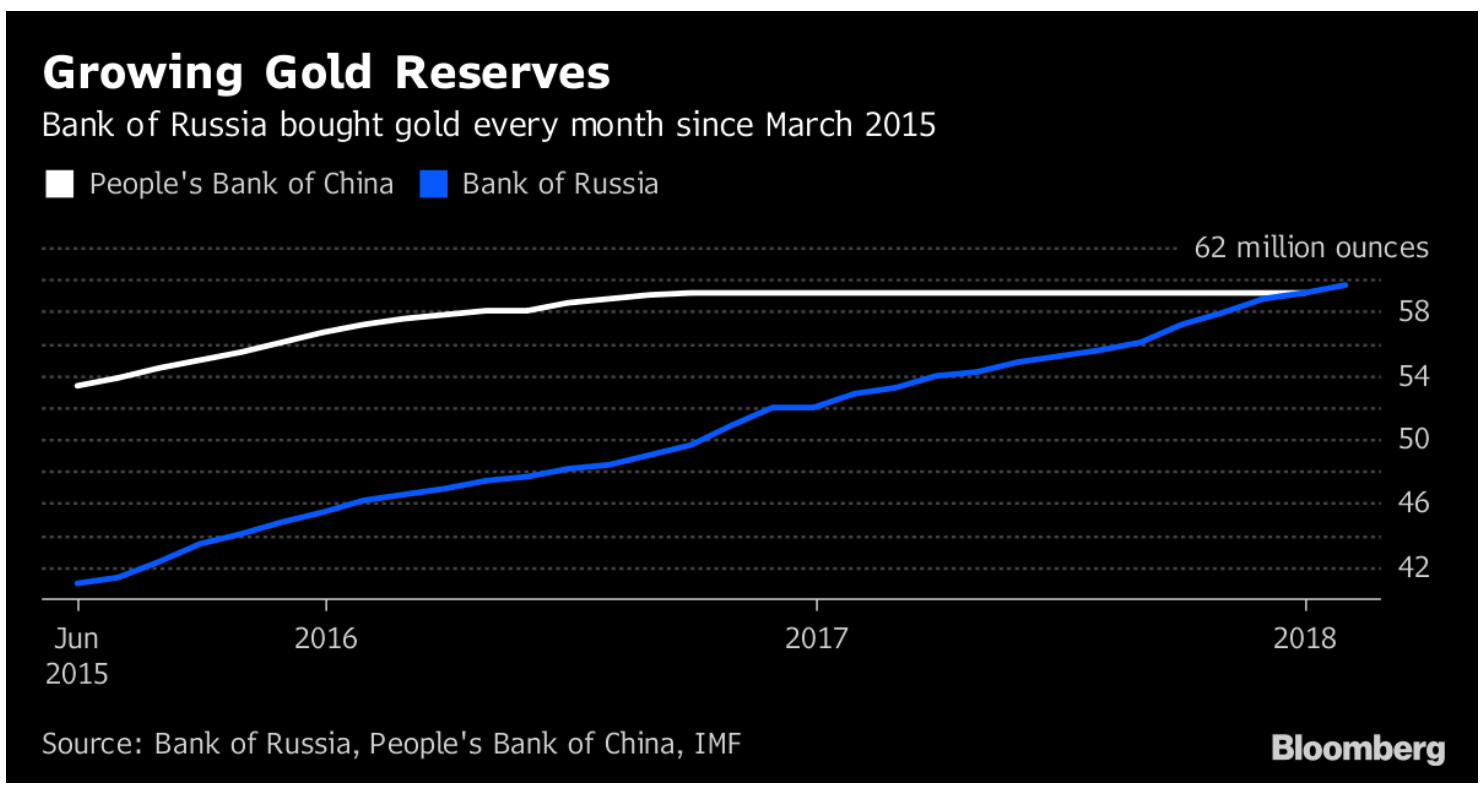
Russia’s reasons for buying so much gold is akin to those of China, Turkey and smaller countries such as Kazakhstan. Gold gives each of these countries independence from the US dollar amid financial sanctions, trade wars and ongoing posturing by the West.
The West is also full of gold bugs

Whilst many in the West are dismissive about gold, the behaviour of central banks suggests quite a different mindset. The top four holders of gold are all from the West. Germany, the second largest has been making big strides of late to show their interest and faith in gold.
Not only did they make the decision to repatriate a late proportion of their gold back to home soil but they also recognised that transparency when it came to the country’s gold reserves was paramount.
‘…another milestone and a global first, an additional fourth step towards increasing transparency was taken with the publication of a list of all German gold bars, totalling around 270,000 in number. The Bundesbank has now published this roughly 2,400-page list three times since October 2015, even though it involved a series of significant challenges. There is no ‘blueprint’ for inventory lists of gold holdings and, in 2015, virtually no central bank in the world had ever released such a list.’
Act like a central bank
Gold cannot be devalued as the euro, dollar, sterling and all fiat currencies currently are. It cannot be confiscated as can deposits through bank bail-ins and it is extremely difficult to confiscate gold coins and bars if owned in allocated and segregated storage in safe vaults in the safest jurisdictions in the world.
Gold is a borderless money that acts as the ultimate reserve and safe haven in a diversified portfolio. This is something central banks are strongly aware of. The difference between the East and West banks is that the East is making big strides to bring gold to the forefront of their international affairs.
By adding gold to their reserves they are gaining equal footing with Western banks who have so far tried to dominate under a US-centric financial system.
Much of the above may sound as though it does not apply to the everyday saver and investor, but that couldn’t be further from the truth. The decision to move assets into physical gold is a decision to take control of your portfolio and to reduce the counterparty risk to which it is exposed. This is no different whether you are a bank with billions or a person with a few thousand.
Recommended reading
Turkey, Gold and the End of US Dollar Hegemony
News and Commentary
Gold prices edge higher as dollar sags (Reuters.com)
Asian Stocks Mixed Ahead of U.S. Data; Yen Higher (Bloomberg.com)
U.S. February budget report shows first sign of wider deficits to come (MarketWatch.com)
Stocks Retreat Before Price Data; Dollar Drops (Bloomberg.com)
Here’s the ideal amount of gold to keep in your investment portfolio (MarketWatch.com)
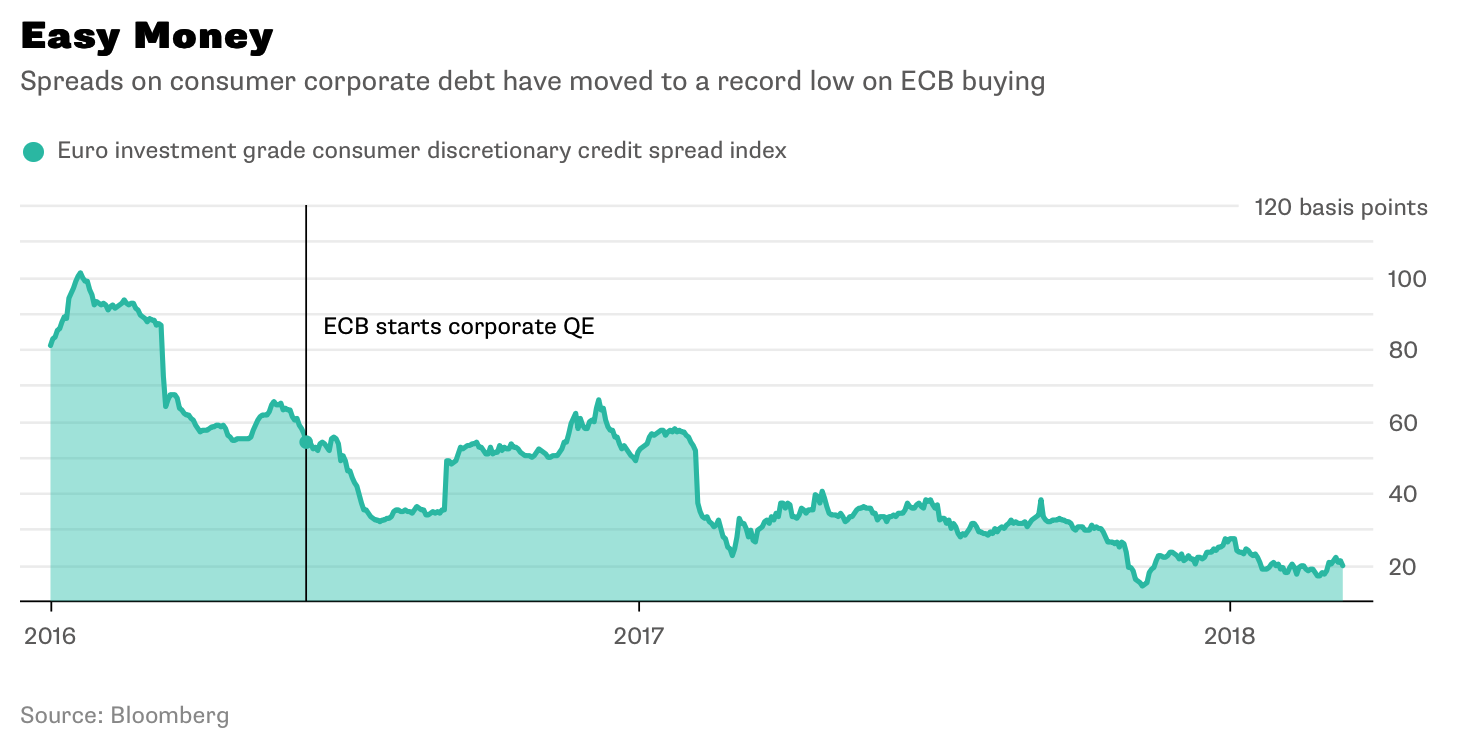
Source: Gadfly, Bloomberg.
Jim Grant: “Uncomfortable Shocks” Lie Ahead As The Great Bond Bear Market Begins (ZeroHedge.com)
Sea Change Is Underway in Money Markets for Banks, Investors (Bloomberg.com)
Central Banks Are Looking for New Ways to Meet Inflation Targets (Bloomberg.com)
Gary North on central banking, gold, federal debt, and Keynesianism (Barbarous-Relic)
Getting the Cartier Crowd Hooked on Cheap Credit (Bloomberg.com)
Gold Prices (LBMA AM)
13 Mar: USD 1,318.70, GBP 948.94 & EUR 1,069.60 per ounce
12 Mar: USD 1,317.25, GBP 950.66 & EUR 1,069.87 per ounce
09 Mar: USD 1,319.35, GBP 955.21 & EUR 1,072.50 per ounce
08 Mar: USD 1,325.40, GBP 955.08 & EUR 1,070.39 per ounce
07 Mar: USD 1,332.50, GBP 960.07 & EUR 1,071.86 per ounce
06 Mar: USD 1,324.95, GBP 957.01 & EUR 1,074.00 per ounce
05 Mar: USD 1,326.30, GBP 958.78 & EUR 1,075.63 per ounce
Silver Prices (LBMA)
13 Mar: USD 16.51, GBP 11.88 & EUR 13.38 per ounce
12 Mar: USD 16.46, GBP 11.88 & EUR 13.39 per ounce
09 Mar: USD 16.49, GBP 11.92 & EUR 13.40 per ounce
08 Mar: USD 16.48, GBP 11.89 & EUR 13.31 per ounce
07 Mar: USD 16.65, GBP 12.01 & EUR 13.42 per ounce
06 Mar: USD 16.62, GBP 11.96 & EUR 13.41 per ounce
05 Mar: USD 16.51, GBP 11.95 & EUR 13.42 per ounce
Recent Market Updates
– Stock Market Selloff Showed Gold Can Reduce Portfolio Risk
– Gold Protects As Cashless Society Threatens Vulnerable
– Women’s Pension Crisis Highlights Dangers To Savers
– London Property Sees Brave Bet By Norway As Foxtons Profits Plunge
– Gold Does Not Fear Interest Rate Hikes
– RaboDirect Closing – Gold May Protect From Irish Banks Going “Belly Up Again” – Finuncane
– Silver bullion will likely outperform gold bullion going forward
– Gold $10,000? Goldnomics Podcast Quotations and Transcript
– Trump Risks Trade and Currency Wars – Protectionism and Economic War Loom
– Four Key Themes To Drive Gold Prices In 2018 – World Gold Council
– Is The Gold Price Going To $10,000? (Goldnomics Podcast 3)
– Gold Corridor From Dubai to China Sought By China
– Digital Gold Provide the Benefits Of Physical Gold?

Andrew Maguire’s Kinesis money which is a “bitcoin” but backed 100% by allocated gold and silver is set to go.
it think it would be a great idea to look at this!
please read at: https://kinesis.money/#/
(Andrew Maguire)
|
2:57 PM (1 hour ago) | ||
|
|||
Harvey
Here It is my friend! https://kinesis.money/#/ Please let everyone know.
Let catch up on Monday if you have time. We have billions in the hopper ready to be allocated on the 1st day of trading. The paper market days are over.
Warm regards
Andy
end.
END
In order to save itself they are advocating Venezuela to adopt the USA dollar
(courtesy Gillespie/CNN/GATA)
Venezuela urged to save itself by becoming a U.S. colony
Submitted by cpowell on Tue, 2018-03-13 22:28. Section: Daily Dispatches
Why not switch its currency to gold? Venezuela has plenty of it in the ground.
* * *
One Idea to Stop Venezuela’s Downward Spiral: Switch to the U.S. Dollar
By Patrick Gillespie
CNN, Atlanta
Tuesday, March 13, 2018
Venezuela’s currency, the bolivar, lost nearly all its value last year as the country spiraled into an economic crisis. One solution gaining popularity: Get rid of the bolivar and replace it with the U.S. dollar.
The idea is called dollarization. Ecuador, El Salvador, and some small island nations have done it. Now it could be coming to Venezuela, widely considered the world’s worst economy not mired in an armed conflict.
Venezuela has a presidential election this spring, and Henri Falcon is seen as the top opposition candidate to the incumbent, Nicolas Maduro. Francisco Rodriguez, a former Wall Street economist who advises Falcon, says he would shift the nation to the dollar to cure its biggest problem, soaring inflation. …
… For the remainder of the report:
http://money.cnn.com/2018/03/13/news/economy/us-dollar-venezuela/index.h…
end
Bitcoin sinks as google moves to ban all crypto advertising in June
(courtesy zerohedge)
Bitcoin Sinks As Google Moves To Ban All Crypto, ICO Ads In June
Mimicking its biggest rival for ad dollars – Facebook – Google will ban online advertisements promoting cryptocurrencies and initial coin offerings, and “other speculative financial instruments” starting in June.
Some aggressive businesses found a loophole: purposely misspelling words like “bitcoin” in their ads. A Google spokeswoman said the company’s policies will try to anticipate workarounds like this.
The reaction was immediate across the crypto space but for now is somewhat subdued…

Alphabet’s Google said the new policy will become effective in June across ads bought on its search and display-advertising network, as well as its YouTube unit.
But, as The Wall Street Journal reports, the policy also will restrict ads for nontraditional methods of wagering on the future movements of stock prices and foreign-exchange, such as binary options and financial spread-betting, Google said.
Google said last year it removed more than 130 million ads that were used by hackers to mine for cryptocurrency. That is a very small percentage of the ads run on Google’s ad network.
The company’s director of sustainable ads, Scott Spencer, declined to comment on how much potential ad revenue the company would be turning away by enacting the new policy, saying the decision was made to prevent consumer harm.
One wonders when the crackdown will start on inverse VIX ETFs, or just S&P ETFs, or brokerages? Aren’t they all capable of doing consumers “harm”?
As a reminder, here is Facebook’s justification:
We want people to continue to discover and learn about new products and services through Facebook ads without fear of scams or deception. That said, there are many companies who are advertising binary options, ICOs and cryptocurrencies that are not currently operating in good faith.
This policy is intentionally broad while we work to better detect deceptive and misleading advertising practices, and enforcement will begin to ramp up across our platforms including Facebook, Audience Network and Instagram. We will revisit this policy and how we enforce it as our signals improve.
We also understand that we may not catch every ad that should be removed under this new policy, and encourage our community to report content that violates our Advertising Policies. People can report any ad on Facebook by clicking on the upper right-hand corner of the ad.
This policy is part of an ongoing effort to improve the integrity and security of our ads, and to make it harder for scammers to profit from a presence on Facebook.
Which roughly translated is “because we know what’s best for you!”
Your early TUESDAY morning currency, Asian stock market results, important USA/Asian currency crosses, gold/silver pricing overnight along with the price of oil Major stories overnight/9 AM EST
i) Chinese yuan vs USA dollar/CLOSED UP 6.3146 /shanghai bourse CLOSED DOWN 18.86 POINTS OR 0.57% / HANG SANG CLOSED DOWN 166.44 POINTS OR 0.53%
2. Nikkei closed DOWN 190.81 POINTS OR 0.87% /USA: YEN FALLS TO 106.48/
3. Europe stocks OPENED DEEPLY IN THE GREEN /USA dollar index RISES TO 89.77/Euro FALLS TO 1.2371
3b Japan 10 year bond yield: FALLS TO . +.05O/ !!!!(Japan buying 100% of bond issuance)/Japanese yen vs usa cross now at 106.48/ THIS IS TROUBLESOME AS BANK OF JAPAN IS RUNNING OUT OF BONDS TO BUY./JAPAN 10 YR YIELD FINALLY IN THE POSITIVE/BANK OF JAPAN LOSING CONTROL OF THEIR YIELD CURVE AS THEY PURCHASE ALL BONDS TO GET TO ZERO RATE!!
3c Nikkei now JUST BELOW 17,000
3d USA/Yen rate now well below the important 120 barrier this morning
3e WTI:: 61.09 and Brent: 65.08
3f Gold DOWN/Yen UP
3g Japan is to buy the equivalent of 108 billion uSA dollars worth of bond per month or $1.3 trillion. Japan’s GDP equals 5 trillion usa./“HELICOPTER MONEY” OFF THE TABLE FOR NOW /REVERSE OPERATION TWIST ON THE BONDS: PURCHASE OF LONG BONDS AND SELLING THE SHORT END
Japan to buy 100% of all new Japanese debt and by 2018 they will have 25% of all Japanese debt. Fifty percent of Japanese budget financed with debt.
3h Oil UP for WTI and UP FOR Brent this morning
3i European bond buying continues to push yields lower on all fronts in the EMU. German 10yr bund FALLS TO +.624%/Italian 10 yr bond yield UP to 2.016% /SPAIN 10 YR BOND YIELD UP TO 1.413%
3j Greek 10 year bond yield RISES TO : 4.162?????????????????
3k Gold at $1325.65 silver at:16.59 7 am est) SILVER NEXT RESISTANCE LEVEL AT $18.50
3l USA vs Russian rouble; (Russian rouble UP 24/100 in roubles/dollar) 56.82
3m oil into the 61 dollar handle for WTI and 65 handle for Brent/
3n Higher foreign deposits out of China sees huge risk of outflows and a currency depreciation. This can spell financial disaster for the rest of the world/
JAPAN ON JAN 29.2016 INITIATES NIRP. THIS MORNING THEY SIGNAL THEY MAY END NIRP. TODAY THE USA/YEN TRADES TO 106.48 DESTROYING JAPANESE CITIZENS WITH HIGHER FOOD INFLATION
30 SNB (Swiss National Bank) still intervening again in the markets driving down the SF. It is not working: USA/SF this morning 0.9451 as the Swiss Franc is still rising against most currencies. Euro vs SF is 1.1696 well above the floor set by the Swiss Finance Minister. Thomas Jordan, chief of the Swiss National Bank continues to purchase euros trying to lower value of the Swiss Franc.
3p BRITAIN VOTES AFFIRMATIVE BREXIT/LOWER PARLIAMENT APPROVES BREXIT COMMENCEMENT/ARTICLE 50 COMMENCES MARCH 29/2017
3r the 10 Year German bund now POSITIVE territory with the 10 year FALLING to +0.624%
The bank withdrawals were causing massive hardship to the Greek bank. the Greek referendum voted overwhelming “NO”. Next step for Greece will be the recapitalization of the banks and that will be difficult.
4. USA 10 year treasury bond at 2.846% early this morning (THIS IS DEADLY TO ALL MARKETS). Thirty year rate at 3.091% /
5. Details Ransquawk, Bloomberg, Deutsche bank/Jim Reid.
(courtesy Jim Reid/Bloomberg/Deutsche bank/zero hedge)
Futures Rebound Sharply Despite Ongoing Trump Cabinet, Trade War Turmoil
After two consecutive days of failed S&P ignition attempts, in which US stocks opened sharply higher only to close near the lows, on Wednesday the algos will try for the third consecutive time to escape the recent late-day selloff funk. S&P futures are higher after declining on Tuesday following a fresh personnel shakeup in the Trump administration and renewed US trade war speculation with China dampened investor sentiment.

European stocks rose modestly led by mining shares even as Asian shares fell despite stronger than expected Chinese economic data.
Equity markets were attempting to recover after Tuesday’s hefty losses, encouraged by stronger than expected Chinese factory data, but struggled to overcome fears of a global trade war as well as the prospect of political uncertainty in the United States. “As long as the threat of protectionism and a trade war remains, markets will remain vigilant,” Rabobank analysts told clients according to Reuters.

The latest set of tariffs, reportedly targeting Chinese tech, electronics and telecoms, were revealed by sources hours after Trump abruptly fired Secretary of State Rex Tillerson. Tillerson’s exit follows that of economic advisor Gary Cohn, a strong free trade proponent. Since Trump took office in 2017 as many as 35 senior officials from his administration have walked out, including Tillerson, according to Citi.
“The market probably correctly viewed this move as weakening internal White House opposition to some of Trump’s less market-friendly policies, in particular the President’s trade policy,” Daiwa strategist Mantas Vanagas said, quoted by Reuters.
The negative momentum faded somewhat in Europe, with a pan-European equity index up 0.24% after falling 1% on Tuesday. That left MSCI’s all-country equity index down 0.12% its second day in the red, although a rebound in the US will likely push it back in the green.
European stocks rose modestly after opening in the red after Tuesday’s plunge as traders assess the implications of a shakeup in the Trump administration amid corporate updates from companies including Inditex SA and Prudential Plc. The Stoxx Europe 600 Index rises 0.3%, with all major sectors with the exception of utilities are trading higher in the Euro Stoxx, while much of the morning stock movers have been dictated by company earnings, with Adidas (+9%) shares sitting at the top of DAX. Elsewhere, the IBEX underperforms its counterparts as index heavyweight Inditex (-3%) slipped after highlighting concerns over FX headwinds. Zara owner Inditex drops after reporting a slowdown in sales and its weakest profitability in a decade, while U.K. insurer Prudential rises after saying it divested 12 billion pounds ($16.7 billion) of annuities from its U.K. portfolio and plans to spin off its M&G Prudential unit. Miners were the best-performing industry group after Goldman Sachs analysts said the sector is enjoying robust global demand and after China reported strong economic data overnight.
There was no bounce earlier in Asia, where markets followed the negative US lead with the Nikkei (-0.9%), Kospi (-0.3%), Hang Seng (-0.5%) and Shanghai Comp (-0.6%) all down. The latest batch of mixed activity indicators were released in China early this morning. Industrial production in February rose unexpectedly to +7.2% ytd yoy (vs. +6.2% expected; +6.6% previously), as did fixed asset investment (+7.9% yoy vs. +7.0% expected; +7.2% previously) while retail sales were slightly below expectations at +9.7% yoy (vs. +9.8%) from +10.2% in the month prior. As shown in the chart below, Chinese macro data has been disappointing in recent months so the modest upside surprise in factory orders was a welcome change.

In global FX, the dollar pared an early decline as the euro felt some heat from another Draghi reference to the exchange rate, while the Yen rose following continued focus on the Moritomo scandal that has again rocked the Abe administration. A lackluster London session saw the pound shedding gains ahead of a May speech over the U.K.’s relationship with Russia. Bloomberg breaks down the latest overnight FX action:
- The euro set a day low of $1.2364 in early London trading after ECB President Draghi said in a speech that adjustments to monetary policy will remain predictable as policy makers look for further evidence that inflation dynamics are moving in the right direction
- He also said the central bank needs to monitor developments in the common currency closely as its appreciation since the beginning of the year cannot be explained solely by economic expansion
- AUD/USD saw leveraged demand on stronger-than- expected gains in China’s factory output and investment growth
- Kiwi shook off weaker-than-estimated 4Q current-account balance to climb on global fund demand to buy New Zealand’s bonds after Tuesday’s issuance
Treasuries and euro-area bonds were little changed. German 10-year government bond yields approached one-month lows and currently stand 20 basis points below this year’s peak at 0.60 percent, following a soft 30Year debt auction.
Economic data include retail sales and PPI. Williams-Sonoma and Signet Jewelers are among companies due to release results
Market Snapshot
- S&P 500 futures up 0.3% to 2,776.00
- STOXX Europe 600 up 0.3% to 376.55
- MXAP down 0.5% to 178.18
- MXAPJ down 0.4% to 587.85
- Nikkei down 0.9% to 21,777.29
- Topix down 0.5% to 1,743.21
- Hang Seng Index down 0.5% to 31,435.01
- Shanghai Composite down 0.6% to 3,291.38
- Sensex down 0.4% to 33,720.90
- Australia S&P/ASX 200 down 0.7% to 5,935.31
- Kospi down 0.3% to 2,486.08
- German 10Y yield fell 1.0 bps to 0.609%
- Euro down 0.2% to $1.2370
- Brent Futures down 0.2% to $64.51/bbl
- Italian 10Y yield fell 0.9 bps to 1.737%
- Spanish 10Y yield rose 0.8 bps to 1.405%
- Brent Futures down 0.2% to $64.51/bbl
- Gold spot down 0.2% to $1,324.41
- U.S. Dollar Index up 0.2% to 89.83
Top Overnight News
- ECB’s Praet says the central bank’s forward guidance on the path of policy rates will have to be further specified and calibrated as appropriate for inflation to remain on the sustained adjustment path toward levels below, but close to, 2% over the medium term
- The special election in southwestern Pennsylvania remained too close to call with all precincts reporting results. House seat in Pennsylvania may be a bellwether for the fall elections that will decide control of Congress
- Theresa May will meet with her national security and intelligence chiefs Wednesday to assess whether Russia has given a credible answer to her charge that it was behind the poisoning of Sergei and Yulia Skripal in Salisbury. She will then update Parliament on her response.
- China’s factory output and investment growth unexpectedly accelerated in the first two months of the year amid robust global demand
- U.S. Trade Representative Robert Lighthizer presented President Donald Trump with package of tariffs targeting equivalent of $30b a year in Chinese imports, but Trump urged him to aim for higher number, Politico reports, citing three unidentified people familiar with discussions
- Japanese Prime Minister Shinzo Abe and his finance minister denied ordering officials to tamper with documents at the center of a scandal rocking his administration.
- German Chancellor Angela Merkel was formally elected to a fourth term in a parliamentary vote, extending her 12 years in office at the helm of Europe’s biggest economy
- Germany may be ready to sacrifice Jens Weidmann in the contest of becoming the next head of the ECB in a trade for more influence on French President Emmanuel Macron’s push to create closer ties among euro countries
European equities are trading in the green this morning, subsequently pairing the initial losses that stemmed from Asian and US bourses, which saw risk-sentiment soured by reports of Secretary of State Tillerson being fired and increased caution over trade wars. All major sectors with the exception of utilities are trading higher in the Euro Stoxx, while much of the morning stock movers have been dictated by company earnings, with Adidas (+9%) shares sitting at the top of DAX. Elsewhere, the IBEX underperforms its counterparts as index heavyweight Inditex (-3%) slipped after highlighting concerns over FX headwinds.
Top European News
- Germany Ready to Sacrifice Weidmann as a Pawn in EU Chess Match
- Draghi Says Policy Adjustments to Proceed at Measured Pace
- Corin’s Billionaire Owners Said to Mull Sale of Orthopedic Firm
- Volvo Venture Seeks Top Self-Driving Role Angling for More Deals
- May Plots to Punish Russia as Crisis Over Poisoned Spy Deepens
In Asia, equity markets were negative across the board as the region tracked the losses on Wall St, where sentiment was dampened after another high-profile departure from the administration in which President Trump fired Secretary of State Rex Tillerson, while trade war concerns were also stoked by reports the US is looking to impose tariffs on Chinese goods. ASX 200 (-0.7%) and Nikkei 225 (-0.9%) were negative with financials pressured amid the ongoing royal commission hearings in which NAB employees were said to knowingly approved fake loans to reach targets, while Nikkei 225 was pressured by a firmer JPY and with some analysts also noting ‘Abexit’ worries in the wake of the land-sale/cronyism scandal. Shanghai Comp. (-0.4%) and Hang Seng (-1.4%) conformed to the weakness with tech and telecom names weighed as the US seeks to impose tariffs of USD 60bln on Chinese goods, which would target tech and telecom products as a punishment for intellectual property infringement. Although, losses in the mainland were somewhat stemmed by mixed data including higher than expected Industrial Production and Fixed Asset Investments. Finally, 10yr JGBs were flat despite the weakness in stocks, with an uneventful BoJ minutes release and unchanged BoJ Rinban operation amount for 1yr-10yr maturities also ensured quiet price action. BoJ Minutes from the January 22nd-23rd meeting stated it is appropriate to pursue powerful easing and that price momentum to reach target is maintained.
Top Asian News
- China’s Factory Output, Investment Rise on Robust Global Demand
- China Imposes Record $870 Million Fine for Stock Manipulation
- Noble Group Seeks to Sweeten Disputed Debt Deal After Backlash
- Toyota Offers Bigger Raises as Japan Pushes for Inflation
- Not Even Trump Can Slow Vietnam’s Economy, Official Says
In FX, USD weakness amidst ongoing global trade war and White House personnel concerns remains the principle theme, as the DXY continues to reject advances towards the 90.000 level and beyond, which in turn is shifting the technical outlook more bearish. However, EURUSD and single currency crosses have been knocked back to an extent by comments from ECB President Draghi and Chief Economist Praet, reiterating that inflation is still below target and therefore policy needs to stay ‘patient, persistent and prudent’. Key downside risks were highlighted – FX and the aforementioned potentially adverse trade developments due to US President Trump’s import tariff proposals. Eur/Usd is back below 1.2400, but holding above the 30 DMA at 1.2345, and also eyeing decent expiry interest from 1.2390-1.2405 (around 1 bn). Conversely, Aud/Usd is testing resistance either side of the 0.7900 handle again and recent peaks just below the big figure, aided by some Chinese data beats overnight and more balanced rather than dovish/cautious RBA rhetoric via Assistant Governor Kent. Chart-wise, yesterday’s 0.7898 high forms the first/nearest bullish target and offers are touted around 0.7925, if 0.7900 is breached. Cable looks capped by the 1.4000 level, and Usd/Cad by 1.3000, while Usd/Jpy is back in the 106.50 area after a further retreat from 107.00+ peaks late last week and earlier this week with the 10 DMA at 106.31 holding in for now. Elsewhere, Eur/Sek just a fraction softer after broadly as forecast Swedish CPI data that will underscore growing calls for the Riksbank to refrain from tightening for longer.
In commodities, oil prices are trading slightly higher with prices finding some slight reprieve from yesterday’s smaller than expected build in the latest API report, alongside the improvement in risk sentiment, which has seen WTI retest USD 61/bbl
Looking at the day ahead, it looks set to be another important day of data with February retail sales and PPI, followed by January business inventories. It’s worth also highlighting that the European Commission is expected to make comments on US steel and aluminium tariffs to the European Parliament.
US Event Calendar
- 7am: MBA Mortgage Applications, prior 0.3%
- 8:30am: Retail Sales Advance MoM, est. 0.3%, prior -0.3%
- Retail Sales Ex Auto MoM, est. 0.4%, prior 0.0%
- Retail Sales Ex Auto and Gas, est. 0.32%, prior -0.2%
- Retail Sales Control Group, est. 0.4%, prior 0.0%
- 8:30am: PPI Final Demand MoM, est. 0.1%, prior 0.4%
- PPI Ex Food and Energy MoM, est. 0.2%, prior 0.4%
- PPI Ex Food, Energy, Trade MoM, est. 0.2%, prior 0.4%
- 8:30am: PPI Final Demand YoY, est. 2.8%, prior 2.7%
- 8:30am: PPI Ex Food and Energy YoY, est. 2.6%, prior 2.2%
- 8:30am: PPI Ex Food, Energy, Trade YoY, prior 2.5%
- 10am: Business Inventories, est. 0.6%, prior 0.4%
DB’s Craig Nicol concludes the overnight wrap
Picking the right moment to run out and grab lunch is something of a fine art working in markets. Indeed, anyone who was out for the 12 minutes between 12.30pm GMT and 12.42pm GMT yesterday probably felt like they’d been gone a lot longer when they returned to their screens. It takes something fairly significant to overshadow US inflation data at the moment however the shock news that President Trump had ousted now former US Secretary of State Rex Tillerson was certainly enough to do just that.
The announcement came via a tweet from the President and it also included confirmation that CIA Director Mike Pompeo would take over the role. Trump confirmed with reporters that Tillerson “had a different mindset” relative to the President with the Iran nuclear deal named as an example. It was no secret that Tillerson’s tenure had been somewhat rocky however it’s fair to say that markets were still caught off guard, despite his clock probably ticking. Indeed Politico also reported that Tillerson had no plans to leave and was also unsure why he had been let go. There were suggestions that Tillerson’s vocal statements on Monday about condemning the Russian government about its alleged role in the Russian spy incident in the UK could have played a part however that remains to be seen. Various news outlets also confirmed that Trump wanted a new team in place ahead of talks with North Korea and also ongoing trade talks.
It’s not the first time that Trump has moved quickly in his administration without warning, with Reince Priebus and James Comey two other such examples. In fact, the NY Times also reported that Trump’s personal assistant, John McEntee, was let go on Monday and escorted from the White House, while another headline from the Times suggested that there would be more staff shifts this week. The bottom line for us is that all these moves show that the President is certainly moving a lot closer to his anti-globalist policy agenda. On that point, the view on Pompeo is that he and Trump are a lot closer aligned and that Pompeo is more likely to have the President’s ear. On a related note, it also appears that Larry Kudlow is now the favourite to replace Gary Cohn based on comments from the President yesterday. That’s perhaps more interesting given that Kudlow and Trump have clashed in the past over tax reform and also the recent tariff announcements.
Aside from the 12 minutes of a slightly more positive risk environment following the US CPI report (more on that below), the Tillerson news certainly more than played its part in equity markets dropping from early highs. The S&P 500 finished -0.64% last night after being up as much as +0.67% at one stage. A Reuters story suggesting that Trump was seeking for tariffs of up to $60bn a year on China imports seemed to just extend selling pressure into the evening. Meanwhile the previously untouchable Nasdaq (-1.02%) snapped its 7-day winning run while in Europe the big mover was the export-heavy DAX which tumbled to a -1.59% loss. Moves for bonds were actually a bit more contained. The high-to-low range on 10y Treasuries was 6bps and the yield did fall to the lowest in over a week (2.828%) at one point, however by the end of play they were just 2.6bps lower at 2.843%. The 30y auction was also relatively solid with the highest award to direct bidders since October 2015. In Europe bond markets were broadly 1-2bps lower while the Greenback was well offered with the Dollar index falling -0.26%. Gold (+0.26%) also seemed to benefit from a flight to quality bid.
With regards to the CPI data, that in-line +0.2% mom core print meant that the annual rate also held at +1.8% yoy for the third consecutive month. The unrounded reading was +0.182%, so the overall feeling was that it largely mirrored the marginally softer earnings number on Friday. However, momentum is still favouring the hawks with the three-month annualized rate now up to +3.1% and the highest since 2007. The six-month annualized rate is also at a
robust +2.5%. That should be comforting to a Fed which is targeting the gradual approach for now though. As a reminder that is the last CPI report that the Fed will see prior to the FOMC meeting next week however they will benefit from the release of the February PPI data today. Expectations for that is also for a +0.2% mom core reading while the headline is expected to show a +0.1% mom rise in producer prices.
Here in the UK there were no huge surprises to come from Chancellor Hammond’s Spring Statement. As widely expected the borrowing numbers for the current fiscal year and also the next were revised down. This year was revised down from £50bn to £45bn while next year was revised down from £40bn to £37bn. Headroom relative to the 2% cyclically adjusted borrowing to GDP target by 2020-21 is more or less unchanged versus the November estimate at around £15bn, so not a huge amount more fiscal room. Finally GDP forecasts remain fairly lacklustre and included a cut to the 2021-22 forecast. The 2018 forecast was however revised up one-tenth to 1.5%. Sterling closed up +0.40% last night versus the USD but that appeared to be more USD weakness related to the Tillerson news than anything else. Indeed versus the Euro, Sterling was closer to unchanged. Gilt yields also finished more or less unchanged by the end of play.
This morning in Asia, markets have largely followed the negative US lead with the Nikkei (-0.83%), Kospi (-0.51%), Hang Seng (-1.30%) and Shanghai Comp (-0.60%) all down as we type. The latest batch of activity indicators were released in China early this morning. Industrial production in February rose unexpectedly to +7.2% ytd yoy (vs. +6.2% expected; +6.6% previously), as did fixed asset investment (+7.9% yoy vs. +7.0% expected; +7.2% previously) while retail sales were slightly below expectations at +9.7% yoy (vs. +9.8%) from +10.2% in the month prior. The combined Jan and Feb data is meant to smooth out the effects of the Lunar New Year. Meanwhile, the Pennsylvania Congressional District special election in the US is appearing to head for a neck and neck finish.
Bloomberg is reporting that Democrat Conor Lamb holds a tiny lead of 579 votes over Republican Rich Sacconne, out of about 227,000 votes cast. Finally in Japan, the BOJ minutes showed most board members believe the bank must “persistently” pursue powerful easing. Notably, during Q&A BOJ Governor Kuroda noted “by combining various tools, it’s possible to shrink the BOJ’s balance sheet at an appropriate pace while keeping markets stable”.
Turning back to Europe, another Politico article yesterday suggested that the Bundesbank’s Weidmann is the favourite to replace Mario Draghi as ECB President from October 2019. However the story also suggested that his support was receiving pushback, in part given Weidmann’s vocal opposition to Draghi’s QE policy and his strict enforcement of the EU’s fiscal policies. Other potential German candidates touted include Klaus Regling (current head of the ESM) and Marcel Fratscher (Head of the research institute DIW Berlin). Notably, the swing factor for the candidacy likely depends on the relative support of French President Macron, who has been relatively quiet on this topic.
In other news, the OECD has upgraded its forecasts on global economic growth by 0.2-0.3ppt to 3.9% for both 2018 and 2019, with “private investment and trade picking up on the back of strong business and household confidence”. Across countries, growth in the US has been lifted to 2.9% for 2018 (+0.4ppt) and 2.8% for 2019 (+0.7ppt) in part due to the tax cuts and new fiscal spending increases, while the UK’s growth was revised slightly higher to 1.3% in 2018 and 1.1% in 2019. Notably, the agency also warned on protectionism and noted that “an escalation of trade tensions would be damaging for growth and jobs” and that countries should “avoid escalation and rely on global solutions to solve steel excess capacity”.
Before we take a look at today’s calendar, we wrap up with other data releases from yesterday. In the US, the February NFIB small business optimism index was above market at 107.6 (vs. 107.1 expected) and marked a fresh high since 1983. The survey also showed that c.1/3 of owners reported raising compensation to retain or attract workers in the month, the largest share in 17 years. In Europe, Italy’s Q4 unemployment rate was in line at 11% and the final reading of Spain’s February CPI was confirmed at 1.2% yoy. Elsewhere, France’s Q4 total payrolls was up +0.3% qoq (vs. +0.2% expected).
Looking at the day ahead, we’ll get final revisions to February CPI in Germany along with January industrial production and Q4 employment data for the Euro area. ECB President Draghi is scheduled to speak in the morning (8am London time), as well as the ECB’s Coeure, Praet Constancio and then Bank of France’s Governor Villeroy. In the US, it looks set to be another important day of data with February retail sales and PPI, followed by January business inventories. It’s worth also highlighting that the European Commission is expected to make comments on US steel and aluminium tariffs to the European Parliament.
end
3. ASIAN AFFAIRS
i)WEDNESDAY MORNING/TUESDAY NIGHT: Shanghai closed DOWN 18.86 POINTS OR 0.57% /Hang Sang CLOSED DOWN 166/44 POINTS OR 0.53% / The Nikkei closed DOWN 190.81 POINTS OR 0.87%/Australia’s all ordinaires CLOSED DOWN 0.57%/Chinese yuan (ONSHORE) closed UP at 6.3146/Oil UP to 61.09 dollars per barrel for WTI and 65.08 for Brent. Stocks in Europe OPENED GREEN EXCEPT LONDON . ONSHORE YUAN CLOSED UP AT 6.3268 AGAINST THE DOLLAR. OFFSHORE YUAN CLOSED UP ON THE DOLLAR AT 6.3054 /ONSHORE YUAN TRADING STRONGER AGAINST OFFSHORE YUAN/ONSHORE YUAN TRADING STRONGER AGAINST USA DOLLAR/OFFSHORE YUAN TRADING STRONGER AGAINST THE DOLLAR . CHINA IS NOT VERY HAPPY TODAY (STRONGER CURRENCY BUT WEEK CHINESE MARKETS/AND TRUMP TARIFFS INITIATED/ )
3 a NORTH KOREA/USA
/NORTH KOREA/USA
3 b JAPAN AFFAIRS
c) REPORT ON CHINA
China overproduces on steel which saved this country from further economic problems but still is facing a credit impulse collapse: as retail sales plunge
(courtesy zerohedge)
Steel Output Surge Saves Chinese Economy Despite Credit Impulse Collapse
Despite all the discontinuities that the lunar new year causes in China’s macro data, the global synchronous recovery narrative is fading fast, but while retail sales missed, China’s Industrial Production surged in February (thanks to Steel production up 5.9% YoY).
China’s macro data has been disappointing for a couple of months…

And as Bloomberg’s Enda Curran notes, it’s China data day, but with a catch.
Today’s numbers will cover a period when the economy more or less shut down for the annual New Year holidays which means it’s a tricky time of the year for gauging the economy’s true strength. We’ll have to wait for the March and April numbers to get a better handle.
And so what did the data look like…
- Retail Sales YTD YoY MISS +9.7% vs 9.8% exp vs 10.2% prior
- Industrial Production YTD YoY HUGE BEAT +7.2% vs 6.2% exp vs 6.6% prior
- Fixed Asset Investment YTD YoY HUGE BEAT +7.9% vs 7.0% exp vs 7.2% prior
Amid all the tariffs, it seems Steel saved China…
- China Jan.-Feb. Steel Product Output Rises 4.6% to 159.03M Tons
- China Jan.-Feb. Crude Steel Output Rises 5.9% to 136.82M Tons
And Iron Ore inventories are surging..
.

Iris Pang at ING has some interesting observations on industrial production. Even though factories were closed, the tech boom boosted output. Here’s some numbers:
“That growth will probably come from high-tech sectors, including industrial robots (+68.1 percent in 2017), new energy cars (+51.1 percent) and integrated circuits (+18.2 percent).
The cold winter is also likely to increase production of electricity. These areas will probably cushion the loss of production from capacity-cuts in cement, coke and crude oil.”
The figures do somewhat cut against the overarching narrative of a slowdown in the old-industrial drivers and a switch to consumption.
Meanwhile, Chinese stocks managed to scramble back into the green for the year after the lunar new year’s celebration, but are rolling over once again…

As foreign investors fled in February…

All of which happening as the lagged impact of the collapse of China’s credit impulse filters through…

And don’t expect it to resurge anytime soon as Xi – now emperor for life – cracks down on leverage and debt across society (for now).
Of course, as Bloomberg’s Chris Anstey concludes, from a financial-market perspective, it’s been some time since investors agonized over Chinese indicators. Most are comfortable that the hard-landing fears are in the rear-view mirror now, and have become accustomed to the idea that China is in a gradual transition from focus on quantity of growth to quality.
Of course, that complacency is there until something (like Anbang) goes boom..
Here Comes The Main Event: Trade War With China, And What Is Section 301
The recently announced global steel and aluminum tariffs (with various exemptions) by the Trump administration were just a (Section 232) preview of the main event: Trump’s imminent trade war with China, which as Credit Suisse previews, will be unveiled any moment in the form of tariffs and restrictions on trade with China, reportedly in retaliation for Chinese IP violations.
First, a reminder on the all-important Section 301:
- What is Section 301? Section 301 of the 1974 Trade Act allows the President to, among other things, “impose duties or other import restrictions on the products of [a] foreign country,” if the President determines that that country is violating a trade agreement or “engages in discriminatory or other acts or policies which are unjustifiable or unreasonable and which burden or restrict United States commerce.“ The U.S. relied heavily on the provision during the Reagan era (an administration in which the current USTR Robert Lighthizer served as Deputy USTR) into the early 1990s, but it has been used infrequently since the World Trade Organization was formed in 1995 and provided a forum for dispute resolution.
How will Section 301 figure in the upcoming US-Chinese trade war, and what are the key points:
- Last August, President Trump instructed his U.S. Trade Representative Robert Lighthizer to initiate a Section 301 investigation into China’s forced technology transfer policies.
- While the results of the 301 investigation are not due until August 2018, the President appears poised to act on the issue in the coming weeks.
- The President is reported to be seriously considering a package of tariffs on Chinese imports (targeting between $30BN and $60BN worth).
- Reports have stated that Administration officials have used China’s manufacturing roadmap, “Made in China 2025,” in deciding what goods to impose tariffs on. This will likely further concern Chinese leaders.
- In addition, the Administration has discussed rescinding licenses for Chinese businesses and employing other such methods to restrict Chinese investment in the United States. The President’s recent decision to block a Singaporean company’s bid to takeover a U.S. company underscores his aversion to Chinese direct investment (the company had Chinese affiliations).
- As part of the 301 action, the Administration has also reportedly discussed visa restrictions and a mandate that U.S. stock exchanges limit who can list in a U.S. market. It remains unclear whether the restrictions will go this far, but the President has, to date, been hawkish in his trade policy and there seem to be fewer and fewer moderating voices in the White House.
- The 301 investigation and potential actions resulting from it seem to complement congressional efforts to restrict Chinese investment through legislation broadening the jurisdiction of the Committee on Foreign Investment in the United States (CFIUS). We believe this legislation is on track to be signed into law in Q3 2018.
What to expect? here are some high-level thoughts from Credit Suisse:
- The Chinese will likely respond in kind, beginning a succession of tit-for-tat trade policies between the two countries.
- The United States has the option to take a multilateral approach and work with allied nations to initiate their own WTO dispute regarding Chinese technology transfer policies. However, at this point, the U.S. appears more likely to instead take unilateral retaliatory action without WTO authorization, which may run afoul of the U.S.’s WTO obligations.
- If the U.S. acts unilaterally (as it appears it will), China will likely bring a challenge before the World Trade Organization (WTO).
- The President appears committed to maintaining his “tough on China” stance. Even after losing top advisor Gary Cohn after the imposition of steel and aluminum tariffs, the President appears steadfast in his campaign against China’s trade practices and Chinese investment in the U.S, and we expect continued restrictive trade policies with respect to China.
- The President’s actions may not receive the congressional backlash that his steel and aluminum tariffs did. Many U.S. corporations are frustrated with China’s policy requiring foreign companies to turn over source code and other proprietary technology in exchange for access to the Chinese market. However, if the President takes this as far as he currently seems to be planning to, punitive measures by China coupled with the chilling of foreign investment could be a major concern for U.S. corporations.
In terms of specifics, the US trade deficit last year hit an all time high of $375BN.

The Trump administration is planning imposing tariffs on up to $60bn of Chinese goods, or roughly 13% of goods import from China ($505BN), and 2.75% of total US goods import according to Danske Bank; the tariffs will target tech products, telecoms & clothing.

A snapshot of the key aspect of the US-China trade relationship:
- the US exports soybeans, pharmaceuticals, vehicles and aircraft.
- the US imports textiles,clothing, manufactures of metals,electronics and toys.

How to trade it?
As noted last week, when discussing which industries and companies would be impacted, we said that there are some obvious sectors such as industrials (cars, planes), agriculture, and technology. Below, courtesy of Strategas, is a list of US companies which derive the largest percentage of their total revenue from China. As trade war looms, it would be prudent for investors to start thinking about potential risks to the companies they own if they have sufficient business in China.
END

4. EUROPEAN AFFAIRS
SLOVAKIA
Murder and protests are rocking this small European nation of Slovakia. The government under Robert Fico is corrupt and he is now fighting for his political future
(courtesy zerohedge)
Murder And Protests Rock A Small European Nation
A chain of events set in motion by the assassination of a local investigative journalist and his girlfriend has left Slovakia’s corrupt and ineffectual Prime Minister Robert Fico fighting for his political future.
It all started last month, when investigative reporter Jan Kuciak and Martina Kusnirova were assassinated. Kuciak had been working on a series about endemic corruption in the Slovak government, which he had linked to a cocaine trafficking and money laundering operation involving members of the ‘Ndrangheta, an Italian organized crime group based in Calabria, a region in Southern Italy. Afterwards, police arrested seven Italian nationals living in Slovakia, and charged them with the murder. Kuciak had been working with an international investigative reporting consortium, the Organized Crime and Corruption Reporting Project,
One wouldn’t expect the murder of a journalist in a small central-European nation to make international news. But, somehow, it did: Even Buzzfeed ran a story about the killing with the (nausea-inducing) headline “A Powerful Italian Mob You May Not Have Heard Of Is Blamed In Murder Of Journalist And Girlfriend.”

Since then, Slovakia has been rocked by protests as the murder of Kuciak brought the extent of corruption in Fico’s government into the open.
And now, instead of praising the Slovakian people for standing up against crime and corruption perpetrated by a government that has long since lost any accountability it had, Bloomberg ran a story warning that the fall of Fico’s corrupt government could open the door for a populist government to seize power. That would leave Slovakia with right-wing leaders, just like neighbors Poland and Hungary.
Tens of thousands of people turned out again last week to demand the resignation of Prime Minister Robert Fico, who they blame for allowing rampant corruption. Interior Minister Robert Kalinak, a close ally of Fico, resigned on Monday before a key party in the governing coalition said it would push for an early election. It means a vote could come within months.
“If the government collapses, there’s a danger that Euroskeptic parties rise to power, which could seriously alter Slovakia’s stance towards the EU,” said Jiri Pehe, director of New York University in Prague. A change could lead to Slovakia joining Hungary and Poland, and possibly the Czech Republic could slide there too, which would be a very dangerous situation for the whole central European region.”
According to Bloomberg’s bafflingly reductive interpretation of recent Slovakian history, “it seemed everything was going right for Slovakia, a country of 5.4 million wedged in the heart of a continent. A change of power 20 years ago and ensuing economic reforms turned what U.S. Secretary of State Madeleine Albright called “the black hole of Europe” in 1998 into a world superpower in car production and a member of Europe’s single currency.”

Jan Kuciak and Martina Kusnirova
But amid this growth, Fico, the leader of Smer, the country’s most popular party, for 19 years. And as anybody who studies corruption in government will tell you, a lack of democratic accountability is the primary condition necessary for corruption to flourish.
Last week, tens of thousands of protesters crowded the streets of Bratislava to demand Fico’s resignation. But thanks to the hubris that inevitably accompanies feelings of political invincibility.
Fico, 53, has refused demands from protesters in more than 40 towns and cities, opposition parties and a coalition partner to stand down. The premier denies all allegations of wrongdoing.
Slovakia is “living a success story,” Fico said. “We’ve come a long way over those 25 years and people’s lives are better. This story can’t end with one tragedy, however painful it is.”
Fico’s latest term in office has been marred by allegations of corruption. But, as Bloomberg emphasizes, the country’s gross domestic product is up 26% from when he first became prime minister in 2006. Furthermore, Fico has promoted himself within the European Union as a counterweight to Hungary’s far-right leader Viktor Orban, who is engaged in a long-running legal battle with the EU over his refusal to admit refugees and migrants. The country is also one of the world’s largest per-capita producers of cars, churning out Porsche Cayennes and Audi Q7 SUVs at the Volkswagen AG plant outside of Bratislava. The capital’s region is among the richest in the EU’s eastern states.
On Tuesday, the Reuters reported that a junior party in Fico’s coalition looked set to jump ship. The party, the Most-Hid party, a centrist party that represents the country’s ethnic Hungarian minority, has said it wants a deal on a snap election, or it will walk.
Ironically, Fico has blamed foreign forces for trying to destabilize Slovakia – including Western billionaire George Soros – echoing claims made by Orban, even as Fico has taken pains to contrast himself with the Hungarian leader.
An EU member since 2004, Slovakia has grown rapidly in that time and entered the euro zone in 2009. Fico’s Smer party has long led in opinion polls by a wide margin, gaining voters with a mix of handouts, such as free train tickets for students and pensioners, and controlling the deficit.
Fico has yet to respond to these demands. But his coalition, which has 78 votes in the 150-member Slovak parliament, is facing a no-confidence vote next Monday. At least 90 votes are needed for an early election.
If one is approved, just watch the European Union do everything in its power to discredit Fico’s opponents, preferring to prop up a corrupt centrist than grant populist parties an inch of ground.
END
5. RUSSIAN AND MIDDLE EASTERN AFFAIRS
Britain To Expel Russian Diplomats, Calls UN Session After Deadline Expires Without Moscow Response
The UK was braced for a showdown with Russia on Wednesday after a midnight deadline set by Prime Minister Theresa May expired without an explanation from Moscow about how a Soviet-era nerve toxin was used to strike down a former Russian double agent.
Russia, which denied any involvement in the poisoning of Sergei Skripal and his daughter with Novichok, a nerve agent developed by the Soviet military, said it was not responding to May’s ultimatum until it received samples of the nerve agent, in effect challenging Britain to show what sanctions it would impose against Russian interests.
“Moscow had nothing to do with what happened in Britain. It will not accept any totally unfounded accusations directed against it and will also not accept the language of ultimatums,” Kremlin spokesman Dmitry Peskov told reporters on Wednesday according to Reuters. He added, however, that Russia remained open to cooperating with Britain in investigating the poisoning, blaming the British authorities for refusing to share information.
Russia’s Interfax news agency reported the Russian embassy in London planned to ask for consular access to Yulia Skripal, Sergei’s daughter.
Britain’s response to the expiry of the deadline and lack of explanation from Moscow was expected to be announced by May in parliament later, after May convened a meeting of the National Security Council at her Downing Street office in the morning. Furthermore, Bloomberg reported that the U.K. has called for an urgent meeting of the UN Security Council to update Council members on the investigation into the nerve agent attack in Salisbury, the U.K. Foreign Office said in a tweet.
The UK has called for an urgent meeting of the UN Security Council to update Council members on the investigation into the nerve agent attack in Salisbury.


In retaliation, it is possible that London could call on Western allies for a coordinated response, freeze the assets of Russian business leaders and officials, limit their access to London’s financial center, expel diplomats and even launch targeted cyber attacks. Furthermore, as Boris Johnson threatened, the UK may also cut back participation in the soccer World Cup, which Russia is hosting in June and July.
Meanwhile, as Reuters notes, the UK has already started its retaliation:
- BRITAIN TO EXPEL SIGNIFICANT NUMBER OF RUSSIAN DIPLOMATS THOUGH NOT AS MANY AS IN 1971 – SKY NEWS REPORTER SAYS
This is likely just the start.

On Tuesday, President Trump told May by telephone Russia “must provide unambiguous answers regarding how this chemical weapon, developed in Russia, came to be used in the United Kingdom,” the White House said. The White House said Trump and May “agreed on the need for consequences for those who use these heinous weapons in flagrant violation of international norms.”
A British readout of the conversation said, “President Trump said the US was with the UK all the way.”
As a reminder, Skripal, 66, and his daughter Yulia, 33, were found slumped unconscious on a bench outside a shopping center in the genteel southern English city of Salisbury on March 4. They have been in a critical condition in hospital ever since. British scientists identified the poison as a military-grade nerve agent from a group of chemicals known as Novichok, first developed in the Soviet Union in the 1970s and 1980s.
On Monday, Theresa May said either the Russian state had poisoned Skripal, a former Russian military intelligence officer, or Russia had somehow lost control of its chemical weapons. Putin said last year that it had destroyed its last stockpiles of such weapons.
May said Russia had shown a pattern of aggression including the annexation of Crimea and the murder of former KGB agent Alexander Litvinenko, who died in 2006 after drinking green tea laced with radioactive polonium-210.
A public inquiry found the killing of Litvinenko had probably been approved by Putin and carried out by two Russians, one of them a former KGB bodyguard who became a member of the Russian parliament. Both denied responsibility, as did Moscow.
Counter-terrorism officers began investigating the death of another Russian in Britain on Tuesday, although police said it was not thought to be linked to the attack on the Skripals. Nikolai Glushkov, 68, who was an associate of late tycoon Boris Berezovsky, was found dead on Monday. Berezovsky was found dead in March 2013 with a scarf tied around his neck in the bathroom of his luxury mansion west of London.
And now that the UK has formally commenced retaliation, all eyes are on the Kremlin and how Putin will respond.
END
The town of Salisbury is in total lockdown as the army investigates the Russian spy poisoning. The situation is escalating
(courtesy zerohedge)
“Do Not Leave Your Homes” – Sleepy UK Town In Lockdown As Army Investigates Russian Spy Poisoning
Despite the UK’s promise to gather all of the facts before making an accusation in the poisoning attack on former Russian spy Sergei Skripal, officials from the British Army and Royal Air Force have been summoned to the north Dorset town of Gillingham as part of the investigation into the nerve attack, according to the Mirror.

While it’s not exactly clear what the military is doing in the sleepy coastal town, the media are speculating that the town is in lockdown due to some kind of connection with the attack. But exactly what that connection is, is unclear.
One thing is for sure: the Army have warned residents not to leave their homes.

Two military recovery vehicles from @BritishArmy have crossed the cordon.

But whatever the situation may be, it clearly requires a lot of firepower: The Mirror reports that two huge military vehicles have been seen thundering into the small town early Tuesday. A cordon has also been established to keep people away as a recovery vehicle towed away a car that may have belonged to one of the Skripals.

Residents told the Mirror that the car had been parked in the road for the last two days and they are worried they could have been exposed to health risks.

Rumors suggested the car may have belonged to Yulia Skripal. She and her father were poisoned on March 4 in an attack that also left 18 bystanders and one police officer in critical condition. Another car was also seized at a village in Wiltshire, a town about 8 miles west of Gillingham.
Dorset police papered the town with noticed warning drivers to move their vehicles away from the Hyde Road area of town.

When approached for a statement, a Met Police spokesperson caustically declared: “There are a number of scenes in place, linked to the investigation into two people being taken ill in Salisbury on Sunday, 4 March. Enquiries are ongoing, and we won’t be providing a running commentary on the investigation.”
Police have also been photographed in protective suits.

Tensions between the UK and Russia have escalated since Russia refused to respond to the UK’s request and warned it not to threaten “a nuclear power.”
Kremlin spokesman Maria Zakharova warned “no one can go to a parliament of their country and say: I give Russia 24 hours.”
In an apparent direct attack on foreign secretary Boris Johnson she said people with “absolutely nothing to do with foreign policy, who built their career on populism” should “not try to scare us.”
Russian Foreign Minister Sergey Lavrov has reportedly sent an official request to access the compound that the UK police have recovered so Moscow can test it. But the UK has so far been uncooperative.
British Army and Royal Air Force officials are reportedly on the scene in the town, along with cops and paramedics. According to the Daily Star, Met Police officials are understood to be in charge of the investigation currently unfolding in Gillingham.
end
The Russian response: this action is unacceptable. So far only words from Russia
(courtesy zerohedge/2 commentaries)
“This Hostile Action Is Unacceptable”: Russian Embassy Responds To UK Expulsions
In the first of what will be many tit-for-tat retaliations now that the “cooperation” game-theoretical regime between Russia and the UK has broken down, moments ago the Russian embassy responded to the UK’s expulsion of 23 diplomats.
In a statement it said:
“On 14 of March Russian Ambassador Alexander Yakovenko was summoned to the Foreign and Commonwealth Office where he was informed that 23 diplomats were declared personae non gratae.”
We consider this hostile action as totally unacceptable, unjustified and shortsighted.
All the responsibility for the deterioration of the Russia-UK relationship lies with the current political leadership of Britain.

Statement of the Russian Embassy https://rusemb.org.uk/fnapr/6419

Separately, RIA Novosti reported that the Russian embassy in the UK – whose staff is being expelled – called the move “unacceptable, unjustified and shortsighted.”
As a reminder, the Kremlin has yet to retaliate in deed, instead of just verbally, with its own expulsion of UK diplomats, a move which will be coming shortly, prompting even more retaliation by the UK which warned earlier may next expel the Russian ambassador, leading in a total collapse of diplomatic relations between the two nations.
end
Russia Slams “Unprecedented, Hostile” UK Action, Vows Retaliation
Shortly after the Russian embassy in the UK reacted angrily to Britain’s expulsion of 23 diplomats after Theresa May accused Russia of using a chemical weapon on UK soil, saying that it considers “this hostile action as totally unacceptable, unjustified and shortsighted” and adding that “all the responsibility for the deterioration of the Russia-UK relationship lies with the current political leadership of Britain”, the Russian foreign ministry double down and warned that the UK’s “hostile actions” against Russia under the pretext of the poisoning of ex-double agent Sergei Skripal are an “unprecedented provocation” which won’t be left without a response.
The British move is “an unprecedentedly rude provocation, which undermines the foundations of a normal dialogue between our countries,” the ministry said in a statement.
The ministry said that “the British government chose confrontation with Russia” instead of completing the investigation and using international formats “including those in the framework of the Organization for the Prohibition of Chemical Weapons.”
The Russian diplomats also claimed that “it’s obvious that by opting for unilateral and non-transparent methods of investigating this incident, the British authorities have once again tried to unleash an indiscriminate anti-Russian campaign.”
Moscow said that it was “unacceptable and unworthy” for the UK leadership to further escalate tensions in relations with Russia “in pursuit of its own deplorable political aims.”
“Needless to say, our response measures will not be long in coming,” the Foreign Ministry concluded.
Russia had previously said that it’s open to cooperation with the UK on the Skripal case if it’s carried out in accordance with international law and Moscow is treated as an equal partner in the probe. Russia has also officially requested that the UK provide all the case files regarding the incident, but was turned down.
Below is the response from the Russia Foreign Ministry so far:
The March 14 statement made by British Prime Minister Theresa May in Parliament on measures to “punish” Russia, under the false pretext of its alleged involvement in the poisoning of Sergey Skripal and his daughter, constitutes an unprecedented, flagrant provocation that undermines the foundations of normal dialogue between our countries.
We believe it is absolutely unacceptable and unworthy of the British Government to seek to further seriously aggravate relations in pursuit of its unseemly political ends, having announced a whole series of hostile measures, including the expulsion of 23 Russian diplomats from the country.
Instead of completing its own investigation and using established international formats and instruments, including within the framework of the Organisation for the Prohibition of Chemical Weapons – in which we were prepared to cooperate – the British Government opted for confrontation with Russia. Obviously, by investigating this incident in a unilateral, non-transparent way, the British Government is again seeking to launch a groundless anti-Russian campaign.
Needless to say, our response measures will not be long in coming
Separately, when the Russian embassy was asked about the unexpected death of Nikolay Glushkov who as we reported yesterday was an associated of billionaire anit-Putin oligarch Boris Berezovsky, it said: “Regretfully, the Embassy has received no information whatsoever regarding the circumstances of the death of Mr Glushkov. The investigation is not transparent, the British side appears not inclined to cooperate. This can only cause regret. Today the Embassy made an official request to provide all the information in possession of the British side regarding this Russian citizen whose death, as you said, appears mysterious.”
“Overall, we are surprised with UK authorities’ reluctance and unwillingness to provide us with full details of both the poisoning of Russians Sergei and Yulia Skripal and the death of Nikolay Glushkov.”
We expect it is only a matter of time before Putin is personally blamed for Glushkov’s death next.
end
Ukraine Gets Official NATO Status: Weighing Up The Pros And Cons
Authored by Peter Korzun via The Strategic Culture Foundation,
NATO has granted Ukraine the status of an aspirant country. Macedonia, Georgia, and Bosnia-Herzegovina have similar status. This means Kiev has been offered a real chance to make its dreams come true. The next step will be obtaining its Membership Action Plan (MAP), a set of criteria to meet before the country is allowed to join. It is tailored to each applicant country’s individual profile. This type of plan can be granted at any time; there is no need to wait for summits or ministry-level meetings. Macedonia and Bosnia-Herzegovina are aspirants with a MAP.

Last summer, Ukraine’s parliament (Rada) adopted a resolution recognizing full membership in NATO as a foreign policy goal. In 2008, NATO agreed that Ukraine and Georgia should become members at a future date.
The Swiss newspaper Le Temps recently reported that hundreds of US and Canadian military instructors have been training Ukrainian personnel at the Yavorov firing range since 2015. Not long ago they were joined by British and Lithuanian trainers. Roughly 6,000 Ukrainian servicemen have undergone training there in order to expedite the process of meeting the requirements set by NATO. The US Navy operates a facility in Ochakov. This month, the State Department approved the possible sale of Javelin anti-tank missiles to Ukraine. The announcement preceded a statement made by Kurt Volker, the US special envoy to Ukraine, in which he offered to disband the self-proclaimed republics in eastern Ukraine.
This is all part of a broader picture. On March 2, Ukraine, Moldova, and Georgia announced the formation of an alliance to counter Russia. Chisinau is to cozy up as close to NATO as it can. The Moldovan government has announced its decision to buy lethal weapons from countries in that alliance. The US Navy operates a facility at the Bulboaca training base.
The calls for Georgia’s membership are getting louder in the US. Tbilisi’s NATO bid has been openly supported by the Trump administration. It has been reported recently that Georgia is to adopt a fast-track approach that will expedite its entrance into NATO. This policy has been recommended by the Heritage Foundation think tank. Secretary-General Jens Stoltenberg, has said that nothing stands in the way of Georgia joining the bloc.
This move is clearly intended to provoke Russia. Official status in the alliance is one step on the way to membership. If the policy goal is expansion at any cost, then that’s a step in the right direction. But will it benefit NATO? Make it stronger? Hardly.
Let’s take a look at the facts. Ukraine’s economy is in a funk. It depends on the West for help. Kiev already spends much more than the 2% of GDP required for defense allocations, in accordance with the recently approved NATO standard. The West will have to help Ukrainian taxpayers shoulder the burden. Besides anti-tank systems, Ukraine’s military lacks much of the weaponry and equipment a modern force is supposed to have in its inventory. As a result, its soldiers do not have the needed skills to operate these sophisticated, up-to-date systems. Training Ukrainian servicemen is a massive, onerous project.
Kiev wants to be in full compliance with NATO standards by 2020. It’s hard to believe it will be able to meet this deadline. Ukrainian analysts claim that the progress that was reported as part of the transformation of its military is nothing but a myth. Natan Chazin, a former advisor to the chief of the general staff of Ukraine’s armed forces, believes the military reform has gone nowhere. Washington and its NATO allies now find themselves between a rock and a hard place. Last month, the New York Times published an extensive article on corruption in the ranks of Ukraine’s military.
And it’s not just the armed forces. According to the Brookings Institute, the reforms in Ukraine have foundered. The IMF has suspended its aid because corruption continues to plague the country. Ukraine’s ruling circles of Western support. There are a multitude of reasons why its Western partners are frustrated by the way that country is being run.
The Atlantic Council emphasizes the fact that Ukrainian politicians are embracing extremist rhetoric. The country’s commitment to democracy is being questioned because too many oligarchs hold too much power. All told, is Ukraine worth the effort? Isn’t it likely to become a drain? It very much appears that it will.
Nor will Georgia or Moldova do anything to make NATO more powerful and efficient.
According to the newspaper Georgia Today, no improvements have been seen from the military reforms, nor is the military any stronger, no matter what the officials from the ruling party (Georgian Dream) claim.Corruption is on the rise. There is no effective system to separate the powers and establish checks and balances. Georgia still has a long way to go to catch up with the poorest countries of Europe.
Moldova and Ukraine are competing for the title of the European state with the lowest living standards. Could anyone imagine the poorest country having a modern and efficient military? Naturally, Moldova looks to the West for help, which will turn the country into just another headache. The nation is immersed in political scandals. But even if NATO admitted that Moldova did not meet its standards, it could still join the bloc by integrating its military operations with Romania.
Ukraine’s integration into NATO, as well as its new allies under the anti-Russian pact will force Moscow to take decisive measures to fend off this growing threat.
That will bury any hope for détente in Europe. Would Russia’s recognition of the sovereignty of the self-proclaimed republics in Ukraine’s Donetsk and Lugansk or in Moldova’s Transnistria make NATO happy? No one can stop Moscow from offering massive military assistance to an independent country. Currently part of Moldova, Transnistria may want to join Russia instead. The expansion of NATO will inevitably lead to Russia taking measures that will include the deployment of long-range high-precision weapons. Will that boost the security of the European allies?
NATO is an organization in which decisions are made by consensus. Normally the interests of rich and prosperous nations differ from those that are poor and looking for ways to survive. Ukraine, along with Georgia and Moldova, does not share Europe’s concern over immigrants. For Kiev, that is somebody else’s problem. Rich European nations have little interest in the internal conflict in Ukraine. They just want it settled one way or another. But in recent years, the alliance has been pursuing a policy of expansion for the sake of expansion. It has granted membership to nations that have made very modest contributions, if any.
The leading members of the bloc will have to lend a helping hand to the aspirant countries, even if that aid is not used efficiently. They will be saddled with additional expenses, constant headaches, and a deteriorating relationship with Russia. What positive aspects will there be? Hardly anything one could think of. The potential advantages apparently lie beyond the grasp of any ordinary person.
More does not necessarily mean better. A growth in membership does not automatically make the alliance more powerful. The US, UK, Germany, France, Italy, and the Scandinavian states have little in common with Ukraine, Georgia, or Moldova. Relations between Hungary and Ukraine have recently gone downhill. Does NATO need another perpetually smoldering conflict to add to the one between Greece and Turkey? Will anyone ask the people residing in those NATO countries if they want new members? Doesn’t expansion at any cost look like a dubious endeavor? I’m afraid it does.
6 .GLOBAL ISSUES
We have been highlighting to you the attributes of Pompeo as the new Sec. of State. He is a hawk against Iran and it is very likely the USA will walk away from the Iran deal which will place further sanctions on Iran. This should cut off around 600,000 barrels of oil per day from the market
(courtesy Nick Cunningham : Oil Price.com)
Post Tillerson: Is The Iran Nuclear Deal (& Its Oil Production) At Risk?
Authored by Nick Cunningham via OilPrice.com,
President Donald Trump sacked Secretary of State Rex Tillerson via Twitter on Tuesday, replacing him with current CIA Director Mike Pompeo. The move has some grim implications for the U.S.’ approach towards Iran in the months ahead.


Sec. of State Rex Tillerson has been panned as “at or near the bottom of the list of secretaries of state, not just in the post-Second World War world but in the record of US secretaries of state,” according to Paul Musgrave, a scholar of US foreign policy at the University of Massachusetts Amherst. Other foreign policy scholars came to the same conclusion. Tillerson presided over a dismantling of the U.S. diplomatic corps – upwards of 60 percent of the agency’s top career diplomats resigned – and will exit Foggy Bottom without any notable accomplishments.
But, the dismal tenure for Tillerson could be followed by an even darker period in which the U.S. steps up confrontation on multiple fronts around the world. For all his faults, Tillerson, at least by comparison, was viewed as a relative moderate. He will be replaced by the current CIA Director Mike Pompeo, a notorious hawk who has politicized the CIA to great degree.
And one of Pompeo’s top targets could be Iran. Pompeo has previously called for tearing up the 2015 Iran nuclear deal. “Pompeo has done nothing but talk about how we need to take the gloves off,” Stephen M. Walt, a professor of international relations at Harvard’s Kennedy School, told the New York Times. Indeed, the NYT notes that just days after Trump was elected, Pompeo wrote in Twitter, “I look forward to rolling back this disastrous deal with the world’s largest state sponsor of terrorism.”
Pompeo has repeatedly signaled support for a harder line, whereas Tillerson appeared to be one of the few figures holding the administration back from taking aggressive action on Iran and North Korea.
As such, heightened confrontation or outright conflict with Iran appears more likely.
The President has to periodically recertify that Iran is complying with the terms of the deal, waiving U.S. sanctions for several months. Trump has done this several times, begrudgingly, in part due to Tillerson’s persuasion. With Tillerson out and Pompeo in, all signs pointing to the U.S. trying to rip up the agreement when the next recertification deadline arrives in May.
In fact, Trump explicitly said on Tuesday that one of the reasons for Tillerson’s removal was because of their disagreement over the Iran deal. “If you look at the Iran deal I think it’s terrible and I guess he thought it was OK … We weren’t really thinking the same,” Trump said in a statement outside the White House on March 13.
So, what does all of this mean for the oil markets?
A recent study from Columbia University’s Center on Global Energy Policy looked at some potential scenarios. The report estimated that Iran could lose around 400,000 to 500,000 bpd in the first year after U.S. sanctions targeting Iranian oil purchases returned. That number would rise to about 600,000 bpd if the U.S. managed to bring China, India or Turkey on board, the report says.
However, the Trump administration will have difficulty lining up support from key allies and other international partners, and not just because it is burning bridges at a torrid pace (see: steel tariffs, Paris Climate Agreement). By all accounts, there is little evidence that Iran is breaking the terms of the deal, and by walking away, the U.S. looks like the one breaching the contract, not the other way around.
Even as the U.S. appears more likely to walk away from the Iran deal, there are still a lot of uncertainties that remain.There are multiple sanctions upon which the Trump administration has to make decisions. The international reaction will also present new challenges. It is unclear how Iran might respond. As it relates to oil, the Columbia University report notes that what constitutes “crude oil” is somewhat subjective, so it remains to be seen how Iranian oil exports are affected by specific U.S. actions.
The upshot is that firing Rex Tillerson and replacing him with an Iran hawk does not bode well for the longevity of the Iran nuclear deal. That presents new threats to Iran’s oil supply, with a potential outage of half a million barrels per day possible if the U.S. decides to go down the road of confrontation.
* * *
Additionally, Petromatrix analyst Olivier Jakob warns that any increased threat of oil sanctions on Iran may bring an end to OPEC output cuts.
“In our opinion, the U.S. killing the Iranian nuclear deal will at the same time kill the OPEC/Russian oil deal, hence the net impact on supplies is not that clear-cut.”
…
“Any renewed U.S. sanctions would be unilateral and likely to come with a grace period which will allow other OPEC countries to start increasing production.”
end
Oil is down by gasoline is up as crude builds but gasoline has a huge draw. Crude again is at record production
(courtesy zerohedge)
WTI Down, RBOB Up After Huge Gasoline Draw, Crude Build, Record Production
WTI/RBOB prices held gains from last night’s smaller-than-expected crude build from API, but prices action was mixed after DOE reported a bigger than expected crude build and bigger than expected gasoline draw (as production hit a new record high).
Bloomberg Intelligence’s Valle notes that maintenance season for refiners will deplete gasoline inventories over the coming weeks as the plants open space for summer components. Despite an improving outlook for demand, crack spreads haven’t meaningfully recovered after falling more than $1.20 a barrel over the past month, though they may recoup some of their losses in coming weeks. Demand is up 3% in 2018 vs. the five-year average.
“The oil market is more fragile than it seems,” said Norbert Ruecker, head of commodity research at Julius Baer Group Ltd. in Zurich. “Demand growth is strong, but supply is catching up.”
API
- Crude +1.156mm (+2.5mm exp)
- Cushing -155k (unch exp)
- Gasoline -1.262mm
- Distillates -4.258mm – biggest draw since Oct 2017
DOE
- Crude +5.022mm (+2.25mm exp)
- Cushing +338k (unch exp) – first build since Dec 2017
- Gasoline -6.27mm – biggest draw since Sept 2017
- Distillates -4.36mm – biggest draw since Oct 2017
Some stunning numbers here with a much bigger than expected crude build as products saw a huge draw (and Cushing stocks actually increased for the first time this year)…

Blomberg does have one major concern. Javier Blas issues a “statistical warning”… The EIA is again running a huge adjustment factor to hammer down its supply, demand, and stocks balance sheet into place. The adjustment was last week positive to the tune of 605,000 b/d (the only second time in 10 years the adjustment factor is positive by more than 600,000 b/d). The previous week, the adjustment was -570,000 b/d.

Once again, all eyes are on US Crude production – especially following OPEC’s comments this morning (via Bloomberg):
OPEC for the first time is forecasting that new oil supplies from its rivals will exceed growth in demand this year as the U.S. industry thrives.
The Organization of Petroleum Exporting Countries raised its expectation for supply growth from the U.S. and other producers for a fourth consecutive month, according to its monthly market report. The outlook suggests efforts by the group and Russia to clear a global glut by cutting supply are backfiring, as new production emerges, particularly in the U.S.
And expectations were for a 20K uptick in Lower 48 production but aggregate US oil production rose 12k b/d to a new record high..

The kneejerk reaction to the DOE sent WTI/RBOB and Energy stocks higher BUT once the large crude build and production were noted, prices began to sink quickly…

“The oil market is looking increasingly oversupplied,” said Tamas Varga, an analyst at PVM Oil Associates Ltd. in London.“Risk is currently skewed to the downside.”
8. EMERGING MARKET
INDIA/USA
Next country in the cross hair of Trump is India as the USA launches a WTO challenge due to Indian export subsidies
(courtesy zerohedge0
Trade War: US Launches WTO Challenge Of Indian Export Subsidies
While we await the announcement of the trade war nuke – namely tariffs against China – moments ago the US Trade Representative announced the launch of a WTO challenge to Indian export subsidy programs, in the latest global trade skirmish which is likely to grow into something far bigger.
- U.S. LAUNCHES WTO CHALLENGE TO INDIAN EXPORT SUBSIDY PROGRAMS -OFFICE OF U.S. TRADE REPRESENTATIVE
- USTR SAYS APPARENT INDIAN EXPORT SUBSIDIES ALLOW INDIAN EXPORTERS TO SELL GOODS MORE CHEAPLY TO DETRIMENT OF U.S. WORKERS, MANUFACTURERS
In a statement on the USTR website, Robert Lighthizer, announced that the United States has requested dispute settlement consultations with the Government of India at the World Trade Organization (WTO) challenging Indian export subsidy programs.
These programs are:
- the Merchandise Exports from India Scheme;
- Export Oriented Units Scheme and sector specific schemes, including Electronics Hardware Technology Parks Scheme;
- Special Economic Zones;
- Export Promotion Capital Goods Scheme;
- a duty free imports for exporters program.
These apparent export subsidies provide financial benefits to Indian exporters that allow them to sell their goods more cheaply to the detriment of American workers and manufacturers.
“These export subsidy programs harm American workers by creating an uneven playing field on which they must compete,” said Ambassador Lighthizer. “USTR will continue to hold our trading partners accountable by vigorously enforcing U.S. rights under our trade agreements and by promoting fair and reciprocal trade through all available tools, including the WTO.”

The USTR claims that through these programs, India provides exemptions from certain duties, taxes, and fees; reduces import duty liability; and benefits numerous Indian exporters, including producers of steel products, pharmaceuticals, chemicals, information technology products, textiles, and apparel. According to Indian Government documents, thousands of Indian companies are receiving benefits totaling over $7 billion annually from these programs.
And some background from the USTR:
Export subsidies provide an unfair competitive advantage to recipients, and WTO rules expressly prohibit them. A limited exception to this rule is for specified developing countries that may continue to provide export subsidies temporarily until they reach a defined economic benchmark. India was initially within this group, but it surpassed the benchmark in 2015. India’s exemption has expired, but India has not withdrawn its export subsidies.
In fact, India has increased the size and scope of these programs. For example, India introduced the Merchandise Exports from India Scheme in 2015, which has rapidly expanded to include more than 8,000 eligible products, nearly double the number of products covered at its inception.
Exports from Special Economic Zones increased over 6,000 percent from 2000 to 2017, and in 2016, exports from Special Economic Zones accounted for over $82 billion in exports, or 30 percent of India’s export volume. Exports from the Export Oriented Units Scheme and sector specific schemes, including Electronics Hardware Technology Parks Scheme, increased by over 160 percent from 2000 to 2016.
Consultations are the first step in the WTO dispute settlement process. If the United States and India are not able to reach a mutually agreed solution through consultations, the United States may request the establishment of a WTO dispute settlement panel to review the matter.
Of course, since trade war by definition invited retaliation, we now wait for just how Indian will respond to this initial trade war salvo between the US and India.
Your early morning currency/gold and silver pricing/Asian and European bourse movements/ and interest rate settings WEDNESDAY morning 7:00 am
Euro/USA 1.2371 DOWN .0021/ REACTING TO MERKEL’S FAILED COALITION/ SPAIN VS CATALONIA/REACTING TO +GERMAN ELECTION WHERE ALT RIGHT PARTY ENTERS THE BUNDESTAG/ huge Deutsche bank problems + USA election:/TRUMP HEALTH CARE DEFEAT//ITALIAN REFERENDUM DEFEAT/AND NOW ECB TAPERING BOND PURCHASES/JAPAN TAPERING BOND PURCHASES /USA FALLING INTEREST RATES AGAIN/HOUSTON FLOODING/EUROPE BOURSES ALL IN THE GREEN
USA/JAPAN YEN 106.48 DOWN 0.049 (Abe’s new negative interest rate (NIRP), a total DISASTER/SIGNALS U TURN WITH INCREASED NEGATIVITY IN NIRP/JAPAN OUT OF WEAPONS TO FIGHT ECONOMIC DISASTER/DEADLY UNWINDING OF YEN CARRY TRADE
GBP/USA 1.3961 DOWN .0010 (Brexit March 29/ 2017/ARTICLE 50 SIGNED
THERESA MAY FORMS A NEW GOVERNMENT/STARTS BREXIT TALKS/MAY IN TROUBLE WITH HER OWN PARTY/
USA/CAN 1.2948 DOWN .0008 (CANADA WORRIED ABOUT TRADE WITH THE USA WITH TRUMP ELECTION/ITALIAN EXIT AND GREXIT FROM EU/(TRUMP INITIATES LUMBER TARIFFS ON CANADA)
Early THIS WEDNESDAY morning in Europe, the Euro FELL by 21 basis points, trading now ABOVE the important 1.08 level RISING to 1.2371; / Last night Shanghai composite CLOSED DOWN 18.86 OR 0.57% / Hang Sang CLOSED DOWN 166.44 POINTS OR 0.53% /AUSTRALIA CLOSED DOWN 0.57% / EUROPEAN BOURSES IN THE GREEN
The NIKKEI: this WEDNESDAY morning CLOSED DOWN 190.81 POINTS OR 0.87%
Trading from Europe and Asia:
1. Europe stocks OPENED ALL IN THE GREEN
2/ CHINESE BOURSES / : Hang Sang CLOSED DOWN 166.44 POINTS OR 0.53% / SHANGHAI CLOSED DOWN 18.86 OR 0.57% /
Australia BOURSE CLOSED DOWN 0.57% /
Nikkei (Japan)CLOSED DOWN 190.81 POINTS OR 0.87%
INDIA’S SENSEX IN THE RED
Gold very early morning trading: 1325.45
silver:$16.58
Early WEDNESDAY morning USA 10 year bond yield: 2.846% !!! UP 0 IN POINTS from TUESDAY night in basis points and it is trading WELL ABOVE resistance at 2.27-2.32%. (POLICY FED ERROR)/
The 30 yr bond yield 3.091 UP 0 IN BASIS POINTS from TUESDAY night. (POLICY FED ERROR)/
USA dollar index early WEDNESDAY morning: 89.77 UP 11 CENT(S) from TUESDAY’s close.
This ends early morning numbers WEDNESDAY MORNING
xxxxxxxxxxxxxxxxxxxxxxxxxxxxxxxxxxxxxxxxxxxxxxxxxxxxxxxxxxxxxxxxxxxxxxxxxxxxxxxxxxxxxxxxxxxxxxxxxxxxxxxxxxxxxxx
And now your closing WEDNESDAY NUMBERS \1 PM
Portuguese 10 year bond yield: 1.801% DOWN 0 in basis point(s) yield from TUESDAY/
JAPANESE BOND YIELD: +.0.050% DOWN 3é10 in basis points yield from TUESDAY/JAPAN losing control of its yield curve/
SPANISH 10 YR BOND YIELD: 1.395% UP ONE -HALF IN basis point yield from TUESDAY/
ITALIAN 10 YR BOND YIELD: 2.01 DOWN 2 POINTS in basis point yield from TUESDAY/
the Italian 10 yr bond yield is trading 61 points HIGHER than Spain.
GERMAN 10 YR BOND YIELD: FALLS TO +.584% IN BASIS POINTS ON THE DAY
END
xxxxxxxxxxxxxxxxxxxxxxxxxxxxxxxxxxxxxxxxxxxxxxxxxxxxxxxxxxxxxxxxxxxxxxxxxxxxxxxxxxxxxxxxxxxxxxxxxxxxxxxxxxxxxxxxxxxxxxxxxxxxxxxxxxxxx
IMPORTANT CURRENCY CLOSES FOR TUESDAY
Closing currency crosses for TUESDAY night/USA DOLLAR INDEX/USA 10 YR BOND YIELD/1:00 PM
Euro/USA 1.2359 DOWN .0033 (Euro DOWN 33 Basis points/ represents to DRAGHI A COMPLETE POLICY FAILURE/
USA/Japan: 106.19 DOWN 0.341 Yen UP 34 basis points/
Great Britain/USA 1.3948 DOWN .0034( POUND DOWN 34 BASIS POINTS)
USA/Canada 1.2943 UP .0013 Canadian dollar DOWN 13 Basis points AS OIL FELL TO $60.46
xxxxxxxxxxxxxxxxxxxxxxxxxxxxxxxxxxxxxxxxxxxxxxxxxxxxxxxxxxxxxxxxxxxxxxxxxxxxxxxx
This afternoon, the Euro was DOWN 33 to trade at 1.2359
The Yen FELL to 106.19 for a GAIN of 34 Basis points as NIRP is STILL a big failure for the Japanese central bank/HELICOPTER MONEY IS NOW DELAYED/BANK OF JAPAN NOW WORRIED AS AS THEY ARE RUNNING OUT OF BONDS TO BUY AS BOND YIELDS RISE
The POUND FELL BY 23 basis points, trading at 1.3948/
The Canadian dollar FELL by 13 basis points to 1.2943/ WITH WTI OIL FALLING TO : $60.46
The USA/Yuan closed AT 6.3180
the 10 yr Japanese bond yield closed at +.050% DOWN ONE HALF IN BASIS POINTS / yield/
Your closing 10 yr USA bond yield DOWN 4 IN basis points from TUESDAY at 2.806% //trading well ABOVE the resistance level of 2.27-2.32%) very problematic USA 30 yr bond yield: 3.053 DOWN 4 in basis points on the day /
THE RISE IN BOTH THE 10 YR AND THE 30 YR ARE VERY PROBLEMATIC FOR VALUATIONS
Your closing USA dollar index, 89.84 UP 18 CENT(S) ON THE DAY/1.00 PM/
Your closing bourses for Europe and the Dow along with the USA dollar index closing and interest rates for WEDNESDAY: 1:00 PM EST
London: CLOSED DOWN 6.12 POINTS OR 0.09%
German Dax :CLOSED UP 2.58 POINTS OR 0.02%
Paris Cac CLOSED DOWN 10.10 POINTS OR 0.19%
Spain IBEX CLOSED DOWN 8.20 POINTS OR 0.08%
Italian MIB: CLOSED DOWN 208.52 POINTS OR 0.92%
The Dow closed DOWN 246.74 POINTS OR 0.99%
NASDAQ WAS down 14.20 Points OR 0.19% 4.00 PM EST
WTI Oil price; 60.46 1:00 pm;
Brent Oil: 64.42 1:00 EST
USA /RUSSIAN ROUBLE CROSS: 57.25 UP 18/100 ROUBLES/DOLLAR (ROUBLE LOWER BY 18 BASIS PTS)
TODAY THE GERMAN YIELD FALLS TO +.584% FOR THE 10 YR BOND 1.00 PM EST EST
END
This ends the stock indices, oil price, currency crosses and interest rate closes for today 4:30 PM
Closing Price for Oil, 4:30 pm/and 10 year USA interest rate:
WTI CRUDE OIL PRICE 4:30 PM:$60.91
BRENT: $64.81
USA 10 YR BOND YIELD: 2.815% THIS RAPID ASSENT IN YIELD IS VERY DANGEROUS/DERIVATIVES START TO BLOW UP/
USA 30 YR BOND YIELD: 3.056%/
EURO/USA DOLLAR CROSS: 1.2366 down .0027 (down 27 BASIS POINTS)
USA/JAPANESE YEN:106.31 DOWN 0.215/ YEN UP 22 BASIS POINTS/ very dangerous as yen carry traders are getting killed/yen continues to rise despite the NYSE rising.
USA DOLLAR INDEX: 89.77 UP 10 cent(s)/dangerous as the lower the dollar the higher the inflation.
The British pound at 5 pm: Great Britain Pound/USA: 1.3965: DOWN 0.0006 (FROM LAST NIGHT DOWN 6 POINTS)
Canadian dollar: 1.2955 UP 1 BASIS pts
German 10 yr bond yield at 5 pm: +0.584%
VOLATILITY INDEX: 17.23 CLOSED UP 0.88
LIBOR 3 MONTH DURATION: 2.12%
END
And now your more important USA stories which will influence the price of gold/silver
TRADING IN GRAPH FORM FOR THE DAY
Goldilocks Gone: Yields, Stocks, Dollar Down… Russia, China Tensions Up
Worst streak of declining retail sales since 2015, Russia-UK tensions, tumbling GDP expectations, and trade-war escalation and retaliation looming was apparently enough to kill goldilocks.
All those yummy goldilocks Dow gains from Friday’s payrolls data… gone…

Dow broke back below its 50% retracement level of the Fed Fiasco…

But The Dow remains underwater for the month (and the year)…

The S&P 500 fell back to its 50DMA…

Bank stocks have erased all their goldilocks gains…maybe Cohn matters after all

Tesla Tanked…

VIX rose above 17 – breaking above its 50DMA… (another mini-flash-crash today)…

Treasury yields are all lower than pre-payrolls (2Y unch)…

7, 10, and 30Y yields are all lower since the Jan CPI print…

Breakevens and Bond Yields tumbled the last few days – erasing the January CPI spike…

Notably the yield curve (in this case 2s30s) plunged back towards the lowest levels of the year… 2s30s actually closed at its lowest since October 2007…

The Dollar Index was down for the 4th straight day…

Ugly day for the Ruble…

Crude continues to underperform and gold clung to gains. Copper jumped after better than expected China production data…

Cryptos had another tough day after the Google ban and more chatter ahead of next week’s G-20 over coordinated regulatory crackdowns…

Gold has moved back into the lead year-to-date as The Dow drops back into the red for 2018…

We leave it to David Rosenberg ( @EconguyRosie) to conclude:
How do you spell s-t-a-g-n-a-t-i-o-n?
Core consumer prices +3.2% SAAR and real retail sales -4.4% SAAR over the past three months. Time for a hard-asset portfolio. Notice the CRB index up today with the stock market getting clobbered?

end
Early morning trading
USA to target more tariffs as it tries to reduce the China deficit by 100 billion dollars
(courtesy zerohedge)
Stocks Slide, Breakevens Tumble After White House Confirms $100BN China Deficit Target
Could Dennis Gartman be right?
For the third day in a row, stocks have burst higher out of the gate, only to be met with a wave of selling which has promptly pushed the S&P to session lows.

While there has been no specific news catalyzing the move, traders are attributing the move to a sudden drop in 10Y breakevens – with 10Y real rates unchanged – as long-term inflation pressures are suddenly looking far less pressing…

… which in turn has pushed Breakevens back levels not seen in one month as real 10Y yields remain rangebound.

One potential factor spooking risk may be a Reuters headline, which confirms that the White House is seeking a $100 billion reduction in the trade deficit with China:
- DJ WHITE HOUSE CONFIRMS IT IS SEEKING $100 BILLION REDUCTION IN U.S. TRADE DEFICIT WITH CHINA
This confirms reports from last week that the Trump administration is planning to cut the annual US trade deficit with China by USD100bn. For context, the US-China trade deficit reached a record USD 375bn last year, which means the White House is targeting roughly 26.7% of trade.
Meanwhile, after the tariffs on US steel and aluminium imports as per Section 232, the technology sector is considered the next target as the US wants to tackle China’s use of intellectual property. Reports suggested such tariffs could come as early as this week with sources noting that anywhere between $30bn and $60bn in tariffs may be targeted. It appears that after generally ignoring trade war news, markets are becoming increasingly sensitive to any trade developments in the aftermath of Tillerson’s departure.
end
AFTERNOON TRADING
Goldilocks Dies: Dow Dumps Jobs Gains, Yield Curve Collapses
Remember Friday’s ‘goldilocks’-payrolls data?
Well The Dow has given it all up…

Bond yields and Breakevens are also tumbling…erasing the spike from January’s CPI…

And the yield curve is collapsing…

Instead of a gain of .3% the all important retail sales dropped for the 2nd straight month at .1% month/month.
This is a hard data report and certainly signals some problems in the economy
(courtesy zerohedge)
Retail Sales Drop 2nd Straight Month As Spending On Hookers, Drugs, & Booze Tumble
Following a disappointing drop in January, expectations were for a 0.3% rise in retail sales in Feb but BofA was far less sanguine, warning that sales could miss because tax benefits only went to people who had withholdings reduced, not those who actually got a refund as they were delayed.
And BofA was right, Retail Sales dropped 0.1% MoM (with Jan revised up to -0.1%), falling for the second straight month for the first time since October 2015.

Retail Sales disappointed across the board with Ex-Auto , Ex-Auto & Gas, and Control Group all missing expectations.
This retail sales print is the lowest analyst expectation…

Under the hood… Energy and Food costs fell most as Transportation jumped…

Both Department Stores and Gas Stations saw sales drop…


This also confirms the drop in the Vice Index drop that foresaw this retail sales decline.
SouthBay Research has a “Vice Index” that that tracks spending on gambling, alcohol, drugs, and prostitution. And as of February, the vice index just tumbled, suggesting that after a brief burst in late 2017 and 2018, the consumer-driven economy is again in trouble.
Or, as SouthBay’s Andrew Zatlin writes, the “Vice Index Points to Tax Cut Hangover: Slower Pace of Consumer Spending for 1Q”
Here is the same Vice Index shown unlagged: it shows that the impact of the Trump tax Cut was “Short but Sweet”, and ominous warning for the broader economy.

It seems consumers pre-spent a lot of the Trump tax cut: In anticipation of the tax cut, Households went on a spending spree. You can see that in the pace and timing of the drop in savings: a little drop in September (when the tax cut seemed likely) and a bigger drop in November when the cut was agreed. Consumers were spending ahead of the expected savings.
end
This is not what the USA needs: the smell of stagflation. After reporting stagnant retail sales, the core PPI registered its biggest gain since 2014 coming in at .4% month/month instead of an expected print of .2%. This means input costs are on the rise which will hurt margins
(courtesy zerohedge)
Profit Margins In Peril As Core Producer Prices Jump The Most Since August 2014
The smell of stagflation is strong this morning, because just as retail sales missed badly on both the headline and the core prints as noted separately, and as BofA predicted last night, PPI came in a hotter than expected, with both headline PPI (0.2%) and PPI ex food, energy and trade (0.4%) coming in higher than the expected prints of 0.1% and 0.2% respectively after a mixed picture from yesterday’s CPI print.
The index for final demand less foods, energy, and trade services climbed 0.4 percent in February, the same as in January. For the 12 months ended in February, core core PPI, i.e., prices for final demand less foods, energy, and trade services increased 2.7%, the largest rise since 12-month percent change data were available in August 2014.

More troubling, on an unadjusted basis, the final demand index increased 2.8% for the 12 months ended in February, clearly suggesting that input costs are starting to impact business who are unable to pass on rising prices to consumers, and instead are forced to shrink their profit margins as a result.
A breakdown of all key PPI components is below.

Looking at final demand services, a major factor in the February rise of 0.3% in prices was the index for traveler accommodation services, which climbed 3.7%. The indexes for automotive fuels and lubricants retailing, food retailing, bundled wired telecommunications access services, hospital inpatient care, and airline passenger services also moved higher. In contrast, margins for machinery, equipment, parts, and supplies wholesaling fell 1.4 percent. The indexes for apparel, jewelry, footwear, and accessories retailing and for cable and satellite subscriber services also decreased.
Separately, final demand products declined by 0.1%; leading the February decrease in the index for final demand goods, prices for fresh and dry vegetables dropped 27.1%. The indexes for gasoline, light motor trucks, diesel fuel, and liquefied petroleum gas also moved lower. Conversely, prices for primary basic organic chemicals jumped 7.2 percent. The indexes for chicken eggs, residential natural gas, and beef and veal also advanced.
What happens next will be key: with input prices rising, whether companies are able to pass on these higher costs to end consumers will determine if profits margins shrink, or if inflation will truly blossom as consumer prices follow the surprising move higher in PPI.
end
Business inventories jump in January (probably in anticipation of higher sales which did not happen) coupled with a sales drop, the highest in 18 months.
seems all of the hard data reports which January was not good for the USA
(courtesy zerohedge)
Business Inventories Jump As Sales Slump Most In 18 Months
Business Inventories rose 0.6% MoM in January (es expected, so unlikely to impact Q1 GDP expectations) but Business Sales slumped 0.2% MoM – the biggest drop since July 2016.

Motor Vehicles saw a 1.7% surge in inventories in January (and 0.9% drop in sales).
On a YoY basis, Business Sales growth is slowing dramatically (after the storm-driven spike)…

All of which has pushed the inventories-to-sales indicator higher for the first time in 7 months…

The ‘Field of Dreams’ economy is alive and well it seems.
Goldman, Atlanta Fed Slash Q1 GDP Forecasts Below 2.0%
From its exuberant 5.4% expectation for Q1 GDP at the start of February, The Atlanta Fed’s guess has collapsed to just 1.9% as CPI and retail sales disappointments weigh on their outlook.
Latest forecast: 1.9 percent — March 14, 2018
The GDPNow model estimate for real GDP growth (seasonally adjusted annual rate) in the first quarter of 2018 is 1.9 percent on March 14, down from 2.5 percent on March 9. After yesterday’s Consumer Price Index release from the U.S. Bureau of Labor Statistics and this morning’s retail sales report from the U.S. Census Bureau, the nowcast of first-quarter real personal consumption expenditures growth fell from 2.2 percent to 1.4 percent.
GDPNOW is now well below consensus expectations…

Which is not entirely unexpected as we have seen this pattern of disappointment for the last 8 quarters…

And the weakness in recent US macro data suggests no rebound anytime soon…

But it’s not just The Atlanta Fed, Goldman has taken an ax to its forecast also:
Today’s retail sales report was below even our own tempered expectations and followed similar weakness in January.
We estimate that the February tax refund delays were larger in magnitude than the tax cuts boosting consumer paychecks. As these refunds arrive in consumer bank accounts this month, the combined fiscal impulse swings to a clear positive, and we expect March retail spending to pick up significantly as a result.
Nonetheless, this potential improvement may arrive too late to prevent a significant deceleration in quarterly consumption growth (following +3.8% in Q4).
Accordingly, we lowered our Q1 GDP tracking estimate by two tenths to +1.8% (qoq ar).
And this is the declining economic growth picture that The Fed is jawboning 5 rate-hikes into?
end
This is just my personal opinion but I think the USA is in trouble as Trump picks ultra cheer leader and doorknob Larry Kudlow as his top economic advisor
(courtesy zerohedge)
Trump To Name Larry Kudlow Top Economic Advisor, Replacing Gary Cohn
What had been rumored for days, was just confirmed by CNBC, which reported moments ago that President Donald Trump plans to name Larry Kudlow as his top economic advisor.

BREAKING: President Trump to name Larry Kudlow NEC chairman as early as tomorrow, sources say. http://cnbc.com/id/105065315

Trump could announce his decision to choose Kudlow as his National Economic Council chairman as soon as Thursday. The CNBC senior contributor and on-air personality would replace Gary Cohn, who left the White House earlier this month amid disagreements about tariffs on steel and aluminum imports.
As has been the case in past days, when every time news of Kudlow’s role in the NEC emerged the market rebounded, today was no exception, and the S&P has managed a modest rebound on the news that a somewhat moderate economist will replace Gary Cohn.

end
New Jersey is second only to Illinois with the worst ratings of any state. Now the Governor of New Jersey is set to raise taxes on just about everything as they near financial disaster
(courtesy zerohedge)
New Jersey Prepares To Raise Taxes On “Almost Everything” As It Nears Financial Disaster
Last week we noted that in what was a radical U-turn to what other public pension funds have been doing in recent years – most notably Calpers – the struggling New Jersey public pension system decided that instead of lowering its expected rate of return, it would raise it, from 7% to 7.5%.
The simple reason behind this odd increase in projected returns was an accounting sleight of hand which would allow the state of New Jersey to save some $238 million in pension contributions as a result of the higher discount rate applied to the fund’s liabilities. And with a pension funding level of only 37% for the 2015 fiscal year, the worst of any state in the US, New Jersey would gladly take even the most glaring accounting gimmickry that would delay its inevitable death.
Unfortunately, being the not so proud owner of the most distressed and underfunded public pension fund in the US is just the start of New Jersey’s monetary woes, and as Bloomberg reports, New Jersey’s fiscal situation is so dire that new Governor Phil Murphy has proposed taxing online-room booking, ride-sharing, marijuana, e-cigarettes and Internet transactions along with raising taxes on millionaires and retail sales to fund a record $37.4 billion budget that would boost spending on schools, pensions and mass transit.
The proposal which is 4.2% higher than the current fiscal year’s, relies on a tax for the wealthiest that is so unpopular it not only has yet to be approved, but also lacks support from key Democrats in the legislature, let alone Republicans. It also reverses pledges from Murphy’s predecessor, Republican Chris Christie, to lower taxes in a state where living costs are already among the nation’s highest.

Murphy, a Democrat who replaced term-limited Christie on Jan. 16, said his goal is to give New Jerseyans more value for their tax dollars; instead he plans on bleeding them dry. He has promised additional spending on underfunded schools and transportation in a credit-battered state with an estimated $8.7 billion structural deficit for the fiscal year that starts July 1.
“If we enact another budget like the one our administration inherited, our middle class will continue to be the ones shouldering the burden, while seeing little in return,” Murphy said Tuesday in his budget address to lawmakers. His solution? Socialist wealth redistribution: “A millionaire’s tax is the right thing to do –- and now is the time to do it.”
A better way of putting it, as Bloomberg has done, is that New Jersey’s budget “would raise taxes on almost everything.”
Of course, that is not a politically palatable thing to say, so let’s first crush the millionaires; the same millionaires who – like David Tepper in April 2016 – have decided they have had enough and departed for Florida long ago, taking with them hundreds of million in foregone taxes. Because what New Jersey fails to grasp, is that the truly rich can pick up and go at a moment’s notice, and transfer to any place in the country (or outside of it) that actually does not endorse daylight robberies.
Meanwhile, the idiocy proposed by Gov. Murphy counts on total revenue growth of 5.7%, an impossible number and the most since at least 2013… when it fell short. Murphy would increase the tax rate applied to income above $1 million to 10.75 percent from 8.97 percent, generating $765 million; and restore the state’s sales tax to 7% from 6.625%, raising $581 million.
Guaranteeing that the state’s hedge fund residents would promptly flee, the budget would also “gain” $100 million by closing a carried-interest loophole on hedge-fund income.
“He must be kidding,” Senate Minority Leader Tom Kean Jr., a Republican from Westfield, said after the speech. “I don’t think anybody could have anticipated this level of tax increases.”
So where would the money go?
Murphy’s proposal would almost triple the direct state subsidy for New Jersey Transit, which has been plagued by safety and financial issues. Including funding for the agency from the state’s Turnpike Authority and an energy fund, he boosts money for New Jersey Transit by about a third.
His plan also includes a move to raise the state property-tax deduction to $15,000, which would benefit about one-third of homeowners, according to a budget summary. It also would create a child-care tax credit and increase the earned-income tax credit.
The budget also plans for four-year phase-ins of a $15 minimum wage and full school funding as mandated by the state Supreme Court, and a three-year path to make community college tuition-free.
Oh, and speaking of the above pension woes, guess who will be on the hook to make the state’s public workers whole? Why taxpayers of course as the budget includes a record $3.2 billion pension payment, putting the state on course to resume full funding by 2023, according to budget officials.
And though the short-term effect may be positive, between the taxpayer subsidy and the idiotic hike in return assumptions, it won’t fix a system with a combined unfunded payments and medical-benefits liability that reached $184.3 billion in 2017, according to a March 5 commentary by S&P Global Ratings. The two biggest funds are forecast to be broke in 2024 and 2027.
“You kept hearing the same word: investment, investment, investment,” said Assembly Republican Leader Jon Bramnick, from Westfield. “Let me interpret that for you: It’s taxes, taxes, taxes.”
* * *
Unfortunately for New Jersey, it may be too late: according to Bloomberg, Murphy met with the major ratings agencies in New York earlier this month to outline his financial plan (New Jersey’s credit rating is the second-worst among U.S. states, trailing only Illinois). That however won’t stop the local democrats from trying.
Senate President Steve Sweeney, a Democrat from West Deptford and the highest-ranking state lawmaker, was a perennial sponsor of a millionaire’s tax during the Christie years, only to see the governor veto it seven times. In the wake of President Donald Trump’s $10,000 limit on state and local property-tax deductions, though, Sweeney says the extra charge would drive more wealth from a state that already has the nation’s highest property taxes.
Yet what is strange, is that the two top wealth redistributors, Sweeney and Murphy, now disagree on how to fatten state coffers. Last week Sweeney outlined a proposal for a 3% surcharge on corporations earning more than $1 million annually, for an estimated $657 million. Murphy said he wouldn’t accept it as an alternative to his plan.
Sweeney, in a joint statement with other Senate Democratic leaders, said Murphy’s budget “includes many ambitious proposals that are appealing, but will require thorough review and consideration to determine if they are achievable. We will maintain an open mind throughout the budget process.”
Meanwhile, Murphy’s plan for the fiscal year starting July 1 counts on $80 million of revenue from a plan to legalize recreational marijuana by January 2019. He also intends to expand access to medical marijuana. However, the governor is receiving push-back on recreational marijuana from Republicans and some members of the Black Legislative Caucus. Though polls show majority public support to make New Jersey the 10th state to allow the drug – and Murphy says its taxation would generate hundreds of millions of dollars – opponents say it would harm youngsters in poor communities and lead to increased use of outlawed substances.
Murphy’s plan to raise the sales tax likely also will be a tough sell. The last two New Jersey governors to do so, Democrats Jon Corzine and James Florio, were ousted after one term.
In short, New Jersey’s democrats can’t even agree how to best fleece the rich, meanwhile the state careens ever faster toward financial disaster.
END
A good commentary by Krieger on what Pompeo stands for.
(courtesy Mike Krieger/Liberty Blitzkrieg blog)
Krieger: “It’s Impossible To Overstate How Terrible Mike Pompeo Is
Authored by Mike Krieger via Liberty Blitzkrieg blog,

When the director of the CIA, an unelected public servant, publicly demonizes a publisher such as WikiLeaks as a “fraud,” “coward” and “enemy,” it puts all journalists on notice, or should. Pompeo’s next talking point, unsupported by fact, that WikiLeaks is a “non-state hostile intelligence service,” is a dagger aimed at Americans’ constitutional right to receive honest information about their government. This accusation mirrors attempts throughout history by bureaucrats seeking, and failing, to criminalize speech that reveals their own failings…
Words matter, and I assume that Pompeo meant his when he said, “Julian Assange has no First Amendment freedoms. He’s sitting in an embassy in London. He’s not a U.S. citizen.” As a legal matter, this statement is simply false. It underscores just how dangerous it is for an unelected official whose agency’s work is rooted in lying and misdirection to be the sole arbiter of the truth and the interpreter of the Constitution.
– From Julian Assange’s Washington Post opinion piece: The CIA Director Is Waging War on Truth-Tellers like WikiLeaks
What’s most unique about Mike Pompeo isn’t the fact he’s a terrible human being, it’s the fact he’s so transparent and shameless about it. This became crystal clear last April when I read the transcript of a speech he gave at UAE-funded think tank, the Center for Strategic and International Studies (CSIS).
I covered Pompeo’s commentary in detail in the piece, The American Empire Under Donald Trump Has Become Increasingly Desperate, Dangerous & Insecure, but let’s revisit in case some of you missed it the first time around.
First, he falsely characterized Wikileaks as a hostile non-state intelligence agency (despite lauding it during the election), and then used this false categorization to launch an attack on the First Amendment.
So we face a crucial question: What can we do about this? What can and should CIA, the United States, and our allies do about the unprecedented challenge posed by these hostile non-state intelligence agencies?
While there is no quick fix—no foolproof cure—there are steps that we can take to undercut the danger. First, it is high time we called out those who grant a platform to these leakers and so-called transparency activists. We know the danger that Assange and his not-so-merry band of brothers pose to democracies around the world. Ignorance or misplaced idealism is no longer an acceptable excuse for lionizing these demons.
Third, we have to recognize that we can no longer allow Assange and his colleagues the latitude to use free speech values against us.To give them the space to crush us with misappropriated secrets is a perversion of what our great Constitution stands for. It ends now…
Julian Assange and his kind are not the slightest bit interested in improving civil liberties or enhancing personal freedom. They have pretended that America’s First Amendment freedoms shield them from justice. They may have believed that, but they are wrong.
Pompeo went even further in the Q&A stating:
A little less Constitutional law and a lot more of a philosophical understanding. Julian Assange has no First Amendment privileges. He is not a U.S. citizen. What I was speaking to is an understanding that these are not reporters doing good work to try to keep the American Government on us. These are actively recruiting agents to steal American secrets with the sole intent of destroying the American way of life.
That is fundamentally different than a First Amendment activity as I understand them. This is what I was getting to. We have had administrations before that have been too squeamish about going after these people, after some concept of this right to publish.
Glenn Greenwald responded to this assertion with the following:
Pompeo’s remarks deserve far greater scrutiny than this. To begin with, the notion that WikiLeaks has no free press rights because Assange is a foreigner is both wrongand dangerous. When I worked at the Guardian, my editors were all non-Americans. Would it therefore have been constitutionally permissible for the U.S. Government to shut down that paper and imprison its editors on the ground that they enjoy no constitutional protections? Obviously not. Moreover, what rational person would possibly be comfortable with having this determination – who is and is not a “real journalist” – made by the CIA?
Meanwhile, Pompeo spent a lot of his speech demonizing Julian Assange as someone who cozies up to dictators, saying stuff like the following.
We know this because Assange and his ilk make common cause with dictators today.Yes, they try unsuccessfully to cloak themselves and their actions in the language of liberty and privacy; in reality, however, they champion nothing but their own celebrity. Their currency is clickbait; their moral compass, nonexistent. Their mission: personal self-aggrandizement through the destruction of Western values.
It’s takes some nerve for Pompeo to say that considering the following, via Glenn Greenwald at The Intercept:
So how could Mike Pompeo – fresh off embracing and honoring Saudi tyrants, standing in a building funded by the world’s most repressive regimes, headed by an agency that for decades supported despots and death squads – possibly maintain a straight face as he accuses others of “making common cause with dictators”? How does this oozing, glaring, obvious act of projection not immediately trigger fits of scornful laughter from U.S. journalists and policy makers?
The reason is because this is a central and long-standing propaganda tactic of the U.S. Government, aided by a media that largely ignores it. They predicate their foreign policy and projection of power on hugging, supporting and propping up the world’s worst tyrants, all while heralding themselves as defenders of freedom and democracy and castigating their enemies as the real supporters of dictators.
Try to find mainstream media accounts in the U.S. of Pompeo’s trip to Riyadh and bestowing a top CIA honor on a Saudi despot. It’s easy to find accounts of this episode in international outlets, but very difficult to find ones from CNN or the Washington Post. Or try to find instances where mainstream media figures point out what should be the unbearable irony of listening to the same U.S. Government officials accuse others of supporting dictators while nobody does more to prop up tyrants than themselves.
This is the dictatorship-embracing reality of the U.S. Government that remains largely hidden from its population. That’s why Donald Trump’s CIA Director – of all people – can stand in a dictator-funded think tank in the middle of Washington, having just recovered from his jet lag in flying to pay homage to Saudi tyrants, and vilify WikiLeaks and “its ilk” of “making common cause with dictators” – all without the U.S. media taking note of the intense inanity of it.
If that’s not enough for you, on a separate occasion Pompeo called Edward Snowden a traitor who should be brought back to the U.S. and executed.
That’s your new Secretary of State, America.
Unfortunately, it gets worse. Much worse. For all his flaws, Rex Tillerson had a surprisingly sane take on the Middle East, at least relatively. He was known for being against the idiotic Saudi-UAE attempt blockade of Qatar, as well as in favor of keeping the Iran deal active. Pompeo shares no such sentiments.
As CNBC reported:
Pompeo, named as his pick for secretary of state by Trump on Tuesday shortly after he announced Tillerson’s departure on Twitter, has taken a notoriously tough stance on Iran in the past in his erstwhile role as director of the CIA.
Not only has Pompeo likened Iran to the Islamic State (ISIS) militant group, calling the country a “thuggish police state” in a speech in October, he has also promised to constrain Iran’s investment environment and “roll back” its 2015 nuclear deal.
“Thuggish police state.” Similar to Saudi Arabia then, which Pompeo had no problem bestowing with a CIA medal last year.
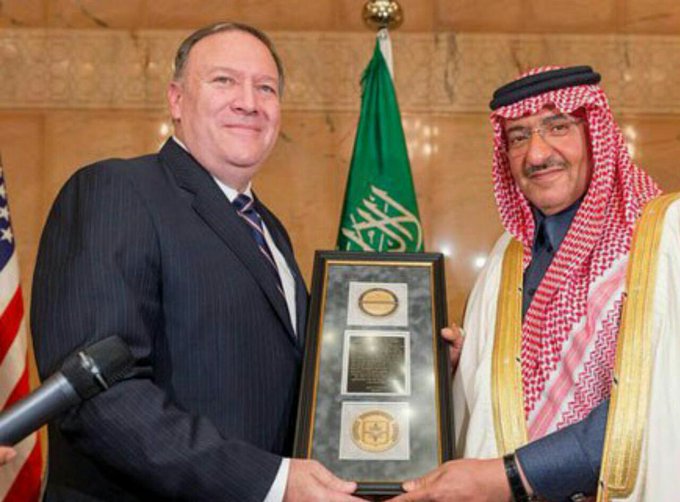
CIA Director Pompeo awards CIA medal to Saudi Arabia’s torturer-in-chief Mohamad bin Nayef. Saudi is CIA’s primary Syria overthrow partner.


But there’s more…
In November 2016, when Pompeo was appointed to lead the CIA, he warned that Tehran is “intent of destroying America” and called the nuclear deal “disastrous.” He added that he was looking forward to “rolling back” the agreement.
Differences of opinion over how Iran should be treated are said to be the source of discord between Trump and Tillerson, whose firing followed a clash over the nuclear deal, the president said Tuesday.
“If you look at the Iran deal I think it’s terrible and I guess he thought it was OK … We weren’t really thinking the same,” Trump said in a statement outside the White House. He said he and Tillerson got on “quite well” but had “different mindsets.”
Iran has been increasingly marginalized during the Trump administration, which has sided with Saudi Arabia in the regional battle for influence in the Middle East.’
Here’s the bottom line. As I outlined multiple times last year, Trump is determined to have a war with Iran and Rex Tillerson was standing in the way. Putting unhinged war hawk Pompeo in place as Secretary of State is simply Trump getting his ducks in a row ahead of confrontation. Watch as the sales pitch for another war in the Middle East picks up considerably in the months ahead.
I believe this forthcoming war against Iran will have almost no international support. Probably just autocratic regimes in the Middle East like Saudi Arabia and the UAE, as well as Israel and possibly the UK depending on who’s Prime Minister when it gets going. The rest of the world will be against it, which will lead to spectacular failure.
It’s become increasingly clear that a huge military error, such as a new major confrontation in the Middle East is what will spell the end of the U.S. empire. Such a confrontation is now increasingly likely with Tillerson out of the picture
Oh, and the person Trump picked to head the CIA to replace Pompeo is Gina Haspel, a 33-year CIA careerist who ran a torture black site in Thailand.
The new CIA director was a key part of the torture program and its illegal cover-up. Her name was on the Top Secret order demanding the destruction of tapes to prevent them being seen by Congress. Incredible. https://www.nytimes.com/2017/02/02/us/politics/cia-deputy-director-gina-haspel-torture-thailand.html …https://twitter.com/realDonaldTrump/status/973540316656623616 …
New C.I.A. Deputy Director, Gina Haspel, Had Leading Role in Torture
Ms. Haspel was deeply involved in the torture of detainees and later took part in destroying videotapes of the interrogations.
nytimes.com


Are these really the values the US should be promoting? The CIA might as well start issuing uniforms decorated with skulls and lightning bolts. https://twitter.com/johannabarr/status/973542436000628736 …
Donny boy sure has a strange way of “draining the swamp.”
* * *
If you liked this article and enjoy my work, consider becoming a monthly Patron, or visit our Support Pageto show your appreciation for independent content creators.
end
SWAMP STORIES
We are now witnessing Democrats being furious over Hillary Clinton`s latest comments on how she lost the elction
(courtesy zerohedge)
Democrats Furious Over Hillary Clinton’s Latest Comments
Nobody’s talking about it, but President Trump appears to have kicked his habit of rehashing the 2016 election. The same, however, cannot be said for Hillary Clinton, and some Democrats have just about heard enough.
Last night we reported that Clinton’s own former campaign manager Patti Solis Doyle slammed Hillary over her bizarre recent comments. This morning, the Hill reports that some of Clinton’s former aides, surrogates and ideological peers are echoing this, and saying the former presidential contender should maybe tone down the carping about the 2016 election. Many, are in fact angry, and believe it’s harmful to the party.
And for anybody who isn’t Hillary Clinton, apparently, it’s fairly obvious why somebody might want this. During a conference in India this weekend, Clinton boasted that states that backed her in the election were more “economically advanced” than states that backed Trump. That remark echoed another Clinton gem – her famous “basket of deplorables” comparison – which helped galvanize popular opinion against the former first lady by exposing her for the out-of-touch elitist she is.

But that wasn’t all: Clinton also claimed that women who voted for Trump mostly did so because that’s what their husbands (or sons or bosses) wanted, which doesn’t sound very feminist to us.
Even Clinton’s closest allies admitted that these comments were “cringeworthy,” and they worried Clinton’s continuing commentary could hurt red-state Democrats during the mid-terms in November 2018.
“She put herself in a position where [Democrats] from states that Trump won will have to distance themselves from her even more,” said one former senior Clinton aide. “That’s a lot of states.”
Another surrogate who spoke with the Hill questioned Clinton’s rationale for making these remarks, and for months now, many party insiders have privately grumbled that her remarks have been counterproductive.
Though one former Obama aide argued that, if Clinton can’t or won’t be silenced, it’d be best if she got all of these responsibility-deflecting comments out of her system.
One former senior Obama White House aide added, “If these statements are a form of catharsis, it would be in the Democratic Party’s best interest for her to get these out of her system soon.”
“We need leaders like her to look forward to 2020 and how to unify the party, not continue to re-litigate the past.”
Even a spokesman for the Republican National Committee admitted that, though they’ve been trying *not* to focus on Clinton – her latest gaffe was too funny to ignore.
“At the RNC, we try not to continue to focus on Hillary Clinton. We really do try very hard,” Reed said. “But this one is impossible to ignore.”
Clinton also claimed during her diatribe that Trump voters “don’t like black people getting rights,” and “don’t like women getting jobs.”
“Putting aside how absurd and wrong she is, rhetoric like this is the reason Sen. [Jon] Tester was forced to release an ad today, 8 months before Election Day, attempting to highlight areas of agreement with President Trump,” the RNC spokesman said. “The Democrat brand is isolated, elitist, and as out-of-touch as it ever has been.”
And as long as Democratic candidates are chained to this perception, they will continue to lose elections. They might even lose to Trump in 2020.
END
New York Times is reporting that Andrew Mccabe is to be fired days before his official retirement
(courtesy zerohedge)
Andrew McCabe To Be Fired Days Ahead Of Retirement: NYT
Cruel and unusual? Perhaps. But The NY Times reports that Attorney General Jeff Sessions is reviewing a recommendation to fire the former F.B.I. deputy director, Andrew G. McCabe, just days before he is scheduled to retire on Sunday.

As a reminder, McCabe stepped down in late January, though reports suggested McCabe was reportedly forced to step down. According to Fox News, McCabe was “removed” from his post as deputy director, “leaving the bureau after months of conflict-of-interest complaints from Republicans including President Trump.”
In both cases, his early departure suggests that he was forced out for a few reasons…


Several media outlets reported that McCabe is using his remaining vacation days to go on “terminal leave” and that his official retirement from the agency won’t happen until March, allowing him to collect the full pension.
But that ‘spotless record’ may now be given the official ‘black mark’:
As NYTimes details that Mr. McCabe is ensnared in an internal review that includes an examination of his decision in 2016 to allow F.B.I. officials to speak with reporters about an investigation into the Clinton Foundation.
The Justice Department’s inspector general concluded that Mr. McCabe was not forthcoming during the review, according to the people briefed on the matter.
That yet-to-be-released report triggered an F.B.I. disciplinary process that recommended his termination – leaving Mr. Sessions to either accept or reverse that decision.
Lack of candor is a fireable offense, but like so much at the F.B.I., Mr. McCabe’s fate is also entangled in presidential politics and the special counsel investigation.
How long before we see a tweet from President Trump demanding Sessions pull the trigger on McCabe?
Why didn’t A.G. Sessions replace Acting FBI Director Andrew McCabe, a Comey friend who was in charge of Clinton investigation but got….

Though no decision has been made, people inside the Justice Department expect him to be fired before Friday, a decision that would jeopardize his pension as a 21-year F.B.I. veteran…
FBI Deputy Director Andrew McCabe is racing the clock to retire with full benefits. 90 days to go?!!!
Finally, as NYTimes notes,firing Mr. McCabe, even on the recommendation of the disciplinary office, would be controversial. Among Mr. McCabe’s allies, the decision would raise the specter that Mr. Sessions was influenced by Mr. Trump’s frequent derisive comments. No deputy director in the history of the F.B.I. has been fired.
But Mr. Sessions would be able to point to a critical inspector general’s report and say he followed Justice Department protocol.
Is Trump about to get the last laugh after all?
END
Vanity Fair reports that Trump is planning to fire Attorney General Jeff Sessions and replacing him with EPA cabinet minister Pruitt, as well as removing McMaster as National Security Advisor. If this happens expect the market to tumble another 1000 points
(courtesy zerohedge)
Trump Plans To Fire Jeff Sessions: Report
As if the abrupt firing of Secretary of State Rex Tillerson – and countless others in recent weeks and months – wasn’t enough of a surprise, President Donald Trump on Tuesday told an incredulous group of reporters that Tillerson’s head wouldn’t be the last to roll. The moment had all the hallmarks of a paradigm shift: with his approval rating at post-election highs (according to Rasmussen), an emboldened Trump is reworking the famous phrase “let Trump be Trump” by being more assertive on policy and personnel.

And today, Vanity Fair reported that Trump is planning to fire Attorney General Jeff Sessions – a decision that would certainly complicate Robert Mueller’s investigation (perhaps that’s the intention). According to the report, the leading candidate to replace Sessions would be EPA administrator Scott Pruitt.
Perhaps most consequential for Robert Mueller’s investigation, sources said Trump has discussed a plan to fire Attorney General Jeff Sessions. According to two Republicans in regular contact with the White House, there have been talks that Trump could replace Sessions with E.P.A. Administrator Scott Pruitt, who would not be recused from overseeing the Russia probe. Also, because Pruitt is already a Cabinet secretary, he would not have to go through another Senate confirmation hearing.
In another (perhaps expected) revelation, Sherman reports that Trump has been quietly grumbling about Jared Kushner and Ivanka Trump, telling advisors that he wished they’d move back to New York City as Kushner being stripped of his temporary security clearance has become a hindrance to performing his duties as a senior advisor to the president.
Then there is the question of Jared Kushner and Ivanka Trump’s futures. Trump has told people for months that he wants them to go back to New York. “Trump wants them out of there. He thinks they’ve been getting hit too hard,” a friend of the president said. But Javanka are digging in, sources said. “They’ve damaged us so much already. What else can they say about us?” Kushner recently said, according to a person who spoke with him. “And if we go back to New York, they’ll keep attacking. So what do we have to lose?” In recent days, the couple have argued for their continued relevance by cooperating with pieces in The New York Times and The Washington Post. Sources said that if Kelly is forced out, Jared and Ivanka will fight to stay on.
And that’s not all: Earlier this week, it was reported that Trump is preparing to also fire HR McMaster, his National Security Adviser. McMaster was appointed hastily in the aftermath of Mike Flynn’s firing, and has refused to parrot the president’s views about whether Russia interfered in the 2016 election, earning him the ire of Breitbart and most of the “alt-right.”
That news followed another report earlier this month suggesting that Chief of Staff John Kelly and Defense Secretary James Mattis had struck a deal to push out McMaster and install one of their proteges.
To summarize: the firing of Rex Tillerson was just the first in a series of terminations planned by what now appears to be a far more confident and empowered Trump. And judging by the market’s reaction today, risk assets are finally starting to get concerned.
END
I will see you THURSDAY night
HARVEY


 harveyorganblog.com
