
GOLD: $1322.40 UP $ 5.90 (COMEX TO COMEX CLOSINGS)
Silver: $16.47 DOWN 5 CENTS (COMEX TO COMEX CLOSINGS)
Closing access prices:
Gold $1323.50
silver: $16.53
For comex gold:
APRIL/
NUMBER OF NOTICES FILED TODAY FOR APRIL CONTRACT:406 NOTICE(S) FOR 40600 OZ.
TOTAL NOTICES SO FAR 1492 FOR 149200 OZ (4.6407 tonnes)
For silver:
APRIL
0 NOTICE(S) FILED TODAY FOR
NIL OZ/
Total number of notices filed so far this month: 497 for 2,485,000 oz
XXXXXXXXXXXXXXXXXXXXXXXXXXXXXX
Bitcoin: BID $9310/OFFER $9410: up $79(morning)
Bitcoin: BID/ $9105/offer $9205: DOWN $126 (CLOSING/5 PM)
end
First Shanghai gold fix comes at 10 pm est
The second Shanghai gold fix: 2:15 pm
First Shanghai gold fix gold: 10 pm est: 1325.92
NY price at the same time: 1317.70
PREMIUM TO NY SPOT: $8.22
ss
Second gold fix early this morning: 1324.63
USA gold at the exact same time: 1316.50
PREMIUM TO NY SPOT: $8.13
AGAIN, SHANGHAI REJECTS NEW YORK PRICING.
WE WILL NOT PROVIDE LONDON FIXES AS THEY ARE NOT ACCURATE AS TO WHAT IS GOING ON AT THE SAME TIME FRAME.
Let us have a look at the data for today
xxxxxxxxxxxxxxxxxxxxxxxxxxxxxxxxxxxxxxxxxxxxxxxxxxxxxxxxxxxxxxxxxxxxxxxxxx
In silver, the total OPEN INTEREST FELL BY A HUGE 6695 CONTRACTS FROM 196,548 FALLING TO 189,858 DESPITE YESTERDAY’S TINY 2 CENT FALL IN SILVER PRICING. AFTER A STRING OF 4 CONSECUTIVE OI GAINS, WE NOW REGISTER 5 CONSECUTIVE DROPS IN OI. WE ARE NOW WITNESSING OUR USUAL AND CUSTOMARY COMEX LONG LIQUIDATION AS WE HEAD INTO THE ACTIVE DELIVERY MONTH OF MAY AS LONGS PACK THEIR BAGS AND MIGRATE OVER TO LONDON. WE WERE NOTIFIED THAT WE HAD AN STRONG SIZED NUMBER OF COMEX LONGS TRANSFERRING THEIR CONTRACTS TO LONDON THROUGH THE EFP : 0 EFP CONTRACTS FOR APRIL, 1277 EFP’S FOR MAY , 1443 EFP’S FOR JULY AND ZERO FOR ALL OTHER MONTHS AND THEREFORE TOTAL ISSUANCE OF 2720 CONTRACTS. WITH THE TRANSFER OF 2720 CONTRACTS, WHAT THE CME IS STATING IS THAT THERE IS NO SILVER (OR GOLD) TO BE DELIVERED UPON AT THE COMEX AS THEY MUST EXPORT THEIR OBLIGATION TO LONDON. ALSO KEEP IN MIND THAT THERE CAN BE A DELAY OF 24-48 HRS IN THE ISSUING OF EFP’S. THE 2720 EFP CONTRACTS TRANSLATES INTO 13.600 MILLION OZ ACCOMPANYING 1.THE FALL IN SILVER PRICE (2 CENTS) AT THE COMEX AND 2. THE STRONG AMOUNT OF SILVER OUNCES STANDING FOR APRIL COMEX DELIVERY.
ACCUMULATION FOR EFP’S/SILVER/J.P.MORGAN’S HOUSE OF BRIBES, / STARTING FROM FIRST DAY NOTICE/FOR MONTH OF APRIL:
75,878 CONTRACTS (FOR 20 TRADING DAYS TOTAL 75,878 CONTRACTS) OR 379.39 MILLION OZ: AVERAGE PER DAY: 3794 CONTRACTS OR 18.969 MILLION OZ/DAY
TO GIVE YOU AN IDEA AS TO THE HUGE SUPPLY THIS MONTH IN SILVER: SO FAR THIS MONTH: 379.39 MILLION PAPER OZ HAVE MORPHED OVER TO LONDON. THIS REPRESENTS AROUND 54.19% OF ANNUAL GLOBAL PRODUCTION (EX CHINA EX RUSSIA)
ACCUMULATION IN YEAR 2018 TO DATE SILVER EFP’S: 1.0974 BILLION OZ.
ACCUMULATION FOR JAN 2018: 236.879 MILLION OZ
ACCUMULATION FOR FEB 2018: 244.95 MILLION OZ
ACCUMULATION FOR MARCH 2018: 236.67 MILLION OZ
RESULT: WE HAD A HUGE SIZED FALL IN COMEX OI SILVER COMEX OF 6695 DESPITE THE TINY 2 CENT LOSS IN SILVER PRICE AS OUR CUSTOMARY COMEX LONG MIGRATION INTO LONDON BASED FORWARDS COMMENCED IN EARNEST AS WE ARE APPROACHING THE NEW ACTIVE MONTH OF MAY. THE CME NOTIFIED US THAT IN FACT WE HAD AN STRONG SIZED EFP ISSUANCE OF 2720 CONTRACTS WHICH EXITED OUT OF THE SILVER COMEX AND TRANSFERRED THEIR OI TO LONDON AS FORWARDS. SPECULATORS CONTINUED THEIR INTEREST IN ATTACKING THE SILVER COMEX FOR PHYSICAL SILVER (SEE COMEX DATA) . FROM THE CME DATA: 0 CONTRACTS WERE ISSUED FOR APRIL, 1277 EFP’S WERE ISSUED FOR THE MONTH OF MAY, AND 1443 EFP CONTRACTS FOR JULY, FOR A DELIVERABLE FORWARD CONTRACT OVER IN LONDON WITH A FIAT BONUS (TOTAL: 2720). TODAY WE LOST 3975 TOTAL OI CONTRACTS ON THE TWO EXCHANGES: i.e. 2720 OPEN INTEREST CONTRACTS HEADED FOR LONDON (EFP’s) TOGETHER WITH AN DECREASE OF 6695 OI COMEX CONTRACTS. AND ALL OF THIS HAPPENED WITH THE FALL IN PRICE OF SILVER OF 2 CENTS AND A CLOSING PRICE OF $16.52 WITH RESPECT TO YESTERDAY’S TRADING. YET WE STILL HAVE A STRONG AMOUNT OF SILVER STANDING AT THE COMEX FOR DELIVERY IN THIS NON ACTIVE APRIL DELIVERY MONTH. IT SURE SEEMS THAT WE MUST HAVE HAD SOME BANKER SHORT COVERING ON BOTH EXCHANGES.
In ounces AT THE COMEX, the OI is still represented by UNDER 1 BILLION oz i.e. .949 MILLION OZ TO BE EXACT or 135% of annual global silver production (ex Russia & ex China).
FOR THE NEW FRONT APRIL MONTH/ THEY FILED: 0 NOTICE(S) FOR nil OZ OF SILVER
IN SILVER, WE HAVE NOW SET THE NEW RECORD OF OPEN INTEREST AT 243,411 AND AGAIN THIS HAS BEEN SET WITH A LOW PRICE OF $16.51 ON APRIL 9.2018.
ON THE DEMAND SIDE WE HAVE THE FOLLOWING:
- HUGE AMOUNTS OF SILVER STANDING FOR DELIVERY (MARCH 27 MILLION OZ AND APRIL 1.8 MILLION OZ)
- HUGE RECORD OPEN INTEREST IN SILVER 243,411 CONTRACTS (OR 1.217 BILLION OZ/ SET APRIL 9/2018
- HUGE ANNUAL EFP’S ISSUANCE EQUAL TO 2.9 BILLION OZ OR 400% OF SILVER ANNUAL PRODUCTION/2017
- RECORD SETTING EFP ISSUANCE FOR ANY MONTH IN SILVER; APRIL/2018/ 379.39 MILLION OZ/ (SO FAR)
AND YET WE HAVE A CONTINUAL LOW PRICE OF SILVER DESPITE THE ABOVE HUGE DEMAND. TO ME THE ONLY ANSWER IS THAT WE HAVE SOVEREIGN (CHINA) WHO IS ENDEAVOURING TO GOBBLE UP ALL AVAILABLE PHYSICAL SILVER NO MATTER WHERE, EXACTLY WHAT J.P.MORGAN IS DOING. AND IT IS MY BELIEF THAT J.P.MORGAN IS HOLDING ITS SILVER FOR ITS BENEFICIAL OWNER..THE USA GOVERNMENT WHO IN TURN IS HOLDING THAT SILVER FOR CHINA.(FOR A SILVER LOAN REPAYMENT). IT ALSO LOOKS LIKE BANKER CAPITULATION IN SILVER AS THEY STRUGGLE TO REMOVE SOME OF THEIR HUGE OBLIGATIONS.
In gold, the open interest FELL BY 6816 CONTRACTS DOWN TO 499,967 ACCOMPANYING THE FALL IN THE GOLD PRICE/YESTERDAY’S TRADING ( FALL OF $4.70). WE ARE NOW IN THE ACTIVE DELIVERY MONTH OF APRIL HEADING INTO THE NON ACTIVE MONTH OF MAY. THE CME RELEASED THE DATA FOR EFP ISSUANCE AND IT TOTALED A STRONG SIZED 8670 CONTRACTS : JUNE SAW THE ISSUANCE OF 8670 CONTRACTS , MAY SAW THE ISSUANCE OF 0 CONTRACTS AND AUGUST SAW THE ISSUANCE OF: 0 CONTRACTS WITH ALL OTHER MONTHS ZERO. The new OI for the gold complex rests at 499,967. ALSO REMEMBER THAT THERE WILL BE A DELAY IN THE ISSUANCE OF EFP’S. THE BANKERS REMOVE LONG POSITIONS OF COMEX GOLD IMMEDIATELY. THEN THEY ORCHESTRATE THEIR PRIVATE EFP DEAL WITH THE LONGS AND THAT COULD TAKE AN ADDITIONAL 48 HRS SO WE GENERALLY DO NOT GET A MATCH WITH RESPECT TO DEPARTING COMEX LONGS AND NEW EFP LONG TRANSFERS. . EVEN THOUGH THE BANKERS ISSUED THESE MONSTROUS EFPS, THE OBLIGATION STILL RESTS WITH THE BANKERS TO SUPPLY METAL BUT IT TRANSFERS THE RISK TO A LONDON BANKER OBLIGATION AND NOT A NEW YORK COMEX OBLIGATION. LONGS RECEIVE A FIAT BONUS TOGETHER WITH A LONG LONDON FORWARD. THUS, BY THESE ACTIONS, THE BANKERS AT THE COMEX HAVE JUST STATED THAT THEY HAVE NO APPRECIABLE METAL!! THIS IS A MASSIVE FRAUD: THEY CANNOT SUPPLY ANY METAL TO OUR COMEX LONGS BUT THEY ARE QUITE WILLING TO SUPPLY MASSIVE NON BACKED GOLD (AND SILVER) PAPER KNOWING THAT THEY HAVE NO METAL TO SATISFY OUR LONGS. LONDON IS NOW SEVERELY BACKWARD IN BOTH GOLD AND SILVER AND WE ARE WITNESSING DELAYS IN ACTUAL DELIVERIES.
IN ESSENCE WE HAVE A SMALL SIZED OI GAIN IN CONTRACTS ON THE TWO EXCHANGES: 6816 OI CONTRACTS DECREASED AT THE COMEX AND AN STRONG SIZED 8670 EFP OI CONTRACTS WHICH NAVIGATED OVER TO LONDON.THUS TOTAL OI GAIN: 1,854 CONTRACTS OR 185,400 OZ = 5.766 TONNES.
YESTERDAY, WE HAD 12,209 EFP’S ISSUED.
ACCUMULATION OF EFP’S GOLD AT J.P. MORGAN’S HOUSE OF BRIBES: (EXCHANGE FOR PHYSICAL) FOR THE MONTH OF APRIL : 221,620 CONTRACTS OR 22,162,000 OZ OR 689.33 TONNES (20 TRADING DAYS AND THUS AVERAGING: 11,080 EFP CONTRACTS PER TRADING DAY OR 1,108,000 OZ/ TRADING DAY)
TO GIVE YOU AN IDEA AS TO THE HUGE SIZE OF THESE EFP TRANSFERS : SO FAR THIS MONTH IN 20 TRADING DAYS IN TONNES: 689.33 TONNES
TOTAL ANNUAL GOLD PRODUCTION, 2017, THROUGHOUT THE WORLD EX CHINA EX RUSSIA: 2555 TONNES
THUS EFP TRANSFERS REPRESENTS 689.33/2550 x 100% TONNES = 27.03% OF GLOBAL ANNUAL PRODUCTION SO FAR IN MARCH ALONE.*** THE ACCUMULATION OF EFP CONTRACTS IS RISING PER MONTH.
ACCUMULATION OF GOLD EFP’S YEAR 2018 TO DATE: 2,729.03* TONNES *SURPASSED ANNUAL PROD’N
ACCUMULATION OF GOLD EFP’S FOR JANUARY 2018: 653.22 TONNES
ACCUMULATION OF GOLD EFP’S FOR FEBRUARY 2018: 649.45 TONNES
ACCUMULATION OF GOLD EFP’S FOR MARCH 2018: 741.89 TONNES
WHAT IS ALARMING TO ME, ACCORDING TO OUR LONDON EXPERT ANDREW MAGUIRE IS THAT THESE EFP’S ARE BEING TRANSFERRED TO WHAT ARE CALLED SERIAL FORWARD CONTRACT OBLIGATIONS AND THESE CONTRACTS ARE LESS THAN 14 DAYS. ANYTHING GREATER THAN 14 DAYS, THESE MUST BE RECORDED AND SENT TO THE COMPTROLLER, GREAT BRITAIN TO MONITOR RISK TO THE BANKING SYSTEM. IF THIS IS INDEED TRUE, THEN THIS IS A MASSIVE CONSPIRACY TO DEFRAUD AS WE NOW WITNESS A MONSTROUS TOTAL EFP’S ISSUANCE AS IT HEADS INTO THE STRATOSPHERE.
Result: AN DECREASE IN OI AT THE COMEX OF 6816 WITH THE FALL IN PRICE // GOLD TRADING YESTERDAY ($4.70 LOSS). WE ALSO HAD A STRONG SIZED NUMBER OF COMEX LONG TRANSFERRING TO LONDON THROUGH THE EFP ROUTE: 8670 CONTRACTS AS THESE HAVE ALREADY BEEN NEGOTIATED AND CONFIRMED. THERE OBVIOUSLY DOES NOT SEEM TO BE MUCH PHYSICAL GOLD AT THE COMEX. I GUESS IT EXPLAINS THE HUGE ISSUANCE OF EFP’S…THERE IS HARDLY ANY GOLD PRESENT AT THE GOLD COMEX FOR DELIVERY PURPOSES. IF YOU TAKE INTO ACCOUNT THE 8670 EFP CONTRACTS ISSUED, WE HAD A SMALL SIZED NET GAIN OF 1,854 CONTRACTS IN TOTAL OPEN INTEREST ON THE TWO EXCHANGES:
8670 CONTRACTS MOVE TO LONDON AND 6816 CONTRACTS DECREASED AT THE COMEX. (in tonnes, the GAIN in total oi equates to 5.766 TONNES).
we had:406 notice(s) filed upon for 40,600 oz of gold at the comex.
xxxxxxxxxxxxxxxxxxxxxxxxxxxxxxxxxxxxxxxxxxxxxxxxxxxxxxxxxxx
With respect to our two criminal funds, the GLD and the SLV:
GLD…
WITH GOLD UP $5.90 /NO CHANGE IN GOLD INVENTORY AT THE GLD
Inventory rests tonight: 871.20 tonnes.
SLV/
WITH SILVER DOWN 2 CENTS TODAY: NO CHANGES IN SILVER INVENTORY AT THE SLV/
/INVENTORY RESTS AT 316.899 MILLION OZ/
end
First, here is an outline of what will be discussed tonight:
1. Today, we had the open interest in SILVER FELL BY A HUGE 6695 CONTRACTS from 196,548 DOWN TO 189,858 (AND FURTHER FROM THE NEW COMEX RECORD SET /APRIL 9/2017 AT 243,411). THE PREVIOUS RECORD OTHER THAN WAS ESTABLISHED AT: 234,787, SET ON APRIL 21.2017 ALMOST ONE YEAR AGO. THE PRICE OF SILVER ON THAT DAY: $17.89. AFTER WE HAVE HAD FOUR CONSECUTIVE OI GAINS WE NOW HAVE FIVE CONSECUTIVE OI DROPS AS OUR CUSTOMARY MIGRATION OF COMEX LONGS MORPH INTO LONDON FORWARDS. TRUE TO FORM OUR BANKERS USED THEIR EMERGENCY PROCEDURE TO ISSUE: 0 EFP CONTRACTS FOR APRIL, 1277 EFP CONTRACTS FOR MAY (WE DO NOT GET A LOOK AT THESE CONTRACTS AS IT IS PRIVATE BUT THE CFTC DOES AUDIT THEM), AND 1443 EFP’S FOR JULY AND ALL OTHER MONTHS ZERO. TOTAL EFP ISSUANCE: 2720 CONTRACTS. EFP’S GIVE OUR COMEX LONGS A FIAT BONUS PLUS A DELIVERABLE PRODUCT OVER IN LONDON. IF WE TAKE THE OI LOSS AT THE COMEX OF 6695 CONTRACTS TO THE 2720 OI TRANSFERRED TO LONDON THROUGH EFP’S, WE OBTAIN A HUGE LOSS OF 3975 OPEN INTEREST CONTRACTS. THUS IN OUNCES, THE LOSS ON THE TWO EXCHANGES: 19.875 MILLION OZ!!! AND THIS OCCURRED DESPITE A TINY FALL IN PRICE OF 2 CENTS. THE BANKERS ORCHESTRATED THEIR RAID THROUGHOUT THE WEEK TO DESPERATELY TRY AND PARE THEIR GIGANTIC OPEN INTEREST SHORT ON BOTH EXCHANGES BUT TO NO AVAIL. JUDGING BY THE RECORD NUMBER OF ISSUANCE DURING THIS MONTH OF APRIL AT 379.33 MILLION OZ. I DO NOT THINK THAT OUR BANKERS HAVE BEEN TOO SUCCESSFUL.IT SURE LOOKS TO ME LIKE WE HAD SOME GOOD OLD FASHIONED BANKER SHORT COVERING.
RESULT: A LARGE SIZED DECREASE IN SILVER OI AT THE COMEX WITH THE FALL IN SILVER PRICING / YESTERDAY (2 CENTS/) . BUT WE ALSO HAD ANOTHER GOOD SIZED 2670 EFP’S ISSUED TRANSFERRING COMEX LONGS OVER TO LONDON. TOGETHER WITH THE STRONG SIZED AMOUNT OF SILVER OUNCES STANDING FOR APRIL, DEMAND FOR PHYSICAL SILVER CONTINUES TO INTENSIFY AS WE WITNESS SEVERE BACKWARDATION IN SILVER IN LONDON.
(report Harvey)
.
2.a) The Shanghai and London gold fix report
(Harvey)
2 b) Gold/silver trading overnight Europe, Goldcore
(Mark O’Byrne/zerohedge
and in NY: Bloomberg
3. ASIAN AFFAIRS
i)FRIDAY MORNING/THURSDAY NIGHT: Shanghai closed UP 7.20 POINTS OR 0.23% /Hang Sang CLOSED UP 272.99 POINTS OR 0.91% / The Nikkei closed UP 148.26 POINTS OR 0.66%/Australia’s all ordinaires CLOSED UP .66% /Chinese yuan (ONSHORE) closed DOWN at 6.3380/Oil DOWN to 68.02 dollars per barrel for WTI and 74.53 for Brent. Stocks in Europe OPENED DEEPLY IN THE GREEN. ONSHORE YUAN CLOSED DOWN AT 6.3380 AGAINST THE DOLLAR. OFFSHORE YUAN CLOSED DOWN ON THE DOLLAR AT 6.3327/ONSHORE YUAN TRADING WEAKER AGAINST OFFSHORE YUAN/ONSHORE YUAN TRADING WEAKER AGAINST USA DOLLAR/OFFSHORE YUAN TRADING MUCH WEAKER AGAINST THE DOLLAR /CHINA RETALIATES WITH TARIFFS/ TRUMP RESPONDS TO NEW TARIFFS AND IT NOW LOOKS LIKE A FULL TRADE WAR IS BEGINNING/
/NORTH KOREA/SOUTH KOREA
i)North Korea/South Korea
North and South Korea declare an end to the war and a new era of peace.
( zerohedge)
b) REPORT ON JAPAN
3 c CHINA
Boy did this escalate fast: now Chinese smartphone sales have collapsed. China is the engine for world growth and it is collapsing at record speed
( zerohedge)
4. EUROPEAN AFFAIRS
Great Britain
Seems that we are having a world wide slump in economic activity: UK GDP reported that it’s first quarter GDP rose only .1% month/month and that number also had considerable massaging to get to that number. The pound gets hammered!!
(courtesy zerohedge)
5. RUSSIAN AND MIDDLE EASTERN AFFAIRS
6 .GLOBAL ISSUES
We have highlighted Canada’s problem to you on numerous occasions, namely it’s high household debt to income, the highest in the industrial world. We have a very strong housing market but if interest rates continue to rise this bubble will burst and bring a lot of pain to many Canadians
(courtesy Slok/zerohedge)
7. OIL ISSUES
Trump and Merkel both confirm that the Iran deal talks are continuing and that causes oil to drop
( zerohedge)
8. EMERGING MARKET
i)Venezuela
9. PHYSICAL MARKETS
ii)Movement of earmarked gold and no doubt that the gold is heading to Turkey(Harvey)
iii)USA exports all of its gold mine supply directly to Hong Kong. This does not include huge USA exports to Singapore and to Switzerland. In other words, the USA imports gold and then immediately ships the yellow ancient metal of Kings to the above destinations
(courtesy Steve St Angelo/SRSRocco Report)
iv)OH THIS IS CUTE: 70.30 OZ OF GOLD MISSING. ONE EMPLOYEE HAS BEEN LET GO AND THE MOUNTIES ARE INVESTIGATING.
( zerohedge)
10. USA stories which will influence the price of gold/silver
( zerohedge)
( zerohedge)
iv b) Another scandal at Wells Fargo: this time the crooks pushed unsuspecting clients into expensive retirement plans of which Wells made out like bandits
v)SWAMP STORIES
b)The full report of the House Intelligence Committee has now been released from which it finds “no collusion”
( zerohedge)
Trading Volumes on the COMEX
PRELIMINARY COMEX VOLUME FOR TODAY:144.592 contracts
CONFIRMED COMEX VOL. FOR YESTERDAY: 306,283 contracts
comex gold volumes are RISING AGAIN
Here is a summary of the latest gold trading volumes at the Comex per year
certainly the introduction of EFP’s has certainly had an effect:
Meanwhile, gold-trading volumes on the COMEX have never been higher:

xxxxxxxxxxxxxxxxxxxxxxxxxxxxxxxxxxxxxxxxxxxxxxxxxxxxxxxxxxxxxxxxxxxx
And now for the wild silver comex results.
Total silver OI FELL BY A CONSIDERABLE 6695 CONTRACTS FROM 196,548 DOWN TO 189,858 (AND FURTHER FROM THE NEW RECORD OI FOR SILVER SET APRIL 9.2018/ 243,411 CONTRACTS) DESPITE THE TINY 2 CENT FALL IN SILVER PRICING. SINCE WE ARE HEADING INTO AN ACTIVE DELIVERY MONTH OF MAY, WE HAVE NOW WITNESSED OUR USUAL AND CUSTOMARY COMEX LIQUIDATION AS A MATTER OF FACT, WE WERE INFORMED THAT WE HAD A GOOD SIZED 1277 EFP CONTRACTS ISSUED FOR MAY, A LARGER 1443 EFP CONTRACT ISSUANCE FOR JULY AND ZERO FOR ALL OTHER MONTHS. THESE EFPS WERE ISSUED TO COMEX LONGS WHO RECEIVED A FIAT BONUS PLUS A DELIVERABLE PRODUCT OVER IN LONDON. THE TOTAL EFP’S ISSUED: 2670. ON A NET BASIS WE LOST 3975 SILVER OPEN INTEREST CONTRACTS AS WE OBTAINED A 6695 CONTRACT LOSS AT THE COMEX COMBINING WITH THE ADDITION OF 2720 OI CONTRACTS NAVIGATING OVER TO LONDON. DUE TO THE FACT THAT THE BOYS WERE VERY BUSY NEGOTIATING LONG COMEX CONTRACTS EMIGRATING TO LONDON,(AND WAITING FOR THEIR PASSPORTS)
NET LOSS ON THE TWO EXCHANGES: 3975 CONTRACTS
AMOUNT STANDING FOR SILVER AT THE COMEX
We are now in the non active delivery month of April and here the front month LOST 15 contracts FALLING TO 0 contracts. We had 15 notices filed upon so in essence we LOST 0 contracts or NIL additional ounces of silver will stand for delivery in this non active delivery month of April .
The next big active delivery month for silver will be May and here the OI LOST 16,164 contracts DOWN to 14,230. June saw a GAIN of 210 contracts to stand at 743. The next big delivery month for silver is July and here the OI ROSE by 8950 contracts UP to 126,291.
We had 0 notice(s) filed for nil OZ for the APRIL 2018 contract for silver
FINAL standings for APRIL/GOLD
APRIL 27/2018.
| Gold | Ounces |
| Withdrawals from Dealers Inventory in oz | nil oz |
| Withdrawals from Customer Inventory in oz |
NIL OZ
|
| Deposits to the Dealer Inventory in oz | NIL oz |
| Deposits to the Customer Inventory, in oz | nil OZ |
| No of oz served (contracts) today |
406 notice(s)
40,600 OZ
|
| No of oz to be served (notices) |
0 contracts
(NIL oz)
|
| Total monthly oz gold served (contracts) so far this month |
1492 notices
149200 OZ
4.6407 TONNES
|
| Total accumulative withdrawals of gold from the Dealers inventory this month | NIL oz |
| Total accumulative withdrawal of gold from the Customer inventory this month | xxx oz |
For APRIL:
Today, 0 notice(s) were issued from JPMorgan dealer account and 0 notices were issued from their client or customer account. The total of all issuance by all participants equates to 406 contract(s) of which 1 notices were stopped (received) by j.P. Morgan dealer and 341 notice(s) was (were) stopped/ Received) by j.P.Morgan customer account.
xxxxxxxxxxxxxxxxxxxxxxxxxxxxxxxxxxxxxxxxxxxxxxxxxxxxxxxxxxxxxxxxxxxxxxxxxx
To calculate the INITIAL total number of gold ounces standing for the APRIL. contract month, we take the total number of notices filed so far for the month (1492) x 100 oz or 149200 oz, to which we add the difference between the open interest for the front month of APRIL. (406 contracts) minus the number of notices served upon today (406 x 100 oz per contract) equals 149,200 oz, the number of ounces standing in this active month of APRIL (4.6407 tonnes)
Thus the INITIAL standings for gold for the APRIL contract month:
No of notices served (1492 x 100 oz or ounces + {(406)OI for the front month minus the number of notices served upon today (406 x 100 oz )which equals 149,200 oz standing in this active delivery month of APRIL . THERE IS 12.003 TONNES OF REGISTERED GOLD AVAILABLE FOR DELIVERY SO FAR.
WE LOST 2 COMEX OI CONTRACTS OR 200 OZ OF GOLD WILL STAND
IN THE LAST 18 MONTHS 73 NET TONNES HAS LEFT THE COMEX.
end
And now for silver
AND NOW THE APRIL DELIVERY MONTH
APRIL FINAL standings/SILVER
| Silver | Ounces |
| Withdrawals from Dealers Inventory | nil oz |
| Withdrawals from Customer Inventory |
1,107,155.555 oz
Brinks
CNT
HSBC
|
| Deposits to the Dealer Inventory |
1,203,798.980
SCOTIA
oz
|
| Deposits to the Customer Inventory |
nil oz
|
| No of oz served today (contracts) |
0
CONTRACT(S)
(nil OZ)
|
| No of oz to be served (notices) |
0 contracts
(0 oz)
|
| Total monthly oz silver served (contracts) | 497 contracts
(2,485,000 oz) |
| Total accumulative withdrawal of silver from the Dealers inventory this month | NIL oz |
| Total accumulative withdrawal of silver from the Customer inventory this month |
we had 0 inventory movement at the dealer side of things
total dealer deposits: nil oz
we had 1 deposits into the customer account
i) Into JPMorgan: nil oz
*** JPMorgan for most of 2017 and in 2018 has adding to its inventory almost every single day.
JPMorgan now has 140 million oz of total silver inventory or 53.4% of all official comex silver. (140 million/263 million)
JPMorgan did not deposit into its warehouses (official) today.
ii) Scotia 1,203,798.980 oz
total deposits today: 1,203,798.980 oz
we had 3 withdrawals from the customer account;
i) Out of CNT 482,635.965 oz
ii) Out of Brinks: 21,191.880 oz
iii) Out of HSBC: 603,327.710 oz
total withdrawals; 1,1107,155.555 oz
we had 1 adjustment
i) Out of Scotia:
32,669.05 oz was adjusted out of the dealer and this landed into the customer account of Scotia
.
total dealer silver: 63.851 million
total dealer + customer silver: 261.513 million oz
The total number of notices filed today for the APRIL. contract month is represented by 0 contract(s) FOR nil oz. To calculate the number of silver ounces that will stand for delivery in APRIL., we take the total number of notices filed for the month so far at 497 x 5,000 oz = 2,485,000 oz to which we add the difference between the open interest for the front month of April. (0) and the number of notices served upon today (0 x 5000 oz) equals the number of ounces standing.
.
Thus the INITIAL standings for silver for the APRIL contract month: 497(notices served so far)x 5000 oz + OI for front month of April(0) -number of notices served upon today (0)x 5000 oz equals 2,485,000 oz of silver standing for the April contract month
WE LOST 0 SILVER CONTRACT OR NIL ADDITIONAL OUNCES WILL STAND IN THIS NON ACTIVE DELIVERY MONTH OF APRIL
xxxxxxxxxxxxxxxxxxxxxxxxxxxxxxxxxxxxxxxxxxxxxxxxxxxxxxxxxxx
CRIMINALS!!
ESTIMATED VOLUME FOR TODAY: 127,062 CONTRACTS (WOW) 635 MILLION OZ OR 89% OF ANNUAL PRODUCTION.
CONFIRMED VOLUME FOR YESTERDAY: 137,087 CONTRACTS (my goodness)
YESTERDAY’S CONFIRMED VOLUME OF 137,087 CONTRACTS EQUATES TO 685 MILLION OZ (0..685 billion oz) OR 133% OF ANNUAL GLOBAL PRODUCTION OF SILVER
COMMODITY LAW SUGGESTS THAT OPEN INTEREST SHOULD NOT BE MORE THAN 3% OF ANNUAL GLOBAL PRODUCTION. THE CROOKS ARE SUPPLYING MASSIVE PAPER TRYING TO KEEP SILVER IN CHECK.
The record level of silver open interest is 234,787 contracts set on April 21./2017 with the price at that day at $18.42
The previous record was 224,540 contracts with the price at that time of $20.44
end
NPV for Sprott
1. Sprott silver fund (PSLV): NAV FALLS TO -1.74% (APRIL 27/2018)
2. Sprott gold fund (PHYS): premium to NAV FALLS TO -0.62% to NAV (APRIL 27/2018 )
Note: Sprott silver trust back into NEGATIVE territory at -1.74%-/Sprott physical gold trust is back into NEGATIVE/ territory at -0.62%/Central fund of Canada’s is still in jail but being rescued by Sprott.
Sprott WINS hostile 3.1 billion bid to take over Central Fund of Canada
(courtesy Sprott/GATA)
3.SPROTT CEF.A FUND (FORMERLY CENTRAL FUND OF CANADA): NAV RISES TO -2.09`%: NAV 13.66/TRADING 13.38//DISCOUNT 2.09.
END
And now the Gold inventory at the GLD/
APRIL 27./WITH GOLD UP $5.90/NO CHANGE IN GOLD INVENTORY AT THE GLD/INVENTORY RESTS AT 871.20 TONNES/
APRIL 26/WITH GOLD DOWN $4.90/NO CHANGE IN GOLD INVENTORY AT THE GLD/INVENTORY RESTS AT 871.20 TONNES
APRIL 25/AFTER 9 CONSECUTIVE DAYS OF NO MOVEMENT OF GOLD INTO OUT OF THE GLD, WE HAD A HUGE DEPOSIT OF 5.31 TONNES OF GOLD INTO THE GLD/INVENTORY RESTS AT 871.20 TONNES.
APRIL 24./WITH GOLD UP $9.90, WE HAD NO CHANGES IN GOLD INVENTORY AT THE GLD/INVENTORY RESTS AT 865.89 TONNES/
APRIL 23.2018/WITH GOLD DOWN $14.00/NO CHANGE IN GOLD INVENTORY AT THE GLD/INVENTORY RESTS AT 865.89 TONNES.
APRIL 20/WITH GOLD DOWN $10.20: NO CHANGES IN GOLD INVENTORY AT THE GLD/INVENTORY RESTS AT 865.89 TONNES
APRIL 19/WITH GOLD DOWN $4.25: NO CHANGES IN GOLD INVENTORY AT THE GLD/INVENTORY RESTS AT 865.89 TONNES/
APRIL 18/WITH GOLD UP $3.65: NO CHANGES IN GOLD INVENTORY AT THE GLD/INVENTORY RESTS AT 865.89 TONNES
APRIL 17/WITH GOLD DOWN $1.00 NO CHANGES IN GOLD INVENTORY AT THE GLD/INVENTORY RESTS AT 865.89 TONNES/
April 16/WITH GOLD UP$2.80/NO CHANGES IN GOLD INVENTORY AT THE GLD/INVENTORY RESTS AT 865.89 TONNES/
April 13/WITH GOLD UP $6.15, A HUGE DEPOSIT OF 5.90 TONNES INTO THE GLD INVENTORY/INVENTORY RESTS AT 865.89 TONNES
April 12/WITH GOLD DOWN $17.40/NO CHANGES IN GOLD INVENTORY AT THE GLD/INVENTORY RESTS AT 859.99 TONNES
April 11/WITH GOLD UP $13.85/NO CHANGES IN GOLD INVENTORY AT THE GLD/INVENTORY RESTS AT 859,99 TONNES
APRIL 10/WITH GOLD UP $5.25/NO CHANGES IN GOLD INVENTORY AT THE GLD/INVENTORY RESTS AT 859.99 TONNES
APRIL 9/WITH GOLD UP$4.50/NO CHANGES IN GOLD INVENTORY AT THE GLD/INVENTORY RESTS AT 859.99 TONNES
APRIL 6/WITH GOLD UP $7.50 ,A HUGE CHANGE IN INVENTORY AT THE GLD/ A DEPOSIT OF 5.90 TONNES/INVENTORY RESTS AT 859.99 TONNES
APRIL 5/WITH GOLD DOWN $8.20 WE HAD TWO ENTRIES: 1) TINY WITHDRAWAL OF .28 TONNES TO PAY FOR FEES AND 2) A DEPOSIT OF 2.06 TONNES//INVENTORY RESTS AT 854.09 TONNES
April 4/WITH GOLD UP $2.90 WE HAD NO CHANGES IN GOLD INVENTORY AT THE GLD/INVENTORY RESTS AT 852.31 TONNES
APRIL 3./WITH GOLD DOWN $9.30 WE HAD NO CHANGES IN GOLD INVENTORY AT THE GLD/INVENTORY RESTS AT 852.31 TONNES
APRIL 2/WITH GOLD UP $19.50, WE HAD A BIG CHANGES IN GOLD INVENTORY AT THE GLD A DEPOSIT OF 6.19 TONNES/INVENTORY RESTS AT 852.31 TONNES
MARCH 29/WITH GOLD DOWN $3.20 AND OPTIONS EXPIRY FINISHED, WE HAD NO CHANGE IN GOLD INVENTORY AT THE GLD/INVENTORY RESTS A 846.12 TONNES
March 28/WITH GOLD DOWN $16.70, ANOTHER RAID ORCHESTRATED, AGAIN NO SURPRISES AS WE WITNESS ANOTHER 1.18 TONNES OF GOLD REMOVED/INVENTORY RESTS AT 846.12 TONNES
xxxxxxxxxxxxxxxxxxxxxxxxxxxxxxxxxx
APRIL 27/2018/ Inventory rests tonight at 871.20 tonnes
*IN LAST 371 TRADING DAYS: 69.84 NET TONNES HAVE BEEN REMOVED FROM THE GLD
*LAST 321 TRADING DAYS: A NET 86.46 TONNES HAVE NOW BEEN ADDED INTO GLD INVENTORY.
end
Now the SLV Inventory/
APRIL 27/WITH SILVER DOWN 5 CENTS/NO CHANGES IN SILVER INVENTORY AT THE SLV/INVENTORY RESTS AT 316.899 MILLION OZ/
APRIL 26/WITH SILVER DOWN 2 CENT/NO CHANGES IN SILVER INVENTORY AT THE SLV/INVENTORY RESTS AT 316,899 MILLION OZ/
APRIL 25./WITH SILVER DOWN 18 CENTS/NO CHANGES IN SILVER INVENTORY AT THE SLV/INVENTORY RESTS AT 316.899 MILLION OZ/
APRIL 24./WITH SILVER UP 8 CENTS/SOMETHING SPOOKED OUR CROOKS TO ADD SOME PAPER SILVER: A DEPOSIT OF 1.601 MILLION OZ/INVENTORY RESTS AT 316.899 MILLION OZ/
APRIL 23.2018/WITH SILVER DOWN 50 CENTS, ANOTHER HUGE WITHDRAWAL FROM THE SLV INVENTORY: A WITHDRAWAL OF 1.413 MILLION OZ/INVENTORY RESTS AT 315.298 MILLION OZ.
APRIL 20/WITH SILVER DOWN 11 CENTS: ANOTHER HUGE CHANGE IN SILVER INVENTORY: A WITHDRAWAL OF 1.13 MILLION OZ//SLV RESTS TONIGHT AT 316.711 MILLION OZ/
APRIL 19/WITH SILVER UP 3 CENTS TODAY: WE HAD A BIG CHANGE IN SILVER INVENTORY AT THE SLV: A WITHDRAWAL OF 2.355 MILLION OZ/ MAKES ABSOLUTELY NO SENSE!!/INVENTORY RESTS AT 317.841 MILLION OZ
APRIL 18/WITH SILVER UP 44 CENTS TODAY: NO CHANGES IN SILVER INVENTORY AT THE SLV/INVENTORY RESTS AT 320.196 MILLION OZ
APRIL 17/WITH SILVER UP 10 CENTS TODAY/NO CHANGES IN SILVER INVENTORY AT THE SLV/INVENTORY RESTS AT 320.196 MILLION OZ
April 16/WITH SILVER UP 7 CENTS TODAY: NO CHANGES IN SILVER INVENTORY AT THE SLV/INVENTORY RESTS AT 320.196 MILLION OZ/
April 13/WITH SILVER UP 17 CENTS TODAY: NO CHANGES IN SILVER INVENTORY AT THE SLV/INVENTORY RESTS AT 320.196 MILLION OZ.
April 12/WITH SILVER DOWN 27 CENTS/NO CHANGES IN SILVER INVENTORY AT THE SLV/INVENTORY RESTS AT 320.196 MILLION OZ/
April 11/2018/WITH SILVER UP 16 CENTS: NO CHANGES IN SILVER INVENTORY AT THE SLV/INVENTORY RESTS AT 320.196 MILLION OZ/
APRIL 10/WITH GOLD UP 8 CENTS/NO CHANGES IN SILVER INVENTORY AT THE SLV/INVENTORY RESTS AT 320.196 MILLION OZ/
APRIL 9/WITH SILVER UP 12 CENTS/WE HAD NO CHANGES IN SILVER INVENTORY/INVENTORY RESTS AT 320.196 MILLION OZ/
APRIL 6/WITH SILVER UP 4 CENTS, WE HAD A HUGE DEPOSIT OF 1.319 MILLION OZ INTO THE SLV INVENTORY/INVENTORY RESTS AT 320.196 MILLION OZ
APRIL 5/WITH SILVER UP 6 CENTS/NO CHANGES IN INVENTORY AT THE SLV/INVENTORY RESTS AT 318.877 MILLION OZ/
April 4/WITH SILVER DOWN 11 CENTS/A SMALL CHANGE IN SILVER INVENTORY AT THE SLV/ A WITHRAWAL OF 135,000 OZ AND THIS IS PROBABLY TO PAY FOR FEES/INVENTORY RESTS AT 318.877 MILLION OZ/
APRIL 3./WITH SILVER DOWN 16 CENTS/NO CHANGE IN SILVER INVENTORY AT THE SLV/INVENTORY RESTS AT 319.012 MILLION OZ/
APRIL 2/WITH SILVER UP 34 CENTS/NO CHANGES IN SILVER INVENTORY AT THE SLV/INVENTORY RESTS AT 319.012 MILLION OZ/
MARCH 29/WITH SILVER UP 6 CENTS, THE CROOKS DECIDED THAT THEY HAD BETTER ADD SOME 943,000 PAPER OZ TO THEIR INVENTORY/INVENTORY RESTS AT 319.012 MILLION OZ
March 28/WITH SILVER DOWN 27 CENTS/AGAIN NO CHANGE IN SILVER INVENTORY AT THE SLV/INVENTORY RESTS AT 318.069 MILLION OZ
APRIL 27/2018: NO CHANGES IN SILVER INVENTORY:
Inventory 316.899 million oz
end
6 Month MM GOFO 2.03/ and libor 6 month duration 2.52
Indicative gold forward offer rate for a 6 month duration/calculation:
G0FO+ 2.03%
libor 2.52 FOR 6 MONTHS/
GOLD LENDING RATE: .49%
XXXXXXXX
12 Month MM GOFO
+ 2.77%
LIBOR FOR 12 MONTH DURATION: 2.51
GOFO = LIBOR – GOLD LENDING RATE
GOLD LENDING RATE = +.26
end
At 3:30 pm we receive a total useless report, the COT which gives us position levels of our major players.
Due to the fact that there is a huge transfer of contracts to London, the report is of no use to us.
However for completeness, I am forwarding the report to you:
(courtesy Goldseek)
| Gold COT Report – Futures | ||||||
| Large Speculators | Commercial | Total | ||||
| Long | Short | Spreading | Long | Short | Long | Short |
| 225,804 | 89,158 | 54,354 | 175,715 | 337,515 | 455,873 | 481,027 |
| Change from Prior Reporting Period | ||||||
| -11,484 | 14,939 | 1,854 | 2,180 | -21,282 | -7,450 | -4,489 |
| Traders | ||||||
| 187 | 85 | 80 | 44 | 55 | 270 | 185 |
| Small Speculators | ||||||
| Long | Short | Open Interest | ||||
| 50,537 | 25,383 | 506,410 | ||||
| 3,631 | 670 | -3,819 | ||||
| non reportable positions | Change from the previous reporting period | |||||
| COT Gold Report – Positions as of | Tuesday, April 24, 2018 | |||||
Our large speculators
those large specs that have been long in gold pitched (transferred) 11,484 contracts from their long side
those large specs that have been short in gold added 14,939 contracts to their short side
Our commercials
those commercials who have been long in gold added 2180 contracts to their long side
those commercials that have been short in gold covered (transferred) 21,282 contracts from their short side
Our small speculators:
those small specs that have been long in gold added 3631 contracts to their long side.
those small specs that have been short in gold added 670 contracts to their short side
Conclusion: fraud
end
and now our silver COT:
| Silver COT Report: Futures | |||||
| Large Speculators | Commercial | ||||
| Long | Short | Spreading | Long | Short | |
| 67,802 | 55,835 | 26,724 | 75,386 | 106,951 | |
| 1,193 | -10,861 | -13,537 | -914 | 13,696 | |
| Traders | |||||
| 99 | 66 | 64 | 37 | 36 | |
| Small Speculators | Open Interest | Total | |||
| Long | Short | 201,707 | Long | Short | |
| 31,795 | 12,197 | 169,912 | 189,510 | ||
| 668 | -1,888 | -12,590 | -13,258 | -10,702 | |
| non reportable positions | Positions as of: | 178 | 134 | ||
| Tuesday, April 24, 2018 | © SilverSe | ||||
Our large speculators
those large specs that have been long in silver added 1193 contracts to its long side
those large specs that have been short in silver covered (transferred) 10,861 contracts from its short side
Our commercials
those commercials that have been long in silver pitched (transferred) 914 contracts from its long side
those commercials that have been short in silver added a whopping 13,096 contracts to its short side
Our small speculators:
those small specs that have been long in silver added 668 contracts to its long side
those small specs that have been short in silver covered (transferred) 1888 contracts from its short side.
Major gold/silver trading /commentaries for FRIDAY
GOLDCORE/BLOG/MARK O’BYRNE.
GOLD/SILVER
Gold Price Increas
Andrew Maguire’s Kinesis money which is a “bitcoin” but backed 100% by allocated gold and silver is set to go.
it think it would be a great idea to look at this!
please read at: https://kinesis.money/#/
(Andrew Maguire)
|
2:57 PM (1 hour ago) | ||
|
|||
Harvey
Here It is my friend! https://kinesis.money/#/ Please let everyone know.
Let catch up on Monday if you have time. We have billions in the hopper ready to be allocated on the 1st day of trading. The paper market days are over.
Warm regards
Andy
END
Movement of earmarked gold and no doubt that the gold is heading to Turkey
(Harvey)
Federal reserve bank of NY earmarked gold departures:
In GoldSeek Radio interview, GATA secretary cites BIS, Comex developments
Submitted by cpowell on Thu, 2018-04-26 19:11. Section: Daily Dispatches
3:10p ET Thursday, April 26, 2018
Dear Friend of GATA and Gold:
Interviewed by GoldSeek Radio’s Chris Waltzek, your secretary/treasurer discusses the increasing intervention of the Bank for International Settlements in the gold market over the past year, as well as the refusal of major financial news organizations to report it.
The biggest power of central banking these days, your secretary/treasurer contends, is not its infinite power of money creation but the complicity of financial news organizations in central banking’s abuse of its power.
Also discussed is the explosion in the use of the “exchange for physicals” mechanism for settling Comex gold and silver contracts off the exchange, a development suggesting tightness in the market.
All major central banks, your secretary/treasurer says, are participating in the gold price suppression scheme for the time being.
The interview is a half-hour long and can be heard at GoldSeek Radio here:
http://radio.goldseek.com/nuggets/powell.04.25.18.mp3
CHRIS POWELL, Secretary/Treasurer
Gold Anti-Trust Action Committee Inc.
CPowell@GATA.org
end
USA exports all of its gold mine supply directly to Hong Kong. This does not include huge USA exports to Singapore and to Switzerland. In other words, the USA imports gold and then immediately ships the yellow ancient metal of Kings to the above destinations
(courtesy Steve St Angelo/SRSRocco Report)
U.S. Exports Nearly All Gold Mine Supply To Hong Kong
The U.S. gold exports to Hong Kong surged in February consuming nearly all of the domestic gold mine supply. According to the USGS recent Gold Mineral Industry Survey, February gold exports to Hong Kong more than doubled compared to the prior month. This was an interesting increase in gold demand from Hong Kong as the market price increased slightly month over month.
Not only did gold exports to Hong Kong jump, but total U.S. gold exports also increased 40% from 36.1 metric tons (mt) in January to 50.4 mt in February. The top three countries that received the majority of U.S. gold exports were Hong Kong (15.5 mt), the United Kingdom (12.1 mt) and Switzerland (11.7 mt).
As we can see in the chart below, U.S. gold exports to Hong Kong jumped from 7.2 mt in January to 15.5 mt in February:

Furthermore, total U.S. gold exports to Hong Kong were 25 mt from July 2017 to Jan 2018 compared to 15.5 mt in February. The large increase in Hong Kong gold demand consumed nearly all of U.S. domestic mine supply:

Total U.S. gold mine supply in February was 15.8 mt versus the 15.5 mt exported to Hong Kong. The majority of U.S. gold mine supply came from Nevada (11.4 mt) and Alaska (1.9 mt), with the remainder from various states (2.4 mt):

According to the USGS table above, total U.S. gold mine supply for Jan-Feb was 33.7 mt. If we add up all U.S. gold mine supply and gold imports and subtract total gold exports, the United States suffered a net 16.6 mt deficit for the first two months of the year.
JAN-FEB U.S. Gold Market 2018 Surplus-Deficit:
Gold Mine Supply = 33. 7 mt
Gold Imports = 36.2 Mt
Gold Exports = -86.5
Net Deficit = 16.6 mt
Now that net deficit figure above does not include U.S. gold scrap supply or demand. However, I would imagine American gold demand was higher than gold scrap supply, so the net deficit is actually even higher.
Regardless, the West’s gold continues to flow to the East. Even though the U.S. exported nearly 24 mt of gold to the U.K. and Switzerland in February, I would imagine a large percentage of that gold ends up in China, India and Southeast Asia.
Please check out my next video that will show the Top Three Gold Miners Production cost versus the market price and how that compares to the Primary Silver Mining Industry and silver price. If you haven’t subscribed to my YOUTUBE Channel, please do so to receive updates on my new videos. You can subscribe here: SRSrocco Report YouTube Channel.
HOW TO SUPPORT THE SRSROCCO REPORT SITE:
end
OH THIS IS CUTE: 70.30 OZ OF GOLD MISSING. ONE EMPLOYEE HAS BEEN LET GO AND THE MOUNTIES ARE INVESTIGATING.
(courtesy zerohedge)
Royal Canadian Mint calls mounties after 2 kilos of gold vanish
Submitted by cpowell on Fri, 2018-04-27 02:45. Section: Daily Dispatches
By Kelly Egan
Ottawa Citizen
Thursday, April 26, 2018
Two kilograms of gold have gone missing from the Royal Canadian Mint, three years after an employee repeatedly — and with international notoriety — stole chunks of the precious metal by hiding it in his rectum.
The mint confirmed today that an employee has been fired and the RCMP called after the discovery of the missing gold, two 1-kilogram blanks, together worth about C$110,000.
“Last month, as a result of robust internal inventory processes, employees of the Royal Canadian Mint reported a small amount of gold missing from the premises,” Alison Crawford, the senior manager of public affairs, wrote in an email.
“At the conclusion of an internal investigation and administrative review, the mint terminated the employment of one of its staff and asked the Royal Canadian Mounted Police to investigate.” …
… For the remainder of the report:
http://ottawacitizen.com/news/local-news/mint-calls-rcmp-after-two-kilos…
TORONTO, April 26, 2018 /CNW/ – Agnico Eagle Mines Limited (NYSE:AEM, TSX:AEM) (“Agnico Eagle” or the “Company”) today reported quarterly net income of $44.9 million, or $0.19 per share, for the first quarter of 2018. This result includes non-cash foreign currency translation gains on deferred tax liabilities of $6.7 million ($0.03 per share), mark-to-market adjustments and derivative gains on financial instruments of $0.5 million (nil per share) and non-cash foreign currency translation gains of $3.5 million ($0.01 per share). Excluding these items would result in adjusted net income1 of $34.2 million or $0.15 per share for the first quarter of 2018. In the first quarter of 2017, the Company reported net income of $76.0 million or $0.33 per share.
Included in the first quarter of 2018 net income and not adjusted above is non-cash stock option expense of $7.8 million ($0.03 per share).
In the first quarter of 2018, cash provided by operating activities decreased by 7% to $207.7 million ($180.5 million before changes in non-cash components of working capital), compared with cash provided by operating activities of $222.6 million in the first quarter of 2017 ($224.7 million before changes in non-cash components of working capital). The decrease in cash provided by operating activities before changes in non-cash components of working capital during the current period was mainly due to lower gold sales volumes and higher costs, partially offset by higher realized gold prices. The higher costs were primarily a result of the strengthening of local currencies against the U.S. dollar and higher costs at several operations, principally at Meadowbank.
“Our operations continued to deliver strong cash flow in the first quarter with unit production costs on the lower end of full year guidance and gold production tracking slightly above full year guidance. We remain focused on optimizing unit costs and increasing production as we transition through 2018 and begin to see the positive results of our growth phase in 2019”, said Sean Boyd, Agnico Eagle’s Chief Executive Officer. “During the first quarter, we continued to make very good progress at our Nunavutgrowth projects, with Amaruq permitting activities advancing as expected and development of the underground exploration ramp proceeding as planned. Construction activities and underground development remain on schedule and on budget at Meliadine”, added Mr. Boyd.
|
___________________________________ |
|
1Adjusted net income is a Non-GAAP measure. For a discussion regarding the Company’s use of non-GAAP measures, please see “Note Regarding Certain Measures of Performance”. |
First quarter 2018 highlights include:
- Solid operational performance – Payable gold production2 in the first quarter of 2018 was 389,278 ounces at production costs per ounce of $759, total cash costs3 per ounce of $648 and all-in sustaining costs per ounce4 (“AISC”) of $889
- Production and cost guidance reiterated for 2018 – Full year production guidance is unchanged at 1.53 million ounces of gold at total cash costs per ounce of $625 to $675 and AISC of $890 to $940 per ounce.
- Nunavut development projects progressing on schedule and on budget – Amaruq permitting is on track for approval in the second quarter of 2018 and the underground exploration ramp is proceeding as planned. Meliadine construction and development is progressing well and procurement activities for the 2018 barge season are now complete
- Infill drilling at the East Malartic property yields favourable results, potential development options under review – Recent drilling at East Malartic has returned significant intersections of 2.5 grams per tonne (“g/t”) gold over 37.7 metres at 238 metres depth, including 3.6 g/t gold over 10.6 metres. Studies are underway to evaluate potential mining scenarios at both East Malartic and the neighbouring Odyssey project. Permitting activities to provide ramp access to both projects are currently underway
- Acquisition of Yamana Gold Inc.’s (“Yamana”) 50% interest in the Canadian exploration assets of Canadian Malartic Corporation (“CMC”) completed in late March 2018 – Agnico Eagle now owns the exploration assets of CMC, which include the Kirkland Lake and Hammond Reef projects. At Kirkland Lake, a 25,700 metre drill program will be carried out in 2018 to further evaluate known deposits and test new target areas
- Monetization of non-core assets – The Company is assessing opportunities to monetize non-core assets, including the West Pequop Joint Venture, Summit and PQX properties in Nevada, the Cobalt mining properties in the historic Cobalt silver district in Ontario, and its equity investment in Belo Sun Mining Corp. (“Belo Sun”) which it disposed of this month as previously announced
- A quarterly dividend of $0.11 per share was declared
|
______________________________________ |
|
2Payable production of a mineral means the quantity of a mineral produced during a period contained in products that have been or will be sold by the Company whether such products are shipped during the period or held as inventory at the end of the period. |
First Quarter Financial and Production Highlights
In the first quarter of 2018, stable operational performance continued at the Company’s mines, which led to payable gold production of 389,278 ounces, compared to 418,216 ounces in the first quarter of 2017. This lower level of production in the 2018 period was primarily due to reduced throughput levels at Meadowbank as the mine transitions through the last full year of mining at site and at Lapa as mill processing did not resume until March 2018. A detailed description of the production of each mine is set out below.
Production costs per ounce for the first quarter of 2018 were $759, compared to $578 for the first quarter of 2017. Total cash costs per ounce for the first quarter of 2018 were $648, compared to $539 for the first quarter of 2017. Production costs per ounce and total cash costs per ounce in the first quarter of 2018 were affected by lower gold production levels at Meadowbank and Lapa, the strengthening of local currencies against the U.S. dollar and higher costs at several mines (principally at Meadowbank) compared to the first quarter of 2017. The impact of the strengthening of the local currencies was approximately $40 per ounce.
AISC for the first quarter of 2018 were $889, compared to $741 for the first quarter of 2017. The higher AISC is primarily due to expected lower gold production and higher total cash costs per ounce compared to the first quarter of 2017. A detailed description of the cost performance of each mine is set out below.
Cash Position Remains Strong
Cash and cash equivalents and short-term investments decreased to $464.8 million at March 31, 2018, from the December 31, 2017 balance of $643.9 million due to the ongoing investment in the Company’s growth projects and the recent acquisition of the Kirkland Lake and Hammond Reef projects.
The outstanding balance on the Company’s credit facility remained nil at March 31, 2018. This results in available credit lines of approximately $1.2 billion, not including the uncommitted $300 million accordion feature.
Subsequent to the quarter end, on April 5, 2018, the Company issued notes to certain institutional investors totalling $350 million. The notes consist of $45 million at 4.38% due 2028, $55 million at 4.48% due 2030 and $250 million at 4.63% due 2033. The terms of the notes are substantially the same as the terms of the outstanding notes of the Company. The Company previously announced its intention to issue these notes in its news release dated February 14, 2018.
Approximately 40% of the Company’s remaining 2018 Canadian dollar exposure is hedged at an average floor price of 1.28 C$/US$, of which about one third are designated for capital expenditures at Meliadine. Approximately 10% of the Company’s remaining 2018 Mexican peso exposure is hedged at an average floor price of 19.00 MXN/US$. The Company’s remaining 2018 Euro exposure is currently unhedged. The Company’s full year 2018 cost guidance was based on assumed exchange rates of 1.25 C$/US$ and 18.0 MXN/US$. Agnico Eagle anticipates adding to its operating currency hedges, pending market conditions.
Monetization of Non-Core Assets
The Company has been assessing the opportunity to monetize several non-core assets in its portfolio, including the West Pequop Joint Venture, Summit and PQX properties in Nevada, the Cobalt mining properties in the historic Cobalt silver district in Ontarioand its equity investment in Belo Sun which it disposed of this month.
West Pequop Joint Venture, Summit and PQX Properties
The Company has entered into an agreement with a subsidiary of Newmont Mining Corp (“Newmont”), whereby Newmont will purchase Agnico Eagle’s 51% interest in the West Pequop Joint Venture, and the Company’s 100% interest in the Summit and PQX properties in northeastern Nevada (collectively, the “Nevada Properties”). The Nevada Properties are adjacent to Newmont’s Long Canyon mine.
Under the purchase and sale agreement, the Company will receive a cash payment of $35 million and be granted a 0.8% net smelter return (“NSR”) royalty on the Nevada Properties held by the West Pequop Joint Venture and a 1.6% NSR on the Summit and PQX properties. The sale is expected to close in the second quarter of 2018.
Cobalt Mining Properties
In the mid-1950’s, five mining companies merged to become Cobalt Consolidated Mining Company (“CCMC”), one of the predecessors to Agnico Eagle. CCMC and, later, Agnico Eagle operated 25 mines in the Cobalt area and produced approximately 30 million ounces of silver and 3.2 million pounds of cobalt between 1957 and 1989.
The Company currently has two sizeable land packages in the Cobalt region, the Coleman property (178 claims covering approximately 1,750 hectares) and the South Lorrain Property (37 claims covering approximately 350 hectares).
The Company has initiated a strategic review of its Cobalt properties with the intent to realize value for the historical property portfolio. The Company expects that the outcome of such review may result in the sale of all or a portion of its Cobalt properties.
Disposition of Investment in Belo Sun
The Company reviews its portfolio of equity investments in junior mining companies on an ongoing basis. As previously announced, the Company has disposed of 44,551,000 common shares of Belo Sun for aggregate proceeds of C$14,924,585. For further details, please see the Company’s new release dated April 20, 2018.
_NORTHERN BUSINESS REVIEW
ABITIBI REGION, QUEBEC
Agnico Eagle is currently Quebec’s largest gold producer with a 100% interest in three mines (LaRonde, Goldex and Lapa) and a 50% interest in the Canadian Malartic mine. These mines are located within 50 kilometres of each other, which provides operating synergies and allows for the sharing of technical expertise.
LaRonde Mine – Higher Grades Drive Strong First Quarter Performance as the Mine Enters its Thirtieth Year of Production
The 100% owned LaRonde mine in northwestern Quebec achieved commercial production in 1988.
|
LaRonde Mine – Operating Statistics |
||||
|
Three Months Ended |
Three Months Ended |
|||
|
March 31, 2018 |
March 31, 2017 |
|||
|
Tonnes of ore milled (thousands of tonnes) |
531 |
559 |
||
|
Tonnes of ore milled per day |
5,901 |
6,215 |
||
|
Gold grade (g/t) |
5.49 |
4.61 |
||
|
Gold production (ounces) |
89,785 |
78,912 |
||
|
Production costs per tonne (C$) |
$ |
155 |
$ |
106 |
|
Minesite costs per tonne (C$) |
$ |
121 |
$ |
109 |
|
Production costs per ounce of gold produced ($ per ounce): |
$ |
723 |
$ |
562 |
|
Total cash costs per ounce of gold produced ($ per ounce): |
$ |
427 |
$ |
464 |
Production costs per tonne in the first quarter of 2018 increased when compared to the prior-year period due to higher underground and mill maintenance costs, lower throughput and the timing of unsold inventory. Production costs per ounce in the first quarter of 2018 increased when compared to the prior-year period due to the reasons described above and the strengthening of the Canadian dollar relative to the U.S. dollar between periods, partially offset by higher gold production. For the remainder of the year, grades are expected to be more in line with 2018 guidance and mill throughput is expected to increase from levels seen in the first quarter of 2018.
Minesite costs per tonne5 in the first quarter of 2018 increased when compared to the prior-year period due to lower throughput levels and higher underground and mill maintenance costs. Minesite costs per tonne are expected to be in line with guidance over the balance of 2018. Total cash costs per ounce in the first quarter of 2018 decreased when compared to the prior-year period due to higher gold production and higher by-product metal revenues.
Gold production in the first quarter of 2018 increased when compared to the prior-year period due to higher grades resulting from the mining sequence in the lower part of the mine.
At the LaRonde 3 project, conversion and exploration drilling is ongoing at depth as the Company continues to evaluate a phased approach to development between the 311 level (a depth of 3.1 kilometres) and the 350 level (a depth of 3.5 kilometres). Under this phased approach, an additional two or three levels will be developed per year in either the east or west areas of the mine through 2022. This is expected to result in the conversion of approximately 1.2 million ounces of mineral resources into mineral reserves, with full mining activities to commence in 2022. The Company believes that this phased approach is a lower risk, less capital intensive option for developing the deeper levels of the LaRonde mine.
|
________________________________ |
|
5Minesite costs per tonne is a Non-GAAP measure. For a reconciliation of this measure to production costs, see “Reconciliation of Non-GAAP Financial Performance Measures” below. See also “Note Regarding Certain Measures of Performance”. |
LaRonde Zone 5 – Commercial Production Remains on Schedule for Early Third Quarter 2018
In 2003, the Company acquired the LaRonde Zone 5 project from Barrick Gold Corporation. The property lies adjacent to and west of the LaRonde mining complex and previous operators exploited the deposit by open pit. In February 2017, LaRonde Zone 5 was approved by Agnico Eagle’s Board of Directors for development.
In the first quarter of 2018, development of the first five mining stopes was essentially completed and the first production blast is expected in early May 2018. The paste plant is expected to be commissioned in the second quarter of 2018. The development of LaRonde Zone 5 is on budget and on schedule with commercial production on schedule for early in the third quarter of 2018. For additional details on the project see the Company’s news release dated February 15, 2017.
Canadian Malartic Mine – Record Quarterly Gold Production; First Drill Results Reported for East Malartic Project
In June 2014, Agnico Eagle and Yamana acquired Osisko Mining Corporation and created the Canadian Malartic General Partnership (the “Partnership”). The Partnership owns and operates the Canadian Malartic mine in northwestern Quebec through a joint management committee. Each of Agnico Eagle and Yamana has an indirect 50% ownership interest in the Partnership. All volume numbers in this section reflect the Company’s 50% interest in the Canadian Malartic mine, except as noted.
|
Canadian Malartic Mine – Operating Statistics |
||||
|
Three Months Ended |
Three Months Ended |
|||
|
March 31, 2018 |
March 31, 2017 |
|||
|
Tonnes of ore milled (thousands of tonnes) |
2,510 |
2,433 |
||
|
Tonnes of ore milled per day |
27,888 |
27,029 |
||
|
Gold grade (g/t) |
1.17 |
1.03 |
||
|
Gold production (ounces) |
83,403 |
71,382 |
||
|
Production costs per tonne (C$) |
$ |
24 |
$ |
18 |
|
Minesite costs per tonne (C$) |
$ |
25 |
$ |
22 |
|
Production costs per ounce of gold produced ($ per ounce): |
$ |
567 |
$ |
455 |
|
Total cash costs per ounce of gold produced ($ per ounce): |
$ |
566 |
$ |
556 |
Production costs per tonne in the first quarter of 2018 increased when compared to the prior-year period primarily due to higher contractor and fuel costs and the timing of unsold inventory, partially offset by higher throughput. Production costs per ounce in the first quarter of 2018 increased when compared to the prior-year period due to the reasons described above and the strengthening of the Canadian dollar relative to the U.S. dollar between periods, partially offset by higher production.
Minesite costs per tonne in the first quarter of 2018 were higher when compared to the prior-year period due to the reasons described above. Total cash costs per ounce in the first quarter of 2018 were higher when compared to the prior-year period due to the reasons described above, partially offset by higher production.
Gold production in the first quarter of 2018 increased when compared to the prior-year period due to higher throughput and higher grades.
The Barnat extension project continues to progress on schedule and on budget. Since the beginning of the first quarter of 2018, the following activities have been undertaken:
- Construction of the temporary bridge which became operational in January 2018
- Ongoing overburden stripping and overload (new road bed foundation) preparation
- Backfill of the historically mined Buckshot pit was essentially completed
Production activities at Barnat are scheduled to begin in late 2019.
Infill Drilling at Odyssey Confirms Resource Grade; First Drill Results Reported from the East Malartic Zone
At the Canadian Malartic mine, exploration programs are ongoing to evaluate a number of near pit and underground targets. In addition, the Partnership is exploring the East Malartic and the Odyssey properties, which are located to the east of the Canadian Malartic open pit. These opportunities have the potential to provide new sources of ore for the Canadian Malartic mill.
The 2018 exploration program will consist of 140,000 metres of drilling with a budgeted cost (50% basis) of $8.6 million, including 80,000 metres for valuation in the upper and middle parts of the East Malartic Zone. There are currently three drill rigs at the East Malartic project and six rigs at the Odyssey project. In the first quarter of 2018, 22,089 metres of drilling (46 holes) were completed at the Odyssey project and 13,600 metres (18 holes) were completed at the East Malartic project.
Odyssey Zone
The Odyssey Zone lies on the east side of the Canadian Malartic property, approximately 3.0 kilometres east of the current limit of the Canadian Malartic open pit. Exploration results from the Odyssey Zone were last reported in the Company’s news release dated February 15, 2017.
The Odyssey Zone is composed of multiple mineralized bodies spatially associated with a porphyritic intrusion close to the contact of the Pontiac Group sediments and the Piché Group of volcanic rocks. They are grouped into two parallel elongated sheets, the Odyssey North and Odyssey South zones approximately 500 metres apart, which strike east-southeast and dip steeply south. The Odyssey North Zone plunges shallowly to the east and has been traced from a depth of 600 to 1,400 metres below surface along a strike length of approximately 1.3 kilometres. The Odyssey South Zone has been located between approximately 200 and 550 metres below surface over a strike length of 1.2 kilometres.
Initial indicated mineral resources for the Odyssey Zone are estimated at 9,000 ounces of gold (108,000 tonnes grading 2.45 g/t gold), while inferred mineral resources for the Odyssey Zone are estimated at 838,000 ounces of gold (11.2 million tonnes grading 2.32 g/t gold) as of December 31, 2017. All mineral resources are on a 50% basis.
Selected recent drill intercepts from the Odyssey South Zone are set out in the table below. The drill-hole collars are located on the Canadian Malartic and Odyssey local geology map, and the pierce points are shown on the composite longitudinal section. The intercepts reported for the Odyssey South Zone show uncapped and capped grades over estimated true widths, based on a preliminary geological interpretation that is being updated as new information becomes available with further drilling.
[Canadian Malartic and Odyssey Local Geology Map]
[Canadian Malartic and Odyssey Composite Longitudinal Section]
Exploration is currently focusing on infilling the near-surface portion of the deposit in Odyssey South. Recent drilling on the Odyssey South Zone returned several significant intersections that confirm its geological setting apart from the current mineral resource area, confirm the grade of the mineral resources and suggest that the size of the zone could increase. On the eastern side of the Odyssey South Zone, hole ODY18-5196 intersected 3.7 g/t gold over 8.9 metres at 270 metres depth and hole ODY18-5201 intersected 2.2 g/t gold over 18.2 metres at 319 metres depth. There are several recent intercepts in the central part of the Odyssey South Zone, including hole ODY18-5207 that intersected 2.5 g/t gold over 18.8 metres at 241 metres depth and hole ODY17-5191 that intersected 2.9 g/t gold over 7.8 metres at 421 metres depth. A further 360 metres to the west, hole ODY18-5198 intersected 18.5 g/t gold over 2.8 metres at 273 metres depth.
Another 410 metres to the west, well away from the current mineral resources, hole ODY18-5202 intersected 2.4 g/t gold over 8.3 metres at 369 metres depth.
Recent drilling at Odyssey has confirmed the mineral resources tonnage and grade in the central portion of the zone, and has extended the zone along strike and closer to surface. Definition and expansion drilling will continue in the coming quarters to increase confidence in the grade and zone geometry.
East Malartic
In 2017, an initial inferred mineral resource was declared on the East Malartic property, which was previously a gold producing property. The East Malartic property is located directly adjacent to and east of the Canadian Malartic Mine, and west of the Odyssey Zone. Inferred mineral resources at East Malartic (on a 50% basis) are estimated at 1.2 million ounces of gold (19.0 million tonnes grading 2.02 g/t gold) to a depth of 1,000 metres. This is the first report of exploration drill results from the East Malarticproperty in a Company news release.
At the East Malartic project, the Partnership is exploring three mineralized zones with distinct geology that come together beneath and to the east of the Canadian Malartic open pit. The East Malartic and Sladen zones are intertwined, extending from beneath the open pit eastward to beneath the Odyssey North Zone, while the Sheehan Zone lies immediately north of East Malartic and Sladen in a shear zone including porphyritic intrusives and ultramafic volcanic rocks. Both the East Malartic and Sladen zones are related to the Sladen fault that also includes Canadian Malartic mineralization (to the west) and the Odyssey North Zone (to the east). The Sladen fault is at least 5 kilometres long, and hosts most of the mineralization at the Canadian Malartic, Sladen, East Malartic mines and Odyssey zones.
During 2017, exploration drilling at the East Malartic project included 59,000 metres (63 holes) of diamond drilling.
Selected drill intercepts from the 2017 drill program at the East Malartic project are set out in the table below. The drill-hole collars are located on the Canadian Malartic and Odyssey local geology map, and the pierce points are shown on the composite longitudinal section. The intercepts reported for the East Malartic project show uncapped and capped grades over estimated true widths, based on a preliminary geological interpretation that is being updated as new information becomes available with further drilling.
Among the most promising intercepts in the Sheehan Zone from the 2017 drill program, hole MEV17-EA-2004 intersected 7.4 g/t gold over 31.9 metres at 427 metres depth, including 16.8 g/t gold over 8.9 metres. Approximately 800 metres to the east, hole MEV17-SH-1005 intersected 3.5 g/t gold over 21.2 metres at 338 metres depth, including 9.5 g/t gold over 5.8 metres, also in the Sheehan Zone.
In the East Malartic and Sladen zones, there were also promising results in 2017. Hole MEV17-024 intersected 2.5 g/t gold over 37.7 metres at 238 metres depth, including 3.6 g/t gold over 10.6 metres, and separately including 7.1 g/t gold over 4.6 metres, in the East Malartic Zone. Approximately 500 metres to the southwest in the Sladen Zone, hole MEV17-016A intersected 3.2 g/t gold over 23.9 metres at 476 metres depth, including 8.8 g/t gold over 4.1 metres. At greater depths, the Sladen Zone was intersected by hole MEV17-001, yielding 2.8 g/t gold over 6.7 metres at 803 metres depth. Approximately 1,100 metres to the east, hole MEV17-EA-2002WA intersected the East Malartic Zone, yielding 2.2 g/t gold over 18.0 metres at 962 metres depth.
In 2018, the exploration focus will be to convert inferred mineral resources to indicated mineral resources in the shallower portions of the Odyssey South and East Malartic zones and further drilling to better define the geometry of the higher-grade internal zones at the Odyssey Zone.
In addition, permitting activities are underway for an exploration ramp to provide underground access to the shallower portions of the Odyssey South and East Malartic zones. Development of the ramp, which will provide access for underground drilling and collection of a bulk sample, is expected to begin in late 2018. The goal of the underground development program is to provide higher grade feed to the Canadian Malartic mill and extend the current mine life.
Kirkland Lake Project Update
On March 28, 2018, the Company completed the acquisition of Yamana’s indirect 50% interest in the Canadian exploration assets of CMC. As a result, Agnico Eagle now owns the transferred CMC exploration assets, which include the Kirkland Lake and Hammond Reef projects. The Company previously announced the entering into of an asset purchase agreement for the Canadian exploration assets of CMC in its news release dated December 21, 2017.
The Hammond Reef project in northwestern Ontario covers approximately 31,145 hectares and contains open pit measured and indicated mineral resources of 4.5 million ounces gold (208.4 million tonnes at 0.67 g/t gold) and open pit inferred mineral resources of 12,000 ounces gold (0.5 million tonnes at 0.74 g/t gold). Mineral resources are estimated as of December 31, 2017and are reported on a 100% basis. For a detailed breakdown of mineral resources, please refer to the Company’s press release dated February 14, 2018.
The Kirkland Lake project in northeastern Ontario covers approximately 27,312 hectares and mineral reserves and mineral resources have been outlined on several properties. Deposits in the Kirkland Lake area include: Upper Beaver, Anoki and McBean, Amalgamated Kirkland, Upper Canada and Munro. The primary deposits on the Kirkland Lake property are outlined on the plan map shown below.
[Kirkland Lake Property Regional Geology Map]
At Kirkland Lake, an initial $5 million exploration program consisting of 25,700 metres of drilling is planned for 2018. The primary exploration focus for the Kirkland Lake project this year will be:
- Expanding and locating new gold mineralization on the Upper Beaver and Upper Canada properties
- Prospecting along the Larder-Cadillac Deformation Zone
- Completing a technical review of all exploration data for the Upper Beaver deposit in order to determine the next steps at the property, including the evaluation of potential synergies between Upper Beaver and Upper Canada
The Upper Beaver deposit is atypical of the Kirkland Lake – Larder Lake mining district. Gold-copper mineralization is predominantly hosted in an alkalic intrusive complex and is associated with disseminated pyrite and chalcopyrite and magnetite-sulphide veining.
The Upper Beaver deposit contains underground mineral reserves of 1.4 million ounces of gold and 20,000 tonnes of copper (8.0 million tonnes grading 5.43 g/t gold and 0.25% copper), underground measured and indicated mineral resources of 0.4 million ounces of gold and 5,100 tonnes of copper (3.6 million tonnes grading 3.45 g/t gold and 0.14% copper) and underground inferred mineral resources of 1.4 million ounces of gold and 17,300 tonnes of copper (8.7 million tonnes grading 5.07 g/t gold and 0.20% copper). Mineral reserves and mineral resources are estimated as of December 31, 2017 and are reported on a 100% basis. For a detailed breakdown of mineral reserves and mineral resources, please refer to the Company’s press release dated February 14, 2018.
The exploration program at Upper Beaver in 2018 will consist of:
- Nine diamond drill holes, totalling approximately 4,500 metres, designed to test shallow geophysical and soil anomalies predominantly outside of the known mineralized zones
- Approximately 6,000 metres of drilling (one pilot and four wedge holes) to test for down-dip, down-plunge and on strike extensions of the deep inferred mineral resource at a depth of 1,300 to 1,785 metres
The past-producing Upper Canada property is located approximately six kilometres southwest of the Upper Beaver property. The Upper Canada deposit, which is approximately 1.6 kilometres north of the main Larder-Cadillac Deformation Zone (“LCDZ”), occurs within a 300 to 400 metres wide strongly altered deformation corridor that is interpreted as a splay from the LCDZ. Host rocks are primarily volcanic tuffs and sediments that have been intruded by syenite bodies. Gold mineralization is associated with intensely altered shear zones with fine pyrite and ancillary sulfide mineralization. En-echelon higher-grade lenses are present within a broader envelope of lower grade mineralization.
The Upper Canada deposit contains open pit inferred mineral resources of 0.3 million ounces of gold (4.9 million tonnes grading 1.97 g/t gold) and underground inferred mineral resources of 1.4 million ounces of gold (7.2 million tonnes grading 6.22 g/t gold). Mineral resources are estimated as of December 31, 2017 and are reported on a 100% basis.
The exploration program at Upper Canada in 2018 will consist of:
- 20 diamond drill holes, totalling approximately 6,000 metres, designed to test regional targets, including parallel structures with open pit potential
- Approximately 5,000 metres of near deposit drilling to test areas of known mineralization that are outside of the current inferred mineral resource envelopes
In addition to the drill programs at Upper Beaver and Upper Canada, approximately 1,600 metres of drilling will be carried out to test structural targets between the Upper Canada deposit and the Munro deposit. This area is thought to host the LCDZ under thick overburden cover.
Lapa – Milling Operations Re-started
The 100% owned Lapa mine in northwestern Quebec achieved commercial production in May 2009.
|
Lapa Mine – Operating Statistics |
||||
|
Three Months Ended |
Three Months Ended |
|||
|
March 31, 2018 |
March 31, 2017 |
|||
|
Tonnes of ore milled (thousands of tonnes) |
17 |
130 |
||
|
Tonnes of ore milled per day |
193 |
1,439 |
||
|
Gold grade (g/t) |
4.01 |
4.25 |
||
|
Gold production (ounces) |
1,722 |
15,360 |
||
|
Production costs per tonne (C$) |
$ |
40 |
$ |
133 |
|
Minesite costs per tonne (C$) |
$ |
136 |
$ |
134 |
|
Production costs per ounce of gold produced ($ per ounce): |
$ |
307 |
$ |
839 |
|
Total cash costs per ounce of gold produced ($ per ounce): |
$ |
1,056 |
$ |
854 |
Production costs per tonne in the first quarter of 2018 decreased when compared to the prior-year period due to the timing of unsold inventory as milling operations resumed in March 2018. Production costs per ounce in the first quarter of 2018 decreased when compared to the prior-year period due to the reasons described above.
Minesite costs per tonne in the first quarter of 2018 increased when compared to the prior-year period due to lower throughput levels. Total cash costs per ounce in the first quarter of 2018 increased when compared to the prior-year period due to lower production and the strengthening of the Canadian dollar relative to the U.S. dollar between periods.
Gold production in the first quarter of 2018 decreased when compared to the prior-year period due to lower throughput levels as the mine approaches the end of operations.
Milling operations resumed in March 2018 with processing expected to continue through the commencement of production from LaRonde Zone 5 in the third quarter of 2018. Mining operations will continue into the second quarter at a reduced rate. Production guidance from Lapa for 2018 remains unchanged at 10,000 ounces.
Goldex – Deep 1 Production Ramp Up Ongoing; South Zone and Deep 2 Development Progressing Well
The 100% owned Goldex mine in northwestern Quebec began production from the M and E satellite zones in September 2013.
|
Goldex Mine – Operating Statistics |
||||
|
Three Months Ended |
Three Months Ended |
|||
|
March 31, 2018 |
March 31, 2017 |
|||
|
Tonnes of ore milled (thousands of tonnes) |
658 |
584 |
||
|
Tonnes of ore milled per day |
7,306 |
6,489 |
||
|
Gold grade (g/t) |
1.41 |
1.68 |
||
|
Gold production (ounces) |
27,924 |
30,276 |
||
|
Production costs per tonne (C$) |
$ |
36 |
$ |
38 |
|
Minesite costs per tonne (C$) |
$ |
36 |
$ |
37 |
|
Production costs per ounce of gold produced ($ per ounce): |
$ |
666 |
$ |
557 |
|
Total cash costs per ounce of gold produced ($ per ounce): |
$ |
674 |
$ |
532 |
Production costs per tonne in the first quarter of 2018 decreased when compared to the prior-year period due to the timing of unsold inventory. Production costs per ounce in the first quarter of 2018 increased when compared to the prior-year period due to the strengthening of the Canadian dollar relative to the U.S. dollar between periods and lower production.
Minesite costs per tonne in the first quarter of 2018 were essentially the same when compared to the prior-year period. Total cash costs per ounce in the first quarter of 2018 increased when compared to the prior-year period due to the strengthening of the Canadian dollar relative to the U.S. dollar between periods and lower production.
Gold production in the first quarter of 2018 decreased when compared to the prior-year period due to lower grades and recoveries.
The Deep 1 ramp-up continues as scheduled with average daily throughput expected to be approximately 3,500 tonnes per day in 2018 as the establishment of the mining pyramid progresses. Drilling and ramp development continues at the Deep 2 Zone.
Studies are ongoing to evaluate the potential to increase throughput from the Deep 1 Zone and the potential to accelerate mining activities on a portion of the Deep 2 Zone, both of which could enhance production levels or extend the current mine life at Goldex and reduce operating costs.
At the South Zone, where gold mineralization is hosted in quartz veins, underground development is underway on two levels. The first stope in the South Zone is expected to be mined in August and there is potential to mine a total of five stopes in 2018. The South Zone is estimated to contain indicated mineral resources of 57,000 ounces of gold (432,000 tonnes grading 4.09 g/t gold) and inferred mineral resources of 169,000 ounces of gold (1.1 million tonnes grading 4.74 g/t gold).
Agnico Eagle acquired the Akasaba West gold-copper deposit in January 2014. Located less than 30 kilometres from Goldex, the Akasaba West deposit is expected to create flexibility and synergies for the Company’s operations in the Abitibi region by utilizing extra milling capacity at both Goldex and LaRonde, while reducing costs.
The public hearings under the Quebec environmental assessment process (Bureau des Audiences Publiques en Environnement or “BAPE”) were completed for the Akasaba project in 2017 and the BAPE report was issued to the Quebec Minister of the Environment on June 2, 2017. The report concludes that the project is acceptable under certain conditions. Under the Federal process, the Canadian Environmental Assessment Agency released its Preliminary Environmental Assessment Report on the Akasaba project on February 21, 2018 for public comments. Permitting activities continue with both Provincial and Federal government agencies. Final recommendations are expected in 2018 and start-up is projected for 2020.
NUNAVUT REGION
Agnico Eagle has identified Nunavut as a politically attractive and stable jurisdiction with enormous geological potential. With the Company’s Meadowbank mine and two significant development assets (Meliadine and the Amaruq satellite deposit at Meadowbank) and other exploration projects, Nunavut has the potential to be a strategic operating platform with the ability to generate strong production and cash flows over several decades.
Meadowbank – Production Affected by Adverse Weather Conditions and Ore Hardness
The 100% owned Meadowbank mine in Nunavut, northern Canada, achieved commercial production in March 2010. The mine produced its two millionth ounce of gold in 2015.
|
Meadowbank Mine – Operating Statistics |
||||
|
Three Months Ended |
Three Months Ended |
|||
|
March 31, 2018 |
March 31, 2017 |
|||
|
Tonnes of ore milled (thousands of tonnes) |
830 |
926 |
||
|
Tonnes of ore milled per day |
9,227 |
10,287 |
||
|
Gold grade (g/t) |
2.53 |
3.11 |
||
|
Gold production (ounces) |
61,447 |
85,370 |
||
|
Production costs per tonne (C$) |
$ |
94 |
$ |
77 |
|
Minesite costs per tonne (C$) |
$ |
88 |
$ |
74 |
|
Production costs per ounce of gold produced ($ per ounce): |
$ |
1,001 |
$ |
632 |
|
Total cash costs per ounce of gold produced ($ per ounce): |
$ |
923 |
$ |
590 |
Production costs per tonne in the first quarter of 2018 increased when compared to the prior-year period primarily due to lower throughput levels and the timing of unsold inventory. Production costs per ounce in the first quarter of 2018 increased when compared to the prior-year period due to reasons described above, the strengthening of the Canadian dollar relative to the U.S. dollar between periods and lower gold production.
Minesite costs per tonne in the first quarter of 2018 increased when compared to the prior-year period due to the reasons described above. Total cash costs per ounce in the first quarter of 2018 increased when compared to the prior-year period due to the reasons described above.
Gold production in the first quarter of 2018 decreased when compared to the prior-year period due to harder ore and reduced access to the pits due to adverse winter weather conditions. Gold production guidance remains unchanged at 220,000 ounces for the full year 2018.
Amaruq Satellite Deposit – Permitting and Development Activities On Budget and Schedule for Start-up in the Third Quarter of 2019
Agnico Eagle has a 100% interest in the Amaruq satellite deposit, approximately 50 kilometres northwest of the Meadowbank mine. Amaruq is situated on a 99,878-hectare property, almost adjacent to the 68,735-hectare Meadowbank property.
Development of the Amaruq property was approved in February 2017 by the Company’s Board of Directors as a satellite deposit to supply ore to the existing Meadowbank mill, pending the receipt of the required permits. The Amaruq project was included in a National Instrument 43-101 Standards of Disclosure for Mineral Projects (“NI 43-101”) technical report about the Meadowbank Complex, posted on SEDAR on March 22, 2018.
The initial mining plan at Amaruq contemplates production of approximately 2.1 million ounces of gold between 2019 and 2024, leaving approximately 60% of the current mineral reserve and mineral resource base uncovered by the mine plan. Pre-mining activities are expected to start in 2018 at the Whale Tail deposit, which is a satellite pit that will produce ore to feed the Meadowbank mill.
Production is currently forecast to begin in the third quarter of 2019 (with approximately four to five months of production in 2019). Production in 2019 is expected to be between 135,000 and 190,000 ounces, with a mid-point of 162,500 ounces. In 2020, production is expected to be between 260,000 and 270,000 ounces, with a mid-point of 265,000 ounces. The Company continues to investigate additional opportunities to optimize the mine plan at Amaruq.
On March 15, 2018, the project certificate for the development and operation of the Whale Tail pit was received from the Nunavut Impact Review Board. Permitting activities are ongoing with the Nunavut Water Board and the Department of Fisheries and Oceans to finalize the Whale Tail Water License A and the authorization for work in aquatic habitat. The Company expects that the final approvals for the Whale Tail project will be received in the second quarter of 2018 and construction activities are projected to start in the third quarter.
Continued Focus on Site Development Activities, Installation of the Underground Exploration Ramp and Deep Exploration in the First Quarter of 2018
During the first quarter of 2018, Amaruq site activities focused on:
- Underground ramp development, which advanced by 128 metres
- Detailed engineering studies for Whale Tail infrastructure (52% complete)
- Long haul truck fleet purchases secured for 2018 and 2019
- Procurement of key items for the 2018 barge season
- Expansion of the temporary camp facility and construction of an underground maintenance shop
- Approval for the expansion of the exploration road to a production haulage road – work began in April 2018
The first round of the underground exploration ramp was blasted in early January 2018, and at March 31, 2018, the ramp had advanced by 128 lateral metres to 29 metres vertical depth. For the full year 2018, approximately 1.2 kilometres of underground development is planned at a cost of $21 million, which will be expensed and not included in capital costs. The main purpose of building the ramp is to carry out additional exploration drilling and evaluate the potential for underground mining activities at both the Whale Tail and V zones.
During the first quarter, 108 definition drill holes totaling 9,179 metres were completed to infill the first few benches of the open pit in preparation of the first year production.
The Amaruq project remains on budget with capital expenditures in 2018 forecast to be approximately $175 million.
Exploration continues at depth at both the Whale Tail deposit and V Zone, well below the planned pit depths. In the first quarter of 2018, the Company drilled 5,002 metres in 15 drill holes at the Amaruq project, part of the first phase of a 67,000-metre drill program in 2018. The purpose was to infill and expand the Whale Tail deposit at depth in order to define the shape of the folded mineralization in this area. Exploration results at Amaruq were last reported in the Company’s news release dated February 14, 2018.
Selected recent intercepts from the project are set out in the table below. The drill hole collars are located on the Amaruq project local geology map; the pierce points are shown on the Amaruq project composite longitudinal section. All intercepts reported for the Amaruq project show uncapped and capped grades over estimated true widths, based on a preliminary geological interpretation that is being updated as new information becomes available with further drilling.
[Amaruq Project Local Geology Map]
[Amaruq Project Composite Longitudinal Section]
The Whale Tail deposit has been defined over at least 2.3 kilometres of strike length and extends from surface to 915 metres depth.
Hole AMQ18-1677 is a significant recent deep hole that had multiple intercepts, including some narrow, very high grades between 540 and 627 metres depth. The first three intercepts were in quartz veins in ultramafic host rocks, in a parallel structure approximately 50 metres north of the iron formation that hosts the main Whale Tail mineralized zone, and included 23.1 g/t gold over 2.8 metres at 540 metres depth, 18.6 g/t gold over 2.9 metres at 580 metres depth and 16.6 g/t gold over 3.3 metres at 598 metres depth. A lower intercept from the same drill hole – 6.4 g/t gold over 7.2 metres at 627 metres depth – was in the main Whale Tail mineralized unit.
The parallel structure to the north of the main iron formation has the potential to improve the economics of the underground portion of the Whale Tail deposit. It will continue to be investigated while testing Whale Tail at depth.
A branch from the same hole, numbered AMQ18-1677A, intersected 13.8 g/t gold over 8.5 metres at 641 metres depth. This intercept confirms the width of the model at this location within the mineral resources but at a grade higher than anticipated. Two new intercepts have encountered mineralization west of the current underground mineral resources, which is one of the goals of the 2018 exploration drill program. Hole AMQ18-1669A intersected 6.5 g/t gold over 2.8 metres at 582 metres depth, while AMQ17-1607C intersected 8.5 g/t gold over 3.3 metres at 673 metres depth. These intercepts extend the main Whale Tail mineralized unit to the west by approximately 130 metres from the current mineral resources, below 580 metres depth.
The Whale Tail deposit remains open at depth and along strike. The drill program for the remainder of 2018 will continue to test the Whale Tail deposit and the parallel structure to its north at depth, to expand the mineral resources and continue to convert inferred to indicated mineral resources. Drilling has also resumed in the V Zone to test its depth and lateral extent.
Meliadine Project – Mine Development and Construction Schedule Progressing on Plan and on Budget
Located near Rankin Inlet, Nunavut, Canada, the Meliadine project was acquired in July 2010, and is Agnico Eagle’s largest gold deposit in terms of mineral resources. The Company owns 100% of the 111,757 hectare property.
In February 2017, the Company’s Board of Directors approved the construction of the Meliadine project. The mine was initially forecast to begin operations in the third quarter of 2019. However, given the progress of construction and development activities in 2017 and through the first quarter of 2018, the Company announced in February 2018 that the Meliadine project is expected to begin operations in the second quarter of 2019.
The forecast parameters surrounding the Company’s proposed Meliadine operations were based on a preliminary economic assessment, which is preliminary in nature and includes inferred mineral resources that are too speculative geologically to have economic considerations applied to them that would enable them to be categorized as mineral reserves and there is no certainty that the forecast production amounts will be realized. The basis for the preliminary economic assessment and the qualifications and assumptions made by the qualified person who undertook the preliminary economic assessment are set out in this news release and the Company’s news release dated February 15, 2017. The results of the preliminary economic assessment had no impact on the results of any pre-feasibility or feasibility study in respect of Meliadine.
Expected gold production for 2019 is estimated to be approximately 170,000 ounces. In 2020, expected production is approximately 385,000 ounces of gold. The Company is evaluating potential opportunities to increase production in 2019.
At December 31, 2017, the Meliadine property was estimated to contain proven and probable mineral reserves of 3.7 million ounces of gold (16.0 million tonnes grading 7.12 g/t gold), indicated mineral resources of 3.1 million ounces of gold (25.3 million tonnes grading 3.77 g/t gold) and inferred mineral resources of 2.7 million ounces of gold (13.8 million tonnes grading 6.04 g/t gold). In addition, there are numerous other known gold occurrences along the 80-kilometre-long greenstone belt that require further evaluation.
For additional technical details on the project see the Company’s news release dated February 15, 2017.
2018 Activities and Additional Opportunities to Create Value at Meliadine
The Meliadine project remains on budget with capital expenditures in 2018 forecast to be approximately $398 million. The 2019 project capital forecast is unchanged at approximately $130 million.
Recent development/construction highlights include:
- Mechanical/Piping/Electrical/Instrumentation (MPEI) is progressing as planned for both the process plant and power plant; limited mechanical equipment will be airlifted ahead of the barge season to continue to advance the construction schedule
- Commissioning of the process plant is expected to begin in the first quarter of 2019
- The generators for the power plant are expected to be delivered to the site on the first sealift of 2018 in June
- The multiservice building (office, warehouse, maintenance) will be fully functional in the second quarter of 2018
- Civil work for the paste and crusher plant are underway and will be ready for construction in the second quarter of 2018
- The SAG mill components are on site and installation began in April 2018
- In the first quarter of 2018, approximately 2,118 metres of lateral underground development was completed, which was slightly ahead of budget
- In the first quarter of 2018, approximately 5,500 metres of underground delineation drilling had been completed, which is in line with the budget. As a result, 90% of the stopes that will be developed in 2018 have been delineated. The delineation of 2019 stopes is progressing well
- Results from the delineation drilling have generally been in line with the block model
- The remaining procurement packages have now been awarded, with follow up for delivery on the 2018 sealift
The Company believes that there are numerous opportunities to create additional value at Meliadine, both at the mine and on the large land package. These include:
- Optimization of the current mine plan (advance Phase 2 pit implementation)
- Potential to optimize labour costs once the mine is in operation (via improved use of telecommunications)
- Minesite exploration upside through mineral resource conversion and expansion of known ore zones (most zones are open below a vertical depth of 450 metres)
- Potential for the discovery of new deposits along the 80 kilometre-long greenstone belt
FINLAND AND SWEDEN
Agnico Eagle’s Kittila mine in Finland is the largest primary gold producer in Europe and hosts the Company’s largest mineral reserves. Exploration activities continue to expand the mineral reserves and mineral resources and the Company has approved an expansion to add an underground shaft and increase expected mill throughput by 25 percent to 2.0 million tonnes per annum (“mtpa”). In Sweden, the Company has a 55% interest in the Barsele exploration project.
Kittila – Higher Throughout Partially Offsets Lower Grades and Recoveries
The 100% owned Kittila mine in northern Finland achieved commercial production in 2009.
|
Kittila Mine – Operating Statistics |
||||
|
Three Months Ended |
Three Months Ended |
|||
|
March 31, 2018 |
March 31, 2017 |
|||
|
Tonnes of ore milled (thousands of tonnes) |
468 |
423 |
||
|
Tonnes of ore milled per day |
5,204 |
4,697 |
||
|
Gold grade (g/t) |
3.77 |
4.29 |
||
|
Gold production (ounces) |
48,118 |
51,621 |
||
|
Production costs per tonne (EUR) |
€ |
75 |
€ |
78 |
|
Minesite costs per tonne (EUR) |
€ |
74 |
€ |
75 |
|
Production costs per ounce of gold produced ($ per ounce): |
$ |
888 |
$ |
696 |
|
Total cash costs per ounce of gold produced ($ per ounce): |
$ |
882 |
$ |
668 |
Production costs per tonne in the first quarter of 2018 decreased when compared to the prior-year period due to higher throughput levels. Production costs per ounce in the first quarter of 2018 increased when compared to the prior-year period due to the strengthening of the Euro relative to the U.S. dollar between periods and lower production.
Minesite costs per tonne in the first quarter of 2018 were essentially the same when compared to the prior-year period. Total cash costs per ounce in the first quarter of 2018 increased when compared to the prior-year period due to the strengthening of the Euro relative to the U.S. dollar between periods and lower production.
Gold production in the first quarter of 2018 decreased when compared to the prior-year period due to lower grades and recoveries. In addition, a 10-day planned maintenance shutdown at the mill took place in April 2018. This shutdown was factored into the 2018 guidance.
In February 2018, the Company’s Board of Directors approved an expansion to increase throughput rates at Kittila to 2.0 mtpa from the current rate of 1.6 mtpa. This expansion includes the construction of a 1,044 metre deep shaft, a processing plant expansion as well as other infrastructure and service upgrades.
This expansion project is expected to increase the efficiency of the mine and decrease or maintain current operating costs while providing access to the deeper mining horizons. In addition, the shaft is expected to provide access to the mineral resources located below 1,150 metres, where recent exploration programs have shown promising results. This expansion project remains on schedule and exploration drilling is ongoing to expand and infill the mineral reserve and mineral resource base at depth.
SOUTHERN BUSINESS REVIEW
Agnico Eagle’s Southern Business operations are focused in Mexico. These operations have been a source of growing precious metals production (gold and silver), stable operating costs and strong free cash flow since 2009.
Pinos Altos – Advancement of Satellite Deposits is a Key Focus in 2018
The 100% owned Pinos Altos mine in northern Mexico achieved commercial production in November 2009.
|
Pinos Altos Mine – Operating Statistics |
||||
|
Three Months Ended |
Three Months Ended |
|||
|
March 31, 2018 |
March 31, 2017 |
|||
|
Tonnes of ore processed (thousands of tonnes) |
519 |
553 |
||
|
Tonnes of ore processed per day |
5,770 |
6,149 |
||
|
Gold grade (g/t) |
2.62 |
2.71 |
||
|
Gold production (ounces) |
41,836 |
45,360 |
||
|
Production costs per tonne |
$ |
67 |
$ |
43 |
|
Minesite costs per tonne |
$ |
61 |
$ |
48 |
|
Production costs per ounce of gold produced ($ per ounce): |
$ |
829 |
$ |
523 |
|
Total cash costs per ounce of gold produced ($ per ounce): |
$ |
539 |
$ |
358 |
Production costs per tonne in the first quarter of 2018 increased when compared to the prior-year period due to lower throughput, higher costs associated with underground mining and the timing of unsold inventory. Production costs per ounce in the first quarter of 2018 increased when compared to the prior-year period due to lower gold production, the strengthening of the Mexican peso relative to the U.S. dollar between periods and the reasons described above.
Minesite costs per tonne in the first quarter of 2018 increased when compared to the prior-year period due to the reasons described above. Total cash costs per ounce in the first quarter of 2018 increased when compared to the prior-year period due to lower gold production, slightly lower by-product revenue, the strengthening of the Mexican peso relative to the U.S. dollar between periods and the reasons described above.
Gold production in the first quarter of 2018 decreased when compared to the prior-year period due to lower throughput and lower grades, however, throughput and grades are expected to improve over the balance of 2018 with resulting lower unit costs.
In 2018, Pinos Altos is transitioning into a predominantly underground mining operation, with associated higher costs, and limited open pit production. The development of satellite deposits provides an opportunity to lower unit costs by filling available capacity at the processing and heap leaching facility. Optimization opportunities are being studied to reduce unit costs
During the first quarter of 2018, construction was completed on the Phase IV heap leach pad and ore stacking commenced. This pad will receive the remaining open pit ore being mined at Pinos Altos in 2018, and will have the capacity to process heap leach ore from other sources.
A key focus in the first quarter of 2018 was on the continued advancement of the Sinter and Cubiro satellite deposits at Pinos Altos. The Sinter deposit will be mined from underground and a small open pit. At Sinter, tree clearing has been completed and permits have been received for open pit mining and underground ramp development. Construction of the portal and underground development activities are expected to begin in the second quarter of 2018, with initial production from Sinter expected to commence in the fourth quarter of this year.
The Cubiro deposit is an underground exploration opportunity, located immediately west of the Creston Mascota mine, which is envisioned to potentially produce high grade ore that will be trucked to the Pinos Altos processing facilities as early as in 2022. The access road is under construction with completion expected in July 2018. Portal and ramp development will be initiated once the access road is completed and 420 metres of underground development is planned for the fourth quarter of 2018. Underground exploration and delineation are expected to commence in early 2019.
Exploration in the First Quarter of 2018 Focused on Reyna de Plata Deposit
The Reyna de Plata deposit is an opportunity for another satellite source of ore on the Pinos Altos property, approximately 1,200 metres north of the Oberon de Weber pit. Exploration permits were received for the Reyna de Plata deposit in the fourth quarter of 2017, and a 5,000-metre drill program commenced in mid-January 2018. In the first quarter of 2018, exploration included 3,450 metres of infill drilling focused on converting inferred to indicated mineral resources within the current resources pit model.
Selected recent drill results and drill hole collar coordinates are set out in the tables below. The collars are also located on the Pinos Altos Local Geology Map. All intercepts reported for the Reyna de Plata Zone show uncapped and capped gold and silver grades over estimated true widths, based on a preliminary geological interpretation that will be updated as new information becomes available with further drilling.
|
r. |
Reyna de Plata Deposit at Pinos Altos mine exploration drill collar coordinates
|
Drill collar coordinates* |
||||||
|
Drill Hole ID |
UTM North |
UTM East |
Elevation (metres |
Azimuth |
Dip |
Length |
|
RP18-035 |
3131308 |
765553 |
2,038 |
201 |
-44 |
147 |
|
RP18-038 |
3131334 |
765481 |
2,029 |
200 |
-46 |
159 |
|
RP18-039 |
3131344 |
765583 |
2,000 |
201 |
-60 |
147 |
|
RP18-043 |
3131417 |
765328 |
1,992 |
201 |
-45 |
156 |
|
RP18-048 |
3131369 |
765326 |
2,033 |
199 |
-45 |
141 |
|
RP18-051 |
3131364 |
765478 |
2,012 |
201 |
-46 |
120 |
|
* |
Coordinate System UTM Nad 27 Zone N12 |
[Pinos Altos Local Geology Map]
The geological focus of the Pinos Altos property is a horst structure – which is an uplifted block of rocks – at least 10 kilometers long by 3 kilometers wide, defined by the Reyna de Plata Fault to the north and the Santo Niño Fault to the south. The Reyna de Plata deposit hosts inferred mineral resources of 110,000 ounces gold and 3.9 million ounces silver (5.8 million tonnes grading 0.59 g/t gold and 21.14 g/t silver) at open pit depth, as well as 93,000 ounces gold and 1.4 million ounces silver (1.2 million tonnes grading 2.35 g/t gold and 35.11 g/t silver) at underground depth. These inferred mineral resources formed part of the total Pinos Altos mineral resources estimate as of December 31, 2017.
The Reyna de Plata deposit lies along the Reyna de Plata Fault, as does the Sinter Zone 1,740 metres to the northwest. The Reyna de Plata deposit consists of low-sulphidation epithermal vein-style mineralization over a 2.5-kilometre strike length in an east-west direction. The gold and silver mineralization is accompanied by green-clear-white quartz and calcite in veins, stockwork and breccia.
Recent drilling has yielded significant shallow intervals such as hole RP18-038 that intersected multiple mineralized intervals, including 1.7 g/t gold and 27 g/t silver over 9.6 metres at 35 metres depth and 4.2 g/t gold and 144 g/t silver over 3.6 metres at 112 metres depth. Approximately 100 metres to the east, hole RP18-039 intersected 2.0 g/t gold and 53 g/t silver over 22.9 metres at 57 metres depth and 3.8 g/t gold and 44 g/t silver over 2.7 metres at 97 metres depth. Approximately 270 metres to the northwest of the latter hole, hole RP18-043 intersected 0.9 g/t gold and 12 g/t silver over 17.7 metres at 31 metres depth. The results of this program are expected to increase the mineral resources and allow for the conversion to indicated mineral resources at Reyna de Plata in the year-end mineral resources estimate.
Different mining options are currently being studied for the potential exploitation of the deposit.
Creston Mascota – Mining Transitions to Bravo Deposit; Drilling Continues to Extend Mineralization at Madrono
The 100% owned Creston Mascota open pit heap leach, located less than 7 kilometres from Pinos Altos, has been operating since late 2010.
|
Creston Mascota deposit at Pinos Altos – Operating Statistics |
||||
|
Three Months Ended |
Three Months Ended |
|||
|
March 31, 2018 |
March 31, 2017 |
|||
|
Tonnes of ore processed (thousands of tonnes) |
475 |
524 |
||
|
Tonnes of ore processed per day |
5,273 |
5,817 |
||
|
Gold grade (g/t) |
0.67 |
1.16 |
||
|
Gold production (ounces) |
11,988 |
11,244 |
||
|
Production costs per tonne |
$ |
20 |
$ |
13 |
|
Minesite costs per tonne |
$ |
22 |
$ |
13 |
|
Production costs per ounce of gold produced ($ per ounce): |
$ |
805 |
$ |
621 |
|
Total cash costs per ounce of gold produced ($ per ounce): |
$ |
738 |
$ |
525 |
Production costs per tonne in the first quarter of 2018 increased when compared to the prior-year period due to fewer tonnes processed, higher contractor and maintenance costs and the timing of unsold inventory. Production costs per ounce in the first quarter of 2018 increased when compared to the prior-year period due to the strengthening of the Mexican peso relative to the U.S. dollar between periods and the reasons described above.
Minesite costs per tonne in the first quarter of 2018 increased when compared to the prior-year period due to the reasons described above. Total cash costs per ounce in the first quarter of 2018 increased when compared to the prior-year period due to the strengthening of the Mexican peso relative to the U.S. dollar between periods and reasons described above.
Gold production in the first quarter of 2018 increased when compared to the prior-year period due to optimizations made to the leaching process, which resulted in faster initial recoveries from on-pad inventories when compared to the prior-year period. Silver recoveries also improved in the current period largely due to a finer crush size.
In 2018, the Creston Mascota pit will be transitioning to the Bravo pit, located immediately to the south. Higher costs are expected due to longer hauling distances and higher stripping volumes. Optimization opportunities are being studied to reduce unit costs. The development of satellite deposits provide an opportunity to extend mine life at the Creston Mascota heap leaching facility.
During the first quarter of 2018, work continued on the access road to the Bravo deposit (92% completed) and a new waste rock storage site has been located closer to the deposit, which is expected to reduce waste haulage costs. Initial mining activities have commenced at Bravo and it is expected to be the primary ore source at Creston Mascota for approximately the next two years.
Soil removal at the Phase V heap leach pad was completed in March 2018, and the new pad is expected to be in operation in the third quarter of 2018.
Drilling Continues to Expand Mineralized Zones at Madrono
Exploration at the high-grade Madrono Zone, immediately southeast of the Creston Mascota pit, began in early 2016, and to the end of 2017 a total of 33,045 metres (162 holes) had been drilled on the zone. The initial indicated mineral resources at the Madrono zone are 56,000 ounces gold and 863,000 ounces silver (858,000 tonnes grading 2.03 g/t gold and 31.26 g/t silver), all at underground depth. The Madrono zone also has inferred mineral resources of 144,000 ounces gold and 2.6 million ounces silver (1,941,000 tonnes grading 2.31 g/t gold and 40.97 g/t silver), all at underground depth. The Madrono zone’s mineral resources formed part of the total Pinos Altos mineral resources estimate as of December 31, 2017.
Drilling in the first quarter of 2018 totalled 5,073 metres of infill and exploration drilling in 24 holes. The Madrono zone is a potential satellite mining opportunity to provide mill feed to extend the mine life at Pinos Altos.
Drilling results for Madrono were last reported in the Company’s news release dated February 14, 2018.
Selected recent drill results from the Madrono Zone and drill hole collar coordinates are set out in the tables below. The collars are also located on the Pinos Altos Local Geology Map. All intercepts reported for the Madrono Zone show uncapped and capped gold and silver grades over estimated true widths, based on a preliminary geological interpretation that will be updated as new information becomes available with further drilling.
Madrono Zone at Creston Mascota mine exploration drill collar coordinates
|
Drill collar coordinates* |
||||||
|
Drill Hole ID |
UTM North |
UTM East |
Elevation |
Azimuth |
Dip (degrees) |
Length |
|
MAD17-128 |
3134755 |
761703 |
2,080 |
050 |
-53 |
252 |
|
MAD17-131 |
3134919 |
761662 |
2,134 |
359 |
-45 |
351 |
|
MAD18-133 |
3134882 |
761698 |
2,124 |
052 |
-45 |
207 |
|
MAD18-134 |
3134904 |
761639 |
2,118 |
000 |
-45 |
348 |
|
MAD18-135 |
3134727 |
761760 |
2,124 |
051 |
-46 |
237 |
|
MAD18-136 |
3134826 |
761701 |
2,106 |
051 |
-45 |
192 |
|
MAD18-148 |
3135002 |
761643 |
2,154 |
011 |
-45 |
180 |
|
* |
Coordinate System UTM Nad 27 Zone |
[Pinos Altos Local Geology Map]
Recent results at Madrono are encouraging for the potential of a broad area of mineralization at the junction of the Madrono and Santa Martha veins. Intercepts in this area include hole MAD18-133 that intersected 1.7 g/t gold and 22 g/t silver over 7.7 metres at 128 metres depth. Sixty metres to the northwest, hole MAD18-134 intersected 2.0 g/t gold and 28 g/t silver over 7.5 metres at 118 metres depth. Also nearby is hole MAD18-136 that intersected 2.2 g/t gold and 47 g/t silver over 16.2 metres at 145 metres depth.
These intercepts indicate the presence of an ore shoot plunging to the southwest with potential to grow at depth and laterally. The Madrono Zone continues to be open at depth. Mineral resources are expected to be updated at the end of this year considering various mining scenarios.
La India – Modifications to Heap Leach Process Expected to Improve Gold Production
The 100% owned La India mine in Sonora, Mexico, located approximately 70 kilometres from the Company’s Pinos Altos mine, achieved commercial production in February 2014.
|
La India Mine – Operating Statistics |
||||
|
Three Months Ended |
Three Months Ended |
|||
|
March 31, 2018 |
March 31, 2017 |
|||
|
Tonnes of ore processed (thousands of tonnes) |
1,695 |
1,402 |
||
|
Tonnes of ore processed per day |
18,838 |
15,575 |
||
|
Gold grade (g/t) |
0.74 |
0.74 |
||
|
Gold production (ounces) |
23,055 |
26,296 |
||
|
Production costs per tonne |
$ |
9 |
$ |
9 |
|
Minesite costs per tonne |
$ |
9 |
$ |
10 |
|
Production costs per ounce of gold produced ($ per ounce): |
$ |
668 |
$ |
499 |
|
Total cash costs per ounce of gold produced ($ per ounce): |
$ |
668 |
$ |
438 |
Production costs per tonne in the first quarter of 2018 were the same when compared to the prior-year period. Production costs per ounce in the first quarter of 2018 increased when compared to the prior-year period due to lower gold production and the strengthening of the Mexican peso relative to the U.S. dollar between periods.
Minesite costs per tonne in the first quarter of 2018 were essentially the same when compared to the prior-year period. Total cash costs per ounce in the first quarter of 2018 increased when compared to the prior-year period due to lower gold production, lower by-product revenue and the strengthening of the Mexican peso relative to the U.S. dollar between periods.
Gold production in the first quarter of 2018 decreased when compared to the prior-year period due to lower recoveries.
In 2017, La India transitioned to mining the Main Zone by open pit. This zone has slower recoveries than the North Zone, which are being addressed with an optimization strategy to improve production and costs. The development of satellite deposits also provides an opportunity to extend mine life.
In the first quarter of 2018, several small modifications that are part of a broader optimization plan were completed to the La India heap leach process to improve gold production. Improvements included:
- At the absorption, desorption and refining (“ADR”) plant, two additional carbon columns were installed and commissioned in mid-March with positive results
- An additional carbon regeneration kiln has also been ordered with commissioning expected by June 2018
- At the heap leach pad, ore stacking and irrigation plans have been optimized, which is expected to provide more effective leaching dynamics
La India Exploration Focused on Extending Near-Pit Mineralization and Other Near-Mine Targets
During the first quarter of 2018, exploration drilling was predominately focused in the El Realito area to evaluate the potential to increase mineral resources in close proximity to the current mining areas. Drilling was also carried out on the Los Tubos Zone to explore northeast- and northwest-trending mineralized structures. Drilling results for the La India property were last reported in the Company’s news release dated February 14, 2018.
Mine-site exploration at the La India property in the first quarter of 2018 included 2,665 metres (22 holes) at Los Tubos and 4,168 metres (27 holes) at El Realito, totalling 6,833 metres of the 25,000-metre budget in 2018. In addition, the regional exploration at the La India property in the first quarter of 2018 included mapping and surface sampling at Chipriona as well as metallurgical testing. Exploration and definition drilling of the Chipriona structure will resume in May.
Selected recent drill results from the La India property and the drill hole collar coordinates are set out in the tables below. The collars are located on the La India Area Property and Location Map. The intercepts reported for the La India property show uncapped and capped gold and silver grades over estimated true widths, based on a preliminary geological interpretation that will be updated as new information becomes available with further drilling. The gold and silver grades for the Chipriona regional target are not capped as the project is at too early a stage to determine capping values.
Additional drilling is planned in the El Realito, Los Tubos, El Cochi, Main Zone, Chipriona and Tarachi areas over the remainder of 2018.
[La India Area Property and Location Map]
El Realito Zone; Encouraging results, Open to the Northeast and Southwest
Exploration drilling is defining and extending the mineralization at the El Realito satellite project, which is approximately 1.5 kilometres east of the North and La India zones, to evaluate the potential to increase mineral resources in close proximity to the existing La India mining operations, with encouraging results. Initial indicated mineral resources have been declared at El Realito of 112,000 ounces gold and 642,000 ounces silver (5.0 million tonnes grading 0.70 g/t gold and 4.00 g/t silver); inferred mineral resources are 18,000 ounces gold and 97,000 ounces silver (1.4 million tonnes grading 0.40 g/t gold and 2.20 g/t silver). The mineral resources at El Realito formed part of the total mineral resources estimate for La India as of December 31, 2017.
The El Realito mineralization is found in northeast-striking subvertical parallel structural corridors of breccia that appear to have acted as conduits, bringing gold and silver mineralization into the favourable subhorizontal volcanic rock layers (the lower porphyritic dacite).
An infill drill program is underway at El Realito, with some holes being extended to explore areas outside the current mineral resources. An example of this is hole INER18-125 that intersected 1.6 g/t gold and 21 g/t silver over 3.3 metres at 86 metres depth, followed by 2.4 g/t gold and 3 g/t silver over 14.1 metres at 134 metres depth, including 6.8 g/t gold and 5 g/t silver over 3.2 metres. This hole extends both the subvertical and the subhorizontal mineralization approximately 50 metres to the southwest.
Approximately 600 metres to the northeast, hole INER18-139 intersected 3.1 g/t gold and 15 g/t silver over 7.2 metres at 56 metres depth. Previous mineralization encountered in this area grades lower than this and was mostly in subhorizontal layers, whereas this mineralization is thought to be related to the subvertical feeder zone. El Realito remains open to the northeast and southwest.
Chipriona Zone; Indications of Sulphide Potential
The Chipriona satellite target is located approximately one kilometre north of the North Zone at the La India mine. Agnico Eagle acquired its 100% interest in the Chipriona property in December 2016. Mineralization at Chipriona consists of what appears to be structurally controlled gold- and silver-rich veins, stringers and breccia with significant sulphide zinc, lead and copper content. Metallurgical testing will be conducted to determine the potential processing and cut-off grades for this type of mineralization. A diamond drill program on Chipriona began in the second quarter of 2017 and 8,582 metres (38 holes) were completed last year. Results of the initial holes were reported in the Company’s news release dated September 5, 2017. Selected results from the remainder of the program are included in this new release.
Initial results at Chipriona have been encouraging. Surface mapping and sampling have traced stacked structures within the Chipriona mineralized corridor that has a width ranging from tens of metres to a few hundred metres over a northwest strike length of at least 2,000 metres; 1,200 metres of this length has been confirmed through drill-testing. Mineralization has been intersected from surface to a depth of 214 metres. The project hosts a swarm of parallel and subparallel structural pathways that are favourable hosts for sulphide-based gold-silver mineralization with base metal credits. Significant mineralization has been intersected near surface over substantial widths; this suggests the potential for bulk mining lower-grade mineralization in stockwork zones that surround high-grade feeder zones. The gold and silver grades reported at Chipriona are uncapped.
The strongest intercept to date at Chipriona is also the deepest. In the southeast part of the zone, hole CHP17-024 intersected 2.3 g/t gold and 24 g/t silver over 16.5 metres at 214 metres depth, including 7.5 g/t gold and 20 g/t silver over 4.5 metres. Close to surface in the same area, hole CHP17-012 intersected 0.6 g/t gold and 216 g/t silver over 18.0 metres at 10 metres depth, including 1.5 g/t gold and 813 g/t silver over 4.0 metres.
Approximately 300 metres to the southeast, hole CHP17-035 intersected 0.9 g/t gold and 34 g/t silver over 56.3 metres at 37 metres depth, including 1.4 g/t gold and 40 g/t silver over 28.9 metres. In the same vicinity, hole CHP17-028 intersected 0.2 g/t gold and 269 g/t silver over 3.4 metres at 27 metres depth, as well as 4.1 g/t gold and 66 g/t silver over 3.4 metres at 48 metres depth.
Approximately 1,000 metres to the northwest, hole CHP17-036 intersected 0.7 g/t gold and 170 g/t silver over 28 metres at 20 metres depth, including 1.8 g/t gold and 370 g/t silver over 7.6 metres.
The mineralized system remains open along strike, and shows significant potential at depth; parallel mineralized structures show Chipriona-like potential. Definition drilling is expected to start soon to look at opportunities for either bulk-mineable or high-grade areas in the known portion of the zone. Exploration drilling will test for extensions of the mineralized system.
end
________________
Your early FRIDAY morning currency, Asian stock market results, important USA/Asian currency crosses, gold/silver pricing overnight along with the price of oil Major stories overnight/9 AM EST
i) Chinese yuan vs USA dollar/CLOSED DOWN 6.3380 /shanghai bourse CLOSED UP 7.20 POINTS OR 0.23% / HANG SANG CLOSED UP 272.99 POINTS OR 0.91%
2. Nikkei closed UP 148.26 POINTS OR 0.66%/ /USA: YEN RISES TO 109.34/
3. Europe stocks OPENED GREEN /USA dollar index RISES TO 91.75/Euro FALLS TO 1.20892
3b Japan 10 year bond yield: FALLS TO . +.06/ !!!!(Japan buying 100% of bond issuance)/Japanese yen vs usa cross now at 109.34/ THIS IS TROUBLESOME AS BANK OF JAPAN IS RUNNING OUT OF BONDS TO BUY./JAPAN 10 YR YIELD FINALLY IN THE POSITIVE/BANK OF JAPAN LOSING CONTROL OF THEIR YIELD CURVE AS THEY PURCHASE ALL BONDS TO GET TO ZERO RATE!!
3c Nikkei now JUST BELOW 17,000
3d USA/Yen rate now well below the important 120 barrier this morning
3e WTI:: 68.02 and Brent: 74.53
3f Gold UP/Yen DOWN
3g Japan is to buy the equivalent of 108 billion uSA dollars worth of bond per month or $1.3 trillion. Japan’s GDP equals 5 trillion usa./“HELICOPTER MONEY” OFF THE TABLE FOR NOW /REVERSE OPERATION TWIST ON THE BONDS: PURCHASE OF LONG BONDS AND SELLING THE SHORT END
Japan to buy 100% of all new Japanese debt and by 2018 they will have 25% of all Japanese debt. Fifty percent of Japanese budget financed with debt.
3h Oil UP for WTI and UP FOR Brent this morning
3i European bond buying continues to push yields lower on all fronts in the EMU. German 10yr bund FALLS TO +.58%/Italian 10 yr bond yield DOWN to 1.74% /SPAIN 10 YR BOND YIELD DOWN TO 1.25%
3j Greek 10 year bond yield FALLS TO : 3.93?????????????????
3k Gold at $1319.00 silver at:16.52 7 am est) SILVER NEXT RESISTANCE LEVEL AT $18.50
3l USA vs Russian rouble; (Russian rouble UP 29/100 in roubles/dollar) 62.43
3m oil into the 68 dollar handle for WTI and 74 handle for Brent/
3n Higher foreign deposits out of China sees huge risk of outflows and a currency depreciation. This can spell financial disaster for the rest of the world/
JAPAN ON JAN 29.2016 INITIATES NIRP. THIS MORNING THEY SIGNAL THEY MAY END NIRP. TODAY THE USA/YEN TRADES TO 109.34 DESTROYING JAPANESE CITIZENS WITH HIGHER FOOD INFLATION
30 SNB (Swiss National Bank) still intervening again in the markets driving down the SF. It is not working: USA/SF this morning 0.9905 as the Swiss Franc is still rising against most currencies. Euro vs SF is 1.1967 well above the floor set by the Swiss Finance Minister. Thomas Jordan, chief of the Swiss National Bank continues to purchase euros trying to lower value of the Swiss Franc.
3p BRITAIN VOTES AFFIRMATIVE BREXIT/LOWER PARLIAMENT APPROVES BREXIT COMMENCEMENT/ARTICLE 50 COMMENCES MARCH 29/2017
3r the 10 Year German bund now POSITIVE territory with the 10 year FALLING to +0.58%
The bank withdrawals were causing massive hardship to the Greek bank. the Greek referendum voted overwhelming “NO”. Next step for Greece will be the recapitalization of the banks and that will be difficult.
4. USA 10 year treasury bond at 2.97% early this morning (THIS IS DEADLY TO ALL MARKETS). Thirty year rate at 3.15%
5. Details Ransquawk, Bloomberg, Deutsche bank/Jim Reid.
(courtesy Jim Reid/Bloomberg/Deutsche bank/zero hedge)
Nasdaq Surges Alongside The Dollar; 10Y Yield Slides Ahead Of GDP
In the aftermath of blockbuster earnings from Amazon, which is set to open at an all time high as it breathes down Apple’s neck for the title of first $1 trillion market cap company, and Intel, it is hardly a surprise that Nasdaq futures are pointing sharply higher (especially with Gartman shorting the Nasdaq yesterday).
What is more surprising is the broader weakness elsewhere, with Dow futures down 90 points and even the S&P in the red, as Asian shares rose and European equities were little changed. Traders are cautious ahead of today’s Q1 GDP print, which is expected to slide from 2.9% to 2.0%, especially in the aftermath of the terrible UK GDP print earlier, which sent cable, gilt yields and May rate hike odds tumbling.

Major European stock gauges were mixed, with the Stoxx 600 index little changed, and heading for its longest streak of consecutive weekly gains since October 2017. Amundi, Europe’s biggest asset manager, climbed after reporting record 1Q inflows, while Electrolux slumped after raising its projection for raw material costs in 2018. German and British benchmarks outperforming as the pound and euro fell after the U.K.’s worst growth figures since 2012, while data out of France and Spain also disappointed. Meanwhile, investors continued to pull money out of European equity funds in the week through Wednesday, according to a BofAML, citing EPFR Global data
Asia equity markets traded mostly higher as the region got an uplift from the momentum in US where all majors extended on gains amid tech outperformance after strong Facebook results, which was later followed after-market by Amazon, Intel, Microsoft and Western Digital which all beat on earnings forecasts. As such, ASX 200 (+0.2%) and Nikkei 225 (+0.5%) traded positive although gains were relatively mild as participants also digested a flurry of data releases and earnings, while KOSPI (+0.6%) benefited from a warming of ties amid the historic inter-Korean summit. Elsewhere, Shanghai Comp. (-0.7%) and Hang Seng (+0.2%) were mixed with underperformance in the mainland following a neutral position by the PBoC in today’s open market operations, while data also showed a slowdown in the pace of Chinese Industrial Profit growth.
The most notable move overnight was, again, the dollar, as there seems to be no stopping the greenback even as Treasuries edge higher a second day, with the yield sliding below 2.97% and ever further from the 3.00% level which was crossed for the first time since 2014 just two days ago.

Meanwhile, the ominous, pre-recessionary flattening has resumed, and the 2s10s is back under 50bps this morning.

The Bloomberg Dollar Spot Index advances for the eighth day in nine amid an accelerating short squeeze, which we warned about a week ago…
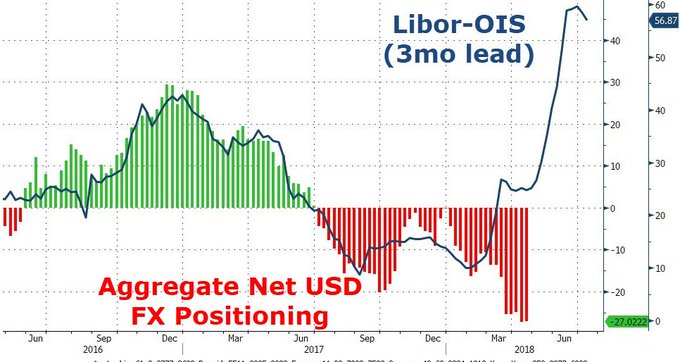
zerohedge@zerohedgeGot DXY calls?

… hitting a fresh three-month high as investors scale back expectations that central banks other than the Fed are confident in tightening. In fact, the dollar is headed for its best week since December 2016.

Elsewhere in FX, as noted above, U.K. GDP data misses estimates, slashing the odds of a BOE hike next month, making the pound the worst G-10 performer. The euro slid amid disappointing data out of France, while the won climbed with Korean leaders’ summit in focus; The yen was near the bottom of a five-week spiral on concerns its yield differentials against the dollar would widen further after the Bank of Japan signaled it’s in no hurry to exit.
Overnight the BoJ concluded its latest policy meeting and kept monetary policy unchanged as expected with NIRP held at -0.10% and the 10yr JGB yield target at around 0%. The decision was made by 8-1 vote with Kataoka the dissenter again, but the biggest surprise was that the central bank removed its reference to achieving 2% CPI target around FY19. Furthermore, BoJ stated that risks to economy were balanced for FY2018 but are skewed to downside for FY2019. BoJ Governor Kuroda said it is appropriate to continue powerful monetary easing, and said that the timeframe for a price target was a limit implying immediate policy change, adds was just a forecast, not a limit and inflation momentum to continue faster to the 2% target.
Meanwhile, the ECB’s Survey of Professional Forecasters maintains 2018 inflation at 1.5%, cuts 2019 inflation to 1.6% to 1.7%. ECB’s Mersch said the path of normalization remains conditional on outlook for price stability, adds underlying strength of Euro area economy continues to support their confidence that inflation will converge to their aim.
SNB’s Jordan says there has been a reduction in significant overvaluation of CHF however the currency remains overvalued; he adds negative interest rates and market intervention remain essential as situation is still fragile.
Data include annualized GDP and U. of Michigan Consumer Sentiment Index. Charter Communications, Chevron, Colgate-Palmolive, and TransCanada are among companies reporting earnings
Overnight bulletin summary
- Soft UK growth data leads to a weaker GBP and lifts FTSE
- BoJ keeps monetary policy unchanged Kuroda reiterates it is appropriate to continue powerful monetary easing
- Looking ahead, highlights include, US GDP, ECB’s Lautenschlaeger and BoE’s Carney
Market Snapshot
- S&P 500 futures down 0.3% to 2,667.75
- STOXX Europe 600 up 0.05% to 383.95
- MXAP up 0.6% to 172.86
- MXAPJ up 0.8% to 561.89
- Nikkei up 0.7% to 22,467.87
- Topix up 0.3% to 1,777.23
- Hang Seng Index up 0.9% to 30,280.67
- Shanghai Composite up 0.2% to 3,082.23
- Sensex up 1% to 35,055.38
- Australia S&P/ASX 200 up 0.7% to 5,953.65
- Kospi up 0.7% to 2,492.40
- German 10Y yield fell 2.4 bps to 0.569%
- Euro down 0.3% to $1.2070
- Italian 10Y yield fell 3.0 bps to 1.493%
- Spanish 10Y yield fell 2.5 bps to 1.245%
- Brent futures down 0.4% to $74.45/bbl
- Gold spot up 0.1% to $1,317.85
- U.S. Dollar Index up 0.4% to 91.88
Top Overnight News
- North Korean leader Kim Jong Un and South Korean President Moon Jae-in agreed Friday to finally end a seven-decade war this year, and pursue the “complete denuclearization” of the Korean Peninsula
- Economic growth in France, the euro-area’s second largest economy, cooled sharply in the first quarter, and while weather was a factor, the slowdown may heighten concerns about the broader outlook for the euro area. Data weighed on the euro, which fell for the third day reaching its lowest since mid- January vs the dollar
- The Bank of Japan left its stimulus program unchanged on Friday, while removing language from its statement declaring that it would reach 2 percent inflation around fiscal 2019. The decision to maintain the yield-curve control program and asset purchases was forecast by all analysts surveyed by Bloomberg
- Whipped by a global stock selloff and climbing bond yields, Norway’s $1 trillion wealth fund reported its first loss in two years in the first quarter. The sovereign wealth fund lost 171 billion kroner ($21 billion), or 1.5 percent, the investor said on Friday
- Profit growth at Chinese industrial firms posted a sharp deceleration in March, as factory inflation moderated. Industrial profits rose 3.1 percent last month from a year earlier, the slowest gain since 2016
Asia equity markets traded mostly higher as the region got an uplift from the momentum in US where all majors extended on gains amid tech outperformance after strong Facebook results, which was later followed after-market by Amazon, Intel, Microsoft and Western Digital which all beat on earnings forecasts. As such, ASX 200 (+0.2%) and Nikkei 225 (+0.5%) traded positive although gains were relatively mild as participants also digested a flurry of data releases and earnings, while KOSPI (+0.6%) benefited from a warming of ties amid the historic inter-Korean summit. Elsewhere, Shanghai Comp. (-0.7%) and Hang Seng (+0.2%) were mixed with underperformance in the mainland following a neutral position by the PBoC in today’s open market operations, while data also showed a slowdown in the pace of Chinese Industrial Profit growth. Finally, 10yr JGBs were marginally higher with prices underpinned at the open to track the upside in USTs and with gains then held throughout the session including after an uneventful BoJ announcement in which it kept policy unchanged but removed the wording on reaching inflation goal around FY19.
Top Asian News
- BOJ Maintains Stimulus While Removing Language on Timing of 2%
- Sony’s New CEO Sets Conservative Targets as He Seeks Revival
- Malaysia’s Prime Minister Says Markets to Decide on Currency
- Tencent-Backed Little Red Book Is Said to Seek $200 Million
- Hedge Fund Judah Value Jumped 46% This Year on Agritrade
European stocks also pushed higher (Stoxx 600 +0.1%) post Thursday earnings as tech outperformance buoyed general sentiment, alongside an easing of geopolitical tensions following constructive dialog between Korea’s leaders. FTSE saw significant strengthening following uninspiring GDP data, that weakened the GBP and further reduced the possibility of tighter monetary policy. While expectations were focused on bad weather having a significant adverse impact, this was quoted to have had only a “limited effect” which pushed expectations of a rate hike in May to sub 25% from 50-50 prior.
Top European News
- Draghi’s ‘Moderation’ Rears Its Head in French Slowdown; Betting on Lower Euro-Area Rates Seen as the Way to Go for Now
- Norway’s $1 Trillion Wealth Fund Posts First Loss in Two Years
- Romanian President Calls for Premier’s Resignation
- German Unemployment Falls as Companies Overcome Soft Patch
In currencies, the DXY index is gathering momentum, largely at the expense of the Greenback’s currency counterparts in the basket (and beyond), and has now cleared a few more chart resistance levels, around 91.526 and from 90.702-751, with the latter entering a multi-month channel that targets 91.996 ahead of 92.000 for more obvious psychological rather than technical reasons. DXY high so far is around 91.825, and another supportive factor comes from month-end rebalancing models signalling net Dollar demand. Sterling’s dramatic turnaround from flavour of the month to one of the market’s worst enemies continues after the UK economy came to a virtual standstill in Q1 and not all because of the Beast from East, according to the ONS. BoE tightening expectations have been knocked back accordingly, with a May hike now down to circa 20% from evens pre-data and almost baked in at one stage (before misses on the labour, CPI and retail sales fronts last week). Cable is now threatening to lose the 1.3800 handle vs just over 1.4000 at the start of April/Q2 and the 1.4375 post-Brexit vote peak set only recently (on April 17). EUR/JPY/CHF: All reeling and feeling the weight of dovish/downbeat Central Bank policy pronouncements after the ECB acknowledged a slowdown in growth, the BoJ removed its timetable for inflation reaching target and the SNB maintained that the Franc is still highly valued, albeit not has strong as it has been. Eur/Usd has tumbled further from brief post-meeting peaks around 1.2210 to a low of circa 1.2065 and eyeing a 1.2050 Fib for potential support, while Usd/Jpy is consolidating gains above 109.00, but remains capped just ahead of 109.50 and the 109.65 Fib. Usd/Chf has breached 0.9900, but Eur/Chf is sub-1.2000 on the aforementioned single currency weakness.
In commodities, As we approach week end some profit taking noted in the crude complex, that has been further compounded by FX effects, with not much specific news aside from a fire in a Wisconsin oil refinery that had little effect on the fossil fuel. In the metals scope reports were seen from the EU that conditions being set by the US to extend tariff deadlines were unacceptable, with a slight rise in aluminium seen. Gold currently at almost 5 week lows, with the yellow metal heading for its biggest weekly fall in a month.
US Event Calendar
- 8:30am: U.S. Employment Cost Index, 1Q, est. 0.7%, prior 0.6%
- 8:30am: U.S. GDP Annualized QoQ, 1Q A, est. 2%, prior 2.9%; Personal Consumption, 1Q A, est. 1.1%, prior 4%
- U.S. GDP Price Index, 1Q A, est. 2.2%, prior 2.3%
- U.S. Core PCE QoQ, 1Q A, est. 2.5%, prior 1.9%
- 10am: U.S. U. of Mich. Sentiment, April F, est. 98, prior 97.8;
- Current Conditions, April F, est. 106.2, prior 115
- Expectations, April F, no est., prior 86.8
- 1 Yr Inflation, April F, no est., prior 2.7%
- 5-10 Yr Inflation, April F, no est., prior 2.4%
DB’s Jim Reid concludes the overnight wrap
What’s the best cure for a mini bond market tantrum? Perhaps to arrange a Mr Draghi press conference. It has certainly been the case in recent months that his pressers have generally been interpreted as dovish and yesterday the bond rally mostly came towards the end of his Q&A. Overall 10y Bunds closed down -4.0bps yesterday and Treasuries (-4.5bps) fell for the first time in eight days. At one stage yesterday the 10yr Bund/Treasury spread returned to 29 year wides of 239.6bp (see graph in the pdf). As recently as late 2012 this ratio was almost zero and last traded flat in February 2012. So quite a divergence in recent years.
As DB’s Mark Wall discussed, there was a contrast between a virtually unchanged prepared press statement in which the Governing Council kept its faith in growth and inflation and the Draghi Q&A where there was a clearer sense of caution. The most important point Mark and his team took from the press conference was the fact that the Governing Council had not discussed monetary policy. Instead the Council focused on the “very important” current data. The underlying air of caution coupled with the absence of any preparation for an imminent and important policy decision means the probability of the QE announcement coming in June has declined. DB now see July as the most likely timing of the announcement that net asset purchases will cease. The forecast for the sequencing and timing of monetary withdrawal remain the same with QE ending in December 2018 after a taper in Q4 and the first 20bp deposit rate hike in June 2019.
For credit investors, Mr Draghi played down concerns about a CSPP taper, saying that there is no specific strategy behind the slowdown while also partly blaming it on seasonality. A reminder that Michal in my team wrote a note on this sharp slowdown earlier this week suggesting there was enough evidence that buying was slowing. We’ll perhaps be able to tell more on Monday when the latest numbers are released.
Post the ECB, the Euro finished -0.48% lower versus the Greenback with that move aiding European equity markets with the Stoxx 600 closing +0.94%. US equity markets also bounced back strongly following solid corporate results from the tech sector, with Facebook and AMD up 9.1% and 13.7% respectively. The Nasdaq (+1.64%) rose for the first time in six days while the S&P (+1.04%) and Dow (+0.99%) also advanced. After the bell, the strength in tech seems to be continuing with Amazon up c7% while Baidu and Intel are both up c6% following their quarterly results.
This morning in Asia, markets are trading modestly higher with the Nikkei (+0.42%), Kospi (+0.64%) and Hang Seng (+0.10%) all up, while the Shanghai Comp. is down -0.74%. Datawise, Japan’s April core Tokyo CPI was below market at 0.6% yoy (vs. 0.8% expected). March IP was above expectations at 2.2% yoy (vs. 2%), the jobless rate was in line at 2.5% while retail trade was below market (1% yoy vs. 1.5% expected). Elsewhere, China’s March industrial profits grew 3.1% yoy (vs. 10.8% previous).
With the ECB out of the way, this morning we had the BoJ meeting where members voted 8-1 to keep rates unchanged while Mr Kataoka continued to cast a dissent vote. Notably, the BOJ has removed previous wording on reaching its 2% inflation target around fiscal 2019, while it kept its 2019 & 2020 inflation forecasts of 1.8% unchanged. We shall hopefully get more info on this at Governor Kuroda’s press conference just after we go to print this morning at 7:30am London time.
Over in Asia this morning, Kim Jong Un became the first North Korean Leader to set foot in South Korea since the 1950’s Korean war as he met with South Korea’s President Moon Jae-in for meetings. Kim said he “felt a flood of emotion” and called for “a new history of peace and prosperity” while indicating to Moon “let’s meet often”. Looking ahead, Kim is expected to meet with President Trump sometime in May or June for talks.
Looking ahead to today, the big focus for the market this afternoon is likely to be a first look at Q1 GDP in the US. The consensus is for a +2.0% annualized qoq reading while our US economists expect +2.2%. Our colleagues have previously noted that their index of key economic indicators continues to point to 3% plus growth so even if today’s Q1 disappoints they doubt that policymakers will rethink the near term trajectory for interest rates. They also highlight that the initial Q1 GDP print has missed the median consensus expectation in each of the last eight years—partly due to well-known issues with residual seasonality. On average, forecasters have overestimated Q1 growth by 46 basis points (bps). This has been even more acute over the last five years as the median forecast has missed by 64 bps. This release has also been prone to substantial revision. Real GDP growth has been revised up in four of the last five years and in five of the last eight years.
The average upward revision has been 88 bps while the average of the three downward revisions over this period (2010, 2011 and 2014) was 193 bps. So as DB’s Brett Ryan suggested, policymakers and market participants are likely to substantially discount the advance GDP figures in the first quarter, at least until the BEA issues its benchmark revision in July.
Also out today will be the Q1 employment cost index which our US economists forecast to come in at +0.8% (consensus at +0.7%). An upside surprise to our economists forecast would boost the year over year growth rate of the ECI above its Q4 2017 post recession high of 2.7% and could cause the market to price a greater probability of an additional fourth rate hike this year (which is our house forecast). According to Bloomberg the odds of this is at 41%, but notably up from the lows of 18% earlier this month.
Moving onto trade, ahead of the next week’s visit to China to discuss trade relations, President Trump’s economic adviser Mr Kudlow told CNBC that “it’s going to cover a broad area. All of the disputes will be discussed”. He added that “I’ve high hopes for this (trip)”, although also noted that “I’m always the optimist about this”. On the other side, Bloomberg has cited unnamed sources which suggest China’s State Council is considering plans to cut the import duty on passenger cars by half, from 25% currently to 10% or 15%. The potential cut is consistent with President Xi’s comments in the Boao forum where he indicated a commitment to cut import tariffs on cars.
Over in Italy, the Five Star Party Leader Luigi Di Maio said “we’re available to sit at the table to negotiate a contract” to form the next government, potentially with the Democratic Party, but “if we don’t succeed, we go back and vote” in a new election.
Moving along, yesterday’s data in the US was a bit of a mixed bag. The April Kansas City Fed manufacturing index was above market at 26 (vs. 17 expected). In the details, the new orders index jumped to a 15-year high of +37 while the production index rose 13pts to a 7-year high of +33. The weekly initial jobless claims fell to a 49 year low (209k vs. 230k expected) while continuing claims was also lower than expectations (1,837k vs. 1,850k expected), although this was partly due to post Easter data distortions. Elsewhere, the March advance goods trade deficit narrowed to a six month low of -$68bln (vs. -$75bln), as exports of goods rose 2.5% mom while imports fell 2.1% mom. Finally, the March core durable goods orders (0% mom vs. 0.5% expected), core capital goods orders (-0.1% mom vs. 0.5% expected) and wholesale inventories (0.5% mom vs. 0.7% expected) were all weaker than expected.
In Europe, Germany’s May GfK consumer confidence index was in line at 10.8, with households less optimistic about the economic outlook but still positive about their willingness to spend. In the UK, the April CBI retailing reported sales index improved 6pts mom to -2 (vs. -3 expected), while the Distributive trade survey showed a net 25% of retailers were optimistic of annual sales growth in May.
Looking at the day ahead, in Europe we’ll get flash April CPI reports in France and Spain along with the advance Q1 GDP reading in the former. Germany’s unemployment rate for April is also out along with the advance Q1 GDP report for the UK and April confidence indicators for the Euro area. In the US, we’ll see the first release of Q1 GDP along with the Q1 employment cost index and final April University of Michigan consumer sentiment report. Elsewhere, BOE’s Carney and Haldane will speak while Exxon Mobil and Chevron are due to report earnings.
3. ASIAN AFFAIRS
i)FRIDAY MORNING/THURSDAY NIGHT: Shanghai closed UP 7.20 POINTS OR 0.23% /Hang Sang CLOSED UP 272.99 POINTS OR 0.91% / The Nikkei closed UP 148.26 POINTS OR 0.66%/Australia’s all ordinaires CLOSED UP .66% /Chinese yuan (ONSHORE) closed DOWN at 6.3380/Oil DOWN to 68.02 dollars per barrel for WTI and 74.53 for Brent. Stocks in Europe OPENED DEEPLY IN THE GREEN. ONSHORE YUAN CLOSED DOWN AT 6.3380 AGAINST THE DOLLAR. OFFSHORE YUAN CLOSED DOWN ON THE DOLLAR AT 6.3327/ONSHORE YUAN TRADING WEAKER AGAINST OFFSHORE YUAN/ONSHORE YUAN TRADING WEAKER AGAINST USA DOLLAR/OFFSHORE YUAN TRADING MUCH WEAKER AGAINST THE DOLLAR /CHINA RETALIATES WITH TARIFFS/ TRUMP RESPONDS TO NEW TARIFFS AND IT NOW LOOKS LIKE A FULL TRADE WAR IS BEGINNING/
3 a NORTH KOREA/USA
North Korea/South Korea
North and South Korea declare an end to the war and a new era of peace.
(courtesy zerohedge)
North And South Korea Declare End To War, Proclaim “New Era Of Peace”
North Korean leader Kim Jong Un and South Korean PresidentMoon Jae-in agreed Friday to finally end a seven-decade war this year, and signed a declaration to pursue the “complete denuclearization” of the Korean Peninsula, although they did not announce any concrete steps to dismantle the North’s nuclear programs..
The two leaders embraced after signing the deal during a historic meeting on their shared border, the first time a North Korean leader has set foot on the southern side. They announced plans to formally declare a resolution to the war and replace 1953 armistice that ended open hostilities into a peace treaty by year’s end.

“We solemnly declare to our 80m Koreans and the world that there will no more war on the Korean peninsula and a new era of peace has begun,” North Korean leader Kim Jong Un and South Korean president Moon Jae-in said in a joint statement. “It is our urgent historic assignment to put an end to this current abnormal state of ceasefire and establish a peace regime.”
“We have agreed to share a firm determination to open a new era in which all Korean people enjoy prosperity and happiness on a peaceful land without wars,” Kim said, in his first remarks in front of the global press since taking power in 2011.
The two sides “confirmed the common goal of realizing, through complete denuclearization, a nuclear-free Korean Peninsula.”

The two agreed to work towards advancing the reunification of the divided nations and further improving inter-Korean relations. In order to reduce tension, the two sides agreed to hold military talks in May and set up a joint liaison office in Kaesong, the border town in the North.
“South and North Korea agreed to actively seek the support and cooperation of the international community for the denuclearization of the Korean Peninsula,” according to the statement. It didn’t elaborate on what that would entail.
“The commitment to ‘complete denuclearization’ is ambiguous, and subject to different interpretations,” said Youngshik Bong, a researcher at Yonsei University’s Institute for North Korean Studies in Seoul. “It can be interpreted as North Korea getting rid of all warheads, or North Korean demands on the U.S. military in South Korea.”
They have also agreed to end any hostile activities that can lead to military clashes, including cross-border propaganda broadcasts and leaflet distribution. They will also enable Red Cross talks to discuss reunions of families separated by the Korean war.
Kim on Friday walked across the military demarcation line dividing the two nations with an aim to end decades of conflict on the peninsula, becoming the first North Korean leader to set foot on South Korean soil.
As Bloomberg notes, the agreement follows a rapid thaw of tensions on the peninsula after a flurry of North Korean missile tests and a hydrogen bomb detonation last year. Kim plans to meet U.S. President Donald Trump soon, which would be the first summit between a North Korean leader and a sitting American president.
The question now is whether the commitment will lead to lasting change. Previous agreements have collapsed over inspections, weapons tests and disputes over economic aid.
Much of the agreement mirrors previous deals between North Korea and Moon’s liberal predecessors. It appeared aimed at restoring cooperation that had deteriorated over the past decade.
Kim’s official Korean Central News Agency issued a tersely worded commentary after the announcement urging the U.S. to respond “with sincerity.” “What is needed for the U.S. is to learn how to observe good manners and how to respect the party concerned, not resorting to high-handed practices and arrogance,” the piece said.
Reaction in markets was limited given the South Korean stock market had closed for the week when the deal was announcement landed.

The meeting paves the way for Mr Kim to meet US President Donald Trump later this year.

“I felt a flood of emotion as I walked the 200 meters here,” Kim told Moon as talks began.
“I came here with a mindset that we will fire a flare at the starting point of a new history for peace and prosperity. Let’s get everything off our minds out here and get good results.”
This is what Kim Jong-un told Moon Jae-in, as relayed by South Korea’s presidential spokesman Yoon Young-chan.
“Kim Jong-un said that he came here to put an end to the history of conflict, discuss and remove obstacles between us with the South Korean president. He said let’s meet more often and we should be determined not to go back to square one. Kim also said let’s live up to all the expectations and create a better world.”
“The two leaders had a sincere and frank dialogue over the denuclearisation and the establishment of permanent peace of the Korean peninsula and development of inter-Korea ties.“

Jeffs@jeffs_araujo35#BREAKING: North Korean leader Kim Jong-un makes history with a brief walk into South Korea for an ice-breaking #KoreaSummit

After they planted the tree, Mr Kim told Mr Moon:
“Just like a pine tree, I hope that we can always be green, even in winter time.”
“Yes, it will be like that,” Mr Moon replied.
“Eyes and ears from all over the world are focused on Panmunjom,” Moon said. “I feel the weight on our shoulders is heavy.”
As The BBC notes, the inter-Korean summit has basically taken everyone by surprise and proven many an expert prediction very wrong (and gravely disappointed many anti-Trump-ites).
From this…

To this…

In 3 months.

JaeKwon Son 손재권
✔@gjack
No Wall, No War, No hate
Today, We are all KOREANS #interkoreansummit#남북정상회담#KoreaSummit

Here’s one of the pundits contemplating the “known and unknown unknowns” this is teaching us…
John Delury
✔@JohnDelury
Kim Jong Un stuck with nukes & ICBMs last year, raising tensions to a boiling point, but in December he started to pivot. Wrote this for @monkeycageblog@washingtonpost last week on why Kim is ready to meet Xi, Moon, Trump & what he’s really afterhttps://www.washingtonpost.com/news/monkey-cage/wp/2018/04/18/pompeos-visit-suggests-the-trump-kim-summit-is-on-track-heres-why-kim-is-ready-to-talk/?utm_term=.52a78727f5cfl …

John Delury
✔@JohnDelury
Along the way, I’ve gotten many things wrong. Known and unknown unknowns abound. The capacity to be surprised & questions one’s assumptions is a struggle, and the most important one. But blanket skepticism does not guarantee you are getting things right; & fatalism is a dead-end.
Previous attempts to negotiate aid-for-disarmament deals have failed.
But in January, the North embarked on direct talks with Seoul, attended the Winter Olympics in South Korea and in April the two leaders met for a historic inter-Korean summit.
Pyongyang also offered direct talks with the US – an offer Mr Trump accepted – and ordered a halt to nuclear and missile tests.
Talks between the two would be unprecedented, but the details, agenda and timing of the summit are yet to be confirmed.
Of course, as Bloomberg reports, any progress on dismantling the Kim’s weapons program would likely be slow and fraught, and involve visits by international inspectors. Prior efforts involving Kim’s late father when he was leader collapsed in acrimony, with North Korea blaming the U.S. for failure to adhere to the agreements.
“It’s off to a good start, but there must be a concrete commitment by Kim on denuclearization,” said Youngshik Bong, a researcher at Yonsei University’s Institute for North Korean Studies in Seoul. “Otherwise it will end up as a fancy show.”
end
3 b JAPAN AFFAIRS
end
c) REPORT ON CHINA/HONG KONG
Boy did this escalate fast: now Chinese smartphone sales have collapsed. China is the engine for world growth and it is collapsing at record speed
(courtesy zerohedge)
Chinese Smartphone Sales Collapse In “Biggest Decline Ever”
Smartphone shipments in China experienced their most significant decline ever in Q1 2018, crashing more than 21 percent annually to 91 million units, according to the Singapore-based research firm Canalys. Since 2013, Chinese smartphone shipments have far exceeded 100 million units quarterly. The last time the headline number fell below the 100 million unit benchmark was Q4 2013.
According to the report, published Thursday and which echoed a similar recent finding by the IMF, the eight-year-long smartphone bubble has come to an end in yet another warning sign of the ongoing demise of the “synchronized global growth” narrative.

To wit, eight of the top ten smartphone vendors experienced a significant decline in sales. Apple lost considerable ground in China, as it was removed from the number four vendor spot by local brand Xiaomi, which bucked the trend and saw 37 percent growth in shipments to 12 million units sold.
“Xiaomi was the only company to buck the trend, growing shipments by 37 percent to 12 million units, and overtaking Apple to take fourth place.”
Huawei (including Honor) managed to remain in the top vendor spot with shipments increasing by 2 percent, while “maintaining its lead and consolidating its market share to about 24 percent by shipping over 21 million smartphones,” said Canalys.
The report detailed how China’s smartphone segment is becoming increasingly dominated by four domestic vendors, including Huawei, Oppo, Vivo, and Xiaomi, which accounted for more than 73 percent of Chinese shipments in Q1 2018.
Ahead of the Apple’s earnings report on May 1, Canalys’ report about Apple’s dwindling market share in China could be a bad omen.
What’s worse for the consumer-tech giant, the Canalys data corroborates a report from Bloomberg, which revealed how five of its largest device assemblers reported a sharp slowdown after peaking in the second half of 2017. Nevertheless, the peak coincides with Canalys’ report of crashing smartphone sales in China.
Meanwhile, vendors outside the top five spots, including Apple (sixth spot), saw their market share slide to 19 percent in the prior quarter, a sign that there could be some market-share consolidation in the offing, according to the report.
“The costs of marketing and channel management in a country as big as China are huge, and only vendors that have reached a certain size can cope,” said Mo Jia, an analyst at Canalys.
“While Huawei, Oppo, Vivo and Xiaomi must contend with a shrinking market, they can take comfort from the fact that it will continue to consolidate,” he added.

One reason for the decline could be smartphone makers focus on the high-end market. As Canalys Research Analyst Hattie He said, “Xiaomi is the only vendor in the top-5 that is focused on the sub-RMB1,000 (about $160) price segment.” Xiaomi posted double-digit growth, with sales up 37 percent, partly reflecting a lackluster performance in 2017. Xiaomi’s success is contributed to its low-cost devices.
The inventory issues that Oppo and Vivo experienced in the fourth and first quarters “are now behind them,” said Jia.
“New smartphones will definitely entice people to upgrade, but vendors are more careful of avoiding oversupply in the channel,” he said, adding that the smartphone market “could experince a short period of stagnancy” as vendors resort to device improvements rather than broad marketing campaigns.
To sum up, the tech sector’s importance to Asia’s economy remains paramount. Which is why collapsing smartphone sales in China could have a serious impact on the “synchronized global growth” narrative that has dominated economic analysis in recent years. At least, that was essentially the IMF’s view when it pointed out that the recent peak in global smartphone sales could seriously hamper growth in Asia, where supply chains and economies have been transformed by the smartphone boom.
All of this begs the question: will falling smartphone sales be the canary in the coalmine as the “global growth” narrative downshifts into recession?
4. EUROPEAN AFFAIRS
Great Britain
Seems that we are having a world wide slump in economic activity: UK GDP reported that it’s first quarter GDP rose only .1% month/month and that number also had considerable massaging to get to that number. The pound gets hammered!!
(courtesy zerohedge)
Pound Crashes After UK Reports Worst GDP Since 2012, Rate Hike Odds Tumble
The British pound tumbled, 10Y gilt yields slumped and odds of a May BOE rate hike vaporized after the UK reported the weakest GDP print since 2012.
This morning, the UK’s Office for National Statistics reported that Q1 GDP rose just 0.1% Q/Q, badly missing expectations of a 0.3% increase, and the lowest quarterly increase since Q4 2012. On an anual basis, the increase was just 1.2%, also missing expectations of a 1.4% rise.

While analysts had had expected a modest slow down in growth to drop from the 0.4% growth in Q4 2017, the slowdown was far bigger than expected as snow hit retail sales and disrupted building work, and raises further questions over whether the Bank of England will raise interest rates in May.
According to the FT, a sharp fall in construction output was responsible for most of the slowdown. “The sector contracted by 3.3 per cent compared to the previous quarter. Analysts had expected the industry to bear the brunt of the poor weather.”
Following the news, UK money markets slashed their bets in half for a rate hike in May to 27% from 56% on Thursday. They now see the first rate increase this year in December, from November earlier.
Immediately following the data, which put the likelihood of a widely priced-in May rate hike by the BOE in doubt, the pound was hammered on the news, tumbling by 150 pips or 0.9% to 1.3791. Cable was already under pressure as U.K. Prime Minister Theresa May’s struggle to keep control of a Cabinet divided over Brexit doesn’t go unnoticed amid broad dollar strength

10Y Gilt yields similarly tumbled on the news, dropping 5bps to 1.45%.

So all this was due to a heavy snowstorm, which nobody could possibly see… take place over a month ago?
Apparently yes: chancellor Philip Hammond blamed the “Beast from the East” snowstorms as a key cause for the pullback. “Today’s data reflects some impact from the exceptional weather that we experienced last month, but our economy is strong and we have made significant progress,” he said in a statement. He was simply taking cues from Mario Draghi who yesterday blamed the European weakness on the timing of Easter and, of course, weather.
Refuting this ridiculous explanation, the ONS said that the impact of snow on output in the first quarter was estimated to be “relatively small” and “ the soft [growth] outcome reflects pockets of weakness more broadly across the economy.”
Rob Kent-Smith of the Office for National Statistics said:
Our initial estimate shows the UK economy growing at its slowest pace in more than five years, with weaker manufacturing growth, subdued consumer-facing industries and construction output falling significantly.
While the snow had some impact on the economy, particularly in construction and some areas of retail, its overall effect was limited with the bad weather actually boosting energy supply and online sales.
According to the market, the figures will prevent BOE head Mark Carney from raising rates in May. The governor of the central bank Mark Carney has already suggested that weak inflation data and a smaller increase in wage growth than expected has reduced the pressure on the BoE to increase interest rates.
As for the drop in the pound, it has been exacerbated by the relentless resurgence in the dollar in the past two weeks, leaving the UK currency at its weakest point in close to two months.
5. RUSSIAN AND MIDDLE EASTERN AFFAIRS
6 .GLOBAL ISSUES
CANADA
We have highlighted Canada’s problem to you on numerous occasions, namely it’s high household debt to income, the highest in the industrial world. We have a very strong housing market but if interest rates continue to rise this bubble will burst and bring a lot of pain to many Canadians
(courtesy Slok/zerohedge)
“Canada Is In Serious Trouble” Again, And This Time It’s For Real
Some time ago, Deutsche Bank’s chief international economist, Torsten Slok, presented several charts which showed that “Canada is in serious trouble” mostly as a result of its over reliance on its frothy, bubbly housing sector, but also due to the fact that unlike the US, the average Canadian household had failed to reduce its debt load.

Additionally, the German economist demonstrated that it was not just the mortgage-linked dangers from the housing market (and this was before Vancouver and Toronto got slammed with billions in “hot” Chinese capital inflows) as credit card loans and personal lines of credit had both surged, even as multifamily construction was at already record highs and surging, while the labor market had become particularly reliant on the assumption that the housing sector would keep growing indefinitely, suggesting that if and when the housing market took a turn for the worse, or even slowed down as expected, a major source of employment in recent years would shrink.

Fast forward to last summer, when the trends shown by Slok three years ago had only grown more acute, with Canada’s household debt continuing to rise, its divergence with the US never been greater…

… making the debt-service ratio disturbingly sticky.

And yet despite all these concerning trends, virtually all of these red flags have been soundly ignored, mostly for one reason: the “wealth effect” in Canada courtesy of its housing market grew, and grew, and grew…

Looking at the chart above, Bloomberg recently said that:
On a real basis, Canadian housing prices experienced a much smaller, shorter decrease in prices during the financial crisis and a much larger, longer increase in prices during the recovery. When you couple this unfathomable rise in housing prices with near-record high household debt-to-income ratios, the Canadian housing bubble starts to look scary should the tide turn.
… and added:
No one knows when insanity like this will come to an end. Bubbles are like an avalanche. The longer they build up, the worse they will be when they eventually destabilize.
Well, nobody may know, but as Harley Bassman said not long ago, one can make an educated assumption, and as he said it most likely will be the result of higher rates.
Which brings us to last July’s decision by the Bank of Canada to hike its rates for only the first time since 2010, sending the Loonie to the highest level since August 2016. But aside from the surging currency, now that Canada has set off on a rate-hiking path, it has a bigger problem, one whose absence for so many years allowed the “Canadian housing bubble” in Bloomberg’s words to flourish: rising rates.
But the bigger problem is not so much rising short-term rates, but what is going on on the long end: it is here that the pain for the housing market will be most acute, because as shown in the chart below, the 10Y yield is now at the highest level it has been since the summer of 2014 and rising. Meanwhile, the yield on five-year government bonds rose to 2.18% this week, the highest in almost seven years.

Furthermore, as US homebuyers from the time period 2004-2006 remember all too vividly, there is nothing that will burst a housing – and credit – bubble faster than a spike in mortgage rates.
But while Torsten Slok’s original warning that “Canada Is In Serious Trouble” in January of 2015 may have been premature, this time it appears that the threat facing Canada is all too real.
The reason: while it took banks some time to push their mortgage rates in line, they have finally “caught up” and as Bloomberg reports, Toronto-Dominion Bank has lifted its posted rate for five-year fixed mortgages by 45 bps to 5.59% as government bond yields touched their highest levels since 2011 this week.
“It’s a big move, the biggest move in years,” said Rob McLister, founder of RateSpy.com, a mortgage comparison website.
“There’s a lot of reasons why that could be — maybe they’re taking a position on rates going forward, which is not that typical; maybe they’re trying to get people to lock in and generate better spreads.”
Contacted by Bloomberg, Toronto-Dominion, Canada’s second-largest lender, said it lifted its five-year closed rate on Wednesday, along with increases to its two-year, three-year, six-year and seven-year mortgage rates.
In short: it hiked rates on everything. Why would a bank do that? Because i) it needs to, in order to remain profitable on its Net Interest Margin as the BOC keeps hiking rates and ii) because it anticipates greater losses in the very near future.
Meanwhile, Canada’s housing market has already set off on a wild ride. Recently, Toronto home prices dropped sharply from last year’s dramatic spike, while prices in Vancouver have rebounded, although here too they remain on edge amid a collapse in volulmes as much of the Chinese demand has vaporized, however a lack of selling pressure has prevented an all out rout. For now.
As for Toronto Dominion, and its decision to implement “the biggest move in years”, the bank explained that “adjusting our rates is not a decision we take lightly,” and added that “we look at a number of factors when determining rates including the competitive landscape, the cost of lending and managing risk.”
Even with the change, rates “remain competitive and at historically low levels,” the bank said.
Toronto-Dominion’s posted rate is now higher than rivals including Royal Bank of Canada, Bank of Nova Scotia and Bank of Montreal, which each advertise posted rates of 5.14 percent. Canadian Imperial Bank of Commerce has the lowest posted rate, at 4.99 percent.
So with mortgage rates now surging amid debt-service ratios which have never been higher, it’s only a matter of time before Slok is finally proven right…
7. OIL ISSUES
Trump and Merkel both confirm that the Iran deal talks are continuing and that causes oil to drop
(courtesy zerohedge)
Trump, Merkel Confirm That Iran Deal Talks Continue; Oil Drops
While she certainly didn’t display the same demonstrative warmth that French President Emmanuel Macron did during his meeting with President Trump early this week, German Chancellor Angela Merkel and Trump had what was by all accounts a productive meeting on Friday.
And if the press conference that followed their three-hour summit had a key takeaway, it would be that, despite Trump’s aggressive rhetoric, the Iran deal remains alive – for now, at least. This realization sent the price of WTI sinking in afternoon trade as oil bulls worried about Iranian supply, though WTI climbed 4.5% in April.

Trump addressed the Iran deal in general terms, saying that the West must “ensure that this murderous regime does not even get close to a nuclear weapon.” Reiterating remarks from earlier this week, Trump said Iran would not be restarting its nuclear program, “you can bank on it.”
Merkel said that while the deal “isn’t perfect”, she said it’s “part of a bigger Middle Eastern picture” and added that the signatories would continue to be involved in “very close talks” to try and preserve the deal.
Merkel said the JCPOA was discussed, and that the two sides were working on forging a deal that would assuage US concerns.
Turning to the subject of North Korea, Trump reiterated remarks from a press conference earlier in the day, saying that while he’s looking forward to talks with North Korea, the US would not let the North “play” the Trump administration like the Kims have played previous administrations.
“I will be meeting with Kim Jong Un in the coming weeks, we look forward to that,” he said, thanking Merkel for her help in the “maximum pressure” campaign on North Korea.
The president said they will “not repeat” the mistakes of past administrations.
In a meeting with Merkel before lunch, Mr. Trump said he doesn’t think Kim is “playing,” although other administrations were “played like a fiddle” because the U.S. had different leaders.
Trump also touched on the need for NATO nations to pay their fair share for national security costs born by the bloc, and also commented on Germany’s trade surplus with the US.
Crucially, Merkel didn’t give a direct answer about whether the US would extend an exemption for aluminum and steel tariffs for the European Union, which is set to expire early next month.
8. EMERGING MARKET
Venezuela
Your early morning currency/gold and silver pricing/Asian and European bourse movements/ and interest rate settings FRIDAY morning 7:00 am
Euro/USA 1.20892 DOWN .0018/ REACTING TO MERKEL’S FAILED COALITION/ SPAIN VS CATALONIA/REACTING TO +GERMAN ELECTION WHERE ALT RIGHT PARTY ENTERS THE BUNDESTAG/ huge Deutsche bank problems + USA election:/TRUMP HEALTH CARE DEFEAT//ITALIAN REFERENDUM DEFEAT/AND NOW ECB TAPERING BOND PURCHASES/JAPAN TAPERING BOND PURCHASES /USA FALLING INTEREST RATES AGAIN/HOUSTON FLOODING/EUROPE BOURSES DEEPLY IN THE GREEN
USA/JAPAN YEN 109.34 UP 0.030 (Abe’s new negative interest rate (NIRP), a total DISASTER/SIGNALS U TURN WITH INCREASED NEGATIVITY IN NIRP/JAPAN OUT OF WEAPONS TO FIGHT ECONOMIC DISASTER/
GBP/USA 1.3782 DOWN .0134 (Brexit March 29/ 2017/ARTICLE 50 SIGNED/BREXIT FEES WILL BE CAPPED
USA/CAN 1.2876 UP .0004 (CANADA WORRIED ABOUT TRADE WITH THE USA WITH TRUMP ELECTION/ITALIAN EXIT AND GREXIT FROM EU/(TRUMP INITIATES LUMBER TARIFFS ON CANADA/CANADA HAS A HUGE HOUSEHOLD DEBT/GDP PROBLEM)
Early THIS FRIDAY morning in Europe, the Euro FELL by 18 basis points, trading now ABOVE the important 1.08 level FALLING to 1.20892; / Last night Shanghai composite CLOSED UP 7.20 POINTS OR 0.23% / Hang Sang CLOSED UP 272,99 POINTS OR 0.91% /AUSTRALIA CLOSED UP .66% / EUROPEAN BOURSES OPENED GREEN
The NIKKEI: this FRIDAY morning CLOSED UP 148.26 POINTS OR 0.66%
Trading from Europe and Asia
1/EUROPE OPENED DEEPLY IN THE GREEN
2/ CHINESE BOURSES / : Hang Sang CLOSED UP 272.99 POINTS OR 0.91% / SHANGHAI CLOSED UP 7.20 POINTS OR 0.23% /
Australia BOURSE CLOSED UP .66%
Nikkei (Japan) CLOSED UP 148.26 POINTS OR 0.66%
INDIA’S SENSEX IN THE GREEN
Gold very early morning trading: 1319.10
silver:$16.52
Early THURSDAY morning USA 10 year bond yield: 2.97% !!! DOWN 1 IN POINTS from THURSDAY night in basis points and it is trading WELL ABOVE resistance at 2.27-2.32%. (POLICY FED ERROR)/
The 30 yr bond yield 3.15 DOWN 2 IN BASIS POINTS from THURSDAY night. (POLICY FED ERROR)/
USA dollar index early FRIDAY morning: 91.75 UP 19 CENT(S) from THURSDAY’s close.
This ends early morning numbers FRIDAY MORNING
xxxxxxxxxxxxxxxxxxxxxxxxxxxxxxxxxxxxxxxxxxxxxxxxxxxxxxxxxxxxxxxxxxxxxxxxxxxxxxxxxxxxxxxxxxxxxxxxxxxxxxxxxxxxxxx
And now your closing FRIDAY NUMBERS \1: 00 PM
Portuguese 10 year bond yield: 1.653% DOWN 3 in basis point(s) yield from THURSDAY/
JAPANESE BOND YIELD: +.0.055% DOWN 5/10 in basis points yield from THURSDAY/JAPAN losing control of its yield curve/
SPANISH 10 YR BOND YIELD: 1.262% DOWN 1 IN basis point yield from THURSDAY/
ITALIAN 10 YR BOND YIELD: 1.741 DOWN 1 POINTS in basis point yield from THURSDAY/
the Italian 10 yr bond yield is trading 48 points HIGHER than Spain.
GERMAN 10 YR BOND YIELD:FALLS TO +.571% IN BASIS POINTS ON THE DAY
END
xxxxxxxxxxxxxxxxxxxxxxxxxxxxxxxxxxxxxxxxxxxxxxxxxxxxxxxxxxxxxxxxxxxxxxxxxxxxxxxxxxxxxxxxxxxxxxxxxxxxxxxxxxxxxxxxxxxxxxxxxxxxxxxxxxxxx
IMPORTANT CURRENCY CLOSES FOR FRIDAY
Closing currency crosses for FRIDAY night/USA DOLLAR INDEX/USA 10 YR BOND YIELD/1:00 PM
Euro/USA 1.2105 DOWN .0003 (Euro DOWN 3 Basis points/ represents to DRAGHI A COMPLETE POLICY FAILURE/
USA/Japan: 109.10 DOWN 0.204 Yen UP 21 basis points/
Great Britain/USA 1.37773 DOWN .0139( POUND DOWN 139 BASIS POINTS)
USA/Canada 1.2859 DOWN .0013 Canadian dollar UP 13 Basis points AS OIL ROSE TO $67.98
xxxxxxxxxxxxxxxxxxxxxxxxxxxxxxxxxxxxxxxxxxxxxxxxxxxxxxxxxxxxxxxxxxxxxxxxxxxxxxxx
This afternoon, the Euro was DOWN 3 to trade at 1.2105
The Yen ROSE to 109.10 for a GAIN of 21 Basis points as NIRP is STILL a big failure for the Japanese central bank/HELICOPTER MONEY IS NOW DELAYED/BANK OF JAPAN NOW WORRIED AS AS THEY ARE RUNNING OUT OF BONDS TO BUY AS BOND YIELDS RISE
The POUND FELL BY 139 basis points, trading at 1.37773/
The Canadian dollar ROSE by 13 basis points to 1.2859/ WITH WTI OIL RISING TO : $67.98
The USA/Yuan closed AT 6.3322
the 10 yr Japanese bond yield closed at +.055% DOWN 5/10 IN BASIS POINTS / yield/
Your closing 10 yr USA bond yield DOWN 1 IN basis points from THURSDAY at 2.958% //trading well ABOVE the resistance level of 2.27-2.32%) very problematic USA 30 yr bond yield: 3.1784 DOWN 2 in basis points on the day /
THE RISE IN BOTH THE 10 YR AND THE 30 YR ARE VERY PROBLEMATIC FOR VALUATIONS
Your closing USA dollar index, 91.66 DOWN 11 CENT(S) ON THE DAY/1.00 PM/
Your closing bourses for Europe and the Dow along with the USA dollar index closing and interest rates for FRIDAY: 1:00 PM EST
London: CLOSED UP 80.78 POINTS OR 1.09%
German Dax :CLOSED UP 80.40 POINTS OR 0.64%
Paris Cac CLOSED UP 29.61 POINTS OR 0.54%
Spain IBEX CLOSED UP 23.10 POINTS OR 0.23%
Italian MIB: CLOSED DOWN 112.02 POINTS OR 0.47%
The Dow closed DOWN 11.85 POINTS OR 0.05%
NASDAQ closed UP 1.12 Points OR 0.02% 4.00 PM EST
WTI Oil price; 68.05 1:00 pm;
Brent Oil: 74.44 1:00 EST
USA /RUSSIAN ROUBLE CROSS: 62.10 DOWN 61/100 ROUBLES/DOLLAR (ROUBLE HIGHER BY 61 BASIS PTS)
TODAY THE GERMAN YIELD FALLS TO +.571% FOR THE 10 YR BOND 1.00 PM EST EST
END
This ends the stock indices, oil price, currency crosses and interest rate closes for today 4:30 PM
Closing Price for Oil, 4:30 pm/and 10 year USA interest rate:
WTI CRUDE OIL PRICE 4:30 PM:$68.20
BRENT: $74.69
USA 10 YR BOND YIELD: 2.98% THIS RAPID RISE IN YIELD IS ALSO VERY DANGEROUS/RECESSION COMING/DERIVATIVES FRY!!
USA 30 YR BOND YIELD: 3.17%/DEADLY
EURO/USA DOLLAR CROSS: 1.2103 DOWN .0067 (DOWN 67 BASIS POINTS)
USA/JAPANESE YEN:109.36 DOWN 0.018/ YEN UP 2 BASIS POINTS/ .
USA DOLLAR INDEX: 91.577 UP 41 cent(s)/dangerous as the lower the dollar the higher the inflation.
The British pound at 5 pm: Great Britain Pound/USA: 1.3917: DOWN 0.0018 (FROM YESTERDAY NIGHT DOWN 18 POINTS)
Canadian dollar: 1.2880 DOWN 44 BASIS pts
German 10 yr bond yield at 5 pm: +0.571%
VOLATILITY INDEX: 15.41 CLOSED down 0.83
LIBOR 3 MONTH DURATION: 2.3587% .
And now your more important USA stories which will influence the price of gold/silver
TRADING IN GRAPH FORM FOR THE DAY
Ex-HSBC Currency Trader Sentenced To Two Years In Prison
Mark Johnson, the former global head of foreign exchange at HSBC, was sentenced on Thursday to two years in a US prison, becoming the first banker to be jailed in the DOJ-led global crackdown on front-running and collusion in the foreign exchange market.
His conviction comes after four of the world’s largest banks paid more than $10 billion in fines as part of the “foreign exchange cartel” case. While most of the fines were adjudicated back in 2015, HSBC paid $100 million in January to resolve a DOJ probe into the rigging of currency rates.

While Johnson’s legal team had been pushing for house arrest and community service in the UK, where Johnson owns a home in Hampshire, the judge ultimately handed down a two-year sentence, despite Johnson submitting almost 130 letters of support from his family, friends and colleagues who vouched for his good character. Johnson also pleaded that the separation made necessary by the trial had been “a hideous punishment” for Johnson’s wife, Diane Minihane, and six children.
“My fear is that he comes to represent an industry that is vilified,” said Minihane, who met Johnson when they worked together as senior foreign-exchange traders at Deutsche Bank AG in London. In a six-page letter, she describes parenting with an “innately decent and honest man,” and cites examples of his kindness to coworkers and community members.
US District Judge Nicholas Garaufis said he decided on two years because, while he felt a prison sentence would be “necessary”, anything greater would be “punitive”.
Johnson was also fined $300,000.
Recordings of conversations between Johnson and his co-workers that had been obtained by authorities purportedly revealed instances where Johnson appeared to front-run orders placed by the bank’s clients. The charges were rooted in a deal involving Cairn Energy Plc, which had hired the bank to convert the proceeds from a sale of one of its subsidiaries into pounds. Late last year, Johnson was found guilty of nine counts of wire fraud for executing the $3.5 billion transaction in a way that maximized the bank’s take.
Johnson and a co-conspirator, former HSBC Head of Currency Trading Stuart Scott, allegedly devised a scheme whereby the bank slowly added pounds to its balance sheet in the weeks before the transaction. Then, on the day the trade was executed, Scott and Johnson conspired to fill the order at the 3 pm London fix instead of the 4 pm London fix. There’s typically less liquidity around the 3 pm fix, making it easier to move the price of the fix by pushing the exchange rate in the bank’s favor by executing a string of transactions just before the fix closes.
When confronted by Cairn about the execution price, which was higher than what the bank had initially quoted Cairn, Scott told them that the change in price was due to an unforeseen order by a Russian Central Bank. Scott is currently still in the UK fighting extradition to the US.
When Johnson took the stand at his trial, he testified that his desk had executed the trade at a “fair” price for Cairn, and that HSBC was merely “pre-hedging” the trade (traders, after all, has a responsibility to insulate itself from losses should exchange rates move against it, turning the deal into a money-loser).
Prosecutors, meanwhile, accused Johnson of engaging in a tactic known as “ramping.”
But the most damning evidence presented during the trial was undoubtedly the recordings of conversations taking place between Johnson and his colleagues while the trade was being executed. On the tapes, the jury heard Johnson discuss how high the exchange rate could rise before the client would “squeal”. In another conversation, Johnson can be heard telling Scott, “I think we got away with it.”
Those words will likely haunt Johnson for the rest of his natural life.
As one former FX trader who spoke with BBG put it:
Daniel Mantini, a former currency trader at Salomon Smith Barney and Bear Stearns who left the industry in 2012, said sending Johnson to prison would be a “travesty of justice.”
“If they were going to arrest every foreign-exchange dealer for front-running big orders and/or talking smack over the phone there would be many thousands in jail,”Mantini said. “This guy was in the wrong place at the wrong time.”
And now he’s going to spend the next two years in a US prison.
And… Yet Another Wells Fargo Banking Scandal
Submitted by Simon Black of Sovereign Man

Is it Friday again? Must be time for another banking scandal!
Seriously– these banking scandals are happening with such regularity and predictability it would be almost comical. . . were it not for the millions of people who have had their lives turned upside down.
The latest transgression involves, once again, our old friends at Wells Fargo.
Bear in mind that the ink isn’t even dry yet on the $1 billion check that Wells Fargo wrote last week as a penalty to settle its previous scandal, where they defrauded 570,000 clients in a car insurance scam.
By the bank’s own estimates, as many as 20,000 of those clients may have had their vehicles repossessed as a result of their inability to pay for the car insurance that Wells Fargo illegally stuck them with.
And speaking of vehicle repossession, in November of last year Wells Fargo came under fire for illegally repossessing vehicles that were owned by members of the military.
In October, Wells Fargo took heat from federal regulators after it was found that the bank had deliberately recommended investment products that were “highly likely to lose value. . .” Early that month, the bank admitted that it had ‘erroneously’ charged late fees to more than 100,000 borrowers, even though the delays were the bank’s fault.
In 2016, a number of employees at various Wells Fargo branches in California were found to have sold sensitive customer information, including Social Security Numbers, to a ring of identity thieves.
And of course, in late 2016 and all throughout 2017, Wells Fargo’s notorious ‘fake account’ scandal was found to have affected millions of customers.
There’s a word for all of this: fraud.
And if you or I had committed any of these acts by even the slightest, we’d be wearing DayGlo Orange jumpsuits in a federal penitentiary.
But a grand total of ZERO executives from Wells Fargo have been sent to prison or faced any charges whatsoever.
In fact, the executive who was found to be the most culpable in the fake account scandal scored a whopping $67 million severance package when she left the company in late 2016.
And the new CEO (who took over after the fake account scandal in 2016) has been rewarded with a 35% pay increase even though both the stock price and the bank’s profits have languished.
Scandal #867,241 just hit the news yesterday afternoon: Wells Fargo is now being investigated by the United States Department of Labor. This time the bank is accused of deliberately pushing customers into more expensive, higher-fee retirement accounts– accounts that are bad for the customers, but more lucrative for the bank.
It just never stops with these people. And it’s not just Wells Fargo.
Nearly EVERY major bank in the world, from JP Morgan to Barclays, Citigroup, UBS, Bank of America, etc. has been found at some point or another over the last several years of grossly violating the public’s trust.
Yet we consumers still willingly let these criminals hold our money.
Month after month we deposit our paychecks and hold our savings in an institution that rarely misses an opportunity to prove that they cannot be trusted.
They’ve been caught manipulating asset prices, colluding to fix interest rates and exchange rates, and engaging in irresponsible lending practices that put our savings at risk for their sole benefit.
They treat customers with such contempt, scrutinizing even the most innocuous transactions as if WE are the criminals.
And when they screw it all up, gambling away our hard-earned savings on some idiotic investment fad, they go to the taxpayer with hat-in-hand claiming that they’re too important to go out of business… and then shower themselves with record bonuses.
Our reward for putting up with all of this abuse? Well, according to BankRate.com, interest rates at the biggest retail banks (Wells, Bank of America, Chase, etc.) average just 0.01%.
This banking system so pathetic.
Yet we’ve all been institutionalized, practically since birth, to believe that we HAVE to use it… that there’s no alternative.
And that used to be true several decades ago. But in 2018, there are countless alternatives.
Literally every single function of a bank can be performed better, faster, cheaper OUTSIDE of the banking system.
Rather than holding your savings in a bank, you can literally earn more than 150x as much interest with extremely short-term Treasury Bills. Or if you want, you can even hold physical cash.
For loans, there are dozens of websites where you can crowdfund a home loan or small business loan.
And for retirement accounts– the latest Wells Fargo transgression– you DEFINITELY don’t need a bank.
Retirement accounts are one of the biggest areas where banks and major financial institutions routinely bilk their customers out of useless and unnecessary fees.
Even if they’re not charging you a fee outright, they’re diverting your retirement savings into some fund that they control and taking a percentage or two away from what you should be earning.
And over a period of several decades (we’re talking about retirement after all), a single percent difference in your average investment return because of bank fees can add up to hundreds of thousands of dollars.
So it’s a pretty big deal.
The reality is there are SO many ways to properly structure your retirement in better, more robust, less expensive ways.
For example– if you qualify, a solo 401(k) is an extraordinary retirement structure that’s cheap to administer and incredibly flexible.
With a solo 401(k), you can contribute tens of thousand of dollars each year to your retirement, as well as invest in a variety of assets that are not available to traditional plans (like real estate and private equity).
And you can even borrow money directly from your retirement plan under certain circumstances.
Self-directed IRAs are also great structures with similar benefits, though they have slightly higher costs and less flexibility.
Bottom line, there are plenty of options on the table to distance yourself from this abuse.
In Explosive Interview Comey Grilled Over Memos, FBI Bias And Steele Dossier
Fox News host Bret Baier and James Comey sat down for a one-on-one interview Thursday night, in perhaps the most serious and direct conversations with the former FBI Director to date.
Sean Davis
✔@seanmdav
Incredible interview there from @BretBaier. Respectful, but not deferential. Forceful, without being impolite. And, in a rare feat on TV anymore, it elicited a ton of new and important information.

Baier held Comey’s feet to the fire on a wide variety of controversial topics – including the FBI’s decision to exonerate Hillary Clinton before interviewing her, what Comey knew about the “Steele Dossier” used to obtain a surveillance warrant on a Trump campaign aide, and the memos Comey leaked to his friend which he hoped would lead to a special counsel investigation.
Clinton Exoneration
After starting the interview off with a joke about how Comey must find it “a little tougher to get around town without a motorcade,” Baier pulled no punches – launching straight into asking the former FBI Director if it was true that his team decided to exonerate Hillary Clinton before interviewing her.
In response, Comey said that because of all the prior investigative work the FBI had done on the Clinton email case, investigators said “it looks like it’s not going to get to a place where the prosecutors will bring it,” and that it’s “fairly typical” for white collar investigations to save interviews for last.
Comey: I started to see that their view was, it was unlikely to end in a case that the prosecutors at DOJ would bring.
Baier: Before the interview?
Sure, yeah, because they had spent ten months digging around, reading all of the emails, putting everything together, interviewing everybody who set up her system. They weren’t certain of that result, but they said “Look boss, on the current course and speed, looks like it’s not going to get to a place where the prosecutor will bring it.”
Strzok and Page
On the topic of Peter Strzok – the anti-Trump counterintelligence agent deeply involved in both the Clinton and Trump investigations along with his FBI attorney mistress, Lisa Page, Comey said he never witnessed evidence of bias working with the pair, but that he was “deeply disappointed” when he saw some of the text messages exchanged between them.
“I can tell you this: When I saw the texts, I was deeply disappointed in them,” Comey told Baier. “But I never saw any bias, any reflection of any kind of animus towards anybody, including me. I’m sure I’m badmouthed in those texts, I’m just not going to read them all. Never saw it.”
Comey said that if he had been aware of the level of hatred Strzok and Page had for Trump, he “would have removed both of them from any contact with significant investigations.”
Kimberley Strassel
✔@KimStrassel
Key part of interview: @Comey admits he’d absolutely have removed Strzok/Page for bias, and then struggles to then claim their work product is still valid. Admits its a “fair question.” Won’t admit he doesn’t have any reasonable answer. #SpecialReport

The “leaked” memos
When it comes to the leaked memos that kickstarted the Mueller probe, Comey maintains that the memos he created to document his interactions with President Trump, seven in all and four of which have been deemed classified; two marked “confidential” and two marked “secret.”
Comey also admitted that he leaked the memos to two other people who he said were members of his “legal team,” including David Kelly and former U.S. Attorney Patrick Fitzgerald.
“I gave the memos to my legal team after I gave them to Dan Richman — after I asked him to get it out to the media,” said Comey, who likened the memos to his “diaries.”
“I didn’t consider it part of an FBI file… It was my personal aide-memoire,” Comey said, adding “I always thought of it as mine, like a diary”
Mark Meadows
✔@RepMarkMeadows
It’s difficult to know where to begin on that Director Comey interview w/ @BretBaier. He just admitted to leaking his memos (with now-classified info) to two more people, in addition his friend.
So he shared government property with not one, but three people? What?

Trump “just wrong”
Responding to a Fox & Friends interview in which President Trump said “Comey is a leaker and he’s a liar. He’s been leaking for years,” the former FBI Director responded “He’s just wrong. Facts really do matter.” Comey then claimed that because the FBI approved the inclusion of the memos in his book, A Higher Loyalty, they are therefore not classified.

Fox News
✔@FoxNews
.@Comey: “I don’t consider what I did with Mr. Richman a leak. I told him about an unclassified conversation with @POTUS.” #SpecialReport

Sean Davis
✔@seanmdav
Comey told Bret Baier that he didn’t need to tell Congress that Daniel Richman, the “good friend” to whom he leaked, was a FBI special government employee because “it wasn’t relevant.”
Byron York of the Washington Examiner provides an excellent breakdown of Comey’s semantic absurdity here.
The “Steele Dossier” and who paid for it
Baier asked Comey why the FBI used the Steele Dossier compiled by former UK spy Christopher Steele to obtain a FISA warrant on a Trump campaign aide if it was “salacious,” to which Comey replied that the dossier was part of a “broader mosaic of facts” used to support the application.
And when it comes to who funded the dossier used in the FISA application, Comey claims he still has no idea whether Hillary Clinton and the DNC funded it.
“When did you learn that the DNC and the Hillary Clinton campaign had funded Christopher Steele’s work?” Baier asked.
“Yeah I still don’t know that for a fact,” Comey responded.
“What do you mean?” Baier replied.
“I’ve only seen it in the media, I never knew exactly which Democrats had funded,” Comey explained, “I knew it was funded first by Republicans.”
Baier quickly corrected Comey, noting that while conservative website Free Beacon had Fusion GPS on “a kind of retainer,” they “did not fund the Christopher Steele memo or the dossier,” adding “That was initiated by Democrats.”
Byron York
✔@ByronYork
In @BretBaier interview, Comey seems unaware/confused about difference between Fusion GPS/Free Beacon period and Fusion GPS/Steele dossier period.

Mollie
✔@MZHemingway
Comey claimed that “Republicans” funded the *dossier* (not other anti-Trump research) and he wasn’t sure that HRC and DNC funded the dossier (they did). That’s either mendacity or negligence.

Brit Hume
✔@brithume
Comey’s claims to @BretBaier that A: he didn’t leak and B: he doesn’t know to this day that the HRC campaign and DNC financed the dossier simply are not credible. He even claimed the GOP started the funding of the dossier. That was debunked many months ago.

Kimberley Strassel
✔@KimStrassel
Actually is stunning overall amount the head of the FBI claims to not have known. Didn’t know Steele’s name; didn’t know he lied to the FBI and was dismissed; didn’t know who funded dossier; didn’t know who leaked it. You gotta ask: Maybe he didn’t want to know? #SpecialReport
Full Interview
Brett Baier’s Take and other reactions:

Fox News
✔@FoxNews
.@BretBaier on @Comey interview: “The other thing that struck me about the interview is when he said…had he not been fired, he would still be working for [@realDonaldTrump] as he’s lambasting Republicans for working with [Trump].” #TheStory

Fox News
✔@FoxNews
.@TGowdySC on @Comey#SpecialReport interview: “Jim Comey has a definition of the word ‘leak’ that no one else has. What he says is a leak is what the rest of us call a felony.” #Tuckerhttps://fxn.ws/2vLVhuQ
Sean Davis
✔@seanmdav
Baier: Should McCabe be prosecuted?
Comey: That’s not my role.
Baier: It wasn’t your role in the Clinton investigation, either.
end
The full report of the House Intelligence Committee has now been released from which it finds “no collusion”
(courtesy zerohedge)
Trump Euphoric After House Intel Report Finds “No Collusion” Between President, Russia
Weeks after the House Intelligence Committee voted to officially close its investigation into whether President Trump colluded with the Russians, it has finally released its official account of its findings in a heavily redacted 253-page report which unambiguously proclaims that the committee “found no evidence that the Trump campaign colluded, coordinated, or conspired with the Russian government.”
However, the report wasn’t entirely devoid of criticism. According to the report, “the investigation found poor judgment and ill-considered actions by the Trump and Clinton campaigns.” Specifically, it cites Trump associates’ contacts with Russian nationals and groups like Wikileaks during the campaign as examples of irresponsible behavior.
Unwilling to let go of the Russia narrative entirely, Democrats on the committee, led by ranking member Adam Schiff, released a 99-page rebuttal claiming that Republicans on the committee purposefully ignored certain witnesses and failed to file certain subpoenas knowingly based on the expectation that they might uncover evidence of Trump campaign collusion.
The committee, which is chaired by Republican Devin Nunes even though he recused himself from the investigation early on and handed supervisory duties over to his second-in-command, Mike Conaway, carried out 73 witness interviews and reviewed 308,000 documents during its investigation.
The probe, which was formally launched on Jan. 25, 2017, examined four areas: Russian active measures, intelligence related to any links between Russian operatives and the Trump and Clinton campaigns, the US government’s response to intelligence indicating that Russia intended to disrupt its political system, as well as leaks of classified information out of the intelligence community.
And in what appears to be one of the report’s most important findings, lawmakers said they found no evidence that George Papadopoulos had told anyone working with the campaign about Maltese academic Joseph Mifsud’s claim that the Russians had “dirt” on Hillary Clinton.
Papadopoulos was indicted by Mueller and later turned states evidence after being accused of perjury for lying about what he told other members of the campaign about his contacts with Mifsud and his attempts to set up a meeting between Trump and Russian President Vladimir Putin.
But of course, the findings may not be enough to stymie Special Counsel Robert Mueller, who appears hell bent on nailing Trump for something.
The report also cited an email from Paul Manafort asking Rick Dearborn, then a senior campaign policy official, about a change to the Republican convention platform that stripped out arming Ukraine. Manafort, who has been arrested over money laundering allegations tied to his work for former Ukrainian leader Viktor Yanukovich, an ally of Russian President Vladimir Putin.
Clapper Busted Leaking Dossier Details To CNN’s Jake Tapper, Lying To Congress About It
Former Director of National Intelligence (DNI) turned CNN commentator, James Clapper not only leaked information related to the infamous “Steele dossier” to CNN’s Jake Tapper while Clapper was in office – it appears he also lied about it to Congress, under oath.

Clapper was one of the “two national security officials” cited in CNN’s report -published minutes after Buzzfeed released the full Steele dossier.
The revelation that Clapper was responsible for leaking details of both the dossier and briefings to two presidents on the matter is significant, because former Federal Bureau of Investigation (FBI) director James Comey wrote in one of four memos that he leaked that the briefing of Trump on salacious and unverified allegations from the dossier was necessary because “CNN had them and were looking for a news hook.” –The Federalist
So Comey said that Trump needed to be briefed on the Dossier’s allegations since CNN “had them” – because James Clapper, the Director of National Intelligence at the time, provided that information to the same network he now works for.
And who’s idea was it to brief Trump on the dossier? JAMES CLAPPER – according to former FBI Director James Comey’s memos:
“I said there was something that Clapper wanted me to speak to the [president-elect] about alone or in a very small group,” Comey wrote.
The revelations detailing Clapper’s leak to CNN can be found in a 253-page report by the House Intelligence Committee majority released on Friday – which also found “no evidence that the Trump campaign colluded, coordinated, or conspired with the Russian government.”
As Sean Davis of The Federalist bluntly states: “Clapper leaked details of a dossier briefing given to then-President-elect Donald Trump to CNN’s Jake Tapper, lied to Congress about the leak, and was rewarded with a CNN contract a few months later.”
From Clapper’s Congressional testimony:
MR. ROONEY: Did you discuss the dossier or any other intelligence related to Russia hacking of the 2016 election with journalists?
MR. CLAPPER: No.
Clapper later changed his tune after he was confronted about his communications with Tapper:
“Clapper subsequently acknowledged discussing the ‘dossier with CNN journalist Jake Tapper,’ and admitted that he might have spoken with other journalists about the same topic,” the report reads. “Clapper’s discussion with Tapper took place in early January 2017, around the time IC leaders briefed President Obama and President-elect Trump, on ‘the Christopher Steele information,’ a two-page summary of which was ‘enclosed in’ the highly-classified version of the ICA,” or intelligence community assessment.



Nick Short✔@PoliticalShort
From House Intel Report: “Former DNI James Clapper, now a CNN national security analyst, acknowledged discussing the dossier with CNN journalist Jake Tapper and admitted that he might have spoken with other journalists about the same topic.” Early Jan 2017 https://docs.house.gov/meetings/IG/IG00/20180322/108023/HRPT-115-1.pdf …

As Jack Posobies adds, “To be clear: CNN’s Jake Tapper participated in a leak of highly classified information from James Clapper and knowingly participated in a cover-up of it that has gone on for months, during which time CNN hired Clapper as a paid contributor.”
The Daily Caller’s Chuck Ross notes that Clapper also denied speaking to the media in a March conversation with CNN’s Don Lemon.
Chuck Ross@ChuckRossDCIn addition to alleged inconsistent testimony about CNN contacts, Clapper falsely denied to Don Lemon last month that he spoke w/ media while still in office. http://dailycaller.com/2018/04/27/clapper-tapper-cnn-dossier/ …@dailycaller

And let’s not forget, Jake Tapper has been participating in the lie.
Jack Posobiec✔@JackPosobiecJake Tapper wrote an entire thread on a false statement from Clapper, even when he knew it was false bc he is who Clapper leaked to. CNN is a disgrace

Donald Trump Jr.✔@DonaldJTrumpJrI’m new to this but this seems like a really big deal! Right? https://twitter.com/jackposobiec/status/989898257135521793 …

Indeed it is Don – as The Federalist’s Mollie Hemmingway wrote in January – Comey’s account of Trump’s briefing on the dossier suggested that it was a setup from the beginning – and that it was only done in order to legitimize the story and justify leaking the unverified and salacious details to journalists.
Let’s bring it home with Mollie Hemmingway’s summary from January which hits the nail on the head:
So Comey, at Clapper’s expressed behest, told Trump that CNN was “looking for a news hook” to publish dossier allegations. He said this in the briefing of Trump that almost immediately leaked to CNN, which provided them the very news hook they sought and needed.
This briefing, and the leaking of it, legitimized the dossier, which touched off the Russia hysteria. That hysteria led to a full-fledged media freakout. During the freakout, Comey deliberately refused to say in public what he acknowledged repeatedly in private — that the President of the United States was not under investigation. He even noted in his memos that he told the president at least three times that he was not under investigation. Comey’s refusal to admit publicly what he kept telling people privately led to his firing. –The Federalist
We look forward to James Clapper talking his way out of this on CNN during carefully scripted conversations with fellow talking heads.
end
Let’s close out the week with this latest offering courtesy of Greg Hunter/USAWatchdog
(courtesy Greg Hunter)
Macron Sells New World Order, Bernie’s Marxism, Economic Update
By Greg Hunter On April 27, 2018 In Weekly News Wrap-Ups

By Greg Hunter’s USAWatchdog.com (WNW 332 4.27.18)
French President Emmanuel Macron was in Washington this week to visit President Trump. One of the big issues that was no doubt talked about was Trump cancelling the so- called Iran nuclear deal. Macron also was selling the New World Order (NWO) to Congress, and Democrats and some RINO Republicans were lapping it up. The New World Order politicians are under global attack from conservatives, but they are not dead yet. The Democrats are really nothing more than the George Soros backed NWO party, and that should scare “We the People.”
Possible 2020 presidential candidate Bernie Sanders is already floating his Marxist ideas of federal jobs for all. Of course, nobody has talked about who is going to pay for all these jobs that, according to Sanders, will pay a minimum of $15 an hour. Sanders and other Democrats are pitching other “free” stuff like health care and college, but we all know it’s not free.
Big banks are still in big financial trouble, and one of the most dire is Deutsche Bank (DB). It is laying off 400 investment bankers, and that is not a sign of good financial health. The IMF considers DB as the most systemically dangerous bank in the world. Is DB the financial canary in the coal mine?
Join Greg Hunter as talks about these stories and more in the Weekly News Wrap-Up.
Video Link
https://usawatchdog.com/macron-sells-new-world-order- bernies-marxism-economic-update/
-END-
I will see you MONDAY night
HARVEY


 harveyorganblog.com

