
FIRST FORGIVE ME AS I THOUGHT THAT TODAY WAS THE USA MEMORIAL DAY. I NOW FIND OUT THAT IT IS NEXT WEEK. THE CANADIAN HOLIDAY IS TODAY.
AS SUCH I DID NOT RETRIEVE SOME OF THE EARLY MORNING DATA. HOWEVER I DID RETRIEVE FINAL CLOSINGS/AND COMEX DATA
GOLD: $1291.55 down $0.50 (COMEX TO COMEX CLOSINGS)
Silver: $16.50 UP 5 CENTS (COMEX TO COMEX CLOSINGS)
Closing access prices:
Gold $12923.00
silver: $16.50
For comex gold:
MAY/
NUMBER OF NOTICES FILED TODAY FOR MAY CONTRACT:1 NOTICE(S) FOR 100 OZ.
TOTAL NOTICES SO FAR 650 FOR 65000 OZ (2.117 tonnes)
For silver:
MAY
27 NOTICE(S) FILED TODAY FOR
135,000 OZ/
Total number of notices filed so far this month: 6117 for 30,585,000 oz
XXXXXXXXXXXXXXXXXXXXXXXXXXXXXX
Bitcoin: BID $8366/OFFER $8466: UP $174(morning)
Bitcoin: BID/ $8366/offer $8466: UP $170 (CLOSING/5 PM)
end
First Shanghai gold fix comes at 10 pm est
The second Shanghai gold fix: 2:15 pm
First Shanghai gold fix gold: 10 pm est: did not get
NY price at the same time: xx
PREMIUM TO NY SPOT: $xx
ss
Second gold fix early this morning: did not get
USA gold at the exact same time:
PREMIUM TO NY SPOT: $
AGAIN, SHANGHAI REJECTS NEW YORK PRICING.
WE WILL NOT PROVIDE LONDON FIXES AS THEY ARE NOT ACCURATE AS TO WHAT IS GOING ON AT THE SAME TIME FRAME.
Let us have a look at the data for today
xxxxxxxxxxxxxxxxxxxxxxxxxxxxxxxxxxxxxxxxxxxxxxxxxxxxxxxxxxxxxxxxxxxxxxxxxx
In silver, the total OPEN INTEREST ROSE BY CONSIDERABLE 987 CONTRACTS FROM 199,277 RISING TO 200,264 DESPITE FRIDAY’S 0 CENT GAIN IN SILVER PRICING. WE ARE NOW WITNESSING OUR USUAL AND CUSTOMARY COMEX LONG LIQUIDATION AS WE ENTERED INTO THE ACTIVE DELIVERY MONTH OF MAY AS LONGS PACK THEIR BAGS AND MIGRATE OVER TO LONDON. WE WERE NOTIFIED THAT WE HAD A GOOD SIZED NUMBER OF COMEX LONGS TRANSFERRING THEIR CONTRACTS TO LONDON THROUGH THE EFP : 1543 EFP’S FOR JULY AND ZERO FOR ALL OTHER MONTHS AND THEREFORE TOTAL ISSUANCE OF 1543 CONTRACTS. WITH THE TRANSFER OF 1543 CONTRACTS, WHAT THE CME IS STATING IS THAT THERE IS NO SILVER (OR GOLD) TO BE DELIVERED UPON AT THE COMEX AS THEY MUST EXPORT THEIR OBLIGATION TO LONDON. ALSO KEEP IN MIND THAT THERE CAN BE A DELAY OF 24-48 HRS IN THE ISSUING OF EFP’S. THE 1543 EFP CONTRACTS TRANSLATES INTO 7.715 MILLION OZ ACCOMPANYING:
1.THE 0 CENT GAIN IN SILVER PRICE AT THE COMEX AND
2. THE STRONG AMOUNT OF SILVER OUNCES STANDING FOR MAY COMEX DELIVERY. (31.380 MILLION OZ)
ACCUMULATION FOR EFP’S/SILVER/J.P.MORGAN’S HOUSE OF BRIBES, / STARTING FROM FIRST DAY NOTICE/FOR MONTH OF APRIL: (FINAL)
28,521 CONTRACTS (FOR 15 TRADING DAYS TOTAL 28,521 CONTRACTS) OR 142.605 MILLION OZ: (AVERAGE PER DAY: 1901 CONTRACTS OR 9.507 MILLION OZ/DAY)
TO GIVE YOU AN IDEA AS TO THE HUGE SUPPLY THIS MONTH IN SILVER: SO FAR THIS MONTH: 142.605 MILLION PAPER OZ HAVE MORPHED OVER TO LONDON. THIS REPRESENTS AROUND 20.37% OF ANNUAL GLOBAL PRODUCTION (EX CHINA EX RUSSIA)
ACCUMULATION IN YEAR 2018 TO DATE SILVER EFP’S: 1,287.93 MILLION OZ.
ACCUMULATION FOR JAN 2018: 236.879 MILLION OZ
ACCUMULATION FOR FEB 2018: 244.95 MILLION OZ
ACCUMULATION FOR MARCH 2018: 236.67 MILLION OZ
ACCUMULATION FOR APRIL 2018: 385.75 MILLION OZ
RESULT: WE HAD A CONSIDERABLE SIZED INCREASE IN COMEX OI SILVER COMEX OF 987 DESPITE THE 0 CENT GAIN IN SILVER PRICE. WE HAVE NOW ENTERED THE NEW ACTIVE MONTH OF MAY. THE CME NOTIFIED US THAT IN FACT WE HAD AN STRONG SIZED EFP ISSUANCE OF 1543 CONTRACTS WHICH EXITED OUT OF THE SILVER COMEX AND TRANSFERRED THEIR OI TO LONDON AS FORWARDS. SPECULATORS CONTINUED THEIR INTEREST IN ATTACKING THE SILVER COMEX FOR PHYSICAL SILVER (SEE COMEX DATA) . FROM THE CME DATA: 1543 EFP CONTRACTS FOR JULY, AND ZERO FOR ALL OVER MONTHS FOR A DELIVERABLE FORWARD CONTRACT OVER IN LONDON WITH A FIAT BONUS (TOTAL: 1543). TODAY WE GAINED 2530 TOTAL OI CONTRACTS ON THE TWO EXCHANGES: i.e. 1543 OPEN INTEREST CONTRACTS HEADED FOR LONDON (EFP’s) TOGETHER WITH AN INCREASE OF 987 OI COMEX CONTRACTS. AND ALL OF THIS HAPPENED WITH THE NO GAIN IN PRICE OF SILVER AND A CLOSING PRICE OF $16.45 WITH RESPECT TO FRIDAY’S TRADING. YET WE STILL HAVE A STRONG AMOUNT OF SILVER STANDING AT THE COMEX FOR DELIVERY IN THIS ACTIVE MAY DELIVERY MONTH. IT SURE LOOKS LIKE A FAILED BANKER SHORT COVERING EXERCISE!!
In ounces AT THE COMEX, the OI is still represented by OVER 1 BILLION oz i.e. 1.000 MILLION OZ TO BE EXACT or 143% of annual global silver production (ex Russia & ex China).
FOR THE NEW FRONT MAY MONTH/ THEY FILED AT THE COMEX: 27 NOTICE(S) FOR 135,000 OZ OF SILVER
IN SILVER, WE HAVE NOW SET THE NEW RECORD OF OPEN INTEREST AT 243,411 AND AGAIN THIS HAS BEEN SET WITH A LOW PRICE OF $16.51 ON APRIL 9.2018.
ON THE DEMAND SIDE WE HAVE THE FOLLOWING:
- HUGE AMOUNTS OF SILVER STANDING FOR DELIVERY (MARCH: 27 MILLION OZ , APRIL: 2.485 MILLION OZ AND MAY: 31.380 MILLION OZ )
- HUGE RECORD OPEN INTEREST IN SILVER 243,411 CONTRACTS (OR 1.217 BILLION OZ/ SET APRIL 9/2018
- HUGE ANNUAL EFP’S ISSUANCE EQUAL TO 2.9 BILLION OZ OR 400% OF SILVER ANNUAL PRODUCTION/2017
- RECORD SETTING EFP ISSUANCE FOR ANY MONTH IN SILVER; APRIL/2018/ 385.75 MILLION OZ/ (FINAL)
AND YET, WITH THE EXTREMELY HIGH EFP ISSUANCE, WE HAVE A CONTINUAL LOW PRICE OF SILVER DESPITE THE ABOVE HUGE DEMAND. TO ME THE ONLY ANSWER IS THAT WE HAVE SOVEREIGN (CHINA) WHO IS ENDEAVOURING TO GOBBLE UP ALL AVAILABLE PHYSICAL SILVER NO MATTER WHERE, EXACTLY WHAT J.P.MORGAN IS DOING. AND IT IS MY BELIEF THAT J.P.MORGAN IS HOLDING ITS SILVER FOR ITS BENEFICIAL OWNER..THE USA GOVERNMENT WHO IN TURN IS HOLDING THAT SILVER FOR CHINA.(FOR A SILVER LOAN REPAYMENT). IT ALSO LOOKS LIKE BANKER CAPITULATION IN SILVER AS THEY STRUGGLE TO REMOVE SOME OF THEIR HUGE OBLIGATIONS.
In gold, the open interest ROSE BY A TINY SIZED 195 CONTRACTS UP TO 513,158 WITH THE GAIN IN THE GOLD PRICE/YESTERDAY’S TRADING (GAIN OF $1.85). WE ARE NOW IN THE NON ACTIVE DELIVERY MONTH OF MAY. THE CME RELEASED THE DATA FOR EFP ISSUANCE AND IT TOTALED AN STRONG SIZED 8034 CONTRACTS : JUNE SAW THE ISSUANCE OF 8403 CONTRACTS , MAY SAW THE ISSUANCE OF 0 CONTRACTS AND AUGUST SAW THE ISSUANCE OF: 0 CONTRACTS WITH ALL OTHER MONTHS ZERO. The new OI for the gold complex rests at 513,158. ALSO REMEMBER THAT THERE WILL BE A DELAY IN THE ISSUANCE OF EFP’S. THE BANKERS REMOVE LONG POSITIONS OF COMEX GOLD IMMEDIATELY. THEN THEY ORCHESTRATE THEIR PRIVATE EFP DEAL WITH THE LONGS AND THAT COULD TAKE AN ADDITIONAL 48 HRS SO WE GENERALLY DO NOT GET A MATCH WITH RESPECT TO DEPARTING COMEX LONGS AND NEW EFP LONG TRANSFERS. . EVEN THOUGH THE BANKERS ISSUED THESE MONSTROUS EFPS, THE OBLIGATION STILL RESTS WITH THE BANKERS TO SUPPLY METAL BUT IT TRANSFERS THE RISK TO A LONDON BANKER OBLIGATION AND NOT A NEW YORK COMEX OBLIGATION. LONGS RECEIVE A FIAT BONUS TOGETHER WITH A LONG LONDON FORWARD. THUS, BY THESE ACTIONS, THE BANKERS AT THE COMEX HAVE JUST STATED THAT THEY HAVE NO APPRECIABLE METAL!! THIS IS A MASSIVE FRAUD: THEY CANNOT SUPPLY ANY METAL TO OUR COMEX LONGS BUT THEY ARE QUITE WILLING TO SUPPLY MASSIVE NON BACKED GOLD (AND SILVER) PAPER KNOWING THAT THEY HAVE NO METAL TO SATISFY OUR LONGS. LONDON IS NOW SEVERELY BACKWARD IN BOTH GOLD AND SILVER AND WE ARE WITNESSING DELAYS IN ACTUAL DELIVERIES.
IN ESSENCE WE HAVE A STRONG SIZED OI GAIN IN TOTAL CONTRACTS ON THE TWO EXCHANGES: 195 OI CONTRACTS INCREASED AT THE COMEX AND AN STRONG SIZED 8034 EFP OI CONTRACTS WHICH NAVIGATED OVER TO LONDON.THUS TOTAL OI GAIN: 8229 CONTRACTS OR 822,900 OZ = 25.59 TONNES. AND ALL OF THIS OCCURRED WITH A TINY GAIN OF $1.85
YESTERDAY, WE HAD 9066 EFP’S ISSUED.
ACCUMULATION OF EFP’S GOLD AT J.P. MORGAN’S HOUSE OF BRIBES: (EXCHANGE FOR PHYSICAL) FOR THE MONTH OF MAY : 142,628 CONTRACTS OR 14,262,800 OZ OR 443.608 TONNES (15 TRADING DAYS AND THUS AVERAGING: 9,508 EFP CONTRACTS PER TRADING DAY OR 950,800 OZ/ TRADING DAY),,
TO GIVE YOU AN IDEA AS TO THE HUGE SIZE OF THESE EFP TRANSFERS : THIS MONTH IN 15 TRADING DAYS IN TONNES: 443.608 TONNES
TOTAL ANNUAL GOLD PRODUCTION, 2017, THROUGHOUT THE WORLD EX CHINA EX RUSSIA: 2555 TONNES
THUS EFP TRANSFERS REPRESENTS 443.61/2550 x 100% TONNES = 17.39% OF GLOBAL ANNUAL PRODUCTION SO FAR IN APRIL ALONE.*** THE ACCUMULATION OF EFP CONTRACTS IS RISING PER MONTH.
ACCUMULATION OF GOLD EFP’S YEAR 2018 TO DATE: 3,201.56* TONNES *SURPASSED ANNUAL PROD’N
ACCUMULATION OF GOLD EFP’S FOR JANUARY 2018: 653.22 TONNES
ACCUMULATION OF GOLD EFP’S FOR FEBRUARY 2018: 649.45 TONNES
ACCUMULATION OF GOLD EFP’S FOR MARCH 2018: 741.89 TONNES (22 TRADING DAYS)
ACCUMULATION OF GOLD EFP’S FOR APRIL 2018: 713.84 TONNES (21 TRADING DAYS)
WHAT IS ALARMING TO ME, ACCORDING TO OUR LONDON EXPERT ANDREW MAGUIRE IS THAT THESE EFP’S ARE BEING TRANSFERRED TO WHAT ARE CALLED SERIAL FORWARD CONTRACT OBLIGATIONS AND THESE CONTRACTS ARE LESS THAN 14 DAYS. ANYTHING GREATER THAN 14 DAYS, THESE MUST BE RECORDED AND SENT TO THE COMPTROLLER, GREAT BRITAIN TO MONITOR RISK TO THE BANKING SYSTEM. IF THIS IS INDEED TRUE, THEN THIS IS A MASSIVE CONSPIRACY TO DEFRAUD AS WE NOW WITNESS A MONSTROUS TOTAL EFP’S ISSUANCE AS IT HEADS INTO THE STRATOSPHERE.
Result: A TINY SIZED INCREASE IN OI AT THE COMEX OF 195 WITH THE $1.85 RISE IN PRICE // GOLD TRADING YESTERDAY ($1.85 GAIN). WE ALSO HAD AN STRONG SIZED NUMBER OF COMEX LONG TRANSFERRING TO LONDON THROUGH THE EFP ROUTE: 8034 CONTRACTS AS THESE HAVE ALREADY BEEN NEGOTIATED AND CONFIRMED. THERE OBVIOUSLY DOES NOT SEEM TO BE MUCH PHYSICAL GOLD AT THE COMEX. I GUESS IT EXPLAINS THE HUGE ISSUANCE OF EFP’S…THERE IS HARDLY ANY GOLD PRESENT AT THE GOLD COMEX FOR DELIVERY PURPOSES. IF YOU TAKE INTO ACCOUNT THE 8516 EFP CONTRACTS ISSUED, WE HAD A STRONG SIZED NET GAIN OF 8229 CONTRACTS IN TOTAL OPEN INTEREST ON THE TWO EXCHANGES:
8034 CONTRACTS MOVE TO LONDON AND 195 CONTRACTS INCREASED AT THE COMEX. (in tonnes, the GAIN in total oi equates to 25.59 TONNES). ..AND BELIEVE IT OR NOT BUT ALL OF THESE OCCURRED AT THE COMEX WITH A TINY GAIN OF $1.85 IN TRADING!!!.
we had: 1 notice(s) filed upon for 100 oz of gold at the comex.
xxxxxxxxxxxxxxxxxxxxxxxxxxxxxxxxxxxxxxxxxxxxxxxxxxxxxxxxxxx
With respect to our two criminal funds, the GLD and the SLV:
GLD…
WITH GOLD DOWN $0.50 / A HUGE CHANGE IN GOLD INVENTORY AT THE GLD/ A WITHDRAWAL OF 3.24 TONNES OF GOLD INTO THE GLD/INVENTORY RESTS AT 862.04 TONNES
Inventory rests tonight: 862.04 tonnes.
THE GLD IS OUT OF CONTROL!!
SLV/
WITH SILVER UP 5 CENTS NO CHANGES IN THE SILVER INVENTORY AT THE SLV INVENTORY/
/INVENTORY RESTS AT 321.003 MILLION OZ/
end
First, here is an outline of what will be discussed tonight:
1. Today, we had the open interest in SILVER ROSE BY A CONSIDERABLE SIZED 987 CONTRACTS from 199,277 UP TO 200,264 (AND, CLOSER TO THE NEW COMEX RECORD SET /APRIL 9/2017 AT 243,411/SILVER PRICE AT THAT DAY: $16.53). THE PREVIOUS RECORD OTHER THAN WAS ESTABLISHED AT: 234,787, SET ON APRIL 21.2017 OVER ONE YEAR AGO. THE PRICE OF SILVER ON THAT DAY: $17.89. OUR CUSTOMARY MIGRATION OF COMEX LONGS MORPH INTO LONDON FORWARDS CONTINUES AS OUR BANKERS USED THEIR EMERGENCY PROCEDURE TO ISSUE: , 0 EFP CONTRACTS FOR MAY (WE DO NOT GET A LOOK AT THESE CONTRACTS AS IT IS PRIVATE BUT THE CFTC DOES AUDIT THEM), AND 1543 EFP’S FOR JULY AND ALL OTHER MONTHS ZERO. TOTAL EFP ISSUANCE: 1543 CONTRACTS. EFP’S GIVE OUR COMEX LONGS A FIAT BONUS PLUS A DELIVERABLE PRODUCT OVER IN LONDON. IF WE TAKE THE OI GAIN AT THE COMEX OF 968 CONTRACTS TO THE 1543 OI TRANSFERRED TO LONDON THROUGH EFP’S, WE OBTAIN A GOOD SIZED GAIN OF 2530 OPEN INTEREST CONTRACTS. THUS IN OUNCES, THE GAIN ON THE TWO EXCHANGES: 12.65 MILLION OZ!!! AND THIS OCCURRED WITH NO GAIN IN PRICE . THE BANKERS ORCHESTRATED THEIR RAID THROUGHOUT LAST WEEK DESPERATELY TRYING TO PARE THEIR GIGANTIC OPEN INTEREST SHORT ON BOTH EXCHANGES BUT TO NO AVAIL. JUDGING BY THE RECORD NUMBER OF EFP ISSUANCE DURING LAST MONTH OF APRIL AT 385.75 MILLION OZ AND THE TOTAL OI GAIN ON THE TWO EXCHANGES, THE CONSTANT RAIDS, LIKE YESTERDAY ARE NOW BEING CALLED UPON BY OUR BANKER FRIENDS IN AN ATTEMPT TO SHAKE AS MANY SILVER LEAVES FROM THE SILVER TREE AS POSSIBLE AND JUDGING BY THE RESULTS TO YESTERDAYS ACTION THEY WERE NOT AT ALL SUCCESSFUL.
RESULT: A CONSIDERABLE SIZED INCREASE IN SILVER OI AT THE COMEX DESPITE THE 0 CENT GAIN IN SILVER PRICING YESTERDAY. BUT WE ALSO HAD ANOTHER STRONG SIZED 1543 EFP’S ISSUED TRANSFERRING COMEX LONGS OVER TO LONDON. TOGETHER WITH THE STRONG SIZED AMOUNT OF SILVER OUNCES STANDING FOR APRIL, DEMAND FOR PHYSICAL SILVER CONTINUES TO INTENSIFY AS WE WITNESS SEVERE BACKWARDATION IN SILVER IN LONDON.
(report Harvey)
.
2.a) The Shanghai and London gold fix report
(Harvey)
2 b) Gold/silver trading overnight Europe, Goldcore
(Mark O’Byrne/zerohedge
and in NY: Bloomberg
3. ASIAN AFFAIRS
i
/NORTH KOREA/SOUTH KOREA
i)North Korea/South Korea/USA
b) REPORT ON JAPAN
3 c CHINA
i)China resists Trump deficit demand but does agree to buy more USA goods; a hollow threat.
(courtesy zerohedge)
ii)The hollow big news of the day: Mnuchin/USA trade war on hold
4. EUROPEAN AFFAIRS
i)Tom Luongo lays out a scenario that might come to pass with respect to Italy and Germany. Italy wants debt reduction, Germany wants to end the Russian sanctions. Tom believes that Italy will vote to end the Russian sanctions by July to which Germany will second and that will end it. You need all finance minister’s affirmative voting so allow sanctions to continue. Then debt consolidation will start.
( Tom Luongo)
ii)Monday trading/Europe
10 yr Italian bond spikes to 2.39%
( zerohedge)
iii)EUROPEAN close
1 USA futures plunge
2. italian bonds crash the most with the Italian 10 yr bond yield closing at 2.39%
(zerohedge)
iv)Monday: Italy has a new government with Conte a Univ. of Florence law professor is chose as Premier with Salvini as interior minister and Di Maio as labour minister
(courtesy zerohedge)
5. RUSSIAN AND MIDDLE EASTERN AFFAIRS
(courtesy zerohedge)
ii)USA lays out its 12 demands for a new unclear Iran deal
(courtesy zerohedge)
6 .GLOBAL ISSUES
Canada’s debt spiral getting out of control
( Lee Friday/Mises Institute)
7. OIL ISSUES
8. EMERGING MARKET
9. PHYSICAL MARKETS
ii)The author is correct: gold must be viewed as MONEY and nothing else
( Thorstein Polleit/Mises Institute)
10. USA stories which will influence the price of gold/silver
iii)SWAMP STORIES
Trading Volumes on the COMEX
PRELIMINARY COMEX VOLUME FOR TODAY: 338,117 contracts
CONFIRMED COMEX VOL. FOR YESTERDAY: 300,015 contracts
xxxxxxxxxxxxxxxxxxxxxxxxxxxxxxxxxxxxxxxxxxxxxxxxxxxxxxxxxxxxxxxxxxxx
And now for the wild silver comex results.
Total silver OI ROSE BY A CONSIDERABLE SIZED 987 CONTRACTS FROM 2199,277 UP TO 200,264 (AND CLOSER TO THE NEW RECORD OI FOR SILVER SET APRIL 9.2018/ 243,411 CONTRACTS) DESPITE THE 0 CENT GAIN IN SILVER PRICING/ FRIDAY. SINCE WE ARE NOW INTO THE ACTIVE DELIVERY MONTH OF MAY. WE WERE INFORMED THAT WE HAD A STRONG SIZED 1543 EFP CONTRACT ISSUANCE FOR JULY AND ZERO FOR ALL OTHER MONTHS. THESE EFPS WERE ISSUED TO COMEX LONGS WHO RECEIVED A FIAT BONUS PLUS A DELIVERABLE PRODUCT OVER IN LONDON. THE TOTAL EFP’S ISSUED: 1543. ON A NET BASIS WE GAINED 2530 SILVER OPEN INTEREST CONTRACTS AS WE OBTAINED A 987 CONTRACT GAIN AT THE COMEX COMBINING WITH THE ADDITION OF 1543 OI CONTRACTS NAVIGATING OVER TO LONDON.
NET GAIN ON THE TWO EXCHANGES: 2530 CONTRACTS
AMOUNT STANDING FOR SILVER AT THE COMEX
We are now in the active delivery month of MAY and here the front month ROSE BY 10 contracts RISING TO 176 contracts. We had 16 notices filed upon yesterday so we SURPRISINGLY GAINED 26 contracts or 130,000 additional ounces will stand for delivery in this active delivery month of May AS SOMEBODY AGAIN WAS DESPERATE FOR PHYSICAL SILVER ON THIS SIDE OF THE POND..
June saw a LOSS of 34 contracts to stand at 728. The next big delivery month for silver is July and here the OI GAINED 823 contracts UP to 137,913. The next active delivery month after July for silver is September and here the OI ROSE by 259 contracts UP to 27,541
We had 27 notice(s) filed for 135,000 OZ for the MAY 2018 contract for silver
INITIAL standings for MAY/GOLD
MAY 21/2018.
| Gold | Ounces |
| Withdrawals from Dealers Inventory in oz | nil oz |
| Withdrawals from Customer Inventory in oz |
nil OZ
|
| Deposits to the Dealer Inventory in oz | NIL oz |
| Deposits to the Customer Inventory, in oz | nil OZ |
| No of oz served (contracts) today |
1 notice(s)
100 OZ
|
| No of oz to be served (notices) |
86 contracts
(8600 oz)
|
| Total monthly oz gold served (contracts) so far this month |
650 notices
65000 OZ
1.20186 TONNES
|
| Total accumulative withdrawals of gold from the Dealers inventory this month | NIL oz |
| Total accumulative withdrawal of gold from the Customer inventory this month | xxx oz |
For MAY:
Today, 0 notice(s) were issued from JPMorgan dealer account and 0 notices were issued from their client or customer account. The total of all issuance by all participants equates to 1 contract(s) of which 0 notices were stopped (received) by j.P. Morgan dealer and 1 notice(s) was (were) stopped/ Received) by j.P.Morgan customer account.
xxxxxxxxxxxxxxxxxxxxxxxxxxxxxxxxxxxxxxxxxxxxxxxxxxxxxxxxxxxxxxxxxxxxxxxxxx
To calculate the INITIAL total number of gold ounces standing for the MAY. contract month, we take the total number of notices filed so far for the month (650) x 100 oz or 65000 oz, to which we add the difference between the open interest for the front month of MAY. (87 contracts) minus the number of notices served upon today (1 x 100 oz per contract) equals 73,600 oz, the number of ounces standing in this active month of APRIL (2.289 tonnes)
Thus the INITIAL standings for gold for the MAY contract month:
No of notices served (650 x 100 oz) + {(86)OI for the front month minus the number of notices served upon today (1 x 100 oz )which equals 73,600 oz standing in this active delivery month of MAY . THERE ARE 9.0356 TONNES OF REGISTERED GOLD AVAILABLE FOR DELIVERY SO FAR.
WE GAINED 100 OZ OF GOLD (1 CONTRACT) STANDING IN THIS NON ACTIVE DELIVERY MONTH OF MAY
IN THE LAST 18 MONTHS 73 NET TONNES HAS LEFT THE COMEX.
end
And now for silver
AND NOW THE APRIL DELIVERY MONTH
MAY INITIAL standings/SILVER
| Silver | Ounces |
| Withdrawals from Dealers Inventory | nil oz |
| Withdrawals from Customer Inventory |
135,289.268 oz
MALCA
Scotia
|
| Deposits to the Dealer Inventory |
nil
oz
|
| Deposits to the Customer Inventory |
150,483.740
oz
JPMorgan
|
| No of oz served today (contracts) |
27
CONTRACT(S)
(135,000 OZ)
|
| No of oz to be served (notices) |
159 contracts
(795,000 oz)
|
| Total monthly oz silver served (contracts) | 6117 contracts
(30,585,000 oz) |
| Total accumulative withdrawal of silver from the Dealers inventory this month | NIL oz |
| Total accumulative withdrawal of silver from the Customer inventory this month |
we had 0 inventory movement at the dealer side of things
i
total dealer deposits: nil oz
we had 1 deposits into the customer account
i) Into JPMorgan: 150,483.740 oz
*** JPMorgan for most of 2017 and in 2018 has adding to its inventory almost every single day.
JPMorgan now has 140 million oz of total silver inventory or 52.3% of all official comex silver. (140 million/268 million)
ii) Into everybody else: 0
total customer deposits today: 150,483.740 oz
we had 2 withdrawals from the customer account;
i) out of Malca: 55,197.230 oz
ii) Out of Scotia: 80,092.050 oz
total withdrawals; 135,289.268 oz
we had 0 adjustments
i
total dealer silver: 69.156 million
total dealer + customer silver: 267.598 million oz
The total number of notices filed today for the MAY. contract month is represented by 27 contract(s) FOR 135,000 oz. To calculate the number of silver ounces that will stand for delivery in MAY., we take the total number of notices filed for the month so far at 6117 x 5,000 oz = 30,585,000 oz to which we add the difference between the open interest for the front month of MAY. (186) and the number of notices served upon today (27 x 5000 oz) equals the number of ounces standing.
.
Thus the INITIAL standings for silver for the MAY contract month: 6117(notices served so far)x 5000 oz + OI for front month of MAY(186) -number of notices served upon today (27)x 5000 oz equals 31,380,000 oz of silver standing for the MAY contract month
WE GAINED 26 CONTRACTS OR AN ADDITIONAL 130,000 OZ WILL STAND AT THE COMEX AS SOMEBODY WAS IN URGENT NEED OF PHYSICAL SILVER ON THIS SIDE OF THE POND.
xxxxxxxxxxxxxxxxxxxxxxxxxxxxxxxxxxxxxxxxxxxxxxxxxxxxxxxxxxx
ESTIMATED VOLUME FOR TODAY: 45,275 CONTRACTS
CONFIRMED VOLUME FOR YESTERDAY: 70.532 CONTRACTS
YESTERDAY’S CONFIRMED VOLUME OF 70,532 CONTRACTS EQUATES TO 352 MILLION OZ OR 50.3% OF ANNUAL GLOBAL PRODUCTION OF SILVER
COMMODITY LAW SUGGESTS THAT OPEN INTEREST SHOULD NOT BE MORE THAN 3% OF ANNUAL GLOBAL PRODUCTION. THE CROOKS ARE SUPPLYING MASSIVE PAPER TRYING TO KEEP SILVER IN CHECK.
The record level of silver open interest is 234,787 contracts set on April 21./2017 with the price at that day at $18.42
The previous record was 224,540 contracts with the price at that time of $20.44
end
NPV for Sprott
1. Sprott silver fund (PSLV): NAV FALLS TO -1.83% (MAY21/2018)
2. Sprott gold fund (PHYS): premium to NAV RISES TO -0.41% to NAV (MAY 22/2018 )
Note: Sprott silver trust back into NEGATIVE territory at -1.83%-/Sprott physical gold trust is back into NEGATIVE/ territory at -0.41%/Central fund of Canada’s is still in jail but being rescued by Sprott.
Sprott WINS hostile 3.1 billion bid to take over Central Fund of Canada
(courtesy Sprott/GATA)
3.SPROTT CEF.A FUND (FORMERLY CENTRAL FUND OF CANADA): NAV FALLS TO -2.29%: NAV 13.45/TRADING 13.13//DISCOUNT 2.29.
END
And now the Gold inventory at the GLD/
MAY 21/WITH GOLD DOWN 50 CENTS/A HUGE CHANGE IN GOLD INVENTORY/A WITHDRAWAL OF 3.24 TONNES FORM GLD INVENTORY/INVENTORY RESTS AT 862.04 TONNES
MAY 18/WITH GOLD UP $1.80/A HUGE CHANGE IN GOLD INVENTORY AT THE GLD/ A DEPOSIT OF 9.11 TONNES INTO GLD INVENTORY/INVENTORY RESTS AT 865.28 TONNES/
GLD WAS ONE MASSIVE FRAUD
May 17/WITH GOLD DOWN $1.75/NO CHANGE IN GOLD INVENTORY AT THE GLD/INVENTORY RESTS AT 856.17 TONNES
MAY 16./WITH GOLD UP $1.05: NO CHANGE IN GOLD INVENTORY AT THE GLD/INVENTORY RESTS AT 856.17 TONNES
MAY 15/WITH GOLD DOWN $27.35, THE CROOKS WITHDREW 10 TONNES OF GOLD FROM THE GLD WHICH WAS USED IN THE RAID TODAY/INVENTORY RESTS AT 856.17 TONNES
MAY 14/ WITH GOLD DOWN $2.35: A HUGE DEPOSIT OF 4.68 TONNES OF GOLD INTO THE GLD and then a withdrawal of 1.48 tonnes /INVENTORY RESTS AT 866.17
A net gain of 3.2 tonnes of gold.
MAY 11/WITH GOLD DOWN $1.75/NO CHANGES IN GOLD INVENTORY AT THE GLD/INVENTORY RESTS AT 862.96 TONNES/
MAY 10/WITH GOLD UP $9.60/A WITHDRAWAL OF 1.17 TONNES FROM THE GLD/INVENTORY RESTS AT 862.96 TONNES/SUCH CROOKS
MAY 9/WITH GOLD DOWN $0.55/NO CHANGES IN GOLD INVENTORY AT THE GLD/INVENTORY RESTS AT 864.13 TONNES
MAY 8/WITH GOLD DOWN $0.10/NO CHANGES IN GOLD INVENTORY AT THE GLD/INVENTORY RESTS AT 864.13 TONNES
MAY 7/WITH GOLD DOWN $0.55/ANOTHER WITHDRAWAL OF 1.47 TONNES OF GOLD FROM THE GLD/INVENTORY RESTS AT 864.13 TONNES
MAY 4/WITH GOLD UP $2.05/A WITHDRAWAL OF 1.13 TONNES OF GOLD FROM THE GLD/INVENTORY RESTS AT 865.60 TONNES
MAY 3/WITH GOLD UP $7.05/NO CHANGES IN GOLD INVENTORY AT THE GLD/INVENTORY RESTS AT 866.77 TONNES
MAY 2/WITH GOLD DOWN $1.15/ A HUGE WITHDRAWAL OF 4.43 TONNES FROM THE GLD/INVENTORY RESTS AT 866.77 TONNES
MAY 1/WITH GOLD DOWN $12.15/NO CHANGE IN GOLD INVENTORY AT THE GLD/INVENTORY RESTS AT 871.20 TONNES
APRIL 30/WITH GOLD DOWN $4.05/NO CHANGE IN GOLD INVENTORY AT THE GLD/INVENTORY RESTS AT 871.20 TONNES.
APRIL 27./WITH GOLD UP $5.90/NO CHANGE IN GOLD INVENTORY AT THE GLD/INVENTORY RESTS AT 871.20 TONNES/
APRIL 26/WITH GOLD DOWN $4.90/NO CHANGE IN GOLD INVENTORY AT THE GLD/INVENTORY RESTS AT 871.20 TONNES
APRIL 25/AFTER 9 CONSECUTIVE DAYS OF NO MOVEMENT OF GOLD INTO OUT OF THE GLD, WE HAD A HUGE DEPOSIT OF 5.31 TONNES OF GOLD INTO THE GLD/INVENTORY RESTS AT 871.20 TONNES.
APRIL 24./WITH GOLD UP $9.90, WE HAD NO CHANGES IN GOLD INVENTORY AT THE GLD/INVENTORY RESTS AT 865.89 TONNES/
APRIL 23.2018/WITH GOLD DOWN $14.00/NO CHANGE IN GOLD INVENTORY AT THE GLD/INVENTORY RESTS AT 865.89 TONNES.
APRIL 20/WITH GOLD DOWN $10.20: NO CHANGES IN GOLD INVENTORY AT THE GLD/INVENTORY RESTS AT 865.89 TONNES
APRIL 19/WITH GOLD DOWN $4.25: NO CHANGES IN GOLD INVENTORY AT THE GLD/INVENTORY RESTS AT 865.89 TONNES/
APRIL 18/WITH GOLD UP $3.65: NO CHANGES IN GOLD INVENTORY AT THE GLD/INVENTORY RESTS AT 865.89 TONNES
xxxxxxxxxxxxxxxxxxxxxxxxxxxxxxxxxx
MAY 21/2018/ Inventory rests tonight at 865.28 tonnes
*IN LAST 385 TRADING DAYS: 78.97 NET TONNES HAVE BEEN REMOVED FROM THE GLD
*LAST 335 TRADING DAYS: A NET 77.33 TONNES HAVE NOW BEEN ADDED INTO GLD INVENTORY.
end
Now the SLV Inventory/
MAY 21/ WITH SILVER UP 5 CENTS/NO CHANGE IN SILVER INVENTORY AT THE SLV/INVENTORY RESTS AT 321.003 MILLION OZ/
MAY 18/WITH SILVER DOWN 5 CENTS A SMALL CHANGE IN SILVER INVENTORY AT THE SLV/ A WITHDRAWAL OF 942,000 OZ/INVENTORY RESTS AT 321.003 MILLION OZ/
May 17/WITH GOLD UP 6 CENTS/A SMALL CHANGES IN SILVER INVENTORY AT THE SLV: A DEPOSIT OF 471,000 OZ//INVENTORY RESTS AT 321.945 MILLION OZ/
MAY 16./WITH SILVER UP 10 CENTS/A HUGE DEPOSIT OF 1.883 MILLION OZ OF SILVER INTO THE SLV/INVENTORY RESTS AT 321.474 MILLION OZ
MAY 15/WITH SILVER DOWN 33 CENTS, NO CHANGES AT THE SLV; THE CROOKS COULD NOT BORROW ANY SILVER BECAUSE THERE IS NONE: INVENTORY RESTS AT 319.591 MILLION OZ
MAY 14/WITH SILVER DOWN 10 CENTS/A SMALL CHANGES IN SILVER INVENTORY AT THE SLV/ A WITHDRAWAL OF 858,000 FROM THE SLV/INVENTORY RESTS AT 319.591 MILLION OZ/
MAY 11/WITH SILVER DOWN 2 CENTS/THE CROOKS WITHDREW A MONSTROUS 2.824 MILLION OZ FROM THE SLV INVENTORY/INVENTORY RESTS AT 320.439 MILLION OZ/
MAY 10/WITH SILVER UP 22 CENTS/NO CHANGES IN SILVER INVENTORY AT THE SLV/INVENTORY RESTS AT 323.263 MILLION OZ/
MAY 9/WITH SILVER UP 6 CENTS/NO CHANGES IN SILVER INVENTORY AT THE SLV/INVENTORY RESTS AT 323.263 MILLION OZ/
MAY 8/WITH SILVER DOWN 2 CENTS:NO CHANGES IN SILVER INVENTORY AT THE SLV/INVENTORY RESTS AT 323.263 MILLION OZ.
MAY 7/WITH SILVER FLAT: A BIG CHANGE IN SILVER INVENTORY AT THE SLV// A WITHDRAWAL OF 942,000 OZ OF SILVER FROM THE SLV INVENTORY/INVENTORY RESTS AT 323.263 MILLION OZ/
MAY4/WITH SILVER UP 5 CENTS/A BIG CHANGES IN SILVER INVENTORY AT THE SLV/ A DEPOSIT OF 1.224 MILLION OZ/INVENTORY RESTS AT 324.205 MILLION OZ/
MAY 2/WITH SILVER UP 24 CENTS/A HUGE CHANGE IN SILVER INVENTORY AT THE SLV// A DEPOSIT OF 6.082 MILLION OZ INTO THE SLV/INVENTORY RESTS AT 322.981 MILLION OZ/
MAY 1/WITH SILVER DOWN 24 CENTS/NO CHANGE IN SILVER INVENTORY AT THE SLV/INVENTORY RESTS AT 316.899 MILLION OZ/
APRIL 30/WITH SILVER DOWN 11 CENTS/NO CHANGES IN SILVER INVENTORY AT THE SLV/INVENTORY RESTS AT 316.899 MILLION OZ/
APRIL 27/WITH SILVER DOWN 5 CENTS/NO CHANGES IN SILVER INVENTORY AT THE SLV/INVENTORY RESTS AT 316.899 MILLION OZ/
APRIL 26/WITH SILVER DOWN 2 CENT/NO CHANGES IN SILVER INVENTORY AT THE SLV/INVENTORY RESTS AT 316,899 MILLION OZ/
APRIL 25./WITH SILVER DOWN 18 CENTS/NO CHANGES IN SILVER INVENTORY AT THE SLV/INVENTORY RESTS AT 316.899 MILLION OZ/
APRIL 24./WITH SILVER UP 8 CENTS/SOMETHING SPOOKED OUR CROOKS TO ADD SOME PAPER SILVER: A DEPOSIT OF 1.601 MILLION OZ/INVENTORY RESTS AT 316.899 MILLION OZ/
APRIL 23.2018/WITH SILVER DOWN 50 CENTS, ANOTHER HUGE WITHDRAWAL FROM THE SLV INVENTORY: A WITHDRAWAL OF 1.413 MILLION OZ/INVENTORY RESTS AT 315.298 MILLION OZ.
APRIL 20/WITH SILVER DOWN 11 CENTS: ANOTHER HUGE CHANGE IN SILVER INVENTORY: A WITHDRAWAL OF 1.13 MILLION OZ//SLV RESTS TONIGHT AT 316.711 MILLION OZ/
APRIL 19/WITH SILVER UP 3 CENTS TODAY: WE HAD A BIG CHANGE IN SILVER INVENTORY AT THE SLV: A WITHDRAWAL OF 2.355 MILLION OZ/ MAKES ABSOLUTELY NO SENSE!!/INVENTORY RESTS AT 317.841 MILLION OZ
APRIL 18/WITH SILVER UP 44 CENTS TODAY: NO CHANGES IN SILVER INVENTORY AT THE SLV/INVENTORY RESTS AT 320.196 MILLION OZ
MAY 21/2018:
Inventory 321.003 million oz
end
6 Month MM GOFO 2.04/ and libor 6 month duration 2.56
Indicative gold forward offer rate for a 6 month duration/calculation:
G0FO+ 2.04%
libor 2.56 FOR 6 MONTHS/
GOLD LENDING RATE: .52%
XXXXXXXX
12 Month MM GOFO
+ 2.76%
LIBOR FOR 12 MONTH DURATION: 2.56
GOFO = LIBOR – GOLD LENDING RATE
GOLD LENDING RATE = +.20
end
end
Major gold/silver trading /commentaries for MONDAY
GOLDCORE/BLOG/MARK O’BYRNE.
GOLD/SILVER
Andrew Maguire’s Kinesis money which is a “bitcoin” but backed 100% by allocated gold and silver is set to go.
it think it would be a great idea to look at this!
please read at: https://kinesis.money/#/
(Andrew Maguire)
|
2:57 PM (1 hour ago) | ||
|
|||
Harvey
Here It is my friend! https://kinesis.money/#/ Please let everyone know.
Let catch up on Monday if you have time. We have billions in the hopper ready to be allocated on the 1st day of trading. The paper market days are over.
Warm regards
Andy
Turkey Repatriates All Gold From The US In Attempt To Ditch The Dollar
After Venezuela, Germany, Austria and the Netherlands prudently repatriated a substantial portion (if not all) of their physical gold held at the NY Fed or other western central banks in recent years, one month ago Turkey announced that it too has decided to repatriate its gold stored in the US Federal Reserve and deliver it to the Istanbul Stock Exchange, according to reports in Turkey’s Yeni Safak. As we reported at the time, it wouldn’t be the first time Turkey has asked the NY Fed to ship the country’s gold back: in recent years, Turkey repatriated 220 tons of gold from abroad, of which 28.7 tons was brought back from the US last year.
And now, according to a report by the Swiss Schweiz am Wochenende, the repatriation is complete with the Turkish central bank withdrawing all of its gold reserves from the U.S. due to the “tense political situation.” However, in a strange twist, instead of moving the physical gold to Istanbul as the Turkish press reported in April, the Swiss newspaper notes that around 19 tons of Turkish gold is now stored at the Basel-based Bank for International Settlements.
It was not immediately clear why Turkey would shift its gold from the NY Fed to the BIS, whose historical “gold rehypothecation” tendencies have been well documented over the years.
According to the latest IMF data, Turkey’s total gold reserves are estimated at 596 tons in May, up 5 tons since April, and worth just under $23 billion, rising 40% over the past year. This makes Ankara the 11th largest gold holder, behind the Netherlands and ahead of India.

Turkey’s gold repatriation come at a sensitive time for Turkey’s currency, the lira, which has been pounded for the past month, and plunged to all time lows against both the dollar last week amid double-digit inflation in Turkey, as the central bank continues to be terrified of President Recep Tayyip Erdogan, and refuses to raise rates.
Meanwhile, Erdogan has taken a tough stance against the US currency, criticizing dollar loans and stating that international loans should be given in gold instead.
“I made a suggestion at a G20 meeting. I asked: Why do we make all loans in dollars? Let’s use another currency. I suggest that the loans should be made based on gold,” Erdoğan said during a speech at the opening ceremony of the Global Entrepreneurship Congress in Istanbul on April 16, Turkey’s Hurriyet reported.

In what some saw an appeal for a gold standard by the Turkish president, Erdogan added that “with the dollar the world is always under exchange rate pressure. We should save states and nations from this exchange rate pressure. Gold has never been a tool of oppression throughout history.”
In other words, Erdogan’s latest excuse for the crashing Turkish Lira was that there was not enough physical gold back home to launch a gold-backed currency. And now that Turkey just repatriated even more gold from New YOrk (even if it mysteriously ended up in Basel), Erdogan will be able to launch a gold-backed currency if he so desires. Unfortunately, as we said last month “all signs point to the gold being repatriated only so it can be raided, pillaged and promptly deposited in offshore vaults by members of the ruling oligarchy.”
Seen in this light, one wonders if Erdogan has not cut a deal with the BIS to “deliver” Turkey’s gold to Basel, providing some much needed yellow metal in a world in which the ongoing global physical gold shortage prompted banks to scrap reporting the gold forward rate (GOFO) – a benchmark of physical gold scarcity – in January 2015.
* * *
As noted above, Turkey has been one of several countries which have moved their gold from the world’s biggest, and allegedly most secure gold vault, that located 95 feet below sea level at 33 Liberty Street in Manhattan, better known as the New York Fed.
The repatriation wave began in 2012, when Venezuela announced it was withdrawing all of its 160 tons of gold at the NY Fed, valued at around $9 billion. Germany’s Bundesbank then demanded 300 tons be returned, with the Fed saying it would take seven years to do so; a scrambling Germany was able to complete the process 3 years ahead of schedule. The Netherlands has also repatriated 122.5 tons of gold.
As a result, according to the latest Fed data, the amount of physical gold stored at the NY Fed has dropped to the lowest on record, or 5,750 tonnes, following a withdrawal scramble that started in 2014 and continued until the end of 2016. After a 15 month hiatus, withdrawals resumed in 2018, with 28 tons of gold repatriated between January and March, an amount which we assume is mostly Turkey.

“The central banks started the repatriation a few years ago, meaning before we had Brexit, Catalonia, Trump, AFD or the rising tensions between the Politburo in Brussels and the nations of Eastern Europe,” Claudio Grass of Precious Metal Advisory in Switzerland said recently.
According to him, the world is becoming less centralized. “If we follow this trend, it should be obvious that the next step should be an even bigger break up into smaller units than the nation state. With such geopolitical fragmentation comes also the decentralization of power.”
Perhaps… but until that happens, the NY Fed still hold the world hostage thanks to its custodial holdings of 5,750 thousand tons of foreign-owned gold.
-END-
The author is correct: gold must be viewed as MONEY and nothing else
(courtesy Thorstein Polleit/Mises Institute)
Polleit: Gold Should Be Viewed As Money – Not As An Investment
Authored by Thorstein Polleit via The Mises Institute,
On May 4 and 5, 2018, Warren E. Buffett (born 1930) and Charles T. Munger (born 1924), both already legends during their lifetime, held the annual shareholders’ meeting of Berkshire Hathaway Inc. Approximately 42,000 visitors gathered in Omaha, Nebraska, to attend the star investors’ Q&A session.
Peoples’ enthusiasm is understandable: From 1965 to 2017, Buffett’s Berkshire share achieved an annual average return of 20.9 percent (after tax), while the S&P 500 returned only 9.9 percent (before taxes). Had you invested in Berkshire in 1965, today you would be pleased to see a total return of 2,404,784 percent: an investment of USD 1,000 turned into more than USD 24 million (USD 24,048,480, to be exact).
In his introductory words, Buffett pointed out how important the long-term view is to achieving investment success. For example, had you invested USD 10,000 in 1942 (the year Buffett bought his first share) in a broad basket of US equities and had patiently stood by that decision, you would now own stocks with a market value of USD 51 million.
With this example, Buffett also reminded the audience that investments in productive assets such as stocks can considerably gain in value over time; because in a market economy, companies typically generate a positive return on the capital employed. The profits go to the shareholders either as dividends or are reinvested by the company, in which case the shareholder benefits from the compound interest effect.
Buffett compared the investment performance of corporate stocks (productive assets) with that of gold (representing unproductive assets). USD 10,000 invested in gold in 1942 would have appreciated to a mere USD 400,000, Buffett said – considerably less than a stock investment. What do you make of this comparison?

To answer this question, we first need to understand what gold is from the investor’s point of view. Gold can be classified as (I) an asset, (II) a commodity, or (III) money. If you consider gold to be an asset or a commodity, you might indeed raise the question as to whether you should keep the yellow metal in your investment portfolio.
But when gold is seen as a form of money, Buffett’s comparison of the performance of stocks and gold misses the point. To explain, every investor has to make the following decisions: (1) I have investible funds, and I have to decide how much of it I invest (e.g. in stocks, bonds, houses, etc.), and how much of it I keep in liquid assets (cash). (2) Once I have decided to keep X percent in cash, I have to determine which currency to choose: US dollar, euro, Japanese yen, Swiss franc – or “gold money”.
If one agrees with these considerations, one can arrive now at two conclusions:
(1) I do not keep cash, because stocks offer a higher return than cash. However, many people are unlikely to follow such a recommendation. They keep at least some liquidity because they have financial obligations to meet.
People typically also wish to hold liquid means as a back-up for unforeseen events in the form of money. Money is the most liquid, most marketable “good”. Anyone who has money can exchange it at any time – and thus take advantage of investment opportunities that come up along the way.
(2) I decide to keep at least some cash. Anyone who has near-term payment obligations in, for example, US dollar, is well advised to keep sufficient funds in US dollar. Those who opt for holding money for unexpected liquidity requirements, or for longer-term liquidity needs, must decide what type of money is suitable for this purpose. One way to do this is to form an opinion about the respective currency’s purchasing power.
If Buffett shared this view, a comparison between the purchasing power of the US dollar and gold would be in order. This exercise would show that gold – in sharp contrast to the US dollar – has not only preserved its purchasing power over the past decades but even increased it.
The Greenback’s purchasing power has dropped by 84 percent from January 1972 to March 2018. Even taking a short-term interest rate into account, the US dollar’s purchasing power would show an increase of no more than 47 percent. The purchasing power of gold, in contrast, has grown by 394 percent.
The yellow metal has also a remarkable property that has become increasingly important for investors in recent years. The reason? The international fiat money system is getting into increasingly tricky waters – mainly because the world’s already dizzyingly high level of debt continues to rise. An investor is exposed to risks that have not existed in the decades before. Gold can help to deal with these risks.
Unlike fiat money, gold cannot be devalued by central bank monetary policy. It is immune against the printing of ever greater amounts of money. Furthermore, gold does not carry a risk of default, or a counterparty risk: Bank deposits and short-term debt securities may be destroyed by bankruptcies or debt relief. However, none of this applies to gold: its market value cannot drop to zero.
These two features – protection against currency devaluation and payment default – explain why people have opted, whenever they had the freedom to choose, for gold as their preferred money. Another important aspect at this point: In times of crisis, the holder of gold – if he or she has not bought it at too high a price – can have the hope that the value of gold is likely to increase and he or she can exchange gold for, for instance, shares at a significantly discounted price.
This way, gold can help boost the return on investment. Inspired by Buffett’s return comparison between stocks and gold, and after giving it some further thought, one might have good reasons to come to at least the following conclusion: Gold has proven to be the better money, it has proven itself to be a better store of value than the US dollar or other fiat currencies.
The two-star investors typically do beat around the bush when it comes to critical comments. For instance, Buffett told his audience once again that US Treasury bonds are a terrible investment for long-term investors. With a yield of currently 3 percent for ten-year US Treasury bonds, the return after tax is around 2.5 percent. With consumer price inflation currently around two percent, inflation-adjusted rate of return is just 0.5 percent. Buffett’s message was unequivocal: do not invest, at least not currently, in bonds.
Those who had hoped that the star investor would make further critical comments on the deep-seated problems of the US dollar – which represents a fiat currency with a money supply that can be increased any time in any amount considered politically expedient – had hoped in vain. But it cannot have escaped the star investors that it’s not all sunshine and roses when it comes to the fiat US dollar.
Munger, for example, bluntly stated that central banks’ low interest rate policies, in response to the 2008/2009 financial crisis, have helped boost stock prices and bring shareholders windfall profits. Quote Munger in this context: “We are all a bunch of undeserving people, and I hope we continue to be so”.
Buffett and Munger share a long-term perspective. They keep pointing to the enormous increase in income that has been achieved in the US over the last decades. Compared to Buffett’s childhood days, Americans’ per capita income has increased six-fold – a most remarkable development (especially so if we factor in that the US population has grown from 123 million in 1930 to 323 million in 2016).
From Buffett’s and Munger’s point of view, the US system works, both politically and economically: Everyone has benefited, the wealth growth of Americans has been much more substantial than for people elsewhere, and crises have been overcome. The two investors thus form their assessment – as many do nowadays – on factual findings, based on what the eye can see. Counterfactual outcomes – things that would have happened had a different course of action been chosen – are left out.
If one takes a factual point of view, however, it is rather difficult not to see the dark side of fiat money. For instance, that fiat money fuels an incessant expansion of the state to the detriment of civil liberties; the increase of aggressive interventions around the world, all the wars causing the deaths of millions; the economic and financial crises with their adverse effects on income and living conditions of many people; and last but not least, the socially unjust distribution of income and wealth.
All these bad things would undoubtedly be unthinkable under a gold-backed US dollar, at least to their current extent. The objection that the increase in the wealth of the past few decades would have been impossible without a fiat US dollar does not hold water: Economically speaking, it is wrong to think that an increase in the quantity of money, or a politically motivated lowering of the interest rate, could create prosperity.
If that were the case, why not increase the quantity of money ten-, hundred-, or thousand-fold right now and thereby eradicate poverty worldwide? If zero interest rate could create wealth, why not order central banks to push all interest rates down to zero immediately? Why not enact a new law that requires zero percent interest, or abolishes it altogether?
Buffett and Munger have undoubtedly given their shareholders a great opportunity to escape the vagaries of the fiat money system, to defend themselves against the central bank-induced inflation, and to also become wealthy. Unfortunately, however, the serious economic, social, and political problems that fiat money inflicts upon societies cannot be solved this way.

For that reason, one should deliberately reflect Buffett’s return comparison between stocks and gold – and make oneself aware of the fact that gold can be viewed as a form of money that may even deserve to be called “the ultimate means of payment.” For the investor, there are no convincing economic reasons to discourage holding gold as a form of longer-term liquid funds – especially if the alternative is fiat money.
This timeless insight was already suggested by economist Ludwig von Mises (1881-1973) in 1940: “The gold currency has been criticised for various reasons; it has been reproached for not being perfect. But nobody is in a position to tell us how something more satisfactory couId be put in place of the gold currency.”
Your early MONDDAY morning currency, Asian stock market results, important USA/Asian currency crosses, gold/silver pricing overnight along with the price of oil Major stories overnight/9 AM EST
i) Chinese yuan vs USA dollar/CLOSED UP 6.3788 /shanghai bourse CLOSED UP 39.02 POINTS OR 1 .24% / HANG SANG CLOSED UP 105.76 POINTS OR 0.34%
2. Nikkei closed UP 91.99 POINTS OR 0.40% / /USA: YEN RISES TO 110.98/
3. Europe stocks OPENED RED /USA dollar index RISES TO 93.58/Euro FALLS TO 1.1781
3b Japan 10 year bond yield: RISES TO . +.06/ !!!!(Japan buying 100% of bond issuance)/Japanese yen vs usa cross now at 110.64/ THIS IS TROUBLESOME AS BANK OF JAPAN IS RUNNING OUT OF BONDS TO BUY./JAPAN 10 YR YIELD FINALLY IN THE POSITIVE/BANK OF JAPAN LOSING CONTROL OF THEIR YIELD CURVE AS THEY PURCHASE ALL BONDS TO GET TO ZERO RATE!!
3c Nikkei now JUST BELOW 17,000
3d USA/Yen rate now well below the important 120 barrier this morning
3e WTI:: 71.57 and Brent: 79.58
3f Gold DOWN/Yen DOWN
3g Japan is to buy the equivalent of 108 billion uSA dollars worth of bond per month or $1.3 trillion. Japan’s GDP equals 5 trillion usa./“HELICOPTER MONEY” OFF THE TABLE FOR NOW /REVERSE OPERATION TWIST ON THE BONDS: PURCHASE OF LONG BONDS AND SELLING THE SHORT END
Japan to buy 100% of all new Japanese debt and by 2018 they will have 25% of all Japanese debt. Fifty percent of Japanese budget financed with debt.
3h Oil DOWN for WTI and DOWN FOR Brent this morning
3i European bond buying continues to push yields lower on all fronts in the EMU. German 10yr bund RISES TO +.62%/Italian 10 yr bond yield UP to 2.19% /SPAIN 10 YR BOND YIELD UP TO 1.43%
3j Greek 10 year bond yield RISES TO : 4.47?????????????????
3k Gold at $1288.55 silver at:16.44 7 am est) SILVER NEXT RESISTANCE LEVEL AT $18.50
3l USA vs Russian rouble; (Russian rouble DOWN 3/100 in roubles/dollar) 62.19
3m oil into the 71 dollar handle for WTI and 79 handle for Brent/
3n Higher foreign deposits out of China sees huge risk of outflows and a currency depreciation. This can spell financial disaster for the rest of the world/
JAPAN ON JAN 29.2016 INITIATES NIRP. THIS MORNING THEY SIGNAL THEY MAY END NIRP. TODAY THE USA/YEN TRADES TO 110.98 DESTROYING JAPANESE CITIZENS WITH HIGHER FOOD INFLATION
30 SNB (Swiss National Bank) still intervening again in the markets driving down the SF. It is not working: USA/SF this morning 0.9998 as the Swiss Franc is still rising against most currencies. Euro vs SF is 1.1780 well above the floor set by the Swiss Finance Minister. Thomas Jordan, chief of the Swiss National Bank continues to purchase euros trying to lower value of the Swiss Franc.
3p BRITAIN VOTES AFFIRMATIVE BREXIT/LOWER PARLIAMENT APPROVES BREXIT COMMENCEMENT/ARTICLE 50 COMMENCES MARCH 29/2017
3r the 10 Year German bund now POSITIVE territory with the 10 year RISING to +0.620%
The bank withdrawals were causing massive hardship to the Greek bank. the Greek referendum voted overwhelming “NO”. Next step for Greece will be the recapitalization of the banks and that will be difficult.
4. USA 10 year treasury bond at 3.10% early this morning (THIS IS DEADLY TO ALL MARKETS). Thirty year rate at 3.24%
5. Details Ransquawk, Bloomberg, Deutsche bank/Jim Reid.
(courtesy Jim Reid/Bloomberg/Deutsche bank/zero hedge)
S&P Future
3. ASIAN AFFAIRS
i
3 a NORTH KOREA/USA
North Korea/South Korea/usa
3 b JAPAN AFFAIRS
end
c) REPORT ON CHINA/HONG KONG
China resists Trump deficit demand but does agree to buy more USA goods; a hollow threat.
(courtesy zerohedge)
China Resists Trump Deficit Demand, Agrees To Buy More US Goods
After much anticipation that following Trump’s ZTE gamble, China may relent in the ongoing trade war – stoked in no small part by Larry Kudlow’s false statement that Beijing had offered to reduce the US trade deficit by “at least $200 billion” – on Friday the U.S. and China wrapped up the second day of trade talks, and while Beijing made a vague, unenforceable commitment to buy more U.S. goods and services, it resisted Trump’s core demand that it cut by more than half the $375BN bilateral trade deficit.
According to the WSJ, while the Chinese were wary of committing to specific purchases – even though Kudlow also said China would buy more farm products, energy and financial services – they continue to look for a way to ease trade tensions between the two nations even if it means with token promises and gestures.
That said, there was one tangible achievement: late on Thursday, Beijing ended an antidumping probe into imported U.S. sorghum – used for feeding livestock and brewing alcohol – which had shut down U.S. sales to China. As a reminder, a month ago, on April 17, China slapped a 179% tariff on US sorghum just hours after the US banned exports to China’s telecom giant, ZTE. China’s Commerce Ministry said earlier that punitive measures on purchases of the crop would “affect the cost of living for consumers” in China. On Friday, China’s Commerce Ministry said it would return the deposits in full while announcing the end to the probe, essentially removing the penalties on U.S. sorghum producers.
The decision however has wider implications: it is a direct tit-for-tat in the ongoing discussion over the fate of ZTE sanctions, and as the WSJ wrote previously, the two sides have been negotiating a deal for the U.S. to ease sanctions on China’s blacklisted company. In exchange, China would end recent restrictions and tariffs on U.S. agricultural products.
Currently the Commerce Department forbids U.S. companies from supplying parts to ZTE. Mr. Kudlow said that the U.S. was considering easing the punishments. Alternative sanctions could include changing senior management and board members, Mr. Kudlow told Fox Business Network. Such changes “would be very harsh,” he said.
As such, all that was achieved this week was for China to overturn a policy it implemented a month ago in response to an enforcement action that Trump similarly enacted in mid-April.
At the same time, one of Washington’s central demands – that China reduce its merchandise trade surplus with the U.S. of $375 billion by at least $200 billion by the end of 2020 – remains unaddressed, even though economists in both nations say that the trade deficit is affected by investment and savings patterns in both nations, not trade policy, and as such it isn’t feasible to be changed with the stroke of a pen absent dire economic consequences. Beijing has rejected U.S. demands in the past and has continued to hold firm, said the people briefed on the talks.
As previously noted, on Friday commentary posted bu Xinhua News Agency said that the “offer” to cut China’s trade surplus with the U.S. was fake news and was “nonexistent” and that reports that China accepted the U.S. demand to narrow the trade gap are “purely a misreading.” also known as fake news.
The article said that China will “never negotiate under the conditions set by the U.S.” and added that “two sides made progress in areas such as the U.S. allowing more exports of technology products including semiconductors, as well as lifting restrictions on energy exports” but stressed that “China won’t make unilateral concessions.”
As a result, while both sides have quietly agreed to drop the demand that the deficit be slashed, the new demand the US has pivoted into is for Beijing to buy more US goods and services, which is great except for the problem that there is no way to enforce it.
The U.S. Agriculture Department recently asked agriculture companies to come up with a list of products whose production could be ramped up rapidly for export to China, said a person following the talks. At the same time, China put together a list of high-tech products that are barred by U.S. export controls for sale to China but are allowed by other nations. Beijing argues that if the U.S. would ease the export controls on these items, it would purchase more from the U.S., the person briefed on the matters said.
Even so, some U.S. officials believe, the additional Chinese purchases would only total $50 billion to $60 billion in the next year or two, far short of the U.S. goal.
* * *
Meanwhile, as trade discussions continue, the escalating trade war is starting to bite as growing tensions start hurting businesses in both countries. U.S. goods, from sorghum and soybeans to cars, have faced growing hurdles when entering China, while a U.S. order banning American companies from selling components to ZTE threatens to cripple the telecommunication-equipment producer and other state- owned Chinese companies, potentially resulting in the one thing Beijing fears the most: rising unemployment.
The WSJ also had some more details on the member of the Chinese delefation, including the country’s Vice Premier Liu He, who has been rapidly rising in China’s power ranks and is seen as China’s shadow power broker to the world, and who impressed Washington officials, said Kudlow, calling Liu a “smart guy, a market guy,” in a brief interview with White House reporters.
He said Mr. Liu met with President Trump on Thursday in the Oval Office and gave “an excellent presentation” involving reductions in Chinese tariffs and other measures. Mr. Trump became “much more optimistic than I have ever seen,” said Mr. Kudlow on Fox Business Network
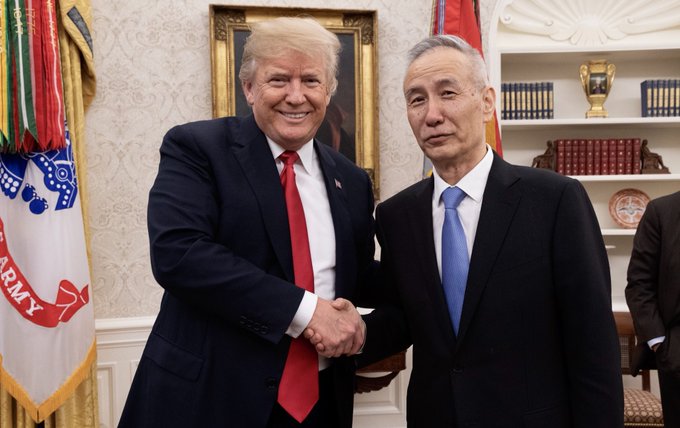
Donald J. Trump
✔@realDonaldTrump
Talking trade with the Vice Premier of the People’s Republic of China, Liu He.

Ultimately, the fate of the trade war is up to Trump, and the tone he adopts: early this week, Trump said he would try to make sure ZTE got back in business, which has since led to a number of conciliatory gestures from Beijing. China’s antitrust regulators had delayed for months U.S. private-equity firm Bain Capital’s $18 billion deal for Toshiba Corp.’s memory-chip unit, but on Thursday the Japanese firm said regulators had allowed the deal to proceed. Chinese regulators also promised early this week to restart their review of U.S. chip maker Qualcomm Inc.’s bid for NXP Semiconductors NV, sending the price of NXP stock soaring and preventing a round of (metaphoric) suicides among the US hedge fund community where NXP is one of the largest M&A arbs around.
In return for relief on ZTE, China – which is one of the world’s biggest importers of US farm products – would agree to hold back penalties on a variety of U.S. agricultural products it announced in early April as retaliation for U.S. tariffs on Chinese steel and aluminum exports.
Finally, with the recent “elimination” of Peter Navarro from Trump’s inner circle of advisors, it appears that the trade war with China – which erupted right after Navarro’s unexpected promotion in the Trump administration, and resignation of Gary Cohn – is about to return to its prior, dormant state as the status quo wins again and US trade relations with Beijing – for better or worse – remain virtually unchanged.
Mnuchin: US-China Trade War “On Hold”, But NAFTA Still “Far Apart”
In what looks to us like confirmation that the US has officially kicked the can down the road, Treasury Secretary Steven Mnuchin said Sunday that China and the US were putting a trade war “on hold” as the two sides work to hammer out a comprehensive trade agreement that will be acceptable to both sides.

Mnuchin, who was in Beijing last week for trade talks with top Chinese officials, emphasized that Trump isn’t giving up on holding China accountable – the process is just taking longer than some had hoped.
“Right now Chris we’re going to put the trade war on hold…we made very meaningful progress and we agreed on a framework. The framework includes their agreement to substantially reduce the trade deficit by increasing their purchases of goods,” Mnuchin said, adding the two sides have agreed to numerical targets but the he didn’t want to disclose them.
“We’re putting the trade war on hold, right now, we have agreed to put the tariffs on hold while we try to executive the framework,” Mnuchin said.
Mnuchin’s comments come after China and the US on Saturday released a joint statement in which China proposed to “significantly increase purchases” of US goods.
Moving on to the subject of ZTE, which President Trump said he’d work to get ZTE “back into business” at the request of Chinese President Xi Jinping, Mnuchin said that “President Xi asked President Trump” to look into the situation at the Chinese telecoms giant, which isn’t a surprise, he said. Still, Mnuchin insisted that Trump wants us to be “very tough” on ZTE.
“The president wants us to be very tough on ZTE. And all he did was ask the secretary to look into this,” Mnuchin said, referring to Commerce Secretary Wilbur Ross.
Of course, while “no trade war with China” is the headline that the Trump administration wants investors to focus on, the real news is that there might not be a Nafta deal until next year as Mnuchin says we’re still “far apart” on Nafta.

Mnuchin added that Trump is more concerned with striking a good deal on Nafta than rushing something through this year.
“The president is more determined to have a good deal than he’s worried about any deadline…So, whether we pass it in this Congress or we pass it in the new Congress, the president is determined that we renegotiate NAFTA.“
Still, that doesn’t mean Trump won’t follow through on threats to withdraw from the pact or take other action, if he decides that’s the best option, Mnuchin indicated.
“He has all his alternatives. I’m just saying right now we’re focused on negotiating a good deal and we’re not focused on specific deadlines,” Mnuchin said.
“We’re still far apart, but we’re working every day to renegotiate this agreement.”
The Trump administration blew a Thursday deadline set by House Speaker Paul Ryan for finishing the agreement. Ryan had said the Office of the US Trade Representative would need to wrap up negotiations by May 17 in order for Congress to vote on it this year because of various statutorily mandated notification and consultation periods involved in the consideration of trade deals. However, Ryan later said there might be some “wiggle room”, hinting at a two-week extension of Congress’s Nafta deadline.
That represents a significant de-escalation from when the US had threatened to slap $150 billion in tariffs on Chinese imports to punish Beijing for violating American intellectual property. China has vowed to retaliate by slapping tariffs on everything from US soybeans to airplanes. Yet a meeting between Vice Premier Liu He and President Trump in Washington, as well as the meeting between Mnuchin and other US officials with senior Chinese officials in Beijing, has significantly dampened tensions as the US has likely realized that it can’t just strong-arm China into doing what it wants.
4. EUROPEAN AFFAIRS
trading Monday morning, Europe time zone
- Mnuchin puts the Chinese trade war on hold
- Euro falters
- Italian 10 yr bond yield rises to 2.39%
- Emerging markets routed
- Turkish lira plummets again
(courtesy zerohedge)
Futures, Dollar Surge As “Trade War Put On Hold”; But Euro, Italian Bonds, EMs Routed
All it took was 8 simple words, with little factual backing and no way of enforcement, to send global markets and US equity futures soaring overnight: “We are putting the trade war on hold,“ Treasury Secretary Steven Mnuchin said Sunday, refuting Trump’s prior skepticism, in which the president said he doubts China trade talks will be successful, and sending risk assets across the globe (even as most of Europe was closed due to Whit Monday) higher.

For those who missed it, on Sunday, US Treasury Secretary Mnuchin stated that US and China are putting the trade war on hold, while he added that previously announced tariffs on Chinese steel and aluminium, as well as USD 150bln of tariffs on other Chinese imports, would be placed on hold as discussions with China progress. US Treasury Secretary Mnuchin also stated that President Trump is more interested in obtaining a good deal with NAFTA partners rather than quickly concluding talks in time to be voted by Congress this year. US Trade Representative Lighthizer stated that US may still resort to tariffs and other measures such as restrictions on investment and export regulations unless China makes real structural adjustments to its economy.
At the same time, in a just as hollow vow, Beijing promised to “significantly” increase purchases of U.S. goods and services, without however mentioning a dollar figure, and focusing primarily on the energy sector, i.e., oil and refined products, something the world’s biggest oil importer would have done anyway.
These two hollow promises, which while representing a marked thaw in US-China trade relations, will do little if anything to change the complexion of bilateral trade between the two countries, and as Bloomberg writes this morning, “U.S.-China Trade Truce May Not Last With Differences Unresolved.” For now however, the world is delighted by this unexpected development, and as shown in the chart below, US equity futures spiked higher…

… and global markets are well in the green…

… although that may not even last the day, for one simple reason: recall that in recent months, the key “loophole” the Fed used as a hint it may halt the tightening cycle was fears about trade war. Well, now that “trade war is on hold”, the Fed no longer has an alibi to halt, or even slow the rate hikes, which means a strong dollar, which means higher short rates, which means a potentially catastrophic volatility eruption on the short end, as Deutsche Bank laid out over the weekend in the following flowchart.

And sure enough, while stocks are sharply higher, the FX dynamics continue to deteriorate for the emerging markets, with the Bloomberg Dollar Spot Index building on recent gains following the “trade truce”…

… which has also sent the yen to a four-month low, while lingering concerns over Italian politics push the euro below 1.1720 for the first time since December.

The ongoing dollar spike also pushed the pound to the lowest level since December 28 amid lingering U.K. political uncertainties. Higher U.S. yields also support the greenback during another session in the red for emerging-market currencies, where the relentless rout of the past month continues with another bloodbath in the EM FX screen, with Turkey once again hit the hardest as the Borsa Istanbul 100 Index drops 0.3% in early trading as the Turkish lira weakens to a record low and 10-year bond yields hit an all-time high.

Threatening to spoil today’s party, a somber analysis from Macquarie Bank notes that the greenback will nudge higher against emerging-market currencies from current levels as the U.S. trade policy remains a concern: “There will be some pressure” on EMs from a stronger dollar and rising USTs, although the market is still “quite far away” from calling the selloff a crisis, Nizam Idris, head of strategy for fixed income and currencies in Singapore, told Bloomberg TV. There’s a “significant sigh of relief” among investors in Asia following the trade truce, although “the relief today was very cautious” as it will be “near impossible” for China reduce U.S. trade deficit by $200BN by merely importing more American products.
Meanwhile, speaking of Italy, as we reported on Sunday, the country’s populist leaders are set to propose a cabinet as early as today, with Florence University law professor Giuseppe Conte the pick for Prime Minister. However what the market is more worried about is the risk of Italeave rising now that Rome may implement a parallel currency: indeed, Italian bonds slipped amid “mini-BOTs” speculation, with the 2Y yield soaring while a flight to core European safety meant German bunds were better bid. And while Italy’s FTSE MIB index did fall as much as 2.1%, most of this was the result of about half of the stocks on the 40-member benchmark trading ex-dividend, with an impact of -1.7% at the open.

Yet despite the growing risk of another Italian crisis, European markets are surging, facilitated by the slump in the Euro, which has buoyed exporters. In company-specific news, Ryanair said annual earnings are set to slump for the first time since 2014 after a pilot shortage compelled it to give in to demands for union recognition and sweetened contracts. Elsewhere the FTSE 100 hit record highs with some credit attributed to FX effects. Sectors are all in the green with outperformance in consumer discretionary and underperformance in financials. In stocks specifics, FTSE 100 heavyweight AstraZeneca (+2.3%) shares are higher amid the FDA approving a treatment. Note that European volumes are muted as many European markets including Germany, Switzerland, Denmark and Norway are closed today.
“The continued buoyancy in European markets is being helped in no small part by the weakness in both the euro and the pound against the U.S. dollar, while concerns about an escalation in tensions between China and the U.S. appear to have been deferred in the short term after progress in trade talks at the weekend. This deferral of tensions should see markets in Europe get off to a positive start this morning with the FTSE 100 on course to open at a record high,” wrote CMC Markets chief market analyst Michael Hewson.
Earlier in Asia, market traded mostly positive, with the Nikkei 225 (+0.3%) benefiting from a weaker yen, while the ASX 200 (-0.1%) lagged behind its regional peers with upside capped by weakness in its largest weighted financials sector as the Royal Banking Commission shifts its attention to Westpac’s business lending practices. Shanghai Comp. (+0.6%) and Hang Seng (+0.6%) outperformed with Chinese bourses the main benefactor of the reduced trade tensions following the postponement of US trade war.
In other overnight news, President Trump spoke with South Korean President Moon regarding North Korea in which they agreed to work together for a successful summit, while Moon will be visiting the White House on Tuesday to coordinate on the summit. Iran pledged to adhere to the nuclear agreement if EU helps it offset US sanctions.
Looking at commodities, oil is currently higher with both WTI and Brent +0.3% in-fitting with the broader risk-picture, albeit off best levels alongside fluctuations in the USD. Energy newsflow remains light with the only commentary of note being from IEA’s Birol who stated that he sees initial signs of a slowdown in oil demand and they are ready to act. Elsewhere, gold is at 5 month lows as the USD prints fresh YTD highs with demand for the safe-haven dampened by the risk tone which was also the key factor that propped up copper prices (+0.1%) overnight, especially considering the outperformance in its largest consumer China. Iron ore is currently down 3%, falling for the fourth straight session on restocking delays in steel mills which has also weighed on steel prices, currently down 1%
A handful of companies is set to report earnings, and data on the Chicago Fed national activity index is also expected. Three speakers form the US Federal Reserve crowd the agenda today, and the minutes of the last FOMC meeting will be released on Wednesday.
Bulletin Headline Summary from RanSquawk
- European bourses trading largely positive following an improved risk tone after US/China détente
- Italian/German 10-Year yield spread at widest point in 7 months ahead of Italian Premier announcement
- Looking ahead, highlights include, Fed’s Bostic, Harker and Kashkari
Market Snapshot
- S&P 500 futures up 0.6% to 2,729.00
- STOXX Europe 600 up 0.3% to 395.90
- MXAP down 0.2% to 174.05
- MXAPJ up 0.1% to 567.48
- Nikkei up 0.3% to 23,002.37
- Topix down 0.08% to 1,813.75
- Hang Seng Index up 0.6% to 31,234.35
- Shanghai Composite up 0.6% to 3,213.84
- Sensex down 0.6% to 34,654.35
- Australia S&P/ASX 200 down 0.05% to 6,084.49
- Kospi up 0.2% to 2,465.57
- Brent Futures up 0.3% to $78.71/bbl
- Gold spot down 0.7% to $1,284.69
- U.S. Dollar Index up 0.3% to 93.90
- German 10Y yield fell 2.3 bps to 0.556%
- Euro down 0.3% to $1.1743
- Brent Futures up 0.6% to $78.94/bbl
- Italian 10Y yield rose 11.2 bps to 1.968%
- Spanish 10Y yield rose 2.1 bps to 1.464%
Top Overnight News
- Italy’s two populist parties agreed on a prime minister, sealing a government deal amid a warning by France to avoid putting the euro area’s stability at risk. The Corriere della Sera newspaper reported that it’ll be Giuseppe Conte, a 54-year-old law professor at Florence University
- The newly-declared economic truce between the U.S. and China will prove temporary if the world’s two largest economies fail to deliver on vague commitments to rebalance trade. “We’re putting the trade war on hold,” Treasury Secretary Steven Mnuchin said Sunday. “Right now, we have agreed to put the tariffs on hold while we execute the framework.”
- Brexit supporters “fearing betrayal” over a new customs plan should trust Prime Minister Theresa May to deliver on her promises as the U.K. prepares to leave the European Union, Foreign Secretary Boris Johnson said
- President Nicolas Maduro won another six-year term as millions of Venezuelans boycotted the widely derided election, a victory that hands him sole ownership of the nation’s crushing economic crisis.
- London remains a weak spot in the slowing U.K. housing market as Brexit clouds the outlook, reports Monday showed. The capital had an annual price decline of 0.2 percent in May, property website Rightmove said on Monday
- Northern Europe’s claim for a turn at leading euro-area monetary policy in the era after Mario Draghi advanced over the weekend as two of its contenders dropped hints that they’re waiting to be asked
- Indonesia’s central bank pledged to continue its intervention in the currency and bonds market to ease volatility, and said it will boost forex liquidity as the rupiah slumped to a fresh 31-month low
Asian equity markets traded mostly positive with sentiment underpinned following the conclusion of the 2nd round of US-China trade talks in which China agreed to purchase more goods to avoid a trade war but stopped short of indicating an actual amount it plans to reduce the deficit by. More importantly, US Treasury Secretary Mnuchin announced that tariffs on China would be placed on hold as discussions progress, which eased trade concerns and saw the E-mini S&P gap higher by 0.6% while DJIA futures gained over 200 points. Nikkei 225 (+0.3%) benefitted from a weaker currency, while ASX 200 (-0.1%) lagged behind its regional peers with upside capped by weakness in its largest weighted financials sector as the Royal Banking Commission shifts its attention to Westpac’s business lending practices. Shanghai Comp. (+0.6%) and Hang Seng (+0.6%) outperformed with Chinese bourses the main benefactor of the reduced trade tensions following the postponement of US trade war. Finally, 10yr JGBs were subdued amid gains in stocks and early pressure in T-notes at the open as participants reacted to the trade-related developments, although the latter has since recovered amid reports of block buying from intraday lows.
Top Asian News
- Malaysia Brings Back Old Graft Fighters for 1MDB Task Force
- UltraTech Cement, Bajaj Finance Options See Greater Demand
- Indonesia to Step Up Intervention as Currency, Bonds Slide
- Hitachi Willing to Buy Elliott’s Stake in Ansaldo STS: Corriere
- Hyundai Shelves $8.8 Billion Deal After Elliott Pressure
European equities trade higher (FTSE 100 +0.8%, CAC 40 +0.7% and IBEX +0.3%) with the absence of German and Swiss stocks in light of Whit Monday. Italy is in focus as the populist leaders agreed on a choice of Premier and cabinet for a coalition government. The party leaders are to meet with Italian President Mattarella this afternoon. Recent reports state that the President does no see any obstacles to a Giuseppe Conte Premiership. Elsewhere the FTSE 100 hit record highs with some credit attributed to FX effects. Sectors are all in the green with outperformance in consumer discretionary and underperformance in financials. In stocks specifics, FTSE 100 heavyweight AstraZeneca (+2.3%) shares are higher amid the FDA approving a treatment.
Top European News
- Ryanair Warns Rising Fuel Costs Will Lead to Shakeout
- London Housing Slump Deepens as Brexit Slows U.K. Property
- Italy President to Meet Five Star, League Leaders This Afternoon
- Front- End BTPs Slump Amid Speculation of ‘Mini-BOT’ Issuance
- Pound Slides to This Year’s Low as Brexit to Italy Risks Weigh
In FX, the index has now crossed over 94.000 amidst broad Usd gains on the back of a semi-successful conclusion to the latest trade talks between the US and China. In short, concessions have been made on either side and a truce called on tariffs pending further discussions to reach a mutual agreement and ultimately rebalance the lop-sided trade accounts. For the record, 94.064 is the fresh multi-month DXY high and chart-wise 94.200-219 is the next upside target (Fib level), as latest CFTC data reveal a further reduction in short vs all counterparts aside from the Jpy and Cad. JPY Stops have finally been tripped at 111.20 vs the Dollar and the obvious nearest bullish objective is 111.50 vs a circa 111.39 peak so far where barrier option offers are reported. 111.00 now becomes support. JPY: Stops have finally been tripped at 111.20 vs the Dollar and the obvious nearest bullish objective is 111.50 vs a circa 111.39 peak so far where barrier option offers are reported. 111.00 now becomes support. EM: No respite for the likes of the Lira, as Usd/Try jumps to just shy of 4.5600 and the Turkish authorities only offer words to address the situation and little tangible to arrest the currency’s slide. Many market observers are now eyeing even more record lows for the Lira unless the CBRT takes decisive/dramatic policy action on June 7.
In commodities, oil is currently up with both WTI and Brent +0.3% in-fitting with the broader risk-picture, albeit off best levels alongside fluctuations in the USD. Energy newsflow remains light with the only commentary of note being from IEA’s Birol who stated that he sees initial signs of a slowdown in oil demand and they are ready to act. Elsewhere, gold is at 5 month lows as the USD prints fresh YTD highs with demand for the safe-haven dampened by the risk tone which was also the key factor that propped up copper prices (+0.1%) overnight, especially considering the outperformance in its largest consumer China. Iron ore is currently down 3%, falling for the fourth straight session on restocking delays in steel mills which has also weighed on steel prices, currently down 1%
Looking at today’s calendar, it is a fairly quiet start to the week with the main highlights being the afternoon and evening Fedspeak when Bostic, Harker and Kashkari all speak separately. Datawise, the April Chicago Fed national activity index in the US is due. Elsewhere, the ECB’s Nowotny and Riksbank’s Jansson are also due to speak.
US Event Calendar
- 8:30am: Chicago Fed Nat Activity Index, est. 0.5, prior 0.1
- 12:15pm: Fed’s Bostic Speaks to Atlanta Economics Club
- 2:05pm: Fed’s Harker Speaks in New York
- 5:30pm: Fed’s Kashkari Speaks at Moderated Q&A in Escanaba, MI
DB’s Jim Reid concludes the overnight wrap
It looks like many of the tariffs agreed by the US and China could be ripped up too after this weekend’s positive joint announcement, although it seems that the US may be keeping some glue handy in case they decide that China is not meeting its obligations. The statement highlighted a consensus to “substantially reduce the US trade deficit in goods with China”. China promised to “significantly increase purchases of US goods and services”. There was no numerical target nor timeline though. One specific was that China promised to buy more agricultural and energy products. However as our Chinese economists pointed out, China’s imports of these products from the US were USD 26bn in 2017. The bilateral trade deficit was 375bn. The head of Chinese delegation, Mr Liu He, said in an interview that both sides agreed not to fight in a trade war, and stop imposing incremental tariffs on each other. The US response was a little more guarded with Trump’s advisor Kudlow not confirming that tariffs were on hold but Treasury Secretary Mnuchin later said that “We’ve decided to put the trade war on hold. So right now, we have agreed to put the tariffs on hold while we execute a framework”. He also added the US expects an increase of 35-40% in agricultural exports this year to China and a doubling of energy exports over the next 3-5 years.
Overall, our Chinese economists think that the trade war may be suspended for now, but doubt it has ended. Their future direction may depend on non-economic issues such as geopolitical risk in the Korean peninsula and the US midterm election. Overall while positive they think there remains a lot of unanswered questions. See the link for more.
This morning in Asia, markets are broadly higher with gains from the Hang Seng (+1.23%), Nikkei (+0.37%) and Kospi (+0.26%) while the ASX 200 is marginally lower. Elsewhere, futures on the S&P are also up c0.5% following the more reassuring comments from Secretary Mnuchin while UST 10y yields are up c1bp. Datawise, Japan’s April trade surplus was above expectations at JPY626bn (US $5.6bn vs. JPY440bn expected) as exports outpaced a weaker than expected growth in imports (5.9% yoy vs. 9.8% expected).
The other big weekend story was the latest developments in Italy. The head of League Party Mr Salvini said “we closed the deal (with 5SM) this morning on the candidate for Premier and Ministers, so we’re ready to get started”. He added the government will include “unexpected” external figures, to which Bloomberg reported that Florence University law professor Giuseppe Conte may emerge as the Premier and the cabinet make up to be revealed as early as today. Elsewhere, French Finance Minister Bruno Le Maire warned that “if the new (Italian) government took the risk of not respecting its commitments on debt, the deficit…the financial stability of the entire Euro zone will be threatened”. Subsequently, the League’s Salvini tweeted the warning from France was “unacceptable” interference and added “Italian first!” So still lots bubbling along. As a reminder the spread between 10y BTPs and Bunds is now at 165bp, the highest since mid-October.
The focal point data wise this week will likely be the latest global flash PMIs (Wednesday), especially those in Europe. In terms of expectations, the consensus for the Eurozone manufacturing reading is 56, which follows the 56.2 reading in April and a 60.6 high print back in December. The composite print for the Eurozone is expected to be flat mom at 55.1. The PMIs in the US are also expected to be broadly stable mom, with the consensus for the manufacturing print expected to be 56.5 for April. Elsewhere the FOMC minutes on Wednesday evening from the May 2nd meeting will be closely watched. The statement at the time arguably moved us incrementally in a more hawkish direction. It also included use of the word ‘symmetry’ in relation to the 2% inflation objective, so it’ll be interesting to see if this is fleshed out at all. Indeed, our US economists saw the meeting statement as a first step towards altering the balance of risks language and expect to learn more from the minutes. As we know, since the meeting we have had some disappointing inflation readings in the US (CPI and average hourly earnings), however, bond yields have continued to march higher. The rest of the global week ahead is included at the end.
Now recapping other markets performance from Friday. In equities, the Stoxx 600 dipped -0.28% on Friday, but was up for the 8th consecutive week (+0.58%), buoyed by energy stocks over this period. The S&P weakened -0.26% on Friday, weighed down by energy and financial stocks. In FX, the US dollar index firmed for the fifth day (+0.18%) while the Euro and Sterling weakened -0.19% and -0.35% respectively. Elsewhere, precious metals strengthened slightly (Gold +0.17%; Silver +0.06%) while other base metals were mixed but little changed.
Over in government bonds, the yields on UST 10y fell for the first time in six days (-5.5bp) to 3.057% while Bunds (-6.0bp) and Gilts (-6.3bps) also rallied. There wasn’t really an explanation for the sharp reversal after a bearish week for bonds.
Elsewhere, yields on 10y Italian BTPs jumped +11bp on Friday and c36bp for the week, so the flight to safety effect may have also played its part. Now moving onto Iran and the US sanctions. Reuters reported that Iran will join a meeting this Friday with diplomats from the UK, Germany, France, China and Russia to discuss next steps following the US withdrawal from the nuclear accord.
Ahead of this, the German newspaper Welt am Sonntag cited unnamed senior EU officials who noted that the possibility of “….adding a few additional elements (to the accord). Only that will convince President Trump to agree and lift sanctions again”.
Before we take a look at today’s calendar, we wrap up with other data releases from Friday. Germany’s April PPI was above market at 2.0% yoy (vs 1.8% expected), while the Euro area’s March trade surplus was marginally higher than expectations at €21.2bln (vs. €21.0bln). Over in Canada, both its core and weighted median April CPI were in line at 1.9% yoy and 2.1% yoy respectively. Overall, the average reading across the measures is now 2.0% – a pace last exceeded in February 2012.
Looking at Monday’s events, it is a fairly quiet start to the week with the main highlights being the afternoon and evening Fedspeak when Bostic, Harker and Kashkari all speak separately. Datawise, the April Chicago Fed national activity index in the US is due. Elsewhere, the ECB’s Nowotny and Riksbank’s Jansson are also due to speak.
end
Tom Luongo lays out a scenario that might come to pass with respect to Italy and Germany. Italy wants debt reduction, Germany wants to end the Russian sanctions. Tom believes that Italy will vote to end the Russian sanctions by July to which Germany will second and that will end it. You need all finance minister’s affirmative voting so allow sanctions to continue. Then debt consolidation will start.
(courtesy Tom Luongo)
Italy Is Forming The Epicenter Of The EU’s Fateful Shift
Clarity is here in Italian coalition talks. And the markets hate what they see. So does Brussels.

Five-year Italian debt blew out over 1%, CDS spreads have moved over 20 basis points in a week. The markets are trying to scare these outsiders now in charge in Italy to soften their stances on reform and maintain a status quo which is destroying a great country and culture.
The League and Five Star Movement leaked demands for $250 billion in debt relief from the ECB. There was also a demand for developing a mechanism for countries to leave the euro, according to a, now discredited, report from Reuters.
The final proposal doesn’t have any of this inflammatory language, but don’t think the leak wasn’t part of their negotiating strategy or part of where they are ultimately going to push things.
Because the rest of the proposal is already hostile enough to Brussels (see below). And with ECB President Mario Draghi now signaling the need to consolidate European sovereign debt under its umbrella, it isn’t necessary at the moment.
Here’s Martin Armstrong’s take:
So everyone else understands what this is about, the ECB President Mario Draghi has come out and proposed interlocking the euro countries to create a “stronger” and “new vehicle” as a “crisis instrument” to save Europe. He is arguing that this should prevent countries from drifting apart in the event of severe economic shocks. Draghi has said it provides “an extra layer of stabilization” which is a code phrase for the coming bond crash. [emphasis mine]
That tells me that Draghi understands how bad things truly are and that Italian leadership knows they have the upper hand in debt negotiations.
They are prepared to push Brussels hard to get what they want. And well they should. League leader Matteo Salvini understands how ruinous the euro as administered by Germany has been for Italy and most of Europe.
So, to him, if the price for Italy to stay in the EU is to force the northern countries to accept debt consolidation and write-down then so be it.
If they won’t agree to that, then Italy’s new leadership is prepared to back to the people and say, “We tried. Screw them. Let’s walk.”
All of this says to me they sand-bagged the press and the political establishment to get to this point.
Reconciling Divisions
The coalition proposal is a mishmash of right and left policy prescriptions that will drive the IMF and Brussels mad. But, these two very different parties have to come to some agreement if they are to wrest control of Rome from the insanity of the status quo in Europe, which serves no one’s ends except the globalists which stand behind the public faces of the EU – Juncker, Merkel, Tusk, Macron, etc.
The League is a former secessionist party that served the northern regions of Veneto and Lombardy with talks of fiscal responsibility and far lower taxes. The while Five Star Movement has grown out of the hollowing out of Southern Italy’s economy and social fabric from political rot emanating from both Rome and Brussels.
One is calling for lower taxes and regulation, the other wants generous pensions and universal income. These are not easy differences to overcome. But they have, to no one’s satisfaction. That, however, is the price for such an eclectic mix of policy positions.

That said, they are clearly together on the two most important issues facing Italy’s future, immigration and Italy’s place within the EU.
Both parties want to put Italy first. And the legislative program now proposed looks to be in that vein, while not looking (at first glance) too radical. From Zerohedge’s writeup this morning:
- Seeks 15% and 20% tax rates for companies and people
- Seeks guaranteed minimum income for poorer Italians
- Universal basic income of €780 per person per month, funded in part through EU
- Seeks end to Russia sanctions
- No mention of a referendum on membership of either the EU or the euro
- Agreement to meet the goals of the Maastricht Treaty
- No plans to ask the ECB to cancel debt
- Calls for airline Alitalia to be relaunched
- Seeks to scrap Fornero pension reform
- Flat tax to become a dual rate with deductions
- Seeks a strong contribution to EU immigration policy
- Plan calls for redefining of lender Monte dei Paschi di Siena’s mission
The highlighted ones are the most important, while the markets focus on the tax changes and universal income.
Forget those. If Italy can get the EU to lift Russian sanctions, take immigration policy away from Angela Merkel and provide a blueprint for dealing with insolvent Italian banks those would be titanic wins.
These are the issues at the heart of the EU’s foundational problems – its lack of banking cohesion and anti-democratic bureaucracy.
The Soft Sell To Italeave
So, while all of this looks like they’ve caved on the most extreme positions, in effect, they have not. Italy’s budget is getting crushed by the cost of Merkel’s Migrants. Both parties obviously feel that growth can return to the Italian economy within the euro by radically lowering taxes to reprice Italian labor lower. This would put it at an advantage relative to Germany while remaining within the euro.
Then issuing a new parallel currency, the Mini-BOT, to circulate domestically to lessen the need for euros within the domestic economy and free up Italy’s budget issues with respect to its debt servicing needs.
What I’ll say about that is with yields spiking, the Mini-BOT better get off the ground soon because Italy’s debt servicing is extremely low thanks to the ECB’s negative interest rate policy (NIRP). And once the dollar begins rising here the decisions for debt relief and consolidation may be out of any one group’s hands.
Merkel’s Out of Time
The problem now is time. Donald Trump’s pressure policy on Iran and Russia is creating the kind of uncertainty no one can forecast. It is forcing a decision on European leadership to come together and declare opposition to Washington’s diktats and forge an independent identity while at the same time look to truly end the cultural divisions and distrusts which have led to this moment thanks to a lack of fiscal unanimity.
It is clear to me Italy’s new leadership understands this with the sum and substance of these policy points. It believes it can re-align Italy’s domestic policies in Italy’s favor while forcing Brussels to face the responsibility of leading Europe forward in a way which is far more equitable than in years past.
Perhaps that’s why Angela Merkel visited Russian President Vladimir Putin for a second time in two weeks after only sending representatives for the past four years. They weren’t just talking about the Iran deal.
No that meeting was all about getting Germany out from under Trump’s thumb while not incurring his wrath. Putin’s long-game of diplomatic patience was the right path from the beginning. It’s always bet to let your opponent bluff and bluster, beat their chests and make demands they can’t enforce.
Eventually those watching realize it is all just hot air. And as time passes the cost of resistance to the bully falls and the benefits of joining a new group rise. For Germany it is energy. Russian Gas and Iranian oil are necessary for Germany to maintain its competitiveness and Trump is undermining both of these with his lack of diplomacy.
Merkel’s refusal of his proposed tariff concessions to ditch the Nordstream 2 pipeline and buy more expensive LNG from Cheniere Energy was more important than people think. There’s no reason for Merkel to believe that U.S. policy under Trump or any future president won’t do an about face. Meanwhile, pipelines are practically forever.
And Merkel is savvy enough to put her ego aside over having been outmaneuvered by Putin over Ukraine and hold the line on Nordstream 2.
The Big Reversal
Merkel has an out here. And Italy just handed it to her. I’m not sure she’s smart enough to see it.
The ECB wants debt consolidation and greater control. For the EU to survive this is necessary. Germans and the rest of the northern countries don’t want to be seen bailing out the “Club Med” countries. That would be interpreted as yet another submission to Washington and New York. Merkel cannot go through horrific debt relief talks like she did with Greece in 2015. It would destroy what’s left of her political capital. If she stands tall against Trump over Iran, however, she gains a lot. The uncertainty over how Trump will react sends the euro down, pressuring the ECB to finally move on dealing with the debt.
Europeans want normalized relations with Russia and open trade, especially German industry. There are tens of billions in investments in Russia and Crimea waiting for the sanctions to end to travel to Russia, especially with such a weak Ruble, thanks to Trump’s moronic sanctions.
Only Poland and the Baltics don’t. But, they don’t matter. It only takes one finance minister to vote against extending Russian sanctions to end them. If Merkel stands up to the U.S. on Iran, it makes it easier for Italy to force Germany to stop bullying everyone into maintaining them.
Italy drops the bombshell to end the Russian sanctions in July. Merkel “reluctantly” goes along with this. Nordstream 2 worries go away. The EU and Russia form a united front against more U.S. belligerence in Ukraine.
During Monte dei Paschi debt restructuring talks Merkel and Draghi introduce new mechanisms for debt consolidation as a model for the future.
Do I think this is the most likely scenario? No. But it is one that could come to pass if Merkel reads the shifting political winds properly. If she begins thinking in Germany’s best long-term interests then some version of this is exactly what she’ll do.
And she’ll have the hated euroskeptics from Italy to thank for saving her legacy and Europe from further political and economic marginalization.
end
Monday trading/Europe
10 yr Italian bond spikes to 2.39%
(courtesy zerohedge)
Italian Bonds, Banks Bloodbath As ‘Mini-BoT’ Massacre Continues
It would appear that investors in Italian assets have “more to fear that fear itself” as the mention of ‘mini-BoTs’ – and the implicit parallel currency nature of these short-dated IOUs – has spooked Italian banks, Italian bonds, and Italian credit risk dramatically…
“The market will remain on somewhat of a knife edge as regards the intended plans and as the coalition government itself evolves,” Rabobank International strategists led by Richard McGuire wrote in a note.
“The fiscal credibility of the plan is far from guaranteed.”
2Y Yields are spiking…

10Y Yields are spiking…
Italy Generic Govt 10Y Yield
News
“Italian bonds are not the right long for those with market-to-market issues right now,” said Chatwell. “Instead, being long core bonds, and increasing duration, is the better risk-reward.”
Italian bond risk is spiking…

“What is seen as a de facto parallel currency would be a major negative development for the euro should any new Italian government seek to pursue it,” wrote Viraj Patel, a foreign-exchange strategist at ING Groep NV in London in a note to clients.
“A further widening in spreads would place downward pressure on euro-dollar.”
And perhaps most notable is that very short-dated CDS premia are exploding – signifying growing concerns that an Italian Euro is NOT worth the same as German Euro…

All of which is bettering Italian banks…

Italy’s banks are bearing the brunt of the selloff in the country’s assets, and things may get rose before they get better. Apart from banks’ underperformance in equity and credit markets, another risk comes from BTPs themselves.
Italian lenders hold almost EU350 billion of sovereign bonds, or 10% of their assets in sovereign bonds on average — that’s much higher than Germany’s 3.7% and France’s 2.2%, according to Bloomberg Intelligence. The banks’ low valuation compared with European peers may not yet be attractive to investors, “given the threat of fiscal easing remains,” BI analysts note.
As Chuck Schumer would have said… “Get back to work Mr. Draghi…”
end
EUROPEAN close
1 USA futures plunge
2. italian bonds crash the most with the Italian 10 yr bond yield closing at 2.39%
US Stocks Plunge As Europe Closes, Italian Bonds Crash Most In 4 Years
No headlines, no catalyst, just the close of the European trading session… and US equities tumble…

Did The Fed drop the buying-baton from The ECB?
It seems The ECB was overwhelmed in its own markets.
Italian 2Y Yields exploded higher (biggest single-day spike in 2Y Yield since Oct 2014)…
And Italian 10Y Yields are at their highest since Nov 2014… so bad that they are only 70bps tighter than US bonds.

Idiosyncratic risk is blowing out.

Italy’s short-term risk premium to Germany is now at 90bps – almost four times its recent norms.
(courtesy zerohedge)
Italy Has A New Government As Populist Parties Agree On New Premier
Taking the biggest step toward forming Italy’s next government, the head of the anti-immigration League party Matteo Salvini said he’s reached a deal with Five Star leader Luidi Di Maio on forming a populist government, and picked a premier.
According to a report in Corriere, Florence University law professor Giuseppe Conte was chosen as prime minister, while Matteo Salvini would be proposed as interior minister, and Five Star head Luigi and Di Maio would be labor minister.

On Saturday, Il Messaggero reported that Salvatore Rossi, the Bank of Italy’s director general, could be picked as finance minister.
Today, Ansa added that according to Di Maio, Five Star will head joint ministry of economic development and labor; separately Giancarlo Giorgetti, Matteo Salvini’s right-hand man, will be proposed as economy minister, while Nicola Molteni would become minister of the infrastructure and transport and Gian Marco Centinaio would head the department of Agriculture and Tourism.
ANSA added that Salvini will present the proposal to President Sergio Mattarella on Monday.
As Bloomberg adds, the endgame follows a week of turmoil in Italian bonds and stocks triggered by reports about the coalition’s spending plans and rejection of European Union budget rules. Italy’s 10-year yield spread over German bonds shot up to 165 bps on Friday, the most since October, prompting a warning from Paris. French Finance Minister Bruno Le Maire said in a Sunday interview with Europe 1 radio that “if the new government took the risk of not respecting its commitments on debt, the deficit and the cleanup of banks, the financial stability of the entire euro zone will be threatened.”
Salvini fired back on Twitter, suggesting the warning was “unacceptable” interference. “Italians first!” he said, clearly referencing Donald Trump.
While Italian risk assets were sold off last week, in a move which many were surprised hadn’t taken place much sooner, the official formation of a new government may prompt further selling when Europe opens for trading on Monday, especially now that Europe has had more time to familiarize itself with Italy’s new currency plan, the “Mini-BoT”, which we profiled on Friday, and which the pro-establishment Financial Times already slammed as a “menace” which “may split the euro.”

For more on the Mini-BoT plan, please read “Meet ‘Mini-BOT’: Italy’s New Parallel Currency Plan.”
5. RUSSIAN AND MIDDLE EASTERN AFFAIRS
(courtesy zerohedge)
Did Putin Just Ask For Iran’s Exit From Syria In Meeting With Assad?
Syrian President Bashar al-Assad paid an unannounced visit to Vladimir Putin on Thursday evening at the Russian president’s summer home in the Black Sea resort city of Sochi where the two leaders discussed the process for winding down the war in Syria, and notably the reduction of foreign troop presence in the country.
This marks the third such known meeting inside Russia between Assad and President Putin since 2015, and the first since two major instances of external airstrikes on the Syrian government dramatically escalated the prospect for broader war. The first was the April 13th US-led coalition attack involving over one hundred missiles on sites in and around Damascus; and the second was the May 10 Israeli attack on dozens of targets inside Syria in what was the biggest military escalation between the two countries in decades.

No doubt the two leaders, both long branded international pariahs by the West, had a lot to discuss after the uptick of external military action in Syria, but likely looming larger was the Iran and Israel question, and Israel’s continued threats of attack should its “Iranian red line” go unenforced.
Recall that a mere week ago Netanyahu concluded a 10-hour visit with Putin in Moscow just as Israeli jets were in the air beginning strikes against Syrian bases said to house Iranian troops.
And crucially, Syria’s state-run SANA has confirmed that Putin told Assad during the meeting that “foreign armed forces” would leave Syria.
The official readout of the meeting quotes President Putin as saying, “We affirm that with the achievement of the big victories and the remarkable successes by the Syrian Arab army in the fight against terrorism and with the activation of the political process, it is necessary for all foreign forces to withdraw from the Syrian Arab Republic territories.”
This is a reference to the still ongoing but thorny Astana, Kazakhstan centered talks involving Russia, Turkey, and Iran which has been by and large rejected by the vast majority of anti-Assad fighters, especially due to Iran’s contentious role as a main guarantor of the deal.
For this reason most media outlets commenting on Putin’s reference to “foreign forces” interpret this as a jab at key Syrian ally Iran; however, a number of Middle East based journalists and analysts point to US occupying forces in Syria’s northeast, as well as Turkey’s military and armed proxy groups in the formerly Syrian Kurdish Afrin canton near Aleppo, and the tens of thousands for foreign jihadists that continue to fight in Syria — many of them state sponsored by Saudi Arabia and other external actors.
The Washington Post and CNN, for example, focused on Iran and Hezbollah as key foreign forces that have “helped to prop up the embattled President [Assad].” The Post’s Liz Sly said, “In the context of current debates for a [political] settlement, that’s code for Iran. No indication whether Assad agreed.”
Liz Sly
✔@LizSly
Putin to Assad in Sochi tonight: “Foreign armed forces will be withdrawn from the territory of the Syrian Arab Republic.” In the context of current debates for a settlement, that’s code for Iran. No indication whether Assad agreed. The Kremlin readout: http://www.kremlin.ru/events/president/news/57488 …
Заявления по итогам российско-сирийских переговоров
kremlin.ru


However former Sunday Times journalist Hala Jaber countered that Putin did not refer to Iran or other Syrian allied forces: “Iran‘s presence is not viewed in the same league as that of the U.S. and as such is not negotiable nor will be used by Syria as an exchange commodity… U.S. presence is viewed as totally illegal…[there’s] no comparison” she wrote.
Notably, Assad’s statement while meeting with Putin named “illegal foreign forces” compared with Putin’s mention of “foreign forces.” Jaber further argued that “the reference by both Putin and Assad relates to both Turkish and U.S. forces and not Iran, which has a defense agreement with Syria… its current presence is not part of any such deals to be made.”
Liz Sly
✔@LizSly
Putin to Assad in Sochi tonight: “Foreign armed forces will be withdrawn from the territory of the Syrian Arab Republic.” In the context of current debates for a settlement, that’s code for Iran. No indication whether Assad agreed. The Kremlin readout: http://www.kremlin.ru/events/president/news/57488 …
Hala Jaber
✔@HalaJaber
Incorrect.. the reference by both Putin & Assad, relates to both Turkish & U.S forces and not Iran, which has a defence agreement with Syria.. it’s current presence is not part of any such deals to be made.

As we noted in the aftermath of Israel’s latest massive attack on multiple locations inside Syria, Russia has appeared content to stay on the sidelines while Syria and Israel lobbed missiles at each other; however, Russia is carefully balancing its interests in Syria, eager to avoid an uncontrolled escalation leading to a direct great power confrontation.
Though a number of Western analysts have interpreted Russia’s relative silence on the latest Israeli strikes (as well as apparent U-turn on prior indications that it would supply Syria with with S-300 missiles) as signs of a weakening Moscow-Damascus alliance, it is more likely that Russia is pleased with Syria’s current air defense systems, and sees the battlefield as increasingly stabilizing in spite of limited Israeli incursions, hence Putin’s desire of “stepping up the political process” as he confirmed Thursday.
As we reported, Syria’s current missile defense seems to have performed well. SANA indicated that the army’s air defenses had “shot down dozens of Israeli missiles, preventing most of them from reaching their targets,”however, some of the rockets managed to hit radars and an ammunition depot. But beyond this, the multiple videos purporting to show direct intercepts by Syrian defenses make for a convincing case that Syria still possesses robust deterrent capabilities.
Yet in typical fashion the mainstream media can only interpret all recent events as signs of Syrian-Russian weakness and increased internal tensions. Time will tell.
end
USA lays out its 12 demands for a new unclear Iran deal
(courtesy zerohedge)
US Lays Out 12 Demands For A New Nuclear Deal With Iran
The Trump administration escalated its demands on Iran on Monday while giving Tehran a possible loophole if it wants the US to return to the nuclear deal which President Trump unilaterally cancelled last month, laying out a list of demands that Iran has to satisfy for the deal to be restored, including a stop to all uranium enrichment and halt to Iran’s support for militant groups in the region.
The administration’s demands were outlined in a speech by Secretary of State Mike Pompeo, which for the first time spelled out all of the administration’s requirements for a new agreement. Pompeo laid out an onerous list of 12 “basic requirements” on Iran which toughened the nuclear demands and called for a wholesale change to Iran’s military posture in the region, that he says should be included.
Among the demands listed by Pompeo was that Iran must “stop enrichment” of uranium and never pre-process plutonium. Iran must also allow nuclear “unqualified access to all sites throughout the country.”
Pompeo also demanded that Iran must withdraw all of its forces from Syria, end its support for militant groups like Hezbollah in Lebanon, stop sending arms to the Houthi militia in Yemen, release all U.S. citizens, and cease its threats to destroy Israel.
Some of the requests were a bit more… bizarre:
Josh Rogin
✔@joshrogin
Pompeo calls on Iran to rejoin the “League of Nations” (which existed from 1920-1946)

As the WSJ notes, the 12 asks mark a fundamental change from the 2015 agreement between Iran and six world powers that President Donald Trump abandoned earlier this month but which European leaders have sought to preserve. That agreement allowed Iran to enrich uranium under detailed arrangements in return for sanctions relief.
Still, while the secretary of state said that the administration wouldn’t try to renegotiate the old Iran deal. Instead, he did just that by outlining the 12 basic requirements for the new deal.
“Relief from sanctions will come only when we see tangible, demonstrated, and sustained shifts in Tehran’s policies,” Mr. Pompeo said in prepared remarks. “We acknowledge Iran’s right to defend its people. But not its actions which jeopardize the world’s citizens.”
Pompeo said the demands were needed because of the broad nature of what he called Iran’s malign behavior. The U.S., he said, didn’t create the need for the demands, Iran did.
That said, it’s unlikely Iran will comply: critics say that the new approach is nonnegotiable and won’t garner strong support in Moscow, Beijing or European capitals.
“It’s a pipe-dream to believe the administration could achieve its wish-list of unrealistically ambitious negotiating objectives,” said Robert J. Einhorn, a former State Department official who was involved in Iran negotiations during the Obama administration.
Einhorn said the Trump administration’s new sanctions wouldn’t be as effective as the ones that the Obama administration was able to put in place with the support of U.S. allies and other nations.
Failing to reach an agreement on renegotiation, Pompeo threatened that the US would impose the “strongest sanctions in history” on Iran if the country failed to enter into a new nuclear deal on American terms.

NBC News
✔@NBCNews
Sec. of State Pompeo vows to hit Iran with “strongest sanctions in history” if its government does not change course.

We are confident that China, Russia and Europe are just waiting for this to happen so they can provide Iran with all the goods and services the nation may need now that it has been blacklisted by the US, Saudi Arabia and Israel.
6 .GLOBAL ISSUES
Canada’s debt spiral getting out of control
(courtesy Lee Friday/Mises Institute)
Canada’s Debt Spiral: Does Justin Trudeau Live In An Alternative Reality?
Authored by Lee Friday via The Mises Institute,
Living beyond our means requires us to borrow money to cover the difference between our income and our spending. Many Canadians now understand the financial consequences of this practice and regret the choices they’ve made. Unfortunately, Prime Minister Trudeau is not one of them, as evidenced by his government’s budget deficits which are further eroding the financial wellbeing of Canadians. He has broken a campaign promise, ignored basic economic principles, and seems hell-bent on setting an ignominious record. According to the Fraser Institute: “Justin Trudeau is the only prime minister in the last 120 years who has increased the federal per-person debt burden without a world war or recession to justify it.”

The Broken Promise
The Liberals had won the 2015 federal election with a pledge to run annual shortfalls of no more than $10 billion over the first three years of their mandate, and to eliminate the deficit by 2019-20.
The deficit for 2016-17, Trudeau’s first full fiscal year, was $17.8 Billion. The forecast for 2017-18 is $19.9 Billion, and for 2018-19, the forecast is $18.1 Billion.
And now, from the government’s 2018 budget, we read this:
While austerity can come from fiscal necessity, it should not turn into a rigid ideology about deficits that sees any investment as bad spending.
The government says deficits are economically beneficial, and compares deficits to loans taken out by entrepreneurs and business owners. But here’s the rub: in order to spend, the government must first raise money by taxing or borrowing (deficits). This deprives the private sector of money which would otherwise be available for businesses to borrow and invest in new production, thereby creating jobs and raising our standard of living.
Moreover, government ‘borrowing and spending’ imposes a financial burden on future taxpayers who must pay pay back both the loan and the interest payments. In contrast, repayment of private business loans imposes a burden on the entrepreneurs — and because entrepreneurs are held personally liable, they are incentivized to be prudent decision makers. Politicians, on the other hand, lacking personal liability, tend to be fickle, reckless, arbitrary, and wasteful.
Why Government Spending is Bad
When a private business earns a profit by converting various resources (labour, raw materials etc.) into products which consumers voluntarily buy, this means it has made efficient use of the resources. Wealth is created. In contrast, a private business incurs losses when it fails to persuade consumers to voluntarily buy its products, which means it is wasting resources. If the firm cannot improve, it will discontinue operations, thereby conserving resources for entrepreneurs who can use them efficiently.
Economic progress (wealth creation, rising living standards) comes from efficient allocation of resources through profitable enterprises, where consumers determine what gets produced. These are the basic economic principles which Justin Trudeau ignores.
Politicians can pander to special interest groups because profit/loss calculations do not exist within government. This prevents consumers (taxpayers) from expressing their preferences as they do in the marketplace, where they “vote with their dollars.” The government forces taxpayers to subsidize whatever it supplies, at a price it dictates, whether we want it or not. Thus, the government’s coercive taxing and spending tends to waste resources, which is economically counterproductive. And, as noted earlier, government spending reduces private investment.
As Charles Lammam and Hugh MacIntyre wrote in the Financial Post (emphasis added):
business investment in Canada has declined by a staggering 18 per cent (after accounting for inflation) since the end of the third quarter of 2014.”
Crucial to any plan to improve our country’s long-term economic prospects is encouraging private-sector investment, innovation and entrepreneurship … on this front, federal policy choices have been counterproductive.
And Morneau’s fiscal update makes clear that the government will continue to run persistent deficits and rack up more debt, which signals potentially higher taxes in the future (since debt is simply deferred taxation), creating yet more uncertainty today among investors and entrepreneurs.
… 64 per cent of CEOs said Canada’s investment climate had worsened in the last five years, noting growth in the tax and regulatory burden.
Does Justin Trudeau Live in an Alternate Reality?
That is the economic reality to which the Prime Minister seems oblivious. Private business investment is limited by government spending and regulations, but Trudeau’s government thinks everything is fine. From their 2018 budget, we read this:
… Canadians are feeling more optimistic about the future. Everyday dreams — whether it’s paying down debt, saving for a first home or going back to school to train for a new job — are closer to reality.
I’m not sure what reality Justin is living in, but here is the reality on Earth:
One third of Canadians have stretched themselves so thin that they can no longer cover monthly bills and debt payments, according to a survey …
Thirty-three per cent of respondents … admitted to being stretched beyond their means on a monthly basis, marking an eight-point increase since MNP’s last survey in September …
… almost four in 10 respondents … admitted they regret the amount of debt they’ve taken out in their lifetime.
… Forty-two per cent of respondents … said they’ll be in financial trouble if rates rise much higher. Moreover, nearly one-third said they could be forced into bankruptcy because of rising interest rates.
Trudeau’s government is either out of touch with reality or they simply don’t care about economic growth and the financial plight of Canadians. Either way, the lack of personal accountability among politicians is a concern.

Accountability
If I break my neighbour’s window, accident or not, I pay for the replacement. The compensation comes out of my own pocket. I am accountable for my actions.
If the Liberals lose the federal election next year, there are many who will say they have been held accountable for various mistakes. In fact, this is what we are always told, “If you don’t like the government, then don’t forget to vote, because this is your opportunity to hold them accountable.”
Really? That’s how we define accountability in politics? Does our anger disappear simply because we kicked the bums out of office? Is it enough to see teary-eyed politicians deliver concession speeches on election night?
If I walk around the neighbourhood and break all the windows in all the houses, then lose my job, do my neighbours forgive and forget? I think not.
What about the financial hardship that government spending inflicts on Canadians? The private investments not made. The wealth and jobs not created. The products not manufactured. The debt incurred. These are real financial consequences which individual Canadians are forced to absorb. Who will compensate them?
If politicians knew they would be held personally accountable for the damage they inflict — they would inflict far less damage.
Conclusion
Many ‘experts’ have encouraged the government to balance the budget, but the size of the budget is the real problem. Government spending, and taxes, must be slashed. How much? The sky is the limit. There is nothing the government does that the private sector can’t do better, at far less cost.
A drastic reduction in the size and scope of government would trigger massive private investment and economic growth. But until voters learn some basic economic principles, they will continue to get the government they deserve, whether it be the Trudeau regime, or a different party of con artists.
end
7. OIL ISSUES
8. EMERGING MARKET
BRAZIL
VENEZUELA
Your early morning currency/gold and silver pricing/Asian and European bourse movements/ and interest rate settings MONDAY morning 7:00 am
did not retrieve today
xxxxxxxxxxxxxxxxxxxxxxxxxxxxxxxxxxxxxxxxxxxxxxxxxxxxxxxxxxxxxxxxxxxxxxxxxxxxxxxxxxxxxxxxxxxxxxxxxxxxxxxxxxxxxxx
And now your closing MONDAY NUMBERS \1: 00 PM
Portuguese 10 year bond yield: 2.00% UP 14 in basis point(s) yield from FRIDAY/
JAPANESE BOND YIELD: +.0.60% DOWN 1/10 in basis points yield from FRIDAY/JAPAN losing control of its yield curve/
SPANISH 10 YR BOND YIELD: 1.51% UP 7 IN basis point yield from FRIDAY/
ITALIAN 10 YR BOND YIELD: 2.39 UP 17 POINTS in basis point yield from FRIDAY/
the Italian 10 yr bond yield is trading 88 points HIGHER than Spain.
GERMAN 10 YR BOND YIELD: FALLS TO +.52% IN BASIS POINTS ON THE DAY
END
xxxxxxxxxxxxxxxxxxxxxxxxxxxxxxxxxxxxxxxxxxxxxxxxxxxxxxxxxxxxxxxxxxxxxxxxxxxxxxxxxxxxxxxxxxxxxxxxxxxxxxxxxxxxxxxxxxxxxxxxxxxxxxxxxxxxx
IMPORTANT CURRENCY CLOSES FOR MONDAY
Closing currency crosses for MONDAY night/USA DOLLAR INDEX/USA 10 YR BOND YIELD/1:00 PM
Euro/USA 1.1778 DOWN .0014(Euro DOWN 14 Basis points/ represents to DRAGHI A COMPLETE POLICY FAILURE/
USA/Japan: 110.70 DOWN 0.115 Yen UP 12 basis points/
Great Britain/USA 1.3476 DOWN .0033( POUND DOWN 33 BASIS POINTS)
USA/Canada 1.2890 UP .0055 Canadian dollar DOWN 55 Basis points AS OIL FELL TO $71.43
xxxxxxxxxxxxxxxxxxxxxxxxxxxxxxxxxxxxxxxxxxxxxxxxxxxxxxxxxxxxxxxxxxxxxxxxxxxxxxxx
This afternoon, the Euro was UP 23 to trade at 1.1789
The Yen FELL to 111.02 for a LOSS of 27 Basis points as NIRP is STILL a big failure for the Japanese central bank/HELICOPTER MONEY IS NOW DELAYED/BANK OF JAPAN NOW WORRIED AS AS THEY ARE RUNNING OUT OF BONDS TO BUY AS BOND YIELDS RISE
The POUND FELL BY 26 basis points, trading at 1.3429/
The Canadian dollar ROSE by 94 basis points to 1.2785/ WITH WTI OIL RISING TO : $72.45
The USA/Yuan closed AT 6.3835
the 10 yr Japanese bond yield closed at +.060% DOWN 1/10 IN BASIS POINTS / yield/
Your closing 10 yr USA bond yield DOWN 2 IN basis points from FRIDAY at 3.06 % //trading well ABOVE the resistance level of 2.27-2.32%) very problematic USA 30 yr bond yield: 3.20 DOWN 2 in basis points on the day /
THE RISE IN BOTH THE 10 YR AND THE 30 YR ARE VERY PROBLEMATIC FOR VALUATIONS
Your closing USA dollar index, 93.54 DOWN 10 CENT(S) ON THE DAY/1.00 PM/
Your closing bourses for Europe and the Dow along with the USA dollar index closing and interest rates for MONDAY: 1:00 PM EST
London: CLOSED UP 80.38 POINTS OR 0.10%
German Dax :CLOSED DOWN
Paris Cac CLOSED UP 23.00 POINTS OR .41%
Spain IBEX CLOSED DOWN 45.90 POINTS OR 0.45%
Italian MIB: CLOSED DOWN 357.27 POINTS OR 1,52%
The Dow closed UP 298.20 POINTS OR 1.27%
NASDAQ closed UP 39.70 OR .54%4.00 PM EST
WTI Oil price; 72.55 1:00 pm;
Brent Oil: 79.50 1:00 EST
USA /RUSSIAN ROUBLE CROSS: 61.55 UP 50/100 ROUBLES/DOLLAR (ROUBLE HIGHER BY 50 BASIS PTS)
TODAY THE GERMAN YIELD FALLS TO +.52% FOR THE 10 YR BOND 1.00 PM EST EST
END
This ends the stock indices, oil price, currency crosses and interest rate closes for today 4:30 PM
Closing Price for Oil, 4:30 pm/and 10 year USA interest rate:
WTI CRUDE OIL PRICE 4:30 PM:$72.55
BRENT: $79.50
USA 10 YR BOND YIELD: 3.06% THIS RAPID RISE IN YIELD IS ALSO VERY DANGEROUS/RECESSION COMING/DERIVATIVES FRY!!
USA 30 YR BOND YIELD: 3.20%/DEADLY
EURO/USA DOLLAR CROSS: 1.1789 UP .0023 (UP 23 BASIS POINTS)
USA/JAPANESE YEN:111.02 UP 0.267 YEN DOWN 27 BASIS POINTS/ .
USA DOLLAR INDEX: 93.54 DOWN 10 cent(s)/dangerous as the lower the dollar the higher the inflation.
The British pound at 5 pm: Great Britain Pound/USA: 1.3429 down 0.0026 (FROM FRIDAY NIGHT down 28 POINTS)
Canadian dollar: 1.2785 UP 94 BASIS pts
German 10 yr bond yield at 5 pm: +0.52%
VOLATILITY INDEX: 13.42 CLOSED down 0.02`
LIBOR 3 MONTH DURATION: 2.329% .
And now your more important USA stories which will influence the price of gold/silver
TRADING IN GRAPH FORM FOR THE DAY
Bonds & The Dollar Go Nowhere As Stocks Surge On Trade-War Ceasefire Hope
Monday Humor…

Emerging markets are crashing, Italian capital markets are imploding, European money-markets are getting anxious, US bonds and the dollar do absolutely nothing… but The Dow spikes 300 points…(thanks to Boeing et al)

….On the basis of Steve Mnuchin proclaiming a ceasefire in the trade war…
Futures show the malarkey better with the insta-lift at the Sunday open, another momo ignition at the US open, a dump at the European close…

Italy stole the headlines in Europe… As Peter Boockvar pointed out so eloquently, the Italian 2 yr yield has given back 3 years of monetary suppression in 6 trading days.

And Italian banks are a bloodbath still…

The last month has seen EU banks massively underperform US banks…

Tesla was tumultuous – ripping on Musk’s high-end Model 3 comments, dropping on Consumer Reports and yet another crash… but bonds weren’t buying any of it…

Media types were excited about The Dow breaking 25k…Rescued at the last second…

VIX was pressured each time…

Another day another short squeeze at the open…

Treasury yields traded in a very narrow range going nowhere on the day…

The yield curve extended Friday’s flattening trend…

The Dollar roundtripped to end the day unchanged…

Emerging Market FX actually managed a gain today (but don’t get too excited)

But the Turkish Lira continued its carnage…testing a record low 4.6/USD today

Cryptocurrencies had a decent weekend but Monday morning blues sent them lower…

Gold ended the day unchanged (silver outperformed) but copper and crude rallied (trade hope)

Finally we note that stocks and credit have decoupled again…

Credit and equity protection costs are also decoupled…


end
Wolf Richter discusses the increase in credit card deliquencies in the USA
(courtesy WolfRichter/WolfStreet)
Credit Card Delinquencies Spike Past Financial-Crisis Peak
Authored by Wolf Richter via WolfStreet.com,
Subprime is calling…
In the first quarter, the delinquency rate on credit-card loan balances at commercial banks other than the largest 100 – so at the 4,788 smaller banks in the US – spiked in to 5.9%. This exceeds the peak during the Financial Crisis. The credit-card charge-off rate at these banks spiked to 8%. This is approaching the peak during the Financial Crisis.
A sobering set of numbers the Federal Reserve Board of Governors releasedthis afternoon.
But overall, across all commercial banks, including the largest banks with the largest credit-card loan balances outstanding, the delinquency rate was 2.54% (not seasonally adjusted). This overall rate was pushed down by the largest 100 banks, whose combined delinquency rate in Q1 was 2.48%.
These large banks have been offering appealing incentives to consumers for years, and they’ve been going after consumers with the higher credit ratings, and they’ve been following good underwriting practices – having not yet forgotten the lesson from the last debacle – and this conservative approach is now helping to keep losses down.
But the thousands of smaller banks couldn’t compete with those offers, and so they got deeply into subprime cloaked in sloppy underwriting. This way, they were able to reel in new credit-card customers that the big banks didn’t want, and those customers needed the money and charged up their new cards in no time, and the interest rates of 25% or 30% looked good on the banks’ income statement and helped maximize executive bonuses, yes even at smaller banks.
But turns out, those banks had reeled in the most fragile customers and had eagerly doused them in irresponsible levels of debt at usurious interest rates – and now what? These customers won’t ever be able to pay off the balances or even pay the interest. For many of them, there’s only one way out. This caused the delinquency rate to spike from 3.81% to 5.90% in just three quarters.
This chart shows delinquency rates for the largest 100 banks (blue line) and for the remaining 4,788 banks (red line):

Credit card balances are deemed “delinquent” when they’re 30 days or more past due. The rate is figured as a percent of total credit card balances. In other words, among the smaller banks, nearly 6% of the outstanding credit card balances are now delinquent.
The bank tries to collect these delinquent loans, and some customers are able to catch up. Others are not. After recovering what it could, the bank moves the remaining delinquent balance out of the delinquency basket and into the charge-off basket. This is when the loan is “charged off” against loan loss reserves.
These charge-offs among the largest 100 banks rose to 3.73% in Q1 (not seasonally adjusted), the highest since the first quarter 2013.
But among the remaining 4,788 banks, the charge-off rate spiked to 7.99%, the highest since Q2 2010. The rate among smaller banks had peaked during the Financial Crisis in Q4 2009 at 8.78%:

Both charts show that the largest 100 banks had suffered massive losses during the Financial Crisis as their credit card loans blew up, and as consumers, many of whom had lost their jobs, could no longer keep up with their credit card debts.
The smaller banks had been more conservative leading up to the Financial Crisis, and their delinquency and charge-off rates had been somewhat less catastrophic.
The difference between then and now is that back then, unemployment was heading toward 10% and millions of people had lost their jobs; now the unemployment rate is near historic lows and the economy is humming. Yet already the smaller banks are booking these losses on their credit card portfolios. What will they do when the economy ever slows down?
That was a rhetorical question.
In the overall scheme of things, these 4,788 smaller banks hold only a small portion of all banking assets, including credit card balances. Of the $1 trillion in credit debt outstanding, these small banks hold only a fraction. So they won’t jeopardize the US financial system. And that’s why the Fed, as banking regulator, is relatively sanguine about these dizzying charge-off rates at the smaller banks.
But the surge in charge-offs at these banks points at something fundamental: Credit problems at the margin. The consumer spending binge in recent years has been funded not by surging incomes at the lower 60% of the wage scale, where real wage stagnation has reigned, but by borrowing – particularly via credit cards and auto loans. Both of them have turned sour at the margins. And these are still the best of times.
Only about half of retail is under attack from e-commerce, but that half is getting crushed. Read… Brick & Mortar Meltdown Pummels These Stores the Most
FBI Spy-Op Exposed, Trump Campaign Infiltrated By Longtime CIA And MI6 Asset
Following two weeks of mounting speculation over the FBI’s so-called “mole” inside the Trump campaign, the New York Times and Washington Post published separate accounts on Friday detailing the infiltration of the Trump campaign – a scheme revealed in a Wednesday report by the New York Timesin which “at least one government informant met several times with Mr. Page and Mr. Papadopoulos.” The Wednesday report also disclosed the existence of “Operation Crossfire Hurricane” – the FBI’s code name for their early Trump-Russia investigation.
Thanks to Friday’s carefully crafted deep-state disclosures by WaPo and the Times, along with actual reporting by the Daily Caller‘s Chuck Ross, we now know it wasn’t a mole at all – but 73-year-old University of Cambridge professor Stefan Halper, a US citizen, political veteran and longtime US Intelligence asset enlisted by the FBI to befriend and spy on three members of the Trump campaign during the 2016 US election.

While Halper’s name remains undisclosed by the NYT and WaPo, a quick read of all three articles linked above makes it abundantly clear that the “American academic who teaches in Britain” described by The Times, who “met several times with Mr. Page and Mr. Papadopoulos” is none other than Halper – whose meetings with the Trump aides were revealed by the Daily Caller‘s Chuck Ross in late March.
Two months before the 2016 election, George Papadopoulos received a strange request for a meeting in London, one of several the young Trump adviser would be offered — and he would accept — during the presidential campaign.
The meeting request, which has not been reported until now, came from Stefan Halper, a foreign policy expert and Cambridge professor with connections to the CIA and its British counterpart, MI6.
Halper’s September 2016 outreach to Papadopoulos wasn’t his only contact with Trump campaign members. The 73-year-old professor, a veteran of three Republican administrations, met with two other campaign advisers, The Daily Caller News Foundation learned. –Daily Caller
These contacts are notable, as Halper’s infiltration of the Trump campaign corresponds with the two of the four targets of the FBI’s Operation Crossfire Hurricane – in which the agency sent counterintelligence agent Peter Strzok and others to a London meeting in the Summer of 2016 with former Australian diplomat Alexander Downer – who says Papadopoulos drunkenly admitted to knowing that the Russians had Hillary Clinton’s emails.

Interestingly Downer – the source of the Papadopoulos intel, and Halper – who conned Papadopoulos months later, are linked through UK-based Haklyut & Co.an opposition research and intelligence firm – founded by three former British intelligence operatives in 1995 to provide the kind of otherwise inaccessible research for which select governments and Fortune 500 corporations pay huge sums.
Downer – a good friend of the Clintons, has been on their advisory board for a decade, while Halper is connected to Hakluyt through Director of U.S. operations Jonathan Clarke, with whom he has co-authored two books. (h/t themarketswork.com)
Alexander Downer, the Australian High Commissioner to the U.K. Downer said that in May 2016, Papadopoulos told him during a conversation in London about Russians having Clinton emails.
That information was passed to other Australian government officials before making its way to U.S. officials. FBI agents flew to London a day after “Crossfire Hurricane” started in order to interview Downer.
It is still not known what Downer says about his interaction with Papadopoulos, which TheDCNF is told occurred around May 10, 2016.
Also interesting via Lifezette – “Downer is not the only Clinton fan in Hakluyt. Federal contribution records show several of the firm’s U.S. representatives made large contributions to two of Hillary Clinton’s 2016 campaign organizations.”
Halper contacted Papadopoulos on September 2, 2016 according to The Caller – flying him out to London to work on a policy paper on energy issues in Turkey, Cyprus and Israel – for which he was ultimately paid $3,000. Papadopoulos met Halper several times during his stay, “having dinner one night at the Travellers Club, and Old London gentleman’s club frequented by international diplomats.”
They were accompanied by Halper’s assistant, a Turkish woman named Azra Turk. Sources familiar with Papadopoulos’s claims about his trip say Turk flirted with him during their encounters and later on in email exchanges.
…
Emails were also brought up during Papadopoulos’s meetings with Halper, though not by the Trump associate, according to sources familiar with his version of events. The sources say that during conversation, Halper randomly brought up Russians and emails. Papadopoulos has told people close to him that he grew suspicious of Halper because of the remark. –Daily Caller
Meanwhile, Halper targeted Carter Page two days after Page returned from a trip to Moscow.
Page’s visit to Moscow, where he spoke at the New Economic School on July 8, 2016, is said to have piqued the FBI’s interest even further. Page and Halper spoke on the sidelines of an election-themed symposium held at Cambridge days later. Former Secretary of State Madeleine Albright and Sir Richard Dearlove, the former head of MI6 and a close colleague of Halper’s, spoke at the event.
…
Page would enter the media spotlight in September 2016 after Yahoo! News reported that the FBI was investigating whether he met with two Kremlin insiders during that Moscow trip.
It would later be revealed that the Yahoo! article was based on unverified information from Christopher Steele, the former British spy who wrote the dossier regarding the Trump campaign. Steele’s report, which was funded by Democrats, also claimed Page worked with Trump campaign chairman Paul Manafort on the collusion conspiracy. –Daily Caller
A third target of Halper’s was Trump campaign co-chairman Sam Clovis, whose name was revealed by the Washington Post on Friday.
In late August 2016, the professor reached out to Clovis, asking if they could meet somewhere in the Washington area, according to Clovis’s attorney, Victoria Toensing.
“He said he wanted to be helpful to the campaign” and lend the Trump team his foreign-policy experience, Toensing said.
Clovis, an Iowa political figure and former Air Force officer, met the source and chatted briefly with him over coffee, on either Aug. 31 or Sept. 1, at a hotel cafe in Crystal City, she said. Most of the discussion involved him asking Clovis his views on China.
“It was two academics discussing China,” Toensing said. “Russia never came up.” –WaPo
end
Democrat Krugman cries out “treason” after Stefan Halper is been outted out as the FBI infiltrator..the problem is that it was the media, sworn allies of Clinton, that leaked Halpern
(courtesy zerohedge)
Krugman Cries Treason After Stefan Halper Outed As FBI Infiltrator, There’s Just One Problem…
Friday’s outing of longtime CIA and MI6 asset Stefan Halper as an FBI asset sent to infiltrate the Trump campaign has social media abuzz today. Reactions have ranged from celebration to outrage, with little inbetween.
To recap, after two weeks of hunting for a “mole” in the Trump campaign, the New York Times and Washington Postboth printed incredibly detailed descriptions of Halper – withholding all but his name, solidly corroborating a March report by the Daily Caller‘s Chuck Ross about Halper’s meetings with the Trump aides. Neither publication give Ross credit, of course.
Somehow several anti-Trump intellectuals got their wires crossed, conflating President Trump and Senate Intel Committee Chair Devin Nunes’ calls for transparency by the DOJ, with the actual media outlets that exposed Halper.
Senior Brookings Institute fellow, and James Comey’s close friend, Benjamin Wittes is beside himself – angrily tweeting: “I have a whole lot to say about how the chairman of the House Intelligence Committee and the President of the United States teamed up to out an intelligence source…,” adding in a subsequent tweet “But I am too angry to write right now—and Twitter is probably not the right forum. So I’ll leave it at this for now: Important people defiled their oaths of office for these stories to appear.”
I have a whole lot to say about how the chairman of the House Intelligence Committee and the President of the United States teamed up to out an intelligence source who aided our country in a properly predicated counterintelligence investigation against a hostile foreign power.
— Benjamin Wittes (@benjaminwittes) May 19, 2018
To which Paul Krugman replied: “We’ve basically crossed the line into treason now — and a whole party is acquiescing”
We’ve basically crossed the line into treason now — and a whole party is acquiescing https://t.co/zZdhidfFR3
— Paul Krugman (@paulkrugman) May 19, 2018
Maybe Paul… there is just one problem:
Krugman says it’s treason to out Halper — but the NYT and WaPo outed him based on DoJ leaks… https://t.co/2B6QJIJmeH
— Steve Robinson (@BigSteve207) May 19, 2018
Others have noted that Halper, a longtime asset of MI6 and US Intelligence – is a rabid Trump hater who openly supported Hillary Clinton during the 2016 US election.
“I believe [Hillary] Clinton would be best for US-UK relations and for relations with the European Union,” Clinton is well-known, deeply experienced and predictable. US-UK relations will remain steady regardless of the winner although Clinton will be less disruptive over time,” Halper, who served as deputy assistant secretary of state for political-military affairs and senior adviser to the Department of Defense and the Department of Justice, said.
Listen to Stefan Halper describe how much he hates Trump in this 2017 interview https://t.co/jzF4wxJVFM
— Jack Posobiec🇺🇸 (@JackPosobiec) May 19, 2018
I see none of these people thought to ask anyone about “Stefan Halper” before meeting with him
— Jack Posobiec🇺🇸 (@JackPosobiec) May 19, 2018
Yet others noted that the FBI’s Russia “investigation” into Trump didn’t seem to extend to Hillary Clinton. We would remind readers that her campaign chair, John Podesta, sat on the board of Massachusetts energy company Joule Unlimited, along with senior Russian official Anatoly Chubais and Russian oligarch Ruben Vardanyan – who was appointed by Vladimir Putin to the Russian economic council.
Two months after Podesta joined the board, Joule managed to raise $35 million from Putin’s Kremlin-backed investment fund Rusnano. Not only did John Podesta fail to properly disclose this relationship before joining the Clinton Campaign, he transferred 75,000 shares of Joule to his daughter through a shell company using her address.
We’re sure the FBI was all over that…
Weird how they didn’t “protect” Hillary. https://t.co/uyIcFXXEZm
— Arthur Schwartz (@ArthurSchwartz) May 19, 2018
FBI opened a CI investigation in the absence of any (a) incriminating evidence, or (b) evidence implicating the Trump camp in Russian espionage. The FBI collaborated w/ CIA to probe an American political camp using foreign-intel surveillance & informants. Bigger than Watergate…
— Nick Short 🇺🇸 (@PoliticalShort) May 19, 2018
Stefan Halper, the spy placed into the Trump campaign to entrap and smear was also an MI-6 asset.
Questions for @Comey:
What’s his relationship with Christopher Steele?
Was he paid by Fusion GPS?
Was he paid by FBI part and parcel to the deal they cut with Steele?
— John Cardillo (@johncardillo) May 19, 2018
Benjamin Weingarten
✔@bhweingarten
The media accuses Nunes of wanting to get an informant killed. Then the media continually leaks details about said informant. Pick a side guys!
Nick Short
✔@PoliticalShort
Not to be outdone by the NYT, more DOJ/FBI leaks to WaPo, which essentially out the informant.


Even Midtown Manhattan bars were abuzz with people shaking their heads over the FBI’s double-standards and ham-handed investigation.
Sohrab Ahmari
✔@SohrabAhmari
Last night all the guys at my regular bar in Midtown—not by any means a lunch-bucket institution, if you will—were saying the FBI thing has gone too far and enough with elite institutions trying to undo the result of a democratic election.
This is in Midtown Manhattan[!!!].


thebradfordfile™@thebradfordfileTHE FAT SPY:
Starring Stefan Halperan ObamaGate production.

DoJ Confirms Inspector General Will Probe “Impropriety, Political Motivation” Of Obama FBI Spying On Trump
Update: Just a few hours after President Trump “hereby demanded” that the DoJ investigate whether or not the “FBI/DOJ infiltrated or surveilled the Trump campaign for Political Purposes,” Axios’ Jonathan Swan reports that Justice has confirmed a probe has begun. DoJ’s Sarah Isgur Flores:
“The Department has asked the Inspector General to expand the ongoing review of the FISA application process to include determining whether there was any impropriety or political motivation in how the FBI conducted its counterintelligence investigation of persons suspected of involvement with the Russian agents who interfered in the 2016 presidential election.
As always, the Inspector General will consult with the appropriate U.S. Attorney if there is any evidence of potential criminal conduct.”
The Deputy Attorney General issued the following statement:
“If anyone did infiltrate or surveil participants in a presidential campaign for inappropriate purposes, we need to know about it and take appropriate action.”
The liberal media is in full panic, meltdown mode, exclaiming that Trump has “interfered” with the investigation...
Matthew Miller
✔@matthewamiller
There it is. He has finally crossed the red line and ordered up a DOJ investigation of his political opponents, as well as career law enforcement agents. Moment of truth for Rosenstein and Sessions and moment of danger for the country.
Donald J. Trump
✔@realDonaldTrump
I hereby demand, and will do so officially tomorrow, that the Department of Justice look into whether or not the FBI/DOJ infiltrated or surveilled the Trump Campaign for Political Purposes – and if any such demands or requests were made by people within the Obama Administration!

John Harwood
✔@JohnJHarwood
Trump’s most consequential interference in our system of justice since he fired the FBI director who was investigating him
Donald J. Trump
✔@realDonaldTrump
I hereby demand, and will do so officially tomorrow, that the Department of Justice look into whether or not the FBI/DOJ infiltrated or surveilled the Trump Campaign for Political Purposes – and if any such demands or requests were made by people within the Obama Administration!

And The New York Times...”…in ordering up a new inquiry, Mr. Trump went beyond his usual tactics of suggesting wrongdoing and political bias by those investigating him, and crossed over into applying overt presidential pressure on the Justice Department to do his bidding, an extraordinary realm where past presidents have hesitated to tread…
Legal experts said such a presidential intervention had little precedent, and could force a clash between the sitting president and his Justice Department that is reminiscent of the one surrounding Richard M. Nixon during Watergate, when a string of top officials resigned rather than carry out Nixon’s order to fire a special prosecutor investigating him.”
“I can’t think of a prior example of a sitting president ordering the Justice Department to conduct an investigation like this one,” said Stephen I. Vladeck, a professor at the University of Texas School of Law.
“That’s little more than a transparent effort to undermine an ongoing investigation.”
And The Deep State is furious… (or worried they’re about to get busted)
John O. Brennan
✔@JohnBrennan
Senator McConnell & Speaker Ryan: If Mr. Trump continues along this disastrous path, you will bear major responsibility for the harm done to our democracy. You do a great disservice to our Nation & the Republican Party if you continue to enable Mr. Trump’s self-serving actions.
Donald J. Trump
✔@realDonaldTrump
I hereby demand, and will do so officially tomorrow, that the Department of Justice look into whether or not the FBI/DOJ infiltrated or surveilled the Trump Campaign for Political Purposes – and if any such demands or requests were made by people within the Obama Administration!

Not everybody is so concerned…
Jack Posobiec
✔@JackPosobiec
Boom

* * *
President Trump is officially requesting that the Department of Justice investigate whether or not the “FBI/DOJ infiltrated or surveilled the Trump campaign for Political Purposes,” as well as whether “any such demands or requests were made by people within the Obama administration.” He will make this demand official on Monday.
Donald J. Trump
✔@realDonaldTrump
I hereby demand, and will do so officially tomorrow, that the Department of Justice look into whether or not the FBI/DOJ infiltrated or surveilled the Trump Campaign for Political Purposes – and if any such demands or requests were made by people within the Obama Administration!
On Saturday, Trump called for the DOJ to “release or review” a cache of documents that will allow Congressional investigators to get to the bottom of revelations that the FBI sent an informant to infiltrate the Trump campaign.
Donald J. Trump
✔@realDonaldTrump
If the FBI or DOJ was infiltrating a campaign for the benefit of another campaign, that is a really big deal. Only the release or review of documents that the House Intelligence Committee (also, Senate Judiciary) is asking for can give the conclusive answers. Drain the Swamp!
Never missing a beat, the NYT’s Maggie Haberman was quick to ask rhetorically “and if the answer is no, will White House accept it?”
Maggie Haberman
✔@maggieNYT
And if the answer is no, will White House accept it?
Donald J. Trump
✔@realDonaldTrump
I hereby demand, and will do so officially tomorrow, that the Department of Justice look into whether or not the FBI/DOJ infiltrated or surveilled the Trump Campaign for Political Purposes – and if any such demands or requests were made by people within the Obama Administration!

Meanwhile, another rhetorical question came from across the ideological aisle, when Nick Short mused that “Maybe it’s time some “reporters” start asking Obama what he knew & when he knew it? After all, former FBI Director Comey briefed National Security Council Principal’s about Carter Page in “late Spring 2016.” This was a counterintelligence investigation, not criminal, Obama knew.”
Nick Short
✔@PoliticalShort
Maybe it’s time some “reporters” start asking Obama what he knew & when he knew it? After all, former FBI Director Comey briefed National Security Council Principal’s about Carter Page in “late Spring 2016.” This was a counterintelligence investigation, not criminal, Obama knew.

We look forward to the answers.
As a reminder, the informant, identified as 73-year-old University of Cambridge professor Stefan Halper, a U.S. citizen living in London who approached four campaign aides during the 2016 US election for purposes of espionage on behalf of the FBI, according to reports last week in the New York Times and Washington Post.
es·pi·o·nage
noun
- the practice of spying or of using spies, typically by governments to obtain political and military information.
synonyms: spying, infiltration;

Halper – a longtime FBI and CIA asset whose former father-in-law was former Deputy CIA Director Ray Cline, notably got caught spying on the Carter administration during the 1980 election, “reportedly under the direction of former CIA Director and then-Vice-Presidential candidate George H.W. Bush,” according to The Intercept.
The plot involved CIA operatives passing classified information about Carter’s foreign policy to Reagan campaign officials in order to ensure the Reagan campaign knew of any foreign policy decisions that Carter was considering. –The Intercept
How did we get to Stefan Halper again?

August 22, 2017, Fusion GPS co-founder Glenn Simpson told Congressional investigators that former MI6 spy Christopher Steele said the FBI had corroborated parts of the salacious and unverified “Trump-Russia’ dossier with “a human source from inside the Trump organization.“
March 25 of this year, the Daily Caller exclusively reported that Cambridge professor Stefan Halper had met with Trump aide George Papadopoulos and “two other campaign advisers,” including Carter Page. In September 2016, Halper contacted Papadopoulos and lured him to London for work on a foreign policy paper for the sum of $3,000. Halper reportedly asked “George, you know about hacking the emails from Russia, right?” The Trump aide reportedly told Halper he didn’t know anything about them, and the topic was dropped.

May 8, a fierce battle between House Intelligence Committee Chairman Devin Nunes (R-CA) and the DOJ’s Rod Rosenstein over the cache of documents detailing the “human source” came to a head, after The Washington Post reported that Nunes had been denied access to the intelligence – which had already been seen by Special Counsel Robert Mueller. The White House agreed with the DOJ that the materials were too hot to give Congress – and “could risk lives by potentially exposing the source, a U.S. citizen who has provided intelligence to the CIA and FBI.”
May 9, the DOJ reversed course, allowing Nunes and Rep. Trey Gowdy (R-SC) to receive a classified briefing on the documents (not the documents themselves, as Trump referred top in his tweet).
May 10, journalist Kimberly Strassel, a member of the Wall Street Journal editorial board, penned an op-ed in the WSJin which she said she knew who the informant was.
May 11, journalist Paul Sperry noted an entry in Stefan Halper’s Wikipedia page that read “He has been exposed as a CIA and M-16 spy behind the FBI Russiagate investigations of the Trump Campaign and is an informant to the Mueller Special Prosecutor investigation” – which was quickly taken down.
Paul Sperry@paulsperry_Interesting recent addition to STEFAN A HALPER’s Wikipedia page …
“He has been exposed as a CIA and M-16 spy behind the FBI Russiagate investigations of the Trump Campaign and is an informant to the Mueller Special Prosecutor investigation.”https://en.wikipedia.org/wiki/Stefan_Halper …

MAGA
Good catch! It’s already been removed. Here are the screenshots.

Sperry also tweeted “In summer 2016, Brennan with his FBI liaison Strzok, along with help from Kerry @ State, were trying to set Russian espionage traps for minor players in the Trump campaign through cultivated intel assets.”
Paul Sperry@paulsperry_DEVELOPING: A major new front is opening in the political espionage scandal. In summer 2016, Brennan with his FBI liaison Strzok, along with help from Kerry @ State, were trying to set Russian espionage traps for minor players in the Trump campaign through cultivated intel assets
May 15, the Daily Callerreported that Congressional investigators were reviewing Glenn Simpson’s August 2017 testimony regarding the “human source from within the Trump organization.”
May 16, the New York Timesrevealed that “at least one government informant met several times with Mr. Page and Mr. Papadopoulos.” The Wednesday report also disclosed the existence of “Operation Crossfire Hurricane” – the FBI’s code name for their early Trump-Russia investigation, which they say originated after the Australian diplomat Alexander Downer told authorities that the Trump aide bragged in May 2016 that he knew the Russians had Hillary Clinton’s emails.

Given Sperry’s tweet above, it strongly suggests that then-CIA Director John Brennan, FBI agent Peter Strzok and Secretary of State John Kerry were working with the informant (Halper) to set “Russian espionage traps” for members of Trump’s campaign as part of Operation Crossfire Hurricane.
Finally, on Friday, May 18, the Washington Postand New York Times published reports which don’t mention the informant’s name, but included enough detail to easily identify him as Halper even without the Daily Caller‘s article from March.
For example, The New York Times describes the informant as “an American academic who teaches in Britain,” who “made contact late that summer with one campaign adviser, George Papadopoulos.” While The Post reports “For years, the professor has provided information to the FBI and the CIA.”
These descriptions corroborate the March report ofrom the Daily Callerwhich described Halper as a “Cambridge professor with connections to the CIA” who contacted Papadopoulos “Two months before the 2016 election.”
Halper has ostensibly been a spook for decades – enlisted by the FBI in the summer of 2016 to spy on members of the Trump campaign. As such, he was probably sweating bullets on November 9, 2016 – the day Hillary was supposed to have won the election.
Meanwhile, the MSM seems to be splitting hairs over the definition of “spy” and “informant,” as they are trying to sell the FBI/DOJ spy operation as simply “helping” Trump by looking out for pesky Russian moles his campaign.
Chuck Ross@ChuckRossDCDid the FBI use informants in the Hillary Clinton investigation?

At the end of the day, according to all accounts – the US Intelligence community was categorically, by definition, spying on the Trump campaign no matter how hard the MSM tries to spin things.
Lee Zeldin
✔@RepLeeZeldin
The person the DOJ/FBI sent to the Trump campaign is called a spy & the left wants us to instead debate what the definition of “is” is. The so called “informant” shouldn’t have SPIED on the Trump campaign. Period. SO much misconduct at DOJ/FBI to launch the Trump-Russia probe.

end
Trump to meet Rosenstein and Wray to discuss the intrusion of the FBI operative:
(courtesy zerohedge)
Trump To Meet With Rosenstein, Wray To Discuss FBI Spy-Op On Campaign
President Trump will meet with Deputy Attorney General Rod Rosenstein, FBI Director Chris Wray and the Director of National Intelligence Dan Coats on Monday, where they will discuss the latest developments in the bombshell report that the Obama administration used a longtime FBI and CIA asset, identified as 73-year-old Cambridge professor Stefan Halper, to infiltrate and spy on his campaign.

zerohedge@zerohedgeTRUMP TO MEET ROSENSTEIN, WRAY AT WHITE HOUSE ON MONDAY: ABC

Halper was outed as the FBI’s “informant” last Friday following weeks of speculation, after the New York Times and Washington Post published easily identifiable information about the U.S. citizen and Cambridge professor. Their reports matched a March 25 article by the Daily Caller detailing Halper’s outreach to several low-level aides to the Trump campaign, including Carter Page, George Papadopoulos, and a cup of coffee with campaign co-chair Sam Clovis.
These contacts are notable, as Halper’s infiltration of the Trump campaign corresponds with the two of the four targets of the FBI’s Operation Crossfire Hurricane – in which the agency sent counterintelligence agent Peter Strzok and others to a London meeting in the Summer of 2016 with former Australian diplomat Alexander Downer – who says Papadopoulos drunkenly admitted to knowing that the Russians had Hillary Clinton’s emails.
As we detailed earlier Monday, Halper – who once reportedly ran a spy-operation on the Jimmy Carter administration, received a total of $1,058,161 from the Department of Defense for four annual contracts signed under the Obama administration, and paid through the Pentagon’s Office of Net Assessment (ONA).


| Award ID | Recipient Name | Start Date | End Date | Amount | Awarding Agency |
|---|---|---|---|---|---|
| HQ003416P0148 | HALPER, STEFAN | 9/26/2016 | 3/29/2018 | $411,575 | Department of Defense |
| HQ003415C0100 | HALPER, STEFAN | 9/24/2015 | 9/27/2016 | $244,960 | Department of Defense |
| HQ003414C0076 | HALPER, STEFAN | 7/29/2014 | 7/31/2015 | $204,000 | Department of Defense |
| HQ003412C0039 | HALPER, STEFAN | 5/30/2012 | 5/29/2013 | $197,626 | Department of Defense |
(h/t ProHeat)
The timing of Halper’s most recent contract payments has recently drawn scrutiny. Made in two payments, the first installment of the $411,575 award had a start date of September 26, 2016 – three days after a September 23 Yahoo! News article by Michael Isikoff about Trump aide Carter Page, which used information fed to Isikoff by “pissgate” dossier creator Christopher Steele. The FBI would use the Yahoo! article along with the unverified “pissgate” dossier as supporting evidence in an FISA warrant application for Page.
The second installment of the award in the amount of $129,280, was dated July 26, 2017 – around three months before the FISA warrant on Carter Page was set to expire following repeated renewals signed by Deputy AG Rod Rosenstein and a federal judge.
Two days later on July 28, he emailed Page with what the Trump campaign aide describes as a “cordial” communication, which did not seem suspicious to him at the time.

Carter Page, Ph.D.@carterwpageReporters keep asking me about my interactions with Prof. Halper.
I found all our interactions to be cordial.
Like this email I received about a year after I first met him.
He never seemed suspicious.
Just a few scholars exchanging ideas.
He had interests in policy, and politics.


Jack Posobiec
✔@JackPosobiec
July 2017: Two days after receiving a payment from the federal govt, Stefan Halper emailed Carter Page asking about internal White House staff
Halper’s July 28 email to Page – sent two days after the second portion of his contract kicked in, suggests that the espionage operation against Trump associates was still active seven months into the new administration.
As we noted earlier, it’s entirely possible of course that Halper was conducting legitimate research for the Obama administration while also participating in an FBI/DOJ spy operation on the Trump campaign.
Following Halper’s doxxing, President Trump called for an official investigation by the Department of Justice – which Deputy Attorney General Rod Rosenstein assigned to the office of the Inspector General, headed by Michael Horowitz.
Donald J. Trump
✔@realDonaldTrump
I hereby demand, and will do so officially tomorrow, that the Department of Justice look into whether or not the FBI/DOJ infiltrated or surveilled the Trump Campaign for Political Purposes – and if any such demands or requests were made by people within the Obama Administration!
end
It looks like Trump, Wray, Rosenstein and Coates will have a lot to talk about… Perhaps Rosenstein will even hear the President’s old catch-phrase:

“The Stakes Here Go Beyond Trump’s Future” WSJ Editors Demand Truth About FBI Spying
Amid all the liberal media’s meltdown over President Trump’s “interference” in the ‘investigation‘ by “hereby demanding” that potential crimes by Obama’s FBI be investigated – and The Deep State’s insistence that any exposure of the already-leaked name of the Trump campaign spy would damage national security – The Wall Street Journal refuses to back off its intense pressure to get to the truth.
President Trump dropped a three-tweet quote this morning…
“John Brennan is panicking. He has disgraced himself, he has disgraced the Country, he has disgraced the entire Intelligence Community. He is the one man who is largely responsible for the destruction of American’s faith in the Intelligence Community and in some people at the…
…top of the FBI. Brennan started this entire debacle about President Trump. We now know that Brennan had detailed knowledge of the (phony) Dossier...he knows about the Dossier, he denies knowledge of the Dossier, he briefs the Gang of 8 on the Hill about the Dossier, which…
…they then used to start an investigation about Trump. It is that simple. This guy is the genesis of this whole Debacle. This was a Political hit job, this was not an Intelligence Investigation. Brennan has disgraced himself, he’s worried about staying out of Jail.”
– Dan Bongino
And WSJ appears to be doing just that – trying to get to the root of all this evil, which has time and again led to Brennan.

This “odd” action of actual news reporting comes as a shock to many as The Editorial Board asks some very awkward questions of various messianic people and institutions as reporter Kimberley Strassel’s findings are proved correct and the truth is demanded…
Well, what do you know. The Federal Bureau of Investigation really did task an “informant” to insinuate himself with Trump campaign advisers in 2016. Our Kimberley Strassel reported this two weeks ago without disclosing a name.
We now have all but official confirmation thanks to “current and former government officials” who contributed to apologias last week in the New York Times and Washington Post. And please don’t call the informant a “spy.” A headline on one of the Times’ stories says the “F.B.I. Used Informant to Investigate Russia Ties to Campaign, Not to Spy, as Trump Claims.”
We’ll let readers parse that casuistic distinction, which is part of a campaign by the FBI and Justice Department to justify their refusal to turn over to the House Intelligence Committee documents related to the informant.Justice and the FBI claim this Capitol Hill oversight would blow the cover of this non-spy and even endanger his life. Yet these same stories have disclosed so many specific details about the informant whom we dare not call a spy that you can discover the name of the likeliest suspect in a single Google search.
We now know, for example, that the informant is “an American academic who teaches in Britain” who “served in previous Republican administrations.” He has worked as a “longtime U.S. intelligence source” for the FBI and the CIA.
The stories provide the names of the three Trump campaign officials who the informant sought to court— Carter Page, Sam Clovis and George Papadopoulos —as well as specific dates and details of the encounters. He met with Mr. Page at a symposium at a “British university” in “mid-July,” and stayed in touch with him for more than year. He met with Mr. Clovis at a “hotel café in Crystal City,” Virginia, on “either Aug. 31 or Sept. 1.”
The informant didn’t previously know the three men but offered to help with the campaign. He also threw money at Mr. Papadopoulos, and the stories even report the exact language of the message the informant sent to Mr. Papadopoulos offering him a $3,000 honorarium to write a research paper and a paid trip to London. Media accounts differ about whether the informant asked the three men what they knew about Russia. But this sure sounds like a classic attempt to make friends for intelligence-gathering purposes.
This ought to disturb anyone who wants law enforcement and U.S. intelligence services to stay out of partisan politics. We can’t recall a similar case, even in the J. Edgar Hoover days, when the FBI decided it needed to snoop on a presidential campaign. Devin Nunes, the House Intelligence Chairman, is seeking documents to learn exactly what happened, what triggered this FBI action, and how it was justified. This is precisely the kind of oversight that Congress should provide to assure Americans that their government isn’t spying illegally.
Yet now the same people who lionized Edward Snowden for stealing secrets about metadata—which collected phone numbers, not names—claim the FBI informant is no big deal. James Clapper, Barack Obama’s Director of National Intelligence, claims it was even a “good thing” that the FBI was monitoring the campaign for Russian influence.
Forgive us if we don’t trust Mr. Clapper, who leaked details related to the notorious Steele dossier to the press, as a proper judge of such snooping. Would he and the press corps be so blasé if the FBI under George W. Bush had sought to insinuate sources with Obama supporters like Rev. Jeremiah Wright or radical Bill Ayers during the 2008 campaign?
Incredibly, Democrats and their media friends are painting Mr. Nunes as the villain for daring even to ask about all this. Mark Warner, the ranking Democrat on the Senate Intelligence Committee, is making the rounds warning that “the first thing any new” committee member “learns is the critical importance of protecting sources and methods.”
Sure, but as far as we know Mr. Nunes hasn’t disclosed the source’s name—certainly not to us—even as anonymous Justice officials all but paint a neon path of details to the informant’s door. Justice and the FBI have disclosed more to their media Boswells than they have to the people’s representatives in Congress.
* * *
As is his habit, President Trump belly-flopped into this debate over the weekend with demands that Justice investigate whether his campaign was spied on. Justice officials quickly asked the Inspector General to investigate, and this will polarize the political debate even further.
But the stakes here go beyond Mr. Trump’s political future. The public deserves to know who tasked the informant to seek out Trump campaign officials, what his orders were, what the justification was for doing so, and who was aware of it. Was the knowledge limited to the FBI, or did it run into the Obama White House?
As important, what are the standards for the future? Could a Trump FBI task agents to look into the foreign ties of advisers to the Bernie Sanders presidential campaign in 2020? Attorney General Jeff Sessions and Deputy AG Rod Rosenstein need to clear the air by sharing what they and the FBI know with the House. This is bigger than blowing a source whose identity Justice leakers have already blown. This is about public trust in the FBI and Justice.

* * *
As President Trump tweeted “The Wall Street Journal asks, “WHERE IN THE WORLD WAS BARACK OBAMA?” A very good question!”
Donald J. Trump
✔@realDonaldTrump
The Wall Street Journal asks, “WHERE IN THE WORLD WAS BARACK OBAMA?” A very good question!
Where, indeed?
HARVEY


 harveyorganblog.com


i)Wolf Richter discusses the increase in credit card deliquencies in the USA
(courtesy WolfRichter/WolfStreet)
ii)Michael Snyder discusses the continual deterioration in the USA household;
(courtesy Michael Snyder)