
March 4, 2022 · by harveyorgan · in Uncategorized · Leave a comment·Edit
MARCH 4
GOLD; $1963.40 UP $28.40
SILVER: $25.14 UP $0.50
ACCESS MARKET: GOLD $1970.10
SILVER: $25.73
Bitcoin morning price: $41,595 DOWN $604
Bitcoin: afternoon price: $39,333 DOWN 2864
Platinum price: closing UP $35.50 to $1116.75
Palladium price; closing UP $197.95 at $2985.40
END
end
DONATE
Click here if you wish to send a donation. I sincerely appreciate it as this site takes a lot of preparation
comex notices/
March: JPMorgan stopped/total issued 0
NUMBER OF NOTICES FILED TODAY FOR Mar. CONTRACT:0 NOTICE(S) FOR 0 OZ (0 TONNES)
total notices so far: 3681 contracts for 368,100 oz (11.449 tonnes)
SILVER NOTICES:
3062 NOTICE(S) FILED TODAY FOR 15,310,000 OZ/
total number of notices filed so far this month 7518 : for 37,590,000 oz
END
Russia is a major supplier of silver to London while Mexico supplies the COMEX
With the sanctions, London has no way to obtain silver other than compete with NY.
END
GLD
WITH GOLD UP $28.40
WITH RESPECT TO GLD WITHDRAWALS: (OVER THE PAST FEW MONTHS):
GOLD IS “RETURNED” TO THE BANK OF ENGLAND WHEN CALLING IN THEIR LEASES: THE GOLD NEVER LEAVES THE BANK OF ENGLAND IN THE FIRST PLACE. THE BANK IS PROTECTING ITSELF IN CASE OF COMMERCIAL FAILURE
ALSO INVESTORS SWITCHING TO SPROTT PHYSICAL (phys) INSTEAD OF THE FRAUDULENT GLD//
NO CHANGES IN GLD INVENTORY//
INVENTORY RESTS AT 1050.22 TONNES
Silver//SLV
WITH NO SILVER AROUND AND SILVER UP $0.02
AT THE SLV//
INVESTORS ARE SWITCHING SLV TO SPROTT’S PSLV
NO CHANGES IN SILVER INVENTORY AT THE SLV/
FROM THE SLV.
CLOSING INVENTORY: 545.854 MILLION OZ
Let us have a look at the data for today
SILVER//OUTLINE
SILVER COMEX OI ROSE BY A STRONG 1851 CONTRACTS TO 161,172 AND CLOSER TO THE NEW RECORD OF 244,710, SET FEB 25/2020 AND DESPITE THIS STRONG GAIN IN OI, IT WAS ACCOMPANIED WITH OUR TINY $0.02 GAIN IN SILVER PRICING AT THE COMEX ON THURSDAY. OUR BANKERS WERE UNSUCCESSFUL IN KNOCKING THE PRICE OF SILVER DOWN (IT ROSE BY $0.02) AND WERE UNSUCCESSFUL IN KNOCKING OUT ANY SILVER LONGS AS WE HAD A HUGE GAIN OF 4817 CONTRACTS ON OUR TWO EXCHANGES
WE MUST HAVE HAD:
I) HUGE BANKER SHORT COVERING AS THEY ARE VERY ANXIOUS TO GET OUT OF DODGE!!/. II)WE ALSO HAD SOME REDDIT RAPTOR BUYING//. iii) A STRONG ISSUANCE OF EXCHANGE FOR PHYSICALS iiii) A HUGE INITIAL SILVER STANDING FOR COMEX SILVER MEASURING AT 42.860 MILLION OZ FOLLOWED BY TODAY’S QUEUE JUMP OF 230,000 OZ //NEW STANDING 40.845 // V) STRONG SIZED COMEX OI GAIN/
I AM NOW RECORDING THE DIFFERENTIAL IN OI FROM PRELIMINARY TO FINAL:
THE DIFFERENTIAL FROM PRELIMINARY OI TO FINAL OI SILVER TODAY: CONTRACTS : —316
HISTORICAL ACCUMULATION OF EXCHANGE FOR PHYSICALS MAR. ACCUMULATION FOR EFP’S SILVER/JPMORGAN’S HOUSE OF BRIBES/STARTING FROM FIRST DAY/MONTH OF MAR:
TOTAL CONTACTS for 4 days, total contracts: : 8474 contracts or 42.370 million oz OR 10.5925 MILLION OZ PER DAY. (2118 CONTRACTS PER DAY)
TOTAL NO OF OZ UNDERGOING EFP TO LONDON 8474 CONTRACTS X 5,000 PER CONTRACT:
EQUATES TO: 42.37 MILLION OZ
.
LAST 10 MONTHS TOTAL EFP CONTRACTS ISSUED IN MILLIONS OF OZ:
MAY 137.83 MILLION
JUNE 149.91 MILLION OZ
JULY 129.445 MILLION OZ
AUGUST: MILLION OZ 140.120
SEPT. 28.230 MILLION OZ//
OCT: 94.595 MILLION OZ
NOV: 131.925 MILLION OZ
DEC: 100.615 MILLION OZ
JAN 2022// 90.460 MILLION OZ
FEB 2022: 72.39 MILLION OZ//
MARCH: 42.37 MILLION OZ//
RESULT: WE HAD A STRONG SIZED INCREASE IN COMEX OI SILVER COMEX CONTRACTS OF 1851 DESPITE OUR TINY $0.02 GAIN SILVER PRICING AT THE COMEX// THURSDAY THE CME NOTIFIED US THAT WE HAD A STRONG SIZED EFP ISSUANCE OF 2650 CONTRACTS( 2650 CONTRACTS ISSUED FOR MAR AND 0 CONTRACTS ISSUED FOR ALL OTHER MONTHS) WHICH EXITED OUT OF THE SILVER COMEX TO LONDON AS FORWARDS THE DOMINANT FEATURE TODAY: /HUGE BANKER SHORT COVERING AS THEY GET OUT OF DODGE//// WE HAVE A HUGE INITIAL SILVER OZ STANDING FOR MAR. OF 42.860 MILLION OZ FOLLOWED BY TODAY’S 230,000 OZ EFP TO LONDON /// .. WE HAD A GIGANTIC SIZED GAIN OF 4501 OI CONTRACTS ON THE TWO EXCHANGES FOR 22.505MILLION OZ
WE HAD 3062 NOTICES FILED TODAY FOR 15,310,000 OZ
GOLD//OUTLINE
IN GOLD, THE COMEX OPEN INTEREST ROSE BY A GOOD SIZED 4226 CONTRACTS TO 617,053 AND FURTHER FORM OUR NEW RECORD (SET JAN 24/2020) AT 799,541 AND PREVIOUS TO THAT: (SET JAN 6/2020) AT 797,110.
THE DIFFERENTIAL FROM PRELIMINARY OI TO FINAL OI IN GOLD TODAY: –917 CONTRACTS.
THE BIS HAS ABANDONED THE GOLD COMEX TRADING!!!
.
THE GOOD SIZED INCREASE IN COMEX OI CAME WITH OUR STRONG GAIN IN PRICE OF $13.95//COMEX GOLD TRADING/THURSDAY/.AS IN SILVER WE MUST HAD HUGE BANKER/ALGO SHORT COVERING ACCOMPANYING OUR STRONG SIZED EXCHANGE FOR PHYSICAL ISSUANCE. WE HAD ZERO LONG LIQUIDATION AS THE TOTAL GAIN ON OUR TWO EXCHANGES TOTALED A VERY STRONG 10,030 CONTRACTS…
WE ALSO HAD A HUGE INITIAL STANDING IN GOLD TONNAGE FOR MARCH AT 14.818 TONNES FOLLOWED BY TODAY’S QUEUE JUMP OF 300 OZ//NEW STANDING 17.418 TONNES
YET ALL OF..THIS HAPPENED WITH OUR GAIN IN PRICE OF $13.95 WITH RESPECT TO THURSDAY’S TRADING
WE HAD A VERY STRONG SIZED GAIN OF 10,030 OI CONTRACTS (31.197 PAPER TONNES) ON OUR TWO EXCHANGES
E.F.P. ISSUANCE
THE CME RELEASED THE DATA FOR EFP ISSUANCE AND IT TOTALED A STRONG SIZED 5804 CONTRACTS:
The NEW COMEX OI FOR THE GOLD COMPLEX RESTS AT 617,053.
IN ESSENCE WE HAVE A VERY STRONG SIZED INCREASE IN TOTAL CONTRACTS ON THE TWO EXCHANGES OF 10,030, WITH 4226 CONTRACTS INCREASED AT THE COMEX AND 5804 EFP OI CONTRACTS WHICH NAVIGATED OVER TO LONDON. THUS TOTAL OI GAIN ON THE TWO EXCHANGES OF 10 030 CONTRACTS OR 31.197TONNES.
CALCULATIONS ON GAIN/LOSS ON OUR TWO EXCHANGES
WE HAD A STRONG SIZED ISSUANCE IN EXCHANGE FOR PHYSICALS (5804) ACCOMPANYING THE GOOD SIZED GAIN IN COMEX OI (4226,): TOTAL GAIN IN THE TWO EXCHANGES 10,030 CONTRACTS. WE NO DOUBT HAD 1) HUGE BANKER SHORT COVERING ,2.) HUGE INITIAL STANDING AT THE GOLD COMEX FOR MARCH. AT 14.818 TONNES FOLLOWED BY TODAY’S QUEUE JUMP OF 300 OZ//NEW STANDING 17.418 TONNES /// 3) ZERO LONG LIQUIDATION/. ,4) GOOD SIZED COMEX OI. GAIN 5) STRONG ISSUANCE OF EXCHANGE FOR PHYSICAL/
HISTORICAL ACCUMULATION OF EXCHANGE FOR PHYSICALS IN 2022 INCLUDING TODAY
MARCH
ACCUMULATION OF EFP’S GOLD AT J.P. MORGAN’S HOUSE OF BRIBES: (EXCHANGE FOR PHYSICAL) FOR THE MONTH OF MAR :
20,027 CONTRACTS OR 12,002,700 OR 62.29 TONNES 4 TRADING DAY(S) AND THUS AVERAGING: 5006 EFP CONTRACTS PER TRADING DAY
TO GIVE YOU AN IDEA AS TO THE SIZE OF THESE EFP TRANSFERS : THIS MONTH IN 4 TRADING DAY(S) IN TONNES: 62.29 TONNES
TOTAL ANNUAL GOLD PRODUCTION, 2020, THROUGHOUT THE WORLD EX CHINA EX RUSSIA: 3555 TONNES
THUS EFP TRANSFERS REPRESENTS 62.29/3550 x 100% TONNES 1.74% OF GLOBAL ANNUAL PRODUCTION
ACCUMULATION OF GOLD EFP’S YEAR 2021 TO 2022
JANUARY/2021: 265.26 TONNES (RAPIDLY INCREASING AGAIN)
FEB : 171.24 TONNES ( DEFINITELY SLOWING DOWN AGAIN)..
MARCH:. 276.50 TONNES (STRONG AGAIN/
APRIL: 189..44 TONNES ( DRAMATICALLY SLOWING DOWN AGAIN//GOLD IN BACKWARDATION)
MAY: 250.15 TONNES (NOW DRAMATICALLY INCREASING AGAIN)
JUNE: 247.54 TONNES (FINAL)
JULY: 188.73 TONNES FINAL
AUGUST: 217.89 TONNES FINAL ISSUANCE.
SEPT 142.12 TONNES FINAL ISSUANCE ( LOW ISSUANCE)_
OCT: 141.13 TONNES FINAL ISSUANCE (LOW ISSUANCE)
NOV: 312.46 TONNES FINAL ISSUANCE//NEW RECORD!! (INCREASING DRAMATICALLY)//SIGN OF REAL STRESS//SURPASSING THE MARCH 2021 RECORD OF 276.50 TONNES OF EFP
DEC. 145.12 TONNES//FINAL ISSUANCE//
JAN:2022 247.25 TONNES //FINAL
FEB: 196.04 TONNES//FINAL
MARCH: 62.29 TONNES INITIAL
SPREADING OPERATIONS
(/NOW SWITCHING TO GOLD) FOR NEWCOMERS, HERE ARE THE DETAILS
SPREADING LIQUIDATION HAS NOW COMMENCED AS WE HEAD TOWARDS THE NEW ACTIVE FRONT MONTH OF APRIL.WE ARE NOW INTO THE SPREADING OPERATION OF GOLD
HERE IS A BRIEF SYNOPSIS OF HOW THE CROOKS FLEECE UNSUSPECTING LONGS IN THE SPREADING ENDEAVOUR ;MODUS OPERANDI OF THE CORRUPT BANKERS AS TO HOW THEY HANDLE THEIR SPREAD OPEN INTERESTS:HERE IS HOW THE CROOKS USED SPREADING AS WE ARE NOW INTO THE NON ACTIVE DELIVERY MONTH OF MARCH HEADING TOWARDS THE ACTIVE DELIVERY MONTH OF APRIL, FOR GOLD:
YOU WILL ALSO NOTICE THAT THE COMEX OPEN INTEREST STARTS TO RISE BUT SO IS THE OPEN INTEREST OF SPREADERS. THE OPEN INTEREST IN WILL CONTINUE TO RISE UNTIL ONE WEEK BEFORE FIRST DAY NOTICE OF AN UPCOMING ACTIVE DELIVERY MONTH (MAR), AND THAT IS WHEN THE CROOKS SELL THEIR SPREAD POSITIONS BUT NOT AT THE SAME TIME OF THE DAY. THEY WILL USE THE SELL SIDE OF THE EQUATION TO CREATE THE CASCADE (ALONG WITH THEIR COLLUSIVE FRIENDS) AND THEN COVER ON THE BUY SIDE OF THE SPREAD SITUATION AT THE END OF THE DAY. THEY DO THIS TO AVOID POSITION LIMIT DETECTION. THE LIQUIDATION OF THE SPREADING FORMATION CONTINUES FOR EXACTLY ONE WEEK AND ENDS ON FIRST DAY NOTICE.”
WHAT IS ALARMING TO ME, ACCORDING TO OUR LONDON EXPERT ANDREW MAGUIRE IS THAT THESE EFP’S ARE BEING TRANSFERRED TO WHAT ARE CALLED SERIAL FORWARD CONTRACT OBLIGATIONS AND THESE CONTRACTS ARE LESS THAN 14 DAYS. ANYTHING GREATER THAN 14 DAYS, THESE MUST BE RECORDED AND SENT TO THE COMPTROLLER, GREAT BRITAIN TO MONITOR RISK TO THE BANKING SYSTEM. IF THIS IS INDEED TRUE, THEN THIS IS A MASSIVE CONSPIRACY TO DEFRAUD AS WE NOW WITNESS A MONSTROUS TOTAL EFP’S ISSUANCE AS IT HEADS INTO THE STRATOSPHERE.
First, here is an outline of what will be discussed tonight:
1.Today, we had the open interest at the comex, in SILVER, ROSE BY A STRONG SIZED 1851 CONTRACTS TO 161,172 AND CLOSER TO OUR COMEX RECORD //244,710(SET FEB 25/2020). THE LAST RECORDS WERE SET IN AUG.2018 AT 244,196 WITH A SILVER PRICE OF $14.78/(AUGUST 22/2018)..THE PREVIOUS RECORD TO THAT WAS SET ON APRIL 9/2018 AT 243,411 OPEN INTEREST CONTRACTS WITH THE SILVER PRICE AT THAT DAY: $16.53). AND PREVIOUS TO THAT, THE RECORD WAS ESTABLISHED AT: 234,787 CONTRACTS, SET ON APRIL 21.2017 OVER 4 1/2 YEARS AGO.
EFP ISSUANCE 2650 CONTRACTS
OUR CUSTOMARY MIGRATION OF COMEX LONGS CONTINUE TO MORPH INTO LONDON FORWARDS AS OUR BANKERS USED THEIR EMERGENCY PROCEDURE TO ISSUE:
MAR 2650 ALL OTHER MONTHS: ZERO. TOTAL EFP ISSUANCE: 2650 CONTRACTS. EFP’S GIVE OUR COMEX LONGS A FIAT BONUS PLUS A DELIVERABLE PRODUCT OVER IN LONDON. IF WE TAKE THE COMEX OI GAIN OF 1851 CONTRACTS AND ADD TO THE 2650 OI TRANSFERRED TO LONDON THROUGH EFP’S,
WE OBTAIN A HUGE SIZED GAIN OF 4501 OPEN INTEREST CONTRACT FROM OUR TWO EXCHANGES.
THUS IN OUNCES, THE GAIN ON THE TWO EXCHANGES 22.505 MILLION OZ,
OCCURRED WITH OUR $0.02 GAIN IN PRICE.
OUTLINE FOR TODAY’S COMMENTARY
1/COMEX GOLD AND SILVER REPORT
(report Harvey)
2 ) Gold/silver trading overnight Europe,
(Peter Schiff,
3. Egon von Greyerz///Matthew Piepenburg via GoldSwitzerland.com,
4. Chris Powell of GATA provides to us very important physical commentaries
5. Other gold commentaries
6. Commodity commentaries/cryptocurrencies
3. ASIAN AFFAIRS
i)FRIDAY MORNING// THURSDAY NIGHT
SHANGHAI CLOSED DOWN 33.46 PTS OR 0.96% //Hang Sang CLOSED DOWN 562.05 PTS OR 2.50% /The Nikkei closed DOWN 591,80 PTS or 2.23% //Australia’s all ordinaires CLOSED DOWN 0.69% /Chinese yuan (ONSHORE) closed DOWN 6.3184 /Oil UP TO 110.48 dollars per barrel for WTI and UP TO 113.27 for Brent. Stocks in Europe OPENED ALL RED // ONSHORE YUAN CLOSED UP AGAINST THE DOLLAR AT 6.3184. OFFSHORE YUAN CLOSED DOWN ON THE DOLLAR AT 6.3251: /ONSHORE YUAN TRADING ABOVE LEVEL OF OFFSHORE YUAN/ONSHORE YUAN TRADING WEAKER AGAINST USA DOLLAR/OFF SHORE WEAKER//
A)NORTH KOREA/
b) REPORT ON JAPAN
OUTLINE
3 C CHINA
OUTLINE
4/EUROPEAN AFFAIRS
OUTLINE
5. RUSSIAN AND MIDDLE EASTERN AFFAIRS
OUTLINE
6.Global Issues
OUTLINE
7. OIL ISSUES
OUTLINE
8 EMERGING MARKET ISSUES
COMEX DATA//AMOUNTS STANDING//VOLUME OF TRADING/INVENTORY MOVEMENTS
GOLD
LET US BEGIN:
THE TOTAL COMEX GOLD OPEN INTEREST ROSE BY A GOOD SIZED 4226 CONTRACTS AND CLOSER TO THE RECORD THAT WAS SET IN JANUARY/2020: {799,541 OI(SET JAN 16/2020)} AND PREVIOUS TO THAT: 797,110 (SET JAN 7/2020). AND THIS COMEX INCREASE OCCURRED WITH OUR STRONG GAIN OF $13.95 IN GOLD PRICING THURSDAY’S COMEX TRADING. WE ALSO HAD A STRONG SIZED EFP (5804 CONTRACTS). . THEY WERE PAID HANDSOMELY NOT TO TAKE DELIVERY AT THE COMEX AND SETTLE FOR CASH.
WE NORMALLY HAVE WITNESSED EXCHANGE FOR PHYSICALS ISSUED BEING SMALL AS IT JUST TOO COSTLY FOR THEM TO CONTINUE SERVICING THE COSTS OF SERIAL FORWARDS CIRCULATING IN LONDON. HOWEVER, MUCH TO THE ANNOYANCE OF OUR BANKERS, THE COMEX IS THE SCENE OF AN ASSAULT ON GOLD AS LONDONERS, NOT BEING ABLE TO FIND ANY PHYSICAL ON THAT SIDE OF THE POND, EXERCISE THESE CIRCULATING EXCHANGE FOR PHYSICALS IN LONDON AND FORCING DELIVERY OF REAL METAL OVER HERE AS THE OBLIGATION STILL RESTS WITH NEW YORK BANKERS. IT SEEMS THAT ARE BANKERS FRIENDS ARE EXERCISING EFP’S FROM LONDON AND NOW THEY ARE LOATHE TO ISSUE NEW ONES.
EXCHANGE FOR PHYSICAL ISSUANCE
WE ARE NOW MOVING TO THE NON ACTIVE DELIVERY MONTH OF MAR.. THE CME REPORTS THAT THE BANKERS ISSUED A STRONG SIZED TRANSFER THROUGH THE EFP ROUTE AS THESE LONGS RECEIVED A DELIVERABLE LONDON FORWARD TOGETHER WITH A FIAT BONUS.,
THAT IS 5804 EFP CONTRACTS WERE ISSUED: ;: , & FEB. 0 APRIL:5804 & ZERO FOR ALL OTHER MONTHS:
TOTAL EFP ISSUANCE: 5804 CONTRACTS
WHEN WE HAVE BACKWARDATION, EFP ISSUANCE IS VERY COSTLY BUT THE REAL PROBLEM IS THE SCARCITY OF METAL AND IT IS FAR BETTER FOR OUR BANKERS TO PAY OFF INDIVIDUALS THAN RISK INVESTORS ESPECIALLY FROM LONDON STANDING FOR DELIVERY. THE LOWER PRICES IN THE FUTURES MARKET IS A MAGNET FOR OUR LONDONERS SEEKING PHYSICAL METAL. BACKWARDATION ALWAYS EQUAL SCARCITY OF METAL!
ON A NET BASIS IN OPEN INTEREST WE GAINED THE FOLLOWING TODAY ON OUR TWO EXCHANGES: A VERY STRONG SIZED TOTAL OF 10,030 CONTRACTS IN THAT 5804 LONGS WERE TRANSFERRED AS FORWARDS TO LONDON AND WE HAD A GOOD SIZED COMEX OI GAIN OF 4501 CONTRACTS..
// WE HAVE A STRONG AMOUNT OF GOLD TONNAGE STANDING FOR MAR (17.418),
HERE ARE THE AMOUNTS THAT STOOD FOR DELIVERY IN THE PRECEDING 12 MONTHS OF 2021:
DEC 2021: 112.217 TONNES
NOV. 8.074 TONNES
OCT. 57.707 TONNES
SEPT: 11.9160 TONNES
AUGUST: 80.489 TONNES
JULY: 7.2814 TONNES
JUNE: 72.289 TONNES
MAY 5.77 TONNES
APRIL 95.331 TONNES
MARCH 30.205 TONNES
FEB ’21. 113.424 TONNES
JAN ’21: 6.500 TONNES.
TOTAL SO FAR THIS YEAR (JAN- DEC): 601.213 TONNES
FEB 2022: 59.023 TONNES
MARCH: 17.418 TONNES
THE BANKERS WERE UNSUCCESSFUL IN LOWERING GOLD’S PRICE //// (IT ROSE $13.95) AND THEY WERE UNSUCCESSFUL IN FLEECING ANY LONGS AS WE HAVE REGISTERED A VERY STRONG SIZED GAIN OF 31.197 TONNES ON TOTAL OI FROM OUR TWO EXCHANGES, ACCOMPANYING OUR HUGE GOLD TONNAGE STANDING FOR MAR (17.418 TONNES)…
WE HAD –917 CONTRACTS REMOVED FROM COMEX TRADES. THESE WERE REMOVED AFTER TRADING ENDED LAST NIGHT
NET GAIN ON THE TWO EXCHANGES 10,030 CONTRACTS OR 1,00,300 OZ OR 31.197 TONNES
Estimated gold volume today: 223,299 ///FAIR
Confirmed volume yesterday: 199,153 contracts fair
INITIAL STANDINGS FOR MAR ’22 COMEX GOLD //MARCH 4
| Gold | Ounces |
| Withdrawals from Dealers Inventory in oz | nil oz |
| Withdrawals from Customer Inventory in oz | 321.51 oz Int. Delaware 10 kilobars |
| Deposit to the Dealer Inventory in oz | nil OZ |
| Deposits to the Customer Inventory, in oz | 13,305.224 oz Brinks |
| No of oz served (contracts) today | 0 notice(s)NIL OZ 1.660 TONNES |
| No of oz to be served (notices) | 1919 contracts 191900 oz 5.9688 TONNES |
| Total monthly oz gold served (contracts) so far this month | 3681 notices 368100 OZ1 1.449 TONNES |
| Total accumulative withdrawals of gold from the Dealers inventory this month | NIL oz |
| Total accumulative withdrawal of gold from the Customer inventory this month | xxx oz |
For today:
0 dealer deposit
total dealer deposit nil oz
No dealer withdrawal 0
1 customer deposit
i) Into Brinks: 13,305.224 oz
total deposit: 13,305.224 oz
1 customer withdrawal
i) Int. Delaware: 321.51 oz (10 kilobars)
total withdrawals: 321.51 oz
ADJUSTMENTS: 4//dealer to customer//
i) out of Manfra: 9716.17 oz
ii) out of Brinks 25,648.004 oz
iii)Out of HSBC 289.929 oz
iv) Int. Delaware: 7716.24 oz (240 kilobars)
CALCULATIONS FOR THE AMOUNT OF GOLD STANDING FOR MARCH.
For the front month of MARCH we have an oi of 1919 contracts having gained 3
We had 0 notices filed yesterday so strangely on day 5 we gained another 3 contracts or an additional 300 oz will stand for delivery and these guys refused again to be EFP’d over to London. They must
be after large amounts of gold on this side of the pond after Russia cannot//will not supply any precious metals to London.
April saw a LOSS of 2795 contracts up to 451,758.
May saw a gain of 543 contracts to stand at 1088
June saw a GAIN of 6055 contracts up to 103,311 contracts
We had 0 notice(s) filed today for 0 oz FOR THE MAR 2022 CONTRACT MONTH.
Today, 0 notice(s) were issued from J.P.Morgan dealer account and 0 notices were issued from their client or customer account. The total of all issuance by all participants equates to 0 contract(s) of which 0 notices were stopped (received) by j.P. Morgan dealer and 0 notice(s) was (were) stopped/ Received) by J.P.Morgan//customer account and 0 notice(s) received (stopped) by the squid (Goldman Sachs)
To calculate the INITIAL total number of gold ounces standing for the FEB /2021. contract month,
we take the total number of notices filed so far for the month (3681) x 100 oz , to which we add the difference between the open interest for the front month of (MAR: 1919 CONTRACTS ) minus the number of notices served upon today 0 x 100 oz per contract equals 560,000 OZ OR 17.418 TONNES the number of TONNES standing in this active month of mar.
thus the INITIAL standings for gold for the MAR contract month:
No of notices filed so far (3681) x 100 oz+ (1919) OI for the front month minus the number of notices served upon today (0} x 100 oz} which equals 560,000 oz standing OR 17.409 TONNES in this NON active delivery month of MAR.
TOTAL COMEX GOLD STANDING: 17.418 TONNES (A WHOPPER FOR A MAR (NON ACTIVE) DELIVERY MONTH)
XXXXXXXXXXXXXXXXXXXXXXXXXXXXXXXXXXXXXXXXXXXXXXXXXXXXXXXXXXXXX
COMEX GOLD INVENTORIES/CLASSIFICATION
NEW PLEDGED GOLD:
191,133,764.7, oz NOW PLEDGED /HSBC 5.94 TONNES
123,963.792 PLEDGED MANFRA 3.86 TONNES
54,339.114oz PLEDGED JPMorgan no 1 1.690 tonnes
262,049.904, oz JPM No 2 8.15 TONNES
898,821.330 oz pledged Brinks/27,96 TONNES
12,249,333 oz International Delaware: 0..3810 tonnes
Loomis: 18,615.429 oz
total pledged gold: 1,561,172.671 oz 48.55 tonnes
TOTAL REGISTERED AND ELIG GOLD AT THE COMEX: 32,606,008.275 OZ (1014.18 TONNES)
TOTAL ELIGIBLE GOLD: 15,256,635.894 OZ (474.54 tonnes)
TOTAL OF ALL REGISTERED GOLD: 17,349,372.381 OZ (539.63 tonnes)
REGISTERED GOLD THAT CAN BE SERVED UPON: 15,788,200.0 OZ (REG GOLD- PLEDGED GOLD) 491.07 tonnes
END
MAR 2022 CONTRACT MONTH//SILVER//MARCH 4
| Silver | Ounces |
| Withdrawals from Dealers Inventory | NIL oz |
| Withdrawals from Customer Inventory | 23,598.04 oz Brinks CNT |
| Deposits to the Dealer Inventory | nil OZ |
| Deposits to the Customer Inventory | 923,883.720 oz Brinks CNT Delaware |
| No of oz served today (contracts) | 3062CONTRACT(S) 15,310,000 OZ) |
| No of oz to be served (notices) | 651 contracts (3,255,000 oz) |
| Total monthly oz silver served (contracts) | 7518 contracts 37,590,000 oz) |
| Total accumulative withdrawal of silver from the Dealers inventory this month | NIL oz |
| Total accumulative withdrawal of silver from the Customer inventory this month |
And now for the wild silver comex results
we had 0 deposits into the dealer
total dealer deposits: nil oz
i) We had 0 dealer withdrawal
total dealer withdrawals: nil oz
We have 3 deposits into the customer account
I) Into Brinks: 286,461.000 oz
ii) Into CNT 629,435.801 oz
iii) Into Delaware: 6,986.899 oz
JPMorgan has a total silver weight: 182.455 million oz/345.971 million =52.75% of comex
ii) Comex withdrawals: 2
a)Out of CNT 70,829.640 oz
b) Out of Brinks 2768.400oz
total withdrawal 23,598.04 oz
we had 0 adjustments//
the silver comex is in stress!
TOTAL REGISTERED SILVER: 83.905 MILLION OZ
TOTAL REG + ELIG. 345.971 MILLION OZ
CALCULATION OF SILVER OZ STANDING FOR MARCH
silver open interest data:
FRONT MONTH OF MARCH OI: 3713, HAVING LOST 222 CONTRACTS FROM YESTERDAY.
WE HAD 268 NOTICES SERVED UPON YESTERDAY, SO WE GAINED 46 CONTRACTS OR AN ADDITIONAL 230,000 OZ WILL STAND
FOR DELIVERY OVER HERE AS THESE GUYS REFUSED TO BE EFP’D TO LONDON.
APRIL HAD A 21 CONTRACT LOSS// CONTRACTS FALLING TO 547
MAY HAD A GAIN OF 1001 CONTRACTS UP TO 130,575 contracts
.
TOTAL NUMBER OF NOTICES FILED FOR TODAY: 3062 for 15,310,000 oz
Comex volumes: 73,421// est. volume today//fair to good/
Comex volume: confirmed yesterday: 61,812 contracts (fair )
To calculate the number of silver ounces that will stand for delivery in MAR. we take the total number of notices filed for the month so far at 7518 x 5,000 oz =. 37,590,000 oz
to which we add the difference between the open interest for the front month of MAR (3713) and the number of notices served upon today 3062 x (5000 oz) equals the number of ounces standing.
Thus the standings for silver for the MAR./2021 contract month: 7518 (notices served so far) x 5000 oz + OI for front month of MAR (3713) – number of notices served upon today (3062) x 5000 oz of silver standing for the MAR contract month equates 40,845,000 oz. .
the record level of silver open interest is 234,787 contracts set on April 21./2017 with the price on that day at $18.42. The previous record was 224,540 contracts with the price at that time of $20.44
END
GLD AND SLV INVENTORY LEVELS:
MARCH 4/WITH GOLD UP $28.40//NO CHANGES IN GOLD INVENTORY AT THE GLD//INVENTORY RESTS AT 1050.22 TONNES
MARCH 3/WITH GOLD UP $13.95: A HUGE CHANGE IN GOLD INVENTORY AT THE GLD: A DEPOSIT OF 7.84 TONNES//INVENTORY RESTS AT 1050.22 TONNES
MARCH 2/WITH GOLD DOWN $20.80//A MONSTER CHANGES IN GOLD INVENTORY AT THE GLD: A DEPOSIT OF 13.36 TONNES OF GOLD INTO THE GLD////INVENTORY RESTS AT 1042.38 TONNES
MARCH 1/WITH GOLD UP $42.60: NO CHANGES IN GOLD INVENTORY AT THE GLD: //INVENTORY RESTS AT 1029.32 TONNES
FEB 28/WITH GOLD UP $12.95: NO CHANGES IN GOLD INVENTORY AT THE GLD//INVENTORY RESTS AT 1029.32 TONNES
FEB 25/WITH GOLD DOWN $38.95: NO CHANGES IN GOLD INVENTORY AT THE GLD//INVENTORY RESTS AT 1029.32 TONNES
FEB 24/WITH GOLD UP $17.35//A HUGE CHANGE AT THE GLD: 5.23 TONNES INTO THE GLD// IN GOLD INVENTORY AT THE GLD/INVENTORY REST AT 1029.32 TONNES
FEB 23/WITH GOLD UP $2.00 : NO CHANGES IN GOLD INVENTORY AT THE GLD//INVENTORY RESTS AT 1024.09 TONNES
FEB 22/WITH GOLD UP $6.20: A HUGE CHANGE IN GOLD INVENTORY AT THE GLD: A DEPOSIT OF 4.65 TONNES OF GOLD INTO THE GLD////INVENTORY RESTS AT 1024.09 TONNES
FEB 18/WITH GOLD DOWN $1.80: NO CHANGES IN GOLD INVENTORY AT THE GLD//INVENTORY RESTS AT 1019.44 TONNES
FEB 17/WITH GOLD UP $29.50: NO CHANGES IN GOLD INVENTORY AT THE GLD//INVENTORY RESTS AT 1019.44 TONNES
FEB 16/WITH GOLD UP 414.60 NO CHANGES IN GOLD INVENTORY AT THE GLD//INVENTORY RESTS AT 1019.44 TONNES
FEB 15/WITH GOLD DOWN $12.70 NO CHANGES IN GOLD INVENTORY AT THE GLD//INVENTORY RESTS AT 1019.44 TONNES
FEB 14/WITH GOLD UP $27.20 NO CHANGES IN GOLD INVENTORY AT THE GLD//INVENTORY RESTS AT 1019.44 TONNES
FEB 11/WITH GOLD UP $4.50 A HUGE CHANGE IN GOLD IVNETORY AT THE GLD// A DEPOSIT OF 3.48 TONNES INTO THE GLD//INVENTORY RESTS AT 1019.44 TONES
FEB 10/WITH GOLD UP $1.00: NO CHANGES IN GOLD INVENTORY AT THE GLD///INVENTORY RESTS AT 1015.96 TONNES
FEB 9/WITH GOLD UP $8.05//NO CHANGES IN GOLD INVENTORY AT THE GLD//INVENTORY RESTS AT 1015.96 TONNES
FEB 8/WITH GOLD UP $5.95 TODAY: A HUGE CHANGES IN GOLD INVENTORY AT THE GLD: A DEPOSIT OF 4.36 TONNES INTO THE GLD//INVENTORY RESTS AT 1015.96 TONNES
FEB 7/WITH GOLD UP $14.00 TODAY: A HUGE CHANGE IN GOLD INVENTORY AT THE GLD: A WITHDRAWAL OF 3.24 TONNES FROM THE GLD/////INVENTORY RESTS AT 1011.60 TONNES//
FEB 4/WITH GOLD UP $3.40 TODAY: A HUGE CHANGE IN GOLD INVENTORY AT THE GLD: A WITHDRAWAL OF 1.75 TONNES FROM THE GLD////INVENTORY RESTS AT 1014.84 TONNES
FEB 3/WITH GOLD DOWN $5.55: HUGE CHANGES IN GOLD INVENTORY AT THE GLD: A WITHDRAWAL OF 1.45 TONNES FROM THE GLD////INVENTORY RESTS AT 1016.59 TONNES
FEB 2/WITH GOLD UP $7.95//A HUGE CHANGES IN GOLD INVENTORY AT THE GLD: A DEPOSIT OF 3.78 TONES OF GOLD INTO THE GLD////INVENTORY RESTS AT 1018.04 TONNES
FEB 1/WITH GOLD UP $5.40: NO CHANGES IN GOLD INVENTORY AT THE GLD//INVENTORY RESTS AT 1014.26 TONNES
CLOSING INVENTORY FOR THE GLD//1050.22 TONNES
Now the SLV Inventory/( vehicle is a fraud as there is no physical metal behind them
MARCH 4/WITH SILVER UP 50 CENTS TODAY: NO CHANGES IN SILVER INVENTORY AT THE SLV//INVENTORY RESTS AT 545.854 MILLION OZ/
MARCH 3/WITH SILVER UP 2 CENTS TODAY: NO CHANGES IN SILVER INVENTORY AT THE SLV//INVENTORY RESTS AT 545.854 MILLION OZ//
MARCH 2/WITH SILVER DOWN $.32 TODAY: A SMALL CHANGES IN SILVER INVENTORY AT THE SLV: A WITHDRAWAL OF 198,000 OZ FROM THE SLV//INVENTORY RESTS AT 545.854 MILLION OZ//
MARCH 1/WITH SILVER UP $1.13 TODAY: NO CHANGES IN SILVER INVENTORY AT THE SLV//INVENTORY RESTS AT 546.052 MILLION OZ//
FEB 28/WITH SILVER UP 31 CENTS TODAY: NO CHANGES IN SILVER INVENTORY AT THE SLV//INVENTORY REST AT 546.052 MILLION OZ//
FEB 25/WITH SILVER DOWN 64 CENTS TODAY: A HUGE CHANGE IN SILVER INVENTORY AT THE SLV: A WITHDRAWAL OF 5.510 MILLION OZ FROM THE SLV///INVENTORY RESTS AT 546.052 MILLION OZ/
FEB 24/WITH SILVER UP 15 CENTS TODAY: NO CHANGES IN SILVER INVENTORY AT THE SLV//INVENTORY RESTS AT 551.597 MILLION OZ
FEB 23/WITH SILVER UP 22 CENTS TODAY; NO CHANGES IN SILVER INVENTORY AT THE SLV//INVENTORY RESTS AT 551.597 MILLION OZ//
FEB 22/WITH SILVER UP 30 CENTS TODAY: A SMALL CHANGE IN SILVER INVENTORY AT THE SLV: A DEPOSIT OF 350,000 OZ INTO THE SLV///INVENTORY RESTS AT 551.597 MILLION OZ//
FEB 18/WITH SILVER UP 7 CENTS TODAY: A HUGE CHANGE IN SILVER INVENTORY AT THE SLV: A DEPOSIT OF 1.017 MILLION OZ INTO THE SLV//INVENTORY RESTS AT 551.227 MILLION OZ
FEB 17/WITH SILVER UP 31 CENTS TODAY: A HUGE CHANGE IN SILVER INVENTORY AT THE SLV: A DEPOSIT OF 2.402 MILLION OZ//INVENTORY RESTS AT 550.210 MILLION OZ/
FEB 16/WITH SILVER UP 21 CENTS TODAY: NO CHANGES IN SILVER INVENTORY AT THE SLV//INVENTORY RESTS AT 547.808 MILLIONOZ
FEB 15/WITH SILVER DOWN 46 CENTS TODAY : NO CHANGES IN SILVER INVENTORY AT THE SLV//INVENTORY RESTS AT 547.808 MILLION OZ//
FEB 14/WITH SILVER UP 49 CENTS TODAY; A HUGE CHANGES IN SILVER INVENTORY AT THE SLV: A DEPOSIT OF 3.235 MILLION OZ INTO THES LV////INVENTORY RESTS AT 547.808 MILLION OZ
FEB 11/WITH SILVER DOWN 18 CENTS TODAY:NO CHANGES IN SILVER INVENTORY AT THE SLV//INVENTORY RESTS AT 544.573 MILLION OZ///
SLV/FEB 10/WITH SILVER UP 19 CENTS TODAY: NO CHANGES IN SILVER INVENTORY AT THE SLV//INVENTORY RESTS AT 544.573 MILLION OZ//
FEB 9/WITH SILVER UP 14 CENTS TODAY; NO CHANGES IN SILVER INVENTORY AT THE SLV//INVENTORY RESTS AT 544.573 MILLION OZ//
FEB 8/WITH SILVER UP 15 CENTS TODAY: A HUGE CHANGE IN SILVER INVENTORY AT THE SLV: A DEPOSIT OF 3.143 MILLION OZ INTO THE SLV////INVENTORY RESTS AT 544.573 MILLION OZ//
FEB 7/WITH SILVER UP 52 CENTS TODAY: A BIG CHANGE IN SILVER INVENTORY AT THE SLV: A DEPOSIT OF 2.218 MILLION OZ INTO THE SLV///INVENTORY RESTS AT 541.430 MILLION OZ/
FEB 4/WITH SILVER UP 16 CENTS TODAY: NO CHANGES IN SILVER INVENTORY AT THE SLV//INVENTORY RESTS AT 539.212 MILION OZ
FEB 3/WITH SILVER DOWN 35 CENTS: NO CHANGES IN SILVER INVENTORY AT THE SLV//INVENTORY RESTS AT539.212 MILLION OZ//
FEB 2/WITH SILVER UP 15 CENTS TODAY: A HUGE CHANGE IN SILVER INVENTORY AT THE SLV: A DEPOSIT OF 5.411 MILLION OZ INTO THE SLV.//INVENTORY RESTS AT 539.212 MILLION OZ/
FEB 1/WITH SILVER UP 18 CENTS TODAY: NO CHANGES IN SILVER INVENTORY AT THE SLV//INVENTORY RESTS AT 533.801 MILLION OZ
SLV FINAL INVENTORY FOR TODAY: 545.854 MILLION OZ//
PHYSICAL GOLD/SILVER STORIES
1.PETER SCHIFF
end
2.LAWRIE WILLIAM//,//Egon von Greyerz///Matthew Piepenburg via GoldSwitzerland.com, James RICKARDS
-END-
LAWRIE WILLIAMS:
3. Chris Powell of GATA provides to us very important physical commentaries
Canadian miner Kinross suspends Russian mining operations in Russia. For the past two years Russia has been selling gold onto the market but
that stopped two months ago. Kinross-Russia produces around 305,000 oz per year.
(Globe and Mail/GATA)
Kinross Gold suspending Russian mining operations amid Ukraine invasion
Submitted by admin on Thu, 2022-03-03 13:10Section: Daily Dispatches
By Niall McGee
The Globe and Mail, Toronto
Thursday, March 3, 2022
Kinross Gold Corp. is suspending its mining operations and all development work in Russia’s far east, amid the country’s continuing military incursion into Ukraine.
Last year Russia accounted for 23% of Kinross’ production, and the Kupol mine complex was its most profitable operation, generating US$443-million in income.
In a statement Wednesday the company said it made the decision to suspend operations after considering “the safety and well-being of its more than 2,000 employees, and in recognition of its legal obligations to manage and mitigate the mine’s environmental impact on an ongoing basis.”
Kinross added that it will adhere to all sanctions and legal restrictions “that have, or will be, announced by relevant governments.” …
… For the remainder of the report:
end
for your interest…
Harold James and Brendan Greeley: Gold fetishism has had its day
Submitted by admin on Thu, 2022-03-03 13:34Section: Daily Dispatches
By Harold James and Brendan Greeley
Financial Times, London
Wednesday, March 2, 2022
https://www.ft.com/content/1de156dc-e4aa-4afb-accf-69c62193cbc6
Putin’s war on Ukraine rested on two premises: that a massive show of force would demoralise Kyiv; and that Russia’s $630 billion in financial reserves would deter anyone who might question the value of the rouble.
But both premises evaporated, because they depended on decisions that were beyond Putin’s control: whether Ukrainians would flee before a column of tanks, and whether the world would continue to grant Russia the privilege of money.
Never has money appeared more political.
Like Macbeth, Putin thought that his castle’s strength would laugh a siege to scorn. But money is not like a castle in one important way: it works only when everyone else agrees that you can use it. There was nothing intrinsic about the value of Russia’s reserves, even the $142 billion in gold held in Russia itself. They only had value when they were still tied into the global financial system.
Gold has long been fetishised in Russia and elsewhere. But the fetish of gold — Keynes’ “barbarous relic” — is the last gasp of a view that money has an intrinsic value in itself, constituted just by the fact of its existence.
At the end of the 19th century successive tsarist finance ministers imposed immense hardship on the Russian people to accumulate reserves, eventually taking Russia on to the gold standard. Gold was supposed to lend credibility, and international stature.
After 1917, the Bolsheviks called their new currency the chervonets, using the old word for the gold coins that had circulated in Imperial Russia as part of an effort to build linguistic confidence in the new regime. Stalin regarded Russia’s gold as his greatest asset, and one of the principal reasons he refused to take the Soviet Union into International Monetary Fund membership was that it would have required disclosure of statistical information on Russia’s gold reserves and gold production (then largely achieved by the use of gulag labour).
In the 1990s Russian nationalists, including many — such as Alexander Dugin — who would exercise an influence on Vladimir Putin, took up the gold theme in a big way. Gold offered a way of resisting the world of the U.S. dollar and international finance; it stood for real value; it carried the historic connotations from the golden religious icons of the Orthodox faith. But if gold cannot be moved in order to be traded, it too is useless. If it is stuck in the vaults of the Bank of Russia, it might as well not exist.
The very names of Ukraine and Russia’s currencies tell another, older history: one not of impregnable strength, but of constant trade. The word for Ukraine’s currency — the hryvnia — is derived from the name of a standardised six-sided ingot of silver. Medieval trade routes moved the ingots from mines in central Europe through the Baltic for wax and furs, then down to the Black Sea for luxuries, and ultimately to what is now China. A rouble then was simply a smaller piece of silver along these trade routes.
Think of hryvnia and roubles as ingots and shards, inseparable from their role in global trade.
There was nothing mystical about the silver. It was used for decoration, but that doesn’t mean it had what we’d today call an intrinsic value. It was useful because of mining law in Bohemia, because of hundreds of years of informal custom among Baltic traders, because of decisions about money made in Ming China. Silver had value only because of a series of agreements that moved it from one place to another.
The rouble now, instead of preserving a secure regime, offers a path to opposition. In past conflicts the ability to sell government debt was always regarded as a critical vote of financial confidence, and central banks manipulated interest rates in order to get citizens, whether patriotic or not, to buy national securities. It is clear that Putin has failed that critical vote of confidence.
Meanwhile, Ukraine has been able to raise $277 million through a sale of bonds that pay 11% and, more important, are denominated in hryvnia. In the midst of an active, horrific, and confusing war, investors are making a political, moral decision with monetary consequences. The greater the international solidarity for Ukraine, the more attractive the bonds will be to investors across the world.
For protesters it’s dangerous to take to the streets in Russia. The oligarchs don’t even dare voice any open dissent, as the remarkable scene of acquiescence in the Kremlin’s grand Hall of St Catherine demonstrated. But like the Russians who abandoned the front during the first world war, citizens can still vote with their feet and move out of the rouble. The lines in Moscow to get dollars — or roubles, before they collapse further — are their own form of protest.
There is now also an intriguing new possibility of how money as a voting mechanism works. Electronic private currencies offer a way of expressing dissent, of rendering a financial vote of confidence. The dramatic surge in the bitcoin price since the imposition of Western financial sanctions — up 15% against the dollar so far this week — is an indication of the movement out of Russian funds and assets, the dramatic flight of capital from a regime that has lost credibility.
People often mistakenly see money as an asset — that’s the old fetishism. But money represents a value, one that needs to be earned. What ultimately makes a currency secure is credibility: the confidence of others. That will depend on whether a government observes laws and conventions.
Money isn’t a shared illusion. It is rather a series of agreements and customs among and within countries. Violating some of those agreements can shatter the rest, destroying the privilege of money. A massive violation of norms can produce a massive loss of value. And a fortress of reserves offers no protection.
—–
Harold James is professor of European Studies at Princeton. Brendan Greeley is a Ph.D. student there and a former FT Alphaville writer.
END
For your interest..
How Putin prepared for sanctions with tonnes of African gold
Submitted by admin on Thu, 2022-03-03 13:41Section: Daily Dispatches
By Tom Collins
The Telegraph, London
Thursday, March 3, 2022
Russia has smuggled hundreds of tonnes of illicit gold from Sudan over the last few years as part of wider efforts to build “fortress Russia” and ward against anticipated Ukraine-related sanctions.
The Kremlin has more than quadrupled the amount of gold held in Russia’s central bank since 2010, creating a “war chest” through a mix of foreign imports and vast domestic gold reserves as the third largest producer of the precious metal in the world.
Russia held more gold than U.S. dollars for the first time in June 2020 with bullion accounting for more than 23% of the total reserves, which rose to $630 billon as of last month.
While official statistics suggest that Sudan exports hardly any gold to Russia, an executive of one of the largest Sudanese gold companies told The Telegraph that the Kremlin is the largest foreign player in the country’s huge mining sector.
“Russia has a lot of operations in Sudanese gold and a lot of it is smuggled to Russia in small planes from military airports dotted across the country,” he said, speaking on condition of anonymity.
He believes that around 30 tonnes are flown to Russia each year from Sudan, though it is impossible to gauge the true scale of the operation. …
… For the remainder of the report:
END
Russia will now remove VAT on gold purchases in Russia that will spur citizens to buy gold.
To lessen appeal of foreign currency, Russia prepares to end tax on gold bars
Submitted by admin on Thu, 2022-03-03 13:56Section: Daily Dispatches
What has taken Russia so long to get around to this?
Ministry of Finance Supports Abolition of Value-Added Tax on Gold Bars for Individuals
By Anastasia Selivanova
Rossiyskaya Gazeta, Moscow
Wednesday, March 2, 2022
https://rg.ru/2022/03/02/minfin-podderzhal-otmenu-nds-na-zolotye-slitki-dlia-fizlic.html
Gold should become an alternative to investing in foreign currency, and in order to increase demand for the precious metal in Russia, it would be logical to cancel the VAT on its purchase from banks. This was stated by Finance Minister Anton Siluanov.
He clarified that the department has already prepared a positive review of the bill of the State Duma deputies, which involves the abolition of VAT for individuals on such transactions.”
Against the backdrop of an unstable geopolitical situation, investing in gold will be an ideal alternative to buying dollars. The American currency is more volatile, subject to various kinds of risks. Because of this, it cannot compete with precious metals,” Siluanov said in a message on the website of the Ministry of Finance.
The abolition of value added tax when buying gold from banks for investment purposes has been discussed in recent years. The rate of 20% is valid upon purchase, while the reverse operation – the sale of an ingot to a bank – does not imply a VAT refund, depreciation of the investment itself. Two years earlier, the Ministry of Finance assumed that they would be able to cancel VAT on ingots after the system for marking precious metals was fully operational.
END
Your weekend reading material
Alasdair Macleod..
Alasdair Macleod: Financial war may crash euro system, end fiat Ponzi, exalt gold
Submitted by admin on Thu, 2022-03-03 14:09Section: Daily Dispatches
When Normality Is Exposed as a Ponzi
By Alasdair Macleod
GoldMoney, Toronto
Thursday, March 3, 2022
Russian President Vladimir Putin’s hubris, yes-men for generals, lack of fighting conviction among the men, poor logistics, and strong Ukrainian leadership and determination have combined to turn the Russian invasion of Ukraine into a military quagmire.
Meanwhile, the West has upped the stakes in a financial war. The underlying assumption is that the Russian economy is weak and those of the Western allies are stronger. A few key metrics show this is incorrect. The underlying resilience of the Russian economy and its financial system is not generally understood, and instead European Union sanctions could end up undermining the whole euro system and the euro itself.
This article looks at how errors on the battlefield are likely to bring the financial and economic war between the West and Russia out into the open.
By suspending access to them, the West has made the mistake of proving to Russia — and all other national central banks — the ultimate uselessness of currency reserves and the benefits of gold.
As well as leading to the likely collapse of the entire euro system, this article explains how this financial war could end up with a de-facto gold standard for the rouble and the end of the entire fiat currency Ponzi scheme. …
… For the remainder of the analysis:
END
4.OTHER GOLD/SILVER COMMENTARIES
What a riot!
Metals Traders Hit With “Hundreds Of Millions” In Erroneous Margin Calls
FRIDAY, MAR 04, 2022 – 03:15 PM
Just in case the prevailing market chaos, which has seen intermarket funding stress spike to the highest level since the March 2020 crash in the aftermath of a overnight freakout that Europe’s largest nuclear power plant may be on the verge, metals traders’ already elevated stress levels went limit up when they received thousands of erroneous margin calls after the LME’s software misfired, sparking a panicked liquidity scramble just as brokers were already bracing for genuine cash requests.
According to Bloomberg, the London Metal Exchange’s clearinghouse produced “a high number” of margin calls in error, according to a note to clients on Wednesday. The incorrect margin requirements for some brokers totaled “hundreds of millions of dollars on Wednesday and Thursday,” according to two people familiar with the matter, who asked not to be identified.
The good news is that after freaking out countless traders, the LME said on Friday that the issue has now been resolved, adding in a statement that “none of these margin calls were released to members due to our system’s built-in margin review procedures,” and that “members were immediately notified of the issue and manual back-up processes were put in place.”
On Wednesday, the LME switched from using its automatic system, called LMEmercury, to calculating its members’ margin requirements manually, according to notices sent to members by the clearinghouse. The exchange’s investigation showed that the problem was caused by a mistake in LMEmercury connected with a U.K. bank holiday on June 2.
“This originally was a valid prompt until the U.K. June Bank Holiday dates changed and therefore the prompt is still in LMEmercury with a historic price,” according to a notice to members.
The issue was particularly acute since the LME’s most actively traded contracts are for delivery in three months’ time, which is currently early June.
While the LME identified the error and didn’t force anyone to pay the erroneous sums, the mistake couldn’t have come at a worse time.
To be sure, the margin calls likely only impacted shorts as long were sitting pretty and waving in the money in a week when many metal prices soared the most on record if not in decades, as exports from Russia, one of the largest producers of nickel, aluminum and copper, slowed and traders rushed to find alternatives.
That, however, meant that many brokers and clients who were short, were facing large actual margin calls.
Bloomberg adds that several brokers and traders said that some brokers have been reluctant to take new short aluminum and nickel positions as a result of the volatility. That helped contribute to a drop in liquidity as nickel prices spiked on Friday, rising as much as 13% to the highest since 2008, with much of the move occurring in a matter of minutes.
END
5.OTHER COMMODITIES/ WHEAT/FERTILIZER
This is not good: The sanctions on Russian wheat will kill countries like Turkey Egypt and Tunisia who buy all of their needs from Russia.
Now for all food stuffs: Russia is recommending the halting of all exports of fertilizer
(zerohedge)
Russia “Recommends” Fertilizer Makers To Halt All Exports
FRIDAY, MAR 04, 2022 – 10:26 AM
This morning we listed some of the countries that are dangerously (and almost exclusively) reliant on Russia and Ukraine for their wheat imports, highlighting Turkey, Egypt, Tunisia and others…

… which are facing an “Arab Spring” style food crisis (and potential uprising) in the coming weeks unless the Ukraine conflict is resolved.
And unfortunately, we can now confidently predict that the coming food crisis will strike every country that is using food fertilizer – which is all – because moments ago, Russian Interfax reported that as part of Moscow’s countersanctions, Russia has recommended fertilizer makers to halt exports, a move which will sent not only fertilizer prices orbitally higher, but all food prices will soon follow.
- *RUSSIA RECOMMENDS FERTILIZER MAKERS TO HALT EXPORTS: IFX
- *RUSSIAN MINISTRY CITES LOGISTICS ISSUES ON FERTILIZERS: IFX
Worse still, natural gas is required in the manufacturing process for most nitrogen/fertilizer products and so the recent surge in European NatGas prices to record highs will only exacerbate the cost of fertilizer from any halt from Russia…

And with wheat prices already at all time highs…

… all hell is about to break loose not only among food producers, but soon, in your local grocery store once US consumers realize that food prices are about to double, triple and x-ple more.
Commodities Set For Biggest Weekly Gain Since 1974 As Stagflation Fears Emerge
FRIDAY, MAR 04, 2022 – 05:45 AM
Commodities markets from agriculture to energy to metals have been upended by Russia’s invasion of Ukraine, as Bloomberg’s index of raw materials is set for the biggest weekly gain in nearly half a century.
The invasion has sent commodity prices soaring as western sanctions force Russia into growing isolation. Banks, importers, and shippers avoid Russian exports as traders price in new fears of shortages in energy, grains, and metals, sending the Bloomberg’s gauge of raw materials to its largest weekly gain since 1974.
The Bloomberg Commodity Index (BCOM), which updates at the end of each session, was up 8.6% on the week as of Wednesday and is set to move higher today.
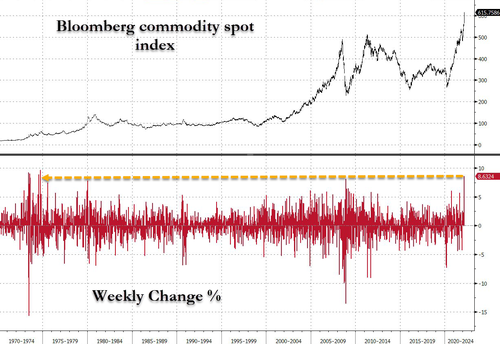
As the biggest week in commodities unfolds since 1974, the global crude benchmark Brent surged to nearly $120/bbl early Thursday and has since faded to the $110 handle around 0900 ET. Aluminum hit a record high this week, and wheat rallied highest since 2008 as shortage fears increase.
“We’ve never seen such steep and sudden commodity price spikes across so many assets,” said Henning Gloystein, an analyst at Eurasia Group.
“Until there’s significant de- escalation, the record or elevated prices due to sanctions and disrupted supply chains will continue for many commodities,” Gloystein said.
What’s piqued our interest is that the last time commodities soared this much in a week, members of the Organization of Petroleum Exporting Countries (OPEC) slapped the US with an oil embargo for their decision to re-supply the Israeli military, thus unleashing the oil price shock of the mid-1970s which unleashed stagflation. By the end of the decade, former Fed Chairman Paul Volcker in 1979 began to increase interest rates, and by the time he was done, rates were at 20% by mid-1981 to tame inflation.
The parallels of today’s high inflation and low-growth and soaring commodity prices are eerily similar to the stagflationary period of the mid-1970s. We got more spooky data earlier this week from the Atlanta Fed that slashed its GDP estimate for the first quarter of 2022 to zero as it appears stagflation could be on deck.

Powell has a difficult job to do as the conflict in Ukraine rages, commodity prices soar, and inflation wreaks havoc on households. This is happening in a midterm year that doesn’t look promising for Democrats.
end
6.CRYPTOCURRENCIES
Your early currency/gold and silver pricing/Asian and European bourse movements/ and interest rate settings FRIDAY morning 7:30 AM
ONSHORE YUAN: CLOSED DOWN 6.3184
OFFSHORE YUAN: 6.3251
HANG SANG CLOSED DOWN 562.05 PTS OR 2.50%
2. Nikkei closed DOWN 591.80 PTS 2.23%
3. Europe stocks ALL RED
USA dollar INDEX UP TO 98.43/Euro FALLS TO 1.0953-
3b Japan 10 YR bond yield: FALLS TO. +.152/ !!!!(Japan buying 100% of bond issuance)/Japanese yen vs usa cross now at 115.43/ THIS IS TROUBLESOME AS BANK OF JAPAN IS RUNNING OUT OF BONDS TO BUY./JAPAN 10 YR YIELD IS NOW TARGETED AT .11%/JAPAN LOSING CONTROL OF THEIR BOND MARKET//
3c Nikkei now ABOVE 17,000
3d USA/Yen rate now well below the important 120 barrier this morning
3e WTI:: 110.48 and Brent: 113.27–
3f Gold UP /JAPANESE Yen UP CHINESE YUAN: ON -SHORE CLOSED DOWN// OFF- SHORE DOWN
3g Japan is to buy the equivalent of 108 billion uSA dollars worth of bond per month or $1.3 trillion. Japan’s GDP equals 5 trillion usa./“HELICOPTER MONEY” OFF THE TABLE FOR NOW /REVERSE OPERATION TWIST ON THE BONDS: PURCHASE OF LONG BONDS AND SELLING THE SHORT END
Japan to buy 100% of all new Japanese debt and by 2018 they will have 25% of all Japanese debt. Fifty percent of Japanese budget financed with debt.
3h Oil UP for WTI and UP FOR Brent this morning
3i European bond buying continues to push yields lower on all fronts in the EMU. German 10yr bund FALLS TO -.0.027%/Italian 10 Yr bond yield FALLS to 1.57% /SPAIN 10 YR BOND YIELD FALLS TO 0.99%…ITALIAN 10 YR BOND YIELD/GERMAN BUND: 1.60: DANGEROUS FOR THE ITALIAN BANKING SYSTEM
3j Greek 10 year bond yield FALLS TO : 2.35
3k Gold at $1942.10 silver at: 25.18 7 am est) SILVER NEXT RESISTANCE LEVEL AT $30.00
3l USA vs Russian rouble;// Russian rouble DOWN 339/100 in roubles/dollar; ROUBLE AT 113.40
3m oil into the 110 dollar handle for WTI and 113 handle for Brent/
3n Higher foreign deposits out of China sees huge risk of outflows and a currency depreciation. This can spell financial disaster for the rest of the world/
JAPAN ON JAN 29.2016 INITIATES NIRP. THIS MORNING THEY SIGNAL THEY MAY END NIRP. TODAY THE USA/YEN TRADES TO 115.43 DESTROYING JAPANESE CITIZENS WITH HIGHER FOOD INFLATION
30 SNB (Swiss National Bank) still intervening again in the markets driving down the FRANC. It is not working: USA/SF this morning .9183– as the Swiss Franc is still rising against most currencies. Euro vs SF 1.0058 well above the floor set by the Swiss Finance Minister. Thomas Jordan, chief of the Swiss National Bank continues to purchase euros trying to lower value of the Swiss Franc.
USA 10 YR BOND YIELD: 1.791 DOWN 5 BASIS PTS
USA 30 YR BOND YIELD: 2.178 DOWN 5 BASIS PTS
USA DOLLAR VS TURKISH LIRA: 14.24
Futures Slide With Traders Shellshocked From Ukraine Newsflow
FRIDAY, MAR 04, 2022 – 08:02 AM
It has been another rollercoaster session, which saw futures tumble around 7pm ET following news that a Ukrainian nuclear power, Europe’s largest, had caught fire after alleged Russian shelling, and even though it largely turned out to be a false alarm with no damage to the NPP reactors or any radiation leaking, futures still have failed to recover much of the loss and were trading about 1.1% lower on concerns that the escalation of the war in Ukraine could have a stronger economic impact than anticipated. Contracts on the Nasdaq dropped 0.8% and Dow futures were 0.93% lower. As futures sold off, treasuries and gold climbed amid haven demand, while oil headed for its biggest weekly surge in almost two years. A dollar gauge rose to its highest level since July 2020, while the euro extended its decline below $1.10 for the first time since May 2020.

“The market mood is deep red,” said Ipek Ozkardeskaya, senior analyst at Swissquote. “European stocks continue feeling the pinch of an escalating war, as the U.S. major indices remain under a decent selling pressure. Investors are unlikely to open or to hold a long position without putting a hedge on it.”
While it is of far lower importance today when geopolitics is all the rage, investors are also awaiting the latest job data due at 830am , which may give clues about the next move from the Federal Reserve. The February jobs report at 8:30am ET is forecast to show nonfarm payrolls increase of 423k vs 467k in January; Bloomberg crowd- sourced whisper number is 401k; pace of hiring is expected to confirm Fed’s assessment that the labor market is strong enough to withstand rate hikes.
“While the Fed may prove eventually more hawkish than expected on rates, it is likely to prove more prudent now on balance sheet reduction given the large impact the announcement had on the equity market,” said Nordea Investment Funds S.A. senior macro strategist Sebastien Galy.
In premarket trading, Gap gained 7.4% after the clothing retailer reported 4Q results and provided an FY adjusted EPS forecast that topped the average analyst estimate. Other notable premarket movers:
- Splunk (SPLK US) shares rise 1.8% in U.S. premarket trading after Dow Jones reports that Hellman & Friedman has taken a 7.5% stake.
- Sweetgreen (SG US) beat estimates and the salad chain’s guidance eased concerns about the Omicron variant’s impact on trading. Shares up 18% premarket.
- Duolingo’s (DUOL US) quarterly results and guidance topped estimates, analysts say, adding they were impressed with the improvements seen in key metrics across the board for the language-learning platform. Shares rose 10% in afterhours trading.
- Consolidated Communications (CNSL US) downgraded to sell at Citi following results, with 4Q “mixed” and 2022 Ebitda guidance significantly below expectations.
There was also a lot of Ukraine war overnight news:
- A fire was reported at Ukraine’s Zaporizhzhia nuclear power plant which is the largest in Europe amid an attack by Russian troops. Ukraine’s Foreign Minister Kuleba also confirmed the nuclear power plant caught fire and said the Russian army is firing from all sides upon the nuclear plant, while he warned that if it blows up, it will be 10 times larger than Chernobyl.
- Ukraine’s state emergency service later stated that the fire outside the Ukrainian nuclear power plant broke out outside the perimeter and at a training building, while it was also announced that safety of the nuclear power plant was now secured and that plant fire didn’t affect essential equipment.
- US Energy Secretary Granholm said the department activated its nuclear incidence team and is monitoring events at the Ukraine nuclear plant. Granholm added the plant’s reactors are being protected by robust containment structures and they saw no elevated radiation readings near the facility.
- However, since then it was reported that the Zaporizhzhia nuclear power plant has been seized by Russian military forces, according to the regional authority.
- Ukraine Presidential advisor says they will not say the date/time of the next round of discussions with Russia in advance, via Reuters.
- UK PM Johnson spoke to Ukrainian President Zelensky about the situation at the power plant and said that Russia must immediately cease its attack on the plant, while he added that reckless actions of Russian President Putin could directly threaten the safety of all Europe.
- Ukraine’s armed forces have said it is possible that Russia may attempt to create a provocation at the Ukrainian border with Belarus to give the Belarusian regime a pretext to send its troops to join Russia’s invasion, according to a military update; subsequently, Belarus Leader Lukashenko says Belarus’ army is not taking part and is not going to take part in the military operation in Ukraine.
- US Senator Graham called for Russian President Putin’s assassination.
- S&P lowered Russia’s sovereign rating to ‘CCC-‘ and kept on CreditWatch negative on increasing risk of default.
- Moscow exchange has imposed a ban on the short-selling of Euro instruments; trading on the money and bond market is to commence at 09:00GMT/04:00EST on Friday.
- SGH Macro notes that Chinese companies will be told to give priority to purchasing Russian products, which are “basically the same in quality and price” as those from Western countries.
In Europe, losses were more pronounced, with the Stoxx Europe 600 Index slumping 2.9% to its lowest level in almost a year, and poised for its worst week since March 2020. Euro Stoxx 50 drops as much as 3.9% while Italy’s FTSE MIB underperformed losing over 4.5%.

All European sectors were in the red, with autos and banks underperforming heavily. Defensive sectors such as health care and utilities outperformed. European banks extend their drop, falling to the lowest level since July, as the war in Ukraine intensifies; the Stoxx 600 Banks Index dropped 4.3%, the second-worst performing sector in Europe. The gauge is set for its worst weekly drop since March 2020, while the SX7P now 12% lower YTD. All 39 members on the index are declining: UniCredit -8.3%, Erste Group Bank -7%, Deutsche Bank -6.7%. Adding insult to injury, European stocks just suffered their largest outflows on record in the week to March 2, according to Bank of America Corp strategists citing EPFR data.
The cost of protection against default from a basket of high-grade European companies rose above 80 basis points for the first time since May 2020.
Separately, the Russian stock market will be closed to trading until at least next Wednesday, marking a record in the country’s modern history, in a bid to stave off the impact of global sanctions for domestic investors.
Havens are modestly bid; bund, Treasury and gilt curves all bull-steepen, with the 10-year Treasury yield falling as much as 14bps in a knee-jerk flight to quality before halving the drop to about -7bps near 1.77%. German short end outperforms, trading ~ 6bps richer. Belly of the Treasury curve leads ahead of today’s payrolls release. European benchmark bonds rallied, led by the front end, with the core outperforming the periphery as semi-core and peripheral spreads widen to core with 10y BTP/Bund near 155bps. In FX, Bloomberg dollar spot index rises 0.3% to best levels of the week. NZD and AUD are the strongest performers in G-10. Czech and Polish central banks intervene to protect their currencies, which are among the hardest hit by the market impact of Russia’s invasion of Ukraine.
In FX, the Bloomberg Dollar Spot Index advanced 0.3% as the greenback gained versus all of its Group-of-10 peers apart from the New Zealand and Australian dollars and the yen. The euro fell to a day low of $1.0999; options traders went short the euro through options, mainly versus the dollar, earlier this week and now turn to the yen and the Swiss franc to hedge further weakness. The pound declined versus the dollar amid broad-based greenback strength. Prime Minister Boris Johnson said that he was seeking an emergency UN Security Council meeting and would raise the issue with Russia and close partners. Australia’s dollar strengthened for a third day as rising commodity prices due to the war in Ukraine bolster demand for the currency. The zloty briefly fell as much as 1.5%, to touch the weakest level since 2001, before paring losses. Poland’s central bank intervened in the foreign exchange market to support the zloty on Friday, according to people familiar with transactions. The Czech central bank said it started intervening on the FX market to support the koruna.

Rates, along with all havens, were heavily bid, as Treasury futures held gains after pulling back from highs reached during Asia session, when report of fire caused by shelling of Ukraine nuclear plant, Europe’s largest, caused a flight-to-quality spike. Yields remain richer by up to 7bp across intermediates while front-end of the curve lags, flattening 2s10s spread by ~2.5bp; 10-year yields around 1.77% after dropping as low as 1.697%. Bunds, gilts lag Treasuries by 2.2bp and 4.5bp cheaper in the sector. Treasury and gilt curves all bull-steepen. German short end outperforms, trading ~ 6bps richer.
In commodities, crude futures advance but trade off Asia’s best levels. WTI adds over 2% to trade back above $110, Brent near $112.50. Base metals trade well, LME nickel rises as much as 6% before fading. Spot gold rises roughly $9 to trade near $1,945/oz. Bitcoin continues to wane but remains at the mid-point of the week’s range and well-off the week’s sub-40k trough.
Looking to the day ahead now, and the main highlight will be the aforementioned February jobs report from the US. Otherwise, we’ll get French industrial production for January, the German construction PMI for February and Euro Area retail sales for January.
Market Snapshot
- S&P 500 futures down 0.7% to 4,330.25
- MXAP down 1.7% to 178.61
- MXAPJ down 1.6% to 585.27
- Nikkei down 2.2% to 25,985.47
- Topix down 2.0% to 1,844.94
- Hang Seng Index down 2.5% to 21,905.29
- Shanghai Composite down 1.0% to 3,447.65
- Sensex down 1.3% to 54,380.94
- Australia S&P/ASX 200 down 0.6% to 7,110.83
- Kospi down 1.2% to 2,713.43
- STOXX Europe 600 down 2.2% to 427.53
- German 10Y yield little changed at -0.01%
- Euro down 0.4% to $1.1018
- Brent Futures up 0.8% to $111.38/bbl
- Gold spot up 0.3% to $1,941.60
- U.S. Dollar Index up 0.25% to 98.03
Top Overnight News from Bloomberg
- Key gauges of money-market risk increased after Ukraine said Russia had attacked Europe’s largest nuclear power plant. Interbank dollar rates jumped again relative to the overnight lending benchmark. The FRA/OIS spread — a key signal of banking-sector risk — expanded to 29.7 basis points, the widest since May 2020, after rising almost 10 basis points Thursday. A similar gauge in Australia also advanced, while dollar funding costs for yen investors surged
- Ukrainian President Volodymyr Zelenskiy is stepping up his calls for a no-fly zone as his country faces escalating Russian bombardment of key cities and strategic sites, but the NATO military alliance remains highly unlikely to support one
- The ECB is ready for whatever measures are needed to ensure price and financial stability, Governing Council member Olli Rehn says, reiterating his prior stance also shared by ECB President Christine Lagarde
- While economists surveyed by Bloomberg continue to predict an ECB rate hike in 2022, they expect no firm commitments on withdrawing stimulus when the Governing Council convenes on March 9-10 — a meeting that was earlier billed as a crucial juncture for removing support. Come June, however, respondents see the ECB setting September as the end-date for net bond-buying, with only one predicting they’ll continue in 2023
- What seemed almost impossible a few months ago, is now growing into an appreciable risk: the euro may sink to parity with the dollar this year. That’s what strategists are warning as the Russian invasion of Ukraine threatens to derail the European economic recovery from the pandemic and delay even further the European Central Bank’s glacial progress toward policy normalization
- The escalation of the war in Ukraine is pushing investors to exit European stocks like never before amid rising inflation risks, according to Bank of America Corp. strategists
- Goldman Sachs Group Inc. and JPMorgan Chase & Co. have been purchasing beaten-down company bonds tied to Russia in recent days, as hedge funds that specialize in buying cheap credit look to load up on the assets, according to people with knowledge of the private transactions. Banks routinely scoop up debt because clients asked them to, or because they expect to find ready buyers
- The Russian stock market will be closed to trading until at least next Wednesday, marking a record in the country’s modern history, in a continuing bid to stave off the impact of global sanctions for domestic investors. Russia is banning short selling in the euro on its currency and stock markets, MOEX says on its website
- Bond traders are delivering a swift, punishing verdict on the expected hit to Russian corporations from the Ukraine war. In short, it’s turning the country into a nation of junk bonds
A more detailed look at global markets courtesy of Newsquawk
Asia-Pac stocks declined amid nuclear catastrophe fears after a fire broke out at the Zaporizhzhia nuclear power plant in Ukraine which is the largest in Europe and was hit by Russian shelling. ASX 200 was dragged lower by cyclicals but moved off worse levels on relief as the safety of the nuclear power plant in Ukraine was eventually reported to be secured. Nikkei 225 fell beneath 26,000 on geopolitical concerns and the extension of quasi-emergency measures. Hang Seng and Shanghai Comp. weakened with losses in Hong Kong exacerbated by a tech rout but the mainland was somewhat cushioned as Chinese press speculated potential lowering of MLF rates this month.
Top Asian News
- Hong Kong Retail Slows to 6-Month Low as ‘Immense’ Stress Looms
- BOJ Is Said to See Oil Surge Pushing Prices Beyond Forecast
- Singapore Overhauls Expat Visas With Nationality Among Criteria
- Asia Stocks Slump to 16-Month Low as Ukraine Tensions Grow
European bourses are hampered, Euro Stoxx 50 -3.7%, after sentiment was hit on the escalating Zaporizhzhia nuclear situation, with Russia now having control of the area. Stateside, US futures, ES -0.8%, are pressured but remain modestly above overnight lows as participants look to today’s Labour Market Report. Within Europe, sectors are all in the red with defensives faring better while Banking and Insurance names come under pronounced pressure once more.
Top European News
- Nuclear’s Rescue Mission in Northern Europe Faces Further Delays
- U.K.’s Johnson to Seek Emergency UN Security Council Meeting
- LSE Suspends More Instruments: The London Rush
- NATO Won’t Risk Broader Russia War With a Ukraine No-Fly Zone
In FX, DXY tops 98.000 (98.272 best) as risk aversion ramps up again on Russia’s seizure of the largest European nuclear plant in Ukraine. EUR/USD loses 1.1000 and touted support in proximity while Cable succumbs to rampant pressure and abandons 1.3300. Aussie and Kiwi continue to outperform with assistance from strength in commodities and technical momentum as Aud/Usd extends beyond the 200 DMA to probe Fib resistance at 0.7365 and NZD/USD clears 0.6800 convincingly. Zloty and Koruna cushioned by coordinated intervention. Rouble pivots 110.0000 pending further developments as mission Ukraine rages on. CNB is intervening against a weakening CZK, a step that is in-accordance with prior measures. NBP intervening in FX markets according to Reuters citing sources. NBH says it is not commenting on questions over concrete FX market interventions, according to a response to Reuters
In commodities, crude benchmarks are firmer intraday but are consolidating around Thursday’s trough as we await a potential third round of Russia-Ukraine talks next week and possible developments re. Iranian negotiations over the weekend. Specifically, Brent May meanders around USD 112/bbl (vs weekly low of around USD 97/bbl). Japan will release 7.5mln bbls of oil from private reserves in coordination with the IEA to cool rising prices. Spot Gold/Silver are firmer in-fitting with core debt benchmarks, but spot gold is yet to convincingly surpass the USD 1950/oz mark. China’s Industry Ministry (MIIT) summoned rare earth groups regarding high prices of rare earths; to fight against speculations and hoarding; asks companies to guide prices to reasonable ranges.
US Event Calendar
- 8:30am: Feb. Change in Nonfarm Payrolls, est. 422,000, prior 467,000
- 8:30am: Feb. Change in Private Payrolls, est. 400,000, prior 444,000
- 8:30am: Feb. Change in Manufact. Payrolls, est. 24,000, prior 13,000
- 8:30am: Feb. Unemployment Rate, est. 3.9%, prior 4.0%
- 8:30am: Feb. Underemployment Rate, prior 7.1%
- 8:30am: Feb. Labor Force Participation Rate, est. 62.2%, prior 62.2%
- 8:30am: Feb. Average Hourly Earnings YoY, est. 5.8%, prior 5.7%
- 8:30am: Feb. Average Hourly Earnings MoM, est. 0.5%, prior 0.7%
- 8:30am: Feb. Average Weekly Hours All Emplo, est. 34.6, prior 34.5
DB’s Jim Reid concludes the overnight wrap
The key story overnight, which is still developing, is the apparent attack on the Zaporizhzhia nuclear power plant in eastern Ukraine, Europe’s largest nuclear power plant. The initial reports drew a sharp risk off reaction, which reversed when the worst feared outcomes didn’t materialise. In particular, news that radiation levels in the area were normal, that the plant should automatically shut off reactors upon shelling, and that the fire was in an administrative building tempered the reaction. Though the wider implications of this story are a little more ominous.
The risk-off appetite led to 10yr Treasuries initially rallying from 1.85% to just under 1.70%. We are now at around 1.78% as I type. S&P futures have bounced from c.-1.6% to c.-0.6% but Stoxx 50 futures remain down c.-2.5%. Oil did spike around +3% initially but has reversed over half of this after tremendous vol yesterday as we’ll see below. Elsewhere in Asia the Nikkei (-2.36%), Hang Seng (-2.71%), Shanghai Composite (-0.66%), CSI (-0.92%) and Kospi (-1.30%) are all lower.
So a challenging end to a week of dislocations and unpredictable market swings. Before the weekend we have payrolls today as the next event outside of Ukraine to watch. Outside of the Zaporizhzhia story, peace talks were held yesterday, but without real progress. The two sides reportedly reached an understanding on humanitarian corridors for evacuating civilians and a possible ceasefire during said evacuation. Unfortunately this almost by definition implies they expect fighting to continue, and the rhetoric from President Putin was not optimistic. Nevertheless, the two sides agreed to hold a third round of talks soon which at least offers hope.
Many markets still managed to be all over the place yesterday with big intraday swings across a number of major assets. Take the oil price for example: we went to press yesterday with Brent crude just shy of $117/bbl, before it then hit an intraday high of $119.84/bbl around the European open. But it then went onto swing more than $10 lower to hit an intraday bottom of $109.40/bbl, before then closing almost -2.19% at $110.46. We’re around $111.20/bbl as we go to print. And it was a similar story for European natural gas futures too, which hit a record intraday high (+20.53% at the session highs) before closing down on the day by -10.90% and trading in a range of €135-200. Nevertheless, even with that pullback in a number of key energy prices, commodities in the aggregate continued to power forward, with Bloomberg’s Commodity Spot Index (+0.68%) hitting another all-time high. That came as wheat futures (+21.78%) rocketed to another post-2008 high, whilst corn futures (+1.66%) very nearly surpassed their recent closing high in May last year.
That volatility was also evident in equities, which had been on track to advance before turning sharply lower just before the European close. Indeed, the STOXX 600’s -2.01% decline left it at a 9-month low, and also means that the index is now down by more than -10% on a YTD basis again, as every sector in the index lost ground on the day. Over in the US meanwhile, the S&P 500 shed -0.53%, after spending much of the day in the green, and the NASDAQ lost -1.56%. Unlike the STOXX 600 both are still above their closing lows of recent days. Despite declining -0.26ppts, the Vix remains elevated at +30.48ppts. This is the first time it’s closed above 30ppts for four straight days since February 2021.
Chair Powell reiterated his testimony from the day before. He has more or less confirmed his preference to hike rates by +25bps in March, while maintaining the option to hike rates by larger magnitudes as circumstances call for in the future. He noted that the full fallout from the Ukraine war remains to be seen, but that it isn’t yet enough to derail the start of the tightening cycle.
In rates, US 2yr Treasury yields were fairly flat, but the 10yr yield declined -3.6bps to 1.84%, sending the 2s10s curve down to a new closing low for the cycle of 30.6bps, which is something we haven’t seen since March 2020 during Covid. The curve flattening continued overnight with the nuclear plant story and is now at +27.5bps. Bear in mind the curve started the year at 77bps, so we’ve seen it lose more than half its steepness over the last couple of months. Over in Europe there was also turnaround in sovereign bond yields over the day, which joined equities in moving lower towards the session’s end amidst the risk-off tone. Yields on 10yr bunds closed -0.7bps lower, albeit still in positive territory at 0.01% (unlikely to be there this morning though), and with markets pushing back the odds of ECB hikes given the Ukraine conflict, we also saw the spread between the US and German 2yr yields widen to 215bps, which is their biggest gap since January 2020, around the time that news of the pandemic started to spread widely.
Aside from the conflict in Ukraine, investor attention today will also be on the US jobs report for February, which is coming out at 13:30 London time. That’s one of the last big pieces of data we’ll get before the Fed’s decision a week on Wednesday, and comes after last month’s bumper report that led to growing weight placed on the chances of a 50bp rate hike (before the Ukraine conflict sent the chances lower again). In terms of what to expect this time round, our US economists are looking for growth of +300k in nonfarm payrolls, which if realised would actually be the slowest since last April given the positive upward revisions we’ve seen to previous months. Consensus is at +423k. In turn, our economists see the unemployment rate coming down to a post-pandemic low of 3.8% (consensus 3.9%). As ever there’ll also be focus on average earnings and hours worked etc.
On the inflation front, our European economists actually published their latest forecast update yesterday (link here) following the flash CPI estimate and the Ukraine conflict. Their forecasts now see HICP at +6.1% for the full year 2022 with risks on the upside, and 2023’s figure is also upgraded to +2.5%. Furthermore, their monthly projections see inflation remaining above the ECB’s 2% target until November 2023, which if realised would mean that the total period of above-target inflation is set to be more than 2 years long since it last moved above target in July 2021.
Otherwise yesterday, there were a few releases to digest on the data front. First, Euro Area unemployment fell to 6.8% in January (vs. 6.9% expected), which is a record low since the single currency’s formation. That points to the tightness in the labour market right now, and comes as inflation is also at a record high. Meanwhile, the weekly initial jobless claims from the US fell to an 8-week low of 215k in the week through February 26 (vs. 225k expected), although the ISM services index for February unexpectedly fell to a one-year low of 56.5 (vs. 61.1 expected). The other releases were the final services and composite PMIs, where the Euro Area composite PMI was revised down three-tenths from the flash reading to 55.5. Others saw larger downward revisions, including Germany’s composite PMI at 55.6 (vs. flash 56.2) and France at 55.5 (vs. flash 57.3).
To the day ahead now, and the main highlight will be the aforementioned February jobs report from the US. Otherwise, we’ll get French industrial production for January, the German construction PMI for February and Euro Area retail sales for January.
END
3. ASIAN AFFAIRS
i)FRIDAY MORNING// THURSDAY NIGHT
SHANGHAI CLOSED DOWN 33.46 PTS OR 0.96% //Hang Sang CLOSED DOWN 562.05 PTS OR 2.50% /The Nikkei closed DOWN 591,80 PTS or 2.23% //Australia’s all ordinaires CLOSED DOWN 0.69% /Chinese yuan (ONSHORE) closed DOWN 6.3184 /Oil UP TO 110.48 dollars per barrel for WTI and UP TO 113.27 for Brent. Stocks in Europe OPENED ALL RED // ONSHORE YUAN CLOSED UP AGAINST THE DOLLAR AT 6.3184. OFFSHORE YUAN CLOSED DOWN ON THE DOLLAR AT 6.3251: /ONSHORE YUAN TRADING ABOVE LEVEL OF OFFSHORE YUAN/ONSHORE YUAN TRADING WEAKER AGAINST USA DOLLAR/OFF SHORE WEAKER//
3 a./NORTH KOREA/ SOUTH KOREA
///NORTH KOREA
3B JAPAN
3c CHINA
CHINA
end
CHINA/RUSSIA/USA
USA warns China not to help Russia evade sanctions
(zerohedge)
State Department Official Warns President Xi Will Face “Serious Consequences” If China Helps Moscow Avoid Sanctions
FRIDAY, MAR 04, 2022 – 09:05 AM
While Russian forces continue to bombard Ukrainian population centers (while an attack on a nuclear power plant last night turned out to be far less destructive than initially reported), American bureaucrats are already looking past the invasion in Ukraine to focus on China and its continuing support for President Vladimir Putin.
To wit, the SCMP reported Friday that State Department counselor Derek Chollet warned that there will be serious consequences for Beijing if it helps Moscow in evading sanctions.
If China tries to help Russia evade sanctions in the wake of Moscow’s invasion of Ukraine, it will face countermeasures, a senior US State Department official said on Thursday, without providing details.
State Department counsellor Derek Chollet said the allied nations that have joined in sanctioning Russia represent a combined 50 per cent of the global economy; China accounts for around 15 per cent.
“China, if it were to seek to evade the sanctions, or somehow dividing the sanctions, they would be vulnerable,” he said. “Any country that tries to evade these sanctions will also face the consequences of its actions. I don’t want to speculate with that would be.”
Beijing has been pretty clear in its support for Russia, going so far as to denounce the western sanctions as “illegal”.
“China firmly opposes all illegal unilateral sanctions, and believes that sanctions are never fundamentally effective means to solve problems,” Liu Pengyu, spokesman in the Chinese embassy in Washington, said on Thursday.
Bloomberg, meanwhile, published a warning in the form of a report about the sanctions afflicting Russian President Vladimir Putin and his allies being a “cautionary tale” for President Xi. Of course, as BBG readily admits, all this purely speculation, as Beijing has – so far, at least – complied with US sanctions on Hong Kong leader Carrie Lam, and others.
While China has declined to slap financial penalties on Russia and will likely help it weather the sanctions storm by buying oil, gas and wheat, limits to the “no limits’’ friendship already appear to be emerging. Political leaders have talked of the need for a quick cease-fire and some big Chinese banks have restricted access to financing purchases of Russian commodities.
That pattern has been apparent in the past: China may disagree with the political goals of Western sanctions, but it has tended to avoid confronting them head on. Even Chinese state-run banks, for example, have complied with past U.S. curbs on Hong Kong. Carrie Lam, the territory’s Beijing-friendly chief executive, said in 2020 that she was collecting “piles of cash” at home because the U.S. measures barred her from basic banking services. “The Chinese banks are actually quite leery of running afoul of the U.S. Treasury,’’ says David Dollar, a senior fellow at Brookings and former Treasury representative in Beijing. “The big Chinese banks are among the largest in the world, they’re deeply integrated with the global system. So they’re going to be careful.’’
But the BBG report also notes that China’s economic clout has been growing…Source: Bloomberg
…even if its currency, the yuan, remains a “bit player” in global trade.Source: Bloomberg
While Beijing might heed these warnings for now, it’s pretty clear where their sympathies lie.
Foreign Ministery spokesman Wang Wenbin offered some insight this week when he blamed Washington for being the “culprit” of the situation in Ukraine. Washington “claims to be preventing a war in Europe. Did it accomplish that mission? It claims to be committed to peaceful resolution, but what has it done in that regard, except for providing military aid and enhancing military deterrence?”
As for the trend of “de-globalization” and the return of multi-polarity in the international political system, US economists believe it will only continue.
Plenty of economists agree that the polarization is real. Adam Posen, president of the Peterson Institute for International Economics, calls it the “corrosion of globalization.” He says it began with President Donald Trump’s trade war with China, and continued through the pandemic as economies turned inward. Now it’s accelerated.
“Everybody has been talking for a long while about blocs and the global economy splitting up,” says Posen.
The result, they fear, will be a global economy that’s “less productive and innovative as it turns combative”. But while China will likely continue buying Russian oil, gas and wheat, limits to their friendship have already manifested in the near-term. The takeaway is this: while Beijing disagrees with western sanctions, the CCP is still “biding its time”, and as a result has pursued a policy of non-confrontation.
4/EUROPEAN AFFAIRS//UK AFFFAIRS
EU/ NATUAL GAS
Europe can go another winter as they have stockpiled enough as. However in 2023 it is a different story
(Paraskova/OilPrice.com)
Can Europe Survive Next Winter Without Russian Gas?
FRIDAY, MAR 04, 2022 – 03:30 AM
Authored by Tsvetana Paraskova via OilPrice.com,
- Russia’s invasion of Ukraine has highlighted the need for Europe to improve its energy security by reducing its reliance on Russian gas.
- According to Wood Mackenzie, European gas storage is back in the five-year range and the continent could go without Russian gas next winter.
- To survive without Russian gas in the long term, however, is a much more complex problem and one that will require improvisation.
Russia’s invasion of Ukraine threw Europe’s dependence on Russian natural gas into sharp relief. The European Union is drafting measures to reduce its reliance on Russian energy, while various European countries, including the biggest economy, Germany, are revising their strategic energy policies, aiming to reduce their energy security vulnerability.

It was this vulnerability that has stopped the EU, the U.S., and allies from slapping sanctions on Russian energy exports (for now). Europe receives some one-third of its natural gas from Russia, but the dependence varies among EU members. Germany is 50-percent reliant on Russian gas, and Italy imports 40 percent of its gas needs from Russia. Southwest European countries Spain and Portugal do not import any Russian gas, but southeast European countries and Russia’s neighbors to the west, Estonia and Finland, are 100 percent or nearly 100 percent dependent on Moscow for their natural gas supply.
As the war in Ukraine threatens to cut off Russian gas supply—either in the form of sanctions or a Putin retaliation to sanctions—Europe realized that ensuring energy security would mean weaning itself off Russian deliveries in the quickest way possible, even at a high economic price.
Ensuring gas for next winter should not be a problem, analysts and the European Commission say. The question is, what will Europe do for the winter after that—and all the following winters in the long term—if it wants to reduce its dependence on Russian gas and not shape its security or sanctions policy in fear of being cut off from its largest source of gas.
This winter is nearly at its end, and European gas in storage is back to the five-year range. With restocking during the summer, Europe could go without Russian gas next winter, according to Wood Mackenzie.
“From record lows at the start of winter, storage levels have now re-enter[ed] their five-year range, albeit on the lower side, and are on track to be in a more comfortable position by the end of March,” Kateryna Filippenko, principal analyst, Europe gas research, at WoodMac, said.
“It is our current assessment that the EU can get through this winter safely. At the moment, gas flows from East to West continue, LNG deliveries to the EU have increased significantly, and the weather forecast is favourable. The use of gas from storage has slowed down and we are still around 30% of storage capacity filled,” European Energy Commissioner Kadri Simson said on Monday.

EU member states need to collectively ensure a certain level of gas storage in their regions and to conclude solidarity agreements to send gas where it’s most needed, Simson said.
“The war against Ukraine is not only a watershed moment for the security architecture in Europe, but for our energy system as well. It has made our vulnerability painfully clear. We cannot let any third country destabilise our energy markets or influence our energy choices,” the commissioner said.
“The European Union can manage without Russian gas next winter, but must be united in taking difficult decisions, accepting that in many cases it won’t have enough time for perfect solutions,” analysts at European think tank Bruegel wrote in an analysis this week.
In the wake of the Russian invasion of Ukraine, Germany announced it was changing course “in order to eliminate our dependence on imports from individual energy suppliers,” German Chancellor Olaf Scholz said on Sunday. Germany will build two LNG import facilities, at Brunsbuettel and Wilhelmshaven, and look to speed up the installation of renewable energy capacity to have 100-percent renewable power generation by 2035.
For Europe, managing without Russian gas “will require improvisation and entrepreneurial spirit,” analysts at Bruegel say.
“The main message is: if the EU is forced or willing to bear the cost, it should be possible to replace Russian gas already for next winter without economic activity being devastated, people freezing, or electricity supply being disrupted,” they noted.
“But on the ground, dozens of regulations will have to be revised, usual procedures and operations revisited, a lot of money quickly spent and hard decisions taken. In many cases time will be too short for perfect answers.”
END
CREDIT SUISSE/RUSSIAN OLIGARCHS//
Great bunch of guys
(zerohedge)
Credit Suisse Asks Clients To Destroy Documents Related To Dealings With Russian Oligarchs
FRIDAY, MAR 04, 2022 – 07:00 AM
It shouldn’t come as a surprise to anybody who has been following the Swiss criminal trial of a Bulgarian wrestler-turned-cocaine trafficker, but Credit Suisse has officially replaced Deutsche Bank as Europe’s most unrepentant recidivist bank.
And although this isn’t technically illegal (at least not in any obvious way), CS has found itself on the receiving end of more embarrassing headlines claiming that the Swiss bank has asked hedge funds and other clients to destroy documents pertaining to the yachts and jets of some of its wealthiest clients. According to the FT, the bank made the request because it was concerned about information about its private banking unit – which has made loans to oligarchs under US sanctions – leaking out.

To be sure, the CS has denied these reports – or rather, insisted that the requested document destruction was related to non-disclosure agreements tied to its business.
“Credit Suisse’s entitlement to request non-participating investors to destroy documents relating to this transaction was, as is market practice, stipulated under the Non-Disclosure Agreement,” the company said in the release.
“Documents shared with investors did not contain any client names and/or asset identifiers by the blind pool nature of the transaction.”
But that doesn’t change the fact that the FT, citing three sources who had confirmed the details, confirmed that the deal in question involved offloading the risks from $2 billion in loans to a group of hedge funds post-securitization. The FT published more details about the original deal last month.
Investors this week received letters from the Swiss bank requesting that they destroy the documents relating to a securitisation of loans backed by “jets, yachts, real estate and/or financial assets”, according to three people whose firm received the request. The letters tell the investors to “destroy and permanently erase” any confidential information Credit Suisse previously provided in relation to the transaction, citing a “recent data leak to the media” that it said had been “verified by our investigators”.
One of the FT’s sources said they had never seen a request quite like CS’s in this instance.
“I don’t think we’ve ever had a request like this,” said one investor who received the letter, noting that his firm had only ever received similar notices when it had been sent confidential documents accidentally.
The attempt by the bank to stop clients from leaking information followed the “Suisse Secrets” leak, which landed last month. That leak detailed some $100 billion in assets held by “spies, strongmen and criminals.”
Credit Suisse quietly closed the jet and yacht securitisation deal at the end of 2021, offering an annual interest rate in excess of 11 per cent to entice a handful of hedge funds into the transaction.
Ironically, that’s also the interest rate being offered on Ukrainian war bonds, another batch of which the Ukrainian government is hoping to issue next week.
end
GERMANY/RUSSIA
Germany sends 2700 anti aircraft missiles to Ukraine despite Russian warnings
(zerohedge)
Germany Sends 2,700 Anti-Aircraft Missiles To Ukraine Despite Moscow’s Warning
THURSDAY, MAR 03, 2022 – 08:00 PM
Germany on Thursday confirmed that it’s ramping up military aid to beleaguered Ukraine, after days ago reversing its long-standing policy of neutrality which banned any country from shipping German arms into conflict zones. Now after one week of Russia’s brutal invasion of Ukraine, Berlin is sending an additional 2,700 anti-aircraft missiles to Kiev.
It comes after an initial arms shipment already arrived, upon the request of the Ukrainian government. Given that also on Thursday the White House confirmed that it’s sharing “real-time intelligence” with Ukraine’s military – all of this suggests the NATO allies are slowly getting sucked in more directly amid Ukraine’s efforts to defend its territory.The Strela goes all the way back to the Cold War, via WeaponsSystems.net
It should be noted of course that obviously NATO has been supporting Ukraine on a military and intelligence level for a long, long time at this point, which the Kremlin has cited as one of the reasons for the extreme action now being taken.
The Wall Street Journal details in a fresh report that what’s essentially Germany’s version of the more well-known US Stinger system is called the Strela:
The shoulder-fired weapons, known as Strela, can be used against helicopters and airplanes and will be transported to Ukraine within days. The Soviet-made rockets belonged to the armed forces of the former East Germany and are among the most widespread weapons of that type in the world. They were mothballed years ago and are now stored by the environment ministry.
The initial German weapons shipment earlier this week included 1,000 anti-tank missiles, and additionally 500 American Stingers. Berlin’s complete 180-turn on the issue also allowed Baltic states like Estonia to begin shipping in German-made weapons.
This poses a huge problem for those in the West not wishing for direct Russia-NATO confrontation. Moscow this week warned that if its forces come under fire by foreign-supplied weapons, then those external countries behind the shipments will “bear the responsibility.”
But many reports suggest this is already happening, particularly given Ukraine has long had an abundance of US Javelin anti-tank missiles. By some estimates, Ukraine’s military has already used literally hundreds of Javelins against the invading Russian army.
end
5. RUSSIAN AND MIDDLE EASTERN AFFAIRS
Russia shells Europe’s biggest Nuclear plant. A fire breaks out at a training facility but is quickly put out
(zerohedge)
Fire At Ukrainian Nuke Plant Contained; Lindsey Graham Calls For Putin Assassination
THURSDAY, MAR 03, 2022 – 07:42 PM
Update (1850ET): President Biden and Ukrainian President Volodymyr Zelensky condemned the Russian attack at the Zaporizhzhia Nuclear Power Plant, resulting in a fire which broke out in a training building outside the plant’s perimeter, according to Reuters.
Biden and Zelensky ‘urged Russia to cease its military activities in the area and allow firefighters and emergency responders to access the site,’ according to a readout of their call.

And now, Sen. Lindsey Graham (R-SC) is calling for Putin’s assassination.
According to Ukrainian authorities, the plant is now secured.
* * *
Update (1745ET): The International Atomic Energy Agency (IAEA) says it’s aware of reports of shelling at the nuclear power plant and is in contact with Ukrainian authorities about the situation, after Ukrainian officials told AP that they had detected elevated levels of radiation at the plant.
Online radiation monitors near the plant can be found here.
Meanwhile, President Biden and Ukrainian President Zelensky are reportedly speaking (or have spoken), according to NBC News‘ Peter Alexander.
* * *
Update (1658ET): Unit 1 of the Zaporizhzhia power plant has been hit, according to the plant’s Facebook page (via Bloomberg).
* * *
Risk assets are sharply lower, with futures and euro tumbling, offset by a flight to safety which has sent Treasuries, the dollar, yen and gold soaring, after reports that Russia has started shelling Ukraine’s Zaporizhzhia nuclear power plant Europe’s largest, which accounts for one quarter of Ukraine’s power generation, and which has caught fire.

“There is a real threat of nuclear danger in the biggest atomic energy station in Europe,” AP reports Andriy Tuz as saying Reuters reporter Phil Stewart confirmed the report in a tweet, citing local town mayor.
The Ukraine’s foreign minister Dmytro Kuleba has confirms Zaporizhzhia fire, saying “If it blows up, it will be 10 times larger than Chornobyl! Russians must IMMEDIATELY cease the fire, allow firefighters, establish a security zone!.”
Futures as noted have plunged almost 80 points on the news. Nasdaq is now down 3% on the day…

… and 10Y yields have tumbled 15bps, back below 1.70%

Gold spiked back above $1950…

And WTI is back above $112…

Wheat Futures are instantly limit up at $1209 (up from $750 just over a week ago)…

Rate-hike odds have tumbled…

It seems clear from the market’s reaction that few have heard UBS veteran floor broker Art Cashin’s story. Barry Ritholtz retells the story in 2015 that…
Over dinner not too long ago, Cashin related the story of something that happened during the Cuban Missile Crisis.
Everyone was on edge as the U.S. and Soviet Union approached the brink. One day, word began to spread that Russia had launched its nukes, which would arrive in 11 minutes. A trooper to the end, Cashin ran around the exchange floor trying to sell short, but was unable to do so. The 11 minutes passed, but nuclear annihilation never came. Soon after, Cashin reported to his boss. He told him what occurred, and was told that in the future, upon learning of the end of the world, the proper trade is to go long, not short.
He asked his boss, Why go long if the world is ending?
“It never does end,” his boss told him, and even if it does, “who are you going to settle the trade with?”
For now, as Bloomberg notes, traders are understandably skittish of any news, which suggests a worsening of the situation on the ground. Until there are more details which provide clarity, a defensive posture will prevail across markets.
END
Here are all the companies that have cut ties with Russia;
(zerohedge)
These Are All The Companies That Have Cut Ties With Russia
THURSDAY, MAR 03, 2022 – 11:20 PM
An ever-expanding list of public companies, including Apple, Exxon, GM, and Nike, are proudly announcing they are cutting ties to Russia as its invasion of Ukraine brings condemnation and sanctions.
But while all this sounds very ‘politically-correct’ and ‘shared-sacrifice’-y, Bloomberg reports that if every U.S. tech firm followed Apple and disconnected from Russia, it would reduce revenue by only 1%-2% in a worst-case scenario, according to Wedbush analyst Dan Ives. So far, the lost business looks like it won’t have a major impact on profits (or stock prices), especially with China being by far Russia’s largest trading partner.

You will find more infographics at Statista
In fact, for some, like Exxon, cutting ties with Russia can spark a ‘virtue-signaling’ ESG boost with minimal impact to the company’s actual business, and as Bloomberg’s Tim Culpan remarks in a very frank opinion piece, consumer brands halting sales in Russia “smells of opportunism” to some, with transportation constrained, limited access to international payments systems, and a sinking ruble:
“While that sounds like an appropriate response to Moscow’s brutality, it also smells of opportunism…
…it’s hard not to wonder whether companies were taking a principled stand only once it was no longer feasible to do business in the country“
Of course soaring oil and other commodities cost will strike at profits as expenses rise and consumers have less to spend. But, as Axios details, in the seven days since Putin’s invasion began, the following companies have unleashed their anti-Russia PR campaigns:
- Boeing suspended major operations in Moscow, as well as maintenance and technical support for Russian airlines.
- Airbus is halting supply of parts and services to Russian airlines.
- Shell will sever ties with Russian gas giant Gazprom and end its roughly $1 billion financing of the Nord Stream 2 gas pipeline.
- BP is exiting its nearly 20% stake in Russian oil giant Rosneft, and faces a potential financial hit of as much as $25 billion.
- Exxon Mobil says it will exit Russia oil and gas operations valued at more than $4 billion and cease new investment.
- GM, which sells only about 3,000 cars a year in Russia, says it will suspend exporting vehicles.
- Ford suspended operations.
- BMW stopped shipments and will stop production in Russia.
- Daimler Truck Holdings said it would no longer send supply components to its Russian joint-venture partner.
- Volvo Cars, owned by Chinese conglomerate Zhejiang Geely, halted sales and shipments.
- Renault ceased operations and production at two assembly plants because it can’t get parts.
- VW paused delivery of Audis already in Russia so it can adjust car prices to reflect the decline in value of the ruble.
- Harley-Davidson suspended shipments to Russia.
- Adidas suspended its partnership with the Russian Football Union.
- Nike ceased online sales because it can’t guarantee delivery.
- FedEx and UPS suspended shipments.
- Yoox Net-A-Porter Group and Farfetch, luxury e-commerce platforms, are suspending deliveries in Russia.
- Apple has paused product sales and limited services (including Apple Pay), on top of ceasing exports to Russia and restricting features in Apple Maps in Ukraine to safeguard civilian safety.
- Dell stopped selling products.
- Ericsson is suspending deliveries to Russia.
- Walt Disney is pausing film debuts in Russia. Warner Bros., Sony, Paramount and Universal say they won’t release films in the country.
So with companies falling over themselves to signal their anti-Putin virtue, we give Bloomberg’s Tim Culpan the last word:
“So if we want to measure business executives’ true character, watch what they do in authoritarian countries during times of peace and abundant revenue. We need not wait for the violence to start and the money flow to stop.”
end
RUSSIA//RUSSIAN OWNED AND BRED CATS
I think that they taking this a little too far
(Watson/SummitNews)
International Feline Federation Bans Russian Cats From All Competitions
THURSDAY, MAR 03, 2022 – 05:40 PM
Authored by Paul Joseph Watson via Summit News,
An international cat federation has banned all Russian-owned and bred cats from competing in international competitions, in a move that’s sure to stop Putin’s attack on Ukraine.

No, this isn’t a Babylon Bee story.
The Fédération Internationale Féline (FIFe) issued a statement saying it “cannot just witness these atrocities and do nothing.”
The federation has decided that “no cat bred in Russia may be imported and registered in any FIFe pedigree book outside of Russia. … No cat belonging to exhibitors living in Russia may be entered at any FIFe show outside Russia.”
The ban will apply until at least the end of May and will punish popular breeds such as the Russian Blue, Peterbald and the Siberian cat, which can cost up to $4,000 dollars.
The story attracted condemnation from Chinese users of Weibo, with one asserting, “Animals should not have nationalities.”
As any rational person will surely understand, this is virtually guaranteed to send battle tanks scurrying back to Moscow
As we explain in the video below, the outpouring of utterly moronic moral exhibitionism in the aftermath of the attack on Ukraine is now manifesting itself in a very dangerous form of vitriolic Russophobia.
It’s also a crusade being taken up by leading politicians.
In the United States, Rep. Eric Swalwell (D-CA) wants to expel all Russian students from universities, while in the UK Conservative MP called for all Russian citizens to be deported.
end
RUSSIA/UK
Now BBC pulls out all of its reporters from Russia as the regime criminalizes “disinformation”. I will bet that all Western reporters will leave
(zerohedge)
BBC Pulls All Reporters From Russia After Moscow Criminalizes “Disinformation”
FRIDAY, MAR 04, 2022 – 11:24 AM
Update (1125ET): Following earlier news that Russia will criminalize “disinformation” about military in crackdown on “fake information”, not that different from the wholesale “canceling” and deplatforming of any western media outlets that do not parrot the official narrative, moments ago the BBC announced that it would “temporarily suspend the work of all BBC News journalists and their support staff within the Russian Federation” while the news agency assesses the full implications of this unwelcome development.
Full Statement from Tim Davie, BBC Director-General:
“This legislation appears to criminalise the process of independent journalism. It leaves us no other option than to temporarily suspend the work of all BBC News journalists and their support staff within the Russian Federation while we assess the full implications of this unwelcome development.
“Our BBC News service in Russian will continue to operate from outside Russia.
“The safety of our staff is paramount and we are not prepared to expose them to the risk of criminal prosecution simply for doing their jobs. I’d like to pay tribute to all of them, for their bravery, determination and professionalism.
“We remain committed to making accurate, independent information available to audiences around the world, including the millions of Russians who use our news services. Our journalists in Ukraine and around the world will continue to report on the invasion of Ukraine.”
Is that an admission that The BBC produces ‘fake news’?
* * *
As Katabella Roberts detailed earlier via The Epoch Times, Russia is set to take an even tougher crackdown on “unofficial” reporting and “disinformation” regarding its invasion of Ukraine, according to State Department spokesperson Ned Price.
On Friday, the country’s Kremlin-dominated parliament will meet in a special session to consider legalizing a bill that would make “unofficial” reporting on the invasion a crime that is punishable by up to 15 years in prison, Price said in a March 2 statement.
“Russia is engaged in an unprovoked war on Ukraine. At home, the Kremlin is engaged in a full assault on media freedom and the truth, and Moscow’s efforts to mislead and suppress the truth of the brutal invasion are intensifying,” Price said. “The people of Russia did not choose this war. Putin did.”
“They have a right to know about the death, suffering and destruction being inflicted by their government on the people of Ukraine. The people of Russia also have a right to know about the human costs of this senseless war to their own soldiers.”
Moscow asserted that the legislation is designed to fight fake information about Russia’s war in Ukraine.

The bill also aims to punish those who knowingly “distort the purpose, role, and tasks of the Russian Armed Forces, as well as other units during special military and other operations,” said Vasily Piskarev, head of the Duma’s Security and Anti-Corruption Committee, in an interview with state broadcaster Channel One.
Piskarev said the penalties could also apply to those who share “fake” information about Russia’s war losses, adding that the majority of fake materials are “generated in Ukraine,” but are “willingly distributed by a number of Russian media” as well as online via social media.
“It is one thing when it [disinformation] comes at peacetime, and another when our military is performing important tasks of maintaining peace and security, even if this happens abroad. Such fakes demoralize society, undermine confidence in the Russian army, and most importantly are a huge blow to the fighters’ relatives and friends,” Piskarev said.
Under a draft proposal of the bill being considered by Russian officials on Friday, reporters also risk a fine of 5-million-ruble fine, around $44,740, if they publish what officials deem to be false information about Moscow’s invasion of Ukraine, The Wall Street Journal reported.
The creation of the bill was proposed by Russia’s Committee on Security and Anti-Corruption and promptly approved on Monday by Chairman of the State Dum, Vyacheslav Volodin.
Volodin said he hoped the amendment could be passed quickly, saying in a statement on Thursday that “American social networks, controlled by Washington, launched an information war against Russia.”
“They violate their own rules, norms of international law, restrict freedom of speech [and] spread false information,” he said. “We cannot help but react to what is happening.”
Russia’s news coverage is closely monitored by President Vladimir Putin’s government, and Moscow has been quick to shut down and block media outlets that report outside of the narrative dictated by the Kremlin.
State media regulator Roskomnadzor has already shut down several media outlets since the invasion began, including Ekho Moskvy, Dozhd as well as Current Time’s website, a joint production of Voice of America and Radio Free Europe/Radio Liberty.
On Wednesday, Roskomnadzor allegedly threatened to block Voice of America (VOA)’s Russian-language website in the country unless it removes coverage of the situation in Ukraine.
The road to peace is the same road to war, it is only the fork taken that determines
Inbox

| Robert Hryniak | 11:04 AM (23 minutes ago) |  | |
| to |
This morning I turned on the radio to hear that gas went up by another 8 cents; that makes for 21 cents this week with more to come. As I pondered its’ meaning it occurred to me that the reality is the CDN dollar is declining in value, real purchasing value. But then again backed by nothing but hot air what is the value of any currency as most are simple fiat (no backing). The true value of any currency is the ability of a people to be productive and thus create confidence in the the value of currency as a medium of exchange. Sometimes exchange value is fixed against a distinct measurement. Coinage through centuries was based on everything from copper, to gold to silver weights.
Last week in a writing i wrote that Russia was going to introduce a gold backed Ruble.
This week Russia removed the VAT tax on bullion purchases and have been encouraging citizens to buy gold with rubles. This move stabilizes the value of the currency within the country, and is a logical reaction to what is occurring. Several days ago i saw that the EU forbid the sale and import of bank notes into Russia. I imagine the US and others have done something similar or will be doing so soon. Why, because why would you not want to use Euro’s to buy Rubles to buy gold. At least it is a tangible. We will see much more about this as politicians will tear their hair over this as will Central banks. Especially when physical gold trading occurs in the Middle East by passing the sham games on the Comex, etc. because the paper suppression of gold value as a settlement mechanism will be finished. Watch this, because war is not fought on Linear battlefield but a multi dimensional one. And this has been thought through long ago. Back in 2018 I spent serious time understanding the nature of Crypto currencies and blockchain. Why? Because i discovered that Russia contracted the development of a gold backed Ruble settlement system using a programmer who originated from Toronto. And after he did that for Russia he did the same for China. So you see you are watching a painting come to life as it were. The catalyst has been the refusal to acknowledge the Minsk Agreement which will go down in history as colossal blunder. But then again people like Zelensky dance to the puppet strings of his handlers as does Trudeau and others. The truth will come out of who is pulling these strings, be patient. A physical asset backed crypto that is on blockchain is a nuclear explosion for fiat based currencies. And the insane march to war will undoubtedly grow as vilification of all things Russian becomes more maddening. Because in war both sides always think they are on the right side of history until the ugliness of war is seen with one’s own eyes. It is then both parties realize the horror of it all and search for peace and a exit.
Seeing real war is deplorable and we need a settlement before things escalate and spiral out control. Every trade needs a exit strategy and this nonsense we see now needs a exit plan before it spirals out of control. Vilification of a people or a man is not a policy but is a excuse for not having one. So let’s discuss what maybe a solution. Have you ever heard of the Budapest Agreement ? People forget when the Soviet Union broke up Ukraine had more Nukes than China. Ukraine had to give its’ nukes on the understanding that neither America nor Russia would invade. Technically, what is happening now is not a invasion as Ukraine never registered its’ borders. Several days ago i floated the idea of a NEUTRAL UKRAINE, demilitarized and denazified, which is being done now in any case that maybe a freedom for the Ukraine and its’ citizens. So let’s dream a dream; Ukraine is recognized as a Neutral country by the EU , Russia and America ( Swiss model ). Ukraine can become a member of the EU, if the people want by free vote or develop a currency of its’ own with free transit passage which will give it’s people the ability to travel and time to stabilize a currency while at the same time it gives up any claim to the Crimea and the Donbas. And it is recognized and accepted that Ukraine cannot never be part of NATO as it is a sovereign neutral country much like Switzerland and no foreign military base can exist on its’ soil. The main language can be Ukrainian while Russian is recognized as a distinct language right much like French is recognized in Canada where there are 2 official languages. Are you willing to pitch this dream as an exit strategy from very real and possible war? Of course there will be resistance but resolve and trust and determination can go a long way. And it is is better to be known as a peacemaker than a war monger.
A approach like this is a win win scenario for all parties concerned and respects the heritage and history of the Ukraine and it’s citizens . And this is better approach than the constant beating of drums for war over balderdash. As for the currency wars that distinguish hegemony that is being fought already and does no need to result in a kinetic war in Europe for the sake of all people as that is another battlefield.
end
Balanced understanding Requires the understanding of differing opinions and actions
Inbox
| Robert Hryniak | 3:39 PM (2 minutes ago) | | |
| to |
Sergey Naryshkin, the head of the SVR, succinctly described it:
“Masks have dropped. The West is not just trying to enclose Russia with a new ‘Iron Curtain’. We are talking about attempts to destroy our state – its ‘abolition’, as it is now customary to say in the ‘tolerant’ liberal-fascist environment. Since the United States and its allies have neither the opportunity nor the spirit to try to do this in an open and honest military-political confrontation, sneaky attempts are being made to establish an economic, informational and humanitarian “blockade”’.
Western hysteria is so nuts that what is being seen is the onset of a 2022 Neo-Nazi Jihad: a 20,000-strong mercenary army being assembled in Poland under CIA supervision. The bulk comes from private military companies such as Blackwater/Academi and DynaCorp. Their cover: “return of Ukrainians from the French Foreign Legion.” This Afghanistan remix comes straight from the only playbook the CIA knows. And Erik Prince of Blackwater repute is already counting profits.
This really will solve nothing but will harden resolve on the part of Russia and Poland will have its’ issues if the likes of Wagner are dispatched as a counter. At a time when rational peaceful considerations are needed to avoid greater problems a lacking political establishment lacking in capacity and skill haunts the globe.
And to clarify the noise the other night, fighting did take place near a major nuclear plant. Zelensky accused the Russia of shooting at the nuclear reactors using the thermal imaging of their tanks. The Ukies also declared that the worst ecological catastrophe was about to happen, much worse than Chernobyl. They asked the US for a no-fly zone; not the first time. He seems not to recognize the Ukraine is a NO FLY zone courtesy of Russia. Then the local smartphones began showing footage of what actually happened. Thank goodness for citizens to tell the truth. Also, the authorities running the nuclear power plant denied that there were any fires in the reactors or near the reactors.
So what really happened, you ask ?
The Ukies did attack Russian forces, who responded by firing a couple of strong illumination flares, then they obliterated the Ukies with direct fire, then the fire department and specialists were given access: only 1 building around the plant suffered any hits, the radiation levels are even a little lower than usual, the situation is under control.
General update:
1. Kiev. Fighting in Bucha and in the Gostomel area. There are battles to the west of Kiev. Gradually, the city is being squeezed from the east. Chernihiv is blocked. Negotiations are underway on a humanitarian corridor. There are fights north of the city.
2. Kharkiv is practically blocked by the Armed Forces of the Russian Federation. The AFU MLRS are actively working from the city, affecting residential quarters of the city, among others. The Armed Forces of the Russian Federation continue their methodical hunt for accumulations of infantry and equipment that the enemy hides in the city.
3. Mariupol. The ring around the city is gradually shrinking. The city itself is physically completely blocked. The Nazis are blocking the exit of the population from the city. The deputy commander of “Azov” states that the situation is critical and Mariupol is the last obstacle to the creation of a Land bridge to the Crimea. Requests the deblocking of the city. Fat chance! There are mercenaries there as well in quantity. Using civilians as a shield is pretty disgusting but that is what these folks do
4. Nikolaev. Fighting for the city. Fighting south of the city. The situation with Kulbakino airfield is unclear: at first it was stated that the Russian Armed Forces took it, and then the AFU were able to recapture it. Other people say the place was empty
5. Energodar and ZAES. The control is finally established. Fighting continues at Vasilevka.
6. Izium. Serious fighting …. . The troops are approaching Slavyansk and the Izyum-Slavyansk highway. Krasny Estuary and Yampol are not far away.
7. Severodonetsk. Fighting near the city, the city itself has not yet entered. The prospects for the formation of the Severodonetsk boiler are increasing. Most of the territory of the LPR ha s already been liberated.
8. Donetsk-Gorlovka. They continued to be subjected to heavy shelling. ..
9. Volnovakha. The cleanup, according to Pushilin’s statement, will take several days. The enemy suffered heavy losses in people and equipment in the Volnovakha area.
10. Transnistria. The APU blew up a bridge on the border with the republic in order to complicate the hypothetical participation of a group of Russian troops in the PMR in the operation to liberate Odessa. No one is doing naval landings in the Odessa area, although troops have been waiting there for a week for such a action
This makes it two yachts seized, one in France and the other in Germany
(zerohedge)
.
Rosneft CEO’s $120 Million Super-Yacht Seized At French Port After “Preparing For Urgent Departure”
THURSDAY, MAR 03, 2022 – 06:00 PM
Not all Russian oligarchs have escaped Europe with their assets, as the Biden administration made it very clear earlier this week they will “seize the yachts, luxury apartments, and private jets” of Russian billionaires.
We asked the question on Wednesday: “Are Russian Oligarchs Fleeing By Sea To Indian Ocean As Biden Aims To Seize Billions?”
The answer appears to be ‘yes.’ Come to find out, not all Russian oligarchs made it out. France announced it impounded the superyacht belonging to Rosneft Chief Executive Officer Igor Sechin. The move comes as part of continued EU sanctions against Russia, French Finance Minister Bruno Le Maire disclosed this week.
The yacht is called the Amore Vero (true love), and it was “confiscated overnight in the Mediterranean port of La Ciotat,” Bloomberg reported on Thursday morning. The report says that the port is located near Marseille, on the French Cote d’Azur.

Bloomberg wrote that when it was confiscated, the yacht was “preparing an urgent departure.”
The French Finance Ministry said: “At the moment the inspection was carried out, the boat was readying to weigh anchor urgently, without having finished the planned work.”
Le Maire said this week on Twitter: “Thanks to French customs for enforcing the EU sanctions against people close to Russia’s leaders.”
French Budget Minister Oliver Dussopt clarified that the yacht was “prevented from leaving” but that the asset hadn’t been frozen, the report clarified. It was initially planned to stay at the port until April 1, after arriving in early January.
We pointed out some of the biggest Russian-owned luxury yachts are sailing around the Indian Ocean.

President Biden warned in his State of the Union address on Tuesday night that the U.S. and Europe would “seize” the assets of Russian billionaires.
“Tonight, I say to the Russian oligarchs and the corrupt leaders who built billions off this violent regime — no more,” Biden said. “We’re coming for your ill-begotten gains.”
The movement of Russian oligarchs worldwide after the Ukrainian invasion comes as western sanctions are complicating things for Russia and the elite class.
end
IRAN/EU//USA
Not good: Biden is totally clueless!
(zerohedge)
Nuclear Negotiators Announce Being “Very Close” To Final Iran Deal
THURSDAY, MAR 03, 2022 – 06:20 PM
At a moment that the Biden administration is coming under severe scrutiny over why it hasn’t targeted or blocked Russian oil imports with sanctions – Thursday witnessed significant rumblings that world powers negotiating with Iran are on the cusp of a restored nuclear deal.
One top EU foreign policy official confirmed that the Vienna process is now in the “final stages” but still cautioned “we are definitely not there yet” while an early evening CNN report cited a State Department official who said negotiators are “inching forward” toward reaching a deal.
“While there has been significant progress and we are close to a possible deal, a number of very difficult issues remain unresolved,” the official told CNN.
A huge part of the “pressure” on the US side to wrap up the deal is now tied into the Ukraine and what’s looking to soon be continually soaring energy and gas prices. The White House last month revealed it was in a full-court press to talk to Asian, African and Middle East companies about urgently getting ‘alternative’ supplies to Europe, also as the Nord Stream 2 natural gas pipeline has been halted.
Though the latest Biden admin statements have urged caution (the US has been negotiating indirectly via European mediation) European negotiators on Thursday issued highly optimistic statements:
“We are very close to an agreement,” chief British negotiator Stephanie Al-Qaq said on Twitter. “Now we have to take a few final steps.”
Among the hurdles that remains, notes The Wall Street Journal Thursday evening, includes terror designations put in place under the Trump administration:
U.S. and Iranian officials cautioned there was at least one big issue that still needed solving: Iran has been pushing for more sanctions relief if the nuclear deal is restored. In particular, it wants the Islamic Revolutionary Guard Corps to be taken off Washington’s most significant terror sanctions list, the Foreign Terrorist Organization.
Meanwhile, Iran hawks in Congress as well as Saudi Arabia have weighed in voicing concern over a “weak deal” that’s being rushed…
Earlier in the day…
Followed by these earlier headlines that may indeed suggest negotiators are still merely “inching” toward a completed deal…
- IRAN CONTINUES TO BREACH MANY KEY LIMITS SET BY 2015 NUCLEAR DEAL, INCLUDING URANIUM ENRICHMENT LEVEL AND ENRICHED URANIUM STOCK -QUARTERLY U.N. ATOMIC WATCHDOG REPORT
- IRAN RAISES STOCK OF HIGHLY-ENRICHED URANIUM BY 83%: IAEA
- IRAN HAS CONTINUED RESTRICTING IAEA ACCESS TO DATA
Another key issue is the question of “guarantees” that a future US administration would stick by a restored JCPOA. Republicans have by and large promised they would torpedo any potential deal should they take back the White House. Israel too has long lobbied especially the Republican side of the aisle to do just that. This is hugely concerning for Iran.
“Nobody can say the deal is done until all the outstanding remaining issues are resolved,” Iran’s foreign ministry spokesman Saeed Khatibzadeh also weighed in. “Extra efforts needed,” he said.
END
6// GLOBAL COVID ISSUES/VACCINE MANDATE ISSUES/
GLOBAL VACCINE MANDATES
END
GLOBAL ISSUES//FREIGHT
Sanctions playing havoc. Foods and medicines are allowed to travel to Russia but shipping delays are spoiling these items
(Dave DeCamp/Antiwar.com)
Maersk: Shipping Delays Due To Sanctions Are Spoiling Food, Medical Supplies To Russia
FRIDAY, MAR 04, 2022 – 05:00 AM
Authored by Dave DeCamp via AntiWar.com,
The container shipping giant Maersk warned Wednesday that shipping delays caused by increased customs inspections as a result of Western sanctions might spoil or damage food and medical shipments that are bound for Russia.
Maersk announced on Tuesday that it was cutting service to Russia to comply with sanctions but is allowing exemptions for food, medical, and humanitarian goods. But now the Denmark-based company is warning against bookings for the exempted goods due to delays.Image: Wiki Commons
“We do, however, warn caution on still placing bookings for perishable cargo due to significant delays in key transshipment hubs that may damage the cargo,” Maersk said on its website.
Maersk said that customs authorities in the EU and UK are inspecting all Russia-bound containers that transit their ports to identify sanctioned and restricted shipments.
Because of the increased inspections, Maersk sees a “significant risk to our customers’ perishable cargo.” The shipping company said that the sanctions were not only affecting Russia. “This is a global impact, and not only limited to trade with Russia,” it said.
The shipping delays are an example of how US sanctions can cause food and medicine shortages in targeted countries despite having humanitarian exemptions.
In many cases, companies don’t want to bother dealing with the red tape of doing business with heavily sanctioned countries and cut off service altogether.
.
VACCINE INJURIES/
VACCINE MANDATES
SPECIAL THANKS TO NEIL FOR PROVIDING THIS TO US:
BC Dentist
Inbox

| Neil Alho | 11:24 AM (1 minute ago) | | |
| to bcc: me |
I had trouble getting this going but kept trying and it worked. Hopefully it works for you without issues.
Jonathan Weissman on Twitter: “[1/9] This is the untold and shocking story of Pfizer’s 12-to-15-year-old clinical trial. Just 2264 adolescents were randomised between October 2020 and January 2021. I will describe the various related, serious and life-threatening injuries sustained by these youngsters. https://t.co/z03rrp9umq” / Twitter
Inbox
| Robert Hryniak | 2:11 PM (50 minutes ago) | | |
| to Harvey |
https://mobile.twitter.com/alltherisks/status/1499174761229918209
VACCINE IMPACT
Pfizer Admits its Vaccine Ineffective in Children 5 to 11 but Not One Single Governor Stops Injecting ChildrenMarch 3, 2022 3:19 pm We have been reporting this week that while the world is preoccupied with the war in the Ukraine, very damaging evidence has come out on the fraud behind Pfizer’s COVID vaccines, where the U.S. Federal Health Agencies have been hiding damaging data about serious side effects. But in addition to these reports that are apparently being leaked to the corporate media, another story was published this week where Pfizer admitted that their COVID-19 vaccine is ineffective in children ages 5 to 11. The FDA’s emergency use authorization for the Pfizer shots in children ages 5 to 11 has only been in effect since the end of last October, but during that short time there have been 9,226 cases reported in VAERS of vaccine injuries and deaths in these children, for a vaccine that Pfizer now admits doesn’t work for this age group. Of course the FDA, which we showed yesterday simply rubber stamps anything that Pfizer wants, is not revoking the EUA for this age group, but the ones in government who could put a stop to this child abuse immediately by executive order are the Governors of every state. But of course to do so would be to incur the wrath of Big Pharma and commit political suicide, so it appears that all 50 Governors, including the Red State Governors, will put their political careers ahead of protecting the children in their States from medical child abuse and attempted murder, as they refuse to go up against the Medical Cartel. The most popular Red State Governor is Ron DeSantis of Florida, who this week made waves in the media for criticizing children for wearing masks, although allowing their parents to inject them with a dangerous vaccine that offers no benefit and might kill them, is apparently OK. The other thing that Florida Governor DeSantis did this week was sign off on a bill that extended COVID liability protections for doctors and healthcare providers such as hospitals and nursing homes. Giving doctors and medical facilities legal immunity from harming or killing people with COVID protocols is apparently a Republican “Conservative” issue, as only Democrats spoke out against extending this liability protection.Read More…A Rare Judge in Canada Rules Against Forced COVID Injections of Children by Looking at the Evidence Rather than Listening to Government Tyrants We have been reporting this week that while the world is preoccupied with the war in the Ukraine, very damaging evidence has come out on the fraud behind Pfizer’s COVID vaccines, where the U.S. Federal Health Agencies have been hiding damaging data about serious side effects. But in addition to these reports that are apparently being leaked to the corporate media, another story was published this week where Pfizer admitted that their COVID-19 vaccine is ineffective in children ages 5 to 11. The FDA’s emergency use authorization for the Pfizer shots in children ages 5 to 11 has only been in effect since the end of last October, but during that short time there have been 9,226 cases reported in VAERS of vaccine injuries and deaths in these children, for a vaccine that Pfizer now admits doesn’t work for this age group. Of course the FDA, which we showed yesterday simply rubber stamps anything that Pfizer wants, is not revoking the EUA for this age group, but the ones in government who could put a stop to this child abuse immediately by executive order are the Governors of every state. But of course to do so would be to incur the wrath of Big Pharma and commit political suicide, so it appears that all 50 Governors, including the Red State Governors, will put their political careers ahead of protecting the children in their States from medical child abuse and attempted murder, as they refuse to go up against the Medical Cartel. The most popular Red State Governor is Ron DeSantis of Florida, who this week made waves in the media for criticizing children for wearing masks, although allowing their parents to inject them with a dangerous vaccine that offers no benefit and might kill them, is apparently OK. The other thing that Florida Governor DeSantis did this week was sign off on a bill that extended COVID liability protections for doctors and healthcare providers such as hospitals and nursing homes. Giving doctors and medical facilities legal immunity from harming or killing people with COVID protocols is apparently a Republican “Conservative” issue, as only Democrats spoke out against extending this liability protection.Read More…A Rare Judge in Canada Rules Against Forced COVID Injections of Children by Looking at the Evidence Rather than Listening to Government TyrantsMarch 3, 2022 3:33 pm  In a very rare case, an Ontario Judge has actually ruled against a forced COVID vaccination for two children, ages 10 and 12, where a father was requesting that they be forced to receive the shots against their wish, and against the wish of their mother. While this judge actually just simply did his job, which was to listen to the evidence that both sides presented before ruling, it made waves in the Canadian corporate media, because similar previous cases did not do that, but simply took the Government’s position regardless of what the facts were. Seeing actual justice practiced in a court of law regarding anything to do with COVID has become so rare, that it actually surprises you when it happens. In a very rare case, an Ontario Judge has actually ruled against a forced COVID vaccination for two children, ages 10 and 12, where a father was requesting that they be forced to receive the shots against their wish, and against the wish of their mother. While this judge actually just simply did his job, which was to listen to the evidence that both sides presented before ruling, it made waves in the Canadian corporate media, because similar previous cases did not do that, but simply took the Government’s position regardless of what the facts were. Seeing actual justice practiced in a court of law regarding anything to do with COVID has become so rare, that it actually surprises you when it happens.Read More… |
Michael Every
on the major topics of the day
Michael Every…
A MUST READ…
Rabobank: This Will Be Shocking To Hear
FRIDAY, MAR 04, 2022 – 10:00 AM
By Michael Every of Rabobank
The war in Ukraine is, as feared, seeing an increasing level of Russian artillery violence against citizens. Footage of attacks on Kharkhiv is now joined by images of greater devastation in many cities and towns. President Macron says Putin told him he is going to finish what he started – so things are about to get even worse. Humanitarian aid corridors are to be put in place, and a US-Russian military hotline set up to prevent ‘misunderstandings’, but expect a further crisis of death, destruction, millions of refugees – and deeper international opprobrium at, and isolation of, Russia and Belarus.
Indeed, just before publication Ukraine was alleging Russia was firing on the Zaporizhzhia nuclear power station in Enerhodar, which the mayor claims is already on fire. I won’t explore this any further as it was unconfirmed, and the station should *hopefully* have the necessary emergency protocols to shut down safely in such circumstances. However, this event underlines the kinds of fat tail risks that war brings daily far beyond Ukraine.
The full impact of this is dawning on markets: commodities were having their best week for 50 years as of Wednesday. Obviously, inflation is going to rise. Our Eurozone team argues we are about to see the largest supply shock since the aftermath of the Yom Kippur War in 1973. That, and US spending on the Vietnam War forcing the dollar off gold in 1971, combined to collapse the post-WW2 Bretton Woods architecture. Here we are again as Freight Waves, the global supply chain magazine, states “The second Cold War is here — and supply chains will be the front lines”:
“We are witnessing the remaking of the world order in front of our eyes – and this will impact global supply chains in unforeseen ways. We are about to experience the most dramatic and unpredictable supply chain map we’ve experienced since WW2. If the Russia-Ukraine conflict’s international ramifications keep spreading, we face a real possibility of a bifurcating global economy, in which geopolitical alliances, energy and food flows, currency systems, and trade lanes could split.
During the first Cold War, the world was anything but flat. There were two worlds – the East and the West. That world is being recreated as we speak, and with it, Western companies will start to shift sourcing away from the East and more toward Western and neutral states. North American economic integration will become a new priority. Surface transportation across the Eurasian continent will become more complex, and possibly contested.
Entire supply chains will be rewritten, with new sources and partners – all in the interest of corporate and national security. This will create massive volatility and unpredictability. Companies will prioritize vendors that can provide consistent and dependable supplies, likely paying a premium. In the end, those costs will be passed on to consumers in the form of higher prices.
While prices will become an important consideration for consumers, brands that offer a consistently and predictably available set of choices will enjoy pricing power. The future market winners will be the corporations that make the investments in supply chain infrastructure and reliable, Western-friendly production locations.
Supply chain analyst roles will become the hottest jobs of the next decade, prized by corporations, consulting and even Wall Street for the ability to interpret, analyse and predict disruptions and risks in a new world order. Those same analysts will find themselves recruited heavily by national security, intelligence and defence organizations – as future conflicts will largely rise out of a desire to control materials and production.
New investments in supply chain technologies and automation will be accelerated, as will preference for near-shoring and domestic sourcing. Historical data models, based on following freight market trends, will become less relevant in the future. Companies with dynamic supply chains will require fresh data and forecasting that is constantly updated as new information and datasets become available.
The Ukraine crisis is perhaps the end of the preamble to a long history of geopolitical, economic and military conflict between the East and West in the second Cold War. Now the plot is thickening. State actors like Russia and China are choosing regional hegemony over global integration – we will see this play out further in the Baltics and the South China Sea, not to mention the Middle East and the greater Pacific.
WTO-led globalization took decades but accelerated when China entered in 2000. Global decoupling –if it comes to that– and tighter regional socioeconomic integration will also take decades, and the pace of change will vary, sometimes fast and sometimes imperceptibly.”
For many, this will be shocking to hear. For us, not at all. In 2015 we flagged ‘FX Wars’ as the first stage of a global economic battle; in 2016 –pre-Brexit, pre-Trump– we said the global system was on ‘Thin Ice’; in 2017 we warned of a new ‘Great Game of Global Trade’ and a looming ‘New Cold War’; in January 2021 we argued the ‘Roaring 20s’ analogy was only true if you could ‘Count to 30s’; in summer last year we emphasized we were ‘In Deep Ship’ as global logistics were geopolitical; and in January this year we said 2022 threatened ‘Unravelling’. And to Freight Wave’s point that supply chain analyst roles will become the hottest jobs of the next decade, I refer back to yesterday’s Daily: ‘*You* can’t trade geopolitics’ – but you’d better start doing so fast.
Example #1. Bloomberg reports Wall Street has already “been purchasing beaten-down company bonds tied to Russia in recent days, as hedge funds that specialize in buying cheap credit look to load up on the assets… Finding ways to wager on distressed securities is standard fare on Wall Street. But doing so in the wake of Russia’s widely condemned invasion of Ukraine brings unique risks. World leaders are seeking to punish Russian companies and cut the country off from the global financial system, and any firm perceived as working against those interests faces potential reputational damage, market watchers say.” Quite. We all know capital knows no country, but even for The Street this takes some beating – and someone may take a serious beating over it. That’s how it was under the last Bretton Woods architecture.
Example #2. If wheat prices continue to rise –and the longer war lasts, the more they will– then a growing chorus will point to the risks of a potential re-run of the Arab Spring in the Middle East and parts of Africa. You think we have chaos now? Throw in some new wars/civil wars there.
Example #3. Oil markets soared on bipartisan US support for further sanctions on Russian energy yesterday, but the White House and Berlin pushed back. They then fell on rumors the Iran nuclear deal is about to get over the finishing line. But think about this in the full context. The deal’s terms, according to someone who quit in disgust seeing it hatched out, is driven by Russia, which, along with China, is helping Iran evade sanctions. It will allegedly include removing sanctions on human rights abusers and designated terror groups such as the Iranian Revolutionary Guards Council (IRGC); allow Iran to buy tens of billions of dollars of Russian weaponry; to develop ballistic missiles; and offers no tougher controls on nuclear development; so, in 2031 –if not sooner given it reportedly already has 60% of the processed uranium needed for a bomb– Iran will be a nuclear break-out state able to get one when it wants.
Look at the reaction from US-friendly UAE, under attack from Iranian proxies, at the UN Security Council; from US-friendly Saudi Arabia, under attack from Iranian proxies, via an interview with its de facto ruler Prince MBS in The Atlantic where he threatens to stop investment in the US and do more in China (Does Joe Biden misunderstand something about him? “Simply, I do not care,” MBS replied. “It’s up to him to think about the interests of America.” He gave a shrug. “Go for it.”); and from US ally Israel, under attack from Iranian proxies, which states it will ignore any deal and act as needed. The risks are that rather than lowering oil prices and *preventing* war —against an Iran whose economy has been flattened by sanctions the US is now imposing on Russia: so do they work or not?— a new nuclear deal is more likely to *lead* to war and see oil soar to new record highs.
The deal also suggests the risk of the US losing critical allies at a time when sides are being taken. On which, Russia is to hold the first “International Anti-Fascist Congress”(!) in August this year, inviting the Saudis, China, Uzbekistan, Pakistan, Iran and other stalwart defenders of democracy and human rights, as a mirror image of the recent US Summit of Democracies. India has been invited to both; and while the US and India collaborate on the Quad against China, yesterday saw US diplomats suggest D.C. may sanction New Delhi for buying Russian weapons; and we got this 2-minute clip on Indian TV summarising the passions and confusion. You know when I said ‘*You* can’t trade geopolitics’? I wasn’t just talking to the market, it sadly seems.
Against all this, markets are already seeing extraordinary price action. As Bloomberg notes, liquidity is now altered such that trades of decent size in almost anything see outsized price moves. In short, the bid-offer spread is as far apart as Putin and any leader he talks to at his big table; or Russia and the rest of the world. Expect those spreads to get wider and wider until something breaks. Which won’t be helped by the Fed, which Powell says will plow on while everything not under its remit crumbles.
Of course, despite the global architecture collapsing in the 70s, the US still managed to emerge even stronger and more central. Will that be the case this time round? The fundamentals still say yes, much as many don’t want to hear that message. Yet even if that is the case, the journey ahead is going to be as shocking as Freight Waves implies.
Happy Friday.
7. OIL ISSUES
Wow!! European Natural Gas surges to a new record equivalent to $367 per barrel. Russian pipeline flows into Europe is stalling
(zerohedge)
European NatGas Surges To New Record Highs As Russian Pipeline Flows Stall
FRIDAY, MAR 04, 2022 – 09:46 AM
While expectations are that Europe can survive the next winter without Russian gas, as Wood McKenzie detailed here, that is not to say the price of that ‘survival’ will be anything but wealth-destroying.

“From record lows at the start of winter, storage levels have now re-enter[ed] their five-year range, albeit on the lower side, and are on track to be in a more comfortable position by the end of March,” Kateryna Filippenko, principal analyst, Europe gas research, at WoodMac, said.
“It is our current assessment that the EU can get through this winter safely.”
But, reports this morning of intermittent gas flow supply from Russia to Germany via the Yamal pipeline with Reuters reporting that Gascade’s data showed the flow had stopped on the pipeline, which usually accounts for about 15% of Russia’s westbound supply of gas to Europe and Turkey. Gazprom has intermittently sent gas westward via the link in recent days amid high demand in Europe. Gazprom said on Thursday it was shipping gas to Europe via Ukraine in line with customers’ requests.

Additionally, the National Weather Service warns most of Germany will be colder than normal over the next two weeks.
All of which has sent European natural gas futures to a new record, rising as much as 27% to 203.865 euros a megawatt-hour, as traders continue to weigh the potential risk to natural gas flows from Russia. The U.K. equivalent contract rose to a record earlier.

In BTU-equivalent context, that is a new record spread to US (henry Hub) gas (almost 6x the high end of the range for this arbitrage over the last 15 years)…

And for comparison, the new record high natgas prices are equivalent to a $367 barrel of oil…

The European Union could be able to reduce its reliance on Russian natural gas by more than one-third within a year by turning to other suppliers and using other energy sources, the International Energy Agency (IEA) said on Thursday.
“Nobody is under any illusions anymore. Russia’s use of its natural gas resources as an economic and political weapon show Europe needs to act quickly to be ready to face considerable uncertainty over Russian gas supplies next winter,” the IEA’s Executive Director Fatih Birol said in a statement.
For now, Germany appears to be standing strong – after its volte face. As prices soar, we will see how long that lasts.
end
White House considering ban on Russian crude
(zerohedge)
White House Considering Ban On Russian Crude Which Pioneer CEO Warns Would Send Oil To $200
FRIDAY, MAR 04, 2022 – 02:19 PM
Another day, another flashing red headline that the White House is considering a ban on Russian oil imports – something it has repeatedly said earlier this week – although it has yet to make a decision:
- *WHITE HOUSE CONSIDERING BAN ON RUSSIAN OIL IMPORTS
- *WHITE HOUSE SPOKESPERSON SAID NO DECISION HAS BEEN MADE
The news sent WTI spiking as high as $114.64.
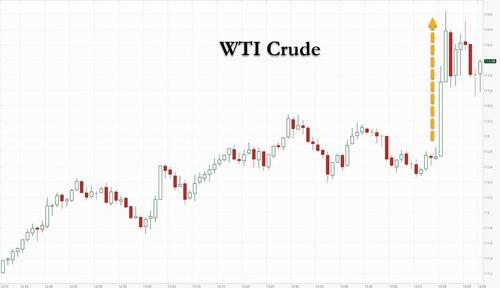
The Biden administration also said it was looking at options they can take right now if they decide to cut the U.S. intake of Russian energy, say Cecilia Rouse, chair of the White House Council of Economic Advisers.
“We are considering a range of options but what’s really essential is that we maintain a steady supply of global energy,” Rouse says at briefing, adding the U.S. does not import a lot of Russian oil (but it does import enough for it to be meaningful).
While even Psaki admitted that such a move would send gas prices sharply higher, perhaps Biden is feeling emboldened by the latest reports out of Vienna on the fate of the Iran nuclear deal, where Russia’s chief negotiator in talks to revive a 2015 nuclear deal between world powers and Iran said on Friday that he thought a deal was possible in the middle of next week.
“As far as I know, the Iranians are not ready for direct talks (with the United States),” Mikhail Ulyanov told reporters. “We will have a deal maybe in the middle of next week. We are talking about the last efforts before crossing the finish line.”
The specter of an Iranian deal, which would lead to a one time boost of as much as 100mm/b as seaborne crude enters the market, and an incremental several hundred thousand bbls/month, had helped contain oil prices somewhat, although the fact that Russia is negotiating for an outcome which Biden is desperately hoping to achieve should probably make those who still have some grasp of the bigger geopolitical picture, nervous (we will have more to say about this later).
Meanwhile, those wondering what a full-blown US ban on Russian imports would do to oil prices, read today’s FT interview of Pioneer Resources CEO Scott Sheffield, who said oil would “easily” go to $150-$200 a barrel if the Western world bans Russian oil and gas.
“The only way to stop Putin is to ban oil and gas exports,” the CEO of the largest US shale company told the Financial Times in an interview on Friday. “[But] if the western world announced that we’re going to ban Russian oil and gas, oil is going to go to $200 a barrel, probably — $150 to $200 easy.” This confirms what we said yesterday in “Two Oil Price Scenarios: One Bad, And One Catastrophic.“
Sheffield also said that the US would be unable to replace crude supplies from Russia this year, even as he backed calls for a global embargo on its energy exports.
“I’m talking about a two- to three-year plan. Because US shale, even if somebody adds a [drilling] rig . . . it takes six to eight months to get first production. There’s labor shortages, there’s frack fleet shortages, there’s rig shortages, there’s sand shortages.”
Russia exported about 5mn barrels a day of crude oil before it invaded Ukraine last month. While China might still absorb some of that volume in the case of a western embargo, there would still be a significant supply shortfall.
“We need to add probably two, two and a half million barrels a day,” Sheffield said. But he warned that an accelerated drilling campaign would require investors’ blessing. “We’d have to go to our shareholder base and ask what their thoughts are,” he said, hinting strongly that it is Biden’s own “green deal” lunacy that is the reason why the US lost its hard won energy independence that was perhaps the high point of the Trump administration.
Of course, if oil does hit $200, we are looking at a global depression, similar to the global financial crisis of 2008 when oil hit $140 just before it crashed to $30 as the inflationary tsunami became a deflationary shockwave almost overnight.
end
Just what planet are the House Democrats on?
(zerohedge)
House Democrats Block Bill To Approve Keystone XL Pipeline For ‘American Energy Independence From Russia’
FRIDAY, MAR 04, 2022 – 03:29 PM
Authored by Nathan Worcester via The Epoch Times (emphasis ours),
Legislation promoting U.S. energy independence from Russia has been blocked by House Democrats.
House Republicans introduced the “American Independence from Russian Energy Act” on Feb. 28, a measure meant to authorize the Keystone XL pipeline, boost domestic oil and gas production, and prevent President Joe Biden’s executive branch agencies from halting energy leasing on federal land and water, among other provisions. Yet on March 1, the legislation was shot down in a 221–202 vote, almost entirely along partisan lines.
“Getting our pipelines expanded is huge,” Rep. Bruce Westerman (R-Ark.), ranking member of the House Natural Resources Committee and a co-sponsor of the measure, told The Epoch Times. “We’re having to import Russian energy to the New England states because we don’t have pipelines that can carry Pennsylvania natural gas up there.”
U.S. crude oil imports from Russia more than doubled in 2021, rising to an average of 209,000 barrels per day from a daily average of roughly 76,000 per day barrels in 2020, according to data from the Energy Information Administration (EIA).
Raúl Grijalva (D-Ariz.), chair of the House Natural Resources Committee, didn’t respond to a request for comment by press time on his choice to vote down the legislation.
Republicans on the floor voiced near-unanimous support for the measure, with Rep. Tom Cole (R-Okla.) describing U.S. reliance on Russian oil and petroleum products as “unconscionable.”
By contrast, Rep. Jim McGovern (D-Mass.) said Republicans “talk about energy independence, yet … are the ones who have consistently voted against and opposed green and renewable energy here at home, which is the fastest way to achieve real energy independence.”
The 220 Democrats who voted the legislation down were joined by Rep. Matt Gaetz (R-Fla.), who said the measure could open up the northwest Florida coast to drilling, potentially impeding military testing and related missions that take place east of the Military Mission Line.
Westerman told The Epoch Times that Gaetz’s objection was a “totally illegitimate concern.”
“I don’t know where he got the misinformation, but it talks about the Western Gulf [of Mexico],” he said. “It is not going to allow drilling around Florida.”
A spokesperson for Gaetz explained the congressman’s concerns to The Epoch Times.
Although the bill doesn’t specifically authorize drilling near Gaetz’s district, it keeps the president and his cabinet from freezing the new drilling lease sales on federal land or water. Any withdrawal of those federal holdings from drilling would have to be authorized by Congress.
The spokesperson said this language could be used to undermine a September 2020 memorandum from then-President Donald Trump extending the drilling moratorium off Florida’s northwest coast until 2032.
“The Congressionally approved moratorium is set to expire in June of 2022,” the spokesperson said, referring to the original Gulf of Mexico Energy Security Act that made the area off-limits for drilling.
“It would be foolish to respond to Russia’s aggression by rendering America less capable to defeat Russia or anyone else,” the spokesperson said. “Protecting the Gulf Test Range is in America’s best interest.”
The spokesperson told The Epoch Times that Gaetz is on record as favoring more U.S. energy production to undercut Russia, drawing attention to a passage in Gaetz’s 2020 book, “Firebrand”:
“Asia’s largest consumer of energy, China, is right next to Asia’s largest producer, Russia. They are building bridges to one another that could well imperil the free world.
“We can beat Russia and other fossil fuel foes just by keeping the price of oil perpetually low.”
Westerman, who said he supports an “all of the above” energy strategy that includes oil, gas, nuclear, solar, and wind, pointed out that greenhouse gas emissions fell during the Trump administration.
“I don’t think Putin gives a rip about environmental goals, or anybody’s economy other than his own,” he said.
The legislation instructs the secretary of the interior to immediately restart the oil and gas lease sales required by the Mineral Leasing Act, which Biden first froze through Executive Order 14008 in January 2021.
In addition, it specifically instructs the secretary to hold at least four oil and gas lease sales in Wyoming, New Mexico, Colorado, Utah, Montana, North Dakota, Oklahoma, Nevada, and “any other state in which there is land available for oil and natural gas leasing under the [Mineral Leasing] Act.”
The Epoch Times has reached out to three key bureaus and agencies of the Interior Department involved in mining and drilling authorization—the Bureau of Land Management, the Ocean Energy Management Bureau, and the Office of Surface Reclamation and Enforcement—but didn’t receive a response by press time.
“Democrats blocking the Act yesterday from even being considered demonstrates how unserious they are about truly addressing the crisis in Ukraine,” Kathleen Sgamma, president of the Western Energy Alliance, a nonprofit energy industry association, told The Epoch Times in an email.
“We have the energy resources to starve Putin of revenue and lower prices for Americans if the president would just take action within his power now. For example, the government is holding up hundreds of federal permits in the Permian Basin, America’s most prolific oil region. Most are ready to go but are being held up for more climate change analysis.”
Representatives for the U.S. branch of Fridays for Future, the international climate movement started by Swedish teenager Greta Thunberg, didn’t respond to a request for comment on the legislation by press time.
end
8 EMERGING MARKET& AUSTRALIA ISSUES
Australia//// NEW ZEALAND/ SOUTH AFRICA/BRAZIL//COVID/VACCINES/LOCKDOWNS
NEW ZEALAND
END
Your early currency/gold and silver pricing/Asian and European bourse movements/ and interest rate settings FRIDAY morning 7:30 AM
Euro/USA 1.0953 DOWN .01138 /EUROPE BOURSES //ALL RED
USA/ YEN 115.43 DOWN 0.054 /NOW TARGETS INTEREST RATE AT .11% AS IT WILL BUY UNLIMITED BONDS TO GETS TO THAT LEVEL…
GBP/USA 1.3265 DOWN 0.0085
Last night Shanghai COMPOSITE CLOSED DOWN 33.46 PTS OR 0.96%
Hang Sang CLOSED DOWN 562.05 PTS OR 2.50%
AUSTRALIA CLOSED DOWN 0.69% // EUROPEAN BOURSES OPENED ALL RED
Trading from Europe and ASIA
I) EUROPEAN BOURSES ALL RED
2/ CHINESE BOURSES / :Hang SANG CLOSED DOWN 123.42 PTS OR 0.55%
/SHANGHAI CLOSED DOWN 3.03 PTS OR 0.09%
Australia BOURSE CLOSED DOWN 0.55%
(Nikkei (Japan) CLOSED DOWN 591.80 PTS OR 2.23%
INDIA’S SENSEX IN THE RED
Gold very early morning trading: 1945.60
silver:$25.19-
USA dollar index early FRIDAY morning: 98.43 UP 64 CENT(S) from THURSDAY’s close.
THIS ENDS FRIDAY MORNING NUMBERS
xxxxxxxxxxxxxxxxxxxxxxxxxxxxxxxxxxxxxxxxxxxxxxxxxxxxxxxxxxxxxxxxxxxxxxxxxxxxxxxxxxxxxxxxxxxxxxxxxxxxxxxxxxxxxx
And now your closing FRIDAY NUMBERS 1: 00 PM
Portuguese 10 year bond yield: 0.84% DOWN 3 in basis point(s) yield from YESTERDAY/
JAPANESE BOND YIELD: +0.152% DOWN 1 AND 7/10 BASIS POINTS from YESTERDAY/JAPAN losing control of its yield curve/
SPANISH 10 YR BOND YIELD: 0.96%// DOWN 6 in basis points yield from yesterday.
ITALIAN 10 YR BOND YIELD 1.52 DOWN 7 points in basis points yield from yesterday./
the Italian 10 yr bond yield is trading 56 points higher than Spain.
GERMAN 10 YR BOND YIELD: FALLS TO -0.0720% IN BASIS POINTS ON THE DAY//
THE IMPORTANT SPREAD BETWEEN ITALIAN 10 YR BOND AND GERMAN 10 YEAR BOND IS 1.59% AND NOW ABOVE THE 3.00% LEVEL WHICH WILL IMPLODE THE ENTIRE ITALIAN BANKING SYSTEM. AT 4% SPREAD THERE WILL BE A HUGE BANK RUN…
END
IMPORTANT CURRENCY CLOSES FOR FRIDAY
Closing currency crosses for FRIDAY /USA DOLLAR INDEX/USA 10 YR BOND YIELD/1:00 PM
Euro/USA 1.0915 DOWN .01513 or 151 basis points
USA/Japan: 114.73 DOWN 0.744 OR YEN UP 75 basis points/
Great Britain/USA 1.3210 DOWN 140 BASIS POINTS
Canadian dollar DOWN 93 BASIS pts to 1.2764
xxxxxxxxxxxxxxxxxxxxxxxxxxxxxxxxxxxxxxxxxxxxxxxxxxxxxxxxxxxxxxxxxxxxxxxxxxxxxxxx
The USA/Yuan, CNY: closed ON SHORE (CLOSED )..UP 6.3199
THE USA/YUAN OFFSHORE: (YUAN CLOSED (DOWN)..6.3271
TURKISH LIRA: 14.22 EXTREMELY DANGEROUS LEVEL/DEATH WISH/HYPERINFLATION TO BEGIN.
the 10 yr Japanese bond yield at +0.152
Your closing 10 yr US bond yield DOWN 14 IN basis points from MONDAY at 1.709% //trading well ABOVE the resistance level of 2.27-2.32%) very problematic
USA 30 yr bond yield: 2.139 DOWN 10 in basis points
Your closing USA dollar index, 98.64 UP 84 CENT(S) ON THE DAY/1.00 PM/
Your closing bourses for Europe and the Dow along with the USA dollar index closing and interest rates for FRIDAY: 12:00 PM
London: CLOSED DOWN 231.86 PTS OR 3.20%
German Dax : CLOSED DOWN 103.84 points or 1.60%
Paris CAC CLOSED DOWN 301.28PTS OR 4.72%
Spain IBEX CLOSED DOWN 284.60PTS OR 3.55%
Italian MIB: CLOSED DOWN 1441.51 PTS OR 6.12%
WTI Oil price 111.48 12: EST
Brent Oil: 114.30 12:00 EST
USA /RUSSIAN / RUBLE RISES TO: 104.40 UP 5.60 RUBLES/DOLLAR (RUBLE UP BY 560 BASIS PTS)
GERMAN 10 YR BOND YIELD; -.0720
CLOSING NUMBERS: 4 PM
Euro vs USA: 1.0924 DOWN .01412 OR DOWN 141 BASIS POINTS
British Pound: 1.3235 DOWN .01146 or down 115 basis pts
USA dollar vs Japanese Yen: 114.85 DOWN .631
USA dollar vs Canadian dollar: 1.2730 UP .0059 (CDN dollar DOWN 59 basis pts)
West Texas intermediate oil: 115.14
Brent: 118.65
USA 10 yr bond yield: 1.726 DOWN 12 points
USA 30 yr bond yield: 2.146 DOWN 8 pts
USA DOLLAR VS TURKISH LIRA: 14.23
USA DOLLAR VS RUSSIA ROUBLE: 106.50 down 3.50ROUBLES (ROUBLE up 3.50 )//
DOW JONES INDUSTRIAL AVERAGE: DOWN 179.86 PTS OR 0.53%
NASDAQ 100 DOWN 197.38 PTS OR 1.41%
VOLATILITY INDEX: 31.98 UP 1.50 PTS OR 4.92%
GLD: 183.68 UP 2.88 PTS OR 1.59%
SLV/ 23.64 UP .35 PTS OR 1.50%
end)
USA trading day in Graph Form
‘Putin-Panic’ Goes Global: Stocks & Credit Crushed As Bonds & Commodities Soar
FRIDAY, MAR 04, 2022 – 04:00 PM
The global systemic risk ‘boogeyman‘ is back…
It was a big, bad week for Russian assets as the Ruble collapsed…
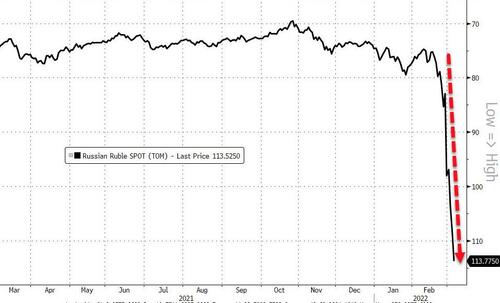
Source: Bloomberg
Russian bonds became “worthless” collateral…
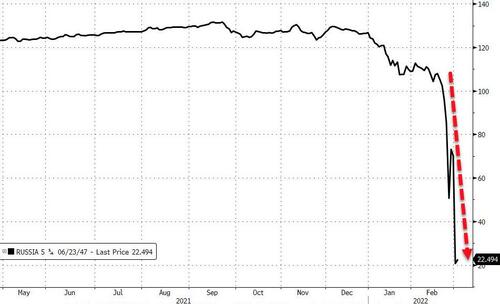
Source: Bloomberg
And Russian stock values simply disappeared…
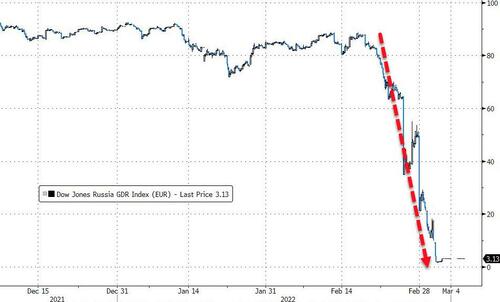
Source: Bloomberg
And finally, the Russians had to basically give their oil away (at a $28.50 discount to Brent) to find a buyer…
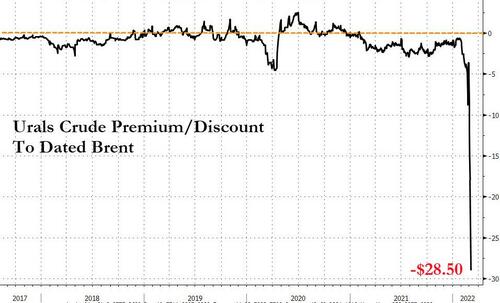
Source: Bloomberg
Even as global crude prices soared to decade highs (even with the Iran nuke deal overhang)…
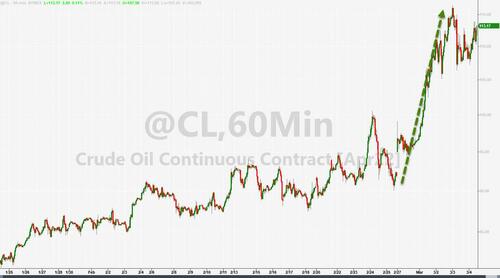
European stocks just suffered their largest outflows on record in the week to March 2…
…which sent European stocks to their worst week since March 2020, with Italy leading this week’s collapse, but everything hammered…
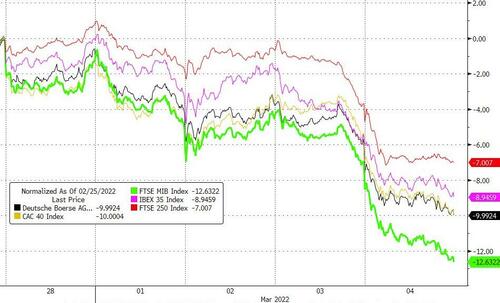
Source: Bloomberg
It’s likely no wonder as energy costs in Europe exploded this week to a record high (with EU NatGas trading at an equivalent $370 barrel of oil)…
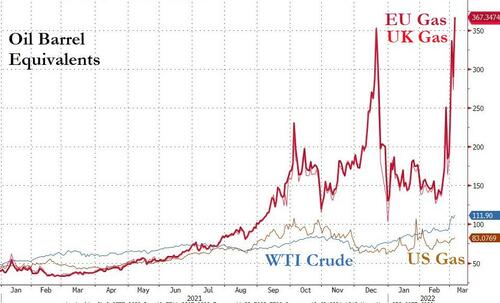
Source: Bloomberg
Swissy has also seen major safe-haven flows, soaring to its strongest since the revaluation in 2015..
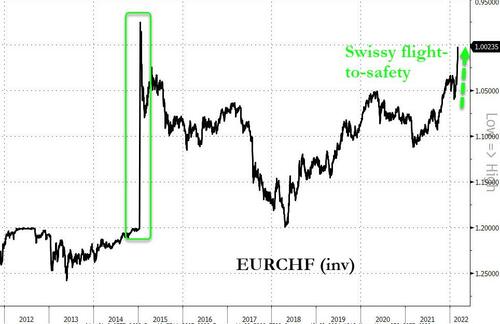
Source: Bloomberg
European sovereign yields collapsed this week as safe-haven flows hit – erasing the hawkish ECB spike…
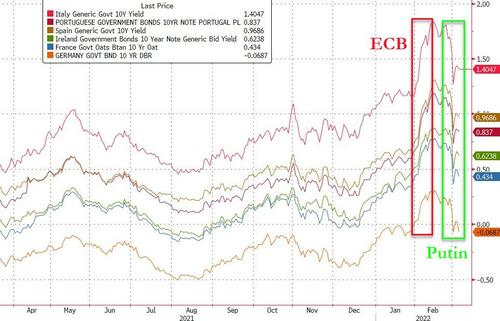
Source: Bloomberg
The last 24 hours or so was a little more chaotic than normal as images of Russian soldiers attacking a nuclear facility sparked some (admittedly) illiquid de-risking last night, then the strong jobs print removed an excuse for The Fed to be dovish in any way. There were some utterly clueless reassurances from Yellen at the end of the day that The Fed will engineer inflation down and a soft-landing for the economy, and stocks did their normal Friday close meltup thing…
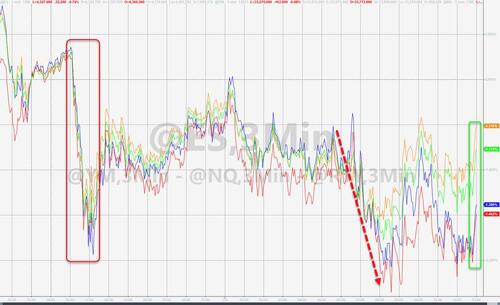
US equities had a tough week too – but saw much more volatility than Europeans, chopping up and down 2-3% every day, but unable to hold any gains that were achieved during the pumps. Nasdaq was the week’s biggest loser…
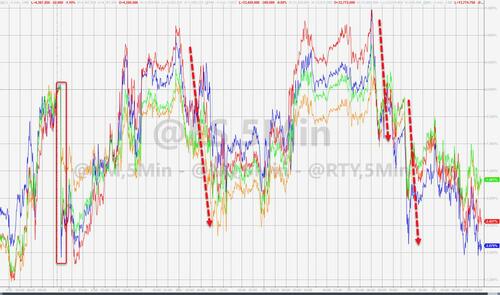
Energy and Utes outperformed while financials were clubbed like a baby seal…
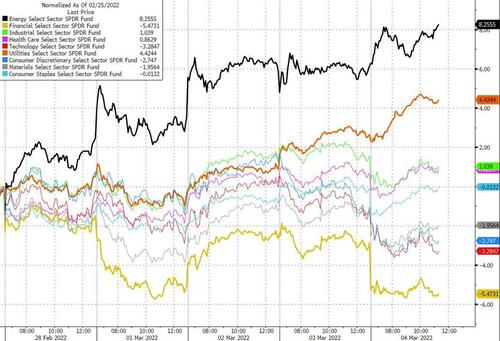
Source: Bloomberg
But while US financials were ugly, European financials stole the jam out of everyone’s donut…
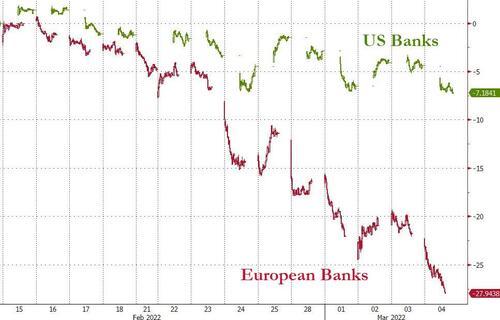
Source: Bloomberg
Bubble markets continued to blow up – with SPACs, ARKK, and Unprofitable Tech just getting destroyed…
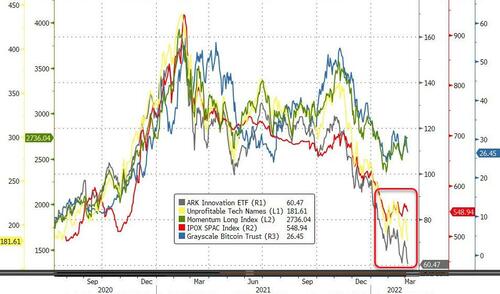
Source: Bloomberg
Bonds were bid on the week – despite a big sell-off ion Wednesday during the European session – with the belly dramatically outperforming the wings…
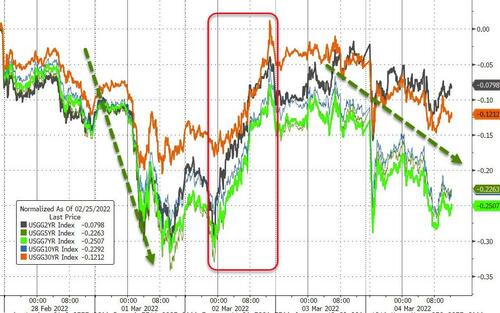
Source: Bloomberg
The yield curve collapsed this week – screaming Fed policy error imminent…
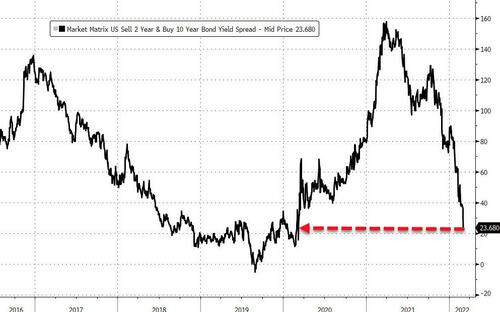
Source: Bloomberg
“Shit is starting to get real,” warned one trader, “we are going to hear of some big holes appearing in funds books very soon…” Which made this very appropriate…
Stresses are starting to show in the financial system with FRA/OIS spreads blowing out…
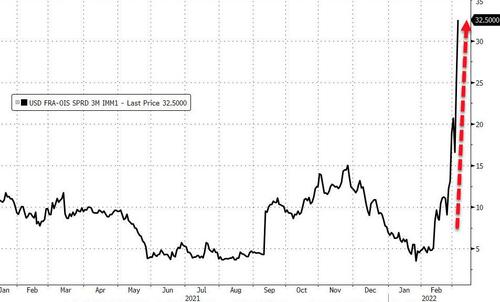
Source: Bloomberg
And dollar liquidity becoming a problem fast for someone…
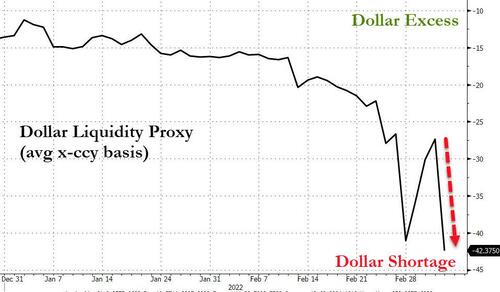
Source: Bloomberg
Which probably explains the surge in the dollar this week…
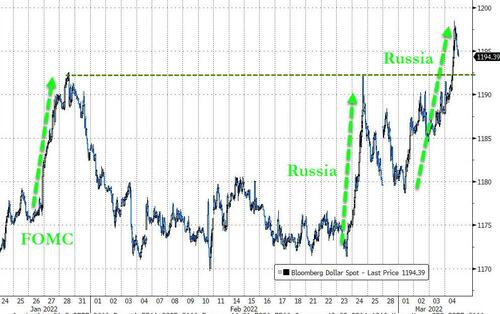
Source: Bloomberg
…breaking out of the recent range to a key level from pre-COVID-lockdown panic…
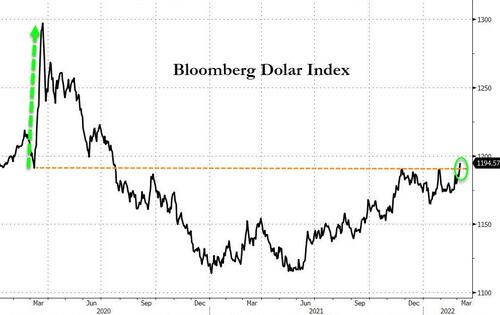
Source: Bloomberg
Credit markets are starting to crack hard with HY spreads at their widest since Nov 2020…
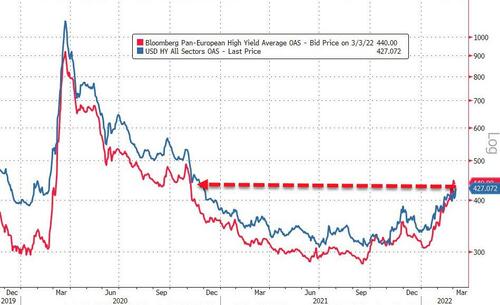
Source: Bloomberg
Global financial credit risk is starting to blow out too, with Credit Suisse getting hit the hardest…
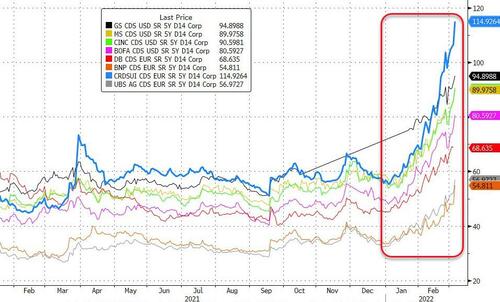
Source: Bloomberg
Cryptos had a roller-coaster week with Bitcoin managing to cling to some of the post-Putin gains (but fell back below $40k)…
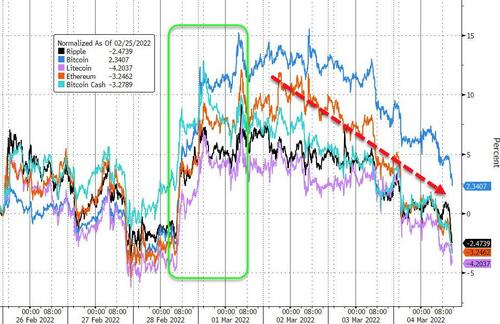
Source: Bloomberg
This week saw the biggest jump in Spot Commodity prices since Sept 1974, which closed at a new record high…
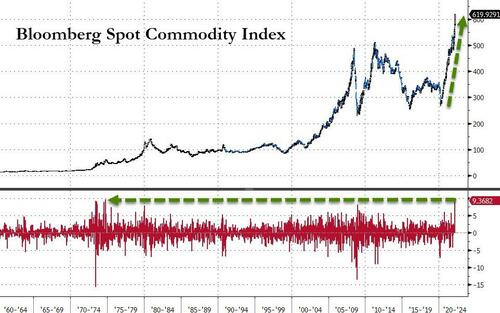
Source: Bloomberg
For context of just how insane this week’s move in crude was (+25%), here it is compared to PMs and copper (which also had big weeks)…
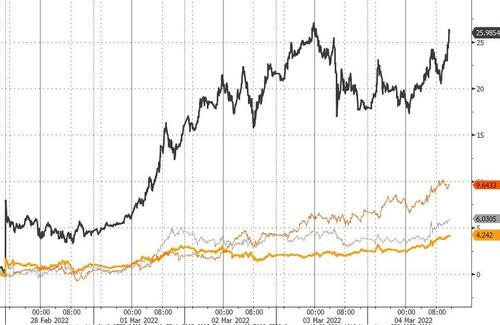
Source: Bloomberg
Gold saw safe-haven flows as WW3 draws closer…
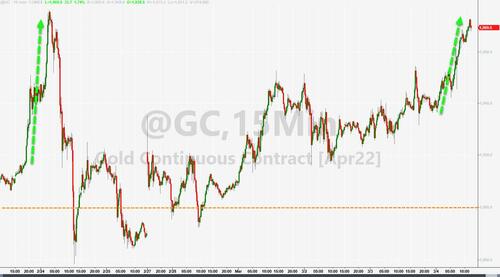
National average gas prices at the pump exploded higher this week – the 2nd biggest jump ever – and look set to go even further given the price of crude and wholesale gasoline…
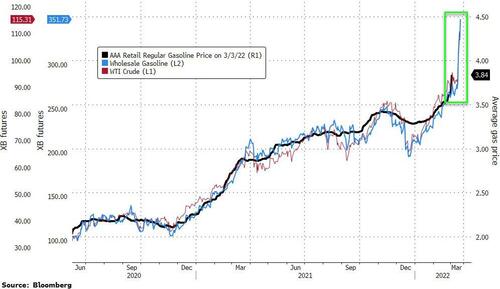
Source: Bloomberg
Finally, in case it was not obvious from the charts above, we are in a state of “Extreme Fear”… This is the most fearful the market has been since the cratering lows of the March/April 2020 collapse…
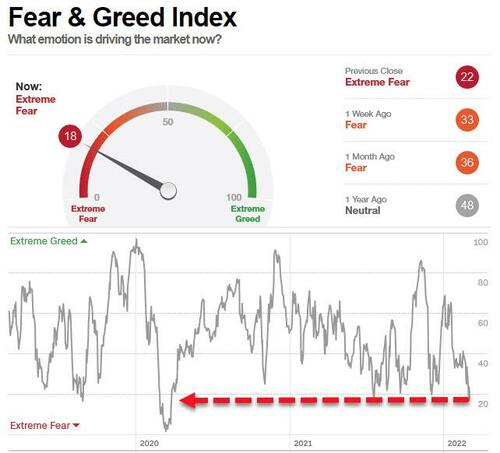
Source: CNN
…and don’t expect The Fed to do anything to protect against this plunge this time as while Powell jawboned expectations for a 50bps hike in March down to 25bps, the market is still expecting 6 rate-hikes this year… (and QT)…
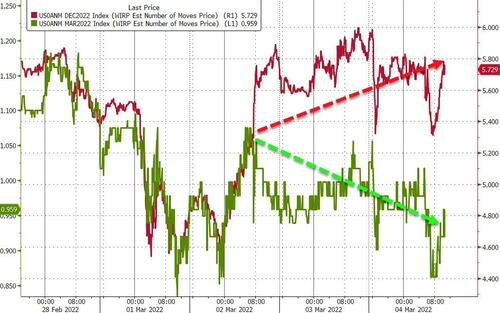
Source: Bloomberg
Brace.
I) /MORNING TRADING/JOBS REPORT
February payrolls surge to 678,000 new jobs but wages basically flat.
Market does not really care!
(zerohedge)
February Payrolls Smash Expectations Surging To 678K, Highest Since July, But Wages Cool
FRIDAY, MAR 04, 2022 – 08:35 AM
As noted earlier, it was difficult to get worked up about today’s jobs report in light of the barrage of geopolitical development, and yet if anyone needed a confirmation that the Fed will hike by 25bps in two weeks, they just got it when the BLS reported that in March, total jobs surged by a whopping 678K, much higher than the 423K consensus forecast, higher than last month’s upward revised 481K and the highest since last July’s 689K. However, offsetting this surge was the unexpectedly weak wage data, which saw a flat print in the monthly change in average hourly earnings vs expectations of a 0.5% increase (and down from 0.6% in February).

The change in total nonfarm payroll employment for December was revised up by 78,000, from +510,000 to +588,000, and the change for January was revised up by 14,000, from +467,000 to +481,000. With these revisions, employment in December and January combined is 92,000 higher than previously reported (following last month’s massive upward revisions).
The total number of people on payrolls is now just 2.1 million lower than the record high reached in February 2020. At the February pace of job gains, that gap will be closed in three months.
The unemployment rate edged down to 3.8 percent, and the number of unemployed persons edged down to 6.3 million. In February 2020, prior to the coronavirus pandemic, the unemployment rate was 3.5 percent, and the number of unemployed persons was 5.7 million. Among the major worker groups, the unemployment rates for adult men (3.5 percent) and Hispanics (4.4 percent) declined in February. Of note, the Hispanic unemployment rate is now back to pre-covid levels. The unemployment rate for Black workers dropped to 6.6% in February. That was led by men, while unemployment for women ticked up in the month.The jobless rates for adult women (3.6 percent), teenagers (10.3 percent), Whites (3.3 percent), Blacks (6.6 percent), and Asians (3.1 percent) showed little or no change over the month.

And while the labor force participation rose modestly 62.2% to 62.3%, with the employment-population ratio edging up to 59.9 percent…

… the underemployment rate also rose modestly from 7.1% to 7.2%

Among the unemployed, the number of persons on temporary layoff, at 888,000 in February, was little changed over the month. The number of permanent job losers, at 1.6 million in February, also changed little. Both measures are higher than their February 2020 levels of 780,000 and 1.3 million, respectively.
There were also 418,000 more people working part-time who wanted more hours, with a total of 4.1 million in that position; this remains below its February 2020 level of 4.4 million. These individuals, who would have preferred full-time employment, were working part time because their hours had been reduced or they were unable to find full-time jobs.
The number of persons not in the labor force who currently want a job declined by 349,000 to 5.4 million in February. These individuals were not counted as unemployed because they were not actively looking for work during the 4 weeks preceding the survey or were unavailable to take a job.
Among those not in the labor force who wanted a job, the number of persons marginally attached to the labor force, at 1.5 million, changed little in February. These individuals wanted and were available for work and had looked for a job sometime in the prior 12 months but had not looked for work in the 4 weeks preceding the survey. The number of discouraged workers, a subset of the marginally attached who believed that no jobs were available for them, was little changed over the month at 391,000.
Covid continued to impact numbers, with the BLS reporting that in February, 4.2 million persons reported that they had been unable to work because their employer closed or lost business due to the pandemic (that is, they did not work at all or worked fewer hours at some point in the 4 weeks preceding the survey due to the pandemic). Still, this measure is down from 6.0 million in the previous month. Among those who reported in February that they were unable to work because of pandemic-related closures or lost business, 20.3 percent received at least some pay from their employer for the hours not worked, down from 23.7 percent in January.
While job growth surprise to the upside, wage growth eased a bit, as average hourly earnings declined dropping from 5.5% to 5.1% Y/Y, while as noted above the sequential change was flat, a disappointment to expectations of a 0.5% increase (and down from 0.6% in January) Average hourly earnings for all employees on private nonfarm payrolls, at $31.58 in February, were little changed over the month (+1 cent), after large increases in recent months. In February, average hourly earnings of private-sector production and nonsupervisory employees rose by 8 cents to $26.94.

Commenting on the flat average hourly earnings numbers, Bloomberg chief economist Carl Riccadonna said these are largely the result of a big influx/rebound of lower-wage industries accounting for a large share of hiring gains. Adding lots of lower-wage workers brings the median and average lower. “This is not new — this dynamic has roiled the monthly statistics repeatedly throughout the pandemic.”
In part, the drop in average earnings was due to a solid increase in average hours worked, which rose from an upward revised 34.6 (was 34.5) to 34.7, beating expectations of an unchanged print. In manufacturing, the average workweek for all employees increased by 0.4 hour to 40.7 hours, and overtime rose by 0.2 hour to 3.6 hours. The average workweek for production and nonsupervisory employees on private nonfarm payrolls was up by 0.1 hour to 34.1 hours.

A breakdown of jobs by category:
- Employment in leisure and hospitality continued to increase, with a gain of 179,000 in February. Job growth occurred in food services and drinking places (+124,000) and in accommodation (+28,000). Since February 2020, employment in leisure and hospitality is down by 1.5 million, or 9.0 percent.
- Professional and business services added 95,000 jobs in February. Job gains occurred in temporary help services (+36,000), management of companies and enterprises (+12,000), management and technical consulting services (+10,000), and scientific research and development services (+8,000). Employment in professional and business services is 596,000 higher than in February 2020, largely in temporary help services (+240,000), computer systems design and related services (+154,000), and management and technical consulting services (+152,000).
- Employment in health care rose by 64,000 in February. Job gains occurred in home health care services (+20,000), offices of physicians (+15,000), and offices of other health practitioners (+12,000). Employment in health care is down by 306,000, or 1.9 percent, from its level in February 2020.
- Construction added 60,000 jobs in February, following little change in the prior month. About three-fourths of the over-the-month job gain occurred in specialty trade contractors, with increases in both the residential (+24,000) and nonresidential (+20,000) components. Construction employment is slightly below (-11,000) its February 2020 level.
- Employment in transportation and warehousing increased by 48,000 in February and is 584,000 higher than in February 2020. Over the month, job gains continued in warehousing and storage (+11,000), couriers and messengers (+9,000), support activities for transportation (+9,000), and air transportation (+7,000). All four of these component industries have surpassed their February 2020 employment levels, with particularly strong job growth in warehousing and storage (+420,000) and couriers and messengers (+240,000).
- Employment in retail trade rose by 37,000 in February, with gains in building material and garden supply stores (+12,000), furniture and home furnishings stores (+6,000), and gasoline stations (+5,000). Retail trade employment is 104,000 above its level in February
- 2020.
- Manufacturing added 36,000 jobs in February. Employment in durable goods industries rose by 20,000, with job gains in fabricated metal products (+11,000), machinery (+8,000), electrical equipment and appliances (+4,000), nonmetallic mineral products (+3,000), furniture and related products (+3,000), and primary metals (+3,000). These gains were partially offset by a job loss in motor vehicles and parts (-18,000). Nondurable goods manufacturing also added jobs over the month (+16,000). Since February 2020, manufacturing employment is down by 178,000, or 1.4 percent.
- Employment in financial activities rose by 35,000. Job gains were split between finance and insurance (+16,000) and real estate (+16,000). Employment in financial activities is 31,000 above its level in February 2020.
- Social assistance added 31,000 jobs in February, with a gain of 21,000 jobs in individual and family services. Since February 2020, employment in social assistance is down by 152,000, or 3.5 percent.
- Employment increased by 25,000 in the other services industry in February, led by a gain in repair and maintenance (+10,000). Employment in the other services industry is down by 317,000, or 5.3 percent, from its level in February 2020.
Commenting on the strong jobs report, Jeffrey Rosenberg of BlackRock told Bloomberg TV that “The market’s focus is really not on payrolls” adding that “This is a really a difficult period for markets. Because, as we heard earlier this week, the Fed is focused on inflation and its need to get on with normalization and raise rates, while the market is focused on the implications of the Russian invasion — and that implication is a negative supply shock, negative to growth, positive to inflation.”
Bloomberg rates strategist Ira Jersey notes that “with real wages falling, fears of a recession may grow even as inflation seems set to remain high. For the rate markets, this may mean some modest yield-curve steepening in the near term. We think the Fed will still hike to above 2% over time, but it will take another year or so than the market has been pricing. We still look for four or five hikes this year along with the start of balance sheet runoff in 3Q.”
Flipping to Bloomberg reporter Chris Antsey, he writes that “on the face of it, it’s a perfect report: You’ve got strong job gains, people coming off the sidelines of the labor market, unemployment dropping even faster for disadvantaged communities. And — good from a Fed policy maker perspective — no wage inflation, which should help pull down inflation.”
Bottom line: a 25bps hike is now certain but how much more the Fed will be able to hike into clear global stagflation before the next recession hits, is the real mystery.
END
AFTERNOON
END
II) USA DATA
IIb) USA COVID/VACCINE MANDATE STORIES
The NFL becomes the first USA sports league to abandon all covid protocols
(zerohedge)
NFL Becomes First US Sports League To Abandon All COVID Protocols
THURSDAY, MAR 03, 2022 – 05:20 PM
In what appears to be a first for major American sports leagues, the NFL announced on Thursday that it plans to suspend all aspects of its COVID protocols following an agreement between the league and the players’ union.

The league sent a memo to all 32 of its teams on Thursday during which it claimed that “encouraging trends regarding the prevalence and severity of COVID, the evolving guidance from the CDC, changes to state law and the counsel of our respective experts” all as reasons for the decision.
Should the league decide to backtrack on this decision, it will need to do so in conjunction in the player’s union.
There is no football-related activity underway at any club facilities at this point in the offseason. The earliest any league activity can begin is April 4 for teams that have hired new coaches, according to ESPN.
However, the changes will affect Thursday’s change will affect coaches and other staff who are attending the scouting combine in Indianapolis this week. They will also impact coaches and staff who work year round in certain local markets.
As a result of the changes, players will no longer face surveillance testing, regardless of vaccination status, or masking requirements.
The pandemic forced the NFL to cancel its 2020 off-season training and preseason, but the league has played all regular-season and playoff games since the start of the pandemic, with a total of just eight games being rescheduled.
For the entire league, there were only four known cases of hospitalizations due to COVID involving players, coaches and on-field officials between the start of training camp in 2020 and the end of the 2021 season.
Teams must continue to abide by all local laws and requirements. The decision comes after the CDC finally abandoned its indoor masking guidance late last month.
New York:
end
iii) USA inflation//SHIPPING commentaries//LOG JAMS//
iii) USA economic stories
Too many holes in the SWIFT sanctions on Russia
(Mish Shedlock/Mishtalk)
So Many Holes In SWIFT Sanctions On Russia, They Are Useless
FRIDAY, MAR 04, 2022 – 08:45 AM
Authored by Mike Shedlock via MishTalk.com,
…many did not think the EU would play the SWIFT card on Russia. It turns out they were correct…

SWIFT is the international payment system. Cutting off a top country from SWIFT access is a very big deal.
When the US and EU trotted out the SWIFT sanction card, I thought I got that one wrong. Closer inspection by Eurointelligence and others shows it’s Not So Swift After All.
FAZ informs us that the Swift sanctions are essentially dead in the water. Only seven banks, representing a quarter of the Russian banking sector, are subject to the sanctions. What happened is that once this sanctions list went through the mill of talks with member states, only this pared-down lists survives. The EU originally promised to hit 70% of the Russian banking system. One reason for the exclusion of Sberbank is the deposits held by savers in the bank’s EU subsidiaries. It would have triggered massive deposit insurance claims.
The reduced ambitions embed an important piece of hard information. It is telling us that EU member states will not be ready to impose transactional sanctions on Russia in areas deemed vital to the EU economy, especially the import of Russian gas, oil and coal. What this will also tell us is that we have no means to crush the Russian economy, as Bruno Le Maire suggested. Vladimir Putin has run into big problems with his military campaign. But he will be able to finance the war.
Putin did not anticipate the central bank sanctions. That has turned out to be a real problem for the Russian economy. But he anticipated correctly that the west would continue to buy Russian gas and oil. We think the Russian leadership is also right in their assumption that the main effect of the Nord Stream 2 closure is not so much to make us less dependent on Russian gas, but to increase the price of gas.
The seven banks affected by the Swift exclusion are VTB, Bank Otkritie, Novikombank, Promsvyazbank, Rossiya Bank, Sovcombank und VEB. Notably, the two Russian banking giants, Sberbank und Gazprom Bank, are excluded. The ban will only come into effect in ten days, which will allow the Russians to reorganise their banking system, and we presume, re-route payments through banks that are not affected by the sanctions. What this means is that the Swift ban falls into the SINO category: sanctions in name only. The EU is cheering on the Ukrainian side from a safe distance, watching from warm living rooms, heated by Russian gas.
Reuters posts the same idea but without the above details in EU bars 7 Russian banks from SWIFT, but spares those in energy.
END
Remember in 2019 we had a huge dollar shortage which created such as mess with emerging markets as they could not find dollars to fund their debt.
It is now back, exactly what Poszar said would happen
a must read..
(zerohedge)
FRA-OIS Explodes: Here Is The Only Chart Powell Is Closely Watching, And Why It Is Soaring
FRIDAY, MAR 04, 2022 – 11:06 AM
Some were quick to mock repo guru and former NY Fed staffer Zoltan Pozsar when he warned that the unexpected western blockade of Russia had the feel of a Lehman weekend, because virtually nobody had any idea what the forced exclusion of a G-20 economy from the global financial system would lead to. In fact, just yesterday Jerome Powell admitted that he had not been consulted, suggesting that arguably the most momentous financial decision in modern history has made without consulting the single most important financial person in the world.
However, it appears that while Pozsar may have been ahead of the curve, as usual, he was not wrong, and today the all important FRA-OIS indicator of interbank funding stress (and money-market risk) is surging, and at last check was above 37bps, up a whopping 12 pts…
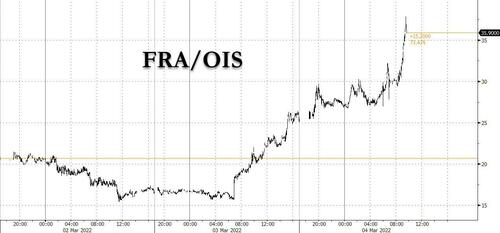
… amid relentless selling in March 2022 eurodollar futures with the contract off session lows but remains cheaper by around 10bp on the day, with some speculating that at least some funding markets are starting to grind to a halt.
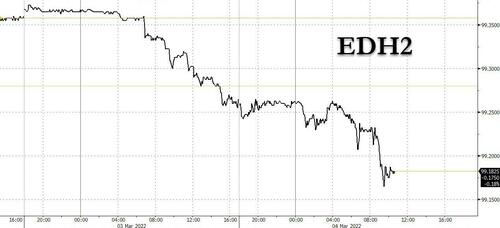
One can argue that while Powell and the Fed may be oblivious to the ongoing collapse in stocks, which they view as overvalued and as having enough buffer to drop especiallyhe is closely watching every uptick in this most critical stress indicator.

A very quick primer on this all important spread:
- What is FRA? A forward rate agreement is a deal to swap future fixed interest payments for variable ones, or vice versa. The key rate for U.S. markets is the three-month London interbank offered rate, or Libor, in U.S. dollars. The benchmark is derived by major banks submitting rates based on transactions that are compiled to establish benchmark for five different currencies across seven different loan periods. Those benchmarks underpin interest rates on trillions of dollars of financial instruments and products from student and car loans to mortgages and credit cards.
- What is OIS? The Overnight Index Swap rate is calculated from contracts in which investors swap fixed- and floating-rate cash flows. Some of the most commonly used swap rates relate to the Federal Reserve’s main interest-rate target, and those are regarded as proxies for where markets see U.S. central bank policy headed at various points in the future.
Oh, that’s the theory. But why does the FRA-OIS spread matter in practice?
Well, it’s regarded as the markets’ measure of how expensive or cheap it will be for banks to borrow in the future, as shown by Libor, relative to a risk-free rate, the kind that’s paid by highly rated sovereign borrowers such as the U.S. government. The FRA-OIS spread provides another snapshot of how the market is viewing credit conditions because of the fact that traders are betting on where Libor-OIS — its underlying spread — will be.
As a further reminder, there are typically 3 reasons why it would blow out:
- the risk premium for uncertainty of US monetary policy,
- recently elevated credit spreads (CDS) of banks, and
- demand for funds in preparation for market stress.
While FRA-OIS exploded to 80bps in March 2020, at the peak of the covid crash, and is currently at just half that level, never before has funding stress been so high with a Fed balance sheet near $9 trillion and with some $1.6 trillion in the Fed’s overnight reverse repo facility.
In other words, when adjusted for the statutory level of liquidity in the market, which we don’t need to tell readers is at an all time high, the FRA-OIS would almost certainly be at all time highs.
Whatever the reasons, a blow out in FRA/OIS means that dollar funding is becoming increasingly problematic, and absent a sharp tightening in the Libor-OIS and FRA-OIS spread, while bank credit concerns may not have been the catalyst for the sharp spike, it will be banks that are eventually impacted by what is increasingly emerging as an acute tightening in short-term funding markets and/or a global dollar shortage. And in another indication that the FRA-OIS is indeed spiking in response to an ominous global dollar shortage – just the outcome Pozsar warned about and one which shouldn’t be happening when factoring in the record endogenous market liquidity – we find that the average cross-currency basis swap is tumbling. This global liquidity proxy tends to shrink any time there is prevailing dollar tightness in the market.
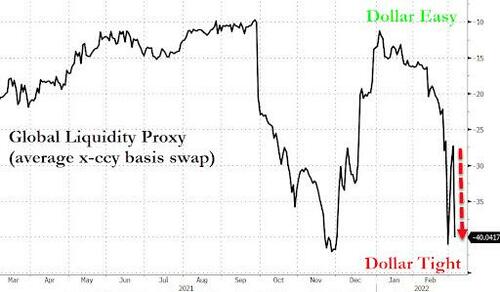
While this is a topic we covered extensively back in March 2020 (see “There Is No Liquidity” – Market Paralyzed As FRA/OIS Explodes), especially right before the Fed unleashed its monetary bazooka with trillions in QE and opening up repos to virtually unlimited amount, as well as announcing it would buy corporate bonds and ETFs, expect to hear much more about this in the days and weeks ago come.
Meanwhile, if the FRA-OIS spikes another 10-15 points, the Fed will have no choice but to emerge from its paralysis and reassure markets that the financial system isn’t about to experience another paralysis (oh, and unless the Ukraine war magically ends in the next few weeks, say goodbye to “six or seven” rate hikes this year).
iv)swamp stories
KING REPORT/SWAMP STORIES
 | |
| The King Report March 4, 2022 Issue 6711 | Independent View of the News |
| Today – ESHs hit +15.25 at 19:04 ET. They slid to -64.00 by 19:42 ET because a Russian attack on the Zaporizhya nuclear power plant in Enerhodar, Ukraine (6 nuclear reactors, largest in Europe, 25% of Ukraine electrical output) set part of the edifice on fire. After a 25-handle rally, ESHs sank to -76.00 on an AP report that radiation levels at Zaporizhya are elevated; ESHs jumped to -16.00 on reports that plant radiation levels are normal; firefighters have been allowed to enter it; and the nuclear facility is safe. The ESH market is super thin obviously. As we keep harping, do NOT play unless you must! Russian troops are shelling Europe’s largest nuclear power station in Ukraine, AP reports https://trib.al/SahVeUk Ukraine FM Kubela on Zaporizhzhia fire: “If it blows up, it will be 10 times larger than Chornobyl!” GOP Sen. @marcorubio: Like most nuke plants the one in Ukraine under attack is built to withstand a direct hit from an airplane crash. The problem is a loss of power or a shell draining the pools used to store spent fuel. If that fuel isn’t cooled it can melt & release large amounts of radioactivity Reports last night said Biden will spend the weekend in Delaware! The February Employment Report should have no market impact except for some very short-term trading machinations. However, a disappointing number will have a political effect. The die has been cast for a 25bp rate hike at the March 16 FOMC meeting. The uncertain consequences of the Ukraine-Russia war and the sanctions overshadow most everything now. Expected economic data: Feb NFP 415k (Whisper # 350k), Mfg 24k Rate 3.9%, wages 0.5% m/m, Workweek 34.6, Labor Force Participation Rate 62.2% Zelenskyy says it’s a ‘pity’ US support came ‘after’ Russian war began (Dissing Team Biden) https://www.foxnews.com/world/zelenskyy-joe-biden-pity-support-came-after-russia-invaded GOP Sen. @marcorubio: After being unable to make progress for close to 72 hours Putin’s massive military column stuck 15 miles outside Kyiv is beginning to show a growing decline in readiness @LucasFoxNews: Several Russian warships have left Crimea and are heading to Odesa. An amphibious assault on Ukraine’s third largest city could come as soon as Thursday: U.S. officials @AFP: Russia’s Putin vowed to continue fighting against ‘militants of nationalist armed groups’ in Ukraine, said Kremlin could add to demands at negotiations if Kyiv stalls talks: readout of Macron call; French President Macron believes ‘worse is to come’ in Ukraine after Putin call: Putin aiming to seize ‘whole’ of Ukraine: France’s Macron condemned Putin’s ‘lies’ during call with Russian president: aide Putin tells Macron Russia will achieve its goals in Ukraine https://www.reuters.com/world/europe/putin-tells-macron-russia-will-achieve-its-goals-ukraine-2022-03-03/ Putin vows ‘uncompromising fight’ as Ukraine war enters second week “Russia intends to continue the uncompromising fight against militants of nationalist armed groups,” Putin said, according to a Kremlin account of a call with French President Emmanuel Macron… Putin’s invasion has appeared hamstrung by poor logistics, tactical blunders and resistance from Ukraine’s outgunned military — as well as its ever-swelling ranks of volunteer fighters. Russian authorities have imposed a media blackout on what the Kremlin euphemistically calls a “special military operation… https://news.yahoo.com/ukraine-pounded-exodus-mounts-russia-061108440.html Commodity markets extended their bull runs, with aluminum, coal and palm oil all hitting new records, while crude oil and wheat scaled multi-year highs as Russia’s invasion of Ukraine disrupted global raw material flows https://t.co/Wq42VsVde9 Oil (WTI 116.57 high) reversed sharply to the downside on this: Iran can reach top oil output 2 months after nuclear deal -oil minister https://t.co/Cu3shQio8E US stocks jump as oil prices turn lower on speculation of export deal with Iran – Business Insider https://markets.businessinsider.com/news/stocks/stock-market-news-today-oil-prices-drops-iran-deal-speculation-2022-3 IAEA chief to visit Iran in possible boost to nuclear deal https://www.reuters.com/world/middle-east/bitter-experience-with-us-is-reason-iran-push-sustainable-nuclear-deal-top-2022-03-02/ After tumbling over $10, WTI oil rebounded sharply on this: Iran’s uranium stock doubles, up to 60% purity – IAEA report – The report showed Iran’s stock of uranium enriched to up to 60% fissile purity had almost doubled, increasing by 15.5 kg to 33.2 kg… A senior diplomat said that is around three-quarters of the amount needed, if enriched further, for one nuclear bomb according to a common definition… That total stock of enriched uranium now stands at 3.2 tonnes, an increase of 707.4 kg on the quarter, the report showed. That is still less than the more than five tonnes the Islamic Republic accumulated before the 2015 deal but the highest purity it achieved then was 20%… https://finance.yahoo.com/news/irans-stock-uranium-near-weapons-141548939.html New UN report: Iran Continues to violate 2015 nuclear deal – Middle East in 24 According to the report, the enriched uranium inventory swelled in the last quarter…and the amount of enriched uranium that can become a weapon has almost doubled… Amid Ukraine crisis, Biden partnering with Russia to revive Iran deal, thwart US opponents Administration has held secret talks with Russians to preempt future Trump-like exit from accord, experts and former officials warn. (Why is Team Obama/Biden so desperate for an Iran deal?) It appears the Biden administration isn’t simply trying to revive the original Iran nuclear deal; instead, it’s negotiating one that, experts warn, will be more advantageous to Iran. The U.S. would “pay more up front with less time on the clock and less lengthy restrictions on Iran’s nuclear program,”… “The Russians have used the Iranians as a pawn in their game of competition with the West,”… https://justthenews.com/government/security/amid-ukraine-crisis-biden-partnering-russia-revive-iran-nuclear-deal @GLNoronha: 1. NEW: My former career @StateDept, NSC, and EU colleagues are so concerned with the concessions being made by @RobMalley in Vienna that they’ve allowed me to publish some details of the coming deal in the hopes that Congress will act to stop the capitulation. 2. “What’s happening in Vienna is a total disaster” one warned. The entire negotiations have been filtered and “essentially run” by Russian diplomat Mikhail Ulyanov. The concessions and other misguided policies have led three members of the U.S. negotiating team to leave… 4. Here’s why: Led by Rob Malley, the U.S. has promised to lift sanctions on some of the regime’s worst terrorists and torturers, leading officials in the regime’s WMD infrastructure, and is currently trying to lift sanctions on the IRGC itself. Let’s dive in. 5. First, Biden’s team is preparing to rescind the Supreme Leaders’ Office Executive Order (E.O. 13876) as soon as this coming Monday, and lift sanctions on nearly every one of the 112 people/entities sanctioned under it, even if they’re sanctioned under other legal authorities. 6. We sanctioned some of the worst people you can possibly imagine under this authority, like Mohsen Rezaei, who was involved in the 1994 AMIA bombing that killed 85 people in Argentina. He’ll be able to live free of sanctions next week if Malley proceeds… https://twitter.com/GLNoronha/status/1499018799198134274 ESHs traded negative during the Nikkei’s 1st session but rebounded to modest gains during the 2nd Session. After a modest rally on the European open, ESHs and European stocks retreated into negative territory. When the US bond market opened at 8 ET, ESHs and stocks soared. ESHs hit a high of 4418.75 at 9:03 ET. Then, ESHs tumbled to 4341 at 11:12 ET. Here’s part of the reason for the decline: WSJ’s @NickTimiraos: (GOP Sen.) Shelby: Volcker put the economy in a recession to get inflation under control. “Are you prepared to do what it takes to get inflation under control?” Powell: “I hope history will record that the answer to your question is yes.” https://www.c-span.org/video/?c5004286/user-clip-shelbypowell-exchange @MarketWatch: “We’re going to see upward pressure on inflation, at least for a while,” from higher commodity prices, especially energy costs, Fed Chairman Jerome Powell said during an appearance before the Senate Banking Committee. https://www.marketwatch.com/story/powell-says-ukraine-war-is-adding-to-inflation-fears-11646324667 @cspan: Fed Chair Powell on if the Russian Invasion of Ukraine will impact interest rates: “Too early to say. I do think before the invasion we were planning to raise rates this year…that is still the case…we need to move carefully…we do not want to add to uncertainty.” https://twitter.com/cspan/status/1499444685689004036 @MarketWatch: The overall median rent nationwide as of January was $1,789 per month, according to a new report from http://Realtor.com. That’s a 19.8% increase on the year. The BLS has ‘Rent of Primary Residence up 3.8% y/y (7.298% of CPI) and Owners’ Equivalent Rent +4.1% y/y (24.251% of CPI). https://www.bls.gov/news.release/pdf/cpi.pdf Using real rent data would push CPI ~500 basis points higher. (16 x 7.298%) + (15.7 x 24.251%) There was no good reason for the manic buying that began after the US bond market opened. It appears the buying was loosely correlated with the plunge in oil. Tech stocks and Fangs led the morning decline. The rally into the European close occurred on schedule. It ended near 13:30 ET on this: Biden to Specify More Russia Sanctions Shortly: Psaki – BBG 13:31 ET The decline ended when Psaki said, “Sanctioning Russian energy would reduce supply and have an impact of prices and impact people at the pump…The US has no interest in cutting oil supplies…” @ABC: Asked if steps were being considered to boost US oil production, Psaki says, “You think the oil companies don’t have enough money to drill on the places that have been pre-approved?… I would point that question to them and we can talk about it more tomorrow when you learn more.” https://twitter.com/ABC/status/1499455608185102343 US expands list of Russian oligarchs who will face sanctions Updated sanctions list includes Alisher Usmanov, whose massive yacht was seized by Germany https://www.foxbusiness.com/politics/us-expands-russian-oligarch-sanctions?test=aedaf50575f19da86e2e168307f2faa4 Biden weighing sanctions on ‘ally’ India over Russian military stockpiles – The Hill https://thehill.com/policy/international/596693-biden-weighing-sanctions-on-india-over-russian-military-stockpiles After The Big Guy’s new sanctions were announced, ESHs and stocks rallied modestly. The rally ended near the 14:15 ET VIX Fix. The ensuing decline stalled on this: Third round of Russia-Ukraine talks to be held early next week in Belarus – Interfax The decline quickly resumed; it ended at 15:09 ET. It was time for the last-hour manipulation. After an 18-handle ESH rally in 20 minutes, ESHs and stocks headed south. ESHs tanked 26 handles by 15:46 ET. Manipulators then forced ESHs 19 handles higher into the close. Caught between Russia and the West, China faces ‘Ukraine dilemma’ It was meant to be a friendship with “no limits”, according to a joint statement issued February 4 as Russian President Vladimir Putin traveled to Beijing to meet his Chinese counterpart Xi, Jinping. But as Russia launched its full-scale invasion of Ukraine, China has found itself in a precarious position. Its leaders are trying to preserve the country’s growing yet fragile ties with Moscow while minimizing any further fallout with the West… China’s economic interests remain deeply tied to the West — and even with Ukraine. China became the EU’s largest trading partner in 2021, and the country overtook Russia in 2019 to become Ukraine’s biggest single trading partner… https://t.co/rXiNM96IDB China’s National People’s Congress kicks off Saturday in Beijing. Here’s everything you should know about the meeting… https://t.co/nxDJChPkIg @ShellenbergerMD: People think Europe depends on Russia for energy because it lacks its own, but 15 years ago Europe exported more natural gas than Russia does today. Now, Russia exports 3x more gas than Europe produces. Why? Because climate activists, partly funded by Russia, blocked fracking. https://twitter.com/ShellenbergerMD/status/1499386637066727424 @Breakingviews: The imposition of sweeping financial sanctions by the West to punish President Vladimir Putin’s invasion of Ukraine didn’t result in a Lehman-like moment in debt and equity markets. But there are many unknowns to fret about, Listen here: https://t.co/DGCk2CjRKy There has been no ‘Lehman Moment’ because there are NOT trillions of dollars of OTC derivatives (now called ‘structured products’) on Russia stuff like there were on housing-related vehicles in 2008. @SquawkCNBC; “The Fed has been very wrong and they are going to have to catch up. They are going to have to really admit–we got to bite the bullet. We got to defend the dollar here. We talk about bitcoin taking over. We got to defend the dollar,” says Jeremy Siegel. https://t.co/KPX0VWb1PF Fed Balance Sheet: – $23.674B; MBS: -$26.509B https://www.federalreserve.gov/releases/h41/20220303/ BBG’s @kitty_donaldson: Russia’s intelligence agency, the Federal Security Service, has drafted plans for public executions in Ukraine after cities are captured, per a European intelligence official The agency is also planning violent crowd control and repressive detention of protest organisers in order to break Ukrainian morale. (Public executions sound like propaganda.) GOP @SenJohnKennedy: The Biden admin just gave Putin $18 BILLION via the IMF. I begged them not to do it. But they just forked the money over, and people might want to ask Sec. Yellen about that. https://twitter.com/SenJohnKennedy/status/1499460672635166727 The Lesson of Budapest? Hold On to Your Nuclear Weapons – Op-ed in WSJ Ukraine voluntarily surrendered its post-Soviet arsenal. Now that seems like a mistake. Powerful images… have shined a spotlight on the 1994 Budapest Memorandum. Under the agreement, Ukraine gave up the nuclear weapons on its territory. In exchange for this concession, Russia and the West pledged to respect the former Soviet state’s sovereignty and territorial integrity. Then, in 2014, Russia seized Crimea, territory that was indisputably Ukrainian… Until this week, only two countries since 1945 had faced an attack quite like Russia’s against Ukraine today… Kuwait was saved by prompt, American-led international action against Iraq in 1991… Whatever the endgame, Russia’s invasion of Ukraine sends a powerful signal to all countries with unrealized nuclear ambitions: If you abandon your nuclear program and entrust your security to formal guarantees and conventional deterrence, you gamble with your future… https://www.wsj.com/articles/the-lesson-of-budapest-hold-on-to-your-nukes-ukraine-russia-invasion-nuclear-weapons-proliferation-11646257487 Wall Street Banks, Hedge Funds Buying Up Russian Corporate Debt – BBG White House weighs sending VP Harris to Poland, Romania as Ukraine war rages https://trib.al/5YK2PS3 @MichaelPSenger: In newly released Pfizer vaccine trial data, recipients were more than 19x as likely to experience Fever (Pyrexia), 11x as likely to experience Chills, 10x Pain, 5x Malaise, and 5x Influenza-like Illness in 2 months after vaccination as the placebo group. https://t.co/chTQNCHVr4 France to lift COVID vaccine passport rules on March 14, just before presidential election https://t.co/zervCcrKda Saudi crown prince says “do not care” if Biden misunderstands him – The Atlantic Saudi Crown Prince Mohammed Bin Salman said he does not care whether U.S. President Joe Biden misunderstood things about him, saying Biden should be focusing on America’s interests… “We don’t have the right to lecture you in America,” he added. “The same goes the other way.”… https://t.co/j9Flg4Km7U “Humility is not thinking less of yourself but thinking of yourself less.” – C.S. Lewis |
Let us conclude tonight with this offering from Greg Hunter
Harvey Inflation Surging, Russia Attacking, Vax Killing
Inbox

| Greg Hunter via aweber.com | 3:10 AM (4 hours ago) |  | |
| to Harvey |
Inflation Surging, Russia Attacking, Vax Killing | Greg Hunter’s USAWatchdog
Rob Kirby Update: Rob is still in a medically induced coma. He is still on a ventilator, but that has been cut back. Rob is breathing more and more on his own. His doctors say this is a very good sign, but Rob is not out of the woods just yet. Please keep praying for Rob.
Inflation Surging, Russia Attacking, Vax Killing
By Greg Hunter On March 4, 2022 In Weekly News Wrap-Ups33 Comments
By Greg Hunter’s USAWatchdog.com (WNW 518 3.4.22)
Get ready for even bigger inflation than you have already seen. The indebted global economy was already listing from all the unpayable debt. Now inflation has made a direct hit. The economic ship is going down, and inflation is surging. It’s all been put into hyperdrive with the Russian invasion of Ukraine. It’s not going to end anytime soon.
Even though there have been some talks between Russia and Ukraine, the fighting is not stopping. Russia keeps attacking, and it looks like, at this pace, Ukraine will be destroyed. Russia is attacking on another front, and that is the economic one. Russia is turning off its gas and oil to Europe, and Germany is taking a big hit. How will Germany be making cars or heating their homes with only windmills and solar? It’s not, and that, too, is going to get much worse.
There is new information coming out about how the CV19 injections change your DNA and make dangerous spike proteins. Swedish researchers at Lund University say that is exactly what is happening, and the CDC has told the world that would never happen. Pfizer is also denying the findings, but the truth will win out. A new report from the UK says the “vaccinated” count for 9 out of 10 CV19 deaths in England. That certainly looks like the vax keeps killing.
Join Greg Hunter of USAWatchdog.com as he talks about these stories and more in the Weekly News Wrap-Up 3.4.22.
(To Donate to USAWatchdog.com Click Here)
After the Wrap-Up:
Renowned geopolitical and economic cycle expert Martin Armstrong will be on the “Saturday Night Post” for an urgent update about what he sees coming soon for the world in the economy and war.
Rob Kirby Update: Rob is still in a medically induced coma. He is still on a ventilator, but that has been cut back. Rob is breathing more and more on his own. His doctors say this is a very good sign, but Rob is not out of the woods just yet. Please keep praying for Rob Kirby.
ttps://usawatchdog.com/inflation-surging-russia-attacking-vax-killing/
end
Well that is all for today. I will see you MONDAY night


 harveyorganblog.com
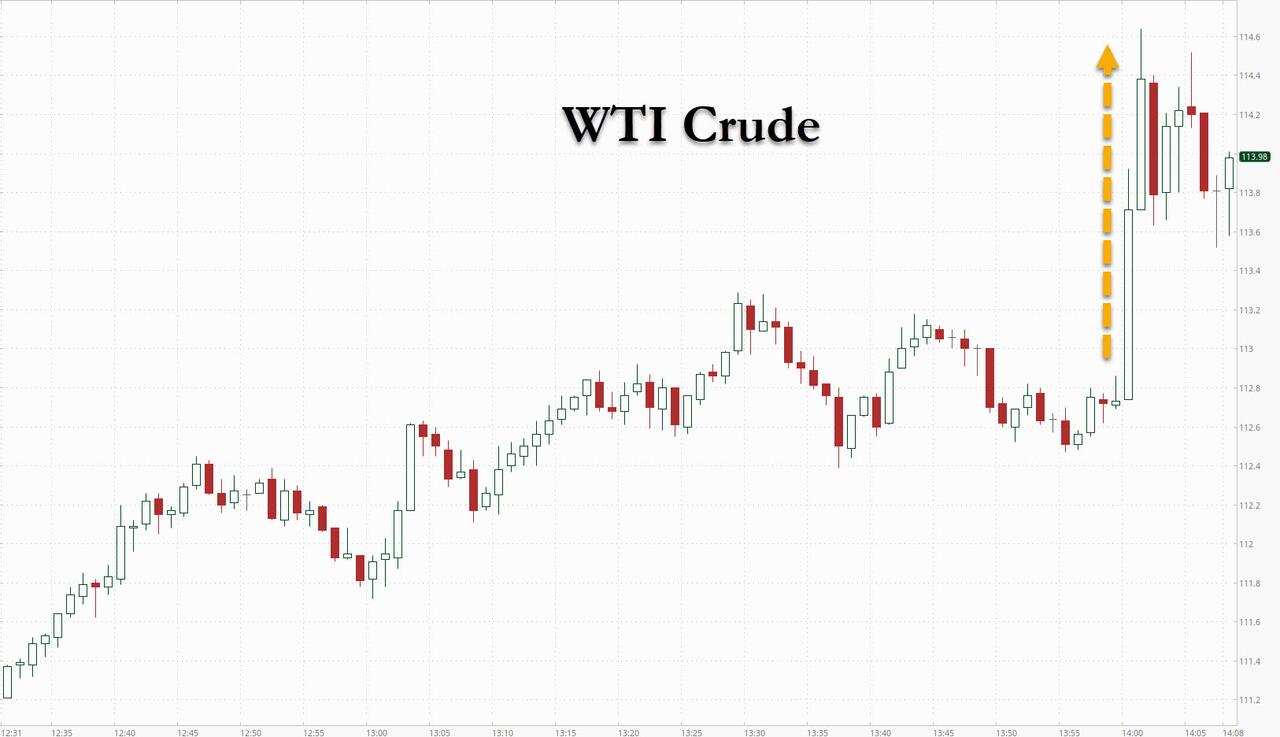

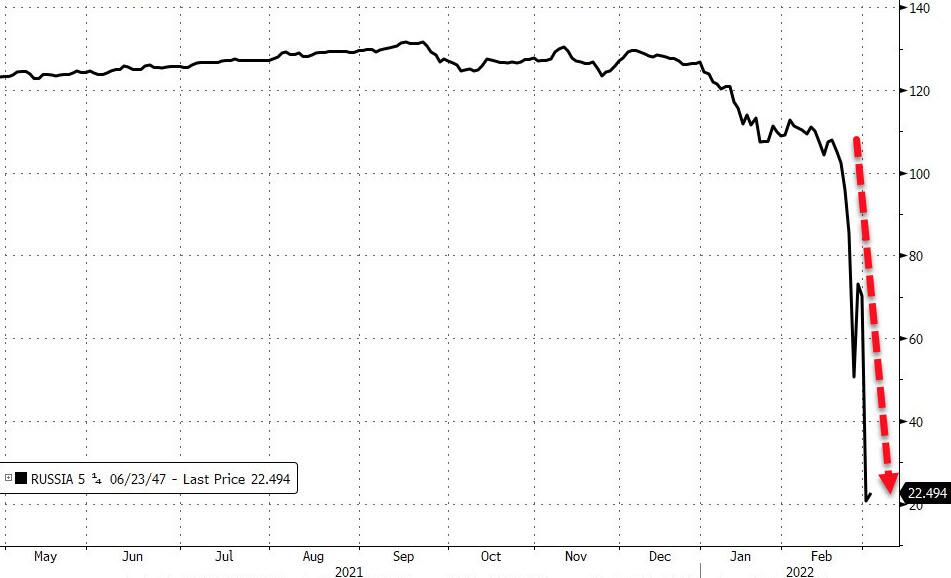
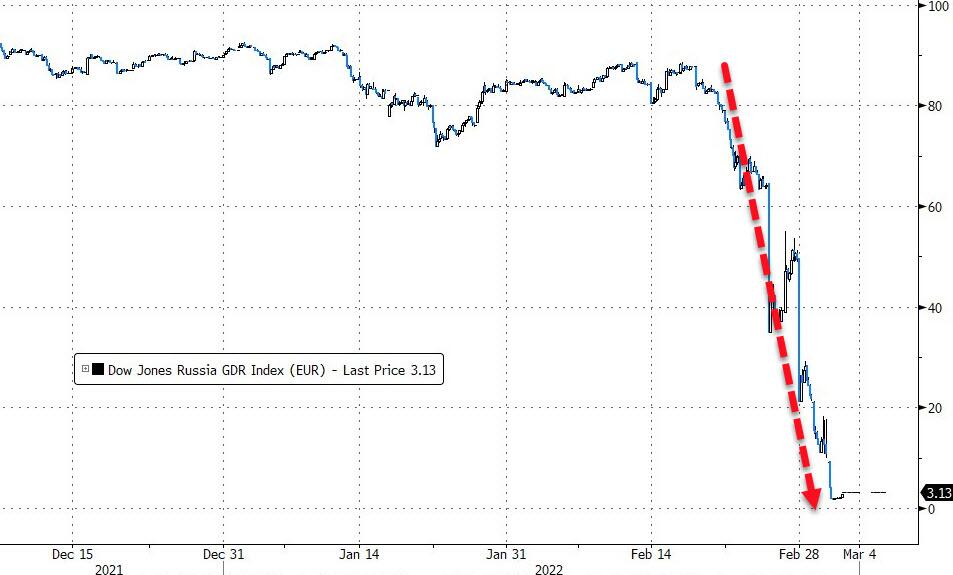
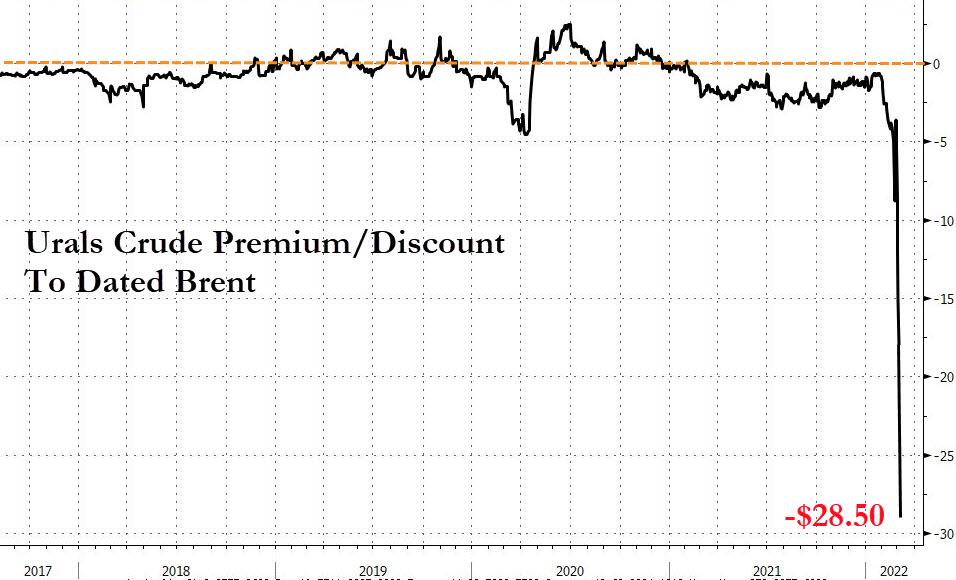
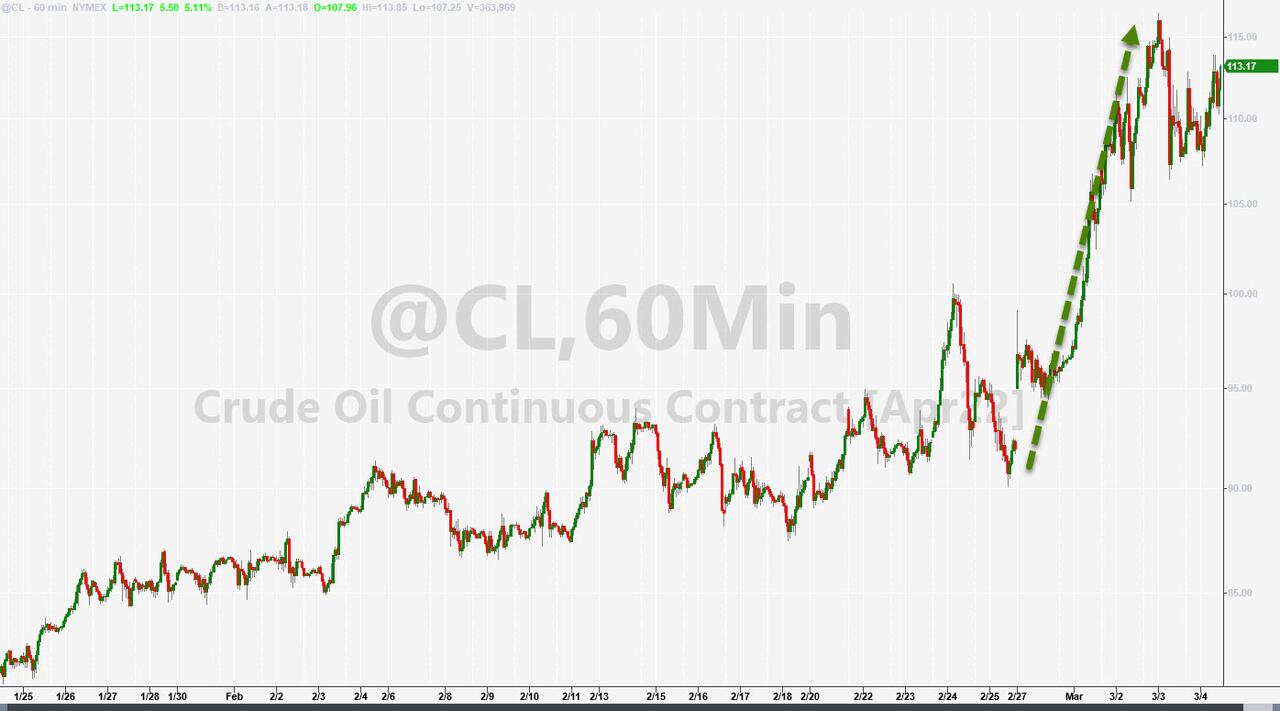
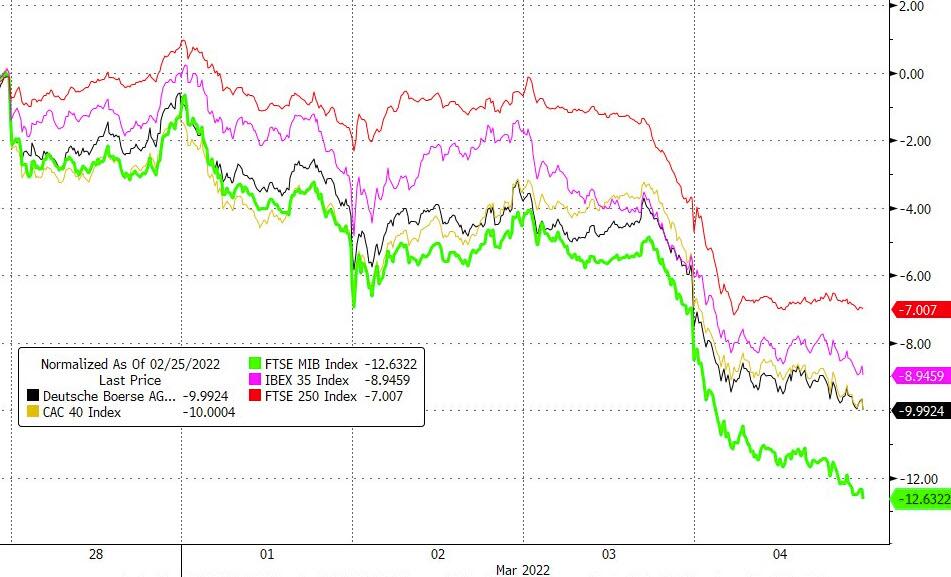
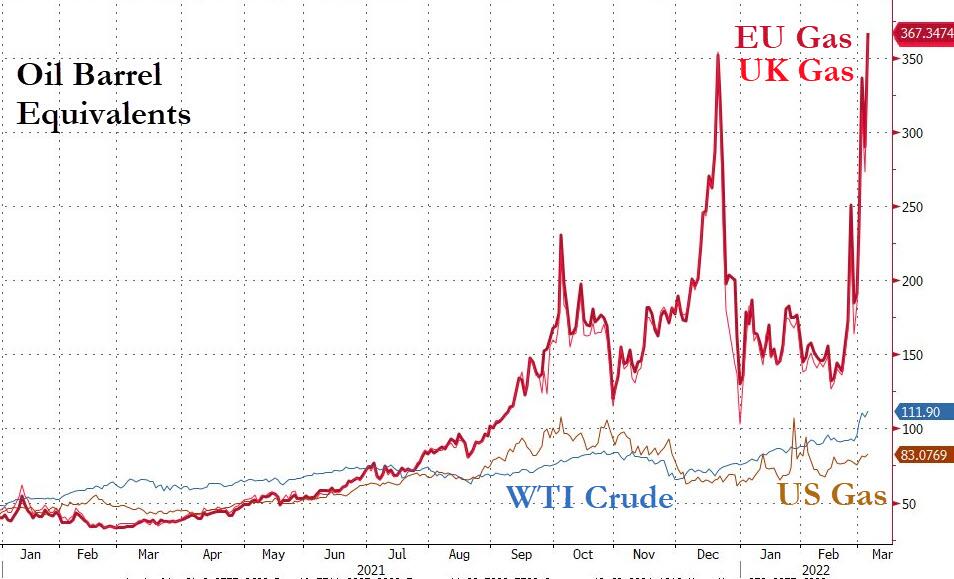
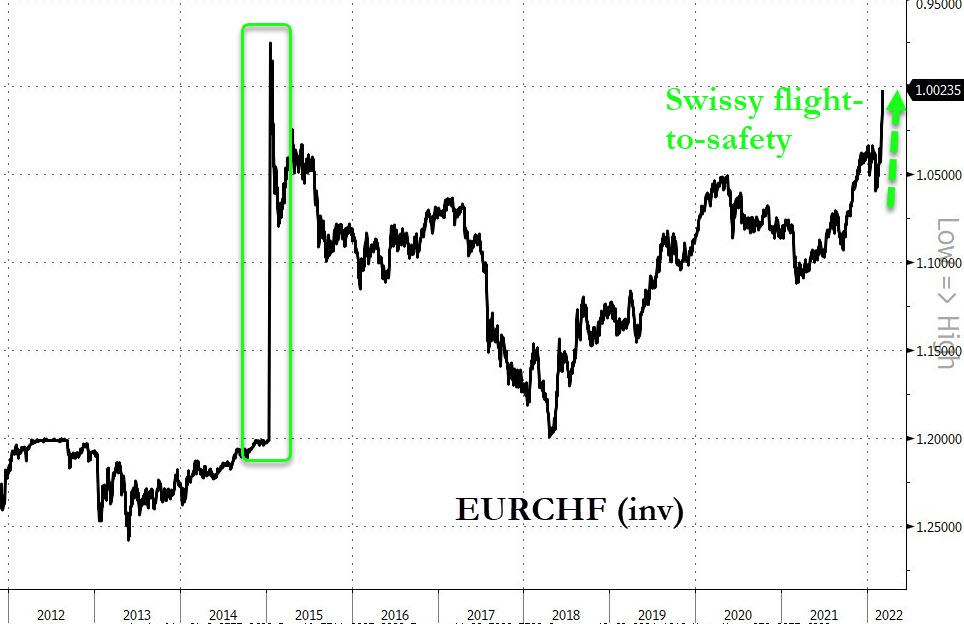
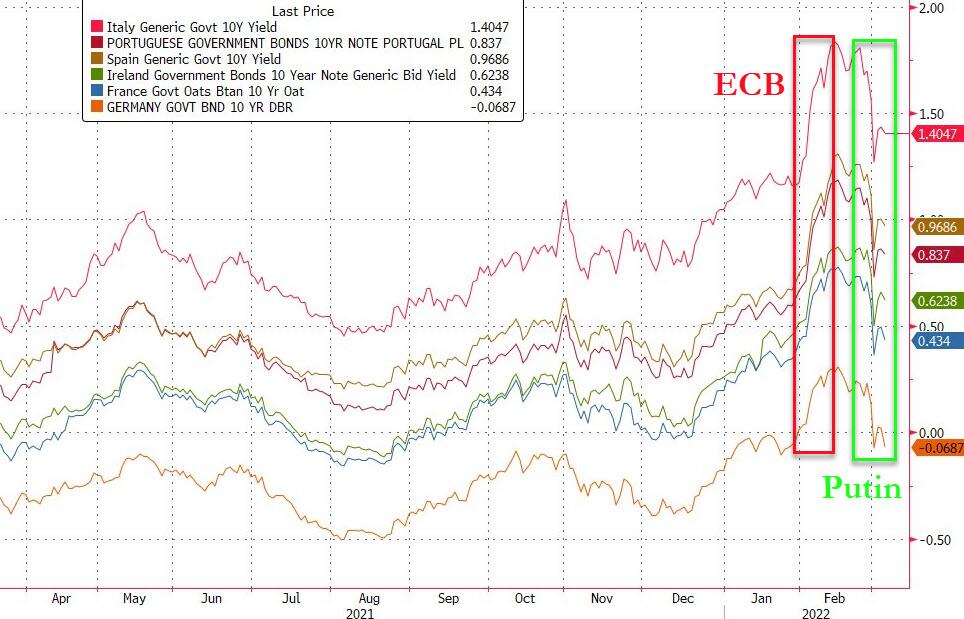
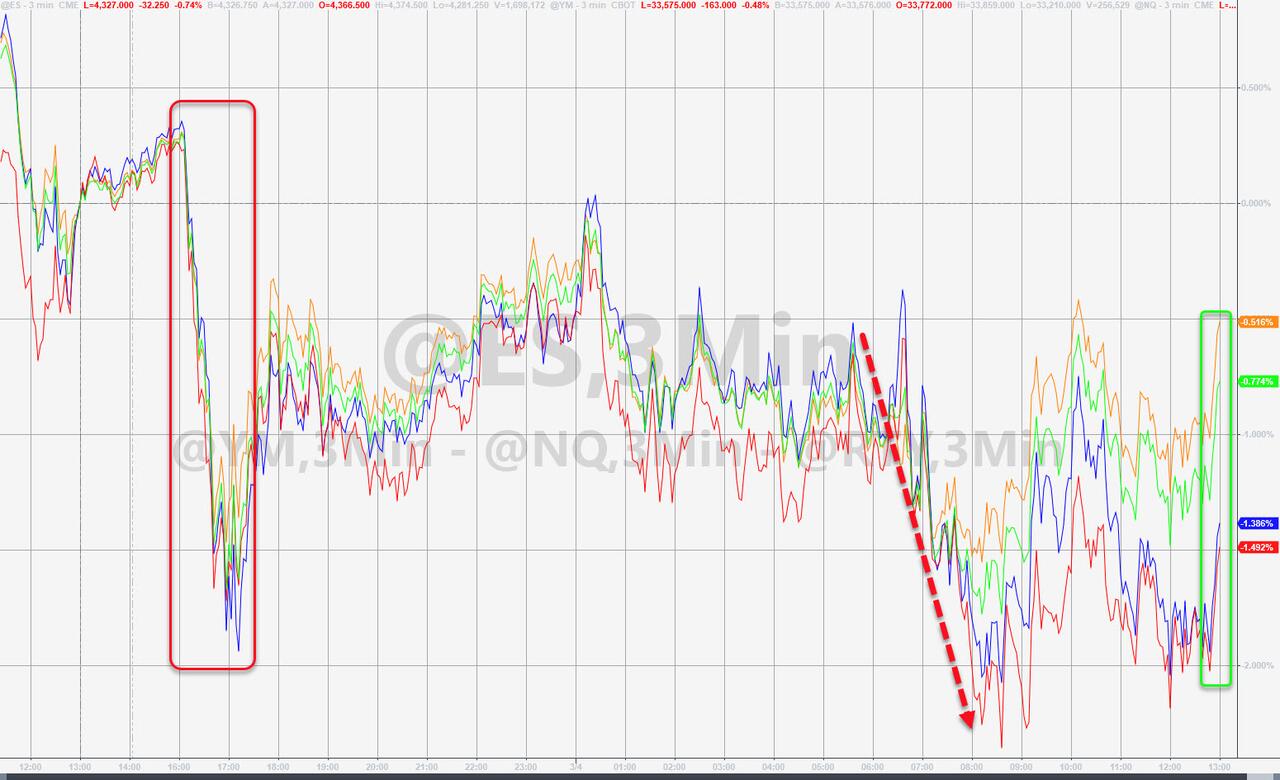
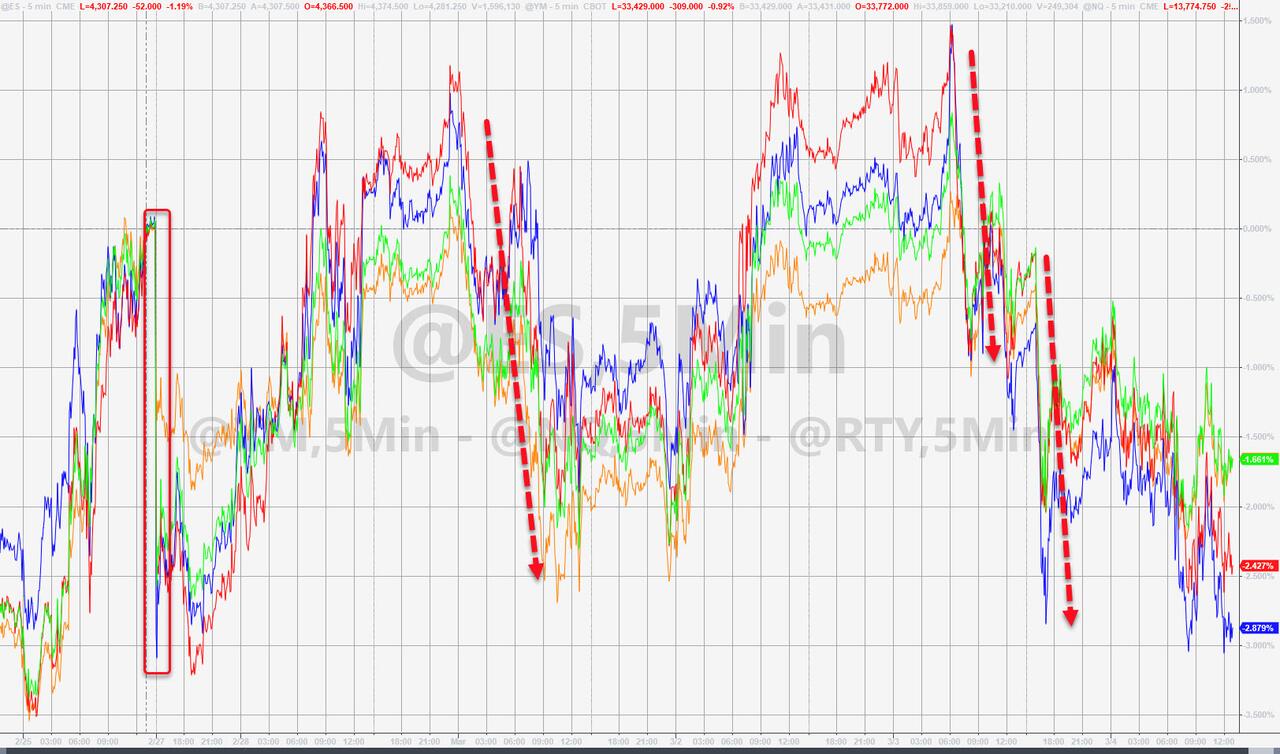

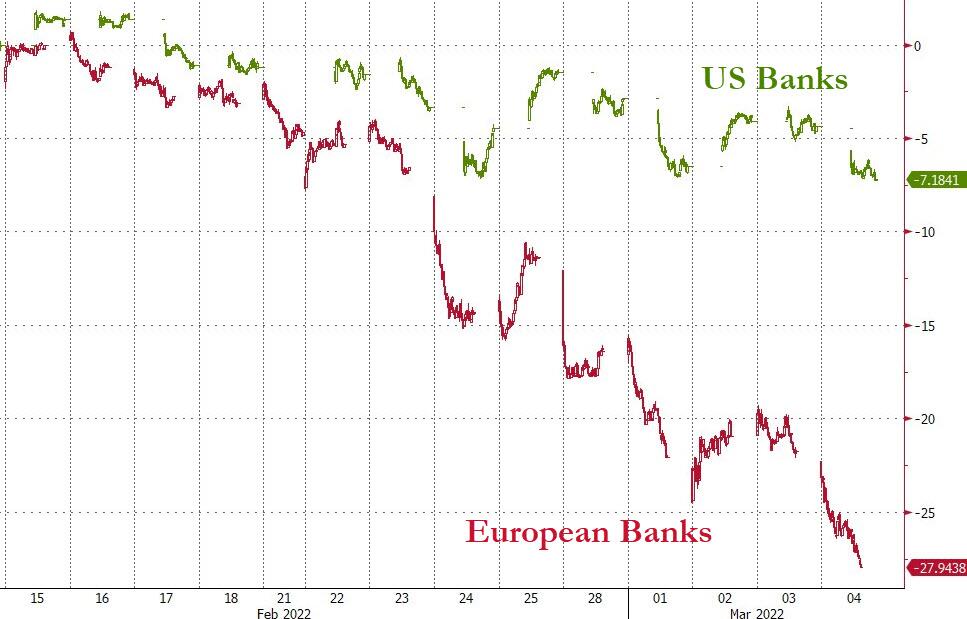
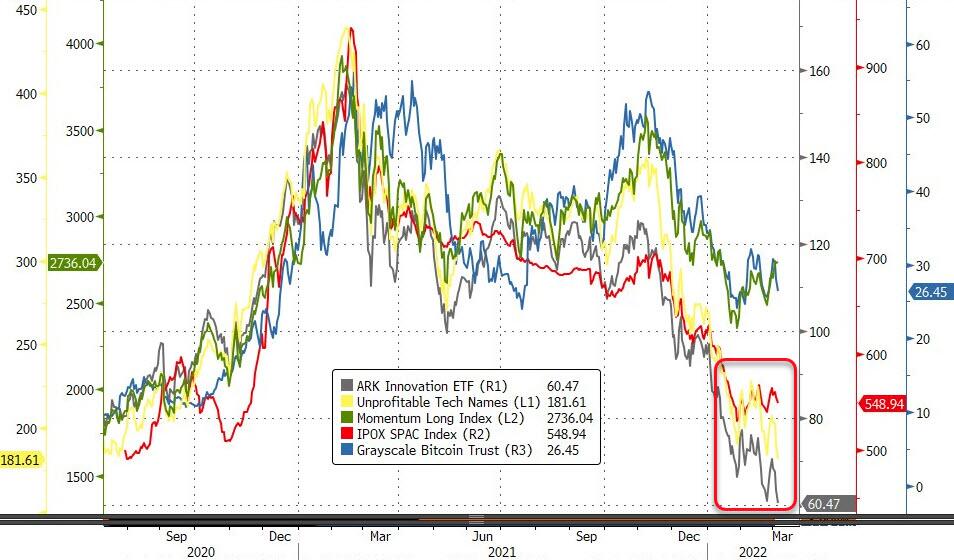
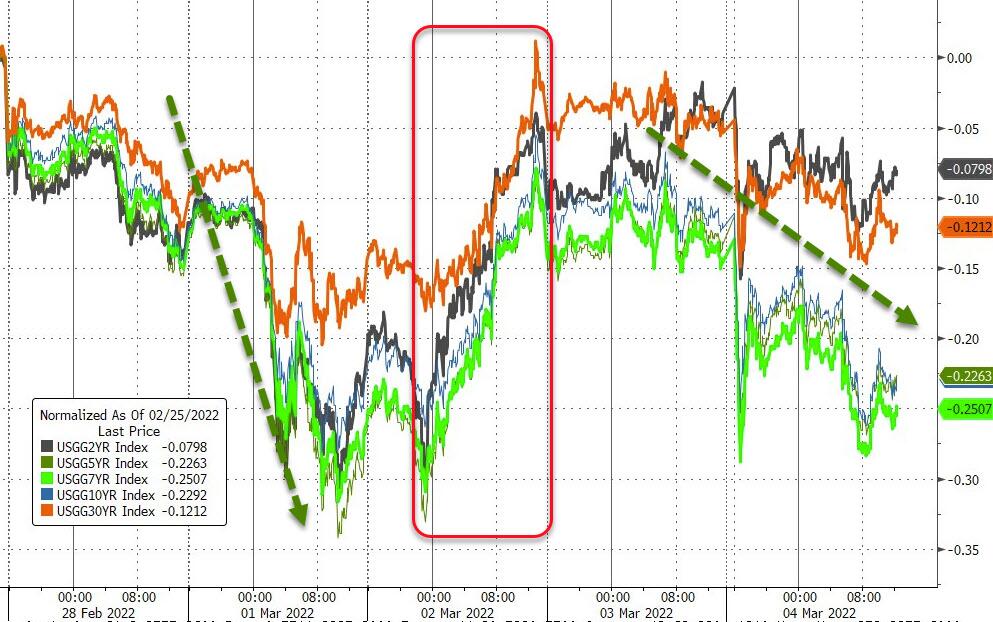
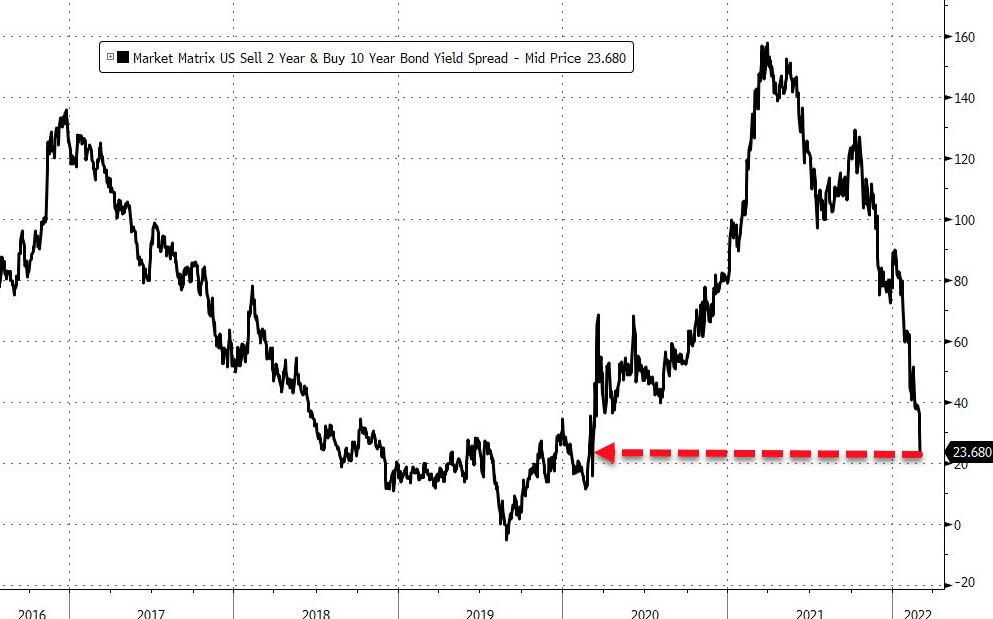
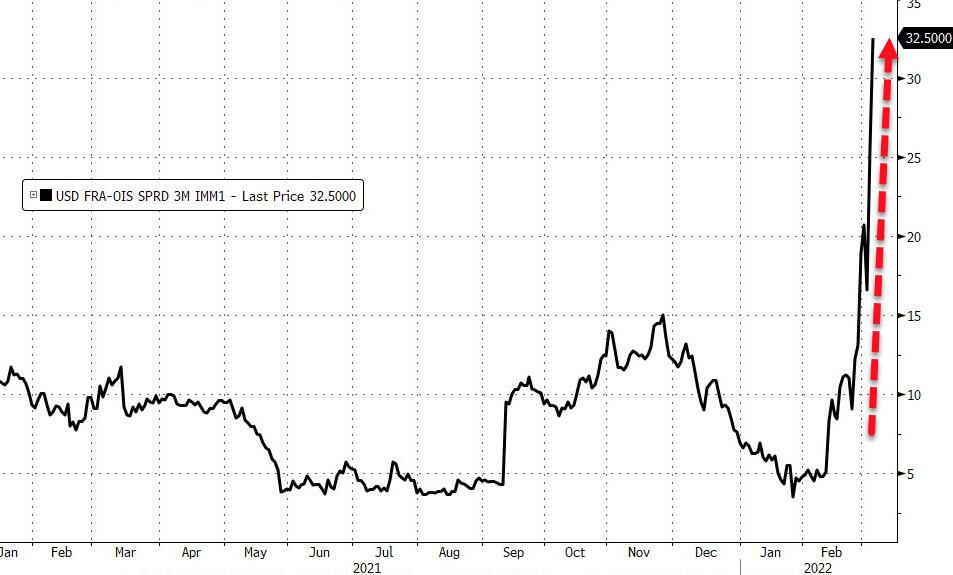
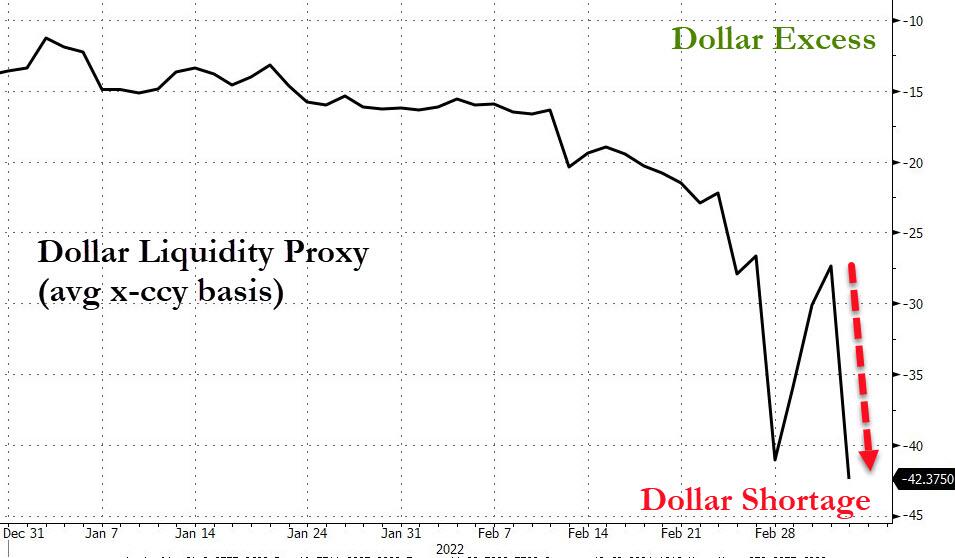


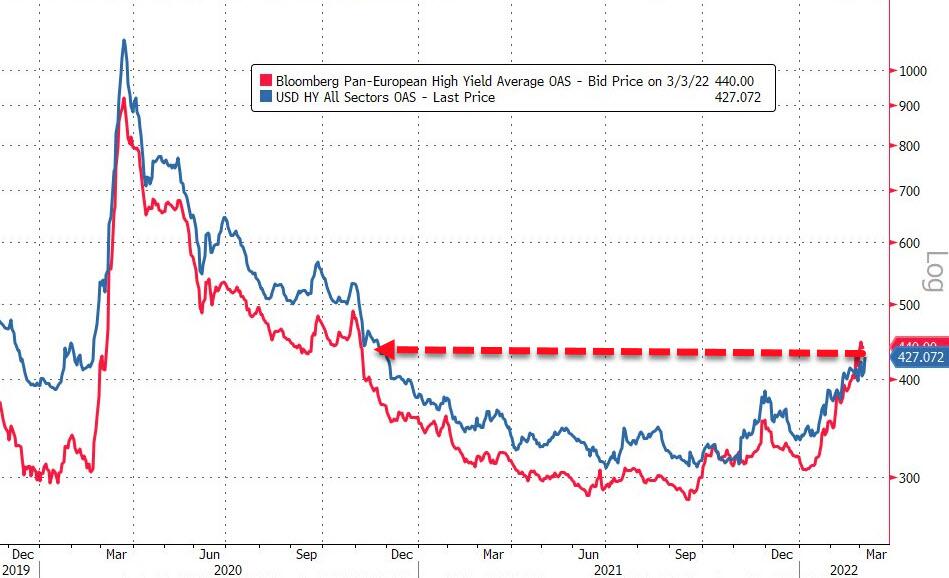
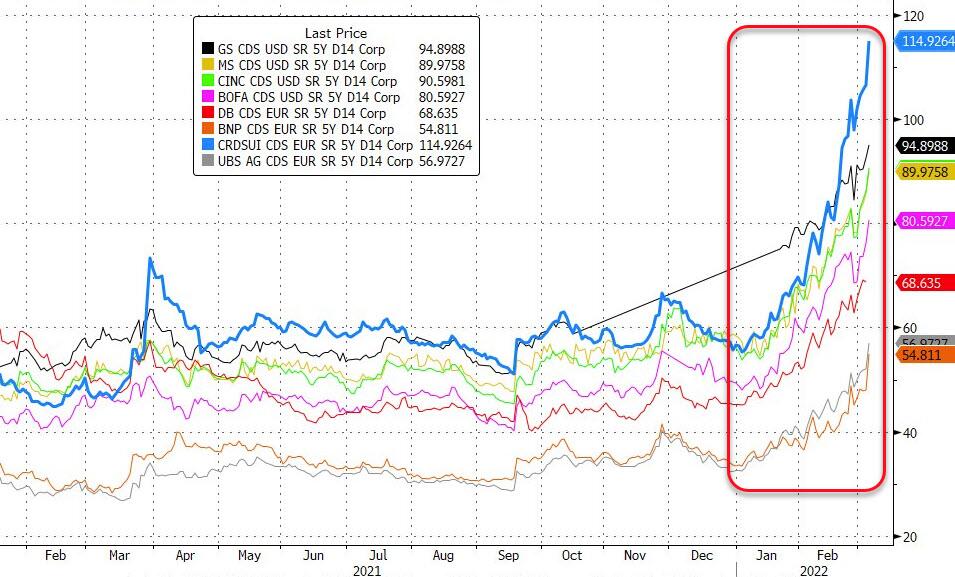
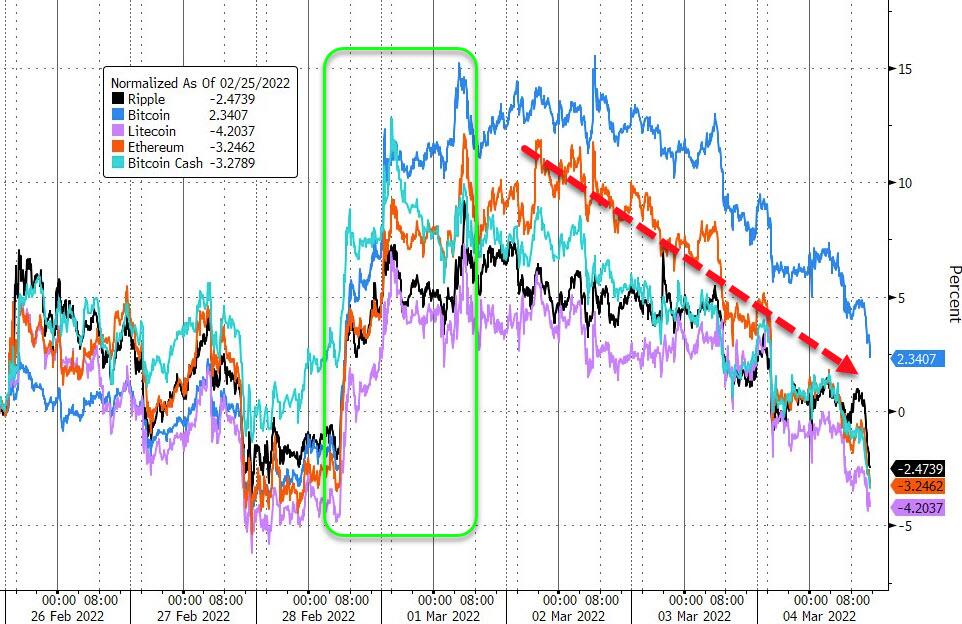


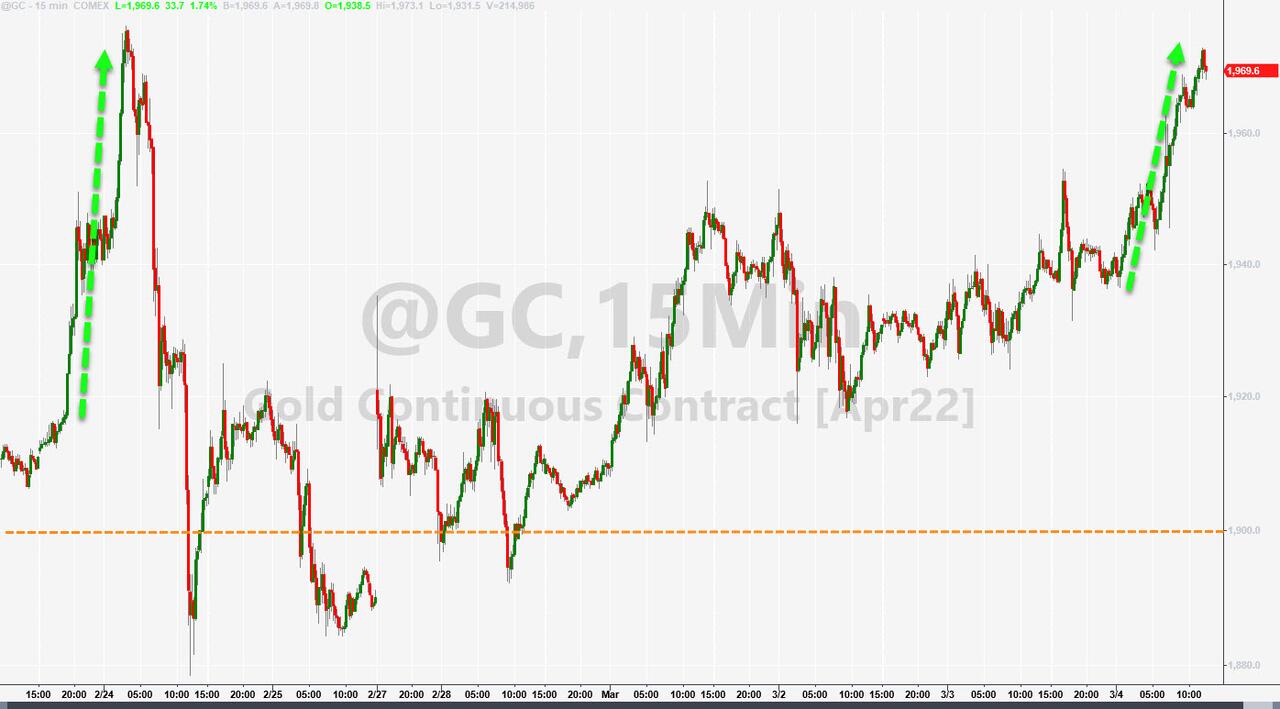
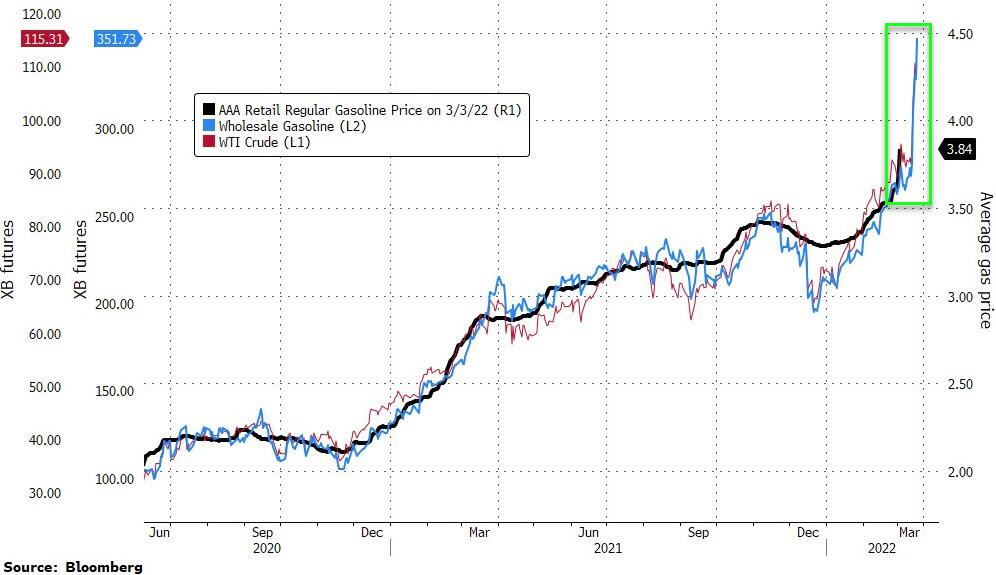
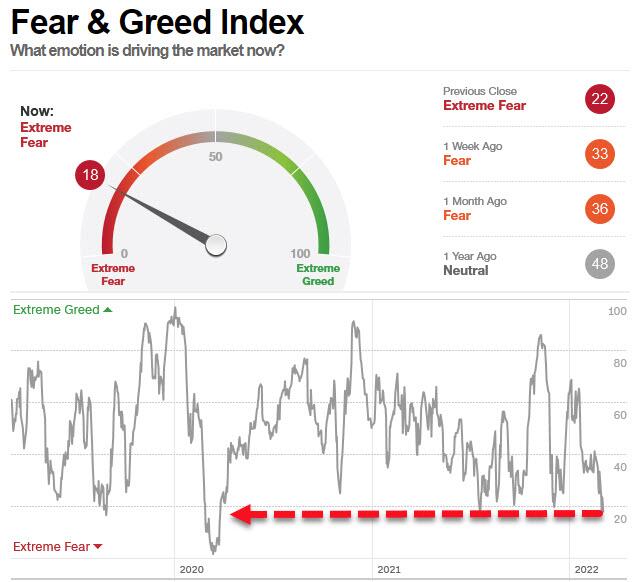
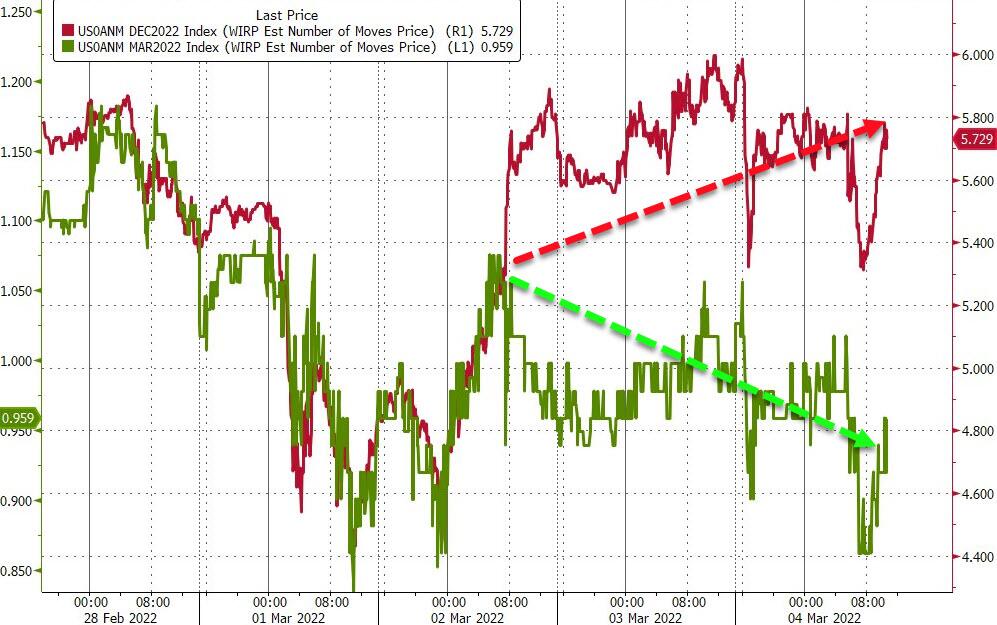
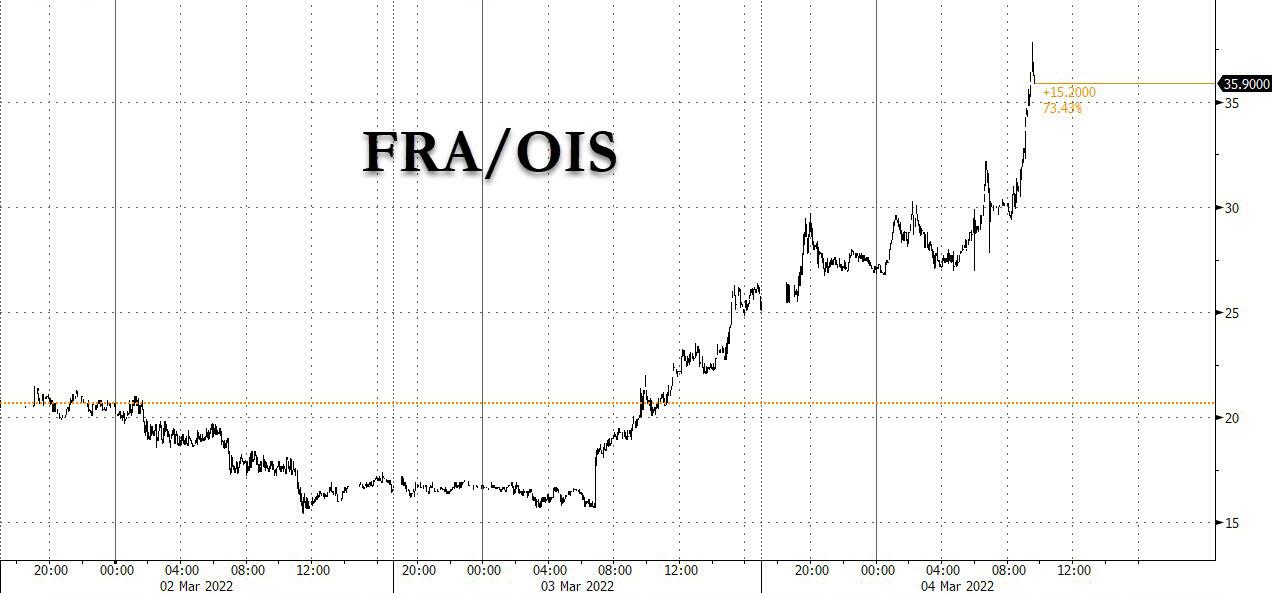
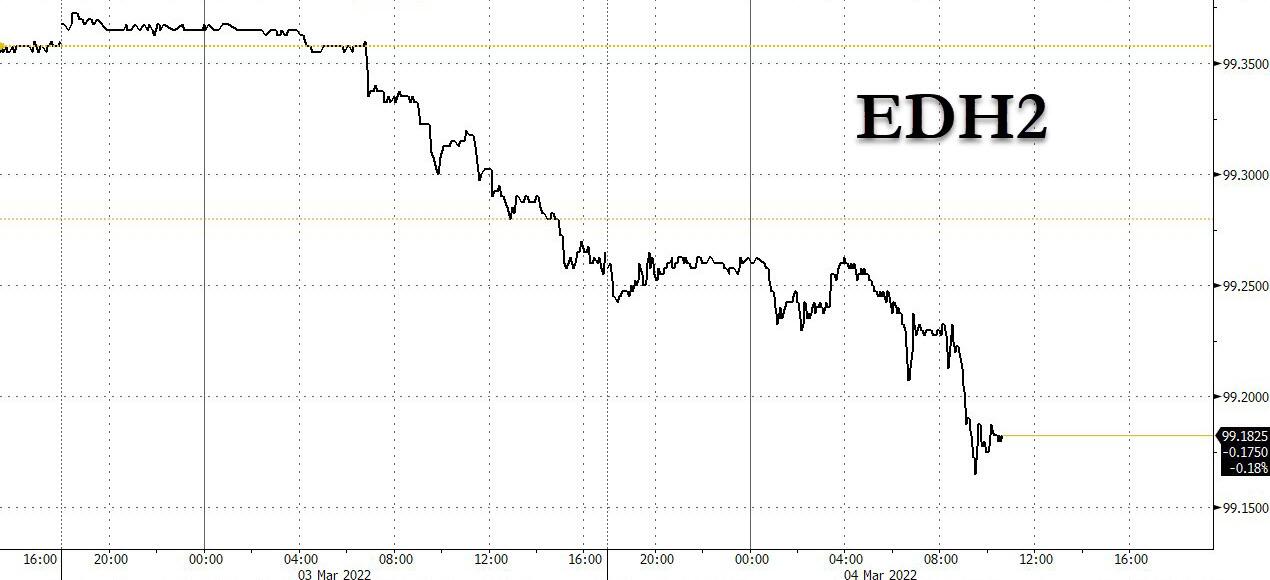

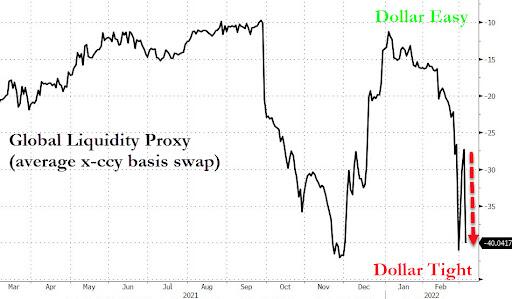
[…] by Harvey Organ, Harvey Organ Blog: […]
LikeLike