
March 231 2022 · by harveyorgan · in Uncategorized · Leave a comment·Edit
March 31, 2022 · by harveyorgan · in Uncategorized · Leave a comment·Edit
GOLD; $1948.60 UP $13.30
SILVER: $24.94 UP $.03
ACCESS MARKET: GOLD $1937.10
SILVER: $24.78
Bitcoin morning price: $47,173 UP 3268 from Monday
Bitcoin: afternoon price: $48,693 up 4788 from Monday
Platinum price: closing UP to $993.40 FROM MONDAY
Palladium price; closing UP 17.45 at $2268.95
END
Today is options expiry for the comex
end
DONATE
Click here if you wish to send a donation. I sincerely appreciate it as this site takes a lot of preparation
comex notices/
March: JPMorgan stopped/total issued 1374/12,491
EXCHANGE: COMEX
CONTRACT: APRIL 2022 COMEX 100 GOLD FUTURES
SETTLEMENT: 1,933.500000000 USD
INTENT DATE: 03/30/2022 DELIVERY DATE: 04/01/2022
FIRM ORG FIRM NAME ISSUED STOPPED
072 C GOLDMAN 434
099 H DB AG 1116
104 C MIZUHO 5
118 C MACQUARIE FUT 100
132 C SG AMERICAS 58
219 C SANTANDER-C 1
285 C NANHUA USA-HK 1
323 C HSBC 1
323 H HSBC 1516
357 C WEDBUSH 1
363 H WELLS FARGO SEC 396
365 C ED&F MAN CAPITA 2
365 H ED&F MAN CAPITA 4
435 H SCOTIA CAPITAL 629
624 H BOFA SECURITIES 1267
657 C MORGAN STANLEY 26 896
657 H MORGAN STANLEY 672
661 C JP MORGAN 6611 1374
685 C RJ OBRIEN 3
686 C STONEX FINANCIA 100 37
700 H UBS 333
709 C BARCLAYS 2893
732 C RBC CAP MARKETS 2
732 H RBC CAP MARKETS 2666
800 C MAREX SPEC 4
880 C CITIGROUP 2070
880 H CITIGROUP 1637
905 C ADM 13 114 TOTAL: 12,491 12,491MONTH TO DATE: 12,491
NUMBER OF NOTICES FILED TODAY FOR APRIL. CONTRACT 12,491 NOTICE(S) FOR 1249100 OZ (32.852 TONNES)
total notices so far: 12,491 contracts for 1,249100 oz (32.852 tonnes)
SILVER NOTICES:
647 NOTICE(S) FILED TODAY FOR 3,235,000 OZ/
total number of notices filed so far this month 647 : for 3,235,000 oz
END
Russia is a major supplier of silver to London while Mexico supplies the COMEX
With the sanctions, London has no way to obtain silver other than compete with NY.
END
GLD
WITH GOLD UP $13.30
WITH RESPECT TO GLD WITHDRAWALS: (OVER THE PAST FEW MONTHS):
GOLD IS “RETURNED” TO THE BANK OF ENGLAND WHEN CALLING IN THEIR LEASES: THE GOLD NEVER LEAVES THE BANK OF ENGLAND IN THE FIRST PLACE. THE BANK IS PROTECTING ITSELF IN CASE OF COMMERCIAL FAILURE
ALSO INVESTORS SWITCHING TO SPROTT PHYSICAL (phys) INSTEAD OF THE FRAUDULENT GLD//
A BIG CHANGES IN GOLD INVENTORY AT THE GLD A WITHDRAWAL OF 1.74 TONNES FROM THE GLD//FROM MONDAY
INVENTORY RESTS AT 1091.44 TONNES
Silver//SLV
WITH NO SILVER AROUND AND SILVER UIP 3 CENTS
AT THE SLV// A HUGE CHANGE IN SILVER INVENTORY AT THE SLV/ THE SLV//A DEPOSIT OF 2.171 MILLION OZ INTO THE SLV
INVESTORS ARE SWITCHING SLV TO SPROTT’S PSLV
CLOSING INVENTORY: 556.338 MILLION OZ
Let us have a look at the data for today
SILVER//OUTLINE
SILVER COMEX OI ROSE BY A TINY SIZED 60 CONTRACTS TO 147,120 AND CLOSER TO THE NEW RECORD OF 244,710, SET FEB 25/2020 AND THE STRONG LOSS IN OI WAS ACCOMPLISHED WITH OUR STRONG $0.30 LOSS IN SILVER PRICING AT THE COMEX ON FRIDAY. OUR BANKERS WERE SUCCESSFUL IN KNOCKING THE PRICE OF SILVER DOWN (IT ROSE BY $0.38) AND WERE SUCCESSFUL IN KNOCKING OUT SOME SILVER LONGS AS WE HAD A STRONG GAIN OF 1580 CONTRACTS ON OUR TWO EXCHANGES
WE MUST HAVE HAD:
I) HUGE BANKER SHORT COVERING AS THEY ARE VERY ANXIOUS TO GET OUT OF DODGE!!/. II)WE ALSO HAD SOME REDDIT RAPTOR BUYING//. iii) A GOOD ISSUANCE OF EXCHANGE FOR PHYSICALS iiii) A HUGE INITIAL SILVER STANDING FOR COMEX SILVER MEASURING AT 4.305 MILLION OZ V) STRONG SIZED COMEX OI GAIN/
I AM NOW RECORDING THE DIFFERENTIAL IN OI FROM PRELIMINARY TO FINAL:
THE DIFFERENTIAL FROM PRELIMINARY OI TO FINAL OI SILVER TODAY: CONTRACTS : —-768 (the differential in silver is now increasing every day)
HISTORICAL ACCUMULATION OF EXCHANGE FOR PHYSICALS MAR. ACCUMULATION FOR EFP’S SILVER/JPMORGAN’S HOUSE OF BRIBES/STARTING FROM FIRST DAY/MONTH OF MAR:
TOTAL CONTACTS for 23 days, total contracts: : 41,486 contracts or 207.430 million oz OR 9.01MILLION OZ PER DAY. (1803 CONTRACTS PER DAY)
TOTAL NO OF OZ UNDERGOING EFP TO LONDON 41,486 CONTRACTS X 5,000 PER CONTRACT:
EQUATES TO: 207.43 MILLION OZ WHICH FINALIZES THE RECORD FOR MARCH AND FOR ANY MONTH
.
LAST 11 MONTHS TOTAL EFP CONTRACTS ISSUED IN MILLIONS OF OZ:
MAY 137.83 MILLION
JUNE 149.91 MILLION OZ
JULY 129.445 MILLION OZ
AUGUST: MILLION OZ 140.120
SEPT. 28.230 MILLION OZ//
OCT: 94.595 MILLION OZ
NOV: 131.925 MILLION OZ
DEC: 100.615 MILLION OZ
JAN 2022// 90.460 MILLION OZ
FEB 2022: 72.39 MILLION OZ//
MARCH: 207.430 MILLION OZ//A NEW RECORD FOR EFP ISSUANCE AND WE ARE STILL GOING STRONG THIS MONTH.
RESULT: WE HAD A STRONG SIZED INCREASE IN COMEX OI SILVER COMEX CONTRACTS OF 828 WITH OUR STRONG $0.38 GAIN IN SILVER PRICING AT THE COMEX// WEDNESDAY THE CME NOTIFIED US THAT WE HAD A GOOD SIZED EFP ISSUANCE OF 640 CONTRACTS( 640 CONTRACTS ISSUED FOR MAY AND 0 CONTRACTS ISSUED FOR ALL OTHER MONTHS) WHICH EXITED OUT OF THE SILVER COMEX TO LONDON AS FORWARDS THE DOMINANT FEATURE TODAY: /HUGE BANKER SHORT COVERING AS THEY GET OUT OF DODGE//// WE HAVE A HUGE INITIAL SILVER OZ STANDING FOR MAR. OF 4.305 MILLION OZ /// .. WE HAD AN STRONG SIZED GAIN OF 1580 OI CONTRACTS ON THE TWO EXCHANGES FOR 7.54 MILLION OZ WITH THE STRONG GAIN IN PRICE.
WE HAD 642 NOTICES FILED TODAY FOR 3,235,000 OZ
THE SILVER COMEX IS NOW BEING ATTACKED FOR METAL BY LONDONERS ET AL.
GOLD//OUTLINE
IN GOLD, THE COMEX OPEN INTEREST ROSE BY A GOOD SIZED 4647 CONTRACTS TO 579,168 AND CLOSER TO NEW RECORD (SET JAN 24/2020) AT 799,541 AND PREVIOUS TO THAT: (SET JAN 6/2020) AT 797,110.
THE DIFFERENTIAL FROM PRELIMINARY OI TO FINAL OI IN GOLD TODAY: —–58 CONTRACTS. (differentials are lowering in gold)
THE BIS HAS ABANDONED THE GOLD COMEX TRADING!!!
.
THE GOOD SIZED INCREASE IN COMEX OI CAME WITH OUR GAIN IN PRICE OF $21.50//COMEX GOLD TRADING/WEDNESDAY/.AS IN SILVER WE MUST HAD HUGE BANKER/ALGO SHORT COVERING ACCOMPANYING OUR GOOD SIZED EXCHANGE FOR PHYSICAL ISSUANCE. WE HAD ZERO LONG LIQUIDATION
WE ALSO HAD A HUGE INITIAL STANDING IN GOLD TONNAGE FOR APRIL AT 78.28 TONNES
YET ALL OF..THIS HAPPENED WITH OUR GAIN IN PRICE OF $21.50 WITH RESPECT TO WEDNESDAY’S TRADING
WE HAD AN STRONG SIZED GAIN OF 5469 OI CONTRACTS (17.01 PAPER TONNES) ON OUR TWO EXCHANGES
E.F.P. ISSUANCE
THE CME RELEASED THE DATA FOR EFP ISSUANCE AND IT TOTALED A SMALL SIZED 880 CONTRACTS:
The NEW COMEX OI FOR THE GOLD COMPLEX RESTS AT 579,168.
IN ESSENCE WE HAVE AN GOOD SIZED INCREASE IN TOTAL CONTRACTS ON THE TWO EXCHANGES OF 5527, WITH 4647 CONTRACTS DECREASED AT THE COMEX AND 880 EFP OI CONTRACTS WHICH NAVIGATED OVER TO LONDON. THUS TOTAL OI GAIN ON THE TWO EXCHANGES OF 5527 CONTRACTS OR 17.17 TONNES.
CALCULATIONS ON GAIN/LOSS ON OUR TWO EXCHANGES
WE HAD A SMALL SIZED ISSUANCE IN EXCHANGE FOR PHYSICALS (880) ACCOMPANYING THE GOOD SIZED GAIN IN COMEX OI (4647,): TOTAL GAIN IN THE TWO EXCHANGES 5527 CONTRACTS. WE NO DOUBT HAD 1) HUGE BANKER SHORT COVERING ,2.) HUGE INITIAL STANDING AT THE GOLD COMEX FOR APRIL. AT 78.28 TONNES/// 3) ZERO LONG LIQUIDATION ///. ,4) GOOD SIZED COMEX OI. GAIN 5) SMALL ISSUANCE OF EXCHANGE FOR PHYSICAL/
HISTORICAL ACCUMULATION OF EXCHANGE FOR PHYSICALS IN 2022 INCLUDING TODAY
MARCH
ACCUMULATION OF EFP’S GOLD AT J.P. MORGAN’S HOUSE OF BRIBES: (EXCHANGE FOR PHYSICAL) FOR THE MONTH OF MAR :
131,591 CONTRACTS OR 1,315,910 OR 409.30 TONNES 23 TRADING DAY(S) AND THUS AVERAGING: 5965 EFP CONTRACTS PER TRADING DAY
TO GIVE YOU AN IDEA AS TO THE SIZE OF THESE EFP TRANSFERS : THIS MONTH IN 23 TRADING DAY(S) IN TONNES: 409.30TONNES
TOTAL ANNUAL GOLD PRODUCTION, 2020, THROUGHOUT THE WORLD EX CHINA EX RUSSIA: 3555 TONNES
THUS EFP TRANSFERS REPRESENTS 409.30/3550 x 100% TONNES 11.52% OF GLOBAL ANNUAL PRODUCTION
ACCUMULATION OF GOLD EFP’S YEAR 2021 TO 2022
JANUARY/2021: 265.26 TONNES (RAPIDLY INCREASING AGAIN)
FEB : 171.24 TONNES ( DEFINITELY SLOWING DOWN AGAIN)..
MARCH:. 276.50 TONNES (STRONG AGAIN/
APRIL: 189..44 TONNES ( DRAMATICALLY SLOWING DOWN AGAIN//GOLD IN BACKWARDATION)
MAY: 250.15 TONNES (NOW DRAMATICALLY INCREASING AGAIN)
JUNE: 247.54 TONNES (FINAL)
JULY: 188.73 TONNES FINAL
AUGUST: 217.89 TONNES FINAL ISSUANCE.
SEPT 142.12 TONNES FINAL ISSUANCE ( LOW ISSUANCE)_
OCT: 141.13 TONNES FINAL ISSUANCE (LOW ISSUANCE)
NOV: 312.46 TONNES FINAL ISSUANCE//NEW RECORD!! (INCREASING DRAMATICALLY)//SIGN OF REAL STRESS//SURPASSING THE MARCH 2021 RECORD OF 276.50 TONNES OF EFP
DEC. 175.62 TONNES//FINAL ISSUANCE//
JAN:2022 247.25 TONNES //FINAL
FEB: 196.04 TONNES//FINAL
MARCH: 409.30 TONNES INITIAL( THIS IS NOW A RECORD EFP ISSUANCE FOR MARCH AND FOR ANY MONTH.
SPREADING OPERATIONS
(/NOW SWITCHING TO GOLD) FOR NEWCOMERS, HERE ARE THE DETAILS
SPREADING LIQUIDATION HAS NOW COMMENCED AS WE HEAD TOWARDS THE NEW ACTIVE FRONT MONTH OF MAY.WE ARE NOW INTO THE SPREADING OPERATION OF SILVER
HERE IS A BRIEF SYNOPSIS OF HOW THE CROOKS FLEECE UNSUSPECTING LONGS IN THE SPREADING ENDEAVOUR ;MODUS OPERANDI OF THE CORRUPT BANKERS AS TO HOW THEY HANDLE THEIR SPREAD OPEN INTERESTS:HERE IS HOW THE CROOKS USED SPREADING AS WE ARE NOW INTO THE NON ACTIVE DELIVERY MONTH OF APRIL HEADING TOWARDS THE ACTIVE DELIVERY MONTH OF MAY, FOR SILVER:
YOU WILL ALSO NOTICE THAT THE COMEX OPEN INTEREST STARTS TO RISE BUT SO IS THE OPEN INTEREST OF SPREADERS. THE OPEN INTEREST IN WILL CONTINUE TO RISE UNTIL ONE WEEK BEFORE FIRST DAY NOTICE OF AN UPCOMING ACTIVE DELIVERY MONTH (MAR), AND THAT IS WHEN THE CROOKS SELL THEIR SPREAD POSITIONS BUT NOT AT THE SAME TIME OF THE DAY. THEY WILL USE THE SELL SIDE OF THE EQUATION TO CREATE THE CASCADE (ALONG WITH THEIR COLLUSIVE FRIENDS) AND THEN COVER ON THE BUY SIDE OF THE SPREAD SITUATION AT THE END OF THE DAY. THEY DO THIS TO AVOID POSITION LIMIT DETECTION. THE LIQUIDATION OF THE SPREADING FORMATION CONTINUES FOR EXACTLY ONE WEEK AND ENDS ON FIRST DAY NOTICE.”
WHAT IS ALARMING TO ME, ACCORDING TO OUR LONDON EXPERT ANDREW MAGUIRE IS THAT THESE EFP’S ARE BEING TRANSFERRED TO WHAT ARE CALLED SERIAL FORWARD CONTRACT OBLIGATIONS AND THESE CONTRACTS ARE LESS THAN 14 DAYS. ANYTHING GREATER THAN 14 DAYS, THESE MUST BE RECORDED AND SENT TO THE COMPTROLLER, GREAT BRITAIN TO MONITOR RISK TO THE BANKING SYSTEM. IF THIS IS INDEED TRUE, THEN THIS IS A MASSIVE CONSPIRACY TO DEFRAUD AS WE NOW WITNESS A MONSTROUS TOTAL EFP’S ISSUANCE AS IT HEADS INTO THE STRATOSPHERE.
First, here is an outline of what will be discussed tonight:
1.Today, we had the open interest at the comex, in SILVER, ROSE BY A TINY SIZED 60 CONTRACTS TO 148,198 AND CLOSER TO OUR COMEX RECORD //244,710(SET FEB 25/2020). THE LAST RECORDS WERE SET IN AUG.2018 AT 244,196 WITH A SILVER PRICE OF $14.78/(AUGUST 22/2018)..THE PREVIOUS RECORD TO THAT WAS SET ON APRIL 9/2018 AT 243,411 OPEN INTEREST CONTRACTS WITH THE SILVER PRICE AT THAT DAY: $16.53). AND PREVIOUS TO THAT, THE RECORD WAS ESTABLISHED AT: 234,787 CONTRACTS, SET ON APRIL 21.2017 OVER 4 1/2 YEARS AGO.
EFP ISSUANCE 680 CONTRACTS
OUR CUSTOMARY MIGRATION OF COMEX LONGS CONTINUE TO MORPH INTO LONDON FORWARDS AS OUR BANKERS USED THEIR EMERGENCY PROCEDURE TO ISSUE:
MAY 680 ALL OTHER MONTHS: ZERO. TOTAL EFP ISSUANCE: 665 CONTRACTS. EFP’S GIVE OUR COMEX LONGS A FIAT BONUS PLUS A DELIVERABLE PRODUCT OVER IN LONDON. IF WE TAKE THE COMEX OI GAIN OF 680 CONTRACTS AND ADD TO THE 680 OI TRANSFERRED TO LONDON THROUGH EFP’S,
WE OBTAIN A STRONG SIZED GAIN OF 720 OPEN INTEREST CONTRACT FROM OUR TWO EXCHANGES.
THUS IN OUNCES, THE GAIN ON THE TWO EXCHANGES 3.6 MILLION OZ,
OCCURRED WITH OUR STRONG GAIN $0.38 IN PRICE.
OUTLINE FOR TODAY’S COMMENTARY
1/COMEX GOLD AND SILVER REPORT
(report Harvey)
2 ) Gold/silver trading overnight Europe,
(Peter Schiff,
3. Egon von Greyerz///Matthew Piepenburg via GoldSwitzerland.com,
4. Chris Powell of GATA provides to us very important physical commentaries
5. Other gold commentaries
6. Commodity commentaries/cryptocurrencies
3. ASIAN AFFAIRS
i)THURSDAY MORNING// WEDNESDAY NIGHT
SHANGHAI CLOSED UP 2.26 PTS OR 0.07% //Hang Sang CLOSED UP 280.09 PTS OR 1.31 % /The Nikkei closed DOWN 205.95 PTS OR 0.73% //Australia’s all ordinaires CLOSED DOWN 0.01% /Chinese yuan (ONSHORE) closed DOWN 6.3703 /Oil DOWN TO 107.28 dollars per barrel for WTI and DOWN TO 114.11 for Brent. Stocks in Europe OPENED ALL GREEN // ONSHORE YUAN CLOSED DOWN AGAINST THE DOLLAR AT 6.3703 OFFSHORE YUAN CLOSED DOWN ON THE DOLLAR AT 6.3859: /ONSHORE YUAN TRADING ABOVE LEVEL OF OFFSHORE YUAN/ONSHORE YUAN TRADING WEAKER AGAINST US DOLLAR/OFFSHORE WEAKER//
A)NORTH KOREA/
b) REPORT ON JAPAN
OUTLINE
3 C CHINA
OUTLINE
4/EUROPEAN AFFAIRS
OUTLINE
5. RUSSIAN AND MIDDLE EASTERN AFFAIRS
OUTLINE
6.Global Issues
OUTLINE
7. OIL ISSUES
OUTLINE
8 EMERGING MARKET ISSUES
COMEX DATA//AMOUNTS STANDING//VOLUME OF TRADING/INVENTORY MOVEMENTS
GOLD
LET US BEGIN:
THE TOTAL COMEX GOLD OPEN INTEREST FELL BY A GOOD SIZED 4589 CONTRACTS TO 579,110 AND CLOSER TO THE RECORD THAT WAS SET IN JANUARY/2020: {799,541 OI(SET JAN 16/2020)} AND PREVIOUS TO THAT: 797,110 (SET JAN 7/2020). AND THIS COMEX INCREASE OCCURRED WITH OUR LOSS OF $14.65 IN GOLD PRICING MONDAY’S COMEX TRADING. WE ALSO HAD A FAIR SIZED EFP (2098 CONTRACTS). . THEY WERE PAID HANDSOMELY NOT TO TAKE DELIVERY AT THE COMEX AND SETTLE FOR CASH.
WE NORMALLY HAVE WITNESSED EXCHANGE FOR PHYSICALS ISSUED BEING SMALL AS IT JUST TOO COSTLY FOR THEM TO CONTINUE SERVICING THE COSTS OF SERIAL FORWARDS CIRCULATING IN LONDON. HOWEVER, MUCH TO THE ANNOYANCE OF OUR BANKERS, THE COMEX IS THE SCENE OF AN ASSAULT ON GOLD AS LONDONERS, NOT BEING ABLE TO FIND ANY PHYSICAL ON THAT SIDE OF THE POND, EXERCISE THESE CIRCULATING EXCHANGE FOR PHYSICALS IN LONDON AND FORCING DELIVERY OF REAL METAL OVER HERE AS THE OBLIGATION STILL RESTS WITH NEW YORK BANKERS. IT SEEMS THAT ARE BANKERS FRIENDS ARE EXERCISING EFP’S FROM LONDON AND NOW THEY ARE LOATHE TO ISSUE NEW ONES.
EXCHANGE FOR PHYSICAL ISSUANCE
WE ARE NOW MOVING TO THE ACTIVE DELIVERY MONTH OF APRIL.. THE CME REPORTS THAT THE BANKERS ISSUED A SMALL SIZED TRANSFER THROUGH THE EFP ROUTE AS THESE LONGS RECEIVED A DELIVERABLE LONDON FORWARD TOGETHER WITH A FIAT BONUS.,
THAT IS 880 EFP CONTRACTS WERE ISSUED: ;: , . 0 JUNE :880 & ZERO FOR ALL OTHER MONTHS:
TOTAL EFP ISSUANCE: 880 CONTRACTS
WHEN WE HAVE BACKWARDATION, EFP ISSUANCE IS VERY COSTLY BUT THE REAL PROBLEM IS THE SCARCITY OF METAL AND IT IS FAR BETTER FOR OUR BANKERS TO PAY OFF INDIVIDUALS THAN RISK INVESTORS ESPECIALLY FROM LONDON STANDING FOR DELIVERY. THE LOWER PRICES IN THE FUTURES MARKET IS A MAGNET FOR OUR LONDONERS SEEKING PHYSICAL METAL. BACKWARDATION ALWAYS EQUAL SCARCITY OF METAL!
ON A NET BASIS IN OPEN INTEREST WE GAINED THE FOLLOWING TODAY ON OUR TWO EXCHANGES: A FAIR SIZED TOTAL OF 5469 CONTRACTS IN THAT 880 LONGS WERE TRANSFERRED AS FORWARDS TO LONDON AND WE HAD A FAIR SIZED COMEX OI GAIN OF 4589 CONTRACTS..AND THIS FAIR SIZED GAIN OCCURRED DESPITE THE HUGE GAIN IN PRICE OF $21.50.
// WE HAVE A STRONG AMOUNT OF GOLD TONNAGE STANDING FOR APRIL (78.21),
HERE ARE THE AMOUNTS THAT STOOD FOR DELIVERY IN THE PRECEDING 12 MONTHS OF 2021:
DEC 2021: 112.217 TONNES
NOV. 8.074 TONNES
OCT. 57.707 TONNES
SEPT: 11.9160 TONNES
AUGUST: 80.489 TONNES
JULY: 7.2814 TONNES
JUNE: 72.289 TONNES
MAY 5.77 TONNES
APRIL 95.331 TONNES
MARCH 30.205 TONNES
FEB ’21. 113.424 TONNES
JAN ’21: 6.500 TONNES.
TOTAL SO FAR THIS YEAR (JAN- DEC): 601.213 TONNES
YEAR 2022:
JANUARY 2022 17.79 TONNES
FEB 2022: 59.023 TONNES
MARCH: 36.678 TONNES
APRIL: 78.21
THE BANKERS WERE UNSUCCESSFUL IN LOWERING GOLD’S PRICE //// (IT ROSE $21.50) BUT THEY WERE UNSUCCESSFUL IN FLEECING ANY LONGS AS WE HAVE REGISTERED A FAIR SIZED GAIN OF 7.832 TONNES ON TOTAL OI FROM OUR TWO EXCHANGES, ACCOMPANYING OUR HUGE GOLD TONNAGE STANDING FOR APRIL (78.21 TONNES)…
WE HAD –58 CONTRACTS SUBTRACTED FROM COMEX TRADES. THESE WERE REMOVED AFTER TRADING ENDED LAST NIGHT
NET GAIN ON THE TWO EXCHANGES 5527 CONTRACTS OR 552700 OZ OR 17,17 TONNES
Estimated gold volume today: 151,338 ///poor
Confirmed volume yesterday: 162,315 contracts poor
INITIAL STANDINGS FOR APRIL ’22 COMEX GOLD //MARCH 31
| Gold | Ounces |
| Withdrawals from Dealers Inventory in oz | nil oz |
| Withdrawals from Customer Inventory in oz | 58,445.949 oz Manfra Delaware |
| Deposit to the Dealer Inventory in oz | 262,520.945 oz Manfra Brinks OZ |
| Deposits to the Customer Inventory, in oz | 54,335.190 oz (1690 kilobars) |
| No of oz served (contracts) today | 12,491 notice(s)1,249,100 OZ 38,852 TONNES |
| No of oz to be served (notices) | 12,655 contracts 1,265,500 oz 39.36 TONNES |
| Total monthly oz gold served (contracts) so far this month | 12491 notices 1,249,100 OZ 38.852 TONNES |
| Total accumulative withdrawals of gold from the Dealers inventory this month | NIL oz |
| Total accumulative withdrawal of gold from the Customer inventory this month | xxx oz |
For today:
dealer deposits 2
i) Into Dealer Brinks: 202.907.000 oz
ii Into dealer Manfra: 59,613.945 oz
total dealer deposit 262m520.945 oz//total dealer deposit 8.165
No dealer withdrawal 0
1 customer deposits
ii) Into HSBC 54,335.190 oz
total customer deposit: 54,335.190 oz //total dealer and customer deposit 9.855 tonnes
2 customer withdrawal
i)out of Delaware: 1671.852 oz
ii) Out of Manfra 56,784.09 oz
total withdrawals: 58,445.949 oz
ADJUSTMENTS: dealer to customer
i) jpmorgan: 27,418.953 oZ
adjustment customer to dealer
Loomis: 26,042.893 oz
CALCULATIONS FOR THE AMOUNT OF GOLD STANDING FOR APRIL.
For the front month of APRIL we have an INITIAL out of 25,157 contracts having LOST ONLY 3601
Thus the initial amount of gold standing for April is as follows;
25,146 x 100 oz per notice: equals: 2,514,600 oz or a huge 78.21 tonnes
Our banker friends have run out of gold metal everywhere.
May saw a GAIN of 203 contracts to stand at 5502
June saw a GAIN of 8652 contracts up to 473,866 contracts
We had 12,491 notice(s) filed today for 1,249,100 oz FOR THE APRIL 2022 CONTRACT MONTH.
Today, 0 notice(s) were issued from J.P.Morgan dealer account and 6611 notices were issued from their client or customer account. The total of all issuance by all participants equates to 12,491 contract(s) of which 0 notices were stopped (received) by j.P. Morgan dealer and 1374 notice(s) was (were) stopped/ Received) by J.P.Morgan//customer account and 434 notice(s) received (stopped) by the squid (Goldman Sachs)
To calculate the INITIAL total number of gold ounces standing for the APRIL /2021. contract month,
we take the total number of notices filed so far for the month (12,491) x 100 oz , to which we add the difference between the open interest for the front month of (APRIL 25,167: CONTRACTS ) minus the number of notices served upon today 12,491 x 100 oz per contract equals 2,516,700 OZ OR 78.28 TONNES the number of TONNES standing in this active month of APRIL.
thus the INITIAL standings for gold for the APRIL contract month:
No of notices filed so far (12,491) x 100 oz+ (25,167) OI for the front month minus the number of notices served upon today (12,491} x 100 oz} which equals 2,616,700 oz standing OR 78.21 TONNES in this active delivery month of APRIL.
TOTAL COMEX GOLD STANDING: 78.21 TONNES (A WHOPPER FOR A APRIL ( ACTIVE) DELIVERY MONTH)
XXXXXXXXXXXXXXXXXXXXXXXXXXXXXXXXXXXXXXXXXXXXXXXXXXXXXXXXXXXXX
COMEX GOLD INVENTORIES/CLASSIFICATION
NEW PLEDGED GOLD:
191,133,764.7, oz NOW PLEDGED /HSBC 5.94 TONNES
99,258.893 PLEDGED MANFRA 3.08 TONNES
54,339.114oz PLEDGED JPMorgan no 1 1.690 tonnes
243,923.704, oz JPM No 2 7.58 TONNES
898,821.330 oz pledged Brinks/27,96 TONNES
International Delaware:: 0
Loomis: 18,615.429 oz
total pledged gold: 1,487,476.805 oz 46.27 tonnes
TOTAL REGISTERED AND ELIG GOLD AT THE COMEX: 35,199.058.447 OZ (1094.81TONNES)
TOTAL ELIGIBLE GOLD: 18,087.308.310OZ (562.57 tonnes)
TOTAL OF ALL REGISTERED GOLD: 17,111,750.780 OZ (532.24 tonnes)
REGISTERED GOLD THAT CAN BE SERVED UPON: 15,624.274.0 OZ (REG GOLD- PLEDGED GOLD) 490.50 tonnes
END
MAR 2022 CONTRACT MONTH//SILVER//MARCH 31
| Silver | Ounces |
| Withdrawals from Dealers Inventory | NIL oz |
| Withdrawals from Customer Inventory | 861,723.212 oz Brinks CNT Manfra |
| Deposits to the Dealer Inventory | Manfra857,050.230OZ |
| Deposits to the Customer Inventory | 273,623.780 oz Brinks |
| No of oz served today (contracts) | 647CONTRACT(S) 3,285,,000 OZ) |
| No of oz to be served (notices) | 214 contracts (1,070,000 oz) |
| Total monthly oz silver served (contracts) | 647 contracts 3,235,000 oz) |
| Total accumulative withdrawal of silver from the Dealers inventory this month | NIL oz |
| Total accumulative withdrawal of silver from the Customer inventory this month |
And now for the wild silver comex results
we had 1 deposits into the dealer
i)Into Manfra: 857,050.230 oz
total dealer deposits: 857,050.230 oz
i) We had 0 dealer withdrawal
total dealer withdrawals: nil oz
We have 1 deposits into the customer account
i) Into Brinks 273,623.780 oz
total deposit: 273,623.780 oz
JPMorgan has a total silver weight: 179.710 million oz/340.969 million =52.71% of comex
i) Comex withdrawals: 2
i) Out of HSBC: 100,290.700 oz
v) Out of Manfra: 273,623.780 oz
total withdrawal 373,914.480 oz
0 adjustments:
the silver comex is in stress!
TOTAL REGISTERED SILVER: 85.709 MILLION OZ
TOTAL REG + ELIG. 340.969 MILLION OZ
CALCULATION OF SILVER OZ STANDING FOR APRIL
silver open interest data:
FRONT MONTH OF APRIL OI: 861, HAVING GAINED 29 CONTRACTS FROM WEDNESDAY WHICH IS A HUGE SURPRISE.
THUS BY DEFINITION THE INITIAL AMOUNT OF SILVER STANDING IN THIS NON ACTIVE MONTH OF APRIL IS AS FOLLOWS:
861 X 5000 oz per notice = 4,305,000 oz
which is excellent for April
MAY HAD A LOSS OF 1514 CONTRACTS DOWN TO 105,305 contracts
.
TOTAL NUMBER OF NOTICES FILED FOR TODAY: 647 for 3,325,000 oz
Comex volumes: 39,579// est. volume today//poor/
Comex volume: confirmed yesterday: 43,682 contracts ( poor )
To calculate the number of silver ounces that will stand for delivery in APRIL. we take the total number of notices filed for the month so far at 647 x 5,000 oz = 3,285,000oz
to which we add the difference between the open interest for the front month of APRIL (861) and the number of notices served upon today 647 x (5000 oz) equals the number of ounces standing.
Thus the standings for silver for the APRIL./2021 contract month: 647 (notices served so far) x 5000 oz + OI for front month of MAR 861) – number of notices served upon today (647) x 5000 oz of silver standing for the APRIL contract month equates 4,305,000 oz. .
the record level of silver open interest is 234,787 contracts set on April 21./2017 with the price on that day at $18.42. The previous record was 224,540 contracts with the price at that time of $20.44
END
GLD AND SLV INVENTORY LEVELS:
MARCH 31/WITH GOLD UP $13.30 TODAY: A HUGE CHANGE IN GOLD INVENTORY AT THE GLD FROM MONDAY A WITHDRAWAL OF 1.71 TONNES FROM THE GLD:INVENTORY RESTS AT 1091.44
MARCH 28/WITH GOLD DOWN $14.65: NO CHANGES IN GOLD INVENTORY AT THE GLD//INVENTORY RESTS AT 1093.18 TONNES
MARCH 25/WITH GOLD DOWN $7.60 : A HUGE CHANGE IN GOLD INVENTORY AT THE GLD: A DEPOSIT OF 5.52 TONNES INTO THE GLD///INVENTORY RESTS AT 1093.18 TONNES
MARCH 24/WITH GOLD UP $24.95: HUGE CHANGES IN GOLD INVENTORY AT THE GLD: A DEPOSIT OF 4.06 TONNES INTO THE GLD..//INVENTORY RESTS AT 1087.66 TONNES
MARCH 23/WITH GOLD UP $15.75//NO CHANGES IN GOLD INVENTORY AT THE GLD//INVENTORY RESTS AT 1083.60 TONNES
MARCH 22/WITH GOLD DOWN $7.75: A HUGE CHANGE IN GOLD INVENTORY AT THE GLD: A DEPOSIT OF 1.16 TONNES OF GOLD DEPOSITED INTO THE GLD//INVENTORY RESTS AT 1083.60 TONES
MARCH 21//WITH GOLD UP $.25 : A HUGE CHANGE IN GOLD INVENTORY AT THE GLD: A DEPOSIT OF 9.00 TONNES INTO THE GLD////INVENTORY RESTS AT 1082.44 TONES
MARCH 18/WITH GOLD DOWN $13.55 NO CHANGES IN GOLD INVENTORY AT THE GLD//INVENTORY RESTS AT 1073.44 TONES
MARCH 17/WITH GOLD UP $33.50: A HUGE CHANGE IN GOLD INVENTORY AT THE GLD: A DEPOSIT OF 11.61 TONNES INTO THE GLD//INVENTORY RESTS AT 1073.44 TONNES
MARCH 16/WITH GOLD DOWN $18.50//A HUGE CHANGE IN GOLD INVENTORY AT THE GLD: A WITHDRAWAL OF 2.33 TONNES FROM THE GLD///INVENTORY RESTS AT 1061.83 TONNES
MARCH 15/WITH GOLD DOWN $30.80 TODAY: NO CHANGES IN GOLD INVENTORY AT THE GLD//INVENTORY RESTS AT 1064.16 TONNES
MARCH 14//WITH GOLD DOWN $22.75, HUGE CHANGES IN GOLD INVENTORY AT THE GLD//STRANGE: A DEPOSIT OF 2.62 TONNES INTO THE GLD.//INVENTORY RESTS AT 1064.16 TONNES
MARCH 11/WITH GOLD DOWN $14.60: A BIG CHANGE IN GOLD INVENTORY AT THE GLD A WITHDRAWAL OF 1.74 TONNES FROM THE GLD////INVENTORY RESTS AT 1061.54 TONNES
MARCH 10//WITH GOLD UP $11.55: A HUGE CHANGES IN GOLD INVENTORY AT THE GLD: A WITHDRAWAL OF 4.06 TONNES FORM THE GLD///INVENTORY RESTS AT 1063.28 TONNES
MARCH 9/WITH GOLD DOWN $53.85//A HUGE CHANGE IN GOLD INVENTORY AT THE GLD: A DEPOSIT OF 4.64 TONNES INTO THE GLD//INVENTORY RESTS AT 1067.34 TONNES
MARCH 8/WITH GOLD UP $46.10: A HUGE CHANGE IN GOLD INVENTORY AT THE GLD: A DEPOSIT OF 8.42 TONNES INTO THE GLD///INVENTORY RESTS AT 1062.70 TONNES
MARCH 7/WITH GOLD UP $28.40 A HUGE CHANGES IN GOLD INVENTORY AT THE GLD: A DEPOSIT OF 4.06 TONNES INTO THE GLD..//INVENTORY RESTS AT 1054.28 TONNES
MARCH 4/WITH GOLD UP $28.40//NO CHANGES IN GOLD INVENTORY AT THE GLD//INVENTORY RESTS AT 1050.22 TONNES
MARCH 3/WITH GOLD UP $13.95: A HUGE CHANGE IN GOLD INVENTORY AT THE GLD: A DEPOSIT OF 7.84 TONNES//INVENTORY RESTS AT 1050.22 TONNES
MARCH 2/WITH GOLD DOWN $20.80//A MONSTER CHANGES IN GOLD INVENTORY AT THE GLD: A DEPOSIT OF 13.36 TONNES OF GOLD INTO THE GLD////INVENTORY RESTS AT 1042.38 TONNES
MARCH 1/WITH GOLD UP $42.60: NO CHANGES IN GOLD INVENTORY AT THE GLD: //INVENTORY RESTS AT 1029.32 TONNES
FEB 28/WITH GOLD UP $12.95: NO CHANGES IN GOLD INVENTORY AT THE GLD//INVENTORY RESTS AT 1029.32 TONNES
FEB 25/WITH GOLD DOWN $38.95: NO CHANGES IN GOLD INVENTORY AT THE GLD//INVENTORY RESTS AT 1029.32 TONNES
FEB 24/WITH GOLD UP $17.35//A HUGE CHANGE AT THE GLD: 5.23 TONNES INTO THE GLD// IN GOLD INVENTORY AT THE GLD/INVENTORY REST AT 1029.32 TONNES
FEB 23/WITH GOLD UP $2.00 : NO CHANGES IN GOLD INVENTORY AT THE GLD//INVENTORY RESTS AT 1024.09 TONNES
CLOSING INVENTORY FOR THE GLD//1091.44 TONNES
Now the SLV Inventory/( vehicle is a fraud as there is no physical metal behind them
MARCH 31/WITH SILVER UP 3 CENTS TODAY: HUGE CHANGES IN SILVER INVENTORY AT THE SLV//A DEPOSIT OF 2.171 MILLION OZ INTO THE SLV//INVENTORY RESTS AT 554.167 MILLION OZ
MARCH 28/WITH SILVER DOWN 30 CENTS TODAY: A HUGE CHANGES IN SILVER INVENTORY AT THE SLV: A DEPOSIT OF 1.847 MILLION OZ INTO THE SLV///INVENTORY RESTS AT 554.167 MILLION OZ//
MARCH 25/WITH SILVER DOWN 20 CENTS TODAY: NO CHANGES IN SILVER INVENTORY AT THE SLV//INVENTORY RESTS AT 552.320 MILLION OZ//
MARCH 24/WITH SILVER UP 54 CENTS TODAY; A HUGE CHANGES IN SILVER INVENTORY AT THE SLV: A DEPOSIT OF 2.092 MILLION OZ INTO THE SLV//INVENTORY RESTS AT 552.320 MILLION OZ//
MARCH 23/WITH SILVER UP 24 CENTS TODAY: NO CHANGES IN SILVER INVENTORY AT THE SLV//INVENTORY RESTS AT 550.288 MILLION OZ//
MARCH 22/WITH SILVER DOWN $0.29 TODAY : NO CHANGES IN SILVER INVENTORY AT THE SLV//INVENTORY RESTS AT 550.288 MILLION OZ//
MARCH 21/WITH SILVER UP 16 CENTS TODAY: NO CHANGES IN SILVER INVENTORY AT THE SLV//INVENTORY RESTS AT 550.288 MILLION OZ//
MARCH 18/WITH SILVER DOWN 37 CENTS TODAY: A HUGE CHANGES IN SILVER INVENTORY AT THE SLV: A DEPOSIT OF 2.217 MILLION OZ INTO THE SLV//INVENTORY RESTS AT 550.288 MILLION OZ//
MARCH 17/ WITH SILVER UP 72 CENTS TODAY: A HUGE CHANGE IN SILVER INVENTORY AT THE SLV: A DEPOSIT OF 3.049 MILLION OZ INTO THE SLVV//INVENTORY RESTS AT 548.071 MILLION OZ
MARCH 16/WITH SILVER DOWN 56 CENTS TODAY: A SMALL CHANGE IN SILVER INVENTORY AT THE SLV: A WITHDRAWAL OF 462,000 OZ FROM THE SLV//INVENTORY RESTS AT 544.560 MLLION O
MARCH 15/WITH SILVER DOWN 18 CENTS TODAY: NO CHANGES IN SILVER INVENTORY AT THE SLV//INVENTORY RESTS AT 545.022 MILLION OZ
MARCH 14/WITH SILVER DOWN 64 CENTS TODAY; STRANGE A HUGE CHANGE IN SILVER INVENTORY AT THE SLV: A DEPOSIT OF 2.125 MILLION OZ/INVENTORY RESTS AT 545.022 MILLIONOZ
MARCH 11/WITH SILVER DOWN 13 CENTS TODAY: NO CHANGES IN SILVER INVENTORY AT THE SLV//INVENTORY RESTS AT 542.897 MILLION OZ
MARCH 10/WITH SILVER UP 39 CENTS TODAY: NO CHANGES IN SILVER INVENTORY AT THE SLV//INVENTORY RESTS AT 542.897 MILLION OZ/
MARCH 9/WITH SILVER DOWN 88 CENTS TODAY: A HUGE CHANGE IN SILVER INVENTORY AT THE SLV: A WITHDRAWAL OF 5.174 MILLION OZ OF FAKE SILVER.//INVENTORY RESTS AT 542.897 MILLION OZ//
MARCH 8/WITH SILVER UP 88 CENTS TODAY; HUGE CHANGES IN SILVER INVENTORY AT THE SLV: A DEPOSIT OF 2.217 MILLION OZ INTO THE SLV////INVENTORY RESTS A 548.071 MILLION OZ//
MARCH 7/WITH SILVER UP 40 CENTS TODAY: NO CHANGES IN SILVER INVENTORY AT THE SLV//INVENTORY RESTS AT 545.854 MILLION OZ//
MARCH 4/WITH SILVER UP 50 CENTS TODAY: NO CHANGES IN SILVER INVENTORY AT THE SLV//INVENTORY RESTS AT 545.854 MILLION OZ/
MARCH 3/WITH SILVER UP 2 CENTS TODAY: NO CHANGES IN SILVER INVENTORY AT THE SLV//INVENTORY RESTS AT 545.854 MILLION OZ//
MARCH 2/WITH SILVER DOWN $.32 TODAY: A SMALL CHANGES IN SILVER INVENTORY AT THE SLV: A WITHDRAWAL OF 198,000 OZ FROM THE SLV//INVENTORY RESTS AT 545.854 MILLION OZ//
MARCH 1/WITH SILVER UP $1.13 TODAY: NO CHANGES IN SILVER INVENTORY AT THE SLV//INVENTORY RESTS AT 546.052 MILLION OZ//
FEB 28/WITH SILVER UP 31 CENTS TODAY: NO CHANGES IN SILVER INVENTORY AT THE SLV//INVENTORY REST AT 546.052 MILLION OZ//
FEB 25/WITH SILVER DOWN 64 CENTS TODAY: A HUGE CHANGE IN SILVER INVENTORY AT THE SLV: A WITHDRAWAL OF 5.510 MILLION OZ FROM THE SLV///INVENTORY RESTS AT 546.052 MILLION OZ/
FEB 24/WITH SILVER UP 15 CENTS TODAY: NO CHANGES IN SILVER INVENTORY AT THE SLV//INVENTORY RESTS AT 551.597 MILLION OZ
FEB 23/WITH SILVER UP 22 CENTS TODAY; NO CHANGES IN SILVER INVENTORY AT THE SLV//INVENTORY RESTS AT 551.597 MILLION OZ//
SLV FINAL INVENTORY FOR TODAY: 554.167 MILLION OZ//
PHYSICAL GOLD/SILVER STORIES
1.PETER SCHIFF
2.LAWRIE WILLIAM//,//Egon von Greyerz///Matthew Piepenburg via GoldSwitzerland.com, James RICKARDS/
Rickards: I’ve Never Heard So Many Lies
THURSDAY, MAR 31, 2022 – 01:29 PM
Authored by James Rickards via DailyReckoning.com,
All wars are full of lies.

Winston Churchill famously said, “In wartime, truth is so precious that she should always be attended by a bodyguard of lies.”
We accept that idea broadly. Secret invasion plans should be closely held. The identities of spies must be kept under wraps. New weapons and defensive tools should not be revealed because enemies will be alerted to their potential and begin offensive workarounds.
Still, just because the government has legitimate reasons to deceive the public in wartime does not mean that citizens don’t have a duty to find the truth to the extent they can.
The Russian-Ukraine kinetic war and the broader U.S.-Russian economic war are full of more lies than any public events I’ve seen in my lifetime including Vietnam, Watergate and the Iraq War.
That’s how big the lies are.
The Bodyguard of Lies
Here’s the official U.S. narrative as echoed by the mainstream media: Russia’s invasion of Ukraine was unprovoked, Putin’s three-day blitzkrieg of Kyiv has failed, Russian forces are bogged down and valiant Ukrainian troops are putting up a powerful defense and regaining lost ground with the help of weapons from NATO.
In this version, President Zelenskyy is the new Churchill rallying patriots against an evil dictator. All of that is either entirely or mostly false.
Here’s the real story: Russia’s invasion is the end result of 14 years of provocation by the West, including repeated declarations that Ukraine will join NATO and a U.S.-backed coup d’état in 2014 that displaced a pro-Russian president.
Russia never planned a blitzkrieg on Kyiv. That’s a Western invention intended to make Putin look like a failure. In fact, Russia is slowly and methodically taking territory in the south and east of Ukraine in order to control the seacoasts, eliminate pro-fascist elements in Mariupol and establish pro-Russian autonomous zones in Donbas.
Churchill? Really?
A full assault on Kyiv, if it ever comes, is last on the list. Ukraine may reoccupy a village here and there, but they’re losing ground in Kherson, Mykolaiv, Melitopol, Mariupol, Kharkiv, Luhansk, Donetsk and surrounding areas.
Moreover, Zelenskyy is no Churchill.
He’s succeeded in presenting himself as a strong wartime leader, standing up to the big, bad Putin. But in reality, he’s a corrupt oligarch with millions of dollars hidden offshore. His acting skills have enhanced his propaganda efforts, but it doesn’t take much training to see how phony he is.
Innocent civilians, including women and children, are dying under his failed leadership and inability to come to terms with Putin before the invasion began. In a nutshell, Zelenskyy bet on support from Biden and the West and lost.
There is ample evidence from numerous sources to support this analysis. Some of the best sources come from Switzerland, where military experts are infuriated that traditional Swiss neutrality has been cast aside.
Most tellingly, Pentagon leaks say the same thing. The story from inside the Pentagon is that Putin is not acting recklessly but is being patient and methodical. It also says that, despite some civilian casualties, Putin is actually using a restrained approach. Furthermore, there are no signs he is preparing for the use of chemical or biological weapons.
So what about the economic sanctions? Are they working?
The Most Severe Sanctions in History
Payments in and out of Russia have been blocked. The Central Bank of Russia has been banned from the global dollar payments systems. The same is true for the 10 largest Russian banks and a long list of oligarchs and Russian government officials.
Accounts of Russian targets in Western banks have been frozen. Exports of critical technology and high-tech equipment to Russia have been banned. U.S. and European airspace has been closed to Russian airlines.
Secondary sanctions have been imposed so that if another nation like China sells goods to Russia made with U.S. technology or machines, that nation will be punished also. The list goes on.
Economic sanctions of these kinds sound powerful when they’re announced and do have some impact. But in the long run they never work. In the end, the costs are real but the effects of the sanctions are nil. It’s a lose-lose proposition.
Sanctions Against Oligarchs Are Doing Putin a Favor
Some losses are incurred by those whose accounts are frozen or whose businesses are handicapped. A few Russian oligarchs may lose their yachts, but guess what? Putin doesn’t like the oligarchs anyway.
We’re actually doing Putin a favor by clipping the oligarchs’ wings. Putin’s power comes from the military and security services, not the oligarchs.
Tellingly, the strategic goals that justified the sanctions are never achieved. At most, they are slowed down temporarily. It’s just a matter of time before the affected parties devise workarounds to the sanctions.
The bottom line is Russia has not stood still. Russian exports of critical strategic metals such as nickel, titanium, palladium and aluminum have been cut off. Russian (and Ukrainian) wheat and other grains have also been cut off.
This will result in starvation in certain parts of the world and massive food price inflation everywhere. Given the extent of these sanctions and the retaliation, the damage to world trade, supply chains and even the availability of goods will be massive.
But what about the strategic aims of the sanctions?
Sanctions Won’t Stop the Ukrainian War
Here, the sanctions are a complete failure. They have had zero impact on Russian advances on the battlefield and Russian goals in Ukraine. In fact, Putin has proved to be a master chess player as he runs rings around the sanctions.
When the U.S. imposed sanctions on Russian banks, the value of the ruble collapsed. Still, oil and natural gas exports from Russia were allowed because Europe is dependent on them and the world is facing an energy shortage independent of the war in Ukraine.
Oil and natural gas are paid for in dollars. In a masterpiece of judo, Putin is now demanding that Russian oil and natural gas bought by states imposing sanctions be paid for in rubles. This mystified many. If Russia needs dollars (they do), why be paid in rubles?
The answer is that the only way for Europe to get rubles quickly is to buy them from the Central Bank of Russia using dollars. Under Putin’s plan, Russia still gets the dollars, still sells oil and natural gas but he has the added benefit of making rubles stronger because Europe has to buy them to pay for the energy exports.
Cutting off Russian exports of oil and natural gas is pointless because Russia will just sell the same energy to China and India. But the price will go up. It’s a world market, after all.
Putin’s Many Moves Ahead of Biden
This is how judo works. You use your enemy’s power against him by avoiding the main attack and turning the tables. Putin’s a judo expert in real life and he just demonstrated that he can practice it in economic warfare. The West will now be engaged in propping up the ruble after they did so much to destroy it.
Putin thinks many moves ahead on the chessboard while Biden is playing pin the tail on the donkey, blindfolded.
Sanctions ultimately harm everyday citizens and consumers most. Inflation is surging in Russia and the United States because of the sanctions. But the pain on the American people has only begun. It’s about to get much worse.
U.S. consumers and investors will suffer as prices soar, growth lags and stocks collapse.
This is all unpleasant news for Western warmongers. But it’s critical for investors to know what’s actually going on so they don’t lose money in the chaos to come.
The best information is that the war in Ukraine will last longer than most expect, will produce supply chain disruptions and will amplify the inflation that’s already present.
In the end, Putin will prevail in Ukraine, while the Ukrainian people and Western consumers will pay the heaviest price.
-END
–
-END-
LAWRIE WILLIAMS
LAWRIE WILLIAMS: : Swiss Feb gold exports show little change
With Swiss gold imports and exports providing such a reliable window on worldwide gold flows, the latest figures for February will have been viewed with particular interest given the Ukraine war situation. With the Russian invasion only commencing on the 24th of that month, it is too early yet to see the direct consequences of the war, although there will have been some nervousness in the gold markets ahead of that date as Russia’s intentions were then still uncertain. There will also have been some direct impact, though, on flows right at the end of the month. The March figures when they come out in just under a month’s time will perhaps give us a better idea of any impact, if any, on global gold flows.
What the February figures do show is that export volumes had indeed begun to pick up a little. Global geopolitical uncertainty will always likely boost gold take-up in traditional gold demand areas as investors seek to protect their wealth by accessing traditional safe haven investments.
As usual the country-by-country destinations of the Swiss exports continued to see the usual flows from West to East with China plus Hong Kong returning to be the largest recipient, followed by India which continued to import a substantial volume of Swiss re-refined gold.
The Swiss gold refineries are the historic leaders in independent gold refining worldwide taking gold scrap, doré bullion from mines, and large good delivery gold bars and refining them to the marginally higher quality and smaller size gold bars, wafers and coins most in demand in the global marketplace. They refine, between them, around 1,300 tonnes of gold a year – a little over a quarter of the world’s total annual gold output despite the country having no domestic gold production itself
.Chart: February’s Swiss gold exports by principal recipient nation
The destinations of the Swiss gold exports thus provide an excellent destination indicator of global gold flows with the world’s two biggest gold consumers topping the list once again. For February some 80% of the Swiss gold was destined for the Middle and Far East and South Asia where the gold is thought to be held in firmer hands and less likely to be sold on as speculative holdings. With gold flows into the Gold ETF sector back to being positive again as well gold appears to be going through a strong demand phase which is, no doubt, being further enhanced by the Russian invasion of Ukraine – the more so as fighting there continues relatively unabated.
There is some evidence, although this does not seem to be being confirmed on the ground yet that Russia may be changing its tactics. Its purported objectives now seem to be a concentration in taking over those parts of the Donbass region currently not fully under its control, and effectively merging them into the Russian Federation although Ukraine seems unlikely to accede to this without further resistance.
There are some ongoing peace negotiations under way in Istanbul with both sides seemingly willing to make some concessions on previously hugely entrenched positions. There has also been a promise from Russia that the intensity of the assault on the key northern Ukrainian cities of Kyiv, the country’s capital, and Chernihiv will be reduced, although whether this is a realistic promise, or perhaps a tacit admission that the Russian advance has come up against a Ukrainian brick wall, still remains to be clarified.
While the conflict continues, which may be for some time to come, the gold price will probably remain elevated, although in part this will be the indirect consequence of the Russian invasion, rather than its reality. Global inflation is running high, enhanced by the direct and indirect consequences of the sanctions being applied to the Russian economy, and the disruption to international trade caused by the war. In combination Russia and Ukraine are major suppliers to world markets of key energy, metal and foodstuff-related commodities and interruptions to these are already having huge, and growing, inflationary consequences. High inflation, coupled with low central bank-imposed interest rates, tends to be very positive for non interest- generating safe haven assets like gold, so the yellow metal’s price path looks like remaining positive for some time to come.
3. Chris Powell of GATA provides to us very important physical commentaries
Kinross close to selling its Russian mine to Russian interests
(Wall Street Journal)
Kinross Gold nears sale of Russian mine to Russian mining executive
Submitted by admin on Wed, 2022-03-30 23:43Section: Daily Dispatches
By Ben Dummett and Alistair MacDonald
The Wall Street Journal
Wednesday, March 30, 2022
Canadian miner Kinross Gold Corp. is in exclusive talks to sell its giant Arctic Russian mine to Fortiana Holdings Ltd., according to people familiar with the matter, a deal that if consummated could mark the first sale of an asset a Western company is leaving behind in Russia.
Fortiana is a Russian-backed investment firm with interests in gold mining assets.
Companies from oil major BP to brewing giant Carlsberg have said they would exit their Russian businesses after Moscow’s invasion of Ukraine, in some cases warning of large writedowns. A big question has been who might snap up those assets and how much they might pay.
Kinross, the only large Western miner with a presence in Russia, flagged it could leave the country when it announced plans to suspend its operations there this month. On Tuesday the company said it had entered exclusive talks with an unnamed buyer after considering a number of proposals in recent weeks. …
… For the remainder of the report:
END
The associated press finally gets it: the Russian ruble’s rebound raises questions on the sanctions impact
(Associated Press)
Russian ruble’s rebound raises questions of sanctions’ impact
Submitted by admin on Wed, 2022-03-30 23:33Section: Daily Dispatches
By Ken Sweet and Ellen Knickmeyer
Associated Press
via Yahoo News, Sunnyvale, California
Wednesday, May 30, 2022
WASHINGTON — The ruble is no longer rubble.
The Russian ruble by Wednesday had bounced back from the fall it took after the U.S. and European allies moved to bury the Russian economy under thousands of new sanctions over its invasion of Ukraine. Russian President Vladimir Putin has resorted to extreme financial measures to blunt the West’s penalties and inflate his currency.
While the West has imposed unprecedented levels of sanctions against the Russian economy, Russia’s central bank has jacked up interest rates to 20% and the Kremlin has imposed strict capital controls on those wishing to exchange their rubles for dollars or euros.
It’s a monetary defense Putin may not be able to sustain as long-term sanctions weigh down the Russian economy.
But the ruble’s recovery could be a sign that the sanctions in their current form are not working as powerfully as Ukraine’s allies counted on when it comes to pressuring Putin to pull his troops from Ukraine.
It also could be a sign that Russia’s efforts to artificially prop up its currency are working by leveraging its oil and gas sector. …
… For the remainder of the report:
https://www.yahoo.com/news/russias-ruble-rebound-raises-questions-191011961.html
end
Chris Powell…a must read
Chris Powell: Russia conscripts gold into defense of the ruble
Submitted by admin on Wed, 2022-03-30 23:06Section: Daily Dispatches
Gold Market Manipulation Update
Remarks by Chris Powell
Secretary/Treasurer, Gold Anti-Trust Action Committee Inc.
Mining Investment Asia Conference
Intercontinental Hotel, Singapore
Thursday, March 31, 2022
In recent months gold market manipulation particularly and commodity futures market manipulation generally have been ever-more exciting fields of study.
The most dramatic development may have been the default of the London Metals Exchange’s nickel futures contract three weeks ago. The default was relevant to gold and silver futures contracts and all major commodity futures contracts everywhere insofar as the exchange allowed a trader to maintain a huge naked short position — not only a naked short position, but a short position larger than all the nickel supply readily available in the world — and then got crushed for its irresponsibility.
To rescue the nickel shorts, or the biggest nickel short, the LME even reversed many completed trades, causing some traders to ridicule the LME, calling it the “Soviet Metals Exchange”:
https://www.gata.org/node/21786
Not surprisingly, the primary banker for the big nickel short, the bank assembling loans from other banks to help the big short meet its margin calls without having to dump its entire short position, is JPMorganChase & Co. JPMorganChase is one of the banks that in recent years have paid hundreds of millions of dollars in government fines and civil lawsuit settlements for manipulating the monetary metals markets.
Huge short positions similar to the short position in nickel futures long have been maintained on the books of major investment banks in gold futures and especially silver futures. The U.S. Office of the Comptroller of the Currency reported a few days ago that, strangely, the largest derivatives position in any commodity being traded by U.S. banks is in silver.
Because their trading is so large and consistent, it is unlikely that the banks trading so heavily in monetary metals derivatives and other commodity derivatives are trading entirely for their own books. More likely the banks are often acting as brokers for the U.S. government and possibly other governments.
Indeed, the CME Group, operator of the major U.S. futures exchanges, maintains a special system to facilitate surreptitious intervention in the commodity and financial futures markets by governments and central banks. It’s called the Central Bank Incentive Program and provides governments and central banks with volume discounts for trading surreptitiously through exchange-approved brokers.
https://www.gata.org/node/18925
Suspicions of such market intervention by government through the Central Bank Incentive Program have been supported by the refusal of the U.S. Commodity Futures Trading Commission to answer a crucial question posed by GATA and even by a member of Congress, U.S. Rep. Alex Mooney, R-West Virginia. That is: Does the commission have jurisdiction over manipulative futures trading undertaken by or at the behest of the U.S. government, or is such trading legal under the Gold Reserve Act of 1934?
https://www.gata.org/node/20089
As GATA construes the act, it authorizes the U.S. government to intervene secretly in and to manipulate not only any market in the United States but any market in the world. The CFTC refuses to contradict or even discuss this interpretation. Since the CFTC refuses to discuss its jurisdiction, even for a member of Congress, it seems fair to assume that secret trading by the government in the commodity markets in pursuit of a general policy of commodity price suppression is indeed happening and is a highly sensitive issue.
It increasingly seems that the British economist Peter Warburton was correct in 2001 when he wrote that Western central banks were using derivatives to control commodity prices and protect government currencies against the public’s recognition of currency devaluation.
Warburton’s essay, “The Debasement of World Currency: It Is Inflation But Not as We Know It,” is posted at GATA’s internet site:
https://www.gata.org/node/8303
* * *
Today, on account of Russia’s war against Ukraine, a worldwide currency war is raging as well and it is largely a war over gold.
Led by the United States, the West is trying to prohibit most commerce with Russia and is specifically targeting Russia’s gold reserves, trying to prevent the use of Russian gold in trade:
https://www.ft.com/content/76e52790-7d3d-4303-a8c4-441da2aa39a8
This attempt to freeze Russia’s gold is a proclamation by the West that gold remains the most powerful sort of money — money without counterparty risk.
In response Russia is making the same acknowledgment, since Russia is more or less remonetizing gold officially. The Russian central bank has begun buying gold from Russian mines at a fixed price in rubles, establishing a gold standard within Russia.
The Russian government is suggesting that gold can be payment for its oil and gas exports.
And the Russian government has removed the value-added tax from domestic gold sales to the public to encourage Russians to trade their rubles for domestically mined metal instead of foreign currency.
These moves by Russia have strengthened the ruble after its crash when the West’s sanctions were imposed. Indeed, the ruble finished March as the month’s best-performing currency, only 10% lower against the U.S. dollar compared to where the ruble was on February 24 when Russia invaded Ukraine and the West began imposing economic sanctions on Russia:
From a low of 139 rubles to the dollar as of March 7, the ruble was up to 83 to the dollar yesterday.
That is, the West is trying to prevent gold from becoming international money again, while Russia is striving to restore gold as an international reserve currency if not the international reserve currency. For the time being Russia seems to be buying gold, not selling it, as the West thought Russia would do and sought to prevent Russia from doing.
Gold seems to be working well for Russia and the ruble.
* * *
In recent months there have been less dramatic but still substantial indications of surreptitious government intervention against gold.
The Bank for International Settlements, the central bank of the central banks, continues to trade gold surreptitiously for its members. GATA’s consultant about the BIS, Robert Lambourne, studies the monthly reports of the BIS and calculates that the bank’s gold swap and derivatives positions remain on the high side historically:
For whom is the BIS trading and swapping gold and for what purposes? The BIS refuses to say:
https://www.gata.org/node/17793
But a BIS PowerPoint presentation to potential BIS members in 2008 showed that the bank’s services include secret interventions in the gold and currency markets:
http://www.gata.org/node/11012
Last year the U.S. Treasury Department refused to answer most of Representative Mooney’s questions about U.S. gold reserves held at the New York Fed, starting with why the Treasury keeps gold there in the first place if not to trade or exchange it surreptitiously for market manipulation:
In January this year the financial journalists Pam and Russ Martens of Wall Street on Parade reported that the Federal Reserve has a trading floor not only at the Federal Reserve Bank of New York but also in Chicago, near the Chicago Mercantile Exchange, the commodity trading center:
Why does the Fed need a trading floor adjacent to the commodity markets in Chicago if the Fed, through intermediaries, isn’t trading commodities as well as regular financial instruments on behalf of the U.S. government?
And of course in recent months some big investment banks, including JPMorganChase, Barclays, and Societe Generale, as well as the London Gold Market Fixing Ltd., have paid collectively about $200 million in civil lawsuit settlements for rigging the gold market.
What I have cited today are only the latest chapters in longstanding Western government policy of pushing gold out of the world financial system to maintain the dominance of the U.S. dollar through manipulation of the currency and commodity markets and particularly through suppression of the gold price.
The history is summarized and documented in “The Basics” section at the top left side of the home page of GATA’s internet site, GATA.org:
This isn’t mere “conspiracy theory.” It is conspiracy fact, much of it drawn from government’s own archives.
The objective of this longstanding policy, like the objective of modern central banking itself, is to destroy markets and enable government to set prices, to determine the prices of all capital, labor, goods, and services in the world.
Markets today are an illusion.
That is totalitarianism, and it is the most effective kind, because, compared to traditional totalitarianism, it is much more subtle. But it is visible to anyone who wants to see it, and you can see it at GATA’s internet site.
* * *
Documents supporting all the assertions I have made here today are posted at GATA’s internet site and my remarks today will be posted there too and will contain links to the documents.
GATA is a nonprofit educational and charitable corporation recognized as tax-exempt by the U.S. Internal Revenue Service under Section 501-c-3 of the U.S. Internal Revenue Code. We are sustained by financial donations from our supporters. By e-mail we distribute daily dispatches of interest to monetary metals investors and post them at our internet site. I invite you to join our dispatch list, and you can do so in the right column of our home page at GATA.org.
If you’re looking for a document or other information from GATA and can’t find it, please e-mail me at CPowell@GATA.org and I’ll try to help you.
Thanks for your kind attention.
end
Deteriorating conditions inside the uSA is beginning to show in the huge $23 trillion USA government debt market as the Fed starts to tighten
(London’s Financial Times)
Strains in $23 trillion U.S government debt market intensify as Fed tightens
Submitted by admin on Wed, 2022-03-30 11:57Section: Daily Dispatches
By Kate Duguid
Financial Times, London
Wednesday, March 30, 2022
Investors’ ability to trade US government debt has deteriorated to its lowest point since the ructions of March 2020, deepening worries about the world’s most important bond market as the Federal Reserve tightens monetary policy.
Liquidity, or the ease of buying and selling, in U.S. government securities has dropped since the beginning of this year, reaching levels not seen since the first months of the coronavirus crisis, according to an index compiled by Bloomberg.
The deteriorating trading conditions have exacerbated this month’s price swings, with investors increasingly concerned about how well the market will function as the Fed starts reducing the size of its $9 trillion balance sheet.
Treasuries are already on course to post their worst quarter since at least 1973 after the Fed raised interest rates for the first time since 2018 this month in its attempt to battle inflation, which is running at its highest level in 40 years. It has also halted its crisis-era bond-buying programme. …
… Dispatch continues below …
https://www.ft.com/content/3494abc9-0b87-4206-8ad3-9e09b5e11730
end
Japan will now ban the export of gold to Russia…as well as other sanctions
(Reuters)
Japan to ban Russia-bound exports of gold, may adopt more sanctions
Submitted by admin on Wed, 2022-03-30 11:27Section: Daily Dispatches
By Tetsushi Kajimoto and Daniel Leussink
Reuters
Tuesday, March 29, 2022
TOKYO — Japan will ban the shipment to Russia of precious metals, especially gold, in response to its invasion of Ukraine, the Ministry of Finance said on Tuesday.
The ban on Russia-bound precious metal reflects Prime Minister Fumio Kishida’s resolve to impose further sanctions against the country, pledged at last week’s meeting of leaders from the Group of Seven advanced nations.
From April 5 Japan will ban the export of precious metals such as gold as well as other items including luxury cars, jewellery, cosmetics and liquor.
Japan’s move comes after the United States and Britain took steps to curtail transactions in gold with Russia. …
… For the remainder of the report:
https://www.reuters.com/business/japan-ban-russia-bound-exports-gold-april-5-mof-2022-03-29
end
4.OTHER GOLD/SILVER COMMENTARIES
Stefan Gleason..
4 Scenarios for BIG Moves in Precious Metals Markets
March 31, 2022
Stefan Gleason
Money Metals
World events are driving a volatile and potentially pivotal environment ahead for investors. Huge swings in financial markets are likely still to come.
Direction, magnitude, and timing are difficult to predict. But precious metals bulls are eying massive upside potential for gold and silver as war and inflation stoke safe-haven buying.
What follows are four major macro scenarios that could impact metals markets in a big way in the months ahead.
Scenario 1: Recession Incoming
In recent weeks, rising yields have stuck bondholders with big losses. Higher borrowing costs also threaten to hit the housing market and force businesses to scale-down spending.
Economists are paying particularly close attention to the shape of the yield curve.
A flattening yield curve (meaning long-term rates are converging closer to shorter-term rates) suggests a slowing economy. An inverted yield curve (with long-term bond yields falling below shorter duration paper) is a classic indicator of an incoming recession.
On Tuesday, a key zone of the U.S. Treasury yield curve inverted for the first time since September 2019. Yields on the two-year note moved slightly above those on the benchmark 10-year note.
Federal Reserve officials may be afraid to hike their ultra-short benchmark rate much further into this yield curve setup.
If recession warnings continue to build, the Fed may opt to pause on tightening – and possibly even reverse course by next year with rate cuts.
In the event of a recession, though, industrial metals and other economically sensitive commodities could suffer sharp sell-offs – at least until the Fed reinflates the economy.
Gold, being uncorrelated to the economic cycle, is likely to hold up relatively well in a recession scenario.
Scenario 2: Summer of Shortages
Recent spikes in energy and food prices are raising fears of widespread supply shortfalls.
image-20220331142816-1A devastating war in agriculture- rich Ukraine combined with sanctions on Russian fertilizer exports could deliver a massive shock to the global food supply chain. Some are warning of a famine in food-insecure countries.
By the summer, it will be too late to recapture losses from a diminished planting season.
Summer also typically sees peak demand for gasoline. But with global energy markets thrown into chaos by war and sanctions, supply may be insufficient to meet that demand.
Any shortages in food, energy, and other essentials are likely to extend to precious metals markets at the retail bullion level – and possibly the physical delivery mechanism on futures exchanges as well.
Scenario 3: Global Monetary Disorder
The world monetary order based on the U.S. dollar as world reserve currency is becoming unstable.
In waging a currency war on Russia, the U.S. government may have inadvertently accelerated the process of dethroning King Dollar. The U.S. has essentially announced to all countries that wish to trade with Russia that they must seek alternatives to the dollar. (Or if they ever envision themselves being crossways with the U.S. in the future.)
Russia, meanwhile, has declared that those who wish to obtain oil, gas, and other Russian exports should be ready to pay in rubles or in gold.
In a surprising twist, Russia is now seeing an influx of demand for rubles – and the currency is actually strengthening in value.
In part that is because Moscow intends to use surplus rubles to buy gold.
Gold could suddenly become a lot more relevant to other countries, including China, as the ultimate money and a facilitator of international trade.
Even if no new formal gold standard emerges, a large increase in central bank buying of gold around the world would pressure precious metals prices higher in terms of depreciating U.S. currency.
Scenario 4: World War III
The final scenario is the bleakest for investors and for humanity overall: an escalation of U.S.-Russia tensions past the point of no return.
Vladimir Putin’s government has said it won’t use nuclear weapons unless it perceives an “existential threat.” A U.S.-led campaign for regime change would likely constitute such a threat.
President Joe Biden asserted last week in supposedly off- the-cuff remarks that Putin “cannot remain in power.”
Biden’s foreign policy handlers scrambled to issue statements denying that the administration intends to pursue regime change in Russia.
They understand the dangers of such talk even if Biden himself doesn’t.
A single misstatement or diplomatic blunder could start World War III. The nuclear Doomsday Clock is ticking closer toward midnight than at any time since the height of the Cold War.
Among the economic consequences of war are huge spending commitments, a scramble for resources, and ramped up pressure on inflation.
The time to hunker down is before the first bombs are dropped. Hunkering down financially means holding assets outside the banking system and far removed from Wall Street. It means holding the highest-quality, most durable, most universally recognized assets. It means holding gold and silver in physical form.
5.OTHER COMMODITIES/
DIESEL
.
end
LITHIUM
NICKEL/LME
6.CRYPTOCURRENCIES
7. GOLD/ TRADING TODAY
Your early currency/gold and silver pricing/Asian and European bourse movements/ and interest rate settings THURSDAY morning 7:30 AM
ONSHORE YUAN: CLOSED UP 6.3428
OFFSHORE YUAN: 6.3497
HANG SANG CLOSED DOWN 280.09 PTS OR 1.31%
2. Nikkei closed DOWN 205.95PTS OR 0.73%
3. Europe stocks ALL RED
USA dollar INDEX UP TO 99.20/Euro FALLS TO 1.0966
3b Japan 10 YR bond yield: RISES TO. +.260/ !!!!(Japan buying 100% of bond issuance)/Japanese yen vs usa cross now at 124.19/ THIS IS TROUBLESOME AS BANK OF JAPAN IS RUNNING OUT OF BONDS TO BUY./JAPAN 10 YR YIELD IS NOW TARGETED AT .11%/JAPAN LOSING CONTROL OF THEIR BOND MARKET//
3c Nikkei now ABOVE 17,000
3d USA/Yen rate now well below the important 120 barrier this morning
3e WTI:: 107,38 and Brent: 114.11
3f Gold DOWN /JAPANESE Yen UP CHINESE YUAN: UP -SHORE CLOSED DOWN// OFF- SHORE UP
3g Japan is to buy the equivalent of 108 billion uSA dollars worth of bond per month or $1.3 trillion. Japan’s GDP equals 5 trillion usa./“HELICOPTER MONEY” OFF THE TABLE FOR NOW /REVERSE OPERATION TWIST ON THE BONDS: PURCHASE OF LONG BONDS AND SELLING THE SHORT END
Japan to buy 100% of all new Japanese debt and by 2018 they will have 25% of all Japanese debt. Fifty percent of Japanese budget financed with debt.
3h Oil DOWN for WTI and DOWN FOR Brent this morning
3i European bond buying continues to push yields lower on all fronts in the EMU. German 10yr bund FALLS TO +.0.547%/Italian 10 Yr bond yield FALLS to 2.05% /SPAIN 10 YR BOND YIELD RISES TO 1.47%…ITALIAN 10 YR BOND YIELD/GERMAN BUND: 1.51: DANGEROUS FOR THE ITALIAN BANKING SYSTEM
3j Greek 10 year bond yield RISES TO : 2.67
3k Gold at $1933.00 silver at: 25.03 7 am est) SILVER NEXT RESISTANCE LEVEL AT $30.00
3l USA vs Russian rouble;// Russian rouble UP 1 1/4 in roubles/dollar; ROUBLE AT 82,25
3m oil into the 101 dollar handle for WTI and 105 handle for Brent/
3n Higher foreign deposits out of China sees huge risk of outflows and a currency depreciation. This can spell financial disaster for the rest of the world/
JAPAN ON JAN 29.2016 INITIATES NIRP. THIS MORNING THEY SIGNAL THEY MAY END NIRP. TODAY THE USA/YEN TRADES TO 121.67 DESTROYING JAPANESE CITIZENS WITH HIGHER FOOD INFLATION
30 SNB (Swiss National Bank) still intervening again in the markets driving down the FRANC. It is not working: USA/SF this morning .9252– as the Swiss Franc is still rising against most currencies. Euro vs SF 1.0268 well above the floor set by the Swiss Finance Minister. Thomas Jordan, chief of the Swiss National Bank continues to purchase euros trying to lower value of the Swiss Franc.
USA 10 YR BOND YIELD: 2.4324 UP 3 BASIS PTS
USA 30 YR BOND YIELD: 2.466 DOWN 2 BASIS PTS
USA DOLLAR VS TURKISH LIRA: 14.67
Futures Flat On Last Day Of Dismal Quarter, Oil Tumbles As Biden Preps Massive SPR Release
THURSDAY, MAR 31, 2022 – 07:56 AM
US equity futures were muted and flat on the last trading day of the month and quarter, fading a modest overnight gain as the underlying index headed for its first quarterly decline in two years on worries about surging inflation, hawkish monetary policy and an economic slowdown. Contracts on the S&P 500 were down 0.1% at 730 a.m. ET while Dow futures were little changed and Nasdaq 100 futures rose 0.2%, while European stocks fell, heading for the first quarterly decline since 2020. Asian equities retreated on lackluster Chinese PMI data and regulatory concerns. Treasuries held gains with the 10Y yield dropping to 2.31% (from 2.50% earlier this week when the 2s10s inverted) and the dollar ticked up against almost all G-10 peers. Fed watchers will be focused on the PCE deflator, which may have sped up in February.

The big overnight action was in oil, which plunged following the news late on Wednesday that the White House was (again) mulling a plan to release roughly a million barrels a day from reserves to combat crashing Democrat approval rating ahead of the midterms as a result of soaring gasoline prices coupled with supply shortages in response to US sanctions of Russia. The proposal, which includes 180 million barrels being freed over several months, may help the market rebalance this year but won’t solve a structural deficit, Goldman said.

The reserve release news came just hours ahead of an OPEC+ supply meeting, where the cartel is expected to stick with its strategy of a modest output boost in May.
Equities globally are poised for their worst quarter since the early days of the pandemic on concerns about tightening monetary policy, red-hot inflation and a looming recession. While stocks remained resilient to the historic rout in bond markets this month, some strategists see little room for them to rally this year, partly as high costs threaten corporate profits. French inflation accelerated more than expected to reach another record, following unexpectedly high readings on Wednesday from Germany and Spain.
“Our base case now is for only modest upside for stocks,” said Mark Haefele, chief investment officer at UBS Global Wealth Management, adding that he expects the S&P 500 to end the year at 4,700, about 2% higher than current levels. He also trimmed his estimate for global earnings growth to 8% from 10% for 2022.
“Aside from quarter-end considerations, oil is very much the center of attention,” Simon Ballard, chief economist at First Abu Dhabi Bank, wrote in a note to investors. Still, “all the usual suspects are still in play, keeping the market in check, including the specter of the Fed pursuing an aggressive path of monetary policy normalization over the coming months.”
Elsewhere, officials from Ukraine and Russia are set to resume talks via video conference on Friday, according to a Ukrainian negotiator, though there was no immediate confirmation from Moscow. Friday’s video discussions between Ukraine and Russia would follow in-person talks this week in Turkey that didn’t produce a short-term cease-fire or major progress toward a broader peace deal. Ukraine’s negotiator said the hope was to have enough agreed on paper in another week to be able to move toward a meeting between President Vladimir Putin and President Volodymyr Zelenskiy.
Going back to the US market, shares in big U.S. energy companies slumped in premarket trading along with crude prices drop (Exxon Mobil -1.9% and Chevron -1.5% premarket, Occidental Petroleum -2.6%, Gran Tierra Energy -3.1%, Imperial Petroleum -3.8%, Camber Energy -4.3%). Bank stocks are also lower putting them on track to fall for a second straight day as the U.S. 10-year yield falls to 2.31%. Goldman Sachs warned that stagflation could make bank stocks less profitable. U.S.-listed Chinese stocks slipped in premarket trading as Securities and Exchange Commission Chair Gary Gensler dialed down prospects of an imminent deal to allow Chinese firms to keep trading on American exchanges. Russian equities advanced as the nation partly lifted the short-selling ban on local stocks on Thursday, removing one of the measures that helped limit the declines in the market after a record long shutdown. Other notable premarket movers include:
- Vipshop ADRs (VIPS US) rise 8.4% in premarket trading after the Chinese online retailer announces a $1b share buyback plan.
- Robinhood Markets (HOOD US) shares rise 1.4% in U.S. premarket trading, set to extend the previous day’s 24% gains after the online brokerage announced plans to expand the trading day by four hours, while Morgan Stanley begins coverage of the stock with an equal-weight rating.
- Energy companies decline in premarket trading as crude prices drop. The U.S. is considering tapping its reserves again in a potentially massive release aimed at managing inflation and supply shortages. Exxon Mobil (XOM US) -1.9%, Chevron -1.5% (CVX US).
- U.S.-listed Chinese stocks are heading for a lower open after Securities and Exchange Commission Chair Gary Gensler dialed down prospects of an imminent deal to allow Chinese firms to keep trading on American exchanges. Alibaba (BABA US) fell 1.7% in premarket, while its e-commerce rival JD.com (JD US) lost 2.8%.
- Advanced Micro Devices (AMD US) shares fall 1.3% in U.S. premarket trading, after the semiconductor maker is downgraded to equal- weight from overweight at Barclays, which says that the growth story “needs a pause.”.
- IZEA Worldwide (IZEA US) shares surge 27% in U.S. premarket trading after the influencer marketing company reported fourth-quarter earnings and saw total revenue increase 62% to a record of $10.3m.
In Europe, the Stoxx 600 reversed initial gains and dropped 0.3%, the Euro Stoxx 50 fell 0.2%, and other major indexes trade flat to slightly lower with retailers, telecoms and energy the worst performing sectors. Retail and telecom stocks led declines while utilities and insurance sectors outperformed. Some notable premarket movers:
- Brewin Dolphin shares rise as much as 62% and trade slightly below the agreed bid for the firm from RBC Wealth Management. The transaction, being carried out at a high premium, highlights the attractiveness of the U.K. wealth sector, analysts say.
- Orpea shares climb to their highest level in almost 2 months after Societe Generale says that allegations of mistreatment at its facilities are likely to have “limited” financial impact.
- Fresenius SE shares rise as much as 3.3% on news that the company’s Kabi intravenous drug unit has bought a majority stake in mAbxience SL and acquired Ivenix.
- Pernod Ricard shares rise as much as 2.6% as Citi says 3Q sales are likely to beat expectations, also lifting its which lifts EPS estimates and PT, as well as opening a positive catalyst watch.
- Tate & Lyle shares gain as much as 3.7% after saying it would buy Quantum Hi-Tech, a prebiotic dietary fiber business in China. The deal enhances Tate & Lyle’s portfolio, Goodbody says.
- Pearson shares rise as much as 3.5%, rebounding from Wednesday’s losses after private equity firm Apollo Global Management said it won’t make an offer for the education publisher.
Earlier in the session, Chinese data and regulatory concerns weighed on Asia stocks. China’s NBS manufacturing PMI declined to 49.5 in March from 50.2 in February, missing estimates, likely due to Covid-related restrictions and geopolitical tensions. The output sub-index in the NBS manufacturing PMI survey fell by 0.9 points in March, and the new orders sub-index fell by 1.9 points. The NBS non-manufacturing PMI fell to 48.4 in March from 51.6 in February, also missing expectations, and entirely driven by the decline of services sector due to recent Covid outbreaks in multiple provinces. Separately, Bloomberg reported that Chinese authorities are considering a plan to raise several hundred billion yuan for a new fund to backstop troubled financial firms.
Asian stocks retreated after a two-day advance, as the U.S. securities regulator’s tough stance on a potential delisting of Chinese firms and weak China manufacturing data worried investors. The MSCI Asia Pacific Index declined as much as 0.8%, and was poised to finish its worst quarterly performance in two years, with Taiwan Semiconductor Manufacturing and Tencent among the biggest drags. Benchmarks in Hong Kong and China underperformed regional peers. Japanese equities headed for a second day of declines while Australia stocks retreated after seven straight day of gains in response to a stimulatory federal budget. The U.S. Securities and Exchange Commission’s chief said Chinese firms need to fully comply with audit requirements in order to stay on American exchanges. Meantime, China’s manufacturing contracted in March, underscoring the growing toll of lockdowns. Investors are also watching how a tumble in oil prices can alleviate inflation risks and affect corporate earnings.
“If you look at the PMIs there’s an obvious explanation for why PMIs are weak, which is China pursuing zero-Covid strategy,” Kieran Calder, head of Asia Equity Research at Union Bancaire Privee, said in an interview with Bloomberg Television. “The reality of Covid-19 versus the response in China, the mismatch is too strong right now and I think that’s the biggest worry for us.” For the quarter, Asian stocks were poised for nearly a 7% loss, the worst performance since early 2020 when the emergence of the pandemic shocked investors. Investors had to grapple with a U.S. rate hike, a war in Ukraine and continued regulatory risks out of China, which caused huge volatility
Japanese equities fell for a second day following a rally in the yen. Electronics makers and banks were the biggest drags on the Topix, which fell 1.1%. Recruit and SoftBank were the largest contributors to a 0.7% loss in the Nikkei 225. The yen was little changed after gaining 1.6% against the dollar over the previous two sessions. Both key gauges still capped their first monthly gains of the year. The Nikkei 225 rose 4.9% in March, the most since November 2020, while the Topix climbed 3.2% on the month.
India’s benchmark equity index clocked its best monthly advance since August, as buying by local funds amid war-induced volatility supported sentiment. The S&P BSE Sensex fell 0.2% to 58,568.51 in Mumbai, trimming its gain for March to 4.1%. The NSE Nifty 50 Index also slipped 0.2% on Thursday. Stocks swung between gains and losses several times during the day ahead of the expiry of monthly derivative contracts Thursday. Institutional investors in India have bought $5 billion worth of shares this month, while foreign investors are set to extend their selling to a sixth consecutive month. Reliance Industries Ltd. was the biggest drag on the 30-share Sensex, which saw an equal number of shares closing up and down. Twelve of the 19 sectoral indexes compiled by BSE Ltd. gained, led by a gauge of telecom stocks. S&P BSE Healthcare Index was the worst performing sub-index. “Markets took a breather on a monthly expiry day and ended the last day of the financial year on a flat note,” said Ajit Mishra, vice president of research at Religare Broking Ltd. “We reiterate our positive yet cautious stance citing lingering geopolitical tension between Russia-Ukraine and its impact on the global markets.”
In rates, Treasuries extended this week’s rally with yields richer by up to 5bp across belly of the curve, which continues to outperform vs wings. Wider bull-steepening move grips bunds and gilts, as central-bank rate-hike premium is pared. Oil futures are sharply lower, weighing on energy stocks, following reports that Biden is considering a massive release of crude from U.S. reserves to fight inflation. The 10-year yield was around 2.31%, richer by ~4bp vs Wednesday’s close, underperforming bunds in the sector by ~4bp while keeping pace with gilts. Long-end swap spreads are sharply tighter, with 30- year dropping as low as -19.5bp.
Euro-area, bonds extended their advance as money markets pare central bank tightening wagers. French bonds underperformed bunds as EU-harmonized CPI rose 5.1% from a year ago in March — the most since the data series began in 1997 — and above the 4.9% median estimate in a Bloomberg survey of economists. The belly of the German curve richened 6-7bps, leading gains. Peripheral spreads are mixed: Italy tightens, Portugal and Spain widen to core. Money markets trim rate hike pricing.
Japanese government bonds extended their advance as the central bank’s aggressive bond purchases this week reassured players that an excessive rise in yields won’t be tolerated. Yen was little changed in choppy trade. Bank of Japan’s offer to buy an unlimited amount of 10-year government bonds at fixed yields recorded no takeup, the central bank said.
In FX, Bloomberg dollar spot index snapped two days of losses after rebounding in early European session; the dollar advanced versus all of its Group-of-10 peers and commodity currencies were the worst performers. The euro gave up earlier gains after earlier touching a four-week high versus the greenback. Norway’s krone slumped by as much as 1.6% versus the greenback after the central bank announced a ramp-up of FX purchases on behalf of the government. The pound declined for a third day against the euro, touching its weakest level versus the common currency since Dec. 23. A report from the British Retail Consortium gave another glimpse into the cost-of-living crisis, showing prices in U.K. shops rose in March at the fastest annual pace since September 2011. Japan’s factory output eked out its first gain in three months in February, offering only a tepid sign of resilience amid fears the economy has slipped back into reverse. Production inched up 0.1% from the previous month. The Australian dollar declined against most of its Group-of-10 peers as oil prices tumbled on news that the Biden administration is weighing a massive release of crude from U.S. reserves. Sales of Aussie back into euro have seen option-related Australian dollar bids attached to large option strikes get filled, according to Asia-based currency traders
In commodities, crude futures hold Asia’s losses triggered by reports that the White House may make an announcement on the U.S. oil reserve release as soon as Thursday. WTI drops over $6.50 near $101.10. European natural gas faded an initial drop after Germany signaled Russia is softening its demand for ruble payments. Precious metals and much of the base metals complex traded heavy.
Looking to the day ahead now, data releases include German retail sales for February and unemployment for March, French and Italian CPI for March, and the Euro Area unemployment rate for February. From the US, there’s also February’s personal income and personal spending, the weekly initial jobless claims, and the MNI Chicago PMI for March. Otherwise, central bank speakers include ECB Vice President de Guindos, Chief Economist Lane, and New York Fed President Williams.
Market Snapshot
- S&P 500 futures up 0.1% to 4,601.75
- STOXX Europe 600 down 0.2% to 459.49
- MXAP down 0.7% to 180.37
- MXAPJ down 0.6% to 591.98
- Nikkei down 0.7% to 27,821.43
- Topix down 1.1% to 1,946.40
- Hang Seng Index down 1.1% to 21,996.85
- Shanghai Composite down 0.4% to 3,252.20
- Sensex down 0.2% to 58,590.32
- Australia S&P/ASX 200 down 0.2% to 7,499.59
- Kospi up 0.4% to 2,757.65
- German 10Y yield little changed at 0.62%
- Euro down 0.3% to $1.1130
- Brent Futures down 3.6% to $109.40/bbl
- Gold spot down 0.4% to $1,924.94
- U.S. Dollar Index up 0.24% to 98.03
Top Overnight News from Bloomberg
- The Biden administration is weighing a plan to release roughly a million barrels of oil a day from U.S. reserves, for several months, to combat rising gasoline prices and supply shortages following Russia’s invasion of Ukraine, according to people familiar with the matter
- Bank of Japan Governor Haruhiko Kuroda is determined to stick with targeting long-term bond yields near zero, even as it leaves him increasingly at variance with global peers and propels a depreciating exchange rate
- The yen has taken a beating in recent weeks but technicals suggest that it may be on the road to a recovery. Japan’s currency may rebound to 116 per dollar in the coming months after sliding as low as 125.09 on Monday, the weakest in almost seven years, an analysis by Bloomberg shows
- Russian President Vladimir Putin said that European buyers could continue making gas payments in euros, according to a German readout of a call he had with Chancellor Olaf Scholz
- Russian government bondholders would be left with no viable path to recover their money if the country defaults, according to one of the top global lawyers in sovereign debt litigation
- Hungary kept its key interest rate unchanged after the forint staged the second-biggest emerging-market currency rally this week, relieving pressure on policy makers to deliver more monetary tightening
- China’s cabinet vowed to stabilize the economy and called on officials to avoid measures that harm market expectations as the government struggles to control Covid outbreaks across the country including in the financial center of Shanghai
- For the first time in more than a decade, China’s yield advantage over Treasuries may be erased. The yield spread between the benchmark bonds of the world’s two biggest debt markets has narrowed to around 40 basis points from 150 a year ago, well below the People’s Bank of China’s “comfortable” range
- Australia will invest more to find new buyers for its exports in an effort to ease trade dependence on China, its treasurer said, in the face of “economic coercion” from Beijing that shows little sign of abating
A more detailed look at global markets courtesy of Newsquawk
Asia=Pac stocks traded cautiously at month-end following the weak lead from the US due to increased Russia-Ukraine scepticism and as the region digested disappointing Chinese PMI data. ASX 200 was kept afloat by outperformance in the mining and materials industries although upside was capped as the tech sector suffered from profit-taking and with energy hit by a drop in oil prices. Nikkei 225 traded indecisively amid a choppy currency and after Industrial Production data missed forecasts. Hang Seng and were subdued following the weak Chinese PMI data and with the mood inShanghai Comp. stocks not helped by the US SEC chief casting doubt regarding an imminent deal to avert a delisting of Chinese stocks.
Top Asian News
- Thirteen-Hour Power Cuts Get Sri Lanka to Shorten Stock Trading
- Effissimo Would Tender Toshiba Shares in Event of Bain Bid
- BOJ Looks Ready for a Victory Lap With Yields on the Retreat
- BOJ Boosts Bond Buying in April-to-June Quarter
European equities (Eurostoxx 50 -0.3%) kicked the final trading session of the month off on the front foot before drifting towards the unchanged mark. Sectors in Europe exhibit a mostly positive tilt with airline names cheering the declines in the energy space as the Energy sector suffers. The biggest laggard in the region is the retail section following a disappointing Q1 update from H&M (-8%). Futures in the US are modestly firmer as the NQ (+0.5%) marginally outpaces the ES (+0.1%) with inflation set to continue to remain in focus today, with the release of US PCE metrics for March; core PCE is seen rising to 5.5% Y/Y
Top European News
- Iron Ore Futures Advance as Outlook for Demand Brightens
- Sorrell’s S4 Capital Audit Delay No Longer Down to Covid
- EU Commission Confirms Raids in Germany’s Natural Gas Sector
- Pearson Shares Rebound; Barclays Sees a ‘Resilient Business’
In FX, Dollar finds its feet as month, quarter and fiscal year end approach, albeit with a helping hand from others – DXY back on the 98.000 handle, narrowly. Commodity currencies reverse course alongside underlying prices, with crude crushed on reports of US SPR and IEA opening reserve taps – Usd-Cad rebounds through 1.2500 after sliding to new y-t-d low sub-1.2450 only yesterday. Yen choppy amidst residual repatriation flows and more BoJ action to cap JGB yields – Usd/Jpy circa 122.00 within a 122.45-121.35 range. Euro fades into 1.1200 vs Buck again as option expiries and tech resistance impinge, but Aussie may derive traction from expiry interest at 0.7500 – EURUSD now eyeing support at 1.1100 after tripping stops.
In commodities, WTI and Brent remain firmly on the backfoot in the wake of reports suggesting that the Biden administration is considering a ‘massive’ SPR release.
- The news has sent May’22 WTI and Jun’22 Brent to respective lows of USD 100.53/bbl and USD 107.39/bbl to leave them a few dollars above their weekly lows of USD 98.44/bbl and USD 102.19/bbl respectively.
- US President Biden’s administration is considering a ‘massive’ release of oil to combat inflation and may release up to 1mln bpd for months from the strategic reserve in which the total release could be 180mln , according to Bloomberg.bbls
- Goldman Sachs says a potentially large SPR release would ease the situation but wouldn’t resolve the structural deficit in the oil market. Says adjustments for SPR release, Iran supply delays would lower H2 22 Brent forecast by USD 15, to USD 120/bbl – still above market forwards.
- US President Biden will deliver remarks today at 13:30EDT/18:30BST regarding the administration’s actions to reduce gas prices in the US, according to the White House. It was also reported that the US mulls permitting, according to Reuters sources.summertime sales of higher ethanol blends of gasoline to ease pump prices
- IEA called an emergency ministerial meeting for Friday, according to the Australian Energy Minister’s office. It was later reported that , according to New Zealand’sIEA countries are to decide on a collective oil release Energy Minister’s office
- OPEC+ JTC replaced IEA reports with Wood Mackenzie and Rystad Energy as secondary sources to assess crude oil output and conformity, according to sources cited by Reuters.
In fixed income, bonds on track to see out extremely bearish month, quarter and end to FY on a firmer note. Curves more even after wild swings between flattening, inversion and steepening.BoJ ramps efforts to maintain YCC via a mostly larger JGB buying remit for Q2.
US Event Calendar
- 08:30: March Initial Jobless Claims, est. 196,000, prior 187,000
- 08:30: Feb. Personal Income, est. 0.5%, prior 0%
- 08:30: Feb. Personal Spending, est. 0.5%, prior 2.1%; Real Personal Spending, est. -0.2%, prior 1.5%
- 08:30: Feb. PCE Deflator MoM, est. 0.6%, prior 0.6%; PCE Deflator YoY, est. 6.4%, prior 6.1%
- 08:30: Feb. PCE Core Deflator MoM, est. 0.4%, prior 0.5%; YoY, est. 5.5%, prior 5.2%
- 09:45: March MNI Chicago PMI, est. 57.0, prior 56.3
DB’s Jim Reid concludes the overnight wrap
After a great deal of optimism in markets on Tuesday following the Russia-Ukraine negotiations in Turkey, the last 24 hours have proven to be much more negative as investor hopes for a de-escalation in Ukraine were dampened by more gloomy comments on the war from both sides. From Russia, the Kremlin spokesman Dmitry Peskov said that they hadn’t seen a breakthrough in the talks, whilst Ukrainian President Zelensky said that “Russia is deploying new forces on our terrain to try to continue destroying us”, and NATO leaders continued to strike a sceptical tone. Indeed, it was reported by Dow Jones that the European Commission was considering new sanctions against additional Russian banks, and UK Prime Minister Johnson said that the UK was “looking at going up a gear” in its support to Ukraine. President Biden expressed similar sentiments, pledging $500 million of additional aid to Ukraine in a call with President Zelensky.
Against this backdrop, oil prices rose again for the first time this week, with Brent Crude up +2.92% to $113.45/bbl, but there’s been a sharp turnaround overnight on the back of news that the US are planning a major release from their reserves, with Bloomberg reporting it would be a million barrels a day over several months. Biden is due to speak about efforts to lower prices at 1:30pm Eastern, so all eyes will be on that, and overnight we’ve seen Brent Crude prices come down by -4.54% to $108.30/bbl, more than reversing their gains from the previous session. However, European natural gas (+9.77%) rose for a third consecutive session to €118.97/MWh, which is its highest closing level in nearly 3 weeks. That occurred amidst a continued dispute about Russian gas payments, which President Putin wants paid for in rubles, but which multiple European countries have rejected as a breach of contract. In response, Germany’s economy minister Robert Habeck activated the “early warning phase” of an emergency law, which could eventually lead to gas rationing if supplies fall short.
With Russia’s invasion having lasted for over 5 weeks now, we’re increasingly seeing the impact reflected in the official inflation numbers, and yesterday’s releases out of Europe gave fresh life to the bond selloff. In terms of the numbers, German inflation rose to +7.6% in March on the EU-harmonised measure, which was up from +5.5% back in February and some way above the +6.8% reading expected by the consensus. It was the same story in Spain, where inflation rose to +9.8% (up from +7.6% in February), which will heighten interest in tomorrow’s flash release for the entire Euro Area. In turn, that’s led to growing expectations of ECB rate hikes this year, with a total of 63bps being priced in by the December meeting, which is the most we’ve seen to date. On top of that, more than 30bps are even being priced in by the September meeting, which surpasses their pre-invasion peak.
Given the strong inflation numbers and the prospect of a more aggressive ECB, European bonds sold off across most of the continent, with yields on 10yr bunds (+1.3bps), OATs (+2.3bps) and BTPs (+1.3bps) all hitting fresh multi-year highs. Furthermore, the 2yr German yield (+5.6bps) closed in positive territory for the first time since 2014, having briefly got there on an intraday basis during the previous session. Unsurprisingly, the latest rise in yields was driven by higher inflation breakevens rather than real rates, and the 10yr German breakeven surged another +6.0bps to 2.71%, its highest level in data available back to 2009, whilst the Italian breakeven rose +4.0bps to 2.53%, its highest level since 2008.
Even as European bonds were selling off once again, it was the reverse story in the United States, where Treasuries recovered somewhat yesterday as we come to the end of one of their worst quarterly performances in decades. Yields on 10yr Treasuries fell -4.6bps to 2.35%, whilst yield curves remained incredibly flat; the 2s10s curve steepened marginally by +1.3bps to 3.6bps, avoiding another inversion, and this morning is up another +0.3bps to 3.9bps.
In terms of other developments this morning, Asian equity markets have followed Wall Street’s lead overnight with the Nikkei (-0.18%), Hang Seng (-0.59%), Shanghai Composite (-0.14%), CSI (-0.26%) all losing ground, though the Kospi (+0.54%) is the exception to this pattern. The weakness in Asian gauges has come amidst declines in the PMI data, with China’s manufacturing PMI down to 49.5, and the non-manufacturing PMI down to 48.4. For reference, that’s the first time that both readings have been below the 50-mark that separates expansion from contraction since February 2020, and comes as multiple cities are undergoing further lockdowns in response to the current Covid outbreak. Additionally, a slide in Chinese tech stocks is weighing on sentiment after the US Securities and Exchange Commission added Hong Kong listed Baidu Inc. to its long list of companies potentially facing delisting from US exchanges. Outside of Asia, stock futures in the US and Europe are pointing to a more positive start, with contracts on the S&P 500 (+0.28%), Nasdaq (+0.56%) and DAX (+0.59%) all trading higher.
Those equity declines overnight in Asia follow a broader decline in risk appetite yesterday given the more negative geopolitical developments, and both the S&P 500 (-0.63%) and Europe’s STOXX 600 (-0.41%) unwound some of their gains from the previous day. More cyclical industries underperformed in general, whilst the German DAX (-1.45%) also put in a weaker performance relative to the other main European indices. The VIX Index of volatility (+0.43pts) also ticked up to 19.33pts, after closing at to its lowest level since Russia’s invasion of Ukraine on Tuesday.
In France, we’re now just 10 days away from the first round of the presidential election, and there are continued signs of a narrowing in the polls, albeit with President Macron still in the lead. In terms of yesterday’s polls (from Opinionway, Harris, Ipsos, Ifop and Elabe), all of them pointed to a repeat of the second-round contest from 2017, with the first-round polling putting President Macron in first place followed by Marine Le Pen in second. That said, they’re also implying a noticeably tighter result in the second round than Macron’s 66%-34% victory against Le Pen in 2017. Looking through the numbers, the second round estimates ranged from a 55%-45% Macron victory (from Opinionway and Ipsos), to a 52.5%-47.5% Macron victory (from Elabe).
Finally on yesterday’s other data, the ADP’s report of private payrolls from the US showed growth of +455k in March (vs. +450k expected). That comes ahead of tomorrow’s jobs report, where our US economists are expecting nonfarm payrolls to have grown by +400k, with the unemployment rate ticking down to a post-pandemic low of 3.7%.
To the day ahead now, and data releases include German retail sales for February and unemployment for March, French and Italian CPI for March, and the Euro Area unemployment rate for February. From the US, there’s also February’s personal income and personal spending, the weekly initial jobless claims, and the MNI Chicago PMI for March. Otherwise, central bank speakers include ECB Vice President de Guindos, Chief Economist Lane, and New York Fed President Williams.
3. ASIAN AFFAIRS
i)THURSDAY MORNING// WEDNESDAY NIGHT
SHANGHAI CLOSED DOWN 14.39 PTS OR 0.44% //Hang Sang CLOSED DOWN 325.18 PTS OR 1.06 % /The Nikkei closed DOWN 205.82 PTS OR 0.44% //Australia’s all ordinaires CLOSED DOWN 0.13% /Chinese yuan (ONSHORE) closed UP 6.428 /Oil DOWN TO 11.95 dollars per barrel for WTI and UP TO 105.48 for Brent. Stocks in Europe OPENED ALL RED // ONSHORE YUAN CLOSED UP AGAINST THE DOLLAR AT 6.3428 OFFSHORE YUAN CLOSED DOWN ON THE DOLLAR AT 6.3497: /ONSHORE YUAN TRADING ABOVE LEVEL OF OFFSHORE YUAN/ONSHORE YUAN TRADING STRONGER AGAINST US DOLLAR/OFFSHORE STRONGER//
3 a./NORTH KOREA/ SOUTH KOREA
///NORTH KOREA
END
3B JAPAN
end
3c CHINA
CHINA/SHANGHAI
Authorities extend Covid lockdowns as cases continue
(zerohedge)
Shanghai Authorities Extend COVID Lockdown As Cases Continue To Surge
WEDNESDAY, MAR 30, 2022 – 09:20 PM
As Shanghaiers struggle with shortages of food and medicine, while workers (both blue-collar factory workers and highly remunerated bankers and traders) are forced to bed down at work for what could be a lengthy stay, local authorities have provided the first hint that the staggered Shanghai lockdown could last longer than the 9 days it was originally slated for.

Reuters reports that local authorities have begun locking down some western parts of Shanghai two days ahead of schedule as the number of new cases detected in China’s most populous city increased by one-third despite stringent measures already in place to try to stop the virus spreading. The city’s lockdown is only in its third day.
While residents in the eastern part of the city have been locked down since Monday, those in the west were previously scheduled to start their four-day lockdown on Friday. Now, they’re being told to prepare for the lockdown to begin immediately.
Several residents living in western districts on Tuesday received notice from their housing committees that they would be stopped from leaving their compounds for the next seven days.
“We will resume normal life soon, but in the next period of time we ask everyone to adhere closely to pandemic control measures, do not gather, and reduce movements,” said one housing committee notice seen by Reuters.
Meanwhile the city’s southwestern district of Minhang, home to more than 2.5 million people, said it would suspend public bus services until April 5.
It’s widely expected that locking down Shanghai could have a serious impact on China’s economic growth. According to economists at the Chinese University of Hong Kong, locking down Shanghai full-scale could result in a 4% reduction in the national real gross domestic product, economists at the Chinese University of Hong Kong, Tsinghua University and other institutes estimated in mid-March.
On Wednesday, Shanghai reported a record 5,656 asymptomatic COVID cases and 326 symptomatic cases, up from 4,381 new asymptomatic cases and 96 symptomatic cases during the prior day.

Source: Reuters
Shanghai authorities said Wednesday that they had conducted 9.1 million nucleic acid tests. They also said they planned to disinfect office buildings, construction sites, wet markets and schools in a month-long campaign to try and stamp out the virus.
China’s “dynamic clearance” approach means it aims to clear all cases, and all people who test positive are sent to central quarantine centers or hospitals. Close contacts and neighbors must quarantine at home.
Many across the city have taken to social media to vent their frustrations in lockdown, posting videos and images of crowded quarantine centers and issuing cries for help for food and medical supplies, while grotesque robots bark orders at them.
end
Shanghai having trouble to obtain food and medicines with the continual lockdowns
(Fang EpochTimes)
Shanghai Residents Struggle To Obtain Food & Medicine As Citywide Lockdown Continues
WEDNESDAY, MAR 30, 2022 – 06:20 PM
Authored by Frank Fang via The Epoch Times,
For many living in Shanghai, the city’s tough quarantine measures are proving to be unbearable as they struggle to cope with life without enough basic necessities such as food and medication.

Wan Wenying, 56, a resident of Shanghai’s Baoshan district, told The Epoch Times on March 29 that she was short on food after local officials refused to help her.
“Our building was sealed off yesterday but our residential compound has been sealed off for four days,” Wan said, adding that residents in her building had been required to take nucleic acid tests to see if they were infected with COVID-19.
She said she sought out local community officials to help her get some food, but was told that she had to deal with the problem on her own.
One official told Wan to have cooked meals delivered to her house, but she said she couldn’t afford the cost since she doesn’t have any income and is not entitled to social benefits.
“The government doesn’t care if its people are alive or dead. I don’t have any money and I am stuck at home,” Wan said.
According to China’s state-run media, Chinese authorities placed Baoshan under “seal-off management” from March 26 to 28.

Transit officers, wearing protective gear, control access to a bridge in the direction of the Pudong district in lockdown as a measure against COVID-19, in Shanghai on March 29, 2022. (Hector Retamal/AFP via Getty Images)
Outbreak
Baoshan is one of many areas in Shanghai hit hard by the spread of the Omicron variant of the CCP (Chinese Communist Party) virus, commonly known as the novel coronavirus. Shanghai has a population of about 26 million people.
Shanghai reported 4,477 new infection cases on March 28, before reporting 5,982 new cases the next day. However, the actual number of inflection cases in the city could be much higher, considering that experts have said that China’s actual COVID-19 death toll should be higher than the Chinese official figures.
The escalating Omicron outbreak prompted the municipal government in Shanghai to announce a two-stage lockdown on March 27. Under the measure, the city is divided into two halves—one east of the city’s Huangpu River and the other to its west—for health workers to carry out mass testing of local residents.
Those living east of the river, in areas including districts of Punan and Pudong, would be prevented from leaving their homes from March 28 to April 1. Residents in the Puxi area, located west of the river, would be barred from going out from April 1 until April 5. Baoshan is located north of Puxi.
The Chinese regime is implementing a “zero-COVID” policy, using mass tests to go after every virus case regardless of economic or psychological costs.
On Wednesday, Shanghai authorities said they had conducted 9.1 million nucleic acid tests since the lockdown began on March 28.
However, Shanghai authorities began imposing tight measures on residents living west of the river on March 30, ahead of the scheduled April 1 starting date.
For example, some residents received notice from their housing committees on Tuesday, saying that they would be prevented from leaving their compounds for the next seven days.
“We will resume normal life soon, but in the next period of time we ask everyone to adhere closely to pandemic control measures, do not gather, and reduce movements,” according to one housing committee notice seen by Reuters.
The outbreak has forced U.S. automaker Tesla, Irish automotive supplier Aptiv, and German auto component maker Thyssenkrupp to shut down their plants in Shanghai. Japanese apparel giant Uniqlo has also closed many of its stores in the city.

Shoppers rummage through empty shelves in a supermarket before a lockdown as a measure against COVID-19 in Shanghai on March 29, 2022. (Hector Retamal/AFP via Getty Images)
Residents
Some Shanghai residents are struggling to receive proper medical care amid the outbreak in their city.
Lin Mei, a local resident living in Shanghai’s Pudong district who asked to use a pseudonym, told The Epoch Times on March 28 that the lockdown came as a surprise, and said the city’s authorities should have warned them ahead of time so they could stock up.
Lin, who is nearly 60 years old, said local authorities should be considerate to seniors like her, since many of them need nonstop medical attention. As for her, she said she has been suffering from kidney stone pain for over 10 years.
“Last week, my kidney stone disease acted up again. I wanted to go see urologists at major hospitals but their services were suspended,” she said. “I went to a small clinic but the doctor’s prescription drugs were not powerful enough to subdue my pain.”
“So the pain persisted and I ended up having a fever,” Lin said, before adding that all she could do now was drink plenty of water since she couldn’t go out.
Yang Lei, who also asked to use a pseudonym, complained that local food prices have dramatically increased, in an interview with The Epoch Times on March 28. Yang lives in Jing’an, a district located west of Huangpu River.
She said she could still go out but some of her neighbors couldn’t. She explained that two buildings in her neighborhood have been sealed off after one resident in each building tested positive for COVID-19.
Some food, like eggs, meat, and vegetables, have become expensive at her local markets, Yang said, while others like instant noodles were out of stock.
In her view, Yang said that outbreaks in China wouldn’t be as bad if the Chinese officials cared more about the people.
“The Chinese [regime’s] governing principle is not about ensuring people’s livelihood at all,” she said. “In the name of serving the people, it actually works for money.”
end
CHINA/RUSSIA
This is important: Russia and China will be moving towards a fair world worder
(zerohedge)
Lavrov: Russia, China Moving Towards Multipolar ‘Fair World Order’
WEDNESDAY, MAR 30, 2022 – 08:00 PM
Russian Foreign Minister Sergei Lavrov met with his Chinese counterpart on Wednesday, where he said the two are carving a path towards a ‘fairer world order.’

The meeting between Lavrov and Chinese Foreign Minister Wang Yi, marks the first visit to a key ally since Russia launched its invasion of Ukraine on February 24, according to The Economic Times.
The two countries will work to achieve “a multipolar, fair, and democratic world order,” Lavrov said, speaking from the Chinese city of Tunxi located in the eastern inland Anhui Province.
In a video released by the Russian foreign ministry ahead of a meeting with Chinese Foreign Minister Wang Yi, Lavrov said the world was “living through a very serious stage in the history of international relations”.
At the end of this reshaping of global relations “we, together with you, and with our sympathisers will move towards a multipolar, just, democratic world order“, Lavrov said. -Economic Times
Lavrov and Yi were seen on Chinese state TV in face masks bumping elbows in front of their national flags shortly before the meetings – which Lavrov will attend – to discuss ways to help Afghanistan.
Both the US and the Taliban are expected to be in attendance.
US officials have grown frustrated with Beijing’s refusal to condemn the invasion of Ukraine, and have accused China of signalling a “willingness” to provide both economic and military aid to Russia.
According to Russia’s state-owned TASS news agency, Wang said that despite “new challenges” to relations between China and Russia, “the will of both sides to develop bilateral relations has become even stronger.”
Earlier this month Wang said that China’s relationship with Russia is “one of the most crucial bilateral relationships in the world,” and is “ironclad.”
end
CHINA/SOLOMON ISLANDS
Solomon Islands Rejects Backlash Over Planned Security Deal With China
THURSDAY, MAR 31, 2022 – 02:45 PM
Authored by Dave DeCamp via AntiWar.com,
The Solomon Islands have come under harsh criticism from Australia over the Pacific island nation’s plans to sign a security pact with China.
According to a leaked draft of the agreement, which hasn’t been finalized, the Solomon Islands could “request China to send police, armed police, military personnel and other law enforcement and armed forces.” China would also be able to “make ship visits, to carry out logistical replenishment in, and have stopover and transition in Solomon Islands.”
The leak fueled speculation in Australia and New Zealand that China is seeking to establish a military base in the Solomon Islands, which is about 1,200 miles north of Australia’s coast. Australia Prime Minister Scott Morrison said the potential deal has caused “great concern” across the Pacific.
On Tuesday, Solomon Islands Prime Minister Manasseh Sogavare spoke out against the backlash. “We find it very insulting to be branded as unfit to manage our sovereign affairs,” he said. “Our security approach is not done in a vacuum and not without due consideration to all our partners.”
Sogavare also rejected the idea that the Solomon Islands was pressured by China to make the deal. “The Security Treaty is at the request of the Solomon Islands, and we have not been pressured … in any way by our new friends,” he said.
The Solomon Islands has grown closer to China in recent years. In 2019, the Pacific island nation severed diplomatic relations with Taiwan and established formal relations with Beijing.
The potential deal comes after Australia has taken steps to boost military cooperation with the US and its allies in the Asia Pacific to counter China. Last year, Australia, the US, and Britain signed the AUKUS military pact that will give Canberra access to technology to build nuclear-powered submarines, which could be used to patrol waters near China.
Earlier this year, Australia and Japan inked a military pact that will allow each nation’s military to deploy to the other’s territory for drills. Australia and Japan — as well as the US and India — are members of the Quad, an informal military grouping that some hawks in Washington view as a potential foundation for an Asian NATO-style alliance
end
4/EUROPEAN AFFAIRS//UK AFFFAIRS
EU
5. RUSSIAN AND MIDDLE EASTERN AFFAIRS
RUSSIA/UKRAINE/THE WEST
NATO’s Stoltenberg states that Russia is not withdrawing but regrouping and not negotiating in good faith
(zerohedge)
NATO’s Stoltenberg Says Russia “Not Withdrawing, But Regrouping” – Not Negotiating In Good Faith
THURSDAY, MAR 31, 2022 – 08:45 AM
After much back-and-forth between Western capitals and Russia Tuesday and Wednesday over the Kremlin’s declared troop draw down from Kiev and Chernihiv, NATO Secretary-General Jens Stoltenberg has definitively weighed in on Thursday, saying that Russian forces are not withdrawing but regrouping.
The NATO chief further echoed prior Washington declarations that Moscow is not negotiating in good faith, also after Kiev charged that the whole draw down aspect to Tuesday’s Istanbul negotiations was but a tactical ploy for more time to extend battlefield actions and aggression. NATO image: Jens Stoltenberg with the Deputy Prime Minister for European and Euro-Atlantic Integration of Ukraine, Olga Stefanishyna
“According to our intelligence, Russian units are not withdrawing but repositioning. Russia is trying to regroup, resupply and reinforce its offensive in the Donbas region,” Stoltenberg said to reporters in Brussels.
In the past days Russia’s military has made no secret about focusing its efforts on liberating the Donbas, which was presented in Western media as a new shift in scope of the Russian war effort.
Stoltenberg expressed that this could mark a further escalation and not a draw down: “At the same time, Russia maintains pressure on Kyiv and other cities. So we can expect additional offensive actions, bringing even more suffering,” he said in the Thursday comments.
Affirming that NATO countries will continue to resupply Ukraine’s military with weaponry, Stoltenberg concluded, “We have no real change in the real Russian objective… they continue to pursue a military outcome.” Ukraine and its backers have meanwhile speculated that Russia pulling some forces back from near Kiev is due to the fierceness of the Ukrainian resistance and also lack of Russian preparedness.
Russian Deputy Defense Minister Alexander Fomin had announced Tuesday immediately on the heels of the “constructive” Ukraine-Russia ceasefire talks hosted by Turkey that the military would “drastically” scale down its presence and operations near the Ukrainian capital.
The Russian side cited an “increase mutual trust” at the negotiating table, also as Ukraine reportedly committed to staying out of the NATO alliance among other concessions.
END
Russia warns Poland over becoming NATO’s new front line
(zerohedge)
Kremlin Warns Poland Over Becoming ‘NATO’s Front Line’
THURSDAY, MAR 31, 2022 – 07:54 AM
The Kremlin has warned Poland over its increasingly provocative actions and public stance in support of Ukraine, saying these things are turning the country into ‘NATO’s front line’ – according to new statements by Russian Security Council Deputy Chairman and former Russian president Dmitry Medvedev. He suggested this is “dangerous” even for broader European security, in what appears a veiled threat.
“Polish propaganda is accustomed to pinning all problems on Russia, in this sense it is similar to that of the Baltics and Ukraine,” he told the Solovyov Live show, in statements later translated by state media. “On Polish television, without a twinge of conscience, they have displayed a map of the partition of Ukraine… Its clear that this cannot be done legally. But Warsaw has a long-tried method of justifying its unseemly actions by skillfully using anti-Russian rhetoric,” Medvedev said.Dmitry Medvedev, Government Pool Photo via AP
Medvedev for more than the past week has leveled consistent criticism that Washington is a “puppeteer” behind modern Poland.
Earlier in the month The Washington Examiner related Medvedev’s words as posted in an essay to social media channels as follows:
The essay, posted on Medvedev’s Telegram channel, claimed that Poland and Russia have a long and “common history” that destines them to work together but that the Poles had been led astray by the U.S., “their puppeteers from across the ocean with clear signs of senile insanity.”
This had been followed by Russian Ambassador to Poland Sergei Andreev just days ago saying it’s a possibility that Moscow might be forced to shutter its embassy in Warsaw in response to Polish authorities moving to expel 45 Russian diplomats who stand accused of spying, or are at least under suspicion, with the Ukraine war ongoing.
In particular Medvedev’s newest comments take aim at Poland’s reneging on crucial gas contracts…
“In 2020, Warsaw imported up to 10 billion cubic meters of Russian gas, but now it intends to abandon previous contracts. The volume of gas supplies from Russia to Poland this year has already decreased by 13% compared to last year,” Medvedev explained. “Reverse supplies of the same Russian gas have been proposed as a replacement from Germany, as well as imports of LNG from Qatar, Norway and the United States. Economic benefits have fallen victim to bad political decisions.”Polish president Andrzej Duda greeting US troops, via US Army
He identified Poland as among those leading the charge to shut down the Nord Stream 2 natural gas Russia to Germany transit project, but that ultimately blowback will come on the Poles for such ‘bad’ decision-making.
“It won’t likely come to a diplomatic breakdown. We may be forced to close our embassy here for a while. Of course, the Poles would have to close theirs in Moscow,” he said in the interview.
END
Very important; why the ruble is regaining all that it lost after the invasion
(Mish Shedlock/Mishtalk)
The Ruble Regains 100% Of Its Loss After Russia Invaded Ukraine, Why?
THURSDAY, MAR 31, 2022 – 07:25 AM
Authored by Mike Shedlock via MishTalk.com,
Conventional wisdom on why the ruble has rallied is simply wrong. Let’s discuss the theories and what is really happening…

Key Points
- When Russia invaded Ukraine on February 24, it took 84 rubles to buy 1 US dollar.
- On March 7, it took 131.2 rubles to buy 1 US dollar.
- That’s a 36% decline in the rubble vs the US dollar.
- The ruble is now back where it started on February 24.
Conventional Wisdom
Putin and Italy’s Prime Minister, Mario Draghi, have discussed payments for gas in Russian rubles.
What’s the Difference?
Weiner correctly notes the imagination.
Oil for Rubles, Who Cares?
Case 1: To get rubles to buy oil, Europe sells Euros to Russia central bank. Europe immediately send the rubles it received straight back to Russia to pay for the the oil. Russia central bank accumulates euros.
Case 2: Russia sells oil for euros. Russia central bank accumulates the exact same number of Euros as in case number one.
The currency exchange takes place in seconds. Europe does not have to hold rubles to buy oil.
This is just more of the “oil priced in euros” stupidity. No one will have to hold rubles to buy Russian oil. Or gas. The Ruble does not become a reserve currency.
There is perhaps some small psychological impact, but there is no real impact unless Europe actually held ruble reserves, and here’s a hint: Europe wouldn’t.
What About European Sanctions?
President Biden
Biden says “Ruble reduced to Rubble because of sanctions.”
It took another three days from that Tweet for the ruble to regain all of its losses. Why?
In three words: Sanctions Don’t Work. Here are some examples.
Parallel Credit Card Payment System
The Wall Street Journal reports Russia Built Parallel Payments System That Escaped Western Sanctions
Visa and Mastercard pulled the plug on Russia’s credit cards. But following the 2014 war in which Visa and Mastercard did the same, Russia took measures to not let that happen again.
Instead, Putin implemented a National Payment Card System—known by its Russian initials NSPK. Visa and Mastercard went along with it.
In 2015 Russia then forced the use of Mir cards based on NSPK.
Those cards do not use the US payment system.
One irony is that instead of Visa and Mastercard getting the fees, Russia’s central bank collected 8.2 billion rubles in net profit, or about $94 million at current exchange rates.
Russia actually profited from Visa and Mastercard sanctions.
Price of Oil and Natural Gas
The price of oil and natural soared after the invasion.
The US banned Russian oil, and that influenced the price. But trading never totally stopped. Instead, Russia traded oil to China for a discount, but at a price higher than the pre-war price.
In the hoot of the “We are completely against any kind of blackmailing,” Germany’s Finance Minister Christian Lindner told CNBC Monday.
Gold-Backed Ruble?
Those Tweets are nonsense. There is no gold-backed ruble.
Russia is offering to buy gold at a discount. It certainly is not selling gold at a discounts.
The amount of total nonsense generated over those Tweets and payment in rubles is staggering.
What Does Payment in Rubles Really Mean?
Please consider What Would Paying for Natural Gas in Rubles Mean?
The article quotes Eswar Prasad, professor of trade policy at Cornell University and a former official at the International Monetary Fund.
In theory, requiring ruble payments could support demand for the currency and its exchange rate. But not by much, Prasad says. As it stands, euros and dollars are already being used to purchase rubles when Gazprom exchanges its foreign earnings.
Note that last sentence. This is what Weiner implied in his Tweet above.
What Russia actually did is force exporters to trade 80% of its euros and dollars into rubles at a discount. That creates a huge artificial demand for rubles.
Currency and Stock Market Restrictions
Russia also restricted currency trades. People who wanted out of the ruble could not get out.
In addition, Russia Banned Foreigners From Selling Russia Stocks.
Russia’s Real Power
Russia’s real power is to shut off the supply of natural gas, oil, fertilizer, and grain.
List of Companies Still Doing Business in Russia
The list of US companies still doing business in Russia is huge. We hear about meaningless reactions.
France would not go along, at all. “We are not at war with Russia,” said French President Emanuel Macron.
For discussion, please see After McDonald’s Closed 847 Restaurants in Russia, Russian Government Renamed Them “Uncle Vanya”
Russia seized 847 McDonald’s. Who did that hurt?
Eight Reasons For Ruble Rebound
- Russia escaped Visa and Mastercard
- Russia still trades oil and gas with Europe
- Russia halted currency trades
- Russia enacted stock market restrictions
- Of Russian exporters, Russia demanded 80% of euros and dollars be traded for rubles.
- Russia threatens to stop exporting key commodities including aluminum, natural gas, fertilizer, rare earth minerals, etc., driving up prices and the need to stockpile.
- Sanctions cannot take away Russia’s natural resources.
- The Fed can print dollars, it cannot print commodities. Likewise, the ECB can print euros, it cannot print commodities
Two False Reasons People Key On
- Russia demands payment in rubles
- Gold-backed ruble
I am surprised Robin Brooks messes this up so badly.
Understanding Threats
Luke Gromen gets that aspect correct, Robin Brooks doesn’t.
Twelve and Three-Word Summations
A twelve-word synopsis of the above is Misguided Souls Still Do Not Understand This Simple Truth: Sanctions Don’t Work
The last three of those twelve words emphasize the key point.
Meanwhile, Biden Doing Everything Possible to Drive Up the Price of Oil, Some of It’s Illegal
Finally, US Sanction Policy Drives China Into Russia’s Loving Arms.
China is the big winner in global sanction policy.
There is one more key aspect: Weaponizing the US dollar has totally backfired on the US. War views aside, we should all cheer that aspect. Yet, misguided souls want to escalate what is proven not to work.
* * *
Please Subscribe to MishTalk Email Alerts.
end
A good one from Michael Snyder.. He touches on the big TomLuongo paper
(Michael Snyder)
Are You Prepared For The Coming Economic Collapse And The Next Great Depression?
The Ruble, The Dollar And The Price Of Gold – Who Is Really Winning The Economic Chess Game?
March 29, 2022by Michael Snyder
Russia has just made some moves that are going to change the global financial system forever. When the conflict in Ukraine originally erupted, the U.S. immediately attempted to crash the value of Russia’s currency. Those attempts were successful for a few days, but now the value of the ruble relative to the U.S. dollar is almost all the way back to where it was before the start of the war. This has absolutely stunned many of the experts, because they thought that U.S. sanctions would absolutely cripple Russia. So what happened? Well, it turns out that the Russians have made some very savvy moves that have turned the tables on the Biden administration.
For one thing, Russia has started to demand payment in rubles when it sells natural gas to non-friendly nations. A lot of countries in western Europe are quite upset about this, but they really have no choice, because they are exceedingly dependent on Russian gas. So from this point forward, western powers are actually going to be forced to help prop up the value of the ruble…
Russia wants “unfriendly countries” to pay for Russian natural gas in rubles. That’s a new directive from President Vladimir Putin as he attempts to leverage his country’s in-demand resources to counter a barrage of Western sanctions.
“I have decided to implement … a series of measures to switch payments — we’ll start with that — for our natural gas supplies to so-called unfriendly countries into Russian rubles,” Putin said in a televised government meeting, adding that trust in the dollar and euro had been “compromised” by the West’s seizure of Russian assets.
Secondly, the Russians have decided that U.S. dollars will no longer be accepted as payment for anything that they sell to other nations. Pavel Zavalny, the head of the Russian parliament, says that U.S. currency “has lost all interest for us”…
Much more interesting was Zavalny’s main point, even though it has been mostly overlooked. If other countries want to buy oil, gas, other resources or anything else from Russia, he said, “let them pay either in hard currency, and this is gold for us, or pay as it is convenient for us, this is the national currency.”
In other words, Russia is happy to accept your national currency — yuan, lira, ringgits or whatever — or rubles, or “hard currency,” and for them that no longer means U.S. dollars, it means gold.
“The dollar ceases to be a means of payment for us, it has lost all interest for us,” Zavalny added, calling the greenback no better than “candy wrappers.”
This is huge, but it isn’t being discussed much by the corporate media in the United States.
The Russians aren’t just saying that they do not recognize U.S. dollars as the reserve currency of the world any longer.
That would be bad enough.
At this point, they are actually saying that they will no longer accept U.S. dollars as a form of payment at all.
Wow.
Thirdly, the central bank in Russia has fixed the value of the ruble to the price of gold for at least the next three months…
The Russian central bank will restart buying gold from banks and will pay a fixed price of 5000 roubles ($52) per gramme between March 28 and June 30, the bank said on Friday.
But you won’t hear about this on CNN or MSNBC.
This is a move that could potentially change everything.
Once upon a time, the value of the U.S. dollar was tied to gold, and that helped the U.S. dollar become the dominant currency on the entire planet.
But then Nixon took us off the gold standard in the early 1970s, and things have gone haywire ever since.
Now Russia has linked the value of the ruble to the price of gold, and many believe that this is really going to shake things up…
“I am reminded of what the U.S. did in the middle of the Great Depression. For the next 40 years, gold’s price was pegged to the U.S. dollar at $35. There is a precedent for this. It leads me to believe that Russia’s intention would be for the value of the ruble to be linked directly to the value of gold,” Gainesville Coins precious metals expert Everett Millman told Kitco News. “Setting a fixed price for rubles per gram of gold seems to be the intention. That’s pretty important when it comes to how Russia could seek funding and manage its central bank financing outside of the U.S. dollar system.”
Others believe that this move will create great instability in the global financial system.
For example, Tom Luongo is warning that the following could soon happen…
- 1: At $1550 per ounce the first order effect here is that is implies a RUB/USD rate of around 75. Incentivizing those holding RUB to continue and those needing them to bid up the price from current levels.
- 2: This creates a positive incentive loop to bring the ruble back to pre-war levels. Then after that market effects take over as ruble demand becomes structural, based on Russia’s trade balance.
- 3: Once that happens and the RUB/USD falls below 75, then the USD price of gold rises structurally draining the paper gold markets and collapsing the financial system based on leveraged/hypothecated gold. Now we’re into the arb. phase @Lukegromen postulated w/ 1000bbls/oz.
Time will tell if Luongo is right or if he is wrong.
But without a doubt, things have not played out the way that Biden administration officials were hoping.
They had hoped that U.S. sanctions would crush the ruble, the Russian financial system and the entire Russian economy.
Instead, the Russians have been able to successfully prop up the value of the ruble and have made moves that directly threaten the dominance of the U.S. dollar.
No matter what happens with the ceasefire talks, I expect the United States and Russia to continue this economic conflict for the foreseeable future.
Ultimately, that will be bad for both of our nations.
And as history has shown, economic conflicts have a way of becoming shooting wars way too often. Needless to say, we definitely do not want a shooting war with Russia.
Leaders on both sides should be attempting to find ways to achieve peace and to fix the tremendous damage that has already been done.
Unfortunately, everyone seems to want to continue to escalate matters, and that should deeply alarm all of us.
END
UKRAINE/RUSSIA//USA/EUROPE/THE WEST
ruble rises as Putin signs a decree ordering all gas exports to be halted unless buyers pay in rubles.
(zerohedge)
Putin Signs Decree Ordering Gas Exports To Be Halted If Buyers Don’t Pay In Rubles
THURSDAY, MAR 31, 2022 – 09:32 AM
Contrary to expectations that Vladimir Putin was bluffing about collecting rubles in exchange for Russian energy exports, moments ago a decree signed by the Russian president confirmed that that was not the case.
According to Bloomberg, Putin said he had signed a decree demanding payment in rubles for Russian gas supplies, which is set to begin April 1 as previously reported. According to the decree, while Russia will continue to supply gas at set volumes and prices, it will demand that buyers of gas open accounts in Russian banks, and warned that Moscow can halt gas contracts if buyers don’t pay in rubles; additionally, new proceedings in EUR or USD could be blocked. Pushing what many viewed as a bluff to the edge, Putin said that active contracts will be halted if demands are not met, and explained that the move is meant to increase settlements in national currencies.
Putin’s decree follows an earlier report in the Russian press that Gazprom was studying options of halting gas supplies to Europe amid RUB payment issues. It also follows comments from the Kremlin which suggested that it would look into the idea from lawmakers to ask other nations to pay for a wider range of Russia exports in rubles.
Indicating Russia’s operational readiness to follow through with the plan, Interfax adds that Putin has ordered for special accounts for gas payments to be opened at Gazprombank which will sell gas FX on a Moscow exchange.
In kneejerk response to the news, US nat gas prices spiked – perhaps in anticipation that much of US output will now be LNG-ed over to Europe, potentially creating a US shortage in due course…

… while oil also rose from session lows following the latest SPR release jawboning which has yet to be confirmed by the White House.

Finally, now that it appears the ruble will have to be purchased by western powers, the currency has completed its roundtrip to pre-invasion levels.

end
Putin orders 134,500 new conscripts into Army. Now just what is he planning to do?
(zerohedge)
Putin Orders 134,500 New Conscripts Into Army, But Says They Won’t Go To Front Lines
THURSDAY, MAR 31, 2022 – 11:05 AM
Amid the ongoing debate over the extent to which Russian forces have actually withdrawn from near Kiev, which has not witnessed any recent shelling of the city itself (but in some suburbs outside the capital), Vladimir Putin has signed a new order that signals Russian forces are ready for further escalation inside Ukraine.
Reuters details Thursday that the new law will add 134,500 conscripts between the ages of 18 and 27 to Russia’s armed forces. It comes in the context of the country’s annual spring draft, but also amid widespread speculation that the military is fairing much more poorly than expected, now firmly into the second month of the Ukraine invasion. Kremlin pool/EPA/EFE
However, Defense Minister Sergei Shoigu sought to make clear the new recruits won’t be sent to any “hot spots” – meaning they are not expected to enter Ukraine – and it remains that it could take up to six months or a year to process in new military members and get them trained.
Previously Putin himself had claimed that new conscripts aren’t currently “participating in hostilities” across the Ukraine border.
According to the most recent numbers from the Ministry of Defense (MoD), the Russian death toll in Ukraine is at least 1,351 killed and 3,825 wounded, as of last week. But NATO officials have said that figure is in reality in the 7,000 to 15,000 range, while Ukrainian sources and some Western media reports have suggested as many as 17,000.
Even if new conscripts are not sent to the front lines, a large influx of new recruits can serve to open up troop flows into the conflict, by manning crucial bases at home, and serving pressing logistical needs.
After Putin signed the law Thursday, CNN and other mainstream networks presented that it was done in direct response to massive losses on the Ukraine battlefield, however…
By the start of this week, Russia’s military command had made clear that strategic efforts will focus on fully liberating the Donbas, which would require ‘redeployments’ from near Kiev and Chernihiv. It remains unclear if this marks a complete shift in scope, or if perhaps this was the plan from the beginning. Overnight Tuesday into Wednesday Chernihiv’s mayor said the city came under “colossal attack” – suggesting there’s actually been little that’s changed.
Kiev officials have also pointed to Russia’s willingness to employ more long-range bombardment of Ukrainian cites, increasing the dangers to the civilian population, while at the same time keeping Russian ground forces at a further distance from Ukrainian resistance.
/USA/IRAN
6// GLOBAL COVID ISSUES/VACCINE MANDATE
ISSUES/GLOBAL ISSUES
COVID// VACCINE//GLOBAL//
We are going to see a lot of this: vaccinated cruise ship hit with COVID 19. Vaccinated people have now low immunity
(Philips/EpochTimes)
‘100 Percent’ Vaccinated Cruise Ship Hit With COVID-19 Outbreak
THURSDAY, MAR 31, 2022 – 11:27 AM
Authored by Jack Phillips via The Epoch Times (emphasis ours),
Princess Cruises confirmed that one of its cruise liners, the Ruby Princess, reported a COVID-19 outbreak before docking in San Francisco.A Princess Cruises ship is seen near Yokohama, south of Tokyo on Feb. 5, 2020, in a file photo. (Hiroko Harima/Kyodo News via AP)
The cruise operator requires passengers and crew members to be fully vaccinated for COVID-19, which is caused by the CCP (Chinese Communist Party) virus. Princess Cruises also mandates passengers to show a negative COVID-19 test and proof of vaccination to board, according to its website.
Those who tested positive were “isolated and quarantined while monitored and cared for by our shipboard medical team,” Princess Cruises said in a statement to news outlets Monday. It did not say how many people tested positive or when they tested positive during the cruise.
“They were all asymptomatic or only mildly symptomatic,” the firm said. Some of the passengers who contracted the CCP virus did not finish their quarantine and were either sent home or “were provided with accommodations ashore to hotels coordinated in advance for isolation and quarantine,” the statement added.
“As with all Princess itineraries, this cruise is operated as a vaccinated cruise, as defined by the U.S. Centers for Disease Control and Prevention,” the company told the San Francisco Chronicle. “Guests and crew vaccination rates were at 100 percent.”
The Ruby Princess docked in San Francisco on Sunday, the company said, after the ship was on a 15-day cruise to the Panama Canal. The ship departed later that day on a 15-day cruise to Hawaii, said Negin Kamali, spokesperson for Princess Cruises, in a statement to USA Today.
Under the Center for Disease Control and Prevention’s (CDC) cruise ship monitoring website, the Ruby Princess is described as “under observation” by the federal health agency.
The development comes about two weeks after the CDC lowered its COVID-19 warning for cruise travel to “Level 2,” a “moderate” risk. Previously, the agency gave cruise travel a “Level 4” warning, which is the highest level, as the Omicron variant spread across the United States several months ago.
During the COVID-19 pandemic, the cruise industry has been battered by lockdowns and federal restrictions on cruises—amid early speculation that cruise ships were “super spreaders” of the virus. Industry data suggests that cruise companies collectively lost $63 billion in 2020 and 2021.
On March 18, the CDC released new COVID-19 guidelines for the cruise industry, with a spokesman telling USA Today that it entails the agency’s suggestions on social distancing, quarantine requirements, and port agreements.
The Epoch Times has contacted Princess Cruises for comment.
end
GLOBAL ISSUES
VACCINE MANDATES/
VACCINE INJURIES
special thanks to Robert H for sending this to us:
COVID Jab-Induced AIDS Patients In Hospitals | NaturalHealth365
Inbox

| Robert Hryniak | 2:26 PM (29 minutes ago) |  | |
| to |
AIDS?
What has been done to western society?
COVID symptoms: A major eye COVID symptom you can’t ignore – Deseret News
Inbox
| Robert Hryniak | 8:58 AM (57 minutes ago) |  | |
| to Harvey |
Cheers
Robert
| Robert Hryniak | 8:58 AM (57 minutes ago) | | |
| to Harvey |
Cheers
Robert
U.S. Military Deaths Up 1100% And Exponentially Rising
Inbox
| Robert Hryniak | Wed, Mar 30, 5:41 PM (14 hours ago) | | |
| to |
If one assumes this is indicative of reality across all western military forces, the western military is in a crisis.
And it is not difficult to think all of the West maybe in bigger trouble as a society.
VACCINE IMPACT
Pfizer CEO Bourla Calls People Spreading “Vaccine Misinformation” Criminals – Did His Wife Die after a Pfizer COVID-19 Vaccine?
March 30, 2022 7:35 pm

Andrew Chang interviewed Pfizer CEO Albert Bourla about developing the COVID-19 vaccine, and why he calls people who spread vaccine misinformation ‘criminals.’ Bourla states: “They literally cost lives. They know that what they are saying is a lie. But they do it despite that.” Bourla mentions how people online claimed that his wife died due to taking a Pfizer COVID-19 vaccine that he forced her to take. He said that was “all lies, of course.” Did she die after getting a Pfizer COVID-19 vaccine? Is he saying that she did die but that her cause of death is not due to the vaccine? His comments are not clear. He said: “But forget that. That’s nothing compared to how many people did not do the vaccine and died because of that.”
Michael Every
Michael Every on the day’s major topics
Rabobank: Think Of What’s Happening As A Kondratiev Wave Vs A 7-Day Moving Average
THURSDAY, MAR 31, 2022 – 02:05 PM
By Michael Every of Rabobank
Political and geopolitical risk. It’s obviously on all the markets’ minds at the moment. However, for most in markets it is seen as a formless bogeyman or an abstract catch-all for things not going the way one had planned. Imagine if medicine worked the same way as “geopolitics” does: “Why is the patient getting so sick, doctor?” “Oh, biology.” “Why did that patient suddenly die?” “Biology.” “What do we need to do to help this patient get better?” “Easy: resolve the biological problem.” You get the point – and hopefully not that doctor, at any point.
As markets get caught out by developments –no, nothing is settled re: Ukraine!– some analysts can’t even use the word “war”. “This patient will recover, because biology!” We have the geopolitics equivalent of spot-chasing from others. Moody’s just released a statement saying: “as a result of Russia’s invasion of Ukraine, global military budgets, including those in Europe and the US, will climb, fuelling longer-term revenue growth in the sector.”
By contrast, while we weren’t pointing to Ukraine as a flashpoint –although we did in January this year– as far back as 2015’s ‘FX Wars’ we already argued that the historical pattern was global economic imbalances > financial crisis > rate cuts > FX wars > trade wars > war. Methodologically, think of it as a geopolitical Kondratiev wave vs. a 7-day moving average.
‘Political risk’ can be seen as waxing and wanes in a wave pattern –not a cycle: there is no fixed periodicity or amplitude– along fundamental channels set by geography, demography, and political-economy. That is, until it breaks to the topside or down-side. As such, yes, you can make money tactically within the bands of a ‘wave’; but you should always consider which way the channel is ultimately trending. Here is a *very* rough example in *very* condensed form.
The US broke diplomatic relations with Russia after the revolution of 1917; but as soon as Lenin re-embraced elements of the market economy, Wall Street wanted to do business there again; they got kicked out under Stalin; but US engineers and tech helped build Soviet industry via the likes of Amtorg; and then the head of Amtorg was shot by Stalin in 1938.
After being WW2 allies, with the Red Army backed by US Lend-Lease, we had 1950’s McCarthyism and ‘a Red under every bed’; in 1962, the Cuban Missile Crisis nearly killed us; yet by 1966 Hollywood was making comedies like ‘The Russians are coming! The Russians are coming!’, which portrayed Soviets in a sympathetic light; and we got US-USSR détente in the 70s; but then the tougher Cold War of the 80s; US heavy metal bands played to adoring Russian audiences in 1989; and the USSR collapsed in 1991, and US businesses poured in. I won’t repeat the messy history since then, the mistakes made, opportunities missed, and Great Power dynamics evident since De Tocqueville. But can you spot which way the channel is trending today? And to be clear, this is about far more than just Russia.
Russian Foreign Minister Lavrov and Chinese Foreign Minister Wang Yi just met in Beijing, and Lavrov made a public declaration that: “We, together with you, and with our sympathizers will move towards a multipolar, just, democratic world order.” Wang added: “China-Russia relations have withstood the new test of the changing international situation, maintained the correct direction of progress and shown tenacious development momentum…. China-Russia cooperation has no limits.”
So, Wall Street global business as usual then?!
One wonders what Western businesses in China and the 99% of funds that have not left despite the recent rush for the exit will make of that; or of the UK pulling its judges from Hong Kong’s Final Court of Appeal due to the impact of its National Security Law – and let’s see if others follow suite. Perhaps they will cling to the word “democratic”: then again, North Korea’s full name is the Democratic People’s Republic of Korea.
Back to markets, and echoing that 1966 movie and its “Emergency! Everybody to get from street!”, we have Germany declaring the first stage of an energy crisis plan, asking people to reduce usage –“E-Germany-cy! Everybody to get from street!”– and laying out contingencies for which parts of its industrial base face power cuts to minimize disruption to households if Russian gas is cut off. The Dutch are talking about energy rationing; and Spain is talking about rationing more than energy. This is about as dramatic a shift in policy as one can get during peacetime.
Back to political risk. We had already flagged rationing as a logical next step in the face of surging commodity prices because, while anathema to “because markets” thinking, it is the logical and historical dot to join. Indeed, we might see a lot more of that kind of thing ahead. Economic wars also require sacrifice: in WW2, the Brits had to ‘Dig for Victory’ and grow their own food. With the UN food chief warning of the largest shock to global systems since WW2, lots of people may need to. And Europe and the US still don’t have a clear plan for what they are going to do NOW to prevent serious hunger ahead around the world.
Back to gas. While Europe is now trying to decouple from Russia as fast as possible, the immediate flashpoint is that today is/was the deadline for the switch from EUR to RUB payments for that energy. Europe refuses to do so, and Russia has implied it will turn off the taps if not. However, yesterday Russia said this would take a while longer, even if payment and delivery are not necessarily synchronised.
When discussing this with my colleague Elwin de Groot yesterday, we both agreed there was no way switching to RUB payments was feasible given the scale of Russian energy flows: how would that many RUB get into European hands when they can’t export to it? Our theoretical solution was the Central Bank of Russia swapping RUB for EUR via Gazprom, gas still being priced in EUR, and both the RUB and EUR then going back to Russia. Within hours, news broke that this is the kind of mechanism being proposed as a short-term solution.
However, that still leaves the geopolitical issues. Does Europe want to play along with a normalization –and stabilization– of RUB trading in commodities at a time when Russia says it is building a New World Order and Russia’s Medvedev declares “The Americans are no longer the masters of planet Earth”? Or when Russia is floating RUB payment for its other commodity exports such as grains and metals too, which will bifurcate already strained global commodity trading platforms? Germany says it won’t pay in RUB, full stop. In which case, or either case, it is an e-German-cy.
Again, this is about far more than just Russia. In another conversation yesterday, the topic of the inability of CNY to internationalize came up. The firm conclusion was that with capital controls, like Russia, and a huge trade surplus, like Russia, it won’t ever be able to do so. So, within an emerging New World Order, then what?
It involves the same political risk ‘waves’ and channels already flagged. We have an on-shore CNY and an off-shore CNH. The market view is inexorable progress towards unifying around CNH, i.e., removing capital controls. That can’t and won’t happen. Yet moving back to a purely on-shore CNY with no international role is not viable if World Order building is. And what we have now doesn’t work either. Logically, perhaps we will go back to a dual exchange rate mechanism: a scrip or digital CNY for use at home, to create an endless supply of goods; and an offshore unit backed by that flow of goods abroad, akin to the ‘transferable ruble’ used as a technical settlement currency within Comecon –not Comic-Con– the former Soviet-era trading bloc.
Of course, that was extremely inefficient. Comecon could not establish a system of multilateral clearing given the centrally planned nature of the members’ economies and the inconvertibility of their currencies. In 1987 the transferable ruble remained an artificial currency functioning as an accounting unit and was not a common instrument for multilateral settlement. To underline the point, if Poland built up a credit balance by running a trade surplus with Hungary, it could not use the credit to finance a deficit with Bulgaria. As such, each former Soviet-bloc country tried to balance its trade bilaterally with each partner. That was really hard to do then and would be impossible now.
Which is why he have a US global system: and why a real emergency for markets looms if it fractures – and some *are* trying to fracture it. As we speak. Note that in the past, when we did indeed have had multiple reserve currencies simultaneously, we also had a far from fragmented global trading and clearing system.
If you find this too technical, please watch this short comedy video from the UK’s Fast Show to underline how once you start to interfere in the global clearing system, said global system rapidly breaks down.
Or will we magically resolve this by ending up with a global neutral clearing house for Russia commodities and Chinese exports? Who can be our ‘Switzerland’? India? Really!?
Meanwhile, the US is rattling its sabre against China with one hand. Further US-listed Chinese stocks are in its sights, and US Trade Representative Tai just gave a blistering speech stressing: “The US will vigorously defend US economic interests and values against the negative impacts of China’s economic policies as Beijing doubles down on its state-centred economic system.” Yet, with the other, Treasury Secretary Yellen, says it’s still not appropriate to sanction China as a Russian partner. Then again, she said inflation was transitory, and now says the US economy is strong, ignoring the yield curve, and she is not seeing the end of globalization, ignoring the New World Order just declared.
Recall what I was saying about ‘Kondrateiv waves’ vs. 7-day moving averages? There are even worse ways to forecast geopolitical risk. Like ignoring it entirely, “because markets”.
Don’t end up like the former head of Amtorg.
7. OIL ISSUES
Bird Brain Biden at it again
Paraskova/OilPrice.com
Biden’s Latest Plan To Curb Soaring Gasoline Prices Angers Drillers
THURSDAY, MAR 31, 2022 – 03:25 PM
Authored by Tsvetana Paraskova via OilPrice.com,
U.S. President Joe Biden outlined a series of steps the White House is taking to reduce high prices at the pump.
The U.S. President called on Congress on Thursday to make American oil companies pay fees on wells from leases they have not used in years and on acres “that they are hoarding without producing,” as part of a plan to respond to “Putin’s price hike at the pump.”
While the Administration announced a massive release of 180 million barrels of oil from the Strategic Petroleum Reserve (SPR) over six months, the largest ever in history, it did not spare criticism toward the domestic producers. According to the U.S. Administration, oil firms are not ramping up production fast enough to fill the gap in global oil supply and ease the upward pressure on U.S. gasoline prices.
“Still, too many companies aren’t doing their part and are choosing to make extraordinary profits and without making additional investment to help with supply. One CEO even acknowledged that, even if the price goes to $200 a barrel, they’re not going to step up production,” the White House said.
U.S. shale producers, apart from keeping a capital discipline, are constrained by supply chain bottlenecks in ramping up production RIGHT NOW, as the Biden Administration wants.

For example, even if ConocoPhillips decided to pump more oil today, the first drop of new oil would come within eight to 12 months, CEO Ryan Lance told CNBC earlier this month.
According to the U.S. Administration, however, the U.S. oil and gas industry “is sitting on more than 12 million acres of non-producing Federal land with 9,000 unused but already-approved permits for production.”
“Companies that are producing from their leased acres and existing wells will not face higher fees. But companies that continue to sit on non-producing acres will have to choose whether to start producing or pay a fee for each idled well and unused acre,” the White House said today.
The U.S. industry has already signaled its frustration with the talk of the leases and the pump-more-right-now calls.
“The talk about price gouging is tiresome. Discussion of federal leases and those leases being unused without an honest discussion about all the constraints and regulatory issues to drill is also unhelpful,” an E&P executive said in the quarterly Dallas Fed Energy Survey earlier this month.
“The regulatory environment is not friendly,” another executive noted.
8 EMERGING MARKET& AUSTRALIA ISSUES
Australia//// NEW ZEALAND/ SOUTH AFRICA/BRAZIL/ARGENTINA/INDIA
INDIA
India mulls the Russian offer of a SWIFT alternative for ruble payments
(Dave DeCamp/Antiwar.com)
India Mulls Russian Offer Of SWIFT Alternative For Ruble Payments As Lavrov Visits
THURSDAY, MAR 31, 2022 – 08:25 AM
Authored by Dave DeCamp via AntiWar.com,
India is considering a proposal from Russia to use a messaging system developed by the Russian central bank for bilateral payments as New Delhi isn’t following the US-led economic campaign against Moscow, Bloomberg reported on Wednesday.
Sources told Bloomberg that the plan involves using Russia’s messaging system, known as SPFS, for rupee-ruble-denominated payments. The proposal is expected to be discussed as Russian Foreign Minister Sergey Lavrov arrives in India for his two-day visit on Thursday.AFP via Getty Images
The Russian proposal came after the US and its allies imposed sanctions cutting seven Russian banks from SWIFT, the main messaging system used for international financial transactions. Western sanctions also targeted Russia’s use of the dollar and euro, prompting Moscow to demand Europe pay for gas in rubles.
As the West is looking to limit its purchases of Russian energy, India is looking to buy more Russian oil at a discount price despite pressure from Washington to join the campaign against Moscow. India is also a major purchaser of Russian weapons, and the Biden administration is openly considering sanctions on New Delhi over its stockpile of Russian arms.
Last week, Biden said the US’s allies in Europe and Asia have presented a unified front since Russia invaded Ukraine, with the exception of India, which he described as having a “shaky” stance. India has abstained from condemning Russia’s attack on Ukraine at the UN.
India is a member of the Quad and is seen by the US as a counter to China in the region. But if the US goes ahead and sanctions India over its relationship with Russia, it will likely make New Delhi more hesitant about increasing military cooperation with Washington.
Your early currency/gold and silver pricing/Asian and European bourse movements/ and interest rate settings THURSDAY morning 7:30 AM
Euro/USA 1.1096 UP .0004 /EUROPE BOURSES //ALL RED
USA/ YEN 121.67 DOWN 0.345 /NOW TARGETS INTEREST RATE AT .11% AS IT WILL BUY UNLIMITED BONDS TO GETS TO THAT LEVEL…
GBP/USA 1.3118 DOWN 0.0019
Last night Shanghai COMPOSITE CLOSED DOWN 14.39 PTS OR 0.44%
Hang Sang CLOSED DOWN 325.18 PTS OR 1.06%
AUSTRALIA CLOSED DOWN 0.13% // EUROPEAN BOURSES OPENED ALL RED
Trading from Europe and ASIA
I) EUROPEAN BOURSES ALL RED
2/ CHINESE BOURSES / :Hang SANG CLOSED DOWN 325.18 PTS OR 1.06%
/SHANGHAI CLOSED DOWN 14.39 PTS OR 0.44%
Australia BOURSE CLOSED DOWN 0.13%
(Nikkei (Japan) CLOSED DOWN 205.82 PTS OR 0.73%
INDIA’S SENSEX IN THE RED
Gold very early morning trading: 1929.10
silver:$24.82-
USA dollar index early THURSDAY morning: 98.17 UP 38 CENT(S) from WEDNESDAY’s close.
THIS ENDS THURSDAY MORNING NUMBERS
xxxxxxxxxxxxxxxxxxxxxxxxxxxxxxxxxxxxxxxxxxxxxxxxxxxxxxxxxxxxxxxxxxxxxxxxxxxxxxxxxxxxxxxxxxxxxxxxxxxxxxxxxxxxxx
And now your closing THURSDAY NUMBERS 1: 00 PM
Portuguese 10 year bond yield: 1.35% UP 1 in basis point(s) yield from MONDAY/
JAPANESE BOND YIELD: +0.216% DOWN 4 AND 6/10 BASIS POINTS from MONDAY/JAPAN losing control of its yield curve/
SPANISH 10 YR BOND YIELD: 1.43%// DOWN 2 in basis points yield from MONDAY
ITALIAN 10 YR BOND YIELD 2.04 DOWN 7 points in basis points yield from MONDAY./
the Italian 10 yr bond yield is trading 66 points higher than Spain.
GERMAN 10 YR BOND YIELD: FALLS TO +0.549% IN BASIS POINTS ON THE DAY//
THE IMPORTANT SPREAD BETWEEN ITALIAN 10 YR BOND AND GERMAN 10 YEAR BOND IS 1.51% AND NOW ABOVE THE 3.00% LEVEL WHICH WILL IMPLODE THE ENTIRE ITALIAN BANKING SYSTEM. AT 4% SPREAD THERE WILL BE A HUGE BANK RUN…
END
IMPORTANT CURRENCY CLOSES FOR THURSDAY
Closing currency crosses for THURSDAY /USA DOLLAR INDEX/USA 10 YR BOND YIELD/1:00 PM
Euro/USA 1.1097 DOWN .0044 or 44 basis points
USA/Japan: 121.50 DOWN .521 OR YEN UP 52 basis points/
Great Britain/USA 1.3149 UP 11 BASIS POINTS
Canadian dollar DOWN 3 BASIS pts to 1.2487
xxxxxxxxxxxxxxxxxxxxxxxxxxxxxxxxxxxxxxxxxxxxxxxxxxxxxxxxxxxxxxxxxxxxxxxxxxxxxxxx
The USA/Yuan, CNY: closed ON SHORE (CLOSED ..UP 6.3400
THE USA/YUAN OFFSHORE: (YUAN CLOSED (UP)..6.3503
TURKISH LIRA: 14.67 EXTREMELY DANGEROUS LEVEL/DEATH WISH/HYPERINFLATION TO BEGIN.
the 10 yr Japanese bond yield at +0.216
Your closing 10 yr US bond yield DOWN 3 IN basis points from WEDNESDAY at 2.452% //trading well ABOVE the resistance level of 2.27-2.32%) very problematic
USA 30 yr bond yield: 2.567 DOWN 3 in basis points
Your closing USA dollar index, 98.12 DOWN 3 CENT(S) ON THE DAY/1.00 PM/
Your closing bourses for Europe and the Dow along with the USA dollar index closing and interest rates for THURSDAY: 12:00 PM
London: CLOSED DOWN 51.16PTS OR 0.67%
German Dax : CLOSED DOWN 187.82 POINTS OR 1.29%
Paris CAC CLOSED DOWN 82.44PTS OR 1.22%
Spain IBEX CLOSED DOWN 88.20PTS OR 1.03%
Italian MIB: CLOSED DOWN 251.43 PTS OR 0.99%
WTI Oil price 103.37 12: EST
Brent Oil: 108.01 12:00 EST
USA /RUSSIAN /// RUBLE RISES TO: 82.23 UP 1 & 1/4 RUBLES/DOLLAR
GERMAN 10 YR BOND YIELD; +.549
CLOSING NUMBERS: 4 PM
Euro vs USA: 1.1064 DOWN .0096 OR down 96 BASIS POINTS
British Pound: 1.3137 up .0005 or up 5 basis pts
USA dollar vs Japanese Yen: 121.706 down 0.317
USA dollar vs Canadian dollar: 1.2491 up .0005 (CDN dollar DOWN 5 basis pts)
West Texas intermediate oil: 100,94
Brent OIL: 105.18
USA 10 yr bond yield: 2.338 DOWN 2 points
USA 30 yr bond yield: 2.445 DOWN 3 pts
USA DOLLAR VS TURKISH LIRA: 14.67
USA DOLLAR VS RUSSIA///USA/ ROUBLE: 81,50 DOWN 2 ROUBLES (ROUBLE UP 92ROUBLES/USA )//
rouble is now higher than before than invasion of Ukraine.
DOW JONES INDUSTRIAL AVERAGE: DOWN 550.46 PTS OR 1.56%
NASDAQ 100 DOWN 233.05 PTS OR 1.55%
VOLATILITY INDEX: 21.07 UP 1.74PTS (9%)
GLD: 179.06 UP 0.11 PTS OR 0.06%
SLV/ 22.93 DOWN .06 PTS OR 0.26%
end)
USA trading day in Graph Form
Global Bonds Suffer Worst Drawdown Ever As Massive March ‘Squeeze’ Rescues Stocks From Rout
THURSDAY, MAR 31, 2022 – 04:00 PM
Q1 was unreal…
- Global Bonds – worst drawdown ever
- US Bonds – 3rd worst Q1 since the Civil War
- US Yield Curve – greatest Q1 flattening ever
- Commodities – best start to a year ever
- Oil – best start to a year since 1999
- Regular Gasoline (at-the-pump) – fastest rise ever to record highs
- US Stocks – 3rd biggest short-squeeze rebound in March since Lehman after worst start to a year for stocks since 2009 (2nd worst in over 30 years)
- Ruble – stronger against the dollar in March after ugly Jan/Feb
Across the major asset-classes, gold outperformed with stocks and bonds ugly…
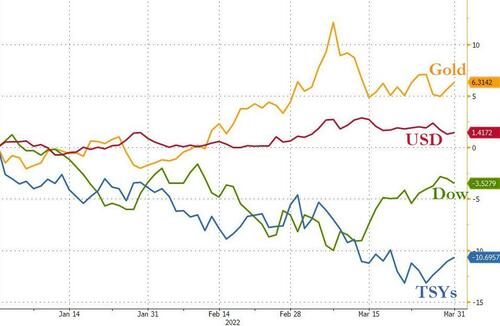
Source: Bloomberg
While all global stocks bounced in the 2nd half of March, Chinese stocks suffered the most in the quarter (China Tech -21% in Q1, worst since 2008), followed by Europe and then US…
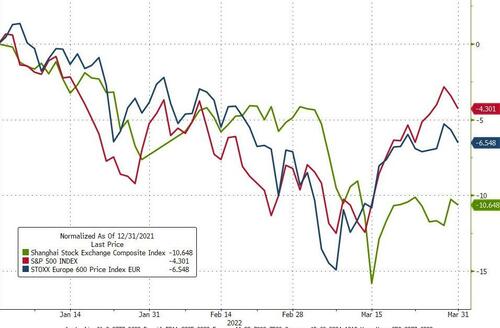
Source: Bloomberg
In US equity-land, Trannies ended Q1 unchanged while the Nasdaq ended down around 8%, despite March’s surge higher. This is the 2nd worst start to a year for stocks still since 2008 (with only the COVID crash worse)
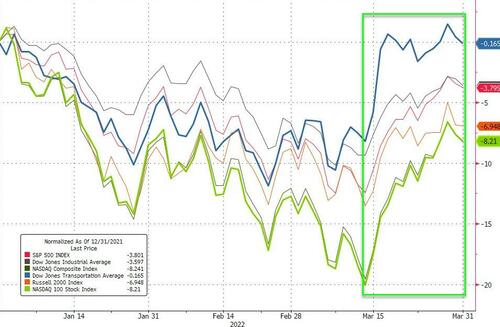
Source: Bloomberg
All thanks to a massive short-squeeze in March…

Source: Bloomberg
For some context as to just how much of a bounce this was., Nasdaq rallied a stunning 17% off the mid-March lows (in 10 days) and S&P up almost 12% in the same period…
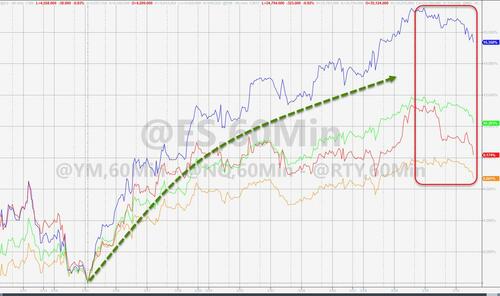
But the last two days have seen significant selling pressure resume into quarter-, month-end, with Small Caps down 3%, Nasdaq and S&P down over 2% in a big puke…
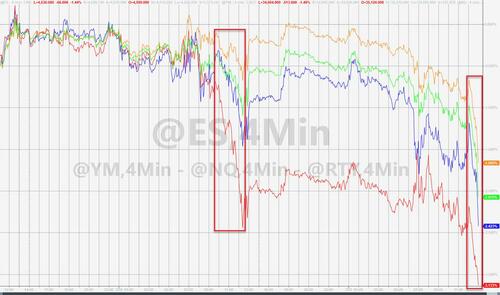
A lot of people mentioned the big JPMorgan Quarterly Put Spread Collar Rebalance as a possibel driver of this very local weakness, but Nomura’s Index Vol trader John Pierce is not so sure…
“Today we expect to see the quarterly rebalance of the well-known Put Spread Collar, I expect paper will trade the end of JUN 80% 95% 103% Put Spread Collar, where they will buy the Put Spread and sell the Call (with spot at tonight’s close this would be the SPX JUNQ 3680 4370 4740 PSC); This trade will net sell 16.7mm in Vega.
While this is the first time in recent memory that the Calls on the expiring collar (the marQ 3810 4510 4920 Put Spread Collar) won’t be deep in the money. I don’t think that there will be a massive Delta impact (up to 13B for Dealers to sell) at the time of the trade. Instead, I believe the end user will structure the trade as roughly Delta Neutral, using synthetic Put Call combos and work out of the Delta over the balance of the trading day.”
SpotGamma agreed:
“We don’t anticipate any net market impact today as hedgers position to mitigate impact. Look for some large SPX prints in the morning, and then another set of large SPX prints later in the afternoon as they adjust strikes.”
After the fact, we suspect something went wrong in the roll as VIX shot higher in the last hour, and it seemed gamma really accelerated into the close…
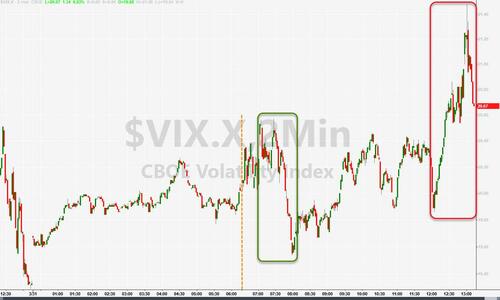
Energy stocks were Q1’s massive winner with Utes the only other sector to end green. Consumer Discretionary and Tech were the quarter’s biggest laggards…
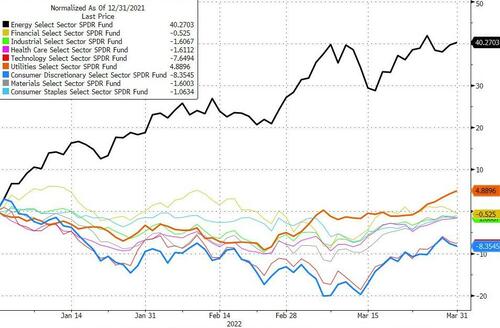
Source: Bloomberg
Value stocks outperformed growth in Q1, but having reached up to the May 2021 relative highs, Growth stocks started to outperform and have shone in March…
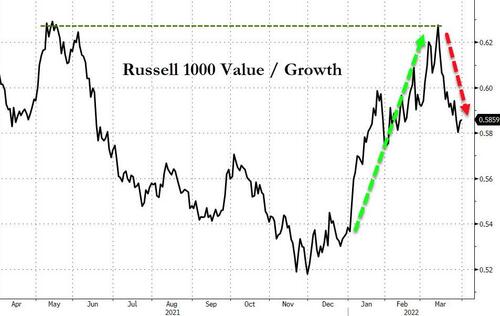
Source: Bloomberg
Mega-Cap tech stocks rebounded massively in late-March (but still remain lower in Q1)…
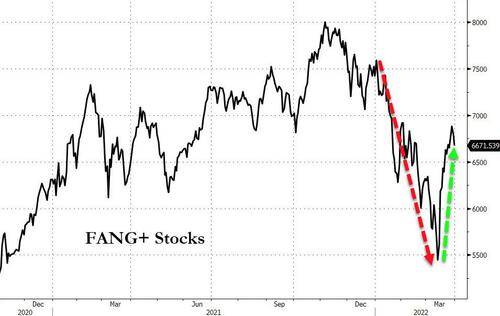
Source: Bloomberg
Today marks the end of the quarter and, based on Bloomberg’s data, the global bond market just suffered its greatest drawdown on record…
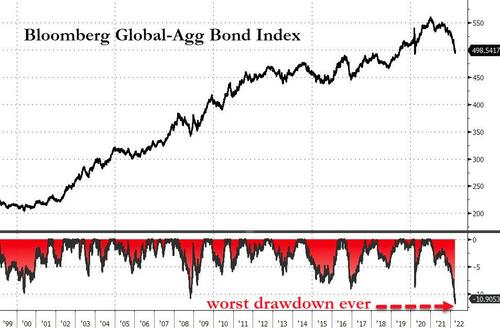
Source: Bloomberg
Domestically, according to BofA, Q1 is the worst quarter for their 10yr UST series since the early 1980s.
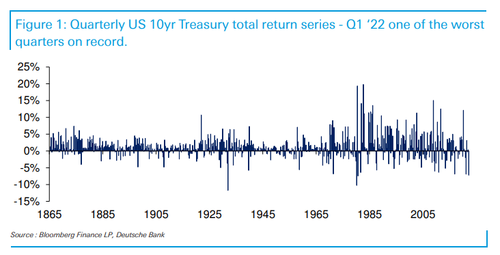
Indeed, since the US Civil War, 10yr US Treasuries (or equivalents) have only seen a worst total return quarter in the early 1980s and in Q4 1931 after we passed the peak of the Depression based rally.
In Q1, 2Y yields soared 156bps (while the long-end also rose, but ‘just’ 55bps)…(the last couple of days have seen bonds bid into the qtr-/mth-end as funds likely rebalanced)…
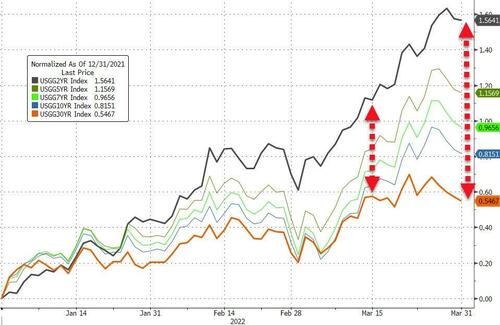
Source: Bloomberg
As the chart above shows, the yield curve flattened dramatically in the last month, accelerating the crash in the curve into inversion from the 2Y point out (this was the biggest flattening to start a year ever)…
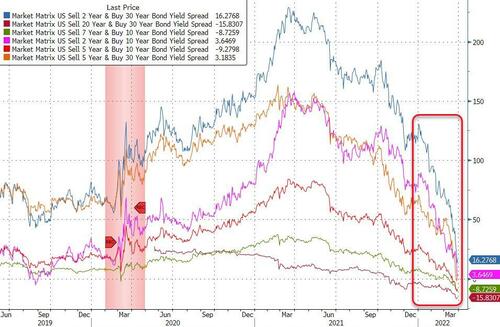
Source: Bloomberg
Seasonally, we could see more pain in bond land, before the trend shifts back in the favor of bond-bulls (the chart below shows the typical pattern in the 10-year yield going back to 1962)…
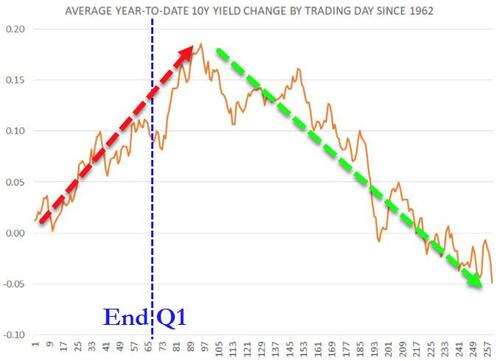
Source: Bloomberg
At the short-end of the curve, Q1 saw an unprecedented divergence as the market ripped from pricing in 2 hikes in 2022 to pricing in almost 9! And from pricing in 2 hikes in 2023/2024 to pricing in 3 rate-cuts!!!

Source: Bloomberg
Treasury yields finally caught up with Jeff Gundlach’s favorite indicator (copper/gold)…
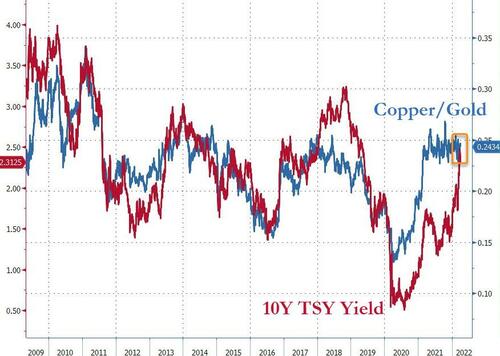
Source: Bloomberg
The dollar was higher in Q1, trading back into the pre-COVID range (up in Jan and March and down in Feb) to highest monthly close since July 2020…
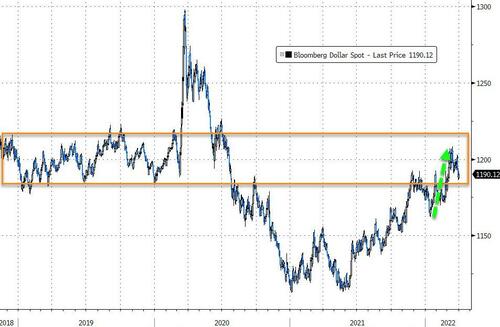
Source: Bloomberg
Cryptos had a tough Q1 with Bitcoin tumbling today back to unchanged on the first quarter and Ethereum down over 10%…
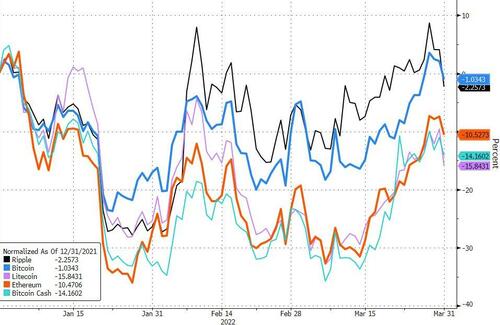
Source: Bloomberg
Commodities were all up in Q1 with Bloomberg’s Commodity Spot Index having its best start to a year ever, up 26% in Q1…
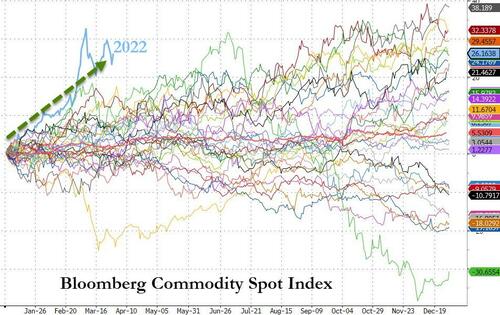
Source: Bloomberg
Oil was the standout for many, with WTI up around 40% (oil’s best start to a year since 1999). Copper and PMs rose around 6% in Q1. This was gold’s best start to a year since 2016…
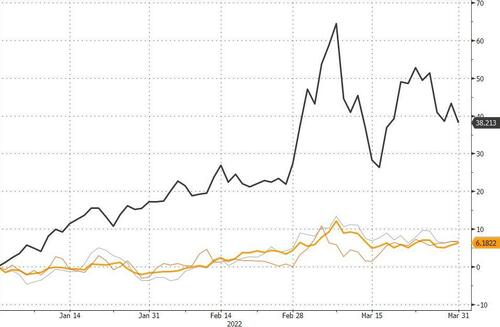
Source: Bloomberg
And that has sent gas prices to record highs…
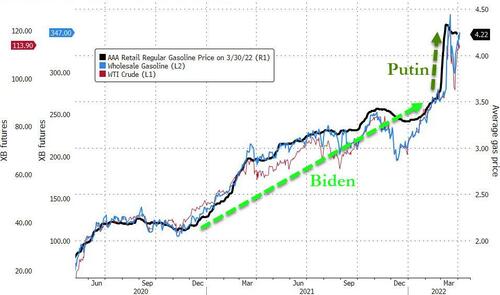
Source: Bloomberg
WTI traded lower today after Biden’s SPR release promo (but WTI found support at $100 again)…
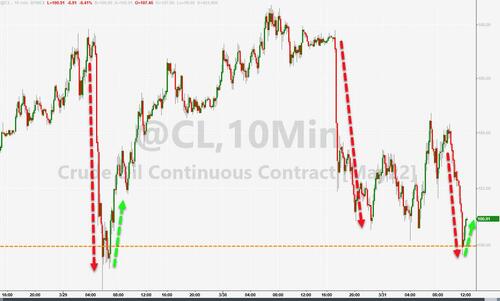
US Nat Gas soared to its best start to a year since 1990 but European Nattie exploded higher…
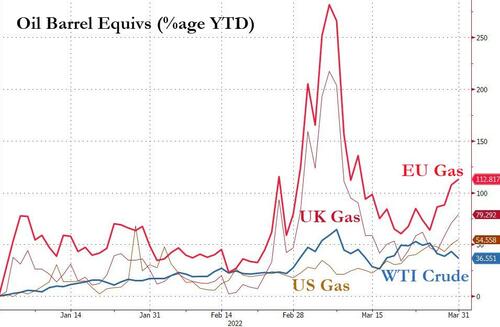
Source: Bloomberg
Finally, we note that financial conditions around the world tightened significantly in January and February, but eased in the second half of March (especially Japan as it swung to QE infinity and defended its yield curve channel) – as central banks actually began hiking…
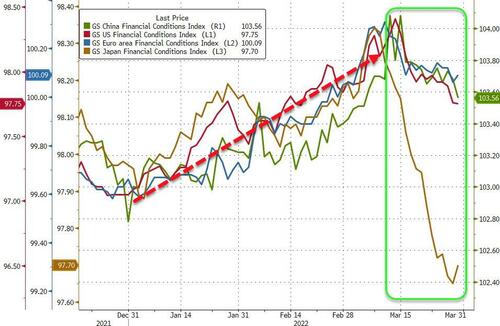
Source: Bloomberg
We suspect this is not what the central banks want as stagflation strikes the world…
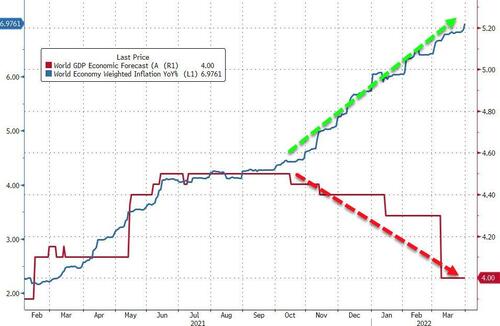
Source: Bloomberg
Do global central banks ‘need’ a recession to tamp down inflation? And will politicians allow it?
END
I) /MORNING TRADING
END
AFTERNOON
END
II)USA data
Core USA deflator surges to a 40 year high//real spending shrinks
(zerohedge)
Fed’s Favorite Inflation Indicator Surges To 40 Year High In Feb As Real Spending Shrinks
THURSDAY, MAR 31, 2022 – 08:37 AM
Nominal income and spending was expected to rise in February (with the former accelerating and the latter slowing from January), and they both did with Personal Incomes rising 0.5% Mom (as expected) and Spending rising 0.2% MoM (worse than expected)…

Source: Bloomberg
On the income side, Feb Private wages rose 12.6% Y/Y, up from 11.2% and highest since Sept 2021 (12.8%), while Feb Govt wages 5.5%, up from 4.9% and highest since Oct 2021 (8.75%)…

Real personal spending was expected to drop 0.2% MoM (in other words, spending is shrinking adjusted for inflation), but in fact dropped 0.4% MoM as perhaps demand destruction is showing up…

Source: Bloomberg
All of which left the personal savings rate hovering at its lowest since 2013…

Finally, and most importantly, The Fed’s favorite inflation indicator – Core PCE Deflator – which was expected to rise from +5.2% YoY to +5.5% YoY in Feb. The headline PCE Deflator surged to +6.4% YoY – the highest since 1982…

Source: Bloomberg
Key contributors to the spike in PCE include ‘Motor Vehicles & Parts’, ‘Housing’, and ‘Gasoline & Other Energy Goods’…

Source: Bloomberg
And bear in mind that all of this was before Putin invaded Ukraine!
Is it any wonder the market is pricing in 9 rate-hikes for the rest of the year? (and then 3 rate-cuts in 2023/24 to rescue the nation from recession)

Source: Bloomberg
Stagflation is priced in… get back to work Mr.Powell
end
This is dangerous: a shrinking liquidity
(zerohedge)
“Sounding The Alarm”: A $3 Trillion Problem Emerges As The Fed Prepares To Launch QT
WEDNESDAY, MAR 30, 2022 – 07:00 PM
Three weeks ago, roughly around the time we would point out virtually every single day that equity market liquidity was at all time lows…
… a similar, if far more more ominous liquidity problem was gripping the $23 trillion world of US Treasury debt.
As BofA’s resident bond plumbing expert and former NY Fed staffer Mark Cabana wrote on March 8 in a report whose title couldn’t be clearer (and which is available to pro subs in the usual place)…

… the recent elevated market volatility driven by the Russian invasion and ongoing conflict in Ukraine caused many to de-risk simultaneously, prompting a surge in market fragility in not only equities but also bonds. As a result, traders observed a wash out of popular rates trades: short front-end duration, flatteners, richer TU-OIS, and short belly TIPS.
This de-risking behavior – which comes just as the Fed ends its QE and is set to announce the launch of even more liquidity draining balance sheet reduction in just a few weeks – “leaves behind a market highly susceptible to liquidity issues” according to Cabana who warns that without a ceasefire or sharp moderation in tensions we expect UST illiquidity will persist, and more problematically, “Fed or Treasury actions may be needed to sustain UST market functioning.”
While most traders have already experienced it on their own, the degree of near-term uncertainty is clearly reflected in rates volatility by higher implied vols, exceeding levels reached at the peak of the covid uncertainty in 1Q20 and a deep inversion of the term structure of volatility.

The latter is particularly significant as fading these inversions (selling rich gamma vs buying intermediate vol) is quite attractive from a carry perspective (short theta), and indeed the right chart above shows that these inversions generally dissipate relatively quickly. The magnitude of the current inversion (35bp currently between 1m10y and 1y10y) as well as its length (the inversion has persisted and exacerbated since 10 Feb) expresses a significant degree of uncertainty in the market, of a similar degree to that seen over 1Q20.
It’s not just chaos over the Ukraine war however: the dynamic of TSYs in the recent risk-off context also reflects uncertainty around the utility of Treasuries for portfolios (a recent Bloomberg article was titled “Strategy With Crypto Beats 60/40 Portfolio During Russian War“). As a risk-off asset, USTs generally tend to overweight the tail scenarios relative to other assets, but recently we have seen some stickiness in the recent risk-off dynamic.
One of the likely drivers for this increased uncertainty relates to the current inflation context. The risk off dynamic has led to the pricing out of more aggressive 50bp hike scenarios for the Fed, but liftoff is likely to stay on track near-term. The first 100bp are justified & almost mechanical in the current inflation context but beyond that, the policy path may be more contingent on geopolitical scenarios, reflecting a Fed reaction function that may start to show concern for slower growth scenarios versus an inflation backdrop that is expected to ease over the year. It’s also why the rates market is now pricing in 3 rate cuts in 2023 and 2024 following the burst of rate hikes this year and next.

The Fed, however, is hell bent on raising rates until the low/mid 3’s, which creates scope for higher structural inflation and constrains the potential response of the nominal UST curve in a risk-off dynamic.
One would expect this change in Treasury utility (driven by a higher inflation context) to be more significant at the backend of the UST curve (which also matters more for tail-risk hedging). However, it does extend also to the front-end of the curve, likely compounded by liquidity concerns. Contrary to the historical pattern, we have seen a collapse of 2y spreads (2yT cheapening) as Libor/OIS spreads spiked wider in the geopolitical crisis.

Whatever the reason behind the shrinking liquidity, evidence of poor market functioning can be observed everywhere across the treasury curve, and is most thorny in sectors that typically demonstrate a liquidity discount.
Twenty-year notes have cheapened on the fly to some of their weakest levels since their reintroduction in May 2020.

TIPS have seen some of the largest intraday swings over the last 5-years and off-the-run issues have cheapened versus on-the runs.

At the same time, elevated volatility has also led to a decline in liquidity measures, including through wider bid-ask spreads & spline error. There are also signs of thinning market depth as seen through the CME Liquidity Tool, which now shows some of the thinnest book depth (i.e., number of buy & sell orders at each price level) since 2020 across Treasury futures contracts
bid ask spreads have widened out and spline pricing error is also elevated.

Realized & implied UST vol have both spiked. The UST intraday range is the highest since Mar ’20 & registers at the 90th+ percentile for realized volatility over the past 5Y. Implied vol has also spiked as 1y10y now exceeds March 2020 levels and are at levels last seen in 2013. The surface is also deeply inverted with 1m10y vs 1y10y implied vols seeing the deepest inversion since March 2020.

Besides growing fears of a secular shift in inflation, the very shifts in UST market structure are now amplifying volatility and illiquiduity. In a near and dear topic to this website which first cracked the scam that is High Frequency Trading back in 2009 long before Michael Lewis wrote FlashBoys, over recent years, high-frequency trading firms (aka principal trading firms or PTFs) have become larger not only in equities but also in the Treasury market while dealer activity has not grown with the UST market. The official sector defines PTFs as principals who trade for their own account, almost exclusively use automated trading strategies, and end each day with little to no directional exposure thus making them thinly capitalized. Dealers, by contrast, have historically been able to buy and sell from customers in large amounts, hold a portion of these positions across days, and maintain a large balance sheet to support positions.
Over recent years, PTF activity has increased in the Treasury market while dealer balances sheets & trading volume have been relatively stable. PTFs comprise the majority of electronic activity on interdealer broker platforms while dealers are still most active in voice & cash market activity.

Dealer trading volume & UST holdings have remained relatively stable but dealer balance sheets have materially declined as a percentage of total Treasury market size.

The increased role of HFTs and smaller relative dealer role vs UST market size can and will result in more limited UST liquidity during times of elevated volatility or stress. The official sector Interagency Working Group (UST, Fed, SEC, CFTC) has noted the risk of market making can be particularly relevant for PTFs “whose lower capitalization relative to dealers may leave them with less capacity to absorb adverse shocks.” This was true in March 2020 and we suspect it may be a factor with increased volatility today. The SEC has also recently announced greater PTF oversight by requiring them to become dealers.
Meanwhile, in another feedback loop, elevated UST volatility and thin market liquidity have likely caused a number of end investors to de-risk or reduce risk appetite, exacerbating current moves.
* * *
So what does all this mean going forward? Well, all else equal, treasury market functioning is expected to return as realized volatility declines… but all else is not equal, and a huge problem facing the Fed is that according to Cabana – who along with Pozsar was in charge of the Fed’s POMO/QE implementation – treasury functioning will be increasingly challenged by an accumulation of Treasury supply held in private hands, i.e., Quantitative Tightening.
To wit, BofA projects that Treasury supply will increase around US$3 trillion in the next 2Y due to large government deficits and aggressive Fed balance-sheet reduction. UST supply normalized for GDP is projected to increase back to mid ’20 levels by end ’23.

This means that already fragile TSY liquidity today may be exacerbated by the supply shift in coming months, especially after the Fed starts quantitative tightening (QT). And although short-dated USTs are rich today, Cabana thinks that investors should position for a cheapening starting mid-year with the supply shift and potential challenging liquidity: “Cheapening USTs are likely to
support tighter financial conditions that may ultimately require official action to contain.”
* * *
Putting it all together, in case it was not obvious yet, Cabana warns that Treasury liquidity is a concern ahead of supply shift”, i.e., the upcoming $3 trillion in Quantitative Tightening.
Some math: BofA projects that Treasury supply will increase around US$3tn in the next 2Y due to government deficits & aggressive Fed balance-sheet reduction. At the same time, Fed QT is expected to add nearly US$550-700BN to UST debt outstanding in each of next thee years. UST supply normalized for GDP is projected to increase back to mid ’20 levels by end ’23. Even assuming lower deficits in coming years as modeled by the CBO – which we truly doubt – these will at best limit coupon financing need but total UST supply growth vs GDP will still accumulate in private hands.
The bottom line: the already Fragile Treasury market functioning will only exacerbate the coming UST supply shift, especially given concerns about end-user demand. According to Cabana, bank buying has slowed with uncertainty around deposit & balance sheet growth, pension / insurance demand has been moderate despite their strong funded status, and hedged pickup of USTs to foreign
equivalents is set to decline.
To be sure, modest Japanese demand may pick up in April with the new fiscal year and that asset managers will find USTs increasingly attractive as a risk-off hedge (at some point). However, end-user demand is needed.
During the last QT episode, a similar supply accumulation increased cheapening pressure on USTs, especially at the front-end, leading to increased UST-leveraged demand. BofA’s measure of marketable debt ex Fed-to-GDP increased 6ppt during the prior QT episode, while 2Y USTs to FF OIS cheapened around 30bp. Treasury cheapening incentivized hedge funds to materially increase their UST holdings by US$585bn from QT start (4Q ’17) to finish (3Q ’19).

Cabana expects hedge funds to provide a similar source of demand but only if USTs are sufficiently cheap (read – yields are high enough) to encourage their leveraged participation.
The BofA strategist also expects a similar cheapening of Treasuries at the front-end during this QT episode, which could be exacerbated by thin UST liquidity. In other words, the official launch of QT in less than two month, could lead to a rapid bond market liquidity vacuum and subsequent crash, forcing the Fed to quickly find a justification to reverse its balance sheet shrinkage as the alternative is a complete lockup in the world’s most important market.
While this could be viewed as an exaggerated take, Cabana himself concedes that cheapening TSYs would support a broader tightening of financial conditions that could require official action to contain, and “The Fed, Treasury, and regulators could all act to support UST liquidity but debt managers are likely best positioned to act today.” Detail below:
Fed action: UST market functioning support over recent years has largely been done by the Fed. The Fed now has limited flexibility due to its inflation problem. “The Fed could delay QT in hopes of limiting UST market functioning challenges” Cabana writes, adding that “Powell said the Fed will be mindful of financial stability & the Fed wants to avoid adding uncertainty to an already very uncertain geopolitical backdrop.” However, the Fed likely wants to get moving on QT to tightening financial conditions & restrain inflation. And worst case, the Fed can just halt QT early on if it sees that the lock up across the bond market is too severe.
UST debt management: Treasury can play a more meaningful role in the support of market functioning after years of abdicating this responsibility to the Fed. There are a number of actions Treasury could take:
- (1) Large & decisive cuts at troubled parts of the UST curve. This would signal help to improve market functioning, especially in the troubled 20Y. Large cuts will not fix oversupplied parts of the market but it would support deeper liquidity in current issues.
- (2) Buybacks for liquidity management purposes. UST could start liquidity providing buyback operations across the curve, which would help unclog dealer balance sheets & limit RV dislocations. Treasury could fund buybacks by issuing in the most liquid (2, 5, 10, 30Y) points or target the richest points (bills) if willing to tolerate WAM reduction.
- (3) Improved communication. Treasury only sporadically communicates with the market via the quarterly refunding meetings. Improved communication could help guide expectations on key areas of market concern such as oversupply & challenging liquidity.
The bottom line, according to Cabana is that Treasury market functioning has deteriorated with elevated realized volatility stemming from Fed re-pricing & geopolitical tensions. Decreased liquidity has likely been exacerbated by market structure shifts and regulatory changes that have reduced UST resilience: the BofA strategist is “concerned about the accumulation of increased Treasury supply into a fragile market place, which will likely support a cheapening of USTs & tightening of financial conditions. The official sector can still act to smooth this process though the US Treasury may need to take a more active role to promote Treasury market resilience.”
TL/DR: QT will lead to unintended bond market freezes/lockdowns and only “official sector” intervention will prevent QT from leading to a bond market crash. So far, neither the Fed nor the Treasury are even contemplating this possibility. Meanwhile the clock until the launch of Quantitative Tightening is ticking…
There is much more in the full notes, available to pro subscribers.
end
IIB) USA COVID/VACCINE MANDATES
The fifth shot will be a killer
(Stieber/EpochTimes)
Fifth COVID-19 Vaccine Shot May Be Needed In Fall: FDA Official
WEDNESDAY, MAR 30, 2022 – 09:40 PM
Authored by Zachary Stieber via The Epoch Times (emphasis ours),
Hours after the Food and Drug Administration (FDA) authorized a fourth shot of the Moderna and Pfizer COVID-19 vaccines for all Americans 50 and older, an FDA official said a fifth shot may be needed in the fall.
“I don’t want to shock anyone but there may be a need for people to get an additional booster in the fall, along with a more general booster campaign if that takes place, because we may need to shift over to a different variant coverage,” Dr. Peter Marks, head of the FDA center that regulates vaccines, told reporters on a call on March 29.Dr. Peter Marks, director of the FDA’s Center for Biologics Evaluation and Research, speaks in Washington in a file image. (Susan Walsh/Pool/Getty Images)
The fresh emergency use authorization is for a fourth shot for Americans 50 and up and a fifth shot for people as young as 12 with weakened immune systems. The boosters from Moderna and Pfizer target the strain of SARS-CoV-2, or the CCP (Chinese Communist Party) virus, that was circulating in early 2021. Multiple strains have since emerged and become dominant in the United States. Omicron is the latest.
Moderna and Pfizer are testing vaccine formulations that specifically target Omicron.
“It may be that a decision is made that rather than what we currently have, the vaccines we currently have—which are called vaccines against the prototype virus—that we will move to a vaccine that is either against one of the variants—whether it’s Omicron, Beta, or Delta, or something else, I can’t say right now that’s for discussion—or whether it’s some mix of different ones,” Marks said. “But it’s possible that people will need to get another vaccine.”
The FDA authorized the outdated boosters because regulators felt doing so could save lives and because it will likely take several months to discern whether an Omicron-specific booster works, he added.
“And it’s not actually clear yet what the optimal booster should be,” Marks said.
The matter will be discussed during an April 6 meeting with the FDA’s expert advisory committee.
Some experts have raised concerns about repeatedly injecting people with COVID-19 vaccines. The worries stem in part from the main vaccines being built on a technology, messenger RNA, that had never been cleared for use before the pandemic, with others noting that other vaccines provide sufficient protection through shots administered annually, or at less frequent intervals.
If repeated boosters are administered, “we will end up potentially having problems with immune response and immune response may end up not being as good as we would like it to be, so we should be careful in not overloading the immune system with repeated immunization,” Marco Cavaleri, the European Medicines Agency’s (EMA) head of vaccines strategy, told a briefing in January.
Dr. Robert Malone, who helped invent the mRNA technology, said research he’s reviewed indicates the vaccines can lead to immune suppression, a condition where the body’s natural immune system is weakened against all kinds of infection and disease.
“This is the risk associated with this strategy of reboosting,” he told The Epoch Times.
Presented with Marks’ remarks, Malone said they were “pure speculation and unfounded.”
“That’s a forward looking statement. There’s no scientific basis for evaluating it. And it’s inappropriate for the FDA to be speculating like that, in my opinion,” he said.
iiia) USA inflation//SHIPPING commentaries//LOG JAMS//
This will add to inflation
(Stribling/BisnowNational)
22,000 Union Workers At 29 West Coast Ports May Strike
THURSDAY, MAR 31, 2022 – 10:45 AM
By Dees Stribling of Bisnow National
The international supply chain crisis that has impacted U.S. logistics firms, retailers and consumers could intensify this summer.

West Coast union dockworkers may strike if they don’t come to an agreement to replace their existing contract with marine terminals. The contract is set to expire at the end of June.
Major retail chains have already ordered extra goods from Asia as insurance against a breakdown in contract talks, keeping the goods at newly developed storage yards near the twin California ports of Long Beach and Los Angeles. Such lots allow retailers to move containers more quickly, preventing them from being delayed under piles of cargo at congested ports.
Walmart alone has room for 4,000 shipping containers at the ports’ overflow yards, Pacific Terminal Services Vice President of Commercial Operations Sepehr Matinifar told The New York Times.
Space constraints in the area led to the rise of the new storage yards. By Q2 2021, industrial vacancy near the ports of Los Angeles and Long Beach was below 1%, according to CBRE.
Even with beefed-up orders kept in storage yards, a slowdown or strike by West Coast dockworkers would compound the pandemic-induced supply chain woes that have seen record backlogs of container ships off the ports of Los Angeles and Long Beach waiting to be unloaded.
The International Longshore and Warehouse Union, which represents nearly 22,000 workers at 29 ports along the West Coast, recently put together its contract negotiating team. Nearly three-quarters of those workers are employed at the ports of Long Beach and Los Angeles, the major nexus for goods shipped from Asia to North America.
In 2014, the last time the union and shipping companies negotiated a contract, a labor slowdown brought activity at Pacific ports nearly to a standstill.
end
iiib) USA economic stories
Biggest Housing Affordability Shock In History Incoming
THURSDAY, MAR 31, 2022 – 01:45 PM
30 Year fixed mortgage rates have jumped 160bp this year, reaching the highest since November 2018, with the latest Freddie Mac data showing an acceleration in mortgage rates which jumped a quarter point in just the past week, from 4.42% to 4.67%. This is an even bigger increase than we discussed in our recent Housing comment.
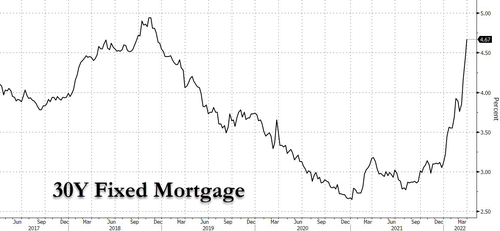
And while the benchmark 10y Treasury yield has also risen, the increase is “only” 94bp. In other words, there has also been a significant widening in mortgage spreads, by 66bp to 243bp. This could be explained by the Fed’s accelerated pivot from QE to QT, the latter of which we expect will be announced at the next FOMC meeting in May.
As discussed one week ago in “Housing Affordability Is About To Crash The Most On Record“, the move higher in rates means that an already record affordability shock will be even worse! As a reminder, we looked at the NAR affordability index and found that the 4.22% on average rate through mid-March, would lead to a record affordability decline of more than -25% yoy. Refreshing the data, Bank of America finds that the decline now looks closer to -30% yoy.

Unfortunately, that’s only the beginning: according to BofA economist Alex Lin, it will probably be even worse than that given the considerable momentum behind home prices, which actually picked up to begin this year with Case-Shiller national home prices accelerating 1.6% mom and 19.2% yoy in January. This move would bring the level of affordability to the lowest since 2007, when the housing bubble was bursting. In other words, not only is housing affordability about to plunge at the fastest rate in history, it will also drop to the lowest rate on record, making housing an asset class which just a select group of US households can afford.
What does this shock mean for actual home prices, sales and – ultimately – the coming recession?
According to Lin, housing affordability tends to lead the trajectory of existing home sales by about half a year. For illustrative purposes, we can draw up a scenario where the existing home sales trajectory matches affordability. This would suggest existing home sales falls below a 4.4mn SAAR pace by September, averaging 5.26mn SAAR over the first 9 months of 2022. That said, the relationship between affordability and existing home sales is imprecise. As a result, this is probably more of a bear case than the base case.
The hit to affordability will likely be only one part of the picture. Another major reason for existing home sales to pullback will be because of the mortgage rate “lock-in” effect. Remember that existing home sales is a measure of housing turnover and will partially reflect owner-occupied households trading up, down, or moving regions. It is likely that the overwhelming majority of these households are paying a much lower mortgage rate than the current market rate, which provides a huge disincentive to move. As a result, demand and supply would head lower.
There are signs of this buyer/seller base already withdrawing: according to the NAR existing home sales data, the share of buyers that were previous homeowners slid to 35% in February from 42% in January. Meanwhile, current existing home inventories are already at record lows with months supply SA at 1.9 and actual levels at 966k units.
That said, there will be positive offsets for the existing home sales trajectory. The move higher in rates could lead to a pull forward in demand, which could underpin near-term sales. The pandemic has also led to a shift towards remote-work, which could help facilitate migration from high-cost areas to low-cost areas where homeownership is more affordable.
In addition, and this is debatable, BofA notes that household balance sheets are the strongest they’ve ever been with net worth surging to 809% of disposable income, and debt service ratios running near historically low levels (we would counter that applies predominantly to the top 5% who have uniquely benefited from the surge in asset prices; the rest of US households – not so much). Labor markets are booming as well, with job growth averaging nearly 600k over the last 6 months alongside accelerating wage growth. Finally, there are demographic tailwinds with Millennials now in their prime home-buying years.
end
iv)swamp stories
Hunter Biden affair heating up as associates of the younger Biden testified before grand jury
(zerohedge)
Two Hunter Biden Associates Testified Before Grand Jury About PLA-Linked Chinese Company
THURSDAY, MAR 31, 2022 – 09:45 AM
With the Hunter Biden laptop scandal heating up again, CBS News‘ Catherine Herridge reported early Thursday morning that two associates of the younger Biden testified before a grand jury last fall.

“Federal officials are looking at his foreign business dealings, including his ties to a Chinese energy company,” said “CBS Mornings” host Tony Dokoupil.
“The investigation began as a tax inquiry years ago and has expanded into a federal probe involving the FBI and IRS,” Herridge added. “A source familiar with the investigation now tells CBS News, two men who worked with Hunter Biden when his father was Vice President were called to the grand jury last fall.”
The probe is now exploring whether Hunter and pals violated tax, money laundering, and foreign lobbying laws.
According to records reviewed by CBS along with congressional documents, the feds are looking at “multiple financial transactions involving an energy company called CEFC. Republicans accuse the business of being an arm of the Chinese government. In 2017, the year Joe Biden left the Vice Presidency, a $1 million retainer was signed with a Chinese energy company for Hunter Biden’s services as a lawyer.
His client, a CEFC official, Patrick Ho, was later convicted on international bribery and money laundering charges on unrelated work in Africa.”
For those who’ve been keeping up with our reporting since October when the Hunter Biden laptop story broke (and was immediately suppressed by the media), CEFC was the company that the Bidens allegedly accepted a $5 million interest-free loan that enraged their business partner, Tony Bobulinski – who flipped on the Bidens following a Senate report which revealed the $5 million ‘loan.’
According to the former Biden insider, he was introduced to Joe Biden by Hunter, and they had an hour-long meeting where they discussed the Biden’s business plans with the Chinese, with which he says Joe was “plainly familiar at least at a high level.”
Text messages from Bobulinski also reveal an effort to conceal Joe Biden’s involvement in Hunter’s business dealings, while Tony has also confirmed that the “Big guy” described in a leaked email is none other than Joe Biden himself.

“You can imagine my shock when reading the report yesterday put out by the Senate committee. The fact that you and HB were lying to Rob, James and I while accepting $5 MM from Cefc is infuriating,” wrote Bobulinski to Jim Biden. (Via the Daily Caller‘s Chuck Ross):
CEFC was paying Hunter $850,00 per year according to an email from Biden business associate James Gilliar to Bobulinksi – which is also the source of the “10 held by H for the big guy” email.
Emails obtained by the New York Post show that Hunter “pursued lucrative deals involving China’s largest private energy company — including one that he said would be “interesting for me and my family.”” according to the report.

You can read more on Hunter and the CEFC here. As an aside, but of course not coincidental we’re sure, the Clinton Foundation accepted a donation between $50,001 and $100,000 from CEFC.
And as the National Pulse noted, the Bidens weren’t the only members of the DC political establishment that the CEFC tried to ‘purchase.’
* * *
A New York Times article, “A Chinese Tycoon Sought Power and Influence. Washington Responded.”, outlined how Ye sought influence in D.C., attempting to connect with powerful individuals like those from the Biden family.
“Ye Jianming, a fast-rising Chinese oil tycoon, ventured to places only the most politically connected Chinese companies dared to go. But what he wanted was access to the corridors of power in Washington — and he set out to get it. Soon, he was meeting with the family of Joseph R. Biden Jr., who was then the vice president,” the article noted.
However, members of D.C.’s political class didn’t always accept Ye’s overtures:
“Ye Jianming’s early efforts to break into the Washington power broker scene didn’t always pan out. Five years ago, CEFC approached Bobby Ray Inman, a retired admiral and national security adviser to President Jimmy Carter, about setting up a joint venture, Mr. Inman said in an interview. The company promised it would pay him $1 million a year, without specifying what business they would go into. He turned down the offer. Later, Mr. Inman said, CEFC officials called him and said they were considering acquiring oil fields in Syria. Could he help them persuade the American military not to bomb them? Again, he said no.”
The Clintons, however, had no qualms about accepting money from Ye, a Chinese Communist Party member with ties to the People’s Liberation Army. The New York Times noted:
“Mr. Ye also further loosened CEFC’s purse strings, donating as much as $100,000 to the Clinton Foundation.”
* * *
Meanwhile, Hunter Biden sought to avoid registering as a foreign agent in doing business with CEFC, suggesting that he and his prospective partners set up a shell company to be able to bid on contracts with the US government, according to documents obtained by the Daily Caller.
A day after sending the message, Biden arranged a meeting between his father, Joe Biden, and Tony Bobulinski, one of the prospective partners in a deal with CEFC China Energy, a Chinese conglomerate whose chairman had links to the communist regime in Beijing.
“We don’t want to have to register as foreign agents under the FCPA which is much more expansive than people who should know choose not to know,” Hunter Biden wrote to Bobulinski on May 1, 2017, according to a message obtained by the DCNF.
“No matter what it will need to be a US company at some level in order for us to make bids on federal and state funded projects.” –Daily Caller

And according to Bobulinski, Joe Biden was in on the whole thing.
And of course, all evidence of this was suppressed right before the 2020 election.
Senators Release Bank Records Showing Payments to Hunter Biden From China
Inbox
| Robert Hryniak | 9:45 AM (4 minutes ago) | | |
| to |
And no one cares? How about the payments from the Ukrainian washing machine ?
Cheers
Robert
END
The King Report (including swamp stories)
| The King Report June 25, 2018 Issue 5784 | Independent View of the News |
| Where have all the MMT aficionados gone? Asking for a friend. U.S. Stocks Drop as war Concerns Return, Oil Rises – BBG Talks with Ukraine yielded no breakthroughs, and a lot of work remains before a deal is possible, Kremlin spokesman Dmitry Peskov said… The above headline is nonsense! Anyone with basic reading skills that paid attention on Tuesday saw numerous stories and US officials’ remarks in the afternoon that debunked the ‘peace is at hand narrative’. As we noted in yesterday’s missive, money managers and traders need to embellish Q1 performance; so, they forced stocks (especially over-owned techs and Fangs) and bonds higher. Secondly, crude oil soared on Wednesday due to an unexpected inventory tumble. U.S. Crude-Oil Inventories Fall More Than Expected Crude-oil stockpiles slid by 3.4 million barrels to 410 million barrels, and are now about 14% below the five-year average, the EIA said. Analysts surveyed by The Wall Street Journal had predicted crude stockpiles would fall by 1 million barrels from the prior week…. https://www.morningstar.com/news/dow-jones/202203309092/us-crude-oil-inventories-fall-more-than-expected Russian Foreign Minister Sergei Lavrov was in China on Wednesday, his first visit since the invasion. This is a very important development. Lavrov is likely asking China for more weapons and support. If China agrees to provide more weapons, it will widen its growing divide with the West. If China refuses to provide weapons, it could induce Russia to commit to a peace deal sooner rather than later. Russia’s Foreign Minister Sergei Lavrov is making two very telling trips this week. In China today (Wed.) … But Beijing is being very low key about the visit… President Xi Jinping is probably loathe to put himself in the middle of Putin’s political fights with the U.S. and Europe… Tomorrow Lavrov heads to India… India is a member of the Quad alliance with the U.S., Japan and Australia that seeks to limit China’s military and strategic clout… https://www.bloomberg.com/news/newsletters/2022-03-30/asian-giants-tread-a-fine-line-on-putin-s-war Ukraine Update: U.S. Doubts Russian Pullback; Lavrov in China https://www.bloomberg.com/news/articles/2022-03-29/ukraine-update-kyiv-seeks-cease-fire-deal-in-russia-talks Pentagon dubious of Russian ‘withdrawal’ north of Kyiv, expects troops will move to eastern Ukraine – “What they probably have in mind is a repositioning to prioritize elsewhere.” 3/29/22 https://abcnews.go.com/Politics/pentagon-dubious-russian-withdrawal-north-kyiv-expects-troops/story?id=83740519 The Russian army is transferring part of the group of troops from the Kiev and Chernihiv directions to the Donbass and Kharkov – Danilov, Ukraine National Security & Defense Council head @phildstewart: Biden administration made a policy decision to remove U.S. warships from the Black Sea prior to Russia’s invasion of Ukraine, top U.S. general in Europe tells Congress The longer the Ukraine-Russia war lasts, the worse the political fallout will be for Biden; especially if Russia prevails. Biden did everything possible to not provoke Putin before the invasion. One could say Biden appeased Putin and greenlighted an invasion by okaying ‘a minor incursion’ into Ukraine. Even today, Team Biden is not providing the arms that Zelenskyy begs for daily. Critics will proclaim that had Team Biden adequately armed Ukraine, Russia would not have prevailed. They will note that the Bad Orangeman provided tank-killing Javelins and other lethal weapons, but Biden, perhaps compromised by his and Hunter’s grifting, did not adequately arm Ukraine. @AndrewDesiderio: (Sen) Graham after classified briefing on Russia/Ukraine says the administration’s justification for not sending planes to Ukraine was “bull.” “We cannot let Putin tell us how to help Ukrainians help themselves…We’re five weeks into this thing & it seems like nothing changes” White House: Intel shows Putin misled by advisers on Ukraine… about his military’s poor performance…there is now persistent tension between him and senior Russian military officials… https://www.wkrg.com/news/politics/putin-misled-by-advisers-on-ukraine-us-intel-determines/ Relentless BoJ Bond Buying Drives Yields Lower as Yen Rebounds The BOJ surprised investors with a pledge to buy more securities than planned and include longer-dated debt on a day when global bonds rallied. It’s already in the midst of an unprecedented three-day purchase plan to defend its cap for 10-year yields and the latest announcements saw them fall 3.5 basis points to 0.21%… https://www.yahoo.com/now/boj-steps-market-intervention-boosting-012454973.html BBG: BOJ Offers to Buy Bonds in Unscheduled Market Operation – The Bank of Japan plans to buy 500b yen of 5-10 year notes, 100b of 10-25 year debt and 50b of bonds due in more than 25 years… BlackRock’s Kapito Says ‘Scarcity Inflation’ Is Driving Economy (Elite tells serfs to suck it up!) “For the first time, this generation is going to go into a store and not be able to get what they want,” Kapito said… “And we have a very entitled generation that has never had to sacrifice.” The economy is reckoning with what he dubbed “scarcity inflation,” or the fallout from a shortage of workers, agricultural supplies and housing, and of oil in some regions. “I would put on your seat belts because this is something that we haven’t seen,” Kapito said… https://www.bnnbloomberg.ca/blackrock-s-kapito-says-scarcity-inflation-is-driving-economy-1.1744930 US Q4 GDP was revised to 6.9% from 7% because Consumption was revised to 2.5% from 3.1%. Inventories added 5.32 to GDP! To repeat 77% of GDP growth is INVENTORIES. This will be a drag on GDP in Q1 and Q2. Corporate profits increased only 0.7%. The hokey ‘Intellectual property’ component added 0.45 to GDP. ECB tells banks to cut lending to indebted borrowers after binge http://reut.rs/3qMA2mI ECB ups scrutiny of bank loans to high-risk borrowers Banks have started to lend more to indebted clients… and ease the terms on these so called “leveraged transactions” to fend off competition. The volume of these loans rose by 35 percent between 2012 and 2015, an ECB survey of 40 banks found. So called “covenant-lite” deals, which offer less protection to the lender and were popular in the run-up to the financial crisis, accounted for a significant and growing share of the total, the survey found… https://www.reuters.com/article/ecb-banks-debt-idINL8N1DO48O @LynAldenContact: The US broad money supply increased from about $300 billion in 1960 to over $21,000 billion today. https://twitter.com/LynAldenContact/status/1509227035129954304 It’s good to keep track of your dilution rate, in any monetary system (fiat, gold, crypto, whichever). If the yields on your cash/bonds are higher than the rate of monetary inflation, you’re keeping up your % share. If not, then you’re being diluted, devalued. (Profound chart at link) https://twitter.com/LynAldenContact/status/1509227038510563328/photo/1 The chart at the above link shows how the negative Effective Fed Funds Rate-M2 ignited roaring inflation in 1973 and the greatest inflation since the Civil War in the late 70’s. More ominously, the chart shows that the Effective Fed Funds Rate-M2 ratio for the past few years is almost 3X more negative. The odds are extraordinarily high that the inflation cycle is still in its formative stage. St. Louis Fed: The federal funds rate is the interest rate at which depository institutions trade federal funds… the weighted average rate for all of these types of negotiations is called the effective federal funds rate… https://fred.stlouisfed.org/series/DFF St. Louis Fed: Beginning May 2020, M2 consists of M1 plus (1) small-denomination time deposits (less than $100,000) less IRA and Keogh balances at depository institutions; and (2) balances in retail MMFs less IRA and Keogh balances at MMFs. Seasonally adjusted M2 is constructed by summing savings deposits (before May 2020), small-denomination time deposits, and retail MMFs, each seasonally adjusted separately, and adding this result to seasonally adjusted M1… https://fred.stlouisfed.org/series/DFF @ABC: Biden: “Today I’m announcing the launch of http://COVID.gov—a one-stop shop where anyone in America can find what the need to navigate the virus.” .. .will include information on: – Free vaccines and boosters – Free at home tests – High-quality masks – Up-to-date information on community spread… Republicans expose ‘uncommon’ CDC, teachers’ union ties on COVID school reopening guidance in report – Republicans accuse Walensky of downplaying the degree to which the CDC departed from past practice to allow AFT to affect the policymaking process On Feb. 11, 2021 one day before the CDC publicly posted the guidance, AFT’s senior director of health issues, Kelly Trautner, emailed CDC Director Dr. Rochelle Walensky asking her to insert the line: “In the event high-community transmission results from a new variant of SARS-CoV-2, a new update of these guidelines may be necessary.” The emails revealed that Walensky forwarded the email to Dr. Henry Walke, director of the CDC’s Center for Preparedness and Response, who then revised the guidance in accordance with AFT’s request. The emails also revealed that CDC officials coordinated an early release of the final guidance to the AFT before releasing it to the public… https://www.foxnews.com/politics/republicans-uncommon-cdc-teachers-union-school-reopening-guidance Hackers just stole more than a half billion dollars from Axie Infinity’s Ronin Network in what could be the biggest crypto heist of all time (A major reason why we are not jiggy for crypto!) https://finance.yahoo.com/news/hackers-just-stole-more-half-173129147.html?fr=sycsrp_catchall @jessefelder: ’10-day stretches of big gains have been common in bear markets.’ https://t.co/ggJn2MgODY  The above chart is courtesy of Eric Pomboy and Bristol Gold Group (current report to customers) Biden Team Weighs a Massive Release or Oil to Tame Inflation – BBG 20:10 ET WSJ: Russia Plays Down Progress in Peace Talks, Intensifies Attacks in Eastern Ukraine – Russian forces also struck around Kyiv, while Ukraine said it fought off advances in the eastern Donbas region https://www.wsj.com/articles/russian-assault-on-kyiv-eases-as-missile-strikes-ground-attacks-continue-around-ukraine-11648634073 @KyivIndependent (last night): Russia announces ceasefire to evacuate residents of Mariupol. The Russian Ministry of Defense said a humanitarian corridor from Mariupol to Zaporizhzhia, via the Russian-controlled port of Berdiansk, will begin at 10 a.m. on March 31st. Today is the end of Q1. Money managers want to markup stocks and bonds to embellish Q1 report cards. Will the manipulators trying to game Q1 performance prevail or will liquidators dominate? ESMs are up 11.25 at 20:35 ET on the Mariupol ceasefire and Q1 performance gaming. WTI oil is -5.54 on Biden’s possible oil reserve release and reports that Biden will read about reducing energy inflation today. Stock Trader’s Almanac: Last day of March, Dow down 20 of last 32; Russell up 24 of last 32. First trading day in April: Dow and S&P up 19 of last 27 Seasonal upward bias ends at the close on Friday, with expected buying for the start of April. The window for a short-term top is open. Expected economic data: Feb Personal Income 0.5%, Spending 0.5%, PCE Deflator 0.6%, PCE Core Deflator 0.4%; Initial Jobless Claims 196k, Continuing Claims 1.34m; March Chicago PMI 57; NY Fed Pres Williams 9:00 E A few weeks ago, the NY Times waded into the Hunter Biden laptop story. Now, the Washington Post has crossed the Rubicon and is reporting on the Bidens’ grifting. What has changed? Inside Hunter Biden’s multimillion-dollar deals with a Chinese energy company A Washington Post review confirms key details and offers new documentation of Biden family interactions with Chinese executives – Over the course of 14 months, the Chinese energy conglomerate and its executives paid $4.8 million to entities controlled by Hunter Biden and his uncle, according to government records, court documents and newly disclosed bank statements, as well as emails contained on a copy of a laptop hard drive that purportedly once belonged to Hunter Biden… illustrate the ways in which his family profited from relationships built over Joe Biden’s decades in public service… https://www.washingtonpost.com/politics/2022/03/30/hunter-biden-china-laptop/ @JackPosobiec: And just like that the Hunter Biden kompromat is being used on Biden – from within! Bet he didn’t see that coming @HansMahn>https://www.foxnews.com/politics/grassley-johnson-allege-100000-payment-chinese-oligarchs-hunter-biden-provide-receipt GOP House leader @EliseStefanik: For too long Joe Biden’s family members have peddled their access to “The Big Guy” to our adversaries for financial gain. They need to be held accountable and the American people have the right to know how far this corruption goes. Good work, @ChuckGrassley! @RepJimBanks: Hunter Biden’s laptop & crooked business dealings are a matter of national security. @TomBevanRCP: Not a single question in today’s White House briefing about the Washington Post story authenticating Hunter Biden’s laptop. Not even by the Post itself. @ggreenwald: Just f-ing amazing: now the WashPost, 10 days after NYT, admits that the contents of the Hunter Biden laptop are genuine and uses them in their reporting. Yet **not one** corrupt outlet that spread the CIA’s pre-election lie that it was “Russian disinformation” has retracted. @CBS_Herridge: A federal probe into Pres. Biden’s son Hunter is underway. Sources tell @CBSNews it is broader than previously known. White House declined to comment + referred reporters to earlier statement POTUS never “considered being involved in business w/his family.” https://t.co/44YaRSoS9B Psaki Reminds Reporters That Biden Doesn’t Speak for The President of The United States “The President has clearly said, and we agree, that Joe Biden does not speak for this administration,” said Psaki to the confused reporters. “Nothing said by Biden should be misconstrued to reflect the official foreign policy of the President. This administration has been clear from the beginning, that we have always been clear about what we have been clear about, clearly.”… (Babylon Bee parody) https://babylonbee.com/news/psaki-reminds-reporters-that-biden-doesnt-speak-for-the-president-of-the-united-states @AlexandruC4: 7 buses with Russian soldiers suffering from Radiation Syndrome have arrived to a hospital in Belarus from the Chernobyl Exclusion Zone in Ukraine. They dug trenches in the highly radioactive Red Forest – UNIAN (The Russian troop morale problem will worsen!) @ClayTravis: Disney will no longer use the words “boys” and “girls” at its theme parks to avoid offending people. Really. https://www.outkick.com/disney-goes-woke-will-no-longer-say-boys-and-girls-within-park/ Disney won’t say if it’s keeping princes and princesses as ‘boys and girls’ gets chopped https://t.co/Br3BqpuLDm Disney exec wants half its characters to be LGBTQIA, minorities by end of year https://trib.al/robxCe6 @realchrisrufo: SCOOP: I’ve obtained video from inside Disney’s all-hands meeting about the Florida parental rights bill, in which executive producer Latoya Raveneau says her team has implemented a “not-at-all-secret gay agenda” and is regularly “adding queerness” to children’s programming. https://twitter.com/realchrisrufo/status/1508912865293619202 Disney diversity and inclusion manager Vivian Ware says the company has eliminated all mentions of “ladies,” “gentlemen,” “boys,” and “girls” in its theme parks in order to create “that magical moment” for children who do not identify with traditional gender roles… https://twitter.com/realchrisrufo/status/1508937431520890888 |
Let us close with this offering courtesy of Greg Hunter i |
See you tomorrow
h


 harveyorganblog.com



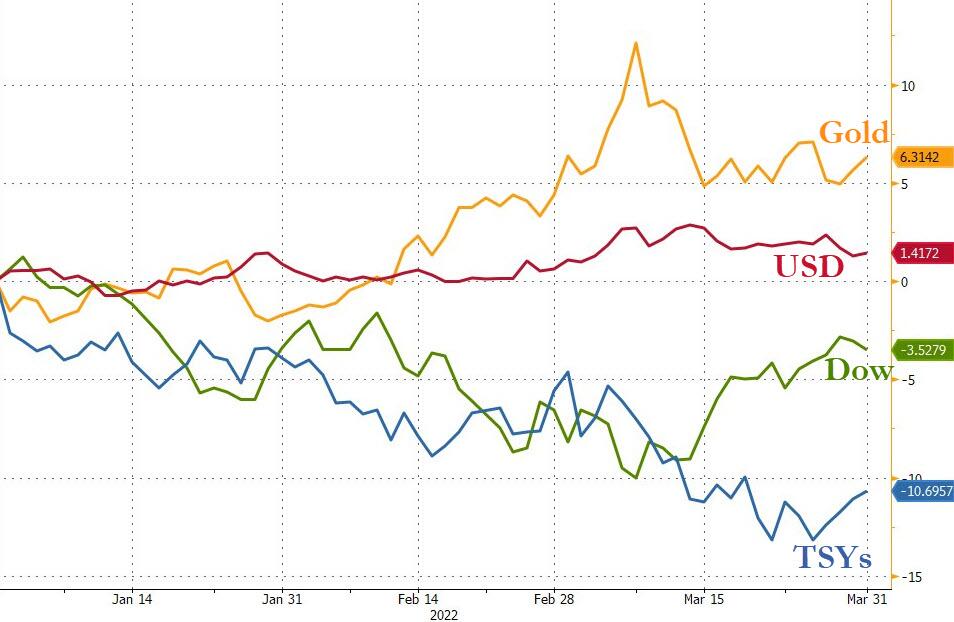
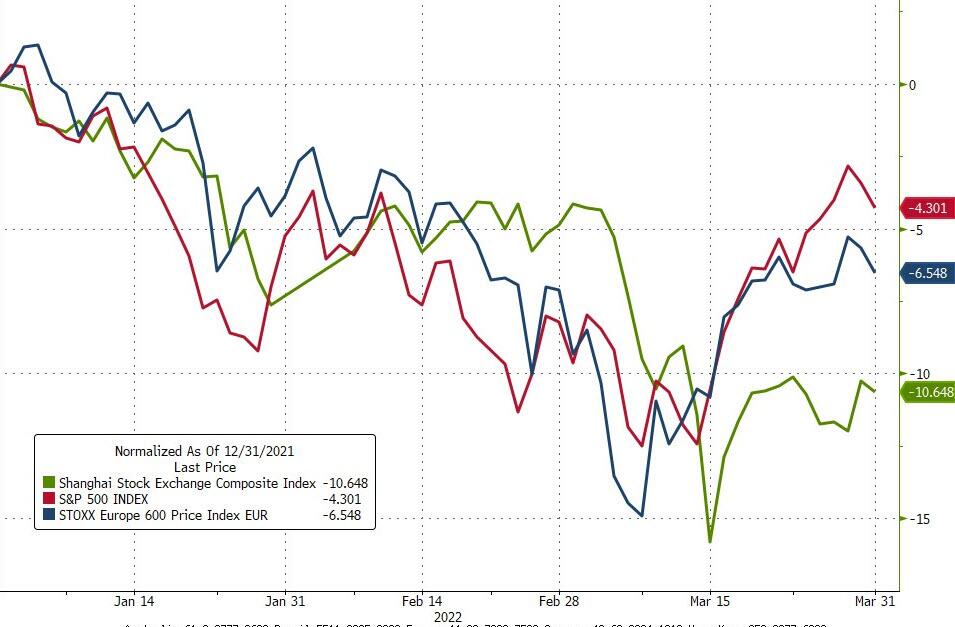
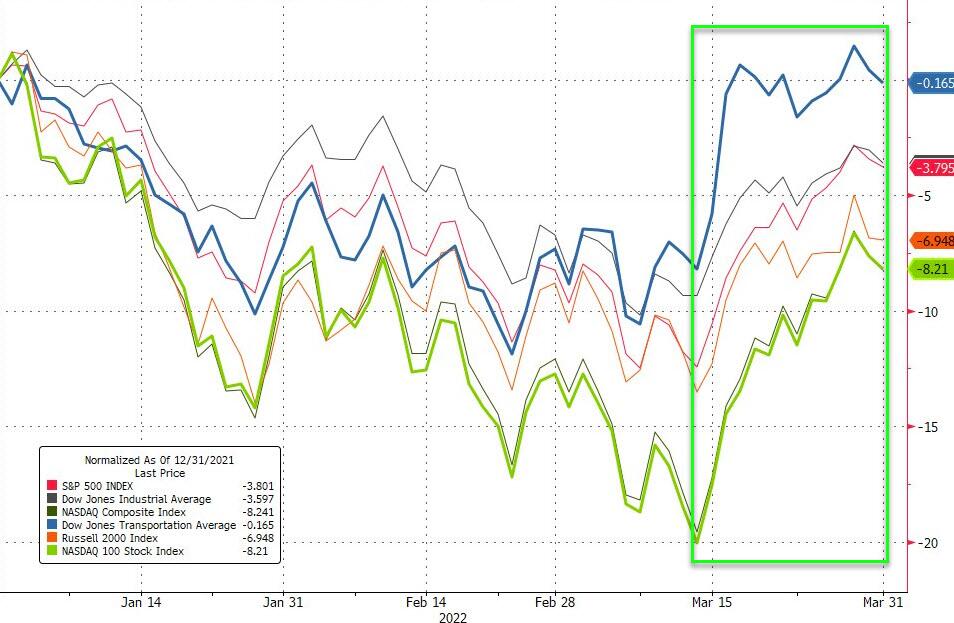
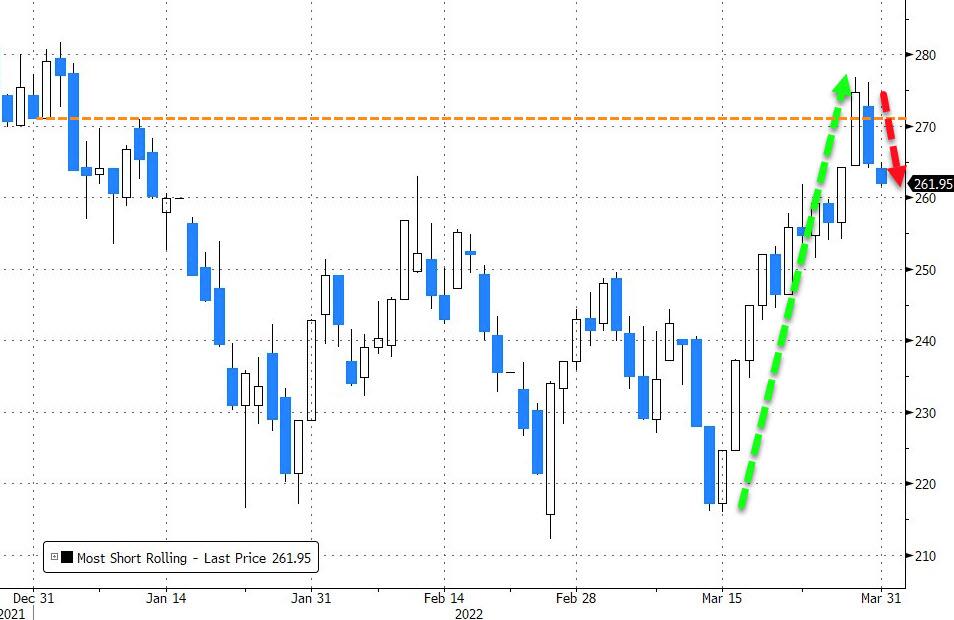
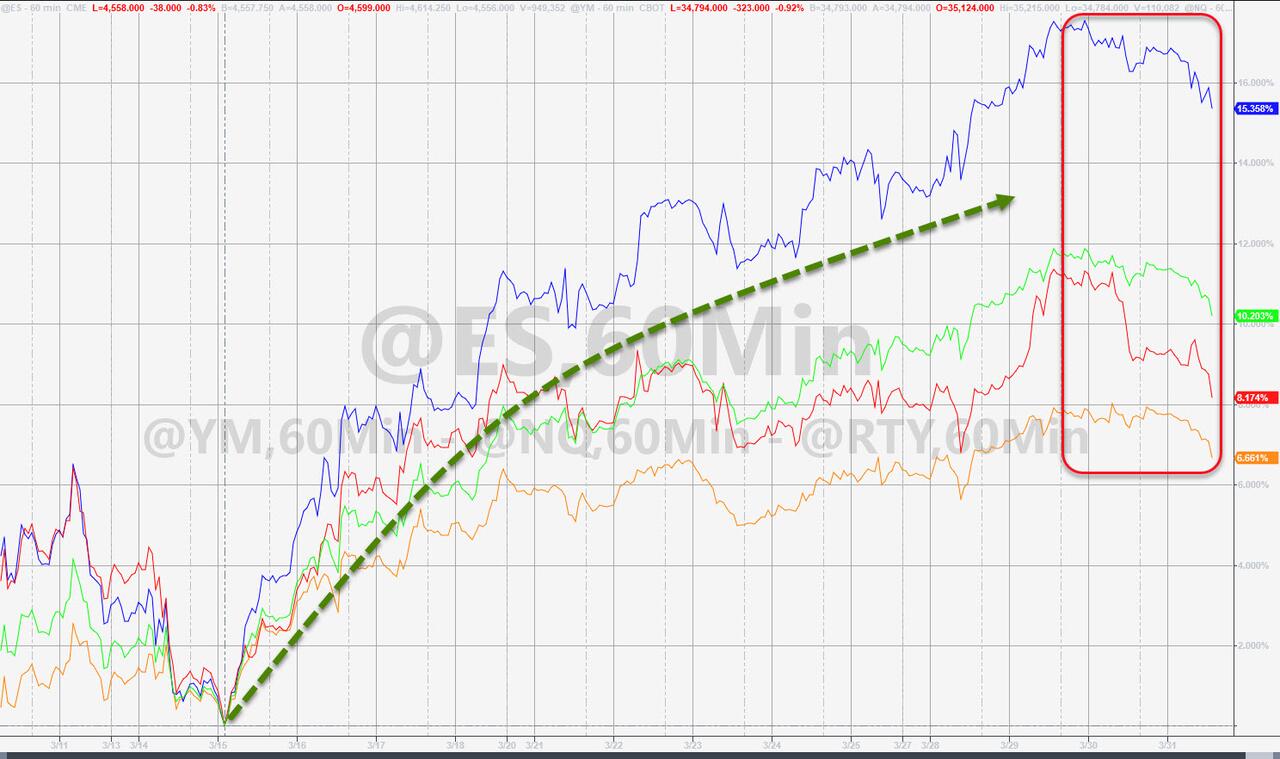
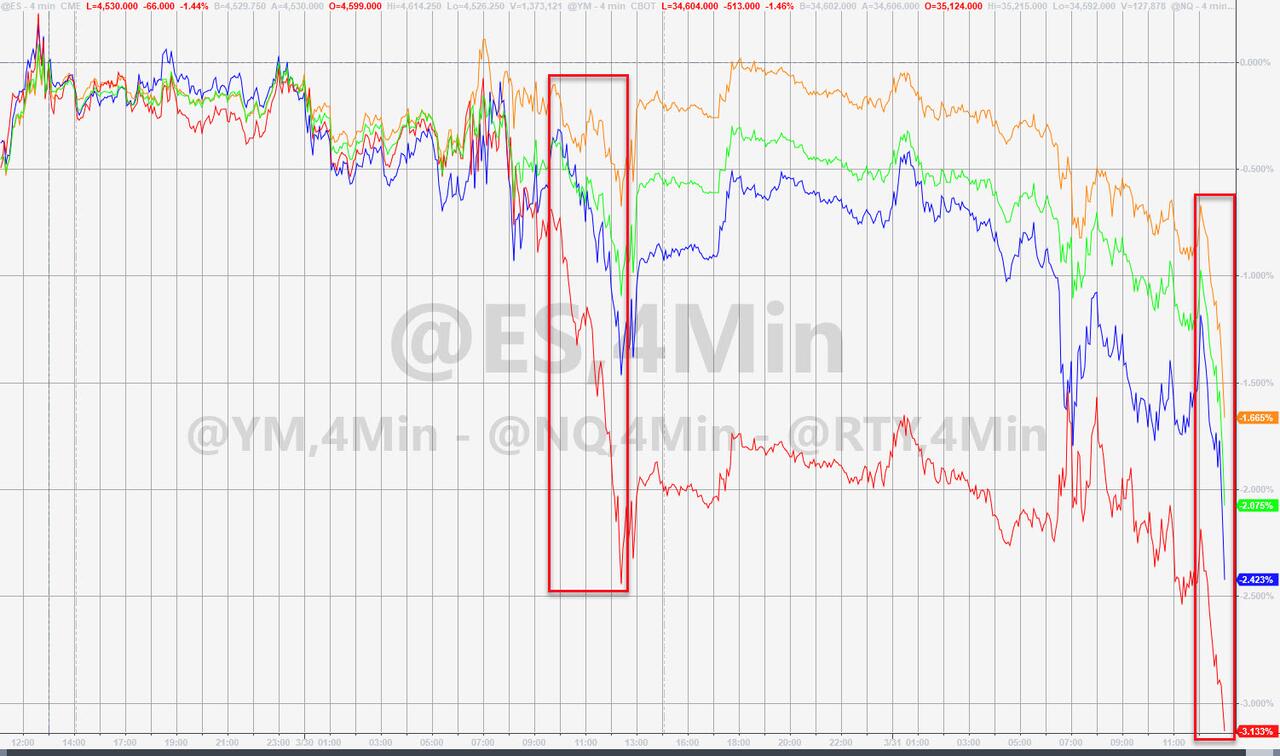
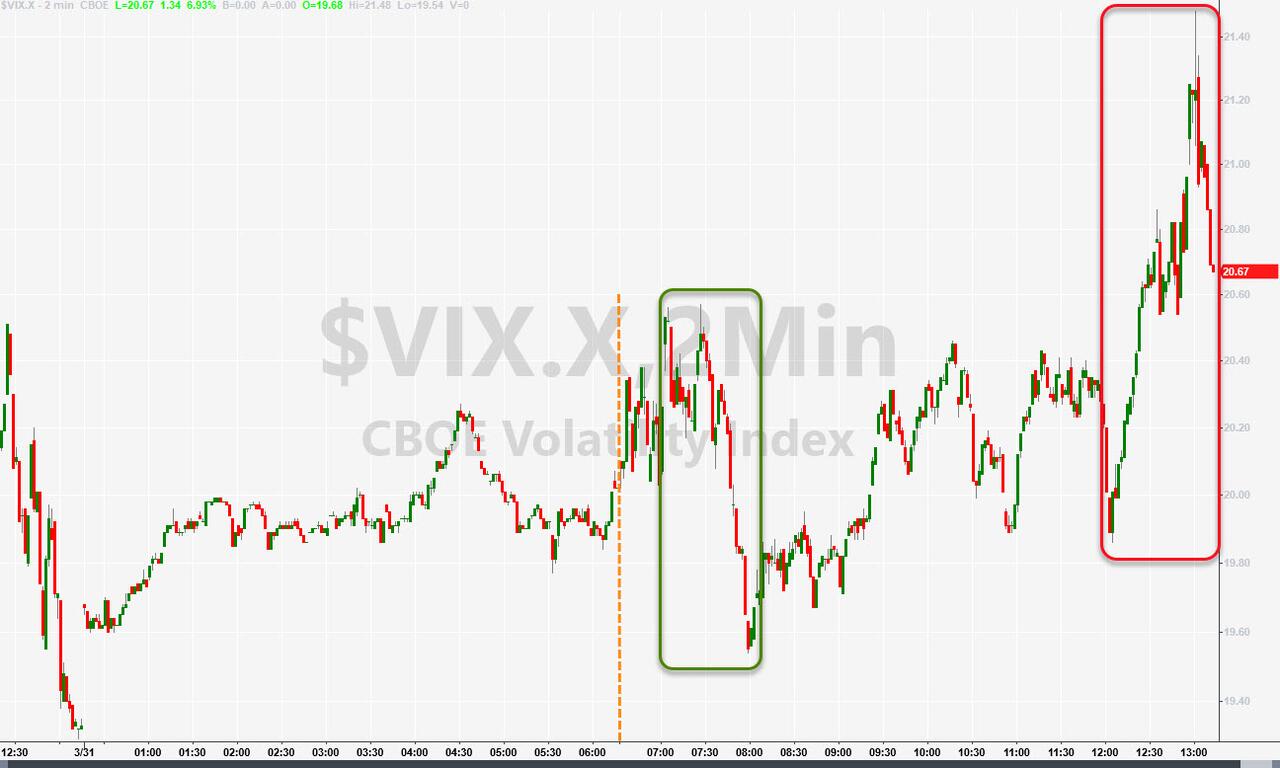

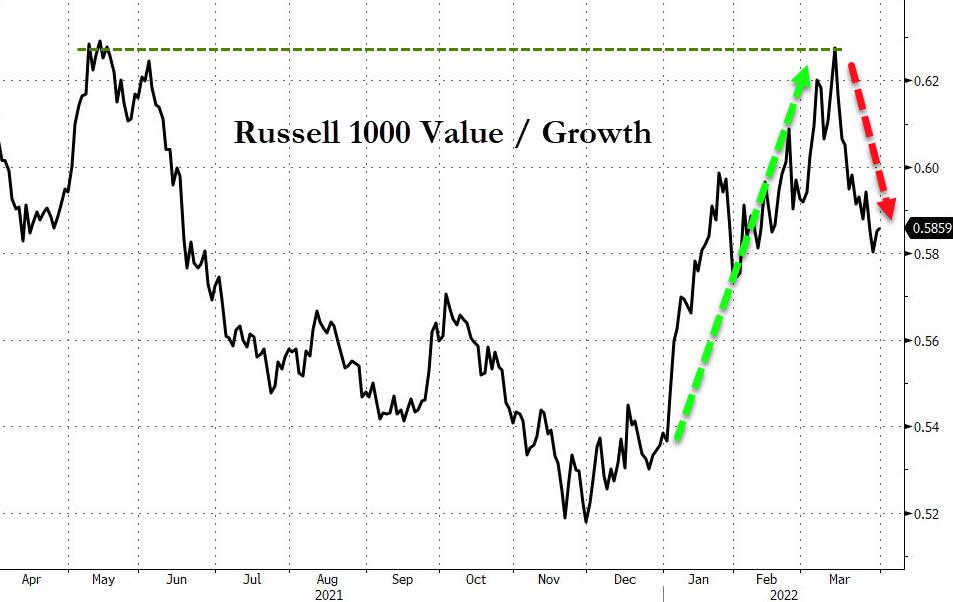
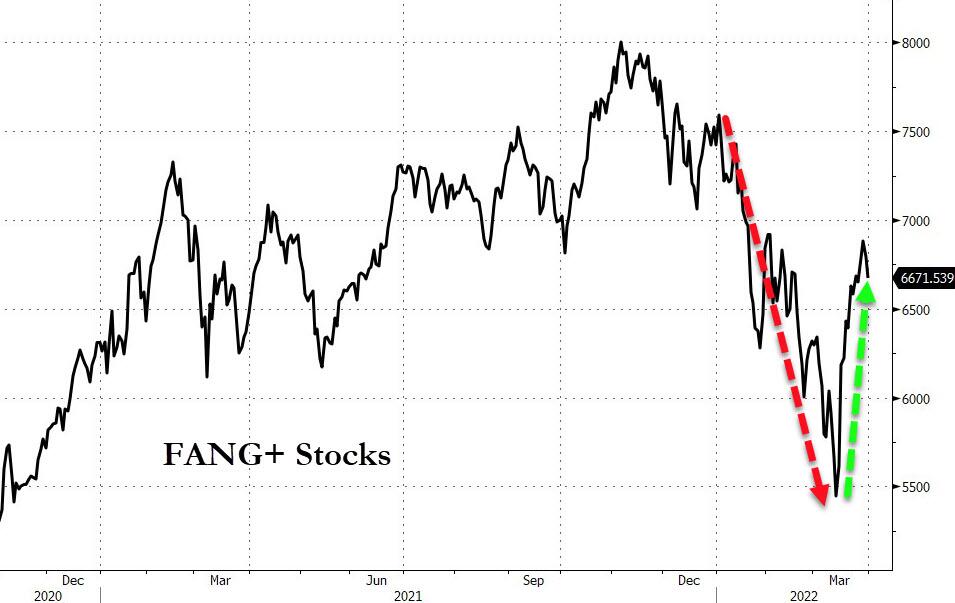
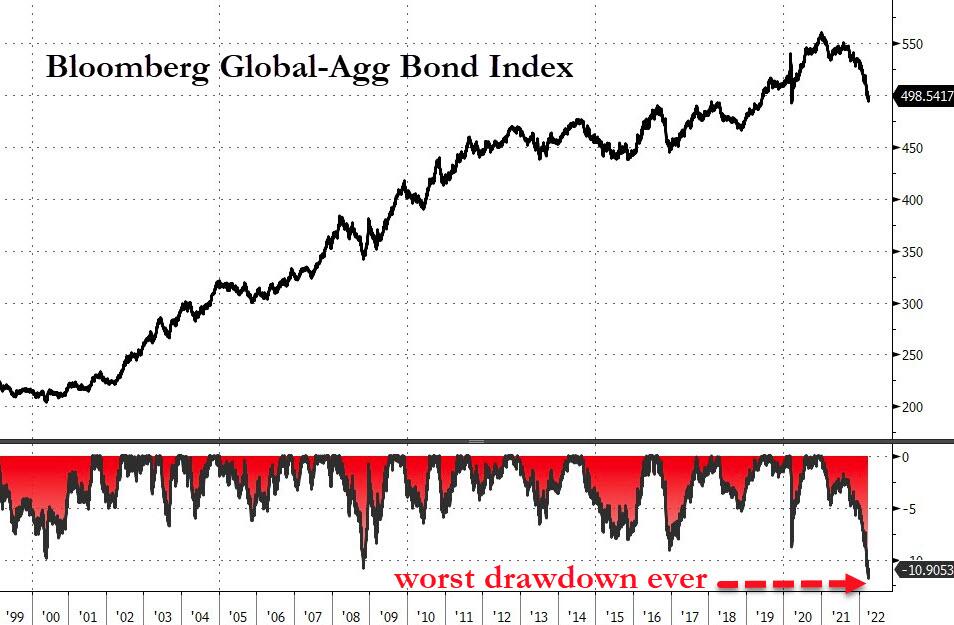
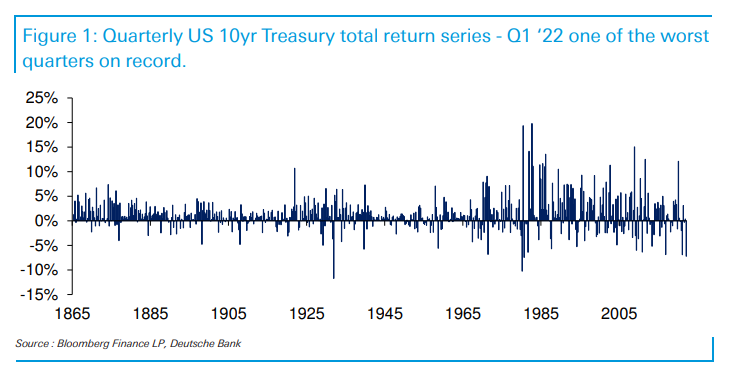
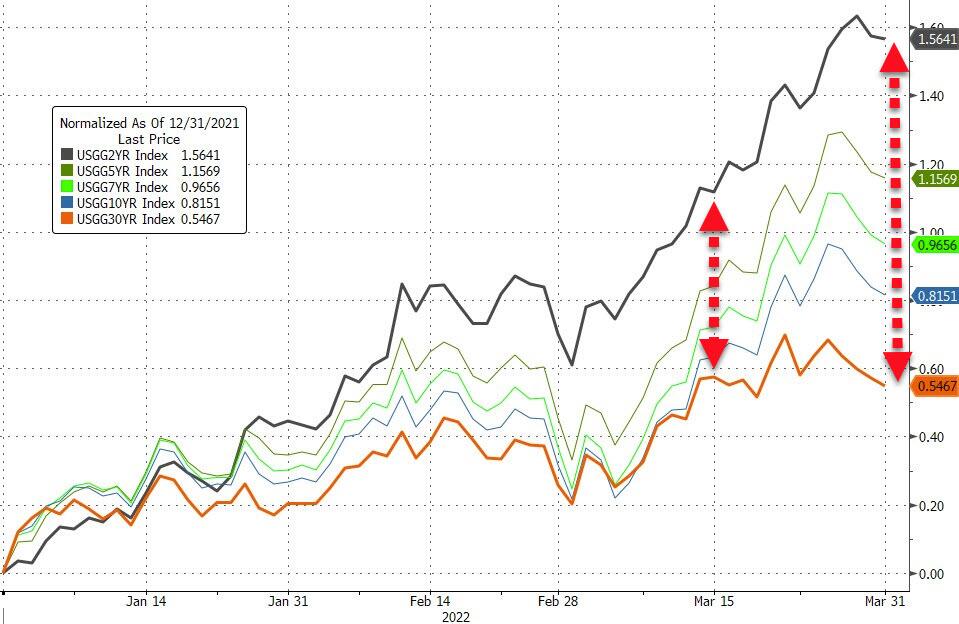
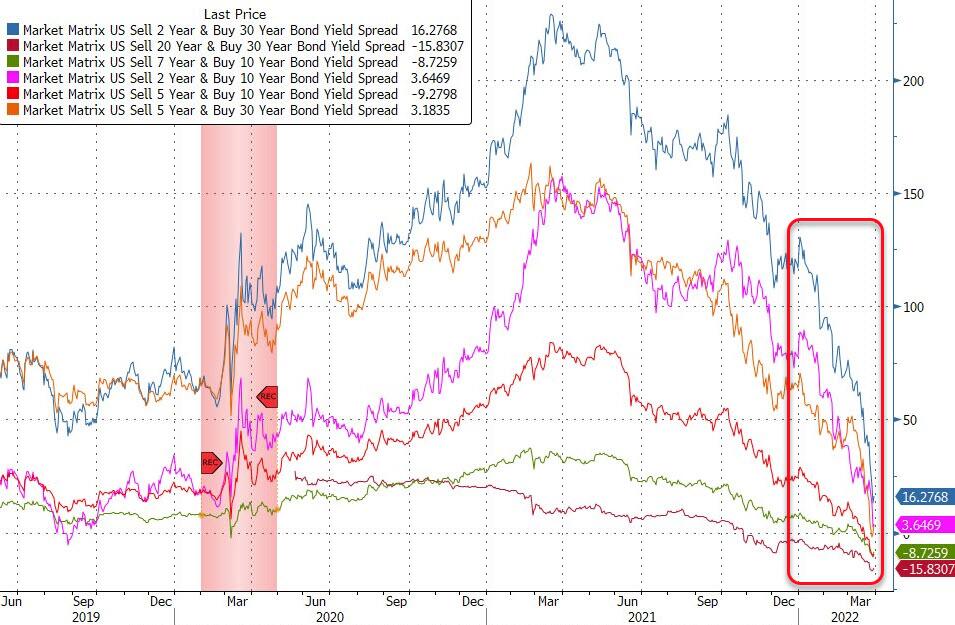
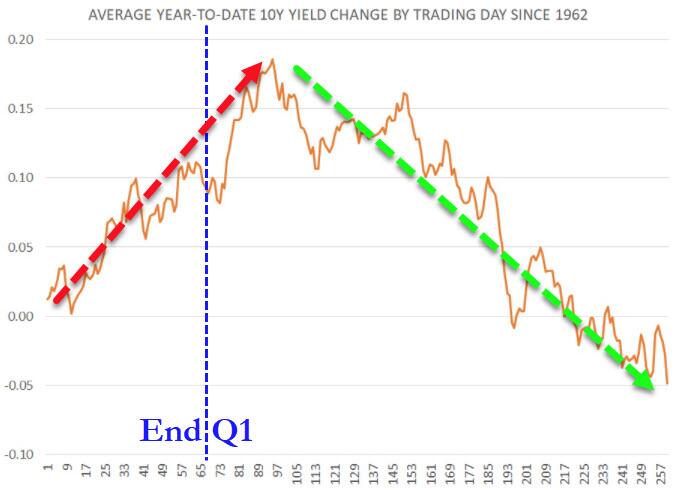
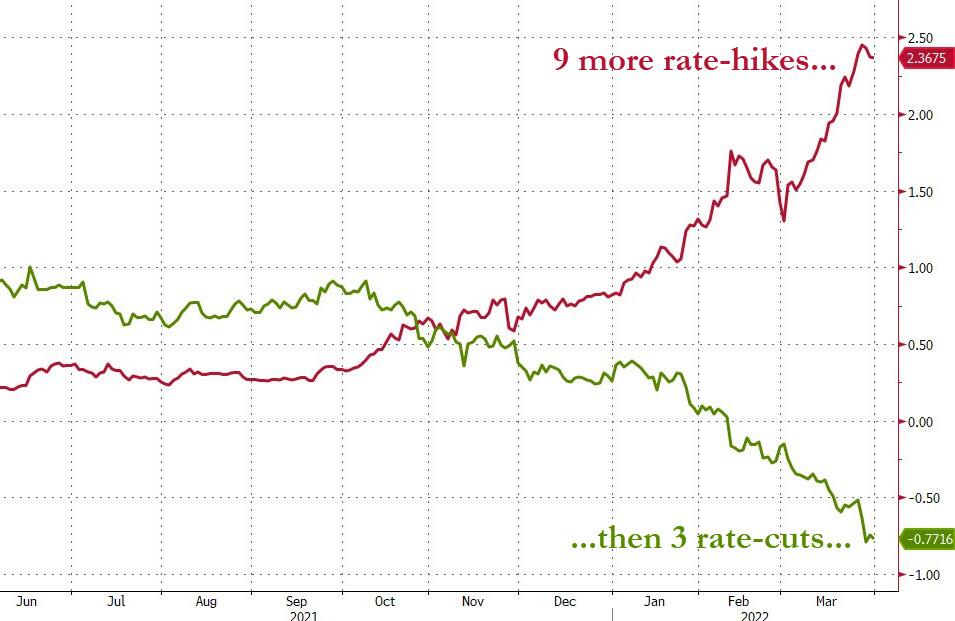

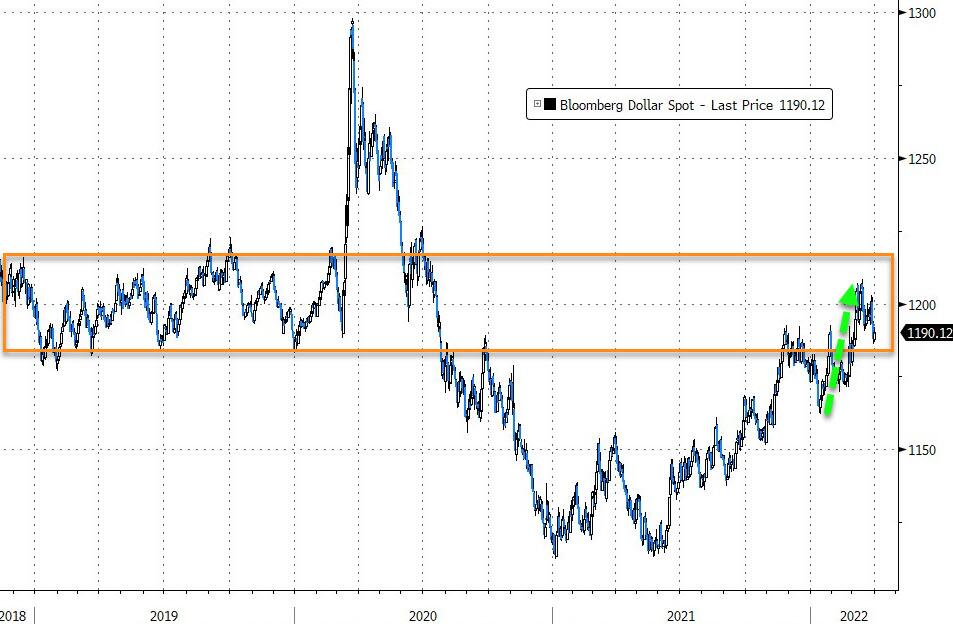
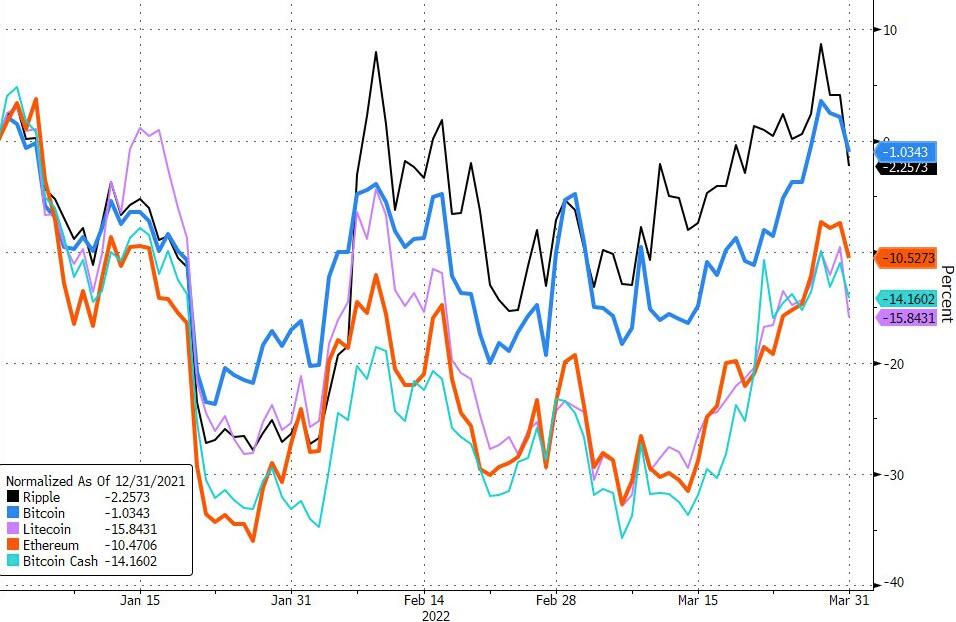

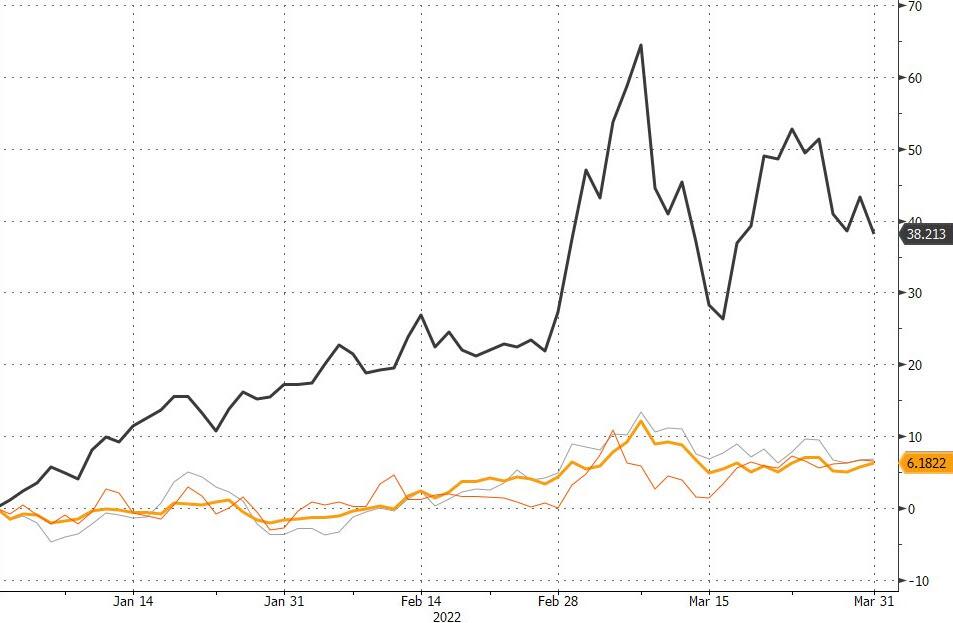

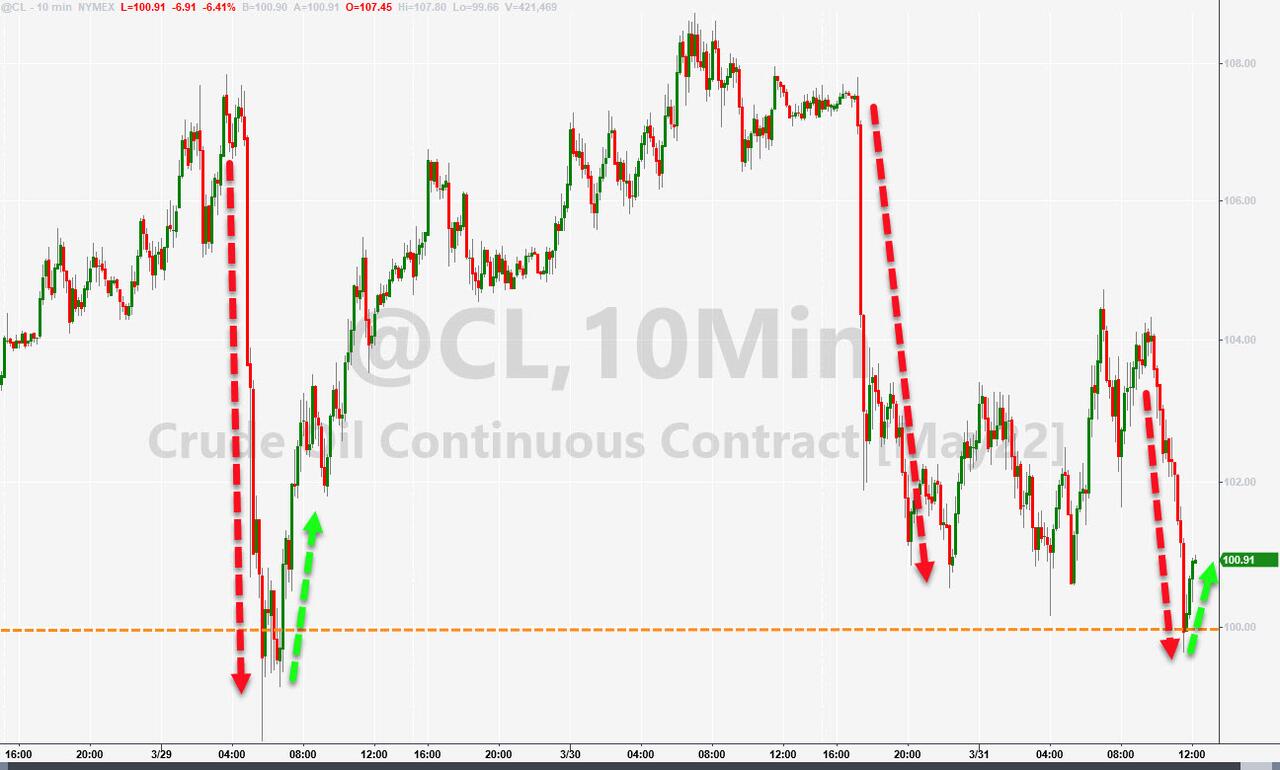
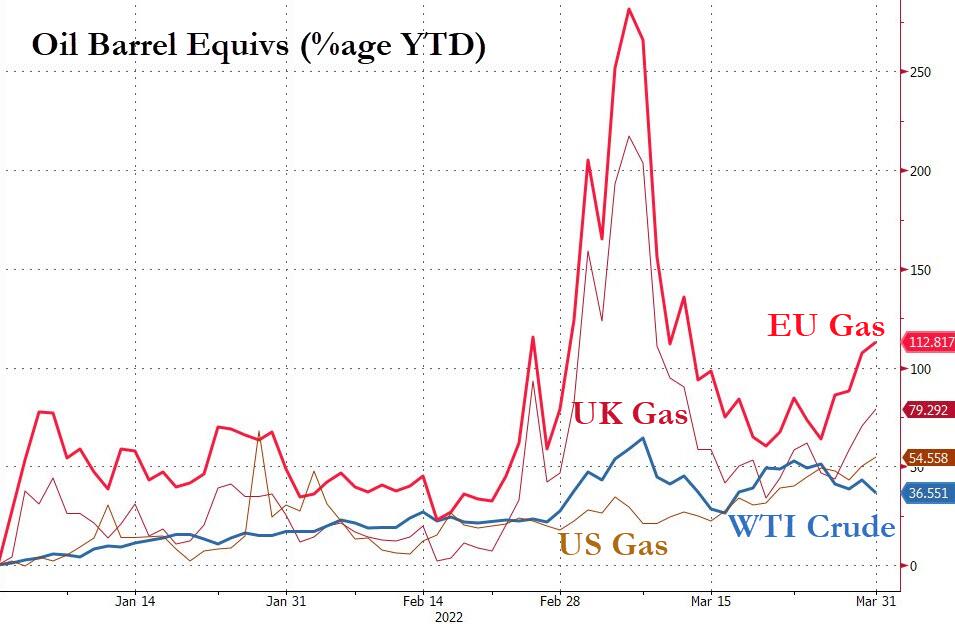
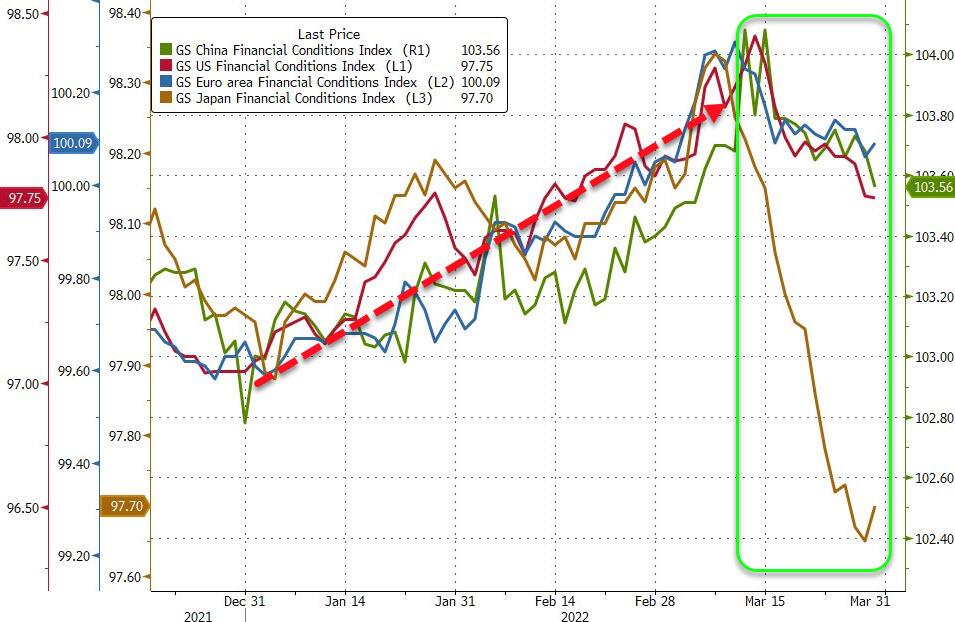
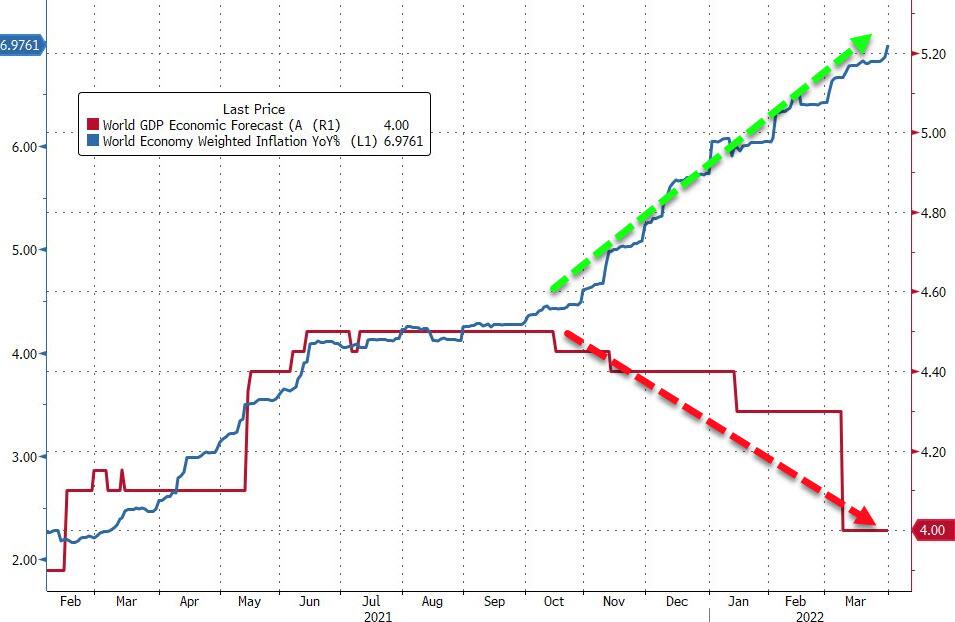
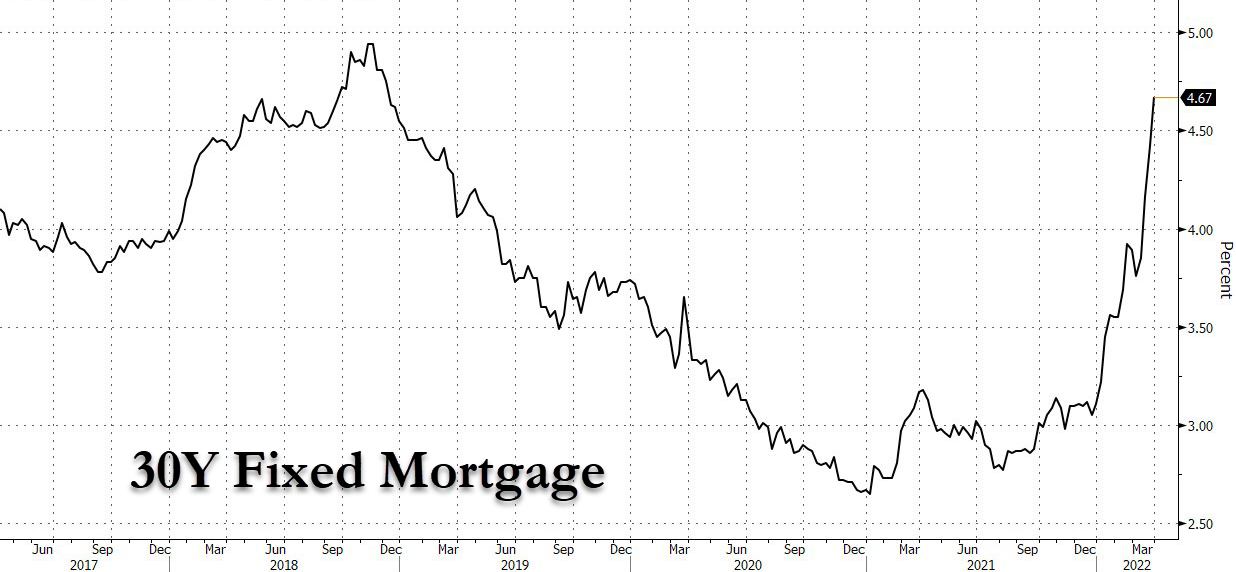
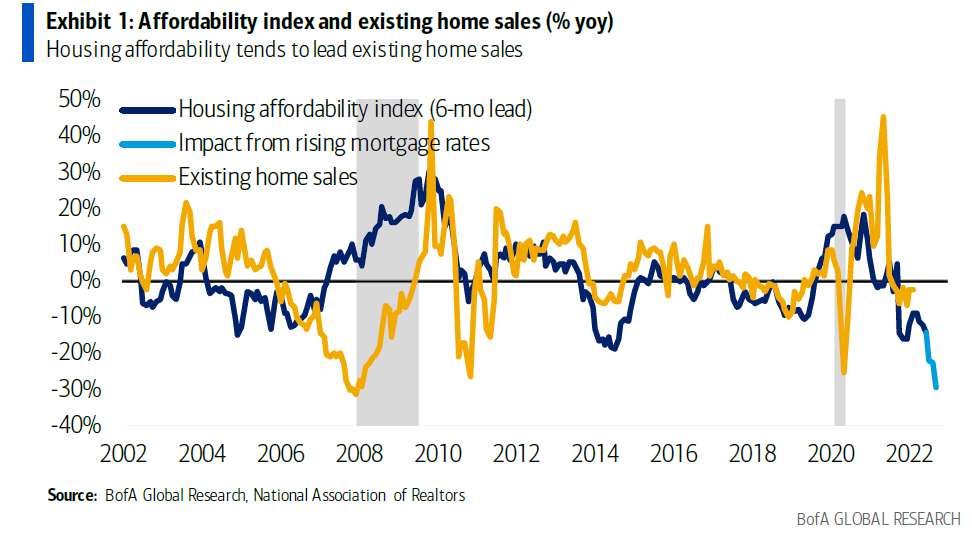
[…] by Harvey Organ, Harvey Organ Blog: […]
LikeLike
[…] by Harvey Organ, Harvey Organ Blog: […]
LikeLike
[…] by Harvey Organ of Harvey Organ Blog […]
LikeLike
[…] by Harvey Organ of Harvey Organ Blog […]
LikeLike
[…] by Harvey Organ of Harvey Organ Blog […]
LikeLike