
April 8, 2022 · by harveyorgan · in Uncategorized · Leave a comment·Edit
april8, 2022 · by harveyorgan · in Uncategorized · Leave a comment·Edit
GOLD; $1941.660 UP $7.70
SILVER: $24.72 UP $0.11
ACCESS MARKET: GOLD $1947.60
SILVER: $24.78
Bitcoin morning price: $43,383 DOWN 298
Bitcoin: afternoon price: $43,120 DOWN 561
Platinum price: closing UP $11.30 to $977.80
Palladium price; closing UP 223.70 at $2421.30
END
DONATE
Click here if you wish to send a donation. I sincerely appreciate it as this site takes a lot of preparation
comex notices/
: JPMorgan stopped/total issued 24/64
EXCHANGE: COMEX
EXCHANGE: COMEX
CONTRACT: APRIL 2022 COMEX 100 GOLD FUTURES
SETTLEMENT: 1,933.800000000 USD
INTENT DATE: 04/07/2022 DELIVERY DATE: 04/11/2022
FIRM ORG FIRM NAME ISSUED STOPPED
072 C GOLDMAN 4
072 H GOLDMAN 5
363 H WELLS FARGO SEC 1
435 H SCOTIA CAPITAL 1
624 H BOFA SECURITIES 6
657 C MORGAN STANLEY 4
661 C JP MORGAN 59 24
709 C BARCLAYS 12
880 H CITIGROUP 12
TOTAL: 64 64
MONTH TO DATE: 23,879
NUMBER OF NOTICES FILED TODAY FOR APRIL. CONTRACT 64 NOTICE(S) FOR 6400 OZ (0.1990 TONNES)
total notices so far: 23,879 contracts for 2,387,900 oz (74.233 tonnes)
SILVER NOTICES:
132 NOTICE(S) FILED TODAY FOR 660,000 OZ/
total number of notices filed so far this month 988 : for 4,940,000 oz
END
Russia is a major supplier of silver to London while Mexico supplies the COMEX
With the sanctions, London has no way to obtain silver other than compete with NY.
END
GLD
WITH GOLD UP $7.70
WITH RESPECT TO GLD WITHDRAWALS: (OVER THE PAST FEW MONTHS):
GOLD IS “RETURNED” TO THE BANK OF ENGLAND WHEN CALLING IN THEIR LEASES: THE GOLD NEVER LEAVES THE BANK OF ENGLAND IN THE FIRST PLACE. THE BANK IS PROTECTING ITSELF IN CASE OF COMMERCIAL FAILURE
ALSO INVESTORS SWITCHING TO SPROTT PHYSICAL (phys) INSTEAD OF THE FRAUDULENT GLD//
A HUGE CHANGE IN GOLD INVENTORY AT THE GLD A DEPOSIT OF 1.45 TONNES FROM THE GLD//
INVENTORY RESTS AT 1088.75 TONNES
Silver//SLV
WITH NO SILVER AROUND AND SILVER UP 11 CENTS
AT THE SLV// A HUGE CHANGE IN SILVER INVENTORY AT THE SLV/ THE SLV//A DEPOSIT OF 1.386 MILLION OZ INTO THE SLV
INVESTORS ARE SWITCHING SLV TO SPROTT’S PSLV
CLOSING INVENTORY: 566.352 MILLION OZ
Let us have a look at the data for today
SILVER//OUTLINE
SILVER COMEX OI ROSE BY A STRONG SIZED 1477 CONTRACTS TO 149,110 AND CLOSER TO THE NEW RECORD OF 244,710, SET FEB 25/2020 AND THE STRONG GAIN IN OI WAS ACCOMPLISHED WITH OUR STRONG $0.27 GAIN IN SILVER PRICING AT THE COMEX ON THURSDAY. OUR BANKERS WERE UNSUCCESSFUL IN KNOCKING THE PRICE OF SILVER DOWN (IT ROSE BY $0.27) AND WERE UNSUCCESSFUL IN KNOCKING OUT ANY SILVER LONGS AS WE HAD A STRONG GAIN OF 1477 CONTRACTS ON OUR TWO EXCHANGES
WE MUST HAVE HAD:
I) HUGE BANKER SHORT COVERING AS THEY ARE VERY ANXIOUS TO GET OUT OF DODGE!!/. II)WE ALSO HAD SOME REDDIT RAPTOR BUYING//. iii) A ZERO ISSUANCE OF EXCHANGE FOR PHYSICALS iiii) A STRONG INITIAL SILVER STANDING FOR COMEX SILVER MEASURING AT 4.305 MILLION OZ FOLLOWED BY TODAY’S QUEUE. JUMP OF 370,000 OZ//NEW STANDING: 5.385 MILLION OZ// V) STRONG SIZED COMEX OI GAIN/
I AM NOW RECORDING THE DIFFERENTIAL IN OI FROM PRELIMINARY TO FINAL:
THE DIFFERENTIAL FROM PRELIMINARY OI TO FINAL OI SILVER TODAY: CONTRACTS : —-519
HISTORICAL ACCUMULATION OF EXCHANGE FOR PHYSICALS APRIL. ACCUMULATION FOR EFP’S SILVER/JPMORGAN’S HOUSE OF BRIBES/STARTING FROM FIRST DAY/MONTH OF APRIL:
TOTAL CONTACTS for 6 days, total 2771 contracts: 13.855 million oz OR 2.30MILLION OZ PER DAY. (461 CONTRACTS PER DAY)
TOTAL NO OF OZ UNDERGOING EFP TO LONDON 2771 CONTRACTS X 5,000 PER CONTRACT:
EQUATES TO: 13.855 MILLION OZ
.
LAST 11 MONTHS TOTAL EFP CONTRACTS ISSUED IN MILLIONS OF OZ:
MAY 137.83 MILLION
JUNE 149.91 MILLION OZ
JULY 129.445 MILLION OZ
AUGUST: MILLION OZ 140.120
SEPT. 28.230 MILLION OZ//
OCT: 94.595 MILLION OZ
NOV: 131.925 MILLION OZ
DEC: 100.615 MILLION OZ
JAN 2022// 90.460 MILLION OZ
FEB 2022: 72.39 MILLION OZ//
MARCH: 207.430 MILLION OZ//A NEW RECORD FOR EFP ISSUANCE AND WE ARE STILL GOING STRONG THIS MONTH.
APRIL: 13.855 MILLION OZ
RESULT: WE HAD A STRONG SIZED INCREASE IN COMEX OI SILVER COMEX CONTRACTS OF 1477 WITH OUR $0.27 GAIN IN SILVER PRICING AT THE COMEX// THURSDAY THE CME NOTIFIED US THAT WE HAD A ZERO SIZED EFP ISSUANCE CONTRACTS( 0 CONTRACTS ISSUED FOR MAY AND 0 CONTRACTS ISSUED FOR ALL OTHER MONTHS) WHICH EXITED OUT OF THE SILVER COMEX TO LONDON AS FORWARDS THE DOMINANT FEATURE TODAY: /HUGE BANKER SHORT COVERING AS THEY GET OUT OF DODGE//// WE HAVE A HUGE INITIAL SILVER OZ STANDING FOR MAR. OF 4.305 MILLION OZ FOLLOWED BY TODAY’S 370,000 OZ QUEUE JUMP//NEW STANDING: 5.385 MILLION OZ/// .. WE HAD AN STRONG SIZED GAIN 1996 OI CONTRACTS ON THE TWO EXCHANGES FOR 9.80 MILLION OZ DESPITE THE LOSS IN PRICE.
WE HAD 132 NOTICES FILED TODAY FOR 660,000 OZ
THE SILVER COMEX IS NOW BEING ATTACKED FOR METAL BY LONDONERS ET AL.
GOLD//OUTLINE
IN GOLD, THE COMEX OPEN INTEREST ROSE BY A SMALL SIZED 1414 CONTRACTS TO 563,771 AND CLOSER TO NEW RECORD (SET JAN 24/2020) AT 799,541 AND PREVIOUS TO THAT: (SET JAN 6/2020) AT 797,110.
THE DIFFERENTIAL FROM PRELIMINARY OI TO FINAL OI IN GOLD TODAY: 511 CONTRACTS.
THE BIS HAS ABANDONED THE GOLD COMEX TRADING!!!
.
THE SMALL SIZED INCREASE IN COMEX OI CAME DESPITE OUR STRONG GAIN IN PRICE OF $13.40//COMEX GOLD TRADING/THURSDAY /.AS IN SILVER WE MUST HAD HUGE BANKER/ALGO SHORT COVERING ACCOMPANYING OUR SMALL SIZED EXCHANGE FOR PHYSICAL ISSUANCE. WE HAD SOME LONG LIQUIDATION
WE ALSO HAD A HUGE INITIAL STANDING IN GOLD TONNAGE FOR APRIL AT 78.33 TONNES
YET ALL OF..THIS HAPPENED WITH OUR GAIN IN PRICE OF $13.40 WITH RESPECT TO TUESDAY’S TRADING
WE HAD AN FAIR SIZED GAIN OF 3234 OI CONTRACTS (10.05 PAPER TONNES) ON OUR TWO EXCHANGES
E.F.P. ISSUANCE
THE CME RELEASED THE DATA FOR EFP ISSUANCE AND IT TOTALED A SMALL SIZED 1820 CONTRACTS:
The NEW COMEX OI FOR THE GOLD COMPLEX RESTS AT 564,282.
IN ESSENCE WE HAVE AN GOOD SIZED INCREASE IN TOTAL CONTRACTS ON THE TWO EXCHANGES OF 3234, WITH 1414 CONTRACTS INCREASED AT THE COMEX AND 1820 EFP OI CONTRACTS WHICH NAVIGATED OVER TO LONDON. THUS TOTAL OI GAIN ON THE TWO EXCHANGES OF 3234 CONTRACTS OR 10.05 TONNES.
CALCULATIONS ON GAIN/LOSS ON OUR TWO EXCHANGES
WE HAD A SMALL SIZED ISSUANCE IN EXCHANGE FOR PHYSICALS (1820) ACCOMPANYING THE SMALL SIZED GAIN IN COMEX OI (1414,): TOTAL GAIN IN THE TWO EXCHANGES 3234 CONTRACTS. WE NO DOUBT HAD 1) HUGE BANKER SHORT COVERING ,2.) HUGE INITIAL STANDING AT THE GOLD COMEX FOR APRIL. AT 78.33 TONNES FOLLOWED BY TODAY’S 19,800 OZ QUEUE JUMP //NEW STANDING 80.500 TONNES/// 3) ZERO LONG LIQUIDATION ///. ,4) SMALL SIZED COMEX OI. GAIN 5) SMALL ISSUANCE OF EXCHANGE FOR PHYSICAL/
HISTORICAL ACCUMULATION OF EXCHANGE FOR PHYSICALS IN 2022 INCLUDING TODAY
APRIL
ACCUMULATION OF EFP’S GOLD AT J.P. MORGAN’S HOUSE OF BRIBES: (EXCHANGE FOR PHYSICAL) FOR THE MONTH OF APRIL :
15,312 CONTRACTS OR 1,531,200 OR 47.62 TONNES 6 TRADING DAY(S) AND THUS AVERAGING: 2552 EFP CONTRACTS PER TRADING DAY
TO GIVE YOU AN IDEA AS TO THE SIZE OF THESE EFP TRANSFERS : THIS MONTH IN 6 TRADING DAY(S) IN TONNES: 47.62TONNES
TOTAL ANNUAL GOLD PRODUCTION, 2020, THROUGHOUT THE WORLD EX CHINA EX RUSSIA: 3555 TONNES
THUS EFP TRANSFERS REPRESENTS 47.62/3550 x 100% TONNES 1.35% OF GLOBAL ANNUAL PRODUCTION
ACCUMULATION OF GOLD EFP’S YEAR 2021 TO 2022
JANUARY/2021: 265.26 TONNES (RAPIDLY INCREASING AGAIN)
FEB : 171.24 TONNES ( DEFINITELY SLOWING DOWN AGAIN)..
MARCH:. 276.50 TONNES (STRONG AGAIN/
APRIL: 189..44 TONNES ( DRAMATICALLY SLOWING DOWN AGAIN//GOLD IN BACKWARDATION)
MAY: 250.15 TONNES (NOW DRAMATICALLY INCREASING AGAIN)
JUNE: 247.54 TONNES (FINAL)
JULY: 188.73 TONNES FINAL
AUGUST: 217.89 TONNES FINAL ISSUANCE.
SEPT 142.12 TONNES FINAL ISSUANCE ( LOW ISSUANCE)_
OCT: 141.13 TONNES FINAL ISSUANCE (LOW ISSUANCE)
NOV: 312.46 TONNES FINAL ISSUANCE//NEW RECORD!! (INCREASING DRAMATICALLY)//SIGN OF REAL STRESS//SURPASSING THE MARCH 2021 RECORD OF 276.50 TONNES OF EFP
DEC. 175.62 TONNES//FINAL ISSUANCE//
JAN:2022 247.25 TONNES //FINAL
FEB: 196.04 TONNES//FINAL
MARCH: 409.30 TONNES INITIAL( THIS IS NOW A RECORD EFP ISSUANCE FOR MARCH AND FOR ANY MONTH.
APRIL: 47.62 TONNES
SPREADING OPERATIONS
(/NOW SWITCHING TO GOLD) FOR NEWCOMERS, HERE ARE THE DETAILS
SPREADING LIQUIDATION HAS NOW COMMENCED AS WE HEAD TOWARDS THE NEW ACTIVE FRONT MONTH OF MAY.WE ARE NOW INTO THE SPREADING OPERATION OF SILVER
HERE IS A BRIEF SYNOPSIS OF HOW THE CROOKS FLEECE UNSUSPECTING LONGS IN THE SPREADING ENDEAVOUR ;MODUS OPERANDI OF THE CORRUPT BANKERS AS TO HOW THEY HANDLE THEIR SPREAD OPEN INTERESTS:HERE IS HOW THE CROOKS USED SPREADING AS WE ARE NOW INTO THE NON ACTIVE DELIVERY MONTH OF APRIL HEADING TOWARDS THE ACTIVE DELIVERY MONTH OF MAY, FOR SILVER:
YOU WILL ALSO NOTICE THAT THE COMEX OPEN INTEREST STARTS TO RISE BUT SO IS THE OPEN INTEREST OF SPREADERS. THE OPEN INTEREST IN WILL CONTINUE TO RISE UNTIL ONE WEEK BEFORE FIRST DAY NOTICE OF AN UPCOMING ACTIVE DELIVERY MONTH (MAR), AND THAT IS WHEN THE CROOKS SELL THEIR SPREAD POSITIONS BUT NOT AT THE SAME TIME OF THE DAY. THEY WILL USE THE SELL SIDE OF THE EQUATION TO CREATE THE CASCADE (ALONG WITH THEIR COLLUSIVE FRIENDS) AND THEN COVER ON THE BUY SIDE OF THE SPREAD SITUATION AT THE END OF THE DAY. THEY DO THIS TO AVOID POSITION LIMIT DETECTION. THE LIQUIDATION OF THE SPREADING FORMATION CONTINUES FOR EXACTLY ONE WEEK AND ENDS ON FIRST DAY NOTICE.”
WHAT IS ALARMING TO ME, ACCORDING TO OUR LONDON EXPERT ANDREW MAGUIRE IS THAT THESE EFP’S ARE BEING TRANSFERRED TO WHAT ARE CALLED SERIAL FORWARD CONTRACT OBLIGATIONS AND THESE CONTRACTS ARE LESS THAN 14 DAYS. ANYTHING GREATER THAN 14 DAYS, THESE MUST BE RECORDED AND SENT TO THE COMPTROLLER, GREAT BRITAIN TO MONITOR RISK TO THE BANKING SYSTEM. IF THIS IS INDEED TRUE, THEN THIS IS A MASSIVE CONSPIRACY TO DEFRAUD AS WE NOW WITNESS A MONSTROUS TOTAL EFP’S ISSUANCE AS IT HEADS INTO THE STRATOSPHERE.
First, here is an outline of what will be discussed tonight:
1.Today, we had the open interest at the comex, in SILVER, ROSE BY A STRONG SIZED 1477 CONTRACTS TO 149,110 AND CLOSER TO OUR COMEX RECORD //244,710(SET FEB 25/2020). THE LAST RECORDS WERE SET IN AUG.2018 AT 244,196 WITH A SILVER PRICE OF $14.78/(AUGUST 22/2018)..THE PREVIOUS RECORD TO THAT WAS SET ON APRIL 9/2018 AT 243,411 OPEN INTEREST CONTRACTS WITH THE SILVER PRICE AT THAT DAY: $16.53). AND PREVIOUS TO THAT, THE RECORD WAS ESTABLISHED AT: 234,787 CONTRACTS, SET ON APRIL 21.2017 OVER 4 1/2 YEARS AGO.
EFP ISSUANCE 0 CONTRACTS
OUR CUSTOMARY MIGRATION OF COMEX LONGS CONTINUE TO MORPH INTO LONDON FORWARDS AS OUR BANKERS USED THEIR EMERGENCY PROCEDURE TO ISSUE:
MAY 0 ALL OTHER MONTHS: ZERO. TOTAL EFP ISSUANCE: 0 CONTRACTS. EFP’S GIVE OUR COMEX LONGS A FIAT BONUS PLUS A DELIVERABLE PRODUCT OVER IN LONDON. IF WE TAKE THE COMEX OI GAIN OF 1477 CONTRACTS AND ADD TO THE 0 OI TRANSFERRED TO LONDON THROUGH EFP’S,
WE OBTAIN A STRONG SIZED GAIN OF 1,477 OPEN INTEREST CONTRACTS FROM OUR TWO EXCHANGES.
THUS IN OUNCES, THE GAIN ON THE TWO EXCHANGES 7.355 MILLION OZ,
OCCURRED WITH OUR STRONG LOSS $0.09 IN PRICE.
OUTLINE FOR TODAY’S COMMENTARY
1/COMEX GOLD AND SILVER REPORT
(report Harvey)
2 ) Gold/silver trading overnight Europe,
(Peter Schiff,
3. Egon von Greyerz///Matthew Piepenburg via GoldSwitzerland.com,
4. Chris Powell of GATA provides to us very important physical commentaries
5. Other gold commentaries
6. Commodity commentaries/cryptocurrencies
3. ASIAN AFFAIRS
i)FRIDAY MORNING// THURSDAY NIGHT
SHANGHAI CLOSED UP 15.15 PTS OR 0.47% //Hang Sang CLOSED UP 63.03 PTS OR 0.29% /The Nikkei closed UP 97.23 PTS OR 0.36% //Australia’s all ordinaires CLOSED UP 0.48% /Chinese yuan (ONSHORE) closed DOWN 6.3637 /Oil DOWN TO 96.44 dollars per barrel for WTI and DOWN TO 100.58 for Brent. Stocks in Europe OPENED ALL GREEN EXCEPT // ONSHORE YUAN CLOSED DOWN AGAINST THE DOLLAR AT 6.3637 OFFSHORE YUAN CLOSED DOWN ON THE DOLLAR AT 6.3682: /ONSHORE YUAN TRADING ABOVE LEVEL OF OFFSHORE YUAN/ONSHORE YUAN TRADING WEAKER AGAINST US DOLLAR/OFFSHORE WEAKER
A)NORTH KOREA/
b) REPORT ON JAPAN
OUTLINE
3 C CHINA
OUTLINE
4/EUROPEAN AFFAIRS
OUTLINE
5. RUSSIAN AND MIDDLE EASTERN AFFAIRS
OUTLINE
6.Global Issues
OUTLINE
7. OIL ISSUES
OUTLINE
8 EMERGING MARKET ISSUES
COMEX DATA//AMOUNTS STANDING//VOLUME OF TRADING/INVENTORY MOVEMENTS
GOLD
LET US BEGIN:
THE TOTAL COMEX GOLD OPEN INTEREST ROSE BY A SMALL SIZED 1414 CONTRACTS TO 563,771 AND CLOSER TO THE RECORD THAT WAS SET IN JANUARY/2020: {799,541 OI(SET JAN 16/2020)} AND PREVIOUS TO THAT: 797,110 (SET JAN 7/2020). AND THIS SMALL COMEX INCREASE OCCURRED DESPITE OUR STRONG GAIN OF $13.40 IN GOLD PRICING THURSDAY’S COMEX TRADING. WE ALSO HAD A SMALL SIZED EFP (1820 CONTRACTS). . THEY WERE PAID HANDSOMELY NOT TO TAKE DELIVERY AT THE COMEX AND SETTLE FOR CASH.
WE NORMALLY HAVE WITNESSED EXCHANGE FOR PHYSICALS ISSUED BEING SMALL AS IT JUST TOO COSTLY FOR THEM TO CONTINUE SERVICING THE COSTS OF SERIAL FORWARDS CIRCULATING IN LONDON. HOWEVER, MUCH TO THE ANNOYANCE OF OUR BANKERS, THE COMEX IS THE SCENE OF AN ASSAULT ON GOLD AS LONDONERS, NOT BEING ABLE TO FIND ANY PHYSICAL ON THAT SIDE OF THE POND, EXERCISE THESE CIRCULATING EXCHANGE FOR PHYSICALS IN LONDON AND FORCING DELIVERY OF REAL METAL OVER HERE AS THE OBLIGATION STILL RESTS WITH NEW YORK BANKERS. IT SEEMS THAT ARE BANKERS FRIENDS ARE EXERCISING EFP’S FROM LONDON AND NOW THEY ARE LOATHE TO ISSUE NEW ONES.
EXCHANGE FOR PHYSICAL ISSUANCE
WE ARE NOW MOVING TO THE ACTIVE DELIVERY MONTH OF APRIL.. THE CME REPORTS THAT THE BANKERS ISSUED A SMALL SIZED TRANSFER THROUGH THE EFP ROUTE AS THESE LONGS RECEIVED A DELIVERABLE LONDON FORWARD TOGETHER WITH A FIAT BONUS.,
THAT IS 1820 EFP CONTRACTS WERE ISSUED: ;: , . 0 JUNE :1820 & ZERO FOR ALL OTHER MONTHS:
TOTAL EFP ISSUANCE: 1109 CONTRACTS
WHEN WE HAVE BACKWARDATION, EFP ISSUANCE IS VERY COSTLY BUT THE REAL PROBLEM IS THE SCARCITY OF METAL AND IT IS FAR BETTER FOR OUR BANKERS TO PAY OFF INDIVIDUALS THAN RISK INVESTORS ESPECIALLY FROM LONDON STANDING FOR DELIVERY. THE LOWER PRICES IN THE FUTURES MARKET IS A MAGNET FOR OUR LONDONERS SEEKING PHYSICAL METAL. BACKWARDATION ALWAYS EQUAL SCARCITY OF METAL!
ON A NET BASIS IN OPEN INTEREST WE GAINED THE FOLLOWING TODAY ON OUR TWO EXCHANGES: A GOOD SIZED TOTAL OF 3234 CONTRACTS IN THAT 1820 LONGS WERE TRANSFERRED AS FORWARDS TO LONDON AND WE HAD A SMALL SIZED COMEX OI GAIN OF 1925 CONTRACTS..AND THIS GAIN OCCURRED WITH OUR GAIN IN PRICE OF GOLD $13.40.
// WE HAVE A STRONG AMOUNT OF GOLD TONNAGE STANDING FOR APRIL (80.500),
HERE ARE THE AMOUNTS THAT STOOD FOR DELIVERY IN THE PRECEDING 12 MONTHS OF 2021:
DEC 2021: 112.217 TONNES
NOV. 8.074 TONNES
OCT. 57.707 TONNES
SEPT: 11.9160 TONNES
AUGUST: 80.489 TONNES
JULY: 7.2814 TONNES
JUNE: 72.289 TONNES
MAY 5.77 TONNES
APRIL 95.331 TONNES
MARCH 30.205 TONNES
FEB ’21. 113.424 TONNES
JAN ’21: 6.500 TONNES.
TOTAL SO FAR THIS YEAR (JAN- DEC): 601.213 TONNES
YEAR 2022:
JANUARY 2022 17.79 TONNES
FEB 2022: 59.023 TONNES
MARCH: 36.678 TONNES
APRIL: 80.012
THE BANKERS WERE SUCCESSFUL IN LOWERING GOLD’S PRICE //// (IT FELL $4.10) AND BUT WERE UNSUCCESSFUL IN FLEECING ANY LONGS AS WE HAVE REGISTERED A GOOD SIZED GAIN OF 8.709 TONNES ON TOTAL OI FROM OUR TWO EXCHANGES, ACCOMPANYING OUR HUGE GOLD TONNAGE STANDING FOR APRIL (80.500 TONNES)…
WE HAD — 511 CONTRACTS REMOVED FROM COMEX TRADES. THESE WERE REMOVED AFTER TRADING ENDED LAST NIGHT
NET GAIN ON THE TWO EXCHANGES 3234 CONTRACTS OR 323,400 OZ OR 10/05 TONNES
Estimated gold volume today: 144,205 ///poor
Confirmed volume yesterday: 135,121 contracts poor
INITIAL STANDINGS FOR APRIL ’22 COMEX GOLD //APRIL 8
| Gold | Ounces |
| Withdrawals from Dealers Inventory in oz | nil oz |
| Withdrawals from Customer Inventory in oz | 6430.209 oz Brinks 200 kilobars 8037.75 oz Int. Delaware 250 kilobars Manfra 482.265 oz15 kilobars total: 14,950.224 oz |
| Deposit to the Dealer Inventory in oz | 5690.27Oz Manfra 177 kilobars |
| Deposits to the Customer Inventory, in oz | nil |
| No of oz served (contracts) today | 64 notice(s)6400 OZ 0.1991 TONNES |
| No of oz to be served (notices) | 2002 contracts 200,200 oz 6.227 TONNES |
| Total monthly oz gold served (contracts) so far this month | 23,879 notices 2,387,900 OZ 74.233 TONNES |
| Total accumulative withdrawals of gold from the Dealers inventory this month | NIL oz |
| Total accumulative withdrawal of gold from the Customer inventory this month | xxx oz |
For today:
dealer deposits 1
i)Into Manfra: 5690.27 oz 177 kilobars
total dealer deposit 5690.27 oz//
No dealer withdrawals
0 customer deposits.
/
3 customer withdrawals
i) out of Brinks 6430.209 oz 200 kilobars
ii) out of Int. Delaware 8037.75oz (250 kilobars)
iii) Out of Manfra: 482.265 oz 15 kilobars
total customer withdrawal: 14,950.224 oz /
ADJUSTMENTS: customer to dealer
ii) Brinks 25,648.004 oz
dealer to customer:
i) Manfra: 192.900 oz (6 kilobars)
CALCULATIONS FOR THE AMOUNT OF GOLD STANDING FOR APRIL.
For the front month of APRIL we have an oi of 2066 contracts having LOST 1822.
We had 2020 notices filed yesterday so we GAINED 198 contracts or 19800 oz will stand for delivery at the comex
May saw a LOSS of 470 contracts to stand at 4,078
June saw a GAIN of 1924 contracts UP to 472,924 contracts
We had 2020 notice(s) filed today for 202,000 oz FOR THE APRIL 2022 CONTRACT MONTH.
Today, 0 notice(s) were issued from J.P.Morgan dealer account and 59 notices were issued from their client or customer account. The total of all issuance by all participants equates to 64 contract(s) of which 0 notices were stopped (received) by j.P. Morgan dealer and 59 notice(s) was (were) stopped/ Received) by J.P.Morgan//customer account and 4 notice(s) received (stopped) by the squid (Goldman Sachs)
To calculate the INITIAL total number of gold ounces standing for the APRIL /2021. contract month,
we take the total number of notices filed so far for the month (23,879) x 100 oz , to which we add the difference between the open interest for the front month of (APRIL 2066 CONTRACTS ) minus the number of notices served upon today 64 x 100 oz per contract equals 2,572,300 OZ OR 80.009 TONNES the number of TONNES standing in this active month of APRIL.
thus the INITIAL standings for gold for the APRIL contract month:
No of notices filed so far (23,879) x 100 oz+ (2066) OI for the front month minus the number of notices served upon today (64} x 100 oz} which equals 2,572,300 oz standing OR 80.009 TONNES in this active delivery month of APRIL.
We GAINED 19,800 oz as a QUEUE. jump as our banker friends scrounge around for some gold
TOTAL COMEX GOLD STANDING: 80.500 TONNES (A WHOPPER FOR AN APRIL ( ACTIVE) DELIVERY MONTH)
XXXXXXXXXXXXXXXXXXXXXXXXXXXXXXXXXXXXXXXXXXXXXXXXXXXXXXXXXXXXX
COMEX GOLD INVENTORIES/CLASSIFICATION
NEW PLEDGED GOLD:
191,133,764.7, oz NOW PLEDGED /HSBC 5.94 TONNES
99,258.893 PLEDGED MANFRA 3.08 TONNES
54,339.114oz PLEDGED JPMorgan no 1 1.690 tonnes
243,923.704, oz JPM No 2 7.58 TONNES
898,821.330 oz pledged Brinks/27,96 TONNES
International Delaware:: 0
Loomis: 18,615.429 oz
total pledged gold: 1,488,458.117 oz 46.29 tonnes
TOTAL REGISTERED AND ELIG GOLD AT THE COMEX: 35,900,924.844 OZ (1116,66 TONNES)
TOTAL ELIGIBLE GOLD: 18,287,671.056 OZ (568.82 tonnes)
TOTAL OF ALL REGISTERED GOLD: 17,613,253.788 OZ (547.84 tonnes)
REGISTERED GOLD THAT CAN BE SERVED UPON: 16,124,795.0 OZ (REG GOLD- PLEDGED GOLD) 502,886 tonnes
END
APRIL 2022 CONTRACT MONTH//SILVER//APRIL 8
| Silver | Ounces |
| Withdrawals from Dealers Inventory | NIL oz |
| Withdrawals from Customer Inventory | 1,176,383.213 oz Brinks CNT Manfra Delaware HSBC JPMorgan |
| Deposits to the Dealer Inventory | nil OZ |
| Deposits to the Customer Inventory | 542,787.7000 oz JPM |
| No of oz served today (contracts) | 132CONTRACT(S)660,000 OZ) |
| No of oz to be served (notices) | 89 contracts (445,000 oz) |
| Total monthly oz silver served (contracts) | 988 contracts 4,940,000 oz) |
| Total accumulative withdrawal of silver from the Dealers inventory this month | NIL oz |
| Total accumulative withdrawal of silver from the Customer inventory this month |
And now for the wild silver comex results
we had 0 deposits into the dealer
total dealer deposits: nil oz
i) We had 0 dealer withdrawal
total dealer withdrawals: nil oz
We have 1 deposits into the customer account
i) Into JPMorgan: 542,787.700
total deposit: 542,787.70 oz
JPMorgan has a total silver weight: 176.457 million oz/335.775 million =52.54% of comex
i) Comex withdrawals: 6
i) Out of JPM 599,005.800 oz
ii) Out of Delaware: 975.200 oz
iii) Out of Brinks 289,004.770 oz
iv) Out of CNT 75,529.425 oz
v) out of HSBC 177,291.500 oz
vi) out of Manfra: 34,576.518 oz
total withdrawal 1,176,383.213 oz
1 adjustments: dealer to customer
jpmorgan; 313,212.230 oz
the silver comex is in stress!
TOTAL REGISTERED SILVER: 86.281 MILLION OZ
TOTAL REG + ELIG. 335.755 MILLION OZ
CALCULATION OF SILVER OZ STANDING FOR APRIL
silver open interest data:
FRONT MONTH OF APRIL OI: 221, HAVING LOST 58 CONTRACTS FROM THURSDAY. We had 132 notices filed yesterday,
so we GAINED 74 contracts or an additional 370,000 oz will stand on this side of the pond
MAY HAD A LOSS OF 5910 CONTRACTS DOWN TO 91,144 contracts
JUNE HAD A GAIN OF 198 TO STAND AT 832
.
TOTAL NUMBER OF NOTICES FILED FOR TODAY: 132 for 660,000 oz
Comex volumes: 63,466// est. volume today// poor/
Comex volume: confirmed yesterday: 65,108 contracts ( poor )
To calculate the number of silver ounces that will stand for delivery in APRIL. we take the total number of notices filed for the month so far at 988 x 5,000 oz = 4,940,000oz
to which we add the difference between the open interest for the front month of APRIL (221) and the number of notices served upon today 132 x (5000 oz) equals the number of ounces standing.
Thus the standings for silver for the APRIL./2021 contract month: 988 (notices served so far) x 5000 oz + OI for front month of APRIL (221) – number of notices served upon today (132) x 5000 oz of silver standing for the APRIL contract month equates 5.385,000 oz. .
We GAINED contracts or 370,000 oz will stand on this side of the pond
the record level of silver open interest is 234,787 contracts set on April 21./2017 with the price on that day at $18.42. The previous record was 224,540 contracts with the price at that time of $20.44
END
GLD AND SLV INVENTORY LEVELS:
APRIL 8/WITH GOLD UP $7.70: A BIG CHANGE IN GOLD INVENTORY AT THE GLD: A DEPOSIT OF 1.45 TONNES INTO THE GLD//INVENTORY RESTS AT 1088.75 TONNES
APRIL 7/WITH GOLD UP $13.40: NO CHANGES IN GOLD INVENTORY AT THE GLD//INVENTORY RESTS AT 1087.30 TONNES
APRIL 6/WITH GOLD DOWN $4.10: A HUGE CHANGES IN GOLD INVENTORY AT THE GLD: A WITHDRAWAL OF 2.68 TONNES FROM THE GLD..//INVENTORY RESTS AT 1087.30 TONNES
APRIL 5/WITH GOLD DOWN $5.70: A HUGE CHANGE IN GOLD INVENTORY AT THE GLD: A WITHDRAWAL OF 1.75 TONNES FROM THE GLD//INVENTORY RESTS AT 1089.98 TONNES
APRIL 4/WITH GOLD UP $.70//NO CHANGES IN GOLD INVENTORY AT THE GLD//INVENTORY RESTS AT 1091.73 TONNES
APRIL 1///WITH GOLD DOWN $19.00 : A SMALL CHANGE IN GOLD INVENTORY AT THE GLD: A DEPOSIT OF .29 TONNES INTO THE GLD///INVENTORY RESTS AT 1091.73 TONNES
MARCH 31/WITH GOLD UP $13.30 TODAY: A HUGE CHANGE IN GOLD INVENTORY AT THE GLD FROM MONDAY A WITHDRAWAL OF 1.71 TONNES FROM THE GLD:INVENTORY RESTS AT 1091.44
MARCH 28/WITH GOLD DOWN $14.65: NO CHANGES IN GOLD INVENTORY AT THE GLD//INVENTORY RESTS AT 1093.18 TONNES
MARCH 25/WITH GOLD DOWN $7.60 : A HUGE CHANGE IN GOLD INVENTORY AT THE GLD: A DEPOSIT OF 5.52 TONNES INTO THE GLD///INVENTORY RESTS AT 1093.18 TONNES
MARCH 24/WITH GOLD UP $24.95: HUGE CHANGES IN GOLD INVENTORY AT THE GLD: A DEPOSIT OF 4.06 TONNES INTO THE GLD..//INVENTORY RESTS AT 1087.66 TONNES
MARCH 23/WITH GOLD UP $15.75//NO CHANGES IN GOLD INVENTORY AT THE GLD//INVENTORY RESTS AT 1083.60 TONNES
MARCH 22/WITH GOLD DOWN $7.75: A HUGE CHANGE IN GOLD INVENTORY AT THE GLD: A DEPOSIT OF 1.16 TONNES OF GOLD DEPOSITED INTO THE GLD//INVENTORY RESTS AT 1083.60 TONES
MARCH 21//WITH GOLD UP $.25 : A HUGE CHANGE IN GOLD INVENTORY AT THE GLD: A DEPOSIT OF 9.00 TONNES INTO THE GLD////INVENTORY RESTS AT 1082.44 TONES
MARCH 18/WITH GOLD DOWN $13.55 NO CHANGES IN GOLD INVENTORY AT THE GLD//INVENTORY RESTS AT 1073.44 TONES
MARCH 17/WITH GOLD UP $33.50: A HUGE CHANGE IN GOLD INVENTORY AT THE GLD: A DEPOSIT OF 11.61 TONNES INTO THE GLD//INVENTORY RESTS AT 1073.44 TONNES
MARCH 16/WITH GOLD DOWN $18.50//A HUGE CHANGE IN GOLD INVENTORY AT THE GLD: A WITHDRAWAL OF 2.33 TONNES FROM THE GLD///INVENTORY RESTS AT 1061.83 TONNES
MARCH 15/WITH GOLD DOWN $30.80 TODAY: NO CHANGES IN GOLD INVENTORY AT THE GLD//INVENTORY RESTS AT 1064.16 TONNES
MARCH 14//WITH GOLD DOWN $22.75, HUGE CHANGES IN GOLD INVENTORY AT THE GLD//STRANGE: A DEPOSIT OF 2.62 TONNES INTO THE GLD.//INVENTORY RESTS AT 1064.16 TONNES
MARCH 11/WITH GOLD DOWN $14.60: A BIG CHANGE IN GOLD INVENTORY AT THE GLD A WITHDRAWAL OF 1.74 TONNES FROM THE GLD////INVENTORY RESTS AT 1061.54 TONNES
MARCH 10//WITH GOLD UP $11.55: A HUGE CHANGES IN GOLD INVENTORY AT THE GLD: A WITHDRAWAL OF 4.06 TONNES FORM THE GLD///INVENTORY RESTS AT 1063.28 TONNES
MARCH 9/WITH GOLD DOWN $53.85//A HUGE CHANGE IN GOLD INVENTORY AT THE GLD: A DEPOSIT OF 4.64 TONNES INTO THE GLD//INVENTORY RESTS AT 1067.34 TONNES
MARCH 8/WITH GOLD UP $46.10: A HUGE CHANGE IN GOLD INVENTORY AT THE GLD: A DEPOSIT OF 8.42 TONNES INTO THE GLD///INVENTORY RESTS AT 1062.70 TONNES
MARCH 7/WITH GOLD UP $28.40 A HUGE CHANGES IN GOLD INVENTORY AT THE GLD: A DEPOSIT OF 4.06 TONNES INTO THE GLD..//INVENTORY RESTS AT 1054.28 TONNES
MARCH 4/WITH GOLD UP $28.40//NO CHANGES IN GOLD INVENTORY AT THE GLD//INVENTORY RESTS AT 1050.22 TONNES
MARCH 3/WITH GOLD UP $13.95: A HUGE CHANGE IN GOLD INVENTORY AT THE GLD: A DEPOSIT OF 7.84 TONNES//INVENTORY RESTS AT 1050.22 TONNES
MARCH 2/WITH GOLD DOWN $20.80//A MONSTER CHANGES IN GOLD INVENTORY AT THE GLD: A DEPOSIT OF 13.36 TONNES OF GOLD INTO THE GLD////INVENTORY RESTS AT 1042.38 TONNES
MARCH 1/WITH GOLD UP $42.60: NO CHANGES IN GOLD INVENTORY AT THE GLD: //INVENTORY RESTS AT 1029.32 TONNES
FEB 28/WITH GOLD UP $12.95: NO CHANGES IN GOLD INVENTORY AT THE GLD//INVENTORY RESTS AT 1029.32 TONNES
FEB 25/WITH GOLD DOWN $38.95: NO CHANGES IN GOLD INVENTORY AT THE GLD//INVENTORY RESTS AT 1029.32 TONNES
FEB 24/WITH GOLD UP $17.35//A HUGE CHANGE AT THE GLD: 5.23 TONNES INTO THE GLD// IN GOLD INVENTORY AT THE GLD/INVENTORY REST AT 1029.32 TONNES
FEB 23/WITH GOLD UP $2.00 : NO CHANGES IN GOLD INVENTORY AT THE GLD//INVENTORY RESTS AT 1024.09 TONNES
CLOSING INVENTORY FOR THE GLD//1088.75 TONNES
Now the SLV Inventory/( vehicle is a fraud as there is no physical metal behind them
APRIL 8/WITH SILVER UP 11 CENTS :NO CHANGES IN SILVER INVENTORY AT THE SLV/INVENTORY RESTS AT 566.352 MILLION OZ//
APRIL 7/WITH SILVER UP 27 CENTS : NO CHANGES IN SILVER INVENTORY AT THE SLV//INVENTORY RESTS AT 566.352 MILLION OZ//
APRIL 6/WITH SILVER DOWN 9 CENTS : NO CHANGES IN SILVER INVENTORY AT THE SLV/INVENTORY RESTS AT 566.352 MILLION OZ
APRIL 5/WITH SILVER DOWN 16 CENTS : A HUGE CHANGES IN SILVER INVENTORY AT THE SLV: A DEPOSIT OF 1.386 MILLION OZ INTO THE SLV..//INVENTORY RESETS AT 566.352 MILLION OZ//
APRIL 4/WITH SILVER DOWN 5 CENTS TO CHANGES IN SILVER INVENTORY AT THE SLV//: A DEPOSIT OF 6.326 MILLION OZ//INVENTORY REST AT 564.966 MILLION OZ//
APRIL 1/WITH SILVER DOWN 39 CENTS A BIG CHANGES IN SILVER INVENTORY AT THE SLV: A DEPOSIT OF 2.302 MILLION OZ INTO THE SLV////INVENTORY REST AT 558.647 MILLION OZ//
MARCH 31/WITH SILVER UP 3 CENTS TODAY: HUGE CHANGES IN SILVER INVENTORY AT THE SLV//A DEPOSIT OF 2.171 MILLION OZ INTO THE SLV//INVENTORY RESTS AT 556.345 MILLION OZ
MARCH 28/WITH SILVER DOWN 30 CENTS TODAY: A HUGE CHANGES IN SILVER INVENTORY AT THE SLV: A DEPOSIT OF 1.847 MILLION OZ INTO THE SLV///INVENTORY RESTS AT 554.167 MILLION OZ//
MARCH 25/WITH SILVER DOWN 20 CENTS TODAY: NO CHANGES IN SILVER INVENTORY AT THE SLV//INVENTORY RESTS AT 552.320 MILLION OZ//
MARCH 24/WITH SILVER UP 54 CENTS TODAY; A HUGE CHANGES IN SILVER INVENTORY AT THE SLV: A DEPOSIT OF 2.092 MILLION OZ INTO THE SLV//INVENTORY RESTS AT 552.320 MILLION OZ//
MARCH 23/WITH SILVER UP 24 CENTS TODAY: NO CHANGES IN SILVER INVENTORY AT THE SLV//INVENTORY RESTS AT 550.288 MILLION OZ//
MARCH 22/WITH SILVER DOWN $0.29 TODAY : NO CHANGES IN SILVER INVENTORY AT THE SLV//INVENTORY RESTS AT 550.288 MILLION OZ//
MARCH 21/WITH SILVER UP 16 CENTS TODAY: NO CHANGES IN SILVER INVENTORY AT THE SLV//INVENTORY RESTS AT 550.288 MILLION OZ//
MARCH 18/WITH SILVER DOWN 37 CENTS TODAY: A HUGE CHANGES IN SILVER INVENTORY AT THE SLV: A DEPOSIT OF 2.217 MILLION OZ INTO THE SLV//INVENTORY RESTS AT 550.288 MILLION OZ//
MARCH 17/ WITH SILVER UP 72 CENTS TODAY: A HUGE CHANGE IN SILVER INVENTORY AT THE SLV: A DEPOSIT OF 3.049 MILLION OZ INTO THE SLVV//INVENTORY RESTS AT 548.071 MILLION OZ
MARCH 16/WITH SILVER DOWN 56 CENTS TODAY: A SMALL CHANGE IN SILVER INVENTORY AT THE SLV: A WITHDRAWAL OF 462,000 OZ FROM THE SLV//INVENTORY RESTS AT 544.560 MLLION O
MARCH 15/WITH SILVER DOWN 18 CENTS TODAY: NO CHANGES IN SILVER INVENTORY AT THE SLV//INVENTORY RESTS AT 545.022 MILLION OZ
MARCH 14/WITH SILVER DOWN 64 CENTS TODAY; STRANGE A HUGE CHANGE IN SILVER INVENTORY AT THE SLV: A DEPOSIT OF 2.125 MILLION OZ/INVENTORY RESTS AT 545.022 MILLIONOZ
MARCH 11/WITH SILVER DOWN 13 CENTS TODAY: NO CHANGES IN SILVER INVENTORY AT THE SLV//INVENTORY RESTS AT 542.897 MILLION OZ
MARCH 10/WITH SILVER UP 39 CENTS TODAY: NO CHANGES IN SILVER INVENTORY AT THE SLV//INVENTORY RESTS AT 542.897 MILLION OZ/
MARCH 9/WITH SILVER DOWN 88 CENTS TODAY: A HUGE CHANGE IN SILVER INVENTORY AT THE SLV: A WITHDRAWAL OF 5.174 MILLION OZ OF FAKE SILVER.//INVENTORY RESTS AT 542.897 MILLION OZ//
MARCH 8/WITH SILVER UP 88 CENTS TODAY; HUGE CHANGES IN SILVER INVENTORY AT THE SLV: A DEPOSIT OF 2.217 MILLION OZ INTO THE SLV////INVENTORY RESTS A 548.071 MILLION OZ//
MARCH 7/WITH SILVER UP 40 CENTS TODAY: NO CHANGES IN SILVER INVENTORY AT THE SLV//INVENTORY RESTS AT 545.854 MILLION OZ//
MARCH 4/WITH SILVER UP 50 CENTS TODAY: NO CHANGES IN SILVER INVENTORY AT THE SLV//INVENTORY RESTS AT 545.854 MILLION OZ/
MARCH 3/WITH SILVER UP 2 CENTS TODAY: NO CHANGES IN SILVER INVENTORY AT THE SLV//INVENTORY RESTS AT 545.854 MILLION OZ//
MARCH 2/WITH SILVER DOWN $.32 TODAY: A SMALL CHANGES IN SILVER INVENTORY AT THE SLV: A WITHDRAWAL OF 198,000 OZ FROM THE SLV//INVENTORY RESTS AT 545.854 MILLION OZ//
MARCH 1/WITH SILVER UP $1.13 TODAY: NO CHANGES IN SILVER INVENTORY AT THE SLV//INVENTORY RESTS AT 546.052 MILLION OZ//
FEB 28/WITH SILVER UP 31 CENTS TODAY: NO CHANGES IN SILVER INVENTORY AT THE SLV//INVENTORY REST AT 546.052 MILLION OZ//
FEB 25/WITH SILVER DOWN 64 CENTS TODAY: A HUGE CHANGE IN SILVER INVENTORY AT THE SLV: A WITHDRAWAL OF 5.510 MILLION OZ FROM THE SLV///INVENTORY RESTS AT 546.052 MILLION OZ/
FEB 24/WITH SILVER UP 15 CENTS TODAY: NO CHANGES IN SILVER INVENTORY AT THE SLV//INVENTORY RESTS AT 551.597 MILLION OZ
FEB 23/WITH SILVER UP 22 CENTS TODAY; NO CHANGES IN SILVER INVENTORY AT THE SLV//INVENTORY RESTS AT 551.597 MILLION OZ//
SLV FINAL INVENTORY FOR TODAY: 566.352 MILLION OZ//
PHYSICAL GOLD/SILVER STORIES
1.PETER SCHIFF
Why Won’t The Fed Be Able To Shrink Its Balance Sheet?
FRIDAY, APR 08, 2022 – 09:01 AM
Authored by Michael Maharrey via SchiffGold.com,
Earlier this week, Federal Reserve governor and vice-chair nominee Lael Brainard indicated the central bank will shrink its balance sheet at a “considerably” more rapid pace than it did during the previous cycle. I, Peter Schiff and a few others outside the mainstream have said the Fed won’t be able to do this.

Why not?
The Fed first expanded its balance sheet in the wake of the 2008 financial crisis. Through three rounds of quantitative easing (QE), the Fed expanded its balance sheet from under $1 trillion to $4.5 trillion. When the central bank started QE, then-Fed Chair Ben Bernanke swore the central bank wasn’t monetizing federal government debt. He said the balance sheet expansion was an emergency measure and that the Fed would eventually sell the bonds it was buying.
The Fed didn’t get around to balance sheet reduction until 2018, and it did so at a relatively slow pace. By the time it ended tightening in August 2019, the balance sheet was just below $3.8 trillion. In all, the Fed shed about $700 billion from its balance sheet in a little more than 18 months.
Why did the Fed abandon tightening in 2019?
Because in the fall of 2018, the stock market tanked and the economy went wobbly. The markets and the economy couldn’t handle even the modest monetary tightening the Fed managed to implement.
It’s important to remember that the Fed resumed QE months before the pandemic — although it didn’t call it QE. By the time the Fed launched QE 4 in 2020, the balance sheet had already expanded back to just over $4 trillion.
Over the last two years, the Fed has added another $5 trillion to the balance sheet expanding it to nearly $9 trillion.
Brainard indicated that the upcoming balance sheet runoff will be “considerably” faster than last time. She did not say what that actually means, but the Fed minutes from the March meeting shed a little bit of light on the nuts and bolts of the plan.
According to the minutes, the plan is to reduce the balance sheet by about $3 trillion over a three-year period. This would leave the balance sheet at $6 trillion – up by $2 trillion from its pre-pandemic level and more than $5 trillion above the pre-2008 financial crisis level. So much for Bernanke’s promise.
Looking at the big picture, the Fed’s plan is relatively modest. If it sticks to this plan, it will shrink the balance sheet by about $1 trillion per year.
But I don’t even think it can accomplish this.
If the central bank couldn’t run off $700 billion in 2018 without popping the bubbles and shaking up the economy, what makes anybody think it can decrease its balance sheet holdings by $3 trillion this time around with even bigger bubbles and more debt in the economy?
THE MECHANISM
I’m not basing my skepticism purely on speculation. The process of balance sheet reduction makes it extremely unlikely that the Fed can accomplish its goal.
First, you have to understand how and why the Fed expanded its balance sheet to begin with.
Through quantitative easing, the Fed buys US Treasury bonds and mortgage-backed securities with money created out of thin air on the open market. For our purposes, we’ll focus on US Treasuries.
QE accomplishes two important things for the US government. First, it injects currency and liquidity to juice the economy. (By that I mean inflate bubbles.) Second, it reduces the supply of bonds on the market and holds bond prices artificially high. Bond yields are inversely correlated with bond prices. When the price of a bond rises, the yield falls. Propping bond prices up through its artificial demand keeps interest rates low.
So, QE benefits the federal government in two ways. It allows the US Treasury to sell more bonds to finance its deficits because the Fed is absorbing some of the supply and keeping demand higher than it otherwise would be. And it keeps the government’s borrowing costs low by artificially suppressing interest rates.
Balance sheet reduction, or quantitative tightening (QT), reverses this process.
The Fed can shrink its balance sheet in two ways.
- Typically, the Fed rolls over the bonds on its balance sheet as they mature. In other words, it takes the money the government pays for the mature bond and buys a new one to replace it. The Fed can shrink its balance sheet simply by letting the old bonds roll off the books without replacing them. This is a relatively slow way to shrink the balance sheet.
- The Fed can decrease its bond holding more quickly by selling them on the open market.
Either way, it creates a big problem for the federal government. If the Fed sheds $1 trillion in bonds from its balance sheet over the next year, the US Treasury will have to find buyers for $1 trillion in additional bonds, on top of the $1 trillion or so in new bonds it will have to sell to finance the annual deficit. And it will also have to sell new bonds to replace maturing bonds that are currently out there in the market. That’s how the government Ponzi scheme works. It pays off old debt with money borrowed from new lenders.
We’re talking about $3 to $4 trillion in bonds that will need buyers over the next year.
This raises a very important question: who is going to buy all of these bonds?
The Fed ranks as the second-largest holder of US debt behind US individuals and institutions. If the Fed is out of the market, and shedding some of its holdings, who is going to fill that gap? Where will the Fed find buyers for an additional $1 trillion in Treasuries every year for the next three years, on top of all the new bonds it needs to sell to finance its massive deficits? The Fed was in the QE game to prop up the bond market. What happens when it pulls out those props?
Supply and demand dictate that as the Fed dumps bonds onto the market, supply will rise and the price will fall. That means yields will rise.
This creates another big problem for the US government.
Rising interest rates mean Uncle Sam’s borrowing costs rise. It’s the same problem you would have if the bank started rising your mortgage rate, or your credit card company raised your interest rate. The US government will have to pay more to finance its debt. That means it will have to borrow more. And that means even more bonds on the market.
This will ripple through the entire financial system and the broader economy. We saw the impacts of tightening in 2018. There is no reason to think it will be any different this time around.
The Fed can talk about balance sheet reduction all it wants. But talking and doing are two different things.
END
2.LAWRIE WILLIAM//,//Egon von Greyerz///Matthew Piepenburg via GoldSwitzerland.com, James RICKARDS/
LAWRIE WILLIAMS: Ukraine war second phase and impact on gold
Russia’s invasion of Ukraine seems to be taking a new twist, but whether this suggests a de-escalation, or perhaps may presage a renewal of Russia’s efforts to take total control of Ukraine’s Donbass region and its Black Sea coastline remains to be seen. Certainly the latest reports suggest a complete withdrawal of Russian troops from the areas around Kyiv and Chernihiv in the north of the country – perhaps due to ‘significant’ losses at the hands of Ukraine’s defence force, which Russia now seems to be admitting in a new statement from Kremlin spokesman Dmitri Peskov. Ukraine claims its forces have killed over 18,000 Russian soldiers and destroyed or captured a large amount of military equipment. Russia puts casualties far lower in its domestic news, but one suspects the true figure is somewhere between – probably around 10,000 Russian fatalities.
Russia claims the withdrawal is because its objectives have been achieved. However Western military opinion suggests that this was a response to the heavy loss of life and equipment and the total failure of the Russian forces invading from Belarus to quickly take Kyiv and depose the elected government.
It does appear though that Russia will now focus its assault on the Donbass region and the parts of the Black Sea and Sea of Azov coastline it does not yet fully control. It also does not appear to have withdrawn from the area around Ukraine’s second largest city of Kharkiv. It does appear to be concentrating, therefore, on areas directly bordering Russia which do not cause it the logistical and re-supply problems that faced its forces attacking from Belarus. However it will also enable the Ukraine army to redeploy some of its forces into these areas, although it will have to leave sufficient forces in place in the north to protect against a renewed Russian advance and perhaps try to retake areas around Kharkiv.
One thing which is unlikely to change is Western economic pressure on Russia in the form of sanctions, particularly if Europe manages to reduce its dependence on Russian oil and gas thereby further increasing sanctions effectiveness. Given the apparent atrocities which appear to have been inflicted by Russian troops on previously occupied areas and the devastation wreaked on Mariopol, anti-Russian economic moves may well be further increased. Mariopol is in a predominantly Russian speaking area of Ukraine supposedly being ‘liberated’ by the Russian forces. Instead the city has been totally devastated with a slaughter of civilians, Russian speakers included, seemingly unparalleled elsewhere. Western attitudes towards the Russian state will thus likely be hardened and sanctions extended and probably prolonged.
All this, of course, will as we have often noted in previous articles, increase inflationary pressures globally, as well as in Russia itself. There is a price everyone must pay for the support of the Ukrainian nation and this is coming at a time when inflation is already running high as the world tries to extricate itself from the effects of the Covid-19 pandemic. Russia and Ukraine in combination are major global foodstuff exporters and Russia a top exporter of oil, natural gas and many precious and base metals. Sanctions will have an inflationary price impact on all of these as nations imposing the sanctions – i.e. much of the so-called developed world – will have to seek replacements from assumed friendlier areas almost certainly at a higher cost.
Global inflationary trends will drive some nations into recession and/or a period of stagflation – both of which tend to be positive for gold as a reliable wealth protector. While we don’t necessarily anticipate gold price fireworks we do anticipate a slow and steady rise for some time to come – perhaps lasting for several years. In any case we expect gold price strength, with maybe the occasional setback, until the Ukraine war is a distant memory.
08 Apr 2022
-END-
3. Chris Powell of GATA provides to us very important physical commentaries
Russia is not worried at all with this:
Will Russia really care if U.S. actions make it default on its debt?
Submitted by admin on Thu, 2022-04-07 11:31 Section: Daily Dispatches
By Layna Mosley
The Washington Post
Thursday, April 7, 2022
On Tuesday the U.S. Treasury tightened the financial pressure on Vladimir Putin by prohibiting U.S. financial institutions from facilitating dollar-denominated debt payments to investors.
Simply put, this made it much harder for Russia to pay its bondholders, raising the risk that Russia will default on its sovereign debt.
Usually, governments that default on their debts face serious consequences. However, it is possible that Russia may be less worried about this action than other governments would be. …
… For the remainder of the analysis:
END
Pam and Russ Martens: Does the NY Fed’s trading floor near the futures exchange in Chicago cause the gyrations in the stock market?
Submitted by admin on Thu, 2022-04-07 11:51Section: Daily Dispatches
By Pam and Russ Martens
Wall Street on Parade
Thursday, April 7, 2022
The editor of Wall Street On Parade has been watching stock market trading patterns for more than three decades — 21 of those years at two Wall Street firms.
A new pattern is emerging that strongly suggests there is an invisible hand flipping the market on a dime from a plunge in prices to a dramatic spike in prices.
This could happen legitimately if sudden positive news broke, but it is happening regularly with no major news to explain the dramatic shift in sentiment.
On January 31 Wall Street On Parade reported that the New York Fed, which is the only one of the 12 regional Fed banks to have a trading floor — complete with those expensive Bloomberg data terminals and speed dials to Wall Street’s biggest trading houses — had decided for some reason after 100 years of operation that it needed a second trading floor in Chicago.
What does Chicago have that New York does not have that might come in handy to those traders at the New York Fed?
The Chicago office of the New York Fed sits close to the Chicago Mercantile Exchange, where S&P 500 futures are traded, as well as other futures contracts.
The closer one is to the computers that process those S&P 500 trades, the bigger the trading advantage. …
… For the remainder of the analysis:
END
This was yesterday’s big story: Russian coal and oil has been purchased in yuan as these commodities head to China
(Yahoo/GATA)
Russian coal and oil purchased in yuan start heading to China
Submitted by admin on Thu, 2022-04-07 12:40Section: Daily Dispatches
From Bloomberg News
via Yahoo News, Sunnyvale, California
Thursday, April 7, 2022
Russian coal and oil paid for in yuan is about to start flowing into China as the two countries try to maintain their energy trade in the face of growing international outrage over the invasion of Ukraine.
Several Chinese firms used local currency to buy Russian coal in March, and the first cargoes will arrive this month, Chinese consultancy Fenwei Energy Information Service Co. said.
These will be the first commodity shipments paid for in yuan since the U.S. and Europe penalized Russia and cut several of its banks off from the international financial system, according to traders.
Sellers of Russian crude have also offered to give buyers in Asia’s largest economy the flexibility to pay in yuan. The first cargoes of the ESPO grade bought with the Chinese currency will be delivered to independent refiners in May, according to people familiar with the purchases.
China has long bristled at the dollar’s dominance in global trade and the political leverage it gives the U.S. Efforts to chip away at the status quo are now being accelerated by Western steps to punish Russia for its war of aggression. Moscow is offering rupee-ruble payments to Indian oil buyers, while Saudi Arabia is in talks with Beijing to price some of its crude in yuan. …
… For the remainder of the report:
https://www.yahoo.com/finance/news/russian-coal-oil-paid-yuan-043249490.html
END
That did not take long: with the Ruble rising extremely fast, Russia now switches to a negotiated price for its gold purchases.
(Reuters/Hobson/GATA)
Russian central bank switches to negotiated price for gold purchases
Submitted by admin on Thu, 2022-04-07 19:47Section: Daily Dispatches
By Peter Hobson
Reuters
Thursday, April 7, 2022
Russia’s central bank said today that due to a “significant change in market conditions” it would buy gold from commercial banks at a negotiated price from April 8.
On March 25, the bank had said it would buy gold at a fixed price of 5,000 roubles a gram until June 30.
Since that announcement, the rouble has strengthened sharply against the dollar. Five thousand roubles was worth around $52 on March 25 and around $63 today.
… For the remainder of the report:
END
A MUST READ…
your weekend reading material
(courtesy Alasdair Macleod/GATA)
Alasdair Macleod: The commodity currency revolution
Submitted by admin on Thu, 2022-04-07 21:50Section: Daily Dispatches
By Alasdair Macleod
GoldMoney, Toronto
Thursday, April 7, 2022
We will look back at current events and realise that they marked the change from a dollar-based global economy underwritten by financial assets to commodity-backed currencies. We face a change from collateral being purely financial in nature to becoming commodity based. It is collateral that underwrites the whole financial system.
The ending of the financially based system is being hastened by geopolitical developments. The West is desperately trying to sanction Russia into economic submission, but is only succeeding in driving up energy, commodity, and food prices against itself. Central banks will have no option but to inflate their currencies to pay for it all. Russia is linking the rouble to commodity prices through a moving gold peg instead, and China has already demonstrated an understanding of the West’s inflationary game by having stockpiled commodities and essential grains for the last two years and allowed her currency to rise against the dollar.
China and Russia are not going down the path of the West’s inflating currencies. Instead, they are moving towards a sounder money strategy with the prospect of stable interest rates and prices while the West accelerates in the opposite direction.
The Credit Suisse analyst, Zoltan Pozsar, calls it Bretton Woods III. This article looks at how it is likely to play out, concluding that the dollar and Western currencies, not the rouble, will have the greatest difficulty dealing with the end of fifty years of economic financialisation. …
… For the remainder of the analysis:
end
4.OTHER GOLD/SILVER COMMENTARIES
5.OTHER COMMODITIES
Palladium, Platinum Soar After London Market Blocks Russian Products
FRIDAY, APR 08, 2022 – 03:35 PM
First Russian gold and silver, then diamonds, now platnium and palladium.
On Friday, newly refined Russian platinum and palladium was suspended from trading in London, denying Russia access to the metals’ biggest trade hub in the latest in a growing list of measures against Russian interests because of the conflict in Ukraine. Of course, the Russian physical metal ban also means that commodity traders will now have to buy much more for physical – not paper – metal.
The London Platinum and Palladium Market (LPPM), an industry association, said the situation in Ukraine prompted it to review its list of “good delivery” refiners accredited to deliver metal into the London trading system. The LPPM said it would suspend with immediate effect both Russian refiners on its list, JSC Krastsvetmet and the Prioksky Plant of Non-Ferrous Metals.
The suspension blocks platinum and palladium produced by these refiners after April 8 from trading in London, though products they made while accredited remain eligible to trade, the LPPM said.
The decision comes a month after a similar industry group, the London Bullion Market Association (LBMA), suspended the accreditation of Russian refiners, blocking new Russian gold and silver from London.
Prices of palladium surged as much as 11%, with traders fearing the move could worsen a shortage of the metal automakers use in exhaust pipes to reduce emissions.
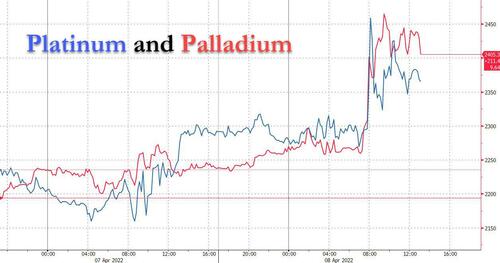
Just how reliant is the world on Russian metals? Russia’s Norilsk Nickel produces 25-30% of the world’s palladium supply and about 10% of platinum, which is also used to curb vehicle emissions as well as in other industries and to make jewellery. The company’s website says that it sends metals to Krastsvetmet, Prioksky and another refinery, Uralintech, for refining.
A source close to Nornickel said the LPPM decision would restrict its ability to sell to banks but sales to manufacturers, which form the bulk of its business, would be unaffected. However, speaking to Reuters, industry sources in London said the move increases pressure on manufacturers to reject Russian platinum and palladium similar to what happened with Russian oil, which just means even higher prices.
Indeed, recyclers and miners in South Africa and North America, the other main producers, stand to benefit from any boycott of Russian material.
The European Union on Friday adopted its fifth package of sanctions, including bans on the import of coal, wood, chemicals and other products. EU governments have also frozen about 30 billion euros ($32.6 billion) of assets linked to oligarchs and other sanctioned people with ties to the Kremlin. read more
/FERTILIZER
COMMODITIES IN GENERAL
6.CRYPTOCURRENCIES
7. GOLD/ TRADING TODAY
Your early currency/gold and silver pricing/Asian and European bourse movements/ and interest rate settings FRIDAY morning 7:30 AM
ONSHORE YUAN: CLOSED UP 6.3637
OFFSHORE YUAN: 6.3682
HANG SANG CLOSED UP 63.03 PTS OR 0.29%
2. Nikkei closed UP 97.23 PTS OR 0.36%
3. Europe stocks ALL GREEN
USA dollar INDEX UP TO 99.93/Euro FALLS TO 1.0862
3b Japan 10 YR bond yield: FALLS TO. +.2310/ !!!!(Japan buying 100% of bond issuance)/Japanese yen vs usa cross now at 124.19/JAPANESE FALLING APART WITH YEN FALTERING AS WELL AS LONG TERM YIELDS RISING BREAKING THE JAPANESE CENTRAL BANK.
3c Nikkei now ABOVE 17,000
3d USA/Yen rate now well below the important 120 barrier this morning
3e WTI:: 96.44 and Brent: 100.58
3f Gold UP /JAPANESE Yen DOWN CHINESE YUAN: UP -SHORE CLOSED DOWN// OFF- SHORE DOWN
3g Japan is to buy the equivalent of 108 billion uSA dollars worth of bond per month or $1.3 trillion. Japan’s GDP equals 5 trillion usa./“HELICOPTER MONEY” OFF THE TABLE FOR NOW /REVERSE OPERATION TWIST ON THE BONDS: PURCHASE OF LONG BONDS AND SELLING THE SHORT END
Japan to buy 100% of all new Japanese debt and by 2018 they will have 25% of all Japanese debt. Fifty percent of Japanese budget financed with debt.
3h Oil DOWN for WTI and DOWN FOR Brent this morning
3i European bond buying continues to push yields lower on all fronts in the EMU. German 10yr bund RISES TO +.0.696%/Italian 10 Yr bond yield RISES to 2.38% /SPAIN 10 YR BOND YIELD RISES TO 1.69%…ITALIAN 10 YR BOND YIELD/GERMAN BUND: 1.68: DANGEROUS FOR THE ITALIAN BANKING SYSTEM
3j Greek 10 year bond yield RISES TO : 2.84
3k Gold at $1935.50 silver at: 24.66 7 am est) SILVER NEXT RESISTANCE LEVEL AT $30.00
3l USA vs Russian rouble;// Russian rouble UP 2 roubles/dollar; ROUBLE AT 77.75
3m oil into the 96 dollar handle for WTI and 100 handle for Brent/
3n Higher foreign deposits out of China sees huge risk of outflows and a currency depreciation. This can spell financial disaster for the rest of the world/
JAPAN ON JAN 29.2016 INITIATES NIRP. THIS MORNING THEY SIGNAL THEY MAY END NIRP. TODAY THE USA/YEN TRADES TO 124.19 DESTROYING JAPANESE CITIZENS WITH HIGHER FOOD INFLATION
30 SNB (Swiss National Bank) still intervening again in the markets driving down the FRANC. It is not working: USA/SF this morning .9351– as the Swiss Franc is still rising against most currencies. Euro vs SF 1.0154 well above the floor set by the Swiss Finance Minister. Thomas Jordan, chief of the Swiss National Bank continues to purchase euros trying to lower value of the Swiss Franc.
USA 10 YR BOND YIELD: 2.680 UP 7 BASIS PTS
USA 30 YR BOND YIELD: 2.700 UP 6 BASIS PTS
USA DOLLAR VS TURKISH LIRA: 14.75
Futures, Yields And Oil All Rise On Last Day Of Turbulent Week
FRIDAY, APR 08, 2022 – 07:51 AM
After several extremely volatile days, US equity futures are ending the week in the green (for now) with European equities snapping two days of declines sparked by the Federal Reserve’s plan for aggressive monetary-policy tightening, and Asian stocks trading higher. S&P 500 and Nasdaq 100 futures trimmed earlier gains to trade 0.3% higher as traders weighed the latest developments about the war in Ukraine. Contracts on U.S. stock benchmarks trim earlier gains as traders weigh developments about the war in Ukraine.Nasdaq 100 futures flat; S&P 500 futures +0.1%; Dow Jones futures +0.2%. The dollar rose for a 7th consecutive week and US Treasuries sold off across the curve; gold and bitcoin were flat. Oil was steady after three days of losses stoked by plans to release millions of barrels of crude from strategic reserves and China’s demand-sapping virus outbreak.
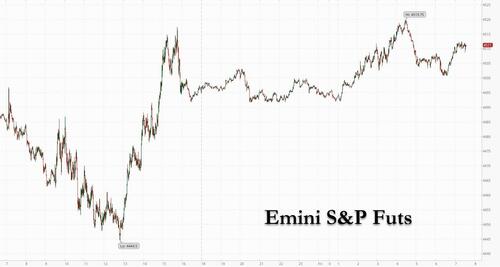
Markets had a subdued session yesterday after sinking more than 4% in the previous two days as hawkish signals from the Federal Reserve sent Treasury yields surging. Among notable premarket moves, Robinhood slid 3% after Goldman Sachs, not too long ago the lead underwriter on the company’s IPO, cut their rating on the stock to sell, saying softening retail engagement levels and profitability concerns will likely limit any outperformance. Some other notable premarket movers:
- Alcoa (AA US) is 1.2% lower as Credit Suisse analyst Curt Woodworth trims his recommendation to neutral as he views LME aluminum prices near peak levels.
- Quidel (QDEL US) gained in extended trading Thursday after it posted preliminary revenue for the first quarter that beat the average analyst estimate.
- CrowdStrike (CRWD US) advanced 4.1%. Analysts responded positively after management set a framework to reach $5 billion in annual recurring revenue (ARR) by 2026, during the cybersecurity company’s investor briefing.
- WD-40 (WDFC US) is poised to gain after producing a “solid” beat in the second quarter, Jefferies said, adding that an increased market share and new product launches would support volume growth of 3% in 2022.
- Kura Sushi (KRUS US) shares rose in postmarket trading after the restaurant chain reported a year-over-year jump in quarterly sales.
- ACM Research (ACMR US) edged lower in extended trading Thursday after saying in a release its first quarter revenue would be “significantly below” expectations, but reiterated full-year revenue guidance for 2022.
U.S. stocks are on course to snap a three-week winning streak with investors shedding risk assets following indications from the Fed of a faster-than-expected pace of tightening in monetary policy. Concerns are also growing about the impact of high inflation and slowing economic growth on corporate earnings. The two-year Treasury yield rose five basis points and the 10-year yield climbed one point, reversing some of the curve steepening seen in the wake of the Fed minutes Wednesday, which outlined plans to pare the central bank’s balance sheet by more than $1 trillion a year alongside interest-rate hikes.
Global equities are nursing losses for the week as markets grapple with the Fed’s campaign against elevated price pressures, Russia’s grinding war in Ukraine and China’s Covid travails. The lockdown in Shanghai — which recorded more than 21,000 new daily virus cases — has become one of President Xi Jinping’s biggest challenges. Expectations are growing that China will take steps to support its economy.
“Stocks have had a little bit of a harder time this week digesting the fact that interest rates are going to be higher” amid a major shift in expectations around monetary policy, Anthony Saglimbene, global market strategist at Ameriprise Financial Inc., said on Bloomberg Television.
Still, U.S. equities saw a second straight week of inflows at $1.5 billion, with large-cap and growth stocks outperforming small-cap and value sectors, according to Bank of America strategists. Marija Veitmane, a senior strategist at State Street Global Markets, also said stocks still appeared to be the safest option.
“Cash gives you nothing with 7% inflation, bonds just had one of the worse quarters in history, and then if you look at stocks, we still have decent earnings outlook, and to me the biggest attraction is really strong balance sheets,” she said on Bloomberg TV.
In the latest news out of Ukraine, dozens were killed Friday morning as Russian troops allegedly bombed civilians waiting at a train station to be evacuated from the Donetsk region. Meanwhile, U.S. officials warned that the war may last for weeks, months or even years, as Kyiv’s foreign minister pleaded for urgent military assistance. Here are the latest Ukraine war developments:
- Ukraine intends to establish up to 10 humanitarian corridors on Friday, those leaving Mariupol will need to use private vehicles.
- Ukrainian advisor Podolyak says negotiations with Russia continue online constantly, but the mood changed after Bucha events, via Reuters.
- Kremlin says it does not understand EU concerns about European countries paying for Russian gas in RUB, adds Commission President von der Leyen probably needs more information. On planned EU ban of Russian coal, says coal is in high demand. Special operation in Ukraine could be completed in the foreseeable future, given aims are being achieved and work is being carried out by peace negotiators and the military.
- EU ready to release EUR 500mln for arms to Ukraine, according to AFP citing EU chief.
- Russia says it has destroyed a training centre for foreign mercenaries within Ukraine, was located north of Odesa, via Tass.
- Japan’s Industry Ministry plans to reduce Russian coal imports gradually while looking for alternative suppliers, according to Reuters.
- Ukraine PM says they have large stocks of grain, cereals and vegetable oil. Are able to provide themselves with food; this year’s harvest will be 20% less YY.
- Ukraine gas grid warns that Russian actions could impact gas flows to Europe, via Reuters.
On Thursday, St Louis Fed president James Bullard said he prefers boosting the policy rate to 3%-3.25% in the second half of 2022. Chicago Fed President Charles Evans and his Atlanta counterpart Raphael Bostic said they favor raising rates to neutral while monitoring the economy’s performance. The steepening in the Treasury yield curve contrasts with the flattening and inversions that have vexed markets this year. The two-year rate topped the 10-year last week for the first time since 2019, a possible warning of recession.
“We’re seeing a tactical re-steepening right now but the curve is going to continue to flatten,” Kelsey Berro, fixed income portfolio manager at JPMorgan Asset Management, said on Bloomberg Television. “That’s because the Fed has told us, we’d like to get to neutral expeditiously. On top of that, they may need to tighten beyond neutral. Front-end yields can still go higher.”
In Europe, Euro Stoxx 50 rallies over 1.8% before stalling while the Stoxx 600 index climbed 1.2% but drifted off best levels as investors took advantage of beaten-down stock valuations with energy, banks and autos the strongest-performing sectors. Banks outperformed as Banco BPM SpA surged after Credit Agricole SA bought a 9.2% stake in the Italian lender. An Asia-Pacific share index eked out a small increase. Here are some of the biggest European movers today:
- Scout24 shares rise as much as 17%, the most intraday since December 2018, after a report that Hellman & Friedman, EQT and Permira have discussed taking the firm private.
- Banco BPM shares rise as much as 17% after Credit Agricole bought a 9.2% stake in the Italian lender, with Bank of America saying the deal is a reminder that real value should be based on fundamentals.
- Sodexo shares jump as much as 7.4%, their biggest single-day gain in a month, after RBC Capital Markets upgrades the French caterer to outperform from sector perform.
- K+S gains as much as 10% after JPMorgan double-upgraded the shares to overweight from underweight, seeing a very positive environment for fertilizers amid supply disruptions and high energy prices.
- Atlantia shares rise as much as 4.5% following a report in a Italian newspaper that the Benetton family and Blackstone may start their takeover offer for Atlantia at more than EU22 per share.
- Saab rise as much as 5% as SEB upgrades the shares to buy from hold on the Swedish defense firm’s sales potential in the coming decade in the wake of Russia’s invasion of Ukraine.
- Moncler shares rise as much as 4.2% after Barclays upgrades the Italian luxury company to overweight, citing an “attractive” defensive profile in the current environment.
- Genmab fall as much as 10%, the most since September 2020, after saying a tribunal decided in favor of Janssen Biotech over two issues surrounding the cancer drug daratumumab (Darzalex).
Ahead of this weekend’s French election, Macron’s lead is shrinking: the current President led his rivals in the April 10 election with 26.2% support, down from 27.2% a day earlier, according to a polling average calculated by Bloomberg on April 8. Macron was 3.5 percentage points ahead of second-placed Marine Le Pen, down from 4.1 points.
Asian stocks edged higher on Friday, poised to snap three days of declines as traders assessed the prospect of policy easing by Beijing. The MSCI Asia Pacific Index erased early losses of as much as 0.4% to climb 0.2%. Chinese property and infrastructure-related stocks surged on hopes for fiscal as well as monetary easing as the government seeks to prop up growth. For the week, the Asian benchmark was down 2% as investors turned cautious on risk assets after latest comments from the Federal Reserve suggested aggressive tightening lies ahead. Tech shares were hit hard in particular, with the MSCI Asia-Pacific Information Technology Index losing 4% this week, on track for its worst performance since end-January.
“There appears to be speculation that monetary easing by the PBOC might be imminent,” said Kazutaka Kubo, senior economist at Okasan Securities. There are also expectations that once lockdowns are over, the economy could be supported by pent-up demand, he added. Chinese authorities have repeatedly vowed to support the economy and markets in thet past few weeks, as rising Covid-19 infections and lockdowns darken the outlook for growth. The pledges have spurred bets that some form of monetary easing may come soon. Movements in most national benchmarks in the region were modest on Friday, gaining less than 1%. Stocks in the Philippines and Indonesia outperformed, while Singapore shares fell.
Indian stocks gained after the Reserve Bank of India kept borrowing costs at a record low, even as it raised its inflation forecast on the back of rising commodity prices. The central bank also announced the start of policy normalization as the pandemic’s impact fades. The S&P BSE Sensex climbed 0.7% to 59,447.18 in Mumbai to complete a second week of gains, while the NSE Nifty 50 Index rose 0.8%. Gauges of small- and mid-sized companies gained 1% and 0.9%, respectively. The Reserve Bank of India’s monetary policy panel held the benchmark rate at 4%, in line with predictions of all 36 economists surveyed by Bloomberg. RBI Governor Shaktikanta Das said the central bank will start focusing on withdrawal of banking liquidity accommodation to target inflation but such a move would be “multi-year” and carried out without disrupting the markets.
“Equity markets will like the RBI’s continued focus on growth and its commitment to an accommodative stance,” said Abhay Agarwal, a fund manager at Mumbai-based Piper Serica Advisors Pvt. The RBI’s commentary means adequate flow of liquidity will continue and immediate beneficiaries will be consumers who are borrowing to purchase real estate and autos, he added. All but one of 19 sectoral sub-indexes compiled by BSE Ltd. advanced, led by a gauge of power companies. Reliance Industries Ltd. was a key gainer on the Sensex, which saw 22 of its 30 components advance. The RBI has comforted markets by refraining from being aggressive, unlike its global peers, and by ensuring that the liquidity withdrawal will be gradual, Yesha Shah, head of equity research at Samco Securities wrote in a note. “On the growth front, one can assume that the central bank expects private investment to ramp up now that capacity utilization has improved further,” she said, adding the policy lays the framework for a possible rate increase in coming reviews.
Australian stocks advanced – the S&P/ASX 200 index rose 0.5% to close at 7,478.00 – supported by materials and industrial stocks. GrainCorp shares surged to a record high, after the firm upgraded its FY22 earnings guidance as high levels of rain in Australia lay a path for a bumper crop. Platinum Asset plunged to an all-time low after the company reported net outflows of A$222 million in March. In New Zealand, the S&P/NZX 50 index was little changed at 12,066.27.
In rates, Treasuries fell across the curve, with the front-end of the Treasuries curve pressured lower, flattening 2s10s spread by ~5bp as 2-year yields trade more than 7bp cheaper on the day at ~2.54%. S&P 500 futures near top of Thursday’s range, following bigger advance for European stocks after three straight declines. Yields across long-end of the curve are little changed on the day, as flattening extends out to 5s30s spread which is tighter by ~4bp; 10-year yields around 2.683%, cheaper by 2.5bp vs Thursday close; bunds and gilts outperform by 1bp-2bp in the sector. Bunds reversed opening gains, adding to a three-day run of declines; French debt underperformed bunds ahead of presidential elections beginning Sunday. The German curve bull-flattens, richening 2bps across the back end. Peripheral spreads widen to core with Italy underperforming.
In FX, Bloomberg dollar index advanced a seventh consecutive day and neared the strongest level since July 2020 as the greenback advanced against all of its Group-of-10 peers apart from the Norwegian krone. The euro pared losses after touching a one-month low against the dollar in early London trading. The pound fell to the lowest in more than three weeks as bets for aggressive policy tightening by the Federal Reserve boost the dollar. Gilts rose across the curve as U.S. Treasury yields stabilized following the recent selloff. The Australian and New Zealand dollars were the worst-performing G-10 currencies; Australia’s yield curve steepened following a similar move in Treasuries on Thursday. Most Japanese government bonds rose, thanks to support from the central bank’s regular purchase operations. The yen briefly reversed early an Asia session loss after an ex-BOJ official said there’s likelihood of a policy shift as soon as this summer.
Bitcoin is contained and unable to derive traction either way from the broader risk tone. Strike payment platform launches Shopify (SHOP) integration, which allows merchants to accept Bitcoin (BTC), according to Bloomberg.
In commodities, crude futures trade within Thursday’s range; WTI holds above $96, Brent stalls near $102. Spot gold holds steady near $1,930/oz. Most base metals trade well: LME zinc and lead outperforming, tin lags.
To the day ahead now. Central bank speakers include the ECB’s de Cos, Centeno, Panetta, Stournaras, Makhlouf and Herodotou. Italian retail sales for February and Canadian employment for March round out this week’s data.
Market Snapshot
- S&P 500 futures up 0.5% to 4,517.00
- STOXX Europe 600 up 1.4% to 461.27
- MXAP up 0.2% to 176.33
- MXAPJ up 0.3% to 584.66
- Nikkei up 0.4% to 26,985.80
- Topix up 0.2% to 1,896.79
- Hang Seng Index up 0.3% to 21,872.01
- Shanghai Composite up 0.5% to 3,251.85
- Sensex up 0.9% to 59,558.63
- Australia S&P/ASX 200 up 0.5% to 7,477.99
- Kospi up 0.2% to 2,700.39
- Brent Futures up 1.2% to $101.76/bbl
- Gold spot down 0.0% to $1,931.38
- U.S. Dollar Index up 0.14% to 99.89
- German 10Y yield little changed at 0.68%
- Euro down 0.1% to $1.0865
Top Overnight News from Bloomberg
- The Bank of Russia delivered a surprise cut in its key interest rate Friday, reversing some of the steep increase it made after the invasion of Ukraine as the ruble recovered. The central bank lowered the rate to 17% from 20% and said further cuts could be made at upcoming meetings if conditions permit
- EU countries agreed to ban coal imports from Russia, the first time the bloc’s sanctions have targeted Moscow’s crucial energy revenues. Japan is also looking to curb imports, in what could be a shift in policy from one of the world’s largest energy buyers
- The EU is aiming to lock in progress on trade and technology disputes with the U.S. during President Joe Biden’s first term amid concerns that any gains could otherwise be easily reversed
- The relationship between Australia’s equities and currency has become the closest in a decade as commodity prices surge. The 180-day correlation between the country’s stock benchmark and the Australian dollar has climbed to the highest level since late 2011, according to data compiled by Bloomberg. The strengthened ties come as rallies in materials from oil to iron ore have boosted both the nation’s equities and the Aussie
- The ECB will look past threats to economic growth from the war in Ukraine, ending asset purchases in the summer and setting the stage for a first interest-rate increase in more than a decade in December, according to a survey of economists
- Junk bond sales across Europe are experiencing their longest drought in more than 10 years, as the Russian invasion of Ukraine and the prospect of rising interest rates neuter risk appetite
A more detailed look at global markets courtesy of Newsquawk:
Asia-Pacific stocks were choppy and eventually conformed to a mixed picture; some weakness was seen shortly after the Chinese cash open. ASX 200 bucked the trend and was propped up by its energy and gold names. Nikkei 225 was choppy and moved in tandem with action in USD/JPY whilst the KOSPI was weighed on by its chip and telecoms sectors. Hang Seng remained pressured by losses across its large constituents – Alibaba and JD.com. Shanghai Comp swung between gains and losses but overall remained supported by reports from China’s Securities Journal which noted of a potential PBoC RRR in Q2.
Top Asian News
- Hong Kong Tycoons Heed China, Endorse John Lee to lead City
- Chinese Tech Stocks Fall as Tencent Shuts Game Streaming Site
- Abu Dhabi’s IHC Invests $2 Billion in Billionaire Adani’s Empire
- ADDX Rolls Out Private Market Services for Wealth Managers
European bourses are firmer across the board, Euro Stoxx 50 +1.5%, bouncing in a morning of quiet newsflow with the broader tone modestly risk-on. Albeit, benchmarks are still negative on the week and some way from earlier WTD peaks; unsurprisingly, sectors are all in the green with defensive-bias names lagging. Stateside, futures are similarly in the green, ES +0.2%, though magnitudes are more contained ahead of a limited US schedule to round off the week.
Top European News
- U.S. Sanctions Russian Miner Producing 30% of World’s Diamonds
- Atlantia Gains After Reports of Offer Price Above EU22/Share
- Generali CEO Says He Won’t Change Plan Challenged by Investors
- Baader Downgrades Six Chemical Firms, Citing Ukraine War
In FX:
- DXY touches 100.000 as US Treasury yields continue to soar and curve steepen, but unable to break barrier.
- Kiwi underperforms awaiting NZIER Q1 survey, while Aussie holds up better after hawkish warning in RBA FSR; NZD/USD around 0.6950, AUD/USD nearer 0.7460.
- Yen sub-124.00 as Japanese export supply is absorbed, Euro supported by bids circa 1.0850 and Sterling treading water above 1.3000.
- Rouble relatively resilient in the face of 300 bp CBR rate reduction as it remains above pre-conflict highs.
Fixed income:
- Choppy trade in bonds approaching the end of another very bearish week.
- Bunds and Gilts nurse losses mostly above par around 157.00 and 120.00 handles vs fresh cycle lows of 156.40 and 119.83.
- US Treasuries most seeing red, but curve less steep in correction after hawkish FOMC minutes and Fed commentary, via Brainard and Bullard especially
Central Banks:
- RBA Financial Stability Review: important that borrowers are prepared for an increase interest rates; global asset markets are vulnerable to larger-than-expected rate increases, via Reuters.
- RBI leave rates unchanged as expected, retains “accommodative” stance as expected; will focus on withdrawing accommodation going forward. RBI is to restore LAF corridor to 50bps and floor to be constituted by SDF, according to Reuters.
- CBRT April survey sees Turkish End-Year CPI at 46.44% (prev. 40.47%)
- CNB Minutes (March): Dedek and Michl voted in the minority for stable rates. Board assessed risks and uncertainties of winter forecast as being markedly inflationary, particularly in short-term
- CBR cuts its Key Rate to 17.00% (prev. 20.00%) as of April 11th; holds open the prospect of further key rate reduction at its upcoming meetings.
In commodities, WTI and Brent are bolstered amid broader sentiment, though crude/geopolitical specific developments have been limited In-fitting with equities, the benchmarks are negative on the week and some way shy of best levels as such. New York will suspend the state gas tax from June 1st to December 31st, according to Reuters. Barclays raises oil forecasts by USD 7-8/bb assuming no material disruption in Russian supplies beyond Q2 2022, according to Reuters. Spot gold is marginally firmer, but, remains drawn to USD 1930/oz after marginally eclipsing the level overnight; base metals bid in-line with sentiment.
US Event Calendar
- 10:00: Feb. Wholesale Trade Sales MoM, est. 0.8%, prior 4.0%
- 10:00: Feb. Wholesale Inventories MoM, est. 2.1%, prior 2.1%
DB’s Henry Allen concludes the overnight wrap
Yesterday’s ECB minutes reinforced what we learned from the March FOMC minutes and soon-to-be Vice Chair Brainard earlier this week – there are no doves in fox holes – by casting doubt on the likelihood of inflation returning to target this year. We also heard from St. Louis Fed President Bullard, the hawk leading the charge, who called for a fed funds rates above 3% this year. That would beckon a faster pace of hikes along with more aggregate tightening. Regional Presidents Bostic and Evans, non-voters each, meanwhile, want to get rates to neutral. The tighter path of global policy continued to drive sovereign yields higher and equity indices lower.
Market-implied ECB policy rates by the end of the year increased +6.0bps to +62.3bps, the highest level this cycle. Sovereign yields rose to multi-year highs of their own, with those on 10yr bund (+3.4bps), OATs (+4.4bps) and BTPs (+3.5bps) moving higher, with 10yr breakevens falling in Germany (-1.9bps) and France (-0.7bps) for the first time in five days, while Italian breakevens were essentially flat (+0.2bps).
Meanwhile, fed funds futures by end-2022 staged a slight retreat, falling -1.2bps to 2.50%, albeit +10bps higher than a week ago. While the probability of a +50bp hike in May remained steady at 85.4%. 2yr yields fell in line, declining -1.2bps, while 10yr Treasuries gained +6.0bps, leaving the curve at +19.2bps. If you’re up on the yield curve discourse, you’ll know the Fed discounts the signal coming from 2s10s, instead preferring shorter-dated measures of the yield curve, which wound up flattening yesterday.
Yesterday’s yield curve steepening should not be viewed in a vacuum. The 2s10s curve has taken a 58.3bp round trip over the last two weeks, falling from +23.1bps two weeks ago, to -8.0bps last Friday, to +19.2bps at yesterday’s close. The fundamental outlook hasn’t changed dramatically over that time span. Instead, this likely reflects the elevated rates volatility environment we currently sit in. This, all before QT has even begun. Real Treasury yields continue to march higher in the back end, with 10yr real yields gaining +5.3bps to -0.19%, their highest level since March 2020, having gained +25.1bps this week alone, and +91.3bps YTD.
Despite higher rates and more restrictive language, the S&P 500 ended the day +0.43% higher, after losing -2.21% the previous two sessions. The S&P 500 is now -5.58% YTD following the massive repricing of Fed expectations, while the Bloomberg Financial Conditions index is just a hair tighter than the post-2010 average. Monetary policy may need to adjust tighter yet to engineer the demand slowdown commensurate with a return of inflation to target.
European equities were modestly lower, with the STOXX 600 slipping -0.21% and the DAX down -0.52%. The CAC (-0.57%) underperformed the STOXX 600 for the seventh consecutive session, on the back of growing Presidential election jitters. Polls between President Macron and his closest rival, Marine Le Pen, tightened. In particular, one poll (caveat emptor) from Atlas actually put Le Pen marginally ahead of Macron in a head-to-head runoff for the first time, by 50.5%-49.5%. The news immediately saw the French 10yr spread over bund yields widen in response, ending the day at 54.2bps, its widest since March 2020.
While one poll a race does not make, it’s worth noting the broader poll narrowing over the last month. That has seen Macron’s lead in the first round over Le Pen go from 30%-17% a month ago (according to Politico’s average), to just 27%-22% now. In the second round, polls are likewise pointing to a tight contest, with Macron ahead of Le Pen by 52-48% (Ifop) and 53%-47% (Ipsos). For those looking for more details on the presidential race, DB’s Marc de-Muizon put out a guide yesterday (link here), where he looks at the current state of play in the election, the main aspects of both Macron and Le Pen’s programmes, as well as some potential challenges for both candidates.
Back to the US, in a rare show of bi-partisanship, the Senate voted 100-0 to discontinue normal trade relations with Russia and Belarus and to ban Russian oil imports. Brent crude prices fell below $100/bbl for the first time since mid-March intraday, ultimately falling -0.48% to close at $100.58/bbl. The EU also moved to include a Russian coal embargo in its fifth round of sanctions. The opprobrium was global, with the UN General Assembly voting to suspend Russia from the Human Rights Council following its human rights violations, the first such suspension since Libya in 2011. On the ground, the Kremlin admitted to enduring heavy troop losses, and while the locus of the war still seems set to shift eastward, Ukrainian commanders have their guard up for a renewed assault on Kyiv.
Elsewhere, Judge Ketanji Brown Jackson was confirmed to the Supreme Court. It’s expected the Senate will now turn to approving President Biden’s nominations for the Fed Board of Governors later this month, which will still have one empty seat following Sarah Bloom Raskin withdrawing her nomination.
Asian equity markets this morning aren’t matching Wall Street’s resilience from yesterday. The Hang Seng (-0.57%) is leading the moves lower with the Nikkei (-0.08%), Kospi (-0.10%), Shanghai Composite (-0.06%) and CSI (-0.10%) all slightly on the wrong foot. Along with tighter global monetary policy, China’s Covid outbreak is worsening and dragging on sentiment. US stock futures are unperturbed, with S&P 500 and Nasdaq futures virtually unchanged. Meanwhile, the aforementioned rates volatility continues to rear its head, with the curve snapping back flatter as we go to press, with 2yr Treasuries +4.2bps higher and the 10yr a bit softer at -0.5bps. Oil prices are extending their decline this morning with Brent futures (-0.74%) sliding below $100/bbl.
On the data side, Japan’s current account swung back to surplus in February to +¥1.6 trillion, following a -¥1.2 trillion deficit in January – the second-biggest deficit on record. The main release yesterday came from the US weekly initial jobless claims, which fell to their lowest level since 1968, with just 166k initial claims in the week through April 2 (vs. 200k expected). In addition, the previous week was revised down to 171k from 202k, which left the smoother 4-week moving average at 170k, the lowest ever in the entire data series going back to 1967. Euro Area retail sales grew by +0.3% in February (vs. +0.5% expected), and German industrial production grew by +0.2% that same month, in line with expectations.
To the day ahead now. Central bank speakers include the ECB’s de Cos, Centeno, Panetta, Stournaras, Makhlouf and Herodotou. Italian retail sales for February and Canadian employment for March round out this week’s data.
3. ASIAN AFFAIRS
i)FRIDAY MORNING// THURSDAY NIGHT
SHANGHAI CLOSED UP 15.15 PTS OR 0.47% //Hang Sang CLOSED UP 63.03 PTS OR 0.29% /The Nikkei closed UP 97.23 PTS OR 0.36% //Australia’s all ordinaires CLOSED UP 0.48% /Chinese yuan (ONSHORE) closed DOWN 6.3637 /Oil DOWN TO 96.44 dollars per barrel for WTI and DOWN TO 100.58 for Brent. Stocks in Europe OPENED ALL GREEN EXCEPT // ONSHORE YUAN CLOSED DOWN AGAINST THE DOLLAR AT 6.3637 OFFSHORE YUAN CLOSED DOWN ON THE DOLLAR AT 6.3682: /ONSHORE YUAN TRADING ABOVE LEVEL OF OFFSHORE YUAN/ONSHORE YUAN TRADING WEAKER AGAINST US DOLLAR/OFFSHORE WEAKER//
3 a./NORTH KOREA/ SOUTH KOREA
///NORTH KOREA
END
3B JAPAN
end
3c CHINA
CHINA/
The latest China crackdown: Big tech’s abuse of algorithms that influence public opinion
(zerohedge)
In Latest Crackdown, China Targets Big Tech’s “Abuse Of Algorithms” That Influence Public Opinion
FRIDAY, APR 08, 2022 – 07:51 AM
China’s technology sector was hit with another round of regulatory crackdowns by Beijing on Friday. The country’s internet watchdog wants to rein in potential “abuse of algorithms” by internet giants that dish out ads and content to users that can significantly influence their thinking.
The Cyberspace Administration of China (CAC) will “conduct in-depth investigation and rectification of Internet enterprise platform algorithm security problems, evaluate algorithm security capabilities, and focus on inspecting large-scale enterprises with strong public opinion attributes or social mobilization capabilities.” CAC made no mention of which internet companies it would target.

CAC expects to examine the industry’s use of algorithms through the end of the year. The move is part of a much larger campaign to curtail the widening power big tech companies have in influencing people.
Regulators published a draft on restrictions for content algorithms back in August. According to the final version released in early January, the rules forbid practices that encourage addiction or high consumption and any activities that endanger national security. We noted at the time:
According to the Internet Information Service Algorithm Recommendation Management Regulations: “In recent years, algorithm applications have injected new momentum into political, economic, and social development. At the same time, problems caused by algorithm discrimination, ‘big data killing,’ and inducing indulgence in the unreasonable application of algorithms have also profoundly affected the normal communication order and market order.”
Algorithms like the TikTok algorithm create problems like social order poses challenges to safeguarding ideological security, social fairness and justice, and the legitimate rights and interests of netizens. The introduction of targeted algorithm recommendation rules and regulations in the field of Internet information services is a need to prevent and resolve security risks, and it is also a need to promote the healthy development of algorithm recommendation services and improve the level of supervision capabilities.
In February, CAC told algorithm providers who influence public opinion or mobilize the masses to submit their services for record-keeping.
Tech industry algorithms have been at the center of many political controversies in the US. Facebook, Twitter, and Google have been ridiculed for using algos to flood news stories in people’s feeds with content that influences elections or exacerbates political polarization. Recently, Facebook and Instagram allowed calling for violence against ‘Russians and Russian soldiers’ when discussing the Ukraine invasion.
ByteDance and Tencent are two companies that will likely come under scrutiny because of their massive Chinese social media sector dominance.
Read the full statement from the Cyberspace Administration of China below (translation courtesy of Google) here.
end
CHINA//SHANGHAI//COVID/LOCKDOWNS
Shanghai is a powder keg as citizens revolt against the lockdowns
(zerohedge)
Shanghai Sees Record COVID Cases For 6th Day As Unrest Spurred By Lockdown Worsens
THURSDAY, APR 07, 2022 – 10:25 PM
As the situation in Shanghai continues to deteriorate, residents have been pushing back against the CCP’s authority in ways that are rarely seen in China. Since the start of the pandemic, and the CCP’s decision to adopt a “war like” position to enforce its “zero COVID” policy, has rarely elicited much resistence. Until now.
Yesterday, videos of Shanghaiers taking to their balconies to sing in protest of the local authorities’ decision to order an ‘indefinite’ lockdown went viral in the West (they were quickly censored on Weibo).
Authorities counted nearly 20K cases in Shanghai alone on Wednesday, nearly matching the number for all of China from the day before. It marked the sixth daily record for the city, according to the SCMP. Symptomatic cases climbed to 322, up from 311 a day earlier, while the vast majority of the cases showed no symptoms. Local authorities have counted more than 70K cases since March 1.
We noted a few days ago that the situation in Shanghai has evolved to become more than just a public health crisis. Instead, it has become a political test for the CCP, as it fights to protect the legitimacy of its “zero COVID” approach. In that sense, the battle for Shanghai has become “too big to fail.”
The NYT said as much Thursday.
As the coronavirus races through Shanghai, in the city’s worst outbreak since the pandemic began, the authorities have deployed their usual hard-nosed playbook to try and stamp out transmission, no matter the cost. What has been different is the response: an outpouring of public dissatisfaction rarely seen in China since the chaotic early days of the pandemic, in Wuhan.
The crisis in Shanghai is shaping up to be more than just a public health challenge. It is also a political test of the zero tolerance approach at large, on which the Communist Party has staked its legitimacy.
For much of the past two years, the Chinese government has stifled most domestic criticism of its zero tolerance Covid strategy, through a mixture of censorship, arrests and success at keeping caseloads low. But in Shanghai, which has recorded more than 70,000 cases since March 1, that is proving more difficult.
Shanghai is China’s most populous metropolis, its shimmering commercial heart. It is home to a vibrant middle class and many of China’s business, cultural and academic elite. A large share of foreign-educated Chinese live in Shanghai, and residents’ per capita disposable income is the highest in the country. Even in a country where dissent is dangerous, many there have long found ways to demand government responsiveness and have a say over their own lives.
“I’m just too angry, too sad,” said Kristine Wu, a 28-year-old employee of a tech company who was visited at home by two police officers after she criticized the city’s Communist Party leader on social media. She recorded her defiant confrontation with them, in which she asked why they were wasting time harassing her, when they could be helping people in need of care. She then shared a photo of the encounter on social media, despite the officers’ warnings against doing so. (It was later censored.)
“I thought, whatever, I’ll just go for it,” said Ms. Wu, who had not considered herself political before the lockdown. “I used to live pretty comfortably, and before anything had happened, everyone was very polite, very rule abiding. Now all that has just crumbled.”
The CCP is caught in a difficult dilemma. Public health experts are keenly aware of the fact that China is unprepared to live with the coronavirus: just over half the of Chinese age 80 and over are fully vaccinated as of late March. And Chinese vaccines have been shown to be less effective than their western counterparts.
Already, the people of Shanghai are struggling with crippling food shortages as they’re forced to rely on the government for essential supplies, according to the AP.
Residents of Shanghai are struggling to get meat, rice and other food supplies under anti-coronavirus controls that confine most of its 25 million people in their homes, fueling frustration as the government tries to contain a spreading outbreak.
People in China’s business capital complain that online grocers often are sold out. Some received government food packages of meat and vegetables for a few days. But with no word on when they will be allowed out, anxiety is rising.
Zhang Yu, 33, said her household of eight eats three meals a day but has cut back to noodles for lunch. They received no government supplies.
“It’s not easy to keep this up,” said Zhang, who starts shopping online at 7 a.m.
“We read on the news there is (food), but we just can’t buy it,” she said. “As soon as you go to the grocery shopping app, it says today’s orders are filled.”
As the food shortage worsens, containers full of frozen food and chemicals are piling up at Shanghai’s biggest port as the lock down of the city and virus testing prevents workers from getting to the docks to pick up boxes, according to Bloomberg.
Of course, Shanghai isn’t the only part of China struggling with an outbreak. The Province of Jilin is still facing a surge (and the attendent restrictions) even after authorities technically lifted a weeks-long lockdown
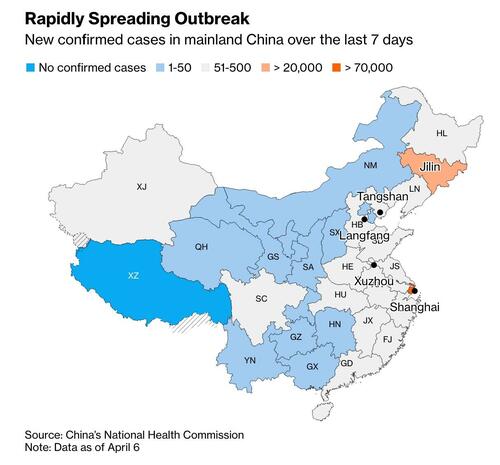
Source: BBG
Going even further than its rival the NYT, the Washington Post on Thursday declared the situation in Shanghai to be a “powder keg” that could call the entire CCP authoritarian system into question.
But Shanghai looks like a powder keg for China, where the party-state justifies its rule by casting itself as guardian of the people’s health and welfare. Shanghai’s residents are growing desperate. People are complaining on social media that they are unable to get food and water delivered. When some began shouting protests out their windows, demanding supplies in one Shanghai neighborhood, a drone flew by and warned them to stop, and to please “control the soul’s desire for freedom.”
Now, it is authoritarian China’s turn to face questions about whether its system, based on tight controls, is really better at controlling the pandemic. China would be well advised to learn lessons from the West and pivot to more flexibility. Mr. Xi should admit he needs a new strategy. But can he?
While no more videos of protesting locals have made it to western social media over the last day, one video of riot police being dispatched to prepare for any more ‘unrest’ did catch the public’s attention.
end
CHINA/USA/TAIWAN
USA states that China would face sanctions similar to Russia for invading Taiwan
(DeCamp/Antiwar.com)
US Says China Would Face Sanctions Similar To Russia For Invading Taiwan
THURSDAY, APR 07, 2022 – 10:45 PM
Authored by Dave DeCamp via AntiWar.com,
On Wednesday, Treasury Secretary Janet Yellen said that the US would be ready to use sanctions similar to what has been imposed on Russia against China if Beijing were to invade Taiwan.
Yellen told the House Financial Services Committee that she believes the US has shown it can impose significant economic pain. “I think you should not doubt our ability and resolve to do the same in other situations,” she said.
Deputy Secretary of State Wendy Sherman also testified before the Committee and warned that the US would impose harsh sanctions on China if it helped Russia in its war in Ukraine. “It gives President Xi, I think, a pretty good understanding of what might come his way should he, in fact, support Putin in any material fashion,” she said.
China has strongly denied US claims that it was considering giving Russia military support. Last month, US officials told media outlets that Moscow had asked Beijing for help. But US officials told NBC News this week that the claim “lacked hard evidence.”
US officials have also warned that Washington would take action against Beijing if it helped Russia avoid Western sanctions. Over the past few years, the US has imposed a series of sanctions and export controls against Beijing, but they have not been as harsh as what Russia is facing.
While Washington is warning Beijing it could impose tougher sanctions, such measures could do serious damage to the US economy since it is so intertwined with China’s.
For now, Yellen said that the US shouldn’t sanction China for its relationship with Russia. “We would be very concerned if they were to supply weapons to Russia, or to try to evade the sanctions that we’ve put in place on the Russian financial system and the central bank,” she said. “We don’t see that happening at this point.”
end
4/EUROPEAN AFFAIRS//UK AFFAIRS
//EU/FRANCE
This will certainly cause problems for the French
(zerohedge)
European Markets Freak Out As Odds Of Le Pen Victory In French Presidential Elections Jump
FRIDAY, APR 08, 2022 – 10:50 AM
Ahead of last weekend’s Hungarian parliamentary election, the pollsters were predicting a landslide loss for the loathed by the western/EU establishment current prime minister, the pro-Putin Viktor Orban. Well, there was a landslide, just not in the direction the so-called experts predicted (which begs the question: why do people still listen to polls after 2016, but we digress), and in the latest humiliation for Brussels, Orban was re-reelected in a huge victory, steamrolling the opposition alliance. So with all eyes on this weekend’s French elections which pit Davos crowd pet and former Rothschild banker Emanuel Macron against outspoken nationalist Marine Le Pen. Here too, fears are growing that what until recently was seen by the always wrong pollsters as a “done deal” and blowout victory for Macron, suddenly is looking very shaky.
With French voters taking to the polls on Sunday, the race is suddenly wide open because while Macron’s lead over Le Pen had been narrowing in recent weeks, a shock poll released yesterday by Atlas Politico showed that Le Pen (50.5%) now has a slight advantage over Macron (49.5%).
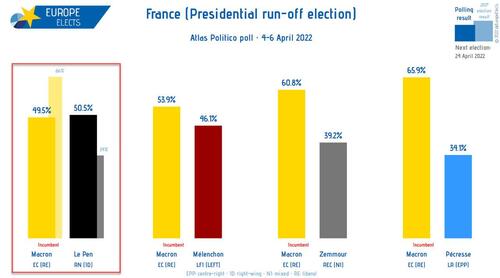
A little background: the first round of the French presidential election will take place on Sunday (April 10). The two candidates gathering the most votes will qualify for the second round of the election, which will take place on Sunday, April 24. Incumbent President Macron still enjoys a comfortable lead in the polls at over 25% of voting intentions, although this is down marginally from the early-March highs. Voting intentions for far-right candidate Marine Le Pen have increased to about 20% (from about 15% a few weeks ago), placing her as the most likely candidate facing Macron in the second round.
Macron, who had sought to put himself at the center of European and US efforts to end the crisis in Ukraine since late last year with dismal results so far, only began campaigning in earnest about a week ago. The calculation was that he’d benefit from the image of peacemaker and seasoned statesman, and that his handling of the pandemic and a strong economic rebound would be enough to keep him in the Elysee.
Until recently, polls suggested that was true… but suddenly the unthinkable appears possible, and a big reason for that is the exploding inflation across France. More on that in a second.
The problem, as Bloomberg notes, is that foreign policy rarely wins elections in France, and an appearance of complacency fueled the perception that Macron is arrogant and out of touch – which of course is true on both counts – is opening the way for Marine Le Pen.
Unlike the caviar-slurping Davos jet-setter, Le Pen realized long ago on that voters already struggling with high energy and food prices were more likely to care about purchasing power or lack thereof. And so, what was a 12 point gap between her and Macron has narrowed dramatically as she toured towns and villages, casting herself as the defender of the “little ones” against Macron’s reputation as the “president of the rich.” She pledged to slash gasoline prices and tax big energy companies.
Of course, this won’t be Le Pen’s first attempt to dethrone Macron. Or second. On her third attempt to clinch France’s top job, Le Pen has become a familiar face. Her efforts to appear more mainstream got an unexpected boost from the candidacy of Eric Zemmour, a far-right former media pundit sanctioned three times for hate speech also known as the French Trump.
People close to Macron have been warning that his victory isn’t assured. “Of course Ms. Le Pen can win,” Edouard Philippe, a former prime minister in Macron’s government, said last week according to Bloomberg. But for that to happen, Le Pen would have to build an anyone-but-Macron coalition in the second round on April 24 and left-wing voters would have to abstain, or vote for her.
To be sure, a Le Pen victory over Macron, the self-styled successor of Angela Merkel, and defender of the European project, would be a shock for the European Union on a par with Donald Trump’s U.S. election victory and the Brexit vote in 2016. Armed with a veto on most EU initiatives, she could bring the bloc to an abrupt halt and could effectively spell the end of the EU, one of the core Western alliances in a thunderous win for Putin.
There’s one more wildcard in this race: Far-left leader Jean-Luc Melenchon. On his third shot at the presidency, he’s polling six percentage points after Le Pen, and could convince left-wing voters to rally behind him on Sunday.
As Bloomberg puts it, “voter support for her means that immigration would remain central to her agenda. A win would cap the far-right in France, pointing the country on a nationalist, nativist path.”
In any case, even if Le Pen doesn’t pull it off, Macron would win by a far smaller margin than last time the two went head-to-head in 2017. The nationalist would emerge empowered in either outcome while Macron will be left with a weak mandate that could make it difficult to implement his economic and social reforms, depending on the outcome of legislative elections scheduled for June.
That said, a victory would be a stunning accomplishment for 53-year-old: it took Le Pen a year to recover from her defeat to Macron in 2017, but she held tight and looked to Viktor Orban, who just won a fourth-straight term as prime minister in Hungary, and Matteo Salvini in Italy for inspiration.
She changed her party’s name to appear less aggressive and also intensified a strategy to soften her image, sharing personal stories about her life as a single mother with three children and her Bengal cats. She dropped a plan to ban dual citizenship – a calling card of the far right – and disavowed Russian President Vladimir Putin after his invasion of Ukraine.
“She’s made progress — she’s opened up to other people and listens to criticism,” said Robert Menard, the mayor of Beziers, who backs her and talks to her once a week. “Before, we didn’t speak, we just argued.”
Le Pen has been focusing on social welfare since taking over her father’s party in 2011, essentially inching the movement that was economically liberal in the 1980s closer to the left, increasingly attracting less well-off people and the young working class.
On March 10, Le Pen cast herself as the candidate of the “little ones” against the “big ones” in the poorer Northern France region, slamming Macron for “giving everything to big companies.” She also pledged that gasoline prices would go down if she’s elected — a key issue for voters in rural areas who rely on their cars — with tax cuts on fuel, and new taxes on oil majors.
By contrast, Zemmour’s program veers more to the right. He wants the French to retire later, reduce welfare and cut taxes on companies and real estate owners. But at the end of the day, his supporters will likely back Le Pen in a runoff against Macron, according to an analysis by Gilles Ivaldi, a Sciences Po researcher.
“By pushing a social-populist agenda long before the war and increasing her rhetoric after the invasion, Le Pen is gambling,” Ivaldi wrote in a recent opinion piece. “So far, polls appear to be proving her right.”
Indeed they are, and the market is starting to freak out: holders of French debt have been dumping it ahead of what could be a shock outcome this weekend, pushing benchmark yields up to as high as 1.25%, a level last seen in 2015. That took the spread over their German equivalents — a measure of investors’ perception of risk — to the widest since March 2020, the onset of the pandemic.
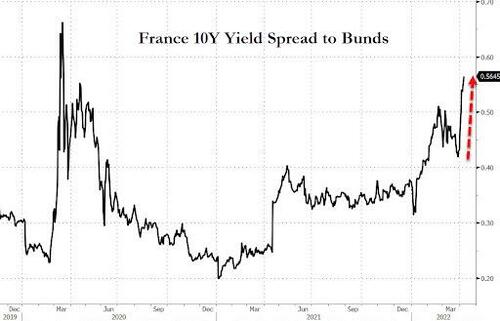
Consistent with the evolution of polls, further election risk premium has been priced across assets during the course of this week. In our view, the French presidential election has more European rather than domestic implications.
In a note previewing the French election, Goldman strategist Peter Oppenheimer (note available to pro subscribers), writes that consistent with the evolution of polls, further election risk premium has been priced across assets during the course of this week as “the French presidential election has more European rather than domestic implications.”
As Oppenheimer details, “since the invasion of Ukraine by Russian forces, equities and peripheral sovereign spreads have been resilient despite the deterioration of the growth/rate mix and the repricing of tighter monetary policies. Part of this resilience likely lies in the swift and homogeneous response of European leaders in terms of diplomatic and fiscal policies, with President Macron being a key player in proposals for further EU integration.”
But a change in the French presidency or rising odds of a Le Pen victory is likely to trigger market stress, pushing some sovereign risk back to the forefront and raising the equity risk premium.
If Le Pen were to be elected, Goldman expects 10y OAT-Bunds to land at 60-75bp, 10y BTP-Bunds at 180-210bp and EUR/USD to trade 2% lower. In the equity space, the risk premium could rise by 30bp, which implies a 7% price drop for the SXXP. This is consistent with what the equity derivatives market is currently pricing.
In any case, with 2 days to go, President Macron still enjoys a modest lead in most polls, with a handful of exceptions, at over 25% of voting intentions, although this has declined marginally from the early-March highs (Chart 1, left). The recent polls also confirm that the next two leading contenders are far-right candidate Marine Le Pen (Rassemblement National) and far-left candidate Jean-Luc Mélenchon (La France Insoumise). In France, polls this close to the election have tended to be relatively accurate, with mean polling errors shrinking by close to 1pp a fortnight before the first round, and a rematch of the 2017 contest between Macron and Le Pen therefore looks highly likely (Chart 1, right).
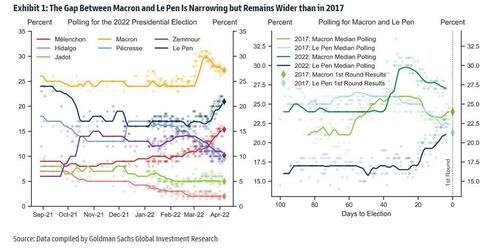
Where things get shaky is that second-round polls have recently shown President Macron’s lead over Ms. Le Pen narrowing to historical lows. Although prediction markets still foresee a victory for President Macron, they have repriced Ms. Le Pen’s odds to 20% up from 5%.
In that respect, Goldman argues that the key risk stems from the participation rate of moderate voters. In a simple exercise, assuming that Zemmour voters largely vote for Le Pen and that Pécresse voters equally split on supporting Le Pen, Macron and abstaining in the second round. Varying the participation rate amongst left-wing voters in the second round (i.e., who voted for Mr. Mélenchon, Hidalgo or Jadot in the first round), Goldman finds that 60% of 1st round left-wing voters would need to abstain for Le Pen to be elected president if the far-left was to split itself equally between Macron and Le Pen (Exhibit 2, left).
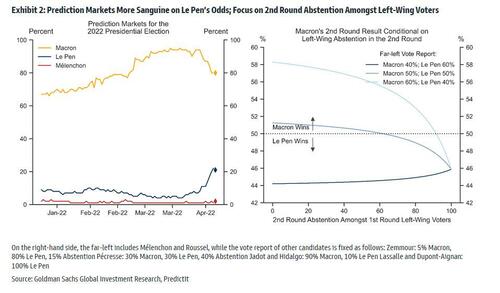
As such, the bank will carefully monitor (i) unsuccessful candidates’ voting guidelines, if any, and (ii) sub-polls showing 2nd round voting intentions conditional on the 1st round vote. We will also look for major public figures—including former presidents and prime ministers—to persuade 1st round abstainers and voters whose candidates did not advance to regroup behind the mainstream candidate (likely Mr. Macron) so as to form the so-called Front Républicain.
END
5. RUSSIAN AND MIDDLE EASTERN AFFAIRS
RUSSIA/UKRAINE/THE WEST
Not sure if this happened or is it a false flag again
(zerohedge)
US Condemns ‘Horrific Russian Attack’ On Train Station, Which Left 30 Dead, As Kremlin Rejects “Provocation”
FRIDAY, APR 08, 2022 – 08:44 AM
There are widespread reports that dozens have been killed and over 100 injured, mostly civilians, after what’s being described as a Russian missile strike hit a railway station in the eastern Ukrainian city of Kramatorsk.
“Russia hit the railway station in Kramatorsk today,” Ukrainian police said in a statement. “The rocket hit the temporary waiting room, where hundreds of people were waiting for the evacuation train.” Local authorities say they’ve counted about 30 among the dead.

The transport hub has been key for the evacuation of civilians fleeing fighting in the Donbas region, where Russia has of late concentrated most of its military operations, also as UK military intelligence on Friday said that its observed that Russian forces have now “fully withdrawn” in the north, going back to Belarus and Russian soil.
Police further said there’s a frantic emergency response at the scene. “It is already known there about 30 dead people, including children, and about 100 injured,” a statement said. “Assistance is being provided to all who need it.” The city’s mayor said it was “proof” that Russia is “barbarically” killing civilians.
Ukraine’s Ministry of Defense said that Russian forces carried out two missile strikes on the train station at the very moment an evacuation was in progress. Ukrainian President Volodymyr Zelensky issued a statement condemning it as an “evil that knows no bounds”.
According to Fox News, “Images taken in recent days have depicted large crowds of Ukrainians standing on the station’s platforms hoping for a chance to escape Russia’s bloody invasion, which has now entered its 44th day.”
The Kremlin was quick to respond, rejecting the allegations that it even fired missiles or artillery on the train station or in that direction. The surprising complete denial that its forces were at all operating against Kramatorsk was coupled with an accusation that it was a “provocation”, with the full Kremlin statement as follows:
“All the statements of representatives of the Kyiv nationalist regime about the alleged ‘missile attack’ by Russia on April 8 at the railway station in Kramatorsk are a provocation and absolutely do not correspond to reality,” the statement said.
“On April 8, the Russian armed forces did not conduct or plan any artillery fires in the city of Kramatorsk.
“We emphasize that the Tochka-U tactical missiles, the wreckage of which was found near the Kramatorsk railway station and published by eyewitnesses, are used only by the Ukrainian armed forces.”
So it appears Moscow is alleging another false flag, similar to the recent back-and-forth between Russia and the West surrounding the events at Bucha.
US statements from top officials condemned the attack. The White House condemned the “horrific and devastating images” of the deadly train station strike.
end
UKRAINE/SLOVAKIA/RUSSIA
This is going to be interesting!!
(zerohedge)
NATO Member Slovakia Announces Transfer Of S-300 Anti-Air System To Ukraine
FRIDAY, APR 08, 2022 – 10:15 AM
In a hugely provocative announcement, Slovakia on Friday has said the NATO country has donated its S-300 air defense system to Ukraine to “help it defend against Russia’s aggression,” according to a statement from Prime Minister Eduard Heger.
The official Slovakia in NATO Twitter account also confirmed that it is “stepping up its support to Ukraine” by sending the “S-300 air defense system to Ukraine, so it can defend itself against ongoing Russian aggression.
Slovakia’s defense ministry even published video of what appears to be a mobile S-300 unit being readied and pulling out of a military base. So far it appears a single unit will be given to Ukrainian forces.
Prime Minister Eduard Heger had said his country “donated” its Soviet-era defense system to Ukraine. The announcement came as he visited the Ukrainian capital with top EU officials, just before a meeting with President Zelensky.
And so it appears NATO is inching little by little toward a potential ‘no fly zone’ over Ukraine, given the S-300 is precisely the type of major equipment that would be needed. Russia’s reaction will without doubt be fierce, given this initial somewhat symbolic first step toward that possible end.
The Associated Press is noting this comes in direct response to Zelensky urging the west to “close the skies” for Russian aircraft over Ukraine…
Zelenskyy mentioned S-300s by name when he spoke to U.S. lawmakers by video last month, appealing for defense systems that would allow Ukraine to “close the skies” to Russian warplanes and missiles.
The action also comes after foreign ministers of NATO met in Brussels Thursday where they reportedly agreed to give Ukraine “new and heavier weapons” – though without defining which precise weapons systems under consideration.
Russia has vowed that it’s ready to attack as “legitimate targets” any external weapons shipments intercepted from outside powers. S-300 transfers certainly bring NATO and Russia on a more direct collision course, and it’s unclear the degree to which other NATO allies signed off on this provocative delivery.
end
RUSSIA/FINLAND/SWEDEN
Very problematic!!
(zerohedge)
Finland & Sweden NATO Applications Could Be ‘Imminent” After Stoltenberg Hints At Fast-Tracking
FRIDAY, APR 08, 2022 – 11:45 AM
Last weekend saw Finland’s Prime Minister Sanna Marin signal a complete reversal of policy direction, saying that a “new security environment” in Europe brought on by Russia’s invasion of Ukraine means the country has to rethink its long-standing policy of neutrality toward the NATO bloc. “Russia is not the neighbor we thought it was,” she said of Moscow’s ongoing assault on Ukraine, calling it a “flagrant violation”.
“In this new situation and changed security environment, we’ll have to evaluate all means to guarantee the safety of Finland and Finns,” Marin said. “We’ll have to seriously mull over our own stance and approach to military alignment. We’ll have to do this carefully but quickly, effectively during the course of this spring.”
Days after these words which Moscow saw as highly provocative, Axios in a new report says Finland’s ascendancy to the alliance appears “imminent”. “Public support and political momentum for Finland joining NATO has reached an all-time high as a result of the war in Ukraine, raising the very real possibility that the alliance’s borders with Russia could extend by more than 830 miles in a matter of months,” the report says. It could be a mere weeks away.

Sweden is also mentioned in the report as being positioned to seek entry into NATO alongside Finland. This after NATO Secretary-General Jens Stoltenberg’s open invitation this week. He suggested both Nordic countries would be fast tracked. He remarked this week that he expects “all 30 allies to welcome” Finland and Sweden should they choose to apply.
And according to Axios, “60% of Finns now support joining NATO, according to a survey conducted last month — a 34-point jump from last fall, and the highest level since polling on the issue began in 1998.”
Finland’s former prime minister, Alexander Stubb, articulated the current climate and thinking in Helsinki. “I think Finns at the moment are driven by what I call rational fear,” he told Axios.
“You have to balance between realism and idealism. Realism is that you have a strong standing military as we have, and idealism is to try to cooperate with a big neighbor,” he explained.
Stubb added: “There has been this bona fide attempt to forge a functioning relationship with Russia, and now that people see that that is impossible — especially under [President Vladimir] Putin — they’ve changed their opinion.”
Finland has over the years regularly hosted and participated in NATO exercises, while also seeking to pursue transparent and positive relations with Moscow.
Pentagon Reveals It Is Giving Ukraine Intelligence for Donbas Operations | The National Interest
Inbox

| Robert Hryniak |  10:54 AM (47 minutes ago) 10:54 AM (47 minutes ago) | | |
| to |
Daily we are bombarded with the narrative of the Ugly Russians invading as conquerors in the Ukraine. It is not the reality. Yes, atrocities have occurred and yes Russia has tossed decades of goodwill out the window, and as seen in the Western response of isolation and sanctions. What is clear civilians need to get out of the way of what is a firefight where both sides will kill innocents in the future firefights to come. War is war and it produces no innocence as war makes everyone a victim. And where Russians are in Western Europe and elsewhere life will be more difficult. As it is many Russians with second passports have left or are leaving Russia and going to Israel and beyond which will bring new talent to such countries while leaving their assets behind. It is unlikely that they will be returning or allowed to return in the future. And current sanctions have effectively frozen their ability to remove further value outside of Russia. It is one reason why ordinary Russians are so supportive of Putin as they perceive their society is being cleansed of those who have pillaged them for profit to enjoy life outside of Russia. Think about oligarch life styles in London and Monaco etc. which will come to a stop as the gravy train of cashflow is cut off. No doubt business in tax havens will suffer. It is interesting to watch this galvanizing the Russian public. Whether this stays the course as life gets tougher in days ahead as sanctions bite, remains to be seen. Clearly, Russian Oligarchs living abroad have become visible expendable people exploited by all parties and no one will shed tears over their reduced lifestyles. It reminds me of gangster movies of old where various crime families duke it out and some win and many suffer over turf wars in plain view.
When you watch the the ongoing fight what is clear is the West is destroying a section of the Ukraine. Russia initially went in and did not destroy the cities or infrastructure with the exception of Mariupol which was a direct fight. And still has a week or two to run. And proof of restraint is in the reality the lights work and internet works. I expect both sides will soon take a different tact.
It is starting to appear that Russia will stick to initial chatter that they will take all of the Donbas and what is equally clear both sides will fight over this and beyond that there will be a expanse of land west of the Donbas that will be a dead zone or a buffer zone likely controlled by both sides as a no man’s land. Just how many hundreds of kilometers this is remains unclear. And it is unlikely that Kiev will be taken any time soon. If Ukraine was a failed nation before, it will be much poorer going forward. And likely a breeding ground for terrorists who will raid Europe for gain. This is a future sore that will cause Europe much grief.
It is equally clear that America is deeply involved with other parties arming the Ukrainians to the last one standing, as expendable cannon fodder. This is similar to what happened in WWII prior to entry of America into actual war. And it is known that NATO troops are extensively on the ground and it is unlikely that NATO will officially go in as that will mean nuclear war in short order.
Meanwhile, expect that we will see the dislocations of all kinds as Russia is isolated by the West. These dislocations will come from natural resources that are removed from ready access as it was before. Meanwhile, Europe will suffer greatly as a result of this confrontation as their economy will be turned upside down. And make them far more dependent on America than before.
>
> no surprise as this has been ongoing for a long time and is likely understood by the Russians that the Ukrainians are simple proxies in a undeclared fight between the West and Russia. So expect more use of newer weapon systems to be tested by both sides knowing that the other fellow is watching and evaluating in real time. Be certain the military complex is gleefully observing and pitching for more business. War is indeed a racket.
> https://nationalinterest.org/blog/buzz/pentagon-reveals-it-giving-ukraine-intelligence-donbas-operations-201709
>
>
>
>
This has been done many times before.
end
6// GLOBAL COVID ISSUES/VACCINE MANDATE
ISSUES/GLOBAL ISSUES//ORIGINS OF COVID 19//COVID 19
Important: large Israeli study finds that protection against COVID from the 4th shot drops very quickly. However there is more poison in your body
(Jack Phillips/EpochTimes).
Large Israeli Study Finds That Protection Against COVID From 4th Shot Drops Quickly -More Poison in your body, natural immunity is better than experimental dangerous money makers for Pharma
Large Israeli Study Finds That Protection Against COVID From 4th Shot Drops Quickly
THURSDAY, APR 07, 2022 – 07:25 PM
Authored by Jack Phillips via The Epoch Times,
An Israeli study found that a fourth dose of the Pfizer COVID-19 vaccine doesn’t offer long-lived protection against the Omicron variant of the CCP virus.
Using Ministry of Health data on more than 1.2 million people, researchers found that a second booster dose of the BioNTech-Pfizer vaccine offered protection against significant COVID-19 infections for six weeks. But protection against all virus infections started to drop quickly after four weeks and nearly disappeared after eight weeks, according to the study, which was published in the New England Journal of Medicine.
The researchers, however, said that there appears to be some benefit conferred by a second booster, or fourth dose, of the Pfizer vaccine.
“Overall, these analyses provided evidence for the effectiveness of a fourth vaccine dose against severe illness caused by the omicron variant, as compared with a third dose administered more than 4 months earlier. For confirmed infection, a fourth dose appeared to provide only short-term protection and a modest absolute benefit,” the study’s authors wrote.
They made note of reports indicating that the “protection against hospital admission conferred by a third dose given more than 3 months earlier is substantially lower against the omicron variant than the protection of a fresh third dose against hospital admission for illness caused by the B.1.617.2 (Delta) variant.”
“In our study, a fourth dose appeared to increase the protection against severe illness relative to three doses that were administered more than 4 months earlier,” they added.
The authors further stipulated that because the study only covered a two-month period, it’s not clear if the vaccine’s protection against severe illness faded after eight weeks. More studies and follow-up research is needed to make a clear determination, the study said.
The study also focused on adults aged 60 and older. It did not provide data on the second booster’s efficacy on younger groups.
Their findings come as policymakers publicly debate if Americans need additional booster shots. The U.S. Food and Drug Administration (FDA) held a panel of advisers on Wednesday on the extra COVID-19 vaccine shots.
In March, the FDA issued an emergency use authorization for second boosters of the Pfizer and Moderna shots for individuals aged 50 and older as well as immunocompromised people aged 12 and up. The drug regulator also authorized giving an mRNA vaccine booster for those who received the Johnson & Johnson COVID-19 vaccine, which uses an adenovirus.
Several weeks ago, Israeli researchers found in a separate preprint study that the protection from a second Pfizer booster quickly diminished.
Protection against infection rose initially after the fourth dose, reaching 64 percent during the third week, but it rapidly declined to 29 percent by 10 weeks, they found.
“It appears that effectiveness of the fourth dose wanes sooner, similarly to the fact that the third dose wants sooner than the second dose,” the study said.
end
Will they ever learn?
(Stieber/EpochTimes)
FDA Floats Moving COVID-19 Vaccines To Flu-Like Model
THURSDAY, APR 07, 2022 – 08:45 PM
Authored by Zachary Stieber via The Epoch Times (emphasis ours),
Food and Drug Administration (FDA) officials have proposed a future model for developing new COVID-19 vaccines that would be built on the approach to creating influenza vaccines.
Accumulating data suggest the current COVID-19 vaccines, based on a virus strain that is now generations old, “may need to be updated at some point to ensure the high level of efficacy demonstrated in the early vaccine clinical trials,” the FDA said.
One concern is how new strains of SARS-CoV-2 keep emerging, some of which bypass protection bestowed by the vaccines better than others.
The vaccines provide virtually no protection against infection from Omicron, the strain that is dominant in the United States at present, though they have held up better against severe disease.
U.S. regulators say an orderly and transparent process should be outlined for changing the composition of the COVID-19 vaccines, with the process ideally being adopted by countries around the world in addition to the World Health Organization (WHO).
The model in place for annually updating influenza vaccines can inform the process, officials say.
“The strain selection process for determining the composition of seasonal influenza vaccines may provide a general outline for the approach needed for updating the composition of COVID-19 vaccines to address current and emerging SARS-CoV-2 variants,” the FDA said.
The influenza vaccine model is based on predicting which variants will be circulating in the future. WHO leads the effort, voting on the composition of the vaccines to be deployed in the northern hemisphere five to six months later and the southern hemisphere three to four months in the future.
U.S. authorities often adopt the WHO’s recommended composition, though the FDA, in consultation with its expert advisory panel on vaccines, occasionally diverge from the advice.
While the flu model could be used as a foundation for future COVID-19 vaccines, there are unique issues for COVID-19 that will need to be addressed, FDA officials say, including how the seasonal pattern for SARS-CoV-2 surges has yet to be identified; how the COVID-19 vaccines are built across different platforms, such as messenger RNA; and how the experience with those vaccines to date wouldn’t be sufficient to get authorization or approval without clinical trial data.
Further, even the best-matched flu vaccines end up being around 60 percent effective, a figure some vaccine manufacturers have described as poor.
The proposed shift to a flu-like model contains “a lot of assumptions,” John Moore, a professor of immunology at Weill Cornell Medicine, told The Epoch Times.
Clinical trials of Omicron-specific shots are ongoing, with data on human subjects not out yet. Data from animal studies, though, which are “usually pretty predictive, do not support the use of that specific vaccine as a boost,” Moore said. “So if that’s going to be the case in the humans, why go through the complexity of introducing a new vaccine if it’s not needed?”
The new model was proposed in a briefing document published ahead of an April 6 meeting. During the meeting, which The Epoch Times will stream live, FDA officials will discuss with the agency’s expert advisers various matters relating to COVID-19 vaccines, including optimal use of additional COVID-19 shots in the future.
The FDA recently cleared fourth doses for millions of Americans without consulting the advisers, part of a growing pattern of minimizing their role.
Among those presenting will be Dr. Kanta Subbarao, a WHO official, on COVID-19 vaccine composition, and Robert Johnson, a government official on the development of variant-specific vaccines.
GLOBAL ISSUES
CANADA
Canada is set to announce a 2 yr ban on foreign purchases of residential real estate
(zerohedge)
Canada Set To Announce 2 Year Ban On Foreign Purchases Of Residential Real Estate
THURSDAY, APR 07, 2022 – 07:45 PM
What goes up must come down.
At least, that looks like what the story is going to wind up being for the Canadian housing market. The country is reportedly set to announce that it will ban foreign purchases of residential real estate for two years.
“The foreign buyers ban will apply to condos, apartments, and single residential units,” according to CTV. “Permanent residents, foreign workers, and students will be excluded from this new measure. Foreigners who are purchasing their primary residence here in Canada will be exempt.”
The effects will likely be dramatic, as foreign purchases of real estate accounted for a lot of the bid that helped Canadian housing skyrocket to begin with.
“The timing is a classic case of closing the barn door after the horses have left,” ForexLive’s Adam Button wrote this week. He noted that the market had already started to cool in March amidst interest rate hikes.

After calling the housing market top on Bloomberg last month, Button says this action by the government “certainly adds” to his conviction. He wrote:
“The question now is whether it will be a soft or hard landing. These measures from the Federal government are being combined with provincial measures and BOC hikes to create a perfect storm in a market that was already way out of line.”
As recent as last fall we were documenting how rural shacks were selling for as much as 37% above asking price within days of being listed.
A rancher built in the 1970s had an asking price of $998,000 in June 2021 and sold later that month for $1,365,000. Just days on the market, a fierce bidding war broke out with 13 bidders who ultimately bid up the price 37% above list.
“There wasn’t a lot of inventory, and there was another property that had sold recently in multiple offers, so we wanted to take advantage of any leftover buyers,” Toronto-based agent Luisa Piccirilli said at the time.
Piccirilli described the bidding war mainly between those who wanted to escape city life and wanted a backyard.
“There’s an exodus of people leaving the city and wanting more property and land,” Piccirilli said.
end
VACCINE MANDATES/
VACCINE INJURIES//
VACCINE IMPACT
Contamination of U.S. Food Supply Worsens as 50% of Foods Tested Contained Cancer-Causing Glyphosate Herbicide
April 7, 2022 4:59 pm

The Detox Project recently published their latest results from the most comprehensive glyphosate testing of food products ever conducted in the U.S., showing that the contamination of the U.S. food supply with the cancer-causing herbicide glyphosate is becoming significantly worse since their first report published 5 years ago. Glyphosate is the active ingredient in the world’s most heavily used herbicide, Roundup. So even though it has widely been shown that glyphosate is linked to higher rates of cancer, getting it out of the food supply is no easy task. What is particularly concerning is that even foods labeled as being “USDA Organic” or labeled as free from GMO contamination, also test positive for the presence of glyphosate. Many people, for example, choose gluten free alternatives to wheat, thinking that it is a healthy choice, but the grains, nuts, and seeds that make up most gluten free products are heavily contaminated with glyphosate as well. My own company, Healthy Traditions, began testing all of the food we sell for the presence of glyphosate back in 2014, when we did our own testing and investigation and found that most of our certified organic grains that we were selling at the time were contaminated with glyphosate. We were shocked to learn that the National Organic Program for USDA certification allows for smaller amounts of glyphosate to be present even in foods certified organic. So we mostly abandoned the USDA Organic program, and started testing all of our food ourselves, practicing strict batch control so that we could trace each batch back to the producer. We now do our own testing for glyphosate, and also for GMOs, as many foods advertised as being free from GMOs, also contain small amounts of GMO DNA, especially American corn.
Michael Every
Michael Every on the day’s major topics
Rabo: “We Just Had A Former Fed President Say What He Was Not Allowed To When In Office”
FRIDAY, APR 08, 2022 – 09:44 AM
By Michael Every of Rabobank
That ‘there are none so blind as those that will not see’ is an English idiom inspired by the Bible –Matthew 13:13 (“Therefore I speak to them in parables: because they seeing see not…”). or Jeremiah 5:21 (“Hear now this, O foolish people, and without understanding; which have eyes, and see not…”)– but is not actually seen in it word for word. Like all old wisdom, it rings true.
We just had a former Fed president say what he was not allowed to when in office — which itself would be worthy of comment if our financial commentators were worth their salt — that the Fed needs to push down stocks to get inflation under control. We then had a current Fed member say he wants the Fed Funds rate at 3.50% by the end of this year. Yet US stocks decided to stage a late rally yesterday, closing up on the session.
Bloomberg, typically myopic, puts it thus: ‘Steadying: Markets Stabilise as Traders Mull Fed Comments’. No, markets are blindly refusing to see what they are being told by the people they spend all their time apparently deferring to. They are being told clearly they can no longer have their cake, and everyone else’s cake, and eat it and fit in their jeans. And they are ignoring it.
This isn’t to say the US can push rates to 3.50% this year and not see USD/JPY well over 130, EUR/USD at parity, and USD/CNY back towards 7, etc.; or a deeply inverted US yield curve following a bear steepening; or a US recession. In all likelihood that would all hypothetically happen if the Fed tried. Yet that is what was just flagged. And markets are apparently ‘mulling’.
To be fair, within an hour Bloomberg had someone with better vision rewrite the headline to ‘Time Correction: Investors Face ‘Maximum’ Angst as Markets Stay Flat’. Then, shortly afterwards, it was rewritten again to ‘Aggressive Move: Fed’s Bullard Favours Raising Interest Rates Sharply’. Yet that just shows you there are none so blind as those that will not see anything other than Bloomberg headlines. Do your own thinking and reading!
That ‘aggressive’ proposed Fed tightening is what sacrosanct former Fed Chair Volcker did to stabilize markets and inflation in his day: stocks still guzzle at the trough he, globalized supply chains, and Greenspan’s permanent liquidity bailouts built. Of course, 2022 is not 1982, and today it may prove a policy error.
Yet are stocks at least echoing St Augustine in imploring, “Lord, make me chaste – but not yet!”? No: they are arguably acting like the short-tempered, incredibly spoiled child one dreads being trapped in any room or vehicle with as its pathetic parents feebly try to discipline it with a series of constant bribes. From the eschatological to the scatological, we are dealing not with high priests of finance, but a singular multi-trillion Eric Cartman from South Park.
Of course, the Fed are blind too – but that should not reassure any blasé markets. US trucking statistics are suddenly looking grim – just as the Fed’s Bostic says it will take far longer to resolve US supply-chain issues than he had expected. He clearly didn’t read ‘In Deep Ship’ and felt everything would mean revert with a lag or bounce back to a 50- or 200-day moving average, like lines on screens. That is not and will not be the case. Logjams will be cured by recession, driven by either inflation or rate hikes, or both, or by a Grand Strategy encompassing fiscal and monetary policy and new geopolitical supply chains, or not at all.
China’s ports are choking with vessels as it refuses to back away from Zero Covid despite the economic cost of trying to contain a staggeringly transmissible virus: workers are de facto locked into offices or factories, and people into their homes even in ‘liberal’ Shanghai. Yes, that means US port backlogs will ease ahead – and it also means far fewer people will be getting their orders from China at all. And this disruption might be structural if it is going to be China’s policy response to a virus that now appears endemic and increasing in transmissibility with each new mutation. Moreover, the EU just passed a ban on Russian coal, and is closer to a ban on Russian ships and lorries; and the US Congress just voted to revoke Russia’s “most favored nation” trade status, allowing steeper tariffs for any Russian goods still coming in.
If you think this is going to end soon, “because markets”, read Russian Orthodox Patriarch Kirill’s sermon to his deeply-religious country from the Cathedral of the Armed Forces. He addressed the leaders of Russian forces and troops: stated Russia was fighting fascism, as in WW2; that its soldiers are “laying down their lives for a friend.”; blamed “various forces” (i.e. the West) that emerged in the Middle Ages for a false division between Russia and Ukraine; and didn’t acknowledge Ukrainians as existing, referring to them as “Holy Russians.” In short, the speech endorsed religiously sanctioned militaristic imperialism and cultural genocide. But Kirill is not on Bloomberg, and their latest survey shows a majority think Russian bonds are cheap. As are US bonds, apparently, just as the Fed talks about 325bp of rate hikes. There are none so blind as those that will not see.
Not unrelated, Finland may be close to NATO membership, prompting Russian lawmaker Vladimir Dzhabarov to state: ”If the leadership of Finland goes for it, it will be a strategic mistake. Finland, which has been successfully developing all these years thanks to close trade and economic ties with Russia, would become a target. I think it [would be] a terrible tragedy for the entire Finnish people.” More threats – as seen from both sides.
Meanwhile, the UN General Assembly suspended Russia from the UN Human Rights Council, with an interesting selection of countries voting for, against, or abstaining. China was against, and Brazil, India, and Mexico all abstained. Finland and France stay on the UNHRC… as do China, Eritrea, Sudan, and Somalia: sleep soundly knowing human rights are guarded by angels. The UN vote split may get people shouting about ‘Bretton Woods III’ despite there being no clear indication of what that catchy title actually means. Then again ‘BRICs’ meant nothing either, and only one brick is not now facing structural problems clouding its growth path, yet it was career-defining. A revelation to new believers, however, is how badly other FX will fare if the ‘So Bretton Woods II’ US dollar sees Fed Funds hiked to 3.50%.
Relatedly, and with a hint of Martin Luther’s 95 Theses, billionaire Peter Theil lashed out at billionaire Warren Buffet and billionaire Larry Fink as being ‘Finance Gerontocracy’ for opposing Bitcoin. The billions aren’t the problem, the way they make them is: make way for the new plutocrats! And the revolution rolls on, and over us, all over:
- Canada, following the freezing of bank accounts without a court order and the closing off residential housing sales to foreigners, announced a 1.5% tax hike for banks and insurers on profits over C$100m and a one-time 15% tax on taxable income over $1bn for the last tax year the government is calling a Canada Recovery Dividend.
- In Australia, the market is pricing in a massive series of rate hikes – 8 this year and more in 2023. Imagine what that will do to a political economy where rising property prices are the established religion. The RBA’s Financial Stability Review today helpfully managed to avoid doing any serious reviewing of financial stability, instead telling banks to maintain lending standards –after APRA walked away from the previous attempts to enforce them when the housing market wobbled– and underlining that it is worried about high household debt levels – which it encouraged with its low, low rates. All very St. Augustine, as the RBA no longer gets inflation cover from the globalisation it was not responsible for in any way but took to be written in stone.
- Indeed, an ex-BOJ official is suggesting Japan will have to abandon its policy of yield curve control and let them rip, in which case perhaps it is yields higher that will move and not JPY lower: but something is going to move a lot.
I won’t claim to be able to see all that is coming: but I am not wilfully blind to the fact that a large part of it is going to be very uncomfortable for many markets.
Happy Friday.
7. OIL ISSUES
US Gas Production Set To Fall On Lack Of Pipelines
FRIDAY, APR 08, 2022 – 08:09 AM
By Charles Kennedy of OilPrice.com
U.S. natural gas production will decline by 5 percent by 2050, and consumption will shed 4 percent if no new interstate pipelines are built, the Energy Information Administration said in its latest Annual Energy Outlook.

This, in turn, will lead to higher gas prices, the authority also said, and this will, in turn, lead to higher electricity prices.
“The higher natural gas prices that result from capacity constraints primarily affect natural gas consumption in the U.S. electric power sector, which is more price-sensitive than the residential, commercial, and industrial sectors,” the EIA explained.
The share of natural gas in power generation is set to decline in the scenario of no new interstate natural gas pipelines but not by much. According to the EIA, in that scenario, the share of gas in 2050 will constitute 31 percent of the total, compared with 34 percent under the agency’s reference scenario.
Yet, in absolute terms, the lack of new interstate gas pipelines will reduce gas-fired power generation by 11 percent in 2050 compared to the reference scenario.
At the same time, any bans on new interstate pipelines—a prerogative of the federal government—will not lead to any significant carbon dioxide emission declines.
“We project that restricting interstate U.S. natural gas pipeline capacity would only slightly lower energy-related carbon dioxide (CO2) emissions in the United States relative to the Reference case,” the EIA wrote.
“Total CO2 from all fuel sources in 2050 are 4% lower in the No Interstate Natural Gas Pipeline Builds case than in the Reference case.”
One more thing that the EIA did not include in its report, but energy expert David Backmon raised as an issue this week in a podcast, is the link between interstate gas pipeline capacity and increased U.S. LNG exports to Europe, per President Biden’s commitment to Brussels to make up for a solid portion of Russian gas. Without more pipelines, Blackmon argued, U.S. LNG producers would find it difficult to boost exports sufficiently.
8 EMERGING MARKET& AUSTRALIA ISSUES
Australia//// NEW ZEALAND/ SOUTH AFRICA/BRAZIL/ARGENTINA/INDIA
end
Your early currency/gold and silver pricing/Asian and European bourse movements/ and interest rate settings FRIDAY morning 7:30 AM
Euro/USA 1.0862 DOWN .0003 /EUROPE BOURSES //ALL GREEN
USA/ YEN 124.19 UP 0.097 /NOW TARGETS INTEREST RATE AT .11% AS IT WILL BUY UNLIMITED BONDS TO GETS TO THAT LEVEL…
GBP/USA 1.3024 DOWN 0.0046
Last night Shanghai COMPOSITE CLOSED UP 15.16 PTS OR 0.47%
Hang Sang CLOSED UP 63.03 PTS OR 0.29%
AUSTRALIA CLOSED UP 0.48% // EUROPEAN BOURSES OPENED ALL GREEN
Trading from Europe and ASIA
I) EUROPEAN BOURSES ALL GREEN
2/ CHINESE BOURSES / :Hang SANG CLOSED UP 63.03 OR 0.29%
/SHANGHAI CLOSED UP 15.16 PTS OR 0.47%
Australia BOURSE CLOSED UP .48%
(Nikkei (Japan) CLOSED UP 97.23 PTS OR 0.36%
INDIA’S SENSEX IN THE GREEN
Gold very early morning trading: 1932.00
silver:$24.61-
USA dollar index early FRIDAY morning: 99.93 UP 18 CENT(S) from THURSDAY’s close.
THIS ENDS FRIDAY MORNING NUMBERS
xxxxxxxxxxxxxxxxxxxxxxxxxxxxxxxxxxxxxxxxxxxxxxxxxxxxxxxxxxxxxxxxxxxxxxxxxxxxxxxxxxxxxxxxxxxxxxxxxxxxxxxxxxxxxx
And now your closing FRIDAY NUMBERS 1: 00 PM
Portuguese 10 year bond yield: 1.63% UP 4 in basis point(s) yield
JAPANESE BOND YIELD: +0.231% DOWN 0 AND 7/10 BASIS POINTS /JAPAN losing control of its yield curve/
SPANISH 10 YR BOND YIELD: 1.68%// UP 0 in basis points yield
ITALIAN 10 YR BOND YIELD 2.37 UP 3 points in basis points yield ./
the Italian 10 yr bond yield is trading 69 points higher than Spain.
GERMAN 10 YR BOND YIELD: RISES TO +0.710% IN BASIS POINTS ON THE DAY//
THE IMPORTANT SPREAD BETWEEN ITALIAN 10 YR BOND AND GERMAN 10 YEAR BOND IS 1.66% AND NOW ABOVE THE 3.00% LEVEL WHICH WILL IMPLODE THE ENTIRE ITALIAN BANKING SYSTEM. AT 4% SPREAD THERE WILL BE A HUGE BANK RUN…
END
IMPORTANT CURRENCY CLOSES FOR FRIDAY
Closing currency crosses for FRIDAY /USA DOLLAR INDEX/USA 10 YR BOND YIELD/1:00 PM
Euro/USA 1.0874 UP .0009 or 9 basis points
USA/Japan: 124.34 UP .255 OR YEN DOWN 26 basis points/
Great Britain/USA 1.3021 DOWN 47 BASIS POINTS
Canadian dollar up 4 BASIS pts to 1.2583
xxxxxxxxxxxxxxxxxxxxxxxxxxxxxxxxxxxxxxxxxxxxxxxxxxxxxxxxxxxxxxxxxxxxxxxxxxxxxxxx
The USA/Yuan, CNY: closed ON SHORE (CLOSED ..DOWN 6.3680
THE USA/YUAN OFFSHORE: (YUAN CLOSED (DOWN)..6.7023
TURKISH LIRA: 14.76 EXTREMELY DANGEROUS LEVEL/DEATH WISH/HYPERINFLATION TO BEGIN.
the 10 yr Japanese bond yield at +0.231
Your closing 10 yr US bond yield UP 8 IN basis points from THURSDAY at 2.699% //trading well ABOVE the resistance level of 2.27-2.32%) very problematic
USA 30 yr bond yield: 2.728 UP 9 in basis points
Your closing USA dollar index, 99.88 UP 12 CENT(S) ON THE DAY/1.00 PM/
Your closing bourses for Europe and the Dow along with the USA dollar index closing and interest rates FRIDAY: 12:00 PM
London: CLOSED UP 108.01PTS OR 1.43%
German Dax : CLOSED UP 186.18 POINTS OR 1.32%
Paris CAC CLOSED UP 76.79PTS OR 1.19%
Spain IBEX CLOSED UP 103.20PTS OR 1.54%
Italian MIB: CLOSED UP 469.92 PTS OR 1.93%
WTI Oil price 97.33 12: EST
Brent Oil: 101.24 12:00 EST
USA /RUSSIAN /// RUBLE FALLS TO: 79.88 DOWN 1/8 RUBLES/DOLLAR
GERMAN 10 YR BOND YIELD; +.710
CLOSING NUMBERS: 4 PM
Euro vs USA: 1.0876 UP .0012 OR UP 12 BASIS POINTS
British Pound: 1.3035 down .0033 or DOWN 33 basis pts
USA dollar vs Japanese Yen: 124.34 up 0.246//YEN DOWN 25 PTS
USA dollar vs Canadian dollar: 1.2568 DOWN .0019 (CDN dollar UP 19 basis pts)
West Texas intermediate oil: 98.11
Brent OIL: 102.75
USA 10 yr bond yield: 2.717 up 10 points
USA 30 yr bond yield: 2.747 UP 11 pts
USA DOLLAR VS TURKISH LIRA: 14.75
USA DOLLAR VS RUSSIA///USA/ ROUBLE: 78,35 UP 1 & 15/8 ROUBLES (ROUBLE DOWN 1 5/8 ROUBLES/USA )//
DOW JONES INDUSTRIAL AVERAGE: UP 87.06 PTS OR 0.25%
NASDAQ 100 UP 32.93 PTS OR 0.23%
VOLATILITY INDEX: 21.51 DOWN 0.51 PTS (2.67%)
GLD: 180.34 UP 0.68 PTS OR 0.58%
SLV/ 22.70 UP .13 PTS OR 0.58%
end)
USA trading day in Graph Form
“Screaming Recession” – Rates Fully-Priced For Hawkish Fed, Stocks Repositioning For Eventual Contraction
FRIDAY, APR 08, 2022 – 02:25 PM
In the absence of “upside inflation surprises”, Nomura’s Charlie McElligott points out in his latest note this morning that it seems the rates market is approaching “fully-priced” for now for a “hawkish tightening cycle”, and is now focused on the (negative) economic implications of tighter financial conditions.
Locally, the Nomura strategist notes that equities are again bearing the brunt of said Rates move as macro catalyst – particularly the tightening in FCI as expressed per the enormous multi-week spasm in Real Yields – while flow-wise, now feeling the pain of the resumption of Dealer “Short Gamma vs Spot” immersion, leading us back to increasingly spastic intraday overshoots, as the market is just so impossibly convex due to the vast-majority of options flow now being in the 0-5 days-to-expiration bucket on SPX / SPY level.
US Equities continue to do their “Fed Shorting (wide strike) Strangles” range-trade thing between 4200 and 4650, which continues to be the right call for months and particularly as any time we rally, Financial Conditions are too “EASY” and forces an upgrading of “inflation hawk” rhetoric from the Fed (as they are de facto “selling Calls”) which creates overhead resistance…
- That said, the recent 3-wk Equities directional stabilization off the Op-Ex / March Fed hike lift-off–lows has been very-much in-line with our “front-loaded Fed tightening cycle” analog we ran and have discussed ad nauseum over the course of Q1.
- Per said analog, the median return of the prior 8 instances of this trigger sees that within the first two months after the initial hike of a “4+ hikes in the first 12m” front-loaded Fed cycle, the max Equities drawdown has been made…and out 6m- and 12m-, we see a grinding “little-bit of everything” rally thereafter…before the full implications of the tightening eventually catches-up with the economy thereafter, of course
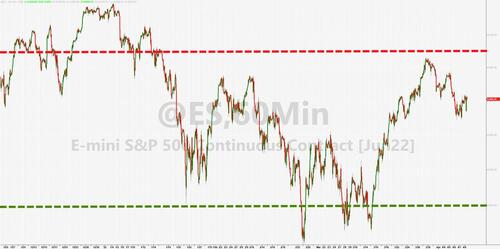
Hence, the market focus is seemingly transitioning from its “front-loaded tightening cycle” obsession which began in 4Q21…which as of now, in the absence of new upside inflation data surprises (i.e. next Tuesday’s US CPI release for March), looks increasingly priced-in after such an impulsive shift anticipating “restrictive” Fed policy-rate territory in extremely short-order, with a much higher “terminal” level in ‘23 than anybody thought was possible just weeks ago…
- 94bps of hiking priced for June shows the market is “locked” on upcoming back-to-back 50bps hikes alongside QT commencement in May
- 134bps of hikes by July—in other words, pushing towards THREE consecutive 50bps hikes by mid-Summer, while also expecting QT to hit “max caps” by August
- And now at 223bps of implied hikes by Dec ’22 Fed meeting…
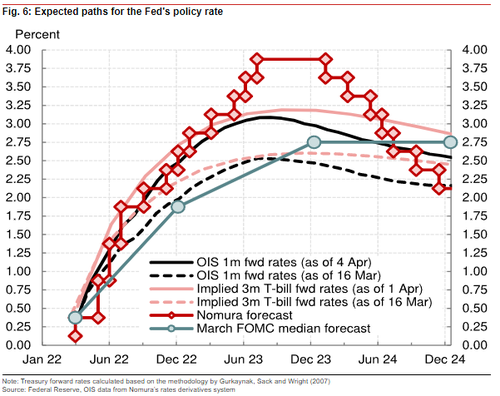
As Nomura’s Andy Chaytor points out, rates are fully-priced for The Fed… 2-year fwd 1mo USD rates are above the Median Fed ‘Dot’ for the first time since 2014…
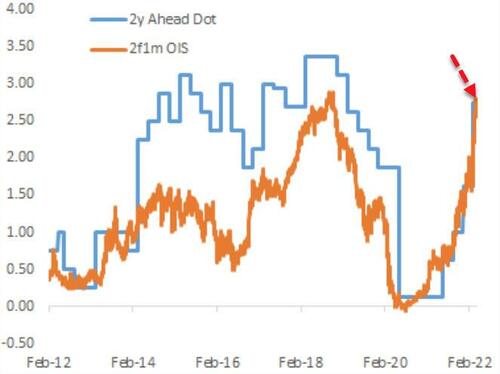
…and 5-year fwd 5Y rates have pushed above The Fed’s median long-term ‘Dot’ for the first time since the “QT Tantrum” in 2018…
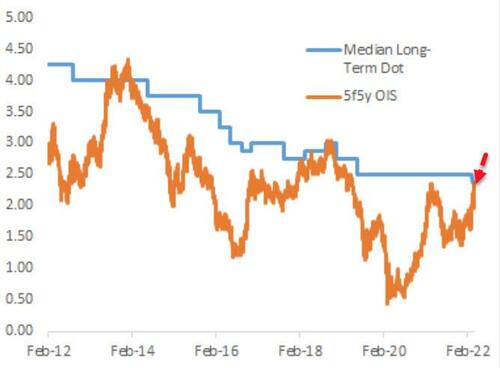
The theme in the US Equities market is that we look to be immersed in the process of “moving-on” from the policy tightening brought about by the inflation- and labor- overshoot, and are now operating under an assumption of US economic contraction / recession eventuality…
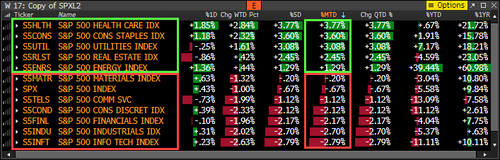
As the table above shows, the thematic signs of a pre-emptive “Defensive” re-allocation / rotation trade brewing, further confirming the optics of ED$ and OIS curves which are telling us that the market is beginning to position for a “hard-landing” as soon as mid-’23, as the Fed’s plans to run restrictive policy simultaneously with a heavy-handed balance-sheet run-off will push the economy into “Recession”.
And critically, look at US Eq Risk-Prem / Thematic behaviors – where the only of our main “Factor Pairs” in the green so far in April are “Low Risk,” “Size” (Big minus Small), “Quality,” “Momentum” and “Dividend,” all screaming recession / contraction…while High Beta / Spec is again getting hit hard.
So where do we go from here?
As per Nomura Economic Quadrant work, we have been in the “Slowdown” phase for months… but the most likely course from here is into “Contraction” a.k.a. “Recession,” as tighter financial conditions begin to bite…
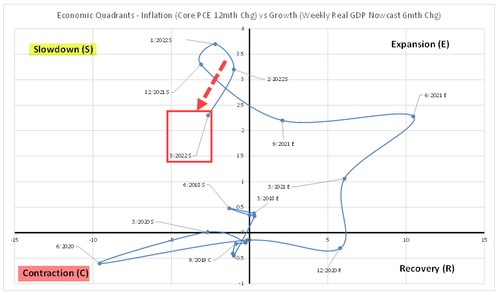
According to backtested Nomura data, there is a 26% chance of shifting into “contraction” within 3 months.
So from a historical US Equities Factor behavior perspective, what is the trade in the “Contraction / Recession” Quadrant?
Well, it looks a lot like ‘more of the same’ that has been happening this last week…
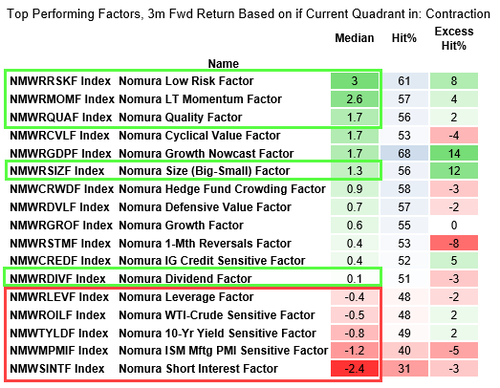
As we have previously explained – the broad Equities de-risking signal is not curve inversions (although it is a critical part of the overall sequencing, of course)… but instead, is when we get the steepening after inversion.
This pivot from “bear-flattening” / inversion into “steepening” tells you that the market has “smelled the recession,” rushing to price-OUT Fed HIKES and instead, price-IN Fed EASING thereafter, unwinding that hard “bear-flattening” we’ve been immersed within on the “tightening” policy pivot.
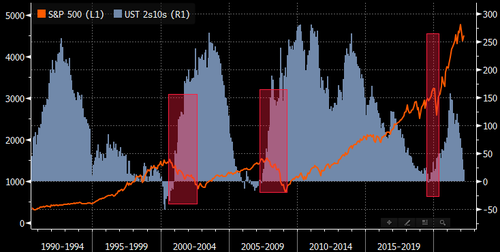
(FWIW, the recent steepening was more about how increasingly difficult it is to hold flatteners—hence, profit taking / unwind…I don’t believe this is the move yet)
Ultimately, however, once the Recession is “real” and the market anticipates / front-runs the Fed pivoting again towards QE (mid- / late- ’23?) – there is likely a bull-flattening, which again, from US Equities Factor perspective, looks a lot like the “Long Duration Barbell” of old-times…
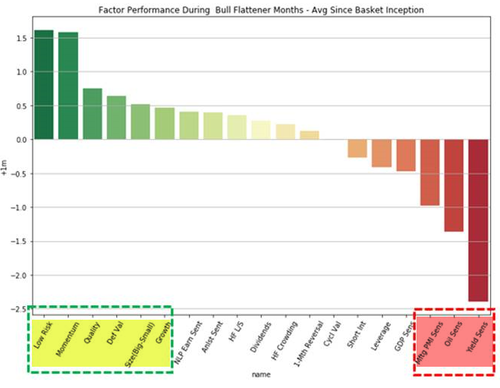
Tactically, for now, 4500 remains the key level to watch for the S&P 500
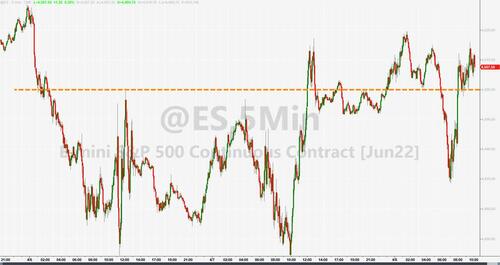
As SpotGamma notes, there is a fair amount of SPY gamma <=450 expiring today (~20% of total gamma) which can expand volatility for today.
If we hold the 4500 level into mid day, then the fuel builds in the bulls favor due to put decay and vanna flows and we could see a fairly strong move higher, with 4550 a reasonable target.
Conversely, a break of 4500, particularly into the close indicates a higher level of risk to markets due to the onset of negative gamma. As mentioned last night, one has to respect that markets have twice now bounced from 4450 despite the elevated IV and elevated negative gamma. The setup was in place for an extended drawdown, but the S&P has held on.
END
I) /MORNING TRADING/
Ruble Surges To 5-Month Highs After Russia Unexpectedly Slashes Rates By 300bps
FRIDAY, APR 08, 2022 – 08:23 AM
While the rest of the world is engaged in tightening monetary policy to tame the self-inflicted inflation beast, Russia’s central bank unexpectedly cut its key interest rate the most in nearly two decades last night in an attempt to stave off a domestic recession and bolster confidence in the economy.
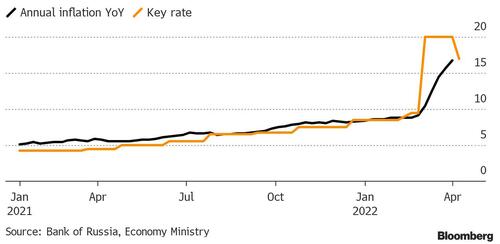
Taking the market completely by surprise, the central bank slashed rates by 300bps (from 20% to 17%) at an unscheduled meeting overnight and said further cuts could be made in the months ahead if conditions permit.
As Bloomberg reports, it’s a policy pivot that echoes Governor Elvira Nabiullina’s surprise 200 basis-point rate cut in 2015, which reversed an emergency hike made weeks earlier. At the time, Russia was entering an economic contraction following the first round of sanctions over Ukraine and the collapse in oil prices.
“The central bank wants to be a locomotive of the economic rebound, not a brake,” said Luis Saenz, head of international distribution at Sinara.
What is even more surprising to many is that the Ruble – previously dismissed as “rubble” by President Biden – actually strengthened further on the rate-cut, surging to 72/USD.
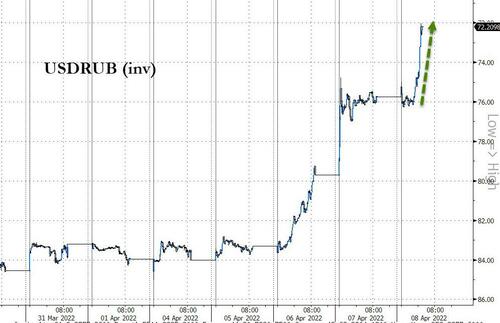
Source: Bloomberg
Additionally, yields on government ruble bonds tumbled 83 basis points to 11.19%
The Bank of Russia’s emergency rate hike in February and restrictions on foreign-exchange transactions were sufficient to lower risks for the financial system, according to Sova Capital economist Artem Zaigrin. It’s now having to react quickly to an unfolding crisis, he said.
“Thanks to these actions, the central bank was able to stop the outflow of funds from the banking system and restore the attractiveness of deposits,” he said.
“At the moment, the growing level of uncertainty in the economy and the sharp decline in demand have become prevalent.”
The latest rally in the Ruble lifted the Russian currency to its strongest against the dollar since Nov 2021…
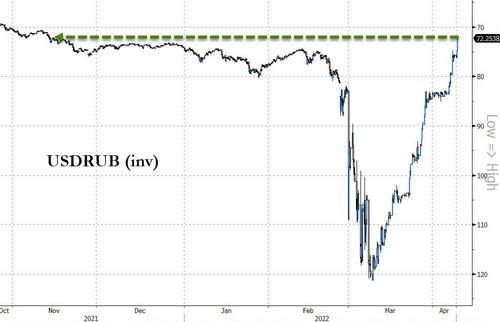
The media are claiming that the strength of the ruble “may be illusory” or that Russia has exploited a “loophole” in the sanctions and used “financial alchemy” to “rescue the ruble”.
Interestingly as Kit Knightly reminds us, in 2014, when the west sanctioned Russia over the Crimean referendum, the ruble lost almost half its value.
It recovered slightly in 2016, and has since stabilized, but has never come close to its pre-Crimean worth:
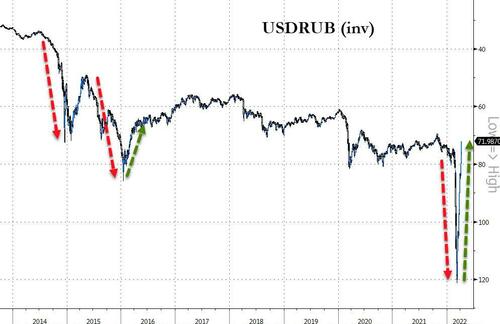
So, presumably the earlier sanctions didn’t have a “loophole” in them, and/or the Russians either weren’t aware of this “financial alchemy” back then, or simply decided not to use it.
Of course there is one key difference between 2014 and 2022 – the oil market.
As we have written before, in 2014/15 the US and Saudi Arabia flooded the market with cheap oil and crashed the price. Russia (and Iran, and Venezuela) all suffered huge economic damage from this move.
But far from repeating this tactic, Saudi Arabia has increased their prices.
It’s a different world now..
AFTERNOON
END
II)USA data
end
IIB) USA COVID/VACCINE MANDATES
How stupid can one get?
(Giordano/EpochTimes)
Hospital Refuses Father-To-Son Kidney Transplant Over COVID Jab
THURSDAY, APR 07, 2022 – 09:25 PM
Authored by Alice Giordano via The Epoch Times (emphasis ours),
A 9-year-old boy is being denied a life-saving kidney transplant because his father is not vaccinated against COVID-19.

Dane Donaldson was found to be a perfect match for his son Tanner back in early 2018 by the Cleveland Clinic Children’s Hospital before the outbreak of the pandemic.
The family decided to wait a little longer before having Tanner undergo the transplant since transplanted kidneys from a live donor only lasted about 20 years.
Then COVID-19 hit and put a freeze on the procedure.
Now the hospital is refusing to perform the life-saving father-to-son kidney transplant it agreed to do nearly four years ago over the senior Donaldson’s unvaccinated status.
In a statement released to The Epoch Times, the Cleveland Clinic cited a 2021 policy it adopted requiring all donors and candidates for organ transplants to be fully vaccinated against the virus.
“Individuals who are actively infected with COVID-19 have a much higher rate of complications during and after surgery, even if the infection is asymptomatic,” the hospital stated.
Donaldson, who is in the insurance business, told The Epoch Times he is opposed to the COVID-19 vaccine for religious reasons, but also because he has seen a rising number of clients get critically ill after receiving it.
He believes the hospital is contradicting itself by requiring a living donor to be vaccinated, but not a deceased one.
“I asked them in that car accident victim, would you vaccinate him on the way to the hospital to rip his kidney out and they said ‘no’,” Donaldson told The Epoch Times.
Donaldson said he even offered to sign a waiver freeing the hospital from any liability should either himself or his son develop COVID-19. At the same time, the hospital has refused to agree to take any responsibility for any side effects that he or his son experienced from the vaccine.
The hospital, he said, is blowing the chance of a lifetime for his son.
“A live donor is the best donor for kidneys,” said Donaldson, “but they’ll take a kidney from a deceased person not vaccinated, it makes no sense.”
The Cleveland hospital agreed that live donors are the best source for kidney transplant recipients, but emphasized that they were “not without risks”—noting that there is medication kidney transplant patients must take that compromises the immune system.
“We continually strive to minimize risk to our living donors, and vaccination is an important component to ensure the safest approach and optimal outcomes for donors,” it stated.
Donaldson said he and his wife Jenn are now in the process of finding another hospital to perform the transplant. They had wanted to stay with the children’s hospital because it has been treating his son since birth.
Tanner was born with compromised kidneys due to a rare birth defect that caused irreversible kidney damage in utero and resulted in stage 4 chronic kidney disease as well as bladder and urinary dysfunctions.
He now has only 18 percent function left of his kidneys, according to Donaldson.
The Donaldsons join a number of other publicized cases of U.S. hospitals that have refused to perform organ transplants because either the donor or recipient was not vaccinated.
Last month, The Epoch Times covered the story of an Air Force veteran who was denied a kidney transplant because he was refusing the vaccine.
Chad Carswell had only 4 percent kidney function left when the Atrium Health Wake Forest Baptist Medical Center in Winston-Salem, North Carolina, refused to keep him on their candidate list for a donated kidney.
Fortunately, after his story went public the Medical City Fort Worth Transplant Institute in Texas offered to put Carswell on their recipient list for a kidney. His attorney Adam Draper said that as of April 3, Carswell was still in need of a match for the transplant.
In January, attorneys for the conservative organization Informed Consent Action Network (ICAN) wrote a seven-page letter to the Cleveland Center requesting it reconsider the decision, and also the science behind it.
“Presently, it appears the hospital is operating under a psychosis of flawed morality in choosing to sacrifice the health and wellness of its 9-year-old patient in exchange for what it perceives to be the ‘greater good,’” ICAN’s lawyers Aaron Siri and Elizabeth Brehm wrote.
ICAN also called the hospital irrational because the entire family, including Tanner and his older brother, all had COVID-19 and recovered from it, meaning they have natural immunity.
In its letter to the hospital, ICAN cited a number of international studies that showed that re-infection of COVID-19 after recovering from the virus was rare.
Of the studies it cited was one performed by Cleveland Clinic itself.
In the study, the hospital looked at SARS-CoV-2 (the virus that causes COVID-19) infections in 52,238 vaccinated and unvaccinated health care workers over a five-month period.
It found that none of the previously infected healthcare workers who remained unvaccinated contracted SARS-CoV-2 over the course of the research despite a high background rate of COVID-19 in the hospital.
end
end
iiia) USA inflation//SHIPPING commentaries//LOG JAMS//
Does not look good for the trucking industry in the USA
(Fuller/Freightwaves)
Trucking Industry Will Be In Dire Straits If Demand Drops To Pre-COVID Levels
THURSDAY, APR 07, 2022 – 06:05 PM
By Craig Fuller, CEO of FreightWaves
Trucking spot rates are way up, but so are operating expenses. What does this mean for carriers?
“Demand is just falling back to pre-pandemic levels.” I’ve heard this rebuttal to my earlier articles about a 2022 trucking “bloodbath” (here and here) for the past week. If “demand falls back to pre-pandemic levels” turns out to be true, the situation for truckers will actually be much worse than even I have predicted.

Since the pandemic began, the number of dispatchable trucks in the for-hire trucking market (trucks with a driver and available to haul a load) is up approximately 10%. Since trucking rates are contingent upon the balance of supply and demand, if volumes were to drop back to pre-pandemic levels (with far more capacity in the market), rates would collapse.

But even more worrisome is that the operating expenses of carriers are at much higher levels than before COVID. FreightWaves estimates that operating expenses for nearly all carriers have surged by as much as $0.38 per mile over pre-COVID levels. This calculation only includes maintenance, insurance and fuel costs.

The calculation does not include driver wages or equipment purchase/finance, which could nearly double the increased amount of operating expenses.
If a trucking fleet were to start up today with an employee driver, its operating cash expenses would be as much as $0.72 per mile higher than a trucking fleet that was started in 2019.
Fuel
The cost of fuel is one of the largest variable operating expenses in the trucking industry. During 2019, retail diesel prices ranged between $2.97 and $3.11 per gallon. For the most part, retail diesel prices hardly moved in 2019.
Using an average of 7 miles per gallon, the cost of fuel during 2019 ranged from $0.42 to $0.44 per mile for a Class 8 truck. For most carriers operating in 2019, fuel was incredibly stable and was largely an afterthought.

Fast forward to April 5, 2022. The retail diesel price is $5.10/gallon. At 7 miles per gallon, that equates to $0.73/mile. This $0.30 increase per mile will significantly impact the cash flows of carriers.

Fuel is often paid for at the point of sale, when a truck is fueled. But shippers and brokers often pay a carrier a month or two after the load has been delivered.
According to data from the Truckload Carriers Association (TCA), an average carrier runs about 6,500 miles in a given month. At $0.30 per mile, the additional cash outlay for an operator compared to 2019 is approximately $1,950 per month. This is cash that a fleet must advance before collecting it from a broker or shipper. While carriers that have fuel surcharges will be able to pass on some of their fuel expenses to their shipper customers, carriers that operate in the spot market will not. Spot freight typically doesn’t include a surcharge for fuel.
Insurance and maintenance
Referencing TCA data, insurance costs per mile were $0.07 in 2019. In 2022, these costs have increased to $0.09 per mile. Using the same dataset, maintenance costs have increased from $0.20 to $0.26 per mile. In total, insurance and maintenance are up $0.08 per mile.
When added together (fuel, insurance, and maintenance) nearly every trucking company has experienced increases of at least $0.38 per mile versus 2019, regardless of when they consummated operations.
Lots of new entrants bought at the top of the market
The trucking market has experienced the highest number of new fleet startups in its history. The chart of new startup fleets could easily be confused with a meme stock.
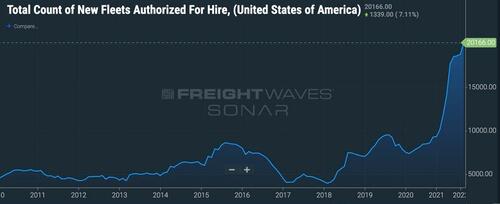
Entrepreneurs and aspiring fleet executives registered a new carrier with the FMCSA and then went out and purchased a truck. Since it was nearly impossible for these carriers to order a new truck from a truck manufacturer, we can assume that they bought a truck that was at least three years old from another carrier.
The worst thing anyone can do in any situation is to buy at the top of the market. With tender reject data warning that trucking companies are quickly losing pricing power for hauling loads, equipment values will soon follow.

Equipment purchase and finance
One of the largest expense increases is the truck itself. The cost of purchasing a new or used truck is mostly dependent upon when the truck was purchased. Therefore, there is a wide range in costs.
According to ACT data, a 3-year-old used truck could have been purchased for $69,000 in 2019. In early March 2022, the price of a 3-year-old truck had nearly doubled – to $136,000. This $67,000 increase in the cost of a used truck is unprecedented.

For this example, I will use a finance rate of 5% and a 60-month finance schedule. I will also assume that the buyer put no money down on the purchase and that there was 7% sales tax on the truck. I will also assume that a truck is being driven 6,500 miles per month.
At a 2019 sales price of $69,000, the monthly payment would be $1,393. At 6,500 miles per month, the fleet would need to generate $0.21 per mile in cash flow just to cover the equipment purchase.
The truck will have a residual value when it is sold five years later, but it is hard to predict what the market will be at that point. For our calculations, we are going to use cash flow and not GAAP.
If a similar truck was purchased in 2022, it would cost $136,000. The monthly payment would be $2,746, or $0.42 per mile.
While it is hard to predict how many used trucks traded at these extremely high levels, we know that many fleets have been growing quickly throughout the past few quarters and some fleets will be saddled with these headwinds.
Taken all together, a fleet that is relatively new to trucking, operating a used truck purchased in 2022, would need to generate $0.59/mile more than they would have if it had started operations in 2019. If there is an employee driver to consider, an over-the-road driver in 2022 can expect to make around $0.60/mile. In 2019, the same driver would have made around $0.47/mile.
With an employee driver, plus a truck purchased in 2022, a new fleet entering the market would have operating cash requirements that are $0.72 per mile more than the same fleet in 2019. Therefore, if a fleet is paying out an additional $0.72 per mile in operating cash compared to pre-pandemic, it will have an incredibly difficult time surviving in a dropping spot rate environment.
The spot rate environment is changing – and quickly
According to Truckstop.com, the current van truckload spot rate is $3.29 per mile (as of April 5, 2022). The Truckstop.com spot rate in SONAR includes fuel in the entire rate. All references to spot rates will include fuel.
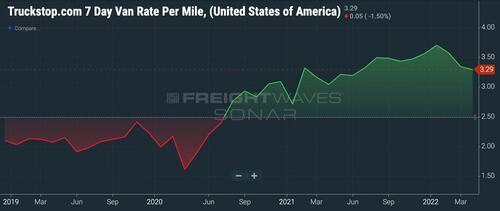
Trucking spot rates peaked on Jan. 9, 2022 at $3.83 per mile. The $0.54 drop per mile is significant, but in historical context trucking spot rates are still way up – by over $1.00 per mile.
Looking back at 2019, which was when we experienced the last freight recession, trucking spot rates ranged from $1.91 to $2.54 per mile. While these ranges are the low and highs, the typical range during 2019 was closer to $2.00-2.20 per mile.
But here is where it gets tricky. The trucking spot rate is only one part of the story. It doesn’t tell us how profitable trucking carriers are.
Trucking is a very difficult business to make money in
A lot of this depends on whether or not spot rates drop to levels that drain the cash flow of carriers to the point that they run out of money.
Trucking is a notoriously difficult business, with violent swings between bull and bear markets. Even in the best of times, trucking companies struggle for every penny of profit.
The best trucking market in history took place in 2021, marked by record volume and unprecedented trucking spot rates. Nonetheless, average trucking companies struggled to make money.
The operating ratio for dry van truckload carriers in 2021 across TCA’s benchmarking program ranged from 92 to 97. That means for every $100 of revenue the fleet generated, it generated an operating profit of just $3 to $8. This was before the fleet paid for any working capital lines of credit (debt) or taxes.
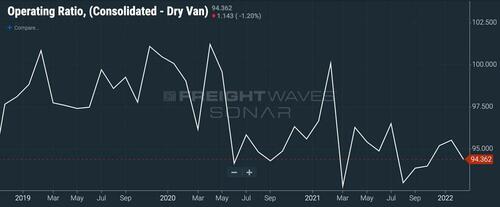
Is a bloodbath on the way?
The bloodbath of 2019 was marked by the highest number of trucking fleet bankruptcies in history. If we see trucking spot rates continue to drop, we may see similar or worse conditions in the market.
The operating ratio for truckload carriers in 2019 ranged from 97 to 101. A significant deterioration in spot rates, combined with the surge in operating expenses that fleets are contending with, could spell disaster for many.
The low for trucking spot rates in 2019 was $1.91/mile. I am assuming that this is the baseline for which many small carriers will struggle to survive. Fuel is a part of the spot rate, so the calculation should be adjusted.
The $0.30/mile increase in fuel means the adjusted 2019 spot rate “bloodbath baseline” would be around $2.21 per mile. Since fuel bills are paid immediately, I assume that anything below this spot rate level will be dire for many small trucking companies and could result in a rapid acceleration in fleet bankruptcies.
Insurance and maintenance are not “instant” killers of fleets, but kill over time. As long as spot rates are above $2.34 per mile for most of 2022 the majority of small fleets that entered the market prior to 2020 will survive – at least until their insurance bills hit or they have a breakdown.

But new fleets will be at a major disadvantage to existing fleets
If a fleet is new to trucking and purchased a truck in 2022, it has the worst operating environment of any carrier. Assuming that the truck is being driven by an employee driver, spot rates below $2.63 per mile could spell disaster for trucking fleets if that rate persists for long.
All of this could change – and quickly.
If retail diesel prices move up, the break-even point for carriers would move up as well. If fuel drops, the break-even point would be lower. Watch the direction of retail diesel; it has a lot to do with the profitability of trucking fleets, especially small carriers.
If fuel continues to surge, the “bloodbath baseline” will also move up as well. On the other hand, if fuel drops, there could be significant relief for the small spot market carriers.
There is a great deal of disagreement on the direction of fuel and trucking spot rates, but one thing is certain – there will be volatility. Hopefully, we all avoid vertigo along the way.
iiib) USA economic stories
iv)swamp stories
The King Report (including swamp stories)
Bullard: Fed “behind the curve,” sees rates now at 3.5% by year’s end https://t.co/StcLCealc5
@nytimes: The Senate voted to strip Moscow of its preferential trade status with the U.S. and to ban the import of Russian energy into the U.S. Experts have said that the oil and gas ban would be largely symbolic. https://t.co/FL7clrfuwZ
The House passed a bill to suspend normal trade relations with Russia/Belarus, 420-3. It voted to bar the importation of Russian oil by 413-9. The House backed $55B Covid relief for restaurants & other firms.
NATO chief Jens Stoltenberg: “We have seen that China is unwilling to condemn Russia’s aggression. And Beijing has joined Moscow in questioning the right of nations to choose their own path. This is a serious challenge.”
ESMs traded in negative territory during Asian trading. They rallied sharply into the European open but topped at 3:23 ET. Another rally developed just before 5 ET. The rally ended within an hour. ESMs then tumbled until they hit the session bottom at 12:47 ET. ESMs and stocks then soared until they hit session highs at 15:45 ET. Thursday was another instance of stocks getting hammered in the US during morning trading and then some forcing ESMs and stocks higher thereafter.
Larry Summers: My inflation warnings have spurred questions. Here are my answers.
First, the question isn’t whether inflation will come down from about 8 percent on the current policy path. It is whether it will come down to an acceptable level….
Second, given new bottlenecks associated with the Ukraine war, covid-19 closures in China and rising worker restiveness, it is far from clear that new supply-chain developments will be positive…
Third, the optimists have their macroeconomics wrong. True, more job seekers might restrain wages. But more workers earning and spending raise demand and prices… There is a first time for everything, but over the past 75 years, every time inflation has exceeded 4 percent and unemployment has been below 5 percent, the U.S. economy has gone into recession within two years. Today, inflation is north of 6 percent and unemployment is south of 4 percent…
https://www.washingtonpost.com/opinions/2022/04/05/lawrence-summers-inflation-warnings-questions-and-answers/
Nobel economists were dead wrong on inflation: Don’t expect an apology
When it looked like the Democratic majority might include enough deficit hawks to scuttle the bill, Nobel Laureate economist Joseph Stiglitz rounded up another 16 of the 36 living American Nobel Prize economists to declare, in an open letter, that whatever upward pressure on prices all this new money might bring there was no threat of inflation…
The Nobelists assured that we would see a robust recovery because of President Biden’s “active government interventions.” Their presumed authority was used to give credence to the president’s continuously twisting storyline on inflation — that it was “transitory,” good for the economy, a “high-class problem,” Putin’s fault for invading Ukraine, and the greed of oil and food companies causing rapid price increases in gasoline and groceries…
https://thehill.com/opinion/finance/3259197-nobel-economists-were-dead-wrong-on-inflation-dont-expect-an-apology/?s=02
@zerohedge: Peter Thiel speaking at Bitcoin 2022: Today all the gold in the world is worth $12 trillion, while global equities are worth $115 trillion. In 1980, the ratio was one-to-one, with all the gold in the world and global equities having the same value of $2.5 trillion.
Thiel Blasts Dimon, Buffett and Fink as ‘Finance Gerontocracy’ at Bitcoin 2022
Thiel, 54, also attacked central bankers including Federal Reserve Chairman Jerome Powell. “Mr. Powell — people like that — should be extremely grateful to Bitcoin because it’s the last warning they are going to get,” Thiel said. https://www.bloombergquint.com/business/thiel-blasts-dimon-buffett-and-fink-as-finance-gerontocracy
Second COVID booster shot boosts infection protection for just a few weeks: study
https://www.nydailynews.com/coronavirus/ny-covid-second-booster-protection-against-infection-pfizer-20220406-g6swul3phjcmjj5fc2d3zgqjum-story.html
Pelosi has Covid; Obama had it in March.
@charliespiering: Jen Psaki says “close contact” means a person being with 6 ft of someone for a period of 15 minutes. She says Pelosi kissing Biden does not meet that definition. (Not a parody!)
NBC News staffers concerned MSNBC’s Psaki hire could taint reputation https://t.co/FbY41vHs21
Flight attendants suing against Biden mask mandate say they ‘were weaponized to be mask enforcers’ https://t.co/B8blKHq3FP
CIA general counsel nominee did legal work for Chinese Communist Party-linked company, documents and testimony reveal https://t.co/Wy1LWtBqEN
Russian commander orders soldiers to ‘take out’ Ukrainian civilians near besieged Mariupol
Ukraine says it intercepted recordings of Russian soldiers communicating by radio outside Mariupol
https://www.foxnews.com/world/russian-commander-orders-soldiers-take-out-ukrainian-civilians-mariupol
@POLITICOEurope: German Chancellor Olaf Scholz is delaying a final decision on giving Ukraine about 100 tanks for its battle against Russia. A decision on the matter was initially expected this week. It’s now in limbo, causing backlash from Scholz’s coalition partners.
https://www.politico.eu/article/scholz-holds-up-german-tank-delivery-to-ukraine/
February Consumer Credit $41.82B; $18.1B was expected. The Fed Balance Sheet: +$450 million
Today – Be alert for the Friday afternoon rally that precedes expiry week. Pattern and conditioned traders will be bullish next week because Q1 results commence. Historically, Fangs lead expiry and earnings season rallies. Big banks report first; Fangs begin reporting a few days later.
Blatant upward manipulation returned to the US stock market on Thursday. The key for today could be the absence or presence of the manipulator(s). Traders are bullish for next week!
ESMs are +5.25 at 20:10 ET; USMs are +12/32. There is no impact news as we write.
Expected econ data: Feb Wholesale Inventories 2.1% m/m, Sales 0.8% m/m
S&P 500 Index 50-day MA: 4421; 100-day MA: 4538; 150-day MA: 4522; 200-day MA: 4490
DJIA 50-day MA: 34,370; 100-day MA: 34,991; 150-day MA: 35,029; 200-day MA: 35,015
S&P 500 Index – Trender trading model and MACD for key time frames
Monthly: Trender is positive; MACD is negative – a close below 4153.02 triggers a sell signal
Hourly: Trender and MACD are negative – a close above 4547.45 triggers a buy signal
Daily: Trender and MACD are positive – a close below 4469.69 triggers a sell signal
Hourly: Trender is negative; MACD is positive – a close above 4525.40 triggers a buy signal
Joe Biden’s Released Tax Returns Don’t Explain Millions in Income. Where Did It Come From? https://t.co/ushHED3Z5X
@kristina_wong: Republicans in the House and Senate during hearings this week have expressed frustration over the Biden administration not deterring Russia from invading Ukraine. Some (mostly in the Senate) not happy the Biden administration is not talking enough about “winning.” (Kompromat?)
Republican registrations surge in Pennsylvania in warning sign for Democrats https://t.co/qy6zqVxWjr
Suburban Chicago Church Says for Lent 2022 it is ‘Fasting from Whiteness’ – “In our worship services throughout Lent, we will not be using any music or liturgy written or composed by white people.”
https://www.nbcchicago.com/news/local/suburban-chicago-church-says-for-lent-2022-it-is-fasting-from-whiteness/2800711/?amp
BLM’s LA mansion sold for 250 percent more than the price of similar homes in the area
The house was purchased by Dyane Pascall, a real estate developer who worked for Janaya and Patrisse Consulting, a for-profit firm run by BLMGNF co-founder Patrisse Cullors and her partner Janaya Khan.
https://nypost.com/2022/04/06/blms-la-mansion-sold-for-250-times-the-price-of-other-homes-in-the-neighborhood/
U.S. Secret Service places agents on leave over gifts from phony cops
Taherzadeh and Ali had posed as special agents since at least February 2020 and offered a variety of gifts to Secret Service members and at least one homeland security employee… The Justice Department said the two men tried to recruit at least one person to join what they claimed was an official DHS “task force.”… (What federal agency has not been corrupted?) http://reut.rs/3KqDPxZ



 harveyorganblog.com

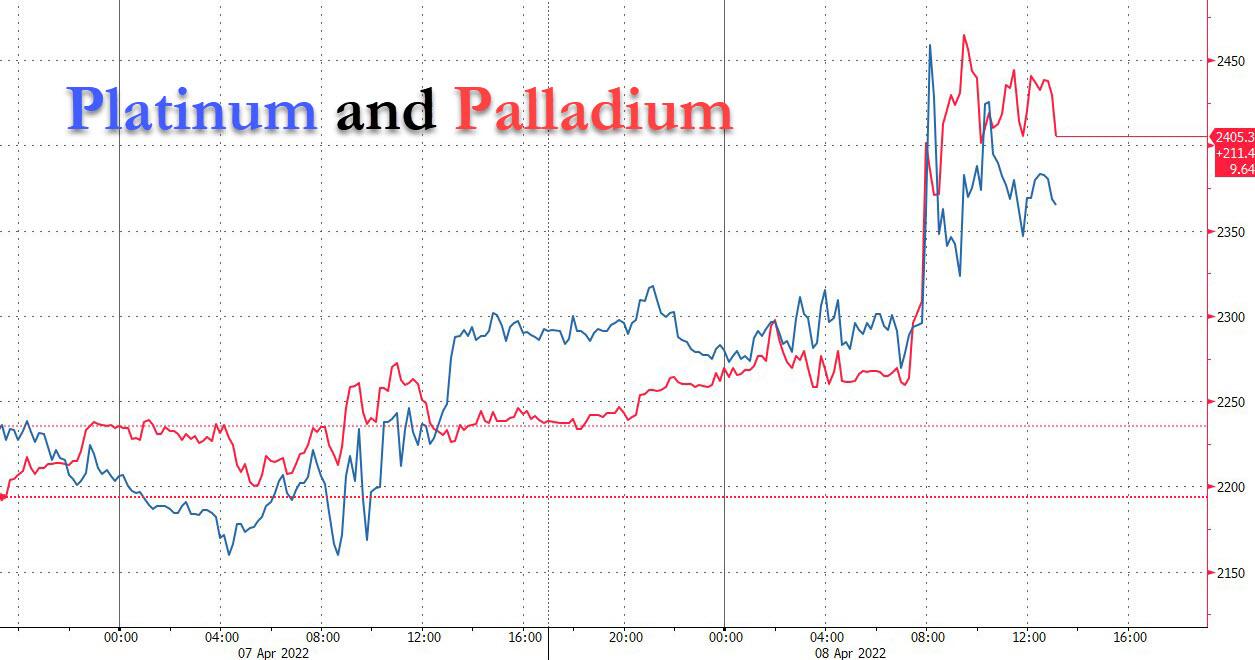
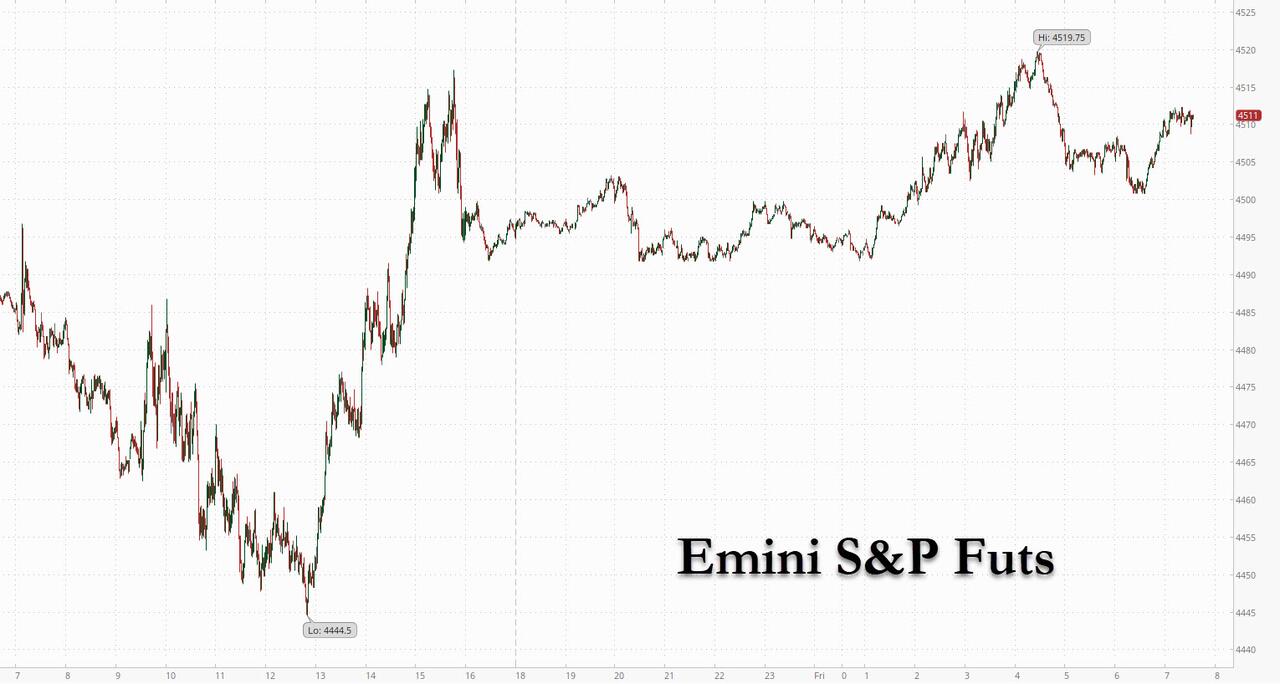


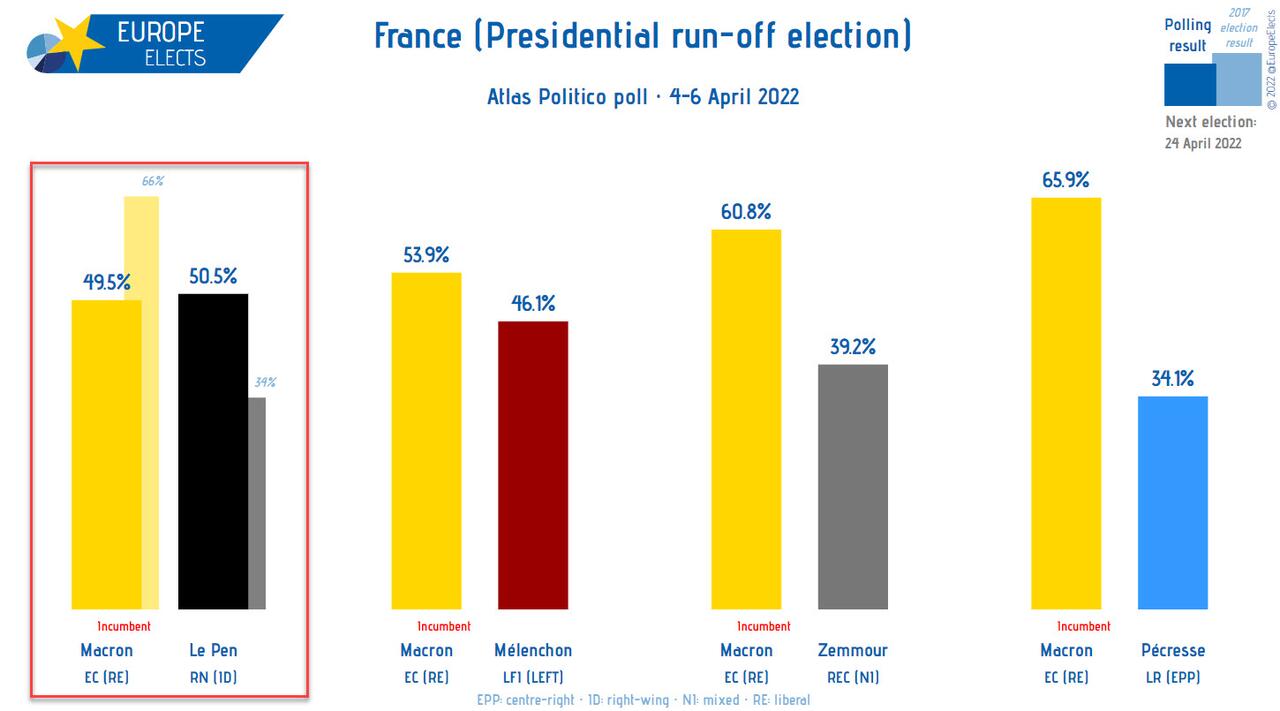
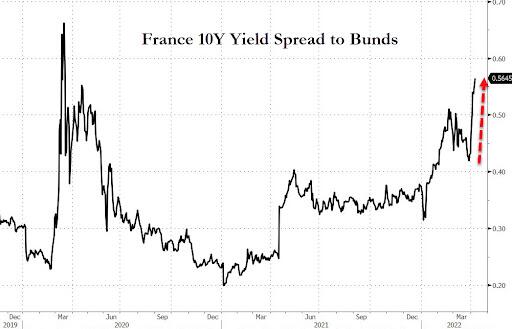
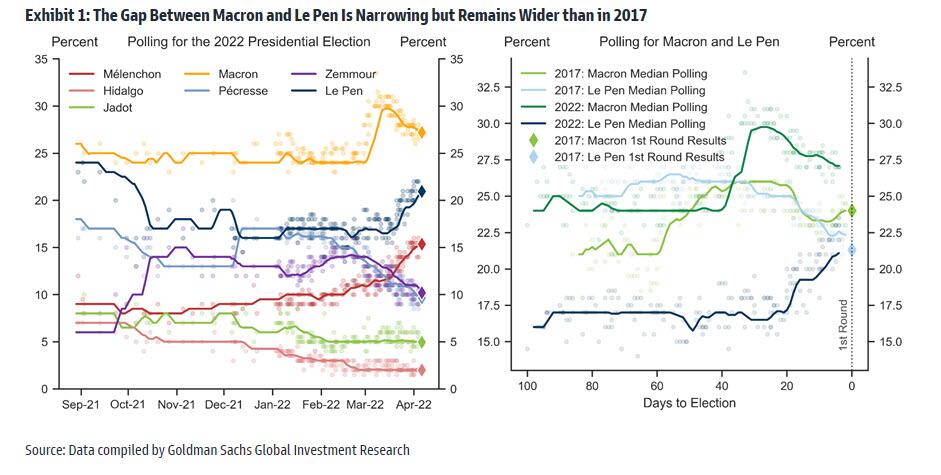
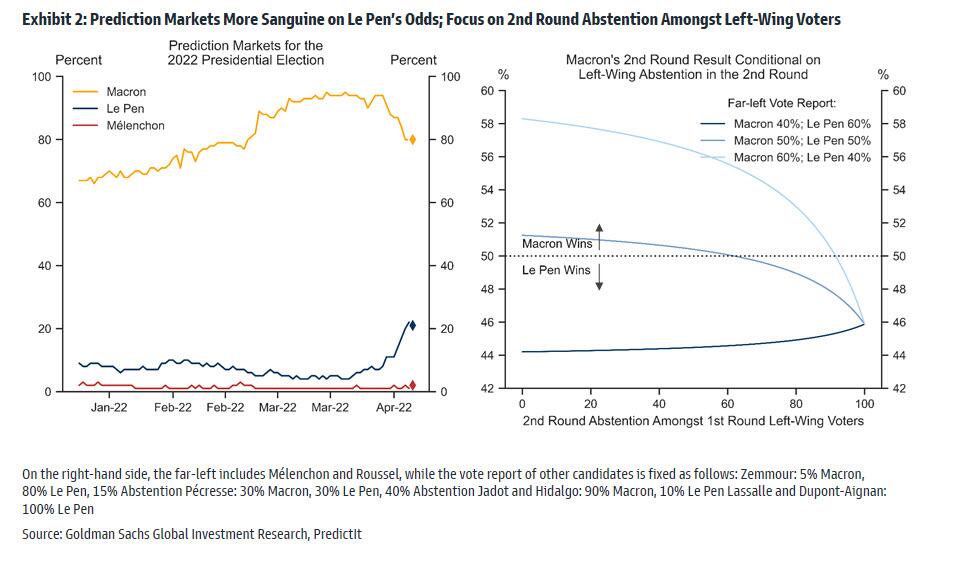



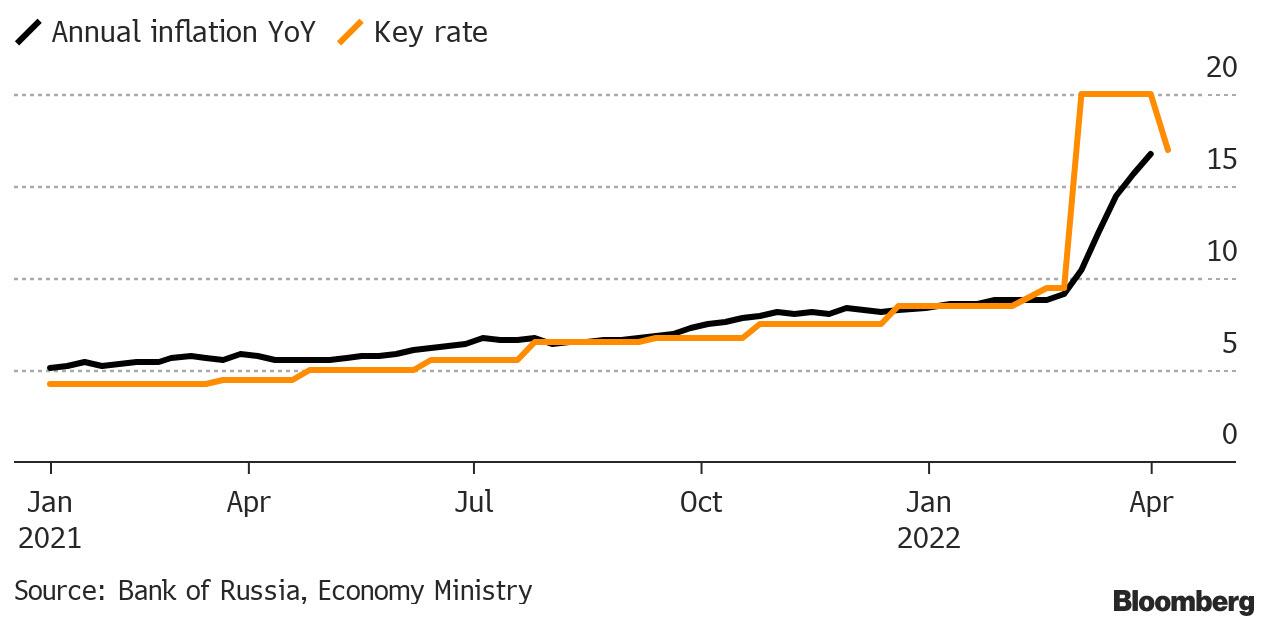
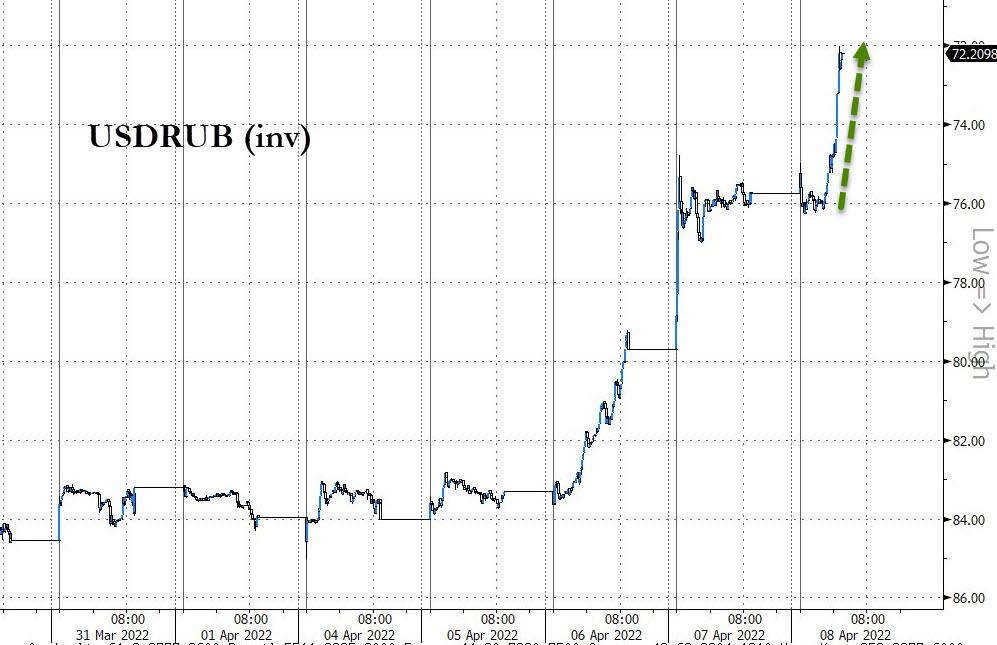
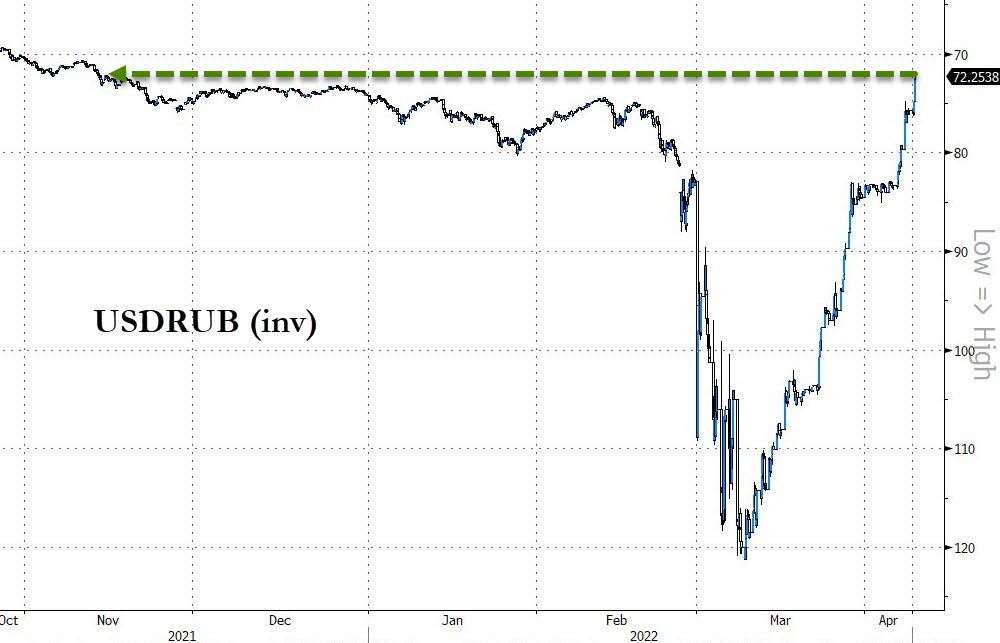
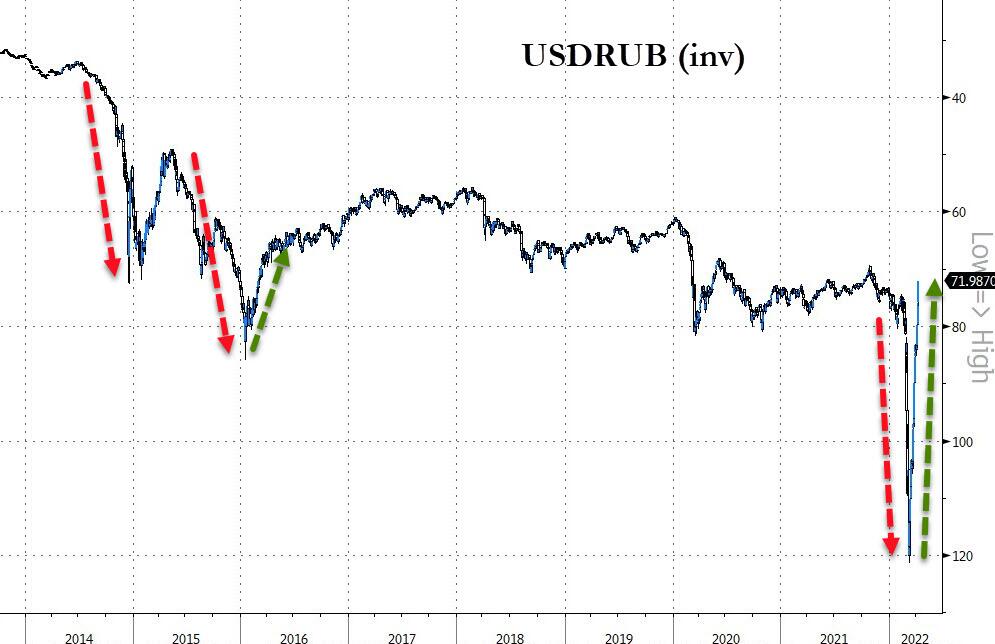


[…] by Harvey Organ, Harvey Organ Blog: […]
LikeLike
[…] by Harvey Organ, Harvey Organ Blog: […]
LikeLike