
April 12, 2022 · by harveyorgan · in Uncategorized · Leave a comment·Edit
april12, 2022 · by harveyorgan · in Uncategorized · Leave a comment·Edit
GOLD; $1971.95 UP $26.95
SILVER: $25.51 UP $0.66
ACCESS MARKET: GOLD $1966.30
SILVER: $25.33
Bitcoin morning price: $40,.328 UP 101
Bitcoin: afternoon price: $39,485 DOWN 742
Platinum price: closing DOWN $5.10 to $972.70
Palladium price; closing DOWN 54.55 at $2366.75
END
DONATE
Click here if you wish to send a donation. I sincerely appreciate it as this site takes a lot of preparation
comex notices/
: JPMorgan stopped/total issued 155/424
EXCHANGE: COMEX
CONTRACT: APRIL 2022 COMEX 100 GOLD FUTURES
SETTLEMENT: 1,944.300000000 USD
INTENT DATE: 04/11/2022 DELIVERY DATE: 04/13/2022
FIRM ORG FIRM NAME ISSUED STOPPED
072 C GOLDMAN 20
104 C MIZUHO 50
118 C MACQUARIE FUT 262 3
132 C SG AMERICAS 19
167 C MAREX 1
363 H WELLS FARGO SEC 10
435 H SCOTIA CAPITAL 10
624 H BOFA SECURITIES 33
657 C MORGAN STANLEY 1 23
661 C JP MORGAN 110 155
686 C STONEX FINANCIA 1
709 C BARCLAYS 74
732 C RBC CAP MARKETS 1
737 C ADVANTAGE 2
880 H CITIGROUP 71
905 C ADM 1 1
TOTAL: 424 424
MONTH TO DATE: 24,365
NUMBER OF NOTICES FILED TODAY FOR APRIL. CONTRACT424 NOTICE(S) FOR 42,400 OZ (1.3188 TONNES)
total notices so far: 24,365 contracts for 2,436,500 oz (75.705 tonnes)
SILVER NOTICES:
71 NOTICE(S) FILED TODAY FOR 355,000 OZ/
total number of notices filed so far this month 1070 : for 5,350,000 oz
END
Russia is a major supplier of silver to London while Mexico supplies the COMEX
With the sanctions, London has no way to obtain silver other than compete with NY.
END
GLD
WITH GOLD UP $26.95
WITH RESPECT TO GLD WITHDRAWALS: (OVER THE PAST FEW MONTHS):
GOLD IS “RETURNED” TO THE BANK OF ENGLAND WHEN CALLING IN THEIR LEASES: THE GOLD NEVER LEAVES THE BANK OF ENGLAND IN THE FIRST PLACE. THE BANK IS PROTECTING ITSELF IN CASE OF COMMERCIAL FAILURE
ALSO INVESTORS SWITCHING TO SPROTT PHYSICAL (phys) INSTEAD OF THE FRAUDULENT GLD//
A HUGE CHANGE IN GOLD INVENTORY AT THE GLD A DEPOSIT OF 2.61 TONNES FROM THE GLD//
INVENTORY RESTS AT 1093.10 TONNES
Silver//SLV
WITH NO SILVER AROUND AND SILVER UP 66 CENTS
AT THE SLV// NO CHANGES IN SILVER INVENTORY AT THE SLV/ THE SLV//
INVESTORS ARE SWITCHING SLV TO SPROTT’S PSLV
CLOSING INVENTORY: 565.521 MILLION OZ
Let us have a look at the data for today
SILVER//OUTLINE
SILVER COMEX OI ROSE BY A GIGANTIC SIZED 3275 CONTRACTS TO 14,945 AND CLOSER TO THE NEW RECORD OF 244,710, SET FEB 25/2020 AND THE HUGE GAIN IN OI WAS ACCOMPLISHED WITH OUR SMALL $0.13 GAIN IN SILVER PRICING AT THE COMEX ON MONDAY. OUR BANKERS WERE UNSUCCESSFUL IN KNOCKING THE PRICE OF SILVER DOWN (IT ROSE BY $0.13) AND WERE UNSUCCESSFUL IN KNOCKING OUT ANY SILVER LONGS AS WE HAD A HUMONGOUS GAIN OF 6217 CONTRACTS ON OUR TWO EXCHANGES
WE MUST HAVE HAD:
I) HUGE BANKER SHORT COVERING AS THEY ARE VERY ANXIOUS TO GET OUT OF DODGE!!/. II)WE ALSO HAD SOME REDDIT RAPTOR BUYING//. iii) A STRONG ISSUANCE OF EXCHANGE FOR PHYSICALS iiii) A STRONG INITIAL SILVER STANDING FOR COMEX SILVER MEASURING AT 4.305 MILLION OZ FOLLOWED BY TODAY’S QUEUE. JUMP OF 5,000 OZ//NEW STANDING: 5.455 MILLION OZ// V) HUGE SIZED COMEX OI GAIN/
I AM NOW RECORDING THE DIFFERENTIAL IN OI FROM PRELIMINARY TO FINAL:
THE DIFFERENTIAL FROM PRELIMINARY OI TO FINAL OI SILVER TODAY: CONTRACTS : —-1012 (which is huge)
HISTORICAL ACCUMULATION OF EXCHANGE FOR PHYSICALS APRIL. ACCUMULATION FOR EFP’S SILVER/JPMORGAN’S HOUSE OF BRIBES/STARTING FROM FIRST DAY/MONTH OF APRIL:
TOTAL CONTACTS for 8 days, total 5041 contracts: 25.205 million oz OR 3.15MILLION OZ PER DAY. (630 CONTRACTS PER DAY)
TOTAL NO OF OZ UNDERGOING EFP TO LONDON 5041 CONTRACTS X 5,000 PER CONTRACT:
EQUATES TO: 25.205 MILLION OZ
.
LAST 11 MONTHS TOTAL EFP CONTRACTS ISSUED IN MILLIONS OF OZ:
MAY 137.83 MILLION
JUNE 149.91 MILLION OZ
JULY 129.445 MILLION OZ
AUGUST: MILLION OZ 140.120
SEPT. 28.230 MILLION OZ//
OCT: 94.595 MILLION OZ
NOV: 131.925 MILLION OZ
DEC: 100.615 MILLION OZ
JAN 2022// 90.460 MILLION OZ
FEB 2022: 72.39 MILLION OZ//
MARCH: 207.430 MILLION OZ//A NEW RECORD FOR EFP ISSUANCE AND WE ARE STILL GOING STRONG THIS MONTH.
APRIL: 25.205 MILLION OZ (LOOKS LIKE OUR BANKERS ARE NOW LOATHE TO ISSUE EFP’S)
RESULT: WE HAD A HUGE SIZED INCREASE IN COMEX OI SILVER COMEX CONTRACTS OF 3275 DESPITE OUR SMALL $0.11 GAIN IN SILVER PRICING AT THE COMEX// MONDAY THE CME NOTIFIED US THAT WE HAD A STRONG SIZED EFP ISSUANCE CONTRACTS: 1930 CONTRACTS ISSUED FOR MAY AND 0 CONTRACTS ISSUED FOR ALL OTHER MONTHS) WHICH EXITED OUT OF THE SILVER COMEX TO LONDON AS FORWARDS THE DOMINANT FEATURE TODAY: /HUGE BANKER SHORT COVERING AS THEY GET OUT OF DODGE//// WE HAVE A HUGE INITIAL SILVER OZ STANDING FOR MAR. OF 4.305 MILLION OZ FOLLOWED BY TODAY’S 5,000 OZ QUEUE JUMP//NEW STANDING: 5.455 MILLION OZ/// .. WE HAD AN HUGE SIZED GAIN 5205 OI CONTRACTS ON THE TWO EXCHANGES FOR 26.025 MILLION OZ DESPITE THE SMALL GAIN IN PRICE.
WE HAD 71 NOTICES FILED TODAY FOR 355,000 OZ
THE SILVER COMEX IS NOW BEING ATTACKED FOR METAL BY LONDONERS ET AL.
GOLD//OUTLINE
IN GOLD, THE COMEX OPEN INTEREST ROSE BY A SMALL SIZED 1643 CONTRACTS TO 570,795 AND CLOSER TO NEW RECORD (SET JAN 24/2020) AT 799,541 AND PREVIOUS TO THAT: (SET JAN 6/2020) AT 797,110.
THE DIFFERENTIAL FROM PRELIMINARY OI TO FINAL OI IN GOLD TODAY: 291 CONTRACTS.
THE BIS HAS ABANDONED THE GOLD COMEX TRADING!!!
.
THE SMALL SIZED INCREASE IN COMEX OI CAME WITH OUR SMALL GAIN IN PRICE OF $3.40//COMEX GOLD TRADING/MONDAY /.AS IN SILVER WE MUST HAD HUGE BANKER/ALGO SHORT COVERING ACCOMPANYING OUR FAIR SIZED EXCHANGE FOR PHYSICAL ISSUANCE. WE HAD ZERO LONG LIQUIDATION
WE ALSO HAD A HUGE INITIAL STANDING IN GOLD TONNAGE FOR APRIL AT 78.33 TONNES
YET ALL OF..THIS HAPPENED WITH OUR GAIN IN PRICE OF $3.40 WITH RESPECT TO MONDAY’S TRADING
WE HAD AN FAIR SIZED GAIN OF 3678 OI CONTRACTS (11.44 PAPER TONNES) ON OUR TWO EXCHANGES
E.F.P. ISSUANCE
THE CME RELEASED THE DATA FOR EFP ISSUANCE AND IT TOTALED A FAIR SIZED 2326 CONTRACTS:
The NEW COMEX OI FOR THE GOLD COMPLEX RESTS AT 570,795.
IN ESSENCE WE HAVE A FAIR SIZED INCREASE IN TOTAL CONTRACTS ON THE TWO EXCHANGES OF 3678, WITH 1352 CONTRACTS INCREASED AT THE COMEX AND 2326 EFP OI CONTRACTS WHICH NAVIGATED OVER TO LONDON. THUS TOTAL OI GAIN ON THE TWO EXCHANGES OF 3678 CONTRACTS OR 11.44 TONNES.
CALCULATIONS ON GAIN/LOSS ON OUR TWO EXCHANGES
WE HAD A FAIR SIZED ISSUANCE IN EXCHANGE FOR PHYSICALS (2326) ACCOMPANYING THE SMALL SIZED GAIN IN COMEX OI (1352,): TOTAL GAIN IN THE TWO EXCHANGES 3678 CONTRACTS. WE NO DOUBT HAD 1) HUGE BANKER SHORT COVERING ,2.) HUGE INITIAL STANDING AT THE GOLD COMEX FOR APRIL. AT 78.33 TONNES FOLLOWED BY TODAY’S 1900 OZ QUEUE JUMP //NEW STANDING 80.702 TONNES/// 3) ZERO LONG LIQUIDATION ///. ,4) SMALL SIZED COMEX OI. GAIN 5) FAIR ISSUANCE OF EXCHANGE FOR PHYSICAL/
HISTORICAL ACCUMULATION OF EXCHANGE FOR PHYSICALS IN 2022 INCLUDING TODAY
APRIL
ACCUMULATION OF EFP’S GOLD AT J.P. MORGAN’S HOUSE OF BRIBES: (EXCHANGE FOR PHYSICAL) FOR THE MONTH OF APRIL :
19,197 CONTRACTS OR 1,919,700 OR 59.71 TONNES 8 TRADING DAY(S) AND THUS AVERAGING: 2399 EFP CONTRACTS PER TRADING DAY
TO GIVE YOU AN IDEA AS TO THE SIZE OF THESE EFP TRANSFERS : THIS MONTH IN 8 TRADING DAY(S) IN TONNES: 59.71TONNES
TOTAL ANNUAL GOLD PRODUCTION, 2020, THROUGHOUT THE WORLD EX CHINA EX RUSSIA: 3555 TONNES
THUS EFP TRANSFERS REPRESENTS 59.71/3550 x 100% TONNES 1.69% OF GLOBAL ANNUAL PRODUCTION
ACCUMULATION OF GOLD EFP’S YEAR 2021 TO 2022
JANUARY/2021: 265.26 TONNES (RAPIDLY INCREASING AGAIN)
FEB : 171.24 TONNES ( DEFINITELY SLOWING DOWN AGAIN)..
MARCH:. 276.50 TONNES (STRONG AGAIN/
APRIL: 189..44 TONNES ( DRAMATICALLY SLOWING DOWN AGAIN//GOLD IN BACKWARDATION)
MAY: 250.15 TONNES (NOW DRAMATICALLY INCREASING AGAIN)
JUNE: 247.54 TONNES (FINAL)
JULY: 188.73 TONNES FINAL
AUGUST: 217.89 TONNES FINAL ISSUANCE.
SEPT 142.12 TONNES FINAL ISSUANCE ( LOW ISSUANCE)_
OCT: 141.13 TONNES FINAL ISSUANCE (LOW ISSUANCE)
NOV: 312.46 TONNES FINAL ISSUANCE//NEW RECORD!! (INCREASING DRAMATICALLY)//SIGN OF REAL STRESS//SURPASSING THE MARCH 2021 RECORD OF 276.50 TONNES OF EFP
DEC. 175.62 TONNES//FINAL ISSUANCE//
JAN:2022 247.25 TONNES //FINAL
FEB: 196.04 TONNES//FINAL
MARCH: 409.30 TONNES INITIAL( THIS IS NOW A RECORD EFP ISSUANCE FOR MARCH AND FOR ANY MONTH.
APRIL: 59.71 TONNES (THIS IS GOING TO BE A LOW ISSUANCE MONTH)
SPREADING OPERATIONS
(/NOW SWITCHING TO GOLD) FOR NEWCOMERS, HERE ARE THE DETAILS
SPREADING LIQUIDATION HAS NOW COMMENCED AS WE HEAD TOWARDS THE NEW ACTIVE FRONT MONTH OF MAY.WE ARE NOW INTO THE SPREADING OPERATION OF SILVER
HERE IS A BRIEF SYNOPSIS OF HOW THE CROOKS FLEECE UNSUSPECTING LONGS IN THE SPREADING ENDEAVOUR ;MODUS OPERANDI OF THE CORRUPT BANKERS AS TO HOW THEY HANDLE THEIR SPREAD OPEN INTERESTS:HERE IS HOW THE CROOKS USED SPREADING AS WE ARE NOW INTO THE NON ACTIVE DELIVERY MONTH OF APRIL HEADING TOWARDS THE ACTIVE DELIVERY MONTH OF MAY, FOR SILVER:
YOU WILL ALSO NOTICE THAT THE COMEX OPEN INTEREST STARTS TO RISE BUT SO IS THE OPEN INTEREST OF SPREADERS. THE OPEN INTEREST IN WILL CONTINUE TO RISE UNTIL ONE WEEK BEFORE FIRST DAY NOTICE OF AN UPCOMING ACTIVE DELIVERY MONTH (MAR), AND THAT IS WHEN THE CROOKS SELL THEIR SPREAD POSITIONS BUT NOT AT THE SAME TIME OF THE DAY. THEY WILL USE THE SELL SIDE OF THE EQUATION TO CREATE THE CASCADE (ALONG WITH THEIR COLLUSIVE FRIENDS) AND THEN COVER ON THE BUY SIDE OF THE SPREAD SITUATION AT THE END OF THE DAY. THEY DO THIS TO AVOID POSITION LIMIT DETECTION. THE LIQUIDATION OF THE SPREADING FORMATION CONTINUES FOR EXACTLY ONE WEEK AND ENDS ON FIRST DAY NOTICE.”
WHAT IS ALARMING TO ME, ACCORDING TO OUR LONDON EXPERT ANDREW MAGUIRE IS THAT THESE EFP’S ARE BEING TRANSFERRED TO WHAT ARE CALLED SERIAL FORWARD CONTRACT OBLIGATIONS AND THESE CONTRACTS ARE LESS THAN 14 DAYS. ANYTHING GREATER THAN 14 DAYS, THESE MUST BE RECORDED AND SENT TO THE COMPTROLLER, GREAT BRITAIN TO MONITOR RISK TO THE BANKING SYSTEM. IF THIS IS INDEED TRUE, THEN THIS IS A MASSIVE CONSPIRACY TO DEFRAUD AS WE NOW WITNESS A MONSTROUS TOTAL EFP’S ISSUANCE AS IT HEADS INTO THE STRATOSPHERE.
First, here is an outline of what will be discussed tonight:
1.Today, we had the open interest at the comex, in SILVER, ROSE BY A HUGE SIZED 3275 CONTRACTS TO 155,957 AND CLOSER TO OUR COMEX RECORD //244,710(SET FEB 25/2020). THE LAST RECORDS WERE SET IN AUG.2018 AT 244,196 WITH A SILVER PRICE OF $14.78/(AUGUST 22/2018)..THE PREVIOUS RECORD TO THAT WAS SET ON APRIL 9/2018 AT 243,411 OPEN INTEREST CONTRACTS WITH THE SILVER PRICE AT THAT DAY: $16.53). AND PREVIOUS TO THAT, THE RECORD WAS ESTABLISHED AT: 234,787 CONTRACTS, SET ON APRIL 21.2017 OVER 5 YEARS AGO.
EFP ISSUANCE 340 CONTRACTS
OUR CUSTOMARY MIGRATION OF COMEX LONGS CONTINUE TO MORPH INTO LONDON FORWARDS AS OUR BANKERS USED THEIR EMERGENCY PROCEDURE TO ISSUE:
MAY 1930 ALL OTHER MONTHS: ZERO. TOTAL EFP ISSUANCE: 0 CONTRACTS. EFP’S GIVE OUR COMEX LONGS A FIAT BONUS PLUS A DELIVERABLE PRODUCT OVER IN LONDON. IF WE TAKE THE COMEX OI GAIN OF 3275 CONTRACTS AND ADD TO THE 1930 OI TRANSFERRED TO LONDON THROUGH EFP’S,
WE OBTAIN A HUMONGOUS SIZED GAIN OF 5205 OPEN INTEREST CONTRACTS FROM OUR TWO EXCHANGES.
THUS IN OUNCES, THE GAIN ON THE TWO EXCHANGES 26.025 MILLION OZ
OCCURRED WITH OUR SMALL GAIN OF $0.13 IN PRICE.
OUTLINE FOR TODAY’S COMMENTARY
1/COMEX GOLD AND SILVER REPORT
(report Harvey)
2 ) Gold/silver trading overnight Europe,
(Peter Schiff,
3. Egon von Greyerz///Matthew Piepenburg via GoldSwitzerland.com,
4. Chris Powell of GATA provides to us very important physical commentaries
5. Other gold commentaries
6. Commodity commentaries/cryptocurrencies
3. ASIAN AFFAIRS
i)TUESDAY MORNING// MONDAY NIGHT
SHANGHAI CLOSED UP 46.20 PTS OR 1.46% //Hang Sang CLOSED UP 110.83 PTS OR 0.57% /The Nikkei closed DOWN 486.54 PTS OR 1.81% //Australia’s all ordinaires CLOSED DOWN .48% /Chinese yuan (ONSHORE) closed DOWN 6.3716 /Oil UP TO 97.25 dollars per barrel for WTI and DOWN TO 102.75 for Brent. Stocks in Europe OPENED ALL RED EXCEPT SPAIN // ONSHORE YUAN CLOSED DOWN AGAINST THE DOLLAR AT 6.3716 OFFSHORE YUAN CLOSED DOWN ON THE DOLLAR AT 6.3798: /ONSHORE YUAN TRADING ABOVE LEVEL OF OFFSHORE YUAN/ONSHORE YUAN TRADING WEAKER AGAINST US DOLLAR/OFFSHORE WEAKER//
A)NORTH KOREA/
b) REPORT ON JAPAN
OUTLINE
3 C CHINA
OUTLINE
4/EUROPEAN AFFAIRS
OUTLINE
5. RUSSIAN AND MIDDLE EASTERN AFFAIRS
OUTLINE
6.Global Issues
OUTLINE
7. OIL ISSUES
OUTLINE
8 EMERGING MARKET ISSUES
COMEX DATA//AMOUNTS STANDING//VOLUME OF TRADING/INVENTORY MOVEMENTS
GOLD
LET US BEGIN:
THE TOTAL COMEX GOLD OPEN INTEREST ROSE BY A SMALL SIZED 1352 CONTRACTS TO 570,795 AND CLOSER TO THE RECORD THAT WAS SET IN JANUARY/2020: {799,541 OI(SET JAN 16/2020)} AND PREVIOUS TO THAT: 797,110 (SET JAN 7/2020). AND THIS SMALL COMEX INCREASE OCCURRED WITH OUR RELATIVELY SMALL GAIN OF $3.40 IN GOLD PRICING MONDAY’S COMEX TRADING. WE ALSO HAD A FAIR SIZED EFP (2326 CONTRACTS). . THEY WERE PAID HANDSOMELY NOT TO TAKE DELIVERY AT THE COMEX AND SETTLE FOR CASH.
WE NORMALLY HAVE WITNESSED EXCHANGE FOR PHYSICALS ISSUED BEING SMALL AS IT JUST TOO COSTLY FOR THEM TO CONTINUE SERVICING THE COSTS OF SERIAL FORWARDS CIRCULATING IN LONDON. HOWEVER, MUCH TO THE ANNOYANCE OF OUR BANKERS, THE COMEX IS THE SCENE OF AN ASSAULT ON GOLD AS LONDONERS, NOT BEING ABLE TO FIND ANY PHYSICAL ON THAT SIDE OF THE POND, EXERCISE THESE CIRCULATING EXCHANGE FOR PHYSICALS IN LONDON AND FORCING DELIVERY OF REAL METAL OVER HERE AS THE OBLIGATION STILL RESTS WITH NEW YORK BANKERS. IT SEEMS THAT ARE BANKERS FRIENDS ARE EXERCISING EFP’S FROM LONDON AND NOW THEY ARE LOATHE TO ISSUE NEW ONES.
EXCHANGE FOR PHYSICAL ISSUANCE
WE ARE NOW MOVING TO THE ACTIVE DELIVERY MONTH OF APRIL.. THE CME REPORTS THAT THE BANKERS ISSUED A FAIR SIZED TRANSFER THROUGH THE EFP ROUTE AS THESE LONGS RECEIVED A DELIVERABLE LONDON FORWARD TOGETHER WITH A FIAT BONUS.,
THAT IS 2326 EFP CONTRACTS WERE ISSUED: ;: , . 0 JUNE :2326 & ZERO FOR ALL OTHER MONTHS:
TOTAL EFP ISSUANCE: 2326 CONTRACTS
WHEN WE HAVE BACKWARDATION, EFP ISSUANCE IS VERY COSTLY BUT THE REAL PROBLEM IS THE SCARCITY OF METAL AND IT IS FAR BETTER FOR OUR BANKERS TO PAY OFF INDIVIDUALS THAN RISK INVESTORS ESPECIALLY FROM LONDON STANDING FOR DELIVERY. THE LOWER PRICES IN THE FUTURES MARKET IS A MAGNET FOR OUR LONDONERS SEEKING PHYSICAL METAL. BACKWARDATION ALWAYS EQUAL SCARCITY OF METAL!
ON A NET BASIS IN OPEN INTEREST WE GAINED THE FOLLOWING TODAY ON OUR TWO EXCHANGES: A FAIR SIZED TOTAL OF 3678 CONTRACTS IN THAT 2326 LONGS WERE TRANSFERRED AS FORWARDS TO LONDON AND WE HAD A SMALL SIZED COMEX OI GAIN OF 1352 CONTRACTS..AND THIS GAIN OCCURRED WITH OUR SMALL GAIN IN PRICE OF GOLD $3.40.
// WE HAVE A STRONG AMOUNT OF GOLD TONNAGE STANDING FOR APRIL (80.702),
HERE ARE THE AMOUNTS THAT STOOD FOR DELIVERY IN THE PRECEDING 12 MONTHS OF 2021:
DEC 2021: 112.217 TONNES
NOV. 8.074 TONNES
OCT. 57.707 TONNES
SEPT: 11.9160 TONNES
AUGUST: 80.489 TONNES
JULY: 7.2814 TONNES
JUNE: 72.289 TONNES
MAY 5.77 TONNES
APRIL 95.331 TONNES
MARCH 30.205 TONNES
FEB ’21. 113.424 TONNES
JAN ’21: 6.500 TONNES.
TOTAL SO FAR THIS YEAR (JAN- DEC): 601.213 TONNES
YEAR 2022:
JANUARY 2022 17.79 TONNES
FEB 2022: 59.023 TONNES
MARCH: 36.678 TONNES
APRIL: 80.702
THE BANKERS WERE UNSUCCESSFUL IN LOWERING GOLD’S PRICE //// (IT ROSE $3.40) AND AND WERE UNSUCCESSFUL IN FLEECING ANY LONGS AS WE HAVE REGISTERED A FAIR SIZED GAIN OF 12.34 TONNES ON TOTAL OI FROM OUR TWO EXCHANGES, ACCOMPANYING OUR HUGE GOLD TONNAGE STANDING FOR APRIL (80.702 TONNES)…
WE HAD — 291 CONTRACTS REMOVED FROM COMEX TRADES. THESE WERE REMOVED AFTER TRADING ENDED LAST NIGHT
NET GAIN ON THE TWO EXCHANGES 3969 CONTRACTS OR 396,900 OZ OR 12.34 TONNES
Estimated gold volume today: 171,638 ///poor
Confirmed volume yesterday: 194,489 contracts poor
INITIAL STANDINGS FOR APRIL ’22 COMEX GOLD //APRIL 12
| Gold | Ounces |
| Withdrawals from Dealers Inventory in oz | nil oz |
| Withdrawals from Customer Inventory in oz | 36.031.399 oz Manfra BRINKS/REGULAR BRINKS ENHANCED |
| Deposit to the Dealer Inventory in oz | 42,728.679 OZ BRINKS MANFRA 999 KILOBARS AND 330 KILOBARS |
| Deposits to the Customer Inventory, in oz | nil |
| No of oz served (contracts) today | 424 notice(s)42,400 OZ 1.3188 TONNES |
| No of oz to be served (notices) | 1581 contracts 158100 oz 4.917 TONNES |
| Total monthly oz gold served (contracts) so far this month | 24,365 notices 2,436,500 OZ 75.705 TONNES |
| Total accumulative withdrawals of gold from the Dealers inventory this month | NIL oz |
| Total accumulative withdrawal of gold from the Customer inventory this month | xxx oz |
For today:
dealer deposits 2
i) Into the dealer Brinks 32,118.849 oz (999 kilobars)
ii) Into Manfra; 10,609.830 oz (330 kilobars)
total dealer deposit 42,728.679 oz//
No dealer withdrawals
0 customer deposits.
total customer deposit nil oz
3 customer withdrawals
i) out of Brinks 464.30 oz
ii) Out of Brinks enhanced: 2382.628 oz
iii) out of Manfra: 33,184.442 o
total customer withdrawal: 36,031.399 oz /
ADJUSTMENTS: customer to dealer
i) Int Delaware: 771.628 oz
CALCULATIONS FOR THE AMOUNT OF GOLD STANDING FOR APRIL.
For the front month of APRIL we have an oi of 2005 contracts having LOST 43.
We had 62 notices filed yesterday so we GAINED 19 contracts or an additional 1900 oz will stand for delivery at the comex
May saw a LOSS of 41 contracts to stand at 3643
June saw a LOSS of 551 contracts UP to 475,963 contracts
We had 424 notice(s) filed today for 42,400 oz FOR THE APRIL 2022 CONTRACT MONTH.
Today, 0 notice(s) were issued from J.P.Morgan dealer account and 110 notices were issued from their client or customer account. The total of all issuance by all participants equates to 424 contract(s) of which 0 notices were stopped (received) by j.P. Morgan dealer and 155 notice(s) was (were) stopped/ Received) by J.P.Morgan//customer account and 20 notice(s) received (stopped) by the squid (Goldman Sachs)
To calculate the INITIAL total number of gold ounces standing for the APRIL /2021. contract month,
we take the total number of notices filed so far for the month (24,365) x 100 oz , to which we add the difference between the open interest for the front month of (APRIL 2005 CONTRACTS ) minus the number of notices served upon today 424 x 100 oz per contract equals 2,594,600 OZ OR 80.702 TONNES the number of TONNES standing in this active month of APRIL.
thus the INITIAL standings for gold for the APRIL contract month:
No of notices filed so far (24,365) x 100 oz+ (2005) OI for the front month minus the number of notices served upon today (424} x 100 oz} which equals 2,594,600 oz standing OR 80.702 TONNES in this active delivery month of APRIL.
We GAINED 1900 oz as a QUEUE. jump as our banker friends scrounge around for some gold
TOTAL COMEX GOLD STANDING: 80.702 TONNES (A WHOPPER FOR AN APRIL ( ACTIVE) DELIVERY MONTH)
XXXXXXXXXXXXXXXXXXXXXXXXXXXXXXXXXXXXXXXXXXXXXXXXXXXXXXXXXXXXX
COMEX GOLD INVENTORIES/CLASSIFICATION
NEW PLEDGED GOLD:
191,133,764.7, oz NOW PLEDGED /HSBC 5.94 TONNES
99,258.893 PLEDGED MANFRA 3.08 TONNES
54,339.114oz PLEDGED JPMorgan no 1 1.690 tonnes
243,923.704, oz JPM No 2 7.58 TONNES
898,821.330 oz pledged Brinks/27,96 TONNES
International Delaware:: 0
Loomis: 18,615.429 oz
total pledged gold: 1,477,560.869 oz 45.95 tonnes
TOTAL REGISTERED AND ELIG GOLD AT THE COMEX: 35,907,094.054 OZ (1116,86 TONNES)
TOTAL ELIGIBLE GOLD: 18,254,309.054 OZ (567.78 tonnes)
TOTAL OF ALL REGISTERED GOLD: 17,652,785.389 OZ (549.06 tonnes)
REGISTERED GOLD THAT CAN BE SERVED UPON: 16,175,225.0 OZ (REG GOLD- PLEDGED GOLD) 503.117 tonnes
END
APRIL 2022 CONTRACT MONTH//SILVER//APRIL 12
| Silver | Ounces |
| Withdrawals from Dealers Inventory | NIL oz |
| Withdrawals from Customer Inventory | 1,928,509.952 oz Brinks CNT Loomis Delaware JPMorgan |
| Deposits to the Dealer Inventory | 349,685.000 OZ Manfra |
| Deposits to the Customer Inventory | 600,321.710 oz Delaware JPMorgan |
| No of oz served today (contracts) | 71CONTRACT(S) 355,000 OZ) |
| No of oz to be served (notices) | 21 contracts (105,000 oz) |
| Total monthly oz silver served (contracts) | 1070 contracts 5,350,000 oz) |
| Total accumulative withdrawal of silver from the Dealers inventory this month | NIL oz |
| Total accumulative withdrawal of silver from the Customer inventory this month |
And now for the wild silver comex results
we had 1 deposit into the dealer
i) Into Manfra: 349,685.000 oz
total dealer deposits: 349,685.000 oz
i) We had 0 dealer withdrawal
total dealer withdrawals: nil oz
We have 2 deposits into the customer account
i) Into JPMorgan: 599,359.200 oz
ii) Into Delaware: 962.500 oz
total deposit: 600,321.710 oz
JPMorgan has a total silver weight: 176.194 million oz/334.062 million =52.69% of comex
i) Comex withdrawals: 5
i) Out of JPM 627,962.290 oz
ii) Out of Delaware: 2012.940 oz
iii) Out of CNT 689,503.832 oz
iv) Out of JPMorgan; 627,962.290 oz
v) Out of Loomis: 599,073.420 oz
total withdrawal 1,928,009.952 oz
1 adjustments: dealer to customer
JPMorgan: 278,014.430 oz
the silver comex is in stress!
TOTAL REGISTERED SILVER: 86.352 MILLION OZ
TOTAL REG + ELIG. 334.062 MILLION OZ
CALCULATION OF SILVER OZ STANDING FOR APRIL
silver open interest data:
FRONT MONTH OF APRIL OI: 92, HAVING LOST 10 CONTRACTS FROM FRIDAY. We had 11 notices filed yesterday,
so we GAINED 1 contracts or an additional 5,000 oz will stand on this side of the pond
MAY HAD A LOSS OF 4884 CONTRACTS DOWN TO 79,778 contracts
JUNE HAD A GAIN OF 39 TO STAND AT 990
.
TOTAL NUMBER OF NOTICES FILED FOR TODAY: 11 for 55,000 oz
Comex volumes: 88,214// est. volume today// strong/
Comex volume: confirmed yesterday: 98,831 contracts ( strong )
To calculate the number of silver ounces that will stand for delivery in APRIL. we take the total number of notices filed for the month so far at 1070 x 5,000 oz = 5,350,000oz
to which we add the difference between the open interest for the front month of APRIL (92) and the number of notices served upon today 71 x (5000 oz) equals the number of ounces standing.
Thus the standings for silver for the APRIL./2021 contract month: 1070 (notices served so far) x 5000 oz + OI for front month of APRIL (92) – number of notices served upon today (71) x 5000 oz of silver standing for the APRIL contract month equates 5.455,000 oz. .
We GAINED 1 contracts or an additional 5,000 oz will stand on this side of the pond
the record level of silver open interest is 234,787 contracts set on April 21./2017 with the price on that day at $18.42. The previous record was 224,540 contracts with the price at that time of $20.44
END
GLD AND SLV INVENTORY LEVELS:
APRIL 12/WITH GOLD UP $26.95: A HUGE CHANGE IN GOLD INVENTORY AT THE GLD: A DEPOSIT OF 2.61 TONNES INTO THE GLD///INVENTORY REST AT 1093.10 TONNES
APRIL 11/WITH GOLD UP $3.40 //A HUGE CHANGE IN GOLD INVENTORY AT THE GLD: A DEPOSIT OF 1.74 TONNES OF GOLD INTO THE GLD.//INVENTORY RESTS AT 1090.49 TONNES
APRIL 8/WITH GOLD UP $7.70: A BIG CHANGE IN GOLD INVENTORY AT THE GLD: A DEPOSIT OF 1.45 TONNES INTO THE GLD//INVENTORY RESTS AT 1088.75 TONNES
APRIL 7/WITH GOLD UP $13.40: NO CHANGES IN GOLD INVENTORY AT THE GLD//INVENTORY RESTS AT 1087.30 TONNES
APRIL 6/WITH GOLD DOWN $4.10: A HUGE CHANGES IN GOLD INVENTORY AT THE GLD: A WITHDRAWAL OF 2.68 TONNES FROM THE GLD..//INVENTORY RESTS AT 1087.30 TONNES
APRIL 5/WITH GOLD DOWN $5.70: A HUGE CHANGE IN GOLD INVENTORY AT THE GLD: A WITHDRAWAL OF 1.75 TONNES FROM THE GLD//INVENTORY RESTS AT 1089.98 TONNES
APRIL 4/WITH GOLD UP $.70//NO CHANGES IN GOLD INVENTORY AT THE GLD//INVENTORY RESTS AT 1091.73 TONNES
APRIL 1///WITH GOLD DOWN $19.00 : A SMALL CHANGE IN GOLD INVENTORY AT THE GLD: A DEPOSIT OF .29 TONNES INTO THE GLD///INVENTORY RESTS AT 1091.73 TONNES
MARCH 31/WITH GOLD UP $13.30 TODAY: A HUGE CHANGE IN GOLD INVENTORY AT THE GLD FROM MONDAY A WITHDRAWAL OF 1.71 TONNES FROM THE GLD:INVENTORY RESTS AT 1091.44
MARCH 28/WITH GOLD DOWN $14.65: NO CHANGES IN GOLD INVENTORY AT THE GLD//INVENTORY RESTS AT 1093.18 TONNES
MARCH 25/WITH GOLD DOWN $7.60 : A HUGE CHANGE IN GOLD INVENTORY AT THE GLD: A DEPOSIT OF 5.52 TONNES INTO THE GLD///INVENTORY RESTS AT 1093.18 TONNES
MARCH 24/WITH GOLD UP $24.95: HUGE CHANGES IN GOLD INVENTORY AT THE GLD: A DEPOSIT OF 4.06 TONNES INTO THE GLD..//INVENTORY RESTS AT 1087.66 TONNES
MARCH 23/WITH GOLD UP $15.75//NO CHANGES IN GOLD INVENTORY AT THE GLD//INVENTORY RESTS AT 1083.60 TONNES
MARCH 22/WITH GOLD DOWN $7.75: A HUGE CHANGE IN GOLD INVENTORY AT THE GLD: A DEPOSIT OF 1.16 TONNES OF GOLD DEPOSITED INTO THE GLD//INVENTORY RESTS AT 1083.60 TONES
MARCH 21//WITH GOLD UP $.25 : A HUGE CHANGE IN GOLD INVENTORY AT THE GLD: A DEPOSIT OF 9.00 TONNES INTO THE GLD////INVENTORY RESTS AT 1082.44 TONES
MARCH 18/WITH GOLD DOWN $13.55 NO CHANGES IN GOLD INVENTORY AT THE GLD//INVENTORY RESTS AT 1073.44 TONES
MARCH 17/WITH GOLD UP $33.50: A HUGE CHANGE IN GOLD INVENTORY AT THE GLD: A DEPOSIT OF 11.61 TONNES INTO THE GLD//INVENTORY RESTS AT 1073.44 TONNES
MARCH 16/WITH GOLD DOWN $18.50//A HUGE CHANGE IN GOLD INVENTORY AT THE GLD: A WITHDRAWAL OF 2.33 TONNES FROM THE GLD///INVENTORY RESTS AT 1061.83 TONNES
MARCH 15/WITH GOLD DOWN $30.80 TODAY: NO CHANGES IN GOLD INVENTORY AT THE GLD//INVENTORY RESTS AT 1064.16 TONNES
MARCH 14//WITH GOLD DOWN $22.75, HUGE CHANGES IN GOLD INVENTORY AT THE GLD//STRANGE: A DEPOSIT OF 2.62 TONNES INTO THE GLD.//INVENTORY RESTS AT 1064.16 TONNES
MARCH 11/WITH GOLD DOWN $14.60: A BIG CHANGE IN GOLD INVENTORY AT THE GLD A WITHDRAWAL OF 1.74 TONNES FROM THE GLD////INVENTORY RESTS AT 1061.54 TONNES
MARCH 10//WITH GOLD UP $11.55: A HUGE CHANGES IN GOLD INVENTORY AT THE GLD: A WITHDRAWAL OF 4.06 TONNES FORM THE GLD///INVENTORY RESTS AT 1063.28 TONNES
MARCH 9/WITH GOLD DOWN $53.85//A HUGE CHANGE IN GOLD INVENTORY AT THE GLD: A DEPOSIT OF 4.64 TONNES INTO THE GLD//INVENTORY RESTS AT 1067.34 TONNES
MARCH 8/WITH GOLD UP $46.10: A HUGE CHANGE IN GOLD INVENTORY AT THE GLD: A DEPOSIT OF 8.42 TONNES INTO THE GLD///INVENTORY RESTS AT 1062.70 TONNES
MARCH 7/WITH GOLD UP $28.40 A HUGE CHANGES IN GOLD INVENTORY AT THE GLD: A DEPOSIT OF 4.06 TONNES INTO THE GLD..//INVENTORY RESTS AT 1054.28 TONNES
MARCH 4/WITH GOLD UP $28.40//NO CHANGES IN GOLD INVENTORY AT THE GLD//INVENTORY RESTS AT 1050.22 TONNES
CLOSING INVENTORY FOR THE GLD//1093.10 TONNES
Now the SLV Inventory/( vehicle is a fraud as there is no physical metal behind them
APRIL 12/WITH SILVER UP 66 CENTS: NO CHANGES IN SILVER INVENTORY AT THE SLV/INVENTORY RESTS AT 565.521 MILLION OZ//
APRIL 11/WITH SILVER UP 13 CENTS: A SMALL CHANGE IN SILVER INVENTORY AT THE SLV: A WITHDRAWAL OF 831,000 OZ FORM THE SLV////INVENTORY RESTS AT 565.521 MILLION OZ
APRIL 8/WITH SILVER UP 11 CENTS :NO CHANGES IN SILVER INVENTORY AT THE SLV/INVENTORY RESTS AT 566.352 MILLION OZ//
APRIL 7/WITH SILVER UP 27 CENTS : NO CHANGES IN SILVER INVENTORY AT THE SLV//INVENTORY RESTS AT 566.352 MILLION OZ//
APRIL 6/WITH SILVER DOWN 9 CENTS : NO CHANGES IN SILVER INVENTORY AT THE SLV/INVENTORY RESTS AT 566.352 MILLION OZ
APRIL 5/WITH SILVER DOWN 16 CENTS : A HUGE CHANGES IN SILVER INVENTORY AT THE SLV: A DEPOSIT OF 1.386 MILLION OZ INTO THE SLV..//INVENTORY RESETS AT 566.352 MILLION OZ//
APRIL 4/WITH SILVER DOWN 5 CENTS TO CHANGES IN SILVER INVENTORY AT THE SLV//: A DEPOSIT OF 6.326 MILLION OZ//INVENTORY REST AT 564.966 MILLION OZ//
APRIL 1/WITH SILVER DOWN 39 CENTS A BIG CHANGES IN SILVER INVENTORY AT THE SLV: A DEPOSIT OF 2.302 MILLION OZ INTO THE SLV////INVENTORY REST AT 558.647 MILLION OZ//
MARCH 31/WITH SILVER UP 3 CENTS TODAY: HUGE CHANGES IN SILVER INVENTORY AT THE SLV//A DEPOSIT OF 2.171 MILLION OZ INTO THE SLV//INVENTORY RESTS AT 556.345 MILLION OZ
MARCH 28/WITH SILVER DOWN 30 CENTS TODAY: A HUGE CHANGES IN SILVER INVENTORY AT THE SLV: A DEPOSIT OF 1.847 MILLION OZ INTO THE SLV///INVENTORY RESTS AT 554.167 MILLION OZ//
MARCH 25/WITH SILVER DOWN 20 CENTS TODAY: NO CHANGES IN SILVER INVENTORY AT THE SLV//INVENTORY RESTS AT 552.320 MILLION OZ//
MARCH 24/WITH SILVER UP 54 CENTS TODAY; A HUGE CHANGES IN SILVER INVENTORY AT THE SLV: A DEPOSIT OF 2.092 MILLION OZ INTO THE SLV//INVENTORY RESTS AT 552.320 MILLION OZ//
MARCH 23/WITH SILVER UP 24 CENTS TODAY: NO CHANGES IN SILVER INVENTORY AT THE SLV//INVENTORY RESTS AT 550.288 MILLION OZ//
MARCH 22/WITH SILVER DOWN $0.29 TODAY : NO CHANGES IN SILVER INVENTORY AT THE SLV//INVENTORY RESTS AT 550.288 MILLION OZ//
MARCH 21/WITH SILVER UP 16 CENTS TODAY: NO CHANGES IN SILVER INVENTORY AT THE SLV//INVENTORY RESTS AT 550.288 MILLION OZ//
MARCH 18/WITH SILVER DOWN 37 CENTS TODAY: A HUGE CHANGES IN SILVER INVENTORY AT THE SLV: A DEPOSIT OF 2.217 MILLION OZ INTO THE SLV//INVENTORY RESTS AT 550.288 MILLION OZ//
MARCH 17/ WITH SILVER UP 72 CENTS TODAY: A HUGE CHANGE IN SILVER INVENTORY AT THE SLV: A DEPOSIT OF 3.049 MILLION OZ INTO THE SLVV//INVENTORY RESTS AT 548.071 MILLION OZ
MARCH 16/WITH SILVER DOWN 56 CENTS TODAY: A SMALL CHANGE IN SILVER INVENTORY AT THE SLV: A WITHDRAWAL OF 462,000 OZ FROM THE SLV//INVENTORY RESTS AT 544.560 MLLION O
MARCH 15/WITH SILVER DOWN 18 CENTS TODAY: NO CHANGES IN SILVER INVENTORY AT THE SLV//INVENTORY RESTS AT 545.022 MILLION OZ
MARCH 14/WITH SILVER DOWN 64 CENTS TODAY; STRANGE A HUGE CHANGE IN SILVER INVENTORY AT THE SLV: A DEPOSIT OF 2.125 MILLION OZ/INVENTORY RESTS AT 545.022 MILLIONOZ
MARCH 11/WITH SILVER DOWN 13 CENTS TODAY: NO CHANGES IN SILVER INVENTORY AT THE SLV//INVENTORY RESTS AT 542.897 MILLION OZ
MARCH 10/WITH SILVER UP 39 CENTS TODAY: NO CHANGES IN SILVER INVENTORY AT THE SLV//INVENTORY RESTS AT 542.897 MILLION OZ/
MARCH 9/WITH SILVER DOWN 88 CENTS TODAY: A HUGE CHANGE IN SILVER INVENTORY AT THE SLV: A WITHDRAWAL OF 5.174 MILLION OZ OF FAKE SILVER.//INVENTORY RESTS AT 542.897 MILLION OZ//
MARCH 8/WITH SILVER UP 88 CENTS TODAY; HUGE CHANGES IN SILVER INVENTORY AT THE SLV: A DEPOSIT OF 2.217 MILLION OZ INTO THE SLV////INVENTORY RESTS A 548.071 MILLION OZ//
MARCH 7/WITH SILVER UP 40 CENTS TODAY: NO CHANGES IN SILVER INVENTORY AT THE SLV//INVENTORY RESTS AT 545.854 MILLION OZ//
MARCH 4/WITH SILVER UP 50 CENTS TODAY: NO CHANGES IN SILVER INVENTORY AT THE SLV//INVENTORY RESTS AT 545.854 MILLION OZ/
SLV FINAL INVENTORY FOR TODAY: 565.521 MILLION OZ//
PHYSICAL GOLD/SILVER STORIES
1.PETER SCHIFF
END
2.LAWRIE WILLIAM//,//Egon von Greyerz///Matthew Piepenburg via GoldSwitzerland.com, James RICKARDS/
LAWRIE WILLIAMS: On the cusp: Inflation, equities and gold
3. Chris Powell of GATA provides to us very important physical commentaries
Robert Lambourne: stopping QE is going to be extremely difficult for the uSA
(Robert Lambourne/GATA)
Robert Lambourne: Stopping QE is likely to be extremely difficult for U.S.
Submitted by admin on Sun, 2022-04-10 22:45Section: Daily Dispatches
By Robert Lambourne
Monday, April 11, 2022
Cash flow trends at the U.S. Treasury suggest that it will be very challenging to meet the forecasts for government debt.
The major contribution of “quantitative easing” (QE) to federal government funding in recent years is clear from the table below, and reducing QE seems likely to be especially tough in view of inflation and the reluctance to allow interest rates to climb much.
The budget for the fiscal year 2023 was published recently by the Office of Management and Budget:
This document sets out longer-term forecasts on the deficit for the next 10 years, and the more near-term forecasts are for federal government gross debt of $31.292 trillion at 30 September 2022 and $32.593 trillion at 30 September 2023.
The five-year table below has been constructed from the historical records of daily Treasury statements, and the published Federal Reserve balance sheets closest to the end of the month are used to source the QE results. For the avoidance of doubt, the QE numbers quoted below relate entirely to the Federal Reserve holdings of U.S. Treasury bonds. Its holdings of mortgage securities are not included.
This recent history demonstrates that in the five years to 31 March 2022 the net debt of the federal government has increased by $9.855 trillion or 49.5%. In that period quantitative easing by the Federal Reserve contributed $3.296 trillion of the increase in net debt.
Shortly the Federal Reserve is due to commence a program to reduce QE and has committed to a monthly cap of $60 billion to reduce its holdings of U.S. Treasuries. This compares to an average monthly increase in QE over the 12 months to 31 March 2022 of $70 billion. Although not critical in itself, it is worthwhile to recall that debt lent to the federal government via QE is essentially interest-free since the Federal Reserve sends all profits from QE to the federal government.
In the current year this is worth about $100 billion to the government. Eliminating QE would increase the annual government deficit by this $100 billion.
Five-Year Table of U.S. Federal Debt Growth to 31 March 2022 ($ Billions in Debt)
| DATE | CASH | GROSS | NET | QE |
| March 2022 | 652 | 30,401 | 29,749 | 5,760 |
| March 2021 | 1,122 | 28,133 | 27,011 | 4,921 |
| March 2020 | 515 | 23,687 | 23,172 | 2,978 |
| March 2019 | 334 | 22,028 | 22,694 | 2,175 |
| March 2018 | 290 | 21,090 | 20,800 | 2,425 |
| March 2017 | 92 | 19,986 | 19,894 | 2,464 |
In the six months since 30 September 2021 the increase in the net debt of the federal government has been $1.536 trillion and QE has contributed $0.329 trillion. If there is a $60 billion-per-month reduction of QE from April 2022 to meet the Office of Management and Budget forecast is going to require gross funding from outside investors of around $1.9 trillion in the six months to 30 September 2022 versus around $1.2 trillion (excluding QE) in the six months to 31 March 2022. This seems to be challenging as interest rates on Treasury debt are running well below the inflation rate.
Indeed, it seems likely to be a challenge to meet the spending commitments underlying the forecast through to 30 September 2022, since a number of items purchased by the federal government are going to be affected by price increases, such as energy. Similarly the OMB budget for the 12 months to 30 September 2023 looks to be challenging in terms of actual expenditure with a projected deficit of $1.3 trillion. This compares to a projected deficit of around $3 trillion in the 12 months to 30 September 2023.
It will be a challenge to get all the proposed tax increases agreed, and expenditure programs are always easier to start than to stop.
Results published in the daily Treasury statement up to 7 April indicate a cash outflow of $63 billion since the beginning of the month, so there is no evidence that the rate of cash outflow is diminishing. Also, the Federal Reserve balance sheet for 6 April, published last week, actually has a $1 billion increase in its holdings of Treasury bonds. The reduction of QE as it relates to Treasury bonds has yet to start.
So given recent history and the uncertain economic and political outlook with inflation an important risk, it seems likely that the deficit will continue to grow far faster than forecast and that the reversal of QE will prove to be extremely tough.
—–
Robert Lambourne is a retired business executive in the United Kingdom who consults with GATA about the Bank for International Settlements and government finances.
end
Ted Butler….a must read
the real lesson of the LME’s default in nickel and how silver is even worse
(Ted Butler/GATA)
Ted Butler: The real lesson of the London Metals Exchange’s default in nickel
Submitted by admin on Mon, 2022-04-11 21:11Section: Daily Dispatches
9p ET Monday, April 11, 2022
Dear Friend of GATA and Gold:
Silver market analyst Ted Butler notes tonight that the concentrated short position in silver futures and derivatives in the United States is many, many times larger than the short position in nickel that blew up and prompted default of the London Metals Exchange’s nickel contract.
Butler writes that U.S. market regulators should be investigating the grotesque short position in silver.
That there seems to be no regulatory interest in the silver short position suggests that the short position is actually a U.S. government position for which investment banks provide camouflage as brokers.
Such camouflaged intervention is fully authorized by the Gold Reserve Act of 1934, as amended, and presumably is why the U.S. Commodity Futures Trading Commission refuses to answer whether it has jurisdiction over manipulative trading undertaken by or for the government.
Butler’s analysis is headlined “The Real Lesson of LME Nickel” and it’s posted at GoldSeek here:
https://goldseek.com/article/real-lesson-lme-nickel
CHRIS POWELL, Secretary/Treasurer
Gold Anti-Trust Action Committee Inc.
CPowell@GATA.org
The Real Lesson of LME Nickel
April 11, 2022

Ted Butler
Butler Research
40Shares
The recent debacle in LME nickel led to the London Metals Exchange breaking trades and defaulting on contract terms. Press coverage has been detailed and this offering from CNN is among the most comprehensive.
The culprit who caused this market debacle was “Mr. Big Shot” – head of the Chinese steel and nickel producer Tsingshan Holding Group Co. They held a short position in LME nickel of 30,000 tons on the exchange and an additional 120,000-ton short position off the exchange in OTC derivatives – a combined short position of 150,000 tons. The exchange-listed short position of Tsingshan Holding amounted to 1.2% of world nickel production and, when added to the OTC short position rose to 6% of world production. That was enough to bring the LME to its knees, an institution that has been in existence for 145 years. I can’t help but make comparisons between the concentrated short positions in nickel and silver.
On the listed, or COMEX silver futures short position, the CFTC provides data on the concentrated positions – both long and short. For the 4 largest shorts in COMEX silver, their net short position is around 52,000 contracts (260 million ounces). It can be reasonably projected that the largest COMEX silver short holds 20,000 to 25,000 contracts short. Using the lower number, that means that the largest COMEX short is holding the equivalent of 100 million ounces short or roughly 12% of total annual mine production. This is ten times the equivalent listed net short position held by Mr. Big Shot in LME nickel. Ten times. So, if the listed short position in LME nickel of 1.2% of world nickel production contributed mightily to the effective default in that market, what would a listed short position of ten times that amount imply for COMEX silver?
Moving on to the over-the-counter (OTC) or unlisted short position, the 120,000-ton nickel short position held by Tsingshan amounted to 4.8% of total annual world nickel production (6% when combined with its listed short position) on nickel’s 2.5-million-ton annual production. The latest (as of Dec 31, 2021) OCC derivatives report indicates that Bank of America holds a precious metals derivatives position of $27 billion. It is easy to infer that BofA may be short 800 million ounces of silver or more and if it is, that means that it may be short close to 100% of total annual silver mine production, more than 20 times the 4.8% level of the widely reported Tsingshan OTC nickel short position. So, if an over-the-counter short position of 4.8% of annual world production is at the heart of why the LME is on the ropes in nickel, what potential damage and liability await Bank of America which may be short 100% of the world annual mine production of silver? Does this real-world comparison not rise to the occasion where the regulators – the OCC, the U.S. Treasury Dept, The CFTC and the CME Group – should address and clarify Bank of America’s OTC precious metals position?
Tsingshan was one of the largest, if not the largest processor of nickel in the world, meaning there was a reasonable case of assuming it was legitimately hedged and not speculating wildly. So, the fact that it ran into serious trouble on the run-up in nickel prices proves even a “legitimate” hedger can run into real trouble when too heavily short. If Bank of America is short 100% of annual world silver mine production in the OCC report and can’t possibly be considered a legitimate hedger – is that not a situation the regulators should be all over?
Let’s face it – if a concentrated short position in nickel caused the eventual run-up in prices to the point where they doubled and tripled in a matter of a few days, causing the exchange to bust trades and effectively default, what do you suppose the price reaction will be in silver, with the concentrated short position anywhere from ten times to more than twenty times larger, when the concentrated short position is eventually reckoned with?
Ted Butler
4.OTHER GOLD/SILVER COMMENTARIES
Dysfunctional U.S. Mint Sees Strongest Gold Demand in 23 Years
by: Stefan Gleason
Money Metals News Service
April 12th, 2022
According to recent U.S. Mint production reports, demand for gold coins remains super strong.
Rampant global inflation, the war in Ukraine, stock market volatility, and central bank missteps have fueled retail interest.
US Mint Gold Eagle with Gold Nuggets
Last week, the U.S. Mint reported sales of 426,500 ounces in gold coins during the first quarter of 2022 – up 3.5% from the first quarter of 2021 and the highest in 23 years! In fact, March sales for the U.S. Mint was its best since 1999.
Even as the government-run institution continues to be plagued by its ongoing mismanagement, it sold 155,500 ounces of various denominations of the American Eagle gold coin in March alone, up 73% from the prior month.
With this morning’s 8.5% Consumer Price Inflation (CPI) reading from the Bureau of Labor Statistics, inflation is no longer a topic confined to pundits and economists; its painful bite on Main Street has become widely acknowledged and felt.
Extremely high inflation globally, combined with war in Eastern Europe and a shaky start to the year for equities, should underpin volatility-based demand for bullion throughout the year.
Meanwhile, although the U.S. Mint’s silver coin sales remain strong, high premiums caused by production shortages at the dysfunctional government “enterprise” has put a crimp on sales as compared to early 2021.
The U.S. Mint reported silver sales of roughly 7.5 million ounces in the first quarter, a decline of 37% from the year prior.
Extraordinarily high premiums on silver American Eagles have pushed savvy investors to consider the wide array of more affordable silver options – especially silver bars and rounds along with silver coins produced by other sovereign mints.
5.OTHER COMMODITIES
FERTILIZER
end
/DIAMONDS
END
COMMODITIES IN GENERAL
6.CRYPTOCURRENCIES
7. GOLD/ TRADING TODAY
Your early currency/gold and silver pricing/Asian and European bourse movements/ and interest rate settings TUESDAY morning 7:30 AM
ONSHORE YUAN: CLOSED DOWN 6.3716
OFFSHORE YUAN: 6.3798
HANG SANG CLOSED UP 110.83 PTS OR 0.52%
2. Nikkei closed DOWN 486.54 PTS OR 1.81%
3. Europe stocks ALL RED EXCEPT SPAIN
USA dollar INDEX UP TO 100.18/Euro FALLS TO 1.0857
3b Japan 10 YR bond yield: RISES TO. +.239/ !!!!(Japan buying 100% of bond issuance)/Japanese yen vs usa cross now at 125.54/JAPANESE FALLING APART WITH YEN FALTERING AS WELL AS LONG TERM YIELDS RISING BREAKING THE JAPANESE CENTRAL BANK.
3c Nikkei now ABOVE 17,000
3d USA/Yen rate now well below the important 120 barrier this morning
3e WTI:: 97.97 and Brent: 102.75
3f Gold UP /JAPANESE Yen DOWN CHINESE YUAN: UP -SHORE CLOSED DOWN// OFF- SHORE DOWN
3g Japan is to buy the equivalent of 108 billion uSA dollars worth of bond per month or $1.3 trillion. Japan’s GDP equals 5 trillion usa./“HELICOPTER MONEY” OFF THE TABLE FOR NOW /REVERSE OPERATION TWIST ON THE BONDS: PURCHASE OF LONG BONDS AND SELLING THE SHORT END
Japan to buy 100% of all new Japanese debt and by 2018 they will have 25% of all Japanese debt. Fifty percent of Japanese budget financed with debt.
3h Oil DOWN for WTI and DOWN FOR Brent this morning
3i European bond buying continues to push yields lower on all fronts in the EMU. German 10yr bund RISES TO +.0.821%/Italian 10 Yr bond yield RISES to 2.45% /SPAIN 10 YR BOND YIELD RISES TO 1.73%…ITALIAN 10 YR BOND YIELD/GERMAN BUND: 1.63: DANGEROUS FOR THE ITALIAN BANKING SYSTEM
3j Greek 10 year bond yield RISES TO : 2.88
3k Gold at $1957.90 silver at: 25.01 7 am est) SILVER NEXT RESISTANCE LEVEL AT $30.00
3l USA vs Russian rouble;// Russian rouble DOWN 1 /4 roubles/dollar; ROUBLE AT 79.62
3m oil into the 97 dollar handle for WTI and1028 handle for Brent/
3n Higher foreign deposits out of China sees huge risk of outflows and a currency depreciation. This can spell financial disaster for the rest of the world/
JAPAN ON JAN 29.2016 INITIATES NIRP. THIS MORNING THEY SIGNAL THEY MAY END NIRP. TODAY THE USA/YEN TRADES TO 125.54 DESTROYING JAPANESE CITIZENS WITH HIGHER FOOD INFLATION
30 SNB (Swiss National Bank) still intervening again in the markets driving down the FRANC. It is not working: USA/SF this morning .9326– as the Swiss Franc is still rising against most currencies. Euro vs SF 1.0125 well above the floor set by the Swiss Finance Minister. Thomas Jordan, chief of the Swiss National Bank continues to purchase euros trying to lower value of the Swiss Franc.
USA 10 YR BOND YIELD: 2.771 DOWN 1 BASIS PTS
USA 30 YR BOND YIELD: 2.808 DOWN 1 BASIS PTS
USA DOLLAR VS TURKISH LIRA: 14.69
US Futures On Edge Ahead Of “Extraordinarily Elevated” CPI Print
TUESDAY, APR 12, 2022 – 08:02 AM
US index futures were flat on Tuesday, rebounding off overnight session lows as investors braced for red hot inflation data which the White House yesterday called “extraordinarily elevated” and which will likely boost the argument for aggressive monetary tightening – perhaps even a 75bps or intermeeting rate hike – despite a looming economic slowdown. Nasdaq futures were 0.2% higher, while S&P futures were flat after dropping as much as 0.5%.

China’s Premier Li Keqiang issued a third warning about economic growth risks in less than a week but Chinese stocks bounced back over bets that policy makers will take measures to support the economy. The rate on 10-year Treasuries rose to the highest since 2018 as the global bond rout continued, rising for an 8th straight day as high as 2.83% before easing. The Bloomberg dollar index was set to extend its longest winning streak since 2020, rising for a ninth day. Both trends reflect expectations that the Fed will implement its fastest monetary tightening since 1994. The euro weakened. Oil staged a partial recovery after a tumble that saw crude erase most of the gains sparked by Russia’s invasion of Ukraine. China’s virus outbreaks and mobility curbs, in pursuit of a controversial Covid-zero strategy, are imperiling demand.
“What we’re faced with this year is stagflation,” Kathryn Rooney Vera, head of global macro research at Bulltick LLC, said on Bloomberg Television. “It’s a very complicated environment that the Fed has found itself in” and the market is pricing in potentially 50 basis points of hikes at each of the next two policy meetings, she added. Meanwhile, the Peterson Institute for International Economics expects a global recession by the end of the year due to Covid-related shutdowns in China and the Russia-Ukraine war
In premarket trading, Apple was flat after Citi said that it was likely to announce an incremental stock buyback of $80b-$90b and raise its dividend by 5-10% when it reports 2Q results later this month, according to Citi. Hewlett Packard Enterprise fell 3.6% after Morgan Stanley downgraded the stock to underweight and lowered its industry view for telecom and networking equipment to cautious from in-line, citing demand data. Other notable premarket movers include:
- Cisco (CSCO US) drop as much as 2.1% in premarket after Citi cuts rating to sell from neutral, citing competition and more difficult year-over-year comparisons for quarters ahead.
- Biodesix (BDSX US) surges 79% premarket after its chairman, board members revealed they had bought shares in the biotechnology firm.
- Coinbase (COIN US) price target cut by Mizuho Securities for a second straight week, this time citing analysis which suggests the cryptocurrency exchange is losing market share to other platforms. Shares up 0.8% premarket.
- Aeglea BioTherapeutics (AGLE US) shared added data from the PEACE Phase 3 study of pegzilarginase for the treatment of arginase 1 deficiency, with shares gaining 31% premarket.
Global growth optimism sank to a fresh all-time low, with recession fears surging in the world’s investment community, according to the latest monthly Bank of America survey of fund managers. The next major test for markets looms later Tuesday, when the U.S. is expected to unveil an inflation print for March of more than 8%, the highest since early 1982 (see our CPI preview here).
One of the more dangerous scenarios for markets “is that we have to raise rates at such a pace that it will clamp down on growth,” Kathryn Kaminski, chief research strategist at AlphaSimplex Group, said on Bloomberg Television. “That’s the scenario that most people are worried about.”
“These concerns over inflation are likely to remain in focus over the next two days,” said Michael Hewson, chief analyst at CMC Markets in London. “Today’s CPI numbers look set to seal the deal on a 50 basis-point rate move at the Federal Reserve’s May meeting, a move that bond markets are already discounting with the prospect of more to come.”
In Europe, stocks pared some losses as energy benefits from oil’s rally, while global yields slightly cool their ascent. Declines in the personal care and healthcare industries outweighed gains for energy and mining companies, with the Stoxx Europe 600 Index down 0.5% and the Euro Stoxx 50 falling 0.9%. IBEX outperformed, dropping 0.3%, DAX lags, dropping 1.1%. Health care, banks and financial services are the worst performing sectors. Energy is the best performing sector of Stoxx 600. Banking stocks were among the biggest decliners in Europe as concern over the impact of war in Ukraine and the possibility of recession started to impact profit estimates. Deutsche Bank AG and Commerzbank AG led the drop after stake sales worth a combined 1.75 billion euros ($1.9 billion) in Germany’s two largest listed banks. Russian stocks fell for a third day. Dubai Electricity & Water Authority jumped in its trading debut after raising $6.1 billion in the world’s second-biggest initial public offering this year. In the U.K., living standards fell at the fastest pace in more than eight years in February as wages lagged further behind the rate of inflation.
Earlier in the session, Asia’s stock benchmark pared much of its early drop on Tuesday, with Chinese shares bouncing back on speculation that policy makers will step in to support the economy. The MSCI Asia Pacific Index was down 0.6% as of 6:00 p.m. in Singapore after falling as much as 1%. The CSI 300 Index advanced by the most this month as traders bet that authorities may step up monetary-policy easing or relax some of the most severe Covid-19 restrictions. The broader risk-off sentiment remained, however, as lockdowns in China and higher U.S. interest rates dim the region’s growth prospects. Industrial firms were among the biggest drags on the MSCI measure, while chipmakers and electronic-hardware stocks followed U.S. tech peers lower as the 10-year Treasury yield climbed above 2.8%. “Investors globally are looking to hold defensive stocks and sell cyclical stocks that may be affected economically, and machinery-related stocks are one of the more economically sensitive ones,” said Shogo Maekawa, a strategist at JPMorgan Asset Management. Key gauges in Japan, the Philippines and South Korea led equity declines. Chinese tech stocks edged higher after a volatile trading day, as investors tipped toward optimism after Beijing’s approval of new video game licenses. China’s Covid-Zero policy remains a concern for international investors and is expected to continue to weigh on Asian shares, with the regional benchmark trading at its lowest since March 16.
Sri Lanka warned of an unprecedented default and halted payments on foreign debt, an extraordinary step taken to preserve its dwindling dollar stockpile for essential food and fuel imports.
Japanese equities dropped, dragged by technology shares for a second day amid ongoing concerns over inflation and Federal Reserve monetary policy. Electronics and machinery makers were the biggest drags on the Topix, which fell 1.4%. Fast Retailing and Tokyo Electron were the largest contributors to a 1.8% loss in the Nikkei 225. The yen slightly extended losses to around 125.5 per dollar after weakening 0.8% Monday. “Earnings will start coming out now, and I think it will still take some time before the uncertainty clears up and people start to buy back,” said said Shogo Maekawa, a strategist at JPMorgan Asset Management. “Investors globally are looking to hold defensive stocks and sell cyclical stocks that may be affected economically, and machinery-related stocks are one of the more economically sensitive ones.”
Australian stocks fell, led by the healthcare sector: the S&P/ASX 200 index fell 0.4% to close at 7,454.00, with the health sector falling most. Imugene was the biggest decliner on the benchmark gauge. Mining company Regis rose for a fourth day to the highest since Oct. 25, leading gains in the materials sector. In New Zealand, the S&P/NZX 50 index fell 0.4% to 11,889.17
In rates, treasuries remained cheaper across the curve after paring declines that were led by bunds as ECB and BOE policy-tightening premium increased further. U.S. yields cheaper by up to 2bp across front-end of the curve which underperforms slightly; 10-year yields around 2.79%, higher by ~1bp, with German 10-year cheaper by an additional 1bp. Focal points for U.S. session include March CPI data — with 5-year TIPS breakeven rate ~25bp off its March peak — and $34b 10-year note reopening. Monday’s 3-year auction was solid; cycle concludes Wednesday with $20b 30-year bond reopening. Gilts and bunds extended their drop as the market set pre-CPI positioning. U.K.’s 10-year debt sale had a bid-to-cover ratio of 2.64. Germany’s 2-year notes sale ahead, while U.S. 10-year sale is due after inflation data later Tuesday.
In FX, the greenback traded mixed against its Group-of-10 peers and the Bloomberg Dollar Spot Index edged up 0.1%, advancing for a ninth consecutive session – its longest winning stretch since 2020 – as traders bet on the Federal Reserve hiking rates to counter heated price growth, with the Australian dollar outperforming while the Swiss franc lagged. Hedge funds faded the euro move below 1.0860, while trimming dollar-yen longs above 125.50, two Europe-based traders say.
- The euro neared $1.0850 before paring losses; the bund curve bear steepens Germany’s ZEW investor expectations fell to to -41.0 (estimate -48.5) in April from -39.3 in March
- The pound fell below 1.30 per dollar, while gilts inched lower, led by the long end of the curve. U.K. jobs data showed a strong labor market, although average earnings excluding bonuses adjusted for prices dropped the most since late 2013 year-on-year. U.K. retailers warned that inflation is curbing demand, recording a sharp slowdown in sales in March.
- The Australian and New Zealand dollars erased an Asia session loss against the U.S. dollar. Australian sovereign bonds followed Treasuries lower and in view of a bounce in crude oil and iron ore, the latter of which arrested a five-day slide. Australian business sentiment surged as firms passed on increasing costs to consumers, reflecting strong underlying demand that highlights both economic momentum and gathering inflationary pressures
- The yen weakened for an eighth day before U.S. CPI numbers that are expected to reinforce the economic and monetary policy divergence between America and Japan. Five-year bonds outperformed after a solid auction. The yen’s implied and historical volatility may not be in the driver’s seat for the Group-of-10, but traders are betting it’s the currency that can move the most over the next month
Bitcoin is firmer and is holding onto the USD 40k mark after pronounced pressure in yesterday’s session saw a breach of the level and a subsequent fall to a USD 39.21k overnight low. Bitcoin has dropped for seven days out of the past eight.
In commodities, crude futures advanced with WTI trading within Monday’s range, adding 3.2% to around $97. Brent rises 3.4% above $101. Spot gold falls roughly $2 to trade around $1,950/oz. Base metals are mixed; LME tin falls 0.6% while LME nickel gains 1.5%.
Looking at the day ahead, today brings the ever-important US CPI release. Consensus expects the monthly gain in headline CPI of +1.2% will push the year-on-year rate to +8.4%, the highest since 1981. However, many economists also think that March is the peak in the year-on-year rates for both headline and core. Elsewhere in the US, there’s the March NFIB small business optimism index. We’ll also get February UK unemployment and the April German ZEW survey. Finally, central bank speakers today include the Fed’s Brainard and Barkin.
Market Snapshot
- S&P 500 futures down 0.2% to 4,402.00
- STOXX Europe 600 down 0.8% to 454.78
- MXAP down 0.5% to 172.46
- MXAPJ little changed at 573.96
- Nikkei down 1.8% to 26,334.98
- Topix down 1.4% to 1,863.63
- Hang Seng Index up 0.5% to 21,319.13
- Shanghai Composite up 1.5% to 3,213.33
- Sensex down 0.7% to 58,579.23
- Australia S&P/ASX 200 down 0.4% to 7,453.98
- Kospi down 1.0% to 2,666.76
- German 10Y yield little changed at 0.86%
- Euro down 0.2% to $1.0862
- Brent Futures up 2.2% to $100.65/bbl
- Gold spot up 0.0% to $1,954.10
- U.S. Dollar Index up 0.24% to 100.17
Top Overnight News from Bloomberg
- Global growth optimism has sunk to an all-time low, with recession fears surging in the world’s investment community, according to the latest Bank of America Corp. fund manager survey
- Some Russian exporters face difficulties selling foreign currency proceeds in the market, newspaper Vedomosti reports, citing unidentified people close to the government, Bank of Russia and some exporters
- Global crude markets have swung from chaos to calm in just a few weeks as frenzied trading and a run- up in prices triggered by Russia’s invasion of Ukraine gives way to a return to more normal conditions
- U.K. living standards fell at the fastest pace in more than eight years in February as wages lagged further behind the rate of inflation. Average earnings excluding bonuses rose 4.1% from a year earlier, the Office for National Statistics said Tuesday. Adjusted for prices over the same period, however, they dropped 1.3%, the most since late 2013
A more detailed look at global markets courtesy of Newsquawk
Asia-Pac stocks followed suit to the losses across global counterparts amid higher yields and inflationary concerns. ASX 200 was dragged lower by weakness across defensives and tech but with losses in the broader market somewhat contained amid the improvement in NAB Business Confidence and Conditions. Nikkei 225 declined despite recent currency depreciation and the ruling LDP seeking to provide cash handouts. Hang Seng and Shanghai Comp were indecisive with early support in the former as gaming and internet stocks were boosted by China’s resumption of videogame approvals following a 9-month suspension. However, the gains for the Hong Kong benchmark were later pared and the mainland bourse was also cautious amid ongoing COVID woes.
Top Asian News
- China Tech Stocks Slide as Risks Outweigh Game Approval Uplift
- Tencent Soars After China Ends Eight-Month Gaming Freeze
- Macau Premium Mass Operators to Outperform Peers: Citi
- Australia Minister To Make Rare Solomon Islands Trip, ABC says
European bourses are subdued, Euro Stoxx 50 -0.7%, but off lows as participants await the US CPI metrics for fresh insight into the inflation narrative and for any read across to ongoing yield upside. The breakdown features relatively broad-based losses as the CAC 40 is in-line after Monday’s election inspired outperformance while Banking names lag initially in a pullback from that session’s strength while Energy & Tech fare better. Stateside, futures are attempting to move into positive territory, ES Unch., but are yet to find a robust foothold.
Top European News
- German Investor Mood Sours Further Amid War-Driven Inflation
- U.K. Workers See Biggest Fall in Living Standards in Eight Years
- U.K. Labor Market Missing Almost 600,000 People Since Covid Hit
- EasyJet Sees Summer Flight Capacity Approaching 2019 Levels
Fixed Income
- Bonds bounce after sliding once more and setting fresh yield highs; 10 year T-note, Bunds and Gilts off new 119-10+, 154.27 and 118.42 cycle lows.
- UK and German debt may be gleaning some comfort from solid covers at Schatz and 2032 DMO auctions.
- Treasuries await US CPI and 10 year supply.
FX:
- Greenback grinds higher before US CPI with White House officials upping the ante for a hot set of inflation data, DXY eclipses last Friday’s peak within a firmer 100.230-99.923 range.
- Aussie resilient after increases in NAB business sentiment and conditions and Kiwi underpinned awaiting 25bp or 50bp from the RBNZ, overnight; AUD/USD bounces off 0.7400 and NZD/USD keeps grip of 0.6800 handle.
- Euro holds above recent low and 2022 trough with some traction from Germany’s ZEW survey showing not as bad as feared economic sentiment and current conditions, EUR/USD above 1.0850 vs 1.0836 last Friday and 1.0806 y-t-d base.
- Sterling treading water around 1.3000 after mixed UK jobs and earnings, Loonie looking for support via decent option expiry interest at 1.2650 or chart levels after dropping through 200 DMA before BoC on Wednesday.
- Yen and Franc yield to divergent dynamics; USD/JPY poised below 2015 peak and USD/CHF rebounds from low 0.9300 zone.
- Japanese Finance Minister Suzuki said FX stability is important but did not comment on FX levels, while he added they are watching closely with vigilance how FX moves could impact Japan’s economy. Suzuki also noted that excess FX volatility and disorderly FX moves could have an adverse effect on Japan’s economy, while they will respond to FX as appropriate while communicating with the US and other countries.
Commodities:
- Crude benchmarks are continuing to regain composure after Monday’s pressure, with WTI and Brent in proximity to highs of USD 97.72/bbl and USD 102.15/bbl respectively.
- European Commission official said the EU repeated its call during a meeting with OPEC for oil producers to look at whether they can increase deliveries, according to Reuters.
- US President Biden will on Tuesday lay out plans to extend the availability of higher biofuels-blended gasoline during the summer in a bit to control fuel costs, according to Reuters sources.
- Spot gold and silver are contained, particularly in the context of yesterday’s price action, ahead of the key US events on the schedule.
US Event Calendar
- 06:00: March SMALL BUSINESS OPTIMISM dropped to 93.2, est. 95.0, prior 95.7
- 08:30: March CPI YoY, est. 8.4%, prior 7.9%; CPI MoM, est. 1.2%, prior 0.8%
- 08:30: March CPI Ex Food and Energy YoY, est. 6.6%, prior 6.4%; CPI Ex Food and Energy MoM, est. 0.5%, prior 0.5%
- 08:30: March Real Avg Hourly Earning YoY, prior -2.6%, revised -2.5%
- 08:30: March Real Avg Weekly Earnings YoY, prior -2.3%, revised -2.2%
- 14:00: March Monthly Budget Statement, est. -$190b, prior -$659.6b
DB’s Tim Wessel concludes the overnight wrap
Yesterday was painted with a panoply of senior-level gatherings. The EU foreign ministers met in Luxembourg, where they weighed whether to sanction Russia’s energy sector. Those closer to Russia’s border were quicker to advocate for a ban on oil imports. The idea was not ruled out, with several EU countries seeking more time to transition energy supplies before signing up for an outright ban. This, as Russia posted its biggest current account surplus in nearly three decades on the back of strong energy export revenues. Germany is also ready to send weapons to Ukraine according to Chancellor Scholz. Austrian Chancellor Nehammer, meanwhile, became the first European head of state to meet with President Putin in person since his invasion. Nehammer expressed pessimism on peace prospects following the discussion.
Farther afield, President Biden met with Indian Prime Minister Modi. Biden pledged to help India diversify its energy sources in an attempt to persuade India from increasing purchases of Russian energy exports.
Finally, as we go to press this morning, the Pentagon is monitoring claims that Russia used a chemical agent in Mariupol. A number of news agencies have reported the accusation, but as of yet, none have been able to verify the original claim. If true, that would mark a much-feared escalation in tactics as Ukraine braces for a renewed assault on its territory in the east. After starting the week off on a weak foot, S&P 500 futures are down another -0.41% this morning.
Back to yesterday, Treasury yields continued their blistering selloff and curve re-steepening. Chicago Fed President Evans, owner of an inimitable dovish CV, thought that a +50bp hike in May was not only possible, but likely. He went on to say that policy should get to neutral by December, a range he pegged between 2.25% and 2.5%, which implies at least two +50bp hikes this year. The implied probability of a +50bp hike in May edged to a cycle high of 91.2%, with the amount of anticipated 2022 policy rate tightening hitting its own high at +255bps. 10yr Treasury yields gained another +8.0bps to 2.78%, their highest levels since January 2019, with breakevens (+4.3bps) and real yields (+3.7bps) each contributing. 2s10s steepened another +9.6bps to +27.4bps, its highest level in a month.
Much like how the Fed’s rhetoric has shaded ever more restrictive over the last few months, so too has their recent handicapping of a soft landing turned more pessimistic. Once a widely-accepted base case, yesterday Governor Waller was much more blunt, if not fatalistic, noting that interest rates are a “brute-force tool” and that there will be some “collateral damage” when they are used to slow inflation.
US equities took some collateral damage yesterday, with the S&P 500 down -1.69% to start the week, with every sector in the red, bringing YTD performance down to -7.42%. Energy (-3.11%) led the declines on the fall in oil prices, with brent crude futures down -4.18% to close below $100 for the first time in a month. Mega-cap tech names underperformed, with FANG+ falling -3.03%, given the discount rate hit to valuations, capping off five straight days of declines that has brought the FANG+ -11.73% lower. The index is now down -17.69% on the year.
It was a similar story in Europe, with year-end OIS rates increasing +5.4bps to +67.6bps, a cycle high, suggesting some probability that the deposit rate could end the year in positive territory. 10yr bund yields climbed +10.9bps to 0.82%, the highest level since 2015, while 10yr gilts gained +9.7bps to 1.85%, their highest since 2016. European stocks were a touch more resilient, with the STOXX 600 falling -0.59%.
In Europe, markets were also reacting to the first round of the French election. French assets outperformed as President Macron’s lead over Marine Le Pen was slightly wider than the final polls had implied. In particular, the spread of French 10yr yields over bunds narrowed by -5.2bps, coming down from its 2-year high last Friday. Furthermore, the CAC 40 (+0.12%) outperformed all the other major European equity indices.
The second round is set for later this month, and polls over the last 24 hours were a bit more favorable to Macron than the readings from late last week. Macron leads Le Pen by 55%-45% in Opinionway’s poll, and then 54.5%-45.5% in Odoxa’s. Ifop was somewhat narrower, at 52.5%-47.5%, but even that was wider than the 51%-49% margin they reported Sunday night. Harris had a 53-47% margin, also wider than its previous reading. For those after further information on the election, Marc de-Muizon from DB’s European economics team has published his takeaways following the first round (link here).
The other major thematic story is the continued Covid spread in China, their strict lockdown response, and the downstream impacts on supply chains and markets. Asian equities are broadly in the red to start trading this morning, with tech shares also lagging on the increase in long-dated sovereign yields. The Nikkei (-1.44%) is leading losses, which comes as Japanese PPI rose to +9.5% in March, while the February figure was revised to a four-decade high of +9.7%.
Oil prices have partially retraced yesterday’s big decline, with Brent futures rising +1.33% to $99.79/bbl. 10yr Treasury yields continue to forge a path higher, increasing +4.2bps to a three-year high of 2.82% this morning. The yield curve has shifted higher in parallel, with 2yr yields not far behind at +3.7bps.
There wasn’t a massive amount of data yesterday, but we did get the monthly GDP reading for February from the UK. That showed the economy grew by just +0.1% that month (vs. +0.2% expected). Consumers increased their inflation expectations for the year ahead to +6.6%, while three-year inflation dropped to +3.7%, according to the New York Fed’s survey.
To the day ahead, today brings the ever-important US CPI release. Our US econ and rates team put our their joint-preview, here. They’re expecting the monthly gain in headline CPI of +1.3% will push the year-on-year rate to +8.6%, the highest since 1981. However, they think that March is the peak in the year-on-year rates for both headline and core.
Elsewhere in the US, there’s the March NFIB small business optimism index. We’ll also get February UK unemployment and the April German ZEW survey. Finally, central bank speakers today include the Fed’s Brainard and Barkin.
3. ASIAN AFFAIRS
i)TUESDAY MORNING// MONDAY NIGHT
SHANGHAI CLOSED UP 46.20 PTS OR 1.46% //Hang Sang CLOSED UP 110.83 PTS OR 0.57% /The Nikkei closed DOWN 486.54 PTS OR 1.81% //Australia’s all ordinaires CLOSED DOWN .48% /Chinese yuan (ONSHORE) closed DOWN 6.3716 /Oil UP TO 97.25 dollars per barrel for WTI and DOWN TO 102.75 for Brent. Stocks in Europe OPENED ALL RED EXCEPT SPAIN // ONSHORE YUAN CLOSED DOWN AGAINST THE DOLLAR AT 6.3716 OFFSHORE YUAN CLOSED DOWN ON THE DOLLAR AT 6.3798: /ONSHORE YUAN TRADING ABOVE LEVEL OF OFFSHORE YUAN/ONSHORE YUAN TRADING WEAKER AGAINST US DOLLAR/OFFSHORE WEAKER//
3 a./NORTH KOREA/ SOUTH KOREA
///NORTH KOREA
END
3B JAPAN
end
3c CHINA
CHINA/COVID/SHANGHAI LOCKDOWNS
still massive problems with backlogs
(Kulish/Freightwaves)
Another Supply Chain Shock On Deck: Cargo Backlog Ripples Beyond Shanghai As Lockdown Stops Trucks, Containerships
TUESDAY, APR 12, 2022 – 12:45 PM
By Eric Kulish of Freight Waves
Rerouting freight to avoid the extended lockdown in Shanghai, where daily confirmed COVID cases topped a record 17,000 this week, is becoming more difficult and expensive as cargo facilities in other Chinese cities become overcrowded, logistics companies and carriers warn.
The logistics challenges for ocean and airfreight in Shanghai are extreme.

More than 90% of truck capacity is out of service. Trucks are prevented from moving in and out of the city without a special permit, which is only valid for 24 hours and only on specific routes. “Even with this arranged, it is possible for booked trucks to be commandeered by the government to transport aid supplies,” Seko Logistics said in an update for clients.
Most warehouses in the city are closed. Pactl, the large airport cargo terminal operator, only has skeleton operations.
Limited truck access to Shanghai port terminals is causing shipping containers to pile up and slowing ship transfers. Seko said its team in Shanghai has seen an 80% decrease in container pickups from outside the lockdown area because of driver shortages and restrictions, with drivers requiring a special pass and negative COVID test results.
Mediterranean Shipping Co., the world’s largest container vessel operator, on Thursday said it will begin offloading refrigerated containers at other ports because there are no available power plugs to connect to in Shanghai. Unless customers request a specific change in destination within seven days, reefers will be discharged at intermediate or alternate ports of the carrier’s choosing. Additional freight charges for transshipment, storage, equipment rental and electrical connection may apply.
“If the situation does not improve soon it may be necessary to abandon the voyage and advise you from where your container may be collected,” MSC said in a customer notice.
Ocean Network Express also said overcrowding at two Shanghai container terminals might prevent its vessels from discharging reefer boxes.
Several ocean carriers have announced they will skip berthing at Shanghai due to traffic restrictions, which Seko said will intensify congestion at the terminals once restrictions are lifted.
Congestion spreads
Meanwhile, terminals at the Port of Ningbo are filling up and facing equipment shortages as more freight is diverted from Shanghai, freight forwarders report. Freight rates from Ningbo are rising as a result.
AIT Worldwide, based in Itasca, Illinois, notified customers that cargo terminals at other airports are now reporting delays of their own with Shanghai Pudong International Airport effectively out of action.
In Zhengzhou, for example, inbound and outbound air shipments can take up to seven days to get through a queue and another three to four days to be processed. Import operations at the Nanjing airport are suspended. And authorities are requiring all imported cargo in Qingdao to be stored in the terminal for 10 days following disinfection.(Source: AIT Worldwide)
Logistics providers are also redirecting cargo to airports in Wuhan, Hangzhou and Nanchang.
International passenger and cargo airlines have responded by canceling the majority of flights in and out of Shanghai Pudong airport. Delta Air Lines, for example, said this week it won’t process cargo there until at least April 18. Most international cargo flights are now being operated by Chinese airlines, said Itasca-based Seko Logistics, which has moved more than 10 tons of airfreight through alternate airports since the Shanghai restrictions began nearly two weeks ago.
Seko also reported that an outbreak in Quzhou is spreading, with shipments scheduled for departure in the coming weeks needing to be postponed until the government settles on a course of action.
Nick Bartlett, director of CBIP Logistics in Hong Kong, told FreightWaves cases of infection are increasing in Suzhou and all of Jiangsu Province and that Zhejiang is likely to next feel restrictive measures.
“We have cargo stuck on trucks, in warehouses and container freight stations,” in Shanghai and no new containers are able to reach the port there, he said via email.
The lockdown in Kunshan, an important electronics manufacturing hub next to Shanghai, is supposed to end by the end of the week. Truck movements in and out of the city are severely restricted, except for pandemic relief supplies approved by the local government, Seko said. Trucks can only shuttle within the city between warehouses and factories with special approval. The restrictions are impacting the Wuxi Logistics Park and Seko clients with suppliers in the city.
CHINA/AFRICA
A very important read as to China’s love affair with Africa. They seeded them with loans and Africa supplied much needed commodities
They left the uSA behind.
(Bergman/Gatestone)
Africa Is Becoming China’s “Second Continent” As US Lags Behind
TUESDAY, APR 12, 2022 – 02:00 AM
Authored by Judith Bergman via The Gatestone Institute,
- “America cannot ignore Africa. Africa’s challenges, opportunities, and security interests are inseparable from our own…. Our competitors clearly see Africa’s rich potential. Russia and China both seek to convert soft and hard power investments into political influence, strategic access, and military advantage. China’s economic and diplomatic engagements allow it to buttress autocracies and change international norms in a patient effort to claim their second continent.” — General Stephen Townsend, Commander of United States Africa Command, Senate Armed Services Committee, March 15, 2022.
- About 40 out of Africa’s 54 countries participate in China’s Belt and Road Initiative (BRI), the global infrastructure and economic development project that the Chinese Communist Party launched in 2013. BRI aims to build an economic and infrastructure network connecting China with Europe, Africa and beyond, and has already strengthened China’s global influence from East Asia to Europe by making countries worldwide increasingly dependent on China.
- “China is dependent on Africa for imports of fossil fuels and commodities… Beijing has increased its control of African commodities through strategic direct investment in oil fields, mines, and production facilities, as well as through resource-backed loans that call for in-kind payments of commodities. This control threatens the ability of U.S. companies to access key supplies.” — US-China Economic and Security Review Commission, 2020 annual report to Congress.
- In June 2021, in an extremely belated attempt to counter China’s Belt and Road Initiative, the Biden administration together with the G7 launched a new global infrastructure initiative, the Build Back Better World (B3W)…. The initiative, however, comes across as far too little, too late. Between 2007 and 2020, China invested $23 billion in infrastructure projects in Africa, according to the Center for Global Development, a US think tank. That is reportedly “$8 billion more than… the other top eight lenders combined…”
- It will be very near impossible for the US or others to catch up on that, especially with the planned B3W initiative, because that initiative is not focused on much-needed tangible investments. Instead, its four focus areas are climate, health and health security, digital technology, and gender equity and equality.
- “More troubling is B3W’s apparent excision of hard physical infrastructure from its remit… In Africa, which lags all other regions of the world in the availability of paved roads and electricity [and rail], that deficit that deficit is set to grow without a massive influx of hard infrastructure investment…” — Gyude Moore, senior policy fellow, Center for Global Development, African Business, February 13, 2022.
- In the absence of a serious coordinated international effort, China will go on to fill that infrastructure gap, as it continues to consolidate its influence in Africa while the US lags behind.

China continues to deepen its engagement in Africa on all levels. Recently it engaged in a flurry of diplomatic activity with African countries. In March alone, Chinese Foreign Minister Wang Yi held bilateral talks with his African counterparts in Algeria, Egypt, The Gambia, Niger, Somalia, Tanzania and Zambia. The talks came only two months after Wang Yi visited Eritrea, Kenya and Comoros. Also in March, Chinese President Xi Jinping had a phone conversation with South African President Cyril Ramaphosa, during which the two spoke about deepening cooperation between the two countries. Ramaphosa affirmed that he supports China’s policies on Taiwan, Tibet, and other “major issues”.
Africa is important to China for several reasons. “Beijing has long viewed African countries as occupying a central position in its efforts to increase China’s global influence and revise the international order,” the US-China Economic and Security Review Commission wrote in its 2020 Report to Congress.
“Over the last two decades, and especially under General Secretary Xi’s leadership since 2012, Beijing has launched new initiatives to transform Africa into a testing ground for the export of its governance system of state-led economic growth under one-party, authoritarian rule.
“Beijing uses its influence in Africa to gain preferential access to Africa’s natural resources, open up markets for Chinese exports, and enlist African support for Chinese diplomatic priorities on and beyond the continent.”
While China has continuously been deepening its involvement in Africa, the US has not come anywhere near China’s engagement and high-level attention. Since 2011, trade between the US and Africa has been in decline. This inaction means that in the emerging US-China rivalry in Africa, China is far ahead.
China is now Africa’s largest trade partner. In 2000, trade between China and Africa had been at a mere $11 billion. From 2020 to 2021, trade between Africa and China reportedly increased by 35% — from $187 billion to $254 billion.
About 40 out of Africa’s 54 countries participate in China’s Belt and Road Initiative (BRI), the global infrastructure and economic development project that the Chinese Communist Party (CCP) launched in 2013. BRI aims to build an economic and infrastructure network connecting China with Europe, Africa and beyond, and has already strengthened China’s global influence from East Asia to Europe by making countries worldwide increasingly dependent on China.
While China has been increasing its annual Foreign Direct Investments (FDI) in Africa — its FDI flows grew from just $75 million in 2003 to $4.2 billion in 2020 — annual American FDI flows to Africa have been heading the other way. “Chinese FDI flows to Africa have exceeded those from the U.S. since 2013, as U.S. FDI flows have generally been declining since 2010,” according to the China Africa Research Initiative at Johns Hopkins University’s School of Advanced International Studies.
“America cannot ignore Africa. Africa’s challenges, opportunities, and security interests are inseparable from our own,” General Stephen Townsend, Commander of United States Africa Command recently said at a Senate Armed Services Committee hearing on March 15.
“Our competitors clearly see Africa’s rich potential. Russia and China both seek to convert soft and hard power investments into political influence, strategic access, and military advantage. China’s economic and diplomatic engagements allow it to buttress autocracies and change international norms in a patient effort to claim their second continent.”
Already in May 2021, Townsend had warned that China was overtaking America in Africa:
“The Chinese are outmaneuvering the U.S. in select countries in Africa. Port projects, economic endeavors, infrastructure and their agreements and contracts will lead to greater access in the future. They are hedging their bets and making big bets on Africa,” he said.
The US-China Economic and Security Review Commission wrote in its 2020 Report to Congress:
“China is dependent on Africa for imports of fossil fuels and commodities constituting critical inputs in emerging technology products. Beijing has increased its control of African commodities through strategic direct investment in oil fields, mines, and production facilities, as well as through resource-backed loans that call for in-kind payments of commodities. This control threatens the ability of U.S. companies to access key supplies.”
In June 2021, in an extremely belated attempt to counter China’s Belt and Road Initiative, the Biden administration together with the G7 launched a new global infrastructure initiative, the Build Back Better World. According to a Biden administration fact-sheet about the initiative:
“President Biden and G7 partners agreed to launch the bold new global infrastructure initiative Build Back Better World (B3W), a values-driven, high-standard, and transparent infrastructure partnership led by major democracies to help narrow the $40+ trillion infrastructure need in the developing world…
“B3W will be global in scope, from Latin America and the Caribbean to Africa to the Indo-Pacific. Different G7 partners will have different geographic orientations, but the sum of the initiative will cover low- and middle-income countries across the world.”
The initiative, however, comes across as far too little, too late. Between 2007 and 2020, China invested $23 billion in infrastructure projects in Africa, according to the Center for Global Development, a US think tank. That is reportedly “$8 billion more than what the other top eight lenders combined, including the World Bank, African Development Bank, and the US and European development banks, contributed.” It will be very near impossible for the US or others to catch up on that, especially with the planned B3W initiative, because that initiative is not focused on much-needed tangible investments. Instead, its four focus areas are climate, health and health security, digital technology, and gender equity and equality.
According to Gyude Moore, a senior policy fellow at the Center for Global Development:
“More troubling is B3W’s apparent excision of hard physical infrastructure from its remit… In Africa, which lags all other regions of the world in the availability of paved roads and electricity, that deficit is set to grow without a massive influx of hard infrastructure investment… At current rates, the minimum deficit of the road network will be 60,000km by 2040 and an additional 30,000km gap for the rail network.”
In the absence of a serious coordinated international effort, China will go on to fill that infrastructure gap, as it continues to consolidate its influence in Africa while the US lags behind.
end
CHINA/
Food shortages loom as Chinese farmers are facing trouble due to the strict nature of their lockdowns
(Fenghua/Ya/EpochTimes)
Food Shortages Loom As Chinese Farmers Face Trouble Amid Pandemic
MONDAY, APR 11, 2022 – 07:00 PM
Authored by Zhao Fenghua and Luo Ya via The Epoch Times,
Jilin Province in China has announced that efforts will continue to ensure that spring plowing continues despite a province-wide COVID-19 lockdown. However, online videos showed police interrupting farmers working in the fields throughout China.
Fearing the delay in spring plowing could lead to a food shortage, analysts say the crisis is beyond fallow fields, viable seeds and fertilizers are the real crisis Chinese farmers are facing.
Lockdown Threatens Food Supply
Jilin, located in China’s corn belt, is an important processing and production region for the country’s cereals.
The authorities locked down the entire province on March 14.
The lockdown has affected 24 million people and threatened the national food supply.
On April 6, Jilin authorities claimed that to safeguard the spring plowing, more than 80 percent of seeding sheds covering 19,768 acres of land were ready, and over 90 percent of corn and soybean seeds had been delivered.

However, online Chinese videos showed farmers from various parts of the country were removed as they plowed the fields by local police for violating lockdowns, and were subject to either detention or quarantine for 14 days.
The Chinese edition of The Epoch Times was only able to reach one local seed company to confirm the official line on the readiness of seeds. The staff member said the company had been closed since the lockdown in early March. “In the pandemic, everyone is staying at home for the PCR test,” she said, adding that she didn’t know when business will resume.
Seed Crisis May Lead to Food Shortage
Liu is a Chinese journalist who requested anonymity. He believes the lack of viable seeds is more serious than the restrictions during lockdown.
He said: “Seeds and fertilizer are the two main things for spring plowing. But China’s viable grain seeds come in at a high price.”
According to Liu, many Chinese farmers have become victims of the opaque procurement practice in China. Some even had near-zero harvest because of bad seeds.
He explained that the seeds are controlled by foreign entities, and they are very expensive. “The farmers no longer keep the good seeds from previous harvest like in the old days,” he said.
Liu said: “Foreign companies control the technology of the seeds that come into China. Some domestic seed companies, completely out of touch with modern seed technology, even sold inferior seeds which they claimed as self-bred seeds. As a result, the farmers had a poor harvest.”
Liu blamed the many Chinese crop seed producers for the problems with the seeds.
Over the years, Chinese farmers have suffered economic loss owing to inferior seeds.
In one 2019 Chinese media report, a case of inferior seeds cost 205 farmers in Jiangxi Province around $726,000 loss, totaling 800 acres of fields.
In 2020, fake seeds led to no harvest in a 279-acre field involving 40 farmers in Inner Mongolia.

A farmer waiting to sell grain at a state grain reserves depot in Yushu of Jilin Province, China, on Jan. 8, 2009. (China Photos/Getty Images)
Chen Weijian is the chief editor of Chinese human rights magazine Beijing Spring.
He indicated the lockdowns will seriously affect the price and production of fertilizers and pesticides. “Without pesticides and fertilizers, there’s no productivity in the Chinese soil,” he said.
“I believe that the food crisis in China will become more prominent in two or three years,” he added, referring to the huge loss of farming land over the years of government-led rural land expropriation.
Recently, Beijing forced rural areas to restore farm fields in various parts of China. Some local officials responded to the latest policy by turning basketball courts and roads into farming fields by laying layers of soil on cement for plantation.
Chen said that this reveals the food shortage has reached an embarrassing point for Beijing.
end
4/EUROPEAN AFFAIRS//UK AFFAIRS
//EU VS CHINA//COVID
Covid has caused severe disruptions to supply to Europe. For the first time in over a decade, the 10 yr Chinese yuan bond yield is less than the USA which surely measures China’s downturn. The yield will drop even further Europe is asking China to reverse its COVID zero policy which is nuts to begin with
(zerohedge)
European Companies Plead China To Revise “COVID Zero” As Beijing Vows Stronger Policies To Reverse Economic Collapse
TUESDAY, APR 12, 2022 – 05:45 AM
As we first previewed last week…
… and as noted earlier today, this morning we got the first US-China 10Y yield “inversion” since 2010, as Chinese 10Y treasuries briefly yielded less than their US peers, a shift which we hadn’t seen since 2010, yet one which in light of the continued Chinese easing and US tightening, was only a matter of time.

However, judging by the sharp slowdown in China’s economy – the latest CPI and PPI data notwithstanding – Chinese yields have a long way lower to go to as does PBOC easing.
As Bloomberg writes this morning, China’s Covid-policy continues to bite, and as the following charts from Goldman show, the continued surge in Shanghai covid cases means China’s financial center is starting to hurt the broader economy.

To be sure, growth fears will put further pressure on local equities – and indeed Chinese stocks stumbled on the first day of the week – pending a more aggressive policy response. China’s CSI 300 was among Asia’s worst-performing indexes as Shanghai reported more than 26,000 daily infections Sunday and official data showed that factory-gate and consumer prices both jumped more than expected last month. China’s tech shares took an additional hit from the country’s new guidelines on removing data monopoly at platform companies, dragging the Hong Kong equity gauge.
China’s effective lockdown index, published by Goldman Sachs, remains at the highs since April 2020. At an average of 36.6 for the first week of April 2022, the index has sustained the end-March levels that have put the dire August 2021 period in the shade (22.0 for that month’s average). The August numbers were associated with large downside surprises in activity data. This is especially damaging to local demand. Tourism revenue over the Qingming festival, the three-day national holiday last week, plunged to only 39% of pre-pandemic levels. Data Monday showed a 10.9% y/y slide in vehicle sales in March.
To be sure, China has a good record of keeping production running despite its draconian Covid-control policies, and supply-side disruptions have been surprisingly mild.
That said, according to China television, the country’s outgoing Premier Li Keqiang told some local officials that China will study and adopt stronger economic policies as needed. And needed they are, because according to Li, downward pressure on the economy is increasing and is in part from international and domestic changes that are beyond expectations.
Li urged stabilizing employment, consumer prices and keeping the economy in reasonable range; the premier also said that China must stabilize the economy via better implementation of existing macroeconomic policy. Li also urged local officials to accelerate release of coal capacity, ensure transportation and port operations.
One place which will be keeping a close eye on China’s policy response is Europe: according to the European Union Chamber of Commerce in China, the country’s Covid lockdowns have caused “significant disruptions” for many companies and Beijing should look to Singapore as a model to spur economic growth.
A flash survey of German companies showed that China’s Covid Zero strategy has consequences “extending from logistics and production all the way along the entire supply chain within China,” Joerg Wuttke, the president of the chamber, wrote in a letter to Vice Premier Hu Chunhua.
51% of German companies’ logistics and warehousing and 46% of their supply chains are “completely disrupted or severely impacted” by China’s Covid situation, Wuttke wrote in the letter, which was seen by Bloomberg News and confirmed by the Chamber.
The trade group suggested China follow Singapore’s strategy to “simultaneously prioritize protection for all its citizens and economic growth,” including allowing positive cases with no or mild symptoms to quarantine at home, focusing on fully vaccinating the population, and using boosters including mRNA vaccines
END.
5. RUSSIAN AND MIDDLE EASTERN AFFAIRS
RUSSIA/UKRAINE/BLACK SEA
The Black Sea is a major artery for the movement of commodities from Europe. Due to mines and the war between Ukraine and Russia it is now one of the riskest areas for vessels to sail. War premiums will make vessels uninsurable due to high costs.
(zerohedge)
War-Risk Premiums Make Ships Entering Black Sea Uninsurable
TUESDAY, APR 12, 2022 – 04:15 AM
The Lloyd’s Market Association’s Joint War Committee has labeled the Black Sea, a major artery for the movement of commodities from Europe to the rest of the world, one of the riskiest areas for vessels to sail. That means insurers will charge war-risk premiums that will make vessels uninsurable due to high costs.
Four shipping insiders told Bloomberg that underwriters are charging up to 10% of the vessel’s value. Some insurers are quoting premiums so high that companies have second thoughts about retrieving energy, steel, and agricultural products from port cities around the Black Sea.
It means that insurance now likely exceeds the cost of hiring the vessel itself. A $50 million, five-year-old tanker hauling a standard 1 million-barrel Russian cargo would need $5 million just in insurance premiums — about $1.5 million above the cost of hiring the carrier. – Bloomberg
Insurers’ top concerns are naval mines, rocket attacks, and Ukraine or Russia commandeering the ship because of “national security threats.” Two weeks ago, Turkey’s Bosphorus Strait, which connects the Black Sea to the Sea of Marmara, was shuttered (for a few hours) due to the discovery of a naval mine.
The Black Sea is bordered by a dozen countries and ports that export energy, steel, and agricultural products worldwide. One shipping insider said insurers’ rates are rising because the pool of them offering coverage is shrinking.

Data from Bloomberg showed that hiring a tanker with a million-barrel cargo from the Russian Black Sea port of Novorossiysk to Italy would usually cost around $700k and has since jumped to $3.5 million because of war-risk premiums. The added cost has made ships uninsurable and deterred companies from sailings in the area. This will continue to disrupt exports from the region and keep global commodity supplies tight; thus, higher prices will stick around for longer.
RUSSIA/USA
Russia is now stepping up its efforts to jam USA provided GPS in Ukraine according to the Pentagon
(zerohedge)
Russia Steps Up Efforts To Jam US-Provided GPS In Ukraine: Pentagon
TUESDAY, APR 12, 2022 – 09:35 AM
The Pentagon now says Russia is in the midst of a major jamming operation attempt of Ukraine’s access to GPS signals, which if successful would have a huge impact on Ukraine’s ability to navigate the battlefield and operate advanced aerial systems such as drones.
What’s further is that these latest efforts, which follow widespread reports that Russia jammed GPS in Ukraine just ahead of the Feb.24 invasion, appear aimed at disrupting new US-supplied equipment, in particular small advanced drones. Vice Chief of Space Operations, Gen. David Thompson
In a Monday NBC interview, Gen. David Thompson of the US Space Force described that Russia is taking direct aim at communications infrastructure provided by the US: “Russia is interfering with the US-provided GPS signals in Ukraine,” he said.
NBC show narrator, Pentagon correspondent Tom Costello explained, “While Russia and China have their own GPS satellites, most of the world relies on the GPS provided by the US for free.”
The report further said, “Russia has also reportedly jammed the GPS systems used by civilian aircraft along its borders with Finland.”
Space Force’s Gen. Thompson described that the Russians are making a “clear statement to us about their intention to threaten our capabilities” – including the scenario that eventually the Kremlin could take direct action against US GPS satellites in space.
Additionally, according to The Washington Post:
European officials have blamed Russia for recent disruptions to satellite navigation systems used by commercial aircraft in Finland and the Black Sea. HawkEye 360, a U.S. radio frequency analytics company, last month said Russia had jammed GPS signals in Ukraine in the months leading up to the Feb. 24 invasion.
In November, Russia’s GPS jamming disrupted Ukrainian drones in Luhansk and Donetsk, HawkEye 360 said. The Switchblade and Puma drones that the United States has supplied to Ukraine use GPS coordinates to hit targets and navigate.

It was recently announced that the US would be providing Ukraine’s military with at least 100 Switchblade drone systems, which are used by US Special Operations Command and act essentially as “robotic smart bombs” – as in they are one-use only ‘kamikaze drones’ that guide to their target via GPS.
UKRAINE//RUSSIA/USA/EUROPE
Peacetalks going nowhere
(zerohedge)
Putin Says Ukraine Talks At “Dead End”, Warns Soaring Inflation Will Put Pressure On Western Politicians
TUESDAY, APR 12, 2022 – 10:13 AM
Talks with Ukraine have reached “a dead end,” Russian President Vladimir Putin said in fresh Tuesday remarks. “We will not stop military operations in Ukraine until they succeed.” He explained that Ukraine has “deviated” from agreements and any possible prior progress reached during the Istanbul meetings, according to state-run RIA.
The strong remarks aimed at both Kiev and the West were given during a joint presser with his Belarusian counterpart Alexander Lukashenko. He further hailed that the military operations is still going “according to plan,” Bloomberg reports, however while admitting to the domestic population that “Russian logistics and payment systems remain a weakness and the long-term impact of western measures could be more painful.” But he also said the county has withstood the economic “blitzkrieg” from the West.

Putin described that what’s happening in Ukraine is a “tragedy” but that ultimately Russia had “no choice” but to launch the special military operation.
As Piotr Zalewkski ofThe Economist comments, this is hardly surprising, but it makes Turkey look bad. Few put much faith that the talks would succeed, but still it’s not a “good look for Turkey, which had been trumpeting progress where there was next to no progress to speak of.”
Putin said that the West was seeking to turn Ukraine into an “anti-Russian foothold” which made…
“Russia clashing with those forces was inevitable, and they were only choosing the time for an attack.”
“The main goal is to help the people of Donbass [region in eastern Ukraine], whose independence we recognized. We were forced to do so because the Kiev authorities, pressed by the West, refused to comply with the Minsk agreements aimed at a peaceful solution of the Donbass-related problems,” Putin explained.
The Russian leader confirmed that military operations are now focusing on liberating the Donbas region in Ukraine’s east – something the Pentagon also said it has observed as reinforcements arrived in recent days.
Zelensky has also of late expressed frustration with both talks with Russia on the one hand and NATO inaction on the other…
And more alarming statements from the speech, suggesting a future direct confrontation with NATO could be on the horizon:
- PUTIN, TALKING ABOUT CONFRONATION WITH WEST, SAYS TIME WILL PUT EVERYTHING IN ITS PROPER PLACE
- PUTIN SAYS INFLATION AND RISING FOOD AND PETROL PRICES IN WEST WILL START TO PUT PRESSURE ON POLITICIANS THERE
- PUTIN SAYS THE WEST DOES NOT UNDERSTAND THAT DIFFICULT CONDITIONS UNITE RUSSIAN PEOPLE – RIA
On Bucha, and current widespread allegations of Russian troops conducting war crimes coming from the West, Putin told Lukashenko:
“I talked to colleagues from Western countries often. And when they say ‘Bucha’ to me, I ask, have you ever been to Raqqa? Did you see how this Syrian city was completely destroyed, down to the very ground, by American aircraft? And there, indeed, the corpses were laying and decomposing in the ruins for months. No one cared about it, nobody even noticed”, Putin said according to state media.
“We know that today our officers are participating in a special military operation in Ukraine’s Donbass [region], providing assistance to the people’s republics of Donbass. They act courageously, competently, and effectively, using the most advanced weapons fitted with unique specifications,” the Russian leader added.
end
end
6// GLOBAL COVID ISSUES/VACCINE MANDATE
ISSUES/GLOBAL ISSUES//ORIGINS OF COVID 19//COVID 19
Again?
(DuChamps/EpochTimes)
Moderna Recalls 764,900 COVID-19 Vaccine Doses After Contamination Found
MONDAY, APR 11, 2022 – 09:40 PM
Authored by Lorenz Duchamps via The Epoch Times (emphasis ours),
The U.S. pharmaceutical and biotechnology company Moderna Inc. on Friday issued a recall in Europe involving 764,900 doses of its COVID-19 vaccine “Spikevax” after contaminants were discovered in a vial.
“The lot is being recalled due to a foreign body being found in one vial in the lot manufactured at the company’s contract manufacturing site, ROVI,” Moderna and Spain’s ROVI Pharma Industrial Services said in a joint statement.Vials of Moderna’s COVID-19 vaccine in Bridgeport, Conn., in a file image. (Joseph Prezioso/AFP via Getty Images)
The drugmaker did not specify what kind of foreign substance was found and had recalled the whole lot out of “an abundance of caution.”
The contamination was traced in just one vial of the batch and investigators do not believe the contamination posed a risk to other vials in the lot.
“Moderna conducted a cumulative search of its global safety database, and no safety concerns were reported in individuals who received the Moderna COVID-19 vaccine from this lot. To date, no safety or efficacy issues have been identified,” according to the statement.
The lots were distributed from Jan. 13 to Jan. 14 in Norway, Poland, Portugal, Spain, and Sweden. To date, more than 900 million doses of the Moderna COVID-19 vaccine have been administered worldwide.
Last year, Moderna had several lots of its COVID-19 vaccines recalled by Japanese authorities after an investigation found stainless steel contaminants in some vials. The recalled batches were manufactured by the same Spanish company, ROVI.
Japan’s biggest drugmaker, Takeda Pharmaceutical, said in a statement the contamination was traced back to the production run by ROVI. The findings were discovered by an investigation carried out by the two companies, not the Japanese health ministry.
Three men in Japan had fallen severely ill in August 2021 after being administered a second dose of the now-recalled COVID-19 vaccine and died shortly after. Takeda said in a statement at the time there is no evidence they are linked to the vaccine, Reuters reported.
“Stainless steel is routinely used in heart valves, joint replacements, and metal sutures and staples. As such, it is not expected that injection of the particles identified in these lots in Japan would result in increased medical risk,” the company said.
The first two deaths reported in the country linked to contaminated Moderna doses were two men, aged 30 and 38. They both died two days after receiving a second dose from a tainted batch of vaccines.
The third case was a 49-year-old man, who also fell ill after receiving his second dose, and died the next day, the health ministry said, noting that his only known health issue was a buckwheat allergy.
From NTD News
GLOBAL ISSUES
CANADA
end
VACCINE MANDATES/
VACCINE INJURIES//
VACCINE IMPACT
Horrific Details Emerge on Arizona Foster Care Pedophile Trafficking Ring where Children Were Raped and Sodomized
April 11, 2022 5:23 pm

We have exposed the deep corruption in the State of Arizona for years now, where historically they have a higher percentage of children taken away from their families and put into the foster care system than any other state in the U.S., as a state that is deeply entrenched in the child trafficking network with corruption reaching the highest levels of government. Statistics from 2015 showed that one out of every 100 children in the State of Arizona was in foster care. One of the most horrific stories we have covered from the State of Arizona was the case of the little girl named Devani, who was taken away from her mother against her will, and put into a foster care home in Sierra Vista with David Frodsham, who was running a pedophile pornographic and child sex trafficking ring. David Frodsham worked with the U.S. military at Fort Huachuca in Arizona, and had previously worked in Afghanistan as a “top civilian commander,” but was kicked out of the country for sexual misconduct. His commanding officer wrote: “I would not recommend placing him back into a position of authority but rather pursuing disciplinary actions at his home station.” Nothing happened, however, and he continued as a licensed foster parent in the State of Arizona, where according to the lawsuit brought against him he repeatedly raped little Devani. He was convicted and is now behind bars. Little Devani was not returned to her family, however, but put into another foster home in Arizona, where the foster mother burned 80% of her body with scalding water resulting in the loss of her toes. Earlier this month (April, 2022), Michael Rezendes, writing for the Associated Press, provided new details of this child sex trafficking ring operating through the Arizona Foster Care system, as two adopted sons of David Frodsham have come forward to file lawsuits for the years they were sexually abused. There is no way that something as horrible as this could be allowed to exist without participation in almost every level of government within the State of Arizona. From social workers, to judges, to politicians and law enforcement, everyone has to either be complicit or too afraid to expose the corruption, in order for something like this to exist. And it includes religious and private businesses as well, benefiting from the lucrative child trafficking system funded through foster care and adoption services.
Michael Every
Michael Every of Rabobank brings us the major stories of the day:
Rabo: Nobody Knows What The US Would Do In A Chemical Weapons Situation
TUESDAY, APR 12, 2022 – 09:56 AM
By Michael Every of Rabobank
Despite oil prices continuing to slump for now due to the combination of the US SPR release and China’s rolling hard lockdowns, both US equities and US long bond yields saw a sell-off yesterday, with the Treasury curve steepening: US 30s were up 8bp to 2.81%; US 10s were up 8bp to 2.78%; US 2s were 1bp lower at 2.50%, due to that oil trend.
We also had a further round of hawkish talk from the Fed ahead of the CPI reading today, which is likely to see headline inflation rise to 8.5% y/y. (8.5%! Who predicted that a year ago when everything was “transitory”? Hands up, let’s see you!) Usual dove Evans suggested he could back a 50bp hike next month: at the very least it is “perhaps highly likely” to happen. Worse, Waller stated the Fed may cause “some collateral damage” from the “brute-force tool” of rate hikes, with the “tricky part” for it not then also hitting production and employment. Logically that means they are aiming at asset prices. But if you hit asset prices in an asset-based economy, you hit production and employment. Ask the RBA – that’s why their base rate and their yield curve are miles apart. On which note, the US 30-year mortgage rates continue to soar – but is this inflation really just about the housing bubble again?
Even White House economic advisor Deese thinks the US economy is “facing rocky waters”, although is still better placed than others, at least in his eyes. Our own US and Fed watcher Philip Marey just published a report titled ‘Hiking into Recession’. He notes:
“America is better able to deal with an oil crisis than in the 1970s, but only on aggregate. Instead of an international income transfer from the US to the Middle East, it is now a domestic income transfer from consumers to producers, and from the poor to the rich. Since this shock to the US economy is of a new variant, its effect is difficult to predict. If the impact is larger than anticipated by the Fed, the aggressive rate hikes might come at exactly the wrong time. What if low-income households get squeezed by both higher prices and higher interest rates? What if higher prices erode their budgets, deplete their savings and then these households can only borrow at rates that they cannot afford? Hiking into this uncertain environment at a high pace only increases the risk that the economy is pushed into recession.”
So, the Fed are wrong to hike if US consumers are squeezed. However, Philip also argues if consumers shrug this all off, the Fed is still in the wrong. That is because the only way consumers can shrug this off is via a wage-price spiral that will then necessitate a much more aggressive Fed policy response:
“Assuming that the US recovery survives the slowdown in the second half of this year, the Fed is likely to push the economy into recession next year. Our expectation is not just based on the Fed’s current state of panic, and the inversion of the yield curve, but also on the wage-price spiral that appears to have started in the US. At this stage, slowing down the economy severely or pushing it into recession is probably the only way to terminate this process. In other words, if it is not by accident, then it will have to be by design that the Fed’s monetary policy tightening causes a recession.”
The dynamic of how entrenched inflation becomes vs. how much damage the Fed has to do to undo it will be the key driver for the steepening/flattening of the US curve ahead; and for stocks; and perhaps oil too. Red lines look more likely on screens than green ones as a result.
Meanwhile, it is other red lines that regrettably have to be raised today.
While unconfirmed by the Pentagon and Kyiv, allegations have been made that Russia has used chemical weapons against the city of Mariupol. Yes, many will shout ‘false flag!’ And, yes, Russia would shout false flag even if it were true. And, yes, if it is a false flag it is still a deeply worrying signal about the path ahead.
For markets, the initial instinct will be to see that if this allegation is true, the consequences will be further Western escalation, either economic or military. It could involve another push towards energy decoupling – though Germany remains the key obstacle; or an even larger transfer of arms to Ukraine – though Germany remains the key obstacle. Of course, Ukraine is also claiming at least 10,000 civilians have died in the siege of Mariupol, and that does not seem to be generating any additional momentum from large parts of the EU.
However, what markets may not grasp is just how much serious this attack would likely be geopolitically, if proven true. Obviously, markets are uncomfortable discussing war, and weapons of mass destruction (WMD). However: (i) the war is going to keep influencing markets – even if it is not the “Putin price hike” the White House is peddling; and (ii) the people who focus on war for a living are paying very close attention to the chemical weapons story. That’s because, if true, it would be a key step towards the Russian military doctrine of ‘escalate to de-escalate’.
As Breaking Defence puts it:
“Let there be no question: with the war in Ukraine, the nuclear weapons issue has returned as a central one in terms of warfighting, deterrence, and escalation management. The problem is, the US has spent the last three decades siloing nuclear capabilities off into their own box, and hence we are behind the ball on thinking of how to deal with an increasingly desperate foe who sees nuclear weapons not as a final instrument, but as part of the broader orchestra… What we have now is a new situation which we have not imagined or thought about… the idea of Putin using a nuclear weapon – especially a lower-yield, “tactical” nuclear weapon – as part of an otherwise conventional war cannot be ruled out, especially if Ukrainian forces continue to take back territory and fight off the Russian military. How the US and its allies would respond is incredibly unclear.”
The last point is key: nobody knows what the US would do in a WMD situation. Would it escalate to its own nuclear threat? At the other extreme, would it do nothing and so normalize the battlefield use of tactical nuclear weapons? Or would President Biden demand a dialogue with Putin – who would demand his preferred lines on the map to de-escalate? What is the correct response when you face such enormous risks either way?
This backdrop *vastly* magnifies the damned-if-you-damned-if-you-don’t dynamic the Fed now faces. Just like the signs of inflation last year that were brushed aside as “transitory” because nobody wanted to be where we are today, a chemical weapons attack on Mariupol would be a key step towards the above geopolitical WMD stand-off unfolding. I pray the Ukrainian allegation is false, so I can go back to worrying more about the Fed.
Meanwhile, China delivered plane-loads of weapons to Serbia; Newsweek carries allegations that China aims at “controlling foreign governments and societies through economic warfare”; and the FT talks about Chinese investors scouring the globe looking for strategic strips of land… which the Chinese state then moves into.
By contrast, the US-India call yesterday appeared to go reasonably well, with President Biden saying, “The root of our partnership is a deep connection between our people, ties of family and friendship”, and PM Modi stating, “I am confident that our friendship with America will be an integral part of India’s development journey over the next 25 years.” Of course, friends can differ – and there are still very clear differences between the two over Russia. Friendships can also have red lines.
What a chemical weapons attack might mean on those fronts remains to be seen.
7. OIL ISSUES
Biden angers environmentalists and oil refiners by allowing more ethanol in gasoline to lower prices. They will need more corn production to do so.
(zerohedge0
Biden Infuriates Environmentalists, Oil Refiners By Allowing More Ethanol In Gas To Lower Prices
TUESDAY, APR 12, 2022 – 07:00 AM
In his latest attempt to ease the relentless pain at the pump, President Biden has pulled off something remarkable. He’s managed to infuriate climate activists and the oil and gas industry, all while jacking up demand for America’s most vital agricultural commodity: corn.

The president is set to announce Tuesday during a visit to an ethanol plant in a remote town in Iowa that the EPA will eliminate restrictions on high-ethanol-content gasoline to be sold during the summer months. The decision hasn’t yet been confirmed, but senior administration sources have leaked the news to WSJ and a handful of other media outlets.
The decision will allow gasoline with 15% ethanol to be sold between June 1 and Sept. 15. Normally only a 10% ethanol blend can be sold during that time period to reduce smog caused by the 15% blend’s higher volatility.
Administration officials say the decision could shave as much as 10 cents off the price of a gallon of gasoline (which is roughly the same impact they had estimated for Biden’s latest SPR release, although the investment banks immediately projected that it would likely send oil prices higher, not lower).
Iowa’s two Republican senators, Chuck Grassley and Joni Ernst, immediately celebrated the news on Twitter (since their state, being the country’s largest producer of corn, stands to see the biggest benefit from the Administration’s policy).
Of course, since corn prices have been rising right alongside oil, whether this will actually have any impact on the price of gasoline is unclear. Energy industry officials have instead pushed Biden to combat higher prices by encouraging more investment in oil and gas infrastructure, something the administration has so far been unwilling to do.
One top energy industry lobbyist expressed his concerns to WSJ.
“We’re concerned that the administration is not focused on the real structural problems here and is attempting to find short-term fixes that don’t get at the heart of the issue,” Frank Macchiarola, the American Petroleum Institute’s senior vice president of policy, economics and regulatory affairs, said.
Environmentalists have opposed past attempts to raise the summertime cap on ethanol content because of the additional smog it creates. Meanwhile, expect to pay even more for a bag of Doritos, corn-fed beef, and, well, most of the other food Americans consume.
The EPA will review the emergency measure every 20 days. E15 (the term for gasoline with 15% ethanol) is presently sold at about 2,300 gas stations. There are more than 150,000 fueling stations nationally, according to API.
Whether the administration’s decision actually takes effect remains to be seen: Under former President Donald Trump, the EPA moved to permanently allow summertime sales of gasoline with a 15% mix of ethanol, in what his administration described as a “compromise” between the agriculture and energy industries. But refiners (who bear higher costs from higher ethanol gasoline) sued, and the EPA’s move was ultimately shot down. Biden officials say their decision is based on a different authority.
But there’s another problem that the administration will likely need to confront – and this one is based in markets, not law.

Because of rising fertilizer costs, American farmers have been planting more soybeans, and less corn. With higher ethanol content in gasoline creating even more demand for corn, this could create a serious supply-demand imbalance.
Maybe the administration can find a way to create gasoline out of soybeans instead?
end
Oil Soars Back Over $100 As China Lockdown Fears Fade, Ukraine Tensions Rise
TUESDAY, APR 12, 2022 – 12:25 PM
Was that it for the oil plunge?
Having nearly reversed all of the post-Ukraine gains following its latest 4% drop on Monday, oil staged a powerful recovery on Tuesday as traders weighed China’s demand outlook following the easing of some virus restrictions in the financial hub of Shanghai, while tensions over the war in Ukraine escalated.

WTI rose soared than 6% to trade back over $100/bbl after news overnight that Shanghai eased lockdowns for some housing complexes, but most people remained confined to their homes, and authorities have indicated they will reimpose restrictions if virus cases climb.
Prior to this morning’s surge, oil had given up almost all its gains since Russia’s invasion of Ukraine in late February.
Meanwhile as Bloomberg notes, U.S. drivers are receiving a break at the pump with gasoline prices falling for two straight weeks after hitting a record high in early March. Average national gasoline prices dropped to $4.114 a gallon on Sunday, the lowest level since March 6, according to auto club AAA. The last time a losing streak endured for this long was in September 2020. Lower fuel costs offer some relief to American consumers who have been grappling with higher prices from food to housing amid decades-high inflation.

The Brent prompt spread extended its recent retreat on Monday, falling to the weakest level this year. The equivalent WTI marker was the softest since Jan. 4, while key physical North Sea swaps also slid. Three broad-based commodity ETFs posted combined inflows of more than $170 million as of Monday. The ICE gasoil spread was volatile ahead of today’s expiration.
In other news, OPEC’s top diplomat told EU officials that the current crisis in global oil markets caused by Russia’s invasion of Ukraine is beyond the group’s control. Russian oil supply losses stemming from current and future sanctions or a boycott by customers could potentially exceed 7 million b/d, OPEC Secretary General Mohammad Barkindo said on Monday.
That would be far beyond the group’s capacity to replace, he told EU Energy Commissioner Kadri Simson, who had asserted the cartel’s responsibility to balance the market.
8 EMERGING MARKET& AUSTRALIA ISSUES
Australia//// NEW ZEALAND/ SOUTH AFRICA/BRAZIL/ARGENTINA/INDIA
end
Your early currency/gold and silver pricing/Asian and European bourse movements/ and interest rate settings TUESDAY morning 7:30 AM
Euro/USA 1.0857 DOWN .0021 /EUROPE BOURSES //ALL RED EXCEPT SPAIN
USA/ YEN 125.54 UP 0.052 /NOW TARGETS INTEREST RATE AT .11% AS IT WILL BUY UNLIMITED BONDS TO GETS TO THAT LEVEL…
GBP/USA 1.3016 UP 0.0007
Last night Shanghai COMPOSITE CLOSED UP 46.20 PTS OR 1.46%
Hang Sang CLOSED UP 110.83 PTS OR 0.52%
AUSTRALIA CLOSED DOWN 0.48% // EUROPEAN BOURSES OPENED ALL RED EXCEPT SPAIN
Trading from Europe and ASIA
I) EUROPEAN BOURSES ALL RED EXCEPT SPAIN
2/ CHINESE BOURSES / :Hang SANG CLOSED UP 110.83 OR 0.52%
/SHANGHAI CLOSED UP 46.20 PTS OR 1.46%
Australia BOURSE CLOSED DOWN 0.48%
(Nikkei (Japan) CLOSED DOWN 486.54 PTS OR 1.81%
INDIA’S SENSEX IN THE RED
Gold very early morning trading: 1954.75
silver:$24.95-
USA dollar index early TUESDAY morning: 100.18 UP 3 CENT(S) from MONDAY’s close.
THIS ENDS TUESDAY MORNING NUMBERS
xxxxxxxxxxxxxxxxxxxxxxxxxxxxxxxxxxxxxxxxxxxxxxxxxxxxxxxxxxxxxxxxxxxxxxxxxxxxxxxxxxxxxxxxxxxxxxxxxxxxxxxxxxxxxx
And now your closing TUESDAY NUMBERS 1: 00 PM
Portuguese 10 year bond yield: 1.64% DOWN 4 in basis point(s) yield
JAPANESE BOND YIELD: +0.244% UP 1 AND 3/10 BASIS POINTS /JAPAN losing control of its yield curve/
SPANISH 10 YR BOND YIELD: 1.72%// DOWN 2 in basis points yield
ITALIAN 10 YR BOND YIELD 2.41 DOWN 4 points in basis points yield ./
the Italian 10 yr bond yield is trading 69 points higher than Spain.
GERMAN 10 YR BOND YIELD: FALLS TO +0.795% IN BASIS POINTS ON THE DAY//
THE IMPORTANT SPREAD BETWEEN ITALIAN 10 YR BOND AND GERMAN 10 YEAR BOND IS 1.61% AND NOW ABOVE THE 3.00% LEVEL WHICH WILL IMPLODE THE ENTIRE ITALIAN BANKING SYSTEM. AT 4% SPREAD THERE WILL BE A HUGE BANK RUN…
END
IMPORTANT CURRENCY CLOSES FOR TUESDAY
Closing currency crosses for TUESDAY /USA DOLLAR INDEX/USA 10 YR BOND YIELD/1:00 PM
Euro/USA 1.0854 DOWN .0023 or 23 basis points
USA/Japan: 125.18 DOWN .308 OR YEN UP 30 basis points/
Great Britain/USA 1.3033 UP 11 BASIS POINTS
Canadian dollar UP 30 BASIS pts to 1.2610
xxxxxxxxxxxxxxxxxxxxxxxxxxxxxxxxxxxxxxxxxxxxxxxxxxxxxxxxxxxxxxxxxxxxxxxxxxxxxxxx
The USA/Yuan, CNY: closed ON SHORE (CLOSED ..UP 6.3660
THE USA/YUAN OFFSHORE: (YUAN CLOSED (UP)..6.3750
TURKISH LIRA: 14.59 EXTREMELY DANGEROUS LEVEL/DEATH WISH/HYPERINFLATION TO BEGIN.
the 10 yr Japanese bond yield at +0.231
Your closing 10 yr US bond yield DOWN 9 IN basis points from MONDAY at 2.693% //trading well ABOVE the resistance level of 2.27-2.32%) very problematic
USA 30 yr bond yield: 2.793 DOWN 2 in basis points
Your closing USA dollar index, 100.08 UP 16 CENT(S) ON THE DAY/1.00 PM/
Your closing bourses for Europe and the Dow along with the USA dollar index closing and interest rates TUESDAY: 12:00 PM
London: CLOSED DOWN 32.50PTS OR 0.43%
German Dax : CLOSED DOWN 59.39 POINTS OR 0.42%
Paris CAC CLOSED DOWN 15.13PTS OR 0.23%
Spain IBEX CLOSED DOWN 4.30 PTS OR 0.05%
Italian MIB: CLOSED DOWN 67.43 PTS OR 0.27%
WTI Oil price 100.72 12: EST
Brent Oil: 105.11- 12:00 EST
USA /RUSSIAN /// RUBLE FALLS TO: 85.50 DOWN 2 RUBLES/DOLLAR
GERMAN 10 YR BOND YIELD; +.795
CLOSING NUMBERS: 4 PM
Euro vs USA: 1.0832 DOWN .0045 OR DOWN 45 BASIS POINTS
British Pound: 1.3004 DOWN .0018 or DOWN 18 basis pts
USA dollar vs Japanese Yen: 125.29 DOWN 196//YEN UP 20 PTS
USA dollar vs Canadian dollar: 1.2630 UP .0004 (CDN dollar UP 4 basis pts)
West Texas intermediate oil: 100.27
Brent OIL: 104.45
USA 10 yr bond yield: 2.717 DOWN 7 points
USA 30 yr bond yield: 2.819 DOWN 2 pts
USA DOLLAR VS TURKISH LIRA: 14.59
USA DOLLAR VS RUSSIA///USA/ ROUBLE: 79,68 UP 5/8 ROUBLES (ROUBLE DOWN 5/8 ROUBLES/USA )//
DOW JONES INDUSTRIAL AVERAGE: DOWN 87.72 PTS OR 0.26%
NASDAQ 100 DOWN 49.96 PTS OR 0.36%
VOLATILITY INDEX: 24.50 UP 0.13 PTS (0.53%)
GLD: 183.77 UP 1.40 PTS OR 0.77%
SLV/ 23.47 UP .32 PTS OR 1.38%
end)
USA trading day in Graph Form
Bonds, Bullion, & Black Gold Soar As CPI & Brainard Pump’n’Dump Stocks
TUESDAY, APR 12, 2022 – 04:01 PM
Bonds and stocks rallied hard out of the gate after core inflation printed lower than expected (even as the headline print soared).
As Goldman explains: “today’s CPI release is a reminder that there still exists a non-zero probability that all of the inflation we have seen the past year is indeed transitory – the product of pandemic imbalances that constrained supply chains, kept people out of the work force, and fed an unusual consumer demand for stuff.”
But, it wasn’t long before FedSpeak spoiled the party (for stocks) however as Lael Brainard’s comments that there’s plenty of room to trim job openings here (via Fed tightening) and reiterated The Fed’s commitment to fighting inflation no matter what, sent long-end bond yields higher and stocks lower around 1215ET (and the dollar higher).
Brainard really stole the jam out of the equity market’s donut today with Nasdaq surging up 2% after CPI (from -0.5% overnight) to down almost 1% by the close as the rest of the majors dumped on The Fed saying nothing new after the CPI Pump. Small Caps managed to hold very modest gains
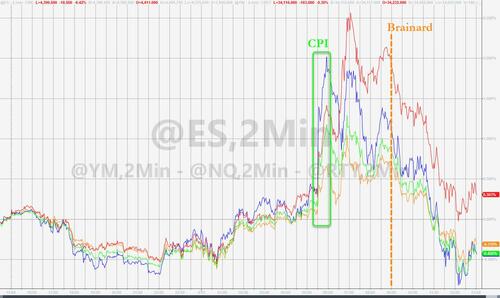
Another day, another failed short-squeeze…
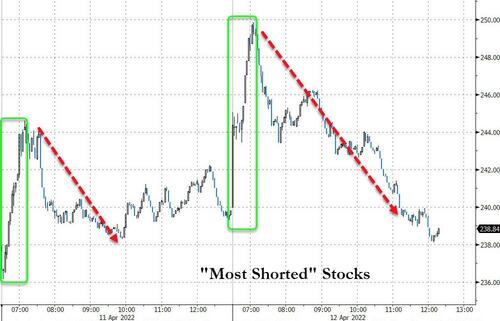
Source: Bloomberg
FANG stocks were clubbed like a baby seal again today with Alphabet and Meta Platforms down for a sixth straight session, the longest streak of daily declines since May 2019.
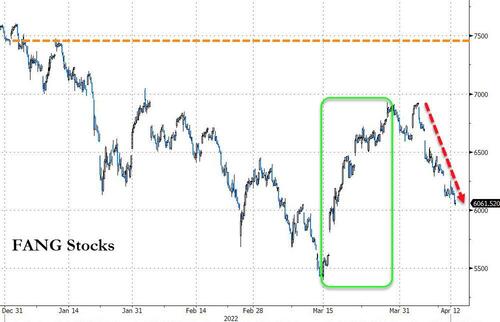
Source: Bloomberg
Treasury yields were mostly lower on the day with only the long-end higher as the belly outperformed (dramatically – 30Y +1bps, 5Y -13bps)…
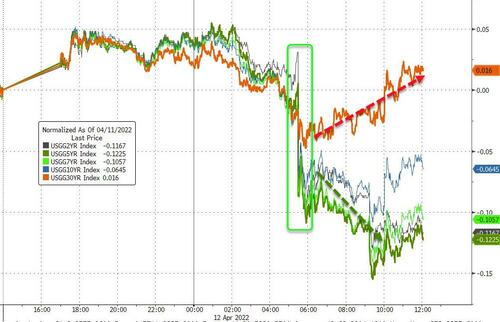
Source: Bloomberg
This – of course – sent the yield curve dramatically steeper (3s10s, 5s10s, and 5s30s all uninverted today)…
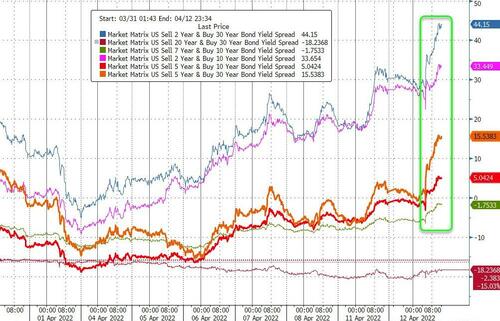
Source: Bloomberg
However, the 2s10s curve is still inverted 1Y forward…
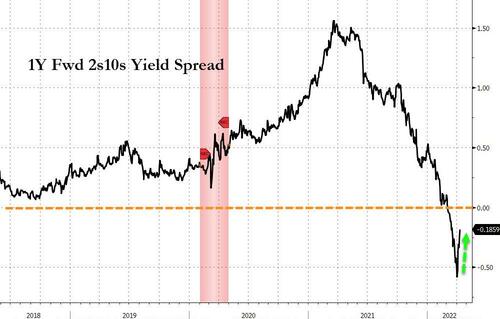
Source: Bloomberg
The 10Y Yield reversed dramatically (-16bps from intraday highs) after tagging its multi-decade downtrend resistance level of 2.83%…
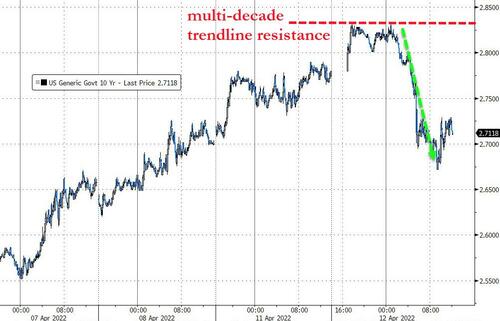
Source: Bloomberg
Interestingly, rate-hike expectations fell today modestly while the subsequent rate-cut expectations also fell…
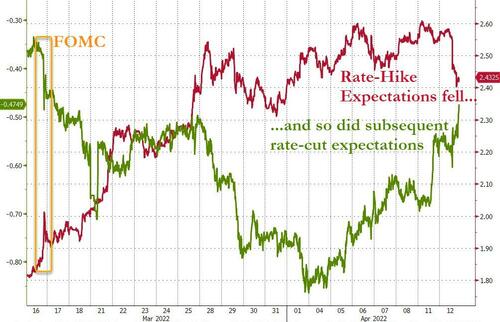
Source: Bloomberg
The dollar dumped on the CPI print as un-hawkish narratives quickly hit, but once Brainard reminded the world that The Fed is on a mission, the USD surged back to the highs of the day…
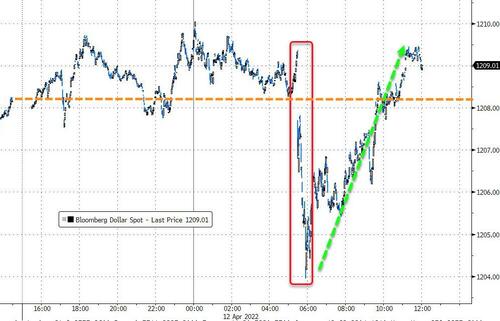
Source: Bloomberg
Bitcoin bounced back above $40k overnight but then as the US session progressed, the crypto slipped back below…
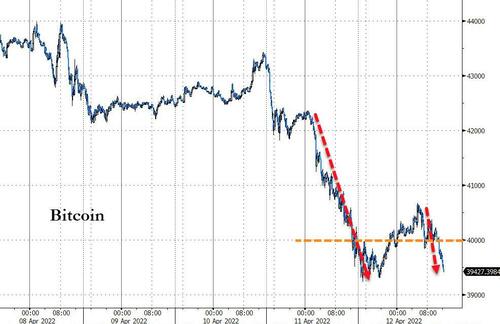
Source: Bloomberg
Oil prices rose today as China lifted some of its COVID restrictions, with WTI back above $100…
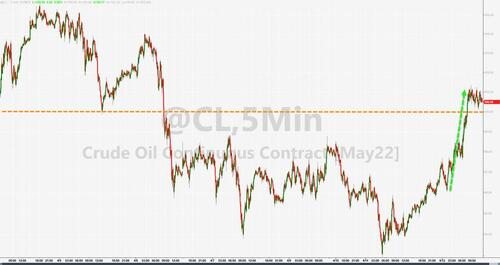
Gold also extended gains (despite USD strength) with the barbarous relic back at one-month highs…
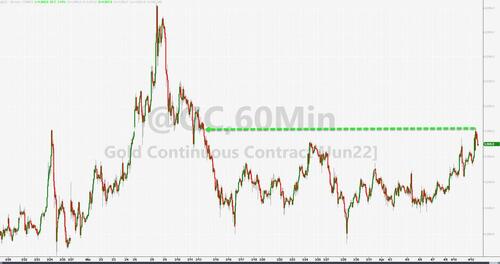
Finally, it’s all PutInflation… 17 Nobel prize winning economists agree we are sure…
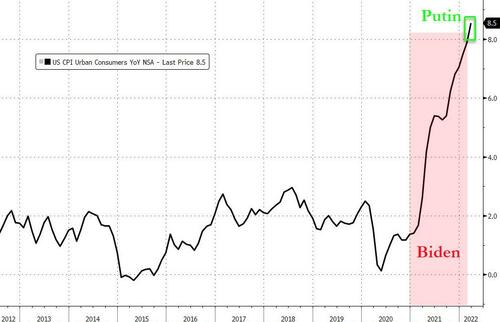
Source: Bloomberg
Saying anything else is anti-science!!
END
I) /MORNING TRADING/
You have got to be kidding me? stocks and bonds surge on “not as bas as it could have been” CPI
(zerohedge)
Stocks & Bonds Surge After “Not As Bad As It Could Have Been” CPI
TUESDAY, APR 12, 2022 – 08:50 AM
On the basis that the CPI prints were “not as bad as they could have been”, US markets have reacted as if The Fed can step back from its hawkish stance and all will be well in the world.
Rate-hike expectations have eased modestly for the year… although the market is pricing in a 97% probability of 50bps hike in May(up from 92%)…

That appears to have prompted a panic-bid in stocks – dominated by long-duration growthy stocks…

And sending bond yields tumbling lower, with the belly 5Y/7Y outperforming (-10bps)

Gold is also spiking after CPI…

The question is – how long will these kneejerk moves last?
AFTERNOON
END
II)USA data
Wow!! this is big!! CPI month over month rose by 1.2%. On a yearly basis: 8.5%
(zerohedge)
“Extraordinary” – US Consumer Prices Soar At Fastest In Over 40 Years
TUESDAY, APR 12, 2022 – 08:38 AM
Having warned the world to expect “extraordinarily elevated” levels of inflation due to “Putin’s Price Hike”, The White House is likely in shock this morning as headline CPI rose 1.2% in March (vs +1.2% MoM) which sent the headline CPI up a shocking 8.5% YoY (vs +8.4% YoY exp and +7.9% prior) – the highest since 1981.

Source: Bloomberg
The 1.2% MoM rise is the biggest since Sept 2005 and CPI has risen for 22 straight months, but we note that goods inflation actually fell on a MoM basis (while energy soared)…

Source: Bloomberg
However, Core CPI (ex food and energy) rose just 0.3% MoM (below the +0.5% expected) and was up 6.5% YoY (above Feb’s 6.4% but below the +6.6% exp).
The shelter index was by far the biggest factor in the increase, with a broad set of other indexes also contributing, including those for airline fares, household furnishings and operations, medical care, and motor vehicle insurance.
In contrast, the index for used cars and trucks fell 3.8 percent over the month.

The rise in prices was dominated by Energy and goods on a year-over-year basis

Source: Bloomberg
The cost of putting a roof over your head (unless you’re homeless in LA) continues to soar…
- March Shelter inflation 5.0% Y/Y, up from 4.7% in Feb, and the highest since May 1991
- March Rent inflation 4.44% Y/Y, up from 4.17% in Feb, and the highest since May 2007

Bear in mind that after this March report, inflation expectations start to step down, with second-quarter CPI seen at 7.6% and 5.7% by year-end, according to a Bloomberg survey. According to at least 6 Wall Street banks, this was the peak of the inflation wave.
And finally, and perhaps most importantly for the average American who actually has to pay for ‘stuff’ every day with his (or her or zher) own money, real average hourly earnings fell for the 12th straight month…

Source: Bloomberg
This confirms NBC News recent poll that showed 62% of Americans saying their incomes cannot keep up with the rising cost of living.
Still, the good news is, we all know who to blame for this right?
The bottom line: No inter-meeting or 75bps rate hike as the CPI data isn’t as bad as it could have been.
end
Here Is The Heatmap From Today’s Scorching CPI Report: Annual Prices Have Peaked But Now It’s Services’ Turn
TUESDAY, APR 12, 2022 – 11:15 AM
In the latest inflationary shock – one which Biden will dutifully read from the teleprompter was entirely the fault of “PutInflation” – even if a chart of CPI in context shows otherwise…

… this morning the BLS reported that headline CPI skyrocketed 1.2% (1.24% unrounded) M/M in March as energy surged 11.0% and food prices jumped 1.0% mom for a second consecutive month. The energy price moves reflect the shock from the Russia-Ukraine conflict, while food has yet to feel the impact given lagged pass-through and is likely to remain hot throughout the year. In other words, while much of the covid-linked supply chain inflationary spike is fading, we are about to face an even bigger, Ukraine-war food inflation spike!

Core CPI came in slightly softer than expected at a still elevated 0.3% (0.32 unrounded) mom. As noted earlier, the miss owed to a 3.8% plunge in used auto prices, which sliced 20bps from the monthly core drop.
Meanwhile, new cars continued to head higher, with a 0.2% mom increase, as did medical commodities. HH furnishings/supplies stayed hot, with a 1.0% mom gain, as did apparel, with a 0.6% rise in March—these two components have shown greater
sensitivity to ongoing supply-chain tightness. Here is a snapshot
- Grocery inflation jumps 10.0% in March vs. the February rate of +8.6%.
- Cereals and Bakery Products +9.4%, Meats, Poultry, Fish, and Eggs were +13.7%
- Dairy and Related Products were +7.0% Fruits and Vegetables were +8.5%
- Airfares in March skyrocketed 10.7% and are now at their highest point since the pandemic began.
- Shelter inflation 5.0% Y/Y in March vs 4.7% in Feb, and the highest since May 1991
- Rent inflation 4.44% Y/Y in March vs 4.17% in Feb, and the highest since May 2007
- The household furnishings and operations index rose 1.0%, the eighth consecutive increase
- The index for new vehicles increased 0.2 percent in March after rising 0.3 percent the previous month.
- The index for communication was also among those few indexes which declined over the month, falling 0.5 percent
The only materially lower category, as noted above, was the index for used cars and trucks which fell 3.8 percent in March, its second consecutive monthly decline after a series of large increases.

Away from good, within services, OER and rents of primary residence both came in at 0.43% mom, cooling slightly from February.

This is consistent with the signal from high-frequency rent data that we have probably hit the peak for the sequential rate, although even so we expect fairly elevated readings going forward.
Meanwhile, Medical care services rebounded strongly to 0.6% mom, shaking off the Covid soft patch. These two key components alone point to still strong stickier inflation. Transportation services skyrocketed 2.03% mom as airline fares spiked 10.7% mom and car/truck rental soared 11.7% mom, reflecting reopening pressures, and motor vehicle insurance climbed 0.7%. Lodging also jumped 3.3% along the same reopening theme, while recreation services grew 0.4% mom.
If we consider lodging, car/truck rental, and airline fares as more near-term reopening pressures, these components accounted for 13bps – overall, broad-based services inflation with additional lift from reopening,
On a Y/Y basis, rates for headline inflation both headed higher this month, with headline jumping to 8.5% (8.54% unrounded) from 7.9% and core increasing to 6.5% (6.47% unrounded) from 6.4%. As a handful of investment banks have stated, both reflect the peak for yoy rates but expect inflation to cool to hot levels by year-end (largely due to base effect), with headline at 6% 4Q/4Q and core at 5% 4Q/4Q.
In terms of the all-important Fed reaction, it will likely look through some of the noisier components of the report — keep an eye out for trimmed-mean later this morning- and conclude that price pressures remain elevated, underpinning the need to hike by 50bps (but not 75bps or proceed with an intermeeting hike)
In terms of the market response, 10Y nominal yields dropped by 10bps and the curve steepened, with the decline in rates roughly split between inflation breakevens and real rates, as the market pried both a fading in inflationary pressures and less aggressive Fed response.
According to BofA economist Alexander Lin, today’s print is an inflection point, with core MoM inflation cooling to the lowest level since September ’21. This shift may challenge TIPS demand, especially with the Fed set to begin balance sheet reduction in May. Market pricing for the Fed’s terminal rate declined about 10bps to 3.1% following the report, but fed funds futures through September declined less than 4bps.
In general, the print still reflects very strong cyclical inflation components and should not deter the Fed from delivering on three 50bps rate hikes in coming meetings.
Finally, here are the heatmaps for today’s CPI report, first M/M…

… and also Y/Y.

end
IIB) USA COVID/VACCINE MANDATES
This is really interesting Fauci finally admits that the virus is here to stay. What we should be saying is that all vaccinations must stop
(zero hedge)
Fauci Admits Defeat: Says COVID Here To Stay, People Need To ‘Calculate Individual Risk’
MONDAY, APR 11, 2022 – 06:40 PM
While President Joe Biden campaigned on a promise to “shut down the virus, not the economy,” Dr. Anthony Fauci – the highest paid employee in the US government – was taking a much more cautious approach – suggesting that Covid might never go away.

And with Washington DC now a superspreader party town for the far-less deadly Omicron strain, Fauci has now explicitly thrown in the towel on trying to rid the world of Covid-19 – telling ABC‘s “This Week” that the virus is here to stay, and people will just have to decide what level of risk they’re willing to take.
“This is not going to be eradicated and it’s not going to be eliminated,” Fauci told host Jonathan Karl.
“What’s going to happen is that we’re going to see that each individual is going to have to make their calculation of the amount of risk that they want to take in going to indoor dinners and in going to functions, even within the realm of a green zone map of the country where you see everything looks green but it’s starting to tick up,” he added.
“We’re going to have to live with some degree of virus in the community,” Fauci continued, adding that “The best way to mitigate that, Jon, is to get vaccinated.”
Yes, a vaccine developed for a completely different strain which wanes in protection just six weeks after the receipt of a fourth dose, according to a recent Israeli study.
end
iiia) USA inflation//SHIPPING commentaries//LOG JAMS//
the following is a great article as to where we are standing right now. Too much goods has been produced with not enough demand.
Deflation next?
(Fuller/ Freightwaves)
Deflation Next? Will The Bullwhip Do The Fed’s Job On Inflation
TUESDAY, APR 12, 2022 – 07:30 AM
By Craig Fuller of FreightWaves,
The only thing surprising about the freight market slowdown is the speed at which it’s unfolding.

The supply chain “bullwhip effect” is both predictable and expected. The surge of inventories and declining freight costs/capacity imbalances will be deflationary.
The trucking market has slowed. Demand for trucks usually surges during the Spring, but this year, demand for truckload freight has broken out of this typical seasonal pattern.Outbound Tender Volume Index (OTVI) is an index which measures the volume of truckload order requests in the contract truckload market. The OTVI chart shows year over year activity from 2018 to this year.
The bullwhip effect is something every supply chain 101 student learns about – the idea that upstream providers overproduce in reaction to a one-time demand shock.
What is the bullwhip effect?
According to the Chartered Institute of Procurement and Supply, the bullwhip effect “is defined as the demand distortion that travels upstream in the supply chain from the retailer through to the wholesaler and manufacturer due to the variance of orders which may be larger than that of sales.”
The best way to think of this in terms of COVID is that in the early part of the cycle, the Federal Reserve was pouring trillions of dollars into the economy to ensure that the market didn’t collapse. Consumers went out and spent all of that money on physical goods. At the same time, production in China and the U.S. was shut down or limited. The combination – stimulating consumption but limiting production – caused the American consumer to burn through almost all inventory.
Retailers ordered more goods based on the inflated demand at that time. Upstream to them, wholesalers and manufacturers did the same. Along that chain some even ordered bumper stock.
When the orders didn’t arrive as planned, they ordered more. And upstream to them, vendors also ordered more for the same reason. As orders flowed upstream, everyone started to produce at unprecedented levels.
Consumers, flush with excess cash and bullish due to high employment and a roaring economy, continued to order physical goods. Then the products started flowing, and in spite of delays, they poured in.
Earlier this year, consumers pulled back… at first just slightly. But all of those products kept pouring in, along with buffer stock. Warehouse inventories piled up. And now consumers have shifted away from consuming physical products and have started to consume services and experiences once again. Meanwhile, all of that inventory keeps coming.
And now we can see those goods in market data. Here is a chart of real retail inventories, excluding new or used autos. Because inventories are counted on the basis of their dollar value, rapid inflation can make inventories appear artificially higher, so remember that these numbers have been deflated by the Consumer Price Index, or CPI. In other words, inflation has been stripped out to reflect ‘true’ growth in inventory volume, not just price.

And as goods flow into our economy, there is nowhere to transport them. Warehouses are full and spending on goods has stalled as Americans suddenly have more options. So freight demand has slowed.
Inventory at very high levels
FreightWaves’ editorial and research staff, as well as its Market Experts, are constantly conducting channel checks. Lately, we are hearing that national big box retailers have plenty of inventory, particularly in large discretionary categories, such as furniture and household goods.
On Twitter, where the freight markets are suddenly becoming a trendy topic of discussion in conjunction with economic activity, there is a suggestion that other large consumer categories are seeing a sudden slowdown as well.
Used cars have been nearly impossible to come by and have experienced unmatched price inflation for the past two years. This could be changing.
Meanwhile, used vehicles experienced the biggest drop in prices in two years.

The CEO of a chain of used car dealerships has a blog that discusses the used car trends for the general public. On Twitter, he talks about market conditions frequently. On April 9th, he posted:

This was followed by Quant researcher Steve Hou, who posted:

Lumber prices are also coming down, after two years of inflated prices and extremely tight supply. In the past month, lumber commodity prices have dropped from $1,252 to $949 per-thousand-board-feet, a 30% decline.

A shift by consumers to services
Higher energy and food prices likely shocked the consumer into a spending pullback on physical goods – while retailers were desperately rebuilding inventories – at the same time that consumers finally began to shift spending away from physical goods to services. And without demand, you don’t need to move anything quickly.
Shippers feel much less urgency and therefore they are slowing the freight velocity of their supply chains. We can see that in volume shifts between the modes of transportation they’re using. Railroads move products slower, including intermodal (containerized freight on the rails). It’s currently 21% cheaper to move a container of freight on intermodal than it is via a truck (door-to-door) – an all-time savings high.Chart: Cost delta percentage intermodal vs. truck
The chart below displays volume trends in intermodal and truckload. Intermodal is holding its own, while truck volumes are slowing.Chart: 53-ft. containers on rail vs. truckload volumes
This is all good for consumers – prices for freight will come down. Supply chain bottlenecks will ease. What were recently inventory shortages are now gluts, and will likely result in price discounts, not increases. This is a late-stage supply chain correction.
The trucking industry, particularly small trucking firms, will end up feeling the pain. But this was inevitable. A freight recession happens far more often than a GDP recession. The last time this happened was 2019, when the freight market experienced a downturn, but the broader economy did not.
I think a freight recession is inevitable and I think that inflation has to cool. It was either going to be the Federal Reserve’s job to do so or the market’s to do so. We can thank the supply chain bullwhip for doing the Federal Reserve’s job.
China’s latest round of system-wide shutdowns may be the final straw that pushes many supply chain executives in America to reevaluate their sourcing strategy (if they haven’t already). China is becoming far too unpredictable and unstable as a supplier. Importers should take this breather to catch up.
There is still lots to be bullish about. The “bullwhip correction” will be a different kind of headache than we’ve had to deal with for the past two years, but the good news is the market is correcting and things are “normalizing” – as least as far as supply chains are concerned.
Want to track the same data and get an edge on competitors in the market? SONAR’s high-frequency platform tracks global supply chain activity in real-time, with the freshest perspective on the global upstream economy.
end
Bird flu is spreading all across the uSA and this is causing egg prices to soar.
(zerohedge)
Bird Flu Spreads Across US, Egg Prices Soar
MONDAY, APR 11, 2022 – 08:40 PM
A contagious strain of highly pathogenic avian influenza wiped out flocks across the US and killed millions of birds. The direct effect has been a nasty ripple effect of tight poultry meat and egg supplies, sending retail prices sky-high — adding to record-high food inflation.
The latest estimates from the US Department of Agriculture (USDA) show around 24 million poultry birds like chickens and turkeys have died or been culled due to the virus since February.
Bloomberg published a shocking map of the bird flu spreading across the US, covering nearly half of the country.

Even though the virus poses limited risks to humans, the virus has been detected in the nation’s leading egg producer: Iowa. The spread continues as “wild bird migration patterns continue. The disease is being introduced to our domestic population,” Chloe Carson, the communications director of the Iowa agriculture department, told CNN.
National egg prices are off the charts for this time of year because of tight supplies. The average price of a dozen eggs has jumped to $2.60, up from $1.20 in early January.

Last week, US Agriculture Secretary Tom Vilsack said poultry farms are better prepared to mitigate virus spreading following new guidelines after the previous bird flu outbreak in 2015.
As for now, the spread shows no signs of abating and adds to higher living costs for Americans struggling under the Biden economy of record-high food and gas prices.
end
IIIB) USA ECONOMIC STORIES
The housing market is now been priced out as affordability crisis worsens
(zerohedge)
Nine Million Americans Priced Out Of Housing Market As Affordability Crisis Worsens
MONDAY, APR 11, 2022 – 05:20 PM
The National Association of Realtors (NAR) estimates millions of Americans have been priced out of the housing market since January as sky-rocketing mortgage rates spark an affordability crisis.
Nadia Evangelou, a senior economist and head of forecasting at NAR, said 9 million homebuyers had been priced out of the market. Out of that total, about 3 million millennials.
The blame resides primarily on soaring mortgage costs as the 30-year fixed-rate average jumped from about 3% at the start of the year to a shocking 5.25% this morning – the highest since 2009…

Evangelou warned affordability has plunged through the virus pandemic as housing prices increased faster than incomes. Now mortgage costs are climbing as home prices remain at all-time-highs, pricing people out of the market.
As discussed in March, “Housing Affordability Is About To Crash The Most On Record“ and “Biggest Housing Affordability Shock In History Incoming,” the affordability crisis is already cooling the red-hot housing market.
NAR points out that the monthly cost of paying off the median mortgage in California has jumped more than $500 since the start of the year. Wage increases minus inflation is negative and are another reason for the affordability crisis.
Actuarial accountant Rachel Linehan told Bussiness Insider that soaring rates slashed their homebuying budget by $100k and has forced them to look at houses in undesirable areas.
“It’s pretty demoralizing. We went in feeling pretty hopeful but that hope has diminished over time to the point where we are feeling pretty small.
“We’re getting to the point where we might give up soon,” Linehan said.
Evangelou points out that housing affordability is some of the worst on record. Similarly, BofA economist Alex Lin recently showed clients the plunge in affordability is at a record pace.

NAR suggests the affordability crisis is likely to worsen. Last week, we outlined that housing market cracks have begun to appear as sellers drop their listing prices.
iv)swamp stories
The King Report (including swamp stories)
The US 10-year yield hit 2.75% during early Asian trading. This is the highest rate since 2019. By 8:24 ET, the 10-year had hit 2.78%.
ESMs declined sharply early in US trading. Transportation stocks surged on airline buying because energy commodities tumbled. Fangs and techs sank again. Financial stocks rallied sharply on conditioned buying ahead of big bank results.
ESMs bottomed at 9:38; but the ensuing rally was short lived. ESMs and stocks then vacillated until they broke down at 10:22 ET. The Nasdaq 100 hit -2%. The NY Fang+ Index hit -2.8%.
Ten minutes before the European close, the US 30-year recorded 2.808%. Six minutes before the European close, the DJTA’s 238-point gain had dwindled to +5.96. A rally into the European then commenced. It ended 3 minutes after Europe closed at 11:30 ET.
Just before midday, the US 30-year hit 2.82%. The US 2-year rallied a tad, steepening the curve. The 2-10 yield spread hit +28bps, a 36bp increase from last week’s inversion nadir of -8bps.
Two factors that contributed to financial assets’ weakness on Monday: Fear that the March CPI Report due today would produce a negative impact; and expiration occurs on Thursday, due to Good Friday. Big bank results will appear on Wednesday and Thursday. Tech company and Fang results that normally facilitate an upward squeeze for expiration appear after the April expiration on Thursday.
White House Adviser Deese: We’re Expecting Elevated CPI on Tuesday – BBG 12:33 ET
Deese: Lower Inflation at End of Year, Next Year – BBG 12:38 ET

US 10-year yield vs CPI y/y – The most negative real 10-year yield in US history! It would be far worse if pre-1980 CPI methodology was used. PS – By 14:00 ET, the 10-year hit 2.784%
Confusion on how to play a shortened expiry week bereft of Fang results was evinced in the very low volume of SPY April puts and calls. Nevertheless, keep monitoring those options to ascertain how the whales intend to play the expiry. PS – VIX April options expiry next Wednesday, April 20.
ESMs and stocks commenced a rally just before 13:00 ET. It was modest and short lived. ESMs and stocks then went inert until the fell to minor new lows at 14:31 ET. The afternoon manipulation then commenced. Would there be yet another instance of an early US decline with a later manipulation?
The ESM rally peaked at 15:02 ET. ESMs and stocks then tumbled to new lows. Bonds did the same. The 30-year hit 2.835%. The 10-year hit 2.788%. ESMs and stocks sank until 15:55 ET.
Alleged Russian use of chemical weapons might have contributed to the late decline.
@ragipsoylu: About an hour ago, Russian forces used a toxic substance of unknown origin against Ukrainian military and civilians in the city of Mariupol. It was dropped from an enemy UAV. The victims have respiratory insufficiency. — Ukrainian Embassy in Turkey
Surf-and-Turf Specials Cut from U.S. Menus in Sign of Price Pain
One year into the inflation spiral that has rocked the U.S. economy, lower-income consumers are starting to shift spending patterns. They’re cutting back on more expensive items, ramping up on cheaper ones and forcing restaurants, grocery stores and retailers to rejigger their sales strategies. This marks a major break from 2021, when consumers, still flush with pandemic stimulus and newly won pay raises, kept spending at a frenetic pace even as annual inflation surged to a four-decade high…
Momentum is also shifting among big-box retailers. Target Corp. trounced Walmart Inc. in sales growth during the pandemic, and the company’s more upscale clientele positions it well for the future. But sales gains at Walmart have been stronger in recent months, according to Bloomberg Second Measure, which analyzes U.S. consumer transactions to measure revenue. That suggests shoppers are increasingly drawn to Walmart’s mantra of everyday low prices…
https://www.msn.com/en-us/money/other/surf-and-turf-specials-cut-from-us-menus-in-sign-of-price-pain/ar-AAW68x7
Positive aspects of previous session
The DJTA rallied 56.48 on airline buying due to the drop in energy prices
Big banks rallied in the morning on buying ahead of Q1 results that commence on Wednesday
Negative aspects of previous session
Fangs and techs tumbled, again; big banks, ex-WFC closed negative after rallying sharply early
Bonds declined sharply
Ambiguous aspects of previous session
SPY April option volume was lackluster until the afternoon when put volume jumped
Did Russia use WMDs (chemical weapons) in Ukraine? If so, what will The Big Guy do?
First Hour/Last Hour Action [S&P 500 Index]: 1st Hour from NYSE open: Down; Last Hour: Down
Pivot Point for S&P 500 Index [above/below indicates daily trend to traders]: 4428.42
Previous session High/Low: 4464.35; 4408.38
Elon Musk will NOT join Twitter’s board. The agreement to cap his ownership at 14.9% is kaput.
Hate Speech”: Linkedin Disables Air-Force Vet’s Account After Criticizing Loan-Forgiveness
It is hard to imagine a more glaring example of bias and censorship. Some in the company simply supports loan forgiveness and declared opposition to the Democratic plan to be “hate speech.” Both public and private censorship leads to an insatiable appetite for silencing those with opposing views.
https://jonathanturley.org/2022/04/10/hate-speech-linkedin-disables-air-force-vets-account-after-criticizing-loan-forgiveness/
@theragex (Fox’s) HEINRICH: “Who decides if the President goes to Ukraine or not?” PSAKI: “In what way?” HEINRICH: “He had said when he was in Poland that he expressed interest in going to Ukraine but ‘they wouldn’t let me.’ So…” PSAKI: “I’m not going to get into private considerations.”
https://twitter.com/theragex/status/1513575766298136576
@TomBevanRCP: Jen Psaki: Vice President Harris did not wear her mask inside during the full event for Kentanji Brown Jackson last week because it was “an emotional day” and a “historic day.” Got it.
(Rules are for the little people! It was never about ‘The Science!’)
@RNCResearch: Biden has done just ONE press interview since the beginning of 2022. Kamala Harris has done 28. WHERE’S JOE?
@charliespiering: “You couldn’t buy a cannon when the Second Amendment passed,” Joe Biden repeats
(Yes, Big Guy, you could buy a canon when the 2nd Amendment passed in 1791!)
@townhallcom: BIDEN: “Gun manufacturers have more immunity from liability than any other American industry.” (False! See Big Pharma and Covid vaccines, Joey!)
@greg_price11: BIDEN: “Imagine had the tobacco industry been immune to prostitute…”
https://twitter.com/greg_price11/status/1513595343774044171
In 2020, the most recent year for which complete data is available, 45,222 people died from gun-related injuries in the U.S., according to the CDC… In 2020, 54% of all gun-related deaths in the U.S. were suicides (24,292), while 43% were murders (19,384), according to the CDC… https://www.pewresearch.org/fact-tank/2022/02/03/what-the-data-says-about-gun-deaths-in-the-u-s/
91,799 Americans died from drug overdoses in 2020…
https://www.tfah.org/article/u-s-drug-overdose-deaths-increased-by-31-percent-in-2020-up-56-percent-for-synthetic-opioids/
Alcohol-related deaths rose above 99,000 in 2020… https://www.webmd.com/lung/news/20220322/alcohol-related-deaths-spike-first-year-pandemic
Cars killed 42,060 people in 2020… https://www.vox.com/22675358/us-car-deaths-year-traffic-covid-pandemic
For the above listed fatalities, the remedy is to punish the purveyors of the crimes. For political reasons, guns are treated differently, though gun homicides are far less.
Today – March CPI (1.2% m/m expected) will be released an hour before the NYSE opens. ESMs will react and adjust to the March CPI Report. Yesterday WH Press Sec Psaki said the WH expects March CPI “to be extraordinarily elevated due to Putin…”. Team Big Guy already spinning a bad report.
There could be a relief rally after the March CPI is released. Caveat: Since Biden ascended the throne, someone has consistently forced ESMs higher after bad news to change the negative narrative and market psychology. Will it occur today? If it is confirmed that Russia used chemical weapons in Ukraine, the West and the US must respond decisively. How will the market handle this?
The S&P 500 Index closed decisively below its 4450 support (double bottom last week).
Special Counsel John Durham continues his focus on the Hillary Clinton Campaign
And: John Podesta has been interviewed…
Should Sussmann’s attorneys try to establish the accuracy of the Alfa Bank/Trump data, the Special Counsel’s expert would be ready to testify that the data was falsified… That statement is the strongest thus far that the Special Counsel has determined the Alfa Bank/Trump data was spoofed in order to mislead the press and the FBI. A conspiracy, if you will…
https://technofog.substack.com/p/special-counsel-john-durham-continues?s=w
More and more women just don’t want children: ‘Kids are expensive and sticky’
“It doesn’t seem like fun for anyone,” she said, adding that the household chores women still bear the brunt of in modern-day society and the emotional labor of managing a family were just as off-putting. “I can’t imagine doing that and raising children while maintaining some sense of self.”…
She’d rather focus her quality of life on hard work, travel, and retiring early to pursue her passions. “I have fun enjoying my life,” she said…
“I couldn’t imagine juggling work and children. I wouldn’t be able to care for my two dogs without my husband.”… https://www.businessinsider.com/women-dont-want-kids-birth-rate-love-fulfilling-life-2022-4
FT: Preliminary estimates suggest the Biden-Harris margin among white women with college degrees widened to an average of 22 points. This represents a big change from 2012, when they were fairly evenly split between Romney & Barack Obama… https://www.ft.com/content/2b0eba6f-ba33-42e6-b49a-f7e53d67341f
The only group in which Biden has maintained or gained support is ‘college educated white women’.
@nytimes: Six months after leaving the White House, Jared Kushner secured a $2 billion investment from a fund led by the Saudi crown prince, a close ally during the Trump administration, despite objections from the fund’s advisers about the merits of the deal. https://nyti.ms/37zskFM
The negative fallout from DJT’s Dr. Oz endorsement continues. Increasingly, erstwhile supporters are admitting that DJT makes horrible personnel and endorsement decisions – and staffing decisions greatly impacted his presidency in a negative manner. Plus, he hired, not fired, Swamp creatures.
@julie_kelly2: Without batting an eye, 2 DC juries have unanimously convicted J6 protesters on “obstruction of an official proceeding” felonies, the first time this law has been used in this way. The Left can cheer for now but criminalizing political activity will have lasting repercussions.
They think this legal precedent will only apply to Trump supporters who “stormed” the Capitol. But it won’t. These convictions—if upheld by DC Circuit and SCOTUS—will eventually apply to political protesters in every jurisdiction. Only a matter of time until it backfires on them.
Psychoanalyst @seerutkchawla: Children are not meant to meet adults needs. Not for validation, not for affirmation, and certainly not for anything else. Adults are meant to safeguard children. If you can’t abide by that, stay away from children.
Where are the scientific reports and research regarding children and grooming? Where are interviews with psychologists? We clearly recall two important Psychology fundamentals that are extremely important regarding the development of children: Suggestion, and Labeling.
For umpteen decades, ‘The Science’ of Psychology warned that labeling children can cause severe and irreparable harm. It is not necessary to pontificate about the power of suggestion. If there were any doubt, corporations would not spend gazillions on advertising, nor would politicians. And we all know that children are far more susceptible to ‘suggestion’ than adults – as hard as that is to believe these days.
Avoid labeling your child…The Dangers of Labeling
1. Labeling affects the way children see themselves…
2. Labeling influences the way children are treated…
3. Labeling limits children’s potential… https://extension.unr.edu/publication.aspx?PubID=3011
Stop Labeling Kids: Why It’s Important to Name the Behavior Instead
https://www.thepragmaticparent.com/stop-labeling-the-child-label-behavior/
Psychology Today: Could You Unintentionally Be Labeling Your Child?
Why we believe stereotypes, and why we should avoid applying them to kids
https://www.psychologytoday.com/us/blog/singletons/202007/could-you-unintentionally-be-labeling-your-child
The power of suggestion: What we expect influences our behavior, for better or worse
“We realized that the effects of suggestion are wider and often more surprising than many people might otherwise think,”… https://www.sciencedaily.com/releases/2012/06/120606142818.htm
Psychology Today: 4 Ways the Power of Suggestion Can Change Your Life
Early suggestions probably shaped your reality…
https://www.psychologytoday.com/us/blog/imperfect-spirituality/201504/4-ways-the-power-suggestion-can-change-your-life
@realchrisrufo: The Obama Administration published a 72-page report about child sex abuse in public schools, recommending that administrators closely monitor teachers for “grooming behaviors” that could lead to “sexual misconduct” and “sexual abuse.” https://t.co/huyGgLHaTP
@realchrisrufo: In 2017, the Department of Education published a report warning that public school employees “groom” and then commit “adult sexual misconduct” against 10% of all K-12 students. They define “grooming” as the process of isolating and manipulating a child. https://t.co/fKfVDAcYze
What has changed since Obama’s time? Tucker Carlson notes that the Human Rights Campaign raised beaucoup bucks to support the gay marriage bill and switched to transgender after the bill passed in 2015.
Tucker Carlson: HRC now raises millions and millions from companies like Amazon, Apple, Google, Goldman Sachs, Raytheon, Morgan Stanley, et cetera, every power center in the American economy, all of which fully support now the transgender project…
https://www.foxnews.com/transcript/tucker-how-is-a-parent-supposed-to-respond-to-this
Stunning rise in Chicago carjackings leaves lawmakers scrambling – One of the legislative failures contributing to the jump in Chicago carjackings came when lawmakers in 2015 rescinded the right of county prosecutors to charge juvenile carjackers as adults. Juveniles have recently been responsible for nearly half or more of carjackings or carjacking arrests in Chicago…
Part of the latest attempt by lawmakers to respond to growing pressure on crime and carjacking is HB 1100 and within it, House Floor Amendment No. 2. Sponsored by Democrats only, it aims at carjacking instigators who recruit juveniles. To further battle carjacking, it would provide for grants to local governments and community groups and tweak the state bureaucracy. In other words, it sidesteps the core of the problem: poor arrest rates; a revolving door bail system and weak sentencing for juvenile carjackers; and lax parenting… there are already a slew of Chicago violence intervention groups with outreach counselors on the streets…
https://wirepoints.org/stunning-rise-in-chicago-carjackings-leaves-lawmakers-scrambling-wirepoints/
@jhaskinscabrera: Tony Dungy at DeSantis press conf: “I asked [Abe Brown], how do those young boys (19, 20, 21) get [in prison]? And he told me it’s not socio-economic, it’s not racial, it’s not education, it’s none of that. 95% of these boys did not grow up with their dad.”
@Outkick: Burgess Owens has watched the NFL try to manage issues of race with mixed results. And that disappoints Owens, especially when the conversation turns to the league’s Rooney Rule.
It appears Rep. Owens thinks the Rooney Rule shields NFL ownership from hiring blacks to management positions by using the interview process to negate charges of racism. Symbolism over substance.
Super Bowl Winner Turned Congressman Not Happy with NFL’s Rooney Rule
Did you know Burgess Owens was also among the first handful of black students to integrate Rickards High School in Tallahassee, FL in the late 1960s? Did you know he was among the first black athletes to receive a scholarship at the University of Miami?…
“This is nothing but the worst of sports because it’s not based on sheer talent. And so, this game, which is supposed to bring us together, which it has in the past … because we come together, we root for our same teams, no matter our background, our religion. We’re all on the same team. But the NFL now is run by Roger Goodell, and his leadership has divided us and this country in a big way…”
Owens indeed believes the Rooney Rule, which is meant to open doors for minorities, has actually had a deleterious effect on the sport because it gives racists a chance to hold up an interview as evidence they’re not racists — even though they have no intention of hiring the minority…the NFL going toward race picking in order to make this work, and I’m going to call that systemic racism. It’s racist because the only way they think they can make this work out is by setting quotas…
“I would first off start by firing the commissioner,” he says. “He’s been around way too long. He makes $50 million a year and he’s doing nothing but dividing our nation and using sports as a way of doing it. We need to bring people in, and I don’t know how the NFL chooses their leadership, but bring somebody in who understands we don’t judge people based on their color, not pick people based on color, but because of whether they can do a job and the leadership skills they have and not start with the premise that blacks are inherently always less qualified…” https://t.co/1oAV6YGPU0
@ SteveDettelbach · Jun 5, 2016: We salute Muhammad Ali as a great American. Sadly, we need to acknowledge that Donald Trump wouldn’t even allow him to come into America.
@LoganDobson: this is Biden’s new nominee to lead ATF, who, apparently, doesn’t know that Muhammad Ali was born in Kentucky.
Let us close today with this offering courtesy of Greg Hunter


 harveyorganblog.com


[…] by Harvey Organ, Harvey Organ Blog: […]
LikeLike
[…] by Harvey Organ, Harvey Organ Blog: […]
LikeLike
[…] by Harvey Organ, Harvey Organ Blog: […]
LikeLike