
April 22, 2022 · by harveyorgan · in Uncategorized · Leave a comment·Edit
april22, 2022 · by harveyorgan · in Uncategorized · Leave a comment·Edit
GOLD; $1932.90 DOWN $13.40
SILVER: $24.23 DOWN $0.57
ACCESS MARKET: GOLD $1932.50
SILVER: $24.18
Bitcoin morning price: $40566 DOWN 765
Bitcoin: afternoon price: $39,610 DOWN 1721
Platinum price: closing DOWN $41.79 to $931.16
Palladium price; closing DOWN 3.45 at $2380.30
END
DONATE
Click here if you wish to send a donation. I sincerely appreciate it as this site takes a lot of preparation
comex notices/
: JPMorgan stopped/total issued 19/50
EXCHANGE: COMEX
CONTRACT: APRIL 2022 COMEX 100 GOLD FUTURES
SETTLEMENT: 1,944.900000000 USD
INTENT DATE: 04/21/2022 DELIVERY DATE: 04/25/2022
FIRM ORG FIRM NAME ISSUED STOPPED
072 C GOLDMAN 1
118 C MACQUARIE FUT 50
132 C SG AMERICAS 11
435 H SCOTIA CAPITAL 1
624 H BOFA SECURITIES 3
657 C MORGAN STANLEY 1
661 C JP MORGAN 19
709 C BARCLAYS 6
880 H CITIGROUP 6
905 C ADM 2
TOTAL: 50 50
MONTH TO DATE: 25,731
NUMBER OF NOTICES FILED TODAY FOR APRIL. CONTRACT 50 NOTICE(S) FOR 5000 OZ (0.1555 TONNES)
total notices so far: 25,731 contracts for 2,573.100 oz (80.03 tonnes)
SILVER NOTICES:
39 NOTICE(S) FILED 195,000 OZ/
total number of notices filed so far this month 1322 : for 6,610,000 oz
END
Russia is a major supplier of silver to London while Mexico supplies the COMEX
With the sanctions, London has no way to obtain silver other than compete with NY.
END
GLD
WITH GOLD DOWN $13.50
WITH RESPECT TO GLD WITHDRAWALS: (OVER THE PAST FEW MONTHS):
GOLD IS “RETURNED” TO THE BANK OF ENGLAND WHEN CALLING IN THEIR LEASES: THE GOLD NEVER LEAVES THE BANK OF ENGLAND IN THE FIRST PLACE. THE BANK IS PROTECTING ITSELF IN CASE OF COMMERCIAL FAILURE
ALSO INVESTORS SWITCHING TO SPROTT PHYSICAL (phys) INSTEAD OF THE FRAUDULENT GLD//
A HUGE CHANGE IN GOLD INVENTORY AT THE GLD A HUGE WITHDRAWAL OF 2.61 TONNES FROM THE GLD//
INVENTORY RESTS AT 1104.13 TONNES
Silver//SLV
WITH NO SILVER AROUND AND SILVER DOWN 34 CENTS
AT THE SLV// A HUGE CHANGES IN SILVER INVENTORY AT THE SLV: A WHOPPING DEPOSIT OF 3.508 MILLION OF INTO THE SLV//
INVESTORS ARE SWITCHING SLV TO SPROTT’S PSLV
CLOSING INVENTORY: 581.449 MILLION OZ
Let us have a look at the data for today
SILVER//OUTLINE
SILVER COMEX OI FELL BY A GIGANTIC SIZED 3647 CONTRACTS TO 164,456 AND FURTHER FROM THE NEW RECORD OF 244,710, SET FEB 25/2020 AND THE STRONG LOSS IN OI WAS ACCOMPLISHED DESPITE OUR STRONG $0.57 LOSS IN SILVER PRICING AT THE COMEX ON THURSDAY. OUR BANKERS WERE SUCCESSFUL IN KNOCKING THE PRICE OF SILVER DOWN (IT FELL BY $0.57) AND WERE SOMEWHAT UNSUCCESSFUL IN KNOCKING OUT SOME SILVER LONGS AS WE HAD A STRONG LOSS OF 997 CONTRACTS ON OUR TWO EXCHANGES. SOME EVIDENCE OF SPREADER LIQUIDATION IN SILVER TODAY.
WE MUST HAVE HAD:
I) HUGE BANKER SHORT COVERING AS THEY ARE VERY ANXIOUS TO GET OUT OF DODGE!!/. II)WE ALSO HAD SOME REDDIT RAPTOR BUYING//. iii) A STRONG ISSUANCE OF EXCHANGE FOR PHYSICALS iiii) A STRONG INITIAL SILVER STANDING FOR COMEX SILVER MEASURING AT 4.305 MILLION OZ FOLLOWED BY TODAY’S QUEUE. JUMP OF 255,000 OZ//NEW STANDING: 6.680 MILLION OZ// V) STRONG SIZED COMEX OI LOSS/
I AM NOW RECORDING THE DIFFERENTIAL IN OI FROM PRELIMINARY TO FINAL:
THE DIFFERENTIAL FROM PRELIMINARY OI TO FINAL OI SILVER TODAY: CONTRACTS : —-737
HISTORICAL ACCUMULATION OF EXCHANGE FOR PHYSICALS APRIL. ACCUMULATION FOR EFP’S SILVER/JPMORGAN’S HOUSE OF BRIBES/STARTING FROM FIRST DAY/MONTH OF APRIL:
TOTAL CONTACTS for 15 days, total 14,276 contracts: 71.380 million oz OR 4.73 MILLION OZ PER DAY. (951 CONTRACTS PER DAY)
TOTAL NO OF OZ UNDERGOING EFP TO LONDON 14,276 CONTRACTS X 5,000 PER CONTRACT:
EQUATES TO: 71.38 MILLION OZ
.
LAST 11 MONTHS TOTAL EFP CONTRACTS ISSUED IN MILLIONS OF OZ:
MAY 137.83 MILLION
JUNE 149.91 MILLION OZ
JULY 129.445 MILLION OZ
AUGUST: MILLION OZ 140.120
SEPT. 28.230 MILLION OZ//
OCT: 94.595 MILLION OZ
NOV: 131.925 MILLION OZ
DEC: 100.615 MILLION OZ
JAN 2022// 90.460 MILLION OZ
FEB 2022: 72.39 MILLION OZ//
MARCH: 207.430 MILLION OZ//A NEW RECORD FOR EFP ISSUANCE AND WE ARE STILL GOING STRONG THIS MONTH.
APRIL: 71.38 MILLION OZ (LOOKS LIKE OUR BANKERS ARE NOW LOATHE TO ISSUE EFP’S)
RESULT: WE HAD A GIGANTIC SIZED DECREASE IN COMEX OI SILVER COMEX CONTRACTS OF 3647 WITH OUR STRONG $0.57 LOSS IN SILVER PRICING AT THE COMEX// THURSDAY. SOME EVIDENCE OF SILVER SPREADER LIQUIDATION TODAY. THE CME NOTIFIED US THAT WE HAD A STRONG SIZED EFP ISSUANCE CONTRACTS: 2650 CONTRACTS ISSUED FOR MAY AND 0 CONTRACTS ISSUED FOR ALL OTHER MONTHS) WHICH EXITED OUT OF THE SILVER COMEX TO LONDON AS FORWARDS THE DOMINANT FEATURE TODAY: /HUGE BANKER SHORT COVERING AS THEY GET OUT OF DODGE//// WE HAVE A HUGE INITIAL SILVER OZ STANDING FOR MAR. OF 4.305 MILLION OZ FOLLOWED BY TODAY’S 255,000 OZ QUEUE JUMP//NEW STANDING: 6.680MILLION OZ/// .. WE HAD A STRONG SIZED LOSS OF 997 OI CONTRACTS ON THE TWO EXCHANGES FOR 4.985 MILLION OZ DESPITE THE STRONG LOSS IN PRICE.
WE HAD 39 NOTICES FILED TODAY FOR 195,000 OZ
THE SILVER COMEX IS NOW BEING ATTACKED FOR METAL BY LONDONERS ET AL.
GOLD//OUTLINE
IN GOLD, THE COMEX OPEN INTEREST FELL BY A FAIR SIZED 2385 CONTRACTS TO 569,941 AND FURTHER FROM NEW RECORD (SET JAN 24/2020) AT 799,541 AND PREVIOUS TO THAT: (SET JAN 6/2020) AT 797,110.
THE DIFFERENTIAL FROM PRELIMINARY OI TO FINAL OI IN GOLD TODAY: -206 CONTRACTS.
THE BIS HAS ABANDONED THE GOLD COMEX TRADING!!!
.
THE FAIR SIZED DECREASE IN COMEX OI CAME WITH OUR LOSS IN PRICE OF $6.80//COMEX GOLD TRADING/THURSDAY /.AS IN SILVER WE MUST HAD HUGE BANKER/ALGO SHORT COVERING ACCOMPANYING OUR FAIR SIZED EXCHANGE FOR PHYSICAL ISSUANCE. WE HAD MINOR LONG LIQUIDATION
WE ALSO HAD A HUGE INITIAL STANDING IN GOLD TONNAGE FOR APRIL AT 78.33 TONNES ON FIRST DAY NOTICE
YET ALL OF..THIS HAPPENED WITH OUR LOSS IN PRICE OF $6.80 WITH RESPECT TO THURSDAY’S TRADING
WE HAD A SMALL SIZED LOSS OF 131 OI CONTRACTS (0.4074 PAPER TONNES) ON OUR TWO EXCHANGES
E.F.P. ISSUANCE
THE CME RELEASED THE DATA FOR EFP ISSUANCE AND IT TOTALED A FAIR SIZED 2516 CONTRACTS:
The NEW COMEX OI FOR THE GOLD COMPLEX RESTS AT 569,941.
IN ESSENCE WE HAVE A TINY SIZED DECREASE IN TOTAL CONTRACTS ON THE TWO EXCHANGES OF 131, WITH 2385 CONTRACTS DECREASED AT THE COMEX AND 2516 EFP OI CONTRACTS WHICH NAVIGATED OVER TO LONDON. THUS TOTAL OI GAIN ON THE TWO EXCHANGES OF 131 CONTRACTS OR 0.4074 TONNES.
CALCULATIONS ON GAIN/LOSS ON OUR TWO EXCHANGES
WE HAD A FAIR SIZED ISSUANCE IN EXCHANGE FOR PHYSICALS (2516) ACCOMPANYING THE FAIR SIZED LOSS IN COMEX OI (2385,): TOTAL GAIN IN THE TWO EXCHANGES 131 CONTRACTS. WE NO DOUBT HAD 1) HUGE BANKER SHORT COVERING ,2.) HUGE INITIAL STANDING AT THE GOLD COMEX FOR APRIL. AT 78.33 TONNES FOLLOWED BY TODAY’S 1,000 OZ EFP JUMP TO LONDON //NEW STANDING 82.0637 TONNES/// 3) ZERO LONG LIQUIDATION //.,4) FAIR SIZED COMEX OI. LOSS 5) FAIR ISSUANCE OF EXCHANGE FOR PHYSICAL/
HISTORICAL ACCUMULATION OF EXCHANGE FOR PHYSICALS IN 2022 INCLUDING TODAY
APRIL
ACCUMULATION OF EFP’S GOLD AT J.P. MORGAN’S HOUSE OF BRIBES: (EXCHANGE FOR PHYSICAL) FOR THE MONTH OF APRIL :
33,704 CONTRACTS OR 3,370,400 OR 104.83 TONNES 15 TRADING DAY(S) AND THUS AVERAGING: 2246 EFP CONTRACTS PER TRADING DAY
TO GIVE YOU AN IDEA AS TO THE SIZE OF THESE EFP TRANSFERS : THIS MONTH IN 15 TRADING DAY(S) IN TONNES: 104.83 TONNES
TOTAL ANNUAL GOLD PRODUCTION, 2020, THROUGHOUT THE WORLD EX CHINA EX RUSSIA: 3555 TONNES
THUS EFP TRANSFERS REPRESENTS 104.83/3550 x 100% TONNES 3.26% OF GLOBAL ANNUAL PRODUCTION
ACCUMULATION OF GOLD EFP’S YEAR 2021 TO 2022
JANUARY/2021: 265.26 TONNES (RAPIDLY INCREASING AGAIN)
FEB : 171.24 TONNES ( DEFINITELY SLOWING DOWN AGAIN)..
MARCH:. 276.50 TONNES (STRONG AGAIN/
APRIL: 189..44 TONNES ( DRAMATICALLY SLOWING DOWN AGAIN//GOLD IN BACKWARDATION)
MAY: 250.15 TONNES (NOW DRAMATICALLY INCREASING AGAIN)
JUNE: 247.54 TONNES (FINAL)
JULY: 188.73 TONNES FINAL
AUGUST: 217.89 TONNES FINAL ISSUANCE.
SEPT 142.12 TONNES FINAL ISSUANCE ( LOW ISSUANCE)_
OCT: 141.13 TONNES FINAL ISSUANCE (LOW ISSUANCE)
NOV: 312.46 TONNES FINAL ISSUANCE//NEW RECORD!! (INCREASING DRAMATICALLY)//SIGN OF REAL STRESS//SURPASSING THE MARCH 2021 RECORD OF 276.50 TONNES OF EFP
DEC. 175.62 TONNES//FINAL ISSUANCE//
JAN:2022 247.25 TONNES //FINAL
FEB: 196.04 TONNES//FINAL
MARCH: 409.30 TONNES INITIAL( THIS IS NOW A RECORD EFP ISSUANCE FOR MARCH AND FOR ANY MONTH.
APRIL: 104.83 TONNES (THIS IS GOING TO BE A LOW ISSUANCE MONTH)
SPREADING OPERATIONS
(/NOW SWITCHING TO GOLD) FOR NEWCOMERS, HERE ARE THE DETAILS
SPREADING LIQUIDATION HAS NOW COMMENCED AS WE HEAD TOWARDS THE NEW ACTIVE FRONT MONTH OF MAY.WE ARE NOW INTO THE SPREADING OPERATION OF SILVER
HERE IS A BRIEF SYNOPSIS OF HOW THE CROOKS FLEECE UNSUSPECTING LONGS IN THE SPREADING ENDEAVOUR ;MODUS OPERANDI OF THE CORRUPT BANKERS AS TO HOW THEY HANDLE THEIR SPREAD OPEN INTERESTS:HERE IS HOW THE CROOKS USED SPREADING AS WE ARE NOW INTO THE NON ACTIVE DELIVERY MONTH OF APRIL HEADING TOWARDS THE ACTIVE DELIVERY MONTH OF MAY, FOR SILVER:
YOU WILL ALSO NOTICE THAT THE COMEX OPEN INTEREST STARTS TO RISE BUT SO IS THE OPEN INTEREST OF SPREADERS. THE OPEN INTEREST IN WILL CONTINUE TO RISE UNTIL ONE WEEK BEFORE FIRST DAY NOTICE OF AN UPCOMING ACTIVE DELIVERY MONTH (MAR), AND THAT IS WHEN THE CROOKS SELL THEIR SPREAD POSITIONS BUT NOT AT THE SAME TIME OF THE DAY. THEY WILL USE THE SELL SIDE OF THE EQUATION TO CREATE THE CASCADE (ALONG WITH THEIR COLLUSIVE FRIENDS) AND THEN COVER ON THE BUY SIDE OF THE SPREAD SITUATION AT THE END OF THE DAY. THEY DO THIS TO AVOID POSITION LIMIT DETECTION. THE LIQUIDATION OF THE SPREADING FORMATION CONTINUES FOR EXACTLY ONE WEEK AND ENDS ON FIRST DAY NOTICE.”
WHAT IS ALARMING TO ME, ACCORDING TO OUR LONDON EXPERT ANDREW MAGUIRE IS THAT THESE EFP’S ARE BEING TRANSFERRED TO WHAT ARE CALLED SERIAL FORWARD CONTRACT OBLIGATIONS AND THESE CONTRACTS ARE LESS THAN 14 DAYS. ANYTHING GREATER THAN 14 DAYS, THESE MUST BE RECORDED AND SENT TO THE COMPTROLLER, GREAT BRITAIN TO MONITOR RISK TO THE BANKING SYSTEM. IF THIS IS INDEED TRUE, THEN THIS IS A MASSIVE CONSPIRACY TO DEFRAUD AS WE NOW WITNESS A MONSTROUS TOTAL EFP’S ISSUANCE AS IT HEADS INTO THE STRATOSPHERE.
First, here is an outline of what will be discussed tonight:
1.Today, we had the open interest at the comex, in SILVER, FELL BY A GIGANTIC SIZED 3647 CONTRACT OI AND FURTHER FROM OUR COMEX RECORD //244,710(SET FEB 25/2020). THE LAST RECORDS WERE SET IN AUG.2018 AT 244,196 WITH A SILVER PRICE OF $14.78/(AUGUST 22/2018)..THE PREVIOUS RECORD TO THAT WAS SET ON APRIL 9/2018 AT 243,411 OPEN INTEREST CONTRACTS WITH THE SILVER PRICE AT THAT DAY: $16.53). AND PREVIOUS TO THAT, THE RECORD WAS ESTABLISHED AT: 234,787 CONTRACTS, SET ON APRIL 21.2017 OVER 5 YEARS AGO.
EFP ISSUANCE 2650 CONTRACTS
OUR CUSTOMARY MIGRATION OF COMEX LONGS CONTINUE TO MORPH INTO LONDON FORWARDS AS OUR BANKERS USED THEIR EMERGENCY PROCEDURE TO ISSUE:
MAY 2650 ALL OTHER MONTHS: ZERO. TOTAL EFP ISSUANCE: 0 CONTRACTS. EFP’S GIVE OUR COMEX LONGS A FIAT BONUS PLUS A DELIVERABLE PRODUCT OVER IN LONDON. IF WE TAKE THE COMEX OI LOSS OF 3647 CONTRACTS AND ADD TO THE 2650 OI TRANSFERRED TO LONDON THROUGH EFP’S,
WE OBTAIN A STRONG SIZED LOSS OF 997 OPEN INTEREST CONTRACTS FROM OUR TWO EXCHANGES.
THUS IN OUNCES, THE LOSS ON THE TWO EXCHANGES 4.985 MILLION OZ
OCCURRED WITH OUR LOSS IN PRICE OF $0.57 IN PRICE.
OUTLINE FOR TODAY’S COMMENTARY
1/COMEX GOLD AND SILVER REPORT
(report Harvey)
2 ) Gold/silver trading overnight Europe,
(Peter Schiff,
3. Egon von Greyerz///Matthew Piepenburg via GoldSwitzerland.com,
4. Chris Powell of GATA provides to us very important physical commentaries
end
5. Other gold commentaries
.
end
6. Commodity commentaries/cryptocurrencies
3. ASIAN AFFAIRS
i)FRIDAY MORNING// THURSDAY NIGHT
SHANGHAI CLOSED UP 7.11 PTS OR 0.23% //Hang Sang CLOSED 43.70 OR 0.21% /The Nikkei closed DOWN 447.80 PTS OR 1.63% //Australia’s all ordinaires CLOSED DOWN 1.51% /Chinese yuan (ONSHORE) closed DOWN 6.5010 /Oil UP TO 103.09 dollars per barrel for WTI and DOWN TO 107.10 for Brent. Stocks in Europe OPENED ALL GREEN // ONSHORE YUAN CLOSED DOWN AGAINST THE DOLLAR AT 6.5010 OFFSHORE YUAN CLOSED DOWN ON THE DOLLAR AT 6.5320: /ONSHORE YUAN TRADING ABOVE LEVEL OF OFFSHORE YUAN/ONSHORE YUAN TRADING WEAKER AGAINST US DOLLAR/OFFSHORE WEAKER//
a)NORTH KOREA
outline
b) REPORT ON JAPAN/
OUTLINE
3 C CHINA
OUTLINE
4/EUROPEAN AFFAIRS
OUTLINE
5. RUSSIAN AND MIDDLE EASTERN AFFAIRS
OUTLINE
6.Global Issues
OUTLINE
7. OIL ISSUES
OUTLINE
8 EMERGING MARKET ISSUES
COMEX DATA//AMOUNTS STANDING//VOLUME OF TRADING/INVENTORY MOVEMENTS
GOLD
LET US BEGIN:
THE TOTAL COMEX GOLD OPEN INTEREST FELL BY A FAIR SIZED 2385 CONTRACTS TO 569.941 AND FURTHER FROM THE RECORD THAT WAS SET IN JANUARY/2020: {799,541 OI(SET JAN 16/2020)} AND PREVIOUS TO THAT: 797,110 (SET JAN 7/2020). AND THIS GOOD COMEX DECREASE OCCURRED WITH OUR LOSS OF $6.80 IN GOLD PRICING THURSDAY’S COMEX TRADING. WE ALSO HAD A fair SIZED EFP (1211 CONTRACTS). . THEY WERE PAID HANDSOMELY NOT TO TAKE DELIVERY AT THE COMEX AND SETTLE FOR CASH.
WE NORMALLY HAVE WITNESSED EXCHANGE FOR PHYSICALS ISSUED BEING SMALL AS IT JUST TOO COSTLY FOR THEM TO CONTINUE SERVICING THE COSTS OF SERIAL FORWARDS CIRCULATING IN LONDON. HOWEVER, MUCH TO THE ANNOYANCE OF OUR BANKERS, THE COMEX IS THE SCENE OF AN ASSAULT ON GOLD AS LONDONERS, NOT BEING ABLE TO FIND ANY PHYSICAL ON THAT SIDE OF THE POND, EXERCISE THESE CIRCULATING EXCHANGE FOR PHYSICALS IN LONDON AND FORCING DELIVERY OF REAL METAL OVER HERE AS THE OBLIGATION STILL RESTS WITH NEW YORK BANKERS. IT SEEMS THAT ARE BANKERS FRIENDS ARE EXERCISING EFP’S FROM LONDON AND NOW THEY ARE LOATHE TO ISSUE NEW ONES.
EXCHANGE FOR PHYSICAL ISSUANCE
WE ARE NOW MOVING TO THE ACTIVE DELIVERY MONTH OF APRIL.. THE CME REPORTS THAT THE BANKERS ISSUED A FAIR SIZED TRANSFER THROUGH THE EFP ROUTE AS THESE LONGS RECEIVED A DELIVERABLE LONDON FORWARD TOGETHER WITH A FIAT BONUS.,
THAT IS 2516 EFP CONTRACTS WERE ISSUED: ;: , . 0 JUNE :2516 & ZERO FOR ALL OTHER MONTHS:
TOTAL EFP ISSUANCE: 2516 CONTRACTS
WHEN WE HAVE BACKWARDATION, EFP ISSUANCE IS VERY COSTLY BUT THE REAL PROBLEM IS THE SCARCITY OF METAL AND IT IS FAR BETTER FOR OUR BANKERS TO PAY OFF INDIVIDUALS THAN RISK INVESTORS ESPECIALLY FROM LONDON STANDING FOR DELIVERY. THE LOWER PRICES IN THE FUTURES MARKET IS A MAGNET FOR OUR LONDONERS SEEKING PHYSICAL METAL. BACKWARDATION ALWAYS EQUAL SCARCITY OF METAL!
ON A NET BASIS IN OPEN INTEREST WE GAINED THE FOLLOWING TODAY ON OUR TWO EXCHANGES: A SMALL SIZED TOTAL OF 131 CONTRACTS IN THAT 2516 LONGS WERE TRANSFERRED AS FORWARDS TO LONDON AND WE HAD A FAIR SIZED COMEX OI LOSS OF 2385 CONTRACTS..AND THIS GAIN OCCURRED WITH OUR LOSS IN PRICE OF GOLD $6.80.
// WE HAVE A STRONG AMOUNT OF GOLD TONNAGE STANDING FOR APRIL (82.037),
HERE ARE THE AMOUNTS THAT STOOD FOR DELIVERY IN THE PRECEDING 12 MONTHS OF 2021:
DEC 2021: 112.217 TONNES
NOV. 8.074 TONNES
OCT. 57.707 TONNES
SEPT: 11.9160 TONNES
AUGUST: 80.489 TONNES
JULY: 7.2814 TONNES
JUNE: 72.289 TONNES
MAY 5.77 TONNES
APRIL 95.331 TONNES
MARCH 30.205 TONNES
FEB ’21. 113.424 TONNES
JAN ’21: 6.500 TONNES.
TOTAL SO FAR THIS YEAR (JAN- DEC): 601.213 TONNES
YEAR 2022:
JANUARY 2022 17.79 TONNES
FEB 2022: 59.023 TONNES
MARCH: 36.678 TONNES
APRIL: 82.037
THE BANKERS WERE SUCCESSFUL IN LOWERING GOLD’S PRICE //// (IT FELL $6.80) AND AND WERE UNSUCCESSFUL IN FLEECING ANY LONGS AS WE HAVE REGISTERED A TINY SIZED GAIN OF 0.3076 TONNES ON TOTAL OI FROM OUR TWO EXCHANGES, ACCOMPANYING OUR HUGE GOLD TONNAGE STANDING FOR APRIL (82.037 TONNES)…
WE HAD —206 CONTRACTS REMOVED FROM COMEX TRADES. THESE WERE REMOVED AFTER TRADING ENDED LAST NIGHT
NET GAIN ON THE TWO EXCHANGES 131 CONTRACTS OR 13100 OZ OR 0.4074TONNES
Estimated gold volume today: 176,924/// poor
Confirmed volume yesterday: 170,001 contracts poor
INITIAL STANDINGS FOR APRIL ’22 COMEX GOLD //APRIL 22
| Gold | Ounces |
| Withdrawals from Dealers Inventory in oz | nil oz |
| Withdrawals from Customer Inventory in oz | 5562.120 OZ Brinks 173 kilobars 96.43 oz JPMorgan 3 kilobars |
| Deposit to the Dealer Inventory in oz | nil OZ |
| Deposits to the Customer Inventory, in oz | |
| No of oz served (contracts) today | 50 notice(s)5000 OZ 0.1555 TONNES |
| No of oz to be served (notices) | 644 contracts 64400 oz 2.003 TONNES |
| Total monthly oz gold served (contracts) so far this month | 25,731 notices 2,573,100 OZ 80.03TONNES |
| Total accumulative withdrawals of gold from the Dealers inventory this month | NIL oz |
| Total accumulative withdrawal of gold from the Customer inventory this month | xxx oz |
For today:
dealer deposits 0
total dealer deposit nil oz//
No dealer withdrawals
2 customer withdrawals
i) out of Brinks 5562.120 oz (173 kilobars)
ii) out of JPMorgan 96.453 oz (3 kilobars)
total customer withdrawals 5658.573 oz oz
0 customer deposits
total customer withdrawal: nil oz /
ADJUSTMENTS: one//dealer to customer
i) Out of JPMorgan: 32,215.302 oz (1002 kilobars)
CALCULATIONS FOR THE AMOUNT OF GOLD STANDING FOR APRIL.
For the front month of APRIL we have an oi of 694 contracts having LOST 346 contracts
We had 336 notices filed yesterday so we LOST 10 contracts or an additional 1000 oz will NOT stand for delivery at the comex , as they were EFP’d to London.
May saw a LOSS of 50 contracts to stand at 3294
June saw a LOSS of 4353 contracts UP to 465,332 contracts
We had 50 notice(s) filed today for 5000 oz FOR THE APRIL 2022 CONTRACT MONTH.
Today, 0 notice(s) were issued from J.P.Morgan dealer account and 0 notices were issued from their client or customer account. The total of all issuance by all participants equates to 50 contract(s) of which 0 notices were stopped (received) by j.P. Morgan dealer and 19 notice(s) was (were) stopped/ Received) by J.P.Morgan//customer account and 1 notice(s) received (stopped) by the squid (Goldman Sachs)
To calculate the INITIAL total number of gold ounces standing for the APRIL /2021. contract month,
we take the total number of notices filed so far for the month (25,731) x 100 oz , to which we add the difference between the open interest for the front month of (APRIL 694 CONTRACTS ) minus the number of notices served upon today 50 x 100 oz per contract equals 2,637,500 OZ OR 82.037 TONNES the number of TONNES standing in this active month of APRIL.
thus the INITIAL standings for gold for the APRIL contract month:
No of notices filed so far (25,731) x 100 oz+ (694) OI for the front month minus the number of notices served upon today (50} x 100 oz} which equals 2,637,500 oz standing OR 82.037 TONNES in this active delivery month of APRIL.
We GAINED 1900 additional oz that will stand for delivery on this side of the pond.
TOTAL COMEX GOLD STANDING: 82.037 TONNES (A WHOPPER FOR AN APRIL ( ACTIVE) DELIVERY MONTH)
XXXXXXXXXXXXXXXXXXXXXXXXXXXXXXXXXXXXXXXXXXXXXXXXXXXXXXXXXXXXX
COMEX GOLD INVENTORIES/CLASSIFICATION
NEW PLEDGED GOLD:
191,133,764.7, oz NOW PLEDGED /HSBC 5.94 TONNES
99,258.893 PLEDGED MANFRA 3.08 TONNES
54,339.114oz PLEDGED JPMorgan no 1 1.690 tonnes
243,923.704, oz JPM No 2 7.58 TONNES
898,821.330 oz pledged Brinks/27,96 TONNES
International Delaware:: 0
Loomis: 18,615.429 oz
total pledged gold: 1,887,433.936 oz 58.70 tonnes
TOTAL REGISTERED AND ELIG GOLD AT THE COMEX: 35,970,765.02 OZ (1119,01 TONNES)
TOTAL ELIGIBLE GOLD: 18,374,660.230 OZ (571.52 tonnes)
TOTAL OF ALL REGISTERED GOLD: 17,596,104.842 OZ (547.31 tonnes)
REGISTERED GOLD THAT CAN BE SERVED UPON: 15,708,671.0 OZ (REG GOLD- PLEDGED GOLD) 488.60tonnes
END
APRIL 2022 CONTRACT MONTH//SILVER//APRIL 22
| Silver | Ounces |
| Withdrawals from Dealers Inventory | NIL oz |
| Withdrawals from Customer Inventory | 1,227,104.704 oz Brinks CNT Delaware Manfra |
| Deposits to the Dealer Inventory | nilOZ |
| Deposits to the Customer Inventory | 2,027,474.150 oz CNT Delaware HSBC |
| No of oz served today (contracts) | 39CONTRACT(S) 195,000 OZ) |
| No of oz to be served (notices) | 14 contracts (70,000 oz) |
| Total monthly oz silver served (contracts) | 1322 contracts 6,610,000 oz) |
| Total accumulative withdrawal of silver from the Dealers inventory this month | NIL oz |
| Total accumulative withdrawal of silver from the Customer inventory this month |
And now for the wild silver comex results
we had 0 deposit into the dealer
total dealer deposits: nil oz
i) We had 0 dealer withdrawal
total dealer withdrawals: nil oz
We have 3 deposits into the customer account
i) Into CNT: 627,881.580 oz
ii) Into Delaware: 501,599.540 oz
iii) Into HSBC: 898,013.030oz
total deposit: 2,027,494.150 oz
JPMorgan has a total silver weight: 174.426 million oz/334.879 million =52.57% of comex
Comex withdrawals: 4
i) Out of CNT 2886.33 oz
ii) Out of JPMorgan 1,211,063.600 oz
iii) Out of Brinks 953.800 oz
iv) Out of Delaware 12,200.972 oz
total withdrawal 1,227,108.704 oz
1 adjustments: dealer to customer//JPM: 99102.200 oz
the silver comex is in stress!
TOTAL REGISTERED SILVER: 85.811 MILLION OZ
TOTAL REG + ELIG. 334.879 MILLION OZ
CALCULATION OF SILVER OZ STANDING FOR APRIL
silver open interest data:
FRONT MONTH OF APRIL OI: 53, HAVING GAINED 47 CONTRACTS FROM WEDNESDAY. We had 4 notices filed yesterday,
so we GAINED 51 contracts or an additional 255,000 oz will stand on this side of the pond
MAY HAD A LOSS OF 10,077 CONTRACTS DOWN TO 42,180 contracts
JUNE HAD A GAIN OF 78 TO STAND AT 1322
.
TOTAL NUMBER OF NOTICES FILED FOR TODAY: 80 for 400,000 oz
Comex volumes: 91,986// est. volume today// strong//good indicator of spreader liquidation/
Comex volume: confirmed yesterday: 101,233 contracts ( strong/spreader liquidation )
To calculate the number of silver ounces that will stand for delivery in APRIL. we take the total number of notices filed for the month so far at 1322 x 5,000 oz = 6,610,000 oz
to which we add the difference between the open interest for the front month of APRIL (53) and the number of notices served upon today 39 x (5000 oz) equals the number of ounces standing.
Thus the standings for silver for the APRIL./2021 contract month: 1322 (notices served so far) x 5000 oz + OI for front month of APRIL (53) – number of notices served upon today (39) x 5000 oz of silver standing for the APRIL contract month equates 6,680,000 oz. .
We GAINED 51 contracts or an additional 255,000 oz will stand on this side of the pond
the record level of silver open interest is 234,787 contracts set on April 21./2017 with the price on that day at $18.42. The previous record was 224,540 contracts with the price at that time of $20.44
END
GLD AND SLV INVENTORY LEVELS:
APRIL 22/WITH GOLD DOWN $13.50: A HUGE CHANGES IN GOLD INVENTORY AT THE GLD: A WITHDRAWAL OF 2.61 TONNES FROM THE GLD.//INVENTORY RESTS AT 1104.13 TONNES
APRIL 21/WITH GOLD DOWN $6.80//NO CHANGES IN GOLD INVENTORY AT THE GLD//INVENTORY RESTS AT 1106.74 TONNES
APRIL 20/WITH GOLD DOWN $3.05: A HUGE CHANGE IN GOLD INVENTORY AT THE GLD: A DEPOSIT IF 6.36 TONNES INTO THE GLD..//INVENTORY RESTS AT 1106.74 TONNES
APRIL 19//WITH GOLD DOWN $26.90//A SMALL CHANGE IN GOLD INVENTORY AT THE GLD A DEPOSIT OF .87 TONNES INTO THE GLD//INVENTORY RESTS AT 1100.36 TONNES
APRIL 18/WITH GOLD UP $11.20: A HUGE CHANGE IN GOLD INVENTORY AT THE GLD: A WITHDRAWAL OF 4.93 TONNES FROM THE GLD..//INVENTORY RESTS AT 1099.44 TONNES
APRIL 14/WITH GOLD DOWN $8.90: A HUGE CHANGE IN GOLD INVENTORY AT THE GLD: A DEPOSIT OF 11.32 TONNES INTO THE GLD..//INVENTORY RESTS AT 1104.42 TONNES
APRIL 13/WITH GOLD UP $8.80: NO CHANGES IN GOLD INVENTORY AT THE GLD//INVENTORY RESTS AT 1093.10 TONNES
APRIL 12/WITH GOLD UP $26.95: A HUGE CHANGE IN GOLD INVENTORY AT THE GLD: A DEPOSIT OF 2.61 TONNES INTO THE GLD///INVENTORY REST AT 1093.10 TONNES
APRIL 11/WITH GOLD UP $3.40 //A HUGE CHANGE IN GOLD INVENTORY AT THE GLD: A DEPOSIT OF 1.74 TONNES OF GOLD INTO THE GLD.//INVENTORY RESTS AT 1090.49 TONNES
APRIL 8/WITH GOLD UP $7.70: A BIG CHANGE IN GOLD INVENTORY AT THE GLD: A DEPOSIT OF 1.45 TONNES INTO THE GLD//INVENTORY RESTS AT 1088.75 TONNES
APRIL 7/WITH GOLD UP $13.40: NO CHANGES IN GOLD INVENTORY AT THE GLD//INVENTORY RESTS AT 1087.30 TONNES
APRIL 6/WITH GOLD DOWN $4.10: A HUGE CHANGES IN GOLD INVENTORY AT THE GLD: A WITHDRAWAL OF 2.68 TONNES FROM THE GLD..//INVENTORY RESTS AT 1087.30 TONNES
APRIL 5/WITH GOLD DOWN $5.70: A HUGE CHANGE IN GOLD INVENTORY AT THE GLD: A WITHDRAWAL OF 1.75 TONNES FROM THE GLD//INVENTORY RESTS AT 1089.98 TONNES
APRIL 4/WITH GOLD UP $.70//NO CHANGES IN GOLD INVENTORY AT THE GLD//INVENTORY RESTS AT 1091.73 TONNES
APRIL 1///WITH GOLD DOWN $19.00 : A SMALL CHANGE IN GOLD INVENTORY AT THE GLD: A DEPOSIT OF .29 TONNES INTO THE GLD///INVENTORY RESTS AT 1091.73 TONNES
MARCH 31/WITH GOLD UP $13.30 TODAY: A HUGE CHANGE IN GOLD INVENTORY AT THE GLD FROM MONDAY A WITHDRAWAL OF 1.71 TONNES FROM THE GLD:INVENTORY RESTS AT 1091.44
MARCH 28/WITH GOLD DOWN $14.65: NO CHANGES IN GOLD INVENTORY AT THE GLD//INVENTORY RESTS AT 1093.18 TONNES
MARCH 25/WITH GOLD DOWN $7.60 : A HUGE CHANGE IN GOLD INVENTORY AT THE GLD: A DEPOSIT OF 5.52 TONNES INTO THE GLD///INVENTORY RESTS AT 1093.18 TONNES
MARCH 24/WITH GOLD UP $24.95: HUGE CHANGES IN GOLD INVENTORY AT THE GLD: A DEPOSIT OF 4.06 TONNES INTO THE GLD..//INVENTORY RESTS AT 1087.66 TONNES
MARCH 23/WITH GOLD UP $15.75//NO CHANGES IN GOLD INVENTORY AT THE GLD//INVENTORY RESTS AT 1083.60 TONNES
MARCH 22/WITH GOLD DOWN $7.75: A HUGE CHANGE IN GOLD INVENTORY AT THE GLD: A DEPOSIT OF 1.16 TONNES OF GOLD DEPOSITED INTO THE GLD//INVENTORY RESTS AT 1083.60 TONES
CLOSING INVENTORY FOR THE GLD//1104.13 TONNES
Now the SLV Inventory/( vehicle is a fraud as there is no physical metal behind them
APRIL 22/WITH SILVER DOWN 34 CENTS : STRANGE!! A HUGE CHANGE IN SILVER INVENTORY AT THE SLV: A WHOPPING DEPOSIT OF 3.508 MILLION OZ INTO THE SLV//INVENTORY RESTS AT 581.449 MILLION OZ//
APRIL 21/WITH SILVER UP 57 CENTS: NO CHANGES IN SILVER INVENTORY AT THE SLV//INVENTORY RESTS AT 577.941 MILLION OZ
APRIL 20/WITH SILVER DOWN 15 CENTS : A HUGE CHANGES IN SILVER INVENTORY AT THE SLV: A DEPOSIT OF 2.955 MILLION OZ INTO THE SLV//INVENTORY RESTS AT 577.941 MILLION OZ///
APRIL 19/WITH SILVER DOWN 62 CENTS: A SMALL CHANGES IN SILVER INVENTORY AT THE SLV: A WITHDRAWAL OF .461 MILLION OZ FROM THE SLV INVENTORY…//INVENTORY RESTS AT 574.986 MILLION OZ
APRIL 18/WITH SILVER UP 38 CENTS: A HUGE CHANGES IN SILVER INVENTORY AT THE SLV: A DEPOSIT OF 5.771 MILLION OZ INTO THE SLV./INVENTORY RESTS AT 575.447 MILLION OZ//
APRIL 14/WITH SILVER DOWN 25 CENTS : A MONSTROUS CHANGE IN SILVER INVENTORY AT THE SLV: A DEPOSIT OF 4.355 MILLION OZ INTO THE SLV.//INVENTORY RESTS AT 569.676 MILLION OZ//
APRIL 13/WITH SILVER UP 27 CENTS: NO CHANGES IN SILVER INVENTORY AT THE SLV//INVENTORY RESTS AT 565.521 MILLION OZ
APRIL 12/WITH SILVER UP 66 CENTS: NO CHANGES IN SILVER INVENTORY AT THE SLV/INVENTORY RESTS AT 565.521 MILLION OZ//
APRIL 11/WITH SILVER UP 13 CENTS: A SMALL CHANGE IN SILVER INVENTORY AT THE SLV: A WITHDRAWAL OF 831,000 OZ FORM THE SLV////INVENTORY RESTS AT 565.521 MILLION OZ
APRIL 8/WITH SILVER UP 11 CENTS :NO CHANGES IN SILVER INVENTORY AT THE SLV/INVENTORY RESTS AT 566.352 MILLION OZ//
APRIL 7/WITH SILVER UP 27 CENTS : NO CHANGES IN SILVER INVENTORY AT THE SLV//INVENTORY RESTS AT 566.352 MILLION OZ//
APRIL 6/WITH SILVER DOWN 9 CENTS : NO CHANGES IN SILVER INVENTORY AT THE SLV/INVENTORY RESTS AT 566.352 MILLION OZ
APRIL 5/WITH SILVER DOWN 16 CENTS : A HUGE CHANGES IN SILVER INVENTORY AT THE SLV: A DEPOSIT OF 1.386 MILLION OZ INTO THE SLV..//INVENTORY RESETS AT 566.352 MILLION OZ//
APRIL 4/WITH SILVER DOWN 5 CENTS TO CHANGES IN SILVER INVENTORY AT THE SLV//: A DEPOSIT OF 6.326 MILLION OZ//INVENTORY REST AT 564.966 MILLION OZ//
APRIL 1/WITH SILVER DOWN 39 CENTS A BIG CHANGES IN SILVER INVENTORY AT THE SLV: A DEPOSIT OF 2.302 MILLION OZ INTO THE SLV////INVENTORY REST AT 558.647 MILLION OZ//
MARCH 31/WITH SILVER UP 3 CENTS TODAY: HUGE CHANGES IN SILVER INVENTORY AT THE SLV//A DEPOSIT OF 2.171 MILLION OZ INTO THE SLV//INVENTORY RESTS AT 556.345 MILLION OZ
MARCH 28/WITH SILVER DOWN 30 CENTS TODAY: A HUGE CHANGES IN SILVER INVENTORY AT THE SLV: A DEPOSIT OF 1.847 MILLION OZ INTO THE SLV///INVENTORY RESTS AT 554.167 MILLION OZ//
MARCH 25/WITH SILVER DOWN 20 CENTS TODAY: NO CHANGES IN SILVER INVENTORY AT THE SLV//INVENTORY RESTS AT 552.320 MILLION OZ//
MARCH 24/WITH SILVER UP 54 CENTS TODAY; A HUGE CHANGES IN SILVER INVENTORY AT THE SLV: A DEPOSIT OF 2.092 MILLION OZ INTO THE SLV//INVENTORY RESTS AT 552.320 MILLION OZ//
MARCH 23/WITH SILVER UP 24 CENTS TODAY: NO CHANGES IN SILVER INVENTORY AT THE SLV//INVENTORY RESTS AT 550.288 MILLION OZ//
MARCH 22/WITH SILVER DOWN $0.29 TODAY : NO CHANGES IN SILVER INVENTORY AT THE SLV//INVENTORY RESTS AT 550.288 MILLION OZ//
SLV FINAL INVENTORY FOR TODAY: 581.449 MILLION OZ//
PHYSICAL GOLD/SILVER STORIES
1.PETER SCHIFF
END
2.LAWRIE WILLIAM//,//Egon von Greyerz///Matthew Piepenburg via GoldSwitzerland.com, James RICKARDS/
LAWRIE WILLIAMS: Russia still mute on gold reserve increases
Gold is perhaps the one foreign exchange asset which will ultimately enable Russia to mitigate the effects of the economic sanctions being imposed on it by many other countries. But the country is playing its cards close to its chest with regard to informing the rest of the world of any change in its central bank’s gold reserve position. It has previously announced that it is resuming gold purchases after an almost two year hiatus, and as the world’s second, or possibly third, largest gold producer with its mines producing over 300 tonnes a year, it is certainly able to increase its reserves – the world’s fifth largest national gold reserve as reported to the IMF – without publicising any actual amounts added. The monthly date has now passed when the Russian central bank has always announced changes in its gold reserve totals, but no such announcement has been forthcoming so far this month.
Certainly, if Ukrainian claims of losses so far inflicted on Russian military equipment and personnel are to be believed, and they are probably far more accurate than the remarkably low figures coming out of Russia itself, then the costs of replacing lost equipment alone will be massive. The loss of the Black Sea Fleet’s flagship for example, whether by accident (unlikely) or by Ukrainian missile strike (more probable), will alone have been enormously costly in both monetary and prestige terms.
But back to Russia’s gold reserves. President Putin had issued a decree that the country’s exports of oil and gas to ‘hostile’ nations would need to be paid for in rubles – a move designed to boost the parity of the ruble against other currencies. This has been strongly resisted by some of the key players involved, but inasmuch as they are still importing these key resources from Russia they may well be paying for them in gold given that Russia is currently effectively excluded from the dollar world and is probably rejecting payments in euros. If this is the case then Russia may well be financing its continuing war on Ukraine with gold – which is thus acting as a universal currency, perhaps one of its greatest strengths.
Russia has thus been able to counter some of the Western sanctions through the reliance of so many countries on continuing purchases of Russian energy and other commodities. Even the U.S. is believed to be still sourcing a good proportion of its uranium for its nuclear power industry from Russia and, if it is, may well be paying for these supplies with gold. President Putin is, of course, threatening to cut off these strategic supplies altogether. Russian supply dominance in some sectors is such that Putin is able to play the balance of weaponisation by supply cessation against incoming revenue necessity. Industry cannot function if raw material and energy supplies are suddenly cut completely.
Many countries have just become so reliant on imports of key commodities and materials from Russia that that nation’s apparent stranglehold on their economies will have played a huge part in President Putin’s decision to invade Ukraine. He had presumably gambled that once the invasion was quickly accomplished, through Russian military superiority, and Ukraine subdued, economic factors would quickly return to normal. Wrong on all counts. Ukraine has, against all the odds, proved far more resilient than anticipated and the strength of global anti-Russian feeling will likely be such that as soon as is practicable most of Russia’s key markets for its oil, gas and other strategic commodities will be sourced from elsewhere as importers seek to diversify supply sources, or cut Russia out of the equation altogether.
Russian gold, though, will help the nation through such difficult economic times and there may well be a national push to expand gold output which may well propel Russia to become the world’s No.1 gold producer in a few years. It has, after all, one of the world’s biggest undeveloped gold deposits in Sukhoi Log, although reduced access to Western mining equipment and technology because of continuing sanctions may set it back temporarily. The Russia/Ukraine War has certainly been an economic game changer for both nations, but one from which Russia in particular may find it difficult from which to recover quickly in terms of global trust.
22 Apr 2022
3. Chris Powell of GATA provides to us very important physical commentaries
Russia stores its gold mostly on its soil. Here is where the reserves are stored
Ronan Manly/GATA
Ronan Manly: Where are Russia’s gold reserves stored?
Submitted by admin on Thu, 2022-04-21 12:31Section: Daily Dispatches
12:39p ET Thursday, April 21, 2022
Dear Friend of GATA and Gold:
Bullion Star researcher Ronan Manly today delves into Russia’s gold reserves to determine their locations and the amounts at each location and concludes that not much more can be established than that they are vaulted in Moscow, St. Petersberg, Yakaterinburg in the Urals — and maybe elsewhere in the country.
Manly adds that Russia also may be holding gold outside the country, though probably not with traditionally unfriendly countries.
As with the gold reserves of other countries, the true amounts, location, and disposition of Russia’s gold reserves, Manly concludes, are not permitted to be known, for a reason your secretary/treasurer long has spelled out, which he cites.
Manly’s analysis is headlined “Where Is the Russian Federation’s Gold Stored?” and it’s posted at Bullion Star here:
https://www.bullionstar.com/blogs/ronan-manly/where-is-the-russian-federations-gold-stored/
CHRIS POWELL, Secretary/Treasurer
Gold Anti-Trust Action Committee Inc.
CPowell@GATA.org
END
Your weekend reading material
Alasdair Macleod…
Alasdair Macleod: Value destruction as the financial bubble collapses
Submitted by admin on Thu, 2022-04-21 12:57Section: Daily Dispatches
By Alasdair Macleod
GoldMoney, Toronto
Thursday, April 21, 2022
In recent articles I have argued that the era of a financialised fiat dollar standard is ending. This article takes my hypothesis further and explains that it is not just the emergence of new commodity backed currencies in Asia that will threaten the dominance of Western currencies, but the Federal Reserve’s failing monetary policies and those of the other major central banks.
An unstoppable rise in interest rates will in large part be responsible for their demise.
Financial markets in thrall to the state underestimate the forces collapsing the financial bubble. Even the existence of the bubble is disputed by those within its envelope. But financial assets represent most of the collateral securing the banking system, and their collapse triggered by higher interest rates will take out businesses, banks, and even central banks and make financing of soaring government deficits impossible without accelerated currency debasement.
Will central banks try to preserve financial asset values to stop the West’s financial system from imploding? Keynesian theory demands increased deficit spending to counteract the contraction of bank credit.
As long as this is the case, the planners will destroy their currencies — confirmed by the John Law episode in 1715-1720 France.
It is from this fate that China, Russia, and the architects planning a new central Asian trade currency are planning their escape. …
… For the remainder of the analysis:
https://www.goldmoney.com/research/goldmoney-insights/value-destruction?gmrefcode=gata
end
4.OTHER GOLD/SILVER COMMENTARIES
| Harvey Organ <harveyorgan@gmail.com> | 11:44 AM (28 minutes ago) |  | |
|
PLEASE LISTEN
———- Forwarded message ———
From: Steve Organ<stephen.organ@gmail.com>
Date: Fri, Apr 22, 2022 at 11:32 AM
Subject: lfv
To: Harvey Organ <harveyorgan@gmail.com>
end.
SILVER…
It’s Time To Talk About Silver–adam baratta
There is an idea in philosophy called Occam’s Razor. It’s also known as the principle of parsimony, which tells us that when an event has two possible explanations, the explanation that requires the fewest assumptions is usually the correct one. So what other explanation can there be for why silver prices are down 50% from 11 years ago?
There is a famous saying, “just because you’re paranoid doesn’t mean they are not out to get you.” It’s why we must ask the question. Perhaps the price of silver is manipulated and rigged?
This is the most simple explanation. It’s also an explanation that is evident in multiple anecdotal and experiential ways.
Silver, it has recently been revealed, has long been suppressed by the bullion banks. In September of 2020, JP Morgan agreed to pay $920 million in fines and admitted wrongdoing for manipulating and ‘spoofing” metals futures markets. They are not alone. Last year Deutsche bank, led by two former Merrill Lynch metals traders, also paid fines for manipulating the silver market.
According to Swissbullion: “Recently a veteran litigator living in Washington DC, J. Scott Nicholson, filed a lawsuit against the banks responsible for regulating the price of silver. The suit was filed for illegally manipulating the silver price for financial benefit. This case soon became a class-action suit. This is significant because it is the first court case filed over silver market manipulation.”
We at Brentwood Research are not much for conspiracy theories and have never resorted to sensationalism and fear- based content to make our case for why we believe in precious metals. At the same time, we cannot continue to sit idly back and watch what we are witnessing without comment. We have been a first-hand witness to the rise in retail investment demand for silver.
In fact, “ending the manipulation in the silver markets” is what has accounted for much of the driving force for the recent surge in retail demand.
According to Reddit, a social media platform that has brought together millions of retail investors, there is a silver squeeze taking place right now. The theory is that the silver market is the “most manipulated of any market on earth.” They argue that mine supply is depleted, physical demand is surging, and the bullion banks have been manipulating silver prices via naked shorts. Reddit argues that J.P Morgan and Bank of America have colluded to control the price of silver and that the way to “squeeze” these banks is for retail investors to take physical possession of silver, forcing the bullion banks who manipulate the market to ultimately be forced “cover” their shorts when the supply mismatch at the comex becomes impossible to maintain.
This supply and demand mismatch is playing out in two key areas that we have direct insight into. In February of 2022, we received word that the U.S Mint was struggling finding supplies of silver. Soon after, on March 14th, the U.S. Mint announced to the world that they would “forgo the production and sales of Morgan and Peace Silver Dollars in 2022. This calculated pause is directly related to the global pandemic’s impact on the availability of silver blanks from the Mint’s suppliers.”
Since the pandemic began, sourcing silver has been a challenge. It’s one that has not gone away. The silver shortage is playing out in a second way that investors may want to pay attention to.
Remember that government mints are “for profit” businesses. They sell their manufactured coins at a price above their costs. In a world where thousands of brokers and dealers are bidding for silver, and due to the lack of supply, the premiums on silver products have risen significantly.
While the spot price for silver has remained in the $25 range for much of the past year, the premiums for silver coinage have gone through the roof. On the wholesale level, premiums on silver bars, the cheapest type of silver, have risen from about 3% in 2019 to what is now roughly 11% today. The premiums on silver coins, like the Canadian Silver Maple and the American Silver Eagle, have risen even more, ranging from roughly 6% to 9% in 2019, to a range as high as 30% to 50% today.
This mismatch between supply and demand and the dramatic increase in premium was a key driver of our successful silver trade in 2020. We see a similar trend happening today and why we have recently added a large portion of physical silver to our portfolio in recent months.
Lastly, there are also technical reasons for our bullish position.
Silver has long had a ratio to gold of 16 to 1. This goes all the way back to the Roman Empire, where 16 silver coins were the equivalent of one gold coin. As recently as April of 2011, this ratio was about 30 to 1. Today, the ratio between the price of gold and silver is 79 to 1.
Clearly, on a ratio alone basis, if you like the price of gold to rise higher in value in the coming years, you may love how silver performs relatively. The ratio is one investors may want to pay attention to.
There is a strong theory today that anything below a ratio of 80 signifies a bullish environment for silver prices. Additionally, we might add that silver has traditionally outpaced gold in precious metal bull markets.
For these reasons, we are very bullish on silver right now.
We believe that the risk versus reward has rarely been this lopsided, and why as you consider how to prepare for a return to real you may want to consider adding physical silver to your portfolio now while supply lasts.
5.OTHER COMMODITIES RICE
end
COMMODITIES IN GENERAL//FOOD
World Bank Chief Warns Of Food Crisis Due To Russia-Ukraine Conflict
FRIDAY, APR 22, 2022 – 02:00 PM
Authored by Katabella Roberts via The Epoch Times (emphasis ours),
The World Bank has warned of a “human catastrophe” from a food crisis that could see millions forced into poverty due to the full-scale invasion launched by Russian forces in Ukraine.
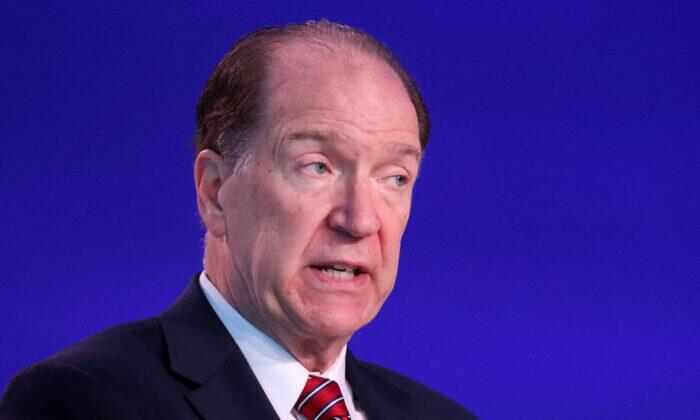
World Bank president David Malpass told the BBC at the IMF-World Bank spring meetings in Washington that record food prices could see hundreds of millions of people forced into poverty if the conflict in Ukraine does not come to an end.
“It’s a human catastrophe, meaning nutrition goes down. But then it also becomes a political challenge for governments who can’t do anything about it, they didn’t cause it and they see the prices going up,” Malpass said.
The World Bank calculates there could be a “huge” 37 percent jump in food prices which will hit the poor the hardest and see them “eat less and have less money for anything else such as schooling,” Malpass continued. “And so that means that it’s really an unfair kind of crisis. It hits the poorest the hardest. That was true also of COVID.”
Regarding the “broad and deep” price hikes, the World Bank chief said it was “affecting food of all different kinds of oils, grains, and then it gets into other crops, corn crops because they go up when wheat goes up.”
Both Russia and Ukraine are key exporters of grain and supply nearly 30 percent of wheat and nearly 20 percent of corn in the global market.
Food prices were up nearly 13 percent in March, the highest on record since 1990, according to the United Nations’ FAO Food Price Index.
Meanwhile, the U.N. has previously warned that Ukraine’s food supply chain is “falling apart” due to Russia’s invasion.
While Malpass noted that there is enough food globally to feed everyone, and stockpiles throughout the world continue to remain large by historical standards, the World Bank president said there would need to be a sharing or sales process to ensure that the food goes where it is needed.
He also said there needs to be more of a focus on boosting supplies of fertilizers and food across the world and assisting the poorest of people while discouraging countries from subsidizing production or capping prices.
The World Bank chief also warned of a knock-on “crisis within a crisis” that could occur due to developing countries being unable to service their large debts from the COVID-19 pandemic as they struggle with rising food and energy costs.
The International Monetary Fund said on April 19 that 60 percent of low-income countries are at or near “debt distress” adding that it is open to providing financial assistance to these countries via traditional programs or emergency financing.
“This is a very real prospect. It’s happening for some countries, we don’t know how far it’ll go. As many as 60% of the poorest countries right now are either in debt distress or at high risk of being in debt distress,” Malpass said.
“We have to be worried about a debt crisis, the best thing to do is to start early to act early on finding ways to reduce the debt burden for countries that … have unsustainable debt, the longer you put it off, the worse it is,” he added.
Malpass’s comments come after the White House said last month that it anticipates a global food shortage due to the ongoing conflict in Ukraine which could see energy, fertilizer, wheat, and corn prices pushed even higher at a time when inflation levels in the United States have reached their highest in 40 years.
However, Biden administration officials have said the United States is not likely to be impacted by a food shortage.
Meanwhile, David Beasley, the executive director of the United Nations World Food Programme, has warned that the war in Ukraine and subsequent global food crisis could see an influx of illegal immigrants attempting to enter the United States.
Beasley told CBS News’ “Face the Nation” on April 17 that Russian President Vladimir Putin is using starvation as a “weapon” in various ways, and that the U.N. has heard of large numbers of people in central America considering migrating to America as inflation levels in their countries continue to soar, further exacerbated by the situation in Ukraine.
END
6.CRYPTOCURRENCIES
7. GOLD/ TRADING
Your early currency/gold and silver pricing/Asian and European bourse movements/ and interest rate settings FRIDAY morning 7:30 AM
ONSHORE YUAN: CLOSED DOWN 6.5010
OFFSHORE YUAN: 6.5320
HANG SANG CLOSED UP DOWN 43.70 PTS OR 0.21%
2. Nikkei closed DOWN 447.80PTS OR 1.63%
3. Europe stocks ALL RED
USA dollar INDEX DOWN TO 100.87/Euro FALLS TO 1.0822
3b Japan 10 YR bond yield: FALLS TO. +.250/ !!!!(Japan buying 100% of bond issuance)/Japanese yen vs usa cross now at 128.34/JAPANESE FALLING APART WITH YEN FALTERING AS WELL AS LONG TERM YIELDS RISING BREAKING THE JAPANESE CENTRAL BANK.
3c Nikkei now ABOVE 17,000
3d USA/Yen rate now well below the important 120 barrier this morning
3e Gold DOWN /JAPANESE Yen UP CHINESE YUAN: DOWN -SHORE CLOSED DOWN// OFF- SHORE DOWN
3f Japan is to buy the equivalent of 108 billion uSA dollars worth of bond per month or $1.3 trillion. Japan’s GDP equals 5 trillion usa./“HELICOPTER MONEY” OFF THE TABLE FOR NOW /REVERSE OPERATION TWIST ON THE BONDS: PURCHASE OF LONG BONDS AND SELLING THE SHORT END
Japan to buy 100% of all new Japanese debt and by 2018 they will have 25% of all Japanese debt. Fifty percent of Japanese budget financed with debt.
3g Oil UP for WTI and UP FOR Brent this morning
3h European bond buying continues to push yields lower on all fronts in the EMU. German 10yr bund RISES TO +.0.939%/Italian 10 Yr bond yield RISES to 2.64% /SPAIN 10 YR BOND YIELD RISES TO 1.90%…ITALIAN 10 YR BOND YIELD/GERMAN BUND: 1.70: DANGEROUS FOR THE ITALIAN BANKING SYSTEM
3i Greek 10 year bond yield RISES TO : 2.99
3j Gold at $1935.95 silver at: 24.30 7 am est) SILVER NEXT RESISTANCE LEVEL AT $30.00
3k USA vs Russian rouble;// Russian rouble UP 1 & 4/5 roubles/dollar; ROUBLE AT 72.97
3m oil into the 102 dollar handle for WTI and 107 handle for Brent/
3n Higher foreign deposits out of China sees huge risk of outflows and a currency depreciation. This can spell financial disaster for the rest of the world/
JAPAN ON JAN 29.2016 INITIATES NIRP. THIS MORNING THEY SIGNAL THEY MAY END NIRP. TODAY THE USA/YEN TRADES TO 128.34 DESTROYING JAPANESE CITIZENS WITH HIGHER FOOD INFLATION
30 SNB (Swiss National Bank) still intervening again in the markets driving down the FRANC. It is not working: USA/SF this morning .9595– as the Swiss Franc is still rising against most currencies. Euro vs SF 1.0332well above the floor set by the Swiss Finance Minister. Thomas Jordan, chief of the Swiss National Bank continues to purchase euros trying to lower value of the Swiss Franc.
USA 10 YR BOND YIELD: 2.921 UP 1 BASIS PTS
USA 30 YR BOND YIELD: 2.939 UP 1 BASIS PTS
USA DOLLAR VS TURKISH LIRA: 14.74
Futures Drop With Traders On Edge Over Hawkish Central Banks
FRIDAY, APR 22, 2022 – 07:49 AM
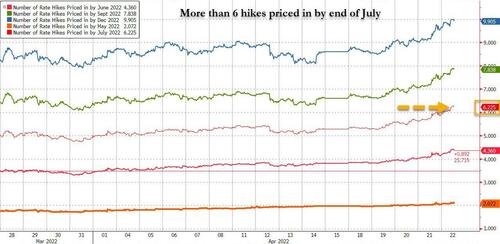
US equity futures extended their Thursday losses, and were slightly lower on Friday morning as investors fretted over the latest hawkish remarks from Jerome “Crash Stonks” Powell. Nasdaq 100 futs were down 0.1% by at 7:15a.m. EDT after the underlying gauge slumped 2% on Thursday after Powell outlined his most aggressive approach yet to taming inflation, potentially endorsing two or more half percentage-point interest-rate increases, which prompted the market to price in more than six 25bps rate hike by the end of July and 10 hikes by the end of 2022. Shorter-dated Treasury yields surged. The dollar rose to the highest level since July 2020 amid losses for the British pound with data showing the U.K.’s cost-of-living crisis is hampering consumer spending.
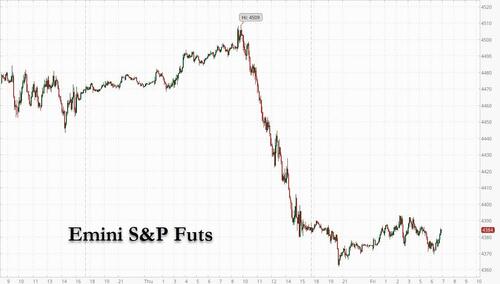
The overnight weakness pushed both S&P 500 futures lower by about 0.2% after cash closed down 1.5% Thursday, although trade was muted and range-bound.
The fears over rising rates have been particularly damaging for frothy growth and technology parts of the market amid concerns about the squeeze on their future earnings.
“The problem for the equity market and particularly those rate sensitive long duration stocks is they are simply not valued appropriately for that new regime,” said Roger Lee, head of U.K. equity strategy at Investec. “Investors have been so heavily concentrated in those ‘growth’ parts of the market that the unwind and repositioning as this new rate environment sinks in could take months, if not years.”
“Equities are really torn between these two forces right now and the first one is that earnings are actually pretty good,” Anastasia Amoroso, chief investment strategist at iCapital Securities LLC, said on Bloomberg Television. But “anytime equities rally it seems like the Fed officials are coming in with more and more hawkish talk,” she said.
Powell on Thursday cited minutes from last month’s policy meeting that said many officials had noted “one or more” 50 basis-point hikes could be appropriate to curb the hottest inflation in four decades. Investors are now betting on half-point increases in May, June and possibly July.
“The unknown is Powell’s ability to deliver the needed finesse without completely derailing the recovery, while not falling short of the required magnitude to anchor inflation,” Ian Lyngen, head of interest rate strategy at BMO Capital Markets, wrote in a note.
In premarket trading, Gap sank 13% after lowering its quarterly sales growth guidance and saying Old Navy President and CEO Nancy Green will leave the business this week. Snap shares dipped 3% following mixed results from the social-media company; Q1 revenue missed while adjusted Ebitda beat expectations amid strong user growth. Chindata shares, on the other hand, surged 12% after Bloomberg reported that the Chinese data center company backed by private equity firm Bain Capital had received preliminary takeover interest from other firms in the industry. Here are some other notable premarket movers:
- SVB Financial (SIVB US) rallied 9% in postmarket trading after reporting earnings per share for the first quarter that beat the average analyst estimate. Its net interest margin also topped analyst expectations for the three months ended March 31.
- Spire Global (SPIR US) gained 5.7% in postmarket as coverage starts with an outperform rating and $4 price target at Raymond James, which touts the the satellite-imaging and data company’s potential for “rapid” annual recurring revenue growth.
- Boston Beer (SAM US) fell 3% postmarket after first- quarter results missed estimates, hurt by shipment volume decreases in Truly Hard Seltzer, Twisted Tea, Angry Orchard, and Dogfish Head brands, partially offset by increases in its Samuel Adams brand.
- Globus Medical (GMED US) tumbled 11% in postmarket trading after the company reported preliminary net sales for the first quarter of about $230.5 million, compared to consensus estimates of $236.1 million, and said CEO Dave Demski resigns.
- Qualtrics (XM US) shares gained 4.4% in extended trading on Thursday after the software company reported first-quarter revenue that beat expectations. It also gave a second-quarter revenue forecast that beat the average analyst estimate.
U.S. equities were hammered this week as the first-quarter earnings season began with some high profile misses, including from Netflix. Earnings-per-share growth is tracking down 11% in U.S., according to Barclays strategist Emmanuel Cau, but overall beats are above average so far. That said, U.S. equities have remained rather resilient in the face of increasingly hawkish signals from the Fed and ECB, thanks to hopes for another solid earnings season but those are becoming increasingly frayed. At the same time, traders are mindful of the inevitable risk repricing, especially after Powell outlined his most aggressive approach yet to taming inflation, potentially endorsing two or more half percentage-point rate increases.
In Europe, the Stoxx 50 slumped 1.5% while the Stoxx 600 Index was down 1.2%, pressured by disappointing quarterly earnings from Gucci-owner Kering and SAP. FTSE 100 outperformed, dropping 0.5%. Energy, travel and retailers are the worst-performing sectors. Here are the biggest European premarket movers:
- Essity rises as much as 15%, the most since its 2017 IPO and the biggest gainer on the Stoxx 600, on earnings analysts say show Essity’s pricing efforts to offset cost inflation are proving effective.
- Renault jumps as much as 8.3% after a Bloomberg News report that the company is considering selling part of its Nissan Motor stake. The auto maker also published “solid” 1Q numbers.
- HomeServe jumps as much as 13% after disclosing it has received a number of proposals from Brookfield. Analysts note the increased probability of a bid, while not ruling out counteroffers.
- Holcim shares gain as much as 6.2% after the cement maker reported what Jefferies called a “massive beat” on first-quarter earnings, helped by strong volumes in North America.
- Bureau Veritas shares rise as much as 5.9%. The testing and inspection firm’s 1Q update looks strong, with organic growth well ahead of expectations, RBC says.
- European technology stocks slide as much as 2.4%, underperforming declines for the broader index, with rate-hike fears and an earnings miss by index heavyweight SAP weighing
- Logitech down as much as 6.4%; SAP as much as 4.5% on “disappointing” earnings
- Kering shares slump as much as 7% as investors focused on the 1Q sales miss of the fashion conglomerate’s crucial Gucci brand in spite of beats elsewhere across the business.
- Anglo American falls as much as 3.6%, as the stock was cut to sector perform at RBC, with the broker saying that the miner’s “poor” 1Q and guidance will impact the investment case.
- Ferrari drops as much as 3.3% in Milan after the sports-car maker issued a recall for 2,222 of its vehicles in China as there may be some problem with the brakes.
Earlier in the session, Asian stocks declined after Federal Reserve Chair Jerome Powell outlined an aggressive approach to monetary tightening, weighing on market sentiment. The MSCI Asia Pacific Index fell as much as 1.6% Friday to the lowest level in a month. Technology shares were the biggest drags as Treasury yields resumed their ascent, hurting costlier growth stocks. Japanese equities led losses in the region following the Fed’s hawkish comments. A 50 basis-point interest rate increase “will be on the table” for next month’s policy meeting, Powell said Thursday. He also backed a series of half-point hikes ahead and said the Fed is committed to raising rates “expeditiously” to tame inflation. Powell Hardens Hawkish Pivot Toward Half-Point Fed Rate Hikes Chinese stocks stabilized, with the CSI 300 Index snapping a five-day losing streak, after regulators urged funds to boost their equity investments. Technology shares, however, took a hit from ongoing U.S. delisting concerns. The Hang Seng Tech Index eked out a small gain after falling the previous three sessions. Asian markets have been jittery this week amid the prospect of global monetary tightening, as well as growth risks in China stemming from stringent Covid lockdowns and supply chain disruptions. The Asian stock benchmark has slid more than 2% this week, poised for a third weekly decline. Asian central banks “will be raising rates at a more gradual pace compared with the Fed,” said Tai Hui, chief Asia market strategist at JPMorgan Asset Management in a Bloomberg TV interview. “Cash return across Asia is still going to be pretty low. That will continue to fuel demand for income investments.”
In FX, euro extends decline as traders price in 50 bps of ECB rate hikes by September. Curves have a flattening bias. Bunds and USTs bear-flatten, U.S. short end cheapens 6-8 bps, underperforming bunds by ~2bps. Gilts bull-flatten but ranges are relatively narrow. Peripheral spreads tighten, led by short-end Portugal.
In FX, the Bloomberg Dollar Spot Index rose and the greenback advanced against all of its Group-of-10 peers apart from the yen. The pound was the worst performer and approached $1.29, the lowest in 17 months against the dollar and underperforming all of its G-10 peers, after data showed U.K. retail sales plunged more than forecast in March. Gilts outperformed with Bank of England Governor Andrew Bailey due to speak later. The volume of goods sold in stores and online dropped 1.4% after falling 0.5% in February. Economists had expected a decline of 0.3%. U.K. PMI for both services and the whole economy fell to a three-month low in April, while consumer confidence sank to its lowest since the recession in 2008. The euro fell to trade around $1.08 and European bonds outperformed Treasuries. The Kiwi and Aussie fell under weight of leveraged selling to underperform major peers, according to Asia-based FX traders. The yen gained on a report that Japanese Finance Minister Shunichi Suzuki discussed the possibility of coordinated currency intervention with U.S. Treasury Secretary Janet Yellen. Japanese government bonds edged lower. Japan’s key consumer prices advanced in March at the fastest pace in more than two years, complicating the central bank’s communication of its easy policy stance given a further acceleration is expected in April.
Perhaps most importantly, the Chinese Yuan has its worst week since the August 2015 devaluation.
In rates, the Treasury curve bear flattened as 2-year yields rose by 7bps while long-end yields by around 1bp. Futures are off the lows however, with bunds and gilts outperforming over the London session. 10-year TSY yields trade around 2.92%, cheaper by 2bp on the day and lagging bunds by 2bp, gilts by 4bp; extension of bear-flattening move tightens 2s10s, 5s30s spreads by ~4bp and ~1bp. Weakness during Asia session was led by Aussie bonds, where 10-year yield reached highest level since 2014.
In commodities, WTI drifts 2.1% lower to trade around the $101 level. Spot gold falls roughly $10 to trade around $1,942/oz. Most base metals trade in the red.
Looking to the day ahead now, data releases include the global flash PMIs for April and UK retail sales for March. Central bank speakers include ECB President Lagarde and BoE Governor Bailey. Finally, earnings releases include Verizon Communications and American Express.
Market Snapshot
- S&P 500 futures down 0.1% to 4,386.00
- STOXX Europe 600 down 0.8% to 457.90
- MXAP down 1.0% to 169.68
- MXAPJ down 1.1% to 559.97
- Nikkei down 1.6% to 27,105.26
- Topix down 1.2% to 1,905.15
- Hang Seng Index down 0.2% to 20,638.52
- Shanghai Composite up 0.2% to 3,086.92
- Sensex down 1.1% to 57,289.28
- Australia S&P/ASX 200 down 1.6% to 7,473.28
- Kospi down 0.9% to 2,704.71
- German 10Y yield little changed at 0.95%
- Euro down 0.4% to $1.0794
- Brent Futures down 1.8% to $106.35/bbl
- Gold spot down 0.3% to $1,946.54
- U.S. Dollar Index up 0.41% to 100.99
Top Overnight News from Bloomberg
- ECB Governing Council member Robert Holzmann says it’s crucial that asset purchases come to an end as soon as possible in order to start “visible” interest rate increases, according to comments made to Die Presse newspaper
- Economic momentum in the euro area unexpectedly picked up in April, with a rebound in services following the end of Covid restrictions making up for stalling manufacturing. A composite gauge for both sectors jumped to a seventh-month high, according to a PMI survey. The increase to 55.8 from 54.9 in March compares to an estimate of 53.9
- Global bonds added to this year’s epic rout as traders brace for the most aggressive Federal Reserve interest-rate hikes in 40 years and the likelihood most global central banks will also tighten.
- India is expected to raise policy rates by the most among major central banks in the region as it seeks to tackle a surge in inflation, according to swaps pricing. The Reserve Bank of India is seen raising its policy rate by around 275 basis points by end 2023 based on front-end swaps, according to a BofA Securities note
- China’s central bank governor stressed the importance of keeping inflation under control in two separate speeches released Friday and pledged more targeted support for small businesses, reinforcing policy makers’ cautious approach to monetary stimulus
- French President Emmanuel Macron led his rival Marine Le Pen 55.5% to 44.5% ahead of the run-off presidential election set for April 24, according to a polling average calculated by Bloomberg on April 22. The gap between them has narrowed from the 12.0 percentage points recorded on April 20
- Applying the sustainable debt format to governments is raising thorny challenges, from just how ambitious to make the targets to the democratic quandary of committing to goals a future administration might disagree with
A more detailed look at global markets courtesy of newsquawk
Asia Pac stocks were negative on spillover selling from Wall St with risk sentiment sapped amid higher yields and hawkish central bank commentary. ASX 200 declined as tech suffered from higher yields and with miners subdued by OZ Mineral’s weak output. Nikkei 225 underperformed as the optimism from incoming relief faded on the hawkish central bank views. Hang Seng and Shanghai Comp weakened amid large losses in Hong Kong’s tech stocks and with sentiment not helped by the US adding another 17 firms to its SEC list for possible delisting.
Top Asian News
- China’s Oil Demand Is Tumbling the Most Since Wuhan Lockdown
- China’s Plunging Markets Trigger Capital Flight, State Support
- Japan Deems Russia’s Occupation of Disputed Islands ‘Illegal’
- A $26 Billion Bond Trade Loved by Banks Faces India Scrutiny
- Mainland China Investors Buy Net HK$3.28B Via Stock Connect
European bourses are pressured across the board, Euro Stoxx 50 -1.8%, following APAC/Wall St. pressure amid hawkish Central Bank rhetoric. The FTSE 100 is the relative outperformer, but still negative, given favourable currency dynamics given broad USD strength and weak Retail Sales. Stateside, futures are modestly softer after spending much of the APAC session near the unchanged mark, ES -0.4%, moving in sympathy with EZ action and pre-PMIs. Note, today is the last day of potential Fed speak before the blackout period for May’s gathering commences; no Fed officials scheduled.
Top European News
- Credit Suisse, SocGen May See Trading Drop as War Upends Markets
- Ferrari Recalls Over 2,000 Cars in China on Brake Risk
- Ghosn Faces Arrest Warrant in French Probe
- French Football Club Olympique Lyonnais Said to Get Six Bids
- U.K. Economic Outlook Dims as Confidence and Sales Falter
FX
- Sterling slides to bottom of G10 pile as UK retail sales data misses consensus by a distance and two out of three preliminary PMIs fall short of expectations, Cable hits new 2022 low circa 1.2865, EUR/GBP approaches 0.8400.
- Non-US Dollars decline amidst general risk aversion and other bearish factors; AUD/USD hovering just above 0.7300, NZD/USD sube-0.6700 and USD/CAD over 1.2675 ahead of Canadian consumption and producer price data.
- Euro fades irrespective of mostly stronger than forecast flash Eurozone PMIs as ECB President Lagarde tones down hawkish vibes, EUR/USD probes 1.0800.
- Yen holds up better than other majors after more concerted effort by Japan’s Finance Minister to curb rapid moves via confirmation that he is in close contact with US Treasury Secretary about currency developments, USD/JPY capped below 129.00.
- Yuan set for weakest week since devaluation seven years ago with PBoC Governor Li pledging policy stimulus for the real economy that is suffering from Covid contagion; USD/CNH through 6.5250.
- ECB President Lagarde told policymakers to refrain from airing dissenting views on decisions for several days, according to Reuters sources.
- Japanese Finance Minister Suzuki said he confirmed with US Treasury Secretary Yellen that US and Japan will communicate closely on FX and discussed with Yellen the recent market developments, in particular, USD/JPY moves, while he explained to Yellen recent JPY declines are rapid, according to Reuters.
- Japanese Finance Minister Suzuki and US Treasury Secretary Yellen likely discussed coordinated currency intervention during bilateral talks, according to TBS News citing a Japanese government source which noted the US side sounded as if it will consider the idea of joint FX intervention positively.
Fixed Income
- Bonds on track to rack up more weekly losses with Bunds down to 153.10 at worst, Gilts hitting 117.22 and 10 year T-note 118-08.
- Benchmark yields still targeting or touching psychological levels, like 1.0% in Germany, 2.0% and 3.0% in the UK and US respectively.
- Curves retain flatter bias and debt could yet derive traction from pre-weekend position squaring plus asset reallocation as equities dump.
Commodities
- WTI and Brent are pressured in tandem with broader price action, USD strength and sources pointing to a China demand shock.
- China is said to face the biggest oil demand shock since early 2020, according to Bloomberg sources.
- Currently, WTI and Brent have recovered marginally from session lows of USD 101.22/bbl and USD 105.80/bbl, respectively.
- Spot gold and silver are also hindered on the USD move, yellow metal continues to fall away from the USD 1950/oz mark (low, USD 1941/oz; high USD 1955.60/oz).
US Event Calendar
- 09:45: April S&P Global US Composite PMI, est. 57.9, prior 57.7
- 09:45: April S&P Global US Services PMI, est. 58.0, prior 58.0
- 09:45: April S&P Global US Manufacturing PM, est. 58.0, prior 58.8
DB’s Jim Reid concludes the overnight wrap
Happy Friday. I’m already longingly looking forward to Monday as my wife is having her first weekend away without any of us since we had children. I’ve been left a full handwritten list of things I need to do to successfully solo look after 3 rowdy kids and a wayward dog. I genuinely don’t think she believes I can do it without incident. If I were to allow unlimited TV, and an endless supply of tomato ketchup and mayonnaise then it would be an absolute doddle. I’ll start off with good intentions tonight and then see how quickly I resort to the easy route at the weekend.
Central bankers are finding there is no easy route at the moment and yesterday was another day of rising hike expectations. There was a full lineup of central bank speakers with most of the heavy hitters coming in after Europe went home. Having said that, the damage in global rates markets was done long before Chair Powell joined President Lagarde on an IMF panel.
With the Fed’s May FOMC communications blackout set to start tomorrow, Powell stayed true to the recent Fed line, saying many FOMC participants favoured one or more +50bp moves, noting that it would be appropriate to move relatively quickly, and that he wanted to get policy rates to neutral. In that vein, he said there was some merit in front-loading the policy tightening given the historically tight labour market and upside risks to already runaway inflation.
President Lagarde drew a distinction between the different economic realities of Europe and the US, but she did not rule out an increase to the ECB’s policy rate as early as the July meeting. Recall, our European econ team’s base case is the ECB will lift rates by +25bps in September, after finishing net APP purchases in the third quarter. Lagarde also noted that the ECB doesn’t target any specific level of the euro, but are watching FX dynamics.
Even before Powell and Lagarde had started speaking, the sizeable bond sell-off came as other central bank speakers endorsed hawkish policies. President Daly, who skews dovish, remarked earlier in the day that a couple of +50bp hikes were likely, while President Bullard, speaking at the same time as Powell, wouldn’t rule out a +75bp hike. The market kept a +50bp hike for May fully priced, and this morning is pricing +151bps of tightening over the next three meetings, so equivalent to just over three consecutive +50bp hikes. When all was said and done, Fed funds futures moved to price in an additional +14.3bps worth of tightening over 2022 yesterday, thus bringing the total amount of hikes priced for the rest of the year to 240bps, which is the highest to date, and this morning they’ve added a further 6bps. Given the 25bp hike we saw last month, if realised that would imply 271bps over the year as a whole, so beating out the 250bps of tightening back in 1994. Futures also became more aggressive on the 2023 profile as well, as they moved to price in a 3% Fed Funds rate as early as March 2023, which is the first time they’ve closed at that level.
The prospect of more aggressive rate hikes led to a significant selloff in Treasuries, with the 10yr yield up by +7.8bps to 2.91%, after trading as high as 2.95% intraday, with a further +3.3bps move this morning back up to 2.94%. Those moves were seen across the curve, though the front end saw the biggest moves higher as further rate hikes were priced in, meaning that the 2s10s flattened -2.7bps on the day to 22.3bps. Real yields led the bulk of the move earlier in the day, but breakevens took the mantle after an exceptionally strong 5yr TIPS auction showed there is strong latent demand for investor protection against inflation, driving 5yr breakevens to +3.64% and 10yr breakevens to 3.04%, the highest levels on record for each.
It was much the same story in Europe, where the chatter around an ECB rate hike as soon as July stepped up a gear, echoing what we saw from the Fed six months ago where the timing of an initial rate hike was increasingly brought forward. First, we heard from Vice President de Guindos, who was asked if a July liftoff was possible, and said that “It will depend on the data we see in June. From today’s perspective, July is possible and September, or later, is also possible.” In addition, Belgian central bank governor Wunsch said that policy rates could even move into positive territory this year, saying that market pricing “to me is on the low side of what might be required to get inflation under control”. Overnight index swaps reacted accordingly, and the amount of tightening priced in by overnight index swaps for December’s meeting closed above 75bps for the first time, so implying at least 3 full 25bp moves. Looking at the July meeting specifically, +21.5bps of tightening were priced in by the close yesterday, an increase of +7.1bps on the day, with +47.4bps priced in by September, a +12.6bp increase. So we’re close to two +25bp hikes being priced in for each of July and September.
That shift in expectations meant that the European bond selloff echoed the US, with yields on 10yr bunds (+9.1bps), OATs (+6.8bps) and BTPs (+9.8bps) all moving higher on the day. The most significant moves were seen in the UK however, where 2yr gilt yields surged by +16.9bps after Catherine Mann of the MPC suggested that rates could move by more than 25bps. That saw overnight index swaps increase the implied probability of a 50bp move at the May meeting up to 58.7%, with 167bps worth of further tightening priced for the rest of the year, on top of the 50bps we’ve already had so far.
European stocks largely advanced before the magnitude of tighter central bank comms weighed on the market, with the STOXX 600 increasing +0.32%. The DAX (+0.98%) and CAC 40 (+1.36%) outperformed broader European equities. In the US, meanwhile, stocks took a turn for the worse in the New York afternoon following the day’s central bank speak. The S&P 500 fell -1.48% as every sector was lower. Indeed, only stalwart defensive sectors staples (-0.11%) and real estate (-0.63%) avoided declines of greater than 1%. Tech stocks intuitively underperformed on the tighter policy path; the Nasdaq fell -2.07% and FANG+ shares were -2.79% lower.
Those themes have been echoed overnight in Asia, where equities are mostly lower this morning. The Nikkei (-1.89%) is leading losses across the region, with the Hang Seng (-0.70%) and the Kospi (-1.06%) also falling. Mainland Chinese stocks are experiencing a more mixed performance however, with the Shanghai Composite (-0.07%) fractionally lower while the CSI (+0.12%) is up after China’s securities regulator urged institutional investors to buy more domestic stocks. Looking forward, US equity futures are pointing to further losses, with contracts on the S&P 500 (-0.27%) and Nasdaq 100 (-0.18%) both lower.
We’ve also started to see the flash PMIs for April come in overnight, with the numbers from Australia and Japan mostly seeing an improvement on March’s performance. Japan’s composite PMI rose to 50.9 (vs. 50.4 in March), whilst Australia’s composite PMI was up to 56.2 (vs. 55.1 in March), so it’ll be interesting to see if that’s replicated in Europe and the US too. Staying on that data theme, Japan’s CPI rose to +1.2% year-on-year in March as expected, marking its fastest pace since October 2018.
Elsewhere, we’re just 2 days away from the French presidential election run-off on Sunday, which is set to be closely watched by investors. That said, the perceived chances of a surprise victory for Marine Le Pen have fallen in recent days given the polls have moved in President Macron’s favour, with the most recent numbers all putting his margin of victory outside the standard margin of error, with Politico’s average giving him a 10-point lead. The prospect of another Macron victory has made investors increasingly relaxed about the outcome, and the spread of French 10yr yields over bunds narrowed by -2.2bps yesterday to 45.7bps, which is their tightest level so far this month. Furthermore, the CAC 40 (+1.36%) outperformed the other European equity indices as highlighted above. In terms of yesterday’s polls, they had Macron up by 57.5-42.5 (Ipsos), 56-44 (Opinionway), 55.5-44.5 (Ifop) and 53-47 (Odoxa).
On the data side, the weekly initial jobless claims from the US came in at 184k in the week through April 16 (vs. 180k expected). And over in Europe, the final March CPI reading for the Euro Area was revised down to +7.4% (vs. flash +7.5%), albeit still a record since the single currency’s formation, whilst the European Commission’s advance consumer confidence reading for April unexpectedly rose to -16.9 (vs. -20.0 expected), recovering somewhat from its recent low in March.
To the day ahead now, and data releases include the global flash PMIs for April and UK retail sales for March. Central bank speakers include ECB President Lagarde and BoE Governor Bailey. Finally, earnings releases include Verizon Communications and American Express.
3. ASIAN AFFAIRS
i)FRIDAY MORNING// THURSDAY NIGHT
SHANGHAI CLOSED UP 7.11 PTS OR 0.23% //Hang Sang CLOSED 43.70 OR 0.21% /The Nikkei closed DOWN 447.80 PTS OR 1.63% //Australia’s all ordinaires CLOSED DOWN 1.51% /Chinese yuan (ONSHORE) closed DOWN 6.5010 /Oil UP TO 103.09 dollars per barrel for WTI andDOWN TO 107.10 for Brent. Stocks in Europe OPENED ALL GREEN // ONSHORE YUAN CLOSED DOWN AGAINST THE DOLLAR AT 6.5010 OFFSHORE YUAN CLOSED DOWN ON THE DOLLAR AT 6.5320: /ONSHORE YUAN TRADING ABOVE LEVEL OF OFFSHORE YUAN/ONSHORE YUAN TRADING WEAKER AGAINST US DOLLAR/OFFSHORE WEAKER//
3 a./NORTH KOREA/ SOUTH KOREA
///NORTH KOREA
END
3B JAPAN
USA rejects a coordinated currency intervention; the Yen plummets
(zerohedge)
As Yen Craters, Japan Begs US For “Coordinated Currency Intervention”, Is Rejected By Yellen
FRIDAY, APR 22, 2022 – 10:20 AM
At the end of March, we warned that the “Yen was At Risk Of “Explosive” Downward Spiral With Kuroda Trapped“…
…. and that, more or less, is what happened with the Japanese currency subsequently suffering the longest stretch of daily losses in history with 13 consecutive days of losses.
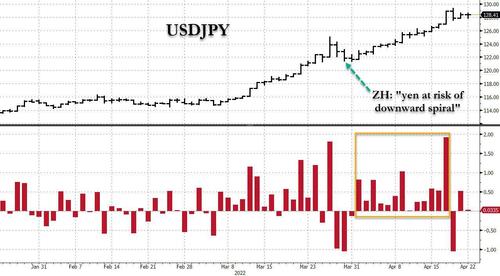
And absent the occasional short squeeze, it is unlikely that this relentless trend lower in the yen trajectory will change any time soon as it comes at the expense of the BOJ’s being able to maintain its Yield Curve Control which limits the 10Y JGB at 0.25%, but to do so, it forces the BOJ to keep easing, injection trillions in yen, and effectively continuously devaluing the currency (until none other than China is forced to devalue as we also explained last month, and will discuss again later today).
So with the BOJ trapped and unable to do much to reverse the implosion in the yen (which unlike much of the past decade is actually dangerous for Japan because as we also explained this week, assures much higher inflation for the country which has the highest debt load in the developed world), what does Japan do? Why come running to the Fed in hopes of some “coordinated intervention” of course.
On Friday, Japanese television broadcaster TBS reported that Japan and the United States likely discussed the idea of coordinated currency intervention to stem further yen falls during a bilateral finance leaders’ meeting. According to Reuters, the report, citing a Japanese government source, came after Japanese Finance Minister Shunichi Suzuki described recent yen falls as “sharp” and said he agreed with U.S. Treasury Secretary Janet Yellen to communicate closely on currency moves.
“We confirmed that currency authorities of both countries will communicate closely, aligning with the exchange-rate principles agreed among the G7 and G20 members,” Suzuki told reporters after the meeting with Yellen in Washington D.C. on the sidelines of the International Monetary Fund gatherings.
Suzuki said he explained to Yellen that recent yen falls were sharp, but declined to comment on whether the two discussed the idea of coordinated currency intervention. However, in a report from Washington, TBS said Suzuki and Yellen did discuss joint currency intervention during their talks.
“The U.S. side sounded as if it would consider the idea positively,” TBS quoted the government source as saying.
That said, it is unlikely that a new Plaza Accord is imminent as Washington will find it very hard to consent to yen-buying intervention as it would drive down the dollar and accelerate already soaring U.S. inflation, TBS reported. When approached by Reuters on the report, a Japanese finance ministry official said he could not comment on whether joint currency intervention was discussed at the meeting.
It’s probably hard to get U.S. consent for coordinated intervention at this timing,” said Masahiro Ichikawa, chief market strategist at Sumitomo Mitsui DS Asset Management. “If intervention does take place, that could trigger a huge unwinding of positions and push up the Japanese currency by 2-3 yen in a short period of time.”
The yen has plunged to two-decade lows against the dollar, with the central bank continuing to defend its ultra-low rate policy in contrast with heightening chances of aggressive rate hikes by the U.S. Federal Reserve. read more
The currency’s fall halted this week at lows of 129.43 to the dollar on expectations the issue of joint intervention could be raised at the G7 and the U.S.-Japan finance leaders’ meetings. In a G7 statement issued on Thursday Tokyo time, the finance heads said they were closely monitoring markets that have been “volatile,” but made no mention of exchange rates.
“The government has said rapid currency moves were undesirable. What we’re seeing now with the yen are rapid moves, so we’ll monitor moves closely with a sense of urgency,” Suzuki told reporters.
Investors believe the yen has even further to fall, with most betting that even a government intervention wouldn’t be enough to turn around the momentum.
“It wouldn’t surprise me if they did talk about joint intervention,” though Suzuki likely failed to win consent from Yellen, said Daisaku Ueno, chief foreign exchange strategist at Mitsubishi UFJ Morgan Stanley Securities. “That’s why Suzuki had little to say about what Yellen told him. Given the U.S. battles with rapid inflation through monetary tightening, it’s unthinkable Washington will agree to Japan’s call for intervention.”
The Yen jumped modestly on the news, briefly reversing the day’s losses with the USDJPY dipping briefly below 128, only to resume it relentless collapse …
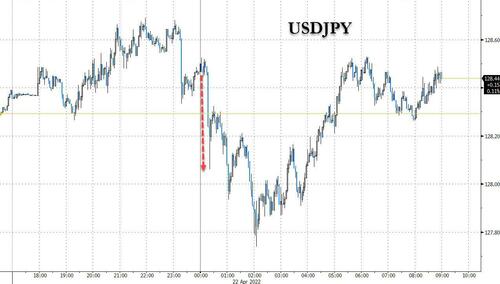
… which as we will discuss shortly, is “the biggest story no-one is talking about” according to Albert Edwards.
end
3c CHINA
CHINA/COVID LOCKDOWNS
Shanghai still has major problems amid reports of rotten food
(zerohedge)
Shanghai Authorities Promise Better Oversight Of Emergency Supplies Amid Reports Of Rotten Food
THURSDAY, APR 21, 2022 – 08:00 PM
Now that local authorities have started to lift the lockdown on Shanghai, releasing 4 million people from being locked away inside their apartments yesterday, the true scope of the suffering is just starting to become apparent.
Following myriad complaints about shortages of food and other medicine, Shanghai’s market watchdog (which has mostly been focused on mitigating the impact of the shutdown on Shanghai’s factories and its all-important port) has reportedly pledged to investigate.

Shanghai’s market watchdog has pledged to tighten oversight of pandemic supplies after residents complained that rotten food was being delivered by authorities, leaving them with little, or nothing, to eat.
The announcement comes as residents struggle to secure daily necessities as they remain stuck in their homes while the city battles its worst COVID outbreak in two years.
Tao Ailian, an official at the municipal market regulator, told Caixin on Wednesday that the watchdog had directed authorities to ensure the quality of produce that is being distributed.
In other Shanghai news, the Associated Press reported on Thursday that the low COVID death rates in Shanghai is raising ‘doubts’ (of course, there have been plenty of reports about the authorities covering up deaths in nursing homes and other places with large numbers of elderly residents).
In its report, the AP cited several pieces of evidence which appeared to suggest that death rates – especially among the elderly – were much higher than anticipated.
Lu Muying died on April 1 in a government quarantine facility in Shanghai, with her family on the phone as doctors tried to resuscitate her. She had tested positive for COVID-19 in late March and was moved there in line with government policy that all coronavirus cases be centrally isolated.
But the 99-year-old, who was just two weeks shy of her 100th birthday, was not counted as a COVID-19 death in Shanghai’s official tally. In fact, the city of more than 25 million has only reported 25 coronavirus deaths despite an outbreak that has spanned nearly two months and infected hundreds of thousands of people in the world’s third-largest city.
Lu’s death underscores how the true extent of the virus toll in Shanghai has been obscured by Chinese authorities. Doctors told Lu’s relatives she died because COVID-19 exacerbated her underlying heart disease and high blood pressure, yet she still was not counted.
The new standard being employed by Shanghai authorities assures that few, if any, COVID deaths would actually be counted as such.
During this outbreak, Shanghai health authorities have only considered virus cases where lung scans show a patient with evidence of pneumonia as “symptomatic,” three people, including a Chinese public health official, told the AP. All other patients are considered “asymptomatic” even if they test positive and have other typical COVID-19 symptoms like sneezing, coughing or headaches.
Of course, concealing deaths in the city’s nursing homes might strike a chord with Americans, who remember all too well former New York Gov. Andrew Cuomo’s deliberate under-reporting of the number of deaths at nursing homes in the Empire State during the first months of the pandemic.
END
CHINA/ECONOMY
Whispers Of Yuan Devaluation After Biggest Weekly Plunge Since 2015
FRIDAY, APR 22, 2022 – 01:00 PM
Three weeks ago, when we predicted that the Yen was about to suffer a “downward spiral” (which it did, and prompted the BOJ to beg Yellen for coordinated currency intervention, only to be denied by the Treasury Secretary who is terrified of what importing even more inflation would mean for Biden’s catastrophic approval rating), we quoted SocGen’s Albert Edwards who said that the collapse in the Yen”beggars the question how will China react? Maybe just like they did in August 2015 when the PBoC devalued? Back then persistent yen weakness had dragged down other competing regional currencies and left the renminbi overvalued.“
Once again we didn’t have long to wait for this prediction to come true, and one look at the chart below shows what happens when one is hoping to quietly devalue one’s currency from under the dragon’s nose: after weeks of perplexing gains that stumped everyone (and may have been the direct result of Russians buying up Chinese assets), the yuan has collapsed (said otherwise, the USDCNH has soared).
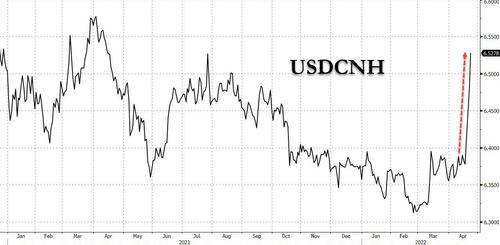
As shown below, the offshore yuan just suffered its biggest weekly loss since the surprise devaluation in August 2015, tumbling 2.1%; the onshore yuan is down 1.9% this week to 6.4899 per dollar. Bloomberg has called the move a “spurring investor concern on whether it’s reaching an inflection point after two straight years of gains.”
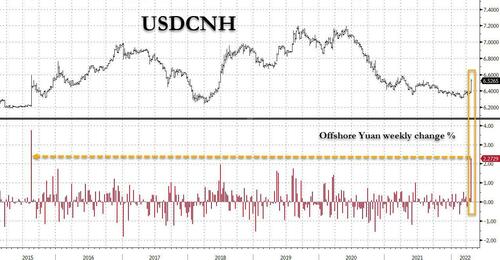
Well, of course it is – after all China’s economy is in freefall and the last thing it can afford is more currency gains… just as we warned at the end of March. And now that our forecast has been validated, options traders are pricing in much more weakness for the onshore yuan after it breached a key technical support level on Wednesday for the first time since September.
The sharp moves – as we predicted weeks ago – were triggered by the relentless surge in U.S. yields as they threaten to exacerbate outflows from China’s bond market and to put the yuan at a disadvantage with the yen. The People’s Bank of China’s decision on Wednesday to set a weaker-than-expected currency fixing also dissuaded yuan bulls, while President Xi Jinping defending the lockdown-dependent approach to fighting the pandemic added to economic growth concerns.
“It does seem that options markets have been surprised,” said Alvin Tan, head of Asia FX strategy at Royal Bank of Canada Plc. “Risk reversals racing higher is a confirmation of the changed market sentiment on dollar-offshore yuan,” Tan said, adding that he doesn’t rule out the offshore yuan falling below 6.60 per dollar by the end of the year if economic risks grow.
And while few are willing to admit that a sharp devaluation like the one in 2015 is possible – or inevitable – the realty is that the CNHJPY is right where it was when China devalued seven years ago.
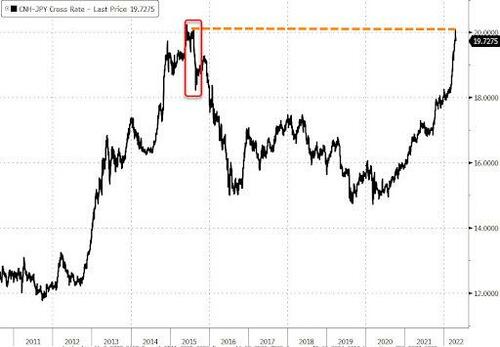
Looking ahead JPMorgan also expects more weakness, and sees the yuan falling to 6.5 per dollar this quarter, weaker than its previous estimate of 6.35. BNP see the currency falling to 6.6 per dollar, down from earlier forecast of 6.4. Below, courtesy of Bloomberg, are the charts illustrating the changing sentiment on the yuan:
Surging Activity
Dollar-yuan was the most traded currency pair in the options market for a second day on Thursday taking the week’s total transaction volume to $49 billion. An upward breach through the 6.40 per dollar level and breach of its 200-day moving average support confirms the termination of months of consolidation for the currency, China International Capital Corp. said; this could prompt a new wave of speculation on yuan entering a new trading range, it said.
“The PBOC has been signaling to corporates to be risk neutral on FX exposures, which should imply a reduction of their dollar longs,” said Arindam Sandilya, head of emerging Asia local markets strategy and FX derivatives strategy at JPMorgan Chase & Co. in Singapore. “This is a bulwark against dollar-onshore yuan depreciation.” Sandilya estimates banks and corporates accumulated about $640 billion of dollars over the last two years.
Turbulent Markets
Offshore yuan implied vol shot higher across all tenors after the currency pair broke out of the range it had been in since Oct. 20. One-month dollar-offshore yuan volatility surged to the highest since February 2021 before stabilizing Thursday. A spokeswoman at China’s State Administration of Foreign Exchange reiterated the regulator’s stance on keeping the yuan “stable on a reasonable and equilibrium level.” The exchange rate has been more flexible this year and its two-way movements will continue, she said.
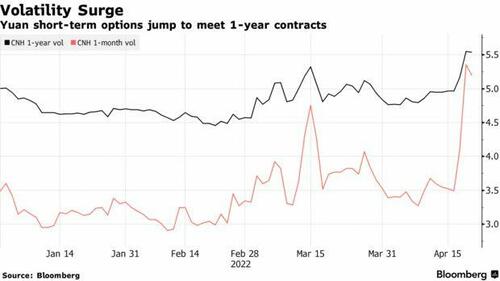
The central bank is less concerned about defending a “magic level”, according to Zhennan Li, chief China economist at AllianceBernstein. It wants to avoid accumulation of speculative or “herding factors” in the market, he said, adding that “If depreciation expectation keep persistently accumulating, and the pace of depreciation becomes too fast, the PBOC may come out to guide expectation.”
Shorts Piling In
The PBOC set the Thursday reference rate for the Yuan 498 pips higher than the previous day, the largest single-day jump this year. That’s after the central bank’s move to set the reference rate 101 pips weaker than forecast on Wednesday was seen by some traders as a sign of its discomfort with the currency’s strength.
The offshore yuan forwards curve flattened in response to the PBOC’s move Wednesday, allowing for cheaper entry into yuan shorts. The one-year points are close to the lowest in two years as expectations of further policy easing persist even as the loan prime rates were kept steady this week.
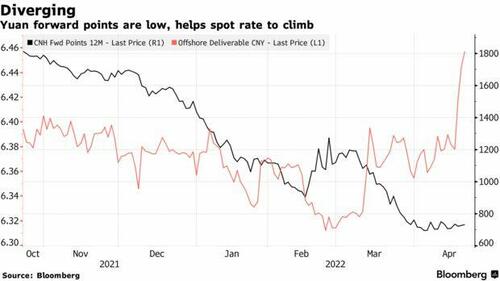
Dollar Bets
According to Bloomberg, traders are unwinding structural bets on yuan strength and positioning for a stronger dollar. The one-month risk reversal, a measure of hedging cost, jumped to 1.34% on Wednesday — a level last seen in November 2020. The risk reversal skew has shifted toward a stronger dollar as traders price aggressive rate hikes by the Federal Reserve.

Momentum is for the yuan to weaken in the near term given the backdrop of broad dollar strength, according to Citigroup Global Markets Inc. strategists. But, it’s too soon to call it a trend reversal. China’s trade surplus, which underpins the currency’s strength is expected to remain large and authorities are likely to leave the yuan to market forces unless volatility gets “unpalatable.”
“President Xi can’t afford to accelerate the weakening of yuan ahead of the plenum in October and midterms in the U.S.,” said Lin Jing Leong senior emerging market Asia sovereign analyst at Columbia Threadneedle. “It’s all about portraying an image of strength even if it means using the foreign reserves to do so.”
END
4/EUROPEAN AFFAIRS//UK AFFAIRS
UK
UK Embassy In Kiev To Reopen Next Week, But Johnson Warns Russian Victory A “Realistic Possibility”
FRIDAY, APR 22, 2022 – 09:00 AM
The UK has announced Friday that it plans to reopen its embassy in Kiev next week, according to a fresh statement from Prime Minister Boris Johnson. Johnson made the announcement from India, saying, “The extraordinary fortitude and success of President Zelenskiy in resisting Russian forces in Kyiv means I can announce that very shortly, next week, we will reopen our embassy in Ukraine’s capital city.”
“I want to pay tribute to those British diplomats who remained in the region throughout this period,” he added during the press conference. The announcement comes after a string of European countries have re-opened their diplomatic missions in the Ukrainian capital.

The UK embassy had shuttered quickly within the opening days of Russia’s Feb.24 invasion, and has been closed since, also as most other countries were forced to close their embassies and consulates, including the United States, amid bombardment of various parts of Ukraine.
Johnson during the New Delhi comments acknowledged that a Russian military victory in Ukraine remains a “realistic possibility” given that the defined scope of Russia’s operations have changed to focusing on taking the Donbas: “Yes, I mean, look, I think the sad thing is that that is a realistic possibility,” the prime minister said.
He added:
Putin has a huge army. [But] he has a very difficult political position because he’s made a catastrophic blunder.
The only option he now has really is to continue to try to use his his appalling, grinding approach – led by artillery – trying to grind the Ukrainians down. And he’s very close to securing a land bridge in Mariupol.
Johnson still described the battlefield situation as “unpredictable” at this point:
But what we’ve also seen is the incredible heroism of the Ukrainians and their willingness to fight.
And I’ll tell you something: I think, no matter what military superiority Vladimir Putin may be able to bring to bear in the next few months – and I agree it could be it could be a long period, he will not be able to conquer the spirit of the Ukrainian people.
He additionally pledged more UK military support, also as Washington has ramped up his own aid, to the tune of some $3 billion in military aid total having been pledged to Ukraine so far since the invasion. “We’ve got to look at what more we can do militarily. We’ve got to keep intensifying the economic sanctions. And that’s what we’re doing. We want to make sure that there is wave after wave of intensifying pressure on on Putin,” Johnson said.
Currently the Biden administration is also coming under pressure to reopen the US embassy, or at least an official consular presence in Lviv, in the Western part of the country where less fighting has taken place.
5. RUSSIAN AND MIDDLE EASTERN AFFAIRS
RUSSIA/SOUTHERN UKRAINE
Russian General confirms that Russia wants full control of Southern Ukraine along with Donbass
(zerohedge)
Russia Seeks ‘Full Control’ Of Southern Ukraine Along With Donbas, General Confirms
FRIDAY, APR 22, 2022 – 12:00 PM
Following up on earlier pronouncements that Russia will “liberate” the Donbas region of eastern Ukraine, Russia’s military now says it aims to seize the whole of the south as well.
The New York Times has reported the Friday statement of a Russian senior military commander, Gen. Rustam Minnekayev, as saying the aim is to take “full control of the Donbas and southern Ukraine.”

This was described as part of this newly launched “second phase” of Russia’s operation, which has lately appeared focused on completely securing the key southeast port city of Mariupol, which President Putin on Thursday had declared ‘liberated’ – though telling his defense minister that there’s no need to infiltrate the cavernous Azovstal steel plant, where the last Ukrainian fighters remain, but to seal it off instead.
The Russian commander in the Friday statements confirmed that the military plans to establish a land corridor linking up Crimea and the Donbas. But the fight for Ukraine’s south figures heavily into this, according to Gen. Minnekayev:
And in a line that will be concerning to Chișinău, he is also reported to have said that control of Ukraine’s south will give Russia another gateway to Moldova’s breakaway region of Transnistria.
“Control over the south of Ukraine is another way to Transnistria, where there is also evidence that the Russian-speaking population is being oppressed,” Tass quoted Minnekayev as saying at a meeting in Russia’s central Sverdlovsk region.
This puts Odesa in the crosshairs, which is home to Ukraine’s navy, and which has so far largely escaped direct heavy attack.
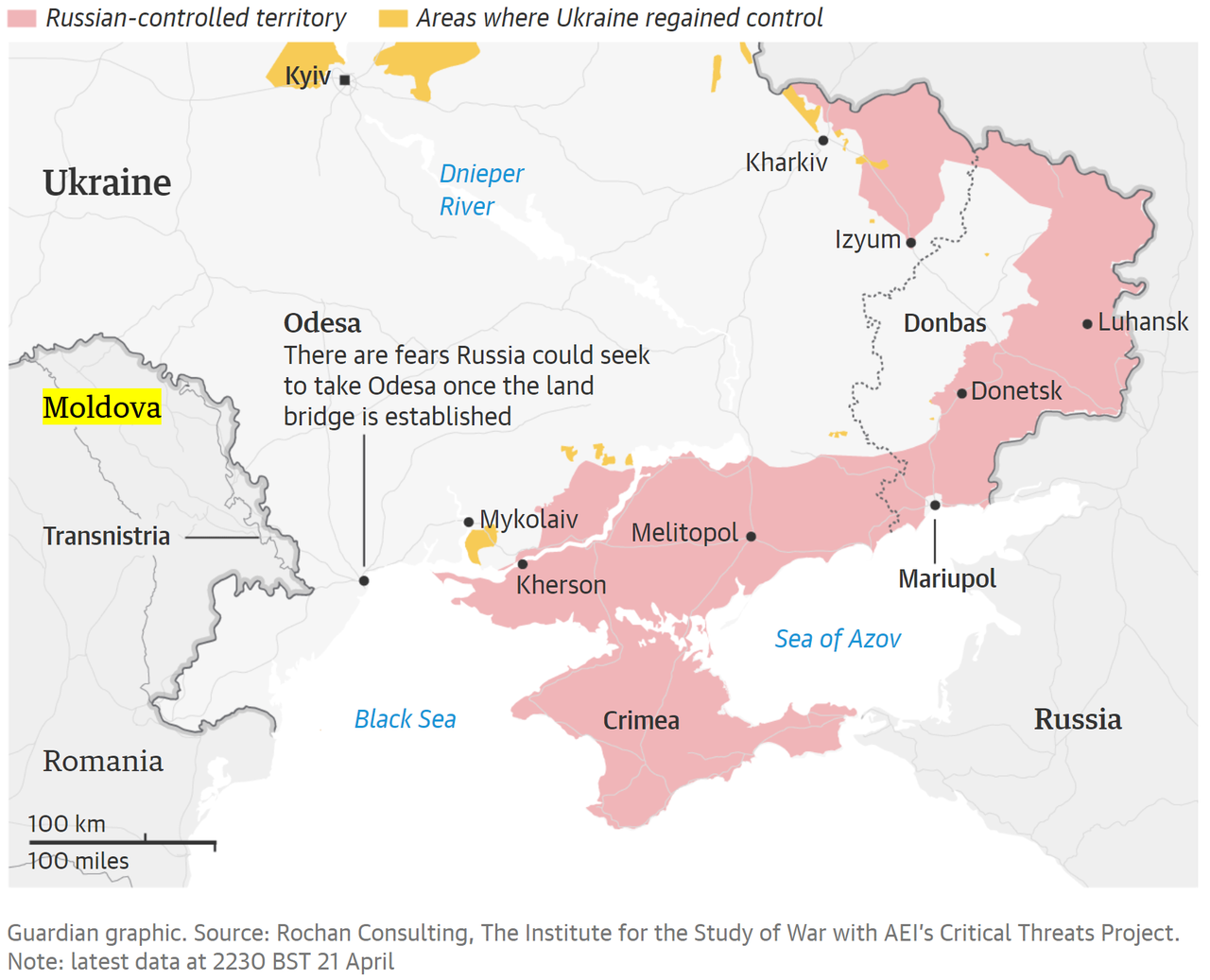
Previously both Ukrainian and Western officials had accused Moscow of eyeing Moldova next as a possibility for invasion. The small landlocked country is currently hosting somewhere between 100,000 and 400,000 refugees.
As Axios notes, “Russian troops already occupy Transnistria, an unrecognized breakaway state internationally recognized as part of Moldova,” and it remains that, “Moldova is also 100% reliant on Russian gas.”
This week it’s become clear that tiny Moldova is seeking to be fast-tracked into European Union membership. The EU in turn stated, “We are ready to do our part swiftly and diligently to give Moldova a chance for a better, safer & more prosperous future.”
As for Russia’s advance in Donbas, the Pentagon suggested this week that there’s been little to no significant territorial gains, however late on Thursday Reuters had cited that Russian forces seized control of 42 villages in eastern Ukraine.
end
RUSSIA/OIL/GAS/COAL BAN IMPLICATIONS
A good report on the implications of the ban on Russian energy products
(GoldMoney Insights)
The Implications Of A Potential European Ban On Russian Oil Imports
FRIDAY, APR 22, 2022 – 03:30 AM
Russia is the world’s second largest petroleum exporter. About 5mb/d of crude oil and petroleum products are exported to Europe. A European ban on Russian petroleum imports would have an immediate effect on >1mb/d of pipeline imports. Moreover, 4mb/d of crude and products that currently go to Europe via tankers would have to find a new home, which would create massive problems for the global refinery system. Depending on the speed of the phase-out, we could see the loss of >3mb/d of Russian production near term. Over the long run, Russian production will likely decline due to the lack of western technology transfer.
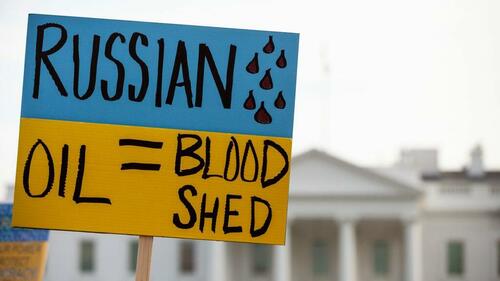
On April 8, 2022, the European Union announced that it would ban all coal imports from Russia starting in August this year. While the total value of these imports is relatively small (about $4bn per annum), this will have large implications for both European and global coal balances. Coal is transported in bulk. So in theory, the Russian coal that used to be exported to Europe could be moved by rail and by sea to buyers in China and overseas. Europe then in turn could import the coal that used to be imported by these buyers. In practice, it’s a bit more complicated. Russian coal is generally of high quality (high calorific value or “high CV” coal) and the coal that would be freed up and shipped to Europe is of low quality (low CV), which is a problem for European power plants. What makes matters more complicated is that Japan is working on replacing their Russian coal imports too. The likely effect is a tightening of high-quality coal balances worldwide. And indeed, since the announcement has been made, low CV coal prices were falling but high CV coal prices are soaring.
However, the economic impact of a ban on Russian coal imports is trivial compared to a potential ban on Russian oil and gas. A ban on imports of Russian gas is currently viewed as the most difficult to deal with for European economies. Over the past 5 years, Russian gas imports accounted for about 38% of European gas consumption. Even in 2021, the year when Russia had massively cut its exports to Europe, it was still 32%. This can simply not be replaced by LNG imports over the short run. Thus European leaders have so far been quite resilient to calls for a gas import ban. In fact, the European Union passed legislation that forces gas storage owners to fill their storage to certain levels during the summer injections season, something that is likely only achievable if imports from Russia persist.
So far European policymakers were equally reluctant to ban Russian oil imports. However, more recently, it seems that European officials are drafting plans to phase out Russian oil and petroleum product imports. The most likely scenario is that oil imports would be phased out in stages, allowing existing contracts to expire and for European refiners to arrange for alternative supplies. It is also likely that waterborne crude and petroleum product imports would be banned first, as it is easier to replace Russian crude that arrives on tankers with other seaborne imports. Pipeline imports would probably be the last step, as many refiners depend on Russian crude from pipelines and are unable to replace those flows in the near and medium term, potentially ever. These refineries would simply become inoperable.
Europe consumes about 14mb/d of oil, most of which is imported. About 30-40% (5mb/d) of Europe’s petroleum consumption is met by imports from Russia (see Exhibit 1).
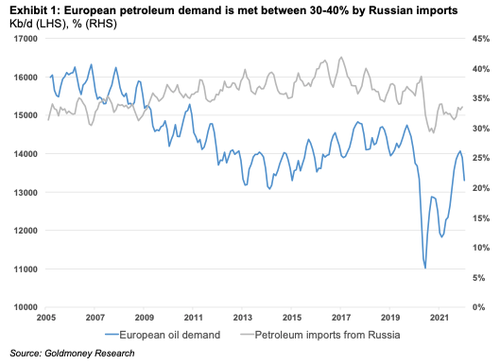
3.7mb/d of these imports come in the form of crude oil and refinery feedstocks while 1.5mb/d are finished products (see Exhibit 2).
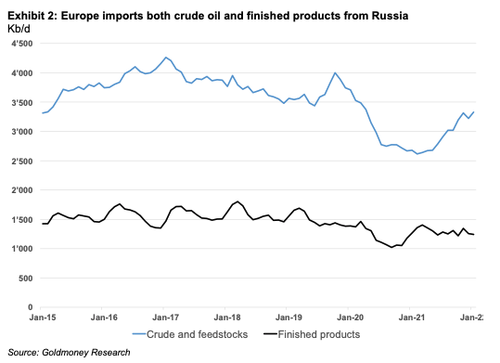
Russia is producing around 11mb/d of crude oil, which is 11% of the global supply. The country is processing close to 6mb/d for this crude in its domestic refiners and exports the rest.
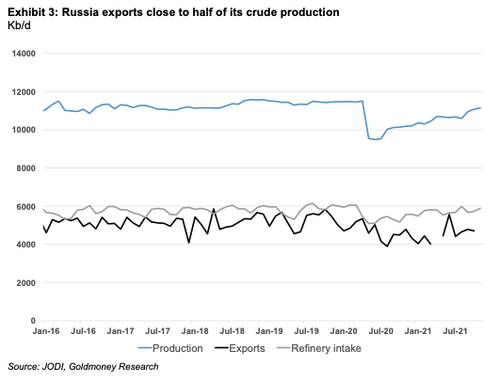
It then exports an additional 2mb/d of those products while the rest is consumed domestically. On net, Russia exports about 7.2mb/d of petroleum in the form of crude and products. All petroleum products are exported via tankers. About half of the crude exports are seaborne exports, the other half is shipped via pipelines.
Only a small part of Russia’s oil production comes from the eastern part of the country.
- The eastern Siberian fields are connected through the East Siberian Pacific Ocean (ESPO) pipeline to the export port of Kozmino, delivering crude to South Korea, Japan, and China. The trunk line has a capacity of around 1.8mb/d.
- There is a bifurcation of the ESPO line into the Mainland China Branch pipeline that allows sending crude directly to China’s Daqing refineries. The line came online in 2011 and a second pipeline has been added later. Today the two lines have a capacity of about 700kb/d.
- The remaining crude that goes through ESPO is partially processed in the 100kb/d Khabarovskiy refinery and the rest is exported by sea via Kozmino. The Kozmino port has exported around 900kb/d in 2021. That would suggest there is about 100kb/d of ESPO capacity left to export through Kozmino, but it is unclear whether production from Eastern Siberia can be increased in the near to medium term. What would really be needed is that production from the western fields could be diverted to ESPO, which seems not feasible at the moment.
- On top of that, there is crude production at the Sakhalin Island which is partially domestically refined and the remaining 200kb/d is exported by sea.
On net, about 1.8mb/d-1.9mb/d of eastern production can continue to be exported to Asia, even with a European import ban in place.
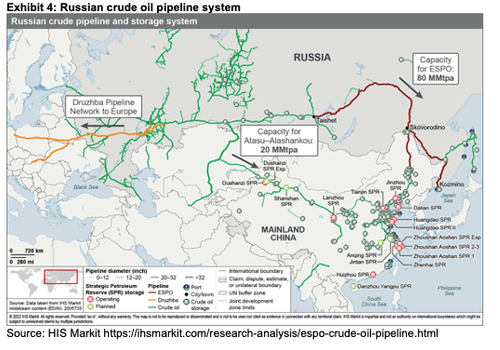
A big chunk of Russian production comes from the Western Siberian fields. That crude is either exported via the Druzhba pipeline to Europe or via tanker out of a seaport.
- There are five main ports that export Russian crude that is produced in the West. Two of them are at the Barents Sea, two are at the Baltic Sea and one is at the Back Sea. Russia exported 2mb/d in 2021 through these ports. A further 100kb/d came through various minor ports. Current shipping data indicates that Russia hasn’t meaningfully increased shipments through these ports (see table 1).
- The remaining crude oil is exported via pipelines. The Druzhba pipeline is the main line to bring Russian crude to Europe. It has a capacity of around 1.4mb/d.
- On top of that, crude oil from western Russia can also be exported via the Kazakh Atasu-Alashankou pipeline to China. This pipeline has a capacity of around 400kb/d, of which 100kb/d is used for Kazakh crude and about 200kb/d for Russian crude, leaving 100kb/d of unused capacity for Russian crude.
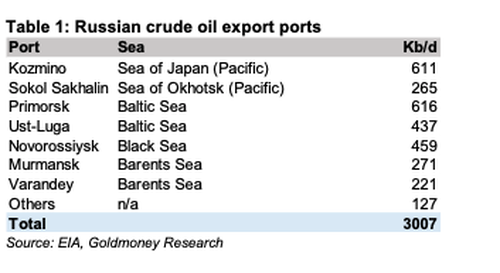
On net, in the event of a European import ban of Russian crude and petroleum product, Russia could technically still export all of its products, around 3mb/d of crude oil on tankers and 0.9-1mb/d via pipeline to China. For about 1.2mb/d of current pipeline exports, there is no alternative export route.
In reality, things would likely be a lot more difficult. First, Russia would have to find new buyers for all the seaborne crude it sends to Europe, the US, and potentially Asian buyers such as Korea and Japan. China is currently resisting taking more crude, but that could well be because the country’s appetite for oil is currently low given that one quarter of the population is in strict lockdown. Russian crude, especially the ESPO grade, is very popular among Chinese refiners. So if Russia loses traditional Asian buyers such as Korea and Japan, that crude might be picked up by China in the medium term. It’s probably much more difficult to find buyers for the crude that leaves the western ports. India has probably the refining capacity to take some, but it will be much more difficult for less sophisticated refineries in other emerging markets to switch grades. We therefore believe that especially in the first months of a European embargo, many Russian barrels would remain stranded. But that also depends on how quickly Europe would phase out Russian crude. With enough time, non-European refiners will find ways to run Russian grades.
We think it’s likely easier to sell the finished product cargoes that currently go to Europe to somebody else, but it will cost more to ship it further and it might create a real shortage of tankers in the medium term, which could also impact Russia’s effective export capacity of products.
We estimate that the initial loss of Russian petroleum would be in the order of >3mb/d in case of an immediate European import ban. This would subsequently decrease and we think the permanent loss is more in the order of 2mb/d. However, should Europe decide on a very gradual phase-out over several years, there may not even be any immediate hit and by the time the full ban comes into effect, Russia would have had the time to build out the seaborne export capacity and arranged for new buyers, who had the time to retool their refineries. Thus the price impact is extremely dependent on how fast the European Union is phasing out Russian crude.
However, we think that the long-term fundamental effects of any type of further sanctions are still very bullish. The sanctions that are already in place and target the energy sector will increasingly affect Russia’s ability to produce and refine crude. Russian refiners particularly are dependent on Western technology. So far the sanctions do not ban western companies to be active in the Russian energy sector. But sanctions on banks, and reputational risks will likely lead to a slowdown in technology transfer even if the sanctions are not tightened. A ban on Russian crude imports would likely also come with much tougher restriction on how western firms are allowed to operate in the sector. We thus have to assume that Russian production has now peaked and will inevitably decline long term, likely at an accelerated pace. New tougher sanctions on the oi industry will further accelerate this trend.
This comes at a time when global oil balances already look extremely tight over the medium term. As we have highlighted before (see Long term oil prices beginning to reflect the coming oil shortage – Part II, 8 April 2022), global demand will likely still continue to grow over the next 5-10 years, but supply will struggle. Non-OPEC production outside the US was already expected to decline in perpetuity, even before the events in Ukraine unfolded. At the time, the market expected Russian production to grow for some time. A decline in Russian production would thus greatly accelerate the declining trend in non-OPEC (ex US) output, which has the potential to create real oil shortages medium term.
END
UKRAINE/RUSSIA//TURKEY/NATO
The Turkish foreign minister Cavusoglu states that some NATO members want the war in Ukraine to last longer in order to weaken Russia
(DeCamp/Antiwar.com)
Turkey Says Some NATO Members Want Prolonged Ukraine War In Order To Weaken Russia
FRIDAY, APR 22, 2022 – 08:05 AM
Authored by Dave DeCamp via AntiWar.com,
In an interview on Wednesday, Turkish Foreign Minister Mevlut Cavusoglu said some NATO member states want the war in Ukraine to last longer as a way to hurt Russia.
“There are countries within NATO who want the war to continue,” Cavusoglu told CNN Turk. “They want Russia to become weaker.”
According to Iran’s Mehr News Agency, Cavusoglu did not think the war would last long after Russia and Ukraine held peace talks in Istanbul last month. But following a NATO foreign ministers meeting, he was given the impression that some alliance members don’t want the war to end.
Since Russia invaded on February 24, the US and many of its NATO allies have abandoned diplomacy with Russia. Instead of seeking a diplomatic solution, the Western powers are pouring weapons into Ukraine and waging an economic sanctions campaign against Russia.
The view among some NATO members on the war was summarized by a recent report from The Washington Post…
The report said: “For some in NATO, it’s better for the Ukrainians to keep fighting, and dying, than to achieve a peace that comes too early or at too high a cost to Kyiv and the rest of Europe.”
The WaPo report also spelled out: “Ukraine’s Western backers have vowed to respect Kyiv’s decisions in any settlement to end the war with Russia, but with larger issues of global security at stake, there are limits to how many compromises some in NATO will support to win the peace.”
As AFP reviews of recent talks which yielded no progress: “Turkey has twice hosted direct negotiations between the two sides, on March 10 between the Ukrainian and Russian foreign ministers in the southern city of Antalya and on March 29 between the two sides’ negotiators in Istanbul.”
END
RUSSIA/OIL SANCTIONS
How they avoid oi sanctions: transfer at sea to destinations unknown
(Mish Shedlock/Mishtalk)
How Russia Avoids Oil Sanctions: Transfer-At-Sea To “Destination Unknown”
FRIDAY, APR 22, 2022 – 10:00 AM
Authored by Mike Shedlock via MishTalk.com,
Russian oil still flows under the radar. It goes to “destination unknown”…
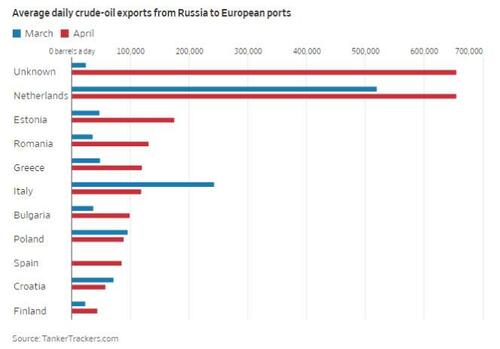
Average daily crude exports from Tanker Tracker via WSJ
Under the Radar
Please consider Russian Oil Flows, but Increasingly Under the Radar.
Oil exports from Russian ports bound for European Union member states, which historically have been the biggest buyers of Russian crude, have risen to an average of 1.6 million barrels a day so far in April, according to TankerTrackers.com. Exports had dropped to 1.3 million a day in March following the Ukraine invasion. Similar data from Kpler, another commodities data provider, showed flows rose to 1.3 million a day in April from 1 million in mid-March.
Oil from Russian ports is increasingly being shipped with its destination unknown. In April so far, over 11.1 million barrels were loaded into tankers without a planned route, more than to any country, according to TankerTrackers.com. That is up from almost none before the invasion.
The use of the destination unknown label is a sign that the oil is being taken to larger ships at sea and unloaded, analysts and traders said. Russian crude is then mixed with the ship’s cargo, blurring where it came from. This is an old practice that has enabled exports from sanctioned countries such as Iran and Venezuela.
Appearances vs Reality
This is yet another look at how sanctions don’t work. The oil gest through, but the added costs drive up the costs.
Since oil is fungible, the added costs are on everyone, not just Russia.
The U.S., U.K., Canada and Australia have banned imports of Russian oil, but it would not be the least bit surprising if via mixing at sea some of that got through to the US.
The EU says these shipments are necessary because of long-term contracts. OK, then why the mixing at sea to destinations unknown?
The obvious answer is countries want to appear as if they are sanctioning Russian oil, but in practice cannot afford to cut off supply.
It’s easy for the US to say it will take no Russian oil or gas when it takes little of the former and none of the latter.
The EU would have to sanction ships, not just Russia. But then how does it get oil?
Yellen Yap
Modest Proposal
I have a modest proposal: End the sanctions.
It’s clear the oil is getting through anyway, allegedly headed to nowhere. Meanwhile, the disruptions are driving up inflation everywhere.
The EU wants to appear it’s doing something, but that cost of that appearance at the expense of reality is higher inflation for everyone.
By ending the sanctions, the cost of all these supply chain shenanigans will go away.
Bipolar System
Treasury Secretary Yellen is worried about Russia avoiding sanctions via China, India, etc
The irony in this madness is the US is concerned about China and India breaking US sanctions when the EU transacts with Russia, hidden in plain sight.
For discussion, please see Janet Yellen Warns China on Russia and Creating a Bipolar Global Financial System
Using Ethereum and Bitcoin, Not the Yuan, to Avoid US Sanctions on Russia
Numerous countries have established ways of avoiding the US dictating sanction policy for the world.
In case you missed it please consider Using Ethereum and Bitcoin, Not the Yuan, to Avoid US Sanctions on Russia.
* * *
END
ISRAEL/CHINA
A game changer; Israel dumps the dollar for Chinese yuan
QTY Fringe
Israel Dumps The Dollar For China’s Renminbi
FRIDAY, APR 22, 2022 – 12:20 PM
Submitted by QTR’s Fringe Finance
Over the last 48 hours, China and Russia have taken big steps toward separating themselves from the monetary policy and economies of the west – and nobody has even noticed.
Those who have been reading my blog for the last couple of weeks know that I have been predicting that China and Russia would grow far closer economically, creating, in essence, a second global monetary system where the US dollar is no longer the reserve currency.
A few weeks ago, I wrote an article proclaiming that Russia would back the ruble with gold as a way to fight back against western economic sanctions. I also made similar predictions about the new digital Chinese currency last summer when I first started Fringe Finance.
This shift is happening as a result of the United States and the rest of the western economies foolishly thinking that they’re going to be able to effectively sanction Russia economically, despite the fact that Russia is a massive producer of oil and the country seems prepared to back its currency, the ruble, with this productive capacity.
Meanwhile, back at the ranch, we continue to run enormous deficits and have very little productive capacity, and even less to back our currency with. Our destiny seems to be to continue printing money regardless of the negative consequences. We’re nothing more than printing press junkies that won’t cease our inflationary addiction until we inevitably hit rock bottom.

US M2 Money Supply (via TradingEconomics)
If you haven’t read them yet, a couple articles that explain my position on Russia and China creating their own monetary system include:
- The Dominance Of The U.S. Dollar Is Fading Right Before Our Eyes
- The Dollar Dethroned: We Have Reached The End Of Monetary Policy As We All Once Knew It
- The Global Rush To Own Gold Has Only Just Begun
- Russia Will Backstop The Ruble With Gold
Today’s post is not behind a paywall because I feel its contents are too important. If you enjoy my work, and have the means to support, I’d love to have you as a subscriber: Subscribe now
There’s been several new developments to this thesis over the last 24 hours.
First, it was little noticed yesterday when Bloomberg reported that “Israel’s central bank has made the biggest changes to its allocation of reserves in over a decade, adding the Chinese yuan alongside three other currencies to a stockpile that last year exceeded $200 billion for the first time ever.”
The report read:
Starting this year, the currency mix will expand from the trio of the U.S. dollar, the euro and the British pound to include the Canadian and Australian dollars as well as the yen and the yuan, which is also known as the renminbi. The additions mark a change in the Bank of Israel’s “whole investment guidelines and philosophy,” Deputy Governor Andrew Abir said in an interview.
Following discussions held by the monetary committee last year, the pound and the yen will account for 5% and the currencies of Canada and Australia will have 3.5% each. Under the new approach, the yuan’s proportion is set at 2% for 2022, according to the Israeli central bank’s annual report published at the end of last month.
To accommodate the changes, the euro’s share will fall to 20% — the lowest in at least a decade — from just over 30%, while the dollar will account for 61%, down from 66.5%. The pound’s weighting, by contrast, will almost double to 5%, returning to a level last seen in 2011.
The “dramatic” rise in Israel’s foreign-exchange reserves led the central bank to lengthen its investment horizon, Abir said. “We look at the need to earn a return on the reserves that will cover the costs of liability.”
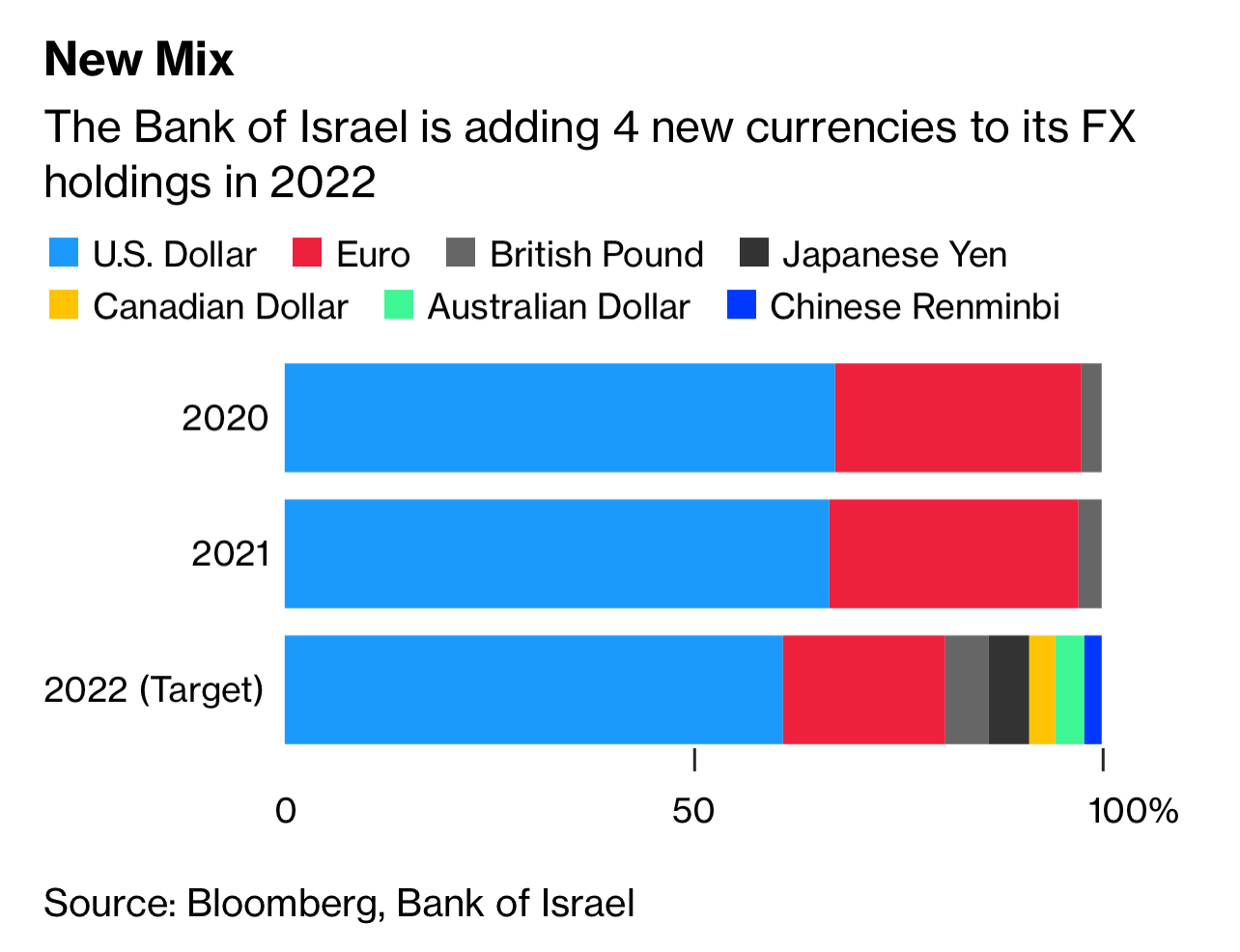
In other words, Israel is reducing its exposure to the dollar and to the Euro to add exposure to the Renminbi.
And so perhaps isn’t just little old me here chipping away at my blog daily that has noticed that China and Russia could be on the verge of effecting meaningful change to the global monetary landscape. It sure seems like Israel is catching on.
I expect other countries to follow suit.
Then, another prediction of mine started to come to fruition this morning when it was announced that China was considering buying some of Shell’s Russian LNG assets. Bloomberg reported:
China’s key state-run energy companies are in talks with Shell Plc to buy its stake in a major Russian gas export project, according to people with knowledge of the matter.
Cnooc, CNPC and Sinopec Group are in joint discussions with Shell over the company’s 27.5% holding in the Sakhalin-2 liquefied natural gas venture after the European firm said it would exit Russian operations following the Ukraine invasion
I had previously argued on my podcast and on my blog that even though the west was going to be ignoring Russian investments, there would definitely be a strategic buyer who would come in and scoop up what can only be described as long-term strategic energy assets from Russia.
Many people smarter than I am, including macro analyst Luke Groman, predicted that China would be the strategic buyer for such transactions. I agreed.
Now, it looks like that is exactly what’s happening. These purchases will only serve to knit China and Russia’s economies even closer together.
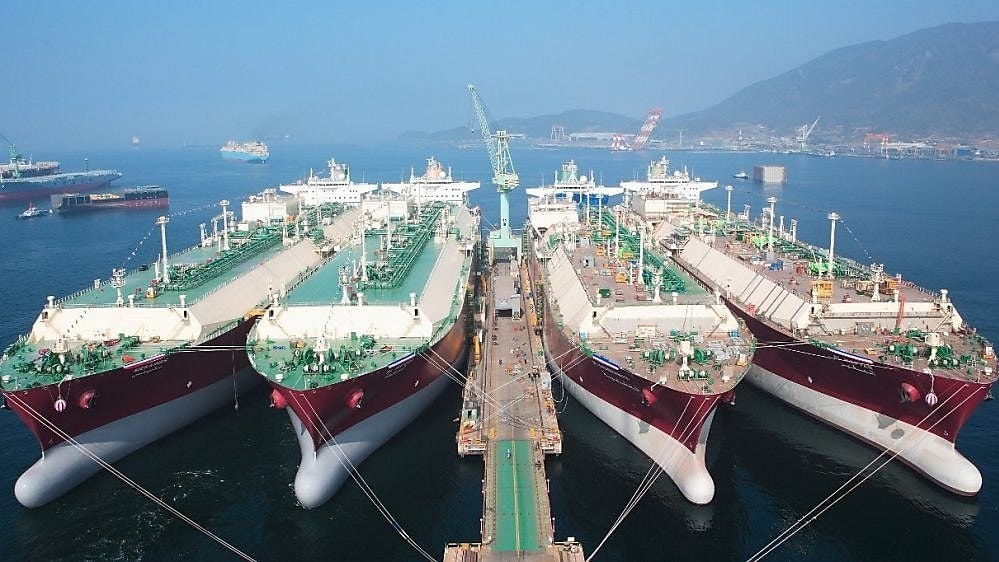
If the picture hasn’t come into focus, it soon will – even for most people that aren’t paying attention yet.
China and Russia continue on a cooperative path together: doing business together, backing their currencies with tangible commodities and, as I wrote just days ago, we’re in the process of watching the dollar become dethroned as the global reserve currency. We just don’t notice it yet.
The next prediction I have, that hasn’t yet taken place, is that China will back its digital currency with gold. I’ve predicted this since August of 2021, long before the current macro picture has emerged. Now, my convictions are even stronger.
When the rest of the world catches on to what is playing out here, there’s going to be a mad dash for gold, in my opinion. I still prefer gold over any fiat currency and, as I wrote weeks ago, consider miners to be one of the market’s truly undervalued sectors.
Thank you for reading QTR’s Fringe Finance . This post is public so feel free to share it: Share
END
Never lose an opportunity
Inbox

| Robert Hryniak | 10:28 AM (49 minutes ago) | | |
| to |
Translation: LONDON, 21 April. /TASS/. The UK Treasury has granted a general license valid until May 31, allowing it to conduct transactions with Gazprombank, which fell under the sanctions. This is stated in a statement released on Thursday by the Financial Sanctions Administration of the United Kingdom. “The license comes into force on April 21, 2022 and expires on May 31, 2022,” it says. The agency clarified that the permit was issued taking into account the interests of companies from EU member states that make payments for Russian gas through Gazprombank.
So nonchalant, just like that: paying to Gazprombank either in Rubles or in foreign currencies but to Garzprombank currency accounts IN Russia, where the payments then converted to Rubles and the gas is released. I would imagine this will be extended.
Clearly, the Brits and the US figured it out at the expense of the EU. Getting rid of Russian oil and gas is a longer project than a whim or motion of a pen to legislate. So while the EU says turn down the heat and shower in cold water and limit industrial production it will be the EU that sinks economically. While the EU sanctions Russia, they really are implementing the Green agenda long before it is possible creating a disaster in industrial output. Both the US and Britain will be big winners and result in gaining new industrial output at the expense of Europe and its’ Economy and even its’ standard of living. And in so doing they will be less of a market for China as everyday lives are stressed by inflation and dislocations. And Capital Flows will occur into the UK and the US out of the EU.
Cheers
Robert
END
Russia unveils plans for digital ruble, domestic payment system — RT Business News
Inbox
| Robert Hryniak | 4:26 PM (2 minutes ago) | | |
| to |
https://www.rt.com/business/554315-russia-digital-ruble-credit-card/
Cheers
Robert
6// GLOBAL COVID ISSUES/VACCINE MANDATE/
GLOBAL ISSUES
VACCINE MANDATES/
VACCINE INJURIES/
| Mark Organ | 8:47 AM (10 minutes ago) | | |
Sent from my iPhone
Begin forwarded message:
From: Alex Berenson from Unreported Truths <alexberenson@substack.com>
Date: April 21, 2022 at 6:26:33 PM EDT
To:organm999@gmail.com
Subject:The dose makes the poison
Reply-To: Alex Berenson from Unreported Truths <reply+vbo74&gutl&&cf5df00b8216a044faa13fa8a607a4fca8fa4d46c2125ff93ad16e1626da6274@mg1.substack.com>
| The dose makes the poison A major new study adds more evidence that Moderna’s high-dose mRNA shots are more dangerous than Pfizer’s smaller jabs; will public health bureaucrats acknowledge reality as they push more boosters? Alex BerensonApr 21 A huge new study shows mRNA shots sharply raised the risk of dangerous heart damage in Scandinavians who received them last year, and that Moderna’s 100-microgram shot was significantly more dangerous than Pfizer’s 30-microgram dose.For young men, who are at particularly high risk of post-jab heart inflammation, the gap was especially significant.Data from the study, published in a peer-reviewed journal called JAMA Cardiology, show that giving 1 million men aged 16-24 two doses of Moderna’s vaccine would lead to almost 300 hospitalizations for myocarditis and a related illness called pericarditis. Most would come after the second dose. Using Pfizer’s shot instead would lead to about 100 hospitalizations.SOURCEAn appendix in the paper also showed a trend towards deadlier outcomes in myocarditis patients who had received Moderna’s shot as opposed to Pfizer’s jab or no vaccination, though the trend was not statistically significant.Almost 5 percent of people who were hospitalized for myocarditis after receiving Moderna’s shot died, compared to under 1 percent who received Pfizer’s shot or were unvaccinated. (SEE ETABLE 11)Sweden, Norway, and Finland halted the use of the Moderna shots in people under 30 last October. The United States has no similar restrictions, though regulators have so far refused to approve Moderna’s jab for people under 18.The higher risk of Moderna’s shots found in the paper add to growing evidence that the dangers of mRNA rise with dosing. Moderna scientists themselves acknowledged the potential problem in a paper the company posted last month.In turn, that evidence raises the question of whether pushing people to take additional “booster” doses to shore up the vaccines’ failing protection may bring new risks. Because so few clinical or safety studies have been conducted on boosters, at this point regulators and scientists are essentially guessing about the dangers of repeated dosing.But that lack of knowledge has not stopped a relentless push for the boosters, which temporarily raise antibodies to the coronavirus before their protection again fades.In the new paper, published Wednesday, researchers drew on exceptionally thorough health and vaccination records from Denmark, Finland, Norway, and Sweden. They examined thousands of myocarditis and pericarditis cases in the four Scandinavian countries from late December 2020 to early October 2021, checking them against vaccination dates.Myocarditis is an inflammation of the heart muscle itself, while pericarditis results from the inflammation of the sac around the heart. They generally resolve with rest and anti-inflammatory treatment, but in some cases they can lead to permanent heart damage or even be fatal. |
/VACCINE IMPACT
Vaccine Impact
7,500% Increase in Recorded Cases of Cancer Following COVID-19 VaccinesApril 21, 2022 6:40 pm Dr. Ryan Cole was recently interviewed by Maria Zeee where he stated that he is getting reports all across the world from doctors observing that cancer rates are “taking off like wild fire” following COVID-19 vaccinations. A recently published study in the Journal “Food and Chemical Toxicology,” also linked mRNA vaccines to an increase in cancers. I spent some time today searching through the U.S. Government’s Vaccine Adverse Events Reporting System (VAERS) for data on cancer following vaccines. Cancer is not a common side effect associated with vaccine injuries, perhaps due to the time it takes for cancer cells to proliferate and be exposed through cancer screening, as by then most people would probably not even associate a diagnosis of cancer with a previous vaccine. Therefore, even though previous analyses on COVID-19 vaccine injuries have shown that the unreported factor is about 41x, it could be significantly higher for cases of cancer. To find trends of increased cancer rates following COVID-19 vaccines, we need to compare these rates with previous FDA approved vaccines in VAERS. Searching for various forms of cancer in VAERS, I found 739 cases resulting in 84 deaths following COVID-19 vaccinations for the past 16 months. Using the exact same search for all FDA-approved vaccines for the previous 30 years before the COVID-19 shots were issued emergency use authorizations, I found 220 cases resulting in 16 deaths over 360 months. That’s an average of .6 cases per month for the previous 30 years compared to an average of 46 cases of cancer per month following COVID-19 vaccines, an increase of 7,567%. The CDC and FDA have not issued any warnings regarding increased cancer rates following COVID-19 vaccines Dr. Ryan Cole was recently interviewed by Maria Zeee where he stated that he is getting reports all across the world from doctors observing that cancer rates are “taking off like wild fire” following COVID-19 vaccinations. A recently published study in the Journal “Food and Chemical Toxicology,” also linked mRNA vaccines to an increase in cancers. I spent some time today searching through the U.S. Government’s Vaccine Adverse Events Reporting System (VAERS) for data on cancer following vaccines. Cancer is not a common side effect associated with vaccine injuries, perhaps due to the time it takes for cancer cells to proliferate and be exposed through cancer screening, as by then most people would probably not even associate a diagnosis of cancer with a previous vaccine. Therefore, even though previous analyses on COVID-19 vaccine injuries have shown that the unreported factor is about 41x, it could be significantly higher for cases of cancer. To find trends of increased cancer rates following COVID-19 vaccines, we need to compare these rates with previous FDA approved vaccines in VAERS. Searching for various forms of cancer in VAERS, I found 739 cases resulting in 84 deaths following COVID-19 vaccinations for the past 16 months. Using the exact same search for all FDA-approved vaccines for the previous 30 years before the COVID-19 shots were issued emergency use authorizations, I found 220 cases resulting in 16 deaths over 360 months. That’s an average of .6 cases per month for the previous 30 years compared to an average of 46 cases of cancer per month following COVID-19 vaccines, an increase of 7,567%. The CDC and FDA have not issued any warnings regarding increased cancer rates following COVID-19 vaccines.Read More… “This is a CDC Issue, It Should Not Have Been a Court Issue” – Fauci Insists the CDC Should be Above Federal Courts and LawApril 21, 2022 9:55 pm  Fauci was asked about a federal judge overturning Biden’s mask mandate after declaring it unlawful earlier this week. The TSA announced travelers will no longer be required to wear face masks after a federal judge overturned the travel mask mandate. Fauci said he’s “surprised and disappointed” that a federal judge intervened and said mask mandates are the purview of the CDC. “This is a CDC issue, it should not have been a court issue,” Fauci said. “We are concerned about courts getting involved in things that are unequivocally public health decisions.” “That’s no place for the courts to do that,” Fauci said. This is why Fauci, an unelected bureaucrat who is not beholden to the people, should never have any power. Fauci was asked about a federal judge overturning Biden’s mask mandate after declaring it unlawful earlier this week. The TSA announced travelers will no longer be required to wear face masks after a federal judge overturned the travel mask mandate. Fauci said he’s “surprised and disappointed” that a federal judge intervened and said mask mandates are the purview of the CDC. “This is a CDC issue, it should not have been a court issue,” Fauci said. “We are concerned about courts getting involved in things that are unequivocally public health decisions.” “That’s no place for the courts to do that,” Fauci said. This is why Fauci, an unelected bureaucrat who is not beholden to the people, should never have any power.Read More… |
Michael Every
Michael Every on the day’s most important topics
Everyone Has A Plan Until They Get Punched In The Face…. And Everyone Is Being Punched In The Face
FRIDAY, APR 22, 2022 – 10:40 AM
By Michael Every of Rabobank
Play stupid games, win stupid prizes
My generation we grew up being told that ‘sticks and stones may break my bones, but words can never hurt me’. Western culture of course changes with each generation: now free speech is considered violence by some. There’s a whole thing happening at Twitter in particular about it. Expect it to get louder now actual money might be on the table. And do we get free speech back, or another billionaire plaything that dies in darkness, like CNN+ just did after three weeks and $100m down the drain?
Yet sometimes there obviously *is* a link between words and broken bones. Mike Tyson just repeatedly punched a man on a plane… because he repeatedly insulted a former boxing world heavyweight champion. The Russians say, “Play stupid games, win stupid prizes.” And, boy, are there some stupid games –and words– out there. And some stupid plans and game-plans.
Relatedly, Tyson also once opined, “Everyone has a plan until they get punched in the face.” On Wednesday, markets tried to plan for “peak inflation”; on Thursday, they were punched in the face, US stocks slumping (S&P -1.5%) and bond yields soaring (US 2s +10bp at the close, 10s +8bp, and 30s +6bp).
In Fed-speak: Daly said rates could rise in 25bp, 50bp, or 75bp steps, so jabs, upper-cuts, and ear-biting, respectively; Bullard warned, “The bond market is not looking like a safe place to be”; and Powell backed a one-two of 50bp hikes, which is now priced in. His goal is also “to get inflation down without a recession”. That’s like saying you want your opponent’s boxing gloves to hit the canvas but not the actual boxer. It’s a plan. Those are words. Just stupid ones.
Meanwhile, there were many words spoken yesterday about punches, directly and indirectly.
China launched a pilot private pension reform scheme that, if successful, will increase private savings when the world needs more Chinese household consumption and less Chinese national savings. (China’s household income share of GDP is too low by design: this is not addressed at all by said pilot scheme.)
Xi Jinping, at the Boao Asia Forum, proposed a new “global security initiative” based on the principle of “indivisible security”: no state should strengthen its security at the expense of another’s; the world should respect the sovereignty and territorial integrity of all countries; and the “legitimate” security concerns of all. Peace in our time? No. One’s country’s security is often another’s insecurity unless there is agreement about the umbrella both are under. Russia argues it is fighting Ukrainian Nazism; Ukraine says it is suffering Russian imperialism. Which argument prevails in this new global security initiative? Do you have to ask? Since 1999, Russia has talked of an agreement with Ukraine based on the same principle of “indivisible security”, so China is backing the Russian position. Indeed, this new “global security initiative” is the usual pushback against NATO, the Quad, AUKUS, etc.
Meanwhile, Hua Ping, a senior researcher at a think-tank led by a former PLA Major-General, recently stated: “The China-US showdown is not a question of if, but of when, how, and on what scale. We must not only forsake the delusion of a “peaceful rise” free of struggle, but we must also abandon the unfulfilled aspiration to achieve reunion solely through peaceful means.”
He added:
”The issue of Taiwan is a duel of fates that concerns the rise and fall of the country and the survival of the nation.” That sounds very Russia-Ukraine. Worse, “America’s growing paranoia about its declining hegemony may force it to make a desperate move, like a cornered dog. Our window of opportunity to take action against the US is closing. We must urgently prepare to recover Taiwan before, not after, the Sino-American showdown.”
In his eyes, the US will fight China both militarily and via: “1) financial strangulation; 2) cyber paralysis; 3) biocide – a desperate attempt to begin a genocidal war with clandestine, low-cost but highly lethal biochemical weapons; and 4) political manipulation.” Yet even tacitly admitting that a naval blockade would be on the cards(?), and after watching sanctions against Russia, the key conclusion was “…to deliver a devastating blow and achieve the battle’s objectives in the shortest amount of time.”
China’s Minister of Defence, who only just started speaking to his US counterpart again, yesterday also underlined Beijing will “resolutely safeguard national sovereignty, security and territorial integrity” vis-à-vis Taiwan, while urging him not to “smear or threaten China” over Ukraine. Yet US Deputy Secretary of State Sherman, visiting Brussels, just did exactly that. Moreover, Sherman, tank-like not ‘Tankie’, added:
“Beijing is seeking to undermine the very system that they benefited from to return instead to a system where might-makes-right and big nations can coerce smaller countries into acting against their own interests… I could give dozens of examples of PRC actions that seek to undermine nations’ political autonomy to coerce businesses decision-making, to literally steal IP and trade secrets to hunt down and silence human rights defenders and religious minorities who left…. Do we want to trust in each other to embrace our ability to come together and solve our common challenges to recognise our mutual humanity and build a better world? Or do we want to be at war and in conflict with each other?”
When asked if the US has plans if China provides concrete support to Russia, Sherman replied: “They’ve seen what we’ve done in terms of sanctions, export controls designations, with Russia… it should give them some idea of the menu from which we could choose, if China were to provide material support. We also sat down with China and explained our sanctions, so they know what they are and how they work. So we’re trying to be very transparent here.
I don’t want to give a sense that everything with the PRC is a war. We don’t want to start another cold war. We don’t want conflict. We don’t want miscalculation. We want channels of communication. We hope there are areas there can be cooperation. But make no mistake, I believe President Xi has made a decision about what he wants PRC to be in the world. And it’s a very different vision than we have in this room.”
Back in Boao, we heard, yet again, that “unilateral sanctions don’t work”, and neither does decoupling (unless China is doing it). Sherman and EU Foreign Affairs Secretary General Sannino jointly talk to the press today after the US and EU talk China.
In other rings, on India, Sherman had this to say: “India is an incredibly consequential country for us all, it’s a messy democracy but so are we… they’re a young democracy. They are very worried about China, and they understand their military built on Russian weapons probably doesn’t have a future based on Russia.” Coincidentally(?), today former Indian PM Singh argues “This is India’s moment of reckoning”, cautions against rushing into local FX arrangements for trading with Russia, and says India has more to gain from access from the West. Including weapons?
UK PM BOYO Johnson, now in India, will have to face a Commons inquiry over whether he lied to parliament after No.10 withdrew an attempt to force Conservative MPs to delay a new Partygate investigation: it was a humiliating climbdown after what threatened to be a constitutional crisis, and does not bode well for the PM – or the constitution. Two more Tory MPs just publicly called for him to quit, including one prominent Brexiteer stating, “The PM now should be long gone. Really, the PM should just know the gig’s up.” That’s words *and* a punch to the face: and questions about not just what BOYO’s stupid game-plans ever were, but what the UK’s are in a rapidly-changing world.
In Germany, Chancellor Scholz both delayed the issuance and trimmed the contents of a catalogue of weaponry his country is offering to Ukraine: “Ah, you ordered the gun, we thought you wanted the gum!” This speaks to Germany’s discomfort in accepting the world has changed and it hasn’t, yet, because it costs a lot, and this time they have to pay for it, not others. However, when the punches start flying, acting tough and not moving does not usually end well. Sometimes the big guys go down hardest, especially the ones in bad shape. (“For me it’s a full-time job, now behave yourself.”) As German PPI hit 30.9% y/y, the highest since 1949(!), the Financial Times talks of Germany’s ‘Worst crisis since the second world war’ as it ‘prepares for a Russian gas embargo’. Does selling gum not guns help?
Of course, markets will find all of this too punchy. They will focus on inoffensive words. For example, ‘good’ news like China’s regulators telling local institutional investors to boost stock holdings. After all, nothing says ‘healthy stock market’ like the state telling you that you can’t sell and must buy, right? Will that plan work? Did it in 2015? The Financial Times today reports ‘Wall St banks set on Shanghai expansion despite lockdown disruption’, and other major disruptions present and future. Well, of course they are. Got to play the stupid game!
Yet consumers from China to America are feeling punch-drunk. In just the last few days we saw Eurozone consumer confidence drop back to -18.7, approaching Covid lows. UK GfK Consumer confidence crashed to -38, lower than during the 2020 Covid peak panic, because at least we had state fiscal support then, or in 2008: indeed, this feels worse for ordinary people than 2008 because that crisis was initially centred on pampered stupid-game lunch-time-boxercise City/Wall Street folk – until the idiotic tightening of fiscal policy kicked in.
So, what is one to make of all of this? Hooray for free speech(?); but words can lead to violence in the real world and in markets. Too many are playing stupid games – some will soon win stupid prizes. Everyone has a plan until they get punched in the face – and everyone is being punched in the face, even if some are in denial about it.
So, surely, the key defense is to ask who is best placed to take, and give, a punch? (Are you?) Or who is all jaw-jaw not war-war? (Are you?) Or who has a glass jaw? (Do you?) Those should surely be the thoughts to keep in your corner.
You might not like the message – but please don’t bite my ear off about it.
END
7. OIL ISSUES
This will not happen!
(Slav/OilPrice.com)
Ukraine Pushes For Rerouting Of Nord Stream 1 Flows
FRIDAY, APR 22, 2022 – 05:00 AM
By Irina Slav of OilPrice.com
Ukraine is lobbying with its Western allies for the redirection of Russian gas flows from the Nord Stream 1 pipeline to the pipeline that runs through its territory, Reuters has reported, citing energy officials.
According to the report, Ukrainian lobbyists have argued that the more gas Russia transports via its pipeline, the more transit fees the government in Kiyv will collect, helping it fund the war. At the same time, the shift would, according to them, prevent Russia from damaging Ukrainian pipeline infrastructure.
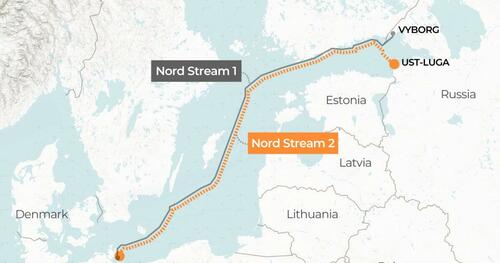
The idea was floated during a visit of Ukrainian officials to Washington, where they sought to convince the White House to lobby for the shift to Germany and the wider EU.
Current Russian gas flows via Ukraine stand at some 40 billion cubic meters annually. This compares with 55 billion cubic meters moved via the Nord Stream 1, which ends in Germany.
Trying to shift flows would, according to legal experts, constitute a breach of contract. It would also do “nothing to increase security of supply to Europe,” according to former State Department special envoy David Goldwyn, who spoke to Reuters.
The Ukrainian government has been urging Europe to stop importing oil and gas from Russia, arguing this would exsanguinate Moscow financially and help Ukraine win the war.
However, while the EU has been generous with all sorts of material support, it has proved quite reluctant to do what Ukraine wants with regard to energy imports.
Brussels did commit to reducing its imports of Russian natural gas by two-thirds by the end of the year, but Ukraine is insisting on import suspension right now. The EU is also discussing an oil embargo, which will also likely take effect gradually after a grace period so that importers can stock up on the commodity.
8 EMERGING MARKET& AUSTRALIA ISSUES
Australia//// NEW ZEALAND/ SOUTH AFRICA/BRAZIL/ARGENTINA/INDIA
For sure: soaring food inflation and rolling blackouts will be the start of the next emerging market meltdown
(zerohedge)
Are Soaring Food Inflation And Rolling Blackouts The Start Of Next Emerging Market Meltdown?
FRIDAY, APR 22, 2022 – 02:45 AM
A combination of shocks is rippling through emerging market economies and has sparked soaring food and energy inflation, power blackouts, and social unrest. Countries with the weakest balance sheets and high debt loads appear to be sliding first into turmoil. This could be the beginning innings of an emerging market crisis last seen in the 1990s when socio-economic distress toppled governments, according to Bloomberg.
Already, skyrocketing food and energy prices have caused turmoil in Sri Lanka, Peru, Egypt, and Tunisia. The chaos could broaden as some emerging market countries, heavily saturated with debt, could be shocked by higher debt-servicing costs as the Federal Reserve embarks on an aggressive tightening campaign. This couldn’t have come at the worst time for these developing nations, as many had large capital outflows and borrowed vast amounts of money during COVID. Now they’re being hit by food and energy shock due to the Ukraine conflict.
An example of this toxic cocktail that could easily topple a country is Sri Lanka has already been pushed to the brink of default. The South Asian island nation’s foreign exchange reserves have collapsed, and food and fuel shortages, plus high inflation, have sparked unrest.
Bloomberg Economics shows a handful of other emerging economies at risk of crisis because of high debt and soaring yields. Notably, Ethiopia, El Salvador, Tunisia, Pakistan, and Ghana rank are the most at-risk because surging bond yields create higher default risk.
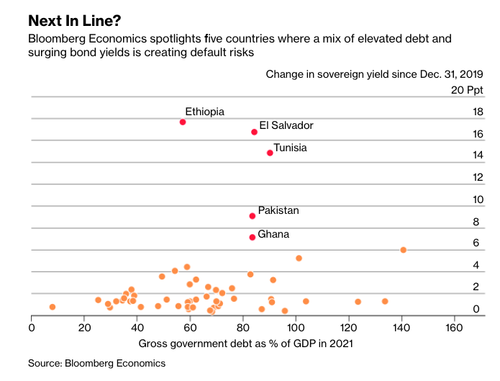
The Washington-based lender, International Monetary Fund, raised concerns in a recent report titled “Emerging-Market Banks’ Government Debt Holdings Pose Financial Stability Risks,” which warned government defaults like what happened to Russia in 1998 and Argentina in 2001-02 could be imminent across emerging market economies.
The report warned of a possible return of a “doom loop”:
A sharp tightening of global financial conditions—resulting in higher interest rates and weaker currencies on the back of monetary policy normalization in advanced economies and intensifying geopolitical tensions caused by the war in Ukraine—could undermine investor confidence in the ability of emerging-market governments to repay debts. A domestic shock, such as an unexpected economic slowdown, could have the same effect.
Bloomberg provides a set of gauges that shows emerging market risks are rising.
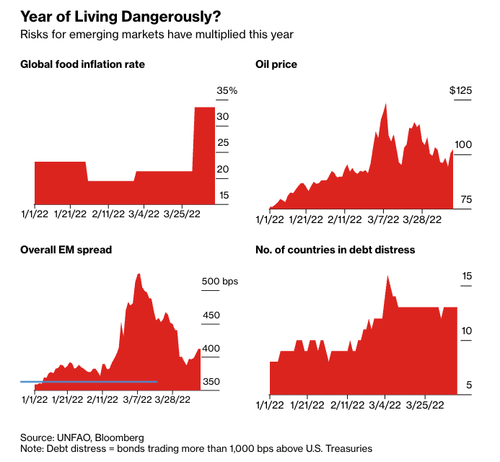
Bloomberg Economics created a list of the countries most exposed to the fallout from the Ukraine conflict. Turkey, Egypt, Vietnam, the Philippines, and Poland are ranked some of the highest at-risk.
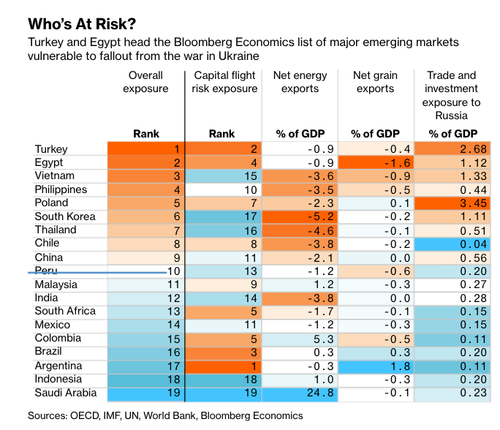
Ziad Daoud, Bloomberg Economics’ chief EM economist, said if an emerging market crisis were to develop, it might spread well beyond its origin.
“In a cascade of emerging-market credit events, the negative impact of the whole could be larger than the sum of the parts,” Daoud said.
The former Goldman Sachs economist who coined the term BRICs, Jim O’Neill, said the current economic climate is the most uncertain since the early 1980s.
“If we get the inflation risk persisting and central banks have to tighten policy, for certain emerging markets it will be a disaster,” O’Neill warned.
So far, turmoil is brewing in places where investors don’t pay too much attention. However, the crisis could broaden as the Fed hikes and pandemic debts become unpayable as soaring inflation triggers social unrest. If the dominos fall, then investors will care.
END
Your early currency/gold and silver pricing/Asian and European bourse movements/ and interest rate settings FRIDAY morning 7:30 AM
Euro/USA 1.0822 DOWN .0013 /EUROPE BOURSES //ALL RED
USA/ YEN 128.34 DOWN 0.095 /NOW TARGETS INTEREST RATE AT .11% AS IT WILL BUY UNLIMITED BONDS TO GETS TO THAT LEVEL…
GBP/USA 1.2913 DOWN 0.0111
Last night Shanghai COMPOSITE CLOSED UP 7.11 PTS OR 0.23%
Hang Sang CLOSED DOWN 43.70 PTS OR 0.21%
AUSTRALIA CLOSED UP .22% // EUROPEAN BOURSES OPENED ALL RED
Trading from Europe and ASIA
I) EUROPEAN BOURSES ALL RED
2/ CHINESE BOURSES / :Hang SANG CLOSED DOWN 43.70 PTS OR 0.21%
/SHANGHAI CLOSED UP 7.11 PTS OR 0.23%
Australia BOURSE CLOSED DOWN 1.51%
(Nikkei (Japan) CLOSED DOWN 447.80 PTS OR1.63%
INDIA’S SENSEX IN THE RED
Gold very early morning trading: 1935.00
silver:$24.31
USA dollar index early FRIDAY morning: 100.87 UP 2 CENT(S) from THURSDAY’s close.
THIS ENDS FRIDAY MORNING NUMBERS
xxxxxxxxxxxxxxxxxxxxxxxxxxxxxxxxxxxxxxxxxxxxxxxxxxxxxxxxxxxxxxxxxxxxxxxxxxxxxxxxxxxxxxxxxxxxxxxxxxxxxxxxxxxxxx
And now your closing FRIDAY NUMBERS 1: 00 PM
Portuguese 10 year bond yield: 1.97% UP 3 in basis point(s) yield
JAPANESE BOND YIELD: +0.255% up 0 AND 0/10 BASIS POINTS /JAPAN losing control of its yield curve/
SPANISH 10 YR BOND YIELD: 1.92%// UP 3 in basis points yield
ITALIAN 10 YR BOND YIELD 2.90 UP 40 points in basis points yield ./
the Italian 10 yr bond yield is trading 98 points higher than Spain.
GERMAN 10 YR BOND YIELD: FALLSTO +0.967% IN BASIS POINTS ON THE DAY//
THE IMPORTANT SPREAD BETWEEN ITALIAN 10 YR BOND AND GERMAN 10 YEAR BOND IS 1.93% AND NOW ABOVE THE 3.00% LEVEL WHICH WILL IMPLODE THE ENTIRE ITALIAN BANKING SYSTEM. AT 4% SPREAD THERE WILL BE A HUGE BANK RUN…
END
IMPORTANT CURRENCY CLOSES FOR FRIDAY
Closing currency crosses for FRIDAY /USA DOLLAR INDEX/USA 10 YR BOND YIELD/1:00 PM
Euro/USA 1.0787 DOWN .0048 or 48 basis points
USA/Japan: 128.51 UP 0.243 OR YEN DOWN 24 basis points/
Great Britain/USA 1.2851 DOWN .01743 OR 174 BASIS POINTS
Canadian dollar DOWN 0.0109 OR 109 BASIS pts DOWN to 1.2701
xxxxxxxxxxxxxxxxxxxxxxxxxxxxxxxxxxxxxxxxxxxxxxxxxxxxxxxxxxxxxxxxxxxxxxxxxxxxxxxx
The USA/Yuan, CNY: closed ON SHORE (CLOSED ..DOWN 6.5014
THE USA/YUAN OFFSHORE: (YUAN CLOSED (DOWN)..6.5297
TURKISH LIRA: 14.75 EXTREMELY DANGEROUS LEVEL/DEATH WISH/HYPERINFLATION TO BEGIN.
the 10 yr Japanese bond yield at +0.255
Your closing 10 yr US bond yield DOWN 1 IN basis points from THURSDAY at 2.899% //trading well ABOVE the resistance level of 2.27-2.32%) very problematic
USA 30 yr bond yield: 2.9250 DOWN1 in basis points
Your closing USA dollar index, 101.24 UP 63 CENT(S) ON THE DAY/1.00 PM/
Your closing bourses for Europe and the Dow along with the USA dollar index closing and interest rates FRIDAY: 12:00 PM
London: CLOSED DOWN 52.67PTS OR 1.24%
German Dax : CLOSED DOWN 343.43 POINTS OR 2.37%
Paris CAC CLOSED DOWN 136.87PTS OR 2.04%
Spain IBEX CLOSED DOWN 149.06 PTS OR 1.69%
Italian MIB: CLOSED DOWN 513.95 PTS OR 2.04%
WTI Oil price 103.50 12: EST
Brent Oil: 107.95 12:00 EST
USA /RUSSIAN /// RUBLE RISES TO: 74.56 UP 1 7/8 RUBLES/DOLLAR
GERMAN 10 YR BOND YIELD; +.946
CLOSING NUMBERS: 4 PM
Euro vs USA: 1.0795 DOWN .0040 OR DOWN 40 BASIS POINTS
British Pound: 1.2833 DOWN .01911 or down 191 basis pts
USA dollar vs Japanese Yen: 128.355 UP 0.108//YEN DOWN 11 BASIS PTS
USA dollar vs Canadian dollar: 1.2716 UP .0124 (CDN dollar DOWN 124 basis pts)
West Texas intermediate oil: 101/71
Brent OIL: 106/10
USA 10 yr bond yield: 2.901 DOWN 2 points
USA 30 yr bond yield: 2.947 UP 2 pts
USA DOLLAR VS TURKISH LIRA: 14.74
USA DOLLAR VS RUSSIA///USA/ ROUBLE: 75.45 UP 0 & 5/8 ROUBLES (ROUBLE DOWN 5/8 ROUBLES/USA
DOW JONES INDUSTRIAL AVERAGE: DOWN 981.36 PTS OR 2.82%
NASDAQ 100 DOWN 363.28 PTS OR 2.65%
VOLATILITY INDEX: 27.70 UP 5.02 PTS (22.56%)
GLD: 180.29 DOWN 1.77 PTS OR 0.97%
SLV/ 22.31 DOWN .48 PTS OR 2.11%
end)
USA trading day in Graph Form
Bond/Stock Bloodbath Leads To Worst Start To A Year On Record
FRIDAY, APR 22, 2022 – 04:01 PM
Ultra-hawkish FedSpeak (from them all) sent rate-hike expectations this week (with 50bps fully priced-in for May, and a 35% chance of a 75bps hike in June now)…
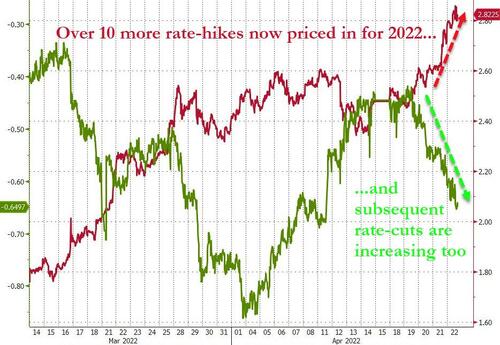
Source: Bloomberg
For bonds and stocks that meant – STFD!
This is the 3rd week in a row that a ‘balanced’ portfolio of stocks and bonds has been monkeyhammered lower…
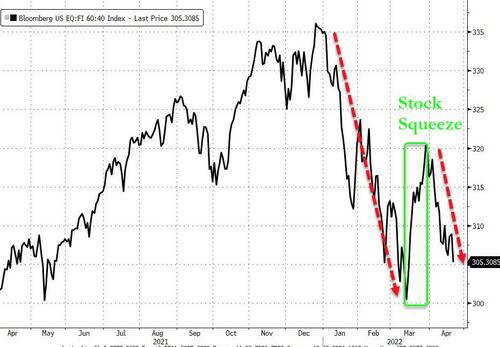
Source: Bloomberg
This is the worst start to a year for a ’60/40 Stock/Bond’ index since record began (worse then 2009 and 2020)…
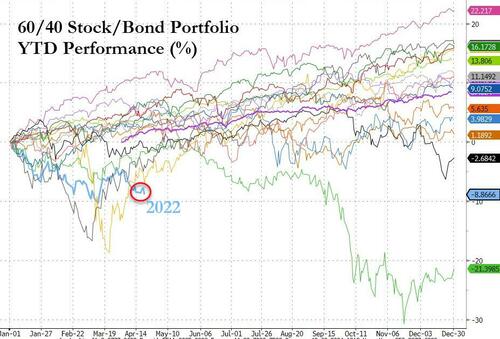
Source: Bloomberg
It seems cash is not trash after all!
Today was a bloodbath for stocks broadly with no divergence as all the majors tumbled over 2.5%…
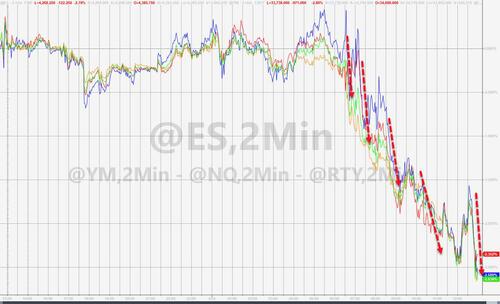
The Dow fell over 1000 points from high to low today…
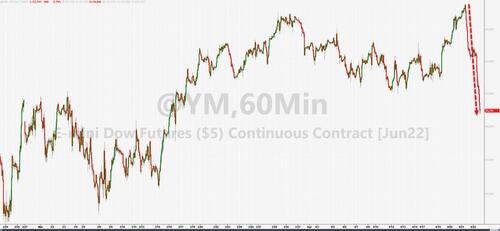
That led to a 4th straight weekly loss for The Dow (and 3rd for the rest of the majors) and today was the worst days for The Dow since early March. Nasdaq was the week’s biggest loser though…
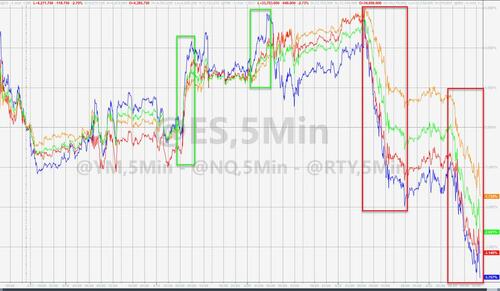
All the majors broke below critical technical support levels this week…

All the majors are now underwater for April…
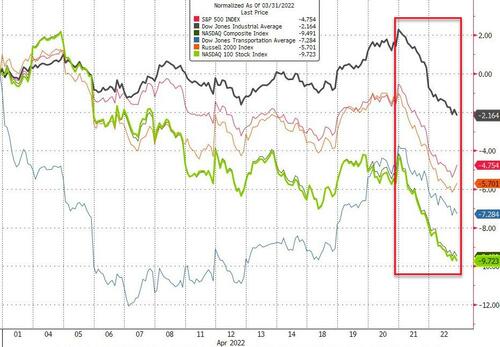
Source: Bloomberg
Energy was worst on the week while Staples were the only sector to close green…
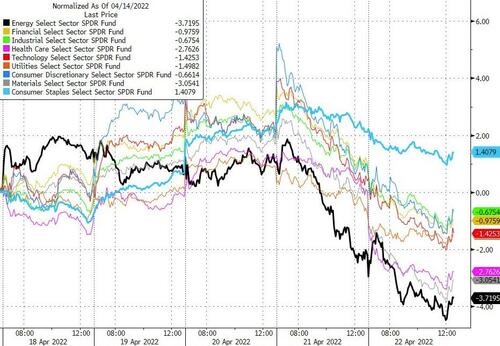
Source: Bloomberg
Stocks are just starting to wake up to STIRs reality…
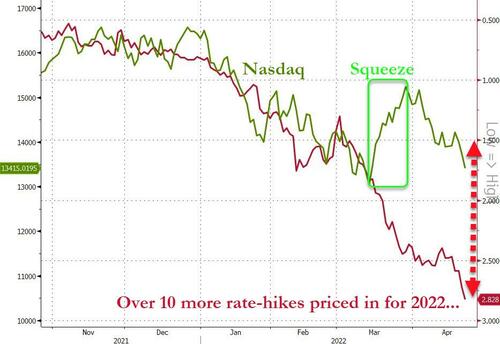
Source: Bloomberg
The ‘reopening vs inflation’ debate was on display with earnings across a range of sectors. And as Goldman’s Chris Hussey notes, there was a stark contrast in outcomes in two post-pandemic beneficiaries: hospitals vs airlines. Healthcare stocks hammered today after HCA cut guidance continue to plunge as the Airline industsy rebounds…
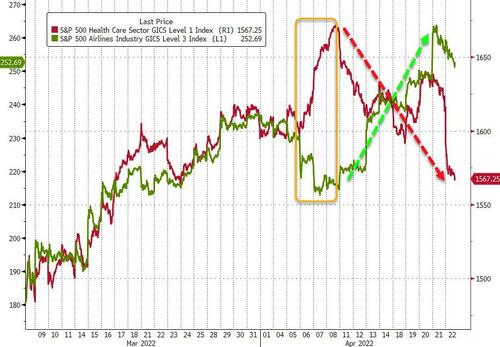
Source: Bloomberg
After the late-March meltup in cyclicals, April has seen Defensives dominate and long-duration growthy stuff was clubbed like a baby seal the last two days…
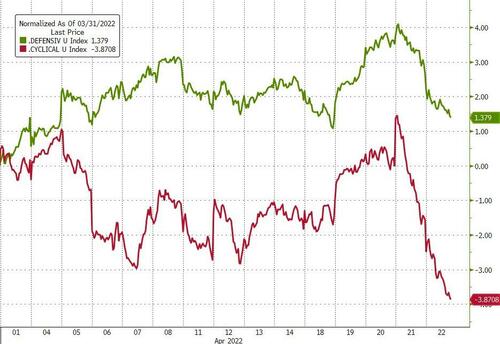
Source: Bloomberg
Credit markets cracked wider this week and equity risk finally started to play catch up (after the late March meltup in equities that credit ignored)…
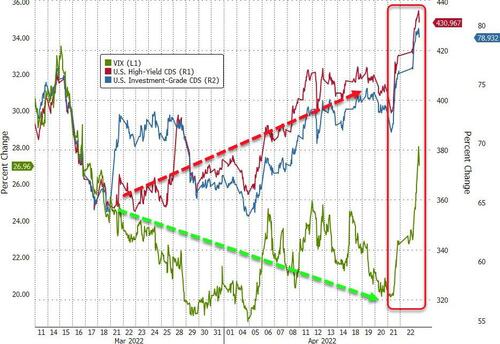
Source: Bloomberg
Bonds were dumped this week with the short-end utterly destroyed amid a massive bear flattening…
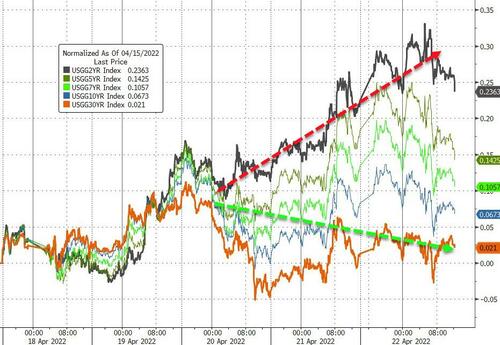
Source: Bloomberg
The yield curve re-inverted this week (3s10s)…
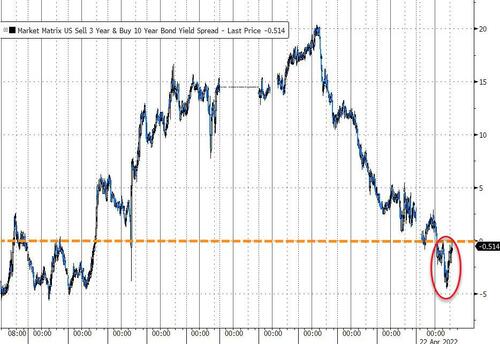
Source: Bloomberg
The Dollar continued to surge higher this week (3rd weekly gain in a row) to its highest since May 2020…
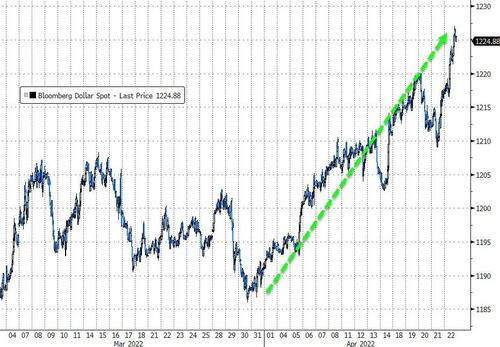
Source: Bloomberg
The Chinese Yuan crashed this week in a stealth devaluation…
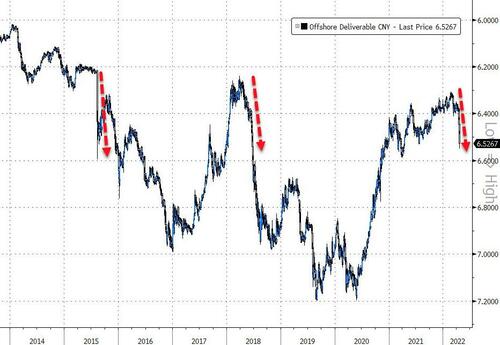
Source: Bloomberg
Cryptos were all lower on the week as they tracked risk assets down the last two days…
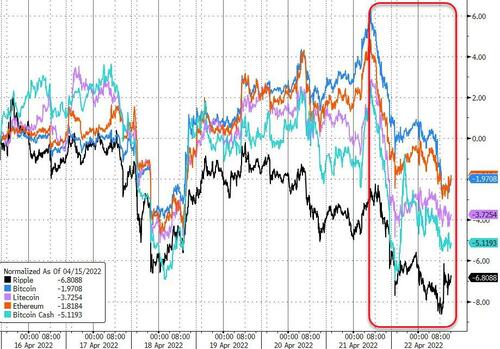
Source: Bloomberg
Bitcoin managed to trade up to $43k during the week, only to tumble back below $40k today…
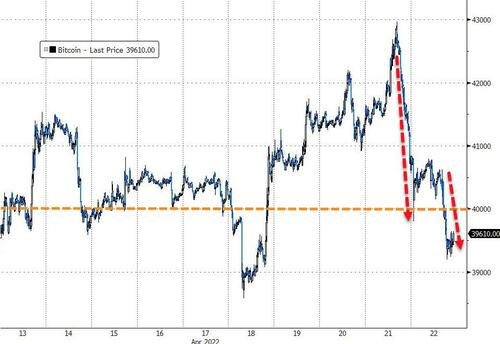
Source: Bloomberg
Commodities were broadly lower on the week with Silver and crude suffering most…
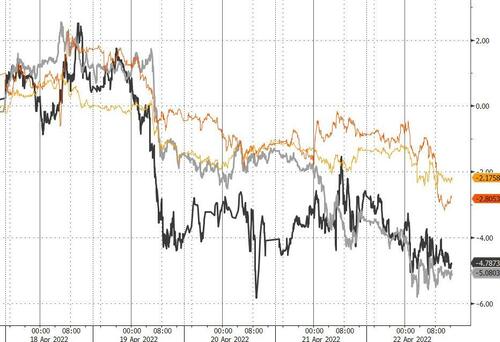
Source: Bloomberg
Front-month WTI (June) ended the week around $102 – basically unchanged since Biden unleashed the SPR…
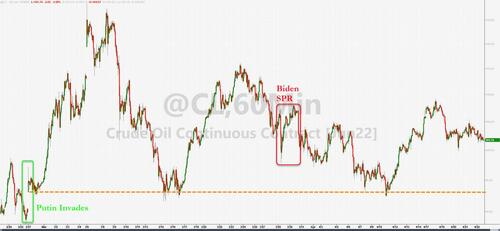
Gold ended the week lower – after tagging $2000 during the week – but remains well above $1900 pre-Putin…
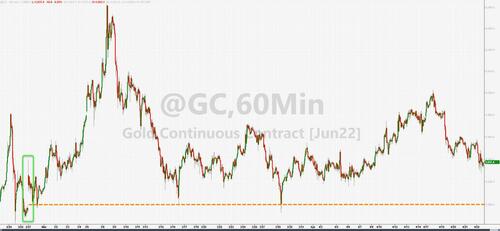
Finally, we note that despite this week’s carnage in stocks (well the last two days) and bloodbath in bonds, Treasuries are at their cheapest relative to stocks since 2011…
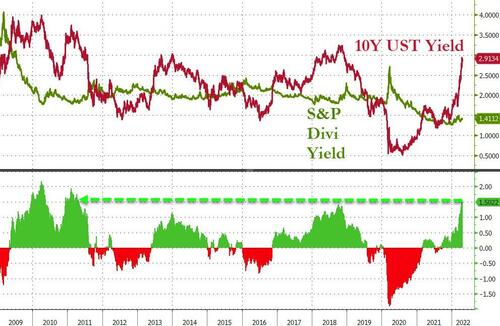
Source: Bloomberg
TINA is dead and The Fed killed her!
END
END
I) /MORNING TRADING/
AFTERNOON
Markets Puke After Nomura Warns Of Multiple 75bps Rate-Hikes This Year
FRIDAY, APR 22, 2022 – 11:23 AM
“Hard landing” risks are on the rise and equity markets are starting to catch down to the reality of outlier Fed tightening that is priced into short-term interest-rates (STIRs).
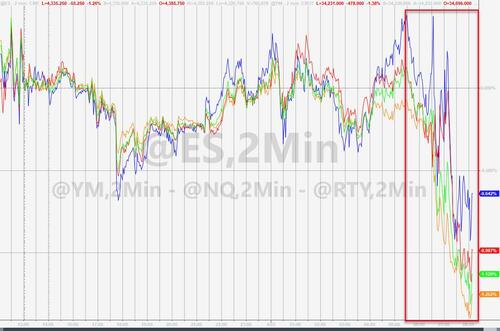
Nomura’s North America Economics team raised a red flag for that tightening as they warn that Fedspeak this week is clearly laying the groundwork for 75bp hikes after the May FOMC meeting (note the blackout period starts 23 April)
We expect the first 75bp rate hikes since 1994 at the June and July meetings following a 50bp rate hike in May
We believe momentum for a 75bp rate hike at some point later this year has increased; we now expect a 75bp hike at both the June and July FOMC meetings, following a widely expected 50bp hike in the May meeting.
FOMC participants appeared to open the door to such action this week. Over the near term, the Fed remains squarely focused on bringing rates to a neutral setting. Even dovish participants like Evans and Daly have recently suggested support for bringing rates to around 2.25-2.50%, which they consider to be neutral.
Hikes of 50bp in May and 75bp in both June and July would bring rates to the FOMC’s perceived neutral setting very quickly (2.25-2.50%). Note the median long-term dot is currently 2.375%, with one participant at 2.00%, six at 2.25%, one at 2.375%, five at 2.50% and two at 3.00%. We believe most participants at the 2.25% level would be comfortable with 2.25-2.50% as neutral.
For some time, our view has been that if the Fed could hike 200bp at one meeting without significantly affecting market functioning, they would. So far, markets have been reluctant to price 75bp hikes, but stronger pricing for such a move would likely ease the path for the FOMC and participants could likely forge a consensus on such action quickly.
We believe comments from FOMC participants this week were an intentional effort to “trial balloon” a 75bp hike and then closely monitor the market’s response.
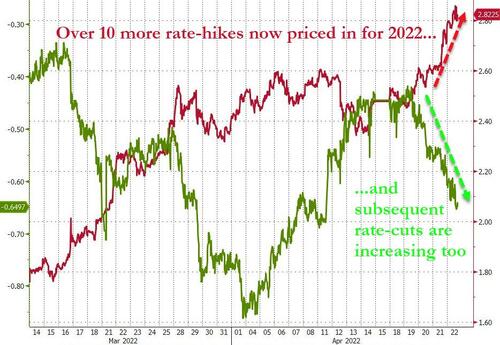
Nomura has not changed their above-consensus 3.75-4.00% terminal rate forecast. Following the two 75bp hikes in June and July, we expect the Fed to steadily hike rates by 25bp at every meeting, similar to our previous forecast. This implies 300bp of cumulative tightening this year, up from our previous expectation of 250bp, and 75bp in 2023, down from 125bp.
However, Nomura now expects the terminal rate to be reached slightly earlier, likely by May 2023 rather than July. Finally, we note their expectation of rate cuts to around 2% in early 2024 remains unchanged.
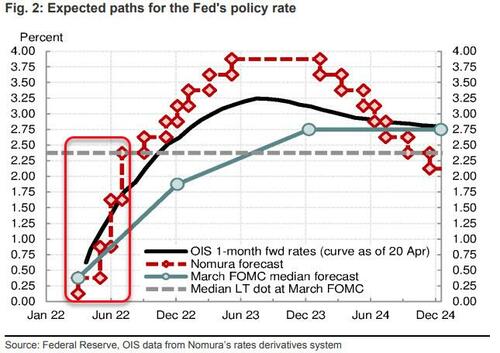
In fact, STIRs have quickly started to price that in with a 35% chance of a 75bps hike now in June (with 50bps more than fully priced for May)…
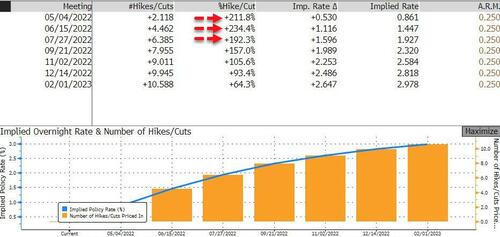
Moreover, Chair Powell acknowledged yesterday he supports frontloading rate hikes.
Markets have responded, but not in a way the Fed would consider “disorderly.”
From the Fed’s perspective, hiking multiple times by 75bp would bring them to neutral more quickly… and bring about recession sooner (3s10s just re-inverted)…
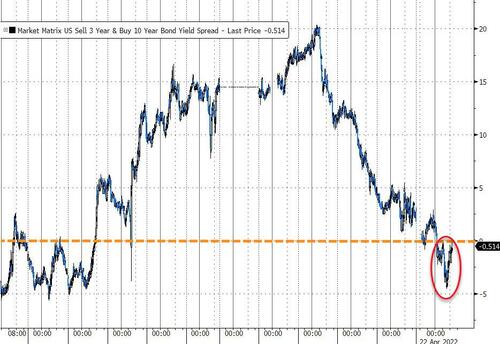
But, as Nomura’s Charlie McElligott notes, the Equities-set has learned in painful fashion over the past six months that shock Rates re-pricings off the back of “hawkish escalation” are a gut-punch to markets and sentiment (as they risk “hard landing” into an economic cycle-turn), especially the “lazy long Duration” crowd which means up so much legacy positioning and general index-weighting…but yesterday, even seeing the recent “cyclical” leaders get hit too into enhanced “contraction / recession” de-risking.
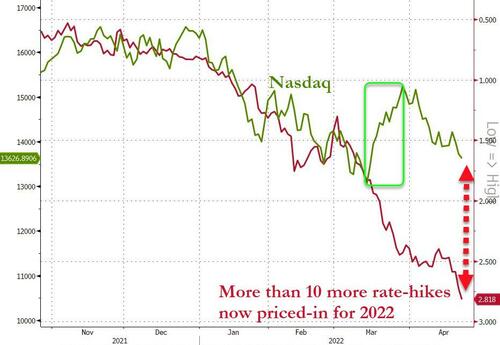
The map ahead continues to look like this
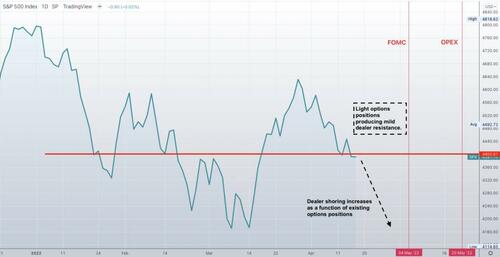
As SpotGamma explains, 4400SPX is the last “neutral” strike on the board, meaning it is the last strike with material call gamma. Below 4400 its primarily put gamma, which leaves the market exposed to dealer short-hedging. Looking forward, into next week there is no reason we cannot see another “air gap” rally like we did this week. 4500 would remain significant resistance. To the downside, we’re flagging the 4300 Put Wall as a major low into the key 5/4 time frame.
END
II)USA data
Service sector slows in April amid high input costs
(zerohedge)
US Services Sector Slows In April Amid Record Costs
FRIDAY, APR 22, 2022 – 09:52 AM
After the somewhat surprising rebound in PMIs in March, preliminary April data shows a significant divergence between US Services (notably lower) and US Manufacturing (notably higher)…
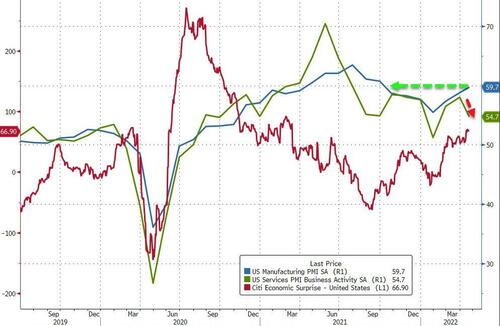
Source: Bloomberg
Service sector firms registered the fastest rise in cost burdens since October 2009, when data collection began.
Goods producers recorded the sharpest uptick in expenses since November 2021’s record rise
In an effort to pass through higher cost burdens to clients, businesses signalled the steepest rise in output charges on record. Manufacturers and service providers alike reported series-record increases amid soaring input prices. Some companies also stated that surcharges were added to selling prices to account for more frequent upticks in operating expenses
The headline Flash US PMI Composite Output Index registered 55.1 in April, down from 57.7 in March. The latest data indicated a strong rise in private sector output, but one that was subdued by the impact of inflation on customer spending. Although service providers recorded a softer upturn in activity, manufacturing firms noted the quickest uptick in production since last July.
Commenting on the flash PMI data, Chris Williamson, Chief Business Economist at S&P Global said:
“Although still indicative of annualised GDP growth of approximately 3%, the April PMI surveys point to the upturn losing some momentum compared to the strong rebound seen in March, when services activity in particular had been buoyed by loosened pandemic restrictions in the US and abroad.
“Many businesses continue to report a tailwind of pent up demand from the pandemic, but companies are also facing mounting challenges from rising inflation and the cost of living squeeze, as well as persistent supply chain delays and labor constraints.
“These headwinds, plus increased concerns over the economic outlook and tightening monetary policy, meant business confidence about the outlook slipped sharply lower in April. However, with the overall pace of economic growth and hiring remaining relatively solid, for now the focus from a policy perspective is likely to remain firmly on the need to rein in the record high inflationary pressures signalled by the survey.”
Finally, we note that the word ‘record’ is found 16 times in the PMI release – a ‘record’ in itself in terms of extreme outliers in today’s US economy.
-END-
IIB) USA COVID/VACCINE MANDATES
end
iiia) USA inflation//SHIPPING commentaries//LOG JAMS//
IIIB) USA ECONOMIC STORIES
House Republicans demand Twitter board to preserve all records related to Musk buyout bid
(zerohedge)
House Republicans Demand Twitter Board Preserve All Records Related To Musk Buyout Bid
FRIDAY, APR 22, 2022 – 09:20 AM
18 House Republicans have demanded that Twitter’s board preserve all records related to Elon Musk’s buyout offer – suggesting that they will conduct a congressional probe if their party regains control of the chamber this fall.

According to a Friday letter seen by CNBC, House Judiciary Committee Republicans led by ranking member Rep. Jim Jordan (R-OH) have asked Twitter board chairman Bret Taylor to preserve any communications from both official and personal accounts – including those sent using encryption – that have anything to do with Musk’s offer.
“As Congress continues to examine Big Tech and how to best protect Americans’ free speech rights, this letter serves as a formal request that you preserve all records and materials relating to Musk’s offer to purchase Twitter, including Twitter’s consideration and response to this offer, and Twitter’s evaluation of its shareholder interests with respect to Musk’s offer,” reads the letter.
“You should construe this preservation notice as an instruction to take all reasonable steps to prevent the destruction or alteration, whether intentionally or negligently, of all documents, communications, and other information, including electronic information and metadata, that is or may be potentially responsive to this congressional inquiry.”
The request signals that should Republicans take back the majority in the House in the 2022 midterm elections, they may launch an investigation into Twitter, especially if the company declines to take the offer from Musk, who’s CEO of Tesla and SpaceX. Under Republican control, the House Judiciary Committee could decide to subpoena records about the board’s internal deliberations.
It’s not the first time Twitter has caught the attention of Republican lawmakers.
The platform has become a focal point for some conservative members who’ve charged that Twitter unfairly removes or moderates posts on ideological grounds. Twitter has denied doing so and says it enforces standards based on its community guidelines. -CNBC
The letter continues; “Decisions regarding Twitter’s future governance will undoubtedly be consequential for public discourse in the United States and could give rise to renewed efforts to legislate in furtherance of preserving free expression online. Among other things, the Board’s reactions to Elon Musk’s offer to purchase Twitter, and outsider opposition to Musk’s role in Twitter’s future are concerning.”
Twitter has come under fire for years of censoring conservative opinions as well as legitimate news, such as the Hunter Biden laptop scandal – which the social media giant blocked all mention of in October 2020, weeks before the US election.
At the time, Twitter said they blocked the story because it violated its ‘hacked materials’ policy, and included personal email addresses.
Later, former CEO Jack Dorsey said it was “wrong” to block the story.
END
iv)swamp stories
Top Prosecutor Drops Out Of Whitmer Kidnapping Case
THURSDAY, APR 21, 2022 – 05:40 PM
We recently discussed the collapse of the Whitmer kidnapping case after a jury acquitted defendants in Michigan. Now, one of the lead prosecutors is leaving the case, according to a motion filed by Assistant U.S. Attorney Jonathan Roth. That adds questions about how the case will move forward after the earlier loss.

Shortly before the 2020 election, Gov. Whitmer stood before cameras describing her narrow escape from being kidnapped and murdered by “domestic terrorists.” Despite the fact that the Justice Department in the Trump Administration made these arrests, Whitmer blamed former president Donald Trump. President Biden agreed that Trump was fostering a “civil war.”
The media went into a frenzy, declaring that the case proved that “Trump’s rhetoric and policies have unleashed a second pandemic in the form of far-right domestic terrorism.”
The problem is that the case — and the narrative — quickly fell apart after the election. A Michigan jury recently acquitted Daniel Harris and Brandon Caserta and hanged on the verdicts against Adam Fox and Barry Croft Jr. Fox is portrayed as a ringleader of the group and leader of the conspiracy.
While Fox and Croft can be retried, the acquittal raises an additional challenge. Harris and Caserta may feel fewer inhibitions in testifying. With the exception of perjury, they can safely take the stand to discuss their actions — and more importantly, the actions of the government.
The Michigan case stands as one of the most chilling examples of entrapment techniques used by the FBI. While Whitmer declared Trump “complicit” in her planned execution, the FBI increasingly appeared more “complicit” in the creation of a government-inspired, government-funded, and largely government-staffed plot.
The problem was that these guys seemed at points more interested in partying than conspiring. The FBI, therefore, decided to take control and get them serious about some major crimes. An informant known as “Big Dan” was paid over $50,000 to get the conspiracy going, including paying for the defendants to travel to Wisconsin to “train.”
Special Agent Jayson Chambers pushed Big Dan to get the men to take violent acts against Whitmer. The defendants reportedly resisted those entreaties. Dan pushed the alleged leader to fire a round into the window of Whitmer’s home and mail the casing to the news media. On Sept. 5, 2020, Chambers texted to remind Dan “Mission is to kill the governor specifically.“
The Whitmer conspiracy was a production written, funded, and largely populated by FBI agents and informants. At every point, FBI literally drove the conspirators and controlled their actions. In the end, a majority of the “conspirators” were actually FBI agents or informants.
As discussed earlier, various key FBI agents and informants were removed from the case due to their own legal problems.
Now, Roth is pulling out. That will create a vacuum in the second trial. Retrials often allow prosecutors to better prepare for defense arguments. Yet, it has lost one of the prosecutor most experienced in the case.
Politically, it would be highly damaging for both Biden and Whitmer to have the case dropped. The question is whether the reduction of the defendants and the change in the prosecution team will change the prospect for convictions. It could work for the defense if the two acquitted parties are more active in the case. Conversely, focusing on the alleged leader could strengthen the optics for the jury by eliminating marginal figures.
There could also be a more generous plea deal offered to the defense to avoid the threat of acquittal. It is notable to see a lead prosecutor bow out in such a high-profile case. Whether this indicates other significant changes in the case will likely become clear in the coming days.
end
“They’re Playing Hardball”: Feds Subpoenaed Hunter Biden Paternity Docs, Including Tax Records
FRIDAY, APR 22, 2022 – 11:00 AM
Federal prosecutors investigating Hunter Biden subpoenaed documents from his paternity lawsuit, including the first son’s “income, assets, debts, obligations, and financial transactions… and all personal and business expenditures,” according to CBS News, citing documents and an attorney involved in the matter.

“They wanted every record relating to Hunter Biden we had,” said attorney Clint Lancaster, who represented the mother of Hunter’s child, Lunden Roberts. Roberts testified before a Delaware grand jury in February, Lancaster added.
The subpoena, issued in December 2020 by US Attorney David C. Weiss, requested material from January 2017 to the present, and requested a wide range of tax documents.
“All federal, state, local and foreign tax documentation related to Biden,” reads the subpoena. “including but not limited to, IRS Forms 1099, income and payroll tax returns, state tax returns, and amended tax returns.”
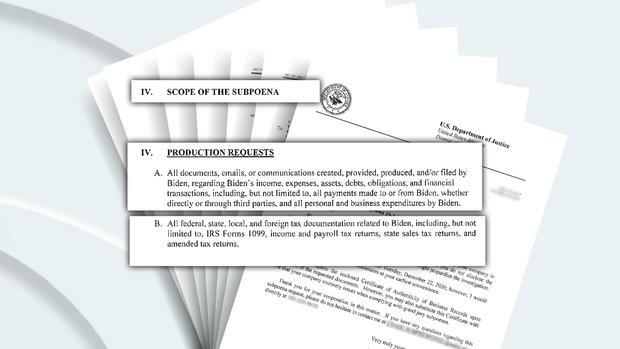
While the request is nearly 18 months old, it offers a glimpse into the long-running investigation into Hunter and his business dealings – all stemming from a probe that started out as a tax inquiry several years ago.
Lancaster told CBS News that in the fall of 2021, the Assistant U.S. Attorney in Delaware, Lesley Wolf, traveled to his Arkansas law office, joined by at least two federal agents, one from the FBI and the other an IRS enforcement agent. Lancaster said he and his client spent about half a day answering questions about Hunter Biden and his business practices.
Lancaster said that in the meeting, investigators asked for information about several companies affiliated with Hunter Biden, including Rosemont Seneca Partners, a firm where he worked for several years. –CBS News
The December 2020 subpoena is similar to a 2019 order obtained by CBS News, which sought “all records, documents and accounts pertaining to all financial/banking transactions” between Hunter Biden, the president’s brother James, two business partners dating back to 2014 (when Joe Biden was VP), and 15 business entities.
According to Lancaster, Hunter provided an “affidavit of financial means” during the paternity suit, which detailed his finances via income statements as well as a breakdown of monthly expenses. The records overlapped with Hunter’s foreign business dealings.
Hunter, meanwhile, was confirmed “with scientific certainty” to be the father of Roberts’ child, who is believed to be around 3 years old today, while the paternity case was settled in 2020. Several records in the case are under seal.
“The whole thing is as serious as a heart attack,” said Harry Litmann, a two-decade DOJ veteran, including as a US Attorney. “People are going in and out of the grand jury. They are trying to plumb the depths. They’re playing hardball.“
end
The King Report (including swamp stories)
Bond and note yields surged anew on Thursday. The US 2-year hit 2.712%; the 10-year hit 2.95%, and the 30-year hit 2.98%. The Fed is almost 250bps behind the (2-year) curve! Notes and bonds hit their lows at midday and then rallied for the remainder of the day.
Elon Musk says he’s secured $46.5 billion to buy Twitter https://t.co/eGuuKT8BJ8
Elon Musk says Tesla’s humanoid Optimus robot ‘will be worth more than the car business’ https://t.co/Wi2KGdAQ3u
ESMs and stocks, which had rallied early in the session on Tesla’s splendid results and the usual trader buying, recognized what was occurring in bond land by the end of the first 30 minutes of NYSE trading. ESMs sank from the session high of 4509.00 to 4446.50 by 12:18 ET. After a short-lived modest rally, ESMs and stocks rolled over and declined sharply into the close.
The buy bonds/sell stocks asset allocation that we warned on Wednesday would eventually appear, might have occurred yesterday afternoon.
Powell Backs Front-Loading Fed Rate Hikes, Says Half-Point on Table
“We really are committed to using our tools to get 2% inflation back,” he said… Powell said “there’s something in the idea of front-end loading” moves if appropriate, “so that points in the direction of 50 basis points being on the table.”… https://finance.yahoo.com/news/powell-backs-front-loading-fed-173947025.html
WaPo’s @rachsieg: Powell on the labor market: “It’s too hot. It’s unsustainably hot. It’s our job to get it to a better place where supply and demand are closer together.”…
Fed Balance Sheet: -$9.636B; MBS -$9.498B https://www.federalreserve.gov/releases/h41/20220421/
A String of Fires Destroys Food Processing Facilities Across America
A curious string of fires and plane crashes over the last month have destroyed the facilities of at least five major food processors across four different states, exacerbating an escalating inflation and supply chain issues… https://www.visiontimes.com/2022/04/21/fires-destroy-food-processing-centers.html
Chicago Fed President Charles Evans, a pathological uber-dove, will retire early in 2023.
Warner Bros Discovery will terminate CNN+ streaming service on April 30, just 21 days after its launch!
| @greg_price11: Biden was asked about Title 42 on the southern border. He started talking about the DOJ appeal on airplane mask mandates. https://twitter.com/greg_price11/status/1517145713578180608 @RNCResearch: Biden claims he “sat down and wrote” the “original” infrastructure bill with his “own paw” (Joe said he’s been prez for 19 months) https://twitter.com/RNCResearch/status/1517259408354557959 Psaki Admits Appealing the CDC Mandate Ruling Is All About Preserving Power Psaki admitted that the White House would fight the ruling in order to “preserve that authority for the CDC to have in the future.” That is, it’s not about The Science(TM), it’s about protecting power. https://townhall.com/tipsheet/spencerbrown/2022/04/20/psaki-admits-appealing-the-cdc-mandate-ruling-is-all-about-preserving-power-n2606129 @RNCResearch: Fauci insists the CDC should be ABOVE federal courts. “We are concerned about courts getting involved in things that are unequivocally a public health decision. This is a CDC issue.” https://twitter.com/RNCResearch/status/1517252166469173248 Fauci is ignorant or deceitful. The judge ruled on the limits and scope of CDC powers, not mask efficacy. “The Party told you to reject the evidence of your eyes and ears. It was their final, most essential command.” –– George Orwell, 1984 @biancoresearch: NFLX is down 59.6% YTD and the worst performer in the S&P 500 this year DIS is down 32.9% YTD and the worst performer in the DJIA this year. Both are in the streaming and movie business I see a theme (Both went very woke. NFLX gave Obamas millions for documentaries) Fed Funds futures are priced for 50bp rate hikes in May, June, and July. Today – Did Thursday’s US yield surge awaken and arouse defensive asset allocators? If so, did the defensive asset allocation (buy bonds/sell stocks) chill ESM manipulators and/or pump & dumpers? The key for today could be the presence or absence of defensive asset allocators and equity juicers. If an equity peak of some type has not already appeared, it could arrive late next week on April performance gaming, or on the ensuing Monday on start of May buying. Then, look out! The last trading day of April marks the end of the most bullish intermediate term pattern (Nov 1 to April 30) known to Earthlings. “Sell in May and go away” is often a very sound strategy. ESMs are -12.00, and USMs are -14/32 at 20:39 ET. Expected earnings: VZ 1.35, SLB .33, AXP 2.40, NEM .72, HCA 4.25, KMB 1.25 Expected economic data: April S&P US MFG PMI 58, Services 58 S&P 500 Index 50-day MA: 4413; 100-day MA: 4513; 150-day MA: 4518; 200-day MA: 4497 DJIA 50-day MA: 34,284; 100-day MA: 34,882; 150-day MA: 35,013; 200-day MA: 35,021 S&P 500 Index – Trender trading model and MACD for key time frames Monthly: Trender is positive; MACD is negative – a close below 4153.02 triggers a sell signal Hourly: Trender and MACD are negative – a close above 4547.45 triggers a buy signal Daily: Trender and MACD are negative – a close above 4529.25 triggers a buy signal Hourly: Trender and MACD are negative – a close above 4462.50 triggers a buy signal @NathanBrandWA: Joe Biden’s poll numbers in (Deep Blue) OREGON: 35% – Positive, 63% – Negative; Democrat Governor Kate Brown: 27% – Positive, 72% – Negative https://www.opb.org/pdf/OPB%20Election%20Survey–Annotated_1650480521631.pdf Attorney says feds subpoenaed Hunter Biden paternity documents, including tax returns: “They wanted every record” https://t.co/EdCJmsK5l2 @RNCResearch: Biden’s brother, James, has been subpoenaed for financial records going back to 2014. “The reason that timing matters is that it spans a period when Joe Biden was the vice president.” https://twitter.com/RNCResearch/status/1517206117469806593 VP Harris’ Chief of Staff Latest to Leave Amid Mass Exodus https://www.newsmax.com/newsfront/kamala-harris-vice-president-staffer-adviser/2022/04/21/id/1066736/ Russia is no longer the dominant power in Eastern Europe – Whatever happens, the combined efforts of the former Soviet states have destroyed the idea of Russian military preeminence The math alone spells Russia’s military defeat in the Donbas; no longer even the dominant power in eastern Europe… https://www.telegraph.co.uk/opinion/2022/04/21/russia-no-longer-dominant-power-eastern-europe/ @Osinttechnical: Recently, an interview was released of Putin, and there seemed to be some very interesting elements. His posture seems off, and he is gripping the table with his right hand for the entire meeting. He just looks generally uncomfortable. https://twitter.com/Osinttechnical/status/1517263593720459265 Newly Obtained Emails Raise Questions About Department of Defense Involvement in Spygate https://thefederalist.com/2022/04/21/newly-obtained-emails-raise-questions-about-department-of-defense-involvement-in-spygate/ Turley: Destroying democracy to save it? Court advances effort to block GOP candidates from ballots – Judge Amy Totenberg ruled that critics could potentially strip Greene from the ballot due to her public comments before and after the Jan. 6, 2021, riot in Congress. Totenberg ruled that Greene’s critics could bring a challenge under the Constitution’s 14th Amendment, known as the “Disqualification Clause.” This is the same clause cited by some liberal members of Congress and legal experts as a way to bar dozens of Republicans, including former President Trump, from office for allegedly engaging in insurrection against the United States or giving aid and comfort to its enemies…the disqualification clause was written in reference to a real Civil War in which more than 750,000 people died in combat. The Confederacy was a separate government with its own army, currency and foreign policy. There is another problem: To the extent that a person can be disqualified under the 14th Amendment, it requires action from Congress, not a local board of election… https://thehill.com/opinion/judiciary/3275409-destroying-democracy-to-save-it-court-advances-effort-to-block-gop-candidates-from-ballots/ @JonathanTurley: Barack Obama insisted yesterday that he is “close to a First Amendment absolutist” and then argued for censorship. Notably, he did not say he was close to a free speech absolutist (who also oppose private censorship)… Obama is hardly viewed as a champion for free speech — as is evident by his advocacy for censorship. It is akin to claiming to be a vegetarian absolutist while calling for mandatory meat consumption… Obama supports free speech unless he considers the speech to be “disinformation” and then he becomes an advocate for speech controls… “Whoever would overthrow the liberty of a nation must begin by subduing the freeness of speech.” –– Benjamin Franklin ‘I’ve Had It with This Guy’: G.O.P. Leaders Privately Blasted Trump After Jan. 6 In the days after the attack, Representative Kevin McCarthy planned to tell Mr. Trump to resign. Senator Mitch McConnell told allies impeachment was warranted. But their fury faded fast. Mr. McCarthy went so far as to say he would push Mr. Trump to resign immediately: “I’ve had it with this guy,”… On Jan. 8, Mr. McCarthy said Mr. Trump’s conduct on Jan. 6 had been “atrocious and totally wrong.” He faulted the president for “inciting people” to attack the Capitol… During that conversation, Mr. McCarthy inquired about the mechanism for invoking the 25th Amendment… before concluding that was not a viable option… On Jan. 10, Mr. McCarthy spoke again with the leadership team and this time he had a plan in mind… Mr. McCarthy said he would tell Mr. Trump of the impeachment resolution: “I think this will pass, and it would be my recommendation you should resign.”… Mr. McCarthy told other G.O.P. leaders he wished the big tech companies would strip some Republican lawmakers of their social media accounts… “The Democrats are going to take care of the son of a bitch for us,” Mr. McConnell said, referring to the imminent impeachment vote in the House… https://www.nytimes.com/2022/04/21/us/politics/trump-mitch-mcconnell-kevin-mccarthy.html McCarthy denies saying Trump should resign if impeached (Say buh-bye to Speakership, Kev!) https://thehill.com/news/house/3275574-mccarthy-denies-saying-trump-should-resign-if-impeached/ Trump walks out of explosive Piers Morgan interview after being pressed on 2020 election https://nypost.com/2022/04/20/trump-walks-out-of-piers-morgan-interview-after-being-pressed-on-2020-election/amp/ Trump releases audio that appears to refute claim he walked out of interview over 2020 questions The former president’s communications director released audio that shows reports that Trump had stormed off in response to questions about his election claims were inaccurate. https://www.nbcnews.com/politics/donald-trump/trump-releases-audio-appears-refute-claim-walked-interview-2020-questi-rcna25277 @NolteNC: TRUMP: I sat down with the media and they screwed me again. SMART PEOPLE: Maybe stop sitting down with them. (Stahl, Woodward, Wallace, et al) TRUMP: OMG, it just happened again! SMART PEOPLE: So maybe— TRUMP: They did it again! SMART PEOPLE: So— TRUMP: Again! SMART PEOPLE: Paging Ron DeSantis… MSNBC writer claims ‘White people’ cheered travel mask ruling because they don’t care about ‘Black deaths’ https://www.foxnews.com/media/msnbc-writer-white-people-cheered-travel-mask-ruling-dont-care-about-black-deaths Kasich says he cried after losing nomination to Trump, hoped people would “come to their senses” http://hill.cm/mI7uXZ4 Now you know why Ann Coulter called Establishment hack John Kasich “the effeminate version of Hillary Clinton.” Babylon Bee: Report: Long-Running Political Lecture Show ‘Saturday Night Live’ Will Shift To Comedy Next Season https://babylonbee.com/news/report-political-lecture-show-saturday-night-live-will-shift-to-comedy-next-season |
Let us close today with this offering courtesy of Greg Hunter
Russia/Ukraine Intensifies, Germany Tanking, Food, Inflation & Drought
By Greg Hunter On April 22, 2022 In Weekly News Wrap-Ups27 Comments
By Greg Hunter’s USAWatchdog.com (WNW 526 4.22.22)
There are zero reported peace talks going on to settle the war in Ukraine. This can mean only one thing, and that is this conflict will intensify. Could we get to the nuclear war stage? The answer is the global leaders are so corrupt, reckless and out of touch, anything is possible, and yes, that includes a nuclear exchange. The only question is who will launch first?
German food prices have risen 20% to 50% in a short period of time. They are not coming down anytime soon. Fuel prices are rising, and Germany is threatening to cut off all oil from Russia by the end of the year. Germany is the economic engine that drives the EU, and it is tanking. Germany and the rest of the EU better hope Russia does not beat them to the punch and cut them off now. The EU is in deep financial trouble, and their leaders will not stop destroying the economy with stupid sanctions that only hurt their own people. You can say the same for the Obama/Biden Administration.
To add insult to injury, the Western U.S. is in a 1,200-year mega drought in most places. Now, Lake Powell is at record lows, and water is going to be rationed. If this is not a sign food prices are heading higher, nothing is. Oh, and don’t forget that fertilizer out of Russia is being sanctioned, and fertilizer is in short supply all over the world. This will mean less fertilizer will be used either because of cost or supply problems, and that will translate into much lower yields and less food overall.
Join Greg Hunter of USAWatchdog.com as he talks about these stories and more in the Weekly News Wrap-Up for 4.22.22
(To Donate to USAWatchdog.com Click Here)
After the Wrap-Up:
Data mining expert Clif High will be the guest for the Saturday Night Post. He says wild and difficult times are headed our way and will forecast what’s coming.


 harveyorganblog.com


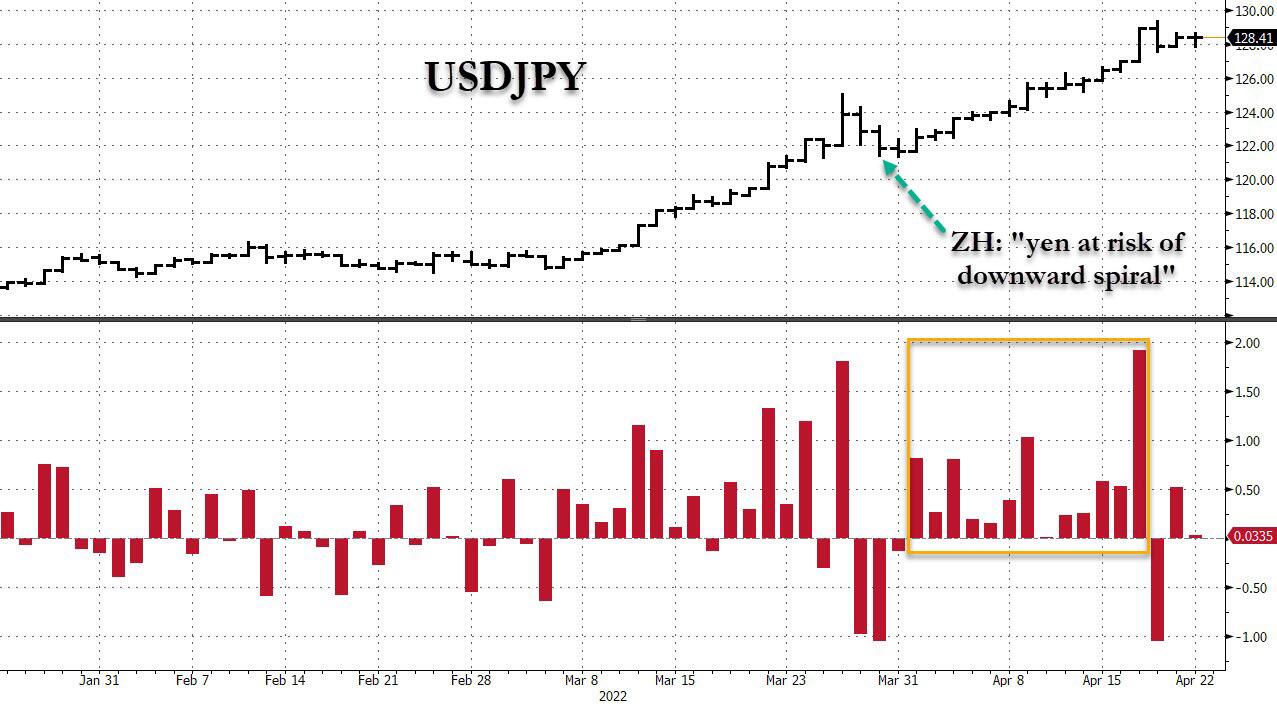
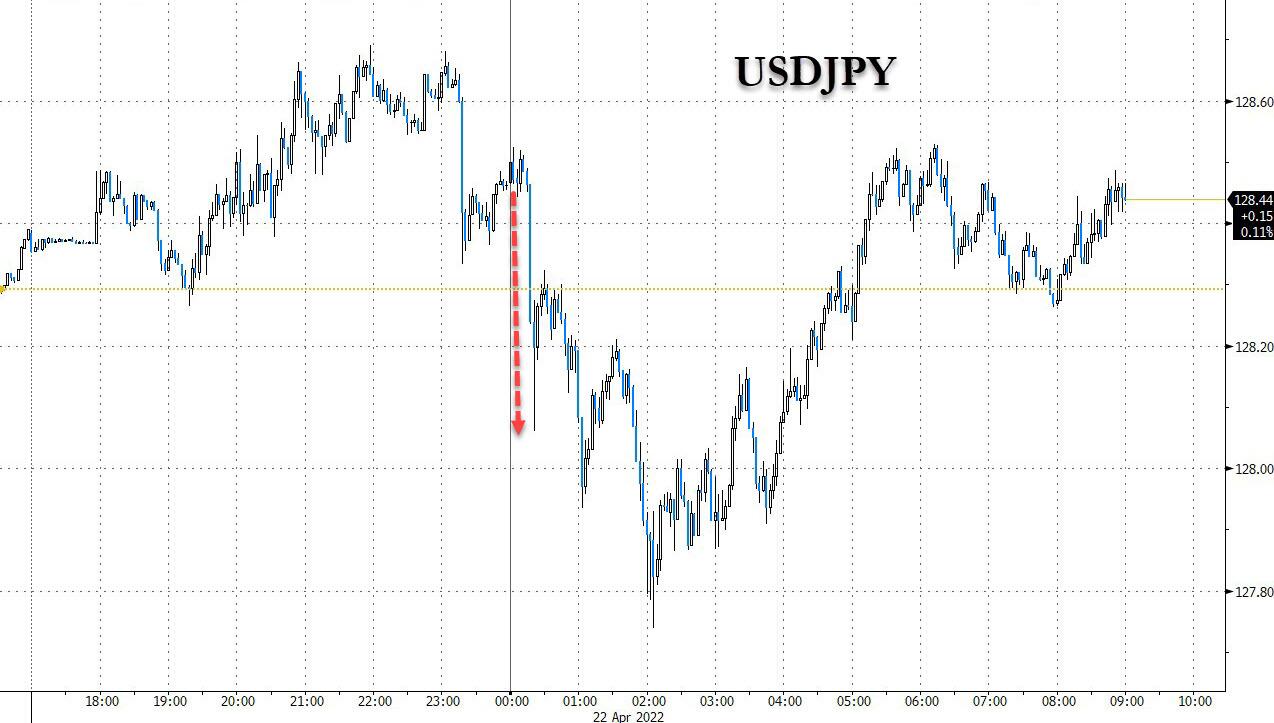

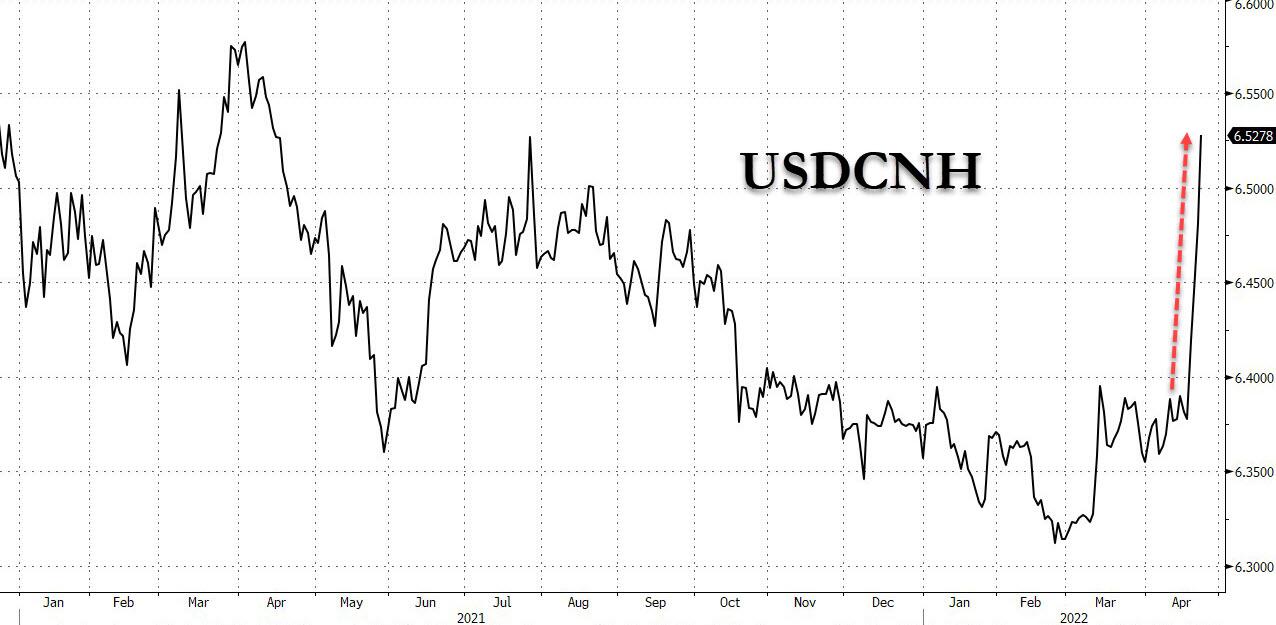
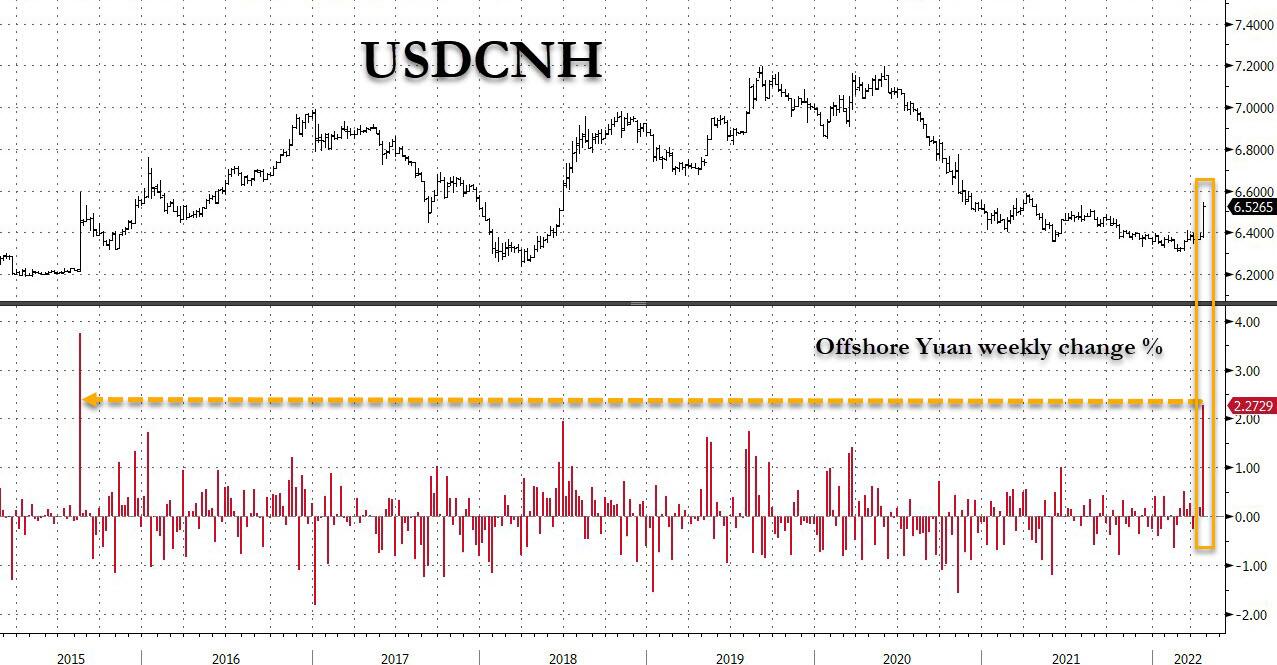
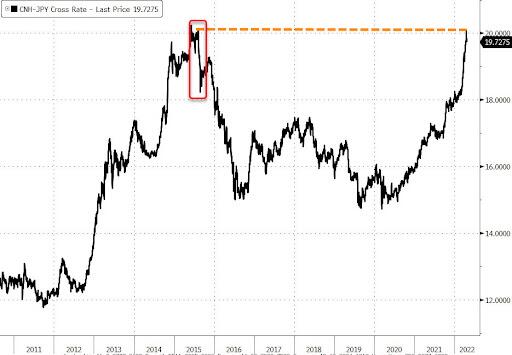
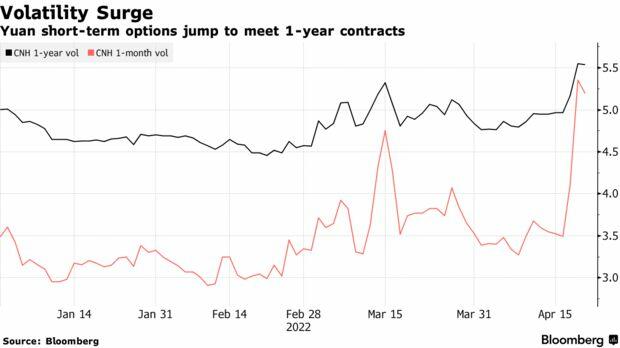
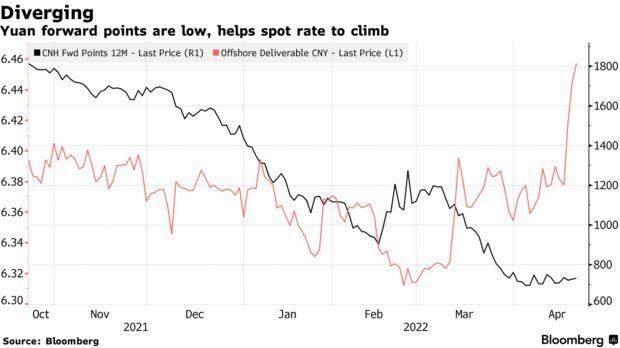
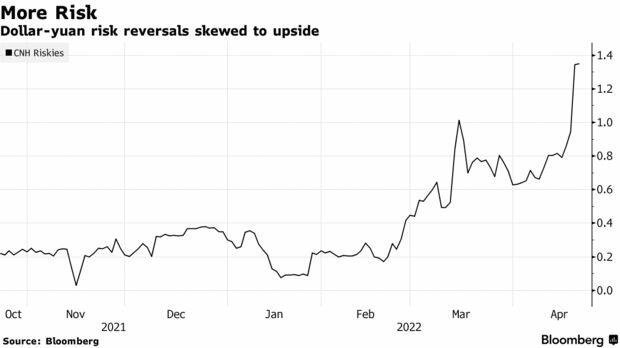
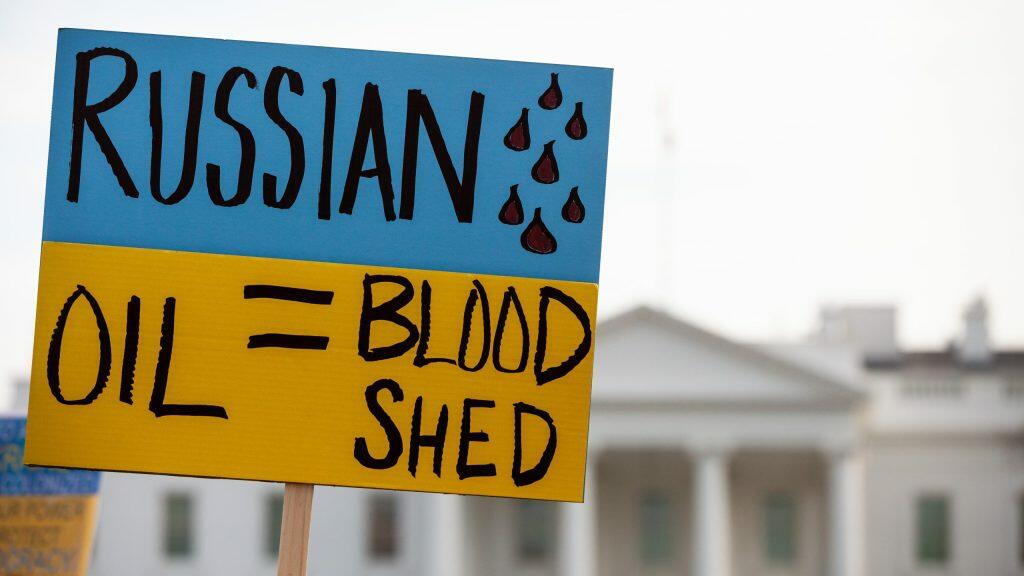
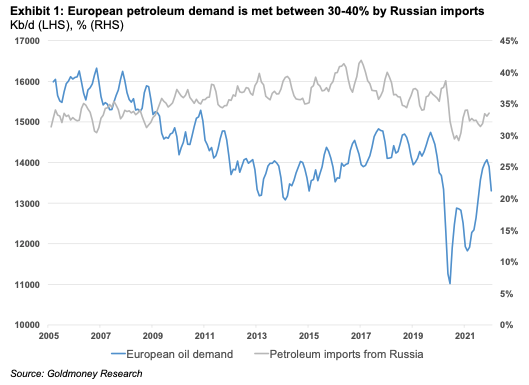
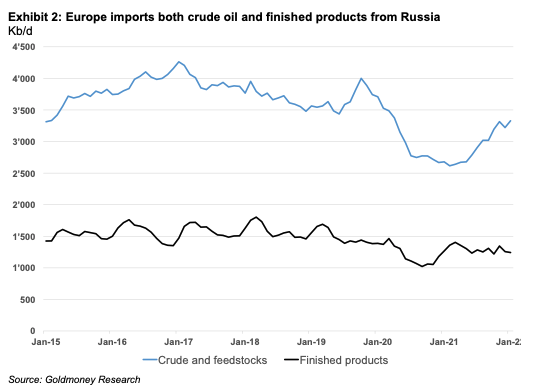

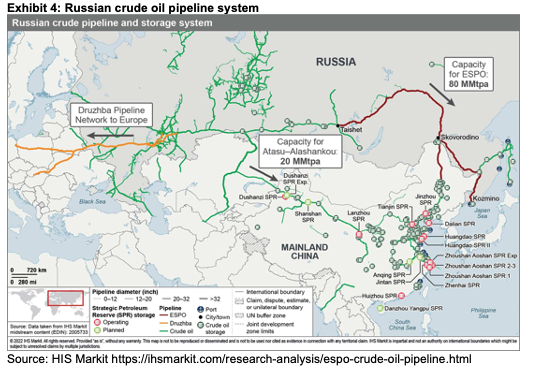
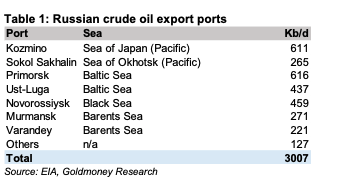


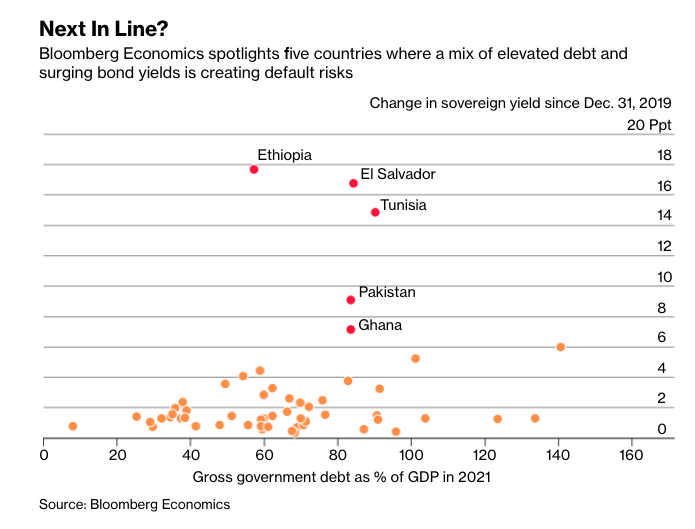
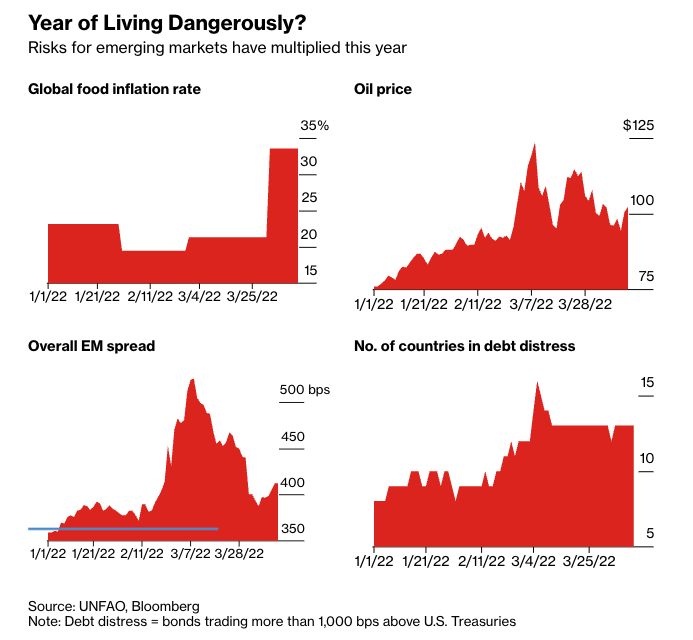
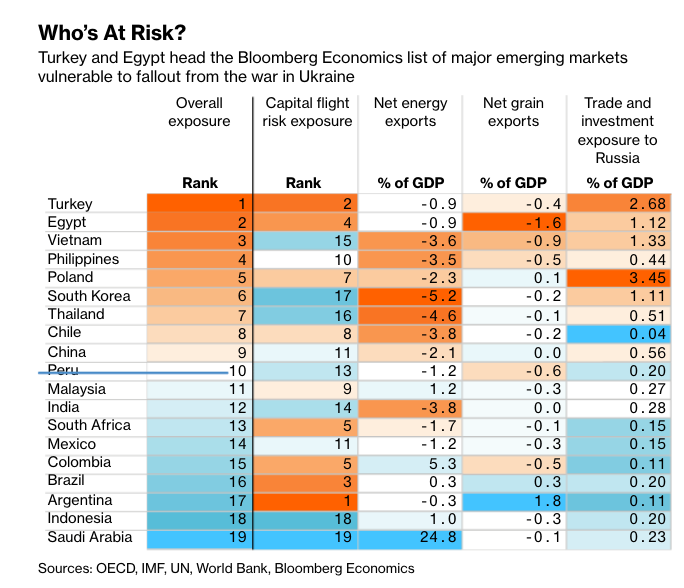
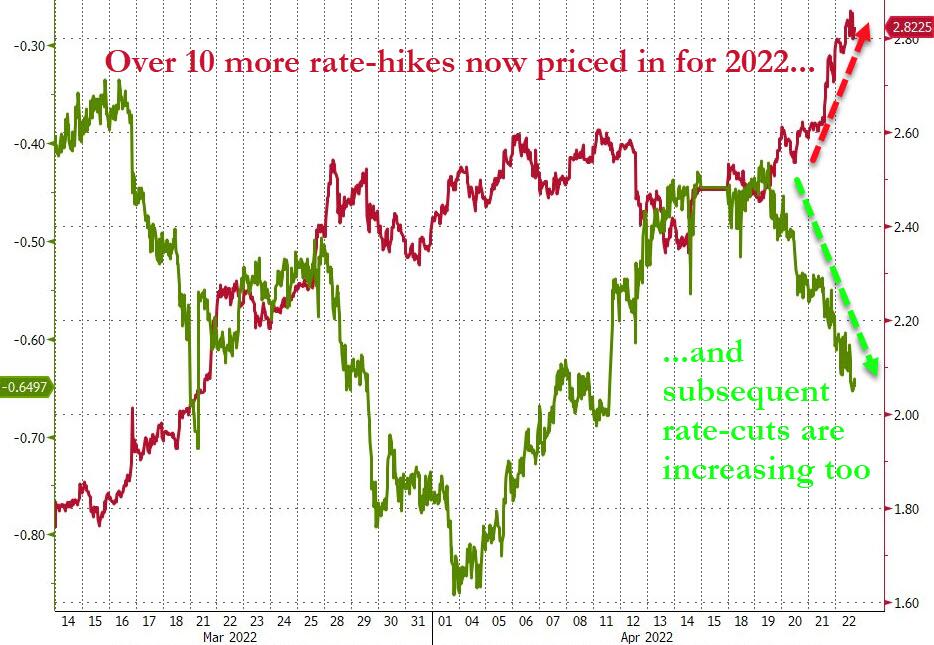
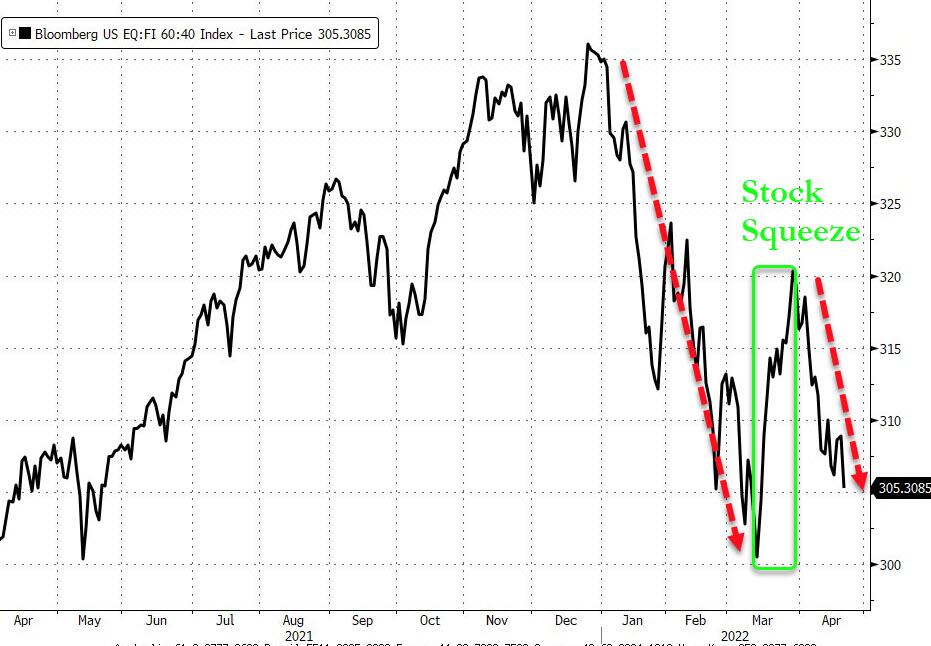
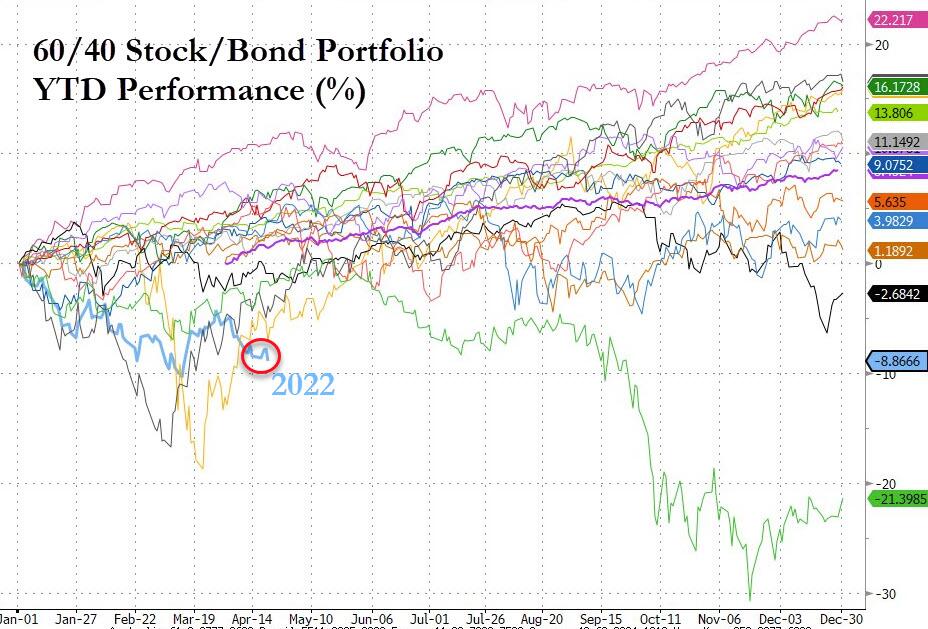
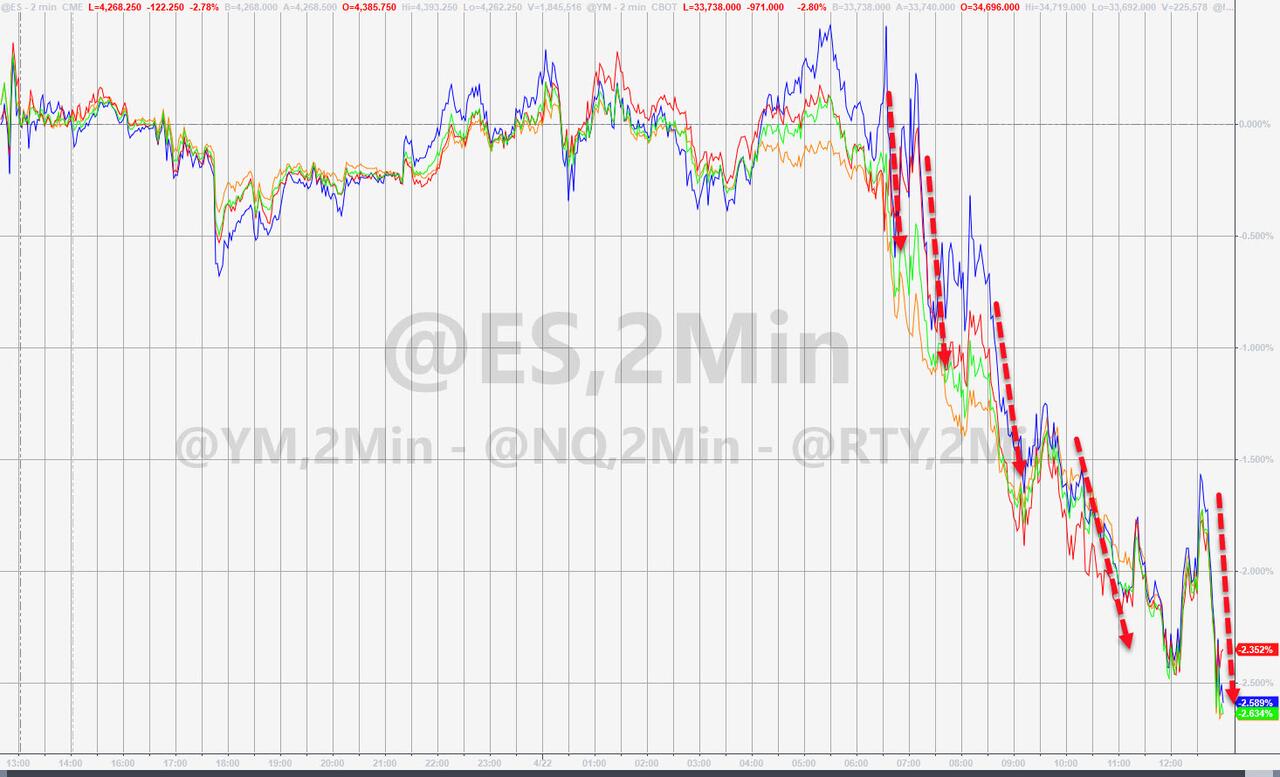
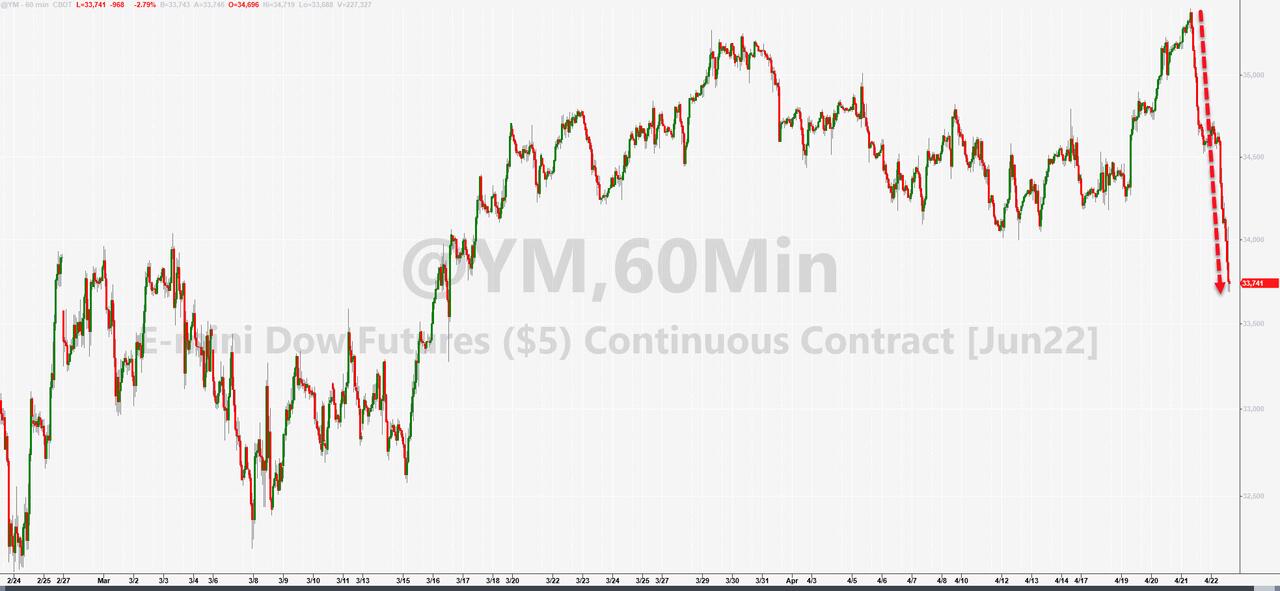

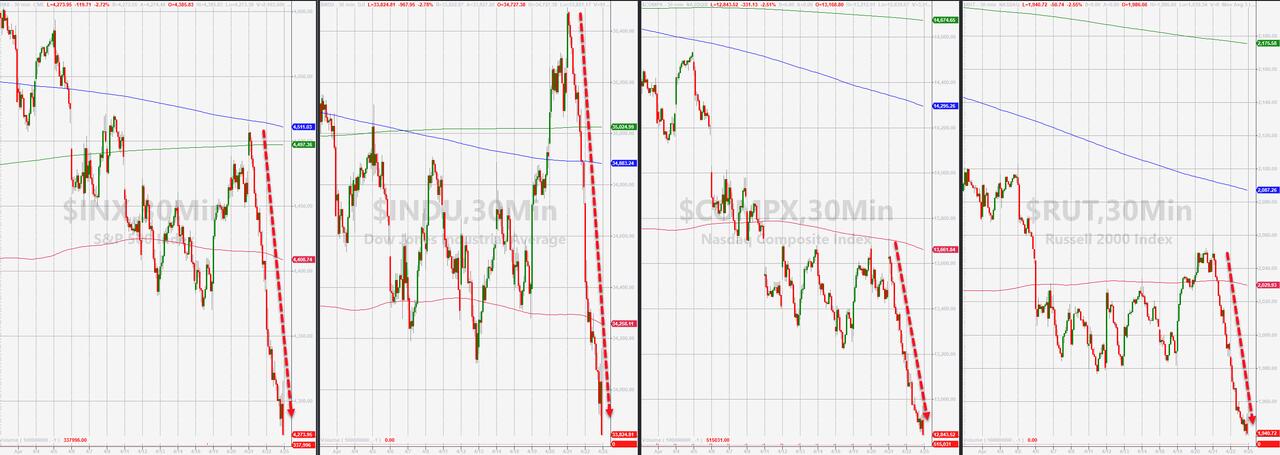
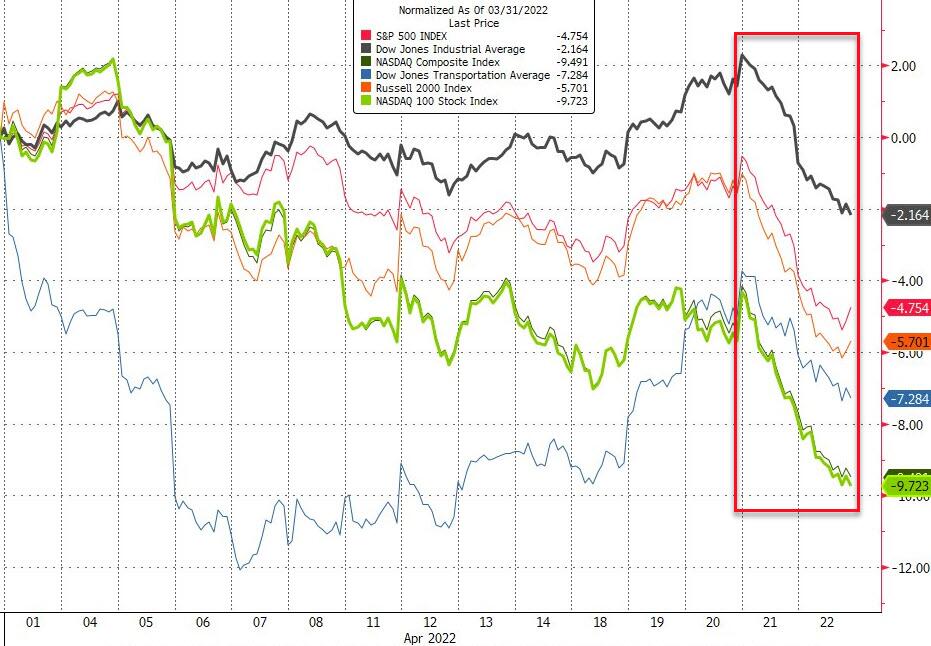
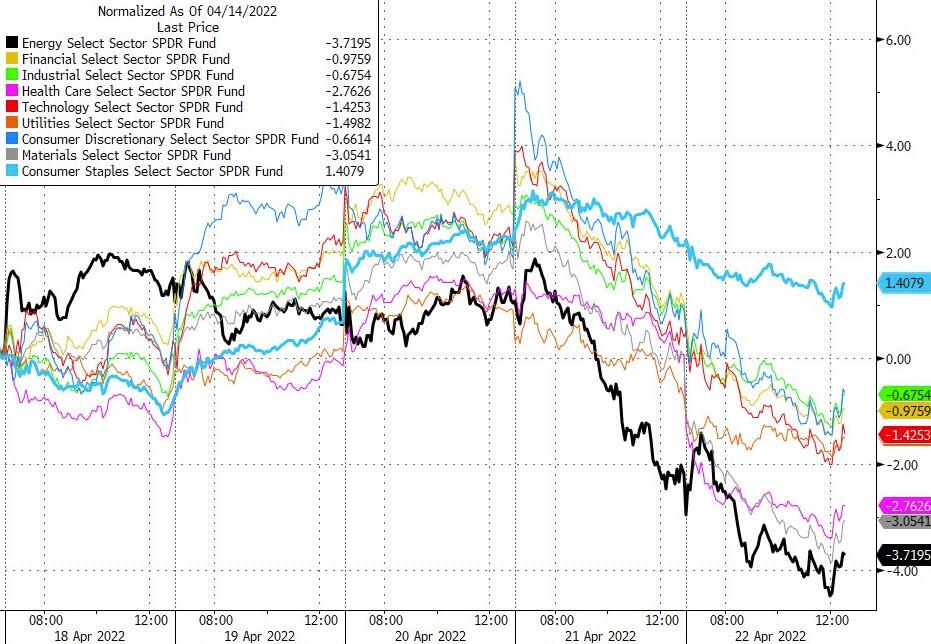
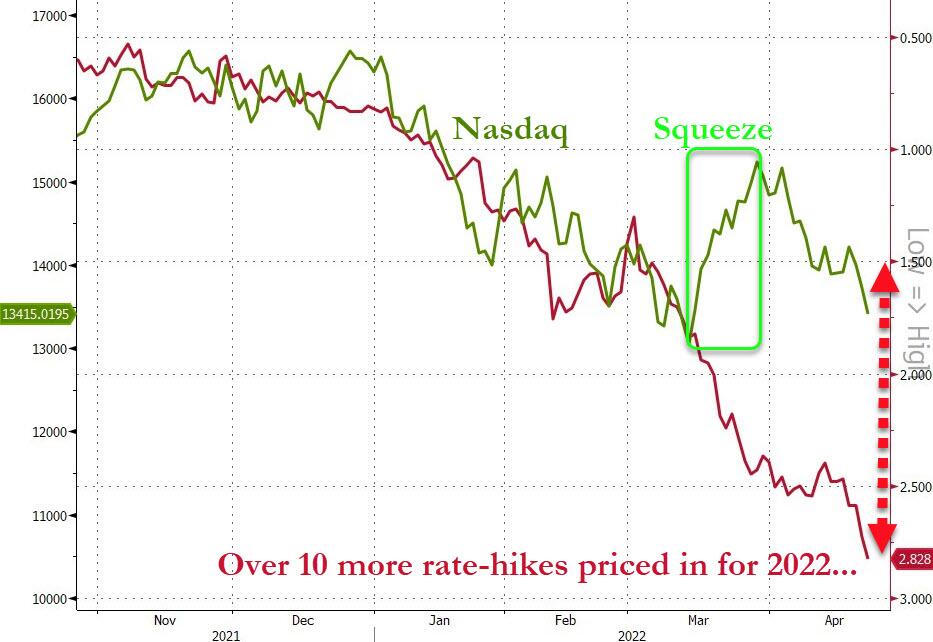
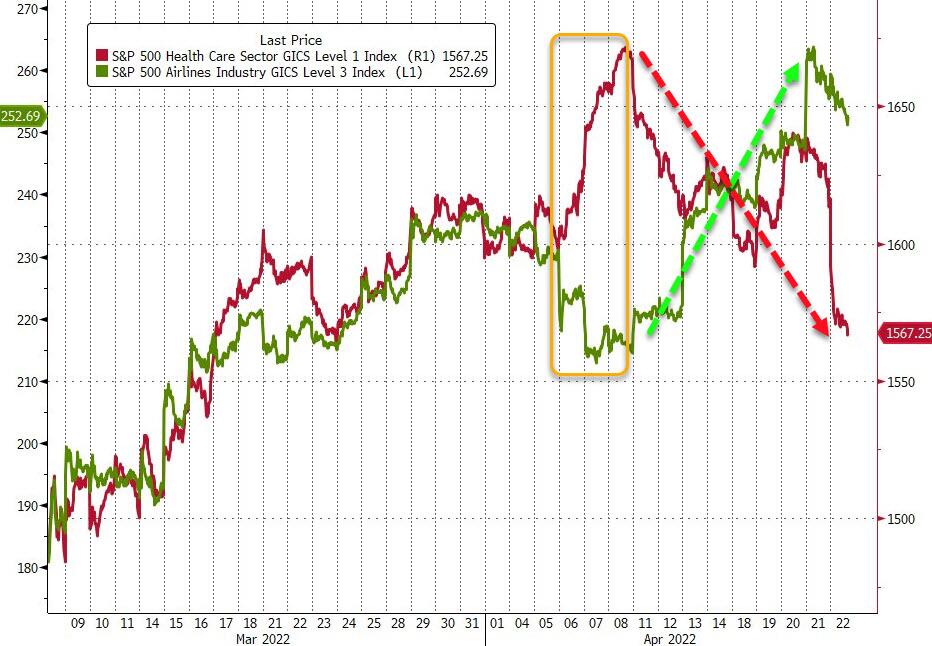
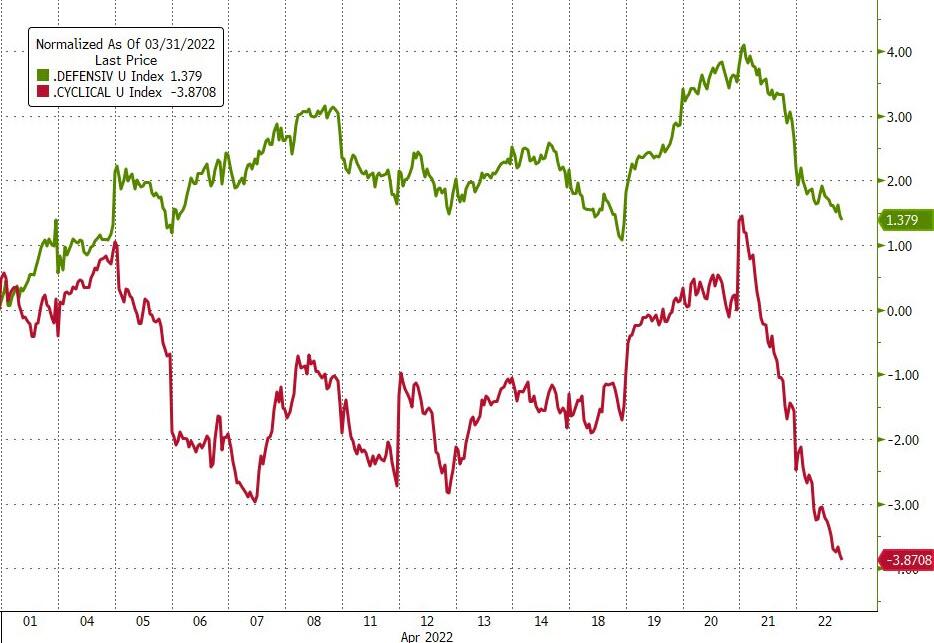
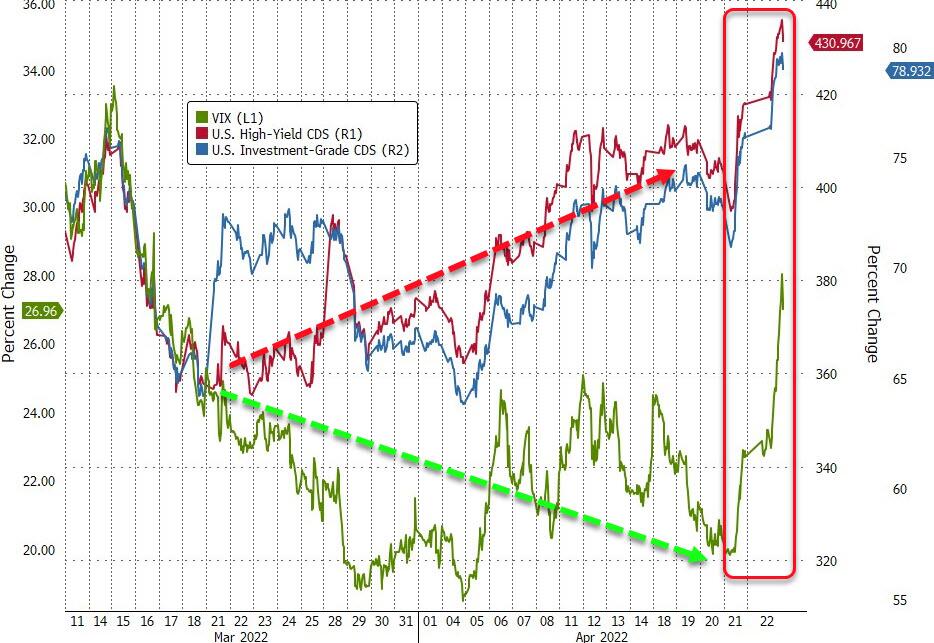
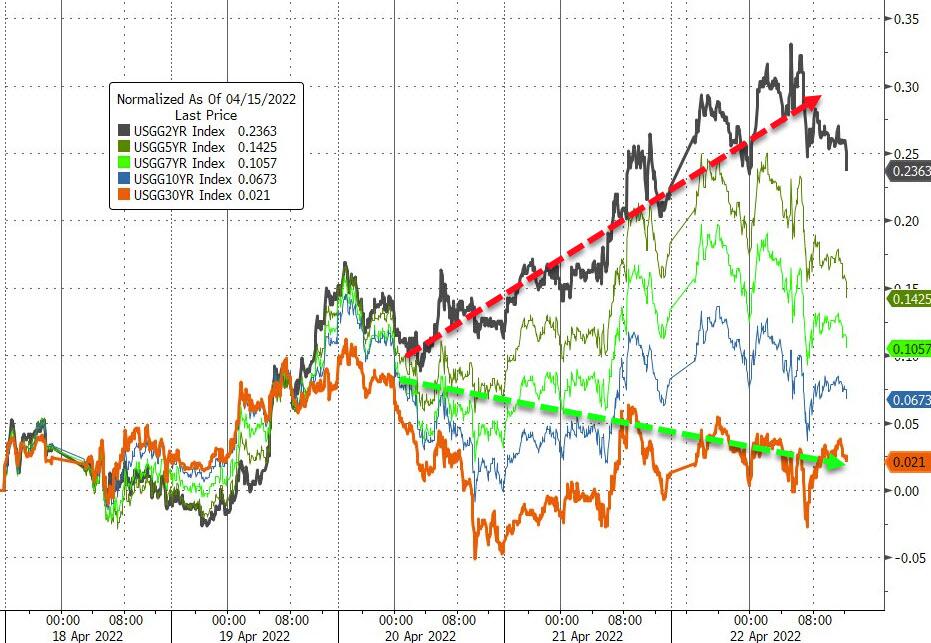
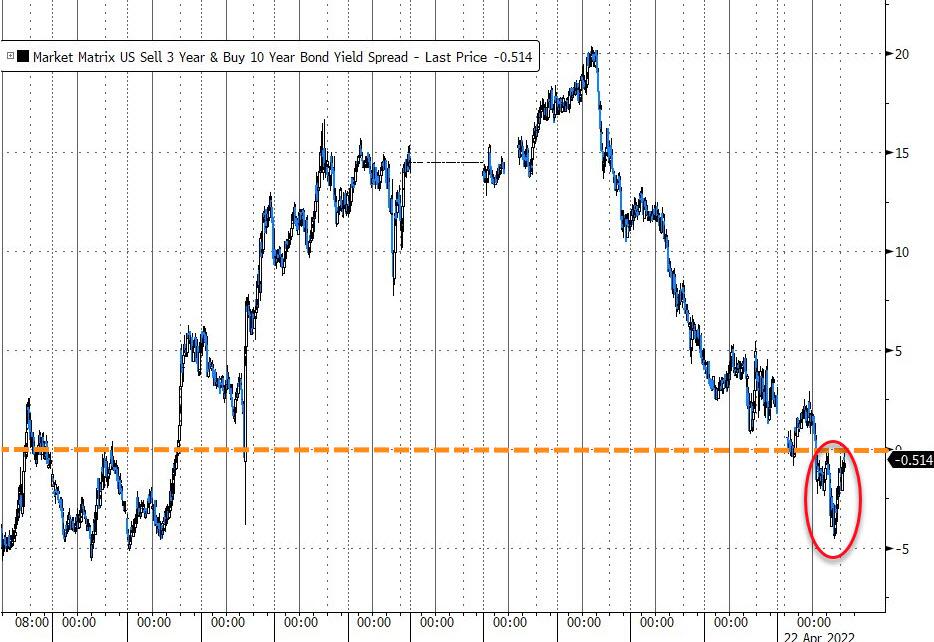
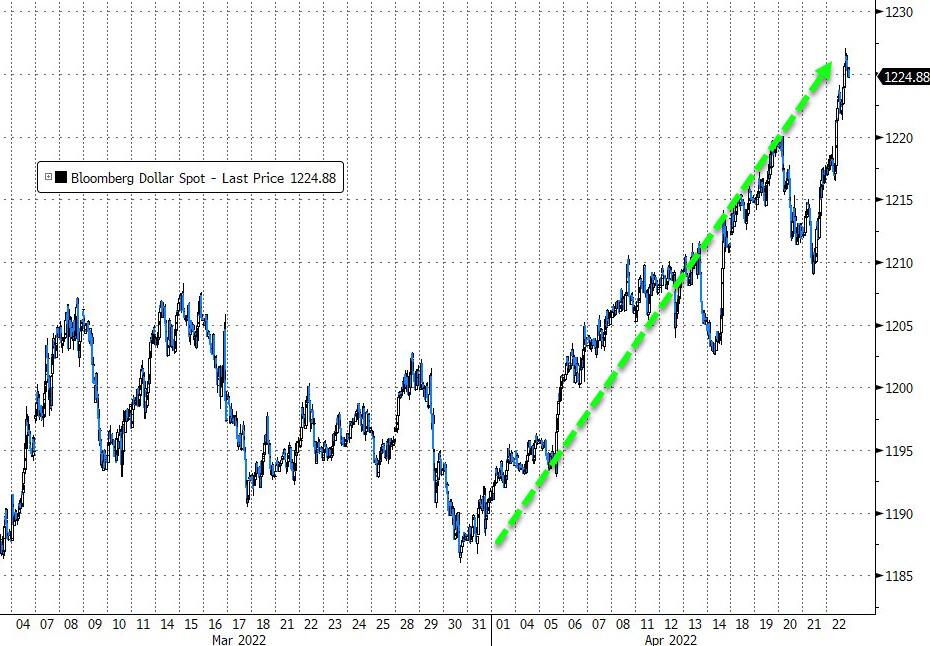
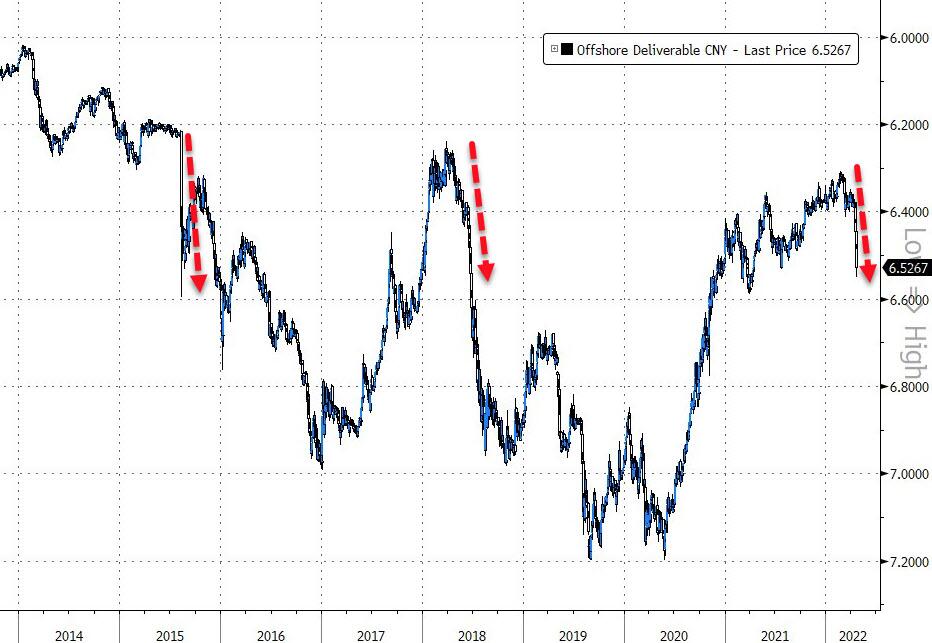
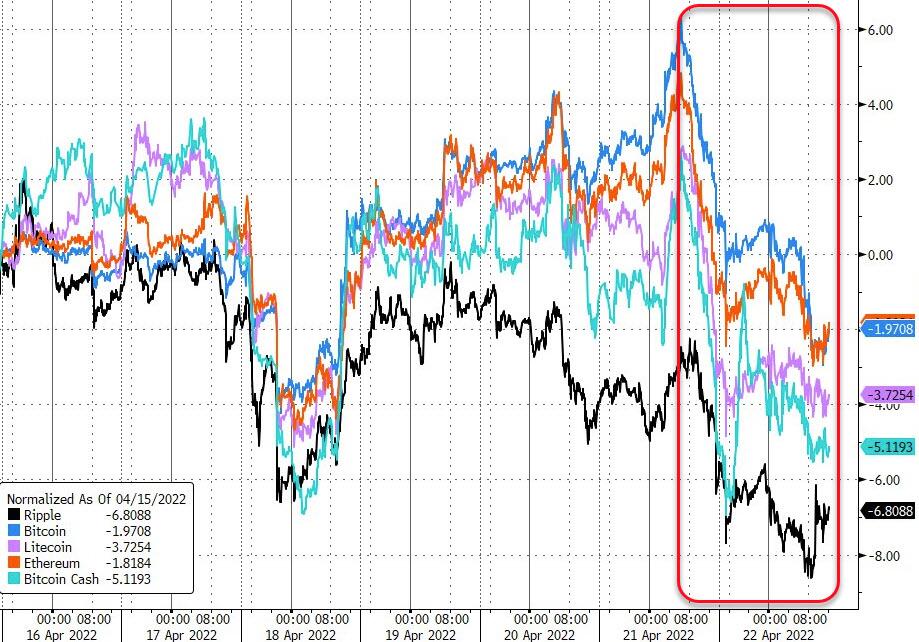
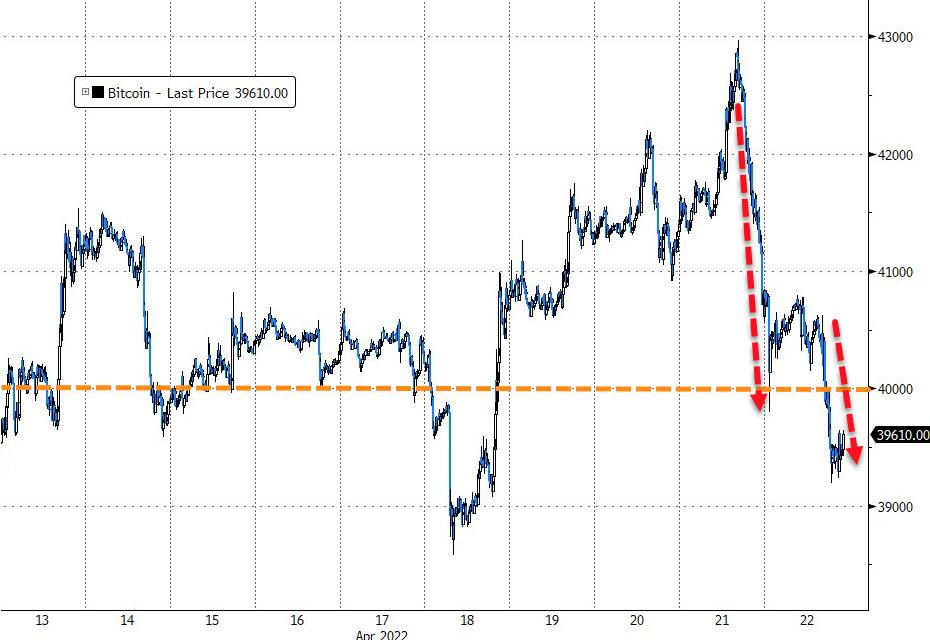
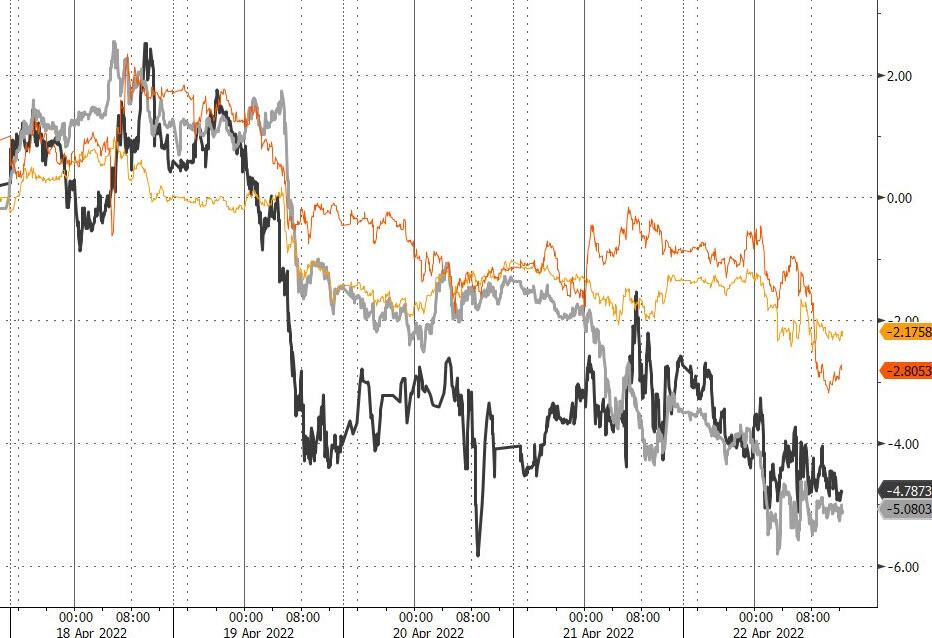
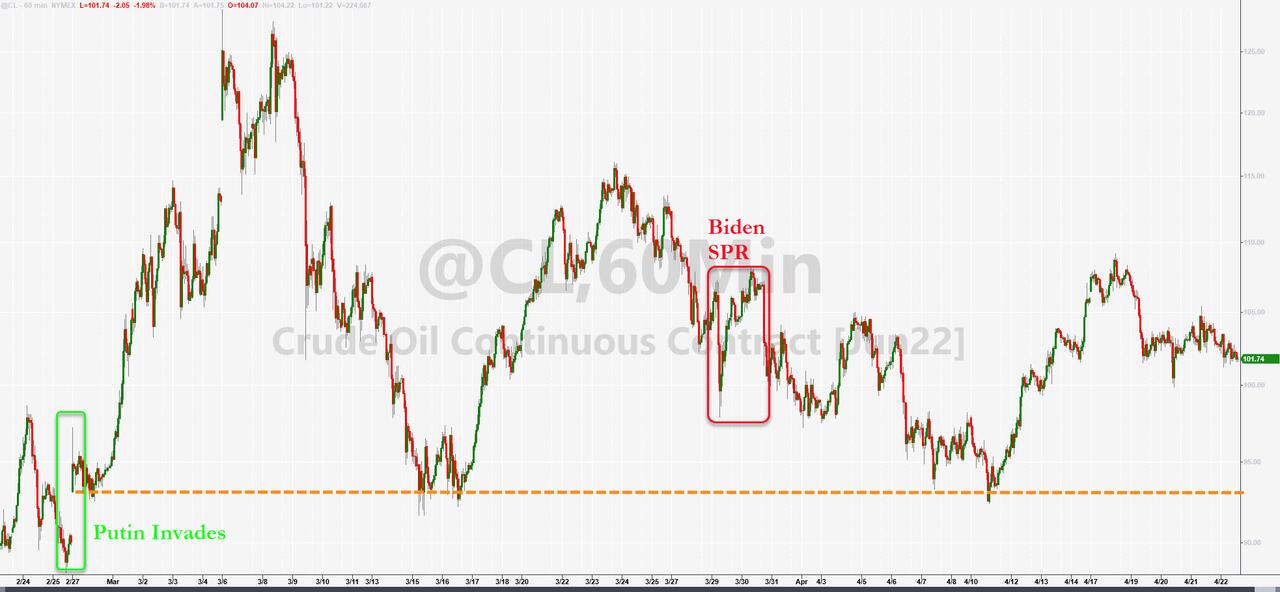
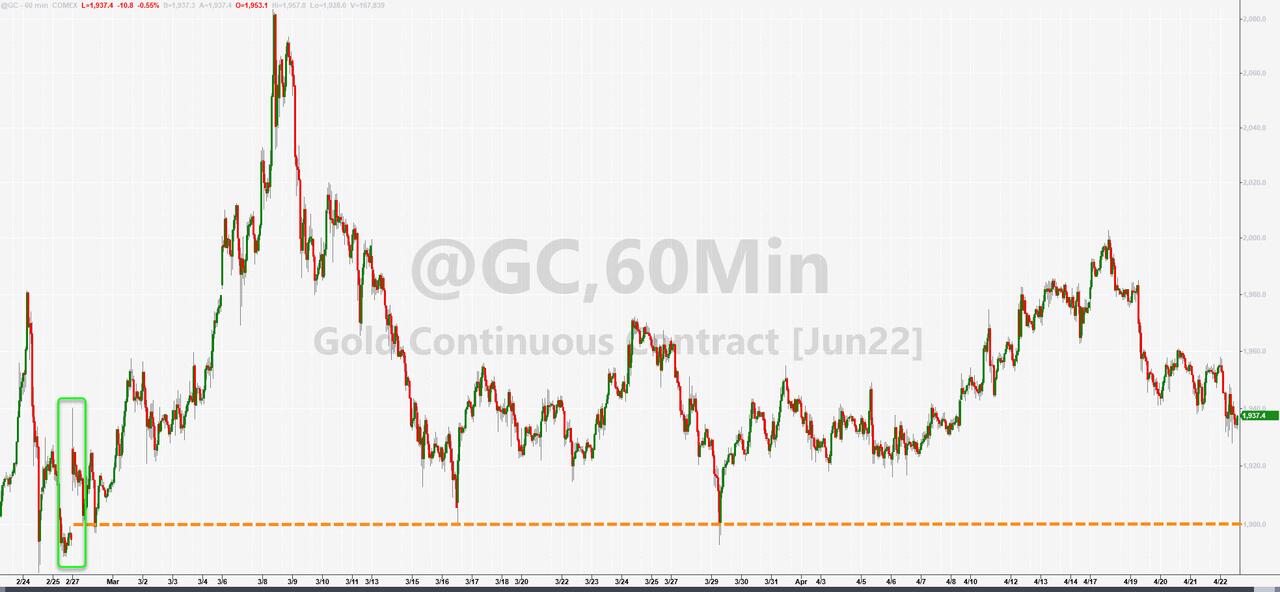
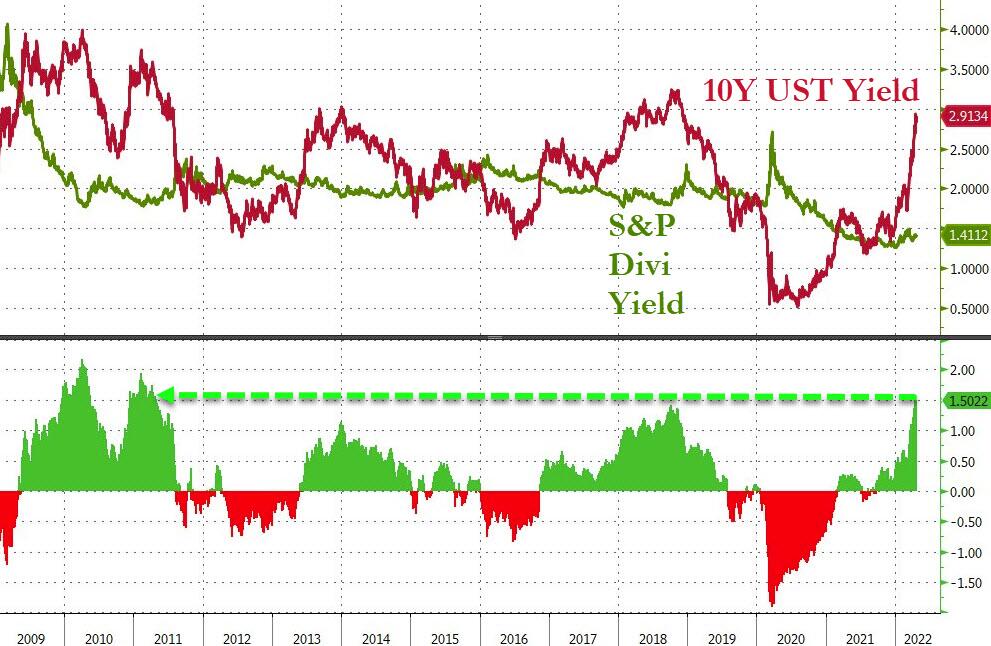

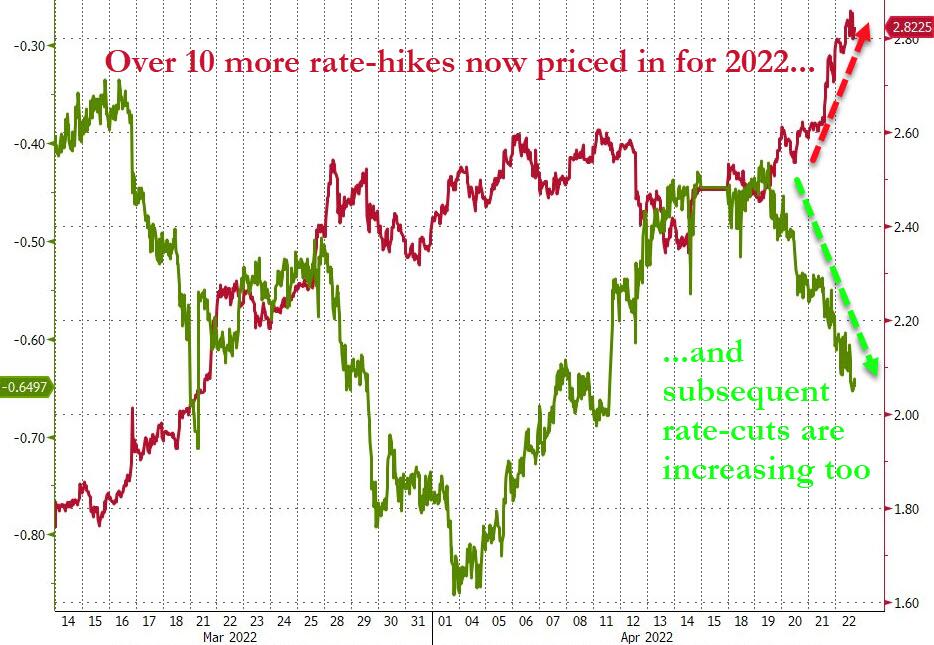
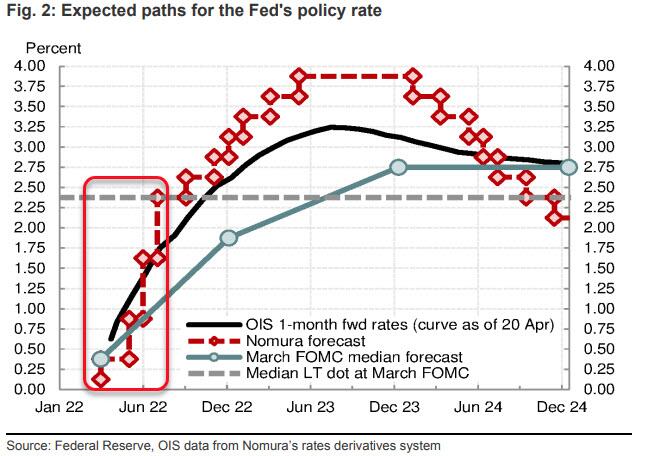
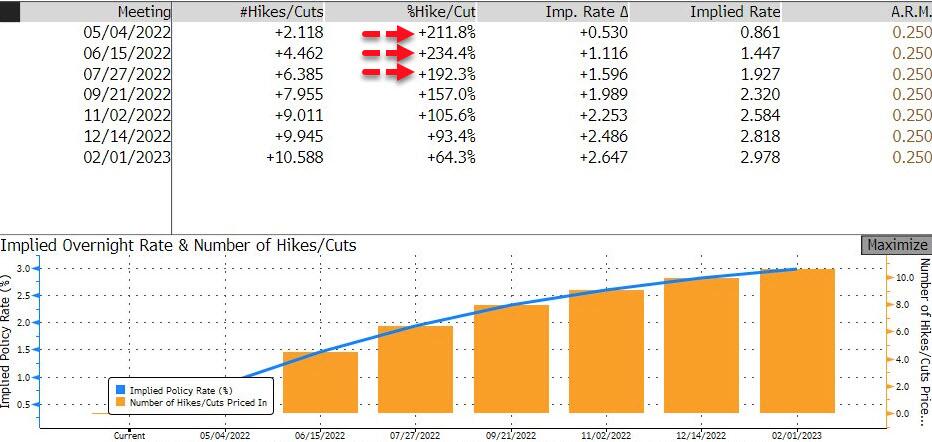
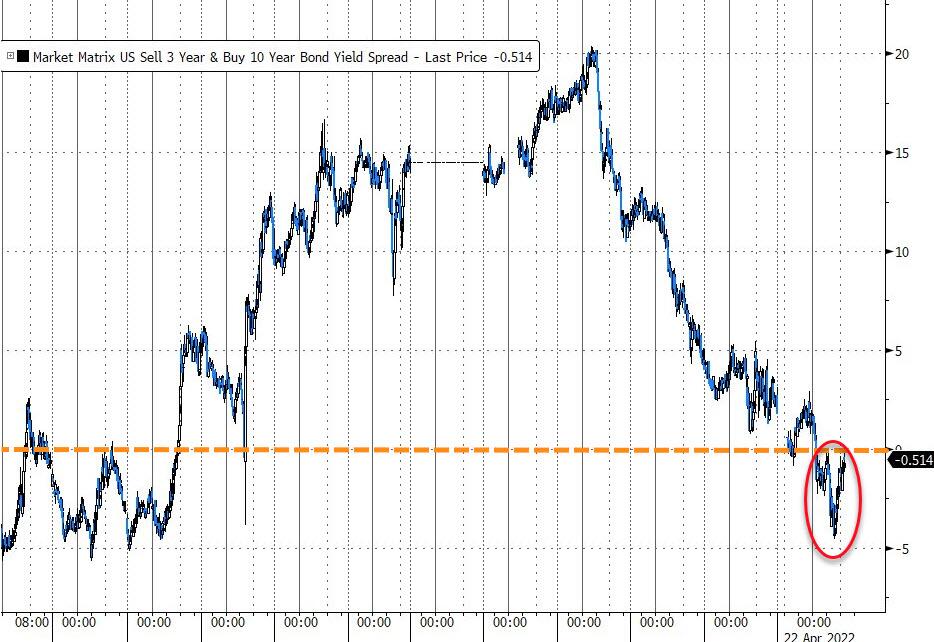
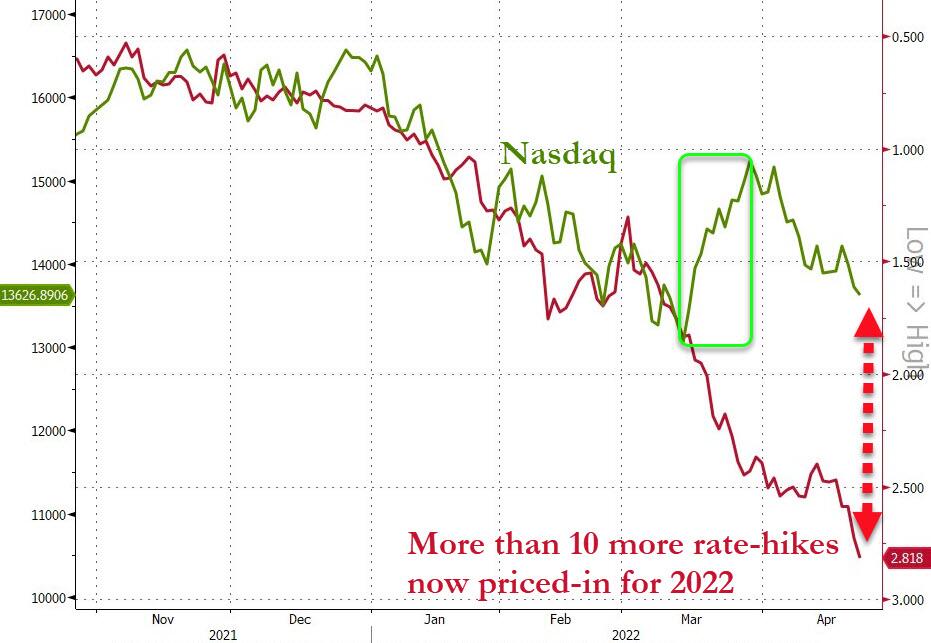





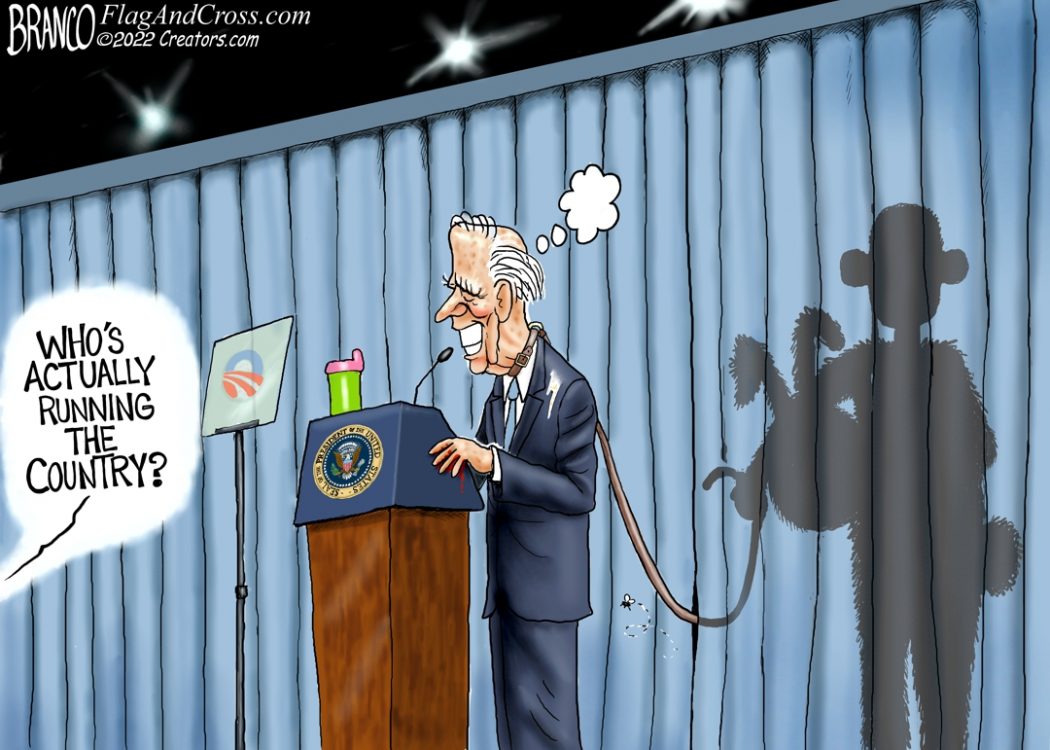
[…] by Harvey Organ, Harvey Organ Blog: […]
LikeLike
[…] by Harvey Organ, Harvey Organ Blog: […]
LikeLike