MAY 28//GOLD CLOSED UP $52.00 TO $4502.60//SILVER ROSE $1.02 TO $75.60//PLATINUM WAS UP $1.50 TO $1924.00 WHILE PALLADIUM WAS DOWN $25.00 TO $1367.00//GOLD COMMENTARY COURTESY OF ALASDAIR MACLEOD//COMMODITY REPORTS ON GOLD AND ON COPPER//EUROPEAN REPORTS TONIGHT FROM GERMANY//MAJOR FIGHTING ERUPTS IN THE MIDDLE EAST: UPDATES ON THE IRAN VS ISRAEL /USA WAR//ISRAEL WHACKS BEIRUT//ISRAEL VS HAMAS UPDATES//IMPORTANT COMMENTARY TONIGHT FROM JAY MARTIN ON DOLLAR SWAMPS//OIL UPDATES AND BESSENT THREATENS OMAN ON POSSIBLE TARIFFS ON THE STRAIT OF HORMUZ//USA DATA RELEASES//USA ECONOMIC REPORTS//KING NEWS/SWAMP STORIES FOR YOU TONIGHT//GREG HUNTER INTERVIEW ED DOWD..
099 H DEUTSCHE BANK AG 1 118 H MACQUARIE FUTURES US 1 363 H WELLS FARGO SECURITI 300 555 C BNP PARIBAS SEC CORP 353 624 H BOFA SECURITIES 4 661 C JP MORGAN SECURITIES 1 905 C ADM 52
TOTAL: 356 356
MONTH TO DATE: 8,838
MAY 28
MAY COMEX MONTH
JPMORGAN STOPPED: 1/356
GOLD: NUMBER OF NOTICES FILED FOR MAY/2026: 356 CONTRACTs NOTICES FOR 35,600 OZ or 1.107 TONNES
total notices so far: 8838 contracts FOR 883,800 OZ OR 27.489 TONNES
FOR MAY 28
XXXXXXXXXXXXXXXXXX
SILVER NOTICES: 727 NOTICE(S) FILED FOR 3.635 MILLION OZ /
total number of notices filed so far this month : 6413 CONTRACTS (NOTICES) for 32.065 million oz
Click here if you wish to send a donation. I sincerely appreciate it as this site takes a lot of preparation
GLD/
BOTH GLD AND SLV ARE FRAUDULENT VEHICLES//THEY ARE NOW RAIDING GLD AND SLV FOR PHYSICAL
THE CROOKS ARE STEALING GOLD AND SILVER FROM THE GLD/SLV AND REPLACING THE PHYSICAL WITH PAPER DOLLARS.
WITH GOLD UP $52.00 INVESTORS SWITCHING TO SPROTT PHYSICAL (PHYS) INSTEAD OF THE FRAUDULENT GLD/// NO CHANGES IN GOLD INVENTORY AT THE GLD:
INVENTORY RESTS AT 1034.853 TONNES
SLV/
WITH NO SILVER AROUND AND SILVER UP !.02 AT THE SLV: NO CHANGES IN SILVER INVENTORY AT THE SLV: //// : INVENTORY RESTS AT THE SLV AT 487.977 MILLION OZ//
CLOSING INVENTORY RESTS AT:
CLOSING INVENTORY: 487.977 MILLION
SILVER//OUTLINE
SILVER COMEX OI FELL BY A FAIR SIZED 269 CONTRACTS TO AN OI OF 101,475 STILL HIGHER FROM ITS NEW RECORD LOW OF 95,999 SET MAY 1. THE RECORD HIGH OI FOR SILVER IS 244,710, SET FEB 25/2020, AND THIS FAIR LOSS IN COMEX OI WAS ACCOMPLISHED DESPITE OUR LOSS OF $1.61 IN SILVER PRICING AT THE COMEX WITH RESPECT TO WEDNESDAY’S TRADING. ON THE FIRST OF MAY, WE REACHED OUR RECORD LOW OI OF 95,999 SURPASSING EVERY DAY NEW OI LOWS SET DURING THE LAST WEEK OF APRIL 2026.
NOW ON A NET BASIS OUR SPECULATORS HAVE REVERTED BACK TO GOING LONG. THE FRBNY ON A NET BASIS IS PROVIDING THE NECESSARY PAPER TO OUR LONGS ALONG WITH SOME BULLION BANKS AND THEN A HUGE NUMBERS OF LONGS ,OUR CENTRAL BANKERS, TAKE THE LONG SIDE AND TENDER FOR PHYSICAL AT 4 PM EACH NIGHT. BECAUSE OF THE HUGE SHORTFALL IN PHYSICAL SILVER IN LONDON THERE IS A LOTTERY TO SEE WHO GETS ANY OF THE PHYSICAL SILVER AVAILABLE THAT WHICH THEY ARE OBLIGATED TO DELIVER. THEY WAIT PATIENTLY FOR THEIR PHYSICAL METAL AND IF NOBODY GETS ANY THEY THEN COME BACK THE NEXT DAY AND SO ON. THIS IS IN LONDON, THE HOME OF PHYSICAL SILVER!! THE FACT THAT WE ARE WITNESSING MANY EXCHANGE FOR PHYSICAL TRANSFERS TO LONDON HIGHLIGHTS THE FACT THAT THE COMEX IS OUT OF SILVER AS WELL.
WE ARE FINALLY MOVING TO A MUCH HIGHER BASE IN SILVER PRICING AT MAJOR SUPPORT LEVEL OF $70.00. SHORTLY WE WILL AGAIN ATTEMPT TO BREAK
WE HAVE A STRONG SIZED GAIN OF 601 TOTAL CONTRACTS ON OUR TWO EXCHANGES AS THE CME NOTIFIED US OF A HUGE SIZED SIZED 870 CONTRACT EXCHANGE FOR PHYSICAL ISSUANCE , WE HAD HUGE LIQUIDATION OF T.A.S. CONTRACTS IN COMEX TRADING WITH RESPECT TO WEDNESDAY TRADING// WE HAD A HUGE SIZED 941 CONTRACT T.A.S. ISSUANCE!! / THEY DESPERATELY AGAIN TODAY TRYING TO CONTAIN SILVER’S PRICE RISE FOR THE PAST SEVERAL WEEKS (WHERE RAIDS ARE CALLED UPON AGAIN AND AGAIN TRYING TO STOP THE RISE IN SILVER’S PRICE TO ABOVE $100.00 AND TO QUELL ADDITIONAL DERIVATIVE LOSSES TO OUR BANKERS’ MASSIVE TOTALS). THEY SUCCEEDED ON WEDNESDAY WITH SILVER’S LOSS IN PRICE
THE PRICE STILL FINISHED ABOVE THE MAGIC NUMBER OF $70.00 SILVER SPOT PRICE BUT STILL BELOW THE $100.00 MARK CLOSING AT $74.60 DOWN $1.61. WE ARE NOW WITNESSING HAVING MANY HUGE T.A.S ISSUANCES // TODAY’S WAS A HUGE SIZED 941 T.A.S. CONTRACTS !!. THE CROOKS ARE BECOMING MORE DESPERATE TO STOP SILVER BREAKING ABOVE THE 100.00 DOLLAR MARK!! AND NOW THE HUGE SUPPORT LEVEL OF 70 DOLLARS!!.MAMMOTH SIZE T.A.S ISSUANCES ARE BECOMING THE NORM AT THE COMEX NOW!!
THERE IS NO NEXT LINE IN THE SAND ONCE THE 100.00 DOLLAR SILVER IS PIERCED AGAIN. WE HAD A HUGE SIZED 870 CONTRACT EXCHANGE FOR PHYSICAL ISSUANCE ACCOMPANIED BY OUR HUGE SIZED 941 CONTRACT T.A.S ISSUANCE WHICH WILL BE USED IN FUTURE TRADING//AS THEY PLAY AN INTEGRAL PART IN OUR COMEX TRADING TRYING TO CONTAIN ANY SILVER PRICE RISE.
IN ESSENCE WE HAD A HUGE SIZED GAIN OF 601 CONTRACTS ON OUR TWO EXCHANGES DESPITE OUR LOSS IN PRICE OF $1.61. WE HAD HUGE GOVERNMENT (FRBY) COMEX CONTRACTS TRADING ALL WEEK AND A MAJOR PORTION WILL BE REMOVED BY DAYS END. (I RECORD THIS FOR YOU ON A DAILY BASIS). THE STICKY SPECULATOR LONGS STILL REMAIN STOIC
CRAIG HEMKE HAS POINTED OUT THAT THE CROOKS USE THE MID MONTH FOR MANIPULATION AS THEY SELL THEIR BUY SIDE OF THE CALENDAR SPREAD FIRST AND THEN KEEP THE SELL SIDE TO LIQUIDATE AT A LATER DATE.
THUS WE HAVE TWO VEHICLES THE CROOKS USE FOR MANIPULATION AND BOTH ARE SPREADERS: 1) AT MONTH’S END/SPREADERS COMEX AND 2/ TAS SPREADERS, THROUGHOUT MONTH. TOTAL TAS ISSUED ON WEDNESDAY NIGHT/THURSDAY MORNING: A HUGE SIZED 941 CONTRACTS. DESPITE MANY COMPLAINTS THAT THESE CROOKS HAVE VIOLATED POSITION LIMITS DUE TO THE FACT THAT THE TAS ISSUED HAVE A VALUE OF ZERO (AS TO POSITION LIMITS FOR OUR CROOKED FRBNY BANKERS).
THE PROBLEM OF COURSE IS THAT THE CROOKS DO NOT LIQUIDATE THE TAS AS ONE UNIT, BUT SELL THE SHORT SIDE FIRST AND THEN LIQUIDATE THE LONG SIDE TWO MONTHS HENCE. IT IS OBVIOUS MANIPULATION TO THE HIGHEST DEGREE BUT IT NATURALLY FELL ON DEAF EARS WITH OUR REGULATORS (OCC) WHEN THEY RECEIVED OUR COMPLAINTS. IT NOW SEEMS THAT THE OCC HAS NOW ORDERED THE BANKS TO REDUCE ITS NEW LEVEL OF 1.1 TRILLION DOLLARS IN GOLD/SILVER DERIVATIVES.
THUS:
INITIAL STANDING FOR JANUARY: 22.915 MILLION OZ FOLLOWED BY TODAY’S 1.185 MILLION OZ QUEUE JUMP//NEW NORMAL STANDING ADVANCES TO 49.445 MILLION OZ// TO WHICH WE ADD OUR FIRST EXCHANGE FOR RISK FOR .100 MILLION OZ//NEW STANDING ADVANCES TO 49.545 MILLION OZ!!
INTIAL STANDING FOR FEBRUARY/SILVER: 13.505 MILLION OZ FOLLOWED BY TODAY’S HUGE 0.005 MILLION OZ QUEUE JUMP / : NEW STANDING FOR SILVER AT THE COMEX ADVANCES TO 25.180 MILLION OZ. BUT WE MUST ADD OUR FIRST EXCHANGE FOR RISK OF 25 CONTRACTS FOR .125 MILLION OZ AND THEN OUR SECOND EXCHANGE FOR RISK OF .0600 MILLION OZ TO OUR THIRD HUGE 2.825 MILLION OZ EXCHANGE FOR RISK!!
INITIAL STANDING FOR MARCH: A SURPRISINGLY LOW 31.076 MILLION OZ/ FOLLOWED BY A TINY QUEUE JUMP OF 1 CONTRACTS OR 0.005 MILLION OZ/NEW STANDING ADVANCES TO 46.060 MILLION OZ
INITIAL STANDING FOR APRIL: 7.120 MILLION OZ FOLLOWED BY TODAY’S 1 CONTRACT QUEUE JUMP WHERE 5,000 OZ WILL TAKE DELIVERY OVER ON THIS SIDE OF THE POND. NEW STANDING FOR SILVER AT THE COMEX THUS ADVANCES SLIGHTLY TO 16.565 MILLION OZ PLUS WE MUST ADD OUR 4TH EXCHANGE FOR RISK ISSUANCE OF 17 CONTRACTS OR 0.085 MILLION OZ. THESE WILL BE ADDED TO OUR OTHER 3 ISSUANCES //NEW TOTAL EXCHANGE FOR RISK//1.165 MILLION OZ// NEW TOTAL SILVER STANDING 17.730 MILLION OZ//
INITIAL STANDING FOR MAY: 31.495 MILLION OZ FOLLOWED BY ANOTHER 3 CONTRACT EXCHANGE FOR PHYSICAL JUMP TO LONDON FOR 0.015 MILLION OZ// AND THEN TO BOOT WE HAD OUR FIRST EXCHANGE FOR RISK ISSUANCE FOR 51 CONTRACTS OR 255,000 OZ MAY 21./STANDING BEFORE EXCHANGE FOR RISK: 32.070 MILLION OZ/NEW STANDING THUS REDUCES TO 32.325 MILLION OZ/.//(32.070 MILLION OZ NORMAL STANDING PLUS .255 MILLION OZ EXCHANGE FOR RISK = 32.325 MILLION OZ)
SUMMARY OF OUR MAY 2026 COMEX CONTRACT MONTH:
WE HAD:
/ FAIR COMEX LOSS+// HUGE SIZED 870 EFP ISSUANCE CONTRACTS (/ VI) A HUGE NUMBER OF T.A.S. CONTRACT ISSUANCE 941 CONTRACTS
XX I AM NOW RECORDING THE DIFFERENTIAL IN OI FROM PRELIMINARY TO FINAL:REMOVED 66 SILVER CONTRACT//
HISTORICAL ACCUMULATION OF EXCHANGE FOR PHYSICALS MAY.. ACCUMULATION
TOTAL CONTRACTS for 19 DAY(S), total 11,418 contracts: OR 57.090 MILLION OZ (600 CONTRACTS PER DAY)
TOTAL EFP’S FOR THE MONTH SO FAR: 57.090 MILLION OZ
LAST 24 MONTHS TOTAL EFP CONTRACTS ISSUED IN MILLIONS OF OZ:
MAY 137.83 MILLION
JUNE 149.91 MILLION OZ
JULY 129.445 MILLION OZ
AUGUST: MILLION OZ 140.120
SEPT. 28.230 MILLION OZ//
OCT: 94.595 MILLION OZ
NOV: 131.925 MILLION OZ
DEC: 100.615 MILLION OZ
YEAR 2022:
JAN 2022-DEC 2022
JAN 2022// 90.460 MILLION OZ
FEB 2022: 72.39 MILLION OZ//
MARCH 2022: 207.140 MILLION OZ//A NEW RECORD FOR EFP ISSUANCE
APRIL: 114.52 MILLION OZ FINAL//LOW ISSUANCE
MAY: 105.635 MILLION OZ//
JUNE: 94.470 MILLION OZ
JULY : 87.110 MILLION OZ
AUGUST: 65.025 MILLION OZ
SEPT. 74.025 MILLION OZ///FINAL
OCT. 29.017 MILLION OZ FINAL
NOV: 134.290 MILLION OZ//FINAL
DEC, 61.395 MILLION OZ FINAL
TOTALS YR 2022: 1135.767 MILLION OZ (1.1356 BILLION OZ)
JAN 2023/// 53.070 MILLION OZ //FINAL
FEB: 2023: 100.105 MILLION OZ/FINAL//MUCH STRONGER ISSUANCE VS THE LATTER TWO MONTHS.
MARCH 2023: 112.58 MILLION OZ//FINAL//STRONG ISSUANCE
APRIL 111.035 MILLION OZ(SLIGHTLY GREATER THAN THAN LAST MONTH)
MAY 66.120 MILLION OZ/INITIAL (MUCH SMALLER THIS MONTH)
JUNE: 110.395 MILLION OZ//MUCH LARGER THAN LAST MONTH
JULY 85.745 MILLION OZ (SMALLER THAN LAST MONTH)
AUGUST: 171.43 MILLION OZ (THIS MONTH IS GOING TO BE HUGE //2ND HIGHEST ON RECORD
SEPT: 72.705 MILLION OZ (SMALLER THIS MONTH)
OCT: 97.455 MILLION OZ
NOV. 50.050 MILLION OZ
DEC. 66.140 MILLION OZ//
TOTAL 2023: 1,104.10 MILLION OZ/
JAN ’24 : 78.655 MILLION OZ//
FEB /2024 : 66.135 MILLION OZ./FINAL
MARCH: 143.750 MILLION OZ// 4TH HIGHEST ON RECORD.
APRIL: 161.770 MILLION OZ (THIS MONTH WILL BE A WHOPPER OF ISSUANCE OF EFPS//3RD HIGHEST EVER RECORDED FOR A MONTH)
MAY: 135.995 MILLION OZ //WILL BE A STRONG MONTH FOR EXCHANGE FOR PHYSICAL ISSUANCE
JUNE 110.575 MILLION OZ ( WILL BE ANOTHER STRONG MONTH ISSUANCE)
JULY: 108.870 MILLION OZ (WILL BE A STRONG ISSUANCE MONTH/ A TOUCH OVER 100 MILLION OZ/)
AUGUST; 99.740 MILLION OZ//THIS MONTH WILL BE STRONG FOR ISSUANCE BUT LESS THAN JULY.
SEPT: 112.415 MILLION OZ//WILL BE A HUGE MONTH FOR EXCHANGE FOR PHYSICAL ISSUANCE
OCT; 97.485 MILLION OZ (WILL BE SMALLER ISSUANCE THIS MONTH )
NOV. 115.970 MILLION OZ ( HUGE THIS MONTH)
DEC: 132.54 MILLION OZ (THIS MONTH WILL BE A HUMDINGER FOR ISSUANCE BUT ISSUANCE SLOWED DRAMATICALLY THESE PAST FIVE DAYS/// WILL NOT EXCEED MARCH 2022 RECORD OF 209 MILLION OZ
YEAR 2024 TOTAL: 1363.84 MILLION OR 1.363 BILLION OZ
JANUARY 2025: 67.230 MILLION OZ///(THIS MONTH’S ISSUANCE OF EXCHANGE FOR PHYSICAL WILL BE SMALL)
FEB. 58.260 MILLION OZ//EXCHANGE FOR PHYSICAL ISSUANCE/FINAL
MARCH: 67.020 MILLION OZ///QUITE SMALL AND BECOMING SMALLER EACH AND EVERY MONTH.
APRIL: 100.895 MILLION OZ///AVERAGE SIZE ISSUANCE
MAY: 28.975 MILLION OZ (ISSUANCE WILL BE QUITE SMALL THIS MONTH)
JUNE: 81.065 MILLION OZ
JULY: 50.925 MILLION OZ (QUITE SMALL)
AUGUST: 59.455 MILLION OZ (QUITE SMALL)
SEPT. 50.510 MILLION OZ.(QUITE SMALL)
OCT; 82.020 MILLION OZ (WILL BE STRONG THIS MONTH)/ OCC WANTS TO REIN IN THESE ISSUANCES!
NOVEMBER: 36.425 MILLION OZ
DEC: 45.765 MILLION OZ
JANUARY 2026: 134.270 MILLION OZ (WILL BE A VERY STRONG MONTH FOR EXCHANGE FOR PHYSICAL!)
FEB : 82.130 MILLION OZ
MARCH: 56.075 MILLION OZ
APRIL; 44.44 MILLION OZ//FINAL.. SMALL THIS MONTH.
MAY 57.090 MILLION OZ
RESULT: WE HAD A FAIR SIZED DECREASE IN COMEX OI SILVER COMEX CONTRACTS OF 269 CONTRACTS WITH OUR LOSS IN PRICE OF $1.61 IN SILVER PRICING AT THE COMEX// WEDNESDAY,. THE CME NOTIFIED US THAT WE HAD A HUGE SIZED CONTRACT EFP ISSUANCE OF 870 CONTRACTS ISSUED FOR JULY, AND 0 CONTRACTS ISSUED FOR ALL OTHER MONTHS).
INITIAL STANDING: 31.495 MILLION OZ NOW DECREASES WITH OUR NEXT EXCHANGE EXCHANGE FOR PHYSICAL JUMP TO LONDON FOR 3 CONTRACTS OR 0.015 MILLION OZ//NEW STANDING IS THUS REDUCES TO 32.070 MILLION OZ/BUT WE THEN ADD OUR FIRST EXCHANGE FOR RISK OF 51 CONTRACTS FOR 255,000 OZ..TOTAL STANDING ADVANCES TO 32.325 MILLION OZ//
LAST 14 MONTHS OF SILVER DELIVERIES
WE FINISHED APRIL WITH A STRONG SILVER OZ STANDING OF 16.050 MILLION OZ NORMAL DELIVERY , PLUS OUR 4.00 MILLION EX FOR RISK
FINAL STANDING APRIL: 19.965 MILLION OZ
AND MAY:
NEW STANDING FOR MAY FINISHES AT: 75.615 MILLION OZ. (INCLUDES 5,000 OZ EFP TRANSFER TO LONDON + 12.93 MILLION OZ EXCHANGE FOR RISK ISSUANCE/PRIOR.//NEW TOTAL STANDING 88.540 MILLION OZ
AND JUNE: FINAL 16.995 MILLION OZ
AND JULY: 46.720 MILLION OZ//
AUGUST: 4.70 MILLION OZ INITIAL STANDING PLUS TODAY;S 5,000 OZ QUEUE JUMP //NEW STANDING ADVANCES TO 10.960 MILLION OZ
SEPTEMBER: 68.040 MILLION OZ NORMAL DELIVERY(INCLUDES ALL QUEUE JUMPING AND EXCHANGE FOR PHYSICAL TRANSFERS) PLUS 3.0 MILLION OZ EX FOR RISK = 71.040 MILLION OZ. (THIS IS THE FIRST AND ONLY ISSUANCE OF EXCHANGE FOR RISK FOR SILVER SINCE MAY.)
OCTOBER: 39.565 MILLION OZ OF NORMAL DELIVERY INCLUDES ALL QUEUE JUMPING
PLUS
2.110 MILLION OZ EXCHANGE FOR RISK//TOTAL OZ STANDING IN OCT ADVAN
NOVEMBER: INITIAL STANDING AT 11.575 MILLION OZ FOLLOWED BY TODAY’S 195,000 OZ QUEUE JUMP WHICH FOLLOWS ALL OTHER QUEUE JUMPS OF 9.155 MILLION OZ//STANDING ADVANCES TO 19.670 MILLION OZ/
DECEMBER: INITIAL AMOUNT STANDING FOR DELIVERY: 49.33 MILLION OZ// FOLLOWED BY ANOTHER STRONG 835,000OZ QUEUE JUMP+ DEC. FIRST EXCHANGE FOR RISK 0F .850 MILLION OZ + LAST WEEK.S 495,000 OZ EXCHANGE FOR RISK AND THEN A 3RD ISSUANCE IF 1.00MILLION OZ THEN FINALLY DEC 249ISSUANCE OF 1.35 MILLION OZ EXCHANGE FOR RISK//NEW TOTAL EX FOR RIS IS 3.685 MILLION OZ // STANDING ADVANCES TO 68.415 MILLION OZ//
JANUARY: INITIAL STANDING 22.915 MILLION OZ FOLLOWED BY TODAY’S 1.185 MILLION OZ QUEUE JUMP//NORMAL STANDING ADVANCES TO 49.445 MILLION OZ// TO WHICH WE ADD OUR FIRST EXCHANGE FOR RISK OF 0.100 MILLLION OZ//NEW STANDING ADVANCES TO 49.545 MILLION OZ
FEB: 13.399 MILLION OZ IS OUR INITIAL STANDING FOR SILVER! TO WHICH WE ADD OUR NEXT QUEUE JUMP FOR 5,000 OZ AND THEN ADD OUR 3 EXCHANGE FOR RISK FOR 3.010 MILLION OZ STANDING ADVANCES TO 28.190 MILLION OZ!!
MARCH: INITIAL AMOUNT OF SILVER STANDING IS 31.076 MILLION OZ FOLLOWED BY A FINAL 0.210 MILLION OZ QUEUE JUMP //NEW TOTAL STANDING ADVANCES TO 46.060 MILLION OZ
APRIL 2026: INITITAL AMOUNT OF SILVER STANDING 7.120 MILLION OZ FOLLOWED BY TODAY’S 5,000 OZ QUUE JUMP //NEW STANDING ADVANCES TO 16.565MILLION OZ PLUS 1.165 MILLION OZ EXCHANGE FOR RISK.NEW TOTALS 17.730 MILLION OZ
MAY: INITIAL AMOUNT OF SILVER WILLING TO STAND; 31.495 MILLION OZ/ TO WHICH WE ADD OUR NEXT EXCHANGE FOR PHYSICAL JUMP OF 15,000 OZ//NEW STANDING REDUCES TO 32.070 MILLION OZ//(FOLLOWING MANY EXCHANGE FOR PHYSICAL TRANSFERS TO LONDON DURING THIS MAY DELIVERY MONTH). THERE SEEMS TO BE A SCARCITY OF SILVER OVER AT THE COMEX). THEN WE ADD OUR FIRST EXCHANGE FOR RISK OF 51 CONTRACTS FOR 255,000 OZ//STANDING ADVANCES TO 32.325 MILLION OZ//
THE NEW TAS ISSUANCE FOR TODAY (941) WILL BE PUT INTO “THE BANK” TO BE COLLUSIVELY USED NO DOUBT WITH FUTURE TRADING!
WE HAD 727 NOTICE(S) FILED TODAY FOR 3.635 OZ
THE SILVER COMEX IS NOW BEING ATTACKED FOR METAL BY BANKERS
GOLD//OUTLINE
IN GOLD, THE COMEX OPEN INTEREST FELL BY A STRONG SIZED 7784 OI CONTRACTS DOWN TO 345,705 OI AND THUS SETTING ITS ALL TIME LOW AT 345,705 MUCH LOWER THAN YESTERDAY’S LOW OI OF 353,489 AND PREVIOUS TO THAT: 354,581 OI SET LAST MONTH AND THIS OI IS MUCH FURTHER FROM TO THE RECORD HIGH (SET JAN 24/2020) AT 799,105 AND PREVIOUS TO THAT: (SET JAN 6/2020) AT 797,110. WE HAVE NOW ADVANCED PAST THE PREVIOUS ALL TIME LOWS OF 357,136 SET APRIL 2/.2026AND 354,581 SET AT THE END OF APRIL 2026. WE ARE STILL QUITE A WAY FROM OUR TWO DECADES OLD: 390,000 CONTRACTS LOW SET IN THE YEAR OF 2001 WITH TRADING FOR GOLD AT $260.00. THUS DURING EARLY APRIL WE HAD AN ALL TIME LOW OI IN COMEX (354,531) BUT WITH AN EXTREMELY HIGH PRICE OF GOLD. THE SHORT RATS ARE ABANDONING THE COMEX SHIP, NOBODY WANT TO PLAY IN THIS CROOKED CASINO!! (AND THIS CORRELATES WITH SILVER’S LOW OI OF 101,541 CONTRACTS WITH A MUCH HIGHER SILVER PRICE BASE)
THE DIFFERENTIAL FROM PRELIMINARY OI TO FINAL OI IN GOLD TODAY: REMOVED A SMALL 163 CONTRACTS //.
WE HAD A STRONG LOSS IN COMEX OI (7784 ONTRACTS) . THIS LOSS IN OI OCCURRED WITH OUR LOSS IN PRICE OF $51.00 //,WEDNESDAY///.
LAST 13 MONTHS OF GOLD DELIVERIES: (MAY 2025 THROUGH TO /MAY 2026)
1.MAY SUMMARY FOR MAY TONNES WHICH STOOD FOR DELIVERY:
FINAL STANDING FOR MAY: 70.174 TONNES OF GOLD TO WHICH WE ADD 1. MONDAY’S (MAY 19) 6.221 TONNES EXCHANGE FOR RISK , 2. THEN WE ADD: 1.35 TONNES TO LAST WEEK”S. THEN WE ADD 3. 1.55 TONNES TO EQUAL 9.591 TONNES// NEW EXCHANGE FOR RISK = 9.591 TONNES WHICH MUST BE ADDED TO OUR NORMAL DELIVERY SCHEDULE OF 80.644 TONNES. THUS STANDING FOR MAY INCREASES TO 90.235 TONNES OF GOLD
2 JUNE CONTRACT MONTH: 93.085 TONNES OF GOLD (WHICH INCLUDES ALL QUEUE JUMPING AND 0 EX FOR RISK)
3.JULY INITIIAL STANDING FIRST DAY NOTICE: 17.847 TONNES. PLUS TODAY’S 0 TONNES QUEUE JUMP + 1.555 TONNES EX FOR RISK + 2.195 TONNES EX FOR RISK TODAY = 41.106 TONNES STANDING
4. AUGUST: 60.547 TONNES OF INITIAL GOLD FIRST DAY NOTICE FOLLOWED BY THE NET MONTH’S QUEUE JUMP OF 47.2312 TONNES TO WHICH WE ADD THE FOLLOWING EXCHANGE FOR RISK ISSUANCE RECEIVED FOR THE MONTH: 5.4432 TONNES EX FOR RISK/AUG 7 , AUG 11: 2.413 TONNES EX FOR RISK AND AUG. 12 OF 2.
5.SEPT: INITIAL 8.093 TONNES OF GOLD PLUS TODAY’S QUEUE JUMP OF 0.4883 TONNES PLUS 2.2827 TONNES OF EXCHANGE FOR RISK TODAY//NEW TOTAL EX. FOR RISK/MONTH = 22.923//NEW TOTAL STANDING FOR GOLD SEPT ADVANCES TO = 48.801 TONNES!!
6.OCTOBER: 90.012 TONNES OF INITIAL GOLD STANDING WITH TODAY’S TINY 0.00311 TONNES QUEUE JUMP WHICH FOLLOWS ALL OTHER QUEUE JUMPS DURING OCT OF 76.1656 TONNES
THEN WE MUST ADD OUR 14.553 TONNES OF OUR ISSUANCE OF EXCHANGE FOR RISK/6 OCCASIONS//NEW TOTAL OF GOLD STANDING ADVANCES TO 197.5141 TONNES OF GOLD.
7.NOVEMBER BEGINS WITH 15.651 TONNES INITIALLY STANDING FOR DELIVERY FOLLOWED BY TODAY’S QUEUE JUMP OF 2.323 TONNES FOLLOWED BY ALL PREVIOUS QUEUE JUMPS IN OF OF 21.3775 TONNES TO WHICH WE ADD OUR TWO EXCHANGE FOR RISK ISSUANCE OF 4.5596 TONNES//NEW STANDING ADVANCES TO 43.9716 TONNES OF GOLD.
8. DECEMBER BEGINS WITH INITIAL STANDING OF 83.813 TONNES OF GOLD FOLLOWED BY TODAY’S 0.0TONNE QUEUE JUMP WHICH FOLLOWS ALL OTHER QUEUE JUMPS OF: 37.163 TONNES//NEW STANDING ADVANCES TO 115.390 TONNES TO WHICH WE ADD OUR 4 EXCHANGE FOR RISK FOR DECEMBER OF 6.587 TONNES/NEW STANDING ADVANCES TO 121.977 TONNES
9. JANUARY: INITITAL STANDING: 13.785 TONNES TO WHICH WE ADD OUR FIRST EXCHANGE FOR PHYSICAL TRANSFER OF 0.08709 TONNES WHICH FOLLOWS ALL OTHER QUEUE JUMPS OF 30.7117TONNES //NEW TOTAL QUEUE JUMPS 30.7117//NORMAL DELIVERY OF GOLD ADVANCES TO 36.8958 TONNES TO WHICH WE ADD OUR SIX EXCHANGE FOR RISK OF 22.315 TONNES//NEW STANDING ADVANCES TO 59.2108 TONNES.
FEB; INITIAL AMOUNT OF GOLD STANDING FOR DELIVERY: 93.567 TONNES OF GOLD TO WHICH WE ADD OUR NEXT 0.0248 TONNES 0.1555 TONNES QUEUE JUMP TO 41.2082 TONNES/ NEW NET QUEUE JUMP INCREASES TO 41.233 TONNES// AND THEN WE ADD OUR SIX EXCHANGE FOR RISK: 10,080 CONTRACTS OR 31.251 TONNES//NEW STANDING REDUCES TO 157.878 TONNES
MARCH:: INITIAL AMOUNT OF GOLD STANDING FOR DELIVERY: 8.099 TONNES TO WHICH WE ADD TODAY’S FAIR 4600 OZ QUEUE JUMP (0.2320 TONNES) AND THEN WE ADD OUR THREE EXCHANGE FOR RISK OF 22.3818 TONNES //NEW STANDING ADVANCES TO 67.6648 TONNES/
APRIL: INITIAL AMOUNT OF GOLD STANDING FOR DELIVERY: 52.600 TONNES FOLLOWED BY OUR 345 CONTRACT QUEUE JUMP FOR 34,500 OZ/ (1.073 TONNES)/NEW STANDING ADVANCES TO 70.286 TONNES TO WHICH WE ADD OUR 2ND EXCHANGE FOR RISK OF 1498 CONTRACTS FOR 149800 OZ OR 4.659 TONNES. THE NEW TOTAL EXCHANGE FOR RISK FOR THE MONTH OF APRIL IS 2239 CONTRACTS OR 223900 OZ OR 6.964 TONNES AND THIS WILL BE ADDED TO OUR NORMAL DELIVERY TOTALS (70.762 TONNES) TO GIVE US WHAT WILL STAND IN APRIL (77.726 TONNES)
MAY: INITIAL AMOUNT OF GOLD WILLING TO STAND: 12.24 TONNES OF GOLD TO WHICH WE ADD OUR NEXT QUEUE JUMP OF 345 CONTRACTS OR 34500 OZ (1.073 TONNES) TO WHICH WE ADD OUR FIVE EXCHANGE FOR RISK ISSUANCES FOR 24.635 TONNES/STANDING NOW ADVANCES TO 51.554 TONNES OF GOLD.
E.F.P. ISSUANCE/FOR OPENING MAY. GOLD CONTRACT
THE CME RELEASED THE DATA FOR EFP ISSUANCE AND IT TOTALED A FAIR SIZED 3545 CONTRACTS:
The NEW COMEX OI FOR THE GOLD COMPLEX RESTS AT A RECORD LOW OF 345,705 BECOMING OUR NEXT REOCRD LOW//MAY 28.2026 EXCEEDING OUR PREVIOUS RECORD LOW OF 353,489 AND WE NOW WITNESSING A LOWER COMEX OI BUT WITH AN EXTREMELY HIGH
SILVER ALSO HAS AN ULTRA SMALL SIZED AND EXTREMELY LOW COMEX OI OF 101,475 CONTRACTS// RISING FROM PREVIOUS ALL TIME LOWS SET DURING THE MONTH OF APRIL AND MAY FIRST.
IN ESSENCE WE HAVE A STRONG LOSS IN TOTAL CONTRACTS IN COMEX GOLD ON THE TWO EXCHANGES OF 4239 CONTRACTS WITH 7721 CONTRACTS DECREASED AT THE COMEX// AND A FAIR SIZED 3545 EXCHANGE FOR PHYSICAL OI CONTRACT ISSUANCE WHICH NAVIGATED OVER TO LONDON.
THUS TOTAL OI LOSS ON THE TWO EXCHANGES OF 4239 CONTRACTS.. WE HAD THE FOLLOWING TAS CONTRACTS INITIATED (ISSUED): A MUCH SMALLER SIZED BUT CRIMINAL 1584 CONTRACTS AND THESE ISSUANCES ARE GENERALLY USED TO INITIATE A RAID WHEN CALLED UPON LIKE YESTERDAY AND TODAY. THE STRING OF 5 CONSECUTIVE HUGE ISSUANCES OF T.A.S. THUS ENDED LAST WEEK.
GOLD PRICE ON TUESDAY FELL BY $51.00
CALCULATIONS ON GAIN/LOSS ON OUR TWO EXCHANGES
WE HAD A FAIR SIZED ISSUANCE IN EXCHANGE FOR PHYSICALS CONTRACT (3545 ) ACCOMPANYING THE STRONG LOSS IN COMEX OI OF 7784 CONTRACTS/TOTAL LOSS FOR OUR THE TWO EXCHANGES 4239 CONTRACTS!! WITH THE LOSS IN PRICE.
WE HAVE 1) NOW REVERTED TO OUR NORMAL FORMAT OF BANKER (FRBNY) GOING ON THE SHORT SIDE AND SOME NEWBIE SPECULATORS GOING TO THE LONG SIDE BUT OTHER SPECS GOING ALSO TO THE SHORT SIDE LED BY THE NOSE BY HIGH FREQUENCY TRADERS AND SPREADERS..
STANDING FOR THE LAST 5 MONTHS JANUARY TO MAY:
FINAL STANDING FOR GOLD, JANUARY CONTRACT AT 59.2108 TONNES OF GOLD
FEBRUARY: INITIAL STANDING FOR GOLD: 157.878 TONNES!! WHICH INCLUDES ALL QUEUE JUMPING, THREE EXCHANGE FOR PHYSICAL TRANSFERS TO LONDON AND OUR SIX ISSUANCES EXCHANGE FOR RISK!!
MARCH: INITIAL STANDING AT 8.099 TONNES TO WHICH WE ADD OUR FINAL DAY: 0.2320 TONNES QUEUE JUMP AND THEN ADD +22.3818 TONNES EXCHANGE FOR RISK//NEW STANDING ADVANCES TO 67.6648 TONNES
APRIL: INITIAL STANDING 52.600 TONNES PLUS 27,800 OZ QUEUE JUMP (0.8648TONNES): NEW STANDING ADVANCES TO 70.286 TONNES PLUS OUR TWO EXCHANGE FOR RISK FOR 223,900 OZ OR 6.964 TONNES/NEW STANDING: 77.726 TONNES
MAY: INITIAL AMOUNT OF GOLD WILLING TO STAND; 12.24 TONNES TO WHICH WE ADD OUR NEXT QUEUE JUMP FOR 345 CONTRACTS/34,500 OZ// 1.073 TONNES/ THEN WE MUST ADD OUR EXCHANGE FOR RISK ISSUANCE: TOTAL EXCHANGE FOR RISK MAY// 5 OCCASIONS: 24.635 TONNES///NEW STANDING NOW ADVANCES TO 51.554 TONNES
3) HUGE T.A.S. LIQUIDATION IN THE COMEX SESSION AND SOME GOVT LIQUIDATION // WITH A HUGE LOSS OF EQUITY SHARES/MAY 27 HAVING 1)A $51.00COMEX PRICE LOSS AND WE HAD 2) SPEC LONGS PILING HUGELY ON THE SHORT SIDE// +3. EASTERN CENTRAL BANKERS ALSO PILING INTO THE LONG SIDE. WE HAD A STRONG LOSS OF 4070 CONTRACTS ON OUR TWO EXCHANGES AND AS WELL A STRONG AMOUNT OF GOLD WILL STAND FOR DELIVERY IN MAY. (51.554 TONNES). //, CENTRAL BANKERS TENDERED FOR PHYSICAL WITH THEIR PURCHASES OF CONTRACTS../ ALSO, 3)STICKY GOLD’S LONGS WERE REWARDED FRIDAY EVENING AS THEY EXERCISED EFP’S FROM LONDON TO TAKE DELIVERY OF BADLY NEEDED PHYSICAL
4)A STRONG SIZED COMEX OI LOSS 5) V) FAIR SIZED ISSUANCE OF EXCHANGE FOR PHYSICAL GOLD(3545) AND 6. A FAIR T.A.S. ISSUANCE (1584) FOR RAID PURPOSES.!!!
ACCUMULATION OF EFP’S GOLD AT J.P. MORGAN’S HOUSE OF BRIBES: (EXCHANGE FOR PHYSICAL) FOR THE MONTH OF APRIL :
TOTAL EFP CONTRACTS ISSUED: 35,378 CONTRACTS OR 3,537,800 OZ OR 110.040 TONNES IN 19 TRADING DAY(S) AND THUS AVERAGING: 1862 EFP CONTRACTS PER TRADING DAY
TO GIVE YOU AN IDEA AS TO THE SIZE OF THESE EFP TRANSFERS : THIS MONTH IN19 TRADING DAY(S) IN TONNES: 110.040 TONNES
TOTAL ANNUAL GOLD PRODUCTION, 2025, THROUGHOUT THE WORLD EX CHINA EX RUSSIA: 3555 TONNES
THUS EFP TRANSFERS REPRESENTS 110.040 TONNES DIVIDED BY 3550 x 100% TONNES = 3.09% OF GLOBAL ANNUAL PRODUCTION
SEPT 142.12 TONNES FINAL ISSUANCE ( LOW ISSUANCE)_
OCT: 141.13 TONNES FINAL ISSUANCE (LOW ISSUANCE)
NOV: 312.46 TONNES FINAL ISSUANCE//NEW RECORD!! (INCREASING DRAMATICALLY)//SIGN OF REAL STRESS//SURPASSING THE MARCH 2021 RECORD OF 276.50 TONNES OF EFP
DEC. 175.62 TONNES//FINAL ISSUANCE//
TOTALS: 2,578.08 TONNES/2021
JAN:2023 247.25 TONNES //FINAL
FEB: 196.04 TONNES//FINAL
MARCH/2022: 409.30 TONNES //FINAL( THIS IS NOW A RECORD EFP ISSUANCE FOR MARCH AND FOR ANY MONTH.
APRIL: 169.55 TONNES (FINAL VERY LOW ISSUANCE MONTH)
MAY: 247.44 TONNES FINAL//
JUNE: 238.13 TONNES FINAL
JULY: 378.43 TONNES FINAL/SECOND HIGHEST ON RECORD
AUGUST: 180.81 TONNES FINAL
SEPT. 193.16 TONNES FINAL
OCT: 177.57 TONNES FINAL ( MUCH SMALLER THAN LAST MONTH)
NOV. 223.98 TONNES//FINAL ( MUCH LARGER THAN PREVIOUS MONTHS//comex running out of physical)
DEC: 185.59 tonnes // FINAL
TOTAL: 2,847,25 TONNES/2022
JAN 2024: 228.49 TONNES FINAL//HUGE AMOUNT OF EFP’S ISSUED THIS MONTH!!
FEB: 151.61 TONNES/FINAL
MARCH: 280.09 TONNES/INITIAL (ANOTHER STRONG MONTH FOR EFP ISSUANCE)
APRIL: 197.42 TONNES
MAY: 236.67 TONNES (A VERY STRONG ISSUANCE FOR THIS MONTH)
JUNE: 172.667 TONNES (WEAKER ISSUANCE THIS MONTH)
JULY: 151.69 TONNES (WEAKER THAN LAST MONTH)
AUGUST: 195.28 TONNES (A STRONGER MONTH)//FINAL
SEPT: 254.709 TONNES (WILL BE LARGER THAN LAST MONTH AND A STRONG MONTH)
OCT. 248.09 TONNES. LIKE SILVER, THIS MONTH IS GOING TO BE A STRONG E.F.P. ISSUANCE.
NOV. 239.16 TONNES//WILL BE STRONG THIS MONTH,
DEC. 213.704 TONNES. A STRONG MONTH//
TOTAL FOR YEAR 2023: 2,569.57 TONNES
2025: AND NOW 2026
JAN. 2025: 257.919 TONNES (ISSUANCE WILL BE PRETTY GOOD THIS MONTH BUT MUCH LOWER THAN LAST MONTH)
FEB: 207.21 TONNES//EX FOR PHYSICAL ISSUANCE (WILL BE A FAIR SIZED ISSUANCE THIS MONTH)
MARCH 130.84 TONNES//QUITE SMALL THIS MONTH.
APRIL; 208.57 TONNES. STRONG THIS MONTH
MAY: 113.499 TONNES OF GOLD EFP ISSUANCE//QUITE SMALL THIS MONTH
JUNE: 97.79 TONNES OF GOLD EFP ISSUANCE/EXTREMELY SMALL
JULY : 150.877 TONNES// QUITE SMALL
AUGUST: 175.86 TONNES A LOT LARGER THIS MONTH.
SEPT. 116.13 TONNES VERY SMALL
OCT. 252.72 TONNES//CERTAINLY MUCH LARGER THIS MONTH/VERY STRONG
NOV: 124.74 TONNES
DEC: 190.04 TONNES//GOOD SIZED THIS MONTH FINAL.
TOTAL EXCHANGE FOR PHYSICAL ISSUED FOR YEAR 2025: 2,026.20 TONNES (LOWER THAN LAST YR 2,569.00 TONNES
JANUARY: 209.08 TONNES ( (WILL BE A STRONG MONTH FOR EXCHANGE FOR PHYSICAL)
FEB. 176.35 TONNES (WHICH IS A FAIR ISSUANCE)
MARCH: 214.67 TONNES//WILL BE STRONG ISSUANCE THIS MONTH
APRIL; 88.00 TONNES// WILL BE VERY SMALL THIS MONTH
MAY 110.04 TONNES
SPREADERS:
HERE IS A BRIEF SYNOPSIS OF HOW THE CROOKS FLEECE UNSUSPECTING LONGS
YOU WILL ALSO NOTICE THAT THE COMEX OPEN INTEREST STARTS TO RISE BUT SO IS THE OPEN INTEREST OF SPREADERS. THE OPEN INTEREST IN WILL CONTINUE TO RISE UNTIL ONE WEEK BEFORE FIRST DAY NOTICE OF AN UPCOMING ACTIVE DELIVERY MONTH (OCT), AND THAT IS WHEN THE CROOKS SELL THEIR SPREAD POSITIONS BUT NOT AT THE SAME TIME OF THE DAY. THEY WILL USE THE SELL SIDE OF THE EQUATION TO CREATE THE CASCADE (ALONG WITH THEIR COLLUSIVE FRIENDS) AND THEN COVER ON THE BUY SIDE OF THE SPREAD SITUATION AT THE END OF THE DAY. THEY DO THIS TO AVOID POSIT
WHAT IS ALARMING TO ME, ACCORDING TO OUR LONDON EXPERT ANDREW MAGUIRE IS THAT THESE EFP’S ARE BEING TRANSFERRED TO WHAT ARE CALLED SERIAL FORWARD CONTRACT OBLIGATIONS AND THESE CONTRACTS ARE LESS THAN 14 DAYS. ANYTHING GREATER THAN 14 DAYS, THESE MUST BE RECORDED AND SENT TO THE COMPTROLLER, GREAT BRITAIN TO MONITOR RISK TO THE BANKING SYSTEM. IF THIS IS INDEED TRUE, THEN THIS IS A MASSIVE CONSPIRACY TO DEFRAUD AS WE NOW WITNESS A MONSTROUS TOTAL EFP’S ISSUANCE AS IT HEADS INTO THE STRATOSPHERE.
The crooks also use the spread in the TAS account (trade at settlement). They buy the spot TAS (e.g. June) and sell the future TAS two months out (e.g. August). Then they unload the front month (i.e. unload the buy side first so the price of gold/silver falls. This occurs in the middle of the front delivery month cycle. They unload the sell side of the equation, two months down the road. The crooks violate position limits as the OCC refuse to hear our complaints.
First, here is an outline of what will be discussed tonight:
SILVER:
1.TODAY WE HAD THE OPEN INTEREST AT THE COMEX IN SILVER FELL BY A FAIR 269 CONTRACTS TO AN OI OF 101,475.
EFP ISSUANCE 870 CONTRACTS
OUR CUSTOMARY MIGRATION OF COMEX LONGS CONTINUE TO MORPH INTO LONDON FORWARDS AS OUR BANKERS USED THEIR EMERGENCY PROCEDURE TO ISSUE:
JULY 870 CONTRACTS and 870 ALL OTHER MONTHS: ZERO. TOTAL EFP ISSUANCE: 0 CONTRACTS. EFP’S GIVE OUR COMEX LONGS A FIAT BONUS PLUS A DELIVERABLE PRODUCT OVER IN LONDON. IF WE TAKE THE COMEX OI LOSS OF 269 CONTRACTS AND ADD TO THE 870 E.FP. ISSUED
WE OBTAIN A STRONG GAIN OF 601 OI OPEN INTEREST CONTRACTS FROM OUR TWO EXCHANGES DESPITE OUR LOSS OF $1.61
THUS IN OUNCES, THE GAIN ON THE TWO EXCHANGES TOTALS 3.000 MILLION PAPER OZ
OCCURRED WITH OUR LOSS IN PRICE.OF $1.61
2.ASIAN AFFAIRS MAY 28 /2025
SHANGHAI CLOSED UP 4.91 PTS OR 0.12%
HANG SENG CLOSED DOWN 322.07 PTS OR 1.27%
Nikkei CLOSED DOWN 344.91 PTS OR 0.53%
//Australia’s all ordinaries CLOSED DOWN .39%
//Chinese yuan (ONSHORE) CLOSED UP TO 6.7795
/ OFFSHORE CLOSED UP AT 6.7780 Oil UP TO 90.41 dollars per barrel for WTI and BRENT UP TO 96.10 Stocks in Europe OPENED ALL RED
ONSHORE USA/ YUAN// WITH YUAN TRADING UP (6.7795) OFFSHORE YUAN TRADING UP TO 6.7780 ONSHORE YUAN TRADING BELOW OFF SHORE AND UP ON THE DOLLAR// / AND THUS STRONGER/OFF SHORE YUAN TRADING UP AGAINST US DOLLAR/ AND THUS STRONGER
XXXXXXXXXXXXXXXXXXXXXXXXXXXXXXXXX
1. COMEX DATA//AMOUNTS STANDING//VOLUME OF TRADING/INVENTORY MOVEMENTS
GOLD
LET US BEGIN:
THE TOTAL COMEX GOLD OPEN INTEREST FELL BY A STRONG 7784 CONTRACTS DOWN TO AN OI OF 345,705 CONTRACTS (OI) , BECOMING OUR NEW LOW OI SET (MAY 28) SURPASSING THE PREVIOUS ALL TIME LOW IN OI OF 353,490 SET MAY 27. THE PREVIOUS LOW OF 354,581 WAS SET APRIL6/2026. PREVIOUS TO THAT THE ALL TIME LOW IN OI WAS 390,000 SET IN THE YEAR 2001 WHEN GOLD WAS TRADING $260.00. THE CME SHOULD BE PROUD OF THEMSELVES AS MANY HAVE ABANDONED THIS CROOKED ARENA!!THUS OUR NEW ALL TIME LOW OF COMEX OI HAS NOW BEEN SET AT 345,868 WITH GOLD AT AN EXTREMELY HIGH $4,400.00 WHICH MAKES ABSOLUTELY NO SENSE!!!
WE HAD HUGE T.A.S. LIQUIDATION DURING WEDSDAY’S OP =EX TRADING (OTC/LONDON OPTIONS EXPIRY TRADING). IT SEEMS THAT SOME OF THE SPECULATORS CONTINUED AGAIN TO GO MASSIVELY ON THE LONG SIDE BUT WITH THE BANKERS NOW TAKING THE LONG SIDE,AND CENTRAL BANKS SUPPLYING THE NECESSARY PAPER, AS WELL AS COVERING THEIR SHORTFALL. THERE ARE ALSO SOME SPECULATORS WHO CONTINUALLY GO TO THE SHORT SIDE AND AND OF COURSE THEY WILL BE ANNHILATED ON CENTRAL BANK COMMAND!!
CENTRAL BANKS ALSO TENDERED THEIR NEW LONG CONTRACTS AT THE END OF THE DAY FOR PHYSICAL GOLD. YOU CAN VISUALIZE THIS WITH THE STRONG AMOUNT OF GOLD STANDING AT THE COMEX FOR THIS MAY CONTRACT MONTH!!
THE VERY STRONG SIZED LOSS ON OUR TWO EXCHANGES OCCURRED WITH OUR LOSS IN PRICE IN GOLD (DOWN $51.00).
WE THUS HAD A STRONG SIZED LOSS IN OI ON BOTH OF OUR EXCHANGES, THE COMEX AND LONDON’S EXCHANGE FOR PHYSICAL EQUATING TO 4239 CONTRACTS (OR 13.195 TONNES) WITH OUR LOSS IN PRICE, AS WE WERE INFORMED OF A FAIR CONTRACT EXCHANGE FOR PHYSICAL ISSUANCE, EQUATING TO 3545 CONTRACTS.
THEN WE WERE NOTIFIED TODAY OF A 0 CONTRACT FOR RISK ISSUANCE IN GOLD CONTRACTS FOR 0 OZ OR 0 TONNES OF GOLD. ON FRIDAY, BY FAR WE HAD THE HIGHEST EVER EXCHANGE FOR RISK EVER ISSUED AT ONE TIME BEATING THE PREVIOUS SINGLE HIGHEST ISSUE BY ONE TONNE. THUS MAY 22 RECORDS THE HIGHEST EVER EXCHANGE FOR RISK AT 12.4416 TONNES. WE HAD OUR FIRST ISSUANCE FOR EXCHANGE FOR RISK IN THE MONTH OF MAY ON MAY 7, THEN OUR 2ND ISSUANCE FOR OUR MAY GOLD MONTH ON MAY 12. THE THIRD ON MAY 18 , THEN MAY 21 OUR 4TH ISSUANCE AND THEN FINALLY FRIAY, OUR 5TH ISSUANCE. THIS GOLD WILL BE ADDED TO OUR NORMAL MAY DELIVERIES TO GIVE US OUR FINAL AMOUNT OF GOLD WILLING TO STAND AT THE COMEX..
HISTORY OF EXCHANGE FOR RISK ISSUANCE THIS YEAR: FEBRUARY THROUGH MAY
FEBRUARY:
DURING THE MIDDLE OF THE FEBRUARY CONTRACT MONTH, WE HAD TWO IDENTICAL MONSTER 3,000 CONTRACT ISSUED FOR THE SAME 9.33 TONNES OF GOLD, AND THESE WERE THE HIGHEST EVER IN TONNAGE EVER ISSUED BY THE COMEX. ALTOGETHER THE TOTAL ISSUANCE FOR FEB TOTALLED SIX.(31.251 TONNES).
MARCH:
THURSDAY MARCH 17 WE RECEIVED ITS INITIAL 2000 CONTRACT EXCHANGE FOR RISK ISSUANCE FOR 6.22 TONNES. LAST FRIDAY: 0 ISSUANCE OF EXCHANGE FOR RISK. BUT ON MONDAY MARCH 23 WE RECEIVED NOTICE OF OUR SECOND EXCHANGE FOR RISK ISSUANCE FOR 2,200 CONTRACTS (220,000 OZ OR 6.843 TONNES) AND NOW FRIDAY WITH A MONSTER 2996 CONTRACTS FOR 9.3138 TONNES. THESE THREE ISSUANCES WILL NOW BE ADDED TO THE REGULAR AMOUNT OF GOLD STANDING, I.E. 22.3818 TONNES TO OUR NORMAL GOLD STANDING TO GIVE US WHAT WILL STAND FOR PHYSICAL GOLD FOR MARCH!
APRIL;: 2 EXCHANGE FOR RISK SO FAR, I.E. 2239 CONTRACTS FOR 223,900 OZ OR 6.964 TONNES AND THIS TOTAL TONNES WILL BE ADDED TO OUR NORMAL DELIVERY TO GIVE US WHAT WILL STAND IN APRIL
MAY: FIVE ISSUANCES SO FAR FOR 7920 CONTRACTS OR 792,000 OZ OR 24.635 TONNES.
XXXXXXXXXXXXXXXXXXXXXXXXXXXXXXXXX
A LITTLE HISTORY OF EXCHANGE FOR RISK DECEMBER THROUGH TO MAY:
IN DECEMBER WE HAVE RECORDED 5 ISSUANCES OF EXCHANGE FOR RISK/4 FOR DEC AND THE LAST ONE ON DEC 31 FOR JANUARY. WE NOW HAVE 3 CHOICES FOR THE RECIPIENT OF THIS ISSUANCE AND IT MUST BE A CENTRAL BANK. YOU WILL RECALL THAT THE BUYER ASSUMES THE RISK OF THAT DELIVERY. (THUS TOTAL EXCHANGE FOR RISK FOR THE MONTH OF DECEMBER IS 6.56 TONNES/4 OCCASIONS.
MONTH OF JANUARY/EXCHANGE FOR RISK
IN JANUARY THEY HAVE 6 TOTAL ISSUANCE : 3.446 TONNES EARLY, THEN JAN 9 ISSUANCE OF 9,331 TONNES AND THEN JAN 16: 0.1996 TONNES JAN 26: 1.499 TONNES, JAN 27: 3.160 AND FINALLY JAN 29: 4.659 TONNES TONNES//TOTAL EXCHANGE FOR RISK JANUARY 22.315 TONNES WHICH WAS ADDED TO OUR NORMAL DELVERIES.
AND FEBRUARY:
FEB EXCHANGE FOR RISK: NOW 6 ISSUANCES: 10,080 CONTRACTS FOR 1,008,000 OZ OR 31.251 TONNES!
HERE ARE THE CHOICES FOR THE RECIPIENT OF THOSE ISSUANCES:
1 THE CENTRAL BANK OF ENGLAND. BUT THEY RECEIVED CLEARANCE THAT THEIR GOLD IS BACK SO IT IS NOT LIKELY THAT THEY WOULD LIKE TO ADD TO THEIR RESERVES.
2. THE CENTRAL BANK OF THE USA: THE FED. LOGICAL CHOICE AS THEY CLAMOUR TRYING TO REDUCE THEIR 106+ TONNES OF SHORTAGE. HOWEVER THEY SEEM NOT TO BE IN A HURRY TO COVER THEIR HUGE SHORTFALL
3. THE CENTRAL BANK OF CHINA AS THEY BATTLE WITS WITH THE USA.
TOTAL EXCHANGE FOR RISK FOR DECEMBER IS 6.56 TONNES AND THIS WAS ADDED TO OUR NORMAL DELIVERY TOTALS..
THE JANUARY ISSUANCE OF 17.656 TONNES WAS ADDED TO OUR DAILY DELIVERY TOTALS!!
FEBRUARY ISSUANCES 6 FOR; 31.251 TONNES !! AND THIS WAS ADDED TO OUR DELIVERY TOTALS FOR THIS MONTH.
MARCH: CME ANNOUNCES ITS FIRST EXCHANGE FOR RISK FOR 2000 CONTRACTS FOR 200,000 OZ OR 6.22 TONNES OF GOLD DURING THE FIRST WEEK OF MARCH, AND THEN MONDAY, MARCH 22, WE RECEIVED ITS SECOND NOTICE ISSUANCE OF 2200 CONTRACTS OR 220000 OZ (6.843 TONNES). THEN FINALLY WE RECEIVED NOTICE OF OUR THIRD EXCHANGE FOR RISK OF 2996 CONTRACTS OR 9.3188 TONNES. TOGETHER ALL 3 ISSUANCES TOTAL 22.3818 TONNES WHICH WILL BE ADDED TO OUR NORMAL DELIVERY SCHEDULE.
APRIL: 2 EXCHANGE FOR RISK SO FAR FOR 223,900 OZ OR 6.964 TONNES. AND THIS TOTAL WILL BE ADDED TO OUR NORMAL DELIVERY TO GIVE US WHAT WILL STAND FOR APRIL!!
MAY: FIVE ISSUANCES SO FAR FOR 7920 CONTRACTS, 792,000 OZ OR 24.635 TONNES OF GOLD. THIS TOTAL WILL BE ADDED TO OUR NORMAL DELIVERIES IN MAY TO GIVE US WHAT WILL STAND IN MAY.
DETAILS ON OUR NEW MAY COMEX CONTRACT MONTH//
IN TOTAL WE HAD A STRONG LOSS ON OUR TWO EXCHANGES OF 4070 CONTRACTS WITH OUR LOSS IN PRICE ($51.00). HOWEVER, OUR FRIENDLY PHYSICAL LONDON BOYS HAD ANOTHER FIELD DAY AGAIN THROUGHOUT THIS WEEK AS THEY WERE READY FOR THE FRBNY.S CONTINUED ORCHESTRATED ATTACKS VERY EARLY IN THE COMEX SESSIONS AS THEY TRIED TO ABSORB EVERYTHING IN SIGHT FROM THEIR DAILY ATTACKS. LONDONERS EXERCISED THEIR BOUGHT CONTRACTS FOR PHYSICAL GOLD VIA THE EXCHANGE FOR PHYSICAL ROUTE AND THANKED THE FRBNY AND OUR SHORT SPECULATORS FOR THEIR THOUGHTFULNESS.
LONDON ANNOUNCED EARLY IN THE YEAR (AND SCARCITY CONTINUES TO THIS DAY) THAT THEY WERE OUT OF GOLD. WRONGLY IT WAS ATTRIBUTED TO THEIR SHIPPING PHYSICAL GOLD TO COMEX FOR STORAGE DUE TO TRUMP’S INITIATION OF TARIFFS. THE TRUTH OF THE MATTER IS THAT THIS GOLD LEFT LONDON TO OTHER CENTRAL BANKS, AND COMEX BANKS HAVE BEEN PAPERING THEIR LOSSES (DERIVATIVE) WITH KILOBAR ENTRIES. BOTH COMEX AND LBMA ARE WITNESSING MASSIVE AMOUNTS OF GOLD LEAVING THEIR VAULTS.
THE LIQUIDATION OF T.A.S. CONTRACTS THROUGHOUT THE MONTHS OF JUNE THROUGH MAY/ CONTINUES TO DISTORT OPEN INTEREST NUMBERS GREATLY ALTHOUGH THE T.A.S. ISSUANCES IN GOLD HAVE GENERALLY BEEN ON THE LOW SIDE COMPARED TO SILVER WHICH HAVE BEEN HUGE. TODAY’S NUMBER HOWEVER IS A FAIR SIZED T.A.S ISSUANCE CONTRACTS .THE CME NOTIFIES US THAT THEY HAVE ISSUED 1584 T.A.S CONTRACTS. THESE ARE GENERALLY USED FOR RAID PURPOSES TO STOP GOLD’S RISE AND TO TEMPER HUGE LOSSES IN OTC DERIVATIVE BETS
IT SURE LOOKS LIKE THE BIS HAS SOMEHOW LOOKED THE OTHER WAY WITH ITS GOLD SWAPS WITH THE FRBNY AS THIS ENTITY FOR THE FED REFUSES THE BIS MARCHING ORDERS TO COVER AND THAT MAY EXPLAIN THE STRONG NUMBER OF T.A.S. ISSUANCES IN DECEMBER , JANUARY AND THROUGHOUT FEBRUARY TO GO ALONG WITH OUR HUGE NUMBER OF EXCHANGE FOR RISK ISSUED DURING THESE MONTHS INCLUDING FEBRUARY’S 6 EXCHANGE FOR RISK WHICH ALSO INCLUDED TWO MONSTER 9.3312 TONNE ISSUANCE (FEB 10 AND FEB 12). TOTAL EXCHANGE FOR RISK/FEB EQUALS 31.251 TONNES!! AND MARCH’S THREE ISSUANCES FOR 22.3818 TONNES! OTHER CENTRAL BANKS ARE PAYING ATTENTION AS THEY TAKE DELIVERY OF HUGE AMOUNTS OF PHYSICAL GOLD. APRIL HAD 2 EXCHANGE FOR RISK ISSUANCES FOR 6.694 TONNES. AND NOW MAY WITH ITS 5TH ISSUANCE FOR 12.4436 TONNES///TOTAL EXCHANGE FOR RISK FOR MAY: 24.635 TONNES ISSUED MAY 6 ,MAY 12, MAY 18 MAY 21 AND NOW MAY 22..
WE MUST ALSO REMEMBER THAT THE FRBNY IS SHORT 104 TONNES OF GOLD, THIS COMMENCED ON JAN 2 2023 AS THEY REFUSE TO COVER DESPITE THE BIS’S PLEA TO DO SO. WE WILL KNOW IN JUNE WHETHER THEY COVERED ANY OF THEIR SHORTFALL.
HERE IS A SUMMARY OF GOLD STANDING FOR DELIVERY ON OUR LAST 12 MONTHS:
1.APRIL AT 209 TONNES
2. AND THIS CONTINUED INTO MAY WITH FINAL STANDING AT 90.23 TONNES.
3. JUNE WHICH IS A HUGE DELIVERY MONTH , FINAL STANDING WAS RECORDED AT A STRONG 93.085 TONNES. //(TOTAL NET QUEUE JUMPING FOR THE JUNE MONTH: 31.027 TONNES.)
4. IN JULY WE HAD HUGE DELIVERY NOTICES ESPECIALLY FOR A NON ACTIVE DELIVERY MONTH WITH INITIAL STANDING AT 17.947 TONNES PLUS MANY QUEUE JUMPS + 3.75 TONNES EX FOR RISK = 41.106 TONNES OF GOLD // FINAL TOTAL TONNES STANDING JULY: 41.106 TONNES
5. FOR THE MONTH OF AUGUST:
INITIAL AMOUNT OF GOLD STANDING FOR AUGUST: 60.547 TONNES PLUS THE MONTHS HUGE QUEUE JUMPS OF 47.2312 TONNES +44.696 TONNES EX FOR RISK (7 ISSUANCES) //NEW STANDING 152.208 TONNES WHICH IS MONSTROUS!!!
6. FINAL AMOUNT OF GOLD STANDING FOR SEPT; INITIAL STANDING; 2,602 CONTRACTS OR 260,200 OZ FOR 8.093 TONNES OF GOLD FOLLOWED BY TODAY’S 0.4883 TONNES QUEUE JUMP TO GO ALONG WITH TODAY’S 1.244 TONNES OF EXCHANGE FOR RISK ISSUANCE TODAY AND // TOTAL EXCHANGE FOR RISK ISSUANCE SEPT: 22.923 TONNES//NEW TOTALS STANDING ADVANCES TO 48.801 TONNES OF GOLD!!!
7. OCTOBER:
OCTOBER: INITIAL STANDING FOR GOLD: 90.164 TONNES TO WHICH WE ADD OUR LATEST OCT 30 QUEUE JUMP OF 0.00311 TONNES WHICH FOLLOWS OCT 29 QUEUE JUMP OF .4096 WHICH FOLLOWS; OCT 28 QUEUE JUMP OF .5069 TONNES WHICH FOLLOWS OCT 27 OF 0.3048 TONNES WHICH FOLLOWS: OCT 24 OF 0.8615 TONNES, FOLLOWING OCT 23 QUEUE JUMP OF 1.695 TONNES OCT 22 JUMP OF 8.622 TONNES WHICH FOLLOWS OCT 21: 3.8600 TONNES TO OCT 20 QUEUE JUMP OF 7.695 TONNE
SUMMARY FOR OCTOBER STANDING:
NOVEMBER WHERE INITIAL AMOUNT OF GOLD STANDING IS REGISTERED AT 15.651 TONNES OF GOLD FOLLOWED BY TODAY’S QUEUE JUMP OF 2 TONNES AND FOLLOWED BY ALL OTHER NOV QUEUE JUMPS OF 21.3775 TONNES TO WHICH WE ADD OUR TWO EXCHANGE FOR RISK ISSUANCE FOR 4.5596 TONNES.
/STANDING ADVANCES TO 43.9716 TONNES OF GOLD.
DECEMBER: INITIAL AMOUNT OF GOLD STANDING FOR DELIVERY IN THIS ACTIVE MONTH IS 83.813 TONNES FOLLOWED BY TODAY’S 0.05 TONNES QUEUE JUMP. THIS FOLLOWS ALL OTHER QUEUE JUMPING: 37.163 TONNES//NEW STANDING ADVANCES TO 115.390 TONNES TO WHICH WE ADD OUR FOUR EXCHANGE FOR RISK ISSUANCE OF 6.559 TONNES//NEW STANDING THUS INCREASES TO 121.977 TONNES
JANUARY: INITITAL STANDING: 13.785 TONNES TO WHICH WE ADD OUR QUEUE JUMP OF 0.000 TONNES WHICH FOLLOWS ALL OTHER QUEUE JUMPS OF 30.7117TONNES //NEW TOTAL QUEUE JUMPS 30.7117//NORMAL DELIVERY OF GOLD ADVANCES TO 36.8958 TONNES TO WHICH WE ADD OUR SIX EXCHANGE FOR RISK OF 22.315 TONNES//NEW STANDING ADVANCES TO 59.2108 TONNES.
FEBRUARY: . FEBRUARY: INITIAL STANDING: 93.566 TONNES TO WHICH WE ADD OUR NEXT QUEUE JUMP OF 0.0248 TONNES WHICH MUST BE ADDED ALL OTHER QUEUE JUMPS OF 41.2087 TONNES QUEUE JUMP//TOTAL QUEUE JUMP FOR FEB::ADVANCES TO 41.233 TONNES///STANDING ADVANCES TO 126.628 TONNES TO WHICH WE ADD OUR SIX EXCHANGE FOR RISK OF 31.251 TONNES/NEW STANDING RISES TO 157.879 TONNES
MARCH: INITIAL STANDING FOR GOLD: 8.099 TONNES TO WHICH WE ADD OUR NEXT QUEUE JUMP OF 0.2320 TONNES AND THEN WE ADD OUR THREE EXCHANGE FOR RISK OF 22.3818 TONNES////NEW STANDING FOR GOLD ADVANCES TO: 67.6648TONNES WHICH IS ABSOLUTELY HUGE FOR A NON ACTIVE DELIVERY MONTH!!
APRIL 2026: INITIAL STANDING FOR GOLD: 52.20 TONNES FOLLOWED BY TODAY’S SMALL 500 OZ QUEUE JUMP/ TO WHICH WE ADD OUR TWO EXCHANGE FOR RISK ISSUANCES TOTALLING 223,900 OZ OR 6.964 TONNES//STANDING ADVANCES TO 77.726 TONNES WHICH IS ABSOLUTELY HUGE
MAY: INITIAL AMOUNT OF GOLD WILLING TO STAND: 12.24 TONNES OF GOLD TO WHICH WE ADD OUR NEXT HUGE QUEUE JUMP OF 34,500 OZ (1.073 TONNES) TO WHICH WE ADD OUR FIVE EXCHANGE FOR RISK ISSUANCE FOR 792,000 OZ OR 24.635 TONNES////NEW TOTALS STANDING FOR GOLD ADVANCES TO 51.554 TONNESS
HERE ARE THE AMOUNTS THAT STOOD FOR DELIVERY IN THE PRECEDING 48 MONTHS 2021-2024
DEC 2021: 112.217 TONNES
NOV. 8.074 TONNES
OCT. 57.707 TONNES
SEPT: 11.9160 TONNES
AUGUST: 80.489 TONNES
JULY 7.2814 TONNES
JUNE: 72.289 TONNES
MAY 5.77 TONNES
APRIL 95.331 TONNES
MARCH 30.205 TONNES
FEB ’21. 113.424 TONNES
JAN ’21: 6.500 TONNES.
TOTAL YEAR 2021 (JAN- DEC): 601.213 TONNES
YEAR 2022: STANDING FOR GOLD/COMEX
JANUARY 2022 17.79 TONNES
FEB 2022: 59.023 TONNES
MARCH: 36.678 TONNES
APRIL: 85.340 TONNES FINAL.
MAY: 20.11 TONNES FINAL
JUNE: 74.933 TONNES FINAL
JULY 29.987 TONNES FINAL
AUGUST:104.979 TONNES//FINAL
SEPT. 38.1158 TONNES
OCT: 77.390 TONNES/ FINAL
NOV 27.110 TONNES/FINAL
Dec. 64.000 tonnes
(TOTAL YEAR 656.076 TONNES)
2023:STANDING FOR GOLD/COMEX
JAN/2023: 20.559 tonnes
FEB 2023: 47.744 tonnes
MAR: 19.0637 TONNES
APRIL: 75.676 tonnes
MAY: 19.094 TONNES + 1.244 tonnes of exchange for risk = 20.338
JUNE: 64.354 TONNES
JULY: 10.2861 TONNES
AUGUST: 38.855 TONNES(INCLUDING .6842 EXCHANGE FOR RISK)
SEPT: 15.281 TONNES FINAL
OCT. 35.869 TONNES + 1.665 EXCHANGE FOR RISK =37.0355 tonnes
DEC. 47.073 + 4.634 TONNES OF EXCHANGE FOR RISK = 51.707 TONNES
TOTAL 2023 YEAR : 436.546 TONNES
2024/STANDING FOR GOLD/COMEX
JAN ’24. 22.706 TONNES
FEB. ’24: 66.276TONNES (INCLUDES 1.723 TONNES EX. FOR RISK)
MARCH: 18.8398 TONNES + 1.1695 EX FOR RISK = 20.093 TONNES
APRIL: 2024: 53.673TONNES FINAL
MAY/ 2024 8.5536 TONNES + 3.3716 TONNES EX FOR RISK/= 11.9325
JUNE; 95.578 TONNES. + 1.045 TONNES EXCHANGE FOR RISK =96.623 THIS IS THE HIGHEST RECORDED GOLD STANDING SINCE AUGUST 2022
JULY: 11.692 TONNES
AUGUST 69.602 TONNES//FINAL STANDING
SEPT. 13.164 TONNES.
OCT 39.474 TONNES + + 20.917 TONNES EXCHANGE FOR RISK =60.391 TONNES
NOV . 11.265 TONNES +4.665 TONNES EXCHANGE FOR RISK/TUESDAY + 3.11 TONNES OF EX. FOR RISK/PRIOR = 19.0425 TONNES
DEC: 80.4230 TONNES PLUS DEC MONTH EXCHANGE FOR RISK TOTAL 14.6836 TONNES EQUALS 95.1066 TONNES
total year 2024: 540.30 tonnes
COMEX GOLD TRADING BEGINNING MAY,. CONTRACT;
THE SPECS/HFT WERE SUCCESSFUL IN LOWERING GOLD’S PRICE( IT FELL BY $51.00)
WE HAD HUGE T.A.S. SPREADER LIQUIDATION WEDNESDAY // COMEX SESSION// WITH OUR LOSS IN PRICE , OUR LONG SPECULATORS STILL REMAIN RELENTLESS POURING INTO THE COMEX
OTHER EASTERN CENTRAL BANKS TENDERED FOR PHYSICAL EVERY NIGHT WHICH ALSO EXPLAINS THE HUGE NUMBER OF TONNES OF GOLD THAT STOOD FOR GOLD DURING THESE PAST SEVERAL MONTHS
WEDNESDAY NIGHT//THURSDAY MORNING
THE CROOKS COULD NOT STOP OTHER CENTRAL BANK LONGS, SEIZING THE MOMENT, THEY EXERCISED AGAIN FOR PHYSICAL IN A BIG WAY TENDERING FOR PHYSICAL WEDNESDAY EVENING/THURSDAY MORNING AND THUS OUR HUGE NUMBER OF GOLD CONTRACTS STANDING FOR DELIVERY AT THE COMEX. CENTRAL BANKERS WAIT PATIENTLY FOR THE GOLD
ALL OF THIS WAS ACCOMPLISHED WITH OUR LOSS IN PRICE TO THE TUNE OF $51.00
WE HAD A SMALL 163 CONTRACTS REMOVED FROM THE COMEX TRADES TO OPEN INTEREST (CROOKS)//PRELIMINARY TO FINAL.
NET LOSS ON THE TWO EXCHANGES : 4239 CONTRACTS OR 423900 OZ OR 13.185 TONNES
Total monthly oz gold served (contracts) so far this month
8838 notices 883,800 oz 27.483 TONNES
Total accumulative withdrawals of gold from the Dealers inventory this month
NIL oz
Total accumulative withdrawal of gold from the Customer inventory this month
dealer deposits: 1
1 ENTRY
i) Into the dealer; Stonex: 16,005.390 oz
total deposit: 16,005.390 oz
DEPOSITS/CUSTOMER
ENTRY: 1
i) Into Brinks 1500.01 oz
total deposit: 1500.01 oz
xxxxxxxxxxxxxxxxxx
comex withdrawal
ENTRIES; 1
ONE CUSTOMER WITHDRAWAL ENTRIES
ENTRIES; 1
i) out of Manfra: 125,293.532 oz
total withdrawal 125,293.532 oz
adjustments: 1
customer to dealer: 1182.718 oz
COMEX IS DRAINING GOLD
chaos inside the comex
THE FRONT MONTH OF MAY OI STANDS AT 356 CONTRACTS HAVING A LOSS OF 1528 CONTRACTS.
WE HAD 1873 CONTRACTS SERVED ON WEDNESDAY SO WE GAINED 345 CONTRACTS OR 34,500 OZ (1.073 TONNES) UNDERWENT A STRONG QUEUE JUMP WHERE THEY WILL TAKE DELIVERY ON THIS SIDE OF THE POND. THIS QUEUE JUMP IS CENTRAL BANK CLAMORING FOR PHYSICAL GOLD EXACTLY AS ANDREW MAGUIRE TOLD US IN HIS LATEST PODCAST. ALL OF THIS GOLD IS ENDING UP IN SHANGHAI GOLD EXCHANGE: (SGE).
.
JUNE IS A HUGE DELIVERY MONTH AND HERE THE OI FELL BY 29,372 CONTRACTS DOWN TO AN OI OF 31,808. JUNE BECOMES THE NEW FRONT MONTH AND WE SHOULD HAVE A STRONG AMOUNT OF GOLD STANDING FOR DELIVERY. WE HAVE 1 DAY LEFT BEFORE FIRST DAY NOTICE FOR THE GENERALLY HUGE DELIVERY MONTH OF JUNE. PROBABLE AMOUNT TO STAND FOR DELIVERY: 20,000 CONTRACTS OR 2.5 MILLION OZ (62.2 TONNES)
JULY GAINED 653 CONTRACTS DOWN TO AN OI OF 2604.
We had 356 contracts filed for today representing 35,600oz
Today, 0 notice(s) were issued from J.P.Morgan dealer and 0 notices issued from their client or customer account. The total of all issuance by all participants equate to 356 contract(s) of which 0 notices were stopped (received) by j.P. Morgan dealer and 1 notice(s) was (were) stopped (received) by J.P.Morgan//customer account
To calculate the INITIAL total number of gold ounces standing for MAY. /2026. contract month, we take the total number of notices filed so far for the month (8,838) to which we add the difference between the open interest for the front month of MAY 356 CONTRACTS) minus the number of notices served upon today 356 x 100 oz per contract) equals 883,800 OZ OR (27.489Tonnes of gold) to which we add our FIVE exchange for risk issuance for 792,000 oz or 24.635 tonnes//new standing for gold/May again advances to 51.554 tonnes which is a monstrous delivery for a non active delivery month.
THUS: INITIAL total number of gold ounces standing for MAY. /2026. contract month, we take the total number of notices filed so far for the month (8,838) to which we add the difference between the open interest for the front month of MAY( 356 CONTRACTS) minus the number of notices served upon today 356 x 100 oz per contract) equals 883,800 OZ OR (27.489 Tonnes of gold) plus we must add our Five exchange for risk issuances of 792,000 oz or 24.635 tonnes/new standing advances to 51.554 tonness
new total of gold standing in MAY ADVANCES TO 51.554 TONNES//
TOTAL COMEX GOLD STANDING FOR MAY 51.554 TONNES TONNES WHICH IS NOW HUGE FOR THIS NORMALLY NON ACTIVE DELIVERY MONTH OF MAY.
confirmed volume WEDNESDAY confirmed 301,987// fair/rollovers// many have left the arena
COMEX GOLD INVENTORIES/CLASSIFICATION
NEW PLEDGED GOLD:
241,794.285 oz NOW PLEDGED /HSBC 5.94 TONNES
204,937.290 OZ PLEDGED MANFRA 3.08 TONNES
83,657.582 PLEDGED JPMorgan no 1 1.690 tonnes
265,999.054, oz JPM No 2
1,152,376.639 oz pledged Brinks/
Manfra: 33,758.550 oz
Delaware: 193.721 oz
International Delaware:: 11,188.542 oz
total pledged gold: 1,920,673.577 oz 59.74 tonnes pledged gold lowers
total inventories in gold declining rapidly
total pledged gold: 1,920,673.577 tonnes oz 59.74 tonnes
TOTAL OF ALL GOLD ELIGIBLE AND REGISTERED GOLD 28,282,868.635oz
TOTAL REGISTERED GOLD 15,642,763.579 tonnes (486.51 tonnes)
TOTAL OF ALL ELIGIBLE GOLD 12,640,105.086 oz//eligible gold leaving hand over fist
REGISTERED GOLD THAT CAN BE SERVED UPON 13,720,907 oz ((REG GOLD- PLEDGED GOLD)=
426.777 Tonnes //
total inventories in gold declining rapidly
SILVER COMEX
MAY DELIVERY MONTH
MAY 28
MAY DELIVERY MONTH
Silver
Ounces
Withdrawals from Dealers Inventory
NIL oz
Withdrawals from Customer Inventory
2 ENTRIES
i) Out of Brinks: 676,053.109 oz ii) Out of Delaware 9283.05 oz
total: 689,336.159 oz
Deposits to the Dealer Inventory
1 entries
i) Into Asahi 532,932.701 oz
out of Asahi: 532,932.701 oz
Deposits to the Customer Inventory
DEPOSIT ENTRIES/CUSTOMER ACCOUNT
DEPOSIT ENTRIES/CUSTOMER ACCOUNT
3 ENTRIES
i) Into Asahi 599,298.400 oz ii) Brinks 8983.000 oz iii) CNT 21,686.980 oz
total: 930,273.575 oz
No of oz served today (contracts)
2 CONTRACT(S) (10,000 OZ
No of oz to be served (notices)
1 Contract (5,000 oz)
Total monthly oz silver served (contracts)
5,686 contracts 28.430 MILLION oz
Total accumulative withdrawal of silver from the Dealers inventory this month
NIL oz
Total accumulative withdrawal of silver from the Customer inventory this month
DEPOSITS INTO DEALER ACCOUNTS
1 entries
1 entries
i) Into Asahi 532,932.701 oz
out of Asahi: 532,932.701 oz
DEPOSIT ENTRIES/CUSTOMER ACCOUNT
3 ENTRIES
i) Into Asahi 599,298.400 oz
ii) Brinks 8983.000 oz
iii) CNT 21,686.980 oz
total: 930,273.575 oz
xxxxxxxxxxxxxxxxxxxxxxxxx
withdrawals: customer side/eligible
2 ENTRIES
i) Out of Brinks: 676,053.109 oz ii) Out of Delaware 9283.05 oz
total: 689,336.159 oz
adjustments 1 customer to dealer
i) Asahi 2,082,203.500 oz
ii) Briunks 5011.02 oz
xxxxxxxxxxxxxx
TOTAL REGISTERED SILVER: 84.051 MILLION OZ//.TOTAL REG + ELIGIBLE. 316,490 Million oz
registered silver dropping in numbers
CALCULATIONS FOR THE NEW STANDING FOR SILVER FOR MAY
silver open interest data:
FRONT MONTH OF MAY /2026 OI: 728 OPEN INTEREST CONTRACTS FOR A LOSS OF 5 CONTRACTS. WE HAD 2 CONTRACTS SERVED UPON ON WEDNESDAY SO WE AGAIN LOST 3 CONTRACTS OR 0.015 MILLION OZ UNDERWENT AN EXCHANGE FOR PHYSICAL TRANSFER JUMP TO LONDON WHERE THEY WILL TAKE DELIVERY OVER ON THAT SIDE OF THE POND.
JUNE SAW A LOSS OF 295 CONTRACTS DOWN TO 2381 OI CONTRACTS
JULY SAW A LOSS OF 286 CONTRACTS DOWN TO 71,148 CONTRACTS
TOTAL NUMBER OF NOTICES FILED FOR TODAY: 727 or 3.635 MILLION oz
To calculate the number of silver ounces that will stand for delivery in MAY. we take the total number of notices filed for the month so far at 6413 X5,000 oz = 32.065 MILLION oz
to which we add the difference between the open interest for the front month of MAY( 728) AND the number of notices served upon today (727 )x (5000 oz)
Thus the standings for silver for the MAY 2026 contract month: (6,413 )Notices served so far) x 5000 oz + OI for the front month of MAY (728) minus number of notices served upon today (727)x 5000 oz equals silver standing for the MAY..contract month equating to 32.070 MILLION OZ.+TO WHICH WE ADD OUR FIRST EXCHANGE FOR RISK OF 0.255 MILLION OZ//
NEW STANDING REDUCES T0: 32.325 MILLION OZ WHICH IS STILL PRETTY GOOD FOR THIS ACTIVE DELIVERY MONTH OF MAY.
We must also keep in mind that there is considerable silver standing in London coming from our longs
There are ONLY 84.051 million oz of registered silver
JPMorgan as a percentage of total silver: 140.287/316.490 million: 44.23
The record level of silver open interest is 234,787 contracts set on April 21./2017 with the price on that day at $18.42.
The previous record was 224,540 contracts with the price at that time of $20.44.
BOTH GLD AND SLV ARE MASSIVE FRAUD
MAY 28 /2026/WITH GOLD UP $52.00 TODAY/NO CHANGES IN GOLD AT THE GLD: ./ //:/INVENTORY RESTS AT 1034.853 TONNES
MAY 27 /2026/WITH GOLD DOWN $51.00 TODAY/NO CHANGES IN GOLD AT THE GLD: ./ //:/INVENTORY RESTS AT 1034.853 TONNES
MAY 26 /2026/WITH GOLD DOWN $25.45 TODAY/HUGE CHANGES IN GOLD AT THE GLD:A WITHDRAWAL OF 1.9988 TONNES OUT OF THE GLD ./ //:/INVENTORY RESTS AT 1034.853 TONNES
MAY 22 /2026/WITH GOLD DOWN $13.45 TODAY/NO CHANGES IN GOLD AT THE GLD: ./ //:/INVENTORY RESTS AT 1036.851 TONNES
MAY 21 /2026/WITH GOLD UP $7.60 TODAY/NO CHANGES IN GOLD AT THE GLD: ./ //:/INVENTORY RESTS AT 1036.851 TONNES
MAY 20 /2026/WITH GOLD UP $26.30 TODAY/HUGE CHANGES IN GOLD AT THE GLD: A WITHDRAWAL OF 1.999 TONNES OF GOLD OUT OF THE GLD./ //:/INVENTORY RESTS AT 1036.851 TONNES
MAY 19 /2026/WITH GOLD DOWN $46.50 TODAY/HUGE CHANGES IN GOLD AT THE GLD: A DEPOSIT OF 2.57 TONNES OF GOLD INTO THE GLD./ //:/INVENTORY RESTS AT 1038.85 TONNES
MAY 18 /2026/WITH GOLD DOWN $4.90 TODAY/NO CHANGES IN GOLD AT THE GLD:/ //:/INVENTORY RESTS AT 1036.280 TONNES
MAY 15 /2026/WITH GOLD DOWN $118.70 TODAY/NO CHANGES IN GOLD AT THE GLD:/ //:/INVENTORY RESTS AT 1036.280 TONNES
MAY 14 /2026/WITH GOLD DOWN $20.95 TODAY/NO CHANGES IN GOLD AT THE GLD:/ //:/INVENTORY RESTS AT 1036.280 TONNES
MAY 13 /2026/WITH GOLD UP $18.75 TODAY/NO CHANGES IN GOLD AT THE GLD:/ //:/INVENTORY RESTS AT 1036.280 TONNES
MAY 12 /2026/WITH GOLD DOWN $38.20 TODAY/HUGE CHANGES IN GOLD AT THE GLD:A DEPOSIT OF 2.285 TONNES OF GOLD INTO THE GLD// //:/INVENTORY RESTS AT 1036.280 TONNES
MAY 11 /2026/WITH GOLD DOWN $2.80 TODAY/HUGE CHANGES IN GOLD AT THE GLD:A DEPOSIT OF 0.515 TONNES OF GOLD INTO THE GLD// //:/INVENTORY RESTS AT 1033.995 TONNES
MAY 8 /2026/WITH GOLD UP $22.00 TODAY/HUGE CHANGES IN GOLD AT THE GLD:A DEPOSIT OF 0.283 TONNES OF GOLD INTO THE GLD// //:/INVENTORY RESTS AT 1033.480TONNES
MAY 7 /2026/WITH GOLD UP $15.50 TODAY/HUGE CHANGES IN GOLD AT THE GLD:A WITHDRAWAL OF 0.853 TONNES OF GOLD FROM THE GLD// //:/INVENTORY RESTS AT 1033.197TONNES
MAY 6 /2026/WITH GOLD UP $124.70 TODAY/HUGE CHANGES IN GOLD AT THE GLD:A WITHDRAWAL OF 1.718 TONNES OF GOLD FROM THE GLD// //:/INVENTORY RESTS AT 1034.05TONNES
MAY 5 /2026/WITH GOLD UP $33.75 TODAY/NO CHANGES IN GOLD AT THE GLD:// //:/INVENTORY RESTS AT 1035.768 TONNES
MAY 4 /2026/WITH GOLD DOWN $106.65 TODAY/NO CHANGES IN GOLD AT THE GLD:// //:/INVENTORY RESTS AT 1035.768 TONNES
MAY 1 /2026/WITH GOLD UP $13.45 TODAY/HUGE CHANGES IN GOLD AT THE GLD:A WITHDRAWAL OF 3.427 TONNES OF GOLD FROM THE GLD// //:/INVENTORY RESTS AT 1035.768 TONNES
APRIL 30/2026/WITH GOLD UP $19.80 TODAY/HUGE CHANGES IN GOLD AT THE GLD:A WITHDRAWAL OF 5.142 TONNES OF GOLD FROM THE GLD// //:/INVENTORY RESTS AT 1039.195 TONNES
APRIL 29/2026/WITH GOLD DOWN $45.70 TODAY/NO CHANGES IN GOLD AT THE GLD:A WITHDRAWAL OF 2.285 TONNES OF GOLD FROM THE GLD// //:/INVENTORY RESTS AT 1044.337 TONNES
APRIL 28/2026/WITH GOLD DOWN $85.85 TODAY/HUGE CHANGES IN GOLD AT THE GLD:A WITHDRAWAL OF 2.285 TONNES OF GOLD FROM THE GLD// //:/INVENTORY RESTS AT 1044.337 TONNES
APRIL 27/2026/WITH GOLD DOWN $41.10 TODAY/NO CHANGES IN GOLD AT THE GLD: // //:/INVENTORY RESTS AT 1046.62 TONNES
APRIL 24/2026/WITH GOLD UP $13.95 TODAY/HUGE CHANGES IN GOLD AT THE GLD: A WITHDRAWAL OF 4.29 TONNES OF GOLD FROM THE GLD// //:/INVENTORY RESTS AT 1046.62 TONNES
APRIL 23/2026/WITH GOLD DOWN 28.35 TODAY/HUGE CHANGES IN GOLD AT THE GLD: A WITHDRAWAL OF 2.000 TONNES OF GOLD FROM THE GLD// //:/INVENTORY RESTS AT 1050.91 TONNES
APRIL 22/2026/WITH GOLD UP 26.40 TODAY/NO CHANGES IN GOLD AT THE GLD //:/INVENTORY RESTS AT 1052.91 TONNES
APRIL 21/2026/WITH GOLD DOWN 11.90TODAY/NO CHANGES IN GOLD AT THE GLD //:/INVENTORY RESTS AT 1052.91 TONNES
APRIL 17/2026/WITH GOLD UP $71.30 TODAY/HUGE CHANGES IN GOLD AT THE GLD A DEPOSIT 1.15 TONNES OF GOLD INTO THE GLD//:/INVENTORY RESTS AT 1052.91 TONNES
APRIL 16/2026/WITH GOLD DOWN $15.00 TODAY/HUGE CHANGES IN GOLD AT THE GLD A DEPOSIT 2.285 TONNES OF GOLD INTO THE GLD//:/INVENTORY RESTS AT 1051.783 TONNES
APRIL 15/2026/WITH GOLD DOWN $24.15 TODAY/HUGE CHANGES IN GOLD AT THE GLD A DEPOSIT 2.289 TONNES OF GOLD INTO THE GLD//:/INVENTORY RESTS AT 1049.478 TONNES
APRIL 14/2026/WITH GOLD UP $83.55 TODAY/HUGE CHANGES IN GOLD AT THE GLD A WITHDRAWAL OF 1.714 TONNES OF GOLD FROM THE GLD//:/INVENTORY RESTS AT 1047.192 TONNES
APRIL 13/2026/WITH GOLD DOWN $50.60 TODAY/HUGE CHANGES IN GOLD AT THE GLD A WITHDRAWAL OF 3.514 TONNES OF GOLD FROM THE GLD//:/INVENTORY RESTS AT 1048.906 TONNES
APRIL 13/2026/WITH GOLD DOWN $50.60 TODAY/HUGE CHANGES IN GOLD AT THE GLD A WITHDRAWAL OF 3.514 TONNES OF GOLD FROM THE GLD//:/INVENTORY RESTS AT 1048.906 TONNES
APRIL 10/2026/WITH GOLD DOWN $11.90 TODAY/SMALL CHANGES IN GOLD AT THE GLD A WITHDRAWAL OF 0.724 TONNES OF GOLD FROM THE GLD//:/INVENTORY RESTS AT 1052.42 TONNES
APRIL 9/2026/WITH GOLD UP $42.50 TODAY/HUGE CHANGES IN GOLD AT THE GLD A WITHDRAWAL OF 1.429 TONNES OF GOLD FROM THE GLD//:/INVENTORY RESTS AT 1052.990 TONNES
APRIL 8/2026/WITH GOLD UP $88.95 TODAY/NO CHANGES IN GOLD AT THE GLD A//:/INVENTORY RESTS AT 1054.419 TONNES
APRIL 7/2026/WITH GOLD UP $5.25 TODAY/HUGE CHANGES IN GOLD AT THE GLD A DEPOSIT OF 3.429 TONNES OF GOLD INTO THE GLD//:/INVENTORY RESTS AT 1054.419 TONNES
APRIL 6/2026/WITH GOLD UP $5.30 TODAY/NO CHANGES IN GOLD AT THE GLD:/INVENTORY RESTS AT 1050.99 TONNES
APRIL 2/2026/WITH GOLD DOWN $132.75 TODAY/HUGE CHANGES IN GOLD AT THE GLD:A DEPOSIT OF 3.714 TONNES OF GOLD INTO THE GLD/INVENTORY RESTS AT 1050.99 TONNES
GLD INVENTORY: 1034.853 TONNES, TONIGHTS TOTAL GOLD INVENTORY
SILVER
MAY 28 WITH SILVER UP $1.02: NO CHANGES IN SILVER INVENTORY AT THE SLV/ // :INVENTORY RESTS AT 487.977 MILLION OZ
MAY 27 WITH SILVER DOWN $1.61: HUGE CHANGES IN SILVER INVENTORY AT THE SLV: A WITHDRAWAL OF 1.176 MILLION OZ OUT OF THE SLV/ // :INVENTORY RESTS AT 487.977 MILLION OZ
MAY 26 WITH SILVER DOWN $0.14: HUGE CHANGES IN SILVER INVENTORY AT THE SLV: A DEPOSIT OF 1.131 OF 0.315 MILLION OZ INTO THE SLV/ // :INVENTORY RESTS AT 489.153 MILLION OZ
MAY 22 WITH SILVER DOWN $0.26: SMALL CHANGES IN SILVER INVENTORY AT THE SLV: A WITHDRAWAL OF 0.315 MILLION OZ FROM THE SLV/ // :INVENTORY RESTS AT 488.022 MILLION OZ
MAY 21 WITH SILVER UP $0.64: NO CHANGES IN SILVER INVENTORY AT THE SLV:/ // :INVENTORY RESTS AT 488.338 MILLION OZ
MAY 20 WITH SILVER UP $1.27: NO CHANGES IN SILVER INVENTORY AT THE SLV:/ // :INVENTORY RESTS AT 488.338 MILLION OZ
MAY 19 WITH SILVER DOWN $2.39: HUGE CHANGES IN SILVER INVENTORY AT THE SLV A WITHDRAWAL OF 1.086 MILLION OZ OUT OF THE SLV:/ // :INVENTORY RESTS AT 488.338 MILLION OZ
MAY 18 WITH SILVER DOWN $0.09: NO CHANGES IN SILVER INVENTORY AT THE SLV:/ // :INVENTORY RESTS AT 489.424 MILLION OZ
MAY 15 WITH SILVER DOWN $7.06: HUGE CHANGES IN SILVER INVENTORY AT THE SLV: A DEPOSIT OF 1.9000 MILLION OZ OF SILVER OZ INTO OF THE SLV// / // :INVENTORY RESTS AT 489.424 MILLION OZ
MAY 14 WITH SILVER DOWN $3,79: HUGE CHANGES IN SILVER INVENTORY AT THE SLV: A DEPOSIT OF 1.448 MILLION OZ OF SILVER OZ INTO OF THE SLV// / // :INVENTORY RESTS AT 487.524 MILLION OZ
MAY 13 WITH SILVER UP $3,62: HUGE CHANGES IN SILVER INVENTORY AT THE SLV: A DEPOSIT OF 1.086 MILLION OZ OF SILVER OZ INTO OF THE SLV// / // :INVENTORY RESTS AT 486.087 MILLION OZ
MAY 12 WITH SILVER DOWN $0.48: HUGE CHANGES IN SILVER INVENTORY AT THE SLV: A DEPOSIT OF 1.176 MILLION OZ OF SILVER OZ INTO OF THE SLV// / // :INVENTORY RESTS AT 484.990 MILLION OZ
MAY 11 WITH SILVER UP $5.10: HUGE CHANGES IN SILVER INVENTORY AT THE SLV: A WITHDRAWAL OF 0.995 MILLION OZ OF SILVER PUT OF THE SLV// / // :INVENTORY RESTS AT 483.814 MILLION OZ
MAY 8 WITH SILVER UP $1.25: HUGE CHANGES IN SILVER INVENTORY AT THE SLV: A DEPOSIT OF 0.689 MILLION OZ OF SILVER INTO THE SLV// / // :INVENTORY RESTS AT 484.809 MILLION OZ
MAY 7 WITH SILVER UP $2.26: NO CHANGES IN SILVER INVENTORY AT THE SLV: / // :INVENTORY RESTS AT 484.130 MILLION OZ
MAY 6 WITH SILVER UP $3.75: HUGE CHANGES IN SILVER INVENTORY AT THE SLV: A DEPOSIT OF 0.724 MILLION OZ INTO THE SLV/ // :INVENTORY RESTS AT 484.130 MILLION OZ
MAY 5 WITH SILVER UP $0.21: HUGE CHANGES IN SILVER INVENTORY AT THE SLV: A WITHDRAWAL OF 0.734 MILLION OZ FROM THE SLV/ // :INVENTORY RESTS AT 483.604 MILLION OZ
MAY 4 WITH SILVER DOWN $3.05: HUGE CHANGES IN SILVER INVENTORY AT THE SLV: A WITHDRAWAL OF 0.734 MILLION OZ FROM THE SLV/ // :INVENTORY RESTS AT 483.604 MILLION OZ
MAY 1 WITH SILVER UP $2.38: HUGE CHANGES IN SILVER INVENTORY AT THE SLV: A WITHDRAWAL OF 0.905 MILLION OZ FROM THE SLV/ // :INVENTORY RESTS AT 484.338 MILLION OZ
APRIL 30 WITH SILVER UP $2.03: HUGE CHANGES IN SILVER INVENTORY AT THE SLV: A WITHDRAWAL OF 1.991 MILLION OZ FROM THE SLV/ // :INVENTORY RESTS AT 485.243MILLION OZ
APRIL 29 WITH SILVER DOWN $1.95: NO CHANGES IN SILVER INVENTORY AT THE SLV:/ // :INVENTORY RESTS AT 487.234MILLION OZ
APRIL 28 WITH SILVER DOWN $2.05: NO CHANGES IN SILVER INVENTORY AT THE SLV:/ // :INVENTORY RESTS AT 487.234MILLION OZ
APRIL 27 WITH SILVER DOWN $1.39: NO CHANGES IN SILVER INVENTORY AT THE SLV:/ // :INVENTORY RESTS AT 487.234MILLION OZ
APRIL 24 WITH SILVER UP 0.92: SMALL CHANGES IN SILVER INVENTORY AT THE SLV: A WITHDRAWAL OF 1.54 MILLION OZ OUT THE SLV// // :INVENTORY RESTS AT 487,23MILLION OZ
APRIL 23WITH SILVER DOWN $2.35: SMALL CHANGES IN SILVER INVENTORY AT THE SLV: A WITHDRAWAL OF 2.489 MILLION OZ OUT THE SLV// // :INVENTORY RESTS AT 488,773MILLION OZ
APRIL 22 WITH SILVER UP 1.43: SMALL CHANGES IN SILVER INVENTORY AT THE SLV: A DEPOSIT OF 0.352 MILLION OZ OUT THE SLV// // :INVENTORY RESTS AT 491.262MILLION OZ
aPRIL 21 WITH SILVER DOWN 3.71: SMALL CHANGES IN SILVER INVENTORY AT THE SLV: A DEPOSIT OF 0.352 MILLION OZ OUT THE SLV// // :INVENTORY RESTS AT 491.262 MILLION OZ
APRIL 17 WITH SILVER UP $3.09: SMALL CHANGES IN SILVER INVENTORY AT THE SLV: A DEPOSIT OF 0.453 MILLION OZ OUT THE SLV// // :INVENTORY RESTS AT 490.900 MILLION OZ
APRIL 16 WITH SILVER DOWN $1.00: SMALL CHANGES IN SILVER INVENTORY AT THE SLV: A WITHDRAWAL OF 1.132 MILLION OZ OUT THE SLV// // :INVENTORY RESTS AT 490.477 MILLION OZ
APRIL 15 WITH SILVER UP $0.01: SMALL CHANGES IN SILVER INVENTORY AT THE SLV: A DEPOSIT OF 0.588 MILLION OZ OUT THE SLV// // :INVENTORY RESTS AT 491.579 MILLION OZ
APRIL 14 WITH SILVER UP $3.99: SMALL CHANGES IN SILVER INVENTORY AT THE SLV: A WITHDRAWAL OF 0.633 MILLION OZ OUT THE SLV// // :INVENTORY RESTS AT 490.991 MILLION OZ
APRIL 13 WITH SILVER DOWN 0.79: SMALL CHANGES IN SILVER INVENTORY AT THE SLV: A WITHDRAWAL OF 0.589 MILLION OZ OUT THE SLV// // :INVENTORY RESTS AT 491.624 MILLION OZ
APRIL 10 WITH SILVER DOWN 0.16: SMALL CHANGES IN SILVER INVENTORY AT THE SLV: A WITHDRAWAL OF 0.724 MILLION OZ OUT THE SLV// // :INVENTORY RESTS AT 492.213 MILLION OZ
APRIL 9 WITH SILVER UP $0.91: HUGE CHANGES IN SILVER INVENTORY AT THE SLV: A DEPOSIT OF 2.173 MILLION OZ INTO THE SLV// // :INVENTORY RESTS AT 492.937 MILLION OZ
APRIL 8 WITH SILVER UP $3.50: NO CHANGES IN SILVER INVENTORY AT THE SLV // :INVENTORY RESTS AT 490.764 MILLION OZ
APRIL 7 WITH SILVER DOWN $0.89: NO CHANGES IN SILVER INVENTORY AT THE SLV // :INVENTORY RESTS AT 490.764 MILLION OZ
APRIL 6 WITH SILVER UP $0.41: TINY CHANGES IN SILVER INVENTORY AT THE SLV:A SMALL WITHDRAWAL OF 0.224 MILLION OZ OUT OF THE SLV // :INVENTORY RESTS AT 490.764 MILLION OZ
APRIL 2 WITH SILVER DOWN $3.57: TINY CHANGES IN SILVER INVENTORY AT THE SLV:A WITHDRAWAL OF 0.091 MILLION OZ OUT OF THE SLV // :INVENTORY RESTS AT 490.988 MILLION OZ
At a certain point, Japan won’t be able to just keep dumping dollars and Treasuries to prevent its currency from imploding.
With an economy so sensitive to rate hikes after decades of zero-interest rate policy, the Bank of Japan can’t endlessly jack up the cost of borrowing without risking severe consequences. And, even if Washington could be convinced to do so, the US Treasury and Fed can’t save Japan by buying yen directly without spiking yields and weakening the relative strength of the dollar.
Japan’s repeated attempts to defend the yen through interventions are going to hit a wall of reality built from decades of ultra-loose policy, massive debt, and a collision with unyielding global forces. As Japanese Finance Minister Satsuki Katayama has affirmed, Japan stands ready to act against excessive forex volatility, emphasizing interventions that avoid spiking Treasury yields. But she walks an impossible tightrope. Foreign governments led by Japan and China are offloading Treasuries to defend their currency from oil shocks amid the ongoing conflicts in the Middle East.
As the largest foreign holder of US debt, every yen-support operation out of Japan is a potential accelerant for higher yields. In March alone, Japan shed about $47 billion in Treasuries, dropping to $1.191 trillion, as it battled yen weakness past sensitive levels amid surging energy import costs. They’re liquidating dollar assets to buy yen, directly feeding into a Treasury market already flashing warning signs. Now Treasuries have entered a “danger zone” of surging long-term yields, with the 30-year yield recently pushing above 5.2%, its highest since 2007, while the 10-year climbed toward 4.7%.
HSBC and others warn that further repricing of terminal rates could hammer risk assets. The bond vigilantes are waking up to sticky inflation, geopolitical oil spikes, and endless deficits, and Japan dumping more paper to prop up its currency (yet again) adds more powder to the keg. At what point does the feedback loop break?
Peter Schiff has been ringing the alarm bells about Japan unloading US debt. The risks of Tokyo selling US Treasuries to fund stimulus or interventions are clear, at a time when the US can’t afford it:
That will send US bond yields higher and the dollar lower, worsening stagflation.
Japan needs a weaker yen for exports but can’t tolerate a collapse, so it intervenes, selling Treasuries that push yields up and complicate the same dollar dynamics it relies on. It’s a contradiction where the math can only lead to one possible outcome: a race to the bottom. You can perform a high-wire act with no net and get away with it for one show, maybe two shows, or maybe even a hundred. But eventually, the audience is going to witness something horrible. Every time the yen needs to be rescued again, we come a little bit closer to the inevitable end result.
As a young stockbroker, I found that business from late-May onwards into the summer was doubly frustrating. Investment managers from whom I hoped to get buy orders would be “out of office”. While I was at my desk or on the floor of the stockmarket, they would be at Lord’s for test match cricket, followed by Royal Ascot for the racing and socialising, Henly for the rowing regatta, and Wimbledon for tennis. Quite simply, the buyers were out of town and in their absence the market would wilt.
For these reasons, selling in May with a view to returning to the market later in the year made sense. So off I would go to Lords, Ascot, and Wimbledon as well.
This time, there are extra reasons to be cautious.
The first is that equities have become completely detached from the reality of what’s happening to bonds. In general terms, when bond yields rise, that’s bad for equities and when they fall that’s good for equities. This is because bonds set a return hurdle for equities to at least match and even exceed their yield returns, given that equities are higher risk with uncertainty.
If you chart an equity index, such as the S&P 500 and compare it with the long bond’s yield, the correlation should be consistently negative. In other words, a track to higher bond yields will lead to lower stock prices. By inverting the bond yield, the two series should track each other. This is demonstrated in the chart below:
The red (S&P) and blue (long bond yield inverted) should track each other, and since the financialisation of the US economy over 40 years ago, that negative correlation has done just that.
There have been a few aberrations, such as the dot-com bubble in 2000 (arrowed) when investor optimism was so extreme that any student of the South-Sea bubble, or tulipomania will have recognised the psychology. Following the 2008—2009 financial crisis, interest rates and therefore bond yields were continually suppressed by monetary policy making bonds expensive relative to equities, dragging them higher. This reached a peak in 2020 with zero interest and even negative interest rate policies.
When the long bond yield began to soar from 1% in 2020, investors in equities ignored the valuation damage completely. Equities relative to bonds are now more expensive than they have ever been, indicated by the double-headed arrow to the right of the chart. It is over three times as long as the double-headed arrow marking the dotcom bubble. It is a sure sign of a massive equity bubble, which will burst; and when it does the wealth destruction will make 1929—1932 look like a minor event in comparison. It has been driven by easy credit inflating stock values, as the FINRA chart below shows:
These are loans by brokers to their clients. It is essentially retail stock leverage, because hedge funds and other large investors go to the banks and wholesale markets directly. In December 2025, according to the Office for Financial Research hedge fund gross borrowing was estimated at $7.42 trillion split between repos, prime brokerage, and other secured:
While there might be some crossover with FINRA’s figures, they confirm that total credit puffing up equities is massive. Prime brokerage and repo funding have increased very sharply along with the equity market. For anyone making the connection, it will be clear what’s driving this bubble, and that with record amounts of credit fuelling it, when the bubble bursts the consequences will be a spectacular implosion of values.
So far, equity markets have ignored the threat from bond yields. But now, President Trump has upped the ante by starting an unwinnable war on Iran. And Iran is not just going to roll over and open Hormuz. The economic damage is very serious and will lead to a lethal combination of slump and price inflation. That is a certainty which will drive bond yields higher still. The chart below should jerk anyone out of investment complacency:
Whither equities when the long bond yield breaks above 5 ¼%? Then 6%, 7%, 10%…
The one thing this flag pattern tells us is that there is going to be an almighty bond crash as yields surge higher and all that credit fuelling equities is bound to be called in. When that happens, a bear market becomes self-feeding as banks liquidate stock held as collateral into a falling market.
Tomorrow (Friday) is the last chance to sell in May. It could be the best thing to do, liquidate everything and park the proceeds in real money, which is physical gold or silver because the currency is bound to be debased as the entire financial system enters crisis.
Then you should complete the sell-in-May adage and go away, preferably to Ascot and Wimbledon. There’s a test match at Lords (England plays New Zealand next week) if you are a Brit. Other choices are available to sports fans in other nationalities.
I am hearing a lot of talk about the silver price surging to $300-$500 by the end of the summer. It seems that many silver investors are waiting for these prices to CASH IN BIG TIME. But could they?
Check back for new articles and updates at the SRSrocco Report.
END
COMMODITY GOLD
QUITE A STORY:
FBI Arrests CIA Official With $40 Million in Gold Bars, $2 Million In Cash Stashed in His Home
Wednesday, May 27, 2026 – 11:54 PM
In what may be the most bizarre story of the week, if not all of 2026, the NYTimes reports that a senior CIA official was arrested last week after investigators found hundreds of gold bars worth over $40 million stashed in his Virginia residence, a non-fiat fortune that he apparently brought home from work, according to court papers.
The CIA official, David Rush, is being held in jail while he awaits a detention hearing in the coming days on charges of stealing public money by filling out fraudulent time sheets. But, as the NYT admits, the charging documents filed in Alexandria, Va., still leave a lot unanswered about his recent conduct.
The only formal charge lodged against Rush is that he inflated his academic credentials and obtained military leave pay worth tens of thousands of dollars. The authorities say he falsely claimed to be a member of the Navy Reserve when he was discharged.
In a 2009 application for a government position for which he was subsequently hired, Rush allegedly lied about obtaining a bachelor’s degree from Clemson University and a master’s degree from Rensselaer Polytechnic Institute, according to the affidavit. The investigation revealed that Rush never attended or obtained a degree from either institution, according to the affidavit.
The court papers describe Rush as a “former senior executive service-level employee at a United States government agency.” According to NYT sources, he until very recently held a senior position at the CIA.
In a joint statement, the CIA and FBI said the arrest occurred on May 19, after the agency alerted the bureau.
“After a C.I.A. internal investigation identified potential violations of the law, C.I.A. Director John Ratcliffe referred the information to the F.B.I. for a law enforcement investigation,” the statement said.
From last November to March, the court papers say, Rush asked for, and received, “a significant quantity of foreign currency and tens of millions of dollars in gold bars for work-related expenses.”
When the CIA conducted a review of where the gold and currency were stashed, the agency was “unable to locate the gold bars or significant amounts of the foreign currency,” according to court papers.
On May 18, FBI agents searched Rush’s home and found “approximately 303 gold bars, each of which weighed approximately one kilogram,” according to an affidavit. Based on the price of gold, the affidavit said, the estimated value of the gold exceeded $40 million. Investigators also seized nearly three dozen luxury watches, many of them Rolexes.
The affidavit also claims that Rush lied about his military credentials while applying to enter the senior executive service level ranks and committed “timecard fraud” regarding military leave. He allegedly claimed 744 hours of military leave, resulting in $77,000 in compensation, since being honorably discharged from the Navy in 2015, according to the affidavit.
The biggest question of all remains unanswered: the court papers do not indicate why Rush appears to have kept so much gold, and $2 million in U.S. currency, not to mention 35 Rolexes in his home, or what work project would have required him to amass such wealth.
Below is the full charging affidavit from the criminal case (1:2026mj00177 USA vs Rush, Virginia Eastern Court).
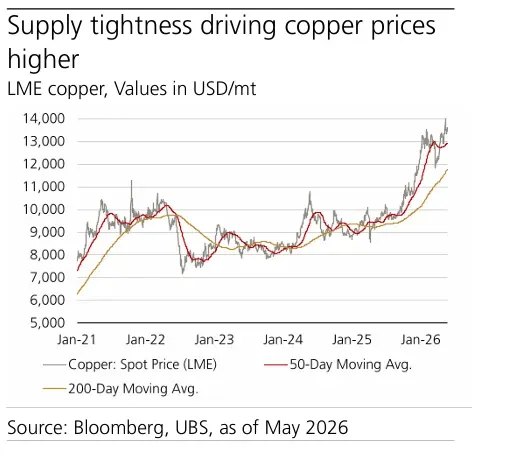
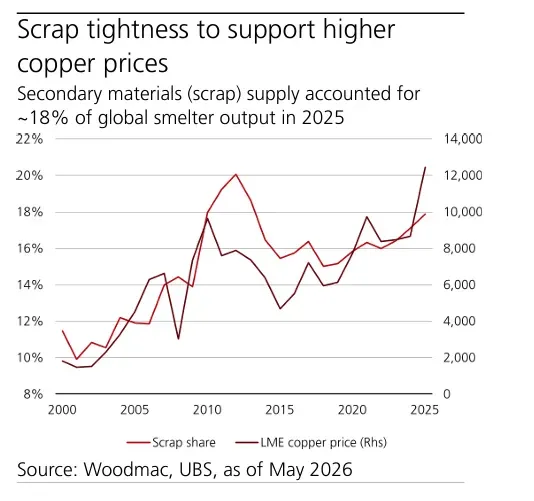
The copper market continues to trade as a supply-constrained industrial system rather than a cyclical commodity market. In a May 22 report titled Higher in Steps, analysts at UBS argue that structural shortages across concentrates, scrap, sulfur, and refined output are forcing prices steadily higher despite mixed global growth signals.
UBS now forecasts copper prices reaching USD 14,000/mt by September 2026, USD 14,500/mt by year-end, USD 15,000/mt by March 2027, and USD 15,500/mt by June 2027. The bank maintains a constructive stance and continues to recommend long exposure to copper, particularly during price pullbacks.
The Market Is Tightening from Multiple Directions
The core thesis behind the report is simple: copper supply growth is struggling to keep pace with electrification-driven demand growth.
According to UBS, sulfur shortages in China have intensified after Beijing imposed new sulfuric acid export restrictions. That has raised costs for higher-cost leaching operations while simultaneously tightening the broader refining chain. At the same time, copper concentrate and scrap availability remain constrained, creating aggressive competition among smelters for feedstock.
Treatment and refining charges (TCRCs), which are often viewed as a gauge of concentrate availability, have effectively collapsed.
“2026 Annual benchmark global treatment and refining charges (TCRCs) [fell] to USD 0/mt… and spot charges below USD -100/mt amid fierce competition among smelters.”
That matters because negative treatment charges imply smelters are effectively paying to secure material. In commodity markets, this is usually a sign of severe upstream tightness.
The report also highlights tightening scrap flows. China’s stricter tax compliance standards and invoice quotas are reducing available recycled material, while Japan is increasingly retaining domestic scrap as its own smelters shift toward recycled copper processing.
Electrification Demand Remains Intact
Despite slowing global manufacturing activity, UBS argues the larger structural demand trend remains firmly supportive for copper.
The bank estimates global copper consumption will rise 2.8% in 2026, driven primarily by grid investment, electric vehicle adoption, renewable infrastructure, and the continued expansion of data centers.
This is an important distinction. Traditional cyclical demand indicators, such as manufacturing PMIs, have softened around the margins, yet copper demand tied to electrification infrastructure continues to expand.
China remains central to that story.
While January-April copper imports into China declined year-over-year, April imports alone still rose 2.3%
YOUR EARLY CURRENCY VALUES/GOLD AND SILVER PRICING/ASIAN AND EUROPEAN BOURSE MOVEMENTS/AND INTEREST RATE SETTINGS THURSDAY MORNING.7:30 AM
SHANGHAI CLOSED UP 4.91 PTS OR 0.12%
HANG SENG CLOSED DOWN 322.07 PTS OR 1.27%
Nikkei CLOSED DOWN 344.91 PTS OR 0.53%
//Australia’s all ordinaries CLOSED DOWN .39%
//Chinese yuan (ONSHORE) CLOSED UP TO 6.7795
/ OFFSHORE CLOSED UP AT 6.7780 Oil UP TO 90.41 dollars per barrel for WTI and BRENT UP TO 96.10 Stocks in Europe OPENED ALL RED
ONSHORE USA/ YUAN// WITH YUAN TRADING UP (6.7795) OFFSHORE YUAN TRADING UP TO 6.7780 ONSHORE YUAN TRADING BELOW OFF SHORE AND UP ON THE DOLLAR// / AND THUS STRONGER/OFF SHORE YUAN TRADING UP AGAINST US DOLLAR/ AND THUS STRONGER
XXXXXXXXXXXXXXXXXXXXXXXXXXXXXXXXXXXXX
YOUR EARLY CURRENCY VALUES/GOLD AND SILVER PRICING/ASIAN AND EUROPEAN BOURSE MOVEMENTS/AND INTEREST RATE SETTINGS THURSDAY MORNING.7:30 AM
ONSHORE YUAN: CLOSED UP 6.7795
OFFSHORE YUAN: UP TO 6.77800
1.HANG SANG CLOSED DOWN 322.07 PTS OR 1.27%
2. Nikkei closed DOWN 344.91 PTS OR 0.53%
WEST TEXAS INTERMEDIATE OIL UP TO 90.41
BRENT; 96.40
3. Europe stocks SO FAR: ALL RED
USA dollar INDEX UP TO 99.26/// EURO FALLS TO 1.1616 DOW 9 BASIS PTS
3b Japan 10 YR bond yield:FALLS TO. +2.696 DOWN 0 FULL BASIS PTS/ VERY TROUBLESOME//Japan buying 100% of bond issuance)/Japanese YEN vs USA cross now at 159.400… JAPANESE YEN NOW FALLING AS WE HAVE NOW REACHED THE ENDING OF THE YEN CARRY TRADE AGAIN AND THE REPATRIATION OF YEN DENOMINATED BONDS TRADING IN THE USA/EUROPE. JAPAN 30 YR BOND YIELD: 3.969 UP 6 FULL BASIS PTS
3c Nikkei now ABOVE 17,000
3d USA/Yen rate now well ABOVE the important 120 barrier this morning
3e Gold DOWN /JAPANESE Yen UP CHINESE ONSHORE YUAN: UP( 6.7795 AND OFFSHORE: UP AT 6.7780
3f Japan is to buy INFINITE TRILLION YEN worth of BONDS. Japan’s GDP equals 5 trillion USA
Japan to buy 100% of all new Japanese debt and NOW they will have OVER 50% of all Japanese debt.
3g Oil UP for WTI and BRENT UP this morning
3h European bond buying continues to push yields HIGHER on all fronts in the EMU. German 10yr bund YIELD UP TO +2.9978// Italian 10 Yr bond yield UP to 3.743// SPAIN 10 YR BOND YIELD DOWN TO 3.424%
3i Greek 10 year bond yield UP TO 3.668%
3j Gold at $4392.00 //Silver at: 73.28 1 am est) SILVER NEXT RESISTANCE LEVEL AT $100.00
3k USA vs Russian rouble;// Russian rouble UP 0 AND 20/ 100 roubles/71.17
3m oil (WTI) into the 90 dollar handle for WTI and 96 handle for Brent/
3n Higher foreign deposits moving out of China// huge risk of outflows and a currency depreciation. This can spell financial disaster for the rest of the world/
JAPAN ON JAN 29.2016 CONTINUES NIRP. THIS MORNING RAISES AMOUNT OF BONDS THAT THEY WILL PURCHASE UP TO .5% ON THE 10 YR BOND///YEN TRADES TO 159.351 // 10 YEAR YIELD AFTER FIRST BREAKING .54% LAST YEAR NOW EXCEEDS THAT LEVEL TO 2.696% DOWN 0 BASIS PTS STILL ON CENTRAL BANK (JAPAN) INTERVENTION//YEN CARRY TRADE NOW UNWINDING//YEN BOND TRADING OVERSEAS REPATRIATED.//JAPAN 30 YR: 3.969 UP 6 PTS..: USA/SF this 0.7885 as the Swiss Franc . Euro vs SF: 0.9160
USA 10 YR BOND YIELD: 4.493 UP 2 BASIS PTS…
USA 30 YR BOND YIELD: 5.0252 UP 2 BASIS PTS/
USA 2 YR BOND YIELD: 4.056 UP 3 BASIS PTS
USA DOLLAR VS TURKISH LIRA: 45.90 DOWN 1 BASIS PTS/LIRA GETTING KILLED//IDIOTS FOR SELLING GOLD AND USA DOLLAR RESERVES.
10 YR UK BOND YIELD: 4.8590 UP 2 PTS
30 YR UK BOND YIELD: 5.555 UP 2 BASIS PTS
10 YR CANADA BOND YIELD: 3.465 UP 1 BASIS PTS
5 YR CANADA BOND YIELD: 3.138 UP 2 BASIS PTS.
1a New York Opening report
Futures Fall, Oil Rises As Mideast Violence Flares Up
Thursday, May 28, 2026 – 08:14 AM
US futures are but well off session lows, as part of a weaker risk tape after the US and Iran exchanged strikes, fueling doubts whether an end to the war is imminent and crushing hopes for a Hormuz deal (gasp). Overnight, US forces carried out airstrikes on an Iranian military site which Centcom described as “purely defensive” and designed to maintain the ceasefire; it also imposed new sanctions to prevent Tehran from profiting from vessels transiting the Strait of Hormuz. In response, Iran targeted the American airbase from which the attack originated. Centcom said that Kuwait also intercepted a ballistic missile launched toward it. While S&P futures initially tumbled as much as 0.5% on the news in overnight trading, they since recovered much of the losses, but were still down 0.2% as of 8:00am, with Nasdaq futures down 0.5%. In premarket trading, Mag7 names are mostly lower as Semis are sold and Software bid post earnings releases. Defensives and Energy are the notable outperformers as the market resumes its US / Iran playbook; EM likely to underperform DM. Bond yields are up 1-2bp as the yield curve bear flattens; the 10Y is up to 4.50%, after earlier rising to 4.53%. Crude prices are not seeing as dramatic of a response as earlier in the conflict; natgas is trading lower, Ags higher, and metals for sale as USD sees a bid. Today’s macro data focus is on PCE, Income, and Spending to gauge the depth of the impact from the Middle East Conflict with add’l updates to Durable / Cap Goods, Jobless Claims, and 26Q1 GDP revisions. Aside from a resumption of the kinetic conflict / failure for a deal, JPMorgan views inflation as the biggest risk to Equities with bond yields as the transmission mechanism. Today’s print will be important but given the status of the conflict, next month’s CPI print is likely the more important print.
In premarket trading, Mag 7 stocks are mostly lower (Microsoft +0.9%, Meta +0.2%, Apple -0.2%, Amazon -0.4%, Alphabet -0.5%, Nvidia -1.1%, Tesla -1.3%)
Braze Inc. shares (BRZE) are down 11% after the cloud—based software company reported its first-quarter results and gave an outlook. Despite the stock’s decline, analysts are broadly positive, and recommended buying on weakness.
BRP Inc. (DOO) rises 8.1% after it boosted its revenue guidance for the full year, which beat the average analyst estimate.
Caesars Entertainment (CZR) rises 2% after Fertitta Entertainment agreed to acquire the company in an all-cash transaction valued at about $17.6 billion.
Dollar Tree shares (DLTR) rise 10% after the retailer boosted its adjusted earnings per share guidance for the full year above the consensus estimate after stronger-than-expected performance in the first quarter.
Dominion Energy Inc. shares (D) rise 0.5% after Jefferies raised its recommendation on the utilities company to buy from hold on the NextEra Energy merger.
Everpure shares (P) fall 11% as the computer storage company gave a full-year revenue guidance that implied slower growth in the second half of the year amid higher prices.
HP Inc. shares (HPQ) drop 1.6% as higher memory chip prices weigh on the PC maker’s profit forecast for the third quarter.
Marvell Technology shares (MRVL) fall 2.7% as the chipmaker’s modest beat failed to impress investors with high expectations.
NCino shares (NCNO) rise 12% after the cloud banking company boosted its revenue guidance for the full year as subscription revenues increase on AI demand.
Photronics shares (PLAB) fall 26% after it forecast adjusted earnings per share for the third quarter that missed the average analyst estimate.
Shares in drone-related firms (UMAC +27%, RCAT +15%) are rallying after the Wall Street Journal reported the Trump administration is exploring funding deals with a group of drone companies.
Synopsys shares (SNPS) are down 2% after the electronic design automation software company reported its second-quarter results.
In other news, Snowflake surged after the software maker gave a stronger-than-expected annual outlook and signed a $6 billion multi-year agreement to use Amazon’s cloud services and chips. In contrast, Salesforce results and outlook didn’t do enough to erase concerns over AI-related disruption. D.A. Davidson’s Gil Luria said the shift to AI for Salesforce is taking longer than expected. In terms of space exploration and drone technology, the Trump administration is said to be negotiating funding deals with drone companies designed to boost production and lower weapon costs, according to the WSJ. Space exploration has all the ingredients “for the next bubble squeeze,” according to Mike O’Rourke of Jonestrading.
The latest flare-up between the US and Iran showed the fragility of their ceasefire, despite most traders viewing a lasting deal between the sides as only a matter of time. The prospect of oil-driven inflation is also building, prompting central bankers to increasingly warn that interest rates may need to rise.
“The market is caught between two very different worlds,” said Aneeka Gupta, director of macro-economic research at Wisdomtree. “One where we get a deal, and you have a follow-through of a very powerful cyclical recovery, and another where the conflict process deepens the stagflation impact on the economy.”
WTI crude oil rose but remained below levels seen earlier in the week. Bloomberg Economics notes that Trump retains market-moving power on the commodity. “If we adjust for the drop in background volatility since the ceasefire with Iran began, each headline from the White House still moves crude-oil prices by the same amount as it did in the early days of the war,” he says. For stocks, volatility remains low and the ‘vol of vol’ gauge hit a rarely seen sub-90 reading on Wednesday.
Less than a day after Federal Reserve Governor Lisa Cook warned that inflation was headed in the wrong direction, Minneapolis Fed President Neel Kashkari told CNBC that consumer prices were still “much too high.” The Fed’s Philip Jefferson said that inflationary risks remained tilted to the upside even as he expects the effects of tariffs and higher energy costs to wear off. The ripple effects of the war will occupy the European Central Bank even after the conflict is resolved, according to Chief Economist Philip Lane.
Elsewhere, the AI bull case faces a headwind in the form of rising token costs, raising the question of whether escalating Large Language Model expenses now present a bigger risk to the AI trade than equity valuations. The Silicon Data LLM Token Expenditure Index, measuring the dollar cost per one million tokens, has doubled in six months.
Goldman’s Delta One head Rich Privorotsky joined the discussion overnight with the following observation on Token economics:
“Reading that DeepSeek reportedly cut token pricing by 75% and Xiaomi’s MiMo by almost 99% immediately brought back memories of the old Groupon subsidy wars and the inevitable race to the bottom economics of commoditized delivery. There’s also been a massive rise in open-source enthusiasm. I was honestly blown away running an 8B version of Qwen locally on a four-year-old MacBook last night (ok it couldn’t do much but it felt downloading the internet in 5gb…18ms ago you would have need a data center for this!). Notably, Chinese onshore datacenter and AI infrastructure names have diverged sharply post release (they all went down). Maybe a bit of a leap here but I think the market is beginning to ask whether token cost compression temporarily breaks the logic of pure Jevons paradox demand expansion. It’s not whether demand ultimately rises… it probably does… but whether there is a meaningful lag where cheaper tokens simply cannibalize higher cost inference before entirely new use cases emerge. Nobody is arguing open source models are fully comparable to frontier systems, although the quality gap is clearly narrowing quickly. The more important point is that a huge percentage of enterprise tasks simply do not require frontier level reasoning or expensive inference. That becomes a major boardroom conversation into Q2/Q3. Rationalization of token spend may become just as important as the AI growth narrative itself, particularly when “90% of the output for 10% of the cost” becomes increasingly viable through open source alternatives.”
Earnings and economic data will also be in focus for traders today looking for signs of the “K-shaped” economy with results from a number of consumer facing corporates, while the Fed gets an important inflation print ahead of Kevin Warsh’s first FOMC meeting as chair next month. Bloomberg expects the PCE deflator to slow from March’s red-hot print to a still-hot reading in April, driven by gas and food prices. A number of Fed speakers gave views overnight. Jefferson said he expects inflation to cool later this year as the effects of tariffs and higher energy costs wear off, though he warned inflationary risks remain tilted to the upside. Kashkari warned that consumer prices remain “much too high.” Meanwhile Goolsbee again cautioned that increased investment and spending due to a projected surge in future productivity growth may be inflationary.
Thursday data is expected to show that the US personal consumption expenditures price index jumped 3.8% in April from a year ago. That would put inflation a full percentage point higher than it was in February, marking the biggest two-month acceleration since 2021.
Holger Schmieding, chief economist at Berenberg Bank, said the fact that markets have given up on Fed rate cuts for the foreseeable future means it will take a major downside surprise in core PCE for bonds to move significantly. “For the question if and by how much the Fed may raise rates later on, we need to watch whether the Iran shock filters through into non-energy prices,” Schmieding said.
The caution in markets and worries that equities have run too hard are misplaced, said Mathias Heim, chief investment officer at Belle Capital. “If a peace deal takes another two weeks or two months, I don’t think markets care as much anymore unless oil meaningfully breaks higher,” Heim said. “The elephant in the room is the AI capex cycle, which drives profit growth and multiples. Structurally, equities remain the go-to asset class.”
In other news, Perella Weinberg Partners is cutting almost 10% of its workforce, including a dozen partners, to channel resources into higher-performing areas of its business. Eli Lilly said it will press ahead with global drug launches despite uncertainty over the Trump administration’s Most-Favored-Nation (MFN) pricing proposal.
Europe’s Stoxx 600 fell 0.7%; tech saw the biggest gains, rebounding from losses in the prior session, while healthcare and media fell. Here are the biggest movers Thursday:
Soitec shares climbed as much as 21%, resuming their stellar year-to-date rally after three days of losses
PPHE Hotel Group jumped as much as 25%, the biggest jump since 2011, after the owner and operator of upscale hotels said it received an indicative takeover proposal worth £22 per share from Fattal Hotel Group
Salvatore Ferragamo gained as much as 9.3%, the most since May 7, after saying it has launched a share buyback program for up to 5% of its share capital
Computacenter shares rose as much as 1.9%, hitting a record high, after the company said it is buying a value-added reseller focused on the US federal government market, which will immediately boost earnings upon completion
X-Fab shares fell as much as 8.7% on Thursday, giving back some gains after the stock was recommended by a popular X account a day earlier
Shares in UK homebuilders fell after a series of downgrades from Goodbody, which highlights the sector’s profit-margin headwinds stemming from a weakening macro climate, particularly higher interest rates, and build-cost inflation
Elekta shares dropped as much as 16%, the most since July 2025, after the Swedish medical technology firm reported sales and orders for the fourth quarter that disappointed analysts
A gauge for Asian stocks snapped its longest winning streak since February: Asian equities retreated from a record, ending a five-day winning streak, as investors assessed conflicting signals from the US and Iran on prospects for a deal to end the war. The MSCI Asia Pacific Index fell as much as 1.9%, the most since May 15. Most equity benchmarks in the region were in the red, with the Hang Seng Index falling nearly 2%. Taiwan’s Taiex Index turned negative after hitting an intra-day record earlier in the day. The MSCI Asia Pacific Index gained 5.3% in the past five sessions. Investor sentiment has turned cautious due to elevated energy prices and the risk of renewed inflation, with the Strait of Hormuz still effectively shut. President Donald Trump said he was “not satisfied” in negotiations with Iran, dampening expectations for an imminent breakthrough in the Middle East conflict. Elsewhere in Asia, Chinese semiconductor stocks extend gains as Huawei’s chip breakthrough continues to buoy market sentiment. Markets in India and Indonesia are closed for holidays.
In FX, the Bloomberg Dollar Spot Index is edging higher for a third straight day while the Japanese yen is the best performing G-10 currency, rising a few pips against the greenback. GBP/USD declines 0.2% to 1.3405, down a third day
In rates, treasury futures are off session lows in early US session, but remain under pressure with yields 1.5bp-3bp cheaper across a flatter curve. Front-end tenors lead the selloff with yields 3bp cheaper on the day after climbing nearly 5bp; WTI crude futures remain 2.7% higher after rising as much as 3.8%. 10-year TSY near 4.5% is 1.6bp higher, slightly underperforming bunds and gilts in the sector. Gains in oil weigh after renewed attacks in the Persian Gulf erode expectations of a peace accord. New Zealand’s bonds pared losses after the government announced a plan to reduce bond issuance in the coming years. Focal points of US session include 7-year note auction at 1pm New York time and economic data including PCE price indexes and 1Q GDP revision. This week’s Treasury auctions conclude with $44 billion 7-year note at 1pm New York time, following solid results for 2- and 5-year note sales. WI 7-year yield near 4.34% is about 16.5bp cheaper than last month’s, which tailed by 0.5bp. IG dollar issuance slate empty so far, however at least one issuer stood down Wednesday, when 12 offerings totaling $21.3 billion were priced, led by Goldman Sachs’ $9b four-part transaction. Issuers paid about 3bps in new issue concessions on deals that were 3.7 times covered.
In commodities, Brent crude futures for July are up 3% near $97 a barrel having topped $98 earlier after renewed attacks in the Persian Gulf fueled doubts over whether an end to the Iran war is imminent. Precious metals and Bitcoin are declining.
Today’s economic data slate includes April personal income/spending (with PCE price indexes), weekly jobless claims, April durable goods orders, 1Q GDP revision (all at 8:30am) and April new home sales (10am). Fed speaker slate includes Williams (8:55am), Musalem (10:15am, 1:10pm) and Barkin (3pm).
Market Snapshot
Top Overnight News
The US struck Iranian military targets for the second time this week and Kuwait said it responded to missile and drone threats. Iran targeted the US base where the strikes originated, state-run Press TV reported. BBG
A US oil tanker intended to cross the Strait of Hormuz by turning off radar system, but IRGC Navy fired at it and forced it to turn back, while US army fired into Bandar Abbas but caused no damage. This was the cause of the earlier reported explosions. No casualties or damages were caused by the US, which fired at a scorched-earth area. Separately, Iran’s Navy forced four vessels to turn back in the Strait of Hormuz by firing warning shots: Tasnim
China’s central bank has instructed banks to boost lending this month, people with knowledge of the matter said, underscoring Beijing’s continued efforts to support an economy squeezed by higher energy costs and stubbornly weak domestic demand. RTRS
Hong Kong plans to launch a gold-clearing system by July, giving it a first-mover advantage over rival Singapore, which has announced similar plans without a timeline. BBG
South Korea’s central bank held rates steady at its first meeting under Gov. Shin Hyun-song, though it signaled tighter policy ahead as it raised its forecasts for economic growth and inflation. WSJ
Federal Reserve governor Lisa Cook said she is prepared to raise interest rates if disinflation does not appear in a timely manner. For now, the right course of action is to hold rates steady, but risks still remain tilted toward higher inflation. WSJ
Goolsbee warned that the persistent combination of energy shocks and stubborn inflation could push the U.S. economy into a “stagflationary” direction characterized by a simultaneous rise in unemployment and price growth. WSJ
South Africa’s central bank is set to raise borrowing costs for the first time in three years today, with the benchmark interest rate forecast to increase to 7%. BBG
The ECB’s Philip Lane said ripple effects of the Iran war, such as on the labor market, will occupy policymakers even after the conflict is resolved. BBG
Amazon Web Services has signed up cloud storage company Snowflake as its latest chips customer, as the proliferation of artificial intelligence agents continues to drive high levels of demand for computing hardware. SNOW plans to pay $6 billion over the next five years for access to Amazon’s Graviton chips inside AWS data centers. SNOW +35% premkt on strong outlook from last night’s print. WSJ
“The momentum factor has historically stalled around May and July but seen a significant ramp up in June with the factor actually being the highest performing seasonally in the month. We do think the move higher came early this year, and while we still think there is a potential for upside in the leaders, we are more concerned with unwind risk and squeezes in the laggards at the current moment”: Goldman
Iran conflict news
US official said US military carried out new strikes on an Iranian military site and shot down multiple Iranian drones that posed a threat to US forces and commercial maritime in the Strait of Hormuz.
IRGC said it targeted the US air base in response to the US aggression earlier near Bandar Abbas Airport, according to Tasnim. said:. Any further US attacks would trigger a more decisive response. Washington bears responsibility for consequences.
Military source tells Tasnim that hours ago, a US oil tanker intended to cross the Strait of Hormuz by turning off radar system, but IRGC Navy fired at it and forced it to turn back, while US army fired into Bandar Abbas but caused no damage. This was the cause of the earlier reported explosions. No casualties or damages were caused by the US, which fired at a scorched-earth area.
Iran’s Navy forced four vessels to turn back in the Strait of Hormuz by firing warning shots, according to Tasnim.
Sound of three explosions heard from the east of Bandar Abbas, Iran, with exact location and source of the sounds still unclear, while air defences were activated for a few minutes, according to Fars News Agency.
“Hearing the sound of multiple explosions in Kuwait”, ISNA reported, “Kuwait’s official news agency stated that air defense systems are currently countering missile and drone attacks” [likely referring to earlier reported].
Air raid sirens sounding in Kuwait, while Kuwaiti Army said air defense intercept hostile missile and drone attacks, according to Al Hadath.
US Treasury Secretary Bessent said Gulf Strait Authority action targets Hormuz tolls, adds the Treasury is maintaining maximum pressure on Iran.
Iranian National Security Council Official Bagheri said Iran’s assets must be released unconditionally, Tasnim reported.
US issues fresh Iran-related sanctions by adding Persian Gulf Strait Authority to its SDN list.
US has carried out a defence operation in Bandar Abbas, Iran, according to Faytuks Network citing an official that said, “the US will act to safeguard its regional interests, and this does not affect the ceasefire”.
Iran Supreme National Security Council Deputy Secretary Baqeri met with Russian Deputy Foreign Minister Ryabkov, and discuss a number of important issues on the current international agenda with focus on the situation around Iran’s nuclear program. Via IRNA/Telegram.
Deputy Head of Public Relations for the IRGC Aerospace Force, Ali Naderi, said on Wednesday If enemies launch military action again, the Islamic Republic’s response will be different from anything seen so far. said: “…they will face a new image of Iran”.
Head of Iranian Parliament National Security Committee said Iran will not be pushed back by US President Trump’s rhetoric from its red lines: rights to enrich uranium and its possession, authority over the Strait of Hormuz and removal of sanctions.
IRIB reporter said no signs of an explosion have been seen in Bandar Abbas, while some people have heard the sound of this explosion and none of the officials concerned about the matter have issued any official statement.
Axios reported that US military had shot down 4 Iranian drones targeting ships and an Iranian drone launcher on the ground.
Israeli fighter jets carry out attack on the city of Tyre in southern Lebanon, according to Mehr News Agency.
Hamas spokesperson said the Gaza ceasefire agreement faces risk of collapse due to occupation’s crimes and ongoing violations, Al Jazeera reported.
IDF said it’s striking Hezbollah infrastructure in the area of Tyre in southern Lebanon.
A more detailed look at global markets courtesy of Newsquawk
APAC stocks were pressured amid a flare-up of geopolitical tensions in the Middle East after the US conducted another defensive operation in which it attacked a launch site and shot down drones after they posed a threat to US forces and commercial maritime in the Strait of Hormuz, while the IRGC said it responded by attacking the US base where the US aggression originated from. ASX 200 retreated amid the geopolitical escalation and with sentiment not helped by mixed data in which capex topped estimates, but household spending disappointed. Nikkei 225 was initially choppy but ultimately retreated amid the rebound in oil prices and increased geopolitical tensions between the US and Iran. Hang Seng and Shanghai Comp were negative but to varying degrees, with the Hong Kong benchmark underperforming following recent earnings and mixed tech fortunes.
Top Asian News
S&P affirms Hong Kong at AA+, outlook stable.
Japan’s ruling party proposes allowing the government to issue bridging bonds to fund certain expenditures, which can be excluded from debt-to-GDP ratio and primary balance calculations.
Australia’s APRA maintained current macroprudential policy setting following a review.
Japan considers bridging bonds for growth investments, according to Nikkei.
Korea’s NPS has lifted its domestic stock weight target to 20.8% (prev. 14.9%), Bloomberg reports
European bourses (STOXX 600 -0.6%) are broadly lower this morning as markets digest the recent flare-up between the US and Iran. In brief, the US struck Iranian military bases, whilst the IRGC responded with its own attacks on US air bases. Furthermore, Iran’s Navy stated it forced four vessels to turn back in the Strait of Hormuz by firing warning shots. Aside from these flare-up, updates since have been lacking – with markets tentatively waiting for whether this round of strikes will lead to further escalation. As a reminder, Iran has taken the position that further strikes on its land will lead to a war outside of the region. European sectors hold a strong negative bias. Tech leads, followed closely by Energy, whilst Media and Healthcare lag. Tech appears to be rebounding from recent losses, with fundamental drivers lacking, despite the higher yield environment; action potentially driven by post-earnings strength in Snowflake, whilst Marvell’s headline metrics were strong. US equity futures (ES -0.1% NQ -0.3% RTY -0.3%) are in the red this morning, following the action seen in APAC/European trade. The day ahead is packed with key US data, including US PCE (Apr), GDP 2nd estimate and jobless claims. Previewing PCE in brief, following hotter than expected CPI and PPI reports, analysts updated econometric models point to April core PCE inflation of between +0.3-0.4% M/M (prev. +0.3%). In terms of pre-market movers: HP (-2.2%, strong headline metrics, though downgraded its FY outlook), Marvell (-1.5%, headline metrics beat and provided upbeat outlook; though highlighted supply chain constraints), Snowflake (+35%, secures a USD 6bln Amazon deal).
Top European News
Italian Consumer Confidence (May) 93.4 (Prev. 90.8).
Italian Business Confidence (May) 87.9 (Prev. 87.9).
Swedish Economic Tendency Indicator (May) 99.3 (Prev. 99.0).
Swedish Consumer Inflation Expectations (May) 5.9% (Prev. 6.8%).
Swedish Consumer Confidence (May) 92.4 (Prev. 91.5).
Swedish Business Confidence (May) 103.3 (Prev. 103.3).
Swedish Balance of Trade (Apr) -7.30B (Prev. 9.3B).
G10s are broadly lower against the Buck with the Dollar Index +0.1% as oil prices rebound on US and Iran exchanging fire. General sour sentiment across assets sees high-beta underperform despite central bank pricing moves re. Antipodeans on Wednesday, while cyclicals are also weaker. JPY is a touch firmer against the USD, and trades around 159.30.
The Buck marks its third consecutive session of gains and marked a fresh May high amid the US-Iran flare-up (See Iranian War Day 90 analysis on headline feed). The Dollar index has moved further away from significant DMAs, which are now well below and with no sign of an immediate resolution and repricing of G10 rates, with oil far from recent highs and Waller shifting hawkish, the recent drivers. Today’s driver will be the PCE and GDP reports, alongside Fed speak from Williams, Musalem and Barkin.
AUD is the weakest currency in the G10 space on the day amid the general geopolitical risk tone, lower-than-expected Aussie inflation data and the popular carry trade against NZD vulnerable to a Hawkish RBNZ this week. On Wednesday, headlines pointed out that the Antipodean cross marked the largest one-day decline since 2016. The cross found some buyers just above 1.2050, though not enough to halt its declines. AUD/NZD -0.1% on the day. MUFG writes “…with the pre-emptive nature of the RBA policy approach allowing a longer period of pause, a further extension lower in AUD/NZD seems likely.”
EUR is a touch lower against a stronger Buck with firmer energy benchmarks hurting the single currency. Remains a lack of EZ-specific newsflow as focus exclusively lies on geopolitics, which drives the Greenback. 1.16 remains supported for now, where it found buyers below overnight. ING highlights risks “in our view, should the US-Iran stalemate continue. We still see some risks of a 1.150 test before a rebound, but intraday trading remains highly headline-dependent.”
Central Banks
Fed’s Goolsbee (2027 voter) said energy inflation has been more persistent than expected and warns that Asia faced an old-style stagflation shock.
Fed Vice Chair Jefferson (voter) said focus remains on 2% inflation target and noted US labour market is very resilient to the energy shock.
Fed’s Kashkari (2026 voter) said labour market is in decent shape, consumer prices remain too high, and inflation remains the top priority.
Fed Vice Chair Jefferson (voter) said has not prejudged outcome of June FOMC meeting and monetary policy is well positioned to respond to the economy. said:. Is firmly committed to getting inflation back to 2%. Risks around inflation outlook are tilted to upside. Expects inflation to wane later this year on fading tariff, energy hits. Energy shock downside risk to growth, upside risk to inflation. Recent US economic activity has been solid. Labour market stable with risks tilted toward downside. US is not immune to oil-related energy shocks.
Fed’s Cook (voter) said she is atuned to inflation expectations, also watching oil. Would be problematic if oil prices move in the wrong direction.
Japanese Finance Minister Katayama said expects the BoJ to closely coordinate with the government, adds cabinet is in agreement specific monetary policy means are left to the BoJ. said:. Hope the BoJ will conduct appropriate monetary policy to achieve 2% price targets stably, sustainably and rising wages. There is nothing she can add regarding the PM’s meeting with BoJ Governor Ueda beyond what Governor Ueda revealed after the meeting.
BoJ Governor Ueda said we have seen supply shocks in food and energy, which even if temporary, can lift the overall inflation rate because of their cumulative impact.
ECB President Lagarde speaks on “When It Matters Most: Upholding Independence in Challenging Times”.
ECB’s Lane said even if initial energy shock starts to reverse, the second round will be with us for a while. said: Even if there is some kind of resolution to the Iran war, conflict has gone on for so long, there may be repositioning in terms of optimal diversification strategy.
RBNZ Governor Breman said the board considers that inflation pressures will intensify in the future and the cash rate needs to be raised further.
RBNZ Governor Breman said the weak labour market will suppress wage growth, adds certain parts of the New Zealand economy remain in good shape including agriculture and parts of manufacturing. said it will take some time to see the full effect of higher oil prices across wider sectors.
China’s PBoC is to reportedly guide banks to boost May lending amid weak credit issuance, sources suggest.
BoK keeps 7-day Repo Rate unchanged at 2.50%, as expected.
BoK Governor Shin said we will act decisively to stem any herd-like behaviours in the FX market, adds there may be technical differences within board members about when to hike, but board members agree the direction should be tightening.
BoK Governor Shin said Middle East war uncertainty persists and oil stability is to take time to return, adds local growth expansion driven by semiconductor boom.
BoK said board members Ryoo and Chang dissented to Thursday’s rate decision and called for a rate hike.
Fixed Income
A softer start to the day for fixed benchmarks, as the energy space reacts to renewed strikes from both the US and Iran. Bunds and USTs hit lows overnight, with downside of c. 45 and 12 ticks respectively. Since, the space has lifted off worst levels as the intensity of newsflow slows and energy eases from best. However, the space remains in the red heading into a relatively busy session, particularly in the US.
Bunds hit a 125.53 low overnight, reacting to the US and Iran action, and also as the language from US President Trump regarding Oman got greater attention. The intensity of newsflow has since slowed, and Bunds have managed to lift off lows but remain in the red by a handful of ticks.
Today’s European docket has several ECB officials and the April Minutes. From the officials, any remarks which decrease/increase the odds of a June move will, of course, be eyed. Similarly, from the Minutes, insight into how broad the discussion was around tightening and while the decision was unanimous for a hold, did any member(s) initially express a preference for taking action at that point.
Gilts gapped lower by 35 ticks, taking out the trough from Tuesday at 87.99 and as such notching a new WTD low. Though, one that remains comfortably clear of last week’s 84.96 contract base. For the UK newsflow remains relatively light as we count down to the mid-June by-election, after which the Labour leadership contest will step up a gear, irrespective of the result.
USTs in-fitting with Bunds. Notched a 109-17+ base overnight, and has lifted a 109-29 high, to unchanged on the session. The US docket ahead is packed with multiple Fed officials, whose remarks will continue to be scrutinised for insight into what the outcome of the first meeting under Warsh will be. Additionally, April’s PCE is seen ticking higher to 3.8% Y/Y (prev. 3.5%), but moderating to 0.5% M/M (prev. 0.7%).
UK sells GBP 1bln 0.375% 2030 Gilt via tender: b/c 4.19x (prev. 2.97x), average yield 4.277% (prev. 3.796%).
Italy sells EUR 7.25bln vs exp. EUR 6-7.25bln 3.15% 2031, 3.80% 2036, 2.25% 2036 BTP and EUR 3.75bln vs exp. EUR 2.5-3.75bln 3.237% 2036, 3.237% 2035 CCTeu.
Commodities
Overnight, the main geopolitical update has been the US-Iran flare-up. The US carried out new strikes near Bandar Abbas after accusing Iran of threatening maritime traffic in the Strait of Hormuz. Meanwhile, Iran responded with strikes on a US air base and claimed it forced vessels, including a US-linked tanker, to turn back in Hormuz. Air raid sirens sounded in Kuwait as Kuwaiti air defences intercepted hostile missiles and drones.
Despite this, efforts for negotiations are seemingly continuing. As a reminder, the US rebuffed the unofficial MoU released by Iranian State Media (which suggested Iran and Oman are to manage the Strait of Hormuz).
Russia’s Transneft plans to expand capacity of Espo oil pipeline, RIA reported; oil shipments for export via the Transneft system in 2026 will be comparable to the 2025 level.
WTI Jul and Brent Aug futures rose to highs of around USD 92.50/bbl and USD 96.00/bbl, respectively, amid the skirmish. Prices have since waned off highs back to around USD 90.75/bbl and USD 94.50/bbl respectively amid a lack of further attacks and with nothing to suggest negotiations are not still intact. Dutch TTF similarly rose above EUR 48/MWh before settling around EUR 47.50/MWh at the time of writing, +2.5% intraday.
Spot gold and silver are softer but off lows, in tandem with price action across energy. Spot gold briefly dipped under its 200 DMA (USD 4,394/oz) and trades towards the lower end of a USD 4,366-4,462.58/oz range. Traders may be looking ahead to the US PCE metrics as a source of impetus. Following hotter-than-expected CPI and PPI reports, analysts’ updated econometric models now point to April core PCE inflation of +0.3-0.4% M/M, up from the prior +0.3%. That being said, a major geopolitical update could overshadow the data in this fluid environment.
Base metals are mostly softer, and to varying degrees, with price action somewhat muted given the lack of macro newsflow. Overnight, copper extended declines amid the downbeat mood in Asia following reports of the US and Iran’s retaliatory strikes, but clambered off its worst levels since. 3M LME copper resides towards the top end of a USD 13,465.80- 13,595.97/t range.
Iran has restored production at the South Pars industrial hub to its pre-war capacity following an intensive repair operation, according to PressTV.
US Private Inventory Data (bbls): Crude -2.8mln (exp. -4.4mln), Distillates +11.0mln (exp. -2.0mln), Gasoline -3.2mln (exp. -2.9mln), Cushing -2.9mln.
Trade/Tariffs
China’s MOFCOM said it is negotiating with the EU within the WTO over EU steel curbs; adds China-EU economic relations are mutually beneficial.
EU is to broaden import quotas and tariffs against China, according to the bloc’s industry commissioner, cited by FT.
Geopolitics (ex Iran)
Russia’s Transneft plans to expand capacity of Espo oil pipeline, RIA reported; oil shipments for export via the Transneft system in 2026 will be comparable to the 2025 level.
Russian intelligence chief said NATO is making preparations for a large-scale conflict on the eastern border, Sky News Arabia reported.
Ukrainian military said it has attacked Russia’s Tuapse oil refinery (240k BPD).
EU Foreign Affairs Policy Chief Kallas said Russia is on the back foot on the battle field, adds should not walk in Russia’s trap concerning discussions who should be at the negotiating table and it should be about substance.
Ukraine President Zelensky submits a draft law on ratification of loan agreement between the Ukraine and EU, according to the Ukraine Parliament website.
North Korea’s Foreign Ministry states that the country will never denuclearise, while it accused US-led Quad of maintaining hostile stance towards Pyongyang and other regional nations, according to KCNA.
US Event Calendar
8:30 am: Apr Personal Income, est. 0.4%, prior 0.6%
8:30 am: Apr Personal Spending, est. 0.5%, prior 0.9%
8:30 am: Apr PCE Price Index YoY, est. 3.8%, prior 3.5%
8:30 am: Apr Core PCE Price Index MoM, est. 0.3%, prior 0.3%
8:30 am: Apr Core PCE Price Index YoY, est. 3.3%, prior 3.2%
8:30 am: May 23 Initial Jobless Claims, est. 210.5k, prior 209k
8:30 am: May 16 Continuing Claims, est. 1784k, prior 1782k
8:30 am: Apr P Durable Goods Orders, est. 4%, prior 0.8%
8:30 am: Apr P Durables Ex Transportation, est. 0.5%, prior 0.9%
8:30 am: 1Q S GDP Annualized QoQ, est. 2%, prior 2%
8:30 am: 1Q S Personal Consumption, est. 1.6%, prior 1.6%
8:30 am: 1Q S GDP Price Index, est. 3.6%, prior 3.6%
8:30 am: 1Q S Core PCE Price Index QoQ, est. 4.3%, prior 4.3%
10:00 am: Apr New Home Sales, est. 660.09k, prior 682k
Central Bank speakers
8:55 am: Fed’s Williams Speaks at Reykjavík Economic Conference
10:15 am:Fed’s Musalem Speaks in Reykjavik
1:10 pm: Fed’s Musalem Appears on Bloomberg TV
3:00 pm: Fed’s Barkin Speaks in Moderrated Discussion
DB’s Jim Reid concludes the overnight wrap
One skill required in this job at the moment is adaptability as the tone has all changed in the last couple of hours with Oil back up and equities down after the US carried out another series of defensive strikes and imposed sanctions preventing Iran from profiting from Strait of Hormuz traffic. According to a US official they shot down some Iranian drones fired at a commercial ship and also struck an Iranian drone launching site near the strait. They claim the ceasefire still holds with the Irainian’s claiming they targeted a US airbase in retaliation.
This has led to Brent rallying +3.92% this morning to $97.99/bbl after falling -5.31% yesterday and to a one-month low of $94.29/bbl. Equity markets are lower across the board after a decent day yesterday.
It’s been a busy 24 hours for headlines on the war.
The main one yesterday came from Iran’s state TV, who reported on an unofficial draft for an interim peace deal. According to them, this proposal would see maritime traffic through the Strait of Hormuz return to normal within a month, while the US would lift its blockade on Iranian ports. So initially, there was a clear rally as hopes grew that the Strait would reopen. However, we then heard from the White House later on, who said this report was a “complete fabrication”, which dampened hopes for an imminent deal. And Trump also said in a PBS interview that Iran wouldn’t get sanctions relief for giving up their highly enriched uranium. Just after Europe closed Trump said that he was “not satisfied” with the current state of negotiations and that “Maybe we have to go back and finish it”. And shortly after the US close, we heard a senior Iranian parliamentarian push back on Trump’s rhetoric, saying it would not deter Iran from its “red lines” on enriched uranium, authority over the Strait of Hormuz, and the removal of sanctions.
Given the rally in Oil, US Treasury yields are back up 4 to 4.5bps across the curve this morning with the 10yr yield at 4.53% as I type after a 5-day rally. S&P (-0.37%) and Nasdaq (-0.80%) futures are lower after the cash markets in yesterday’s session hit all time highs at the same time, along with the DOW, for the first time in 2026.
In Asia the KOSPI (-3.61%) is the largest underperformer with the Hang Seng (-2.12%) also burdened by weakness in technology shares, along with the Nikkei (-1.34%). The S&P/ASX 200 (-1.59%) is also weak. Mainland Chinese stocks are down less than a percent. The session yesterday went pretty well with the decline in oil prices meaning that concerns about inflation eased, with investors pricing out the chance of aggressive rate hikes this year. We saw that in several ways, but the US 1yr inflation swap (-2.2bps) hit a two-month low of 3.03%, and the Euro 1yr inflation swap (-9.3bps) also fell to 3.36%. So that pushed central bank pricing in a slightly more dovish direction, with the probability of a Fed rate hike by December down to 62% by the close, having been at 66% the previous day. Similarly at the ECB, the amount of hikes priced by December was also down to 58bps by the close, down –2.1bps from the previous day. These are all giving up some of these gains this morning.
We have US core PCE to look forward to today which is an important number. This comes after some hawkish comment from Fed Governor Cook late in the US session, who said she was “attuned to the risk that elevated inflation will become embedded” and “prepared to raise rates, if the expected disinflation does not appear in a timely manner”.
Before this morning’s sell-off, equities saw a mixed performance yesterday as investors grappled with the various headlines. In the US, the S&P 500 (+0.02%) and Nasdaq (+0.07%) narrowly posted new record highs, while the Mag-7 (+0.92%) outperformed. Those gains came despite the Philly semiconductor index retreating (-1.36%) and decliners outnumbering advancers in the S&P for a second session running. In Europe, the STOXX 600 (+0.03%) closed within 1% of its record high from February, with gains for the FTSE 100 (+0.13%) and the CAC 40 (+0.43%) outweighing a decline for FTSEMIB (-0.64%). European Stoxx futures are down -1.3% this morning as I type in a big reversal for this time of day.
Otherwise yesterday, there wasn’t much data, although a few releases from the US were generally positive. For example, the ADP’s weekly report of private payrolls showed a healthy increase of 35,750 per week in the four weeks ending May 9. Then shortly after, we also found out that the Richmond Fed’s manufacturing index was up to a 4-year high of 13 in May (vs. 4 expected). So overall, the numbers cemented the picture of ongoing resilience in the US economy.
Looking at the day ahead, and US data releases include the PCE inflation for April, weekly initial jobless claims, and the second estimate of Q1 GDP, Otherwise, Central bank speakers include ECB President Lagarde, the ECB’s Lane, Cipollone and Schnabel, the Fed’s Williams, Musalem and Barkin, and the BoE’s Breeden. We’ll also get the ECB’s account of their April meeting.
1b European opening report
1 c Asian opening report
Europe primed for lower open with crude firming as US and Iran continue to exchange fire – Newsquawk EU Market Open
Thursday, May 28, 2026 – 02:25 AM
A US official said the US military carried out new strikes on an Iranian military site and shot down multiple Iranian drones that posed a threat to US forces and commercial maritime traffic in the Strait of Hormuz.
IRGC said it targeted a US air base in response to the US aggression near Bandar Abbas Airport, while it added that any further US attacks would trigger a more decisive response.
Air raid sirens sounded in Kuwait, and the Kuwaiti Army said air defences were intercepting hostile missiles and drone attacks, according to Al Hadath.
US President Trump said he was not discussing easing sanctions on Iran and would keep control of Iran’s money until it behaves, while adding he was uncomfortable with Russia or China taking Iran’s highly enriched uranium stockpile
Crude futures edged higher after reports of explosions in Iran’s Bandar Abbas; 10yr UST futures continued their slide amid a rebound in oil.
APAC stocks were pressured amid a flare-up of geopolitical tensions; European equity futures indicate a lower cash market open with Euro Stoxx 50 futures down 1.2%.
Looking ahead, highlights include Spanish Retail Sales (Apr), EU Consumer Confidence Final (May), US Initial Jobless Claims (May/23), US GDP 2nd Estimate (Q1), US Core PCE (Apr), US Durable Goods Orders (Apr), US Real Consumer Spending 2nd Estimate (Q1), Atlanta Fed GDP (Q2), ECB Minutes (Apr), SARB Policy Announcement (May). Speakers include Fed’s Williams & Barkin, BoE’s Breeden, ECB’s Lane, Lagarde, Cipollone, Schnabel & SNB’s Schlegel. Supply from the UK, Italy & US, Earnings from Dell.
2. Listen to this report in the market open podcast (available on Apple and Spotify)
3. Trial Newsquawk’s premium real-time audio news squawk box for 7 days
IRAN CONFLICT
The sound of three explosions was heard from the east of Bandar Abbas, Iran, and air defences were activated for a few minutes, according to Fars News Agency.
A US official said the US military carried out new strikes on an Iranian military site and shot down multiple Iranian drones that posed a threat to US forces and commercial maritime traffic in the Strait of Hormuz.
Iran’s Navy reportedly forced four vessels to turn back in the Strait of Hormuz by firing warning shots. Furthermore, a military source told Tasnim that hours ago, a US oil tanker intended to cross the Strait of Hormuz by turning off its radar system, but IRGC Navy fired at it and forced it to turn back, while the source added that the US army fired at a scorched-earth area in Bandar Abbas but caused no casualties or damage, which was the cause of the earlier reported explosions.
IRGC said it targeted a US air base in response to the US aggression earlier near Bandar Abbas Airport, while it added that any further US attacks would trigger a more decisive response and that Washington bears responsibility for consequences, according to Tasnim.
Air raid sirens sounded in Kuwait and the Kuwaiti Army said air defences were intercepting hostile missiles and drone attacks, according to Al Hadath.
US President Trump said there would be no Iran sanctions relief in exchange for giving up uranium, according to PBS, while adding negotiations with Iran were “proceeding nicely”. Trump also said Saudi Arabia should join the Abraham Accords, arguing it would be “great for Saudi Arabia”.
US President Trump said Iran was intent on a deal and wanted to make a deal, while adding “we are not satisfied with it, we will be” and that Iran was negotiating on fumes. Trump said “maybe we go back and finish it, maybe we don’t”, while he reiterated that Iran cannot have a nuclear weapon, and said the US had received great support from other nations. Furthermore, Trump said regarding Iran that “we may have to close it out very quickly”.
US President Trump said the Strait of Hormuz would be open to everyone and no one would control it, while adding Iran would have to behave like everyone else and “Oman will have to behave or we will have to blow them up”. Trump also said control of Hormuz was part of the negotiations and that “at the right time” the US would release boats from the Strait.
US President Trump said he was not discussing easing sanctions on Iran and would keep control of Iran’s money until it behaves, while adding he was uncomfortable with Russia or China taking Iran’s highly enriched uranium stockpile. Trump also said Iran was starting to give things “that they have to give us”, while adding regarding a timeframe that “it will happen quickly”.
US President Trump said under a framework deal, the Strait of Hormuz would open immediately, while he does not want a bad agreement with Iran and stated he is not sure if the US should make an Iran deal if others do not join the Abraham Accords. Furthermore, Trump said if it is not a great deal, the US will not do it, but thinks talks with Iran are going well and stated they have things understood now with Iran.
US President Trump may unilaterally announce in the coming hours that an Iran-US agreement has been finalised in order to pressure Iran and shape public opinion before differences are resolved, according to Fars, while an Iranian negotiating team member said some issues remained unresolved and Iran would officially announce the result only if they were fully resolved.
White House said Iran negotiations were going well and that Trump clearly outlined his red lines.
US War Secretary Hegseth said the US was prepared to finish the Iran war militarily and that no Iranian tanker around the globe was safe.
US issued fresh Iran-related sanctions by adding Persian Gulf Strait Authority to its SDN list, while US Treasury Secretary Bessent said Gulf Strait Authority action targets Hormuz tolls, and that the Treasury is maintaining maximum pressure on Iran.
Iranian Parliament National Security Committee head said Iran will not be pushed back from its red lines by US President Trump’s rhetoric, while its red lines included the right to enrich uranium and its possession, authority over the Strait of Hormuz, and the removal of sanctions.
IRGC Aerospace Force Deputy Head of Public Relations Naderi said if enemies launch military action again, the Islamic Republic’s response will be different from anything seen so far and they will face a new image of Iran.
Iran’s Supreme National Security Council Deputy Secretary Baqeri met with Russian Deputy Foreign Minister Ryabkov, and discussed a number of important issues on the current international agenda with a focus on the situation around Iran’s nuclear program.
Israeli fighter jets carried out an attack on the city of Tyre in southern Lebanon, according to Mehr News Agency.
US TRADE
EQUITIES
US stocks were largely traversing sideways, consolidating in a range just off all-time highs. Sectors were mixed, though there was decent upside in Consumer Discretionary (ANF and BBWI were standouts). Note, heavyweights Tesla and Amazon did the heavy lifting. Travel and Leisure was supported by lower energy prices. Communications saw strength (META launches Instagram, Facebook, and WhatsApp subscriptions); Energy was the laggard as crude prices dropped, while Financials also underperformed, and Tech was under pressure (QCOM reaffirmed its non-handset revenue target; ZS down 31.5% on disappointing guidance put pressure on software names, particularly cybersecurity). The equity complex was subject to some choppiness amid geopolitical headlines, though it ultimately closed around flat, ahead of key earnings after hours, and ahead of Thursday’s PCE inflation data.
SPX +0.02% at 7,520, NDX -0.09% at 29,974, DJI +0.36% at 50,649, RUT -0.02% at 2,920.
EU is to broaden import quotas and tariffs against China, according to the bloc’s industry commissioner, cited by FT.
NOTABLE HEADLINES
Fed Vice Chair Jefferson (voter) said he has not prejudged the outcome of the June FOMC meeting and that monetary policy is well-positioned to respond to the economy. Jefferson said he is firmly committed to getting inflation back to 2% and that risks around inflation outlook are tilted to the upside, but expects inflation to wane later this year on fading tariff and energy hits, while he also stated that focus remains on 2% inflation target and that the US labour market is very resilient to the energy shock
Fed’s Cook (voter) said the right course of action is to hold rates steady, and that risks are tilted towards higher inflation with inflation clearly moving in the wrong direction, while she is prepared to raise rates if expected disinflation doesn’t appear in a timely manner and would be prepared to cut rates if the labour market deteriorates. Furthermore, she said even temporary shocks could push up inflation in the medium term, and that shocks pushing up inflation should, in theory, be temporary.
Fed’s Kashkari (2026 voter) said the labour market is in decent shape, consumer prices remain too high, and inflation remains the top priority.
Fed’s Goolsbee (2027 voter) said energy inflation has been more persistent than expected, and warned that Asia faced an old-style stagflation shock.
APAC TRADE
EQUITIES
APAC stocks were pressured amid a flare-up of geopolitical tensions in the Middle East after the US conducted another defensive operation in which it attacked a launch site and shot down drones after they posed a threat to US forces and commercial maritime in the Strait of Hormuz, while the IRGC said it responded by attacking the US base where the US aggression originated from.
ASX 200 retreated amid the geopolitical escalation and with sentiment not helped by mixed data in which capex topped estimates, but household spending disappointed.
Nikkei 225 was initially choppy but ultimately retreated amid the rebound in oil prices and increased geopolitical tensions between the US and Iran.
Hang Seng and Shanghai Comp were negative but to varying degrees, with the Hong Kong benchmark underperforming following recent earnings and mixed tech fortunes.
US equity futures trickled lower amid the US-Iran tit-for-tat limited attacks.
European equity futures indicate a lower cash market open with Euro Stoxx 50 futures down 1.2% after the cash market closed with gains of 0.1% on Wednesday.
FX
DXY was supported as a rebound in oil prices and the negative risk appetite provided some tailwinds after reports of limited strikes between the US and Iran, while participants now await a slew of data releases, including the Fed’s preferred Core PCE inflation gauge. There were also several Fed comments, including from Cook, Jefferson, Kashkari and Goolsbee, but they did little to shift the dial, with Cook stating that the right course of action is to hold rates steady, while Jefferson said he has not prejudged the outcome of the June FOMC meeting and that monetary policy is well-positioned to respond to the economy.
EUR/USD gave up some ground and breached the 1.1600 level to the downside amid the firmer dollar and energy-related headwinds, while there were some hawkish-leaning comments from ECB’s Lane and ECB Minutes also loom.
GBP/USD trickled lower to return to sub-1.3400 territory with little catalysts from the UK to support the pound, while the UK energy regulator also recently announced a 13% increase in the energy price cap.
USD/JPY took a breather after gaining a firmer footing above the 159.00 level, with price action contained amid a lack of tier-1 data from Japan and with intervention risks stoked as the pair edges closer to the psychological 160.00 level.
Antipodeans weakened amid the downbeat mood as geopolitical tensions in the Middle East flared following tit-for-tat strikes between the US and Iran.
FIXED INCOME
10yr UST futures continued their slide from the 110.00 level with pressure seen amid a rebound in oil as geopolitical tensions flared, while participants await a slew of data releases from the US, including PCE.
Bund futures declined with headwinds from energy prices and further hawkish ECB rhetoric.
10yr JGB futures rebounded from an early dip to return to flat territory, while Japan’s ruling party proposed allowing the government to issue bridging bonds to fund certain expenditures, which can be excluded from the debt-to-GDP ratio and primary balance calculations.
COMMODITIES
Crude futures edged higher after reports of explosions in Bandar Abbas, where the US was said to have carried out another defence operation in which it targeted a military site and shot down multiple Iranian drones that posed a threat to US forces and commercial maritime in the Strait of Hormuz. However, a military source cited by Iranian press stated a US oil tanker intended to cross the Strait of Hormuz by turning off its radar system, and the IRGC Navy fired at it, forcing it to turn back, while the US army then fired at a scorched-earth area in Bandar Abbas, but caused no casualties or damage. Further upside was then seen after the IRGC announced it retaliated against the airbase where the US aggression originated.
US Private Inventory Data (bbls): Crude -2.8mln (exp. -4.4mln), Distillates +11.0mln (exp. -2.0mln), Gasoline -3.2mln (exp. -2.9mln), Cushing -2.9mln.
US President Trump said gasoline prices will come down like never before, while he also stated that the gas tax holiday is something they might talk about, and will see over the next fortnight.
Iran has restored production at the South Pars industrial hub to its pre-war capacity following an intensive repair operation, according to PressTV.
Spot gold retreated amid higher oil prices and a firmer dollar, with increased selling pressure seen in metals as Shanghai commodities and LME electronic trade got underway.
Copper futures extended recent declines amid the downbeat mood in Asia following reports of the US and Iran’s retaliatory strikes.
CRYPTO
Bitcoin declined throughout the session and eventually dipped beneath the USD 73,000 level.
NOTABLE ASIA-PAC HEADLINES
BoK kept the 7-day Repo Rate unchanged at 2.50%, as expected, while the decision was not unanimous as board members Ryoo and Chang dissented to Thursday’s rate decision and called for a rate hike. BoK dot plots showed 10 of 21 policy rate projections by board members for the next six months at 3.00%, 7 dots projected 2.75%, 2 projected 2.50% and 2 projected rates at 3.25% in six months, while the Board said it will decide the timing of any rate hikes.
BoK Governor Shin said they need to raise interest rates at some point in the future and need for a base rate hike at an appropriate time, while he added the policy path is very clear, with a restrictive stance ahead while factoring in FX, growth and inflation. Shin stated that the wider BoK dot plot range reflects a high degree of uncertainty, and CPI is seen remaining above target for a considerable period, as well as noted that they need to monitor whether CPI and growth follow the expected path. Furthermore, he said inflationary pressures are emerging and strong growth is seen continuing in the coming months, while he also stated that there may be technical differences within board members about when to hike, but board members agree the direction should be tightening
BoJ Governor Ueda said they have seen supply shocks in food and energy, which even if temporary, can lift the overall inflation rate because of their cumulative impact.
RBNZ Governor Breman said the board considers that inflation pressures will intensify in the future and the cash rate needs to be raised further.
DATA RECAP
Australian Private Capital Expenditure QoQ (Q1) Q/Q 6.5% vs. Exp. 1% (Prev. 0.4%)
Australian Household Spending MM (Apr) -1.1% vs Exp. -0.5% (Prev. 1.6%)
Australian Household Spending YY (Apr) 4.9% vs Exp. 5.8% (Prev. 6.3%)
GEOPOLITICS
OTHER
North Korea’s Foreign Ministry stated that the country will never denuclearise, while it accused the US-led Quad of maintaining a hostile stance towards Pyongyang and other regional nations, according to KCNA.
EU/UK
NOTABLE HEADLINES
ECB’s Lane said even if initial energy shock starts to reverse, the second round will be with us for a while, and even if there is some kind of resolution to the Iran war, the conflict has gone on for so long that there may be repositioning in terms of optimal diversification strategy.
2.NORTH AND SOUTH KOREA AND JAPAN
JAPAN
3. CHINA/
CHINA/TAIWAN
4. EUROPEAN AND SCANDINAVIAN COMMENTARIES PLUS NATO
Angela Merkel Receives EU “Order Of Merit” For Helping To Destroy Europe
Thursday, May 28, 2026 – 02:45 AM
The event passed with little fanfare in the international media. The European Union held its first ever event to honor laureates of the European Order of Merit, meant to honor influential political and social figures who made significant contributions to the “integration” of the EU experiment.
Out of the 20 nominees, 13 laureates attended the ceremony in the Parliament’s hemicycle in Strasbourg and addressed the Chamber, following their acceptance of the award from European Parliament President Roberta Metsola and European Commission President Ursula von der Leyen. Among these attendees was former German Chancellor Angela Merkel.
Merkel wore the award with visible glee, then took to the podium to praise the European Union system. She then called for further expansion of the EU bureaucracy’s efforts to silence dissent on mass immigration by “regulating” (censoring) social media.
Anti-immigration movements in the UK and EU are fast becoming political juggernauts, largely due to the rising crime and cultural erasure caused by the invasion of millions of third-world asylum seekers, many of them from Islamic nations. The ideological and religious beliefs of these migrants is completely contrary to western values, which is causing social strife among native Europeans.
Not surprisingly, millions of Europeans are no longer willing to tolerate the death of western civilization. Movements for remigration are growing exponentially, and EU globalists are scrambling to stop them, largely through online censorship and “hate speech” laws.
Merkel played an integral role in the destruction of Europe when, in 2015, her government triggered an open borders bonanza. Using the war in Syria as a foil, Germany, the UK and a handful of other governments pushed for Europeans to embrace a flood of millions of third-world asylum seekers in 2015.
Initially, officials like Merkel claimed the process would be temporary and that the migrants were coming from war-torn regions. This was a lie. Instead, migrants poured into Germany under the expectation that they were going to gain access to European wealth, and they did, to some extent.
Around 60% of German welfare recipients are migrants or the children of migrants. The asylum seekers dug in like ticks and never left Europe. Under the EU’s border policies, once migrants entered one member nation they could then spread to any other member nation. Germany demanded that the union share the burden of the millions of migrants seeking easy riches. A large number of migrants were not from Syria, but exploited the asylum process anyway.
Europeans were told that they were helping desperate families. They were told that migrants were going to boost the EU economy and jump-start the labor pool. They were told that migrants would integrate into western society and that multiculturalism was the future of the world.
In reality, 55% to 65% of all migrants are single, military-age males. Germany’s economy (and most of the EU) is in steep decline. Third world migrants are tribal and view Europeans as a population to be conquered. Islamic migrants see the open borders event as a once in a lifetime opportunity to finally subjugate the west from the inside in what they often refer to as “stealth jihad”. Multiculturalism is now viewed as the bane of Europe as the region accelerates into collapse.
Today, native Europeans are admonished as “xenophobic” for their opposition to open migration. EU officials claim that the population flux is necessary to make up for colonialism, the wars in the Middle East, even man-made climate change (which does not exist). In other words, Europeans are expected to feel shame for the success of the west.
The celebration of leaders like Merkel is a celebration of sabotage. It doesn’t make much sense until one understands that the entire goal of multiculturalism is the destruction of western societies and their principles. In the eyes of globalists, Merkel is truly a hero.
END
SWITZERLAND
this is what we have to put up with?
(zerohedge)
Attacker wounds three with knife in Switzerland, reportedly while shouting ‘Allahu Akbar’
The suspected perpetrator, a 31-year-old Swiss national, was arrested. The three victims of the attack were receiving hospital care, according to local police.
Crowd of pedestrians and commuters cross a busy urban intersection by a tram ramp and underpass at Hardbrücke, framed by modern office buildings and street signs on May 19, 2026 in Zurich, Switzerland.(photo credit: EyesWideOpen/Getty Images)ByREUTERSMAY 28, 2026 12:53Updated: MAY 28, 2026 13:05
A man was arrested after injuring three people in a knife attack at a train station in the Swiss city of Winterthur near Zurich, local police said on Thursday.
Police said the attack happened shortly after 8:30 local time and the suspected perpetrator, a 31-year-old Swiss national, was arrested. The three victims of the attack were receiving hospital care, according to the police statement.
Swiss newspaper Blick said it had obtained a video showing a man running out of the station concourse shouting “Allahu Akbar,” an Arabic phrase meaning God is great.
Advertisement
Crowd of pedestrians and commuters cross a busy urban intersection by a tram ramp and underpass at Hardbrücke, framed by modern office buildings and street signs on May 19, 2026 in Zurich, Switzerland. (credit: EyesWideOpen/Getty Images)
Three hospitalized in terror attack
The paper cited an eyewitness as saying the man held a knife, while people around him were screaming and running away. The incident prompted a major police operation, it added.
Police said the man’s motive was being investigated.
This is a developing story.
NATO/USA
NATO 3.0: Report Details ‘Fundamental Restructuring’ Of US Commitments
The US is moving forward with a “fundamental restructuring” of its commitments to European security, transitioning from the traditional “burden sharing” strategy to that of “burden shifting,” according to a Der Spiegelreportpublished on May 26.
Under the new vision dubbed “NATO 3.0,” Washington expects European allies to assume responsibility for the continent’s entire conventional defense.
In this new framework, the US will primarily provide a nuclear deterrent rather than the broad military support it has historically guaranteed.
This transition, which the report notes has blindsided European officials, involves drastic reductions in US military assets previously committed to the “NATO Force Model.”
Alexander Velez-Green, an envoy to US Secretary of Defense Pete Hegseth, recently informed allies that Washington intends to cut its contribution of fighter jets by one-third and significantly reduce the number of strategic bombers, navy destroyers, and aerial refueling aircraft.
The report notes that the US plans to stop providing submarines to the NATO pool entirely and expects Europeans to supply their own reconnaissance and armed drones.
The primary driver for this withdrawal is the US military’s pivot toward the Asia-Pacific, though officials also cited the need for flexibility to commit assets to military campaigns in West Asia and the Western Hemisphere.
Washington reportedly seeks to prepare for a potential “two-front conflict,” noting that US intelligence identifies 2027 as the “key date” when China may be capable of launching an offensive against Taiwan.
Given the possibility, the US no longer wishes to have its key assets “tied up” by fixed NATO commitments.
The report highlights an intensely fast-paced transition, with the US demanding that European allies present specific offers to fill these newly created military gaps by early June, aiming to formalize the new model at the July summit in Ankara.
While NATO leadership officially portrays the move as a way to reduce “over-dependence” on the US, European diplomats find the requirements far more severe than anticipated, with European leaders reportedly stunned by the scale and speed of the requirements. In secret meetings, some representatives even interpreted the US insistence on rapid compliance as an “indirect threat” toward those who fail to act quickly.
In line with the new “burden shifting,” US President Donald Trump announced on May 22 that he would send an additional 5,000 troops to Poland – a move reportedly driven by his personal relationship with and endorsement of Polish President Karol Nawrocki.
This decision has “stirred confusion” within the Pentagon, as it contradicts earlier orders to reduce the US military presence in Europe, such as the planned withdrawal of over 5,000 soldiers from Germany.
While Polish leadership welcomed the surge, US defense officials and diplomats have criticized the shift as impulsive, noting that it creates a sense of strategic inconsistency just as the US prepares to brief NATO allies on its future military footprint.
END
GERMANY
EU Emissions Trading Expansion And The Pressure On German Aviation Industry
Thursday, May 28, 2026 – 03:30 AM
Submitted by Thomas Kolbe
Germany’s leading airline Lufthansa is closing its regional subsidiary CityLine, while low-cost carrier Ryanair is scaling back its Germany operations. Airport locations are under increasing pressure, with tens of thousands of jobs at stake. And how does politics respond to this veritable crisis? Naturally, with further levies.
In this case, it was the EU Commission that came forward with the proposal to extend the EU Emissions Trading System (ETS) to international flights departing from Europe. Another new charge, wonderful. And this in the midst of the most severe recession since the post-war period.
The regulation could take effect from 1 January 2027, should the relevant institutions and national legislators adopt it. The motivation to push this process forward efficiently and with minimal bureaucracy is clearly present, as at least €11 billion, and possibly up to €13 billion, in tax revenue is at stake. What is rarely discussed: a small portion of this additional revenue is expected to remain in Brussels – another covert step by the EU Commission under Ursula von der Leyen toward fiscal autonomy.
From the perspective of Brussels and Berlin policymakers, there is a positive side effect: alongside the fiscal dimension, they would also move closer to their ideological goal of gradually immobilising European citizens – a key component of the economic “death agenda” of the Green Deal.
As a European taxpayer, one has become accustomed to absorbing such measures. Few now expect anything other than new taxes and increasingly granular regulation from the labyrinthine EU apparatus. Brussels no longer makes any secret of its shift toward implementing degrowth ideology through an unprecedented tax drive. This occurs at a time when hundreds of thousands in Germany alone lose their jobs every year – while politicians beyond the so-called firewall are thriving on taxation policy.
So far, media camouflage has worked: politics floods the public sphere with a pseudo-debate about relief for citizens, only to simultaneously increase the tax burden elsewhere. The best example is the so-called fuel discount – a temporary reduction of a levy financed by permanent increases elsewhere, as it is often phrased. It is perverse: politics now treats taxpayers’ money as self-evident, as mere disposable mass for the political class. This smells of feudalism and has little to do with the idea of the sovereign citizen.
Consequently, travel itself is increasingly seen in these circles as objectionable, as an act of presumptuous freedom. The citizen’s scope for action must be restricted, their existence in an eco-dystopia effectively managed. It is therefore logical that travel is to become significantly more expensive. An extension of the CO₂ regime to international flight tickets would increase prices by up to 15 percent in the first year. Combined with annual price increases due to the shrinking supply of CO₂ certificates, foreign travel would soon become a luxury.
Ryanair CEO Michael O’Leary is one of the few well-known executives openly resisting European degrowth policy. His company has reduced its presence in Germany by around 40–50 percent in recent years and cut numerous routes – affecting airports such as Frankfurt-Hahn, Weeze, Berlin, and Hamburg. Too expensive, too heavily regulated, and increasingly hostile to business – O’Leary is saying what virtually every company leader, CEO, and SME operator not dependent on green subsidies would say daily.
German policy in particular extracts a significant share of domestic air travel costs, up to around 60 percent of ticket prices. Whether VAT, CO₂ charges, or airport fees – operations are becoming increasingly unprofitable, and passengers are being pushed toward rail as an alternative. This policy has consequences: since the lockdown shock six years ago, domestic air traffic has not recovered and remains about 50 percent below 2019 levels. Numerous airport locations have come under pressure and thousands of jobs have been cut.
It is difficult to estimate precisely, but direct and indirect job losses in Germany’s aviation sector since 2019 likely amount to up to 50,000 positions. Lufthansa alone has cut more than 10,000, Airbus over 5,000 jobs in Germany.
The campaign by German policymakers against successful airlines like Ryanair, which are being systematically pushed abroad, fits into the broader pattern of the current governing coalition. A hostile, ideologically charged regulatory and tax policy is a continuation of the strategy of the “traffic light” coalition, intensified by the economic hammer of CO₂ taxation, increasingly used to eliminate undesirable industrial sectors.
We should not fool ourselves: the relentless struggle of eco-socialists against the free economy – and thus above all against industry, which must be understood as the indispensable productive foundation of our society – is now becoming visible, as EU climate policy becomes increasingly isolated globally.
Ironically, the Intergovernmental Panel on Climate Change (IPCC) itself has dismantled the apocalyptic narrative of a burning planet that was persistently constructed over decades. This renders Brussels’ and Berlin’s nihilistic climate policy absurd – a fact largely drowned out in the overheated media noise. In the “Gaulish village” of German world-savers, an intellectual and ideological ice age still prevails.
END
UK
climate change is a fraud!!! outright fraud!!
Tony Blair Calls For UK To Get Closer To Trump And Ease Climate Change Targets
Former British Prime Minister Tony Blair, who led the Labour Party to three election victories, said the government should repair its relationship with the United States rather than look to rejoin the European Union.
Blair, who remains a deeply divisive figure within the party, published an essay on Tuesday amid a crisis engulfing Prime Minister Keir Starmer, with a leadership challenge widely expected by September.
The influential former premier, who took the UK into the Iraq War in 2003 based on what an official UK inquiry later concluded was faulty intelligence, wrote that Starmer should not have prevented Washington from using British bases in the United States and Israel’s ongoing war with Iran.
“The initial request was simply for the use of our military bases for the refuelling of American planes. I understand the reasons for refusal but it’s not the best way to treat our ally,” Blair wrote, arguing this decision had made the UK’s partnership with the United States “weaker.”
America’s ‘Staunchest Supporter’
He wrote: “I know how hard it is to be an ally of the USA. We were its staunchest supporter post 9/11. We went through Afghanistan and Iraq together. But it mattered deeply to America and so it mattered to us also. America remains the indispensable core of Britain’s security alliance. But staying with it means even when it is difficult or unpopular.”
Blair argued for the government to smooth relations with U.S. President Donald Trump, who has been critical of Starmer over immigration and free speech issues as well as his decision not to back military action in Iran.
Polling in the UK suggests that while Starmer is personally unpopular as PM, most Brits back his decision not to involve the country in the war.
Blair also criticized cuts to international aid, which he said had weakened Britain’s influence on the global stage, including for the purpose of EU negotiations.
Known for his staunchly pro-European Union views, Blair said that Labour must resist reversing or weakening Brexit to please those within the party who view it as an economic disaster.
Likely Labour leadership contender Wes Streeting has made clear his desire to see the UK back in the EU “one day,” while another possible contender, Andy Burnham, has made similar musings in the past.
Blair was the party’s longest-serving premier, holding office between 1997 and 2007, and transforming the party from one with a traditional working-class voter base through his centrist “New Labour” ideological vision.
Starmer is currently being circled by party rivals after Labour’s disastrous results at the recent local elections, largely at the hands of Nigel Farage’s populist Reform UK, but also losing votes to the left-wing Green Party.
The former premier, who published the 5,600-word essay for his influential think tank, the Tony Blair Institute for Global Change, said the government should dial down its net zero commitment, intended to combat climate change.
Britain’s Prime Minister Keir Starmer speaks to small business owners during a visit to Home Cafe and Kitchen in London, on May 18, 2026 Yui Mok/Pool Photo via AP
‘Cheap’ Over ‘Clean’ Energy
Blair backed the UK making the most of its resources to address the ongoing energy crisis, writing: “We must prioritise cheaper energy and electrification over net zero and use what is left of our North Sea oil and gas resources.
“At a minimum, the government should try to limit the effect of the changes made and, as we have argued consistently, remove those parts of the net-zero agenda which prioritise clean energy over cheaper energy; and from now on make sure the actions match the words on growth.”
Blair urged Labour, which won the last national election by a landslide in July 2024, to concentrate on policy to improve its standings in the opinion polls, as Starmer battles some of the lowest approval ratings historically of any leader.
“The government’s principal problem isn’t Keir’s personality. Or a failure to communicate ‘our achievements’. Or a need to assert more strongly Labour’s ’values’,” Blair wrote.
“Whether there is a leadership change or not is irrelevant if it doesn’t start with a policy debate.”
Blair, who swept to power with his own landslide in 1997 following 18 years of Conservative rule, appeared to take aim at both Streeting and Burnham in his polemic.
Burnham, the current Mayor of Greater Manchester, who needs to win an upcoming by-election in order to return to national level politics before he can mount a challenge, is regarded as being on the so-called “soft left” of the party.
Streeting, who recently quit as health secretary, is considered further to the right. Streeting has been described by others as a Blairite but rejects the label.
Polling shows the party members prefer Burnham, a more experienced politician, who served as a junior minister in Blair’s government, and that he would defeat Starmer in a head-to-head leadership contest, whereas the prime minister would win in a one-on-one with Streeting.
Blair argued against both Streeting and Burnham’s mooted solutions to Britain’s various problems—either an attempt to rejoin the EU or a shift to the left.
The Labour mayor of Greater Manchester, Andy Burnham, on a morning run in Manchester, England, on May 18, 2026. Jon Super/AP Photo
De-Brexit ‘Not the Answer’
“It is one thing when in opposition to indulge this perennial delusion that when we lose seats to the right the country is really signalling it wants Labour to move left; it is dangerous to do it in government,” he wrote.
“Just as Brexit was never the answer to Britain’s challenges back in 2016, reversing it isn’t the answer to the country’s far worse situation in 2026.”
Blair wrote that the government should instead try to forge “a structured, formal relationship” with the EU—akin to Starmer’s stated ambitions for closer ties with the bloc while stopping short of an attempt to rejoin.
Blair suggested it was a mistake for Labour to remove Starmer as leader, writing: “The Labour party is playing with fire; or, more accurately with its future, and that of the country.”
“Trying to force the prime minister out, before we know what policy direction we’re bringing in, is not a serious way of conducting ourselves.”
Blair said there are two “epochal changes” happening in the world today—one geopolitical, with the rise of China and India, and the other technological, through artificial intelligence, with Britain “not prepared for either.”
‘The Radical Centre’
He said that these two shifts “require radical change in policy, system of government and politics,” and that in his view, the best political position from which this could be achieved is what he terms “the Radical Centre.”
“[Any renewal of Britain] requires a fundamental reset,” he wrote. “Labour’s only electorally viable strategy is to become the Radical Centre.”
Blair said there is “no point in debating“ whether the AI revolution ”is a good or bad thing.”
“Just know it is a ‘thing’. In fact, it is ‘the thing’. It will displace jobs, though creating new ones, but no one yet knows the full consequence,” he wrote.
Under a subsection entitled, “The New World Order,” Blair said he understood Europe’s anxiety over Trump’s “America First” policies, but countered that the U.S. president has identified “the principal threats—in the Arctic from Russia; longer term, globally, from China; and in the Middle East from Iran—no differently from how Europe sees the world.”
“President Trump has demanded increases in NATO spending not dissolution of the alliance,” Blair added.
He said that Starmer had been “absolutely right” to visit China in January because “we need a functioning relationship with the other superpower.”
The wide-ranging essay sparked much commentary and debate within the UK media, with criticism coming mainly from the left faction of the Labour Party. Starmer has made no public response so far.
Burnham, who will contest the Makerfield by-election in the northwest of England on June 18, told the Observer that Blair had misunderstood why voters had abandoned the political center in the first place.
Burnham said Blair’s essay “doesn’t mention inequality once” and argued that 40 years of widening inequality and declining living standards for many people were the driving reasons for voters turning away from the two main parties.
“If you don’t get how that’s driving politics now, if you are not rooting your analysis in the fact that people are unable to live and that things that were taken for granted are no longer affordable, then you are not understanding what’s going on,” Burnham said.
end
5. RUSSIAN AND MIDDLE EASTERN AFFAIRS//
ISRAEL/USA VS IRAN//WEDNESDAY EVENING
US Conducts New Strikes In Iran Around Hormuz Strait After Drone Intercepts
Wednesday, May 27, 2026 – 08:20 PM
Summary
New US strikes in Iran reported, after Iranian drone intercepts in Hormuz area.
Trump red line (PBS): “No, no, not at all. Not sanctions relief, no” – unless Iran gives up its enriched uranium. “Iran negotiating on fumes,” Trump says in cabinet meeting.
White House rejects ‘complete fabrication’ of Iranian TV reporting on MOU and draft deal status.
IRGC keeping up the rhetoric: warns that Iran would “turn the area from Chabahar to Mahshahr into a graveyard for aggressors” if the ceasefire collapses.
CENTCOM: “Clearly the Iranians are trying to hedge their bets here and put more pressure on the US.”
Iranian president: “The main battleground today is the economic war.“
Tabriz International Airport in northwestern Iran– which sustained heavy damage from airstrikes during the peak of the aerial bombings – is officially operational again, bringing restored airports to 20 reopened.
There are reports of new late night/early morning (local time) military strikes by the US over Iran. The US military carried out new strikes inside Iran after intercepting multiple Iranian drones, according to Reuters. An American official said the targeted Iranian military site was assessed to pose a threat to both American forces and commercial shipping operating near the Strait of Hormuz.
Reuters further reported that the intercepted drones had been launched from Iran, marking another escalation in tensions as Washington moves to counter perceived threats to regional maritime traffic and its military presence.
Just prior to this confirmation, CNN described mystery explosions along Iran’s coast:
Three explosions were heard to the east of Bandar Abbas, a strategic Iranian port city and naval base near the Strait of Hormuz, Iran’s semi-official Fars News Agency reported in the early hours of Thursday.
The blasts were reported at around 1:30 a.m. local time and caused the air defense systems of Bandar Abbas to be briefly activated, according to Fars, a media outlet with links to Iran’s Islamic Revolutionary Guard Corps (IRGC).
This suggests things could return to full-blown military conflict once again, though the rhetoric from either side has been restrained, and at times even optimistic that a final deal could still be achieved.
More from Trump Cabinet Meeting
The president has said that under a framework deal, the Straight of Hormuz would open immediately; however, the Iranians are now insisting the IRGC has control of the vital oil transit waterway. Below is a short round-up of some of the more interesting latest statements from Trump, during a televised cabinet meeting at the White House.
TRUMP: STRAIT OF HORMUZ WILL BE OPEN TO EVERYBODY
TRUMP: WE’LL WATCH OVER STRAIT OF HORMUZ
TRUMP: OMAN WILL BEHAVE OR WE’LL HAVE TO BLOW THEM UP
TRUMP ON IRAN: WHEN THEY BEHAVE WE’LL LET THEM HAVE THEIR MONEY
Trump Red Line
President Trump has reasserted his ‘red line’ for negotiations, centered on enriched uranium and the nuclear issue:
President Donald Trump said on Wednesday that Iran would not get sanctions relief in exchange for giving up their highly enriched uranium. His comments come as the United States and Iran try to strike a deal to end the conflict that has engulfed the Middle East for the last three months.
“No, no, not at all. Not sanctions relief, no,” Trump told PBS News during a short phone call when asked if the current deal would mean that Iran would give up their highly enriched uranium in exchange for sanctions relief.
Trump also in a televised Wednesday afternoon cabinet meeting said Iran is “intent on a deal” but that “Iran is negotiating on fumes.“
White House Rejects ‘Complete Fabrication’ Of Iran TV MOU Contents
The Trump administration has denied the morning Iranian state media reports on the contents of a current ‘Memorandum of Understanding’ (MOU) – which curiously had left out any reference whatsoever to the fate of Iran’s enriched uranium…
WHITE HOUSE: NOBODY SHOULD BELIEVE IRAN STATE MEDIA REPORTING
WHITE HOUSE CALLS REPORTED IRAN MOU A ‘COMPLETE FABRICATION’
An official underscored that it is a “complete fabrication” – and so it seems we are yet again back at square one, as Tehran has also said it is only engaged in ‘indirect’ contact with Washington at this point. There are further reports in US media that the Pentagon has drawn up a new target list, and has acknowledged that the Iranians have been able to better hide their missile launch sites.
Also emerging are ambiguous reports of some kind of potential explosion incident at a petrochemical complex at Asaluyeh, in Iran’s Bushehr province.
US side denounces Iranian state media reporting on current MOU draft and status:
Iran Vows ‘Graveyard For Aggressors’ amid ‘Indirect’ US Contacts
Tehran is keeping the war rhetoric cranked to a maximum, but is also conceding that a return to full-scale war with the United States and Israel is ‘unlikely’ at this stage. The Islamic Republic says at this moment only ‘indirect’ contact with Washington is happening, as cited in Bloomberg.
The IRGC is seeking to dismantle any assumption that Iran is entering peace talks from a position of tactical submission. Speaking to the semi-official Tasnim news agency, Mohammad Akbarzadeh – the political deputy of the IRGC Navy – warned that any resumption of US kinetic activity would result in catastrophic casualties for Western forces.
Akbarzadeh touted that the armed forces remain at a level of total readiness, threatening that Iran would “turn the area from Chabahar to Mahshahr into a graveyard for aggressors” if the ceasefire collapses. “Our fighters today carry in their chests the urge for hand-to-hand battle with the enemy,” Akbarzadeh declared, writing off the prospect of a renewed Western assault due to what he assessed as the “weakness” of the American-led coalition.
Pentagon: Iran ‘Hedging its Bets’ in Hormuz Strait
The Pentagon has acknowledged that Iran is ‘hedging its bets’ amid Hormuz tensions:
Former CENTCOM Commander Gen. Joseph Votel said Iran’s reported effort to lay mines in the Strait of Hormuz suggests Tehran is “hedging its bets” and attempting to ramp up pressure on the U.S. amid ongoing negotiations.
“Clearly the Iranians are trying to hedge their bets here and put more pressure on the U.S., and what we saw here was CENTCOM detecting that and then taking military action to address it very, very quickly,” Votel said during a Tuesday appearance on Fox News’ “America Reports.”
Iranian source to DropSite:
“If the U.S. cannot give the money that belongs to Iran back to Iran, and the U.S. cannot put a leash on Netanyahu and stop him from going on a rampage in Lebanon, then it shows that this conflict has not ended,” Izadi says. “This is a test for Iran to see what’s going on with the other side.”
And all the while Iranian leaders have continued to make clear they will not bow to the central Trump administration demand of transferring Iran’s highly enriched uranium out of the country – though there were prior unconfirmed reports that China could be an acceptable destination for some Iranian officials.
Speaking from the sidelines of an international security conference in Moscow, Ali Bagheri Kani, deputy secretary of the Supreme National Security Council, bluntly toldFars news agency: “This issue is not on the agenda of the negotiations.”
Iranian President Masoud Pezeshkian in fresh remarks is signaling that the conflict has simply migrated from an air and sea war to the global financial system.
Pezeshkian: Main Battleground Now the Economic War
Meeting with the Tehran Chamber of Commerce on Wednesday, Pezeshkian urged a structural overhaul of the country’s domestic market, calling for an immediate expansion of the private sector to act as an economic shield.
“The main battleground today is the economic war,” Pezeshkian stated, according to Tasnim. “We believe the more capable, agile, and active the private sector is, the stronger the country’s economic foundation will become, and the greater our national power will be in the face of external pressures and threats.”
Pezeshkian framed the Western shift toward sanctions and capital starvation as an admission of military failure by Washington and its Israeli ally. “After failing to achieve its objectives on the military front, the enemy has focused on damaging the country’s economic resilience and disrupting the livelihoods of the people,” the president added.
Indeed this is obviously what the US naval blockade on Iranian ports aims to accomplish, which Washington continuing to bet on some kind of mass anti-regime uprising, which has yet to materialize since the start of Operation Epic Fury.
END
ISRAEL/USA VS IRAN//THURSDAY MORNING
Futures, Bonds Tumble, Oil Surges After Middle East Attacks Resume
Thursday, May 28, 2026 – 12:24 AM
Summary
Equity Futures Tumble, Oil Surges On Fresh Middle East Strikes
US forces carried out airstrikes on an Iranian military site and imposed new sanctions to prevent Tehran from profiting from vessels transiting the Strait of Hormuz. In response, Iran targeted the American airbase from which the attack originated, according to a Tasnim report, which cited the Islamic Revolutionary Guard Corps. Kuwait also said it’s responding to hostile missile and drone threats
New US strikes in Iran reported, after Iranian drone intercepts in Hormuz area.
Trump red line (PBS): “No, no, not at all. Not sanctions relief, no” – unless Iran gives up its enriched uranium. “Iran negotiating on fumes,” Trump says in cabinet meeting.
White House rejects ‘complete fabrication’ of Iranian TV reporting on MOU and draft deal status.
IRGC keeping up the rhetoric: warns that Iran would “turn the area from Chabahar to Mahshahr into a graveyard for aggressors” if the ceasefire collapses.
CENTCOM: “Clearly the Iranians are trying to hedge their bets here and put more pressure on the US.”
Iranian president: “The main battleground today is the economic war.“
Tabriz International Airport in northwestern Iran– which sustained heavy damage from airstrikes during the peak of the aerial bombings – is officially operational again, bringing restored airports to 20 reopened.
Equity Futures Tumble, Oil Surges On Fresh Middle East Strikes
Stocks and bonds fell while oil surged after fresh attacks in the Middle East returned amid conflicting signals from the US and Iran on a deal to end the war. The MSCI All Country World Index, the broadest measure of global equities, retreated from a record high and dropped 0.4%. A gauge of Asian shares slumped 1.7%. Futures for the S&P 500 slumped 0.5%, and the Nasdaq 100 retreated 0.8%, while contracts for European stocks also pointed to a weaker open. Brent surged to $98 while WTI also traded almost $3 higher above $92 on the news.
The escalation started after US forces carried out airstrikes on an Iranian military site and imposed new sanctions to prevent Tehran from profiting from vessels transiting the Strait of Hormuz.
In response, Iran targeted the American airbase from which the attack originated, according to a Tasnim report, which cited the Islamic Revolutionary Guard Corps.
Adding to the tensions, Kuwait said it was responding to hostile missile and drone threats. The nation’s army said in a social media post that “any explosions that may be heard are the result of air defense systems intercepting hostile targets.”
An American official described the attacks as defensive, saying the US intends to maintain the ceasefire that began last month. The official said US Central Command forces had shot down a quartet of one-way Iranian attack drones that were fired at a commercial ship and also struck another Iranian drone-launching unit in Bandar Abbas, near the strait.
The dollar strengthened for a third consecutive day, while gold fell 1.5% to below $4,400 an ounce. Treasuries dropped as higher oil prices stoked inflation concerns, with the yield on the benchmark 10-year climbing four basis points to about 4.53%.
Earlier, the US Treasury said it took action against Iran’s Persian Gulf Strait Authority, accusing it of launching a new attempt “to monetize its campaign of state-sponsored terror by extorting vessels transiting the Strait of Hormuz.”
* * *
Fresh US Strikes on Iran amid Deal Stalemate
There are reports of new late night/early morning (local time) military strikes by the US over Iran. The US military carried out new strikes inside Iran after intercepting multiple Iranian drones, according to Reuters. An American official said the targeted Iranian military site was assessed to pose a threat to both American forces and commercial shipping operating near the Strait of Hormuz.
Reuters further reported that the intercepted drones had been launched from Iran, marking another escalation in tensions as Washington moves to counter perceived threats to regional maritime traffic and its military presence.
Just prior to this confirmation, CNN described mystery explosions along Iran’s coast:
Three explosions were heard to the east of Bandar Abbas, a strategic Iranian port city and naval base near the Strait of Hormuz, Iran’s semi-official Fars News Agency reported in the early hours of Thursday.
The blasts were reported at around 1:30 a.m. local time and caused the air defense systems of Bandar Abbas to be briefly activated, according to Fars, a media outlet with links to Iran’s Islamic Revolutionary Guard Corps (IRGC).
This suggests things could return to full-blown military conflict once again, though the rhetoric from either side has been restrained, and at times even optimistic that a final deal could still be achieved.
More from Trump Cabinet Meeting
The president has said that under a framework deal, the Straight of Hormuz would open immediately; however, the Iranians are now insisting the IRGC has control of the vital oil transit waterway. Below is a short round-up of some of the more interesting latest statements from Trump, during a televised cabinet meeting at the White House.
TRUMP: STRAIT OF HORMUZ WILL BE OPEN TO EVERYBODY
TRUMP: WE’LL WATCH OVER STRAIT OF HORMUZ
TRUMP: OMAN WILL BEHAVE OR WE’LL HAVE TO BLOW THEM UP
TRUMP ON IRAN: WHEN THEY BEHAVE WE’LL LET THEM HAVE THEIR MONEY
Trump Red Line
President Trump has reasserted his ‘red line’ for negotiations, centered on enriched uranium and the nuclear issue:
President Donald Trump said on Wednesday that Iran would not get sanctions relief in exchange for giving up their highly enriched uranium. His comments come as the United States and Iran try to strike a deal to end the conflict that has engulfed the Middle East for the last three months.
“No, no, not at all. Not sanctions relief, no,” Trump told PBS News during a short phone call when asked if the current deal would mean that Iran would give up their highly enriched uranium in exchange for sanctions relief.
Trump also in a televised Wednesday afternoon cabinet meeting said Iran is “intent on a deal” but that “Iran is negotiating on fumes.“
White House Rejects ‘Complete Fabrication’ Of Iran TV MOU Contents
The Trump administration has denied the morning Iranian state media reports on the contents of a current ‘Memorandum of Understanding’ (MOU) – which curiously had left out any reference whatsoever to the fate of Iran’s enriched uranium…
WHITE HOUSE: NOBODY SHOULD BELIEVE IRAN STATE MEDIA REPORTING
WHITE HOUSE CALLS REPORTED IRAN MOU A ‘COMPLETE FABRICATION’
An official underscored that it is a “complete fabrication” – and so it seems we are yet again back at square one, as Tehran has also said it is only engaged in ‘indirect’ contact with Washington at this point. There are further reports in US media that the Pentagon has drawn up a new target list, and has acknowledged that the Iranians have been able to better hide their missile launch sites.
Also emerging are ambiguous reports of some kind of potential explosion incident at a petrochemical complex at Asaluyeh, in Iran’s Bushehr province.
US side denounces Iranian state media reporting on current MOU draft and status
END
IRAN/KUWAIT
Iran Targets US Base In Kuwait With Missile & Drones – Gulf Allies Denounce ‘Terrorist Attacks’
Thursday, May 28, 2026 – 08:00 AM
The government of Kuwait on Thursday has made clear it retains all rights to take measures to preserve its security, following a overnight Iranian missile strike. Kuwait’s Foreign Ministry further condemned the fresh missile and drone attacks on its territory as a serious escalation and “blatant violation of sovereignty and security.”
The Iranian launch, which Tehran says targeted a US base in Kuwait, came in response to US bombardment of an Iranian drone base near the southern city of Bandar Abbas which occurred just prior.
In a new statement, US Central Command (CENTCOM) confirms that “At 10:17 p.m. ET on May 27, Iran launched a ballistic missile toward Kuwait that was successfully intercepted by Kuwaiti forces.”
“This egregious ceasefire violation by the Iranian regime occurred hours after Iranian forces launched five one-way attack drones that posed a clear threat in and near the Strait of Hormuz,” the US military statement continued.
“All drones were successfully intercepted by U.S. forces which also prevented a sixth drone launch from an Iranian ground control site in Bandar Abbas,” it added. “U.S. Central Command and regional partners remain vigilant and measured as we continue to defend our forces and interests from unjustified Iranian aggression.”
Additionally, the Gulf stated strongly condemned the fresh Iranian attack, with the head of the Gulf Cooperation Council (GCC), Jasem Mohamed Al-Budaiwi, denouncing it as follows: “The secretary-general pointed out that the continuation of these treacherous attacks is a flagrant violation of the principles of international law, the Charter of the United Nations, and the principles of good neighborliness.”
“His excellency affirmed the GCC countries’ full support for the state of Kuwait in all measures it takes to preserve its security and stability, and the safety of its citizens and residents,” the GCC statement added.
A separate Gulf statement further condemned the act of ‘terrorism’ – per Al Aljazeera:
The United Arab Emirates, Qatar and Saudi Arabia have condemned a missile attack on a US airbase in Kuwait with only the UAE expressly naming Iran as responsible for the “terrorist attacks”.
In statements shared on social media, the foreign ministries of the UAE, Qatar, and Saudi Arabia said they consider the attack “a flagrant violation” of Kuwait’s sovereignty, and expressed their countries’ “full solidarity” with Kuwait and “support for all measures” it takes to preserve its sovereignty, security and stability.
This marks the second live-fire attack flare-up this week, after earlier Wednesday Iran fired drones on American and other foreign commercial vessels in the Strait of Hormuz.
“American F/A-18, F-16 and F-35 jet fighters shot down the drones, then the F/A-18s hit the ground-control unit before it could launch a fifth drone, one of the officials said,”The Wall Street Journal summarizes of that first incident.
It seems that Iran is asserting some red lines through single, sporadic attacks, when it perceives a US military violation of its sovereignty. WSJ cites the following:
The spokesman for the National Security Commission in Iran’s parliament said Trump’s unwillingness to acknowledge that the U.S. and Tehran were still at war was a sign of his weak negotiating position. “Diplomats should not let go of the enemy’s weak point and should impose maximum demands on them,” the spokesman said.
Currently, negotiations are still primarily stuck on the nuclear issue. President Trump has vowed not to let off sanctions pressure until Tehran agrees to dismantle its nuclear program by handing over highly enriched uranium to be transferred off its territory. Iranian officials say this simply will not happen, and that it would be tantamount to handing over the country’s sovereignty.
END
this is garbage!!
Oil Tumbles On Deal ‘Breakthrough’ As US-Iran Reportedly Reach MOU, Pending Trump’s Final Approval
Thursday, May 28, 2026 – 10:20 AM
Summary
Per Axios: “U.S. and Iranian negotiators have reached an agreement on a 60-day memorandum of understanding to extend the ceasefire and launch negotiations on Iran’s nuclear program, but President Trump has yet to give it his final approval.”
Saudi state media reports Pakistan is seeking to convince Washington to allow transfer of Iran’s highly enriched uranium to China (Al Hadath).
Iran launches ballistic missile on US base in Kuwait, which was reportedly intercepted by Kuwaiti forces.
Fresh launch is retaliation for prior evening’s skirmish involving US intercepting Iranian drones, and targeting coastal launch location.
Stalled talks still stuck on nuclear issue: Iran insists it will keep its enriched uranium as a matter of national soveriegnty.
Per Barak Ravid: “U.S. and Iranian negotiators have reached an agreement on a 60-day memorandum of understanding to extend the ceasefire and launch negotiations on Iran’s nuclear program, but President Trump has yet to give it his final approval,” two US officials have told Axios. This could be the hugest diplomatic breakthrough yet, after weeks of stalled talks, but it awaits President Trump’s.
“U.S. officials said the deal terms were mostly agreed as of Tuesday, but both sides still needed to get approval from senior leadership,” Axios notes by way of caveat. According to some emerging details from the report:
The U.S. officials claimed the Iranians later came back and said they had the necessary approvals and were prepared to sign. Iran has not confirmed that.
The U.S. negotiators briefed Trump on the details of the final deal and he asked to take a few days to think about it.
“The president relayed to the mediators that he wants a couple of days to think about it,” a U.S. official said.
Key question: is Iran’s high enriched nuclear material part of the MOU? This could put it in jeopardy.
Oil tumbles on the headline…
Uranium Transfer to China?
According to Saudi state-funded Al Hadath, Pakistan will present to the US the “transfer of Iranian uranium to Beijing under international supervision.”
The report seems unlikely, given it is also worded in such a way as to suggest the scheme originates with Pakistan, as a desperate attempt to keep stalled talks alive. Tehran has never indicated it would contemplate sending its enriched uranium stockpile abroad, even to a ‘friendly’ nation.
Iranian Launch on Kuwait
The government of Kuwait on Thursday has made clear it retains all rights to take measures to preserve its security, following a overnight Iranian missile strike. Kuwait’s Foreign Ministry further condemned the fresh missile and drone attacks on its territory as a serious escalation and “blatant violation of sovereignty and security.” The Iranian launch, which Tehran says targeted a US base in Kuwait, came in response to US bombardment of an Iranian drone base near the southern city of Bandar Abbas which occurred just prior.
In a new statement, US Central Command (CENTCOM) confirms that “At 10:17 p.m. ET on May 27, Iran launched a ballistic missile toward Kuwait that was successfully intercepted by Kuwaiti forces.”
“This egregious ceasefire violation by the Iranian regime occurred hours after Iranian forces launched five one-way attack drones that posed a clear threat in and near the Strait of Hormuz,” the US military statement continued.
“All drones were successfully intercepted by U.S. forces which also prevented a sixth drone launch from an Iranian ground control site in Bandar Abbas,” it added. “U.S. Central Command and regional partners remain vigilant and measured as we continue to defend our forces and interests from unjustified Iranian aggression.”
Additionally, the Gulf statement strongly condemned the fresh Iranian attack, with the head of the Gulf Cooperation Council (GCC), Jasem Mohamed Al-Budaiwi, denouncing it as follows: “The secretary-general pointed out that the continuation of these treacherous attacks is a flagrant violation of the principles of international law, the Charter of the United Nations, and the principles of good neighborliness.” The GCC statement added: “His excellency affirmed the GCC countries’ full support for the state of Kuwait in all measures it takes to preserve its security and stability, and the safety of its citizens and residents,”
A separate statement from Saudi-led Gulf allies further condemned the act of ‘terrorism’ – per Al Aljazeera:
The United Arab Emirates, Qatar and Saudi Arabia have condemned a missile attack on a US airbase in Kuwait with only the UAE expressly naming Iran as responsible for the “terrorist attacks”.
In statements shared on social media, the foreign ministries of the UAE, Qatar, and Saudi Arabia said they consider the attack “a flagrant violation” of Kuwait’s sovereignty, and expressed their countries’ “full solidarity” with Kuwait and “support for all measures” it takes to preserve its sovereignty, security and stability.
Two US-Iran Clashes Incidents This Week
This marks the second live-fire attack flare-up this week, after earlier Wednesday Iran fired drones on American and other foreign commercial vessels in the Strait of Hormuz.
“American F/A-18, F-16 and F-35 jet fighters shot down the drones, then the F/A-18s hit the ground-control unit before it could launch a fifth drone, one of the officials said,”The Wall Street Journal summarizes of that first incident.
State TV released video of the ballistic missile launch targeting a US base in Kuwait:
ISRAEL TBN
HEZBOLLAH
IDF-Hezbollah conflict intensifies as military destroys terror infrastructure across Lebanon
The IDF may have destroyed over 10,000 Lebanese homes that were storing weapons belonging to the Hezbollah terror group since operations began.
Israeli self-propelled artillery vehicles travel in a convoy toward southern Lebanon near the Israeli-Lebanese border, May 27, 2026.(photo credit: AYAL MARGOLIN/FLASH90)ByYONAH JEREMY BOBMAY 27, 2026 21:05Updated: MAY 27, 2026 21:38
The Israel-Hezbollah conflict intensified on Wednesday with the IDF striking over 150 targets in Tyre, Nabatieh, the Bekaa Valley, and throughout southern Lebanon, and the terror group launching drones at Rosh Hanikra and Shlomi, and with sirens wailing in Kiryat Shmona.
Hezbollah also continued to launch drones at IDF soldiers in southern Lebanon, causing expected additional wounding following weeks of regular wounds and occasional deaths.
Throughout Wednesday, IDF Arabic Spokesperson Col. (res.) Avichay Adraee warned the residents of a long list of cities and villages to evacuate north of the nearby Zahrani River or otherwise away from Hezbollah locations, which the IAF was planning to strike.
“In light of the Hezbollah terror organization’s violations of the ceasefire agreement, the IDF is forced to act against it with force and does not intend to harm you,” he said multiple times.
Late Wednesday night, the IDF said that over the course of the week, it had struck over 550 Hezbollah targets.
Israeli self-propelled artillery vehicles travel in a convoy toward southern Lebanon near the Israeli-Lebanese border, May 27, 2026. (credit: AYAL MARGOLIN/FLASH90)
The IDF did not provide any new updates regarding its invasion deeper into Lebanon, which it revealed on Tuesday.
In response to ongoing Hezbollah drone attacks, which have harmed an increasing number of IDF soldiers, the IDF confirmed on Tuesday that the military had invaded deeper into Lebanon beyond the April 17 ceasefire Yellow Line.
Extent of penetration into Lebanon unclear
It was unclear how much deeper the IDF would penetrate, though for the moment, it appears the penetrations are temporary, with no intent to hold onto additional territory.
Yet, when the IDF initially entered southern Lebanon, its goals were just to take over a few kilometers.
It only pushed deeper toward the Litani River when its initial invasion failed to stop Hezbollah from striking Israel’s northern border towns.
In that sense, how far the IDF may go could depend on whether the new moves actually block Hezbollah from striking those northern villages.
Moreover, Prime Minister Benjamin Netanyahu on Tuesday night suggested that the IDF may hold onto some of the new areas it has taken to establish a larger security zone in southern Lebanon.
Further, in prior interviews, multiple IDF officials cited specific locations beyond the Yellow Line, near their existing positions, from which they believed they could reduce the drone threat if they took those locations.
In fact, on April 29, the IDF’s 7th Armored Brigade Commander Col. Shaul Yisraeli expressed frustration to The Jerusalem Post that the April 17 ceasefire with Hezbollah has generally restrained him from initiating attacks further into central or northern Lebanon to reduce the terror group’s long-range attacks on his troops.
He said Hezbollah was using strategic points nearby, but slightly further north, to continue to regularly launch aerial attacks at his soldiers, and that at the same time, the ceasefire was not allowing him to secure those areas so that his soldiers would be less threatened.
Katz: Trump restraining IDF from attacking Beirut
Defense Minister Israel Katz on Tuesday said in a cabinet meeting that, on one side, the Trump administration was restraining the IDF from attacking in Beirut, but on the other, the IDF generally had a free hand in many areas to strike Hezbollah.
It was unclear how Katz would resolve the gap between the idea that the IDF can strike Hezbollah anywhere, versus the clear restrictions the Trump administration has placed on Israel since the April 17 ceasefire.
After all of this, if Hezbollah simply moves its drones and launching teams further back, it could potentially continue to launch drones at IDF soldiers.
Multiple IDF officials repeatedly failed to explain how pushing Hezbollah from around 10 kilometers from Israel’s border to around 12 km. back would stop the Lebanese terror group from launching drones at Israel with a 30-km. range.
END
ISRAEL/HEZBOLLAH
Israeli Army Seizing ‘Strategic Positions’ Deep Into Lebanon, North Of Litani River
Wednesday, May 27, 2026 – 10:10 PM
Within a day after unleashing a devastating flurry of Monday airstrikes on Lebanon, Israeli ground forces have aggressively expanded the theater of operations inside Lebanon, violating a status quo by sending IDF ground troops across the “Yellow Line” which was established at the inception of the ceasefire.
Prime Minister Benjamin Netanyahu announced Tuesday that Israel is “intensifying operations” in Lebanon by taking strategic positions deeper into the country with a wave of offensives north of the Litani River.
Officially, Tel Aviv is justifying the deep territorial grab as a “defensive” counter-measure against persistent Hezbollah drone strikes on occupation forces as well as communities in northern Israel.
“We are intensifying our operations in Lebanon. The IDF is operating with significant forces on the ground and taking control of strategically dominant positions. We are reinforcing the security buffer zone in order to protect the communities of northern Israel,” Netanyahu has said in a fresh video released by his office.
“At the same time, we are carrying out a major national effort to advance creative and innovative solutions against explosive drones,” he added, following a meeting with Defense Minister Israel Katz and IDF Chief of Staff Lt. Gen. Eyal Zamir in Tel Aviv.
The ground offensive comes as hawkish Israeli cabinet members openly lobby for a substantial escalation of the war and permanent occupations deeper into sovereign Lebanese territory.
The high-ranking command structure apparently operates under the assumption that it can successfully force a 12 km buffer zone between Hezbollah and the Blue Line border (the 75-mile demarcation line established by the United Nations in June 2000).
Local Israeli media outlets are already questioning the strategic utility of the entire operation, pointing out that Hezbollah’s tactical drone fleet is widely believed to possess an operational range in excess of 30 km.
Hezbollah has been having success especially with fiber-optic cable drones which are not to susceptible to jamming, hacking, or other electronic warfare interception measures.
All of these developments mean that the Washington-mediated ceasefire is effectively dead, and as Hezbollah’s asymmetric warfare is likely to ramp up in response.
The last couple days have also seen whole communities in Shia strongholds of south Beirut flee suburbs which are likely to be targeted in new IDF airstrikes – as has been the pattern of the last several years.
These developments could negatively impact US-Iran efforts to hammer out a final peace deal, which has been grinding on slowly, though it appears that potential return to full-scale regional war is unlikely, for now.
END
Live Updates: IDF strikes Hezbollah targets in Beirut, US, Iran trade strikes on military sites
IDF kills two ‘central Hamas terrorists’ in Gaza Strip • Two soldiers reportedly wounded in Lebanon • US sanctions Persian Gulf Strait Authority
Smoke billows over Beirut’s southern suburbs, following an Israeli strike after issuing an evacuation warning for the area, as seen from Baabda, Lebanon, April 27, 2025.(photo credit: MOHAMED AZAKIR/REUTERS)
IDF issues evacuation order for six villages in southern Lebanon
IDF Arabic Spokesperson Col. (res.) Avichay Adraee issued an evacuation warning to six villages in southern Lebanon over X/Twitter on Thursday afternoon.
The villages include Habbouch, Kafr Kila, Sahmar, Ain Qana, Al-Nabatieh Al-Tahta, and Kafr Reman.
end
IDF target IRGC’S Ali al-Hasani in Beirut in first strike since ceasefire
The IDF began carrying out military strikes against terror targets in Beirut, the military confirmed on Thursday.
The target of the strikes was Ali al-Hasani, head of missile operations in the IRGC Quds Force’s Imam Hussein Division, a source told The Jerusalem Post.
The division coordinates between the Quds Force and Hezbollah.
end
IDF strikes over 135 Hezbollah targets in 24 hours
Over the course of Wednesday and Thursday, the IDF struck more than 135 Hezbollah targets in the areas of Tyre, the Bekaa, and southern Lebanon, the military announced on Thursday.
Approximately 10 Hezbollah launch sites were struck, on Thursday, in addition to a Hezbollah training camp.
Overnight on Wednesday, the IDF struck approximately 15 Hezbollah infrastructure sites in Tyre. In addition, the Israeli Air Force eliminated a terrorist cell while it was exiting a rocket launch site.
END
ISRAEL HEZBOLLAH THURSDAY LATE MORNING
IDF strikes Beirut for first time in 3 weeks, as offensive in Lebanon intensifies
Target said to be head of an Iranian militia’s missile force; unclear if he was killed; other strikes hit over 135 targets; Lebanese authorities say 14 killed, including children
Screenshots of social media videos showing the aftermath of an Israeli strike in Beirut, Lebanon, May 28, 2026. (Social media, used in accordance with Clause 27a of the Copyright Law)
The Israel Defense Forces said it carried out a strike in a suburb of Beirut on Thursday, the first time in three weeks that Israel has bombed the area of the Lebanese capital, amid an escalating conflict with the Hezbollah terror group.
The military did not immediately give any further details.
An Israeli security source said the target was Ali al-Husni, the head of the missile force in the Imam Hossein Division, an Iranian militia that operates alongside Hezbollah.
It was not immediately clear whether he had been killed in the strike. The IDF said it would provide further details later.
According to Lebanese media, the strike took place in Shuwayfat, just south of the Lebanese capital.
Images and videos from the suburb of Shuwayfat showed white smoke billowing from a residential neighborhood. The area is close to Beirut’s international airport.
It marked the first Israeli strike on Beirut since May 6. A strike that day killed the commander of Hezbollah’s elite Radwan Force, Ahmed Ghaleb Balout.
Amid a fragile ceasefire in Iran, the IDF has mostly avoided striking the Lebanese capital at the request of the Trump administration. The US earlier this week approved Israeli plans to expand operations against Hezbollah, but warned Jerusalem against striking Beirut for fear that doing so could harm ongoing negotiations with Iran, Hebrew media , citing Israeli officials.
The strike came amid an escalation in southern Lebanon, where Israeli troops have crossed the Litani River over the past few days and issued a warning for residents to leave much of the area, in response to relentless deadly Hezbollah drone attacks on troops and northern Israel. A soldier was killed by a drone on Wednesday on the Israeli side of the border.
Over 135 Hezbollah targets were struck over the past day, the military said, with targets in southern Lebanon and the eastern Beqaa Valley, including rocket launch sites and a Hezbollah training camp. In Tyre, 15 Hezbollah infrastructure sites used to advance attacks were struck, according to the military.
The Israeli Air Force also struck and killed several Hezbollah operatives who were seen leaving a rocket-launching site used in an attack on troops, the IDF noted.
The Israeli strikes killed at least 14 people across the south of the country, local officials said, without distinguishing between fighters and noncombatants. Among those killed in the flurry of strikes were five women and children and a Lebanese soldier. Dozens of others were wounded, according to the Lebanese Health Ministry and the state-run National News Agency. Israel is not fighting against the Lebanese army, but rather just the Iran-backed Hezbollah and allied militias.
The intensification comes after Prime Minister Benjamin Netanyahu announced an expansion in the Israeli military’s attacks in Lebanon, apparently sparked by Hezbollah’s use of fiber-optic exploding drones that have struck Israeli troops in Lebanon and reached some of Israel’s northern border towns.
Before the attacks on Thursday, Israeli military Arabic spokesperson Col. Avichay Adraee issued warnings to eight buildings in Tyre and the surrounding neighborhoods. Many people have fled the area.
Further north in the city of Sidon, an Israeli drone struck an apartment building where some displaced families lived, killing five people and wounding 21 others, among them five children. Among the killed was Hossan Zeidan, who was once a correspondent for Iran’s Arabic-language al-Aalam television.
In the nearby coastal town of Adloun, an Israeli drone struck a car with a family that was fleeing, killing six people, of whom four were two children and their parents, the Lebanese Health Ministry said. Another drone strike that came without warning killed two people on a motorcycle near Tyre. The target of the attack was not immediately clear, NNA reported.
Israeli troops operate in southern Lebanon, in a photo cleared for publication May 24, 2026. (Israel Defense Forces)
Elsewhere near the city of Nabatieh, the Lebanese military said a soldier was killed in an Israeli drone strike while he was driving his motorcycle.
Israel has struggled to fend off growing attacks on troops in southern Lebanon and northern Israel by Hezbollah’s first-person view drones, which are largely impervious to jamming technology. The terror group has also fired rockets and other types of UAVs, hitting both military and civilian targets.
The group said Thursday it has launched several attacks on Israeli troops and tanks that have crossed the Litani River into the town of Zawtar al-Sharqieh near Nabatiyeh, as close-range fighting continues.
Washington approved Israeli plans to expand fighting against Hezbollah in the coming days, but warned Jerusalem against striking in Beirut amid concerns of hurting US talks with Iran on a deal, multiple Hebrew outlets reported Tuesday evening, citing Israeli officials.
A senior Israeli official told Channel 12, “There is approval for targeted assassinations in Beirut if an operational opportunity presents itself.”
Senior Israeli officials similarly acknowledged to Channel 13: “We have freedom of action in southern Lebanon – less so in Beirut. We do not want to be perceived as undermining President Donald Trump’s agreement with Iran.”
Lebanese and Israeli military officials are set to hold their first security talks on Friday in the US capital. The talks have extended a nominal ceasefire that went into effect on April 17, although the attacks have since intensified, while sparing the capital, Beirut.
Hezbollah has dismissed the talks and instead endorsed its key ally Iran, which has made ending the war in Lebanon a condition for its own talks with Washington, brokered by Pakistan.
The US is seeking a ceasefire agreement with Iran to end a war that began with joint US-Israeli strikes on the Islamic Republic on February 28 in a bid to compel Iran to abandon its nuclear weapon aspiration. A fragile temporary ceasefire has been in place since early April, but the two sides traded fire overnight Wednesday and Thursday morning.
Over 1 million people in Lebanon have been displaced by the war between Israel and Hezbollah, which was sparked when Hezbollah fired rockets into northern Israel on March 2 in solidarity with Iran, two days after the Iran war began.
END
ISRAEL/HEZBOLLAH/LATE THURSDAY AFTERNOON
Beirut Rocked By Israeli Airstrikes After Month Of Quiet, 14 Dead
Thursday, May 28, 2026 – 03:40 PM
For several days, the Israelis have been warning of new military strikes on Lebanon’s capital. People have been seen flooding out of the southern suburbs which have been a historic stronghold of Hezbollah support.
Amid ongoing ground fighting between IDF and Hezbollah forces in the south, Thursday finally saw heavy airstrikes on the capital. “An Israeli strike hit a building in the southern suburbs of the Lebanese capital on Thursday, killing at least 14 people, the first strike to hit near Beirut in weeks amid a ceasefire that has failed to halt fighting between Israeli troops and Hezbollah in south Lebanon,” Reuters reports.
Follow-up reporting indicates the death toll across the nation amid the flare-up in bombing raids is at 16 and counting, amid emergency crews picking through the rubble:
At least 16 people have been killed and 58 wounded in Israeli attacks in southern Lebanon, according to Lebanese health authorities, as Israel intensifies its assault and issues mass displacement orders across the region.
Lebanon’s state-run National News Agency reported on Thursday that six of the victims belonged to the same family. They were killed in an Israeli drone strike while trying to flee at dawn along the Adloun Highway, a key route linking Sidon and Tyre, it said.
The Israeli military confirmed what it called a “precise strike” but did not initially disclose who or what it was after.
Officials were later cited in Reuters as saying the target was the head of the missile division within the Imam Hussein Division, a paramilitary group which is closely aligned with Hezbollah and Iran. The man was identified as Ali Al-Husseini.
Reuters underscores that it has been a month since Israeli airstrikes last rocked the Lebanese capital: “Apart from a strike on Beirut’s southern suburbs in early May that killed a Hezbollah commander, the capital and its suburbs had been spared new bombardment during the truce,” the report indicates.
But now, illusions of ‘quiet’ in Beirut have been shattered, as war returns to the whole country, given also Israel has long targeted other parts of the small Levantine Mediterranean nation like Bekaa Valley.
Prime Minister Benjamin Netanyahu announced Tuesday that Israel is “intensifying operations” in Lebanon by taking strategic positions deeper into the country with a wave of offensives north of the Litani River.
Officially, Tel Aviv is justifying the deep territorial grab as a “defensive” counter-measure against persistent Hezbollah drone strikes on occupation forces as well as communities in northern Israel.
“We are intensifying our operations in Lebanon. The IDF is operating with significant forces on the ground and taking control of strategically dominant positions. We are reinforcing the security buffer zone in order to protect the communities of northern Israel,” Netanyahu has said in a fresh video released by his office.
“At the same time, we are carrying out a major national effort to advance creative and innovative solutions against explosive drones,” he added, following a meeting with Defense Minister Israel Katz and IDF Chief of Staff Lt. Gen. Eyal Zamir in Tel Aviv.
The ground offensive comes as hawkish Israeli cabinet members openly lobby for a substantial escalation of the war and permanent occupations deeper into sovereign Lebanese territory.
HAMAS
Hamas Confirms Death Of Its Top Military Commander In IDF Gaza Strike
Wednesday, May 27, 2026 – 08:30 PM
Israel’s military has just taken out a high-value target, with the confirmed death of the commander of Hamas’s military wing, Mohammed Odeh.
He was targeted in a a strike on the Gaza Strip Tuesday, in an operation which injured dozens more bystanders, given a residential building in a very busy market area of Gaza City was obliterated.
However, the IDF and Shin Bet security service sought to explain that Odeh used the civilian residential buildings as a hideout, but that his movements starting months ago were being tracked to that location.
By Wednesday, Hamas belatedly confirmed Odeh’s death, along with his wife and two of his children.
Israeli Defense Minister Israel Katz said in a joint statement with Prime Minister Benjamin Netanyahu that the “commander of the armed wing of the Hamas terrorist organization in Gaza was eliminated yesterday and sent to meet his associates in the depths of hell.”
“In the Prime Minister’s name and in my own, congratulations to the IDF and the Shin Bet on the brilliant execution,” Katz said.
“We committed ourselves to eliminating everyone who led the October 7 massacre, and that is what we will do: They are all marked for death, wherever they may be,” the defense chief added.
Tuesday’s strike hit the upper three floors of the al-Kayali building in the center of Gaza City, where streets were busy with shoppers ahead of the Muslim holiday of Eid al-Adha.
Rescue teams rushed to the scene of the strikes but struggled to reach the upper floors because of the scale of the damage and congestion in the area.
Despite a Gaza ceasefire technically having long been in place, sporadic Israeli strikes and interventions in Gaza have continued for the last many months.
This past weekend saw IDF military actions in the enclave ramp up. For example on Sunday Reuters had confirmed new significant strikes on Gaza just as Washington unveiled that a tentative peace deal with Iran has been “largely negotiated” and is at the goal line:
Israeli strikes killed at least three Palestinians in Gaza on Sunday, including two members of the Hamas-run police force, health officials said, in violence that underscored the fragility of a U.S.-brokered ceasefire.
Medics said an Israeli airstrike killed one person and wounded two others in the Maghazi refugee camp in central Gaza.
This Gaza escalation has been met with accusations that Israel could be trying to sabotage what it may see as a ‘bad deal’ with Tehran.
Iran has long been trying to link a final peace framework to end to the war to the conflicts in Lebanon and Gaza – but Israel and Washington have consistently rejected this.
END
HAMAS/ISRAEL
IDF kills two ‘central Hamas terrorists’ in Gaza Strip
The military announced that more details would follow soon.
The aftermath of an Israeli strike targeting senior Hamas terrorists in Gaza City, December 13, 2025; illustrative.(photo credit: FATHI IBRAHIM/FLASH90)ByJERUSALEM POST STAFFMAY 27, 2026 22:29Updated: MAY 27, 2026 22:54
The IDF killed two “central Hamas terrorists” in the northern Gaza Strip on Wednesday evening.
The military announced that more details would follow soon.
Army Radio’s Doron Kadosh reported that the two targets had been the Northern Gaza Brigade commander and the Gaza City Brigade deputy commander.
FIRE AND smoke billow from a damaged building following an Israeli airstrike in Gaza City, Gaza Strip, on May 15, 2026. (credit: Youssef Alzanoun / Middle East Images / AFP via Getty Images)
Four killed in Israeli strike, Hamas-run Health Ministry claims
Officials from the Hamas-run Health Ministry claimed that at least four people were killed in the strike on Gaza City, Reuters cited.
Both targets were part of Hamas’ leadership, but neither was a candidate to inherit the position of Hamas military chief from Mohammed Ouda, who was assassinated by the IDF on Tuesday night, only 11 days after his predecessor, Izz ad-Din al-Haddad, had also been assassinated.
Ouda joined Haddad, Yahya Sinwar, Mohammed Deif, Mohammed Sinwar, Ismail Haniyeh, and other top Hamas officials who Israel has assassinated since October 7, 2023.
This is a developing story.
Yonah Jeremy Bob contributed to this report.
END
IDF kills leader of central Hamas funds network who transferred millions to military wing
The IDF killed Ihab Khrizim, leader of a central Hamas funds transfer network, in a strike on Khan Yunis, the military announced on Thursday.
Palestinian fighters from the armed wing of Hamas take part in a military parade to mark the anniversary of the 2014 war with Israel, near the border in the central Gaza Strip, July 19, 2023.(photo credit: REUTERS/IBRAHEEM ABU MUSTAFA)ByDANYA SAPERSTEINMAY 28, 2026 10:29Updated: MAY 28, 2026 10:48
The IDF killed Ihab Khrizim, leader of a central Hamas funds transfer network, in a strike on Khan Yunis, the military announced on Thursday.
Khrizim was responsible for overseeing the transfer of millions of dollars to Hamas’ military wing. Khrizim continued to violate the ceasefire in recent months, enabling Hamas to execute attacks against IDF soldiers and Israeli civilians, the IDF stated.
The IDF also killed Hamas unit commander Muhammad al-Habash, who took part in manufacturing weapons for the terror group.
IDF targets two central Hamas commanders in Gaza strikes
The IDF struck two senior Hamas commanders in the Gaza Strip on Wednesday evening, targeting northern Gaza brigade commander Ezz al-Din Beik and Gaza City deputy brigade commander Imad Aslim, who also serves as commander of the Zeitoun Battalion.
Terrorists from Hamas and Palestinian Islamic Jihad stand on a street during Eid al-Fitr in Gaza City, March 20, 2026. (credit: REUTERS/DAWOUD ABU ALKAS)
The strike was carried out while the two were reportedly meeting in the same apartment after emerging from Hamas’s underground tunnel network.
Israeli security officials are still awaiting final confirmation that both Hamas commanders had been killed.
IDF confirms new Hamas military wing chief Muhammad Ouda killed shortly after predecessor
The IDF and the Shin Bet (Israel Security Agency) on Wednesday morning confirmed its Tuesday night assassination in Gaza City of Hamas’s brand new military chief, Mohammed Ouda.
Later on Wednesday, Hamas also released a statement confirming Ouda’s death.
Only 11 days after the IDF assassinated his predecessor, Izz ad-Din al-Haddad, on May 15, Prime Minister Benjamin Netanyahu and Defense Minister Israel Katz had already announced that they had attempted the assassination on Tuesday night, and the military and the Shin Bet confirmed the details the following day.
He joined Haddad, Yahya Sinwar, Muhammad Deif, Muhammad Sinwar, Ismail Haniyeh, and other top Hamas officials who Israel has assassinated since October 7, 2023.
Yonah Jeremy Bob and Amir Bohbot contributed to this report.
The First Domino Has Fallen – by Jay Martin – Jay’s Letter
ROBERT H TO US:
The real question in use of such swaps is what is the value of currency debasement against a liquidity currency that is printed by a digital currency. There is nothing backing a Federal Reserve Dollar. It represents the liquidity of debt instrument that cannot be redeemed. It is why such swaps are permanent, because it freezes the need to actually pay. While maintaining the illusions of solvency.
It has roughly $95 billion in U.S. Treasury bonds, hundreds of billions in foreign exchange reserves, and access to trillions more through its sovereign wealth funds.
So why did it just ask Washington for an emergency loan?
Because this is not really about whether the UAE has money.
It is about what the UAE would have to sell to get that money.
And that brings us to the pressure point I wrote about two weeks ago: the U.S. Treasury market.
Here is a quick recap before we dive in:
Two weeks ago, in Two Wars, I wrote about a vulnerability in the U.S. Treasury market that most investors do not think about, but that I am now convinced will define the next twelve months of market activity.
The mechanism is simple.
When the U.S. government spends more money than it collects in taxes – which it does every single year, to the tune of trillions of dollars – it borrows the difference. It does this by selling IOUs called Treasury bonds.
A “10-year Treasury” is simply a promise from the U.S. government to pay you back in ten years, with interest. These bonds are considered the safest investment in the world because, in theory, the U.S. government will always pay its debts.
Here’s why this matters right now.
Countries around the world – Japan, the UK, China, South Korea, and dozens of others – hold roughly $9.4 trillion worth of these American IOUs. They bought them because Treasuries are safe, liquid, and denominated in dollars.
For decades, this system worked beautifully.
The U.S. borrowed cheaply. Foreign governments parked their savings in a safe asset. Everyone won.
Until everyone needs cash at the same time…
Let me ask you a question.
If you were running Japan’s central bank, and your country was suddenly staring down an energy crisis that threatened to shut down factories, power plants, and shipping routes – and you needed dollars immediately to buy oil on the open market – what would you sell first?
You would sell the most liquid dollar asset you owned.
You would sell U.S. Treasuries.
And that is exactly what is happening.
Foreign central bank holdings of Treasuries at the New York Federal Reserve have dropped to their lowest level since 2012. The decline began the month the war started. Countries short on energy and desperate for dollars are selling American government bonds to raise cash to pay for fuel.
Japan holds $1.2 trillion in Treasuries. The United Kingdom holds $895 billion. These are not small positions.
Now here is the problem.
When lots of people sell the same asset at the same time, the price drops. When the price of a Treasury bond drops, its interest rate – what Wall Street calls the “yield” – goes up.
That yield is the incentive investors receive to lend money to the U.S. government.
And because Treasury yields set the baseline for borrowing costs across the entire economy, everything gets more expensive: Mortgages, car loans, corporate debt, and government refinancing.
All of it.
Let me take a minute to break this down simply.
Put me in the position of the U.S. government.
I spend more than I make, so I need to borrow cash.
Let’s say you loan me $1,000, and I agree to pay you 5% interest – $50 a year – for five years. You earn annual interest, and you get your $1,000 back at the end of the term.
Good deal.
But two years in, you get a cash call. You need your money back now.
The problem is, I do not owe you your $1,000 for another three years.
So you go looking for someone to buy the loan from you.
You find a third party and say:
Jay owes me $1,000. He is paying 5% a year, and the full amount is due in three years. If you buy this loan from me, the payments are yours.
But the third party can smell your desperation.
He says:
“I’ll take it – but I’m only paying you $800. You will not get full value, but you will get cash today, which is what you need.”
So you take the deal.
Now think about what just happened.
That third party just paid $800 for a note that will pay him $1,000 in three years, plus the $50 annual interest along the way. His effective return – his yield – just went up because he paid less for the same stream of payments.
Now imagine this happening at scale.
Not one lender, but entire countries – Japan, the UK, South Korea – all desperate for cash to buy oil, all selling U.S. Treasury bonds at the same time, all willing to take less than full value.
And we are not talking thousands.
We are talking trillions.
Here is why that matters.
The United States is still spending more than it earns, so it still needs to issue new debt. But if investors can buy existing Treasuries cheaply on the open market, why would they lend fresh money to the U.S. government at effectively lower rates?
They wouldn’t.
Nobody would.
So the government has to offer higher interest rates on new debt to attract buyers. That raises borrowing costs for Washington at exactly the moment it can least afford it.
And because Treasury yields anchor the entire credit system – mortgages, car loans, corporate debt – everything gets more expensive all at once.
This is the predicament.
The U.S. needs to offer higher interest rates to incentivize other countries to lend it money. But paradoxically, higher interest rates can break their own economy.
The prediction we came to was this:
The longer the Strait of Hormuz stays closed, the longer the list of countries running short on food and fuel will grow. That creates an ever-larger population of Treasury bondholders who may need to start selling.
And now we are beginning to see the first pieces of validation.
The first domino
In late April, the United Arab Emirates approached the U.S. Treasury and asked for a wartime financial lifeline.
The UAE is one of the foreign holders we wrote about. The Strait of Hormuz has been effectively closed for 12 weeks. As a result, the UAE cannot sell oil as it used to, and it has bills to pay.
But here is the thing.
The UAE is a fabulously wealthy country. It has not run out of money in the conventional sense.
It holds roughly $95.6 billion in U.S. Treasury bonds alone. It has approximately $270 billion in foreign exchange reserves overall, and it controls trillions more through its sovereign wealth funds.
So the UAE is far from broke. But its cash flow has stopped.
And when your cash flow stops, you dip into your savings.
If the UAE had sold its U.S. assets to raise the cash it needed, that would have meant unloading tens of billions of dollars in U.S. Treasuries onto the open market during an already stressed moment.
The price of those bonds would have dropped.
The yield on the 10-year Treasury would have climbed.
The exact spiral I described earlier would have begun, and the UAE would have been the country that started it.
So instead, the UAE did something different.
It approached Washington with a proposal:
We did not ask for this war. We were dragged into it. If we run short on cash and you do not help us, we will have no choice but to raise it ourselves – and you know what that means for your bond market. Let’s avoid this.
So the UAE asked for a short-term loan, known as a currency swap line – an emergency credit facility that allows the U.S. Federal Reserve to lend dollars directly to a foreign central bank.
This is not a bailout of the UAE. It is a bailout of the Treasury market.
Let me explain.
What is a swap line?
Let me take a minute to break this down, because everybody is going to be talking about swap lines in the months ahead, and very few people will actually understand them.
A swap line is, in technical terms, an emergency loan between two central banks.
The U.S. Federal Reserve agrees to lend dollars to a foreign central bank. The foreign central bank pledges its own currency as collateral, locked at a fixed exchange rate. When the swap matures, the foreign central bank pays back the dollars with interest.
The exchange rate at maturity is the same as the rate at the start, regardless of how the currencies have moved in between.
Every swap line, or emergency credit facility, that the United States has offered in 2008 and 2020 has been repaid.
Sort of.
And as long as that is the case, they are not technically a bailout.
But I use the term “sort of” because, in 2013, the Federal Reserve quietly changed the terms on swap lines with five countries from temporary to permanent.
I am not sure there is a meaningful difference between a loan that is not repaid and a loan that does not mature.
But I will leave that with you.
I have another prediction.
Over the next year, the swap line program will expand dramatically, and with it, the standing roster of countries for which the United States has assumed responsibility during a dollar liquidity crisis.
If I am right, two things will happen.
First, the list of countries that the United States deems “eligible” for swap lines will grow.
It will expand beyond key U.S. allies like the European Central Bank, the Bank of Japan, the Bank of England, the Bank of Canada, and the Swiss National Bank, and begin to include a much wider net of less reliable partners with much less stable currencies.
And as the eligibility criteria drops, the fragility of the loan will rise.
Second, the number of swap lines that shift from temporary to permanent will also grow.
In that environment, swap lines do not get repaid in any meaningful sense.
They get rolled.
The Fed extends the maturity. The borrower draws a new swap to repay the old one. Each transaction shows as “repaid” on the books, but the aggregate balance never really goes down.
Wall Street has a name for this: Amend, extend, and pretend.
Amend the terms of the loan.
Extend the payment deadline.
Pretend everything is fine.
The evidence that this prediction is materializing will be simple:
The UAE gets its swap line approved. And Kuwait gets one next.
Why Kuwait?
Because oil revenues fund roughly ninety percent of Kuwait’s government budget.
Kuwait exported zero barrels of crude oil in April 2026 – for the first time in roughly thirty years. Kuwait Petroleum Corporation declared force majeure on its export contracts in March and extended it on April 20, telling clients it could not meet its contractual obligations even if the Strait of Hormuz reopens.
Kuwait holds $66.1 billion in U.S. Treasuries.
Read that again.
Kuwait now has zero oil revenue. Kuwait runs ninety percent of its government on oil revenue. Kuwait holds sixty-six billion dollars in U.S. Treasuries.
They will either sell their Treasuries, which is the trigger we wrote about in Two Wars, or they will follow the UAE’s lead and ask Washington for a swap line of their own.
Is a Swap Line a Bailout?
Critics will say swap lines are bailouts. US bulls will say they are not.
They are both right.
Because they are thinking about the bailout backwards.
A swap line looks like a bailout for the borrower because the borrower receives the dollars. But in this case, the real beneficiary is the lender.
Because what is the alternative?
The alternative is that dollar-starved countries sell the most liquid dollar asset they own: U.S. Treasuries.
They sell into a falling market. Treasury prices drop. Yields rise. Washington’s borrowing costs climb. Mortgages, car loans, corporate debt, and government refinancing all get more expensive at once.
That is the spiral.
So when the Fed opens a swap line, it is not merely helping a foreign central bank.
It is preventing that foreign central bank from becoming a forced seller of U.S. government debt.
This is not a bailout of the UAE.
It is a bailout of the Treasury market.
And if the Strait of Hormuz remains closed, the question is not whether more countries will need dollars.
They will.
The question is whether Washington chooses to let them sell Treasuries to raise those dollars, or quietly lends them the dollars first.
That is why the UAE matters. It is not the end of the story.
It is the first domino.
Honest question – what am I missing? Let me know in the comments.
That’s it for today,
Jay Martin
MARK CRISPIN MILLER
DR PAUL ALEXANDER
RABOBANK/MICHAEL EVERY/OR OR PICTON/GIFFIN OR RABOBANK EXECUTIVE/COMMENTARY ON WORLDLY AFFAIRS
7. OIL AND NATURAL GAS ISSUES
huge spr drain!!!
WTI Rebounds After Across The Board Inventory Draws, Another Huge SPR Drain
Thursday, May 28, 2026 – 12:09 PM
Oil prices bounced higher overnight after the US and Iran exchanged new strikes despite their purported ceasefire, rekindling uncertainty about an end to the Middle East war.
The latest strikes were the most serious since an April ceasefire, and came despite a series of headlines suggesting talks on a deal were progressing.
“A fresh exchange of strikes between the two countries is testing the fragile ceasefire and forcing a reassessment of the chances of a near-term agreement which can reopen the Strait of Hormuz and dial down the pressure the crisis is putting on the global economy,” said AJ Bell investment director Russ Mould.
But then, around 1000ET, Axios reports that U.S. and Iranian negotiators have reached an agreement on a 60-day memorandum of understanding to extend the ceasefire and launch negotiations on Iran’s nuclear program.
That sent oil prices reeling lower…
With the geopolitical headlines so dominant, this morning’s official US crude inventory and supply data is taking a back seat to Washington and Tehran again (despite some chunky draws reported by API overnight).
API
Crude -2.8mm
Cushing -2.9mm
Gasoline -3.19mm
Distillates +1.1mm
DOE
Crude -3.33mm (-3.2mm exp)
Cushing -2.79mm – biggest draw since Aug 2023
Gasoline -2.57mm
Distillates -2.11mm
Inventories saw across the board drawdowns with Cushing standing out. Distillate draws returned as gasoline stocks fell for the 15th straight week
Source: Bloomberg
The Strategic Petroleum Reserve saw another major drawdown (over 9mm barrels)…
Source: Bloomberg
US Crude production ticked higher as rig counts are rising rapidly…
Source: Bloomberg
The market has backed away from believing the Axios report (after a denial from Iranian news) and the big draw is helping WTI recover…
“The bigger picture is that crude is still on course for a second weekly decline, suggesting investors are not yet pricing in a worst-case disruption,” Hargreaves Lansdown analyst Matt Britzman said.
“For now, the market looks caught between short-term nerves over renewed hostilities and a lingering hope that both sides still have enough incentive to get energy flows moving,” he added.
Investment strategist Ed Yardeni wrote in an overnight note that “oil markets will be in dire straits” if the Strait of Hormuz doesn’t open soon. He sketched out looming crisis points that have turned the U.S.-Iran negotiation into the “ultimate game of chicken.”
The U.S. blockade of Iranian ports means the country’s oil industry is producing too much and storage capacity is quickly filling. Yardeni concludes that Iran has until mid- or late June before storage is maxed out, forcing a sharp cut in production to domestic consumption levels. “The toll on Iran’s oil industry and its broader economy is certainly one of President Trump’s best negotiating cards,” he wrote.
Yardeni further notes that oil inventories in Asia are already approaching minimum levels, meaning the war-driven dearth of oil imports will soon lead to shortages.
Europe faces the same situation, possibly by late June.
Yardeni highlighted International Energy Agency Director Faith Birol’s warning that depleted stocks and high usage during the summer travel season could push global oil markets into “the red zone in July or August.”
end
OMAN/IRAN/USA
Bessent Warns Oman On Hormuz Toll Scheme, After Trump Threatened To ‘Blow Up’ US Ally
Thursday, May 28, 2026 – 11:40 AM
On an official level at least, Oman remains a close strategic partner and key ally of the United States in the Middle East; however, that relationship has been severely strained this month amid apparent Iranian-Omani cooperation regarding a potential toll system for the Strait of Hormuz. This of course flies in the face of the US posture in the region.
US Treasury Secretary Scott Bessent is the latest top Trump admin official to chastize Oman: “The United States Government will not tolerate any effort to impose a tolling system in the Strait of Hormuz,” he said on X Thursday.
“Oman, in particular, should know that the U.S. Treasury will aggressively target any actors involved – directly or indirectly – in facilitating tolls for the Strait and any willing partners will be penalized,” Bessent continued. “All nations should reject outright any efforts by Iran to disrupt the free flow of commerce. Tehran’s days of terrorizing the region and the world are over.”
Starting a week ago, official ‘discussions’ between Oman and Iran were widely reported:
Iran and Oman have discussed setting up a toll system to charge vessels transiting through the Strait of Hormuz, despite President Trump’s condemnation of charging fees to pass through the waterway.
“Iran and Oman must mobilize all their resources both to provide security services and to manage navigation in the most appropriate manner,” Iranian Ambassador to France Mohammad Amin-Nejad on Wednesday told Bloomberg News, which first reported the talks.
Given the country’s geography, in the southeastern Arabian Peninsula, it is likely to play a key role in any final agreement or outcome, in terms of opening Hormuz back up to international maritime transit.
Bessent is continuing the pressure campaign soon on the heels of President Trump in somewhat shocking and surprise remarks saying that Oman could come under American military attack if it doesn’t cooperate.
Trump said in the Oval and in front of cameras that the US would “blow up” Oman if it doesn’t “behave”. The serious threat was issued in response to a reporter’s question on whether the US would accept a short-term deal that involved Iran and Oman jointly controlling the Strait of Hormuz.
“No, the strait’s got to be opened to everybody, it’s international waters. Nobody’s going to control it. We’ll watch over it, but nobody’s going to control it. That’s part of the negotiation,” Trump told reporters during a cabinet meeting.
“Oman will behave just like everybody else, or we’ll have to blow them up. They understand that they’ll be fine,” the president then emphasized.
Iranian Foreign Ministry spokesman Esmail Baghaei sought to explain earlier this week: “There is no toll. We need to pay attention to the words we use. We’re not after money. Iran and Oman need to create protocols for the safe passage of ships, and this will be based on international laws.”
But then came the catch: “It’s only natural that the services we provide, like navigation and the preservation of the ecosystem of the Strait, the Persian Gulf and the Sea of Oman will have costs. These should not be considered tolls. Iran and Oman are being responsible in our efforts and I hope we will reach a conclusion soon,” the spokesman said.
8. EMERGING MARKETS//AUSTRALIA NEW ZEALAND ISSUES
INDIA/USA
US, India Sign Critical Minerals And Rare Earths Mining Pact
“We are two countries who have a strategic interest in ensuring reliable long-term access to critical minerals and supply chains that are important for our innovation economy,” Rubio said during the signing. “This is a very important step.”
Rubio was in India for a four-day diplomatic visit May 23-26 to shore up the United States’ partnership with what he called “one of our most important strategic partners in the world.”
He said the talks included a scope of issues that the United States works together on with India.
In a similar statement about the agreement, India’s External Affairs Minister S. Jaishankar said the framework will strengthen resilient and diversified supply chains, help both nations collaborate on financing, and also help with the effective management of critical minerals and rare earths.
“I think it’s a very important initiative,” Jaishankar said during the signing. “It’s one more sign of how close our cooperation is and how important it is today in a world where there are so many challenges but also so many opportunities.”
The framework for the agreement first began to take shape in February when India signed onto Pax Silica, a U.S.-led strategic initiative and coalition aimed at securing a global supply chain for artificial intelligence (AI) progress and economic security. India was one of 14 countries to sign the agreement.
India has one of the world’s largest rare earth elements reserves, and existing processing capabilities that can be developed, according to the Center for Strategic and International Studies (CSIS), a bipartisan think tank organization. The country has rich sand deposits containing monazite, which includes thorium and other minerals. Thorium is a nuclear fuel.
China accounts for about 60 percent of global rare earth elements production and about 90 percent of processing.
On May 26, Rubio also announced signing a partnership charter and agreement on critical minerals with Armenia.
Rubio held a ceremony with Armenian Foreign Minister Ararat Mirzoyan signing the bilateral framework agreement on the Trump Route for International Peace and Prosperity. They also signed a Strategic Partnership Charter and agreement on critical minerals.
YOUR EARLY CURRENCY/GOLD AND SILVER PRICING/ASIAN CLOSING MARKETS AND EUROPEAN BOURSE OPENING AND CLOSING/ INTEREST RATE SETTINGS THURSDAY MORNING 6;30AM//OPENING AND CLOSING
OPENING LEVELS OF CURRENCIES// AND CLOSING ASIAN STOCK MARKET AND OPENING EUROPEAN STOCKS:6 AM EST
EURO VS USA DOLLAR: 1.1616 DOWN 0.0009
USA/ YEN 159.400 DOWN 0.174 NOW TARGETS INTEREST RATE AT 1.75% AS IT WILL BUY UNLIMITED BONDS TO GETS TO THAT LEVEL…//YEN STILL FALLS//END OF YEN CARRY TRADE BEGINS AGAIN DEC 2024/Bank of Japan raises rates by .25% TO 1.75 ..TAKAICHI NEW PM AS YIELDS RISE//JAPAN DEEPLY IN TROUBLE WITH RISING RATES AND A FALLING YEN!!
GBP/USA 1.3405 DOWN 0.0015 OR 15 BASIS PTS
USA/CAN DOLLAR: 1.3857 UP 0.0013 CDN DOLLAR DOWN 13 BASIS PTS//
Last night Shanghai COMPOSITE CLOSED UP 4.91 PTS OR 0.12%
Hang Seng CLOSED DOWN 322.07 PTS OR 1.27%
AUSTRALIA CLOSED DOWN 0.39%
// EUROPEAN BOURSE: ALL RED
Trading from Europe and ASIA
I) EUROPEAN BOURSES: ALL RED
2/ CHINESE BOURSES / :Hang SENG CLOSED DOWN 322.07 PTS OR 1.27%
/SHANGHAI CLOSED UP 4.91 OR 0.12%
AUSTRALIA BOURSE CLOSED DOWN 0.39%
(Nikkei (Japan) CLOSED DOWN 344.91 PTS OR 0.53%
INDIA’S SENSEX IN THE RED
Gold very early morning trading: $4395.50
silver:$73.43
USA DOLLAR VS TRY (TURKISH LIRA): 45.90 MINUS 1 BASIS PTS AND NOW WE SEE THEIR STUPIDITY OF SELLING SOME OF THEIR GOLD AND ALL OF THEIR USA DOLLAR RESERVES. THE COUNTRY IS IN BIG FINANCIAL TROUBLE
USA DOLLAR VS RUSSIAN ROUBLE: 71.07 ROUBLE// UP 0 ROUBLE AND 17 BASIS PTS. WOULD YOU BELIEVE THAT THE RUSSIAN ROUBLE AND THE ISRAEL SHEKEL ARE THE STRONGEST CURRENCIES BESIDES THE DOLLAR .
UK 10 YR BOND YIELD: 4.930 UP 1 BASIS PTS
UK 30 YR BOND YIELD: 5.555 DOWN 1 BASIS PTS
CDN 10 YR BOND YIELD: 3.465 UP 1 BASIS PTS
CDN 5 YR BOND YIELD; 3.138 UP 2 BASIS PTS
USA dollar index early THURSDAY MORNING: 99.26 UP 11 BASIS POINTS FROM WEDNESDAY’s CLOSE
THURSDAY MORNING NUMBERS ENDS
And now your closing THURSDAY NUMBERS 10.00 AM
Portuguese 10 year bond yield: 3.364% UP 2 in basis point(s) yield
JAPANESE BOND 10 yr YIELD: +2.703% UP 1 FULL POINTS BASIS POINTS /JAPAN losing control of its yield curve/
JAPAN 30 YR: 3.923 DOWN 2 BASIS PTS//
SPANISH 10 YR BOND YIELD: 3.414 UP 2 in basis points yield
ITALY 10 YR BOND: 3.758 UP 5 points in basis points yield ./ THE ECB IS QE’ ING ITALIAN BONDS (
GERMAN 10 YR BOND YIELD: 2.9889 UP 1 BASIS PTS
IMPORTANT CURRENCY CLOSES : MID DAY THURSDAY
Closing currency crosses for day /USA DOLLAR INDEX/USA 10 YR BOND YIELD/10:00 AM
Euro/USA 1.1634 UP 0.0016 OR 16 basis points
USA/Japan: 159.39 DOWN 0.178 OR YEN IS UP 18 BASIS PTS// HIGHLY INFLATIONARY TO JAPAN
Great Britain 10 YR RATE 4.8500 UP 2 BASIS POINTS //
GREAT BRITAIN 30 YR BOND; 5.543 UP 1 BASIS POINTS.
REAR VIEW: US and Iran have reached an agreement on a 60-day MoU to extend the ceasefire, Axios reports, but Tasnim later pushes back on claims; Cooler-than-expected April US PCE; Initial jobless claims hovers around 215k; SARB hikes rates 25bps, as expected; Fed’s Williams said monetary policy is well positioned, where the Fed wants it to be; US struck an Iranian military site in Bandar Abbas.
COMING UP: Data: Japanese Tokyo CPI (May), Consumer Confidence (May), Spanish HICP (May), German Import Prices (Apr), State/Nationwide CPI Prelim. (May), Unemployment Rate (May), French GDP Final (Q1), HICP Prelim. (May), Italian HICP Prelim. (May), Canadian GDP (Q1) Speakers: BoE’s Bailey, Fed’s Kashkari, Schmid, Bowman, Paulson, Daly Supply: Australia, Japan Credit Ratings: S&P on France, Hungary; Morningstar DBRS on Spain
2. Trial Newsquawk’s premium real-time audio news squawk box for 7 days
MARKET WRAP
US equities printed fresh all-time highs, reversing earlier losses on the prospects of a US-Iran ceasefire deal, as oil pared gains sharply. Axios reported that US and Iranian negotiators reached agreement on a 60-day MoU, though the deal still requires approval from US President Trump. However, Iran’s Tasnim leaned back on Western reports, stating the text has not been finalised, with sources saying that Iran has not notified the Pakistani mediator of any finalisation, and added that any such narrative from Western sources remains invalid until Iran makes an official announcement. Even before the Axios report, stocks were gaining after monthly core and headline PCE metrics for April came in below expectations, while Q1 GDP growth was revised down. Oil — which was trading higher overnight after the US struck an Iranian military site in Bandar Abbas for the second time in three days while the IRGC targeted a US air base in response — pared gains, though still settled slightly higher. US Treasury futures were taking cues from the geopolitics and the data, both of which provided scope for upside. Fedspeak had little impact; Fed’s Williams (voter) said the US economy and labour market remain solid, and that monetary policy is well positioned; he added that persistently high inflation would warrant higher rates, but that this does not reflect current conditions. Fed’s Musalem (2028 voter) said the policy rate is at or below the long-run neutral rate, with longer-term inflation expectations drifting higher and the labour market stable; he said the Fed must maintain vigilant focus on returning inflation to its 2% target, and the future policy direction will depend on economic developments. Fed’s Barkin (2027 voter) said strong earnings mean motivation to fire is not high.
US
PCE: Core PCE prices rose by 0.2% M/M in April (exp. 0.3%, prev. 0.3%), though the annual rate ticked up to the highest since November 2023, at 3.3% Y/Y (exp. 3.3%, prev. 3.2%); the headline rate rose 0.4% M/M (exp. 0.5%), and the annual rate rose to 3.8% Y/Y (exp. 3.8%, prev. 3.5%). Pantheon Macroeconomics says the downside surprise was spread across several components, including financial services and foreign travel, which are partially derived from non-CPI/PPI data. The consultancy expects inflation to hover around current levels before ticking lower towards the end of the year, noting that while retailers will pass on higher prices for goods to consumers, the slower growth in wages will weigh on services inflation. “We doubt the FOMC will choose to make policy more restrictive later this year, at a time when the labour market remains weak and the overall economy lacks momentum.”
FIXED INCOME
T-NOTE FUTURES (M6) SETTLED 4+ TICKS HIGHER AT 110-01+
Treasuries saw gains amid risk-on trade as Axios reported an agreement regarding a 60-day US-Iran ceasefire extension.
THE DAY: Treasuries were already grinding higher through the US morning, albeit seeing limited moves to the cooler than expected US PCE report. The main move came on the aforementioned Axios story, which noted that US and Iran have reached an agreement on a 60-day MoU to extend the ceasefire and launch negotiations on Iran’s nuclear programme, but Trump is yet to give it his final approval. The Axios report added that Trump asked to take a “few days” to think about it. As such, this saw T-Notes rose to session highs, but has since pared off highs to trade rangebound through the US afternoon. While later reports in Tasnim refuted that an MoU has been agreed, participants will be awaiting confirmation from either side regarding the MoU. Looking to Friday, the calendar is light, but there are a fair few Fed speakers scheduled throughout the day (Kashkari, Schmid, Bowman, Paulson, Daly).
In supply, the US sold USD 77bln of 7yr notes. The stop-through was 0.1bps, vs. the prior 0.5bps tail and the six auction average of 0.3bps. Bid-to-cover was 2.52x, more or less in line with the prior 2.51x and the average 2.48x. Looking at the breakdown, Dealers took 10.4% (prev. 11.6%, six-auction average 11.3%), Direct took 11.2% (prev. 30.0%, six-auction average 27.5%), and indirect took 78.4% (prev. 58.4%, six-auction average 61.2%). Note, there was no reaction seen in wake of the auction.
SUPPLY
US sold 4-week bills at high rate of 3.63% (prev. 3.610%), B/C 3.76x (prev. 2.60x); sold 8-week bills at a high rate 3.615% (prev. 3.600%), B/C 3.08x (prev. 2.77x)
EFFR at 3.62% (prev. 3.62%), volumes at USD 106bln (prev. USD 113bln) on May 27th.
SOFR at 3.63% (prev. 3.63%), volumes at USD 3.73tln (prev. USD 3.72ln) on May 27th.
NY Fed rrp op demand at USD 1.163bln (prev. 1.853bln) across 7 counterparties (prev. 7)
CRUDE
WTI (N6) SETTLED USD 0.22 HIGHER AT 88.90/BBL; BRENT (Q6) SETTLED USD 0.45 HIGHER AT 92.70/BBL
The crude complex settled with slight gains, albeit in choppy trade, as US/Iran updates dominated the tape. Whilst there was plenty of newsflow, the main update came via Axios, which sparked notable downside in oil, as US and Iran reportedly reached an agreement on a 60-day MoU to extend the ceasefire and launch negotiations on Iran’s nuclear programme, but Trump is yet to give it his final approval; Trump asked to take a “few days” to think about it. However, it more recent trade Tasnim refuted the claims saying the text of the possible MoU has not been finalised and confirmed to this point. As such, participants await any further update regarding the MoU. For the record, WTI traded between USD 87.11-92.52/bbl and Brent USD 90.79-95.98/bbl. In the weekly EIA data, crude stocks and gasoline saw a shallower than expected draw, while Distillates saw a larger draw than anticipated.
EQUITIES
CLOSES: SPX +0.57% at 7,563, NDX +0.84% at 30,224, DJI +0.05% at 50,670, RUT +0.57% at 2,937.
SECTORS: Health +1.41%, Technology +1.34%, Consumer Discretionary +0.54%, Materials +0.24%, Communication Services +0.12%, Energy -0.14%, Industrials -0.27%, Financials -0.28%, Real Estate -0.47%, Consumer Staples -0.50%, Utilities -1.13%.
EUROPEAN CLOSES: Euro Stoxx 50 -0.32% at 6,051, Dax 40 -0.54% at 25,083, FTSE 100 -0.87% at 10,414, CAC 40 -0.19% at 8,192, FTSE MIB +0.44% at 49,799, IBEX 35 -0.62% at 18,268, PSI -0.32% at 9,107, SMI -0.98% at 13,493, AEX -0.21% at 1,038.
STOCK SPECIFICS:
Salesforce (CRM): Light FY revenue guidance.
Marvell (MRVL): Strong Q1 earnings and guidance.
Snowflake (SNOW): Strong Q1 earnings and guidance, with expanded AWS commitment.
HP (HPQ): Narrows FY earnings outlook.
Nebius (NBIS): Leopold Aschenbrenner discloses 5.6% stake.
Li Auto (LI): Hybrid sales slowed, shrinking margins.
XPeng (XPEV): Annual growth in gross margin.
Dell (DELL): Awarded USD 9.69bln US Navy contract.
Best Buy (BBY): Comp sales beat.
Dollar Tree (DLTR): Adj. EPS beat and raises EPS guidance.
Microsoft (MSFT) is reportedly to unveil a suite of homegrown AI models at its annual Build conference, The Information reports citing sources.
FX
USD: The DXY index fell after reports of a 60-day US-Iran ceasefire extension, reversing two sessions of gains driven by renewed hostilities. The Dollar was on the defensive even before the constructive Iran news, following softer-than-expected monthly headline and core PCE (though annual inflation continues to climb away from the Fed’s target), as well as data which showed a downward revision to Q1 GDP. GBP, EUR, JPY didn’t see too much deviation vs the USD.
CHF: The Swissy started out on the back foot as geopolitical tensions drove USD demand, however, moved into the green after the aforementioned geopolitical updates. SNB Chair Schlegel was also on the wires, and said the policy rate remains the central bank’s main instrument, and reiterated that FX interventions were possible if necessary. Schlegel said the CHF’s safe-haven status tends to drive appreciation during periods of high global uncertainty, while inflation is currently meeting the medium-term price stability objective.
CAD: USDCAD fell, despite softer oil prices, as the USD eased. Still, traders note that the CAD still faces headwinds; USTR Greer warned Canada is in a “different spot” to Mexico on tariffs, noting only Canada and China have retaliated against US tariffs. Greer is due to deliver recommendations to Congress on the 1st July sunset clause review by 1st June. SocGen’s analyst say the bears will retain an upper hand on CAD as oil prices retreat.
XAU: Gold snapped a two-day losing streak; initially, the yellow metal fell overnight amid geopolitical escalations, though pared losses and moved into positive territory on reporting that the US and Iranian negotiators reached a deal covering a ceasefire extension and reopening of the Strait of Hormuz, pending leaders’ final approval.
USA DATA RELEASE/
Americans’ Savings-Rate Slumps In April As Fed’s Favorite Inflation Signal Soars
Thursday, May 28, 2026 – 08:41 AM
After accelerating significantly in March, The Fed’s favorite inflation indicator – Core PCE (a measure of price changes in consumer goods and services that excludes volatile food and energy costs) – rose 0.2% MoM in April (less than expected +0.3% MoM), but pulled up the YoY measure to +3.3% (as expected) – its highest since Nov 2023.
The rise in Services costs (headlined by Housing & Utilities, Financial Services, and Healthcare) dominated the increase in Core PCE YoY…
The headline PCE jumped 0.4% MoM (+0.5% MoM exp) dragging the YoY up to +3.8% – the hottest read since May 2023
The impact of the war is evident in crude prices and the PCE’s energy index, but arguably, this is as bad as it gets in terms of inflation…
Higher prices were met with higher spending (+0.5% MoM notional) but flat income growth (0.0% MoM)…
With the growth in spending versus de-growth in incomes more evident below…
Sending the savings rate plunging to its lowest since June 2022…
With the savings rate barely above record lows, it seems that Americans are digging into their savings to keep up with inflation. No wonder sentiment is so low…
end
US New Home Sales Tumbled In April As Prices Soared
Thursday, May 28, 2026 – 10:07 AM
With Case-Shiller reporting existing home price declines in half of America’s largest cities, and after two straight months of rip-roaring demand, NAR reports that New Home Sales in April tumbled 6.2% MoM (almost twice as bad as the 3.2% MoM decline expected). March’s 7.4% MoM spike was revised down bigly to just +3.4%, all of which left new home sales down
Source: Bloomberg
Overall, new home sales have really gone nowhere for four years…
It seems lower mortgage rates did nothing to help new home sales…
Finally, while existing home prices are lower, median new home price rose 2.2% y/y to $422,500; average selling price at $508,800.
This was the biggest MoM jump in median new home prices since 2019…
Not great for affordability.
END
THEN:
Home Refi Activity Plummets As Mortgage Rates Hit 9-Month Highs
Thursday, May 28, 2026 – 06:55 AM
Refinancing activity in the U.S. housing market plummeted last week as mortgage rates hit their highest level in nine months, new industry data released on May 27 show.
Refinancing decreased by 18 percent for the week ending May 22 and is up by 19 percent from the same time a year ago, according to the Mortgage Bankers Association.
“Many borrowers understandably backed away from refinancing last week,” Joel Kan, the firm’s vice president and deputy chief economist, said in a statement.
The decline was largely driven by the 30-year fixed-rate mortgage rising by 30 basis points over the past five weeks to 6.65 percent – the highest level since August 2025.
As Andrew Moran reports for The Epoch Times, activity to refinance home loans was spread across the board. Conventional refinance applications fell by 14 percent, Federal Housing Agency applications dropped 18 percent, and Veterans’ Affairs applications tumbled 34 percent.
Overall, refinance loans accounted for 38 percent of all mortgage applications, the smallest share in nearly a year.
But purchase applications also slipped from the previous week, sliding by almost 9 percent.
“Purchase applications were slightly lower across all loan types but still ran at a stronger pace than last year’s pace,” Kan said.
“The average loan size for a purchase application reached another survey high at $473,600, as borrowers with smaller loan sizes were less active given the higher rate environment and its negative impact on their purchasing power.”
Meanwhile, the Federal Housing Finance Agency reported on May 26 that single-family home prices backed by Fannie Mae and Freddie Mac rose by 0.1 percent in March, up from a downwardly revised 0.1 percent drop in February.
‘Sensitive to Headlines’
Mortgage rates, which generally track long-dated U.S. Treasury yields, have accelerated since the war in Iran began in late February, driven by renewed war-driven inflation risks.
The main benchmark 10-year yield reached a one-year high of 4.66 percent last week. The 30-year climbed to 5.18 percent, its highest level since the global financial crisis.
Modest relief could be on the way amid increasing optimism that the United States and Iran are inching closer to establishing a peace deal.
Yields have eased by approximately 20 basis points over the past week, translating into lower rates for homeowners and prospective homebuyers.
As of May 27, the 30-year fixed-rate mortgage dipped to 6.61 percent, but the gap between current rates and the effective (aggregate) rates that Americans are currently carrying on their homes remains vast…
How long this trend lasts depends on what happens between Washington and Tehran, says Jeff DerGurahian, head economist at loanDepot.
“But with geopolitical tensions still front and center and inflation expectations starting to pick back up, the outlook remains uncertain,” DerGurahian said in a note emailed to The Epoch Times.
“Until there’s more clarity, rates are likely to stay sensitive to headlines, with the direction from here tied closely to how events unfold overseas.”
Inflation data could also play a role in both the broader financial markets and monetary policy.
A de-escalation in the three-month-old Middle East conflict could help mitigate medium- and long-term inflation pressures. But the length of persistent inflation could hang over the Federal Reserve.
Federal Reserve Chairman Kevin Warsh at the White House in Washington on May 22, 2026. Madalina Kilroy/The Epoch Times
Traders have recently made an interest rate hike over the next year their base case scenario.
The 2-year yield, which follows expectations for Fed policy, remains above 4 percent. Futures market data suggest a quarter-point increase in March.
Market watchers, however, say the criteria for following through on a rate hike are high.
“From a policy standpoint, the expectation is that the Fed will likely stay on hold for a while,” DerGurahian said.
“The bigger question is how inflation plays out over the next few months, especially if higher energy prices start to show up more broadly across the economy.”
May’s annual consumer inflation rate is expected to reach 4.2 percent, according to the Cleveland Fed Nowcasting Model. If accurate, it would be the highest level of inflation since May 2023.
Ignoring Interest Rates
Despite President Donald Trump’s calls for lower interest rates to support his economic agenda, the data suggest the economy has been indifferent to elevated rates.
Recent growth has been fueled by consumer spending and business investment, mainly artificial intelligence-driven capital expenditures.
Even with markets pricing in higher rates, capex spending plans continue to be adjusted higher.
“It doesn’t matter what the Fed does. There is FOMO [fear of missing out] among hyperscalers, and AI spending is not sensitive to higher interest rates,” Torsten Slok, chief economist at Apollo Global Management, said in an emailed note to The Epoch Times.
“In fact, despite the move higher in rates in recent months, the consensus forecast for capex in 2027 continues to rise.”
If Fed officials tighten policy, it might combat inflation but do little to harm the growth prospects.
USA ECONOMIC REPORTS
FLORIDA
Court Hands Democrats An Ugly Loss In Florida Redistricting Fight
Wednesday, May 27, 2026 – 04:40 PM
A Florida judge handed Democrats a significant setback Tuesday, ruling that Gov. Ron DeSantis’s redrawn congressional map can remain in place while three state lawsuits work their way through the courts. Leon County Circuit Judge Joshua Hawkes, a DeSantis appointee, denied a request for a preliminary injunction, keeping the Republican-friendly plan intact as Florida’s 2026 election machinery shifts into gear.
The ruling falls in the middle of the ongoing redistricting war sparked by Texas’s redistricting last year. California responded with its own new maps, but overall, Republicans have seen a net gain of seats from states that have successfully redrawn their maps. Virginia’s pro-Democrat gerrymander got smacked down by the state Supreme Court for ignoring the very process mandated by the state constitution. Louisiana is now expected to turn one of its two black Democrat-held seats into a Republican pickup, and, earlier this month, Tennessee wiped out its last Democrat-controlled black-majority district.
Hawkes found that plaintiffs had not demonstrated a substantial likelihood of success on the merits, a threshold required to block the map before trial.
In his written opinion, Hawkes characterized mapmaker Jason Poreda’s use of partisan data as circumstantial evidence of intent, not the direct proof required under the law. He also noted that forcing Florida back to its 2022 map on a rushed record would be improper, particularly with primaries less than three months away and election officials already deep into preparation.
DeSantis says the significant shift in voter registration in recent years is proof that the update was necessary to better reflect the state.
“Florida got shortchanged in the 2020 Census, and we’ve been fighting for fair representation ever since,” DeSantis explained to Fox News Digital last month. “Our population has since grown dramatically, and we have moved from a Democrat majority to a 1.5 million Republican advantage. Drawing maps based on race, which is reflected in our current congressional districts, is unconstitutional and should be prohibited.”
DeSantis added, “Our new map for 2026 makes good on my promise to conduct mid-decade redistricting, and it more fairly represents the makeup of Florida today.”
The outlook for the Democrats does not look good.
All three lawsuits have been consolidated before Judge Hawkes, and the fight is likely to end at the Florida Supreme Court. There are seven justices on the court, six of whom DeSantis appointed. Despite the odds working against them, the plaintiffs have already filed notices of appeal and signaled they will proceed to trial.
However, even if they somehow managed to succeed, it will likely be too late to change the maps for the upcoming midterm elections in November. Hawkes himself acknowledged in his ruling that the challenge “is more geared toward the 2028 or 2030 election cycles than the 2026 election cycle.”
DeSantis’ map looks almost certain to hold for the 2026 cycle, and the courts he would face on appeal are largely courts he helped build.
END
Florida Governor Calls For Special Session To Eliminate Property Tax For Homeowners
Florida Gov. Ron DeSantis on May 27 called for a special legislative session to pass his plan to exempt homeowners from paying property taxes on their permanent residence.
The Republican governor revealed his plans to sign a proclamation that would require state lawmakers to convene in Tallahassee and discuss his “Save Our Homes” proposal starting on June 1.
“Taxing something that you own repeatedly, which is a property tax, is the worst way to do taxation,” DeSantis said in a news conference on May 27.
DeSantis said he hopes that eliminating taxes from Florida homesteads could be a bipartisan effort.
“You pay all these taxes to acquire that property, and then year after year, you’re just having to write a check just for the privilege of being able to maintain ownership of something that is supposedly yours,” he said.
The proposal contemplates phasing in the exemption and creating a state trust fund to compensate local governments for lost revenue. Because the measure would involve a change to the Florida Constitution, if it passes the state Senate and state House, which are both Republican-controlled, it would need to be approved by voters in November.
Property tax revenue collected by local governments in the Sunshine State has nearly doubled in seven years, to $60 billion from $32 billion, according to the governor’s office.
DeSantis wants to make local governments use property taxes only for core public needs such as public safety, education, infrastructure, and natural resources.
The proposal would require new Florida residents to maintain residency for up to five years before they can receive the homestead exemption.
The proclamation comes as the term-limited Republican nears the end of his term as governor, set for Jan. 5, 2027.
“I want to make sure people can go and vote for something, and then see something that’s going to be very, very meaningful in their lives, and the way to do that is to focus on the homestead property owners,” he said.
Florida House Democratic Leader Fentrice Driskell warned that eliminating property taxes would have “devastating consequences” for county budgets.
“We’re open to solutions that create affordability but not at the expense of working families, our small businesses and local governments who rely on property taxes to repair roads, provide public safety through law enforcement and police department and fire to maintain beautiful parks and support our schools and so much more,” she said.
Driskell suggested that the governor’s focus on eliminating property taxes was a “distraction” from the state’s skyrocketing property insurance rates, as well as grocery and gas prices.
The Miami-Dade Democratic Party previously warned in November 2025 that eliminating homestead property taxes could cause budget shortfalls, which could result in local governments raising the sales tax to make up for lost funds.
By contrast, the proposal was welcomed by state Sen. Ben Albritton, a Republican, who urged his peers to act quickly.
“All Senators are encouraged to watch this meeting and to be prepared for the Floor on Tuesday and, if necessary, Wednesday,” Albritton wrote in a memorandum on May 27.
The Epoch Times contacted the Florida Senate Democratic Caucus for comment but did not hear back by time of publication.
what took them so long to figure this thing out?
(zeorhedge)
Drone Stocks Erupt After Report Of Pentagon Funding Deals
Thursday, May 28, 2026 – 07:20 AM
President Trump’s war economy is accelerating, with a new report indicating that the Department of War is set to unleash funding deals across a handful of drone companies. The effort comes as the DoW’s procurement program now favors startups, and there has been an emphasis within the department on ramping up America’s drone manufacturing base, as hyper-innovation from the war in Ukraine has brought forward 2030s-era war technology.
The Wall Street Journal reports that the DoW has been in talks with a group of drone startups and suppliers, including Performance Drone Works, Unusual Machines, and Neros Technologies, about potential funding packages that could include debt, conditional loans, and possible equity stakes.
The financing would not be used to purchase batches of suicide drones directly. Instead, the plan is to expand domestic manufacturing capacity, lower unit costs, and help these war-unicorn startups ramp up production ahead of a major stockpiling effort by the DoW.
The DoW’s $1.1 billion Drone Dominance initiative aims to stockpile 300,000 low-cost attack drones by the end of 2027 at a unit price of less than $5,000.
The WSJ’s report sent drone-related firms soaring in premarket trading, with Unusual Machines soaring 33%, Red Cat up 13%, AeroVironment up 8%, Kratos Defense & Security Solutions up 8.4%, and Airo Group up 2.9%.
None of this should be surprising to readers, as we’ve detailed the Trump team’s playbook with the DoW to reset procurement programs, funneling funding into defense startups while building out production lines for low-cost war machines, such as drones and robots.
We identified Axon, which plans to import Ukrainian war tech into the US to build up US stockpiles faster.
Meanwhile, Ukraine is becoming a drone manufacturing hub for allied forces that stretch across Eurasia.
Let’s remind readers of our forward-looking theme published in January. 31:
Beyond one-way attack drones and interceptor drones, we suspect counter-drone threat systems, such as passive acoustic detection, will become popular in the US because there is a missing layer of air defense around critical infrastructure, from power grids to data centers.
VICTOR DAVIS HANSON
KING NEWS
The King Report May 28, 2026 Issue 7751
Independent View of the News
Reuters: The White House on Wednesday said a report from Iran’s state TV citing a draft of an initial, unofficial framework for a memorandum of understanding between Iran and the United States was “not true” and that the cited memorandum was “a complete fabrication.”
Trump from Cabinet meeting: “They want very much to make a deal. So far, they haven’t gotten there. We’re not satisfied with it, but we will be — either that or we’ll have to just finish the job… They’re negotiating on fumes, but we’ll see what happens…” https://x.com/OilHeadlineNews/status/2059670445717172325
The June Nasdaq 100 futures contract (NQM) opened modestly lower on Tuesday night but quickly commenced an elongated ABC rally that took them to a high of 30379.00 (+305.00) at 8:21 ET. After a slow roll over, NQMs broke down at 7:42 ET. They sank to a low of 29877.50 (-196.00) at 10:30 ET.
There was a relative valuation rotation out of Fangs and AI stocks and into Dow stocks. The DJTA was +368 near 10:01 ET; the DJTA was +344 at 10:10 ET. Bonds were up modestly in the early trading; precious metals, copper, oil, and gasoline were down sharply.
ESMs followed a similar pattern to the Nas 100 futures except they hit a peak of 7566.50 at 7:02 ET and then sank to 7545.25 at 8:14 ET. ESMS then went vertical to a daily high of 7570.75 (+33.75) at 8:22 ET. They then plunged to a daily low of 7525.50 (11.50) at 9:43 ET. ESMs rebounded sharply on the condition buying of opening dips and hit 7546.25 at 10:02 ET. ESMs then fluctuated in a range until they broke lower at 11:19 ET. ESMs fell to a new daily low of 7516.50 (-20.50) at 11:47 ET.
A Noon Ballon took ESMs to 7539.75 at 12:50 ET. Then Trump happened.
Trump on Iran when they behave will let them have their money – BBG 13:02 ET Trump says nobody will control Hormuz but US will watch over it 13:02 ET Trump on Iran: Think we’re doing well – BBG 13:03 ET Trump says Oman will behave just like everybody or we will have to blow them up – DJ Trump on Iran: We May Have to Close It Out Very Quickly – BBG 13:06 ET
ESMs sank to a new daily low of 7515.00 at 13:09 ET. The Afternoon Rally took ESMs to 7545.25 at 15:06 ET. ESMs eased down to 7535.25 at 15:50 ET and then inched up to 7541.50 at 16:00 ET.
Positive aspects of previous session The DJIA and DJTA rallied smartly on relative value rotation buying. Gasoline and WTI Oil declined sharply. USMs rallied modestly. Snowflake surged 34.7% after the close on a $6B over 5-yr pact with Amazon Web Services for AI. The NY Fang+ Index rallied 0.8% on Meta +3.74%, Micron +3.63%, and AMZN +2.47%.
Negative aspects of previous session AI-related stocks declined moderately.
Ambiguous aspects of previous session Who’s zooming who on the Iran negotiation remarks?
First Hour/Last Hour NYSE Action [S&P 500 Index]: 1st Hour:Down; Last Hour: Down
Pivot Point for S&P 500 Index [above/below indicates daily trend to day traders]: 7516.93 Previous session (S&P 500 Index) High/Low: 7530.72 (10:19 ET); 7499.72 (13:09 ET)
@Osint613: Ibrahim Azizi, head of Iran’s Parliament National Security Commission: “Trump uses threats one day and “begs for an agreement” the next day to escape a strategic deadlock.”
Reuters’ @phildstewart: US military carries out new strikes in Iran, this time against a military site that posed a threat to U.S. forces and commercial traffic in the Strait of Hormuz, a U.S. official tells Reuters. The U.S. military has also intercepted drones being launched from Iran today.
Axios’ @BarakRavid: A senior U.S. official said Iran fired 4 one-way drones at a U.S. commercial ship.The U.S. military shot down the drones and attacked another Iranian drone launching unit on the ground before it launched, the official added.
Today – The usual suspects want to commence May performance gaming. If the news is NOT ugly, there should be a concerted effort to markup stocks and bonds. Headlines and rumors about Iran could impact trading at any instance.
The S&P 500 low yesterday was 7499.72, on Tuesday it was 7501.10. Ergo, 7500 is important support.
The new US skirmish with Iran reversed an early Wednesday night rally in US equity futures. ESMs went from 7557.75 (+17.75) at 18:00 ET to 7532.25 (-7.75) at 19:48 ET.
ESMs are -4.25; NQMs are -57.75; WTI is +$1.75; gasoline is +3.98¢; USMs are -9/32 at 20:16 ET.
Expected impact economic data: April Personal income 0.4%, Personal Spending 0.5%, PCE Price Index 0.5% m/m & 3.8% y/y, Core PCE Price Index 0.3% m/m & 3.3% y/y; Initial Jobless Claims 211k, Continuing claims 1.783m; April Durable Goods Orders 3.9% m/m, Ex-trans 0.5%, Nondef Ex-air 0.4%, Shipments 0.6%; Q1 GDP 2.0% q/q, Personal Consumption 1.6%, GDP Price Index 3.6%, Core PCE Price Index 4.3%, April New Home Sales 660, Permits 1.442m
Fed Speakers: NY Pres Williams 855 ET, St Louis Pres Musalem 10:15 ET and 13:10 ET, Richmond Pres Barkin 15:00 ET
S&P Index 50-day MA: 7022; 100-day MA: 6952; 150-day MA: 6902; 200-day MA: 6819 DJIA 50-day MA: 48,399;100-day MA: 48,681; 150-day MA: 48,303; 200-day MA: 47,671 (Green is positive slope; Red is negative slope)
S&P 500 Index (7520.36 close) – BBG trading model Trender and MACD for key time frames Monthly: Trender and MACD are positive – a close below 6035.78 triggers a sell signal Weekly: Trender and MACD are positive – a close below 6745.19 triggers a sell signal Daily: Trender is positive and MACD is negative – a close below 7416.48 triggers a sell signal Hourly: Trender is positive and MACD is negative – a close below 7498.39 triggers a sell signal
SWAMP STORIES FOR YOU TONIGHT
Seattle Residents Forced To Barricade Their Streets To Protect From Gun Violence
Wednesday, May 27, 2026 – 06:00 PM
Fed up with years of gun violence and repeated shootings near Aurora Avenue, some residents in North Seattle have started installing their own street barricades in an effort to protect their neighborhoods, KOMO News writes.
Neighbors living near North 97th, 98th, and 102nd streets recently placed large planter boxes, piles of dirt, and gravel across parts of residential roads that connect to Aurora Avenue North. The goal, residents say, is to make it harder for shooters to speed through side streets during violent incidents linked to ongoing prostitution and human trafficking activity in the area.
Tensions escalated again over the weekend after another shooting near Aurora Avenue N and N 98th Street. Seattle police said officers found around 40 shell casings at the scene after multiple people exchanged gunfire. Security footage reportedly captured several seconds of rapid shooting, with bullets hitting nearby apartments, homes, and parked cars. In one recent case, a stray bullet entered a family’s home and came to rest near the bassinet of a 6-week-old baby.
The KOMO report says that many residents say the violence has become unbearable and accuse city leaders of failing to respond effectively despite years of complaints and calls for stronger enforcement. In response to the latest incidents, Seattle police said they are increasing overnight patrols along Aurora Avenue and assigning additional resources from the department’s Gun Violence Reduction Unit.
The homemade barriers, however, have sparked disagreement within the community. Some residents worry blocked streets could slow firefighters, ambulances, or police responding to emergencies. Others point out that Seattle requires permits for any structures placed in public roadways, meaning the barricades could eventually be removed by the city.
Still, supporters argue the measures are necessary to keep residents safe, especially children and families living near the repeated violence. They say enough routes remain open for emergency vehicles and believe the immediate threat from ongoing shootings outweighs concerns about the temporary roadblocks.
end
he is the corrupt one!!
(zerohedge)
Newsom Vows 100% Tax On Trump “Anti-Weaponization Fund” Payouts
California Gov. Gavin Newsom said Wednesday that his administration will seek to impose a 100 percent tax on any California residents who receive money from President Donald Trump’s newly created $1.776 billion “anti-weaponization” fund.
Speaking to reporters, Newsom denounced the fund as a “slush fund” and pledged to block Californians from financially benefiting from it.
“Anyone from California that receives any of those funds, we want to tax 100 percent of those proceeds,” Newsom said during a press conference.
“He pardoned all of those folks that were beating up cops and absolved them, providing them 1.776 billion dollars,” Newsom said. “So not only do you get a pardon, you get rewarded. That’s why this is needed.”
The fund was established as part of Trump’s settlement with the Department of Justice stemming from his lawsuit against the IRS over the leak of his tax returns.
Trump has described the program as restitution for Americans harmed by what he called politically motivated government actions during the Biden administration.
Last week, Trump defended the fund as compensation for people “badly abused by an evil, corrupt, and weaponized Biden Administration.”
Democrats in several blue states are now attempting to block recipients from keeping any payouts tied to the program.
In New York, Democratic Assemblyman Alex Bores introduced legislation that would similarly impose a 100 percent tax on recipients of the fund.
State Sen. Mike Gianaris said Democrats in Albany are pushing to advance the measure before the legislative session ends next week.
“There’s widespread, bipartisan agreement that this is baldfaced corruption at its worst and if we have the ability in New York to combat it by ensuring that none of this money benefits anyone in our state’s borders, I’d expect there’d be widespread support for that idea,” Gianaris said.
Democratic lawmakers in New Jersey are also drafting similar legislation.
State Sen. Andrew Zwicker called the proposal “a brilliant counter move to Trump’s corruption.
GREG HUNTER….INTERVIEWING ED DOWD
VERY IMPORTANT!!
$250 Oil & 11% Inflation, Worst Case in 2026 – Ed Dowd
Wall Street money manager and financial analyst Ed Dowd of PhinanceTechnologies.com warned at the beginning of April that the economy was already rolling over. He said “Private Credit Problems are Ending the Party.” Just 10 days ago, Black Rock and other firms with so-called private credit are locking up investors’ cash because of a wave of redemptions. Dowd predicted this, and the sagging economy is not going to be getting any better anytime soon. If you thought private credit was a drag on the economy, then the Iran war is going to be a boat anchor. Dowd says, “The longer this situation persists, the likelihood of oil drifting higher is going to happen. We have two scenarios, and one is oil peaks out at $125, and this gets resolved by May. Inflation would peak around 5%. . .. We are at the point now, if this does not get resolved soon, oil prices could continue to drift higher. . .. We have a second scenario where we get $200 to $250 a barrel oil, which was our worst-case scenario. If that happens, inflation will peak out at around 11% by our models. . ..”
Martin Armstrong said two weeks ago that gasoline prices could go to $9 a gallon. Dowd agrees with Armstrong and says you might get $10 a gallon gas in a worst-case scenario. Dowd adds, “I see oil going a lot higher, which will cause a tremendous amount of demand destruction and a recession that I think is coming anyway. It will be even deeper than we have forecasted. It will cause layoffs and economic growth to go into recessionary territory. The prices of commodities will collapse as deflation sets in. The solution to high commodity prices is high commodity prices because it creates demand destruction.”
So, what’s the Fed going to do? Dowd thinks, “The Fed could raise rates to combat the headline inflation. My best guess is they do nothing at the June FMOC meeting. They are certainly not going to cut until they see the economic growth slowing. . .. Depending on this war . . . the real part of this economy, housing, is not doing well and rolling over. We are just waiting on the AI bubble to finally burst . . . we are close to that topping out soon.”
Dowd is still bullish on gold and silver long term, but short term, it may get sold off to raise cash like Turkey just did. Silver will have stronger headwinds than gold given the deflation that is coming. Dowd does not see China’s economic woes getting any better. Dowd predicted China’s economic problems months ago, and Wall Street is just now catching up on the bad news. Dowd says, “China had 8% negative growth in the first quarter.”
Dowd goes into a deep dive on the severe economic problems facing China. Dowd points out big problems in housing and says it’s cheaper to rent a house than to own one. Dowd also predicts the Fed will be forced to cut interest rates in early 2027 because the deflation will be so severe.
In closing, Dowd says, “This is the normal credit cycle. The credit cycle is old and aging, and we are seeing the credit cycle get chinks in the armor with the private credit situation, which is effectively frozen. This was credit growth that happened in 2024 and 2025.”
Join Greg Hunter of USAWatchdog as he goes One-on-One with money manager and investment expert Ed Dowd as he explains why we are seeing big trouble for the US economy. Dowd predicted this was coming in January with his report called “US Economy Outlook 2026.”