
GOLD CLOSED UP $26.55 TO $4013.85
SILVER CLOSED UP $0.25 TO $56.06
JULY 17
EXCHANGE: COMEX
CONTRACT: JULY 2026 COMEX 100 GOLD FUTURES
SETTLEMENT: 3,985.600000000 USD
INTENT DATE: 07/16/2026 DELIVERY DATE: 07/20/2026
FIRM ORG FIRM NAME ISSUED STOPPED
092 C DEUTSCHE BANK 745
099 H DEUTSCHE BANK AG 4
118 C MACQUARIE FUTURES US 1
363 H WELLS FARGO SECURITI 67
555 C BNP PARIBAS SEC CORP 194
624 H BOFA SECURITIES 487
657 H MORGAN STANLEY 7
905 C ADM 1
TOTAL: 753 753
MONTH TO DATE: 12,359
GOLD: NUMBER OF NOTICES FILED FOR JULY/2026: 753 CONTRACTs NOTICES FOR 753,000 OZ or 2.342 TONNES
total notices so far: 12,359 contracts FOR 1,235,900 OZ OR 38/44 TONNES
SILVER NOTICES: 1163 NOTICE(S) FILED FOR 5.815 MILLION OZ /
total number of notices filed so far this month : 7425 CONTRACTS (NOTICES) for 37.125 million oz
GLD AND SLV
GLD
INITIAL STANDING FOR JANUARY: 22.915 MILLION OZ FOLLOWED BY TODAY’S 1.185 MILLION OZ QUEUE JUMP//NEW NORMAL STANDING ADVANCES TO 49.445 MILLION OZ// TO WHICH WE ADD OUR FIRST EXCHANGE FOR RISK FOR .100 MILLION OZ//NEW STANDING ADVANCES TO 49.545 MILLION OZ!!
INTIAL STANDING FOR FEBRUARY/SILVER: 13.505 MILLION OZ FOLLOWED BY TODAY’S HUGE 0.005 MILLION OZ QUEUE JUMP / : NEW STANDING FOR SILVER AT THE COMEX ADVANCES TO 25.180 MILLION OZ. BUT WE MUST ADD OUR FIRST EXCHANGE FOR RISK OF 25 CONTRACTS FOR .125 MILLION OZ AND THEN OUR SECOND EXCHANGE FOR RISK OF .0600 MILLION OZ TO OUR THIRD HUGE 2.825 MILLION OZ EXCHANGE FOR RISK!!
INITIAL STANDING FOR MARCH: A SURPRISINGLY LOW 31.076 MILLION OZ/ FOLLOWED BY A TINY QUEUE JUMP OF XX CONTRACTS OR XXX OZ/NEW STANDING ADVANCES TO 46.060 MILLION OZ
INITIAL STANDING FOR APRIL: 7.120 MILLION OZ FOLLOWED BY TODAY’S 1 CONTRACT QUEUE JUMP WHERE 5,000 OZ WILL TAKE DELIVERY OVER ON THIS SIDE OF THE POND. NEW STANDING FOR SILVER AT THE COMEX THUS ADVANCES SLIGHTLY TO 16.565 MILLION OZ PLUS WE MUST ADD OUR 4TH EXCHANGE FOR RISK ISSUANCE OF 17 CONTRACTS OR 0.085 MILLION OZ. THESE WILL BE ADDED TO OUR OTHER 3 ISSUANCES //NEW TOTAL EXCHANGE FOR RISK//1.165 MILLION OZ// NEW TOTAL SILVER STANDING 17.730 MILLION OZ//
INITIAL STANDING FOR MAY: 31.495 MILLION OZ FOLLOWED BY ANOTHER 3 CONTRACT EXCHANGE FOR PHYSICAL JUMP TO LONDON FOR 0.015 MILLION OZ// AND THEN TO BOOT WE HAD OUR FIRST EXCHANGE FOR RISK ISSUANCE FOR 51 CONTRACTS OR 255,000 OZ MAY 21./STANDING BEFORE EXCHANGE FOR RISK: 32.070 MILLION OZ/NEW STANDING THUS REDUCES TO 32.325 MILLION OZ/.//(32.070 MILLION OZ NORMAL STANDING PLUS .255 MILLION OZ EXCHANGE FOR RISK = 32.325 MILLION OZ)
JUNE INITIAL STANDING FOR SILVER:10.935 MILLION OZ TO WHICH WE ADD OUR NEXT QUEUE JUMP OF 10,000 OZ//NEW STANDING ADVANCES TO 12.970 MILLION OZ// TO WHICH WE ADD OUR FIRST EXCHANGE FOR RISK OF 20 CONTRACTS FOR 100,000 OZ//NEW STANDING ADVANCES TO 13.070 MILLION OZ. (IN EXCHANGE FOR RISK THE BUYER ASSUMES THE RISK AND ONLY A CENTRAL BANK WOULD TAKE THAT RISK. THE BUYER IS PROBABLY THE CENTRAL BANK OF INDIA.)
JULY INITIAL STANDING: 37.110 MILLION OZ FOLLOWED BY A STRONG 372 CONTRACT QUEUE JUMP OR 1.860 MILLION OZ WHERE DELIVERY WILL OCCUR ON THIS SIDE OF THE POND//STANDING ADVANCES TO 41.995 MILLION OZ///
SUMMARY OF OUR JULY 2026 COMEX CONTRACT MONTH
JULY: 50.925 MILLION OZ (QUITE SMALL)
AUGUST: 59.455 MILLION OZ (QUITE SMALL)
SEPT. 50.510 MILLION OZ.(QUITE SMALL)
OCT; 82.020 MILLION OZ (WILL BE STRONG THIS MONTH)/ OCC WANTS TO REIN IN THESE ISSUANCES!
NOVEMBER: 36.425 MILLION OZ
DEC: 45.765 MILLION OZ
JANUARY 2026: 134.270 MILLION OZ (WILL BE A VERY STRONG MONTH FOR EXCHANGE FOR PHYSICAL!)
FEB : 82.130 MILLION OZ
MARCH: 56.075 MILLION OZ
APRIL; 44.44 MILLION OZ//FINAL.. SMALL THIS MONTH.
MAY 59.79 MILLION OZ
JUNE. 64.065 MILLION OZ//FINAL AND FAIR SIZED THIS MONTH.
JULY: 25.090 MILLION OZ
AND JULY: 46.720 MILLION OZ//
AUGUST: 4.70 MILLION OZ INITIAL STANDING PLUS TODAY;S 5,000 OZ QUEUE JUMP //NEW STANDING ADVANCES TO 10.960 MILLION OZ
SEPTEMBER: 68.040 MILLION OZ NORMAL DELIVERY(INCLUDES ALL QUEUE JUMPING AND EXCHANGE FOR PHYSICAL TRANSFERS) PLUS 3.0 MILLION OZ EX FOR RISK = 71.040 MILLION OZ. (THIS IS THE FIRST AND ONLY ISSUANCE OF EXCHANGE FOR RISK FOR SILVER SINCE MAY.)
OCTOBER: 39.565 MILLION OZ OF NORMAL DELIVERY INCLUDES ALL QUEUE JUMPING
PLUS
2.110 MILLION OZ EXCHANGE FOR RISK//TOTAL OZ STANDING IN OCT ADVAN
NOVEMBER: INITIAL STANDING AT 11.575 MILLION OZ FOLLOWED BY TODAY’S 195,000 OZ QUEUE JUMP WHICH FOLLOWS ALL OTHER QUEUE JUMPS OF 9.155 MILLION OZ//STANDING ADVANCES TO 19.670 MILLION OZ/
DECEMBER: INITIAL AMOUNT STANDING FOR DELIVERY: 49.33 MILLION OZ// FOLLOWED BY ANOTHER STRONG 835,000OZ QUEUE JUMP+ DEC. FIRST EXCHANGE FOR RISK 0F .850 MILLION OZ + LAST WEEK.S 495,000 OZ EXCHANGE FOR RISK AND THEN A 3RD ISSUANCE IF 1.00MILLION OZ THEN FINALLY DEC 249ISSUANCE OF 1.35 MILLION OZ EXCHANGE FOR RISK//NEW TOTAL EX FOR RIS IS 3.685 MILLION OZ // STANDING ADVANCES TO 68.415 MILLION OZ//
JANUARY: INITIAL STANDING 22.915 MILLION OZ FOLLOWED BY TODAY’S 1.185 MILLION OZ QUEUE JUMP//NORMAL STANDING ADVANCES TO 49.445 MILLION OZ// TO WHICH WE ADD OUR FIRST EXCHANGE FOR RISK OF 0.100 MILLLION OZ//NEW STANDING ADVANCES TO 49.545 MILLION OZ
FEB: 13.399 MILLION OZ IS OUR INITIAL STANDING FOR SILVER! TO WHICH WE ADD OUR NEXT QUEUE JUMP FOR 5,000 OZ AND THEN ADD OUR 3 EXCHANGE FOR RISK FOR 3.010 MILLION OZ STANDING ADVANCES TO 28.190 MILLION OZ!!
MARCH: INITIAL AMOUNT OF SILVER STANDING IS 31.076 MILLION OZ FOLLOWED BY A FINAL 0.210 MILLION OZ QUEUE JUMP //NEW TOTAL STANDING ADVANCES TO 46.060 MILLION OZ
APRIL 2026: INITITAL AMOUNT OF SILVER STANDING 7.120 MILLION OZ FOLLOWED BY TODAY’S 5,000 OZ QUUE JUMP //NEW STANDING ADVANCES TO 16.565MILLION OZ PLUS 1.165 MILLION OZ EXCHANGE FOR RISK.NEW TOTALS 17.730 MILLION OZ
MAY: INITIAL AMOUNT OF SILVER WILLING TO STAND; 31.495 MILLION OZ/ TO WHICH WE ADD OUR NEXT EXCHANGE FOR PHYSICAL JUMP OF 15,000 OZ//NEW STANDING REDUCES TO 32.070 MILLION OZ//(FOLLOWING MANY EXCHANGE FOR PHYSICAL TRANSFERS TO LONDON DURING THIS MAY DELIVERY MONTH). THERE SEEMS TO BE A SCARCITY OF SILVER OVER AT THE COMEX). THEN WE ADD OUR FIRST EXCHANGE FOR RISK OF 51 CONTRACTS FOR 255,000 OZ//STANDING ADVANCES TO 32.325 MILLION OZ//
JUNE: INITIAL AMOUNT OF SILVER WILLING TO STAND: 10.935 MILLION OZ PLUS OUR NEXT QUEUE JUMP OF 10,000 OZ//NEW STANDING ADVANCES TO 12.960 MILLION OZ TO WHICH WE ADD OUR FIRST EXCHANGE FOR RISK OF 20 CONTRACTS FOR 100,000 OZ//NEW STANDING ADVANCES TO 13.070 MILLION OZ
JULY : INITIAL STANDING: 37.110 MILLION OZ FOLLOWED BY TODAY’S STRONG 1.860 MILLION QUEUE JUMP //STANDING THUS ADVANCES TO 41.995 MILLION OZ//
GOLD//OUTLINE
1.MAY SUMMARY FOR MAY TONNES WHICH STOOD FOR DELIVERY:
4. AUGUST: 60.547 TONNES OF INITIAL GOLD FIRST DAY NOTICE FOLLOWED BY THE NET MONTH’S QUEUE JUMP OF 47.2312 TONNES TO WHICH WE ADD THE FOLLOWING EXCHANGE FOR RISK ISSUANCE RECEIVED FOR THE MONTH: 5.4432 TONNES EX FOR RISK/AUG 7 , AUG 11: 2.413 TONNES EX FOR RISK AND AUG. 12 OF 2.
5.SEPT: INITIAL 8.093 TONNES OF GOLD PLUS TODAY’S QUEUE JUMP OF 0.4883 TONNES PLUS 2.2827 TONNES OF EXCHANGE FOR RISK TODAY//NEW TOTAL EX. FOR RISK/MONTH = 22.923//NEW TOTAL STANDING FOR GOLD SEPT ADVANCES TO = 48.801 TONNES!!
6.OCTOBER: 90.012 TONNES OF INITIAL GOLD STANDING WITH TODAY’S TINY 0.00311 TONNES QUEUE JUMP WHICH FOLLOWS ALL OTHER QUEUE JUMPS DURING OCT OF 76.1656 TONNES
THEN WE MUST ADD OUR 14.553 TONNES OF OUR ISSUANCE OF EXCHANGE FOR RISK/6 OCCASIONS//NEW TOTAL OF GOLD STANDING ADVANCES TO 197.5141 TONNES OF GOLD.
7.NOVEMBER BEGINS WITH 15.651 TONNES INITIALLY STANDING FOR DELIVERY FOLLOWED BY TODAY’S QUEUE JUMP OF 2.323 TONNES FOLLOWED BY ALL PREVIOUS QUEUE JUMPS IN OF OF 21.3775 TONNES TO WHICH WE ADD OUR TWO EXCHANGE FOR RISK ISSUANCE OF 4.5596 TONNES//NEW STANDING ADVANCES TO 43.9716 TONNES OF GOLD.
8. DECEMBER BEGINS WITH INITIAL STANDING OF 83.813 TONNES OF GOLD FOLLOWED BY TODAY’S 0.0TONNE QUEUE JUMP WHICH FOLLOWS ALL OTHER QUEUE JUMPS OF: 37.163 TONNES//NEW STANDING ADVANCES TO 115.390 TONNES TO WHICH WE ADD OUR 4 EXCHANGE FOR RISK FOR DECEMBER OF 6.587 TONNES/NEW STANDING ADVANCES TO 121.977 TONNES
9. JANUARY: INITITAL STANDING: 13.785 TONNES TO WHICH WE ADD OUR FIRST EXCHANGE FOR PHYSICAL TRANSFER OF 0.08709 TONNES WHICH FOLLOWS ALL OTHER QUEUE JUMPS OF 30.7117TONNES //NEW TOTAL QUEUE JUMPS 30.7117//NORMAL DELIVERY OF GOLD ADVANCES TO 36.8958 TONNES TO WHICH WE ADD OUR SIX EXCHANGE FOR RISK OF 22.315 TONNES//NEW STANDING ADVANCES TO 59.2108 TONNES.
FEB; INITIAL AMOUNT OF GOLD STANDING FOR DELIVERY: 93.567 TONNES OF GOLD TO WHICH WE ADD OUR NEXT 0.0248 TONNES 0.1555 TONNES QUEUE JUMP TO 41.2082 TONNES/ NEW NET QUEUE JUMP INCREASES TO 41.233 TONNES// AND THEN WE ADD OUR SIX EXCHANGE FOR RISK: 10,080 CONTRACTS OR 31.251 TONNES//NEW STANDING REDUCES TO 157.878 TONNES
MARCH:: INITIAL AMOUNT OF GOLD STANDING FOR DELIVERY: 8.099 TONNES TO WHICH WE ADD TODAY’S FAIR 4600 OZ QUEUE JUMP (0.2320 TONNES) AND THEN WE ADD OUR THREE EXCHANGE FOR RISK OF 22.3818 TONNES //NEW STANDING ADVANCES TO 67.6648 TONNES/
APRIL: INITIAL AMOUNT OF GOLD STANDING FOR DELIVERY: 52.600 TONNES FOLLOWED BY OUR 345 CONTRACT QUEUE JUMP FOR 34,500 OZ/ (1.073 TONNES)/NEW STANDING ADVANCES TO 70.286 TONNES TO WHICH WE ADD OUR 2ND EXCHANGE FOR RISK OF 1498 CONTRACTS FOR 149800 OZ OR 4.659 TONNES. THE NEW TOTAL EXCHANGE FOR RISK FOR THE MONTH OF APRIL IS 2239 CONTRACTS OR 223900 OZ OR 6.964 TONNES AND THIS WILL BE ADDED TO OUR NORMAL DELIVERY TOTALS (70.762 TONNES) TO GIVE US WHAT WILL STAND IN APRIL (77.726 TONNES)
MAY: INITIAL AMOUNT OF GOLD WILLING TO STAND: 12.24 TONNES OF GOLD TO WHICH WE ADD OUR NEXT QUEUE JUMP OF 345 CONTRACTS OR 34500 OZ (1.073 TONNES) TO WHICH WE ADD OUR FIVE EXCHANGE FOR RISK ISSUANCES FOR 24.635 TONNES/STANDING NOW ADVANCES TO 51.554 TONNES OF GOLD.
JUNE; INITIAL AMOUNT OF GOLD WILLING TO STAND; 64.496 TONNES.(CME CORRECTED) TO WHICH WE ADD OUR NEXT EXCHANGE FOR PHYSICAL TRANSFER OF 0.0186 TONNES/NEW STANDING REDUCES TO 127.03 TONNES
JULY: INITIAL AMOUNT OF GOLD WILLING TO STAND: 23.306 TONNES TO WHICH WE ADD OUR NEXT QUEUE JUMP OF 2.373 TONNES//NEW STANDING ADVANCES TO 38.5349 TONNES
STANDING FOR THE LAST 7 MONTHS JANUARY TO JULY:
FINAL STANDING FOR GOLD, JANUARY CONTRACT AT 59.2108 TONNES OF GOLD
FEBRUARY: INITIAL STANDING FOR GOLD: 157.878 TONNES!! WHICH INCLUDES ALL QUEUE JUMPING, THREE EXCHANGE FOR PHYSICAL TRANSFERS TO LONDON AND OUR SIX ISSUANCES EXCHANGE FOR RISK!!
MARCH: INITIAL STANDING AT 8.099 TONNES TO WHICH WE ADD OUR FINAL DAY: 0.2320 TONNES QUEUE JUMP AND THEN ADD +22.3818 TONNES EXCHANGE FOR RISK//NEW STANDING ADVANCES TO 67.6648 TONNES
APRIL: INITIAL STANDING 52.600 TONNES PLUS 27,800 OZ QUEUE JUMP (0.8648TONNES): NEW STANDING ADVANCES TO 70.286 TONNES PLUS OUR TWO EXCHANGE FOR RISK FOR 223,900 OZ OR 6.964 TONNES/NEW FINAL STANDING: 77.726 TONNES
MAY: INITIAL AMOUNT OF GOLD WILLING TO STAND; 12.24 TONNES TO WHICH WE ADD OUR NEXT QUEUE JUMP FOR 345 CONTRACTS/34,500 OZ// 1.073 TONNES/ THEN WE MUST ADD OUR EXCHANGE FOR RISK ISSUANCE: TOTAL EXCHANGE FOR RISK MAY// 5 OCCASIONS: 24.635 TONNES///NEW FINAL STANDING NOW ADVANCES TO 51.554 TONNES
JUNE: INITIAL AMOUNT OF GOLD WILLING TO STAND: 64.496 TONNES TO WHICH WE ADD OUR NEXT EXCHANGE FOR PHYSICAL TRANSFER JUMP OF 0.0186 TONNES//NEW STANDING 127.03 TONNES//FINAL
JULY: INITIAL AMOUNT OF GOLD WILLING TO STAND: 23.306 TONNES OF GOLD TO WHICH WE ADD OUR NEXT QUEUE JUMP OF 2.373 TONNES//NEW STANDING FOR GOLD ADVANCES TO 38.5349 TONNES.
JAN. 2025: 257.919 TONNES (ISSUANCE WILL BE PRETTY GOOD THIS MONTH BUT MUCH LOWER THAN LAST MONTH)
FEB: 207.21 TONNES//EX FOR PHYSICAL ISSUANCE (WILL BE A FAIR SIZED ISSUANCE THIS MONTH)
MARCH 130.84 TONNES//QUITE SMALL THIS MONTH.
APRIL; 208.57 TONNES. STRONG THIS MONTH
MAY: 113.499 TONNES OF GOLD EFP ISSUANCE//QUITE SMALL THIS MONTH
JUNE: 97.79 TONNES OF GOLD EFP ISSUANCE/EXTREMELY SMALL
JULY : 150.877 TONNES// QUITE SMALL
AUGUST: 175.86 TONNES A LOT LARGER THIS MONTH.
SEPT. 116.13 TONNES VERY SMALL
OCT. 252.72 TONNES//CERTAINLY MUCH LARGER THIS MONTH/VERY STRONG
NOV: 124.74 TONNES
DEC: 190.04 TONNES//GOOD SIZED THIS MONTH FINAL.
TOTAL EXCHANGE FOR PHYSICAL ISSUED FOR YEAR 2025: 2,026.20 TONNES (LOWER THAN LAST YR 2,569.00 TONNES
JANUARY: 209.08 TONNES ( (WILL BE A STRONG MONTH FOR EXCHANGE FOR PHYSICAL)
FEB. 176.35 TONNES (WHICH IS A FAIR ISSUANCE)
MARCH: 214.67 TONNES//WILL BE STRONG ISSUANCE THIS MONTH
APRIL; 88.00 TONNES// WILL BE VERY SMALL THIS MONTH
MAY 118.430 TONNES
JUNE: 142.053 TONNES
JULY: 66.618 TONNES
HERE IS A BRIEF SYNOPSIS OF HOW THE CROOKS FLEECE UNSUSPECTING LONGS
YOU WILL ALSO NOTICE THAT THE COMEX OPEN INTEREST STARTS TO RISE BUT SO IS THE OPEN INTEREST OF SPREADERS. THE OPEN INTEREST IN WILL CONTINUE TO RISE UNTIL ONE WEEK BEFORE FIRST DAY NOTICE OF AN UPCOMING ACTIVE DELIVERY MONTH (OCT), AND THAT IS WHEN THE CROOKS SELL THEIR SPREAD POSITIONS BUT NOT AT THE SAME TIME OF THE DAY. THEY WILL USE THE SELL SIDE OF THE EQUATION TO CREATE THE CASCADE (ALONG WITH THEIR COLLUSIVE FRIENDS) AND THEN COVER ON THE BUY SIDE OF THE SPREAD SITUATION AT THE END OF THE DAY. THEY DO THIS TO AVOID POSIT
WHAT IS ALARMING TO ME, ACCORDING TO OUR LONDON EXPERT ANDREW MAGUIRE IS THAT THESE EFP’S ARE BEING TRANSFERRED TO WHAT ARE CALLED SERIAL FORWARD CONTRACT OBLIGATIONS AND THESE CONTRACTS ARE LESS THAN 14 DAYS. ANYTHING GREATER THAN 14 DAYS, THESE MUST BE RECORDED AND SENT TO THE COMPTROLLER, GREAT BRITAIN TO MONITOR RISK TO THE BANKING SYSTEM. IF THIS IS INDEED TRUE, THEN THIS IS A MASSIVE CONSPIRACY TO DEFRAUD AS WE NOW WITNESS A MONSTROUS TOTAL EFP’S ISSUANCE AS IT HEADS INTO THE STRATOSPHERE.
The crooks also use the spread in the TAS account (trade at settlement). They buy the spot TAS (e.g. June) and sell the future TAS two months out (e.g. August). Then they unload the front month (i.e. unload the buy side first so the price of gold/silver falls. This occurs in the middle of the front delivery month cycle. They unload the sell side of the equation, two months down the road. The crooks violate position limits as the OCC refuse to hear our complaints.
First, here is an outline of what will be discussed tonight:
SILVER:
1.TODAY WE HAD THE OPEN INTEREST AT THE COMEX IN SILVER FELL BY A HUGE 625 CONTRACTS TO AN OI OF 104,888
EFP ISSUANCE 318 CONTRACTS
OUR CUSTOMARY MIGRATION OF COMEX LONGS CONTINUE TO MORPH INTO LONDON FORWARDS AS OUR BANKERS USED THEIR EMERGENCY PROCEDURE TO ISSUE:
SEPT 318 CONTRACTS and 0 ALL OTHER MONTHS: ZERO. TOTAL EFP ISSUANCE: 0 CONTRACTS. EFP’S GIVE OUR COMEX LONGS A FIAT BONUS PLUS A DELIVERABLE PRODUCT OVER IN LONDON. IF WE TAKE THE COMEX OI LOSS OF 525 CONTRACTS AND ADD TO THE 318 E.FP. ISSUED
WE OBTAIN A SMALL LOSS OF 207 OI OPEN INTEREST CONTRACTS FROM OUR TWO EXCHANGES DESPITE OUR LOSS OF $1.48
THUS IN OUNCES, THE LOSS ON THE TWO EXCHANGES TOTALS 1.035 MILLION PAPER OZ
OCCURRED WITH OUR LOSS IN PRICE.OF $1.48
2.ASIAN AFFAIRS JULY 17 /2025
SHANGHAI CLOSED DOWN 118.26 PTS OR 3.05%
HANG SENG CLOSED DOWN 537.10 PTS OR 2.15%
Nikkei CLOSED DOWN 2649.54 PTS OR 3.96%
//Australia’s all ordinaries CLOSED DOWN 0.44%
//Chinese yuan (ONSHORE) CLOSED DOWN TO 6.7772
/ OFFSHORE CLOSED DOWN AT 6.7782 Oil DOWN TO 79.59 dollars per barrel for WTI and BRENT UP TO 84.71 Stocks in Europe OPENED ALL RED
ONSHORE USA/ YUAN// WITH YUAN TRADING DOWN (6.7772) OFFSHORE YUAN TRADING DOWN TO 6.7782 ONSHORE YUAN TRADING ABOVE LEVEL OF OFF SHORE AND DOWN ON THE DOLLAR// / AND THUS WEAKER/OFF SHORE YUAN TRADING DOWN AGAINST US DOLLAR/ AND THUS WEAKER
XXXXXXXXXXXXXXXXXXXXXXXXXXXXXXXXXXXXX
XXXXXXXXXXXXXXXXXXXXXXXXXXXXXXXXXXXXX
1. COMEX DATA//AMOUNTS STANDING//VOLUME OF TRADING/INVENTORY MOVEMENTS
LET US BEGIN:
THE TOTAL COMEX GOLD OPEN INTEREST FELL BY A FAIR 1788 CONTRACTS TO 385,082 STILL WELL ABOVE ITS NEW LOW OF 326,052 OI SET JUNE 3, CLOSE TO THE PREVIOUS ALL TIME LOW OF 345,705 SET (MAY 28) AND CLOSE TO THE PREVIOUS ALL TIME LOW IN OI OF 353,490 SET MAY 27.. PREVIOUS TO THAT THE ALL TIME LOW IN OI WAS 390,000 SET IN THE YEAR 2001 WHEN GOLD WAS TRADING $260.00. THE CME SHOULD BE PROUD OF THEMSELVES AS MANY HAVE ABANDONED THIS CROOKED ARENA!!THUS OUR NEW ALL TIME LOW OF COMEX OI HAS NOW BEEN SET AT 326,052 //JUNE 3 2026 WITH GOLD AT AN EXTREMELY HIGH $4,450.00 WHICH MAKES ABSOLUTELY NO SENSE!!!
WE HAD HUGE T.A.S. LIQUIDATION DURING THURSDAY’S COMEX TRADING//RAID. IT SEEMS THAT MANY OF THE SPECULATORS THAT HAVE NOW CONTINUED AGAIN TO GO MASSIVELY ON THE SHORT SIDE WITH BANKERS ON THE LONG SIDE WILL BE OBLITERATED TODAY WHEN THE LONGS TENDERED FOR DELIVERY:
CENTRAL BANKS TENDERED THEIR NEW LONG CONTRACTS AT THE END OF THE DAY FOR PHYSICAL GOLD. YOU CAN VISUALIZE THIS WITH THE STRONG AMOUNT OF GOLD STANDING AT THE COMEX FOR THIS JULY CONTRACT MONTH!!
THE SMALL SIZED LOSS ON OUR TWO EXCHANGES (578 CONTRACTS) OCCURRED WITH OUR LOSS IN PRICE IN GOLD (DOWN A HUGE $110.60)
WE THUS HAD A SMALL SIZED LOSS IN OI ON BOTH OF OUR EXCHANGES (578 CONTRACTS), WITH OUR LOSS IN PRICE, AS WE WERE INFORMED OF A FAIR CONTRACT EXCHANGE FOR PHYSICAL ISSUANCE EQUATING TO1210 CONTRACTS.
THEN WE WERE NOTIFIED TODAY OF A 0 CONTRACT FOR RISK ISSUANCE IN GOLD CONTRACTS FOR 0 OZ OR 0 TONNES OF GOLD. ON FRIDAY, BY FAR WE HAD THE HIGHEST EVER EXCHANGE FOR RISK EVER ISSUED AT ONE TIME BEATING THE PREVIOUS SINGLE HIGHEST ISSUE BY ONE TONNE. THUS MAY 22 RECORDS THE HIGHEST EVER EXCHANGE FOR RISK AT 12.4416 TONNES. WE HAD OUR FIRST ISSUANCE FOR EXCHANGE FOR RISK IN THE MONTH OF MAY ON MAY 7, THEN OUR 2ND ISSUANCE FOR OUR MAY GOLD MONTH ON MAY 12. THE THIRD ON MAY 18 , THEN MAY 21 OUR 4TH ISSUANCE AND THEN FINALLY FRIDAY, OUR 5TH ISSUANCE. THIS GOLD WILL BE ADDED TO OUR NORMAL MAY DELIVERIES TO GIVE US OUR FINAL AMOUNT OF GOLD WILLING TO STAND AT THE COMEX..
HISTORY OF EXCHANGE FOR RISK ISSUANCE THIS YEAR: FEBRUARY THROUGH JUNE AND JULY
FEBRUARY:
DURING THE MIDDLE OF THE FEBRUARY CONTRACT MONTH, WE HAD TWO IDENTICAL MONSTER 3,000 CONTRACT ISSUED FOR THE SAME 9.33 TONNES OF GOLD, AND THESE WERE THE HIGHEST EVER IN TONNAGE EVER ISSUED BY THE COMEX. ALTOGETHER THE TOTAL ISSUANCE FOR FEB TOTALLED SIX.(31.251 TONNES).
MARCH:
THURSDAY MARCH 17 WE RECEIVED ITS INITIAL 2000 CONTRACT EXCHANGE FOR RISK ISSUANCE FOR 6.22 TONNES. LAST FRIDAY: 0 ISSUANCE OF EXCHANGE FOR RISK. BUT ON MONDAY MARCH 23 WE RECEIVED NOTICE OF OUR SECOND EXCHANGE FOR RISK ISSUANCE FOR 2,200 CONTRACTS (220,000 OZ OR 6.843 TONNES) AND NOW FRIDAY WITH A MONSTER 2996 CONTRACTS FOR 9.3138 TONNES. THESE THREE ISSUANCES WILL NOW BE ADDED TO THE REGULAR AMOUNT OF GOLD STANDING, I.E. 22.3818 TONNES TO OUR NORMAL GOLD STANDING TO GIVE US WHAT WILL STAND FOR PHYSICAL GOLD FOR MARCH!
APRIL;: 2 EXCHANGE FOR RISK SO FAR, I.E. 2239 CONTRACTS FOR 223,900 OZ OR 6.964 TONNES AND THIS TOTAL TONNES WILL BE ADDED TO OUR NORMAL DELIVERY TO GIVE US WHAT WILL STAND IN APRIL
MAY: FIVE ISSUANCES SO FAR FOR 7920 CONTRACTS OR 792,000 OZ OR 24.635 TONNES.
JUNE: 0 IN GOLD. THUS FOR THE ENTIRE MONTH IN GOLD ZERO NOTICES WERE FILED.
JULY 0
XXXXXXXXXXXXXXXXXXXXXXXXXXXXXXXXX
A LITTLE HISTORY OF EXCHANGE FOR RISK DECEMBER THROUGH TO JUNE/JULY:
IN DECEMBER WE HAVE RECORDED 5 ISSUANCES OF EXCHANGE FOR RISK/4 FOR DEC AND THE LAST ONE ON DEC 31 FOR JANUARY. WE NOW HAVE 3 CHOICES FOR THE RECIPIENT OF THIS ISSUANCE AND IT MUST BE A CENTRAL BANK. YOU WILL RECALL THAT THE BUYER ASSUMES THE RISK OF THAT DELIVERY. (THUS TOTAL EXCHANGE FOR RISK FOR THE MONTH OF DECEMBER IS 6.56 TONNES/4 OCCASIONS.
MONTH OF JANUARY/EXCHANGE FOR RISK
IN JANUARY THEY HAVE 6 TOTAL ISSUANCE : 3.446 TONNES EARLY, THEN JAN 9 ISSUANCE OF 9,331 TONNES AND THEN JAN 16: 0.1996 TONNES JAN 26: 1.499 TONNES, JAN 27: 3.160 AND FINALLY JAN 29: 4.659 TONNES TONNES//TOTAL EXCHANGE FOR RISK JANUARY 22.315 TONNES WHICH WAS ADDED TO OUR NORMAL DELVERIES.
AND FEBRUARY:
FEB EXCHANGE FOR RISK: NOW 6 ISSUANCES: 10,080 CONTRACTS FOR 1,008,000 OZ OR 31.251 TONNES!
HERE ARE THE CHOICES FOR THE RECIPIENT OF THOSE ISSUANCES:
1 THE CENTRAL BANK OF ENGLAND. BUT THEY RECEIVED CLEARANCE THAT THEIR GOLD IS BACK SO IT IS NOT LIKELY THAT THEY WOULD LIKE TO ADD TO THEIR RESERVES.
2. THE CENTRAL BANK OF THE USA: THE FED. LOGICAL CHOICE AS THEY CLAMOUR TRYING TO REDUCE THEIR 146+ TONNES OF SHORTAGE. HOWEVER THEY SEEM NOT TO BE IN A HURRY TO COVER THEIR HUGE SHORTFALL
3. THE CENTRAL BANK OF CHINA AS THEY BATTLE WITS WITH THE USA.
TOTAL EXCHANGE FOR RISK FOR DECEMBER IS 6.56 TONNES AND THIS WAS ADDED TO OUR NORMAL DELIVERY TOTALS..
THE JANUARY ISSUANCE OF 17.656 TONNES WAS ADDED TO OUR DAILY DELIVERY TOTALS!!
FEBRUARY ISSUANCES 6 FOR; 31.251 TONNES !! AND THIS WAS ADDED TO OUR DELIVERY TOTALS FOR THIS MONTH.
MARCH: CME ANNOUNCES ITS FIRST EXCHANGE FOR RISK FOR 2000 CONTRACTS FOR 200,000 OZ OR 6.22 TONNES OF GOLD DURING THE FIRST WEEK OF MARCH, AND THEN MONDAY, MARCH 22, WE RECEIVED ITS SECOND NOTICE ISSUANCE OF 2200 CONTRACTS OR 220000 OZ (6.843 TONNES). THEN FINALLY WE RECEIVED NOTICE OF OUR THIRD EXCHANGE FOR RISK OF 2996 CONTRACTS OR 9.3188 TONNES. TOGETHER ALL 3 ISSUANCES TOTAL 22.3818 TONNES WHICH WILL BE ADDED TO OUR NORMAL DELIVERY SCHEDULE.
APRIL: 2 EXCHANGE FOR RISK SO FAR FOR 223,900 OZ OR 6.964 TONNES. AND THIS TOTAL WILL BE ADDED TO OUR NORMAL DELIVERY TO GIVE US WHAT WILL STAND FOR APRIL!!
MAY: FIVE ISSUANCES SO FAR FOR 7920 CONTRACTS, 792,000 OZ OR 24.635 TONNES OF GOLD. THIS TOTAL WILL BE ADDED TO OUR NORMAL DELIVERIES IN MAY TO GIVE US WHAT WILL STAND IN MAY.
JUNE: ZERO
JULY 0
DETAILS ON OUR NEW JULY COMEX CONTRACT MONTH//
IN TOTAL WE HAD A FAIR LOSS ON OUR TWO EXCHANGES OF 1723 CONTRACTS WITH OUR LOSS IN PRICE ($110.60). HOWEVER, OUR FRIENDLY PHYSICAL LONDON BOYS HAD ANOTHER FIELD DAY AGAIN THROUGHOUT THIS WEEK AS THEY WERE READY FOR THE FRBNY.S CONTINUED ORCHESTRATED ATTACKS VERY EARLY IN THE COMEX SESSIONS AS THEY TRIED TO ABSORB EVERYTHING IN SIGHT FROM THEIR DAILY ATTACKS. LONDONERS EXERCISED THEIR BOUGHT CONTRACTS FOR PHYSICAL GOLD VIA THE EXCHANGE FOR PHYSICAL ROUTE AND THANKED THE FRBNY AND OUR SHORT SPECULATORS FOR THEIR THOUGHTFULNESS.
LONDON ANNOUNCED EARLY IN THE YEAR (AND SCARCITY CONTINUES TO THIS DAY) THAT THEY WERE OUT OF GOLD. WRONGLY IT WAS ATTRIBUTED TO THEIR SHIPPING PHYSICAL GOLD TO COMEX FOR STORAGE DUE TO TRUMP’S INITIATION OF TARIFFS. THE TRUTH OF THE MATTER IS THAT THIS GOLD LEFT LONDON TO OTHER CENTRAL BANKS, AND COMEX BANKS HAVE BEEN PAPERING THEIR LOSSES (DERIVATIVE) WITH KILOBAR ENTRIES. BOTH COMEX AND LBMA ARE WITNESSING MASSIVE AMOUNTS OF GOLD LEAVING THEIR VAULTS.
THE LIQUIDATION OF T.A.S. CONTRACTS THROUGHOUT THE MONTHS OF JUNE/JULY CONTINUES TO DISTORT OPEN INTEREST NUMBERS GREATLY ALTHOUGH THE T.A.S. ISSUANCES IN GOLD HAVE GENERALLY BEEN ON THE LOW SIDE COMPARED TO SILVER WHICH HAVE BEEN HUGE. TODAY’S NUMBER HOWEVER IS A FAIR SIZED T.A.S ISSUANCE CONTRACTS .THE CME NOTIFIES US THAT THEY HAVE ISSUED 1039 T.A.S CONTRACTS. THESE ARE GENERALLY USED FOR RAID PURPOSES TO STOP GOLD’S RISE AND TO TEMPER HUGE LOSSES IN OTC DERIVATIVE BETS AND AS PROMISED THIS ENDS THE STREAK OF 5 CONSECUTIVE T.A.S. ISSUANCES.
IT SURE LOOKS LIKE THE BIS HAS SOMEHOW LOOKED THE OTHER WAY WITH ITS GOLD SWAPS WITH THE FRBNY AS THIS ENTITY FOR THE FED REFUSES THE BIS MARCHING ORDERS TO COVER AND THAT MAY EXPLAIN THE STRONG NUMBER OF T.A.S. ISSUANCES IN DECEMBER , JANUARY AND THROUGHOUT FEBRUARY TO GO ALONG WITH OUR HUGE NUMBER OF EXCHANGE FOR RISK ISSUED DURING THESE MONTHS INCLUDING FEBRUARY’S 6 EXCHANGE FOR RISK WHICH ALSO INCLUDED TWO MONSTER 9.3312 TONNE ISSUANCE (FEB 10 AND FEB 12). TOTAL EXCHANGE FOR RISK/FEB EQUALS 31.251 TONNES!! AND MARCH’S THREE ISSUANCES FOR 22.3818 TONNES! OTHER CENTRAL BANKS ARE PAYING ATTENTION AS THEY TAKE DELIVERY OF HUGE AMOUNTS OF PHYSICAL GOLD. APRIL HAD 2 EXCHANGE FOR RISK ISSUANCES FOR 6.694 TONNES. AND NOW MAY WITH ITS 5TH ISSUANCE FOR 12.4436 TONNES///TOTAL EXCHANGE FOR RISK FOR MAY: 24.635 TONNES ISSUED MAY 6 ,MAY 12, MAY 18 MAY 21 AND NOW MAY 22..
JUNE: ZERO FOR THE MONTH
JULY: ZERO SO FAR
WE MUST ALSO REMEMBER THAT THE FRBNY IS SHORT 146+ TONNES OF GOLD, THIS COMMENCED ON JAN 2 2023 AS THEY REFUSE TO COVER DESPITE THE BIS’S PLEA TO DO SO.
HERE IS A SUMMARY OF GOLD STANDING FOR DELIVERY ON OUR LAST 12 MONTHS:
1.APRIL AT 209 TONNES
2. AND THIS CONTINUED INTO MAY WITH FINAL STANDING AT 90.23 TONNES.
3. JUNE WHICH IS A HUGE DELIVERY MONTH , FINAL STANDING WAS RECORDED AT A STRONG 93.085 TONNES. //(TOTAL NET QUEUE JUMPING FOR THE JUNE MONTH: 31.027 TONNES.)
4. IN JULY WE HAD HUGE DELIVERY NOTICES ESPECIALLY FOR A NON ACTIVE DELIVERY MONTH WITH INITIAL STANDING AT 17.947 TONNES PLUS MANY QUEUE JUMPS + 3.75 TONNES EX FOR RISK = 41.106 TONNES OF GOLD // FINAL TOTAL TONNES STANDING JULY: 41.106 TONNES
5. FOR THE MONTH OF AUGUST:
INITIAL AMOUNT OF GOLD STANDING FOR AUGUST: 60.547 TONNES PLUS THE MONTHS HUGE QUEUE JUMPS OF 47.2312 TONNES +44.696 TONNES EX FOR RISK (7 ISSUANCES) //NEW STANDING 152.208 TONNES WHICH IS MONSTROUS!!!
6. FINAL AMOUNT OF GOLD STANDING FOR SEPT; INITIAL STANDING; 2,602 CONTRACTS OR 260,200 OZ FOR 8.093 TONNES OF GOLD FOLLOWED BY TODAY’S 0.4883 TONNES QUEUE JUMP TO GO ALONG WITH TODAY’S 1.244 TONNES OF EXCHANGE FOR RISK ISSUANCE TODAY AND // TOTAL EXCHANGE FOR RISK ISSUANCE SEPT: 22.923 TONNES//NEW TOTALS STANDING ADVANCES TO 48.801 TONNES OF GOLD!!!
7. OCTOBER:
OCTOBER: INITIAL STANDING FOR GOLD: 90.164 TONNES TO WHICH WE ADD OUR LATEST OCT 30 QUEUE JUMP OF 0.00311 TONNES WHICH FOLLOWS OCT 29 QUEUE JUMP OF .4096 WHICH FOLLOWS; OCT 28 QUEUE JUMP OF .5069 TONNES WHICH FOLLOWS OCT 27 OF 0.3048 TONNES WHICH FOLLOWS: OCT 24 OF 0.8615 TONNES, FOLLOWING OCT 23 QUEUE JUMP OF 1.695 TONNES OCT 22 JUMP OF 8.622 TONNES WHICH FOLLOWS OCT 21: 3.8600 TONNES TO OCT 20 QUEUE JUMP OF 7.695 TONNE
SUMMARY FOR OCTOBER STANDING:
NOVEMBER WHERE INITIAL AMOUNT OF GOLD STANDING IS REGISTERED AT 15.651 TONNES OF GOLD FOLLOWED BY TODAY’S QUEUE JUMP OF 2 TONNES AND FOLLOWED BY ALL OTHER NOV QUEUE JUMPS OF 21.3775 TONNES TO WHICH WE ADD OUR TWO EXCHANGE FOR RISK ISSUANCE FOR 4.5596 TONNES.
/STANDING ADVANCES TO 43.9716 TONNES OF GOLD.
DECEMBER: INITIAL AMOUNT OF GOLD STANDING FOR DELIVERY IN THIS ACTIVE MONTH IS 83.813 TONNES FOLLOWED BY TODAY’S 0.05 TONNES QUEUE JUMP. THIS FOLLOWS ALL OTHER QUEUE JUMPING: 37.163 TONNES//NEW STANDING ADVANCES TO 115.390 TONNES TO WHICH WE ADD OUR FOUR EXCHANGE FOR RISK ISSUANCE OF 6.559 TONNES//NEW STANDING THUS INCREASES TO 121.977 TONNES
JANUARY: INITITAL STANDING: 13.785 TONNES TO WHICH WE ADD OUR QUEUE JUMP OF 0.000 TONNES WHICH FOLLOWS ALL OTHER QUEUE JUMPS OF 30.7117TONNES //NEW TOTAL QUEUE JUMPS 30.7117//NORMAL DELIVERY OF GOLD ADVANCES TO 36.8958 TONNES TO WHICH WE ADD OUR SIX EXCHANGE FOR RISK OF 22.315 TONNES//NEW STANDING ADVANCES TO 59.2108 TONNES.
FEBRUARY: . FEBRUARY: INITIAL STANDING: 93.566 TONNES TO WHICH WE ADD OUR NEXT QUEUE JUMP OF 0.0248 TONNES WHICH MUST BE ADDED ALL OTHER QUEUE JUMPS OF 41.2087 TONNES QUEUE JUMP//TOTAL QUEUE JUMP FOR FEB::ADVANCES TO 41.233 TONNES///STANDING ADVANCES TO 126.628 TONNES TO WHICH WE ADD OUR SIX EXCHANGE FOR RISK OF 31.251 TONNES/NEW STANDING FINALIZES AT 157.879 TONNES, ITS HIGHEST STANDING RECORDED IN OVER 4 YEARS.
MARCH: INITIAL STANDING FOR GOLD: 8.099 TONNES TO WHICH WE ADD OUR NEXT QUEUE JUMP OF 0.2320 TONNES AND THEN WE ADD OUR THREE EXCHANGE FOR RISK OF 22.3818 TONNES////NEW STANDING FOR GOLD ADVANCES TO: 67.6648TONNES WHICH IS ABSOLUTELY HUGE FOR A NON ACTIVE DELIVERY MONTH!!
APRIL 2026: INITIAL STANDING FOR GOLD: 52.20 TONNES FOLLOWED BY TODAY’S SMALL 500 OZ QUEUE JUMP/ TO WHICH WE ADD OUR TWO EXCHANGE FOR RISK ISSUANCES TOTALLING 223,900 OZ OR 6.964 TONNES//STANDING ADVANCES TO 77.726 TONNES WHICH IS ABSOLUTELY HUGE
MAY: INITIAL AMOUNT OF GOLD WILLING TO STAND: 12.24 TONNES OF GOLD TO WHICH WE ADD OUR NEXT HUGE QUEUE JUMP OF 34,500 OZ (1.073 TONNES) TO WHICH WE ADD OUR FIVE EXCHANGE FOR RISK ISSUANCE FOR 792,000 OZ OR 24.635 TONNES////NEW TOTALS STANDING FOR GOLD ADVANCES TO 51.554 TONNESS
JUNE: INITIAL AMOUNT OF GOLD WILLING TO STAND: 64.496 TONNES TO WHICH WE SUBTRACT AN EXCHANGE FOR PHYSICAL TRANSFER TO LONDON OF 0.0186 TONNES//NEW STANDING REDUCES TO 127.03 TONNES// TOTAL QUEUE JUMPING FOR THE MONTH FINALIZES AT 62.4217 TONNES OR AVERAGING 3.285 TONNES PER DAY IN JUNE.
JULY: INITIAL AMOUNT OF GOLD WILLING TO STAND: 749,300 OZ OR 23.306 TONNES OF GOLD TO WHICH WE ADD OUR NEXT QUEUE JUMP OF 2.373 TONNES//NEW STANDING ADVANCES TO 38.5349 TONNES. TOTAL QUEUE JUMPING SO FAR: 15.228 TONNES OR 1.269 TONNES ON EACH TRADING DAY LEAVING COMEX FOR EASTERN SHORES.
HERE ARE THE AMOUNTS THAT STOOD FOR DELIVERY IN THE PRECEDING 48 MONTHS 2021-2024
DEC 2021: 112.217 TONNES
NOV. 8.074 TONNES
OCT. 57.707 TONNES
SEPT: 11.9160 TONNES
AUGUST: 80.489 TONNES
JULY 7.2814 TONNES
JUNE: 72.289 TONNES
MAY 5.77 TONNES
APRIL 95.331 TONNES
MARCH 30.205 TONNES
FEB ’21. 113.424 TONNES
JAN ’21: 6.500 TONNES.
TOTAL YEAR 2021 (JAN- DEC): 601.213 TONNES
YEAR 2022: STANDING FOR GOLD/COMEX
JANUARY 2022 17.79 TONNES
FEB 2022: 59.023 TONNES
MARCH: 36.678 TONNES
APRIL: 85.340 TONNES FINAL.
MAY: 20.11 TONNES FINAL
JUNE: 74.933 TONNES FINAL
JULY 29.987 TONNES FINAL
AUGUST:104.979 TONNES//FINAL
SEPT. 38.1158 TONNES
OCT: 77.390 TONNES/ FINAL
NOV 27.110 TONNES/FINAL
Dec. 64.000 tonnes
(TOTAL YEAR 656.076 TONNES)
JAN/2023: 20.559 tonnes
FEB 2023: 47.744 tonnes
MAR: 19.0637 TONNES
APRIL: 75.676 tonnes
MAY: 19.094 TONNES + 1.244 tonnes of exchange for risk = 20.338
JUNE: 64.354 TONNES
JULY: 10.2861 TONNES
AUGUST: 38.855 TONNES(INCLUDING .6842 EXCHANGE FOR RISK)
SEPT: 15.281 TONNES FINAL
OCT. 35.869 TONNES + 1.665 EXCHANGE FOR RISK =37.0355 tonnes
NOV: 18.7122 TONNES + 16.2505 EX. FOR RISK = 34.9627 TONNES
DEC. 47.073 + 4.634 TONNES OF EXCHANGE FOR RISK = 51.707 TONNES
TOTAL 2023 YEAR : 436.546 TONNES
2024/STANDING FOR GOLD/COMEX
JAN ’24. 22.706 TONNES
FEB. ’24: 66.276 TONNES (INCLUDES 1.723 TONNES EX. FOR RISK)
MARCH: 18.8398 TONNES + 1.1695 EX FOR RISK = 20.093 TONNES
APRIL: 2024: 53.673TONNES FINAL
MAY/ 2024 8.5536 TONNES + 3.3716 TONNES EX FOR RISK/= 11.9325
JUNE; 95.578 TONNES. + 1.045 TONNES EXCHANGE FOR RISK =96.623 THIS IS THE HIGHEST RECORDED GOLD STANDING SINCE AUGUST 2022
JULY: 11.692 TONNES
AUGUST 69.602 TONNES//FINAL STANDING
SEPT. 13.164 TONNES.
OCT 39.474 TONNES + + 20.917 TONNES EXCHANGE FOR RISK =60.391 TONNES
NOV . 11.265 TONNES +4.665 TONNES EXCHANGE FOR RISK/TUESDAY + 3.11 TONNES OF EX. FOR RISK/PRIOR = 19.0425 TONNES
DEC: 80.4230 TONNES PLUS DEC MONTH EXCHANGE FOR RISK TOTAL 14.6836 TONNES EQUALS 95.1066 TONNES
total year 2024: 540.30 tonnes
COMEX GOLD TRADING BEGINNING JULY,. CONTRACT;
THE SPECS/HFT WERE SUCCESSFUL IN LOWERING GOLD’S PRICE( IT FELL BY $110.60)
WE HAD HUGE T.A.S. SPREADER LIQUIDATION THURSDAY // COMEX SESSION// WITH OUR STRONG LOSS IN PRICE , OUR SPECULATORS STILL WENT MASSIVELY TO THE SHORT SIDE LED BY THE NOSE BY OUR HIGH FREQUENCY MOMENTUM PLAYERS WITH CENTRAL BANKERS TAKING THE LONG SIDE.
OTHER EASTERN CENTRAL BANKS TENDERED FOR PHYSICAL EVERY NIGHT WHICH ALSO EXPLAINS THE HUGE NUMBER OF TONNES OF GOLD THAT STOOD FOR GOLD DURING THESE PAST SEVERAL MONTHS
THURSDAY NIGHT//FRIDAY MORNING
THE CROOKS COULD NOT STOP OTHER CENTRAL BANK LONGS, SEIZING THE MOMENT, THEY EXERCISED AGAIN FOR PHYSICAL IN A BIG WAY TENDERING FOR PHYSICAL THURSDAY EVENING //FRIDAY MORNING AND THUS OUR HUGE NUMBER OF GOLD CONTRACTS STANDING FOR DELIVERY AT THE COMEX. CENTRAL BANKERS WAIT PATIENTLY FOR THE GOLD
ALL OF THIS WAS ACCOMPLISHED WITH OUR LOSS IN PRICE TO THE TUNE OF $110.60
WE HAD 1145 CONTRACTS ADDED TO OUR OI AT THE COMEX TRADES TO OPEN INTEREST (CROOKS)//PRELIMINARY TO FINAL.
NET LOSS ON THE TWO EXCHANGES: 578 CONTRACTS OR 57,800 OZ (1.797 TONNES)
JULY DELIVERY MONTH
JULY 17
| Gold | Ounces |
| Withdrawals from Dealers Inventory in oz | nil |
| Withdrawals from Customer Inventory in oz | 0 ENTRIES |
| Deposit to the Dealer Inventory in oz | 0 ENTRY |
| Deposits to the Customer Inventory, in oz | DEPOSITS/CUSTOMER//gold ENTRIES: 0 xxxxxxxxxxxxxxxx |
| No of oz served (contracts) today | 753 CONTRACTS OR 75,300 OZ 2.342 TONNES OF GOLD |
| No of oz to be served (notices) | 230 Contracts 23000 OZ 0.0933 TONNES |
| Total monthly oz gold served (contracts) so far this month | 12,359 notices 1,235,900 OZ 38.44 TONNES |
| Total accumulative withdrawals of gold from the Dealers inventory this month | NIL oz |
| Total accumulative withdrawal of gold from the Customer inventory this month |
dealer deposits: 1
0 ENTRY
DEPOSITS/CUSTOMER
ENTRIES: 0
xxxxxxxxxxxxxxxxxx
comex withdrawal
0 ENTRIES
adjustments: 1//Brinks 675.17 oz (customer to dealer acc’t)
21 KILOBARS
COMEX IS DRAINING GOLD
chaos inside the comex
THE FRONT MONTH OF JULY OI STANDS AT 793 CONTRACTS HAVING A LOSS OF 590 CONTRACTS. WE HAD A GAIN IN OZ STANDING OF 763 CONTRACTS FOR 76,300 OZ OR 2.373 TONNES, ANOTHER QUEUE JUMP AS CENTRAL BANKS CONTINUE TO TAKE PHYSICAL GOLD OUT OF THE COMEX!!
AUGUST LOST 3462 CONTRACTS TO AN OI OF 227,561
SEPTEMBER GAINED 294 CONTRACTS DOWN TO AN OI OF 1840.
.
We had 753 contracts filed for today representing 75,300 oz
Today, 0 notice(s) were issued from J.P.Morgan dealer and 0 notices issued from their client or customer account. The total of all issuance by all participants equate to 753 contract(s) of which 0 notices were stopped (received) by j.P. Morgan dealer and 0 notice(s) was (were) stopped (received) by J.P.Morgan//customer account
To calculate the INITIAL total number of gold ounces standing for JULY. /2026. contract month, we take the total number of notices filed so far for the month (12,359) to which we add the difference between the open interest for the front month of JULY (XXXX CONTRACTS) minus the number of notices served upon today 753 x 100 oz per contract) equals 1,238,900 OZ OR (38.5349 Tonnes of gold)
THUS: INITIAL total number of gold ounces standing for JULY. /2026. contract month, we take the total number of notices filed so far for the month (12,359) to which we add the difference between the open interest for the front month of JULY( 783) contracts minus the number of notices served upon today 753 x 100 oz per contract) equals 1,238,900 OZ OR (38.5349Tonnes of gold)
Yesterday’s standing: 36.161 tonnes//today: 38.5349 tonnes// (queue jump = 2.373 tonnes
new total of gold standing in JULY becomes 38.5349 TONNES//
TOTAL COMEX GOLD STANDING FOR JULY 38.5349TONNES TONNES WHICH IS NOW REALLY HUGE FOR THIS NON ACTIVE DELIVERY MONTH OF JULY. ALSO THIS MAKES NO SENSE THAT WE HAVE A MASSIVE DEMAND FROM A CENTRAL BANK AND WHILE THIS IS GOING ON THEY RAID?
confirmed volume THURSDAY confirmed 147,981/ poor// many have left the arena
COMEX GOLD INVENTORIES/CLASSIFICATION
NEW PLEDGED GOLD:
241,794.285 oz NOW PLEDGED /HSBC 5.94 TONNES
204,937.290 OZ PLEDGED MANFRA 3.08 TONNES
83,657.582 PLEDGED JPMorgan no 1 1.690 tonnes
265,999.054, oz JPM No 2
1,152,376.639 oz pledged Brinks/
Manfra: 33,758.550 oz
Delaware: 193.721 oz
International Delaware:: 11,188.542 oz
total pledged gold: 1,861,318.670 oz 57.89 tonnes pledged gold lowers
total inventories in gold declining rapidly
total pledged gold: 1,861,318.670tonnes oz 57.89 tonnes
TOTAL OF ALL GOLD ELIGIBLE AND REGISTERED GOLD 27,118,902.035oz
TOTAL REGISTERED GOLD 14,780,287.458 tonnes (459.72tonnes)
TOTAL OF ALL ELIGIBLE GOLD 12,338,614.577 oz//eligible gold leaving hand over fist
REGISTERED GOLD THAT CAN BE SERVED UPON 12,918969 oz ((REG GOLD- PLEDGED GOLD)=
401.83 Tonnes //
total inventories in gold declining rapidly
SILVER COMEX
JULY DELIVERY MONTH
JULY 17
| Silver | Ounces |
| Withdrawals from Dealers Inventory | NIL oz |
| Withdrawals from Customer Inventory | 0 entries |
| Deposits to the Dealer Inventory | ENTRY:0 |
| Deposits to the Customer Inventory | ENTRY: 0 |
| No of oz served today (contracts) | 1163 CONTRACT(S) ( 5.915 MILLION OZ) |
| No of oz to be served (notices) | 974 Contracts (4.870 MILLION oz) |
| Total monthly oz silver served (contracts) | 7425 contracts 37.125 MILLION oz |
| Total accumulative withdrawal of silver from the Dealers inventory this month | NIL oz |
| Total accumulative withdrawal of silver from the Customer inventory this month |
DEPOSITS INTO DEALER ACCOUNTS
ENTRY:0
DEPOSIT ENTRIES/CUSTOMER ACCOUNT
ENTRY: 0
xxxxxxxxxxxxxxxxxxxxxxxxx
withdrawals: customer side/eligible
0 entries
adjustments :1 customer to dealer
i) Brinks
70,508.920 OZ
xxxxxxxxxxxxxx
TOTAL REGISTERED SILVER: 95.806 MILLION OZ//.TOTAL REG + ELIGIBLE. 328.527 Million oz
registered silver dropping in numbers
CALCULATIONS FOR THE NEW STANDING FOR SILVER FOR JULY
silver open interest data:
FRONT MONTH OF JULY /2026 OI: 2137 OPEN INTEREST CONTRACTS FOR A GAIN OF 2137 CONTRACTS.
STANDING FOR SILVER TODAY IS REPRESENTED BY 41.995 MILLION OZ. YESTERDAY’S STANDING: 40.135 MILLION OZ. THUS WE GAINED 372 CONTRACTS OR AN ADDITIONAL 1.865 MILLION OZ WILL STAND ON THIS SIDE OF THE POND.
AUGUST SAW A LOSS OF 178 CONTRACTS DOWN TO 1933…
SEPTEMBER SAW A LOSS OF 1180 CONTRACTS DOWN TO AN OI OF 79,550 CONTRACTS
TOTAL NUMBER OF NOTICES FILED FOR TODAY: 1163 or 5.815 MILLION oz
CONFIRMED volume THURSDAY; 49,502// extremely poor//
XXX
AND NOW JULY. DELIVERIES:
To calculate the number of silver ounces that will stand for delivery in JULY. we take the total number of notices filed for the month so far at 7425 X5,000 oz = 37.125 MILLION oz.
We now take the total number of oz standing today and subtract the total standing yesterday and we have a GAIN of 372 contracts for 1.860 MILLION oz and this represents a queue jump where these guys will take delivery on this side of the pond.
YESTERDAY: 40.135 MILLION OZ//STOOD FOR DELIVERY// TODAY 41.995 MILLION OZ//queue jump is thus: 1.860 MILLION oz
Thus the standings for silver for the JULY 2026 contract month: (7425 )Notices served so far) x 5000 oz + OI for the front month of JULY ( 2137) minus number of notices served upon today (1163)x 5000 oz equals silver standing for the JULY..contract month equating to 41.995 MILLION OZ. ( a very strong delivery month)
We must also keep in mind that there is considerable silver standing in London coming from our longs
There are ONLY 95.806 million oz of registered silver
JPMorgan as a percentage of total silver: 137.898/328.527million: 42.00%
The record level of silver open interest is 234,787 contracts set on April 21./2017 with the price on that day at $18.42.
The previous record was 224,540 contracts with the price at that time of $20.44.
BOTH GLD AND SLV ARE MASSIVE FRAUD
JULY 17/2026/WITH GOLD UP $26.55 /HUGE CHANGES IN GOLD AT THE GLD A WITHDRAWAL OF 2.572 TONNES OF GOLD OUT OF GLD. : //:/INVENTORY RESTS AT 1001.878 TONNES
JULY 16/2026/WITH GOLD DOWN $110.60 /NO CHANGES IN GOLD AT THE GLD : //:/INVENTORY RESTS AT 1004.45 TONNES
JULY 15/2026/WITH GOLD DOWN $15.05 /HUGE CHANGES IN GOLD AT THE GLD : A DEPOSIT OF 1.94 TONNES OF GOLD INTO THE GLD/ //:/INVENTORY RESTS AT 1004.45 TONNES
JULY 14/2026/WITH GOLD UP $63.45 /NO CHANGES IN GOLD AT THE GLD : / //:/INVENTORY RESTS AT 1002.510 TONNES
JULY 13/2026/WITH GOLD DOWN $105.20 /HUGE CHANGES IN GOLD AT THE GLD : A WITHDRAWAL 0F 3.108 TONNES OF GOLD OUT OF THE GLD/ //:/INVENTORY RESTS AT 1002.510 TONNES
JULY 10/2026/WITH GOLD DOWN $27.25 /HUGE CHANGES IN GOLD AT THE GLD : A DEPOSIT 0F 3.138TONNES OF GOLD INTO THE GLD/ //:/INVENTORY RESTS AT 1005.618 TONNES
JULY 9/2026/WITH GOLD UP $58.60 /SMALL CHANGES IN GOLD AT THE GLD : A WITHDRAWAL OF 0.28 TONNES OF GOLD FROM THE GLD/ //:/INVENTORY RESTS AT 1002.510 TONNES
JULY 8/2026/WITH GOLD DOWN $73.30 /NO CHANGES IN GOLD AT THE GLD //:/INVENTORY RESTS AT 1002.79 TONNES
JULY 7/2026/WITH GOLD DOWN $28.05 /HUGE CHANGES IN GOLD AT THE GLD:A DEPOSIT OF 1.42 TONNES OUT INTO THE GLD/ ./ //:/INVENTORY RESTS AT 1002.79 TONNES
JULY 6 /2026/WITH GOLD DOWN $19.55 /HUGE CHANGES IN GOLD AT THE GLD:A WITHDRAWAL OF 3.954 TONNES OUT OF THE GLD/ ./ //:/INVENTORY RESTS AT 1001.366 TONNES
JULY 3 /2026/WITH GOLD UP $62.95 /NO CHANGES IN GOLD AT THE GLD: ./ //:/INVENTORY RESTS AT 1005.077 TONNES
JULY 2 /2026/WITH GOLD UP $44,05 /NO CHANGES IN GOLD AT THE GLD: ./ //:/INVENTORY RESTS AT 1005.077 TONNES
JULY 1 /2026/WITH GOLD UP $42.95 /NO CHANGES IN GOLD AT THE GLD: ./ //:/INVENTORY RESTS AT 1005.077 TONNES
JUNE 30 /2026/WITH GOLD UP $2.85 /NO CHANGES IN GOLD AT THE GLD: ./ //:/INVENTORY RESTS AT 1005.077 TONNES
JUNE 29 /2026/WITH GOLD DOWN $58.30 /HUGE CHANGES IN GOLD AT THE GLD: A MASSIVE WITHDRAWAL OF 8.223 TONNES OF GOLD FROM THE GLD // ./ //:/INVENTORY RESTS AT 1005.077 TONNES
JUNE 26 /2026/WITH GOLD UP $49.10 /HUGE CHANGES IN GOLD AT THE GLD: A MASSIVE WITHDRAWAL OF 4.287 TONNES OF GOLD FROM THE GLD // ./ //:/INVENTORY RESTS AT 1013.350 TONNES
JUNE 25 /2026/WITH GOLD UP $42.70 /NO CHANGES IN GOLD AT THE GLD: // ./ //:/INVENTORY RESTS AT 1017.637 TONNES
JUNE 24 /2026/WITH GOLD DOWN $141.55 /HUGE CHANGES IN GOLD AT THE GLD: A WITHDRAWAL OF 4.563 TONNES OF GOLD OUT OF THE GLD/./ //// ./ //:/INVENTORY RESTS AT 1017.637 TONNES
JUNE 19 /2026/WITH GOLD UP $36.85 /HUGE CHANGES IN GOLD AT THE GLD: A DEPOSIT OF 7.421 TONNES OF GOLD INTO THE GLD/./ //// ./ //:/INVENTORY RESTS AT 1020.49 TONNES
JUNE 18 /2026/WITH GOLD DOWN $135.20 TODAY/HUGE CHANGES IN GOLD AT THE GLD: A DEPOSIT OF 0.856 TONNES OF GOLD INTO THE GLD/./ //// ./ //:/INVENTORY RESTS AT 1013.069 TONNES
JUNE 17 /2026/WITH GOLD UP $20.80 TODAY/HUGE CHANGES IN GOLD AT THE GLD: A WITHDRAWAL OF 1.427 TONNES OF GOLD FROM THE GLD/./ //// ./ //:/INVENTORY RESTS AT 1012.213 TONNES
JUNE 16 /2026/WITH GOLD UP $4.45 TODAY/NO CHANGES IN GOLD AT THE GLD: //// ./ //:/INVENTORY RESTS AT 1013.640 TONNES
JUNE 15 /2026/WITH GOLD UP $111.10 TODAY/NO CHANGES IN GOLD AT THE GLD: //// ./ //:/INVENTORY RESTS AT 1013.640 TONNES
JUNE 12 /2026/WITH GOLD UP $123.30 TODAY/NO CHANGES IN GOLD AT THE GLD: //// ./ //:/INVENTORY RESTS AT 1013.640 TONNES
JUNE 11 /2026/WITH GOLD DOWN $15.15 TODAY/HUGE CHANGES IN GOLD AT THE GLD: A WITHDRAWAL OF 2.855 TONNES OF GOLD FROM THE GLD//// ./ //:/INVENTORY RESTS AT 1013.640 TONNES
JUNE 10 /2026/WITH GOLD DOWN $153.05 TODAY/HUGE CHANGES IN GOLD AT THE GLD: A WITHDRAWAL OF 3.426 TONNES OF GOLD FROM THE GLD//// ./ //:/INVENTORY RESTS AT 1016.495 TONNES
GLD INVENTORY: 1001.878 TONNES, TONIGHTS TOTAL GOLD INVENTORY
SILVER
JULY 17 WITH SILVER UP $0.25: :HUGE CHANGES IN INVENTORY AT THE SLV : A DEPOSIT OF 1.175 MILLION OZ// :INVENTORY RESTS AT 482.062 MILLION OZ
JULY 16 WITH SILVER DOWN $1.48: :NO CHANGES IN INVENTORY AT THE SLV// :INVENTORY RESTS AT 480.887 MILLION OZ
JULY 15 WITH SILVER DOWN $1.52: :HUGE CHANGES IN INVENTORY AT THE SLV/ A DEPOSIT OF 3.30 MILLLION OZ OZ INTO THE SLV// :INVENTORY RESTS AT 480.887 MILLION OZ
JULY 14 WITH SILVER UP $1.18: :HUGE CHANGES IN INVENTORY AT THE SLV/ A WITHDRAWAL OF 543,000 OZ FROM THE SLV// :INVENTORY RESTS AT 477,587 MILLION OZ
JULY 13 WITH SILVER DOWN $2.07: :NO CHANGES IN INVENTORY AT THE SLV/ :INVENTORY RESTS AT 478.130 MILLION OZ
JULY 10 WITH SILVER DOWN $0.67: :SMALL CHANGES IN INVENTORY AT THE SLV A WITHDRAWAL OF 0.904 MILLION OZ INTO THE SLV/ :INVENTORY RESTS AT 478.130 MILLION OZ
JULY 9 WITH SILVER UP $2.64: :SMALL CHANGES IN INVENTORY AT THE SLV A WITHDRAWAL OF 0.497 MILLION OZ INTO THE SLV/ :INVENTORY RESTS AT 479.531 MILLION OZ
JULY 8 WITH SILVER DOWN $2.70: :HUGE CHANGES IN INVENTORY AT THE SLV A DEPOSIT OF 0.497 MILLION OZ INTO THE SLV/ :INVENTORY RESTS AT 479.531 MILLION OZ
JULY 7 WITH SILVER DOWN $1.36: :HUGE CHANGES IN INVENTORY AT THE SLV A WITHDRAWAL OF 1.266 MILLION OZ OUT OF THE SLV/ :INVENTORY RESTS AT 479.034 MILLION OZ
JULY 6 WITH SILVER DOWN $0.51: :HUGE CHANGES IN INVENTORY AT THE SLV A DEPOSIT OF 940,000 OZ INTO THE SLV/ :INVENTORY RESTS AT 480.300 MILLION OZ
JULY 3 WITH SILVER UP $1.81: :SMALL CHANGES IN INVENTORY AT THE SLV A DEPOSIT OF 940,000 OZ INTO THE SLV.// :INVENTORY RESTS AT 479.360 MILLION OZ
JULY 2 WITH SILVER UP $0.58: : NO CHANGES IN INVENTORY AT THE SLV// :INVENTORY RESTS AT 479.360 MILLION OZ
JULY 1 WITH SILVER UP $0.48: : SMALL CHANGES IN INVENTORY AT THE SLV A DEPOSIT OF 0.233 MILLION OZ OUT OF THE SLV/./ // :INVENTORY RESTS AT 479.360 MILLION OZ
JUNE 30 WITH SILVER UP $1.35: : HUGE CHANGES IN INVENTORY AT THE SLV A WITHDRAWAL OF 1.447 MILLION OZ OUT OF THE SLV/./ // :INVENTORY RESTS AT 479.127 MILLION OZ
JUNE 29 WITH SILVER DOWN $1.08: : HUGE CHANGES IN INVENTORY AT THJE SLV A WITHDRAWAL OF 1.402 MILLION OZ OUT OF THE SLV/./ // :INVENTORY RESTS AT 480.574 MILLION OZ
JUNE 26 WITH SILVER UP $0.86: : HUGE CHANGES IN INVENTORY AT THJE SLV A DEPOSIT OF 2.352 MILLION OZ INTO THE SLV/./ // :INVENTORY RESTS AT 481.976 MILLION OZ
JUNE 25 WITH SILVER UP $0.69: : SMALL CHANGES IN INVENTORY AT THJE SLV A WITHDRAWAL OF 769,000 OUT OF THE SLV/./ // :INVENTORY RESTS AT 479.624 MILLION OZ
JUNE 24 WITH SILVER DOWN $4.18: : SMALL CHANGES IN INVENTORY AT THJE SLV A DEPOSIT OF 93,000 MILLION OZ INTO THE SLV/./ // :INVENTORY RESTS AT 480.393 MILLION OZ
JUNE 19 WITH SILVER UP $1.11: : NO CHANGES IN INVENTORY AT THJE SLV/./ // :INVENTORY RESTS AT 480.302 MILLION OZ
JUNE 18 WITH SILVER DOWN $4.80: SMALL CHANGES IN SILVER INVENTORY AT THE SLV: HUGE CHANGES IN INVENTORY A WITHDRAWAL OF 1.086 MILLION OZ FROM THE SLV././ // :INVENTORY RESTS AT 480.302 MILLION OZ
JUNE 17 WITH SILVER UP $0.79: SMALL CHANGES IN SILVER INVENTORY AT THE SLV: NO CHANGE IN INVENTORY AT THE SLV /./ // :INVENTORY RESTS AT 481.388 MILLION OZ
JUNE 16 WITH SILVER DOWN $0.13: SMALL CHANGES IN SILVER INVENTORY AT THE SLV: A DEPOSIT OF 0.362 MILLION OZ INTO THE SLV /./ // :INVENTORY RESTS AT 481.388 MILLION OZ
JUNE 15 WITH SILVER UP $3.25: HUGE CHANGES IN SILVER INVENTORY AT THE SLV: A WITHDRAWAL OF 1.357 MILLION OZ OUT THE SLV /./ // :INVENTORY RESTS AT 481.026 MILLION OZ
JUNE 12 WITH SILVER UP $3.34: HUGE CHANGES IN SILVER INVENTORY AT THE SLV: A WITHDRAWAL OF 0.769 MILLION OZ OUT THE SLV /./ // :INVENTORY RESTS AT 482.383 MILLION OZ
JUNE 11 WITH SILVER DOWN $0.12: SMALL CHANGES IN SILVER INVENTORY AT THE SLV: A WITHDRAWAL OF 0.226 MILLION OZ OUT THE SLV /./ // :INVENTORY RESTS AT 483.152 MILLION OZ
JUNE 10 WITH SILVER DOWN $0.50: HUGE CHANGES IN SILVER INVENTORY AT THE SLV: A WITHDRAWAL OF 0.909 MILLION OZ OUT THE SLV /./ // :INVENTORY RESTS AT 483.378 MILLION OZ
CLOSING INVENTORY 480.877 MILLION OZ OF SILVER
GOLD COMMENTARIES:
1.PETER SCHIFF
2. MATHEW PIEPENBERG/EGON VON GREYERZ
ALASDAIR MACLEOD.\
Gulf war and gold
In the fog of war, truth is the casualty. Gold and silver prices will reflect uncertainty over outcomes. All that traders know for now is that bond yields might rise further.
  |
Well-informed analysts who follow geopolitical developments have concluded that America and Israel have lost the war against Iran, and Hormuz will remain closed. But investors are driven by sentiment, which is basically their reading of past market trends relative to current prices. Never has the gulf between the two assessments been greater. We discuss this divergence, the reasons behind it, and the probable outcome for markets, and in particular for gold and silver.
There are two interrelated facts which must be noted. The first is that the US/Israeli attempt to destabilise Iran has failed, and consequently Hormuz will remain shut for the foreseeable future. And the most recent evidence is that Iran is increasing the pressure on the US by renewing attacks on their assets in the Gulf. Furthermore, there are early signs that the Houthis in Yemen will get more actively involved and assist Iran by closing the Bab al-Mandab strait to shipping, restricting oil exports from the Saudi terminal at Yanbo.
Despite the fog of war, we can be certain that the effective elimination from global markets of 15 million barrels a day of crude and condensate plus a further 5 mb/d of refined petroleum products such as diesel and jet fuel will impact prices with shortages driving them higher. In addition, global shortages of fertilisers, sulphuric acid, and helium to mention just a few oil derivatives will have their impact. China’s response has been to protect her economy by stopping fertiliser and sulphuric acid exports, further tightening global supplies.
The second fact can be discerned from China’s policies via-a-vis the US dollar, which it has been dumping as rapidly as possible. Being closely involved with Iran, China’s intelligence appears to conform with what independent intelligence analysts tell us: that Iran has won the war and is out to destroy the US presence and her relationships with GCC members in the Middle East. Consequently, the dollar is losing credibility, which is why China is selling them and establishing a global gold trading facility in Hong Kong.
China expects nothing less than the death not only of the petrodollar, but of the fiat dollar itself.
Investors in Western capital markets have been broadly oblivious to these developments. But with renewed Iranian attacks and increasing bellicosity from the US administration, there is no doubt that this is beginning to affect bond markets.
Today’s markets are driven by sentiment and not fundamentals. This is to be expected in a credit bubble where greed dominates over caution. For decades, investors have increasingly turned to charts in the way Romans examined entrails of goats to predict the future. It is easier than trying to think things through. Technical analysis is valuable for discerning sentiment and trends, but they are right until suddenly they are not.
This is the chart which is now worrying investors:

Conventional technical analysis indicates that the yield on the 10-year US treasury note is in an uptrend, also apparent in most of the other G7 bond markets. Furthermore, there are signs that the yield is breaking out above a three-year consolidation pattern. The next chart puts the importance of a breakout into context.

If bond yields do rise to multi-decade highs, the consequences will be dire for government finances. Knowledge of the certain impact of the continuing closure of Hormuz confirms that the US and other G7 economies face a slump in business activity due to energy and derivative prices reflecting the lack of supply, particularly of diesel. And we should know that governments through their central banks have a duty to intervene creating all the credit necessary to support their economies and financial markets.
Consequently, budget deficits will simply soar, so investors are right to worry about rising bond yields, and the potential for them to go much higher as debt traps are sprung. Already, with over $39 trillion of government debt, US funding costs are going through the roof:

For now, investors are wary of bond yields but not yet of the dollar’s purchasing power. Instead, they see stability in its trade-weighted index:

Since late-January when the $TWI bottomed at 96.2, which coincided with the high point for gold the dollar has been in an uptrend,. For hedge funds pair-trading between gold and the dollar, this relationship clearly matters. But given the crisis over Hormuz and shortly the Bab al-Mandab Straits, they are looking at the wrong thing. As the ultimate insider, China realises that the next chart is what really matters:

That the dollar has rallied against the other G7 currencies is not relevant. They are all facing an accelerating terminal decline, priced in gold. And this is why China wants to make sure that it controls international gold markets by establishing a new settlement facility in Hong Kong to replace western markets. It is also why it continues to buy gold, silver, copper, and to retain other commodities which priced in dollars will rise as the dollar and the other G7 currencies fail.
end
3. CHRIS POWELL AND HIS GATA DISPATCHES
China takes control of physical gold pricing by month end, Maguire says
Submitted by admin on Thu, 2026-07-16 17:25 Section: Daily Dispatches
5:26p ET Thursday, July 16, 2026
Dear Friend of GATA and Gold:
London metals trader Andrew Maguire tells this week’s edition of Kinesis Money’s “Live from the Vault” program that China’s physical gold market based in Shanghai and Hong Kong is ready to replace the “paper” gold system based in London and New York and, in effect, give gold backing not just to the Chinese yuan but also to the Russian ruble at the end of the month.
Maguire says this is likely to trigger some sort of upward revaluation of gold in the West, since there are far more “paper” gold liabilities there than can be supported as real metal increasingly flows to Asia.
The program is 44 minutes long and can be seen at the Kinesis Money channel at YouTube here:
CHRIS POWELL, Secretary/Treasurer
Gold Anti-Trust Action Committee Inc.
CPowell@GATA.org
END
Gold price fall is a ‘feint’ by central banks to cover their own purchases, Piepenburg says
Submitted by admin on Fri, 2026-07-17 09:25 Section: Daily Dispatches
9:24a ET Friday, July 17, 2026
Dear Friend of GATA and Gold:
Von Greyerz Gold Switzerland partner Matthew Piepenburg, commenting this week during Rick Rule’s Symposium in Boca Raton, Florida, says governments and central banks have engineered the recent decline in gold prices to facilitate their own urgent acquisition of metal amid a “sea change” in the world’s financial system. The price decline, Piepenburg says, is actually just a “feint,” a strategic distraction
Gold, Piepenburg says, is becoming the financial system’s crucial collateral as currency debasement increases, government debt loses trust, and the currency war between the West and East intensifies.
His comments can be found in a 10-minute interview on the GoldSwitzerland channel at YouTube here:
CHRIS POWELL, Secretary/Treasurer
Gold Anti-Trust Action Committee Inc.
CPowell@GATA.org
end
4. ANDREW MAGUIRE/LIVE FROM THE VAULT; 281 AND 279
VAULT 281//MUST VIEW
Central Bank Wars: Fortress China Targets LBMA

by Kinesis Money
Thursday, Jul 16, 2026 – 11:03
In this week’s Live from the Vault, Andrew Maguire details how China’s launch of the Hong Kong SGE gold gateway marks a historic shift in global gold pricing, as Beijing moves to challenge London and New York’s long-held grip on the market.
With the PBOC systematically draining Western gold reserves and central banks accelerating their shift away from dollar holdings, the precious metals expert outlines why he sees a US Treasury gold revaluation as no longer a distant prospect.
279
MUST VIEW//279
China takes control of gold pricing this month, Maguire tells LFTV
Submitted by admin on Thu, 2026-07-02 14:59 Section: Daily Dispatches
3:02p ET Thursday, July 2, 2025
Dear Friend of GATA and Gold:
London metals trader Andrew Maguire today tells Kinesis Money’s “Live from the Vault” program that “central bank gold wars have spilled into the daylight” and events in China suggest that an upheaval in the gold market is targeted for July 24.
“The Fed’s 60-year gold short is running out of road,” with central bank repatriations of gold putting impossible pressure on the Fed, since adequate real metal isn’t available, Maguire says.
The recent pounding of derivative gold prices in London and New York by the Fed was meant to produce the “death cross” on gold charts, Maguire says, but has been construed by central banks not as a sell signal but as a buy signal.
China, Maguire says, has been taking three to five tonnes of metal out of London and New York every day and now has the infrastructure in place to take control of gold pricing away from London and New York. As a result, he adds, the Chinese yuan, heavily anchored by gold, will challenge the dollar as a reserve currency.
END
5. COMMODITY REPORT/live cattle
Live Cattle Futures Tumble To Seven-Month Low, But Bernstein Says Beef Prices Will Stay Elevated
Friday, Jul 17, 2026 – 07:45 AM
Despite our view that beef prices will remain elevated this year amid the smallest US cattle herd size in more than 60 years and mounting concerns over New World screwworm detections in Texas, live cattle futures in Chicago have tumbled this month as speculative traders unwind bullish bets.
Chicago live cattle futures have dropped to their lowest point since December 2025, as speculative traders liquidate positions amid weakening cash trade and falling wholesale beef prices.

The commodities firm CIH Cattle Team pointed out on X that both speculative and commercial traders are reducing their long exposure: “Live Cattle OI in a major downtrend! Down 11k over the past month and 83k contracts year-over-year; OI lowest since 2022 for July.”
Analysts from Hightower Report noted that the “market is vulnerable to further losses” as the physical trade slows and funds continue to liquidate positions, adding that a strong cash trade had been driving the long bull market, but cash is now a liability.
Chris Lehner, a senior livestock analyst at ADM Investor Services, was quoted by Bloomberg as saying that the decline in cattle prices was mostly driven by spreads, with traders selling cattle positions and buying lean hog futures.
“Consumer beef demand has been strong, but indications of growing consumer headwinds could weigh on the sector going forward,” University of Georgia Assistant Professor Will Secor wrote in a note for the Livestock Marketing Information Center.
Recent USDA data show that wholesale beef values have fallen to their lowest levels since late February. The national average retail price for ground beef remains sticky around $7 per pound.

Analysts at Bernstein spoke with industry experts this week and concluded that beef prices are likely to remain high for several reasons:
We left the conversation with greater conviction that beef prices will remain elevated for a while.
The experts emphasized how the current state of herd size, which has reached a 60-year low, is unlikely to expand given that (1) land has become more expensive and is being used by developers (due to population migration into Texas), making it hard for farmers to raise more cattle, (2) farmers are opting to sell heifers (given the current high spot prices) rather than raising them, as they fear that prices will eventually fall, making it economically sub-optimal to wait 2 years to increase the herd size through the eventual calves of that heifer. (3) recreational use of land has also become more profitable, with a buck sold at “30k a kill” vs “$500 per cattle”.
Important to understand: When Will The Cattle Cycle Turn? BofA Has Answers For Beef Lovers
end
YOUR EARLY CURRENCY VALUES/GOLD AND SILVER PRICING/ASIAN AND EUROPEAN BOURSE MOVEMENTS/AND INTEREST RATE SETTINGS FRIDAY MORNING.7:30 AM
SHANGHAI CLOSED DOWN 118.26 PTS OR 3.05%
HANG SENG CLOSED DOWN 537.10 PTS OR 2.15%
Nikkei CLOSED DOWN 2649.54 PTS OR 3.96%
//Australia’s all ordinaries CLOSED DOWN 0.44%
//Chinese yuan (ONSHORE) CLOSED DOWN TO 6.7772
/ OFFSHORE CLOSED DOWN AT 6.7782 Oil DOWN TO 79.59 dollars per barrel for WTI and BRENT UP TO 84.71 Stocks in Europe OPENED ALL RED
ONSHORE USA/ YUAN// WITH YUAN TRADING DOWN (6.7772) OFFSHORE YUAN TRADING DOWN TO 6.7782 ONSHORE YUAN TRADING ABOVE LEVEL OF OFF SHORE AND DOWN ON THE DOLLAR// / AND THUS WEAKER/OFF SHORE YUAN TRADING DOWN AGAINST US DOLLAR/ AND THUS WEAKER
XXXXXXXXXXXXXXXXXXXXXXXXXXXXXXXXXXXXX
ONSHORE YUAN: CLOSED DOWN AT 6.7772
OFFSHORE YUAN: UP TO 6.7782
1.HANG SANG CLOSED DOWN 537.10 PTS OR 2.15%
2. Nikkei closed DOWN 2649.54 PTS OR 3.96%
WEST TEXAS INTERMEDIATE OIL DOWN TO 79.59
BRENT; 84.71
3. Europe stocks SO FAR: ALL RED
USA dollar INDEX DOWN TO 100.55/// EURO FALLS TO 1.1440 DOWN 3 BASIS PTS
3b Japan 10 YR bond yield:RISES TO. +2.699 DOWN 2 FULL BASIS PTS/ VERY TROUBLESOME//Japan buying 100% of bond issuance)/Japanese YEN vs USA CROSS NOW AT 162.39… JAPANESE YEN NOW FALLING AS WE HAVE NOW REACHED THE ENDING OF THE YEN CARRY TRADE AGAIN AND THE REPATRIATION OF YEN DENOMINATED BONDS TRADING IN THE USA/EUROPE. JAPAN 30 YR BOND YIELD: 3.8590 UP 3 FULL BASIS PTS
3c Nikkei now ABOVE 17,000
3d USA/Yen rate now well ABOVE the important 120 barrier this morning
3e Gold UP /JAPANESE Yen DOWN CHINESE ONSHORE YUAN: DOWN( 6.7772) AND OFFSHORE: DOWN AT 6.7782
3f Japan is to buy INFINITE TRILLION YEN worth of BONDS. Japan’s GDP equals 5 trillion USA. CENTRAL BANK OF JAPAN WILL NO LONGER DO QE.
Japan to buy 100% of all new Japanese debt and NOW they will have OVER 50% of all Japanese debt. GOVERMENT ASKED JAPAN PENSION FUNDS AND INSURANCE FUNDS TO BUY MORE JAPANESE BONDS AND REPATRIATE ALL FOREIGN BONDS.
3g Oil DOWN for WTI and BRENT UP this morning
3h European bond buying continues to push yields LOWER on all fronts in the EU German 10yr bund YIELD DOWN TO +3.1204/ Italian 10 Yr bond yield FLAT AT 3.950/ SPAIN 10 YR BOND YIELD DOWN TO 3.586%
3i Greek 10 year bond yield UP TO 3.846%
3j Gold at $3991.65 //Silver at: 55.34 1 am est) SILVER NEXT RESISTANCE LEVEL AT $100.00
3k USA vs Russian rouble;// Russian rouble DOWN 0 AND 52/ 100 roubles/78.61
3m oil (WTI) into the 79 dollar handle for WTI and 84 handle for Brent/
3n Higher foreign deposits moving out of China// huge risk of outflows and a currency depreciation. This can spell financial disaster for the rest of the world/
JAPAN ON JAN 29.2016 CONTINUES NIRP. THIS MORNING RAISES AMOUNT OF BONDS THAT THEY WILL PURCHASE UP TO .5% ON THE 10 YR BOND///YEN TRADES TO 162.39 // 10 YEAR YIELD AFTER FIRST BREAKING .54% LAST YEAR NOW EXCEEDS THAT LEVEL TO 2.699% DOWN 2 BASIS PTS STILL ON CENTRAL BANK (JAPAN) INTERVENTION//YEN CARRY TRADE NOW UNWINDING//YEN BOND TRADING OVERSEAS TO BE REPATRIATED.//JAPAN 30 YR: 3.8590 UP 3 PTS..: USA/SF this 0.8069 as the Swiss Franc . Euro vs SF: 0.9232
USA 10 YR BOND YIELD: 4.5210 DOWN 5 BASIS PTS…
USA 30 YR BOND YIELD: 5.085 DOWN 3 BASIS PTS/
USA 2 YR BOND YIELD: 4.116 DOWN 4 BASIS PTS
USA DOLLAR VS TURKISH LIRA: 47.17 UP 11 BASIS PTS/LIRA GETTING KILLED//IDIOTS FOR SELLING GOLD AND USA DOLLAR RESERVES.
10 YR UK BOND YIELD: 4.9341 DOWN 4 PTS
30 YR UK BOND YIELD: 5.643 DOWN 3 BASIS PTS
10 YR CANADA BOND YIELD: 3.531 DOWN 0 BASIS PTS
5 YR CANADA BOND YIELD: 3.141 DOWN 1 BASIS PTS.
Futures Tumble As Latest Chinese “DeepSeek Moment” Sparks Chip Meltdown
Friday, Jul 17, 2026 – 08:35 AM
A surprise breakthrough from Chinese AI startup Moonshot (which is now at the top of the Frontend code benchmark on Arena) rumbled through global markets, sending chip stocks reeling, as queasiness returned about the industry’s unprecedented spending spree (something we have been warning about for the past year). Moonshot claims its new Kimi K3 model rivals top offerings from OpenAI and Anthropic in a release reminiscent of last year’s “DeepSeek moment.” It came as President Xi Jinping appeared at China’s premier AI summit, underscoring how rapidly the nation’s AI developers are closing the gap with US rivals (discussed here a month ago). Meanwhile, delays by Alphabet to the launch of the latest Gemini model has also dented tech sentiment. As a result as of 8:00am ET, S&P futures are 0.8% lower with Nasdaq futs tumbling 1.7%; pre-market, Mag 7 are all lower with NVDA (-2.8%), AMZN (-2.1%), and META (-1.8%) among the most notable decliners. AI and Semis concerns continued to dominate the market narrative overnight ahead of Mag 7 earnings next week. What is different from the past few weeks of momentum selloff is that both Mag 7 and Semis were being sold overnight and yesterday, pointing to “concerns over hyperscalers’ AI CapEx and the sustainability of the AI rally” according to JPM. Moonshot’s AI model release also led to further concerns in China AI model competition and questions on AI CapEx (“DeepSeek 2.0” concerns): overnight, Asia AI baskets and China AI baskets (which include Moonshot’s competitors Z.AI and MiniMax) fell 5-8%. Bond yields are lower across the curve: 2y and 10y are 2.1bp and 2.8bp lower, respectively. Oil added another 1.8%; WTI now at $80.47 this morning after Kuwait said power and water plants were attacked by Iran as hostilities in the Gulf escalate with every passing day. Both base and precious metals are higher this morning. US economic data calendar includes June import/export price index, and June housing starts (8:30am), June industrial production (9:15am) and July preliminary University of Michigan sentiment (10am).

In premarket trading, Mag 7 stocks are all lower (Nvidia -2.4%, Amazon -1.4%, Microsoft -1.9%, Tesla -1.7%, Alphabet -1.5%, Meta Platforms -1.5%, Apple -0.1%). Chipmakers and other AI-related firms are set to extend their selloff amid a broad unwind of the tech trade. Marvell Technology (MRVL) -2%, Qualcomm -2%.
- Autoliv (ALV) falls 5% after the airbag and seatbelt maker reported second-quarter adjusted earnings per share that narrowly missed consensus estimates.
- Intuitive Surgical (ISRG) tumbles 10% after the robotic-surgery company maintained its forecast for Worldwide da Vinci robotic procedure growth for the full year, even as its second-quarter results came in ahead of the average analyst estimates.
- Netflix (NFLX) falls 10% after the streaming giant forecast a second consecutive quarter of slowing sales growth. Analysts note that the tepid current quarter forecast is overshadowing an otherwise in-line quarter.
- Staar Surgical (STAA) drops 8% after the maker of implantable lenses posted preliminary second quarter results where sales in Europe, theMiddle East and Africa declined by a low single-digit percentage, reflecting ongoing turmoil in the Middle East.
In other corporate news SpaceX aborted Thursday’s Starship rocket mission when some of its engines didn’t fire up, it’s stock tumbled another 3% to $125, the lowest since its IPO less than two months ago. US regulators traced a parasite outbreak that’s sickened thousands in Michigan and nearby states to shredded iceberg lettuce served at Taco Bell restaurants, identifying a single supplier as the apparent source.
Tech is once again dragging futures lower in early trading as questions over momentum, semiconductor capex and hyperscaler debt persist, masking a powerful rotation beneath the surface. Traders rushed to exit positions in stocks that had fueled this year’s rally, sending the Nasdaq tumbling. The S&P 500 Equal Weight Index posted an all-time high in Thursday’s cash session and the VIX remains below the key psychological level of 20, but the S&P 500 is down on the week and set to deepen those losses on Friday.

Stock investors are taking profits on crowded positions in chip-related stocks, with a key gauge of industry giants still up 68% this year. For Francisco Simon, European head of strategy at Santander Asset Management, the selloff still looks moderate in comparison to the preceding rally. “We would distinguish between fundamentals and positioning,” he said. “From a fundamental perspective, the picture remains solid: earnings momentum has been exceptional this year, and results are still coming in strongly.”
Beata Manthey, head of European and global equity strategy at Citigroup, says sharp stock rotations are necessary for the equity rally to broaden beyond the tech sector. “The market has started to hope for some long-awaited broadening,” Manthey told Bloomberg Television. “For that to happen, you need to have some rotations, and rotations tend to happen in quite a violent way sometimes — and this is what we’re seeing right now.”
Also in tech, the marquee listing of CXMT ignited a rush among retail investors as China’s homegrown memory giant opened books for an IPO to raise $9.8 billion, the second-largest in the nation’s history. The retail portion of the IPO was 212 times oversubscribed. President Xi hailed China’s progress in developing low-cost AI in his debut at the World AI Conference in Shanghai on Friday. The rise of China’s AI models shaping the technology’s global rules is stirring security alarms in Washington and Beijing alike.Elsewhere, Japanese memory chipmaker Kioxia’s market capitalization has now halved in just a month since becoming the nation’s most valuable company.
“When there’s panic, no one wants to be the last one in a selloff, so the selling pressure increases,” said Guillermo Hernández Sampere, head of trading at MPPM. “With the start of reporting, the suspicion of overvaluation has been confirmed and will continue for a bit.”
In short, chipmakers and other AI-related firms are set to extend their selloff amid a broad unwind of the tech trade. Meanwhile Netflix, already more than 40% lower in the past year, is also weighing on tech sentiment. The streaming giant fell 10% in premarket trade Friday after forecasting a second consecutive quarter of slowing sales growth, fanning fears for its future.
Cash would offer good protection in the near term, Simon at Santander Asset Management said. Bonds are a less attractive option as higher oil prices could undermine the defensive characteristics of sovereign debt. “The key reassurance would probably come from the earnings season,” he said. “If companies continue to deliver solid results, and valuations become more attractive after the correction, that could help bring longer-term buyers back.”
Another day of attacks and counterstrikes in the Middle East also weighed on sentiment. Concerns are growing that the US and Iran will intensify hostilities, making oil tanker operators wary of transiting the Strait of Hormuz.
In geopolitics, Trump accused China of interfering with US elections in 2020, claiming the Chinese government stole voter files, including names, addresses and other sensitive data. The US administration said it would shorten the duration of visas for foreign journalists – raising concern about a new round of tit-for-tat restrictions with China.
Meanwhile, the Fed’s Vice Chair Philip Jefferson suggested the central bank should consider raising interest rates if inflation doesn’t cool soon.
Selling by US corporate insiders raised another red flag about investor caution. Executives sold $77.6 billion of stock during the first half, according to EPFR Global Market Intelligence, the second-highest amount in more than 20 years a classic red flag to some investors because it suggests people with the most corporate knowledge are wary about markets.
European equities edged lower on Friday. with technology and mining shares leading declines, while utilities and telecommunications stocks outperform. Tech subindex of the Stoxx 600 down to the lowest since May. Here are the biggest movers on Friday:
- Tomra gains as much as 16% after the recycling equipment firm’s 2Q report beat expectations and the firm announced a contract to supply 1,200 recycling machines with a large UK retailer
- EQT rises as much as 13% after the investment firm’s first-half earnings beat estimates, providing some relief to a stock that had fallen more than 20% year-to-date through Thursday
- Getinge shares jump as much as 10% after the Swedish health-care equipment firm reported second-quarter sales and earnings which JPMorgan says were better than expected
- Assa Abloy gains as much as 6.2%, the most in a year, after the Swedish lock and entrance systems maker reported its latest earnings
- European semiconductor stocks decline across the board on Friday. AI trades that were popular in the first half lose ground amid concerns over the sustainability of AI spending
- Lagercrantz shares plunge as much as 16%, its biggest drop since 2022. The industrial conglomerate posted quarterly margins and earnings that missed expectations, according to DNB Carnegie
- AAK sinks as much as 12% after the Swedish maker of vegetable oils and fats saw a softer second quarter, impacted by lower volumes, price pressure in Food Ingredients and production-related challenges at its Karlshamn site
- DKSH shares fall as much as 8.3%, the most since September, after the Swiss conglomerate reported operating profit for the first half-year that missed the average analyst estimate
- Burberry shares fall as much as 7.3% after the UK luxury brand posted first-quarter results that were weaker than expected in Europe and Asia
- Valterra Platinum slipped as much as 2.4% after the miner reported 2Q earnings and 1H guidance. Analysts note that 2Q own mined volumes missed, while PGM refined production was in line
Asian stocks slipped the most in three weeks despite robust earnings from Taiwan Semiconductor Manufacturing Co., highlighting how elevated expectations have become for AI-related companies. The MSCI Asia Pacific Index dropped 2.8% and is headed for a second straight weekly decline. TSMC fell more than 7%, triggering a correction in Taiwan’s Taiex. The Nikkei 225 slid 4% as Japanese chip-related stocks such as Kioxia Holdings Corp. and Tokyo Electron Ltd. came under pressure. Hong Kong and mainland China also declined, while South Korea’s markets were mercifully closed for a holiday, even though the KORU 3x levered korea ETF plunged. TSMC reported a faster-than-anticipated 77% jump in quarterly net income and raised both its revenue and spending projections. The main chipmaker for Nvidia Corp. now expects sales to grow more than 40% this year and plans to spend as much as $64 billion in 2026, reflecting confidence that AI-driven demand for chips and data centers will remain strong. Some markets with lower exposure to AI such as Indonesia, the Philippines and India rose. Malaysia’s benchmark stock index gained 0.5% as the country reported a surprise surge in economic growth in the second quarter. Investors will focus on earnings for companies including CATL and Shin-Etsu Chemical in the week ahead. Other key events include Indonesia’s monetary policy. The Jakarta stock index has climbed for seven straight sessions, the longest streak in about a year.
In FX, the Bloomberg Dollar Spot Index is up 0.1%, with the Swiss franc outperforming among major currencies while the Aussie dollar and sterling lag. Traders continued to dial down expectations for Federal Reserve interest-rate hikes this year.
In rates, treasuries hold modest gains despite the rise in oil prices, sending 10-year yields four basis points lower to 4.52% with US stock index futures under pressure from chipmaker shares after surprise breakthrough from Chinese AI startup Moonshot and Alphabet’s delayed launch of latest Gemini model. Limiting gains, oil futures are up more than 2% after Kuwait said power and water plants were attacked by Iran. Treasury yields are 2bp-4bp lower led by 5- to 10-year sectors, flattening 2s10s curve by about 1bp; 10-year near 4.51% outperforms bunds and gilts in the sector by 2bp and 1bp respectively.
In commodities, WTI crude oil futures are up 2.6% near session highs, heading for biggest weekly gain since April as the escalating conflict between the US and Iran disrupts Middle East supply. IG dollar issuance slate empty so far, though Bank of America, Citigroup and Wells Fargo are expected to tap the market as soon as Friday; weekly volume is near $47 billion. Gold moving higher but short of $4,000/oz.
US economic data calendar includes June import/export price index, and June housing starts (8:30am), June industrial production (9:15am) and July preliminary University of Michigan sentiment (10am). Fed calendar is blank; external communications blackout period commences Saturday ahead of the July 29 policy decision
Market Snapshot

Top Overnight News
- US President Trump announced the immediate declassification of intelligence on elections during his primetime address and noted that China engaged in election-related activities in 2020 and did not want him to win the election, while he claimed that China attempted to manufacture ballots for Biden and worked to influence businesses against him. China’s Foreign Ministry denied these accusations.
- China’s Moonshot AI has launched an artificial-intelligence model, Kimi K3, it says outperforms some cutting-edge U.S. systems, the latest sign that Chinese labs can rival American counterparts like OpenAI and Anthropic in critical technology frontiers. WSJ
- The U.S. struck multiple bridges in Iran on Thursday to cut off supply routes to a port city and naval base in the Strait of Hormuz that Iran uses to attack ships and project power, according to a senior U.S. official. Several attacks on bridges were reported in and around the port city of Bandar Abbas overnight Thursday, and highways connecting Bandar Abbas to nearby provinces were declared closed, according to Iran’s state broadcaster IRIB. WSJ
- Two US-sanctioned tankers carrying cooking fuel are U-turning and navigating in the Gulf of Oman and Arabian Sea as the US steps up enforcement of its blockade on Iranian shipping. A third sanctioned LPG vessel is indicating China as its destination. BBG
- Japanese PM Sanae Takaichi called for households and the GPIF to increase investment in domestic financial assets, fueling expectations of possible allocation changes at the fund. Finance Minister Satsuki Katayama reiterated her willingness to take “decisive action” in currency markets. BBG
- Xi Jinping called for inclusive cooperation on AI development and urged the world to avoid technological rivalries at China’s top tech summit. BBG
- The ECB will probably pause to assess inflation next week before delivering a final rate hike in September. BBG
- New York City air quality remains at “unhealthy” levels today as the EPA warned people to spend more time indoors, with wildfire smoke blanketing much of the East Coast. Several communities across northern Ontario have initiated evacuation to avoid the blaze. BBG
- BP and ConocoPhillips are set to announce billions of dollars of new investments in Iraq on Friday as Washington seeks to bolster the country’s energy sector and reduce the region’s reliance on routes vulnerable to Iranian disruption, according to people familiar with the plans. CNBC
- A top executive at Amazon’s cloud division plans to join Meta Platforms in the coming weeks, a sign of the social-media giant’s growing ambitions in developing data centers and computing resources. Dave Brown, one of the most senior executives at Amazon Web Services, will bring his nearly two decades of experience to Meta, where he will report to the company’s head of infrastructure and focus on the firm’s data center build-out. WSJ
- US President Trump called on Congress to pass the Save America Act in light of recent revelations.
A more detailed look at global markets courtesy of Newsquawk
APAC stocks were pressured as the tech selling rolled over from Wall St and with sentiment weighed on by US-Iran escalation, in which the US conducted a sixth consecutive night of strikes on Iran and targeted infrastructure, including an airport, railway station and several bridges. ASX 200 was dragged lower by weakness in mining, materials, resources and tech, while telecoms, energy and defensives were at the other end of the spectrum, helping cushion the downside. Nikkei 225 underperformed and took the brunt of the semiconductor sell-off in the absence of its South Korean counterpart due to Constitution Day, while Kioxia was heavily pressured and has shed 50% of its market cap from last month’s peak. Hang Seng and Shanghai Comp conformed to the downbeat mood amid the tech-related woes, and with sentiment also not helped by US President Trump’s primetime address, in which he accused China of meddling in the 2024 US Election and called for Congress to pass the SAVE America Act.
Top Asian News
- Japanese PM Takaichi said the government will pursue steps that encourage investment in Japanese financial assets, including by households and pension funds like the GPIF.
- Chinese President Xi said that the world has entered an unprecedented period of AI innovation, adding they should seize rare historic opportunities to encourage open source AI.
- China FX regulator said foreign investments into China saw net inflows in H1 and outbound investments continue to grow steadily.
European bourses (STOXX 600 -0.7%) are broadly lower, following on from the weakness in Asia (Nikkei -4%, Hang Seng -2.1%), with clear underperformance seen in the AEX (-1.0%) and FTSE MIB (-0.8%). Tech (ASML -4.2%, STMicroelectronics -6.9%) is the clear underperformer following the sharp selloff overnight in APAC names, as worries of stretched valuations persist. Despite the selloff, this week has been broadly positive in the tech space, with both TSMC and ASML reporting strong Q2 figures that beat estimates. Today’s weakness just shows that, despite positive news, concerns over the AI capex and its current momentum persist. In terms of the broader sector space, the bias is mixed. Utilities (+1.5%) top the sector pile, followed by Food, Beverages & Tobacco (+0.9%) and Telecoms (+1.1%). Outside of Tech (-2.9%), Basic Resources (-2.1%) and Banks (-1.2%) are the sector laggards. US equity futures are lower across the board, with underperformance in the NQ (-1.9%), given the tech weakness overnight. After-hours, Netflix (-9% pre-market) reported Q2 earnings that came broadly in-line with expectations, but investors were left disappointed by its earnings forecast, with Q3 EPS and Revenue guidance missing estimates. For SpaceX (-3.5% pre-market) , shares fell below its IPO price of USD 135 for the first time on Thursday after the launch of Flight 13 was aborted.
Top European News
- EU Inflation Rate YoY Final (Jun) Y/Y 2.8% vs. Exp. 2.8% (Prev. 3.2%, Low. 2.8%, High. 2.9%).
- EU Inflation Rate MoM Final (Jun) M/M -0.1% vs. Exp. -0.1% (Prev. 0.1%, Low. -0.1%, High. -0.1%).
- EU Core Inflation Rate YoY Final (Jun) Y/Y 2.4% vs. Exp. 2.4% (Prev. 2.6%).
FX
- G10s are mixed against Buck with recent outperformers AUD and GBP underperforming against the Greenback, while Thursday’s CHF underperformance reverses.
- USD is modestly firmer today as it gains some haven demand as stocks (NQ -1.9%) slip as tech weakness remains a theme. A couple of factors are driving today, but to summarise, Nikkei 225 was the target for selling amid the KOSPI closure overnight (due to domestic holiday), which saw stocks take a stronger negative lead from APAC and help the Buck. Aside from this, macro newsflow is light with crude a touch firmer as US and Iran continue to exchange strikes for the sixth day.
- GBP, which is set for a fourth week of gains, pulls back a touch from the 1.35 level as participants await the coronation of incoming PM Burnham. EUR/GBP also saw Sterling outperform for its fourth week, but like Cable, off recent lows as it reclaims 0.85. There remains a level of uncertainty around the incoming PM, with none of his cabinet officials confirmed as of yet, and many policies still unknown. ING expects a return to 0.870 in EUR/GBP by late summer.
- JPY is flat against the Buck despite c. 30pips of downside seen this morning. Japanese PM Takaichi said the govt. would pursue steps that encourage investment in Japanese financial assets, including by households and pension funds like the GPIF. To remind, last week FinMin Katayama said she would pursue steps to promote investment in Japanese assets by GPIF and others. There was some scepticism around this remark as it would be a textbook tactic to encourage domestic investment and passively limit outflows – Katayama is not in a position to direct changes, it would be under the jurisdiction of the Labour Ministry. We await further updates with a timeline around any potential GPIF changes, for now, JPY flat against the Buck near 162.50 despite earlier gains.
Fixed Income
- Fixed income benchmarks are firmer across the board, despite a clear driver; however, debt could be finding some haven flows as equities print deep selloffs globally.
- Gilts (+26 ticks) outperform, with Andy Burnham to begin his Labour premiership on Monday. Focus will be on who Burnham chooses as Chancellor (widely expected to be Home Secretary Mahmood) and what his plans are for the government. Reporting by Bloomberg stated that he has asked the civil service to prepare plans for new North Sea oil and gas drilling and public control of Thames Water. Regarding the Chancellor position, Mahmood is likely to be named Chancellor, but this has already drawn some backlash. Rachel Maskell told the Times that appointing Mahmood would be a mistake and that Miliband “shines well above Shabana.” Despite this, gilts trade at the top end of its 87.15-87.59 range.
- JGBs (+36 ticks) have steadily bid higher in early European trade, after Japanese PM Takaichi said the government will pursue steps that encourage investment in Japanese financial assets, including by households and pension funds. She even specifically named GPIF. Focus on pension fund investments in domestic assets started after FinMin Katayama said she wanted to encourage the GPIF to invest more. Takaichi’s more recent comments would likely strengthen the view that the government is keen to have the GPIF consider altering its asset allocations.
- USTs (+8 ticks) trend higher despite a lack of events on the calendar. Fed’s Jefferson gave remarks overnight, stating that it would be appropriate to reconsider the stance in the scenario in which inflation does not start cooling.
Commodities
- The US continued to strike Iran for a sixth consecutive night. Following this, Iran claimed power facilities, bridges and civilian infrastructure were struck. And in response, Iran launched its own strikes on Gulf neighbours.
- More pertinently was a severe warning from the Iranian Army Spokesman. He stated that if the US strike the infrastructure of Iran, all infrastructure in the region will be a legitimate target; He added that “either all countries in the region can export oil or no one can”.
- Other news in the region, the UKMTO received 2 reports. More recently, there was a report 65NM south of Al Mukalia, in which unauthorised personnel boarded the vessel. Sources say armed assailants boarded a chemical products tanker Asana in the Gulf of Aden, which is potentially related.
- Crude benchmarks spent the overnight session in the green, amidst the aforementioned developments. Brent Sep’26 (+1.7%) holds towards the top end of a USD 83.71-85.88/bbl range.
- Spot gold (+0.5%) is incrementally firmer this morning, though still remains just shy of the USD 4k/oz mark, after dipping below that mark in the prior session. Recent pressure has been driven by the ongoing inflationary woes surrounding the latest US-Iran escalation. Nonetheless, some analysts remain confident in the structural drivers for the yellow metal, namely, continued central bank purchases. Elsewhere, base metals are broadly in the red this morning – hampered by the risk tone. 3M LME Copper trades within a USD 13,429-13,563/t range.
- BP (BP/LN) and ConocoPhillips (COP) reportedly set to announce billions of dollars of new investments in Iraq on Friday, CNBC reports; sources said the figure may be in the tens of billions.
- Chinese LNG importers are exploring ways to reduce reliance on Qatar, Bloomberg reported.
- China State Planner NDRC to cut retail fuel prices in the current bi-monthly cycle, effective July 18th. To cut gasoline prices by CNY 300/t, and diesel by CNY 290/t.
- TotalEnergies (TTE FP) cut output at Port Arthur refinery as the reformer is undergoing repairs.
Central Banks
- Fed’s Jefferson (voter) said the current policy stance should support the job market and allow inflation to resume its decline towards 2% as tariff effects and energy prices pass through. Jefferson said in a scenario where inflation does not start cooling, it could be appropriate to reconsider the stance and ensure they deliver price stability, while he added that current policy is well-positioned to respond based on incoming data, the evolving outlook and balance of risks, and he is firmly committed to returning inflation to the 2% target, consistent with the dual mandate.
- BoJ reportedly sees little need for consecutive rate rises, may reconsider its assessment of economic risks, according to Bloomberg citing sources. It is also likely to raise its growth forecast for this year from its current 0.5%. Officials may revise their downside-risk assessment as AI-related demand supports exports, profits and incomes, while faster cost pass-through keeps underlying inflation risks elevated above the 2% target.
Geopolitics
- US President Trump said they will see the fruits of labour in Iran shortly.
- US CENTCOM said forces conducted a new wave of strikes against Iran for the sixth consecutive night to further degrade Iranian military capabilities. The US launched a missile attack on Iranshahr airport, targeted a railway station in Bandar Abbas and struck five bridges in southern Iran. It was also reported that explosions were heard in Ahvaz, Chabahar and Bushehr, with missiles hitting air and naval bases in Bushehr.
- US CENTCOM announced Marines conducted an inspection aboard M/T Wen Yao in the Gulf of Oman on July 16th, while it was separately reported that only three ships crossed the Strait of Hormuz in the last 24 hours, according to marine traffic data cited by Al Jazeera.
- Iran targeted US radars in Kuwait with a drone strike, and explosions were reported at the US Navy’s Fifth Fleet Naval Base in Bahrain, while blasts were heard at a US airbase in Qatar and in Erbil, Iraq.
- IRGC claimed to have launched an attack on a US command centre in Syria’s Al-Tanf, while it warned no oil or gas will be exported through the Strait of Hormuz as long as US attacks continue.
- Iran has informed allies, including Hezbollah, that the waiting phase is about to end and ordered them to prepare for military scenarios, according to Kann news citing Lebanese press.
- Kuwait’s Defence Ministry said Iranian ‘aggression’ on Thursday targeted a number of vital facilities, resulting in material damage.
- Iranian armed forces senior spokesperson said they will never allow the US to interfere in the Strait of Hormuz, while he stated that the route Iran has determined in the Strait of Hormuz is safe, and any route outside it will be unsafe and ships will be damaged. The spokesperson also warned that if the US strike the infrastructure of Iran, all infrastructure in the region will be a legitimate target and stated that “Either all countries in the region can export oil or no one can”.
- UKMTO has received a report of an incident 19 nautical miles east of Khasab, Oman. Additionally, the UKMTO received another report of an incident 65NM south of Al Mukalia, Yemen, with the vessel boarded by unauthorised personnel. Following this, maritime sources said armed assailants boarded a chemical products tanker Asana in the Gulf of Aden, off the coast of southern Yemen.
- Lebanese sources said the US-Israeli-Lebanon meeting would likely be postponed to finalise technical arrangements, Sky News Arabia reported.
- Islamic Resistance of Iraq put a USD 10mln bounty on US President Trump.
- Naftogaz said a Russian drone attack suspended operations at a gas production facility in Ukraine’s Kharkiv region.
US Event Calendar
- 8:30 am: Jun Import Price Index MoM, est. -0.65%, prior 1.9%
- 8:30 am: Jun Housing Starts, est. 1310k, prior 1177k
- 8:30 am: Jun P Building Permits, est. 1403k, prior 1410k
- 9:15 am: Jun Industrial Production MoM, est. 0.2%, prior 0.1%
- 9:15 am: Jun Capacity Utilization, est. 76.2%, prior 76.2%
- 10:00 am: Jul P U. of Mich. Sentiment, est. 51, prior 49.5
DB’s Jim Reid concludes the overnight wrap
As we go to press this morning, global equities are continuing to slump, as fresh doubts about the AI trade have driven a pronounced selloff in tech stocks. Indeed, the S&P 500 fell -0.51% yesterday, and this morning futures are down another -0.78%. Moreover, there’s no sign of any letup this morning in Asia, with very sharp declines for the Nikkei (-4.81%), the CSI 300 (-2.45%), the Hang Seng (-1.98%) and the Shanghai Comp (-1.64%), whilst the KOSPI is closed for a public holiday. Indeed, that slide indicates the Nikkei is currently likely on course for its worst day since March, and also leaves the index on track for technical correction territory, having now shed over 12% since its peak less than a month ago.
There wasn’t a single catalyst behind the selloff, but we had TSMC’s earnings shortly after we went to press yesterday, and their share price is down -5.26% this morning after they said that capital expenditure would be higher than previously forecast. Meanwhile, Netflix’s earnings disappointed after the close last night, pushing their shares almost -9% lower in after-hours trading. And in the background, fears about rate hikes and more persistent inflation are still there, with Brent crude oil up another +1.06% this morning to $85.12/bbl. That would be its first close above $85/bbl in over a month, and that combination of concerns around tech and inflation has really put a dent in the more buoyant narrative after the soft US CPI report earlier this week.
Before the slump accelerated overnight, US equities had already seen a rough session yesterday thanks to the fresh slide in chip stocks. In fact, the Philly semiconductor index (-4.29%) hit an 8-week low, having now shed -18.91% from its peak less than a month ago. So that now leaves it close to the -20% mark that would mark a technical start of a bear market, which is a big turnaround from Q2, when it posted its best quarterly performance since the index began in the early 1990s. The AI-related tech pullback wasn’t limited to chipmakers either, with a decline for the Mag-7 (-1.27%) led by a slide in Alphabet’s shares (-4.44%) after Bloomberg reported a months-long delay for its new Gemini 3.5 Pro AI model. So that tech decline dragged on the S&P 500 (-0.51%), which fell even as nearly three-quarters of its constituents advanced on the day.
That positive breadth in the US stock market was supported by the latest batch of US data, which suggested that the economy was still in decent shape. Most notably, the weekly initial jobless claims were down to 208k in the week ending July 11 (vs. 217k expected), which was their lowest in two months. So that reassured investors that the labour market was holding up into Q3. Meanwhile, retail sales grew by +0.2% in June as expected, and there was an upward revision of a tenth to the May figures. So collectively, that added to the picture of ongoing data resilience, and we also saw the Atlanta Fed’s GDPNow estimate for Q2 move up as well, now showing an annualised rate of +1.7% (vs. +1.3% before).
In terms of the latest in the Middle East, oil prices oscillated back and forth through the day, as strikes between the US and Iran continued. But this morning they’re currently slightly higher at $85.12/bbl, which would be their first close above $85/bbl in over a month if sustained. In terms of the latest, the US military said overnight that they’ve completed another wave of strikes on Iran, whilst Iran’s Press TV said they targeted US military sites in Kuwait. Otherwise, there was also a Reuters report yesterday that Iran had asked its Houthi allies in Yemen to be ready to close the Red Sea oil route if the US struck Iran’s power network, which raised fears about further supply-chain disruption.
This backdrop saw the probability of a Fed hike by September inch up from 55% to 57%, whilst the number of hikes priced by December was up +1.1bps on the day to 27bps. In turn, Treasury yields edged higher as well, with the 2yr yield (+0.6bps) up to 4.14%, whilst the 10yr yield (+0.5bps) stood at 4.55%. Those moves came as Fed speakers highlighted the potential for rate hikes. For instance, Dallas Fed President Logan (voter) said that “modestly higher interest rates would better balance the outlook and risks” as the path towards a disinflation scenario was for now “more a hope than a likelihood”. Meanwhile, Kansas City Fed President Schmid (non-voter) cautioned that even though the June inflation data was better than expected, inflation “is too hot and has been above target for too long”.
Earlier on, European markets had mixed performance before the slump gathered pace later in the US session. On the bright side, the STOXX 600 (+0.16%) posted a third consecutive advance. But there was an uneven picture across the continent, with gains for the UK’s FTSE 100 (+0.54%) and Spain’s IBEX 35 (+0.15%), alongside losses for the German DAX (-0.34%) and France’s CAC 40 (-0.05%). For sovereign bonds, there were more consistent losses, with 10yr bund yields (+1.3bps) up to 3.13%, whilst 10yr OAT yields (+1.7bps) hit a post-2009 high of 3.93%. European bonds weren’t helped by a continued rise in European natural gas prices, with futures up another +0.79% to a 3-month high of €54.79/MWh.
Here in the UK, data showed GDP grew by a monthly +0.1% in May (vs. unch expected). So gilts underperformed following the data, with the 10yr yield (+2.8bps) rising as investors dialled up the chance of Bank of England rate hikes this year. Meanwhile, Andy Burnham is set to become leader of the governing Labour Party today, having been the only candidate nominated in the contest. He’s then set to become Prime Minister on Monday, after incumbent PM Keir Starmer formally resigns.
Finally, yesterday saw a notable milestone for gold (-2.07%), which fell back below $4,000 to close at its lowest level of 2026 so far at $3,976/oz. That’s a far cry from how it began the year, as January saw gold’s best monthly performance since 1999. But it’s now down over -7% since the year began, and over -25% from its late-January peak.
Looking at the day ahead, US data releases include industrial production, capacity utilization, housing starts and building permits for June, along with the University of Michigan’s preliminary consumer sentiment index for July. In the Euro Area, there’s also the final CPI print for June. Otherwise, central bank speakers include Fed Vice Chair Jefferson and the ECB’s Cipollone.
1b European opening report
NQ -1.5% but off lows after weak APAC lead, USD and Fixed lifted on haven demand – Newsquawk US Market Open

Friday, Jul 17, 2026 – 06:44 AM
- The US continued to strike Iran, for a sixth consecutive night; Iran claimed that power facilities, bridges and civilian infrastructure were struck.
- Iranian Army Spokesman warned that if the US strike the infrastructure of Iran, all infrastructure in the region will be a legitimate target; he added that “either all countries in the region can export oil or no one can”.
- US equities slump after further worries of stretched AI valuations.
- DXY gains; JPY saw fleeting strength following PM Takaichi’s GPIF comments.
- Fixed income benchmarks supported by safe haven flows.
- Crude futures higher after multiple UKMTO reports in the Middle East.
- Looking ahead, highlights include US Building Permits (Jun), Export/Import Prices (Jun), Industrial Production (Jun), UoM Consumer Expectations (Jul) & Atlanta Fed GDP.
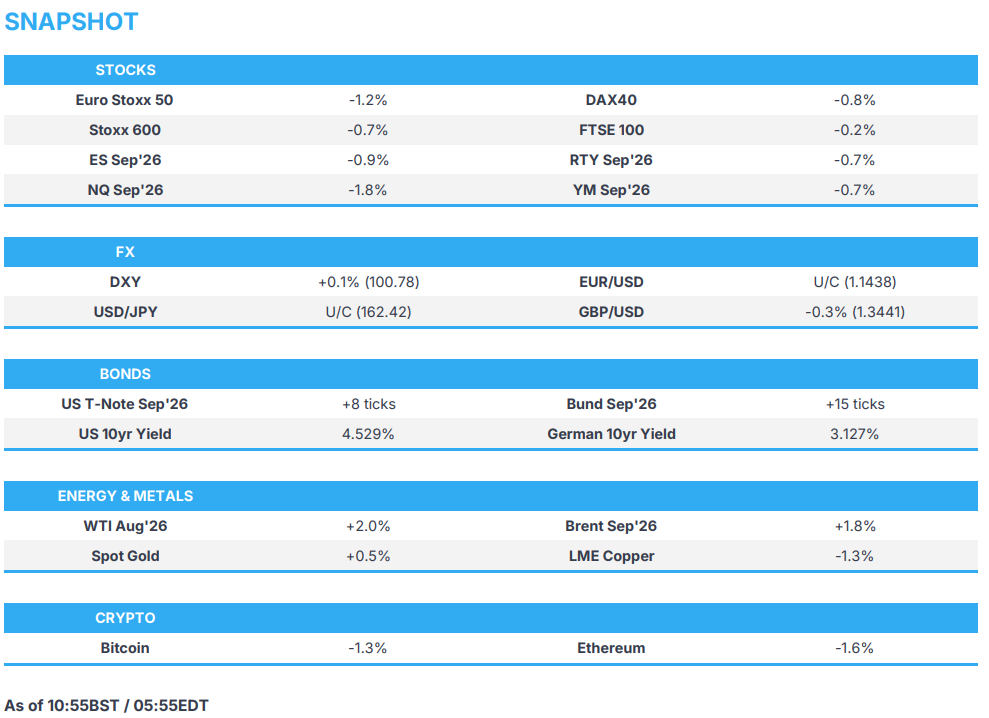
Newsquawk in 3 steps:
1. Subscribe to the free premarket movers reports
2. Listen to this report in the market open podcast (available on Apple and Spotify)
3. Trial Newsquawk’s premium real-time audio news squawk box for 7 days
EUROPEAN TRADE
EQUITIES
- European bourses (STOXX 600 -0.7%) are broadly lower, following on from the weakness in Asia (Nikkei -4%, Hang Seng -2.1%), with clear underperformance seen in the AEX (-1.0%) and FTSE MIB (-0.8%).
- Tech (ASML -4.2%, STMicroelectronics -6.9%) is the clear underperformer following the sharp selloff overnight in APAC names, as worries of stretched valuations persist. Despite the selloff, this week has been broadly positive in the tech space, with both TSMC and ASML reporting strong Q2 figures that beat estimates. Today’s weakness just shows that, despite positive news, concerns over the AI capex and its current momentum persist.
- In terms of the broader sector space, the bias is mixed. Utilities (+1.5%) top the sector pile, followed by Food, Beverages & Tobacco (+0.9%) and Telecoms (+1.1%). Outside of Tech (-2.9%), Basic Resources (-2.1%) and Banks (-1.2%) are the sector laggards.
- US equity futures are lower across the board, with underperformance in the NQ (-1.9%), given the tech weakness overnight. After-hours, Netflix (-9% pre-market) reported Q2 earnings that came broadly in-line with expectations, but investors were left disappointed by its earnings forecast, with Q3 EPS and Revenue guidance missing estimates. For SpaceX (-3.5% pre-market) , shares fell below its IPO price of USD 135 for the first time on Thursday after the launch of Flight 13 was aborted.
- Click for the sessions European pre-market equity newsflow
- Click for the additional news
FX
- G10s are mixed against Buck with recent outperformers AUD and GBP underperforming against the Greenback, while Thursday’s CHF underperformance reverses.
- USD is modestly firmer today as it gains some haven demand as stocks (NQ -1.9%) slip as tech weakness remains a theme. A couple of factors are driving today, but to summarise, Nikkei 225 was the target for selling amid the KOSPI closure overnight (due to domestic holiday), which saw stocks take a stronger negative lead from APAC and help the Buck. Aside from this, macro newsflow is light with crude a touch firmer as US and Iran continue to exchange strikes for the sixth day.
- GBP, which is set for a fourth week of gains, pulls back a touch from the 1.35 level as participants await the coronation of incoming PM Burnham. EUR/GBP also saw Sterling outperform for its fourth week, but like Cable, off recent lows as it reclaims 0.85. There remains a level of uncertainty around the incoming PM, with none of his cabinet officials confirmed as of yet, and many policies still unknown. ING expects a return to 0.870 in EUR/GBP by late summer.
- JPY is flat against the Buck despite c. 30pips of downside seen this morning. Japanese PM Takaichi said the govt. would pursue steps that encourage investment in Japanese financial assets, including by households and pension funds like the GPIF. To remind, last week FinMin Katayama said she would pursue steps to promote investment in Japanese assets by GPIF and others. There was some scepticism around this remark as it would be a textbook tactic to encourage domestic investment and passively limit outflows – Katayama is not in a position to direct changes, it would be under the jurisdiction of the Labour Ministry. We await further updates with a timeline around any potential GPIF changes, for now, JPY flat against the Buck near 162.50 despite earlier gains.
FIXED INCOME
- Fixed income benchmarks are firmer across the board, despite a clear driver; however, debt could be finding some haven flows as equities print deep selloffs globally.
- Gilts (+26 ticks) outperform, with Andy Burnham to begin his Labour premiership on Monday. Focus will be on who Burnham chooses as Chancellor (widely expected to be Home Secretary Mahmood) and what his plans are for the government. Reporting by Bloomberg stated that he has asked the civil service to prepare plans for new North Sea oil and gas drilling and public control of Thames Water. Regarding the Chancellor position, Mahmood is likely to be named Chancellor, but this has already drawn some backlash. Rachel Maskell told the Times that appointing Mahmood would be a mistake and that Miliband “shines well above Shabana.” Despite this, gilts trade at the top end of its 87.15-87.59 range.
- JGBs (+36 ticks) have steadily bid higher in early European trade, after Japanese PM Takaichi said the government will pursue steps that encourage investment in Japanese financial assets, including by households and pension funds. She even specifically named GPIF. Focus on pension fund investments in domestic assets started after FinMin Katayama said she wanted to encourage the GPIF to invest more. Takaichi’s more recent comments would likely strengthen the view that the government is keen to have the GPIF consider altering its asset allocations.
- USTs (+8 ticks) trend higher despite a lack of events on the calendar. Fed’s Jefferson gave remarks overnight, stating that it would be appropriate to reconsider the stance in the scenario in which inflation does not start cooling.
COMMODITIES
- The US continued to strike Iran for a sixth consecutive night. Following this, Iran claimed power facilities, bridges and civilian infrastructure were struck. And in response, Iran launched its own strikes on Gulf neighbours.
- More pertinently was a severe warning from the Iranian Army Spokesman. He stated that if the US strike the infrastructure of Iran, all infrastructure in the region will be a legitimate target; He added that “either all countries in the region can export oil or no one can”.
- Other news in the region, the UKMTO received 2 reports. More recently, there was a report 65NM south of Al Mukalia, in which unauthorised personnel boarded the vessel. Sources say armed assailants boarded a chemical products tanker Asana in the Gulf of Aden, which is potentially related.
- Crude benchmarks spent the overnight session in the green, amidst the aforementioned developments. Brent Sep’26 (+1.7%) holds towards the top end of a USD 83.71-85.88/bbl range.
- Spot gold (+0.5%) is incrementally firmer this morning, though still remains just shy of the USD 4k/oz mark, after dipping below that mark in the prior session. Recent pressure has been driven by the ongoing inflationary woes surrounding the latest US-Iran escalation. Nonetheless, some analysts remain confident in the structural drivers for the yellow metal, namely, continued central bank purchases. Elsewhere, base metals are broadly in the red this morning – hampered by the risk tone. 3M LME Copper trades within a USD 13,429-13,563/t range.
- BP (BP/LN) and ConocoPhillips (COP) reportedly set to announce billions of dollars of new investments in Iraq on Friday, CNBC reports; sources said the figure may be in the tens of billions.
- Chinese LNG importers are exploring ways to reduce reliance on Qatar, Bloomberg reported.
- China State Planner NDRC to cut retail fuel prices in the current bi-monthly cycle, effective July 18th. To cut gasoline prices by CNY 300/t, and diesel by CNY 290/t.
- TotalEnergies (TTE FP) cut output at Port Arthur refinery as the reformer is undergoing repairs.
TRADE/TARIFFS
- Brazil’s Rosa, on rare earths, said the US asked them to limit investment by other countries that do not comply with market rules, and will not accept this.
NOTABLE EUROPEAN DATA RECAP
- EU Inflation Rate YoY Final (Jun) Y/Y 2.8% vs. Exp. 2.8% (Prev. 3.2%, Low. 2.8%, High. 2.9%).
- EU Inflation Rate MoM Final (Jun) M/M -0.1% vs. Exp. -0.1% (Prev. 0.1%, Low. -0.1%, High. -0.1%).
- EU Core Inflation Rate YoY Final (Jun) Y/Y 2.4% vs. Exp. 2.4% (Prev. 2.6%).
CENTRAL BANKS
- Fed’s Jefferson (voter) said the current policy stance should support the job market and allow inflation to resume its decline towards 2% as tariff effects and energy prices pass through. Jefferson said in a scenario where inflation does not start cooling, it could be appropriate to reconsider the stance and ensure they deliver price stability, while he added that current policy is well-positioned to respond based on incoming data, the evolving outlook and balance of risks, and he is firmly committed to returning inflation to the 2% target, consistent with the dual mandate.
- BoJ reportedly sees little need for consecutive rate rises, may reconsider its assessment of economic risks, according to Bloomberg citing sources. It is also likely to raise its growth forecast for this year from its current 0.5%. Officials may revise their downside-risk assessment as AI-related demand supports exports, profits and incomes, while faster cost pass-through keeps underlying inflation risks elevated above the 2% target.
NOTABLE US HEADLINES
- US President Trump announced the immediate declassification of intelligence on elections during his primetime address and noted that China engaged in election-related activities in 2020 and did not want him to win the election, while he claimed that China attempted to manufacture ballots for Biden and worked to influence businesses against him. China’s Foreign Ministry denied these accusations.
- US President Trump called on Congress to pass the Save America Act in light of recent revelations.
GEOPOLITICS
MIDDLE EAST
- US President Trump said they will see the fruits of labour in Iran shortly.
- US CENTCOM said forces conducted a new wave of strikes against Iran for the sixth consecutive night to further degrade Iranian military capabilities. The US launched a missile attack on Iranshahr airport, targeted a railway station in Bandar Abbas and struck five bridges in southern Iran. It was also reported that explosions were heard in Ahvaz, Chabahar and Bushehr, with missiles hitting air and naval bases in Bushehr.
- US CENTCOM announced Marines conducted an inspection aboard M/T Wen Yao in the Gulf of Oman on July 16th, while it was separately reported that only three ships crossed the Strait of Hormuz in the last 24 hours, according to marine traffic data cited by Al Jazeera.
- Iran targeted US radars in Kuwait with a drone strike, and explosions were reported at the US Navy’s Fifth Fleet Naval Base in Bahrain, while blasts were heard at a US airbase in Qatar and in Erbil, Iraq.
- IRGC claimed to have launched an attack on a US command centre in Syria’s Al-Tanf, while it warned no oil or gas will be exported through the Strait of Hormuz as long as US attacks continue.
- Iran has informed allies, including Hezbollah, that the waiting phase is about to end and ordered them to prepare for military scenarios, according to Kann news citing Lebanese press.
- Kuwait’s Defence Ministry said Iranian ‘aggression’ on Thursday targeted a number of vital facilities, resulting in material damage.
- Iranian armed forces senior spokesperson said they will never allow the US to interfere in the Strait of Hormuz, while he stated that the route Iran has determined in the Strait of Hormuz is safe, and any route outside it will be unsafe and ships will be damaged. The spokesperson also warned that if the US strike the infrastructure of Iran, all infrastructure in the region will be a legitimate target and stated that “Either all countries in the region can export oil or no one can”.
- UKMTO has received a report of an incident 19 nautical miles east of Khasab, Oman. Additionally, the UKMTO received another report of an incident 65NM south of Al Mukalia, Yemen, with the vessel boarded by unauthorised personnel. Following this, maritime sources said armed assailants boarded a chemical products tanker Asana in the Gulf of Aden, off the coast of southern Yemen.
- Lebanese sources said the US-Israeli-Lebanon meeting would likely be postponed to finalise technical arrangements, Sky News Arabia reported.
- Islamic Resistance of Iraq put a USD 10mln bounty on US President Trump.
RUSSIA-UKRAINE
- Naftogaz said a Russian drone attack suspended operations at a gas production facility in Ukraine’s Kharkiv region.
CRYPTO
- Bitcoin extended Thursday’s lows and slipped below the USD 63k handle.
APAC TRADE
- APAC stocks were pressured as the tech selling rolled over from Wall St and with sentiment weighed on by US-Iran escalation, in which the US conducted a sixth consecutive night of strikes on Iran and targeted infrastructure, including an airport, railway station and several bridges.
- ASX 200 was dragged lower by weakness in mining, materials, resources and tech, while telecoms, energy and defensives were at the other end of the spectrum, helping cushion the downside.
- Nikkei 225 underperformed and took the brunt of the semiconductor sell-off in the absence of its South Korean counterpart due to Constitution Day, while Kioxia was heavily pressured and has shed 50% of its market cap from last month’s peak.
- Hang Seng and Shanghai Comp conformed to the downbeat mood amid the tech-related woes, and with sentiment also not helped by US President Trump’s primetime address, in which he accused China of meddling in the 2024 US Election and called for Congress to pass the SAVE America Act.
NOTABLE ASIA-PAC HEADLINES
- Japanese PM Takaichi said the government will pursue steps that encourage investment in Japanese financial assets, including by households and pension funds like the GPIF.
- Chinese President Xi said that the world has entered an unprecedented period of AI innovation, adding they should seize rare historic opportunities to encourage open source AI.
- China FX regulator said foreign investments into China saw net inflows in H1 and outbound investments continue to grow steadily.
1c Asian opening report
Europe primed for weak open as Nikkei 225 slides as much as 5% – Newsquawk EU Market Open
Friday, Jul 17, 2026 – 02:22 AM
- The US continued to strike Iran, for a sixth consecutive night; Iran claimed that power facilities, bridges and civilian infrastructure were struck.
- Iranian Army Spokesman warned that if the US strike the infrastructure of Iran, all infrastructure in the region will be a legitimate target; he added that “either all countries in the region can export oil or no one can”.
- US President Trump stated that they will see the fruits of labour in Iran shortly.
- APAC Stocks were pressured, with Nikkei 225 (-5%) leading the declines; European equity futures are indicative of a weaker open.
- DXY is a touch firmer this morning; G10s are broadly lower, albeit modestly so.
- Looking ahead, highlights include EZ CPI Final (Jun), US Building Permits (Jun), Export/Import Prices (Jun), Industrial Production (Jun), UoM Consumer Expectations (Jul), Atlanta Fed GDP, Comments from ECB’s Cipollone.
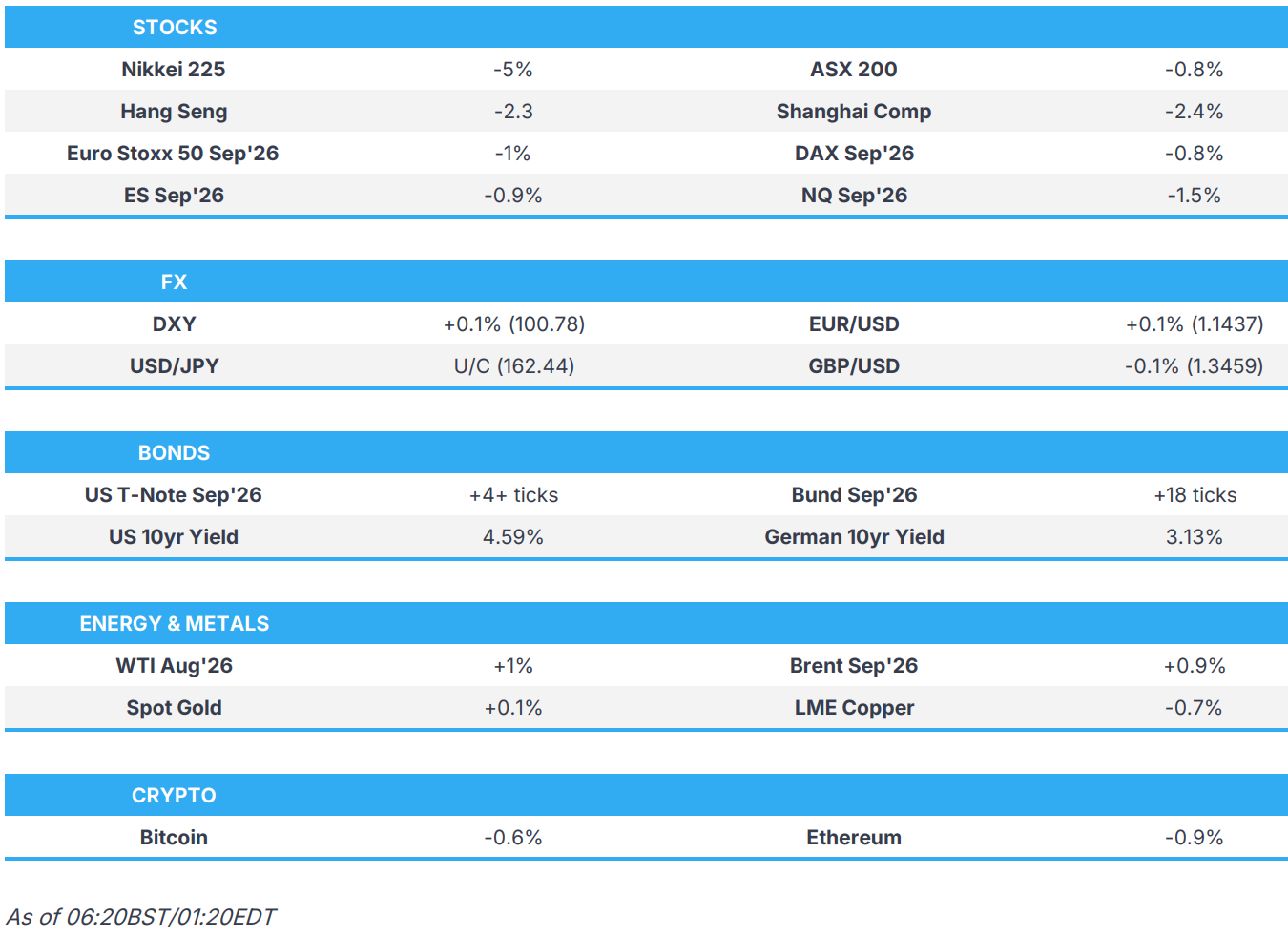
Newsquawk in 3 steps:
1. Subscribe to the free premarket movers reports
2. Listen to this report in the market open podcast (available on Apple and Spotify)
3. Trial Newsquawk’s premium real-time audio news squawk box for 7 days
IRAN CONFLICT
- US President Trump said they will see the fruits of labour in Iran shortly.
- US CENTCOM said forces conducted a new wave of strikes against Iran for the sixth consecutive night to further degrade Iranian military capabilities. US launched a missile attack on Iranshahr airport, targeted a railway station in Bandar Abbas and struck five bridges in southern Iran. It was also reported that explosions were heard in Ahvaz, Chabahar and Bushehr, with missiles hitting air and naval bases in Bushehr.
- US CENTCOM announced Marines conducted an inspection aboard M/T Wen Yao in the Gulf of Oman on July 16th, while it was separately reported that only three ships crossed the Strait of Hormuz in the last 24 hours, according to marine traffic data cited by Al Jazeera.
- Iran targeted US radars in Kuwait with a drone strike, and explosions were reported at the US Navy’s Fifth Fleet Naval Base in Bahrain, while blasts were heard at a US airbase in Qatar and in Erbil, Iraq.
- IRGC claimed to have launched an attack on a US command centre in Syria’s Al-Tanf, while it warned no oil or gas will be exported through the Strait of Hormuz as long as US attacks continue.
- Kuwait’s Defence Ministry said Iranian ‘aggression’ on Thursday targeted a number of vital facilities, resulting in material damage.
- Iranian Supreme Leader’s advisor Mokhbar said damage to Iran’s infrastructure would be a one-way ticket to the destruction of the entire regional energy supply chain.
- Iranian armed forces senior spokesperson said they will never allow the US to interfere in the Strait of Hormuz, while he stated that the route Iran has determined in the Strait of Hormuz is safe, and any route outside it will be unsafe and ships will be damaged. The spokesperson also warned that if the US strike the infrastructure of Iran, all infrastructure in the region will be a legitimate target and stated that “Either all countries in the region can export oil or no one can”.
- Islamic Resistance of Iraq put a USD 10mln bounty on US President Trump.Strong explosions were reportedly heard in Dubai and Abu Dhabi, while an Iranian journalist claimed the UAE had struck targets in southern Iran. However, Dubai’s Media Office denied reports of explosions in central Dubai, describing the information as inaccurate.
- Qatar rejected reports that it had agreed to participate in military action against Iran.
- Israeli President Herzog said he continued to believe diplomacy remained the best path to resolving the conflict with Iran, while welcoming what he described as a “firm and clear” US response.
US TRADE
EQUITIES
- US stock markets were mostly lower with the Nasdaq leading the downside as concerns over AI valuations weighed on the technology sector. This comes despite TSMC reporting strong quarterly earnings, as the results failed to satisfy lofty investor expectations alongside a capex raise, while the stock ultimately closed lower alongside the broader semiconductor complex. Alphabet (GOOGL) shares also added to the pressure late in the session after reports that it had delayed the launch of Gemini 3.5 after the model failed to meet internal performance targets. Looking beneath the headline indices, underlying market breadth was more constructive, as the equal-weight S&P 500 rose around 0.75%, while a slight majority of sectors finished in positive territory. Consumer Staples led the gains, with Health Care and Real Estate also outperforming. By contrast, Communication Services, Technology and Industrials lagged, highlighting that much of the weakness was concentrated within AI-related names rather than the broader market.
- SPX -0.51% at 7,534, NDX -1.62% at 29,026, DJI -0.20% at 52,554, RUT +0.01% at 2,977.
- Click here for a detailed summary.
TARIFFS/TRADE
- Brazil reportedly readies tough retaliation to new US tariffs, according to Reuters citing sources.
- Brazil’s VP Alckmin said US tariffs are unfair and unreasonable, while he noted the US have a trade surplus with Brazil, and stated the reciprocity law is a legal instrument and is not about retaliation.
NOTABLE HEADLINES
- US President Trump announced the immediate declassification of intelligence on elections during his primetime address and noted that China engaged in election-related activities in 2020 and did not want him to win the election, while he claimed that China attempted to manufacture ballots for Biden and worked to influence businesses against him. Trump said documents reveal vulnerabilities in the US election system, as well as prove that voting machines are exposed to attack and voter registration databases are vulnerable. Furthermore, he said Russia, China, Iran and North Korea can harm US election infrastructure and noted that 278k non-citizens are registered to vote, while he called for the revocation of licenses of television networks that refused to broadcast his speech and urged Congress to pass the SAVE America Act.
- Fed’s Jefferson (voter) said the current policy stance should support the job market and allow inflation to resume its decline towards 2% as tariff effects and energy prices pass through. Jefferson said in a scenario where inflation does not start cooling, it could be appropriate to reconsider the stance and ensure they deliver price stability, while he added that current policy is well-positioned to respond based on incoming data, the evolving outlook and balance of risks, and he is firmly committed to returning inflation to the 2% target, consistent with the dual mandate.
- Fed’s Logan (2026 voter) said a modestly higher policy rate would provide a better balance of risks and outlook, while she added that it was time to finish the job of restoring price stability. Logan said one month of softer CPI data was insufficient, some degree of policy restriction remained necessary, and inflation did not appear to be returning sustainably to the 2% target on its own. Furthermore, she stated that downside risks to employment had faded and that inflation risks remained skewed to the upside.
- Fed’s Schmid (2028 voter) said inflation remained persistent across a broad range of goods and services and continued to be concerning. Schmid also stated that accountability required the Fed to explain how it made policy decisions, providing transparency and allowing open criticism, while he remains focused on inflation when setting monetary policy.
APAC TRADE
EQUITIES
- APAC stocks were pressured as the tech selling rolled over from Wall St and with sentiment weighed on by US-Iran escalation, in which the US conducted a sixth consecutive night of strikes on Iran and targeted infrastructure, including an airport, railway station and several bridges.
- ASX 200 was dragged lower by weakness in mining, materials, resources and tech, while telecoms, energy and defensives were at the other end of the spectrum, helping cushion the downside.
- Nikkei 225 underperformed and took the brunt of the semiconductor sell-off in the absence of its South Korean counterpart due to Constitution Day, while Kioxia was heavily pressured and has shed 50% of its market cap from last month’s peak.
- Hang Seng and Shanghai Comp conformed to the downbeat mood amid the tech-related woes, and with sentiment also not helped by US President Trump’s primetime address, in which he accused China of meddling in the 2024 US Election and called for Congress to pass the SAVE America Act.
- US equity futures extended on the prior day’s declines as the tech selling resumed, and with Netflix shares pressured following its earnings results and weak guidance.
- European equity futures indicate a negative cash market open with Euro Stoxx 50 futures down 0.7% after the cash market closed with gains of 0.3% on Thursday.
FX
- DXY was rangebound overnight but held on to the prior day’s spoils after benefitting from a slew of data in which jobless claims declined and retail sales matched estimates. There were also some recent hawkish Fed comments as Logan said a modestly higher policy rate would provide a better balance of risks and outlook, and that it was time to finish the job of restoring price stability. Elsewhere, Fed’s Schmid said inflation remained concerning and was persistent across a broad range of goods and services.
- EUR/USD lacked direction after recent declines and remained within the 1.1400 handle.
- GBP/USD was subdued at sub-1.3500 territory amid the downbeat risk appetite and after UK monthly GDP and output data underwhelmed, while focus in the UK turns to politics, with a changing of the guard, in which Andy Burnham is to take over as leader of the ruling Labour Party later today.
- USD/JPY lingered at the 162.00 handle after recent gains in US yields and mild upside in oil prices, although further upside was limited as Japanese Finance Minister Katayama repeated familiar jawboning.
- Antipodeans were lacklustre amid the ongoing tech sell-off and absence of tier-1 data.
- PBoC set USD/CNY mid-point at 6.7934 vs exp. 6.7734 (prev. 6.7909)
FIXED INCOME
- 10yr UST futures gradually edged higher amid a flight to safety, but with upside capped following recent indecision, encouraging US economic data, hawkish Fed commentary, and higher oil prices.
- Bund futures eked out mild gains amid the spooked risk appetite and reclaimed the 125.00 status.
- 10yr JGB futures were choppy and ultimately benefited from the sell-off in tech stocks.
COMMODITIES
- Crude futures gained as the US continued its strikes on Iran for the 6th consecutive evening, in which it targeted Iranian infrastructure, including an airport, railway station and bridges, while it was reported that maritime traffic data showed that only three ships crossed the Strait of Hormuz in the last 24 hours.
- Spot gold attempted to nurse losses but was choppy around the USD 4,000/oz level after recently sliding alongside a firmer buck, and with the precious metal on track for its biggest weekly decline in six weeks.
- Copper futures extended on yesterday’s declines amid the negative risk appetite and tech sell-off.
CRYPTO
- Bitcoin retreated overnight after hitting resistance near the USD 64,000 level and amid a tech sell-off.
NOTABLE ASIA-PAC HEADLINES
- Chinese President Xi said at the World AI Conference in Shanghai that the world has entered an unprecedented period of AI innovation, while he added that they should seize rare historic opportunities to encourage open source AI.
- China’s FX regulator said foreign investments into China saw net inflows in H1 and outbound investments continue to grow steadily, while China plans to roll out a package of policies to further facilitate cross-border investments and financing as well as announced allocating fresh QDII quotas.
- Japanese Finance Minister Katayama wouldn’t comment on FX levels and reiterated that they are ready to respond appropriately on currency moves at any time as needed, and stated they are prepared to take decisive action if necessary.
GEOPOLITICS
OTHER
- North Korean state media labelled South Korea a ‘puppet’ for its role in US maritime exercises, while it was separately reported that North Korean leader Kim Jong Un held talks with the Chinese People’s Political Consultative Conference Chairman, Wang Huning, in Pyongyang.
EU/UK
NOTABLE HEADLINES
- Several big UK lenders this week began raising their mortgage interest rates by as much as 35bps after a resumption of Middle East hostilities, according to FT.
- end
end
NORTH AND SOUTH KOREA AND JAPAN
SOUTH KOREA
“The Trend Is Now An Enemy”: Kospi Slide Will Deepen As Momentum Flips Script
Thursday, Jul 16, 2026 – 10:11 PM
By David Savage, Bloomberg Markets Live reporter and strategist
The trend is now an enemy for Asian equities, especially those in South Korea, rather than the friend it was when they soared for much of the first half of 2026.
Momentum has been the undisputed king for global factor investing in 2026, particularly for Asian markets. Those trades are fracturing, as reversals in South Korea and other tech-heavy sectors set off a deepening rotation in the region. Investors look to be taking some of the hefty profits that remain on the winners from 1H 2026 and pivoting toward other assets. That’s a theme also gaining traction for US chipmakers, with the SOX Index down more than ~18% from the highs of June.

June is looking like it was the peak for Asian equity momentum. That was when some key global index rebalancing provided a price insensitive buyer for recent AI-aligned winners. Aided by the SpaceX IPO, that kicked off a retail frenzy that reverberated across Asian markets. Now that rebalancing activity has passed, and recent additions to benchmarks such as SpaceX and Marvell Technology are seeing some mean reversion.

Foreign equity outflows were already making Asia more dependent on retail investors, who turned to leveraged ETFs and margin borrowing to amplify their bets. Overseas funds offloaded over $100 billion of South Korean stocks and more than $30 billion of Taiwanese shares YTD. That came even as those markets expanded to each surpass $5 trillion in June, overtaking the UK and Canada to join the top 8 exchanges by market cap.
Retail investors filled the void, especially in Korea. Unburdened by portfolio constraints that oblige active and passive funds to prune winning positions, retail accounts can hold onto winners for longer or even double down on them, reinforcing momentum as a dominant trend.
Now, one of the main products of the momentum trade — leveraged ETFs — is becoming a major negative for Asia, which had led the way as these assets expanded globally this year. So much so that South Korean authorities just said they will halt any new listings of single-stock ETFs and increase regulations on trading such products in an attempt to dampen market volatility.
Memory giant SK Hynix attracted one of the highest concentrations of single-stock leveraged ETF assets. In late May, Korea permitted the setting up of several domestically-listed single-stock leveraged ETFs, spurring a surge of flows into vehicles offering 2x exposure to the performance of SK Hynix and Samsung Electronics. At the peak, just three such SK Hynix ETFs held over $23 billion in assets, more than 2.5x the average daily turnover in the company’s locally listed shares.

These funds utilize swaps and options to maintain the 2x daily exposure they offer. As the underlying price moves, the fund’s leverage ratio drifts, triggering rebalancing to restore the target ratio. Thus, if the price of SK Hynix falls, then the fund (or its swap counterparty) needs to sell down exposure to bring the leverage ratio back to 2x.
The unwind of these vehicles has punished equity momentum in July and spurred a rotation in Asia toward former laggards.

The momentum factor had outperformed since the end of March as cross-asset volatility retreated, global growth remained resilient and oil prices dropped.
But now, renewed US-Iran fighting is pushing crude higher, breathing new life into the US dollar and reviving global rate hike fears. Asia’s equities are proving more vulnerable than most to tighter financial conditions and the resurfacing of geopolitical risks.
The reversal in trading dynamics, aided by the impact of leveraged retail investors, is sending volatility surging with the Kospi’s 30-day realized price swings rising to a new record. That signals the past month’s declines in the Kospi have the potential to extend, souring sentiment across Asia and even beyond to chipmakers globally.
END
JAPAN
Goldman’s Asian Desk Explains Today’s Crash In Japan
AI
Today’s Japan selloff (Nikkei down ~3-4% on July 17, 2026) is part of a broader Asian chip/memory stock rout, not a standalone “crash” like 1987 or prior yen-carry unwind episodes.
businessinsider.com
It stems from profit-taking and valuation concerns in the AI/tech rally after strong earlier gains in 2026. Key drivers include:
- Chip/AI valuation fears: Memory and semiconductor stocks led the decline. Japan’s Kioxia (a major memory chipmaker) plunged ~16% after US-listed peers sold off, erasing massive prior gains (it had soared 631% in H1 as one of the top non-US performers and briefly became Japan’s most valuable listed company). Other Japanese names like Advantest, Tokyo Electron, and SoftBank also dropped sharply. businessinsider.com
- Regional spillover: South Korea’s KOSPI extended losses (down significantly in prior sessions, with circuit breakers triggered on leveraged ETF/margin pressures in Samsung and SK Hynix). Taiwan’s TAIEX fell on TSMC capex concerns. This created a sector-led unwind across Asia’s heavily weighted tech/semiconductor names. ethivo-briefing.com
- Broader context: Global tech jitters (e.g., Nasdaq futures weak), energy price worries, and rotation out of crowded longs. Japan had seen extreme outperformance in the Nikkei (tech-heavy) vs. broader Topix earlier in the year, setting up for mean reversion. youtube.com
Goldman Sachs commentary (via their Asian/equity strategists and notes around this period) has highlighted strong earnings as the main driver of Japan’s earlier rally, while noting risks from concentrated positioning, fiscal policy concerns, yen dynamics, and potential contagion from Korea. Their desk likely framed today’s move as a technical correction in overbought AI-related names rather than a fundamental breakdown—orderly selling with focus on valuations, not a narrative shift.
youtube.com
This fits the pattern of recent volatility: sharp pullbacks in crowded AI/semiconductor trades after parabolic runs, amplified by leverage in places like Korea. Japan-specific factors (BOJ policy, yields, yen) add layers but weren’t the primary trigger today. Markets remain sensitive to US tech cues and geopolitical energy risks.
derivatives-t.com
For real-time desk color, check sources like ZeroHedge (which highlighted Goldman notes) or Bloomberg terminals—typical trading desk language would emphasize flows, positioning, and sector rotation over panic. Longer-term, many strategists (including Goldman) remain constructive on Japan if earnings hold. Always cross-reference multiple views, as desks provide timely but biased snapshots.
END
3 CHINA/RARE EARTHS
“The Killer Chokepoint”: China’s Rare Earth Squeeze Is Reshaping The Global Economy
Thursday, Jul 16, 2026 – 09:20 PM
Artificial intelligence may be driving headlines, but one of its biggest vulnerabilities is an obscure metal that few people have ever heard of. Yttrium, a rare earth element first identified more than two centuries ago, has quietly become an essential ingredient in advanced semiconductor manufacturing, according to the Financial Times. As demand for AI chips accelerates, securing reliable access to the metal has become a growing strategic concern.
“We’re in the middle of a sea change in terms of how the global economy works.”
— Daniel Yergin, vice-chair of S&P Global, describing the shift away from purely efficiency-driven global supply chains.
That concern stems from a simple reality: China dominates the processing and supply of yttrium, along with many other niche metals that modern industries depend on. Over the past several years, Beijing has tightened export restrictions on a number of critical minerals, giving it increasing leverage over global supply chains at a time when geopolitical tensions with the United States remain elevated.
FT writes that while gallium and germanium have received much of the public attention because of their roles in defense systems and electronics, industry executives increasingly argue that yttrium may represent the bigger long-term problem. One semiconductor supplier called it “the killer chokepoint,” warning that the industry faces “an existential risk” until alternative supply chains are fully established.

The uncertainty has triggered a rush among manufacturers to secure inventory wherever they can find it. Companies involved in defense, automotive production and semiconductor manufacturing have reportedly been scrambling for supply, with some executives warning that production could begin slowing or even halting before the end of the year if shortages worsen.
Ironically, the West helped create today’s imbalance. Decades ago, many countries were happy to outsource mineral processing because it was expensive, environmentally challenging and labor intensive. China invested heavily instead, building refining capacity and subsidizing production while much of the rest of the world allowed those industries to disappear.

The warning signs were visible long before today’s trade disputes. Beijing demonstrated its willingness to use rare earth exports as geopolitical leverage during a dispute with Japan in 2010, but many manufacturers continued relying on Chinese suppliers because the economics remained difficult to match elsewhere. Cheap Chinese production became deeply embedded throughout global manufacturing.
“Thirty years ago, [the west] wanted China to do all the processing of these minerals. We didn’t want it because it was too polluting. The west handed over the opportunity.”
— Tim Biggs, professor at the Camborne School of Mines.
Rather than imposing outright bans, China now largely controls exports through a licensing system that determines who receives shipments and when. Companies say approvals often arrive unpredictably, making it difficult to manage production schedules or plan inventory. The uncertainty has encouraged widespread stockpiling, sending prices sharply higher across several specialty metals.
Western governments are now racing to reverse decades of dependence. Billions of dollars are being directed toward new mining projects, processing facilities and strategic stockpiles in an effort to rebuild domestic supply chains. Policymakers increasingly frame critical minerals as a national security issue rather than simply an economic one.

Even so, rebuilding the industry will take years. New mines require enormous capital, lengthy permitting processes and significant infrastructure before they can begin producing. Industry executives also caution that if too many projects eventually come online at once, markets could swing from shortages to oversupply, undermining the economics of the very investments governments are trying to encourage.
The fight over AI leadership, therefore, extends well beyond software, data centers and cutting-edge chips. It also depends on securing the obscure raw materials that make those technologies possible. After decades of prioritizing efficiency and low costs, governments and manufacturers are now discovering that resilient supply chains may prove just as strategically important as the innovations they support.
4. EUROPEAN AND SCANDINAVIAN COMMENTARIES PLUS NATO
UK
STRANGE INDEED
What’s Really Going On? UK Government Announces Mass Stockpile Order, Wargames
Friday, Jul 17, 2026 – 05:00 AM
Authored by Steve Watson via Modernity.news,
The British government is preparing to tell ordinary people a blunt message: the state is not coming to save you. Households will be urged to stockpile long-life food, bottled water, essential medicines and even wind-up radios as part of a new national resilience campaign launching later this year.

At the same time, ministers have confirmed Operation Albiston Shadow – the largest home defence wargame exercise in decades – will take place in 2027, testing responses to ‘hybrid’ attacks alongside a major NATO drill.
Officials frame it all around Russian cyber threats, sabotage risks and the need to update the old Government War Book. Yet the timing and language raise a sharper question about what Whitehall is actually preparing for.
Chief Secretary to the Prime Minister Darren Jones stated “The government will do all it can and we are well prepared – but we can all play our part to keep ourselves and our loved ones safe. This campaign will help the public to take small but important steps to be prepared in case of emergencies and disruption – be that severe weather or a cyber-attack, which can impact access to power, water, or phone signal.”
Armed Forces minister Louise Sandher-Jones was more explicit about the external threat: “Russia is not only a threat to NATO’s eastern flank. It is a direct threat to the UK homeland and these exercises, together with important measures like updating our ‘War Books’, will help prepare us to meet that threat, as well as showing the British public how seriously we are taking it.”
The Cabinet Office has updated the National Risk Register with new scenarios including cyber attacks on data, water and police systems, digital resilience failures modelled on the 2024 CrowdStrike outage, and foreign interference in democracy.
Operation Albiston Shadow will involve hundreds of officials, ministers and agencies role-playing a multi-day national crisis focused on hybrid attacks below the threshold of conventional war. It is designed to test current assumptions and ensure readiness “should the worst ever happen.”
The government is also quietly reviving elements of the old War Book – the detailed Cold War-era plan that once covered everything from industrial mobilisation and food stockpiles to mass casualty management and the survival of government itself. That document was largely abandoned after the Cold War; updating it now signals a serious shift.
On the surface this looks like prudent planning against a hostile foreign power. Russia has been accused of cyber operations, espionage and probing NATO airspace. Prime Minister Keir Starmer has previously cited Western intelligence assessments that Russia could attack a NATO member as soon as 2030.
Yet the distance between the United Kingdom and any realistic Russian ground threat is vast, and the emphasis on household stockpiles, critical infrastructure protection and whole-of-society mobilisation sits uneasily with pure external-defence rhetoric.
This is where the deeper context becomes impossible to ignore. In 2025, Professor David Betz of King’s College London, a specialist in modern war and unconventional conflict, publicly argued that the British government is preparing for the possibility of civil conflict at home while using the Russian threat as a politically convenient cover.https://modernity.news/2025/07/02/professor-warns-uk-government-is-preparing-for-civil-war-using-russian-invasion-threat-as-cover/embed/
Speaking about the 2025 National Security Strategy – which stated “For the first time in many years, we have to actively prepare for the possibility of the UK homeland coming under direct threat” and prioritised protection of undersea cables, energy pipelines and logistics hubs – Betz observed: “there is growing apprehension about the security of Britain, the security of its infrastructure specifically, and about the potential for active conflict at home in a very direct manner, effecting people in a very direct manner.”
He continued: “But that’s not external in origin, that’s internal, and that has to do with the way our society is now configured, it is highly fractured.” Betz described a society marked by “Low trust, highly fractured, and highly politically factionalised which is leading us increasingly inevitably into civil conflict.”
On the Russian narrative he was blunt: “The fact of the matter is there is a great distance between us and Russia… we are not militarily threatened in a direct way on the ground by any obvious external enemy, even Russia… one of those is not occupying the village green with Russian soldiers, that simply, frankly, is a rather bizarre assertion.”
The real concern, he argued, is domestic: “What they’re concerned about is domestic conflict, and they perfectly understand this, but that’s completely politically toxic for them to say so publicly, hence the convenience of saying ‘we need to develop… a citizen’s militia for the protection of critical infrastructure’. To say that we’re doing this against the potential of Russian attack, which is frankly a logically absurd proposition, but it is convenient as a pretext.”
Betz has repeatedly warned that Europe faces a statistically significant chance of civil war in a major country within five years, with spillover risks, and that governments may only be able to prepare rather than prevent the deterioration. His advice to individuals has been practical: reduce exposure to big cities if possible.
Betz’s analysis tracks the same societal fractures – low social trust, political factionalism, rapid demographic change and collapsing faith in institutions – that successive governments have accelerated through mass immigration policies while denying their consequences.
Critical infrastructure hardening, citizen resilience messaging and large-scale home defence exercises make perfect sense if planners believe the primary threat could come from within a polarised population rather than from Russian troops landing on British beaches.
Updating the War Book and running Operation Albiston Shadow allow the state to rehearse command, control and societal mobilisation without ever having to admit the internal drivers.
The pattern is consistent with earlier signals. Promises of a volunteer Home Defence Force to protect infrastructure appear to have been quietly shelved amid budget pressures, yet the broader shift toward treating the homeland as a potential battlespace continues.
Officials stress “whole of society” involvement. That language is not limited to foreign hybrid warfare; it is exactly the vocabulary used when states prepare for internal disorder.
None of this proves an imminent civil war. It does show a government that has spent years denying the reality of social breakdown now scrambling to prepare the public and its own machinery for disruption that could overwhelm normal emergency responses.
Telling people to stockpile food and water is an admission that the state cannot guarantee continuity of basic services. Framing the entire effort around Russia provides political cover while the underlying fractures – created by policy choices that prioritised open borders and demographic engineering over cohesion – continue to deepen.
The British public is being told to get ready. The only remaining question is what exactly they are being prepared for. The official answer is Russian hybrid threats. The deeper reading, supported by serious academic analysis of societal conflict, points to something far closer to home.
END
5. RUSSIAN AND MIDDLE EASTERN AFFAIRS//
ISRAEL USA/IRAN THURSDAY NIGHT
Heavy Overnight Iranian Attack On Bahrain, Gulf Allies, After US Launched 6th Straight Night Of Strikes
Thursday, Jul 16, 2026 – 09:01 PM
Update(0950ET): Heavy Iranian strikes are being reported on Bahrain and possibly Qatar overnight, in a fluid situation. At the moment the ballistic missile attacks on Bahrain look the heaviest.
Below are some emerging unverified videos being widely shared of the alleged fresh retaliatory attacks from Iran…
In a statement shared on X, the Ministry of Defence said its armed forces intercepted a missile attack that had targeted Qatar.
Reports of missiles flying between both US and Iran, with heavy attacks reported on allied Arab states:
* * *
Update(1520ET): The Pentagon has announced that a sixth night of airstrikes on Iran have commenced: “At 2 p.m. ET today, U.S. forces began conducting a new wave of strikes against Iran for the sixth consecutive night to further degrade Iranian military capabilities,” US Central Command stated on X.
Some latest developments from the region on Iran’s retaliation:
- Iranian strikes targeted a number of vital facilities in Kuwait, the Reuters news agency reports, citing the country’s defence ministry. The strikes resulted in material damage, it added.
- The US Embassy in Baghdad has advised US citizens in Iraq to be on alert following a drone attack on Erbil on Wednesday.
- Dubai has warned of “necessary measures” against any media publishing false news after Reuters reported sounds of explosions in the city center of the UAE’s financial hub.
Thursday’s strikes appear to be focused further north in Iran, also after earlier reports of having forcibly turned back another tanker accused of seeking to bypass the US naval blockade.
So far amid what is approaching one week of renewed US air raids, Iranian officials say the attacks have killed more than 35 people and wounded over 300 others.
Ironically, Karoline Leavitt was gone a couple months for maternity leave and she just returned this afternoon to give pretty much the same Iran press briefing as before she left…
CNN reports, citing state media: “Three explosions have been heard in western Bandar Abbas, a major port city on the southern coast of the country, Iran’s state-run Islamic Republic of Iran Broadcasting (IRIB) reported Thursday evening local time.”
* * *
Since the prior day’s handover of American detainee Dena Karari back to the US, which President Trump said he “appreciated” as a rare “gesture of goodwill” from Iran, Washington’s bombs over the Islamic Republic appear to have ceased or slowed, for now at least.
But that doesn’t mean Iran’s retaliatory missiles and drones on America’s Gulf allies have halted. On Thursday, Kuwait has announced its air defenses continue to be active, confronting inbound assaults by “hostile drones”.

“The General Staff of the Army notes that any explosion sounds heard are the result of air defense systems intercepting the hostile attacks,” the Kuwaiti military said in a statement, blasting “the sinful Iranian aggression.” It added: “Everyone is requested to adhere to the security and safety instructions issued by the competent authorities.”
After five consecutive days of US attack waves, the Iranian military has yet to show signs of backing off its assertions of ‘control’ over the Strait of Hormuz, and its military has newly warned that the energy transit waterway is an “unbreakable red line” which it will enforce.
On Wednesday President Trump warned that if Iran doesn’t come back to the negotiating table – while relinquishing control of Hormuz – that by next week strikes will expand to include civic and energy infrastructure, such as bridges.
Tehran has in turn counter-threatened to destroy “all infrastructure throughout the region” if Trump acts on this threat to attack Iran’s vital infrastructure cites.
New: “Infrastructure for Infrastructure” – Iran’s Khatam Al-Anbiya Joint HQ Colonel Ibrahim Zolfaghari:
There are already signs that Iran could be making good on this threat, with Reuters reporting that “Iraq briefly suspended oil loadings on Thursday before resuming them after a drone hit an oil tanker at its Basra terminal, four Iraqi oil and security sources told Reuters.”
However, no fire or damage resulted from the attack, with sources indicating it wasn’t immediately clear who launched it (whether directly from the Iranians, or perhaps from Tehran-aligned Iraqi paramilitaries). Iraqi oil officials have downplayed the incident:
“It is not targeting Basra Oil Terminal. Its target is another place. Loading is at normal rates depending on the vessels’ availability,” Ali Nazar said.
An oil ministry spokesperson said loadings were ongoing at Iraq’s southern ports and that the ministry is investigating the matter.
Iranian officials are meanwhile accusing Washington of more war crimes, specifically of carrying out a “barbaric attack” after a cancer hospital in Iran’s southwest was forced to evacuate due to heavy airstrikes on the area.
“This barbaric attack – reminiscent of Israel’s atrocities against healthcare facilities – caused severe suffering and anxiety upon the hospitalised children,” Foreign Ministry spokesman Esmaeil Baghaei posted on X. He stated there were “211 patients undergoing chemotherapy” which had to be evacuated Wednesday. No response has been immediately forthcoming by the US side.
To review of the events of the prior 24 hours:
- The US military says it launched another wave of strikes on Iran with Iranian media reporting explosions on Qeshm Island, Bandar Abbas and Chabahar.
- The US military also says it “disabled” an oil tanker attempting to sail towards an Iranian port in the Strait of Hormuz by firing Hellfire missiles.
- Iran says it carried out retaliatory attacks targeting US assets in Kuwait, Bahrain and Jordan.
As for the situation of global shipping through the Strait, Kpler has recorded that merely 13 merchant ships transited the waterway on Wednesday, including eight that departed the Persian Gulf and five having entered.
Among those, only one – a bulk carrier entering the Gulf – used the US-approved route for safe passage, which hugs the Omani coast. Iran has been busy boasting that a huge array of companies and countries have sought to negotiate passage with Tehran on its terms of late.
This has settled into a waiting game amid dangerous escalatory tit-for-tat strikes, with each seeking to outlast in terms of absorbing pain.
…with that in mind, a “final blow”?

As for the fact that the US military hit an ‘unapproved’ oil tanker Wednesday near Iran’s main export terminal for the first time since the restart of the blockade on the Islamic Republic’s ports, CIC economists including Anne-Lise Cornen summarized where things stand for the White House in a note to clients…
“The challenge for Donald Trump will be to prevent a further rise in inflationary pressures and their detrimental effects on the economy, at a time when the situation was beginning to improve in June,” they said.
END
CENTCOM ‘holding Iran accountable,’ completes sixth night of strikes against military targets
CENTCOM added that over 50,000 US service members stationed in the Middle East remain “vigilant, lethal, and ready.”

US forces operating in the Strait of Hormuz, July 17, 2026.(photo credit: Screenshot/X/@PeteHegseth)ByMIRIAM SELA-EITAM, ARIELLA ROITMANJULY 17, 2026 05:25Updated: JULY 17, 2026 05:56
The latest wave of American strikes against Iran has been completed, US Central Command (CENTCOM) announced on X/Twitter on Thursday night.
“US forces, including fighter jets, aerial drones, and warships, launched precision munitions that hit dozens of Iranian military targets such as coastal surveillance and air defense sites, military logistics infrastructure, and maritime capabilities,” CENTCOM said. “This was the sixth consecutive night of US strikes against Iran.”
CENTCOM added that it is “further degrading Iranian military capabilities and holding Iran accountable for recent attacks on commercial shipping,” and that over 50,000 US service members stationed in the Middle East remain “vigilant, lethal, and ready.”
END
ISRAEL USA/IRAN FRIDAY
Iran Orders Power Conservation After US Hits Energy Infrastructure – IRGC Claims ‘Powerful’ Strike On Qatar Base
Friday, Jul 17, 2026 – 08:05 AM
Iran has on Friday warned of a “more crushing” retaliation following the conclusion of last night’s sixth consecutive day of US attacks, targeting military targets and logistics infrastructure, but also civilian sites connected to the power grid. By all accounts this current wave goes beyond the prior strikes in size and scope compared to the past several days.
Iranian state media has reported that eight people were killed from the overnight attacks, and that several bridges had been attacked overnight.

The country is feeling the strain under what is now nearly a week of constant US heavy attacks. This is being seen in that Iran’s energy ministry has urgently called on citizens to reduce electricity use after the power grid came under strain following US strikes on energy infrastructure in the south.
In a statement on Friday, the ministry said those areas in the south “are currently experiencing extreme heat and attacks on power infrastructure.” But as Al Jazeera notes, “The ministry however did not elaborate on whether it was power plants, transmission lines or other equipment that had been attacked.” According to more details:
Iran’s Energy Ministry urged citizens to reduce electricity consumption to help stabilize power supply in the country’s southern provinces following US strikes on energy facilities, citing extreme heat and infrastructure damage, the semi-official ISNA news agency reported Friday.
The ministry asked subscribers to turn off air conditioners for one hour during peak consumption periods to help ensure a more stable electricity supply to the affected provinces, ISNA said.
Friday was the first time that Iran’s government acknowledged American “attacks on power infrastructure” during the campaign, which comes after Trump’s prior warning to go after key civilian infrastructure.
And on the bridges: “Iranian media reported that five bridges were hit in the latest round of US strikes, as well as the train station in coastal Bandar Khamir and Iranshahr Airport in southeastern Iran,” Reuters reports. An airport has also reportedly been attacked.
Iran has warned of an “infrastructure for infrastructure” tit-for-tat:
There are signs of renewed attacks on rail as well, per NBC:
A railway junction station just west of Bandar Abbas was also hit, the state-owned IRIB news agency said. The highway and railway bridge strikes appeared aimed at cutting off Bandar Abbas, Iran’s main port, from roads leading toward Tehran, the capital.
While other routes still are open, the U.S. strikes could expand further, potentially disrupting both the movement of military materiel and goods needed for Iran’s 90 million people.
Regional Arab states which host American bases say they were busy overnight intercepting missiles and drones sent from Iran, including Kuwait, Bahrain, Qatar, Oman, and with reports of projectiles inbound even in Syria.
The IRGC announced Friday that it carried out an attack on the US Al Udeid Air Base in Qatar, asserting that it destroyed a long-range radar system and several US aerial refueling aircraft.
Its Aerospace Force described that carried out a “surprise and powerful” attack on Al Udeid Air Base, claiming to have taken out a long-range radar system along with the refueling aircraft parked there.
Per IRIB news agency, the elite Iranian force stated, “The American enemy and the hosts of its bases in the region should know that crossing red lines and attacking people and civilian infrastructure will have a very severe and miserable price. If the enemy continues this trend, more crushing responses are on the way; responses that will remain in the history of battles.”

The IRGC further warned that American forces will “pay a heavy price” for what it called crossing “red lines” and targeting civilians and civilian infrastructure. Tehran has not backed off its assertion of ‘control’ over the Strait of Hormuz – also calling this its red line.
The day or evening prior saw US Marines having conducted “a verification boarding” of a tanker in the Gulf of Oman – which the Pentagon characterized as part of operations enforcing the new naval blockade of Iranian ports.
END
ISRAEL/TBN
ISRAEL/USA
US Sends Dozens More Refueling Planes To Israel Amid Widening Iran War, Oil Climbs
Friday, Jul 17, 2026 – 12:25 PM
Update(12:25ET): Oil prices are climbing on fresh reports Friday that President Trump is ready to continue escalating and expanding strikes on the Islamic Republic, after a Situation Room briefing this week where the Commander-in-Chief was presented with various options. It bears repeating that the White House in the opening days of Operation Epic Fury promised the American public a fast and hasty, limited military engagement – but this is where we are four months later…
“The Trump administration notified Israel it is sending dozens more refueling planes to the country ahead of a potential expansion of military operations against Iran, three U.S. and Israeli officials said,” reports Axios. “After he was presented with several new military plans in a Situation Room meeting Tuesday, President Trump is considering a massive offensive in Iran that would be wider in scope than the current strikes around the Strait of Hormuz.” This is but the latest signal that the ceasefire and negotiations are fully dead, and the potential for runaway escalation is bigger than ever:
- OIL RISES TO SESSION HIGHS, BRENT TRADES ABOVE $87/BBL
- US YIELDS RISE TO DAY’S HIGH ON REPORTS OF US-IRAN ESCALATION
- US TO SEND DOZENS MORE REFUELING PLANES: AXIOS
* * *
Iran has on Friday warned of a “more crushing” retaliation following the conclusion of last night’s sixth consecutive day of US attacks, targeting military targets and logistics infrastructure, but also civilian sites connected to the power grid. By all accounts this current wave goes beyond the prior strikes in size and scope compared to the past several days.
Iranian state media has reported that eight people were killed from the overnight attacks, and that several bridges had been attacked overnight.
The country is feeling the strain under what is now nearly a week of constant US heavy attacks. This is being seen in that Iran’s energy ministry has urgently called on citizens to reduce electricity use after the power grid came under strain following US strikes on energy infrastructure in the south.
In a statement on Friday, the ministry said those areas in the south “are currently experiencing extreme heat and attacks on power infrastructure.” But as Al Jazeera notes, “The ministry however did not elaborate on whether it was power plants, transmission lines or other equipment that had been attacked.” According to more details:
Iran’s Energy Ministry urged citizens to reduce electricity consumption to help stabilize power supply in the country’s southern provinces following US strikes on energy facilities, citing extreme heat and infrastructure damage, the semi-official ISNA news agency reported Friday.
The ministry asked subscribers to turn off air conditioners for one hour during peak consumption periods to help ensure a more stable electricity supply to the affected provinces, ISNA said.
Report: Hormuz Strait transit falls to three week low–
Friday was the first time that Iran’s government acknowledged American “attacks on power infrastructure” during the campaign, which comes after Trump’s prior warning to go after key civilian infrastructure.
And on the bridges: “Iranian media reported that five bridges were hit in the latest round of US strikes, as well as the train station in coastal Bandar Khamir and Iranshahr Airport in southeastern Iran,” Reuters reports. An airport has also reportedly been attacked.
Iran has warned of an “infrastructure for infrastructure” tit-for-tat:
There are signs of renewed attacks on rail as well, per NBC:
A railway junction station just west of Bandar Abbas was also hit, the state-owned IRIB news agency said. The highway and railway bridge strikes appeared aimed at cutting off Bandar Abbas, Iran’s main port, from roads leading toward Tehran, the capital.
While other routes still are open, the U.S. strikes could expand further, potentially disrupting both the movement of military materiel and goods needed for Iran’s 90 million people.
Regional Arab states which host American bases say they were busy overnight intercepting missiles and drones sent from Iran, including Kuwait, Bahrain, Qatar, Oman, and with reports of projectiles inbound even in Syria.
The IRGC announced Friday that it carried out an attack on the US Al Udeid Air Base in Qatar, asserting that it destroyed a long-range radar system and several US aerial refueling aircraft.
Its Aerospace Force described that carried out a “surprise and powerful” attack on Al Udeid Air Base, claiming to have taken out a long-range radar system along with the refueling aircraft parked there.
Per IRIB news agency, the elite Iranian force stated, “The American enemy and the hosts of its bases in the region should know that crossing red lines and attacking people and civilian infrastructure will have a very severe and miserable price. If the enemy continues this trend, more crushing responses are on the way; responses that will remain in the history of battles.”
The IRGC further warned that American forces will “pay a heavy price” for what it called crossing “red lines” and targeting civilians and civilian infrastructure. Tehran has not backed off its assertion of ‘control’ over the Strait of Hormuz – also calling this its red line.
The day or evening prior saw US Marines having conducted “a verification boarding” of a tanker in the Gulf of Oman – which the Pentagon characterized as part of operations enforcing the new naval blockade of Iranian ports.
HOUTHIS/IRAN
RUSSIA /UKRAINE
Rare Wartime Protests Across Ukraine As Zelensky Moves To Oust Defense Chief
Friday, Jul 17, 2026 – 04:15 AM
Rare wartime protests have broken out in Ukraine in the wake of President Zelensky sacking his popular Defense Minister Mykhailo Fedorov – which is reportedly in process but not finalized yet.
The 35-year old defense chief was only six months into his tenure, and is widely hailed as a reformist innovator who has turned the tide of war, having overseen a strategy of punishing wave after wave of devastating drones on Russian energy infrastructure.

The NY Times on Thursday said that “thousands of people took to the streets of cities across Ukraine on Thursday to protest” his dismissal.
This marks only the second time of the war that protests of this size have broken out in the capital and other cities, related to deeply unpopular moves and policies of President Zelensky:
The demonstrations were only the second large street protests in Ukraine during more than four years of war. Rallies also took place last year against a move by President Volodymyr Zelensky to neuter anticorruption agencies.
On Thursday, protesters poured into a square in central Kyiv, the capital. They turned out in Odesa, in the south, and in Lviv, in the west. In the frontline city of Kharkiv, in the northeast, more than 300 protesters with cardboard signs crowded sidewalks, chanting “Shame, shame, shame!” Their numbers grew as the morning wore on.
Ukrainians started venting their anger on social media as soon as Fedorov’s impending dismissal was announced via Ukrainian national media.
Some of the main protest organizers are actually veterans of the current war with Russia, as one European publication details:
Dmytro Koziatynskyi, a war veteran who was a leading organizer of last summer’s mass protests in support of NABU and SAPO, posted on social media ”The defence minister is being removed in the middle of effective – finally effective! – reforms, replaced by someone under whom any hope of reform can be forgotten,” referring to Interior Minister Ihor Klymenko, who is poised to replace Fedorov.
“I call on all caring people to come out tomorrow at 9:01 a.m. to Franko Square and show the president that we are against constant reshuffles in the government and replacing effective ministers with convenient opportunists.”
“We will never defeat Russia as long as the same total stagnation and corruption rule our army and our ministries,” Koziatynskyi wrote.
Chief Foreign-Affairs Correspondent of the WSJ, Yaroslav Trofimov, has pointed out that “Many Ukrainians (and not just Ukrainians) see this as Zelensky putting petty politics ahead of winning the war.”
If the protests grow rapidly, it could cause Zelensky’s external supporters to sour on him…
Fedorov’s firing and replacement is not yet fully a done deal. However, Zelensky has been open about a government shake-up and reset, but the motives behind it are unclear and have unleashed confusion across Ukrainian society.
END
IRAN/SYRIA
IRGC Targets US Command Center In Syria In Unprecedented Attack
Friday, Jul 17, 2026 – 11:45 AM
Iran’s large-scale ‘retaliation’ on US bases and Gulf states overnight included a rare first if confirmed. The Islamic Revolutionary Guard Corps (IRGC) said it conducted a missile or drone attack on an American special operations command center at al-Tanf in Syria on Friday.
The action came after the US bombed Iran for a sixth consecutive night, and while Iranian targets have on several occasions reached into Jordan, it is unprecedented that the Iranians take active aim at sites within Syria.

The IRGC stated the attack was in retaliation for the killing of Iranian soldiers in Iranshahr, in southern Iran.
While the hit on Syria was reported in Reuters based on state media claims, the alleged Tanf strike hasn’t been independently verified:
A Syrian military source told Reuters that Iran carried out an attack near al-Tanf, but it had not hit the base itself. There were no casualties or material damage, the source added.
The episode is the first reported attack on Syria since the US-Israeli war on Iran began in late February.
And more: “The IRGC statement claimed that a radar system, multiple helicopters, and several US personnel were destroyed in the strike. Reuters reported that it has not yet been able to independently verify these claims.”
While it is unprecedented or at least unusual for US bases in Syria to come under direct attack by Iran, Tanf base has on multiple occasions come under attack from Iran-aligned Iraqi paramilitaries, and other hostile actors both within Syria and Iraq.

US troops had long operated out of Tanf to pressure the Assad government as part of the long-running US-backed regime change project.
The US primarily trained the Syrian Free Army (FSA) in that remote desert area – which was an umbrella group of various factions, likely among them jihadists, armed and funded by Washington.
But when Assad was finally ousted in December 2024, replaced by an Al-Qaeda group founder (Jolani/Sharaa), this also put Iranian forces in rapid retreat from the country after an over decade-long proxy war.
Syria’s new AQ-linked government has been trying to impress its backers by claiming to bust up Iran-Hezbollah axis arms shipments:
Iran, alongside Russia, had been a close military supporter of the Syrian army, but the Syrian government’s collapse – along with the weaking of Hezbollah with the recent Israeli assassination of much of its leadership in Lebanon, caused most Russian and Iranian troops into a hasty and forced withdrawal.
RUSSIA/UKRAINE/UKRAINE ALLIES
Coalition Of The Willing To Hold Drills Near Ukraine Ahead Of Post-Ceasefire Deployment
Friday, Jul 17, 2026 – 02:00 AM
A bloc of Kiev allies will hold war games in states that border Ukraine in preparation for deploying troops to the country once a ceasefire is reached with Russia.
Starting early this week, the Coalition of the Willing – a bloc of countries that support Ukraine – met in Paris to discuss providing additional aid to Kiev. French President Emmanuel Macron announced that member states would hold war games in states bordering Ukraine.

The French leader asserted the purpose of the drills was to prepare troops for a peacekeeping mission in Ukraine once a ceasefire is reached with Russia.
Ukrainian media has in follow-up reported on the impending war games as follows:
1,500 British and French troops will deploy to Poland in September for the first joint exercises of the Coalition of the Willing, Poland’s Deputy Defense Minister Paweł Bejda said on TVP Info. The maneuvers will focus on moving troops and equipment at scale—transport and logistics, not combat.
“We are preparing for operations connected with the transfer and transport of forces. We want to show that we know how to do this,” Bejda said.
However, Moscow says any peace agreement with Kiev must include a commitment from Ukraine not to host foreign forces. Additionally, the Kremlin has ruled out a short-term ceasefire, and wants all negotiations focused on a peace deal to end the conflict permanently.
On Tuesday, Russian Foreign Minister Sergei Lavrov accused Europe of working to undermine the framework for resolving the conflict established between President Donald Trump and President Vladimir Putin during the 2025 Alaska summit.
During the Coalition of the Willing summit, countries pledged additional military aid to Kiev. President Macron also said Paris would give Kiev permission to produce French missiles and interceptors in Ukraine.
Kremlin responds, firmly rejecting any scenario of Western ‘peacekeeping’ troops in Ukraine:
Macron’s move mirrors an action President Donald Trump took last week when he authorized Ukraine to produce Patriot missiles.
Building factories and establishing supply lines to manufacture advanced munitions in the middle of a war will likely take years to accomplish
END
RUSSIA/UKRAINE
Zelensky’s Cabinet Reshuffle Backfiring As He Names New Defense Minister
Friday, Jul 17, 2026 – 10:30 AM
Amid a continuing status of martial law in Ukraine, one European headline underscores that President Zelensky’s significant cabinet and defense ministry reshuffling has ‘backfired’.
Public outrage and rare protests have ensued in the capital and across various cities after he sacked popular Defense Minister Mykhailo Fedorov, who many Ukrainians see as having turned the tide of the war with Russia, implementing an ambitious tech-focused drone strategy.
Zelensky has now confirmed the dismissal by appointing Security Service of Ukraine (SBU) chief Yevhen Khmara as acting defense minister.

“Once the necessary legal procedures are completed, I will ask lawmakers to support Yevhen Khmara’s appointment as defense minister,” Zelensky announced.
None of this is being received very well among the public, also days after the forced resignation of Prime Minister Yulia Svyrydenko, who was merely six months into the job:
The removal of Svyrydenko and swift appointment of Sergii Koretskyi as Ukraine’s new prime minister barely registered in the public debate, but there was uproar around the defence portfolio.
On Thursday lawmakers approved almost an entirely new wartime cabinet and Koretskyi’s nomination – a move largely seen as logical given his track record as chief executive of state energy giant Naftogaz and his crisis‑management roles at Ukrnafta and Ukrtatnafta.
Inside parliament, Koretskyi vowed to focus on defense, economic stability and EU integration. Outside, thousands of demonstrators made it clear that the real battle who controls the armed forces – and how – had only just started.
Zelensky seemed on the defensive in a Thursday night address explaining his choice for new acting defense chief.
“Yevhen Khmara will serve as acting Minister of Defence of Ukraine. He headed the SSU’s Centre of Special Operations Alpha, which has achieved the most effective results in eliminating the occupiers on the front. Alpha consistently ranks number one in the monthly results,” he said.
“Khmara was responsible for the long-range operations of the Security Service of Ukraine,” Zelensky added. “We agreed that Khmara will also oversee the long-range operations of the Security Forces – this is a priority.”
Seeking to put a positive spin on a move which is proving deeply unpopular, Zelensky continued: “He knows exactly what Ukraine needs and is also capable of maintaining control over the internal situation across the components of the defense forces. He has sufficient security experience to prevent disgraceful incidents.”
Chief Foreign-Affairs Correspondent of the WSJ, Yaroslav Trofimov, has pointed out that “Many Ukrainians (and not just Ukrainians) see this as Zelensky putting petty politics ahead of winning the war.” If the protests grow rapidly, it could cause Zelensky’s external supporters to sour on him.
6/.GLOBAL ISSUES, COVID ISSUES, VACCINE INJURIES/HEALTH ISSUES
GLOBAL ISSUES
MARK CRISPIN MILLER
DR PAUL ALEXANDER
RABOBANK/MICHAEL EVERY/OR OR PICTON/GIFFIN OR RABOBANK EXECUTIVE/COMMENTARY ON WORLDLY AFFAIRS
Burnham Is Facing The Same Dilemma That Has Trapped British Politics Over The Past Decade
Friday, Jul 17, 2026 – 09:40 AM
By Stefan Koopman, senior macro strategist at Rabobank
To Govern Is To Choose
Today, Andy Burnham will formally be confirmed as Labour leader. Barring any last-minute surprises, he will become prime minister on Monday. The UK will then have had seven prime ministers in a decade, with five taking office without a general election: May in 2016, Johnson in 2019, Truss and Sunak in 2022, and now Burnham in 2026.

We have often used these mid-term transfers to make the point that Brexit is like a monster devouring its babies. While we do think that this analogy is becoming increasingly stretched ten years after the vote, Brexit remains an important part of the UK’s story. It has contributed to weak productivity growth, subdued gains in real incomes and stagnant living standards, despite the explicit promise of sunlit uplands. The result is even more disappointment than before, and a never-ending search for a messiah who promises to restore rising prosperity.
The macroeconomic backdrop helps explain why this search keeps ending in disappointment. The UK’s problem increasingly appears to be one of supply rather than demand. In our forecasts for 2024-29, consumption growth never exceeds a paltry 1.2% per year, while per capita spending is broadly flat. Yet inflation remains above target in five of those six years. Weak demand alongside persistent inflation points at persistent supply-side constraints.
This leaves Burnham facing a dilemma that has trapped much of British politics over the past decade. He inherits high public debt, elevated borrowing costs and weak growth, while demands on the state continue to rise from defence, net-zero and an ageing population. At the same time, investors are increasingly reluctant to finance ever-higher levels of current spending, fearing persistent inflation. That limits the scope for the traditional political response of boosting demand to generate a short-term feel-good factor. If Burnham wants to change the UK’s economic trajectory in the run-up to the 2029 election, he will have to focus on expanding supply sooner than later.
The problem is that expanding supply requires investment long before it delivers results. The UK needs more electricity generation and grid capacity if it wants to electrify industry, housing and transport. It needs more housing, infrastructure and business investment, which means overcoming planning constraints and local opposition. It needs greater labour supply in an economy still characterized by high inactivity and politically toxic immigration. And it needs both public and private capital directed to physical production after years of underinvestment. None of these bottlenecks can be removed quickly.
For now, markets appear reassured by the expected composition of Burnham’s government. The appointment investors feared most, Ed Miliband as Chancellor, appears to have been avoided. Shabana Mahmood is now reported to be the frontrunner for the Treasury. She is widely viewed as closer to Rachel Reeves in her approach to fiscal policy than Miliband is.
At the same time, she has signalled support for a more active state where investment generates clear economic returns. That matters. If the UK’s binding constraint is supply, then it will have to increase public investment. Expanding energy capacity, building housing, upgrading infrastructure and crowding in private capital all require the state to play a role. But higher investment spending cannot easily be layered on top of existing commitments in an environment of limited fiscal space. To create room for supply-enhancing investment, other areas of spending may ultimately face greater scrutiny.
Markets welcomed this week the absence of a sharp turn to the left, but that alone does not solve the underlying growth problem. A supply-side agenda requires money, political capital, and time. Money remains scarce, with gilt yields near 5%. Political capital depreciates quickly. And recent British prime ministers have rarely been granted much time. If Burnham wants even a remote chance of changing the economic narrative before the 2029 election, he will have to make difficult decisions sooner rather than later. This may also mean testing his popularity with markets once the honeymoon period is over. To govern is to choose.
END
7. OIL AND NATURAL GAS//ENERGY COMMENTARIES
8. EMERGING MARKETS//AUSTRALIA NEW ZEALAND ISSUES
CANADA
we are getting hit from all directions; first we suffer from the fires and now new sanctions on us ?
GOP Senator Readies Sanctions Bill Against Canada As Toxic Wildfire Smoke Chokes Millions
Friday, Jul 17, 2026 – 06:54 AM
Summary:
- GOP Members Blast Canada Over Toxic Smoke; Sanction Bill Against Canada Set To Be Introduced
- Toxic Smoke Plume Over Great Lakes, Ohio Valley, Mid-Atlantic, Northeast
- Canada’s Wildfire Management Failures Choke Millions Of Americans With Toxic Smoke
Ohio Sen. Moreno To Introduce Bill To Sanction Canada Over Wildfire Smoke
Tens of millions of Americans are choking on toxic wildfire smoke drifting south from Canada. Years of inadequate forest management, often justified in the name of climate change, have intensified focus on the country’s liberal government.

Across the Northeast on Friday morning, an eerie haze blanketed major cities. Even a brief step outside exposed people to air so toxic, it was like smoking multiple cigarettes.
“The Canadian parliament & Mark Carney’s decision not to do the most basic forest maintenance out of climate activism stupidity is now threatening hundreds of millions of Americans with carcinogens,” Daily Signal’s Tony Kinnett wrote on X.
On Thursday, Sen. Bernie Moreno (R-Ohio) said he will be “introducing a bill next week to sanction Canada and the responsible Canadian government officials for this atrocity.”
Additionally, four Republican members of the House blasted left-wing Canadian Prime Minister Mark Carney in a letter, criticizing his liberal government for not doing enough in terms of forest prevention management.
“This is the third consecutive year we have had to write to Canadian officials about a crisis that Canada has the tools to prevent and has chosen not to,” wrote Republican Reps. John James (Mich.), Jack Bergman (Mich.), John Moolenaar (Mich.) and Lisa McClain (Mich.).
Time for accountability.
Canada’s Wildfire Management Failures Choke Millions Of Americans With Toxic Smoke
Canada’s wildfire management policies are once again falling short, as toxic smoke plumes blanket much of the northeastern US and drive air pollution to dangerously high levels.
Air quality readings in cities including Detroit, Milwaukee, and Toledo exceeded 500, well above the 300 threshold considered unsafe. Chicago, Cleveland, Minneapolis, and Toronto also recorded unsafe levels, while conditions in Washington, Philadelphia, and New York deteriorated into unhealthy territory.
At this time of year, smoke from Canadian wildfires usually pours into the US, exposing tens of millions of Americans to dangerous air quality.
The recurring cross-border pollution is Canada’s repeated failure to address wildfire prevention and mitigation adequately.
“Canada continues to fail to manage its forests. Controlled burns, thinning and clearing debris would go a long way toward preventing this from happening every summer,” the conservative environmental nonprofit American Conservation Coalition wrote on X.
It should be investigated whether arson or inadequate forest management has contributed to the wildfire chaos in Canada, which is imposing major health risks on the US. Much of the left-wing media points to climate change, while rarely covering forest management failures.
END
UPDATE
Toxic Wildfire Smoke Begins To Disrupt Local Economic Activity As GOP Senator Readies Canada Sanctions Bill
Friday, Jul 17, 2026 – 11:37 AM
Summary:
- Questions Swirl Whether Ecoterrorism May Have Accelerated Wildfires
- Economic Activity Impacted in Some States
- WaPo Warns Smoke Plume To Worsen
- GOP Members Blast Canada Over Toxic Smoke; Sanction Bill Against Canada Set To Be Introduced
- Toxic Smoke Plume Over Great Lakes, Ohio Valley, Mid-Atlantic, Northeast
- Canada’s Wildfire Management Failures Choke Millions Of Americans With Toxic Smoke
The Washington Post’s Capital Weather Gang reports that deteriorating air quality across the Great Lakes, Ohio Valley, Mid-Atlantic, and Northeast could be “as bad as or worse than during the historic 2023 wildfire event.”
“It could get worse before it gets better,” Capital Weather warned.
Spending a full day outdoors in Washington, D.C., or New York City is equivalent to smoking roughly 10 cigarettes, according to health experts.
The economic toll is already mounting. For example, Six Flags Great America in Illinois closed on Friday because of “hazardous” air quality.
END
U.S./GOLD AND SILVER PRICING/ASIAN CLOSING MARKETS AND EUROPEAN BOURSE OPENING AND CLOSING/ INTEREST RATE SETTINGS FRIDAY MORNING 6;30AM//OPENING AND CLOSING
OPENING LEVELS OF CURRENCIES// AND CLOSING ASIAN STOCK MARKET AND OPENING EUROPEAN STOCKS:6 AM EST
EURO VS USA DOLLAR: 1.1440 DOWN 0.0003
USA/ YEN 162.39 UP 0.005 NOW TARGETS INTEREST RATE AT 1.75% AS IT WILL BUY UNLIMITED BONDS TO GETS TO THAT LEVEL…//YEN STILL FALLS//END OF YEN CARRY TRADE BEGINS AGAIN DEC 2024/Bank of Japan raises rates by .25% TO 1.75 ..TAKAICHI NEW PM AS YIELDS RISE//JAPAN DEEPLY IN TROUBLE WITH RISING RATES AND A FALLING YEN!! BANK OF JAPAN WILL NO LONGER DO QE. URGES PENSION AND INSUANCE FUNDS TO BUY JAPANESE BONDS
GBP/USA 1.3449 DOWN 0.0029 OR 29 BASIS PTS
USA/CAN DOLLAR: 1.4032 DOWN 0.0006 //CDN DOLLAR UP 6 BASIS PTS//
Last night Shanghai COMPOSITE CLOSED DOWN 118.26 PTS OR 3.05%
Hang Seng CLOSED DOWN 537.10 PTS OR 2.15%
AUSTRALIA CLOSED DOWN 0.44%
// EUROPEAN BOURSE: ALL RED
Trading from Europe and ASIA
I) EUROPEAN BOURSES: ALL RED
2/ CHINESE BOURSES / :Hang SENG CLOSED DOWN 537.10 PTS OR 2.15%
/SHANGHAI CLOSED DOWN 118.26 PTS OR 3.05%
AUSTRALIA BOURSE CLOSED DOWN 0.44%
(Nikkei (Japan) CLOSED DOWN 2649.54 PTS OR 3.96%
INDIA’S SENSEX IN THE GREEN
Gold very early morning trading: $3991.65
silver:$55.34
USA DOLLAR VS TRY (TURKISH LIRA): 47.17 UP 11 BASIS PTS AND NOW WE SEE THEIR STUPIDITY OF SELLING SOME OF THEIR GOLD AND ALL OF THEIR USA DOLLAR RESERVES. THE COUNTRY IS IN BIG FINANCIAL TROUBLE
USA DOLLAR VS RUSSIAN ROUBLE: 78.61 ROUBLE// DOWN 0 ROUBLE AND 52 BASIS PTS. WOULD YOU BELIEVE THAT THE RUSSIAN ROUBLE AND THE ISRAEL SHEKEL ARE THE STRONGEST CURRENCIES BESIDES THE DOLLAR .
UK 10 YR BOND YIELD: 4.9341 DOWN 4 BASIS PTS
UK 30 YR BOND YIELD: 5.6430 DOWN 3 BASIS PTS
CDN 10 YR BOND YIELD: 3.531 DOWN 0 BASIS PTS
CDN 5 YR BOND YIELD; 3.141 DOWN 0 BASIS PTS
USA dollar index early FRIDAY MORNING: 100.55 DOWN 2 BASIS POINTS FROM THURSDAY’s CLOSE
FRIDAY MORNING NUMBERS ENDS
And now your closing FRIDAY NUMBERS 10.00 AM
Portuguese 10 year bond yield: 3.480% DOWN 2 in basis point(s) yield
JAPANESE BOND 10 yr YIELD: +2.701% DOWN 4 FULL POINTS BASIS POINTS /JAPAN losing control of its yield curve/
JAPAN 30 YR: 3.878 UP 5 BASIS PTS//
SPANISH 10 YR BOND YIELD: 3.585 DOWN 1 in basis points yield
ITALY 10 YR BOND: 3.956 UP 1 points in basis points yield ./
GERMAN 10 YR BOND YIELD: 3.1169 DOWN 3 BASIS PTS
IMPORTANT CURRENCY CLOSES : MID DAY FRIDAY
Closing currency crosses for day /USA DOLLAR INDEX/USA 10 YR BOND YIELD/10:00 AM
Euro/USA 1.1435 DOWN 0.0009 OR 9 basis points
USA/Japan: 162.39 UP 0.011 OR YEN IS DOWN 1 BASIS PTS// HIGHLY INFLATIONARY TO JAPAN
Great Britain 10 YR RATE 4.9441 DOWN 4 BASIS POINTS //
GREAT BRITAIN 30 YR BOND; 5.645 DOWN 2 BASIS POINTS.
Canadian dollar UP 21 BASIS pts to 1.4001
xxxxxxxxxxxxxxxxxxxxxxxxxxxxxxxxxxxxxxxxxxxxxxxxxxxxxxxxxxxxxxxxxxxxxxxxxxxxxxxx
The USA/Yuan CNY 6.7780 ON SHORE ..DOWN
THE USA/YUAN OFFSHORE// CNH DOWN TO 6.7787
TURKISH LIRA: 47.017 PLUS 11 EXTREMELY DANGEROUS LEVEL/DEATH WATCH/HYPERINFLATION TO BEGIN.//
Your closing 10 yr US bond yield DOWN 6 in basis points from THURSDAY at 4.514% //trading well ABOVE the resistance level of 2.27-2.32%)
USA 30 yr bond yield 5.050 DOWN 5 basis points /10:00 AM
USA 2 YR BOND YIELD: 4.126 DOWN 4 BASIS PTS.
GOLD AT 10;00 AM 3989.50
SILVER AT 10;00: 55.55
Your 11:00 AM bourses for Europe and the Dow along with the USA dollar index closing and interest rates FRIDAY
DAY CLOSING TIME 10:00 AM///
London: CLOSED UP 9.00 PTS OR 0.09%
GERMAN DAX: CLOSED DOWN 116.40 PTS OR 0.47%
FRANCE: DOWN 42.20 OR 0.50 PTS
Spain IBEX CLOSED DOWN 98.50 PTS OR 0.51 %
Italian MIB: CLOSED DOWN 508..08 PTS OR 0.97%
WTI Oil price 81.64 10.00 EST/
Brent Oil: 86.93 10:00 EST
USA /RUSSIAN ROUBLE /// AT: 77.43 ROUBLE UP 0 AND 63 / 100
CDN 10 YEAR RATE: 3.519 DOWN 2 BASIS PTS.
CDN 5 YEAR RATE: 3.140 DOWN 1 BASIS PTS
CLOSING NUMBERS: 4 PM//
Euro vs USA 1.1436 DOWN 0.0009 OR 9 BASIS POINTS//
British Pound: 1.3453 DOWN 0.0024 OR 24 basis pts/
BRITISH 10 YR GILT BOND YIELD: 4.9727 UP 2 FULL BASIS PTS//
BRITISH 30 YR BOND YIELD: 5.662 UP 2 IN BASIS PTS.
JAPAN 10 YR YIELD: 2.700 DOWN 2 FULL BASIS PTS (DANGEROUS TO THEIR ECONOMY
JAPANESE 30 YR BOND: 3.859 UP 3 PTS AND STILL VERY DANGEROUS TO THEIR ECONOMY
USA dollar vs Japanese Yen: 162.44 DOWN 0.075 OR YEN UP 8 BASIS PTS//GETTING FURTHER AWAY FROM 160.00/DANGEROUS
USA dollar vs Canadian dollar: 1.4011 DOWN 0.0027 PTS// CDN DOLLAR UP 27 BASIS PTS
West Texas intermediate oil: 82.14
Brent OIL: 87.81
USA 10 yr bond yield DOWN 3 BASIS pts to 4.541
USA 30 yr bond yield: DOWN 3 PTS to 5.067%
USA 2 YR BOND 4.179 UP 2 PTS
CDN 10 YR RATE 3.565 UP 3 BASIS PTS
CDN 5 YEAR RATE: 3.187 UP 4 BASIS PTS
USA dollar index: 100.58 UP 2 BASIS POINTS
USA DOLLAR VS TURKISH LIRA: 47.16 UP 11 BASIS PTS GETTING QUITE CLOSE TO BLOWING UP/IDIOTS SOLD GOLD
USA DOLLAR VS RUSSIA//// ROUBLE: 77.52 UP 0 AND 58/100 roubles //
GOLD $4005/30.15 3:30 PM)
SILVER: 55.94 3;30 PM)
DOW JONES INDUSTRIAL AVERAGE: DOWN 406.88 POINTS OR 0.77%
NASDAQ 100 DOWN 433.11 PTS OR 1.49%
VOLATILITY INDEX 18.56 UP 1.77 PTS OR 10.94%
GLD: $ 368.41 3.45 PTS OR 0.95%
SLV/ 50.78 PTS UP 0.39 OR 0.77%
TORONTO STOCK INDEX// TSX INDEX: CLOSED DOWN 118.34 PTS OR 0.33%
end
TRADING today ZEROHEDGE 4 PM: HEADLINE NEWS/TRADING
Kimi, Kuwait, & Korean Chaos Cap Ugly Week For Tech; Oil Jumps Most Since Start Of War
WRAP UP;
Tech sold and oil bid into the weekend as Iran/US updates await – Newsquawk US Market Wrap
Friday, Jul 17, 2026 – 03:45 PM
- SNAPSHOT: Equities down, Treasuries flatten, Crude up, Dollar flat, Gold up.
- REAR VIEW: Trump admin reportedly sending dozens of additional refueling planes to Israel in preparation for a potential expansion of military operations against Iran; UoM Prelim July report tops expectations; Armed assailants boarded a chemical products tanker Asana in the Gulf of Aden; XOM chartered tanker Nordic Zenit attacked on approach to Black Sea CPC terminal; NFLX guidance underwhelms; META is in talks to rent computing power from its AI data centers to Anthropic; BoJ reportedly sees little need for consecutive rate rises; Mixed US import/export prices.
- COMING UP: Holiday: Japanese Marine Day. Data: Chinese LPR (Jul), Canadian Inflation (Jun), New Zealand Inflation (Q2).
- WEEK IN FOCUS: Highlights include Japanese, UK, Canadian and NZ inflation reports, ECB, Global Flash PMIs, Aussie and UK jobs. Click here for the full report.
- WEEKLY US EARNINGS ESTIMATES: Earnings season gets into full swing with GOOGL and TSLA the highlights. Click here for the full report.
More Newsquawk in 2 steps:
- 1. Subscribe to the free premarket movers reports
- 2. Trial Newsquawk’s premium real-time audio news squawk box for 7 days
MARKET WRAP
US indices ended the final trading session of the week in the red, with Communication Services, Consumer Discretionary, and Technology the laggards ahead of the start of Mag-7 earnings next week. Energy was the only sector in the green and buoyed by the gains in the crude complex amid continued escalation in US/Iran relations. As such, participants await any weekend updates from the Middle East for any further escalatory actions or path to peace, despite how unlikely the latter seems. In FX, the Dollar was mixed against G10 peers, as the Pound and Aussie lagged, with the Swissy and Loonie sitting atop the pile. Precious metals also firmed, while T-notes flattened as front-end yields rose on rising oil and hot import price data ahead of the weekend. On the data front, import and export prices sent mixed signals as export prices declined by more than expected, while import prices rose 0.3% M/M, well above the expected 0.7% decline. Elsewhere, the University of Michigan Consumer Sentiment Index exceeded expectations, while one-year inflation expectations fell to 4.2% from 4.6%, below the 4.3% consensus. However, five-year inflation expectations were unchanged at 3.3%, disappointing expectations for a decline to 3.1%. However, little move was seen to data.
US
MICHIGAN: Prelim University of Michigan for July topped expectations across the board, with sentiment jumping to 54.4 from 49.5 (exp. 51). Current conditions and forward-looking expectations soared to 54.9 (exp. 48.7, prev. 48) and 54.0 (exp. 50.7, prev. 51.7), respectively. Looking at the inflation expectations, 1yr tumbled to 4.2% from 4.6%, beneath the forecasted 4.3%, and 5yr was unchanged at 3.3% against the expected decline to 3.1%. Surveys of Consumers Director Joanne Hsu said, “However, with prices remaining frustratingly high, consumers are hardly ebullient about the economy; sentiment is down 12% from a year ago. Thus, sentiment’s upward momentum may prove difficult to sustain if recent declines in gas prices continue to reverse course.” Note, interviews for this release spanned June 23rd-July 13th, with more than 70% completed before the resumption of US strikes against Iran on July 7 and the subsequent increase in gas prices.
IMPORT/EXPORT PRICES: US import prices rose 0.3% M/M in June (exp. -0.7%, prev. 1.7% revised from 1.9%), significantly above expectations as higher nonfuel import prices more than offset a decline in fuel prices. Nonfuel import prices rose 0.4% M/M, driven by higher prices for industrial supplies and materials, capital goods and consumer goods, while fuel import prices fell 0.4% following May’s 12.6% surge. Within the details, prices for imported computers, semiconductors and industrial machinery increased, while import prices from China rose 0.9%, the largest monthly increase since January 2008. Export prices fell 0.6% M/M (exp. -0.4%, prev. 1.2% revised from 1.3%), the first monthly decline since May 2025, as lower nonagricultural export prices more than offset gains in agricultural exports. From an inflation perspective, the firmer-than-expected import price data may bolster expectations for higher core PCE inflation in the near term, given import prices feed through to the Fed’s preferred inflation gauge.
HOUSING STARTS/BUILDING PERMITS: Housing Starts rose to 1.427mln in June from 1.177mln, above the expected 1.33mln. Single-family housing starts were 895,000, -0.2% M/M. Building permits fell to 1.367mln from 1.41mln, beneath the forecasted 1.42mln. Single-family authorisations were 871,000, -2.4% M/M. Oxford Economics notes that housing starts rose much more than expected, but the increase was all due to a spike in starts in the volatile multifamily sector. “The more forward-looking building permits data point to a softer pace of starts in July”. Ahead, the firm doesn’t see much upside for starts until interest rates move lower.
Fed Vice Chair Jefferson (Voter, Dovish): Said the current policy stance is well-positioned to support the labour market while allowing inflation to resume its decline toward the Fed’s 2% target as the effects of tariffs and higher energy prices gradually pass through. He stressed that future policy decisions will remain data-dependent and guided by the evolving outlook and balance of risks, while reaffirming the Fed’s commitment to achieving price stability consistent with its dual mandate. Jefferson acknowledged that the current environment presents a policy dilemma, with inflation and employment objectives potentially in tension, and warned that if inflation does not begin cooling again, it may be appropriate to reconsider the current policy stance. He added that the economic impact of the Middle East conflict is likely to be muted, given the US is now a net oil exporter and less energy-intensive than in the past, while identifying geopolitical developments and the rapid proliferation of AI as two key areas the Fed is closely monitoring.
Fed’s Hammack (voter): Said persistently high inflation remains her top concern, and that core PCE nowcast is 3.3% after incorporating this week’s data. Hammack noted inflation is broad-based, reflecting energy costs, supply-chain disruptions, insurance and AI data-centre build-up pressures. Looking ahead, she said policy view considers data, business and community conversations, and where the economy is heading over the next six or 12 months. The Cleveland Fed President added the labour market is right around her level of maximum employment, and the growth numbers are good and consumer spending is stable.
FIXED INCOME
T-NOTE FUTURES (U6) SETTLED 4 TICKS HIGHER AT 109-08+
T-notes flattened as front-end yields rose on rising oil and hot import price data ahead of the weekend. At settlement, 2-year +3.4bps at 4.179%, 3-year +2.0bps at 4.212%, 5-year +0.9bps at 4.278%, 7-year -0.2bps at 4.402%, 10-year -1.2bps at 4.545%, 20-year -1.7bps at 5.067%, 30-year -2.1bps at 5.065%.
THE DAY: The Treasury curve flattened on Friday, with front-end yields rising as higher oil prices and firmer-than-expected import prices supported inflation expectations. Longer-dated yields, however, edged lower, likely reflecting position squaring ahead of the weekend.
Crude prices moved higher following another round of escalations in the US-Iran conflict. The US struck key infrastructure in Iran late on Thursday, including bridges and airports. Meanwhile, an oil tanker, albeit empty, was struck while docked at Kharg Island, keeping geopolitical risk premia elevated. Meanwhile, Axios reported the Trump administration is sending refueling planes to Israel in preparation for a potential military expansion against Iran.
On the data front, import and export prices sent mixed signals. Export prices declined by more than expected, while import prices rose 0.3% M/M, well above the expected 0.7% decline. From an inflation perspective, the stronger import price data could support expectations for firmer core PCE inflation in the near term, given import prices feed into the Fed’s preferred inflation gauge. Elsewhere, the University of Michigan Consumer Sentiment Index exceeded expectations, while one-year inflation expectations fell to 4.2% from 4.6%, below the 4.3% consensus. However, five-year inflation expectations were unchanged at 3.3%, disappointing expectations for a decline to 3.1%.
Fed Vice Chair Jefferson struck a balanced tone, saying current policy should support the labour market while allowing inflation to continue moving back towards the Fed’s 2% objective as tariff and energy price effects fade. However, he added that if inflation fails to resume its decline, it could become appropriate to reconsider the current policy stance to ensure price stability is achieved.
Overall, the front end underperformed as higher oil prices and stronger import prices lifted inflation expectations, while longer-dated Treasuries found support from likely position squaring ahead of the weekend. The Fed also now enters its blackout period ahead of the July 29th FOMC meeting, with a relatively light US data calendar scheduled for next week.
SUPPLY
Notes
- US to sell USD 13bln of 20yr bonds on July 22nd, to settle on July 24th; to sell USD 21bln of 10-year tips on July 23rd; to settle on July 31st
Bills
- US to sell USD 92bln of 13-week bills and USD 79bln of 26-week bills on July 20th, to settle on July 23rd.
- US to sell USD 95bln of 6-week bills on July 21st, to settle on July 23rd.
STIRS / OPERATIONS
- Fed Pricing: Dec 22.7bps (prev. 23.7bps)
- EFFR at 3.63% (prev. 3.63%), volumes at USD 113bln (prev. USD 109bln) on July 16th
- SOFR at 3.62% (prev. 3.64%), volumes at USD 3.038tln (prev. USD 3.104tln) on July 16th
- NY Fed RRP op demand at 0.10bln (prev. 0.125bln) across 1 counterparty (prev. 1) on July 17th
CRUDE
WTI (U6) SETTLED USD 3.54 HIGHER AT 82.49/BBL; BRENT (U6) SETTLED USD 3.87 HIGHER AT 88.10/BBL
The crude complex ended the final trading session of the week with notable gains, given the latest attacks in the Middle East show no sign of stopping soon. Overnight, the US struck Iran for a sixth consecutive night, and after that, Iran claimed that power facilities, bridges and civilian infrastructure were struck. In response, Iran launched its own strikes on Gulf neighbours, alongside some punchy rhetoric from a spokesman. In the European morning, benchmarks saw gains on a couple of headlines: 1) UKMTO reported incidents off the coast of Oman and Yemen; 2) and on the latter, Reuters reported that armed individuals boarded a chemicals products tanker. Thereafter, WTI and Brent ground higher to settle at peaks, and saw another fillip amid Axios reports, citing sources, that the Trump admin is sending dozens of additional refueling planes to Israel in preparation for a potential expansion of military operations against Iran, although N12 denied this report. Ahead, participants await any escalations or a move closer back to peace over the weekend as Trump threatened escalatory strikes next week if Iran doesn’t come to peace talks. For the record, the weekly Baker Hughes rig count saw oil jump 7 to 452, with natgas unchanged at 126, leaving the total up 7 to 588.
EQUITIES
CLOSES: SPX -1.01% at 7,458, NDX -1.49% at 28,593, DJI -0.77% at 52,151, RUT -0.42% at 2,962
SECTORS: Communication Services -2.38%, Consumer Discretionary -1.58%, Technology -1.11%, Financials -0.91%, Materials -0.86%, Consumer Staples -0.77%, Utilities -0.72%, Health -0.44%, Industrials -0.40%, Real Estate -0.01%, Energy +1.16%.
EUROPEAN CLOSES: Euro Stoxx 50 -0.76% at 6,236, Dax 40 -0.35% at 24,828, FTSE 100 +0.27% at 10,600, CAC 40 -0.47% at 8,339, FTSE MIB -0.94% at 51,882, IBEX 35 -0.45% at 19,217, PSI +0.27% at 9,062, SMI +0.44% at 14,330, AEX -0.94% at 1,092
STOCK SPECIFICS:
- Alcoa (AA): Adj. EPS missed.
- SpaceX (SPCX): Starship aborted seconds before test-flight liftoff on 16th July.
- Intuitive Surgical (ISRG): Soft US Da Vinci procedure growth.
- Autoliv (ALV): Adj. EPS fell short of expectations.
- Simmons First National (SFNC): Adj. EPS & revenue missed.
- Meta (META) is in talks to rent computing power from its AI data centers to Anthropic in a deal that could be worth as much as USD 10bln over two years, reports NYT citing sources.
- Apple (AAPL) in early settlement talks with US DoJ over anitrust suit.
- Apple (AAPL) raised Apple Music and Apple One subscription prices.
- SpaceX (SPCX) is in talks with the Defense Department about providing the agency with access to data-centre capacity worth billions of dollars for running AI models, WSJ reports.
FX
USD saw mixed performance against peers to end the week, with volatility easing on Friday. The week has seen volatile equity moves and geopolitical risk support the USD, while soft inflation data had a greater offsetting impact. Today’s updates sparked little reaction in FX. Geopolitical tensions have only increased ahead of the weekend, with Iranian attacks on tankers attempting Hormuz transits continuing. Additionally, Axios reported that the Trump admin is sending dozens of additional refueling planes to Israel in preparation for a potential expansion of military operations against Iran. Remarks from Iranian officials suggest the time is ticking for Iran to hold off on broadening offences, the latest threat being Iran’s General Rezai: “If US strikes continue for several more days, we will move into a phase of full-scale offensive operations”.
Meanwhile, US data sent mixed signals. Export prices declined more than expected, Import Prices came in hot, and UoM topped expectations, with inflation expectations moving lower in the short term; USD was muted to the data points. DXY finished lower on the week at 100.76 from the open of 101.037.
AUD and GBP underperformed in the G10 space against the Buck, trimming recent gains. Nonetheless, Sterling makes a fourth week of gains, as markets now await the coronation of incoming PM Burnham on Monday and his cabinet picks. Cable now sits around 1.3450 from earlier WTD highs of 1.3558, and AUD/USD sits at ~0.6981.
USD/JPY was little changed as it remains around 162.45, just shy of the 162.84 YTD high. The BoJ reportedly sees little need for consecutive rate rises and may reconsider its assessment of economic risks, according to Bloomberg, citing sources; the BoJ is likely to raise its growth forecast for this year from its current 0.5%
USA DATA RELEASES/
Renter Nation Returns? Massive Jump In Multi-Family Unit Starts Despite Builder Sentiment Slump
Friday, Jul 17, 2026 – 08:43 AM
US Housing Starts exploded higher by 19% MoM in June, dramatically more than the already large 11.2% MoM expectation and rebounding from the prior two ugly monthly declines.
This was the biggest monthly increase in Starts since May 2023.
On the other side, the more forward-looking Building Permits declined for a second straight month…

This shouldn’t be a total surprise after yesterday’s decline in builder sentiment (confidence among US homebuilders dropped for a second month to the lowest level of the year, dragged lower by elevated borrowing costs and higher material and land prices).

The surge in Starts was dominated by a massive rebound in multi-family units.
- Single-family down 0.2% to 895K
- Multi-family (rentals) soar 76.3% to 513K from 293K, fully reversing the May drop from 494K to 291K
We can’t help but question WTF happened in the May multi-family starts data…

Permits were down among both cohorts:
- single family down 2.4% to 871K SAAR, lowest since August ’25
- multi-family down to 4.9% to 445K SAAR, lowest since March ’26

Additionally, Building Permits are tracking rate-hike expectations (inverted)…

Multi-family Starts are back above Permits (perhaps signaling the short-term peak)…

It seems recent rises in the mortgage rate (and inventories already at over-stuffed levels, given the slowness of sales) has finally dented the homebuilders’ self-satisfying confidence… and the lack of affordability leaves the American Dream fading into Renter Nation…
END
US Industrial Production Disappoints (Again) In June
Friday, Jul 17, 2026 – 09:21 AM
US Industrial Production rose just 0.1% MoM in June (less than the 0.2% MoM rise expected), after also disappointing in May. That slowed the annual growth in production from 1.6% YoY to +1.1% YoY…

The recent blip higher in Capacity Utilization faded last month (76.1% vs 76.2% exp) with the down-trend seemingly still in tact…

If ‘soft’ survey data is in any way predictive of reality, then we should be seeing a sizable trend higher in industrial production…

…or maybe it’s just another useless sentiment signal.
END
UMich Sentiment Extends Bounce From Record 46-Year-Lows As Gas Prices Ease
Friday, Jul 17, 2026 – 10:07 AM
Having rebounded from record (46 year) lows in June, University of Michigan’s preliminary July Sentiment survey was expected to show further improvement as gas prices fell since the US-Iran ‘peace’ MoU signing (before rising modestly in the last few days of the reignited conflict).
And indeed it did, headline Consumer Sentiment jumped from 49.5 to 54.4 (51.0 exp) – its highest since February…

“With the second straight month of 10% jumps,” said UMich Dirctor of Surveys, Joanne Hsu, pointing out that “consumer sentiment climbed to its highest reading since February of this year on the basis of easing price pressures at the pump in recent weeks.”
All five index components improved, led by significant 20% increases in buying conditions for durables as well as year-ahead business conditions.
This month’s rise in sentiment was pervasive across the population, seen across groups by age, income, wealth, and political party.

Particularly strong increases were seen among consumers without a bachelor’s degree.
Year-ahead inflation expectations ticked down from 4.6% in June to a still-elevated 4.2% this month.

However, Hsu concludes by pouring cold water on the bounce by noting that sentiment’s upward momentum may prove difficult to sustain if recent declines in gas prices continue to reverse course.
Interviews for this release spanned June 23 to July 13, with more than 70% completed before the resumption of US strikes against Iran on July 7 and the subsequent increase in gas prices.
USA ECONOMIC REPORTS
Watch: Trump Reveals ‘Shocking’ Election Vulnerabilities Including 278,000 Fraudulent Voters
Thursday, Jul 16, 2026 – 09:02 PM
Update (2110ET): Trump has released several major election-related findings:
- Mass declassification event – The White House just released previously classified Intelligence Community assessments and reports on election infrastructure spanning January 2020 through June 2026.
- Adversary capability finding – A quoted IC assessment states Russia, China, Iran, North Korea “at a minimum,” plus non-state groups, have the capability to compromise U.S. election infrastructure.
- Weakest-link identification – Centralized data repositories (voter registration databases, pollbooks, official election websites) are assessed as the systems most vulnerable to exploitation and disruption.
- Venezuela proof-of-concept – CIA reporting allegedly detailed a Maduro-regime plot to digitally rig Venezuela’s 2020 elections using methods that could alter vote totals undetectably “even with an audit.”
- China’s 220 million voter files – The PRC allegedly acquired 220 million U.S. voter files beginning in the 2020 cycle – framed as the largest election-data compromise in history – and assigned a dedicated data exploitation unit to it.
- Alleged intelligence cover-up – The document claims IC officials (“Deep State”) suppressed knowledge of the China compromise from both the President and the public, despite the IC discovering it in 2020 across 18 states.
- Michigan registration fraud files – FBI documents allegedly show canvassers for a Democrat GOTV operation in Muskegon admitted forging registrations, registering nonexistent people, and receiving gift cards tied to application volume after a 2020 Michigan State Police raid.
- Enforcement directive – The release asserts the Biden DOJ slow-walked the Michigan case for years; FBI Director Patel is now directed to complete the investigation and pursue prosecutions with DOJ.
- 278,000 noncitizen registrants – A DHS review of voter rolls and public records allegedly identified ~278,000 noncitizens registered for federal elections, with the White House asserting the true number is higher because Democrat-led states withheld their files.
- Policy endgame and rolling campaign – The four pillars converge into an argument for Voter ID, proof of citizenship, and curtailing mail ballots, with a mailing list promising “new findings, new filings, and next steps” – signaling a serialized release-and-enforcement campaign rather than a one-time disclosure.
Watch:https://www.youtube.com/embed/9jjHi2O5fBw?si=jGn_LH6tyz0np9Jo
The White House has published election integrity findings built around four pillars, accompanying a presidential address and a declassification of Intelligence Community assessments spanning January 2020 through June 2026. The pillars: (1) IC findings that Russia, China, Iran, North Korea, and non-state actors have the capability to compromise U.S. election infrastructure, with centralized data repositories – registration databases, pollbooks, election websites – assessed as most vulnerable; (2) an alleged CIA-reported Maduro-regime plot to digitally rig Venezuela’s 2020 elections using methods undetectable “even with an audit,” offered as proof-of-concept that electronic vote manipulation is possible; (3) China’s alleged acquisition of 220 million U.S. voter files beginning in 2020 – framed as history’s largest election-data compromise, complete with a dedicated exploitation unit – which the document claims “Deep State” intelligence officials concealed from both the President and the public; and (4) FBI files on a 2020 Muskegon, Michigan raid of a Democrat GOTV operation where canvassers allegedly admitted forging registrations for pay, a case the Biden DOJ purportedly slow-walked and which FBI Director Patel is now directed to investigate and prosecute. A DHS review claiming roughly 278,000 noncitizens on federal voter rolls rounds out the disclosures.

The findings describe foreign-held voter data, hackable machines, buried fraud evidence, and noncitizen (and “dead people”) registrations against a system with no voter ID, no proof of citizenship, and mass mail balloting – while a mailing list promising “new findings, new filings, and next steps” signals a serialized campaign with litigation or enforcement actions queued behind the document drops.
Update: According to the NY Post‘s Caitlin Doornbos, Trump is expected to reveal at least 278,000 noncitizens who are registered to vote in US federal elections – a figure arrived at by the Department of Homeland Security in an upcoming report.
* * *
President Donald Trump is expected to use a prime-time address Thursday night to discuss election integrity and potentially unveil ‘four sets’ of newly declassified intelligence concerning alleged foreign interference in recent U.S. elections, according to reports. MSNBC; Getty Images
Trump is scheduled to address the nation at 9 p.m. ET tonight – only revealing that it would focus on election security and related concerns.
“Our country has to shape up,” Trump said during an Oval Office appearance with Iraqi Prime Minister Ali al-Zaid. “Without free and fair elections, you don’t have a country.”
Journalist Paul Sperry reported on X that the address could include allegations that U.S. intelligence and law-enforcement agencies recently uncovered evidence of foreign interference involving China – not Russia – in recent elections, including the 2020 presidential contest.
Citing an unnamed administration source who had reportedly reviewed a draft of Trump’s speech, Sperry claimed the evidence includes allegations that Chinese actors penetrated state voter-registration databases and obtained information concerning tens of thousands of voters.
According to Sperry, officials believe the stolen information may have been intended for use in manufacturing fraudulent mail-in ballots supporting Joe Biden. He also claimed that CIA Director John Ratcliffe and FBI Director Kash Patel would appear with Trump or otherwise certify the evidence presented by the administration.
Flashback: Chuck Grassley reveals records showing the FBI spiked a Chinese election interference probe
The documents were reportedly drawn from previously undisclosed or suppressed FBI, CIA, and ODNI records. Sperry’s source alleged that the intelligence had been buried as part of a broader effort to conceal Beijing’s cyber capabilities and influence operations.
The “really big news” President Trump plans to announce in Thursday’s primetime address, according to an administration source who’s read a draft of his speech, includes bombshell evidence China interfered in the 2020 election to help Joe Biden win, including hacking into state voter registration databases and stealing information on tens of thousands of voters ostensibly to manufacture mail-in ballots for Biden.
The evidence, which details “alarming vulnerabilities” of election infrastructure, is based on four (4) sets of declassified documents (set for release Friday) which were recently unearthed from suppressed FBI, CIA and ODNI records, according to the well-placed source. The intelligence had been buried in a “massive cover-up” of Beijing’s hacking capabilities and influence operations aimed at supporting Biden.
Other vulnerabilities compromising the U.S. election system, according to a draft of the president’s speech, include the existence of more than 100,000 non-citizens, including illegal immigrants, on voter rolls. –Paul Sperry
The source characterized the alleged penetration of the 2020 election system as more extensive than the Russian interference described by U.S. officials following the 2016 election.
The expected disclosures reportedly concern vulnerabilities in state election infrastructure, including voter-registration databases, identity verification, mail-in voting, and ballot security.https://embed.polymarket.com/market?market=will-trump-accuse-china-of-election-interference-by-july-16-20260714013930794&theme=dark&height=300Will Trump accuse China of election interference by July 16?
Yes 40% · No 61%
View full market & trade on Polymarket
Sperry also reported that a draft of Trump’s address references more than 100,000 noncitizens – including people living in the country illegally – appearing on voter rolls. It was not immediately clear which states or databases were included in that figure, how the administration calculated it, or whether all the registrations were active.
Administration Expands Election Integrity Campaign
The address comes as the Trump administration and congressional Republicans intensify their efforts to change federal election policy before the midterms.
Earlier in July, Trump fired members of the bipartisan Election Assistance Commission, the federal agency that assists state and local election officials and oversees the certification of voting systems. The administration has also pursued the creation of a nationwide database of eligible voters and expanded citizenship-verification efforts. Several of those initiatives have encountered resistance in federal court. On June 25, a federal district judge in Massachusetts sided with states challenging the administration’s voter-list initiative, ruling that the Constitution leaves states with significant authority over elections. Meanwhile, a federal judge in Washington blocked an updated citizenship-verification database the following day, finding that the program conflicted with federal privacy and Social Security laws.
Then on July 7, a federal judge in Georgia quashed Justice Department subpoenas seeking information about election workers involved in Fulton County’s administration of the 2020 election.
Harmeet Dhillon, who leads the Justice Department’s Civil Rights Division, has also sent letters to election officials in all 50 states and the District of Columbia. The letters warned that officials could face criminal liability if they knowingly allow ineligible noncitizens to remain on voter rolls.
Democrats, Of Course, Freak Out
Democratic lawmakers are of course in full-on panic mode over the 2020 claims, suggesting that Trump could use the address to revive disputed allegations about the 2020 election or justify new federal intervention in the midterm election process.
Sen. Mark Warner of Virginia, the ranking Democrat on the Senate Intelligence Committee, questioned whether the administration could possess significant new intelligence that had not previously been provided to congressional overseers. Warner told the Epoch Times; “having been deeply involved with the intelligence community for the last decade plus, I would be shocked if there was some major new piece of intelligence that never was shared.” He also warned against using questionable or selectively presented intelligence as the basis for government action affecting elections.
Senate Minority Leader Chuck Schumer of New York said Democrats were preparing for several possible scenarios involving the address and the administration’s next steps.
Sperry separately reported that the White House had encountered resistance from the three major broadcast television networks over requests to carry the address live. He attributed the hesitation to concerns that the speech might repeat claims that the 2020 election was stolen.
The networks’ plans and the White House’s reported discussions with them had not been publicly confirmed.
Trump has described the forthcoming announcement as “really big news.” Whether the address produces verifiable new evidence – or intensifies the existing partisan conflict over election administration – will likely depend on the contents, sourcing, and independent authentication of any documents released by the government.
SAVE America Act Remains Stalled
Trump has repeatedly called on Congress to approve the Republican-backed SAVE America Act, which would require documentary proof of citizenship when registering to vote and photo identification when casting a ballot.
The legislation passed the House but has stalled in the Senate, where most bills need 60 votes to overcome a filibuster. Republican leaders have considered incorporating similar provisions into a third budget-reconciliation package. The reconciliation process would allow legislation to pass the Senate with a simple majority, although provisions must comply with rules requiring them to have a direct effect on federal spending or revenue.
The Senate parliamentarian previously determined that certain SAVE America provisions did not comply with those restrictions. House Republicans released a $95 billion framework for the reconciliation package on July 15. The proposal could include federal funding to help states establish voter-identification requirements.
The House Budget Committee scheduled a markup of the legislation for July 16. Committee Chairman Jodey Arrington of Texas said the package would help protect the integrity of U.S. elections.
END
this is important: Ed Dowd now states that private credit is now the new Junk Bond Market:
(Ed Dowd)
Private Credit: The New Junk Bond Market
Friday, Jul 17, 2026 – 07:20 AM
Authored by Ed Dowd via Beyond the Narrative,
Private Credit: The New Junk Bond Market…Except It Lacks Transparency, Liquidity & Is About To Be Stress Tested
History
Private credit was born from the ashes of the Great Financial Crisis. In the aftermath of that debacle, regulators moved to limit the risks banks could take. Loans deemed too risky were no longer being originated by commercial banks. To fill that void, non-bank lenders stepped in, creating what is known as private debt or direct lending market. You may know these vehicles as Private credit funds, also referred to as business development companies (BDCs). These funds raised capital from pensions, endowments, insurance companies, and wealthy individuals.
Unlike junk bonds or corporate bonds, these loans are not publicly traded and are typically held to maturity. In fact Private credit has quietly taken a big chunk of market share from the traditional junk bond market. These private deals give borrowers speed, confidentiality, and customized terms they can’t always get from public bonds, while investors get higher yields and perceived lower volatility. The public junk bond market has actually improved in average credit quality as the riskier companies moved into these opaque structures.
The funds have traditionally targeted middle-market companies with revenues between $10 million and $1 billion, though the strategy has recently expanded to larger firms and bigger deals, including those in AI. Last November Morgan Stanley estimated that of the $1.5 trillion in external financing needs for the projected AI datacenter buildout that as much as 50% could be funded by Private credit (hold that thought).
One notable drawback of private credit funds is their high degree of opacity also called a lack of transparency. These funds disclose limited information about their loans and mark their own books, which can potentially mask deterioration in the portfolio. Because of the illiquid nature of these assets and the lack of a public trading market, the investments are inherently illiquid and often include gating provisions should too many investors want their money back at the same time.

Growth
The industry started the way any small new industry does: by filling a niche need. The fee structure, while lower than that of private equity, remained extremely attractive to managers, with total effective fees often running from 3% to 4% of NAV. The pitch to investors was straightforward: higher yields than public bonds and lower reported volatility because there is no daily mark-to-market. The risks, of course, are illiquidity and higher default rates in a recession (hold that thought).
Bottom line: The fat fee structure attracted many firms to get into this business and the Wall Street sales machine was engaged, went into action and the money flowed into these firms.
The Last Two Years of Growth
The industry itself is not nefarious, but like all credit markets, it is prone to excesses at the end of a cycle. Growth in assets under management (AUM) over the last two years (2024 & 2025) has been estimated at 50% to 75%. The entire category is now estimated to stand between $2.5 trillion and $3 trillion in AUM. When you examine credit creation across the broader banking system over that same period, most of the incremental loan growth in the economy flowed to these non-bank institutions from commercial banks (See chart below).

The key question investors should ask is: With this explosive growth in AUM and competition for loans in the industry, have the funds found enough creditworthy borrowers in an already high-risk category, or rather did the inflows chase incrementally “junkier” credits with looser loan covenants?
Trouble in Paradise
Starting in the fourth quarter of last year, several high-profile Private credit bankruptcies emerged, most notably First Brands and Tri-Color Auto. Questions about the structure of Private credit funds began to surface, particularly around opacity and illiquidity. This led to investor redemptions and the gating of several prominent funds in Q1, including those from BlackRock, Blackstone, Apollo, Cliffwater, Blue Owl, and others. The pressure continued into Q2, with redemption requests accelerating across these major platforms. The problem is not improving, rather it is getting worse.
Implications
Effectively, the Private credit markets are now shut down and at best stalled. They are in redemption mode which could ultimately lead to liquidation mode at subpar pricing. While some new loans may still be originated, the market as a whole has slowed dramatically. As noted previously, we saw that the marginal credit creation of the past two years in the US economy has come from an industry known for being opaque and illiquid…and that driver of credit is now in question. The critical questions are: how large are the losses, how long will this downturn in private credit last, and what will recovery rates look like? PIMCO (one of the largest fixed income investors) has recently stated that the credit default cycle has begun and that losses will be higher than expected, with clear implications for the broader economy.
To make matters worse the lack of transparency and public quotes make determining what is going on in these funds extremely difficult for the capital markets to assess other than the fact that we are seeing outflows from the sector. The investors have unanswered questions and are like mushrooms growing in the dark on manure.
Private credit woes may also have implications for the commercial banking system. I mentioned above that most of the credit creation from commercial banks in 2024 & 2025 was Private credit and Private equity. Private credit funds rely on bank credit lines (subscription lines, NAV facilities, revolvers) for liquidity and leverage. These have grown rapidly with contingent liquidity to Non-Depositary Financial Institutions (NDFIs) standing at approximately $2.3 trillion overall, with Private credit market share rising over the last few years. Simultaneous drawdowns from credit stress in Private credit could transmit shocks to bank balance sheets. I don’t believe it’s a systemic problem yet but it bears watching. At a minimum it would likely curtail commercial bank enthusiasm for overall credit creation in the economy (i.e. consumer loans, commercial & industrial loans and real estate loans).
Earlier I told you to hold two thoughts in your head. First that AI funding datacenter buildout was contingent on the Private credit market to fund 50% of the external financing, and secondly, the default rates in Private credit would be higher in a recession as advertised initially by the industry. Given that flows in the Private credit industry are going the wrong way, and the industry is effectively paused…I don’t see how AI data center build out will be funded by Private credit in the near term, and secondly I believe the industry’s recession default assumptions are about to be tested very soon and could be higher than expectations.
Conclusion
Credit is the lifeblood of economic activity, and recently a great deal of it has flowed through this new channel. Significant losses have yet to be fully recognized, and they will ultimately hit pension funds, insurers, asset managers, and wealthy individuals who hold these investments. The commercial banks also have exposure to this market and losses in this sector could lead to a broader credit contraction. And finally, AI financing could become prohibitively expensive and pause or dramatically slow the capital expenditure cycle, affecting what has now become about 45% of the S&P 500’s market capitalization.
I believe the feedback loops are already underway and are likely to spread to the economy and eventually the equity markets.
P.S. If you are interested in a much deeper nitty gritty dive into Private credit markets and the risks check out the Unicus Investor on Substack: The Unicus Investor – Blackstone’s BCRED: Earned $0.54. Paid $0.60. Cut to $0.54.
Disclosure: I have no financial relationship with Unicus…I just think they do good work.
“Be careful that you do not forget the Lord your God… Otherwise, when you eat and are satisfied, when you build fine houses and settle in them, and when your herds and flocks grow large and your silver and gold increase and all you have is multiplied, then your heart will become proud and you will forget the Lord your God…” Deuteronomy 8:11-14
KING NEWS
| The King Report July 17, 2026 Issue 7785 | Independent View of the News |
| The KOSPI plunged 7.6% and triggered the Sell-Side Sidecar on the Korea Exchange. It closed -6.37% and triggered global selling of semiconductors and AI-related stocks. The Nikkei closed -2.79%; the CSI 300 and the Shanghai Composite closed -1.85%; the Shenzhen Composite closed -1.51%. Korea is temporarily halting new listing of single-stock leveraged ETFs to control market volatility: Bloomberg (Margin calls are crushing South Korean shareholders.) The other r big story on Thursday was the decline in bonds that pushed the highest yields since the May spike. The US 30-year yield hit 5.11%, a tad below the 5.182% high on May 19, 2026. The 10-year yield hit 4.582%, short skip to the 4.667% on May 19, 2026. The 2-year Biden Inflation peak yield was 5.224% on October 18, 2023. Ergo, the yield curve is steepening, which is an indication of medium and longer-term inflation concerns. This means ‘long-term inflation expectations are NOT well anchored!” The Biden Inflation peak 10-yr yield is 4.991% and 5.182% for the 30s! If these yields are breached to the upside, equity jockeys, who always ‘get it last,’ will be very unhappy. As we noted in a recent missive, gasoline has rescinded most of its June collapse and diesel fuel is making all-time highs. This means that unless Team Trump crafts bogus July CPI and PPI, these metrics will much higher. Astute bond traders know what is coming. They also knew the usual suspects would get jiggy on past data, the June CPI and PPI reports, and buy bonds. Now that June inflation data is gone with the wind, Mr. Bond is preparing for ugly July inflation data. Another problem on Thursday, the yen/dollar hit 162.19. The 40-year high of 162.84 appeared on 7/3/26. Japan is now selling more Treasuries than any other country, almost $100 billion over April and May (to support the yen): Bloomberg June Retail Sales 0.2% m/m as exp; Ex-Autos -0.2%, -0.1% exp; Ex-Auto and Gas 0.4% as exp; May Retail Sales revised to 1.0% from 0.9%; Ex-Autos to 1% from 0.8%; Ex-Autos & Gas to 0.8% from 0.5% Initial Jobless Claims 208k, 217k expected; Continuing Claims 1.805m, 1.82m expected July NAHB Housing Market Index 34, 35 exp; June Pending Home Sales -5.4% m/m, -0.5% exp. May Business Inventories 0.3% as expected Despite the turmoil on Asian bourses, the tumbling yen, Iran, and higher global yields, equity traders are conditioned to buy. So, ‘they’ rotated out of AI-related issues and Fangs and into DJTA and DJIA stocks. The DJTA was +660.07 at 11:11 ET; the DJIA was +1578.86; the SOX Index was =461.80; the NY Fang+ Index was -175.83. Oil was up 5 cents; gasoline was down 17 cents. Despite the Asian equity carnage, ESUs had an ABC rally, with the B wave ending a tad negative for about an hour. This caused ESUs to hit a daily high of 7632.00 at 1:28 ET. ESUs then commenced a 5-wave decline to a daily low of 7575.50 (-39.25) at 9:48 ET. Conditioned equity traders bought the opening NYSE trading dip. ESUs surged to 7612.25 at 10:30 ET. The 2nd Hour Reversal begat an intractable stairstep decline that took ESUs to a new daily low of 7548.25 (-66.50) at 15:49 ET. A late manipulation pushed ESUs to 7579.50 (31.00 in 10 min) at 15:59 ET. With Nvidia down sharply from 236.54 on May 14, 2026 (low of 205.845 on Thursday) and AI stocks sinking globally, NVDA CEO and Chief Barker Jensen Huang surfaced to boost Nvidia’s share price. Nvidia’s Huang say AI growth at ‘beginning’ despite tech rout – AFP 9:01 ET. “Most technology cycles last anywhere from 10 to 15 years before it kind of plateaus. We are at the beginning of this one… It will never go down, just as electricity never went down.” Positive aspects of previous session Oil and gasoline declined modestly. USUs rallied from -24/32 to -4/32 near the NYSE close. Negative aspects of previous session Fangs and AI-related stocks got hammered, trapping operators and traders long for results. The yen is falling again; bonds yields are threatening to breakout to the upside. Ambiguous aspects of previous session Are equities starting to ‘get it?’ First Hour/Last Hour NYSE Action [S&P 500 Index]: 1st Hour: Up; Last Hour: Down Pivot Point for S&P 500 Index [above/below indicates daily trend to day traders]: 7536.18 Previous session (S&P 500 Index) High/Low: 7570.74 (9:33 ET); 7504.02 (15:49 ET) The S&P 500 Price to Sales Ratio (3.5731) is over 150% higher than the 1999-2000 Bubble peak! https://x.com/MauiBoyMacro/status/2077777036140327195/photo/1 You can fudge earnings; but it’s harder to fudge sales, though some firms ‘stuff channels’ to boost sales. President Trump’s longtime teleprompter operator made more than $100,000 betting on Trump’s speeches: sources – ABC News (Historic grift is occurring!) https://abcnews.com/US/white-house-teleprompter-operator-made-100k-betting-trumps/story?id=134764573 Fed Balance Sheet: +$7.429B on +$12.371B Notes & Bonds, -$8.879B inflation indexed bonds and notes; Reserves +$43.810B (The Fed is swapping inflation-indexed bonds & notes for nominal!) https://www.federalreserve.gov/releases/h41/20260716/ Netflix sank as much as 9.4% after the close on EPS .80 .79 exp; revenue $12.56B, $12.58B exp; sees Q3 EPS of 82, .84 exp, and revenue $12.86B, $13B consensus Today – Traders want to play for the Friday Rally and coming Fangs results. But Netflix soft results and slightly low Q3 guidance crushed the stock in after-hour trading. This reaction has unnerved bulls. ESUs are -41.00; NQUs are -268.75; USUs are +1/32; WTI Oil is +0.91; Gasoline is +2.71 at 21:47 ET. The Nikkei and Taiwan are -4%. Expected Impact Economic Data: June Import Price Index -0.6% m/m & 6.7% y/y; Ex-petrol 0.4%; Export Price Index -0.6% m/m; June Housing Starts 1.312m, Permits 1.402m; June Industrial Production 0.2% m/m, Mfg. Production 0.1% m/m, June Capacity Utilization 76.2%; July UM Sentiment 51, Current Conditions 48.5, Expectations 51.9, 1-year Inflation 4.5%, 5-10 year-Inflation 3.3% S&P 500 Index (7533.87 close) – BBG trading model Trender and MACD for key time frames Monthly: Trender and MACD are positive – a close below 6248.85 triggers a sell signal Weekly: Trender and MACD are positive – a close below 6897.18 triggers a sell signal Daily: Trender and MACD are positive – a close below 7465.76 triggers a sell signal Hourly: Trender and MACD are negative – a close above 7552.14 triggers a buy signal S&P Index 50-day MA: 7461; 100-day MA: 7144; 150-day MA: 7062; 200-day MA: 6983 DJIA 50-day MA: 51,163;100-day MA: 49,505; 150-day MA: 49,336; 200-day MA: 48,735 (Green is positive slope; Red is negative slope) NBC, CNN, and ABC News aren’t airing Trump’s address to the nation on 2020 Election vote fraud and foreign interference and US intel’s coverup of these transgressions. Trump excoriated them and claimed they are stooging for Dems and leftists. President Trump Address: “Over a period of years starting during the 2020 election cycle, the People’s Republic of China carried out what is believed to be the largest compromise of election data in history—resulting in China’s illicit acquisition of 220 million U.S. voter files. That information includes names, addresses, phone numbers, political party preferences, and other sensitive data that would be needed to register to vote and engage in other nefarious activities. This data loss presents an unprecedented election security nightmare. The intelligence even shows that China assigned a data exploitation unit specifically to this new project. Members of the Deep State in our intelligence agencies worked to actively suppress and downplay information about the extent of China’s sinister election meddling—covering it up from both the President and the American People. U.S. spy agencies began learning about the compromise of voter registration files in 2020, when they discovered that tens of millions of voters’ data in 18 states had been bought, stolen, or hacked by China. Yet those responsible for sounding the alarm instead kept the information hidden. Even when significant evidence of fraud has been detected, it has been buried and covered up. Among the disclosures are FBI files detailing evidence of alleged fraud by a large-scale voter registration operation in Michigan. In 2020, Michigan State Police raided a Democrat get-out-the-vote organization in Muskegon, and were so concerned by what they found, that they contacted the FBI in Detroit. The documents state that some canvassers admitted to FBI agents that they signed voter registration forms in other people’s names, submitted fraudulent registrations for people who did not exist, and received gift cards tied to the number of applications they produced. The FBI agents working on the case believed that crimes were committed—yet the Biden Department of Justice slow-walked the investigation for years. Director Patel is being directed to ensure that the matter is fully investigated, and to work with the Department of Justice to prosecute those responsible for any crimes… Put together, these disclosures reveal an election system so broken and vulnerable that no one can possibly defend it. Hundreds of millions of U.S. voter files are in the hands of foreign governments, our machines and ballot-counting systems are exposed to hacking and manipulation, China and other countries have been trying to meddle in our elections, evidence of fraud has been buried, hundreds of thousands of non-citizens and dead people are listed and active on the voter rolls—and yet, we still have elections with no Voter I.D., no Proof of Citizenship, and tens of millions of ballots floating aimlessly through the mail… https://www.whitehouse.gov/election-integrity/ Trump: “China’s activities even included an attempt to manufacture illegal ballots for Joe Biden. Documents show that during this period, dozens of significant CIA and NSA reports about China’s election targeting were kept out of the presidential briefing.” “Yet concealing China’s meddling was only the beginning. The third set of documents we are releasing proves that for many years Americans were blatantly lied to about the security of our election infrastructure, including electronic voting machines and ballot-counting systems dishonest almost all.” https://x.com/RealAmVoice/status/2077926760297963989 Trump: Compounding the travesty, the second set of documents we are releasing reveals that members of the Deep State in our intelligence agencies worked to actively suppress and downplay information about the extent of China’s sinister election meddling—covering it up from both the President and the American People. U.S. spy agencies began learning about the compromise of voter registration files in 2020, when they discovered that tens of millions of voters’ data in 18 states had been bought, stolen, or hacked by China. Yet those responsible for sounding the alarm instead kept the information hidden. They did not disclose it to me as president, and to the best of our knowledge, they did not inform Congress. In fact, all they kept saying is, “This is the most secure election in the history of our country.” The coverup of this colossal security breach is even more disturbing in light of additional information showing that China engaged in other election-related activities to undermine my first administration and our 2020 campaign. They did not want Donald Trump to win, and for good reason. As the documents we are releasing show, CIA reporting explicitly stated, “In mid-2018, the Chinese Communist Party’s policy was to leverage all domestic and foreign elements that were opposed to the U.S. President in an effort to reduce the U.S. President’s votes and make him resign or prevent his re-election. Also in mid-2018, China was working to influence the results of the U.S. mid-term elections, and later, the results of the 2020 Presidential Elections. Separately, in mid-2019, the Chinese Government’s strategy against the United States was focused on undermining domestic confidence in the U.S. president”—and they did everything possible to do so. Going on, it says “The strategy included efforts to use Chinese contracts with big U.S. companies to influence U.S. business leaders to turn against the U.S. President. The Chinese government sought to identify U.S. journalists who had reported negatively on the U.S. President, and pay them large sums of money to write more negative articles about him. The Chinese Government wanted the U.S. president to lose the next election.” And the reason they wanted me to lose is because they knew I was wise to them, charged them billions of dollars’ worth of tariffs, and built the strongest military anywhere in the world. These are exact quotes from CIA reporting—the name of the person doing the quote is under review. But it gets even worse. Raw intelligence obtained by the FBI in 2020, yet buried by rogue bureaucrats, stated that China’s activities even included an attempt to manufacture illegal ballots for Joe Biden. Documents show that during this period, dozens of significant CIA and NSA reports about China’s election targeting were kept out of the Presidential Daily Briefing. One email among intelligence analysts admitted they had ‘deliberately massaged’ the Presidential Daily Briefing to withhold information regarding Chinese activities related to the election. Another official inside the FBI wrote that she was running ‘a shadow government’ to keep intelligence about China’s election meddling from becoming known. Other officials who witnessed such efforts perceived the motivations to be blatantly political. Recently, we found significant numbers of burn bags, information given by President Barack Hussein Obama to be burned. These bags were supposed to be incinerated, but it never happened. We believe this was not done purposely, but rather through incompetence. But the findings are stunning. Today, I am asking the Office of the Director of National Intelligence, the Department of Justice, the FBI, and the CIA to investigate how and why such crucial information was hidden, to fire those involved in the coverup, and to file criminal charges, if appropriate, against them. https://x.com/RapidResponse47/status/2077927521375424917 Tomorrow, the @SecMullinDHS will hold a briefing to outline his Department’s recent work confirming cyber vulnerabilities in our electronic voting systems. We are in the process of informing governors, senators, and members of Congress of potential issues in their states. We are committed to working with states and local jurisdictions to help them fix and patch known technical vulnerabilities, before the midterm elections. I have also ordered @DHSgov to notify every state about non-citizens on their voter rolls, and direct them to remove all ineligible voters from the lists immediately. MIKE LINDELL: “Tonight was the foundation. The documents are what come next.” https://x.com/RealLindellTV/status/2077931977211273303 VP JD Vance: “A single ballot cast illegally in an American election is in fact the theft of the ballot from another American citizen.” https://x.com/alx/status/2077756596529066177 @HansMahncke: The Hillary Clinton email scandal was, in many ways, the origin of the weaponized lawfare era. The Russiagate narrative was initially developed to divert attention from her private email server by laying the groundwork to blame Russia if her missing “yoga” emails ever surfaced. When Trump won anyway, that same narrative was repurposed into an effort to drive him from office. When that failed, it was followed by one manufactured scandal after another. It all traces back to Hillary Clinton, and no one has ever been held accountable. Not for the cascade of hoaxes, and neither for running a private email server designed to evade public records requirements and conceal Clinton Foundation activities. That failure of accountability has poisoned American politics from the beginning. Until it is corrected, there is every reason to expect the pattern to continue. Taco Bell lettuce supplied by Taylor Farms linked to US cyclosporiasis outbreak: Washington Post https://www.reuters.com/business/healthcare-pharmaceuticals/taco-bell-lettuce-supplied-by-taylor-farms-linked-us-cyclosporiasis-outbreak-2026-07-16/ JD Vance is disgracefully wrong to blame Israel for his Iran peace deal’s failure https://trib.al/wkPQb2x WSJ: (Senate) President Vance Goes AWOL The leader of the Senate could bring Congress together. He’s hawking a book. Republicans were eagerly awaiting their Tuesday meeting with Vice President JD Vance, hoping he’d break Congress’s gridlock. They instead were notified of a scheduling conflict as Air Force Two winged to Texas. Wednesday was spent watching Mr. Vance on “The Joe Rogan Experience,” where he bashed the Senate for its “procedural bulls—.” The vice president is taking flak for his failed Iran negotiations, but a different criticism has reached full boil in Washington. The House is down to 20 legislative days before the midterms; the Senate to 30. The list of unfinished business is overwhelming. A reconciliation bill. Appropriations. Annual defense policy legislation. An Iran supplemental funding bill. FISA, permitting, online safety, aviation reform, farm and highway bills… https://www.wsj.com/opinion/president-vance-goes-awol-93f153d3?mod=hp_opin_pos_1 @LauraLoomer scolds Vance for blaming Israel for the collapse of his inane Iran MOU peace plan: Turns out if you had enough common sense to know negotiating with Islamic terrorists was never going to work, you’re part of an “Israeli influence operation”. Vance thinks he knows more about Iran and its terrorist regime than Israeli officials! @FoxNews: Treasury Secretary Scott Bessent details what he described as an assassination attempt on his life by a left-wing extremist: “I was the subject of an assassination attempt February 2024 by an addled left-wing activist 2 hours after being sworn in to my job.” “So any of you who want to report that this is a fiction and does not exist, be there for the sentencing this August.” https://x.com/FoxNews/status/2077769779574628445 | |
SWAMP STORIES FOR YOU TONIGHT
NEW YORK
Watchdog Uncovers Over $750 Million In Improper Unemployment Insurance Payments In New York
Thursday, Jul 16, 2026 – 09:45 PM
Authored by Naveen Athrappully via The Epoch Times,
The Department of Labor and its Office of Inspector General (OIG) have deployed a joint federal strike team to New York to address “rampant” unemployment insurance fraud plaguing the state. People queue in line at the James Weldon Johnson Community Center where they are holding a job fair in Harlem, New York, on Aug. 15, 2012. Benjamin Chasteen/The Epoch Times
“New York ranks among the worst states for unemployment insurance (UI) fraud exposure,” the OIG said in a July 13 statement.
New York accounted for more than $750 million in improper unemployment insurance (UI) payments and $507 million in fraudulent payments last year. Almost $2 million is lost every day to improper payments and fraud in the state.
Investigators will work together with the Labor Department’s strike team members to identify, stop, and recover fraudulent UI payments, OIG said. They will conduct targeted reviews and pursue criminal and civil probes of suspected fraud networks.
“New York is stealing from the American people every single day – draining their hard-earned tax dollars through rampant unemployment insurance fraud and improper payments,” Labor Department Inspector General Anthony P. D’Esposito said in a statement.
In September 2022, New York Gov. Kathy Hochul announced a crackdown on UI fraud after the state’s Labor Department identified more than $11 million in fraudulent payments in August that year.
In October 2025, Hochul announced raising New York’s maximum weekly UI benefit payments from $504 to $869, according to an Oct. 8, 2025, statement from the governor’s office.
The Epoch Times reached out to the New York State Department of Labor and Hochul’s office for comment, but did not receive a response by publication time.
Unemployment Insurance Fraud
The OIG announcement of deploying a strike team to New York comes almost a month after acting Secretary of Labor Keith Sonderling issued letters to governors of 53 U.S. states and territories, demanding “immediate action” be taken to combat fraud, abuse, and waste in the unemployment insurance program, the Labor Department said in a June 17 statement.
New York has one of the highest improper unemployment insurance payment rates in the nation, exceeding 20 percent, the department said.
Meanwhile, California owes the federal government more than $20 billion following years of fraud and other issues in its UI system. Illinois has improperly paid out more than $320 million, with the improper payment rate exceeding 14 percent.
If the states allow fraud and abuse in the unemployment insurance program, they will “suffer the consequences,” Sonderling said. “This department is no longer afraid to use every lever available to ensure taxpayer money is protected.”
In its July 12 statement, the OIG said the strike force deployment in New York was in line with recovery efforts led by President Donald Trump and Vice President JD Vance’s White House Task Force to Eliminate Fraud.
The task force has “already helped recover hundreds of millions in fraudulent UI funds and strengthened program integrity across multiple states,” the OIG said.
Established through a March 16 executive order signed by Trump, the task force seeks to recover billions of dollars stolen from U.S. taxpayers. Officials estimate that roughly $300 billion is stolen from government programs by fraudsters each year.
Both Sonderling and D’Esposito serve on the White House Task Force to Eliminate Fraud, according to a May 13 statement from the department.
The statement cited California, Illinois, Massachusetts, New Jersey, New York, and Pennsylvania as having some of the “most problematic state unemployment-insurance programs.”
Combined, the six states account for almost $19 billion in annual unemployment insurance benefit payments. In fiscal year 2025, these states issued more than $2.6 billion in improper UI payments, the department said.
END
Historic NYC Church Torched In Confirmed Arson – City Rejects Save Plan As Demolition Ordered
Friday, Jul 17, 2026 – 08:55 AM
Authored by Steve Watson via Modernity.news,
The FDNY has now confirmed what many suspected from the start: the massive fire that gutted the historic South Bushwick Reform Church in Brooklyn was intentionally set. The 1853 landmark, a Greek Revival structure that served generations of worshippers as both a house of faith and a community hub, is a total loss, and it will be completely torn down.

CBS New York reported the determination this week. Pastor James E. Steward II made clear the congregation never saw it coming.
“It was more than just a building. It’s lives and generations of lives that have been touched,” Steward said. “We have no known enemies.”
He added: “Now we understand it is intentional, which brings another layer of grief to myself, as well as the congregation and the community.” And: “Whoever is responsible for this ultimately has to answer to God.”
No arrests have been made. Investigators previously noted a person of interest seen fleeing the scene on video shortly before the June 19 blaze erupted. The three-alarm fire brought down the steeple and left the wooden structure irreparable in the eyes of city officials.https://modernity.news/2026/06/20/nyc-church-burns-cause-unknown/embed/
Yet the congregation and local supporters pushed to preserve what remained. An independent structural engineer assessed the site as sound enough for restoration efforts focused on the attached fellowship hall and surviving elements. The city’s Department of Buildings rejected the plan. Demolition is set to begin in August. The agency is led by Commissioner Ahmed Tigani.
This is not an isolated loss. Just weeks earlier, a 138-year-old church in Astoria, Queens, suffered a devastating “mystery” fire in April. The city rejected proposals to rebuild. The structure was demolished two weeks later.
The losses mirror those in Europe, where a spate of church attacks have occurred.
In France, nearly 50 fires or arson attempts hit churches and Christian sites in a single recent year – a sharp rise – with authorities recording a Christian religious building vanishing every two weeks through fire, collapse, or deliberate damage.
Recent examples include the June blaze that destroyed most of the roof at the 17th-century Chapelle Sainte-Anne-des-Rochers in Brittany and the gutting of the Église Saint-Cyriaque in Montenach.https://modernity.news/2026/06/16/yet-more-churches-torched-sustained-attack-on-christianity-gathers-pace/embed/https://modernity.news/2026/05/01/yet-another-historic-church-burns-to-the-ground/embed/
Canada has seen the same. Historic churches have been reduced to ashes with causes left unresolved and little urgency from authorities.https://modernity.news/2026/04/14/yet-another-historic-church-torched-in-canada/embed/
In the UK, churches face routine attacks while official outrage is selectively applied. A historic London church burned to the ground amid government silence, even as leaders scrambled to respond to incidents involving other faith sites.https://modernity.news/2026/02/23/historic-london-church-burns-to-the-ground-amid-silence-from-government/embed/https://modernity.news/2026/02/26/uk-pm-starmer-outraged-over-mosque-incident-but-silent-as-churches-burn-to-the-ground/embed/
In New York the physical symbols of the city’s Christian heritage are vanishing under official processes that prioritize teardown over preservation. The South Bushwick congregation is left raising what funds it can while the city bills the church for its own demolition and prepares the site for whatever comes next. The Astoria church is already gone.
These buildings stood for more than a century as anchors of community and continuity. Their rapid destruction, followed by bureaucratic refusal to allow rebuilding, fits a larger pattern playing out from Brooklyn to Quebec to provincial France. The foundations that built Western cities are being burned and demolished.
END
GREG HUNTER…


