
GOLD CLOSED UP $59.75 TO $4072.20
SILVER CLOSED UP $1.89 TO $58.46
JULY 21
EXCHANGE: COMEX
CONTRACT: JULY 2026 COMEX 100 GOLD FUTURES
SETTLEMENT: 4,010.300000000 USD
INTENT DATE: 07/20/2026 DELIVERY DATE: 07/22/2026
FIRM ORG FIRM NAME ISSUED STOPPED
092 C DEUTSCHE BANK 204
363 H WELLS FARGO SECURITI 65
555 C BNP PARIBAS SEC CORP 82
624 H BOFA SECURITIES 1
661 C JP MORGAN SECURITIES 62
686 C STONEX FINANCIAL INC 10
905 C ADM 2 6
TOTAL: 216 216
GOLD: NUMBER OF NOTICES FILED FOR JULY/2026: 216 CONTRACTs NOTICES FOR 21,600 OZ or 0.6718 TONNES
total notices so far: 12,701 contracts FOR 1,270,100 OZ OR 39.505 TONNES
SILVER NOTICES: 1389 NOTICE(S) FILED FOR 6.945 MILLION OZ /
total number of notices filed so far this month : 8925 CONTRACTS (NOTICES) for 44.625 million oz
GLD AND SLV
GLD
INITIAL STANDING FOR JANUARY: 22.915 MILLION OZ FOLLOWED BY TODAY’S 1.185 MILLION OZ QUEUE JUMP//NEW NORMAL STANDING ADVANCES TO 49.445 MILLION OZ// TO WHICH WE ADD OUR FIRST EXCHANGE FOR RISK FOR .100 MILLION OZ//NEW STANDING ADVANCES TO 49.545 MILLION OZ!!
INTIAL STANDING FOR FEBRUARY/SILVER: 13.505 MILLION OZ FOLLOWED BY TODAY’S HUGE 0.005 MILLION OZ QUEUE JUMP / : NEW STANDING FOR SILVER AT THE COMEX ADVANCES TO 25.180 MILLION OZ. BUT WE MUST ADD OUR FIRST EXCHANGE FOR RISK OF 25 CONTRACTS FOR .125 MILLION OZ AND THEN OUR SECOND EXCHANGE FOR RISK OF .0600 MILLION OZ TO OUR THIRD HUGE 2.825 MILLION OZ EXCHANGE FOR RISK!!
INITIAL STANDING FOR MARCH: A SURPRISINGLY LOW 31.076 MILLION OZ/ FOLLOWED BY A TINY QUEUE JUMP OF XX CONTRACTS OR XXX OZ/NEW STANDING ADVANCES TO 46.060 MILLION OZ
INITIAL STANDING FOR APRIL: 7.120 MILLION OZ FOLLOWED BY TODAY’S 1 CONTRACT QUEUE JUMP WHERE 5,000 OZ WILL TAKE DELIVERY OVER ON THIS SIDE OF THE POND. NEW STANDING FOR SILVER AT THE COMEX THUS ADVANCES SLIGHTLY TO 16.565 MILLION OZ PLUS WE MUST ADD OUR 4TH EXCHANGE FOR RISK ISSUANCE OF 17 CONTRACTS OR 0.085 MILLION OZ. THESE WILL BE ADDED TO OUR OTHER 3 ISSUANCES //NEW TOTAL EXCHANGE FOR RISK//1.165 MILLION OZ// NEW TOTAL SILVER STANDING 17.730 MILLION OZ//
INITIAL STANDING FOR MAY: 31.495 MILLION OZ FOLLOWED BY ANOTHER 3 CONTRACT EXCHANGE FOR PHYSICAL JUMP TO LONDON FOR 0.015 MILLION OZ// AND THEN TO BOOT WE HAD OUR FIRST EXCHANGE FOR RISK ISSUANCE FOR 51 CONTRACTS OR 255,000 OZ MAY 21./STANDING BEFORE EXCHANGE FOR RISK: 32.070 MILLION OZ/NEW STANDING THUS REDUCES TO 32.325 MILLION OZ/.//(32.070 MILLION OZ NORMAL STANDING PLUS .255 MILLION OZ EXCHANGE FOR RISK = 32.325 MILLION OZ)
JUNE INITIAL STANDING FOR SILVER:10.935 MILLION OZ TO WHICH WE ADD OUR NEXT QUEUE JUMP OF 10,000 OZ//NEW STANDING ADVANCES TO 12.970 MILLION OZ// TO WHICH WE ADD OUR FIRST EXCHANGE FOR RISK OF 20 CONTRACTS FOR 100,000 OZ//NEW STANDING ADVANCES TO 13.070 MILLION OZ. (IN EXCHANGE FOR RISK THE BUYER ASSUMES THE RISK AND ONLY A CENTRAL BANK WOULD TAKE THAT RISK. THE BUYER IS PROBABLY THE CENTRAL BANK OF INDIA.)
JULY INITIAL STANDING: 37.110 MILLION OZ FOLLOWED BY A STRONG 195 CONTRACT EXCHANGE FOR PHYSICAL TRANSFER TO LONDON OR 0.195 MILLION OZ WHERE DELIVERY WILL OCCUR ON THE LONDON SIDE OF THE POND//STANDING REDUCES TO 44.190 MILLION OZ///
SUMMARY OF OUR JULY 2026 COMEX CONTRACT MONTH
JULY: 50.925 MILLION OZ (QUITE SMALL)
AUGUST: 59.455 MILLION OZ (QUITE SMALL)
SEPT. 50.510 MILLION OZ.(QUITE SMALL)
OCT; 82.020 MILLION OZ (WILL BE STRONG THIS MONTH)/ OCC WANTS TO REIN IN THESE ISSUANCES!
NOVEMBER: 36.425 MILLION OZ
DEC: 45.765 MILLION OZ
JANUARY 2026: 134.270 MILLION OZ (WILL BE A VERY STRONG MONTH FOR EXCHANGE FOR PHYSICAL!)
FEB : 82.130 MILLION OZ
MARCH: 56.075 MILLION OZ
APRIL; 44.44 MILLION OZ//FINAL.. SMALL THIS MONTH.
MAY 59.79 MILLION OZ
JUNE. 64.065 MILLION OZ//FINAL AND FAIR SIZED THIS MONTH.
JULY: 29.005 MILLION OZ
AND JULY: 46.720 MILLION OZ//
AUGUST: 4.70 MILLION OZ INITIAL STANDING PLUS TODAY;S 5,000 OZ QUEUE JUMP //NEW STANDING ADVANCES TO 10.960 MILLION OZ
SEPTEMBER: 68.040 MILLION OZ NORMAL DELIVERY(INCLUDES ALL QUEUE JUMPING AND EXCHANGE FOR PHYSICAL TRANSFERS) PLUS 3.0 MILLION OZ EX FOR RISK = 71.040 MILLION OZ. (THIS IS THE FIRST AND ONLY ISSUANCE OF EXCHANGE FOR RISK FOR SILVER SINCE MAY.)
OCTOBER: 39.565 MILLION OZ OF NORMAL DELIVERY INCLUDES ALL QUEUE JUMPING
PLUS
2.110 MILLION OZ EXCHANGE FOR RISK//TOTAL OZ STANDING IN OCT ADVAN
NOVEMBER: INITIAL STANDING AT 11.575 MILLION OZ FOLLOWED BY TODAY’S 195,000 OZ QUEUE JUMP WHICH FOLLOWS ALL OTHER QUEUE JUMPS OF 9.155 MILLION OZ//STANDING ADVANCES TO 19.670 MILLION OZ/
DECEMBER: INITIAL AMOUNT STANDING FOR DELIVERY: 49.33 MILLION OZ// FOLLOWED BY ANOTHER STRONG 835,000OZ QUEUE JUMP+ DEC. FIRST EXCHANGE FOR RISK 0F .850 MILLION OZ + LAST WEEK.S 495,000 OZ EXCHANGE FOR RISK AND THEN A 3RD ISSUANCE IF 1.00MILLION OZ THEN FINALLY DEC 249ISSUANCE OF 1.35 MILLION OZ EXCHANGE FOR RISK//NEW TOTAL EX FOR RIS IS 3.685 MILLION OZ // STANDING ADVANCES TO 68.415 MILLION OZ//
JANUARY: INITIAL STANDING 22.915 MILLION OZ FOLLOWED BY TODAY’S 1.185 MILLION OZ QUEUE JUMP//NORMAL STANDING ADVANCES TO 49.445 MILLION OZ// TO WHICH WE ADD OUR FIRST EXCHANGE FOR RISK OF 0.100 MILLLION OZ//NEW STANDING ADVANCES TO 49.545 MILLION OZ
FEB: 13.399 MILLION OZ IS OUR INITIAL STANDING FOR SILVER! TO WHICH WE ADD OUR NEXT QUEUE JUMP FOR 5,000 OZ AND THEN ADD OUR 3 EXCHANGE FOR RISK FOR 3.010 MILLION OZ STANDING ADVANCES TO 28.190 MILLION OZ!!
MARCH: INITIAL AMOUNT OF SILVER STANDING IS 31.076 MILLION OZ FOLLOWED BY A FINAL 0.210 MILLION OZ QUEUE JUMP //NEW TOTAL STANDING ADVANCES TO 46.060 MILLION OZ
APRIL 2026: INITITAL AMOUNT OF SILVER STANDING 7.120 MILLION OZ FOLLOWED BY TODAY’S 5,000 OZ QUUE JUMP //NEW STANDING ADVANCES TO 16.565MILLION OZ PLUS 1.165 MILLION OZ EXCHANGE FOR RISK.NEW TOTALS 17.730 MILLION OZ
MAY: INITIAL AMOUNT OF SILVER WILLING TO STAND; 31.495 MILLION OZ/ TO WHICH WE ADD OUR NEXT EXCHANGE FOR PHYSICAL JUMP OF 15,000 OZ//NEW STANDING REDUCES TO 32.070 MILLION OZ//(FOLLOWING MANY EXCHANGE FOR PHYSICAL TRANSFERS TO LONDON DURING THIS MAY DELIVERY MONTH). THERE SEEMS TO BE A SCARCITY OF SILVER OVER AT THE COMEX). THEN WE ADD OUR FIRST EXCHANGE FOR RISK OF 51 CONTRACTS FOR 255,000 OZ//STANDING ADVANCES TO 32.325 MILLION OZ//
JUNE: INITIAL AMOUNT OF SILVER WILLING TO STAND: 10.935 MILLION OZ PLUS OUR NEXT QUEUE JUMP OF 10,000 OZ//NEW STANDING ADVANCES TO 12.960 MILLION OZ TO WHICH WE ADD OUR FIRST EXCHANGE FOR RISK OF 20 CONTRACTS FOR 100,000 OZ//NEW STANDING ADVANCES TO 13.070 MILLION OZ
JULY : INITIAL STANDING: 37.110 MILLION OZ FOLLOWED BY TODAY’S STRONG 0.195 MILLION EXCHANGE FOR PHYSICAL TRANSFER //STANDING THUS REDUCES TO 44.190 MILLION OZ//
GOLD//OUTLINE
1.MAY SUMMARY FOR MAY TONNES WHICH STOOD FOR DELIVERY:
4. AUGUST: 60.547 TONNES OF INITIAL GOLD FIRST DAY NOTICE FOLLOWED BY THE NET MONTH’S QUEUE JUMP OF 47.2312 TONNES TO WHICH WE ADD THE FOLLOWING EXCHANGE FOR RISK ISSUANCE RECEIVED FOR THE MONTH: 5.4432 TONNES EX FOR RISK/AUG 7 , AUG 11: 2.413 TONNES EX FOR RISK AND AUG. 12 OF 2.
5.SEPT: INITIAL 8.093 TONNES OF GOLD PLUS TODAY’S QUEUE JUMP OF 0.4883 TONNES PLUS 2.2827 TONNES OF EXCHANGE FOR RISK TODAY//NEW TOTAL EX. FOR RISK/MONTH = 22.923//NEW TOTAL STANDING FOR GOLD SEPT ADVANCES TO = 48.801 TONNES!!
6.OCTOBER: 90.012 TONNES OF INITIAL GOLD STANDING WITH TODAY’S TINY 0.00311 TONNES QUEUE JUMP WHICH FOLLOWS ALL OTHER QUEUE JUMPS DURING OCT OF 76.1656 TONNES
THEN WE MUST ADD OUR 14.553 TONNES OF OUR ISSUANCE OF EXCHANGE FOR RISK/6 OCCASIONS//NEW TOTAL OF GOLD STANDING ADVANCES TO 197.5141 TONNES OF GOLD.
7.NOVEMBER BEGINS WITH 15.651 TONNES INITIALLY STANDING FOR DELIVERY FOLLOWED BY TODAY’S QUEUE JUMP OF 2.323 TONNES FOLLOWED BY ALL PREVIOUS QUEUE JUMPS IN OF OF 21.3775 TONNES TO WHICH WE ADD OUR TWO EXCHANGE FOR RISK ISSUANCE OF 4.5596 TONNES//NEW STANDING ADVANCES TO 43.9716 TONNES OF GOLD.
8. DECEMBER BEGINS WITH INITIAL STANDING OF 83.813 TONNES OF GOLD FOLLOWED BY TODAY’S 0.0TONNE QUEUE JUMP WHICH FOLLOWS ALL OTHER QUEUE JUMPS OF: 37.163 TONNES//NEW STANDING ADVANCES TO 115.390 TONNES TO WHICH WE ADD OUR 4 EXCHANGE FOR RISK FOR DECEMBER OF 6.587 TONNES/NEW STANDING ADVANCES TO 121.977 TONNES
9. JANUARY: INITITAL STANDING: 13.785 TONNES TO WHICH WE ADD OUR FIRST EXCHANGE FOR PHYSICAL TRANSFER OF 0.08709 TONNES WHICH FOLLOWS ALL OTHER QUEUE JUMPS OF 30.7117TONNES //NEW TOTAL QUEUE JUMPS 30.7117//NORMAL DELIVERY OF GOLD ADVANCES TO 36.8958 TONNES TO WHICH WE ADD OUR SIX EXCHANGE FOR RISK OF 22.315 TONNES//NEW STANDING ADVANCES TO 59.2108 TONNES.
FEB; INITIAL AMOUNT OF GOLD STANDING FOR DELIVERY: 93.567 TONNES OF GOLD TO WHICH WE ADD OUR NEXT 0.0248 TONNES 0.1555 TONNES QUEUE JUMP TO 41.2082 TONNES/ NEW NET QUEUE JUMP INCREASES TO 41.233 TONNES// AND THEN WE ADD OUR SIX EXCHANGE FOR RISK: 10,080 CONTRACTS OR 31.251 TONNES//NEW STANDING REDUCES TO 157.878 TONNES
MARCH:: INITIAL AMOUNT OF GOLD STANDING FOR DELIVERY: 8.099 TONNES TO WHICH WE ADD TODAY’S FAIR 4600 OZ QUEUE JUMP (0.2320 TONNES) AND THEN WE ADD OUR THREE EXCHANGE FOR RISK OF 22.3818 TONNES //NEW STANDING ADVANCES TO 67.6648 TONNES/
APRIL: INITIAL AMOUNT OF GOLD STANDING FOR DELIVERY: 52.600 TONNES FOLLOWED BY OUR 345 CONTRACT QUEUE JUMP FOR 34,500 OZ/ (1.073 TONNES)/NEW STANDING ADVANCES TO 70.286 TONNES TO WHICH WE ADD OUR 2ND EXCHANGE FOR RISK OF 1498 CONTRACTS FOR 149800 OZ OR 4.659 TONNES. THE NEW TOTAL EXCHANGE FOR RISK FOR THE MONTH OF APRIL IS 2239 CONTRACTS OR 223900 OZ OR 6.964 TONNES AND THIS WILL BE ADDED TO OUR NORMAL DELIVERY TOTALS (70.762 TONNES) TO GIVE US WHAT WILL STAND IN APRIL (77.726 TONNES)
MAY: INITIAL AMOUNT OF GOLD WILLING TO STAND: 12.24 TONNES OF GOLD TO WHICH WE ADD OUR NEXT QUEUE JUMP OF 345 CONTRACTS OR 34500 OZ (1.073 TONNES) TO WHICH WE ADD OUR FIVE EXCHANGE FOR RISK ISSUANCES FOR 24.635 TONNES/STANDING NOW ADVANCES TO 51.554 TONNES OF GOLD.
JUNE; INITIAL AMOUNT OF GOLD WILLING TO STAND; 64.496 TONNES.(CME CORRECTED) TO WHICH WE ADD OUR NEXT EXCHANGE FOR PHYSICAL TRANSFER OF 0.0186 TONNES/NEW STANDING REDUCES TO 127.03 TONNES
JULY: INITIAL AMOUNT OF GOLD WILLING TO STAND: 23.306 TONNES TO WHICH WE ADD OUR NEXT QUEUE JUMP OF 0.709 TONNES//NEW STANDING ADVANCES TO 39.611 TONNES
STANDING FOR THE LAST 7 MONTHS JANUARY TO JULY:
FINAL STANDING FOR GOLD, JANUARY CONTRACT AT 59.2108 TONNES OF GOLD
FEBRUARY: INITIAL STANDING FOR GOLD: 157.878 TONNES!! WHICH INCLUDES ALL QUEUE JUMPING, THREE EXCHANGE FOR PHYSICAL TRANSFERS TO LONDON AND OUR SIX ISSUANCES EXCHANGE FOR RISK!!
MARCH: INITIAL STANDING AT 8.099 TONNES TO WHICH WE ADD OUR FINAL DAY: 0.2320 TONNES QUEUE JUMP AND THEN ADD +22.3818 TONNES EXCHANGE FOR RISK//NEW STANDING ADVANCES TO 67.6648 TONNES
APRIL: INITIAL STANDING 52.600 TONNES PLUS 27,800 OZ QUEUE JUMP (0.8648TONNES): NEW STANDING ADVANCES TO 70.286 TONNES PLUS OUR TWO EXCHANGE FOR RISK FOR 223,900 OZ OR 6.964 TONNES/NEW FINAL STANDING: 77.726 TONNES
MAY: INITIAL AMOUNT OF GOLD WILLING TO STAND; 12.24 TONNES TO WHICH WE ADD OUR NEXT QUEUE JUMP FOR 345 CONTRACTS/34,500 OZ// 1.073 TONNES/ THEN WE MUST ADD OUR EXCHANGE FOR RISK ISSUANCE: TOTAL EXCHANGE FOR RISK MAY// 5 OCCASIONS: 24.635 TONNES///NEW FINAL STANDING NOW ADVANCES TO 51.554 TONNES
JUNE: INITIAL AMOUNT OF GOLD WILLING TO STAND: 64.496 TONNES TO WHICH WE ADD OUR NEXT EXCHANGE FOR PHYSICAL TRANSFER JUMP OF 0.0186 TONNES//NEW STANDING 127.03 TONNES//FINAL
JULY: INITIAL AMOUNT OF GOLD WILLING TO STAND: 23.306 TONNES OF GOLD TO WHICH WE ADD OUR NEXT QUEUE JUMP OF 0.709 TONNES//NEW STANDING FOR GOLD ADVANCES TO 39.611 TONNES.
JAN. 2025: 257.919 TONNES (ISSUANCE WILL BE PRETTY GOOD THIS MONTH BUT MUCH LOWER THAN LAST MONTH)
FEB: 207.21 TONNES//EX FOR PHYSICAL ISSUANCE (WILL BE A FAIR SIZED ISSUANCE THIS MONTH)
MARCH 130.84 TONNES//QUITE SMALL THIS MONTH.
APRIL; 208.57 TONNES. STRONG THIS MONTH
MAY: 113.499 TONNES OF GOLD EFP ISSUANCE//QUITE SMALL THIS MONTH
JUNE: 97.79 TONNES OF GOLD EFP ISSUANCE/EXTREMELY SMALL
JULY : 150.877 TONNES// QUITE SMALL
AUGUST: 175.86 TONNES A LOT LARGER THIS MONTH.
SEPT. 116.13 TONNES VERY SMALL
OCT. 252.72 TONNES//CERTAINLY MUCH LARGER THIS MONTH/VERY STRONG
NOV: 124.74 TONNES
DEC: 190.04 TONNES//GOOD SIZED THIS MONTH FINAL.
TOTAL EXCHANGE FOR PHYSICAL ISSUED FOR YEAR 2025: 2,026.20 TONNES (LOWER THAN LAST YR 2,569.00 TONNES
JANUARY: 209.08 TONNES ( (WILL BE A STRONG MONTH FOR EXCHANGE FOR PHYSICAL)
FEB. 176.35 TONNES (WHICH IS A FAIR ISSUANCE)
MARCH: 214.67 TONNES//WILL BE STRONG ISSUANCE THIS MONTH
APRIL; 88.00 TONNES// WILL BE VERY SMALL THIS MONTH
MAY 118.430 TONNES
JUNE: 142.053 TONNES
JULY: 70.758 TONNES
HERE IS A BRIEF SYNOPSIS OF HOW THE CROOKS FLEECE UNSUSPECTING LONGS
YOU WILL ALSO NOTICE THAT THE COMEX OPEN INTEREST STARTS TO RISE BUT SO IS THE OPEN INTEREST OF SPREADERS. THE OPEN INTEREST IN WILL CONTINUE TO RISE UNTIL ONE WEEK BEFORE FIRST DAY NOTICE OF AN UPCOMING ACTIVE DELIVERY MONTH (OCT), AND THAT IS WHEN THE CROOKS SELL THEIR SPREAD POSITIONS BUT NOT AT THE SAME TIME OF THE DAY. THEY WILL USE THE SELL SIDE OF THE EQUATION TO CREATE THE CASCADE (ALONG WITH THEIR COLLUSIVE FRIENDS) AND THEN COVER ON THE BUY SIDE OF THE SPREAD SITUATION AT THE END OF THE DAY. THEY DO THIS TO AVOID POSIT
WHAT IS ALARMING TO ME, ACCORDING TO OUR LONDON EXPERT ANDREW MAGUIRE IS THAT THESE EFP’S ARE BEING TRANSFERRED TO WHAT ARE CALLED SERIAL FORWARD CONTRACT OBLIGATIONS AND THESE CONTRACTS ARE LESS THAN 14 DAYS. ANYTHING GREATER THAN 14 DAYS, THESE MUST BE RECORDED AND SENT TO THE COMPTROLLER, GREAT BRITAIN TO MONITOR RISK TO THE BANKING SYSTEM. IF THIS IS INDEED TRUE, THEN THIS IS A MASSIVE CONSPIRACY TO DEFRAUD AS WE NOW WITNESS A MONSTROUS TOTAL EFP’S ISSUANCE AS IT HEADS INTO THE STRATOSPHERE.
The crooks also use the spread in the TAS account (trade at settlement). They buy the spot TAS (e.g. June) and sell the future TAS two months out (e.g. August). Then they unload the front month (i.e. unload the buy side first so the price of gold/silver falls. This occurs in the middle of the front delivery month cycle. They unload the sell side of the equation, two months down the road. The crooks violate position limits as the OCC refuse to hear our complaints.
First, here is an outline of what will be discussed tonight:
SILVER:
1.TODAY WE HAD THE OPEN INTEREST AT THE COMEX IN SILVER ROSE BY A STRONG 448 CONTRACTS TO AN OI OF 104,488
EFP ISSUANCE 558 CONTRACTS
OUR CUSTOMARY MIGRATION OF COMEX LONGS CONTINUE TO MORPH INTO LONDON FORWARDS AS OUR BANKERS USED THEIR EMERGENCY PROCEDURE TO ISSUE:
SEPT 558 CONTRACTS and 0 ALL OTHER MONTHS: ZERO. TOTAL EFP ISSUANCE: 0 CONTRACTS. EFP’S GIVE OUR COMEX LONGS A FIAT BONUS PLUS A DELIVERABLE PRODUCT OVER IN LONDON. IF WE TAKE THE COMEX OI LOSS OF 448 CONTRACTS AND ADD TO THE 558 E.FP. ISSUED
WE OBTAIN A SMALL GAIN OF 110 OI OPEN INTEREST CONTRACTS FROM OUR TWO EXCHANGES WITH OUR GAIN OF $0.91
THUS IN OUNCES, THE GAIN ON THE TWO EXCHANGES TOTALS 0.550 MILLION PAPER OZ
AND YET WE HAD A STRONG 0.195 MILLION OZ EXCHANGE FOR PHYSICAL TRANSFER TO LONDON
STANDING REDUCES TO 44.190 MILLION OZ
OCCURRED WITH OUR GAIN IN PRICE.OF $0.91
2.ASIAN AFFAIRS JULY 21 /2025
SHANGHAI CLOSED UP 648.09 PTS OR 1.79%
HANG SENG CLOSED DOWN 10.76 PTS OR 0.04%
Nikkei CLOSED UP 2110.88 PTS OR 3.29%
//Australia’s all ordinaries CLOSED UP 0.42%
//Chinese yuan (ONSHORE) CLOSED UP TO 6.7662
/ OFFSHORE CLOSED UP AT 6.7669 Oil UP TO 82.81 dollars per barrel for WTI and BRENT UP TO 88.71 Stocks in Europe OPENED ALL GREEN
ONSHORE USA/ YUAN// WITH YUAN TRADING UP (6.7662) OFFSHORE YUAN TRADING UP TO 6.7669 ONSHORE YUAN TRADING ABOVE LEVEL OF OFF SHORE AND UP ON THE DOLLAR// / AND THUS STRONGER/OFF SHORE YUAN TRADING UP AGAINST US DOLLAR/ AND THUS STRONGER
XXXXXXXXXXXXXXXXXXXXXXXXXXXXXXXXXXXXX
XXXXXXXXXXXXXXXXXXXXXXXXXXXXXXXXXXXXX
XXXXXXXXXXXXXXXXXXXXXXXXXXXXXXXXXXXXX
1. COMEX DATA//AMOUNTS STANDING//VOLUME OF TRADING/INVENTORY MOVEMENTS
LET US BEGIN:
THE TOTAL COMEX GOLD OPEN INTEREST FELL BY A SMALL 739 CONTRACTS TO 380,769 STILL WELL ABOVE ITS NEW LOW OF 326,052 OI SET JUNE 3, CLOSE TO THE PREVIOUS ALL TIME LOW OF 345,705 SET (MAY 28) AND CLOSE TO THE PREVIOUS ALL TIME LOW IN OI OF 353,490 SET MAY 27.. PREVIOUS TO THAT THE ALL TIME LOW IN OI WAS 390,000 SET IN THE YEAR 2001 WHEN GOLD WAS TRADING $260.00. THE CME SHOULD BE PROUD OF THEMSELVES AS MANY HAVE ABANDONED THIS CROOKED ARENA!!THUS OUR NEW ALL TIME LOW OF COMEX OI HAS NOW BEEN SET AT 326,052 //JUNE 3 2026 WITH GOLD AT AN EXTREMELY HIGH $4,450.00 WHICH MAKES ABSOLUTELY NO SENSE!!!
WE HAD HUGE T.A.S. LIQUIDATION DURING MONDAY’S COMEX TRADING/. IT SEEMS THAT MANY OF THE SPECULATORS THAT HAVE NOW CONTINUED AGAIN TO GO MASSIVELY ON THE SHORT SIDE WITH BANKERS ON THE LONG SIDE WILL BE OBLITERATED TODAY WHEN THE LONGS TENDERED FOR DELIVERY:
CENTRAL BANKS TENDERED THEIR NEW LONG CONTRACTS AT THE END OF THE DAY FOR PHYSICAL GOLD. YOU CAN VISUALIZE THIS WITH THE STRONG AMOUNT OF GOLD STANDING AT THE COMEX FOR THIS JULY CONTRACT MONTH!!
THE SMALL SIZED GAIN ON OUR TWO EXCHANGES (91 CONTRACTS) OCCURRED DESPITE OUR LOSS IN PRICE IN GOLD (DOWN $1.40)
WE THUS HAD A SMALL SIZED GAIN IN OI ON BOTH OF OUR EXCHANGES (91 CONTRACTS), DESPITE OUR LOSS IN PRICE, AS WE WERE INFORMED OF A SMALL CONTRACT EXCHANGE FOR PHYSICAL ISSUANCE EQUATING TO 830 CONTRACTS.
THEN WE WERE NOTIFIED TODAY OF A 0 CONTRACT FOR RISK ISSUANCE IN GOLD CONTRACTS FOR 0 OZ OR 0 TONNES OF GOLD. ON FRIDAY, BY FAR WE HAD THE HIGHEST EVER EXCHANGE FOR RISK EVER ISSUED AT ONE TIME BEATING THE PREVIOUS SINGLE HIGHEST ISSUE BY ONE TONNE. THUS MAY 22 RECORDS THE HIGHEST EVER EXCHANGE FOR RISK AT 12.4416 TONNES. WE HAD OUR FIRST ISSUANCE FOR EXCHANGE FOR RISK IN THE MONTH OF MAY ON MAY 7, THEN OUR 2ND ISSUANCE FOR OUR MAY GOLD MONTH ON MAY 12. THE THIRD ON MAY 18 , THEN MAY 21 OUR 4TH ISSUANCE AND THEN FINALLY FRIDAY, OUR 5TH ISSUANCE. THIS GOLD WILL BE ADDED TO OUR NORMAL MAY DELIVERIES TO GIVE US OUR FINAL AMOUNT OF GOLD WILLING TO STAND AT THE COMEX..
HISTORY OF EXCHANGE FOR RISK ISSUANCE THIS YEAR: FEBRUARY THROUGH JUNE AND JULY
FEBRUARY:
DURING THE MIDDLE OF THE FEBRUARY CONTRACT MONTH, WE HAD TWO IDENTICAL MONSTER 3,000 CONTRACT ISSUED FOR THE SAME 9.33 TONNES OF GOLD, AND THESE WERE THE HIGHEST EVER IN TONNAGE EVER ISSUED BY THE COMEX. ALTOGETHER THE TOTAL ISSUANCE FOR FEB TOTALLED SIX.(31.251 TONNES).
MARCH:
THURSDAY MARCH 17 WE RECEIVED ITS INITIAL 2000 CONTRACT EXCHANGE FOR RISK ISSUANCE FOR 6.22 TONNES. LAST FRIDAY: 0 ISSUANCE OF EXCHANGE FOR RISK. BUT ON MONDAY MARCH 23 WE RECEIVED NOTICE OF OUR SECOND EXCHANGE FOR RISK ISSUANCE FOR 2,200 CONTRACTS (220,000 OZ OR 6.843 TONNES) AND NOW FRIDAY WITH A MONSTER 2996 CONTRACTS FOR 9.3138 TONNES. THESE THREE ISSUANCES WILL NOW BE ADDED TO THE REGULAR AMOUNT OF GOLD STANDING, I.E. 22.3818 TONNES TO OUR NORMAL GOLD STANDING TO GIVE US WHAT WILL STAND FOR PHYSICAL GOLD FOR MARCH!
APRIL;: 2 EXCHANGE FOR RISK SO FAR, I.E. 2239 CONTRACTS FOR 223,900 OZ OR 6.964 TONNES AND THIS TOTAL TONNES WILL BE ADDED TO OUR NORMAL DELIVERY TO GIVE US WHAT WILL STAND IN APRIL
MAY: FIVE ISSUANCES SO FAR FOR 7920 CONTRACTS OR 792,000 OZ OR 24.635 TONNES.
JUNE: 0 IN GOLD. THUS FOR THE ENTIRE MONTH IN GOLD ZERO NOTICES WERE FILED.
JULY 0
XXXXXXXXXXXXXXXXXXXXXXXXXXXXXXXXX
A LITTLE HISTORY OF EXCHANGE FOR RISK DECEMBER THROUGH TO JUNE/JULY:
IN DECEMBER WE HAVE RECORDED 5 ISSUANCES OF EXCHANGE FOR RISK/4 FOR DEC AND THE LAST ONE ON DEC 31 FOR JANUARY. WE NOW HAVE 3 CHOICES FOR THE RECIPIENT OF THIS ISSUANCE AND IT MUST BE A CENTRAL BANK. YOU WILL RECALL THAT THE BUYER ASSUMES THE RISK OF THAT DELIVERY. (THUS TOTAL EXCHANGE FOR RISK FOR THE MONTH OF DECEMBER IS 6.56 TONNES/4 OCCASIONS.
MONTH OF JANUARY/EXCHANGE FOR RISK
IN JANUARY THEY HAVE 6 TOTAL ISSUANCE : 3.446 TONNES EARLY, THEN JAN 9 ISSUANCE OF 9,331 TONNES AND THEN JAN 16: 0.1996 TONNES JAN 26: 1.499 TONNES, JAN 27: 3.160 AND FINALLY JAN 29: 4.659 TONNES TONNES//TOTAL EXCHANGE FOR RISK JANUARY 22.315 TONNES WHICH WAS ADDED TO OUR NORMAL DELVERIES.
AND FEBRUARY:
FEB EXCHANGE FOR RISK: NOW 6 ISSUANCES: 10,080 CONTRACTS FOR 1,008,000 OZ OR 31.251 TONNES!
HERE ARE THE CHOICES FOR THE RECIPIENT OF THOSE ISSUANCES:
1 THE CENTRAL BANK OF ENGLAND. BUT THEY RECEIVED CLEARANCE THAT THEIR GOLD IS BACK SO IT IS NOT LIKELY THAT THEY WOULD LIKE TO ADD TO THEIR RESERVES.
2. THE CENTRAL BANK OF THE USA: THE FED. LOGICAL CHOICE AS THEY CLAMOUR TRYING TO REDUCE THEIR 146+ TONNES OF SHORTAGE. HOWEVER THEY SEEM NOT TO BE IN A HURRY TO COVER THEIR HUGE SHORTFALL
3. THE CENTRAL BANK OF CHINA AS THEY BATTLE WITS WITH THE USA.
TOTAL EXCHANGE FOR RISK FOR DECEMBER IS 6.56 TONNES AND THIS WAS ADDED TO OUR NORMAL DELIVERY TOTALS..
THE JANUARY ISSUANCE OF 17.656 TONNES WAS ADDED TO OUR DAILY DELIVERY TOTALS!!
FEBRUARY ISSUANCES 6 FOR; 31.251 TONNES !! AND THIS WAS ADDED TO OUR DELIVERY TOTALS FOR THIS MONTH.
MARCH: CME ANNOUNCES ITS FIRST EXCHANGE FOR RISK FOR 2000 CONTRACTS FOR 200,000 OZ OR 6.22 TONNES OF GOLD DURING THE FIRST WEEK OF MARCH, AND THEN MONDAY, MARCH 22, WE RECEIVED ITS SECOND NOTICE ISSUANCE OF 2200 CONTRACTS OR 220000 OZ (6.843 TONNES). THEN FINALLY WE RECEIVED NOTICE OF OUR THIRD EXCHANGE FOR RISK OF 2996 CONTRACTS OR 9.3188 TONNES. TOGETHER ALL 3 ISSUANCES TOTAL 22.3818 TONNES WHICH WILL BE ADDED TO OUR NORMAL DELIVERY SCHEDULE.
APRIL: 2 EXCHANGE FOR RISK SO FAR FOR 223,900 OZ OR 6.964 TONNES. AND THIS TOTAL WILL BE ADDED TO OUR NORMAL DELIVERY TO GIVE US WHAT WILL STAND FOR APRIL!!
MAY: FIVE ISSUANCES SO FAR FOR 7920 CONTRACTS, 792,000 OZ OR 24.635 TONNES OF GOLD. THIS TOTAL WILL BE ADDED TO OUR NORMAL DELIVERIES IN MAY TO GIVE US WHAT WILL STAND IN MAY.
JUNE: ZERO
JULY 0
DETAILS ON OUR NEW JULY COMEX CONTRACT MONTH//
IN TOTAL WE HAD A TINY GAIN ON OUR TWO EXCHANGES OF 901 CONTRACTS DESPITE OUR LOSS IN PRICE ($1.40). HOWEVER, OUR FRIENDLY PHYSICAL LONDON BOYS HAD ANOTHER FIELD DAY AGAIN THROUGHOUT THIS WEEK AS THEY WERE READY FOR THE FRBNY.S CONTINUED ORCHESTRATED ATTACKS VERY EARLY IN THE COMEX SESSIONS AS THEY TRIED TO ABSORB EVERYTHING IN SIGHT FROM THEIR DAILY ATTACKS. LONDONERS EXERCISED THEIR BOUGHT CONTRACTS FOR PHYSICAL GOLD VIA THE EXCHANGE FOR PHYSICAL ROUTE AND THANKED THE FRBNY AND OUR SHORT SPECULATORS FOR THEIR THOUGHTFULNESS.
LONDON ANNOUNCED EARLY IN THE YEAR (AND SCARCITY CONTINUES TO THIS DAY) THAT THEY WERE OUT OF GOLD. WRONGLY IT WAS ATTRIBUTED TO THEIR SHIPPING PHYSICAL GOLD TO COMEX FOR STORAGE DUE TO TRUMP’S INITIATION OF TARIFFS. THE TRUTH OF THE MATTER IS THAT THIS GOLD LEFT LONDON TO OTHER CENTRAL BANKS, AND COMEX BANKS HAVE BEEN PAPERING THEIR LOSSES (DERIVATIVE) WITH KILOBAR ENTRIES. BOTH COMEX AND LBMA ARE WITNESSING MASSIVE AMOUNTS OF GOLD LEAVING THEIR VAULTS.
THE LIQUIDATION OF T.A.S. CONTRACTS THROUGHOUT THE MONTHS OF JUNE/JULY CONTINUES TO DISTORT OPEN INTEREST NUMBERS GREATLY ALTHOUGH THE T.A.S. ISSUANCES IN GOLD HAVE GENERALLY BEEN ON THE LOW SIDE COMPARED TO SILVER WHICH HAVE BEEN HUGE. TODAY’S NUMBER HOWEVER IS A FAIR SIZED T.A.S ISSUANCE CONTRACTS .THE CME NOTIFIES US THAT THEY HAVE ISSUED 2610 T.A.S CONTRACTS. THESE ARE GENERALLY USED FOR RAID PURPOSES TO STOP GOLD’S RISE AND TO TEMPER HUGE LOSSES IN OTC DERIVATIVE BETS.
IT SURE LOOKS LIKE THE BIS HAS SOMEHOW LOOKED THE OTHER WAY WITH ITS GOLD SWAPS WITH THE FRBNY AS THIS ENTITY FOR THE FED REFUSES THE BIS MARCHING ORDERS TO COVER AND THAT MAY EXPLAIN THE STRONG NUMBER OF T.A.S. ISSUANCES IN DECEMBER , JANUARY AND THROUGHOUT FEBRUARY TO GO ALONG WITH OUR HUGE NUMBER OF EXCHANGE FOR RISK ISSUED DURING THESE MONTHS INCLUDING FEBRUARY’S 6 EXCHANGE FOR RISK WHICH ALSO INCLUDED TWO MONSTER 9.3312 TONNE ISSUANCE (FEB 10 AND FEB 12). TOTAL EXCHANGE FOR RISK/FEB EQUALS 31.251 TONNES!! AND MARCH’S THREE ISSUANCES FOR 22.3818 TONNES! OTHER CENTRAL BANKS ARE PAYING ATTENTION AS THEY TAKE DELIVERY OF HUGE AMOUNTS OF PHYSICAL GOLD. APRIL HAD 2 EXCHANGE FOR RISK ISSUANCES FOR 6.694 TONNES. AND NOW MAY WITH ITS 5TH ISSUANCE FOR 12.4436 TONNES///TOTAL EXCHANGE FOR RISK FOR MAY: 24.635 TONNES ISSUED MAY 6 ,MAY 12, MAY 18 MAY 21 AND NOW MAY 22..
JUNE: ZERO FOR THE MONTH
JULY: ZERO SO FAR
WE MUST ALSO REMEMBER THAT THE FRBNY IS SHORT 146+ TONNES OF GOLD, THIS COMMENCED ON JAN 2 2023 AS THEY REFUSE TO COVER DESPITE THE BIS’S PLEA TO DO SO.
HERE IS A SUMMARY OF GOLD STANDING FOR DELIVERY ON OUR LAST 12 MONTHS:
1.APRIL AT 209 TONNES
2. AND THIS CONTINUED INTO MAY WITH FINAL STANDING AT 90.23 TONNES.
3. JUNE WHICH IS A HUGE DELIVERY MONTH , FINAL STANDING WAS RECORDED AT A STRONG 93.085 TONNES. //(TOTAL NET QUEUE JUMPING FOR THE JUNE MONTH: 31.027 TONNES.)
4. IN JULY WE HAD HUGE DELIVERY NOTICES ESPECIALLY FOR A NON ACTIVE DELIVERY MONTH WITH INITIAL STANDING AT 17.947 TONNES PLUS MANY QUEUE JUMPS + 3.75 TONNES EX FOR RISK = 41.106 TONNES OF GOLD // FINAL TOTAL TONNES STANDING JULY: 41.106 TONNES
5. FOR THE MONTH OF AUGUST:
INITIAL AMOUNT OF GOLD STANDING FOR AUGUST: 60.547 TONNES PLUS THE MONTHS HUGE QUEUE JUMPS OF 47.2312 TONNES +44.696 TONNES EX FOR RISK (7 ISSUANCES) //NEW STANDING 152.208 TONNES WHICH IS MONSTROUS!!!
6. FINAL AMOUNT OF GOLD STANDING FOR SEPT; INITIAL STANDING; 2,602 CONTRACTS OR 260,200 OZ FOR 8.093 TONNES OF GOLD FOLLOWED BY TODAY’S 0.4883 TONNES QUEUE JUMP TO GO ALONG WITH TODAY’S 1.244 TONNES OF EXCHANGE FOR RISK ISSUANCE TODAY AND // TOTAL EXCHANGE FOR RISK ISSUANCE SEPT: 22.923 TONNES//NEW TOTALS STANDING ADVANCES TO 48.801 TONNES OF GOLD!!!
7. OCTOBER:
OCTOBER: INITIAL STANDING FOR GOLD: 90.164 TONNES TO WHICH WE ADD OUR LATEST OCT 30 QUEUE JUMP OF 0.00311 TONNES WHICH FOLLOWS OCT 29 QUEUE JUMP OF .4096 WHICH FOLLOWS; OCT 28 QUEUE JUMP OF .5069 TONNES WHICH FOLLOWS OCT 27 OF 0.3048 TONNES WHICH FOLLOWS: OCT 24 OF 0.8615 TONNES, FOLLOWING OCT 23 QUEUE JUMP OF 1.695 TONNES OCT 22 JUMP OF 8.622 TONNES WHICH FOLLOWS OCT 21: 3.8600 TONNES TO OCT 20 QUEUE JUMP OF 7.695 TONNE
SUMMARY FOR OCTOBER STANDING:
NOVEMBER WHERE INITIAL AMOUNT OF GOLD STANDING IS REGISTERED AT 15.651 TONNES OF GOLD FOLLOWED BY TODAY’S QUEUE JUMP OF 2 TONNES AND FOLLOWED BY ALL OTHER NOV QUEUE JUMPS OF 21.3775 TONNES TO WHICH WE ADD OUR TWO EXCHANGE FOR RISK ISSUANCE FOR 4.5596 TONNES.
/STANDING ADVANCES TO 43.9716 TONNES OF GOLD.
DECEMBER: INITIAL AMOUNT OF GOLD STANDING FOR DELIVERY IN THIS ACTIVE MONTH IS 83.813 TONNES FOLLOWED BY TODAY’S 0.05 TONNES QUEUE JUMP. THIS FOLLOWS ALL OTHER QUEUE JUMPING: 37.163 TONNES//NEW STANDING ADVANCES TO 115.390 TONNES TO WHICH WE ADD OUR FOUR EXCHANGE FOR RISK ISSUANCE OF 6.559 TONNES//NEW STANDING THUS INCREASES TO 121.977 TONNES
JANUARY: INITITAL STANDING: 13.785 TONNES TO WHICH WE ADD OUR QUEUE JUMP OF 0.000 TONNES WHICH FOLLOWS ALL OTHER QUEUE JUMPS OF 30.7117TONNES //NEW TOTAL QUEUE JUMPS 30.7117//NORMAL DELIVERY OF GOLD ADVANCES TO 36.8958 TONNES TO WHICH WE ADD OUR SIX EXCHANGE FOR RISK OF 22.315 TONNES//NEW STANDING ADVANCES TO 59.2108 TONNES.
FEBRUARY: . FEBRUARY: INITIAL STANDING: 93.566 TONNES TO WHICH WE ADD OUR NEXT QUEUE JUMP OF 0.0248 TONNES WHICH MUST BE ADDED ALL OTHER QUEUE JUMPS OF 41.2087 TONNES QUEUE JUMP//TOTAL QUEUE JUMP FOR FEB::ADVANCES TO 41.233 TONNES///STANDING ADVANCES TO 126.628 TONNES TO WHICH WE ADD OUR SIX EXCHANGE FOR RISK OF 31.251 TONNES/NEW STANDING FINALIZES AT 157.879 TONNES, ITS HIGHEST STANDING RECORDED IN OVER 4 YEARS.
MARCH: INITIAL STANDING FOR GOLD: 8.099 TONNES TO WHICH WE ADD OUR NEXT QUEUE JUMP OF 0.2320 TONNES AND THEN WE ADD OUR THREE EXCHANGE FOR RISK OF 22.3818 TONNES////NEW STANDING FOR GOLD ADVANCES TO: 67.6648TONNES WHICH IS ABSOLUTELY HUGE FOR A NON ACTIVE DELIVERY MONTH!!
APRIL 2026: INITIAL STANDING FOR GOLD: 52.20 TONNES FOLLOWED BY TODAY’S SMALL 500 OZ QUEUE JUMP/ TO WHICH WE ADD OUR TWO EXCHANGE FOR RISK ISSUANCES TOTALLING 223,900 OZ OR 6.964 TONNES//STANDING ADVANCES TO 77.726 TONNES WHICH IS ABSOLUTELY HUGE
MAY: INITIAL AMOUNT OF GOLD WILLING TO STAND: 12.24 TONNES OF GOLD TO WHICH WE ADD OUR NEXT HUGE QUEUE JUMP OF 34,500 OZ (1.073 TONNES) TO WHICH WE ADD OUR FIVE EXCHANGE FOR RISK ISSUANCE FOR 792,000 OZ OR 24.635 TONNES////NEW TOTALS STANDING FOR GOLD ADVANCES TO 51.554 TONNESS
JUNE: INITIAL AMOUNT OF GOLD WILLING TO STAND: 64.496 TONNES TO WHICH WE SUBTRACT AN EXCHANGE FOR PHYSICAL TRANSFER TO LONDON OF 0.0186 TONNES//NEW STANDING REDUCES TO 127.03 TONNES// TOTAL QUEUE JUMPING FOR THE MONTH FINALIZES AT 62.4217 TONNES OR AVERAGING 3.285 TONNES PER DAY IN JUNE.
JULY: INITIAL AMOUNT OF GOLD WILLING TO STAND: 749,300 OZ OR 23.306 TONNES OF GOLD TO WHICH WE ADD OUR NEXT QUEUE JUMP OF 0.709 TONNES//NEW STANDING ADVANCES TO 39.611 TONNES. TOTAL QUEUE JUMPING SO FAR: 16.304 TONNES OR 1.019 TONNES ON EACH TRADING DAY LEAVING COMEX FOR EASTERN SHORES.
HERE ARE THE AMOUNTS THAT STOOD FOR DELIVERY IN THE PRECEDING 48 MONTHS 2021-2024
DEC 2021: 112.217 TONNES
NOV. 8.074 TONNES
OCT. 57.707 TONNES
SEPT: 11.9160 TONNES
AUGUST: 80.489 TONNES
JULY 7.2814 TONNES
JUNE: 72.289 TONNES
MAY 5.77 TONNES
APRIL 95.331 TONNES
MARCH 30.205 TONNES
FEB ’21. 113.424 TONNES
JAN ’21: 6.500 TONNES.
TOTAL YEAR 2021 (JAN- DEC): 601.213 TONNES
YEAR 2022: STANDING FOR GOLD/COMEX
JANUARY 2022 17.79 TONNES
FEB 2022: 59.023 TONNES
MARCH: 36.678 TONNES
APRIL: 85.340 TONNES FINAL.
MAY: 20.11 TONNES FINAL
JUNE: 74.933 TONNES FINAL
JULY 29.987 TONNES FINAL
AUGUST:104.979 TONNES//FINAL
SEPT. 38.1158 TONNES
OCT: 77.390 TONNES/ FINAL
NOV 27.110 TONNES/FINAL
Dec. 64.000 tonnes
(TOTAL YEAR 656.076 TONNES)
JAN/2023: 20.559 tonnes
FEB 2023: 47.744 tonnes
MAR: 19.0637 TONNES
APRIL: 75.676 tonnes
MAY: 19.094 TONNES + 1.244 tonnes of exchange for risk = 20.338
JUNE: 64.354 TONNES
JULY: 10.2861 TONNES
AUGUST: 38.855 TONNES(INCLUDING .6842 EXCHANGE FOR RISK)
SEPT: 15.281 TONNES FINAL
OCT. 35.869 TONNES + 1.665 EXCHANGE FOR RISK =37.0355 tonnes
NOV: 18.7122 TONNES + 16.2505 EX. FOR RISK = 34.9627 TONNES
DEC. 47.073 + 4.634 TONNES OF EXCHANGE FOR RISK = 51.707 TONNES
TOTAL 2023 YEAR : 436.546 TONNES
2024/STANDING FOR GOLD/COMEX
JAN ’24. 22.706 TONNES
FEB. ’24: 66.276 TONNES (INCLUDES 1.723 TONNES EX. FOR RISK)
MARCH: 18.8398 TONNES + 1.1695 EX FOR RISK = 20.093 TONNES
APRIL: 2024: 53.673TONNES FINAL
MAY/ 2024 8.5536 TONNES + 3.3716 TONNES EX FOR RISK/= 11.9325
JUNE; 95.578 TONNES. + 1.045 TONNES EXCHANGE FOR RISK =96.623 THIS IS THE HIGHEST RECORDED GOLD STANDING SINCE AUGUST 2022
JULY: 11.692 TONNES
AUGUST 69.602 TONNES//FINAL STANDING
SEPT. 13.164 TONNES.
OCT 39.474 TONNES + + 20.917 TONNES EXCHANGE FOR RISK =60.391 TONNES
NOV . 11.265 TONNES +4.665 TONNES EXCHANGE FOR RISK/TUESDAY + 3.11 TONNES OF EX. FOR RISK/PRIOR = 19.0425 TONNES
DEC: 80.4230 TONNES PLUS DEC MONTH EXCHANGE FOR RISK TOTAL 14.6836 TONNES EQUALS 95.1066 TONNES
total year 2024: 540.30 tonnes
COMEX GOLD TRADING BEGINNING JULY,. CONTRACT;
THE SPECS/HFT WERE UNSUCCESSFUL IN LOWERING GOLD’S PRICE( IT ROSE BY $26.55)
WE HAD HUGE T.A.S. SPREADER LIQUIDATION MONDAY // COMEX SESSION// WITH OUR GAIN IN PRICE , OUR SPECULATORS STILL WENT MASSIVELY TO THE SHORT SIDE LED BY THE NOSE BY OUR HIGH FREQUENCY MOMENTUM PLAYERS WITH CENTRAL BANKERS TAKING THE LONG SIDE.
OTHER EASTERN CENTRAL BANKS TENDERED FOR PHYSICAL EVERY NIGHT WHICH ALSO EXPLAINS THE HUGE NUMBER OF TONNES OF GOLD THAT STOOD FOR GOLD DURING THESE PAST SEVERAL MONTHS
MONDAY NIGHT//TUESDAY MORNING
THE CROOKS COULD NOT STOP OTHER CENTRAL BANK LONGS, SEIZING THE MOMENT, THEY EXERCISED AGAIN FOR PHYSICAL IN A BIG WAY TENDERING FOR PHYSICAL MONDAY EVENING //TUESDAY MORNING AND THUS OUR HUGE NUMBER OF GOLD CONTRACTS STANDING FOR DELIVERY AT THE COMEX. CENTRAL BANKERS WAIT PATIENTLY FOR THE GOLD
ALL OF THIS WAS ACCOMPLISHED WITH OUR LOSS IN PRICE TO THE TUNE OF $1.40
WE HAD 76 CONTRACTS ADDED TO OUR OI AT THE COMEX TRADES TO OPEN INTEREST (CROOKS)//PRELIMINARY TO FINAL.
NET GAIN ON THE TWO EXCHANGES: 91 CONTRACTS OR 9100 OZ (0.2830 TONNES)
JULY DELIVERY MONTH
JULY 21
| Gold | Ounces |
| Withdrawals from Dealers Inventory in oz | nil |
| Withdrawals from Customer Inventory in oz | 0 ENTRIES |
| Deposit to the Dealer Inventory in oz | 0 ENTRY |
| Deposits to the Customer Inventory, in oz | DEPOSITS/CUSTOMER//gold ENTRIES: 0 xxxxxxxxxxxxxxxx |
| No of oz served (contracts) today | 216 CONTRACTS OR 21600 OZ 0.6718 TONNES OF GOLD |
| No of oz to be served (notices) | 34 Contracts 3400 OZ 0.1087 TONNES |
| Total monthly oz gold served (contracts) so far this month | 12,701 notices 1,270,100 OZ 39.505 TONNES |
| Total accumulative withdrawals of gold from the Dealers inventory this month | NIL oz |
| Total accumulative withdrawal of gold from the Customer inventory this month |
dealer deposits: 0
0 ENTRY
DEPOSITS/CUSTOMER
ENTRIES: 0\
xxxxxxxxxxxxxxxxxx
comex withdrawal
0 ENTRIES
adjustments: 0
COMEX IS DRAINING GOLD
chaos inside the comex
THE FRONT MONTH OF JULY OI STANDS AT 250 CONTRACTS HAVING A LOSS OF 651 CONTRACTS. WE HAD A GAIN IN OZ STANDING OF 228 CONTRACTS FOR 22,800 OZ OR 0.709 TONNES, ANOTHER QUEUE JUMP AS CENTRAL BANKS CONTINUE TO TAKE PHYSICAL GOLD OUT OF THE COMEX!!
AUGUST LOST 8581 CONTRACTS TO AN OI OF 212,171
SEPTEMBER GAINED 464 CONTRACTS UP TO AN OI OF 2321.
.
We had 216 contracts filed for today representing 21,600 oz
Today, 0 notice(s) were issued from J.P.Morgan dealer and 0 notices issued from their client or customer account. The total of all issuance by all participants equate to 216 contract(s) of which 0 notices were stopped (received) by j.P. Morgan dealer and 62 notice(s) was (were) stopped (received) by J.P.Morgan//customer account
To calculate the INITIAL total number of gold ounces standing for JULY. /2026. contract month, we take the total number of notices filed so far for the month (12,701) to which we add the difference between the open interest for the front month of JULY (250 CONTRACTS) minus the number of notices served upon today 216 x 100 oz per contract) equals 1,273,500 OZ OR (39.611 Tonnes of gold)
THUS: INITIAL total number of gold ounces standing for JULY. /2026. contract month, we take the total number of notices filed so far for the month (12,701) to which we add the difference between the open interest for the front month of JULY( 250) contracts minus the number of notices served upon today 216 x 100 oz per contract) equals 1,273,500 OZ OR (39.611Tonnes of gold)
Yesterday’s standing: 38.902 tonnes//today: 39.611 tonnes// (queue jump = 0.709 tonnes)
new total of gold standing in JULY becomes 39.611 TONNES//
TOTAL COMEX GOLD STANDING FOR JULY 39.611TONNES TONNES WHICH IS NOW REALLY HUGE FOR THIS NON ACTIVE DELIVERY MONTH OF JULY. ALSO THIS MAKES NO SENSE THAT WE HAVE A MASSIVE DEMAND FROM A CENTRAL BANK AND WHILE THIS IS GOING ON THEY RAIDED HUGELY THESE PAST FEW WEEKS?
confirmed volume MONDAY confirmed 127,463/ poor// many have left the arena
COMEX GOLD INVENTORIES/CLASSIFICATION
NEW PLEDGED GOLD:
241,794.285 oz NOW PLEDGED /HSBC 5.94 TONNES
204,937.290 OZ PLEDGED MANFRA 3.08 TONNES
83,657.582 PLEDGED JPMorgan no 1 1.690 tonnes
265,999.054, oz JPM No 2
1,152,376.639 oz pledged Brinks/
Manfra: 33,758.550 oz
Delaware: 193.721 oz
International Delaware:: 11,188.542 oz
total pledged gold: 1,861,318.670 oz 57.89 tonnes pledged gold lowers
total inventories in gold declining rapidly
total pledged gold: 1,861,318.670tonnes oz 57.89 tonnes
TOTAL OF ALL GOLD ELIGIBLE AND REGISTERED GOLD 27,070,506.785oz
TOTAL REGISTERED GOLD 14,779,411.598 tonnes (459.70tonnes)
TOTAL OF ALL ELIGIBLE GOLD 12,338,614.577 oz//eligible gold leaving hand over fist
REGISTERED GOLD THAT CAN BE SERVED UPON 12,918,099 oz ((REG GOLD- PLEDGED GOLD)=
401.806 Tonnes //
total inventories in gold declining rapidly
SILVER COMEX
JULY DELIVERY MONTH
JULY 21
| Silver | Ounces |
| Withdrawals from Dealers Inventory | NIL oz |
| Withdrawals from Customer Inventory | 0 entries |
| Deposits to the Dealer Inventory | ENTRY:1 i) Into Stonex: 591,206.200 oz total deposit into dealer; 591,206.200 oz |
| Deposits to the Customer Inventory | ENTRY: 2 i) Into Asahi 597,562.000 oz ii) Into Manfra: 599,445.591 oz total deposit: 1197,007.591 oz |
| No of oz served today (contracts) | 1389 CONTRACT(S) ( 6.945 MILLION OZ) |
| No of oz to be served (notices) | 13 Contracts (65,000 oz) |
| Total monthly oz silver served (contracts) | 8925 contracts 44.125 MILLION oz |
| Total accumulative withdrawal of silver from the Dealers inventory this month | NIL oz |
| Total accumulative withdrawal of silver from the Customer inventory this month |
DEPOSITS INTO DEALER ACCOUNTS
ENTRY:1
i) Into Stonex: 591,206.200 oz
total deposit into dealer; 591,206.200 oz
DEPOSIT ENTRIES/CUSTOMER ACCOUNT
ENTRY: 2
i) Into Asahi 597,562.000 oz
ii) Into Manfra: 599,445.591 oz
total deposit: 1197,007.591 oz
xxxxxxxxxxxxxxxxxxxxxxxxx
withdrawals: customer side/eligible
0 entries
adjustments :2
i) CNT dealer to customer acct: 117,672.600 oz
ii) Delaware: customer to dealer acct: 60,776.510 oz
xxxxxxxxxxxxxx
TOTAL REGISTERED SILVER: 96/380 MILLION OZ//.TOTAL REG + ELIGIBLE. 330.315 Million oz
registered silver dropping in numbers
CALCULATIONS FOR THE NEW STANDING FOR SILVER FOR JULY
silver open interest data:
FRONT MONTH OF JULY /2026 OI: 1402 OPEN INTEREST CONTRACTS FOR A LOSS OF 1213 CONTRACTS.
STANDING FOR SILVER TODAY IS REPRESENTED BY 44.190 MILLION OZ. YESTERDAY’S STANDING: 44.385 MILLION OZ. THUS WE LOST 195 CONTRACTS OR A STRONG 195 CONTRACT EXCHANGE FOR PHYSICAL TRANSFER OCCURED AND THUS 19,500 OZ WILL STAND FOR DELIVERY OVER ON THE LONDON SIDE OF THE POND.
AUGUST SAW A GAIN OF 79 CONTRACTS UP TO 1989…
SEPTEMBER SAW A GAIN OF 369 CONTRACTS UP TO AN OI OF 79,607 CONTRACTS
TOTAL NUMBER OF NOTICES FILED FOR TODAY: 1389 or 6.945 oz
CONFIRMED volume MONDAY; 37,541// extremely poor//
XXX
AND NOW JULY. DELIVERIES:
To calculate the number of silver ounces that will stand for delivery in JULY. we take the total number of notices filed for the month so far at 8825 X5,000 oz = 44.125 MILLION oz.
We now take the total number of oz standing today and subtract the total standing yesterday and we have a LOSS of 195 contracts for 0.195 MILLION oz and this represents an exchange for physical transfer where these guys will take delivery on tthe London side of the pond.
YESTERDAY: 44.385 MILLION OZ//STOOD FOR DELIVERY// TODAY 44.190 MILLION OZ//exchange for physical transfer is thus: 0.195 MILLION oz
Thus the standings for silver for the JULY 2026 contract month: (8825 )Notices served so far) x 5000 oz + OI for the front month of JULY ( 1402) minus number of notices served upon today (1389)x 5000 oz equals silver standing for the JULY..contract month equating to 44.190 MILLION OZ. ( a very strong delivery month)
We must also keep in mind that there is considerable silver standing in London coming from our longs
There are ONLY 96.340 million oz of registered silver
JPMorgan as a percentage of total silver: 137.898/330.315million: 41.81%
The record level of silver open interest is 234,787 contracts set on April 21./2017 with the price on that day at $18.42.
The previous record was 224,540 contracts with the price at that time of $20.44.
BOTH GLD AND SLV ARE MASSIVE FRAUD
JULY 21/2026/WITH GOLD UP $59.75 /HUGE CHANGES IN GOLD AT THE GLD A WITHDRAWAL OF 0.860 TONNES OF GOLD OUT OF GLD. : //:/INVENTORY RESTS AT 1003.59 TONNES
JULY 20/2026/WITH GOLD DOWN $1.40 /HUGE CHANGES IN GOLD AT THE GLD A DEPOSIT OF 2.572 TONNES OF GOLD OUT OF GLD. : //:/INVENTORY RESTS AT 1004.45 TONNES
JULY 17/2026/WITH GOLD UP $26.55 /HUGE CHANGES IN GOLD AT THE GLD A WITHDRAWAL OF 2.572 TONNES OF GOLD OUT OF GLD. : //:/INVENTORY RESTS AT 1001.878 TONNES
JULY 16/2026/WITH GOLD DOWN $110.60 /NO CHANGES IN GOLD AT THE GLD : //:/INVENTORY RESTS AT 1004.45 TONNES
JULY 15/2026/WITH GOLD DOWN $15.05 /HUGE CHANGES IN GOLD AT THE GLD : A DEPOSIT OF 1.94 TONNES OF GOLD INTO THE GLD/ //:/INVENTORY RESTS AT 1004.45 TONNES
JULY 14/2026/WITH GOLD UP $63.45 /NO CHANGES IN GOLD AT THE GLD : / //:/INVENTORY RESTS AT 1002.510 TONNES
JULY 13/2026/WITH GOLD DOWN $105.20 /HUGE CHANGES IN GOLD AT THE GLD : A WITHDRAWAL 0F 3.108 TONNES OF GOLD OUT OF THE GLD/ //:/INVENTORY RESTS AT 1002.510 TONNES
JULY 10/2026/WITH GOLD DOWN $27.25 /HUGE CHANGES IN GOLD AT THE GLD : A DEPOSIT 0F 3.138TONNES OF GOLD INTO THE GLD/ //:/INVENTORY RESTS AT 1005.618 TONNES
JULY 9/2026/WITH GOLD UP $58.60 /SMALL CHANGES IN GOLD AT THE GLD : A WITHDRAWAL OF 0.28 TONNES OF GOLD FROM THE GLD/ //:/INVENTORY RESTS AT 1002.510 TONNES
JULY 8/2026/WITH GOLD DOWN $73.30 /NO CHANGES IN GOLD AT THE GLD //:/INVENTORY RESTS AT 1002.79 TONNES
JULY 7/2026/WITH GOLD DOWN $28.05 /HUGE CHANGES IN GOLD AT THE GLD:A DEPOSIT OF 1.42 TONNES OUT INTO THE GLD/ ./ //:/INVENTORY RESTS AT 1002.79 TONNES
JULY 6 /2026/WITH GOLD DOWN $19.55 /HUGE CHANGES IN GOLD AT THE GLD:A WITHDRAWAL OF 3.954 TONNES OUT OF THE GLD/ ./ //:/INVENTORY RESTS AT 1001.366 TONNES
JULY 3 /2026/WITH GOLD UP $62.95 /NO CHANGES IN GOLD AT THE GLD: ./ //:/INVENTORY RESTS AT 1005.077 TONNES
JULY 2 /2026/WITH GOLD UP $44,05 /NO CHANGES IN GOLD AT THE GLD: ./ //:/INVENTORY RESTS AT 1005.077 TONNES
JULY 1 /2026/WITH GOLD UP $42.95 /NO CHANGES IN GOLD AT THE GLD: ./ //:/INVENTORY RESTS AT 1005.077 TONNES
JUNE 30 /2026/WITH GOLD UP $2.85 /NO CHANGES IN GOLD AT THE GLD: ./ //:/INVENTORY RESTS AT 1005.077 TONNES
JUNE 29 /2026/WITH GOLD DOWN $58.30 /HUGE CHANGES IN GOLD AT THE GLD: A MASSIVE WITHDRAWAL OF 8.223 TONNES OF GOLD FROM THE GLD // ./ //:/INVENTORY RESTS AT 1005.077 TONNES
JUNE 26 /2026/WITH GOLD UP $49.10 /HUGE CHANGES IN GOLD AT THE GLD: A MASSIVE WITHDRAWAL OF 4.287 TONNES OF GOLD FROM THE GLD // ./ //:/INVENTORY RESTS AT 1013.350 TONNES
JUNE 25 /2026/WITH GOLD UP $42.70 /NO CHANGES IN GOLD AT THE GLD: // ./ //:/INVENTORY RESTS AT 1017.637 TONNES
JUNE 24 /2026/WITH GOLD DOWN $141.55 /HUGE CHANGES IN GOLD AT THE GLD: A WITHDRAWAL OF 4.563 TONNES OF GOLD OUT OF THE GLD/./ //// ./ //:/INVENTORY RESTS AT 1017.637 TONNES
JUNE 19 /2026/WITH GOLD UP $36.85 /HUGE CHANGES IN GOLD AT THE GLD: A DEPOSIT OF 7.421 TONNES OF GOLD INTO THE GLD/./ //// ./ //:/INVENTORY RESTS AT 1020.49 TONNES
JUNE 18 /2026/WITH GOLD DOWN $135.20 TODAY/HUGE CHANGES IN GOLD AT THE GLD: A DEPOSIT OF 0.856 TONNES OF GOLD INTO THE GLD/./ //// ./ //:/INVENTORY RESTS AT 1013.069 TONNES
JUNE 17 /2026/WITH GOLD UP $20.80 TODAY/HUGE CHANGES IN GOLD AT THE GLD: A WITHDRAWAL OF 1.427 TONNES OF GOLD FROM THE GLD/./ //// ./ //:/INVENTORY RESTS AT 1012.213 TONNES
JUNE 16 /2026/WITH GOLD UP $4.45 TODAY/NO CHANGES IN GOLD AT THE GLD: //// ./ //:/INVENTORY RESTS AT 1013.640 TONNES
JUNE 15 /2026/WITH GOLD UP $111.10 TODAY/NO CHANGES IN GOLD AT THE GLD: //// ./ //:/INVENTORY RESTS AT 1013.640 TONNES
JUNE 12 /2026/WITH GOLD UP $123.30 TODAY/NO CHANGES IN GOLD AT THE GLD: //// ./ //:/INVENTORY RESTS AT 1013.640 TONNES
JUNE 11 /2026/WITH GOLD DOWN $15.15 TODAY/HUGE CHANGES IN GOLD AT THE GLD: A WITHDRAWAL OF 2.855 TONNES OF GOLD FROM THE GLD//// ./ //:/INVENTORY RESTS AT 1013.640 TONNES
JUNE 10 /2026/WITH GOLD DOWN $153.05 TODAY/HUGE CHANGES IN GOLD AT THE GLD: A WITHDRAWAL OF 3.426 TONNES OF GOLD FROM THE GLD//// ./ //:/INVENTORY RESTS AT 1016.495 TONNES
GLD INVENTORY: 1003.59 TONNES, TONIGHTS TOTAL GOLD INVENTORY
SILVER
JULY 21 WITH SILVER UP $1.89: :HUGE CHANGES IN INVENTORY AT THE SLV : A WITHDRAWAL OF 0.217 MILLION OZ OUT OF THE SLV// :INVENTORY RESTS AT 483.961 MILLION OZ
JULY 20 WITH SILVER UP $0.97: :HUGE CHANGES IN INVENTORY AT THE SLV : A DEPOSIT OF 2.17 MILLION OZ INTO THE SLV// :INVENTORY RESTS AT 484.232 MILLION OZ
JULY 17 WITH SILVER UP $0.25: :HUGE CHANGES IN INVENTORY AT THE SLV : A DEPOSIT OF 1.175 MILLION OZ// :INVENTORY RESTS AT 482.062 MILLION OZ
JULY 16 WITH SILVER DOWN $1.48: :NO CHANGES IN INVENTORY AT THE SLV// :INVENTORY RESTS AT 480.887 MILLION OZ
JULY 15 WITH SILVER DOWN $1.52: :HUGE CHANGES IN INVENTORY AT THE SLV/ A DEPOSIT OF 3.30 MILLLION OZ OZ INTO THE SLV// :INVENTORY RESTS AT 480.887 MILLION OZ
JULY 14 WITH SILVER UP $1.18: :HUGE CHANGES IN INVENTORY AT THE SLV/ A WITHDRAWAL OF 543,000 OZ FROM THE SLV// :INVENTORY RESTS AT 477,587 MILLION OZ
JULY 13 WITH SILVER DOWN $2.07: :NO CHANGES IN INVENTORY AT THE SLV/ :INVENTORY RESTS AT 478.130 MILLION OZ
JULY 10 WITH SILVER DOWN $0.67: :SMALL CHANGES IN INVENTORY AT THE SLV A WITHDRAWAL OF 0.904 MILLION OZ INTO THE SLV/ :INVENTORY RESTS AT 478.130 MILLION OZ
JULY 9 WITH SILVER UP $2.64: :SMALL CHANGES IN INVENTORY AT THE SLV A WITHDRAWAL OF 0.497 MILLION OZ INTO THE SLV/ :INVENTORY RESTS AT 479.531 MILLION OZ
JULY 8 WITH SILVER DOWN $2.70: :HUGE CHANGES IN INVENTORY AT THE SLV A DEPOSIT OF 0.497 MILLION OZ INTO THE SLV/ :INVENTORY RESTS AT 479.531 MILLION OZ
JULY 7 WITH SILVER DOWN $1.36: :HUGE CHANGES IN INVENTORY AT THE SLV A WITHDRAWAL OF 1.266 MILLION OZ OUT OF THE SLV/ :INVENTORY RESTS AT 479.034 MILLION OZ
JULY 6 WITH SILVER DOWN $0.51: :HUGE CHANGES IN INVENTORY AT THE SLV A DEPOSIT OF 940,000 OZ INTO THE SLV/ :INVENTORY RESTS AT 480.300 MILLION OZ
JULY 3 WITH SILVER UP $1.81: :SMALL CHANGES IN INVENTORY AT THE SLV A DEPOSIT OF 940,000 OZ INTO THE SLV.// :INVENTORY RESTS AT 479.360 MILLION OZ
JULY 2 WITH SILVER UP $0.58: : NO CHANGES IN INVENTORY AT THE SLV// :INVENTORY RESTS AT 479.360 MILLION OZ
JULY 1 WITH SILVER UP $0.48: : SMALL CHANGES IN INVENTORY AT THE SLV A DEPOSIT OF 0.233 MILLION OZ OUT OF THE SLV/./ // :INVENTORY RESTS AT 479.360 MILLION OZ
JUNE 30 WITH SILVER UP $1.35: : HUGE CHANGES IN INVENTORY AT THE SLV A WITHDRAWAL OF 1.447 MILLION OZ OUT OF THE SLV/./ // :INVENTORY RESTS AT 479.127 MILLION OZ
JUNE 29 WITH SILVER DOWN $1.08: : HUGE CHANGES IN INVENTORY AT THJE SLV A WITHDRAWAL OF 1.402 MILLION OZ OUT OF THE SLV/./ // :INVENTORY RESTS AT 480.574 MILLION OZ
JUNE 26 WITH SILVER UP $0.86: : HUGE CHANGES IN INVENTORY AT THJE SLV A DEPOSIT OF 2.352 MILLION OZ INTO THE SLV/./ // :INVENTORY RESTS AT 481.976 MILLION OZ
JUNE 25 WITH SILVER UP $0.69: : SMALL CHANGES IN INVENTORY AT THJE SLV A WITHDRAWAL OF 769,000 OUT OF THE SLV/./ // :INVENTORY RESTS AT 479.624 MILLION OZ
JUNE 24 WITH SILVER DOWN $4.18: : SMALL CHANGES IN INVENTORY AT THJE SLV A DEPOSIT OF 93,000 MILLION OZ INTO THE SLV/./ // :INVENTORY RESTS AT 480.393 MILLION OZ
JUNE 19 WITH SILVER UP $1.11: : NO CHANGES IN INVENTORY AT THJE SLV/./ // :INVENTORY RESTS AT 480.302 MILLION OZ
JUNE 18 WITH SILVER DOWN $4.80: SMALL CHANGES IN SILVER INVENTORY AT THE SLV: HUGE CHANGES IN INVENTORY A WITHDRAWAL OF 1.086 MILLION OZ FROM THE SLV././ // :INVENTORY RESTS AT 480.302 MILLION OZ
JUNE 17 WITH SILVER UP $0.79: SMALL CHANGES IN SILVER INVENTORY AT THE SLV: NO CHANGE IN INVENTORY AT THE SLV /./ // :INVENTORY RESTS AT 481.388 MILLION OZ
JUNE 16 WITH SILVER DOWN $0.13: SMALL CHANGES IN SILVER INVENTORY AT THE SLV: A DEPOSIT OF 0.362 MILLION OZ INTO THE SLV /./ // :INVENTORY RESTS AT 481.388 MILLION OZ
JUNE 15 WITH SILVER UP $3.25: HUGE CHANGES IN SILVER INVENTORY AT THE SLV: A WITHDRAWAL OF 1.357 MILLION OZ OUT THE SLV /./ // :INVENTORY RESTS AT 481.026 MILLION OZ
JUNE 12 WITH SILVER UP $3.34: HUGE CHANGES IN SILVER INVENTORY AT THE SLV: A WITHDRAWAL OF 0.769 MILLION OZ OUT THE SLV /./ // :INVENTORY RESTS AT 482.383 MILLION OZ
JUNE 11 WITH SILVER DOWN $0.12: SMALL CHANGES IN SILVER INVENTORY AT THE SLV: A WITHDRAWAL OF 0.226 MILLION OZ OUT THE SLV /./ // :INVENTORY RESTS AT 483.152 MILLION OZ
JUNE 10 WITH SILVER DOWN $0.50: HUGE CHANGES IN SILVER INVENTORY AT THE SLV: A WITHDRAWAL OF 0.909 MILLION OZ OUT THE SLV /./ // :INVENTORY RESTS AT 483.378 MILLION OZ
CLOSING INVENTORY 483.961 MILLION OZ OF SILVER
GOLD COMMENTARIES:
1.PETER SCHIFF
2. MATHEW PIEPENBERG/EGON VON GREYERZ
ALASDAIR MACLEOD.
Burnham: a silver lining for the Brits?
In these dark times, we look for anything to cheer us up. Andy Burnham might just fit the bill, condemning the socialist creed for ever. Will Britain then return to free markets?
From his statements, not that one should take anything a politician says as what he will do, Andy Burnham is significantly further left-leaning than Starmer. For the fact of the matter is that Starmer was ousted by a dissatisfied parliamentary Labour party for not being “radical” enough —radical meaning Marxist.
If you think I exaggerate, don’t forget that owning the means of production is a basic tenet of Marxist theory. Burnham starts with the obvious: endorsing nationalisation of steel production, utilities, transport, and energy. For his trade union backers and his backbenchers, this will only be the start; they all have their wish-lists to be funded by taxing the rich, the banks, and oil businesses.
It is a recipe for disaster, played many times before which appears to be generally unrecognised by the media and by sleepy voters. Already, on his first day in office the gilt market celebrated with the yield on the 10-year gilt rising to over 5%.

With a preponderance of foreign hedge funds and other non-UK investors long of gilts, they will become sellers as they wake up to what a Burnham premiership means. So where is the silver lining in all this?
For long-suffering Brits, external events will coincide with a Burnham catastrophe. Trump’s chaos over the Straits of Hormuz and the consequences for prices in the coming months will drive other G7 bond yields, including those of the dollar significantly higher. They are already breaking out higher into multi-decade highs. From an earlier article I repeat a table comparing G7 bond yields, government debt, and interest rates following the last bond crisis in 1973—74 with those of a week ago:

Just a glance at the mid-70s statistics tells us that G7 bond yields rising to reflect today’s oil crisis and its consequences will bankrupt all G7 governments because of their far higher debt levels. It is one thing for anyone to borrow huge amounts at zero interest rates, but quite another when those rates rise. And Andy will need to borrow even more.
If inflation rates rise towards those experienced in the mid-seventies, a global debt crisis will be unleased collapsing government finances and therefore fiat currencies. With an even more extreme socialist than Starmer at the helm in Downing Street there will be no mandate to manage the crisis when it hits the UK. Last time, the IMF was called in: that won’t happen this time.
Doubtless, Burnham will blame the world economy for his failures, with some justification. But that’s not what the electorate will feel as the economy plumets and food and energy prices soar. Burnham and his party hacks will carry the can.
The good thing about this, the silver lining, is that not just Burnham but socialism will be condemned by UK voters. The conditions that led to the Labour government being kicked out by losing a vote of no confidence in 1979, followed by the election of Margaret Thatcher will hopefully be repeated. Damnation followed by salvation.
Obviously, it won’t be so simple. As Hayek observed in his Road to Serfdom, once an economic and currency crisis is over, it leads to calls for strong leadership. Germany got Hitler. But given that we face an unprecedented global crisis which will almost certainly wipe out fiat currencies, let’s get it over with and face that problem later.
Other G7 nations which are effectively one-party nations by coalition may not be so lucky. Let’s hope that the British leader who emerges from the chaos is not a socialist of any colour and has the strength and authority to return the country to free markets, sound money, and minimal welfare.
Meanwhile Brits should remember the 23rd Psalm: “Yea, though I walk through the valley of the shadow of death, I will fear no evil…” And trust to a free market Phoenix rising from the ashes of socialism.
END
3. CHRIS POWELL AND HIS GATA DISPATCHES
Goldman Sachs note hints China’s gold accumulation may be far more than official numbers
Submitted by admin on Tue, 2026-07-21 00:14 Section: Daily Dispatches
By Eamonn Sheridan
Investing Live, Limassol, Cyprus
Monday, July 20, 2026
China’s true pace of gold accumulation is running far ahead of what official figures suggest, according to new estimates from Goldman Sachs. The bank calculates that China acquired more than 48 tonnes of gold in May through the London over-the-counter market, the largest monthly purchase in over a year and nearly five times the 10 tonnes officially reported by the People’s Bank of China for that month.
The gap between estimated and reported purchases extends to the year as a whole. China’s central bank has officially raised its gold reserves by 40 tonnes so far in 2026, including a 15-tonne addition in June that marked its largest monthly purchase in at least 2 1/2 years and its 20th consecutive month of reserve growth.
Applying a more conservative 2.0 times multiplier to that year-to-date figure, rather than the roughly 4.8 times ratio implied by the May data, still suggests China may have accumulated closer to 80 tonnes of gold in total this year.
Goldman Sachs said the broader picture, captured in its central bank gold nowcast, shows purchases running at 81 tonnes in May and 67 tonnes per month on a three-month seasonally adjusted basis, compared with a pre-2022 average of just 17 tonnes a month. The bank attributed much of the recent re-acceleration to China and said the trend is likely to provide a price floor for gold even as the metal faces near-term pressure from hawkish Federal Reserve rate expectations. …
… For the remainder of the report:
END
U.S. technology giants’ $1.65 trillion ‘invisible debt’ sparks concerns
Submitted by admin on Mon, 2026-07-20 23:52 Section: Daily Dispatches
By Choi In-jun
The Chosun Daily, Seoul
Wednesday, July 20, 2026
Major U.S. big tech companies have accumulated “invisible debt” totaling $1.65 trillion through massive investments in artificial intelligence infrastructure, surpassing the debt officially recorded in their financial statements.
Concerns are growing that these companies could face astronomical liabilities if global AI demand falls short of industry projections.
Nikkei Shimbun reported today that after analyzing footnotes in recent financial reports of five major U.S. tech firms — Alphabet, Microsoft, Amazon, Meta, and Oracle — it found their “invisible debt” totaled $1.65 trillion. This exceeds the combined official debt of the five companies (approximately $1.35 trillion) and has surged eightfold over the past four years.
“Invisible debt” refers to future payment obligations not recorded as liabilities on balance sheets, such as those arising from investment or equipment purchase agreements. Unlike standard debts like issued invoices, these do not immediately drain cash and are disclosed only in small-print footnotes at the end of financial statements. While compliant with accounting standards — which allow deferred payments upon asset delivery or facility completion — this practice obscures actual financial burdens. …
… For the remainder of the report:
END
On LFTV, Macleod and Maguire discuss China’s takeover of the gold market
Submitted by admin on Mon, 2026-07-20 10:34 Section: Daily Dispatches
10:34a ET Monday, July 20, 2026
Dear Friend of GATA and Gold:
Monetary metals market analyst Alasdair Macleod is the guest on this week’s episode of Kinesis Money’s “Live from the Vault” program, joining London metals trader Andrew Maguire in a discussion of China’s takeover of the international gold market and its establishing the yuan as a gold-backed alternative to the U.S. dollar. The yuan, Macleod says, will become the settlement currency for gold trades.
The program is a little more than an hour long and can be found at the Kinesis Money channel at YouTube here:
CHRIS POWELL, Secretary/Treasurer
Gold Anti-Trust Action Committee Inc.
CPowell@GATA.org
END
The reason for this is that the FRBNY sold France’s 129 tonnes stored in NY
(assoc. press)
France withdrew billions in gold from U.S. vaults. Is a global currency shift ahead?
Submitted by admin on Sat, 2026-07-18 16:11 Section: Daily Dispatches
By Laura Grande
Associated Press
via Yahoo News, Sunnyvale, California
Saturday, July 18, 2026
Earlier this year France pulled off a financial maneuver that turned old gold into billions.
The strategy itself was relatively simple. Starting in mid-2025, France’s central bank sold 129 metric tons of gold it had stored in New York and replaced it with newer, high-quality bullion held in Paris.
Talking about the move, Francois Villeroy de Galhau, then governor of the Bank of France, said the move was not motivated by politics. However, rather than replace the U.S.-held gold overseas, the bank instead decided to purchase European bullion for storage in Paris.
Now, as central banks continue buying gold and moving reserves closer to home, France’s move is starting to look less like a one-off and more like part of a much bigger shift in how countries are managing their wealth. Across Europe there has been growing pressure to bring gold reserves back home, especially those stored in the U.S.
And the trend is no longer confined to Europe. Central banks have been buying gold at a pace not seen in decades. …
… For the remainder of the report:
* * *
4. ANDREW MAGUIRE/LIVE FROM THE VAULT; 281 AND 279
VAULT 281//MUST VIEW
Central Bank Wars: Fortress China Targets LBMA

by Kinesis Money
Thursday, Jul 16, 2026 – 11:03
In this week’s Live from the Vault, Andrew Maguire details how China’s launch of the Hong Kong SGE gold gateway marks a historic shift in global gold pricing, as Beijing moves to challenge London and New York’s long-held grip on the market.
With the PBOC systematically draining Western gold reserves and central banks accelerating their shift away from dollar holdings, the precious metals expert outlines why he sees a US Treasury gold revaluation as no longer a distant prospect.
279
282 ALASDAIR MACLEOD…
END
5. COMMODITY REPORT/GOLD
special thanks to Robert Lambourne for providing this to us:
Interesting video.
I can’t comment on the political and war influences described by Luke Gromen, but the US Federal government debt keeps on climbing. My sense is that there is a lot of muddled economic thinking in the US administration and confusion rather than facing what is obvious.
Gold has to rise and probably by a lot.
Luke Gromen: ‘GOLD Has to Soar’ as War Ramps Up and Debt ‘Doom Loop’
end
YOUR EARLY CURRENCY VALUES/GOLD AND SILVER PRICING/ASIAN AND EUROPEAN BOURSE MOVEMENTS/AND INTEREST RATE SETTINGS TUESDAY MORNING.7:30 AM
SHANGHAI CLOSED UP 648.09 PTS OR 1.79%
HANG SENG CLOSED DOWN 10.76 PTS OR 0.04%
Nikkei CLOSED UP 2110.88 PTS OR 3.29%
//Australia’s all ordinaries CLOSED UP 0.42%
//Chinese yuan (ONSHORE) CLOSED UP TO 6.7662
/ OFFSHORE CLOSED UP AT 6.7669 Oil UP TO 82.81 dollars per barrel for WTI and BRENT UP TO 88.71 Stocks in Europe OPENED ALL GREEN
ONSHORE USA/ YUAN// WITH YUAN TRADING UP (6.7662) OFFSHORE YUAN TRADING UP TO 6.7669 ONSHORE YUAN TRADING ABOVE LEVEL OF OFF SHORE AND UP ON THE DOLLAR// / AND THUS STRONGER/OFF SHORE YUAN TRADING UP AGAINST US DOLLAR/ AND THUS STRONGER
XXXXXXXXXXXXXXXXXXXXXXXXXXXXXXXXXXXXX
ONSHORE YUAN: CLOSED UP AT 6.7662
OFFSHORE YUAN: UP TO 6.7669
1.HANG SANG CLOSED DOWN 10.76 PTS OR 0.04%
2. Nikkei closed UP 2110.88 PTS OR 3.29%
WEST TEXAS INTERMEDIATE OIL UP TO 82.81
BRENT; 88.71
3. Europe stocks SO FAR: ALL GREEN
USA dollar INDEX UP TO 100.76/// EURO RISES TO 1.1421 UP 5 BASIS PTS
3b Japan 10 YR bond yield:RISES TO. +2.727 UP 2 FULL BASIS PTS/ VERY TROUBLESOME//Japan buying 100% of bond issuance)/Japanese YEN vs USA CROSS NOW AT 162.68… JAPANESE YEN NOW FALLING AS WE HAVE NOW REACHED THE ENDING OF THE YEN CARRY TRADE AGAIN AND THE REPATRIATION OF YEN DENOMINATED BONDS TRADING IN THE USA/EUROPE. JAPAN 30 YR BOND YIELD: 3.891 UP 1 FULL BASIS PT
3c Nikkei now ABOVE 17,000
3d USA/Yen rate now well ABOVE the important 120 barrier this morning
3e Gold UP /JAPANESE Yen DOWN CHINESE ONSHORE YUAN: UP( 6.7662) AND OFFSHORE: UP AT 6.7669
3f Japan is to buy INFINITE TRILLION YEN worth of BONDS. Japan’s GDP equals 5 trillion USA. CENTRAL BANK OF JAPAN WILL NO LONGER DO QE.
Japan to buy 100% of all new Japanese debt and NOW they will have OVER 50% of all Japanese debt. GOVERMENT ASKED JAPAN PENSION FUNDS AND INSURANCE FUNDS TO BUY MORE JAPANESE BONDS AND REPATRIATE ALL FOREIGN BONDS.
3g Oil UP for WTI and UP UP this morning
3h European bond buying continues to push yields HIGHER on all fronts in the EU German 10yr bund YIELD UP TO +3.1509/ Italian 10 Yr bond yield UP AT 3.971/ SPAIN 10 YR BOND YIELD UP TO 3.606%
3i Greek 10 year bond yield UP TO 3.834%
3j Gold at $4063.50 //Silver at: 58.96 1 am est) SILVER NEXT RESISTANCE LEVEL AT $100.00
3k USA vs Russian rouble;// Russian rouble UP 0 AND 3/ 100 roubles/78.49
3m oil (WTI) into the 82 dollar handle for WTI and 88 handle for Brent/
3n Higher foreign deposits moving out of China// huge risk of outflows and a currency depreciation. This can spell financial disaster for the rest of the world/
JAPAN ON JAN 29.2016 CONTINUES NIRP. THIS MORNING RAISES AMOUNT OF BONDS THAT THEY WILL PURCHASE UP TO .5% ON THE 10 YR BOND///YEN TRADES TO 162.68 // 10 YEAR YIELD AFTER FIRST BREAKING .54% LAST YEAR NOW EXCEEDS THAT LEVEL TO 2.727% UP 2 BASIS PTS STILL ON CENTRAL BANK (JAPAN) INTERVENTION//YEN CARRY TRADE NOW UNWINDING//YEN BOND TRADING OVERSEAS TO BE REPATRIATED.//JAPAN 30 YR: 3.891 UP 1 PTS..: USA/SF this 0.8102 as the Swiss Franc . Euro vs SF: 0.9254
USA 10 YR BOND YIELD: 4.589 DOWN 1 BASIS PTS…
USA 30 YR BOND YIELD: 5.118 UP 0 BASIS PTS/
USA 2 YR BOND YIELD: 4.198 DOWN 2 BASIS PTS
USA DOLLAR VS TURKISH LIRA: 47.20 UP 2 BASIS PTS/LIRA GETTING KILLED//IDIOTS FOR SELLING GOLD AND USA DOLLAR RESERVES.
10 YR UK BOND YIELD: 5.0240 UP 5 PTS
30 YR UK BOND YIELD: 5.736 UP 5 BASIS PTS
10 YR CANADA BOND YIELD: 3.565 UP 0 BASIS PTS
5 YR CANADA BOND YIELD: 3.169 DOWN 2 BASIS PTS.
Futures Jump As Chipmakers Surge After Japan , Korea Bounce
Tuesday, Jul 21, 2026 – 07:39 AM
US stock futures are higher led by Tech after a strong bounce in chip stocks in Japan (memory stock Kioxia traded limit up after trading limit down on Friday and Monday was a holiday) and Korea, as evidence mounts that Momentum / Semis pullback have bottomed, with supportive price action elsewhere in Asia and Europe, though the JPM EU Trading Desk is not yet seeing follow-through buying in Semis. As of 7:20am ET, S&P futures are 0.5% higher, lagging the 1.4% bounce in Nasdaq futures helped by a report that TSMC is planning price hikes, although it is unclear if the early ramp will persist amid the re-escalating war with Iran which overnight saw Houthis impose a blocakde on Saudi Arabia. In premarket trading, most Mag 7 names are higher with semis leading (SOXX +4%). Cyclicals ex-Energy are leading Defensives with both Staples and HC net lower and AI boosting Industrials and Utils. WTI crude is trading near its highs, boosting Energy as all 3 commodity complexes move higher with silver the standout which has traded in tandem with the AI theme. The yield curve is twisting steeper with yields ranging from -1bp to +1bp with USD flat. Today’s macro focus is on the weekly ADP number and regional Fed activity. US economic data calendar includes ADP weekly employment change (8:15am) and July Philadelphia Fed non-manufacturing index (8:30 am). Fed speaker slate is blank during July 18-30 external communications blackout period around the July 28-29 FOMC meeting.

In premarket trading, chipmakers and other AI-related firms rebound after the sector suffered some recent weakness. Movers include Intel (INTC +5.5%), Sandisk (SNDK +8.1%), Micron (MU +6.8%), CoreWeave (CRWV +3.8%), GE Vernova (GEV +2.5%) as the entire trillion-dollar sector continues to trade like a rabid pennystock.
- Tesla and Nvidia are leading Magnificent 7 stocks higher during the AI rebound (Tesla +1.2%, Nvidia +1.1%, Alphabet +1%, Meta +0.4%, Amazon +0.2%, Apple -0.4%, Microsoft -0.7%).
In corporate news, BlackRock’s coming debt sale of more than $12 billion for a Meta Platforms data center is the result of years spent transforming a public investments giant into a heavy hitter in private markets too.
- The Paramount-Warner deal, paused Monday by a federal judge, faces a legal hurdle that risks putting the deal on hold for months at a cost that could quickly climb to billions of dollars.
- Nike’s soccer boss said the World Cup ending “was not what we dreamed,” as Spain and Argentina — both Adidas teams — faced off in the final after beating Nike-clad teams in the semifinals.
Chipmakers are leading the gains in premarket trading, along with associated memory storage and semiconductor equipment names, helped by a report that TSMC is planning price hikes. Tech was also buoyed by upbeat Taiwan and South Korean export data, supportive Wall Street commentary (virtually every bank is begging for a momentum bounce knowing well that if one doesn’t come it will get very ugly) and an absence of new geopolitical flashpoints. Even so, nagging worries about margin debt and inflation loom for the AI trade. To wit, according to the trading desk at UBS, the sharp selloff in momentum stocks may be nearing its end, creating an opportunity for investors to start rebuilding positions in AI and semiconductor shares.
“While volatility is likely to remain high given the elevated concentration still present in parts of the market, the correction has been both deep and lengthy enough to alleviate some valuation concerns,” said Santiago Mateo Yanguas, head of equity at CaixaBank AM.
South Korea’s exports data adds further support for chips, with semiconductor exports climbing by a perfectly sustainable about 181% YoY for the first 20 days of July. Taiwan’s June export orders from the US rose nearly 84% year-on-year, the fastest pace on record. Whether the AI rally can extend will depend heavily on the reporting season and, as Bloomberg highlights, the biggest concern is leverage with US margin debt rising 49% year-on-year in June to a record high. AI capex “has stretched hyperscalers to the edge of acceptable investor limits,” notes JonesTrading chief strategist Mike O’Rourke.

Others were more bearish: equity investors should look to reduce some exposure after this earnings season, according to HSBC’s Max Kettner, who warns that stretched sentiment, a fading fiscal impulse, and US midterm election uncertainty could trigger a pullback.
TSMC is set to raise prices for advanced and mature chip production services by up to 10% in 2027 to reflect rising costs, Nikkei Asia reports. It follows a report last week of ASML raising prices for its equipment, for which TSMC is ASML’s largest customer. While price increases underpin the demand story, it will stoke concerns of inflationary pressures and traders will be on watch for corporate margin hits from memory costs during this earnings season.
Focus will soon shift to the start of the reporting season for Big Tech firms, where AI hyperscalers will update investors on their capital spending plans. Alphabet Inc. reports on Wednesday, while Microsoft Corp., Meta Platforms Inc. and Amazon.com Inc. are due next week. “The next test is no longer whether AI demand exists, but whether pricing, margins and cash flow can justify the capex bill,” said Florian Ielpo, head of macro at Lombard Odier Investment Managers. “If they can, the rebound should broaden. Otherwise, volatility remains the regime.”
A question that investors are asking themselves is whether now is the time to sell chips and rotate toward hyperscalers, which have underperformed semiconductors this year, according to Alexandre Drabowicz, chief investment officer at Indosuez Wealth Management in Paris. “Our view is that one needs to be invested in both,” Drabowicz said. “Alphabet’s earnings this week will be a real bellwether for the industry and its capacity to monetize AI. We believe the market underestimates how fast these companies will be able to monetize.”
Global trade faces a fresh headache as the Panama Canal moves to curtail some vessel-booking slots because of water-supply challenges. Overnight, the Trump admin vowed to impose a fresh 50% tariff on some Canadian goods over what it said was unfair treatment of American alcohol, cars and dairy.
In politics, Defense Secretary Pete Hegseth is set to testify before lawmakers to defend the Trump administration’s request for billions of dollars in additional money for the Iran war. Trump met with a pair of key Republican senators on Monday evening to discuss a path forward on legislation that would override state laws on AI. A federal appeals court denied Joe Biden’s request for a temporary block to stop the Justice Department from turning over tapes and transcripts to the Heritage Foundation. Seperately, the DOJ has launched a new investigation into Harvard University, alleging that some of its financial aid programs violate civil rights law by excluding American citizens.
European stocks are up too, the Stoxx 600 rising 0.2%, also being led by the technology sector. After two days in the red, as gains in the technology sector and a slew of robust earnings counter news about the continuing US-Iran clashes. Here are the biggest movers Tuesday:
- Mitie Group shares surge as much as 42% after agreeing to a takeover by OCS Group at a big premium to Monday’s close. The facility management company’s shares remain below the offer price
- Babcock rises as much as 8.3%, leading gains amoung European defense stocks on Tuesday after the UK’s new prime minister Andy Burnham told NATO Secretary General Mark Rutte that John Healey’s appointment as Chancellor was a “signal of his intent” on defense
- Var Energi shares gain as much as 5.9% and BlueNord rises as much as 6.7% after the former made a $1.3 billion offer to acquire the latter; Var Energi also reported 2Q results and reaffirmed its production forecast
- Bossard shares jump as much as 11%, hitting their highest level since October 2024, after first-half results from the maker of fastening devices beat expectations, which analysts said provides better visibility on the full-year outlook
- Genuit Group gains as much as 3.2% after analysts at Stifel initiated coverage on the maker of plastic piping systems with a buy rating and said they see an inflection point coming, driven by regulatory and structural drivers
- Basic resources stocks gained the most in the Stoxx 600 index as copper headed for its highest close since mid-June on signs that supply conditions in China are continuing to tighten. Gold touched its highest level in a week on dip-buying
- Boliden drops as much as 7.6%, to the lowest since May 5, after the mining company delivered revenue and operating profit below expectations in the second quarter, along with negative free cash flow
- Wartsila shares drop as much as 4.6% as JPMorgan flags the company lowering its demand outlook for the Energy division. That’s overshadowing the company’s strong beat on orders in the second quarter
- Schindler shares fall as much as 6.1%, the most in five months, after second-quarter revenues missed estimates, offsetting a better-than-expected margin performance
- Julius Baer shares declined as much as 5.3% as beats on net income and assets under management were overshadowed by the lack of update on a regulatory review and any subsequent share buybacks
- Jungheinrich shares drop as much as 5.5% after Germany’s financial regulator BaFin opened an accounting review on whether the company breached financial-reporting rules in connection with the planned sale of the company’s Russian business
Asian stocks rose for the first time in four sessions as investors rush back into chip stocks after a recent rout. The MSCI Asia Pacific Index jumped as much as 2.3%, the most since July 15, led by TSMC, Samsung and SK Hynix. South Korea and Taiwan led the gains in the region, with most other markets also climbing higher as investor sentiment improves. Taiex’s 3.6% rise was the most in three weeks. Japan’s Nikkei 225 rose 2.7% after slipping into correction territory on Friday. While investors continue to debate whether AI spending is justified, the recent tech selloff has drawn some back to hunt for bargains. Several megacap earnings due later this week, including Tesla and Alphabet Inc., will shed further light on whether the AI-driven rally can regain momentum. “The market has already undergone a fairly substantial correction,” said Ikuo Mitsui, a fund manager at Aizawa Securities. “At the same time, corporate earnings have held up reasonably well and have proved more resilient than expected.”
In FX, the dollar is fluctuating, albeit in a narrow range. The yen is lagging, while the Norwegian krone and Aussie dollar are stronger.
In rates, treasury yields are little changed in early US trading with the yield curve steeper, tracking similar price action across most developed sovereign bond markets, with oil prices and stock index futures higher inside Monday’s ranges. Tiny overnight yield ranges included less than 2bp for 10-year. US session has no major calendar events. Yields across tenors remain within about a basis point of Monday’s closing levels, the 10-year just under 4.60%. Treasury futures volumes through 7am New York time were 60% to 90% of 20-day average level. IG credit new-issue calendar includes is blank so far, but at least one potential borrower stood down Monday as three issuers raised a combined $4.5 billion, and may return. Treasury coupon auctions this week include $13 billion 20-year reopening Wednesday and $21 billion 10-year TIPS new issue Thursday. Germany is underperforming at the long end in Europe. UK government bonds ticked higher as investors awaited fresh policy details from new Prime Minister Andy Burnham. Weak economic data dimmed bets on higher interest rates.
In commodities, oil prices have been mostly lower for the session so far and Brent is sitting a little short of $89/barrel, while gold has come off its high but is still in the green and above $4,000/oz.
The US economic data calendar includes ADP weekly employment change (8:15am) and July Philadelphia Fed non-manufacturing index (8:30 am). Fed speaker slate is blank during July 18-30 external communications blackout period around the July 28-29 FOMC meeting.
Market Snapshot

Top Overnight News
- President Trump is nearing a decisive fork in the Iran war, with U.S. and Israeli officials envisioning only two viable endgames: Option 1: Pursue a new 10-day ceasefire aimed at reopening the Strait of Hormuz. Option 2: Launch a massive joint military campaign with Israel to force Tehran’s capitulation. Axios
- Vessel traffic through the Strait of Hormuz has slumped since U.S. President Donald Trump’s blockade took effect last week, with shipowners increasingly avoiding one of the world’s most important energy corridors as fighting between the U.S. and Iran intensifies. CNBC
- China is mounting one of its broadest efforts in years to steady the stock market, with regulators, state-backed investors, insurers and asset managers all moving to shore up confidence after a selloff in tech shares. BBG
- China’s cabinet pledged to ensure the country will meet its full-year economic goal and to forge ahead with implementing policies, after growth slipped below the official target range in the second quarter. BBG
- Chinese regulators are considering tightening export controls on artificial intelligence and semiconductor technologies, as the US-China rivalry intensifies in cutting-edge AI. FT
- The US vowed to impose a new 50% tariff on some Canadian goods, citing unfair treatment of American products. The levies would apply to items including milk and beer but exempt energy, potash and critical minerals. BBG
- London Stock Exchange plans to launch a 24/5 trading venue to support digital, algorithmic and agentic trading. It’ll operate separately from LSE’s Main Market, with ETPs set to debut next year. BBG
- OpenAI and Anthropic executives are sounding the alarm about the rise of cheap AI, particularly powerful new models produced in China, suggesting they will lead to a “dystopian” AI future and present unacceptable security risks without regulation. WSJ
- The cost of protecting Oracle Corp.’s debt against default reached a fresh multi-year high on Monday while its existing bonds sold off, as doubts grew over whether the company’s massive investments in artificial intelligence will pay off. BBG
- US President Trump signed an order to identify and fix potential national security vulnerabilities by requiring defence contractors to screen their supply chains, aiming to stop weapons makers from working with certain foreign suppliers including China.
A more detailed look at global markets courtesy of Newsquawk
APAC stocks traded mixed following the subdued handover from the US, where most major indices declined as oil prices and yields climbed amid the ongoing geopolitical backdrop, although the Nasdaq showed some resilience amid a bounce in tech and telecommunications. ASX 200 lacked firm direction with price action contained within relatively tight parameters in the absence of notable data or key macro drivers. Nikkei 225 rallied on return from the long weekend, with some bargain-hunting after last Friday’s slump. KOSPI shrugged off earlier indecision and rallied amid a tech rebound, with notable strength seen in Samsung Electronics and SK Hynix shares. Hang Seng and Shanghai Comp were mixed with price action range-bound as they took a breather after rallying yesterday amid stimulus hopes and China’s “national team” buying close to USD 9bln in equities.
Top Asian News
- Japan’s Cabinet approved an economic framework policy document including fiscal plan, which cites BoJ autonomy and lacked sales tax decisions.
- Japan is reportedly to relax rules surrounding bank lending for M&A and incentivise pension funds to invest more in alternative assets.
- New Zealand Inflation Rate QoQ (Q2) Q/Q 1.5% vs. Exp. 1.4% (Prev. 0.9%).
- New Zealand Inflation Rate YoY (Q2) Y/Y 4.1% vs. Exp. 4% (Prev. 3.1%).
- South Korea July 1st-20th Exports rose 52.3% Y/Y, Imports rose 20.0% Y/Y and Trade Balance is at a provisional surplus of USD 12.2bln.
- Taiwan Export Orders (Jun) Y/Y 59.4% (exp. 47.3%).
european bourses are mixed and ultimately trading on either side of the unchanged mark. Tentative action which is encapsulated by the tumultuous geopolitical environment and a number of earnings from within the region. European sectors hold a slight negative bias. Tech outperforms followed by Basic Resources, whilst Optimised Personal Care and Media reside at the bottom of the pile. The Tech sector continues to bounce back from recent losses, following a similar theme seen in the APAC session, where the KOSPI gained c. 3.5%.
Top European News
- UK government to remove VAT on electricity bills from October 1st, funded by cancellation of the Digital ID programme, as part of new tax cut measures.
- UK PM Burnham reportedly to slash business rates for the hospitality sector by 20% within days, Huffington Post reported. Additionally, a GBP 2 cap on bus fares is also set to be unveiled as soon as Wednesday.
- Worldpanel announced grocery inflation and sales (w/e 12th July): Grocery Inflation 2.6% (prev. 3%).
FX
- G10s are mixed against the Buck. Antipodeans lead after a hotter-than-expected NZ CPI; JPY underperforms after the Japanese cabinet excluded a sales tax decision from its fiscal plan.
- DXY is a touch lower today, with oil prices softer but lacking direction as we await further geopolitical updates. Overnight, Axios reported that senior US and Israeli officials are claiming Trump’s options were to either promote a new 10-day ceasefire or launch a full-scale war on Iran. Elsewhere, Fox reported Trump will decide in the coming days whether to expand military operations against Iran. ING opines USD risks remain to the upside, given the aforementioned factors. Given the above, focus remains on incoming Gulf newsflow with a light calendar ahead of the Fed’s meeting next week. DXY remains below the 21DMA at 100.05, currently between 100.90 and 101.
- GBP in focus today after UK PM Burnham appointed former Defence Minister Healey as Chancellor (see 09:50 analysis for more detail). Elsewhere, UK jobs saw the unemployment rate remain steady at 4.9%, whilst the Employment Change topped expectations, while the wages components were flat/very slightly firmer. Overall, a report which will have little impact on the BoE, ahead of CPI on Wednesday and Flash PMIs on Friday. GBP takes a breather just above 1.3420 in Cable, and a little weaker just above 0.85 in the EUR cross.
- JPY is on a weaker footing despite the aforementioned subdued Dollar and softer oil prices. Overnight, Japan’s Cabinet approved the economic framework policy document, including a fiscal plan, which cited BoJ autonomy but lacked a sales tax decision. Amid the uncertainty given the lack of a funding plan, USD/JPY resides towards the upper end of a 162.43-162.70 range.
- Antipodeans hold on to the spoils of the prior day’s outperformance, with Aussie propped up by firmer metals whilst the Kiwi is leading after firmer-than-expected New Zealand CPI data. AUD/NZD is a modest touch lower, Aussie and Kiwi both +0.4% against the Buck.
Fixed Income
- Global fixed income benchmarks trade range-bound, in line with energy prices, despite the risk-on tone seen across the equity space. Equities seem to enjoy the reporting around a possible 10-day ceasefire, with recent reporting hinting that the US is demanding a longer ceasefire.
- Gilts (+1 tick) trade higher, despite the announcement of former Defence Secretary Healey as Chancellor. Thus far, gilts have taken this as fairly positive, possibly taking comfort in the fact that he used to work in the Treasury in past governments. In terms of Burnham’s policy, Bloomberg reported that the UK government will remove VAT on electricity bills from October 1st, funded by cancellation of the Digital ID programme. There have been contradictory reports over whether this measure will be fully funded. The Times reported that this will be fully funded; however, the OBR said the GBP 1.8bln figure for the ID scheme was unfunded, while former UK minister Jones suggested that Burnham’s cut is also unfunded. More recently, the Huffington Post reported that Burnham is to slash business rates for the hospitality sector by 20%, while a GBP 2 cap on bus fares is also set to be unveiled soon.
- On the data front, the ONS released its May employment report; employment change 147k (exp. 85k, prev. 100k), unemployment change 4.9% (exp. 4.9%, prev. 4.9%). Despite the strong labour report, gilts have failed to react, given the focus on politics.
- Bunds (-10 ticks) rotate in a 124.59-124.81 range. Focusing on the short-end, the yield currently trades outside of the 2.52-2.76% range, driven by the recent leg higher in energy prices. Brent has recently returned above the USD 90/bbl mark, resurfacing worries of an energy pass-through into inflation. ING says that rates can take a hawkish view, with the 2yr euro swap rate touching 3%, because the EZ growth picture continues to recover. Additionally, implied bond volatility is at lower levels, compared to the early stages of the Middle East conflict.
- USTs (+1 tick) lack direction given the quiet docket this week, heading into the Fed policy announcement next week.
- Germany sells EUR 4.553bln vs exp. EUR 6bln 2.90% 2031 Bobl: b/c 1.48x, average yield 2.89%, retention 24.1%.
- The UK sells GBP 5bln 4.00% 2029 Gilt: b/c 3.42x (prev. 3.35x), average yield 4.463% (prev. 4.238%), tail 0.3bps (prev. 0.2bps).
Commodities
- Geopolitics remain fluid with constructive and escalatory updates on the US-Iran front. On the former, a 10-day ceasefire proposal was pitched, while Iran confirmed ongoing mediation talks, which keeps alive the possibility of a return to the June interim MoU. On the other hand, last night was the 10th consecutive day of US airstrikes, whilst Iran continues targeting the region and reiterated that the Strait of Hormuz is closed. US President Trump is expected to decide in the coming days whether to expand military operations against Iran and return to full-scale combat, a senior US official told Fox News. Meanwhile, senior US and Israeli officials are claiming Trump only has two realistic options: either promoting a new 10-day ceasefire with the aim of reopening the Strait of Hormuz, or launching a full-scale war on Iran, Axios reported. Further, a US official said if US President Trump decides to expand the war, the strikes will include Tehran and nuclear sites, according to Al Arabiya.
- Crude oil futures are trading subdued as market participants weigh emerging diplomatic de-escalation signals against ongoing military exchanges in the Middle East. Brent crude futures fell to the bottom end of a USD 88.08-89.45/bbl range while WTI similarly waned to the lower end of a USD 81.64-83.05/bbl range. Also on the supply side, NHC reported that Tropical Storm Bertha has strengthened, situated right in the Gulf of Mexico. Dutch TTF bucks the trend and has edged higher, back above the EUR 59.23/MWh mark, in the European morning, with analysts suggesting gas will be impacted more by the Middle East situation.
- Precious metals are on a firmer footing as the Dollar and inflation expectations ease with oil prices. Spot gold trades towards the upper end of a USD 3,999/oz to USD 4,084/oz range. Spot silver surges 4.5% at the time of writing as it rises above USD 59/oz vs Friday’s 54.77/oz base.
- Base metals also cheer the pullback in the Dollar alongside expectations of Chinese stimulus following recent weak economic data. 3M LME copper is firmer by 1.5% at the time of writing and towards the upper end of a USD 13,603.73- 13,840.00/t range.
- UAE’s ADNOC has approved a USD 6.2bln project to boost natgas production, Bloomberg reported.
- Goldman Sachs said Brent may rise above USD 120/bbl in FY26 Q4 if Hormuz remains disrupted.
Trade/Tariffs
- The US is imposing an additional 50% tariff on certain products of Canada including some USMCA products, to counter Canadian bias against US commerce with respect to alcoholic beverages, dairy, motor vehicles. In response, Canadian PM Carney said Canada is ready to engage intensively to address issues with the US and said we’re ready to talk with the US about modernising the USMCA. Additionally, the Ontario Premier said that Canada should impose retaliatory tariffs against the US.
- China is weighing tighter export controls on AI models and chips, according to FT.
Central banks
- ECB Bank Lending Survey (Jul): Euro area banks reported a moderate net tightening of credit standards for loans or credit lines to enterprises in Q2’26.
Geopolitics: Middle East
- It was Iran which proposed the 10-day ceasefire, i24’s Stein reported, citing sources. The US said to be demanding a longer ceasefire and demanding even partial navigation of the Strait of Hormuz. The goal of these 10 days, according to the two sources, is to find a solution for the Strait of Hormuz. The mediators conveyed the proposal to the US and even added additional components to it during the talks they held with Washington and Tehran so that it would be between the territory controlled by Oman and the territory controlled by Iran and through which ships could pass.
- US Energy Secretary Wright said they will continue to attack Iran and are ensuring the flow of oil, gas and other products through the Strait of Hormuz with or without Iran’s cooperation. Wright said they continue to undermine Iran’s offensive military capabilities and that President Trump wants to end the conflict with a peace deal, but this will require cooperation from both sides.
- US CENTCOM announced another round of strikes against Iran in which US forces struck Iranian military command centres, maritime capabilities, missile and drone launch sites and air defence systems to degrade Iran’s ability to continue attacking vessels.
- US airstrikes targeted the centre of Isfahan city and several explosions were heard in Bandar Abbas, Qeshm, Chabahar, Konarak and Shiraz, while air defence systems were activated near Iran’s Bushehr nuclear power plant.
- US likely does not have enough munitions to sustain a prolonged all-out war with Iran — which is already adapting to bypass US defence systems in its attacks across the region, according to an expert cited by The New York Post
- Iran claimed a strike on a US military data centre in Bahrain and stated that US radar and defence systems in Bahrain were destroyed. Iran also targeted US military facilities at Kuwait’s Ahmad Al-Jaber base, US missile systems at Kuwait’s Arifjan base, while explosions were reported in the Ali Al-Salem Airbase in Kuwait. Additionally, a central data infrastructure of Amazon (AMZN) in Bahrain was attacked by several cruise missiles.
- More recently, there have been reports of sirens in Qatar while explosions were heard in Jordan.
- IRGC said two tankers were hit near the Strait of Hormuz, and that the Strait of Hormuz is closed, while the UKMTO said it received a report of an incident 8NM northeast of Oman’s Limah and later announced the crew had abandoned the ship.
- Yemeni Houthi commander said Saudi Arabia faces two options: either lift the blockade and stop its intervention or continue escalating, which will cost it a lot, Al Mayadeen reported.
- Israeli Finance Minister Smotrich said “the State of Israel has no interest in joining the conflict between Iran and the US – the current situation is the best for us”, Ynet reported.
- Israel conducted artillery strikes on southern Lebanon, while it stated that the programme of pilot zones in southern Lebanon began on Monday, which was carried out in cooperation with US military and Lebanese armed forces. Furthermore, it will respond forcefully to any violation of the agreement.
- The Lebanese army entered Zawtar al-Gharbiya as part of the first phase of the pilot zones, Al Hadath reported, while Israeli troops departed the area.
Geopolitics: Ukraine
- Russia’s Defence Ministry said its forces have struck infrastructure used by Ukraine’s military in the port of Odesa, IFX reported.
- Russia’s Kremlin said that Russia will continue targeting vessels involved in supplying Ukraine’s military.
Geopolitics: Other
- US State Department said the US calls on China to immediately cease its destabilising conduct and condemns China’s dangerous and aggressive actions against Philippine Navy personnel at the Second Thomas Shoal in the South China Sea on July 20th.
- North Korea’s Foreign Minister met with Russian President Putin in Moscow on 19th July, according to KCNA.
US Event Calendar
- 8:15am: ADP weekly employment change
- 8:30am July Philadelphia Fed non-manufacturing index
DB’s Jim Reid concludes the overnight wrap
Yesterday I discussed the huge developments at the end of last week with Chinese open-source AI sparking another potential “DeepSeek moment”. Overnight Adrian Cox has published a timely report explaining what all the fuss is about. “Open-source AI 101: the battle for the future of AI” is a great insight for generalists into what open models are, how they differ from proprietary models like Claude and OpenAI’s GPTs, and why they are key to the AI boom. It’s on the Deutsche Bank Research Institute website here.
I think that if the Chinese model of AI development continues to gain traction, it could have significant implications for the highly capital-intensive, capex-led US approach. As such, the piece is well worth a read.
Onto markets, and they struggled to gain traction yesterday, with the S&P 500 (-0.19%) losing ground even as chip stocks stabilised after last week’s rout, while Middle East concerns lingered. There has been a recovery overnight though. On the Middle East conflict there was some hope as a spokesman for Iran’s foreign ministry said that “ideas from some mediators have been conveyed” to Iran, but escalating rhetoric from the Houthis in Yemen as well as from President Trump meant Brent crude still closed +1.27% higher at $89.22/bbl. Meanwhile, global bonds saw a broad selloff, with 10yr Treasury yields closing +4.4bps higher, in part due to a hint of looser fiscal policy from the new UK PM Burnham. 30yr US real yields also hit their highest since 2008.
Starting with Iran, we did see some improvement in sentiment yesterday as Reuters reported that a senior Iranian official had told them that mediators had passed a proposal to Iran, which would offer a 10-day ceasefire to try and revive the interim deal last month. But the headlines weren’t all positive yesterday, and shortly afterwards, oil prices pared back some of their decline after the Houthis said they’d impose a maritime blockade on Saudi Arabia, which risks adding to the oil supply disruption. The mood also wasn’t helped by Trump’s post that Iran “will pay… many times over” for the deaths of US soldiers, while the US has conducted a 10th consecutive night of strikes against Iran overnight. So with different counteracting forces, Brent crude settled +1.27% higher at $89.22/bbl, beneath its morning peak above $91/bbl but well off the lows just above $86/bbl. Overnight, Brent is -0.75% lower.
Back to the bond sell-off and the UK led the way with gilts seeing a sharp underperformance after new PM Andy Burnham said that he would use “any flexibility” within the country’s fiscal rules. Potential options for such flexibility include using up the available headroom under the fiscal rules and using off-balance-sheet structures to fund targeted capital investments. The latter may lie outside the current fiscal rules but would still add to the debt burden. So the comments were seen as opening the way for more borrowing and meant that the 10yr yield ended the day up +8.1bps at 5.03%, whilst the 30yr yield (+8.9bps) closed at 5.74%. This sell-off all happened after he spoke. We’re also expecting some further announcements from the new administration this week, and Burnham said in his first speech as PM that he’d be setting out more measures from today to support with the cost of living.
In a surprise move, we then learnt that Burnham had picked John Healey, the former Defence Secretary, as the new Chancellor of the Exchequer. Healey had been voted as one of the more investor-friendly options for Chancellor in a recent Bloomberg survey, though there’s little visibility on his fiscal views. Indeed, his highest-profile recent move was accusing the Treasury of underfunding defence as he resigned from Starmer’s government last month. In other appointments, Burnham picked Ed Miliband as foreign secretary and appointed a close ally, Louise Haigh, as first secretary of state. The latter pick coupled with Healey’s as Chancellor raises the possibility that under Burnham, Number 10 will look to exert more direct control over economic policy. The pound did recover a bit of yesterday’s earlier losses following the news of Healey’s appointment, but it was still down -0.16% against the dollar.
Whilst the UK saw the worst of the bond selloff, it was echoed around the world. In Europe, yields on 10yr bunds (+2.5bps), OATs (+1.9bps) and BTPs (+2.6bps) all moved higher, and for 10yr OATs, that took them up to a post-2009 high of 3.94%.
And over in the US, the 10yr Treasury yield (+4.4bps) was up to 4.59%. The sell-off in Treasuries was driven by real yields, with the 10yr real yield (+3.3bps) rising to 2.33%, while the 30yr real yield (+3.4bps) rose to 2.92%, its highest level since 2008. At the same time, investors priced in a more hawkish path for the Fed, with 34bps of hikes now priced in by the December meeting, up +2.3bps on the day. This has now retraced more than half of the declines seen since last week’s soft CPI.
US equities struggled to recover amid the ongoing geopolitical uncertainty and rising real yields. The S&P 500 (-0.19%) retreated for a third consecutive session with two thirds of its constituents down on the day. The Philly semiconductor index (+0.60%) did see a modest recovery after its -9.97% slump last week, so it’s no longer more than -20% beneath its record high, as it was on Friday. However, the broader tech mood was still cautious, with the NASDAQ (-0.05%) and Mag-7 (-0.07%) inching lower. And over in Europe, the STOXX 600 was also down -0.30%, with the FTSE 100 (-0.71%) leading the losses amid the broader UK asset underperformance.
However there has been a bounce this morning in Asia with S&P (+0.42%) and Nasdaq (+1.03%) futures both comfortably higher. The tech recovery continues elsewhere as the KOSPI (+4.63%) is leading gains in the region after falling nearly 5% yesterday. Elsewhere, the Nikkei (+2.76%) is also firm after yesterday’s holiday. In China, the CSI 300 (+1.76%) and Shanghai Composite (+0.62%) are posting solid gains, while the Hang Seng (+0.03%) is fairly flat alongside the S&P/ASX 200 (+0.08%).
Early-morning data showed that South Korea’s exports surged 52.3% year-over-year during the first 20 days of July, driven largely by semiconductor shipments, which nearly tripled amid sustained demand fueled by the ongoing artificial intelligence boom. This was one of the WOW! charts in my recent pack, with exports at over 50-year highs on a YoY basis. The trend continues.
In other overnight news, the US announced that it will impose a 50% tariff on some Canadian goods. The new tariffs were announced under Section 338 of the 1930 Tariff Act, which has never previously been used. This allows the President to impose duties of up to 50% in response to discriminatory treatment against U.S. commerce. According to US Trade Representative Greer, the new tariffs are due to take force in 30 days and will cover close to $20bn of goods, so a relatively small portion of the over $350bn of annual Canadian exports to the US. Note also that the US administration’s temporary Section 122 global tariff of 10% expires this Friday (July 24), so we may well see more US tariff announcements, especially ones justified by recent Section 301 investigations, in the coming days.
Otherwise, there wasn’t much data yesterday, but Canadian government bonds outperformed after the country’s latest CPI print surprised on the downside. So headline CPI fell more than expected to +2.8% in June (vs. +2.9% expected), and the two core measures followed by the Bank of Canada were also beneath consensus, with median core at +1.9% (vs. +2.1% expected), and trim core at +1.8% (vs. +2.0% expected). So the 10yr yield in Canada only rose +0.8bps on the day, a smaller increase than the +4.4bps jump for 10yr Treasuries.
Looking at the day ahead, it’s a quiet one, with data releases including UK unemployment for May and the German ZEW survey for July. Meanwhile from central banks, the ECB will release their Bank Lending Survey. Q2 earnings season will bubble in the background though.
END
1b European opening report
NQ +1.4% as tech rebounds; Oil a touch firmer awaiting US-Iran updates – Newsquawk US Market Open

Tuesday, Jul 21, 2026 – 06:00 AM
- The US is reportedly demanding a longer ceasefire and partial navigation of the Strait of Hormuz, i24 reported. The report added that Iran proposed the 10-day ceasefire.
- US equity futures firmer, benefiting from the rebound in chip and memory names.
- DXY slightly softer; Kiwi outperforms following hotter-than-expected CPI.
- Fixed income benchmarks muted; gilts unreactive despite the appointment of Healey as Chancellor.
- Crude benchmarks rangebound as sirens continue to sound across the Gulf.
- Looking ahead, highlights include US ADP Employment Change Weekly, NBH Policy Announcement (Jul). Earnings from General Motors & 3M.
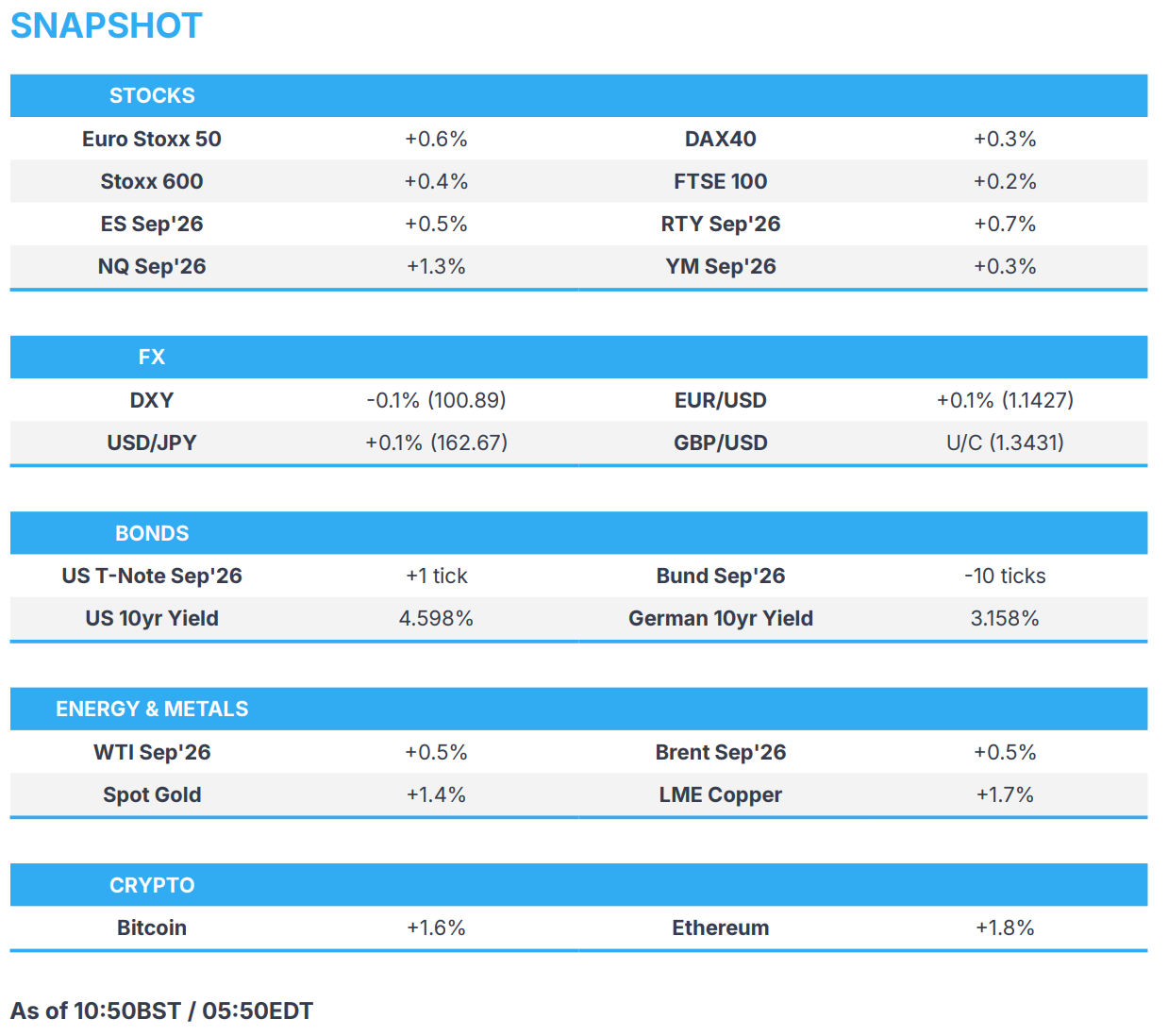
Newsquawk in 3 steps:
1. Subscribe to the free premarket movers reports
2. Listen to this report in the market open podcast (available on Apple and Spotify)
3. Trial Newsquawk’s premium real-time audio news squawk box for 7 days
EUROPEAN TRADE
EQUITIES
- European bourses are mixed and ultimately trading on either side of the unchanged mark. Tentative action which is encapsulated by the tumultuous geopolitical environment and a number of earnings from within the region.
- European sectors hold a slight negative bias. Tech outperforms followed by Basic Resources, whilst Optimised Personal Care and Media reside at the bottom of the pile. The Tech sector continues to bounce back from recent losses, following a similar theme seen in the APAC session, where the KOSPI gained c. 3.5%.
- US equity futures are firmer across the board, with outperformance in the tech-heavy NQ, following similar outperformance from within the sector in Asia and Europe. On the theme of AI/tech, UBS analysts suggest that continued earnings growth and rapid global AI adoption will keep AI names a dominant theme into H2.In recent reporting, TSMC is reportedly set to raise prices for both advanced and mature chip production services by up to 10% in 2027, Nikkei reported.
- Click for the sessions European pre-market equity newsflow
- Click for the additional news
FX
- G10s are mixed against the Buck. Antipodeans lead after a hotter-than-expected NZ CPI; JPY underperforms after the Japanese cabinet excluded a sales tax decision from its fiscal plan.
- DXY is a touch lower today, with oil prices softer but lacking direction as we await further geopolitical updates. Overnight, Axios reported that senior US and Israeli officials are claiming Trump’s options were to either promote a new 10-day ceasefire or launch a full-scale war on Iran. Elsewhere, Fox reported Trump will decide in the coming days whether to expand military operations against Iran. ING opines USD risks remain to the upside, given the aforementioned factors. Given the above, focus remains on incoming Gulf newsflow with a light calendar ahead of the Fed’s meeting next week. DXY remains below the 21DMA at 100.05, currently between 100.90 and 101.
- GBP in focus today after UK PM Burnham appointed former Defence Minister Healey as Chancellor (see 09:50 analysis for more detail). Elsewhere, UK jobs saw the unemployment rate remain steady at 4.9%, whilst the Employment Change topped expectations, while the wages components were flat/very slightly firmer. Overall, a report which will have little impact on the BoE, ahead of CPI on Wednesday and Flash PMIs on Friday. GBP takes a breather just above 1.3420 in Cable, and a little weaker just above 0.85 in the EUR cross.
- JPY is on a weaker footing despite the aforementioned subdued Dollar and softer oil prices. Overnight, Japan’s Cabinet approved the economic framework policy document, including a fiscal plan, which cited BoJ autonomy but lacked a sales tax decision. Amid the uncertainty given the lack of a funding plan, USD/JPY resides towards the upper end of a 162.43-162.70 range.
- Antipodeans hold on to the spoils of the prior day’s outperformance, with Aussie propped up by firmer metals whilst the Kiwi is leading after firmer-than-expected New Zealand CPI data. AUD/NZD is a modest touch lower, Aussie and Kiwi both +0.4% against the Buck.
FIXED INCOME
- Global fixed income benchmarks trade range-bound, in line with energy prices, despite the risk-on tone seen across the equity space. Equities seem to enjoy the reporting around a possible 10-day ceasefire, with recent reporting hinting that the US is demanding a longer ceasefire.
- Gilts (+1 tick) trade higher, despite the announcement of former Defence Secretary Healey as Chancellor. Thus far, gilts have taken this as fairly positive, possibly taking comfort in the fact that he used to work in the Treasury in past governments. In terms of Burnham’s policy, Bloomberg reported that the UK government will remove VAT on electricity bills from October 1st, funded by cancellation of the Digital ID programme. There have been contradictory reports over whether this measure will be fully funded. The Times reported that this will be fully funded; however, the OBR said the GBP 1.8bln figure for the ID scheme was unfunded, while former UK minister Jones suggested that Burnham’s cut is also unfunded. More recently, the Huffington Post reported that Burnham is to slash business rates for the hospitality sector by 20%, while a GBP 2 cap on bus fares is also set to be unveiled soon.
- On the data front, the ONS released its May employment report; employment change 147k (exp. 85k, prev. 100k), unemployment change 4.9% (exp. 4.9%, prev. 4.9%). Despite the strong labour report, gilts have failed to react, given the focus on politics.
- Bunds (-10 ticks) rotate in a 124.59-124.81 range. Focusing on the short-end, the yield currently trades outside of the 2.52-2.76% range, driven by the recent leg higher in energy prices. Brent has recently returned above the USD 90/bbl mark, resurfacing worries of an energy pass-through into inflation. ING says that rates can take a hawkish view, with the 2yr euro swap rate touching 3%, because the EZ growth picture continues to recover. Additionally, implied bond volatility is at lower levels, compared to the early stages of the Middle East conflict.
- USTs (+1 tick) lack direction given the quiet docket this week, heading into the Fed policy announcement next week.
- Germany sells EUR 4.553bln vs exp. EUR 6bln 2.90% 2031 Bobl: b/c 1.48x, average yield 2.89%, retention 24.1%.
- The UK sells GBP 5bln 4.00% 2029 Gilt: b/c 3.42x (prev. 3.35x), average yield 4.463% (prev. 4.238%), tail 0.3bps (prev. 0.2bps).
COMMODITIES
- Geopolitics remain fluid with constructive and escalatory updates on the US-Iran front. On the former, a 10-day ceasefire proposal was pitched, while Iran confirmed ongoing mediation talks, which keeps alive the possibility of a return to the June interim MoU. On the other hand, last night was the 10th consecutive day of US airstrikes, whilst Iran continues targeting the region and reiterated that the Strait of Hormuz is closed. US President Trump is expected to decide in the coming days whether to expand military operations against Iran and return to full-scale combat, a senior US official told Fox News. Meanwhile, senior US and Israeli officials are claiming Trump only has two realistic options: either promoting a new 10-day ceasefire with the aim of reopening the Strait of Hormuz, or launching a full-scale war on Iran, Axios reported. Further, a US official said if US President Trump decides to expand the war, the strikes will include Tehran and nuclear sites, according to Al Arabiya.
- Crude oil futures are trading subdued as market participants weigh emerging diplomatic de-escalation signals against ongoing military exchanges in the Middle East. Brent crude futures fell to the bottom end of a USD 88.08-89.45/bbl range while WTI similarly waned to the lower end of a USD 81.64-83.05/bbl range. Also on the supply side, NHC reported that Tropical Storm Bertha has strengthened, situated right in the Gulf of Mexico. Dutch TTF bucks the trend and has edged higher, back above the EUR 59.23/MWh mark, in the European morning, with analysts suggesting gas will be impacted more by the Middle East situation.
- Precious metals are on a firmer footing as the Dollar and inflation expectations ease with oil prices. Spot gold trades towards the upper end of a USD 3,999/oz to USD 4,084/oz range. Spot silver surges 4.5% at the time of writing as it rises above USD 59/oz vs Friday’s 54.77/oz base.
- Base metals also cheer the pullback in the Dollar alongside expectations of Chinese stimulus following recent weak economic data. 3M LME copper is firmer by 1.5% at the time of writing and towards the upper end of a USD 13,603.73- 13,840.00/t range.
- UAE’s ADNOC has approved a USD 6.2bln project to boost natgas production, Bloomberg reported.
- Goldman Sachs said Brent may rise above USD 120/bbl in FY26 Q4 if Hormuz remains disrupted.
TRADE/TARIFFS
- The US is imposing an additional 50% tariff on certain products of Canada including some USMCA products, to counter Canadian bias against US commerce with respect to alcoholic beverages, dairy, motor vehicles. In response, Canadian PM Carney said Canada is ready to engage intensively to address issues with the US and said we’re ready to talk with the US about modernising the USMCA. Additionally, the Ontario Premier said that Canada should impose retaliatory tariffs against the US.
- China is weighing tighter export controls on AI models and chips, according to FT.
NOTABLE EUROPEAN HEADLINES
- UK government to remove VAT on electricity bills from October 1st, funded by cancellation of the Digital ID programme, as part of new tax cut measures.
- UK PM Burnham reportedly to slash business rates for the hospitality sector by 20% within days, Huffington Post reported. Additionally, a GBP 2 cap on bus fares is also set to be unveiled as soon as Wednesday.
- Worldpanel announced grocery inflation and sales (w/e 12th July): Grocery Inflation 2.6% (prev. 3%).
- Click for detailed analysis of the implications of Burnham’s policies
NOTABLE EUROPEAN DATA RECAP
- UK Employment Change (May) 147K vs. Exp. 85.0K (Prev. 100K).
- UK Unemployment Rate (May) 4.9% vs. Exp. 4.9% (Prev. 4.9%).
- UK Average Earnings excl. Bonus (3Mo/Yr) (May) 3.4% vs. Exp. 3.4% (Prev. 3.4%).
- UK Claimant Count Change (Jun) 6.7K vs. Exp. 28.3K (Prev. 31.2K).
- UK Public Sector Net Borrowing Ex Banks (Jun) -16B vs. Exp. -19.8B (Prev. -23.3B).
- EU ZEW Economic Sentiment Index (Jul) 23.4 vs. Exp. 11.5 (Prev. 9.5).
- German ZEW Economic Sentiment Index (Jul) 26.3 vs. Exp. 18 (Prev. 10.5).
- German ZEW Current Conditions (Jul) -77.6 vs. Exp. -77.8 (Prev. -81.0).
CENTRAL BANKS
- ECB Bank Lending Survey (Jul): Euro area banks reported a moderate net tightening of credit standards for loans or credit lines to enterprises in Q2’26.
NOTABLE US HEADLINES
- US President Trump signed an order to identify and fix potential national security vulnerabilities by requiring defence contractors to screen their supply chains, aiming to stop weapons makers from working with certain foreign suppliers including China.
GEOPOLITICS
MIDDLE EAST
- It was Iran which proposed the 10-day ceasefire, i24’s Stein reported, citing sources. The US said to be demanding a longer ceasefire and demanding even partial navigation of the Strait of Hormuz. The goal of these 10 days, according to the two sources, is to find a solution for the Strait of Hormuz. The mediators conveyed the proposal to the US and even added additional components to it during the talks they held with Washington and Tehran so that it would be between the territory controlled by Oman and the territory controlled by Iran and through which ships could pass.
- US Energy Secretary Wright said they will continue to attack Iran and are ensuring the flow of oil, gas and other products through the Strait of Hormuz with or without Iran’s cooperation. Wright said they continue to undermine Iran’s offensive military capabilities and that President Trump wants to end the conflict with a peace deal, but this will require cooperation from both sides.
- US CENTCOM announced another round of strikes against Iran in which US forces struck Iranian military command centres, maritime capabilities, missile and drone launch sites and air defence systems to degrade Iran’s ability to continue attacking vessels.
- US airstrikes targeted the centre of Isfahan city and several explosions were heard in Bandar Abbas, Qeshm, Chabahar, Konarak and Shiraz, while air defence systems were activated near Iran’s Bushehr nuclear power plant.
- US likely does not have enough munitions to sustain a prolonged all-out war with Iran — which is already adapting to bypass US defence systems in its attacks across the region, according to an expert cited by The New York Post
- Iran claimed a strike on a US military data centre in Bahrain and stated that US radar and defence systems in Bahrain were destroyed. Iran also targeted US military facilities at Kuwait’s Ahmad Al-Jaber base, US missile systems at Kuwait’s Arifjan base, while explosions were reported in the Ali Al-Salem Airbase in Kuwait. Additionally, a central data infrastructure of Amazon (AMZN) in Bahrain was attacked by several cruise missiles.
- More recently, there have been reports of sirens in Qatar while explosions were heard in Jordan.
- IRGC said two tankers were hit near the Strait of Hormuz, and that the Strait of Hormuz is closed, while the UKMTO said it received a report of an incident 8NM northeast of Oman’s Limah and later announced the crew had abandoned the ship.
- Yemeni Houthi commander said Saudi Arabia faces two options: either lift the blockade and stop its intervention or continue escalating, which will cost it a lot, Al Mayadeen reported.
- Israeli Finance Minister Smotrich said “the State of Israel has no interest in joining the conflict between Iran and the US – the current situation is the best for us”, Ynet reported.
- Israel conducted artillery strikes on southern Lebanon, while it stated that the programme of pilot zones in southern Lebanon began on Monday, which was carried out in cooperation with US military and Lebanese armed forces. Furthermore, it will respond forcefully to any violation of the agreement.
- The Lebanese army entered Zawtar al-Gharbiya as part of the first phase of the pilot zones, Al Hadath reported, while Israeli troops departed the area.
RUSSIA-UKRAINE
- Russia’s Defence Ministry said its forces have struck infrastructure used by Ukraine’s military in the port of Odesa, IFX reported.
- Russia’s Kremlin said that Russia will continue targeting vessels involved in supplying Ukraine’s military.
OTHER
- US State Department said the US calls on China to immediately cease its destabilising conduct and condemns China’s dangerous and aggressive actions against Philippine Navy personnel at the Second Thomas Shoal in the South China Sea on July 20th.
- North Korea’s Foreign Minister met with Russian President Putin in Moscow on 19th July, according to KCNA.
CRYPTO
- Bitcoin has trended higher throughout the European morning and has regained the USD 66k mark.
APAC TRADE
- APAC stocks traded mixed following the subdued handover from the US, where most major indices declined as oil prices and yields climbed amid the ongoing geopolitical backdrop, although the Nasdaq showed some resilience amid a bounce in tech and telecommunications.
- ASX 200 lacked firm direction with price action contained within relatively tight parameters in the absence of notable data or key macro drivers.
- Nikkei 225 rallied on return from the long weekend, with some bargain-hunting after last Friday’s slump.
- KOSPI shrugged off earlier indecision and rallied amid a tech rebound, with notable strength seen in Samsung Electronics and SK Hynix shares.
- Hang Seng and Shanghai Comp were mixed with price action range-bound as they took a breather after rallying yesterday amid stimulus hopes and China’s “national team” buying close to USD 9bln in equities.
NOTABLE ASIA-PAC HEADLINES
- Japan’s Cabinet approved an economic framework policy document including fiscal plan, which cites BoJ autonomy and lacked sales tax decisions.
- Japan is reportedly to relax rules surrounding bank lending for M&A and incentivise pension funds to invest more in alternative assets.
NOTABLE APAC DATA RECAP
- New Zealand Inflation Rate QoQ (Q2) Q/Q 1.5% vs. Exp. 1.4% (Prev. 0.9%).
- New Zealand Inflation Rate YoY (Q2) Y/Y 4.1% vs. Exp. 4% (Prev. 3.1%).
- South Korea July 1st-20th Exports rose 52.3% Y/Y, Imports rose 20.0% Y/Y and Trade Balance is at a provisional surplus of USD 12.2bln.
- Taiwan Export Orders (Jun) Y/Y 59.4% (exp. 47.3%).
1 c Asian opening report
European futures set to lag US peers as oil remains elevated; UK Chancellor Healey unveils new energy measures – Newsquawk EU Market Open
Tuesday, Jul 21, 2026 – 01:30 AM
- US President Trump is expected to decide in the coming days whether to expand military operations against Iran and return to full-scale combat, a senior US official told Fox News.
- Senior US and Israeli officials are claiming Trump only has two realistic options: either promoting a new 10-day ceasefire with the aim of reopening the Strait of Hormuz, or launching a full-scale war on Iran, Axios reported.
- A US official said if US President Trump decides to expand the war, the strikes will include Tehran and nuclear sites, according to Al Arabiya.
- APAC stocks traded mixed following the subdued handover from the US. Crude futures were mildly lower in range-bound trade. European equity futures indicate a marginally lower cash market open with Euro Stoxx 50 futures down 0.2%.
- UK PM Burnham surprisingly appointed John Healey as Chancellor; Gilts and UK defence names on watch.
- Looking ahead, highlights include UK Jobs Report (May), PSNB (Jun), German/EU ZEW Economic Sentiment Index (Jul), US ADP Employment Change Weekly, NBH Policy Announcement (Jul). Supply from the UK & Germany. Earnings from General Motors & 3M.
SNAPSHOT
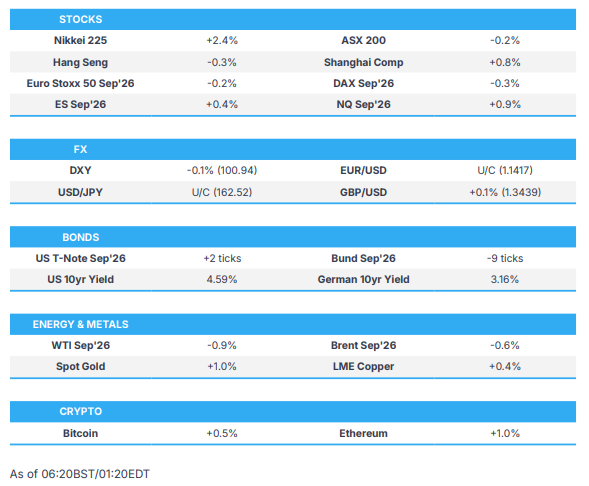
Newsquawk in 3 steps:
1. Subscribe to the free premarket movers reports
2. Listen to this report in the market open podcast (available on Apple and Spotify)
3. Trial Newsquawk’s premium real-time audio news squawk box for 7 days
IRAN CONFLICT
- US President Trump said every time Iran kills an American soldier, it would pay for that killing many times over, and that a directive had been issued to key military officials.
- US President Trump is expected to decide in the coming days whether to expand military operations against Iran and return to full-scale combat, a senior US official told Fox News.
- US President Trump is approaching a crucial crossroads in the Iran war, with senior US and Israeli officials claiming he has only two realistic options, which are either promoting a new 10-day ceasefire with the aim of reopening the Strait of Hormuz, or launching a full-scale war with Israel on Iran, according to Axios.
- US officials said regarding potential ceasefire talks with Iran that President Trump is currently focused on making Iran pay for their violations of the MoU and their continued acts of terrorism in the Strait of Hormuz, according to Axios’s Ravid.
- A US official said if US President Trump decides to expand the war, the strikes will include Tehran and nuclear sites, according to Al Arabiya.
- US Energy Secretary Wright said they will continue to attack Iran and are ensuring the flow of oil, gas and other products through the Strait of Hormuz with or without Iran’s cooperation. Wright said they continue to undermine Iran’s offensive military capabilities and that President Trump wants to end the conflict with a peace deal, but this will require cooperation from both sides.
- US CENTCOM announced another round of strikes against Iran in which US forces struck Iranian military command centres, maritime capabilities, missile and drone launch sites and air defence systems to degrade Iran’s ability to continue attacking vessels.
- US airstrikes targeted the centre of Isfahan city and several explosions were heard in Bandar Abbas, Qeshm, Chabahar, Konarak and Shiraz, while air defence systems were activated near Iran’s Bushehr nuclear power plant.
- Iran claimed a strike on a US military data centre in Bahrain and stated that US radar and defence systems in Bahrain were destroyed. Iran also targeted US military facilities at Kuwait’s Ahmad Al-Jaber base, US missile systems at Kuwait’s Arifjan base, while explosions were reported in the Ali Al-Salem Airbase in Kuwait.
- IRGC said two tankers were hit near the Strait of Hormuz, and that the Strait of Hormuz is closed, while the UKMTO said it received a report of an incident 8NM northeast of Oman’s Limah and later announced the crew had abandoned the ship.
- Israel conducted artillery strikes on southern Lebanon, while it stated that the programme of pilot zones in southern Lebanon began on Monday, which was carried out in cooperation with US military and Lebanese armed forces. Furthermore, it will respond forcefully to any violation of the agreement.
- Saudi Foreign Ministry condemned the maritime embargo on the Kingdom announced by Yemen’s Houthis.
US TRADE
EQUITIES
- US stocks ended the session mixed, with the tech-heavy Nasdaq 100 the only major index to finish marginally higher. Technology and Communication Services were the only sectors to outperform, alongside Energy, with the former supported ahead of Alphabet’s earnings on Wednesday after reports the company is developing a new server chip. Health Care and Materials lagged, while there was little in the way of macro catalysts, with no US economic data and Fed officials in their blackout period ahead of next week’s FOMC meeting. The crude complex was volatile but ultimately settled higher following another barrage of geopolitical headlines, including further attacks between the US and Iran, while reports throughout the session suggested the conflict is more likely to escalate than de-escalate, despite officials indicating diplomatic channels remain open and that talks continue.
- SPX -0.19% at 7,443, NDX +0.04% at 28,604, DJI -0.59% at 51,844, RUT -0.67% at 2,942.
- Click here for a detailed summary.
TARIFFS/TRADE
- US President Trump signed a proclamation offering 50% reduced aluminium tariffs for onshoring investments.
- US is imposing additional 50% tariffs on certain products of Canada, including some USMCA products, to counter Canadian bias against US commerce with respect to alcoholic beverages, dairy and motor vehicles, while the additional duties take effect at 00:01EDT/05:01BST on 19th August 2026.
- Canadian PM Carney issued a statement regarding US intention to impose tariffs, in which he stated that Canada is ready to engage intensively to address issues with the US and is ready to talk with the US about modernising the USMCA.
- Canada’s Ontario Premier said Canada should impose retaliatory tariffs against the US.
- China weighs tighter export controls on AI models and chips, according to FT.
NOTABLE HEADLINES
- US President Trump called on Republicans to unify and fight for the Save America Act, while he thanked them for the efforts to get as much of the act as possible in a budget bill.
APAC TRADE
EQUITIES
- APAC stocks traded mixed following the subdued handover from the US, where most major indices declined as oil prices and yields climbed amid the ongoing geopolitical backdrop, although the Nasdaq showed some resilience amid a bounce in tech and telecommunications.
- ASX 200 lacked firm direction with price action contained within relatively tight parameters in the absence of notable data or key macro drivers.
- Nikkei 225 rallied on return from the long weekend, with some bargain-hunting after last Friday’s slump.
- KOSPI shrugged off earlier indecision and rallied amid a tech rebound, with notable strength seen in Samsung Electronics and SK Hynix shares.
- Hang Seng and Shanghai Comp were mixed with price action range-bound as they take a breather after rallying yesterday amid stimulus hopes and China’s “national team” buying close to USD 9bln in equities.
- US equity futures rebounded off the prior day’s troughs with participants now looking ahead to a pickup in earnings season.
- European equity futures indicate a marginally lower cash market open with Euro Stoxx 50 futures down 0.2% after the cash market closed with losses of 0.1% on Monday.
FX
- DXY was little changed after the dollar predominantly gained against G10 peers yesterday, with price action contained given the lack of data or Fed speak, with the latter on a blackout, while it is a relatively quiet week in terms of scheduled risk events (ex-earnings), ahead of the FOMC and PCE next week. Nonetheless, trade frictions were stoked after the US announced that it would impose an additional 50% tariff on certain products from Canada.
- EUR/USD lingered near the prior day’s trough after giving way to the firmer buck and with very few pertinent catalysts for the single currency.
- GBP/USD attempted to nurse some losses after ultimately failing to benefit from the change of leadership in the UK, in which Andy Burnham took over as PM and named members of his cabinet, including John Healey as Chancellor, while participants look ahead to employment and average earnings data.
- USD/JPY proceeded sideways after its recent choppy performance and amid a lack of data, with the pair confined within the 162.00 handle.
- Antipodeans held on to the spoils of the prior day’s outperformance, with NZD/USD the biggest gainer overnight after firmer-than-expected New Zealand CPI data.
- PBoC set USD/CNY mid-point at 6.7917 vs exp. 6.7706 (prev. 6.7948)
FIXED INCOME
- 10yr UST futures lacked firm direction after trickling lower yesterday as yields gained amid oil price swings and escalating tensions in the Middle East.
- Bund futures remained subdued following recent oscillations and as supply looms, including a EUR 6bln Bobl issuance later, followed by EUR 2bln of Bunds tomorrow.
- 10yr JGB futures tracked the recent downside in global peers on return from the long weekend and with price action not helped by a very quiet overnight calendar.
COMMODITIES
- Crude futures were mildly lower in range-bound trade after the prior day’s two-way price action and the ongoing slew of geopolitical updates, including continued US-Iran strikes, and with some tankers being hit in the Strait of Hormuz. It was also reported that US President Trump is approaching a crucial crossroads in the Iran war, with officials claiming there are only two realistic options, which are either to pursue a new 10-day ceasefire, or launch a full-scale war on Iran.
- Goldman Sachs said Brent crude may rise above USD 120/bbl in FY26 Q4 if Hormuz remains disrupted.
- Spot gold climbed after launching off support at the USD 4,000/oz level and following the recent rebound in silver from a YTD low.
- Copper futures extended gains and shrugged off the initial hesitation from the mixed risk appetite.
CRYPTO
- Bitcoin mildly gained but with the upside limited in following choppy price action.
NOTABLE ASIA-PAC HEADLINES
- Japanese PM Takaichi said they will guide economic and fiscal policy with due heed to fiscal sustainability, and need to maintain market trust.
- Japan’s Cabinet approved the economic framework policy document including a fiscal plan, which cited BoJ autonomy but lacked a sales tax decision.
- New Zealand’s Foreign Minister said New Zealand and the Philippines will form a comprehensive partnership.
DATA RECAP
- New Zealand Inflation Rate QQ (Q2) 1.5% vs. Exp. 1.4% (Prev. 0.9%)
- New Zealand Inflation Rate YY (Q2) 4.1% vs. Exp. 4.0% (Prev. 3.1%)
- RBNZ Sectoral Factor Model Inflation Index YY (Q2) 2.7% (Prev. 2.7%)
GEOPOLITICS
RUSSIA-UKRAINE
- Russian President Putin met North Korea’s Foreign Minister in Moscow on 19th July, according to KCNA. North Korea reaffirmed support for Russian policies aimed at removing root causes of the Ukraine conflict, while Russia expressed support for North Korea’s efforts to defend its sovereign rights and security interests.
- Russia expelled two Italian diplomats and called the expulsions a reciprocal measure, while Italy labelled the Russian move as a blatant retaliation.
OTHER
- US State Department said the US called on China to immediately cease its destabilising conduct and condemned China’s dangerous and aggressive actions against Philippine Navy personnel at the Second Thomas Shoal in the South China Sea on July 20th.
EU/UK
NOTABLE HEADLINES
- UK PM Burnham is expected to announce a “fully funded” package of cuts to energy bills on Tuesday as he seeks to ease the cost of living crisis, according to The Times.
- UK PM Burnham appointed John Healey as Chancellor, Louise Haigh as Secretary of State, Shabana Mahmood as Interior Minister, Ed Miliband as Foreign Minister, Yvette Cooper as Health Secretary, Wes Streeting as Defence Secretary and Miatta Fahnbulleh as Secretary for Energy Security and Net Zero.
- UK PM Burnham and European Commission President von der Leyen agreed their teams should work closely towards a UK-EU summit later this year.
- US President Trump posted that he had a very good conversation with new UK PM Burnham and they discussed many subjects, including the outstanding US-UK relationship, while they will be meeting in the not too distant future for topics of mutual interest. Furthermore, he said they discussed North Sea oil, trade, the military alliance, demining of the Hormuz Strait, and many other topics.
NORTH AND SOUTH KOREA AND JAPAN
SOUTH KOREA
JAPAN
3 CHINA/
4. EUROPEAN AND SCANDINAVIAN COMMENTARIES PLUS NATO
AUSTRIA/VIENNA
Three-Quarters Of Refugee-Linked Households In Vienna Rely On Taxpayer Handouts
Tuesday, Jul 21, 2026 – 02:00 AM
Three-quarters of households in Vienna connected to migrants from popular asylum-origin countries are unable to support themselves without government benefits, according to figures analyzed by Statistics Austria.

The analysis, cited by Kronen Zeitung, covered approximately 103,000 households across Austria containing at least one recognized refugee, asylum-seeker, or person granted subsidiary protection from Syria, Afghanistan, Iraq, Iran, Somalia, or Chechnya in the Russian Federation.
Vienna recorded by far the highest rate of welfare dependence. About 75 percent of the households examined in the capital relied on minimum-income payments or comparable state support, meaning only one in four was considered economically self-sufficient.
Nationwide, 47 percent of the households included in the study could not support themselves independently, according to Exxpress.
For the purposes of the analysis, a household was considered self-sufficient when its income came from employment, pensions, unemployment insurance, or sickness benefits rather than minimum-income assistance and related welfare programs.
The findings stand in sharp contrast to the figures for Austrian households without an immigrant background. Depending on the state, between 90 percent and 93 percent of those households were classified as self-sufficient. Vienna again performed worse than the rest of the country, although its rate among non-immigrant households remained approximately 86 percent.
Integration Minister Claudia Bauer said the figures demonstrated the need to move welfare recipients into employment more rapidly.
“The welfare state should support people in becoming self-sufficient as quickly as possible,” Bauer told the Austrian newspaper. “It should never be attractive to live permanently on social benefits instead of providing for oneself and one’s family through work.”
The minister indicated that future policy would place greater emphasis on enforcing integration obligations. Recipients who refuse to participate in required integration measures could face reductions in taxpayer-funded benefits.
Officials have also pointed to Vienna’s removal of minimum-income support for people granted subsidiary protection. According to data from Austria’s Public Employment Service, unemployment among the affected group subsequently declined by more than one-third.
The government argues that the decline indicates many welfare recipients were capable of finding employment even under difficult economic conditions once benefit rules were tightened.
“Anyone coming to Austria must be able to provide for themselves and their families as quickly as possible,” Bauer said. “Work is the key to integration.”
While Vienna remains a hub for foreigners relying on taxpayer handouts, there are other areas across Austria where the percentages of foreign households raking in welfare benefits are disproportionate.
In January, separate figures showed that foreign nationals accounted for 72 percent of social-assistance recipients in St. Pölten, the capital of Lower Austria.
Of the city’s 1,278 benefit recipients, 528 (41 percent) were Syrian nationals. Another 99 recipients, representing approximately 8 percent, were Afghan nationals. Together, Syrians and Afghans accounted for nearly half of all recipients in a city with a population of approximately 56,000.
Austrian citizens accounted for 359 recipients, or 28 percent of the total, despite representing the large majority of the city’s population.
5. RUSSIAN AND MIDDLE EASTERN AFFAIRS//
MONDAY NIGHT//ISRAEL/IRAN/USA
US CENTCOM completes tenth night of strikes on Iran after explosions sound in country’s south
Explosions in Bandar Abbas, Sirik Island, and Qeshm were reported as US Central Command announced its tenth day of strikes against Iran.

Smoke rises from an explosion at an unknown location, during what US Central Command (CENTCOM) says are strikes on Iran, in this still image taken from a handout video released on July 19, 2026.(photo credit: US CENTRAL COMMAND/HANDOUT VIA REUTERS)ByESTHER DAVIS, ARIELLA ROITMANJULY 20, 2026 23:42Updated: JULY 21, 2026 05:04
The US military completed the tenth consecutive day of strikes in Iran early on Tuesday morning, US Central Command (CENTCOM) announced in a post on X/Twitter.
The strikes were intended to “degrade Iran’s ability to continue attacking commercial vessels flowing through the Strait of Hormuz,” CENTCOM said.
“American forces remain postured and prepared to hold Iran accountable for unwarranted aggression toward civilian mariners seeking to freely and openly transit the strait,” they added
Explosions were reported in the southern Iranian cities of Bandar Abbas, Sirik Island, Shiraz, Bandar Lengeh, and Qeshm on Monday evening, according to Iranian media.
The IRGC-linked Tasnim news agency also reported that several explosions were heard in Sulaymaniyah, Iraq, on Tuesday morning.
Ali Bakri-Kani, Deputy Secretary of the Supreme National Security Council of Iran, said on Monday that “The pressure lever of the Strait of Hormuz is of paramount importance to us,” adding that Iran is not willing to back down from its position on the issue.

Explosions sound in Iran
Air defense systems near an Iranian nuclear power plant in Bushehr were activated, and explosions were heard in central Iran near Isfahan, Iran’s largest nuclear facility, Iranian semi-official Mehr News reported.
Iranian state media IRNA, citing the Governor of Isfahan, said that no attack has been carried out against Isfahan tonight. The governor added that they were looking into reports of explosions from locals.
The news agency also said that the explosions heard in Bushehr are due to the activation of air defense systems, not impacts, citing the Governor of Bushehr.
Local news reported hearing renewed explosions in Qeshm, Bandar Lengeh, and Bandar Abbas early on Tuesday morning.
Tasnim news agency also reported a wave of attacks in the port cities of Konarak and Chabahar.
Two locations near the southern Iranian city of Shiraz were “subjected to enemy attacks,” Tasnim reported.
END
MONDAY NIGHT//ISRAEL/IRAN/USA
Iranian Strikes On US Bases In Jordan Aided By ‘Accurate Intel’ From Locals, IRGC Says
by Tyler Durden
Monday, Jul 20, 2026 – 06:25 PM
Iran’s Islamic Revolutionary Guard Corps (IRGC) announced Monday that its most recent retaliatory operations against US military assets in Jordan were carried out with “cooperation and accurate information” provided by the Jordanian people.
“Honorable people and troops of Jordan, thank you for your sincere cooperation and accurate information that led to the precise targeting of US forces… and the destruction of 20 shelters where child-killing US forces were stationed in the Al-Azraq (Muwaffaq Salti) Base,” it said. The IRGC added that those operations resulted in “the killing of dozens of US terrorist forces.”

“With your help, the fighters of the IRGC Aerospace Force targeted large C17 transport planes and P8 command and control planes of the invading US army at Aqaba Airport with ballistic missiles and caused heavy damage to a number of them,” it went on to say. “Thank you again for your efforts and cooperation,” the IRGC said in another message addressing the people of Jordan.
Iran’s retaliatory strikes have inflicted heavy damage on US sites and assets in Jordan over the past several days since US President Donald Trump renewed a brutal campaign of strikes against the Islamic Republic.
Tehran’s latest operations have killed a minimum of four US soldiers, including at least three in Jordan. Another has been killed in Iraq.
New satellite imagery, released by Soar Atlas, reveals additional damage at Washington’s Muwaffaq Salti Air Base in Jordan. The satellite imagery appears to show damage to at least two aircraft hangars, a large impact site near troop accommodation areas, and several destroyed shelters.
Satellite images from Jordan’s King Faisal Air Base, which hosts US troops, showed extensive damage as well.
The IRGC also detailed its latest, overnight operations against US sites in Kuwait on 20 July – launched in response to Washington’s ninth consecutive night of violent bombardment against Iran.
It said early on Monday that the 22nd wave of Operation Victory 2 targeted US military assets at Kuwait’s Ali al-Salem Air Base.
According to the statement, a US early-warning radar system was completely destroyed. Additionally, a warehouse containing aviation equipment and spare parts, as well as a hangar housing US MQ-9 drones, were hit, setting several drones on fire, according to the IRGC.
The statement urged Kuwaiti citizens to be aware of Washington’s use of its territory for attacks on Iran, and for its wars and interventions across West Asia in general.
Another IRGC statement released Monday provided further details on the Iranian strike against the Al-Tanf Base in Syria, carried out on July 17 in response to a US attack that killed several Iranian troops last week.
The US claims it has withdrawn from all bases in Syria, including Al-Tanf, where for years it trained extremist militants linked to ISIS. It remains unclear what US presence remains in Syria. The IRGC said its “surprise attack” on Al-Tanf was “dedicated to the martyred soldiers of Bampur” and “killed a number of US soldiers.“
“The Strait of Hormuz remained under the full control of the Iranian Armed Forces,” IRNA further quoted the IRGC as saying.
Earlier on Monday, Iran said it hit and demobilized two tankers moving through the strait, under orders from the US. The announcements follow heavy overnight attacks carried out by Washington against Iran.
US airstrikes hit multiple cities including Tabriz, Chabahar, Konarak, Bandar Mahshahr and Bandar Imam Khomeini. Washington’s strikes southwest of Tabriz killed one person and wounded several others, according to IRNA.
US Central Command (CENTCOM) said after midnight that it “began conducting a new wave of strikes against Iran … for the ninth consecutive night,” adding that “the strikes will continue degrading Iranian military capabilities used to attack commercial vessels and civilian mariners transiting… Hormuz.”
END
Iran secretly submitted proposal for 10-day ceasefire while under intense US strikes – exclusive
The mediators, including senior Qatari, Egyptian, Omani, and Pakistani officials, have presented the proposal to the United States.

Iranian Foreign Minister Abbas Araghchi speaks during a joint press conference with Turkish Foreign Minister Hakan Fidan (not pictured) in Tehran, Iran, November 30, 2025.(photo credit: MAJID ASGARIPOUR/WANA)ByAMICHAI STEINJULY 21, 2026 10:36Updated: JULY 21, 2026 12:28
It was Tehran that initiated the proposal now being advanced by mediators for a 10-day ceasefire between the United States and Iran, two sources familiar with the negotiations told The Jerusalem Post.
The fact that Iran proposed the initiative underscores how urgently Tehran is seeking a ceasefire as US strikes continue to expand and US President Donald Trump weighs a return to a full-scale military campaign against Iran.
According to the two sources, the purpose of the proposed 10-day ceasefire is to find a solution regarding the Strait of Hormuz, the issue that triggered the crisis over the memorandum of understanding signed last month, after which both Tehran and Washington effectively declared that the agreement was no longer in force.
The mediators, including senior Qatari, Egyptian, Omani, and Pakistani officials, have presented the proposal to the United States and have added further elements during discussions with both Washington and Tehran.
One such idea is the creation of a “middle corridor” through the Strait of Hormuz, located between Omani-controlled and Iranian-controlled waters, through which commercial vessels could safely transit.

Two sources told the Post that, at this stage, the United States is demanding a longer ceasefire. They added that Washington also insists on reaching at least partial understandings regarding freedom of navigation through the Strait of Hormuz before any ceasefire takes effect, with the remaining details to be finalized during the proposed 10-day pause.
One of the sources said that at least some officials within the Trump administration have described the Iranian proposal as “absurd” and “illogical.”
Trump focused on making sure Iran ‘pays a price’
A US official told the Post that Trump is focused on ensuring Iran “pays a price” for its violations of the memorandum of understanding and for the deaths of American service members.
“The president will also ensure that Iran pays for the recent deaths of US soldiers. These devastating blows will continue until the president decides otherwise, but talks between our countries are continuing,” the official said.
Trump is expected to attend a ceremony on Tuesday marking the return to the United States of the bodies of the American service members killed in Iranian missile and drone attacks in Jordan and Iraq.
Prime Minister Benjamin Netanyahu on Monday convened a security consultation that lasted over five and a half hours, ending at 1:30 a.m. on Tuesday morning.
After the long discussion, Finance Minister Bezalel Smotrich said that “the State of Israel has no interest in joining the conflict between Iran and the US; maintaining the status quo is our best option.”
TUESDAY /ISRAEL IRAN/USA
US-Iran Fighting Enters 10th Day As Tanker Hit In Hormuz, Houthis Threaten Red Sea Chokepoint
Tuesday, Jul 21, 2026 – 07:20 AM
The tit-for-tat escalation between the US and Iran entered its tenth day as another tanker was struck in the Strait of Hormuz. Meanwhile, the Iran-backed Houthis threatened shipping at a second strategic chokepoint in the southern Red Sea.

US Central Command launched strikes targeting Iranian command and control centers, missile and drone launch sites, and air defenses to “further degrade Iranian military capabilities used to attack commercial shipping in the Strait of Hormuz.”
President Trump wrote on Truth Social, “Every time Iran kills an American soldier, they will pay for that killing many times over!”
Still, Pakistan and Qatar are urging both sides to return to their positions before the latest escalation began on July 9. Iran says it remains open to diplomacy but will not negotiate under attack, while the Trump team has signaled that strikes will continue until Tehran stops attacking tankers and bulk carriers in the critical waterway. Reuters reported that mediators have proposed a 10-day ceasefire.
Shipping flows in the Hormuz have all but slowed, according to new Bloomberg data. As of Tuesday morning, just six vessels have transited the critical waterway. The data doesn’t account for ships turning off transponders.

Bloomberg reports that Iran struck another tanker in the strait:
Visible traffic through Hormuz came to a near standstill on Monday following Iranian attacks on vessels over the weekend.
An oil supertanker called the Acheloos and a smaller fuel tanker were both struck in the waterway, according to Dynacom Tankers Management Ltd., the ships’ manager.
Early Tuesday, the UK Maritime Trade Operations said that a tanker had been struck by an unknown projectile in the strait northeast of Oman’s Limah, citing multiple reports, without identifying the vessel. The notice indicates a separate attack to those on the Dynacom tankers.
The flare-up in violence sent Brent crude oil futures surging in recent weeks to over $90 a barrel, with Goldman commodity expert Daan Struyven warning on Monday that oil prices could rally to $120 if there is no de-escalation.

“Escalation in the Middle East and the decline in estimated Persian Gulf flows to below 45% of pre-war levels have pushed oil prices back up,” Struyven said in a note to clients.

Related:
Meanwhile, US consumers are feeling the pinch again at the pump, with the national average for regular 87-octane gasoline topping $4 a gallon once more. This is the politically sensitive line in the sand at which the Trump administration takes notice and consumer behavior begins to shift down at convenience stores, gas stations, and QSRs (quick-service restaurants).

Latest headlines (courtesy of Bloomberg):
US-Iran Tit-For-Tat
- The US and Iran have exchanged strikes for a 10th consecutive day, with US Central Command targeting Iranian military command centers, launch sites, maritime capabilities, and air defenses.
- Iran has retaliated by attacking US military sites in Kuwait and Jordan.
- Trump vowed Tehran “will pay” after Iran killed three US soldiers.
- According to the Washington Post, US intelligence reports suggest US strikes are unlikely to move Iran.
- Iran’s Khorramabad area in Lorestan Province was attacked earlier today.
Diplomacy & Ceasefire Efforts
- Iran’s Interior Minister Eskandar Momeni began meetings Tuesday with mediators in Pakistan as diplomats sought to salvage a collapsed interim deal.
- Mediators have proposed a 10-day ceasefire between Iran and the US to revive the interim deal, according to an unidentified senior Iranian official cited by Reuters.
- Iran’s president said communication with Supreme Leader Khamenei has increased, per Tasnim reports.
Regional Risks
- The Kaifan, an oil-products tanker owned by Kuwait Oil Tanker Co., was struck by an unknown projectile in the Strait of Hormuz northeast of Oman’s Limah.
- The Houthi militant group in Yemen is threatening to blockade Saudi Arabia and target shipping in the Red Sea, adding to regional maritime risks.
- Southeast Asian nations expressed “serious concern” over the conflict, warning of spillover effects on regional trade, food security, and energy markets.
Energy & Market Impact
- Goldman Sachs says Brent crude could top $120 per barrel by the fourth quarter if Strait of Hormuz disruptions persist, though its base case remains $80 per barrel assuming de-escalation.
- European natural gas futures extended gains, surging more than 20% over the previous seven sessions, as the conflict tightens supply ahead of winter.
- Pakistan and Bangladesh were forced to buy some of their most expensive LNG shipments in years due to supply disruptions from the conflict. Pakistan LNG paid about $21.88 per MMBtu, its highest since 2022, according to traders with knowledge of the matter.
END
TUESDAY AFTERNOON
Trump Eyes Pickaxe Mountain Nuclear Site Heavy Strikes: “Iran Hasn’t Seen Anything Yet, We’ve Been Nice”
Tuesday, Jul 21, 2026 – 12:10 PM
Summary
- Shipping disruption: Houthi threats forced two Saudi oil tankers to turn around in the Red Sea as Hormuz traffic slowed sharply after more tanker attacks.
- Escalation in Gulf: Iran claimed strikes on infrastructure in Bahrain, Kuwait, and Jordan, while Kuwait reported a second day of attacks on power and desalination plants.
- Trump vows more to come: The US launched fresh strikes on Iranian targets, Trump vowed retaliation, and Reuters reported a proposed 10-day ceasefire. “We’ve been nice,” Trump says, warning of more attacks to come.
- Oil surges: Crude prices hit multi-week highs amid shipping disruptions, with warnings oil could reach $120 if fighting continues.
- Pentagon scrutiny: The New York Times reported the Pentagon withheld information about dozens of US troops injured in Iranian attacks before the deadly Jordan missile strike.
* * *
Trump Gives Wide-Ranging Comments on Iran: Doesn’t Want to Talk, “We’ve Been Nice”
President Trump issued a series of big claims to reporters in the Oval Office on Tuesday. For starters he asserted that Iran wants to “desperately” meet but said “we” have no interest, and that the US military is not finished at all with Iran, and so there’s no interest in talking at the moment.
And amid polls that show the war is increasingly unpopular among American voters, he stated that Iran is “probably” trying to hurt his and his Republican Party’s chances in the upcoming congressional elections in November by seeking to control Strait of Hormuz, and with the latest attacks on international shipping. “I’m just going to do the right thing,” Trump claimed, before saying that “The election, I can’t think about that having to do with this. I think people are very impressed.”
He also revisited the Obama-era JCPOA, saying if the US hadn’t “terminated the nuclear deal” then “you wouldn’t have Israel right now because they would have had a nuclear weapon years ago.“ He added that “if we didn’t do the B2 bombers knocking out the nuclear sites a year ago, one of the first things we did early in the administration, they [Iran] would have a nuclear weapon, and you wouldn’t have Israel.” Trump continued, “And in my opinion, you wouldn’t have various other countries in the Middle East [as] they would have been terminated, extinguished.”
He continued to be pressed on what the ‘plan’ and end goal is, and what the stopping and exit point might be. The president’s response:
Another big threat and warning came when Trump declared that “Iran hasn’t seen anything yet” as “we’ve been nice” so far. Below is a quick rundown of some key statements from the fresh press interaction:
- No interest in meeting Iran until they are ready.
- Iran has very evil people leading the country.
- Our deal will not let Iran have a nuclear weapon.
- We’ll hit any site Iran is thinking about for nuclear.
- Iran probably trying to impact elections with Hormuz.
- Iran hasn’t seen anything yet; have been nice.
- On Pickaxe Mountain, will hit that area soon and very heavily.
Israel has meanwhile been alleging that Iran is concentrating its nuclear program at highly fortified Pickaxe Mountain. Trump in the comments suggested the US military will take direct aim at the underground complex:
Trump says the U.S. will be hitting Pickaxe mountain in Iran “pretty soon very heavily and there is nothing they can do about it”
‘Slip through Jordan’… where American troops were killed:
END
HUGE
Two Saudi Crude-Laden Tankers Make U-turns In Red Sea Amid Houthi ‘Blockade’, Oil Surges
Tuesday, Jul 21, 2026 – 09:55 AM
Summary
- Shipping disruption: Houthi threats forced two Saudi oil tankers to turn around in the Red Sea as Hormuz traffic slowed sharply after more tanker attacks.
- Escalation in Gulf: Iran claimed strikes on infrastructure in Bahrain, Kuwait, and Jordan, while Kuwait reported a second day of attacks on power and desalination plants.
- Trump vows more to come: The US launched fresh strikes on Iranian targets, Trump vowed retaliation, and Reuters reported a proposed 10-day ceasefire.
- Oil surges: Crude prices hit multi-week highs amid shipping disruptions, with warnings oil could reach $120 if fighting continues.
- Pentagon scrutiny: The New York Times reported the Pentagon withheld information about dozens of US troops injured in Iranian attacks before the deadly Jordan missile strike.
Two tankers carrying Saudi crude make U-turns in Red Sea after Houthi warning
The just-declared (as of Monday) Houthi blockade on Saudi maritime shipping has already begun to witness ill-effects, as reports emerge of two oil tankers having made U-turns while initially en route toward the Suez Canal. The reports say their crews received threats from Houthi militants in Yemen. The emerging details:
Two oil tankers which loaded Saudi crude for China and India made U-turns in the Red Sea and headed toward the Suez following a warning from Yemen’s Houthi militia.
…The group, in an email sent to shipping companies, warned them not to load or discharge cargo at Saudi Arabian ports and said such activity may result in being targeted “in any location”.
Dollar and yields spiking as oil rises…. West Texas Intermediate (WTI) has reached six-week highs on Tuesday.
IRGC Says it Attack Amazon’s Main Data Hub in Bahrain
Amid a spate of fresh attacks on Gulf states, the IRGC claimed its cruise missiles destroyed Amazon’s central data infrastructure in Bahrain and also hit US air defense systems. Bahraini, US and Amazon officials issued no response in the immediate aftermath.
The IRGC said its Aerospace Force targeted and “destroyed” the central data infrastructure hub in Bahrain using several cruise missiles. It further stated that “US air defense systems and radar installations in the Bahraini areas of Muharraq and Riffa were also targeted” in the attack.
If accurate this highlights yet again that billions of dollars worth of infrastructure is going up in flames in the Gulf, and that defense against missiles and drones has been waning
Kuwait Water Desalination & Power Plants Attacked for 2nd Consecutive Day
For a second consecutive day, Kuwait is reporting attacks on power-generation and water-desalination plants. The fresh assault caused fires and disrupted electricity generation, amid an emergency response and efforts begin restoring affected units.
Further attacks on Bahrain, Kuwait, and Jordan are also being reported, as well as new IRGC strikes on foreign tankers seeking ‘unauthorized’ transit of the Strait of Hormuz. According to some latest via Al Jazeera:
- A desalination facility and power plants caught on fire and suffered serious damage in Kuwait after new Iranian strikes targeted the crucial facilities, along with areas of Bahrain and Jordan, following a 10th-consecutive night of US bombing.
- “Massive fires” broke out on two tankers that “took an unsafe route” in the Strait of Hormuz, says Iran’s Revolutionary Guard.
On Tuesday Kuwait has confirmed it is dealing with inbound Iranian drone and missile attacks yet again, also with sirens continuing to sound in Bahrain.
Iran Seeks To Hold Hormuz Leverage ‘At All Costs’
Despite daily US saturation strikes on Iran, and in turn Iran’s daily attacks on Gulf states, nothing has really changed in what seems a stalemated situation and quagmire.
Amin Saikal, emeritus professor at Australian National University, has described that “Both sides have really been trying to inflict heavy damage on each other, and they’ve come really to a point of saturation in many ways.” He continued, “Logically, that should really lead them to negotiation. But of course, that is not really happening at the moment simply because the United States wants to gain control over the Strait of Hormuz, and that’s something the Iranians will never give up.”
Saikal called Hormuz “a reward” for Tehran, while pointing out that “Because of this unprovoked war, the Iranians have gained this leverage, and they want to retain it at all costs.”
Still, President Trump is warning that Iran will pay “many times over” for the deaths of American soldiers, and has said he gave his Pentagon leaders directives for carrying this out.
10th Strait Day of Escalation
ISRAEL TBN
HEZBOLLAH/LEBANON
SAUDI ARABIA/USA
Proposed US Deal For Saudi Nuclear Enrichment Is Without Safeguards
Tuesday, Jul 21, 2026 – 03:30 AM
The Trump administration has greenlit Saudi Arabia’s nuclear enrichment project, but with no safeguards in place to prevent the development of a bomb, CNN reported on Friday.
The draft deal, viewed by the news outlet, showed Washington’s support for Riyadh’s civilian nuclear program is still awaiting President Donald Trump’s signature, despite US-Saudi negotiations concluding in October.

Unnamed officials cited in the story indicated that the documents, which include the mandatory “123 agreement” and safeguards protocols, have not yet been sent to Congress, potentially for fear of bipartisan pushback.
It is unclear how long the president will wait, given Congress is likely to switch hands to a Democratic majority after the November elections, stymying his policy agenda.
Crown Prince Mohammed bin Salman and his advisors have long pushed for a deal that would allow them to enrich uranium, which they say the kingdom holds vast reserves of.
“We will enrich it and we will sell it and we will do a ‘yellowcake’,” Saudi Energy Minister Prince Abdulaziz bin Salman said last year, referring to a step in the process that comes after mining but before enrichment.
Nuclear umbrella
The Saudi push to be included under the US’s nuclear umbrella was a key issue during the Saudi crown prince’s visit to the White House in November last year. Days after Israel attacked Hamas negotiators in Qatar earlier in the year, Saudi Arabia signed a defence pact with Pakistan, the only nuclear-armed state in the Muslim world.
Pakistan is estimated to possess around 170 nuclear warheads. Saudi and Pakistani descriptions of the deal said it encompassed all military options.
The Americans’ nuclear talks with Saudi Arabia have been kept under tight wraps, but one former US intelligence official previously told Middle East Eye that the idea of extending protection to the kingdom could serve a purpose. “It would pull them out of the Pakistanis’ nuclear umbrella and make the Saudis feel better than the Qataris,” he said at the time.
In February, the Trump administration notified Congress it is pursuing a civil nuclear pact with Riyadh that does not include non-proliferation safeguards it has traditionally imposed on countries to prevent them from developing nuclear weapons.
The language in the document also leaves room for Saudi Arabia to enrich uranium, as it stipulates “additional safeguards and verification measures to the most sensitive areas of potential nuclear cooperation” between the two countries, including enrichment and reprocessing, the report said.
A nuclear deal with Saudi Arabia that does not explicitly prohibit the kingdom’s potential to enrich uranium in the future would be much more transformative for the region than a separate deal for F-35 warplanes that the Trump administration is pursuing. In nuclear agreements with foreign governments, for example, the UAE, the US made cooperation conditional on commitments that they will not enrich uranium or reprocess spent nuclear fuel.
The UAE, Morocco and dozens of European and Asian countries have signed the so-called “123 Agreements” with the US. US law generally requires a 123 Agreement to be in force before licensing significant exports of US-origin nuclear material or equipment to a foreign country.
In addition to a 123 Agreement, US lawmakers have insisted that the US require Saudi Arabia to submit to what is called the “Additional Protocol”, which allows the United Nations’ International Atomic Energy Agency (IAEA) additional access to nuclear facilities, data, and undeclared sites.
The UAE, the only other Gulf state to have officially partnered with the US in nuclear energy, signed the Additional Protocol to its IAEA agreement in 2009.
Reuters reported, however, that the Trump administration sent a preliminary report to some heads of congressional committees in November, which it is required to send if it is not pursuing the Additional Protocol. The Reuters report underscores how Trump is putting deal-making at the centre of his diplomacy, even if it means chafing at the traditional concerns of the US foreign policy establishment.
END
HAMAS/ISRAEL
IDF, Shin Bet kill two Hamas Oct. 7 commanders who kidnapped, held Gaza hostages in weekend strikes
One of the commanders, Adham Ibrahim Sha’aban Nasman, held several former hostages, including Romi Gonen, Emily Damari, Ziv and Gali Berman, Eitan Mor, Matan Angrest, and Omri Miran.

An IDF infographic detailing the biography of Hamas terrorist Adham Ibrahim Sha’aban Nasman, who held several Gaza hostages captive, published July 21, 2026.(photo credit: IDF SPOKESPERSON’S UNIT)ByMIRIAM SELA-EITAMJULY 21, 2026 09:14Updated: JULY 21, 2026 12:21
The IDF and Shin Bet (Israel Security Agency) killed two Hamas terrorists who abducted and held Israelis hostage during the October 7 massacre.
On Saturday, the IDF and Shin Bet killed Adham Ibrahim Sha’aban Nasman, Hamas’s Gaza City Brigade Operations Head, in Gaza City.
Nasman served as a battalion commander in the terror group’s Nukhba Force, and led Hamas’s Gaza City Brigade’s infiltration into Israel during the October 7 massacre.
He also held several former hostages captive, including Romi Gonen, Emily Damari, Ziv and Gali Berman, Eitan Mor, Matan Angrest, and Omri Miran, the military noted.
In addition, the IDF and Shin Bet noted that Nasman held a number of senior Hamas positions, including serving as the intelligence officer of the Gaza City Brigade and the commander of the Al-Shati Battalion.

Recently, Nasman attempted to train terrorists from Hamas‘ Gaza City Brigade and worked to advance the production and distribution of weapons to the brigade’s battalions.
“These activities were carried out as part of efforts to rebuild Hamas’ military capabilities, in violation of the ceasefire agreement,” the IDF and Shin Bet said, adding that its troops will remain deployed in Gaza and will continue to “remove threats.”
In a separate strike on Sunday, the IDF killed Asma Kamal Shehadeh Abu Tim, a cell commander in Hamas’ military wing.
On October 7, 2023, Abu Tim invaded Kibbutz Nir Oz and aided in the abduction of Nurit Cooper, Amiram Cooper and Alexander Dancyg.
More recently, Abu Tim advanced terror attacks targeting IDF troops and Israeli civilians, the military said.
Former hostages react to Nasman’s death
“Another piece of garbage [has been] sent to Hamas’s giant landfill in hell,” Ziv Berman wrote in a social media post. “I hope that the rest of [Nasman’s] friends that are unfortunately still alive will understand that their time will also come!”
“Am Yisrael Chai,” Berman concluded and thanked all those involved in the operation.
Damari echoed Ziv’s sentiment in her own social media post.
“There are moments when history does not repeat itself; it reminds us of a principle,” she said. “After the Munich Massacre, Israel launched Operation Wrath of God with a simple message: those who take part in the massacre of Jews will not be able to hide forever.”
“Even after October 7, the message stayed with us. Any terrorist who took part in the massacre, murder, kidnapping, or holding hostages – your reckoning will come!”
“Today one of the scoundrel terrorists who held me captive was killed,” Damari wrote. “For me, this is another step on the path to justice. Not just out of revenge, but with the understanding that there are actions that should never be left unaccounted for.”
She added that during her time in captivity, she overheard Nasman speaking on the phone with former Hamas leader Yahya Sinwar and other Hamas terrorists.
“Now they don’t talk about us together on the phone anymore,” she said, “they burn together in the fires of hell.”
END
RUSSIA VS UKRAINE
this is important for oil pricing!!
Ukraine’s Attack On Caspian Pipeline Consortium Aims To Destabilize Global Oil Markets: Kremlin
Tuesday, Jul 21, 2026 – 02:45 AM
The Kremlin has accused Ukraine of orchestrating a plan to further destabilize global oil markets by carrying out drone attacks on the Caspian Pipeline Consortium (CPC).
Russian Foreign Ministry Spokeswoman Maria Zakharova said in Monday remarks, “We are in solidarity with the Kazakh Foreign Ministry in its decisive condemnation of this crime against a civilian facility.”

“We regard this attack as yet another confirmation of Bankova’s desire to further destabilize the situation on global oil markets,” the top diplomat emphasized, referencing the street houses the Office of the President of Ukraine.
“For it, ensuring global energy stability, as well as a respectful attitude toward foreign partners, in particular from Kazakhstan, with whom the Kiev regime allegedly wants to develop mutually beneficial and friendly relations, is an empty phrase,” she added.
The Caspian Pipeline Consortium (CPC) terminal, which is off Russia’s Black Sea cost, confirmed Sunday that it was forced to suspend oil loadings, after a pair of oil tankers came under attack here.
Specifically the Asia and Nissos IOS tankers were attacked, with the former having caught on fire as a result, which was subsequently extinguished by emergency crews.
“There were no injuries or fatalities amongst CPC staff or contractors. There was no oil spill,” CPC later clarified while confirming that the tankers remained afloat.
“At present, crude oil loading operations at the terminal have been suspended pending a full assessment of the consequences of the incident,” CPC also said, but stopped short of identifying what entity was behind the attack.
Kazakhstan’s foreign ministry was outraged. “Upon completion of this assessment, Kazakhstan reserves all rights available under international law to protect its legitimate interests, including seeking full compensation for the damage caused,” it said.
This isn’t the first time that sections of the key energy route have been targeted by Ukrainian drones. For example a key section of Caspian Pipeline Consortium near Novorossiysk was temporarily been taken offline in a November 2025 attack.
The consortium’s over 930-mile pipeline connects oil fields in western Kazakhstan and Russian offshore fields in the Caspian Sea to a marine terminal in Novorossiysk, which means the location serves as the main export route for Kazakh oil, and is one of the world’s largest oil conduits by volume.
END
6/.GLOBAL ISSUES, COVID ISSUES, VACCINE INJURIES/HEALTH ISSUES
GLOBAL ISSUES
Did Scientists Just Solve The Biggest Mystery Holding Back Solid-State Batteries
Tuesday, Jul 21, 2026 – 05:00 AM
Authored by Alex Kimani via OilPrice.com,
- Scientists have identified the root causes of solid-state battery failures, discovering that internal pressure cracks the electrolyte while electrical imbalances trigger lithium growth that causes short circuits.
- The findings could accelerate commercialization by turning a long-standing scientific mystery into a solvable engineering challenge.
- Automakers including Toyota, Honda, Mercedes-Benz, and BMW are investing billions in solid-state batteries, with commercial EV deployments targeted for the second half of this decade
Scientists now know why solid-state batteries have repeatedly failed. Two separate studies have identified the physical processes responsible for the short circuits that have delayed commercialization for years, turning one of the industry’s biggest unknowns into a defined engineering problem.

For years, engineers knew how solid-state batteries were failing, but not why. The batteries repeatedly developed internal short circuits as microscopic lithium structures formed inside the cell and eventually pierced the barrier separating the battery’s positive and negative sides. Researchers could see what was happening after the fact, but they couldn’t explain what caused those structures to form or how they managed to penetrate a material specifically designed to block them.
Two independent research teams have now answered different parts of that question. In a paper published in Nature, scientists at Germany’s Max Planck Institute for Sustainable Materials found that lithium deposits generate enormous internal pressure during charging, eventually cracking the solid electrolyte from within.
Separately, researchers from MIT, the Technical University of Munich, and collaborating institutions reported in Nature Nanotechnology that tiny electrical imbalances inside the electrolyte create the conditions that allow the unwanted lithium structures to begin growing.
The findings could remove a major scientific uncertainty just as automakers and battery manufacturers are investing billions of dollars to bring solid-state batteries into commercial production.
Manufacturers Aren’t Waiting Around
Solid-state batteries are widely regarded as the next major advance in battery technology because they promise to deliver longer driving ranges, faster charging, improved safety, and higher energy density than today’s lithium-ion batteries.
Replacing the liquid electrolyte with a solid material also reduces the risk of overheating and allows manufacturers to pack more energy into the same physical space, making the technology attractive not only for EVs, but also for aviation, defense, and grid-scale energy storage.
The repeated failures never convinced the auto industry that solid-state batteries were unworkable. Instead, manufacturers chose to view them as engineering problems that could be solved eventually.
The prize was simply too large to ignore because, compared with today’s lithium-ion batteries, solid-state promises higher energy density, faster charging, improved safety, and longer driving ranges. Manufacturers appear convinced that solid-state is what will completely reshape the EV industry.
Manufacturers have turned that faith into billions of dollars in investment.
Honda has already built a demonstration production line to develop the manufacturing techniques needed for mass production. Toyota continues targeting commercial deployment later this decade, while Mercedes-Benz, BMW, Stellantis, Hyundai, Samsung SDI, CATL, QuantumScape, Solid Power, and Factorial Energy have all expanded pilot production, strategic partnerships, or vehicle testing programs despite the technology’s unresolved scientific challenges.
Honda has spent approximately $280 million on a 27,400-square-meter solid-state battery production line in Sakura City, Japan. The facility replicates the full manufacturing process, from mixing and coating electrode materials through cell formation and module assembly. Battery production was scheduled to begin in January 2025, with Honda testing production costs, cell specifications, and mass-manufacturing methods ahead of vehicle deployment in the second half of the decade.
Honda is using roll-pressing to compress the solid electrolyte during assembly, reducing microscopic air gaps that impede ion transport while simplifying large-scale manufacturing. The company is also developing thinner cooling systems made possible by the greater thermal stability of solid-state batteries, reducing both battery weight and manufacturing complexity.
Mercedes-Benz has already put a solid-state battery on public roads. Earlier this year, the company unveiled a modified EQS equipped with lithium-metal cells supplied by Factorial Energy. During testing, the vehicle traveled 1,205 kilometers between Stuttgart and Malmö on a single charge and finished the journey with 137 kilometers of estimated range remaining.
BMW is testing large-format Solid Power cells in an i7 on public roads around Munich. The program is examining cell expansion, operating pressure, and temperature control inside a complete vehicle pack. BMW has also licensed Solid Power’s production technology for a prototype cell line at its Cell Manufacturing Competence Center in Parsdorf.
Idemitsu is constructing a large pilot facility to manufacture sulfide solid electrolytes, one of the most important elements of Toyota’s next-generation batteries. The plant will produce lithium sulfide using sulfur recovered from petroleum refining before converting it into solid electrolyte material for automotive batteries. Toyota plans to begin commercial production of vehicles using the technology during 2027-2028.
What’s Next?
The solid-state mystery has been replaced with a design problem.
Researchers now know that preventing electrolyte fractures and suppressing localized current concentrations will determine whether solid-state batteries can survive repeated charging cycles outside the laboratory.
But commercialization isn’t a given. Once the now-known problems are engineered out, it will be up to manufacturers to prove that solid-state batteries can be produced consistently at automotive scale, withstand thousands of charging cycles, and reach cost levels that compete with today’s lithium-ion batteries. That’s why companies continue to invest hundreds of millions of dollars into pilot production lines years before mass-market vehicles arrive.
Toyota still expects to introduce its first solid-state batteries during 2027-2028. Honda is targeting the second half of the decade. Mercedes-Benz, BMW, and several battery manufacturers have already moved from laboratory cells to vehicles operating on public roads. This is about to become an industrial race.
END
ROBERT H…
Our changing world
I have repeatedly stated that the world is breaking into competing economic and military blocs. The post-Cold War era is over. The multipolar one is here to stay. Was George Orwell correct in the book 1984?
NATO is a relic of the past. Ponder what this means. Europe will decide to go its own way. Perhaps with a war and breakup. But its day as a block is over. Once this is realized individual nations will compete against each other like they did in the past. Brussels will not do well economically or socially with contraction.
Nations are no longer trying to join one global system. They are choosing sides because confidence in international institutions has collapsed. Once trust disappears, countries stop relying on treaties and begin relying on each other.
Even Canada is being forced to change its relationship with America. The unthinkable has become reality. The once inseparable relationship is over. This has huge ramifications for Canada and America. Expect the divide to widen. New tariffs at the end of August will be the final straw that makes the path clear. Trump not taking Canada’s offer to double shipments waiting for a better deal was perhaps in vain. In the wings China is waiting and will even pay for an exclusive pipeline for themselves. Think about this . China secures a supply that it will protect on America’s border. Who knows if China and Canada do not establish a new JV in the Arctic ? We await tine to reveal new realties.
Even the Middle East is changing never to return to its’ recent history. Iran is rewriting the history books with the aid of China. Iranian missiles with Chinese guidance are immune to American tampering that occurred before with GPS guidance systems. Even the standing of Israel will in due course be altered by shifting sands. And as sands shift so does desperation as emotions run and ambitions die. The danger is the desire to escalate to restore balance. Even that is lost now as escalating to a nuclear level will deliver the wrath of a world that is moving on. And escalation has far reaching consequences well beyond local matters. American lives lost are for who and what ? These questions are being asked in America and beyond.
As for life as we known it, it too had decided to leave us. Scarcity of resources namely oil and food is now a certainty and not an option that nations are unprepared for. Relationships will matter far more than money. As decisions will be made that embrace a new reality of change.
As for the madness of proxy regimes like Ukraine acting out the risk of global financial collapse or worse grows weekly. Miscalculation on grand scale will be answered. Have you noticed that the global south is silent? Has anyone dared to admit the capital destruction as shipping diminishes from ports like Odessa? Yes grain shipping is why off and so is capital investment for the likes of Cargill and Monsanto etc.
Flexible thinking not tied to yesterday will be in vogue as new times are emerging. It will be the ability to accept early and cope that will challenge the mind and soul of us all.
END
MARK CRISPIN MILLER
DR PAUL ALEXANDER
special thanks to Robert H for sending this to us;
Fwd: Mr. President: Reopen Konnech — The CCP Election Software Case Your Intelligence Agencies Are Still Burying
Mr. President: Reopen Konnech — The CCP Election Software Case Your Intelligence Agencies Are Still Burying
An open letter to President Donald J. Trump following the July 16 election integrity declassification.
| KanekoaJul 20 |  |


Mr. President —
On July 16, you released declassified documents showing the Chinese Communist Party obtained 220 million American voter files — and that our own intelligence agencies covered it up.
You called it potentially the largest compromise of election data in history.
You directed ODNI, the DOJ, the FBI, and the CIA to investigate how that information was hidden, to fire those responsible, and to bring criminal charges where appropriate.¹
Four years ago, a Los Angeles prosecutor used almost those exact words about a different case.
He called it potentially “the largest breach of election data in American history.”²
Then that case was buried too.
One more file belongs in your release:
Konnech.
Konnech is a Michigan-based election software company. Its product, PollChief, manages poll workers, equipment, and election-day logistics for Los Angeles, San Francisco, Detroit, Washington D.C., and two dozen of America’s largest jurisdictions.³
Its founder is Eugene Yu — born Jianwei Yu (于建伟) in Zhejiang Province, China.⁴
Yu graduated from Zhejiang University and worked for the CCP from 1983 to 1985 as a project manager in the Guangzhou Economic and Technological Development Zone — a Chinese government economic incubator.⁴
He moved to America in 1986. He founded Konnech in 2002.⁴
And in November 2005, he quietly founded a second company back home in Jinhua, Zhejiang Province: Jinhua Yulian Network.⁴
That same year, a Chinese-language magazine published by the China Association for Science and Technology — a formal arm of the CCP — profiled Yu as an “overseas scholar” and listed him as a finance officer of the American Zhu Kezhen Education Foundation.⁵,⁶
That foundation flew Harvard’s Charles Lieber to Zhejiang University — years before Lieber was prosecuted for concealing his role in a CCP talent recruitment program.⁷
On January 25, 2006, Yu’s Chinese company was accepted into the Chinese Academy of Sciences Jinhua Science and Technology Park — a CCP-controlled technology incubator.⁸
From that point forward, public records show Konnech’s Chinese operation receiving government support, operating inside CCP-controlled institutions, and developing software for Chinese government bodies.⁸,⁹
One month later, Yu registered yu-lian.cn using his Konnech email address: eyu@konnech.com.10
The website praised “Comrade Jiang Zemin,” declared the company puts “political tasks first and economic benefits of enterprises second,” and advertised election software for China’s National People’s Congress, the Chinese People’s Political Consultative Conference, and Communist Youth Leagues.¹¹
On the same website: “Election Management Solutions, Detroit” and “U.S. Overseas Voters,” listed as customer success stories.¹²
In December 2006, Konnech partnered with Michigan State University’s Confucius Institute — flagged by U.S. intelligence as a CCP influence operation — to build ChineseBrief.com.¹³
In July 2007, Yu posted a 5 million yuan (~$700,000) software development contract on the CCP tech park’s own website. The contact URL: konnech.com.¹⁴
In April 2015, the operation scaled up. Jinhua Hongzheng Technology — the self-declared successor to Jinhua Yulian Network — was founded in the same city.15
On July 31, 2015, Yu registered hongzhengtech.cn using his official Konnech email: admin@konnech.com.16
Hongzheng Tech partners with Huawei, Lenovo, China Telecom, China Unicom, and China Mobile — all U.S.-designated national security threats — and serves more than 430 CCP government clients across 20 provinces.4,17
In 2016, it bragged on Weibo about providing election software to China’s National People’s Congress — displaying Chinese-translated seals from Washington D.C., Detroit, St. Louis, and the State of Montana.15
That same year, Konnech’s American website displayed those same government seals as “Current Customers.”18
It scrubbed every mention of China.
Then came the discovery.
In January 2021, Catherine Engelbrecht and Gregg Phillips of True the Vote traced Konnech’s PollChief applications to a single IP address on China Unicom’s backbone — a server inside a university in Wuhan, China.3,19
The database was unsecured. No password. No access controls.³
Inside: the names, Social Security numbers, home addresses, and bank details of U.S. election workers and judges. Voting machine passwords. Thumb drive passwords. Voter rolls. Polling place schematics.³
They took it to the FBI.
Field offices in Detroit and San Antonio opened a counterintelligence investigation. For fifteen months, agents worked hand-in-hand with Engelbrecht and Phillips. Every agent reached the same conclusion: this software was a serious national security threat.19
Then, in April 2022 — two weeks before the release of 2000 Mules — FBI headquarters in Washington flipped the investigation.3,19
Engelbrecht and Phillips were now the targets. Headquarters wanted to know how they had “broken the law” to obtain data from Chinese servers. Accusations of cybercrimes were circulated to the CIA and NSA.³
The FBI tipped off Konnech that the investigation existed.³
A field agent, alarmed, advised them to take the “nuclear option” — go public before they could be silenced. On August 13, 2022, they briefed 200 cybersecurity experts, journalists, and researchers at a closed-door meeting in Arizona.3,19
Two weeks later, Konnech sued them.20
A federal judge jailed them in the defamation case — solitary confinement — for refusing to identify a confidential FBI informant. The FBI, their partner of fifteen months, stood by and watched.20
The Fifth Circuit ordered their release. Within days, they published thousands of documents exposing Konnech’s ties to China. Within days of that, Konnech dropped the lawsuit.3,20
On October 4, 2022, the Los Angeles District Attorney’s Office arrested Eugene Yu — charged with embezzlement and illegally storing U.S. election worker data on servers in China.²
Deputy DA Eric Neff called it potentially “the largest breach of election data in American history.”²
Court filings revealed Konnech’s Chinese developers held “super administrator” access to every client system in America.²
Then you praised the arrest on Truth Social, Mr. President.
And according to the prosecutor who built the case, that is what killed it.²¹
DA George Gascón panicked — afraid the case would politically benefit you. Four senior prosecutors, including Chief Deputy DA Sharon Woo, had vetted the evidence and unanimously approved the charges. Gascón removed Neff anyway, installed a replacement who dismissed the case within a month, and cited “bias,” “timing,” and the “pace of the investigation.”²¹
Neff was placed on leave for eighteen months, then demoted and reassigned. In April 2024, he filed a legal claim against Gascón alleging explicit political interference²¹ — the cover-up of a DCSA-verified foreign intelligence breach of America’s election infrastructure.
The witnesses never stopped coming forward.
It was Catherine Engelbrecht and True the Vote who found them, gathered their sworn statements, and placed every one of them in the public record — while being sued, jailed, and targeted for doing it.
Grant Bradley, a former Konnech manager in Michigan, swore that roughly 100 Chinese nationals developed Konnech’s software and that U.S. election data was routinely made accessible to them. He was fired for refusing to lie to clients about it.²²
Peter McCallister, former General Manager of Konnech Australia, swore that all software was developed in China by Hongzheng Tech — owned by Yu’s brother, Lin Yu — that Yu’s nephew, Jun Yu, personally deposited the American election data onto the server in China, and that Hongzheng Tech was “the main provider of election software for the CCP.”²³
After the indictment, McCallister alleged under oath that Konnech’s employees in China tried to hack the company’s own chief technology officer — and deleted every message referencing Jun Yu.²³
Harry Haury and Nate Cain — cybersecurity experts with decades of experience at the NSA, CIA, DOD, and Treasury — forensically imaged Konnech’s devices for the LA DA’s office. They swore under oath: U.S. citizen data on Chinese servers. Chinese nationals with full administrative access. Metadata showing Eugene Yu personally working on election software for the CCP’s National People’s Congress.24,25
Cain, a cleared federal contractor, filed a national security report with the Defense Counterintelligence and Security Agency.25
The DCSA verified it as a national security threat and forwarded its findings to the FBI.25
The FBI under Biden and Wray declined to investigate.25
When a police superintendent in a major American county personally brought the evidence to the Bureau, the answer was two words: “not interested.”25
Even worse: at his bond hearing, Eugene Yu’s own lawyer revealed the FBI had contacted Yu before his arrest — not to investigate him, but to help keep Konnech in business.26
Mr. President, Konnech is the perfect example of everything you exposed on July 16: corrupt intelligence officials buried a Chinese espionage operation embedded in America’s elections — because confirming it would have politically benefited you.
And here is what should alarm you most: it is still buried.
You have been in office for eighteen months. This evidence has been sitting at your FBI’s door the entire time. The DCSA verification is in the federal record. The affidavits are public. And nothing has moved.
Corrupt officials inside your own FBI, your own DOJ, and your own election security apparatus are still blocking this case — exactly as their predecessors did under Biden and Wray.
You do not need to build this case. It is already built.
A named suspect. Digital forensics from the suspect’s own devices — which a cleared federal expert concluded showed a foreign intelligence intrusion into U.S. strategic infrastructure.24,25 Witnesses with sworn affidavits, preserved in the public court record. And the majority of the evidence sitting in the open — archived Chinese government websites, domain registrations, corporate filings — where anyone can verify it today.
So why is the CCP’s software still in America’s elections?
You’ve asked ODNI, DOJ, FBI, and CIA to investigate the cover-up.¹
Konnech should be first on the list.
I have personally verified every archive, affidavit, and domain registration cited in this letter. I am ready to brief you — or anyone you designate — in person, at any time. Catherine Engelbrecht and True the Vote, who uncovered this operation and lived every chapter of this case, stand ready to do the same. The witnesses are ready to testify. The forensics are ready for transfer.
Give the order. Reopen the Konnech case.
Respectfully,
Kanekoa
END
RABOBANK/MICHAEL EVERY/OR OR PICTON/GIFFIN OR RABOBANK EXECUTIVE/COMMENTARY ON WORLDLY AFFAIRS
Kimi, Crude, & Carney: Rabobank Sums Up The Geopolitical Chaos
Tuesday, Jul 21, 2026 – 12:40 PM
Authored by Molly Schwartz, Rabobank cross-asset macro strategist,
Trading Playbooks
The advancement of one of China’s AI models, Kimi, has sharpened attention on the latest US plans to counter China’s growing AI challenge. Kimi is reportedly more powerful than several US flagship models, though not yet as powerful what lies on the frontier. However, Kimi operates at a fraction of the cost per token. That cost advantage raises the competitive threat to US AI leadership more broadly, including for other leading firms in the space, and Trump is once again taking a page out of China’s playbook by cracking down on the free market and unfettered competition. With tariffs, the US sought to limit China’s influence to bolster its own struggling manufacturing sector. Now, the more immediate question is whether Washington will do the same in an attempt to maintain its lead in the AI race…and if it will be successful.
According to Axios, “the Commerce Department last year considered adding multiple Chinese AI labs to its ‘Entity List,’ which would effectively cut off US access without a license.” The US is considering other avenues of approach as well, such as banning Chinese AI for national security reasons. But not all in the land of the free are happy with Trump’s interventionist approach to global markets. Axios reports that David Sacks said on X that “we are at a critical inflection point in AI policy,” warning that leading closed labs want the government to eliminate their open- source competition. For markets, the issue is not just who builds the best model, but whether AI becomes another front in the fragmentation of global capital, technology, and trade flows.
But protecting US AI dominance domestically may not be enough. China has made itself the manufacturing hub of the world, exporting cheap, shiny goods at a rapid pace and allowing its sphere of influence to grow throughout developing and emerging markets. As these same markets adopt the need for AI infrastructure, who are they more likely to turn to? The niche technically superior (?) and more expensive US AI models, or the cheaper Chinese alternatives that do almost as good of a job?
While the US tries to restrict China’s access to new customers in the AI market, the Houthis may be unintentionally squeezing China’s access to its existing customers in the physical goods market. The Houthis have announced that they plan to impose a sea navigation ban against the Saudis, blocking off the Bab el-Mandeb Strait, which separates the Red Sea (and the Mediterranean Sea via the Suez Canal) from the Arabian Sea.
As the flow of vessels through the Strait of Hormuz remains limited under the current escalation, additional risks to the global supply chain are the last thing global economies need. Brent crude oil opened above $90/bbl yesterday—the highest price since June 11—and diesel traded around $16/bbl—the highest price since May. Additional upward pressure on oil prices because of the Houthis only further increases the fears of a supply-side-driven inflation shock and a consequential slowdown in economic activity as consumers struggle to keep up with the cost of living.

That means fewer consumers willing and able to purchase Chinese imports. A significant part of the current energy narrative, which is also informing our energy forecasts, is that China has more oil reserves than many once thought, giving China more room to wait out the war by drawing on its reserves. Therefore, yes, disruptions to the Bab el-Mandeb Strait may have little direct impact on China’s energy supply, but Xi is unlikely to welcome the pressure they put on China’s customers.
Europe, meanwhile, remains firmly behind the curve on both AI development, and the situation in the Middle East. It is, however, seeking to build its own additional barriers to global trade as Brussels tries to enforce new sanctions on Russia. But the EU’s habit of regulating itself into irrelevance is once again making an appearance, and several member states are putting up barriers of their own against Brussels. The Financial Times reports that Greece refused to sign on to the sanctions agreement, demanding a carve-out that would allow it to continue transporting Russian LNG. Austria, France, Greece, Germany, Italy, and Portugal also came to the table with their own demands. The FT cites a diplomat saying that “around the table, the moral imperative is functioning less and less. Capitals all agree on tough rhetoric and talk of solidarity, but then it all melts away.”

Over the weekend, the World Cup was able to do what the USMCA wasn’t – bring the leaders from the US, Canada, and Mexico together. Many people (mostly economists and market-types) wondered if the three would have some trilateral conversations about trade and the ambiguous status of the USMCA. An announcement from yesterday would suggest that if those conversations did happen, they didn’t go especially well for Canada.
As highlighted earlier in this article, Trump is no stranger to trading playbooks with leaders from more centrally planned economies, and tariffs have emerged as a signature tool of this Administration. Yesterday, Trump signed three proclamations to enforce additional tariffs on Canadian goods, covering motor vehicles, alcoholic beverages, and dairy. These proclamations enforce 50% tariffs across several product lines “ranging from wine to hockey sticks to cement” by leveraging Section 388 of the Tariff Act of 1930. Bloomberg notes that Section 338 has never been used by a President to impose tariffs. As a major distinction from previous tariffs we have seen the Trump Administration enforce on Canadian and Mexican goods, these explicitly “apply to all covered goods regardless of whether a good originates under the USMCA.” They are currently scheduled to take effect in 30 days.
Just because proclamations are signed does not mean that these tariffs will come to fruition, or that even if they do come to fruition, they will be long-lasting. This is not the first time the Trump Administration has leveraged tariffs as a negotiating tool, and then dampened them once demands were met. Given the USTR National Trade Estimate Report on Foreign Trade Barriers, issues involving the dairy, alcohol, and vehicles were always bound to come to the forefront in the USMCA negotiations. These tariffs likely serve as an intended message to Canada that the US wants to “even out the playing field” and will not take no for an answer.
The next step is for Ottawa to negotiate with the US before these tariffs come into effect, or, forbid, try to call Washington’s bluff.
END
7. OIL AND NATURAL GAS//ENERGY COMMENTARIES
BIG NEWS
Kazakhstan Stops Piping Oil To Black Sea After Spate Of Ukraine Drone Tanker Strikes
Tuesday, Jul 21, 2026 – 08:03 AM
Update(0803ET): This development certainly isn’t going to help global oil prices stay down… Following a drone attack out of Ukraine days ago on the Caspian Pipeline Consortium (CPC) terminal along the Black Sea Coast, Kazakhstan has newly confirmed a halt crude transfers there.
“Kazakhstan is set to stop piping crude to a port on Russia’s Black Sea coast after a spate of attacks on tankers that’s jeopardizing the landlocked Asian country’s ability to produce oil,” Bloomberg reports Tuesday morning.
“The CPC Terminal at the Russian port of Novorossiysk will stop accepting piped supplies because tanker companies are too nervous to send their ships to the facility, two people with knowledge of the matter said,” the report continues, describing a developing situation that parallels the ongoing situation of nervous tanker crews who have remained stopped in the Strait of Hormuz, also for fear of being attacked. “The halt is due to begin later on Tuesday,” Bloomberg adds.
Additionally, CPC clarified in a statement that “Oil loading operations were suspended. No oil spill occurred and no ignition of oil in the cargo tanks was allowed.” The pipeline terminates near the Russian port of Novorossiysk, and while mainly carrying Kazakh supply, it also transports some Russian crude. The Kremlin charged that these recent attacks are part of Ukraine’s “ambition to further destabilize the situation on global oil markets”.
At least one of the tankers recently hit (described below) erupted in an onboard fire after it was struck on the starboard side. Reuters has detailed in the aftermath of a rescue effort that “The international crew of 22 was evacuated using CPC tugboats, with the exception of the captain and chief officer. The tanker remained afloat.” Flows had initially resumed after a wave of Sunday attacks on the CPC terminal, but were halted again after strike on tanker Nelsa.
Analysts have been pointing out that as a result of Ukraine’s broader drone war on Russian energy sites, Russia’s oil refining output has fallen to its lowest level in more than two decades.
* * *
The Kremlin has accused Ukraine of orchestrating a plan to further destabilize global oil markets by carrying out drone attacks on the Caspian Pipeline Consortium (CPC).
Russian Foreign Ministry Spokeswoman Maria Zakharova said in Monday remarks, “We are in solidarity with the Kazakh Foreign Ministry in its decisive condemnation of this crime against a civilian facility.”
“We regard this attack as yet another confirmation of Bankova’s desire to further destabilize the situation on global oil markets,” the top diplomat emphasized, referencing the street houses the Office of the President of Ukraine.
“For it, ensuring global energy stability, as well as a respectful attitude toward foreign partners, in particular from Kazakhstan, with whom the Kiev regime allegedly wants to develop mutually beneficial and friendly relations, is an empty phrase,” she added.
The Caspian Pipeline Consortium (CPC) terminal, which is off Russia’s Black Sea cost, confirmed Sunday that it was forced to suspend oil loadings, after a pair of oil tankers came under attack here.
Specifically the Asia and Nissos IOS tankers were attacked, with the former having caught on fire as a result, which was subsequently extinguished by emergency crews.
“There were no injuries or fatalities amongst CPC staff or contractors. There was no oil spill,” CPC later clarified while confirming that the tankers remained afloat.
“At present, crude oil loading operations at the terminal have been suspended pending a full assessment of the consequences of the incident,” CPC also said, but stopped short of identifying what entity was behind the attack.
Kazakhstan’s foreign ministry was outraged. “Upon completion of this assessment, Kazakhstan reserves all rights available under international law to protect its legitimate interests, including seeking full compensation for the damage caused,” it said.
This isn’t the first time that sections of the key energy route have been targeted by Ukrainian drones. For example a key section of Caspian Pipeline Consortium near Novorossiysk was temporarily been taken offline in a November 2025 attack.
The consortium’s over 930-mile pipeline connects oil fields in western Kazakhstan and Russian offshore fields in the Caspian Sea to a marine terminal in Novorossiysk, which means the location serves as the main export route for Kazakh oil, and is one of the world’s largest oil conduits by volume.
END
ALSO BIG!!
Goldman Warns Brent Could Top $120 If Gulf Chokepoint Crisis Deepens
Tuesday, Jul 21, 2026 – 11:40 AM
Brent crude futures are trading in the low $90s as the Gulf area escalation enters a tenth consecutive day. Iran attacked a tanker in the Strait of Hormuz, while two tankers carrying Saudi crude reversed course in the southern Red Sea after warnings from Iran-backed Houthi forces placed another critical maritime chokepoint under threat.

For more color on energy markets, Goldman commodities expert Daan Struyven warned clients on Monday that Brent crude futures could surge above $120 a barrel by the fourth quarter if disruptions in the Hormuz maritime chokepoint persist; he noted that such an outcome is not his base case.
Struyven sees Brent around $80 in the fourth quarter and $75 next year, assuming US and Iran tensions ease, but warned that risks remained tilted to the upside as Persian Gulf flows fall below 45% of prewar levels and Houthi threats in the southern Red Sea chokepoint.

“Escalation in the Middle East and the decline in estimated Persian Gulf flows to below 45% of pre-war levels have pushed oil prices back up,” Struyven said.
The key upside price risks are:
- Shipping disruptions in Hormuz–and potentially the Red Sea–as the estimated 5mb/d rise since the start of the war in pipeline flows via Yanbu to the Red Sea, to more than 6mb/d (Exhibit 3), has played a key role in offsetting part of the decline in Hormuz flows. Damage to energy infrastructure from the Middle East and Russia-Ukraine wars.

- While the Iran war has likely not caused lasting major damage to oil production capacity so far, our analysis of the 5 largest prior supply shocks shows an average 42% hit to production in the affected country after 5 years, often reflecting infrastructure damage, underinvestment, or tight sanctions (Exhibit 4).

Struyven noted, “Brent might exceed $120/bbl in 2026Q4 and average $100 in 2027 if Hormuz remains disrupted through 2027 (Exhibit 2, red line). This scenario assumes Gulf output only fully recovers by Dec27, supported by pipeline extensions.”

Struyven touched on how China’s retreat from the crude market has temporarily capped prices, with net seaborne imports falling 4.7 million barrels a day from a year earlier in June. Weaker refinery runs, a 21% drop in retail gasoline volumes and estimated crude destocking of more than 1 million barrels a day drove the decline. He said imports may remain subdued if prices rise, given China’s estimated 2 billion barrels of inventories and its ability to substitute coal and electricity for some oil consumption.

Struyven recommends clients buy the December 2026 to March 2027 European diesel timespread to hedge persistent Middle East and Russian supply risks. Diesel markets were already tight before the Iran war, while Russian refinery outages, low inventories and seasonal demand could push spreads higher. European diesel is preferred over crude, gasoline and US diesel because of constrained refinery output, less price-sensitive demand and fewer US policy-related risks.
According to the latest Bloomberg data, Hormuz traffic is at a near standstill. Analysts at Rystad Energy AS warned in a note that the Houthi threat against crude flows means that Saudi Arabia’s Red Sea export route “is now directly in the line of fire.”
“If a ceasefire does not materialize, and Hormuz remains largely closed while the Houthi threat to Red Sea shipping intensifies, the risk of a significant rebound in oil prices would be substantial,” said Rystad analyst Jorge Leon.
Henri Patricot, Paris-based energy equity research analyst at UBS, also has an upside scenario for Brent:
In the near term, we see the main potential upside risk coming from a breakdown of negotiations and further escalation, pushing oil prices back to ~$100+/bbl. If major oil infrastructure in the region is targeted and the conflict extends beyond the summer, prices could spike to $120+/bbl. This would drive more severe demand destruction, with limited OPEC+ ability to act. While such a price may be short-lived, a structurally higher risk premium could keep prices in the $80s/bbl range and ongoing disruptions would keep it even higher.
The big risk now is that Hormuz disruption is unfolding after global oil buffers have already been depleted, with Cushing inventories reportedly near “tank bottoms.” That leaves the market with limited capacity to absorb a prolonged supply shock and will likely increase pressure on the Trump administration to revive diplomacy once the US military has sufficiently degraded Tehran’s missile and drone capabilities used to threaten commercial shipping through the strait.
Gloal inventories

The US national average for regular gasoline breached $4 a gallon on Monday, intensifying pressure on the Trump administration to pursue Gulf diplomacy.
Gas prices may go higher…

The $4 threshold is both economically and politically sensitive, as it is where lower-income consumers typically begin cutting discretionary purchases and trading down across gas stations, convenience stores and quick-service restaurants, further weighing on consumer sentiment.
Professional subscribers can read the full GS note here at our new Marketdesk.ai portal.
END
8. EMERGING MARKETS//AUSTRALIA NEW ZEALAND ISSUES
CANADA/USA
Trump Reaches For A 1930 Tariff Law To Hit Canada With 50% Duties – But Not On These Items
Monday, Jul 20, 2026 – 07:40 PM
President Donald Trump signed three proclamations Monday imposing an additional 50 percent tariff on a broad list of Canadian goods, accusing Canada of discriminating against American dairy, alcohol, and auto exports. The White House said the president was acting to hold Canada accountable for what it called “continued discrimination” against U.S. commerce, according to The Epoch Times. The duties take effect in 30 days. American whiskey is seen on the shelves of a SAQ liquor store in Montreal on March 4, 2025. The Canadian Press/Christinne Muschi
This is not a blanket levy on everything crossing the northern border, and what got left out is as revealing as what got hit. Oil – of which Canada is the largest foreign supplier to American refineries – is exempt. So is potash, the fertilizer input U.S. farmers depend on and cannot readily source elsewhere. Fish and critical minerals are out. So are goods already carrying national-security tariffs, including steel and many auto parts, per the White House fact sheet.
What remains is still enormous. The covered list runs from milk and cream to alcohol, hockey equipment, food products, construction materials, clothing, furniture, technology, and car parts, ABC News reported from a senior administration official’s briefing. That official put the range at “wine to hockey sticks to cement.” The automobile proclamation alone lists 18 pages of eligible goods.
Rather than the emergency powers that underpinned earlier rounds, these proclamations invoke Section 338 of the Tariff Act of 1930 – a Depression-era provision allowing duties of up to 50 percent against countries found to discriminate against American commerce. It has sat essentially unused for decades. Reporting on the action notes the statute permits exactly the 50 percent ceiling the administration went to, and that reaching for a dormant 1930 authority is likely to draw court challenges quickly. The 30-day runway before the tariffs bite is the window in which those challenges would be filed.
The duties apply whether or not the goods previously qualified for exemption under the U.S.-Mexico-Canada Agreement. Trump’s own renegotiated North American trade deal, in other words, will not shield Canadian exporters from this round.
As justification, the administration official pointed to Canadian provincial conduct on alcohol: all but two provinces and territories have halted the purchase, distribution, or retailing of American alcoholic beverages while imposing no comparable restrictions on other countries. The official also cited Canadian tariffs on some American cars and the long-running dairy quota dispute, framing the action as “leveling the playing field for crucial American exports.”
Canada is one of only two countries – China being the other – to have retaliated against Trump’s earlier tariffs, and the administration has said repeatedly it intends to make an example of both. The Associated Press notes the move risks a fresh round of economic disruption, with higher consumer prices and further deterioration in a relationship that was among Washington’s closest before this term.
END
U.S./GOLD AND SILVER PRICING/ASIAN CLOSING MARKETS AND EUROPEAN BOURSE OPENING AND CLOSING/ INTEREST RATE SETTINGS TUESDAY MORNING 6;30AM//OPENING AND CLOSING
OPENING LEVELS OF CURRENCIES// AND CLOSING ASIAN STOCK MARKET AND OPENING EUROPEAN STOCKS:6 AM EST
EURO VS USA DOLLAR: 1.1421 UP 0.0005
USA/ YEN 162.68 UP 0.196 NOW TARGETS INTEREST RATE AT 1.75% AS IT WILL BUY UNLIMITED BONDS TO GETS TO THAT LEVEL…//YEN STILL FALLS//END OF YEN CARRY TRADE BEGINS AGAIN DEC 2024/Bank of Japan raises rates by .25% TO 1.75 ..TAKAICHI NEW PM AS YIELDS RISE//JAPAN DEEPLY IN TROUBLE WITH RISING RATES AND A FALLING YEN!! BANK OF JAPAN WILL NO LONGER DO QE. URGES PENSION AND INSUANCE FUNDS TO BUY JAPANESE BONDS
GBP/USA 1.3429 DOWN 0.0002 OR 2 BASIS PTS
USA/CAN DOLLAR: 1.4066 DOWN 0.0006 //CDN DOLLAR UP 6 BASIS PTS//
Last night Shanghai COMPOSITE CLOSED UP 68.09 PTS OR 1.79%
Hang Seng CLOSED DOWN 10.76 PTS OR 0.04%
AUSTRALIA CLOSED UP 0.42%
// EUROPEAN BOURSE: ALL GREEN
Trading from Europe and ASIA
I) EUROPEAN BOURSES: ALL GREEN
2/ CHINESE BOURSES / :Hang SENG CLOSED DOWN 10.76 PTS OR 0.04%
/SHANGHAI CLOSED UP 68.09 PTS OR 1.79%
AUSTRALIA BOURSE CLOSED UP 0.42%
(Nikkei (Japan) CLOSED UP 2110.88 PTS OR 3.29%
INDIA’S SENSEX IN THE GREEN
Gold very early morning trading: $4063.10
silver:$58.96
USA DOLLAR VS TRY (TURKISH LIRA): 47.20 UP 2 BASIS PTS AND NOW WE SEE THEIR STUPIDITY OF SELLING SOME OF THEIR GOLD AND ALL OF THEIR USA DOLLAR RESERVES. THE COUNTRY IS IN BIG FINANCIAL TROUBLE
USA DOLLAR VS RUSSIAN ROUBLE: 78.49 ROUBLE// UP 0 ROUBLE AND 8 BASIS PTS. WOULD YOU BELIEVE THAT THE RUSSIAN ROUBLE AND THE ISRAEL SHEKEL ARE THE STRONGEST CURRENCIES BESIDES THE DOLLAR .
UK 10 YR BOND YIELD: 5.0240 UP 5 BASIS PTS
UK 30 YR BOND YIELD: 5.736 UP 5 BASIS PTS
CDN 10 YR BOND YIELD: 3.565 UP 0 BASIS PTS
CDN 5 YR BOND YIELD; 3.169 DOWN 2 BASIS PTS
USA dollar index early TUESDAY MORNING: 100.76 DOWN 2 BASIS POINTS FROM MONDAY’s CLOSE
TUESDAY MORNING NUMBERS ENDS
And now your closing TUESDAY NUMBERS 10.00 AM
Portuguese 10 year bond yield: 3.527% UP 4 in basis point(s) yield
JAPANESE BOND 10 yr YIELD: +2.720% UP 0 FULL POINTS BASIS POINTS /JAPAN losing control of its yield curve/
JAPAN 30 YR: 3.888 UP 1 BASIS PTS//
SPANISH 10 YR BOND YIELD: 3.630 UP 4 in basis points yield
ITALY 10 YR BOND: 3.999 UP 4 points in basis points yield ./
GERMAN 10 YR BOND YIELD: 3.1678 UP 4 BASIS PTS
IMPORTANT CURRENCY CLOSES : MID DAY TUESDAY
Closing currency crosses for day /USA DOLLAR INDEX/USA 10 YR BOND YIELD/10:00 AM
Euro/USA 1.1416 DOWN 0.0008 OR 8 basis points
USA/Japan: 162.75 UP 0.268 OR YEN IS DOWN 27 BASIS PTS// HIGHLY INFLATIONARY TO JAPAN
Great Britain 10 YR RATE 5.0334 UP 5 BASIS POINTS //
GREAT BRITAIN 30 YR BOND; 5.753 UP 7 BASIS POINTS.
Canadian dollar DOWN 10 BASIS pts to 1.4075
xxxxxxxxxxxxxxxxxxxxxxxxxxxxxxxxxxxxxxxxxxxxxxxxxxxxxxxxxxxxxxxxxxxxxxxxxxxxxxxx
The USA/Yuan CNY 6.7661ON SHORE ..UP
THE USA/YUAN OFFSHORE// CNH UP TO 6.7670
TURKISH LIRA: 47.20 PLUS 2 EXTREMELY DANGEROUS LEVEL/DEATH WATCH/HYPERINFLATION TO BEGIN.//
Your closing 10 yr US bond yield UP 4 in basis points from MONDAY at 4.6000% //trading well ABOVE the resistance level of 2.27-2.32%)
USA 30 yr bond yield 5.120 UP 4 basis points /10:00 AM
USA 2 YR BOND YIELD: 4.174 UP 0 BASIS PTS.
GOLD AT 10;00 AM 4055.50
SILVER AT 10;00: 59.01
Your 11:00 AM bourses for Europe and the Dow along with the USA dollar index closing and interest rates TUESDAY
DAY CLOSING TIME 10:00 AM///
London: CLOSED UP 55.84 PTS OR 0.53%
GERMAN DAX: CLOSED UP 145.68 PTS OR 0.59%
FRANCE: UP 14.45 OR 0.17 PTS
Spain IBEX CLOSED UP 171.95 PTS OR 0.89 %
Italian MIB: CLOSED UP 392.66 PTS OR 0.76%
WTI Oil price 84.92 10.00 EST/
Brent Oil: 90.55 10:00 EST
USA /RUSSIAN ROUBLE /// AT: 78.66 ROUBLE DOWN 0 AND 9 / 100
CDN 10 YEAR RATE: 3.547 UP 0 BASIS PTS.
CDN 5 YEAR RATE: 3.149 DOWN 1 BASIS PTS
CLOSING NUMBERS: 4 PM//
Euro vs USA 1.1402 DOWN 0.0014 OR 14 BASIS POINTS//
British Pound: 1.3382 DOWN 0.0049 OR 49 basis pts/
BRITISH 10 YR GILT BOND YIELD: 5.0310 DOWN 1 FULL BASIS PTS//
BRITISH 30 YR BOND YIELD: 5.754 DOWN 1 IN BASIS PTS.
JAPAN 10 YR YIELD: 2.721 UP 0 FULL BASIS PTS (DANGEROUS TO THEIR ECONOMY
JAPANESE 30 YR BOND: 3.888 UP 1 PTS AND STILL VERY DANGEROUS TO THEIR ECONOMY
USA dollar vs Japanese Yen: 163.202 UP 0.716 OR YEN DOWN 72 BASIS PTS//GETTING FURTHER AWAY FROM 160.00/ EXTREMELY DANGEROUS
USA dollar vs Canadian dollar: 1.4080 UP 0.0037 PTS// CDN DOLLAR DOWN 37 BASIS PTS
West Texas intermediate oil: 84.99
Brent OIL: 91.30
USA 10 yr bond yield UP 3 BASIS pts to 4.624
USA 30 yr bond yield: UP 2 PTS to 5.1224%
USA 2 YR BOND 4.264 UP 5 PTS
CDN 10 YR RATE 3.559 DOWN 2 BASIS PTS
CDN 5 YEAR RATE: 3.1706 DOWN 1 BASIS PTS
USA dollar index: 100.99 UP 22 BASIS POINTS
USA DOLLAR VS TURKISH LIRA: 47.19 UP 1 BASIS PTS GETTING QUITE CLOSE TO BLOWING UP/IDIOTS SOLD GOLD
USA DOLLAR VS RUSSIA//// ROUBLE: 78.56 UP 0 AND 1/100 roubles //
GOLD $4083.50 3:30 PM)
SILVER: 58.81 3;30 PM)
DOW JONES INDUSTRIAL AVERAGE: UP 383.67 POINTS OR 0.74%
NASDAQ 100 UP 550.98 PTS OR 1.93%
VOLATILITY INDEX 16.93 DOWN 1.72 PTS OR 9.22%
GLD: $ 374.81 UP 2.10 PTS OR 4.12%
SLV/ 53.08 PTS UP 2.10 OR 4.12%
TORONTO STOCK INDEX// TSX INDEX: CLOSED UP 374.86 PTS OR 1.07%
end
TRADING today ZEROHEDGE 4 PM: HEADLINE NEWS/TRADING
Momentum Melts Up For Best Day On Record; Bonds Dumped As Everything Else Pumped
WRAP UP;
Oil rises again while Tech outperforms ahead of GOOGL earnings – Newsquawk US Market Wrap
Tuesday, Jul 21, 2026 – 03:59 PM
- SNAPSHOT: Equities up, Treasuries down, Crude up, Dollar up, Gold up
- REAR VIEW: Trump said no interest in meeting Iran, will hit Pickaxe Mountain soon and very heavily; Houthis have reportedly warned shipping firms to avoid loading or discharging at Saudi ports; 6 Saudi ships reportedly forced to return from Bab al-Mandab; TSMC to raise chipmaking prices by up to 10%; US to impose additional 50% tariff on certain products of Canada including some USMCA products; NZ Q2 inflation comes in slightly hot; UK employment growth beats, u/e rate unchanged; NVDA said new Vera processor is faster than AMD’s Turin.
- COMING UP: Data: Japanese Trade Balance (Jun), UK Inflation (Jun). Supply: Australia, Japan, Germany, US. Earnings: Tesla, Alphabet, IBM, Dassault Aviation, Santander, Equinor, UniCredit, Moncler, Akzo Nobel.
More Newsquawk in 2 steps:
- 1. Subscribe to the free premarket movers reports
- 2. Trial Newsquawk’s premium real-time audio news squawk box for 7 days
MARKET WRAP
US indices saw strength on Tuesday, as the tech-heavy Nasdaq 100 outperformed, seeing the Tech sector sit atop of the breakdown, buoyed by numerous bullish stories, ahead of GOOGL and TSLA earnings on Wednesday; 1) Taiwan export orders in June +59.4% Y/Y (exp. 49.5%); 2) TSMC set to raise prices for both advanced and mature chip production services by up to 10% in 2027; 3) NVDA disclosed a 9.3% passive stake in NBIS; 4) HUT and IREN on gains after recent order news; 5) NVDA said chips are on schedule for use in AI data centers. Once again, US/Iran headlines dominated the tape, as US/Iran tensions continue to escalate with no signs of abating, which saw energy benchmarks see strength of c. USD 2/bbl; some of the more notable reports were that Trump said they will hit Pickaxe Mountain very soon, and hard, while the Yemeni Houthis have warned shipping firms to avoid loading or discharging at Saudi ports. Sectors close predominantly in the green, with only Consumer Staples and Communications in the red, with Energy the next best performing sector and supported by the aforementioned stories. The Dollar is broadly gaining vs. G10 FX peers, with safe-havens lagging and USD/JPY hitting a fresh YTD high: the Aussie the only one eking out marginal gains. The pound was pressured as PM Burnham announced his first measures, essentially an unfunded removal of VAT on electricity bills. Treasuries bear flattened as rising oil prices reinforced expectations for further Fed tightening, in a week that lacks key US data or speakers, aside from earnings. Precious metals sit in the green.
FIXED INCOME
T-NOTE FUTURES (U6) SETTLED 7 TICKS LOWER 108-20+
T-notes bear flattened as rising oil prices reinforced expectations for further Fed tightening. At settlement, 2-year +5.0bps at 4.261%, 3-year +4.9bps at 4.300%, 5-year +4.5bps at 4.368%, 7-year +3.7bps at 4.489%, 10-year +3.0bps at 4.624%, 20-year +2.1bps at 5.141%, 30-year +1.3bps at 5.129%.
THE DAY: Treasuries sold off across the curve as crude prices extended their recent gains amid continued US-Iran hostilities and further threats from President Trump. Early in the session, there was some optimism after reports Pakistan was attempting to broker a resumption of talks between the US and Iran, while other reports suggested Iran had proposed a 10-day ceasefire and that the US was seeking additional concessions. However, those hopes faded after renewed tensions involving Saudi Arabia and the Houthis. The Houthis warned shipping firms to avoid loading or unloading at Saudi ports, adding that any vessel bound for or departing Saudi ports could become a legitimate target.
On the data front, the only notable US release was the ADP Employment Change, which showed 16.5k jobs were added in July, easing from the prior 19.3k and pointing to a fourth consecutive slowdown in hiring. Elsewhere, the Philadelphia Fed Non-Manufacturing Business Outlook Survey improved on the month, although neither release had a meaningful impact on Treasury trading.
Instead, markets continued to look through the second-tier data, with price action driven primarily by developments in the Middle East and their implications for energy prices and inflation expectations. Attention now turns to next week’s July FOMC decision and the June PCE inflation report, while this week’s USD 13bln 20-year bond auction will provide an important test of investor demand as geopolitical uncertainty remains elevated.
Higher oil prices continued to lift Fed rate expectations, with money markets now pricing around 30bps of tightening by year-end. A 25bp hike is now fully priced by October, while September carries an implied probability of around 78%. Those repricing dynamics kept the front end under the greatest pressure, resulting in a bear flattening of the Treasury curve.
SUPPLY
Notes
- US to sell USD 13bln of 20yr bonds on July 22nd, to settle on July 24th; to sell USD 21bln of 10-year tips on July 23rd; to settle on July 31st
Bills
- US sold 6-week bills at a high rate of 3.650%, B/C 2.79x
- US to sell USD 110bln in 4-week bills and USD 100bln of 8-week bills on July 23rd; to sell USD 72bln of 17-week bills on July 22nd; all to settle July 28th
STIRS / OPERATIONS
- Fed Pricing: Dec 31.9bps (prev. 27.7bps)
- EFFR at 3.63% (prev. 3.63%), volumes at USD 106bln (prev. USD 111bln) on July 20th
- SOFR at 3.57% (prev. 3.59%), volumes at USD 3.012tln (prev. USD 3.03tln) on July 20th
- NY Fed RRP op demand at 0.275bln (prev. 0.03bln) across 1 counterparties (prev. 6) on July 21st
CRUDE
WTI (U6) SETTLED USD 1.68 HIGHER AT 84.91/BBL; BRENT (U6) SETTLED USD 1.79 HIGHER AT 91.01/BBL
The crude complex saw strength, again, on Tuesday as US/Iran tensions continue to escalate with no signs of abating. While benchmarks edged higher for the duration of the US session, they did see a bout of pressure in the EU morning as reports suggested that Pakistan is trying to push for a resumption of negotiations between Iran and the US. However, that was short lived with the crude complex once again reversing as Yemeni Houthis warned shipping firms to avoid loading or discharging at Saudi ports.Meanwhile, i24news reported that it was Iran that proposed the 10-day ceasefire, while the US is said to be demanding a longer ceasefire and demanding even partial navigation of the Strait of Hormuz; Some members of the Trump administration call the Iranian proposal “absurd, illogical.”. Later, Trump said that they are not finished at all with Iran, and will hit the Pickaxe Mountain area very soon, and very heavily. As such, overall sentiment remains negative as attacks continue between the nations, and in the region, with focus on any further escalatory acts. Also, weekly private inventory data is due after-hours.
EQUITIES
CLOSES: SPX +0.89% at 7,509, NDX +1.93% at 29,155, DJI +0.74% at 52,230, RUT +1.53% at 2,987
SECTORS: Consumer Staples -1.01%, Communication Services -0.85%, Utilities +0.01%, Real Estate +0.03%, Consumer Discretionary +0.04%, Financials +0.13%, Materials +0.30%, Industrials +0.33%, Health +0.64%, Energy +1.15%, Technology +2.35%.
EUROPEAN CLOSES: Euro Stoxx 50 +0.90% at 6,283, Dax 40 +0.59% at 24,992, FTSE 100 +0.58% at 10,586, CAC 40 +0.28% at 8,363, FTSE MIB +0.81% at 52,285, IBEX 35 +0.89% at 19,379, PSI +1.11% at 9,172, SMI +0.31% at 14,298, AEX +0.57% at 1,097
STOCKS SPECIFICS:
- TSMC (TSM) set to raise prices for both advanced & mature chip prod. services by up to 10% in ’27
- Nvidia (NVDA) disclosed a 9.3% passive stake in Nebius (NBIS) & incl. Nvidia’s earlier $2B investment.
- Crown Holdings (CCK): EPS, rev. beat & lifted FY26 outlook.
- Danaher (DHR): Cut FY adj. rev. growth outlook.
- Hasbro (HAS): Top & bottom line surpassed exp. alongside raising FY guidance.
- General Motors (GM): Earnings beat; FY26 adj. EBIT outlook missed.
- 3M (MMM): EPS & rev. beat alongside raising FY profit outlook.
- Charles Schwab (SCHW): Earnings impress.
- Software: Intuit (INTU), Salesforce (CRM), Adobe (ADBE) all downgraded at Morgan Stanley.
- Intel (INTC) is reportedly planning layoffs for data center groups, Business Insider reports; cuts are part of efforts to become “more focused and efficient”.
- Nvidia (NVDA) said chips are on schedule for use in AI data centers, new Vera processor is faster than AMD’s (AMD) Turin; major customers are already testing Vera Rubin gear.
- Apple (AAPL) plans to launch device leasing programme on July 28th in US; ‘Apple upgrade’ to include iPhones, iPads, Macs, and Apple Watch.
- Disney (DIS) to cut several hundred jobs across its TV unit and film production studios; majority of layoffs are within Pixar, reports Variety.
FX
USD was firmer on geopolitical risk increasing yet again. Recent moves in yields show markets are returning to the view that oil prices will remain higher for some time with the US 2yr approaching its YTD high, and money markets back to pricing over 30bps of tightening by year-end from the Fed. Taken together, geopolitical developments today were net negative. Reports showed Yemeni Houthis have warned shipping firms to avoid loading or discharging at Saudi ports, which was later accompanied by reports that six Saudi ships were reportedly forced to return from Bab al-Mandab. Meanwhile, talks between Iran and Pakistan have seemingly yielded little progress. Data and Fedspeak were absent today with focus this week to be split on geopolitical and US earnings (GOOGL, TSLA, INTC).
AUD outperformed vs USD, helped by higher gold prices, meanwhile, NZD failed to hold onto strength despite a slightly hotter-than-expected Q2 inflation figure, 1.5% Q/Q (exp. 1.4%).
CHF and JPY were the less preferred havens, with even gold climbing despite the suspected higher rate environment. USD/JPY made new YTD highs of 163.235 while USD/CHF hit highs of 0.81326.
Sterling weakness continued in the aftermath of UK PM Burnham announcing John Healey as the new Chancellor. Additionally, funding concerns have already arisen. The new government announced they would remove VAT on electricity bills, an unfunded measure given the government is yet to find the savings to fund the now-cancelled Digital ID rollout which is now being planned as the source of funds for the VAT removal on electricity bills.
USA DATA RELEASES
USA ECONOMIC REPORTS
Border Czar Warns New York City That ‘ICE Surge’ Is Coming, Enforcement Expanding
Monday, Jul 20, 2026 – 07:15 PM
Authored by Bryan Hyde via American Greatness,
Federal Border Czar Tom Homan has announced that an unprecedented surge of Immigration and Customs Enforcement (ICE) agents is coming to New York City in response to the city’s sanctuary policies.

Homan told Fox News on Sunday, “It’s coming,” citing the Trump administration’s refusal to be hampered by Mayor Zohran Mamdani’s vow to champion the city’s sanctuary status and to continue resisting federal immigration enforcement.
Homan refused to discuss specifics as to where and when enforcement actions would occur so as to avoid tipping off the various leftist groups who have organized to oppose ICE actions.
Homan told Fox News that “there needs to be a surge” and added, “But I am not going to show our hand because there are… well-funded groups who will try to impede, interfere. We’re not going to give them any upside on this.”
The border czar’s comments followed statements Mamdani made during a New York Times interview on Saturday, in which the mayor expressed “pride” regarding the city’s refusal to cooperate with immigration enforcement and vowed to protect immigrant communities.
Mamdani told the Times, “What we are unwilling to do is to participate in civil immigration enforcement with a federal government that has said openly it wants to deport a vast majority of people for crimes that we will never even know.”
According to Fox News, Homan fired back at Mamdani’s statement, saying that the mayor can have his stance but he will not prevent ICE from doing its job, noting, “That’s called the rule of law. If he doesn’t like it, call your members of Congress, tell them to change the law.”
The federal surge is also tied to New York state budget legislation signed into law by Governor Kathy Hochul that strictly curbs local law enforcement’s cooperation with federal immigration officials and bans ICE agents from wearing masks during community operations.
Homan has also argued that blocking ICE access to municipal jails removes operational efficiencies, forcing federal teams out onto the streets to conduct widespread community arrests.
The border czar said that President Trump’s campaign promises to address border security and to impose mass deportations are a large reason why he is the president today.
KING NEWS
| The King Report July 21, 2026 Issue 7787 | Independent View of the News |
| Five US tech giants’ hidden debts soar to $1.65tn on opaque AI funding Data center leases, GPU supply contracts raise liabilities at Meta, Oracle, Nikkei study shows Nikkei examined recent financial statements and other materials from Google owner Alphabet, Microsoft, Amazon, Meta and Oracle… The five companies’ hidden debt, which does not appear on balance sheets, totaled $1.65 trillion in the most recent quarter, exceeding the roughly $1.35 trillion in debt reflected on their balance sheets… Meta’s off-balance-sheet debt is particularly high at about $420 billion, nearly triple its recorded debt. GPUs and servers under long-term contracts that have not yet been delivered — as well as lease agreements for data centers that are not yet operational — are treated as off-balance-sheet items… When data centers start up, the related debt can suddenly become very real… https://asia.nikkei.com/business/technology/five-us-tech-giants-hidden-debts-soar-to-1.65tn-on-opaque-ai-funding @HedgieMarkets: The Wall Street Journal reports (July 13) that multiple data center builders are simultaneously trying to sell majority stakes in their companies. Netrality, DataBank, Edged, and EdgeCore are all working with bankers to find buyers this summer. DataBank alone could go for $25 billion. These aren’t companies selling a few properties. They’re selling control of their entire businesses to private equity while the AI buildout is supposedly booming. If AI data centers are the gold mine these companies have been telling investors they are, why are the people who built them racing to sell? The WSJ said they’re “cashing in on a hot asset class.” I’d read it differently. The people closest to the actual economics of building and operating these facilities all decided at the same time that they’d rather have someone else’s money than their own equity. That looks a lot more like an exit than a diversification play… Mediators propose 10-day ceasefire to revive Iran-U.S. interim deal, senior Iranian official tells Reuters July 20, 2026 6:44 AM CDT https://www.reuters.com/world/middle-east/mediators-propose-10-day-ceasefire-revive-iran-us-interim-deal-senior-iranian-2026-07-20/ There is (almost) always an announcement before the market opens on Monday that will boost stocks! Iran Rejects Ceasefire as U.S. Strikes Continue https://www.jfeed.com/news-world/iran-us-ceasefire-proposal-1 @sentdefender: U.S. President Donald J. Trump spoke to reporters tonight about Iran after leaving the World Cup Finals in New Jersey, stating: “Iran has been very, very badly damaged. They’ve lost everything, almost, militarily. They’ve got very little left. They’ve got some missiles. They’ve got some drones. They’ve got some manufacturing ability. Not much.” Trump added, regarding tonight’s round of retaliatory strikes against targets in Iran: “We hit him very hard again tonight and we did that in honor of the probably three – it’s probably three as opposed to two – great Patriots.” https://x.com/sentdefender/status/2079004365071774001 @RapidResponse47: @SecRubio: “You can’t have an MOU that’s alive if they’re violating the terms… The U.S. always remains open to a diplomatic solution. We’ve tried multiple times with Iran and we’ll continue to try… but their behavior is what we’re responding to — and their behavior is they’re launching missiles and drones against ships.” https://x.com/RapidResponse47/status/2079202204838154689 “Their behavior has to change in order for ours to change.” https://x.com/RapidResponse47/status/2079201537989972137 @SecRubio: “Iran is a rich country. One of the reason why Iran is in shambles is because every penny that this regime ever gets — be it through sanctions relief or through the oil they’re able to get out — they invest it in Hezbollah. They invest it in Hamas… They should be spending billions of dollars building they’re country, but instead they use it to sponsor terrorism.” https://x.com/RapidResponse47/status/2079041984325652521 Traders bought Fangs and AI-related stocks on Monday morning for coming results and the expected Monday Rally – and because ‘they’ are conditioned to buy trading sardines. Oil and gasoline, which had rallied smartly on Sunday night, fell to moderate losses. However, oil and gasoline quickly rebounded to flat. USUs opened moderately lower on Sunday night but began a rally after Europe opened that took them to a daily high of 111 13/32 (flat) at 7:30 ET. USUs intractably fell to 110 17/32 (-28/32) at 12:41 ET. ESUs opened soft on Sunday night but quickly commenced a plodding rally that accelerated on news of yet another Iran-US ceasefire proposal. After hitting 545.25 at 7:32 ET, ESUs retreated to 7521.00 at 8:00 ET. ESUs then chopped in a tight range until aggressively buying appeared at 9:27 ET on buying for the NYSE opening. ESUs jumped to a high of 7552.00 (+54.75) at 9:45 ET. A pro dump appeared; ESUs fell to 7500.75 at 11:00 ET. After a rebound to 7533.75 at 12:10 ET, ESUs declined to 7478.00 (-19.75) at 15:15 ET. The late manipulation pushed ESUs to 7497.25 at 15:42 ET. Late liquidation appeared; ESUs fell to 7480.75 at 15:56 ET and then rose to 7487.25 at 16:00 ET. After the NYSE close, someone juiced ESUs to 7493.25 just before 16:01 ET. Selling quickly appeared; ESUs sank to 7478.75 at 16:18 ET. Did the manipulator get trapped? Positive aspects of previous session Fangs and AI-related stocks rallied because they are ‘the game,’ especially with looming results. Negative aspects of previous session USUs sank as much as 28/32, Mr. Bond is very unhappy. Yields are breaking out to the upside. Gasoline, oil, and diesel fuel rallied modestly and vacillating all day. The DJIA and DJIA declined smartly. Ambiguous aspects of previous session What the heck is the deal with Iran-US? First Hour/Last Hour NYSE Action [S&P 500 Index]: 1st Hour: Down; Last Hour: Down Pivot Point for S&P 500 Index [above/below indicates daily trend to day traders]: 7465.68 Previous session (S&P 500 Index) High/Low: 7513.23 (9:38 ET); 7440.53 (15:15 ET) Pundits are now complaining the US ‘real’ interest rates are soaring. This is not true if real inflation is moving higher. ‘They’ are calculating ‘real’ interest rates with CPI or other bogus inflation measures. Any inflation metric that has US healthcare inflation falling over the past 10 years is patently bogus – and new Fed CEO knows this – and has asserted that he does NOT believe CPI and other inflation metrics. The WH: President Donald J. Trump Imposes Additional Tariffs on Canada Today, President Donald J. Trump signed three Proclamations pursuant to Section 338 of the Tariff Act of 1930 to impose additional 50% tariffs on certain goods of Canada in response to Canada’s discriminatory treatment of American products… cars, alcohol, and dairy… https://www.whitehouse.gov/fact-sheets/2026/07/fact-sheet-president-donald-j-trump-imposes-additional-tariffs-on-canada/ Today – Unless you are on Team Trump, the Iran-Us situation is incomprehensible. Bond yields are breaking higher; but Fang and tech results loom. When in doubt, which is exceeding heavy now, the usual suspects’ default position is to buy the trading sardines. This dynamic appeared on Monday. Traders will play for a Turnaround Tuesday to the upside, abetted by Fang and AI-related stock buying. ESUs are -9.75; NQUs are -64.25; USUs are +4/32; WTI Oil is -0.06; Gasoline is +0.41 at 20:08 ET. Expected Impact Earnings: DHI 2.98, HAL .54, NOC 6.83, GPC 2.07, MMM 2.25, DHR 1.84, GM 3.19, COF 4.69, CB 6.73 IBM, Tesla, and Google report Wednesday. Intel reports Thursday. S&P 500 Index (7443.28 close) – BBG trading model Trender and MACD for key time frames Monthly: Trender and MACD are positive – a close below 6248.85 triggers a sell signal Weekly: Trender and MACD are positive – a close below 6930.55 triggers a sell signal Daily: Trender and MACD are negative – a close above 7568.96 triggers a buy signal Hourly: Trender and MACD are negative – a close above 7495.19 triggers a buy signal S&P Index 50-day MA: 7466; 100-day MA: 7156; 150-day MA: 7069; 200-day MA: 6991 DJIA 50-day MA: 51,259;100-day MA: 49,565; 150-day MA: 49,392; 200-day MA: 48,791 (Green is positive slope; Red is negative slope) @BillMelugin_: FBI statement to @FoxNews:”This morning an individual deployed an incendiary device outside of 26 Federal Plaza. The individual has been taken into custody and the FBI New York Joint Terrorism Task Force is investigating the incident.” NYPD tells FOX there was a “found firearm” in relation to this event but couldn’t confirm if it was found on the suspect. @RealAmVoice: SUSPECT IN FED BLDG FIRE IN NYC IDENTIFIED Andrew Arrabaca, 43 years old. “Man has a history of ANTI-ICE rhetoric. @fuller_brandon: Penn State has 42,000 undergrads. Exactly 10 graduated in women’s, gender & sexuality studies (WGSS) in 2023–24. The department lists 28 professors. The “studies” department racket is real: every department combined—area, cultural, gender, black, Asian, Native American, Hispanic, ethnic—accounts for just 0.3% of all four-year graduates in the United States. How do departments with 10 majors justify 28 faculty? As @firstthingsmag’s @mark_bauerlein points out in @WSJopinion, they do so by colonizing general education. If “Introduction to Queer Theory,” “Fashion, Gender, and Identity,” and a bevy of other WGSS courses didn’t check the gen-ed box, enrollments would vanish. And so would the faculty lines in the department. Public universities are public institutions, answerable to public oversight. Legislatures and trustees should do more to exercise it: reset gen-ed policy by streamlining it back to essentials. | |
SWAMP STORIES FOR YOU TONIGHT
Oregon Sees Disturbing Spike In Gender Transition Therapy For Children
Monday, Jul 20, 2026 – 11:00 PM
If you’re curious to see what the US would look like under an entrenched progressive regime, deep blue states like Oregon offer special insight. Four years of woke Democrats running the show under the Biden Administration was bad enough – Pride flags draped across the White House and naked transgenders dancing across the lawn was an embarrassing moment for the nation.
However, for people living on the West Coast, the agenda continues unabated.
The children of blue states are still on the menu, and Oregon is surpassing them all with an acceleration of gender-based indoctrination. According to a recent study published in Oxford Academic’s Research Connections, children in Oregon are up to three times more likely to be diagnosed with gender dysphoria compared to the national average.

The study maintains that the rate of gender treatments in Oregon remains “rare”, but when the numbers are compared to most states across the country a disturbing trend becomes visible. Using insurance data as a baseline, the authors note that between 2016 and 2023, roughly 1 in 240 girls and 1 in 630 boys in Oregon received cross-sex hormones by age 17. These rates are about 3x the national average for girls and 2x for boys (even higher – 4x to 5x – at ages 14 -15).
Oregon is the only U.S. state to formally adopt WPATH standards of care. This expands Medicaid coverage for hormones and surgeries, in many cases with no age minimums. The state also passed shield laws, which allow 15-year-olds to consent without parental notification.
The study’s authors argue this creates demand for gender based treatments rather than merely responding to a legitimate need for them. In other words, the trans trend in Oregon is artificially created through false diagnosis.
Add to this Oregon’s gender fluid indoctrination programs which have invaded all levels of the state’s public school system, and you get an ideological factory churning out brainwashed children who are then automatically diagnosed with gender dysphoria and “transitioned” before they have a chance to recognize what is happening to them.
The trans trend in Oregon is an extension of the woke takeover of American popular culture and politics starting in 2011-2012. From 2011 to 2022 in the US, there was a 100% increase in minors identifying as “trans” and a 285% increase in adults identifying as trans. In Europe the increase was even more expansive. In the UK, for example, the rate of trans identification jumped 50-fold.
This explosion in gender dysphoria coincided with an avalanche of gender fluid and LGBT propaganda which was not effectively exposed until recently. Today the wider public is aware of the trans agenda, but the fight to expose the targeting of children has been arduous.
Until a few years ago, Democrats outright denied that children were being given hormone blockers and gender-bending surgeries despite all the evidence to the contrary. The gas lighting was unprecedented. Blue states remain strongholds of woke cultism, and any children living in places like Oregon will still be preyed upon.
The latest studies confirm what many conservatives have suspected all along; that the sudden surge in trans identifying people is being driven by ideological pressure – An invasion of woke politics into the medical industry within blue states.
END
The Democrats’ Financial Situation Appears To Be Worse Than Previously Known
Tuesday, Jul 21, 2026 – 06:55 AM
The Democratic Party’s money problems have been an open secret for months. Federal Election Commission filings from around six months ago showed the Democratic National Committee entering the final stretch of last year with barely $12 million in its campaign account and nearly $16 million in debt, most of it stemming from a loan the committee took out the previous month. Donations had slumped just as the party needed them most.

Since then, the political environment has arguably been extremely beneficial for Democrats, with President Donald Trump’s low approval ratings, the war with Iran, and high gas prices. Any one of those should have been enough to give the party the momentum necessary to get them out of their financial slump. Now, instead of turning the financial picture around, the DNC appears to be doing something stranger: hiding it.
According to a report from Axios, DNC officials required senior leadership to sign non-disclosure agreements before a private meeting on the party’s finances, a departure from the committee’s usual practice. Two people familiar with the conversations said the DNC requested the NDAs ahead of the recent finance meeting. The DNC asked its officers, high-ranking members of chair Ken Martin’s own team, to sign the agreements, the kind of people who typically never sign confidentiality paperwork before sitting down to talk numbers.
The senior officers’ meeting took place on June 25, five days before the Supreme Court handed down a ruling that upended the rules governing how parties fund their candidates. The timing alone tells its own story about how the DNC is managing its message heading into a midterm cycle it can’t afford to fumble.
Martin has spent months fending off a quiet but persistent crisis of confidence among Democratic donors, operatives, and even members of his own committee, all of them watching the Republican National Committee build a fundraising advantage heading into the Nov. 3 midterms that keeps getting harder to explain away. The numbers through the end of May make the gap plain. The DNC held just under $15 million on hand against $18 million in debt, while the RNC sat on $125 million with no debt at all.
The DNC declined to comment on why it required only its officers to sign confidentiality agreements before the finance meeting, and they’re trying to pass it off as inconsequential. Chris Lowe, the committee’s national finance co-chair, claimed that requiring officers and board-meeting attendees to sign NDAs is standard practice in the corporate world. Lowe added that senior DNC staff already operate under confidentiality agreements and argued it would be poor practice to discuss finance and political strategy at the highest levels without them in place.
A DNC official claimed that Martin’s committee has raised more money this cycle than the DNC did in 2017 and 2018, the last time Democrats headed into a midterm without the White House; however, it’s not clear whether that accounts for inflation.
Ultimately, the NDA strategy will not keep the party’s finances hidden, since those numbers will become public through Federal Election Commission filings. The agreements clearly exist for other reasons, such as protecting the internal deliberations, party infighting, donor threats, doubts about Martin’s leadership, and any strategic response to the Supreme Court’s ruling in NRSC v. FEC. The financial numbers clearly aren’t good, but what the party plans to do about them is likely what they’re really trying to hide.
END
Appeals Court Upholds Ruling Allowing Release Of Biden Audio Tapes
Tuesday, Jul 21, 2026 – 02:00 PM
Authored by Zachary Stieber via The Epoch Times,
A federal appeals court on July 20 ruled against former President Joe Biden, finding that he was not entitled to an injunction blocking the release of audio recordings and transcripts of his interviews with his memoir’s ghostwriter.

“Biden has not shown a likelihood of success on the merits,” Circuit Judges Sri Srinivasan and Gregory Katsas in Washington said.
The Heritage Foundation, a conservative think tank, sued the government in 2024, alleging it wrongly withheld most of the recordings and transcripts from conversations Biden had with ghostwriter Mark Zwonitzer in 2016 and 2017.
After President Donald Trump took office in 2025, the Department of Justice said that it planned to disclose the withheld materials to The Heritage Foundation and a House of Representatives panel. Biden intervened, seeking court rulings prohibiting the disclosure of the materials.
Judge Dabney Friedrich of the U.S. District Court for the District of Columbia in June ruled in favor of The Heritage Foundation, citing how the case “involves an unusually strong public interest in the release of law enforcement materials,” which she said outweighs the privacy interests protected by exceptions to the Freedom of Information Act, which allows requests for government-held information.
Friedrich stayed her order to let Biden appeal if he chose, and he did, leading to Monday’s decision.
A majority of the split panel of the U.S. Court of Appeals for the District of Columbia Circuit said that the primary question is whether Biden will likely succeed in showing exemptions to the act apply to the recordings and transcripts.
One exemption sought by Biden protects law enforcement records that, if shared, would reasonably be expected to invade personal privacy.
There is significant public interest in a special counsel investigation of Biden’s alleged mishandling of classified information, and because the special counsel relied on the tapes and transcripts, “the requested materials are germane to that interest,” the majority said.
The “extensive redactions” that the Department of Justice entered on the version of the records it plans to release help protect Biden’s privacy, and the public interest outweighs any remaining personal privacy interest, they added later.
The panel gave Biden until Aug. 3 to appeal to the full appeals court or the Supreme Court.
Special counsel Robert Hur’s year-long investigation produced a 345-page report, published in February 2024, that concluded that no criminal charges were warranted against the then-81-year-old president. Hur said the evidence was insufficient to prove a criminal case beyond a reasonable doubt.
A lawyer representing the former president did not return a request for comment by the time of publication.
Jeffrey Clark, vice president of litigation for the Heritage Foundation’s Oversight Project, said in a July 20 post on X that “we continue to beat Joe Biden’s heavily overcompensated lawyers trying to continue to hide the Autopen Presidency.”
Circuit Judge Florence Pan said in a dissent that she would have sided with Biden.
“In my view, Biden has shown a substantial privacy interest,” Pan wrote, adding that the interest of the public does not outweigh the privacy of Biden because many of the materials from the special counsel investigation have already been made public.
“Even if the substantial competing interests might ultimately weigh in favor of releasing the materials, there is no urgency that requires revealing them at this time,” Pan said.
GREG HUNTER…..


