
GOLD CLOSED DOWN 39.20 TO $4037.90
SILVER CLOSED DOWN $1.33 TO $57.36
TODAY IS COMEX OPTIONS EXPIRY///FRIDAY IS OTC/LBMA EXPIRY.
THUS A RAID TODAY IS PRE ORDAINED!!
JULY 28
EXCHANGE: COMEX
CONTRACT: JULY 2026 COMEX 100 GOLD FUTURES
SETTLEMENT: 4,074.500000000 USD
INTENT DATE: 07/27/2026 DELIVERY DATE: 07/29/2026
FIRM ORG FIRM NAME ISSUED STOPPED
363 H WELLS FARGO SECURITI 3
624 H BOFA SECURITIES 1
732 C RBC CAP MARKETS 5
905 C ADM 1
TOTAL: 5 5
MONTH TO DATE: 12,875
GOLD: NUMBER OF NOTICES FILED FOR JULY/2026: 5 CONTRACTs NOTICES FOR 500 OZ or 0.0155 TONNES
total notices so far: 12,875 contracts FOR 1,287,600 OZ OR 40.047 TONNES
SILVER NOTICES: 3 NOTICE(S) FILED FOR 15,000 OZ /
total number of notices filed so far this month : 9169 CONTRACTS (NOTICES) for 45.840 million oz
GLD AND SLV
GLD
INITIAL STANDING FOR JANUARY: 22.915 MILLION OZ FOLLOWED BY TODAY’S 1.185 MILLION OZ QUEUE JUMP//NEW NORMAL STANDING ADVANCES TO 49.445 MILLION OZ// TO WHICH WE ADD OUR FIRST EXCHANGE FOR RISK FOR .100 MILLION OZ//NEW STANDING ADVANCES TO 49.545 MILLION OZ!!
INTIAL STANDING FOR FEBRUARY/SILVER: 13.505 MILLION OZ FOLLOWED BY TODAY’S HUGE 0.005 MILLION OZ QUEUE JUMP / : NEW STANDING FOR SILVER AT THE COMEX ADVANCES TO 25.180 MILLION OZ. BUT WE MUST ADD OUR FIRST EXCHANGE FOR RISK OF 25 CONTRACTS FOR .125 MILLION OZ AND THEN OUR SECOND EXCHANGE FOR RISK OF .0600 MILLION OZ TO OUR THIRD HUGE 2.825 MILLION OZ EXCHANGE FOR RISK!!
INITIAL STANDING FOR MARCH: A SURPRISINGLY LOW 31.076 MILLION OZ/ FOLLOWED BY A TINY QUEUE JUMP OF XX CONTRACTS OR XXX OZ/NEW STANDING ADVANCES TO 46.060 MILLION OZ
INITIAL STANDING FOR APRIL: 7.120 MILLION OZ FOLLOWED BY TODAY’S 1 CONTRACT QUEUE JUMP WHERE 5,000 OZ WILL TAKE DELIVERY OVER ON THIS SIDE OF THE POND. NEW STANDING FOR SILVER AT THE COMEX THUS ADVANCES SLIGHTLY TO 16.565 MILLION OZ PLUS WE MUST ADD OUR 4TH EXCHANGE FOR RISK ISSUANCE OF 17 CONTRACTS OR 0.085 MILLION OZ. THESE WILL BE ADDED TO OUR OTHER 3 ISSUANCES //NEW TOTAL EXCHANGE FOR RISK//1.165 MILLION OZ// NEW TOTAL SILVER STANDING 17.730 MILLION OZ//
INITIAL STANDING FOR MAY: 31.495 MILLION OZ FOLLOWED BY ANOTHER 3 CONTRACT EXCHANGE FOR PHYSICAL JUMP TO LONDON FOR 0.015 MILLION OZ// AND THEN TO BOOT WE HAD OUR FIRST EXCHANGE FOR RISK ISSUANCE FOR 51 CONTRACTS OR 255,000 OZ MAY 21./STANDING BEFORE EXCHANGE FOR RISK: 32.070 MILLION OZ/NEW STANDING THUS REDUCES TO 32.325 MILLION OZ/.//(32.070 MILLION OZ NORMAL STANDING PLUS .255 MILLION OZ EXCHANGE FOR RISK = 32.325 MILLION OZ)
JUNE INITIAL STANDING FOR SILVER:10.935 MILLION OZ TO WHICH WE ADD OUR NEXT QUEUE JUMP OF 10,000 OZ//NEW STANDING ADVANCES TO 12.970 MILLION OZ// TO WHICH WE ADD OUR FIRST EXCHANGE FOR RISK OF 20 CONTRACTS FOR 100,000 OZ//NEW STANDING ADVANCES TO 13.070 MILLION OZ. (IN EXCHANGE FOR RISK THE BUYER ASSUMES THE RISK AND ONLY A CENTRAL BANK WOULD TAKE THAT RISK. THE BUYER IS PROBABLY THE CENTRAL BANK OF INDIA.)
JULY INITIAL STANDING: 37.110 MILLION OZ FOLLOWED BY A 3 CONTRACT QUEUE JUMP OR 0.015MILLION STANDING ADVANCES TO 45.855 MILLION OZ///
SUMMARY OF OUR JULY 2026 COMEX CONTRACT MONTH
JULY: 50.925 MILLION OZ (QUITE SMALL)
AUGUST: 59.455 MILLION OZ (QUITE SMALL)
SEPT. 50.510 MILLION OZ.(QUITE SMALL)
OCT; 82.020 MILLION OZ (WILL BE STRONG THIS MONTH)/ OCC WANTS TO REIN IN THESE ISSUANCES!
NOVEMBER: 36.425 MILLION OZ
DEC: 45.765 MILLION OZ
JANUARY 2026: 134.270 MILLION OZ (WILL BE A VERY STRONG MONTH FOR EXCHANGE FOR PHYSICAL!)
FEB : 82.130 MILLION OZ
MARCH: 56.075 MILLION OZ
APRIL; 44.44 MILLION OZ//FINAL.. SMALL THIS MONTH.
MAY 59.79 MILLION OZ
JUNE. 64.065 MILLION OZ//FINAL AND FAIR SIZED THIS MONTH.
JULY: 34.435 MILLION OZ
AND JULY: 46.720 MILLION OZ//
AUGUST: 4.70 MILLION OZ INITIAL STANDING PLUS TODAY;S 5,000 OZ QUEUE JUMP //NEW STANDING ADVANCES TO 10.960 MILLION OZ
SEPTEMBER: 68.040 MILLION OZ NORMAL DELIVERY(INCLUDES ALL QUEUE JUMPING AND EXCHANGE FOR PHYSICAL TRANSFERS) PLUS 3.0 MILLION OZ EX FOR RISK = 71.040 MILLION OZ. (THIS IS THE FIRST AND ONLY ISSUANCE OF EXCHANGE FOR RISK FOR SILVER SINCE MAY.)
OCTOBER: 39.565 MILLION OZ OF NORMAL DELIVERY INCLUDES ALL QUEUE JUMPING
PLUS
2.110 MILLION OZ EXCHANGE FOR RISK//TOTAL OZ STANDING IN OCT ADVAN
NOVEMBER: INITIAL STANDING AT 11.575 MILLION OZ FOLLOWED BY TODAY’S 195,000 OZ QUEUE JUMP WHICH FOLLOWS ALL OTHER QUEUE JUMPS OF 9.155 MILLION OZ//STANDING ADVANCES TO 19.670 MILLION OZ/
DECEMBER: INITIAL AMOUNT STANDING FOR DELIVERY: 49.33 MILLION OZ// FOLLOWED BY ANOTHER STRONG 835,000OZ QUEUE JUMP+ DEC. FIRST EXCHANGE FOR RISK 0F .850 MILLION OZ + LAST WEEK.S 495,000 OZ EXCHANGE FOR RISK AND THEN A 3RD ISSUANCE IF 1.00MILLION OZ THEN FINALLY DEC 249ISSUANCE OF 1.35 MILLION OZ EXCHANGE FOR RISK//NEW TOTAL EX FOR RIS IS 3.685 MILLION OZ // STANDING ADVANCES TO 68.415 MILLION OZ//
JANUARY: INITIAL STANDING 22.915 MILLION OZ FOLLOWED BY TODAY’S 1.185 MILLION OZ QUEUE JUMP//NORMAL STANDING ADVANCES TO 49.445 MILLION OZ// TO WHICH WE ADD OUR FIRST EXCHANGE FOR RISK OF 0.100 MILLLION OZ//NEW STANDING ADVANCES TO 49.545 MILLION OZ
FEB: 13.399 MILLION OZ IS OUR INITIAL STANDING FOR SILVER! TO WHICH WE ADD OUR NEXT QUEUE JUMP FOR 5,000 OZ AND THEN ADD OUR 3 EXCHANGE FOR RISK FOR 3.010 MILLION OZ STANDING ADVANCES TO 28.190 MILLION OZ!!
MARCH: INITIAL AMOUNT OF SILVER STANDING IS 31.076 MILLION OZ FOLLOWED BY A FINAL 0.210 MILLION OZ QUEUE JUMP //NEW TOTAL STANDING ADVANCES TO 46.060 MILLION OZ
APRIL 2026: INITITAL AMOUNT OF SILVER STANDING 7.120 MILLION OZ FOLLOWED BY TODAY’S 5,000 OZ QUUE JUMP //NEW STANDING ADVANCES TO 16.565MILLION OZ PLUS 1.165 MILLION OZ EXCHANGE FOR RISK.NEW TOTALS 17.730 MILLION OZ
MAY: INITIAL AMOUNT OF SILVER WILLING TO STAND; 31.495 MILLION OZ/ TO WHICH WE ADD OUR NEXT EXCHANGE FOR PHYSICAL JUMP OF 15,000 OZ//NEW STANDING REDUCES TO 32.070 MILLION OZ//(FOLLOWING MANY EXCHANGE FOR PHYSICAL TRANSFERS TO LONDON DURING THIS MAY DELIVERY MONTH). THERE SEEMS TO BE A SCARCITY OF SILVER OVER AT THE COMEX). THEN WE ADD OUR FIRST EXCHANGE FOR RISK OF 51 CONTRACTS FOR 255,000 OZ//STANDING ADVANCES TO 32.325 MILLION OZ//
JUNE: INITIAL AMOUNT OF SILVER WILLING TO STAND: 10.935 MILLION OZ PLUS OUR NEXT QUEUE JUMP OF 10,000 OZ//NEW STANDING ADVANCES TO 12.960 MILLION OZ TO WHICH WE ADD OUR FIRST EXCHANGE FOR RISK OF 20 CONTRACTS FOR 100,000 OZ//NEW STANDING ADVANCES TO 13.070 MILLION OZ
JULY : INITIAL STANDING: 37.110 MILLION OZ FOLLOWED BY TODAY’S 15,000OZ QUEUE JUMP //STANDING THUS ADVANCES TO 45.855 MILLION OZ//
GOLD//OUTLINE
1.MAY SUMMARY FOR MAY TONNES WHICH STOOD FOR DELIVERY:
4. AUGUST: 60.547 TONNES OF INITIAL GOLD FIRST DAY NOTICE FOLLOWED BY THE NET MONTH’S QUEUE JUMP OF 47.2312 TONNES TO WHICH WE ADD THE FOLLOWING EXCHANGE FOR RISK ISSUANCE RECEIVED FOR THE MONTH: 5.4432 TONNES EX FOR RISK/AUG 7 , AUG 11: 2.413 TONNES EX FOR RISK AND AUG. 12 OF 2.
5.SEPT: INITIAL 8.093 TONNES OF GOLD PLUS TODAY’S QUEUE JUMP OF 0.4883 TONNES PLUS 2.2827 TONNES OF EXCHANGE FOR RISK TODAY//NEW TOTAL EX. FOR RISK/MONTH = 22.923//NEW TOTAL STANDING FOR GOLD SEPT ADVANCES TO = 48.801 TONNES!!
6.OCTOBER: 90.012 TONNES OF INITIAL GOLD STANDING WITH TODAY’S TINY 0.00311 TONNES QUEUE JUMP WHICH FOLLOWS ALL OTHER QUEUE JUMPS DURING OCT OF 76.1656 TONNES
THEN WE MUST ADD OUR 14.553 TONNES OF OUR ISSUANCE OF EXCHANGE FOR RISK/6 OCCASIONS//NEW TOTAL OF GOLD STANDING ADVANCES TO 197.5141 TONNES OF GOLD.
7.NOVEMBER BEGINS WITH 15.651 TONNES INITIALLY STANDING FOR DELIVERY FOLLOWED BY TODAY’S QUEUE JUMP OF 2.323 TONNES FOLLOWED BY ALL PREVIOUS QUEUE JUMPS IN OF OF 21.3775 TONNES TO WHICH WE ADD OUR TWO EXCHANGE FOR RISK ISSUANCE OF 4.5596 TONNES//NEW STANDING ADVANCES TO 43.9716 TONNES OF GOLD.
8. DECEMBER BEGINS WITH INITIAL STANDING OF 83.813 TONNES OF GOLD FOLLOWED BY TODAY’S 0.0TONNE QUEUE JUMP WHICH FOLLOWS ALL OTHER QUEUE JUMPS OF: 37.163 TONNES//NEW STANDING ADVANCES TO 115.390 TONNES TO WHICH WE ADD OUR 4 EXCHANGE FOR RISK FOR DECEMBER OF 6.587 TONNES/NEW STANDING ADVANCES TO 121.977 TONNES
9. JANUARY: INITITAL STANDING: 13.785 TONNES TO WHICH WE ADD OUR FIRST EXCHANGE FOR PHYSICAL TRANSFER OF 0.08709 TONNES WHICH FOLLOWS ALL OTHER QUEUE JUMPS OF 30.7117TONNES //NEW TOTAL QUEUE JUMPS 30.7117//NORMAL DELIVERY OF GOLD ADVANCES TO 36.8958 TONNES TO WHICH WE ADD OUR SIX EXCHANGE FOR RISK OF 22.315 TONNES//NEW STANDING ADVANCES TO 59.2108 TONNES.
FEB; INITIAL AMOUNT OF GOLD STANDING FOR DELIVERY: 93.567 TONNES OF GOLD TO WHICH WE ADD OUR NEXT 0.0248 TONNES 0.1555 TONNES QUEUE JUMP TO 41.2082 TONNES/ NEW NET QUEUE JUMP INCREASES TO 41.233 TONNES// AND THEN WE ADD OUR SIX EXCHANGE FOR RISK: 10,080 CONTRACTS OR 31.251 TONNES//NEW STANDING REDUCES TO 157.878 TONNES
MARCH:: INITIAL AMOUNT OF GOLD STANDING FOR DELIVERY: 8.099 TONNES TO WHICH WE ADD TODAY’S FAIR 4600 OZ QUEUE JUMP (0.2320 TONNES) AND THEN WE ADD OUR THREE EXCHANGE FOR RISK OF 22.3818 TONNES //NEW STANDING ADVANCES TO 67.6648 TONNES/
APRIL: INITIAL AMOUNT OF GOLD STANDING FOR DELIVERY: 52.600 TONNES FOLLOWED BY OUR 345 CONTRACT QUEUE JUMP FOR 34,500 OZ/ (1.073 TONNES)/NEW STANDING ADVANCES TO 70.286 TONNES TO WHICH WE ADD OUR 2ND EXCHANGE FOR RISK OF 1498 CONTRACTS FOR 149800 OZ OR 4.659 TONNES. THE NEW TOTAL EXCHANGE FOR RISK FOR THE MONTH OF APRIL IS 2239 CONTRACTS OR 223900 OZ OR 6.964 TONNES AND THIS WILL BE ADDED TO OUR NORMAL DELIVERY TOTALS (70.762 TONNES) TO GIVE US WHAT WILL STAND IN APRIL (77.726 TONNES)
MAY: INITIAL AMOUNT OF GOLD WILLING TO STAND: 12.24 TONNES OF GOLD TO WHICH WE ADD OUR NEXT QUEUE JUMP OF 345 CONTRACTS OR 34500 OZ (1.073 TONNES) TO WHICH WE ADD OUR FIVE EXCHANGE FOR RISK ISSUANCES FOR 24.635 TONNES/STANDING NOW ADVANCES TO 51.554 TONNES OF GOLD.
JUNE; INITIAL AMOUNT OF GOLD WILLING TO STAND; 64.496 TONNES.(CME CORRECTED) TO WHICH WE ADD OUR NEXT EXCHANGE FOR PHYSICAL TRANSFER OF 0.0186 TONNES/NEW STANDING REDUCES TO 127.03 TONNES
JULY: INITIAL AMOUNT OF GOLD WILLING TO STAND: 23.306 TONNES TO WHICH WE ADD OUR NEXT QUEUE JUMP OF 0.00933 TONNES/ TO WHICH WE ADD OUR FIRST EXCHANGE FOR RISK 0F 0.0062 TONNES/NEW STANDING ADVANCES TO 40.0552TONNES
GOLD PRICE ROSE BY $21.50
STANDING FOR THE LAST 7 MONTHS JANUARY TO JULY:
FINAL STANDING FOR GOLD, JANUARY CONTRACT AT 59.2108 TONNES OF GOLD
FEBRUARY: INITIAL STANDING FOR GOLD: 157.878 TONNES!! WHICH INCLUDES ALL QUEUE JUMPING, THREE EXCHANGE FOR PHYSICAL TRANSFERS TO LONDON AND OUR SIX ISSUANCES EXCHANGE FOR RISK!!
MARCH: INITIAL STANDING AT 8.099 TONNES TO WHICH WE ADD OUR FINAL DAY: 0.2320 TONNES QUEUE JUMP AND THEN ADD +22.3818 TONNES EXCHANGE FOR RISK//NEW STANDING ADVANCES TO 67.6648 TONNES
APRIL: INITIAL STANDING 52.600 TONNES PLUS 27,800 OZ QUEUE JUMP (0.8648TONNES): NEW STANDING ADVANCES TO 70.286 TONNES PLUS OUR TWO EXCHANGE FOR RISK FOR 223,900 OZ OR 6.964 TONNES/NEW FINAL STANDING: 77.726 TONNES
MAY: INITIAL AMOUNT OF GOLD WILLING TO STAND; 12.24 TONNES TO WHICH WE ADD OUR NEXT QUEUE JUMP FOR 345 CONTRACTS/34,500 OZ// 1.073 TONNES/ THEN WE MUST ADD OUR EXCHANGE FOR RISK ISSUANCE: TOTAL EXCHANGE FOR RISK MAY// 5 OCCASIONS: 24.635 TONNES///NEW FINAL STANDING NOW ADVANCES TO 51.554 TONNES
JUNE: INITIAL AMOUNT OF GOLD WILLING TO STAND: 64.496 TONNES TO WHICH WE ADD OUR NEXT EXCHANGE FOR PHYSICAL TRANSFER JUMP OF 0.0186 TONNES//NEW STANDING 127.03 TONNES//FINAL
JULY: INITIAL AMOUNT OF GOLD WILLING TO STAND: 23.306 TONNES OF GOLD TO WHICH WE ADD OUR NEXT QUEUE JUMP OF 0.00933 TONNES/ PLUS 0.0062 TONNES EX FOR RISK///NEW STANDING FOR GOLD ADVANCES TO 40.0552TONNES.
JAN. 2025: 257.919 TONNES (ISSUANCE WILL BE PRETTY GOOD THIS MONTH BUT MUCH LOWER THAN LAST MONTH)
FEB: 207.21 TONNES//EX FOR PHYSICAL ISSUANCE (WILL BE A FAIR SIZED ISSUANCE THIS MONTH)
MARCH 130.84 TONNES//QUITE SMALL THIS MONTH.
APRIL; 208.57 TONNES. STRONG THIS MONTH
MAY: 113.499 TONNES OF GOLD EFP ISSUANCE//QUITE SMALL THIS MONTH
JUNE: 97.79 TONNES OF GOLD EFP ISSUANCE/EXTREMELY SMALL
JULY : 150.877 TONNES// QUITE SMALL
AUGUST: 175.86 TONNES A LOT LARGER THIS MONTH.
SEPT. 116.13 TONNES VERY SMALL
OCT. 252.72 TONNES//CERTAINLY MUCH LARGER THIS MONTH/VERY STRONG
NOV: 124.74 TONNES
DEC: 190.04 TONNES//GOOD SIZED THIS MONTH FINAL.
TOTAL EXCHANGE FOR PHYSICAL ISSUED FOR YEAR 2025: 2,026.20 TONNES (LOWER THAN LAST YR 2,569.00 TONNES
JANUARY: 209.08 TONNES ( (WILL BE A STRONG MONTH FOR EXCHANGE FOR PHYSICAL)
FEB. 176.35 TONNES (WHICH IS A FAIR ISSUANCE)
MARCH: 214.67 TONNES//WILL BE STRONG ISSUANCE THIS MONTH
APRIL; 88.00 TONNES// WILL BE VERY SMALL THIS MONTH
MAY 118.430 TONNES
JUNE: 142.053 TONNES
JULY: 135.598 TONNES
HERE IS A BRIEF SYNOPSIS OF HOW THE CROOKS FLEECE UNSUSPECTING LONGS
YOU WILL ALSO NOTICE THAT THE COMEX OPEN INTEREST STARTS TO RISE BUT SO IS THE OPEN INTEREST OF SPREADERS. THE OPEN INTEREST IN WILL CONTINUE TO RISE UNTIL ONE WEEK BEFORE FIRST DAY NOTICE OF AN UPCOMING ACTIVE DELIVERY MONTH (OCT), AND THAT IS WHEN THE CROOKS SELL THEIR SPREAD POSITIONS BUT NOT AT THE SAME TIME OF THE DAY. THEY WILL USE THE SELL SIDE OF THE EQUATION TO CREATE THE CASCADE (ALONG WITH THEIR COLLUSIVE FRIENDS) AND THEN COVER ON THE BUY SIDE OF THE SPREAD SITUATION AT THE END OF THE DAY. THEY DO THIS TO AVOID POSIT
WHAT IS ALARMING TO ME, ACCORDING TO OUR LONDON EXPERT ANDREW MAGUIRE IS THAT THESE EFP’S ARE BEING TRANSFERRED TO WHAT ARE CALLED SERIAL FORWARD CONTRACT OBLIGATIONS AND THESE CONTRACTS ARE LESS THAN 14 DAYS. ANYTHING GREATER THAN 14 DAYS, THESE MUST BE RECORDED AND SENT TO THE COMPTROLLER, GREAT BRITAIN TO MONITOR RISK TO THE BANKING SYSTEM. IF THIS IS INDEED TRUE, THEN THIS IS A MASSIVE CONSPIRACY TO DEFRAUD AS WE NOW WITNESS A MONSTROUS TOTAL EFP’S ISSUANCE AS IT HEADS INTO THE STRATOSPHERE.
The crooks also use the spread in the TAS account (trade at settlement). They buy the spot TAS (e.g. June) and sell the future TAS two months out (e.g. August). Then they unload the front month (i.e. unload the buy side first so the price of gold/silver falls. This occurs in the middle of the front delivery month cycle. They unload the sell side of the equation, two months down the road. The crooks violate position limits as the OCC refuse to hear our complaints.
First, here is an outline of what will be discussed tonight:
SILVER:
1.TODAY WE HAD THE OPEN INTEREST AT THE COMEX IN SILVER FELL BY A TINY 2 CONTRACTS TO AN OI OF 106,889
EFP ISSUANCE 146 CONTRACTS
OUR CUSTOMARY MIGRATION OF COMEX LONGS CONTINUE TO MORPH INTO LONDON FORWARDS AS OUR BANKERS USED THEIR EMERGENCY PROCEDURE TO ISSUE:
SEPT 146 CONTRACTS and 0 ALL OTHER MONTHS: ZERO. TOTAL EFP ISSUANCE: 0 CONTRACTS. EFP’S GIVE OUR COMEX LONGS A FIAT BONUS PLUS A DELIVERABLE PRODUCT OVER IN LONDON. IF WE TAKE THE COMEX OI LOSS OF 2 CONTRACTS AND ADD TO THE 146 E.FP. ISSUED
WE OBTAIN A SMALL GAIN OF 144 OI OPEN INTEREST CONTRACTS FROM OUR TWO EXCHANGES DESPITE OUR GAIN OF $0.27
THUS IN OUNCES, THE GAIN ON THE TWO EXCHANGES TOTALS 0.720 MILLION PAPER OZ
STANDING ADVANCES TO 45.855 MILLION OZ
SILVER PRICE GAINED $0.27
2.ASIAN AFFAIRS JULY 28 /2025
SHANGHAI CLOSED UP 44.93 PTS OR 1.16%
HANG SENG CLOSED UP 103 PTS OR 0.41%
Nikkei CLOSED DOWN 2,485.19 PTS OR 3.83%
//Australia’s all ordinaries CLOSED UP 1.09%
//Chinese yuan (ONSHORE) CLOSED DOWN TO 6.7678
/ OFFSHORE CLOSED UP AT 6.7683 Oil DOWNTO 81.92dollars per barrel for WTI and BRENT DOWN TO 93.10 Stocks in Europe OPENED ALL GREEN
ONSHORE USA/ YUAN// WITH YUAN TRADING DOWN (6.7679 OFFSHORE YUAN TRADING DOWN TO 6.7683)ONSHORE YUAN TRADING ABOVE LEVEL OF OFF SHORE AND DOWN ON THE DOLLAR// / AND THUS WEAKER/OFF SHORE YUAN TRADING DOWN AGAINST US DOLLAR/ AND THUS WEAKER
XXXXXXXXXXXXXXXXXXXXXXXXXXXXXXXXXXXXX
XXXXXXXXXXXXXXXXXXXXXXXXXXXXXXXXXXXXX
XXXXXXXXXXXXXXXXXXXXXXXXXXXXXXXXXXXXX
XXXXXXXXXXXXXXXXXXXXXXXXXXXXXXXXXXXXX
1. COMEX DATA//AMOUNTS STANDING//VOLUME OF TRADING/INVENTORY MOVEMENTS
LET US BEGIN:
THE TOTAL COMEX GOLD OPEN INTEREST ROSE BY A SMALL 600 CONTRACTS TO 375,358 STILL WELL ABOVE ITS NEW LOW OF 326,052 OI SET JUNE 3, CLOSE TO THE PREVIOUS ALL TIME LOW OF 345,705 SET (MAY 28) AND CLOSE TO THE PREVIOUS ALL TIME LOW IN OI OF 353,490 SET MAY 27.. PREVIOUS TO THAT THE ALL TIME LOW IN OI WAS 390,000 SET IN THE YEAR 2001 WHEN GOLD WAS TRADING $260.00. THE CME SHOULD BE PROUD OF THEMSELVES AS MANY HAVE ABANDONED THIS CROOKED ARENA!!THUS OUR NEW ALL TIME LOW OF COMEX OI HAS NOW BEEN SET AT 326,052 //JUNE 3 2026 WITH GOLD AT AN EXTREMELY HIGH $4,450.00 WHICH MAKES ABSOLUTELY NO SENSE!!!
WE HAD ZERO T.A.S. LIQUIDATION DURING MONDAY’S COMEX TRADING/. IT SEEMS THAT MANY OF THE SPECULATORS THAT HAVE NOW CONTINUED AGAIN TO BE ON THE SHORT SIDE WITH BANKERS ON THE LONG SIDE AND THESE GUYS WERE OBLITERATED YESTERDAY WHEN THE LONGS TENDERED FOR DELIVERY:
CENTRAL BANKS TENDERED THEIR NEW LONG CONTRACTS AT THE END OF THE DAY FOR PHYSICAL GOLD. YOU CAN VISUALIZE THIS WITH THE STRONG AMOUNT OF GOLD STANDING AT THE COMEX FOR THIS JULY CONTRACT MONTH!!
THE FAIR SIZED GAIN ON OUR TWO EXCHANGES (2645 CONTRACTS) OCCURRED WITH OUR STRONG GAIN IN PRICE IN GOLD (UP $21.50)
WE THUS HAD A FAIR SIZED GAIN IN OI ON BOTH OF OUR EXCHANGES (2645 CONTRACTS), WITH OUR GAIN IN PRICE, AS WE WERE INFORMED OF A FAIR CONTRACT EXCHANGE FOR PHYSICAL ISSUANCE EQUATING TO 2045 CONTRACTS.
THEN WE WERE NOTIFIED TODAY OF A 0 CONTRACT FOR RISK ISSUANCE IN GOLD CONTRACTS FOR NIL OZ OR 0 .0TONNES OF GOLD. TOTAL THUS SO FAR THIS MONTH: 2 CONTRACTS//200 OZ OR 0.00622 TONNES
MAY 22 RECORDS THE HIGHEST EVER EXCHANGE FOR RISK AT 12.4416 TONNES. WE HAD OUR FIRST ISSUANCE FOR EXCHANGE FOR RISK IN THE MONTH OF MAY ON MAY 7, THEN OUR 2ND ISSUANCE FOR OUR MAY GOLD MONTH ON MAY 12. THE THIRD ON MAY 18 , THEN MAY 21 OUR 4TH ISSUANCE AND THEN FINALLY FRIDAY, OUR 5TH ISSUANCE. THIS GOLD WILL BE ADDED TO OUR NORMAL MAY DELIVERIES TO GIVE US OUR FINAL AMOUNT OF GOLD WILLING TO STAND AT THE COMEX..
HISTORY OF EXCHANGE FOR RISK ISSUANCE THIS YEAR: FEBRUARY THROUGH JUNE AND JULY
FEBRUARY:
DURING THE MIDDLE OF THE FEBRUARY CONTRACT MONTH, WE HAD TWO IDENTICAL MONSTER 3,000 CONTRACT ISSUED FOR THE SAME 9.33 TONNES OF GOLD, AND THESE WERE THE HIGHEST EVER IN TONNAGE EVER ISSUED BY THE COMEX. ALTOGETHER THE TOTAL ISSUANCE FOR FEB TOTALLED SIX.(31.251 TONNES).
MARCH:
THURSDAY MARCH 17 WE RECEIVED ITS INITIAL 2000 CONTRACT EXCHANGE FOR RISK ISSUANCE FOR 6.22 TONNES. LAST FRIDAY: 0 ISSUANCE OF EXCHANGE FOR RISK. BUT ON MONDAY MARCH 23 WE RECEIVED NOTICE OF OUR SECOND EXCHANGE FOR RISK ISSUANCE FOR 2,200 CONTRACTS (220,000 OZ OR 6.843 TONNES) AND NOW FRIDAY WITH A MONSTER 2996 CONTRACTS FOR 9.3138 TONNES. THESE THREE ISSUANCES WILL NOW BE ADDED TO THE REGULAR AMOUNT OF GOLD STANDING, I.E. 22.3818 TONNES TO OUR NORMAL GOLD STANDING TO GIVE US WHAT WILL STAND FOR PHYSICAL GOLD FOR MARCH!
APRIL;: 2 EXCHANGE FOR RISK SO FAR, I.E. 2239 CONTRACTS FOR 223,900 OZ OR 6.964 TONNES AND THIS TOTAL TONNES WILL BE ADDED TO OUR NORMAL DELIVERY TO GIVE US WHAT WILL STAND IN APRIL
MAY: FIVE ISSUANCES SO FAR FOR 7920 CONTRACTS OR 792,000 OZ OR 24.635 TONNES.
JUNE: 0 IN GOLD. THUS FOR THE ENTIRE MONTH IN GOLD ZERO NOTICES WERE FILED.
JULY 2 FOR 200 OZ OR 0.00622 TONNES
XXXXXXXXXXXXXXXXXXXXXXXXXXXXXXXXX
A LITTLE HISTORY OF EXCHANGE FOR RISK DECEMBER THROUGH TO JUNE/JULY:
IN DECEMBER WE HAVE RECORDED 5 ISSUANCES OF EXCHANGE FOR RISK/4 FOR DEC AND THE LAST ONE ON DEC 31 FOR JANUARY. WE NOW HAVE 3 CHOICES FOR THE RECIPIENT OF THIS ISSUANCE AND IT MUST BE A CENTRAL BANK. YOU WILL RECALL THAT THE BUYER ASSUMES THE RISK OF THAT DELIVERY. (THUS TOTAL EXCHANGE FOR RISK FOR THE MONTH OF DECEMBER IS 6.56 TONNES/4 OCCASIONS.
MONTH OF JANUARY/EXCHANGE FOR RISK
IN JANUARY THEY HAVE 6 TOTAL ISSUANCE : 3.446 TONNES EARLY, THEN JAN 9 ISSUANCE OF 9,331 TONNES AND THEN JAN 16: 0.1996 TONNES JAN 26: 1.499 TONNES, JAN 27: 3.160 AND FINALLY JAN 29: 4.659 TONNES TONNES//TOTAL EXCHANGE FOR RISK JANUARY 22.315 TONNES WHICH WAS ADDED TO OUR NORMAL DELVERIES.
AND FEBRUARY:
FEB EXCHANGE FOR RISK: NOW 6 ISSUANCES: 10,080 CONTRACTS FOR 1,008,000 OZ OR 31.251 TONNES!
HERE ARE THE CHOICES FOR THE RECIPIENT OF THOSE ISSUANCES:
1 THE CENTRAL BANK OF ENGLAND. BUT THEY RECEIVED CLEARANCE THAT THEIR GOLD IS BACK SO IT IS NOT LIKELY THAT THEY WOULD LIKE TO ADD TO THEIR RESERVES.
2. THE CENTRAL BANK OF THE USA: THE FED. LOGICAL CHOICE AS THEY CLAMOUR TRYING TO REDUCE THEIR 146+ TONNES OF SHORTAGE. HOWEVER THEY SEEM NOT TO BE IN A HURRY TO COVER THEIR HUGE SHORTFALL
3. THE CENTRAL BANK OF CHINA AS THEY BATTLE WITS WITH THE USA.
TOTAL EXCHANGE FOR RISK FOR DECEMBER IS 6.56 TONNES AND THIS WAS ADDED TO OUR NORMAL DELIVERY TOTALS..
THE JANUARY ISSUANCE OF 17.656 TONNES WAS ADDED TO OUR DAILY DELIVERY TOTALS!!
FEBRUARY ISSUANCES 6 FOR; 31.251 TONNES !! AND THIS WAS ADDED TO OUR DELIVERY TOTALS FOR THIS MONTH.
MARCH: CME ANNOUNCES ITS FIRST EXCHANGE FOR RISK FOR 2000 CONTRACTS FOR 200,000 OZ OR 6.22 TONNES OF GOLD DURING THE FIRST WEEK OF MARCH, AND THEN MONDAY, MARCH 22, WE RECEIVED ITS SECOND NOTICE ISSUANCE OF 2200 CONTRACTS OR 220000 OZ (6.843 TONNES). THEN FINALLY WE RECEIVED NOTICE OF OUR THIRD EXCHANGE FOR RISK OF 2996 CONTRACTS OR 9.3188 TONNES. TOGETHER ALL 3 ISSUANCES TOTAL 22.3818 TONNES WHICH WILL BE ADDED TO OUR NORMAL DELIVERY SCHEDULE.
APRIL: 2 EXCHANGE FOR RISK SO FAR FOR 223,900 OZ OR 6.964 TONNES. AND THIS TOTAL WILL BE ADDED TO OUR NORMAL DELIVERY TO GIVE US WHAT WILL STAND FOR APRIL!!
MAY: FIVE ISSUANCES SO FAR FOR 7920 CONTRACTS, 792,000 OZ OR 24.635 TONNES OF GOLD. THIS TOTAL WILL BE ADDED TO OUR NORMAL DELIVERIES IN MAY TO GIVE US WHAT WILL STAND IN MAY.
JUNE: ZERO
JULY 2 FOR 200 OZ OR 0.00622 TONNES. I DOUBT VERY MUCH THAT THIS IS A CENTRAL BANK
DETAILS ON OUR NEW JULY COMEX CONTRACT MONTH//
IN TOTAL WE HAD A FAIR GAIN ON OUR TWO EXCHANGES OF 2645 CONTRACTS WITH OUR GAIN IN PRICE ($6.30). HOWEVER, OUR FRIENDLY PHYSICAL LONDON BOYS HAD ANOTHER FIELD DAY AGAIN THROUGHOUT THIS WEEK AS THEY WERE READY FOR THE FRBNY.S CONTINUED ORCHESTRATED ATTACKS VERY EARLY IN THE COMEX SESSIONS AS THEY TRIED TO ABSORB EVERYTHING IN SIGHT FROM THEIR DAILY ATTACKS. LONDONERS EXERCISED THEIR BOUGHT CONTRACTS FOR PHYSICAL GOLD VIA THE EXCHANGE FOR PHYSICAL ROUTE AND THANKED THE FRBNY AND OUR SHORT SPECULATORS FOR THEIR THOUGHTFULNESS.
LONDON ANNOUNCED EARLY IN THE YEAR (AND SCARCITY CONTINUES TO THIS DAY) THAT THEY WERE OUT OF GOLD. WRONGLY IT WAS ATTRIBUTED TO THEIR SHIPPING PHYSICAL GOLD TO COMEX FOR STORAGE DUE TO TRUMP’S INITIATION OF TARIFFS. THE TRUTH OF THE MATTER IS THAT THIS GOLD LEFT LONDON TO OTHER CENTRAL BANKS, AND COMEX BANKS HAVE BEEN PAPERING THEIR LOSSES (DERIVATIVE) WITH KILOBAR ENTRIES. BOTH COMEX AND LBMA ARE WITNESSING MASSIVE AMOUNTS OF GOLD LEAVING THEIR VAULTS.
THE LIQUIDATION OF T.A.S. CONTRACTS THROUGHOUT THE MONTHS OF JUNE/JULY CONTINUES TO DISTORT OPEN INTEREST NUMBERS GREATLY ALTHOUGH THE T.A.S. ISSUANCES IN GOLD HAVE GENERALLY BEEN ON THE LOW SIDE COMPARED TO SILVER WHICH HAVE BEEN HUGE. TODAY’S NUMBER HOWEVER IS A SMALL SIZED T.A.S ISSUANCE CONTRACTS .THE CME NOTIFIES US THAT THEY HAVE ISSUED 407 T.A.S CONTRACTS. THESE ARE GENERALLY USED FOR RAID PURPOSES TO STOP GOLD’S RISE AND TO TEMPER HUGE LOSSES IN OTC DERIVATIVE BETS.
IT SURE LOOKS LIKE THE BIS HAS SOMEHOW LOOKED THE OTHER WAY WITH ITS GOLD SWAPS WITH THE FRBNY AS THIS ENTITY FOR THE FED REFUSES THE BIS MARCHING ORDERS TO COVER AND THAT MAY EXPLAIN THE STRONG NUMBER OF T.A.S. ISSUANCES IN DECEMBER , JANUARY AND THROUGHOUT FEBRUARY TO GO ALONG WITH OUR HUGE NUMBER OF EXCHANGE FOR RISK ISSUED DURING THESE MONTHS INCLUDING FEBRUARY’S 6 EXCHANGE FOR RISK WHICH ALSO INCLUDED TWO MONSTER 9.3312 TONNE ISSUANCE (FEB 10 AND FEB 12). TOTAL EXCHANGE FOR RISK/FEB EQUALS 31.251 TONNES!! AND MARCH’S THREE ISSUANCES FOR 22.3818 TONNES! OTHER CENTRAL BANKS ARE PAYING ATTENTION AS THEY TAKE DELIVERY OF HUGE AMOUNTS OF PHYSICAL GOLD. APRIL HAD 2 EXCHANGE FOR RISK ISSUANCES FOR 6.694 TONNES. AND NOW MAY WITH ITS 5TH ISSUANCE FOR 12.4436 TONNES///TOTAL EXCHANGE FOR RISK FOR MAY: 24.635 TONNES ISSUED MAY 6 ,MAY 12, MAY 18 MAY 21 AND NOW MAY 22..
JUNE: ZERO FOR THE MONTH
JULY: 2 SO FAR FOR 200 IZ IR 0.00622 TONNES
WE MUST ALSO REMEMBER THAT THE FRBNY IS SHORT 146+ TONNES OF GOLD, THIS COMMENCED ON JAN 2 2023 AS THEY REFUSE TO COVER DESPITE THE BIS’S PLEA TO DO SO.
HERE IS A SUMMARY OF GOLD STANDING FOR DELIVERY ON OUR LAST 12 MONTHS:
1.APRIL AT 209 TONNES
2. AND THIS CONTINUED INTO MAY WITH FINAL STANDING AT 90.23 TONNES.
3. JUNE WHICH IS A HUGE DELIVERY MONTH , FINAL STANDING WAS RECORDED AT A STRONG 93.085 TONNES. //(TOTAL NET QUEUE JUMPING FOR THE JUNE MONTH: 31.027 TONNES.)
4. IN JULY WE HAD HUGE DELIVERY NOTICES ESPECIALLY FOR A NON ACTIVE DELIVERY MONTH WITH INITIAL STANDING AT 17.947 TONNES PLUS MANY QUEUE JUMPS + 3.75 TONNES EX FOR RISK = 41.106 TONNES OF GOLD // FINAL TOTAL TONNES STANDING JULY: 41.106 TONNES
5. FOR THE MONTH OF AUGUST:
INITIAL AMOUNT OF GOLD STANDING FOR AUGUST: 60.547 TONNES PLUS THE MONTHS HUGE QUEUE JUMPS OF 47.2312 TONNES +44.696 TONNES EX FOR RISK (7 ISSUANCES) //NEW STANDING 152.208 TONNES WHICH IS MONSTROUS!!!
6. FINAL AMOUNT OF GOLD STANDING FOR SEPT; INITIAL STANDING; 2,602 CONTRACTS OR 260,200 OZ FOR 8.093 TONNES OF GOLD FOLLOWED BY TODAY’S 0.4883 TONNES QUEUE JUMP TO GO ALONG WITH TODAY’S 1.244 TONNES OF EXCHANGE FOR RISK ISSUANCE TODAY AND // TOTAL EXCHANGE FOR RISK ISSUANCE SEPT: 22.923 TONNES//NEW TOTALS STANDING ADVANCES TO 48.801 TONNES OF GOLD!!!
7. OCTOBER:
OCTOBER: INITIAL STANDING FOR GOLD: 90.164 TONNES TO WHICH WE ADD OUR LATEST OCT 30 QUEUE JUMP OF 0.00311 TONNES WHICH FOLLOWS OCT 29 QUEUE JUMP OF .4096 WHICH FOLLOWS; OCT 28 QUEUE JUMP OF .5069 TONNES WHICH FOLLOWS OCT 27 OF 0.3048 TONNES WHICH FOLLOWS: OCT 24 OF 0.8615 TONNES, FOLLOWING OCT 23 QUEUE JUMP OF 1.695 TONNES OCT 22 JUMP OF 8.622 TONNES WHICH FOLLOWS OCT 21: 3.8600 TONNES TO OCT 20 QUEUE JUMP OF 7.695 TONNE
SUMMARY FOR OCTOBER STANDING:
NOVEMBER WHERE INITIAL AMOUNT OF GOLD STANDING IS REGISTERED AT 15.651 TONNES OF GOLD FOLLOWED BY TODAY’S QUEUE JUMP OF 2 TONNES AND FOLLOWED BY ALL OTHER NOV QUEUE JUMPS OF 21.3775 TONNES TO WHICH WE ADD OUR TWO EXCHANGE FOR RISK ISSUANCE FOR 4.5596 TONNES.
/STANDING ADVANCES TO 43.9716 TONNES OF GOLD.
DECEMBER: INITIAL AMOUNT OF GOLD STANDING FOR DELIVERY IN THIS ACTIVE MONTH IS 83.813 TONNES FOLLOWED BY TODAY’S 0.05 TONNES QUEUE JUMP. THIS FOLLOWS ALL OTHER QUEUE JUMPING: 37.163 TONNES//NEW STANDING ADVANCES TO 115.390 TONNES TO WHICH WE ADD OUR FOUR EXCHANGE FOR RISK ISSUANCE OF 6.559 TONNES//NEW STANDING THUS INCREASES TO 121.977 TONNES
JANUARY: INITITAL STANDING: 13.785 TONNES TO WHICH WE ADD OUR QUEUE JUMP OF 0.000 TONNES WHICH FOLLOWS ALL OTHER QUEUE JUMPS OF 30.7117TONNES //NEW TOTAL QUEUE JUMPS 30.7117//NORMAL DELIVERY OF GOLD ADVANCES TO 36.8958 TONNES TO WHICH WE ADD OUR SIX EXCHANGE FOR RISK OF 22.315 TONNES//NEW STANDING ADVANCES TO 59.2108 TONNES.
FEBRUARY: . FEBRUARY: INITIAL STANDING: 93.566 TONNES TO WHICH WE ADD OUR NEXT QUEUE JUMP OF 0.0248 TONNES WHICH MUST BE ADDED ALL OTHER QUEUE JUMPS OF 41.2087 TONNES QUEUE JUMP//TOTAL QUEUE JUMP FOR FEB::ADVANCES TO 41.233 TONNES///STANDING ADVANCES TO 126.628 TONNES TO WHICH WE ADD OUR SIX EXCHANGE FOR RISK OF 31.251 TONNES/NEW STANDING FINALIZES AT 157.879 TONNES, ITS HIGHEST STANDING RECORDED IN OVER 4 YEARS.
MARCH: INITIAL STANDING FOR GOLD: 8.099 TONNES TO WHICH WE ADD OUR NEXT QUEUE JUMP OF 0.2320 TONNES AND THEN WE ADD OUR THREE EXCHANGE FOR RISK OF 22.3818 TONNES////NEW STANDING FOR GOLD ADVANCES TO: 67.6648TONNES WHICH IS ABSOLUTELY HUGE FOR A NON ACTIVE DELIVERY MONTH!!
APRIL 2026: INITIAL STANDING FOR GOLD: 52.20 TONNES FOLLOWED BY TODAY’S SMALL 500 OZ QUEUE JUMP/ TO WHICH WE ADD OUR TWO EXCHANGE FOR RISK ISSUANCES TOTALLING 223,900 OZ OR 6.964 TONNES//STANDING ADVANCES TO 77.726 TONNES WHICH IS ABSOLUTELY HUGE
MAY: INITIAL AMOUNT OF GOLD WILLING TO STAND: 12.24 TONNES OF GOLD TO WHICH WE ADD OUR NEXT HUGE QUEUE JUMP OF 34,500 OZ (1.073 TONNES) TO WHICH WE ADD OUR FIVE EXCHANGE FOR RISK ISSUANCE FOR 792,000 OZ OR 24.635 TONNES////NEW TOTALS STANDING FOR GOLD ADVANCES TO 51.554 TONNESS
JUNE: INITIAL AMOUNT OF GOLD WILLING TO STAND: 64.496 TONNES TO WHICH WE SUBTRACT AN EXCHANGE FOR PHYSICAL TRANSFER TO LONDON OF 0.0186 TONNES//NEW STANDING REDUCES TO 127.03 TONNES// TOTAL QUEUE JUMPING FOR THE MONTH FINALIZES AT 62.4217 TONNES OR AVERAGING 3.285 TONNES PER DAY IN JUNE.
JULY: INITIAL AMOUNT OF GOLD WILLING TO STAND: 749,300 OZ OR 23.306 TONNES OF GOLD TO WHICH WE ADD OUR NEXT QUEUE JUMP OF 0.00933TONNES//NEW STANDING ADVANCES TO 40.0552TONNES PLUS 0.00622 TONNES EXHANGE FOR RISK// NEW TOTAL 40.0555 TONNES . TOTAL QUEUE JUMPING SO FAR: 16.8033 TONNES OR 0.8843 TONNES ON EACH TRADING DAY LEAVING COMEX FOR EASTERN SHORES.
HERE ARE THE AMOUNTS THAT STOOD FOR DELIVERY IN THE PRECEDING 48 MONTHS 2021-2024
DEC 2021: 112.217 TONNES
NOV. 8.074 TONNES
OCT. 57.707 TONNES
SEPT: 11.9160 TONNES
AUGUST: 80.489 TONNES
JULY 7.2814 TONNES
JUNE: 72.289 TONNES
MAY 5.77 TONNES
APRIL 95.331 TONNES
MARCH 30.205 TONNES
FEB ’21. 113.424 TONNES
JAN ’21: 6.500 TONNES.
TOTAL YEAR 2021 (JAN- DEC): 601.213 TONNES
YEAR 2022: STANDING FOR GOLD/COMEX
JANUARY 2022 17.79 TONNES
FEB 2022: 59.023 TONNES
MARCH: 36.678 TONNES
APRIL: 85.340 TONNES FINAL.
MAY: 20.11 TONNES FINAL
JUNE: 74.933 TONNES FINAL
JULY 29.987 TONNES FINAL
AUGUST:104.979 TONNES//FINAL
SEPT. 38.1158 TONNES
OCT: 77.390 TONNES/ FINAL
NOV 27.110 TONNES/FINAL
Dec. 64.000 tonnes
(TOTAL YEAR 656.076 TONNES)
JAN/2023: 20.559 tonnes
FEB 2023: 47.744 tonnes
MAR: 19.0637 TONNES
APRIL: 75.676 tonnes
MAY: 19.094 TONNES + 1.244 tonnes of exchange for risk = 20.338
JUNE: 64.354 TONNES
JULY: 10.2861 TONNES
AUGUST: 38.855 TONNES(INCLUDING .6842 EXCHANGE FOR RISK)
SEPT: 15.281 TONNES FINAL
OCT. 35.869 TONNES + 1.665 EXCHANGE FOR RISK =37.0355 tonnes
NOV: 18.7122 TONNES + 16.2505 EX. FOR RISK = 34.9627 TONNES
DEC. 47.073 + 4.634 TONNES OF EXCHANGE FOR RISK = 51.707 TONNES
TOTAL 2023 YEAR : 436.546 TONNES
2024/STANDING FOR GOLD/COMEX
JAN ’24. 22.706 TONNES
FEB. ’24: 66.276 TONNES (INCLUDES 1.723 TONNES EX. FOR RISK)
MARCH: 18.8398 TONNES + 1.1695 EX FOR RISK = 20.093 TONNES
APRIL: 2024: 53.673TONNES FINAL
MAY/ 2024 8.5536 TONNES + 3.3716 TONNES EX FOR RISK/= 11.9325
JUNE; 95.578 TONNES. + 1.045 TONNES EXCHANGE FOR RISK =96.623 THIS IS THE HIGHEST RECORDED GOLD STANDING SINCE AUGUST 2022
JULY: 11.692 TONNES
AUGUST 69.602 TONNES//FINAL STANDING
SEPT. 13.164 TONNES.
OCT 39.474 TONNES + + 20.917 TONNES EXCHANGE FOR RISK =60.391 TONNES
NOV . 11.265 TONNES +4.665 TONNES EXCHANGE FOR RISK/TUESDAY + 3.11 TONNES OF EX. FOR RISK/PRIOR = 19.0425 TONNES
DEC: 80.4230 TONNES PLUS DEC MONTH EXCHANGE FOR RISK TOTAL 14.6836 TONNES EQUALS 95.1066 TONNES
total year 2024: 540.30 tonnes
COMEX GOLD TRADING BEGINNING JULY,. CONTRACT;
THE SPECS/HFT WERE SUNUCCESSFUL IN LOWERING GOLD’S PRICE( IT FELL BY $6.30
WE HAD ZERO T.A.S. SPREADER LIQUIDATION MONDAY // COMEX SESSION// WITH OUR GAIN IN PRICE
OTHER EASTERN CENTRAL BANKS TENDERED FOR PHYSICAL EVERY NIGHT WHICH ALSO EXPLAINS THE HUGE NUMBER OF TONNES OF GOLD THAT STOOD FOR GOLD DURING THESE PAST SEVERAL MONTHS
MONDAY NIGHT/TUESDAY MORNING
THE CROOKS COULD NOT STOP OTHER CENTRAL BANK LONGS, SEIZING THE MOMENT, THEY EXERCISED AGAIN FOR PHYSICAL IN A BIG WAY TENDERING FOR PHYSICAL MONDAY EVENING //TUESDAY MORNING AND THUS OUR HUGE NUMBER OF GOLD CONTRACTS STANDING FOR DELIVERY AT THE COMEX. CENTRAL BANKERS WAIT PATIENTLY FOR THE GOLD
ALL OF THIS WAS ACCOMPLISHED WITH OUR GAIN IN PRICE TO THE TUNE OF $21.50
WE HAD 1665 CONTRACTS ADDED TO OUR OI AT THE COMEX TRADES TO OPEN INTEREST (CROOKS)//PRELIMINARY TO FINAL.
NET GAIN ON THE TWO EXCHANGES: 2645 CONTRACTS OR 264,500 OZ (10.12TONNES)
JULY DELIVERY MONTH
JULY 28
| Gold | Ounces |
| Withdrawals from Dealers Inventory in oz | nil |
| Withdrawals from Customer Inventory in oz | ZERO ENTRY |
| Deposit to the Dealer Inventory in oz | 0 ENTRY |
| Deposits to the Customer Inventory, in oz | DEPOSITS/CUSTOMER//gold ENTRIES: 1 i) Into Loomis Customer acct: 96.43oz (3 kilobar)s total deposit: Customer acct 96.43 oz (30 kilobars) xxxxxxxxxxxxxxxx |
| No of oz served (contracts) today | 5 CONTRACTS OR 500 OZ 0.0155TONNES OF GOLD |
| No of oz to be served (notices) | 1 Contracts 100 OZ 0.00311 TONNES |
| Total monthly oz gold served (contracts) so far this month | 12,875 notices 1,287,500 OZ 40.047TONNES |
| Total accumulative withdrawals of gold from the Dealers inventory this month | NIL oz |
| Total accumulative withdrawal of gold from the Customer inventory this month |
dealer deposits: 0
DEPOSITS/CUSTOMER
ENTRIES: 1
i) Into Loomis Customer acct:
ENTRIES: 1
i) Into Loomis Customer acct: 96.43oz (3 kilobar)s
total deposit: Customer acct 96.43 oz
(30 kilobars)
xxxxxxxxxxxxxxxxxx
comex withdrawal
0 ENTRY
adjustments: 1//STONEX: DEALER TO CUSTOMER;
i) 96.453 oz (3 kilobars)
COMEX IS DRAINING GOLD
chaos inside the comex
THE FRONT MONTH OF JULY OI STANDS AT 6 CONTRACTS HAVING A LOSS OF 5 CONTRACTS. WE HAD A GAIN IN OZ STANDING OF 3 CONTRACTS FOR 300 OZ OR 0.0096 TONNES, ANOTHER QUEUE JUMP AS CENTRAL BANKS CONTINUE TO TAKE PHYSICAL GOLD OUT OF THE COMEX!!
AUGUST LOST 29,506 CONTRACTS TO AN OI OF 109,686
SEPTEMBER ADDED 630 CONTRACT UP TO AN OI OF 3275
.
We had 8 contracts filed for today representing 800 oz
Today, 0 notice(s) were issued from J.P.Morgan dealer and 0 notices issued from their client or customer account. The total of all issuance by all participants equate to 5contract(s) of which 0 notices were stopped (received) by j.P. Morgan dealer and 0 notice(s) was (were) stopped (received) by J.P.Morgan//customer account
To calculate the INITIAL total number of gold ounces standing for JULY. /2026. contract month, we take the total number of notices filed so far for the month (12,875) to which we add the difference between the open interest for the front month of JULY (XX CONTRACTS) minus the number of notices served upon today 5 x 100 oz per contract) equals 1,287,300 OZ OR (40.0404 Tonnes of gold)then we add our first exchange for risk of 2 contracts for 200 oz or .00622..new standing 40,0462 tonnes.
THUS: INITIAL total number of gold ounces standing for JULY. /2026. contract month, we take the total number of notices filed so far for the month (12,875) to which we add the difference between the open interest for the front month of JULY( XX) contracts minus the number of notices served upon today 5 x 100 oz per contract) equals 1,287,600 OZ OR (40.049Tonnes of gold) plus 0.0096 tonnes exchange for risk..new standing 40.0552
Yesterday’s standing: 40.0404 tonnes//today: 40.0552tonnes// (queue jump = 0.00933 tonnes)
new total of gold standing in JULY becomes 40.0552 TONNES//
TOTAL COMEX GOLD STANDING FOR JULY 40.0552TONNES TONNES WHICH IS NOW REALLY HUGE FOR THIS NON ACTIVE DELIVERY MONTH OF JULY. ALSO THIS MAKES NO SENSE THAT WE HAVE A MASSIVE DEMAND FROM A CENTRAL BANK AND WHILE THIS IS GOING ON THEY RAIDED HUGELY THESE PAST FEW WEEKS?
confirmed volume MONDAY confirmed 213,170/ GOOD// many have left the arena
COMEX GOLD INVENTORIES/CLASSIFICATION
NEW PLEDGED GOLD:
241,794.285 oz NOW PLEDGED /HSBC 5.94 TONNES
204,937.290 OZ PLEDGED MANFRA 3.08 TONNES
83,657.582 PLEDGED JPMorgan no 1 1.690 tonnes
265,999.054, oz JPM No 2
1,152,376.639 oz pledged Brinks/
Manfra: 33,758.550 oz
Delaware: 193.721 oz
International Delaware:: 11,188.542 oz
total pledged gold: 1,833,763.782 oz 57.037 tonnes pledged gold lowers
total inventories in gold declining rapidly
total pledged gold: 1,833,763.782tonnes oz 57.037 tonnes
TOTAL OF ALL GOLD ELIGIBLE AND REGISTERED GOLD 27,026,084.500oz
TOTAL REGISTERED GOLD 14,756,941.186 tonnes (459.00onnes)
TOTAL OF ALL ELIGIBLE GOLD 12,269,239/767 oz//eligible gold leaving hand over fist
REGISTERED GOLD THAT CAN BE SERVED UPON 12,931,183oz ((REG GOLD- PLEDGED GOLD)=
402.221 Tonnes //
total inventories in gold declining rapidly
SILVER COMEX
JULY DELIVERY MONTH
JULY 28
| Silver | Ounces |
| Withdrawals from Dealers Inventory | NIL oz |
| Withdrawals from Customer Inventory | 1 entries i) Out of Delaware: 14,408.700 oz total withdrawal 14,408.700 oz |
| Deposits to the Dealer Inventory | ENTRY:0 |
| Deposits to the Customer Inventory | ENTRY: 1 i) Into Asahi: 597,766.600oz total deposit: 597,766.600oz |
| No of oz served today (contracts) | 3 CONTRACT(S) ( 15,,000 OZ) |
| No of oz to be served (notices) | 3 Contracts (15,000 oz) OR .015 MILLION |
| Total monthly oz silver served (contracts) | 9168 contracts 45.840MILLION oz |
| Total accumulative withdrawal of silver from the Dealers inventory this month | NIL oz |
| Total accumulative withdrawal of silver from the Customer inventory this month |
DEPOSITS INTO DEALER ACCOUNTS
ENTRY:0
DEPOSIT ENTRIES/CUSTOMER ACCOUNT
ENTRY: 1
i) Into Asahi: 602,039.800oz
total deposit: 602,039.800oz
xxxxxxxxxxxxxxxxxxxxxxxxx
withdrawals: customer side/eligible
1 entries
i) Out of Delaware: 14,408.700 oz
total withdrawal 14,408.700 oz
adjustments :0
xxxxxxxxxxxxxx
TOTAL REGISTERED SILVER: 96.236 MILLION OZ//.TOTAL REG + ELIGIBLE. 331.469 Million oz
registered silver dropping in numbers
CALCULATIONS FOR THE NEW STANDING FOR SILVER FOR JULY
silver open interest data:
FRONT MONTH OF JULY /2026 OI: 6 OPEN INTEREST CONTRACTS FOR A LOSS OF 23 CONTRACTS.
STANDING FOR SILVER TODAY IS REPRESENTED BY 45.855 MILLION OZ. YESTERDAY’S STANDING: 45.840MILLION OZ. THUS WE GAINED 3 CONTRACTS OR A 15,000 QUEUE JUMP ..STANDING RISES TO 45.855 MILLION OZ
AUGUST SAW A LOSS OF 83 CONTRACTS DOWN TO 1571…
SEPTEMBER SAW A GAIN OF 567 CONTRACTS UP TO AN OI OF 81,224 CONTRACTS
TOTAL NUMBER OF NOTICES FILED FOR TODAY: 3 or 5,000oz
CONFIRMED volume MONDAY; 34,689// extremely poor//
XXX
AND NOW JULY. DELIVERIES:
To calculate the number of silver ounces that will stand for delivery in JULY. we take the total number of notices filed for the month so far at 9168 X5,000 oz = 45.840 MILLION oz.
We now take the total number of oz standing today and subtract the total standing yesterday and we have a GAIN of 3 contracts for 0.015 MILLION oz and this represents a huge queue jump
YESTERDAY: 45.840 MILLION OZ//STOOD FOR DELIVERY// TODAY 45.855 MILLION OZ// THUS A 15,000 OZ QUEUE JUMP.
Thus the standings for silver for the JULY 2026 contract month: (9168 )Notices served so far) x 5000 oz + OI for the front month of JULY ( 6) minus number of notices served upon today (3x 5000 oz equals silver standing for the JULY..contract month equating to 45.855 MILLION OZ. ( a very strong delivery month)
We must also keep in mind that there is considerable silver standing in London coming from our longs
There are ONLY 96.236 million oz of registered silver
JPMorgan as a percentage of total silver: 137.898/331.469million: 41.69%
The record level of silver open interest is 234,787 contracts set on April 21./2017 with the price on that day at $18.42.
The previous record was 224,540 contracts with the price at that time of $20.44.
BOTH GLD AND SLV ARE MASSIVE FRAUD//
JULY 28//2026/WITH GOLD UP 21.50 /NO CHANGES IN GOLD AT THE GLD INTO THE GLD. : //:/INVENTORY RESTS AT 1009.30TONNES
JULY 27.2026/WITH GOLD UP 21.50 /HUGE CHANGES IN GOLD AT THE GLD A DEPOSIT OF 1.43TONNES OF GOLD INTO THE GLD. : //:/INVENTORY RESTS AT 1009.30TONNES
JLY 24/2026/WITH GOLD UP 6.30 /NO CHANGES IN GOLD AT THE GLD A DEPOSIT OF 1.43TONNES OF GOLD INTO THE GLD. : //:/INVENTORY RESTS AT 1009.30TONNES
JULY 23/2026/WITH GOLD DOWN 98.60 /HUGE CHANGES IN GOLD AT THE GLD A DEPOSIT OF 2.00 TONNES OF GOLD INTO THE GLD. : //:/INVENTORY RESTS AT 1007.87TONNES
JULY 22/2026/WITH GOLD UP $73.30 /HUGE CHANGES IN GOLD AT THE GLD A DEPOSIT OF 2.28 TONNES OF GOLD INTO THE GLD. : //:/INVENTORY RESTS AT 1005.87 TONNES
JULY 21/2026/WITH GOLD DOWN $1.40 /HUGE CHANGES IN GOLD AT THE GLD A DEPOSIT OF 2.572 TONNES OF GOLD OUT OF GLD. : //:/INVENTORY RESTS AT 1004.45 TONNES
JULY 20/2026/WITH GOLD UP $59.75 /HUGE CHANGES IN GOLD AT THE GLD A WITHDRAWAL OF 0.860 TONNES OF GOLD OUT OF GLD. : //:/INVENTORY RESTS AT 1003.59 TONNES
JULY 17/2026/WITH GOLD UP $26.55 /HUGE CHANGES IN GOLD AT THE GLD A WITHDRAWAL OF 2.572 TONNES OF GOLD OUT OF GLD. : //:/INVENTORY RESTS AT 1001.878 TONNES
JULY 16/2026/WITH GOLD DOWN $110.60 /NO CHANGES IN GOLD AT THE GLD : //:/INVENTORY RESTS AT 1004.45 TONNES
JULY 15/2026/WITH GOLD DOWN $15.05 /HUGE CHANGES IN GOLD AT THE GLD : A DEPOSIT OF 1.94 TONNES OF GOLD INTO THE GLD/ //:/INVENTORY RESTS AT 1004.45 TONNES
JULY 14/2026/WITH GOLD UP $63.45 /NO CHANGES IN GOLD AT THE GLD : / //:/INVENTORY RESTS AT 1002.510 TONNES
JULY 13/2026/WITH GOLD DOWN $105.20 /HUGE CHANGES IN GOLD AT THE GLD : A WITHDRAWAL 0F 3.108 TONNES OF GOLD OUT OF THE GLD/ //:/INVENTORY RESTS AT 1002.510 TONNES
JULY 10/2026/WITH GOLD DOWN $27.25 /HUGE CHANGES IN GOLD AT THE GLD : A DEPOSIT 0F 3.138TONNES OF GOLD INTO THE GLD/ //:/INVENTORY RESTS AT 1005.618 TONNES
JULY 9/2026/WITH GOLD UP $58.60 /SMALL CHANGES IN GOLD AT THE GLD : A WITHDRAWAL OF 0.28 TONNES OF GOLD FROM THE GLD/ //:/INVENTORY RESTS AT 1002.510 TONNES
JULY 8/2026/WITH GOLD DOWN $73.30 /NO CHANGES IN GOLD AT THE GLD //:/INVENTORY RESTS AT 1002.79 TONNES
JULY 7/2026/WITH GOLD DOWN $28.05 /HUGE CHANGES IN GOLD AT THE GLD:A DEPOSIT OF 1.42 TONNES OUT INTO THE GLD/ ./ //:/INVENTORY RESTS AT 1002.79 TONNES
JULY 6 /2026/WITH GOLD DOWN $19.55 /HUGE CHANGES IN GOLD AT THE GLD:A WITHDRAWAL OF 3.954 TONNES OUT OF THE GLD/ ./ //:/INVENTORY RESTS AT 1001.366 TONNES
JULY 3 /2026/WITH GOLD UP $62.95 /NO CHANGES IN GOLD AT THE GLD: ./ //:/INVENTORY RESTS AT 1005.077 TONNES
JULY 2 /2026/WITH GOLD UP $44,05 /NO CHANGES IN GOLD AT THE GLD: ./ //:/INVENTORY RESTS AT 1005.077 TONNES
JULY 1 /2026/WITH GOLD UP $42.95 /NO CHANGES IN GOLD AT THE GLD: ./ //:/INVENTORY RESTS AT 1005.077 TONNES
JUNE 30 /2026/WITH GOLD UP $2.85 /NO CHANGES IN GOLD AT THE GLD: ./ //:/INVENTORY RESTS AT 1005.077 TONNES
JUNE 29 /2026/WITH GOLD DOWN $58.30 /HUGE CHANGES IN GOLD AT THE GLD: A MASSIVE WITHDRAWAL OF 8.223 TONNES OF GOLD FROM THE GLD // ./ //:/INVENTORY RESTS AT 1005.077 TONNES
JUNE 26 /2026/WITH GOLD UP $49.10 /HUGE CHANGES IN GOLD AT THE GLD: A MASSIVE WITHDRAWAL OF 4.287 TONNES OF GOLD FROM THE GLD // ./ //:/INVENTORY RESTS AT 1013.350 TONNES
JUNE 25 /2026/WITH GOLD UP $42.70 /NO CHANGES IN GOLD AT THE GLD: // ./ //:/INVENTORY RESTS AT 1017.637 TONNES
JUNE 24 /2026/WITH GOLD DOWN $141.55 /HUGE CHANGES IN GOLD AT THE GLD: A WITHDRAWAL OF 4.563 TONNES OF GOLD OUT OF THE GLD/./ //// ./ //:/INVENTORY RESTS AT 1017.637 TONNES
JUNE 19 /2026/WITH GOLD UP $36.85 /HUGE CHANGES IN GOLD AT THE GLD: A DEPOSIT OF 7.421 TONNES OF GOLD INTO THE GLD/./ //// ./ //:/INVENTORY RESTS AT 1020.49 TONNES
JUNE 18 /2026/WITH GOLD DOWN $135.20 TODAY/HUGE CHANGES IN GOLD AT THE GLD: A DEPOSIT OF 0.856 TONNES OF GOLD INTO THE GLD/./ //// ./ //:/INVENTORY RESTS AT 1013.069 TONNES
JUNE 17 /2026/WITH GOLD UP $20.80 TODAY/HUGE CHANGES IN GOLD AT THE GLD: A WITHDRAWAL OF 1.427 TONNES OF GOLD FROM THE GLD/./ //// ./ //:/INVENTORY RESTS AT 1012.213 TONNES
JUNE 16 /2026/WITH GOLD UP $4.45 TODAY/NO CHANGES IN GOLD AT THE GLD: //// ./ //:/INVENTORY RESTS AT 1013.640 TONNES
JUNE 15 /2026/WITH GOLD UP $111.10 TODAY/NO CHANGES IN GOLD AT THE GLD: //// ./ //:/INVENTORY RESTS AT 1013.640 TONNES
JUNE 12 /2026/WITH GOLD UP $123.30 TODAY/NO CHANGES IN GOLD AT THE GLD: //// ./ //:/INVENTORY RESTS AT 1013.640 TONNES
JUNE 11 /2026/WITH GOLD DOWN $15.15 TODAY/HUGE CHANGES IN GOLD AT THE GLD: A WITHDRAWAL OF 2.855 TONNES OF GOLD FROM THE GLD//// ./ //:/INVENTORY RESTS AT 1013.640 TONNES
JUNE 10 /2026/WITH GOLD DOWN $153.05 TODAY/HUGE CHANGES IN GOLD AT THE GLD: A WITHDRAWAL OF 3.426 TONNES OF GOLD FROM THE GLD//// ./ //:/INVENTORY RESTS AT 1016.495 TONNES
GLD INVENTORY: 1009.30 TONNES, TONIGHTS TOTAL GOLD INVENTORY
SILVER
JULY 28 WITH SILVER UP $0.27: :HUGE CHANGES IN INVENTORY AT THE SLV A WITHDRAWAL OF 0.633 MILLION OZ FROM THE SLV : // :INVENTORY RESTS AT 483.057 MILLION OZ
JULY 27 WITH SILVER UP $0.27: :HUGE CHANGES IN INVENTORY AT THE SLV A WITHDRAWAL OF 0.722 MILLION OZ FROM THE SLV : // :INVENTORY RESTS AT 483.690 MILLION OZ
JULY 24 WITH SILVER UP $1.45: :NO CHANGES IN INVENTORY AT THE SLV : // :INVENTORY RESTS AT 484.413 MILLION OZ
JULY 23 WITH SILVER DOWN 2.18: :HUGE CHANGES IN INVENTORY AT THE SLV : A DEPOSIT OF 0.723MILLION OZ OUT OF THE SLV// :INVENTORY RESTS AT 484.413 MILLION OZ
JULY 22 WITH SILVER UP $1.45: :SMALL CHANGES IN INVENTORY AT THE SLV : A WITHDRAWAL OF 0.217 MILLION OZ OUT OF THE SLV// :INVENTORY RESTS AT 483.690 MILLION OZ
JULY 21 WITH SILVER UP $1.89: :HUGE CHANGES IN INVENTORY AT THE SLV : A WITHDRAWAL OF 0.217 MILLION OZ OUT OF THE SLV// :INVENTORY RESTS AT 483.961 MILLION OZ
JULY 20 WITH SILVER UP $0.97: :HUGE CHANGES IN INVENTORY AT THE SLV : A DEPOSIT OF 2.17 MILLION OZ INTO THE SLV// :INVENTORY RESTS AT 484.232 MILLION OZ
JULY 17 WITH SILVER UP $0.25: :HUGE CHANGES IN INVENTORY AT THE SLV : A DEPOSIT OF 1.175 MILLION OZ// :INVENTORY RESTS AT 482.062 MILLION OZ
JULY 16 WITH SILVER DOWN $1.48: :NO CHANGES IN INVENTORY AT THE SLV// :INVENTORY RESTS AT 480.887 MILLION OZ
JULY 15 WITH SILVER DOWN $1.52: :HUGE CHANGES IN INVENTORY AT THE SLV/ A DEPOSIT OF 3.30 MILLLION OZ OZ INTO THE SLV// :INVENTORY RESTS AT 480.887 MILLION OZ
JULY 14 WITH SILVER UP $1.18: :HUGE CHANGES IN INVENTORY AT THE SLV/ A WITHDRAWAL OF 543,000 OZ FROM THE SLV// :INVENTORY RESTS AT 477,587 MILLION OZ
JULY 13 WITH SILVER DOWN $2.07: :NO CHANGES IN INVENTORY AT THE SLV/ :INVENTORY RESTS AT 478.130 MILLION OZ
JULY 10 WITH SILVER DOWN $0.67: :SMALL CHANGES IN INVENTORY AT THE SLV A WITHDRAWAL OF 0.904 MILLION OZ INTO THE SLV/ :INVENTORY RESTS AT 478.130 MILLION OZ
JULY 9 WITH SILVER UP $2.64: :SMALL CHANGES IN INVENTORY AT THE SLV A WITHDRAWAL OF 0.497 MILLION OZ INTO THE SLV/ :INVENTORY RESTS AT 479.531 MILLION OZ
JULY 8 WITH SILVER DOWN $2.70: :HUGE CHANGES IN INVENTORY AT THE SLV A DEPOSIT OF 0.497 MILLION OZ INTO THE SLV/ :INVENTORY RESTS AT 479.531 MILLION OZ
JULY 7 WITH SILVER DOWN $1.36: :HUGE CHANGES IN INVENTORY AT THE SLV A WITHDRAWAL OF 1.266 MILLION OZ OUT OF THE SLV/ :INVENTORY RESTS AT 479.034 MILLION OZ
JULY 6 WITH SILVER DOWN $0.51: :HUGE CHANGES IN INVENTORY AT THE SLV A DEPOSIT OF 940,000 OZ INTO THE SLV/ :INVENTORY RESTS AT 480.300 MILLION OZ
JULY 3 WITH SILVER UP $1.81: :SMALL CHANGES IN INVENTORY AT THE SLV A DEPOSIT OF 940,000 OZ INTO THE SLV.// :INVENTORY RESTS AT 479.360 MILLION OZ
JULY 2 WITH SILVER UP $0.58: : NO CHANGES IN INVENTORY AT THE SLV// :INVENTORY RESTS AT 479.360 MILLION OZ
JULY 1 WITH SILVER UP $0.48: : SMALL CHANGES IN INVENTORY AT THE SLV A DEPOSIT OF 0.233 MILLION OZ OUT OF THE SLV/./ // :INVENTORY RESTS AT 479.360 MILLION OZ
JUNE 30 WITH SILVER UP $1.35: : HUGE CHANGES IN INVENTORY AT THE SLV A WITHDRAWAL OF 1.447 MILLION OZ OUT OF THE SLV/./ // :INVENTORY RESTS AT 479.127 MILLION OZ
JUNE 29 WITH SILVER DOWN $1.08: : HUGE CHANGES IN INVENTORY AT THJE SLV A WITHDRAWAL OF 1.402 MILLION OZ OUT OF THE SLV/./ // :INVENTORY RESTS AT 480.574 MILLION OZ
JUNE 26 WITH SILVER UP $0.86: : HUGE CHANGES IN INVENTORY AT THJE SLV A DEPOSIT OF 2.352 MILLION OZ INTO THE SLV/./ // :INVENTORY RESTS AT 481.976 MILLION OZ
JUNE 25 WITH SILVER UP $0.69: : SMALL CHANGES IN INVENTORY AT THJE SLV A WITHDRAWAL OF 769,000 OUT OF THE SLV/./ // :INVENTORY RESTS AT 479.624 MILLION OZ
JUNE 24 WITH SILVER DOWN $4.18: : SMALL CHANGES IN INVENTORY AT THJE SLV A DEPOSIT OF 93,000 MILLION OZ INTO THE SLV/./ // :INVENTORY RESTS AT 480.393 MILLION OZ
JUNE 19 WITH SILVER UP $1.11: : NO CHANGES IN INVENTORY AT THJE SLV/./ // :INVENTORY RESTS AT 480.302 MILLION OZ
JUNE 18 WITH SILVER DOWN $4.80: SMALL CHANGES IN SILVER INVENTORY AT THE SLV: HUGE CHANGES IN INVENTORY A WITHDRAWAL OF 1.086 MILLION OZ FROM THE SLV././ // :INVENTORY RESTS AT 480.302 MILLION OZ
JUNE 17 WITH SILVER UP $0.79: SMALL CHANGES IN SILVER INVENTORY AT THE SLV: NO CHANGE IN INVENTORY AT THE SLV /./ // :INVENTORY RESTS AT 481.388 MILLION OZ
JUNE 16 WITH SILVER DOWN $0.13: SMALL CHANGES IN SILVER INVENTORY AT THE SLV: A DEPOSIT OF 0.362 MILLION OZ INTO THE SLV /./ // :INVENTORY RESTS AT 481.388 MILLION OZ
JUNE 15 WITH SILVER UP $3.25: HUGE CHANGES IN SILVER INVENTORY AT THE SLV: A WITHDRAWAL OF 1.357 MILLION OZ OUT THE SLV /./ // :INVENTORY RESTS AT 481.026 MILLION OZ
JUNE 12 WITH SILVER UP $3.34: HUGE CHANGES IN SILVER INVENTORY AT THE SLV: A WITHDRAWAL OF 0.769 MILLION OZ OUT THE SLV /./ // :INVENTORY RESTS AT 482.383 MILLION OZ
JUNE 11 WITH SILVER DOWN $0.12: SMALL CHANGES IN SILVER INVENTORY AT THE SLV: A WITHDRAWAL OF 0.226 MILLION OZ OUT THE SLV /./ // :INVENTORY RESTS AT 483.152 MILLION OZ
JUNE 10 WITH SILVER DOWN $0.50: HUGE CHANGES IN SILVER INVENTORY AT THE SLV: A WITHDRAWAL OF 0.909 MILLION OZ OUT THE SLV /./ // :INVENTORY RESTS AT 483.378 MILLION OZ
CLOSING INVENTORY 483.057 MILLION OZ OF SILVER
GOLD COMMENTARIES:
1.PETER SCHIFF
2. MATHEW PIEPENBERG/EGON VON GREYERZ
ALASDAIR MACLEOD.
A legal history of money and credit
This essay’s purpose is to explain why gold is legal money and all else is credit. It is free for all to read, and readers are encouraged to redistribute it as widely as possible
Introduction
Today’s relationship between money and credit started with the Romans. The first system of Roman law from which modern banking and commercial relationships evolved was the Twelve Tables (or Tablets) of 448 BC, which through subsequent jurists’ rulings established methodical habits of business, and defined value. The Twelve Tables were the foundation of Roman private law. And the fact that even today commercial banks have evolved their businesses on the basis of the Romans’ rulings says something about the durability of banking in its current form. The systemic problems we face today are more the responsibility of a far younger phenomenon — the rise and evolution of central banks.
It is central banks, coordinated by a Bank for International Settlements committee, which are trying to develop systems to give the state more control over media of exchange, devising means of directing new forms of credit to enhance the states’ desired objectives, and withholding credit from those deemed disadvantageous to policy. A further evolution of the current system of fiat currencies is intended, which already operate in defiance of Roman and therefore our common laws and which history confirms always fail before reverting to the Roman-based system.
MacleodFinance Substack is a reader-supported publication. To receive new posts and support my work, consider becoming a free or paid subscriber.
 Subscribed
The legal distinctions of money and credit
What interests us in this topic is the system of recording transactions, which following Rome’s Twelve Tables and subsequent juristic findings were divided into two classes, res mancipi, and res nec mancipi. The former referred to a small list of physical property transferred by a formal ceremony of mancipation, or final settlement. It consisted of bronze-copper ingots (the physical form of money at that time), lands and houses on Roman soil, beasts of burden, slaves, agricultural rights, and other rights over land which are res mancipi. By this definition only a bronze-copper ingot weighing a Roman pound, the aes, was corporeal money and the final payment for discharging debt obligations. It was conveyed formally in the presence of five witnesses of full age (cives) and another citizen (librepens) carrying a balancing scale. The aes would be weighed on scales in front of the witnesses and handed to the seller in exchange for goods and to settle outstanding obligations.
Everything else were termed res nec mancipi, including incorporeal debt obligations, which were always entered into to be finally settled in aes in due course. The relationship between money and credit, the latter always the other side of a debt obligation and being subject to final payment was thereby defined in Roman law.
At the time of the Twelve Tables very few Romans were literate, agriculture dominated, and settlement practices reflected society at the time. The strict formalities of a property transfer in res mancipi were abolished by Emperor Leo in 469CE, reflecting the economic and social advances in the eight centuries since the Twelve Tables. Other forms of money, principally the silver denarius and gold aureus coins had entered into use during that time, replacing the earlier aes. The distinction between items confined to res mancipi and res nec mancipi was finally abolished in Justinian’s Pandects in 520CE. Reflecting the rulings of jurists Gaius, then Ulpian and Paulus in the second and third centuries CE, the relationship between money as final settlement and credit with its matching obligation was crystalised in their original relationship.
Jurists were independent wealthy statesmen and legal experts who initially advised the praetors and judges with the approval of the emperor. There is no equivalent of jurists today, but they directly influenced edicts issued by praetors and legal judgements on all matters. In the first two centuries CE, the power of the praetors to create edicts was gradually curtailed and juristic rulings given fuller legal weight. Thus it was that the three jurists particularly associated with the evolution of credit, debt obligations, and security for debt which had become common practice over preceding centuries derived their legal influence. The juristic system was only superseded by the direct authority of the emperor after the third century CE.
Despite these legal evolutions, Roman law firmly established that credit is always the other side of a debt obligation only to be extinguished by final agreement between creditor and debtor. The jurist Gaius (130—180CE) ruled that a debt obligation was strictly personal between debtor and creditor and could only be transferred to another creditor with the agreement of the debtor. Because the Romans had left Britain before Justinian’s Pandects, this was the accepted practice in English common law until the court of common law merged with the Court of Chancery in the 1870s, which had developed the law of equity before being replaced by the Chancery Division. It was this merger in the late-nineteenth century which put an end to the system of qualifying novation whereby a debtor would agree to each transfer to its creditor, unless under the terms of the original contract the debt obligation was agreed to be transferrable at the outset.
Following and contradicting Gaius, Ulpian in the early third century CE ruled that a debt obligation was transferrable between creditors without the debtor’s permission. He recognised the commercial need for a creditor making a loan of property to retain its value to the creditor even though he temporarily lost possession of it. It was formal recognition of a practice which had already been in use between private parties in preceding centuries.
It was Ulpian’s ruling of a creditor’s right to transfer obligations that became incorporated in Justinian’s Pandects (530—533CE). Through the advancement of banking, by common agreement bills of exchange were not required to be indorsed at every transfer, which until well into the nineteenth century was the principal business of banking.
The merger of Courts of Chancery with the court of common law in the 1870s finally did away with the need to indorse transfers, confirming Justinian’s rulings and permitted debt to be valued as wealth in the form of credit in possession. This is the basis of capital markets worldwide to this day.
Debt security
The Romans had two means of ensuring that the relationship between credit and debt would be secured. The first was a personal surety by the debtor, and the second a pledge of a res, an asset of economic value. Roman law with respect to the valuation, possession, and identification of a res formed a considerable body of legal evolution from the earliest days, which are not the focus of our attention. But we should note that these are still the two methods of securing a debt today, underpinning the value of all credit.
Post-Roman common law
Out of the Roman Empire evolved the colonising nations whose common laws were based on Justinian’s Pandects and the later Basilica translation of them into Greek (AD892). Following the global discoveries by Spain and Portugal in the fifteenth and sixteenth centuries, their colonies and those of the colonising nations that followed them all adopted Justinian’s legal distinction between money and credit in their common laws. Spain’s discoveries in the New World brought gold and silver into greater circulation, as did Britain’s guinea from West African gold introduced in 1663, eventually leading to gold replacing silver as the merchants’ favoured final settlement as money.
Following independence, the US adopted UK common law through Blackstone’s Commentaries on the Laws of England, including the inherited relationship between money and credit crystalised in Justinian’s Pandects. And when in evidence to Congress in 1912, John Pierpont Morgan the greatest banker at that time said that “Credit is evidence of banking, but it is not the money itself. Money is gold, and nothing else”, he was stating correctly the legal position defined in common law from Roman times.
The attributes of gold as money
To this day banknotes issued by the Bank of England bear the legend, “I promise to pay the bearer on demand the sum of [the face value of the note]” signed by the chief cashier. It requires the issuer to maintain sufficient stocks of gold in the form of coin or bullion to meet public demand for redemptions of currency and deposits. To suspend conversion of currency and deposits into gold is simply fraudulent in common law.
In the twentieth century, governments began to bend the law, starting with European combatants suspending convertibility of currencies into gold at the outbreak of the First World War. In 1933, America’s President Roosevelt transgressed common law by executive order commanding citizens to submit their gold and gold notes in return for dollars, which he then devalued by 40% the following year. The selective return to international convertibility under the Bretton Woods Agreement was in 1944, which was finally suspended in 1971. Since then, the US Treasury and its central bank embarked on a propaganda campaign to establish dollars as money in place of gold and for all other currencies to regard it as such for international settlements.
But the dollar is never money in common law. It is a broken promise to pay the bearer his right to final settlement in legal money. Since 1971 the dollar has been a fiat currency, fiat meaning it owes its status to the legislation of the country and not to the common law right of private citizens to demand final settlement in gold. The consequence is that the dollar has lost purchasing power against gold so that its value in real money has declined since Bretton Woods was “suspended” from 13.714 grains of gold per dollar ($35 per ounce) to only 0.12 of a grain currently (July 2026).
Credit today
The influence of Roman law embodied in juristic findings incorporated in Justinian’s Pandects and the Eastern Basilica delineates the basis of all our commerce today. Credit is an incorporeal asset still defined as a promise to finally pay in a corporeal asset to which no one else has a claim and includes physical metal. Circulating credit is imaginary money, not money itself. Credit can be settled in other incorporeal promises to pay, a pass-the-parcel of credit-for-credit without final settlement which is almost entirely the basis of modern commerce.
Credit is not restricted to banking. In fact, bank credit is only a minor part of our lives and is central to the entire system of the division of labour. A workman is employed for his skills, expecting payment on completion. He gives his employer credit for his work until the task is done. If he is paid in advance, the employer gives the workman credit to be discharged by his labour.
A parent educating his children by committing to pay school or university fees commits to a series of debt obligations until their education is complete, the creditors being the educational institutions. If he pays these fees in advance, then the institution is the debtor to be discharged by providing the education.
The management of a business has a debt obligation to its shareholders to provide a future stream of returns, for which the shareholders are the creditors. The idea that equities escape the debtor/creditor relationship is incorrect: the relationship still exists, it is the risks to credit’s value which differs. Creditor—debtor relationships of this sort and in the previous paragraph, even if a socialising state intermediates, dwarf the lending of banking systems and commonly escape the attentions of credit analysts.
In all credit relationships, the key is that the value of the debtor’s promise should be tied to a corporeal asset which itself is a medium of exchange, and today that is commonly gold. It is for this reason that a currency issued by a government which denies the relationship eventually fails. And before it fails, its value in terms of goods (corporeal assets in Roman law) and services (incorporeal assets) varies considerably. Figure 1 illustrates this divergence for West Texas Intermediary oil priced in final settlement (gold) and the dollar currency, which is unsettled credit and a debt obligation of the central bank.

So long as the Bretton Woods Agreement guaranteed that the dollar would act as a gold substitute between nations, the price of oil in gold and the dollar were the same for practical purposes. In other words, the dollar took its value from gold and acted as a gold substitute. Consequently, the oil price varied little in the two decades following the Second World War.
However, the Bretton Woods Agreement led to a run on the US’s gold reserves, reducing them from 20,279.3 tonnes in 1950 to 9,069.7 tonnes in 1971, leading to President Nixon suspending the agreement. No longer a gold substitute, the dollar became a fiat currency from that moment, leading to a decline in its purchasing power reflected in dollar oil prices moving multiples higher with great volatility. The instability of oil priced fiat dollars since the absence of final settlement in gold as a res mancipi since 1971 is plain to see, comparted with oil priced in gold.
The value of all credit, including that of currencies is always a matter of faith. It is true that variations in a currency’s quantity will affect its value. Even though a currency is the objective element in transactions where buyer and seller agree its value and confine price subjectivity to the goods and services being bought or sold, currency units are themselves a commodity which have a value.
Normally, users of a currency will fail to recognise the loss of its value, observing it in changes in the prices of goods and services. This naturally accords with objective and subjective relationships in transactions. But when commodities in aggregate have developed higher values expressed in currency, it is because the purchasing power of the currency has lost value. Not understanding that the currency has lost purchasing power is an error which can persist for some time, demonstrated by the substantial decline in the dollar priced in gold since the Bretton Woods Agreement was abandoned. But like any commodity, if it is not wanted, irrespective of changes in its quantity a currency becomes valueless and the promises of the issuer no longer have credibility.
The only way in which a currency’s credibility can be maintained is for the issuer to ensure that it will always be exchangeable for gold at a fixed weight. And the emergence of new forms of exchange media in future will be subject to the same basic law.
3. CHRIS POWELL AND HIS GATA DISPATCHES
4. ANDREW MAGUIRE/LIVE FROM THE VAULT; 281 AND 279
VAULT 281//MUST VIEW
Central Bank Wars: Fortress China Targets LBMA

by Kinesis Money
Thursday, Jul 16, 2026 – 11:03
In this week’s Live from the Vault, Andrew Maguire details how China’s launch of the Hong Kong SGE gold gateway marks a historic shift in global gold pricing, as Beijing moves to challenge London and New York’s long-held grip on the market.
With the PBOC systematically draining Western gold reserves and central banks accelerating their shift away from dollar holdings, the precious metals expert outlines why he sees a US Treasury gold revaluation as no longer a distant prospect.
279
282 ALASDAIR MACLEOD…
END
5. COMMODITY REPORT/GOLD
China Imports 173 Tonnes of Gold in June

by VBL
Monday, Jul 27, 2026 – 19:04
Authored by GoldFix
GFN – BEIJING: China imported about 173 tonnes of gold in June, the highest monthly total since March 2024 and the third straight monthly increase, according to Bloomberg and Chinese customs data.
Ironically or not, this is after the western media has been pulling its hair out, saying that China has made retail purchases of gold illegal due to its deleveraging of trading on the SGE.
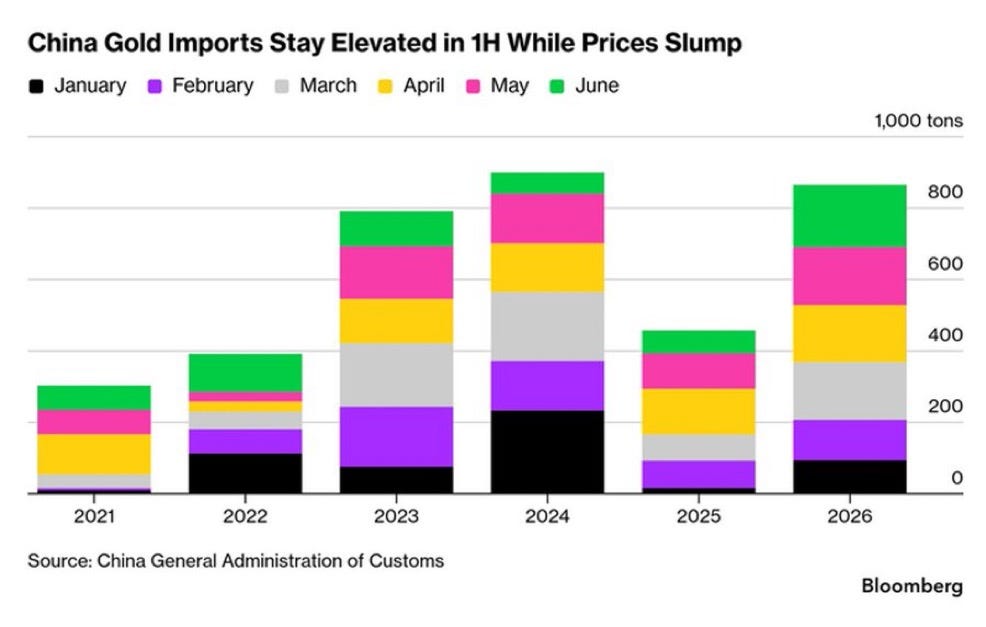
The rise was driven by investors buying after international gold prices fell and by banks rebuilding inventories to meet strong retail demand. A stronger yuan also made imported gold cheaper for Chinese buyers.
Banks increased shipments to support sales of physical bullion and gold savings plans. China’s gold-backed exchange-traded funds have also attracted about 28 tonnes of inflows so far this year, showing that investment demand remains strong.
The data shows Chinese buyers used the recent price decline as an opportunity to add gold rather than step away from the market.
///////end///////
Continues here
END
YOUR EARLY CURRENCY VALUES/GOLD AND SILVER PRICING/ASIAN AND EUROPEAN BOURSE MOVEMENTS/AND INTEREST RATE SETTINGS TUESDAY MORNING.7:30 AM
SHANGHAI CLOSED DOWN 44.93 PTS OR 1.16%
HANG SENG CLOSED UP 103.67 PTS OR 0.41%
Nikkei CLOSED DOWN 2,485.19 PTS OR 3.83%
//Australia’s all ordinaries CLOSED UP 1.09%
//Chinese yuan (ONSHORE) CLOSED DOWN TO 6.7678
/ OFFSHORE CLOSED UP AT 6.7683 Oil DOWNTO 81.92dollars per barrel for WTI and BRENT DOWN TO 93.10 Stocks in Europe OPENED ALL GREEN
ONSHORE USA/ YUAN// WITH YUAN TRADING DOWN (6.7679 OFFSHORE YUAN TRADING DOWN TO 6.7683)ONSHORE YUAN TRADING ABOVE LEVEL OF OFF SHORE AND DOWN ON THE DOLLAR// / AND THUS WEAKER/OFF SHORE YUAN TRADING DOWN AGAINST US DOLLAR/ AND THUS WEAKER
XXXXXXXXXXXXXXXXXXXXXXXXXXXXXXXXXXXXX
ONSHORE YUAN: CLOSED DOWN AT 6.7678
OFFSHORE YUAN: DOWN TO 6.7683
1.HANG SANG CLOSED UP 103.67 PTS OR 0.41%
2. Nikkei closed DOWN 2,485.19 PTS OR 3.83%
WEST TEXAS INTERMEDIATE OIL DOWN TO 80.26
BRENT; 85.05
3. Europe stocks SO FAR: ALL GREEN
USA dollar INDEX UP TO 101.35// EURO RISES TO 1.1372 UP 13 BASIS PTS
3b Japan 10 YR bond yield:RISES TO. +2.770 DOWN 0 FULL BASIS PTS/ VERY TROUBLESOME//Japan buying 100% of bond issuance)/Japanese YEN vs USA CROSS NOW AT 163.813… JAPANESE YEN NOW FALLING AS WE HAVE NOW REACHED THE ENDING OF THE YEN CARRY TRADE AGAIN AND THE REPATRIATION OF YEN DENOMINATED BONDS TRADING IN THE USA/EUROPE. JAPAN 30 YR BOND YIELD: 3.998 UP 2 FULL BASIS PT
3c Nikkei now ABOVE 17,000
3d USA/Yen rate now well ABOVE the important 120 barrier this morning
3e Gold DOWN /JAPANESE Yen DOWN CHINESE ONSHORE YUAN: DOWN (6.7678) AND OFFSHORE: DOWN AT 6.7683
3f Japan is to buy INFINITE TRILLION YEN worth of BONDS. Japan’s GDP equals 5 trillion USA. CENTRAL BANK OF JAPAN WILL NO LONGER DO QE.
Japan to buy 100% of all new Japanese debt and NOW they will have OVER 50% of all Japanese debt. GOVERMENT ASKED JAPAN PENSION FUNDS AND INSURANCE FUNDS TO BUY MORE JAPANESE BONDS AND REPATRIATE ALL FOREIGN BONDS.
3g Oil DOWNfor WTI and DOWN this morning
3h European bond buying continues to push yields LOWER on all fronts in the EU German 10yr bund YIELD DOWNTO +3.1100/ Italian 10 Yr bond yield DOWN AT 3.935/ SPAIN 10 YR BOND YIELD DOWN TO 3.569%
3i Greek 10 year bond yield UP TO 3.823%
3j Gold at $4042.85//Silver at: 57.48 1 am est) SILVER NEXT RESISTANCE LEVEL AT $100.00
3k USA vs Russian rouble;// Russian rouble DOWN 0 AND 60/ 100 roubles/78.51
3m oil (WTI) into the 80 dollar handle for WTI and 85 handle for Brent/
3n Higher foreign deposits moving out of China// huge risk of outflows and a currency depreciation. This can spell financial disaster for the rest of the world/
JAPAN ON JAN 29.2016 CONTINUES NIRP. THIS MORNING RAISES AMOUNT OF BONDS THAT THEY WILL PURCHASE UP TO .5% ON THE 10 YR BOND///YEN TRADES TO 163.813 // 10 YEAR YIELD AFTER FIRST BREAKING .54% LAST YEAR NOW EXCEEDS THAT LEVEL TO 2.770% DOWN 1/3 BASIS PTS STILL ON CENTRAL BANK (JAPAN) INTERVENTION//YEN CARRY TRADE NOW UNWINDING//YEN BOND TRADING OVERSEAS TO BE REPATRIATED.//JAPAN 30 YR: 3.998 UP 2 PTS..: USA/SF this 0.8192 as the Swiss Franc . Euro vs SF: 0.9310
USA 10 YR BOND YIELD: 4.6113 DOWN 12 BASIS PTS…
USA 30 YR BOND YIELD: 5.110 DOWN 2 BASIS PTS/
USA 2 YR BOND YIELD: 4.293 DOWN 3 BASIS PTS
USA DOLLAR VS TURKISH LIRA: 47.38 UP 4 BASIS PTS/LIRA GETTING KILLED//IDIOTS FOR SELLING GOLD AND USA DOLLAR RESERVES.
10 YR UK BOND YIELD: 4.9523 DOWN 3 PTS
30 YR UK BOND YIELD: 5.654 DOWN 4 BASIS PTS
10 YR CANADA BOND YIELD: 3.557 DOWN 5 BASIS PTS
5 YR CANADA BOND YIELD: 3.182 DOWN 5 BASIS PTS.
Futures Slide As Tech Rout Continues, Kospi Halted As It Crashes 10%
Tuesday, Jul 28, 2026 – 07:25 AM
Futures extend Monday’s losses as the Tech tape continues to unravel; global Semis were hit yesterday and again overnight (despite the best attempts of Goldman and JPM to force retail to buy the falling knives) with Asian stocks and especially Korea (-10%) bearing the brunt with fears of Chinese competition accelerating the sell-off and then spilling back over into the US. As of 7:00am ET, S&P futures are down 0.2% with tech slammed pushing the Nasdaq 0.9% lower and leaving the index set for a five-day run of losses for only the second time this year. Semis are again lower pre-market led by weakness in Nvidia, Intel and Micron, while Mag7 names are mostly bid and outperforming. While Defensives are leading Cyclicals, there are bids to Discretionary and Financials as both sectors look to outperform. As JPM writes in its Market Intel post this morning (available to pro subs), the market is swept in a risk-off tone (where all the news continues to be sold) that is continuing both the broadening in the US and a rotation ex-US where EU may continue to outperform as investors tilt towards Value; the $64 trillion question remains when do Semis / AI find a bottom. There is some good news as expectations (because they certainly are not taking place) of US, Iran negotiations are reducing commodity prices. As such yields are down 3bps, the USD is flat, and commodities are weaker led by Energy and Precious with Base and Softs the outperformers. Today’s macro data focus is on the weekly ADP print, Housing price indices, Consumer Confidence, Import / Export data, Inventories, and regional Fed activity indicators.

In premarket trading, chip producers and other AI-related firms are extending their selloff as worries about China’s progress in advanced chipmaking weighs down sentiment. This is also exasperating concerns over the sustainability of the AI spending boom that has propelled the sector in recent years.
- Tesla and Nvidia are underperforming Magnificent 7 stocks during the selloff in chipmakers and AI-linked firms:
- Microsoft +1.1%, Apple +0.6%, Meta Platforms +0.4%, Alphabet +0.1%, Amazon +0.1%, Nvidia -1%, Tesla (TSLA) -1.4%.
- Applied Digital (APLD) gains 2.9% after the digital infrastructure designer reported fourth-quarter revenue to $258.7 million, a 407% increase from a year ago.
- Cadence Design Systems Inc. (CDNS) is up 2.5% after the electronic design automation software company reported second-quarter results that beat expectations and raised its full-year forecast.
- Carrier Global (CARR) jumps 5.1% after the HVAC company boosted its sales forecast for the full year.
- United Parcel Service Inc. (UPS) is up 2.7% after boosting guidance for the year, suggesting the courier is benefiting from strong pricing as it works to shift volume from low-margin e-commerce shipments to more-profitable packages.
In other corporate news Johnson & Johnson agreed to a $5.5 billion commitment to resolve litigation related to claims that its talc products caused ovarian cancer. KKR is said to be exploring options for LS Automotive India including a sale. In deals, Curium is said to be in advanced talks to acquire radiopharma company Lantheus Holdings in a transaction that could value Lantheus at up to $8 billion, including contingent value rights. Stellantis agreed to sell its car-sharing business Free2move to a German private equity firm, part of a plan by the maker of Fiat and Peugeot cars to exit unprofitable businesses and refocus investments on core brands and regions.
While the weeks-long volatility in chipmakers is rumbling on amid fresh concerns over massive debt issuance, debt-funded AI capex spending and rising competition from China, traders are rotating into consumer stocks and other sectors that tend to generate relatively stable revenues regardless of the economic cycle. Lower crude prices also eased inflationary angst, with Brent dropping 3% to below $86 a barrel. The global benchmark is falling for a third straight day as the US and Iran extended their pause in hostilities. Focus will now turn to talks between Tehran and Oman over restarting traffic in the Strait of Hormuz.
“It’s perfectly legitimate for investors to dilute their positions in semiconductors. It’s a good time indeed to take some profits and diversify,” said Vincent Juvyns at ING Groep NV. “That being said, I advise clients to stay invested as visibility is pretty good for the sector.”
There’s more than earnings to consider over the coming days, of course. Citadel Securities’ Frank Flight, the firm’s head of macro strategy, expects the Fed to raise interest rates this week. “The market may once again be underestimating the extent of the hawkish shift at the Fed,” Flight wrote in a note. A hike “would emphatically end the forward guidance era” while underscoring the Fed’s independence, he said.
Meanwhile, the increasingly interconnected web of dependencies between technology manufacturers and AI startups continues to stir unease. The risk of these “circular” deals was highlighted last year here, and although markets forgot all about it, they are now once again freaking out. For JonesTrading chief strategist Mike O’Rourke, investors can “talk about the compute storage all they want and the fundamental demand, but it is clear that a significant portion of Nvidia’s sales come from an ecosystem that Nvidia is artificially creating.” The result is that the “only certainty one can have is the high degree of uncertainty in the AI environment,” he said.
Credit-market signals are a more relevant short term gauge than EPS valuations for hyperscalers, notes Manish Kabra at Societe Generale. When there is a peak in CDS spreads, it should signal the market begining to price in an improvement in hyperscalers’ free cash flow and an end to a derating. But an inflection in FCF is not expected until the second half of 2027, Kabra adds.
The gap between single-stock and index volatility is off its highs, but remains close to historical extremes, consistent with very low implied correlation. The combined effect of dispersion and sector rotation beneath the surface have caused individual stock moves to cancel each other out at the index level within the S&P 500.
Elsewhere in markets, corn futures in Chicago rose as government data pointed to the sharpest drop in US crop conditions in three years, potentially reducing supply. The biggest US power grid, PJM Interconnection, is warning that data centers may face involuntary outages under a plan to avert widespread blackouts and protect residential ratepayers from electricity price spikes.
Asia bore the brunt of Tuesday’s selling. The regional benchmark headed for a correction after SK Hynix and Samsung Electronics Co. tumbled more than 13% in Seoul. The KOSPI tumbled 10%, closing at session lows following another 20 minute marketwide halt, on concern about circular AI financing and new DUV capability from China which may increase memory supply. The macro spillover is continuing. As KOSPI is down over 30% from the peak, Goldman estimates the retail wealth effect to reduce by ~15bp of GDP. Drop in equities also eases financing pressure from leveraged ETF, especially as govt continues to step up control on the product.

Tech stocks are also slipping in Europe, but that’s being offset by strength in consumer goods and autos stocks, with the Stoxx 600 up 0.4%. European chip giant ASML extended losses for the week to 10% following the emergence of a possible Chinese state-backed rival. Still, advancing stocks in the Stoxx 600 outnumbered decliners by more than two to one even as earnings from Barclays Plc, LVMH and Unilever Plc drew a mixed reaction. The Stoxx 600 benchmark rose 0.4%.
In FX, the Bloomberg Dollar Spot Index rises 0.1% as investors await the Fed’s decision due later this week. Interest-rate futures imply roughly a 38% chance of a quarter-point increase on Wednesday. The Fed is likely to leave rates unchanged but renewed tensions in the Middle East and Fed Chairman Kevin Warsh’s decision to hold a press conference “have made it a closer call than anyone would have thought a couple of weeks ago,” wrote Erik Weisman, chief economist and portfolio manager at MFS Investment Management
- JPY retreats slightly against the USD given the recent modest strength in the DXY; USD/JPY remains under the 23rd July peak at 162.42.
- EUR is modestly softer against the USD amid the lack of fresh catalysts. EUR/USD reside towards the bottom end of a 1.1354-1.1380 range at the time of writing.
- GBP has dipped under 1.33 (vs high 1.3305) amid the aforementioned DXY upside with limited UK-specific drivers in the session.
In rates, 10Y TSY yields are down 3bps to 4.62%, down 10bps since July 23 when Brent traded up to $100, with UK gilts slightly outperforming as investors trim their Bank of England rate-hike bets ahead of this week’s meeting.
In commodities, oil prices slide for a second day, with Brent sitting around $86 having touched $100 last week. That’s buoying bond markets, with yields falling across the US, Europe and the UK. Gold prices are down, though holding above $4,000/oz, and Bitcoin slipped below $64,000.
Looking the day ahead now, economic data includes US June advance goods trade balance, wholesale inventories, July Conference Board consumer confidence index, Richmond Fed manufacturing index, business conditions, Dallas Fed Services activity, May FHFA house price Index, and France July consumer confidence. We’ll also be getting a large batch of earnings including Visa, Coca-Cola, Boeing, NXP Semiconductors, Teradyne and Ford.
Market Snapshot

Top Overnight News
- The Kospi index follows a weak US session lower, falling as much as 10.7%. Asia’s semiconductor related stocks come under intense selling pressure dragging the MSCI AC Asia Pacific index down over 3%
- The Kospi slumped as much as 10.7%, heading for the worst session since early March as both Samsung Electronics and SK Hynix slid more than 12%. Korea Exchange triggered a circuit breaker for the benchmark, marking its eighth such halt this year
- German officials are working behind the scenes to identify Chinese economic vulnerabilities that they could exploit if the European Union finds itself in a trade war with the world’s second-largest economy
- Australia’s central bank chief said there are signs the economy is cooling as anticipated, though it’s still unclear if this year’s interest-rate hikes are enough to return inflation to target or whether additional tightening will be needed
- China set a ceiling on new US tariffs and warned Washington against sanctioning Chinese artificial intelligence companies, drawing boundaries weeks before the next meeting between President Donald Trump and Chinese leader Xi Jinping
- A selloff in semiconductor stocks deepened Tuesday, as signs of China’s progress in advanced chipmaking weighed on global rivals and concern mounted over the sustainability of the artificial intelligence spending boom
- President Donald Trump said the US and Iran were engaged in diplomatic talks to end the Middle East conflict, but warned the two sides would return to fighting if negotiations didn’t yield a deal
- A nearly $600 billion rout in just a little over a month has flipped SK Hynix Inc. from one of the world’s hottest AI trades to one of the biggest portfolio question marks
- Oil extended a steep decline after President Donald Trump said that the US and Iran were engaged in talks to try to end the Middle East conflict, with the two sides continuing to hold off on attacks
- US Pacific Tsunami Warning Center said the tsunami threat from the Japan earthquake has now passed, with no tsunami threat remaining for Japan’s coast.
- Shots fired at US consulate in Toronto for the second time this year, according to the New York Post.
- US Senate votes to advance Trump nominee Clayton for Director of National Intelligence role.
A more detailed look at global markets courtesy of Newsquawk
APAC stocks were mostly negative amid a tech bloodbath and competition concerns following reports that China had started mass production of domestically developed DUV lithography equipment, which had pressured ASML shares and the Nasdaq yesterday. ASX 200 bucked the trend as strength in telecoms and the consumer sectors offset the weakness in miners, materials and resources. Nikkei 225 briefly fell beneath the 62,000 level amid the tech-related losses, with Kioxia heavily pressured. KOSPI triggered a circuit breaker with double-digit declines seen in Samsung Electronics and SK Hynix. Hang Seng and Shanghai Comp were lower but with downside limited in Hong Kong amid the mixed performance among the local tech bluechips, while the mainland was subdued as trade frictions lingered with the US reportedly probing Chinese factories in Vietnam.
Top Asian News
- Japan’s Finance Minister Katayama said must communicate with JGB market in run-up to budget compilation, and we hadn’t done that. said:. Believes the government’s relationship with the BoJ has been smooth. Very good that final version of the Economic Blueprint has won market understanding. Not currently considering JGB buybacks. Global bond markets have been affected by various factors such as US monetary policy, Ukraine and Middle East situations. Weak yen can have both merits and demerits. Won’t comment on specific FX levels and won’t comment on potential intervention. No change in stance that we’re ready to respond on Forex as needed.
- Japanese Finance Minister Katayama said taking price relief measures one after another, also noted that foreign banks’ participation in projects under Japan’s US investment scheme wipes out concerns about dollar funding.
- 5.0 magnitude earthquake in Qinghai, China, CENC reported.
- Japan’s Nuclear Regulation authority said there are no irregularities at nearby nuclear power plants after earthquake. Includes Ikata, Genkai, Sendai plants.
- Earthquake of prelim 7.1 magnitude hits Japan’s Kyushu, NIED reported; issues tsunami warning of 1 metre, NHK reported.
European bourses began the session firmer despite sharp losses in APAC, particularly the KOSPI (-10%). At the time of writing, the Euro Stoxx 50 sees gains capped as ASML continued to weigh following reports China started DUV tool production, with the stock extending losses after Monday’s -8.5% decline. Sectors are mostly in the green, with Optimised Personal Care leading and Energy lagging, the former weighed on by LVMH post earnings. Broader sentiment is supported by optimism around US–Iran talks (see commodities for further details), which weighs on crude and underpins equities. Movers: ASML extends losses (-1.5%) on China DUV concerns. In earnings, LVMH (-1%) reported a revenue beat but softer Fashion & Leather Goods sales, Unilever (+6%) beat and raised guidance, while Mercedes-Benz (+3%) cut revenue guidance but maintained margins. In APAC, SK Hynix and Samsung fell ~12% amid memory concerns linked to CXMT’s listing.
Top European News
- US diplomats walked out of a UN Security Council meeting after France publicly criticised the Trump administration’s human rights record.
FX
- DXY was directionless for most of the European morning before picking up in recent trade despite a lack of US-specific catalysts, with markets increasingly viewing the upcoming Fed meeting as potentially “live”. Tightening bets remained around a 30% probability of a 25bps hike, though softer crude limited further upside in the Buck. DXY has been edging higher in recent trade after topping the 1st July peak (101.60) and aims for the 25th June high at 101.75.
- JPY retreats slightly against the USD given the recent modest strength in the DXY; USD/JPY remains under the 23rd July peak at 162.42.
- EUR is modestly softer against the USD amid the lack of fresh catalysts. EUR/USD reside towards the bottom end of a 1.1354-1.1380 range at the time of writing.
- GBP has dipped under 1.33 (vs high 1.3305) amid the aforementioned DXY upside with limited UK-specific drivers in the session.
- Antipodeans underperform, led by AUD, which drifted lower to a 0.6963 base following remarks from RBA Governor Bullock that were viewed as lacking strong forward guidance. NOK also lagged as oil prices declined, with the cross nearing parity (1.001).
- PBoC set USD/CNY mid-point at 6.7928 vs exp. 6.7730 (prev. 6.7911).
Fixed Income
- UST are firmer, gaining around five ticks at best to a 108-24+ peak, just above Monday’s 108-22 high but still shy of last week’s 109-00 and 109-08+ peaks. The move was driven by the pullback in energy amid US–Iran diplomacy, with focus turning to incoming data and a 7yr auction.
- Bunds trade in line with USTs but with slightly greater magnitude, holding around 10 ticks below the 125.21 peak while still posting gains of a similar amount. The upside is supported by softer energy prices, with some caution ahead of the Fed given the ~30% implied probability of a July hike.
- Gilts opened on the front foot and outperform, gapping higher by around 10 ticks before extending to a 87.48 peak, taking out last week’s high. The benchmark then looks towards prior resistance levels at 87.60, 87.72 and 87.82.
- Italy sell EUR 2.5bln vs exp. EUR 2-2.5bln 2.20% 2028 and 0.50% 2028 BTP and EUR 3bln vs exp. EUR 2.5-3bln 2.00% 2037 BTPei. 2.20% 2028: b/c 1.79x (prev. 1.51x) & average yield 2.89% (prev. 2.74%). 0.50% 2028: b/c 1.90x & average yield 2.92%.2.00% 2037 BTPei: b/c 1.4x & real yield 2.04%.
- UK DMO sold GBP 750mln of 0.125% Jan 2028 Gilts via tender: average yield 4.090% (prev. 3.989%); b/c 5.35x (prev. 4.97x).
- Netherlands sold EUR 2.99bln (exp. 2.0-3.0bln) 2.75% 2036 DSL: average yield 3.206% (prev. 3.209%).
- Japan sold JPY 649bln in 10yr, 20yr and 30yr JGBs in enhanced liquidity auction; b/c 2.68 vs. Prev. 2.92. Highest accepted spread +0.004% vs. Prev. +0.020%. Allotment of bids at highest spread 87.6152% vs. Prev. 98.6666%. Australia sold AUD 800mln 4.25% October 2036 bonds, avg. yield 5.0345%, b/c 4.70.
Commodities
- Crude futures are lower as US–Iran diplomacy (at face value) continue to improve sentiment, with Oman’s Hormuz proposal and reports of Iranian “flexibility” weighing on prices. Brent Oct’26 trades towards the bottom of a USD 83.58–85.60/bbl range, while WTI Sep’26 sits near the lower end of USD 80.36–82.43/bbl. Dutch TTF was also softer by almost 2%, finding support around EUR 56/MWh.
- Precious metals are subdued despite lower oil, as geopolitical risk premium unwinds and caution emerges ahead of the FOMC.
- Spot gold trades within a narrow USD 4,034–4,081/oz range, inside Friday’s USD 4,022–4,082/oz band.
- Base metals are on a softer footing, though losses were contained by constructive geopolitics. The complex is weighed on by weak APAC tech sentiment, with 3M LME copper trading within a USD 13,620.00–13,739.83/t range.
- Libya’s NOC said it halted production at the El Feel oil field (80-90k BPD) and a partial halt to the Wafa field (20-30k BPD), according to Sky News Arabia & Al Hadath; due to protest action.
- Saudi Aramco is mulling new oil pricing to reflect higher freight costs for cargoes loading from Egypt’s Sidi Kerir to Asia.
- QatarEnergy has extended LNG force majeure for European customers.
Trade/Tariffs
- Germany said to be working on mapping China’s weaknesses in preparation for potential future trade war, Bloomberg
- reported.
- China said it never deliberately pursues a trade surplus and vows to strengthen industry through global coordination, according to Xinhua.
- US probes Chinese factories in Vietnam, stoking new levy fears.
- US Trade Representative Greer said in Fox News interview new Section 301 tariffs shouldn’t cause economic effects we’re not already facing, adds tariff rates are comparable to previous tariffs and talks with Mexico are focused on ensuring balanced trade
Central Banks
- Citadel Securities said Fed chair Kevin Warsh could surprise with a rate hike this week, which would bolster his credibility in the inflation fight.
- RBA Governor Bullock said board is ready to hike cash rate further if needed, while key question is if tightening already delivered is enough to slow inflation. said:. Policy works with a lag, meaning the full impact of this year’s rate increases has yet to emerge. The strongest contribution monetary policy can make is to preserve low and stable inflation. Further slowing in demand growth will likely be needed to bring inflation lower. Some additional easing in labour market conditions will probably be required. The economy has adjusted gradually and broadly in line with expectations. Monetary policy cannot solve Australia’s weak productivity growth. Underlying inflation has developed as expected but remains too high. Businesses continue to report increasing non-labour cost pressures. The housing market has softened more than anticipated. Demand growth is moderating broadly in line with the May baseline forecasts. It remains too early to judge the full economic impact of the recent oil shock. Don’t know what the board will decide at next meeting, will depend on whether board thinks policy is restrictive. Will have some difficult decisions to make if board thinks inflation is not coming down.
- Philippine Central Bank Governor said large inflation impact seen in 2027 and 2028, adds peso decline could also cause increase in inflation, also sees small chance for aggressive tightening. said:When the dollar is strong, we limit intervention to maintain order.
Russia-Ukraine
- Russia’s Tyumen oil refinery halted operations on July 25 after a drone attack, sources say.
- Finland temporarily closes airspace near Russia amid potential stray drone.
- EU hesitates to target an Irish alumina plant accused of supplying Russia’s war industry, amid fear of cutting off supplies critical for European industry, according to FT.
- US President Trump will meet with Ukrainian President Zelensky at 09:30EDT/14:30BST and will meet with Israeli PM
- Netanyahu at 11:30EDT/16:30BST on Tuesday.
- US Senate is expected to start voting on Russia sanctions bill as soon as Tuesday during Ukrainian President Zelensky’s visit.
Middle East
- A military source from Sanaa, Yemen reportedly stated that the recent Yemeni operation showed that Saudi Arabia’s oil facilities are now on the list of legitimate targets available to Yemen, Tasnim reported.
- Iran has lost c. 230mln/CM of gas production capacity during the US-Iran conflict, JRTV reported.
- Iran demonstrating ‘flexibility’ over Hormuz Strait operations, sources tell Al Jazeera.
- Oman is said to have presented to Iran a proposal for a joint regional mechanism to manage the Strait of Hormuz with
- “voluntary fees”, according to Reuters sources. The source said Iran would not exercise sole control of the Strait.
- Iran’s Foreign Minister is said to have held phone called on Strait of Hormuz security with Saudi and Oman officials.
- US-led talks between Israel and Lebanon will take place in Rome on August 4-6, according to a State Department official.
- US official noted significant momentum in Israel-Lebanon peace track. Talks are to focus on redeployment and border issues in Lebanon.
- US officials say that sanctions may damage Iran more than bombing and Trump administration said to focus on economic pressure to force Iran deal, according to Axios.
- Oman’s Foreign Minister held called with counterparts from Iran, Saudi Arabia, Qatar, Kuwait and Egypt to discuss efforts to reduce tensions, according to Iran International. Talks focused on pursuing practical, fair and sustainable understandings through political and diplomatic channels, ensuring safe navigation through the Strait of Hormuz, and restoring the uninterrupted flow of trade and global supply chains.
- Iran will maintain special regime for passage of Russian vessels through the Strait of Hormuz, according to TASS.
- Israel conducts artillery attack on eastern Gaza City, according to SNN.
- Hamas delegations is carrying positive positions on the roadmap presented by Gaza representative Mladenov and the
- mediators, provided Israel agrees, Al Jazeera reported citing sources
- Israeli PM Netanyahu reportedly struggled to get on US President Trump’s schedule for today, Axios reported, suggesting the Israeli PM’s influence is waning.
- Satellite images show that recent Iranian strikes hit Amazon (AMZN) data centres.
- Reports of an Israeli drone airstrike in southern Lebanon, Al Jazeera reported.
- Iranian, Omani, and Saudi Foreign Ministers held a phone call yesterday; notable details light.
- Occurrences of explosions in Saudi Arabia and Jordan, ISNA reported citing sources; six explosions occurred near oil and gas facilities in the Al-Sharqiyah region of Saudi Arabia.
- Reports of widespread drone attacks on eastern Jordan’s desert, Press TV reported.
- Jordanian army said that they shot down a drone that violated Jordanian airspace in the eastern desert.
- Iraqi sources report attack on separatist group’s weapons depot in Sulaymaniya, Iraq.
- Report noted that drone and rocket attack in Erbil was near the US consulate.
- More than seven explosions heard in Erbil, northern Iraq with the headquarters of separatists rocked, while US Consulate in Erbil was also reportedly targeted, according to IRIB.
- Explosions reported in Erbil, northern Iraq, with the Khor Mor Gas Field attacked, according to Tasnim and SNN.
US Event Calendar
To the day ahead now, economic data includes US June advance goods trade balance, wholesale inventories, July Conference Board consumer confidence index, Richmond Fed manufacturing index, business conditions, Dallas Fed Services activity, and May FHFA house price Index. We’ll also be getting a large batch of earnings including Visa, Coca-Cola, Boeing, NXP Semiconductors, Teradyne and Ford.
DB’s Jim Reid concludes the overnight wrap
Tech concerns have been the dominant driver in Asia this morning as renewed worries over AI investment spending, and competition from cheaper Chinese companies, have triggered another selloff in global semiconductor stocks. The KOSPI (-10.11%) is the worst-performing index, heading for its steepest decline since early March during the onset of the US-Iran conflict with the sharp drop also prompting circuit-breaker measures earlier in the session. The benchmark is being weighed down by major chipmakers, with SK Hynix falling as much as -13% and Samsung Electronics declining around -12%. Additionally, the Nikkei (-4.10%) is also seeing sharp losses, falling to its weakest level since May 22 with Kioxia Holdings down another -18% and now roughly -60% lower from its peak in late June, around the time we discussed its remarkable story in the WOW! pack given it had gone from nowhere to become the largest company in Japan in a few months. A really remarkable story.
This sums up the past 24 hours as markets have been caught between a new sell-off in chipmakers and the positive news that the US-Iran pause from over the weekend would continue as both sides negotiate in talks. This meant that the S&P 500 (+0.02%) and Nasdaq (-0.16%) were little changed yesterday after an initial rally, whilst the Philly Semi Stock Exchange Index (-2.23%) fell further. The equity performance also wasn’t helped by new highs in real yields, though nominal 10yr Treasury yields (-2.8bps) came down as Brent crude fell -8.70% yesterday, in its largest decline since April. It is an additional -2.0% lower this morning, trading at $86.59/bbl, after being at $101 on Friday morning. S&P 500 (-0.22%) and Nasdaq (-0.74%) futures are lower this morning.
Elsewhere overnight, the CSI 300 (-2.12%) and Shanghai Composite (-0.90%) are also lower but we have seen CXMT Corp.’s blockbuster debut in Shanghai over the last 24 hours. Their shares surged a stunning +466% after the IPO yesterday. The listing has reinforced investor confidence in Beijing’s drive for semiconductor self-sufficiency and has propelled the company to become China’s most valuable firm. It has also helped send shockwaves around the semis world.
Turning to the Middle East, Trump said in an interview with Axios yesterday that he had paused strikes on Iran whilst negotiations are taking place, although if the talks fail, the US would “go back to very strong military action.” He also suggested in comments to reporters that “there’s a good chance” of a deal, saying repeatedly that talks were progressing. And while Iran’s Foreign Ministry suggested that no formal negotiations were taking place with the US, we saw continued reporting of talks between Iran and Oman on re-opening the Strait of Hormuz. There was also some more concerning news, not least with Houthi attacks on Saudi oil facilities over the weekend. But overall, the focus on talks sent front-month Brent crude -8.70% lower, while 6-month Brent futures were down -3.29% to $79.67/bbl.
The fall in oil prices meant that near-term inflation expectations also declined, with the US 1yr inflation swap down -10.5bps to 1.93%, while the Euro 1yr inflation swap (-18.0bps to 2.42%) fell even more. The decline in breakevens was partially offset by a rise in real yields, with the 2yr real Treasury yield up +7.7bps, while the 10yr real yield rose +1.5bps to 2.45%, its highest since October 2023. Put together, this left nominal yields a few basis points lower on the day, including for 10yr Treasuries (-2.8bps), bunds (-3.8bps), OATs (-4.5bps), and gilts (-2.6bps).
The Treasury rally was more marginal at the front-end, with pricing of a Fed rate hike as soon as tomorrow stable at 38% yesterday. Staying with the Fed, in a separate interview onboard Air Force One Trump reiterated that interest rates in the US should be lower and that “Warsh’ll do the right thing,” saying “I know what he wants.” Meanwhile for the ECB, we did see a bit more of a pullback in hike expectations, with pricing of further hikes by the December meeting down -1.6bps to 42bps.
After rallying at the open on the retreat in oil prices, US equities whipsawed lower after chip stocks sold off. The catalyst was chip-equipment manufacturer ASML (-8.41%), whose shares fell after the Information reported that a Chinese company had successfully started mass production of deep ultraviolet lithography machines needed to create advanced semiconductors. The news led to a decline across other chip-equipment peers, with the Philly Semi Stock Exchange Index down -2.23% yesterday. Nvidia (-4.99%) shares also fell after it was revealed that the company was working on AI deals worth more than $750bn, renewing investor worries on circular AI financing.
The broader equity mood music was better, however, with nearly two-thirds of the S&P 500 higher on the day and the small cap Russell 2000 up +0.62%. And in Europe, indices including the DAX (+1.04%), CAC 40 (+0.40%) and FTSE 100 (+0.42%) saw decent gains, although the Stoxx 600 (+0.02%) was dragged down by ASML and other semi companies.
Economic data was light yesterday but we did get Germany’s July IFO business climate release (86.6 vs 86.0) surprise to the upside, driven by the expectations component (86.7 vs 84.8 est), which may reflect the federal government’s recently adopted reform measures.
Finally, the Swiss Franc weakened after Bloomberg reported that the SNB expects to keep its interest rates at 0% until the end of 2027. The Swiss franc fell by about a quarter of a percent against the euro following the story, though its daily decline was a more modest -0.09%.
To the day ahead now, economic data includes US June advance goods trade balance, wholesale inventories, July Conference Board consumer confidence index, Richmond Fed manufacturing index, business conditions, Dallas Fed Services activity, May FHFA house price Index, and France July consumer confidence. We’ll also be getting a large batch of earnings including Visa, Coca-Cola, Boeing, NXP Semiconductors, Teradyne and Ford.
1b European opening report
1 c) Asian opening report
Europe primed for flat open as Brent stabilises at $87/bbl, KOSPI -10% – Newsquawk EU Market Open

Tuesday, Jul 28, 2026 – 02:20 AM
- US President Trump said Iran is talking to the US about making a deal right now and very friendly talks are ongoing, while he added they will end Iran’s nuclear threat very quickly and that Iran is behaving again.
- US President Trump said Iran wanted to meet and that “we’re meeting,” while he added there is a chance a deal could be reached.
- APAC stocks were mostly negative amid a tech bloodbath and competition concerns following reports yesterday that China had started mass production of domestically developed DUV lithography equipment.
- DXY traded little changed, 10yr UST futures traded range-bound, and Crude futures remained subdued overnight.
- European equity futures indicate a flat cash market open, with Euro Stoxx 50 futures little changed after the cash market closed flat on Monday.
- Looking ahead, highlights include Spanish Retail Sales (Jun), US ADP Employment Change Weekly, Goods Trade Balance Advance (Jun), Retail Inventories Ex Autos Advance (Jun), Wholesale Inventories Advance (Jun), Consumer Confidence, Atlanta Fed GDP (Q2), Supply from UK, Italy, Netherlands & US, Earnings from PayPal, Boeing, UPS, Ford, EssilorLuxottica, Kering, Air Liquide, Eni, Barclays, GSK & Unilever.
SNAPSHOT
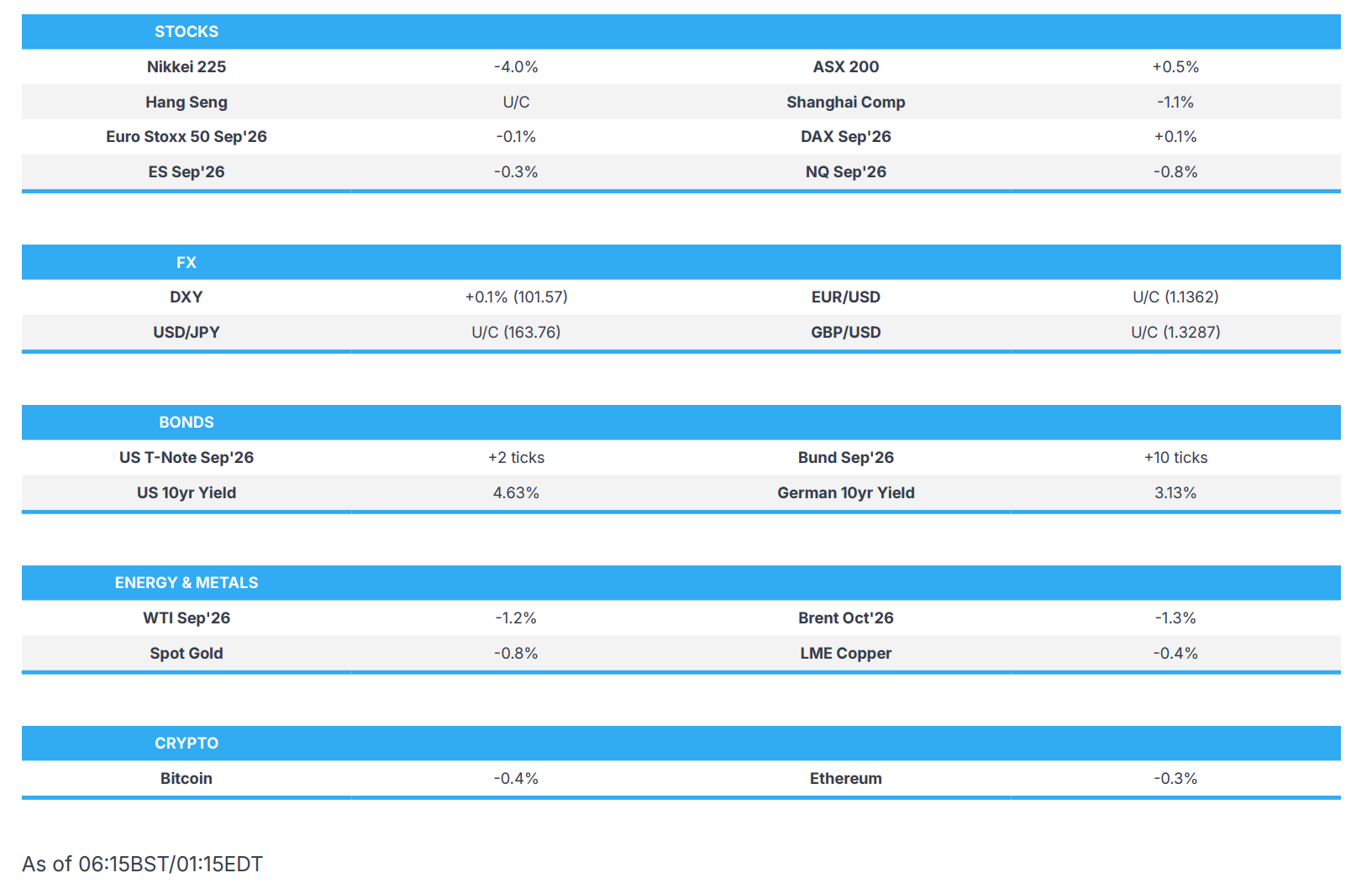
Newsquawk in 3 steps:
1. Subscribe to the free premarket movers reports
2. Listen to this report in the market open podcast (available on Apple and Spotify)
3. Trial Newsquawk’s premium real-time audio news squawk box for 7 days
IRAN CONFLICT
- US President Trump said Iran is talking to the US about making a deal right now and very friendly talks are ongoing, while he added they will end Iran’s nuclear threat very quickly and that Iran is behaving again.
- US President Trump said Iran wanted to meet and that “we’re meeting,” while he added there is a chance a deal could be reached and that Iran had requested a meeting through surrogates. Trump stated there was plenty of time on Iran, talks were going well, and “we’ll see what happens,” as well as noted there was a good chance something would happen. Trump also said there was a chance the US would become involved if there were problems with the Houthis, and that he had not discussed the Abraham Accords with Saudi Arabia.
- US officials said that sanctions may damage Iran more than bombing and the Trump administration is said to focus on economic pressure to force an Iran deal, according to Axios.
- Pakistani intelligence officials believe US President Trump could order a ground offensive in Iran, according to dpa via Yahoo Finance. At least two officials said Trump was believed to be planning a limited ground assault to cut off Iran’s coastal region before any peace deal, despite domestic pressure and warnings from generals against such a move. One official said there were “so many signs” he was planning it, citing troop deployments, military movements and rhetoric.
- Oman’s Foreign Minister held calls with counterparts from Iran, Saudi Arabia, Qatar, Kuwait and Egypt to discuss efforts to reduce tensions, while talks were focused on pursuing practical, fair and sustainable understandings through political and diplomatic channels, ensuring safe navigation through the Strait of Hormuz, and restoring the uninterrupted flow of trade and global supply chains, according to Iran International.
- Iranian and Omani negotiators are attempting to reach an agreement to restart shipping through the Strait of Hormuz, which would then allow Tehran and Washington to resume talks on ending the war, according to Bloomberg. Omani negotiators were optimistic an announcement signalling progress could be made in the coming days, although sources cautioned there was no guarantee given the volatile situation. Furthermore, one proposal involved reopening the Strait’s middle passage, although it was believed to contain sea mines laid by Iran.
- Iran’s Central Headquarters warned against the continued US blockade and warned that this US action is considered an extension of war in the region.
- Yemeni Foreign Minister Designate said the government wants a peaceful resolution to conflict with the Houthis, but added they are prepared for escalation if Houthis continue to push them, while the official stated that Houthis are emboldened by a lack of serious international reaction to attacks on shipping and want to copy the Iranian Hormuz model in Bab Al-Mandeb.
- Islamic Resistance of Iraq warned that every foolish move by the Saudis will be met with a decisive response, while it stated that the Saudi regime claims that Iraq is the source of attacks on some of its oil facilities are baseless claims, and are an attempt to justify the inability to respond effectively to Yemen’s attacks on their deep infrastructure.
- More than seven explosions were heard in Erbil, northern Iraq, with the headquarters of separatists rocked, while the US consulate in Erbil was also reportedly targeted, according to IRIB.
- Iran will maintain its special regime for passage of Russian vessels through the Strait of Hormuz, according to TASS.
- US-led talks between Israel and Lebanon will take place in Rome on August 4th-6th, according to a State Department official, who noted significant momentum in the Israel-Lebanon peace track, while talks are to focus on redeployment and border issues in Lebanon.
US TRADE
EQUITIES
- US stocks saw two-way price action, with the initial optimism in equities fading as the session progressed. Sentiment was initially supported by the US and Iran pausing strikes against each other over the weekend, which saw oil prices tumble. Crude hit its lows during the European morning as US equity futures traded around their peaks, although both moves began to retrace as US participants arrived. The downside in equities was concentrated in tech, with the Nasdaq closing lower while the S&P 500 was broadly flat and the Russell 2000 and Dow gained. The equal-weight S&P 500 (RSP) also outperformed, highlighting positive underlying breadth. Nvidia (NVDA) was weighed on by reports that the company is in talks with OpenAI to guarantee USD 250bln in financing for a data centre, while ASML (ASML) fell following reports that China has begun mass production of domestically developed DUV lithography equipment. The sharp decline in oil prices supported T-notes across the curve as some of the recent inflation concerns eased, although the Treasury move was considerably more contained than that seen in crude ahead of Wednesday’s FOMC decision. Treasury supply was mixed, with the 2-year auction stopping through the when-issued yield by 0.5bps, while the subsequent 5-year auction tailed by 0.9bps.
- SPX +0.02% at 7,413, NDX -0.32% at 28,039, DJI +0.51% at 52,215, RUT +0.62% at 2,948.
- Click here for a detailed summary.
TARIFFS/TRADE
- US Trade Representative Greer said in a Fox News interview that new Section 301 tariffs shouldn’t cause economic effects they are not already facing and that tariff rates are comparable to previous tariffs, while he added talks with Mexico are focused on ensuring balanced trade.
- US reportedly probes Chinese factories in Vietnam, stoking new levy fears.
NOTABLE HEADLINES
- US President Trump said he had read a very good inflation report the other day, adding that costs were falling rapidly and prices would decline significantly once the war ended. Trump stated that Fed Chair Warsh was great but has a board, and that Warsh would do the right thing, while he knows what Warsh wants, and reiterated that interest rates should be lowered.
- US Treasury Secretary Bessent said President Trump’s tax cuts had delivered substantial relief to hardworking Americans and provided greater tax certainty and relief for low- and middle-income households.
- US President Trump’s administration is close to finalising its voluntary framework for AI companies to submit their most advanced models to the government before releasing them to the public, according to The Information.
- US Senate voted to advance Trump nominee Clayton for Director of National Intelligence role.
APAC TRADE
EQUITIES
- APAC stocks were mostly negative amid a tech bloodbath and competition concerns following reports that China had started mass production of domestically developed DUV lithography equipment, which had pressured ASML shares and the Nasdaq yesterday.
- ASX 200 bucked the trend as strength in telecoms and the consumer sectors offset the weakness in miners, materials and resources.
- Nikkei 225 briefly fell beneath the 62,000 level amid the tech-related losses, with Kioxia heavily pressured.
- KOSPI triggered a circuit breaker with double-digit declines seen in Samsung Electronics and SK Hynix.
- Hang Seng and Shanghai Comp were lower but with downside limited in Hong Kong amid the mixed performance among the local tech bluechips, while the mainland was subdued as trade frictions lingered with the US reportedly probing Chinese factories in Vietnam.
- US equity futures remained subdued but with losses only marginal compared to the sell-off seen in Asia.
- European equity futures indicate a flat cash market open, with Euro Stoxx 50 futures little changed after the cash market closed flat on Monday.
FX
- DXY traded little changed after the dollar kept afloat yesterday despite oil prices tumbling lower. The move lower in crude prices wasn’t met with a proportionate move lower in US yields and FX, likely as expectations of a hawkish Fed at this week’s meeting have remained, even when taking into account the positive geopolitical developments over the weekend. Money markets are pricing around a 40% chance of a hike this week, while Citadel Securities thinks the Fed could surprise by hiking, which would bolster Chair Warsh’s credibility in the inflation fight.
- EUR/USD languished near the prior day’s trough after failing to sustain a return to the 1.1400 handle, despite hawkish comments from ECB’s Kazimir, who affirmed support for a hike in September.
- GBP/USD attempted to nurse losses after sliding beneath the 1.3300 handle, but with the recovery limited ahead of the central bank announcements this week, including from the BoE meeting, where policymakers are likely to keep rates on hold, while the vote split will provide a better gauge of sentiment amongst members, with expectations for a 7-2 split.
- USD/JPY lacked direction and remained at the 163.00 handle following its recent indecisive performance and with little impact seen following Japanese PM Takaichi’s announcement that Japan must exit excessively tight fiscal policy and will submit a bill to lower the 8% sales tax on food once lawmakers reach an agreement.
- Antipodeans were range-bound amid a quiet calendar and as participants await this week’s risk events.
- PBoC set USD/CNY mid-point at 6.7928 vs exp. 6.7730 (prev. 6.7911)
FIXED INCOME
- 10yr UST futures traded range-bound and took a breather after climbing across the curve as oil prices tumbled, while there were mixed results from the prior day’s two Treasury note auctions as the 2-year auction was strong, stopping through the when-issued yield by 0.5bps, while the 5-year was soft.
- Bund futures held on to energy-facilitated spoils but with prices overnight around the 125.00 level.
- 10yr JGB futures eked mild gains amid a quiet calendar and a liquidity auction for long-end JGBs.
COMMODITIES
- Crude futures remained subdued after slumping due to the pause in strikes between the US and Iran, while President Trump commented that Iran is talking to the US about making a deal and very friendly talks are ongoing.
- US President Trump said Venezuela has been doing a great job and that the US has a thousand-year supply of gasoline, while China doesn’t.
- Spot gold continued its pullback from the USD 4,100/oz level as metals were hit alongside the risk-off tone.
- Copper futures faded the prior day’s gains as risk sentiment was spooked alongside the sell-off in semiconductor stocks.
CRYPTO
- Bitcoin retreated but prices remained above the USD 63,000 level.
NOTABLE ASIA-PAC HEADLINES
- RBA Governor Bullock said the board is ready to hike the cash rate further if needed, while she noted the key question is if tightening already delivered is enough to slow inflation. Bullock also commented that policy works with a lag, meaning the full impact of this year’s rate increases has yet to emerge.
GEOPOLITICS
MIDDLE EAST
- Israeli forces advanced into Syrian territory from the western outskirts of Daraa, according to Fars.
RUSSIA-UKRAINE
- US Senate is expected to start voting on Russia sanctions bill as soon as Tuesday, during Ukrainian President Zelensky’s visit.
OTHER
- US diplomats walked out of a UN Security Council meeting after France publicly criticised the Trump administration’s human rights record.
- US Treasury Department removed 84 targets from sanctions list, including a North Korean firm previously designated for supporting Pyongyang’s nuclear missile programmes, while the move is part of a modernisation initiative to eliminate outdated targets, according to Yonhap.
EU/UK
DATA RECAP
- UK BRC Shop Price Inflation (Jul) 0.9% vs. Exp. 1.2% (Prev. 1.2%)
- end
end
NORTH AND SOUTH KOREA AND JAPAN
SOUTH KOREA
Korea Barbeque’d: Kospi Crashes As Chip Stocks Tank, AI Token Index Spirals Lower
Tuesday, Jul 28, 2026 – 07:45 AM
South Korean stocks plunged on Tuesday as concerns over circular AI financing and China’s expanding DUV lithography capabilities (read here) were top of mind among investors. Adding to the pressure, chipmakers may not have found a floor just yet because Silicon Data’s LLM Token Expenditure Index continues to slide, suggesting that companies are shifting toward cheaper models, particularly open-source alternatives from China.
The Kospi tumbled nearly 11%, with Samsung Electronics and SK Hynix dropping more than 13% each, prompting the Korea Exchange to temporarily halt both cash and program trading for 20 minutes.
South Korea’s main equity index has now lost nearly 34% from its peak one month ago, reversing a rally into a vicious bear market. Concerns over AI profitability, Chinese semiconductor competition, forced deleveraging and evaporating liquidity have accelerated the selloff.
Notably, eight of the Kospi’s 14 circuit-breaker halts since the Dot-Com era have occurred this year.

Beyond circular AI financing and China potentially catching up in the chip race, weakening AI demand indicators via Silicon Data’s LLM Token Expenditure Index only suggest a bottom for chip stocks has yet to materialize.

London-based UBS analyst Joe Dickinson commented on the chip stock selloff, saying it “drives sharp risk-off moves across global markets.”
Dickinson added more color:
The KOSPI is down 11% following a weak US handover, dragging the MSCI APAC down 3%, led largely by semiconductors and supply chain proxies. The move was catalyzed by weakness in ASML following reports that China has begun domestic DUV tool production.
Ha SeokKeun, chief investment officer at Eugene Asset Management, said, “Sentiment toward Korean semiconductor stocks is extremely weak. Broad risk-off sentiment, forced deleveraging, widening hyperscaler CDS spreads, and deteriorating retail investor sentiment are all adding to the selling pressure.”
The selloff is also driven by doubts about whether hyperscalers can justify their massive Capex plans, and the token index continuing to slump lower may only suggest a sustained migration toward lower-cost models (read here) could undermine forecasted demand for computing and threaten the investment boom cycle that fueled gains in Samsung, SK Hynix, TSMC and other chipmakers.
END
JAPAN
A POWERFUL 6.8 EARTHQUAKE!!
Powerful Quake Rocks Southern Japan
Tuesday, Jul 28, 2026 – 06:55 AM
A powerful 6.8-magnitude earthquake rocked southern Japan on Tuesday afternoon, injuring dozens, sparking fires, and damaging buildings.
The Japan Meteorological Agency has since called off a tsunami alert for the coasts of the Ariake Sea and the Yatsushiro Sea. The quake struck Kyushu Island, in Kumamoto Prefecture, shortly before 4:30 p.m. local time.

NHK footage showed severe damage to the Kyushu Expressway, smoke rising from homes, and a partially collapsed wall at Kumamoto Castle.
There were no reported abnormalities at the nearby Sendai Nuclear Power Plant, Cabinet Secretary Minoru Kihara told reporters.
END
3 CHINA/ AI GROK
Stocks Sink Despite Hormuz Hopes As China Sparks Chipmaker Chunder Into Busy Week
This is a ZeroHedge headline from July 27, 2026, summarizing U.S. market action that day. zerohedge.com +1Breakdown of the headline:
- Stocks Sink: Major U.S. indices were mixed to lower. The Nasdaq underperformed due to a selloff in semiconductors/chip stocks, while other sectors (and the broader market) held up better or gained modestly. zerohedge.com
- Despite Hormuz Hopes: Positive developments around the Strait of Hormuz (key oil shipping chokepoint disrupted by prior U.S.-Iran tensions) led to sharply lower oil prices. This initially supported stocks and lowered bond yields (TACO = “Trump Always Chickens Out” on strikes for diplomacy, per the article’s snarky tone). Lower energy costs are generally bullish for equities. zerohedge.com +1
- China Sparks Chipmaker Chunder: A “double whammy” from China hit global chip/semiconductor stocks hard:
- CXMT (ChangXin Memory Technologies): China’s leading DRAM/memory chipmaker had a blockbuster Shanghai IPO debut, surging ~466% on its first trading day. It raised ~$8.6 billion (one of the largest Chinese semis IPOs ever) and briefly became one of the most valuable listed companies in mainland China (~$488 billion market cap at peak). This fueled fears of increased Chinese competition in memory chips amid AI demand. apnews.com +1
- DUV news: Reports of China advancing domestic Deep Ultraviolet (DUV) lithography machine production (a step toward self-sufficiency despite U.S. export curbs on advanced tools). This pressured names like ASML, Nvidia, Micron, etc. x.com
- Into Busy Week: Ahead of a heavy week of catalysts, including major tech earnings, economic data, and more. zerohedge.com
Broader Context (as of late July 2026)Markets have been volatile due to:
- Geopolitical swings in the Middle East affecting oil and supply chains.
- Ongoing AI boom vs. worries about valuation, competition (especially from China), and spending sustainability.
- China pushing hard on domestic chip production for self-reliance.
Oil prices fell significantly on de-escalation hopes, which helped offset some chip weakness. Tech/semis remain sensitive to any China-related headlines given the sector’s concentration and global supply chains.
fox44news.com ANDZeroHedge
often leans bearish/skeptical in its framing. For real-time prices or deeper analysis, check major financial sites or indices directly. This fits the pattern of rotation, competition fears, and event-driven moves common in 2026 markets.
END
4. EUROPEAN AND SCANDINAVIAN COMMENTARIES PLUS NATO
UK/UKRAINE
Guess Who? First Foreign Leader Visits Burnham, UK’s New Prime Minister
Tuesday, Jul 28, 2026 – 04:15 AM
Guess who?… None other than Ukrainian President Volodymyr Zelensky has touched down in the UK for his meeting with new UK Prime Minister Andy Burnham.
“Volodymyr, you are the first head of state or government I have congratulated since taking office as Prime Minister. And that is no coincidence. It is intended to send a very clear message: We stand 100% with Ukraine,” said Burnham.

The PM only took office last week, and Zelensky marks Burnham’s very first international visitor. For Zelensky, Burnham is the fifth British prime minister since the Ukraine war started.
Naturally the first thing Burnham did on the foreign policy front was to pledge his “unwavering support” to Ukraine, “both through the war and beyond.”
This is yet more affirmation of Burnham’s intent to carry on with and expand on Britain’s hawkish policies related to Russia and the Ukraine war which have persisted going back to Boris Johnson at the opening of the February 2022 conflict.
The UK was the earliest out the gate among Western powers to ship heavy weaponry to Kiev, and its support has only grown since.
Burnham while hosting Zelensky announced the UK is sharing the intellectual property of its “Stone Cloak” electronic jammers, which aim to interfere with Russian air defense systems, allowing drones and missiles to better penetrate Russian positions.
“Stone Cloak is the best of homegrown British innovation and proven on the frontline, and it will be vital to protecting our security in both our countries,” Burnham said. According to more from the visit:
Burnham said the visit of the Ukrainian president was designed to “send a very clear message” about the UK’s continued support.
“To put it simply, Volodymyr, I want you to know that we’ve got your back, you can count on me and you can count on us. You can count on the UK for as long as it takes,” he said at a naval base in Portsmouth on Monday.
Zelensky, meanwhile, said Ukraine’s relationship with the UK was “stronger than ever”.
Addressing Zelensky, Burnham said: “I am personally with you 100%, Mr President, and I will honour every commitment this country has made to Ukraine in full.”
Burnham added that he intended to visit Ukraine “soon” following the “very warm meeting” between the pair.
The prime minister also warned Moscow “should be in no doubt of our resolve” and that the UK would “not backdown until we achieve long lasting and just peace for Ukraine.”
Zelensky was hosted for the meeting aboard the aircraft carrier HMS Queen Elizabeth docked at Portsmouth on England’s south coast. After the Monday events in the UK, Zelensky is headed to Washington to meet with President Trump.
Burnham said the leaders had “talked at length” about Ukraine’s need for more interceptors to shoot down inbound Russian missiles, “particularly in terms of Ukraine protecting critical national infrastructure during the winters.”
END
GERMANY
Incompatible With Western Society…?
Tuesday, Jul 28, 2026 – 08:05 AM
Authored by Steve Watson via Modernity News,
The comment section under Al Jazeera’s Facebook coverage of the Berlin Pride attack has laid bare a reality Western elites still refuse to face.

Hundreds of users with Arab and Muslim names flooded the post with open celebration of the Islamist vehicle-ramming that killed one woman and injured 29 others.
Laughing emojis made up roughly a third of the reactions. Comments praising the attacker with “Alhamdulillah,” “Jihad,” and “Thank God” stacked up without shame.
The Al Jazeera English Facebook post in question is this one:
There is also an earlier “BREAKING” post about the parade being called off that drew similar reactions:
Laughing emojis made up a conspicuous portion of the reaction totals. These were not isolated trolls. They formed a consistent chorus of approval for the deliberate targeting of people at a Pride event.
The responses also include:
- “Alhamdu lillah”
- “Jihad”
- “Thank God”
- “Good news indeed”
- “god is great”
- “that’s good news”
- “why only one?”
- “14 idiots injured”
- “I hope the driver is ok”
- “please make a gofundme for that driver’s future”
- “The driver deserves a medal ?”
- “Not all heroes wear capes”
- “9ice work” / “nice work”
- “Salute”
These comments sat in plain view under an official Al Jazeera English post, making the ideological incompatibility impossible for anyone still paying attention to ignore.
This is the predictable product of importing large numbers of people whose core religious and cultural worldview treats homosexuality as an abomination worthy of death.
The same ideology that drove 21-year-old Abdul Ballout – German-born of Lebanese origin – to plow a white van into a crowd near Berlin’s Christopher Street Day celebrations on Saturday night, then continue the assault with a blade.

Islamists ramming into people in cars is just the norm now; But leftists say white men are to blame
Ballout’s history is insane. He had already tried to join Islamic State in 2025, traveling to Lebanon to make contact with the group. He was arrested there, served a short sentence, and was flown back to Germany.
In May 2026 a Berlin juvenile court convicted him of preparing a serious act of violence endangering the state and of publishing Islamic State propaganda. He received a suspended sentence, was ordered into deradicalization counseling he barely attended, and walked free. By the weekend he was driving a rental van into Pride revelers in Tiergarten park.
Police tracked him down the following evening in a Spandau garden allotment. When he charged officers with a sharp instrument they shot him dead. The manhunt was over. The policy failure was not.
Ballout’s record was no secret. He had prior convictions for assault and robbery. Prosecutors had sought a longer non-suspended sentence. The justice system released him anyway under the soft logic of juvenile law and “deradicalization.”
Germany’s police officers’ association head Dirk Peglow later called the approach too lax: “With people who pose such a threat, the end of their time in detention must not be the end of state supervision.”
While the blood was still fresh, Berlin Pride organizers issued a statement warning against using the attack “for political ends.”
“People are trying to divide our society and set some people against others. As the CSD in Berlin, we will not allow this,” they said. A speaker at a related vigil went further, admitting the first thought after hearing of the car attack was “Hopefully it’s not a Kanake… hopefully it’s a Christian white person.” When it turned out otherwise, the response was more intersectionality.
END
5. RUSSIAN AND MIDDLE EASTERN AFFAIRS//
ISRAEL/USA VS IRAN UPDATES/LATE MONDAY NIGHT// TUESDAY MORNING
Trump Ready For ‘Strong Military Action’ If Talks Fail, With Saudi Aramco Under Houthi Fire
Monday, Jul 27, 2026 – 11:40 AM
Summary
- Trump pauses strikes: Trump said the US paused attacks to give diplomacy a chance but warned military action will resume if talks fail.
- Iran denies that it pushed for talks: Tehran denied any direct negotiations with Washington, while saying its response remains “attack for attack.”
- Saudi Aramco targeted: Houthis claimed fresh strikes on Saudi Aramco facilities, with reports of fires at the critical Abqaiq oil processing complex.
- Fragile pause holds two days: The US-Iran military pause entered a second day as mediators continued backchannel efforts to revive negotiations.
* * *
Trump Cites ‘Deep Talks’ – Warns of Expanded Action; Houthis Claim Responsibility for New Aramco Attacks
President Trump has told Axios on Monday that he decided to pause American military attacks on Iran in order to give negotiations another chance, despite there currently being no evidence that Tehran has been urgently requesting them. Trump warned in the comments that war could immediately return with expanded strikes if diplomacy fails.
But it seems there’s at least some indirect ‘note passing’ between capitals going on, even as Saudi Aramco facilities have apparently come under drone assault from Iran-aligned militants in Yemen and Iraq. Axios writes that “The talks are being conducted mainly between Iran and Oman. But Qatar, Pakistan, Egypt and Trump’s envoys, Steve Witkoff and Jared Kushner, are actively involved.”
“We are in very deep talks with Iran. If they don’t work out, we will go back to very strong military action,” Trump said in an interview. Again, very deep talks?… The Iranian side is certainly not confirming this, but instead quite the opposite. Tehran has definitively stated its position that there are no talks currently happening. It seems it is merely the mediating powers that are most urgently trying to get the sides back to the negotiating table. Trump said he won’t give diplomacy “much time” and that it “either goes fast or not at all.”
“All of the people that deal with Iran asked me: ‘Don’t fire,'” he also said, perhaps alluding to reports like the following:
The top U.S. military commander in the Middle East recommended ending the bombing campaign around the Strait of Hormuz after concluding it reached the limits of its effectiveness, a recommendation that helped shape President Donald Trump’s decision to pause strikes against Iran, Axios reported Sunday.
Adm. Brad Cooper, commander of U.S. Central Command, advised Pentagon leaders, the Joint Chiefs of Staff, and the White House last week that two weeks of sustained airstrikes had weakened Iran’s ability to threaten commercial shipping through the strategic waterway, multiple sources familiar with the discussions said.
As for new reported strikes on Saudi Aramco facilities (below), and particularly the sprawling Abqaiq site, the Houthis are claiming responsibility.
Previously Trump vowed to hold Iran directly responsible for any attacks carried out by its proxy groups.
Pause Holds After 13 Straight Days of Fighting
Saturday saw a final break in what was 13 consecutive days of tit-for-tat attacks between the United States and Iran, with US Ambassador to the United Nations Mike Waltz having confirmed to Fox News Sunday that President Trump is trying to give peace talks “some space”.
“He’s giving it a little bit of room,” Waltz said. “We’ve had both Oman and Iran and a number of our other negotiators engaged at every level, from the most senior levels all the way down to the technical level, over the past few weeks and particularly in the past few days.”

Walsh has brushed aside emerging reports that US defense interceptor supplies are running low, “I want to be crystal clear: The U.S. military, and I’ve verified this every which way, has everything that it needs to conduct this campaign as effectively as it needs to be,” he said.
But a who’s who of top admin and military officials have voiced concerns, including the following:
- The New York Times reported Gen. Dan Caine, chair of the Joint Chiefs of Staff, has privately argued resuming major combat operations against Iran would seriously deplete the antimissile interceptors available to U.S. Central Command (Centcom). The outlet reported the threat to interceptor stockpiles is one of many considerations that have made a return to major combat operations risky.
- Vice President Vance raised concerns about escalating the war in a meeting with the president at the White House on Friday, CNN reported.
- Two sources with knowledge of Adm. Brad Cooper’s position told Axios that the Centcom commander has recommended stopping the bombing campaign around the Strait of Hormuz because it has reached the limit of its effectiveness.
An Iranian military official warned Sunday that the country would expand its ‘retaliatory’ attacks in the region if the US restarts airstrikes. This as a pause has held for two days.
Iran Warns it will Expand Strikes of US Bombing Resumes
“I believe that if the Americans once again fall for the Zionists’ deception, or move in line with them, and insist on continuing the war, particularly through airstrikes, geographically this will expand further,” Iranian army spokesman Mohammad Akraminia told AFP. Iran is also boasting that it still controls the Strait of Hormuz, and that Washington is “stuck” in the region – and that only Tehran decides when the conflict ends.
Tehran has at the same time once again confirmed there are no negotiations happening. “It’s possible that mediators share messages from the US side about current developments in the region, but at the moment we have no negotiations with the US,” Iranian Foreign Ministry spokesman Esmail Baghaei told reporters on Monday.
He also batted down claims that Iran has requested negotiations – after Trump recently asserted it was begging for talks – as “fake news”. Baghaei further explained that Iran won’t hesitate to use diplomacy to protect national interests, as cited in Bloomberg. He also described that Iranian and Omani officials held several rounds of “useful” talks about the management of ship traffic in the Strait of Hormuz.
US strikes and Iranian counterattacks could restart at any moment, given that the US continues to enforce a blockade on Iranian ports.
Still, an unnamed Iranian official separately told Reuters that Tehran’s position “remains ‘attack for attack’: if the attacks stop, Iran will also halt its operations. That message has already been conveyed to the United States.”
Reports of KSA’s Abqaiq Oil Facility Hit
Meanwhile there are emerging Monday reports that Saudi Aramco’s Abqaiq oil processing facility in the kingdom’s eastern province is on fire after probable drone and/or missile strikes by the Houthis, or from Iran-aligned Iraqi militias.
Newsquawk reports based on emerging Iranian state media that “Hours ago, the huge Abqaiq oil facility in eastern Saudi Arabia, one of the world’s most important oil processing centers, was set on fire in drone and missile attacks, reports Tasnim citing sources and images.” Below are the distant images posted by Tasnim on Telegram:

Some various OSINT accounts are also seeking to verify the fires. If confirmed this would be a very serious development, which potential significant impact on the kingdom’s crude output. An official response is emerging from Saudi media, as Arab sources report explosions in the kingdom:
Saudi Arabia’s Ministry of Defence said it intercepted drones from Iraqi territory that attempted to target oil facilities in the Eastern Province and Riyadh regions, Al Hadath reports

International reports commonly estimate that the sprawling Abqaiq facility – as the largest crude oil stabilization and processing facility in the world – has a maximum processing capacity of 7 million barrels per day (bpd) and typically operates at around 4.9 million bpd.
Houthi media has also been highlighting the fires at the site on Monday, following prior alleged Houthi attacks on key Aramco sites in Jizan and Yanbu over the weekend. The group’s military spokesperson Yahya Sare identified that these sites were hit, with international press agencies citing, “There is no immediate Saudi confirmation, though footage shows plumes of black smoke rising into the air from the Aramco refinery in Jizan.”
END
NONSENSE
Mediators Say US-Iran ‘Close’ To ‘Resurrecting’ Failed MoU Deal, Pushing Oil Lower, Stocks Jump
Tuesday, Jul 28, 2026 – 11:40 AM
Update(11:35ET): Here we go again… despite no evident change in war posturing on either side, and despite shipping traffic still largely at a complete standstill in the Strait of Hormuz, Fox News is out with claims that the failed Memorandum of Understanding (MoU) could be ‘resurrected’… bringing us back to the ‘deal is close’ constant headlines of earlier this summer (though of course the sides were never in reality close – and simply returned to a wider bombing campaign)…
“Mediators of the ongoing conflict in the Middle East believe the U.S. and Iran are close to a deal that would resurrect the failed memorandum of understanding, according to The Times of Israel,” Fox writes, based on the earlier Israeli media article. Negotiators from Pakistan, Egypt and Qatar have been haggling over an Oman-proposed Strait of Hormuz management plan. It will involve fee-collection and is backed by the Gulf states, supposedly. The timing of all of this interesting given Trump is currently hosting Netanyahu at the White House. More from Fox:
Iran and Oman — both of which are situated on the Strait of Hormuz — have reportedly signed off on the proposal advanced by the mediators.
The two sources said the White House was waiting to make a decision until after President Donald Trump meets with Israeli Prime Minister Benjamin Netanyahu on Tuesday.
Meanwhile…
JMIC: DATA INDICATES ZERO TANKERS IN EITHER DIRECTION OF HORMUZ
Still, the return to deal ‘optimism’ has pushed oil prices down further – which is perhaps the entire point of US officials anonymously hyping that a deal is ‘close’ once again.

And S&P futures briefly reached High of Day on the headline…

* * *
US-Iran attacks have remained paused, and oil prices have extended their declines, as President Trump has claimed Tehran and Washington are now having “very friendly talks” while at the same time suggesting negotiations might not be prolonged.
“We are in very deep talks with Iran. If they don’t work out, we will go back to very strong military action,” Trump told Axios, as we highlighted previously. But possibly the most promising development in terms of an off-ramp is that Oman has presented Iran with a plan backed by Gulf states to manage the Strait of Hormuz.
This would reportedly include including collecting voluntary fees for using it, according to sources who spoke to Reuters Tuesday. The report notes that “The plan could serve as a basis to end the disruption to trade through the strait caused by the U.S.-Israeli war on Iran.”

However, this also to some degree represents the stalemated situation going back to square one, given the United States has consistently and vehemently opposed any fees being collected that would go to Iran. An immediate response from Tehran on the proposal has not been forthcoming, and talks could drag on for days related to the Oman plan. Already Tehran is adding some strict conditions regarding frozen or seized Iranian assets abroad, per Bloomberg citing state media:
“Any company or country that receives funds from Iranian assets will not be allowed to pass through the strait,” semi-official Tasnim news agency cites a spokesman for Iran’s central military command as saying in response to recent US proposal.
Reuters provides more detail in the following: “The system would be analogous to one in place on Asia’s Strait of Malacca, where Indonesia, Malaysia and Singapore ask ships to pay voluntary contributions to fund navigation, environmental protection and search-and-rescue operations.”
“The Western diplomat compared it to a voluntary carbon tax for flights, where anyone buying a plane ticket can choose to tick a box if they want to pay to offset their emissions,” the report adds.
The Wall Street Journal has said this represents a “glimmer of hope” as fighting has halted since last Friday:
A U.S. official and mediators said Iran and Oman were still far apart on some issues, including whether to charge fees for transit. But both sides said there was progress, marking the first glimmer of hope for diplomacy since President Trump ordered a new round of military strikes on Iran more than two weeks ago in response to Tehran firing on commercial vessels in the strait.
…The goal of the Iran-Oman talks is to agree on which route vessels can take through the 22-mile-wide strait. Conflict erupted earlier this month after the U.S. began guiding ships through the strait by hugging the Omani coast, while Iran wants vessels to cross through its territory.
In the meantime President Trump had laid out Monday while speaking to reporters aboard Air Force One his view that there’s “plenty of time” to deal with Iran and that “we are talking right now..” He laid out that while “there’s a good chance that something could happen,” it remains that If not, “we go back to doing what we were doing two days ago.”
Trump has on Tuesday reiterated to Fox News that Iran understands it will never have a nuclear, and reaffirmed that the two sides are talking.
Over in Saudi Arabia, where missile and drone attacks out of Yemen (and possibly Iraq) over past days have damaged Aramco facilities, one regional media source says that “Saudi Aramco has shut down its Jazan oil refinery after a Houthi missile and drone attack damaged key facilities at the site, according to reports.”
“The refinery, which processes 400,000 barrels of crude per day, suffered damage to its Integrated Gasification Combined Cycle (IGCC) complex and tank farm area. Repairs are expected to be completed and operations to resume by Aug. 15, according to a note from consultancy IIR,” Turkiye Today adds.
Satellite imagery also shows alleged damage to gas storage tanks at Saudi Arabia’s Abqaiq facility, most recently to be hit targeted likely by the Houthis:
However, there still no official Saudi confirmation of Abqaiq being struck, but only that it was targeted:
As for the possibility of where things go from here, amid potential escalation which could see the Houthis further target Saudi oil complexes, President Trump had also warned in the aforementioned Fox interview that the US will “take out” Pickaxe Mountain if it doesn’t reach a deal with Iran.
He noted that Israeli Prime Minister Benjamin Netanyahu wants the US to stay involved in the Iran war, and the two leaders will meet Tuesday in the late morning hours at the White House.
END
Houthis Fire On Saudi Vessel, More Ships Make U-Turns, After ‘MoU Revival’ Hype Returns
Tuesday, Jul 28, 2026 – 02:30 PM
Summary
- Hormuz indirect talks continue amid reports of a possible resurrected MoU deal.
- Shipping remains stalled with virtually no tanker traffic through Hormuz.
- Iran insists Hormuz stays closed unless its terms are accepted.
- Houthis escalate attacks, prompting more ships to avoid the Red Sea.
Shipping Latest: Bab El Mandeb & Hormuz
Iran has reaffirmed that if Oman does not agree to its terms for the Strait of Hormuz, the the vital oil transit waterway will remain closed, per Iran’s Deputy Foreign Minister. This also as things are again heating up in the Red Sea region, with the Houthis late Tuesday announcing they’ve once again targeted a Saudi oil tanker for violating the blockade. Reuters reports:
Yemen’s Houthis claim to have fired ballistic missiles at a Saudi oil tanker, accusing the vessel of violating what they describe as their maritime blockade on Saudi Arabia in the Red Sea and ignoring warning calls.
The Iran-aligned group’s military spokesperson, Yahya Saree, claims the vessel was forced to turn back.
According to separate reporting, China is holding direct negotiations with Yemen’s Houthis to ensure safe passage for its ships through the southern Red Sea.
Iran says it hasn’t sought US talks in past 16-17 days, reports Irib News
And a US CENTCOM update on its latest figures: it says that as of Tuesday the US military has redirected 18 commercial vessels, disabled two, and boarded another two to “ensure full compliance of the US blockade against Iran.” The latest from Netanyahu’s meeting with Trump at the White House:
Channel 12 on a senior Israeli official: Netanyahu confirmed to Trump that additional strikes on rehabilitated Iranian nuclear facilities are unavoidable
More vessels reportedly turning away from planned routes after Houthi threats:
Fox Reports Mediators ‘Close’ to Resurrecting MoU
Here we go again… despite no evident change in war posturing on either side, and despite shipping traffic still largely at a complete standstill in the Strait of Hormuz, Fox News is out with claims that the failed Memorandum of Understanding (MoU) could be ‘resurrected’… bringing us back to the ‘deal is close’ constant headlines of earlier this summer (though of course the sides were never in reality close – and simply returned to a wider bombing campaign)…
“Mediators of the ongoing conflict in the Middle East believe the U.S. and Iran are close to a deal that would resurrect the failed memorandum of understanding, according to The Times of Israel,” Fox writes, based on the earlier Israeli media article. Negotiators from Pakistan, Egypt and Qatar have been haggling over an Oman-proposed Strait of Hormuz management plan. It will involve fee-collection and is backed by the Gulf states, supposedly. The timing of all of this interesting given Trump is currently hosting Netanyahu at the White House. More from Fox:
Iran and Oman — both of which are situated on the Strait of Hormuz — have reportedly signed off on the proposal advanced by the mediators.
The two sources said the White House was waiting to make a decision until after President Donald Trump meets with Israeli Prime Minister Benjamin Netanyahu on Tuesday.
Meanwhile…
JMIC: DATA INDICATES ZERO TANKERS IN EITHER DIRECTION OF HORMUZ
Still, the return to deal ‘optimism’ has pushed oil prices down further – which is perhaps the entire point of US officials anonymously hyping that a deal is ‘close’ once again.
And S&P futures briefly reached High of Day on the headline…
Oman’s Hormuz Management Proposal
US-Iran attacks have remained paused, and oil prices have extended their declines, as President Trump has claimed Tehran and Washington are now having “very friendly talks” while at the same time suggesting negotiations might not be prolonged.
“We are in very deep talks with Iran. If they don’t work out, we will go back to very strong military action,” Trump told Axios, as we highlighted previously. But possibly the most promising development in terms of an off-ramp is that Oman has presented Iran with a plan backed by Gulf states to manage the Strait of Hormuz.
This would reportedly include including collecting voluntary fees for using it, according to sources who spoke to Reuters Tuesday. The report notes that “The plan could serve as a basis to end the disruption to trade through the strait caused by the U.S.-Israeli war on Iran.”
However, this also to some degree represents the stalemated situation going back to square one, given the United States has consistently and vehemently opposed any fees being collected that would go to Iran. An immediate response from Tehran on the proposal has not been forthcoming, and talks could drag on for days related to the Oman plan. Already Tehran is adding some strict conditions regarding frozen or seized Iranian assets abroad, per Bloomberg citing state media:
“Any company or country that receives funds from Iranian assets will not be allowed to pass through the strait,” semi-official Tasnim news agency cites a spokesman for Iran’s central military command as saying in response to recent US proposal.
Reuters provides more detail in the following: “The system would be analogous to one in place on Asia’s Strait of Malacca, where Indonesia, Malaysia and Singapore ask ships to pay voluntary contributions to fund navigation, environmental protection and search-and-rescue operations.”
“The Western diplomat compared it to a voluntary carbon tax for flights, where anyone buying a plane ticket can choose to tick a box if they want to pay to offset their emissions,” the report adds.
‘Glimmer of Hope’ Amid Indirect Hormuz Talks
The Wall Street Journal has said this represents a “glimmer of hope” as fighting has halted since last Friday:
A U.S. official and mediators said Iran and Oman were still far apart on some issues, including whether to charge fees for transit. But both sides said there was progress, marking the first glimmer of hope for diplomacy since President Trump ordered a new round of military strikes on Iran more than two weeks ago in response to Tehran firing on commercial vessels in the strait.
…The goal of the Iran-Oman talks is to agree on which route vessels can take through the 22-mile-wide strait. Conflict erupted earlier this month after the U.S. began guiding ships through the strait by hugging the Omani coast, while Iran wants vessels to cross through its territory.
In the meantime President Trump had laid out Monday while speaking to reporters aboard Air Force One his view that there’s “plenty of time” to deal with Iran and that “we are talking right now..” He laid out that while “there’s a good chance that something could happen,” it remains that If not, “we go back to doing what we were doing two days ago.”
Trump has on Tuesday reiterated to Fox News that Iran understands it will never have a nuclear, and reaffirmed that the two sides are talking.
Netanyahu, Trump conclude ‘positive, productive’ meeting at White House
This comes amid reports of heightened tensions between Netanyahu and Trump over the Iran war.

Prime Minister Benjamin Netanyahu and US President Donald Trump meet at the White House, July 28, 2026.(photo credit: MAAYAN TOAF/GPO)ByREUTERS, IDAN KWELLERJULY 28, 2026 17:45Updated: JULY 28, 2026 19:41
US President Donald Trump hosted Prime Minister Benjamin Netanyahu on Tuesday to discuss the war in Iran as well as expanding the Abraham Accords, following calls by Trump for Saudi Arabia to normalize ties with Israel.
White House Press Secretary Karoline Leavitt said the talks, which lasted about an hour and a half, went well.
Netanyahu’s delegation included Ambassador to the US Yechiel Leiter, his Chief of Staff, Ido Norden, his Military Secretary to the PM, Maj.-Gen. Guy Markezano, and his advisors Ofir Falk and Caroline Glick.
They met with Secretary of State Marco Rubio, Defense Secretary Pete Hegseth, Chairman of the Joint Chiefs of Staff Dan Caine, Vice President JD Vance, and envoy Steve Witkoff.
Netanyahu entered the White House through the side entrance. It was unclear whether anyone came outside to greet him.
Netanyahu has run hot and cold with Trump, who at times has had to rein in the Israeli leader from attacking targets in Lebanon to try to weaken Iran-backed Hezbollah militants.
An acrimonious phone call in June in which the president called the prime minister “f***ing crazy”, first leaked to the media and later publicly confirmed by Trump himself, laid bare the strains between the two leaders.
Sources familiar with the matter said Netanyahu aimed to get Trump’s support for his re-election campaign ahead of an October 27 vote.
A meeting with Trump that showcases the traditionally close relationship between the two leaders could help Netanyahu at home, where he is struggling in the opinion polls.
Trump says he doesn’t need Israel’s intelligence on Pickaxe Mountain
Ahead of the meeting, Trump was asked about reports that Netanyahu plans to talk to him about work happening at a site linked to Iran’s nuclear program known as Pickaxe Mountain, a fortified facility buried deep underground near one of Tehran’s main nuclear sites.
“I don’t need Bibi to tell me that. Bibi’s telling me that because he wants me to stay involved,” Trump said in an interview on Fox News.
They are also expected to discuss the Abraham Accords, the series of agreements Trump brokered to normalize diplomatic relations between Israel and the United Arab Emirates, Bahrain, Morocco and Sudan.
Trump wants to add Saudi Arabia to the accords and conditioned a civilian nuclear cooperation deal with the kingdom last week on Riyadh signing up. Riyadh has so far rejected joining the accords without a path toward Palestinian statehood.
Advertisement
Relations with Ukrainian President Volodymyr Zelensky, who met with Trump at the White House earlier on Tuesday, have warmed as Ukraine has blunted Russian advances, while Netanyahu arrived amid growing White House frustration over the lack of progress toward a broader settlement in the Iran conflict and criticism from some of Trump’s supporters who oppose deeper US involvement in the Middle East.
The two men are in Washington to attend a memorial service for Senator Lindsey Graham, a hawkish Republican who was an advocate for both Israel and Ukraine in Washington, especially in getting their views heard by Trump.

Trump greeted Zelensky at the White House. Arriving in Washington earlier, the Ukrainian leader said anti-ballistic defense and strategic cooperation with the US were the “number-one priority” for meetings with Trump and his team.
“Peace needs to be brought closer,” Zelensky said in a post on X.
Both the Ukraine war and the widening Middle East conflict are at critical junctures. After the collapse of a ceasefire in the Iran war, Trump said he has paused US airstrikes to give diplomacy another chance. Zelensky, meanwhile, has been buoyed by Ukraine’s recent successes.
Still, there is no end in sight for either conflict.
Air defense and drone deal
Zelensky and Trump clashed repeatedly in the early months of Trump’s second term, but relations between the two have improved in recent months as Ukraine has had greater success in the war, including with increased attacks on Russia’s oil industry.
Zelensky was expected to press Trump for urgently needed air defense capabilities and to complete a drone deal with the United States. The two leaders will also likely discuss Trump’s promise at the NATO summit to grant Ukraine a license to produce Patriot interceptors.
Zelensky spoke last week with US envoys Steve Witkoff and Jared Kushner about the prospects for renewed peace talks with Russia and said that Ukrainian and US officials could meet in the United States in the coming days.
After the White House meeting, Zelensky was expected to go to the US Capitol to meet with all 100 senators.
END
OMAN/IRAN:
Oman, Iran, benefiting from lull in US strikes, approach deal to reopen Strait of Hormuz – report
Although the talks aren’t meant to put a full stop to the US-Iran conflict, mediators hope that a temporary agreement to reopen the strait would accelerate talks for a more concrete deal.

Ships and tankers in the Strait of Hormuz off the coast of Musandam, Oman, April 18, 2026.(photo credit: REUTERS/STRINGER/FILE PHOTO)ByARIELLA ROITMANJULY 28, 2026 04:56Updated: JULY 28, 2026 06:03
Oman and Iran have accelerated talks to restart shipping through the Strait of Hormuz in what would be a short-term fix amid a slowdown in fighting between Washington and Tehran, The Wall Street Journal reported on Monday.
Oman is keeping Washington informed, although the US isn’t directly part of the talks.
Iran and Oman created the agreement, which would allow ships to pass safely through the waterway, over the weekend, according to the WSJ.
The talks aren’t meant to put a full stop to the conflict. However, mediators hope that a temporary agreement on a contentious issue would cool tempers and ultimately lead to more advanced talks, the report added.
Iran and Oman are still far apart on some issues, including whether to charge transit fees, the report said, citing a US official and mediators.
Trump halted attacks on Iran Friday evening following almost two weeks of strikes against Iranian maritime capabilities, missile and drone storage facilities, coastal surveillance sites, and air defense assets, according to information provided by the US Central Command.
Oman sent a delegation to Tehran to begin talks Friday night, according to the report, which added that both sides have reported progress.
This is a developing story.
END
TURKEY://RUSSIA/ISRAEL/USA
A MUST READ!!
Erdogan’s Ottoman Gambit: Turkey Prepares For New Regional Order
Tuesday, Jul 28, 2026 – 03:30 AM
Authored by Chris Macintosh via InternationalMan.com,
Turkey is simultaneously dumping US Treasuries, deepening Russia’s energy embrace, rolling out a tax regime to poach capital fleeing the Gulf… and squaring off against an Israeli political class that now speaks openly of Turkey as an enemy. It’s strategic.
Turkey sold nearly all of its US Treasury holdings in March — cutting them from $16 billion to just $1.8 billion in a single month. The official narrative frames this as emergency reserve management amid a weakening lira and inflation running above 32%. But the mechanics of financial stress don’t explain the direction of travel. Nations don’t systematically dump the debt of their allies.
President Erdogan has been explicit.

In a recent address he cast Turkey as “one of the shining stars of the new era,” invoking the restoration of Ottoman-era influence across the region. Turkey vehemently opposes Israel’s operations in Gaza, and in Ankara’s strategic calculus, Washington and Tel Aviv are increasingly viewed as a single entity. The Treasury sell-off is as much a political signal as a liquidity operation. The Turkish government has smelt blood in the streets and wants to capitalise on the situation.
The energy relationship with Russia tells the same story. Rosatom’s Akkuyu nuclear plant — a build-own-operate project in which Russia retains ownership for decades — just received a further $9 billion in Russian financing, with $4–5 billion deploying in 2026 alone. Turkey has loudly advertised its renewable credentials and a 2053 net-zero target, but Akkuyu sits outside that narrative entirely. When it comes online it will supply roughly 10% of Turkey’s electricity and lock in a structural strategic dependency on Moscow that no solar panel cancels out. Turkey talks diversification; it acts with ruthless pragmatism.
The Iran conflict has handed Erdogan an unexpected opportunity on the capital side.
The disruption to Gulf Cooperation Council financial hubs — Dubai chief among them — has put mobile, internationally structured wealth back in play. Investors who relocated to the UAE for zero-tax treatment are now reassessing. Into that gap, Turkey’s parliament on recently passed Erdogan’s flagship fiscal incentive package — nine permanent structural reforms that together represent one of the most aggressive capital attraction plays of the decade:
- 0% income tax on foreign earnings for 20 years
- 1% inheritance tax on all wealth
- Full citizenship from $400,000
- 2% one-off tax to repatriate overseas assets, no questions asked
- 9% corporate tax — permanent
- 0% tax on trading through Turkey
- Business registration in one day via AI-assisted process
- Machinery and equipment imports: duty-free, 0% VAT
- Mortgage overhaul: 10% down payment, terms up to 25 years
The last item deserves particular attention. The mortgage reform isn’t just a financing tweak — it unlocks millions of first-time Turkish buyers who were previously priced out of the market.
That domestic demand surge lands at precisely the moment foreign capital begins flowing in under the new tax regime. Turkey’s residential real estate market was already undersupplied. The combination of newly bankable local buyers and inbound international capital chasing a low-tax domicile points to a meaningful price cycle ahead — at minimum in Istanbul and the coastal cities where foreign demand concentrates.
The architect of Istanbul’s financial hub ambitions goes back to at least 2009, when former Deputy PM Nazim Ekren was championing Atasehir as the anchor of Eurasia’s financial capital. Aran Hawker, who provided trading infrastructure to Istanbul’s exchanges in 2011, expects wealth repositioned not only from the GCC but from North America, Europe, and the UK — from people “not happy with political situations in those respective countries.” Istanbul Finance Centre transit trade income is now fully exempt from corporate tax through 2047.
The Greater Israel Shadow
Beneath the fiscal and energy calculations runs a darker strategic undercurrent — one that Ankara is acutely aware of and Western analysts largely ignore.
The expansion of Israeli strategic ambition across the region, accelerated by the Gaza operation and the broader Zionist maximalist project, now has Turkey explicitly in its crosshairs.
The Bosphorus — the narrow strait connecting the Black Sea to the Mediterranean, through which a significant share of global energy and grain trade passes — is not simply a Turkish asset. It is one of the most strategically significant chokepoints on earth. Control of it, or the ability to influence who controls it, is a prize that serious regional powers do not ignore.
Israeli political figures have begun to speak with unusual candour about Turkey as a threat rather than a competitor. Israeli Minister of Culture and Sports Miki Zohar stated plainly:
“We must begin to treat Turkey as an enemy state.”
Former Israeli Prime Minister Naftali Bennett went further, framing Turkey in the same breath as Iran:
“A new Turkish threat is emerging. We must act in different ways, but simultaneously against the threat from Tehran and against the hostility from Ankara.”
These are not fringe voices. When a sitting minister and a former head of government use the language of simultaneous threat management for both Iran and Turkey, they are signalling a strategic posture — one that has obvious implications for NATO cohesion, for the future of the Bosphorus as a neutral passage, and for the stability of the broader region.
Erdogan reads this clearly. The deepening of Russian energy ties, the rejection of US debt, the cultivation of Ottoman-sphere influence — these are not reactions to Gaza alone. They are pre-positioning against a regional order that Turkey now judges to be hostile to its existence as a sovereign power.
The Greater Israel project, in its maximalist form, envisions territorial and political influence stretching from the Nile to the Euphrates. Turkey sits at the northern edge of that strategic horizon. Control or destabilisation of the Bosphorus would fundamentally alter the balance of naval power in the Eastern Mediterranean and the Black Sea — a prize of the highest order for any power seeking regional hegemony. Whether or not one assigns full credibility to the maximalist reading, the signals from Israeli political leadership are sufficient for Ankara to treat the threat as real and plan accordingly.
A NATO member that sells US debt, builds Russian nuclear plants, courts capital fleeing Western disorder, and now faces explicit identification as an enemy state by Israeli leadership is not drifting. Rather, it’s repositioning on every front simultaneously.
The picture that emerges is coherent and accelerating….
Turkey controls the Bosphorus. It borders the Middle East, maintains NATO’s second-largest military, and imports the energy that geopolitical conflict makes more expensive — hence the inflation, the rate pressure, and the reserve burn. But Erdogan’s response is not to seek Western reassurance. It is to deepen the Russian energy anchor, signal alignment with the Global South’s reading of the Gaza conflict, position Istanbul as the beneficiary of Gulf instability and Western political dysfunction, and quietly fortify against a regional order that now names Turkey an adversary. The Treasury dump is one data point in a larger sequence. The Ottoman ambition is the frame. And the clock is moving faster than most investors realise.
* * *
Turkey’s repositioning is part of a much larger shift now reshaping the global economic and political order. In our special report, Clash of the Systems: Thoughts on Investing at a Unique Point in Time, a contrarian money manager explains the forces driving this transition, the risks they pose to your wealth and personal freedom, and how you can position yourself to stay one step ahead. Get instant access to the special report here.
END
ISRAEL TBN
END
TOUSI IRAN
END
HEZBOLLAH/HAMAS/ MONDAY NIGHT
Trump Ready For ‘Strong Military Action’ If Talks Fail, With Saudi Aramco Under Houthi Fire
Monday, Jul 27, 2026 – 11:40 AM
Summary
- Trump pauses strikes: Trump said the US paused attacks to give diplomacy a chance but warned military action will resume if talks fail.
- Iran denies that it pushed for talks: Tehran denied any direct negotiations with Washington, while saying its response remains “attack for attack.”
- Saudi Aramco targeted: Houthis claimed fresh strikes on Saudi Aramco facilities, with reports of fires at the critical Abqaiq oil processing complex.
- Fragile pause holds two days: The US-Iran military pause entered a second day as mediators continued backchannel efforts to revive negotiations.
* * *
Trump Cites ‘Deep Talks’ – Warns of Expanded Action; Houthis Claim Responsibility for New Aramco Attacks
President Trump has told Axios on Monday that he decided to pause American military attacks on Iran in order to give negotiations another chance, despite there currently being no evidence that Tehran has been urgently requesting them. Trump warned in the comments that war could immediately return with expanded strikes if diplomacy fails.
But it seems there’s at least some indirect ‘note passing’ between capitals going on, even as Saudi Aramco facilities have apparently come under drone assault from Iran-aligned militants in Yemen and Iraq. Axios writes that “The talks are being conducted mainly between Iran and Oman. But Qatar, Pakistan, Egypt and Trump’s envoys, Steve Witkoff and Jared Kushner, are actively involved.”
“We are in very deep talks with Iran. If they don’t work out, we will go back to very strong military action,” Trump said in an interview. Again, very deep talks?… The Iranian side is certainly not confirming this, but instead quite the opposite. Tehran has definitively stated its position that there are no talks currently happening. It seems it is merely the mediating powers that are most urgently trying to get the sides back to the negotiating table. Trump said he won’t give diplomacy “much time” and that it “either goes fast or not at all.”
“All of the people that deal with Iran asked me: ‘Don’t fire,'” he also said, perhaps alluding to reports like the following:
The top U.S. military commander in the Middle East recommended ending the bombing campaign around the Strait of Hormuz after concluding it reached the limits of its effectiveness, a recommendation that helped shape President Donald Trump’s decision to pause strikes against Iran, Axios reported Sunday.
Adm. Brad Cooper, commander of U.S. Central Command, advised Pentagon leaders, the Joint Chiefs of Staff, and the White House last week that two weeks of sustained airstrikes had weakened Iran’s ability to threaten commercial shipping through the strategic waterway, multiple sources familiar with the discussions said.
As for new reported strikes on Saudi Aramco facilities (below), and particularly the sprawling Abqaiq site, the Houthis are claiming responsibility.
Previously Trump vowed to hold Iran directly responsible for any attacks carried out by its proxy groups.
Pause Holds After 13 Straight Days of Fighting
Saturday saw a final break in what was 13 consecutive days of tit-for-tat attacks between the United States and Iran, with US Ambassador to the United Nations Mike Waltz having confirmed to Fox News Sunday that President Trump is trying to give peace talks “some space”.
“He’s giving it a little bit of room,” Waltz said. “We’ve had both Oman and Iran and a number of our other negotiators engaged at every level, from the most senior levels all the way down to the technical level, over the past few weeks and particularly in the past few days.”
Walsh has brushed aside emerging reports that US defense interceptor supplies are running low, “I want to be crystal clear: The U.S. military, and I’ve verified this every which way, has everything that it needs to conduct this campaign as effectively as it needs to be,” he said.
But a who’s who of top admin and military officials have voiced concerns, including the following:
- The New York Times reported Gen. Dan Caine, chair of the Joint Chiefs of Staff, has privately argued resuming major combat operations against Iran would seriously deplete the antimissile interceptors available to U.S. Central Command (Centcom). The outlet reported the threat to interceptor stockpiles is one of many considerations that have made a return to major combat operations risky.
- Vice President Vance raised concerns about escalating the war in a meeting with the president at the White House on Friday, CNN reported.
- Two sources with knowledge of Adm. Brad Cooper’s position told Axios that the Centcom commander has recommended stopping the bombing campaign around the Strait of Hormuz because it has reached the limit of its effectiveness.
An Iranian military official warned Sunday that the country would expand its ‘retaliatory’ attacks in the region if the US restarts airstrikes. This as a pause has held for two days.
Iran Warns it will Expand Strikes of US Bombing Resumes
“I believe that if the Americans once again fall for the Zionists’ deception, or move in line with them, and insist on continuing the war, particularly through airstrikes, geographically this will expand further,” Iranian army spokesman Mohammad Akraminia told AFP. Iran is also boasting that it still controls the Strait of Hormuz, and that Washington is “stuck” in the region – and that only Tehran decides when the conflict ends.
Tehran has at the same time once again confirmed there are no negotiations happening. “It’s possible that mediators share messages from the US side about current developments in the region, but at the moment we have no negotiations with the US,” Iranian Foreign Ministry spokesman Esmail Baghaei told reporters on Monday.
He also batted down claims that Iran has requested negotiations – after Trump recently asserted it was begging for talks – as “fake news”. Baghaei further explained that Iran won’t hesitate to use diplomacy to protect national interests, as cited in Bloomberg. He also described that Iranian and Omani officials held several rounds of “useful” talks about the management of ship traffic in the Strait of Hormuz.
US strikes and Iranian counterattacks could restart at any moment, given that the US continues to enforce a blockade on Iranian ports.
Still, an unnamed Iranian official separately told Reuters that Tehran’s position “remains ‘attack for attack’: if the attacks stop, Iran will also halt its operations. That message has already been conveyed to the United States.”
Reports of KSA’s Abqaiq Oil Facility Hit
Meanwhile there are emerging Monday reports that Saudi Aramco’s Abqaiq oil processing facility in the kingdom’s eastern province is on fire after probable drone and/or missile strikes by the Houthis, or from Iran-aligned Iraqi militias.
Newsquawk reports based on emerging Iranian state media that “Hours ago, the huge Abqaiq oil facility in eastern Saudi Arabia, one of the world’s most important oil processing centers, was set on fire in drone and missile attacks, reports Tasnim citing sources and images.” Below are the distant images posted by Tasnim on Telegram:
Some various OSINT accounts are also seeking to verify the fires. If confirmed this would be a very serious development, which potential significant impact on the kingdom’s crude output. An official response is emerging from Saudi media, as Arab sources report explosions in the kingdom:
Saudi Arabia’s Ministry of Defence said it intercepted drones from Iraqi territory that attempted to target oil facilities in the Eastern Province and Riyadh regions, Al Hadath reports
International reports commonly estimate that the sprawling Abqaiq facility – as the largest crude oil stabilization and processing facility in the world – has a maximum processing capacity of 7 million barrels per day (bpd) and typically operates at around 4.9 million bpd.
Houthi media has also been highlighting the fires at the site on Monday, following prior alleged Houthi attacks on key Aramco sites in Jizan and Yanbu over the weekend. The group’s military spokesperson Yahya Sare identified that these sites were hit, with international press agencies citing, “There is no immediate Saudi confirmation, though footage shows plumes of black smoke rising into the air from the Aramco refinery in Jizan.”
END
TUESDAY MORNING;
Netanyahu Ahead Of Trump Meeting: Iran War Will End Only With Regime Collapse Or Nuclear Halt
Tuesday, Jul 28, 2026 – 05:45 AM
Prime Minister Benjamin Netanyahu departed from Israel on Monday afternoon for the United States, where he will be hosted in the Oval Office on Tuesday. “This is my eighth meeting with him since he was elected President, more than any other international leader,” Netanyahu told reporters ahead of the Trump meeting. He acknowledged that Iran will be top of the agenda, and asserted: “I am setting out on this mission with one clear goal: to ensure the security, strength, and future of our dear State of Israel.”
“From my experience as prime minister, during these complex times we must act with both great determination and great wisdom,” he stated. “Our joint efforts have brought about a tremendous victory over our common enemy – Iran.” via GPO
“We have already transformed the face of the Middle East beyond recognition, and we now have the opportunity and the ability to change it even further and bring a great future to the State of Israel, the people of Israel, and the entire [region],” Netanyahu said, mentioning the Abraham Accords.
In an appearance on Fox News just before his trip, he laid out that the Iran war must end with either regime collapse or total nuclear program halt. He said that Tehran must understand that continuing to cause “global economic chaos, kill thousands of its own citizens, and attack others” carries severe consequences.
He emphasized the Islamic Republic’s nuclear program must end “with or without a deal.” According to more:
The Iran war will end “when the Iranian regime falls, or weakens to such an extent that it understands that it must end its nuclear program,” Prime Minister Benjamin Netanyahu said during a Sunday interview with Fox News.
Netanyahu insisted that Iran end its nuclear program “with or without a deal,” noting that US-Israeli attacks against the Islamic regime had set the program back by “a good few years.”
He added that an Iranian nuclear weapon would be a “mortal peril to every citizen in the United States,” saying that Israel would “pursue all the means to prevent that” from happening.
And Netanyahu reiterated that any Iranian or proxy militant attacks against Israel would be met with a “very decisive” response, adding that the country would be making a “huge mistake”.
He also told Fox that he eagerly awaits being informed by Trump of next potential decisions on Iran, and added: “In many respects, it is his decision.”
Curt Mills of The American Conservative has commented in reaction to Netanyahu’s comments as he heads to Washington to sell Trump on an Israeli vision for the war…
Plain as day. And fair enough (for him). Nothing — nothing — about how this is in the interest of the United States of America.
At the moment there has been a ‘pause’ in fighting in effect, which could flare up again at any time.
In Washington, the late Senator Lindsey Graham’s funeral proceedings will start Tuesday. There’s a big of irony to Netanyahu meeting Trump the same day, as Graham was an outspoken pro-Israel, anti-Iran hawk who had for many years advocated for regime change war against Iran.
There’s a chance Netanyahu may even appeal to Graham’s legacy as well will no doubt seek to convince Trump to stay the course on Iran, and continue the bombing campaign until results that are favorable to Israel are achieved.
RUSSIA VS UKRAINE UPDATES
Putin Admits Escalation: Enemies Unable To Defeat Russia On Battlefield, Resort To ‘Open Terrorism’
Monday, Jul 27, 2026 – 06:00 PM
This month has witnessed a string of major Wildberries warehouses and logistics hubs go up in flames due to wave after wave of Ukrainian drones strikes. The Russian online retailer, which is by far the largest and widely deemed the ‘Russian Amazon’ – is bracing for likely more attacks to come.
Ukraine’s long-range drones strikes have very clearly moved beyond just oil and defense industrial sites, and have even included an attack on a holiday camp in Russian-controlled Zaporizhzhia over the weekend, which killed at least twelve civilians. The Kremlin called it a terror attack, given it was a direct assault on a resort area.
Fresh Monday comments from President Vladimir Putin have highlighted this shift in Ukraine’s strategy. Putin says that its forces are unable to advance the battlefield, and so are increasingly moving to outright terrorism tactics.

“[Enemies] are unable to defeat Russia on the battlefield so they are betting on using openly terrorist methods against our people,” Putin said at a Kremlin meeting with members of the outgoing Eighth State Duma (lower house of parliament).
“However, no one has ever succeeded in breaking the Russian people. It has never happened and it will never happen,” he stressed. He further highlighted a broader Western effort to ‘rattle’ and ‘break’ Russia which the populace has successfully endured for years at this point.
“Seeking to rattle the Russian state and provoke social division in our country, [Western countries] have attempted to strangle our economy, financial system, and banking sector, and sought to undermine the potential of science, industry, and education,” Putin said.
But he admitted some serious challenges as a result of the ‘special military operation’ in Ukraine. “In response to historic trials and aggressive external pressure, our multi-ethnic people have responded with internal solidarity. That has always been the case, and that is precisely what we see today,” he said.
“The past five years – the period of your tenure as deputies – have been challenging and immensely responsible for our country,” Putin told the legislators.
“We have long been confronted with unlawful restrictions, with attempts at containment and pressure – both after the ‘Russian Spring’ of 2014 and even before that. But since 2022, the West has put the Russophobic machine into full swing,” he recalled.
Ukrainian drones strikes on a Wildberries facility in the vicinity of St. Petersburg last week:
Some analysts have observed that over the last several months the war has moved toward escalation – and a more ‘total war’ environment which puts civilians on either side at greater risk.
Russian ballistic missile attacks directly on the Ukrainian capital have been more devastating of late, and so have Ukraine’s long-range drones sent deep into Russia. With Russian missiles and drones increasingly falling on residential neighborhoods in and around Kiev, the Zelensky government is also hurling the terrorism charge right back at Moscow.
END
RUSSIA/UKRAINE LAST NIGHT
Nearly 400 Drones Target Moscow Overnight, With Zelensky In Washington Seeking To Sway Trump
Tuesday, Jul 28, 2026 – 10:40 AM
Ukraine’s long-range drone attacks on Russian territory have long become a nightly thing (as have Russian drones and missiles on Ukraine territory), but it has become clear that these attack waves have grown in volume and effectiveness.
On Tuesday Russian officials are newly acknowledging another massive attack wave on the Moscow region, describing that nearly 400 drones were inbound on the capital overnight.

Moscow Mayor Sergei Sobyanin indicated that 390 drones had been tracked by anti-air defense systems across the wider Moscow region since Monday night, but said that “most” of them were intercepted – with no forthcoming reports of casualties.
One regional report cited some damage in residential and business areas, however:
In the village of Vaulovo, a private house caught fire in the “Dubrava” dacha community, and a dacha house was damaged in the “Romashkino” community in the village of Dubna. No one was injured.
A warehouse belonging to the logistics company 3PL caught fire in the village of Koledino in Podolsk, outside Moscow, following the attack, the independent Telegram channel Astra reported, citing photos and video from witnesses. A nearby Wildberries warehouse is operating “as normal,” the company reported.
Drones impacted other regions of Moscow, however, and left at least 19 people in the Belgorod region injured. The high rate of injuries was due to an intercity bus being struck.
Ukraine has continued targeting Wildberries warehouses and logistics hubs (the major Russian online retailer which is comparable to Amazon) – an escalating trend since July 18. So far nearly a dozen facilities have been hit across Moscow and the surrounding region, St. Petersburg and the Leningrad region, Voronezh, Tambov, Krasnodar, Stavropol Krai, and Crimea..
Crimea meanwhile continues to struggle to keep the lights on and gas supplies available for the population. Regional reports say power was knocked out for the city of Feodosia overnight, after an electric substation was struck.
Ukraine’s President Zelensky has been highlighting the ‘success’ of the country’s drone capabilities to Western backers, and is expected to carry the same message to Washington this week.
He also urgently wants more missiles, both offensive and defensive, after President Trump vowed to allow Ukraine licensing to produce its own Patriot systems – which in reality would likely be a years-long process to just get off the ground.
Zelensky has touched down in Washington, where he is attending Sen. Lindsey Graham’s – and he will also be hosted at the Oval Office for a Trump meeting. He says he has new intelligence and a compelling case for Washington to increase its involvement on Kiev’s side.
END
RUSSIA/UKRAINE/KORYBKO
The ‘Southern Front’ Of The Ukrainian Conflict Is Heating Up
Tuesday, Jul 28, 2026 – 02:00 AM
The most recent phase of the Ukrainian Conflict has been characterized by the “war of attrition” that the US has been waging against Russia through Ukraine after Trump decided to “escalate to de-escalate”.
This has thus far taken the form of drone strikes against energy infrastructure, online retailers, and maritime shipping in the Black, Azov, and now even the Caspian Seas.

It’s this last-mentioned aspect that forms the basis of the present analysis following Ukraine’s weekend strikes on targets in the Caspian.
According to Ukrainian sources, their forces struck an offshore oil extraction platform, a cargo ship and cargo vessel that were sanctioned for their alleged role in the Russian-Iranian arms trade, and a missile boat. If confirmed, then this represents the most eastward expansion yet of Ukraine’s campaign against Russia’s maritime shipping after attacking its Black Sea Fleet over the years and recently causing enough chaos to suspend shipping in the Sea of Azov, which is linked to the Caspian by the Volga-Don Canal.
Of relevance, some of the oil that Russia produces there is shipped across that canal en route to Crimea and the global market, so targeting Caspian oil extraction platforms and suspending shipping in the Sea of Azov are part of a larger strategy. The plan appears to be to slash the Kremlin’s revenue, cause domestic fuel shortages with a view towards provoking political unrest, and exacerbate the attempted drone-enforced “blockade” of Crimea. This broad “southern front” is therefore very significant.
Casual observers from the West might thus be under the impression that the Ukrainian Conflict’s overall dynamics have shifted in Kiev’s favor as a result of the above-mentioned developments, but they’d do well to know that Russia has drastically ramped up its strikes against Ukraine’s Black Sea infrastructure.
This recently resulted in Ukraine suspending shipping across that naval corridor for the first time since 2023 in the most important achievement thus far of Russia’s new “systematic strike” campaign.
While Odessa remains out of Moscow’s reach, and there was never any attempt to capture it since the special operation began, the recent attacks against its infrastructure are clearly meant to demilitarize it (at least for now). After all, it’s from Odessa that Ukraine launches its naval drones against Russia’s Black Sea Fleet, and it’s also where Ukraine receives some of its maritime arms imports. It’s therefore arguably long overdue for Russia to take its port out of operation as well as all of Ukraine’s other Black Sea ones.
The radical intensification of the southern front could lead to one of three outcomes:
- the situation continues to worsen;
- a partial ceasefire is reached for ending attacks against ships and maritime infrastructure (though it’s unclear whether it would apply to Crimea);
- or NATO gets involved.
As regards the last-mentioned, it’s the least likely but still can’t be ruled out after Turkiye committed to providing maritime security guarantees for Ukraine, which could hypothetically take the form of “escort missions”.
The larger trend is that US-backed Ukraine’s newfound focus on targeting Russia’s “soft underbelly” in this new “war of attrition” has resulted in its own “soft underbelly” being targeted as well as a form of (arguably long-overdue) reciprocal retaliation that’s making the broader Black Sea region a “no-go zone”.
The heightened stakes associated with this latest phase of the conflict suggest that an even greater escalation might be inevitable, but it’s still possible that this could be delayed, if not outright averted.
END
6/.GLOBAL ISSUES, COVID ISSUES, VACCINE INJURIES/HEALTH ISSUES
GLOBAL ISSUES
DR MARK CRISPIN MILLER
DR PAUL ALEXANDER.
RABOBANK/MICHAEL EVERY/OR OR PICTON/GIFFIN OR RABOBANK EXECUTIVE/COMMENTARY ON WORLDLY AFFAIRS
“Good Things Could Happen”
Tuesday, Jul 28, 2026 – 07:28 AM
By Molly Schwartz, cross-asset strategist at Rabobank
President Trump spoke with reporters yesterday aboard Air Force One, saying that the US is “meeting with Iran” and that “good things could happen”—with the “could” doing some heavy lifting. What the “good things” are, or when they “could happen,” is still TBD. The other alternative is that “if they don’t work out, [the US] will go back to very strong military action.” That, of course, is dependent on whether or not these talks are actually happening (or at least happening with the people who matter) which Iran currently denies.
We heard announcements over the weekend that Trump was “pausing” strikes on Iran. But that doesn’t mean that Iran has paused strikes against its neighbors. Indeed, Jordanian and Israeli military forces both claimed to have intercepted drones in Jordanian airspace early yesterday morning, while sources from Saudi Arabia said that they intercepted drones launched by Iran-backed militias operating in Iraqi territory.
Markets, however, were seemingly unmoved. Brent crude oil futures traded sideways around $90/bbl after gapping lower on the open, while US rates were similarly sluggish. However, the US yield curve continues to flatten, now at 22bp down from recent heights of 73bp, seemingly poised to flatten further as short-term inflation and Fed hike expectations rise. Re-escalated tensions last week led to a sharp spike in 2-year breakeven yields, up more than 21bp from July 23, back to 2.16%. Meanwhile, the US OIS curve signals investor expectations of a hike by the September FOMC meeting, and more than two full Fed hikes by March of next year.
Trump is not taking a note from Warsh with regard to his philosophy on limiting communication on monetary policy, also making his stance on interest rates and the Fed very clear yesterday. Predictably, Trump re-emphasized that he thinks “rates should be lowered,” but qualified that “you need a consensus from people,” highlighting that “Warsh is great, but he has a board.” The tone came across as softer than that he used when speaking of Warsh’s predecessor (perhaps giving Warsh some wiggle room to hold rates (or hike?)), but the bar for softer rhetoric in this instance is on the floor.
In his recently published FOMC preview, Talking about hikes, Rabobank’s Philip Marey writes that hikes are not part of his own Fed forecasts. Still, he expects plenty of chatter around them, both in markets and within the FOMC itself. He points to Kevin Warsh’s desire for a “good family fight” and the possibility of dissents in favor of hikes at the upcoming decision.
While Kevin Warsh does technically need a consensus to come to an interest rate decision, the current composition of the FOMC still appears to favor the doves. A look at where members generally sit on Bloomberg’s Hawk-Dove spectrum suggests an even five-to-five split, with the remaining Board members clustered closer to the middle. However, that headline balance overstates the hawks’ practical position. Warsh sits firmly on the dovish side and, as Fed Chair, has additional influence in shaping the policy discussion and building consensus. More importantly, the voting arithmetic is tilted in the same direction: five of the dovish members are voters, while only two of the more hawkish members currently have a vote, with the others either non-voters or alternates. So, unless the hawks can bring centrists with them, the balance of votes is likely to remain firmly with the doves, raising the bar for hikes even further.
That said, hikes are not entirely off the table. While energy prices have fallen by around $10/bbl from last week, a full-scale re-escalation and persistent disruptions to the Strait of Hormuz, and the Bab el-Mandeb Strait, could fuel inflationary pressures in the US. Marey writes that “if inflation expectations become unanchored…we may have to pencil in a hike later this year and push the rate cuts further into the future.”
On the other side of the Atlantic, Brussels is still grappling with the prospect that “cold shoulders” and civil discourse are not always the most effective strategies, not only when dealing with an adversary like Russia, but also when trying to wrangle EU members to make any decision. The EU’s proposed sanctions package against Russia failed to pass last week after Greece refused to sign off unless a carve-out was made to allow Greece to continue to transport Russian LNG.
EU officials were furious. According to the Financial Times, one EU official said that “this approach does not work any more” while another lamented that they “don’t want to hear anyone talk about ‘solidarity’ any more.” Still, as Trump put it, “good things could happen.”
Perhaps that means Greece eventually signs off on the sanctions package; perhaps it means a more durable de-escalation further down the line.
For now, though, markets are left trading the gap between what could happen and what has actually happened.
END
7. OIL AND NATURAL GAS//ENERGY COMMENTARIES
Kazakhstan Restarts CPC Oil Exports After Week-Long Black Sea Shutdown
Tuesday, Jul 28, 2026 – 02:45 AM
Kazakhstan has resumed crude exports through the Caspian Pipeline Consortium (CPC) on Monday after the operator reopened its Black Sea marine terminal and resumed accepting crude from producers following a week-long suspension triggered by drone attacks, Kazakhstan’s Astana Times reported.
Two tankers were loading crude from the Chevron-led Tengizchevroil project at the Novorossiysk terminal, while producers resumed delivering oil into the CPC pipeline system, Kazakhstan’s Energy Ministry said according to OilPrice.com. The ministry added that export operations would continue subject to ongoing security assessments.
The reopening follows last week’s suspension of crude intake and tanker loadings at the terminal after repeated drone attacks on vessels operating at or near the facility. Kazakhstan subsequently ordered producers to curb output to prevent storage facilities from filling after access to the export system was cut off.
Industry data cited by Reuters showed Kazakhstan’s oil and gas condensate production fell to 133,200 metric tons, or about 1 million barrels per day, on Sunday, down from an average 2.16 million bpd in June.
CPC separately confirmed pipeline operations resumed at 12:28 p.m. Moscow time. The ministry did not indicate how quickly production would return to normal levels.
The 1,500-kilometer CPC pipeline transports crude from Kazakhstan’s giant Tengiz oilfield across southern Russia to the Black Sea port of Novorossiysk and carries more than 80% of Kazakhstan’s crude exports. International producers including Chevron and ExxonMobil rely on the route to move Tengiz production to global markets.

The Chevron-chartered Suezmax tanker Asia was also positioned at the terminal on Monday, according to LSEG vessel-tracking data cited by Reuters. Chevron said it continues to monitor the situation at CPC but declined to comment further, the company told Reuters directly.
The disruption briefly removed more than 1 million bpd of Kazakh production from the market, adding another supply risk as global oil flows remain under pressure from disruptions affecting both the Black Sea and Middle East shipping routes.
END
SAUDI ARABIA/YEMEN HOUTHI
Houthi Threats Force Saudi Crude Tanker Onto Suez Route To Asia
Monday, Jul 27, 2026 – 10:35 PM
By Tsvetana Paraskova of OilPrice.com
The Houthi threats to shipping in the Red Sea and its chokepoint, the Bab el-Mandeb Strait, have forced at least one oil tanker carrying Saudi crude to Asia to choose the much longer route through the Suez Canal, the Mediterranean, and around Africa.

The supertanker Olympic Luck, partially laden with Saudi crude at Yanbu on the Red Sea, transited the Suez Canal into the Mediterranean late on Sunday, according to shipping data monitored by Bloomberg.
The U-turn from Bab el-Mandeb indicates that some tanker owners aren’t willing to risk crossing southward into the Arabian Sea on the much shorter route to Asia, as the Iran-aligned Houthis have threatened – and struck – Saudi tankers in the Red Sea in recent days.
The Greece-flagged Greece-owned Olympic Luck is signaling an unspecified location in Asia, according to shipping fixtures seen by Bloomberg.
Other tankers continue to transit the Bab el-Mandeb Strait, but in numbers that are the lowest in months, various ship-tracking services showed this weekend.
Traffic through Bab el-Mandeb has materially slowed, and some vessel owners have their tankers move northward in the Red Sea toward the Suez Canal. The Suez-Africa route to Asia makes the journey about a month longer than if tankers travel through Bab el-Mandeb.
Last week, a Denmark-flagged oil and chemical products tanker, the Torm Innovation, turned away from Bab el-Mandeb and moved north toward the Suez Canal. The tanker, which had loaded products at Yanbu, was in the East Mediterranean early on Monday, shipping data on MarineTraffic showed.
Despite the reduced traffic through Bab el-Mandeb, “Saudi crude has not stopped moving. It has bifurcated,” maritime intelligence firm Windward said on Sunday.
“Yanbu port has transitioned to entirely AIS-dark tanker operations at berth as vessels shield against a Houthi hit list,” it added.
Saudi Arabia has established a working alternative export route via the SUMED pipeline in Egypt and around the Cape of Good Hope in Africa, adding cost and voyage time but demonstrating the market’s adaptability, Windward noted.
Chinese-linked cargo continues transiting Bab al-Mandeb under the Houthis’ established carve-out, the firm said.
END
RUSSIA
Russia Says Fuel Crisis Is Easing As Refineries Restart
Tuesday, Jul 28, 2026 – 05:00 AM
By Charles Kennedy of OilPrice.com
The fuel crisis in Russia has started to ease in recent days as some refineries have restarted operations, Russia’s Deputy Prime Minister Alexander Novak said on Sunday.
“The situation is gradually stabilizing, a number of oil refineries became operational again. The balance is better now, and the situation at fuel filling stations has considerably improved, including when it comes to supplying agricultural producers,” Russian news agency Interfax quoted the official as saying.
“The situation remains quite tense in some regions, especially in some regions in Siberia. We are effectively resolving issues of fuel supply manually at the federal headquarters with regions and companies,” said Novak, who added that the crisis “situation is temporary.”

Amid peak demand season, Russia has been suffering from gasoline and diesel shortages for more than two months now, as Ukraine’s drone campaign to strike Russian refineries forced many large processing sites offline in the spring and early summer.
Early this month, Russia banned diesel exports to protect its domestic supply, creating a ripple effect on the already tight global diesel market.
Since the spring, Ukraine has been expanding its offensive to cripple supply in Russia by targeting fuel supply routes and vessels, alongside a persistent campaign to hit Russian refineries and force them out of operation.
In recent weeks, Ukrainian attacks turned their focus on targeting Russia-linked vessels in the Sea of Azov and the Black Sea, with more than a hundred vessels hit by drones, per the Ukrainian military.
The Russian oil export terminals on the Black Sea have also gone offline in recent days, following Ukrainian attacks.
Russia’s largest Black Sea oil export terminal, Sheskharis terminal at Novorossiysk, effectively went offline last week, just days after drone attacks shut down the neighboring Caspian Pipeline Consortium terminal, tightening another artery that moves crude onto the global market.
The suspension of the CPC terminal loadings led to Kazakhstan cutting oil production, with output at Chevron’s giant Tengiz field reportedly falling by more than half as storage filled and producers were forced to reduce pipeline flows.
END
8. EMERGING MARKETS//AUSTRALIA NEW ZEALAND ISSUES
U.S./GOLD AND SILVER PRICING/ASIAN CLOSING MARKETS AND EUROPEAN BOURSE OPENING AND CLOSING/ INTEREST RATE SETTINGS TUESDAY MORNING 6;30AM//OPENING AND CLOSING
OPENING LEVELS OF CURRENCIES// AND CLOSING ASIAN STOCK MARKET AND OPENING EUROPEAN STOCKS:6 AM EST
EURO VS USA DOLLAR: 1.1372 UP 0.0003
USA/ YEN 163.813 UP 0.037 NOW TARGETS INTEREST RATE AT 1.75% AS IT WILL BUY UNLIMITED BONDS TO GETS TO THAT LEVEL…//YEN STILL FALLS//END OF YEN CARRY TRADE BEGINS AGAIN DEC 2024/Bank of Japan raises rates by .25% TO 1.75 ..TAKAICHI NEW PM AS YIELDS RISE//JAPAN DEEPLY IN TROUBLE WITH RISING RATES AND A FALLING YEN!! BANK OF JAPAN WILL NO LONGER DO QE. URGES PENSION AND INSUANCE FUNDS TO BUY JAPANESE BONDS
GBP/USA 1.3301 UP 0.0012 OR 12 BASIS PTS
USA/CAN DOLLAR: 1.4113 UP 0.0012 //CDN DOLLAR DOWN 12 BASIS PTS//
Last night Shanghai COMPOSITE CLOSED DOWN 44.93 PTS OR 1.16%
Hang Seng CLOSED UP 103.67 PTS OR 0.41%
AUSTRALIA CLOSED UP 1,09%
// EUROPEAN BOURSE: ALL GREEN
Trading from Europe and ASIA
I) EUROPEAN BOURSES: ALL GREEN
2/ CHINESE BOURSES / :Hang SENG CLOSED UP 103.67PTS OR 0.41%
/SHANGHAI CLOSED DOWN 44.93 PTS OR 1.16%
AUSTRALIA BOURSE CLOSED UP 1.09%
(Nikkei (Japan) CLOSED DOWN 2485.19 PTS OR 3.83%
INDIA’S SENSEX IN THE RED
Gold very early morning trading: $4042.85
silver:$57.48
USA DOLLAR VS TRY (TURKISH LIRA): 47.38 UP 4 BASIS PTS AND NOW WE SEE THEIR STUPIDITY OF SELLING SOME OF THEIR GOLD AND ALL OF THEIR USA DOLLAR RESERVES. THE COUNTRY IS IN BIG FINANCIAL TROUBLE
USA DOLLAR VS RUSSIAN ROUBLE: 78.61 ROUBLE// DOWN 0 ROUBLE AND 60 BASIS PTS. WOULD YOU BELIEVE THAT THE RUSSIAN ROUBLE AND THE ISRAEL SHEKEL ARE THE STRONGEST CURRENCIES BESIDES THE DOLLAR .
UK 10 YR BOND YIELD: 4.9523 DOWN 2 BASIS PTS
UK 30 YR BOND YIELD: 5.634 DOWN 4 BASIS PTS
CDN 10 YR BOND YIELD: 3.557 DOWN 5 BASIS PTS
CDN 5 YR BOND YIELD; 3.182 DOWN 5 BASIS PTS
USA dollar index early TUESDAY MORNING: 101.35 DOWN 4 BASIS POINTS FROM MONDAY’s CLOSE
TUESDAY MORNING NUMBERS ENDS
And now your closing TUESDAY NUMBERS 10.00 AM
Portuguese 10 year bond yield: 3.456% DOWN 3 in basis point(s) yield
JAPANESE BOND 10 yr YIELD: +2.779% DOWN 0 FULL POINTS BASIS POINTS /JAPAN losing control of its yield curve/
JAPAN 30 YR: 3.997 up 3 BASIS PTS//
SPANISH 10 YR BOND YIELD: 3.585 DOWN 1 in basis points yield
ITALY 10 YR BOND: 3.950 UP 1 points in basis points yield ./
GERMAN 10 YR BOND YIELD: 3.1295 DOWN 0 BASIS PTS
IMPORTANT CURRENCY CLOSES : MID DAY TUESDAY
Closing currency crosses for day /USA DOLLAR INDEX/USA 10 YR BOND YIELD/10:00 AM
Euro/USA 1.1368 DOWN 0.0002 OR 2 basis points
USA/Japan: 163.87 UP 0.093 OR YEN IS DOWN 9 BASIS PTS// HIGHLY INFLATIONARY TO JAPAN
Great Britain 10 YR RATE 4.9713 DOWN 3 BASIS POINTS //
GREAT BRITAIN 30 YR BOND; 5.677 DOWN 2 BASIS POINTS.
Canadian dollar DOWN 19 BASIS pts to 1.4106
xxxxxxxxxxxxxxxxxxxxxxxxxxxxxxxxxxxxxxxxxxxxxxxxxxxxxxxxxxxxxxxxxxxxxxxxxxxxxxxx
The USA/Yuan CNY 6.7713ON SHORE ..DOWN
THE USA/YUAN OFFSHORE// CNH DOWN TO 6.7722
TURKISH LIRA: 47.38 PLUS 3 EXTREMELY DANGEROUS LEVEL/DEATH WATCH/HYPERINFLATION TO BEGIN.//
Your closing 10 yr US bond yield DOWN 2 in basis points from MONDAY at 4.626% //trading well ABOVE the resistance level of 2.27-2.32%)
USA 30 yr bond yield 5.121 DOWN 1 basis points /10:00 AM
USA 2 YR BOND YIELD: 4.302 DOWN 2 BASIS PTS.
GOLD AT 10;00 AM 4030.75
SILVER AT 10;00: 57.10
Your 11:00 AM bourses for Europe and the Dow along with the USA dollar index closing and interest rates TUESDAY
DAY CLOSING TIME 10:00 AM///
London: CLOSED UP 89.27 PTS OR 0.83%
GERMAN DAX: CLOSED UP 102.98 PTS OR 0.41%
FRANCE: UP 52.72 OR 0.63 PTS
Spain IBEX CLOSED DOWN 14.30 PTS OR 0.03 %
Italian MIB: CLOSED DOWN 356.74 PTS OR 0.69%
WTI Oil price 81.38 10.00 EST/
Brent Oil: 86.50 10:00 EST
USA /RUSSIAN ROUBLE /// AT: 78.66 ROUBLE DOWN 0 AND 64 / 100
CDN 10 YEAR RATE: 3.552 DOWN 1 BASIS PTS.
CDN 5 YEAR RATE: 3.177 DOWN 1 BASIS PTS
CLOSING NUMBERS: 4 PM//
Euro vs USA 1.1389 UP 0.0021 OR 21 BASIS POINTS//
British Pound: 1.3293 UP 0.0005 OR 5 basis pts/
BRITISH 10 YR GILT BOND YIELD: 4.9533 DOWN 3 FULL BASIS PTS//
BRITISH 30 YR BOND YIELD: 5.672 DOWN 1 IN BASIS PTS.
JAPAN 10 YR YIELD: 2.771 DOWN 1 FULL BASIS PTS (DANGEROUS TO THEIR ECONOMY
JAPANESE 30 YR BOND: 3.997 UP 2 PTS AND STILL VERY DANGEROUS TO THEIR ECONOMY
USA dollar vs Japanese Yen: 163.828 UP 0.0.052 OR YEN DOWN 5 BASIS PTS//GETTING FURTHER AWAY FROM 160.00/ EXTREMELY DANGEROUS
USA dollar vs Canadian dollar: 1.4106 DOWN 0.0019 PTS// CDN DOLLAR UP 19 BASIS PTS
West Texas intermediate oil: 79.09
Brent OIL: 83.75
USA 10 yr bond yield DOWN 5 BASIS pts to 4.597
USA 30 yr bond yield: DOWN 3 PTS to 5.092%
USA 2 YR BOND 4.273 DOWN 5 PTS
CDN 10 YR RATE 3.528 DOWN 3 BASIS PTS
CDN 5 YEAR RATE: 3.1150 DOWN 8 BASIS PTS
USA dollar index: 101.24 DOWN 14 BASIS POINTS
USA DOLLAR VS TURKISH LIRA: 47.37 UP 2 BASIS PTS GETTING QUITE CLOSE TO BLOWING UP/IDIOTS SOLD GOLD
USA DOLLAR VS RUSSIA//// ROUBLE: 78.26 DOWN 0 AND 64/100 roubles //
GOLD $4023.65 3:30 PM)
SILVER: 57.21 3;30 PM)
DOW JONES INDUSTRIAL AVERAGE: UP 557.06 POINTS OR 1.07%
NASDAQ 100 DOWN 276.08 PTS OR 0.98%
VOLATILITY INDEX 18.27 DOWN 0.40 PTS OR 2.14%
GLD: $ 369.37 DOWN 5.26 PTS OR 1.40%
SLV/ 51.70 PTS DOWN 1.23 OR 2.32%
TORONTO STOCK INDEX// TSX INDEX: CLOSED UP 180.78 PTS OR 0.51%
end
TRADING today ZEROHEDGE 4 PM: HEADLINE NEWS/TRADING
Semis Slammed, Momo Mullered, & AI Credit Cracks; Black Gold & Bond Yields Drop On Deal Hopes
WRAP UP;
USA DATA RELEASES
home prices rise probably due to higher interest rate costs
(zerohedge)
US Home Prices Unexpectedly Jumped In May; Chicago Leading, Vegas Lagging
Tuesday, Jul 28, 2026 – 09:13 AM
Having declined for three straight months, US home prices in America’s 20 largest cities was expected to rise very marginally (+0.1% MoM) in May (according to the latest data from S&P Cotality Case-Shiller).
Instead, home prices accelerated 0.3% MoM (better than expected), lifting the annual appreciation to +1.63% YoY – the fastest annual price gain since July 2025…

“Monthly price appreciation continues to reflect the seasonal strength often associated with the spring homebuying season,” Rebecca Kaufman, Associate Director of Commodities at S&P Dow Jones Indice observed.
“On a non-seasonally adjusted (NSA) basis, the National Index rose 0.6% in May from April, while the 10-City and 20-City Composites each advanced 0.9%.”
After adjusting for seasonality, the National Index declined 0.05% month over month, while the 10-City and 20-City Composites posted modest gains of 0.3% and 0.2%, respectively.
“The gap between the NSA and seasonally adjusted results underscores the extent to which seasonal factors are supporting headline price growth,” added Kaufman.
“Even where prices increased on a seasonally adjusted basis, gains remained modest and were negative in real terms.
The geographic dispersion of home price trends continues to persist.
Kaufman noted that while major metropolitan areas in the Northeast and Midwest recorded year-over-year gains exceeding the national average, many metropolitan areas in the West and Sunbelt regions remain under pressure.
“For the third consecutive month, Chicago led all metros with a 6.9% annual increase in May, followed by New York (4.2%) and Cleveland (3.1%).
In contrast, Las Vegas posted the largest decline, falling 1.9% year over year, with Seattle (-1.8%), Denver (-1.8%), and Tampa (-1.6%) also registering notable losses.”
Given the lag in Case-Shiller data, mortgage rates could argue that prices should be starting to rise here…

“Affordability remains a significant headwind for the housing market,” Kaufman concluded.
“Thirty-year mortgage rates increased to 6.5% in May, leaving the ultra-low 3% borrowing costs a distant memory. At the same time, stubbornly high inflation rates are keeping both the cost of home financing and the cost of living high for prospective buyers.
“Against this backdrop, housing demand remains constrained, elevated borrowing costs continue to discourage potential homebuyers, and housing values decline in real terms for existing homeowners.”
But the oddly tight coupling with Fed Reserves suggests the path is lower…

Interestingly, for the 12th consecutive month, inflation outpaced national home price appreciation, with CPI running well above the 1.6% annual gain, extending the streak of negative real home price returns.

Is this Trump’s ‘affordability’ plan kicking in? Or just lagged rates finally impacting reality.
END
Conference Board Survey Signals Ugly Job Market, Weakest ‘Present Situation’ In Over 5 Years
Tuesday, Jul 28, 2026 – 10:10 AM
The Conference Board’s measure of Americans’ Consumer Confidence fell more than expected in July, from an upwardly revised 92.2 to 90.8 (well below the 92.4 expectation)…
The Present Situation index fell to 114.9 (below 117.5 exp) – its weakest since Feb 2021 while Expectations were unchanged at 74.7 (very slightly better than the 74.4 exp).

“Consumer confidence moderated slightly in July, continuing a general downward sloping trajectory since late 2021,” said Dana M Peterson, Chief Economist, The Conference Board.
“The Present Situation Index was less positive for a third consecutive month while the Expectations Index remained in negative territory. Consumer appraisals of current business conditions and, to a lesser extent, perceptions of the current labor market both softened.
Looking ahead, consumers anticipate little improvement in business conditions over the next six months, but expectations for the labor market were slightly less negative. Expectations for household incomes moderated but remained optimistic overall.”
On a six-month moving average basis, by age, confidence for consumers under 35 remained the highest, while confidence among those aged 35-54 showed the greatest improvement.
By income, confidence was mixed, but generally higher-income groups were more optimistic.
By generation, confidence for Gen Z and Millennials remained the highest, while confidence fell the most for the Silent Generation on a six-month moving average basis.
By political affiliation, confidence among Independents and Democrats softened while Republicans were somewhat more positive.

And while jobless claims dropped to their lowest level since 1969 last week, perceptions of current employment conditions declined, with the labor market differential – the share of consumers saying jobs are “plentiful” minus the share saying jobs are “hard to get” – dipping by 0.7 ppts to +3.1%. This downshift was driven by fewer consumers reporting that jobs are “plentiful”, while the those saying jobs are “hard to get” dipped slightly over the month.

Consumers’ average and median 12-month inflation expectations were less elevated in July. Most consumers—61.3%, unchanged from June—still expected higher interest rates over the next 12 months. Notwithstanding recent volatility in the equity markets, consumers still expected higher stock prices a year from now.

Consumers’ write-in responses on factors affecting the economy continued to be mostly pessimistic in July.
References to prices and oil and gas eased in frequency but remain elevated. Comments about food and grocery prices increased.
Mentions of war, geopolitics, and conflict eased during the sample period. However, as the fighting has reaccelerated quite recently there could be an increase in these mentions in the revised data for July.
USA ECONOMIC REPORTS
USA/TURKEY ISRAEL
TRUMP LOSES IT:
Awkward: Trump Hails ‘Tremendous’ Ally Turkey, Knocks Israel Before Hosting Netanyahu
Monday, Jul 27, 2026 – 11:00 PM
Less than 24 hours before Israeli Prime Minister Benjamin Netanyahu is expected to meet with the US President at the White House Tuesday, and Trump not-so-subtly put the Israeli leader in his place while fielding questions from reporters aboard Air Force One.
Trump was asked about Netanyahu’s very public and long-stated opposition to Washington selling F-35s to Turkey. Trump responded by firmly stating, “Nobody tells me what we should be selling or not. Turkey has been a tremendous ally.“

He added in the remarks, “Turkey’s not a big fan of Israel, not a great fan of Bibi. But they’ve been great for me.“ He also repeatedly praised Turkey as a great ally of the United States.
It comes after Trump strongly hinted while at the annual NATO summit in Ankara earlier this month that he would approve the F-35 sale, though it would likely invite serious Congressional pushback.
This is not going to be a welcome development for Netanyahu, especially given that with the full context of the comments, Trump was highly praising Turkey while seeming to put down Israel:
“And frankly, we’re being very nice to a lot of countries that would not survive without us. You know who wouldn’t survive without us? Israel…
…Turkey has been a great ally, for me. Nobody tells me what we should be selling. Turkey is not a big fan of Israel, you know that, right? And not a big fan of Bibi.”
Interestingly in the same thought he admitted Turkey is a bitter enemy of Israel, but still chose to praise Turkey while quipping that Israel wouldn’t be able to stand on its own without support from Washington.
Trump did say that the US and Israel align on Iran policy, mostly at least. “We have a little difference but [are] pretty close,” Trump told reporters.
On the Iranians, Trump said: “They want to meet, and we’re meeting. There’s a chance we can make a deal. But without what we did, they wouldn’t even be talking to us.” Of course, it’s long been known that the Israelis are not in favor of talks, given the possibility it could end without the total dismantlement of Iran’s nuclear program.
“Bibi is coming here, he’ll tell ya…”
Trump had earlier this month after a July 4th call with Netanyahu said of ‘Bibi’: “We get along very good. [Netanyahu] knows who the boss is,” he told Axios. All the while, Turkey’s Erdogan has been locked in a war of words and steadily ratcheting exchange of threats with Israeli officials. That Trump should so openly embrace Turkey and Erdogan has been felt as a slap in the face for Israeli leadership.
END
Taxpayer Millions Couldn’t Stop Seven Save A Lot Grocery Stores From Going Dark In Crime-Ridden Chicago
Monday, Jul 27, 2026 – 07:40 PM
Save A Lot shuttered seven locations across Chicago’s crime-ridden South and West sides over the weekend, once again exposing the dysfunction of a metro area run by unhinged progressives. City officials poured millions of dollars into the grocery outlets in hopes of improving food access, only to watch the stores remain unprofitable amid persistent theft.
Local outlet ABC 7 reports “frustration, anger, and concern” among the community as Save A Lot shuttered seven stores on Saturday, with many residents saying this would reduce their access to food.
The outlet noted:
Save A Lot began a partnership with retail company Yellow Banana in 2023 in an effort to keep grocery stores open on the city’s South and West sides and combat food deserts.
A company spokesperson cited financial struggles and cuts to SNAP benefits as reasons for the closures. In a statement, the company said, “We are committed to the wellbeing of the communities we serve. We will continue to engage with City and Community leaders to explore ways to provide access to quality food and services for residents, and we are actively supporting impacted Yellow Banana team members throughout the transition.”
The Chicago Sun-Times reported that Yellow Banana had a $26 million redevelopment agreement with the city of Chicago and received more than $13 million in taxpayer financing to renovate and reopen Save A Lot locations. The rest of the funding came from federal grants and loans.
Despite the debate on X over whether the seven locations qualified as “government grocery stores,” they were privately owned and operated but supported with taxpayer funding. Even with public backing, the stores failed to turn a profit. Theft was likely a major factor in the shutdowns, although the operator cited broader financial pressures and reductions in SNAP benefits.
Add Save A Lot to the growing list of retailers reducing their exposure to Chicago, alongside Walgreens, Aldi, and Walmart. Walgreens and Aldi explicitly cited theft, burglaries, and violent incidents in certain closures, while Walmart and Save A Lot pointed more broadly to persistent losses and financial headwinds.
The accelerating retail exodus suggests Chicago’s progressive governing model enforced by City Hall is backfiring. Without basic public safety and a commercially viable operating environment, progressives risk even broader food and pharmacy deserts in low-income areas as businesses want no part of lawless neighborhoods.
Meanwhile, socialist politicians gaining power at the local level are promoting taxpayer-funded supermarkets and “free food for everyone.” Yet history offers little evidence that government-run grocery models can remain efficient, financially sustainable, or responsive to consumers without persistent subsidies. But, of course, these politicans pitch ‘this time is different’ …
end
Max’d Out Again: FAA Proposes Inspections For Hundreds Of Boeing 737 Planes Over Seat Installations
Tuesday, Jul 28, 2026 – 09:22 AM
Authored by Naveen Athrappully via The Epoch Times,
The Federal Aviation Administration (FAA) is proposing an inspection of hundreds of seats installed in Boeing 737 Max aircraft due to safety concerns.

The FAA proposed adopting a new airworthiness directive for three 737 Max models—737-8, 737-9, and 737-8200, the agency said in a notice published in the Federal Register on July 27.
An airworthiness directive is a legally enforceable regulation issued by the FAA to correct what it deems to be an unsafe condition in a product. The proposed directive “would require a detailed inspection of the seat track fittings of each left and right side track-mounted passenger seat assembly for correct installation and applicable on-condition actions,” the FAA said in a notice.
According to the agency, it has received a report suggesting that certain track-mounted passenger seats were not properly installed in the models’ seat tracks. Incorrect installations can result in seats disengaging from seat tracks during turbulence, increased load, or emergency landing.
If not addressed, the situation could result in passengers and crew members getting injured during an emergency situation and the aisle becoming blocked, which can slow down an evacuation process, the FAA warned.
The FAA decided to issue the notice after determining that the unsafe conditions are “likely to exist or develop on other products of the same type design,” the agency said.
The issue is estimated to affect 453 airplanes. With an estimated 69 track-mounted passenger seat assemblies per airplane, aircraft operators may need to shell out more than $2.65 million to inspect all the affected seats, according to the FAA.
A Boeing spokesperson said the planemaker issued guidance to operators about the issue in December 2025.
“We support the FAA making that guidance mandatory,” the spokesperson said.
The FAA recently determined that Boeing can resume issuing airworthiness certifications for these models. An airworthiness certificate is issued at the last stage of an aircraft’s production process and confirms that the plane is safe to operate.
The FAA prohibited Boeing from issuing these certificates for newly built 737 planes in 2019 following two accidents.
In the first incident, a Lion Air Flight 610 crashed over Indonesia in October 2018. A few months later, in March 2019, Ethiopian Airlines Flight 302 crashed in Ethiopia. Combined, the accidents resulted in the deaths of 346 passengers and crew members.
In 2022, the FAA also stopped Boeing from issuing airworthiness certificates for 787 planes due to production quality issues.
In September 2025, the FAA allowed Boeing to start issuing these certificates for some of the 787 and 737 Max planes. The agency and Boeing issued certificates on alternating weeks.
The FAA said earlier this month that over the past eight months, it has observed that the airworthiness certificates issued by the agency and Boeing had “comparable production quality findings.”
The agency decided that Boeing can now handle this responsibility. The FAA will continue inspecting, monitoring, and auditing Boeing’s production system. The oversight will involve “closely observing and assessing” the company’s safety culture and Safety Management System, the agency said.
“The decision follows months of thorough data and safety review demonstrating consistent production quality and reflects the FAA’s confidence in Boeing’s ability to issue airworthiness certificates under FAA oversight,” the FAA said in a July 17 statement.
END
JONATHAN TURLEY….
The Fair Share Myth And Other Socialist Fables
Tuesday, Jul 28, 2026 – 11:40 AM
New York City socialist mayor Zohran Mamdani is back in his element. After admitting that he cannot fulfill his campaign pledge to arrest Israeli Prime Minister Benjamin Netanyahu, Mamdani returned to his class warfare narrative. This week, he taunted the city’s highest-earning taxpayers with a letter informing them of another special tax awaiting them in the Big Apple.
As wealthy citizens flee the city, Mamdani strongly suggests that those who remain are going to get burned by his promised “warmth of collectivism.” In doing so, he repeated a socialist myth about how the wealthiest taxpayers are not paying “their fair share.”
Mamdani went on X to tell those with second homes in New York City worth more than $5 million that “you’ve got mail” and a “new pied-a-terre tax.” He gleefully declared, “The best city in the world deserves the best parks, libraries, and schools in the world. That’s only possible when we all pay our fair share.”

The fair share myth is a virtual mantra among socialist and Democratic leaders, from Mamdani to Sen. Bernie Sanders (I-Vt.) to Rep. Ro Khanna (D-Calif.). In my book, “Rage and the Republic,” I address the false claim that the wealthy are not “paying their fair share.”
In fact, the top 10 percent already pay more taxes than the bottom 90 percent combined.
In 2023, the top 1 percent paid an estimated 38.4 percent of all federal individual income taxes. One can certainly raise the need for additional taxes to support public works, but it is simple demagoguery to claim that the wealthy do not pay their fair share when the top 10 percent pay an estimated 75 percent of federal income taxes. The U.S. income tax system is already the most progressive in the developed world, even before additional New York state and city taxes are added in.
The demonization of the wealthy is one of the oldest tactics of politicians seeking to empower themselves by harnessing mob rage.
Combined with pledges of free stuff under socialism, it creates a dangerous delusion among disgruntled citizens.
Another common fable has been repeated by socialists such as Darializa Avila Chevalier, the prison abolitionist who won a recent primary for Congress in New York. This radical, who once boasted how she wiped her hands on the American flag in lieu of a napkin, was pressed on whether there has ever been a “successful model of socialism anywhere in the world outside the U.S., in terms of both human rights and widespread economic justice.”
She responded by citing Sweden and Norway, as other figures such as Sanders have done before her. Indeed, the claim of successful Scandinavian socialist systems is a sort of Marxist bedtime fairytale, told to children about a workers’ paradise in quaint Nordic fishing villages.
But Sweden’s experience only shows the limits of socialism even in a relatively small nation. Decades ago, after disastrous results to its economy, Sweden turned away from the very kind of socialist theories increasingly fashionable in the U.S. today.
Norway has large public welfare systems, it is true. But there is a very specific reason for that: It has enormous direct oil revenues supporting a very small population. The Norwegian state produces about 120 barrels of oil for every man, woman and child living in the country. If the U.S. could produce that much oil per person through a state-controlled entity, it would be more oil than the entire world produces today and worth enough money to replace all federal individual and corporate income tax revenue.
In truth, countries like Denmark and Sweden strongly embrace capitalist principles today. They are listed among the most capitalist nations on Earth — in some rankings ahead of the U.S.
Indeed, many of their leaders have expressed disbelief or amusement at longstanding claims by American leftists about their being socialist nations. In 2015, Danish Prime Minister Lars Rasmussen observed, “I know that some people in the U.S. associate the Nordic model with some sort of socialism. Therefore, I would like to make one thing clear. Denmark is far from a socialist planned economy. Denmark is a market economy.”
Likewise, the former Swedish Social Democratic Minister of Finance Kjell‐Olof Feldt said, “That whole thing with democratic socialism was absolutely impossible. It just didn’t work.”
But to candidates eager to prove their revolutionary bona fides, none of that matters.
Even mainstream hopefuls such as California Gov. Gavin Newsom (D) are now making the bizarre claim that capitalism is no longer working. It also does not matter that, in supporting Mamdani’s new tax, Gov. Kathy Hochul (D) heralded how it could raise $500 million, despite reports showing a loss of billions in annual revenue as wealthy taxpayers flee the state.
Amid a rash of capital flight, many ask why Mamdani would want to continue taunting the wealthy and portraying them as freeloaders. The fact is, wherever it gets a foothold, socialism becomes self-perpetuating.
Wherever ruinous policies destroy an economy, demand increases for government services and welfare. Citizens become more dependent on government as wealth is diminished.
The most vivid example of the new socialist fabulism came this week from the new British prime minister, Andy Burnham. He declared that he wants to restore the policies of 40 years ago, before the Conservative government of Margaret Thatcher.
In his own version of promising the “warmth of collectivism,” Burnham declared, “The country surrendered control of the essentials — housing, water, energy, transport — and left people exposed to higher costs.”
Burnham’s account leaves out that the supposed golden age under Labour Prime Minister James Callaghan, which he was referencing, led in 1977 to the so-called “winter of discontent.”
Those policies destroyed the British economy, and the nation was faced with the humiliation of being rescued by the International Monetary Fund as if it were some banana republic.
With a record like that, it is little surprise Mamdani and his allies prefer to focus on socialist mythologies rather than realities.
Jonathan Turley is a law professor and the New York Times best-selling author of “Rage and the Republic: The Unfinished Story of the American Revolution.“
KING NEWS
| The King Report July 28, 2018 Issue 7792 | Independent View of the News |
| Nvidia Credit Risk Jumps in Swaps Market on Ai Deal Talk Reports The cost of protecting Nvidia Corp.’s debt against default surged by the most on record on Monday after reports that the chipmaker is in conversations on more than $750 billion of artificial intelligence infrastructure deals, stoking fears that the company is taking on even more obligations. The price of protecting Nvidia’s debt against default for five years rose as much as about 0.14 percentage point to as high as around 0.82 percentage point a year on Monday, according to ICE Data Services. That’s the biggest intraday rise since the swaps started to actively trade in November… https://finance.yahoo.com/technology/ai/articles/nvidia-credit-risk-jumps-swaps-132725734.html @KobeissiLetter: Nvidia is in talks with OpenAI to guarantee $250 billion in financing for a data center in Ohio. Details include:1. The guarantees from Nvidia would help OpenAI lease a 10GW project that SoftBank is developing in Ohio 2. The project could cost more than $500 billion, the largest data center project ever announced 3. The power for the project is controlled by the US government and funded separately by Japan under a recent trade deal 4. Commerce Secretary Lutnick is reportedly involved in deciding who will get the power The data center buildout just hit a whole new level. @RealJimChanos: So we are at the point in the cycle where NVDA has to provide financing guarantees for roughly 2/3rds of the cost of the chips it is selling to the data center project…? “The cracks around hyperscaler financing continue to widen as the market struggles to find the appropriate clearing price for companies that have historically run under levered balance sheets but now have enormous capital ambitions.”- Goldman Sachs (Chart) https://x.com/JTheretohelp1/status/2081826699625538012 ASML plunged 8% on a report that China is mass producing DUVs. Nvidia sank as much as 5% and dragged other chipmakers lower. INTC was -3.63% near the European close; Micron was -5.8%. Apple soared as much as 6% on buying for coming results. ESUs opened sharply higher on Sunday night of buying for the Monday and Fed Week Rallies, and DJT’s latest TACO on Iran. After hitting a daily high of 7524.00 (+77.50) at 6:49 ET, ESUs traded in modest range until they broke lower near 7:05 ET. ESUs sank to a daily low of 7429.75 (-17.75) at 11:45 ET. NQUs traded like ESUs. They hit a high of 28,763.25 (+481.00) at 6:48 ET and tumbled to a low of 27,996.75 (-285.50) at 11:55 ET. Axios: Trump to Axios: I’m ready for “strong military action” if Iran talks fail “We are in very deep talks with Iran. If they don’t work out, we will go back to very strong military action,” Trump said in the interview. Asked how long he’s willing to give diplomacy, the president said: “Not much time. Either it goes fast or not at all.”… Trump will meet Tuesday at the White House with Israeli Prime Minister Benjamin Netanyahu. “I am going to talk to Bibi about the fact that if I weren’t president, Iran would have had nuclear weapons by now and Israel would have been destroyed,” Trump said… https://www.axios.com/2026/07/27/trump-interview-iran-bombing-pause Saudi Arabia, Jordan, and Iraq report drone attacks days after US suspended Iran strikes https://trib.al/n8RAw2P, 2-yr Auction, $69B: High yield 4.315%, WI 3.20%, Indirect Accepted 56.6%, Direct Accepted: 34.1%, Bid-to-Cover 2.66 US Notes & Bonds fell into the 2-year auction but rallied modestly after the results (noon ET). US 5-Year Note Sale, $70.0B: High 4.408%, WI 4.399%, Direct Accepted: 27.2%, Indirect Accepted: 59.2%, Primary Dealers: 13.5%Bid-Cover Ratio: 2.28 After a rebound to 7456.50 at 11:04 ET, ESUs sank to a new daily low of 7422.50 (-25.00) at 11:37 ET. President Trump on Air Force One en route to Michigan gave an impromptu press conference. @DeItaone: TRUMP PUSHES FOR LOWER FED RATES – Trump said the Federal Reserve should cut interest rates and argued the U.S. should have the world’s lowest borrowing costs. He added that Fed board members are “political” and said Fed Governor Kevin Warsh would have to work with the board. @Hedgeye: The futures market is now pricing 1.75 rate hikes by year-end (Yet, DJT wants cuts!) https://x.com/Hedgeye/status/2081790217070248355 @RapidResponse47: @POTUS on Iran: “We’ve pretty much destroyed their military. They want to meet, and we’re meeting. We’ll see what happens. There’s a chance we could make a deal. Without what we did, they wouldn’t even be talking to us.” https://x.com/RapidResponse47/status/2081794185925906446 “We have good talks with Iran, there’s a good chance something will happen… very friendly talks are underway… Please. Please, no blockade Donald… Putin is desperate to make a deal…” @Newsforce: Trump just responded to Zelensky’s claim that Russia is feeding Iran satellite imagery of U.S. bases in the Gulf. “We will find out if that’s true. I will ask Putin about it. It hasn’t had much impact…if that’s the case.” (Trillions on defense and DJT does NOT know what Russian satellites are scoping! BULLSCHIFF!) Trump brushes off concerns that Russia may be helping Iran: CNN It “hasn’t had much impact because we’re knocking the hell out of them.” (Except for the deaths and injuries to US GIs!) “So they may be giving, but if they are, it hasn’t worked out,” Trump told reporters on Air Force One on Monday. Trump said despite Ukrainian President Volodymyr Zelensky’s allegation that Russia was doing this, he doesn’t “think they’ve been doing it. Certainly not at a high level.” https://www.cnn.com/2026/07/27/world/live-news/iran-war-trump?post-id=cms3h68nk00093b6ud6v8yrw9 @JewishWarrior13: “Trump: “A lot of countries would not survive without us, and you know who wouldn’t survive without us? Israel. Bibi’s coming; he’ll tell you, if I didn’t get involved and if I didn’t blow up those nuclear facilities, essentially, soon to be nuclear weapons, the dust, as I call it, Israel would have been terminated months ago.” https://x.com/JewishWarrior13/status/2081784432974016765 @RapidResponse47: “Prime Minister Netanyahu opposes sending the F-35s to Turkey…” @POTUS: “Nobody tells me what we should be selling or not. Turkey has been a tremendous ally.” Trump on socialists/commies’ Dem takeover: “You see what they want to do? Take your houses…raise your taxes. They also want to fire police…and NO PRISONS. Where are these people coming from?!” https://x.com/RealAmVoice/status/2081823762379636798 After jumping to at 12:24 ET, 7436.50 on Trump, ESUs sank to a new daily of 7416.525 at 13:18 ET. The afternoon rally was an ABC rise to 7456.00 at 15:33 ET. ESUs then fell to 7444.50 at 16:00 ET. Cracker Barrel CEO Julie Felss Masino steps down after ‘woke’ rebrand sparked backlash from customers — and even Trump https://nypost.com/2026/07/27/business/cracker-barrel-ceo-julie-felss-masino-steps-down-after-woke-rebrand-sparked-backlash-from-customers-and-even-trump/ The liberal echo chamber is excruciatingly strident; but it represents a minority of American. US chieftains eagerly but erroneously believe the echo because it is strongest in the big easter cities. Positive aspects of previous session Gasoline and Sept WTI Oil (-$7.14 to 82.17 at low) declined sharply on DJT’s latest Iran TACO Bonds rallied moderately. Negative aspects of previous session The NYSE SOX Index rallied sharply from its low (-5.81% at 10:42 ET) but still closed -2.11%. The yen/$ hit 163.79. Gasoline rallied sharply from its daily low. Ambiguous aspects of previous session How long can equity jockeys insouciantly dismiss negative fundamentals, notably higher yields? First Hour/Last Hour NYSE Action [S&P 500 Index]: 1st Hour: Down; Last Hour: Up a tad Pivot Point for S&P 500 Index [above/below indicates daily trend to day traders]: 7425.50 Previous session (S&P 500 Index) High/Low: 7480.57 (9:36 ET); 7382.74 (13:18 ET) @ foxnewspolitics: Fauci’s private diary reveals he estimated COVID-19’s case fatality rate at 0.2-0.3% in February 2020. Weeks later, he told Congress under oath that the virus had a higher mortality rate. https://www.foxnews.com/politics/exposed-fauci-diary-shows-estimated-covid-19-death-rate-much-lower-told-congress @SenRandPaul: 1/9 — My investigation uncovered that Anthony Fauci kept a diary. What he wrote privately and what he told the country are two different stories. Today I’m releasing his entries from December 2019 through December 2022… https://x.com/SenRandPaul/status/2081093786185171131 If Anthony Fauci lies before Congress on Wednesday, as he did in previous hearings, his preemptive pardon won’t cover him. @VigilantFox: RFK Jr. says Fauci funded a technique used for HIDING human fingerprints on lab-created bugs. The technique is called “seamless ligation.” Kennedy explains the only reason anyone would try to hide where a bug came from would be for a “NEFARIOUS purpose.”… https://x.com/VigilantFox/status/2081565782534680581 @AlexBerenson: A glimmer of reality peeks into Fauci’s diary (May 17, 2020) – “What is evolving is that states that are opening thus far are not seeing an increase in cases. In fact, some are seeing decreases. We need another couple of weeks to see what is happening.” @MaryBowdenMD: Fauci spoke to Bill Gates every 2 weeks. “… really close relationship… mutual respect… conspiratorial theorists… source of fun jokes between Bill and me. https://x.com/MaryBowdenMD/status/2081523346085142981 @VigilantFox: CNN’s Dana Bash was texting Fauci words of encouragement after he clashed with Jim Jordan, all while presenting herself to viewers as a neutral journalist covering him… https://x.com/VigilantFox/status/2081851666366693563 Fauci’s diary shows he fed Jake Tapper questions to use against a fellow member of the White House COVID task force during a live CNN interview… https://x.com/VigilantFox/status/2081842669286818291 FAUCI (diary, January 26, 2020): “Now we know the market was not the source, it was the amplifier.” @HansMahn O’Connor then reads directly from Fauci’s own diary. “I spoke with Bill de Blasio, New York City mayor, convinced him based on what I was saying publicly on my conversations tonight to close the New York City schools. I went on to tell him he should close the bars and restaurants in New York City.”… “And now he’s making note in his own diary the effects of those media appearances and his proactive approach in picking up the phone and, in his words, convincing the mayor of New York to ruin the lives of schoolchildren in all five boroughs.” https://x.com/townhallcom/status/2081854642154316128 @SGhasseminejad: For the past few months, the United States has invested heavily in Mohammad Bagher Ghalibaf: removing his rivals, protecting him from elimination by Israel, shunning the opposition while praising him, sending senior U.S. officials to effectively anoint him as the country’s de facto leader, and offering him a highly favorable MoU. All in the hope that consolidating his power would produce the outcomes Washington wanted. That investment has yielded little. Ghalibaf has failed to deliver. It is time to move on. Bush aide @marcthiessen: There is an op to stop Trump from returning to major combat with dangerous leaks. Disgraceful that people are trying to box him in, extremely harmful to national security. Bibi meets with DJT today. Pundits expect the Israeli PM to present evidence that Iran has been rebuilding it nuclear program. Remember when Bibi oddly went to Mar-a-Lago on New Year’s Eve? Today – This is Fed Week. The Street expects NO rate hike. The usual suspects will play for a Turnaround Tuesday and the Fed Week Rally that typically tops on Fed Day (Wednesday.) Bulls failed to push the S&P 500 above its 50-DMA on Friday and Monday. The index closed below its 50-DMA (7472) for a 3nd straight session. This is the first time this has occurred since April 5-7. The gap from the S&PP 500 decline from Thursday, Friday, and Monday was not filled. Technical dogma states, ‘if a gap is NOT filled in 3 sessions, a move in the direction of the gap should occur. ~90% of the time, a Common (minimal) Gap is filled with 3 days. https://tradewiththepros.com/stock-gap-fill-strategies/ The usual suspects MUST fill the gap and prevent momentum selling from occurring. Expected Earnings: Visa .23, Coca-Cola .93, Boeing -.31, UPS 1.66, F .35, MDLZ .68 Microsoft and Meta report tomorrow; Apple and Amazon report on Thursday. ESUs are +1.75; NQUs are -3.50; USUs are -3/32; WTI Oil is -0.77; Gasoline is -0.46 at 20:04 ET. Expected Economic Data: July Conference Board Consumer Confidence 92.5; 2-day FOMC begins S&P 500 Index (7413.18 close) – BBG trading model Trender and MACD for key time frames Monthly: Trender and MACD are positive – a close below 6248.85 triggers a sell signal Weekly: Trender and MACD are positive – a close below 6960.05 triggers a sell signal Daily: Trender and MACD are negative – a close above 7528.27 triggers a buy signal Hourly: Trender and MACD are negative – a close above 7470l.50 triggers a buy signal S&P Index 50-day MA: 7472; 100-day MA: 7173; 150-day MA: 7082; 200-day MA: 7002 DJIA 50-day MA: 51,447;100-day MA: 49,677; 150-day MA: 49,488; 200-day MA: 48,900 (Green is positive slope; Red is negative slope) @JeffClarkUS: Our team is reviewing the Biden tapes now. We will be out with various bombshells. But I want to make this point right now. The tapes make clear that Biden disclosed massive amounts of classified information to his ghost writer Marc Zwonitzer. Now, take a look at 18 USC 798(d). https://x.com/JeffClarkUS/status/2081843738112892974 Last, ask yourself, why didn’t Special Counsel Robert Hur seek a prosecution and then (A) the forfeiture the $8 million book advance that Joe Biden got for Promise Me, Dad; and (B) his Delaware house and any other Biden property where he kept classified information? @Newsforce: Biden showed his ghostwriter classified National Security Council notes. Newly released tapes catch Biden telling his ghostwriter, “Some of this may be classified…so be careful,” and, “This is classified.” Biden also admits he kept “extensive notes” from his time as VP that the White House “didn’t know” he had. @nytimes: Mitch McConnell extended his Senate leave, as doctors said he was not “medically cleared” to return after a fall last month. (Aug 3 is the key data – the deadline for a special election) https://www.nytimes.com/2026/07/27/us/politics/mcconnell-extends-senate-leave-update.html?smtyp=cur 9 years in prison for cartel member who smuggled victims from Mexico as part of human trafficking scheme in Highland Park (One of Chicago’s most prestigious suburbs on the north shore) Gladys Ibanez-Olea, 37, of Highland Park, was charged in Lake County Circuit Court in February 2024 with eight counts of trafficking in persons and seven counts of involuntary servitude… Federal prosecutors said Ibanez-Olea served as a mid-level member of the Juarez Cartel… https://www.lakemchenryscanner.com/2026/07/24/9-years-in-prison-for-cartel-member-who-smuggled-victims-from-mexico-as-part-of-human-trafficking-scheme-in-highland-park/ @SubxNews: 150% Increase in Chicago Gun Deaths … Weekend Ends with 10 Dead 25 Wounded … Chicago Again Leads the Nation in Weekend Shootings https://x.com/SubxNews/status/2081761204981084592 @ChicagoContrar1: There was a mass shooting in Chicago yesterday, but you wouldn’t know it from reading the Tribune. The Trib did publish another sob story on illegal immigrants. https://x.com/ChicagoContrar1/status/2081753259870498851 @TheOnlyDSC: 4 Chicago Walmarts closed from economic strife. (Euphemism for crime) https://x.com/TheOnlyDSC/status/2081537988287152339 | |
SWAMP STORIES FOR YOU TONIGHT
WOKE PRESIDENT FIRED:
Cracker Barrel Dumps CEO After Woke Logo Fiasco
Monday, Jul 27, 2026 – 04:40 PM
Shares of Cracker Barrel Old Country Store have yet to fully recover from outgoing CEO Julie Masino’s brief “woke” rebranding effort last year. The family-dining chain quickly restored its iconic “Old Country Store” logo and nostalgic aesthetic. Still, the failed overhaul now appears to have cost Masino her job after exposing a serious failure of brand stewardship.
The Cracker Barrel controversy began on Aug. 18, 2025, when the company published a simplified logo that removed the “Old Timer” and barrel, sparking an immediate online backlash that intensified over the following week.

President Trump called for the oldlogo’ss restoration on Aug. 26, and Cracker Barrel reversed the redesign later that day.

Shares plunged by more than half in the months following the disastrous rebranding attempt and remain about 14% below where they traded before the controversy started.

Bloomberg reports that restaurant industry veteran David Deno will replace Masino.
Deno, who led Outback Steakhouse parent companyBloomin’’ Brands from 2019 to 2024, will take over on Aug. 10. Masino, CEO since late 2023, will remain as an adviser until early October.
Bloomberg Intelligence analysts Michael Halen and Amir Islam said Deno inherits favorable comparisons against last year’s logo-driven sales drop, though his long-term success will depend on rebuilding traffic and recruiting experienced executives.
Rebuilding customer traffic starts with Deno understanding the brand’s core audience and recognizing where America’s Overton window now sits. It has shifted away from the left and far-left fringes toward the political center, as “woke” branding has largely vanished despite efforts by revolutionary socialist activists to revive it.
END
DOJ Sues Colorado For Offering In-State Tuition Aid To Illegal Immigrants
Tuesday, Jul 28, 2026 – 01:40 PM
Authored by Naveen Athrappully via The Epoch Times,
The Department of Justice (DOJ) sued Colorado on Thursday over state regulations that provide in-state tuition and financial aid to illegal immigrants. Illegal immigrants from Nicaragua, Ecuador and other nationalities at a door on the border wall waiting to be picked up by the U.S. Border Patrol in El Paso, Texas, on Jan. 4, 2023. Paul Ratje/Reuters
The July 23 lawsuit, filed with the District Court for the District of Colorado, accused Colorado of ignoring Title 8 of the U.S. Code Section 1623, which bans illegal immigrants from being eligible for post-secondary education benefits in a state unless the same benefits are provided to all U.S. citizens, irrespective of their state of residence.
Colorado’s Advancing Students for a Stronger Tomorrow Act, initially passed in 2013 and amended in 2019 and 2022, allows illegal immigrant students living in the state to access in-state tuition and financial aid.
In-state tuition benefits are granted to eligible students when applying to Colorado public universities or community colleges, whereas out-of-state U.S. citizens are required to pay higher tuition rates at these institutions.
“These statutes constitute blatant unequal treatment favoring illegal aliens over U.S. citizens. Worse, such preferential treatment is squarely prohibited and preempted by Congress,” the lawsuit said.
According to a fact sheet from the Colorado Department of Higher Education, the Act removed several barriers that had prevented thousands of illegal immigrant high school students from qualifying for in-state tuition and financial benefits.
The 2022 revision of the Act reduced the time an illegal immigrant student needed to attend high school to obtain these benefits from at least three years to just one year.
Under the Supremacy Clause of the U.S. Constitution, extending eligibility for post-secondary education benefits to illegal immigrants is “unconstitutional,” the lawsuit said. Several courts have struck down similar in-state tuition laws as unconstitutional.
For instance, earlier this month, the Fifth U.S. Circuit Court of Appeals ruled in a case filed by the Trump administration that Texas cannot offer in-state college tuition to illegal immigrants under its Dream Act, ruling that federal law overrides state policy.
In the Colorado lawsuit, the DOJ asked the court to enter a judgment declaring that the state’s Advancing Students for a Stronger Tomorrow Act violates the U.S. Constitution’s Supremacy Clause. It asked the court to issue a permanent injunction prohibiting the defendants from enforcing the Act or any similar statute.
Defendants in the lawsuit include the Colorado Commission on Higher Education, the Colorado Department of Higher Education, and its executive director.
In a July 23 statement, the DOJ said that the lawsuit against Colorado was the 14th case filed by the department challenging in-state tuition policies for illegal immigrants.
“By granting illegal aliens in-state tuition, Colorado is violating federal law and subsidizing education for illegal aliens at the taxpayers’ expense,” Associate Attorney General Stanley E. Woodward, Jr. said in the statement.
“This Department will not cease until President [Donald] Trump’s promise is fulfilled: illegal aliens will not receive benefits denied to our Nation’s own citizens.”
The Epoch Times reached out to the Colorado governor and the Colorado Department of Higher Education for comments, but did not receive a response by publication time.
In addition to Texas, the Trump administration has succeeded in getting permanent injunctions against in-state tuition benefits for illegal immigrants in Kentucky, Nebraska, and Oklahoma.
Cases filed against California, Virginia, Massachusetts, Maryland, Rhode Island, New Jersey, Kansas, and Minnesota are pending.
Meanwhile, the DOJ announced in a July 24 statement that the District Court for the Southern District of Illinois ruled in favor of the federal government in a lawsuit against Illinois’s in-state tuition benefits for illegal immigrants.
The case was filed in September 2025, with the state subsequently filing a motion to dismiss the lawsuit. The DOJ said that Illinois chose to give preferential treatment to illegal immigrants while not extending that treatment to Americans outside Illinois.
“This ruling enforces the statute Congress wrote and stops the State from putting illegal aliens ahead of American citizens,” U.S. Attorney Steven D. Weinhoeft said in the statement.
In a July 23 fact sheet update, the National Immigration Law Center stated that adoption of “tuition equity” laws and policies across various states suggests that such actions help both U.S. citizens and immigrants of all statuses by reducing high school dropout rates and increasing the number of students pursuing college degrees.
GREG HUNTER….


