
GOLD CLOSED UP $0.65 TO $3882.60
SILVER CLOSED DOWN $1.05 TO $49.14
EXCHANGE: COMEX
CONTRACT: NOVEMBER 2026 COMEX 100 GOLD FUTURES
SETTLEMENT: 3,878.400000000 USD
INTENT DATE: 11/12/2026 DELIVERY DATE: 11/16/2026
FIRM ORG FIRM NAME ISSUED STOPPED
099 H DEUTSCHE BANK AG 172
323 C HSBC 402
363 H WELLS FARGO SECURITI 600
365 C MAREX CAPITAL MARKET 26
661 C JP MORGAN SECURITIES 8
709 C BARCLAYS 8
737 C ADVANTAGE FUTURES 1 1
TOTAL: 609 609
MONTH 5211
MONTH TO DATE:
GOLD: NUMBER OF NOTICES FILED FOR NOVEMBER./2026: 609 CONTRACTS NOTICES FOR 60,900 OZ or 1.8904 TONNES
total notices so far: 5211 contracts FOR 521,100 OZ OR 16.208 TONNES
SILVER NOTICES: 0 NOTICE(S) FILED FOR NIL OZ /
total number of notices filed so far this month : 1532 CONTRACTS (NOTICES) for 7.660 million oz
GLD
WITH GOLD UP $0.65 INVESTORS SWITCHING TO SPROTT PHYSICAL INSTEAD OF FRAUDULENT GLD/SMALL CHANGES AT THE GLD: A WITHDRAWAL OF 0.38 TONNES OF GOLD INTO THE GLD//INVENTORY RESTS AT 1040.22 TONNES
WITH NO SILVER AROUND AND SILVER DOWN $1.05 AT THE SLV.//NO CHANGES IN SILVER INVENTORY AT THE SLV///
NOV: INITIAL STANDING 5.820 MILLION OZ FOLLOWED BY TODAY’S TINY 5 CONTRACT QUEUE JUMP FOR 25,000 OZ//NEW STANDING ADVANCES TO 8.700 MILLION OZ//
NOV. 20.730 MILLION OZ
NOV: INITIAL STANDINGl 10.566 TONNES OF GOLD FOLLOWED BY TODAY’S QUEUE JUMP OF 630 CONTRACTS FOR 630000 OZ//(1.959TONNES)/ TO WHICH WE ADD OUR 0.7776 EXCHANGE FOR RISK ISSUENCES:/NEW STANDING ADVANCES TO 17,1126 TONNES
GOLD PRICE LOSS OF $110.40
NOV INITIAL STANDING 10.566 TONNES FOLLOWED BY TODAY’S 630 CONTRACT QUEUE JUMP FOR 63,000 OZ OR 1/9994 TONNES FOR A NORMAL DELIVERY OF 16.3350 TONNES TO WHICH WE ADD OUR FIRST EXCHANGE FOR RISK AT 250 CONTRACTS//250000 OZ OR 0,7776 TONES///NEW STANDING ADVANCES TO 17.1126 TONNES
NOV// 61.698 TONNES
SHANGHAI CLOSED DOWN 21.48 PTS OR 0.59%
HANG SENG CLOSED DOWN 370.95 PTS OR 1.55 %
Nikkei CLOSED UP 330.64 PTS OR 0.54%
//Australia’s all ordinaries CLOSED DOWN 0.42%
//Chinese yuan (ONSHORE) CLOSED DOWN AT 6.6719
/ OFFSHORE CLOSED DOWN AT 6.6735 Oil UP TO 88.04 dollars per barrel for WTI and BRENT UP TO 95.69 Stocks in Europe OPENED ALL GREEN
ONSHORE USA/ YUAN// WITH YUAN TRADING DOWN 6.6713//OFFSHORE YUAN TRADING DOWN TO 6.6735 ONSHORE YUAN TRADING ABOVE LEVEL // OFF SHORE AND DOWN ON THE DOLLAR)// / AND THUS WEAKER OFF SHORE YUAN TRADING DOWN AGAINST US DOLLAR/ AND THUS WEAKER
XXXXXXXXXXXXXXXXXXXXXXXXXXXXXXXXXXXXX
NOV : FIRST ISSUANCE/NOV 13 AT 250 CONTRACTS OR 250,000 OZ OR .7776 TONNES/ONE OCCASION
NOV 0 SO FAR 250 CONTRACTS/25000 OZ OR 0.7776 TONNES/ONE OCCASION
NOV ONE SO FAR EXCHANGE FOR RISK EQUAL TO 250 CONTRACTS/250,000 OZ OR 0.7776 TONNES (ONE OCCASION)
THE SPECS WERE SUCCESSFUL IN LOWERING GOLD’S PRICE ( IT FELL BY $110.40)
| Gold | Ounces |
| Withdrawals from Dealers Inventory in oz | nil |
| Withdrawals from Customer Inventory in oz | 1 ENTRIES i) Out of CNT: 25,559.859 oz (795 kilobars) total withdrawal 25,559.859 oz |
| Deposit to theDealerInventory in oz | 0 ENTRIES |
| Deposits to the Customer Inventory, in oz | DEPOSITS/CUSTOMER//gold 0 ENTRIES xxxxxxxxxxxxxxxx |
| No of oz served (contracts) today | 609 CONTRACTS 60,900 OZ 1.894 TONNES OF GOLD |
| No of oz to be served (notices) | 41 Contracts 4100 OZ 0.1275 TONNES |
| Total monthly oz gold served (contracts) so far this month | 5211 notices 521,100 OZ 16.208TONNES |
| Total accumulative withdrawals of gold from the Dealers inventory this month | NIL oz |
| Total accumulative withdrawal of gold from the Customer inventory this month |
dealer deposits: 0
xxxxxxxxxxxxxxxxxxx
DEPOSITS:CUSTOMER ACCT
ENTRIES: 0
xxxxxxxxxxxxxxxxxx
comex withdrawal
1 ENTRIES
i) Out of CNT: 25,559.859 oz
(795 kilobars)
total withdrawal 25,559.859 oz
adjustments: 1
Brinks: dealer to customer
a) 20,544.489 oz
COMEX IS DRAINING GOLD
chaos inside the comex
THE FRONT MONTH OF NOV OI STANDS AT 650 CONTRACTS HAVING A HUGE GAIN OF 650 CONTRACTS.
ON THURSDAY WE HAD NORMAL DELIVERY OF 462,200 OZ(14.3763 TONNES) STAND FOR DELIVERY: TODAY, 525,200 OZ (16.335 TONNES) FOR A GAIN OF 63000 OZ //630 CONTRACTS (1.9594 TONNES)//NEW STANDING ADVANCES TO 16.3350 TONNES OF GOLD TO WHICH WE ADD OUR FIRST EXCHANGE FOR PHYSICAL ISSUANCE OF 250 CONTRACTS/250,000 OZ OR 0.776 TONNES//NEW STANDING ADVANCES TO 17.1126 TONNES.
.
DECEMBER, THE LARGEST DELIVERY MONTH IN THE CALENDAR, ITS OI FALLS BY 15,850 CONTRACTS DOWN TO 220,388
JANUARY FALL BY 9 CONTRACTS TO 1308 OI
.
We had 609 contracts filed for today representing 60.900 oz
Today, 0 notice(s) were issued from J.P.Morgan dealer and 0 notices issued from their client or customer account. The total of all issuance by all participants equate to 609 contract(s) of which 0 notices were stopped (received) by j.P. Morgan dealer and 8 notice(s) was (were) stopped (received) by J.P.Morgan//customer account
To calculate the INITIAL total number of gold ounces standing for NON /2026. contract month, we take the total number of notices filed so far for the month (5,211) to which we add the difference between the open interest for the front month of NOV (650) CONTRACTS) minus the number of notices served upon today 609 x 100 oz per contract) equals 525,200 OZ OR(16.3350Tonnes of gold) to which we add our first exchange for risk issuance of 250 contracts//25,000 oz or 0.7776 tonnes//new standing for November thus rises again to 17.1127 tonnes.
THUS: INITIAL total number of gold ounces standing for NOV. /2026. contract month,we take the total number of notices filed so far for the month (5211) to which we add the difference between the open interest for the front month of NOV( 650) contracts minus the number of notices served upon today 609 x 100 oz per contract) equals 525,200 OZ OR(16.3350Tonnes of gold) to which we add our first exchange for physical of 250 contracts/250,000 or 0.776 tonnes//new standing advances to 17.1126 tonnes
new total of gold standing in NOV becomes 17.1126 TONNES//
TOTAL COMEX GOLD STANDING FOR NOV: 17.1126 TONNES WHICH IS NOW VERY STRONG FOR THIS NON ACTIVE DELIVERY MONTH OF NOV/
WEDNESDAY VOLUME: 293,547 GOOD
COMEX GOLD INVENTORIES/CLASSIFICATION
NEW PLEDGED GOLD:
241,794.285 oz NOW PLEDGED /HSBC 5.94 TONNES
204,937.290 OZ PLEDGED MANFRA 3.08 TONNES
83,657.582 PLEDGED JPMorgan no 1 1.690 tonnes
265,999.054, oz JPM No 2
1,152,376.639 oz pledged Brinks/
Manfra: 33,758.550 oz
Delaware: 193.721 oz
International Delaware:: 11,188.542 oz
total pledged gold: 1,676,023.357 oz 52.13tonnes pledged gold lowers
total inventories in gold declining rapidly
total pledged gold: 1,676,023.357.tonnes oz 52.13 tonnes
TOTAL OF ALL GOLD ELIGIBLE AND REGISTERED GOLD 22,904,341.590oz//
TOTAL REGISTERED GOLD 14,220,956.893 tonnes (442.331 tonnes)
TOTAL OF ALL ELIGIBLE GOLD 8,683,384.707 oz.
REGISTERED GOLD THAT CAN BE SERVED UPON in oz 12,544,933 ((REG GOLD- PLEDGED GOLD)=
390.020 Tonnes //
total inventories in gold declining rapidly
SILVER COMEX
NOV DELIVERY MONTH
NOV 13
| Silver | Ounces |
| Withdrawals from Dealers Inventory | NIL oz |
| Withdrawals from Customer Inventory | 0 entries |
| Deposits to the Dealer Inventory | 0 ENTRY |
| Deposits to the Customer Inventory | ENTRIES: 1 i) Into CNT: 599,280.930 oz total deposit 599,280.930 oz |
| No of oz served today (contracts) | 0 CONTRACT(S) ( NIL OZ) |
| No of oz to be served (notices) | 208 Contracts (1.040 MILLION oz) |
| Total monthly oz silver served (contracts) | 1532 contracts 7.660 MILLIONoz |
| Total accumulative withdrawal of silver from the Dealers inventory this month | NIL oz |
| Total accumulative withdrawal of silver from the Customer inventory this month |
DEPOSITS INTO DEALER ACCOUNTS
ENTRY:0
DEPOSIT ENTRIES/CUSTOMER ACCOUNT
1 ENTRIES:
1 entry
i) Into CNT: 599,280.930 oz
total deposit 599,280.930 oz
xxxxxxxxxxxxxxxxxxxxxxxxx
withdrawals:
0 ENTRIES
adjustments : //0
TOTAL REGISTERED SILVER: 101.715 MILLION OZ//.TOTAL REG + ELIGIBLE. 332.791 Million oz
registered silver dropping in numbers
CALCULATIONS FOR THE NEW STANDING FOR SILVER FOR NOV
FRONT MONTH: SILVER OPEN INTEREST CONTRACTS: 208 FOR A GAIN OF 5 CONTRACTS .
ON THURSDAY WE HAD 8.675 MILLION OZ STAND FOR DELIVERY. TODAY 8.700 MILLION OZ FOR A GAIN OF 25,000 OZ OR A QUEUE JUMP OF 5 CONTRACTS DECIDED TO TAKE DELIVERY ON THIS SIDE OF THE POND.
.
DECEMBER LOST 1084 CONTRACTS UP TO AN OI OF 58,799
JANUARY LOST 10 C0NTRACTS TO 1,052 OI
TOTAL NUMBER OF NOTICES FILED FOR TODAY:0 or 0oz
CONFIRMED volume THURSDAY; 82,639 fair/
AND NOW NOV DELIVERIES:
To calculate the number of silver ounces that will stand for delivery in NOV. we take the total number of notices filed for the month so far at 1532 X5,000 oz = 7.660 MILLION oz.
Then we take the difference between the front month of NOV. and the number of notices filed for today x 5000 to give us our standing
Thus the standings for silver for the NOV 2026 contract month: (1532 Notices served so far) x 5000 oz + OI for the front month of NOV (208 minus number of notices served upon today ( 0 x 5000 oz) equals silver standing for the NOV .contract month equating to 8.700 MILLION OZ t
We must also keep in mind that there is considerable silver standing in London coming from our longs
There are ONLY 101.715 million oz of registered silver
JPMorgan as a percentage of total silver: 125.080 ///332.791million: 37.56%
The record level of silver open interest is 234,787 contracts set on April 21./2017 with the price on that day at $18.42.
The previous record was 224,540 contracts with the price at that time of $20.44.
BOTH GLD AND SLV ARE MASSIVE FRAUD
XXXXXXXXXXXXXXXXXXXXXXXXXXXXXXXXXXXXXXXXXXX
NOV13 WITH GOLD UP $0.65 SMALL CHANGES IN GOLD AT THE GLD. A WITHDRAWAL OF 0.380 TONNES OF GOLD OUT OF THE GLD.INVENTORY RESTS AT 1040.70 TONNNES
NOV12 WITH GOLD DOWN $112.40 HUGE CHANGES IN GOLD AT THE GLD. A WITHDRAWAL OF 1.14 TONNES OF GOLD OUT OF THE GLD.INVENTORY RESTS AT 1041.08 TONNNES
NOV11 WITH GOLD DOWN $30.50 SMALL CHANGES IN GOLD AT THE GLD. A WITHDRAWAL OF 0.29 TONNES OF GOLD OUT OF THE GLD.INVENTORY RESTS AT 1042.29 TONNNES
NOV10 WITH GOLD DOWN $83.10 HUGE CHANGES IN GOLD AT THE GLD. A DEPOSIT OF 1.14 TONNES OF GOLD INTO THE GLD.INVENTORY RESTS AT 1042.51 TONNNES
NOV9 WITH GOLD UP $36.20 HUGE CHANGES IN GOLD AT THE GLD. A DEPOSIT OF 0.8600 TONNES OF GOLD INTO THE GLD.INVENTORY RESTS AT 1041.37 TONNNES
NOV6 WITH GOLD DOWN $32.30 HUGE CHANGES IN GOLD AT THE GLD. A DEPOSIT OF 2.850 TONNES OF GOLD INTO THE GLD.INVENTORY RESTS AT 1040.51 TONNNES
NOV4 WITH GOLD UP $133.00 HUGE CHANGES IN GOLD AT THE GLD. A WITHDRAWAL OF 2.850 TONNES OF GOLD OUT OF THE GLD.INVENTORY RESTS AT 1037.66 TONNNES
NOV3 WITH GOLD DOWN $28.35 HUGE CHANGES IN GOLD AT THE GLD. A WITHDRAWAL OF 1.14 TONNES OF GOLD OUT OF THE GLD.INVENTORY RESTS AT 1040.51 TONNNES
NOV2 WITH GOLD UP $68.40 SMALL CHANGES IN GOLD AT THE GLD. A DEPOSIT OF 0.57 TONNES OF GOLD INTO THE GLD.INVENTORY RESTS AT 1041.65TONNNES
OCT 30/ WITH GOLD DOWN $129.60 HUGE CHANGES IN GOLD AT THE GLD. A WITHDRAWAL OF 2.28 TONNES OF GOLD INTO THE GLD.INVENTORY RESTS AT 1041.08TONNNES
0CT 29 2026 WITH GOLD DOWN $23.45 HUGE CHANGES IN GOLD AT THE GLD. A DEPOSIT OF 2,56 TONNES OF GOLD OUT OF THE GLD INVENTORY RESTS AT 1043,34 TONNNES
OCT 28/2026 WITH GOLD DOWN $23,45 SMALL CHANGES IN GOLD AT THE GLD: A DEPOSIT OF 0.20 TONNES OF GOLD INTO THE GLD..INVENTORY REST AT 1041,65 TONNES
0CT 27/ WITH GOLD UP $38.30//HUGE CHANGES IN GOLD AT THE GLD.. A WITHDDRAWAL OF ,65 TONNES OF GOLD AT THE GLD..INVENTORY RESTS AT 1040,80 TONNES
OCT 26/ WITH GOLD UP $28,40 HUGE CHANGES IN GOLD AT THE GKD.. A MASSIVE WITHDRAWAK IF 16.17 TONNES OF GOLD OUT OF THE GLD..INVENTORY RESTS AT 1041.47 TONNES
OCT 23//2026/WITH GOLD DOWN $49.65 /HUGE CHANGES IN GOLD AT THE GLD. A WITHDRAWAL OF 2.56 TONNES OF GOLD OUT OF THE GLD//// //:/INVENTORY RESTS AT 1057.62 TONNES
OCT 22//2026/WITH GOLD DOWN $87.75 /HUGE CHANGES IN GOLD AT THE GLD. A DEPOSIT OF 1.14 TONNES OF GOLDINTO THE GLD//// //:/INVENTORY RESTS AT 1060.18 TONNES
OCT 21//2026/WITH GOLD UP $8.55 /NO CHANGES IN GOLD AT THE GLD.// //:/INVENTORY RESTS AT 1059.04 TONNES
OCT 20//2026/WITH GOLD DOWN $41.05 /NO CHANGES IN GOLD AT THE GLD. //:/INVENTORY RESTS AT 1059.04 TONNES
OCT 19//2026/WITH GOLD DOWN $19.65 /HUGE CHANGES IN GOLD AT THE GLD:A DEPOSIT OF 5.13 TONNES OF 0.29 TONNES OF GOLD INTO THE GLD/. //:/INVENTORY RESTS AT 1059.04 TONNES
OCT 16//2026/WITH GOLD UP $60.50 /HUGE CHANGES IN GOLD AT THE GLD:A WITHDRAWAL OF 0.29 TONNES OF GOLD FROM THE GLD/. //:/INVENTORY RESTS AT 1053.91 TONNES
OCT 15//2026/WITH GOLD UP $60.50 /HUGE CHANGES IN GOLD AT THE GLD:A WITHDRAWAL OF 1.21 TONNES OF GOLD FROM THE GLD/. //:/INVENTORY RESTS AT 1054.20 TONNES
OCT 14//2026/WITH GOLD DOWN $66.25 /NO CHANGES IN GOLD AT THE GLD: //:/INVENTORY RESTS AT 1055.41 TONNES
OCT 13//2026/WITH GOLD DOWN $13.25 /HUGE CHANGES IN GOLD AT THE GLD: A DEPOSIT OF OF 2.281TONNES OF GOLD INTO THE THE GLD//: //:/INVENTORY RESTS AT 1055.411 TONNES
OCT 12//2026/WITH GOLD DOWN $24.20 /HUGE CHANGES IN GOLD AT THE GLD: A WITHDRAWAL OF 2TONNES OF GOLD OUT OF THE GLD//: //:/INVENTORY RESTS AT 1053.13 TONNES
OCT 9//2026/WITH GOLD UP $60.00 /HUGE CHANGES IN GOLD AT THE GLD: A WITHDRAWAL OF 4.562 TONNES OF GOLD OUT OF THE GLD//: //:/INVENTORY RESTS AT 1055.411 TONNES
OCT 8//2026/WITH GOLD UP $16.85 /HUGE CHANGES IN GOLD AT THE GLD: A DEPOSIT OF 3.703 TONNES OF GOLD INTO THE GLD//: //:/INVENTORY RESTS AT 1059.873 TONNES
OCT 7//2026/WITH GOLD DOWN $46.70 /NO CHANGES IN GOLD AT THE GLD:: //:/INVENTORY RESTS AT 1056.27 TONNES
OCT 6//2026/WITH GOLD UP $30.60 /HUGE CHANGES IN GOLD AT THE GLD:: A DEPOSIT OF 0.754 TONNES OF GOLD INTO THE GLD// //:/INVENTORY RESTS AT 1056.27 TONNES
OCT 5//2026/WITH GOLD DOWN $2.20 /HUGE CHANGES IN GOLD AT THE GLD:: A WITHDRAWAL OF 0.854 TONNES OF GOLD INTO THE GLD// //:/INVENTORY RESTS AT 1055.696 TONNES
GLD INVENTORY: 1040.70 TONNES, TONIGHTS TOTAL GOLD INVENTORY
SILVER
NOV 13// WITH SILVER DOWN $1.05// NO CHANGES AT THE SLV: ../ //INVENTORY RESTS AT 504.269 MILLION OZ
NOV 12// WITH SILVER DOWN $1.75// SMALL CHANGES AT THE SLV:A WITHDRAWAL OF 0.361 MILLION OZ FROM THE SLV/ ../ //INVENTORY RESTS AT 504.269 MILLION OZ
NOV 11// WITH SILVER UP $0.69// NO CHANGES AT THE SLV: ../ //INVENTORY RESTS AT 504.630 MILLION OZ
NOV 10// WITH SILVER DOWN $1.54// HUGE CHANGES AT THE SLV: A WITHDRAWAL OF 0.451 MILLION OZ FROM THE SLV//../ //INVENTORY RESTS AT 504.630 MILLION OZ
NOV 9// WITH SILVER UP $0.65// HUGE CHANGES AT THE SLV: A WITHDRAWAL OF 1.3540 MILLION OZ FROM THE SLV//../ //INVENTORY RESTS AT 505.081 MILLION OZ
NOV 6// WITH SILVER DOWN $0.35// NO CHANGES AT THE SLV: ../ //INVENTORY RESTS AT 506.435 MILLION OZ
NOV 4// WITH SILVER UP $2.44// SMALL CHANGES AT THE SLV: A WITHDRAWAL OF 242,000 OZ OUT OF THE SLV../ //INVENTORY RESTS AT 506.435 MILLION OZ
NOV 3// WITH SILVER DOWN $1.05// HUGE CHANGES AT THE SLV: A HUGE DEPOSIT OF 3.656 MILLION OZ INTO THE SLV../ //INVENTORY RESTS AT 506.677 MILLION OZ
NOV 2// WITH SILVER UP $1.55// HUGE CHANGES AT THE SLV: A HUGE DEPOSIT OF 3.34 MILLION OZ INTO THE SLV../ //INVENTORY RESTS AT 503.021 MILLION OZ
OCT 30// WITH SILVER DOWN $3.06// NO CHANGES AT THE SKV/ //INVENTORY RESTS AT 499.681 MILLION OZ
OCT 29 WITH SILVER DOWN $0.25: HUGE CHANGES AT THE SLV: A HUGE DEPOSIT OF 1.334 MILLION OZ INTO THE SLV//INVENTORY RESTS AT 499.681 MILLLION OZ
OCT 28/WITH SILVER DOWN $0.25: NO CHANGES IN SILVER INVENTORY AT THE SLV..INVENTOR RESTS AT 498,327 MILLION OZ
OCT 27/ WITH SILVER UP $0.25 NO CHANCES IN SILVER INVENTORY AT THE SLV//INVENTORY RESTS AT 498.327 MILLION OZ
OCT 26/ WITH SILVER UP 0.25 SMALL CHANGES AT THE SLV//A DEPOSIT OF 451,000 OZ OF SILVER INTO THE SLV//INVENTORY RESTS AT 498.327 MILLION OZ
OCT 23 WITH SILVER DOWN $0.94 : :NO CHANGES AT THE SLV:// // :INVENTORY RESTS AT 497.876 MILLION OZ
OCT 22 WITH SILVER DOWN $2.72 : : SMALL CHANGES AT THE SLV: A WITHDRAWAL OF 632,000 OZ INTO SLV// // :INVENTORY RESTS AT 497.876 MILLION OZ
OCT 21 WITH SILVER DOWN $0.28 : : STRONG CHANGES AT THE SLV: A DEPOSIT OF 858,000 OZ INTO SLV// // :INVENTORY RESTS AT 498.508 MILLION OZ
OCT 20 WITH SILVER UP $0.68 : :NO CHANGES A WITHDRAWAL OF 943,000 OZ INTO OUT OF SLV// // :INVENTORY RESTS AT 497.650 MILLION OZ
OCT 16 WITH SILVER UP $1.19 : :MEGA HUGE CHANGES A DEPOSIT OF 4.374 MILLION OZ INTO THE SLV// // :INVENTORY RESTS AT 498.593 MILLION OZ
OCT 15 WITH SILVER UP $1.19 : :SMALL CHANGES A DEPOSIT OF 406,000 OZ INTO THE SLV// // :INVENTORY RESTS AT 494.219 MILLION OZ
OCT 14 WITH SILVER DOWN $3.25 : :SMALL CHANGES A WITHDRAWAL OF 135,000 OZ OUT OF THE SLV// // :INVENTORY RESTS AT 493.948 MILLION OZ
OCT 13 WITH SILVER DOWN $0.97 : :HUGE CHANGES A DEPOSIT OF 722,000 OZ INTO THE SLV// // :INVENTORY RESTS AT 493.813 MILLION OZ
OCT 12 WITH SILVER DOWN $0.51 : :HUGE CHANGES A DEPOSIT OF 722,000 OZ INTO THE SLV// // :INVENTORY RESTS AT 493.948 MILLION OZ
OCT 9 WITH SILVER UP $0.62 : :SMALL CHANGES A DEPOSIT OF 948,000 OZ INTO THE SLV// // :INVENTORY RESTS AT 493.226 MILLION OZ
OCT 8 WITH SILVER DOWN $0.74 : :SMALL CHANGES IN INVENTORY AT THE SLV:A WITHDRAWAL OF 532,000 OZ FROM THE SLV// // :INVENTORY RESTS AT 492.278 MILLION OZ
OCT 7 WITH SILVER DOWN $1.36 : :SMALL CHANGES IN INVENTORY AT THE SLV:A WITHDRAWAL OF 451,000 OZ FROM THE SLV// // :INVENTORY RESTS AT 492.910 MILLION OZ
OCT 6 WITH SILVER UP $0.31 : :NO CHANGES IN INVENTORY AT THE SLV: // :INVENTORY RESTS AT 493.361 MILLION OZ
OCT 5 WITH SILVER UP $0.87 : :NO CHANGES IN INVENTORY AT THE SLV: // :INVENTORY RESTS AT 493.361 MILLION OZ
CLOSING INVENTORY 504.269 MILLION OZ OF SILVER
GOLD COMMENTARIES:
1.PETER SCHIFF//JOHN RUBINO//RAVEN/JIM RICKARDS
2/ ALASDAIR MACLEOD…
Rising bond yields smash gold
Keynesians are about to learn a harsh lesson about credit risk and why gold is the escape mechanism.

| YY |
Suddenly, US bond yields are on the rise again. As the chart above shows, the tick back to 4.81% was a normal correction in an uptrend, having found support where one would expect. The investors who were duped last month into buying treasuries by a number of big brokers will be feeling somewhat sick.
Within the debt trap emerging for the US Government and the other G7s lie the seeds of currency destruction. But Keynesian driven markets are simply myopically looking at the surprise rise in bond yields as increasing the cost of gold ownership — hence the markdowns in gold and silver. Traders will have to simply sit through this nonsense until the so-called debasement trade is judged to be back on.
Higher bond yields are required to compensate dollar holders for loss of purchasing power. That loss comes from not just growing government budget deficits, but also from the US attacks against Iran, whose shipping remains badly disrupted, as the IMF’s charts of shipping transists and tonnage through the Straits of Hormuz shows:

This is very different from the picture portrayed by the US’s claims that shipping has nearly returned to normal. Furthermore, we know, or should know that the Houthis have effectively closed the pipeline from Ras Tanura to Yanbu on the Red Sea by damaging pumping stations and the pipeline itself. About the only oil escaping the region is through the UAR’s pipeline to Fujairah with a maximum capacity of about 2mbpd.
Yet, the oil price has declined over the last month, but now appears to be picking up slightly:

Also, the 3-2-1 crack spread has declined, though at $50 is still in acute stressed territory:

This is a report meant to be focused on gold. But it is important to understand how understated these destructive forces are in financial markets. They will wake up to a severe dose of price inflation, yet higher bond yields, and if the Fed is to concentrate on its inflation mandate, higher interest rates as well.
The problem for the Fed is that while consumer price inflation is due to go significantly higher because of the above factors, the consequences for the US and global economy will be to drive them deep into recession, or perhaps outright slumps.
Politics, which always determines these outcomes, says that the Fed must rescue the economy. Furthermore, higher bond yields will almost certainly create a crisis in equities, which are in an extended bubble. If that implodes, the negative feedback into economic activity in the non-financial economy will rival that of the 1930s bear market, which lost 89% top to bottom, becoming a major driver of the Great Depression.
At some point in this process of rising bond yields markets will realise that events are leading to a destabilisation of credit values, and not of gold. Our guess is that a further rise in the 10-year US note yield towards 5.5% will be enough to tip the scales. That’s only 35 basis points above the current level and could occur in the space of not many days.
That being the case, we will almost certainly see gold and silver suddenly shoot higher. Bear in mind that they are as under-owned as they have ever been, at about 0.3% of all North American portfolios.
END
CHRIS POWELL AND HIS GATA DISPATCHES
4. ANDREW MAGUIRE//KINESIS LIVE FROM THE VAULT/297
5. COMMODITY REPORT ///GOLD/
Swiss Gold Swaps, Closed Bank Rails, and the Death of the Paper Matrix
As Wall Street locks public tokens out of its new digital debt motorway, a 55% surge in Basel gold swaps reveals the East is quietly draining the physical metal from the vaults.
Nov 11, 2026
I am sat at the kitchen table early in the morning, nursing a pot of black coffee that is currently performing the thankless task of convincing my central nervous system to initialise. Outside the window, the British weather is doing its finest impression of a damp woollen blanket draped over a municipal car park. Inside, the only reliable piece of engineering is Tigger the Not So Brave, who is relishing his breakfast service of kibble as usual. I am here again, watching him vacuum up the dried food with the quiet, terrifying efficiency of an industrial grain harvester, talking to him in between mouthfuls about the structural collapse of post war global finance.
Thanks for reading XRP_MANchester ! Subscribe for free to receive new posts and support my work.Subscribe
He pauses, a single biscuit balanced precariously on his lower lip, and fixes me with a stare of profound bureaucratic indifference. He swallows, emits a small, conversational squeak that roughly translates to a request for more gravy, and resumes his assault on the ceramic bowl. He has no interest whatsoever in the fact that on Monday I took a sledgehammer to 7 years of my own writing, nor does he care that the global monetary operating system is currently undergoing a messy, expensive divorce right under our noses.
On Monday, for those of you who missed the carnage in the comment section, I published what amounted to a formal eviction notice for the public XRP Ledger. After years of mapping out how legacy banks would inevitably adopt public digital tokens to save themselves from their own rusted plumbing, I had to hold my hands up and admit that the bankers had outmanoeuvred the lot of us. They do not want public, unbacked tokens anywhere near their balance sheets. Under international banking capital rules, holding an unbacked digital asset carries such a punitive regulatory penalty that a commercial bank might as well try to back its mortgage book with antique porcelain or damp cardboard.
The establishment looked at the shiny new distributed ledger technology, realised it was marvellous for moving colossal sums of money at the speed of light, and promptly built their own private, velvet roped penthouses. They are adopting enterprise middleware and closed institutional networks like Canton, Chainlink, Quant, and custom Avalanche subnets to move tokenised government debt and regulated bank deposits. They kept the efficiency, locked retail investors outside in the rain, and ensured that every last penny of transaction fees lands squarely in their own corporate pockets.
Naturally, a few readers assumed that because I have scrapped the public token part of the story, I must also be scrapping the broader macroeconomic thesis I laid out back in October. That is a bit like discovering the restaurant has run out of profiteroles and concluding that the entire building has been demolished. The plumbing has changed, certainly, and the retail crypto crowd has been politely asked to leave the building, but the overarching architectural blueprint is unfolding with unnerving precision.
To grasp what is actually happening beneath the noisy surface of the daily financial news, you have to strip away the jargon and look at what the two sides of the planet are quietly hoarding. For decades, the entire world operated on a single, unified system built largely on Western paper promises. If you sold oil, manufactured trainers, or exported microchips, you took your profits and parked them in American government debt, trusting that the paper promise would always hold its value and that the banking clearinghouses would always let you cash it in.
That arrangement has now reached its expiry date, and the two halves of the global economy are executing a controlled, remarkably civilised separation. In the East, led by China and its trading partners, the financial planners have decided they no longer wish to build their economic fortress on Western paper promises. Back in October, I wrote about the dramatic sell off in Chinese stock markets and pointed toward the mid November deadline for modernising global banking messaging standards. Mainstream commentators blamed political friction and trade tariffs for the sea of red on Asian trading screens, which is a wonderfully convenient story if you prefer not to look at the actual machinery.
In reality, Chinese regulators were systematically pulling the plug on speculative paper leverage, forcing big trading desks to unwind borrowed bets and convert their capital into tangible, unencumbered physical assets. They are deliberately deflating their paper casino so that their foundational wealth sits safely inside physical gold and silver vaults, completely insulated from Western banking controls.
Meanwhile, the West faces a completely different mathematical problem. You cannot easily cram trillions of pounds worth of sovereign debt into a basement in Zurich, and you certainly cannot pay off historic liabilities with shiny yellow metal when your entire economy runs on credit. So the West is doing the exact opposite. Rather than abandoning paper debt, Western institutions are tokenising it. They are taking mountains of government bonds and turning them into high velocity digital collateral that can whizz around private, regulated blockchain networks 24 hours a day. In simple terms, the East is taking ownership of the physical vaults, while the West is taking ownership of the digital debt motorway.
If you want proof that this grand separation is happening right now, rather than existing solely inside the caffeine addled recesses of my imagination, you need only look at a peculiar set of numbers that emerged this week from Basel in Switzerland.
In Basel sits the Bank for International Settlements, an institution so wonderfully opaque that it makes a secret society look like a local parish council. Known as the central bank for central banks, it operates with diplomatic immunities that shield its transactions from external audits and national investigations. Every month, it publishes a dry, unassuming statement of account that most normal human beings would use to cure stubborn insomnia. Buried inside the latest figures is a revelation regarding gold swaps.
A gold swap is a deceptively simple arrangement. A commercial bullion bank or a central bank hands over physical gold to the Swiss institution in exchange for hard cash, usually American dollars, with a strict agreement to buy the gold back at a later date. Ordinarily, these numbers trundle along without much excitement. Yet between the end of August and the end of October, the volume of gold tied up in these swaps surged from 141 tonnes to 218 tonnes. That is a jump of 77 tonnes, representing a 55% increase in just sixty days.
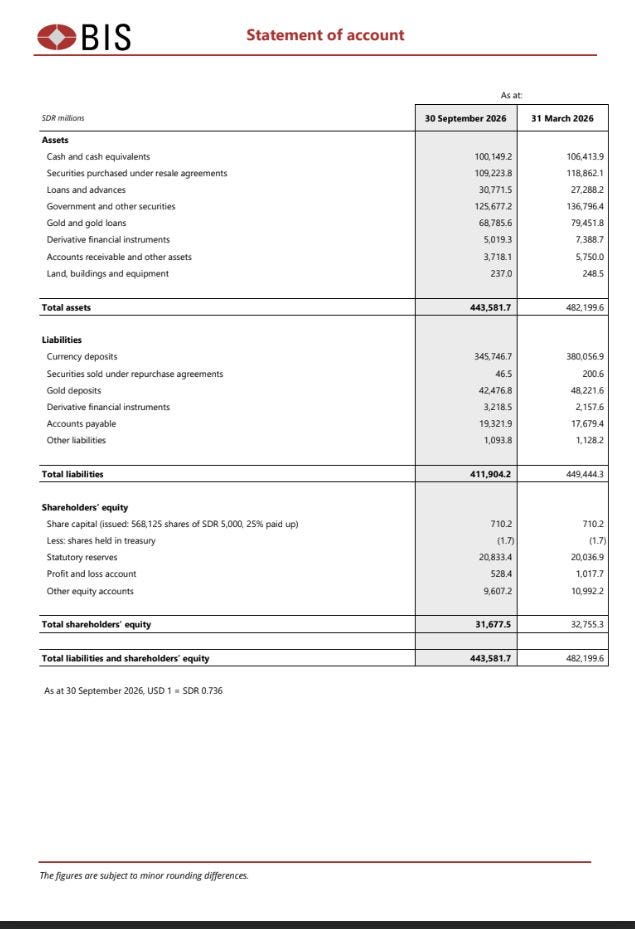
Mainstream bullion analysts will tell you with a straight face that this is entirely routine liquidity management. Banks needed dollars, gold was lying around, and a polite swap was arranged. That explanation works brilliantly until you place the calendar dates side by side with everything else happening in the world.
Those exact sixty days, spanning September and October, were the precise weeks when Chinese regulators were forcing domestic institutions to unwind their paper market bets, and when the People’s Bank of China quietly added 49 tonnes of physical gold to its official reserves. Think about the mechanics of that coincidence. While Eastern institutions were demanding physical metal and removing real bars from the global market, Western bullion banks were scrambling to pledge and shuffle 77 tonnes of gold through Switzerland just to keep their short term funding books balanced.
For half a century, Western precious metals markets operated on a comfortable, fractional reserve illusion. Bullion banks issued dozens of paper promises for every single bar of actual metal sitting in a London or New York vault, safe in the knowledge that almost nobody ever asked to take physical delivery. It is a marvellous business model until the biggest buyers on the planet decide they no longer trust paper receipts and demand the actual metal be loaded onto aeroplanes and flown east.
When physical gold leaves the Western vaults, the paper casino starts to creak. The 55% explosion in Swiss gold swaps is the audible sound of Western institutions unwinding their paper liabilities under immense physical pressure. They are using the Swiss central bank as a gigantic shock absorber, pledging whatever bullion they have left to raise cash and manage their derivative books without letting the whole paper pricing mechanism snap in half before their new digital debt rails are fully operational.
It all fits together like a slightly sinister Swiss watch. On one side of the globe, Eastern planners are clearing out speculative stock market leverage and stacking physical bullion ahead of the new international payment messaging cutover. On the other side, Western bullion banks are frantically managing physical swap obligations in Basel while Wall Street megabanks migrate sovereign debt onto closed, permissioned blockchain networks that exclude retail speculators entirely.
This sudden obsession with tightly controlled perimeters actually reminds me of the ongoing border crisis at the back of my own house. Earlier this week, I finally put fresh batteries back into the microchip cat flap to stop the neighbours’ cats, Ding Dong and Snowy, from invading the sovereign territory of our conservatory. That half of the security protocol works splendidly, as evidenced by the furious scratching noises Ding Dong made outside earlier when his unauthorised entry was rejected at the gate.
The slight flaw in my domestic border control is that Tigger the Not So Brave remains utterly terrified of the loud metallic click the mechanism emits whenever he approaches it, an acoustic event he clearly interprets as the safety catch coming off the rifle of a concealed Japanese sniper. Consequently, despite the gateway being engineered exclusively for his personal benefit, he refuses to exit the building, leaving me to wonder whether my ginger dictator has secretly become a communist who objects to private property borders on ideological grounds.
Wall Street, however, suffers from no such hesitation when locking down its own territory.
Just like my newly electrified cat flap, the global banking establishment has installed an impenetrable microchip barrier around its new digital debt infrastructure, ensuring that unbacked public tokens and retail speculators remain firmly locked outside in the cold alongside Ding Dong.
We must face the reality that XRP is no longer the golden medium to a wealthy, early retirement. Yet the broader macroeconomic truth stands taller than ever. The old unipolar paper matrix is being dismantled right before our eyes, the physical tabs are being settled in Switzerland, and while the bankers have barred us from their private digital clubhouse, heavy, unencumbered physical gold and silver are still very much in the running to achieve financial freedom.
Across the kitchen floor, Tigger the Not So Brave lets out a low, mournful sigh, abandons his standoff with the sniper flap, and curls into a tight ginger ball on the rug. As usual, his risk assessment is impeccable. I pick up the empty coffee pot, stand up, and head toward the sink to begin the whole caffeinated routine all over again.
END
TUNGSTEN
First-Take On Almonty Earnings: “Sangdong Ramping, With First Cargo Loaded”
Friday, Nov 13, 2026 – 10:40 AM
Almonty Industries, a leading supplier of conflict-free tungsten to Western markets, reported third-quarter earnings below Wall Street expectations, but Bank of America analysts describe initial shipments from its Sangdong mine in South Korea as “ramping up well” and the first cargo loaded.
BofA metals and mining analyst Lawson Winder wrote in a note on Friday morning that while Almonty reported third-quarter earnings below forecasts, it delivered “substantial earnings improvement QoQ and YoY.”
Almonty’s flagship Sangdong Tungsten Mine in South Korea is seen as one of the world’s largest and highest-grade tungsten deposits. Once fully operational, it is expected to account for over 80% of global tungsten production outside China, addressing the critical supply shortage in the West and supporting the upcoming rearmament supercycle.
Winder said work on Sangdong’s second phase is underway, equipment has been ordered, and construction is scheduled to be completed in 2027. He noted that more than 90% of first-phase production is already contracted, providing a solid revenue outlook as the mine ramps up into next year.
“This and a strong balance sheet further de-risks the Sangdong project and positions the company well to execute its growth plans,” the analyst said, adding, “ALM has been active on its share buyback program through to this quarter. We maintain our Buy rating given ALM’s strong volume growth, relatively low-cost structure, and a solid balance sheet.”
He described Almonty as one of two publicly traded Western producers and the only US-listed company in that group, offering investors exposure to elevated tungsten prices and efforts to diversify the West’s critical material supply chains away from China.
Winder added more color on the earnings:
Q3 EBITDA below BofAe, but first deliveries now loaded
ALM reported Q3’26 adjusted EBITDA of C$14.6 million (m), below BofAe at C$49.4m and Bloomberg (BBG) / Visible Alpha (VA) consensus at $42.9m/C$33.7m. The miss vs BofAe was driven by lower Panasqueira sales (lower grade and timing), higher G&A expenses and the deferral of commercial sales from Sangdong to Q4. While Sangdong achieved concentrate production in September, the first shipment was loaded at the port subsequent to quarter end. Despite lower-than-expected sales and higher royalties, Panasqueira generated a 62% EBITDA margin in Q3 (benefitting of strong tungsten pricing). Per ALM, the Portuguese government intends to reduce the royalty rate to 4.0% (from 19.7%), retroactive from the start of 2026, implying a potential $15m in refunds for 9M’26. Reported Q3’26 EPS at C$0.17 vs. BofAe/BBG/VA at C$0.16/C$0.13/C$0.09, benefitted from $47.9m of non-cash gains on the revaluing derivatives and warrants.
Balance sheet strong; $68m shares repurchased in Q3’26
On 24-Aug-26, ALM announced a share repurchase program for up to 14.4m shares, for an aggregate purchase price of up to $300m, over a 36-month period. During Q3’26, ALM repurchased 2.9m shares at $16.58/sh ($67.7m invested) and in Q4-to-date, bought back 0.7m more shares. At quarter-end, ALM’s cash position remained solid at C$1.15 billion (bn) and net cash of $338 m vs. cash of C$1.23bn and net cash of $414m at 30-Jun-26. In addition to the share buyback, the build-out of Sangdong Phase 2 through 2027 will be a key capital allocation for ALM in the near-term. We forecast a meaningful inflection higher in free cash flow to over $700m in 2027E (vs. around $100m this year). We forecast Phase 2 contributing from early H2’27E with Phase 1 ramped-up by Q1’27E.

Winder maintained his Buy rating with a 12-month price target of $24 a share. 
D.A. Davidson analyst Matt Summerville’s first take after earnings:
After the close, ALM reported 3Q26 sales of USD $30M, which was $7M below our estimate, though rose +382% Y/Y, with the entirety of variance attributable to lower head grade and shipment timing. Panasqueira’s income from mining operations rose considerably Y/Y to $19M, driven by higher pricing, partially offset by a 13% Y/Y reduction in shipments with $4.3M in deferred revenue recorded during the first week of October (which would effectively all drop to mining income). Sangdong Phase I continues to ramp with its first cargo of tungsten loaded and shipped in October. Our LT thesis remains well intact amid deep primary supply deficits. BUY
Stifel mining analyst Brock Cannon wrote:
Stifel View – waiting period: Quarterly results came in mostly as expected with Panasqueira continuing to be the consistent driver of earnings and no input from Sangdong, yet. Earnings continue to benefit from elevated APT prices even as the price has started to come off record highs – as expected and included in our model (see chart on page 2). Sangdong is now in what CEO Lewis Black described as the “long silence” that follows the commissioning of a new mine as all the kinks are worked out, and the mine ramps to full capacity. We continue to expect Phase I to hit full cadence in 2027 and see our ~C$30m estimate for revenue contribution in 4Q as reasonable but would not sound the alarms at any slippage into 2027. We have made limited changes to our model outside updating for the 3Q results and remain Buy rated but have updated our target price to $18 as we brought our multiple down to 11.5x 2027E EBITDA multiple (12.5x previously).
Almonty, like the broader mining stocks, has been battered in the second half of the year by higher rates and a strong-dollar environment. Weaker commodity prices have also been seen in recent weeks, such as gold tumbling below $4,000 and copper tumbling in London from the $14,500 level to around $13,588. 
More broadly, VanEck’s REMX rare earth and strategic metals ETF has been halved since summer and retraced much of the run-up sparked early last year by China’s restrictions on critical material supplies to the West.
We pointed out earlier on Friday that President Trump’s $40 billion critical materials deal push will likely come under the Democratic Party’s crosshairs, as miners that accepted government equity and other financing deals will likely face scrutiny.
As we noted in that report, Almonty accepted no government equity investment or other financing deals, which may help it avoid hearings on Capitol Hill next year.
“We’ve always believed government’s place in our business is as a customer, not a shareholder, and look forward to continuing to provide the U.S. and its allies with tungsten to support critical defense and industrial needs,” said Lewis Black, CEO of tungsten miner Almonty Industries.
We continue to favor the “owning the bottlenecks” theme as China restricts critical material supplies to the West. The focus remains on producing miners with conflict-free supply chains outside China that are also entirely independent of US government-backed financing.
As we’ve also pointed out: The Great Rare Earth Disconnect: Prices Up 23%, Miners Down 28%…
END
YOUR EARLY CURRENCY VALUES/GOLD AND SILVER PRICING/ASIAN AND EUROPEAN BOURSE MOVEMENTS/AND INTEREST RATE SETTINGS FRIDAY MORNING.7:30 AM
SHANGHAI CLOSED DOWN 21.48 PTS OR 0.59%
HANG SENG CLOSED DOWN 370.95 PTS OR 1.55 %
Nikkei CLOSED UP 330.64 PTS OR 0.54%
//Australia’s all ordinaries CLOSED DOWN 0.42%
//Chinese yuan (ONSHORE) CLOSED DOWN AT 6.6719
/ OFFSHORE CLOSED DOWN AT 6.6735 Oil UP TO 88.04 dollars per barrel for WTI and BRENT UP TO 95.69 Stocks in Europe OPENED ALL GREEN
ONSHORE USA/ YUAN// WITH YUAN TRADING DOWN 6.6713//OFFSHORE YUAN TRADING DOWN TO 6.6735 ONSHORE YUAN TRADING ABOVE LEVEL // OFF SHORE AND DOWN ON THE DOLLAR)// / AND THUS WEAKER OFF SHORE YUAN TRADING DOWN AGAINST US DOLLAR/ AND THUS WEAKER
XXXXXXXXXXXXXXXXXXXXXXXXXXXXXXXXXXXXX
ONSHORE YUAN: CLOSED DOWN TO 6.6719
OFFSHORE YUAN: DOWN TO 6.6735
1A.HANG SANG CLOSED DOWN 370.95 PTS OR 1.55%
1 B. SHANGHAI CLOSED DOWN 21.48 PTS OR 0.59%
2. Nikkei closed UP 330.64 PTS OR 0.54%
WEST TEXAS INTERMEDIATE OIL UP TO 88.04
BRENT; 95.96
3. Europe stocks SO FAR: ALL GREEN
USA dollar INDEX UP 7 BASIS PTS TO 103.17 EURO FALLS TO 1.1047 DOWN 3 BASIS PTS
3b Japan 10 YR bond yield:RISES TO. +2.8740 UP 7 FULL BASIS PTS/ VERY TROUBLESOME//Japan buying 100% of bond issuance)/Japanese YEN vs USA CROSS NOW AT 159.95… JAPANESE YEN NOW FALLING AS WE HAVE NOW REACHED THE ENDING OF THE YEN CARRY TRADE AGAIN AND THE REPATRIATION OF YEN DENOMINATED BONDS TRADING IN THE USA/EUROPE. JAPAN 30 YR BOND YIELD: 4.0174 UP 8 FULL BASIS PTS
3c Nikkei now ABOVE 17,000
3d USA/Yen rate now well ABOVE the important 120 barrier this morning
3e Gold UP /JAPANESE Yen DOWN //CHINESE ONSHORE YUAN: DOWN (6.6713 AND OFFSHORE: DOWN AT 6.6735
3f Japan is to buy INFINITE TRILLION YEN worth of BONDS. Japan’s GDP equals 5 trillion USA. CENTRAL BANK OF JAPAN WILL NO LONGER DO QE.
Japan to buy 100% of all new Japanese debt and NOW they will have OVER 50% of all Japanese debt. GOVERMENT ASKED JAPAN PENSION FUNDS AND INSURANCE FUNDS TO BUY MORE JAPANESE BONDS AND REPATRIATE ALL FOREIGN BONDS.
3g Oil UP for WTI and UP for Brent this morning
3h European bond buying continues to push yieldsLOWER on all fronts in the EU German 10yr bund YIELD UP TO +3.3727 Italian 10 Yr bond yield UP AT 4.424 SPAIN 10 YR BOND YIELD UP TO 3.935
3i Greek 10 year bond yield UP TO 4.254%
3j Gold at $3891.90 /Silver at: 49.82 1 am est) SILVER NEXT RESISTANCE LEVEL AT $100.00
3k USA vs Russian rouble;// Russian rouble UP 0 AND 71/ 100 roubles/82.05
3m oil (WTI) into the 88 dollar handle for WTI and 95 handle for Brent/
3n Higher foreign deposits moving out of China// huge risk of outflows and a currency depreciation. This can spell financial disaster for the rest of the world/
JAPAN ON JAN 29.2016 CONTINUES NIRP. THIS MORNING RAISES AMOUNT OF BONDS THAT THEY WILL PURCHASE UP TO .5% ON THE 10 YR BOND///YEN TRADES TO 159.94 10 YEAR YIELD AFTER FIRST BREAKING .54% LAST YEAR NOW EXCEEDS THAT LEVEL TO 2.8740% UP 7 BASIS PTS STILL ON CENTRAL BANK (JAPAN) INTERVENTION//YEN CARRY TRADE NOW UNWINDING//YEN BOND TRADING OVERSEAS TO BE REPATRIATED.//JAPAN 30 YR: 4.0174 UP 8 PTS..: USA/SF this 0.8376 as the Swiss Franc . Euro vs SF: 0.9253
USA 10 YR BOND YIELD: 5.128 UP 3 BASIS PTS…NOW ABOVE 5.00%
USA 30 YR BOND YIELD: 5.4610 UP 3 BASIS PTS/
USA 2 YR BOND YIELD: 4.855 DOWN 1 BASIS PTS
USA DOLLAR VS TURKISH LIRA: 50.37 UP 11 BASIS PTS/LIRA GETTING KILLED//IDIOTS FOR SELLING GOLD AND USA DOLLAR RESERVES.
10 YR UK BOND YIELD: 5.3213 UP 10 PTS
30 YR UK BOND YIELD: 5.7505 UP 12 BASIS PTS
10 YEAR FRENCH BOND YIELD; 4.8890 //UP 12 BASIS PTS
10 YR CANADA BOND YIELD: 3.810 UP 9 BASIS PTS
5 YR CANADA BOND YIELD: 3.5530 UP 9 BASIS PTS.
1a New York Opening report
Futures Rise As Wall Street Moves On From Jensen, Microsoft Outage Drags Into Day Two
Friday, Nov 13, 2026 – 08:29 AM
US futures are higher as traders move on from the Nvidia leadership shock and shrug off a global Microsoft outage that is now in its second day, while the IEA’s call that the oil market is swinging to a surplus and a rebound in short-dated Treasuries take some of the edge off the week’s bond rout heading into the PPI report. As of 8:00 am ET, S&P futures are 0.3% higher while Nasdaq futures rise 0.1% and Dow futures add 0.2%. On Thursday the S&P fell 0.4%, the Nasdaq 100 slipped 0.3% and the Russell 2000 tumbled 1.7% after Nvidia plunged as much as 14% at the open on Jensen Huang’s ouster before retail dip buyers dragged it back to a 4.3% loss, confirming our post on the record opening retail bid. In premarket trading, Mag 7 stocks are all higher except Microsoft (-2.7%), which is struggling to restore access to Outlook, Teams and Copilot; Nvidia rises 3% and Alphabet 1.1%, while Cerebras jumps 17% on blowout guidance and new deals with Oracle and Microsoft, and Modine soars more than 20% on a report that Samsung is in talks to buy it. The day’s driver is inflation (again): October PPI at 8:30am is expected to rise 0.4% m/m after September’s 1.3% surge, and comes after a hot CPI and a Treasury selloff that left a December hike fully priced. Treasuries are mixed, with the 2Y yield down 4bps to 4.84% as traders trim hike bets on the dip in oil, while the 10Y is little changed around 5.12% after jumping 13.5bps on Thursday; the combined Tuesday and Thursday jump in 10Y yields was the biggest since April 2025. The Bloomberg dollar index steadies after hitting an 18-month high, USD/JPY hovers just under 160 amid more Japanese jawboning and the Aussie slides to its weakest since January. Brent trades near $96 and WTI slips to $88.42 as the IEA’s surplus call offsets Trump saying the US doesn’t need a deal with Iran; gold rebounds to around $3,900 but stays well below $4,000, and Bitcoin is down 3% below $70,000. US economic data slate includes October PPI (8:30am). Fed speaker slate includes Goolsbee (8:30am on CNBC), Collins (9:10am and 10:35am), Logan (9:40am), Bowman (10:50am), Daly (12pm) and Jefferson (7pm).
In premarket trading, Mag 7 stocks are mostly higher: (Nvidia (NVDA) +1.9%, Alphabet (GOOGL) +1.1%, Amazon (AMZN) +1%, Tesla (TSLA) +1%, Apple (AAPL) +0.4%, Meta Platforms (META) +0.05%, Microsoft (MSFT) -1.4%)
- Candel Therapeutics (CADL) tumbles 34% after the biotech delayed its application for aglatimagene in prostate cancer to mid-2027 while talks with the FDA continue.
- Cerebras Systems (CBRS) gains 15% after the chipmaker gave a sales guidance well above estimates, while unveiling new deals with Oracle and Microsoft.
- Cisco (CSCO) falls 3% after the networking gear maker’s fiscal first quarter product order growth disappointed. Gross margins are seen coming under pressure in the next few quarters as revenue has become more reliant on AI hyperscalers.
- Flowers Foods (FLO) falls 9% after the packaged bakery foods producer cut its sales guidance for the full year, which missed the average analyst estimates. Sales for the third-quarter also came below Wall Street’s consensus.
- Liftoff Mobile (LFTO) gains 21% after the mobile advertising company’s third-quarter adjusted earnings per share beat the average analyst estimate.
- Lowe’s (LOW) slips 2% after Stifel cut its recommendation on the home improvement retailer to sell and reduced the price target to a Street-low $190 from $195.
- Nu Holdings (NU) rises 4% after quarterly profit that beat analyst estimates as the Brazilian fintech pushes into new markets.
- Palo Alto Networks (PANW) gains 4% after the cybersecurity stock received an upgrade by KeyBanc, which sees security budgets on a material acceleration in 2027 due to more threats caused by AI.
- Sellas Life Sciences (SLS) rises 11% after the drug developer said it expects to report topline results from a late-stage trial of its experimental cancer therapy in November.
In other corporate news, the Nvidia saga keeps giving: a Chinese company founded by Alice Huang, the woman at the center of the scandal, procured smuggled AI chips installed at a Shanghai data center with links to Megaspeed, Bloomberg reports, Commerce Secretary Lutnick has agreed to testify before Congress on Nvidia (NBC), and Singapore charged a fifth person in its Nvidia chip case. Meanwhile, the IPO window could not be wider open: Anthropic’s IPO has drawn about six times the orders for the shares available as it seeks to raise as much as $64.4 billion plus $26 billion in a private placement, SpaceX and Tesla are progressing in merger talks that could produce the biggest deal ever as soon as December, and ByteDance plans to buy back up to $6 billion of shares at a valuation of about $400 billion. Samsung Electronics is in talks to acquire data center cooling maker Modine; Keurig Dr Pepper priced 58 million shares at $34.50; Helen of Troy says Empower’s bid undervalues the company; and Exxon made a final investment decision on its $12.5 billion Longtail development offshore Guyana.
Traders are ending a rollercoaster week, dominated by the firehose of Nvidia/Jensen news and the AI trade, by contending with a global Microsoft outage that has paralyzed government offices, trading floors and businesses, forcing traders onto phones and knocking out email at exchanges including Euronext; Richemont even had to delay its results. Microsoft says it is not aware of any malicious activity. And yet, markets keep doing what they’re not supposed to: Nvidia lost the most famous face of the AI trade, Huang resigned “effective immediately”, and the Nasdaq 100 lost just 0.3%. As Bloomberg puts it, the rest of the AI trade is already moving on, with deals still flowing overnight and Europe’s soft start owing more to oil and yields than to chips.
Goldman is leaning into the dip: its strategists issued a bullish outlook predicting the S&P 500 will advance 14% over the coming year after the selloff in the biggest tech companies left their valuations historically cheap. Indeed, the Nasdaq 100 now trades at a six-year low on forward earnings after a 25% de-rating this year. At the same time, Goldman’s 2027 outlook sees the AI investment impulse peaking early next year, with S&P 500 EPS growth slowing to 11% in 2027 from 36% this year, and a 10Y yield of 4.6% by end-2027.
Calamos co-CIO Nick Niziolek told Bloomberg the AI trade is maturing rather than ending, arguing that the demand and the fundamentals remain intact. Direxion’s Bilal Little made a similar point: Nvidia still sits at the center of the AI buildout, and the question is whether the governance shock changes its competitive position or merely the multiple investors are willing to pay.
“Today, I would watch the interaction between producer prices, oil and real yields,” said Florian Ielpo at Lombard Odier Asset Management. “The PPI report will help assess how much of the energy shock is still feeding into prices and squeezing margins, with implications for the amount of tightening the Fed needs to deliver.”
The FX desks are less sanguine. MUFG’s Derek Halpenny warned the Microsoft outage could add to already poor tech sentiment and intensify risk aversion, hurting high-beta G10 currencies against the dollar, while ING’s Francesco Pesole said the dollar’s rally is rooted in hawkish Fed rhetoric and hotter inflation, making a material EUR/USD rebound hard to argue for; he sees a possible test of 1.10.
And BofA’s Michael Hartnett is still telling clients to stay risk-off until the dollar drops, the 10Y yield falls below 4.5% and oil drops below $70, even as global equity funds drew $98.3 billion in the week to Nov. 11, the largest inflow since June, led by $63.6 billion into US stocks.
Goldman’s Rich Privorotsky did not publish overnight (Goldman’s desks are working off backup email due to the outage), but his latest note on Thursday morning remains the best framing of the tape. He found it “quite impressive how much we’ve managed to rally” in the face of the macro backdrop and Nvidia’s increasingly idiosyncratic problems, while noting the move was emphatically not broad based, and that the governance issues are forcing a significant rebalancing of capital within AI. He flagged the SPX vol curve un-inverting, dealer skew flattening and systematic long/short managers posting their best two-day return in nearly three years, and asked whether this is just the mechanical result of light positioning and short covering or the start of something more durable. His list of four tactical AI overhangs (cost of capital, power and permitting, the supply/demand balance going into 2028, and monetization velocity versus capex) leads him to expect episodic, high beta trading rallies rather than pure buy and hold. His bottom line: a durable breakout probably needs lower rates, lower energy and broader leadership, i.e. the market needs oil fixed and rates lower, and the two may well be connected.
JPM’s Market Intel desk under Andrew Tyler says the market “feels coil-sprung to go higher, which is seemingly the pain trade”: higher yields, Nvidia gapping down and AI headwinds could not stop the next leg of the rally, with retail buying in Nvidia running at roughly 9 standard deviations by 10am and more than 5 standard deviations in the Magnificent Seven, even as institutional participation stayed light. The desk notes 2Y yields are up 33.7bps and 10Y yields 26.7bps week-to-date, making equity resilience all the more surprising. Positioning Intel adds that over the past month most of the move was shorts being covered rather than new longs, with short exposure falling from +2.7z to +0.4z. On Nvidia, JPM credit stays Underweight, warning the bigger implications are for GPU financing and infrastructure deals where Nvidia acts as supplier, investor or provider of contractual support, while Harlan Sur cut his target to $215 after stripping China and other shipments from FY28 estimates. Interim CEO Colette Kress has reportedly pushed back on some of Huang’s financing deals, which is exactly the risk we flagged in mapping every circular AI deal that now hangs on Kress.
Goldman’s TMT specialist Sean Johnstone makes the same point: Nvidia has acted as “lender of last resort” to the neoclouds, and the key uncertainty is whether a new CEO will have the willingness or authority to deploy the balance sheet; Nebius fell 17% and CoreWeave 7% on Thursday, while AMD, Broadcom and Arista rallied as money rotated within AI. Goldman’s EMEA trading desk notes Thursday was the 12-month momentum factor’s best day on record relative to 3- and 6-month momentum as the AI trade unwound, with data center basket crowding at the 1st percentile; its high-touch flows were 1.2x better to buy, with long-onlys more than 3x better buyers and hedge funds more than 3x better sellers. The desk also notes a December hike is fully priced, with roughly 13-14.5% odds of a 50bps move, and that a hot PPI print would harden that 50bps tail; Goldman’s own forecast is a softer 0.3% headline and 0.2% core, while JPM’s Feroli expects 0.6% and 0.4%. Our earlier post on record vol protection buying has more on the hedging frenzy.
Europe’s bond story is about energy rather than politics today: Bunds bear steepen as oil firms on doubts about a US-Iran deal, the 10Y Bund yield is up 1bp at 3.36%, French 10Y yields rise 2bps to 4.87% and Italian 10Y yields are 2bps higher at 4.41% ahead of S&P’s review of Italy’s BBB+ (positive outlook) rating after the close. ECB swaps still price 23bps of hikes in December.
Commenting on the overnight action, Charles Elson, founding director of the Weinberg Center for Corporate Governance at the University of Delaware, told Bloomberg Television that “Anytime you move a CEO on, it’s like lifting up a rock. You have no idea what’s under there.”
In Europe, the Stoxx 600 is little changed around 664 after a four-day rally to record highs ran out of steam, with 310 members up and 274 down. Energy and insurance lead, while industrial goods and consumer products lag; Richemont fell as much as 9% after jewelry sales missed in results already delayed by the Microsoft outage, while Wise jumped as much as 9.8% after settling a Belgian money laundering probe. JPM notes Quality and Value are leading while Beta and residual vol lag. Goldman’s Sharon Bell set Stoxx 600 targets of 670, 680 and 700 over three, six and 12 months while cutting banks to neutral and insurance and energy to underweight, and Goldman’s Bastien Brouwer points out that the Euro Stoxx 50 is still about 2.5% below its August highs even as the Stoxx 600 makes new records, with the GS EU defensives basket up 15.5% in a month and a half. Here are the biggest European movers:
- CTS Eventim shares gain as much as 4.2% after third-quarter results, with Citi saying resilient Ticketing performance was offset by weaker-than-expected Live Entertainment.
- Siemens Energy shares rise as much as 1% as Oddo BHF upgrades the energy technology company to outperform from neutral, citing a “convincing” roadmap and plan to improve margins.
- Wise shares advance as much as 9.8% after the UK fintech said it’s reached an agreement with prosecutors in Belgium over concerns of alleged money laundering, without admitting wrongdoing.
- Aviva shares gain as much as 2.9% following the insurer and investment firm’s 3Q trading update. Jefferies says pension risk transfer volumes are surprisingly strong, with full-year volumes now expected to exceed last year.
- Richemont fell as much as 9% after results in its jewelry division missed consensus expectations for the second quarter. Jewelry remains the main driver of the group’s growth, analysts at Jefferies said.
- Eramet shares fall as much as 8.2% after the French mining company announced capital increase.
- Acciona Energia falls as much as 5.7% after the Spanish renewable energy utility said that a $1 billion deal to sell solar and wind assets to Mexico Infrastructure Partners faces delays. Bloomberg previously reported that the deal could be at risk of collapsing.
Asian stocks fluctuated as investors weighed Nvidia’s leadership upheaval against the long-term AI demand outlook, with the MSCI Asia Pacific Index down 0.3% after erasing a gain of as much as 1.1%, though it is still headed for its best week since June. Taiwan’s Taiex jumped as much as 3.2% as MediaTek and TSMC climbed before paring gains, while Korea’s Kospi swung from gains to a 1% loss as SK Hynix and Samsung were sold. Japan’s Nikkei rose 0.5% to 61,142, with Advantest accounting for about 30% of the gain per Goldman, while the Hang Seng fell 1.5% and the Hang Seng Tech index dropped 3% for its worst week since June on worries about tighter US chip curbs on China; Alibaba slid 4.3%. Australia’s ASX 200 fell 0.7%. China’s October credit data disappointed, with new yuan loans contracting by 100 billion yuan, while China posted a record $276 billion current-account surplus and Hong Kong raised its 2026 GDP forecast to 4.8%.
In FX, the Bloomberg Dollar Spot Index is little changed after hitting its highest since May 2025, with the DXY in a 103.05-103.23 range and on course for a weekly gain of about 1.5%. USD/JPY is ping-ponging around 160; Finance Minister Katayama warned of one-sided, rapid moves and PM Takaichi said Tokyo is in close contact with US authorities, and the pair was knocked from above 160 to the mid-159s at around 6:30am London time, prompting (so far unconfirmed) speculation about a little help from the MoF. The Aussie fell 0.4% to 0.6784, its lowest since January, as Australia’s 10Y yield dropped below its US counterpart for the first time in more than a year; EUR/USD is up 0.1% at 1.1067.
In rates, Treasuries are mixed with the curve steepening: the 2Y yield is down 4bps at 4.84% as traders trim Fed hike bets on softer oil, while the 10Y yield is little changed around 5.12% after Thursday’s 13.5bp surge, which followed an ugly, tailing 30Y auction. Newsquawk notes Treasury futures are at a fresh week-to-date low and off more than two points on the week, with the CME pricing an 88% chance of a 25bp December hike and 12% odds of 50bps. Bloomberg’s Aggregate index is back down 1.5% year-to-date after having briefly clawed back to flat last week, and the backdrop is not helped by a record $404 billion October deficit (supply, anyone?). Gilt futures are lower on the energy bid, with traders still pricing 20bps of BOE hikes next month.
In commodities, WTI is down 0.4% at $88.42 and Brent is little changed at $95.88, having traded in a $95.06-96.81 range as the IEA said the global oil market will swing to a surplus for the first time since the start of the Iran war: supply surged 2.3 million b/d in October to 105.4 million b/d on resurgent Gulf flows, while 2026 demand is seen falling 2.7 million b/d, and IEA nations will release 71 million barrels of stocks through February. The bid comes from Trump saying the US doesn’t need a deal with Iran, a “liquefied gas” tanker hitting a mine east of Hormuz and the IRGC claiming it destroyed a US radar in Bahrain. Dutch TTF topped €97/MWh overnight before fading toward €93. Gold is up 0.6% at around $3,899 but remains far below $4,000, capped by rising global yields.
US economic data slate includes October PPI (8:30am). Fed speaker slate includes Goolsbee (8:30am), Collins (9:10am and 10:35am), Logan (9:40am), Bowman (10:50am), Daly (12pm) and Jefferson (7pm). Revvity hosts an investor day, JPMorgan holds its US opportunities forum in Miami, and Anthropic livestreams an investor event with Dario Amodei and Jamie Dimon.
Market Snapshot
Top Overnight News
- President Trump said the US doesn’t need a deal with Iran, helping Brent add 3.3% on Thursday to about $96: BBG
- Ukraine’s Zelenskyy hailed progress after meeting US envoys in Dublin, with a prisoner swap agreed and Europeans promised a place at the next talks, though Russia and Ukraine remain far apart on territory: BBG
- The IEA said global oil markets will swing to a supply surplus for the first time since the start of the Iran war as Persian Gulf exports recover: BBG
- US Senate Democratic leader Schumer said he has the votes to continue as Democratic leader: Newsquawk
- Trump is weighing a military campaign to free Cuba before leaving office, saying in a radio interview “I want to get Cuba done before I leave”: Epoch Times
- Commerce Secretary Lutnick agreed to testify before Congress on Nvidia: NBC
- Microsoft said it is not aware of any malicious activity related to its global outage, now in a second day, which has knocked out email at exchanges including Euronext: BBG
- Anthropic’s IPO is said to have drawn about six times the orders for the shares available: BBG
- SpaceX and Tesla could announce the biggest deal ever as soon as December, according to people familiar: BBG
- Samsung Electronics is in talks to acquire Modine Manufacturing, a maker of data-center cooling systems: BBG
- ByteDance plans to buy back up to $6 billion of shares from investors at a valuation of about $400 billion, a 20% uptick from a year ago: BBG
- China’s credit expansion fell short of expectations in October, with loans contracting for the third time this year: BBG
- India’s trade deficit widened to a one-year high in October as festive-season demand and higher oil prices pushed up imports: BBG
A more detailed look at global markets courtesy of Newsquawk
APAC stocks traded mixed following the choppy and ultimately negative performances stateside in the fallout from Nvidia and co-founder Jensen Huang’s resignation. ASX 200 declined with nearly all sectors subdued, while only energy and telecoms showed resilience. Nikkei 225 rallied back above the 61,000 level with mixed price action seen in tech stocks following the Nvidia fallout, as Jensen Huang’s exit and the appointment of an interim CEO reduced some uncertainty. KOSPI swung between gains and losses amid tech headwinds and as the latest Export and Import Prices from South Korea slowed from the previous, but continued to show double-digit percentage growth. Hang Seng and Shanghai Comp were lower amid some concerns regarding China’s future access to NVIDIA chips in the fallout from Huang’s extramarital affairs scandal, while downside in the mainland was somewhat cushioned after the PBoC injected liquidity via both overnight and 7-day reverse repo operations.
Top Asian News
- Japanese Finance Minister Katayama said seeing one-sided, rapid forex moves, adds will communicate with the US Treasury and respond accordingly. Confirms they decided to bring forward utility subsidies for winter, tapping reserve funds.
- Japanese PM Takaichi said won’t comment on FX but stated they are in close contact with US financial authorities on FX and will work to maintain an orderly forex market.
- Hong Kong revises its 2026 GDP Forecast to 4.8% (prev. 3.5-4.5%).
- Japan is reportedly looking at JPY 60tln defence spending for the five year period from 2027-2031, Kyodo reported citing sources.
- Japanese PM Takaichi said consumption tax cut will be reflected in product prices.
- Goldman Sachs sees China 2027 GDP growth at 4.5%.
- China’s Ministry of Foreign Affairs said President Xi to attend 33rd APEC Economic Leaders’ Meeting, according to Xinhua.
- Japan approves JPY 652bln reserve fund use for winter subsidies.
European bourses (STOXX 600 U/C) are flat/firmer, conforming to the mostly subdued action seen in the APAC session. Focus remains on the AI situation, following Huang’s resignation from Nvidia, with major tech names such as SK Hynix (-3%) and Samsung Electronics (-1%) falling in Korean trade. Over in China, the magnitudes are to a larger extent, with woes growing about the US potentially slapping China with more stringent chip-related bans. The likes of Tencent (-3%) slipped overnight, whilst smaller companies such as MiniMax (-8%) were also hit. European sectors are mixed. Energy tops the pile, with oil prices a little firmer today; Optimised Personal Care and Food Beverage & Tobacco complete the top three. To the downside resides Consumer Products (hit by Richemont post-earnings), whilst Basic Resources is pressured by the selling in underlying metals. Key Movers: Richemont (-6.9%, sales rose Y/Y but gold costs weighed on underlying gross margin), Generali (-1.3%, reported EUR 1.5bln disaster hit), Acciona (-6%, lifted 2026 EBITDA outlook but asset rotation missed target. Elsewhere, Bloomberg reported that its USD 1bln Mexico infrastructure deal is seen at risk). US equity futures are mixed, following the sentiment set out in Europe. The NQ (U/C) remains the slight underperformer this morning vs ES (+0.2%), with focus still on the fallout from Huang’s resignation from Nvidia. However, shares are currently firmer by c. 2.2% in pre-market trade, finding some reprieve after recent selling pressure. Attention ahead will turn back to monetary policy with US PPI scheduled, and also a few Fed speakers.
Top European News
- Germany’s 2027 budget provides for total spending of EUR 561bln and investment of EUR 62bln.
- Britain’s tech sector emerges as a key driver for UK economic growth and is expanding at its fastest pace in nearly half a decade, according to FT analysis of official statistics.
- US Treasury Secretary Bessent said Chinese AI models are dangerous and have no guardrails, adds Chinese models were involved in the commercial refrigerator hacker attacks in Europe.
FX
- G10s are mixed against the flat USD. EUR and GBP both hold steady, whilst the Antipodeans are the slight underperformers, given the risk tone. However, the risk tone is not quite displayed fully, with the typical havens (CHF and JPY) also posting mild losses this morning.
- DXY trades within a 103.05-103.23 range and is set to end the week firmer by c. 1.5%. The index caught a bid earlier in the week following hawkish commentary from the Fed’s Waller, who indicated his openness to a 50bps hike; the subsequent hotter-than-expected CPI report also helped DXY move higher. The days following were a bit more quiet from a US-standpoint, but the geopolitical environment remained volatile. The US-Russia-Ukraine talks yielded no significant progress (but were touted to be productive), whilst Iranian officials warned that distant US bases could become a target should they attack Tehran again.
- Next up for the USD will be the US PPI report (13:30 GMT), which will help forecasters in predicting the PCE report due later this month. Also on the agenda are a few Fed speakers, dotted throughout the day. Since Waller, none of his colleagues have expressed their openness to a larger 50bps hike in December; markets will await whether anyone else will join him.
- The week has also seen USD/JPY breach beyond the 160.00 mark, with the pair up 1.2% WTD. Pressure in the JPY was largely attributed to this week’s USD strength, and the subsequent widening of yield differentials between the Fed and BoJ. The latest leg higher in the pair has brought some Japanese officials out of the woodwork, to offer some renewed verbal intervention – albeit to no avail. Yesterday, top currency diplomat Mimura mentioned that the JPY’s recent fall is too rapid, reminding the market of the aggressive action taken in the summer. Today, Japanese PM Takaichi said that they are in close contact with the US authorities regarding FX, whilst Finance Minister Katayama explicitly mentioned that they are seeing one-sided and rapid FX moves and will communicate with the US Treasury accordingly.
- Jawboning which ultimately failed to push the USD/JPY back lower. An interesting move was seen today at around 06:30 London time, which saw the pair get whacked from above the 160.00 level to the mid 159.00 mark. Traders may speculate that this was the MoF/BoJ defending the level to some small degree.
Central Banks
- Fed’s Williams (voter) said AI investment levels can respond to changes in interest rates and noted evidence shows a K-shaped economy.
- Fed’s Williams (voter) said the economy has been resilient and growth has been strong, adds US economy is getting stronger but not overheating and that inflation is too high. Inflation is stubbornly persistent and high. Fed has been in a steady cadence of collecting data. Fed will need to take actions over time to get inflation back to 2%. Fed still has work to do to get monetary policy to the right place.
- NY Fed said the Fed made no FX market intervention in Q3, while the US Treasury bought Japanese yen in FX markets over the same period.
- BoJ Deputy Governor Himino said hard to predict BoJ’s profits in general and there is no significant market impact from ETF sales so far, adds not planning a further review of ETF sales at this time.
- ECB’s Schnabel said the issue facing Europe is a lack of scale.
- PBoC injected CNY 300bln in 7-day reverse repos and CNY 364bln in overnight reverse repos.
- PBoC set USD/CNY midpoint at 6.7152 vs exp. 6.6756 (prev. 6.7174).
- NBP’s Janczyk said they may keep rates unchanged in December.
- NBP Governor said that they must remain independent as political pressure could make reaching price stability more difficult.
- Polish Central Bank’s Janczyk said it is possible that Poland will not change rates in December.
- CNB Minutes (Nov): The Bank Board assessed the risks and uncertainties of the outlook for the fulfilment of the inflation target as inflationary overall. There was a consensus that domestic demand was resilient for now and there were no visible signs of a cooling due to the higher energy prices. In a discussion of domestic inflation, Jan Kubíček drew attention to the repeatedly slightly higher-than-expected core inflation readings.
Fixed Income
- In short, a bearish start to the final session of the week for fixed income, awaiting US PPI for further insight into PCE after the week’s CPI release and commentary from Fed’s Waller, who added 50bps into the discussion around December.
- Into that, USTs are at a 105-07 WTD low, off by over two full points on the week as a whole. Amidst this, the 10yr yield is at a 5.135% high, the highest since October 21st. PPI is the day’s main event, before a handful of Fed speakers, with pricing via the CME for December fully implying a hike, with an 88% chance of 25bps and a 12% chance of 50bps.
- Bunds also lower, holding around a 121.92 base with downside of around 50 ticks. Also at a WTD base, and just over 100 ticks lower for that period as it stands. Specifics today are a little light, final inflation measures not moving the dial while ECB speak hasn’t been too pertinent for policy, as we approach an expected December hike.
- Gilts in-fitting, and under pressure as such. 85.14 is today’s base, also a WTD low and off by about 150 ticks vs Monday’s open. Specifics also somewhat light this morning, awaiting a signal from the US events. For the UK, next week is significant as the Milburn NEET review hits, and will be scoured for what (if any) welfare adjustments PM Burnham makes; and, potentially more pertinently, the Labour Party’s opposition to such moves. Also, Burnham has a key speech on Monday ahead of his visit to the EU on Friday; the latest reads suggest the details are still being finalised, but there should be some progress on relations with the bloc.
- Australia sold AUD 1.0bln in 1.0% November 2031 bonds, b/c 4.03, avg. yield 4.8193%.
Commodities
- Crude contained, as the overnight updates were pertinent but not sufficient to move the dial vs the intervention by US President Trump via Truth on Thursday. Now, we await a US response to the latest Iranian action, and an update on the touted Vance-Rezaei talks post-Trump’s post.
- Brent was essentially unchanged, in USD 95.06-96.81/bbl parameters. Upside was seen overnight and then again in the early hours on Iran targeting a radar site, and an energy tanker hitting a mine in Hormuz, respectively. However, neither update has been sufficient to move the benchmark out of the range that has held since mid-APAC trade. More recently, some modest pressure has emerged sending Brent back towards the mentioned low, but without a specific driver behind it.
- Dutch TTF supported, eclipsed EUR 97/MWh overnight, but has since faded back towards the EUR 93/MWh handle, though still firmer. Upside on the above geopols, lack of concrete Ukraine-Russia progress as Russia places the onus on the EU to pick a single representative to speak for the bloc, and as the region’s forecasts turn colder once again.
- XAU firmer, holding around USD 3.9k/oz. Benefitting from the breather seen in the USD, but capped by the ongoing climb in global yields. Awaiting the US PPI data and session’s Fed speak for insight into the December Fed. Otherwise, the general risk tone is mixed/tepid.
- IEA Oil Market Report – November 2026: World oil demand is forecast to fall by 2.7mln bpd in 2026, to 102.3mln bpd, before rebounding by 2mln bpd in 2027. Global oil supplies surged by 2.3mln bpd to 105.4mln bpd in October, lifting output by an extraordinary 5.3mln bpd since August.
- Iranian Oil Minister said that the amount of gas lost by the South Pars platform has been compensated by other platforms; all the employees of the platform that was caught in the fire were rescued, will soon continue work on this platform.
- Qatar set December Marine Crude OSP at Oman/Dubai USD -10/bbl; land crude OSP at Oman/Dubai USD -9.5/bbl.
- US pressure has cut Cuba off from global oil supplies, forcing it to rely on US fuel, according to Wall Street Journal.
- ExxonMobil (XOM) made a final investment decision for its Longtail development offshore Guyana, planning an additional USD 12.5bln investment, with the project expected to include approximately 45 subsea wells.
Trade/Tariffs
- An Indian trade official said exports to the US in Apr–Oct 2026 rose to USD 59.52bln (prev. USD 51.99bln Y/Y).
- MOFCOM said China and the EU discuss preparations for the next round of trade talks.
- US Commerce Secretary Lutnick agreed to testify before Congress, according to a spokesperson cited by NBC.
- Malaysia Trade Ministry said Malaysia has never authorised Megaspeed International and its Malaysian affiliate Speedmatrix. Speedmatrix brought servers and AI chips into the country, with Customs reviewing potential re-exports. Exploring additional control measures while working closely with Singapore and US authorities.
- Chinese official said China is very concerned regarding EU’s protectionist measures, while China urges Belgium and Luxembourg to play an active role in ties.
Geopolitics: Middle East
Geopolitics: Ukraine
- Russia hits a cargo vessel in the Black Sea, according to the Russian Defense Ministry.
- US envoy Kushner said regarding Russia-Ukraine talks that both sides have now agreed to expand the next round of negotiations to include our European partners, we are also working towards what would be the largest prisoner exchange of the war.
- Drone debris causes fire at an industrial facility in Russia’s Volgograd.
- Ukrainian President Zelensky said American side made progress with regards to Europe and we will work on closest time for the next meeting with all the negotiators. Europe will have a seat at the table of the next meeting. We will have more meetings and hope to work on de-escalation and ceasefires.
- US envoy Kushner said had good discussions with Zelensky and very intense talks over the last three days, adds had detailed and productive meeting with Russian President Putin and finalized POW exchange with Putin and Zelensky. Russian President Putin is willing to give Europeans a seat on the table. Cannot conclude a deal without Europeans at the table.
- Talks between Ukrainian President Zelensky and US envoys Witkoff and Kushner have ended.
Geopolitics: Other
- China conducts unannounced Pacific drills in a ‘silent intimidation’ of Taiwan, according to officials cited by Reuters.
Crypto
- Bitcoin and Ethereum both extend lower, with the former falling beneath the USD 70k mark, and the latter beneath USD 2k.
Geopolitics: Iran
- Iran’s General Izadi said “our strikes will not only be in the region and on occupied Palestinian land, but also outside the region”, Al Mayadeen reported.
- The IAEA is reportedly concerned that Iran has not let it examine information or inspect Isfahan uranium enrichment plant declared in June 2025.
- Iran’s Advisor to the Commander of the Revolutionary Guard said that “distant American bases are on our target list”.
- US President Trump said in an interview with Stephen A. Smith that maybe the Iran war was unpopular because of gas prices and that gas prices seemed to have the biggest impact on the midterms. Ending the Iran war a little bit more ‘civilly’ and doing it the long way at the request of some nations, with Qatar, UAE and Bahrain preferring a waiting period.
- Source on X noted that following US airstrikes on Sirik, two large explosions have been heard in Bandar Lengeh, southern Iran, with an air defence site reportedly targeted.
- IRGC Navy said a carrier carrying “liquified gas” hit a sea mine east of Hormuz and exploded, while it warned ships against entering restricted Hormuz routes.
- IRGC said it destroyed a US early‑warning radar on Bahrain Island in retaliation for an attack on a telecom tower in Sirik.
US Event Calendar
- 8:30am: Oct PPI Final Demand MoM, est. 0.4%, prior 1.3%
- 8:30am: Oct PPI Ex Food and Energy MoM, est. 0.3%, prior 0.7%
- 8:30am: Oct PPI Ex Food, Energy, Trade MoM, est. 0.4%, prior 0.5%
- 8:30am: Oct PPI Final Demand YoY, est. 6.6%, prior 6.3%
- 8:30am: Oct PPI Ex Food and Energy YoY, est. 5.0%, prior 5.0%
- 8:30am: Oct PPI Ex Food, Energy, Trade YoY, est. 4.8%, prior 5.0%
Central Bank Speakers
- 8:30am: Fed’s Goolsbee Speaks on CNBC
- 9:10am: Fed’s Collins Delivers Opening Remarks
- 9:40am: Fed’s Logan Gives Opening Remarks
- 10:35am: Fed’s Collins Appears on Bloomberg TV
- 10:50am: Fed’s Bowman Speaks in Virtual Address on Supervision and Regulation
- 12:00pm: Fed’s Daly Speaks in Moderated Discussion
- 7:00pm: Fed’s Jefferson Speaks on Technology and Productivity
DB’s Jim Reid concludes the overnight wrap
Assuming there is anyone out there this morning after the global outlook outage, long-time readers of the EMR may remember the whirlwind period when I somehow managed to have three children within two years. Well, in a rather alarming reminder of where the time has gone, Maisie has her first 11+ exam this weekend. Our house is currently impossible to navigate without encountering a mock test paper, rubber or pencil sharpener. To complicate matters, she’s also going for an art scholarship, so the academic debris is now mixed in with paints, charcoal, coloured pens and pencils, and giant sheets of paper. And there’s only another year before we get to do it all again with the twins.
Meanwhile markets are finding their own end of year tests equally challenging. The Santa rally sleigh has been revved up a few times in recent weeks, only for the reindeers to pull up at the last minute, seemingly unconvinced by the aerial conditions. The last 24 hours have seen another aborted attempt, as investors once again grappled with the return of several headwinds. First, energy prices jumped after President Trump said the US didn’t need a deal with Iran. So that meant Brent crude unwound its earlier losses, ultimately ending the day (+3.30%) at $95.82/bbl. And in turn, that inflationary impulse led investors to price in more rate hikes next year, with the 2yr Treasury yield (+14.2bps) surging again to 4.88% (4.45% at the lows towards the end of last week). This backdrop didn’t help equities, with the S&P 500 falling -0.41% as it was also weighed down by Nvidia’s slide (-4.34%), which closed at a 7-month low after Jensen Huang resigned as CEO.
That initial caution yesterday followed President Trump’s post, which said that “We don’t need a deal with Iran. Those days have long since passed. We’ve got their money, Hundreds of Billions of Dollars, and we’ve got their Strait!” So that unwound the optimism since the midterms about some kind of diplomatic resolution. Indeed, it was only the previous evening that the WSJ reported that Trump was open to Vice President Vance restarting talks with Iran. So the post caused an immediate reaction for oil prices, and European natural gas futures (+6.47%) also posted their biggest jump in 3 months, closing at €92.26/MWh.
That backdrop added to the hawkish tone of recent sessions, with fresh concerns about inflation seeing investors price in more rate hikes for the months ahead. For instance, the rate priced in by the Fed’s September 2027 meeting was up +11.7bps on the day, meaning that 91bps of hikes are now priced by then. Bear in mind that stood at just 41bps a week earlier, so it just shows how things have turned thanks to the strong CPI print, the lack of a US-Iran deal, and the pickup in tech stocks from the lows. And with inflation and rate hikes rising up the agenda, that drove a fresh slump for US Treasuries across the curve. Indeed, the 2yr yield (+14.2bps) moved up to a six-week high of 4.88%, having risen by 42bps over the past week. And the 10yr yield (+13.3bps) saw its biggest rise in seven weeks, ending the session at 5.13%.
The US rates repricing supported the US dollar, with the dollar index (+0.25%) rising to its strongest level since April 2025 as the euro fell to 1.1055 against the greenback. By contrast, it weighed on gold (-2.78% to $3,877/oz) and Bitcoin (-3.84%), with the latter falling to its lowest level since August.
The question of Fed hikes will remain in the spotlight today, as the PPI inflation reading is out at 13:30 London time. Normally the PPI print doesn’t get as much attention as the CPI, but it does include several components that feed into the PCE inflation measure that the Fed officially targets. Moreover, Governor Waller’s speech on Tuesday said that a 50bp hike “should be considered” if core CPI was at 0.3% or above. So given that then happened, there’s now a strong focus on any remaining data points that could tip the balance in either direction.
Meanwhile, we had a few further Fed speakers, including Cleveland Fed President Hammack. She dissented in favour of a 25bp hike in October and maintained a hawkish tone yesterday, expecting that the Fed needs to “move to a restrictive stance of policy”. That said, on the question of a bigger hike, she said “I don’t think we’re behind the curve today, but if we get behind the curve, then that might be something that we need to consider”. Later on, while NY Fed President Williams suggested that the Fed will need to take further action as “inflation is far too high”, but that the Fed should also make sure “that we don’t do undue harm to our maximum employment mandate”. Meanwhile, Chicago Fed President Goolsbee said that the Fed was “inching our way into a territory that’s historically a tough spot for any central bank to try to get rid of that inflation”, while San Francisco Fed President Daly said she expected further tightening because of “consistent pressure on inflation”.
Otherwise yesterday, the main market headlines came from the tech space, as Jensen Huang resigned as Nvidia’s CEO. The company said that CFO Colette Kress would be interim CEO until a permanent successor was found. And in separate headlines, the Chairman of the House Foreign Affairs Committee said that Jensen Huang had agreed to testify to lawmakers, whilst Semafor reported that Nvidia faced an antitrust probe from the Department of Justice. In terms of the market reaction, Nvidia’s share price initially slumped over -14% at the open, before recovering the bulk of that to close “only” -4.34% lower. Nevertheless, that was still a 7-month low for its share price and it is now flat over the last 16 months. This also left the company as the worst performer in the Philly semiconductor index both yesterday (-0.54%) and on a YTD basis (-10.89%).
In turn, the NASDAQ (-0.39%) and the S&P 500 (-0.35%) posted similar declines. However, the Mag-7 (-0.05%) saw a slight outperformance in aggregate, in part thanks to Tesla (+1.69%) gaining as Bloomberg reported that it could announce a merger with SpaceX (+0.14%) as soon as December.
Elsewhere, tariffs were back in the spotlight with President Trump saying that tariffs on Mexico would be “immediately doubled” if Mexico did not stop illegal migration into the US. The headlines saw the Mexican Peso hit its intraday low against the US Dollar, although it then recovered to flat on the day by the close, outperforming most EM currencies.
Asian equity markets have largely reversed their early morning gains as tech has seen another reversal. The KOSPI is down -0.70% after rallying more than 3% at the open and the Hang Seng is also -1.22% lower, along with the ASX (-0.71%) and the Shanghai Composite (-0.30%). Chinese related equities seem to be nervous given the Nvidia’s leadership change and possible tighter US restrictions on offshore data center access for Chinese companies that depend on advanced processors. The Nikkei 225 is in the right spot in the region, rising by +0.63%, but down from +1.75% near the open, defying the regional trend. In overnight trading, S&P 500 (-0.04%), Nasdaq (-0.21%) and Stoxx futures (-0.41%) are all lower.
Elsewhere, Japanese Finance Minister Satsuki Katayama emphasised that the Japanese government will take appropriate measures regarding currency fluctuations, reiterating her caution as the yen temporarily surpassed the significant 160 per dollar level for the first time since early September. It’s currently at 159.91 as I type.
Back to yesterday and European equities put in a better performance, with the STOXX 600 (+0.14%) and the DAX (+0.41%) both hitting record highs as they closed before the equity mood soured again later in the US session. However, similarly to the US, there was more weakness for sovereign bonds, and yields on 10yr bunds (+2.9bps), OATs (+6.6bps) and BTPs (+5.3bps) all rose. Moreover, investors also priced in a more hawkish path for the ECB ahead, with the rate priced in by the September 2027 meeting up +3.3bps on the day to 71bps.
Finally, there were a few data releases yesterday, including the latest weekly initial jobless claims from the US. That showed claims at 200k in the week ending November 7 (vs. 194k expected). US existing home sales for October (3.75m annualized vs 3.85m expected), saw their weakest month since 2010 in a sign that higher yields are weighing on housing activity.
Meanwhile, we also had the UK’s Q3 GDP reading, which came in at +0.7% as expected. See my CoTD from yesterday here showing that the UK is almost neck and neck with the US as the strongest G7 economy in 2026.
Looking at the day ahead now, and data releases include the US PPI release for October, along with the second estimate of Q3 GDP for the Euro Area. From central banks, we’ll hear from the Fed’s Collins, Logan, Bowman, Daly and Jefferson, along with the ECB’s Simkus, Schnabel, Zigman and Nagel.
1b European opening report
NVIDIA +2.2% finds some reprieve after recent pressure; DXY awaits US PPI and Fed speak – Newsquawk US Market Open

Friday, Nov 13, 2026 – 05:48 AM
- European bourses were initially subdued but now flat/firmer; NVIDIA +2.2% pre-market, finding some reprieve after recent selling pressure.
- DXY flat into US PPI, USD/JPY subject to volatile activity as jawboning picks up.
- Fixed bearish and at fresh WTD lows into US PPI and Fed speak.
- Crude rangebound for the most part, but under pressure most recently.
- Looking ahead, highlights include US PPI (Oct); Informal Meeting of EU Leaders (Dublin); speakers including Fed’s Daly, Collins, Bowman & Jefferson. Credit Ratings including Fitch on Germany, S&P on Italy and Morningstar DBRS on the UK.
SNAPSHOT

Newsquawk in 3 steps:
1. Subscribe to the free premarket movers reports
2. Listen to this report in the market open podcast (available on Apple and Spotify)
3. Trial Newsquawk’s premium real-time audio news squawk box for 7 days
LOOKING AHEAD
- Highlights include US PPI (Oct); Informal Meeting of EU Leaders (Dublin); speakers including Fed’s Daly, Collins, Bowman & Jefferson. Credit Ratings including Fitch on Germany, S&P on Italy and Morningstar DBRS on the UK.
- Click for the Newsquawk Week Ahead.
EUROPEAN TRADE
EQUITIES
- European bourses (STOXX 600 U/C) are flat/firmer, conforming to the mostly subdued action seen in the APAC session. Focus remains on the AI situation, following Huang’s resignation from Nvidia, with major tech names such as SK Hynix (-3%) and Samsung Electronics (-1%) falling in Korean trade. Over in China, the magnitudes are to a larger extent, with woes growing about the US potentially slapping China with more stringent chip-related bans. The likes of Tencent (-3%) slipped overnight, whilst smaller companies such as MiniMax (-8%) were also hit.
- European sectors are mixed. Energy tops the pile, with oil prices a little firmer today; Optimised Personal Care and Food Beverage & Tobacco complete the top three. To the downside resides Consumer Products (hit by Richemont post-earnings), whilst Basic Resources is pressured by the selling in underlying metals.
- Key Movers: Richemont (-6.9%, sales rose Y/Y but gold costs weighed on underlying gross margin), Generali (-1.3%, reported EUR 1.5bln disaster hit), Acciona (-6%, lifted 2026 EBITDA outlook but asset rotation missed target. Elsewhere, Bloomberg reported that its USD 1bln Mexico infrastructure deal is seen at risk).
- US equity futures are mixed, following the sentiment set out in Europe. The NQ (U/C) remains the slight underperformer this morning vs ES (+0.2%), with focus still on the fallout from Huang’s resignation from Nvidia. However, shares are currently firmer by c. 2.2% in pre-market trade, finding some reprieve after recent selling pressure. Attention ahead will turn back to monetary policy with US PPI scheduled, and also a few Fed speakers.
FX
- G10s are mixed against the flat USD. EUR and GBP both hold steady, whilst the Antipodeans are the slight underperformers, given the risk tone. However, the risk tone is not quite displayed fully, with the typical havens (CHF and JPY) also posting mild losses this morning.
- DXY trades within a 103.05-103.23 range and is set to end the week firmer by c. 1.5%. The index caught a bid earlier in the week following hawkish commentary from the Fed’s Waller, who indicated his openness to a 50bps hike; the subsequent hotter-than-expected CPI report also helped DXY move higher. The days following were a bit more quiet from a US-standpoint, but the geopolitical environment remained volatile. The US-Russia-Ukraine talks yielded no significant progress (but were touted to be productive), whilst Iranian officials warned that distant US bases could become a target should they attack Tehran again.
- Next up for the USD will be the US PPI report (13:30 GMT), which will help forecasters in predicting the PCE report due later this month. Also on the agenda are a few Fed speakers, dotted throughout the day. Since Waller, none of his colleagues have expressed their openness to a larger 50bps hike in December; markets will await whether anyone else will join him.
- The week has also seen USD/JPY breach beyond the 160.00 mark, with the pair up 1.2% WTD. Pressure in the JPY was largely attributed to this week’s USD strength, and the subsequent widening of yield differentials between the Fed and BoJ. The latest leg higher in the pair has brought some Japanese officials out of the woodwork, to offer some renewed verbal intervention – albeit to no avail. Yesterday, top currency diplomat Mimura mentioned that the JPY’s recent fall is too rapid, reminding the market of the aggressive action taken in the summer. Today, Japanese PM Takaichi said that they are in close contact with the US authorities regarding FX, whilst Finance Minister Katayama explicitly mentioned that they are seeing one-sided and rapid FX moves and will communicate with the US Treasury accordingly.
- Jawboning which ultimately failed to push the USD/JPY back lower. An interesting move was seen today at around 06:30 London time, which saw the pair get whacked from above the 160.00 level to the mid 159.00 mark. Traders may speculate that this was the MoF/BoJ defending the level to some small degree.
FIXED INCOME
- In short, a bearish start to the final session of the week for fixed income, awaiting US PPI for further insight into PCE after the week’s CPI release and commentary from Fed’s Waller, who added 50bps into the discussion around December.
- Into that, USTs are at a 105-07 WTD low, off by over two full points on the week as a whole. Amidst this, the 10yr yield is at a 5.135% high, the highest since October 21st. PPI is the day’s main event, before a handful of Fed speakers, with pricing via the CME for December fully implying a hike, with an 88% chance of 25bps and a 12% chance of 50bps.
- Bunds also lower, holding around a 121.92 base with downside of around 50 ticks. Also at a WTD base, and just over 100 ticks lower for that period as it stands. Specifics today are a little light, final inflation measures not moving the dial while ECB speak hasn’t been too pertinent for policy, as we approach an expected December hike.
- Gilts in-fitting, and under pressure as such. 85.14 is today’s base, also a WTD low and off by about 150 ticks vs Monday’s open. Specifics also somewhat light this morning, awaiting a signal from the US events. For the UK, next week is significant as the Milburn NEET review hits, and will be scoured for what (if any) welfare adjustments PM Burnham makes; and, potentially more pertinently, the Labour Party’s opposition to such moves. Also, Burnham has a key speech on Monday ahead of his visit to the EU on Friday; the latest reads suggest the details are still being finalised, but there should be some progress on relations with the bloc.
- Australia sold AUD 1.0bln in 1.0% November 2031 bonds, b/c 4.03, avg. yield 4.8193%.
COMMODITIES
- Crude contained, as the overnight updates were pertinent but not sufficient to move the dial vs the intervention by US President Trump via Truth on Thursday. Now, we await a US response to the latest Iranian action, and an update on the touted Vance-Rezaei talks post-Trump’s post.
- Brent was essentially unchanged, in USD 95.06-96.81/bbl parameters. Upside was seen overnight and then again in the early hours on Iran targeting a radar site, and an energy tanker hitting a mine in Hormuz, respectively. However, neither update has been sufficient to move the benchmark out of the range that has held since mid-APAC trade. More recently, some modest pressure has emerged sending Brent back towards the mentioned low, but without a specific driver behind it.
- Dutch TTF supported, eclipsed EUR 97/MWh overnight, but has since faded back towards the EUR 93/MWh handle, though still firmer. Upside on the above geopols, lack of concrete Ukraine-Russia progress as Russia places the onus on the EU to pick a single representative to speak for the bloc, and as the region’s forecasts turn colder once again.
- XAU firmer, holding around USD 3.9k/oz. Benefitting from the breather seen in the USD, but capped by the ongoing climb in global yields. Awaiting the US PPI data and session’s Fed speak for insight into the December Fed. Otherwise, the general risk tone is mixed/tepid.
- IEA Oil Market Report – November 2026: World oil demand is forecast to fall by 2.7mln bpd in 2026, to 102.3mln bpd, before rebounding by 2mln bpd in 2027. Global oil supplies surged by 2.3mln bpd to 105.4mln bpd in October, lifting output by an extraordinary 5.3mln bpd since August.
- Iranian Oil Minister said that the amount of gas lost by the South Pars platform has been compensated by other platforms; all the employees of the platform that was caught in the fire were rescued, will soon continue work on this platform.
- Qatar set December Marine Crude OSP at Oman/Dubai USD -10/bbl; land crude OSP at Oman/Dubai USD -9.5/bbl.
- US pressure has cut Cuba off from global oil supplies, forcing it to rely on US fuel, according to Wall Street Journal.
- ExxonMobil (XOM) made a final investment decision for its Longtail development offshore Guyana, planning an additional USD 12.5bln investment, with the project expected to include approximately 45 subsea wells.
TRADE/TARIFFS
- An Indian trade official said exports to the US in Apr–Oct 2026 rose to USD 59.52bln (prev. USD 51.99bln Y/Y).
- MOFCOM said China and the EU discuss preparations for the next round of trade talks.
- US Commerce Secretary Lutnick agreed to testify before Congress, according to a spokesperson cited by NBC.
- Malaysia Trade Ministry said Malaysia has never authorised Megaspeed International and its Malaysian affiliate Speedmatrix. Speedmatrix brought servers and AI chips into the country, with Customs reviewing potential re-exports. Exploring additional control measures while working closely with Singapore and US authorities.
- Chinese official said China is very concerned regarding EU’s protectionist measures, while China urges Belgium and Luxembourg to play an active role in ties.
NOTABLE EUROPEAN HEADLINES
- Germany’s 2027 budget provides for total spending of EUR 561bln and investment of EUR 62bln.
- Britain’s tech sector emerges as a key driver for UK economic growth and is expanding at its fastest pace in nearly half a decade, according to FT analysis of official statistics.
- US Treasury Secretary Bessent said Chinese AI models are dangerous and have no guardrails, adds Chinese models were involved in the commercial refrigerator hacker attacks in Europe.
NOTABLE EUROPEAN DATA RECAP
- European Employment Change Prel (Q3 QQ) 0.1% vs. Exp. 0.2% (Prev. 0.1%).
- European Employment Change Prel (Q3 YY) 0.5% vs. Exp. 0.4% (Prev. 0.5%).
- European Trade Balance (Sep) -10.3B vs. Exp. -4.5B (Prev. -16.6B).
- European GDP Growth Rate 2nd Est (Q3 YY) 1.3% vs. Exp. 1.3% (Prev. 1.2%).
- European GDP Growth Rate 2nd Est (Q3 QQ) 0.4% vs. Exp. 0.4% (Prev. 0.6%).
- Italian Trade Balance (Sep) 2.083B vs. Exp. 1.85B (Prev. 1.773B).
- Spanish Core CPI Final (Oct YY) 3.1% vs. Exp. 3.1% (Prev. 3.1%).
- Spanish HICP Final (Oct MM) 0.5% vs. Exp. 0.5% (Prev. 0.6%).
- Spanish CPI Final (Oct YY) 4.9% vs. Exp. 4.9% (Prev. 4.9%).
- Spanish CPI Final (Oct MM) 0.6% vs. Exp. 0.6% (Prev. 0.3%).
- Spanish HICP Final (Oct YY) 4.9% vs. Exp. 4.9% (Prev. 5.0%).
- French CPI Final (Oct YY) 3.4% vs. Exp. 3.4% (Prev. 3.1%).
- French HICP Final (Oct MM) 0.4% vs. Exp. 0.4% (Prev. -0.3%).
- French CPI Final (Oct MM) 0.4% vs. Exp. 0.4% (Prev. -0.3%).
- French HICP Final (Oct YY) 3.7% vs. Exp. 3.8% (Prev. 3.4%).
- German Wholesale Prices (Oct MM) 0.4% vs. Exp. 0.4% (Prev. 1.9%).
- German Wholesale Prices (Oct YY) 8.8% (Prev. 8.7%).
CENTRAL BANKS
- Fed’s Williams (voter) said AI investment levels can respond to changes in interest rates and noted evidence shows a K-shaped economy.
- Fed’s Williams (voter) said the economy has been resilient and growth has been strong, adds US economy is getting stronger but not overheating and that inflation is too high. Inflation is stubbornly persistent and high. Fed has been in a steady cadence of collecting data. Fed will need to take actions over time to get inflation back to 2%. Fed still has work to do to get monetary policy to the right place.
- NY Fed said the Fed made no FX market intervention in Q3, while the US Treasury bought Japanese yen in FX markets over the same period.
- BoJ Deputy Governor Himino said hard to predict BoJ’s profits in general and there is no significant market impact from ETF sales so far, adds not planning a further review of ETF sales at this time.
- ECB’s Schnabel said the issue facing Europe is a lack of scale.
- PBoC injected CNY 300bln in 7-day reverse repos and CNY 364bln in overnight reverse repos.
- PBoC set USD/CNY midpoint at 6.7152 vs exp. 6.6756 (prev. 6.7174).
- NBP’s Janczyk said they may keep rates unchanged in December.
- NBP Governor said that they must remain independent as political pressure could make reaching price stability more difficult.
- Polish Central Bank’s Janczyk said it is possible that Poland will not change rates in December.
- CNB Minutes (Nov): The Bank Board assessed the risks and uncertainties of the outlook for the fulfilment of the inflation target as inflationary overall. There was a consensus that domestic demand was resilient for now and there were no visible signs of a cooling due to the higher energy prices. In a discussion of domestic inflation, Jan Kubíček drew attention to the repeatedly slightly higher-than-expected core inflation readings.
NOTABLE US HEADLINES
- US Senate Democratic leader Schumer said he has the votes to continue as Democratic leader.
GEOPOLITICS
RUSSIA-UKRAINE
- Russia hits a cargo vessel in the Black Sea, according to the Russian Defense Ministry.
- US envoy Kushner said regarding Russia-Ukraine talks that both sides have now agreed to expand the next round of negotiations to include our European partners, we are also working towards what would be the largest prisoner exchange of the war.
- Drone debris causes fire at an industrial facility in Russia’s Volgograd.
- Ukrainian President Zelensky said American side made progress with regards to Europe and we will work on closest time for the next meeting with all the negotiators. Europe will have a seat at the table of the next meeting. We will have more meetings and hope to work on de-escalation and ceasefires.
- US envoy Kushner said had good discussions with Zelensky and very intense talks over the last three days, adds had detailed and productive meeting with Russian President Putin and finalized POW exchange with Putin and Zelensky. Russian President Putin is willing to give Europeans a seat on the table. Cannot conclude a deal without Europeans at the table.
- Talks between Ukrainian President Zelensky and US envoys Witkoff and Kushner have ended.
MIDDLE EAST
- Iran’s General Izadi said “our strikes will not only be in the region and on occupied Palestinian land, but also outside the region”, Al Mayadeen reported.
- The IAEA is reportedly concerned that Iran has not let it examine information or inspect Isfahan uranium enrichment plant declared in June 2025.
- Iran’s Advisor to the Commander of the Revolutionary Guard said that “distant American bases are on our target list”.
- US President Trump said in an interview with Stephen A. Smith that maybe the Iran war was unpopular because of gas prices and that gas prices seemed to have the biggest impact on the midterms. Ending the Iran war a little bit more ‘civilly’ and doing it the long way at the request of some nations, with Qatar, UAE and Bahrain preferring a waiting period.
- Source on X noted that following US airstrikes on Sirik, two large explosions have been heard in Bandar Lengeh, southern Iran, with an air defence site reportedly targeted.
- IRGC Navy said a carrier carrying “liquified gas” hit a sea mine east of Hormuz and exploded, while it warned ships against entering restricted Hormuz routes.
- IRGC said it destroyed a US early‑warning radar on Bahrain Island in retaliation for an attack on a telecom tower in Sirik.
OTHERS
- China conducts unannounced Pacific drills in a ‘silent intimidation’ of Taiwan, according to officials cited by Reuters.
CRYPTO
- Bitcoin and Ethereum both extend lower, with the former falling beneath the USD 70k mark, and the latter beneath USD 2k.
APAC TRADE
- APAC stocks traded mixed following the choppy and ultimately negative performances stateside in the fallout from Nvidia and co-founder Jensen Huang’s resignation.
- ASX 200 declined with nearly all sectors subdued, while only energy and telecoms showed resilience.
- Nikkei 225 rallied back above the 61,000 level with mixed price action seen in tech stocks following the Nvidia fallout, as Jensen Huang’s exit and the appointment of an interim CEO reduced some uncertainty.
- KOSPI swung between gains and losses amid tech headwinds and as the latest Export and Import Prices from South Korea slowed from the previous, but continued to show double-digit percentage growth.
- Hang Seng and Shanghai Comp were lower amid some concerns regarding China’s future access to NVIDIA chips in the fallout from Huang’s extramarital affairs scandal, while downside in the mainland was somewhat cushioned after the PBoC injected liquidity via both overnight and 7-day reverse repo operations.
NOTABLE ASIA-PAC HEADLINES
- Japanese Finance Minister Katayama said seeing one-sided, rapid forex moves, adds will communicate with the US Treasury and respond accordingly. Confirms they decided to bring forward utility subsidies for winter, tapping reserve funds.
- Japanese PM Takaichi said won’t comment on FX but stated they are in close contact with US financial authorities on FX and will work to maintain an orderly forex market.
- Hong Kong revises its 2026 GDP Forecast to 4.8% (prev. 3.5-4.5%).
- Japan is reportedly looking at JPY 60tln defence spending for the five year period from 2027-2031, Kyodo reported citing sources.
- Japanese PM Takaichi said consumption tax cut will be reflected in product prices.
- Goldman Sachs sees China 2027 GDP growth at 4.5%.
- China’s Ministry of Foreign Affairs said President Xi to attend 33rd APEC Economic Leaders’ Meeting, according to Xinhua.
- Japan approves JPY 652bln reserve fund use for winter subsidies.
NOTABLE APAC DATA RECAP
- Chinese Current Account Prel (Q3) 276.1B (Prev. 193.7B).
- Chinese New Yuan Loans (Oct) -100.0B vs. Exp. 20B (Prev. 1080.0B).
- Chinese Total Social Financing (Oct) 1150.0B vs. Exp. 1420B (Prev. 3550.0B).
- Chinese Outstanding Loan Growth (Oct YY) 4.7% vs. Exp. 4.8% (Prev. 4.8%).
- Chinese M2 Money Supply (Oct YY) 7.1% vs. Exp. 7.2% (Prev. 7.2%).
- New Zealand Business NZ PMI (Oct) 54.9 (Prev. 56.5).
1c) Asian opening report
US President Trump warns that he won’t hesitate to take military action against Iran; DXY awaits more Fed speak – Newsquawk EU Market Open
Friday, Nov 13, 2026 – 02:29 AM
- Crude under modest pressure with newsflow relatively light and familiar.
- APAC equity trade was choppy, given the ultimately negative US handover amid the Nvidia fallout.
- European futures point to a modestly lower open, US futures choppy post-earnings.
- USD paused for breath into Fed speak and PPI. FX rangebound as such.
- Fixed benchmarks extended to the downside, in a continuation of the week’s trade.
- Looking ahead, highlights include German Wholesale Prices (Oct), EZ Employment (Q3), Trade Balance (Sep), GDP 2nd Est. (Q3), US PPI (Oct), IEA OMR; Informal Meeting of EU Leaders (Dublin); speakers including Fed’s Daly, Collins, Bowman & Jefferson; Earnings from Richemont; Credit Ratings including Fitch on Germany, S&P on Italy and Morningstar DBRS on the UK.
SNAPSHOT

Newsquawk in 3 steps:
1. Subscribe to the free premarket movers reports
2. Listen to this report in the market open podcast (available on Apple and Spotify)
3. Trial Newsquawk’s premium real-time audio news squawk box for 7 days
LOOKING AHEAD
- Highlights include German Wholesale Prices (Oct), EZ Employment (Q3), Trade Balance (Sep), GDP 2nd Est. (Q3), US PPI (Oct), IEA OMR; Informal Meeting of EU Leaders (Dublin); speakers including Fed’s Daly, Collins, Bowman & Jefferson; Earnings from Richemont; Credit Ratings including Fitch on Germany, S&P on Italy and Morningstar DBRS on the UK.
- Click for the Newsquawk Week Ahead.
IRAN CONFLICT
- US President Trump said Iran had lost control of Hormuz and that he won’t hesitate to take military action unless current measures deliver what the US wants.
- US President Trump said the Iran war may have been unpopular because of gas prices, which seemed to have the biggest impact on the midterms. Trump also commented that the US is ending the war a little more “civilly” and is taking the long way at the request of some nations, with Qatar, the UAE and Bahrain preferring a waiting period.
- US CENTCOM said it was implementing President Trump’s instructions regarding the naval blockade on Iran and was working to increase the flow of commercial vessels through Hormuz. It was also reported that CENTCOM informed the IDF that it must prepare for the possibility of renewed war, according to Kan citing a US official.
- Israeli senior Defence Ministry official said there is currently no urgency for action in Iran, and that while there is a return to escalation, there are no moves in Iran that justify a hasty response.
- Iranian Foreign Ministry spokesperson Baghaei said any direct or indirect involvement in acts of aggression or “economic terrorism” against Iran would be regarded as a hostile and unlawful act, while he warned that any state participating in such actions, in whatever form, would bear full responsibility for the repercussions.
- Explosions were heard at several points in Sirik, eastern Hormozgan province, according to Fars, with some sources attributing them to warning shots fired at offending ships. Iran’s state news agency later reported that official sources confirmed “the enemy” had carried out a military strike on Sirik.
- IRGC said it destroyed a US early-warning radar on Bahrain Island in retaliation for an attack on a telecom tower in Sirik.
- Following US airstrikes on Sirik, two large explosions were reportedly heard in Bandar Lengeh, southern Iran, with an air defence site reportedly targeted, according to a source on X.
- Saudi King Salman insisted that Crown Prince Mohammed bin Salman maintain a hard line against the Houthis and warned him to be wary of Tehran’s overtures during a visit on November 3rd, according to a Saudi royal source cited by Channel 14.
- Saudi-led coalition said a Houthi drone was intercepted in the Riyadh area.
- Houthi spokesperson said the group carried out two military operations, targeting pumping station No. 7 on the East-West pipeline and the Yanbu oil facility. A Houthi spokesman later said its forces targeted Saudi Aramco in Riyadh with a drone and that the operation achieved its objective.
US TRADE
EQUITIES
- US stocks were choppy as attention centred on Nvidia (NVDA), geopolitical developments and the neocloud sector. Indices ultimately closed lower, with the Russell 2000 underperforming, while the equal-weight S&P 500 ETF also declined, highlighting negative breadth. Sectors were mixed, with Energy and Communication Services outperforming, though Materials and Technology lagged. The main focus was the immediate resignation of Nvidia CEO Jensen Huang, which saw shares tumble as much as 14% pre-market; NVDA pared a substantial portion of its losses during the session but still closed firmly in the red. Huang’s departure appeared to benefit competitors AMD (AMD) and Broadcom (AVGO), while disappointing guidance from Nebius (NBIS) weighed on neocloud stocks, reversing some of the sector’s gains following CoreWeave’s (CRWV) earnings on Tuesday.
- SPX -0.35% at 7,593, NDX -0.30% at 28,289, DJI -0.36% at 52,299, RUT -1.61% at 2,800.
- Click here for a detailed summary.
TARIFFS/TRADE
- US Senate Finance and House tax committees are set to launch an investigation into the Trump administration’s approval of Nvidia (NVDA) chip exports to China, according to lawmakers.
- US Senate Banking Chair Scott called on former Nvidia (NVDA) CEO Jensen Huang and Commerce Secretary Lutnick to testify before the panel next month regarding Huang’s relationship with a potential Chinese spy, according to POLITICO. It was later reported that Lutnick had agreed to testify, according to a spokesperson cited by NBC.
- US is reportedly probing whether Alice Huang helped smuggle Super Micro (SMCI) products.
- A Chinese official said China is very concerned about the EU’s protectionist measures, while urging Belgium and Luxembourg to play an active role in ties.
NOTABLE HEADLINES
- Fed’s Williams (voter) said the economy has been resilient and growth strong, adding that the US economy is getting stronger but not overheating and that inflation is too high. He said inflation is stubbornly persistent, the Fed has been in a steady cadence of collecting data, will need to take action over time to return inflation to 2%, and still has work to do to get policy to the right place.
- Fed’s Daly (2027 voter) said there was no doubt of AI-fuelled price pressures, though AI was only directly contributing a modest amount to inflation, and that her bias was that further tightening would be needed. Daly also commented that tighter financial conditions were most welcome, but markets don’t do the Fed’s work and that keeping prices stable is the Fed’s job.
- Fed’s Goolsbee (2027 voter) said there was plenty of room for the Fed to discuss its policy options and that he did not want to prejudge the outlook, while he stated that the Fed was failing on the inflation side of its mandate.
- Fed’s Schmid (2028 voter) said the Fed still hasn’t beaten the inflation enemy, adding that hiring faces a perfect storm, with AI, uncertainty and rising input costs all holding it back.
- White House is discussing Commerce Secretary Lutnick’s future in the role, according to sources.
- Nvidia (NVDA) plans to keep investigating former CEO Huang’s possible involvement with a person alleged to be a Chinese spy, according to The Information. It was also reported that Huang had a relationship with a second employee, according to sources.
- US Senate Democratic leader Schumer said he has the votes to continue as Democratic leader.
APAC TRADE
EQUITIES
- APAC stocks traded mixed following the choppy and ultimately negative performances stateside in the fallout from Nvidia and co-founder Jensen Huang’s resignation.
- ASX 200 declined with nearly all sectors subdued, while only energy and telecoms showed resilience.
- Nikkei 225 rallied back above the 61,000 level with mixed price action seen in tech stocks following the Nvidia fallout, as Jensen Huang’s exit and the appointment of an interim CEO reduced some uncertainty.
- KOSPI swung between gains and losses amid tech headwinds and as the latest Export and Import Prices from South Korea slowed from the previous, but continued to show double-digit percentage growth.
- Hang Seng and Shanghai Comp were lower amid some concerns regarding China’s future access to NVIDIA chips in the fallout from Huang’s extramarital affairs scandal, while downside in the mainland was somewhat cushioned after the PBoC injected liquidity via both overnight and 7-day reverse repo operations.
- US equity futures saw two-way price action with initial momentum following encouraging earnings from Applied Materials and Cisco, while Anthropic’s IPO was reported to be around six times oversubscribed, although the gains were then faded with futures returning to near-flat territory.
- European equity futures indicate a lower cash market open with Euro Stoxx 50 futures down 0.4% after the cash market closed with gains of 0.1% on Thursday.
FX
- DXY took a breather after gaining yesterday as higher US yields continued to offer an attractive rate differential environment for the buck, while the moves were an extension of the impact from the hawkish comments from Fed’s Waller and the hotter-than-expected CPI readings earlier in the week. Meanwhile, there was plenty of Fed speak during the prior day, including from Hammack, who said rates need to move higher to reach a restrictive stance, while Daly noted her bias is that further tightening will be needed, and Goolsbee stated the Fed should be mindful of signs the economy is overheating, with participants now turning their attention towards the incoming PPI data.
- EUR/USD was contained after recent weakness, while prior hawkish comments from ECB’s Kazaks that a December rate hike was likely and further tightening was necessary did little to spur the single currency.
- GBP/USD lingered near its lowest levels in almost a month after recent dollar strength and despite the acceleration in quarterly GDP in the UK, which printed in line with expectations.
- USD/JPY looks to retest the 160.00 level to the upside, which it briefly breached through yesterday before suddenly retreating, sparking some intervention and rate-check speculation, while there was some recent jawboning from Japanese officials with both PM Takaichi and Finance Minister Katayama reaffirming communication with US financial authorities regarding FX.
- Antipodeans were lacklustre amid the uneventful mood across the FX space and mixed risk tone.
- PBoC set the USD/CNY midpoint at 6.7152 vs exp. 6.6756 (prev. 6.7174).
FIXED INCOME
- 10yr UST futures lacked demand after settling lower yesterday as the curve flattened amid the continued hawkish repricing of Fed expectations and with renewed geopolitical uncertainty after President Trump commented that the US does not need an Iran deal.
- Bund futures tested the 122.00 level to the downside after recent selling pressure and with participants awaiting data releases including German Wholesale Prices, European Employment and EU GDP revisions.
- 10yr JGB futures tracked the downside in global counterparts as yields climbed higher and with very few fresh catalysts overnight amid a quiet calendar.
COMMODITIES
- Crude futures mildly pulled back amid quiet pertinent overnight newsflow and after oil advanced yesterday as US-Iran updates were less conducive to improving relations, with US President Trump stating that they don’t need a deal with Iran, while he directed VP Vance to focus entirely on domestic issues, dampening the possibility of a Vance-Rezaei meeting. Furthermore, there were reports of explosions heard in Iran’s Sirik, and the IRGC later announced it destroyed a US early-warning radar on Bahrain Island in retaliation for an attack on a telecom tower in Sirik.
- US EIA Crude Oil Stocks Change (w/e Nov 6th) 4.657M vs. exp. -1.1M (prev. -0.865M).
- Spot gold nursed some of the prior day’s losses with the precious metal gaining traction on a reclaim of the USD 3,900/oz level and in tandem with the advances in silver.
- Copper futures traded indecisively amid the cautious mood due to the Nvidia fallout.
CRYPTO
- Bitcoin trickled lower throughout the session with prices slipping beneath the USD 69,000 level.
NOTABLE ASIA-PAC HEADLINES
- Japan approved JPY 652bln reserve fund use for winter subsidies.
- Japanese PM Takaichi said she won’t comment on FX but stated they are in close contact with US financial authorities regarding FX and will work to maintain an orderly forex market.
- Japanese Finance Minister Katayama said Japan is seeing one-sided, rapid FX moves and will communicate with the US Treasury and respond accordingly, while also confirming the decision to bring forward winter utility subsidies by tapping reserve funds.
- Japan’s Finance Ministry proposed five-year defence spending of JPY 50-60tln vs. the JPY 80tln sought, while Japan has warned arms suppliers of deep order cuts as the budget squeeze hits its military build-up, potentially including planned missile and aircraft purchases such as F-35s, according to sources.
GEOPOLITICS
RUSSIA-UKRAINE
- US envoy Kushner said both sides have agreed to expand the next round of negotiations to include European partners, and the US is working towards what would be the largest prisoner exchange of the war. Kushner said he had good discussions with Zelensky and that there were very intense talks over the last three days, while he noted that they had a detailed and productive meeting with Russian President Putin, as well as stated that a deal cannot be concluded without the Europeans.
- Ukrainian President Zelensky said the US side made progress regarding Europe, which will have a seat at the table at the next meeting, while he said Kyiv will work on the earliest possible time for the next meeting with all negotiators and hopes to make progress on de-escalation and ceasefires.
- Kremlin said that Russian President Putin’s talks with US envoys had been useful and that Moscow and Washington agreed to remain in contact, with Ukraine peace talks set to continue. It also said Russia hoped Europe would support agreeing a new security architecture for the continent and that Moscow had made clear NATO could not expand any further.
OTHER
- US President Trump said the US is monitoring Cuba very closely and wants to “get Cuba done” before he leaves office, while Trump stated that he would “certainly consider it” when asked whether he would be okay with military force or a short campaign. It was separately reported that US pressure has cut Cuba off from global oil supplies, forcing it to rely on US fuel, according to the WSJ.
- US Treasury Secretary Bessent said Chinese AI models are dangerous and have no guardrails, adding that Chinese models were involved in the commercial refrigerator hacking attacks in Europe.
- China conducted unannounced Pacific drills in a “silent intimidation” of Taiwan, according to officials cited by Reuters.
EU/UK
NOTABLE HEADLINES
- Britain’s tech sector emerges as a key driver for UK economic growth and is expanding at its fastest pace in nearly half a decade, according to FT analysis of official statistics.
- Germany’s government denied a report that Chancellor Merz and French President Macron were backing Spain’s de Cos for ECB President.
2.NORTH AND SOUTH KOREA/
NORTH KOREA
SOUTH KOREA/
JAPAN//
CHINA
CHINA/
4. EUROPEAN AND SCANDINAVIAN COMMENTARIES PLUS NATO
FRANCE/BELGIUM
KOLBE…
After France, Belgium Is Europe’s Next Debt Flashpoint
Friday, Nov 13, 2026 – 06:00 AM
Authored by Thomas Kolbe via American Thinker,
In the shadow of France’s sovereign debt crisis, other smoldering fires threaten to become a raging blaze. In Belgium, things could come to a flashpoint that sets the entire eurozone alight.
Among the many catastrophic lessons of the great financial and sovereign debt crisis more than a decade ago, one came as a surprise: it is not the size of an economy that determines the outbreak of a sovereign debt crisis. It was tiny Greece, accounting for just 2.5 percent of the eurozone’s total economic output, that came within a hair’s breadth of blowing the union apart from within. At the time, Greece’s sovereign debt reached 170 percent of GDP. Austerity was then the order of the day, and given the country’s homogeneous population and undeniable state lethargy, it was ultimately accepted.
But things hung by a thread. For in the eurozone, states are chained together through the bond market. The EU, and above all the eurozone, is simply not a federation like the United States. Debt consolidation under the leadership of the European Commission may be Brussels’ goal, but given the growing tensions on the continent, it is likely to remain an illusion.
Brussels has long been using an instrument that points in this direction: through NextGenerationEU, the Commission raises joint funds on the capital markets in order to make them available to member states in the form of grants and loans. Countries such as Spain and Italy in particular benefit from this. The political trick is to increasingly cushion national financing problems through joint debt and EU funds. Joint liability is thus growing not necessarily through an open decision in favor of a debt union, but gradually through new financing instruments.
In Brussels, it has been recognized: in the event of a crisis, a fragmented capital market exacerbates the problem. If one member comes under pressure in the bond market, speculators shift their capital in cascades through the ranks of the fiscally weakest members, setting off a domino effect. Moreover, the construct stands and falls with the creditworthiness of the Federal Republic of Germany – and lately, that is no longer in such good shape either.
Much has recently been said about France’s political paralysis and its sovereign debt, growing at an annual rate of more than five percent, which is likely to reach more than 120 percent of economic output by the end of the year. A financial catastrophe is quite obviously brewing here, one that even a doubled Federal Republic of Germany in better years could hardly cope with out of its own economic strength.
France is undoubtedly currently the biggest problem in the euro debt club. And it remains to be seen whether a possible President Marine Le Pen could turn the fiscal tide – or whether the Germans would be drawn more strongly into joint liability in order to steer Europe’s second-largest economy into calmer waters after all.
Right next door, to the north, a similar financial catastrophe is brewing in comparatively manageable Belgium.
Belgium’s budget deficit this year is well above the long-expired Maastricht criteria and is likely to come in at around 5.2 percent of economic output. The national debt has piled up to more than 110 percent of GDP. Belgium’s situation looks fatal. All the more so as Prime Minister Bart De Wever has crashed and burned with his consolidation plans. A savings plan worth billions was planned up to 2029, but it failed because the coalition fell out over which social groups should ultimately foot the bill for the reform policy. While some in the alliance are pushing for spending cuts, others are calling for tax increases and a greater burden on wealth and capital.
For Belgium is not simply a country with a budget hole. It is a state whose federal architecture has splintered fiscal responsibility between Flanders, Wallonia, and Brussels. While thrifty Flanders insists on cuts, the more free-spending Wallonia demands protection from the fiscal axe. Every austerity policy thus quickly becomes a regional power struggle, a test for the entire federal system.
In Belgium, different fiscal policy views collide, further straining the deep fault lines between the regions. De Wever offered his resignation on November 2nd, thereby making the blockade visible. King Philippe initially did not accept the resignation, but instead instructed the prime minister to enter new negotiations. A solution to the fiscal bottleneck still remains up in the air.
It almost seems as if France’s budget-policy paralysis is blowing across the border into Belgium. In this way, the crisis is approaching the country in whose capital the center of power of the EU is located. Belgium appears – as the home of the EU institutions – like the fated place of the looming crisis.
What is more, it is strangely ironic that it is precisely in Brussels, with Euroclear, that the custodian for a large proportion of the frozen Russian central bank assets is based. The enemy’s state treasure – within reach and yet so far away. No one has yet dared to commit this fatal breach of the law, to access Russian state assets in order to postpone their own financial problems, at least for a time.
Belgium’s internal fragmentation and fiscal vulnerability are also reflected in the financial markets. The yield on Belgian ten-year government bonds rose from around 3.5 to 4.25 percent within a few months. This is unmistakable consolidation pressure: the markets, investors, banks and pension funds are demanding that the overstretched state apparatus, with a state share of around 54 percent of GDP, be consolidated, that the welfare state be cut back and that the excessive taxes be reduced to a normal level. In terms of the burden on the average earner through taxes and social security contributions, Belgium is the OECD leader.
If consolidation fails – and at present there is little to suggest that it could succeed – Belgium too will be drawn into a debt vortex of higher interest rates, rising refinancing costs and growing risk premiums, which could ultimately lead to the collapse of public finances.
Like so many European states, Belgium suffers from a postmodern illusion: that an oversized welfare state is indispensable, that the state must take responsibility for the economy and the distributional processes of a society – down to regulating the details of everyday existence. The costs of this policy are now coming to light. And they could ultimately culminate in a major sovereign debt crisis that would burst the illusions of state omnipotence and the belief in the state’s ability to shape society.
END
DENMARK/MIGRANT COSTS
Denmark Tallied What Every Resident Pays And Takes… Guess Which Migrants Come Out $11,000 Short
Friday, Nov 13, 2026 – 05:20 AM
Denmark’s Finance Ministry added up the taxes paid and the public spending on each resident and sorted the results by origin: immigrants from the Middle East, North Africa, Pakistan and Turkey cost the state a net DKK 74,000 (about $11,000) each in 2019, while immigrants from Western countries paid in DKK 52,000 (about $7,700) a head more than they drew.
The numbers, published in 2023, resurfaced overnight in a post on X calling them “brutal,” with a 76-second video whose narrator calls the claim that “the economy needs migration” “probably one of the most brazen lies ever told.”
The narrator then scales the Danish per-head figure up to other countries, arriving at “€35 billion a year” for Germany, “€28 billion” for France and “at least €120 billion a year” for the EU, on the reasoning that “infrastructure, education and health care are fairly similar, so the costs probably are too.”
The ministry’s analysis of immigrants’ net contribution to public finances in 2019 came out in May 2023 and was reissued that September, after Finance Minister Nicolai Wammen acknowledged an error in its country grouping that had left Iran out of the MENAPT category. In the corrected edition, which Wammen cited to parliament that November, the MENAPT per-head net cost is about DKK 74,000, down from DKK 79,000 in the first.
People of Danish origin contributed a net DKK 22,000 each in the first edition, while Danish-born children of MENAPT immigrants ran deeper in the red than their parents, at a net cost of DKK 109,000 (about $16,200) each. Wammen told lawmakers the group averages “may reflect differences in the groups’ composition, including age composition” (translated).
The Immigration Ministry told parliament in December 2024 that MENAPT immigrants and their descendants together were a net cost of DKK 24 billion (about $3.6 billion) in 2019, while those from Western countries put in a net DKK 11 billion. All immigrants and descendants together came to a net cost of DKK 16 billion.
The ministry’s breakdown by how people first came shows immigrants admitted to work were a net plus of DKK 14 billion, while those who came for asylum cost DKK 6 billion and family-reunification arrivals DKK 4 billion. For MENAPT immigrants, work arrivals came out even, and those who came for asylum, for family reunification or before 1997 were each about DKK 4 billion in the red.
The post says the MENAPT group is a net cost “at EVERY age of their life.” The ministry’s 2018 edition found that MENAPT immigrants aged 25 to 64 averaged a net cost of DKK 57,000 each in 2018, against net contributions of DKK 133,000 for Danes and DKK 91,000 for Western immigrants the same age, and only 35% of them paid in more than they took out.
A 2018 ministry projection found non-Western immigrants a net cost “across nearly all age groups” (translated), while Western immigrants and their descendants contribute “roughly on par” (translated) with Danes at each age. Over a lifetime it put non-Western immigrants at a net cost of about DKK 35,000 for every year of life and Western immigrants at a net gain of about DKK 31,000, and it put the long-run cost of non-Western immigrants and their descendants at about DKK 33 billion a year.
According to the 2018 edition, MENAPT immigrants’ per-head net cost had been shrinking, from DKK 124,000 in 2015 to DKK 85,000 in 2018, in 2018 prices. As recently as October 2025, Wammen was still citing the 2019 figures to parliament, putting non-Western immigrants and descendants at a net cost of about DKK 27 billion that year.
Immigration Minister Kaare Dybvad Bek put one group’s bill in plainer terms in July 2025, during Denmark’s EU presidency: for the 40,000 Syrian refugees in Denmark “there is a total income of about half a billion euros,” he said, while “the associated public expenditure amounts to about one and a half billion.”
A government bill sent out for consultation in June orders municipalities to re-examine about 5,000 early-retirement pensions targeting early pensioners under 60 in certain social-housing areas who first arrived from outside the EU and EEA, from Dec. 1 through the end of 2027. It docks DKK 1,000 from the pension of anyone who skips an interview without good reason and lets municipalities pull criminal records without consent.
Nationally, 19.1% of non-Western immigrants aged 40 to 64 are on early retirement, against 9.4% of people of Danish origin, and in Odense and Aarhus the share is about 30%, according to figures for 2025 from the think tank CEPOS.
Prime Minister Mette Frederiksen’s government moved in January to ramp up deportations of criminal foreigners. She resigned after her Social Democrats’ heavy losses in the March election, then returned for a third term in June.
Denmark had 187,867 immigrants from MENAPT countries as of July 1, 2025, up about 13,000 since mid-2019, according to the Immigration Ministry, after rising by nearly 25,000 in the four years before that.
END
SPAIN
Spain’s Socialist Government-Backed General Strike Ends In Riots, Looting
Friday, Nov 13, 2026 – 03:20 AM
Authored by Etienne Fauchaire via The Epoch Times,
Spain’s first general strike in 14 years, called by left-wing unions with the backing of Prime Minister Pedro Sánchez’s Socialist government, ended in riots in Madrid and Barcelona on Nov. 11.
Protesters blocked highways and industrial areas across Spain from early morning, while public transport ran on reduced schedules. Thousands marched in Madrid, Barcelona, Bilbao, Valencia, Zaragoza, and other cities.
Spain’s two largest unions, CCOO and UGT, joined tenants groups in calling a 24-hour strike over wages and rising housing costs, drawing criticism from conservative politicians, who called it an attempt to sway the vote 18 days before the snap general election.
Blockades, Clashes in Madrid and Barcelona
The day began early at Mercamadrid, Madrid’s main wholesale food market, where about 1,000 strikers gathered. Other protesters blocked or disrupted access roads into the city during the morning rush hour, and similar actions took place at bus depots.
Around midday, protesters disrupted traffic on Gran Vía, forcing stores such as Primark and H&M to close their shutters under pressure from demonstrators who chanted “general strike,” “the struggle is the only way,” and “we are all antifascists.” Riot police later charged at them.
At 6 p.m., the main march left Atocha, Madrid’s central train station, and headed toward Plaza de España in heavy rain. Protesters carried left-wing banners and chanted anti-capitalist slogans, and some also chanted pro-Palestinian slogans. The central government’s delegation in Madrid put attendance at 120,000, and the Tenants Union put it at 600,000.
Shortly before 9 p.m., as the march ended near Plaza de España, dozens of young protesters threw objects at riot police, who charged and used irritant gas. Protesters then threw flares and put up barricades in nearby streets.
In Barcelona, police counted 55,000 protesters, while organizers claimed 400,000. The march ended in clashes and looting, El País reported. Hooded protesters threw fireworks at Catalan police, smashed shop windows and looted stores on the Passeig de Gràcia shopping street, and set fire to garbage bins and barricades.
By 10 p.m., Spanish authorities counted 74 arrests nationwide.
Protesters Target the Right
In Madrid, Juan, an activist with the far-left party Podemos, told The Epoch Times that he had come for two reasons.
“We believe a huge demonstration of workers and citizens could weaken the right and the far right,” he said, adding that he was also there because “people are struggling to make ends meet.”
David, an office worker holding a banner that read “Racism and rentierism kill,” told The Epoch Times that he was protesting “to make ends meet and live with dignity” and against the right “because they are completely against the working class.”
Alejandro, 26, who described himself as a communist activist, told The Epoch Times that the protesters were also rising up against what he criticized as militarism, “because there are billions for military equipment, but only crumbs for education and housing.”
“Young people and the working class marched together, independently of this capitalist government,” he said. “The future will be communist, and it is being forged right now here and with our comrades in France, Italy, Germany, and elsewhere.”
Government Backs the Walkout
Spain’s last general strike, in November 2012, targeted the austerity measures of Mariano Rajoy’s conservative government.
Sánchez’s Socialist Party said it supported the Nov. 11 strike. The government’s official agenda for the day listed no public events for Sánchez or his ministers, except two who were traveling abroad.
Deputy Prime Minister and Labor Minister Yolanda Díaz, of the junior coalition partner Sumar, urged workers on Nov. 6 to join the walkout.
“What is a strike if it is not political?” she said at a UGT event.
Sánchez told the Barcelona daily La Vanguardia that it was “not a strike against anyone” but one “in favor of a common response from all levels of government” on housing. Socialist deputy leader María Jesús Montero said in October that it was being called “against the opposition.”
In a Nov. 8 interview with the newspaper El Debate, UGT Secretary-General Pepe Álvarez said, “No, of course it will not go against the government.”
Unions said 4 million of Spain’s roughly 23 million workers took part. The employers confederation CEOE put average participation below 5 percent, called the strike a “failure,” and said it did not understand why the government had encouraged people to join it.
Opposition Denounces ‘Electoral Strike’
The conservative Popular Party (PP) and the right-wing Vox party accuse the unions of pursuing electoral aims on the government’s behalf.
“We are not facing a general strike but an electoral one, a preventive strike against the next government,” PP Secretary-General Miguel Tellado said on Nov. 11.
In an interview on Cadena Cope, Vox leader Santiago Abascal called it “a political strike that should not be legal” and said the unions were acting “solely at the service of the government.”
The unions say the strike is not aimed at the right. In a Nov. 11 interview with Onda Cero, Álvarez denied that the strike was targeting the opposition or intended to help the government.
Housing Takes Center Stage Before Nov. 29 Vote
Sánchez called the Nov. 29 election in early October after Parliament rejected his decrees on evictions and rents and after weeks of protests over the eviction of an 87-year-old Madrid woman who later died.
Meanwhile, average rent in Spain stands at 1,176 euros ($1,315), about 98.7 percent of a young person’s average monthly salary, according to the Youth Council of Spain.
The snap election also came amid scrutiny of Sánchez’s government over a migrant crisis in Ceuta, Spain’s North African enclave, and corruption scandals involving his party, his family, and his inner circle, and a deadly train crash in October.
PP President Alberto Núñez Feijóo told Cuatro on Nov. 9 that the early election was called to “cut off the judicial investigations” that “directly affect the Socialist Party.”
The Socialists trail in the polls, and a polling average by the aggregator Electocracia projects a combined 195 of the lower house’s 350 seats for the PP and Vox, 19 more than is needed for a majority. The official campaign begins on Nov. 13.
END
BRITAIN
Soaring Electricity Costs Force Britain To Rethink Its Green Agenda
Friday, Nov 13, 2026 – 09:35 AM
- Labour is making affordable energy a central priority as high electricity prices undermine British industrial competitiveness.
- Decisions on North Sea drilling and electric vehicle targets are testing the government’s commitment to net zero.
- Ministers face pressure to reform electricity levies while balancing economic growth against long-term climate goals.
While it didn’t make the headlines, Chancellor John Healey’s Budget speech signaled a huge shift in positioning from previous governments over net zero.
“Today I’m setting a new course on energy: to get UK energy costs down in line with Europe,” Healey said. “From this point, our government priority is first and foremost cheaper energy, with clean power key to achieving this.”
The lines raised eyebrows in Westminster. The test of that new commitment came when the energy secretary, Miatta Fahnbulleh, approved the gas field project at Jackdaw – apparently against her instincts – and will once again come into focus this week as Andy Burnham takes a double trip on Thursday to the COP 31 climate summit in Turkey before looking to clinch an energy market deal with European leaders in Dublin.
While higher international energy prices caused by the Iran war have raised the stakes of diplomacy across government, policy researchers working under the new Prime Minister are tasked with finding effective ways of easing the cost of living for both households and businesses.
In particular, Healey and Fahnbulleh may struggle to align Labour manifesto commitments on net zero with a renewed push to get costs down – in what could divide the party between environmental zealots and centrists conscious of economic trade-offs.
The crunch energy decisions facing ministers
The energy giant Equinor is awaiting a decision on whether Rosebank’s oil field will get the go-ahead for an opening, with ministers including Fahnbulleh and Healey reportedly sparring over the coherence of a policy to allow more drilling for fossil fuels with a manifesto promise not to offer new licenses for oil and gas fields. Labour backbenchers are lining up to publicly condemn Rosebank.
Meanwhile, Louise Haigh, who enforces Burnham’s agenda in government, is expected to dial down electric vehicle sales targets to help carmakers despite the risk of derailing Labour’s decarbonization agenda.
And most emphatically of all, Fahnbulleh has suggested that the party’s ambition to eliminate almost all fossil fuels from the power supply by 2030 would be thrown out if the UK’s “affordability challenge” was not solved first. That affordability crisis facing households, firms have argued, stems from sky-high energy costs facing manufacturers up and down the country.
Getting industry on electricity
The Labour government has talked up its policy to give about 10,000 energy-intensive businesses a discount of up to 25 percent from April on electricity bills, costing taxpayers billions by 2030. Additional funding will come from aligning UK and EU carbon markets and exempting businesses from existing levies, according to the government.
But the UK falls short, on some metrics, to fully “electrify” industry, which remains heavily reliant on fossil fuels.

Sky-high costs
Even for manufacturers using greener power, British industry has struggled to keep up with both European and significant international counterparts in keeping costs low.
Data taken from government analysis and international agencies suggests British firms pay four times as much on electricity as American companies, and about twice as much as European counterparts.

How to apply taxes
The consensus among energy market observers is for the government to strip levies from bills and use general taxation to fund subsidies. A cross-party group of MPs on the Energy Security and Net Zero Committee, led by Labour’s Bill Esterson, said all net zero costs should be stripped off the price of electricity as a “critical means for substantially bringing down bills”.
Research by the Institute for Fiscal Policy showed that taxes and policy costs, such as the climate change levy, made up over a third of industrial electricity costs for businesses that are not energy-intensive. The think tank suggested that the government could spread the cost of decarbonization across the entire economy or take all fixed costs off the unit price.

Climate change damage
But even as the Conservatives and Reform UK have pledged to scrap net zero legislation and take out levies in order to bring electricity costs down, opposition parties face questions over measuring the long-term costs of climate change for the UK economy.
Research by Transira Energy and Onward, backed by the Tories, suggested abandoning net zero regulations and taxes could save households as much as £540 a year between 2030 and 2050. But the report concedes that the UK economy could be left more exposed to international gas price shocks by slowing the race for electrification.
In its 2025 fiscal risks report, the Office for Budget Responsibility warned in one scenario for global temperatures rising by three degrees Celsius that climate change damage could contribute to around three-fifths of the addition to public sector debt by 2074.

It’s in the context of the sky-high costs for British industry today that Burnham and Healey appear to be taking Labour down a “new course on energy”. In negotiations with EU chiefs and international representatives in Turkey this week, the Prime Minister faces a tussle in balancing advocacy for long-term net zero policy with a reality that Britain is unattractive for manufacturers – complicating his effort for “re-industrialization”.
END
GERMANY
Germany: Half Of All People Convicted In Bavaria Was A Foreigner Last Year
Friday, Nov 13, 2026 – 02:00 AM
Foreigners make up an incredible share of the people convicted of a crime in the German state of Bavaria, considered one of the wealthiest regions in Europe. The latest figures show that 49.7 percent of all people convicted of a crime in 2025 were foreigners, representing 52,679 people, according to data released by Bavarian Justice Minister Josef Schmid (CSU).
The data shows that 105,938 people were convicted by final judgment, representing a 4.3 percent decline from the previous year. However, even as crime declines, foreigners account for a higher and higher share of convictions. That share has risen from 34.3 percent in 2015 and edged up to 49.3 percent in 2024, even as the absolute number of non-German convictions fell by 3.4 percent.
Foreign nationals make up roughly 15.6 percent of Bavaria’s population, which totals 2.07 million of 13.25 million residents. As a result, their share among the convicted is more than three times their population number.
Excluding offenses that only foreigners can commit, mostly violations of residence, asylum, and related laws, the figure still remains 48.1 percent. In Bavarian prisons, foreigners accounted for 50.4 percent of the inmate population in 2025.
As Remix News often notes, many of the Germans who are being convicted are also Germans with a migration background or dual citizens. However, exact numbers are unclear as Germany refuses to release this data.
Among non-German convicts, the largest groups by nationality were Romanians (13.5 percent), Turks (7.0 percent), and Poles (6.5 percent).
While overall convictions dropped compared to last year, in many serious categories, such as rape, they actually rose. There were 141 rape convictions in 2025, representing a 4.4 percent increase.
END
SLOVAKIA/UKRAINE RUSSIAN WAR:
“Killing People To Benefit Someone”: Slovakia’s Fico “Literally Shocked” After Private Talk With Ukraine’s PM
Friday, Nov 13, 2026 – 04:40 AM
Authored by Remix News Staff via Remix News,
Slovak Prime Minister Robert Fico admitted that he was shocked by a private conversation with Ukrainian Prime Minister Serhiy Koretsky about the war between Ukraine and Russia.
“I have no right to reveal the details and never do, but I had a private conversation with the Ukrainian prime minister and was shocked by it,” Fico said. He stressed that his reaction primarily concerned information related to the war and its possible further course.
Fico made the comments during a press conference in Bratislava on Tuesday.
“Literally shocked when it comes to the war and further developments in the future,” he added. Speaking about war, he said, “It’s killing people to benefit someone. For money, for influence. I reject it.”
However, Fico did not specify what information the head of the Ukrainian government gave him. He noted that due to the confidential nature of the conversation, he did not intend to reveal details.
During the same conference, Fico referred to planned further financial support for Kyiv, estimated at an additional €70 billion.
German Chancellor Friedrich Merz advocates for all European Union member states to participate in financing aid for Ukraine. According to media reports, Berlin wants to link the agreement on Ukraine to any future multiannual EU budget for 2028-2034.
Fico is firmly opposed to this development. “What the Federal Chancellor is doing is typical blackmail. And I reject it. We have the same veto power as him,” said Fico.
He then stated his country was opposed to financing another loan for Ukraine.
“Slovakia will not participate in granting Ukraine another loan of 70 billion. Period. We’re done,” he said.
The Slovak prime minister stressed that Bratislava does not intend to accept pressure from the largest European Union countries. He announced that if Germany makes the adoption of the next EU budget conditional on the consent of all countries to continue financing Ukraine, Slovakia will use its veto power.
Fico emphasized he did not intend to block countries that want to transfer funds to Kyiv of their own volition, which means that Germany, France and other countries can provide more money to Ukraine, but should not require Slovakia to participate.
In December 2025, European Union countries agreed to loan Ukraine €90 billion. Currently, however, Kyiv points to the need to obtain additional funds for 2027. According to the estimates presented, the financing gap could amount to around €70 billion, of which approximately €45 billion would be covered by the European Union.
Ukraine’s seemingly never-ending need for more billions from the EU continues to inflict massive strain on the member states. Czech Prime Minister Andrej Babiš also spoke out against making EU budget negotiations conditional on further support for Ukraine. Slovakia, the Czech Republic and Hungary had already excluded themselves from participating in the €90 billion loan promised to Ukraine in December.
END
FINLAND/RUSSIA
Helsinki Warns Ukraine Against Expanding War Into Gulf Of Finland After Russian Warship Struck
Friday, Nov 13, 2026 – 09:05 AM
In a rare moment of the Ukraine war spilling far outside its boundaries into the north, Finland’s military on Thursday alerted the world that its military detected a rare strike on a Russian navy vessel in the Baltic Sea.
A spokesperson for the Finnish armed forces told Reuters they “detected… a strike on a Russian warship in the Gulf of Finland area and has monitored the development of the situation,” but also noted somewhat ominously that Finland is not under “any immediate military threat.”

No other information was given to the mysterious alert, such as precise strike location and from where it originated, or exactly when it happeneed. Also, there’s no information on casualties or damage.
Reuters has, however, noted that there’s been an uptick in drone activity over the Baltic Sea region:
Estonia, Latvia and Lithuania early on Wednesday issued warnings to citizens to take shelter due to drones in their airspace, and NATO scrambled warplanes in response.
The Gulf of Finland is a narrow arm of the Baltic Sea between Finland and Estonia that extends eastwards to St Petersburg.
While there’s been a ratcheting Black Sea war involving tit-for-tat attacks on both Russian and Ukrainian vessels, such a crisis has yet to come to Baltic Sea waters, which would mean northern Europe.
The Gulf of Finland remains a vital export outlet for Russian oil and grain – which could explain why it might be targeted in long-range Ukrainian drones strikes.
Al Jazeera fills in another detail as follows: “Estonian media reported that the vessel was a small Russian navy ship that later returned to St Petersburg,” it writes Thursday.

Finland’s Defense Minister Antti Hakkanen has confirmed that Helsinki raised the issue of the provocative and dangerous new strike with the Zelensky government.
“We have told the Ukrainians this time, and a little earlier too, how sensitive this narrow stretch of the Gulf of Finland, right between us and Estonia, is in terms of environmental safety and the safety of civilian shipping,” he said as cited in Finnish broadcaster Yle.
He said it is urgently important that things don’t escalate in the narrow waterway, as for now “You can still cruise with peace of mind.”
END
5.RUSSIA AND ISRAEL AND MIDDLE EASTERN AFFIARS
ISRAEL/IRAN/USA /THURSDAY NIGHT
ISRAEL TBN
END
END
ISRAEL/IRAN/USA FRIDAY
Something Big Brewing: Mossad Chief Meets With CIA Director In DC, Oil Spikes
Friday, Nov 13, 2026 – 09:20 AM
President Trump has since the Republicans’ midterm thrashing played down the prospect of renewed major war on Iran.
But he also on Thursday stated the United States does not need a deal with Tehran, which suggests an abandonment of stalemented indirect peace talks.
“We don’t need a deal with Iran. Those days have long since passed. We’ve got their money, Hundreds of Billions of Dollars, and we’ve got their Strait!” he had posted on Truth Social, referring to the Strait of Hormuz.
So in a return to square one, things could really go either way on this, and in the blink of an eye.

Is something big brewing? Clearly, Israel’s Netanyahu has not given up on efforts to lobby Washington into “finishing the job” in Iran.
Axios reports Friday, “The director of the Israeli spy agency Mossad is in Washington Friday for talks with senior Trump administration officials about the war in Iran, according to three sources with knowledge of the matter.”
“The visit by Roman Gofman, one of Benjamin Netanyahu’s closest confidants, comes as the Israeli prime minister is pressing President Trump to resume the war against Iran,” the report adds. And more:
Mossad Director Gofman is meeting CIA Director Ratcliffe and is expected to travel to Miami to meet White House envoy Witkoff.
Oil prices have spiked on the headline…
The same outlet had reported just in the run-up to the midterm elections, that Netanyahu had been pressing Trump to strike Iran immediately after the vote.
But that never materialized, other than some smaller coastal strikes on defense installations, with Trump having signaled that he wants to let negotiations run their course first. Will Bibi’s renewed lobbying efforts pay off for Tel Aviv?
END
IRAN
Powerful Iranian Clerical Body Declares Exiting Nuclear Treaty A ‘National Demand’
Thursday, Nov 12, 2026 – 09:20 PM
Iran is continuing to signal that it could at any point formally withdraw from the Nuclear Non-Proliferation Treaty (NPT). If so this would certainly trigger alarm in the West, and might result in Israel launching a swift attack to ‘prevent’ the Islamic Republic from obtaining nukes.
Iran’s Assembly of Experts – which is the nation’s top clerical and advisory body connected to the Supreme Leader – has stated that withdrawing from the international treaty on nuclear weapons has become “an unavoidable necessity” and “a public and national demand,“ according to national broadcaster IRIB.

“In a statement issued on Thursday, the clerical body said the enemy’s repeated threats, particularly against Iran’s nuclear knowledge, showed there was no hope in the international bodies responsible for the issue,” Al Jazeera writes of the statement.
“It said revising Iran’s defence doctrine, withdrawing from the NPT and creating the necessary deterrence had become a public and national demand, and expressed hope that officials would address it under the Supreme Leader’s guidance,” the report adds.
“The assembly stopped short of directly calling for withdrawal, framing the issue as one that should be examined,” Al Jazeera continues.
The Assembly of Experts statement further notes that any final decision would rest with the supreme leader.
According some recent commentary London-based and Saudi-supported outlet Iran International, “Leaving the NPT during wartime would effectively mean pursuing a nuclear weapon, something Iran does not intend to do,” Iranian diplomat Mohammad Mehdi Shahriari has described. “Withdrawal would only increase costs and further escalate the situation, he added.”
But Iranian officials merely threatening pullout from the NPT remains a significant piece of leverage, at a moment when Washington seems ‘stuck’ in the Iran conflict and Hormuz crisis, and without an exit strategy.
A year ago, prior to Trump launching Operation Epic Fury, an adopted IAEA resolution charged that was Iran in breach of its obligations under the Nuclear Non-Proliferation Treaty (NPT), which Tehran is a formal signatory to.
Iran has frequently pointed out the obvious double standard in all of this- that Israel itself is armed with nukes and is not a signatory to the NPT.
This fact has long been an ‘open secret’ in Washington and among world leaders. But if the US government were to officially recognize Israel as a nuclear-armed power, it could trigger legal repercussions which would impact foreign aid to Israel.
END
IRAN//BAHRAIN
IRGC Says It Struck US Radar Installation In Bahrain, Pentagon Denies
Friday, Nov 13, 2026 – 01:25 PM
Iran’s Islamic Revolutionary Guard Corps (IRGC) announce Friday a military operation which consitutes a rare instance of offensive action against US forces in the region.
Iran struck a US early-warning radar in Bahrain, which the IRGC charactersized as retaliation for recent American attacks on a telecommunications tower in Sirik, southern Iran.

But the Pentagon is denying that the radar station was hit, amid an ongoing fog of war situation.
According to Reuters, the US “denied Iran’s claim on Friday to have attacked a US early-warning radar in Bahrain, saying its forces had shot down two one-way attack drones launched by the Islamic Revolutionary Guard Corps toward Bahrain with no harm caused.”
Amid the he said, she said – what’s clear is that a low-boiling tit-for-tat war has been ongoing on the Hormuz area as well as along Iran’s southern coast for several weeks.
It is not just Bahrain being targeted, but as we detailed earlier this week, Iran has taken its fight over the Strait of Hormuz onto Omani soil too: the Revolutionary Guard’s navy struck navigation, radar and radio equipment on Oman’s Didamar Island, which helps steer tankers through the strait’s southern shipping lane, the corridor Tehran says ships may not use without its permission.
Iranian state media said Tuesday that the IRGC destroyed “enemy navigation systems” on the island, and state television claimed the personnel and equipment there were “helping the flow of oil smuggling by the enemy.”
On Wednesday, three sources with knowledge of the matter confirmed the attack to Reuters, which also confirmed video of smoke rising from the island, though none of the sources could say how much was destroyed.
These attacks, which have been coming more frequently, have been hard to independently confirm, also given that official sources in the Gulf region have tended to no acknowledge them.
If President Trump actually opts for another big bombing campaign, the Iranian coast and islands are expected to be heavily attacked – also given these are connected with Iran’s energy export infastructure, as well as host coastal defense assets.
END
RUSSIA VS UKRAINE
RUSSIA/EUROPE/UKRAINE
Kremlin Pours Cold Water On Europe Joining Talks Amid Kushner-Witkoff Visit
Thursday, Nov 12, 2026 – 10:10 PM
This is not what the Trump administration wanted to see after this week’s Abu Dhabi trilateral talks, and as the team of Kushner-Witkoff, Trump’s special envoys, are in Moscow where they met with President Vladimir Putin.
Putin’s aide and representative to the talks, Yuri Ushakov, batted down Western efforts to get the Europeans at the table. He said that the Europeans need to decide between “peace” or “war” – in reference to Europe’s drive to keep up maximum military support to Kyiv even as the US shows signs of backing off the intensity of assistance.
EuroNews writes, “Moscow has long equated Europe to a warring party due to the provision of weapons and ammunition that allies have sent to Kyiv.”
“So far, all their practical actions point precisely to the latter,” Ushakov said.

EuroNews also concluded, “After Steve Witkoff raised hopes that Europeans and Russians would soon sit at the same time, Moscow minimized the prospect and said Europe should cease military support for Ukraine.”
Witkoff and Kushner while in Moscow reporteldy sought Putin’s consent for Europeans to join what would be a multilateral format.
“The Europeans will join at the next meeting, which we consider to be a very important moment because they are our partners and it’s important to us that they take part,” Witkoff told reporters.
Kushner’s take was that the talks were “very fulsome and detailed” on all the topics and expressed the Western desire that all of this would “hopefully” feed into a multilateral format.
Still, Putin aide lauded Trump administration efforts, per an official readout:
During today’s meeting with US special presidential envoys Steve Witkoff and Jared Kushner, Russian President Vladimir Putin, praised US leader Donald Trump’s personal attention to the issue of settling the conflict around Ukraine, Kremlin aide Yury Ushakov told reporters.
Putin did not overlook the fact that the current US administration is working very persistently and tenaciously to achieve a truly long-term settlement to the Ukrainian conflict.
“It was noted that President Donald Trump is personally focused on resolving this issue,” Ushakov emphasized.
For Russia, a “longterm settlement” means nothing less than full political recognition over the four eastern terrirtories and of course Crimea.
Zelensky has consistently rejected the prospected of a major land swap. He’s lobbied the EU and NATO to keep up Kiev’s maximal demands.
Moscow seems content with drawing out the process for as long is it takes, per another TASS readout:
US negotiators Steve Witkoff and Jared Kushner may visit Moscow within the next two weeks, a source told TASS.
“There is indeed such a possibility. The details will be agreed upon,” the source said, commenting on the possibility of a visit within the next couple of weeks.
The presidents of Russia and the United States held a phone call on October 9, discussing Russian diesel supplies. Russian Deputy Prime Minister Alexander Novak told TASS that Moscow would immediately begin lifting restrictions on diesel exports ahead of schedule.
Pro-Ukraine pundits not happy at these developments…
And so it remains clear that the Russian approach is to ultimately see things settled on the ground and in the battlefield regarding the ‘special military operation’ – despite immense troop losses on both sides.
END
6/.GLOBAL ISSUES, COVID ISSUES, VACCINE INJURIES/HEALTH ISSUES
EBOLA/CONGO
VERY BAD
‘Speechless At The Dysfunction’: Ebola ‘Out Of Control’ In Congo As Deaths Top 5,400
Friday, Nov 13, 2026 – 11:10 AM
Authored by Victoria Friedman via The Epoch Times,
Congo’s Ebola outbreak remains out of control six months into the response, Médecins Sans Frontières (MSF) has said, with there being a disconnect between the resources available and what is actually reaching patients, communities, and medics.
MSF, also known as Doctors Without Borders, said on Thursday that urgent action is needed to ensure resources are directed to where they are needed most, and that critical shortcomings were undermining efforts to contain the outbreak and save lives.
“Despite the vast amounts of money provided for the response, many frontline responders are left trying to contain the outbreak with empty hands and empty pockets,” said Dr. Javid Abdelmoneim, the president of MSF International.
“Our teams are often left speechless by the dysfunctions they witness in many areas. Six months into the response, this situation is simply unacceptable.”
According to a Nov. 11 statement from Congo’s National Institute of Public Health, there have been 11,114 confirmed cases and 5,433 deaths as a result of Ebola, representing a case fatality rate of 48.9 percent.
Some of the problems highlighted by MSF include that response staff are untrained and unpaid, ambulances do not have any fuel, and healthcare staff are left without the supplies or technical support they need to handle suspected cases.
“One of our greatest concerns is the persistent failure of the epidemiological surveillance system, a cornerstone of any Ebola response,” the statement said. “Despite the resources officially allocated to this critical activity, surveillance remains deeply problematic, with entire areas poorly covered or even completely neglected.”
The current outbreak is caused by the rare Bundibugyo ebolavirus and was detected in mid-May in Congo, which has dealt with more than a dozen Ebola outbreaks in the past.
It has become the deadliest outbreak in Congo’s history, surpassing the 2018-2020 epidemic, in which 2,299 people died.
Across Africa, this epidemic is now second only to the 2014-2016 West African outbreak, which infected at least 28,600 people and killed more than 11,000 across Guinea, Liberia, and Sierra Leone.
MSF acknowledged that in the six months since the start of the outbreak, authorities in Congo and international partners have achieved some tangible results, including in the expansion of isolation and treatment units and diagnostic capability. However, the shortcomings “remain profound and largely unaddressed, despite being widely acknowledged,” the statement said.
The Epoch Times contacted the government of Congo and the World Health Organization (WHO) for comment, but did not receive responses by the time of publication.
Lack of Security Is an Obstacle
WHO Director-General Tedros Adhanom Ghebreyesus acknowledged issues such as safety and frontline worker pay delays in his opening remarks to a member state briefing on the outbreak on Nov. 11 in Geneva.
“Insecurity is now one of the greatest obstacles to the response,” Tedros said, listing a number of attacks against civilians, healthcare workers, and health facilities.
He said that during an attack in Cantine-Aloya last week, 66 civilians were killed, including three healthcare workers.
Other incidents included gunfire near an Ebola treatment center, an arson attempt on a treatment center, and threats against healthcare workers.
“These incidents restrict humanitarian access, disrupt operations, make it harder to reach communities quickly, and give the virus an advantage,” the WHO chief said.
Dr. Andrew Peter Obat, the regional Ebola coordinator for the International Organization for Migration (IOM), an intergovernmental organization within the U.N. migration agency, said that since the outbreak, the IOM has conducted 55 million screenings in Congo and 11 other neighboring countries.
“IOM is expanding our screening into the informal areas based on the data that we are seeing,” Obat said in a Nov. 11 post on X. “And we must also involve the community and make sure that the mobility corridors and other crossing points are included in the response, so that we mitigate the cross border infection.”
END
GLOBAL ISSUES
COVID VACCINE INJURY REPORT: DR MARK CRISPIN MILLER
RABOBANK/MICHAEL EVERY/OR OR PICTON/GIFFIN OR RABOBANK EXECUTIVE/COMMENTARY ON WORLDLY AFFAIRS
No Retreat, No Add Vance
Friday, Nov 13, 2026 – 12:40 PM
By Michael Every of Rabobank
It’s Friday the 13th, traditionally a day when bad things happen – so far we have bad omens; not just a spike in JGB and Australian bond yields this morning, but that Microsoft Outlook and Teams are both down, so I don’t know who will be able to read this.
The US has decided it can’t reach a deal to end the Ukraine war without Europe, yet the Ukrainian press says, ‘Europe wants a seat at the table with Russia. It can’t agree on who gets it.’
There seems little chance of any agreement being struck regardless of who gets that hot seat. Putin stated deploying foreign peacekeeping troops to Ukraine after a peace agreement is “absolutely unacceptable” and would be a continuation of war, implying risks of a military conflict with Moscow. Europe is preparing those peacekeepers now.
Worse, Russia’s demands re: security architecture are obviously unacceptable to Europe. Moscow wants limits on future NATO expansion, a rollback of NATO forces from post-1997 members, restrictions on military exercises near Russia’s borders, and a ‘sphere of Influence’ granting it effective ‘Finlandising’ vetoes over the sovereignty, foreign policy, and defence choices of neighbouring EU, European, and NATO nations.
That only seems to leave escalation, the questions being how soon and to what level.
In the Middle East, things look little better. Yemen’s Houthis attacked a pumping station on Saudi Arabia’s East-West oil pipeline again, underlining that key energy infrastructure remains a target – yet oil doesn’t seem too excited about all the above yet with Brent at $95 at time of writing. Indeed, some see the market having adapted to the level of physical disruption in Hormuz. A former Iranian regime journalist claims the UAE is now buying Gulf oil at a $30 discount, then shuttling it via Oman for large enough profits to offset the security costs. As such, the implication is we would need to see far more aggressive Iranian military actions against shipping and the Saudis (via the Houthis) to choke crude flows again, which would then invite a US military response in turn. In short, things are perhaps stable if still uncomfortable…. but for how long?
Trump said no deal is needed with Iran now and shut-down Vice-President Vance negotiations with Tehran. This was a clear public put-down of Vance, widely seen to have started to use the unpopular Iran War as a 2028 election issue favouring himself, as well as to Iran. While Trump said Gulf allies had urged him to pause Iran strikes, which he has agreed to for now, he added he’d renew military strikes against Iran “without hesitation” if needed – and would consider it a defeat if the Iranian regime were still in power by end of his term. That kind of threat is where things can really escalate; so are reports Iran may quit the Nuclear Non-Proliferation Treaty, openly showing it aims to develop a nuclear weapon.
In Israel, caretaker PM Netanyahu and PM candidate Eisenkot held their first security briefing, the latter reportedly told that the IDF sees no urgent need to strike Iran; then again, another report from Israel’s Kan news says the US has informed the IDF to prepare for war ahead.
If there are no negotiations, regime-change aspirations, and military and nuclear preparations, it seems we are heading for escalation – the only questions being when and to what extent.
Nvidia’s CEO Huang resigned, as news of a third affair surfaced, seeing headlines such as: ‘I’m a Piece of Sh–: Jensen Huang’s Last Hours as Nvidia’s CEO’; ‘Jensen Huang’s Exit Will Test AI’s Stocks, and Great-Man Theory’; ‘Nvidia Shareholders Won’t Miss Jensen Huang for Long’; and ‘Hire Tim Cook to lead Nvidia, Trump says.’ Yet key point is that Huang’s departure may signal tighter US controls on AI chip exports to China – with unpredictable consequences.
That’s as US Treasury Secretary Bessent claimed that the recent cyber attack on 700 French industrial fridges, which Paris said was carried out by Iran, used Chinese AI to do so – though that may just be Bessent trying to increase the pressure on Commerce Secretary Lutnick, who is reportedly fighting for his job.
What kind of post-Huang escalation could we see between the US and China?
In more traditional geopolitics, Hong Kong’s South China Morning Post (SCMP) notes in parallel, ‘As Japan looks to strengthen defences and security strategy, analysts warn of escalation.’ There is certainly a lot of it about.
Meanwhile, like Friday the 13th, which has now had 12 iterations, the geopolitics/geoeconomics Great Game continues in its own regional takes.
In the Americas, the Wall Street Journal notes that ‘The US Cut Cuba Off From the World’s Oil. Now It Runs on American Fuel’, and that the ‘US Collected $12 Billion in Venezuelan Oil Sales, Returning Nearly All of It’, while the SCMP says, ‘US invests in Peru’s Callao as port battle with China’s Chancay megaport continues.’
In Europe, Mercedes-Benz is halting new investment in its German plants and considering closures in the face of Chinese competition; and UK PM Burnham said he will discuss “problem” Chinese imports in the final days of planned Brexit reset talks with the EU, showing he still may not have decided who side of which tariff, or rare earth, wall he wants to be on.
France also announced an €8.7bn 10-year drive to boost ‘food sovereignty’ by reviving its agricultural industries. This can’t neomercantilism because it wasn’t drawn up in the charming medieval market town of Neomercantile, so it’s just sparkling economic statecraft.
END
7. OIL AND NATURAL GAS/ENERGY COMMENTARIES
“A Deal For The World”: Russian Diesel Exports Double Under Trump’s Waiver, And America Gets None Of It
Friday, Nov 13, 2026 – 02:25 PM
Five weeks after Trump announced that Putin would “immediately” supply diesel to the “American and Global Marketplace,” we can now check the receipts.
The global marketplace did fine. The American one got nothing.
According to the FT, citing Kpler data, Russia shipped 271,000 barrels a day of diesel in October, double the 135,000 b/d it exported in September. The extra barrels went to Brazil, Turkey and elsewhere. Meanwhile, not a single cargo generated by the sanctions waiver has reached a US port, two US-bound tankers have changed course, and the last one is idling off the East Coast waiting for someone, anyone, to buy it.
Regular readers know we have been tracking the diesel crisis since March, and we were skeptical of the Trump-Putin deal from the moment it hit the tape on Oct 9, mostly because of the arithmetic. It turns out the arithmetic was the least of the deal’s problems.
“A Deal For The World”
First, the numbers. Kpler’s tally is backed by Energy Aspects, whose head of geopolitics Richard Bronze told the FT that Russian diesel exports rose from 120,000 b/d in September to 260,000 b/d in October. That sounds impressive until you see the comparison he offered: the five-year average for October is roughly 700,000 b/d. In other words, Russia doubled its exports to barely a third of a normal October.
S&P Global’s Commodities at Sea data tell the same story in tonnes: Russian diesel and gasoil loadings totaled 985,000 mt in October, against roughly 2.7 million mt in November 2025. Moscow says it wants to export about 2.15 million tonnes this month, though Deputy PM Alexander Novak himself conceded that renewed refinery strikes could cut that number. (We’ll take the under.)

The White House, for its part, says that is all according to plan. A White House official told the FT that more Russian diesel on the global market will help ease prices for Americans, in line with the deal Trump struck with Putin:
“As the President has said, this is a deal for the world. This deal was made to add diesel supply to the global market — lowering prices for Americans and the world — which is exactly what will be done.”
That is a convenient reading of a Truth Social post that promised diesel to the “American” marketplace first. Then again, diesel is a global commodity, and a barrel that lands in Santos is a barrel the Gulf Coast doesn’t have to ship to Brazil, so the White House isn’t entirely wrong. It is just a much less exciting claim than the one made on Oct 9:
Brazil, Turkey… Anywhere But New York
Then there is the US leg of the trade, which so far exists mostly on vessel-tracking screens.
As we reported on Oct 21, the first US-bound cargo, the Malta-flagged Agioi Fanendes, loaded about 40,000 tonnes of ultra-low sulfur diesel at Primorsk on Oct 22 and signaled New York, due around Nov 7. Two more tankers, the Leruo and the Talisman, followed, for a combined ~140,000 tonnes. Then the lawyers showed up:
- A bipartisan group of lawmakers warned banks and the port authorities of New York/New Jersey, Houston, Beaumont and Corpus Christi that handling the cargoes could violate the 2022 ban on Russian energy imports.
- Sen. Richard Blumenthal wrote directly to the Agioi Fanendes’ Greek owner, warning him that discharging the cargo would make him party to an illegal transaction (per Maritime Executive).
- New Jersey governor Mikie Sherrill, whose state is the delivery point for New York Harbor, told port and terminal operators to turn the tankers away or face harsh penalties, arguing that Treasury’s license can’t override a law passed by Congress.
The result, as we noted on Nov 3: the Leruo switched its destination to Brazil, the Talisman diverted into the Mediterranean, and the Agioi Fanendes changed its destination to “for orders.” Per Bloomberg, it turned around roughly 400 nautical miles from New York; Reuters later found it halted off the East Coast, and the FT says it is still there, waiting for a buyer. The White House says negotiations with the vessel’s owner are continuing, which is a remarkably candid way of saying nobody has bought it yet.
Meanwhile, the barrels that did leave Russia found homes quickly. Brazil has overtaken Turkey as the top destination for Russian diesel so far in November, per Bloomberg, which is also when we tweeted this:
Some perspective on what America is missing: the 40,000 tonnes aboard the Agioi Fanendes are roughly 300,000 barrels. The US burns about 4 million barrels of distillate a day, so the last US-bound cargo of Russian diesel covers less than two hours of American demand (napkin math, but not by much). Phillips 66’s Brian Mandell said as much on his company’s earnings call, calling Russian supply “a drop in the bucket” relative to how much distillate is offline.
The Refinery Problem, Again
Why did Russian exports double in the first place? Energy Aspects’ Richard Bronze was blunt about what did the work: Russian refineries were able to ramp up because Ukraine paused its drone campaign. “If we want to attribute it, it would be the US pressure and Trump’s announcement of an energy ceasefire,” he said.
That pause is over. Ukrainian strikes on Russian refineries resumed on Oct 30 after a two-week break, and on Oct 31 Moscow extended its diesel export ban yet again (it had already pushed it to Oct. 31), this time through the end of January, with exceptions carved out to keep the Trump deal alive on paper. Bronze told the FT he now expects Russian exports in the coming months to be very lackluster. Kpler’s Sumit Ritolia added that Moscow will prioritize the home market, especially as it is now running short of gasoline and rationing it:
“Russian refinery operations remain under significant pressure. We expect them to remain constrained around 4mn b/d in the near term, with limited prospects for a meaningful recovery as attacks continue,” he said.
Recall our point back on Oct 9: Russia’s binding constraint is its refineries, and a six-month OFAC waiver doesn’t fix a crude unit that was hit by a drone last week.
Goldman’s numbers show just how big that refinery problem is. In its October commodity index commentary (available to pro subs), the bank’s commodities desk wrote that distillate cracks traded a roughly $15/bbl range during the month on headlines about strategic stock releases, refinery strikes and, yes, Russian diesel exports, before laying out the damage:
Singapore middle-distillate stocks were down 44% year-on-year, while ARA jet-fuel stocks were down 56%. Refiners continued to prioritise diesel output, constraining the availability of other products. Persistent refinery damage continues to constrain product supply, with Middle East outages around 1.6mb/d above seasonal norms and Russian outages 4.2mb/d above seasonal norms. Planned global refinery maintenance was down 1.7mb/d, or 27%, year-on-year, largely driven by postponed US maintenance. Deferred maintenance was expected to prolong product supply weakness into 2027, with planned maintenance rising sharply in Q2.
Put differently, Russian refinery outages alone are running about 4.2 million b/d above seasonal norms, a hole that dwarfs October’s entire 271,000 b/d of diesel exports. Goldman’s Asia refining team (in “Asia Refining: Robust 2027 margins even in near-term de-escalation scenarios“, also available to pro subs) models combined Middle East and Russian outages as peaking near 7 million b/d this summer, and in its baseline they don’t normalize until December 2027:
Even If Peace Breaks Out…
Which brings us to the punchline, at least for anyone hoping that a diesel deal (or a peace deal) delivers cheap fuel by spring.
Goldman’s base case says the global refining system stays tight well into 2027 even in a scenario where every Middle East and Russian outage magically disappears in January, as Goldman’s Jerry Shen summarized the bank’s Asia refining team’s work in a note to clients (available to pro subs):
Surprisingly, even in the most aggressive normalization scenario—where Middle East and Russian refinery outages completely vanish by January 2027—GIR still models the 2027E Singapore gross refining margin (GRM) at a highly profitable $19/bbl. To put that into perspective, the historical mid-cycle average is just $10/bbl. Under their baseline scenario, margins surge to $33/bbl.
In other words, Goldman’s best case for refining margins is still almost double the historical mid-cycle, and the reason is mundane: product inventories have built far less than crude. Singapore middle-distillate stocks are down 44% y/y, per the desk, and the US is in worse shape. As we reported earlier this month, US diesel inventories slid below 100 million barrels for the first time since 2003.
There is also a timing problem nobody is talking about. Refiners postponed this fall’s maintenance to run flat out, so global planned maintenance is down 27% y/y, which means a lot of it lands next spring. Goldman expects 2027Q2 maintenance to be especially elevated, with Russia and the Middle East running near seasonal norms while Asia ex-China runs about 50% above its normal level:
Translation: the next diesel squeeze is already on the calendar, and it doesn’t need a single drone to happen. No wonder the global diesel crunch is set to last well into 2027.
Same Barrels, Different Map
So where does that leave the diesel deal? Probably about where the skeptics put it on day one. Russia got a sanctions waiver through April 7 and a political win; Brazil and Turkey got the barrels; and US consumers got the indirect benefit of a few hundred thousand extra barrels a day sloshing around a global market that is short several million. AAA had pump diesel around $6.29 a gallon at the start of November, down from the $6.50+ record in September, which has a lot more to do with Iran headlines than with anything leaving Primorsk.
Could the White House still be right that the world gets a bit more diesel and Americans pay a bit less? Sure, at the margin. But with Ukraine back to hitting refineries, Moscow rationing its own gasoline, and Goldman modeling a tight product market into 2027 even in the rosiest scenario, the more likely outcome is that Russian exports fade back toward “lackluster” just as US inventories hit multi-decade lows. Relief, if it comes, will come from Hormuz and from refiners’ maintenance calendars, not from the Kremlin.
And the Agioi Fanendes? Last seen idling off the East Coast, carrying less than two hours of American demand that nobody is allowed to buy. A deal for the world indeed.
Much more in the full Goldman “Asia Refining” note and the GS commodities desk’s October commentary, both available to pro subs.
END
8. EMERGING MARKETS//AUSTRALIA NEW ZEALAND ISSUES
MEXICO/USA
U.S./GOLD AND SILVER PRICING/ASIAN CLOSING MARKETS AND EUROPEAN BOURSE OPENING AND CLOSING/ INTEREST RATE SETTINGS FRIDAY MORNING 6;30AM//OPENING AND CLOSING\
OPENING LEVELS OF CURRENCIES// AND CLOSING ASIAN STOCK MARKET AND OPENING EUROPEAN STOCKS:6 AM EST
EURO VS USA DOLLAR: 1.1047 DOWN 0.0003
USA/ YEN 159.94 UP 0.055 NOW TARGETS INTEREST RATE AT 1.75% AS IT WILL BUY UNLIMITED BONDS TO GETS TO THAT LEVEL…//YEN STILL FALLS//END OF YEN CARRY TRADE BEGINS AGAIN DEC 2024/Bank of Japan raises rates by .25% TO 1.75 ..TAKAICHI NEW PM AS YIELDS RISE//JAPAN DEEPLY IN TROUBLE WITH RISING RATES AND A FALLING YEN!! BANK OF JAPAN WILL NO LONGER DO QE. URGES PENSION AND INSUANCE FUNDS TO BUY JAPANESE BONDS//
YEN CARRY TRADERS MURDERED
GBP/USA 1.3221 DOWN 0.0009 OR 9 BASIS PTS
USA/CAN DOLLAR: 1.4267 UP 0.0004 //CDN DOLLAR DOWN 4 BASIS PTS//
Last night Shanghai COMPOSITE CLOSED DOWN 21.48 PTS OR 0.59%
Hang Seng CLOSED DOWN 370.95 PTS OR 1.55%
AUSTRALIA CLOSED DOWN 0.42%
// EUROPEAN BOURSE: ALL GREEN
Trading from Europe and ASIA
I) EUROPEAN BOURSES: ALL GREEN
2/ CHINESE BOURSES / :Hang SENG CLOSED DOWN 370.95 PTS OR 1.55%
/SHANGHAI CLOSED DOWN 21.48 PTS OR 0.59%
AUSTRALIA BOURSE CLOSED DOWN .42%
(Nikkei (Japan) CLOSED UP 330.64 OR 0.54%
INDIA’S SENSEX IN THE RED
Gold very early morning trading: $3992.20
silver:$49.88
USA DOLLAR VS TRY (TURKISH LIRA): 50.37 UP 11 BASIS PTS AND NOW WE SEE THEIR STUPIDITY OF SELLING SOME OF THEIR GOLD AND ALL OF THEIR USA DOLLAR RESERVES. THE COUNTRY IS IN BIG FINANCIAL TROUBLE
USA DOLLAR VS RUSSIAN ROUBLE: 82.08 ROUBLE// UP 0 ROUBLE AND 71 BASIS PTS.
UK 10 YR BOND YIELD: 5.3213 UP 2 BASIS PTS
UK 30 YR BOND YIELD: 5.7505 UP 7 BASIS PTS
FRENCH OAT 10 YR BOND YIELD: 4.889 UP 12 BASIS PTS.
CDN 10 YR BOND YIELD: 3.810 UP 9 BASIS PTS
CDN 5 YR BOND YIELD; 3.5530 UP 10 BASIS PTS
USA dollar index early FRIDAY MORNING: 103.17 UP 7 BASIS POINTS FROM THURSDAY’s CLOSES
FRIDAY MORNING NUMBERS ENDS
And now your closing FRIDAY NUMBERS 10.00 AM
Portuguese 10 year bond yield: 3.805 % UP 3 in basis point(s) yield
JAPANESE BOND 10 yr YIELD: +2.877% UP 4 FULL POINTS BASIS POINTS /JAPAN losing control of its yield curve/
JAPAN 30 YR: 4.021 UP 9 BASIS PTS//
SPANISH 10 YR BOND YIELD: 3.938 UP 4 in basis points yield
ITALY 10 YR BOND: 4.433 UP 6 points in basis points yield ./
GERMAN 10 YR BOND YIELD: 3.3784 UP 5 BASIS PTS
IMPORTANT CURRENCY CLOSES : MID DAY FRIDAY
Closing currency crosses for day /USA DOLLAR INDEX/USA 10 YR BOND YIELD/10:00 AM
Euro/USA 1.1052 UP 0.0002 OR 2 basis points
USA/Japan: 159.92 UP 0.002 OR YEN IS DOWN 2 BASIS PTS// HIGHLY INFLATIONARY TO JAPAN
Great Britain 10 YR RATE 5.3433 UP 4 BASIS POINTS //
GREAT BRITAIN 30 YR BOND; 5.7864 UP 8 BASIS POINTS.
FRANCE 10 YR: 4.903 UP 9 BASIS PTS
USA DOLLAR/VS CANADIAN DOLLAR DOWN 0.0023 BASIS PTS TO 1.4241 CDN DOLLAR UP 23 BASIS PTS
xxxxxxxxxxxxxxxxxxxxxxxxxxxxxxxxxxxxxxxxxxxxxxxxxxxxxxxxxxxxxxxxxxxxxxxxxxxxxxxx
The USA/Yuan CNY 6.6717 ON SHORE ..DOWN
THE USA/YUAN OFFSHORE// CNH DOWN TO 6.6728
TURKISH LIRA: 50.37 UP 11 EXTREMELY DANGEROUS LEVEL/DEATH WATCH/HYPERINFLATION TO BEGIN.//
Your closing 10 yr US bond yield UP 6 in basis points from THURSDAY at 5.163 % //trading well ABOVE the resistance level of 2.27-2.32%)
USA 30 yr bond yield 5.499 UP 7 basis points /10:00 AM
USA 2 YR BOND YIELD: 4.874 UP 2 BASIS PTS.
GOLD AT 9;00 AM $3897.50
SILVER AT 9;00: $49.93
Your 11:00 AM bourses for Europe and the Dow along with the USA dollar index closing and interest rates FRIDAY
DAY CLOSING TIME/ 12:00 AM///
London: CLOSED UP 15.60 PTS OR 0.27%
GERMAN DAX: CLOSED DOWN 21.93 PTS OR 0.08%
FRANCE: UP 7.55 OR 0.09%
Spain IBEX CLOSED UP 54.60 PTS OR 0.27 %
Italian MIB: CLOSED UP 49.84 TS OR 0.10%
WTI Oil price 89.23
Brent Oil: 96.76 10;00 EST
USA DOLLAR INDEX: 103.08 OR DOWN 2 PTS
USA /RUSSIAN ROUBLE: 82.22/ ROUBLE UP 0 AND 57 100
CDN 10 YEAR RATE: 3.857 UP 5 BASIS PTS.
CDN 5 YEAR RATE: 3.593 UP 4 BASIS PTS
CLOSING NUMBERS: 4 PM//
Euro vs USA 1.1022 DOWN 0.0028 OR 28 BASIS POINTS//
British Pound: 1.3210 DOWN 0.0021 OR 21 basis pts/
BRITISH 10 YR GILT BOND YIELD: 5.3377 UP 5 FULL BASIS PTS//
BRITISH 30 YR BOND YIELD: 5.8212 UP 9 IN BASIS PTS.
FRENCH 10 YR BOND: 4.926% UP 9 BASIS PTS
JAPAN 10 YR YIELD: 2.876 % UP 7 FULL BASIS PTS (DANGEROUS TO THEIR ECONOMY
JAPANESE 30 YR BOND: 4.019 UP 7 PTS AND STILL VERY DANGEROUS TO THEIR ECONOMY
USA dollar vs Japanese Yen: 159.802 DOWN 0.0.078 OR YEN UP 8 BASIS PTS//GETTING FURTHER AWAY FROM 160.00/ EXTREMELY DANGEROUS
USA dollar vs Canadian dollar: 1.4267 UP 0.0004 PTS// CDN DOLLAR DOWN 4 BASIS PTS
West Texas intermediate oil: 88.94
Brent OIL: 95.97
USA 10 yr bond yield UP 5 BASIS pts to 5.155%
USA 30 yr bond yield: UP 5 PTS to 5.481%
USA 2 YR BOND 4.874 UP 0 PTS
CDN 10 YR RATE 3.861 UP 5 BASIS PTS
CDN 5 YEAR RATE: 3.595 UP 4 BASIS PTS
USA dollar index: 103.09 UP 27 BASIS POINTS
USA DOLLAR VS TURKISH LIRA: 50.37 UP 11 BASIS PTS GETTING QUITE CLOSE TO BLOWING UP/IDIOTS SOLD GOLD
USA DOLLAR VS RUSSIA//// ROUBLE: 82.68 UP 0 AND 11 /100 roubles //
GOLD $3877.00 3:30 PM)
SILVER: 48.91 3;30 PM)
DOW JONES INDUSTRIAL AVERAGE: UP 50.76 POINTS OR 0.097%
NASDAQ 100 DOWN 345.45 PTS OR 1/22 %
VOLATILITY INDEX 19.20 UP 0.50 PTS OR 2.67%
GLD: $ 353.45 UP 0.56 PTS OR 0.16%
SLV/ 44.13 PTS DOWN 0.99 OR 2.21%
TORONTO STOCK INDEX// TSX INDEX: CLOSED DOWN 10.56 PTS OR 0.029%
END
end
TRADING today ZEROHEDGE 4 PM: HEADLINE NEWS/TRADING
“Everything Bad, Everywhere, All At Once… Except Stocks”: Jensen Quits, Inflation Hits, & Market Splits
WRAP UP
USA DATA RELEASES
Rate-Hike Odds Steady As Food & AI Lift Producer Price Inflation To 4 Year High
Friday, Nov 13, 2026 – 08:40 AM
After the hotter-than-expected CPI earlier in the week, wholesale inflation was expected to accelerate at a slower pace in October (relative to the +1.3% MoM surge in September).
Headline Producer Prices printed just slightly cooler than expected (+0.3% MoM vs +0.4% MoM exp), lifting PPI up 6.5% YoY (from 6.3% YoY in September). That is the highest YoY print since Nov 2022
On a MoM basis Energy actually deflated (but is accelerating YoY)…
With Fuel inflation absolutely dominant…
…but arguably that is ‘peaking’ this month, given the rapid decline in crude prices in the last month…
Food prices are soaring though…
Core PPI (Ex-Food and Energy) rose 0.3% MoM as expected and up 5.0% YoY…
Goods prices rose at a faster pace than Services costs but both rose in October (for the 3rd straight month)…
And AI is also having a sizable effect with the recent rapid surge in memory prices has stabilized (but is not dropping)…
We warned you…
And the pipeline for further inflationary pressure remains with Intermediate Demand soaring…
As we noted here, the PPP-CPI spread continues to signal margin pressure is coming for American companies…
Finally, and most importantly, rate-hike expectations remain high with December still pricing in a 15% chance of a 50bps hike…
And stocks definitely don’t feel priced for that.
USA ECONOMIC REPORTS
USA BUDGET DEFICIT
US Budget Deficit Explodes: Worst October On Record On Historic Surge In Defense Spending; 28% Of All Taxes Go To Pay Interest
Thursday, Nov 12, 2026 – 08:58 PM
September was not a terrible month for the US budget deficit; well it wasn’t great either, but at just a deficit of $27 billion in the last month of fiscal 2026, at a time when the US traditionally burns through 9 cash digits every month, it was relatively forgettable.
One can’t say the same thing for October – the first month of fiscal 2027 – when all hell fiscal broke loose.
Let’s start at the top: at 2pm today the US Treasury published the latest, October, monthly budget deficit data, which was also the first month of fiscal 2026.
It was, in a word, a shitshow. Total US receipts for the month were $369 billion, a blistering 8.8% drop from the $404 billion a year ago, with individual income taxes accounting for just $186 billion, or about half of the total, and the bulk of the balance coming from Social Insurance and Retirement receipts of $131 billion. 
What was especially concerning, is that government receipts have tumbled from a double digit growth pace for much of the post-covid period to just 1.1% on a trailing 12 month YoY basis. This matters because virtually every time TTM spending has turned negative, the US was already in or about to enter a recession.
If receipts (i.e., taxes) were bad, then spending was an absolute debacle. In October, total outlays were $773 billion, a 12% deterioration from the $688.7 billion spent a year ago. On a trailing 6 month basis, the number was $649 billion, the highest on record outside of the covid meltdown, and even with covid, it will only take another $50 billion increase in spending to hit a new record high number.
Putting receipts and spending in context, a chart of the trailing 6 months of government revenue and spending shows that the two trendlines continue to diverge with spending on pace to surpass the covid all time high, even as government revenue remains largely unchanged over the past 5 years!
The difference between the two, is of course, the US budget deficit, which in October was shockingly massive $404 billion, a huge deterioration from both last October’s $284 billion and certainly from September $27 billion deficit (which however was the result of some calendar discrepancies between the two months). As shown in the chart below, this was the highest October budget deficit on record…
… and since this was the first month of fiscal 2027, it was also the worst fiscal start to any year in US history!
What caused this shocking prolapse in the US fiscal picture in October? As noted above, tax receipts were bad (and about to push the US into a recession), but it was the record October surge in spending that was the culprit, and really juts two of the biggest drivers of government outlays.
Number one: defense spending, which did something we can’t quite explain. Maybe you will have some more success in explaining why last month US national defense spending looked like… this:
The second, and just as important driver for the deficit spike, is one we have been discussing for the past 4 years: interest on the US debt. At $115.5 billion it was the worst October on record…
… if not the worst month ever, due to seasonal patterns which suggest that December – normally the worst month of the year – will be an absolute disaster.
One thing is clear: just as October was the worst start of any year for US deficit spending, so the chart below indicates that this year, the US will spend about $1.6 trillion (if not more) on gross interest.
Unfortunately, that means that by year-end 2027, interest expense will be roughly neck and neck with US Social Security Spending (which as everyone knows is now insolvent) as the largest government outlay.
Finally, putting it into context, at $1.4 trillion spent on gross interest in the past 12 months, not only was the absolute number a record, but when expressed as a the percentage of government revenue, it was 28.2%, also the highest on record.
In other words, more than 28 cents of every dollar collected in taxes now goes to pay just the interest on US debt.
And somehow, even with the Fed set to restart debt monetization in the next year, not to mention “NOT QE” later this month…

… people are still selling their gold, silver and crypto as if there is any hope that this time the Titanic won’t sink.
TEXAS
There’s Something Suspicious About The Texas Midterm “Blue Wave”
Thursday, Nov 12, 2026 – 11:00 PM
On the night of the 2020 Presidential Elections most Americans recall going to bed feeling certain that Donald Trump had pulled off another solid victory. With Joe Biden drawing mostly small crowds on the campaign trail and spending most of the cycle rarely engaging with the public, it seemed as if Trump was a lock.
When everyone awoke the next morning, they were shocked to discover that Biden was awash in votes from an overnight spike, largely due to mail-in ballots and absentee ballots (at least, that was the narrative). Some called it unprecedented, and the shift completely bucked the vote counts that had been trending throughout election day.
Millions of Americans cried foul; suspicions over the results led to the January 6th protests (which turned into riots after Capitol Police fired rubber bullets and tear gas into the otherwise peaceful crowd). It felt like a coup, and when the Democrat crackdown over the pandemic escalated, it felt like the end of the country was near.
The same feeling is thick in the air after the 2026 Midterms. The most common retort is that this is now the go-to response for any election loss. Democrats claimed the 2016 election was stolen, Republicans claimed the 2020 election was stolen, the accusations arose again in 2024 and today everything is circling back. But does this mean the suspicions are wrong?
Trump recently ignited media outrage when he suggested that some midterms results were fraudulent. In the case of Texas, he might have a point. Something’s not quite right about these Midterm numbers. Let’s examine the facts for a moment…
First, no voting shift of this magnitude has happened in Texas for at least the past 50 years. Texas, like much of the south, was largely Democrat controlled in the 1970s, but it’s important to keep in mind that southern Democrats at that time were anti-immigration, pro states rights and definitely not the woke creatures we know today.
It wasn’t until the 1990s after a slow process that Texas began to vote Republican, and the basic principles of the state remained intact regardless of the party in charge. The woke ideology of Democrats in our era is completely contrary to these principles, and the abrupt party switch in the recent elections is unprecedented. But lets look at the stats for a moment.
The Polls
After the 2016 and 2024 elections, most intelligent people don’t trust media polls anymore. There is a clear trend of bias in modern polling and far too many election gurus have been caught producing fraudulent numbers, usually in favor of Democrats.
In Texas, polls have historically underestimated Republicans. In 2022 and 2024, for example, Democrats typically fell short of their polling averages by roughly 3–5 points while Republicans surpassed expectations.
However, in 2026, polls went in the opposite direction by over double the normal point range. The miss on the polls wasn’t three to five points. It was nine in the Senate race. In the governor’s race, it was nearly 11. This is strange, obviously.
Those results are the largest polling misses in modern Texas history, and they ran against the Republicans this time. Not only that, but this massive blue shift happened in the span of only two years.
The Voter Trend
Okay, so the polls were off…by a lot, in the opposite direction of previous trends, but that just means the Republicans really blew it and their voting base was out to get them more than anyone had predicted. This would mean that GOP candidates must have received far less votes than previous elections. Their base must have stayed home, or some conservatives actually voted blue to “teach Trump and the GOP a lesson” over the Iran War, right?
Actually, no. Texas Republican candidates received almost the same number of votes as they did in previous midterms. There was no mass walkout of conservatives and there was no rebellion of people switching their votes to Democrat. 
The Republican Governor Greg Abbott maintained a steady average for midterm votes, with his final tally at 4.59 million. From 2022 to 2026, though, Democrats somehow added an extra 2 million votes to their tally for Gina Hinojosa. It’s kind of a miracle for anyone who understands how election trends work. And there is no immediate explanation that makes sense.
In the Texas House, Democrats garnered around 3 million votes in 2022, but skyrocketed to 5.16 million voted in 2026. Again, Republicans kept to their historic average of 4.59 million votes. Where did the extra 2 million votes for Democrats come from?
Texas Democrat Candidates Outperform 2024 Presidential Election Numbers?
Texas Democrats racked up some truly impressive vote counts – A little too impressive. James Talarico and Gina Hinojosa somehow tallied between 5.2 million and 5.4 million votes, which is substantially higher than the number of votes Kamala Harris received in Texas in 2024 (4.8 million). 
That is to say, we’re supposed to believe that more Democrat voters came out to the polls for Talarico and Hinojosa than they did for Kamala Harris? Midterm votes always underperform compared to presidential elections, but more Democrats voted in Texas in 2026 than they did in 2024?
Again, where did the extra votes come from if Republicans voted at the same rate?
Voter Participation Increase
The next logical place to look for the source of the 2 million extra votes for Democrats is in the participation rate. In terms of the House, in 2022 there were 7.56 million total votes and 3 million of those went to Democrats. In 2026, there were 9.78 million votes in House elections and 5.15 million for Democrats.
Let’s break this down as clearly as possible because the nature of this event needs to be understood fully: From 2022 to 2026, Texas had a jump of 2.2 million voters in the Midterms. That means, nearly every single new participating voter in 2026 would need to vote Democrat for this result to happen. Many would consider this statistically impossible.
Of those 2.2 million voters, there would normally be at least a portion who would vote Republican according to the averages. But this is nearly a 100% net gain for Democrats. Good luck finding any real world examples of this happening without fraud.
Maybe Liberals Moved To Texas And Changed The Voting Demographics?
We’ve been hearing this theory for a long time – That leftists have been spreading from states like California and, slowly and quietly like rainbow-haired ninjas, they have been taking over red states. Except, the numbers don’t support this theory either.
The bulk of new arrivals to Texas were in the state well before the 2024 election, and the state went deep red. Relocations declined after 2024. Surveys indicate that the majority of new arrivals to Texas are conservatives, not leftists. For example, the tens of thousands of Californians who moved to Texas from 2020 to 2024 had 17-point Republican registration edge.
In fact, the constant droning narrative suggesting that “California transplants” are turning red states blue might have been nothing more than propaganda designed to make conservatives accept an unprecedented blue wave in states like Texas without questioning the numbers. At bottom, the data does not prove out this claim at all.
Foreign Voters Tipped The Scales?
Around 700,000 foreign migrants have moved to Texas since 2022, but only a small portion of them have citizenship and voting rights (less than 100,000). There are a number of documented cases of non-citizens voting illegally in Texas elections. The state has a vetting process for registration and generally people are required to show photo ID at the polls.
It is unlikely that millions of foreign residents voted en masse illegally without Texas officials knowing about it. Unless, there is some kind of well organized fraud taking place. The Democrats got those 2 million extra votes from somewhere; without a stringent investigation, finding out the details is difficult.
Did deportation policies anger voters into action to stop Trump? No. Republicans consistently survey well on the issue of immigration and the majority of Americans want deportations to continue. There are nuances (around 50% of the country want deportations for all illegals, while 80% of Americans support targeted deportations), but immigration enforcement is not what brought down Republicans in the Midterms.
The Takeover Is Permanent?
Yes, this is the intention, and Democrats don’t plan to leave power again after 2026. It’s not just the numbers that draw suspicion of chicanery, it’s the rhetoric of leftists. If you want to know what the real plan is for Democrats, take a gander at the new Texas House Majority Leader and what he has to say about the near future of America.
The concern is that the country will have a repeat of the Biden era, with ramped up inflation, mass censorship, trans programs for children, DEI in most institutions and a return to mass immigration. Why? Because Democrats openly admit these are their goals.
Maybe the midterms are completely above board. Maybe this event was nothing more than the most irregular and fantastic upset of red states in recent history. Or, maybe something else is going on. The data is not comforting.
END
SCOTT BESSENT…
“Irresponsible & Dangerous”: Bessent Slams WSJ Over Publishing Photo Of Home As IRGC Threats Force Move To Military Base
Friday, Nov 13, 2026 – 11:55 AM
Treasury Secretary Scott Bessent joined CNBC earlier this morning to describe why the Secret Service has relocated him from his Washington, DC, home following Iranian death threats. There was no word on whether these new threats were connected to a plot reported in 2024 to kill then-President-elect Donald Trump and some of his closest allies.
“They have initiated death threats against me,” Bessent said during a CNBC Squawk Box interview this morning. “I’m not going to be cowed.”
Bessent continued, “You know what I got to say, Joe, is F the Iranian leadership. I’m not going to be cowed. They have initiated death threats against me,” adding, “Why am I going to be afraid when our, the brave military personnel in the Gulf, President Trump, constantly receive death threats?”
Bessent described his “Operation Economic Outcast” sanctions campaign against Tehran as working and suggested its effectiveness was likely why Iran’s Islamic Revolutionary Guard Corps would be targeting him on US soil.
Bessent bashed The Wall Street Journal for publishing a photograph of his Georgetown house that he said could be geolocated. He said his team asked the outlet’s editor to withhold his home’s location, but the newspaper published it anyway.
“Highly irresponsible and dangerous, and things like that have to stop,” he said.
The IRGC’s plotting to kill Trump and his closest allies dates back to his first administration, when the US military killed Qasem Soleimani, then commander of the IRGC’s Quds Force.
Read: FBI Stopped Iranian Plot To Assassinate Trump
More recently: Secret Service Probes Iran-Linked Video Calling for Melania Trump’s Assassination
AI
The Last Man Defending ‘Open’ AI Just Left The Building: How Jensen’s Fall Clears The Way For A Federal Crackdown…
Friday, Nov 13, 2026 – 08:00 AM
Four months ago, Jensen Huang was the most powerful voice in Washington arguing that Americans should be allowed to download AI models and run them on their own hardware.
This morning he resigned as Nvidia’s CEO, and he gave up his board seat too. A few hours earlier, The Information reported that Alice Huang (no relation), the former Megaspeed executive whom US intelligence believes was recruited by Beijing, had promised Nvidia chips to DeepSeek, the Chinese lab whose open-weight models have been eating American lunch (and tokens) all year.
We summed up what that means in one line:
Back in September we laid out the motive in “Here Lies The Motive: AI Leaders’ Cunning Plan Exposed”: terrify the public, demand emergency regulation, make compliance expensive, crush the competitors, consolidate. What that playbook was missing was a villain the public could actually picture. It now has one, and the villain sits squarely between Nvidia’s chips, a Chinese spy and DeepSeek’s open weights.
So, a thought experiment, with the same caveat we gave in September: the facts are real, the conclusion is interpretation. Nobody needed to plan the Jensen scandal for it to work as if it had been planned. And the way it works is by making a federal restriction on open models far easier to pass.
The Loudest Voice For Open Weights Just Went Silent
Rewind to July. After Moonshot’s Kimi K3 sparked another “DeepSeek moment” for US AI stocks, the administration started weighing restrictions on Chinese open models. Huang responded by organizing the opposition. On July 24, 25 companies including Nvidia, Microsoft, Meta, IBM, Mistral and Hugging Face published “Open Weights and American AI Leadership,” and Huang used his first-ever X post to amplify it. OpenAI, Anthropic and Google did not sign.
Four days later he was on Capitol Hill, meeting lawmakers and Commerce Secretary Howard Lutnick, then telling reporters that “for the American industry, we need open weight for security, we need open weight for safety.” Nvidia launched an industry coalition (the Open Secure AI Alliance) and kept shipping its own open Nemotron models. Washington blinked: the August 4 White House testing framework exempted open-weight models entirely.
That defender now has no role at Nvidia whatsoever. Goldman’s Jim Schneider, who cut his price target to $220 from $300 this morning in his note on the management transition (available to pro subs), puts it in terms an analyst can say out loud:
“We believe that going forward, it may be more difficult for the company to negotiate new multi-party investments among ecosystem partners at the same scale it has done up to this point… We believe Nvidia’s operations in certain jurisdictions could face more scrutiny going forward.“
Translation: the company that bankrolled the open-weight lobby now has to spend every ounce of its political capital proving it isn’t a Chinese export-control sieve. Interim CEO Colette Kress, a CFO, is about the last person to go picking fights with Congress over Hugging Face.
From Honeypot To DeepSeek: How A Sex Scandal Became An Open-Weight Story
Until this week, “ban open models” was a hard sell because the harms were abstract: benchmark gaps, jailbreak scores and distillation accusations. The White House’s Michael Kratsios alleged in July that Moonshot had distilled Anthropic’s Fable, which is not exactly the kind of thing that moves a swing-district voter.
Now look at the chain the scandal has laid out in a single week:
- Megaspeed, the Singapore firm Alice Huang helped run, reportedly bought over $4.8 billion of Nvidia chips in two years, with nearly $2 billion installed in Malaysian and Indonesian data centers that allegedly serve Chinese customers remotely;
- Bloomberg reported Monday that Moonshot (the Kimi lab) is renting Nvidia’s top AI chips in China, and today that Alibaba rents Nvidia chips through Megaspeed;
- and this morning, the alleged spy reportedly promised Nvidia chips to DeepSeek.
In other words, the three Chinese labs dominating the open-weight leaderboards are now all, in one way or another, in the same news cycle as smuggled American silicon and a suspected MSS asset. For a hawk, the story writes itself: Chinese open weights are built on stolen chips and distilled American models, then handed back to US startups for free. A year ago you needed a whiteboard to explain that. Now you need a tabloid front page.
And the scandal has already reached the Cabinet. As we reported earlier today, Treasury’s Scott Bessent reportedly confronted Lutnick in the Situation Room, asking why Megaspeed still isn’t on the Entity List (“I Don’t Know”). Per Axios, Trump signed off on action against chip diversion three times this year, and Lutnick held it up each time. The man who was slow-walking the crackdown is now the one under the microscope. That’s the kind of pressure that usually ends with somebody being seen to do something, and fast.
The Ladder Is Already Built
Washington doesn’t need a new idea here. It only needs to climb a ladder it has been building for two years. As we laid out last month in “DeepSeek Is Now Designing Huawei’s AI Chips… Just As DHS Orders It Ripped Out Of Federal Systems”, the rungs so far are:
- state and agency device bans in early 2025;
- the FY2026 NDAA booting DeepSeek from the Pentagon and its contractors;
- DHS Exclusion and Removal Order #2026-01, signed on July 24 (the same day as the open-weights letter, funnily enough) and made public in October, which reaches any third-party product “developed using DeepSeek implementations.” That’s fine-tunes and distillations of the open weights, not just the app;
- the Senate Armed Services draft of the FY2027 defense bill, which would extend the ban to AI from ten more Chinese companies and their derivative models;
- and the Gottheimer-Lawler bill, which pairs mandatory federal pre-release review with a ban on Chinese-developed open-weight models across federal systems.
It’s the TikTok playbook: government devices first, everyone else later. What was missing was the political urgency to get from rung four to rung five, and that is precisely what the scandal provides. The midterms flipped both chambers, so Democrats take the gavels (and the subpoena power) in January. Elizabeth Warren said today that Huang’s resignation “does not absolve him.” House chairs want Huang in a closed-door session on November 18, and a bipartisan push is already trying to attach chip export controls to the must-pass defense package. A “no Chinese-derived weights” rider fits in that bill nicely.
Put the two camps on one timeline and the trend is hard to miss. Since early August, nearly every new dot has been red:
Interconnects’ Nathan Lambert has warned the White House could restrict open-weight models above roughly the GPT 5.5 / Claude Opus 4.8 / GLM-5.2 tier within about six months. That was before the guy leading the resistance got caught in a honeypot.
Why Now? Because Cheap Tokens Are Winning
Follow the tokens. According to OpenRouter’s October data recap, tokens rose 37% in a single month while price per token kept falling, and open weights now take about a quarter of paid spend, up from 11% in January. Chinese-origin models hit a weekly peak of 46% of OpenRouter’s enterprise tokens in mid-July, up from under 1.2% in late 2024. Open-weight models handled around 60% of tokens from US-originating requests in August, and OpenRouter’s own data team says the Chinese ones typically run 60% to 90% cheaper than flagship US models.
How cheap is cheap? At list prices, DeepSeek’s V4.1 Flash charges $1.20 per million output tokens (half that off-peak) versus $10 for Claude Sonnet 5.5 and GPT-6.1 Sol, $20 for Claude Opus 5.5 and $50 for Claude Fable 5.1 and GPT-6 Astra. That’s roughly 17x cheaper than Opus and 42x cheaper than the flagships (napkin math, list prices only). Adjust for how smart the models actually are and the gap barely narrows: on the Artificial Analysis index, the frontier closed models cost about 35 times more per point of intelligence than DeepSeek’s Flash. The lone exception is Kimi K3, whose first-party API is priced like a closed model. Third-party hosts serving its open weights charge a small fraction of that on input, and Moonshot has since cut its K3.1 Pro to $2/$10. Pay up for the badge, indeed.
And the volume follows the price:
For now, the dollars mostly stayed home. In June, Chinese models pushed roughly 18 trillion tokens a week through OpenRouter versus about 5.5 trillion for US models, yet on the Vercel gateway open weights processed about 29% of tokens while generating less than 4% of spend:
That’s the comfortable part for the closed labs. The uncomfortable part is the second panel of the first chart, which shows which way it’s heading. Every time token prices halve, more workloads cross over from “premium closed API” to “good enough and nearly free,” and the people who sell premium closed APIs can read a chart too. (We noticed the market had read it as well, pointing out that Goldman’s momentum basket was up 70% in late June, just before Chinese open weight models flooded AI, and had turned negative on the year by mid-October.)
Which brings us back to cui bono. Lambert argues the restriction push is largely regulatory capture by the closed labs, Anthropic in particular. To be fair, Anthropic says it has never advocated a ban and instead backs mandatory safety testing for all sufficiently capable models, open and closed. But mandatory testing that only a handful of labs can afford gets you to roughly the same place, and nobody who sells tokens at 60-90% premiums is going to lose sleep if DeepSeek becomes a compliance headache for every Fortune 500 procurement desk.
The Case Against Our Own Thesis
We promised a thought experiment, so here’s the other side, and some of it is strong:
- There is no evidence of coordination. US scrutiny of Megaspeed predates the affair by a long way: Sen. Tom Cotton asked Commerce to investigate it in October 2025, and the New York Times flagged the Southeast Asian data centers that year. Spy scandals happen without anybody’s help.
- The administration has been going the other way. It exempted open weights from the August framework, and the NYT reported that a Commerce draft aimed at Chinese open-source models was halted inside government in favor of promoting US open models abroad. Lutnick, the man now under fire, worried that chip controls “will start a trade war with China.” He doesn’t sound like someone itching to ban Qwen.
- Enforcement is a nightmare. The weights already sit on Hugging Face and millions of hard drives, and a weights-level ban runs straight into the First Amendment. A ban mostly binds law-abiding American startups, roughly 80% of which reportedly use Chinese open models somewhere in their stack.
- The open lobby isn’t just Jensen. Microsoft, Meta, Palantir and nearly 200 startups are still on record against restrictions, and OpenAI and Google DeepMind later signed an open letter opposing regulation of open-weight models.
- Beijing may get there first. China’s commerce ministry has floated export controls on model weights above certain thresholds. If the next Kimi and DeepSeek flagships never get open-sourced at all, Washington won’t need to ban anything.
All fair points. But notice that every single one argues the restriction is harder. None of them argues it’s less wanted, and wanting it is the thing this week changed.
Follow The Political Will, Not The Plot
Whether anyone planned it is beside the point; we suspect nobody did, at least not the honeypot part. What matters is what the scandal does to the incentives. The most effective defender of open weights is gone. His company has every reason to keep its head down. The Chinese labs that dominate open-model usage are now tied, in the public mind, to smuggled chips and a suspected spy. And a Democratic Congress arrives in January with subpoenas, a must-pass defense bill and a ready-made villain.
So yes, we think this ends with a lot more political will behind a federal restriction on open models. We doubt it arrives as a clean “ban.” More likely it’s the de facto version we flagged in October: procurement exclusions that widen from DeepSeek to every Chinese lab, then to anything “derived” from their weights, then to contractors, then “advisories” that let enterprise compliance departments do the rest. No law required. Once “derived from” is in the statute, the distance between “Chinese open weights” and “open weights” is just one lawyer’s memo.
And if you want to know how fast the rhetoric is moving, listen to the Treasury Secretary. Speaking at the Heritage Foundation this afternoon, Scott Bessent blamed a Chinese AI model for the recent hacks that disabled refrigerators across French supermarkets (Bloomberg). Those attacks hit about 700 stores and France’s public blood bank, and France’s own foreign minister has pinned them on Iran’s IRGC:
“I don’t know who here saw the refrigerators and 150 grocery stores in France that got turned off… That was a Chinese model. Probably the worst of all worlds, the Iranians using a Chinese model. Sums up the world, doesn’t it?”
Chinese models, he added, “are dangerous because they don’t have guardrails.”
Now compare that with where Bessent started. In July, right after Kimi K3, his line was that “this administration supports open source models, but what we do not support is IP theft.” In September he told Congress that America needs more open models of its own, so that eventually nobody would use the Chinese ones. By October the talking point had become Chinese models that are “80%, 90% as powerful, without guardrails, that can be imported anywhere in the world.” And today, Iranian hackers spoiling French groceries.
That’s the arc from trade dispute (IP theft, sanctions) to national security threat (cyberattacks on critical infrastructure), and the second framing is the one where restrictive action tends to follow fastest: official rhetoric first, then an interagency review, then the rule. Bessent didn’t say “ban” (and pointedly didn’t mention Jensen), and he heads to Shenzhen next week with Trump to talk AI with Xi and He Lifeng. But a Treasury Secretary doesn’t name “a Chinese model” as the weapon in an attack on European food supplies by accident. That’s how you build the record for an Entity List designation, or something bigger.
As Goldman put it, Nvidia’s operations “could face more scrutiny going forward.” So could everyone else’s Hugging Face downloads. We’ll know a lot more next week, when Huang sits for his closed-door session on November 18 and Bessent sits down with the Chinese in Shenzhen. Until then, if you were planning to set up your own open-weight box, maybe don’t wait for the Federal Register.
Dems Eye Shutdown Showdown To Defund Trump’s Iran War
Thursday, Nov 12, 2026 – 08:20 PM
Authored by Chase Smith via The Epoch Times,
Some congressional Democrats say they will not vote for a government funding bill that pays for the war in Iran, weighing whether to use the Dec. 11 funding deadline to force an end to the conflict before their party takes control of Congress in January.
Sen. Chris Van Hollen (D-Md.) wrote on social media on Nov. 10 that he will not support a government funding bill unless it defunds the war.
“The American people have spoken loud and clear: They want us to end [President Donald] Trump’s illegal and senseless war,” he wrote.
Current government funding runs out on Dec. 11. Republicans hold 53 Senate seats until the new Congress is sworn in on Jan. 3, so they would need at least seven Democratic votes to pass a funding bill to overcome any filibuster.
Sen. Patty Murray (D-Wash.), the vice chair and top Democrat on the Senate Appropriations Committee, said in a floor speech on Nov. 10 that a Democratic Congress means that President Donald Trump “is absolutely not getting his $1.5 trillion war budget, or the nearly $70 billion he wants to bankroll the Iran war.”
Sen. Patty Murray (D-Wash.) speaks to reporters during the government shutdown at a news conference on Capitol Hill in Washington on Oct. 15, 2025. (Madalina Kilroy/The Epoch Times)
She also cautioned that the war would not end quickly.
“We can end Trump’s war with Iran, but not with a snap of our fingers,” Murray said.
In an interview with Seattle public radio station KUOW the same day, Murray said Democrats would “look at every way” and use every tool they have “to end this war.”
Senate Minority Leader Chuck Schumer (D-N.Y.) called the war “one of the greatest foreign policy fiascos in all of American history” at a news conference on Nov. 10, and said he supports a Senate trial for War Secretary Pete Hegseth. Schumer did not say whether Democrats would withhold votes on the December funding bill.
Asked whether he had spoken with Van Hollen, who has not ruled out challenging him for leader, Schumer said the two are “united in lowering costs and united in ending this … war.”
Pennsylvania Gov. Josh Shapiro, a Democrat who was reelected on Nov. 3, said Democrats should refuse to vote for a funding bill that keeps paying for the war.
“Absolutely. Period,” Shapiro said when asked at Crooked Con, a left-leaning political conference hosted by Crooked Media in Washington on Nov. 7. He said members of Congress would decide the mechanism, but that “this is a moment where [the] party needs to stand firm and use the power of the purse strings to stop them from going forward here.”
Former Rep. Joe Cunningham (D-S.C.), who was a member of the centrist Blue Dog Coalition in Congress, told The Epoch Times on Nov. 11 that he does not think that he would have voted for the war in the first place.
“I’ve never been for shutting down the government, but I would definitely fall in the category of not supporting any additional funding,” Cunningham said.
The 44-year-old said he sees the fight over war funding as generational rather than ideological, and that people his age are tired of wars in the Middle East that have gone on for most of their adult lives.
Senate Majority Leader John Thune (R-S.D.), who was reelected as Republican leader on Nov. 10, listed funding the government among the Republican majority’s priorities before it hands over power in January, along with confirming judicial and executive branch nominees.
Thune said the election “was largely about the war in Iran and the economy, inflation, most specifically fuel prices,” and that the administration “is going to be clear-eyed about and focused on” that issue.
He said Democrats will have to decide whether they want to work with Republicans on affordability “or whether they want to pursue the [Democratic Socialists of America] fantasies that some of their candidates were espousing on the campaign trail.”
“Where we can, we’ll work with Democrats, and where we can’t, we will clearly fight for those principles,” Thune said.
END
NEOCLOUD/NSCALE
Nscale’s $32 Billion Problem: Neocloud Admits It Has “Not Obtained Binding Commitments” To Fund Its Anthropic Megaproject As Debt Needs Explode
Nscale (a British Nvidia-backed “neocloud” AI infrastructure provider) disclosed in an amended S-1 filing that it has not secured binding financing commitments for the infrastructure and GPUs needed to fulfill its major Anthropic contracts, while its capital needs and losses have surged ahead of a planned ~$35 billion NYSE IPO. zerohedge.com +1Key financials from the amended prospectus (filed around November 12–13, 2026)
- Nine-month revenue: preliminary $307.5 million (up 1,344% from $21.3 million a year earlier).
- Nine-month net loss: $1.69 billion (more than tripled from the prior-year period).
- Roughly Q3 alone: ~$672 million loss on ~$167 million revenue (about $4 out for every $1 in).
- First-half figures for context: $140.6 million revenue and roughly $1 billion net loss. zerohedge.com +1
The company noted that new purchase orders for Nvidia chips and related equipment (tied to the Anthropic deals) have “significantly increased” near-term capital expenditure requirements. It must obtain additional financing to meet 2027 forecast obligations. Some commitments “cannot be contractually deferred, reduced or cancelled,” and “there can be no assurance that we will obtain any of the required financings on acceptable terms or at all.” benzinga.com +1Management said it is “probable” that, if needed, it could defer/reduce/cancel enough capex to maintain liquidity and alleviate substantial doubt about its ability to continue as a going concern.
thetimes.com/
The Anthropic megaproject and the ~$32B gap
- Anthropic agreements (signed around August 2026) provide for up to ~$44.6–$45 billion in conditional aggregate payments for dedicated GPU capacity (primarily Nvidia Vera Rubin systems) at Nscale’s Monarch Compute Campus in Mason County, West Virginia (first ~460 MW building; talks/options for a second similar building and right of first refusal on a third). This represents a large share (over 40%) of Nscale’s ~$103.4 billion total contract value (only ~$2.6 billion of which was active as of late August). ft.com +1
- Estimated costs for the first Monarch building and power infrastructure: roughly $10–10.5 billion; chips/equipment: another ~$21–22 billion. Broader phase estimates have run higher (e.g., tens of billions). agbi.com
- The contracts are contingent on Nscale securing “qualifying financing”; Anthropic can walk away if financing is not in place by deadlines. Nscale has repeatedly stated it has not obtained binding commitments for the needed financings. ft.com +1
Nvidia has been an investor (including convertible notes) and has been reported as weighing billions in credit/residual-value guarantees or similar support for the Monarch debt, though nothing binding has been confirmed in the filings. econotimes.com +1Broader context and risksNscale (spun out of an Australian bitcoin miner, with board members including Nick Clegg and Sheryl Sandberg) is targeting a New York listing (ticker NSCL discussed) at a ~$30–35 billion valuation. It has other sites (Texas, Portugal, Norway, etc.) and previously had significant Microsoft exposure, though Microsoft pulled out of a UK (Loughton/Essex) project due to power delays into the 2030s and did not fully exercise some Texas options. ft.com +1The disclosure comes amid tighter debt markets for neoclouds (e.g., CoreWeave, Nebius pressure), heavy reliance on a few customers (Microsoft + Anthropic ~85% of the backlog), construction/power risks, and wider skepticism about AI infrastructure spending versus near-term revenue. Total debt was already substantial (around $5.5 billion mentioned in related reporting).
thetimes.com
In short, the “$32 billion problem” in the ZeroHedge framing highlights the large unfunded (or not-yet-bindingly-funded) capex required to convert the Anthropic-heavy backlog into revenue, against rapidly rising losses and uncertain capital markets. The company continues to express confidence based on market discussions and its financing track record, but the S-1 language is explicit about the lack of binding commitments and the associated risks.
END
THE RAVEN
NVIDIA
The Bad News Is Just Getting Started For Nvidia And Tech Stocks…

by quoth the raven
Thursday, Nov 12, 2026 – 7:14
Submitted by QTR’s Fringe Finance
I’m not trying to be a “permabear” or a “hater”, only trying to objectively relay to my kind readers where it appears that we are, amidst this muck and mire in markets right now. Admittedly, I see things through a more cynical set of glasses than most when it comes to markets. But, with more than a decade of experience doing forensic investigative research on the short side of markets, I have also seen far more ugly shit than most people have.
Bearing that in mind, it is my opinion that the pain for Nvidia, the broader market, and the AI trade is far from over. In fact, I think we’re still in the early stages of a process that could take weeks, if not months, to fully play out. And with sentiment toward technology already looking increasingly fragile, I don’t think investors appreciate just how much additional damage could be waiting around the corner.

Contrary to what some may believe, I don’t just wake up every morning and write random shit on this blog to fill space. I generally have a roadmap in my mind that I come by honestly and try and share with readers. Over the last six days, as the Nvidia saga has unfolded, I’ve taken plenty of criticism for the points I’ve raised about the company, Jensen Huang, and what this scandal could mean for the market.
And while I certainly haven’t gotten every detail right, I think the broad direction of my concerns has been increasingly validated by subsequent events. Today, I want to revisit those warnings, update readers on where I stand, and reiterate and explain one important point going forward: I don’t think this story is anywhere near over, and I don’t think the market has fully priced in what could come next.
After last week’s AI-driven Nasdaq crash, I wrote a couple of pieces explaining why I thought the initial selloff might only be the beginning. In one of them, titled After The Crash, Another Wave Of Bad News, I wrote:
It’s that the market’s reaction to yesterday’s crash is not nearly as important as what yesterday’s crash may have set in motion.
I expect enormous volatility in both directions, policymakers to begin exploring ways to stabilize markets if the selling continues, and the AI industry’s increasingly questionable valuations to face more scrutiny. Most importantly, I expect the coming days to reveal financial, corporate, and political consequences that simply haven’t had enough time to become public yet.
I continued:
Because I don’t think the biggest question is whether the market can bounce. I think the biggest question is how many companies, investors, and lenders built their plans around the assumption that it would never stop going up.
Yesterday, the market finally started asking that question. Over the next several days, I suspect we’re going to start getting some answers, and I have a feeling some of them are going to be uglier than people expected.
That was my concern then, and it remains my concern today. When a market has been built around a handful of companies, enormous expectations, and the assumption that an investment boom can continue indefinitely, the first sharp selloff isn’t necessarily the whole event. Sometimes it’s just what starts exposing the problems.
And in Nvidia’s case, I think we’re watching that process unfold in real time.
On Sunday morning all we knew was a couple of allegations against Jensen Huang. There was no admission, no major board statement, no follow up reporting. There was the headline that he may have been compromised and that was it. It seemed to be something that could pass quickly. Espionage efforts during a global chip race are hardly surprising and many thought Jensen was likely just an innocent victim.

But I still asked the then uncomfortable question of whether Huang could be forced to resign. Then, just hours later on Sunday afternoon, Huang publicly acknowledged an extramarital affair amid reports involving Alice Huang, a Chinese businesswoman at the center of allegations concerning Chinese intelligence and Nvidia’s chip sales.
Those allegations have not, by themselves, established wrongdoing by Nvidia or its CEO. But I thought the potential implications for the company could be enormous, and I wrote:
What would happen if Huang stepped down? How much key-man risk is embedded in Nvidia after he almost single-handedly built it into the company it is today?
And lest we forget…I’m getting ahead of myself here, but that’s what I do….there’s also the uncomfortable reality that major executive departures can sometimes bring previously concealed problems into the open.
I added that new leadership, new scrutiny, and changing incentives can have a way of revealing things that were previously swept under the rug. That wasn’t an allegation that Nvidia was hiding anything. It was a reminder that when a company this important suddenly faces a leadership crisis, the consequences can…(READ THIS FULL ARTICLE 100% FREE HERE).

KING NEWS
SWAMP STORIES FOR YOU TODAY
“Commerce Has The Pen”: Bessent Throws Lutnick Under The Bus Amid Agreement To Testify In Nvidia Spy Scandal
Friday, Nov 13, 2026 – 09:40 AM
Treasury Secretary Scott Bessent on Friday publicly pinned the failure to blacklist Megaspeed on Howard Lutnick’s Commerce Department, as Lutnick agreed to testify before the Senate Banking Committee over the Nvidia spy scandal.

Asked on CNBC’s “Squawk Box” about reported tension between the two over why the Singapore-based Nvidia customer still isn’t on the Entity List, and whether only Commerce could have put it there, Bessent said: “I can tell you there was coordination. Treasury, War, USTR, and State were in favor of putting Megaspeed on the entity list for months.”
“But Commerce has the pen. Commerce BIS has the pen. And you will have to ask them about their internal processes.”
BIS is Commerce’s Bureau of Industry and Security, the export-control arm run by Under Secretary Jeffrey Kessler. Axios reported this week that Kessler was repeatedly warned about Megaspeed in deputy meetings, and Sen. Elizabeth Warren (D-Mass.), the top Democrat on the Banking Committee, said Thursday that Lutnick and Kessler “must explain why they have not closed export control loopholes and act today to ensure our advanced technology is not fueling China’s military.”
Bessent also turned on Nvidia itself. Asked whether higher-end chips had made it to China through Megaspeed, he said “there is a lot of leakage in the system and we are constantly working to close that down.”
“The story has been thus far on Jensen Huang’s personal foibles,” he said. “The real story here should be, did Nvidia know their client? And was there a robust effort at Nvidia to make sure that there was no leakage and that they were selling to what were obviously pass-through shell companies?”
“And I think it’s important that anyone at the company there be held accountable for that,” he added.
Lutnick, meanwhile, has “proactively agreed to appear voluntarily” before Senate Banking, Commerce spokesperson Kristen Eichamer said in a statement. Chairman Tim Scott (R-S.C.) asked Lutnick and former Nvidia CEO Jensen Huang on Thursday to appear before the committee in early December.
“Given the Department of Commerce’s central role in issuing and enforcing export control regulations, your testimony before the Committee will be essential to our oversight of these efforts,” Scott wrote.
It’s the same wording House Oversight Chairman James Comer used in March, when Lutnick “proactively agreed to appear voluntarily” for questions about his ties to Jeffrey Epstein on the eve of a threatened subpoena. He sat for that closed-door interview in May.
As we reported Thursday, Bessent asked Lutnick in the White House Situation Room on Nov. 5 why Megaspeed wasn’t on the Entity List, and Lutnick reportedly answered, “I don’t know. I’ll look into it.” Commerce denied the conversation took place. Axios also reported that Trump approved action against suspected chip diversion three times this year, and that Lutnick held it up each time over fears of a trade war with China.
Commerce’s own investigation of Megaspeed was halted after Nvidia’s general counsel contacted the agents running it, and the case reportedly moved to the Justice Department. Commerce hasn’t added a single company to the Entity List in more than a year.
END
AOC Suggests Impeaching Supreme Court Justices Because They “Legalized A Lot Of His Criminality”
Friday, Nov 13, 2026 – 03:20 PM
Democrats appear to be adopting an “impeach-them-all-and-let-God-sort-them-out” approach to the upcoming session of Congress.
Rep. Alexandria Ocasio-Cortez (D-NY) suggested this week that Democrats may want to impeach United States Supreme Court justices because “you know, they kind of legalized a lot of his criminality.”
The democratic socialist has been promising “many, many, many” investigations into what she now calls the “criminals” in the Administration. In an interview with CNN’s Manu Raju, she added the justices to the list of potential targets:
“There are so many criminals in this administration, it’s hard to figure out who should be, you know, the order of operations. There are going to be many, many, many investigations. I imagine many subpoenas, and we have to follow wherever the evidence takes us…I mean, I think we should leave all options on the table. Absolutely. I mean, of course this Supreme Court as well has also kind of legalized a lot of his criminality, and they’re pointing at impeachment. Impeachment in this Republican majority at that time was pointing at the Supreme Court/ We’ll see. We’ll approach it, but I think all options are on the table.” (emphasis added)
This is not the first such call by Ocasio-Cortez. She previously announced that she wants the impeachment of all six of the conservative justices. Other Democratic members immediately joined her call for Supreme Court impeachments. Ocasio-Cortez also admitted that she does not understand why we even have a Supreme Court. She asked, “How much does the current structure benefit us? And I don’t think it does.”
Democratic members have been calling for impeaching conservative justices for years on specious grounds.
Justices Roberts, Alito, Thomas, Kavanaugh, Barrett, and Gorsuch have all been named in past impeachment demands. Rep. Ocasio-Cortez, however, is suggesting a type of collective guilt for “high crimes and misdemeanors…and legalizing a lot.”
So, as Democratic leaders call to pack the Court with an instant liberal majority, others would like to remove conservatives through impeachment. These voices show the impact of the rage politics that used to secure power in Congress. Since Democrats do not have enough votes to overcome a veto, they are looking at gridlock on legislation. What they can offer is rage in the form of investigations and impeachments.
In the meantime, the Democratic Party is sounding like a party of berserkers. There is little recognition of the dangerous, destabilizing impact of such actions on our constitutional system.
GREG HUNTER…


