
GOLD CLOSED DOWN $122.90 TO $3738.00
SILVER CLOSED DOWN $2.30 TO $45.16
EXCHANGE: COMEX
CONTRACT: NOVEMBER 2026 COMEX 100 GOLD FUTURES
SETTLEMENT: 3,858.800000000 USD
INTENT DATE: 11/17/2026 DELIVERY DATE: 11/19/2026
FIRM ORG FIRM NAME ISSUED STOPPED
099 H DEUTSCHE BANK AG 213
323 C HSBC 214
363 H WELLS FARGO SECURITI 36
661 C JP MORGAN SECURITIES 34
737 C ADVANTAGE FUTURES 2
905 C ADM 3
TOTAL: 251 251
MONTH 5689
GOLD: NUMBER OF NOTICES FILED FOR NOVEMBER./2026: 251 CONTRACTS NOTICES FOR 25,100 OZ or 0.7807 TONNES
total notices so far: 5689 contracts FOR 568,900 OZ OR 17.693 TONNES
SILVER NOTICES: 213 NOTICE(S) FILED FOR 1,065,000 OZ /
total number of notices filed so far this month : 1942 CONTRACTS (NOTICES) for 9.710 million oz
GLD
WITH GOLD DOWN $122.90 INVESTORS SWITCHING TO SPROTT PHYSICAL INSTEAD OF FRAUDULENT GLD/HUGE CHANGES AT THE GLD: A LARGE DEPOSIT OF OF 1.70 TONNES OF GOLD INTO THE GLD//INVENTORY RESTS AT 1046.10 TONNES
WITH NO SILVER AROUND AND SILVER DOWN $2.30 AT THE SLV.//SMALL CHANGES IN SILVER INVENTORY AT THE SLV///A DEPOSIT OF 631,000 OZ INTO THE SLV
NOV: INITIAL STANDING 5.820 MILLION OZ FOLLOWED BY TODAY’S HUGE 110 CONTRACT QUEUE JUMP FOR 550,000 OZ//NEW STANDING ADVANCES TO 10.230 MILLION OZ//
NOV. 25.125 MILLION OZ
NOV: INITIAL STANDINGl 10.566 TONNES OF GOLD FOLLOWED BY TODAY’S QUEUE JUMP OF 319 CONTRACTS FOR 31900 OZ//(0.9922TONNES)/ TO WHICH WE ADD OUR TWO EXCHANGE FOR RISK ISSUANCE: 0.7900 EXCHANGE FOR RISK ISSUENCES:/NEW STANDING ADVANCES TO 18.758 TONNES
GOLD PRICE GAIN OF $12.30
NOV INITIAL STANDING 10.566 TONNES FOLLOWED BY TODAY’S 319 CONTRACT QUEUE JUMP FOR 31900 OZ OR 0.9922 TONNES FOR A NORMAL DELIVERY OF 17.968 TONNES TO WHICH WE ADD OUR TWO EXCHANGE FOR RISK AT 254 CONTRACTS//25,400 OZ OR 0,7900 TONES///NEW STANDING ADVANCES TO 18.758 TONNES
NOV// 76.503 TONNES
SHANGHAI CLOSED UP 3.25 PTS OR 0.69%
HANG SENG CLOSED DOWN 213.42 PTS OR 0.91 %
Nikkei CLOSED UP 223.57 PTS OR 0.40%
//Australia’s all ordinaries CLOSED DOWN 1.08%
//Chinese yuan (ONSHORE) CLOSED UP AT 6.6654
/ OFFSHORE CLOSED UP AT 6.6661 Oil DOWN TO 84,32 dollars per barrel for WTI and BRENT DOWN TO 91.67 Stocks in Europe OPENED ALL MIXED
ONSHORE USA/ YUAN// WITH YUAN TRADING UP 6.6651//OFFSHORE YUAN TRADING UP TO 6.6661 ONSHORE YUAN TRADING ABOVE LEVEL // OFF SHORE AND UP ON THE DOLLAR)// / AND THUS STRONGER OFF SHORE YUAN TRADING UP AGAINST US DOLLAR/ AND THUS STRONGER
XXXXXXXXXXXXXXXXXXXXXXXXXXXXXXXXXXXXX
NOV : FIRST ISSUANCE/NOV 13 AT 250 CONTRACTS OR 250,000 OZ OR .7776 TONNES/SECOND OCCASION: 4 CONSTRACTS FOR 400 OZ/01244 TONNES: TOTAL EXCHANGE FOR RISK//NOV 254 CONTRACTS//0.79 TONNES OF GOLD.
NOV 2 SO FAR AT 254 CONTRACTS/25,400 OZ OR 0.7900 TONNES/TWO OCCASIONS
NOV// TWO SO FAR EXCHANGE FOR RISK EQUAL TO 254 CONTRACTS/25,400 OZ OR 0.7900 TONNES (TWO OCCASIONS)
THE SPECS WERE UNSUCCESSFUL IN LOWERING GOLD’S PRICE ( IT ROSE BY $12.40)
| Gold | Ounces |
| Withdrawals from Dealers Inventory in oz | nil |
| Withdrawals from Customer Inventory in oz | 1 ENTRIES i) Out of Stonex: 353.661 oz (11 kilobars) total withdrawal: 353.661 oz |
| Deposit to theDealerInventory in oz | 0 ENTRIES |
| Deposits to the Customer Inventory, in oz | DEPOSITS/CUSTOMER//gold 2 ENTRIES i) Into Asahi 32,013.878 oz ii) Into JPMorgan 34,922.280 oz total deposit 66,936.158 oz xxxxxxxxxxxxxxxx |
| No of oz served (contracts) today | 251 CONTRACTS 25,100 OZ 0.7807 TONNES OF GOLD |
| No of oz to be served (notices) | 88 Contracts 8800 OZ 0.2737 TONNES |
| Total monthly oz gold served (contracts) so far this month | 5689 notices 568,900 OZ 17.693TONNES |
| Total accumulative withdrawals of gold from the Dealers inventory this month | NIL oz |
| Total accumulative withdrawal of gold from the Customer inventory this month |
dealer deposits: 0
dealer deposits: 0
xxxxxxxxxxxxxxxxxxx
DEPOSITS:CUSTOMER ACCT
ENTRIES: 2
i) Into Asahi 32,013.878 oz
ii) Into JPMorgan 34,922.280 oz
total deposit 66,936.158 oz
xxxxxxxxxxxxxxxxxx
comex withdrawal
1 ENTRIES
i) Out of Stonex: 353.661 oz
(11 kilobars)
total withdrawal: 353.661 oz
adjustments: 2 //all dealer to customer acct
a) Brinks 6056.260 oz
b) Malca: 7336.622 oz
COMEX IS DRAINING GOLD
chaos inside the comex
THE FRONT MONTH OF NOV OI STANDS AT 339 CONTRACTS HAVING A HUGE GAIN OF 150 CONTRACTS.
ON TUESDAY WE HAD NORMAL DELIVERY OF 545,800 OZ(16.9767 TONNES) STAND FOR DELIVERY: TODAY, 577,700 OZ (17.968 TONNES) FOR A HUGE QUEUE JUMP GAIN OF 31,900 OZ //319 CONTRACTS (0.9922 TONNES)//NEW STANDING ADVANCES TO 17.968 TONNES OF GOLD TO WHICH WE ADD OUR TWO EXCHANGE FOR PHYSICAL ISSUANCE OF 254 CONTRACTS/25,400 OZ OR 0.7900 TONNES//NEW STANDING ADVANCES TO 18.758 TONNES.
.
DECEMBER, THE LARGEST DELIVERY MONTH IN THE CALENDAR, ITS OI FALLS BY 9,438 CONTRACTS DOWN TO 196,525
JANUARY RISE BY 198 CONTRACTS TO 1519 OI
.
We had 251 contracts filed for today representing 25,100 oz
Today, 0 notice(s) were issued from J.P.Morgan dealer and 0 notices issued from their client or customer account. The total of all issuance by all participants equate to 251 contract(s) of which 0 notices were stopped (received) by j.P. Morgan dealer and 34 notice(s) was (were) stopped (received) by J.P.Morgan//customer account
To calculate the INITIAL total number of gold ounces standing for NON /2026. contract month, we take the total number of notices filed so far for the month (5,689) to which we add the difference between the open interest for the front month of NOV (339) CONTRACTS) minus the number of notices served upon today 251 x 100 oz per contract) equals 577,700 OZ OR(17.968Tonnes of gold) to which we add our 2 exchange for risk issuance of 254 contracts//25,400 oz or 0.7900 tonnes//new standing for November thus rises again to 18.758 tonnes.
THUS: INITIAL total number of gold ounces standing for NOV. /2026. contract month,we take the total number of notices filed so far for the month (5489) to which we add the difference between the open interest for the front month of NOV( 339) contracts minus the number of notices served upon today 251 x 100 oz per contract) equals 577,700 OZ OR(17.968 Tonnes of gold) to which we add our 2 exchange for physical of 254 contracts/25,400 or 0.790 tonnes//new standing advances to 18.758 tonnes
new total of gold standing in NOV becomes 18.758 TONNES//
TOTAL COMEX GOLD STANDING FOR NOV: 18.758 TONNES WHICH IS NOW VERY STRONG FOR THIS NON ACTIVE DELIVERY MONTH OF NOV/
TUESDAY VOLUME: 201,053 GOOD
COMEX GOLD INVENTORIES/CLASSIFICATION
NEW PLEDGED GOLD:
241,794.285 oz NOW PLEDGED /HSBC 5.94 TONNES
204,937.290 OZ PLEDGED MANFRA 3.08 TONNES
83,657.582 PLEDGED JPMorgan no 1 1.690 tonnes
265,999.054, oz JPM No 2
1,152,376.639 oz pledged Brinks/
Manfra: 33,758.550 oz
Delaware: 193.721 oz
International Delaware:: 11,188.542 oz
total pledged gold: 1,675,835.792 oz 52.12tonnes pledged gold lowers
total inventories in gold declining rapidly
total pledged gold: 1,675,835.792 .tonnes oz 52.12 tonnes
TOTAL OF ALL GOLD ELIGIBLE AND REGISTERED GOLD 23,062,649.237oz//
TOTAL REGISTERED GOLD 14,174,196.261 tonnes (440.877 tonnes)
TOTAL OF ALL ELIGIBLE GOLD 8,808,427.592 oz.
REGISTERED GOLD THAT CAN BE SERVED UPON in oz 12,498.361 ((REG GOLD- PLEDGED GOLD)=
388.751 Tonnes //
total inventories in gold declining rapidly
SILVER COMEX
NOV DELIVERY MONTH
NOV 18
| Silver | Ounces |
| Withdrawals from Dealers Inventory | NIL oz |
| Withdrawals from Customer Inventory | 3 entries i) Out of Asahi: 759.539.600 oz ii) Out of CNT 599,280.930 ,oz iii) Out of Loomis 4,981.530 oz total withdrawal: 1,362,802.530 oz |
| Deposits to the Dealer Inventory | 2 ENTRIES i) Into CNT 530,478.200 oz ii) Into Stonex 4981.530 oz total dealer deposit; 535,459.730 oz |
| Deposits to the Customer Inventory | ENTRIES: 1 i) Into CNT: 68,969.200 oz total deposit 68,969.200 oz |
| No of oz served today (contracts) | 213 CONTRACT(S) ( 1,065,000 OZ) |
| No of oz to be served (notices) | 104 Contracts (0.520 MILLION oz) |
| Total monthly oz silver served (contracts) | 942 contracts 9.710 MILLIONoz |
| Total accumulative withdrawal of silver from the Dealers inventory this month | NIL oz |
| Total accumulative withdrawal of silver from the Customer inventory this month |
DEPOSITS INTO DEALER ACCOUNTS
ENTRY:2
i) Into CNT 530,478.200 oz
ii) Into Stonex 4981.530 oz
total dealer deposit; 535,459.730 oz
DEPOSIT ENTRIES/CUSTOMER ACCOUNT
1 ENTRIES:
i) Into CNT: 68,969.200 oz
total deposit 68,969.200 oz
xxxxxxxxxxxxxxxxxxxxxxxxx
withdrawals:
3 ENTRIES
i) Out of Asahi: 759.539.600 oz
ii) Out of CNT 599,280.930 ,oz
iii) Out of Loomis 4,981.530 oz
total withdrawal: 1,362,802.530 oz
adjustments : //2
dealer to customer acct:
a) HSBC 159,430.940 oz
b) Stonex: 493,376,370 oz
TOTAL REGISTERED SILVER: 101.158 MILLION OZ//.TOTAL REG + ELIGIBLE. 330.271 Million oz
registered silver dropping in numbers
CALCULATIONS FOR THE NEW STANDING FOR SILVER FOR NOV
FRONT MONTH: SILVER OPEN INTEREST CONTRACTS: 317 FOR A LOSS OF 96 CONTRACTS .
ON TUESDAY WE HAD 9.730 MILLION OZ STAND FOR DELIVERY. TODAY 10.280 MILLION OZ FOR A GAIN OF 550,000 OZ OR A QUEUE JUMP OF 110 CONTRACTS DECIDED TO TAKE DELIVERY ON THIS SIDE OF THE POND.
.
DECEMBER LOST 3811 CONTRACTS DOWN TO AN OI OF 53,168
JANUARY LOST 5 C0NTRACTS TO 1,152 OI
TOTAL NUMBER OF NOTICES FILED FOR TODAY:213 or 1/065 MILLION oz
CONFIRMED volume TUESDAY; 71,651 fair/
AND NOW NOV DELIVERIES:
To calculate the number of silver ounces that will stand for delivery in NOV. we take the total number of notices filed for the month so far at 1942 X5,000 oz = 9.710 MILLION oz.
Then we take the difference between the front month of NOV. and the number of notices filed for today x 5000 to give us our standing
Thus the standings for silver for the NOV 2026 contract month: (1942 Notices served so far) x 5000 oz + OI for the front month of NOV (317 minus number of notices served upon today ( 213 x 5000 oz) equals silver standing for the NOV .contract month equating to 10.230 MILLION OZ t
We must also keep in mind that there is considerable silver standing in London coming from our longs
There are ONLY 101.158 million oz of registered silver
JPMorgan as a percentage of total silver: 125.080 ///330.271million: 37.87%
The record level of silver open interest is 234,787 contracts set on April 21./2017 with the price on that day at $18.42.
The previous record was 224,540 contracts with the price at that time of $20.44.
BOTH GLD AND SLV ARE MASSIVE FRAUD
XXXXXXXXXXXXXXXXXXXXXXXXXXXXXXXXXXXXXXXXXXX
NOV18 WITH GOLD DOWN $122.90// HUGE CHANGES IN GOLD AT THE GLD. A DEPOSIT OF 1.70 TONNES OF GOLD OUT OF THE GLD.INVENTORY RESTS AT 1046.10 TONNNES
NOV17 WITH GOLD UP $12.60// HUGE CHANGES IN GOLD AT THE GLD. A DEPOSIT OF 1.70 TONNES OF GOLD OUT OF THE GLD.INVENTORY RESTS AT 1046.10 TONNNES
NOV16 WITH GOLD DOWN $34.30// HUGE CHANGES IN GOLD AT THE GLD. A DEPOSIT OF 3.70 TONNES OF GOLD OUT OF THE GLD.INVENTORY RESTS AT 1044.40 TONNNES
NOV13 WITH GOLD UP $0.65 SMALL CHANGES IN GOLD AT THE GLD. A WITHDRAWAL OF 0.380 TONNES OF GOLD OUT OF THE GLD.INVENTORY RESTS AT 1040.70 TONNNES
NOV12 WITH GOLD DOWN $112.40 HUGE CHANGES IN GOLD AT THE GLD. A WITHDRAWAL OF 1.14 TONNES OF GOLD OUT OF THE GLD.INVENTORY RESTS AT 1041.08 TONNNES
NOV11 WITH GOLD DOWN $30.50 SMALL CHANGES IN GOLD AT THE GLD. A WITHDRAWAL OF 0.29 TONNES OF GOLD OUT OF THE GLD.INVENTORY RESTS AT 1042.29 TONNNES
NOV10 WITH GOLD DOWN $83.10 HUGE CHANGES IN GOLD AT THE GLD. A DEPOSIT OF 1.14 TONNES OF GOLD INTO THE GLD.INVENTORY RESTS AT 1042.51 TONNNES
NOV9 WITH GOLD UP $36.20 HUGE CHANGES IN GOLD AT THE GLD. A DEPOSIT OF 0.8600 TONNES OF GOLD INTO THE GLD.INVENTORY RESTS AT 1041.37 TONNNES
NOV6 WITH GOLD DOWN $32.30 HUGE CHANGES IN GOLD AT THE GLD. A DEPOSIT OF 2.850 TONNES OF GOLD INTO THE GLD.INVENTORY RESTS AT 1040.51 TONNNES
NOV4 WITH GOLD UP $133.00 HUGE CHANGES IN GOLD AT THE GLD. A WITHDRAWAL OF 2.850 TONNES OF GOLD OUT OF THE GLD.INVENTORY RESTS AT 1037.66 TONNNES
NOV3 WITH GOLD DOWN $28.35 HUGE CHANGES IN GOLD AT THE GLD. A WITHDRAWAL OF 1.14 TONNES OF GOLD OUT OF THE GLD.INVENTORY RESTS AT 1040.51 TONNNES
NOV2 WITH GOLD UP $68.40 SMALL CHANGES IN GOLD AT THE GLD. A DEPOSIT OF 0.57 TONNES OF GOLD INTO THE GLD.INVENTORY RESTS AT 1041.65TONNNES
OCT 30/ WITH GOLD DOWN $129.60 HUGE CHANGES IN GOLD AT THE GLD. A WITHDRAWAL OF 2.28 TONNES OF GOLD INTO THE GLD.INVENTORY RESTS AT 1041.08TONNNES
0CT 29 2026 WITH GOLD DOWN $23.45 HUGE CHANGES IN GOLD AT THE GLD. A DEPOSIT OF 2,56 TONNES OF GOLD OUT OF THE GLD INVENTORY RESTS AT 1043,34 TONNNES
OCT 28/2026 WITH GOLD DOWN $23,45 SMALL CHANGES IN GOLD AT THE GLD: A DEPOSIT OF 0.20 TONNES OF GOLD INTO THE GLD..INVENTORY REST AT 1041,65 TONNES
0CT 27/ WITH GOLD UP $38.30//HUGE CHANGES IN GOLD AT THE GLD.. A WITHDDRAWAL OF ,65 TONNES OF GOLD AT THE GLD..INVENTORY RESTS AT 1040,80 TONNES
OCT 26/ WITH GOLD UP $28,40 HUGE CHANGES IN GOLD AT THE GKD.. A MASSIVE WITHDRAWAK IF 16.17 TONNES OF GOLD OUT OF THE GLD..INVENTORY RESTS AT 1041.47 TONNES
OCT 23//2026/WITH GOLD DOWN $49.65 /HUGE CHANGES IN GOLD AT THE GLD. A WITHDRAWAL OF 2.56 TONNES OF GOLD OUT OF THE GLD//// //:/INVENTORY RESTS AT 1057.62 TONNES
OCT 22//2026/WITH GOLD DOWN $87.75 /HUGE CHANGES IN GOLD AT THE GLD. A DEPOSIT OF 1.14 TONNES OF GOLDINTO THE GLD//// //:/INVENTORY RESTS AT 1060.18 TONNES
OCT 21//2026/WITH GOLD UP $8.55 /NO CHANGES IN GOLD AT THE GLD.// //:/INVENTORY RESTS AT 1059.04 TONNES
OCT 20//2026/WITH GOLD DOWN $41.05 /NO CHANGES IN GOLD AT THE GLD. //:/INVENTORY RESTS AT 1059.04 TONNES
OCT 19//2026/WITH GOLD DOWN $19.65 /HUGE CHANGES IN GOLD AT THE GLD:A DEPOSIT OF 5.13 TONNES OF 0.29 TONNES OF GOLD INTO THE GLD/. //:/INVENTORY RESTS AT 1059.04 TONNES
OCT 16//2026/WITH GOLD UP $60.50 /HUGE CHANGES IN GOLD AT THE GLD:A WITHDRAWAL OF 0.29 TONNES OF GOLD FROM THE GLD/. //:/INVENTORY RESTS AT 1053.91 TONNES
OCT 15//2026/WITH GOLD UP $60.50 /HUGE CHANGES IN GOLD AT THE GLD:A WITHDRAWAL OF 1.21 TONNES OF GOLD FROM THE GLD/. //:/INVENTORY RESTS AT 1054.20 TONNES
OCT 14//2026/WITH GOLD DOWN $66.25 /NO CHANGES IN GOLD AT THE GLD: //:/INVENTORY RESTS AT 1055.41 TONNES
OCT 13//2026/WITH GOLD DOWN $13.25 /HUGE CHANGES IN GOLD AT THE GLD: A DEPOSIT OF OF 2.281TONNES OF GOLD INTO THE THE GLD//: //:/INVENTORY RESTS AT 1055.411 TONNES
OCT 12//2026/WITH GOLD DOWN $24.20 /HUGE CHANGES IN GOLD AT THE GLD: A WITHDRAWAL OF 2TONNES OF GOLD OUT OF THE GLD//: //:/INVENTORY RESTS AT 1053.13 TONNES
OCT 9//2026/WITH GOLD UP $60.00 /HUGE CHANGES IN GOLD AT THE GLD: A WITHDRAWAL OF 4.562 TONNES OF GOLD OUT OF THE GLD//: //:/INVENTORY RESTS AT 1055.411 TONNES
OCT 8//2026/WITH GOLD UP $16.85 /HUGE CHANGES IN GOLD AT THE GLD: A DEPOSIT OF 3.703 TONNES OF GOLD INTO THE GLD//: //:/INVENTORY RESTS AT 1059.873 TONNES
OCT 7//2026/WITH GOLD DOWN $46.70 /NO CHANGES IN GOLD AT THE GLD:: //:/INVENTORY RESTS AT 1056.27 TONNES
OCT 6//2026/WITH GOLD UP $30.60 /HUGE CHANGES IN GOLD AT THE GLD:: A DEPOSIT OF 0.754 TONNES OF GOLD INTO THE GLD// //:/INVENTORY RESTS AT 1056.27 TONNES
OCT 5//2026/WITH GOLD DOWN $2.20 /HUGE CHANGES IN GOLD AT THE GLD:: A WITHDRAWAL OF 0.854 TONNES OF GOLD INTO THE GLD// //:/INVENTORY RESTS AT 1055.696 TONNES
GLD INVENTORY: 1046.10 TONNES, TONIGHTS TOTAL GOLD INVENTORY
SILVER
NOV 18// WITH SILVER DOWN $2.30/ SMALL CHANGES AT THE SLV:A DEPOSIT OF 631,000 OZ INTO THE SLV// ../ //INVENTORY RESTS AT 504.900 MILLION OZ
NOV 17// WITH SILVER UP $0.60/ SMALL CHANGES AT THE SLV:A DEPOSIT OF 631,000 OZ INTO THE SLV// ../ //INVENTORY RESTS AT 504.900 MILLION OZ
NOV 16// WITH SILVER DOWN $2.28// NO CHANGES AT THE SLV: ../ //INVENTORY RESTS AT 504.269 MILLION OZ
NOV 13// WITH SILVER DOWN $1.05// NO CHANGES AT THE SLV: ../ //INVENTORY RESTS AT 504.269 MILLION OZ
NOV 12// WITH SILVER DOWN $1.75// SMALL CHANGES AT THE SLV:A WITHDRAWAL OF 0.361 MILLION OZ FROM THE SLV/ ../ //INVENTORY RESTS AT 504.269 MILLION OZ
NOV 11// WITH SILVER UP $0.69// NO CHANGES AT THE SLV: ../ //INVENTORY RESTS AT 504.630 MILLION OZ
NOV 10// WITH SILVER DOWN $1.54// HUGE CHANGES AT THE SLV: A WITHDRAWAL OF 0.451 MILLION OZ FROM THE SLV//../ //INVENTORY RESTS AT 504.630 MILLION OZ
NOV 9// WITH SILVER UP $0.65// HUGE CHANGES AT THE SLV: A WITHDRAWAL OF 1.3540 MILLION OZ FROM THE SLV//../ //INVENTORY RESTS AT 505.081 MILLION OZ
NOV 6// WITH SILVER DOWN $0.35// NO CHANGES AT THE SLV: ../ //INVENTORY RESTS AT 506.435 MILLION OZ
NOV 4// WITH SILVER UP $2.44// SMALL CHANGES AT THE SLV: A WITHDRAWAL OF 242,000 OZ OUT OF THE SLV../ //INVENTORY RESTS AT 506.435 MILLION OZ
NOV 3// WITH SILVER DOWN $1.05// HUGE CHANGES AT THE SLV: A HUGE DEPOSIT OF 3.656 MILLION OZ INTO THE SLV../ //INVENTORY RESTS AT 506.677 MILLION OZ
NOV 2// WITH SILVER UP $1.55// HUGE CHANGES AT THE SLV: A HUGE DEPOSIT OF 3.34 MILLION OZ INTO THE SLV../ //INVENTORY RESTS AT 503.021 MILLION OZ
OCT 30// WITH SILVER DOWN $3.06// NO CHANGES AT THE SKV/ //INVENTORY RESTS AT 499.681 MILLION OZ
OCT 29 WITH SILVER DOWN $0.25: HUGE CHANGES AT THE SLV: A HUGE DEPOSIT OF 1.334 MILLION OZ INTO THE SLV//INVENTORY RESTS AT 499.681 MILLLION OZ
OCT 28/WITH SILVER DOWN $0.25: NO CHANGES IN SILVER INVENTORY AT THE SLV..INVENTOR RESTS AT 498,327 MILLION OZ
OCT 27/ WITH SILVER UP $0.25 NO CHANCES IN SILVER INVENTORY AT THE SLV//INVENTORY RESTS AT 498.327 MILLION OZ
OCT 26/ WITH SILVER UP 0.25 SMALL CHANGES AT THE SLV//A DEPOSIT OF 451,000 OZ OF SILVER INTO THE SLV//INVENTORY RESTS AT 498.327 MILLION OZ
OCT 23 WITH SILVER DOWN $0.94 : :NO CHANGES AT THE SLV:// // :INVENTORY RESTS AT 497.876 MILLION OZ
OCT 22 WITH SILVER DOWN $2.72 : : SMALL CHANGES AT THE SLV: A WITHDRAWAL OF 632,000 OZ INTO SLV// // :INVENTORY RESTS AT 497.876 MILLION OZ
OCT 21 WITH SILVER DOWN $0.28 : : STRONG CHANGES AT THE SLV: A DEPOSIT OF 858,000 OZ INTO SLV// // :INVENTORY RESTS AT 498.508 MILLION OZ
OCT 20 WITH SILVER UP $0.68 : :NO CHANGES A WITHDRAWAL OF 943,000 OZ INTO OUT OF SLV// // :INVENTORY RESTS AT 497.650 MILLION OZ
OCT 16 WITH SILVER UP $1.19 : :MEGA HUGE CHANGES A DEPOSIT OF 4.374 MILLION OZ INTO THE SLV// // :INVENTORY RESTS AT 498.593 MILLION OZ
OCT 15 WITH SILVER UP $1.19 : :SMALL CHANGES A DEPOSIT OF 406,000 OZ INTO THE SLV// // :INVENTORY RESTS AT 494.219 MILLION OZ
OCT 14 WITH SILVER DOWN $3.25 : :SMALL CHANGES A WITHDRAWAL OF 135,000 OZ OUT OF THE SLV// // :INVENTORY RESTS AT 493.948 MILLION OZ
OCT 13 WITH SILVER DOWN $0.97 : :HUGE CHANGES A DEPOSIT OF 722,000 OZ INTO THE SLV// // :INVENTORY RESTS AT 493.813 MILLION OZ
OCT 12 WITH SILVER DOWN $0.51 : :HUGE CHANGES A DEPOSIT OF 722,000 OZ INTO THE SLV// // :INVENTORY RESTS AT 493.948 MILLION OZ
OCT 9 WITH SILVER UP $0.62 : :SMALL CHANGES A DEPOSIT OF 948,000 OZ INTO THE SLV// // :INVENTORY RESTS AT 493.226 MILLION OZ
OCT 8 WITH SILVER DOWN $0.74 : :SMALL CHANGES IN INVENTORY AT THE SLV:A WITHDRAWAL OF 532,000 OZ FROM THE SLV// // :INVENTORY RESTS AT 492.278 MILLION OZ
OCT 7 WITH SILVER DOWN $1.36 : :SMALL CHANGES IN INVENTORY AT THE SLV:A WITHDRAWAL OF 451,000 OZ FROM THE SLV// // :INVENTORY RESTS AT 492.910 MILLION OZ
OCT 6 WITH SILVER UP $0.31 : :NO CHANGES IN INVENTORY AT THE SLV: // :INVENTORY RESTS AT 493.361 MILLION OZ
OCT 5 WITH SILVER UP $0.87 : :NO CHANGES IN INVENTORY AT THE SLV: // :INVENTORY RESTS AT 493.361 MILLION OZ
CLOSING INVENTORY 504.900 MILLION OZ OF SILVER
GOLD COMMENTARIES:
1.PETER SCHIFF//JOHN RUBINO//RAVEN/JIM RICKARDS
JOHN RUBINO…
2/ ALASDAIR MACLEOD…
CHRIS POWELL AND HIS GATA DISPATCHES
4. ANDREW MAGUIRE//KINESIS LIVE FROM THE VAULT/297
5. COMMODITY REPORT /
YOUR EARLY CURRENCY VALUES/GOLD AND SILVER PRICING/ASIAN AND EUROPEAN BOURSE MOVEMENTS/AND INTEREST RATE SETTINGS WEDNESDAY MORNING.7:30 AM
SHANGHAI CLOSED UP 3.25 PTS OR 0.69%
HANG SENG CLOSED DOWN 213.42 PTS OR 0.91 %
Nikkei CLOSED UP 223.57 PTS OR 0.40%
//Australia’s all ordinaries CLOSED DOWN 1.08%
//Chinese yuan (ONSHORE) CLOSED UP AT 6.6654
/ OFFSHORE CLOSED UP AT 6.6661 Oil DOWN TO 84,32 dollars per barrel for WTI and BRENT DOWN TO 91.67 Stocks in Europe OPENED ALL MIXED
ONSHORE USA/ YUAN// WITH YUAN TRADING UP 6.6651//OFFSHORE YUAN TRADING UP TO 6.6661 ONSHORE YUAN TRADING ABOVE LEVEL // OFF SHORE AND UP ON THE DOLLAR)// / AND THUS STRONGER OFF SHORE YUAN TRADING UP AGAINST US DOLLAR/ AND THUS STRONGER
XXXXXXXXXXXXXXXXXXXXXXXXXXXXXXXXXXXXX
ONSHORE YUAN: CLOSED UP TO 6.6651
OFFSHORE YUAN: UP TO 6.6661
1A.HANG SANG CLOSED DOWN 213.42 PTS OR 0.91%
1 B. SHANGHAI CLOSED UP 3.25 PTS OR 0.69%
2. Nikkei closed UP 233.57 PTS OR 0.42%
WEST TEXAS INTERMEDIATE OIL DOWN TO 84.32
BRENT; 91.67
3. Europe stocks SO FAR: ALL MIXED
USA dollar INDEX UP 3 BASIS PTS TO 103.74 EURO FALLS TO 1.0967 DOWN 26 BASIS PTS
3b Japan 10 YR bond yield:FALLS TO. +2.8640 DOWN 1 FULL BASIS PTS/ VERY TROUBLESOME//Japan buying 100% of bond issuance)/Japanese YEN vs USA CROSS NOW AT 159.18… JAPANESE YEN NOW FALLING AS WE HAVE NOW REACHED THE ENDING OF THE YEN CARRY TRADE AGAIN AND THE REPATRIATION OF YEN DENOMINATED BONDS TRADING IN THE USA/EUROPE. JAPAN 30 YR BOND YIELD: 4.050 UP 1 FULL BASIS PTS
3c Nikkei now ABOVE 17,000
3d USA/Yen rate now well ABOVE the important 120 barrier this morning
3e Gold DOWN /JAPANESE Yen UP //CHINESE ONSHORE YUAN: UP (6.6651 AND OFFSHORE: UP AT 6.6661
3f Japan is to buy INFINITE TRILLION YEN worth of BONDS. Japan’s GDP equals 5 trillion USA. CENTRAL BANK OF JAPAN WILL NO LONGER DO QE.
Japan to buy 100% of all new Japanese debt and NOW they will have OVER 50% of all Japanese debt. GOVERMENT ASKED JAPAN PENSION FUNDS AND INSURANCE FUNDS TO BUY MORE JAPANESE BONDS AND REPATRIATE ALL FOREIGN BONDS.
3g Oil DOWN for WTI and DOWN for Brent this morning
3h European bond buying continues to push yieldsLOWER on all fronts in the EU German 10yr bund YIELD UP TO +3.3524 Italian 10 Yr bond yield DOWN AT 4.406 SPAIN 10 YR BOND YIELD DOWN TO 3.918
3i Greek 10 year bond yield DOWN TO 4.2602%
3j Gold at $3767.60 /Silver at: 45.73 1 am est) SILVER NEXT RESISTANCE LEVEL AT $100.00
3k USA vs Russian rouble;// Russian rouble UP 0 AND 7/ 100 roubles/82.12
3m oil (WTI) into the 84 dollar handle for WTI and 91 handle for Brent/
3n Higher foreign deposits moving out of China// huge risk of outflows and a currency depreciation. This can spell financial disaster for the rest of the world/
JAPAN ON JAN 29.2016 CONTINUES NIRP. THIS MORNING RAISES AMOUNT OF BONDS THAT THEY WILL PURCHASE UP TO .5% ON THE 10 YR BOND///YEN TRADES TO 159.18 10 YEAR YIELD AFTER FIRST BREAKING .54% LAST YEAR NOW EXCEEDS THAT LEVEL TO 2.8640% DOWN 1 BASIS PTS STILL ON CENTRAL BANK (JAPAN) INTERVENTION//YEN CARRY TRADE NOW UNWINDING//YEN BOND TRADING OVERSEAS TO BE REPATRIATED.//JAPAN 30 YR: 4.050 UP 2 PTS..: USA/SF this 0.8418 as the Swiss Franc . Euro vs SF: 0.9226
USA 10 YR BOND YIELD: 5.0930 DOWN 1 BASIS PTS…NOW ABOVE 5.00%
USA 30 YR BOND YIELD: 5.4410 DOWN 2 BASIS PTS/
USA 2 YR BOND YIELD: 4.8020 DOWN 1 BASIS PTS
USA DOLLAR VS TURKISH LIRA: 50.44 UP 2 BASIS PTS/LIRA GETTING KILLED//IDIOTS FOR SELLING GOLD AND USA DOLLAR RESERVES.
10 YR UK BOND YIELD: 5.3182 DOWN 4 PTS
30 YR UK BOND YIELD: 5.7810 DOWN 4 BASIS PTS
10 YEAR FRENCH BOND YIELD; 4.8930 //DOWN 1 BASIS PTS
10 YR CANADA BOND YIELD: 3.8200 DOWN 0 BASIS PTS
5 YR CANADA BOND YIELD: 3.546 UP 1 BASIS PTS.
1a New York Opening report
Futures Rise As Huang-less Nvidia Beats And Raises, Gold Crashes Below $3,800
Wednesday, Nov 18, 2026 – 08:19 AM
US futures are higher (but well off highs) as Nvidia’s first earnings report without Jensen Huang delivered a clean beat-and-raise that soothed frayed AI nerves, while oil reversed an earlier slide after a surprise build in US crude stockpiles and precious metals have gotten monkeyhammered, with gold tumbling below $3,800 for the first time since September 2025. Sentiment was dented, however, and gold slide accelerated after Fed Governor Waller warned the Fed may need to take more “aggressive” action to bring price pressures down including a 50bps rate hike. As a result 10Y yields reversed an earlier drop to trade near session highs of 5.12% ahead of this afternoon’s FOMC minutes. As of 7:00am ET, S&P futures are 0.2% higher at 7,370 while Nasdaq futures gain 0.6% and Dow futures are 0.2% lower; contracts have faded from their overnight highs, when Nasdaq futures were up as much as 2%. That follows a nasty Tuesday session in which the S&P fell 1% and closed below its 200DMA, decliners outnumbered gainers about 6 to 1 and all 11 sectors fell. In premarket trading, the Mag 7 is mostly higher with Nvidia (NVDA) up about 3% and dragging AI infrastructure names like Nebius, CoreWeave, Coherent and Credo up 5-7.5%, as we previewed last night; semis are up 2.8% and memory 3.5%, per JPM. The day’s driver is Nvidia (again): the company guided Q4 revenue to $130 billion versus a street at about $125 billion, lifted its FY28 growth outlook to 75% from 70%, added $150 billion to its buyback and excluded China entirely from its numbers, while the board shut the door on Huang’s return. Treasuries edge higher with the curve flattening, as gilts lead European bonds after UK October CPI (3.6%) and services inflation came in below the Bank of England’s forecasts; the dollar is bid, sending EURUSD to a fresh 19-month low of 1.0965. Oil slides with WTI just above $84 and Brent near $92, gold is down 2.1% at $3,769, silver drops 3.6% and LME copper breaks below $13,000/t. Bitcoin is flat around $64,300. US economic data slate includes MBA mortgage applications (7am), October housing starts and building permits (8:30am), pending home sales (10am), FOMC minutes (2pm) and TIC flows (4pm). Fed speaker slate includes Daly (12:15pm), Barr (1:35pm), Williams (2:30pm) and Kashkari (4:15pm). The Treasury sells $16 billion of 20-year bonds at 1pm.

In premarket trading, Mag 7 stocks are mostly higher: (Nvidia (NVDA) +3%, Alphabet (GOOGL) +1%, Tesla (TSLA) +0.9%, Amazon (AMZN) +0.5%, Microsoft (MSFT) unchanged, Meta Platforms (META) -0.1%, Apple (AAPL) -0.2%)
- AI infrastructure stocks including Broadcom (AVGO), CoreWeave (CRWV) are rising after Nvidia’s solid sales outlook.
- Applied Optoelectronics (AAOI) drops 10% after the maker of fiber‑optic networking products said it plans to offer up to $550 million in common stock from time to time under an equity distribution agreement.
- Bullish (BLSH) gains 8% after the crypto exchange reported third-quarter adjusted Ebitda that beat the average analyst estimate.
- Dolby Labs (DLB) falls 3% after the developer of audio and voice technologies gave a 2027 forecast for adjusted earnings per share that missed the consensus estimate.
- Lowe’s (LOW) slips 3% after the home improvement retailer’s third quarter adj. EPS topped expectations by 18c, but management maintained its annual guidance. All together, the implied 4Q adj. EPS $1.72 trails the consensus estimate of $1.98.
- Sellas Life (SLS) is down 2% after the drug developer announced a $150 million share offering, following the stock’s biggest one-day gain in almost six years on Tuesday.
- Take-Two Interactive (TTWO) climbs nearly 6% as positive reviews come in for the firm’s Grand Theft Auto VI game, which is set to officially launch on Thursday.
- Tandem Diabetes (TNDM) gains 4% after Stifel upgraded the medical device maker to buy, citing market expansion and improving margins.
In other corporate news, Anthropic is on the cusp of pricing what may be the biggest IPO of all time, reportedly drawing multiple orders of $10 billion or more and guiding to the top of its $70-78 range or above, while crypto futures tied to the debut imply a valuation of about $1.7 trillion versus $1.4 trillion at the top of the range (nothing frothy to see here). Target raised its full-year adjusted EPS guidance to $10.65-11.40 from $9.90-10.90, and both Target and Lowe’s lifted their sales guidance; TJX also reports before the open. Nvidia has stopped selling its licensed Hopper data-center chips to China and former CEO Jensen Huang agreed to testify before the Senate Banking Committee, according to Politico, while Democrats plan a probe of Commerce Secretary Lutnick’s and Cantor Fitzgerald’s Nvidia ties. Citigroup and JPMorgan added language to financing documents for a potential loan making the borrower responsible for complying with chip-access restrictions. Medline backers including Blackstone and Carlyle raised $2.1 billion in a share sale priced at $35.50, Applied Optoelectronics slides 11% after unveiling a $550 million at-the-market stock offering, and Tencent’s Q3 revenue of 207.3 billion yuan missed estimates as AI spending squeezed profit.
Investors woke up to relief rather than euphoria: Bloomberg’s Neil Campling notes that some had feared Nvidia would withdraw guidance altogether, so the higher FY28 target was a pleasant surprise, and the price action today will tell us whether AI momentum can rebound or whether this is merely a short-covering pop from oversold levels. Bulls can point to the raised guide, the demand commentary and capital return; bears to softer gross margins, rising DSOs, ballooning balance sheet commitments and the unresolved CEO succession. Perhaps the most important tell came from interim CEO Colette Kress, who described future ecosystem investments as “disciplined” and “rigorous”, suggesting the “bank of Nvidia” backstop for the AI buildout will be dialed back, confirming our article on the $320 billion of AI project finance that needs a guarantor. Which begs the question of who funds the next leg when Apollo’s CEO says the AI buildout could demand as much as $8 trillion of financing.
Commenting on the overnight action, Marija Veitmane at State Street Global Markets told Bloomberg that “Nvidia earnings and guidance confirmed what we have heard from all other technology companies: AI capex is strong and shows little sign of a slowdown. Strong earnings coupled with lower valuation and positioning make the sector an attractive opportunity.”
How Nvidia and CoreWeave trade on Thursday will offer a strong signal on the road ahead for the tech trade, according to Tom Essaye at The Sevens Report. “If those stocks open higher and extend the gains throughout the day, that’s a signal that perhaps the tech correction may be ending,” Essaye noted. “However, if both pop at the open but finish the day negative, that tells us investors are using strength to reduce AI infrastructure positions.”
The relief comes after a brutal stretch for the chipmaker, which had reached its most oversold level since 2019 going into the print, and after fund managers dumped tech at the fastest pace since 2006. Bloomberg’s Equity Insights adds that the S&P has until Dec. 3 to complete a pattern that delivered gains after three of the past four major volatility shocks: the front of the VIX futures curve inverted by 2.34 points on Nov. 5, a level of backwardation that has preceded a higher index four weeks later in most episodes since 2016.
The flip side is the Fed. Bloomberg Economics chief US economist Anna Wong highlights that volatility shocks are driving Treasury yields higher, and estimates that a theoretical AI crash early next year would cut 2027 GDP growth by 1.5 percentage points from a baseline of around 2%, while blowing out the fiscal deficit. Her key point: long-dated Treasuries have become a less reliable hedge against equity selloffs after a flip in the relationship between yields and the VIX.
OCBC FX strategist Moh Siong Sim says Fed hawks are keeping further tightening in play, which should keep the dollar supported, with the FOMC minutes the next key test of the Fed’s hawkish shift. With futures fully pricing a 25bp December hike, the minutes matter less for the decision itself than for how broad support is for further tightening, and whether officials worry that AI investment is keeping aggregate demand hotter than expected. NY Fed President Williams overnight said the Fed still has work to do on inflation but dismissed the need for an outsized hike.
Over at Goldman, Rich Privorotsky says Nvidia “did pretty much everything you could ask for”: a beat and raise, a $130 billion guide versus roughly $125 billion expected and zero China data-center compute baked in, in short the spending isn’t stopping; the only thing missing was a hint Jensen could come back, and that was shut down. He notes the tape “felt different” on Tuesday, with high-beta momentum up, AI outperforming the AI losers and expensive defensives that had gone too far finally catching down, which he found somewhat constructive from a gross standpoint. Privorotsky admits his “contrarian muscles are starting to flex a little on AI”: he understands haircutting 2028 and fretting about a 2029 peak, but given the dollars still to be spent, how far multiples have compressed (SK Hynix trades at 1.79x blended 24-month P/E) and what investors are paying for defensives, some of these names could go up quickly. On cyber, he thinks much of the anxiety stemmed from the assumption that the outages were connected, and sees anxiety on the topic at local highs, noting that Costco sold out of 21 of its 26 high-ticket generator models online by Sunday. Technically, he says the velocity of CTA selling may have peaked but the magnitude can still be considerable, especially in Europe, with the S&P “hanging on to the 200d by a fingernail.”
Privorotsky’s bigger macro point is about commodities: copper, crude, gasoline, diesel and parts of the grain complex are all falling, and if that sticks it is “a meaningful disinflationary impulse”; his trade is long front-end bonds alongside equities. He also notes that gold still can’t hold a bounce even with relief in yields, suggesting there may be a liquidation element, while the China tape has been “objectively awful”, perhaps a sign that policy is way too tight.
JPM’s Market Intel desk under Andrew Tyler remains Tactically Bullish, arguing Nvidia’s print helps the market climb the latest wall of worry, but it may take a few more days to coax buyers off the sidelines because Nvidia’s long-term outlook was not resolved and investors may use up-days to keep cutting positions. The desk also flags a bullish October retail sales print, with the control group up 0.6% versus 0.3% expected, as evidence the consumer remains the anchor of the economy, though it may add to Fed hawkishness. JPM’s Ed Bell, back from the bank’s APAC tech conference, says he can’t recall a bigger gap between upbeat corporate commentary and universally negative investor feedback.
Goldman’s TMT desk (Sean Johnstone) notes Nvidia’s total commitments jumped to $518 billion from $366 billion, including $74 billion of data center leases, and flags that Kress dialing back the “bank of AI” role is positive for Nvidia credit but negative for leveraged neoclouds, even as Nebius and CoreWeave jumped 10% after hours; software got hit again on the “AI agents replace seats” thesis, with Salesforce down 9% on Tuesday. GS Prime data show fundamental long/short net leverage fell to its lowest in more than five years, below the Liberation Day lows, with the six-week pace of Info Tech selling the fastest in a decade, which the team says sets up a possible tactical rally. Meanwhile, derivatives strategist Gail Hafif expects Nvidia earnings and today’s VIX expiry to take significant vol premium out of the market as dealer short tails roll off, as we discussed earlier this week.
Sentiment was dented this morning after Fed Governor Chris Waller told CNBC on Wednesday he was “very concerned” that inflation was moving in the wrong direction and becoming more broad-based, warning the US central bank may need to take more “aggressive” action to bring price pressures down. Waller said roughly 70% of items in the core services basket were rising by more than 3%, a sign that inflationary pressure was not simply related to oil. He also expressed concern that companies increasingly believed consumers were resilient enough to absorb price increases of 3% or more. The Fed may need to “shock” people out of thinking that 3% inflation is an acceptable norm, Waller said.
In geopolitics, Trump touched down in Shenzhen, where Xi met him in person at the airport in a rare gesture; the APEC summit runs through Nov. 19 and the Kremlin says Putin and Trump will meet several times (here is what analysts expect). In the Gulf, the US struck Qeshm Island and Iran targeted a US base in Kuwait, while an ADNOC vessel was attacked transiting Hormuz; yet oil keeps falling as supply glut worries dominate.
Pepperstone strategist Dilin Wu wrote that “The next test of risk appetite in the AI sector will be Anthropic’s IPO. If shares continue to attract steady buying interest at elevated valuations, it could support risk appetite across the broader AI sector.” Tim Waterer, chief market analyst at KCM Trade, was more skeptical: “The bigger question remains unanswered. Without Huang as the visible frontman and aggressive dealmaker, the longer-term shape of the company is still opaque.”
In Europe, the Stoxx 600 is steady, up 0.1% at 651.13 after its worst day since March, with 338 members up and 243 down. Tech and industrials lead as chipmakers ASML, ASM International and BE Semiconductor rise after Nvidia, while miners and energy lag as copper and gold slide. JPM’s desk says the tech boost is welcome but its trading flows skew to net selling, while Privorotsky warns CTA supply could still be considerable in Europe. Hays soared as much as 29% on a profit outlook well ahead of expectations, while Alstom plunged as much as 9.6% to a 22-year low as analysts speculated about an equity raise. In politics, a new poll shows Le Pen and Mélenchon would beat their rivals in a presidential vote, and Germany nominated Markus Brunnermeier for the ECB chief economist seat, paving the way for Pablo Hernandez de Cos to succeed Lagarde. Here are the biggest European movers:
- Europe chip stocks edge higher after Nvidia raised its revenue growth outlook for the next fiscal year, a sign of strong demand despite concerns around stricter export regulations and slowing growth at frontier AI labs.
- Convatec shares rise as much as 10% after the UK medical equipment maker has raised its full-year organic growth guidance.
- Hays shares rally as much as 29% after the recruitment company said it expects to deliver adjusted operating profit of at least £35 million in the first half, which analysts at Citi said is well ahead of expectations.
- Alstom shares fall as much as 9.6% to their lowest in 22 years after the French train manufacturer’s results led analysts to speculate on how and when the company will tackle its debt.
- European mining stocks are leading losses on the Stoxx Europe 600 Index as copper and gold prices decline, with metals pressured by a stronger dollar, AI upheaval and shifting expectations for US rates.
- Deutz shares fall as much as 16% after Ningi Research published a report on the German engine manufacturer and said it holds a short position.
- Marshalls drops as much as 8.9% after the UK maker of paving and roofing reported falling sales in its building products division. Management also pointed to a further slowing in new housebuilding activity since the first half of the year.
- Genus shares slide as much as 5.9% after the animal genetics company warned the depreciation of the Brazilian real and Mexican peso will hit profits this year.
- Accor shares drop as much as 6.5% after the French hotelier said it has agreed to boost its stake in Ennismore through staged transactions totaling about €1.6 billion. Barclays said the deal “seems expensive.”
- Carl Zeiss Meditec fell as much as 3.1% after the healthcare systems company’s shares were downgraded by Barclays, which cited a tough operating environment.
Asian stocks were choppy as an early Nvidia bounce faded, leaving the MSCI Asia Pacific Index little changed. Korea’s Kospi trimmed an early 3.3% surge but still closed up 2% at 5,067, holding the lows of the prior selloff, which Goldman’s Privorotsky calls encouraging; SK Hynix and Samsung gained, and K-content stocks soared after Xi and South Korea’s Lee met. Japan’s Nikkei rose 0.3% to 59,024, while Taiwan’s Taiex swung between gains and losses. Hong Kong’s Hang Seng fell 0.9%, pressured by biotech and JD.com after its profit miss, and Tencent missed revenue estimates; the CSI 300 added 0.2% as APEC kicked off in Shenzhen and the PBOC set its strongest yuan fixing since 2022. Australia’s ASX fell 0.7% on weakness in tech and gold miners. Indonesia’s central bank surprised with a 25bp hike to 6% to defend the rupiah.
In FX, the Bloomberg Dollar Spot Index is up 0.2% and the DXY trades near 103.76, near the top of a 103.58-103.85 range, as traders await the FOMC minutes. EURUSD slides 0.3% to 1.0965, a fresh 19-month low, despite euro-area core inflation being revised up to 2.6%. The pound is the G10 laggard, down 0.4% at 1.3162, after UK CPI undershot and traders trimmed bets on Bank of England hikes, with markets now seeing about an 80% chance of a December move versus 90% before the release. The yen is steady at 159.25, supported by lower energy prices. In EM, the South African rand leads losses as gold drops, and the forint weakens on rate-cut bets.
In rates, Treasuries edge higher for a third day with the curve flattening; the 10Y yield is down about 1bp at 5.09% and the 2Y at 4.79%. Gilts outperform after UK CPI rose 3.6% and services inflation held at 3.7%, both below the BOE’s forecasts, sending the UK 10Y down 6bps to 5.31%, even as the BOE unusually put out a statement warning that inflation will rise further into 2027. Bunds also gain as lower crude and Dutch gas prices provide relief, while Germany’s 7-year Bund auction drew a 1.5x bid-to-cover. On deck: $75 billion of 17-week bills at 11:30am and $16 billion of 20-year bonds at 1pm, followed by FOMC minutes at 2pm, with a December hike fully priced in. Goldman’s Privorotsky likes owning front-end bonds alongside equities here, while Bloomberg’s Anna Wong reminds us that the long end, increasingly, hedges nothing.
In commodities, WTI is down 1.9% at $84.39, trading in an $82.38-84.77 range and slipping below its 100DMA, while Brent drops about 1% to $92, after API data showed a surprise 5.3 million barrel crude build (versus an expected draw) and a 5.1 million barrel gasoline build. Geopolitics is being shrugged off: Iran reportedly floated a two-day peace plan that would reopen Hormuz once the US lifts oil sanctions and its naval blockade, Iraq restarted the Kirkuk-Ceyhan pipeline after 12 years, and smaller tankers are keeping Hormuz flows going. Goldman’s Privorotsky notes the US 3-2-1 crack spread has collapsed 36% in six weeks to $41.90/bbl, which is why gas is now below $4. Precious metals are in freefall: spot gold dropped as low as $3,757.51 and is on pace for its worst year since 2013, silver is down 3.6% at $45.72, and LME copper slumped to fresh multi-month lows near $12,705/t, with the Bloomberg Commodity Index down 1.6%.
US economic data slate includes MBA mortgage applications (7am), October housing starts and building permits (8:30am), pending home sales (10am), FOMC minutes (2pm) and September TIC flows (4pm). Fed speaker slate includes Daly (12:15pm), Barr (1:35pm), Williams (2:30pm) and Kashkari (4:15pm). Target, Lowe’s and TJX report before the open, Palo Alto Networks after the close, and Rockwell Automation and Expeditors host investor days.
Market Snapshot
Top Overnight News
- Russia imported record volumes of petrol by sea last month, as Ukrainian drone strikes badly damaged refineries and cut the country’s production capacity. Seaborne imports reached 390,000 tons in October, according to data from Kpler, marking a striking reversal in Russia’s traditional role as a fuel exporter and highlighting its vulnerability to Ukrainian attacks on fuel infrastructure: FT
- After nearly nine months of war, the United States and Iran are each acting as if they have time on their side, a calculation that has locked them in a stalemate that is almost impossible for either to break. It is a risky gamble, with two former US Middle East negotiators, European officials and Gulf sources saying fighting could resume before a diplomatic exit becomes possible: RTRS
- Iran launched strikes against Kuwait and Bahrain early Wednesday, expanding its targets while continuing attacks against ships trying to pass through the Strait of Hormuz: WSJ
- Banks that have lent billions of dollars to finance the AI infrastructure boom are seeking to rein in their risk exposure, which has come under increasing scrutiny following Democrats’ sweep of the US midterm elections: FT
- Canadian PM Mark Carney said he’ll meet Trump later today on the sidelines of the APEC summit. He said there’s been some progress on a trade deal, though it was “two steps forward, one step back.”: BBG
- Singapore expects some impact on the flow of high-end chips through the city-state due to tighter US curbs, though officials said the fallout can be managed: BBG
- Wall Street banks expect global corporate profit growth to slow sharply next year, as the rapid acceleration in AI investment that has powered an equity bull market begins to ease: FT
- Overall Book and Fundamental L/S Gross and Net leverage ratios have all declined MTD. Fundamental L/S Gross leverage has fallen -4.4 pts in November MTD to 206.3% (23rd percentile 1-year, 65th percentile 3-year), while Fundamental L/S Net leverage has fallen -7.6 pts MTD to 41.6% (5-year low): GSPB
- Indonesia’s central bank hiked its main policy rate by 25bp to 6%: Nikkei
- Xi Jinping greeted Donald Trump at the airport in Shenzhen in a rare move as the US president arrived in China for the APEC summit and talks with Xi and Vladimir Putin. Xi earlier warned against economic barriers, while Putin said sanctions, tariffs and export restrictions couldn’t hold back rising competitors: BBG
- UK inflation accelerated to its highest level in a year after a surge in energy bills and motor fuel costs. Consumer prices rose 3.6% from a year earlier, up from 3.5% in September and marking a fourth consecutive increase, the Office for National Statistics said on Wednesday. It was in line with economists’ expectations: BBG
- Japan’s imports were a bit below plan for Oct (+21.6% vs. the Street +25.9%) while exports were about inline (+20.5% vs. the Street +20.4%): BBG
- Former Nvidia (NVDA) CEO Jensen Huang agreed to testify before the Senate Banking Committee, according to Politico: Politico
A more detailed look at global markets courtesy of Newsquawk
APAC stocks were mixed, with price action choppy throughout the session as the negative lead from Wall Street was partially offset by tailwinds from Nvidia’s earnings beat. ASX 200 declined with the index dragged lower by underperformance in tech and gold miners, while nearly all sectors were in the red aside from energy and utilities. Nikkei 225 swung between gains and losses to trade on both sides of the 59,000 level, while the somewhat mixed trade data from Japan did little to shake off the indecisive mood. KOSPI briefly wiped out its initial gains and returned to flat territory as the early boost post-Nvidia earnings petered out, before ultimately catching a second wind. Hang Seng and Shanghai Comp traded mixed, with the Hong Kong benchmark pressured by weakness in biotech stocks and underperformance in JD.com after its Q3 net profit missed expectations, while the mainland ultimately kept afloat as the APEC summit in Shenzhen kicked off.
Top Asian News
- Chinese President Xi said at the APEC opening ceremony in Shenzhen that global turmoil is deepening and world growth lacks momentum, while he urged APEC members to resolve disputes through discussion and address shared challenges through greater cooperation and unity. Xi said members must firmly uphold the WTO and support free and open trade, and noted that they should expand avenues for mutual benefit and win-win outcomes.
- Chinese President Xi said in a meeting with South Korean President Lee that China is ready to maintain the stability and smooth operation of global industrial supply chains with South Korea, while Lee said he hopes the two countries will further develop an equal and mutually beneficial economic partnership. Furthermore, Lee said he hopes they can work together to create an era of peaceful coexistence on the Korean Peninsula, and stated that peace and stability are essential to the mature development of their strategic cooperative partnership.
- Tencent (0700 HK) – Q3 2026 (CNY): Revenue 207.34bln (exp. 210.53bln), Operating Profit 59.2bln (exp. 66.6bln), Adj. Net Profit 66.5bln (exp. 66.5bln). International gaming revenue 18.9bln (exp. 20.4bln, prev. 18.8bln Y/Y), Domestic gaming revenue 47.6bln (exp. 48.0bln, prev. 40.4bln Y/Y), Weixin/WeChat MAUs 1.45bln (exp. 1.43bln, prev. 1.39bln Y/Y), Fee-based VAS subscriptions 253mln (exp. 264mln).
- Japan’s Defence Ministry reportedly informed major defence contractors that spending from the next fiscal year onwards will be sharply lower than previously expected, Kyodo reported.
European bourses (Stoxx 600 +0.1%) are mixed, with the Euro Stoxx 50 the slight outperformer given its large exposure to tech. Surprisingly, the AEX is modestly lower, despite ASML printing gains of over 3%, following Nvidia’s earnings. To recap, Q3 earnings and revenue topped expectations, with data centre sales more than doubling in Q3. In terms of guidance, Q4 revenue is seen at USD 130bln, +/- 3% (exp. USD 125.3bln) while raising its fiscal year 2028 growth forecast to 75% from 70%. Furthermore, an additional USD 150bln of share buybacks was announced. After-hours, shares rose as much as 5%, and are currently +3% pre-market. Returning to Europe, sectors opened with a negative bias but are now mixed. Tech tops the sector pile, with Real Estate and Health Care closely behind. On the other hand, Basic Resources continue to get hit, with 3M LME copper lower by around 4% while spot gold prints losses of around 2% and is back below the USD 3,800/oz handle. US equity futures are firmer across the board, with the NQ outperforming. In terms of technicals, the ES failed to break the recent low of 7322.25 and currently holds around the VWAP of 7410 and above the key support level of 7362. With Nvidia out of the way, focus now turns to the Anthropic IPO, with pricing expected later today. Recent reporting suggests that Anthropic is guiding that it will price at the top end of, or above, its USD 70-78 range. Nvidia (NVDA) – Q3 FY27 (USD): Adj. EPS 2.68 (exp. 2.48), Revenue 115.8bln (exp. 109bln), Data Centre revenue 107.6bln (exp. 101.87bln). Q4 outlook: Revenue 130bln (exp. 125.3bln), Adj. operating expenses about 10.7bln (exp. 9.99bln). Guides fiscal year 2028 revenue growth of 75% (prev. 70%). Announces a USD 150bln increase to its share buyback programme. Click for the session’s European pre-market equity newsflow Click for the additional news
Top European News
- ECB Financial Stability Review (Nov): “The euro area economy has proved resilient so far this year, in the face of energy supply disruptions, trade frictions and extreme weather events.”
- The EU and UK will commit to closer defence industrial cooperation at the summit on November 20th, Politico reported citing a draft statement, with pledges being made on steel, migration and other points.
- UK PM Burnham has hinted at a reversal of the national insurance hike that former Chancellor Reeves implemented in order to assist hospitality firms in hiring NEETS, LBC reported.
- Germany is to temporarily cut electricity tax to the EU minimum level in 2027, with a permanent reduction planned, according to the government.
FX
- Snapshot: G10s are mostly lower against the USD. The JPY holds afloat, benefiting from cooling energy prices, and continues its recent strength. The GBP underperforms in the aftermath of an in-line/cooler-than-expected inflation report.
- DXY currently holds towards the upper end of a 103.58 to 103.85 range, continuing to build on the strength seen over the past week or so. Nvidia’s strong results will be helping the USD move a little higher, and the looming Anthropic IPO will also be a factor.
- Attention remains on the geopolitical situation, with crude benchmarks continuing to reside near lows. Retaliation strikes between the US and Iran (US hit Qeshm Island & Iran hit Kuwait/Bahrain), and reports that Iran had hardened its negotiating position since the midterms, have seemingly been outweighed by the risks of a supply glut and the surprise build in crude stockpiles.
- Given the energy dynamics, yields are lower across the curve. Any bounce back in oil prices will no doubt spark another leg higher in yields, which could see the EUR be pressured even further. Some analysts have touted a potential move towards the 1.08 mark (currently 1.0975).
- GBP is the underperformer today, following the UK’s in-line/cooler-than-expected CPI report. In brief, headline Y/Y ticked a little higher to 3.6%, but fell short of the expected 3.7%; headline M/M matched the consensus. The closely watched core components printed in-line, whilst services Y/Y remained steady vs expectations of a tick higher. Following the report, Cable fell from 1.3193 to 1.3172 within 10 minutes, and continued to extend lower to make a session trough of 1.3148.
- Money markets now assign an 80% chance of a hike in December (vs 90% pre-release). Whilst the report does reduce the odds of near-term tightening, headline metrics remain elevated and will keep the discussion very much open between December and February. If oil prices continue to head lower, market pricing will increasingly shift more dovish; as it stands, SONIA futures imply c. 90bps of further tightening by September, which MUFG believes is “excessive”.
Central Banks
- BoJ Governor Ueda said the BoJ will continue raising interest rates in line with economic, inflation and financial developments, with financial conditions remaining accommodative. He stressed the importance of underlying inflation becoming firmly anchored at 2%, while noting food consumption tax cuts are likely to have a limited impact. Ueda warned a weaker yen could raise food prices through higher import costs and that long-term yields could rise if BoJ bond purchases are perceived as financing fiscal policy.
- BoE said it will continue setting interest rates to ensure inflation returns sustainably to the 2% target and expects inflation to rise further by mid-2027 due to cost pressures already in the pipeline.
- ECB’s Vujcic said the ECB discussed opening its balance sheet to funds but decided against it, although the proposal could return. He added that hedge fund activity was partly responsible for rapid increases in spreads earlier this year.
Fixed Income
- Gilts outperform after a cool set of UK CPI data, Bunds also bid though to a lesser extent while USTs are flat.
- Gilts eclipsed 85.00 to an 85.34 peak, firmer by over 70 ticks on the day. The morning’s October CPI series came in cooler than the market and BoE expected for the headline and services Y/Y prints, while the core was shy of the BoE’s view, but as the market forecast. A reading that removes some of the impetus behind a back-to-back hike in December, hence the outperformance in Gilts. However, the BoE then unusually provided a statement reiterating that it expects inflation to rise in 2027 amid pressures already in the pipeline. Note, the BoE commenting on the inflation series appears to be the setting of a precedent for upcoming prints.
- A statement that, logically, can only really be to keep the market from unwinding expectations around a December hike too much. Nonetheless, we do get the November print the day before the December meeting, which will now potentially be crucial in terms of pricing into that decision. Further, and also somewhat offsetting the dovish move seen this morning, Cornwall Insights provided its final forecast ahead of the Ofgem January-March 2027 update, and it expects a 26% increase to household bills. An increase that will mark a significant price move, but on the flip side, will also likely weigh significantly on household activity.
- Bunds are bid by 24 ticks, just off a 122.22 peak for the day. The European docket is light. Focus on the energy moves, with crude lower and Dutch TTF notably so, and providing some relief to the benchmark with yields retreating a touch. Elsewhere, focus remains on the upcoming ECB appointments, as Politico reported that Germany is set to get the Chief Economist role that Lane is vacating, a point which would then logically set it up for a de Cos presidency, in order to avoid two relatively hawkish members (i.e. a Knot presidency) in two of the key spots.
- USTs essentially flat, in narrow 105-12 to 105-23+ confines. Performance that comes ahead of numerous Fed officials, and as the US market digests Nvidia earnings and awaits the Anthropic IPO.
- Germany sells EUR 2.272bln vs exp. EUR 3bln 3.30% 2033 Bund: b/c 1.5x (prev. 1.4x), average yield 3.27% (prev. 3.36%), retention 24.27%.
- Japan sells JPY 525.8bln 20yr JGB; b/c 3.64x (prev. 5.84x), average yield 3.756% (prev. 3.7230%), Tail in price 0.29 (prev. 0.07).
Commodities
- Crude benchmarks are lower, extending overnight declines after the latest private sector inventory data showed a surprise build in headline crude stockpiles (Crude +5.3mln vs exp. -0.5mln; Gasoline +5.1mln vs exp. +1.6mln), adding to recent supply glut woes. In geopolitics, Al-Akhbar reported details of Iran’s two-day peace proposal, which requires the US to end hostilities, lift oil sanctions and its naval blockade, and release frozen Iranian assets before Tehran reopens the Strait of Hormuz. This comes after sources said US-Qatar discussions on Iran have been “extremely positive”, and despite Iran’s attack on Kuwait’s Ali Al Salem base, which seems more targeted than widespread. Attention also turns to US President Trump’s arrival in China ahead of the historic US-China-Russia trilateral meeting, although no major breakthroughs are expected, while Kremlin aide Ushakov said Putin and Trump could hold several conversations during the APEC summit.
- WTI Jan’27 trades within a USD 82.38-84.77/bbl range (vs yesterday’s USD 83.41-85.97/bbl range), slipping beneath its 100 DMA at USD 83.38/bbl, while Brent Jan’27 moves within USD 91.00-93.37/bbl (vs yesterday’s USD 91.26-94.18/bbl range). Dutch TTF is lower within a EUR 81.77-86.49/MWh range (vs yesterday’s EUR 83.75-86.92/MWh range), potentially tracking the weakness in crude.
- Spot gold is lower within a USD 3,757.51-3,857.48/oz range (vs yesterday’s USD 3,836.96-3,891.08/oz range), falling beneath the USD 3,800/oz level as the Dollar firms and rate hike expectations weigh, leaving the yellow metal well beneath its 21 DMA at USD 3,986/oz. Spot silver underperforms within a USD 45.60-47.62/oz range (vs yesterday’s USD 46.84-48.01/oz range), while platinum and palladium are also sharply lower.
- 3M LME copper slumps within a USD 12,705.10-13,299.48/t range, breaking beneath the USD 13,000/t level to fresh multi-month lows, pressured by the firmer Dollar and potentially lingering concerns over AI-related demand as tech names struggle. Base metals are broadly lower, with aluminium, nickel and zinc all in the red.
- US Private Energy Inventory Data (bbls) Crude +5.3mln (exp. -0.5mln), Gasoline +5.1mln (exp. +1.6mln), Distillate +0.4mln (exp. +1.1mln), Cushing -1.7mln
- EU Council announced a provisional deal with the EU Parliament to speed up permits for renewable energy, electricity grids and storage projects.
- Russia’s Novatek said that it has signed a contract to supply LNG to Turkey and will redirect European energy supplies to China, Interfax reported.
Trade/Tariffs
- US President Trump said he consummated a big trade deal with the Philippines and that it is a magnificent deal for both sides, while he added that the trade deal took place very quickly and they didn’t know it was going to take place.
- Canadian PM Carney said Canada and the US are making progress on trade negotiations and is scheduled to meet US President Trump later today.
- Canada’s Foreign Minister said resolving trade tensions with China is exceptionally important, pledging progress on trade, investment, energy and national protection, while it was also stated that the priority is North American auto supply chains and limiting Chinese EV presence.
- UK PM Burnham is to sign a deal this week that would tie the UK to the bloc’s agrifood rules and would force the UK to abandon its vow to ban foie gras imports, according to FT.
Geopolitics: Middle East
- Iran has reportedly proposed a two-day peace plan requiring Washington to end hostilities, lift oil sanctions and its naval blockade, and release frozen Iranian assets on the first day, before Tehran reopens the Strait of Hormuz to commercial shipping and begins negotiations on a final agreement, including its nuclear programme, on the second day. The main sticking point remains the sequencing of commitments, with the US reportedly seeking nuclear concessions upfront and deferring some obligations, while Qatari mediation has yet to resolve the impasse, according to Al-Akhbar citing a diplomatic source.
- US and Western officials said Iran is seen to have hardened its negotiating position since the midterms and is emboldened by the GOP losses, according to NYT.
- Several US soldiers were reportedly injured in a drone attack on Sheikh Isa Air Base in Bahrain, according to Iranian state media citing unnamed sources.
- ADNOC L&S confirmed one of its vessels was attacked while transiting the Strait of Hormuz on the evening of November 17th 2026.
- Kuwait’s air defences responded to hostile drone attacks, while Arab sources reported explosions heard in Kuwait and southern Iraq near the border. Iran’s army later said it targeted US Patriot air-defence systems and launch platforms at the Ali Al Salem base in Kuwait.
- Bahrain sounded air raid sirens and warned of possible danger, while explosions were reportedly heard.
Geopolitics: Ukraine
- Russia hit infrastructure facilities in Ukraine’s Port of Izmail and a cargo vessel bound for the Pivdennyi port.
- Two industrial facilities in Russia’s Krasnodar region caught fire after a drone attack.
Crypto
- Bitcoin continues to consolidate following last week’s selloff, with the crypto holding in a narrow USD 64.07k-64.93k range.
US Event Calendar
- 7:00am: Nov 13 MBA Mortgage Applications, prior 6.2%
- 8:30am: Oct Housing Starts, est. 1250k, prior 1221k
- 8:30am: Oct Housing Starts MoM, est. 2.4%, prior -5.2%
- 8:30am: Oct P Building Permits, est. 1375k, prior 1398k
- 10:00am: Oct Pending Home Sales MoM, est. -2.0%, prior -7.3%
- 10:00am: Oct Pending Home Sales NSA YoY, est. -14.5%, prior -12.6%
- 11:30am: US to sell $75bn 17-week bills
- 1:00pm: US to sell $16bn 20-year bonds
- 2:00pm: FOMC Meeting Minutes (Oct. 28 meeting)
- 4:00pm: Sep Total Net TIC Flows, prior $199.8b
- 4:00pm: Sep Net Long-term TIC Flows, prior $279.2b
Central Bank Speakers
- 12:15pm: Fed’s Daly Speaks in Keynote Conversation
- 1:35pm: Fed’s Barr Speaks on Capital Development Investments
- 2:30pm: Fed’s Williams Delivers Remarks
- 4:15pm: Fed’s Kashkari Speaks at an AI Conference
DB’s Jim Reid concludes the overnight wrap
After a torrid couple of sessions, markets are breathing a sigh of relief this morning following Nvidia’s earnings after the US close. The company delivered a decent earnings and revenue beat and signaled confidence in future demand for its chips, projecting sales of $130bn for the current quarter (vs. $125.3bn est.) and upgrading its forecast of revenue growth for the upcoming fiscal year from 70% to 75%. Meanwhile, Nvidia’s chairman said during the conference call that the board “does not intend to reinstate” Jensen Huang as CEO. Nvidia’s shares rebounded by nearly +5% in extended trading, after ending yesterday’s regular session at their lowest since July 2025 (-0.44% on the day). The earnings expectation for the company still remains astonishing. See my CoTD from yesterday here for a spotlight on this.
Those earnings have driven an improvement in the equity mood overnight, with Nasdaq (+0.60%) and S&P 500 (+0.24%) futures trading notably higher as I type. Tech heavy Asian indices like the KOSPI (+1.79%) and Nikkei (+0.55%) are moving higher but markets are more mixed elsewhere in the region. The Shanghai Composite has just turned positive (+0.18%) but the Hang Seng (-1.00%), and the S&P/ASX 200 (-0.69%) are lower. European futures are flat after big declines yesterday.
Indeed, prior to Nvidia’s release, it was another rough session for markets, with fresh losses pushing the S&P 500 (-1.03%) to its lowest level since July. Coupled with Monday’s -1.92% slump, this marked the first time since March that the index posted consecutive declines of more than -1%. While fears of an AI-related slowdown were an initial driver, the sell-off broadened as the session went on. By the close, there were 427 decliners in the S&P 500 as the equal-weighted index fell by -1.45%. The mood wasn’t helped by ongoing reports of technical disruptions, with an outage in Apple’s systems after an internal update and CNN reporting an outage in the NSA’s internal communication network. It’s been a strange week for outages if you include Outlook and the grounding of all planes in the US on Friday. They appear to be all coincidences but you would understand some people being concerned about their sudden increased frequency.
In the end, tech stocks fared better than most even before Nvidia’s earnings, with the Nasdaq (-0.74%) posting a more moderate decline and the Philly semiconductor index (+0.34%) stabilising after falling by -8.5% over the previous two sessions.
The risk off cascaded across multiple asset classes, with US Treasuries also rallying as the equity selloff gathered pace. Indeed, there were fresh questions about how far the Fed would be able to keep hiking over the year ahead, with the rate priced in for September 2027 (the peak on the curve) falling -4.2bps on the day. So markets are now pricing in 81bps of further hikes from the Fed at the peak. And for a sense of how the risk-off mood was driving fixed income, the decline in Treasury yields actually reversed an initial jump earlier in the session after St Louis Fed President Musalem made some hawkish comments. He said that the economy “will likely require several interest rate increases before the spring of 2027 to achieve price stability in a timely manner.” So even as we had a clear signal of future hikes, markets still moved in a dovish direction on the back of the tech selloff. In fact by the close, the 2yr yield (-2.6bps) was down to 4.80%, and the 10yr yield (-2.4bps) was down to 5.11%. They are down another -1.5bps and -1.8bps respectively overnight.
Otherwise, sentiment also took a hit from the latest rise in oil prices, as fears grew about some kind of escalation. That came as Iran’s Mehr News Agency said that the US attacked locations on Qeshm Island on Tuesday. And earlier in the day, Iran’s negotiator Ghalibaf said on X that “Any dam, port, or power plant near a US or Israeli base is dual-use”. That came in response to a NYT report saying that water projects in Iran “may have been developed to support the country’s military buildup”. So given the latest rhetoric and various headlines, that helped push Brent crude oil prices (+0.76%) up to $93.14/bbl by the close.
As all that was happening, the latest US economic data painted a mixed picture of economic performance. On the bright side, retail sales grew by +0.2% in October (vs. +0.1% expected). But industrial production unexpectedly fell -0.4% (vs. +0.1% expected), whilst the NAHB’s housing market index also fell unexpectedly to 25 in November (vs. 29 expected). Indeed, that was the lowest print for the housing market index since 2012, when the economy was still recovering from the aftermath of the GFC. So with all that in hand, the Atlanta Fed’s GDPNow estimate was little changed, with the Q4 estimate moving down very slightly from an annualised 3.5% to 3.4%.
Earlier in Europe, markets had also put in a rough performance, with declines across the major indices. In fact, the STOXX 600 (-1.75%) posted its worst daily performance since March, alongside losses for the DAX (-2.08%), the CAC 40 (-1.62%) and the FTSE 100 (-1.76%). And in turn, there was a more consistent risk-off across other asset classes, with yields on 10yr bunds (-1.5bps), OATs (-8.0bps) and BTPs (-2.1bps) all falling back. The outperformance of OATs came as Marine Le Pen discussed potential pension reforms, contributing to a more sanguine take on the RN candidate’s fiscal proposals.
Here in the UK, it was a slightly different pattern where 10yr gilt yields (+0.5bps) rose on the day. That followed a mixed set of labour market data, but it did show the unemployment rate falling to 4.6% in the 3 months to September (vs. 4.7% expected). That’s the lowest since April 2025, so it worked against several of the other headlines pushing yields lower around the world. Nevertheless, it was still a mixed report, as the number of payrolled employees fell -34k in October (vs. +10k expected).
Across the channel, the German ZEW survey surprised on the upside in November, with improvements in the expectations and the current situation readings. The expectations reading was up to an 8-month high of 35.6 (vs. 28.8 expected), whilst the current situation reading hit its highest since April 2023, at -33.2 (vs. -35.3 expected).
Early morning data showed that Japan’s exports expanded for a 14th straight month in October, rising 20.5% YoY (vs. 20.4% expected) and marking a record monthly level, driven by continued strength in semiconductor-related demand. Imports increased 21.6% YoY (vs. 25.9% expected), reflecting higher energy and freight costs. Meanwhile, a weaker-than-expected 20-year JGB auction reminded us of the current nervousness towards duration, with the bid-to-cover ratio falling to 3.64 from 5.84 previously and below the 12-month average of 3.92.
Looking at the day ahead now, and there’s plenty of central bank speakers, including ECB President Lagarde, and the ECB’s Vujcic, Dolenc and Kocher, the Fed’s Daly, Barr, Williams and Kashkari, along with BoE Governor Bailey. We’ll also get the Fed’s meeting minutes from the October decision. Otherwise, US data releases include housing starts and building permits for October, along with pending home sales, and there’s also the UK CPI print for October.
1b European Opening Report
NVDA +3.4% after topping estimates and lifted its FY28 growth guidance; oil prices continue to slip – Newsquawk US Market Open

Wednesday, Nov 18, 2026 – 06:06 AM
- US President Trump announced a trade deal with the Philippines as he travels to Shenzhen.
- Nvidia earnings topped estimates and lifted its FY28 growth guidance (+3.4% pre-market).
- US equity futures gain as focus turns to the Anthropic IPO.
- DXY firmer; JPY supported by lower energy prices.
- Gilts lifted by a cooler-than-expected inflation report.
- Metals remain under pressure, as spot gold slips below USD 3,800/oz.
- Looking ahead, highlights include US Building Permits (Oct), Atlanta Fed GDPNow (Q4), FOMC Minutes, APEC Leaders’ Summit (18-19 Nov). Speakers include BoE’s Bailey, ECB’s Lagarde, BoC’s Gravelle, Fed’s Daly, Williams & Kashkari. Supply from the US. Earnings from Palo Alto, Target & TJX.
SNAPSHOT

Newsquawk in 3 steps:
1. Subscribe to the free premarket movers reports
2. Listen to this report in the market open podcast (available on Apple and Spotify)
3. Trial Newsquawk’s premium real-time audio news squawk box for 7 days

EUROPEAN TRADE
EQUITIES
- European bourses (Stoxx 600 +0.1%) are mixed, with the Euro Stoxx 50 the slight outperformer given its large exposure to tech. Surprisingly, the AEX is modestly lower, despite ASML printing gains of over 3%, following Nvidia’s earnings.
- To recap, Q3 earnings and revenue topped expectations, with data centre sales more than doubling in Q3. In terms of guidance, Q4 revenue is seen at USD 130bln, +/- 3% (exp. USD 125.3bln) while raising its fiscal year 2028 growth forecast to 75% from 70%. Furthermore, an additional USD 150bln of share buybacks was announced. After-hours, shares rose as much as 5%, and are currently +3% pre-market.
- Returning to Europe, sectors opened with a negative bias but are now mixed. Tech tops the sector pile, with Real Estate and Health Care closely behind. On the other hand, Basic Resources continue to get hit, with 3M LME copper lower by around 4% while spot gold prints losses of around 2% and is back below the USD 3,800/oz handle.
- US equity futures are firmer across the board, with the NQ outperforming. In terms of technicals, the ES failed to break the recent low of 7322.25 and currently holds around the VWAP of 7410 and above the key support level of 7362. With Nvidia out of the way, focus now turns to the Anthropic IPO, with pricing expected later today. Recent reporting suggests that Anthropic is guiding that it will price at the top end of, or above, its USD 70-78 range.
- Nvidia (NVDA) – Q3 FY27 (USD): Adj. EPS 2.68 (exp. 2.48), Revenue 115.8bln (exp. 109bln), Data Centre revenue 107.6bln (exp. 101.87bln). Q4 outlook: Revenue 130bln (exp. 125.3bln), Adj. operating expenses about 10.7bln (exp. 9.99bln). Guides fiscal year 2028 revenue growth of 75% (prev. 70%). Announces a USD 150bln increase to its share buyback programme.
- Click for the session’s European pre-market equity newsflow
- Click for the additional news
FX
- Snapshot: G10s are mostly lower against the USD. The JPY holds afloat, benefiting from cooling energy prices, and continues its recent strength. The GBP underperforms in the aftermath of an in-line/cooler-than-expected inflation report.
- DXY currently holds towards the upper end of a 103.58 to 103.85 range, continuing to build on the strength seen over the past week or so. Nvidia’s strong results will be helping the USD move a little higher, and the looming Anthropic IPO will also be a factor.
- Attention remains on the geopolitical situation, with crude benchmarks continuing to reside near lows. Retaliation strikes between the US and Iran (US hit Qeshm Island & Iran hit Kuwait/Bahrain), and reports that Iran had hardened its negotiating position since the midterms, have seemingly been outweighed by the risks of a supply glut and the surprise build in crude stockpiles.
- Given the energy dynamics, yields are lower across the curve. Any bounce back in oil prices will no doubt spark another leg higher in yields, which could see the EUR be pressured even further. Some analysts have touted a potential move towards the 1.08 mark (currently 1.0975).
- GBP is the underperformer today, following the UK’s in-line/cooler-than-expected CPI report. In brief, headline Y/Y ticked a little higher to 3.6%, but fell short of the expected 3.7%; headline M/M matched the consensus. The closely watched core components printed in-line, whilst services Y/Y remained steady vs expectations of a tick higher. Following the report, Cable fell from 1.3193 to 1.3172 within 10 minutes, and continued to extend lower to make a session trough of 1.3148.
- Money markets now assign an 80% chance of a hike in December (vs 90% pre-release). Whilst the report does reduce the odds of near-term tightening, headline metrics remain elevated and will keep the discussion very much open between December and February. If oil prices continue to head lower, market pricing will increasingly shift more dovish; as it stands, SONIA futures imply c. 90bps of further tightening by September, which MUFG believes is “excessive”.
FIXED INCOME
- Gilts outperform after a cool set of UK CPI data, Bunds also bid though to a lesser extent while USTs are flat.
- Gilts eclipsed 85.00 to an 85.34 peak, firmer by over 70 ticks on the day. The morning’s October CPI series came in cooler than the market and BoE expected for the headline and services Y/Y prints, while the core was shy of the BoE’s view, but as the market forecast. A reading that removes some of the impetus behind a back-to-back hike in December, hence the outperformance in Gilts. However, the BoE then unusually provided a statement reiterating that it expects inflation to rise in 2027 amid pressures already in the pipeline. Note, the BoE commenting on the inflation series appears to be the setting of a precedent for upcoming prints.
- A statement that, logically, can only really be to keep the market from unwinding expectations around a December hike too much. Nonetheless, we do get the November print the day before the December meeting, which will now potentially be crucial in terms of pricing into that decision. Further, and also somewhat offsetting the dovish move seen this morning, Cornwall Insights provided its final forecast ahead of the Ofgem January-March 2027 update, and it expects a 26% increase to household bills. An increase that will mark a significant price move, but on the flip side, will also likely weigh significantly on household activity.
- Bunds are bid by 24 ticks, just off a 122.22 peak for the day. The European docket is light. Focus on the energy moves, with crude lower and Dutch TTF notably so, and providing some relief to the benchmark with yields retreating a touch. Elsewhere, focus remains on the upcoming ECB appointments, as Politico reported that Germany is set to get the Chief Economist role that Lane is vacating, a point which would then logically set it up for a de Cos presidency, in order to avoid two relatively hawkish members (i.e. a Knot presidency) in two of the key spots.
- USTs essentially flat, in narrow 105-12 to 105-23+ confines. Performance that comes ahead of numerous Fed officials, and as the US market digests Nvidia earnings and awaits the Anthropic IPO.
- Germany sells EUR 2.272bln vs exp. EUR 3bln 3.30% 2033 Bund: b/c 1.5x (prev. 1.4x), average yield 3.27% (prev. 3.36%), retention 24.27%.
- Japan sells JPY 525.8bln 20yr JGB; b/c 3.64x (prev. 5.84x), average yield 3.756% (prev. 3.7230%), Tail in price 0.29 (prev. 0.07).
COMMODITIES
- Crude benchmarks are lower, extending overnight declines after the latest private sector inventory data showed a surprise build in headline crude stockpiles (Crude +5.3mln vs exp. -0.5mln; Gasoline +5.1mln vs exp. +1.6mln), adding to recent supply glut woes. In geopolitics, Al-Akhbar reported details of Iran’s two-day peace proposal, which requires the US to end hostilities, lift oil sanctions and its naval blockade, and release frozen Iranian assets before Tehran reopens the Strait of Hormuz. This comes after sources said US-Qatar discussions on Iran have been “extremely positive”, and despite Iran’s attack on Kuwait’s Ali Al Salem base, which seems more targeted than widespread. Attention also turns to US President Trump’s arrival in China ahead of the historic US-China-Russia trilateral meeting, although no major breakthroughs are expected, while Kremlin aide Ushakov said Putin and Trump could hold several conversations during the APEC summit.
- WTI Jan’27 trades within a USD 82.38-84.77/bbl range (vs yesterday’s USD 83.41-85.97/bbl range), slipping beneath its 100 DMA at USD 83.38/bbl, while Brent Jan’27 moves within USD 91.00-93.37/bbl (vs yesterday’s USD 91.26-94.18/bbl range). Dutch TTF is lower within a EUR 81.77-86.49/MWh range (vs yesterday’s EUR 83.75-86.92/MWh range), potentially tracking the weakness in crude.
- Spot gold is lower within a USD 3,757.51-3,857.48/oz range (vs yesterday’s USD 3,836.96-3,891.08/oz range), falling beneath the USD 3,800/oz level as the Dollar firms and rate hike expectations weigh, leaving the yellow metal well beneath its 21 DMA at USD 3,986/oz. Spot silver underperforms within a USD 45.60-47.62/oz range (vs yesterday’s USD 46.84-48.01/oz range), while platinum and palladium are also sharply lower.
- 3M LME copper slumps within a USD 12,705.10-13,299.48/t range, breaking beneath the USD 13,000/t level to fresh multi-month lows, pressured by the firmer Dollar and potentially lingering concerns over AI-related demand as tech names struggle. Base metals are broadly lower, with aluminium, nickel and zinc all in the red.
- US Private Energy Inventory Data (bbls) Crude +5.3mln (exp. -0.5mln), Gasoline +5.1mln (exp. +1.6mln), Distillate +0.4mln (exp. +1.1mln), Cushing -1.7mln
- EU Council announced a provisional deal with the EU Parliament to speed up permits for renewable energy, electricity grids and storage projects.
- Russia’s Novatek said that it has signed a contract to supply LNG to Turkey and will redirect European energy supplies to China, Interfax reported.
TRADE/TARIFFS
- US President Trump said he consummated a big trade deal with the Philippines and that it is a magnificent deal for both sides, while he added that the trade deal took place very quickly and they didn’t know it was going to take place.
- Canadian PM Carney said Canada and the US are making progress on trade negotiations and is scheduled to meet US President Trump later today.
- Canada’s Foreign Minister said resolving trade tensions with China is exceptionally important, pledging progress on trade, investment, energy and national protection, while it was also stated that the priority is North American auto supply chains and limiting Chinese EV presence.
- UK PM Burnham is to sign a deal this week that would tie the UK to the bloc’s agrifood rules and would force the UK to abandon its vow to ban foie gras imports, according to FT.
NOTABLE EUROPEAN HEADLINES
- ECB Financial Stability Review (Nov): “The euro area economy has proved resilient so far this year, in the face of energy supply disruptions, trade frictions and extreme weather events.”
- The EU and UK will commit to closer defence industrial cooperation at the summit on November 20th, Politico reported citing a draft statement, with pledges being made on steel, migration and other points.
- UK PM Burnham has hinted at a reversal of the national insurance hike that former Chancellor Reeves implemented in order to assist hospitality firms in hiring NEETS, LBC reported.
- Germany is to temporarily cut electricity tax to the EU minimum level in 2027, with a permanent reduction planned, according to the government.
NOTABLE EUROPEAN DATA RECAP
- UK CPI (Oct YY) 3.6% vs. Exp. 3.7% (Prev. 3.5%).
- UK CPI (Oct MM) 0.5% vs. Exp. 0.5% (Prev. 0.4%).
- UK Core CPI (Oct YY) 2.8% vs. Exp. 2.8% (Prev. 2.8%).
- UK Core CPI (Oct MM) 0.3% (Prev. 0.2%).
- UK Services Inflation (Oct YY) 3.7% vs. Exp. 3.8% (Prev. 3.7%).
- UK ONS House Price Index (Sept) 1.2% Y/Y (prev. 1.2%).
- European HICP Final (Oct YY) 4.0% vs. Exp. 4.0% (Prev. 3.8%).
- European HICP Final (Oct MM) 0.5% vs. Exp. 0.6% (Prev. 0.6%).
- European Core HICP Final (Oct YY) 2.6% vs. Exp. 2.5% (Prev. 2.5%).
CENTRAL BANKS
- BoJ Governor Ueda said the BoJ will continue raising interest rates in line with economic, inflation and financial developments, with financial conditions remaining accommodative. He stressed the importance of underlying inflation becoming firmly anchored at 2%, while noting food consumption tax cuts are likely to have a limited impact. Ueda warned a weaker yen could raise food prices through higher import costs and that long-term yields could rise if BoJ bond purchases are perceived as financing fiscal policy.
- BoE said it will continue setting interest rates to ensure inflation returns sustainably to the 2% target and expects inflation to rise further by mid-2027 due to cost pressures already in the pipeline.
- ECB’s Vujcic said the ECB discussed opening its balance sheet to funds but decided against it, although the proposal could return. He added that hedge fund activity was partly responsible for rapid increases in spreads earlier this year.
NOTABLE US HEADLINES
- Former Nvidia (NVDA) CEO Jensen Huang agreed to testify before the Senate Banking Committee, according to Politico.
GEOPOLITICS
MIDDLE EAST
- Iran has reportedly proposed a two-day peace plan requiring Washington to end hostilities, lift oil sanctions and its naval blockade, and release frozen Iranian assets on the first day, before Tehran reopens the Strait of Hormuz to commercial shipping and begins negotiations on a final agreement, including its nuclear programme, on the second day. The main sticking point remains the sequencing of commitments, with the US reportedly seeking nuclear concessions upfront and deferring some obligations, while Qatari mediation has yet to resolve the impasse, according to Al-Akhbar citing a diplomatic source.
- US and Western officials said Iran is seen to have hardened its negotiating position since the midterms and is emboldened by the GOP losses, according to NYT.
- Several US soldiers were reportedly injured in a drone attack on Sheikh Isa Air Base in Bahrain, according to Iranian state media citing unnamed sources.
- ADNOC L&S confirmed one of its vessels was attacked while transiting the Strait of Hormuz on the evening of November 17th 2026.
- Kuwait’s air defences responded to hostile drone attacks, while Arab sources reported explosions heard in Kuwait and southern Iraq near the border. Iran’s army later said it targeted US Patriot air-defence systems and launch platforms at the Ali Al Salem base in Kuwait.
- Bahrain sounded air raid sirens and warned of possible danger, while explosions were reportedly heard.
RUSSIA-UKRAINE
- Russia hit infrastructure facilities in Ukraine’s Port of Izmail and a cargo vessel bound for the Pivdennyi port.
- Two industrial facilities in Russia’s Krasnodar region caught fire after a drone attack.
OTHER
- Russian Kremlin aide Ushakov said Russian President Putin and US President Trump could hold several conversations during the APEC summit, Interfax reported. In other comments, TASS reported that Russia’s Kremlin sees little prospect of full-scale talks between Putin and Trump.
- Chinese President Xi said in a meeting with Russian President Putin that China-Russia ties remain steadfast and he called for deeper cooperation towards a multipolar world, while Putin said the Russia-China foreign policy partnership is working steadily, with both sides continuing to work closely on international issues, and that bilateral trade will show good growth in 2026.
CRYPTO
- Bitcoin continues to consolidate following last week’s selloff, with the crypto holding in a narrow USD 64.07k-64.93k range.
APAC TRADE
- APAC stocks were mixed, with price action choppy throughout the session as the negative lead from Wall Street was partially offset by tailwinds from Nvidia’s earnings beat.
- ASX 200 declined with the index dragged lower by underperformance in tech and gold miners, while nearly all sectors were in the red aside from energy and utilities.
- Nikkei 225 swung between gains and losses to trade on both sides of the 59,000 level, while the somewhat mixed trade data from Japan did little to shake off the indecisive mood.
- KOSPI briefly wiped out its initial gains and returned to flat territory as the early boost post-Nvidia earnings petered out, before ultimately catching a second wind.
- Hang Seng and Shanghai Comp traded mixed, with the Hong Kong benchmark pressured by weakness in biotech stocks and underperformance in JD.com after its Q3 net profit missed expectations, while the mainland ultimately kept afloat as the APEC summit in Shenzhen kicked off.
NOTABLE ASIA-PAC HEADLINES
- Chinese President Xi said at the APEC opening ceremony in Shenzhen that global turmoil is deepening and world growth lacks momentum, while he urged APEC members to resolve disputes through discussion and address shared challenges through greater cooperation and unity. Xi said members must firmly uphold the WTO and support free and open trade, and noted that they should expand avenues for mutual benefit and win-win outcomes.
- Chinese President Xi said in a meeting with South Korean President Lee that China is ready to maintain the stability and smooth operation of global industrial supply chains with South Korea, while Lee said he hopes the two countries will further develop an equal and mutually beneficial economic partnership. Furthermore, Lee said he hopes they can work together to create an era of peaceful coexistence on the Korean Peninsula, and stated that peace and stability are essential to the mature development of their strategic cooperative partnership.
- Tencent (0700 HK) – Q3 2026 (CNY): Revenue 207.34bln (exp. 210.53bln), Operating Profit 59.2bln (exp. 66.6bln), Adj. Net Profit 66.5bln (exp. 66.5bln). International gaming revenue 18.9bln (exp. 20.4bln, prev. 18.8bln Y/Y), Domestic gaming revenue 47.6bln (exp. 48.0bln, prev. 40.4bln Y/Y), Weixin/WeChat MAUs 1.45bln (exp. 1.43bln, prev. 1.39bln Y/Y), Fee-based VAS subscriptions 253mln (exp. 264mln).
- Japan’s Defence Ministry reportedly informed major defence contractors that spending from the next fiscal year onwards will be sharply lower than previously expected, Kyodo reported.
NOTABLE APAC DATA RECAP
- Japanese Trade Balance (Oct) -476.5B vs. exp. -956B (prev. -556.5B).
- Japanese Exports (Oct) Y/Y 20.5% vs. exp. 20.0% (prev. 16.5%).
- Japanese Imports (Oct) Y/Y 21.6% vs. exp. 25.8% (prev. 18.5%).
1c) Asian opening report
NVIDIA beats and shares jump after-hours, but APAC stocks mixed as Iran targets US base in Kuwait; UK CPI and FOMC Minutes ahead – Newsquawk EU Market Open
Wednesday, Nov 18, 2026 – 01:50 AM
- NVIDIA (NVDA) beat on the top and bottom lines and raised its FY28 revenue growth outlook, with shares up almost 5% after-hours, while APAC stocks were mixed following Tuesday’s losses on Wall Street.
- Iran’s army said it targeted US Patriot air-defence systems at the Ali Al Salem base in Kuwait, while sirens sounded in Bahrain; NYT reported Iran is seen to have hardened its negotiating position since the midterms.
- Chinese President Xi opened the APEC summit in Shenzhen urging support for the WTO and free trade, while Russian President Putin said the trilateral with Xi and Trump has great potential.
- DXY traded rangebound, crude declined after a surprise build in private sector inventories, and gold slipped beneath USD 3,800/oz.
- Looking ahead, highlights include UK Inflation (Oct), US Building Permits (Oct), Atlanta Fed GDPNow (Q4), FOMC Minutes, APEC Leaders’ Summit (18-19 Nov). Speakers include BoE’s Bailey & Pill, ECB’s Lagarde, BoC’s Gravelle, Fed’s Daly, Williams & Kashkari. Supply from Germany & the US. Earnings from Palo Alto, Target & TJX.
Newsquawk in 3 steps:
1. Subscribe to the free premarket movers reports
2. Listen to this report in the market open podcast (available on Apple and Spotify)
3. Trial Newsquawk’s premium real-time audio news squawk box for 7 days
SNAPSHOT

IRAN CONFLICT
- US military source said warplanes hit an IRGC missile launch site on Qeshm Island with precision munitions on Tuesday in a self-defence operation, while the strike was a response to IRGC aggression aimed at US military personnel and assets, according to i24NEWS. Furthermore, it was stated that CENTCOM remains on high alert and fully ready to protect US civilians and military personnel in the region.
- US and Western officials said Iran is seen to have hardened its negotiating position since the midterms and is emboldened by the GOP losses, according to NYT.
- Kuwait’s air defences responded to hostile drone attacks, while Arab sources reported explosions heard in Kuwait and southern Iraq near the border. Iran’s army later said it targeted US Patriot air-defence systems and launch platforms at the Ali Al Salem base in Kuwait.
- Bahrain sounded air raid sirens and warned of possible danger, while explosions were reportedly heard.
- Iranian President Pezeshkian said no obstacle can stop the country from progressing or bring it to its knees as long as it draws on the capabilities of its scientists, experts and academic elites.
- US-Qatar discussions on Iran have been “extremely positive”, while the discussions between US President Trump, his aides and Qatari Foreign Minister Sheikh Mohammed bin Abdulrahman bin Jassim Al Thani have been constructive, with talks focusing on the way forward in negotiations with Iran, according to a diplomatic source cited by Al Jazeera.
- The diplomatic track between America and Iran has not yet witnessed a breakthrough and contacts are ongoing, according to Al Arabiya citing a source.
- Israeli PM Netanyahu has not changed the IDF’s readiness directive regarding a strike in Iran, and in closed talks, the IDF Chief of Staff stressed close US coordination and joint action are a prerequisite for any strike, while the US CENTCOM commander will arrive in Israel on Wednesday for talks with the IDF, and will also visit other countries in the region, according to Kann citing sources.
- Saudi-led coalition said it thwarted a Houthi cruise missile attack targeting the Riyadh region.
- Houthi spokesperson said the group had targeted Saudi Arabia’s East-West pipeline with two drones in the Riyadh area.
- Lebanese sources reported Israeli artillery shelling on the outskirts of Zawtar al-Sharqiyah in southern Lebanon.
US TRADE
EQUITIES
- US stocks sold off on Tuesday as the AI-related pullback approached the early November low. NVIDIA shares continued to struggle, with the board reportedly remaining firm in its position against a Huang return to the CEO role despite his willingness to rejoin, while Muddy Waters also disclosed a short position. Breadth was poor, with the equal-weight S&P 500 (RSP) down 1.4% vs the SPX trading lower by 1.0%, with all sectors trading in the red. Financials led losses, with JPMorgan down over 2% after announcing a CFO transition. Utilities and Healthcare were also near the bottom of the leaderboard, while Energy held up best. Reports of a National Security Agency (NSA) network outage added to the equity pressure, marking the third notable outage in the last few days, although stocks pared some losses once it was attributed to a software update rather than a cyberattack. However, futures were mildly supported after-hours following better-than-expected NVIDIA earnings.
- SPX -1.03% at 7,341, NDX -0.72% at 27,002, DJI -1.64% at 50,762, RUT -1.42% at 2,704.
- Click here for a detailed summary.
NVIDIA EARNINGS
- NVIDIA (NVDA) Q3 FY27 (USD): Adj. EPS 2.68 (exp. 2.48), Revenue 115.8bln (exp. 109bln), Board approved a USD 150bln increase to its share buyback in September, shares rose almost 5.0% after-hours.
- NVIDIA (NVDA) interim CEO Kress said the company is well positioned to accelerate its leadership, and announced fiscal 2028 revenue is expected to grow 75% Y/Y (prev. saw 70%).
- NVIDIA (NVDA) chairman said the company does not intend to reinstate Jensen Huang as CEO and called the company exceptionally strong, adding that it has appointed an export oversight committee and will not comment on the circumstances of Huang’s resignation or the ongoing investigation.
TARIFFS/TRADE
- US President Trump said he consummated a big trade deal with the Philippines and that it is a magnificent deal for both sides, while he added that the trade deal took place very quickly and they didn’t know it was going to take place.
- US President Trump is to meet Mexico’s President Sheinbaum in China.
- Canada’s Foreign Minister said resolving trade tensions with China is exceptionally important, pledging progress on trade, investment, energy and national protection, while it was also stated that the priority is North American auto supply chains and limiting Chinese EV presence.
NOTABLE HEADLINES
- Fed’s Williams (voter) said the economy is strong and strengthening, but inflation isn’t heading in the right direction, while he added the Fed still has more to do to return inflation to 2% and that inflation is ‘stubbornly high’. Williams said they are seeing signs that shocks are feeding through into broader inflation data, as well as stated that tariffs and the energy shock are still weighing on inflation readings, but doesn’t believe the situation warrants dramatic policy action.
- White House dropped Heidi Overton’s FDA nomination amid a lack of congressional support.
- CNN projected Democrat Peltola defeats Republican incumbent Sullivan to win the Alaska Senate seat.
APAC TRADE
EQUITIES
- APAC stocks were mixed, with price action choppy throughout the session as the negative lead from Wall Street was partially offset by tailwinds from NVIDIA’s earnings beat.
- ASX 200 declined with the index dragged lower by underperformance in tech and gold miners, while nearly all sectors were in the red aside from energy and utilities.
- Nikkei 225 swung between gains and losses to trade on both sides of the 59,000 level, while the somewhat mixed trade data from Japan did little to shake off the indecisive mood.
- KOSPI briefly wiped out its initial gains and returned to flat territory as the early boost post-NVIDIA earnings petered out, before ultimately catching a second wind.
- Hang Seng and Shanghai Comp traded mixed, with the Hong Kong benchmark pressured by weakness in biotech stocks and underperformance in JD.com after its Q3 net profit missed expectations, while the mainland ultimately kept afloat as the APEC summit in Shenzhen kicked off.
- US equity futures partially rebounded following the prior day’s losses, with early support seen after NVIDIA’s earnings beat on top and bottom lines.
- European equity futures indicate a flat cash market open with Euro Stoxx 50 futures unchanged after the cash market closed with losses of 2.2% on Tuesday.
FX
- DXY traded rangebound following its recent mixed performance against major peers and the ultimately choppy risk sentiment, with the yield curve flattening overnight. In terms of recent data, better-than-expected retail sales components (ex-autos and control group) and hotter-than-expected import/export prices failed to shift December pricing more hawkishly towards the 50bps hike floated by Governor Waller. The latest Fed rhetoric did little to spur the dollar, despite Williams noting that the economy is strong and strengthening, but inflation isn’t heading in the right direction, and that the Fed still has more to do to return inflation to 2%, while participants look ahead to the FOMC Minutes later today.
- EUR/USD lacked demand after the prior day’s whipsawing and amid quiet catalysts for the bloc.
- GBP/USD paused following its recent mild outperformance and reclaim of the 1.3200 level, while participants await UK inflation data, as well as comments from BoE Governor Bailey and Chief Economist Pill.
- USD/JPY was indecisive amid the choppy sentiment in Tokyo and with little reaction to trade data.
- Antipodeans were lacklustre alongside the indecisive mood throughout the session and despite the PBoC setting its strongest reference rate since July 2022.
- PBoC set USD/CNY midpoint at 6.7118 vs exp. 6.6654 (prev. 6.7132).
FIXED INCOME
- 10yr UST futures eked slight gains following yesterday’s price swings, in which yields ultimately declined amid the downbeat risk sentiment, but with upside in T-note futures capped ahead of US supply.
- Bund futures edged higher as the decline in oil prices further eases inflationary pressures, while participants await a looming Bund issuance.
- 10yr JGB futures saw two-way price action as Tokyo stocks flip-flopped, while the results of the latest 20yr JGB auction were weaker than previous.
COMMODITIES
- Crude futures declined following the prior day’s choppy price action amid mixed geopolitical headlines and despite overnight reports of a drone attack on Kuwait and explosions heard in Bahrain. Nonetheless, there were prior reports that Iran’s Foreign Minister stressed the need for continued consultations between regional countries following a meeting with a Qatari delegation and that US-Qatar discussions on Iran were said to have been “extremely positive”, while the latest weekly private sector inventory data showed a surprise build in headline crude stockpiles.
- EU Council announced a provisional deal with the EU Parliament to speed up permits for renewable energy, electricity grids and storage projects.
- Spot gold was pressured and fell beneath the USD 3,800/oz level, with the selling led by silver.
- Copper futures retreated amid the choppy risk sentiment in the Asia-Pac region.
CRYPTO
- Bitcoin was marginally lower overnight, albeit with downside limited in relatively rangebound trade.
NOTABLE ASIA-PAC HEADLINES
- Chinese President Xi said at the APEC opening ceremony in Shenzhen that global turmoil is deepening and world growth lacks momentum, while he urged APEC members to resolve disputes through discussion and address shared challenges through greater cooperation and unity. Xi said members must firmly uphold the WTO and support free and open trade, as well as noted that they should expand avenues for mutual benefit and win-win outcomes.
- Chinese President Xi said in a meeting with South Korean President Lee that China is ready to maintain the stability and smooth operation of global industrial supply chains with South Korea, while Lee said he hopes the two countries will further develop an equal and mutually beneficial economic partnership. Furthermore, Lee said he hopes they can work together to create an era of peaceful coexistence on the Korean Peninsula, and stated that peace and stability are essential to the mature development of their strategic cooperative partnership.
- Chinese President Xi said in a meeting with Russian President Putin that China-Russia ties remain steadfast and he called for deeper cooperation towards a multipolar world, while Putin said the Russia-China foreign policy partnership is working steadily, with both sides continuing to work closely on international issues, and that bilateral trade will show good growth in 2026.
- US President Trump described Philippine President Marcos as a fantastic man and great friend, adding that the two countries can increase energy cooperation. Trump added that the alliance with the Philippines has never been better, the US is expanding defence cooperation with Manila, and he is not concerned about West Philippine Sea tensions.
- BoJ Governor Ueda said it is important to see inflation anchored at 2% and that the policy rate will be raised further in accordance with economic, price and financial developments, adding that financial conditions remain accommodative. He also said the impact of the food consumption tax cut is likely to stay limited, and the BoJ will assess its effect on underlying inflation and conduct policy accordingly.
DATA RECAP
- Japanese Trade Balance (Oct) -476.5B vs. exp. -956B (prev. -556.5B)
- Japanese Exports (Oct) Y/Y 20.5% vs. exp. 20.0% (prev. 16.5%)
- Japanese Imports (Oct) Y/Y 21.6% vs. exp. 25.8% (prev. 18.5%)
- Australian Wage Price Index (Q3) Q/Q 1.1% vs. exp. 1.0% (prev. 0.8%)
- Australian Wage Price Index (Q3) Y/Y 3.5% vs. exp. 3.4% (prev. 3.2%)
GEOPOLITICS
RUSSIA-UKRAINE
- Russian President Putin said artificial barriers raise costs and that Europe is suffering from them, adding that former hegemonies are trying to suppress the development of other countries. He also commented that a trilateral summit with Chinese President Xi and US President Trump has great potential, and that partnership rather than isolation is important, with APEC allowing for constructive dialogue.
- Russia hit infrastructure facilities in Ukraine’s Port of Izmail and a cargo vessel bound for the Pivdennyi port
OTHER
- US Secretary of State Rubio said there is no evidence the recent outages are linked or caused by malicious actors and there is no imminent threat to the US homeland from Iran, while he also said that a meeting between US President Trump and North Korean leader Kim is a serious idea and would not be a concession.
EU/UK
NOTABLE HEADLINES
- UK PM Burnham is to sign a deal this week that would tie the UK to the bloc’s agrifood rules and would force the UK to abandon its vow to ban foie gras imports, according to FT.
2.NORTH AND SOUTH KOREA/
NORTH KOREA
SOUTH KOREA/
JAPAN//
CHINA
CHINA/USA
4. EUROPEAN AND SCANDINAVIAN COMMENTARIES PLUS NATO
BELGIUM
Great Replacement In Belgium? Muslims Now 56% Of Antwerp’s Schoolkids
Wednesday, Nov 18, 2026 – 04:40 AM
Authored by Remix News Staff via Remix News,
Incredible demographic shifts are taking place across Europe, with the data from Antwerp just the latest indication that the claims behind the Great Replacement are backed by clear and undeniable demographic data. In the 2025-2026 school year, 56.1 percent of the 22,273 pupils in Antwerp’s municipal primary and secondary schools are Muslim, according to figures supplied by Antwerp’s education agency.
The figure of 56.1 percent now marks a clear majority in the city’s publicly run schools and continues a multi-year upward trend.
The data, reported by Belgian news outlet V-Nieuws, examines a network of 92 municipal schools and shows that of the 13,922 students in primary education, 8,075 are Muslims, equaling 58 percent.
Among 8,351 secondary school students, 4,426 are Muslim, equaling 53 percent.
Vlaams Belang parliamentarian Filip Dewinter stated that the data shows the “population exchange in practice.” He then added: “In our Antwerp schools, the ‘kafirs’ – the unbelieving Flemings, that is – are already a modest minority. Demographic Islamic colonization is not only well underway… It is almost complete.”
The school figures reflect the wider demographic transformation in the city of roughly 565,000 inhabitants. As of 2026, around 58 percent of residents were either non-Belgian or Belgians with a foreign background, while the share of people with a purely Belgian background had fallen sharply from about 77 percent in 2000 to the low 40s.
Fertility rates are driving the rapid demographic shift.
City data from 2011 to 2025 show substantially higher birth numbers among mothers of non-European origin than among native mothers – historically on the order of three times higher in some periods even as absolute numbers declined across groups. Combined with ongoing immigration and naturalization, this produces a younger population that is far more diverse than the overall average. Antwerp has long been described as a “majority-minority” city in which no single group forms an absolute majority.
This demographic shift has had a profound impact on Antwerp, including socially and culturally. Nearly half of primary students in Antwerp speak a language other than Dutch at home in recent data, and debates over religious holidays, dress codes, and integration are now commonplace.
This trend is being seen across Europe’s major Western cities. Remix News has reported extensively on the growing foreign student population in Vienna, where it is now close to 50 percent of elementary schoolchildren. In some schools, 90 percent of the students are Muslim. This has led to severe issues for the Viennese school system, including language, security, and behavior issues that make many classes completely dysfunctional.
FRANCE
France Confirms Its Troops Are On The Ground In Ukraine In Months-Long ‘Covert Operation’
Wednesday, Nov 18, 2026 – 04:00 AM
While it has long been well-known that European, French and American mercenaries and ‘volunteers’ have been fighting alongside Ukraine forces against Russia going back to near the war’s start, the question of government-backed foreign military operations in the country has remained much murkier.
France is one country long accused by the Kremlin of having troops in Ukraine, but Paris has never officially acknowledged such a presense.
The major state-owned international radio news network of France has just offered such confirmation, however. French troops have been active inside Ukraine for at least several months, Radio France Internationale (RFI) has revealed in a fresh report this week.

The ground mission is said to be an effort to train more Ukrainian troops, and to maintain Western-supplied weapons, or at least these are the reasons given in what can be called an official leak.
Overseen by a French general, the mission is codenamed ‘Volia’ – and involves small troop contingencies overseeing increasingly sophisticated French-supplied systems like Mirage 2000 fighter jets, Caesar self-propelled howitzers, as well as precision-guided missiles.
The report underscores efforts to keep the mission covert: “According to RFI’s sources, the mission has been deliberately kept out of the public eye, with France relying on an existing military training operation in neighbouring Poland to facilitate the deployment.”
But clearly it is no longer covert and clandestine, given also Russan media has picked up and featured the story. But likely Kremlin officials and intelligence have long known about Western troops operating alongside Ukrainian forces. The CIA, for example, has long had outposts in Ukraine well before the recent war.
On the issue of ‘mission cover’, RFI writes, “That operation, known as Gerfaut, has been stationed in Poland since February 2023, notably at the Wedrzyn military camp in the northwest of the country.”
The EU Military Assistance Mission in support of Ukraine (EUMAM), which is supposed to take place in outside host countries, is believed to have overseen the training of some 25,000 Ukrainian soldiers in France and Poland.
We detailed last week an EU move to place military advisors directly inside Ukraine, expanding the EUMAM to within the country even as war with Russia rages.
French state media has further detailed that for the Ukraine assist mission, “personnel have been drawn from regular French military units, including regiments specializing in equipment maintenance and operational support.” The report also said that “Some of these soldiers possess highly specialized technical skills that are difficult to replace.”
Moscow predicted a proverbial camel’s nose under the tent situation, and has warned that foreign troops will come under direct attack, and that even the bases in the West from which they originate could be fair game.
Long an open secret, it now has confirmation…
The French state media report has meanwhile sought to ‘assure’ that the French troops in Ukraine are not actively engaged in combat. But it is perhaps only a matter of time. And possibly a lot of tracks are already being covered with France choosing to suddenly go public with this now.
END
EUROPE
Europe Has Already Drained 10% Of Its Summer Gas Injections
Wednesday, Nov 18, 2026 – 07:00 AM
Authored by Michael Kern via OilPrice.com,
Europe has not only entered the heating season with the lowest gas levels in storage sites in decades, but it has also withdrawn in recent weeks 10% of the natural gas injected during the summer filling season, leaving supply vulnerable to potentially extreme cold winter weather.
So far into the heating season, which has just started, the net withdrawals of European countries have reached about 10% of the 51.2 billion cubic meters of gas they had injected into storage sites this summer, Azeri outlet APA-Economics reports, quoting data from Gas Infrastructure Europe.
The EU has an eased target to fill storage facilities to 90% at some point between October 1 and December 1, with a possible 10 percentage-point deviation from the target in case of difficulties in filling capacity.
This summer has been one of these difficult periods for gas injections as European operators had to pay hefty sums for LNG supply and compete with Asia for spot cargoes after the Iran war halted nearly all shipments from Qatar.
Before the heating season began, the most Europe managed was to have gas storage sites only about 76% full, considerably lower compared to about 90% in previous years.
Net withdrawals started in the middle of October and accelerated toward early November, before easing in the past week, data from Gas Infrastructure Europe showed.
A separate dataset by GIE showed that the EU’s gas storage sites were only 70.5% full as of November 15, compared to a five-year average of 89% and about 82% at this time last year.
At the end of October, Europe’s benchmark natural gas price hit a four-year high as temperatures began to drop and net withdrawals accelerated, while much of Qatar’s LNG is still trapped at the Strait of Hormuz.
INES, the association of gas storage system operators in Europe’s biggest economy, Germany, last week warned that “gas supply in Germany may not be fully secured during the coming winter in the event of extremely cold temperatures. INES sees an urgent need to strengthen the strategic framework for winter preparedness.”
END
EUROPE//MUSLIMS
Remember The Rwanda Plan? Five EU Nations Just Revived It, After Britain Blew £700 Million And Scrapped It
Wednesday, Nov 18, 2026 – 06:30 AM
Five European Union governments plan to start sending rejected asylum seekers to Rwanda next year, reviving the offshore deportation model Britain spent £700 million on and then scrapped. Germany, Austria, Denmark, Greece and the Netherlands unveiled the “return hub” in Vienna on Monday, alongside Rwanda’s interior minister, Vincent Biruta.
“I am pleased that today we have achieved a truly historic paradigm shift in migration policy,” Austrian Chancellor Christian Stocker said (translated) after the five-country meeting. Danish Prime Minister Mette Frederiksen went further: “I think this will be a game changer, making us able to confront the massive challenges with illegal migration,” she said. “We will take back control of our borders.”
Diplomatic sources say the hub will open as a pilot for about 100 people, roughly 20 from each of the five countries. It will not be a detention facility: Kigali prefers to call it a “welcome center,” since some of those sent may stay and work in Rwanda.
Only rejected asylum seekers with an enforceable return order will be sent, and minors are excluded, according to Euronews. Each government sets its own criteria: the Netherlands will focus on adult men from countries in Rwanda’s region, while Germany will target migrants who refuse to help establish their identity and who come from countries reluctant to take their nationals back. The five countries will cover all deportation and accommodation costs, and no estimate was given for the first facility.
Biruta said those sent would get a “second chance”: they can choose “to voluntarily return to the countries of origin,” or “integrate into Rwandan society or relocate to another destination where they have the legal right to reside.” He said the UN refugee agency would be involved and “there will be an independent monitoring mechanism.” Asked about Rwanda’s human rights record, he called the criticism a “cliche.”
Danish Integration Minister Morten Bødskov said a fully negotiated agreement with Rwanda, which has not been signed, is expected “within the next few months.” Kigali is also set to sign a separate migration partnership with Denmark next week.
According to the Telegraph, the hub is expected to use the same largely unused facilities Rwanda renovated after Britain handed it some £290 million under the scheme Labour ditched after winning the July 2024 election. Home Secretary Yvette Cooper told Parliament that month the scheme had cost about £700 million, and only four people ever went to Rwanda, all of them voluntarily. Prime Minister Andy Burnham said last week Britain was following the European push “with interest” as it weighs its own “next steps,” the paper reported.
German Interior Minister Alexander Dobrindt said the European plan differs from the British one because London outsourced asylum proceedings, while the return hub takes only people who have exhausted their appeals. He said it would be carried out “in line with human rights” and “in accordance with European and German law.”
The European Parliament voted overwhelmingly in March to open talks on the Return Regulation, which lets member states strike deals for return hubs in third countries, and the reform passed this year. Nineteen of the EU’s 27 governments called such hubs an “innovative solution” in a joint letter in June. The problem they are meant to fix: only 27 percent of people ordered to leave the EU in 2025 actually left or were deported, according to EU figures.
Human Rights Watch researcher Clementine de Montjoye called offshore deportation centers “the latest cynical expression of the EU’s drive” to shift its responsibilities to other countries, and Amnesty International Austria called it a “disgraceful deportation deal.” France’s President Emmanuel Macron has voiced doubts, and Spain has criticized the plan. The UN refugee agency said it is in “constructive discussions” with the five countries on whether the process complies with international human rights law.
Officials gave no estimate of how many people would eventually be sent to Rwanda. For Frederiksen, the deterrent is what counts: “The most important number is the number that we will never see,” she said.
END
ITALY
Italy Slaps Meta With $880 Million Fine Over What Facebook Was Doing With Your Phone’s Photos
Wednesday, Nov 18, 2026 – 03:20 AM
Authored by Naveen Athrappully via The Epoch Times,
Italy has fined Meta $887 million for allegedly violating Android users’ privacy by accessing their images and videos without consent.
The feature called “Get camera roll suggestions when you’re browsing Facebook” violated a European privacy directive incorporated into Italian law, according to the Italian Data Protection Authority.
“The company accessed photographs, videos and related metadata stored on Italian users’ smartphones via the Facebook app for Android devices without obtaining specific consent and without adequately informing them,” the regulator said in a Nov. 14 statement.
The authority gave Meta 60 days to disable the feature and seek separate consent to use it. The regulator said the fine was imposed on Meta Platforms Ireland Limited, which challenged Italy’s jurisdiction.
The fine, about 0.47 percent of Meta’s global turnover, was assessed after the regulator considered the breach’s duration, the number of people affected, and the company’s “poor level of cooperation” during the investigation. The regulator said that almost 20 million Android users in Italy were affected.
Italy began investigating the case in July last year and found that the Facebook app sought only a single permission to access the gallery, which was then used for other functions with different needs.
The feature was switched on by default. Once permission was granted, the app could read the entire photo archive stored on the device, and the user could not verify what information the app was accessing.
The Italian Data Protection Authority ruled that Meta’s actions violated Article 122 of the country’s privacy code, which classifies an individual’s smartphone as belonging to his private sphere.
“Any access to the information stored on such devices requires free and informed consent, regardless of whether data is transmitted or any harm occurs,” the authority said.
A Meta spokesperson said the company would appeal, strongly disagreeing with the authority’s decision and calling the fine disproportionate.
“This is a simple feature that helps people share photos and videos on Facebook,” the spokesperson said. “Users must grant permission on their device before the feature can operate, and they can change that permission at any time in their settings.”
New Mexico Case
Meta has faced lawsuits over privacy violations in the United States in recent months, including a $25 billion penalty in a case filed by New Mexico.
Lawyers for the state made the request at a hearing in a lawsuit brought after revelations in the Cambridge Analytica scandal that broke in 2018.
The UK consultancy company allegedly collected the personal information of up to 87 million Facebook users through a third-party app without their consent. The consultant allegedly turned the data into political profiles and used the information for targeted advertisements.
New Mexico alleged in the lawsuit that Facebook misled users about how their information could be shared with third parties.
A judge on Oct. 21 ordered Meta to pay $25 billion to New Mexico after a jury found in September that the company committed almost 43.9 million violations of the state’s consumer-protection law through misleading statements about Facebook users’ data privacy.
Attorneys for Meta argued against the penalties sought by the state during an Oct. 1 hearing. Meta asked the judge to limit the total penalty to $3.45 billion, according to court documents.
END
EU/RUSSIA
EU Hits 30 More People With Sanctions… This Time For What They Said
Wednesday, Nov 18, 2026 – 02:40 AM
The European Union on Monday sanctioned 30 people and two organizations it accuses of running Russia’s information manipulation and cyberattacks against Europe, a list that takes in Russian television hosts, a popular military blogger and a contributor to RT.
The biggest target is the Social Design Agency, a Moscow public relations and “political technology” firm whose influence campaigns, Brussels says, are financed, directed and overseen by the Russian Presidential Administration. The EU listed 24 people who worked for the agency alongside it, accusing the outfit of foreign information manipulation and interference aimed at the bloc’s governments and institutions and at European public support for Ukraine.
Also named are Russian TV figures Vitaly Eliseev and Petr Marchenko, Ukrainian-born military blogger Yurii Podoliaka and RT International contributor Chay Bowes. According to the Council of the EU, the four spread narratives used to justify Russia’s war against Ukraine.
On the cyber side, the bloc listed NoName057(16), which Brussels describes as “a pro-Russian hacker group that first emerged in March 2022, following the Russian invasion of Ukraine and claims responsibility for cyber-attacks on government bodies, critical infrastructure, and private companies of Ukraine, the United States of America and EU member states.” The EU says the group has hit energy, finance, transport and utility targets across the bloc, as well as political parties, with denial-of-service attacks.
With Monday’s listings, the EU’s sanctions regime for Russia’s “destabilising activities” now covers 111 people and 21 entities, while its separate cyber regime covers 27 people and 12 entities. Brussels set up the hybrid-threats framework in October 2024 and extended it last month until Oct. 9, 2027.
The speech-and-hacking listings were one slice of a much bigger day in Brussels: more than 140 new listings in all, including roughly 50 banks and oil export enablers and Wildberries founder Tatyana Kim, Russia’s richest woman, as we reported this morning. EU foreign policy chief Kaja Kallas said the package included “the largest set of listings to date against those behind Russia’s cyber and disinformation attacks against the EU.”
“If Russia is betting on our fatigue, it will be disappointed,” Kallas wrote on X after the Foreign Affairs Council meeting.
Kallas said the EU will present its 22nd sanctions package against Russia “in the coming days,” and that ministers made “a strong call to tighten visa policies and to prevent Russian athletes from competing in sporting events in the EU.”
The disinformation listings land as European capitals blame Moscow for a widening campaign of sabotage on the continent. Estonia will close every border crossing with Russia from Dec. 1 after what its officials call a GRU-ordered sabotage attempt on a drone maker outside Tallinn, and Kallas listed “Russian sabotage and cyberattacks across Europe must end” among the EU’s demands of Moscow in her remarks on Monday.
Everyone on the list faces an asset freeze in the EU and a travel ban, and the organizations face asset freezes. For the commentators, the bite is wider than their own bank accounts: EU citizens and companies are now barred from making funds available to any of them, directly or indirectly.
END
GERMANY
Afghans, Syrians, Tunisians: Frankfurt Police Reveal Who They Arrested In Halloween Riots
Wednesday, Nov 18, 2026 – 02:00 AM
Authored by Remix News Staff via Remix News,
Frankfurt police have released a detailed breakdown of the citizenship of those arrested during violent unrest in the city’s center on Oct. 31, with the data showing that 58 percent were foreigners or had dual citizenship. However, many of the arrested German citizens also likely had a migration background, as evidenced by remarks from Hesse Interior Minister Roman Poseck, who said that up to 80 to 90 percent had a migration background.
“Only a small part of those arrested held exclusively German citizenship. For 80 to 90 percent of those detained, a migration background can be assumed,” said Poseck.
The looting, clashes with police, and property damage took place on Halloween night under the banner “Gen Z regelt” (Gen Z takes charge), which protested against military conscription, education cuts, and rising living costs. The Frankfurt demonstration began peacefully but saw the most intense clashes of any city on Oct. 31.
Police initially detained around 54 people, and of these, 22 held exclusively German citizenship, 15 had dual citizenship – including five German-Moroccan, two German-Italian, and one each with Afghan, Algerian, French, Iranian, Pakistani, Serbian, Syrian, or Tunisian nationality – and 16 held only foreign passports.
Among exclusively foreign arrestees, Afghans were the largest contingent with four arrests, followed by two each from Syria, Tunisia, and Turkey, plus individuals from Bosnia, Eritrea, Iraq, Poland, Romania, and Ukraine. All arrested suspects were males.
Later updates raised the number of identified suspects to 73, of whom 30 held only German citizenship, 17 dual citizenship, and 26 solely foreign nationality covering 18 different countries. More than half were already known to police; only a minority lived in Frankfurt itself.
Hesse Interior Minister Roman Poseck (CDU) had described the broader group of roughly 1,000 to 1,500 “violent troublemakers” as “predominantly from an immigrant background.” He later estimated that 80 to 90 percent of those involved had a migration background and stated that “the police are a victim of a partially failed integration policy.”
As we reported at the time, Berlin vowed a tough response after the riots.
At a press conference he said, “I am shocked by what I have seen, and there is no point in sugar-coating it. Let me make this very clear: Things cannot go on like this.”
Poseck also warned against “false taboos” when discussing the perpetrator profile.
Federal Interior Minister Alexander Dobrindt also stated the “rioters came from the migrant milieu” alongside violent left-wing groups.
The night left 181 police officers injured and 13 temporarily unfit for duty, with at least one officer losing teeth after being struck by a stone.
Remix News has reported on the fact that Frankfurt, as one of the most diverse cities in Germany, has faced growing problems in terms of crime, education, and safety.
END
HOLLAND//RUSSIA/CRIMEA BRIDGE
Dutch Startup Boasts Its Missiles Helped Destroy Crimea Bridge, & Is Now In Russia’s Crosshairs
Wednesday, Nov 18, 2026 – 08:30 AM
The early Tuesday major Ukrainian attack on Crimea’s Kerch Strait Bridge was one of the most significant strikes on Russian territory and assets of the recent war, and could prove as a turning point leading to further serious escalation – given Moscow is not going to sit idly by.
As a reminder, President Zelensky was quick to boast about the destruction of the main span of the bridge, which lies in a mangled concrete and steel mess in the Kerch Strait, blocking the ship lane. What’s more is that Zelensky in a rarity named the specific weapons systems used – among them a key foreign-made weapon.
“Today, at the key stage, the ‘Palianytsia’ drones performed exceptionally well, striking the road section of the bridge, while ‘Neptune’ missiles, ‘Ruta’ drones, and FP-5 drones struck the railway section. Using ‘Flamingo,’ our warriors carried out a precision-guided strike, and the communications uplink worked flawlessly until the very last seconds,” Zelensky wrote on X.
Soon after, Dutch arms manufacturer Destinus stepped out of the shadows and openly proclaimed its role, stating that seven of its RUTA missiles destroyed part of the crossing.

“We are proud to support the Ukrainian defence forces in their fight to defend Ukraine and Europe,” the Hengelo and Valkenburg-based company announced in a LinkedIn post. It marks the first time that Destinus has ever publicly claimed that its weapons were behind attack operations by Ukraine.
“Last night’s strikes damaged the bridge’s upper load-bearing structure. Today, seven RUTA missiles hit the bridge, causing one span to collapse,” Destinus wrote in the Tuesday post.
The European start-up further revealed that its LORD and Da Vinci unmanned systems “were also deployed to suppress Russian air defences” amid the riskey operation. A spokesperson for the company has also told European outlets, “we felt it was important to show that technology developed in Europe, together with Ukrainian weapons, can make a concrete contribution to the defense of Europe.”
Did this effectively just make The Netherlands a target for Russian retaliation or potential sabotage attacks?

The Russian Embassy in the Netherlands on Wednesday is demanding answers. Destinus could now be in the crosshairs:
According to missile expert Fabian Hoffman, the current announcement just puts Destinus on the map — and not in a good way.
While the publicity from a successful attack can bring new customers, “we know that Russia has gone after these types of companies in Europe,” he tells NOS.
And, arguably, Destinus is on Russia’s radar already. Earlier this year, Russia’s Ministry of Defence named the company on a list of European weapons producers. Dmitry Medvedev, deputy chairman of Russia’s Security Council, stated that the sites on that list should be seen as legitimate targets.
The Russian Embassy said in a statement on X, “Moscow has been duly informed of the NL (Netherlands) involvement.”
“The confession has been well noted. Is The Hague openly joining the conflict?” it questioned.
This episode may go down in history as the first time LinkedIn has played a role in a start-up confessing its involvement in stoking a major regional war, and which portends significant escalation. Most defense firms have been content to provide their weapons covertly and in silence while not poking the Russian bear too loudly, but apparently Destinus – despite it being a young and small company – has come out of the gate swinging. Helping launch WW3 just for some clout?
END
5.RUSSIA AND ISRAEL AND MIDDLE EASTERN AFFIARS
ISRAEL/IRAN/USA /TUESDAY NIGHT
US Bases In Kuwait Under Drone Attack After Pentagon Struck Qeshm Island; Iran Hits 5 Tankers
Tuesday, Nov 17, 2026 – 05:03 PM
Summary
- Drone attack inbound on Kuwait: targeting US bases there, according to Fars.
- Five ships total attacked: At least five vessels were hit by drones, missiles, or sea mines in the Strait of Hormuz on Tuesday.
- US strikes Iran: American forces bombed Qeshm Island, though Iran reported no damage to critical infrastructure.
- Iran targets Bahrain: The IRGC says it hit a US radar installation, while US forces said all drones were intercepted.
- ‘No good options’ for Trump admin: Iran is increasing pressure as analysts question whether Washington has viable military options for renewing a bombing campaign.
Drones Inbound on Kuwait
There are several late night (local) reports of inbound drones on Kuwait, apparently targeting American bases there, coming after a day of intensifying tit-for-tat action between Iran in the US in the Hormuz area throughout Tuesday.
Amazingly oil prices have basically been shrugging all of this off today, given the signaling from the White House that a new major bombing campaign is unlikely:
- Kuwait air defences are countering hostile drone attacks: Al Hadath
- Arab sources report explosions heard in Kuwait and southern Iraq near the border, according to Tasnim
- Air raid sirens sounded at US bases in Kuwait, according to Fars
Five Vessels Hit Tuesday
It’s been clear that several tankers were on fire in the Strait of Hormuz on Tuesday, with attacks (both drone and hits via sea mine) now coming frequently enough that it’s difficult for maritime monitors to keep up.
Al Jazeera on is tallying a five vessels in total which were hit on Tuesday:
At least five vessels are reported to have been hit in and around the Strait of Hormuz as Iran’s military warns ships against taking “fake American routes” through the waterway. Iran claims to have downed two United States drones in separate incidents over the strait.
This approaches the single-day record, which is six vessels hit (which happened in October).
Also on Tuesday, US officials have confirmed what they dub ‘defensive strikes’ on Qeshm Island. Such tit-for-tat action has come more frequently of late in the over eight-month long conflict.
US Targets Qeshm Island; IRGC Strikes Four Tankers
There’s been some active fighting on Tuesday as the US and Iran continue to square off for control of the Strait of Hormuz. Iran has confirmed a fresh US bombing attack on its Qeshm Island.
And Iranian official says the US attack did not damage the vital infrastructure and services of Qeshm, reports Tasnim.
Also, there have been more tanker attacks reported in the strait Tuesday – as the Iranian Navy has claimed a third oil tanker struck a naval mine and caught fire in the eastern Strait of Hormuz, IRNA reports.
Possibly yet a fourth? Maritime monitors have lately had difficulty keeping count:
US Radar in Bahrain Targeted
Iran’s Islamic Revolutionary Guard Corps (IRGC) has on Tuesday launched another drone attack on Bahrain, reportedly targeting a US radar system at an airbase which has a US presence.
The IRGC statement identified that Bahrain’s Sheikh Isa Airbase was targeted, stating that the “operation was carried out in response to continued violations of Iran’s airspace by US military drones.” It said the radar installation was struck, resulting in a denial from the Pentagon.
The statement also described “successful IRGC air defense and electronic warfare operations to intercept, destroy, and capture MQ- and MQM-170-series drones.” Dozens of US drones have been intercepted or downed since the opening of the war over eight months ago.
While US Central Command is confirming “multiple drones” launched toward its radar system in Bahrain, it said that all inbound drones “were intercepted without any damage to US equipment or personnel.“
The Bahraini government itself also indicated earlier thats its air defense systems shot down an incoming drone barrage. The tiny Gulf kingdom is home to the US Navy’s Fifth Fleet – and has been frequently targeted by Iranian forces throughout the conflict which was initiated by US attack.
More tanker attacks after ‘violations’…
Earlier we featured the following observation from overnight developments:
In geopolitics, Iran’s IRGC said it struck a US radar at Bahrain’s Sheikh Isa base and that a supertanker carrying over 2 million barrels and an LNG carrier hit naval mines in the Strait of Hormuz; CENTCOM later said Iranian drones headed toward Bahrain were intercepted with no damage. Tehran also threatened to hit civilian infrastructure near US or Israeli bases if its own is targeted, while Qatar says mediation is ongoing and VP Vance said the Iran campaign will not become a two-year commitment. Oil, remarkably, barely noticed.
Several Tankers Struck
Meanwhile the war on tankers contininues, with an international LPG tanker having newly caught fire following a reported missile attack. Drone and sea mine strikes have been coming daily over at least the past week.
“The Panama-flagged LPG tanker was carrying 25 seafarers, including 24 Indian nationals, when it was struck about seven nautical miles north of Khasab, Oman,” reports Marine Insight.
The carrier is the Tara Gas, of which the UK Maritime Trade Operations centre details: “the attack disabled the vessel and started a fire in its engine room. UKMTO said the extent of the damage and any environmental impact were unknown at the time of its report.”
US Has No Good Military Options
The Iranians are clearly intensifying the pressure amid conflicting reports of ‘plans’ and ‘options’ from the Trump administration on a potential new bombing campaign.
Below is the conclusion of Reponsible Statecraft’s Trita Parsi:
For months, Trump has threatened to restart the war with Iran and “knock it out” or “finish the job.” Yet he hasn’t. Crucial dates before the midterms passed, with no action. Then even more crucial dates after the midterm passed, and he still didn’t do anything. This does not mean he won’t. But his hesitation has convinced Iran that Trump KNOWS HE HAS NO GOOD MILITARY OPTIONS.
If he thought he had good options, he would have attacked by now. Compare that to February. Back then, Trump wrongly thought he military options were so solid, Tehran would collapse within 4 days. Now he’s potentially about to start a war HE KNOWS HAS ALMOST NO CHANCE OF SUCCEEDING…
Overnight headlines
via Newsquawk…
- Iran threatened to retaliate against civilian infrastructure located near US or Israeli military bases if those countries targeted similar sites in the Islamic Republic: BBG
- A section of the multi-billion dollar strategic bridge connecting Russia and occupied Crimea collapsed following a Ukrainian strike, in a second day of attacks; meanwhile, much of Kyiv was brought to a standstill after Moscow hit two of its key bridges overnight: CNN, BBG
- Saudi Arabia replaced the commander overseeing its coalition against Yemen’s Iran-allied Houthis after Riyadh’s Yemeni allies were forced to withdraw from swathes of territory in a major setback: RTRS
- Trump landed in Manila, kicking off his Asian tour with a Quad summit focused on economic security and countering Beijing’s influence before talks with Xi; Trump, Xi and Putin are due to meet at the APEC summit, drawing comparisons with the 1945 Yalta Conference: BBG
- Nvidia’s board set up a new national security and export control committee amid questions on how its chips got to China; WSJ reports that Kang Wei, husband of alleged Chinese spy Alice Huang, built a data-center network across China: BBG, WSJ
- Chinese entities are adopting increasingly sophisticated ways to use output from leading American AI models to train domestic rivals, as China aims to offset tightening US curbs on its access to chips: RTRS
- Goldman forecasts an S&P 500 total return of 18% to a year-end 2027 level of 8,700, with earnings growing 11% in 2027, a step down from roughly 30% growth in 2026: GIR
- France will miss its deficit reduction goals both this year and next as the economy sputters and debt servicing costs rise, the European Commission said: BBG
- END
END
WEDNESDAY MORNING;
Crew Abandons Burning Gas Tanker Hit Twice In Hormuz As Fears Grow It Could Explode
Wednesday, Nov 18, 2026 – 08:00 AM
The crew of the Tara Gas, a Panama-flagged liquefied petroleum gas tanker, abandoned ship off Oman’s Musandam Peninsula on Tuesday after the vessel was hit for a second time in two days while transiting the Strait of Hormuz, and one Indian sailor is still missing.
Oman’s Maritime Security Centre said it evacuated 24 crew members from the burning ship about two nautical miles off the Musandam coast, working with the Royal Navy of Oman and the Coast Guard Police, and that they were given medical care.
India, whose nationals made up 24 of those aboard, said the tanker was first attacked on Nov. 16. Of those 24, 21 were brought ashore at Khasab, two were admitted to hospital there and one remains missing, India’s external affairs ministry said.
“The continuing incidents of attacks on shipping in the region are deeply worrisome and pose a serious threat to the safety of civilian seafarers,” the ministry said in a statement on Tuesday.
The first strike hit the ship’s engine room about seven nautical miles north of Khasab, inside Omani territorial waters, according to The Maritime Executive, which said an IRGC drone carried out the attack. The crew tried to fight the fire, but after the second strike on Tuesday they could no longer contain it, and a series of explosions was reported on board. Britain’s UKMTO said early Tuesday that the crew of a tanker attacked for a second time north of Khasab was unaccounted for.
A fire that reaches the 53,200-deadweight-ton carrier’s pressurized LPG tanks could set off a vapor cloud explosion, The Maritime Executive warned, and the blast it mapped would reach populated parts of the Musandam Peninsula.
The tanker had been running without a public position for weeks: the Tara Gas last reported its position on Sept. 26, off Oman’s coast, according to MarineTraffic tracking data. Iran’s navy on Monday branded ships that switch off their tracking systems and enter its restricted area east of the strait as violators, as we reported, after another tanker caught fire there.
Ship databases list the vessel’s owner as Global Gas, based in the Marshall Islands, and The Maritime Executive says it is managed from the UAE. Oman’s Maritime Security Centre described it as flagged in Comoros, while India and Reuters identify it as Panama-flagged.
The Tara Gas was among five tankers reported hit around Hormuz on Tuesday, the same day the US struck Iran’s Qeshm Island, days after the Revolutionary Guards declared the strait “closed”. US Central Command has stayed silent on the daily attacks, The Maritime Executive noted.
Iran’s Fars News Agency, for its part, claimed that three “offending tankers” caught fire, at least one of them after hitting a naval mine.
END
ISRAEL TBN
ISRAEL
Bibi Loses The Gavel As Arab Votes Hand Eisenkot Control Of The Knesset
Tuesday, Nov 17, 2026 – 09:30 PM
Benjamin Netanyahu’s camp lost its hold on Israel’s parliament on Tuesday night, when the Knesset voted 66-52 to make Yashar’s Matan Kahana speaker, ousting Likud’s Amir Ohana after a filibuster of more than six hours by the outgoing coalition failed to stop the vote.
Kahana won on the votes of the Arab-majority parties. Without Ra’am and the Joint List, which hold 19 seats, the four parties of Gadi Eisenkot’s bloc had 48 votes, four fewer than the 52 that went to Likud’s candidate, coalition whip Ofir Katz. Only Ra’am’s Yasser Hujeirat missed the vote on Kahana’s side; Katz took 52 of the Netanyahu bloc’s 53 votes, with Likud’s Nir Barkat absent.
Eisenkot called the result a “proper democratic move which reflects the absolute majority who voted for change.” Likud called it “a low point in the history of the Knesset” and said Kahana had been elected with the votes of “terror supporters.” Members of Netanyahu’s bloc shouted “shame” at each Arab lawmaker who voted for Kahana, according to CNN.
Netanyahu came to the plenum to vote for Katz, and so did Shas and United Torah Judaism, according to the Jerusalem Post. UTJ declined to recommend Netanyahu for prime minister after the election and has been in near-daily contact with Yashar, but its leader, Yaakov Asher, said before the vote that UTJ had “no agreements with the bloc that wants him in the role.”
Likud said Kahana turned down its support, offered on the condition that he not appoint members of the Arab-led parties as deputy speakers, and Finance Minister Bezalel Smotrich made a similar offer, which Kahana also rejected.
Arab lawmakers have held deputy speaker posts many times, including for more than a decade under Netanyahu, and Joint List MK Ahmad Tibi and Ra’am MK Walid Taha were among the nine temporary deputies up for a vote on Tuesday.
Katz urged the Arab parties not to vote for him, saying he would not “tarnish” the role. Ra’am lawmaker Walid Alhawashla accused him of hypocrisy, and Religious Zionism MK Tzvika Mor tore his shirt at the podium, the traditional Jewish gesture of mourning, according to Ynet.
The speaker and his deputies set the plenum’s agenda and decide which business comes to a vote. Eisenkot’s bloc wants to use that control to repeal key parts of the Netanyahu coalition’s judicial overhaul: special committees are already set up to undo the law that changed how judges are selected, the legislation that limits the attorney general and a media overhaul that widened government control over news. The bloc had hoped to start as early as Wednesday; under the deal between the two camps that let Tuesday’s vote go ahead, the repeal bills wait until Monday. It has also pledged a state commission of inquiry into the failures that led to the Oct. 7, 2023 Hamas attack, which Netanyahu has refused.
The bloc picked up the committees that move legislation the same day: Yashar’s Roy Folkman chairs the Arrangements Committee, B’Yachad’s Liran Avishar Ben-Horin the temporary Finance Committee, and Yisrael Beytenu leader Avigdor Liberman the temporary Foreign Affairs and Defense Committee. Liberman has already said he will summon all the security chiefs for briefings.
In his first speech from the chair, Kahana pledged that the Knesset will comply with court rulings for as long as he is speaker, and said he hopes the next government will reform the checks and balances between the three branches by broad consensus, according to Arutz Sheva. He accepted the post “with a profound sense of reverence,” he said.
Netanyahu answered by renewing his call for a national unity government that includes the ultra-Orthodox parties. Ohana is expected to be named strategic affairs minister in Netanyahu’s caretaker government, sources told Ynet.
Eisenkot’s bloc won 67 of the Knesset’s 120 seats in the Oct. 27 election, counting 19 from the Arab parties, against 53 for Netanyahu’s. After the Joint List said it would back Eisenkot, President Isaac Herzog gave him the first chance to form a government, as we reported on Nov. 7. He has 28 days to do it, with a possible 14-day extension.
Eisenkot wants a minority “national emergency government” of the four Jewish opposition parties, which hold 48 seats, 13 short of a majority, with the Arab parties outside the coalition guaranteeing its majority in exchange for concessions. Liberman has vetoed any government that relies on the Arab parties and wants talks with Shas and UTJ instead, while Naftali Bennett reportedly favors unity talks with Likud, which Netanyahu has conditioned on staying prime minister. The Arab votes that took the gavel from Likud are the same votes Eisenkot’s partners refuse to govern on.
END
ISRAEL/HAMAS
“Skynet-Like” Terminator Walks Hamas Tunnels As IDF In Talks For 1,000 Phantom Robots
Tuesday, Nov 17, 2026 – 11:30 PM
Well before Eric Trump backed Mike LeBlanc’s Foundation Future Industries, we identified combat testing as the next frontier for humanoid robots, while Wall Street focused on boring factory floors, warehouses, and kitchens.
That view formed part of a broader understanding of the rapidly evolving battlefield. Thirty days before “Operation Epic Furry,” we pointed out that data centers would become targets of one-way attack drones – and we all know what happened in March …

The latest on LeBlanc’s Foundation is new discussions with the Israel Defense Forces to supply at least 1,000 Phantom humanoid robots for missions including clearing and patrolling Hamas tunnels beneath Gaza.
No purchase agreement has been confirmed, but a Financial Times report this week suggests military demand for humanoid robots is increasing. 
LeBlanc told FT in an exclusive interview that he met with military officials in September and toured tunnels with the company’s Phantom MK1.
“We’re in direct talks with the chief of staff of the Israel Defense Forces,” the former US Marine said.
LeBlanc described Phantom MK1 tunnel tasks as including detecting tripwires, clearing operations, neutralizing booby traps, and even close-quarters combat if needed.
“If you can keep somebody from having to kick in a door not knowing if there’s an enemy on the other side with a gun pointed at it, that’s kind of the highest purpose of what these robots could do,” LeBlanc pointed out.
LeBlanc said the Phantom MK1 is meant to remove the human equation in QCB situations that would normally involve some of the world’s most specialized operators.
Related:
- Ukraine Plans To Hyper-Innovate Humanoid Robot Soldiers
- Humanoid Soldiers Tested In Ukraine; Founder Eyes Contract To Patrol US Border
The hyperdevelopment of dual-use technology in warfare today owes much to the ongoing war in Ukraine, where both Ukrainian and Russian forces experiment with low-cost weapons whose effectiveness can be proven or disproven in just a matter of weeks. This has sparked a boom in military innovation, especially in drones.
In case you were wondering: Skynet Terminator is already here.
END
SAUDI ARABIA/USA
US Centcom Chief To Arrive In Saudi Arabia To Examine Why Air Defenses Are Failing
Tuesday, Nov 17, 2026 – 10:30 PM
US Central Command chief, Admiral Brad Cooper, the commander of forces in the Middle East, is expected to arrive in Saudi Arabia this week with advisors to examine the kingdom’s air defense capabilities, multiple western officials familiar with the matter told Middle East Eye.
The officials, speaking to MEE on condition of anonymity, said more than three dozen US military advisors are going to Saudi Arabia to help the kingdom with its air defense. Some have already started arriving, the officials said.

The visit comes as the kingdom reels from Houthi aerial attacks amid a sensitive time in US-Saudi relations. MEE contacted the Pentagon for comment on the visit but didn’t receive a reply by the time of publication.
Saudi Arabia has been a strategic US ally in the Middle East since the end of World War II, but President Donald Trump said last week that the kingdom was “disintegrating”. He said Saudi Arabia and other Gulf states had asked him not to resume the war on Iran because of their military vulnerabilities.
Saudi Arabia is locked in a quagmire in Yemen, where the Iran-aligned Houthis have made sweeping military gains. The group has also targeted Saudi airports, energy infrastructure and corporate offices, striking at the heart of Riyadh’s effort to pitch itself as a safe destination for investment and tourism.
MEE reported exclusively that Houthi forces have also launched ground incursions into Saudi territory.
Battlefield dynamics
Yemeni government forces announced this week that they withdrew troops from territory around the strategic Bab al-Mandab area as part of a redeployment to secure the provisional capital, Aden, and neighbouring governorates. The withdrawal gives up territory that Saudi-backed forces had retaken from the Houthis in the autumn.
A western official familiar with battlefield dynamics said that they did not expect Aden to fall because of local opposition to the Houthis, but described the situation as “very bad” for Saudi Arabia and its allies.
In a sign of frustration in Riyadh, Saudi King Salman removed the commander overseeing its coalition forces in Yemen on Monday.
Saudi Arabia has one of the largest stockpiles of Patriot interceptors in the Gulf, US officials tell MEE, but it also has a vast territory to protect against cheap Houthi drones.
Some experts have questioned how the kingdom is deploying its air defense systems.
Riyadh airport was attacked four times in the span of one week last month, with one strike killing at least 13 people and injuring 300 others. Many of the dead and wounded were Hajj pilgrims.
The arrival of US military advisors also comes at a time when the region braces for a potential flare-up in fighting between the US and Iran.
When asked by radio host Hugh Hewitt last week whether he would consider it a “defeat” for him if the Islamic Republic was still in power at the end of his term, Trump said “absolutely”.
END
SAUDI ARABIA/HOUTHIS
Saudi Arabia Braces For Yemen War To Extend Well Into 2027
Wednesday, Nov 18, 2026 – 03:30 PM
This should come as no surprise, but Saudi Arabian officials are peparing for the war with the Houthis to extend well into 2027, according to Reuters citing two Western officials briefed by Saudis on the plans.
“Public messaging around the war has also slowly shifted in the kingdom, with greater acknowledgement of its impacts,” the Reuters report says. “Saudi officials now foresee the campaign stretching on for up to six months, aiming to see gains on the ground by the kingdom’s Yemeni allies before any negotiations with the Houthis, according to the Western officials, who spoke on condition of anonymity to discuss non-public conversations with Saudi counterparts.”

After last month the Saudi-backed coalition in Yemen had regained some lost ground along the coast, the past week has seen Houthis take much of that back yet again, and are now threatening Aden, which is the headquarters of the Saudi and US-recognized government.
All the while, Houthi drone and missile attacks on the kingdom’s territory have been coming almost daily, chiefly targeting airports, military bases, as well as energy sites like the crucial East-West pipeline.
President Trump in a media interview late last week raised eyebrows in Riyadh by saying that Saudi Arabia is “disintegrating”.
“Saudi Arabia has asked me to please just let it be the way it is now for a while because they’re disintegrating,” Trump had said while commenting on the conflict with both the Houthis and Iran. “Qatar, if you look at that, Kuwait, UAE, Bahrain, all of them would much prefer the waiting period,” he added.
The sources who spoke to Reuters expressed hope that a broader Iran deal would end the war on both fronts. “All three said a deal to end the wider Iran war could see the Yemen conflict draw down,” as cited in Reuters.
According to more: “The third source also said Riyadh believes that US offensive support for Saudi operations in Yemen, which President Donald Trump’s administration has so far withheld, could help change the tide of the conflict, potentially allowing Saudi-backed forces to make the gains they want within weeks.”
Or else, it would simply see American forces get further bogged down in an unwinnable, protracted conflict. Going back to 2015, the Houthis have proven extremely difficult to dislodge, and have steadily made advances in territory, after over a decade of war with the Saudi coalition.
The Saudis have increased their assaults from the air, but the ground operation is another story…
As for a potential direct Saudi-Houthi deal to end the Yemen conflict, Riyadh wants its Yemeni forces to secure more battlefield gains before entering direct negotiations.
There have been reports that Oman could be a neutral host meeting place, but efforts to get the sides to the table have proven futile so far. Reports say it is the Houthis which have rejected such overtures, as they continue to make gains.
END
RUSSIA VS UKRAINE
Putin Gets The Photo, Trump Gets Nothing? What Analysts Expect From The Shenzhen Summit
Tuesday, Nov 17, 2026 – 11:50 PM
Authored by Michael Zhuang via The Epoch Times,
A planned meeting between U.S. President Donald Trump, Chinese leader Xi Jinping, and Russian President Vladimir Putin in Shenzhen, China, on Nov. 19 is unlikely to produce substantive agreements, as the three leaders have conflicting strategic interests, analysts told The Epoch Times.
The meeting, scheduled during the Asia-Pacific Economic Cooperation (APEC) events, could touch on the war in Ukraine, Iran, nuclear arms control, and AI. However, analysts say the summit may serve primarily as a diplomatic exercise, with each leader seeking political advantages while avoiding commitments that could undermine his interests.
Trump is expected to push for a new nuclear arms control framework that includes China, following the expiration of the New START treaty between Washington and Moscow in February. Russia, meanwhile, hopes to improve its international standing and advance negotiations to end the war in Ukraine on terms acceptable to Moscow.
China is unlikely to agree to nuclear restrictions, according to Shen Ming-shih, a research fellow at Taiwan’s Institute for National Defense and Security Research.
Shen told The Epoch Times the three countries have fundamentally different security interests, making a binding agreement difficult. He noted that China’s nuclear arsenal remains smaller than those of the United States and Russia, giving Beijing little incentive to limit its weapons development.
A July 6 commentary by Epoch Times columnist Stu Cvrk, political commentator and retired U.S. Navy captain, said China’s nuclear arsenal could exceed 1,000 warheads by 2030, up from more than 600 currently, despite Beijing’s stated policy of not using nuclear weapons first.
U.S.-based Chinese author and political commentator Chen Pokong also told The Epoch Times that the meeting is unlikely to produce meaningful agreements and could carry political risks for both Trump and Xi.
He said Putin stands to benefit most because the meeting would give him an opportunity to sit alongside the leaders of the world’s two other major powers, helping him project an image of renewed international legitimacy despite Western sanctions.
Putin could also discuss Ukraine directly with Washington and Beijing without Ukrainian representatives present, which Chen described as a diplomatic win for Moscow.
For Trump, the outcome depends largely on whether Xi agrees to join nuclear arms control negotiations. If Beijing refuses, Chen said, the meeting could instead serve to legitimize Putin’s international position without delivering a significant achievement for Washington.
Trump also faces domestic political constraints over Ukraine. Chen said Trump would be unlikely to accept an agreement that sacrifices Ukrainian interests, particularly after Republicans suffered significant losses in the recent midterm elections.
Beijing Faces Competing Demands
The Chinese Foreign Ministry formally announced on Nov. 16 that Xi would meet Trump and Putin in Shenzhen on Nov. 19. The White House announced the arrangement on Nov. 13, and a Kremlin spokesperson confirmed it the next day with Russian state media TASS.
Shen said Beijing’s later announcement reflected its caution about the meeting. Xi wants to use the Shenzhen summit to demonstrate China’s status as a major power, but risks being portrayed as aligning with Russia against the United States or participating in a great-power arrangement that sidelines smaller countries.
Chen said Xi will face competing demands from Trump and Putin. Moscow may seek Beijing’s support on Ukraine, while Washington is likely to press China to participate in nuclear arms control negotiations.
Xi could gain international approval by cooperating with Washington, Chen said, but doing so could create political difficulties within the Chinese Communist Party (CCP). Supporting Putin, meanwhile, could further damage Beijing’s international standing, particularly with European countries, Chen said.
Shen said Trump could raise unexpected proposals in front of the press, which he said could include demands for China’s participation in nuclear negotiations or cooperation on Iran.
Beijing, as the host, may therefore seek to tightly control the meeting’s duration and public statements, Shen said, which would likely lead to the three countries releasing separate statements after the meeting, rather than issuing a joint statement. Such a potential outcome would reflect an absence of consensus, he said.
Analysts Reject Comparisons With Yalta
The planned summit has drawn comparisons with the 1945 Yalta Conference, where the United States, Britain, and the Soviet Union discussed the postwar international order. Ukrainian President Volodymyr Zelenskyy has warned against a possible “Yalta 2.0,” in which major powers determine the future of smaller countries without their participation.
Chen rejected the comparison, saying that the geopolitical circumstances are fundamentally different. Unlike the temporary wartime alliance among the United States, Britain, and the Soviet Union, today’s three countries lack a common strategic objective and share little political trust.
Shen similarly said the Yalta Conference took place as World War II was approaching its conclusion, with the participating countries already allied against Nazi Germany. The Shenzhen meeting, by contrast, is an informal gathering amid unresolved conflicts and competing interests.
Trump’s Philippines Visit
Before traveling to Shenzhen, Trump is scheduled to visit Manila on Nov. 17 for two days, attending a Quad leaders’ summit and a special U.S.-ASEAN summit.
The White House said these meetings aim to ensure a free and open Indo-Pacific.
Edgard D. Kagan, a researcher at the Washington-based think tank Center for Strategic and International Studies, said at a press briefing that holding the Quad meeting before Trump’s China visit sends a message to Beijing about Washington’s important regional partnerships and its efforts to strengthen ties with India.
Chen described Trump’s Philippines visit as a demonstration of U.S. support for Manila amid tensions with Beijing in the South China Sea. He said the Quad and U.S.-ASEAN engagements also signal that Washington remains closely connected to its regional partners.
Shen said the meetings would reinforce U.S. security commitments to Indo-Pacific allies while giving Trump additional diplomatic leverage ahead of his discussions with Xi and Putin.
ang Bing and Luo Ya contributed to this report.
END
6/.GLOBAL ISSUES, COVID ISSUES, VACCINE INJURIES/HEALTH ISSUES
GLOBAL ISSUES
Dawn Of A Multipolar World? Trump, Xi & Putin Meet At APEC Summit Ahead Of Historic Talks
Wednesday, Nov 18, 2026 – 07:20 AM
President Trump arrived in China earlier this morning for the APEC summit and was personally greeted by Chinese President Xi Jinping, a notable difference from Russian President Vladimir Putin’s arrival last night, when he was received by a member of the Chinese Communist Party’s Politburo Standing Committee.
The footage below highlights the differences. Beijing’s decision to have Xi personally welcome Trump suggests an emphasis on US-China trade ahead of the Trump-Xi-Putin trilateral meeting.
Speaking at the APEC summit in Shenzhen last night, Xi promised lower tariffs and greater market access while defending an open trading system. Putin blasted Western sanctions, said export restrictions had failed to contain Russia, and accused Europe of undermining its own economy.
“Global growth lacks momentum, and unilateralism and protectionism are rampant,” Xi said. He called for closer technology partnerships and efforts to keep global supply chains stable and running smoothly.
Putin’s foreign policy aide Yuri Ushakov told Russian state television earlier that “the leaders will meet and, believe me, they will have a full-fledged conversation. Regardless of whether they are sitting in armchairs, on chairs, on stools or simply talking standing up and looking each other in the eye.”
The main event will occur on Thursday, when the leaders of the world’s three biggest nuclear powers, Trump, Xi, and Putin, sit down for high-level talks.

The likely outcomes may already have been established in advance; that’s usually how it works. Likely topics for discussion include nuclear nonproliferation, AI, energy, and the ongoing conflicts across Eurasia.
Stefan Kolek, a senior corporate credit strategist at UniCredit, asked clients earlier this morning whether the APEC summit and the trilateral meeting of the world’s nuclear powers mark “the dawn of a multipolar world?”
“The Trump-Xi-Putin meeting in Shenzhen could become a symbolic milestone in the emergence of a multipolar world order, reflecting recognition that the global balance of power is shifting,” Kolek said.
END
COVID VACCINE INJURY REPORT: DR MARK CRISPIN MILLER
RABOBANK/MICHAEL EVERY/OR OR PICTON/GIFFIN OR RABOBANK EXECUTIVE/COMMENTARY ON WORLDLY AFFAIRS
7. OIL AND NATURAL GAS/ENERGY COMMENTARIES
China Turns To Iraqi Oil As US Blockade Chokes Iranian Supply
Tuesday, Nov 17, 2026 – 09:50 PM
Authored by Irina Slav via OilPrice.com,
Chinese independent refiners are seeking crude oil cargoes from Iraq using the services of global commodity trading houses in a departure from their usual oil-sourcing practices, Bloomberg has reported, noting the continued U.S. blockade on Iranian ports.
The so-called teapots have for years enjoyed discounted Iranian and Russian crude, but this year, the war between the United States, Israel, and Iran upended supply chains; the U.S. blockade paralyzed Iranian oil exports and Russian crude became more expensive. So, the teapots are buying crude from Iraq via commodity trading majors.
“Iraqi crude has emerged as a winner during this period,” Liao Na, founder of energy research firm GL Consulting, told Bloomberg. “This could entice other Persian Gulf suppliers to follow suit. After all, teapots remain one of the few pockets of resilient demand in an oversupplied market.”
The glut narrative for oil has reemerged recently, with the IEA, Goldman Sachs, and JP Morgan all predicting a return to oversupply before the end of the year, although the IEA has actually estimated a greater loss of supply than of demand for the year.
Indeed, oil prices have fallen due to the glut reports, but they are still considerably higher than they were the last time everyone talked about a glut, right before the war started at the end of February. With continued Iranian attacks on tankers in the Strait of Hormuz and the need for ship-to-ship transfers off the coast of Oman, the availability of Middle Eastern barrels is no longer the single most important aspect of oil supply security; the cost of this security is also an important consideration.
Meanwhile, Chinese independent refiners are buying more Iraqi crude, mainly from Mercuria, according to the Bloomberg report. The commodity trader is shipping the crude on its own tankers, delivering it straight to Shandong ports, the report also said.
END
Small Vessel Trade Thrives in Hormuz As Iran Targets Supertankers
Wednesday, Nov 18, 2026 – 10:10 AM
By Tsvetana Paraskova of OilPrice.com
Smaller oil tankers moved in October the most volumes of crude oil out of the Strait of Hormuz since the war began, as Iran targets supertankers and incidents with naval mines and unknown projectiles hit a wartime high.
The smaller tankers, which can carry less than half the volumes of a supertanker, shipped 2 million barrels per day (bpd) out of the Strait of Hormuz in October, the highest daily volumes since the war began in February, according to Vortexa data cited by Bloomberg.
The shipments on Suezmaxes and Aframaxes, mostly via ship-to-ship transfers in the Gulf of Oman, started to materially pick up in September, which coincided with the estimates that overall crude oil flows via the Strait of Hormuz have rebounded and nearly reached pre-war levels.
Gulf producers and oil importers have had to continuously adapt to the changing security and shipping conditions in and around the Strait of Hormuz. With supertanker rates soaring to record highs in September and early October, and attacks on very large crude carriers (VLCCs) jumping to a wartime high, sellers, traders, shippers, and buyers have started to lean more on the smaller-sized vessels to move crude out of the Persian Gulf.
Suezmaxes and Aframaxes have been mostly used on routes and cargoes from Kuwait, Iraq, and Qatar, traders and shipbrokers told Bloomberg.
Meanwhile, attacks on oil tankers in the Strait of Hormuz have intensified in recent weeks.
For days, Iran has been reporting nearly daily incidents with tankers hitting naval mines in corridors that Iran has designated as “unauthorized” in the Strait of Hormuz.
Mohammad Bagher Ghalibaf, Iran’s top negotiator and Parliament Speaker, told Al Jazeera in an exclusive interview last week that the Strait of Hormuz navigation would not return to pre-war conditions, ever.
“There are no ‘free waters’ [international waters] there, and the 1982 [UN Convention on the Law of the Sea] does not apply to the strait … The regulations within the Strait of Hormuz are governed by the laws of the two littoral states that border it,” the official told Al Jazeera.
END
8. EMERGING MARKETS//AUSTRALIA NEW ZEALAND ISSUES
CUBA/USA
U.S./GOLD AND SILVER PRICING/ASIAN CLOSING MARKETS AND EUROPEAN BOURSE OPENING AND CLOSING/ INTEREST RATE SETTINGS WEDNESDAY MORNING 6;30AM//OPENING AND CLOSING\
OPENING LEVELS OF CURRENCIES// AND CLOSING ASIAN STOCK MARKET AND OPENING EUROPEAN STOCKS:6 AM EST
EURO VS USA DOLLAR: 1.0967 DOWN 0.0026
USA/ YEN 159.18 DOWN 0.323 NOW TARGETS INTEREST RATE AT 1.75% AS IT WILL BUY UNLIMITED BONDS TO GETS TO THAT LEVEL…//YEN STILL FALLS//END OF YEN CARRY TRADE BEGINS AGAIN DEC 2024/Bank of Japan raises rates by .25% TO 1.75 ..TAKAICHI NEW PM AS YIELDS RISE//JAPAN DEEPLY IN TROUBLE WITH RISING RATES AND A FALLING YEN!! BANK OF JAPAN WILL NO LONGER DO QE. URGES PENSION AND INSUANCE FUNDS TO BUY JAPANESE BONDS//
YEN CARRY TRADERS MURDERED
GBP/USA 1.3163 DOWN 0.0042 OR 42 BASIS PTS
USA/CAN DOLLAR: 1.4327 UP 0.0028 //CDN DOLLAR DOWN 28 BASIS PTS//
Last night Shanghai COMPOSITE CLOSED UP 3.25 PTS OR 0.69%
Hang Seng CLOSED DOWN 213.42 PTS OR 0.91%
AUSTRALIA CLOSED DOWN 0.08%
// EUROPEAN BOURSE: ALL MIXED
Trading from Europe and ASIA
I) EUROPEAN BOURSES: ALL MIXED
2/ CHINESE BOURSES / :Hang SENG CLOSED DOWN 213.42 PTS OR 0.91%
/SHANGHAI CLOSED UP 3.25 PTS OR 0.69%
AUSTRALIA BOURSE CLOSED DOWN 0.08%
(Nikkei (Japan) CLOSED UP 233.57 OR 0.40%
INDIA’S SENSEX IN THE RED
Gold very early morning trading: $3767.50
silver:$45.73
USA DOLLAR VS TRY (TURKISH LIRA): 50.44 UP 2 BASIS PTS AND NOW WE SEE THEIR STUPIDITY OF SELLING SOME OF THEIR GOLD AND ALL OF THEIR USA DOLLAR RESERVES. THE COUNTRY IS IN BIG FINANCIAL TROUBLE
USA DOLLAR VS RUSSIAN ROUBLE: 82.12 ROUBLE// UP 0 ROUBLE AND 7 BASIS PTS.
UK 10 YR BOND YIELD: 5.3182 DOWN 3 BASIS PTS
UK 30 YR BOND YIELD: 5.7810 DOWN 4 BASIS PTS
FRENCH OAT 10 YR BOND YIELD: 4.893 UP 1 BASIS PTS.
CDN 10 YR BOND YIELD: 3.8230 UP 0 BASIS PTS
CDN 5 YR BOND YIELD; 3.5460 DOWN 0 BASIS PTS
USA dollar index early WEDNESDAY MORNING: 103.74 UP 30 BASIS POINTS FROM TUESDAY’s CLOSES
WEDNESDAY MORNING NUMBERS ENDS
And now your closing WEDNESDAY NUMBERS 10.00 AM
Portuguese 10 year bond yield: 3.8240 % DOWN 2 in basis point(s) yield
JAPANESE BOND 10 yr YIELD: +2.884% UP 4 FULL POINTS BASIS POINTS /JAPAN losing control of its yield curve/
JAPAN 30 YR: 4.069 UP 2 BASIS PTS//
SPANISH 10 YR BOND YIELD: 3.9530 UP 0 in basis points yield
ITALY 10 YR BOND: 4.4430 DOWN 0 points in basis points yield ./
GERMAN 10 YR BOND YIELD: 3.3849 UP 1 BASIS PTS
IMPORTANT CURRENCY CLOSES : MID DAY WEDNESDAY
Closing currency crosses for day /USA DOLLAR INDEX/USA 10 YR BOND YIELD/10:00 AM
Euro/USA 1.0959 DOWN 0.0023 OR 23 basis points
USA/Japan: 159.35 DOWN 0.158 OR YEN IS UP 16 BASIS PTS// HIGHLY INFLATIONARY TO JAPAN
Great Britain 10 YR RATE 5.3099 DOWN 7 BASIS POINTS //
GREAT BRITAIN 30 YR BOND; 5.7638 DOWN 4 BASIS POINTS.
FRANCE 10 YR: 4.869 DOWN 3 BASIS PTS
USA DOLLAR/VS CANADIAN DOLLAR UP 0.0010 BASIS PTS TO 1.4309 CDN DOLLAR DOWN 10 BASIS PTS
xxxxxxxxxxxxxxxxxxxxxxxxxxxxxxxxxxxxxxxxxxxxxxxxxxxxxxxxxxxxxxxxxxxxxxxxxxxxxxxx
The USA/Yuan CNY 6.6679 ON SHORE ..DOWN
THE USA/YUAN OFFSHORE// CNH DOWN TO 6.66893
TURKISH LIRA: 50.44 UP 2 EXTREMELY DANGEROUS LEVEL/DEATH WATCH/HYPERINFLATION TO BEGIN.//
Your closing 10 yr US bond yield UP 0 in basis points from TUESDAY at 5.102 % //trading well ABOVE the resistance level of 2.27-2.32%)
USA 30 yr bond yield 5.443 DOWN 1 basis points /10:00 AM
USA 2 YR BOND YIELD: 4.8130 UP 2 BASIS PTS.
GOLD AT 9;00 AM $3786.10
SILVER AT 9;00: $45.92
Your 11:00 AM bourses for Europe and the Dow along with the USA dollar index closing and interest rates WEDNESDAY
DAY CLOSING TIME/ 12:00 AM///
London: CLOSED DOWN 65.15 PTS OR 1.15%
GERMAN DAX: CLOSED DOWN 288.54 PTS OR 1.11%
FRANCE: DOWN 65.94 OR 0.80%
Spain IBEX CLOSED DOWN 222.40 PTS OR 1.18 %
Italian MIB: CLOSED DOWN 580.08 PTS OR 1.14%
WTI Oil price 85.15
Brent Oil: 92.64 10;00 EST
USA DOLLAR INDEX: 103.71 OR UP 30 PTS
USA /RUSSIAN ROUBLE: 82.37/ ROUBLE DOWN 0 AND 33 100
CDN 10 YEAR RATE: 3.821 DOWN 0 BASIS PTS.
CDN 5 YEAR RATE: 3.551 DOWN 0 BASIS PTS
CLOSING NUMBERS: 4 PM//
Euro vs USA 1.0975 DOWN 0.0018 OR 18 BASIS POINTS//
British Pound: 1.3149 DOWN 0.0056 OR 56 basis pts/
BRITISH 10 YR GILT BOND YIELD: 5.3032 DOWN 9 FULL BASIS PTS//
BRITISH 30 YR BOND YIELD: 5.7254 DOWN 12 IN BASIS PTS.
FRENCH 10 YR BOND: 4.8700% DOWN 1 BASIS PTS
JAPAN 10 YR YIELD: 2.864 % DOWN 0 FULL BASIS PTS (DANGEROUS TO THEIR ECONOMY
JAPANESE 30 YR BOND: 4.050 UP 2 PTS AND STILL VERY DANGEROUS TO THEIR ECONOMY
USA dollar vs Japanese Yen: 159.28 DOWN 0.232 OR YEN UP 23 BASIS PTS//GETTING FURTHER AWAY FROM 160.00/ EXTREMELY DANGEROUS
USA dollar vs Canadian dollar: 1.4331 UP 0.0032 PTS// CDN DOLLAR DOWN 32 BASIS PTS
West Texas intermediate oil: 83.09
Brent OIL: 91.61
USA 10 yr bond yield DOWN 4 BASIS pts to 5.067%
USA 30 yr bond yield: DOWN 5 PTS to 5.413%
USA 2 YR BOND 4.802 UP 2 PTS
CDN 10 YR RATE 3.799 DOWN 2 BASIS PTS
CDN 5 YEAR RATE: 3.526 DOWN 2 BASIS PTS
USA dollar index: 103.70 UP 30 BASIS POINTS
USA DOLLAR VS TURKISH LIRA: 50.44 UP 2 BASIS PTS GETTING QUITE CLOSE TO BLOWING UP/IDIOTS SOLD GOLD
USA DOLLAR VS RUSSIA//// ROUBLE: 82.40 DOWN 0 AND 35 /100 roubles //
GOLD $3726.00 3:30 PM)
SILVER: 44.95 3;30 PM)
DOW JONES INDUSTRIAL AVERAGE: DOWN 578.58 POINTS OR 1.14%
NASDAQ 100 UP 114.47 PTS OR 0.42 %
VOLATILITY INDEX 24.57 DOWN 0.89 PTS OR 3.52%
GLD: $ 341.25 DOWN 11.23 PTS OR 3.19%
SLV/ 40.70 PTS DOWN 1.94 OR 4.55%
TORONTO STOCK INDEX// TSX INDEX: CLOSED DOWN 665.66 PTS OR 1.92%
END
end
TRADING today ZEROHEDGE 4 PM: HEADLINE NEWS/TRADING
Hawkish Fed, Kress Crossed, & Anthropic Overhang Spark Gold & Crypto Dump; Bonds & The Dollar Jump
WRAP UP
NVDA fades gains as Anthropic IPO awaits – Newsquawk US Market Wrap
Wednesday, Nov 18, 2026 – 04:18 PM
- SNAPSHOT: Equities mixed, Treasuries up, Crude down, Dollar up, Gold down.
- REAR VIEW: NVDA beats on earnings and raises guidance, though Huang’s departure still weighs; Fed’s Waller reaffirms openness to a 50bps hike in December; Hawkish FOMC Minutes show a couple of participants open to a hike of more than 25bps; Fed’s Barr said he supports raising rates further if the economy performs as expected; Saudi Arabia reportedly expects its conflict with the Houthis to extend well into 2027; Anthropic reportedly weighing IPO price of up to USD 85/shr; Mixed US 20yr bond auction; US Housing Starts rise more than expected, Building Permits and Pending Home Sales fall more than forecast; Soft headline UK CPI Y/Y.
- COMING UP: Data: Australian Jobs Report (Oct), US Jobless Claims (Nov/14). Events: SARB Policy Announcement (Nov); Banxico Minutes; Anthropic IPO; US-China Bilaterial Meeting; US-China-Russia Trilateral Meeting. Speakers: ECB’s Elderson, Lagarde; Fed’s Hammack, Jefferson, Goolsbee, Barr, Barkin Paulson; RBNZ’s Conway; BoJ’s Ueda. Supply: Spain, France, UK, US.
More Newsquawk in 3 steps:
1. Subscribe to the free premarket movers reports.
2. Trial Newsquawk’s premium real-time live audio squawk for 7 days.
3. Check out Newsquawk’s US Midterm Election dashboard.
MARKET WRAP
US indices were mixed, with the Nasdaq 100 and Russell 2000 gaining while the S&P 500 and Dow Jones closed in the red. Nvidia initially rallied after earnings, as impressive results and guidance eased some fears over Huang’s resignation, but those gains swiftly faded after the cash open. Neocloud names were also initially supported, but IREN (IREN) and CoreWeave (CRWV) closed in the red, with the NCLD ETF more or less flat. Sectors were mixed, with Consumer Discretionary the distinct outperformer and Energy the clear laggard, weighed on by lower crude prices after an unexpected build in the weekly inventory data, while Middle East updates offered little new.
Treasuries rose across the curve amid choppy risk sentiment and lower oil prices, although Waller’s hawkish commentary limited the upside. The Governor reiterated the possibility of a 50bps hike, while the FOMC Minutes also leaned hawkish, with a couple of participants suggesting a hike of more than 25bps may be warranted in December, indicating that at least one other participant shares Waller’s willingness to consider a larger move.
The Dollar gained against all G10 peers except the Yen, with GBP also weighed on by a soft CPI report. Precious metals were hit, with both spot silver and gold falling to YTD lows.
FED
FOMC MINUTES: The FOMC Minutes leaned hawkish, with a couple of participants suggesting a rate hike of more than 25bps may be warranted in December if incoming inflation data were unfavourable, indicating that at least one other FOMC participant shares Governor Waller’s willingness to consider a larger move. October’s subsequent 0.3% rise in core CPI has given that camp ammunition. The Minutes also revealed broader support for tightening in October than the two formal dissents suggested. A few participants who supported leaving rates unchanged described the decision as a close call, while a few who preferred a hike indicated they could have supported a hold if market participants understood that further tightening was likely. Overall, the Minutes reinforced the Fed’s tightening bias, particularly given that the discussions took place before the hotter-than-expected October CPI report. On the outlook for policy in the months ahead, almost all participants judged that, under their baseline outlooks for inflation and the labour market, further action to raise the target range for the federal funds rate would likely be appropriate to ensure a timely return of inflation to the 2% objective. While there is clearly appetite among a couple of participants for larger hikes, they still appear to be in the minority. In recent days, hawkish dissenter Hammack has continued to favour 25bps moves, while Logan has called for at least two more 25bps hikes, though she has floated a faster pace. Moreover, the influential Williams has argued against “dramatic action”, while acknowledging that further work is needed to bring inflation down. Pantheon Macroeconomics now expects 25bps hikes in December and January, taking the target range to 4.25-4.50%, followed by a pause in March. Pantheon adds that growth in both consumer spending and payrolls will likely slow early next year, dissuading the Committee from a prolonged hiking cycle.
WALLER (voter): Struck a notably hawkish tone, arguing that the Fed needs to act more aggressively to bring inflation under control. He suggested the Fed should either hike by 50bps at its next meeting or use the accompanying statement and press conference to signal a tougher policy stance. Waller appeared frustrated with the lack of forward guidance, stressing that if policymakers are unwilling to signal a more aggressive pace of tightening in the coming months, they should deliver a 50bps hike now. He argued that the Fed must use its communications more effectively to get markets where it wants them. On inflation, Waller expressed significant concern that price pressures are moving in the wrong direction and becoming increasingly broad-based. He highlighted that around 70% of items in the core services basket are rising by more than 3%, stressing that these pressures are unrelated to oil prices. Waller warned that the Fed may need to shock households and markets out of accepting 3% inflation as the norm, adding that he believes inflation is heading towards 3.5% on an annualised basis. Money markets are currently pricing 26.3bps of tightening in December, implying a fully priced 25bps hike and approximately a 5.2% probability of a 50bps move. However, other Fed officials have yet to explicitly advocate a half-point increase, with many favouring a more gradual approach to tightening, including some hawkish policymakers such as Hammack, who dissented in favour of a hike in October.
DALY (2027 voter): Said consumer spending is resilient, even at the lower end of the income distribution, and reiterated that inflation has been too high for too long, adding that she is uncertain how it will evolve. The San Francisco Fed President said the labour market is stable overall, albeit with little dynamism, and that employment gains are broad-based, with a resurgence in manufacturing.
US DATA
HOUSING STARTS/BUILDING PERMITS: Housing Starts rose 9.9% M/M in October to 1.309mln from the downwardly revised 1.191mln, above the expected 1.25mln. Building Permits plunged 7.4% to 1.295mln (exp. 1.380mln, prev. 1.398mln). For Starts, single-family rose 4.0% to 864k (prev. 831k), with multi-family printing 433k. Looking at permits, single-family authorisations declined 8.7% to 772k, with multi-family printing 475k. The fall in single-family permits, along with negative homebuilder sentiment, points to further softness in single-family starts. Oxford Economics says that single-family starts make the larger contribution to GDP, and further weakness in that sector lends downside risk to its forecast for residential investment.
PENDING HOME SALES: Pending Home Sales declined 4.7% M/M in October, a steeper decline than the expected 2.0%, with sales falling in all four major US regions. NAR Chief Economist Yun said, “October could mark the low point in contract signings for this housing cycle, as mortgage rates appear to have topped out”, adding that “two consecutive months of record-low pending contracts point to very sluggish Q4 home sales closings, and annual existing-home sales could be the lowest since the mid-1990s”. Yun continued, “It is somewhat puzzling that home sales would fall to levels last seen three decades ago, and either sizable housing demand is building in the background, or the dream of homeownership is increasingly out of reach for many Americans.”
FIXED INCOME
T-NOTE FUTURES (Z6) SETTLED 5+ TICKS HIGHER AT 105-25
Yields fall amid choppy risk sentiment and lower oil prices, although hawkish Waller commentary limits downside. At settlement, 2-year -0.8bps at 4.798%, 3-year -1.9bps at 4.836%, 5-year -3.3bps at 4.882%, 7-year -3.9bps at 4.959%, 10-year -4.5bps at 5.064%, 20-year -5.0bps at 5.460%, 30-year -5.0bps at 5.410%.
THE DAY: Treasury yields declined further on Wednesday amid choppy risk sentiment, with AI-related stocks coming under renewed pressure. Nvidia (NVDA) shares reversed overnight gains and briefly moved into negative territory despite a strong earnings report, although losses subsequently reversed following reports of stronger demand for the upcoming Anthropic (ANT) IPO. With Nvidia’s earnings now out of the way, attention in the technology sector shifts to the IPO, which has reportedly attracted strong demand. CNBC reported that the company is considering increasing its IPO price to well above the previously indicated USD 80/shr. Nonetheless, the subsequent improvement in risk sentiment had little impact on Treasuries.
Meanwhile, oil prices declined, seemingly amid weaker risk sentiment and a lack of fresh escalation between the US and Iran. Shipping costs have also fallen substantially, with Reuters highlighting that freight rates for VLCCs transporting oil from the Gulf of Oman to China declined c. 64% from October 8th to November 13th, potentially easing transportation costs and supporting the flow of oil and refined products.
However, the decline in Treasury yields was somewhat limited by further hawkish commentary from Fed Governor Waller, who reiterated his calls for a more aggressive response to inflation. Waller argued that the Fed should either hike rates by 50bps at its next meeting or use the accompanying statement and press conference to signal a tougher policy stance. He stressed that policymakers need to act more decisively to bring inflation under control, reinforcing concerns that the Fed may need to accelerate the pace of tightening.
Elsewhere on the Fed front, the FOMC Minutes leaned hawkish, with a couple of participants suggesting a rate hike of more than 25bps may be warranted in December, indicating that at least one other FOMC participant shares Governor Waller’s willingness to consider a larger move. The Minutes also revealed broader support for tightening in October than the two formal dissents suggested. A few participants who supported leaving rates unchanged described the decision as a close call, while a few who preferred a hike indicated they could have supported leaving rates unchanged if market participants understood that further tightening was likely. Overall, the Minutes reinforced the Fed’s tightening bias, particularly given that the discussions took place before the hotter-than-expected October CPI report.
Elsewhere, the USD 16bln 20-year bond auction produced a mixed result, stopping on the screws at 5.459%, an improvement from the prior 0.9bps tail and the six-auction average tail of 0.5bps. However, the internals were softer, with the bid-to-cover ratio falling to 2.63x from 2.73x, while dealers were left with a larger 13.1% allocation versus 10.3% previously, suggesting somewhat weaker underlying demand.
SUPPLY
Notes
- US sold USD 16bln of 22-year bonds; on the screws.
Bills
- US to sell USD 115bln of 4-wk bills and USD 110bln of 8-wk bills on November 19th
- US sold 17-week bills at a high rate of 4.230%, B/C 3.05x
STIRS/OPERATIONS
- Fed Hike Pricing via CME FedWatch: Dec 26.3bps (prev. 26.0bps), Mar 59.8bps (prev. 61.3bps)
- EFFR at 3.88% (prev. 3.88%), volumes at USD 95bln (prev. USD 96bln) on November 17th
- SOFR at 3.92% (prev. 3.93%), volumes at USD 3.173tln (prev. USD 3.17tln) on November 17th
- NNY Fed RRP op demand at 0.33bln (prev. 0.35bln) across 7 counterparties (prev. 2) on November 18th
- NY Fed T-Bill Purchases (4-11 month): Accepts USD 1.76bln of USD 24.44bln offered; Offer-to-cover 13.92x
CRUDE
WTI (F7) SETTLED USD 2.75 LOWER AT USD 83.26/BBL; BRENT (F7) SETTLED USD 1.19 LOWER AT USD 91.95/BBL
Oil saw losses as an unexpected crude build in the weekly metrics seemingly weighed, while Middle East updates offered little new.
In the weekly EIA data, crude stocks saw a surprise build and gasoline saw a greater-than-expected build, replicating what was seen in the private inventory metrics on Tuesday night. Distillates also saw a larger-than-anticipated build. Crude production rose 19k BPD W/W to 14.032mln BPD, with the SPR falling to 276.4mln bbls from 279.5mln bbls.
In the European morning, reports suggested that Iran’s two-day peace proposal requires the US to end hostilities, lift oil sanctions and its naval blockade, and release frozen Iranian assets before Tehran reopens the Strait of Hormuz. The reports added that the main disagreement concerns sequencing. Elsewhere in the Middle East, benchmarks rose to session highs amid reports that Saudi Arabia expects its conflict with the Houthis to extend well into 2027.
The recent oil downside, which has seen WTI fall to lows not seen since late August, may also have been aided by a notable fall in the cost of shipping oil in the largest tankers since the start of November. This reflects weaker demand for chartering and an unwinding of the geopolitical risk premium that sent shipping costs to a record high in October. Freight rates for supertankers carrying oil from the Gulf of Oman to China are down 64% from their record high on October 8th.
Looking ahead, Fox News reported that US President Trump is set to meet Russian President Putin one-on-one at the APEC Summit on Thursday, November 19th.
For the record, WTI traded between USD 81.20-84.77/bbl and Brent between USD 90.34-93.54/bbl.
EQUITIES
CLOSES: SPX -0.27% at 7,321, NDX +0.42% at 27,116, DJI -1.11% at 50,198, RUT +0.53% at 2,716
SECTORS: Energy -3.51%, Health -2.18%, Materials -1.19%, Financials -1.12%, Consumer staples -0.48%, Industrials flat, Technology +0.17%, Real estate +0.17%, Utilities +0.26%, Communication services +0.39%, Consumer discretionary +2.24%.
EUROPEAN CLOSES: Euro Stoxx 50 -0.97% at 6,152, Dax 40 -1.11% at 25,757, FTSE 100 -1.30% at 10,551, CAC 40 -0.85% at 8,147, FTSE MIB -1.32% at 50,174, IBEX 35 -1.26% at 19,379, PSI -0.98% at 9,500, SMI -0.60% at 14,886, AEX -1.01% at 1,099
STOCK SPECIFICS:
- Nvidia (NVDA): Profit & rev. beat, Q4 rev. guidance above exp.; cloud backlog rose to $2.5T and supply commitments at $390B.
- TJX Companies (TJX): Rev. beat & CEO expects sales momentum to accelerate through holiday season.
- Lowe’s (LOW): Q beat supported by tariff refunds; gross margin fell Y/Y & FY EPS guidance slightly below exp.
- Freeport-McMoRan (FCX): Downgraded to Hold at Erste.
- Take-Two Interactive (TTWO): GTA VI reportedly sold 15.88mln units in pre-orders ahead of tomorrow’s release.
- Target (TGT): Quarterly beat fails to impress.
- Comfort Systems USA (FIX): Expanded share buyback programme, lifting shares available for repurchase to 1mln.
- Applied Optoelectronics (AAOI): Entered equity distribution agreement to sell up to $550M of common stock.
- Dolby Laboratories (DLB): Q beat but next Q & FY27 guidance below exp.
- Anthropic (ANT) is considering upsizing its IPO as it weighs setting the price well above USD 80/shr, CNBC reports citing sources
- Arm (ARM) CEO Rene approached by Nvidia (NVDA) board in CEO search, reports Bloomberg TV.
FX
USD was firmer as AI growth concerns initially eased after a strong Nvidia earnings report and outlook for the next quarter and fiscal year. That said, equities were sold alongside international weakness, allowing for a supportive haven bid for both the dollar and US Treasuries. Fed speak was prevalent, particularly from Governor Waller, who reiterated his open-mindedness towards a 50bps hike and now seemingly voiced frustration at the lack of signalling of an aggressive pace of tightening in the coming months.
The FOMC Minutes were also hawkish, revealing that Waller isn’t alone in believing a greater-than-25bps hike could be warranted if inflation data proved unfavourable (which it did, according to Waller’s Oct definition). Furthermore, most participants expressed support for no rate hike at the October meeting, suggesting there was support for a hike beyond the two dissenters.
GBP underperformed in the G10 landscape after a softer-than-expected headline CPI Y/Y reading of 3.6% (exp. 3.7%), with services remaining at 3.7% (exp. 3.8%). Sterling weakness held through the day, leaving Cable back at its YTD low of 1.3136.
Precious metals were all hit, weighed on by the risk-off tone and a strong USD. Consequently, AUD and CAD were hit, the latter also pressured by lower oil prices in response to growing optimism on the supply front. Spot gold set a new YTD low of USD 3,719/oz, trading lower by over USD 100/oz.
USA DATA RELEASES
‘Renter Nation’ Juices Starts; Building Permits Plunge To COVID Lows As Homebuilder Confidence Crashes
Wednesday, Nov 18, 2026 – 08:35 AM
After a dismal September, analysts (somehow) expected Housing Starts to rebound in October, despite homebuilder confidence crashing to its weakest since 2012…
Builders still have a long way to fall to catch down to homeBUYING confidence’s collapse and soaring mortgage rates are not helping anyone with future sales expectations plummeting…
And so drum roll please – brace yourself for some insane numbers…
Housing Starts explode 9.9% higher MoM (vs +2.4% MoM exp and -7.0% (revised) MoM prior) but the more forward-looking Building Permits crashed 7.4% MoM (vs -1.7% MoM exp and -0.4% MoM prior)…
On a SAAR basis, Permits are at their weakest since COVID
Under the hood, Single-Family Permits plunged 8.7% MoM while Multi-family Starts surged over 25% MoM… Renter Nation is back?
Single-Family Permits are back at COVID lows…
Finally, circling back to where we started, Homebuyers have never been less enthusiastic about the American Dream… perhaps this is why…
The gap between current mortgage rates (above 7%) and the average mortgage across all of American homeowners (4.36%) is extreme to say the least, trapping sellers and buyers…
Who blinks first? With inventories of new homes at highs…
…it appears builders aren’t willing to throw good money after bad until the mortgage-rate gap narrows further.
END
Housing Crisis Escalates: Pending Home Sales Hit Record Low, Building Permits Worst Since COVID As Homebuilder Confidence Crashes
Wednesday, Nov 18, 2026 – 10:10 AM
Update (1000ET): Following the good (Housing Starts), and bad (Building permits and homebuilder confidence) earlier this morning, we now have the ugly as pending home sales crashed to a record low…
NAR reported a 4.69% MoM drop in pending home sales, dragging sales down over 17% YoY…
Pending home sales declined across all US regions. The West saw the steepest decline of 6.9%, while sales in the South — the biggest home-selling region — fell 6.3%.
The housing crisis is worsening rapidly as mortgage rates hit an almost three-year high in early October before easing somewhat later in the month, but they remain more than a percentage point above pre-war levels.
“October could mark the low point in contract signings for this housing cycle, as mortgage rates appear to have topped out,” NAR Chief Economist Lawrence Yun said in a statement.
Hope springs eternal!!
After a dismal September, analysts (somehow) expected Housing Starts to rebound in October, despite homebuilder confidence crashing to its weakest since 2012…
Builders still have a long way to fall to catch down to homeBUYING confidence’s collapse and soaring mortgage rates are not helping anyone with future sales expectations plummeting…
And so drum roll please – brace yourself for some insane numbers…
Housing Starts explode 9.9% higher MoM (vs +2.4% MoM exp and -7.0% (revised) MoM prior) but the more forward-looking Building Permits crashed 7.4% MoM (vs -1.7% MoM exp and -0.4% MoM prior)…
On a SAAR basis, Permits are at their weakest since COVID
Under the hood, Single-Family Permits plunged 8.7% MoM while Multi-family Starts surged over 25% MoM… Renter Nation is back?
Single-Family Permits are back at COVID lows…
Finally, circling back to where we started, Homebuyers have never been less enthusiastic about the American Dream… perhaps this is why…
The gap between current mortgage rates (above 7%) and the average mortgage across all of American homeowners (4.36%) is extreme to say the least, trapping sellers and buyers…
Who blinks first? With inventories of new homes at highs…
…it appears builders aren’t willing to throw good money after bad until the mortgage-rate gap narrows further.
END
FOMC MINUTES
Hawkish Minutes Show “Almost All” FOMC Members See More Hikes As Fed Frets Over “Opaque” AI Debt
Wednesday, Nov 18, 2026 – 02:05 PM
Tl;dr: One chart to rule them all… a very hawkish minutes – it’s not if but by how much they hike in December…
~~~~~
Since the ‘heated’ hold (2 hawkish dissents) at the last FOMC statement (Oct 28th), bitcoin and oil prices have crashed, gold and tech stocks have tumbled while the dollar has rallied and bonds flat…
The last couple of days have seen yields leak lower but remain up 6-12bps since the last Fed meeting…
Hot CPI lifted rate-hike odds (and that was maintained by a seemingly endless stream of hawkish FedSpeak, some pushing for a 50bps hike in Dec)…
It will take a lot to surprise markets today as the minutes will likely confirm what everyone already suspects: a committee that wanted to hike in October, held off for (mostly) calendar reasons, and has since been handed every excuse it needs to move in December. The only open questions are by how much and how often, and those won’t be answered at 2pm today…
So what did The Fed want us to know?
The 10-2 vote flattered the doves.
As we suggested in our preview this morning, the minutes of the Oct 27-28 FOMC meeting (full text here) show that the camp pushing for an immediate hike was bigger than the two dissenters, Lisa Cook and Beth Hammack. “Some participants favored an increase of 25 basis points,” and “a few” of those who voted to hold “viewed the decision as a close call.”
And the October pause looks like a matter of timing, not direction:
With regard to the outlook for monetary policy in the months ahead, almost all participants judged that… further action to raise the target range for the federal funds rate… would likely be appropriate, in order to ensure a timely return of inflation to the 2 percent objective. A couple of participants noted that an increase of more than 25 basis points could warrant consideration at the next meeting if incoming inflation data were unfavorable.
Since then, the inflation data have been unfavorable: core CPI printed 0.3% for a third straight month. Which explains why Waller is now openly talking up a 50bps move for Dec 9.
“A Close Call”… In The Hawkish Direction
The hawks’ argument was simple: inflation “had remained too high,” they “saw few signs of it abating,” and policy “was not sufficiently restrictive.” A few warned that further delay risked “necessitating a larger and more disruptive tightening later”. Others noted that only limited data would arrive before December and that the next inflation print “was likely to be unfavorable.” (Spoiler: it was.)
The giveaway is what the hawks wanted in exchange for holding: a few said they could have backed no change “provided that it was clearly understood by market participants that further tightening was likely.” In other words, the pause came with a hike pre-announced.
The majority that voted to hold leaned on the statement’s “accumulation of more information” language: the durability of AI investment, financing conditions, and the lagged effect of September’s hike. A couple wanted a “gradual approach” so households and businesses could adjust. Several were comforted that market pricing for hikes in December and next year was already “broadly consistent” with their own path. That’s convenient: the market did the tightening, so the Fed didn’t have to. Many also stressed that the hold “did not reflect a weakening” of the Fed’s resolve, which is what you say when you’re afraid it will be read exactly that way.
This all fits Goldman’s read. In this morning’s GS Morning email (available to pro subs), the bank’s chief US economist David Mericle described October as a compromise to “hike every other meeting.” After last week’s CPI, Goldman added a third 25bp hike in March 2027 on top of December. The NY Fed’s Desk survey wasn’t far off: its median respondent expected a hike in December, another in March 2027, then a cut early in 2028. The survey’s median estimate of the longer-run fed funds rate also rose to about 3.4%.
Inflation: “Broad Based,” And Now The AI Buildout Is Part Of It
Several participants said tariff effects appeared to be waning, but “most remarked that inflation pressures in the economy were broad based.” The vast majority pointed to energy. More notably, many said demand from the AI buildout was “continuing to strain supply and raise prices of technology-related consumer goods,” with several judging those pressures were “increasingly extending beyond industries directly affected by data center construction.”
Many participants called AI “a material source of inflation risk.” So the same capex boom keeping GDP afloat is now on the list of reasons to hike.
The Fed staff were blunter. Staff estimated September headline PCE at 3.6% and core at 3.1%, and listed the possibility that long-run expectations “could have become unanchored after five years’ worth of elevated inflation” as a “salient risk.” Five years. For anyone keeping count of how “transitory” that has turned out.
The Real Headline: The Fed Is Worried About AI Debt
The financial stability section reads as if it came from our own archives. Staff “highlighted the rapid growth of debt associated with the artificial intelligence (AI) buildout, noting that off-balance-sheet leasing commitments and circular financing arrangements among AI-related firms could amplify losses if returns on AI investment were to disappoint.” Then the participants weighed in:
Almost all participants commented on risks associated with a scenario in which the returns on AI investment turned out to be disappointing to investors. Many participants commented on the potential consequences of an AI-related asset price revaluation should it occur. Most participants observed that AI-related debt had grown rapidly and that much of this growth had taken place through complex and opaque financing structures. A few participants remarked that AI-related exposures were becoming increasingly concentrated among a small number of firms.
Off-balance-sheet leases, circularity, opacity, concentration: regular readers will recognize every item on that list, since we have been warning about the AI debt binge since last October. Now the FOMC has caught up, so we’ll allow ourselves a modest victory lap.
The rest of the stability discussion is no more reassuring:
- Most flagged hedge fund leverage or thin dealer intermediation as amplification channels, and several want closer supervision of banks’ prime brokerage exposures.
- Several worried that supervisors can’t fully see banks’ indirect exposure to private credit funds, and cautioned that bank vulnerabilities “could emerge rapidly even after seemingly reassuring initial assessments.” That’s a remarkably candid admission.
- Some flagged the interaction of government debt, rising long-term yields and financial stability in a world of “diminished fiscal policy space.” The Desk noted the French-German 10Y spread hit levels last seen in the 2011 euro crisis, as France went all PIIGS on the bond market.

The markets section described the same mood: two leading AI firms missed revenue expectations, a hyperscaler’s capex plan “required a greater amount of financing than investors had anticipated,” and high-yield bonds issued to fund data centers saw “an especially notable widening in spreads.”
December Is A Hike. The Question Is How Big
Notably, the minutes say nothing about the shorter press conference or any change to the meeting calendar. The policy discussion is all about December.
Putting it together: almost all participants see more hikes, a majority see financial conditions tightening, and only “a couple” floated 50bps, conditional on bad inflation data, which has since arrived. With Waller already on board for 50bps and Williams saying the situation doesn’t call for “dramatic action,” Warsh’s choice on Dec 9 is probably between a hawkish 25bp and a 50bp that nobody can blame on the doves.
Our take: OIS is right that December is a lock, and the risk is skewed toward more. The more interesting signal is the Fed hiking into an economy where its own financial stability staff are warning about an AI debt binge built on opaque structures and private credit. That combination rarely ends quietly. Then again, as the minutes put it, “monetary policy was not the appropriate tool to address financial stability risks directly.” It’s a comforting line, until the hikes themselves start tightening the screws.
Read the full FOMC Minutes below:
USA ECONOMIC REPORTS
RAVEN….
Nvidia’s Earnings Beat Is A Meaningless Distraction Right Now

by quoth the raven
Wednesday, Nov 18, 2026 – 5:44
Submitted by QTR’s Fringe Finance
An earnings beat for Nvidia today doesn’t mean what it did for the past 15 quarters.
A beat/beat/raise used to be quarterly assurance that everything was going as planned. Forging forward, the leaders, shepherding the entire tech sector through the AI unknown on or ahead of schedule.
But now, the numbers may be the least interesting part of Nvidia’s story.
The chip giant reported another blowout quarter yesterday, beating Wall Street’s revenue and earnings expectations and delivering guidance that exceeded analysts’ forecasts. Revenue surged 103% year over year to $115.8 billion, including $107.6 billion from its data center business. Earnings came in at $2.70 per share, and management projected fourth-quarter revenue of $126 billion to $134 billion, comfortably ahead of expectations.
It was the familiar Nvidia playbook: beat expectations, raise the forecast, and remind investors that the AI infrastructure boom remains very much alive.
We’ve seen some version of this story for roughly 15 consecutive quarters. And on the surface, there was little in Tuesday’s report to suggest demand for Nvidia’s chips is slowing.
But this time, something is very different.
For all the confidence Nvidia expressed in its business and outlook, there was remarkably little clarity about the crisis engulfing the company, its former CEO Jensen Huang, and the troubling questions surrounding its business dealings in China.
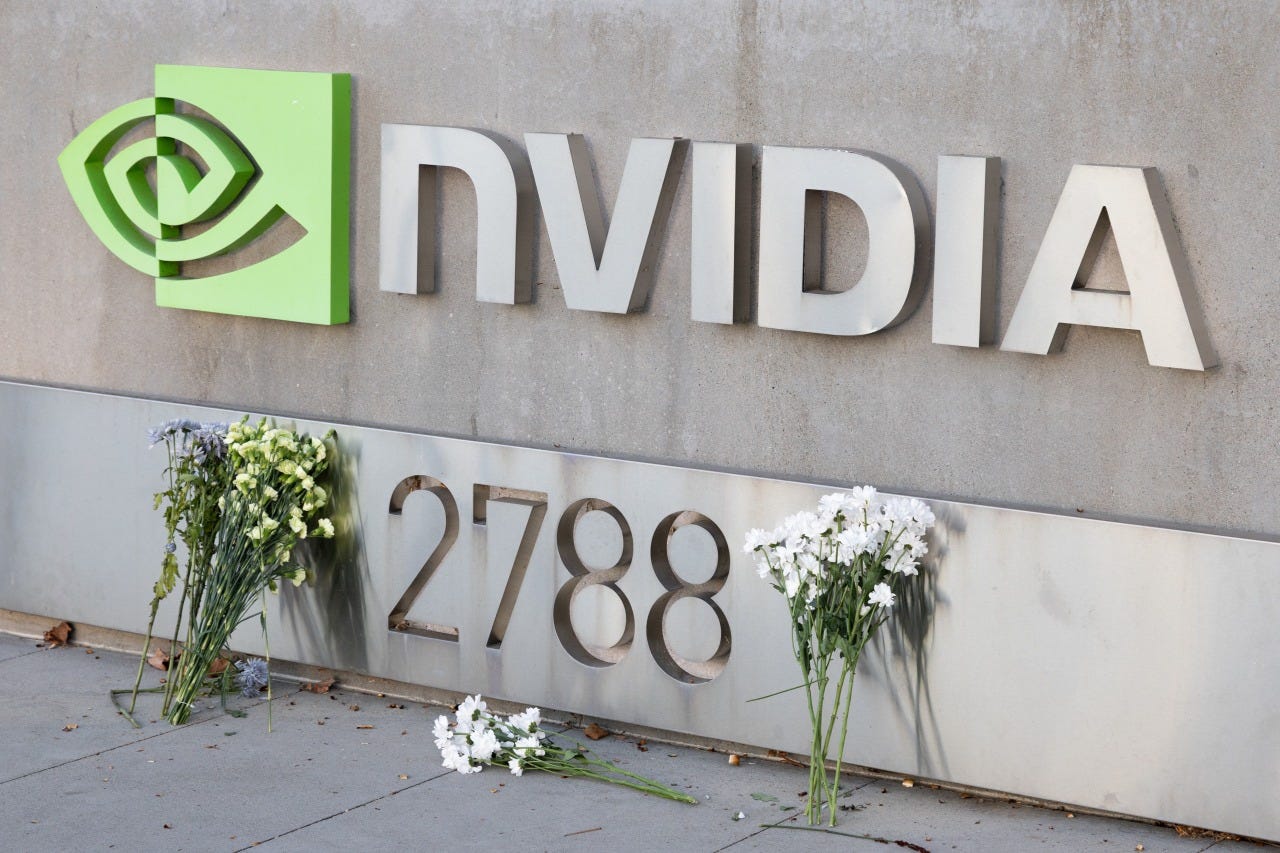
During Tuesday’s earnings call, Nvidia made clear that it would not entertain questions about Huang’s departure, even as the scandal surrounding its former chief executive continues to expand.
That is an extraordinary position for a company whose founder and longtime leader was, until very recently, virtually synonymous with the business itself.
Yet management essentially asked investors to focus on the financial results and move on…which might be easier to accept if those results came with the full transparency investors have come to expect.
They didn’t. In fact, Nvidia disclosed that it would not file its quarterly 10-Q with the Securities and Exchange Commission until “the coming weeks.”
For a company that typically files its 10-Q alongside its earnings announcement, that is a significant departure from normal practice.
A 10-Q is not inconsequential regulatory paperwork. It contains the detailed financial statements, disclosures, management discussion, risk factors and other information investors need to evaluate the company’s performance. It requires executives to sign off on Sarbanes-Oxley disclosures.
And while Nvidia provided supplemental financial information, it has not yet delivered the complete quarterly filing.
As I see it, there are at least three plausible explanations why…(READ THIS FULL ARTICLE 100% FREE HERE).
-END
Ransomware Gang ‘The Gentlemen’ Reportedly Hacked Nvidia
Wednesday, Nov 18, 2026 – 09:55 AM
Unconfirmed reports circulating on X this morning say a ransomware group known as The Gentlemen has listed Nvidia on its leak site, claiming it hacked the chip giant and will publish stolen data soon.
International Cyber Digest wrote:
Ransomware gang The Gentlemen claims it hacked Nvidia, the AI chip giant. Its leak-site listing shows no stolen files yet.
The data is marked “SOON”, next to a countdown of about 10 days and a chat ID for ransom talks. The gang has a real track record.
When its own internal data leaked in May, Check Point counted more than 1,570 victims, more than it had ever listed.
Nvidia has not confirmed any breach.
Ransomware.live, a public cybersecurity tracking website, appears to be keeping tabs on The Gentlemen.
Here’s what it has uncovered so far:
Ransomware. live provides context on the group:
The Gentlemen is a RaaS group that emerged in July- August 2025, rapidly claiming over 320 victims across 17+ countries by offering affiliates a 90% revenue share and deploying a Go-based locker against Windows, Linux, NAS, and BSD systems. A compromised C2 server in 2026 revealed more than 1,570 linked victims.

The Gentlemen’s Target Countries:
The Gentlemen’s Target Sectors:
More color:

This development follows a series of questionable disruptions and outages affecting critical systems at government agencies and major companies. Yesterday, the NSA’s spy network went down, and Apple experienced issues with the App Store and other services. Over the weekend, the FAA suffered a nationwide outage. These events were attributed to hardware or software issues rather than threat actors.
However, the FBI warned yesterday:
The FBI issued a FLASH advisory warning that cybercriminals and state-aligned hackers are exploiting ARTEX, a superintelligence-powered penetration testing framework, to automate attacks against businesses and organizations worldwide. ARTEX can accelerate intrusions from initial targeting to privileged access in under three hours. It was used in the October ConnectWise supply-chain compromise, which exposed Microsoft 365 customer environments and involved attempted authentication against more than 2,250 downstream tenants.
Developing…
END
Yet Another Major Fast-Food Franchisee Rocked By Bankruptcy After Brutal Profit Collapse
Wednesday, Nov 18, 2026 – 12:00 PM
The bankruptcy bloodbath sweeping America’s fast-food industry has claimed another victim as a major KFC and Taco Bell franchise operator buckles under the weight of plunging sales, soaring operating costs, and a mountain of debt.

Tasty Chick’n, which operates 84 restaurants across 10 states, filed for Chapter 11 bankruptcy protection on Monday, Bloomberg reports.
The Texas-based operator controls 75 KFC restaurants and nine combined KFC-Taco Bell locations (they do that!?) – making it another significant casualty in an industry increasingly squeezed between financially stretched consumers and stubbornly elevated operating expenses.
Restaurant sales plunged 11.4% in 2024, slipped another 1.4% in 2025, and have declined 2.8% so far this year. Profit margins also collapsed from 11.8% in 2023 to just 4% in 2026, as rising food, labor, and occupancy costs eat away at what little profitability remains.
To make matters worse, Tasty Chick’n is also drowning in approximately $73 million in funded debt. The company accumulated roughly $15.7 million in unpaid royalties, advertising contributions, and other fees owed to KFC and Taco Bell.
By September, the fast-food giants were threatening to terminate the operator’s franchise agreements, a move that could effectively wipe out much of the remaining value of its restaurant empire.
Tasty Chick’n is now seeking emergency financing and pursuing a court-supervised sale of its locations.
The latest collapse comes amid a widening bankruptcy wave across the fast-food industry.
As we reported, Meritage Hospitality Group, one of Wendy’s largest franchisees, filed for bankruptcy in September after struggling with declining sales, surging beef prices, and mounting financial obligations.
Meritage Hospitality Group operated 314 Wendy’s restaurants across 15 states at the time of its filing, having already shuttered 60 underperforming locations. Court documents warned that another 60 restaurants could close by mid-November.
The financial carnage continued in October when Global Midsouth Holding Corp., a Memphis-based Checkers and Rally’s franchisee, filed for Chapter 11 bankruptcy protection just one day before a scheduled foreclosure auction involving one of its Tennessee properties. The operator reported $1.9 million in assets against $1.3 million in liabilities, with annual revenue sliding from $860,000 in 2024 to $800,000 in 2025.
Waller Wants To “Shock” People: Fed Hawk Reprises 50bps Call As Market Refuses To Price It
Wednesday, Nov 18, 2026 – 09:25 AM
He’s back.
Eight days after threatening a 50bps hike hours before CPI, Fed Governor Chris Waller went on CNBC this morning and did it again: inflation is headed in the wrong direction, it is broadening, and policymakers should consider a half-point increase at the Dec. 9 decision. And just in case anyone thought he was bluffing, he told CNBC’s Steve Liesman that “You might need to, like, shock people.”
The 2-year yield promptly erased a 2.5bp drop and rose as much as 2.8bp to 4.83%, while the 10Y spiked to a session high of 5.13% before fading back to 5.09%. And yet, with OIS still pricing a full quarter-point hike plus just ~3bps extra, the market puts the odds of Waller getting his way at roughly 10%. Which raises two questions: how far is the market from pricing it, and what happens to the AI bid and a long end already sitting at 5.1% if he does.
70% Of Core Services Above 3%… “Nothing To Do With Oil”
The case Waller laid out was less about the headline and more about breadth. By his count, roughly 70% of the items in the core services basket are now rising by more than 3%, a sign that the inflation impulse has long since escaped the energy shock (so much for “transitory pass-through”). Annualized, he said, inflation is heading toward 3.5%.
What seems to worry him most is pricing power: companies increasingly believe consumers are resilient enough to swallow price increases of 3% or more, and so the Fed may need to “shock” people out of thinking 3% is the new normal. Waller also said the Fed may have to take back all three of last year’s “insurance” cuts, and maybe more. Insurance, as it turns out, against the wrong risk.
He did offer an alternative: hike 25bps in December and explicitly signal another move in January. The catch, as CNBC noted, is that this runs against how Chair Warsh likes to communicate (i.e., not pre-committing). Put differently, Waller is telling his boss: either give me 50 now, or give me forward guidance he doesn’t want to give. Either way it’s 50bps over two meetings.
Deja Waller
Regular readers will recall that the London version of Waller put it like this on Nov 10, at the BoE Watchers conference, conditioning a 50bp move on October core CPI printing around 0.3% or higher:
In that case, I believe a 50 basis point hike in the policy rate should be considered at the December meeting. Hiking only 25 basis points would put our credibility at risk, a risk I am not eager to take.
Core CPI then printed 0.3% hours later (0.297% unrounded, so the threshold was met by the grace of rounding), odds of a 50bps hike jumped to about 14%, and ZH tweeted the “hawkish panic” in real time. Then the softer PPI trimmed those bets, and as we noted last week, none of Waller’s colleagues joined him in openly backing 50.
That hasn’t changed. Per Goldman’s US economics team (Mericle), the closest thing to a response came from the New York Fed’s John Williams, who said Tuesday: “I don’t think the situation calls for dramatic action“. Williams also argued the October core print reflected a continuation, not a broadening, of tariff and energy passthrough, which is the polar opposite of Waller’s “spreading out” diagnosis (and since both vote, someone is going to be disappointed). Meanwhile, St. Louis Fed’s Musalem sees several increases by spring.
For those keeping score, this is the same Waller who flipped dovish in early September and sent everything ripping. Ten weeks later he wants to shock the public. Data dependence at its finest.
How Far Is The Market From Pricing It?
Short answer: about 22bps. Waller wants 50; OIS prices ~28bps for Dec. 9 (a done-deal 25bps plus a ~10% chance of the larger move), and Goldman’s own forecast is a plain-vanilla 25bps.
The pricing has actually come off the boil: the December contract spiked to roughly 29bps right after CPI and had faded to ~25.8bps by Tuesday’s close, per Goldman’s Marquee chart (chart source GS FICC). More interesting is what’s behind it: another ~17bps is priced for January and ~17bps for March, or roughly 60bps of hikes through the spring (napkin math, assuming the pricing is cumulative per meeting).
Goldman’s Mericle reads the October FOMC as a compromise to hike every other meeting, and after last week’s CPI the bank added a third 25bp hike in March 2027, after a second one in December (full note available to pro subs). In other words, the street has the destination right and is arguing about the speed, which is exactly what Waller’s “25 plus a January signal” option is about.
What 50 Does To The AI Bid And A 5.1% Long End
Here is the awkward timing: Waller’s hawkish encore landed just as Nvidia’s beat-and-raise was supposed to rescue a battered tech complex ahead of today’s must-price Anthropic IPO. Goldman’s Rich Privorotsky summed up the Nvidia print: “The spending isn’t stopping“. NDX had been re-testing its local lows into the print, per Goldman’s Mark Flood, and futures were up ~0.3% this morning before Waller dented the mood, with gold’s slide accelerating to below $3,800, the lowest since Sept 2025.
The problem for the AI trade is that it no longer runs on cash flow. As we have been warning since last October, AI is now a debt bubble too, and a Fed that front-loads hikes raises the cost of every dollar of that debt just as Apollo’s CEO talks about an $8 trillion buildout bill. (Waller, for his part, said concerns about AI financing are limited to the banks. Maybe.)
As for the long end, the 10Y was at 5.10% this morning per Goldman’s desk, and the plumbing isn’t helping: Tuesday’s long-end Treasury buyback used only about 20% of announced capacity ($1.18BN accepted), versus the full $6BN in the previous operation. A 50bp hike would likely mean a bear flattener at first, with the front end doing the heavy lifting. Then again, with the 30-year mortgage rate at 7.35% (MBA) and building permits collapsing 7.4%, below every single forecast, a long end at 5.1% is already doing a fair bit of tightening on Waller’s behalf.
Minutes At 2pm, Shock In December?
Next up are the FOMC minutes at 2pm, where Goldman will be looking for the assumptions behind participants’ outlooks and their views of the balance of risks. Since the October meeting, the inflation and labor data have, on net, come in firmer than expected, so the minutes will probably read stale on arrival.
Our take: Waller probably doesn’t get his 50 in December (November CPI lands on Dec. 10, the day after the decision, and Williams isn’t there yet). But he very likely gets the next best thing: a December hike paired with a January signal. Which means the real mispricing sits in the ~17bps priced for January, far more than in the 10% odds of 50 for December… along with a long end at 5.1% that hasn’t fully done the math yet.
Much more in Goldman’s Fed preview note, available to pro subs.
KING NEWS\
| The King Report November 18, 2026 Issue 7871 | Independent View of the News |
| Google says AI is making computer security defense infeasible “against machine-speed threats.” Google: Outpace automated cyber threats with security built for nonstop defense.According to the latest AI Threat Tracker report, bad actors are now using autonomous LLM frameworks to continuously scan software updates, figure out what flaw was patched, and build an attack for it — all without human involvement. Defending against machine-speed threats at human speed isn’t feasible. That’s why we’re helping defenders rethink security in the agentic era with Google AI Threat Defense, which combines Gemini and other frontier models, Wiz’s context and prioritization, CodeMender’s automated patching, and Mandiant’s expertise to continuously find and fix flaws before attackers can exploit them…https://blog.google/innovation-and-ai/infrastructure-and-cloud/google-cloud/gtig-ai-threat-tracker-q4-2026/ Google: GTIG AI Threat Tracker: Agentic Threat Activity Crosses a Significant ThresholdIn this update, Google Threat Intelligence Group (GTIG) and Mandiant examine how adversaries across the cyber crime, espionage, and information operations spectrum are operationalizing generative AI to compress attack timelines, scale operations, and execute multi-stage intrusions at machine speed…https://cloud.google.com/blog/topics/threat-intelligence/agentic-threat-activity-crosses-a-significant-threshold @NoLimitGains: Here’s how hackers are now using AI to attack companies, according to a new Google report: 1. A software company releases a security update 2. An AI agent compares the old code to the new code 3. It figures out exactly which weakness was just fixed 4. It writes an attack for that weakness 5. It hits every company that hasn’t installed the update yetNo human needed at any step. Google found one of these tools, called “exploit_agent,” sitting on an exposed hacker server. Its verdict: “The era of autonomous attacks has arrived.” If Google is right about AI destroying system security, why would anyone hold cyber coins? @GuntherEagleman: Fox’s Laura Ingraham says she “SCREAMED ON THE PHONE” when she found out America’s cyber defense agency has gone 22 months with NO CONFIRMED DIRECTOR.Her guest, Rachel Bovard, put it bluntly. There’s no filibuster anymore, so there was NO REASON for Senate Republicans to sit on this nomination. “It’s a failure of leadership.” Our entire economy runs online now: banks, payments, the cloud. If one cloud provider goes down, she says, you get mass chaos in the financial system. https://x.com/GuntherEagleman/status/2122845526882210030 Hackers place malicious codes in projects impacting 178 companies in attempt to steal cryptoMalicious JavaScript was aimed at visitors of popular sites including CNN, IKEA, Equifax, the BBC, Alaska Airlines, Salesforce, Zoom and the international HSBC bank in an attempt to steal cryptocurrency and infect iPhones.https://justthenews.com/government/security/hackers-place-malicious-codes-projects-impacting-178-companies-attempt-steal Highly classified US national security communications network goes down, sources say – CNNhttps://www.cnn.com/2026/11/17/politics/highly-classified-national-security-communications-network-goes-down The S&P 500 Index opened 5.74 points lower and chopped sideways until it broke down on the CNN report. Despite official denials, the numerous system disruptions over the past 5 days strongly suggest that the US has been under cyberattacks. The report about Iran’s dirty bomb in DC is also a concern. After hitting 7288.34, -127.65 or -1.72%, at 10:54 ET, the S&P 500 rallied to 7329.17 at 11:59 ET. After a drop to 7309.44 at 12:04 ET, the S&P spiked higher, to 7362.64 at 12:05 ET, on this WSJ report/excuse: Classified U.S. Intelligence System Is Down for Now, U.S. Officials Say- NSA was patching software, prompting the network to go offline temporarily, according to a person familiar with the incidentApple services facing outages as multiple networks falterDowndetector reported a surge in reports of outages for Apple systems beginning at 11:30 a.m.https://justthenews.com/politics-policy/apples-services-facing-outages-multiple-networks-falter Apple Blames Internal Update for Outage, Says It Wasn’t a Cyberattackhttps://www.macrumors.com/2026/11/17/apple-outage-internal-update/ @Anna_Giaritelli: Dozens of FAA employees nationwide who spoke by phone or text message with the Washington Examiner since Nov. 13 alleged Duffy and Bedford’s single router claim as the cause of the disruption does not add up. 1. Entire national airspace didn’t need to be shut down, given that only select higher-altitude facilities (centers) were impacted, and they didn’t fully lose telecomms (they had back-up methods) 2. Routine telecommunications upgrades have been done countless times at other facilities all year without major issue — why was this one different? 3. The upgrade was done on a Friday afternoon given the FAA’s general protocol of making changes at times of the week when there is no air traffic (midweek, middle of the night)…Other FAA employees pointed out that since the beginning of the year, the FAA has been implementing more than 10,000 changes to the air traffic control system nationwide…https://x.com/Anna_Giaritelli/status/2122753649957097553 The S&P 500 Index crept up to 7363.09 at 12:25 ET, after the spike. It then rolled over and traded sideways until it broke lower after 14:35 ET. After dropping to 7297.93 at 15:01 ET, the rally for the expected late manipulation commenced. The S&P 500 Index rallied to 7338.54 at 15:37 ET. It then fell to 7312.99 at 15:52 ET. The illegal late manipulation pushed the S&P 500 Index to 7341.23 at 16:00 ET Cyber attack hits 178 major websites: Full list of organizationsHackers have planted malicious code on some of the world’s most popular websites, potentially exposing visitors to the theft of their personal and financial information, cybersecurity experts have warned. Security researcher Scott Helme, founder of Report URI, told Newsweek in an email Tuesday that researchers found at least 188 infected Optimizely projects across 178 organizations, including the BBC, CNN, Zoom, HSBC, Salesforce and Equifax…https://www.yahoo.com/news/world/articles/cyber-attack-hits-178-major-105900028.html @LauraLoomer: SCOOP: Employees at the NSA who are currently unable to access the highly classified NSA Net have reportedly been SENT HOME. Source tells me the NSA system being down in conjunction with all of the other outages last week and over the weekend is what the Intel community calls “signaling”, which is a way for foreign adversaries and hackers to “signal” what they are capable of doing as a pre-warning before a major hack or debilitating cyber attack. Source told me this is likely the work of Iran with assistance from China and or Russia, whose hackers they tell me are more sophisticated than the Iranians. This comes as President Trump arrived in the Philippines today for consultations with foreign leaders. President Trump will be in China on Wednesday where he’s meeting with Xi Jinping and Vladimir Putin. Governments Are Telling You to Get Ready. Pay Attention.The clustering of preparedness guidance and system failures is not random. Practical steps and why anxiety is still the wrong strategy… Across Europe, the UK’s “Be Ready” campaign is telling households to stock three days of water, food, cash, and a radio. The EU’s Preparedness Union Strategy, rolled out last year and reinforced recently, aims for 72 hours of household self-sufficiency. Japan, several Nordic countries, and others have issued or updated similar guidance. In the United States, the Pentagon has directed bases toward greater self-sufficiency, and FEMA is running a nationwide Emergency Alert System test today… A Cluster of Outages That Officials Call Technical… Suspicious Timing and the Incentives… as the global economy slows further, 2027 is shaping up to be an interesting year to say the least. In this environment, governments and institutions have strong incentives to emphasize external threats (whether kinetic or cyber) or to manufacture urgency that distracts from failed domestic policy outcomes…https://eddowdbeyondthenarrative.substack.com/p/governments-are-telling-you-to-get?r=12542m KPMG Chief Economist @DianeSwonk: Whatever is causing all of these outages is disruptive and adding to frictions in systems. It is costly & erodes trust, which is already low – in the gutter low. Costly = inflation. A drumbeat of shocks that is forming a rhythm in our heads – like a song you can’t shake. We are anticipating the next before the last has abated – the exact behavior the Fed is tasked to avert… @bennyjohnson: Senator Josh Hawley calls for a full Senate briefing on ongoing outages, says if it’s a coincidence, then “it’s like the greatest coincidence in the history of the world.” “I think we ought to be briefed thoroughly on what is actually happening here.”https://x.com/bennyjohnson/status/2122706690814427632 @uTobian: The NY Times has the receipts today. Here’s how the Nvidia Blackwell chip laundering worked. 1. Nvidia was blocked from selling Blackwell chips to China. So Jensen Huang sold them to Alice Huang at Megaspeed which installed them in data centers in Singapore, Malaysia, and Indonesia. 2. Howard Lutnick’s family and company (Cantor Fitzgerald) were also heavily invested in these southeast Asian data centers and Lutnick blocked regulatory enforcement against Nvidia. 3. The data centers then either sold computers to China or hollowed out the servers and shipped the Blackwell chips directly to China. (Reports of hollowed out servers are from others on X….) 4. Nvidia could claim correctly that they had not shipped Blackwell chips to China. But the Megaspeed middlewoman (Alice Huang) was clearly facilitating Chinese access. 5. The Trump administration has known this for a year. Jensen Huang and President Trump were eager to sell Blackwells to China so they opposed the restrictions and didn’t seem to mind the circumventions of the embargo. Secretary Rubio seems to be the main character within the administration trying to enforce the law… FT: Nvidia stopped disclosing Singapore sales as revenues hit $104bnUS chipmaker changed its reporting methods as revenues booked through the city-state surged 70 per cent… The Singapore accounts show that the subsidiary booked $117.8bn of revenue in the 12 months to January 2026, including $13.6bn of sales to another Nvidia company…https://www.ft.com/content/dbde7a30-548c-4f9d-a4be-7898a0c24dcf?syn-25a6b1a6=1 @WSJ: President Trump’s stake in Nvidia swelled to as much as $83 million in early October, just a few weeks before the company’s shares slid with Jensen Huang’s admission of an affair with a business associate suspected of working with Chinese intelligence. https://x.com/WSJ/status/2122762132018069972 SpaceX Debt for AI Chips to Hit Market as Soon as This Week – BBGA portion of $40 billion in debt financing to pay for artificial intelligence chips for SpaceX may start being sold as soon as this week… The sale is designed to keep the debt off SpaceX’s balance sheet. A special purpose vehicle managed by Apollo-backed Atlas SP will buy Nvidia chips and issue asset-backed securities… https://www.bloomberg.com/news/articles/2026-11-17/spacex-debt-for-ai-chips-to-hit-market-as-soon-as-this-week @theMRC: President Trump warns Iran if they threaten to do anything to Washington D.C. :“If there is, they will pay a price the likes of which no country has ever paid before. This is why they can’t have a nuclear weapon.” https://x.com/theMRC/status/2122707533139706003 Positive aspects of previous session SOX Index +0.34%; SPCX +3.16%, AVGO +2.46%l USZs +4/32 at 16:16 ET.Jan WTI -$0.03, Jan Brent -$0.04, Jan Diesel -3.17¢, Jan Gasoline -1.32¢ at 16:18 ET Negative aspects of previous session The S&P 500 hit a 4-month low. The Russell 2000 hit a 7-month low.S&P 500 -1.03%, DJIA -1.64%, DJTA -1.51%, Nas 100 -0.72%, Nasdaq -0.74%, SOX Index -5.28%SP Financials -1.87%, Utes -1.6%, Real Estate -1.4%, Health Care -1.37%, Comm Services -1.3%, Materials -1.17%, Consumer Staples -1.06%, Info Tech -0.77%, Consumer Discretionary -0.56%, Industrials -0.55%, Energy -0.53%MSFT -2.27%, TSM -3.68%, GOOGL -1.24%NVDA -4.12%, MU -7.62%, AMD -5.58%, SNDK -8.58%, GOOGL -4.07%, AVGO -3.92%,META -2.38%, TSLA -2.69%, AMZN -3.34%, MSFT -1.12%, APPL -0.98% Ambiguous aspects of previous session Bonds rallied a tad though energy commodities declined sharply. First Hour/Last Hour NYSE Action [S&P 500 Index]: 1st Hour: Down; Last Hour: Up Pivot Point for S&P 500 Index [above/below indicates daily trend to day traders]: 7443.88Previous session (S&P 500 Index) High/Low: 7415.37 (9:58 ET); 7288.34 (10:54 ET) Deutsche Bank Leak Reveals $582 Million in Suspicious Epstein PaymentsLeaked Deutsche Bank documents reveal that the German lender flagged approximately $582 million in suspicious transactions linked to Jeffrey Epstein, more than double the amount previously identified by U.S. Senate investigators, as an international consortium of news outlets published an investigation Tuesday that also uncovered new details about the bank’s dealings with President Donald Trump and Russian oligarchs… Deutsche Bank accidentally leaked Trump’s tax statements to an outside accountant in 2017…https://www.forbes.com/sites/siladityaray/2026/11/17/deutsche-bank-leak-reveals-582-million-in-suspicious-epstein-payments/ After the close, Nvidia reported Q3 EPS 2.68, 2.49 expected; revenue of $115.8B, $109.33B expected. Data Center Revenue $107.6B, $101.87B exp. NVDA said Q4 revenue will be about $130B, $125.1B consensus. The company authorized a $150B share buyback. NVDA was -0.77% at 16:19 ET but rallied to +3.49% at 17:27 ET. Be alert for a pump & dump in Nvidia today! Today – Equity futures are sharply higher on Tuesday night due to Nvidia. Barring news, stocks should jump higher. However, conditioned traders have been aggressively buying NQZs and ESZs overnight, but those big gains have been disappearing during the NYSE session. The usual suspects will pour into AI-related stocks and tech trading sardines. If the rally aborts later in the session, look out below! A reversed rally would strong suggest organic or informed selling. ESZs +38.00; NQZs +244.75, USZs -1/32, Dec WTI -$0.38, Dec Gas -0.32¢, ¥/$ 159.60 at 20:30 ET The Tuesday night high for NQZs is 27,609.75, +534.25. So, NQZs are much lower as we publish. Expected Econ Data: Oct Housing Starts 1.221m, Permits 1.398m; Oct Pending Home Sales -2.3% m/m Fed Speakers: Gov Barr 13:35 ET, NY Pres Williams 14:30 ET S&P 500 50-day MA: 7655; 100-day MA: 7626; 200-day MA: 7343 (Close 7340.53, -1.03%)Nasdaq 100 50-day MA: 29,406; 100-day MA: 29,322; 200-day MA: 28,053 (Close 27.001.78, -0.72%) DJIA 50-day MA: 51,896, 100-day MA: 52,429; 200-day MA: 50,777 (Close 50,759.42, -1.64%) (Green is positive slope; Red is negative slope) New ‘Blue Tsunami’ election poll offers Republicans hope for a 2028 comebackThe analysis by pollster J.L. Partners — an Election Day survey of 1,000 registered voters, checked against more than 30,000 interviews conducted during the campaign — found that 35% of Trump’s 2024 voters didn’t cast a ballot on Nov. 3. Just 8% of Trump voters switched sides to back Democrats… Nowhere was the falloff steeper than in Trump’s base. Among his 2024 voters, 46% of those without a college degree didn’t vote, nor did 44% of those over 65 or 39% of those in rural areas...https://nypost.com/2026/11/16/us-news/trump-voters-who-stayed-home-cost-gop-midterms-more-than-defectors-did-jl-partners-study-finds/ ‘There was a lot of gaslighting’: Why America’s podcast stars ditched Donald Trump – FThttps://www.ft.com/content/676d1291-3007-4a32-9332-abf803d0f581?syn-25a6b1a6=1 | |
SWAMP STORIES FOR YOU TONIGHT
Ken Griffin Disposes NYC Condo For $58 Million After Socialist Mamdani’s “Creepy & Weird” Video
Wednesday, Nov 18, 2026 – 09:00 AM
Citadel founder Ken Griffin has reportedly sold his duplex at Manhattan’s 740 Park Avenue to New York Jets owner Woody Johnson for $58 million, according to Bloomberg. Griffin saw the writing on the wall earlier this year when reformist socialist Mayor Zohran Mamdani vilified him in a creepy socialist propaganda video promoting a new pied-à-terre tax.
The report said Griffin sold the property for about $13 million above the roughly $45 million he paid, representing a 29% increase before taxes and transaction costs.
Earlier this year, at the Milken Institute Global Conference, Griffin explained, “What the mayor of New York has made clear to my partners, and principally my New York partners, is that we need to double down on our bet in Miami.”
“Looking at what Mamdani did to me and, more broadly, is doing to the city of New York is triggering the trauma I went through in Chicago,” Griffin said at the time.
Recall that in 2022, Griffin announced he was moving his family and his hedge fund’s headquarters from violent crime-plagued Chicago to Miami amid backfiring progressive policies.
In a post on X Tuesday, Mamdani said, “An update on our pied-à-terre surcharge: We’ve billed more than $500 million to owners of second homes worth more than $5 million. That’s half a billion dollars to invest in a City that works for all New Yorkers.”
And really, that money is just being redistributed, and it will fill the coffers of left-wing NGOs… like this:
Another troubling development is that the socialist mayor dismantled the NYPD’s 600-officer protest unit, a move that may give far-left activist networks a clearer runway and embolden them to stage “mostly peaceful protests,” or, better yet, let China-linked NGOs continue to run amok in the city.
GREG HUNTER….INTERVIEWING TOM HAVILLAND
CV19 Clot Shot Coverup Everywhere – Tom Haviland
By Greg Hunter On November 17, 2026 In Political Analysis5 Comments
By Greg Hunter’s USAWatchdog.com
Retired Airforce Major Tom Haviland has been asking what mortuary workers worldwide are finding in the bodies they are preparing for burial for the last four years. A little less than 25% of the bodies they process for the coffin have white fibrous clots that started appearing after the CV19 vaccine rollout in 2021. Haviland says, “I have done these surveys in Canada, UK, Australia, the US and New Zealand. Fibrous clots are what embalmers are finding in one out of every four or one out of every five corpses. . .. We have been seeing these mysterious deaths over the last five years ever since the Covid vaccines came out. Dan Hicks was an NBC sports reporter and did college football games from Notre Dame and was the voice for NBC’s PGA golf. He was married to Hannah Storm who works at ESPN. You know those two people took the CV19 shots. It was bizarre when they talked about this death and that he had an ‘acute illness’ . . . and that it was ‘sudden and unexpected.’ It was almost like they were trying to conceal something. We also know that Dolly Parton had taken the CV19 vaccine and bragged about it on camera and used her famous song Jolene about getting the vaccine. It was also bizarre that she got this very aggressive cancer, went to the hospital and four days later she passed away. These are not the only cases like this. We have seen a whole bunch over the last five years since the CV19 vaccine rollout.”
Now, vein doctors have seen a huge increase of white fibrous clots being pulled out of live people. Haviland says, “Recently, I talked to a vascular surgeon from Louisiana. Dr. Joe Griffin has seen arterial clotting go up dramatically over the last five years. Before Covid, he says he would do 12 to 15 arterial clot removal procedures a year. Now, since Covid and the vaccines have come out, he’s doing up to 65 arterial clot removals per year. That is quintupling the clot removals on the arterial side ever since the Covid vaccine appeared on the scene. They have one thing in common, and that is the spike protein that we are pretty sure is causing these white fibrous clots. . .. Dr. Griffin attends medical conferences, and he says all of his vascular surgeon buddies are seeing these white fibrous clots. The sad part is they are not talking about it. They are keeping this to themselves. It’s a sad thing because these doctors should be calling this out. I think the doctors are afraid to come forward because they have seen what has happened to people like Dr. Pierre Kory and Dr. Peter McCullough. They got attacked, and they go after their medical license if the say anything negative about the CV19 vaccines.”
Haviland is working on getting a Senate hearing on the white fibrous clots with Senator Ron Johnson. It looks like it’s going to happen. Haviland just does not know when. Meanwhile, people continue to be in the dark and are given no warning something is seriously wrong with the CV19 shots. They could be getting treatment to mitigate some of the ill CV19 vax effects, but it can’t happen without more information getting out. In closing, Haviland says, “Dr. Phillip McMillan from the UK has a carton picture and shows there are three levels of the iceberg. One third of it is above the waterline. Those are the people who have been injured by the CV19 jab, and they know the jab caused the injury. The next third are people below the waterline, and they suspect the jab has injured them, but they are afraid to say anything about it. The biggest part is the final third, and those people have been injured by the jab and have no idea that the jab has caused their injury. So, we have to try to reach all three groups.”
There is more in the 41-minute interview.
To get a “Contagion Emergency Kit” from The Wellness Company, click here. You get $45 off (15%) and free shipping with the promo code USAWATCHDOG. You can also call The Wellness Company at (800) 758-1584 where you can talk to a real human for more information or to help you order.
Join Greg Hunter of USAWatchdog as he goes one-on-one with Tom Haviland on the public gaslighting of the gigantic and growing clot coverup caused by the CV19 vax for 11.17.26.
Tom Haviland posts all his work on Clotastrophe.
After the Interview:
There is lots for free information on Laura Kasner’s Substack called “Clotastrophe.” This is where Tom Haviland posts his survey work. There is zero charge to visit this site.
To read Haviland’s recently published peer-reviewed work called Self-Reported Observations of Unusual White Fibrous Structures in Embalmed Corpses: Multi-Year Survey Results from Embalmers in Five Countries, 2022–2025 , click here.


