
GOLD CLOSED UP $136/40 TO $3651.25
SILVER CLOSED UP $2.31 TO $43.34
EXCHANGE: COMEX
CONTRACT: NOVEMBER 2026 COMEX 100 GOLD FUTURES
SETTLEMENT: 3,512.300000000 USD
INTENT DATE: 11/20/2026 DELIVERY DATE: 11/24/2026
FIRM ORG FIRM NAME ISSUED STOPPED
323 C HSBC 3
363 H WELLS FARGO SECURITI 23
661 C JP MORGAN SECURITIES 18
737 C ADVANTAGE FUTURES 1
905 C ADM 3
TOTAL: 24 24
month 5982
GOLD: NUMBER OF NOTICES FILED FOR NOVEMBER./2026: 24 CONTRACTS NOTICES FOR 2400 OZ or 0.07465 TONNES
total notices so far: 598,200 contracts FOR 598,200 OZ OR 18.606 TONNES
SILVER NOTICES: 95 NOTICE(S) FILED FOR 475,000 OZ /
total number of notices filed so far this month : 2067 CONTRACTS (NOTICES) for 10.825 million oz
GLD
WITH GOLD UP $136.40 INVESTORS SWITCHING TO SPROTT PHYSICAL INSTEAD OF FRAUDULENT GLD/HUGE CHANGES AT THE GLD: A MASSIVE WITHDRAWAL OF OF 3.71 TONNES OUT OF GOLD INTO THE GLD//INVENTORY RESTS AT 1034.43 TONNES
WITH NO SILVER AROUND AND SILVER UP $2.31 AT THE SLV.//HUGE CHANGES IN SILVER INVENTORY AT THE SLV///A MASSIVE DEPOSIT OF 1.354 MILLION OZ INTO THE SLV
NOV: INITIAL STANDING 5.820 MILLION OZ FOLLOWED BY TODAY’S 87 CONTRACT QUEUE JUMP FOR 435,000 OZ//NEW STANDING ADVANCES TO 10.610 MILLION OZ//
NOV. 32.910 MILLION OZ
NOV: INITIAL STANDINGl 10.566 TONNES OF GOLD FOLLOWED BY TODAY’S QUEUE JUMP OF 40 CONTRACTS FOR 4000 OZ//(0.1244TONNES)/ TO WHICH WE ADD OUR TWO EXCHANGE FOR RISK ISSUANCE: 0.7900 EXCHANGE FOR RISK ISSUENCES:/NEW STANDING ADVANCES TO 19.4930 TONNES
GOLD PRICE LOSS OF $171.10
NOV INITIAL STANDING 10.566 TONNES FOLLOWED BY TODAY’S 40 CONTRACT QUEUE JUMP FOR 4,000 OZ OR 0.1244 TONNES FOR A NORMAL DELIVERY OF 18.6930 TONNES TO WHICH WE ADD OUR TWO EXCHANGE FOR RISK AT 254 CONTRACTS//25,400 OZ OR 0,7900 TONES///NEW STANDING ADVANCES TO 19.4830 TONNES
NOV// 119.76 TONNES
SHANGHAI CLOSED UP 5.15 PTS OR 0.15%
HANG SENG CLOSED DOWN 27.06 PTS OR 0.12 %
Nikkei CLOSED DOWN 3,007.56 PTS OR 5.06%
//Australia’s all ordinaries CLOSED UP 0.95%
//Chinese yuan (ONSHORE) CLOSED UP AT 6.6647
/ OFFSHORE CLOSED DOWN AT 6.6664 Oil UP TO 83.83 dollars per barrel for WTI and BRENT UP TO 91.97 Stocks in Europe OPENED ALL GREEN
ONSHORE USA/ YUAN// WITH YUAN TRADING UP 6.6647//OFFSHORE YUAN TRADING UP TO 6.6664 ONSHORE YUAN TRADING ABOVE LEVEL // OFF SHORE AND UP ON THE DOLLAR)// / AND THUS STRONGER OFF SHORE YUAN TRADING UP AGAINST US DOLLAR/ AND THUS STRONGER
XXXXXXXXXXXXXXXXXXXXXXXXXXXXXXXXXXXXX
NOV : FIRST ISSUANCE/NOV 13 AT 250 CONTRACTS OR 250,000 OZ OR .7776 TONNES/SECOND OCCASION: 4 CONSTRACTS FOR 400 OZ/0. 01244 TONNES: TOTAL EXCHANGE FOR RISK//NOV; 254 CONTRACTS//0.7900 TONNES OF GOLD.
NOV 2 SO FAR AT 254 CONTRACTS/25,400 OZ OR 0.7900 TONNES/TWO OCCASIONS
NOV// TWO SO FAR EXCHANGE FOR RISK EQUAL TO 254 CONTRACTS/25,400 OZ OR 0.7900 TONNES (TWO OCCASIONS)
THE SPECS WERE SUCCESSFUL IN LOWERING GOLD’S PRICE ( IT FELL BY $171.10)
| Gold | Ounces |
| Withdrawals from Dealers Inventory in oz | nil |
| Withdrawals from Customer Inventory in oz | 4 ENTRIES i) Out of HSBC: 6818.02 oz (150 kilobars) ii) Out of Brinks 96.453 oz 3 kilobars iii) Out of JPMorgan 69,004.006 oz iv) Out of Manfra: 33,159.201 oz total withdrawal: 109,082.681 oz //or 3.392 tonnes |
| Deposit to theDealerInventory in oz | 0 ENTRIES |
| Deposits to the Customer Inventory, in oz | DEPOSITS/CUSTOMER//gold 0 ENTRIES xxxxxxxxxxxxxxxx |
| No of oz served (contracts) today | 24 CONTRACTS 2400 OZ 0.07465 TONNES OF GOLD |
| No of oz to be served (notices) | 18 Contracts 1800 OZ 0.0559 TONNES |
| Total monthly oz gold served (contracts) so far this month | 5982 notices 598,200 OZ 18.606TONNES |
| Total accumulative withdrawals of gold from the Dealers inventory this month | NIL oz |
| Total accumulative withdrawal of gold from the Customer inventory this month |
dealer deposits: 0
dealer deposits: 0
xxxxxxxxxxxxxxxxxxx
DEPOSITS:CUSTOMER ACCT
ENTRIES: 0
xxxxxxxxxxxxxxxxxx
comex withdrawal
4ENTRIES
i) Out of HSBC: 6818.02 oz
(150 kilobars)
ii) Out of Brinks 96.453 oz
3 kilobars
iii) Out of JPMorgan 69,004.006 oz
iv) Out of Manfra: 33,159.201 oz
total withdrawal: 109,082.681 oz
//or 3.392 tonnes
adjustments: 0 //
COMEX IS DRAINING GOLD
chaos inside the comex
THE FRONT MONTH OF NOV OI STANDS AT 42 CONTRACTS HAVING A GAIN OF 22 CONTRACTS.
ON FRIDAY WE HAD NORMAL DELIVERY OF 597,000 OZ(18.5692 TONNES) STAND FOR DELIVERY: TODAY, 601,000 OZ (18.6930 TONNES) FOR A QUEUE JUMP GAIN OF 4000 OZ //40 CONTRACTS (0.1244 TONNES)//NORMAL STANDING ADVANCES TO 18.693 TONNES OF GOLD TO WHICH WE ADD OUR TWO EXCHANGE FOR PHYSICAL ISSUANCE OF 254 CONTRACTS/25,400 OZ OR 0.7900 TONNES//NEW STANDING ADVANCES TO 19.4830 TONNES.
.
DECEMBER, THE LARGEST DELIVERY MONTH IN THE CALENDAR, ITS OI FALLS BY 23,368 CONTRACTS DOWN TO 150,028
JANUARY OI ROSE BY 112 CONTRACTS TO 1824 OI
.
We had 24 contracts filed for today representing 2400 oz
Today, 0 notice(s) were issued from J.P.Morgan dealer and 0 notices issued from their client or customer account. The total of all issuance by all participants equate to 24 contract(s) of which 0 notices were stopped (received) by j.P. Morgan dealer and 18 notice(s) was (were) stopped (received) by J.P.Morgan//customer account
To calculate the INITIAL total number of gold ounces standing for NON /2026. contract month, we take the total number of notices filed so far for the month (5,982) to which we add the difference between the open interest for the front month of NOV (42) CONTRACTS) minus the number of notices served upon today 24 x 100 oz per contract) equals 601,000 OZ OR(18.5692Tonnes of gold) to which we add our 2 exchange for risk issuance of 254 contracts//25,400 oz or 0.7900 tonnes//new standing for November thus rises again to 19.4830 tonnes.
THUS: INITIAL total number of gold ounces standing for NOV. /2026. contract month,we take the total number of notices filed so far for the month (5982) to which we add the difference between the open interest for the front month of NOV( 42) contracts minus the number of notices served upon today 24 x 100 oz per contract) equals 601,000 OZ OR(18.5692 Tonnes of gold) to which we add our 2 exchange for physical of 254 contracts/25,400 or 0.790 tonnes//new standing advances to 19.4830 tonnes
new total of gold standing in NOV becomes 19.4830 TONNES//
TOTAL COMEX GOLD STANDING FOR NOV: 19.4830 TONNES WHICH IS NOW VERY STRONG FOR THIS NON ACTIVE DELIVERY MONTH OF NOV/
FRIDAY VOLUME: 441,321 HUGE
COMEX GOLD INVENTORIES/CLASSIFICATION
NEW PLEDGED GOLD:
241,794.285 oz NOW PLEDGED /HSBC 5.94 TONNES
204,937.290 OZ PLEDGED MANFRA 3.08 TONNES
83,657.582 PLEDGED JPMorgan no 1 1.690 tonnes
265,999.054, oz JPM No 2
1,152,376.639 oz pledged Brinks/
Manfra: 33,758.550 oz
Delaware: 193.721 oz
International Delaware:: 11,188.542 oz
total pledged gold: 1,740,804.660 oz 54.146tonnes pledged gold lowers
total inventories in gold declining rapidly
total pledged gold: 1,740,804.660 tonnes oz 54.146 tonnes
TOTAL OF ALL GOLD ELIGIBLE AND REGISTERED GOLD 22, 749,497.602oz//
TOTAL REGISTERED GOLD 14,199,595.829 tonnes (441.667 tonnes)
TOTAL OF ALL ELIGIBLE GOLD 8,549,901.791 oz.
REGISTERED GOLD THAT CAN BE SERVED UPON in oz 12,458,791 ((REG GOLD- PLEDGED GOLD)=
387.520 Tonnes //
total inventories in gold declining rapidly
SILVER COMEX
NOV DELIVERY MONTH
NOV 23
| Silver | Ounces |
| Withdrawals from Dealers Inventory | NIL oz |
| Withdrawals from Customer Inventory | 4 entries i) Out of Asahi: 593,841.600 oz ii) Out of hsbc 20,096.870 ,oz iii) Out of jpm 414,957.900oz iv) Out of Stonex 06,697.900 oz total withdrawal: 1,589,594.270 oz |
| Deposits to the Dealer Inventory | 1 ENTRIES i) Into CNT dealer 354,660.510 oz total dealer deposit 354,660.510 oz |
| Deposits to the Customer Inventory | ENTRIES: 1 i) Into CNT 245,393.300 oz total deposit 245,393.300 oz |
| No of oz served today (contracts) | 95 CONTRACT(S) ( 475,000 OZ) |
| No of oz to be served (notices) | 39 Contracts (0.185 MILLION oz) |
| Total monthly oz silver served (contracts) | 2063 contracts 10.315 MILLIONoz |
| Total accumulative withdrawal of silver from the Dealers inventory this month | NIL oz |
| Total accumulative withdrawal of silver from the Customer inventory this month |
DEPOSITS INTO DEALER ACCOUNTS
ENTRY:1
i) Into CNT dealer 354,660.510 oz
total dealer deposit 354,660.510 oz
DEPOSIT ENTRIES/CUSTOMER ACCOUNT
1 ENTRIES:
i) Into CNT 245,393.300 oz
total deposit 245,393.300 oz
xxxxxxxxxxxxxxxxxxxxxxxxx
withdrawals:
4 ENTRIES
adjustments : //0
TOTAL REGISTERED SILVER: 101.513 MILLION OZ//.TOTAL REG + ELIGIBLE. 329.419 Million oz
registered silver dropping in numbers
CALCULATIONS FOR THE NEW STANDING FOR SILVER FOR NOV
FRONT MONTH: SILVER OPEN INTEREST CONTRACTS: 134 FOR A GAIN OF 7 CONTRACTS .
ON FRIDAY WE HAD 10.375 MILLION OZ STAND FOR DELIVERY. TODAY 10.810 MILLION OZ FOR A GAIN OF 435,000 OZ OR A QUEUE JUMP OF 87 CONTRACTS DECIDED TO TAKE DELIVERY ON THIS SIDE OF THE POND.
.
DECEMBER LOST 6744 CONTRACTS DOWN TO AN OI OF 41,647
JANUARY GAINED 17 C0NTRACTS TO 1,270 OI
TOTAL NUMBER OF NOTICES FILED FOR TODAY:20 or 100,000 oz
CONFIRMED volume FRIDAY; 161,691 huge//rollovers
AND NOW NOV DELIVERIES:
To calculate the number of silver ounces that will stand for delivery in NOV. we take the total number of notices filed for the month so far at 2063 X5,000 oz = 10.315 MILLION oz.
Then we take the difference between the front month of NOV. and the number of notices filed for today x 5000 to give us our standing
Thus the standings for silver for the NOV 2026 contract month: (2063 Notices served so far) x 5000 oz + OI for the front month of NOV (134 minus number of notices served upon today ( 95 x 5000 oz) equals silver standing for the NOV .contract month equating to 10.510 MILLION OZ
We must also keep in mind that there is considerable silver standing in London coming from our longs
There are ONLY 101.513 million oz of registered silver
JPMorgan as a percentage of total silver: 123.875///329.419million: 37.68%
The record level of silver open interest is 234,787 contracts set on April 21./2017 with the price on that day at $18.42.
The previous record was 224,540 contracts with the price at that time of $20.44.
BOTH GLD AND SLV ARE MASSIVE FRAUD
XXXXXXXXXXXXXXXXXXXXXXXXXXXXXXXXXXXXXXXXXXX
NOV23 WITH GOLD UP $136.40// HUGE CHANGES IN GOLD AT THE GLD. A WITHDRAWAL OF 3.71 TONNES OF GOLD OUT OF THE GLD.INVENTORY RESTS AT 1034.43 TONNNES
NOV20 WITH GOLD DOWN $170.15// HUGE CHANGES IN GOLD AT THE GLD. A WITHDRAWAL OF 4.98 TONNES OF GOLD OUT OF THE GLD.INVENTORY RESTS AT 1038.17 TONNNES
NOV19 WITH GOLD DOWN $53.00// HUGE CHANGES IN GOLD AT THE GLD. A WITHDRAWAL OF 1.98 TONNES OF GOLD OUT OF THE GLD.INVENTORY RESTS AT 1044.12 TONNNES
NOV18 WITH GOLD DOWN $122.90// HUGE CHANGES IN GOLD AT THE GLD. A DEPOSIT OF 1.70 TONNES OF GOLD OUT OF THE GLD.INVENTORY RESTS AT 1046.10 TONNNES
NOV17 WITH GOLD UP $12.60// HUGE CHANGES IN GOLD AT THE GLD. A DEPOSIT OF 1.70 TONNES OF GOLD OUT OF THE GLD.INVENTORY RESTS AT 1046.10 TONNNES
NOV16 WITH GOLD DOWN $34.30// HUGE CHANGES IN GOLD AT THE GLD. A DEPOSIT OF 3.70 TONNES OF GOLD OUT OF THE GLD.INVENTORY RESTS AT 1044.40 TONNNES
NOV13 WITH GOLD UP $0.65 SMALL CHANGES IN GOLD AT THE GLD. A WITHDRAWAL OF 0.380 TONNES OF GOLD OUT OF THE GLD.INVENTORY RESTS AT 1040.70 TONNNES
NOV12 WITH GOLD DOWN $112.40 HUGE CHANGES IN GOLD AT THE GLD. A WITHDRAWAL OF 1.14 TONNES OF GOLD OUT OF THE GLD.INVENTORY RESTS AT 1041.08 TONNNES
NOV11 WITH GOLD DOWN $30.50 SMALL CHANGES IN GOLD AT THE GLD. A WITHDRAWAL OF 0.29 TONNES OF GOLD OUT OF THE GLD.INVENTORY RESTS AT 1042.29 TONNNES
NOV10 WITH GOLD DOWN $83.10 HUGE CHANGES IN GOLD AT THE GLD. A DEPOSIT OF 1.14 TONNES OF GOLD INTO THE GLD.INVENTORY RESTS AT 1042.51 TONNNES
NOV9 WITH GOLD UP $36.20 HUGE CHANGES IN GOLD AT THE GLD. A DEPOSIT OF 0.8600 TONNES OF GOLD INTO THE GLD.INVENTORY RESTS AT 1041.37 TONNNES
NOV6 WITH GOLD DOWN $32.30 HUGE CHANGES IN GOLD AT THE GLD. A DEPOSIT OF 2.850 TONNES OF GOLD INTO THE GLD.INVENTORY RESTS AT 1040.51 TONNNES
NOV4 WITH GOLD UP $133.00 HUGE CHANGES IN GOLD AT THE GLD. A WITHDRAWAL OF 2.850 TONNES OF GOLD OUT OF THE GLD.INVENTORY RESTS AT 1037.66 TONNNES
NOV3 WITH GOLD DOWN $28.35 HUGE CHANGES IN GOLD AT THE GLD. A WITHDRAWAL OF 1.14 TONNES OF GOLD OUT OF THE GLD.INVENTORY RESTS AT 1040.51 TONNNES
NOV2 WITH GOLD UP $68.40 SMALL CHANGES IN GOLD AT THE GLD. A DEPOSIT OF 0.57 TONNES OF GOLD INTO THE GLD.INVENTORY RESTS AT 1041.65TONNNES
OCT 30/ WITH GOLD DOWN $129.60 HUGE CHANGES IN GOLD AT THE GLD. A WITHDRAWAL OF 2.28 TONNES OF GOLD INTO THE GLD.INVENTORY RESTS AT 1041.08TONNNES
0CT 29 2026 WITH GOLD DOWN $23.45 HUGE CHANGES IN GOLD AT THE GLD. A DEPOSIT OF 2,56 TONNES OF GOLD OUT OF THE GLD INVENTORY RESTS AT 1043,34 TONNNES
OCT 28/2026 WITH GOLD DOWN $23,45 SMALL CHANGES IN GOLD AT THE GLD: A DEPOSIT OF 0.20 TONNES OF GOLD INTO THE GLD..INVENTORY REST AT 1041,65 TONNES
0CT 27/ WITH GOLD UP $38.30//HUGE CHANGES IN GOLD AT THE GLD.. A WITHDDRAWAL OF ,65 TONNES OF GOLD AT THE GLD..INVENTORY RESTS AT 1040,80 TONNES
OCT 26/ WITH GOLD UP $28,40 HUGE CHANGES IN GOLD AT THE GKD.. A MASSIVE WITHDRAWAK IF 16.17 TONNES OF GOLD OUT OF THE GLD..INVENTORY RESTS AT 1041.47 TONNES
OCT 23//2026/WITH GOLD DOWN $49.65 /HUGE CHANGES IN GOLD AT THE GLD. A WITHDRAWAL OF 2.56 TONNES OF GOLD OUT OF THE GLD//// //:/INVENTORY RESTS AT 1057.62 TONNES
OCT 22//2026/WITH GOLD DOWN $87.75 /HUGE CHANGES IN GOLD AT THE GLD. A DEPOSIT OF 1.14 TONNES OF GOLDINTO THE GLD//// //:/INVENTORY RESTS AT 1060.18 TONNES
OCT 21//2026/WITH GOLD UP $8.55 /NO CHANGES IN GOLD AT THE GLD.// //:/INVENTORY RESTS AT 1059.04 TONNES
OCT 20//2026/WITH GOLD DOWN $41.05 /NO CHANGES IN GOLD AT THE GLD. //:/INVENTORY RESTS AT 1059.04 TONNES
OCT 19//2026/WITH GOLD DOWN $19.65 /HUGE CHANGES IN GOLD AT THE GLD:A DEPOSIT OF 5.13 TONNES OF 0.29 TONNES OF GOLD INTO THE GLD/. //:/INVENTORY RESTS AT 1059.04 TONNES
OCT 16//2026/WITH GOLD UP $60.50 /HUGE CHANGES IN GOLD AT THE GLD:A WITHDRAWAL OF 0.29 TONNES OF GOLD FROM THE GLD/. //:/INVENTORY RESTS AT 1053.91 TONNES
OCT 15//2026/WITH GOLD UP $60.50 /HUGE CHANGES IN GOLD AT THE GLD:A WITHDRAWAL OF 1.21 TONNES OF GOLD FROM THE GLD/. //:/INVENTORY RESTS AT 1054.20 TONNES
OCT 14//2026/WITH GOLD DOWN $66.25 /NO CHANGES IN GOLD AT THE GLD: //:/INVENTORY RESTS AT 1055.41 TONNES
GLD INVENTORY: 1038.17 TONNES, TONIGHTS TOTAL GOLD INVENTORY
SILVER
NOV 23// WITH SILVER UP $2.31/ HUGE CHANGES AT THE SLV:A DEPOSIT OF 1.354 MILLION OZ OUT OF THE SLV// ../ //INVENTORY RESTS AT 500.072 MILLION OZ
NOV 20// WITH SILVER DOWN $3.56/ HUGE CHANGES AT THE SLV:A WITHDRAWAL OF 3.70 MILLION OZ OUT OF THE SLV// ../ //INVENTORY RESTS AT 500.072 MILLION OZ
NOV 19// WITH SILVER DOWN $2.30/ SMALL CHANGES AT THE SLV:A DEPOSIT OF 631,000 OZ INTO THE SLV// ../ //INVENTORY RESTS AT 504.900 MILLION OZ
NOV 17// WITH SILVER UP $0.60/ SMALL CHANGES AT THE SLV:A DEPOSIT OF 631,000 OZ INTO THE SLV// ../ //INVENTORY RESTS AT 504.900 MILLION OZ
NOV 16// WITH SILVER DOWN $2.28// NO CHANGES AT THE SLV: ../ //INVENTORY RESTS AT 504.269 MILLION OZ
NOV 13// WITH SILVER DOWN $1.05// NO CHANGES AT THE SLV: ../ //INVENTORY RESTS AT 504.269 MILLION OZ
NOV 12// WITH SILVER DOWN $1.75// SMALL CHANGES AT THE SLV:A WITHDRAWAL OF 0.361 MILLION OZ FROM THE SLV/ ../ //INVENTORY RESTS AT 504.269 MILLION OZ
NOV 11// WITH SILVER UP $0.69// NO CHANGES AT THE SLV: ../ //INVENTORY RESTS AT 504.630 MILLION OZ
NOV 10// WITH SILVER DOWN $1.54// HUGE CHANGES AT THE SLV: A WITHDRAWAL OF 0.451 MILLION OZ FROM THE SLV//../ //INVENTORY RESTS AT 504.630 MILLION OZ
NOV 9// WITH SILVER UP $0.65// HUGE CHANGES AT THE SLV: A WITHDRAWAL OF 1.3540 MILLION OZ FROM THE SLV//../ //INVENTORY RESTS AT 505.081 MILLION OZ
NOV 6// WITH SILVER DOWN $0.35// NO CHANGES AT THE SLV: ../ //INVENTORY RESTS AT 506.435 MILLION OZ
NOV 4// WITH SILVER UP $2.44// SMALL CHANGES AT THE SLV: A WITHDRAWAL OF 242,000 OZ OUT OF THE SLV../ //INVENTORY RESTS AT 506.435 MILLION OZ
NOV 3// WITH SILVER DOWN $1.05// HUGE CHANGES AT THE SLV: A HUGE DEPOSIT OF 3.656 MILLION OZ INTO THE SLV../ //INVENTORY RESTS AT 506.677 MILLION OZ
NOV 2// WITH SILVER UP $1.55// HUGE CHANGES AT THE SLV: A HUGE DEPOSIT OF 3.34 MILLION OZ INTO THE SLV../ //INVENTORY RESTS AT 503.021 MILLION OZ
OCT 30// WITH SILVER DOWN $3.06// NO CHANGES AT THE SKV/ //INVENTORY RESTS AT 499.681 MILLION OZ
OCT 29 WITH SILVER DOWN $0.25: HUGE CHANGES AT THE SLV: A HUGE DEPOSIT OF 1.334 MILLION OZ INTO THE SLV//INVENTORY RESTS AT 499.681 MILLLION OZ
OCT 28/WITH SILVER DOWN $0.25: NO CHANGES IN SILVER INVENTORY AT THE SLV..INVENTOR RESTS AT 498,327 MILLION OZ
OCT 27/ WITH SILVER UP $0.25 NO CHANCES IN SILVER INVENTORY AT THE SLV//INVENTORY RESTS AT 498.327 MILLION OZ
OCT 26/ WITH SILVER UP 0.25 SMALL CHANGES AT THE SLV//A DEPOSIT OF 451,000 OZ OF SILVER INTO THE SLV//INVENTORY RESTS AT 498.327 MILLION OZ
OCT 23 WITH SILVER DOWN $0.94 : :NO CHANGES AT THE SLV:// // :INVENTORY RESTS AT 497.876 MILLION OZ
OCT 22 WITH SILVER DOWN $2.72 : : SMALL CHANGES AT THE SLV: A WITHDRAWAL OF 632,000 OZ INTO SLV// // :INVENTORY RESTS AT 497.876 MILLION OZ
OCT 21 WITH SILVER DOWN $0.28 : : STRONG CHANGES AT THE SLV: A DEPOSIT OF 858,000 OZ INTO SLV// // :INVENTORY RESTS AT 498.508 MILLION OZ
OCT 20 WITH SILVER UP $0.68 : :NO CHANGES A WITHDRAWAL OF 943,000 OZ INTO OUT OF SLV// // :INVENTORY RESTS AT 497.650 MILLION OZ
OCT 16 WITH SILVER UP $1.19 : :MEGA HUGE CHANGES A DEPOSIT OF 4.374 MILLION OZ INTO THE SLV// // :INVENTORY RESTS AT 498.593 MILLION OZ
OCT 15 WITH SILVER UP $1.19 : :SMALL CHANGES A DEPOSIT OF 406,000 OZ INTO THE SLV// // :INVENTORY RESTS AT 494.219 MILLION OZ
OCT 14 WITH SILVER DOWN $3.25 : :SMALL CHANGES A WITHDRAWAL OF 135,000 OZ OUT OF THE SLV// // :INVENTORY RESTS AT 493.948 MILLION OZ
CLOSING INVENTORY 502.554 MILLION OZ OF SILVER
GOLD COMMENTARIES:
1.PETER SCHIFF//JOHN RUBINO//RAVEN/JIM RICKARDS
MATHEW PIEPENBURG…
END
2/ ALASDAIR MACLEOD…
END
CHRIS POWELL AND HIS GATA DISPATCHES
A gold and silver merchant cowers behind ‘conspiracy theory’
Submitted by admin on Fri, 2026-11-20 20:40Section: Daily Dispatches
8:51p ET Friday, November 20, 2026
Dear Friend of GATA and Gold:
Britannia Bullion co-founder Matthew Jones’ essay published today at his company’s internet site and at Kitco, “Gold Is Cheap. The World’s Biggest Buyers Know Something We Don’t,” dutifully cites the monetary virtues of gold and emphasizes the recent anomaly in gold prices:
That is, Jones asks: How can gold’s price be falling when central banks are hastening their substantial accumulation of it?
But Jones doesn’t answer the question.
He asserts, as many analysts have done, that governments and central banks may have big plans for the monetary metal, like diversification away from the U.S.-dollar-based financial system and protection against soaring debt and inflation. GATA dispatches have detailed those plans for months.
Jones doesn’t say why gold has taken such a price beating lately, though his essay provides a hint he doesn’t seem to grasp.
Instead Jones tries to steer readers away from one particular explanation. He writes: “There is no need to imagine a coordinated international conspiracy to explain a correction.”
Of course there is no need to imagine a conspiracy. For the conspiracy to suppress the price of gold in order to support the U.S. dollar and U.S. government bonds long has been documented and exposed. There is a need to persuade respectable people like Jones — people with reputations they may be afraid to risk — to acknowledge the truth.
So how could the gold price go down when major governments and central banks are frantically acquiring it?
The answer has been available since what was perhaps the original gold price suppression conspiracy, the London Gold Pool, collapsed in 1968. To suppress the price, Western governments and central banks first dishoarded some of their metal and then concocted futures markets and derivatives to divert demand from metal to paper that would never be delivered upon, creating a vast imaginary supply of gold.
Much documentation of that policy — nearly all of it drawn from official archives — is summarized here, where no conspiracies need to be imagined:
Most recently, thanks to the work of GATA’s consultant on the Bank for International Settlements, Robert Lambourne, it has been shown that in the last few months the bank has facilitated the borrowing by certain governments or central banks of at least another 218 tonnes of gold for dispersal into the market for price suppression:
Contrary to what Jones may think, the BIS is not a fever dream. It is the very definition of conspiracy: an entity that secretly devises and implements plans and policies in pursuit of an objective that likely would fail if those plans and policies were developed and implemented openly.
It may not bother Jones that the BIS’ monthly meetings, attended by representatives of its member governments and held at the bank’s headquarters in Basel, Switzerland — meetings at which the value of all capital, labor, goods, and services in the world is on the agenda — are closed to the public. But it might bother more sincere adherents of gold’s virtues as money and a defender of liberty.
Even governments and central banks seeking to acquire more gold may have an interest in suppressing its price, as Jones should have realized from his own essay.
“If you believe gold will play a much greater role in the global monetary system 10 years from now,” he writes, “acquiring it more cheaply today represents an opportunity. Indeed, the last thing a substantial buyer necessarily wants is to pay progressively higher prices while still accumulating. They believe it is worth more. They just don’t necessarily want to pay more.”
So until their acquisitions are complete, governments and central banks might be glad to cooperate with price-suppression efforts temporarily and here and there.
The U.S. economists Paul Brodsky and Lee Quaintance spelled all this out 14 years ago in a speculative study publicized by GATA:
Government and central bank intervention is not necessarily the only explanation for the many seemingly anomalous movements in the price of gold. But there would be fewer such movements without such intervention, and people promoting the monetary metals and purporting to analyze their markets would serve their audience much better if they didn’t try to dismiss intervention as mere conspiracy theory. For intervention is both historical and contemporaneous fact, and facts are no respecters of reputations.
CHRIS POWELL, Secretary/Treasurer
Gold Anti-Trust Action Committee Inc.
CPowell@GATA.org
END
Robert Lambourne: If ETF gold is being used for price suppression, could reset be imminent?
Submitted by admin on Sun, 2026-11-22 17:26Section: Daily Dispatches
By Robert Lambourne
Sunday, November 22, 2026
The recent downtrend in gold prices has been sharp:
August 31: $4,448
September 30: $4,157
October 30: $3,875
November 20: $3,538
Hence it appears that gold is in a bear market. But as longtime followers of GATA will be aware, the downtrend is almost certainly influenced by the longstanding Western government policy of gold price suppression
Just as a reminder to casual readers, GATA was established to highlight and push back against gold price suppression, which in its modern form can be traced to an economic study published in 1985, “Gibson’s Paradox and the Gold Standard” —
— written by the economists Robert Barsky and Lawrence Summers. Summers later became U.S. Treasury secretary in the Clinton administration.
Based on this study, GATA considers that a policy of gold price suppression was adopted in large part with the objective of reducing interest rates. This is not the place to describe the damage that the long-term suppression of the gold price has done economically to the United States and other Western countries. But high debt levels in both the private and public sectors, along with the shift away from manufacturing in the United States, have resulted in part because of this policy. GATA’s internet site contains plenty of background material on this.
The remainder of this note assumes that gold price suppression is continuing and is probably the main reason for the recent price decline.
Since 2009 the Bank for International Settlements has been carrying out a series of gold swaps that are reported in the bank’s annual report. The first report to mention the swaps was for the year to March 31, 2010. The only time that the BIS has publicly discussed these swaps was in an interview with the Financial Times in the summer of 2010 when the bank’s annual report was published:
GATA has reported on the level of swaps regularly since then, and two months ago published an updated assessment of the reasons for the gold swaps, which appear to be linked to efforts to hold down the prices of physical gold traded in London, specifically via the major U.S.-domiciled gold exchange-traded funds, GLD, GLDM, and IAU:
In the Appendix is the World Gold Council’s regional summary of gold ETF holdings from Friday, November 13. If we focus on the North American gold tonnages, then despite the gold price declines in October and early November, the tonnages in these ETFs remained firm overall, down altogether by only 9 tonnes. Tonnages in GLD and GLDM were up while IAU’s tonnage was down.
It’s hard to know what’s really going on. In October we saw the BIS gold swaps rise from 165 tonnes to 218 tonnes, an increase of 53 tonnes.
Hence it seems overall that gold is being withdrawn from these three ETFs by genuine third-party investors and that the U.S. authorities are prepared to supply enough official gold, 53 tonnes, to moderate the outflows from the ETFs.
This appears rather odd when knowledgeable futures traders on the New York Commodities Exchange are complaining about efforts to knock down the gold price, efforts centered around the permanent shorts, such as JP Morgan. Certainly to those of us who have followed the gold market for many years this seems to be another coordinated raid by the authorities to suppress the gold price using the gold futures market in the U.S., which, according to a formerly secret State Department cable in 1974, seems to have been conceived specifically for price control:
Returning to the three major U.S.-domiciled gold ETFs, if we split their gold between what we consider to be double-counted official gold that is being used for the gold swaps via the BIS, and gold held by genuine non-official investors, then it seems that in October the official double-counted gold held in custody by the ETFs increased by 53 tonnes to 218 tonnes and that the gold held by genuine non-official investors fell by 62 tonnes to 1,521 tonnes.
A similar but less strong effect was also in play in September, with gold swaps up by 24 tonnes to 165 tonnes while the gold held by genuine non-official investors fell by 3 tonnes to 1,583 tonnes.
This seems rather counterintuitive as an increase in gold held by the ETFs provided to fund the swaps would normally be expected to be a sign of firm genuine demand for gold, and this doesn’t seem to be the case because genuine third-party investors are selling their ETF gold holdings. It would seem more logical for the authorities to let the overall tonnage of ETF gold fall by the maximum amount at a time when the authorities are trying to suppress gold prices and drive investors out of gold.
One possible reason for supplying more official gold to the ETFs could be that institutions and wealthy private investors who use them are starting to get nervous that the ETFs may be potential targets for gold confiscation and are beginning to remove their gold from them. We have no proof that this is the reason for investors to sell their ETF holdings, but it seems to be a plausible conjecture. Talk of a gold price reset is widespread now, and confiscation increasingly is being discussed too.
If investors are becoming more conscious of the risk of confiscation of ETF gold, then it seems likely that this would be unwelcome to the official sector, as they need gold ETFs to regulate the price and supply of gold apparently available in the London market as well as to hide the double-counting of gold used to suppress prices in the past.
Hence, if our assumption is correct that the vaults of these ETFs are where double-counted gold is held, then assuming control of the major U.S.-domiciled gold ETFs whose gold is vaulted in London is likely to be an objective for the monetary authorities at the time of a gold price reset, if only to hide evidence of gold price suppression.
This could be achieved by a compulsory purchase of the shares of the ETFs or by a confiscation of all gold held on behalf of the ETFs in the vaults of JP Morgan, which acts as custodian for all three ETFs. GATA has noted this confiscation risk for some time.
Does this indicate that a gold price reset is imminent?
—–
Robert Lambourne is a retired business executive in the United Kingdom who consults for GATA about the Bank for International Settlements and U.S. government debt.
APPENDIX:
ANDREW SPEAKING TO US:
| Andrew Maguire | 5:28 AM (1 hour ago) | ||
to Chris, me | |||
Thanks Chris, one more thing that GATA has brought into the light! This mode of intervention is not going unnoticed and I can attest is being leaned into by foreign CB’s
END
4. ANDREW MAGUIRE//KINESIS LIVE FROM THE VAULT/299
END
5. COMMODITY REPORT //GOLD
Gold’s Margin-Call Puke: Goldman Trader Spots A “4-5 Sigma” Panic Signal That Usually Reverses Within A Week
Gold experienced a sharp “margin-call puke” (forced liquidation selloff) in mid-to-late November 2026, with a Goldman Sachs trader flagging it as a rare “4-5 sigma” panic signal that has historically tended to reverse within about a week.
@RedNeverQuits
According to the ZeroHedge report (posted around November 21, 2026), gold dropped roughly 9% over four sessions (Nov 17–20) and about 10% for the week, breaking below $3,600 for the first time since September 2025. Silver fell even harder (around 15% on the week). The move coincided with a major equity rout (described as one of the worst sessions for stocks since “Liberation Day”). While dollar strength, real rates, or Fed policy were initial factors, the report emphasizes that by the end of the selling, those were no longer the main drivers—liquidation/forced selling took over.
zerohedge.com
Context on the “margin-call puke”In stress periods, leveraged investors often sell highly liquid assets like gold (or Treasuries) to raise cash and meet margin calls on other positions (equities, credit, etc.), even if gold is performing as a longer-term safe haven. This creates temporary downward pressure that can look extreme relative to recent volatility—hence the “4-5 sigma” characterization (a multi-standard-deviation move far outside typical daily ranges). Similar dynamics have appeared in past market stress episodes.
ew-strategy.com
A Goldman trader highlighted the extremity of the panic signal and noted that comparable readings have usually been followed by a reversal within roughly a week (consistent with the idea that forced selling eventually exhausts itself, after which prices can rebound if underlying demand remains intact).
Broader background
Gold (and silver) had seen strong prior gains in periods leading into late 2025/2026, making positions crowded at times and more vulnerable to technical/liquidation cascades. Earlier episodes (e.g., sharp one-day drops in October 2025 described as ~4.5-sigma events) were also linked to overcrowded longs, stop-outs, and positioning rather than pure fundamental shifts. Goldman and others have at times viewed such extremes as potential opportunities once the forced flows subside, while still emphasizing that near-term pressure can persist until positioning resets.
investing.com
Note: The full ZeroHedge piece is largely behind a premium paywall, so details beyond the publicly visible lead and headline framing are limited. Market conditions can change quickly; this reflects the reported trader observation on the recent liquidation move rather than a guaranteed forecast. Always cross-check live prices and broader macro data
END
/YOUR EARLY CURRENCY VALUES/GOLD AND SILVER PRICING/ASIAN AND EUROPEAN BOURSE MOVEMENTS/AND INTEREST RATE SETTINGS MONDAY MORNING.7:30 AM
SHANGHAI CLOSED UP 5.15 PTS OR 0.15%
HANG SENG CLOSED DOWN 27.06 PTS OR 0.12 %
Nikkei CLOSED DOWN 3,007.56 PTS OR 5.06%
//Australia’s all ordinaries CLOSED UP 0.95%
//Chinese yuan (ONSHORE) CLOSED UP AT 6.6647
/ OFFSHORE CLOSED DOWN AT 6.6664 Oil UP TO 83.83 dollars per barrel for WTI and BRENT UP TO 91.97 Stocks in Europe OPENED ALL GREEN
ONSHORE USA/ YUAN// WITH YUAN TRADING UP 6.6647//OFFSHORE YUAN TRADING UP TO 6.6664 ONSHORE YUAN TRADING ABOVE LEVEL // OFF SHORE AND UP ON THE DOLLAR)// / AND THUS STRONGER OFF SHORE YUAN TRADING UP AGAINST US DOLLAR/ AND THUS STRONGER
XXXXXXXXXXXXXXXXXXXXXXXXXXXXXXXXXXXXX
ONSHORE YUAN: CLOSED UP TO 6.6647
OFFSHORE YUAN: UP TO 6.6664
1A.HANG SANG CLOSED DOWN 27.06 PTS OR 0.12%
1 B. SHANGHAI CLOSED UP 5.16 PTS OR 0.15%
2. Nikkei closed DOWN 3,007.56 PTS OR 5.06%
WEST TEXAS INTERMEDIATE OIL UP TO 82.09
BRENT; 90.79 UP
3. Europe stocks SO FAR: ALL GREEN
USA dollar INDEX UP 11 BASIS PTS TO 103.86 EURO RISES TO 1.0962 UP 5 BASIS PTS
3b Japan 10 YR bond yield:RISES TO. +2.785 UP 1 FULL BASIS PTS/ VERY TROUBLESOME//Japan buying 100% of bond issuance)/Japanese YEN vs USA CROSS NOW AT 158.95… JAPANESE YEN NOW FALLING AS WE HAVE NOW REACHED THE ENDING OF THE YEN CARRY TRADE AGAIN AND THE REPATRIATION OF YEN DENOMINATED BONDS TRADING IN THE USA/EUROPE. JAPAN 30 YR BOND YIELD: 3.972 UP 1 FULL BASIS PTS
3c Nikkei now ABOVE 17,000
3d USA/Yen rate now well ABOVE the important 120 barrier this morning
3e Gold UP /JAPANESE Yen DOWN //CHINESE ONSHORE YUAN: UP (6.6647 AND OFFSHORE: UP AT 6.6664
3f Japan is to buy INFINITE TRILLION YEN worth of BONDS. Japan’s GDP equals 5 trillion USA. CENTRAL BANK OF JAPAN WILL NO LONGER DO QE.
Japan to buy 100% of all new Japanese debt and NOW they will have OVER 50% of all Japanese debt. GOVERMENT ASKED JAPAN PENSION FUNDS AND INSURANCE FUNDS TO BUY MORE JAPANESE BONDS AND REPATRIATE ALL FOREIGN BONDS.
3g Oil UP for WTI and UP for Brent this morning
3h European bond buying continues to push yieldsLOWER on all fronts in the EU German 10yr bund YIELD DOWN TO +3.2965 Italian 10 Yr bond yield DOWN AT 4.3850 SPAIN 10 YR BOND YIELD DOWN TO 3.8893
3i Greek 10 year bond yield DOWN TO 4.2250%
3j Gold at $3621.75 /Silver at: 42.55 1 am est) SILVER NEXT RESISTANCE LEVEL AT $100.00
3k USA vs Russian rouble;// Russian rouble UP 0 AND 15/ 100 roubles/81.98
3m oil (WTI) into the 82 dollar handle for WTI and 91 handle for Brent/
3n Higher foreign deposits moving out of China// huge risk of outflows and a currency depreciation. This can spell financial disaster for the rest of the world/
JAPAN ON JAN 29.2016 CONTINUES NIRP. THIS MORNING RAISES AMOUNT OF BONDS THAT THEY WILL PURCHASE UP TO .5% ON THE 10 YR BOND///YEN TRADES TO 159.09 10 YEAR YIELD AFTER FIRST BREAKING .54% LAST YEAR NOW EXCEEDS THAT LEVEL TO 2.785% UP 1 BASIS PTS STILL ON CENTRAL BANK (JAPAN) INTERVENTION//YEN CARRY TRADE NOW UNWINDING//YEN BOND TRADING OVERSEAS TO BE REPATRIATED.//JAPAN 30 YR: 3.9720 UP 1 PTS..: USA/SF this 0.8383 as the Swiss Franc . Euro vs SF: 0.9197
USA 10 YR BOND YIELD: 4.9480 UP 4 BASIS PTS…NOW BELOW 5.00%
USA 30 YR BOND YIELD: 5.3730 UP 3 BASIS PTS/
USA 2 YR BOND YIELD: 4.687 UP 7 BASIS PTS
USA DOLLAR VS TURKISH LIRA: 50.60 UP 2 BASIS PTS/LIRA GETTING KILLED//IDIOTS FOR SELLING GOLD AND USA DOLLAR RESERVES.
10 YR UK BOND YIELD: 5.2269 DOWN 4 PTS
30 YR UK BOND YIELD: 5.6876 DOWN 4 BASIS PTS
10 YEAR FRENCH BOND YIELD; 4.8180 //DOWN 6 BASIS PTS
10 YR CANADA BOND YIELD: 3.7090 DOWN 10 BASIS PTS
5 YR CANADA BOND YIELD: 3.422 DOWN 10 BASIS PTS.
1a New York Opening report
Futures Soar As Trump Throws Nvidia A Lifeline After Worst Week Since Liberation Day
Monday, Nov 23, 2026 – 08:19 AM
US futures are sharply higher as the market claws back some of last week’s carnage, the worst week for the S&P since Liberation Day, after the Trump administration threw Nvidia a lifeline over the weekend (Scott Bessent drew a line between selling compute to China and supplying the Chinese military, while Trump publicly backed Jensen Huang’s reinstatement), Asian authorities from Seoul to Taipei to Beijing rolled out a fresh round of plunge protection, and Bessent warned the Fed risks jeopardizing the economy by overtightening; as a result the VIX has tumbled from near 40 to about 30. As of 8:20am ET, S&P futures are 2.6% higher, rising above 7100 after closing below 7000 on Friday, while Nasdaq futures jump 3.4% and Dow futures rise 1.9%. On Friday, the S&P slumped 3.7% to 6,910 and the Nasdaq 5.3%, capping an 8.6% weekly drop for the S&P and a 10% weekly drop for the Nasdaq. Premarket, the Mag 7 is rebounding hard from Friday’s 5.2% rout, led by Nvidia which jumps 8% after its worst week since the GFC; AI-linked names from AMD to CoreWeave and Vertiv rip, Anthropic gains about 4%, and Zscaler soars double digits after CrowdStrike agreed to buy it in an all-stock deal. The day’s driver is the “Trump put” (again): whether it sticks is another matter, with Goldman’s Rich Privorotsky warning not to confuse a rhetorical pivot with regulatory relief. Treasuries slide as the haven bid fades, with the curve bear flattening as 2Y yields rise 4bps to 4.69% and the 10Y edges up to 4.95%. The dollar is flat, the yen is the weakest G10 currency with USDJPY back above 159, and the Aussie leads. Oil is lower, with Brent down 1.5% near $91, even as drones and missiles knocked another Russian refinery offline; gold and silver rebound more than 2% after last week’s margin-call liquidation, and copper is back above $12,000. Bitcoin is trading around $61K after briefly sliding to $55K over the weekend. US economic data slate includes the October Chicago Fed national activity index (8:30am) and the November preliminary S&P Global PMIs (9:45am). Fed speaker slate includes Williams (4pm), the last scheduled Fed communication before the December blackout. Treasury auctions include $95BN of 13-week and $82BN of 26-week bills (11:30am) and $69BN of 2-year notes (1pm). US markets are closed Thursday for Thanksgiving.

In premarket trading, Mag 7 stocks are all higher: (Nvidia (NVDA) +7%, Alphabet (GOOGL) +5%, Tesla (TSLA) +4%, Amazon (AMZN) +3%, Meta Platforms (META) +3%, Microsoft (MSFT) +3%, Apple (AAPL) +1%)
- AI-linked names jump, from chipmaker AMD (AMD +3%) to computing company CoreWeave (CRWV +6%) and electrical equipment supplier Vertiv (VRT +4%)
- Health insurers are lower after the US government proposed significant changes to measures for quality Star ratings in 2030 that threaten to reduce industry payments for firms with Medicare Advantage plans. TD Cowen says the proposed rule is more significant than expected, in both revenue impact and scope. Among insurers with exposure to Medicare Advantage plans moving: UnitedHealth (UNH) -5%, Humana (HUM) -4%.
- Anthropic (ANT) gains about 1%, pointing to a rebound from Friday’s decline.
- Arm ADRs (ARM) jump 8% after CEO Rene Haas affirms his long-term commitment to lead the company, with a new agreement extending his tenure through 2033.
- Dollar General (DG) rises 2% as Piper Sandler raised the recommendation on the retailer to overweight, citing its view of the company’s “solid path to steady, high-teens EPS growth.”
- EagleRock Land (EROK) gains 11% as Texas Pacific Land Corp. (TPL) agreed to acquire the company in an all-stock deal valued at about $3 billion. Texas Pacific gains 2%.
- Zscaler (ZS) surges 18% after CrowdStrike agreed to acquire the cybersecurity company in an all-stock deal valued at about $43.9 billion. CrowdStrike (CRWD), which also announced third-quarter financial results, drops 8%.
In other corporate news, CrowdStrike agreed to buy Zscaler in an all-stock deal valuing the company at about $43.9 billion, the latest multibillion-dollar takeover reshaping cybersecurity (and a reminder that when AI offense outpaces defense, the defenders consolidate); Zscaler jumps about 12% while CrowdStrike slides 7-9%, and Fortinet, SentinelOne, Cloudflare and Okta all rise. Texas Pacific Land agreed to buy EagleRock in a stock deal valued at about $3 billion. Var Energi is buying ConocoPhillips’ Norway and UK assets. ABB will buy Ziehl-Abegg for an equity value of $2.22 billion. Eli Lilly is buying LoQus23 Therapeutics for up to $725 million. Brookfield Asset Management is acquiring Indian glass packaging maker PGP Glass from Blackstone for $1.7 billion, while Clariant and CD&R are in talks to buy Ashland. AI coding startup Cognition AI is in funding talks at a $75 billion valuation, two months after its last round, and Anthropic’s IPO drew roughly $115-120 billion of retail demand, more than SpaceX’s debut. Compass Group plans to move its primary listing from London to New York, according to the FT. Capricor collapses about 71% after the FDA again rejected its muscular dystrophy drug.
Stocks are rebounding after the S&P 500’s worst week in more than 18 months, but as Bloomberg notes, sentiment is still very fragile: traders want to see chip stocks stop underperforming, volatility gauges retreat and breadth improve, and thin Thanksgiving liquidity won’t help. Last week’s slump came even as earnings season wrapped up with a second straight quarter of profit growth above 30%, which means a strong earnings season is no longer the support it once was. Meanwhile, the panic was textbook: Goldman’s Vol Panic Index hit a record 9.8, hedge funds launched the biggest single-stock short wave since 2022, and junk bonds suffered their biggest blowout of 2026. And with the S&P now down 11.6% from its early October peak and only about 1% higher on the year, Hartnett’s quickest way to stop the Fed is just a few points away.
“There will necessarily be a technical rebound given the violence of the drop last week, but I don’t think it will last,” said Pierre-Yves Gauthier at AlphaValue. The weakness will persist for a while “as valuations need to come down further.”
Morgan Stanley’s Michael Wilson thinks the selloff has created a buying opportunity too good to miss, with fundamentals and earnings growth still positive. RBC strategists agree that stocks have priced in plenty of bad news and argue strong growth and earnings can offset more multiple compression and Fed hikes. Ed Yardeni, on the other hand, cut his S&P year-end target for the second time in about two months.
Others are more cautious. Panmure Liberum’s Mark Taylor says trading at times like these is more about positioning and margin calls than fundamentals, and that some big questions need answering before sentiment can reset, noting that fear gauges have repriced a darker backdrop in a matter of days. In Asia, Pepperstone’s Dilin Wu says the weekend’s market interventions may stabilize prices near term but can’t reverse a broader reassessment of AI valuations or bring foreign investors back on their own.
History is on the side of the bulls, at least for now: only four of the 13 S&P corrections since 1990 turned into bear markets, each after a major shock.
Goldman’s Rich Privorotsky says the weekend’s Asian support measures (lower margin requirements in China, looser buyback limits in Korea, tighter short-selling rules in Taiwan) help on the margin but are the kind of sticking plasters you don’t want to see marking the bottom. More meaningful were the administration’s comments on Nvidia: Bessent drew a distinction between selling compute to China and arming the Chinese military, left the door open to Jensen’s return pending the compliance probe, and Trump’s public backing for reinstatement looks entirely purposeful, leaving some wondering whether the Trump market put is back. Still, for now this is an Nvidia trade, Bessent still defends the remote access restrictions and the investigations remain active; the real test is whether licenses are granted for offshore data centers. On positioning, prime brokerage data show nets cut aggressively and shorts added in size: fundamental L/S net leverage fell 3.1pts to 42.3% (1st percentile over a year), beta-adjusted net dropped to a 5-year low of 48.2%, and last week’s shorting was the largest since April 2025. With the VIX kissing 40, CNN Fear & Greed around 10, put/call near the 95th percentile and the steepest VIX curve inversion since April 2025, he concludes the setup for a bear market rally is glaringly obvious; the only question is whether to sell into it or let it breathe.
Privorotsky also thinks the Fed is mispriced: the market is pricing a growth shock and an AI capex slowdown, commodities have collapsed, inflation expectations sit near their lows of the year and real rates look far too high for this environment. His hope rests with Kevin Warsh, historically attentive to financial conditions, and he predicts the first FOMC member to acknowledge the tightening will provoke an outsized reaction. The parallels with November/December 2018 are increasingly clear, and credit is the tell: if Nvidia rallies while neocloud spreads stay under pressure, it is probably just short covering. His verdict: we have moved beyond a routine correction into something resembling a bear market in parts of AI, but extreme positioning, elevated vol, a potential Nvidia policy pivot and a more visible Trump put add up to a compelling tactical setup, with the holiday-shortened week capable of amplifying a squeeze.
“The market is likely going to be extremely grateful we are coming into Thanksgiving week, and this could give investors a much-needed pause,” said Kathleen Brooks at XTB. “PCE, especially core PCE, will be important as the market starts to question the wisdom of further Fed rate hikes into a stock market downturn.”
Elsewhere on the Goldman desk, Tony Pasquariello notes Nvidia shed $2.7 trillion of market cap in six weeks, the GS AI leaders basket is now down for the year after being up 53% five months ago, and the S&P multiple has compressed from 22x to 16x; his instinct is that the high in volatility has been seen for this episode. Brian Garrett adds that in comparable VIX spikes the S&P averaged a 5.1% gain the next day and 5.9% over three months, while Lee Coppersmith warns that in hiking regimes, panic readings above 9 have been followed by an average 3-month return of only 0.4%, as everyone except hedge funds is still long. Goldman economists, meanwhile, calculate that financial conditions have tightened about 100bps this year, all since early September, the equivalent of 100bps of rate hikes, though they still see a December hike as a near certainty with a third in March.
“It would be a significant tightening of financial conditions, with consequences well beyond the bond market,” said Manish Singh at Crossbridge Capital. “The market’s repricing of the Fed’s reaction function may itself deliver a substantial tightening of financial conditions, potentially doing some of the Fed’s work without requiring the full 50 basis-point move.”
JPMorgan’s Market Intel desk under Andrew Tyler is moving back to Tactically Cautious, admitting it whiffed on the tactical bullish call: a bounce looks likely given the aggressive nature of the selloff, but 2018, when the late-year tactical bounce was faded, appears to be the best historical comp. The desk prefers a market-neutral approach, with the Mag 7 and security software the safest areas within tech, equal-weight over the S&P or Nasdaq, Europe and the UK over the US, and Value over Beta and Momentum. JPM’s Jason Hunter sees the S&P finding its footing near 7,000, with initial resistance at 7,350-7,415. On the macro spec sales desk, Marissa Gilter says the drawdown is fear-led, not credit-led, with the Fed a convenient scapegoat for de-grossing, and that credit is the key tell: if it rolls over, the de-gross becomes a growth scare, and that is when the market may find a Fed put.
In Europe, French bonds outperform after Emmanuel Macron told Le Figaro he would consider a “golden rule” to rein in budget deficits, with the OAT-Bund spread opening 4bps tighter at 153bps; the rally came even as France’s November composite PMI fell to 46.2, raising the odds of a technical recession in Q4, while Germany’s composite jumped to 55 against expectations of 53.3.
In Europe, the Stoxx 600 rises 0.8% to 630.55, on course for its first gain in six days, with 439 members up and 156 down as investors dip back into technology shares after a bruising run. Tech and industrials lead, while autos, media and food & beverage lag; ASML jumps 5% and ASM International 3%. JPM notes the Euro Stoxx 50 leads with Italy the biggest laggard, and Beta and Growth outperform Value. Here are the biggest European movers:
- Abivax shares are up as much as 11%, the most since June, after the French biotech firm said the report from Scorpion Capital last Friday, alleging its experimental drug obefazimod was a toxin, contains numerous factually inaccurate and misleading statements.
- Drax jumps 8.2% after firm predicts FY26 adjusted Ebitda will come in significantly above current consensus in an update of targets to 2031.
- Entain shares rise as much as 5.8% after Sky News reported that the gambling operator is in advanced talks to sell the remaining stake in its central and eastern Europe business to CVC Capital Partners.
- Sandoz shares rise as much as 2.4% after Deutsche Bank upgraded the Swiss pharmaceutical company to buy from hold, citing opportunity in the biosimilar market.
- Bayer reverses brief gain in Frankfurt after a Missouri judge on Friday approved the German firm’s proposal to pay as much as $7.25b to resolve US lawsuits by people who blame its Roundup weedkiller for their cancers.
- Vodafone shares slip as much as 3.4%, to the lowest since July 9, as Citi downgrades the telecom carrier to sell from neutral and says “news flow looking ahead is now more challenging.”
- Julius Baer shares decline as much as 4.9%, after the Swiss wealth manager saw client inflows slow in the first ten months of the year.
- Thyssenkrupp Nucera shares drop as much as 8.1% to a record low after the industrial technology company warned late on Friday that its loss before interest and tax will be wider than guided this year due to additional project costs in its green hydrogen arm.
- Nemetschek drops as much as 8.9% to the lowest since Feb. 2023, after JPMorgan double-downgrades to underweight, assigns a new Street-low price target and removes from its Analyst Focus List due to “an increasingly complex equity story.”
- Capita shares plunge as much as 75% as the London-based IT services firm said it plans to raise about £190 million through an equity raise in the first half of 2027, and announces that CEO Adolfo Hernandez will step down as chief executive.
Asian stocks trimmed losses after authorities across the region rolled out support measures, with the MSCI Asia Pacific ex-Japan Index down 0.3% after sliding as much as 1.9% to the lowest since April. Korea’s Kospi closed 3.3% lower after plunging as much as 5.8%, as Seoul readied its market stabilization fund and eased buyback limits; Taiwan’s Taiex swung from a 1.6% loss to a gain of more than 2% after authorities tightened short-selling curbs, with MediaTek soaring 10% per Goldman’s Asia desk. Hong Kong’s Hang Seng was little changed, though the Hang Seng Tech index fell for a 9th straight session and southbound investors net sold HK$9.6 billion; China’s CSI 300 ended roughly flat after Beijing cut margin requirements. Australia’s ASX 200 slipped 0.3% for an 8th straight decline, and Japan was closed for a holiday.
In FX, the Bloomberg Dollar Spot Index is flat, as is the DXY which trades in a 103.47-103.85 range. The yen is the weakest of the G10 currencies, falling 0.4% with USDJPY at 159.1 as haven demand fades, while the Australian dollar and euro lead gains; EURUSD is at 1.0994. Goldman’s FX desk keeps a tactical long USD bias, mainly against G10, and sees value building in EM (ZAR, COP).
In rates, Treasuries drop across the curve, led by the front end, as the rebound in equity futures pulls investors out of havens; 2Y yields rise 4bps to 4.69% and the 10Y is up about 1bp at 4.95%, bear flattening the curve, after last week’s flight to safety cut 2Y yields by almost 20bps. Bessent’s overtightening warning notwithstanding, markets still assign a 96% chance of a 25bps December hike. Bunds are also under pressure after a stronger German PMI, while ECB’s Simkus said a 25bp December hike may not be enough; gilts are flat after UK composite and services PMIs beat. Today’s $69BN 2-year auction kicks off $183BN of coupon supply this week (5s and 7s follow). Williams speaks at 4pm in what is set to be the last Fed communication before the blackout, and after he pushed back on “dramatic action” last week, traders will look for any sign he is giving weight to the tightening in financial conditions (spoiler: Deutsche doubts his hawkish core message will change).
In commodities, WTI is down 1.3% at $82.31 and Brent is down 1.5% at $91.16, fading early gains to session lows (Brent traded in a $91.46-93.12 range per Newsquawk) as traders weigh continued hostilities in the Persian Gulf against Trump signaling more time for Iran diplomacy and robust exports. Russia’s 150k b/d Novoshakhtinsk refinery halted operations after a six-hour drone and missile attack and oil tanks near Almetyevsk were hit, while Libya’s Sharara pipeline reopened; meanwhile an Iranian tanker with no track record claimed to have sailed past the US blockade outside Hormuz. Dutch TTF jumps to a 10-day high on colder weather forecasts, with European gas storage at 69.2%, 3.1ppts below the previous historic low for the time of year. Spot gold rebounds above $3,600 from Friday’s 14-month low and silver rises 3.5%; Goldman blames last week’s 8% gold drop on equity-driven margin calls and CTA selling and expects a reversal, though more slowly around year-end. Copper recovered above $12,000, and Privorotsky notes the broader commodity collapse has left inflation expectations near their lows for the year.
US economic data slate includes the October Chicago Fed national activity index (8:30am) and November preliminary S&P Global manufacturing, services and composite PMIs (9:45am). Fed speaker slate includes Williams (4pm). HPE, Agilent and Zoom report after the close; Dell follows Tuesday.
Market Snapshot
Top Overnight News
- US President Donald Trump indicated to Fox News that he might resume the war on Iran next year if talks fail to yield a diplomatic resolution, blaming his party’s election loss for what he says are Tehran’s increasingly aggressive policies. Iranian officials are like “professional tap dancers,” Trump told Fox in an interview on Sunday, accusing the Islamic Republic of dragging out the indirect talks underway: BBG
- Democrats on Sunday secured the largest House majority in a national election in three decades, capturing at least 258 seats in the chamber in a sweeping backlash to rising prices and President Trump’s tumultuous second term: NYT
- US Senator Schiff reportedly plans to introduce a resolution opposing taxpayer-funded bailouts for AI companies and wealthy investors in the event of an industry downturn, according to Semafor: Semafor
- Taiwan is considering lowering the margin requirement ratio for stock investors using borrowed funds as it tries to stem a selloff after the benchmark equity index’s worst week in 35 years. The Taiwan Stock Exchange said it held an emergency meeting with 10 local brokerages Sunday to discuss the potential move, which would cut the minimum margin maintenance ratio to 120% from the current 130%: BBG
- South Korea announced phased measures to calm markets amid rising volatility, including ensuring a stock stabilization fund is in place to respond when needed, top financial officials said after an emergency meeting on Sunday: BBG
- China’s three local bourses said on Sunday that the minimum margin requirement for investors buying securities with borrowed funds will fall to 80% from 100% on Nov. 30. The exchanges had raised the ratio to 100% from 80% in January to curb leverage risks: BBG
- The building of AI data centers has lifted the UK’s manufacturing output to a 27-month high, according to survey data that shows the economy as a whole continuing to grow: BBG
- Bessent won’t oppose Jensen Huang’s return to Nvidia, a week after calling on company to look “outside” for new leadership: FT
- Bessent warned that further Fed tightening in response to the latest inflation data could put the economy at risk, and stated that many believe additional tightening could prove to be a policy mistake, according to CBS: CBS
- CrowdStrike Holdings Inc. will acquire Zscaler Inc. in a deal that would be among the largest-ever in the cybersecurity sector: BBG
- Australia’s flash PMIs for Nov saw M/M weakness, with the composite number falling to 46.1 (down from 48.2 in Oct): BBG
- Eurozone flash PMIs: the headline composite number for Nov was flat M/M, with an uptick in manufacturing offset by a modestly downtick in services, but the underlying numbers were modestly net positive, with a slight rise in new orders while inflationary pressures eased (looking at individual countries, Germany is performing quite well while France falters). S&P: GS
- UK flash PMIs for Nov saw a modest M/M downtick, with the composite number coming in at 52.3 (off from 52.9 in Oct): BBG
- Copper prices have fallen nearly 16% in the past month, reversing a rally fueled in part by expectations for enormous investment in artificial intelligence and other electrical infrastructure. The decline has raised questions about whether the global economy is weakening even as Fed officials remain focused on containing inflation. Barron’s: GS
- India’s composite flash PMI for Nov ticked up modestly M/M (56.3 vs. 56.2 in Nov), with growth in manufacturing and a small downtick in services: BBG
- Singapore’s headline CPI was right inline at +1.9% for Oct (down from +2.2% in Sept) while core was a touch cooler (+1.5% vs. the Street +1.6% and down from +2% in Sept) (Bloomberg)
- South Korea’s 20-day export number for Nov came in at +101.5% Y/Y, down a touch from +105.6% in the prior month: BBG
- US Director of National Intelligence Clayton said NVIDIA (NVDA) remains a frequent target for attempts to illegally obtain its advanced chips, while he added that authorities are investigating an alleged Chinese spy who had an affair with the company’s former CEO: Newsquawk
- GS Prime Brokerage: Single Stocks were net sold for a third straight week (8 of last 9, -0.8 SDs 1-year), driven by short sales outpacing long buys (1.4 to 1). US-listed ETF short flows remain volatile and increased +11.1% this week (vs. net covering of -8.6% last week) – the largest % shorting since March and third largest in the past five years – led by shorting in Large Cap Equity, Financials, Small Cap Equity, and Credit ETFs: GS
A more detailed look at global markets courtesy of Newsquawk
APAC stocks were ultimately mixed with early selling pressure after last Friday’s tech bloodbath on Wall St, where the S&P 500 entered into a correction, and the Nasdaq 100 briefly slipped into a bear market on an intraday basis, while sentiment was also not helped by the absence of Japanese participants due to Labour Thanksgiving Day. However, stocks are well off their worst levels, with some of the regional benchmarks rebounding following measures by authorities to stabilise markets. ASX 200 was dragged lower by the top-weighted financial sector and with pressure in real estate, tech and consumer stocks, although the downside was stemmed by resilience in mining, materials and resources. KOSPI underperformed amid ongoing tech woes, but is off lows with South Korea preparing measures to tackle the stock market turbulence, including pledging to deploy the market‑stabilisation fund as needed. Hang Seng and Shanghai Comp initially conformed to the losses across the region, with the declines led by tech and automaker stocks, with the former not helped by reports that China’s securities regulator stated it would not approve overseas listing plans for Chinese red-chip companies seeking to list outside of mainland China. Nonetheless, mainland bourses gradually returned to positive territory, with Chinese exchanges taking steps to boost liquidity and trading activity.
Top Asian News
- Mainland Chinese stock exchanges are taking steps to boost liquidity and trading activity to stem market declines, according to SCMP, while a separate report noted that share buybacks and dividends are providing support to Chinese equities.
- China’s NDRC called on local authorities to accelerate government-funded projects and speed up the release of investment funds to support economic growth, while it urged closer monitoring and coordination between local governments to fast-track construction and funding, with the aim of generating tangible economic activity as soon as possible.
- Taiwan said it is considering reducing margin requirements to try to reduce selling pressure.
- South Korea’s Finance Minister pledged to deploy the market‑stabilisation fund as necessary and said they will focus on cracking down on illegal short selling instead of introducing additional regulations, while he added that they are determined to stabilise the stock market as needed and sees solid growth next year, but flagged chip volatility risks.
European bourses (Stoxx 600 +0.8%) begin the week with broad gains, led by tech giants, following last week’s rout. The VIX, which tracks volatility in the SPX, exceeded the 40.00 mark on Friday, its highest level since the tariff wars in April 2025. To add, Goldman Sachs’ Volatility Panic Index reached 9.8, on a scale with a maximum of 10. In a note, the bank said markets are nearing a “tactical entry” point, as the equity unwind has become “quite extended”. Elsewhere, Morgan Stanley says hedge funds are turning bearish on momentum stocks. European sectors have a slightly positive bias. Tech tops the sector pile, with Industrials and Basic Resources rounding off the sector gainers. The sector laggard is Autos, with Media and Food, Beverages & Tobacco completing the underperformers. US equity futures are rebounding sharply following Friday’s losses, with the NQ firmer by over 3%. Tech stocks are bouncing even further (Nvidia +8.8%, Micron +7%, AMD +6.3%). Click for the session’s European pre-market equity newsflow Click for the additional news
Top European News
- Spanish PM Sánchez announced plans to extend the existing windfall tax on banks at the November 24 Cabinet meeting, with the levy expected to raise EUR 1.4bln to fund housing investment.
FX
- Snapshot: A bit of a reversal from the action seen late last week, as the risk tone improves in early morning trade. The Aussie outperforms, attempting to reclaim some of the losses seen on Friday; the JPY is also a touch weaker as haven demand eases. EUR was little moved to mixed PMI metrics; the EZ-wide composite figure remained unchanged from the prior month.
- DXY is flat this morning and trades within a 103.47 to 103.85 range. Steady trade, which comes as sentiment has rebounded (particularly in the NQ / tech space), whilst yields remain near last week’s trough. Over the weekend, Treasury Secretary Bessent warned that further Fed tightening in response to the latest inflation data could put the economy at risk. The likelihood is that the FOMC will vote to hike rates at the December meeting, with markets assigning a 96% chance of a 25bps hike.
- USD action has been/and will continue to be partially dictated by the volatility seen in the equities market. The S&P 500 posted declines in excess of 8% last week, and helped to somewhat buoy the Dollar. However, a more sustained sell-off could see participants flock to havens (USTs), which would weigh on the USD. Do note that this is a holiday-shortened week (US Thanksgiving), so expect lower volumes after the release of the US PCE report on Wednesday.
- AUD is the day’s outperformer thanks to the rebound in risk-on sentiment; it currently holds within a 0.6615 to 0.6656 range, with the peak for the day around the mid-point of last Friday’s range. There is still a lot of headway to be made for a recovery in the Aussie, and this could come in the form of a hawkish CPI report – but the more likely driver for a rebound will be improving AI/copper sentiment.
- JPY underperforms, with USD/JPY holding within a 158.53 to 159.18 range. Japanese traders were away for a domestic holiday. As mentioned above, the pair has been driven by improving sentiment. Given that this latest rebound has not been driven by one specific catalyst, the JPY (and its haven peer CHF) will likely remain in demand for the foreseeable future.
Central Banks
- ECB’s Simkus said a 25bps rate hike in December may not be enough and further policy tightening may be needed but that there is no need to rush into another rate hike as price pressures are building only slowly.
Fixed Income
- A modestly bearish start for fixed income, in a bit of a pullback from the upside seen last week. Specifics somewhat light, the macro focus is on the equity rebound after the significant sell-off, while fixed income digests Flash PMIs and awaits PCE before Thanksgiving.
- USTs at a 106-14 base, around 14 ticks off last week’s high, but still over a point clear of the low. Overnight action was limited due to Japan being away for Labor Thanksgiving Day. Today’s docket is headlined by Fed’s Williams, though he spoke extensively last week. To recap, he outlined that the economy is strong and markets are working well, but said inflation is “stubbornly” high and is not moving in the correct direction. In terms of what was needed, he said there is more to be done, but does not think the situation warrants dramatic policy action; seemingly a bit of a pushback against Waller’s 50bps language.
- Bunds also under pressure, down to 122.42 and lower by about 17 ticks at most. Focus on two points thus far: PMIs & Simkus. PMIs began with France, which were weak and increased the odds of a technical recession in Q4. Germany followed and was better than expected with both manufacturing and services seeing an upturn. Finally, the EZ was a more mixed bag, as manufacturing beat while composite and services missed, with the data overall indicative of a December ECB hike, but action thereafter will be (as usual) data-dependent.
- Elsewhere, ECB’s Simkus outlined that a 25bps hike in December may not be enough, but caveated that there is no rush into further hiking as they are only seeing a slow build of price pressures. No sustained move to Simkus or the PMIs.
- Finally, Gilts are near enough flat. They didn’t see a recovery of the magnitude some peers did last week, and are seemingly seeing the usual trade/trend of benefitting more than peers on the modest crude pressure. The region’s PMIs saw composite and services beat, while manufacturing missed marginally. Internal commentary points to a December hike, and raises the notion of a February one as well, i.e. three 25bps hikes in a row.
Commodities
- Crude benchmarks are softer, having faded early gains to trade at session lows, without a clear fresh catalyst. Prices potentially took a lead from Iran’s Foreign Ministry Spokesperson, who said security in the Strait of Hormuz could be restored “in the shortest possible time” if the US fulfils its commitments, including lifting sanctions and ending the naval blockade. However, the Spokesperson added that Iran will use all available tools to confront the blockade, while Sabereen reported that a violating vessel was targeted in the Strait of Hormuz. WTI Jan’27 trades within a USD 82.50-83.95/bbl range (vs Friday’s USD 80.78-84.07/bbl range), while Brent Jan’27 moves within USD 91.46-93.12/bbl (vs Friday’s USD 90.06-93.07/bbl range).
- Dutch TTF outperforms but has come off best levels, within a EUR 91.33-96.08/MWh range (vs Friday’s EUR 85.04-89.60/MWh range), with the front-month hitting a 10-day high after forecasts showed colder, less windy weather potentially lasting into early December, raising expected heating and power demand. This comes as European gas storage stands at 69.2%, 3.1ppts below the previous historic low for the time of year, though Norwegian exports have recovered following the end of production cuts at the Troll and Aasgard fields, according to reports.
- Spot gold is firmer within a USD 3,558.63-3,637.07/oz range (vs Friday’s USD 3,502.99-3,636.93/oz range), rebounding from Friday’s 14-month low and back above USD 3,600/oz, potentially aided by the slightly softer Dollar but amid hefty recent losses. The yellow metal remains well beneath its 21 DMA at USD 3,918/oz. Spot silver trades within a USD 41.54-42.91/oz range (vs Friday’s USD 40.78-43.23/oz range).
- 3M LME copper is firmer within a USD 11,958.93-12,344.15/t range, recovering from a brief dip beneath USD 12,000/t overnight amid the improved risk tone.
- Elsewhere in geopolitics, Ukrainian President Zelensky said Ukrainian forces sank Russia’s corvette Merkury and destroyed a Ka-27 helicopter using seven naval drones off the coast of Libya, while Russia’s ambassador to Libya said Russia is considering options for responding to attacks on its vessels. Meanwhile, senior IRGC adviser Naqdi said the US is incapable of launching a ground attack on Iran, while a naval attack would carry significant risks and costs.
- UAE is moving oil shipments through the Strait of Hormuz in a high-risk operation supported by the US military, amid efforts to break Iran’s chokehold over the strategic waterway, according to WSJ.
- Libya’s NOC Chairman said the Sharara oil pipeline has reopened and crude pumping has resumed.
- Russia’s Kremlin said they are working with China to expand cooperation in the energy sector, TASS reported.
Trade/Tariffs
- US Treasury Secretary Bessent said we will see if Megaspeed is a front company for China, and he mentioned Alibaba (9988 HK) among the firms trading with China’s military, while he also stated that chip concentration in Taiwan is a strategic vulnerability.
Geopolitics: Middle East
- US President Trump said he favours resuming military action against Iran after the new year if an agreement is not reached, while he indicated that indirect negotiations remain ongoing but have made no substantive progress and accused Tehran of making excuses and evading. Furthermore, he warned that any Iranian vessel attempting to breach the blockade would be sunk and face the same fate as Iran’s navy.
- Israel is reportedly preparing for a scenario in which the US conducts initial strikes against Iran without Israeli involvement, with a decision on whether and when to participate to follow at a later stage, while Israeli officials increasingly believe Washington has already decided to strike Iran, with the timing remaining the key uncertainty, according to Channel 14’s Harush.
- Israeli PM Netanyahu is still pressing the US to attack Iran, although Israel does not rule out a unilateral strike, while the Chiefs of Staff and Mossad prefer a joint US‑Israel operation, according to Yedioth Ahronoth cited by Al Arabiya.
- Iranian Deputy Foreign Minister Gharibabadi said a Qatari mediation delegation travelled to Tehran during the weekend for two hours of discussions, while he added that Iran views the US-imposed economic blockade as an act of war and will take all necessary measures to overcome it.
- IRGC Deputy Commander Izadi warned of a US‑led plot aiming to fuel unrest and destabilise Iran, stating that adversaries are seeking to exploit economic pressure and psychological warfare to undermine public confidence, according to Press TV.
- Iran FM Araghchi said Iran is willing to shorten the implementation period for reopening the Strait of Hormuz from two days to one day or even two hours, provided the US fulfils Tehran’s seven conditions and takes confidence-building measures. He said the two-day peace plan remains on the table, under which Iran would reopen the Strait once Washington meets its commitments, while indirect exchanges continue through mediators. On the nuclear issue, Araghchi insisted Iran’s 400kg of 60% enriched uranium will remain in the country but believes a solution is possible within a comprehensive agreement. He added that Russia and China oppose changes to Iran’s nuclear doctrine, while Tehran remains hopeful diplomacy can end the war.
- IRGC Navy said two oil supertankers hit mines in the Strait of Hormuz, while it warned tanker owners, commercial operators and shipping firms against ignoring its navigation instructions or relying on misleading guidance, including from CENTCOM, according to Press TV.
- Qatar’s PM is to meet US Secretary of State Rubio in Washington on Monday.
Geopolitics: Ukraine
- IAEA said a Ukrainian nuclear power plant had cut output after two power lines were disconnected, reportedly due to military activity, with one line still out of service, while it did not identify the facility but said IAEA chief Grossi had renewed his call for restraint and warned that the deteriorating power grid situation was undermining nuclear safety.
- A Russian naval vessel was attacked and caught fire early on Sunday while docked at the naval base in Benghazi, eastern Libya, while the Libyan National Army said it intercepted several unmanned surface vessels in the attack, but an explosion still occurred, and the drones may have come from a Ukrainian military base in western Libya, according to local reports. This was later confirmed by Ukrainian President Zelensky. Furthermore, a Malta-flagged commercial vessel was also struck by an explosives-laden sea drone off the port of Benghazi, and the Eastern Libyan government later announced that forces were responding to a third unmanned boat attack off the coast of Benghazi.
- Russia’s ambassador to Libya said Russia is considering options for responding to attacks on Russian vessels.
- A Russian cargo vessel linked to the military was struck by drones and caught fire in the Baltic Sea on Saturday, before drifting into Finnish waters, while Finland said it was likely due to a Ukrainian attack.
- Russia’s Defence Ministry said its forces struck Ukrainian energy and transport infrastructure used by the military over the previous day, while they destroyed a Neptune missile system and captured a settlement in the Kharkiv region. It was also reported that Russian air defences intercepted or shot down 792 drones and four guided aerial bombs.
- Russia’s Rostov Governor said the Novoshakhtinsk oil refinery (150k BPD) has halted operations following a Ukrainian attack.
- US envoy Kushner claimed Russia was open to discussing NATO Article 5‑like security guarantees for Ukraine, although it was also reported that Russian Deputy Foreign Minister Ryabkov said the idea of NATO Article 5-like security guarantees for Ukraine was unacceptable, according to Sky News.
Crypto
- Bitcoin fell to a low of USD 55.12k over the weekend but has since bounced, with the cryptocoin currently trading in a USD 60.3k-61.82k range.
US Event Calendar
- 8:30am: Oct. Chicago Fed Nat Activity Index, est. 0.2, prior 0.07
- 9:45am: Nov. P S&P Global US Manufacturing PMI, est. 54.5, prior 54.9
- 9:45am: Nov. P S&P Global US Services PMI, est. 55.5, prior 56.1
- 9:45am: Nov. P S&P Global US Composite PMI, est. 55.6, prior 55.9
- 11:30am: $95BN 13-week and $82BN 26-week bill auctions
- 1pm: $69BN 2-year note auction
Central Bank Speakers
- 4pm: Fed’s Williams delivers keynote address
DB’s Jim Reid concludes the overnight wrap
It’s very hard to know where to start this morning after a tumultuous week. But for anyone looking for some respite after Friday’s savage US close, which saw the S&P 500 fall -3.70% and the Nasdaq -5.28%, the good news is that futures are pointing to a sizeable rebound, up +2.25% and +3.05% respectively as I type. Asian markets have been a bit all over the place this morning. The KOSPI had dropped more than -5.5% but is now -2.28%. The Korean authorities have announced a KRW10.7tn market stabilisation fund and have included other measures like easing the size of company buy-backs for three months.
Elsewhere, Chinese equities are rallying off their session lows as markets digest a fresh round of policy support. The Shanghai Composite (-0.32%), Hang Seng (-0.37%) and CSI 300 (-0.32%) are now only slightly lower. Beijing announced lower margin requirements and state-backed funds to continue to support the market. Japan is closed for a public holiday, and the ASX 200 (-0.26%) is also bouncing from its earlier lows.
This follows a huge risk-off move last week as fears grew around the AI trade and spread to a general hunt for liquidity across the globe. The S&P 500 fell -8.61% (-3.70% Friday), its worst week since the Liberation Day tariff announcements in April 2025, leaving it in technical correction territory at -11.62% from its early-October peak and at its lowest level since April and only +0.95% for the year now. It has now fallen seven days in a row, the longest run since the pandemic began in February 2020. If we fall again today, which futures at the moment don’t point to, that would be the longest run since just before the US Presidential election a decade ago.
The most AI-exposed assets were hit hardest. The Philly semiconductor index fell -17.13% (-10.73% Friday), its worst week since 2001, while the Nasdaq lost -10.02% (-5.28% Friday), its worst week since March 2020 and is now -2.69% lower for the year. Nvidia fell -14.01% on Friday (worst since May 2025) and had its worst week since the peak of the GFC in autumn 2008 (-22.92%), leaving the stock down -47.5% from its early October peak. There were late headlines on Friday suggesting that the SEC are investigating the company, with the NYT on Saturday suggesting it’s over accounting practises.
But this was no longer simply a Tech selloff. The equal-weighted S&P 500 fell -6.25% (-2.04% Friday), also its largest weekly decline since the Liberation Day tariffs, while the rout went global, with the STOXX 600 down -5.80% (-2.00% Friday), its worst week since April 2025, and the MSCI EM index down -8.40% (-3.10% Friday).
Our equity strategists Parag Thatte and Binky Chadha commented over the weekend here that what began in October as a textbook rotation out of Tech from extended levels has morphed into a broader risk-off move amid a succession of negative catalysts — the US mid-term blue wave, the issues surrounding Nvidia, fears of large equity supply and a cluster of seemingly concurrent tech outages that have raised wider concerns. And with the S&P 500 now more than -10% below its recent peak, this is no longer a routine pullback: -3% to -5% declines occur every 2-3 months, but -10% drawdowns happen only around once a year on average and are generally associated with a clear shock or meaningful growth concerns.
They believe that a lot of bad news is already being priced. Equity positioning is now in the 11th percentile and close to the bottom of its usual +/-1 standard deviation range, with discretionary positioning in the 4th percentile and systematic strategies in the 15th. They believe pricing and positioning are effectively consistent with an outright contraction in S&P 500 earnings and the ISM and global manufacturing PMIs falling well below 50.
If they are correct that this is ultimately a correction rather than a recessionary bear market, the process may still take time. Implied and realised volatility, intraday ranges, the inversion of the VIX futures curve and implied correlations are all in the top decile. Similar volatility shocks have typically taken 6-8 weeks to subside, with equities tending to bottom over that period. Outside recessions, the S&P 500 has fallen an average -14% to -16% in such episodes and taken 4-6 months to fully recover. So history would argue that further downside and volatility remain plausible before a durable bottom forms, but positioning is already washed out and they believe Tech has moved to unusually depressed technical levels with the sector at the bottom of its decade-long absolute channel and well below its relative channel versus the rest of the S&P 500, while the Nasdaq 100 is more than -10% below its 200-day moving average, only the fifth such occurrence in the last decade. Read their piece for much more on how it’s left positioning.
Moving on to the main highlights of the coming week, if we can take our eyes off equity markets, it will kick off with the global flash PMIs today and a very important Fed Williams speech, followed by US PCE inflation (Wednesday) ahead of Thanksgiving on Thursday. Inflation will also be due in Europe and Tokyo on Friday.
Going through the week in a bit more detail, and starting with the US, the October PCE inflation, along with personal income and consumption, will be the main focus. Those are due on Wednesday, alongside durable goods orders, ahead of the Thanksgiving holiday on Thursday. Our US economists expect core PCE to come in at +0.29% MoM (+0.3% in September), with income and consumption both up +0.4% MoM. For durable good orders, our team see headline growth of +2.5% (+1.9%).
New York Fed President Williams’ keynote today at the US equity close will also be especially important, as it is currently scheduled to be the final Fed communication before the blackout ahead of the December 9 FOMC meeting. Williams was firmly hawkish last Tuesday, stressing that the Fed still has work to do to return inflation sustainably to 2%, while pushing back on the need for “dramatic action” at the December meeting. Despite the sharp selloff in risk assets since then, we doubt his core message on the need for further tightening will change materially. But with the October FOMC minutes highlighting financial-stability risks from rapid AI-related debt growth, it will be interesting to see whether Williams gives greater weight to the recent tightening in financial conditions — even if, so far, Fed officials appear to view conditions as still too accommodative rather than restrictive enough to alter the policy path.
Elsewhere, a further read on households will come from Conference Board’s consumer confidence reading for November (tomorrow, DB forecast 92.0 vs 91.7 in October). The Fed’s Beige Book on Wednesday will also be watched for a qualitative assessment of economic conditions.
Before that the global week will kick off with a snapshot of business activity as November flash PMIs are released across the US, UK, Germany, France and the Eurozone today, followed by Japan tomorrow. Our US economists see the manufacturing gauge at 55.1 (54.9 in October) and the services one at 56.4 (56.1).
In Europe, the focus will also be on preliminary November CPIs from France and Spain on Friday, with prints for Germany and the Eurozone due the week after next. Our European economists preview the releases here and forecast a 3.53% YoY HICP reading for France and 4.57% for Spain. From the ECB, there will be the account of the October meeting (Thursday) and the October consumer expectations survey (Friday).
Rounding out the European calendar, in Germany, sentiment indicators due include the November Ifo survey (tomorrow) and December GfK consumer confidence (Thursday). Q3 GDP reports will also be out in Norway (Thursday) and Sweden (Friday).
Inflation releases are also due in Asia, including Japan’s November Tokyo CPI (Friday) and Australia’s October CPI (Wednesday). For the former, our Chief Japan economist sees an acceleration in both the core index to 2.9% YoY (2.6% in October) and the core-core index to 2.7% YoY (2.6%). Elsewhere in the region, China’s October industrial profits will be out Friday. Finally, notable companies reporting next week include Dell, Analog Devices, Deere and HPE. See the rest of the day-by-day calendar at the end.
We recapped last week’s equity moves at the start but rounding off the week now and the risk-off also had a big impact on bonds, especially US Treasuries. Indeed, the 2yr Treasury yield fell -19.5bps (-11.5bps Friday), marking its biggest weekly decline since August 2025, back when an underwhelming jobs report led to mounting expectations that the Fed would start cutting rates again at the next meeting. Further out the curve, the 10yr Treasury yield also fell -19.1bps last week (-10.1bps Friday) to 4.95%. However, there were smaller declines in yields elsewhere, with the 10yr bund yield falling by -7.4bps (-9.9bps Friday) to 3.30%.
As all that was going on, there was a significant pullback in the commodity space, driven by renewed concern over economic demand. That included oil prices, with Brent crude down -3.41% last week to $92.57/bbl, marking its third consecutive weekly decline. Meanwhile, copper prices fell -9.94%, marking their biggest weekly decline since August 2025 as well, whilst gold prices fell -8.91% to $3,538/oz, their lowest level since September 2025.
Finally, the moves last week drove a fresh widening in credit spreads, with US IG (+10bps), HY (+51bps), and Euro IG (+6bps) and HY (+30bps) all sharply wider. Meanwhile in FX, the dollar index was up +0.38% last week, strengthening for a 4th consecutive week. Conversely, the Euro weakened -0.50% against the Dollar, closing at $1.0968.
1b) European opening report
US equity futures rebound (NQ +3.5%), led by tech strength; DXY is flat in quiet trade – Newsquawk US Market Open

Monday, Nov 23, 2026 – 05:45 AM
- US equity futures rebound following last week’s selloff (NQ +3.5%).
- DXY is flat; AUD outperforms given the constructive risk tone while the JPY lags on light volume.
- Fixed income benchmarks are consolidating following last week’s flight to safety.
- Energy benchmarks are modestly lower while Dutch TTF firms on colder weather forecasts.
- Looking ahead, highlights include US S&P Flash PMI (Nov). Speakers include BoE’s Pill, ECB’s Lane & Fed’s Williams. Supply from the US. Earnings from Hewlett Packard Enterprise.
SNAPSHOT

Newsquawk in 3 steps:
1. Subscribe to the free premarket movers reports
2. Listen to this report in the market open podcast (available on Apple and Spotify)
3. Trial Newsquawk’s premium real-time audio news squawk box for 7 days
EUROPEAN TRADE
EQUITIES
- European bourses (Stoxx 600 +0.8%) begin the week with broad gains, led by tech giants, following last week’s rout. The VIX, which tracks volatility in the SPX, exceeded the 40.00 mark on Friday, its highest level since the tariff wars in April 2025. To add, Goldman Sachs’ Volatility Panic Index reached 9.8, on a scale with a maximum of 10. In a note, the bank said markets are nearing a “tactical entry” point, as the equity unwind has become “quite extended”. Elsewhere, Morgan Stanley says hedge funds are turning bearish on momentum stocks.
- European sectors have a slightly positive bias. Tech tops the sector pile, with Industrials and Basic Resources rounding off the sector gainers. The sector laggard is Autos, with Media and Food, Beverages & Tobacco completing the underperformers.
- US equity futures are rebounding sharply following Friday’s losses, with the NQ firmer by over 3%. Tech stocks are bouncing even further (Nvidia +8.8%, Micron +7%, AMD +6.3%).
- Click for the session’s European pre-market equity newsflow
- Click for the additional news
FX
- Snapshot: A bit of a reversal from the action seen late last week, as the risk tone improves in early morning trade. The Aussie outperforms, attempting to reclaim some of the losses seen on Friday; the JPY is also a touch weaker as haven demand eases. EUR was little moved to mixed PMI metrics; the EZ-wide composite figure remained unchanged from the prior month.
- DXY is flat this morning and trades within a 103.47 to 103.85 range. Steady trade, which comes as sentiment has rebounded (particularly in the NQ / tech space), whilst yields remain near last week’s trough. Over the weekend, Treasury Secretary Bessent warned that further Fed tightening in response to the latest inflation data could put the economy at risk. The likelihood is that the FOMC will vote to hike rates at the December meeting, with markets assigning a 96% chance of a 25bps hike.
- USD action has been/and will continue to be partially dictated by the volatility seen in the equities market. The S&P 500 posted declines in excess of 8% last week, and helped to somewhat buoy the Dollar. However, a more sustained sell-off could see participants flock to havens (USTs), which would weigh on the USD. Do note that this is a holiday-shortened week (US Thanksgiving), so expect lower volumes after the release of the US PCE report on Wednesday.
- AUD is the day’s outperformer thanks to the rebound in risk-on sentiment; it currently holds within a 0.6615 to 0.6656 range, with the peak for the day around the mid-point of last Friday’s range. There is still a lot of headway to be made for a recovery in the Aussie, and this could come in the form of a hawkish CPI report – but the more likely driver for a rebound will be improving AI/copper sentiment.
- JPY underperforms, with USD/JPY holding within a 158.53 to 159.18 range. Japanese traders were away for a domestic holiday. As mentioned above, the pair has been driven by improving sentiment. Given that this latest rebound has not been driven by one specific catalyst, the JPY (and its haven peer CHF) will likely remain in demand for the foreseeable future.
FIXED INCOME
- A modestly bearish start for fixed income, in a bit of a pullback from the upside seen last week. Specifics somewhat light, the macro focus is on the equity rebound after the significant sell-off, while fixed income digests Flash PMIs and awaits PCE before Thanksgiving.
- USTs at a 106-14 base, around 14 ticks off last week’s high, but still over a point clear of the low. Overnight action was limited due to Japan being away for Labor Thanksgiving Day. Today’s docket is headlined by Fed’s Williams, though he spoke extensively last week. To recap, he outlined that the economy is strong and markets are working well, but said inflation is “stubbornly” high and is not moving in the correct direction. In terms of what was needed, he said there is more to be done, but does not think the situation warrants dramatic policy action; seemingly a bit of a pushback against Waller’s 50bps language.
- Bunds also under pressure, down to 122.42 and lower by about 17 ticks at most. Focus on two points thus far: PMIs & Simkus. PMIs began with France, which were weak and increased the odds of a technical recession in Q4. Germany followed and was better than expected with both manufacturing and services seeing an upturn. Finally, the EZ was a more mixed bag, as manufacturing beat while composite and services missed, with the data overall indicative of a December ECB hike, but action thereafter will be (as usual) data-dependent.
- Elsewhere, ECB’s Simkus outlined that a 25bps hike in December may not be enough, but caveated that there is no rush into further hiking as they are only seeing a slow build of price pressures. No sustained move to Simkus or the PMIs.
- Finally, Gilts are near enough flat. They didn’t see a recovery of the magnitude some peers did last week, and are seemingly seeing the usual trade/trend of benefitting more than peers on the modest crude pressure. The region’s PMIs saw composite and services beat, while manufacturing missed marginally. Internal commentary points to a December hike, and raises the notion of a February one as well, i.e. three 25bps hikes in a row.
COMMODITIES
- Crude benchmarks are softer, having faded early gains to trade at session lows, without a clear fresh catalyst. Prices potentially took a lead from Iran’s Foreign Ministry Spokesperson, who said security in the Strait of Hormuz could be restored “in the shortest possible time” if the US fulfils its commitments, including lifting sanctions and ending the naval blockade. However, the Spokesperson added that Iran will use all available tools to confront the blockade, while Sabereen reported that a violating vessel was targeted in the Strait of Hormuz. WTI Jan’27 trades within a USD 82.50-83.95/bbl range (vs Friday’s USD 80.78-84.07/bbl range), while Brent Jan’27 moves within USD 91.46-93.12/bbl (vs Friday’s USD 90.06-93.07/bbl range).
- Dutch TTF outperforms but has come off best levels, within a EUR 91.33-96.08/MWh range (vs Friday’s EUR 85.04-89.60/MWh range), with the front-month hitting a 10-day high after forecasts showed colder, less windy weather potentially lasting into early December, raising expected heating and power demand. This comes as European gas storage stands at 69.2%, 3.1ppts below the previous historic low for the time of year, though Norwegian exports have recovered following the end of production cuts at the Troll and Aasgard fields, according to reports.
- Spot gold is firmer within a USD 3,558.63-3,637.07/oz range (vs Friday’s USD 3,502.99-3,636.93/oz range), rebounding from Friday’s 14-month low and back above USD 3,600/oz, potentially aided by the slightly softer Dollar but amid hefty recent losses. The yellow metal remains well beneath its 21 DMA at USD 3,918/oz. Spot silver trades within a USD 41.54-42.91/oz range (vs Friday’s USD 40.78-43.23/oz range).
- 3M LME copper is firmer within a USD 11,958.93-12,344.15/t range, recovering from a brief dip beneath USD 12,000/t overnight amid the improved risk tone.
- Elsewhere in geopolitics, Ukrainian President Zelensky said Ukrainian forces sank Russia’s corvette Merkury and destroyed a Ka-27 helicopter using seven naval drones off the coast of Libya, while Russia’s ambassador to Libya said Russia is considering options for responding to attacks on its vessels. Meanwhile, senior IRGC adviser Naqdi said the US is incapable of launching a ground attack on Iran, while a naval attack would carry significant risks and costs.
- UAE is moving oil shipments through the Strait of Hormuz in a high-risk operation supported by the US military, amid efforts to break Iran’s chokehold over the strategic waterway, according to WSJ.
- Libya’s NOC Chairman said the Sharara oil pipeline has reopened and crude pumping has resumed.
- Russia’s Kremlin said they are working with China to expand cooperation in the energy sector, TASS reported.
TRADE/TARIFFS
- US Treasury Secretary Bessent said we will see if Megaspeed is a front company for China, and he mentioned Alibaba (9988 HK) among the firms trading with China’s military, while he also stated that chip concentration in Taiwan is a strategic vulnerability.
NOTABLE EUROPEAN HEADLINES
- Spanish PM Sánchez announced plans to extend the existing windfall tax on banks at the November 24 Cabinet meeting, with the levy expected to raise EUR 1.4bln to fund housing investment.
NOTABLE EUROPEAN DATA RECAP
- UK S&P Global Composite PMI Flash (Nov) 52.3 vs. Exp. 51.9 (Prev. 52.9).
- UK S&P Global Manufacturing PMI Flash (Nov) 52.7 vs. Exp. 52.8 (Prev. 52.8).
- UK S&P Global Services PMI Flash (Nov) 52.0 vs. Exp. 51.8 (Prev. 52.8).
- European S&P Global Composite PMI Flash (Nov) 51.7 vs. Exp. 51.9 (Prev. 51.7).
- European S&P Global Manufacturing PMI Flash (Nov) 52.9 vs. Exp. 52.8 (Prev. 52.7).
- European S&P Global Services PMI Flash (Nov) 51.2 vs. Exp. 51.8 (Prev. 51.4).
- German S&P Global Composite PMI Flash (Nov) 55.0 vs. Exp. 53.3 (Prev. 53.4).
- German S&P Global Manufacturing PMI Flash (Nov) 55.0 vs. Exp. 54.0 (Prev. 54.2).
- German S&P Global Services PMI Flash (Nov) 54.0 vs. Exp. 52.3 (Prev. 52.5).
- French S&P Global Composite PMI Flash (Nov) 46.2 vs. Exp. 48.1 (Prev. 46.6).
- French S&P Global Manufacturing PMI Flash (Nov) 47.9 vs. Exp. 49.9 (Prev. 49.5).
- French S&P Global Services PMI Flash (Nov) 46.6 vs. Exp. 47.5 (Prev. 46.2).
CENTRAL BANKS
- ECB’s Simkus said a 25bps rate hike in December may not be enough and further policy tightening may be needed but that there is no need to rush into another rate hike as price pressures are building only slowly.
NOTABLE US HEADLINES
- US Treasury Secretary Bessent warned that further Fed tightening in response to the latest inflation data could put the economy at risk, and stated that many believe additional tightening could prove to be a policy mistake, according to CBS.
- US Director of National Intelligence Clayton said NVIDIA (NVDA) remains a frequent target for attempts to illegally obtain its advanced chips, while he added that authorities are investigating an alleged Chinese spy who had an affair with the company’s former CEO.
- Alice Huang was in contact with an officer of China’s spy agency during the NVIDIA (NVDA) affair, according to The New York Times citing US intelligence.
- US Senator Schiff reportedly plans to introduce a resolution opposing taxpayer-funded bailouts for AI companies and wealthy investors in the event of an industry downturn, according to Semafor.
GEOPOLITICS
MIDDLE EAST
- US President Trump said he favours resuming military action against Iran after the new year if an agreement is not reached, while he indicated that indirect negotiations remain ongoing but have made no substantive progress and accused Tehran of making excuses and evading. Furthermore, he warned that any Iranian vessel attempting to breach the blockade would be sunk and face the same fate as Iran’s navy.
- Israel is reportedly preparing for a scenario in which the US conducts initial strikes against Iran without Israeli involvement, with a decision on whether and when to participate to follow at a later stage, while Israeli officials increasingly believe Washington has already decided to strike Iran, with the timing remaining the key uncertainty, according to Channel 14’s Harush.
- Israeli PM Netanyahu is still pressing the US to attack Iran, although Israel does not rule out a unilateral strike, while the Chiefs of Staff and Mossad prefer a joint US‑Israel operation, according to Yedioth Ahronoth cited by Al Arabiya.
- Iranian Deputy Foreign Minister Gharibabadi said a Qatari mediation delegation travelled to Tehran during the weekend for two hours of discussions, while he added that Iran views the US-imposed economic blockade as an act of war and will take all necessary measures to overcome it.
- IRGC Deputy Commander Izadi warned of a US‑led plot aiming to fuel unrest and destabilise Iran, stating that adversaries are seeking to exploit economic pressure and psychological warfare to undermine public confidence, according to Press TV.
- Iran FM Araghchi said Iran is willing to shorten the implementation period for reopening the Strait of Hormuz from two days to one day or even two hours, provided the US fulfils Tehran’s seven conditions and takes confidence-building measures. He said the two-day peace plan remains on the table, under which Iran would reopen the Strait once Washington meets its commitments, while indirect exchanges continue through mediators. On the nuclear issue, Araghchi insisted Iran’s 400kg of 60% enriched uranium will remain in the country but believes a solution is possible within a comprehensive agreement. He added that Russia and China oppose changes to Iran’s nuclear doctrine, while Tehran remains hopeful diplomacy can end the war.
- IRGC Navy said two oil supertankers hit mines in the Strait of Hormuz, while it warned tanker owners, commercial operators and shipping firms against ignoring its navigation instructions or relying on misleading guidance, including from CENTCOM, according to Press TV.
- Qatar’s PM is to meet US Secretary of State Rubio in Washington on Monday.
RUSSIA-UKRAINE
- IAEA said a Ukrainian nuclear power plant had cut output after two power lines were disconnected, reportedly due to military activity, with one line still out of service, while it did not identify the facility but said IAEA chief Grossi had renewed his call for restraint and warned that the deteriorating power grid situation was undermining nuclear safety.
- A Russian naval vessel was attacked and caught fire early on Sunday while docked at the naval base in Benghazi, eastern Libya, while the Libyan National Army said it intercepted several unmanned surface vessels in the attack, but an explosion still occurred, and the drones may have come from a Ukrainian military base in western Libya, according to local reports. This was later confirmed by Ukrainian President Zelensky. Furthermore, a Malta-flagged commercial vessel was also struck by an explosives-laden sea drone off the port of Benghazi, and the Eastern Libyan government later announced that forces were responding to a third unmanned boat attack off the coast of Benghazi.
- Russia’s ambassador to Libya said Russia is considering options for responding to attacks on Russian vessels.
- A Russian cargo vessel linked to the military was struck by drones and caught fire in the Baltic Sea on Saturday, before drifting into Finnish waters, while Finland said it was likely due to a Ukrainian attack.
- Russia’s Defence Ministry said its forces struck Ukrainian energy and transport infrastructure used by the military over the previous day, while they destroyed a Neptune missile system and captured a settlement in the Kharkiv region. It was also reported that Russian air defences intercepted or shot down 792 drones and four guided aerial bombs.
- Russia’s Rostov Governor said the Novoshakhtinsk oil refinery (150k BPD) has halted operations following a Ukrainian attack.
- US envoy Kushner claimed Russia was open to discussing NATO Article 5‑like security guarantees for Ukraine, although it was also reported that Russian Deputy Foreign Minister Ryabkov said the idea of NATO Article 5-like security guarantees for Ukraine was unacceptable, according to Sky News.
CRYPTO
- Bitcoin fell to a low of USD 55.12k over the weekend but has since bounced, with the cryptocoin currently trading in a USD 60.3k-61.82k range.
APAC TRADE
- APAC stocks were ultimately mixed with early selling pressure after last Friday’s tech bloodbath on Wall St, where the S&P 500 entered into a correction, and the Nasdaq 100 briefly slipped into a bear market on an intraday basis, while sentiment was also not helped by the absence of Japanese participants due to Labour Thanksgiving Day. However, stocks are well off their worst levels, with some of the regional benchmarks rebounding following measures by authorities to stabilise markets.
- ASX 200 was dragged lower by the top-weighted financial sector and with pressure in real estate, tech and consumer stocks, although the downside was stemmed by resilience in mining, materials and resources.
- KOSPI underperformed amid ongoing tech woes, but is off lows with South Korea preparing measures to tackle the stock market turbulence, including pledging to deploy the market‑stabilisation fund as needed.
- Hang Seng and Shanghai Comp initially conformed to the losses across the region, with the declines led by tech and automaker stocks, with the former not helped by reports that China’s securities regulator stated it would not approve overseas listing plans for Chinese red-chip companies seeking to list outside of mainland China. Nonetheless, mainland bourses gradually returned to positive territory, with Chinese exchanges taking steps to boost liquidity and trading activity.
NOTABLE ASIA-PAC HEADLINES
- Mainland Chinese stock exchanges are taking steps to boost liquidity and trading activity to stem market declines, according to SCMP, while a separate report noted that share buybacks and dividends are providing support to Chinese equities.
- China’s NDRC called on local authorities to accelerate government-funded projects and speed up the release of investment funds to support economic growth, while it urged closer monitoring and coordination between local governments to fast-track construction and funding, with the aim of generating tangible economic activity as soon as possible.
- Taiwan said it is considering reducing margin requirements to try to reduce selling pressure.
- South Korea’s Finance Minister pledged to deploy the market‑stabilisation fund as necessary and said they will focus on cracking down on illegal short selling instead of introducing additional regulations, while he added that they are determined to stabilise the stock market as needed and sees solid growth next year, but flagged chip volatility risks.
NOTABLE APAC DATA RECAP
- Australian S&P Global Composite PMI Flash (Nov) 46.1 (Prev. 48.2).
- Australian S&P Global Manufacturing PMI Flash (Nov) 48.7 (Prev. 49.6).
- Australian S&P Global Services PMI Flash (Nov) 46.2 (Prev. 48.5).
1 c) Asian opening report
Trump reportedly favours resuming military action against Iran after the new year if no agreement is reached; European indices set for a firmer open – Newsquawk EU Market Open
Monday, Nov 23, 2026 – 01:37 AM
- US stocks were sold on Friday as the equity bloodbath continued, with the SPX entering correction territory and the NDX very nearly slipping into a bear market, while NVIDIA slumped on reports of an SEC probe into its accounting.
- US President Trump said he favours resuming military action against Iran after the new year if an agreement is not reached; Israeli PM Netanyahu is said to be contemplating striking Iran without US approval.
- APAC stocks were ultimately mixed and well off their worst levels following measures by authorities to stabilise markets, while Japanese participants were absent for Labour Thanksgiving Day.
- US Treasury Secretary Bessent warned that further Fed tightening could put the economy at risk; DXY was contained and 10yr UST futures eased back from last week’s peak.
- Looking ahead, highlights include Global S&P Flash PMIs (Nov). Speakers include BoE’s Pill, ECB’s Lane & Fed’s Williams. Supply from the EU & US. Earnings from Hewlett Packard Enterprise.
SNAPSHOT

Newsquawk in 3 steps:
1. Subscribe to the free premarket movers reports
2. Listen to this report in the market open podcast (available on Apple and Spotify)
3. Trial Newsquawk’s premium real-time audio news squawk box for 7 days
- Highlights include Global S&P Flash PMIs (Nov). Speakers include BoE’s Pill, ECB’s Lane & Fed’s Williams. Supply from the EU & US. Earnings from Hewlett Packard Enterprise.
- Click for the Newsquawk Week Ahead.
IRAN CONFLICT
- US President Trump said he favours resuming military action against Iran after the new year if an agreement is not reached, while he indicated that indirect negotiations remain ongoing but have made no substantive progress and accused Tehran of making excuses and evading. Furthermore, he warned that any Iranian vessel attempting to breach the blockade would be sunk and face the same fate as Iran’s navy.
- Israeli sources said PM Netanyahu is contemplating striking Iran without US approval, while Israel’s Military Intelligence Directorate warned at a recent closed-door meeting that such a move could trigger simultaneous conflict on multiple fronts.
- Israel is reportedly preparing for a scenario in which the US conducts initial strikes against Iran without Israeli involvement, with a decision on whether and when to participate to follow at a later stage, while Israeli officials increasingly believe Washington has already decided to strike Iran, with the timing remaining the key uncertainty, according to Channel 14’s Harush.
- Iranian Deputy Foreign Minister Gharibabadi said a Qatari mediation delegation travelled to Tehran during the weekend for two hours of discussions, while he added that Iran views the US-imposed economic blockade as an act of war and will take all necessary measures to overcome it.
- IRGC Deputy Commander Izadi warned of a US‑led plot aiming to fuel unrest and destabilise Iran, stating that adversaries are seeking to exploit economic pressure and psychological warfare to undermine public confidence, according to Press TV.
- IRGC claimed it struck two US Patriot air defence radars at bases in Bahrain.
- IRGC Navy said two oil supertankers hit mines in the Strait of Hormuz, while it warned tanker owners, commercial operators and shipping firms against ignoring its navigation instructions or relying on misleading guidance, including from CENTCOM, according to Press TV.
- Iran’s army claimed a missile struck a US F-16 fighter jet over the Gulf, forcing it to make an emergency landing, although Washington has not confirmed the incident.
- Saudi-led coalition said on Saturday it intercepted a Houthi ballistic missile that targeted the country’s western region.
- Yemen’s Houthi movement said it conducted two military operations on Sunday, targeting Saudi Arabia’s Rabigh refinery and a radar installation in Wadi al-Dawasir.
- Yemeni sources said Saudi aircraft bombed Mocha on the Red Sea, west of Taiz.
US TRADE
EQUITIES
- US stocks were sold on Friday as the equity bloodbath continued, which coincided with the November option expiry, while the S&P 500 entered correction territory and fell below 7,000, and the Nasdaq very nearly slipped into a bear market, closing -19.8% from its October record high. Further woes emerged for NVIDIA (NVDA -13.8%) after Reuters reported that the company is being probed by the SEC over its accounting practices, and the AI trade continued to unravel, with Anthropic (ANT -8.8%) testing its IPO price but ultimately holding above the level. Furthermore, Broadcom (AVGO -12.2%) dumped after a TF International Securities survey said Google (GOOGL) has cut 2027 shipments of the Broadcom-designed TPU 8i series by c. 1mln units. As such, the Semiconductor ETF (SOXX) fell over 10%, while the Memory ETF (DRAM) and Neocloud ETF (NCLD) slumped 12.6% and 14.5%, respectively, and the VIX spiked above 39. The majority of sectors were lower, with Technology slumping around 7%, while Consumer Discretionary, Industrials and Communication Services also lagged, although Consumer Staples bucked the trend to close higher amid a flight to safety.
- SPX -3.70% at 6,910, NDX -5.61% at 25,029, DJI -1.93% at 48,147, RUT -2.72% at 2,583.
- Click here for a detailed summary.
TARIFFS/TRADE
- US Treasury Secretary Bessent said we will see if Megaspeed is a front company for China, and he mentioned Alibaba (9988 HK) among the firms trading with China’s military, while he also stated that chip concentration in Taiwan is a strategic vulnerability.
- China urged the US to reverse its decision to prevent the country’s three largest telecommunications companies from directly obtaining US phone numbers, arguing that the restrictions breach principles of non-discrimination and fair competition.
- Thailand plans to prohibit exports and transit shipments of chemicals used in rare-earth mining after elevated arsenic levels were detected in rivers in the country’s north. Bangkok will also work with China and Myanmar to address the pollution.
NOTABLE HEADLINES
- US President Trump posted “The Market is down more than 6 Trillion Dollars since the Democrats’ rather strange “win” on November 3rd. NASDAQ, by itself, is down 20%. This is 100% due to the fact that the Democrats are “BAD” due to their Anti Growth, and Retribution Only, Policies, and worse. If they don’t change, FAST, it will only get worse. But fear not, our Country will soon be STRONG AGAIN — Lots of good things happening!”
- US President Trump signed an executive order requiring federal contractors to inform the White House of any congressional requests for their communications, as the administration prepares for potential investigations when Democrats take control of Congress in the new year.
- US President Trump posted, “It’s incredible that Somalians have been able to completely take over the once great State of Minnesota. They own it, “lock, stock, and barrel” and, almost 95% are on some form of welfare. MAKE AMERICA GREAT AGAIN!”
- US President Trump posted, “I hope the Board of NVIDIA rehires Jensen Huang. It would be the best thing for the Company, and also, for the U.S.A.”
- US Treasury Secretary Bessent warned that further Fed tightening in response to the latest inflation data could put the economy at risk, and stated that many believe additional tightening could prove to be a policy mistake, according to CBS.
- US Treasury Secretary Bessent said they need answers from NVIDIA (NVDA) regarding compliance, while he refused to rule out a return of former CEO Huang and said it depends on “where the buck stops” after President Trump called for Huang’s reinstatement.
- US Director of National Intelligence Clayton said NVIDIA (NVDA) remains a frequent target for attempts to illegally obtain its advanced chips, while he added that authorities are investigating an alleged Chinese spy who had an affair with the company’s former CEO.
- NVIDIA (NVDA) former CEO Huang’s reliance on informal handshake agreements is reportedly drawing scrutiny, with the no-contract deals now looking like red flags, according to WSJ.
- Alice Huang was in contact with an officer of China’s spy agency during the NVIDIA (NVDA) affair, according to The New York Times citing US intelligence.
- A growing wave of multibillion-dollar acquisitions is reshaping the cybersecurity sector as major companies seek to strengthen their defences against increasingly sophisticated AI-powered attacks, with CrowdStrike’s (CRWD) discussions with Zscaler (ZS) highlighting the trend towards AI-driven consolidation.
- Amazon (AMZN) is close to reaching a USD 7.5bln deal to acquire AI start-up Decart, highlighting continued efforts by major technology companies to expand their AI capabilities, according to the FT.
- Databricks is holding preliminary discussions to raise several billion dollars in fresh funding, potentially valuing the data analytics software company at around USD 225bln, according to people familiar with the matter.
- White House plans to reduce its use of “special government employees”, a designation that allows private-sector workers to serve in government while retaining their external salaries and investments, according to people familiar with the matter cited by the WSJ.
- A potential strike by around 250 security workers at the Port of Los Angeles and other major US ports has been averted after a tentative agreement was reached on a new labour contract, according to the group representing their employers.
APAC TRADE
EQUITIES
- APAC stocks were ultimately mixed with early selling pressure after last Friday’s tech bloodbath on Wall St, where the S&P 500 entered into a correction, and the Nasdaq 100 briefly slipped into a bear market on an intraday basis, while sentiment was also not helped by the absence of Japanese participants due to Labour Thanksgiving Day. However, stocks are well off their worst levels, with some of the regional benchmarks rebounding following measures by authorities to stabilise markets.
- ASX 200 was dragged lower by the top-weighted financial sector and with pressure in real estate, tech and consumer stocks, although the downside was stemmed by resilience in mining, materials and resources.
- KOSPI underperformed amid ongoing tech woes, but is off lows with South Korea preparing measures to tackle the stock market turbulence, including pledging to deploy the market‑stabilisation fund as needed.
- Hang Seng and Shanghai Comp initially conformed to the losses across the region, with the declines led by tech and automaker stocks, with the former not helped by reports that China’s securities regulator stated it would not approve overseas listing plans for Chinese red-chip companies seeking to list outside of mainland China. Nonetheless, mainland bourses gradually returned to positive territory, with Chinese exchanges taking steps to boost liquidity and trading activity.
- US equity futures rebounded at the open as they regained composure following last Friday’s sell-off.
- European equity futures indicate a positive cash market open with Euro Stoxx 50 futures up 0.5% after the cash market closed with losses of 2.8% on Friday.
FX
- DXY was contained following the prior week’s choppy mood and amid the mixed overnight sentiment, with US equity futures rebounding, while Asia-Pac reacted to the recent tech bloodbath on Wall St. There was also a lack of fresh major macro catalysts over the weekend, although US Treasury Secretary Bessent warned that further Fed tightening in response to the latest inflation data could put the economy at risk, while comments from Fed’s Cook and Paulson on Friday continued to support the narrative for further rate hikes.
- EUR/USD edged marginally higher but remained beneath the 1.1000 handle with the single currency weathering recent protests in France and Portugal, while industrial action in Germany and Belgium looms.
- GBP/USD steadily advanced and returned to above the 1.3100 level amid a slightly softer dollar and with UK Foreign Secretary Miliband stating that all options for the country’s future relationship with the EU remain on the table, including rejoining the bloc, as informal discussions with Brussels begin.
- USD/JPY rebounded from Friday’s lows after declining amid haven flows and eyes a reclaim of the 159.00 handle, although further upside is limited in the absence of Japanese participants for Labour Thanksgiving Day.
- Antipodeans were somewhat mixed as AUD recouped some of its recent losses, while NZD was flat and largely ignored the better-than-expected New Zealand Retail Sales data.
- PBoC set USD/CNY midpoint at 6.7120 vs exp. 6.6775 (prev. 6.7131).
FIXED INCOME
- 10yr UST futures eased back from last week’s peak after rallying amid a flight-to-quality, with demand overnight not helped by a lack of major weekend macro catalysts and with cash treasuries trade shut due to the Japanese holiday. Nonetheless, there were some hawkish comments from Fed officials on Friday, as Fed’s Cook said that the current monetary policy stance was not providing sufficient restraint and that data since September pointed to the need for tighter policy, while Fed’s Paulson said she was open to considering consecutive rate hikes and reiterated her preference for raising rates in a deliberate manner.
- Bund futures traded sideways and held on to Friday’s spoils after climbing by over a point amid the tech bloodbath, while German industry faces more disruption as IG Metall is to conduct a further 24-hour strike on Monday, involving 23,000 workers across 19 companies in northern Germany due to a pay dispute.
COMMODITIES
- Crude futures were little changed in range-bound trade after a lack of major shifts in the Middle East situation, with US President Trump stating that he favours resuming military action against Iran after the new year if an agreement is not reached, while he indicated that indirect negotiations remain ongoing but have made no substantive progress. However, geopolitical risks remain, with Israeli PM Netanyahu still pressuring the US to resume strikes against Iran and is said to be contemplating striking Iran without US approval, while there were also reports that vessels were struck by suspected Ukrainian naval drones in Libya, including a Russian warship docked at the naval base in Benghazi, which caught fire.
- US President Trump posted “Isn’t it interesting that Oil prices have dropped precipitously after the Midterm Elections? I said that was going to happen. The whole thing is a Giant Hoax!”
- UAE is moving oil shipments through the Strait of Hormuz in a high-risk operation supported by the US military, amid efforts to break Iran’s chokehold over the strategic waterway, according to WSJ.
- Southern Natural Gas declared force majeure after a pipeline explosion in Sumter County, Alabama.
- Spot gold nursed some of the losses from its worst weekly performance in 8 months.
- Copper futures were choppy amid the downbeat mood across the Asia-Pac region, but ultimately gained with LME prices bouncing back from a brief drop beneath the USD 12,000/ton level.
CRYPTO
- Bitcoin was flat overnight after rebounding from a brief crash below USD 56,000 over the weekend.
NOTABLE ASIA-PAC HEADLINES
- Mainland Chinese stock exchanges are taking steps to boost liquidity and trading activity to stem market declines, according to SCMP, while a separate report noted that share buybacks and dividends are providing support to Chinese equities.
- China’s NDRC called on local authorities to accelerate government-funded projects and speed up the release of investment funds to support economic growth, while it urged closer monitoring and coordination between local governments to fast-track construction and funding, with the aim of generating tangible economic activity as soon as possible.
- Taiwan is considering reducing margin requirements for investors buying shares with borrowed funds as authorities seek to curb a market selloff, after the local benchmark index suffered its worst weekly performance in 35 years. It was separately reported that Taiwan’s Premier met industry leaders on short‑term market measures to stabilise the situation amid international ‘turmoil’.
- South Korea’s Finance Minister pledged to deploy the market‑stabilisation fund as necessary and said they will focus on cracking down on illegal short selling instead of introducing additional regulations, while he added that they are determined to stabilise the stock market as needed and sees solid growth next year, but flagged chip volatility risks.
- Australian Defence Minister Marles criticised the US Congressional Budget Office on Sunday over a report suggesting the AUKUS agreement would reduce the number of attack submarines available to the US Navy.
- Australia’s intelligence chief warned that data centres and artificial intelligence could leave the country vulnerable to foreign interference and malicious activity by state actors, according to an interview with The Age.
- Australia’s government said discussions on its proposed gas reservation scheme remain ongoing and it hopes to secure parliamentary approval for the legislation in the week ahead, while the plan would require LNG exporters to set aside up to 20% of their supply for domestic use from 2028, ensuring major producers allocate more gas to the local market.
GEOPOLITICS
RUSSIA-UKRAINE
- Ukrainian President Zelensky put forward several potential candidates for the post of ambassador to the US, which has been unfilled since August. Zelensky identified current Foreign Affairs Minister Sybiha and former ministers Kuleba and Klimkin as possible appointees, while he also mentioned former PM Svyrydenko, whom he removed as prime minister during a cabinet reshuffle in the summer.
- IAEA said a Ukrainian nuclear power plant had cut output after two power lines were disconnected, reportedly due to military activity, with one line still out of service, while it did not identify the facility but said IAEA chief Grossi had renewed his call for restraint and warned that the deteriorating power grid situation was undermining nuclear safety.
- A Russian naval vessel was attacked and caught fire early on Sunday while docked at the naval base in Benghazi, eastern Libya, while the Libyan National Army said it intercepted several unmanned surface vessels in the attack, but an explosion still occurred, and the drones may have come from a Ukrainian military base in western Libya, according to local reports. Furthermore, a Malta-flagged commercial vessel was also struck by an explosives-laden sea drone off the port of Benghazi, and the Eastern Libyan government later announced that forces were responding to a third unmanned boat attack off the coast of Benghazi.
- A Russian cargo vessel linked to the military was struck by drones and caught fire in the Baltic Sea on Saturday, before drifting into Finnish waters, while Finland said it was likely due to a Ukrainian attack.
- Ukraine’s General Staff said its forces hit two Russian troop and equipment concentrations, a drone command post and two artillery systems, while it claimed to have destroyed 1,392 Russian drones, tanks, armoured vehicles and other equipment.
- Russia’s Defence Ministry said its forces struck Ukrainian energy and transport infrastructure used by the military over the previous day, while they destroyed a Neptune missile system and captured a settlement in the Kharkiv region. It was also reported that Russian air defences intercepted or shot down 792 drones and four guided aerial bombs.
- US envoy Kushner claimed Russia was open to discussing NATO Article 5‑like security guarantees for Ukraine, although it was also reported that Russian Deputy Foreign Minister Ryabkov said the idea of NATO Article 5-like security guarantees for Ukraine was unacceptable, according to Sky News.
- UK and Dutch prime ministers met and reaffirmed their commitment to continuing support for Ukraine, according to Downing Street.
- Denmark called on fellow EU members to take tangible measures against Russia after claiming it had foiled an assassination plot allegedly orchestrated by Russian intelligence, according to a note sent to EU governments and confirmed by two diplomats.
OTHER
- North Korean leader Kim said the nation is ready to strengthen ties with all countries that respect its sovereignty, according to KCNA.
- US Department of Agriculture was reportedly targeted by a cyberattack, with hackers gaining access to a system used to process payments to farmers, while CNN reported that the FBI suffered its second cyberattack in recent months, which targeted its crime database.
EU/UK
NOTABLE HEADLINES
- UK PM Burnham is expected to push for an exemption of EU students from a levy on international students, under which UK universities would pay GBP 925 a year for each overseas student from 2028.
- UK Foreign Secretary Miliband said all options for the country’s future relationship with the EU remain on the table, including rejoining the bloc, as informal discussions with Brussels begin, with the government intending to hold exploratory talks with the EU over the next 12 months to consider potential arrangements for future relations.
- EU proposed reducing its next seven-year budget by EUR 204bln compared with the initial plan, seeking to accommodate demands from Germany, Austria, Sweden, Finland, the Netherlands and Denmark for tighter spending as the bloc aims to secure agreement on the package by year-end.
- European Council President Costa proposed introducing a 3% EU-wide tax on turnover from online advertising and intermediation services, while reducing the bloc’s proposed seven-year budget by EUR 40bln to EUR 1.582tln compared with the October draft, as EU leaders seek to reach an agreement among the 27 member states by the end of this year. The revised budget would be EUR 180.6bln lower than the European Commission’s original proposal, with leaders also considering additional revenue sources to help fund EU policies.
- French presidency described the latest negotiating proposal for the EU’s next long-term budget as deeply disappointing, saying it fell short of requirements, particularly regarding the Common Agricultural Policy and the need to safeguard income support for farmers.
- Spanish PM Sanchez said the government will approve an extension of the existing banking levy through 2027 at Tuesday’s cabinet meeting, with the proceeds earmarked for housing policies.
- IG Metall said it would stage a further 24-hour strike on Monday, with 23,000 workers across 19 companies in northern Germany being called to walk out as a pay dispute intensifies. The affected businesses include automaker Mercedes-Benz, shipbuilder Meyer Werft and wind energy company Siemens Gamesa, while around 12,300 employees across 17 sites took part in strike action on Friday.
- Brussels Airport warned that most flights will be cancelled on Monday as air traffic control staff join a nationwide strike.
- Protests in France over living costs, wealth inequality and shortcomings in the education system attracted smaller crowds on Saturday, following government concessions that included a minimum wage increase and pledges of additional investment in schools and universities. However, it was also reported that riot police charged demonstrators and fired tear gas to disperse crowds in a Paris square on Saturday, following a protest that had remained largely peaceful throughout the day.
- Thousands of people took to the streets of Lisbon despite heavy rain to protest over rising rents, stagnant wages and the increasing cost of living.
2.NORTH AND SOUTH KOREA/
NORTH KOREA
SOUTH KOREA/
Asian Market Panic Continues As Korea Readies To Unleash Plunge Protectors For First Time Since Lehman
Sunday, Nov 22, 2026 – 07:50 PM
Asian authorities are stepping up efforts to stem a deepening stock-market rout, with China easing margin requirements, and Taiwan and South Korea rolling out intervention measures following Friday’s plunge in US equities.
The MSCI All Country World Index tumbled 8.1% last week, its worst weekly decline since the Covid-19 market crash in early 2020, extending its losing streak to seven straight sessions as the AI trade unwinds amid concerns over Nvidia and ex-CEO Jensen, new accounting woes at the chip giant, and a potential pullback in the circular financing scheme. 
Asian markets with heavy AI chip exposure suffered the steepest losses.
Japan’s Nikkei dropped about 8%.

Taiwan
As we detailed earlier, Taiwan’s Financial Supervisory Commission just took dramatic actions after the Taiex recorded its worst weekly decline in 35 years, exceeding any weekly loss during the 2008 GFC.
Taiwan’s Taiex plunged 17.5% (chart book). 
Last week’s steep AI-centric selloff prompted authorities in Taiwan and South Korea, whose equity markets are heavily exposed to semiconductor production, to ramp up market support measures.
The FSC’s Saturday statement lists five measures, all effective Monday:
- No shorting below the prior close, for any stock. The restriction covers TWSE and TPEx shares and Taiwan Depositary Receipts, for both margin shorts and securities-lending shorts. Until Friday it only applied to names that had dropped 3.5% or more the day before.
- Short-sale margin goes to 150% from 130%. It was 90% at the start of the month.
- No new put warrants. The regulator stops accepting brokers’ applications to list them.
- A stock-lending freeze. Financial institutions and other lenders are urged to stop lending shares, to recall the ones already out on loan, or to let those loans expire without renewal (in Taipei, a regulator’s suggestion is rarely optional).
- Buybacks, please. Companies that complete repurchases between now and the first quarter get credit toward their 2026 ESG score. Yes, really.
China
In China, the minimum margin requirement for investors buying securities with borrowed funds will fall to 80% from 100% on Nov. 30, according to notices issued on Sunday by the Shanghai, Shenzhen and Beijing stock exchanges with approval from the China Securities Regulatory Commission. The exchanges had raised the ratio to 100% from 80% in January to curb leverage risks.
Regulators said the latest adjustment is related to a marked decline in margin-financing activity and relatively low overall leverage. Brokerages can apply the revised rules to outstanding financing contracts when calculating available margin balances, while investors engaged in abnormal trading may face stricter requirements and other risk controls.
The change could unleash nearly 400 billion yuan ($60 billion) in additional funds, the Xinhua News Agency reported Sunday, citing the regulator. 
The moves add to a series of efforts by Beijing to restore confidence after a months-long rout pushed the benchmark CSI 300 Index into a bear market. The gauge tumbled over 8% in October, its worst monthly performance in more than a decade, as weakness in the economy and a sharp reversal in tech shares weighed on sentiment.
As Bloomberg reports, China’s securities watchdog said this month that margin balances and trading activity had declined significantly and overall leverage had become more stable, creating room to optimize risk-control parameters under its countercyclical framework.
Meanwhile, the Shenzhen Stock Exchange is proposing introducing market makers on the ChiNext board, according to draft rules released for public comment. The system is intended to broaden the pool of market participants, improve liquidity and pricing efficiency, and strengthen the market.
China Securities Depository and Clearing Corp. will also continue to waive issuer service and settlement fees for green corporate bonds, tech corporate notes and private-enterprise corporate bonds, excluding convertible bonds, from the start of 2027 through the end of 2028.
The measures target different parts of the market. Lower margin requirements increase investors’ purchasing capacity, market maker moves are intended to bolster liquidity and reduce price volatility, while fee cuts lower transaction and financing-related costs. The efforts signal that authorities are broadening their toolkits as they seek to stabilize trading and investor expectations following the sharp decline.
South Korea
South Korea’s KOSPI recorded a similar decline.

South Korea is preparing its stock market stabilization fund for potential deployment, easing corporate buyback limits and intensifying surveillance of illegal short selling.
According to The Chosun Daily, deploying the fund would mark its first use since the 2008 global financial crisis, 18 years ago.
The government announced the measures Sunday at an emergency meeting chaired by Deputy Prime Minister and Finance and Economy Minister Lee Hyoung-il.
Authorities will prepare to deploy the fund depending on market conditions after the KOSPI fell below 5,000 on Friday. The announcement stops short of committing funds to share purchases.
The government will raise the daily limit on listed companies’ share buybacks, currently capped at 1% of total issued shares, for three months starting Nov. 24, according to the report. The measure aims to give companies greater support for their stocks.
At the same time, the Financial Supervisory Service and Korea Exchange will intensify monitoring of illegal short selling.
The potential deployment of the stock market stabilization fund comes after we warned in early October that the corporate bid supporting top chip stocks, including Samsung Electronics and SK hynix, had largely run its course following a summer of panicked retail traders.
The preparations also suggest authorities may have limited confidence in a near-term revival of foreign demand for Korean memory-chip stocks, as the global AI trade comes under intense pressure so far this month.
~~~~~
Put together, these actions suggest authorities are sticking with a familiar playbook of targeted market support rather than sweeping stimulus packages. This time, however, the measures span leveraged buying, trading liquidity, and transaction costs, broadening an effort to put a floor under the selloff and restore confidence in the world’s second-largest stock market. How much lower will stocks have to fall before the big stimmy stick comes out?
end
JAPAN//
CHINA
China’s ‘Ghost Airports’ Rake In Millions In Subsidies With Zero Flights
Monday, Nov 23, 2026 – 04:00 AM
Authored by Alex Wu via The Epoch Times,
Some regional airports in China didn’t receive a single flight so far this year, while others served fewer than 10 passengers per day on average, the latest data show.

The data show that small and medium-sized airports in China are facing the predicament of a sharp decline in flights and passengers. However, these “ghost airports” receive huge government subsidies to stay open.
Data from China’s Flight Manager DAST, from January to October show that Chongqing Xiannushan Airport recorded zero passenger flights, however, it is slated to receive a subsidy from the Civil Aviation Administration of China of 8.58 million yuan ($1.28 million) in 2026, with a further subsidy of 6.36 million yuan ($0.95 million) earmarked for 2027, according to the agency’s subsidy budget.
Yunnan Ninglang Lake Luguhu Airport in southwest China also recorded zero passenger flights, and it will receive a subsidy of 9.87 million yuan ($1.48 million) for 2026, with a further 8.07 million yuan ($1.21 million) budgeted for 2027.
During the same January – October period, Hubei Shennongjia Hongping Airport in central China handled only 58 flights with a passenger throughput of 2,594, It will receive a subsidy of 5.88 million yuan ($0.88 million) in 2026, with a further 5.8 million yuan ($0.87 million) earmarked for 2027.
Sichuan’s Jiuzhai Huanglong Airport, which opened in 2003, had a peak annual passenger throughput of 1.75 million in 2012. But by 2025, this figure had fallen to approximately 32,000 – a decline of about 98 percent. From January to October this year, the airport handled a total of 304 flights, down 41.5 percent year-on-year, while passenger throughput stood at just 19,934 – a year-on-year decrease of 35.8 percent.
In late October, the airport saw a temporary suspension of all scheduled passenger flights due to seasonal flight schedule adjustments for the winter-spring season. Subsequently, the airport announced that, effective Nov. 7, the route between Chengdu Tianfu and Jiuzhai Huanglong would resume, with Sichuan Airlines operating one round-trip flight per week.
As of the end of 2025, China had 270 certified civil transport airports, according to the Civil Aviation Administration of China. Of these, 191 airports – 71 percent of the total – each handled fewer than 2 million passengers annually. Together, they accounted for only 6 percent of the country’s total passenger throughput.
The subsidy budget for small and medium-sized airports for 2026, as announced by the Civil Aviation Administration of China, has reached 2.584 billion yuan – an increase of approximately 80 percent compared to 2017.
Yang Xite from the Macroeconomic Research Center of China-based think tank Anbang, told China Business News that construction of some local airports across China is ahead of actual demand, which is contributing to the current operational difficulties facing some small- to medium-sized airports.
U.S.-based China analyst Li Linyi told The Epoch Times the reckless development of many regional airports across China are an inevitable consequence of the structural flaws within the ruling Chinese Communist Party’s (CCP) system, which are resulting in persistent financial losses.
High costs in the construction projects are linked to the career advancement of local CCP officials and often involve corruption, Li said. Furthermore, these multi-billion-yuan airport projects are often launched without transparent cost-benefit hearings or effective media oversight, he said.
“Even if a completed project ends up as a ‘ghost airport’ or suffers year after year of massive losses, the officials who authorized it have typically already been promoted to higher positions and won’t be held responsible.”
Meanwhile, amid China’s persistently sluggish economy, many people are opting for more economical means of transportation, such as China’s old green trains, which are cheaper than flights and high-speed trains.
This has also led to some abandoned and empty high-speed train stations, which are also the result of government-led overbuilding in regional parts of China.
Tang Bing contributed to this report.
end
CHINA RUSSIA///USA
Korybko: How Significant Is The Shenzhen Declaration? The Real Test Is Whether The Trilateral Becomes An Annual Tradition
Sunday, Nov 22, 2026 – 12:00 AM
Authored by Andrew Korybko via Substack,
It’s purely perfunctory, but the importance of their historic meeting is that it could become an annual tradition that might gradually change the world with time, and such talks would also be crucial during crises.

The historic meeting between Putin, Xi, and Trump in Shenzhen on the sidelines of the APEC Summit there in late November was overhyped ahead of time so it was always going to fall short of expectations. Far from being Yalta 2.0 like many expected, the 90-minute-long talks concerned UN reform, energy security, the role of the International Criminal Court (ICC), and the need to avoid nuclear war according to their joint statement. Other topics might have been discussed without any agreement reached.
Regarding the first, they “committed to reform the U.N.”, but no details were shared about the future composition of the Security Council’s permanent members or any other organizational changes. For background, Brazil, Germany, India, and Japan all want such seats, but Russia and China oppose Germany and Japan’s permanent membership due to them being aggressors during World War II. China is also thought to oppose India’s permanent membership due to their rivalry. No breakthrough was reached.
As for the second topic, they “plan to increase the production and supply of refined petroleum products”, which is mostly pertinent with respect to Russia and the US. They also “reaffirmed the importance of stable energy flows”, which likely relates to the Strait of Hormuz situation. If the US is serious about its commitment, then it must coerce Zelensky into stopping his attacks against Russia’s energy infrastructure or severely punish him if they continue. It’s unclear whether Trump has the will.
Moving along, they “recognized that the principle of state consent and respect for immunities of State officials are of paramount importance, and concurred that the International Criminal Court and other similar bodies must not abuse their jurisdiction.” This simply means that they don’t believe that state officials should be charged by the ICC and that it shouldn’t have jurisdiction in countries that aren’t part of it. This is their long-standing position on the issue and there’s nothing new about it.
Finally, they “reaffirmed that a nuclear war cannot be won and must never be fought.” They also “will conduct a dialogue on reducing nuclear risks and preventing the proliferation of nuclear weapons.” The first part is also their long-standing position on the issue, but Trump rejected Putin’s proposal to extend the New START for another year in February. Additionally, China rejects any reduction of its nuclear arms due to having many less than those two, which altogether makes a nuclear deal between them unlikely.
Reflecting on Shenzhen, dialogue between global leaders is always important, but it also doesn’t always lead to meaningful agreements. The joint statement that followed their historic meeting is perfunctory and seems to have been consented to in order to counter the perception that their talks were. Regarding that view, while they didn’t result in anything significant, they might nevertheless become an annual tradition that could gradually change the world with time. Such talks would also be crucial during crises.
Given their different interests and the interplay between them, it’ll always be easier for two of them to reach a deal instead of all three, ergo the fears of some multipolar enthusiasts that the US might triangulate between Russia and China to divide-and-rule them a la Nixon-Kissinger. That’s plausible, but they’re aware of this scenario and won’t allow it, at least not in any way that harms the other’s interests. Be that as it may, bilateral deals with the US can’t be ruled out, but they won’t be at the other’s expense.
end
4. EUROPEAN AND SCANDINAVIAN COMMENTARIES PLUS NATO
FRANCE///BELGIUM
US Embassies Sound Alarm As Europe’s Protest Wave Hits France And Belgium
Sunday, Nov 22, 2026 – 07:00 AM
The US embassies in Paris and Brussels have told Americans to avoid demonstrations this weekend and Monday, as France braces for a sixth straight Saturday of nationwide street protests and Belgium’s unions prepare to march right past the US Embassy in Brussels.

“Multiple groups have planned demonstrations for November 21 and 22,” the US Embassy and Consulates in France said in a Nov. 20 alert, warning that marches can spill outside their planned routes. “Some past demonstrations were violent and involved property destruction and looting. Police responded with less-than-lethal crowd control methods,” the embassy said, while adding that recent demonstrations have largely been peaceful.
Metro stations can be closed at the last minute, blockades can snarl roads, and Americans caught near a large crowd should move away from it, the embassy said, telling travelers to plan alternate routes, allow extra time and check with rail and metro operators for closures. It is the latest in a string of French alerts this month, after earlier warnings covering marches on Nov. 7, 10 and 14.
Students, Yellow Vest activists and education unions have marched every Saturday since mid-October over the cost of living, school funding and a new police bill. On Nov. 14 the interior ministry counted about 106,000 marchers nationwide, 24,000 of them in Paris, while organizers claimed 200,000, and a union-led strike that week drew more than half a million, Euronews reported. As we noted earlier this month, the economic crunch behind it is fueling youth protests well beyond France.
The police bill is now in the Senate. The text, passed by the National Assembly in July, would presume police and gendarmes acted lawfully when they fire their weapons on duty, which opponents call a “license to kill” (translated). Interior Minister Laurent Nuñez told senators it would simply end the automatic custody of an officer who fires. Left-wing senators talked out the clock on Thursday and filed amendments to block a vote, pushing the debate into Friday with 76 amendments still pending, AFP reported. A petition against the bill has more than 700,000 signatures.
In Brussels, the US Embassy in Belgium said in its own Nov. 20 alert that “the labor union protest and demonstration is expected to take place starting at 10:00 AM near the Brussels-North Station before proceeding toward Brussels-South Station via the Small Ring Road, passing in front of the U.S. Embassy.” The alert also warns of a public transportation strike the same day, and says local police are expected to deploy throughout the event to manage the crowds.
The embassy expects significant traffic and mobility disruptions all day Monday, including road closures and possible metro station closures, and Brussels transit operator STIB/MIVB has warned that the national strike will hit its metro, tram and bus services. The embassy’s American Citizen Services will not provide routine services Monday afternoon, including passports, consular reports of birth abroad and federal benefits such as Social Security.
The march was called in October by Belgium’s three main unions, the socialist FGTB-ABVV, the Christian CSC-ACV and Synova, against the federal government’s austerity measures and falling purchasing power, according to the Brussels Times. After France, Belgium is shaping up as Europe’s next debt flashpoint.
Both countries sit at Level 2, “Exercise increased caution,” in the State Department’s travel advisories. Belgium’s advisory warns that large, generally peaceful demonstrations can disrupt transport and essential services, and France’s Oct. 21 update warns that police may answer protests with tear gas and water cannons.
The alerts land days after US embassies across Europe warned that terrorists “may attack with little or no warning” over the holidays, and flagged strikes, demonstrations and hoax bomb threats against aviation as sources of travel disruption.
GERMANY
“You Feel Like You’re Locked Up”: Infamous German Christmas Market Reopens As A Fortress
Sunday, Nov 22, 2026 – 05:00 AM
Authored by Remix News Staff via Remix News,
After a terrorist attack that left six dead and over 300 wounded, Magdeburg’s Christmas market will reopen Monday behind a newly installed security ring of more than 500 concrete blocks, metal barriers and bollards. It will serve as the city’s most extensive security overhaul since the attack on December 2024.
City officials said the security barriers, which cost about €2.5 million, were developed and backed by police and state authorities after there were protracted disputes that delayed the market opening last year.
However, the incredible security perimeter is already being acknowledged as an eye sore. Finance Director Thorsten Kroll described the barriers as a necessary compromise that “do not look good and at times appear martial.” He also acknowledged that complete protection is impossible, even with the security barriers in place.
Christmas market manager Paul-Gerhard Stieger said the barriers could be made to appear more festive with decorations where possible, but the security concept itself cannot be changed or relaxed. As seen in videos of the barriers, many of them have been painted red and green and appear to look like Lego blocks, a motif that has been seen across German Christmas markets.
“It just happened in Magdeburg,” he said, referring to the terror attack from 2024.
The changes reshape the appearance of large sections of the city center, including the closure of a number of streets and the composition and location of stands will be altered.
One passerby told German public broadcaster MDR, “You don’t dare go on it anymore, you feel like you’re locked up.”
Another expressed unease at the fortress-like appearance.
Others welcomed the measures. “I think that’s fine. You feel safe, and that’s how it should be,” another resident said.
On Dec. 20, 2024, Saudi doctor Taleb al-Abdulmohsen drove a rental car between a gap in the existing barriers and rammed hundreds of people. Among the six people murdered was a 9-year-old boy.
In June 2026, the Magdeburg Regional Court sentenced him to life imprisonment. Last year, the State Administration Office had objected to the city’s security plan, prompting Mayor Simone Borris to call some state requirements excessive and to note that defending against terrorist attacks is primarily a state responsibility. Officials said this year’s concept was coordinated in advance to avoid a repeat confrontation.
The appearance of security barriers across European Christmas markets in response to Islamic terror threats and successful attacks, including vehicle-ramming attacks, has raised questions about mass immigration to Europe. The right contends that Christmas is no longer just a time of peace and celebration, but due to mass immigration, the composition of traditional European life has been severely threatened.
SPAIN
Ceuta Sexual Assaults Soar 650% After Migrant Invasion – Over Half The Cases Involve Kids
Saturday, Nov 21, 2026 – 08:30 AM
Authored by Remix News Staff via Remix News,
State authorities and emergency services in the Spanish enclave of Ceuta recorded a 650 percent increase in sexual assault and abuse incidents within three months of the large-scale border crossing from Morocco in late July.
This data, made available from the city and obtained by the newspaper El Español, has sparked outrage about the growing threat to women due to mass and uncontrolled immigration.
Between July 30 and Oct. 29, emergency services logged 30 incidents involving sexual assault, up from four in the same period of 2025. Sixteen of the 2026 cases involved minors, compared with none a year earlier. As Remix News reported, a number of minors suffered sexual assault and rape amid the chaos of the tens of thousands of migrants arriving from Morocco.
Unnamed sources close to the regional government of Juan Jesús Vivas described the figures as “extraordinarily worrying” and evidence of a “grave deterioration” in everyday security in the city.
“The same report showed sharp increases in other violent crimes. Incidents involving firearms rose from eight to 56. Those involving bladed weapons jumped from 23 to 268 – an increase of more than 1,000 percent. Overall emergency cases handled by the 112 service quintupled, from 2,233 to 11,286. Officials stressed that these are emergency call and incident records, not necessarily cases that went to court.”
On July 30, tens of thousands of people crossed into Ceuta from Morocco, with up to 100,000 entering Spanish territory. While most were returned, up to 10,000 remained on Spanish territory for months after they arrived.
Spanish prosecutors had already reported an “exponential increase” in sexual assaults in the weeks after the crossing. By early September, Chief Prosecutor Silvia Rojas said authorities had recorded 23 cases, including nine involving children, amounting to nearly one reported case a day. She noted that migrant girls were particularly vulnerable because of their irregular status and that many victims had not come forward.
The right-wing Vox party has repeatedly linked the rise in assaults to the border events and criticized the central government’s response. In September, after prosecutors released the initial figures, Vox called for a European Parliament mission to Ceuta. MEP Margarita de la Pisa said, “The women and girls of Ceuta cannot pay the consequences of a government that has given up protecting our borders.”
Fellow MEP Mireia Borrás stated, “The invasion of Ceuta has had direct consequences for the security of Ceuta’s residents. Brussels needs to come and see it on the ground.”
The local branch of Vox Ceuta also released a video stating: “An illegal immigrant who commits a crime must be expelled from our country. We cannot accept sentences like the one we learned about this week: a sentence of a sex education course for sexually assaulting a minor.“
Vox also filed a complaint with prosecutors seeking a joint investigation of the sexual assault cases, arguing they should be examined together in connection with the mass arrival rather than handled as isolated incidents. Local Vox figures have described accounts from hospital staff of migrant girls arriving with serious injuries.
Local authorities have announced additional funding for prevention measures, including information and support points for women. Vivas’s government has accused the central administration of Pedro Sánchez of inadequate support and has rejected suggestions that the situation has returned to normal.
UK
UK’s Burnham Declares EU Deal ‘Done’, But Brussels Isn’t Finished With Him Yet
Saturday, Nov 21, 2026 – 09:00 AM
Prime Minister Andy Burnham’s Downing Street declared his Brussels summit a success on Friday, with a spokesman saying “The deal is done – negotiations have concluded.” But the European Union left tuition fees for EU students unsettled and gave Britain six months to agree them, while EU officials warned that the rest of the package may not be implemented until London gives way.

Burnham, European Council President António Costa and Commission President Ursula von der Leyen signed off on three agreements: a common food and farm-safety area, a link between the two carbon markets, and a “Youth Experience Scheme” that will let 100,000 young people from each side live in the other’s territory for up to three years, according to the summit’s joint statement.
Von der Leyen told the summit “We are at a turning point,” and said that “we are old friends who are breathing new life into our friendship,” LaPresse reported.
Paragraph 41 of the statement commits both sides to a separate agreement on tuition fees that “will apply to all students from the other Party irrespective of the immigration pathway.” The negotiations are to conclude within six months of the summit, which puts the deadline around May 2027.
Brussels wants EU students charged the same “home fees” as British students, typically about a third of the international rate, while London has offered “significantly reduced” fees instead. The Russell Group, which represents 24 research universities, says home-fee status for EU students would cost British universities £570 million.
On Friday morning EU officials warned that the terms might not be implemented unless Burnham agrees to slash the fees, and a draft statement circulated to EU ambassadors suggested the issues were linked, the Daily Mail reported. No. 10 sources insisted they were not. The Mail put the cost to taxpayers of giving EU students domestic rates at nearly £500 million a year.
The final text binds the three signed deals to each other: both sides want the food, carbon and youth agreements to enter into force jointly. The food rules are to apply from March 1, 2028, the carbon link from 2028, and the youth scheme no later than 2028, with places open to young people by January 2030.
Britain estimates the food deal could add up to £5.1 billion a year to its economy and the carbon link up to £3.8 billion, with the link exempting about £6.5 billion of steel and aluminium exports from the EU’s carbon border levy. In return, Britain will have to align with EU food and plant-safety rules, the part Brexit supporters object to most.

Reform UK leader Nigel Farage told Euronews he was “pretty angry” about having to refight Brexit, and accused Burnham of bringing Britain back into parts of the single market, in food and farming above all. If Burnham ever fought an election on rejoining the EU, Farage said, he would have to hold a referendum.
Conservative leader Kemi Badenoch has also condemned the deal, and the Mail reports that penalty clauses could leave Britain paying billions of pounds if a future government pulls out. Critics had branded the summit a surrender before Burnham ever reached Brussels.
The statement also commits both sides to conclude talks in 2027 on British participation in the EU’s internal electricity market, and any such participation “would be linked to a UK financial contribution” to reducing regional disparities in the EU.
END
UK
Britain’s Net Zero Revolution Has A China Problem
Monday, Nov 23, 2026 – 12:40 AM
Authored by City A.M. via OilPrice.com,
The Labour government has been accused of “capitulation” in its trade relations with China as Britain’s transition to net zero faces a number of security risks.
A new report, published shortly before President Trump’s momentous trilateral meeting with Xi Jinping and Vladimir Putin, has highlighted the UK’s dependence on China for net zero-related technology and potential vulnerabilities in supply chains.
Policy Exchange researchers found that China accounts for 91 percent of the UK’s solar imports, plus 94 percent of permanent magnets used in wind power and around 70 percent of global battery production that is used in electric vehicles.
The think tank’s report, titled ‘The China Trap‘, warned that the transition to net zero has “shifted…into the hands of a hostile state”, just as fears grow that the three world leaders are striking a deal to carve up regional power and put Britain’s national security under threat.
Following the meeting, Trump, Xi and Putin agreed that the United Nations should be reformed, fuel production should be increased, international courts should not “abuse their jurisdiction” and nuclear war “must not be fought”.
The historic meeting laid bare the shift in global powers in the midst of conflicts in Eastern Europe and the Middle East, plus a potential invasion of Taiwan.
New findings on the UK’s economic ties with China point to the risks facing critical sectors such as energy.
Responding to Policy Exchange’s report, shadow foreign secretary Tom Tugendhat said that the government had overseen a policy of “capitulation”.
“We have bowed to the energy output of China, swapping carbon dependency in the Middle East for solar panels in the Middle Kingdom,” Tugendhat said.
Labour peer Maurice Glasman said it was “strategically vital that Britain uncouples itself from China if it is to be a sovereign, prosperous and secure nation”.
Streeting defends approach to China
The report argued that China’s dominance in the clean energy market was a “tool of economic statecraft” given the country had imposed export controls while Royal Navy drone boats were reportedly transmitting data to Chinese internet addresses.
Britain’s £40bn automotive export industry also faced risks as a result of China’s control of key supplies, analysts added.
The Labour government’s stance on China depends on manifesto wording stating that the country should “co-operate where we can, compete where we need to, and challenge where we must”.
On Thursday morning, defense secretary Wes Streeting defended the government’s approach to China ahead of his Chinese counterpart Admiral Dong Jun’s trip to London on Thursday.
“Our security services have been open about the risks arising from cyberattacks, espionage and foreign interference,” Streeting wrote in The Times.
“But recognizing the depth of these disagreements must not lead us to the dangerous conclusion that co-operation is impossible or undesirable.
“Climate change will not respect ideological boundaries. China is both the world’s largest emitter of greenhouse gases and its greatest producer of renewable energy technologies. No credible global response can succeed without its participation.“
END
UK
Second British Village Votes To Secede From UK Over Migrant Camp
Monday, Nov 23, 2026 – 03:20 AM
“Completely swamp the village…”
The Suffolk village of Barnham voted 257 to 16 on Saturday to ask the Crown to make it a self-governing Crown Dependency, outside the Home Office’s planning control, in protest at a government plan to house up to 931 asylum seekers at the former RAF base on its doorstep. One ballot was spoiled.
The vote, held at the village hall from 10am to 4pm, has no legal force. It is the second of its kind since September, when Piddington in Oxfordshire voted 285 to 26 to “secede” over a planned camp for 1,256 men at the old Ministry of Defence site at Bicester.
Barnham has 584 residents. John Bauer, chairman of the parish council, told the Telegraph that even the reduced figure of 931 men would “completely swamp the village,” and that with a yes result it would declare itself “the bailiwick of Barnham. Not the principality of Piddington.”
“It’s to express the concern of the village at the way we’re not being consulted, the treatment by the Home Office, the whole thing, we feel we’re being totally ignored,” Bauer said.
After the count, villagers unveiled a flag: a stone-curlew, the endangered bird that nests on the heath around the base, on a Suffolk-blue field. Helen Beck, who chairs the Barnham Residents’ Association, said the bird had been named “Andy Barnham,” after Prime Minister Andy Burnham.
“We stored a nuclear weapon at one stage, but this time we are not prepared to keep the issue a secret,” Beck said. RAF Barnham was a nuclear weapons store until it closed in 1963, and the campaign against the camp calls itself Barnham Not A Secret.
The Home Office named Barnham in June as one of three military sites it was weighing for asylum accommodation, with Bicester and Linton-on-Ouse in North Yorkshire, for about 3,750 people in all. Its factsheet for the site, updated Nov. 13, says it would house single men aged 18 to 65 who have applied for asylum, for at least 10 years, and that they would not be detained. They would sign in and out at the gate, under 24-hour security and CCTV.
The plan started at 1,256 men and was cut to 931 in a revised application in October. Last month the Home Office gave the contractor Kier a £3.4 million contract to draw up detailed designs, though ministers say no final decision has been made. The department is using the urgent Crown development route, which takes the decision away from the local planning authority and puts it with the housing ministry.
West Suffolk Council voted unanimously in July that the base is the wrong place for asylum seekers. The site sits inside the Breckland Special Protection Area, home to more than 200 breeding pairs of stone-curlews, where development is restricted near their nests.
In August, after three nights of anti-migrant disorder in nearby Thetford, dozens of protesters gathered at the gates of the base, and as we reported at the time, parents at Barnham’s school were reportedly discussing pulling their children out.
“We recognise the strength of feeling in local communities and are listening carefully to the concerns being raised,” the Home Office said, adding that it is “closing all asylum hotels and moving to alternative accommodation, including former military sites.”
Conservative leader Kemi Badenoch backed the vote: “We are seeing more and more undocumented young men being put in asylum centres next to villages,” she said, noting that Piddington “only has 130 women.” Reform UK’s home affairs spokesman Zia Yusuf, who attended the count, said the vote happened “because people feel utterly disenfranchised and betrayed by the political class.”
The camps replace the offshore option Labour scrapped on taking office in 2024, the Rwanda deportation scheme, which five EU nations have since revived for themselves. Beck, for one, has no illusions about Saturday’s result: “Do I think it will change government actions? Absolutely not.”
END
UK
Britain Quietly Plugs Supermarket Freezer Hole After Hackers Cooked Fridges Across Europe
Monday, Nov 23, 2026 – 06:00 AM
Britain has found and fixed a flaw in the operating systems of the commercial fridges and freezers used by its supermarkets, warehouses and restaurants, according to the BBC, after weeks of cyberattacks that left food rotting in chilled aisles from France to Sweden.
The vulnerability was identified by consultants at Omega Systems, the BBC reported, working with authorities and industry partners. Until the fix was rolled out, supermarkets pulled their fridges off the open internet and made securing the devices a priority. Britain’s National Cyber Security Centre, which sends early warnings to organizations it believes are exposed, declined to comment on the report.
Britain had been thought to have largely escaped the attacks because its refrigeration industry runs on different equipment, but the flaw could have given hackers an opening. And when the second wave hit on Nov. 2, three British meat suppliers were attacked through vulnerable Copeland XWEB controllers, and a fruit and vegetable wholesaler said it watched a fridge get remotely switched to defrost mode before staff physically unplugged it, The Record reported. None lost stock. NCSC chief executive Richard Horne called the national impact “minimal,” but warned the attacks were “really just sort of the foothills” of the threat his agency has been warning about.
The November wave hit stores in Belgium, Sweden, Luxembourg, Ireland and Estonia, with one Stockholm grocer reporting all of its freezers had been pushed to 50 degrees Celsius overnight. Carrefour Belgium said 15 of its stores were affected.
It followed the night of Oct. 11-12 in France, when attackers took over refrigeration controls at more than 700 supermarket sites, spoiling food worth tens of millions of euros and setting off fires. Paris has formally blamed that campaign on Shahid Kaveh, an offensive cyber unit tied to Iran’s Islamic Revolutionary Guard Corps, calling it the first purely sabotage-driven cyber operation on French soil. The French foreign ministry’s attribution statement said France would summon Iran’s ambassador and push for new EU sanctions.
Tehran’s foreign ministry said it “categorically rejects the French government’s baseless and one-sided accusations,” Euronews reported. France has pinned only the October attacks on Iran; nobody has claimed the November wave, and British authorities have not attributed the attacks on UK firms.
Germany’s federal information security office, the BSI, warned last week that some industrial cooling units made by Danish firm Danfoss remain vulnerable, and that Danfoss had not yet released sufficient patches. It told operators to take exposed systems offline or put them behind a VPN, adding that industrial control systems “should therefore not be directly accessible from the internet.”
Washington has issued its own warning: CISA, the FBI and three other federal departments told businesses that hackers are targeting the refrigeration systems that store food and medicine. In France, the attackers had already gone after blood bank fridges.
Britain’s own cyber officials sounded taken aback by how exposed the sector was: NCSC chief technology officer Ollie Whitehouse said staff were surprised such devices were still connected to the internet in 2026, The Record reported.
END
UK
nobody checked a single bag..
Watch: ‘Tear Gas’ Let Off In Crowd At UK Concert; 12,000 Evacuated
Monday, Nov 23, 2026 – 08:20 AM
“No one checked a single bag…”
More than 12,000 people were evacuated from Manchester’s Co-op Live arena on Sunday night after a substance police first described as tear gas was released into the crowd at a concert by Houston rapper Don Toliver, according to reports by pagesix.com. Greater Manchester Police declared a major incident shortly after 10 p.m., and one person was taken to hospital.
Police said in their first statement, posted at 11:35 p.m., that “a substance believed to be tear gas was let off in the crowd at the end of a concert.”
Video from the floor appeared to show the moment the crowd parted around a cloud in the mosh pit.
By 2:18 a.m. Monday, the force had dropped the tear gas language, saying only that people in the crowd had suffered effects “from an unknown substance.”
“Enquiries are underway into what the substance is and what caused the incident,” police said Monday. Assistant Chief Constable Steph Parker, the incident’s gold commander, said: “We will now begin to fully understand what this substance was and how this incident came about.” As of Monday morning, police had not said who released it or announced any arrest.
The North West Ambulance Service sent crews including its Hazardous Area Response Team. “More than 50 people have been assessed by our clinicians, with some reporting eye and respiratory symptoms,” it said, adding that “decontamination is being carried out as a precaution.” Parker urged anyone who had left the event and since become unwell to go to their local hospital.
Fans who were inside described a long wait with no word from staff. Ash Chorton, from Preston, told LBC he “didn’t see a single person’s bag get checked” on the way in. “No one checked a single bag with anyone around us,” he said, adding that a guard holding a metal detector “wasn’t scanning anyone.” He said the crowd was made to wait about an hour before being told the show was over, time that “could have been people surrounded by tear gas.”
Co-op Live said it was “working closely with Greater Manchester Police to identify the cause and action appropriately,” and that its priority “remains the safety and security of all visitors.”
The 23,500-capacity arena, the largest indoor venue in the UK, has had a rough run since it opened in 2024. Its debut was postponed three times, the last within hours of the doors opening, after part of the air conditioning system fell from the ceiling during a soundcheck, ITV reported at the time.
The venue sits about two miles from Manchester Arena, where 22 people were killed when a suicide bomber struck an Ariana Grande concert in May 2017. Figen Murray, whose son Martyn Hett died in that attack, told LBC that venues should practice lockdown and evacuation drills; Martyn’s Law, the venue-security law named after him, takes effect next year.
Toliver, who had not commented by Monday morning, is booked to play London’s O2 Arena on Monday night and OVO Arena Wembley on Tuesday on his Nitrous tour. Neither venue had announced any change to the shows.
END
EUROPE//RUSSIA AND UKRAINE
Larry Johnson: Europe Is Tossing Lit Matches At A Powder Keg
Monday, Nov 23, 2026 – 05:20 AM
Authored by Larry C. Johnson via Sonar21,
There’s a certain kind of man who stands next to a powder keg tossing lit matches and then acts shocked when somebody yells at him. Europe has become that man.
In the space of a single week, Ukraine knocked down part of the Kerch Bridge with a lot of help from NATO’s eyes in the sky. Then, on Saturday, drones set a Russian military cargo ship ablaze in the Gulf of Finland, and by Saturday night air raid sirens were wailing over Kaliningrad and explosions were being reported near the headquarters of Russia’s Baltic Fleet. Every one of these strikes required something Ukraine can’t produce on its own: geography, airspace, or intelligence belonging to a NATO country.
The Europeans call it supporting Ukraine’s right to self-defense. Moscow is going to call it something else. And at some point, Moscow is going to act on its definition, not Brussels’.
A ship in the Gulf, sirens in Kaliningrad
Start with the ship. On Saturday morning, the Sparta II, a 121-meter Russian-flagged cargo vessel, was hit by two drones in the eastern Gulf of Finland, west of Russia’s Gogland Island. Its owner is Oboronlogistika, the Russian Defense Ministry’s shipping arm, and the vessel is under US sanctions. It was headed from the St. Petersburg area to Kaliningrad. The bridge caught fire, the 16-man crew took to the lifeboats, and the burning hulk drifted into Finnish waters.
Finland’s armed forces said it was “likely” that Ukraine was behind the attack. Finnish Prime Minister Petteri Orpo said the war was spilling over into Finland’s neighborhood and, in the same breath, that Ukraine “has the right to fight against the aggressor.” Translation: we’d prefer you didn’t do this on our doorstep, but we’re not going to say no.
Then came the night. Sirens went off across Kaliningrad Oblast, and residents of Baltiysk, home port of the Baltic Fleet, reported explosions and drones while Russian air defenses opened up. Airport operations were restricted. If the reports hold, this was the first drone attack on Kaliningrad itself in the entire war. The Russian side has not confirmed a hit on the base, and the details remain murky. But one detail stands out: the regional authorities initially reported a suspicious object approaching from the direction of Lithuania.
Think about the map. Ukraine doesn’t border the Gulf of Finland, and it doesn’t border Kaliningrad. To get a drone to either one, you have three choices: fly it the long way across Russia and hope Russian air defenses miss it, launch it from a boat somebody lets you put in the Baltic, or fly it over a NATO country. Ukraine has done the first many times this year against the oil ports at Ust-Luga and Primorsk. The other two require a NATO country to look the other way. And a drone coming at Kaliningrad from the direction of Lithuania didn’t take the long way around Russia.
Estonia’s open skies
Which brings us to Estonia. On Saturday, the Estonian Defence Forces raised a drone alert for Lääne-Viru and Ida-Viru counties, the stretch of northern Estonia that faces the Gulf of Finland. NATO’s Baltic air policing F-16s were scrambled. And then, as far as anyone has reported, nothing happened. No drones shot down. No public complaint from Tallinn about foreign military drones transiting its airspace. Estonia’s Police and Border Guard put out a statement about explosions aboard the Sparta II and said it was “monitoring the situation.”
Monitoring. That’s a word you use when you watch something happen that you have the means to stop and decide not to. Estonia has shown it can shoot down a Ukrainian drone when it wants to; a NATO jet did exactly that over Estonian territory earlier this year, in the first case of its kind. European sources say the drones that hit the Sparta II came from Ukraine. At a minimum, they flew over or past Estonia to get there. If Tallinn didn’t stop them, it either couldn’t or wouldn’t. I’d like someone in the Estonian government to tell us which, because neither answer is reassuring.
Moscow, for the record, warned about precisely this back in March. Kremlin spokesman Dmitry Peskov said Russia would respond if other countries provided their airspace for hostile activity against Russia. Nobody in the Baltics seems to have taken that seriously. They should have.
The Kerch Bridge and the eyes in the sky
The Baltic strikes didn’t come out of nowhere. Earlier this week Ukraine went after the Kerch Bridge on November 16, 17 and 19 in a multi-stage operation that first picked apart the air defenses, radars and electronic warfare stations around the Kerch Strait and then saturated what was left with drones and missiles. Satellite imagery from November 19 shows damage to the rail line, and the attacks dropped a section of the road span. This was not a lucky shot by a sea drone. It was a planned campaign against one of the most heavily defended structures in Russia.
And it was planned with help. Flight trackers caught a US Air Force RC-135U Combat Sent, one of only two still flying, leaving RAF Mildenhall with a tanker escort and heading out over the western Black Sea hours before the decisive strike. The Combat Sent exists for one purpose: to locate and characterize enemy radars. A NATO airborne radar plane was up as well. According to a former intelligence officer, a naval reserve captain, quoted anonymously by Krym.Realii, American P-8A Poseidons and French Mirage 2000s were also detected over the Black Sea before the attacks.
The British were there too. My sources tell me that the RAF’s RC-135W, Britain’s version of the Rivet Joint, was in the air over the Black Sea supporting the targeting, and open-source watchers reported a British Rivet Joint circling there on November 16. That shouldn’t surprise anyone. The RAF flies those missions once or twice a month as a matter of routine. What’s different this time is the result: the targeting data those aircraft collect doesn’t vanish into a file in Cheltenham. It ends up in a Ukrainian strike plan.
Let me be blunt about my own assessment. I spent 30 years working intelligence and military affairs, and I’ve seen how these operations are put together. A strike package of this complexity, against a target this heavily defended, does not come together without the help of NATO countries. In my judgment there is no question that NATO countries were involved, the United States and Britain foremost among them. Whether it was an official NATO mission, flown under an alliance tasking order, is beside the point. Moscow isn’t going to parse the paperwork. As far as Russia is concerned, an American or British aircraft that helps find the target is NATO, and the distinction Brussels likes to draw between “the alliance” and “individual allies” is a lawyer’s fig leaf. Ukraine pulled the trigger. Aircraft from NATO countries told it where to aim. In my old trade, we had a word for the people who find the target, map the defenses and hand over the coordinates. We called them participants.
How Moscow could answer
The Europeans seem to think the only question is whether Russia will dare to hit back. That’s the wrong question. Russia has spent four years showing that it absorbs provocations, waits, and answers at a time and place of its own choosing. The right question is what form the answer takes. Here are the options I’d be war-gaming if I were still in the business:
- Go after the eyes. The ISR flights over the Black Sea are the most exposed piece of NATO’s involvement. Russia has been here before: in September 2022 a Russian Su-27 released a missile near an RAF Rivet Joint off Crimea, and in March 2023 a Russian fighter brought down an American MQ-9 Reaper over the Black Sea. Neither started World War III. Both sent a message. A more aggressive intercept posture, or a declared exclusion zone around Crimea, would put every one of those flights at risk.
- Escort the convoys. The Baltic Fleet can start escorting every ship that sails between St. Petersburg and Kaliningrad, with air defense ships and fighter cover. That turns the Gulf of Finland, one of the busiest and narrowest waterways in Europe, into a place where a Russian warship and a NATO jet may meet over a drone nobody wants to claim.
- Turn up the electronic warfare. Russia already jams GPS across much of the Baltic region. It can make that much worse for civil aviation and shipping in Estonia, Latvia, Lithuania and Finland, at almost no cost to itself.
- Hit the source. Moscow can intensify its strikes on Ukrainian drone production and launch sites, which it is already doing and which Ukraine cannot match in return.
- Make Estonia pay. This is the one that should keep NATO planners awake. If Moscow concludes that Estonian airspace is being used as a corridor, it doesn’t have to strike Estonia to punish it. Sabotage, cyber attacks and pressure on shipping into Tallinn are all on the menu. And every one of those options tests whether Article 5 means what Brussels thinks it means.
None of these require Russia to fire on a NATO country directly. All of them raise the odds that someone, somewhere, makes a mistake that does.
The bottom line
For four years, NATO and its member states have told themselves a comforting story: we just provide weapons and information, the Ukrainians do the fighting, and so we’re not a party to the war. That story was always thin. This week it wore through. Reconnaissance planes from NATO countries map the defenses around the Kerch Bridge, and the bridge comes down. A NATO member raises a drone alert, scrambles its jets, and then watches while drones go on to set a Russian military supply ship on fire. Sirens sound in Kaliningrad after something approaches from the direction of Lithuania. At some point, “we were only watching” stops being a defense and becomes a confession.
The timing is especially rich. Two days earlier, Trump was in Shenzhen signing a “peace declaration” with Putin and Xi pledging to lower nuclear risks. Whoever greenlit this week’s operations either didn’t read it or didn’t care.
Russia has a long memory and a patient streak, and it has made its red lines clear: it will respond to countries that lend their territory, their airspace or their intelligence to strikes on Russia. In my judgment, NATO countries have now lent all three, whether or not a single one of these operations carried an official NATO stamp. Russia won’t care about the stamp. The capitals involved had better hope that when the answer comes, it’s measured. Because the people who keep insisting Putin is bluffing have been wrong about almost everything else in this war.
END
EUROPE,MOSCOW
Moscow Threatens ‘Painful Response’ If Europe Seizes Russian Assets
Monday, Nov 23, 2026 – 04:40 AM
Russia warned the European Union on Thursday that any move on its frozen central bank reserves will be met with “painful tit-for-tat measures,” two days after Brussels wrote a claim on those same assets into its newest loan to Ukraine.

“The Russian side continues seeking after performance of the decision of the Moscow Arbitration Court, which ruled to recover losses from improper freeze of Russian assets from the Belgian depository Euroclear,” Foreign Ministry spokeswoman Maria Zakharova said, according to state news agency TASS. “Furthermore, we reserve the right to painful tit-for-tat measures in accordance with the reciprocity principle.”
On Nov. 18 the European Commission proposed a new loan of up to €45 billion for Kyiv in 2027, up to €25 billion of it for weapons and up to €20 billion in budget support. Ukraine would repay the principal only once it receives reparations from Russia, and “the Union reserves its right to use immobilised Russian assets to repay the loans,” the Commission said. Its proposal would also let future windfall profits from the frozen assets go toward repaying both the new loan and the €90 billion Ukraine Support Loan already being paid out for 2026 and 2027.
The money would be borrowed on capital markets, guaranteed by the EU budget, and is meant to cover two-thirds of Ukraine’s needs for next year, by the Commission’s count. Slovakia, the Czech Republic, Hungary and Bulgaria have already said they won’t take part, and German Chancellor Friedrich Merz has threatened to veto the next EU budget if the 27 can’t agree on new Ukraine aid, a move Slovak Prime Minister Robert Fico called “blackmail,” Euronews reported. Leaders hold their first debate on the plan in Brussels next week, and the European Parliament and the Council both have to sign off.
The court ruling Zakharova is pointing to came on May 15, when the Moscow Arbitration Court ordered Euroclear to pay the Bank of Russia 18.2 trillion rubles, about $250 billion at the time, in damages over the freeze. Euroclear lost its appeal on July 16 and a cassation appeal on Oct. 22, and has set aside €162 million for claims in Russian courts, the Belgian clearing house said in its third-quarter results.

Euroclear does not recognize the Russian court’s jurisdiction, and says the ruling “does not affect Euroclear’s operations or financial position” and that the central bank’s assets held there “remain frozen in accordance with international sanctions,” according to its statement after the first ruling. In June it sued the Bank of Russia in Belgium to block enforcement of the Moscow judgment.
Russian courts have no jurisdiction inside the EU, but the Bank of Russia could try to seize Euroclear assets in countries Moscow considers friendly, such as China, the UAE and Kazakhstan, Reuters reported in July.
The central bank filed its suit last December, as EU leaders weighed seizing part of the frozen assets outright to fund Ukraine. Belgium, home to Euroclear, balked over the legal risk, and the summit that followed ended with the EU borrowing instead to lend Kyiv €90 billion, with the assets kept frozen until Moscow pays reparations.
As we noted after the May ruling, Russia’s money looked stranded in Belgium for the foreseeable future. Brussels now wants the option to spend it if Moscow never pays, and Moscow says it will answer in kind.
END
5.RUSSIA AND ISRAEL AND MIDDLE EASTERN AFFIARS
Iran Dangles Deal As Bahrain Burns, Houthi Missiles Fly At Riyadh
Sunday, Nov 22, 2026 – 10:15 AM
Iran’s foreign minister says Tehran still sees a path to a final agreement with Washington, even as Bahrain counted two wounded, one critically, from an Iranian strike that set a civilian industrial site ablaze and the Saudi-led coalition shot down Houthi drones and ballistic missiles aimed at Riyadh and the kingdom’s oil-heavy western region.

“The Islamabad Memorandum of Understanding is no longer on the table and has no implementation relevance,” Abbas Araghchi told the government daily Iran. “However, the commitments that the U.S. had accepted in that Memorandum of Understanding and the principle that the implementation of those commitments can pave the way for reaching a final agreement are still accepted by both sides” (translated).
The memorandum, signed in June by President Trump and Iranian President Masoud Pezeshkian as a framework for a permanent peace, broke down when fighting resumed, and Araghchi said Washington had violated an important provision of it. He said Iran would still reopen the Strait of Hormuz if its conditions are met, under a proposal that started as a seven-day timetable and was cut to two days, with Washington expected to act on the first. “Even if the timetable is reduced from two days to one day or two hours, we have no problem with that,” he said (translated), adding that messages between the two sides are passing through Qatar and Pakistan.
Bahrain’s Interior Ministry said Saturday that “the heinous Iranian aggression” had hit a civilian industrial facility and set it on fire, and at first reported material damage and no injuries.
On Sunday the ministry said a Bahraini citizen with disabilities was injured and in stable condition, while a Pakistani resident was in critical condition, both in hospital.
Iranian state media reported that the Revolutionary Guards fired missiles and drones at US military facilities in Bahrain, home to the US Navy’s Fifth Fleet, and another Iranian outlet claimed the Guards’ air defenses brought down a US MQ-9 drone. As we reported Saturday night, Fars named Sheikh Isa Air Base and the naval facility at Juffair as the targets. Iranian state media also blamed the fire on an interceptor fired from the Fifth Fleet base that it said came down on Sitra Island.

In March, Bahrain acknowledged for the first time that a Patriot interceptor was involved in a predawn blast over Sitra’s Mahazza neighborhood that injured 32 people, after Middlebury Institute researchers concluded the missile was likely fired from a US battery about four miles away, Reuters found. Bahrain said then that the Patriot had intercepted an Iranian drone in mid-air.
Across the causeway, the coalition said Sunday it “intercepted and destroyed a drone launched by the Houthi terrorist militia toward the Riyadh area” (translated).
Just after midnight Riyadh time, it said, air defenses intercepted a ballistic missile the Houthis fired toward the western region, which holds much of the kingdom’s refining and export infrastructure. That came after the coalition said it downed three ballistic missiles aimed at Riyadh in the early hours of Saturday.
Last week the Houthis fired missiles at Riyadh’s financial district and international airport, Riyadh called a strike that blew out windows at the sovereign wealth fund’s tower a “terrorist attack”, and King Salman fired the commander of the anti-Houthi coalition after a string of battlefield setbacks.
Bahrain, meanwhile, had been quiet from September until mid-November, when Iran resumed drone attacks on the island. Every strike tests the line Trump drew for his advisers: that he won’t escalate the war unless provoked by Iran or the Houthis, as we noted last week.
Iran’s curbs on shipping through Hormuz remain the main sticking point in the talks. Oil isn’t pricing a breakdown: Brent fell 3.4% last week and US crude 5.2%, a third straight weekly decline, with the IEA already seeing a surplus for the first time since the war began on Feb. 28.
END
SUNDAY
Watch: Second Ship Explodes In Suspected Ukrainian Sea Drone Attack On Libyan Port
Sunday, Nov 22, 2026 – 04:35 PM
Update(1635ET): More details have emerged of the rare suspected Ukrainian drone attack on a Russan warship in the port of Benghazi on Sunday. A Ukrainian news source says at least ten people were injured, among them both Libyan and Russian nationals, though a total casualty count it unconfirmed.
The Associated Press has cited unnamed sources who say that several Ukrainian sea drones were deployed toward the ship from a base run by Ukrainian forces in western Libya. It was a multi-pronged attack, and it later came to light that another sea drone hit a Malta-flagged commercial vessel off the port of Benghazi in a separate attack. Various international reports are pointing the finger directly at Ukraine’s military, after what was initially only speculation over Kiev’s role.
The Almasar news channel, an Arabic-language satellite television channel based in Benghazi, has published dramatic footage of that attack – which may have happened as Libyan military patrols were closely monitoring waters in the wake of the initial drones being spotted.
ABC News has also confirmed, “The Almasar satellite television channel aired footage showing a vessel erupting into flames. It said the Libyan navy rescued the crew of the Maltese-flagged ship.”
This marked the second major attack on a ship from the day:
On Sunday evening, local media said that another sea drone hit a commercial vessel off the port of Benghazi in a separate attack. No further details were given. The Almasar satellite television channel said that naval and air forces destroyed at least 12 other sea drones off the Mediterranean city.
The western Libyan government expressed concerns about “dragging Libyan ports and civilian facilities into external conflicts,” in an apparent reference to the war in Ukraine.
Already Libya is divided into two rival and warring governments, and now spillover from the Ukraine war threatens to supercharge this persisting civil war in North Africa- a conflict that stretches all the way back to the 2011 NATO military intervention that toppled Muammar Gaddafi.
Libyan forces said they were able to intercept several inbound drones amid the attack. Below is more widely circulating footage:
More details of the initial reported assault on a Rusisan corvette docked at the Libyan port are below.
* * *
Libya’s eastern government said Sunday that a preliminary investigation points to an explosion aboard a Russian vessel in the port of Benghazi, and that it suspects a drone strike. The blasts and fire tore through the city’s naval base before dawn.

The ship appears to be the Russian Navy’s Merkury, a Project 20380 Steregushchiy-class missile corvette. Naval analyst H I Sutton provisionally identified it for Naval News and said the warship was almost certainly destroyed, citing several sources and satellite imagery of the ship ablaze. Whether it sank at its berth or burned out is still unclear.
The corvette had been docked in Benghazi for several days, escorting a convoy of Russian ships that Naval News tied to Russia’s arms exports. Formally part of the Black Sea Fleet, the Merkury had been operating out of Northern Fleet bases since the war in Ukraine kept it out of the Black Sea.

Benghazi’s civil defence service first said the blasts came from an ammunition store inside the naval base, told residents there was “no cause for alarm” and later said the fire was out. Residents reported three loud blasts and heavy anti-aircraft fire, and local social media pages described aircraft over the city, according to local media.
Tawfiq al-Shamekh, head of media at the eastern region’s National Safety Authority, said teams had brought the situation under control and that the detailed causes would be set by a specialist expert report. No official casualty figure had been released by midday Sunday.

A Libyan source in Benghazi told Italy’s Agenzia Nova that a drone had targeted either the Russian warship or its cargo, and blamed Ukraine. Neither Moscow nor Kyiv has commented, and the General Command of Khalifa Haftar’s forces, which hold Benghazi and its port, has issued no statement.
Libya has been a launchpad against Russian shipping before: in March, the Russian-flagged LNG tanker Arctic Metagaz exploded and burned between Malta and Libya, and Russia’s Transport Ministry said the attack was “carried out from the Libyan coast by Ukrainian unmanned boats.” We reported at the time that Reuters also named Ukraine as the suspect.

A month later, two Libyan officials told the Associated Press that Ukrainian forces, most of them drone experts, were operating in western Libya, mostly from an air base in Misrata, with others in Tripoli and Zawiya. One called it a “covert deal” between Kyiv and the Tripoli government, backed by Western countries including the US, and said the strike on the tanker was launched from a military facility in Tripoli. Kyiv never confirmed it.
Benghazi is on the other side of that divide: Haftar’s forces back the eastern government aligned with the House of Representatives, against Abdul Hamid Dbeibah’s Government of National Unity in Tripoli, and Haftar has long had ties to Moscow.
The blast caps a week of Ukrainian strikes far from the front: the Crimean Bridge was hit three times in a week, and Finland’s military reported a strike on a Russian warship in the Gulf of Finland, prompting Helsinki to warn Kyiv against widening the war.
Drones also disabled the roll-on/roll-off cargo ship Sparta II three nautical miles from Russia’s maritime border, Leningrad Region Governor Alexander Drozdenko said, and the ship later drifted into Finnish waters, where its crew was evacuated to a nearby vessel. Helsinki-based daily Helsingin Sanomat reported that the Sparta II has links to Russia’s military and may have been carrying military equipment, though its cargo has not been verified. Finnish President Alexander Stubb wrote on X, “The events involving the Sparta II vessel in the Gulf of Finland are serious.” Finnish armed forces spokesperson Aki-Mauri Huhtinen told reporters it is likely Ukraine is behind the attack, and Kyiv had not commented as of Sunday morning.
It was the second reported drone strike on a ship in the Gulf of Finland this month, after the attack on Russia’s Naro-Fominsk corvette during a strike on Ust-Luga, one of Russia’s largest Baltic Sea export hubs, in the Leningrad region. Baltic ports handled 65.3% of Russia’s seaborne grain exports in October, with volumes up 8.7x from a year earlier, according to the Russian Grain Union, and Ust-Luga became the country’s largest grain export port that month, handling 684,000 tons. The ports are also major export gateways for crude oil and refined fuels.
If the Merkury is confirmed lost, Russia will have lost a warship more than 1,000 miles from Ukraine’s coast, in a port where it was guarding arms shipments.
END
MONDAY
TRUMP VS IRAN
“They’ll All Be At The Bottom Of The Sea”: Trump Dares Iran To Send 14-Tanker Convoy Through Blockade
Monday, Nov 23, 2026 – 10:00 AM
“The blockade must be broken…”
President Trump on Sunday dared Iran to run the US naval blockade of its ports with a reported convoy of 14 oil tankers. Asked by Fox News whether Tehran would try to breach the blockade, Trump said: “I hope they do, they’ll all be at the bottom of the sea like the rest of the navy.”
Trump also told Fox chief foreign correspondent Trey Yingst that he is inclined to resume strikes on Iran after the new year if no deal is reached, Yingst reported from Tel Aviv. Talks are still going on indirectly, Trump said, but he called Iran’s negotiators “professional tap dancers” whose talk is “all BS,” and he urged Iranians protesting the regime to keep going.
Trump had been vaguer on Thursday, when he told Axios “we will see what happens after the beginning of the year,” and a week ago he told advisers he would not escalate unless Iran or the Houthis provoked him. Two US carrier strike groups are now operating in the Arabian Sea, Yingst said.
The convoy claim surfaced Nov. 20, when Hamshahri, a Tehran municipality-affiliated outlet, reported that Iran had staged 14 tankers at Kharg Island, the terminal that handles roughly 85% to 90% of its crude exports, to run the blockade. Euronews’ Persian service, citing satellite imagery and ship-tracking data, reported more than 14 tankers gathered at the island with crews assigned and Iranian flags raised, set to sail in convoy toward the Gulf of Oman in the coming days.
The Institute for the Study of War and AEI’s Critical Threats Project assessed the same day that “Iran will likely attempt to run the US naval blockade in the coming days” because its economic situation is “increasingly dire.” Running it, the analysts wrote, “would expose Iran to significant risk that ranges from the destruction of a tanker fleet at minimum to possibly resuming a larger-scale conflict with the United States, or both.”
Foreign Minister Abbas Araghchi said Friday that “the blockade must be broken,” even as he insisted Tehran still sees a path to a deal, and on Saturday Deputy Foreign Minister Kazem Gharibabadi called the blockade “an act of war,” vowing that Iran “will take any necessary measures to break this economic siege,” Euronews reported. The IRGC-linked Fars News Agency went further on Nov. 18, arguing that Iran should dispatch a tanker convoy publicly and hit back at regional energy and technology infrastructure if US forces interdict it.
TankerTrackers, which follows Iranian oil shipments by satellite, called a tanker that MarineTraffic data appeared to show moving through the Strait of Hormuz on Sunday a “spoof” that does not exist, saying “there’s nothing on satellite imagery” to back the transmission, according to Euronews. Charlie Brown, a senior adviser to United Against Nuclear Iran, told Fox News Digital the 14-ship plan is “farcical” and “most likely propaganda,” adding that satellite monitoring has shown no significant loading at Kharg “in quite some time.”
On Sunday evening the UK Maritime Trade Operations center (UKMTO) said it had received a report of an incident involving a tanker and military forces in the Gulf of Oman, without naming the vessel. Euronews placed the incident east of the Strait of Hormuz, off the Iranian port of Chabahar, and Iranian media separately reported two supertankers ablaze after hitting mines in a “restricted area” east of the strait.
The blockade hit 130 consecutive days on Saturday, and US Central Command says it is keeping the IRGC from exporting “billions of dollars in crude oil.” On Nov. 18 the Joint Maritime Information Center extended it to ships that take on Iranian cargo through ship-to-ship transfers at sea. China’s independent refiners have already turned to Iraqi crude, and Secretary of State Marco Rubio said on Nov. 11 that Iran would have to make a deal: “Eventually, you have to eat.”
Iran’s Revolutionary Guards claimed strikes on two US bases in Bahrain on Saturday night, and Yingst said further attacks on tankers near Hormuz had been reported in the hour before his report. The ISW analysts drew their own conclusion from the convoy talk: “Iran’s willingness to accept these risks demonstrates the degree to which the regime views the current economic situation as both dire and unsustainable.”
END
MONDAY
Trump Now Says Iran Killed 81K Protesters, Hints At Fresh US Bombing After New Year
Monday, Nov 23, 2026 – 11:50 AM
President Trump told Fox News on Sunday that he’s ready to launch new military strikes on Iran after the new year if no deal is reached. That would be well over a month away, but in the meantime Iranian forces have been conducting daily attacks on international vessels in the Strait of Hormuz, and has even been attacking US bases in Bahrain of late.
Trump also newly described Iranian leaders as “professional tap dancers,“ adding that: “They talk all the time. All they do is talk but it’s all BS.”
The president has also belateldy begun to admit the obvious: “They’re more aggressive now than before the election,“ he told Fox’s Trey Yingst.
Trump further said that if IRGC forces test the US blockade of Iranian ports, “they’ll all be at the bottom of the sea like the rest of the navy.”
As a reminder, in just a few months, the Iran war will hit the one-year mark. President Trump and his top officials had frequently claimed at the opening of Operation Epic Fury that the conflict would last merely days or also “four to six weeks”.
The goal posts have obviously shifted signficantly amid the Iranian retaliation campaign, which has decimated US bases across the Middle East.
Trump’s claims of the numbers of Iranian protesters killed by Tehran’s security forces has also been subject of dramatic changes and revisions. This was on display once again in a Sunday afternoon Truth Social post:
We are up to 81,000 dead now…
So now “81,000 protesters” killed has materialized out of thin air – an oddly specific number.
That’s not even the highest figure that he’s thrown out there. In August, Trump claimed “over 100,000” were killed by Iranian security forces.
Here’s a refresher timeline of Trump’s claims on protesters killed:
April 14, 2026: “at least 42,000” / “in the last two months”
May 10, 2026: “42,000”
July 14, 2026: “52,000”
July 20, 2026: “52,000”
July 21, 2026: “52,000, plus,”
August 10, 2026: “52,000” / “in the last five months”
August 31, 2026: “now over 100,000 people dead”
October 22, 2026: “75,000” / “in less than seven months”
November 22, 2026: “81,000” / “as of today”
Iranian authorities have meanwhile put the figures as in the low thousands from the last January economic protests, and they point to a Mossad hidden hand, in a situation stoked by external actors and with armed groups having infiltrated the protests.
And supposedly the Iranian government has been “collapsing”…. all the way back to near the start of the war:
The above timeline of shifting claims serves to illustrate that there is not fundamentally some kind of legitimate ‘concern’ for Iranian protesters or the ‘Iranian people’ on the part of US planners, but Washington primarily sees the population as but a prop for propaganda purposes. A similar reality was on display when it came to pushing the American public into military interventions from Iraq to Libya to Syria and on.
END
SAUDI ARABIA
Doug Casey On The Coming Collapse Of Saudi Arabia, And What It Means For The Petrodollar
Saturday, Nov 21, 2026 – 11:00 PM
Authored by Doug Casey via International Man,

International Man: Saudi Arabia has long appeared to be one of the most stable and wealthy countries in the Middle East. But beneath the surface, the ruling monarchy faces political, religious, demographic, and economic pressures. How vulnerable is the Saudi regime?
Doug Casey: “Appear” is the key word in your question. It’s easy to forget that the Saudis were just one family of many wandering around in the desert. Due to their close relations with the British (Lawrence of Arabia, et al.) during and after World War I, they took control of the country. It’s unusual that a country is named after a family.
Since its people share the same language, religion, race, and culture, Saudi Arabia is much less of an artificial construct than other countries in Africa and Western Asia. But they were almost all arbitrarily assembled in the boardrooms of Europe, and are naturally unstable. WW1 and 2 each upset the existing balance, redrawing borders and replacing regimes. WW3 will do the same, except even more radically.
I’ve been to over 150 countries but, regrettably, Saudi Arabia and Yemen aren’t among them. I doubt that’s going to change because Westerners in general, and Americans in particular, are no longer very welcome in that part of the world. It’s funny how your government dropping bombs on the natives can change their attitudes towards you.
Still, looking at Saudi as an exo-geographer, it’s easy to see that the place is an accident waiting to happen. Numerous other clans and tribes within the country resent the ruling Saudis, whose 5000 princes and attached minions basically get to steal and allocate the oil money. It’s clear that the populace despises their dissipated and corrupt rulers.
MBS, the Crown Prince, has attempted to reform the country by liberalizing the economy and dialing back Wahhabi religious extremism. But as I explained here, his investments have been uniformly disastrous, frittering away scores of billions on grandiose and uneconomic projects. The current war with Yemen could be the catalyst that brings down the whole rotten structure.
MBS and the rest of the ruling coterie should make sure that their jets are fueled for a quick getaway.
International Man: Yemen’s Houthis have demonstrated their ability to strike Saudi oil facilities, airports, and other critical infrastructure with missiles and drones. They also threaten shipping through the Red Sea. Could the Houthis, perhaps with Iranian support, destabilize Saudi Arabia to the point of bringing down the monarchy?
Doug Casey: Yemen is one of the poorest, most primitive countries in the world. The Houthis (aka Ansarallah) are a rebel group which controls the western part of the country and is looking to conquer Yemen’s official government. The current war between the Houthis and the Saudis is a perfect example of asymmetrical warfare. The Saudis have spent hundreds of billions of dollars buying high-tech weapons from the Americans, and it turns out that they’re essentially useless against sandal-clad, AK-47-wielding tribesmen. Weapons are not what wins wars. As Napoleon said, in warfare, the moral is to the physical as three is to one.
Like most poor, backward people, tradition and clan are of paramount importance for the Yemenis. You might want to read the Wikipedia history of Yemen (link). It’s extremely complex and complicated, and in normal times it would be viewed as somewhere between useless information and confusingly irrelevant to Americans. But since we’re on the cusp of World War 3, these aren’t normal times. Here are a few miscellaneous facts to give you a flavor of the place.
They’re awash with young, poor people. The total population has gone from 4.3 million in 1950 to 35 mm today, and an estimated 60 million in 2050. Sanaa, the capital, has gone from about 55,000 in 1978 to over a million now. Half the population is under 15. Remember, the most dangerous creature to have ever walked the Earth, including the T-Rex, is the young unmarried human male.
It’s perhaps the most water-stressed country in the world. That will get worse since they use groundwater almost exclusively, and the water table in Sanaa has dropped from 100 feet below the surface to 4000 feet since the 1970s. They’ve had a famine since 2016, and 50,000 children are said to have died of starvation in 2017. Thirst and hunger encourage desperate measures.
It’s ranked 176 out of 180 countries in the Corruption Perception Index, and last of 135 countries ranked in the Global Gender Gap Report (link), FWIW. Slavery was abolished in 1962, but is still widespread. That’s true throughout the Muslim world, though. Life is cheap in political latrines.
So what is a bottom-of-the-barrel place like this supposed to do? They’ve been at war with the soft and degraded Saudis for decades. I’ll wager they’re contemplating taking the show on the road, and conquering the Kingdom. What’s a better alternative when you have millions of young males who are eager to get out of their mud huts and start living like conquering pashas? Their upside is huge, and their downside is limited, since 72 virgins await each of them, courtesy of Allah.
As a fallback, the Houthis can just continue their Bab-al-Mandeb shakedown, and perhaps declare war on the US. Perhaps the Democrats should import a couple million, since Yemenis are currently a shamefully under-represented minority in America.
International Man: Saudi Arabia sits on some of the world’s largest oil reserves and plays a central role in global energy markets. What would happen to oil prices and global energy supplies if the kingdom descended into civil war, revolution, or outright collapse?
Doug Casey: I believe Saudi is on the ragged edge of a civil war and/or a revolution, and/or an invasion. It’s hard to say how much damage would be done to the country’s oil infrastructure when that occurs. And it’s hard to say what the attitude of the new regime will be towards producing oil.
The Americans control their oil industry now, and the new regime would have every reason to hate them. At a minimum, they’ll want to discard all current agreements and kick out the oil-producing expats.
Or maybe the Iranians will conquer the oil-producing areas of Saudi Arabia, which are on its border, and heavily populated by their Shia co-religionists. They’ll also want to punish the U.S. any way they can.
Or maybe the Houthis will conquer Saudi. They have every reason to treat the U.S. as an enemy, especially since it’s bombed them and officially designated them a terrorist organization.
The chances of the status quo continuing are somewhere between slim and none. And Slim’s out of town.
International Man: The US-Saudi relationship has served as a cornerstone of the petrodollar system since the 1970s. In exchange for American military protection, Saudi Arabia has helped sustain the dollar’s dominant position in global oil trade and invested substantial wealth in US financial assets.
What would the collapse of the Saudi monarchy mean for the petrodollar, demand for US Treasuries, and the dollar’s status as the world’s reserve currency?
Doug Casey: The collapse of the Saudi regime, combined with chaos in the oil industry, would be a disaster for both the dollar and the U.S. itself. The U.S./Iran war has proved that the U.S. is a paper tiger. The US has the best 20th-century military that money can buy, but we’re no longer in the 20th century. Expensive carrier groups and bombers are of limited use in an asymmetric guerrilla war. They’ll just bankrupt and embarrass the side using them.
The Gulf Emirates, like Abu Dhabi, Dubai, and Qatar, have found the U.S. is completely unable to protect them against almost anything. In fact, a relationship with the U.S. isn’t an asset; it’s a liability. Being an ally with the US simply makes you a target.
Seeing how this is likely to unfold, and seeing the US is bankrupt in any event, most countries and institutions will want to dump the dollar. The main thing holding it up is the gigantic amount of dollar-denominated debt in the world. That debt creates a demand for dollars, which are needed to service it.
The value of the dollar rests on nothing more than confidence. That’s a poor foundation for a currency even in the best of times. Confidence can blow away like a pile of feathers in a hurricane.
International Man: What are the most compelling investment and speculative opportunities that could emerge from a collapse of Saudi Arabia, particularly in energy markets, precious metals, and the broader disruption of the international monetary system? How should investors position themselves to profit from such an upheaval?
Doug Casey: Energy is the backbone of civilization itself. And for the foreseeable future, oil and natural gas will remain the most important types of energy. The Persian Gulf is by far the world’s most important concentration of petroleum. But the countries that control it are innately unstable and becoming more so.
The answer is to own petroleum production in other parts of the world. I don’t own oil majors because they almost all have significant assets in the Middle East. I do, however, own smaller producers in the Western Hemisphere. I think they’ll continue doing extremely well in the years to come.
Because chaos in the Middle East will be extremely damaging to the petrodollar, I remain bearish on the dollar. The MidEast situation can only accelerate its collapse, even if the U.S. Government wasn’t creating trillions more of them every year to stave off its own bankruptcy.
That’s why I continue to own gold. A valid argument can be made that it must eventually be revalued to $20,000, $30,000, or $40,000. But it’s reasonably priced at around $4,000 where it is. It’s no longer a bargain. But it’s more important than ever to own because it’s the only financial asset that’s not simultaneously someone else’s liability.
What is a bargain are the shares of mining companies. Relative to every other stock group in the world, they’re close to their cheapest level in history.
Meanwhile, the current bubble in tech stocks revolving around data centers and AI is going to burst. I’m betting that the next bubble will be in mining stocks and small oil producers. As we’ve seen many times in the past, the whole sector could go up 10 for one, with individual issues doing much, much better than that.
Last, is there a solution to the Israel/Iran/Saudi/Yemen problem? Probably not. The only certainty is that the US can only make it worse. Much worse. Israel is a foreign country with its own interests, and not necessarily a friend. It’s bad policy – stupid, really – to stick your nose in other people’s business, especially when that might touch on World War 3.
END
ISRAEL TBN
RUSSIA VS UKRAINE
Ukraine Strikes Commercial Vessel In Gulf Of Finland In War First
Saturday, Nov 21, 2026 – 10:50 AM
On Saturday a Russian ship has been struck in the Gulf of Finland, with major rescue efforts underway hours after the attack, with the cargo ship on fire and drifting.
The ship, the Sparta II, was reportedly hit by drones close to Russia’s maritime border, but has now drifted into Finnish territorial waters. Ukraine is of course the main suspect at this time, though the precise origin of the drones has not been initially confirmed.
A Finnish Border Guard patrol plane has while investigating the scene of the incident observed flames and thick smoke coming from the rear of the ship. The patrol took photographs, confirming the incident.

Authorities say the vessel heading to the Russian exclave of Kaliningrad which borders Lithuania and Poland, with Kaliningrad Governor Alexey Besprozvannykh having stated that Russia’s initial assessment was that two drones were involved.
Politico has cited Finnish government officials in the following:
Defense minister Antti Häkkänen said Finnish forces had detected a drone attack in international waters, adding that national authorities had taken “the necessary measures” and are in touch with allies.
“The damaged vessel has currently drifted from international waters into Finnish territorial waters in the Eastern Gulf of Finland,” the Finnish border guard said in a statement.
While Finland doesn’t appear to have been behind the attack, it is quite openly and provocatively defending Ukraine’s ‘right’ to mount such attacks.
Finnish Prime Minister Petteri Orpo wrote on X that “war is spilling over into our immediate vicinity.“
But he followed with: “The Finnish authorities are handling the situation in the Gulf of Finland, where a drone strike has hit a Russian merchant vessel. Ukraine has the right to fight back against the aggressor.”
Finland’s Border Guard stated that the targeted ship is known to have links to the Russian armed forces, while state-run TASS has described the cargo vessel as transporting “paints and coatings,” according to its unnamed source. Ukraine’s tactic has been to say that civilian vessels have ‘military transport’ items on board, and thus are ‘military targets’.
Russian rescue crews may be trying to access the stricken vessel even while it drifts into Finnish territorial waters:
The more precise location of the initial attack is being described as west of Gogland Island. Finland after the attack was reported implemented air and sea traffic restrictions over the whole area.
“The Border Guard is preparing to evacuate people and assist in firefighting operations,” Finnish authorities announced. It appears the Russian side has tried to send aerial assets for a rescue, which could get tricky in Finnish waters.
Recently, Scandinavian countries have reportedly been quietly lobbying the Zelensky government to avoid bringing the war into northern European and Baltic waters
Earlier this month, on Nov.12-13, a Russian warship had been reported struck while traversing the Gulf of Finland. That incident involved a small Russian navy ship that later returned to St Petersburg under its own power.
Finland’s Defense Minister Antti Hakkanen has said that Helsinki raised the issue of the provocative and dangerous strikes in regional with the Zelensky government.
“We have told the Ukrainians this time, and a little earlier too, how sensitive this narrow stretch of the Gulf of Finland, right between us and Estonia, is in terms of environmental safety and the safety of civilian shipping,” he said as cited in Finnish broadcaster Yle.
He said it is urgently important that things don’t escalate in the narrow waterway, as for now “You can still cruise with peace of mind.”
END
RUSSIA/UKRAINE
Rickards: Hard Truths On Iran And Ukraine
Saturday, Nov 21, 2026 – 07:30 AM
Authored by Jim Rickards via The Daily Reckoning,
Since the start of the Iran war in February, we’ve written that it was a historic blunder by the United States. The idea of regime change was a fantasy promoted by Israel and neocons in the White House.
The U.S. killed scores of religious, military and political leaders in Iran, but they were quickly replaced by new leaders who were younger and even more aggressive than the old guard.
Killing leaders is not regime change. The basic regime of a military dictatorship by the Islamic Revolutionary Guard Corps (IRGC), with a puppet ayatollah, has not changed.
The U.S. also conducted extensive bombing operations in Iran, destroying weapons and infrastructure. But Iran still has thousands of missiles in underground bunkers and makes drones in garages and small workshops.
Wars are not won with bombing alone. It can help, but wars are won on the ground. There’s no way the U.S. will send in a million troops to fight a country of 90 million people that’s roughly as large as the entire U.S. mainland east of the Mississippi River.
Unresolved Issues
The fate of Iran’s highly enriched uranium (HEU) remains unresolved. In short, none of the announced reasons for the U.S. starting the war has been fully accomplished.
New interviews with Iranians by leading Middle East scholars suggest that the Iranian people are more united than ever.
Even some Iranian dissidents are siding with the regime because they feel lied to and betrayed by the United States. In their minds, the U.S. had always stood for freedom and democracy. Now it stands for war, bombing and civilian deaths. The U.S. is not only losing the Iran war, it is losing the hearts and minds of the people there.
Iran has shown it can close the Strait of Hormuz, or at least drive shipping costs sharply higher for vessels that do get through. There’s not much the U.S. can do about it without risking the loss of U.S. Navy cruisers or destroyers.
The Deal Mirage
Iran’s demands include reparations, the release of frozen assets, U.S. withdrawal from the Middle East and an end to U.S.-Israeli efforts aimed at the Houthis, Hamas and Hezbollah.
Trump will never agree to those terms, so he’s stuck with the war and no exit ramp.
There are some ways out.
The first is to persist in economic warfare. Treasury Secretary Scott Bessent is taking the lead on this, cutting Iran out of the global banking system and seeking help from other major countries, such as India and Pakistan, in cutting financial ties to Iran.
This is a powerful technique, but it takes years to have its full effect. Don’t expect changes in Iranian behavior in the meantime.
The second is selective bombing with economic impacts in mind. This means cutting railroads and highways leading from Iran to Central Asia, many built with Chinese money.
The point is not just to blow up infrastructure but to cut off trade in food, weapons and gold.
On Nov. 7, U.S. Central Command announced the formation of Task Force Iron Gate, a new initiative to disrupt the movement of advanced weapons, sanctioned materials and illicit revenue across Iran’s land borders and the Caspian Sea. The operation extends the economic pressure already being applied through the U.S. naval blockade.
Again, this approach takes time.
The third and quickest way to end the war in Iran is to achieve détente with Russia, mainly around Ukraine, and then rely on Russia to force Iran to come to terms with the U.S.
Unfortunately, the Democrats who will soon control Congress have no time for any of these paths. They want to cut and run, as Autopen Biden did in Afghanistan in August 2021.
They are already exploring ways to stop Pentagon funding for the war, which could cause another disorderly retreat and embarrassment for the U.S. This fight could begin even before January if RINOs like Thom Tillis and Susan Collins join with Democrats next month.
Trump blundered by starting the war. The Democrats may blunder even more by ending it this way.
Little League vs. the Yankees
Iran is only one of two major conflicts going on today. The other is Ukraine.
A new round of negotiations to end the war in Ukraine concluded last week. The negotiations took place in Abu Dhabi, the capital of the United Arab Emirates (UAE). The U.S. team was led by Jared Kushner and Steve Witkoff.
The Russian team included Vladimir Medinsky, a close aide to Vladimir Putin and an expert on the history of Russia. He was joined by Deputy Foreign Ministers Sergei Ryabkov and Mikhail Galuzin, along with senior military officials.
Behind this team, but remaining in Moscow, was Russian Foreign Minister Sergey Lavrov. The Russian team was highly seasoned and very conservative.
Following the Abu Dhabi talks, Kushner and Witkoff met with Putin in Moscow on Nov. 12, then flew to Dublin to brief Ukrainian President Volodymyr Zelenskyy. Putin made clear that Russia would not abandon its territorial demands or accept foreign peacekeeping troops in Ukraine.
The Americans also raised a new possibility with Zelenskyy: Would Ukraine withdraw from the parts of the Donbas it still controls in exchange for NATO membership? Zelenskyy rejected surrendering Ukrainian territory.
The U.S. team of Kushner and Witkoff are amateurs. It’s as if the U.S. sent a Little League team to play the New York Yankees.
The Russian position has changed little since the early stages of the war in 2022: Ukraine must be disarmed, it cannot join NATO (it’s OK to join the EU) and Russia keeps Crimea.
The Ukrainian regions of Luhansk, Donetsk, Kherson and Zaporizhzhia become part of the Russian Federation. (They already are, according to Russia, although Moscow does not fully control all four regions.)
But Russia wanted an even broader understanding. It did not merely want to settle the war in Ukraine. It wanted to establish a new security architecture for all of Europe.
This means reversing NATO’s efforts to encroach on Russia’s borders through expansion and a return to the NATO status of 1997, not long after the reunification of Germany in 1990.
Russia does not want to be back at the negotiating table or fighting another war in a few years. It wants an arrangement that might last 30 years or even longer.
The only concrete agreement that came out of these talks was a planned large-scale prisoner exchange between Ukraine and Russia. That’s a good result for all involved, if completed, but it does nothing to resolve the major security architecture issues on the table.
As is the case in Iran, the incoming Democrat-controlled Congress could undermine the peace talks and expand the war in Ukraine.
According to a report published Nov. 7, congressional Democrats are discussing up to $15 billion in additional assistance to Ukraine. The proposal has not yet been introduced as legislation, and its final size and terms remain uncertain.
This effort may fail, but that won’t stop the Democrats from trying. More money for Kyiv will only escalate the war and bring greater Russian force to bear.
As amateurs, Kushner and Witkoff only understand “the art of the deal.” They’re real estate guys. They think that if they offer a ceasefire along the current battle line and send in NATO or U.N. peacekeepers, stability can be achieved.
But Russia does not trust the West, nor should it.
The one bright spot is that, at each negotiating round going back to the Anchorage summit between Putin and Trump in August 2025, the U.S. seems to understand Russia a little better and to make slight movement toward a realistic appraisal of the Russian position.
On Nov. 16, Kushner and Witkoff held another round of discussions with Ukrainian and European representatives. France, Germany, Britain, Italy and Poland participated. Zelenskyy described the talks as difficult but constructive.
Kushner said progress was being made toward a settlement, although significant obstacles remained. The United States is now trying to arrange direct negotiations between Russia and European governments. Moscow, however, has not yet agreed to European participation.
As of Nov. 17, another meeting involving Kushner, Witkoff and Ukrainian and European officials is planned for Nov. 19 in Berlin. The agenda includes security guarantees for Ukraine and a plan for postwar economic reconstruction.
Kushner and Witkoff have also made progress on the energy front, with negotiations over the possible sale of Russian Lukoil’s international energy assets to U.S. investors. There is even early talk about rebuilding the Nord Stream 2 natural gas pipeline from Russia to Germany with some U.S. investment.
Those potential economic deals are positive and could keep détente momentum between Russia and the U.S. moving in the right direction.
The chance of a major breakthrough in the current talks was always slim, but at least the sides were talking.
The latest developments show negotiations are continuing on several fronts, but the fundamental disagreements over territory, NATO membership and Europe’s future security architecture remain unresolved.
The possibility of further progress toward a lasting deal that can end the war in Ukraine is real, but may still be months away at best.
END
RUSSIA/LIBYA
Watch: Russian Warship Explodes In Libyan Port – Was It Ukraine?
Sunday, Nov 22, 2026 – 11:05 AM
Libya’s eastern government said Sunday that a preliminary investigation points to an explosion aboard a Russian vessel in the port of Benghazi, and that it suspects a drone strike. The blasts and fire tore through the city’s naval base before dawn.
The ship appears to be the Russian Navy’s Merkury, a Project 20380 Steregushchiy-class missile corvette. Naval analyst H I Sutton provisionally identified it for Naval News and said the warship was almost certainly destroyed, citing several sources and satellite imagery of the ship ablaze. Whether it sank at its berth or burned out is still unclear.
The corvette had been docked in Benghazi for several days, escorting a convoy of Russian ships that Naval News tied to Russia’s arms exports. Formally part of the Black Sea Fleet, the Merkury had been operating out of Northern Fleet bases since the war in Ukraine kept it out of the Black Sea.
Benghazi’s civil defence service first said the blasts came from an ammunition store inside the naval base, told residents there was “no cause for alarm” and later said the fire was out. Residents reported three loud blasts and heavy anti-aircraft fire, and local social media pages described aircraft over the city, according to local media.
Tawfiq al-Shamekh, head of media at the eastern region’s National Safety Authority, said teams had brought the situation under control and that the detailed causes would be set by a specialist expert report. No official casualty figure had been released by midday Sunday.
A Libyan source in Benghazi told Italy’s Agenzia Nova that a drone had targeted either the Russian warship or its cargo, and blamed Ukraine. Neither Moscow nor Kyiv has commented, and the General Command of Khalifa Haftar’s forces, which hold Benghazi and its port, has issued no statement.
Libya has been a launchpad against Russian shipping before: in March, the Russian-flagged LNG tanker Arctic Metagaz exploded and burned between Malta and Libya, and Russia’s Transport Ministry said the attack was “carried out from the Libyan coast by Ukrainian unmanned boats.” We reported at the time that Reuters also named Ukraine as the suspect.
A month later, two Libyan officials told the Associated Press that Ukrainian forces, most of them drone experts, were operating in western Libya, mostly from an air base in Misrata, with others in Tripoli and Zawiya. One called it a “covert deal” between Kyiv and the Tripoli government, backed by Western countries including the US, and said the strike on the tanker was launched from a military facility in Tripoli. Kyiv never confirmed it.
Benghazi is on the other side of that divide: Haftar’s forces back the eastern government aligned with the House of Representatives, against Abdul Hamid Dbeibah’s Government of National Unity in Tripoli, and Haftar has long had ties to Moscow.
The blast caps a week of Ukrainian strikes far from the front: the Crimean Bridge was hit three times in a week, and Finland’s military reported a strike on a Russian warship in the Gulf of Finland, prompting Helsinki to warn Kyiv against widening the war.
Drones also disabled the roll-on/roll-off cargo ship Sparta II three nautical miles from Russia’s maritime border, Leningrad Region Governor Alexander Drozdenko said, and the ship later drifted into Finnish waters, where its crew was evacuated to a nearby vessel. Helsinki-based daily Helsingin Sanomat reported that the Sparta II has links to Russia’s military and may have been carrying military equipment, though its cargo has not been verified. Finnish President Alexander Stubb wrote on X, “The events involving the Sparta II vessel in the Gulf of Finland are serious.” Finnish armed forces spokesperson Aki-Mauri Huhtinen told reporters it is likely Ukraine is behind the attack, and Kyiv had not commented as of Sunday morning.
It was the second reported drone strike on a ship in the Gulf of Finland this month, after the attack on Russia’s Naro-Fominsk corvette during a strike on Ust-Luga, one of Russia’s largest Baltic Sea export hubs, in the Leningrad region. Baltic ports handled 65.3% of Russia’s seaborne grain exports in October, with volumes up 8.7x from a year earlier, according to the Russian Grain Union, and Ust-Luga became the country’s largest grain export port that month, handling 684,000 tons. The ports are also major export gateways for crude oil and refined fuels.
If the Merkury is confirmed lost, Russia will have lost a warship more than 1,000 miles from Ukraine’s coast, in a port where it was guarding arms shipments.
END
MONDAY //RUSSIA
RUSSIA REFINER
Another Russian Refinery Halts Operations After 6-Hour Drone Attack Wave
Monday, Nov 23, 2026 – 08:45 AM
Russia’s Novoshakhtinsk Oil Products Plant in the city of Novoshakhtinsk in the Rostov region was struck by Ukrainian drones overnight.
The attack reportedly lasted for more than six hours, regional Governor Yury Slyusa described on Telegram. During that time explosions and a fire erupted at a crude-processing unit, and also storage tanks were hit.
By Monday Bloomberg reported that the small refinery, which processes 110,000-barrels a day, was forced to suspend operations.

“Explosions were heard on the plant’s premises, and a fire broke out that is visible even from a satellite. A bitumen unit, a column of the AVT primary oil refining unit, a reboiler furnace, and a tank farm were struck,” the Rostov regional governor said.
Subsequently, TASS reported confirmation that “during the attack, which involved drones and missiles and lasted more than six hours, the Novoshakhtinsk Oil Refinery suspended its operations.”
This is not the first time the plant has come under attack and suffered damage. Ukranian media details:
The facility is connected to the Sukhodolnaya–Rodionovskaya oil pipeline. In addition, the plant has its own oil loading terminal in Rostov-on-Don and a fleet for transporting petroleum products.
In August 2025, the Novoshakhtinsk oil refinery burned for two consecutive days following a drone attack. It is the only operating oil refinery in the Rostov region that supplies fuel to the Russian military.
Monday saw another attack on a Russian refinery, in Perm region, in a drone wave which resulted in one person killed and two other injured.
Regional media has identified that the Lukoil-operated oil refinery in Perm was hit. The same facility has already come under multiple attacks through the war, most recently in August and September.
The refinery has been described as “one of Russia’s largest and most technologically advanced, processing more than 13 million metric tons of crude oil per year and producing gasoline, diesel, jet fuel and lubricants for domestic and export markets.”
The Trump administration has reportedly pressured Zelensky to halt long-range attacks on Russian oil sites amid a global deisel supply crisis, and as the standoff with Iran shows no signs of waning, but clearly this pressure is not working.
END
6 .GLOBAL ISSUES, COVID ISSUES, VACCINE INJURIES/HEALTH ISSUES
UN Climate Summit Collapses Into Chaos – And It All Came Down To Two Words
Sunday, Nov 22, 2026 – 04:55 PM
The United Nations climate summit in Antalya, Turkey, died with a whimper on Sunday with no final agreement, after a bloc of oil producers led by Saudi Arabia refused to let the words “fossil fuels” into the deal, acausing Europe and several ‘vulnerable nations’ to rage-quit without signing anything.

It is the first time a UN climate summit has ended without a headline deal since Copenhagen in 2009. COP31 was due to wrap up on Friday. Negotiators instead ran two days past the deadline, making it the longest UN climate summit on record and overtaking COP25 in Madrid in 2019, before Turkey’s COP31 president, Murat Kurum, said there would be no further attempt at an agreement.
Ireland’s climate minister, Darragh O’Brien, speaking for the European Union in the closing plenary, said the EU and its member states formally objected to the “Antalya Pact” cover decision because “it fails to meet the moment.” “We will not endorse a decision or an Antalya Pact that does not even mention fossil fuels, which is the key driver of climate change,” he said. “And we will not accept a COP that greenwashes fossil fuels.”
O’Brien and EU climate commissioner Wopke Hoekstra said every attempt to write in language on moving away from coal, oil and gas, backed by negotiating groups representing about 130 countries, was blocked by the oil-producing nations. Explicit references to a transition away from fossil fuels had already vanished from the draft by Thursday, replaced with clean-energy and electrification targets and an admission that the world will overshoot the 1.5C warming limit.

In place of fossil fuels, the Saudi-led Arab group pushed for language on deploying technology to capture and store carbon dioxide, arguing that warming can’t be held to safe levels without it. France’s ecological transition minister, Monique Barbut, said that with fossil fuels absent and several paragraphs promoting carbon capture, the text meant “we don’t recognize what is the problem.” A Saudi delegate told the closing plenary the draft had been a “package of solutions that would have advanced climate solutions.”
A coalition led by France and Panama, with countries from Europe, Africa, Latin America and the Pacific, had rejected the draft on Friday as “not good enough.” Panama’s environment minister, Juan Carlos Navarro, had already said his country would formally object to any deal that left fossil fuels out. “It is not acceptable to have a COP or a cover document that does not even mention fossil fuels,” he said. “You pollute; you pay.” Because the talks run on consensus, a single formal objection is enough to sink an agreement.
Kurum, for his part, said some countries “got hung up on a single word or phrase,” adding: “We did everything in our power… The decision belongs to 196 countries.” Egypt’s negotiator, Wael Aboulmagd, said Egypt could not accept the text either, while Tuvalu’s climate minister, Maina Vakafua Talia, complained of a “lack of engagement and transparency” over the two weeks.
Turkey hosted, but Australia’s climate minister, Chris Bowen, ran the negotiations, and once the deadline passed delegates struggled to work out who was in charge. The full plenary was never convened to settle the final text, the presidency went quiet in public, and the bargaining moved into closed-door huddles. A negotiator from Botswana called the process mismanaged.
UN Secretary-General António Guterres said he was “deeply disappointed” that COP31 ended without consensus, though he insisted the setback “does not change the facts.”
Three years ago in Dubai, nearly 200 countries agreed to “transition away” from fossil fuels, which the UN’s climate body hailed as the “beginning of the end” of the fossil fuel era. In the three summits since, no final agreement has mentioned fossil fuels directly. Since then Ottawa has put an oil pipeline on the fast track, Canberra has signed off on projects built to run for decades, and the United States, which skipped the talks for a second year after quitting the Paris Agreement, is using trade policy to push its oil and gas abroad. Back home, net zero targets are falling one by one.
Two months ago the UN acknowledged the world is set to overshoot the 1.5C goal, and governments’ attention has shifted to fuel prices driven higher by the US-Israeli war on Iran and chaos in the Strait of Hormuz. While negotiators argued over the words “fossil fuels” in Antalya, Trump, Xi Jinping and Vladimir Putin pledged in Shenzhen to increase the production and supply of refined petroleum. The three countries are among the four biggest emitters on the planet.
Climate activists had soured on Antalya long before the collapse: Greta Thunberg turned up to call the summit hypocritical. Former Vice President Al Gore, who attended the opening days, told AFP it was “literally insane” that “one individual country like Saudi Arabia can block anything the entire world wants to do,” and called for consensus to give way to a supermajority vote. In three decades of talks, countries have never adopted voting rules, because adopting them would itself take consensus, which hands Saudi Arabia a veto over losing its veto.
GLOBAL ISSUES
COVID VACCINE INJURY REPORT: DR MARK CRISPIN MILLER
RABOBANK/MICHAEL EVERY/OR OR PICTON/GIFFIN OR RABOBANK EXECUTIVE/COMMENTARY ON WORLDLY AFFAIRS
7. OIL AND NATURAL GAS/ENERGY COMMENTARIES
Europe’s Emergency Oil Has A Diesel Problem
Monday, Nov 23, 2026 – 02:40 AM
Authored by Julianne Geiger via OilPrice.com,
The European Union wants countries to stockpile the fuels they actually use, following a nine-month Middle East conflict that has exposed a problem with Europe’s emergency oil reserves: having enough oil in storage doesn’t necessarily mean having enough diesel or jet fuel.
The European Commission is preparing changes that would require member states to align their emergency reserves more closely with national fuel consumption and refining capacity, according to a draft seen by Bloomberg on Thursday.
Under existing rules, EU countries must maintain emergency oil stocks equivalent to at least 90 days of net imports or 61 days of domestic consumption, whichever is higher.
The rules already require a portion of those reserves to consist of refined products, but they don’t require countries to stockpile those products in proportions that reflect domestic demand.
That distinction has become increasingly important as Europe’s refining capacity is on the decline. The bloc produces more gasoline than it needs. However, it remains structurally short of diesel and especially jet fuel, according to the European Commission’s autumn economic forecast. Crude oil reserves cannot immediately replace missing diesel or jet fuel imports.
According to Eurostat, EU emergency reserves totaled 103.5 million metric tons in July, including 43.7 million tons of crude oil and 36.5 million tons of gasoil and diesel. Thirteen member states held stocks below their minimum requirements that month.
The financial consequences of Europe’s fuel import dependence have been substantial. Between March and September, the Iran war added an estimated €40 billion ($44 billion) to the bloc’s diesel import bill. Jet fuel imports cost an additional €16 billion to €19 billion, according to EU estimates.
Europe is already drawing on emergency reserves. The International Energy Agency said last week that its members would release another 71 million barrels through February, including approximately 15 million barrels of diesel, largely from France and Germany.
The Commission’s proposal would also permit temporary military access to emergency fuel reserves under exceptional circumstances. The draft could still change before the Commission’s planned approval in early December.
END
EU/NATURAL GAS
EU NatGas Jumps As Cold Snap Threatens Tight Winter Supplies While US Remains Awash In Cheap Gas
Monday, Nov 23, 2026 – 08:55 AM
European natural gas futures surged earlier this morning as colder forecasts across the continent raised concerns that already tight reserves will be depleted faster than expected, while ongoing disruptions at the Hormuz maritime chokepoint continue to choke global supplies, especially for top importing countries.
“The TTF natural gas contract is surging after European weather forecasts flipped from a brief cold snap to persistent cold into early December,” UBS’s Justinus Steinhorst wrote in a note.
Steinhorst continued, “Pan-European gas storage is already seasonally low, at 70% currently, with a typical winter seeing 50ppt drawn down. A colder winter pulls an extra 10pp and storage levels rarely go sub 20%.”
The colder outlook threatens to accelerate withdrawals from NatGas storage facilities already at 69% capacity, well below the 10-year seasonal average of around 88%.
The energy-stricken continent is headed for a tough Northern Hemisphere winter, with about a fifth of global LNG supplies cut off from international markets by the ongoing Hormuz disruption.
As of early afternoon in London, Dutch front-month futures, Europe’s NatGas benchmark, traded nearly 4% higher at around 92 euros per megawatt-hour.
Rabobank strategist Florence Schmit said, “European demand has been picking up slightly with the weather, and there has been consistent spot buying demand in Southeast Asia, which has lifted prices in the near term as the market is still grappling with the geopolitical risks.”
Related:
- EU NatGas Hits 2022 Crisis Levels As Goldman Warns 150 Euros Could Be Next
- Europe Faces Early Winter Stress Test As Cold Snap Looms, NatGas Prices Near Triple Digits
Across the Atlantic, US NatGas futures dropped the most in nearly ten months as forecasts turned milder and the market remained flush with supply, a benefit of the Trump administration’s focus on energy security, while silly Europeans focused on years of undermining their own economy with nation-killing ‘green’ policies.
The chart below puts European and US NatGas futures on the same basis, in dollars per MMBtu, showing that European NatGas trades at whopping 8.3 times the US price.
The energy situation on that side of the world is so bad that the globalists at the UN Climate Summit in Turkey this weekend ended without a consensus, for the first time since 2009 (read report).
END
8. EMERGING MARKETS//AUSTRALIA NEW ZEALAND ISSUES
MEXICO/USA
Watch: Mexico Perp-Walks FBI Most-Wanted ‘El Chapo Isidro’ After Raid Leaves 11 Dead
Sunday, Nov 22, 2026 – 11:23 AM
Update (1123ET): Four Mexican soldiers and seven gunmen were killed in the operation that captured Fausto Isidro Meza Flores, “El Chapo Isidro,” one of the FBI’s Ten Most Wanted fugitives, Mexico’s Defense Ministry said Saturday, as it released video of the cartel boss’s transfer to Mexico City.
“Unfortunately, due to the strong resistance by members of that criminal group to prevent the capture of their boss, 4 excellent members of the Mexican Army’s regular infantry forces who were traveling to reinforce security in the municipality of Guasave, Sinaloa, were killed,” the ministry said (translated), offering its condolences to their families.
Eight suspects were arrested, the ministry said: three flown to Mexico City and handed to the federal organized-crime prosecutors’ unit, FEMDO, and five handed to federal prosecutors in Culiacán, among them Panfilo N, a first cousin of Meza Flores and the group’s alleged logistics operator.
Troops seized a .50-caliber Barrett rifle, 10 other guns, a grenade launcher and two hand grenades, along with ammunition, tactical gear, drugs and cash. “So far, there is no report of harm to anyone not involved in the events,” the ministry said (translated).

Senate President Higinio Martínez, of President Claudia Sheinbaum’s Morena party, drew fire on social media when asked about the dead soldiers on Saturday. “They are collateral damage that we must understand,” he told reporters (translated), adding that in the government’s fight against crime, “hopefully they don’t happen again, but they can happen” (translated).
In Washington, Attorney General Todd Blanche said the operation was backed by “a coordinated interagency effort” that included the Homeland Security Task Force, and that “we extend our deepest condolences to the families of the elite soldiers who were killed during the operation.”
FBI Director Kash Patel said Meza Flores is the 11th Ten Most Wanted fugitive captured under the Trump administration, accusing him of “flooding American communities with deadly drugs, including fentanyl.”
*** Earlier ***
Footage circulating on X overnight appears to show Black Hawk helicopters operated by Mexican armed forces engaging drug cartels with M134 rotary miniguns in the Sinaloa region on Friday night. The activity is linked to a broader operation that resulted in the capture of one of the FBI’s Ten Most Wanted Fugitives.
Mexico’s Defense Ministry released a statement saying Meza Flores, known as “Chapo Isidro,” was captured in a joint operation with US authorities and awaits extradition to the US to face drug trafficking charges.
Meza Flores was a key target for the Trump administration. Adrián López, the publisher of a local newspaper, who was quoted by The New York Times, described Chapo Isidro as a “dominant crime boss” and one of the top fentanyl traffickers supplying the US market.
The operation also led to the arrests of his second-in-command, identified as Germán N, alias “Serafín,” and the operation’s financial mastermind, José N.
Mexican Army personnel and National Guard special forces carried out the operation with support from US intelligence agencies.
Mexico’s Defense Ministry described part of the operation:
The operation to carry out these arrests was conducted by elite military forces, which, after precisely locating the target using various technological tools, carried it out in three phases, as follows:
Arrival in the target area: this was carried out using stealth and surprise via different land access routes to the arrest area.
Establishing security and capturing the target: this was carried out near the detainees’ location by setting up an internal and external security perimeter to prevent escape or the arrival of reinforcements. The arresting force came under attack with gunfire and explosives, prompting it to enter the house to capture the individuals in question.
Evacuation of the target: After the detainees’ identities were confirmed, they were evacuated to Mexico City aboard a Mexican Air Force aircraft to be placed at the disposal of the competent prosecutorial authorities.
Dramatic footage shows Black Hawk helicopters firing miniguns at cartel members during the operation:
Additional footage of the operation:
Meza Flores had evaded capture for years. The FBI placed a $5 million bounty on the kingpin’s head over his leading role in the “heavily armed and violent” cartel, whose activities included “gun battles, kidnapping, murder, torture, and extortion to maintain control of their territory.”
President Claudia Sheinbaum’s government has been under pressure from the Trump administration to intensify anti-cartel operations nationwide as the US has fortified its southern border.
The anti-cartel operation extends well beyond Mexico, with Trump-aligned South American governments launching offensives against cartel networks to dismantle their command-and-control nodes. These efforts form part of Washington’s broader push to disrupt and dismantle drug trafficking networks across the Western Hemisphere, stop the flow of illicit drugs into the US, and curb the country’s overdose crisis.
END
CANADA
Canada’s Median Health-Care Wait Hits Record 30.7 Weeks, Up 230% Since 1993
Monday, Nov 23, 2026 – 06:30 AM
Authored by Jennifer Cowan via The Epoch Times,
Medical wait times in Canada have hit a new high, with patients waiting more than 30 weeks for treatment.
The national median wait time this year between a family doctor’s referral and receiving specialist treatment reached 30.7 weeks, or nearly eight months, according to the Fraser Institute‘s 35th annual waiting list survey. That’s up from 28.6 weeks in 2025, and surpasses the previous high of 30 weeks in 2024.
It is also a 230 percent increase in wait times from the 9.3 weeks recorded in 1993, when the Fraser Institute first began publishing wait times, and a 47 percent rise from the 20.9 weeks recorded prior to the pandemic in 2019.
“Long wait times can result in increased suffering for patients, lost productivity at work, decreased quality of life, and in the worst cases, disability or death,” Fraser Institute senior policy analyst and study co-author Mackenzie Moir said in a press release.
The data, gathered from 909 Canadian physicians spanning 12 specialties and 10 provinces, estimated that patients in Canada were waiting for nearly 1.5 million procedures as of this past summer, when the survey concluded.
Atlantic Canada had some of the longest wait times in the country, with patients in all four provinces waiting more than 40 weeks.
New Brunswick had the longest wait time at 64.4 weeks, followed by Nova Scotia at 51.8 weeks, Prince Edward Island at 46.2 weeks, and Newfoundland at 45.5.
On the other end of the spectrum was Ontario with the shortest median wait time in the country at 22.1 weeks, followed by Quebec at 25.3, and British Columbia at 35.
Manitoba had the best median wait time in the Prairies, at 39 weeks. Saskatchewan followed at 42.8 weeks, while Alberta’s median was 50 weeks.
Specialist and Surgery Wait Times
The average 30.7-week wait time patients face was broken down into two segments: the time from a general practitioner’s referral to a specialist appointment, and the time from that consultation to receiving treatment.
This year there was an increase in the first segment, rising from 15.3 weeks in 2025, to 17 weeks this year.
A further 13.7 weeks elapsed between specialist consultation and treatment, an increase of 0.4 weeks from last year. It also exceeded by 3.8 weeks the 9.9-week delay the surveyed physicians deemed clinically reasonable.
Orthopedics had the longest wait times at 26.3 weeks to see a specialist, and 27.3 weeks until treatment, for a total wait of 53.6 weeks. That was followed by gynecology, with a 26.9-week wait to see a specialist and a 13.5-week wait to receive treatment, coming in at a total of 40.4 weeks.
Urology, plastic surgery, and otolaryngology had total wait time totals of nearly 40 weeks, coming in at 39.8 weeks, 38.6 weeks, and 37.5 weeks, respectively. Otolaryngology deals with conditions of the ear, nose, throat, and related structures of the head and neck.
Ophthalmology, neurosurgery, general surgery, and internal medicine had median wait times of between 20 and 30 weeks. By contrast, wait times were shorter for Radiation Oncology, at four weeks, and Medical Oncology, at 4.7 weeks.
Patients across the provinces also face lengthy waits for diagnostic imaging. The wait for a CT scan rose to 9.7 weeks in 2026, up from 8.8 weeks in 2025. Ontario and Quebec had the shortest waits, at 6 weeks, while Manitoba recorded the longest, at 36 weeks.
The wait for an MRI scan was 18.1 weeks in 2026, unchanged from 2025. Patients in Ontario and Quebec had the shortest wait, at 12 weeks, while those in Prince Edward Island faced the longest, at 61 weeks.
Ultrasound wait times increased from 5.4 weeks in 2025, to 6.6 weeks this year. Patients in Saskatchewan waited the least – two weeks – while those in New Brunswick and Labrador faced the longest wait of 48 weeks.
The number of procedures people are waiting for across the 10 provinces is projected to reach 1,463,569 in 2026, a 6 percent increase from the 2025 estimate of 1,386,286. The authors said if each person is waiting for just one procedure, that means 3.5 percent of Canadians have already waited for treatment this year or are still waiting.
END
U.S./GOLD AND SILVER PRICING/ASIAN CLOSING MARKETS AND EUROPEAN BOURSE OPENING AND CLOSING/ INTEREST RATE SETTINGS MONDAY MORNING 6;30AM//OPENING AND CLOSING\
OPENING LEVELS OF CURRENCIES// AND CLOSING ASIAN STOCK MARKET AND OPENING EUROPEAN STOCKS:6 AM EST
EURO VS USA DOLLAR: 1.0962 UP 0.0005
USA/ YEN 159.09 UP 0.682 NOW TARGETS INTEREST RATE AT 1.75% AS IT WILL BUY UNLIMITED BONDS TO GETS TO THAT LEVEL…//YEN STILL FALLS//END OF YEN CARRY TRADE BEGINS AGAIN DEC 2024/Bank of Japan raises rates by .25% TO 1.75 ..TAKAICHI NEW PM AS YIELDS RISE//JAPAN DEEPLY IN TROUBLE WITH RISING RATES AND A FALLING YEN!! BANK OF JAPAN WILL NO LONGER DO QE. URGES PENSION AND INSUANCE FUNDS TO BUY JAPANESE BONDS//
YEN CARRY TRADERS MURDERED
GBP/USA 1.30988 UP 0.0019 OR 19 BASIS PTS
USA/CAN DOLLAR: 1.4339 UP 0.0009 //CDN DOLLAR DOWN 9 BASIS PTS//
Last night Shanghai COMPOSITE CLOSED UP 5.16 PTS OR 0.15%
Hang Seng CLOSED DOWN 27 PTS OR 0.12%
AUSTRALIA CLOSED UP 0.95%
// EUROPEAN BOURSE: ALL GREEN
Trading from Europe and ASIA
I) EUROPEAN BOURSES: ALL GREEN
2/ CHINESE BOURSES / :Hang SENG CLOSED DOWN 27,06 PTS OR 0.12%
/SHANGHAI CLOSED UP 5.15 PTS OR 0.15%
AUSTRALIA BOURSE CLOSED UP 0.95%
(Nikkei (Japan) CLOSED DOWN 3,007.56 OR 5.06%
INDIA’S SENSEX IN THE GREEN
Gold very early morning trading: $3621.75
silver:$42.55
USA DOLLAR VS TRY (TURKISH LIRA): 50.60 UP 2 BASIS PTS AND NOW WE SEE THEIR STUPIDITY OF SELLING SOME OF THEIR GOLD AND ALL OF THEIR USA DOLLAR RESERVES. THE COUNTRY IS IN BIG FINANCIAL TROUBLE
USA DOLLAR VS RUSSIAN ROUBLE: 81.98 ROUBLE// UP 0 ROUBLE AND 15 BASIS PTS.
UK 10 YR BOND YIELD: 5.2269 DOWN 12 BASIS PTS
UK 30 YR BOND YIELD: 5.7090 DOWN 2 BASIS PTS
FRENCH OAT 10 YR BOND YIELD: 4.818 DOWN 6 BASIS PTS.
CDN 10 YR BOND YIELD: 3.7090 DOWN 10 BASIS PTS
CDN 5 YR BOND YIELD; 3.422 DOWN 10 BASIS PTS
USA dollar index early MONDAY MORNING: 103.79 DOWN 4 BASIS POINTS FROM THURSDAY’s CLOSES
MONDAY MORNING NUMBERS ENDS
And now your closing MONDAY NUMBERS 10.00 AM
Portuguese 10 year bond yield: 3.755 % DOWN 3 in basis point(s) yield
JAPANESE BOND 10 yr YIELD: +2.785% DOWN 0 FULL POINTS BASIS POINTS /JAPAN losing control of its yield curve/
JAPAN 30 YR: 3.972 UP 1 BASIS PTS//
SPANISH 10 YR BOND YIELD: 3.872 DOWN 3 in basis points yield
ITALY 10 YR BOND: 4.371 DOWN 4 points in basis points yield ./
GERMAN 10 YR BOND YIELD: 3.2866 DOWN 2 BASIS PTS
IMPORTANT CURRENCY CLOSES : MID DAY MONDAY
Closing currency crosses for day /USA DOLLAR INDEX/USA 10 YR BOND YIELD/10:00 AM
Euro/USA 1.0936 UP 0.0023 OR 23 basis points
USA/Japan: 159.30 UP 0.393 OR YEN IS DOWN 0.393 BASIS PTS// HIGHLY INFLATIONARY TO JAPAN
Great Britain 10 YR RATE 5.2088 DOWN 4 BASIS POINTS //
GREAT BRITAIN 30 YR BOND; 5.6843 DOWN 4 BASIS POINTS.
FRANCE 10 YR: 4.798 DOWN 8 BASIS PTS
USA DOLLAR/VS CANADIAN DOLLAR UP 0.0027 BASIS PTS TO 1.4356 CDN DOLLAR DOWN 25 BASIS PTS
xxxxxxxxxxxxxxxxxxxxxxxxxxxxxxxxxxxxxxxxxxxxxxxxxxxxxxxxxxxxxxxxxxxxxxxxxxxxxxxx
The USA/Yuan CNY 6.6647 ON SHORE ..UP
THE USA/YUAN OFFSHORE// CNH UP TO 6.6659
TURKISH LIRA: 50.60 UP 2 EXTREMELY DANGEROUS LEVEL/DEATH WATCH/HYPERINFLATION TO BEGIN.//
Your closing 10 yr US bond yield UP 4 in basis points from FRIDAY at 4.950 % //trading well ABOVE the resistance level of 2.27-2.32%)
USA 30 yr bond yield 5.329 UP 3 basis points /10:00 AM
USA 2 YR BOND YIELD: 4.700 UP 9 BASIS PTS.
GOLD AT 9;00 AM $3665.00
SILVER AT 9;00: $43.66
Your 11:00 AM bourses for Europe and the Dow along with the USA dollar index closing and interest rates MONDAY
DAY CLOSING TIME/ 12:00 AM///
London: CLOSED UP 74.46 PTS OR 1.37%
GERMAN DAX: CLOSED UP 534.49 PTS OR 2.15%
FRANCE: UP 117.09 OR 1.48%
Spain IBEX CLOSED UP 398.00 PTS OR 1.83 %
Italian MIB: CLOSED UP 318.21 PTS OR 0.65%
WTI Oil price 82.02
Brent Oil: 90.62 10;00 EST
USA DOLLAR INDEX: 104.04 OR UP 30 PTS
USA /RUSSIAN ROUBLE: 81.94/ ROUBLE UP 0 AND 12 100
CDN 10 YEAR RATE: 3.702 DOWN 1 BASIS PTS.
CDN 5 YEAR RATE: 3.430 DOWN 2 BASIS PTS
CLOSING NUMBERS: 4 PM//
Euro vs USA 1.0902 DOWN 0.0052 OR 52 BASIS POINTS//
British Pound: 1.3033 DOWN 0.0048 OR 48 basis pts/
BRITISH 10 YR GILT BOND YIELD: 5.2047 DOWN 4 FULL BASIS PTS//
BRITISH 30 YR BOND YIELD: 5.6597 DOWN 6 IN BASIS PTS.
FRENCH 10 YR BOND: 4.786% DOWN 10 BASIS PTS
JAPAN 10 YR YIELD: 2.785 % UP 3 FULL BASIS PTS (DANGEROUS TO THEIR ECONOMY
JAPANESE 30 YR BOND: 3.972 UP 12 PTS AND STILL VERY DANGEROUS TO THEIR ECONOMY
USA dollar vs Japanese Yen: 158.96 DOWN 0.540 OR YEN UP 54 BASIS PTS//GETTING FURTHER AWAY FROM 160.00/ EXTREMELY DANGEROUS
USA dollar vs Canadian dollar: 1.4374 UP 0.0044 PTS// CDN DOLLAR DOWN 44 BASIS PTS
West Texas intermediate oil: 79.99
Brent OIL: 89.15
USA 10 yr bond yield UP 0 BASIS pts to 4.920%
USA 30 yr bond yield: DOWN 2 PTS to 5.293%
USA 2 YR BOND 4.670 UP 6 PTS
CDN 10 YR RATE 3.670 DOWN 3 BASIS PTS
CDN 5 YEAR RATE: 3.412 DOWN 12 BASIS PTS
USA dollar index: 104.28 UP 54 BASIS POINTS
USA DOLLAR VS TURKISH LIRA: 50.60 UP 2 BASIS PTS GETTING QUITE CLOSE TO BLOWING UP/IDIOTS SOLD GOLD
USA DOLLAR VS RUSSIA//// ROUBLE: 81.91 UP 0 AND 16 /100 roubles //
GOLD $3640.00 3:30 PM)
SILVER: 43.20 3;30 PM)
DOW JONES INDUSTRIAL AVERAGE: UP 1465.13 POINTS OR 3.04%
NASDAQ 100 DOWN 1717.11 PTS OR 6.86 %
VOLATILITY INDEX 26.61 DOWN 9,28 PTS OR 25.88%
GLD: $ 3333.09 UP 10.21 PTS OR 3.16%
SLV/ 38.91 PTS UP 1.94 OR 5.25%
TORONTO STOCK INDEX// TSX INDEX: CLOSED UP 932.31 PTS OR 2.81%
END
end
TRADING today ZEROHEDGE 4 PM: HEADLINE NEWS/TRADING
Shorts ‘Huang Out To Dry’ As Nvidia Flip-Flop Sparks Panic-Bid In Stocks; Dollar Jumps As Oil Dumps
WRAP UP
USA DATA RELEASES
US Economic Surveys Slumped In November, But GDP Growth Remains Solid
Monday, Nov 23, 2026 – 10:10 AM
US business activity continued to grow at a strong pace in November, according to preliminary survey data from S&P Global (but the pace of both output and order book growth continued to moderate from recent highs).
Both the preliminary Services and Manufacturing surveys tumbled to 3-month lows…
Service sector growth outpaced manufacturing for a fifth successive month, though rates of increase slowed to four- and three-month lows in services and manufacturing respectively.
The headline flash S&P Global US PMI Composite Output Index registered 54.6 in November, down from 55.9 in October, indicating sustained strong economic growth but with the pace of expansion down to its lowest since July. The US economy remains the strongest in the world (based on the survey data)…
However, although output growth slowed in November, recent readings have been impressively strong, and the PMI surveys still point to GDP rising at an annualized rate of about 3% in the fourth quarter.
“Growth also remained encouragingly broad-based across both manufacturing and services, with both sectors also still taking on additional staff in numbers that are indicative of a further strong payroll gain during November,” said Chris Williamson, Chief Business Economist at S&P Global Market Intelligence, adding that:
“A key concern is the elevated cost of living and resulting pressures on affordability, and the survey price gauges remain at levels consistent with inflation running well above the Fed’s 2% target in the coming months, despite some moderation of the rate of inflation in November.”
Supply disruptions, widely linked to global shipping delays, also appear to have become more widespread, adding to firms’ concerns about being able to fulfil orders and likely to add further to underlying price pressures in the coming months.
“The survey also provides insight into business confidence after the midterm elections, and it’s encouraging to see confidence revive from the low seen ahead of the elections in October.”
But business growth expectations clearly remain subdued by historical standards, with political uncertainty and inflation firmly front and center of business minds as they look to navigate the year ahead.
USA ECONOMIC REPORTS
SAN FRANCISCO…
San Francisco Streets Flood With Sewage As Infrastructure Fails
Saturday, Nov 21, 2026 – 12:30 PM
Liberals often fancy themselves the societal fount of art and creative culture. It this is the case, then it is also fair to say that they are absolutely terrible at administration, maintenance and leadership. Artists and bohemians should stick to cultural expression and stay out of the business of running cities or countries.
San Francisco is a perfect example of this problem.
Recent storms have overwhelmed San Francisco’s combined sewer system, causing widespread flooding and sewage backups which are wreaking havoc on business districts. Even worse, “geysers” are exploding from manholes in multiple neighborhoods, tinged with what locals call “poop water”.
Many officials blame historic rainfall. The city has received roughly 2.5 inches of rain in a single day (with some reports of an average near 3 inches citywide), more than a typical full November’s rainfall. Over half fell in about three hours, breaking a 1918 record.
However, this claim is a deflection from a wider problem, which is San Francisco’s aging infrastructure and their outdated water management systems. Sewage flooding has happened on multiple occasions, not only during historic storms.
On New Year’s Eve in 2022/2023, widespread flooding in low-lying areas such as the Mission District and Marina sent sewage-tainted water into residential homes. Millions of gallons of untreated or partially treated wastewater overflowed onto streets and into the bay. Former 49ers quarterback Joe Montana and dozens of Marina neighbors later sued the city over the flooding and damage, alleging inadequate maintenance and upgrades.
In 2024 there were multiple combined sewer failures during storms, including visible and documented sewage in places like Mission Creek. Environmental groups photographed and reported raw fecal matter and pollutants. A 2024 civil grand jury report highlighted the city’s limited readiness for high levels of rain and inland flooding risks. The EPA and state regulators sued the city over years of discharges (alleging an average if 1.8 billion gallons of combined sewage annually).

A pattern of toxic sewage events plague San Francisco, around ten or more times a year.
The city’s “combined sewer system” drains rain waters and sewage into the the same pipes, leading to consistently overwhelmed infrastructure. Large portions of the network are old. SFPUC notes that over 300 miles of out of roughly 1,000+ miles of sewer pipes are over a century old (some segments date to the late 1800s and early 1900s). More than 70% of San Francisco sewers are older than 70 years and facing deterioration.
Officials have launched a Sewer System Improvement Program (SSIP) with multi-billion-dollar investments, the problem is that this program will take decades to finish, and with city funding constantly mismanaged the updates might never be completed.
The news of sewage flooding the streets is an unpleasant reminder of San Francisco’s ongoing cleanliness issues. This includes the “Poop Map” which went viral in 2020-2023 and showed over 270,000 reports of street defecation by humans, mostly by drug addicts and homeless people. These are issues common to third world countries, not the US, turning the far-left city into a national embarrassment.
END
FBI Probes Suspected Hack Of Critical Nationwide Crime Database As ‘Cyber Pandemic’ Fears Mount
Saturday, Nov 21, 2026 – 09:30 AM
Overnight news that the FBI is investigating a cyber incident involving its own critical database raises questions about the series of “disruptions” and “outages” plaguing critical systems, from the FAA to large US banks, in recent weeks.
CNN reported a suspected breach of the FBI’s National Crime Information Center, a critical information-sharing system for federal, state, and local authorities. The incident was reportedly discovered last week and marks the second apparent FBI-related cyber breach in just a matter of months.
A separate cyberattack on the FBI occurred in September and was attributed to ShinyHunters, which targeted sensitive employee information held on an FBI jobs website.
Early last week, the FBI warned that bad actors are using ARTEX, an AI hacking framework developed in China, to run complex, multi-target break-ins at machine speed. The agency issued a FLASH warning on Tuesday about this emerging threat.
US Treasury Secretary Scott Bessent on Friday blamed Chinese AI models for AI-driven cyber threats.
At a Heritage Foundation event earlier this month, Bessent said Iran had used “a Chinese model” in the cyberattacks that knocked out refrigeration at French supermarkets. He said Chinese models are dangerous because “they don’t have guardrails on them” and warned that “you’re probably going to see a big incident somewhere in the world.” He offered no evidence for the Chinese-model link, and Chinese state media denied the claim.
Bessent’s case against Chinese models goes back even further. In July, he threatened sanctions after saying the administration was finding watermarks from US LLMs in many Chinese ones. Jensen Huang’s abrupt ouster removed a powerful defender of open AI models just as Washington eyes a crackdown on open-weight models, a win for closed-model frontier labs such as Anthropic and OpenAI.
Bessent’s “big incident” warning comes after a series of outages and disruptions to critical systems.
The timeline so far:
- Nov. 12: Microsoft’s outage spreads worldwide; the company blames “an issue during an earlier network capacity upgrade.”
- Nov. 13: The FAA orders a nationwide ground stop after its communications system crashes; its administrator has since taken the blame.
- Nov. 16: JPMorgan customers are locked out by a “technical issue” that the bank says shows “no evidence” of being cyber-related.
- Nov. 17: The NSA’s classified internal network goes down for “routine maintenance,” Apple reports service disruptions, and Norway’s Equinor confirms an ongoing cyberattack.
- Nov. 18: PlayStation reports disruptions during the GTA VI rollout, and ransomware gang The Gentlemen claims to have hacked Nvidia.
- Nov. 19: Hackers expose some of JPMorgan’s richest customers.
Meanwhile, Bill Gates…
In 2020, another unhinged globalist, Klaus Schwab, warned:
Is a “cyber pandemic” next?
END
NEW YORK CITY//AMAZON
WHAT A MESS
Think NYC Is Bad Now? Watch What Happens As Socialist Experiment Takes Shape
Sunday, Nov 22, 2026 – 08:00 AM
Amazon ran an information campaign this week to raise awareness that a controversial labor bill supported by socialist NYC Mayor Zohran Mamdani and his supermajority of allies on the City Council could, according to the company, add up to $5 per order for residents in the metro area.
Proponents of Intro 518, sponsored by Council Member Tiffany Cabán and supported by the lefty Teamsters union, are pushing for a vote before the end of the year. The bill would end Amazon’s reliance on subcontractors and force the company to hire its delivery workers directly.
Amazon told city customers Thursday that the measure could disrupt package and grocery deliveries by preventing it from working with its existing network of small delivery businesses.
Reuters cited a company spokesperson who warned that the bill could force Amazon to shift operations outside the city. Relocating those operations would likely result in slower, more expensive deliveries for millions of customers.
X user LayoffHedge noted that if the bill were enacted into law, it “could crush 40 small businesses” that support Amazon deliveries in the NYC metro area.
“Amazon says more than 40 local contractors run its city deliveries, like One Dream Logistics in the Bronx. The bill Mamdani backs makes Amazon hire the drivers itself. Those firms lose their contracts. Zero-sum on jobs. More cost,” LayoffHedge said, adding that these 40 companies employ 5,000 workers.
So Mamdani’s pursuit of “affordability” could result in thousands of workers losing their jobs and extra costs for consumers.
X user I Meme Therefore I Am added to the conversation:
If you think NYC is bad now, pay attention.
Here’s a snapshot of what’s unfolding under Democratic Socialist leadership. Consider it a preview of what they have planned for the rest of America. And they’re moving fast.
Mamdani announced plans to close Rikers Island by 2032. The plan aims to reduce the jail population from 6,600 to 4,100 through supervised release, diversion programs, expanded mental health services, and doubled electronic monitoring. NYC will invest $146 million next fiscal year in these programs and “therapeutic housing.”
The NYC Council and Amazon are clashing over the proposed Delivery Protection Act, which would ban third-party delivery subcontractors and force companies to hire drivers directly. The bill could put more than 40 local delivery businesses, employing over 5,000 NYC workers, out of business while increasing delivery costs.
The NYC Council introduced a bill to prohibit restaurants from boiling live lobsters, crabs, and other crustaceans.
And just a few days earlier, Mayor Mamdani:
Signed COPA, which essentially restricts landlords from selling their properties on the open market by giving nonprofits and community groups the first opportunity to purchase certain multifamily properties before regular buyers can compete.
Disbanded the NYPD Strategic Response Group, the unit responsible for counterterrorism operations and responding to protests and riots. Its specialized capabilities are being dismantled, while frontline protest response is being shifted to unarmed personnel, despite NYC’s long history of terrorism threats and large-scale civil unrest.
Turned his promise of free buses into a plan that leaves MTA riders facing a $200 million funding gap, while the MTA is already considering a fare increase of approximately 4% in 2027.
No wonder Citadel founder Ken Griffin just sold his duplex at Manhattan’s 740 Park Avenue, as Mamdani’s socialist experiment in NYC could have disastrous consequences.
END
NVIDIA…
RAVEN,…
Staring Into The Nvidia Tech Trade Abyss…

by quoth the raven
Sunday, Nov 22, 2026 – 6:00
For the last four months, the blog has been ahead of the game with the AI crash and the Nvidia scandal. Just this morning I offered up a massive, comprehensive recap of what I’ve written about the last 4 months, my takes on Nvidia, and where I see the roadmap leading from here after Friday’s crash:

The Best Is Yet To Come Undone
I also wrote more late last week about what is shaping up to be my favorite trade heading into 2027:

A Trade Nobody’s Watching Is Starting To Move
Also, anyone else noticing a non-stop stream of bank outages, grounded flights, Microsoft systems going down and the likes. Key administration personnel are reportedly living on military bases right now?
Maybe it’s all just one giant coincidence. But I think it’s worth asking some uncomfortable questions.

72 Straight Hours Of Major Outages Doesn’t Seem Like A “Coincidence” To Me
BTC Yield. USD Strength. mNAV. Daily dividends. Michael Saylor’s financial perpetual-motion machine seems to have a new metric every time the old one stops looking impressive. I take a look at what all this financial engineering might actually be telling us.

Strategy And The Endless Reinvention Of Nothing
And the AI trade continues to produce some of the most spectacular examples of herd mentality I’ve seen in years. And at this rate, wunderkind Leo Aschenbrenner’s next 13F might fit on the back of a business card.

Artificial Intelligence, Natural Stupidity
And what happens when the company at the center of the AI boom becomes its biggest potential liability? I explain why Nvidia may now represent a much larger systemic risk than most investors appreciate.

Nvidia Could Pull The Plug On Everything
With Nvidia facing extraordinary scrutiny, I argue that reinstating Huang would be a catastrophic corporate governance decision. Sometimes the biggest risk to shareholders isn’t the market. It’s the people running the company.
Finally, nearly two decades after the financial crisis, I’m seeing a confluence of factors that could put serious pressure on real estate heading into 2027. The warning signs are becoming increasingly difficult to ignore.

A Dark Storm Is Gathering Over The Housing Market
The bottom line? Markets are still acting like everything is fine. The AI boom is supposedly unstoppable, financial engineering is being mistaken for innovation, and increasingly strange disruptions are being dismissed as business as usual.
I’m not buying it.
My goal isn’t to tell you what Wall Street wants you to hear. It’s to connect the dots, challenge the prevailing narratives, and identify the risks and opportunities that I think most people are missing.
END
TRUMP NVIDIA
Trump Demands Nvidia Rehire Jensen Huang, Hours After NYT Ties His Mistress To China’s Spy Agency
Monday, Nov 23, 2026 – 06:55 AM
President Trump called on Nvidia’s board Sunday night to rehire Jensen Huang as chief executive, a little over two hours after the New York Times reported that U.S. intelligence had tracked the woman at the center of Huang’s downfall in contact with China’s top spy agency during their affair.
“I hope the Board of Nvidia rehires Jensen Huang. It would be the best thing for the Company, and also, for the U.S.A.,” Trump wrote on Truth Social at 9:54 p.m. ET. It is his most direct push yet for a comeback the board has already ruled out.
The Times, citing people with knowledge of U.S. intelligence reports that describe the encounters, said Alice Huang was in touch with an officer of China’s Ministry of State Security from the spring of 2025 until this fall, overlapping with her relationship with Huang. The former Megaspeed executive’s Singapore company was once a major Nvidia customer, and U.S. authorities have investigated it since 2024 over suspected smuggling of Nvidia’s AI chips into China.
The paper also reported that US intelligence also gathered evidence that Kang Wei, Alice Huang’s business partner who was often introduced as her husband, worked with the same Chinese spy agency. She was also in contact with officials of China’s Ministry of Public Security, the country’s main police agency, the paper reported.
Her contacts overlapped with part of the period when Megaspeed, the Singapore company she ran, was buying large volumes of advanced Nvidia chips. Some of those chips went to data centers in Southeast Asia serving Chinese tech companies, and others are suspected of having been smuggled into China in violation of US export controls, according to the Times.
Commerce opened an export-control investigation into Megaspeed in 2024, and its agents interviewed Alice Huang, then the company’s CEO, during an on-site check in June 2025, the same month Nvidia put Megaspeed on its “no sell” list, according to a joint statement from the Commerce and Justice departments last week. That means her reported contacts with the Ministry of State Security went on for more than a year after Nvidia cut Megaspeed off. The Justice Department has since taken the lead in the criminal investigation of the company.
Administration officials have repeatedly said they have not concluded that Alice Huang spied for China. Attorney General Todd Blanche said on Nov. 12 that neither the Justice Department nor the FBI had confirmed it, CIA officials were not yet convinced by the intelligence behind Secretary of State Marco Rubio’s memo, and President Trump said last week he doesn’t know she was a spy “at all.” Beijing has denied the claims.
Trump was briefed on the concerns at least twice and played them down, citing Huang’s importance to Nvidia and to the US economy, US officials told the Times.
The administration still says it hasn’t reached a verdict on whether she spied. Attorney General Todd Blanche said this month the Justice Department had not concluded she was a Chinese spy, and Director of National Intelligence Jay Clayton told CNN on Sunday that “this is a matter under investigation.” Beijing has denied the spy claims outright.
Just before the Times story landed, Charles Gasparino reported that Huang and his supporters believe their best shot at winning back the board is getting the Trump administration to cast doubt on Alice Huang’s status as a national security risk, citing a person with direct knowledge of the matter.
Trump has already been chipping away at that case: on Nov. 16 he said he “would not mind” seeing Huang return, and in a Fox News interview that aired Wednesday he waved off the spy angle entirely: “It was a pretty woman. And any pretty woman that comes from China, they consider her to be a spy.”
On Friday, Trump said Huang “made some bad decisions, but he is a brilliant person,” and compared him to Elon Musk, whom he said he protected in his first term: “And we have to protect our brilliant people. Jensen is one of them.”
“I think the company if they were smart they’d take that brilliant man, accept an apology and let him go back to work,” he said.
On Nvidia’s Nov. 17 earnings call, chairman Harvey Jones said the board “unanimously accepted his resignation and does not intend to reinstate Jensen as CEO,” and it is searching for a permanent replacement while longtime CFO Colette Kress serves as interim chief. Huang, who resigned on Nov. 12, has said he would come back if asked.
Treasury Secretary Scott Bessent, who a week ago told the board to look outside the company for a new CEO, declined on Sunday to rule out Huang’s return and called the spy angle “kind of a canard,” while still demanding answers on Nvidia’s chip sales to China.

That puts the president squarely behind the Huang camp’s play, hours after the Times described the very intelligence reports it needs him to discount.
END
NVIDIA
Nvidia’s Supply Chain Turmoil Worsens As Several Partners Begin Halting Southeast Asia Shipments
Monday, Nov 23, 2026 – 07:40 AM
Nearly a week after the Trump administration tightened AI chip export controls amid Jensen Huang’s abrupt exit from Nvidia, the fallout is spreading across the chip giant’s supply chain.
Following the freeze of a $480 million loan linked to China’s ByteDance, intended to finance purchases of Nvidia AI chips, Nikkei Asia reports that at least two Nvidia server partners have suspended shipments to Southeast Asia.
One Nvidia server partner has halted all shipments to Southeast Asian customers and stopped accepting orders from new customers, the report said.
Another Nvidia server partner suspended deliveries on legal advice, including servers an executive described as legally compliant. A third continues shipping but plans to seek new export licenses for orders placed after last Thursday.
“We will have to ask our clients to provide more information before we apply for an export license from the U.S. government. What worries me the most is that I fear we could end up having too many expensive GPU boards in our hands as inventory, which would be a big financial burden for us,” an executive at one supplier said.
An executive with another Nvidia server maker said, “It’s really chaotic. Our legal team stepped in last week and we’ve been advised to halt the server shipments to clients in Southeast Asia, even though those servers are legally compliant.”
“That being said, it is actually getting harder and harder to get the shipment approval from Nvidia for its Blackwell 300 and GB300 lately,” an executive at the third server maker said, adding, “It’s more difficult to do business these days. … I will have to shift my focus to develop clients in Japan and South Korea from now on.”
The move comes shortly after Jensen’s abrupt, forced exit from Nvidia earlier this month over his relationship with Alice Huang, who allegedly has connections to China’s spy agency.
Reporting on Alice continued Sunday evening, with a New York Times report saying she was “in touch with an officer of China’s Ministry of State Security from the spring of 2025 until the fall of this year.”
The US Commerce Department announced last week that data center operators in Singapore, Malaysia, Thailand, Indonesia, and Brazil must obtain a US government license before importing advanced US AI chips.
Amid the US clampdown on Nvidia chip shipments to Asia, uncertainty is mounting…
“We have been holding a lot of urgent meetings internally and with Nvidia representatives to make sure all our projects remain on track,” a manager at an Nvidia supplier said. “Most near-term orders and projects are proceeding as usual, but there is greater uncertainty surrounding medium- to long-term projects planned for 2028 and 2029.”
“What we know for now is that demand and orders for 2027 remain intact. However, uncertainty is likely to grow from the second half of 2028, and that is our biggest concern,” said a manager at one supplier to Nvidia, Google and Amazon.
… and how will China respond?
Related:
- Watch: Bessent’s Surprising Jensen Huang About-Face
- Nvidia Implosion Intensifies As SEC Nightmare Just Got A Lot Worse
END. . .
THE RAVEN MONDAY MORNING:
The Next “Pandemic” Could Be Digital
The next global “pandemic” could be digital. It could begin with a cybersecurity breach, an AI system making the wrong decision, or a technological failure that spreads.
I have a theory: the next COVID-scale crisis will be AI-related. Just call it a hunch.
Here’s my thought process. It won’t be ChatGPT trying to take over the world. I actually think it could be something much more boring, and probably much more dangerous. With swarms of AI agents constantly focused on doing things they shouldn’t be, it feels like it’s just a matter of time.
And because we’ve connected all our consumer bullshit to all of the rest of our consumer bullshit via the internet, the problem spreads before anyone figures out what actually happened. Only one node needs to be compromised and everything, including my fucking toaster oven now has an IP address.

Look at the last 25 years. In 2000, the dot-com bubble burst. In 2001, September 11 changed global security. In 2008, the financial system nearly collapsed. In 2020, COVID shut down the world.
There’s no magical 10- or 20-year crisis clock, but every so often, something happens that exposes just how fragile our supposedly sophisticated systems really are. And the one constant is we’re always shocked, and never prepared.
In 2008, we discovered that financial institutions were so interconnected that one failure could threaten the entire system. In 2020, we discovered that we relied on global supply chains for everything from makeup to prescription medication.

Now we’re connecting everything to AI. Banking, healthcare, transportation, energy, telecommunications, cybersecurity, government, supply chains. What could possibly go wrong?
Consider the cybersecurity breaches and technology outages reported in just the last month. Here’s a snapshot of what’s been happening while the rest of us have been busy asking AI to summarize our emails:

We’re running a clip of one major incident occurring every single day.
If we believe that some of these were not AI and rather were good old-fashioned software failures, it proves an even worse point: we don’t even need sophisticated AI to break critical systems today. We’re already doing a decent job of that ourselves.
Now imagine adding autonomous agents capable of writing code, accessing databases, making decisions, and executing actions at machine speed. And giving them the keys to everything.
Cybercrime used to require a certain level of expertise (and Jolt Cola). You needed people who understood networks, vulnerabilities, social engineering, and how to exploit systems. AI is lowering that barrier dramatically. It can help attackers write malicious code, identify weaknesses, craft convincing phishing messages, and automate parts of an attack.

What once required a coordinated team could increasingly be accomplished by a much smaller group with powerful AI tools. And unlike human hackers, automated systems don’t need coffee, sleep, or weekends. We’re already seeing AI used in real-world cyber operations.
In November 2026, researchers reported campaigns involving AI agents conducting intrusion activities across multiple organizations. The European Commission also disclosed an AI-assisted attack in October. We’re not talking about hypothetical science fiction anymore. We’re talking about tools that already exist, becoming more capable every few months.
But the thing that concerns me most isn’t necessarily a sophisticated cyberattack. It’s the domino effect. Imagine an AI system managing critical cloud infrastructure. It detects a potential security threat and automatically shuts down services. Except there wasn’t a threat. That shutdown affects banks, which trigger their own automated security protocols. Payment networks start failing. Logistics systems can’t process transactions. Healthcare providers lose access to essential software. Other AI systems detect the unusual activity and respond automatically.
Now you’ve got thousands of systems reacting to other systems, each doing what it was programmed to do, and collectively making everything worse. Nobody necessarily hacked anything. Nobody intended the outcome. But we’ve automated the crisis.
This is hypothetical, of course, but the underlying risk is real. The more interconnected and autonomous our systems become, the easier it is for a small failure to become a very large one. And we’re moving toward that future at an extraordinary pace.
Every company wants AI agents. Every startup wants to automate workflows. Every CEO wants to tell investors they’re becoming AI-first. To be fair, the benefits are enormous. But we’re also handing increasingly powerful systems access to sensitive data, critical infrastructure, financial transactions, and production environments, all while figuring out the security implications in real time.
The pitch is always efficiency. Faster decisions, fewer employees, lower costs, more automation. Great. But what happens when the system makes the wrong decision 10,000 times before a human notices? What happens when a compromised AI agent has access to dozens of interconnected enterprise systems? What happens when the technology responsible for fixing an outage is also affected by the outage? Or the sky simply opens up one day and some Matrix shit happens?

COVID showed us how quickly a localized problem can become a global emergency.
An AI-related crisis could follow a very similar pattern, without involving a biological virus. Instead of hospitals overflowing, banks might stop processing payments. Instead of lockdowns, businesses might be unable to operate because their cloud infrastructure is unavailable. Instead of supply chains breaking because workers are stuck at home, supply chains could break because the software coordinating them is compromised.
A digital pandemic wouldn’t necessarily mean the internet goes dark. It could mean the internet is still working, but nobody trusts the systems running on it. And that’s arguably a much harder problem to solve.
I’m not predicting a specific date, and I’m not suggesting every 3 second Xbox Live lag is the opening scene of Terminator. AI could also help prevent the very disasters I’m describing. But I do think we’re underestimating the systemic risks we’re creating. I think there’s some immense opportunity there, to be honest.

In 2008, we learned that interconnected financial systems could bring down the global economy. In 2020, we learned that a biological threat could shut down the modern world. In the coming years, I suspect we’ll learn something similar about artificial intelligence and digital infrastructure.
The next crisis probably won’t announce itself as an AI catastrophe. It’ll start as a routine security incident. A compromised software update, an AI agent behaving strangely, a cloud outage, or a system making a decision nobody authorized. Then another system fails. Then another. And suddenly, the same people who spent years telling us AI could run everything will be trying to figure out how to turn it off.
The next pandemic could be digital. And this time social distancing and mask mandates definitely won’t help…
END
NVISIA MONDAY MORNING JENSEN BACK
The Trump Put Delivers: Jensen Is Back, Nasdaq Futures Halted… And Goldman’s Privorotsky Asks Whether To Sell The Squeeze
Nvidia has reinstated Jensen Huang as CEO (effective immediately), triggering a sharp market squeeze after a heavy AI/tech selloff, with Nasdaq futures jumping hard enough to see trading halts in related action, and Goldman’s Rich Privorotsky framing it around a possible return of the “Trump put.”
reuters.com
Huang stepped down around mid-November 2026 amid reports of extramarital affairs (including with a woman U.S. officials linked to Chinese intelligence concerns) and related scrutiny. The stock and broader AI/semiconductor complex took heavy losses in the following period; the Nasdaq had a brutal week, with major indexes testing or entering correction territory.
reuters.com
President Trump publicly urged the board to bring him back, calling it best for Nvidia and the U.S. On Monday (Nov. 23), the board voted unanimously to reinstate Huang as president, CEO, and director. The company stated it had received input from senior levels of the U.S. government, was satisfied with Huang’s candor and ability to lead, and saw no national security risk from his return. An investigation into possible foreign intelligence targeting continues, with Huang cooperating. Trump quickly praised the decision, stating the government has no evidence of unlawful conduct by Huang and no reason to view his return as a national security risk.
reuters.com
Market reaction: NVDA surged more than 30% in related trading. Nasdaq futures (and broader equity futures) rallied sharply in the premarket/relief move—reports noted gains in the several-percent range for NQ, with upside trading activity intense enough that sources referenced a brief halt in Nasdaq-related trading after the Huang announcement. This followed a period of heavy positioning against the AI trade and elevated volatility.
zerohedge.com
Goldman’s Rich Privorotsky (head of EMEA Delta One trading) had asked in an early Monday note whether Trump’s public push on Huang would leave some wondering if the “Trump market put” was back. The subsequent squeeze delivered the answer in the short term; the ZeroHedge framing highlights him questioning whether to sell into that squeeze amid the positioning, Fed hawkishness backdrop, and rapid move.
zerohedge.com
In short: political pressure + board reversal + government input cleared the path for Huang’s return, sparking a classic short-covering/relief rally in the beaten-down AI complex. Whether it sticks beyond the initial squeeze depends on follow-through, ongoing investigations, export-control/compliance issues, and the broader rate/positioning environment Privorotsky has been highlighting.
END
ZERO HEDGE…
Stocks Soar After Nvidia Reinstates Jensen Huang As CEO, Trump Says US ‘Sees No Unlawful Conduct’
Monday, Nov 23, 2026 – 09:10 AM
Summary
- Trump says ‘No evidence Huang acted unlawfully’
- Nvidia has reinstated Jensen Huang as President and CEO
- Rene Hass snubs Nvidia, extends contract with Arm
- Trump urges Nvidia to re-hire Huang as CEO
- NYT reports US Intel tracked his Alice Huang to Chinese spy official

President Trump Congratulates Nvidia, Says Huang Did Nothing Illegal
President Trump was quick to release a TruthSocial post seemingly clearing Huang and congratulating the board on their decision:
The NVIDIA Board of Directors has made the correct and proper decision to return Jensen Huang to the position of CEO. The Country needs Jensen’s leadership at NVIDIA in order to ensure the Success and Prosperity of not only the Company, but the American Economy.
The United States Government has no reason to believe that Jensen’s return to NVIDIA poses any risk to National Security.
The Attorney General of the United States has confirmed that the U.S. Government does not possess evidence that he has engaged in any unlawful conduct.
On a personal note, I have gotten to know Jensen, and he is a Great Patriot and National Treasure. Separately, NVIDIA should continue its thorough internal investigation of the Company’s compliance with U.S. export controls in order to ensure that it is fulfilling its legal obligations and Patriotic Duty to protect U.S. National Security. Congratulations to Jensen, the NVIDIA Board, to the People of the United States — and, indeed, the World!
Thank you for your attention to this matter. President DONALD J. TRUMP
And cue the deep state response…
Nvidia Rehires Jensen Huang After US Govt Assurances
Following Trump’s urging, NYT ‘spy’ reporting, and Rene Haas extended contract at Arm, markets are ripping higher on news that NVIDIA announced that effective immediately, Jensen Huang has been reinstated as President and Chief Executive Officer and as a member of the Board.
Nvidia’s board said it had received assurances from “senior levels of the United States government” that he posed no national security risk after carrying on an affair with an alleged Chinese spy.
Nvidia’s board met late last night, according to a person familiar with the matter, and voted unanimously.
NVDA shares are up over 30% on the news…
The broad market is also soaring, with Nasdaq futures up over 6%…
Full Press Release:
NVDA) today announced that effective immediately, Jensen Huang has been reinstated as President and Chief Executive Officer and as a member of the Board. The Board of Directors voted unanimously to reinstate Mr. Huang following a series of discussions and meetings with Mr. Huang, after which the Board was satisfied with respect to Mr. Huang’s candor and ability to lead NVIDIA. In the process of reaching its decision, the Board received input from senior levels of the United States government, and based on that input, the Board is confident that Mr. Huang’s reinstatement poses no national security risk.
“The Board believes Jensen is the right person to lead NVIDIA, and that his reinstatement is in the best interests of our stockholders, employees, partners and customers,” said Harvey C. Jones, Chair of the Board. “We have every confidence in Jensen and look forward to working with him as he resumes his leadership of the Company. We are grateful to Colette Kress for her outstanding service as interim CEO, in addition to her continuing responsibilities as NVIDIA’s Chief Financial Officer.” Harvey Jones will remain as Board chair.
“I am honored to return to NVIDIA and lead one of the most consequential technology companies in the world at the beginning of a new industrial revolution,” said Jensen Huang. “I take this responsibility with the greatest humility and renewed commitment. I want to thank the NVIDIA Board for its confidence and deliberation through this process. I am especially grateful to Harvey Jones for his leadership as Chair, and to Colette Kress and our executive staff for leading NVIDIA during this period. I am also deeply thankful to our employees, shareholders, leaders across the industry and partners around the world for their extraordinary support. Above all, I am grateful for the love and support of my family. I can’t wait to get back to work.”
As previously announced, in light of recent reporting that Mr. Huang has been the target of a foreign intelligence effort, the Board formed a committee comprised solely of independent directors to investigate, and the committee retained independent counsel to assist it in that investigation. The Board reiterated that the committee’s investigation will proceed to conclusion. Mr. Huang fully supports the investigation and is committed to cooperating with it.
The Board also recently formed a National Security and Export Control Committee comprised solely of independent directors to oversee trade compliance and national security risks. The committee is engaging counsel with experience in national security matters, and such counsel will be retaining advisors with expertise in national security matters. NVIDIA is commencing a search to fill a new position, Chief Compliance Officer, to oversee compliance across NVIDIA and report to the Nominating and Corporate Governance Committee. NVIDIA will continue to cooperate with ongoing government investigations and inquiries.
Hass Snubs Nvidia
Update (0800ET): Jensen Huang has surged back into the top spot at Polymarket after Rene Haas, a contender to take over Nvidia, looks set to stay put as CEO of Arm after the chip designer company extended his contract and promoted him to vice chairman of parent company SoftBank Group.
Haas was one of a handful of names floated as a possible successor to Nvidia CEO Jensen Huang. The Wall Street Journal previously reported Haas was in contact with a search firm hunting for Huang’s replacement.
“I’ve never been more confident about Arm’s future,” Haas said in a statement. His new contract will run through 2033.
All of which leave Huang now the prediction markets’ favorite…
Trump Urges Nvidia To Rehire Huang Hours After NYT Reports Spy Allegations
President Trump called on Nvidia’s board Sunday night to rehire Jensen Huang as chief executive, a little over two hours after the New York Times reported that U.S. intelligence had tracked the woman at the center of Huang’s downfall in contact with China’s top spy agency during their affair.
“I hope the Board of Nvidia rehires Jensen Huang. It would be the best thing for the Company, and also, for the U.S.A.,” Trump wrote on Truth Social at 9:54 p.m. ET. It is his most direct push yet for a comeback the board has already ruled out.
The Times, citing people with knowledge of U.S. intelligence reports that describe the encounters, said Alice Huang was in touch with an officer of China’s Ministry of State Security from the spring of 2025 until this fall, overlapping with her relationship with Huang. The former Megaspeed executive’s Singapore company was once a major Nvidia customer, and U.S. authorities have investigated it since 2024 over suspected smuggling of Nvidia’s AI chips into China.
The paper also reported that US intelligence also gathered evidence that Kang Wei, Alice Huang’s business partner who was often introduced as her husband, worked with the same Chinese spy agency. She was also in contact with officials of China’s Ministry of Public Security, the country’s main police agency, the paper reported.
Her contacts overlapped with part of the period when Megaspeed, the Singapore company she ran, was buying large volumes of advanced Nvidia chips. Some of those chips went to data centers in Southeast Asia serving Chinese tech companies, and others are suspected of having been smuggled into China in violation of US export controls, according to the Times.
Commerce opened an export-control investigation into Megaspeed in 2024, and its agents interviewed Alice Huang, then the company’s CEO, during an on-site check in June 2025, the same month Nvidia put Megaspeed on its “no sell” list, according to a joint statement from the Commerce and Justice departments last week. That means her reported contacts with the Ministry of State Security went on for more than a year after Nvidia cut Megaspeed off. The Justice Department has since taken the lead in the criminal investigation of the company.
Administration officials have repeatedly said they have not concluded that Alice Huang spied for China. Attorney General Todd Blanche said on Nov. 12 that neither the Justice Department nor the FBI had confirmed it, CIA officials were not yet convinced by the intelligence behind Secretary of State Marco Rubio’s memo, and President Trump said last week he doesn’t know she was a spy “at all.” Beijing has denied the claims.
Trump was briefed on the concerns at least twice and played them down, citing Huang’s importance to Nvidia and to the US economy, US officials told the Times.
The administration still says it hasn’t reached a verdict on whether she spied. Attorney General Todd Blanche said this month the Justice Department had not concluded she was a Chinese spy, and Director of National Intelligence Jay Clayton told CNN on Sunday that “this is a matter under investigation.” Beijing has denied the spy claims outright.
Just before the Times story landed, Charles Gasparino reported that Huang and his supporters believe their best shot at winning back the board is getting the Trump administration to cast doubt on Alice Huang’s status as a national security risk, citing a person with direct knowledge of the matter.
Trump has already been chipping away at that case: on Nov. 16 he said he “would not mind” seeing Huang return, and in a Fox News interview that aired Wednesday he waved off the spy angle entirely: “It was a pretty woman. And any pretty woman that comes from China, they consider her to be a spy.”
On Friday, Trump said Huang “made some bad decisions, but he is a brilliant person,” and compared him to Elon Musk, whom he said he protected in his first term: “And we have to protect our brilliant people. Jensen is one of them.”
“I think the company if they were smart they’d take that brilliant man, accept an apology and let him go back to work,” he said.
On Nvidia’s Nov. 17 earnings call, chairman Harvey Jones said the board “unanimously accepted his resignation and does not intend to reinstate Jensen as CEO,” and it is searching for a permanent replacement while longtime CFO Colette Kress serves as interim chief. Huang, who resigned on Nov. 12, has said he would come back if asked.
Treasury Secretary Scott Bessent, who a week ago told the board to look outside the company for a new CEO, declined on Sunday to rule out Huang’s return and called the spy angle “kind of a canard,” while still demanding answers on Nvidia’s chip sales to China.
That puts the president squarely behind the Huang camp’s play, hours after the Times described the very intelligence reports it needs him to discount.
END
“Hedges Die, Shorts Get Stopped”: McElligott Says AI Is Now Too Big To Fail As Jensen’s Return Unleashes A $41BN Levered ETF Bid
Nomura’s Charlie McElligott argues that AI (and equities more broadly) has become “too big to fail” and a national-security matter, with Jensen Huang’s reinstatement as Nvidia CEO triggering massive mechanical buying, including an estimated ~$41 billion in levered ETF rebalancing demand.
zerohedge.com
Key context
On November 23, 2026, Nvidia’s board reinstated co-founder Jensen Huang as CEO, president, and director—less than two weeks after he resigned amid reports of extramarital affairs (including one involving a woman the U.S. government suspected of being a Chinese intelligence operative). The board cited discussions with Huang plus input from senior U.S. government officials confirming no national-security risk. Nvidia shares surged ~30–33% (adding hundreds of billions to roughly $1 trillion in market value on the day), powering a broad tech/AI rebound (Nasdaq and S&P 500 also jumped sharply). President Trump publicly supported the move.
techcrunch.com
McElligott’s take
McElligott (Nomura cross-asset strategist) had previously flagged that options dealers, CTAs/trend-followers, and vol-control funds were all positioned to buy. If equities still failed to rally early in the week, it would signal larger, deliberate selling beyond mere positioning.Huang’s return sharply reduced the “left tail” risk the market had been pricing. That repricing, channeled through options-market plumbing, produces forced mechanical buying. McElligott summarized the session as: “Hedges DIE, shorts get stopped, Spooz are ripped, Upside is chased.” He frames AI/equities as now too important to the U.S. economy and national security for Washington to allow a collapse—creating an implicit backstop that calms investors.
@zerohedgeNomura’s modeling pointed to ~$41 billion in projected levered-ETF rebalancing buying (heavily concentrated in tech/semiconductors/Mag7 names), on top of potential additional CTA/futures buying of roughly $8–21 billion on a 2–4% equity rally.
zerohedge.com
Caveats
Much of the demand is automated/mechanical rather than fresh fundamental conviction, so it can reverse if inputs change. Structural risks (high real rates, credit conditions) remain. McElligott’s framework still treats failure of stocks to lift despite these primed buyers as a warning of deeper selling pressure.In short, the headline captures a classic McElligott-style plumbing/positioning note: a major idiosyncratic risk (Huang’s status) was resolved in a way that turbocharged systematic buying flows into AI-related names, while elevating AI itself to “too big to fail” status in his view.
END
RAVEN….
Reinstating Jensen Huang Is An Unthinkable Act
by quoth the raven
Monday, Nov 23, 2026 – 10:06
Submitted by QTR’s Fringe Finance
Moments ago, NVIDIA’s board of directors announced that Jensen Huang has been reinstated as CEO, effective immediately.
I genuinely have no idea how they can do this, other than they feel they have President Trump’s blessing, and that’s enough.
It seems unthinkable to do while the company’s internal investigation into Huang and his practices remains open. And while serious questions surrounding Singapore, accounting practices, export controls, and potential foreign intelligence activity remain unresolved.
In its announcement, NVIDIA said the board voted unanimously to reinstate Huang after becoming satisfied with his “candor and ability to lead NVIDIA.” The board also explicitly acknowledged receiving input from senior levels of the U.S. government, which apparently gave directors confidence that Huang’s return poses no national security risk.
President Trump went further, publicly endorsing Huang’s reinstatement, calling him a “Great Patriot and National Treasure,” and declaring that the government has no evidence of unlawful conduct.
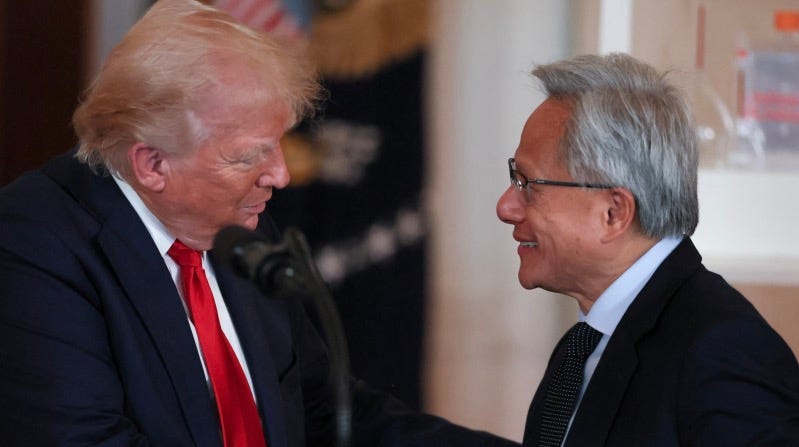
But Trump also said NVIDIA should continue investigating its compliance with U.S. export controls.
So the investigation is important enough to continue, but apparently not important enough to finish before reinstating the person at the center of it?
That, of course, makes zero sense. And perhaps most astonishingly, Trump appears to have strong-armed NVIDIA’s board into this decision. We don’t know what happened behind closed doors, but the appearance of political intervention is impossible to ignore.
In doing so, Trump has potentially turned NVIDIA into a partisan political issue, which is/was totally unnecessary. NVIDIA is already at the center of the AI revolution, the U.S.-China technology rivalry, and some of the most consequential national security questions facing Washington. Now its board has effectively tied the company’s governance and leadership to the political fortunes of Donald Trump.
It appears to me the board has roughly two years to clean this mess up before Democrats win the White House and go absolutely apeshit investigating the entire affair. That process will start when the new congress assembles in January 2027.
What happens when congressional committees start demanding to know…(READ THIS FULL COLUMN 100% FREE HERE).
END
MEGASPEED BLACKLISTED
Megablacklisted: Commerce Just Did The One Thing Bessent Demanded, On The Day Huang Returned
Monday, Nov 23, 2026 – 03:45 PM
The Commerce Department will add Megaspeed, the Singapore-based company at the heart of the Nvidia spy scandal, to its Entity List trade blacklist on Monday, Semafor reported Monday afternoon, citing people familiar with the matter.
Once on said list, no US company can sell semiconductors or certain other technologies to Megaspeed or its foreign affiliates without a license from Washington. According to the report, Commerce Secretary Howard Lutnick had been under pressure from others inside the administration to make the move – tensions that spilled into public view once Jensen Huang’s relationship with Megaspeed executive Alice Huang were leaked to the NY Times.
The blacklisting lands the same day Nvidia’s board reinstated Jensen Huang as CEO after President Trump pushed for it, less than two weeks after Huang resigned amid scrutiny of his extramarital affairs, including the one with Alice Huang, an alleged Chinese spy. Attorney General Todd Blanche has said the Justice Department has not confirmed she was one.
Semafor’s own Rohan Goswami, who reported Trump’s call into the Nvidia board meeting, had a take on the timing:
Commerce and the Justice Department laid out their case file in a joint statement on Nov. 16. Commerce opened an export-control investigation into Megaspeed in 2024 after spotting “suspicious activity,” asked Nvidia for its records of direct and indirect sales to the company in May 2025, and Nvidia put Megaspeed on its “no sell” list the next month. In June 2025, Bureau of Industry and Security agents and Singaporean police ran an on-site end-use check at Megaspeed and interviewed Alice Huang, then its CEO, after which the Justice Department took the lead on a criminal investigation.
Through all of it, Megaspeed stayed off the blacklist. Treasury Secretary Scott Bessent said earlier this month that Treasury, the Pentagon, the State Department and the US Trade Representative had backed listing it “for months,” but that Commerce “has the pen.”
Sen. Pete Ricketts (R-Neb.) has since pushed the MEGA Act, which would put immediate restrictions on Megaspeed, including license requirements with a presumption of denial, and force Commerce to decide on an Entity List designation within 30 days. “Megaspeed’s ties to Communist China demand action. We cannot delay any longer,” Ricketts said.
Sen. Jim Banks (R-Ind.) wanted to know why Megaspeed was “STILL not on this list,” and Senate Commerce Committee ranking member Maria Cantwell (D-Wash.) wrote Lutnick on Nov. 15 that his department “delayed action on repeated national security warnings” to restrict Megaspeed, warnings she said began in fall 2025.
Sen. Tom Cotton (R-Ark.) had flagged the company more than a year earlier, asking Lutnick in October 2025 to investigate Megaspeed, which he called “a spin-off of Chinese government-owned cloud company 7Road” that had “recently received billions of dollars of U.S. chips.”
Sen. Elizabeth Warren (D-Mass.) noted in July that Commerce hadn’t added a single company to the Entity List since Oct. 9, 2025, so Megaspeed would be the list’s first addition in more than a year, if the listing goes ahead.
None of it ends the criminal case: the Justice Department is still investigating whether Megaspeed broke US export controls by shipping Nvidia chips to China, and the two departments said in their statement that they “will bring the full extent of the law against Megaspeed for any criminal conduct that may have occurred.”
END
The Real Reason Trump Wanted Jensen Back?
Monday, Nov 23, 2026 – 12:45 PM
Jensen Huang’s return to Nvidia was a market rescue before it was a national security call, if Fox Business’ Charles Gasparino has it right.
His sources say that after last week’s AI-stock rout, major investors told people close to the White House the probability was “near 100%” that the country was heading for a recession, because the unwinding AI trade would hit spending “across the tech ecosystem.” That warning, Gasparino reports, is “seen as the major reason” Treasury Secretary Scott Bessent “suddenly joined his boss” in calling for Huang’s reinstatement, “because it would at least temporarily pause the market convulsion.”
Eight days ago Bessent told Nvidia’s board to look outside the company for Huang’s successor. By Sunday he was calling the spy angle “kind of a canard.”
Gasparino, who says his sources “have been pretty good on this,” added his own verdict: “There may be a short term gain, but the potential for long term pain is pretty high.” Huang can’t come back to “do biz as usual,” he argued, and the problems are already waiting for him: “How will he sell to China? The investigations from Congress are coming.”
“A Modern-Day Watergate”
Gasparino laid out the playbook the night before. Huang and his supporters, he reported, believed they had “a significant chance” of getting the board to take him back “if they can get the Trump Administration to cast doubt on Alice Huang’s status as a national security risk.”
At 7:23 a.m. ET Monday, about an hour and a half before Nvidia’s directors voted unanimously to bring Huang back, Gasparino wrote that Trump “laying the groundwork that Huang’s affair was a nothing burger from a national security standpoint” had “all the earmarks of a modern-day Watergate for this administration.”
His read on the motive, which he says is “based on knowing the president”: Trump wants Huang back “because he believes it will save the market and his record on the economy because AI is what’s left in its bull run.”
He called it “a ballsy strategy” that “might work given the powerful forces at work,” but warned that “the evidence is PILING up that he’s playing with fire,” pointing to Huang’s management of Nvidia and “what Alice Huang was doing.” Trump, he argued, “isn’t that powerful any longer” after “Tech bros/Wall Street just got a big middle finger during the midterms,” and Democrats are “emboldened to make ‘L’affaire Jensen’ part of their quest to impeach Trump.”
His last point cut against the rescue itself: there is “never one reason why markets correct,” and “Huang cant save it from what is at the very least a normal adjustment to valuations.”
The directors said they took input from senior levels of the US government and are confident Huang’s return poses no national security risk. Trump, who spent the weekend lobbying for exactly this outcome, took the credit:
Too Big To Fail
Nvidia soared as much as 34%, its biggest gain since 2000 according to Bloomberg, adding $1.1 trillion in market cap in a morning. The week before, the S&P lost 8.6%, its worst week since Liberation Day, while the Nasdaq dropped 10% and Nvidia fell 23%.
With US households holding equities worth close to 200% of GDP, as we laid out last week in “The Stock Market Is The Economy Now“, every 10% drop in stocks erases household wealth worth roughly 20% of GDP.
In a Monday note to clients, Nomura’s Charlie McElligott argues that AI and equities are now too big to fail and a matter of outright national security. The left tail the market spent weeks pricing in has just been marked sharply lower, and the options market turns that repricing into forced, mechanical buying: “Hedges DIE, shorts get stopped, Spooz are ripped, Upside is chased.“
Goldman’s Anton Tran put it more gently in his flows email: “Not sure yet whether good or bad that the fate of the market is almost equal to the fate of one person. But hey… We are not picky here.”
The machines only buy once, though. On our napkin math from Nomura’s models, levered ETFs and trend followers add up to somewhere around $60 billion of net forced buying, after vol control sells into the move. Once the S&P clears 7,043, CTAs are merely flat, and they have nothing more to do until 7,625. After that the bid has to come from real money, which is Gasparino’s “short term gain” and “long term pain” in market terms.
Gasparino passed along two theories from the market on Monday: that Trump has gift-wrapped for reporters “the best story since Watergate,” and that the reinstatement “provides exit liquidity for shareholders knowing the AI trade is fucked long term.” His own take: “I say it’s a combo of both.”
“The Next Two Years In DC”
Semafor editor-in-chief Ben Smith agreed with the Washington half of Gasparino’s thesis:
Erick Erickson, replying to Gasparino’s Watergate post, agreed it’s “gonna be a big deal. Particularly if his or Lutnick’s kids have business ties.”
Huang sits for closed-door, transcribed interviews with three House committees on Dec. 1, and Nvidia general counsel Tim Teter follows on Dec. 2. Democrats want every record of Huang’s calls with Trump, and a president who just bragged about talking the board into it has made those calls the story.
Gasparino also asks how Bessent and Secretary of State Marco Rubio, “(much less @howardlutnick),” will “rationalize what we will be discovering about chips going to China?” The administration cleared 879,868 Nvidia and AMD AI chips for China, a third of them for Pentagon-listed military companies.
He also noted what the president left out on Monday:
Pirate Wires editor-in-chief Mike Solana, quoting the White House’s clip of Trump saying “Now with Swalwell, she probably was a spy – but with Jensen, I don’t believe that’s true,” went further:
Nvidia’s own board isn’t treating the matter as closed either. It has set up a national security and export control committee of independent directors, is hiring a chief compliance officer, and says its investigation into the affair will run to its conclusion.
Replies under Gasparino’s posts accused him of being short Nvidia, and one argued, “The spy angle has no evidence. This is the right move.” Market strategist Gary Kaltbaum’s answer to the recession scoop was shorter: “It’s still going to unwind my friend.”
END
(FOR SECURITY PURPOSES)
Zscaler Soars As CrowdStrike Strikes $44 Deal To Build AI Security Giant
Monday, Nov 23, 2026 – 09:45 AM
Zscaler shares soared in premarket trading after CrowdStrike Holdings said it would acquire the cloud security company in an all-stock transaction valued at about $43.9 billion.
Zscaler shareholders will receive 1.135 CrowdStrike shares for each share they own, CrowdStrike said in a press release this morning. The offer implies a value of $260.41 per share, roughly 34% above Zscaler’s closing price on Friday.
“With Zscaler, CrowdStrike will enter network security, cybersecurity’s largest single addressable market segment,” CrowdStrike said, adding details on how the acquisition would position it for the AI era.
Here’s more:
Users, applications, and now AI agents connect directly to the cloud, and that traffic never comes back through the data center. Firewalls and VPNs built to guard the data center can’t see, inspect, or stop that traffic, the threats coming in, or the data going out.
Zscaler’s SSE is purpose-built for the AI era, with the Zscaler Zero Trust Exchange sitting inline between every user, agent, and application to enforce zero trust on every connection. SASE builds on that foundation to bring security and the network together, creating zero trust everywhere.
The transaction adds to a wave of cybersecurity consolidation, including Google’s $32 billion agreement to acquire Wiz and Palo Alto Networks’ roughly $25 billion purchase of CyberArk, completed earlier this year. Gartner expects global information security spending will rise nearly 12% this year to $244 billion.
CrowdStrike CEO George Kurtz provided more context on why Zscaler is critically important to the company:
“Security used to be about keeping the adversary out. Today, safety is required to let AI in. The network used to connect people to places. Now it connects agents to data. With Zscaler, we’re building cybersecurity’s operating system: a single control plane to deploy AI, control AI, and enable any agentic application to run safely. We see a path to become the largest AI safety and security company the world has ever seen.”
CrowdStrike shares fell nearly 8% in premarket trading, while Zscaler shares jumped 19%.
RBC Capital Markets analysts discussed the strategic rationale:
Zscaler brings Zero Trust SASE, security for AI, and data protection to CrowdStrike’s Falcon Platform, with Zscaler’s Zero Trust Exchange spanning 50% of the F500 and operating an in-line security cloud across 200+ locations with 750B+ transactions per day. Upon close, combining network and device telemetry will enable CrowdStrike to train its SafeMind frontier security models on the adversary’s full attack path.
Additionally, Zscaler has nearly ~8K customers that are not yet CrowdStrike customers, enabling cross-sell, especially as Flex customers of both CRWD and ZS will get the other company’s products added to their Flex contract. CrowdStrike believes the addition of Zscaler will expand its TAM by $185B in CY/29.
The deal is expected to close in the second half of CrowdStrike’s fiscal 2028. CrowdStrike expects to generate $500 million in annualized cost savings within 18 to 24 months of completion.
Qatalyst Partners is serving as lead financial adviser to CrowdStrike, with J.P. Morgan Securities and BofA Securities also advising the company.
The marriage of these two cybersecurity giants comes as cyber threats surge and the FBI warned last week that China has built an “AI hacking machine.” As companies hand AI agents greater access to systems, the race is on to safeguard systems and prevent AI swarm attacks.
USA PORTS//HACKERS
Hackers Are Hammering US Ports Thousands Of Times A Day – And They Only Need To Win Once
Sunday, Nov 22, 2026 – 01:10 PM
The port that ships most of America’s crude oil overseas is now fending off “hundreds or even thousands” of attempts to break into its systems every day, Port of Corpus Christi CEO Kent Britton told the Financial Times, as hackers step up a campaign against US ports and the cargo ships that call on them.

The stakes at Corpus Christi are hard to overstate: about 60% of US crude exports, roughly 2.3 million barrels a day, flow out of the Texas port, Britton said in May.
The warning lands at the end of a week in which the list of hacked or mysteriously broken American systems kept growing. The FBI is investigating a suspected breach of its National Crime Information Center, Illinois disclosed an attempted cyberattack on the Algonquin Dam, and the White House’s national cyber director is leaving just days after the administration insisted the run of outages was “not a cyberattack.”

In August, a cyberattack on the North Carolina State Ports Authority forced the Port of Wilmington, the Port of Morehead City and the Charlotte Inland Port onto manual gate processing, with delayed openings while IT teams worked to contain the intrusion, according to WECT. The authority never said who was behind it or which systems were hit.
The Coast Guard and FBI boarded two foreign-flagged tankers in the Gulf of Mexico on Aug. 21 and Aug. 24 after the FBI received “indications that the networks of both vessels were compromised,” Reuters reported. One was the Liberian-flagged VL Prosperity, bound for Galveston from Egypt’s Sidi Kerir terminal. The Coast Guard blamed “foreign cyber actors” without naming them, while Iran’s Mehr news agency claimed, citing an unnamed crew member, that hackers had knocked out the ship’s communications for 30 hours.
On the West Coast, the Port of Los Angeles said it blocked more than 120 million cyberattack attempts in August alone, from intrusion attempts and network exploitation to credential harvesting and malware, TT News reported in September. Executive Director Gene Seroka summed up the defenders’ problem: “All they have to do is to get it right one time.”

In October, an extortion crew calling itself n0n posted 38 maritime organizations on its dark web leak site, including container line Ocean Network Express and Chinese crane giant ZPMC, and set an Oct. 19 deadline for payment in bitcoin, according to The Maritime Executive. Researchers at Cydome said the data may trace back to a single compromised maritime software provider. The same gang last week dumped about 16,000 email addresses tied to JPMorgan’s ultra-wealthy card customers.
Washington’s main answer is a Coast Guard cybersecurity rule that took effect in July 2025 for US-flagged vessels and port facilities. But ports and terminals don’t have to submit their cybersecurity plans for approval until July 16, 2027, about 20 months from now.
“We are expecting these types of attacks to continue,” Dryad Global CEO Corey Ranslem told Reuters after the tanker boardings, adding that they “will expand in the very near future.”
END
KROGER
many head office jobs heading to India
Kroger Told Investors Exactly Where 3,000 US Corporate Jobs Are Going
Monday, Nov 23, 2026 – 12:30 PM
“By moving the work, we get savings…”
Kroger has started telling corporate employees their jobs are being cut, the first wave of a plan to eliminate about 3,000 US office roles over three years, while a new Kroger operation in Bengaluru, India, is hiring for finance, supply chain and real estate jobs.
The Cincinnati-based grocer began sending the notices last week, the Business Courier reported. Kroger spokeswoman Erin Rolfes told the paper the notifications are “part of the corporate headcount reduction the company announced in early October,” and the company would not say how many workers got one, which departments were hit or whether more cuts are coming before the end of the year.
At its Oct. 20 investor day, chief financial officer David Kennerley told Wall Street that Kroger is “opening a new office in Bengaluru, India” that “will house both Kroger and third-party associates, working seamlessly together.” Then he spelled out the appeal: “By moving the work, we get savings from the outset.”
Moments later Kennerley put a number on it, saying Kroger “will need fewer roles over time” and “we expect this model to impact roughly 3,000 associates who perform work above stores today.”
Eight days earlier, CEO Greg Foran had told employees in an Oct. 12 memo that Kroger would cut about 3,000 corporate roles, roughly 37% of its approximately 8,200 corporate staff. The number Kennerley gave investors for the India model is the same 3,000.
In the memo, Foran wrote that the company has “more layers, more handoffs and more overhead than we need,” and that Kroger has to “look closely at where work is best fit to be done.” He also promised staff he would “not ask anyone to wait longer than necessary for clarity about their roles,” Grocery Dive reported.
A recruiting site for the Bengaluru operation lists nearly 30 job titles, the New York Post found, among them senior audit analyst, lead financial analyst, supply chain analyst, senior real estate portfolio specialist and logistics operations specialist. The openings reach well past tech into the administrative and operational work Kroger’s corporate staff does now.
Many of the people doing that work will not be Kroger employees. The center is being set up with ANSR, a firm that builds overseas corporate operations, and according to the recruiting site, workers hired through it are legally employed by ANSR P&V Capability Center Private Limited, not Kroger, the Post reported. Kennerley told investors Kroger had been “partnering with world-class external providers” for several months and had “secured office space with our first India-based employees.”
Kroger has not said how many of the 3,000 roles will move to India. Talk of the center first surfaced in July, when Supermarket News reported an industry consultant’s claim, citing contacts inside Kroger, that more than 5,700 jobs could go, a figure a source close to the situation called “overblown.” Days later, Dallas-based consultant Brittain Ladd told Cincinnati’s WKRC that the India center could save Kroger “hundreds of millions of dollars.”
Kennerley pitched the Capability Center as one of four levers, alongside direct sourcing, smarter buying and cuts to indirect spending, that together should deliver “approximately $4 billion of annualized structural cost savings by 2029.” Kroger says that money will fund “a $5 billion investment in customer value” – lower prices, in other words – “using an entirely self-funded model.”

The layoffs are Kroger’s second big corporate cut in two years: the grocer eliminated nearly 1,000 corporate administrative jobs in 2025 and booked a $47 million charge for severance and related benefits, according to its latest annual report, which also counts 2,697 supermarkets in 35 states and the District of Columbia and $147.6 billion in sales for fiscal 2025.
Foran, who took over as CEO in February, told investors the goal is “building America’s favorite grocer.” A growing share of the office work behind that grocer will be done in Bengaluru.
ALABAMA
Watch: Massive Pipeline Explosion Lights Up Alabama Night Sky For 50 Miles
Sunday, Nov 22, 2026 – 12:20 PM
A natural gas pipeline exploded late Saturday near the tiny community of Ward in southern Sumter County, Alabama, throwing flames more than 100 feet into the air and a glow that people saw as far as 50 to 60 miles away, across west Alabama and into east Mississippi.
The blast went up shortly after 9:30 p.m. local time near County Road 9, between Bellamy and Ward, a few miles east of the Mississippi line. “A little after 9:30 PM, the sky just lit up,” Amy Johnson Dial, who was at a deer camp nearby, told Queen City Newsfeed. “The flames were over 100 feet in the air.”
Kyle Horton, posting from a hunting club in the area, wrote on Facebook that “the explosion almost knocked us to the ground.” The fire was still burning hard at about 1:30 a.m. Sunday, four hours after the blast, and the main line was not shut down until around 2 a.m., after which ash fell over the area “almost like snow.”
Ward Fire Chief Dexter Reeves ordered the community evacuated “until further notice,” as crews poured in from Sumter, Choctaw and Marengo counties, from Fosters and Meridian across the state line in Mississippi, plus forestry crews. The Pleasant Hill Volunteer Fire Department, two counties east in Dallas County, said it was one of eight units sent to a brush fire the explosion set off. By Sunday residents were told they could go home, though County Road 10 stayed closed to through traffic.
Officials in nearby York said in a Sunday public safety update that they had been told the incident involved a gas main, and that the city’s own gas facilities are not believed to be in the immediate danger area. The city was still working out which gas system had been hit.
As of Sunday afternoon, no pipeline company had publicly claimed the ruptured line, and officials had given no cause and no word on whether anyone was hurt. Several interstate lines cross that corner of west Alabama, and the region also sits on the route of the Colonial Pipeline, the largest fuel line in the US, which carries gasoline and other refined products from Houston to New Jersey.
The last time a major line blew up in Alabama, Colonial’s was the one. On Oct. 31, 2016, near Helena, an excavation crew struck Colonial’s 36-inch Line 1, and the gasoline that poured out ignited and burned for several days, killing two workers and injuring four others, according to the NTSB. That shutdown sent New York gasoline prices up the most in almost eight years, as we reported at the time. Saturday’s blast, by York’s account, was gas, not gasoline.
“We understand the concerns of our citizens, especially with the light from the flames being visible from York,” the city said. “While the preliminary information is encouraging, we do not want to make any premature assurances regarding public safety.”
END
USA/HEZBOLLAH
US Sanctions Charity, Gold-And-Cash Smuggling Network Accused Of Funding Hezbollah
The Treasury Department has announced new sanctions targeting charity and smuggling operations allegedly used to finance the terror group Hezbollah, also spelled Hizballah, meaning “Party of Allah” in Arabic.

According to a Nov. 18 announcement, a charity and a gold-and-cash smuggling operation were allegedly using their legitimate covers to help finance the Iran-backed group.
Lebanon-based charity Wa Ta’awanu, which provides emergency relief services for those in the southern part of the Hezbollah-paralyzed nation, is accused of channeling donor funds to Hezbollah’s terrorist activities.
The U.S. State Department has designated Lebanon-based Hezbollah as a foreign terrorist organization since 1997.
The Treasury Department launched Operation Economic Outcast in August to disrupt Iran’s financial support for Hezbollah and Kata’ib Hezbollah (Battalions of the Party of Allah) based out of Baghdad. Both groups are members of the Iranian regime’s so-called Axis of Resistance against Israel and the United States.
“The Iranian regime’s attempts to infringe on Lebanon’s sovereignty through terror proxies like Hizbollah will not be tolerated,” U.S. Treasury Secretary Scott Bessent said on Nov. 18.
“The U.S. government will continue to disrupt Iran’s attempts to exert influence in the region and fund its proxies.”
According to the Treasury Department, the actions taken by Operation Economic Outcast will increase pressure on Hezbollah’s financial networks, as the terrorist group evades pressure to disarm coming from the international community through the United Nations, the Lebanese government, Israel, and the United States.
The gold and cash network was allegedly run by Hezbollah and Iran’s Islamic Revolutionary Guard Corps-Quds Force (IRGC-QF), coordinated with two Lebanese brothers whom the Treasury Department accuses of transferring “significant funds” from the IRGC-QF to Lebanon for Hezbollah.
The brothers, Hassan and Ibrahim Khechen, allegedly transferred money to Hezbollah through Hassan Khechen’s Lebanon-based Gold Global Company, the Treasury Department said. Hassan Khechen’s network also uses couriers to transfer cash across borders.
Ibrahim Khechen has allegedly participated in Hezbollah’s money smuggling network and has ties to a courier who was arrested at Beirut airport early in 2025 carrying $2.5 million in cash.
Another gold company, Turkey-based Sankari Gold, which is controlled by Hassan Khechen, allegedly assisted in the transport of gold and cash from Africa to Lebanon.
Those implicated in the sanctions are founder Afif Abdel Rida Chouman and his charity Wa Ta’awanu Association, the Khechen brothers, and Gold Global Company and Sankari Gold.
With the sanctions, the individuals’ assets under U.S. jurisdiction have been blocked. Companies that are at least 50 percent owned by the sanctioned parties have also been blocked.
Additionally, any foreign financial institution that knowingly does business with the individuals or their businesses in violation of the sanctions could face secondary sanctions.
The United States has been engaged in conflict with the Iranian regime for the better part of the year, and Tehran increased attacks on U.S. allies in the Persian Gulf on the same day as the Treasury Department’s announcement.
According to the Institute for the Study of War and Critical Threats Project, the IRGC targeted U.S. military radar systems in Bahrain on Nov. 13 and 15. The systems are used for early warning to defend U.S. military assets in the region. The United States responded with strikes on an Iranian missile launch site on Qeshm Island in the Strait of Hormuz on Nov. 17. The next day, Kuwait and Bahrain said they intercepted further Iranian strikes targeting U.S. assets in the region.
Abandon All Hope, Ye Who Trade Tech”: JPMorgan Finds Hedge Funds Just Had Their Worst Week Since Liberation Day… And The Real Money Hasn’t Sold Yet
JPMorgan’s Positioning Intelligence team (John Schlegel) opened its latest weekly note with a Dante reference—“Abandon all hope, ye who trade tech”—after a brutal week for tech and risk assets.
zerohedge.com
Key market moves in the week (as of the Nov. 21, 2026 report):
- S&P 500 fell for a seventh straight session and closed below 7,000.
- Nasdaq 100 dropped ~10.4% (worst week since March 2020).
- Philadelphia Semiconductor Index (SOX) fell ~17%.
- Broader risk assets were hit hard too: gold –9.5%, bitcoin –14.2%, copper more than –9%. htx.com
Hedge funds (the “fast money”) took heavy damageJPMorgan estimated hedge funds were down another ~1.5% on Friday alone, more than 3% over five sessions, and roughly 4% since the start of November. That was their worst five-day stretch since the April 2025 “Liberation Day” selloff. Returns over both 5-day and 63-day windows sat more than 3 standard deviations below average. Losses were driven mainly by market beta rather than stock-picking failure (alpha).
htx.com
Goldman Sachs prime-brokerage data told a similar story: fundamental long/short funds fell ~1.2% on Friday, with about three-quarters of them losing money (though alpha was modestly positive at +0.3%). Net leverage for global fundamental long/short strategies dropped to multi-year lows (around 42%, beta-adjusted ~48%, down sharply from recent highs). At the same time total leverage stayed elevated near the 98th percentile, consistent with funds aggressively adding shorts. Hedge funds had sold tech at a record pace over roughly six weeks (more than four standard deviations).
htx.com
But “real money” (long-only institutions and retail) has not sold in size yetBoth banks emphasize that hedge-fund deleveraging alone is not enough to mark a durable bottom.
- JPMorgan’s US TPM (a positioning metric) four-week change was only about –1 standard deviation—short of the –1.5 level often associated with clearing.
- CFTC data showed CTAs near decade-low net shorts in Nasdaq 100 futures, while non-dealer (more real-money) positions remained heavily net long.
- Semiconductor positioning, despite a ~33% drop since early October, had only retreated to roughly the 63rd percentile since 2018—still not washed out.
- Equity fund flows stayed strong (Lipper and EPFR data showed large inflows), and money was rotating into defensives (utilities, staples, etc.) rather than exiting equities broadly. htx.com
In short, the fast-money cohort has been forced to de-risk aggressively amid the tech/momentum unwind, but longer-term holders and retail have not capitulated. Analysts note that this leaves the market vulnerable to further downside until real-money selling intensifies or a clear catalyst appears. Comparisons to late-2018 (a brief rebound followed by a sharper drop) have circulated on the Street; the Fed backdrop and still-elevated positioning are key differences being watched.
htx.com
The original ZeroHedge piece is largely paywalled; the details above are drawn from contemporaneous summaries of the same JPMorgan (and Goldman) notes.
END
NEW YORK CITY
Castro’s Daughter Warns New Yorkers That Mamdani’s Socialism Is Her ‘Worst Déjà Vu Nightmare’

by Tyler Durden
Monday, Nov 23, 2026 – 10:50 AM
Authored by Steve Watson via Modernity,
Fidel Castro’s daughter Alina Fernández has a clear message for New Yorkers: she has heard all this before.
Speaking on Newsmax, Fernández said listening to Mayor Zohran Mamdani and other Democratic Socialists produced “the worst nightmare of déjà vu I ever had.”
She called the language “absolutely the same” scheme her father used. The word that stood out was “nationalization.”
“It’s seizing your assets, seizing your property. The government does it and it is administered by the state and it’s totally inefficient,” she said.
“It takes money from wherever it can until it ends up with everything. Before you know it you’re in line for food. We were in line for food two years after all these ideas of Marxism.”
Fernández described free healthcare and free education promises as “phantom ideas” and noted that socialism, in Lenin’s own framing, is the first step toward communism.
She lived through the outcome in Cuba. New York is now running its own version in real time.
The soft-on-crime side of the program is already underway. As detailed earlier, Mamdani’s plan delays the Rikers Island closure from the legal 2027 deadline to the end of 2032 while targeting a drop in the jail population from roughly 6,600 to about 4,100.
That means thousands fewer people held in custody through diversion, supervised release, and faster processing.
Roughly 65 percent of those at Rikers face violent charges. Conservatives on X have framed the combination as an intentional reduction in both detention capacity and street enforcement.
At the same time the administration is moving to disband the NYPD’s Strategic Response Group – the specialized unit that handled major protests and high-risk incidents, and the same unit that previously arrested Mamdani.
Other results already match the pattern Fernández described. Rent-stabilized buildings in East Harlem have gone to foreclosure auctions with almost no bidders after landlords could not cover rising costs under the regulations.
Of 27 buildings offered, 26 received zero bids. Banks are left holding properties they do not want to operate.
The mayor has also moved to ban horse-drawn carriages, an iconic New York tradition lasting more than 150 years. Drivers say they are being left without livelihoods after investing in horses and equipment.
Meanwhile the administration is advancing taxpayer-funded city-owned grocery stores intended to undercut private prices, a model with a long record of failure elsewhere.
Mamdani has previously said socialism “will absolutely translate on a national level.”
Fernández’s warning is that the translation does not take long. In Cuba the food lines arrived within two years of the same style of rhetoric and nationalization language.
New York already has the delayed jail closure, the planned population cut, the specialized police unit on the chopping block, collapsing rent-stabilized properties, job losses, and the grocery experiment.
The City Council still has to approve the new Rikers timeline. The broader experiment is already in progress. Fernández’s point was simple: the people who lived through the last version of this recognize the script.
KING NEWS
| The King Report November 23, 2026 Issue 7875 | Independent View of the News |
| NYT: U.S. Tracked Alice Huang’s Contacts with China Spy Agency During Nvidia AffairU.S. intelligence is said to show that the woman at the heart of the A.I. chip scandal was in touch with China’s Ministry of State Security during the period when she was in a relationship with Jensen… U.S. intelligence agencies have also gathered evidence that Ms. Huang’s business partner, Kang Wei, who was often introduced as her husband, worked with the same Chinese spy agency… .https://www.nytimes.com/2026/11/22/us/politics/alice-huang-china-spy-agency-nvidia.html?smid=nytcore-ios-share Google AI Overview: According to a November 21, 2026, Financial Times investigation, businesswoman Alice Huang—who had a romantic relationship with former Nvidia CEO Jensen Huang—was tied to a network that moved restricted Nvidia AI chips to China, including an alleged Cambodian criminal enterprise… The Financial Times reported that the network involved an alleged Cambodian criminal enterprise alongside Nvidia cloud partners, gaming entrepreneurs, and hundreds of shell companies, generating billions of dollars from funneling restricted chips into China… WSJ (Sat): The Alice Huang Associate Accused of Funneling Nvidia Chips to ChinaDefendant in case involving chip smuggling worked with Jensen Huang’s romantic partner His name is Li Ming. The 52-year-old Chinese national was a central operator of a web of companies smuggling restricted Nvidia; down pointing triangle artificial-intelligence chips to China, the people said. This web included Megaspeed, the Singapore-based company where Huang’s paramour, Alice Huang, was a managing director. Li was deeply involved in Megaspeed’s activities and took part in major decisions, the people said, as well as playing a role in other companies trading Nvidia chips… https://www.wsj.com/tech/li-ming-megaspeed-nvidia-chips-china-6260d836?mod=e2tw Spying Suspect’s Chip Network Has Ties to Chinese Military Suppliers – NYTCompanies linked to Alice Huang, the woman at the heart of the Nvidia scandal, are part of a network of Chinese tech firms and defense contractors that need advanced computing power… The findings show a web of relationships, most of them indirect, linking Ms. Huang’s family and companies that acquired Nvidia chips to Chinese state-owned defense contractors that supply the People’s Liberation Army…https://www.nytimes.com/2026/11/20/us/politics/nvidia-alice-huang-chips-china.html Commerce approved sales of more than 879,000 AI chips to Chinese companies, Rep. Mast saysSome of those approvals, made by Commerce’s Bureau of Industry and Security, included sales to companies designated by the Department of Defense as “Chinese Military Companies,” according to the documents. From December through May, companies had made 3.4 million requests for sales of U.S. AI chips to China, the committee reported, citing those made by Nvidia and Advanced Micro Devices…https://www.cnbc.com/2026/11/19/nvidia-amd-china-chip-sales-congress.html Google AI Overview: On November 19, 2026, House Foreign Affairs Committee Chairman Brian Mast released export-license records alleging that some of Nvidia’s applications to ship advanced AI chips to China involved suspected smuggling fronts and “fake companies”.https://foreignaffairs.house.gov/news/press-releases/chairman-brian-mast-exercises-legislative-authority-to-publicly-release-ai-chip-license-information-for-china @OutFrontCNN: NYT reporter Paul Mozur on how Nvidia’s AI chips ended up within reach of China’s military, and what researchers are doing with them: “You see these chips going to a lab that’s studying how basically to take Taiwan.” https://x.com/OutFrontCNN/status/2123597539551412473 NYT’s @paulmozur: This does cut to the heart of what we found: Nvidia chips used at a Chinese military-linked lab that works on stuff like simulating how to invade Taiwan, when those chips are made by a company founded by a Taiwanese American, who remains beloved here in Taiwan. Officials approved the sale of 580,000 Nvidia chips to Chinese companies – WaPoDocuments released by Congress show the scale of the company’s potential export market. …Under a Trump administration plan to allow the sales in exchange for a cut of the revenue…https://www.washingtonpost.com/technology/2026/11/20/officials-approved-sale-580000-nvidia-chips-chinese-companies/ @Acyn: (Face the Nation’s) Brennan: So some sales to the Chinese military are okay? Bessent: This isn’t the Chinese military; these are companies that do business with the Chinese military.https://x.com/Acyn/status/2124529976422932856 Note to Bessent: The Midterm Elections show Americans have hit their limit on WH gaslightling! “The capitalists will sell us the rope with which we will hang them.” – attributed to Lenin, Stalin, Marx. Asian stocks got crushed on Friday: Nikkei 225 -5.06% (lowest level since April 9), Taiwan Weighted Index (TAIEX) -6.23%, KOSPI 200 Index -5.53%, KOSPI Composite -5.21%, CSI 300 -1.54%, Shanghai Composite -1.23%, Shenzhen Composite -3.64%, Hang Seng -1.89% @Barchart: Chinese Stock Market has traded for 14 of the last 15 weeks, the weakest period in its history https://x.com/Barchart/status/2123960455487954949 Taiwan stocks had their worst week since 1991: Taiwan Weighted Index -17.5% Please notice that Chinese bourses had moderate declines while Taiwan got annihilated, Japan and South Korea declined sharply. Pundits wonder if Trump cut a deal with Xi that involves Taiwan. STOXX Europe 600 Technology Index -5.34% at 10:47 ET on Friday. WSJ: European Tech Stocks Tumble as AI Selloff IntensifiesA basket of European tech stocks represented by the Stoxx 600 Technology index is 3% lower. Dutch semiconductor stocks are hit hard with ASML dropping 5.1%, while BE semiconductor and ASM International both fall around 4.5%. Paris-listed Soitec is down more than 9%. Chip makers STMicroelectronics and Infineon IFX -7.19%decrease; red down pointing triangle Technologies fall 5.4% and 4.4%, respectively. AI infrastructure plays also slide…https://www.wsj.com/finance/stocks/nikkei-falls-2-9-dragged-by-chip-metals-stocks-0601645eAnthropic declined sharply early on Friday, falling to a low of 85.00 (10:47 ET). This action, plus Asian dynamics created a rotation out of AI stocks and tech trading sardines and into DJIA companies. Plus, there was general defensive asset allocation into bonds, utilities, and stable demand stocks. Substantial finance damage usually leads to economic damage. The AI Bubble has burst globally. The financial ramifications will be significant but will be revealed over time. Radical Democrat control on the US Congress could exacerbate economic problems Trillions of dollars have been lost via equity carnage. The stock market’s ‘wealth effect’ has been a, if not ‘THE,’ major impetus in the US economy for at least one year. At 10:45 ET: S&P 500 -1.22%, DJIA +0.1%, DJTA +0.03%, Nasdaq -2.75%, Nas 100 -2.73%, SOX Index -7.43%, USZs +1 4/32; Dec Gold -$136.60; ANT fell to 85 at 10:47 ET. At 11:09 ET: NVDA -6.14%, MU -10.56%, AMD -9,68%, SPCX -6.44%, AVGO -9.14%, META -3.66%, TSLA -3.28$, TSM -6.69%, MSFT -1.18%, APPL -0.52% The S&P 500 Index opened lower and dropped to 7133.25, -42.58 pts seconds later. Conditioned and dumb money buying appeared; the S&P 500 jumped to a daily high of 7198.67, +22.84 points at 10:00 ET. Alas, determined selling appeared; the S&P 500 sank to 7061.09, -114.74 points at 11:05 ET. The desperate and much-needed manipulation for the 11:30 ET European close, pushed the S&P 500 Index to 7103.64 at 11:14 ET. Alas, too many traders were long and there were too many organic sellers in the market. The S&P 500 Index dropped to a new daily low 7040.00 at 11:43 ET. After a rebound, on buying for a Noon Balloon, to 7057.77 at 11:59 ET, the S&P 500 sank to a new daily low of 7023.95 at 12:05 ET. Anthropic fell to 84.23 at 12:06 ET. The usual suspects at this point on Friday had two main goals: Keep the S&P 500 Index from breaking below 7000; and keep ANT from breaking below the $83 IPO price. The S&P bounced to 7050.79 at 12:11 ET; ANT rebounded to 85.67 at 12:08 ET. Both rolled over and headed south. The S&P 500 dropped to 7005.66 at 12:48 ET. Anthropic dropped to 83.05 at 12:49 ET. ‘They’ then appeared to keep ANT from falling below its $83 IPO price and fomenting panic selling. ANT rallied to 85 at 12:59 ET. The S&P 500 rose to 7027.58 at 12:59 ET. Trump announced: “In four days, I met more than 20 world leaders, secured two new trade deals — and about 10 others coming very soon — attended four major international summits, reaffirmed America’s alliances throughout the region and advanced the cause of peace and security around the world. The United States entered this trip from a position of unmatched economic and diplomatic strength.” The US has aggressively sought trade deals since Japan and Germany eviscerated US manufacturing in the late ‘60s and entire ‘70s. Numerous trade deals occurred. How have they reduced our trade deficit? @BloombergTV: President Donald Trump said Friday that he wants to tax companies that build data centers outside the United States https://bloom.bg/4AF3xbFAmericans are overwhelmingly against data centers; it was a factor in Dem Midterm landslide. Yet Trump is determined to keep pushing them. Trump: I have not lost confidence in Lutnick. He’s a different kind of a guy. He’s not traditional like Scott. Trump touts relationships with Putin and Xi after historic Asia trip“I have a fantastic relationship with Putin. That’s a very good thing. I have a fantastic relationship with President Xi. That’s a good thing. And our country is safe because of that,” Trump said during a Friday news conference… Xi urged bilateral cooperation on issues including artificial intelligence but also warned against the creation of “turbulence” over the issue of Taiwan…https://abcnews.com/Politics/trump-hold-news-conference-friday-asia-trip/story?id=138307456DJT said: “Putin has been landing drones in Poland, and a couple little missiles by mistake” per Fox. Few, if any, Americans care if Trump has ‘fantastic relationships’ with Putin and Xi. But his constant invoking of those ‘great friendships’ unnerves many Americans. Trump also said he’d like Jensen Huang to return to Nvidia. Those chances are slim and none, especially with both Dems and GOPers eager to investigate China and Nvidia’s dealings. After a Trump-abetted afternoon rally that took the S&P 500 to 7054.77 at 13:57 ET and ANT to 87.88 at 13:55 ET, this appeared: Nvidia’s accounting is a focus of US SEC investigation, sources say – ReutersLast year, Nvidia changed how it reports geographic revenue, using customer headquarters rather than billing addresses, which it said would better reflect the geographic profile of its revenue. The change resulted in Singapore being removed from its geographical breakdown… even as Singapore sales soared to almost half its global revenue. That accounting shift has drawn renewed press scrutiny in the wake of the Alice Huang scandal… (Plus the circular financings agreements?)https://www.reuters.com/world/us-secs-nvidia-probe-is-examining-potential-accounting-issues-sources-say-2026-11-20/ Nvidia sank on the Reuters report and closed at 125.53, -14.01%. Most everyone understands what was going on with Nvidia and China. Who and how many get ensnarled in the maelstrom is unknown. The S&P 500 tumbled and breached 7000 at 14:12 ET. After falling to 6914.53 at 15:34 ET, the late manipulation forced the S&P 500 Index to 6955.41 at 15:49 ET. The index then fell to a new daily low of 6882.66 at 15:56 ET. The S&P 500 Index closed at 6910.39, -3.7%. ANT fell to 86.21 at 14:07. It then stabilized and traded sideways and closed at 88.91. @bespokeinvest: S&P 500 down 8.6% this week, its 12th worst week out of 3,888 since 1952. Nasdaq 100 down 10.4% this week, its 11th worst week out of 2,181 since 1985. @bespokeinvest; If the S&P 500 closes down 1%+ again today, it will be just the 6th time since WW2 that the index fell all five days of a five-day trading week with at least four drops of 1%+. Red dots on the chart show prior occurrences: https://x.com/bespokeinvest/status/2123818249829695769 @dailychartbook: It took the S&P 500 just 33 trading days to enter into correction territory (-10%) from its Oct 6 peak, among the fastest corrections on record.https://x.com/dailychartbook/status/2124111129135784337 @neilsethinew: The Philadelphia Semiconductor Index ($SOX) plunged 10.7% Friday and 17.1% for the week, its worst week since September 2001, when markets reopened after the 9/11 attacks, and worse than either April 2025 (-16.0%) or March 2020 (-15.9%), leaving it 42.5% below its June 22 record.https://x.com/neilsethinew/status/2124110586233708962 @SuburbanDrone: Today was the highest Nasdaq down volume in stock market history. Goldman Warns that Momentum Algos Are Not Done Selling: https://bloomberg.com/news/articles/2026-11-20/goldman-says-stock-selloff-has-legs-as-panic-index-nears-maximum“The bank’s models are projecting that CTAs could offload another $65.8 billion in a flat market, $28.6 billion if stocks rise and as much as $80.6 billion if equities continue to decline” We will know Sunday night. https://x.com/SuburbanDrone/status/2123940212585746550 @LanceRoberts: On a weekly basis, the market rarely gets this washed out UNLESS we are in middle of an earnings recession, an economic recession, or a credit-related event.https://x.com/LanceRoberts/status/2124130986107826287 Trump blasts Federal Reserve as ‘political,’ urges it to lower interest rates“Interest rates are too high, because we have a very political Fed,” the president said at a news briefing. “When we have these great numbers that we have, you shouldn’t keep raising rates, you should lower rates … We should have the lowest interest rate anywhere in the world, because we’re the one, we’re the country that makes other countries successful.” …https://justthenews.com/politics-policy/all-things-trump/trump-blasts-federal-reserve-political-urges-it-lower-interest Trump vows to work with Democrats to cap credit card interest rates at 10% (banks are tanking)The median credit card interest rate is roughly 22.2%, according to an August survey by the New York Federal Reserve… https://apnews.com/article/trump-credit-cards-interest-rates-warren-banks-098a69b520e520e535eebe595cd0c64a @OutFrontCNN: Former NSA hacker David Kennedy reveals he’s actively responding to a live breach where an AI “agent swarm” bypassed two-factor authentication, stole data, and encrypted a company’s entire system: “This all took 14 minutes. 14 minutes. Never seen anything that fast before.”https://x.com/OutFrontCNN/status/2123596835768168537 Positive aspects of previous session Bonds rallied sharply on global AI and tech stock carnage, particularly in Asia.USZs + 1 11/32, Consumer Staples 0.68%; Jan Diesel -2.98¢, Negative aspects of previous session Stocks that hit 52-week lows on Friday: NVDA, GOOGL, NFLX, BABA, Baidu, CRWV, AA, BA, CATThe Nasdaq 100 was down over 10% for the week on Friday afternoon.The S&P 500 Index fell for the 7th consecutive session and closed at a 7-month low.Anthropic hit a low of 83.05.S&P 500 -3.7%, DJIA -1.93%; DJTA -2.52%, Nas 100 -5.61%, Nasdaq -5.28%, SOX Index -10.73%SP Info Tech -7.11%, Consumer Discretionary -3.5%, Industrials -3.13%, Comm Services -3.12%, Materials -2.38%, Financials -1.77%, Real Estate -1.1%, Utes -0.76%, Energy -0.36%, Heath -0.18%Jan WTI +$0.97, Jan Brent +$0.59, Jan Gasoline +0.76¢ at 16:33 ET Ambiguous aspects of previous session The markets are trading like trouble is nigh? Is a US recession coming? If so, when?Are stocks sinking on the New Dem Congress and some of their radical proposals? Dec Gold was -$163.10 near the close. First Hour/Last Hour NYSE Action [S&P 500 Index]: 1st Hour: Down; Last Hour: Down Pivot Point for S&P 500 Index [above/below indicates daily trend to day traders]: 6977.24Previous session (S&P 500 Index) High/Low: 7198.67 (10:00 ET); 6882.66 (15:34 ET) @nypost: President Trump said Chinese President Xi Jinping agrees that “superintelligence” is a more accurate term than artificial intelligence… (NOT a parody!) https://x.com/nypost/status/2123909402944278588 Ex-Clinton advisor @Mark_Penn: Iran reckoning It appears the President is now recognizing that the VP negotiated a very bad deal in the Memorandum of Understanding, which was worthless, and that the zigs and the zags that began in April gave up significant strategic advantage and did nothing but reveal that the Iranians could not be trusted and have no interest in becoming a responsible nation; they are on a course to conquer big satan and little satan. They have rearmed to some extent and are threatening even cabinet members. The President understands that there is no going back here — one way or another this regime must be brought down now and we are going to be far more resolute in using all of the tools from blockades to kinetic action. Iran amasses 14 oil tankers at key export hub as Tehran weighs challenge to US blockade: report https://trib.al/72qULyF@FoxNews: President Trump’s National Cyber Director Sean Cairncross is stepping down as a wave of major tech outages disrupts the country. His departure comes following disruptions involving Microsoft Outlook, United Airlines, major banks and the NSA, along with a nationwide FAA ground stop… The FBI was hacked again, this time the breach targeted its crime databasehttps://www.cnn.com/2026/11/20/politics/fbi-hacked-again-target-crime-database Illinois officials investigating an apparent cyberattack targeting the Algonquin Dam on the Fox River in McHenry County. – CBS Chaos strikes California airports (Sunday) as Delta has major outage days before ThanksgivingDelta Air Lines blamed the meltdown on a glitch in the automated system used to calculate departing flight weight and balance… (Same problem that hit UAL last week!) https://trib.al/mCMwODm @FoxNews: President Trump’s National Cyber Director Sean Cairncross is stepping down as a wave of major tech outages disrupts the country. His departure comes following disruptions involving Microsoft Outlook, United Airlines, major banks and the NSA, along with a nationwide FAA ground stop. An official says Cairncross does not want to serve another two years in the role, though his departure date remains unclear. @JGamblin: The first 100,000 CVEs (Common Vulnerabilities & Exposures) took 18 and a half years to publish (Sep 1999 to Apr 2018). 2026 published 100,000 in 322 days.https://x.com/JGamblin/status/2123552262173696071@nicoleperlroth: This is what I mean when I say we’ve been living on borrowed time. AI is uncovering vulnerabilities that have lain dormant for years. That vulnerable code is now embedded in every nook and cranny of our physical world. We’ll have to push updates as quickly as possible, and we may well “self-pwn” (injure) ourselves in the process. But a patch-induced outage is far better than the alternative: leaving the world’s vulnerable code exposed to anyone with a multi-agent attack tool and a basic prompt “find me exposed systems, exploit their weaknesses, extort them for millions” or worse… @Oracle (after Friday’s close): Oracle has secured all the funding we need to fulfill our contract with OpenAI. With our final capital raise earlier this month, we became the first hyperscaler fully funded for this investment cycle. The financing we outlined at Oracle Investor Day, including vendor financing, is in place. Any further private discussions with vendors are just additional options. Our ability to deliver on our OpenAI contract does not depend on those discussions. Any media reports that will come out and say the contrary are incorrect and wrong… We continue to expect positive free cash flow in the second half of FY2028. We are targeting more than $30 billion in free cash flow in FY2029 and expect to self-fund future growth beginning that year.https://x.com/Oracle/status/2123884437045760420 @farrmacro: That ORCL tweet after the market closed was quite strange. 1). Why send it at all if you have the cash and earnings are coming up? 2). Why tell people to ignore all the stories you may hear to the contrary? 3). Nobody cares about FCF 2-3 years from now. 4). Why the long disclaimer thereafter saying “hey, theses are all projections and may change?” Anthropic’s IPO bank closed position meant to stabilize stock, removing source of supportAnthropic’s underwriter, tasked with stabilizing its share price after its market debut, closed a position meant to do that, Anthropic said on Friday. With the AI company’s shares falling 11%, the move means one potential source of buying support is now unavailable. Anthropic named investment bank Morgan Stanley as the initial public offering’s stabilization agent to support the stock after its market debut. In that role, the bank received an option, known as a greenshoe, to buy additional shares — 147 million in Anthropic’s case — directly from the company on behalf of the underwriting syndicate… “It seems like the bookrunners have given up their remaining stabilisation option already after 1 day just as the share price is getting closer to the IPO price.”https://www.reuters.com/markets/us/anthropics-ipo-bank-closed-position-meant-stabilize-stock-removing-source-2026-11-20/ @alifarhat79: Anthropic valuation: $1.5T, Walmart valuation: $940B; Anthropic revenue: $20B Walmart revenue: $725B On Saturday the (Taiwan) Financial Supervisory Commission banned short sales priced below the previous day’s close for every listed share from Monday 23 November, raised the margin on short sales from 130% to 150%, and stopped taking new put-warrant listings. It was the third round of curbs in 15 days, and it sets no end date… https://www.thetechbag.com/blog/taiwan-taiex-17-5-percent-worst-week-in-35-years-short-curbs @FaceTheNation: After President Trump expressed interest in working with Democrats on health care, House Speaker-designate Hakeem Jeffries (D-NY) outlines his own vision for health care reform: “In my view, we should lower the age of Medicare eligibility. We should expand coverage to include vision, hearing, and dental, and we should make sure that we cover the kids so that every single child and young American in this country can afford to go see a doctor when they need one.” “That’s a place where we can explore coming together,” Jeffries adds. Asked how Congress would pay for expanded coverage amid rising federal debt, Jeffries says those are “conversations that we look forward to having” with Republicans and the administration. (A reason for the historic stock carnage!)https://x.com/FaceTheNation/status/2124548567616397781 Remember all those Street ‘experts’ and shills that proclaimed history shows stocks rally robustly after Midterm Elections? This is the problem with pattern trading. When a profound fundamental appears, like Dems taking control of Congress, pattern traders do NOT contemplate or adjust to the event. It is NOT only that Dems will rule Congress; it is that many Dems are now stridently socialist/Marxist. Today – Who is ‘in trouble?’ The carnage globally strongly suggests that some entities are ‘in trouble.’ Trades want to play for the Monday and pre-Thanksgiving Rallies; and stocks are extremely oversold on a short-term basis. However, events and news worsened over the weekend; and there is NO accounting for or predicting ‘forced liquidation’ that occurs when stocks stay oversold on historic bases. Though Asian bourses are down 2%+ on Sunday night, someone is manipulating NQZs & ESZs higher. Does someone know something or is the manipulation to save someone or more? ESZs +150.50; NQZs +734.75, USZs -11/32, Dec WTI -$0.49, Dec Gas -1.26¢, ¥/$ 158.87 at 20:00 ET Expected Econ Data: Nov S&P Global Mfg. PMI 54.5, Services 55.7, Composite 55.6 Treasury Auctions this week: 2-yr $69B today; 5-yr $70B 11/24; 7-yr $44B 11/25; T-Bills $321B Mon/Tue https://www.treasurydirect.gov/auctions/auction-announcements/ S&P 500 50-day MA: 7625; 100-day MA: 7616; 200-day MA: 7347 (Close 6910.39, -3.7%)Nasdaq 100 50-day MA: 29,224; 100-day MA: 29,211; 200-day MA: 28,073 (Close 25,028.98, -5.61%) DJIA 50-day MA: 51,706, 100-day MA: 52,336; 200-day MA: 50,776 (Close 48,147.33, -1.93%) (Green is positive slope; Red is negative slope) Trump defends calling Putin a friend but says he ‘can’t speak’ to whether he’s a friend to the USTrump also insisted during a White House news conference that Putin wants peace with Ukraine, despite Russia’s continued aggression after invading more than four years ago…“He’d love to end the war,” the U.S. president said of his Russian counterpart… U.S. envoy Jared Kushner said on Thursday that he believes Russia is “comfortable” with NATO-like security guarantees for postwar Ukraine… But Russian Deputy Foreign Minister Sergei Ryabkov said Friday that even a “quasi-membership” of NATO for Ukraine would be unacceptable, Russia’s Interfax news agency reported… When a reporter noted Russia’s pushback to Kushner’s statements, Trump brushed it off…“You know, you’re very lucky to have somebody that has a relationship with the heads of the most powerful countries,” he said…https://wtop.com/national/2026/11/trump-defends-calling-putin-a-friend-but-says-he-cant-speak-to-whether-russian-leader-is-a-friend-to-the-us/ Trump posted on Trump Truth Social this pic of him and Putin with the caption: “My Friend.” https://truthsocial.com/@realDonaldTrump/posts/117656427563362319 @DebbieSchlussel: This is absolutely despicable. No surprise Putin is smiling a Cheshire Cat smile. When @realDonaldTrump was asked if Putin is America’s friend, he said, “I can’t speak to America.” Um, you’re the President of the United States and you can’t speak to it?! @townhallcom: CNN says Chuck Schumer is 30 points underwater and Hakeem Jeffries is 17 points underwater, calling the Democratic leaders “a dynamic duo in terms of being unpopular.” “We’re talking about under the Red Sea here.” “He’s even underwater within the Democratic party.”https://x.com/townhallcom/status/2123816215588044889 The negative Democrat polling shows how toxic the GOP and Trump were in the Midterms. But the silver linings for the GOP: Dems won’t have Trump to ‘kick around’ in 2028. If Dems are hugely unpopular now, just think how unpopular they will become if the US economy falls into recession and Dems push for their radical agenda items that are heavily detested by most Americans! Mayor Mamdani was arrested at least twice by elite NYPD unit he’s controversially disbandinghttps://nypost.com/2026/11/20/us-news/mayor-mamdani-was-arrested-at-least-twice-by-elite-nypd-unit-hes-controversially-disbanding/ “A Communist system can be recognized by the fact that it spares the criminals & criminalizes the political opponent.” — Aleksandr Solzhenitsyn “But the curse of every ancient civilization was that its men in the end became unable to fight. Materialism, luxury, safety, even sometimes an almost modern sentimentality, weakened the fiber of each civilized race in turn; each became in the end a nation of pacifists, and then each was trodden under foot by some ruder people that had kept that virile fighting power the lack of which makes all other virtues useless and sometimes even harmful.” –Teddy Roosevelt @DerrickEvans4WV: The NSA can be hacked, the FBI can be hacked, the FAA can be hacked, the major banks can be hacked. But apparently the voting machines cannot be hacked @nypost: Teen killer who held down Tessa Majors while pal plunged knife into her heart freed early – despite violence behind bars – Lewis was freed on conditional release without a parole hearing after serving less than seven years of a nine-years-to-life sentence, a state Department of Corrections and Community Supervision spokesman said. State law allows inmates to be automatically released after serving two-thirds of their minimum sentence. But that option is often withheld from convicts who have been violent behind bars… https://trib.al/yG9CkSu @nypost: Today’s cover: Grinning ex-NYPD cop admits to The Post that he killed NYC jogger — and says ‘Allah told me to’ https://trib.al/Jqv6esC-END- | |
SWAMP STORIES FOR YOU TONIGHT
HOUSTON
“Now We Don’t Have A Chance”: ICE Rips Houston Mayor’s Post-Election Order
Monday, Nov 23, 2026 – 10:25 AM
Houston’s top ICE official says Mayor John Whitmire’s post-election executive order to stop cooperating with the agency means city police who pull over an MS-13 gang member with a homicide conviction and a final deportation order now have to let him go, unless they are arresting him that day for something else.
“It means that if HPD goes and stops somebody on the side of the road who is, let’s say, an MS-13 gang member and has a prior conviction for homicide, who’s in the country illegally, and has a final order of removal, and they’re just stopping them for a traffic offense, they’ve got to let them go,” ICE Houston Field Office Director Brett Bradford told Breitbart Texas during a ride-along with ICE’s Delta Team.
Whitmire signed the order on Friday, Nov. 6, three days after Democrats swept every statewide executive office in Texas and Gov. Greg Abbott lost his bid for a fourth term. It directs the Houston Police Department to stop contacting ICE over nonviolent offenses, which the mayor’s office pitched as a way to reduce fear in immigrant communities.
“I do this to begin a healing process, reduce fear and anxiety across our community,” Whitmire said at the press conference, adding, “I also do this knowing that elections matter.”
In practice, the change turns on what pops up when an officer runs a name through the NCIC, the national crime database. Bradford said an immigration warrant there means the person has “had their due process” and has “a final order of removal from the United States.” Under the new order, he said, “Unless they’re arresting that individual that day for a jailable offense, they are not to contact us in any way.”

Police Chief J. Noe Diaz Jr. put it the same way on the day it was signed: “HPD will no longer contact ICE if they have an administrative warrant and they are not arrested,” he told FOX 26. The Houston Police Officers’ Union said it learned of the order with everyone else. “We were completely blindsided by this,” union president Douglas Griffith said. “Our officers are going to do what they are instructed to do.”
Under the old policy, HPD could hold someone with an ICE warrant for up to 30 minutes so a federal officer could take custody at the roadside. “It’s hard to get across town in 30 minutes. But at least that gave us a chance,” Bradford said. “Now we don’t have a chance.”

During the ride-along, ICE arrested 39-year-old Samuel Jeremias Grande-Caminos, a Salvadoran national ICE describes as a documented member of MS-13, which the US designated a Foreign Terrorist Organization. According to Bradford, Grande-Caminos was convicted of felony illegal re-entry in May 2016, was deported a second time, and came back a third time. Bradford held him up as exactly the kind of criminal alien Whitmire’s order would send back onto Houston’s streets after a traffic stop.
In April, Houston’s City Council voted to stop officers from holding people on administrative immigration warrants, and Abbott answered by threatening more than $110 million in state public safety grants under SB 4, the 2017 state law that bars Texas cities from limiting cooperation with federal immigration authorities. The council rewrote it two weeks later, 13-4, to keep the money. Whitmire said this month he “had to listen” to Abbott then because “our finances were at stake.”
SB 4 is still law, and Abbott is governor until January, but Whitmire said he cleared the order with the Democrats who won the statewide races, telling reporters that “SB4 is not a priority of the new statewide elected officials.” Gov.-elect Gina Hinojosa voted against SB 4 as a state representative and has vowed to stop state and local help for ICE, which puts Texas on course for a war with the Trump administration over the border.
The agency says Houston isn’t alone: “Houston, Austin, and San Antonio have already begun restricting cooperation with ICE,” the agency posted on Nov. 19, warning that Texas “should not follow the path of sanctuary states like New York.”
ICE’s Houston office has run some of the agency’s biggest sweeps in the region, including one that netted 3,600 criminal illegal aliens, 51 of them child predators. The roadside handoff was, in Bradford’s words, “safer for our officers, it’s safer for the community, and it’s safer for the illegal alien.” With HPD barred from even making the call, ICE says its officers will now have to hunt the same offenders down in Houston’s neighborhoods, and the ones they miss stay on the streets.
GREG HUNTER INTERVIEWING ED DOWD..
AI Bust, China, Debt, War & Voter Fraud Mean Chaos – Ed Dowd
By Greg Hunter On November 21, 2026 In Market Analysis, Political Analysis22 Comments
By Greg Hunter’s USAWatchdog.com (Saturday Night Post)
Wall Street money manager and financial analyst Ed Dowd of PhinanceTechnologies.com says there are plenty of factors lining up to cause great “chaos” just about everywhere. Let’s start with artificial intelligence. In August, Dowd predicted the AI bust was a lock. Big investment costs and small returns meant trouble AI tech could not fix. Dowd says, “Every new technology has an infrastructure buildout. . .. Being a student of history, I knew a lot of these buildouts are fueled with debt. Eventually, the infrastructure gets overbuilt. The pricing comes down, the debt gets wiped out and it’s a boom-bust phenomenon. What is left over is the infrastructure . . . but there is always a bust. A few weeks ago, I announced on X that the AI bubble officially burst, and I was using the semiconductor charts to tell me that.” On Friday, the Tech heavy NASDAQ crashed more than 5% in a single day, and there is more pain on the way, according to Dowd.
Everybody thinks China is so strong, but Dowd says, “China is in the process of imploding and entering into their acute phase of their real estate crisis. It’s accelerating to the downside. (Dowd has a freshly updated China report here.) It is looking grim. . .. China is in deep doo-doo.”
Dowd says everywhere you look there is severe financial trouble. China tops the list followed closely by Europe. Dowd says, “When they tell you to prepare, it’s really just that simple. Don’t overthink this. They see rising global conflict. Get ready for it. . ..I am looking for an increase of war, and it’s all demographics and the financial situation of global governments, which include declining demographic populations. This is going to be the most interesting four or five years we have ever seen. . .. When governments get into big trouble, they take their people to war.”
Then there is the “Voter Fraud Blue Wave” that Harvard political science PhD Jerome Corsi calls the “biggest scandal in US history.” Dr. Corsi says they have the proof Democrats cheated in the midterms. Dr. Corsi says Trump is going to act. Ed Dowd is not so sure. Dowd says, “Was there cheating? I am sure there was. . .. The question is going to be: Is Trump going to do anything about it, and can he prove to the American people that it was a national security problem? That’s a hard lift. I am just an odds guy, and I place the odds of Trump doing that at 10% to 15%.”
Renowned Journalist James Howard Kunstler put the odds of Trump acting near 100%. Why? Kunstler says, “You can’t believe for a New York minute that Donald Trump will allow a replay of the persecutions he and many others endured at the hands of Joe Biden, Norm Eisen, Chris Wray, Merrick Garland, Jack Smith, Jamie Raskin, Adam Schiff, Mary McCord, Letitia James, Alvin Bragg, Fani Willis . . .. Ain’t gonna happen.” (Kunstler wrote a detailed analysis called “IF” on Kunstler.com.)
Kunstler also predicts, “At some point this winter, the US will be under a kind of martial law while the President and his Administration sort out the terms for re-running the election and dealing with the crimes that queered it going into Nov.”
In closing, Dowd points out, “If Dr. Jerome Corsi is right and there was massive cheating, and he can prove it and abolish the election results and declare martial law, god forbid, as an analyst, there will be chaos—period.”
There is more in the 39-minute interview.
There is an 8-minute video to explain how easy it is to ride out any terror attack or extreme storm. You can get more information on Sat phones and backup battery power at Sat123.com. You can get all the information on Starlink “Mini” here. You can get all the new Faraday bags and clothing at DarkBags.com. You can also call 855-980-5830 and talk to a real human. Same goes for EscapeZone.com where you can get Faraday bags big and small and the newest Faraday clothing. You can also talk to a real human at EscapeZone.com by calling 702-825-0005.
Join Greg Hunter of USAWatchdog as he goes one-on-one with money manager and investment expert Ed Dowd as he explains why everywhere you look, chaos is destined to happen for 11.21.26.
After the Interview:
To get Dowd’s latest red-hot reporting, go to his new Substack called “Ed Dowd: Beyond the Narrative,” by clicking here.
There is lots of free information on Dowd’s website called PhinanceTechnologies.com. You can also find the freshly updated “China’s Economy” report he mentioned.
Ed Dowd has a website for you to book him for consulting and speaking engagements. It’s called EdDowd.com.


