
Good evening Ladies and Gentlemen:
Here are the following closes for gold and silver today:
Gold: $1210.60 down $8.70 (comex closing time)
Silver: $16.51 down 9 cents (comex closing time)
In the access market 5:15 pm
Gold $1211.50
silver $16.53
The gold comex today had a poor delivery day, registering 6 notices served for 600 oz. Silver comex registered 76 notices for 380,000 oz.
Three months ago the comex had 303 tonnes of total gold. Today the total inventory rests at 247.23 tonnes for a loss of 56 tonnes over that period.
In silver, the open interest rose by 1597 contracts as yesterday’s silver price rose by 42 cents. The total silver OI continues to remains relatively high with today’s reading at 152,879 contracts. However the bankers are loathe to supply much of the non backed silver paper.The January silver OI contract reads 91 contracts, the same as yesterday.
In gold we had a monstrous increase in OI with the rise in price of gold yesterday to the tune of $15.40. The total comex gold OI rests tonight at 394,021 for a gain of 15,536 contracts. The January gold contract reads 133 contracts. The bankers were not afraid to supply the non backed gold comex paper.
TRADING OF GOLD AND SILVER TODAY
you have more important things to read instead of how gold/silver traded today.
Today, we lost 2.99 tonnes of gold/Inventory 704.83 tonnes
In silver,we lost 958,000 oz in silver inventory/
SLV’s inventory rests tonight at 328.457 million oz
.
We have a few important stories to bring to your attention today…
Let’s head immediately to see the major data points for today
.
First: GOFO rates:
All rates moved in the positive direction. Only the one month GOFO rate remains in backwardation.
Sometime in January the LBMA will officially stop providing the GOFO rates.
Jan 7 2015
-.005% +0200% +.035% +.0675 .1525%
Jan 6 2014:
-.05% -.03% -.00 % +.0167% +.145%
end
Let us now head over to the comex and assess trading over there today.
Here are today’s comex results:
The total gold comex open interest rose today by a whopping 15,536 contracts from 378,485 all the way up to 394,021 with gold up by $15.40 yesterday (at the comex close). We are now onto the January contract month. The non active January contract month saw it’s OI fall by 17 contracts down to 133. We had 0 contracts served yesterday. Thus we lost 17 contracts or 1700 oz will not stand. Obviously this was cash settled with a fiat bonus. The next big delivery month is February and here the OI rose by 1477 contracts to 219,873 contracts. The estimated volume today was poor at 63,792. The confirmed volume yesterday was very good at 220,826 contracts, as the high frequency traders gave some help to our gold/silver prices. Today we had 6 notices filed for 600 oz .
And now for the wild silver comex results. Silver OI rose by 1597 contracts from 151,282 up to 152,879 as silver was up by 42 cents yesterday. The front January contract month saw its OI remain constant at 91 contracts and thus down 0. We had 0 notices filed yesterday, so we neither gained nor lost any silver contracts standing for silver in the January contract month. The next big contract month is March and here the OI rose by 642 contracts up to 103,248. The estimated volume today was simply awful at 16,469. The confirmed volume yesterday was excellent at 46,876. We had 76 notices filed for 380,000 oz today.
January initial standings
Jan 7.2015
| Gold |
Ounces |
| Withdrawals from Dealers Inventory in oz | nil oz |
| Withdrawals from Customer Inventory in oz | 2250.500 oz (Scotia) 70 kilobars |
| Deposits to the Dealer Inventory in oz | nil oz |
| Deposits to the Customer Inventory, in oz | 19,290.00 oz (Scotia,JPM) 600 kilobars oz |
| No of oz served (contracts) today | 6 contracts(600 oz) |
| No of oz to be served (notices) | 127 contracts (12,700 oz) |
| Total monthly oz gold served (contracts) so far this month | 8 contracts(800 oz) |
| Total accumulative withdrawals of gold from the Dealers inventory this month | |
|
Total accumulative withdrawal of gold from the Customer inventory this month |
2443.4 oz |
Today, we had 0 dealer transactions
total dealer withdrawal: nil oz
we had 0 dealer deposit:
total dealer deposit: nil oz
we had 1 customer withdrawal (another farce)
i) out of Scotia: 2250.500 oz (70 kilobars)
total customer withdrawal: 2250.500 oz
we had 2 customer deposits: the farce continues
i) Into Scotia; 3,215.000 oz (100 kilobars)
ii) Into JPMorgan: 16,075.000 oz (500 kilobars
total customer deposits; 19,290.00 oz 600 kilobars
We had 0 adjustments
Today, 0 notice was issued from JPMorgan dealer account and 6 notices were issued from their client or customer account. The total of all issuance by all participants equates to 6 contracts of which 0 notices were stopped (received) by JPMorgan dealer and 0 notices were stopped (received) by JPMorgan customer account.
To calculate the total number of gold ounces standing for the December contract month, we take the total number of notices filed for the month (8) x 100 oz or 800 oz to which we add the difference between the January OI (133) minus the number of notices served upon today (6) x 100 oz =13,500 the amount of gold oz standing for the January contract month. (.4199 tonnes of gold)
Thus the initial standings:
8 (notices filed for the month x 100 oz) +OI for January (133) – 6(no. of notices served upon today) =13,500 oz (.4199 tonnes)
we lost 1700 oz to cash settlements.
Total dealer inventory: 770,487.09 oz or 23.96 tonnes
Total gold inventory (dealer and customer) = 7.948 million oz. (247.23) tonnes)
Several weeks ago we had total gold inventory of 303 tonnes, so during this short time period 56 tonnes have been net transferred out. We will be watching this closely!
This initializes the month of January for gold.
end
And now for silver
Jan 7 2015:
January silver: initial standings
| Silver |
Ounces |
| Withdrawals from Dealers Inventory | nil oz |
| Withdrawals from Customer Inventory | 1040.205 (Delaware) oz |
| Deposits to the Dealer Inventory | 321,933.500 oz CNT |
| Deposits to the Customer Inventory | 848,522.300 oz(CNT,Delaware,HSBC) |
| No of oz served (contracts) | 76 contracts (380,000 oz) |
| No of oz to be served (notices) | 91 contracts (455,000 oz) |
| Total monthly oz silver served (contracts) | 104 contracts (520,000 oz) |
| Total accumulative withdrawal of silver from the Dealers inventory this month | |
| Total accumulative withdrawal of silver from the Customer inventory this month | 1,715,445.7 oz |
Today, we had 1 deposits into the dealer account:
i) Into CNT: 321,933.500 oz (one decimal?? and .500 oz???)
total dealer deposit: 321,933.500 oz
we had 0 dealer withdrawal:
total dealer withdrawal: nil oz
We had 3 customer deposits: (one decimal was contagious today)
i) Into CNT: 273,449.800 oz
ii) Into Delaware: 1008.800 oz
iii) 574,071.700 oz
total customer deposit 848,522.300 oz
We had 1 customer withdrawals:
i) Out of Delaware: 1040.205 oz oz
total customer withdrawal: 1040.205 oz
we had 0 adjustments
Total dealer inventory: 65.087 million oz
Total of all silver inventory (dealer and customer) 175.528 million oz.
The total number of notices filed today is represented by 76 contracts for 380,000 oz. To calculate the number of silver ounces that will stand for delivery in December, we take the total number of notices filed for the month (104) x 5,000 oz to which we add the difference between the OI for the front month of January (91) – the Number of notices served upon today (76) x 5,000 oz = 595,000 oz the number of ounces standing so far for the January delivery month.
Initial standings for silver for the January contract month:
104 contracts x 5000 oz= 520,000 oz +OI standing so far in January (91)- no. of notices served upon today(76) x 5,000 oz = 595,000 oz
we neither gained nor lost silver ounces standing for the January contract month.
for those wishing to see the rest of data today see:
http://www.harveyorgan.wordpress.com or http://www.harveyorganblog.com
end
The two ETF’s that I follow are the GLD and SLV. You must be very careful in trading these vehicles as these funds do not have any beneficial gold or silver behind them. They probably have only paper claims and when the dust settles, on a collapse, there will be countless class action lawsuits trying to recover your lost investment.
There is now evidence that the GLD and SLV are paper settling on the comex.
***I do not think that the GLD will head to zero as we still have some GLD shareholders who think that gold is the right vehicle to be in even though they do not understand the difference between paper gold and physical gold. I can visualize demand coming to the buyers side:
i) demand from paper gold shareholders
ii) demand from the bankers who then redeem for gold to send this gold onto China
vs no sellers of GLD paper.
And now the Gold inventory at the GLD:
Jan 7.2015: we lost another exact 2.99 tonnes of gold inventory at the GLD/Inventory at 704.83 tonnes
Jan 6.2014: we lost 2.99 tonnes of gold inventory at the GLD//inventory 707.82 tonnes
Jan 5/2015 we gained 1.49 tonnes of gold inventory into the GLD/Inventory tonight: 710.81 tonnes
Jan 2 2015: inventory remained constant/inventory 709.02 tonnes
Dec 31.2014: we lost another 1.79 tonnes of gold at the GLD today/Inventory 709.02 tonnes
Dec 30.2014/ we lost 1.49 tonnes of gold at the GLD today/inventory 710.81 tonnes
Dec 29.2014 no change in gold inventory at the GLD/inventory 712.30 tonnes
Dec 26.2013/ a small loss of .6 tonnes of gold. Inventory tonight at 712.30 tonnes
Dec 24.2014: wow!! somebody robbed the cookie jar/ we had a huge withdrawal of 11.65 tonnes from the GLD inventory/inventory at 712.90 tonnes. England must be bleeding badly!
Today, Jan 7/2015 / we lost 2.99 tonnes in gold inventory at the GLD /Inventory rests tonight at 704.83 tonnes
inventory: 704.83 tonnes.
The registered vaults at the GLD will eventually become a crime scene as real physical gold departs for eastern shores leaving behind paper obligations to the remaining shareholders. There is no doubt in my mind that GLD has nowhere near the gold that say they have and this will eventually lead to the default at the LBMA and then onto the comex in a heartbeat (same banks).
GLD : 704.83 tonnes.
end
And now for silver (SLV):
Jan 7.2015: we had another loss of 958,000 oz of silver from the SLV/Inventory 328.457 million oz
jAN 6.2015: we had a small loss of 149,000 oz/inventory 329.415 million oz
Jan 5 no change in silver inventory/Inventory at 329.564 million oz
jan 2.2015: no change in silver inventory/ Inventory 329.564 million oz
Dec 31.2014: we had no change in silver inventory at the SLV./Inventory
at 329.564 million oz
Dec 30.2014: we lost another 574,000 oz of silver from the SLV/Inventory at 329.564 million oz/
Dec 29.2014 we had a small loss of 431,000 oz at the SLV to probably pay for fees/inventory 330.138 million oz.
Dec 26/ no change in silver inventory at the SLV/inventory 330.569
million oz.
Dec 24.2014: we had a huge loss of 7.566 million oz/inventory 330.569 million oz
Dec 23.2014: no change in silver inventory/338.135 million oz
Jan 7/2015 /we had a loss of 958,000 oz of silver inventory at the SLV to
registers: 328.457 million oz
end
And now for our premiums to NAV for the funds I follow:
Note: Sprott silver fund now for the first time into the negative to NAV
Sprott and Central Fund of Canada.
(both of these funds have 100% physical metal behind them and unencumbered and I can vouch for that)
1. Central Fund of Canada: traded at Negative 7.5% percent to NAV in usa funds and Negative 7.8 % to NAV for Cdn funds!!!!!!!
Percentage of fund in gold 61.7%
Percentage of fund in silver:37.8.%
cash .5%
( Jan 7/2015)
2. Sprott silver fund (PSLV): Premium to NAV falls to + 1.05%!!!!! NAV (Jan 7/2015)
3. Sprott gold fund (PHYS): premium to NAV rises to negative -0.35% to NAV(Jan 7/2015)
Note: Sprott silver trust back into positive territory at +1.05%.
Sprott physical gold trust is back in negative territory at -0.35%
Central fund of Canada’s is still in jail.
end
And now for your most important physical stories on gold and silver today:
Early gold trading from Europe early Wednesday morning:
(courtesy Mark O’Byrne)
Bitcoin Down 12 Percent this Year -Hackers Show Online Risk
2015 has not started well for bitcoin with prices having fallen 12%, from $320 to $288. The cyber attack on a leading bitcoin exchange is the latest challenge for the fledgling digital currency.

Bitstamp, Europe’s leading bitcoin exchange – and third largest globally – has been off-line following a breach in their system by hackers on Sunday night. The UK based company has suspended lodgements and withdrawals and reported that roughly $5.1 million, around 19,000 BTC, had been ‘lost.’ The revelation follows the disclosure that Bitstamp’s wallet system has been compromised, prompting it to halt deposits and later shut down its platform entirely according to Coin Desk.
Today, Bitstamp said it expected to resume trading within 24 hours after suspending operations because of the ‘security breach.’
The bulk of the digital currency units are in cold storage – on computers not connected to the internet – and are therefore safe from further predations, the company has said. “Bitcoin customers can rest assured that their bitcoins held with us before temporary suspension of services . . . are completely safe and will be honoured in full,” Bitstamp said.
2014 was a tough year for bitcoin with prices falling from over $800 to just over $300. At its height, Bitcoin was trading at $1240. But in the run-up to and following the bankruptcy of the leading Mt Gox exchange, it has declined in value to around $285.
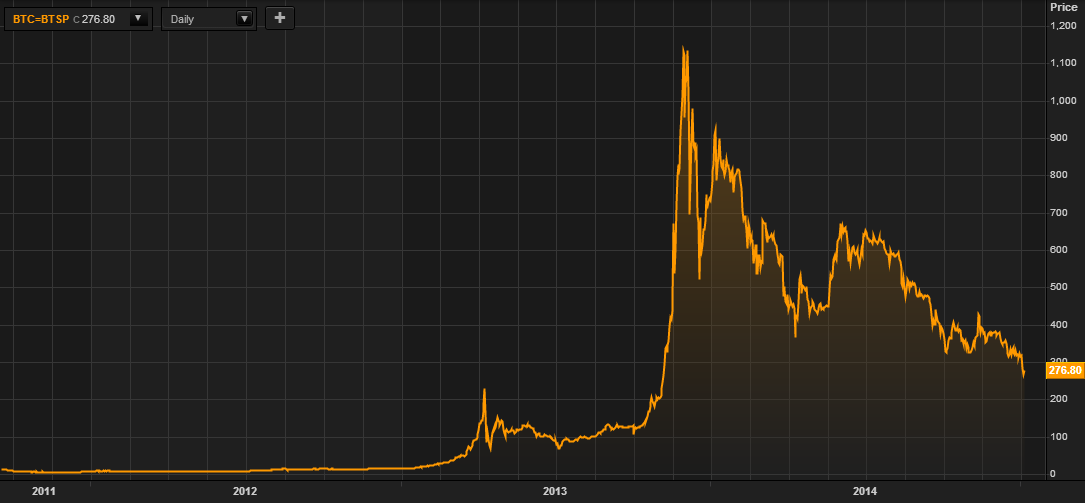
Bitcoin or BTC in U.S. Dollars – 5 Years (Thomson Reuters)
Some say this reflects a steady loss of faith of it’s users in their ability to trade the currency safely due to exchange and technology risk. Others say it was a speculative bubble and was destined to burst and it is healthy it did.
We see the value in owning bitcoins as a form of cash diversification and see merits in owning and having a very small allocation to bitcoin. It is slowly proving itself as a means of exchange. However, whether it will become a store of value is another matter.
Given the fact that we live in an era of currency wars and bail-ins– having a small allocation to such a liquid and fairly easily traded currency that is independent of debasing fiat currencies is not a bad idea.
When the chickens of government and central bank profligacy finally come home to roost, as they always do, alternative digital currencies may serve as an accepted medium of exchange.
But today’s news highlights the vulnerability of any form of “virtual wealth.”
By virtual wealth, we mean many of our investments and savings today which are either in digital form – deposits – or intermediated by digital platforms – most investments including gold ETFs and digital gold trading platforms.
It is imprudent to rely on any asset which derives its value from or can only be accessed through the internet and certain online platforms and websites.

This includes bank deposits in our modern digital banking system. In the event of a systemic crisis involving issues with ATMs, online bank accounts, capital controls and bail-ins – it will be prudent to own some assets that are outside of the financial system and indeed outside of the technological grid.
As tensions mount geopolitically – thankfully the consequences of military confrontation between nuclear-armed superpowers makes war a last resort – the Western bloc, Russia and China have all been experimenting with non-conventional warfare which include disabling the internet in target countries to collapse the economy.
If the internet and the financial system was brought down through unconventional warfare, criminal cyber attacks or simply a major glitch in the system – which has grown so complex that it is incomprehensible even to specialists – the assets of many people would be ‘erased’ and inaccessible.
Technology is a great enabler. But it can also be a great disabler. It is important to be aware of this.
Cyber and technology risk in the modern era is another reason to own physical coins and bars in an allocated and segregated manner, in the safest vaults, in the safest jurisdictions in the world.
Review of 2014 – Gold Second Best Currency, +13% in EUR, +6% GBP
MARKET UPDATE
Today’s AM fix was USD 1,213.75 , EUR 1,023.83 and GBP 802.37 per ounce.
Yesterday’s AM fix was USD 1,211.00, EUR 1,017.31 and GBP 797.08 per ounce.
Spot gold climbed rose $13.40 or 1.11% to $1,218.90 per ounce yesterday and silver soared $0.33 or 2.04% to $16.53 per ounce.

Gold in Euros – 5 Days (Thomson Reuters)
Gold in euros continues to eke out gains and briefly touched EUR 1,028 per ounce today as Eurozone inflation dropped below zero for the first time in five years. This increases the odds of more extensive ECB money printing. Draghi’s QE bazooka may be unleashed in the form of government bond purchases aiming to prevent interest rates rising and a deflationary spiral.
The titanic battle between Goldman’s Draghi and the Bundesbank continues. There is a disagreement and two theories of analysis on the effect of the plummeting oil prices. Draghi has warned of a dis-anchoring of inflation expectations and signaled support for QE but Bundesbank President Jens Weidmann favors not acting at this time, arguing that the drop could be a “mini-stimulus package” noted Bloomberg.
The Dutch newspaper Het Financieele Dagblad reported yesterday that ECB staff have worked on QE proposals in the past two months and ECB governors may be offered three different options to choose from at their January 22 policy meeting.
Some investors are looking for guidance from the release of the U.S. Federal Reserve’s minutes from their December 16-17 meeting. In it, they stated they would be “patient” in considering the timing of the first interest rate increase since 2006. This signals a possible further delay in rising interest rates which is gold bullish.
Bullion for immediate delivery fell 0.3 percent to $1,214.45 an ounce soon after midday in London. Silver for immediate delivery dropped 0.6 percent to $16.44 an ounce. Platinum was nearly unchanged at $1,221 an ounce and palladium slipped 0.2 percent to $802 an ounce.
Get Breaking Gold News and Updates Here
end
Turd Ferguson goes through the gold drain from the GLD
(courtesy Turd Ferguson/GATA)
TF Metals Report: GLD drain throughout 2014
1:10p ET Tuesday, January 6, 2015
Dear Friend of GATA and Gold:
The exchange-traded gold fund GLD continued to lose metal in 2014, the TF Metals Report’s Turd Ferguson writes today — nearly 11 percent of its inventory, though far less than the 41 percent decline in 2013. Most of the metal seems to have been sent to China. Ferguson’s commentary is headlined “GLD Drain Continues in 2014” and it’s posted at the TF Metals Report here:
http://www.tfmetalsreport.com/blog/6508/gld-drain-continues-2014
CHRIS POWELL, Secretary/Treasurer
Gold Anti-Trust Action Committee Inc.
end
John Embry discusses why mining companies will do great with oil collapsing:
(courtesy John Embry/Kingworldnews)
Currency destruction and oil price collapse are perfect for gold miners, Embry says
1:18p ET Tuesday, January 6, 2015
Dear Friend of GATA and Gold:
Currency destruction and oil’s price collapse make a perfect combination for gold-producing companies, as the value of their product increases and the cost of producing it falls, Sprott Asset Management’s John Embry tells King World News today. An excerpt from Embry’s interview is posted at the KWN blog here:
http://kingworldnews.com/gold-silver-soaring-global-stock-markets-plunge…
CHRIS POWELL, Secretary/Treasurer
Gold Anti-Trust Action Committee Inc.
end
Lawrence Williams talks about silver and asks whether investors should take a gamble on it?
(courtesy Lawrence Williams/Mineweb)
Should investors take the silver gamble?
Silver has underperformed the other generally considered precious metals over the past year. Is it due for a comeback?

Last year silver hugely underperformed gold. While the yellow metal ended the year at approximately the same level as it had ended 2013, silver plunged 18% from $19.50 to $15.97 over the period.
See: Gold great value protector in 2014 – silver not
Not for nothing is silver referred to as the ‘Devil’s metal’ or ‘gold on steroids’. It is hugely more volatile than its sibling – however, last year’s underperformance was remarkable even so. Indeed during the year silver reached over $21 in July but the metal’s performance down to the year end was, to say the least, dismal – falling as low as $15.28 in early November. Silver is always reckoned to underperform gold in a downturn, but given gold was pretty well flat over the full year the drop in silver was far greater than investors might have expected. (Prices are London silver prices as recorded by the London Bullion Market Association).
While silver tends to underperform gold on the downside, it conversely tends also to outperform gold on the upside and gold’s start to the year will have been giving silver bulls a little hope. But the almost unanimous thumbs downs for the year for silver from mainstream precious metals analysts may be putting something of a damper on such hopes.
There were, however, a major anomaly in silver’s poor price performance over the year in that sales of American Eagle silver coins hit a new record in 2014 at around 44 million, eclipsing the previous record of 42.7 million in 2013, while reports of Chinese and Indian consumption have suggested that investment and industrial demand is at very high levels in both the East and the West which flies in the face of the price performance. There is also the suggestion that silver supply will be in a fairly substantial deficit in 2015 (assuming the largely unpredictable investment offtake remains strong). Silver’s fundamentals thus look to be good BUT in today’s precious metals markets real fundamentals seem to have little impact on prices which appear to be increasingly being driven by speculative trading on the futures markets.
On this latter point, there is certainly the possibility that some banks and financial institutions have been buying physical metal against the day that futures and physical markets turn strongly positive. The potential profits could be enormous if there is a strong market turnaround, which many feel is a probability, in the medium to long term.
On the other hand the strength in the general stock market, up until the last couple of days has made precious metals investment look a poor choice in comparison. Markets have been boosted by the unprecedented amount of liquidity being pumped in to try and ward off recession through ‘Quantitative Easing’ type programmes. While the U.S. Fed has effectively ended its most recent easing programme it is still obviously nervous that the markets will stutter and dive once the full effects of ending the easing programme begin to impact and consequently is not yet prepared to allow interest rates from their exceedingly low levels in case rate rises coupled with the end to monetary stimulation really spook the markets.
The Fed is also aware that the stock market is precarious and may have risen too far too fast (i.e. in a potential bubble situation) and is playing an exceedingly cautious game so as not to rock the boat. If markets do start to fall they could drop dramatically – the current six-year bull market may well have run its course and bull markets usually end with some very sharp falls indeed.
An end to any bull market is, of course, inevitable at some time and if a feeling becomes apparent that the bull market is indeed at or close to its top this could precipitate a move into precious metals as an asset class providing some investment insurance. And a move into gold, and a consequent rise in the gold price, could be all that silver needs to take off. If this should happen we could see some very sharp gains indeed. Even a rise back to $20 would be a 20% plus increase from current levels. Some may well see that as a gamble worth taking.
Silver bulls, of course, are still looking for a return to its 2011 high of close to $50, and perhaps more. Some talk of a return to what they see as the historic gold:silver ratio (GSR) of 16:1 but, despite all the arguments to the contrary, ever since silver largely lost its monetary role a return to this level seems unlikely. There have only been two occasions in almost the past 100 years when silver did indeed return to this kind of level – in 1968 and 1980, and in both cases it was very short-lived. Otherwise the GSR has fluctuated between a little over 30 and 100, averaging around 50 plus and is currently near 74 – a high level which many feel suggests that silver is indeed due for a sharp price boost and bring the ratio down. Should the gold price make a sharp recovery, a return to a GSR of 50 or a little lower could be on the cards as the more volatile silver price gains traction.
So what are the prospects for this kind of upwards performance in 2015? Downside in the gold price over the year is generally seen as somewhat limited, although a further fall before a major recovery cannot be ruled out. This suggests that silver may well provide an interesting gamble (and a gamble it would be) on a gold price rise during 2015. The downside in silver is fairly limited, although some observers still see a drop to around $13 if gold doesn’t pick up, but the upside potential if gold does improve in price looks as though it could be very positive. But be warned, silver has burnt many investment fingers in the past and no doubt will again in the future.
end
Now we have Bill Holter believing that derivatives have already blown up. Bill analyzes the data and comes to the conclusion that the big underwriting banks has witnessed major derivative busts. Here is why>>>>
a must read….
Derivatives have already blown up!
Welfare states can only default or devalue, Turk tells KWN
6:56p ET Tuesday, January 6, 2014
Dear Friend of GATA and Gold:
Even with their “financial repression,” welfare states have only two options, GoldMoney founder and GATA consultant James Turk tells King World News tonight: default on their unpayable debt and other financial promises or devalue their currencies. Turk’s interview is excerpted at the KWN blog here:
http://kingworldnews.com/central-planners-finally-losing-control-gold-si…
CHRIS POWELL, Secretary/Treasurer
Gold Anti-Trust Action Committee Inc.
end
And now for the important paper stories for today:
Early Wednesday morning trading from Europe/Asia
1. Stocks mixed on major Asian bourses / the yen a fall to 119.03
1b Chinese yuan vs USA dollar/ yuan strengthens to 6.2130
2 Nikkei up 2 points or 0.01%
3. Europe stocks in the green /Euro crashes/ USA dollar index up to 91.99/
3b WOW!!! Japan 10 year yield at .30% !!!!(Japan buying 100% of bond issuance)/Japanese yen vs usa cross now at 119.03/
3c Nikkei now below 17,000
3e The USA/Yen rate well below the 120 barrier this morning/
3fOil: WTI 47.89 Brent: 50.77 /all eyes are focusing on oil prices. This should cause major defaults.
3g/ Gold down/yen down;
3h/ Japan is to buy the equivalent of 108 billion usa dollars worth of bonds per MONTH or $1.3 trillion
Japan’s GDP equals 5 trillion usa/thus bond purchases of 26% of GDP
3i Japan to buy 100% of all new Japanese debt and by 2018 they will have 25% of all Japanese debt. Fifty percent of Japanese budget financed with debt (see Von Greyerz)
3j Oil falls this morning for both WTI and Brent
3k China to stimulate its economy by 1 trillion dollars worth of infrastructure
3l Germany’s Merkel states that she is OK with a GREXIT/immediately the euro crashes./Disappointing European PMI numbers/Greek 3 yr bond yield over 13.5%
3m Gold at $1213. dollars/ Silver: $16.31
3n USA vs Russian rouble: ( Russian rouble down 1 1/2 roubles per dollar in value) 63.75!!!!!!
3 0 oil crashes into the 47 dollar handle for WTI and 50 handle for Brent
3p volatility high/commodity de-risking!/Europe heading into outright deflation including Germany/Germany has low unemployment/Italy very high unemployment (high jobless rate)
4. USA 10 yr treasury bond at 1.98% early this morning. Thirty year rate well below 3% (2.55%!!!!)/yield curve flattens/foreshadowing recession
5. Details: Ransquawk, Bloomberg/Deutsche bank Jim Reid
(courtesy zero hedge)/your early morning trading from Asia and Europe)
First Euroarea Deflation Since Lehman Sends Futures Higher; Brent Tumbles Below $50 Then Rebounds
Things in risk land started off badly this morning, with the worst start to a year ever was set to worsen when European equities came under early selling pressure following news of German unemployment falling to record low, offset by a record high Italian jobless rate, with declining oil prices still the predominant theme as Brent crude briefly touched its lowest level since May 2009, this consequently saw the German 10yr yield print a fresh record low in a continuation of the move seen yesterday. However, after breaking USD 50.00 Brent prices have seen an aggressive bounce which has seen European equities move into positive territory with the energy names helping lift the sector which is now outperforming its peers. As a result fixed income futures have pared a large majority of the move higher at the EU open. But the punchline came several hours ago courtesy of Eurostat, when it was revealed that December was the first deflationary month for the Eurozone since the depths of the financial crisis more than five years ago, when prices dropped by -0.2% below the -0.1% expectation, and sharply lower than the 0.3% increase in November, driven by a collapse in Energy prices.


And to think it was just October when this exchange with an ECB member took place, as part of the Eurozone’s annual stress test farce:
My question would be on how credible these tests are. Looking at the adverse scenario, you haven’t even included deflation. You have not included an interruption in gas imports to Europe. You have not included full-on sanctions on Russia. So please elaborate and convince us.
Constâncio: The scenario for the stress test was published earlier in the year, so some of the things you mentioned would not have been considered. But indeed, what was considered is a severe shock being the growth of other countries. If you look to the scenario, you see that for the US, there is also a big deceleration of growth which is part of the scenario and also for other countries that are the markets of the euro area. So that is embedded in those assumptions of indeed a big drop in external demand directed to the euro area. That’s the first point.
The scenario of deflation is not there because indeed we don’t consider that deflation is going to happen.
Two months later, it happened!!!!
And while its happening once again crushed the ECB’s credibility, the “good news”, and the reason stocks took off the moment deflation hit, is that algos are desperately hoping this finally unleashes Eurozone QE, perhaps as soon as three weeks from now when the ECB is said to be discussing three different options. This is taking place despite not only Merkel advisor Lars Feld warning ECB will “damage its reputation” if it announces QE plans before the Greek election but Merkel ally Michael Fuchs repeating that Grexit is no longer a systemic threat, and warning that launching QE now would crush any impetus for further reforms. He is right, but algos don’t care. At least not for now, and as a result futures are sharply higher on both sides of the Atlantic.
FX
The USD-index (+0.17%) is marginally stronger ahead of today’s FOMC minutes with market participants expecting the Fed to clarify their ‘patient’ rhetoric from December’s FOMC rate decision. This helped USD/JPY stage a minor recovery overnight, with the pair breaking above the 119.00 handle however trade has been range-bound since the European open. With the resurgence in energy prices, commodity currencies including the NOK, RUB and CAD have strengthened slightly against the USD granting the currencies some reprieve after the selloff yesterday.
Commodities
Oil initially continued its downward trend as Brent crude briefly broke below USD 50.00 for the first time since May 2009 and WTI crude broke below USD 47.00 with the downside attributed to the overnight comments from UAE Oil Minister asserting that market oversupply may last months or years and depends on non-OPEC output growth. However, this move has retraced with the Brent and WTI crude currently trading in positive territory. The precious metal markets, Gold has pulled off yesterday’s 3 week highs where the safe-haven bid was lifted amid weakness in global equity markets after a continued slump in crude and disappointing data from EU and US. Looking ahead, todays DoE Crude Inventories could provide some downside for oil prices as analyst expectations show a build of 700K.
Market Summary: European shares rise with the travel & leisure and telco sectors outperforming and oil & gas, basic resources underperforming. Brent crude falls below $50 a barrel then rebounds. German unemployment falls to record low, Italian rises to record high. The U.K. and German markets are the best-performing larger bourses, Sweden’s is the worst after being closed yesterday. The euro is weaker against the dollar. Japanese 10yr bond yields rise; Irish yields decline. Commodities decline, with Brent crude, zinc underperforming and nickel outperforming. U.S. trade balance, mortgage applications, ADP employment change due later.
Bulletin Headline Summary from RanSquawk and Bloomberg
- European Equities now reside in positive territory after a bounce back in Energy prices despite Brent breaking below USD 50.00 in early European trade
- The USD-index remains firmer ahead of today FOMC Minutes where market participants expect the Fed to clarify the ‘patient’ rhetoric following December’s Rate decision.
- Treasuries decline for first time this year as European stocks rise and Brent crude gains after earlier dropping below $50/bbl for first time since May 2009.
- 30Y yield yesterday declined as much as 12.9bps to 2.470%, within 3bps of its July 2012 record low; it is lower by 22bps over past 3 days; 10Y yield fell as much as 14.7bps to 1.885%, within 3bps of its low during Oct. 15 market cataclysm
- Euro area consumer prices fell 0.2% in December, dropping below zero for the first time in more than two years and bolstering the case for more ECB stimulus
- German government preparing for a possible exit of Greece from the euro, sees risk of bank collapse in event of possible election of left-wing Syriza, Bild reports, citing unidentified government officials
- Any political turmoil in Greece following this month’s election is no longer a threat to the wider stability of the euro area, said Michael Fuchs, a senior lawmaker from Merkel’s party
- ECB to damage reputation if it announces plan to buy sovereign bonds which includes Greek debt before elections in that country this month, Frankfurter Allgemeine Zeitung cites Lars Feld, economic adviser to German Chancellor Angela Merkel, as saying in interview
- Greek 10Y bond yields rose above 10% for the first time in 15 months
- Italy’s jobless rate increased to 13.4% in Nov. from a revised 13.3% the previous month, while separate data showed the euro-region rate at 11.5%
- Reports contrast with data from Germany showing unemployment fell to a record low in Dec.
- Germany’s Merkel will offer U.K. PM Cameron a compromise on immigration, pledging support for welfare curbs so long as Europe’s freedom-of-movement rights are not called into question
- Sovereign yields mixed. Asian stocks mixed, with Nikkei little changed, Shanghai +0.7%. European stocks and U.S. equity-index futures gain. Brent crude, WTI higher; gold and copper lower
DB’s Jim Reid concludes the overnight recap
Markets have started 2015 nearly as chaotically as my skiing. Most major equity markets are down 2-5%, Crossover is 22bp wider, WTI has traded below $50 for the first time since April 2009, the US Energy HY sector is 44bps wider, 5yr Bund yields have gone sub-zero for the first time in history, 10yr US yields have rallied 23bps (now 1.94%) and 30 year USTs are at 2.50% – 6bps off their all time lows. Given this is my first day back in 2015 it’s a good point to remind readers of the views in our outlook entitled “Plate Spinning”. For European credit we’re resting a lot of our hopes on what we expect to be fairly aggressive broad based asset purchases from the ECB. However we don’t think this occurs until March and we still think Q1 will be problematic for markets due to uncertainty over the timing and scale of the above, the Greece election, periodic fears over imminent Fed hikes, and due to the overhang in US credit due to the energy sector stresses. If central banks didn’t exist we would be very bearish as we still think we’re a long way off repairing the global financial system. However they do exist and 2015 will likely see the highest global QE since 2011. So a lot rests on the ECB acting as we think they will but the BoJ will also help. Elsewhere China will likely keep policy loose and we can’t help think that the Fed will struggle to raise rates in 2015. So central banks will continue to keep spinning plates until either a policy error occurs or until politics prevents them. 2015 may see some near misses on this front but ultimately central banks will likely win out in a volatile year, especially in the first few months.
Although markets recovered some of the earlier intraday losses, the S&P 500 (-0.89%) fell for the 5th day in a row and the worst 3-day start to a year since 2008. Once again oil markets are dominating headlines with further tumbles in WTI (-4.22%) and Brent (-3.78%) to $47.93/bbl and $51.10/bbl respectively. Having tested the $50 level on Monday, WTI crashed through $50 and closed below $48 for the first time since 2009. Energy stocks extended declines with the component closing 1.31% lower, although financials were the notable underperformer with the sector -1.53% at the close.
The broadly risk-off tone continued to support a strong bid for Treasuries. Indeed, having traded as low as 1.885% intraday, yields on the 10y benchmark closed 9bps lower at 1.94% and below 2% for the first time since May 2013. As mentioned, 30y yields continue to fall (-9.6bps) leading to a further compression in the 2y30y spread (187bps). The rally in fixed income was supported by softer data out yesterday. In terms of the prints, the December non-manufacturing ISM (56.2 vs. 58.0 expected) was perhaps the most disappointing with the figure the lowest since June although it’s worth highlighting that the 57.4 average for Q4 was the highest on record. Elsewhere the final print of the services PMI for December came in a tad under consensus (53.3 vs. 53.7) whilst November factory orders remained weak (-0.7% vs. -0.5% expected). Elsewhere, news-flow was relatively limited. A report in the Nikkei Asian Review was perhaps of most interest with the article quoting ex-Fed Vice-Chairman Donald Kohn stating that a June rate rise seems most likely. US Dollar strength continues with the DXY finishing +0.13% and now 1.4% up in 2015.
Recapping the price action in Europe yesterday, the Stoxx 600 closed 0.71% lower at the close of play – not helped by a 1.3% decline in the last hour of trading as the aforementioned oil market decline dragged equity indices with it. Credit fared little better with Crossover finishing 8.5bps wider. In reality it was a fairly volatile day with European equities largely trading with little obvious direction. This was perhaps a result of what were generally mixed PMI prints for the region. Just recapping, the final December services PMI reading for the Euro-area printed modestly softer than expectations (51.4 vs. 51.7 expected), although regionally both Germany (52.1 vs. 51.4 expected) and France (50.6 vs. 49.8 expected) surprised to the upside. Elsewhere, preliminary services PMI readings for the UK (55.8 vs. 58.5 expected) and Italy (49.4 vs. 51.7) disappointed, however data for Spain (54.3 vs. 53.4 expected) offset this somewhat. The combination of weak data and prospects of the impending ECB QE drove core European bond yields lower across the board. 10y Bunds in particular extending their record lows to close 7.1bps tighter at 0.446%. Bunds are now around 150bp tighter than Treasuries and the spread differential has not been this wide since 1989. Interestingly DB’s George Saravelos pointed out that the power of ECB QE is also influenced by the total amount of risk-free securities which a central bank removes from the market. Compared to all other QE programs, the demand-supply dynamics of Europe’s risk-free bond market are incredibly tight. From a flow perspective Germany will have close to flat net issuance in 2015 compared to more than $1.5trio UST issuance during Fed QE1 and around 400bn USD of JGB issuance during BoJ QQE1.
Elsewhere, Inflation expectations as measured by the EUR 5y5y swap continue to drop, with the index falling 6.25bps to 1.5675% – extending the lows. The Euro weakened, dropping 0.36% versus the Dollar to $1.189 and is now down 5% from the December highs.
Greek equity markets were closed yesterday however bond markets were open and it was a case of further widening with Greek 3y yields another +58bps wider to 14.06%. In fact peripheral debt struggled across the board with 10y benchmark yields in Spain (+3.5bps), Italy (+2.4bps) and Portugal (+5.3bps) all wider. George Saravelos also noted that we should get fresh opinion polls in Greece at the end of the week, although his baseline remains for SYRIZA or a SYRIZA-small party coalition.
Before we look at today’s calendar, following the weaker day for risk assets yesterday Asian equities appear to be shrugging off yesterday’s moves with most major bourses trading in the green. The Nikkei (+0.12%), Hang Seng (+0.03%) and Kospi (+0.15%) are all firmer although the Shanghai Comp (-0.74%) is weaker. Macro drivers aside Asian credit investors are watching the ongoing developments of Chinese property developer Kaisa very closely. Following the selective default of a bank loan last week all eyes are now on the company’s c.US$26m coupon payment on its 2020 bond tomorrow (8 Jan). Kaisa’s 2018 bonds were last quoted in the mid-30s. Away from Kaisa the news that Malaysia’s 1MDB has failed to repay a RM2bn loan is also an eye-catching event that has driven Malaysian sovereign CDS nearly 30bps since the news broke. Credit markets in Asia and Australia have been on the back foot since the start of the year with Asia iTraxx and Aus iTraxx indices about 15bp and 7bp wider thus far to date.
Looking at the calendar for today, the December ADP employment report in the US this afternoon will be seen as a precursor to payrolls on Friday. For what it’s worth, market consensus is for a +225k print, up from 208k in November. Elsewhere in the US we get the trade balance data for November and finally the release of the FOMC minutes from the December meeting – and as Colin and Craig mentioned on Monday we will be keeping an eye on any language regarding clues to a potential ‘lift-off’ in rates. Before all this in Europe we kick the morning off with retail sales in Germany. This is followed up with the CPI print for the Euro-area which will of course be a key focus following the weaker print in Germany. Unemployment data for the Euro-area as well as regionally in Germany rounds off the key releases.
end
This is awful!! 12 killed at the satirical Magazine Charlie Hebdo.
If you will recall, these guys were firebombed in 2011. They have had police protection since. Today they were attacked by 3 gunmen with automatic guns.
(courtesy zero hedge)
“It’s A Butchery” – 12 Killed In Terrorist Attack On French Satirical Magazine Charlie Hebdo – Live Webcast
A tragedy is unfolding in Paris at the moment where armed men stormed the Paris offices of French satirical magazine Charlie Hebdo on Wednesday morning, killing “at least 12 people” and injuring more, said a police officer. As a reminder, it was in November 2011 when the Charlie Hebdo’s headquarters were gutted by fire, hours before a special issue of the weekly featuring the Prophet Muhammad appeared on newsstands. Since then, the weekly moved to a new location, which was guarded by police, who were also shot at Wednesday morning. The shooters opened fire inside the magazine’s offices using automatic AK-47 rifles before fleeing, said the officer, cited by the WSJ. The attackers, described as “a commando with Kalasnikov and pump action… they went in there to kill” are believed to still be at large as France is “in shock” according to its president.
More details from AP:
Masked gunmen stormed the offices of a French satirical newspaper Wednesday, killing 11 people before escaping, police and a witness said. The weekly has previously drawn condemnation from Muslims.
French President Francois Hollande called the slayings a terrorist attack and said that several other terror attacks have been thwarted “in recent weeks.”
Xavier Castaing, head of communications for the Paris police prefecture, confirmed the deaths in the shooting at the offices of Charlie Hebdo, a satirical weekly that been repeatedly threatened for publishing caricatures of the Prophet Muhammad, among other controversial sketches.
Hollande rushed to the scene and top government officials planned an emergency meeting.
Luc Poignant, an official of the SBP police union, said the attackers escaped in two vehicles.
A witness to the attack, Benoit Bringer, told the iTele network he saw multiple masked men armed with automatic weapons at the newspaper’s office in central Paris.
In this video one can hear gun shots as the commentator remarks it is an automatic weapon. A woman can be seen running down the street and diving for cover between two cars.
A snapshot of what the alleged attackers look like via@Zaidbenjamin:

As Guardian’s Alexandra Topping writes: “The journalist Martin Boudot, from the Premières Lignes agency, has posted this video from the roof of a building situated close to the Charlie Hebdo building. we can hear gunshots and voices who cry ‘Allahu akbar’. In the distance we can see at least two people who appear to be fleeing.
French president Francois Hollande quickly arrived at the scene of what he called is clearly a terrorist attack. The latest headline updates from Bloomberg as they come in:
- HOLLANDE SAYS 11 PEOPLE KILLED IN PARIS SHOOTINGS
- PARIS ON HIGH TERRORIST ALERT, HOLLANDE SAYS
- FRANCE’S HOLLANDE SAYS THE ATTACK IS A TERRORIST ACTION
- HOLLANDE: SEVERAL TERRORIST ATTACKS FOILED IN RECENT WEEKS
- HOLLANDE: FOUR PEOPLE ARE ’BETWEEN LIFE AND DEATH’
The latest from Guardian:
A French police official says 11 people are dead in a shooting at a satirical weekly newspaper in central Paris.
Xavier Castaing, head of communications for the Paris police prefecture, confirmed the deaths.
French President Francois Hollande was headed to the scene of Wednesday’s shooting at Charlie Hebdo, a satirical weekly that has drawn repeated threats for its caricatures of the Prophet Mohammed, among other controversial sketches.
Hollande’s full statement:
Francois Hollande has been speaking to the media. He said that 11 people had been killed and four people seriously injured but 40 people had been rescued.
Hollande said that the security level had been increased in Paris and a number of terrorist plots had been foiled in recent weeks.
An emergency meeting will be held at the Elysees Palace in the next hour.
Hollande said France had experienced “an exceptional act of barbarism committed against a newspaper”.
France was facing a “shock”, he added. “We need to show we are a united country,” he said.
France had to be “firm and strong” adding: “We will fight these threats and we will punish the attackers.”
France had been targeted because it was a country of freedom but no one would be allowed to go against “the spirit of the republic” in this way.
Key updates via Twitter:
More on the controversial history of Charlie Hebdo via the Guardian:
Charlie Hebdo has a long record of taking its satire seriously. The weekly magazine’s response to previous efforts at intimidation was to be even more controversial or outrageous, defying the constraints of religious sensitivity or political correctness.
In November 2011, its offices were fire-bombed after it had published a special edition, supposedly guest-edited by the Prophet Mohammed and temporarily renamed ‘Charia Hebdo’. The cover was a cartoon of Mohammed threatening the readers with ‘a hundred lashes if you don’t die laughing’.
The petrol bomb attack completely destroyed the Paris offices, the magazine’s website was hacked and the staff were subjected to death threats. But six days later, it published a new front page depicting a male Charlie Hebdo cartoonist passionately kissing a bearded Muslim man in front of the charred aftermath of the bombing. The headline this time was: L’Amour plus fort que la haine (Love is stronger than hate).
Less than a year after that, it published more cartoons of the Prophet Mohammed, including images of him naked and a cover showing him being pushed along in a wheelchair by an Orthodox Jew. The French government had appealed to the magazine not to go ahead with publication, and shut down embassies and schools in twenty countries when it went ahead anyway, out of fear of reprisals.
Live webcast from France 24:
end
The right wing leader Le Pen is now ready to reject islam. The French elections are late in 2015 and this should propel her party. (they also wish to leave the Euro)
France’s Le Pen Ready To “Reject Islam” As Magazine Editor “Preferred To Die Than Be Silenced”
The Queen has sent “sincere condolences” to French President Hollande over the Paris attack (as have Obama, Merkel, and Cameron) as he puts Paris on high terrorist alert as the manhunt for the reported 3 killers continues. Front National’s Marine Le Pen has been more vociferous in her remarks, wanting to “defend against war waged on France,” and calling for “rejection of fundamental islam.” The remarks and actions of the day are even more chilling in light of Chrlie Hebdo’s editor’s comments in 2012 that “our job is not to defend freedom of speech but without it we’re dead. We can’t live in a country without freedom of speech. I prefer to die than to live like a rat.”
- *HOLLANDE TO HOLD ANOTHER CRISIS MEETING ON SHOOTINGS TOMORROW
Condolences come in from around the world…
- *QUEEN ELIZABETH SENDS HOLLANDE `SINCERE CONDOLENCES’
- *MERKEL SAYS WILL DO EVERYTHING TO HELP FRENCH AFTER ATTACK
- *CAMERON SAYS PARIS ATTACK IS `APPALLING TERRORIST OUTRAGE’
- *OBAMA CALLS ATTACKS IN PARIS COWARDLY, EVIL
And Front National’s Marine Le Pen comes out swinging…
- *LE PEN SAYS FRANCE HADN’T SEEN SUCH BARBARIC ACT IN DECADES
- *LE PEN SAYS WANTS TO DEFEND FRANCE AGAINST WAR WAGED ON COUNTRY
- *LE PEN: IT’S MY RESPONSIBILITY TO SAY FEAR MUST BE OVERCOME
- *LE PEN:ATTACK MUST FREE OUR SPEECH AGAINST ISLAM FUNDAMENTALISM
- *LE PEN: IT’S A TERORRIST ATTACK IN NAME OF RADICAL ISLAM
- *LE PEN SAYS TIME OF DENIAL, HYPOCRISY NO LONGER POSSIBLE
- *LE PEN: REJECTION OF FUNDAMENTAL ISLAM MUST BE PROCLAIMED
But its the ominous words of Charlie Hebdo’s editor from 2012 that are so chilling… (as ABC reports)
http://abcnews.go.com/video/embed?id=28056575
More ABC News Videos | ABC World News
After controversy erupted in 2012 over the cartoons portraying Muslim prophet Mohammed in the French satirical newspaper Charlie Hebdo, ABC News’ Jeffrey Kofman interviewed the periodical’s editor and cartoonist, Stephane Charbonnier.
And Charbonnier remained defiant in the face of the threats against his publication.
“Our job is not to defend freedom of speech but without it we’re dead. We can’t live in a country without freedom of speech. I prefer to die than to live like a rat,” Charbonnier told ABC News.
* * *
Perhaps this sums it up as well as anything else…

Now the German newspaper BILD warns on a GREXIT and the huge ramifications to the German economy:
(courtesy BILD/zero hedge)
Bild Warns German Govt Fears Greek Bank Runs, Financial System Collapse; Prepares For Grexit
It has been a busy few days for Germany. In the space of a week, they have warned Greece “there will be no blackmail,” adding that a Greek exit from the euro was “manageable,” only to hours later deny (clarify) these comments. This was then followed up with beggars-are-choosers Syriza demanding any ECB QE must buy Greek bonds (or else) – which Germany has flatly ruled out – only to see today that Syriza is practically guaranteed to win a “decisive victory” at the forthcoming snap election. So it with a wry smile that we note Bild reports tonight that the German government is preparing for a possible Greek exit, warning of financial system collapse, bank runs, and huge costs for the rest of the EU.
Germany has been flip-flopping (as Reuters notes)...
Der Spiegel magazine reported on Saturday that Berlin considers a Greek exit almost unavoidable if Syriza wins, but believes the euro zone would be able to cope.
Vice Chancellor Sigmar Gabriel said onSunday that Germany wants Greece to stay and there are no contingency plans to the contrary, while noting the euro zone has become far more stable in recent years.
As the euro zone’s paymaster, Germany is insisting that Greece stick to austerity and not backtrack on its bailout commitments, especially as it does not want to open the door for other struggling members to relax reform efforts.
But now the rhetoric is heating up…
Germany is making contingency plans for the possible departure of Greece from the euro zone, including the impact of any run on a bank, tabloid newspaper Bild reported, citing unnamed government sources.
The newspaper said the government was running scenarios for the Jan. 25 Greek election in case of a victory by the leftwing Syriza party, which wants to cancel austerity measures and a part of the Greek debt.
In a report in the Wednesday issue of the paper, Bild said government experts were concerned about a possible bank collapse if customers storm Greek institutions to secure euro deposits in the event that Greece leaves the zone.
The European Union banking union would then have to intervene with a bailout worth billions, the paper said.
* * *
Open Europe asks has the balance of power in a Grexit shifted?
We have always argued that a Grexit would be painful for both the Eurozone and Greece, but relatively more painful for the latter. As such, it has always seemed unlikely that Greece would unilaterally seek to exit the euro. This still seems to be the case, though there have been internal shifts. As we noted in Part 1, the economic and financial contagion from a Grexit could likely now be more easily contained. This allows the Eurozone to take a harder line with Greece, not least since giving into SYRIZA, will send the message to Podemos and others that fiscal discipline etc is fair game.
So the Eurozone may be less nervous about Grexit and feel it has more reason to stick to the rules as it has laid them out, which may harden its negotiating stance. Equally though, Greece may have more reason to think a Grexit could be economically manageable, which could encourage a SYRIZA-led government to stick to its guns more firmly. This to us suggeststhe clash could be bigger and the negotiations more difficult this time around. Ultimately, though – with hundreds of billions of euros and the political project of the euro at stake – it still seems likely someone will blink and a fudge will be on hand as is usually the way in Europe. Allowing Greece to remain inside the euro for now.
* * *
Greek stocks were closed on Tuesday (but ETFs in the US were notably lower) as Greek bond prices tumbled…

And if Germany is ‘preparing’ for Grexit, then maybe its 5Y Greek CDS they are buying?

As we concluded previously, the consensus can certainly forget the ECB announcing public QE at its next monetary policy meeting on January 22, which will be followed just 3 days later by the Greek national elections. In fact, things in the coming weeks and months may get very ugly, fast depending on how things in Greece play out.

So after 3 years of kicking the can and pretending it is fixed, suddenly everything that is broken in the Eurozone threatens to float right back to the surface, leading to another showdown when photos such as this one become a daily occurrence.

The only question is whether this time anyone will believe the rhetorical “whatever it takes” threats uttered by the one central bank which for the past 4 years has proven it is utterly incapable of acting, instead chosing to talk each and every day, a strategy that has worked brilliantly, until now.
end
Greek bonds tumble as yields surge over 10% for the 3 year bond.
It sure looks like a huge Syriza victory on Jan 25.2015:
(courtesy zero hedge)
Greek Bond Yields Surge Over 10% As Germany Flip-Flops On Grexit Fears (Again)
Greek 10Y bond prices (and stocks) are tumbling,pushing the yield well north of 10% once again – the highest in 15 months – as Bild reports Germany warning of bank runs and systemic financial system collapse. Having noticed the weakness in financial assets that this caused, several European talking heads are out now trying to calm the waters with Germany’s Michael Fuchs confirming “systemically [Greece] is not relevant anymore,” but as one trader noted, for now, “investors seem wary of catching the falling knife.”
Greek bonds are tumbling after Germany’s reported comments…

As Bloomberg reports, they are starting to talk back some of last night’s rhetoric…
Any political turmoil in Greece following this month’s election is no longer a threat to the wider stability of the euro area, Michael Fuchs, a senior lawmaker from Chancellor Angela Merkel’s party, said today.
“The situation in Europe has changed very much” since the height of the region’s debt crisis, Fuchs said today in an interview with Bloomberg Television. “Systemically they are not relevant anymore, the Greek people, so I’m not afraid for any other country.”
The French are also calming the waters…
Pierre Moscovici, the European Commissioner for the Economy and Taxation, said in an interview in the World , that “we must let the Greeks make their choice ” in the early parliamentary elections of January 25, and that ” whatever their choice, it will be respected. It’s not up to us to choose , to ostracize, the leader of a country of the European Union.”
Mr. Moscovici, “we must make this election for what they are: an appointment you very meaningful democratic but not the possible trigger of a crisis “ . It ensures that “the situation of uncertainty created by the elections causes movements very limited in scope and volume as regards the markets. Even more, in the case of capital.”
In quantifying the problems, KeepTalkingGreece reportsGermany’s FAZ notes German economists estimate that…
A debt write off will cost Germany 40 billion, but a Grexit will cost 76 billion euros.
…
Economist Jens Boysen-Hogrefe is member of the Kiel Institute for the World Economy (IfW), an economics research center and think tank located in Northern Germany.
By a Greek haircut the German state budget would suffer greatly. Financial expert, Jens Boysen-Hogrefe estimates the potential losses for Germany, one of the main creditors of Athens, will be up to 40 billion euros, should Athens insists on a haircut, that would sink its debt ratio from current 175% to 90%.
“If Greece does not serves its debt anymore, the cost would be even higher, notes the FAZ, adding that another Institute for Economic Research, the Ifo Institute calculates the cost of a Grexit as much higher.
The Ifo Institute has added further costs that would be incurred if Greece not only goes for a haircut, but it exists the euro (“Grexit”).
“If Greece becomes insolvent and leaves the euro, the Federal Republic would expect a loss of up to 76 billion euros,”said economics professor Timo Wollmershäuser from the Ifo Institute for Economic Research.
* * *
The ‘negotiation’ continues… or rather the game of chicken.
end
Obviously Germany is now scared of the GREXIT. They are now open to Greek debt negotiations BUT NO GREEK HAIRCUT. And that is exactly what Greece needs to get its Debt to GDP down from 181 down to around 90.
(courtesy zero hedge)
DAX Surges After Germany Unexpectedly Opens Door For Greek Debt Negotiations
It appears Germany is indeed very concerned about a Greek bank run and its concomitant contagion possibilities across the European Union’s banking system…
*GERMANY OPEN TO GREEK DEBT TALKS AFTER ELECTION, LAWMAKERS SAY
Although careful to point out that they are “not open to debt write-offs,” German lawmakers (who preferred to remain anonymous) suggested “possible easing of repayment terms.”
As Bloomberg reports,
Germany is leaving the door open to discussing debt relief with Greece’s next government, lawmakers in Chancellor Angela Merkel’s coalition said, signaling a more flexible stance than her administration has taken publicly.
While writing off Greek debt isn’t on the table, talks on easing the repayment terms on aid that Greece received from European governments are possible after the country’s parliamentary elections on Jan. 25, the lawmakers from Germany’s two biggest governing parties said. The condition is that Greece sticks to its austerity commitments, they said.
The potential opening reflects scenarios under discussion in Merkel’s coalition for how to respond if Greek voters oust Prime Minister Antonis Samaras, a Merkel ally who has enforced German-led demands for austerity, and elect anti-austerity leader Alexis Tsipras’s Syriza party.
“There should be talks with any government that emerges from the election,” Ingrid Arndt-Brauer, a Social Democrat who chairs the lower house’s finance committee, said in an interview. “You can talk about extending maturities and easing the interest rate on loans with a left-wing government, too.”
A senior lawmaker from Merkel’s Christian Democratic Union said Germany will talk with any elected Greek government, including about an easing of aid conditions, as long as Greece doesn’t renege on its austerity commitments. The lawmaker asked not to be named because coalition discussions are private.
Germany’s DAX Futures are surging (as are US Stocks)

Of course, this is rational – as we noted earlier – it’s cheaper for Germany this way… in quantifying the problems, KeepTalkingGreece reports Germany’s FAZ notes German economists estimate that…
A debt write off will cost Germany 40 billion, but a Grexit will cost 76 billion euros.
…
Economist Jens Boysen-Hogrefe is member of the Kiel Institute for the World Economy (IfW), an economics research center and think tank located in Northern Germany.
By a Greek haircut the German state budget would suffer greatly. Financial expert, Jens Boysen-Hogrefe estimates the potential losses for Germany, one of the main creditors of Athens, will be up to 40 billion euros, should Athens insists on a haircut, that would sink its debt ratio from current 175% to 90%.
“If Greece does not serves its debt anymore, the cost would be even higher, notes the FAZ, adding that another Institute for Economic Research, the Ifo Institute calculates the cost of a Grexit as much higher.
The Ifo Institute has added further costs that would be incurred if Greece not only goes for a haircut, but it exists the euro (“Grexit”).
“If Greece becomes insolvent and leaves the euro, the Federal Republic would expect a loss of up to 76 billion euros,”said economics professor Timo Wollmershäuser from the Ifo Institute for Economic Research.
* * *
So to summarize: Germany just won Syriza’s elections for them, muted fears of a Greek bank run in the next 2 weeks, and gave German banks higher asset values into which they can sell greek exposure until January 25
end
The following zero hedge commentary explains who will be hurt if Greece defaults and it is not pretty. (also remember that this does not include any of the derivative plays like credit default swaps)
(courtesy zero hedge)
Who Will Be Hurt The Most If Greece Defaults
With less than 20 days left until the Greek general elections, bluffs, counterbluffs, speculation, and propaganda are running wild, all of which, however, can be reduced to the following simply question: who has the leverage? Is it still Greece, which can play the Eurozone like a fiddle demanding anything, and knowing that a Grexit, while suicidal for Athens, would be just as suicidal for Brussles, or your classical Mutual Assured Destruction layout; or is it Germany, which in the past two weeks has seen its pro-Grexit rhetoric pick up to unprecedented levels, repeating on various occasions that Greece is “no longer systematically important”, and that Europe will no longer be “blackmailed” by Syriza’s demands for an end to austerity (which in Europe has become a code word for government corruption and incompetence).
The point of this post is not to speculate one way or another: there are many other articles that have laid out both sides of this complicated dance which takes place in what is supposed to be a monetary if not (and never will be) fiscal union, but to inquire who would be hurt the most if Greece defaults, i.e.who is the biggest owner of Greek debt.
For the answer we go to today’s Bloomberg Brief which gives the answer:
Who owns Greece’s public debt? That’s the 322 billion-euro question, according to the Finance Ministry’s figures from the third quarter of last year. Most of the debt has changed hands since a bailout in 2010, a second in 2012 and a restructuring involving private creditors that same year. Private owners now hold only 17 percent. The secondary market has become very thin — bear that in mind when looking at 10-year bond yields. … A default would have to be absorbed instead by official creditors, holding the remaining 83 percent of outstanding loans and bonds. These include euro-area governments (62 percent), the International Monetary Fund (10 percent) through its participation in the two bailouts, and the European Central Bank (8 percent), which purchased bonds in 2010 through its Securities Market Program. The remaining 3 percent are repurchase agreements and assets held by the Central Bank of Greece. It is unclear where losses on that portion would fall.
The chart is below:

All of that is largely known, yet Bloomberg does bring up a relevant point: “The nominal amounts at stake do illustrate the motives for German resistance to restructuring. Yet a more relevant measure would adjust for a country’s ability to absorb those losses.The picture radically changes when that exposure is expressed as a share of 2013 nominal GDP. On this ranking, Germany falls to No. 9 with an exposure amounting to 2.2 percent of its economy’s size. France falls to No. 8 (2.2 percent) and Italy to No. 7 (2.5 percent). Portugal (3.2 percent), Cyprus (2.8 percent) and Slovenia (2.6 percent) top the ranking, meaning these countries have the most to lose if Greece decides to write down its public debt.”
Recent comments from national leaders in Europe don’t reflect those rankings. Germany has sent the strongest warnings against a Syriza-led government, yet the country isn’t the most at risk — at least not in terms of GDP. The silence of euro-area nations with greater exposure might have something to do with the fact that they may have to negotiate their own restructurings. (For example, see “Spanish Default Risk Rises as Euro-Area Inflation Slows,” here on Bloomberg.) In the meantime, those countries might save face by keeping quiet.
In other words, those countries who have least to fear are the most vocal and most eager to remind everyone there will be no contagion. Of course, those countries which will be crippled by Greek contagion, have yet to utter a peep.
What Bloomberg forgets, however, is that contagion – once broken out – will impact not just countries but corporations and, more improtantly, banks. And nobody stands to lose more than Europe’s biggest bank by a mile: Deutsche Bank, the one bank which like Portugal, Cyprus and Slovenia has kept its mouth resolutely shut on the topic of a potential Grexit as soon as a few weeks from now.
end
This is a must read as it explains the legal ramifications of Greece leaving the Euro Monetary zone or the EU altogether:
(courtesy Ellen Brown)
EU Showdown: Greece Takes on the Vampire Squid
Ellen Brown
http://EllenBrown.com
January 6, 2014
Greece and the troika (the International Monetary Fund, the EU, and the European Central Bank) are in a dangerous game of chicken. The Greeks have been threatened with a “Cyprus-Style prolonged bank holiday” if they “vote wrong.” But they have been bullied for too long and are saying “no more.”
A return to the polls was triggered in December, when the Parliament rejected Prime Minister Antonis Samaras’ pro-austerity candidate for president. In a general election, now set for January 25th, the EU-skeptic, anti-austerity, leftist Syriza party is likely to prevail. Syriza captured a 3% lead in the polls following mass public discontent over the harsh austerity measures Athens was forced to accept in return for a €240 billion bailout.
Austerity has plunged the economy into conditions worse than in the Great Depression. As Professor Bill Black observes, the question is not why the Greek people are rising up to reject the barbarous measures but what took them so long.
Ireland was similarly forced into an EU bailout with painful austerity measures attached. A series of letters has recently come to light showing that the Irish government was effectively blackmailed into it, with the threat that the ECB would otherwise cut off liquidity funding to Ireland’s banks. The same sort of threat has been leveled at the Greeks, but this time they are not taking the bait.
Squeezed by the Squid
The veiled threat to the Greek Parliament was in a December memo from investment bank Goldman Sachs – the same bank that was earlier blamed for inducing the Greek crisis. Rolling Stone journalist Matt Taibbi wrote colorfully of it:
The first thing you need to know about Goldman Sachs is that it’s everywhere. The world’s most powerful investment bank is a great vampire squid wrapped around the face of humanity, relentlessly jamming its blood funnel into anything that smells like money. In fact, the history of the recent financial crisis, which doubles as a history of the rapid decline and fall of the suddenly swindled dry American empire, reads like a Who’s Who of Goldman Sachs graduates.
Goldman has spawned an unusual number of EU and US officials with dictatorial power to promote and protect big-bank interests. They include US Treasury Secretary Robert Rubin, who brokered the repeal of the Glass-Steagall Act in 1999 and passage of the Commodity Futures Modernization Act in 2000; Treasury Secretary Henry Paulson, who presided over the 2008 Wall Street bailout; Mario Draghi, current head of the European Central Bank; Mario Monti, who led a government of technocrats as Italian prime minister; and Bank of England Governor Mark Carney, chair of the Financial Stability Board that sets financial regulations for the G20 countries.
Goldman’s role in the Greek crisis goes back to 2001. The vampire squid, smelling money in Greece’s debt problems, jabbed its blood funnel into Greek fiscal management, sucking out high fees to hide the extent of Greece’s debt in complicated derivatives. The squid then hedged its bets by shorting Greek debt. Bearish bets on Greek debt launched by heavyweight hedge funds in late 2009 put selling pressure on the euro, forcing Greece into the bailout and austerity measures that have since destroyed its economy.
Before the December 2014 parliamentary vote that brought down the Greek government, Goldman repeated the power play that has long held the eurozone in thrall to an unelected banking elite. In a note titled “From GRecovery to GRelapse,” reprinted on Zerohedge, it warned that “the room for Greece to meaningfully backtrack from the reforms that have already been implemented is very limited.”
Why? Because bank “liquidity” could be cut in the event of “a severe clash between Greece and international lenders.” The central bank could cut liquidity or not, at its whim; and without it, the banks would be insolvent.
As the late Murray Rothbard pointed out, all banks are technically insolvent. They all lend money they don’t have. They rely on being able to borrow from other banks, the money market, or the central bank as needed to balance their books. The central bank, which has the power to print money, is the ultimate backstop in this sleight of hand and is therefore in the driver’s seat. If that source of liquidity dries up, the banks go down.
The Goldman memo warned:
The Biggest Risk is an Interruption of the Funding of Greek Banks by The ECB.
Pressing as the government refinancing schedule may look on the surface, it is unlikely to become a real issue as long as the ECB stands behind the Greek banking system. . . .
But herein lies the main risk for Greece. The economy needs the only lender of last resort to the banking system to maintain ample provision of liquidity. And this is not just because banks may require resources to help reduce future refinancing risks for the sovereign. But also because banks are already reliant on government issued or government guaranteed securities to maintain the current levels of liquidity constant. . . .
In the event of a severe Greek government clash with international lenders,interruption of liquidity provision to Greek banks by the ECB could potentially even lead to a Cyprus-style prolonged “bank holiday”. And market fears for potential Euro-exit risks could rise at that point. [Emphasis added.]
The condition of the Greek banks was not the issue. The gun being held to the banks’ heads was the threat that the central bank’s critical credit line could be cut unless financial “reforms” were complied with. Indeed, any country that resists going along with the program could find that its banks have been cut off from that critical liquidity.
That is actually what happened in Cyprus in 2013. The banks declared insolvent hadpassed the latest round of ECB stress tests and were no less salvageable than many other banks – until the troika demanded an additional €600 billion to maintain the central bank’s credit line.
That was the threat leveled at the Irish government before it agreed to a bailout with strings attached, and it was the threat aimed in December at Greece. Greek Finance Minister Gikas Hardouvelis stated in an interview:
The key to . . . our economy’s future in 2015 and later is held by the European Central Bank. . . . This key can easily and abruptly be used to block funding to banks and therefore strangle the Greek economy in no time at all.
Europe’s Lehman Moment?
That was the threat, but as noted on Zerohedge, the ECB’s hands may be tied in this case:
[S]hould Greece decide to default it would mean those several hundred billion Greek bonds currently held in official accounts would go from par to worthless overnight, leading to massive unaccounted for impairments on Europe’s pristine balance sheets, which also confirms that Greece once again has all the negotiating leverage.
Despite that risk, on January 3rd Der Spiegel reported that the German government believes the Eurozone would now be able to cope with a Greek exit from the euro. The risk of “contagion” is now limited because major banks are protected by the new European Banking Union.
The banks are protected but the depositors may not be. Under the new “bail-in” rules imposed by the Financial Stability Board, confirmed in the European Banking Union agreed to last spring, any EU government bailout must be preceded by the bail-in (confiscation) of creditor funds, including depositor funds. As in Cyprus, it could be the depositors, not the banks, picking up the tab.
What about deposit insurance? That was supposed to be the third pillar of the Banking Union, but a eurozone-wide insurance scheme was never agreed to. That means depositors will be left to the resources of their bankrupt local government, which are liable to be sparse.
What the bail-in protocol does guarantee are the derivatives bets of Goldman and other international megabanks. In a May 2013 article in Forbes titled “The Cyprus Bank ‘Bail-In’ Is Another Crony Bankster Scam,” Nathan Lewis laid the scheme bare:
At first glance, the “bail-in” resembles the normal capitalist process of liabilities restructuring that should occur when a bank becomes insolvent. . . .
The difference with the “bail-in” is that the order of creditor seniority is changed. In the end, it amounts to the cronies (other banks and government) and non-cronies. The cronies get 100% or more; the non-cronies, including non-interest-bearing depositors who should be super-senior, get a kick in the guts instead. . . .
In principle, depositors are the most senior creditors in a bank. However, that was changed in the 2005 bankruptcy law, which made derivatives liabilities most senior. In other words, derivatives liabilities get paid before all other creditors — certainly before non-crony creditors like depositors. Considering the extreme levels of derivatives liabilities that many large banks have, and the opportunity to stuff any bank with derivatives liabilities in the last moment, other creditors could easily find there is nothing left for them at all.
Even in the worst of the Great Depression bank bankruptcies, said Lewis, creditors eventually recovered nearly all of their money. He concluded:
When super-senior depositors have huge losses of 50% or more, after a “bail-in” restructuring, you know that a crime was committed.
Goodbye Euro?
Greece can regain its sovereignty by defaulting on its debt, abandoning the ECB and the euro, and issuing its own national currency (the drachma) through its own central bank. But that would destabilize the eurozone and might end in its breakup.
Will the troika take that risk? 2015 is shaping up to be an interesting year.
___________
Ellen Brown is an attorney, founder of the Public Banking Institute, and author of twelve books including the best-selling Web of Debt. Her latest book, The Public Bank Solution, explores successful public banking models historically and globally. Her 200+ blog articles are at EllenBrown.com.
end
That did not take long: we have our first shale casualty
(courtesy zero hedge)
The First Shale Casualty: WBH Energy Files For Bankruptcy; Many More Coming
“There are too many ugly balance sheets,” warns one energy industry analyst, adding simply that “the group is not positioned for this downturn.” While the mainstream media continues to chant the happy-clappy side of lower oil prices, spewing various ‘statistics’ about how the down-side of low oil prices is ‘contained’ and the huge colossal massive tax cut means ‘everything is awesome’ for America, the data – and now actions – do not bear this out. Macro data has done nothing but disappoint and now, we have the first casualty of the shale oil leverage debacle as WSJ reports, on Sunday, a private company that drills in Texas, WBH Energy LP, and its partners, filed for bankruptcy protection, saying a lender refused to advance more money. There are many more to come…
In December we illustrated the problem names (in the publicly traded markets) among the most-levered energy companies in America…

And now, as The Wall Street Journal reports, the bankruptcies have begun as financing costs are not just prohibitive, there is no liquiidty available at any price for many…
American oil and gas companies have gone heavily into debt during the energy boom, increasing their borrowings by 55% since 2010, to almost $200 billion.
Their need to service that debt helps explain why U.S. producers plan to continue pumping oil even as crude trades for less than $50 a barrel, down 55% since last June.
But signs of strain are building in the oil patch, where revenue growth hasn’t kept pace with borrowing. On Sunday, a private company that drills in Texas, WBH Energy LP, and its partners, filed for bankruptcy protection, saying a lender refused to advance more money and citing debt of between $10 million and $50 million. Neither the Austin-based company nor its lawyers responded to requests for comment.
Energy analysts warn defaults could be coming. “The group is not positioned for this downturn,” said Daniel Katzenberg, an analyst at Robert W. Baird & Co. “There are too many ugly balance sheets.”
…
In 2010, U.S. companies focused on producing oil and gas had $128 billion in combined total debt, according to financial data collected by S&P Capital IQ.
As of their latest quarter, such companies had $199 billion of combined total debt.
Before crude prices began falling, U.S. oil and gas producers were able to acquire leases and drill wells even if that meant outspending their incomes.Debt was used to bridge the cash shortfall so that companies could develop oil fields in Texas, North Dakota and newer locations including Colorado.

Now that is coming back to bite.
The upshot of cash conservation and higher borrowing costs will be less money spent on producing oil and natural gas. Concho Resources Inc. said late Monday that it was cutting its capital spending budget by a third, to $2 billion.
* * *
And the credit market knows it…

And here is the bankruptcy filing in question in all its glory: see zero hedge
end
The oil bust bloodletting continues in full force
(courtesy Wolf Richter/Wolf Street)
Oil-Bust Bloodletting: Projects Cancelled, Layoffs Ripple to Other Areas, Default Hits Private-Equity and Pension Funds
by Wolf Richter • January 7, 2015
Drilling for oil these days is all about endless amounts of no-questions-asked cheap money. And now, as the price of oil plunges relentlessly, the cheap money is drying up faster than ceiling paint.
WTI traded at $46.90 Tuesday evening. Down 56% from June. At these prices, the entire North American oil equation is out of whack, regardless of what Wall Street is telling investors to bamboozle them into surrendering more of their money cheaply in order to keep the house of cards from collapsing. But it seems, investors are catching on.
After dousing energy companies with super-cheap money for years in a Fed-designed drunken stupor, investors came out of it in the second half of 2014. All heck has since broken loose. Energy stocks, particularly of smaller exploration and production companies, are crashing. Energy junk-bond yields – and spreads over US Treasuries – are spiking beautifully to the highest level since the Financial Crisis (chart).
And new money, the fuel required to keep the mirage going, has suddenly become scarcer and a lot more expensive. With funding uncertain and oil prices collapsing, capital expenditures are getting slashed, and it’s beginning to show up in the Baker Hughes rig count. Rigs drilling for oil and gas in Canada have plunged 64% in five weeks, from 438 rigs on November 26 to 156 by January 2. Canada is shutting down its drilling operations.
Many of these rigs were operated by smaller drillers. But even oil giants have reacted by cancelling or postponing multi-billion dollar oil-sands projects: Shell’s Pierre River project, Total’s Joslyn mine, and Statoil’s Corner project. Cancelling projects before they become massive capital investments is the easier thing to do. It doesn’t lower current production, but it stops the cash drain.
In the US, the trend has started a week later and is happening more slowly at this point. Rig count dropped by 109 in four weeks, from 1,920 rigs in the week ending December 5 to 1,811 in the most recent week. But the side-effects are already rippling through the economy.
US Steel is going to shutter plants in Houston, Texas, and Lorain, Ohio, that together produce annually over 800,000 tons of steel pipe for the oil and gas industry. In total, 756 workers will be axed starting in March, the majority in Ohio.
“The company has suddenly lost a great deal of business because of the recent downturn in the oil industry,” wrote Tom McDermott, president of United Steelworkers local 1104 in Lorain, according to the Wall Street Journal. “What appeared just a few short weeks ago as being a productive year, [with new hires in December and extra turns going on], has most abruptly turned sour.”
The steel industry has been one of the big beneficiaries of the fracking boom. A number of steelmakers from around the world have crowded into the space. As the drilling boom craters, orders for steel pipe and tubes – US Steel’s “most reliable profit driver,” according to Wells Fargo analyst Sam Dubinsky – are fizzling. There will be a lot more bloodletting.
And so, with projects getting cancelled, orders disappearing, and cheap money trying up, the first default stumbles into the scene: privately-held Canadian oil-sands producer Laricina Energy.
As so often these days in the oil and gas business, there is a private-equity and “alternative-investment” angle to it. US private equity firmLime Rock Partners made an initial investment in 2005 when Laricina was founded. Two other US PE firms have invested in it: Kayne Anderson Capital and Mount Kellett Capital. However, the biggest shareholder is Canada’s largest pension fund, CPP Investment Board, looking to spike its performance with hot “alternative investments.”
In total, Laricina raised approximately C$1.3 billion in equity financings. It also sold C$150 million in four-year notes, secured by the company’s assets, to CPPIB in March 2014. The notes were supposed to provide interim funding for a commercial project.
“Supposed to” because now, that debt is in default.
In a statement, Laricina said that it “missed its bitumen production covenant” of the notes as average production in Q4 was 18% below the minimum of 1,225 barrels a day – “an event of default for which there is no cure period under the indenture.” It’s in discussions with CPPIB, but warns that “the failure to reach an agreement may result in the inability for the Company to operate as a going concern.”
In November, it had already warned that it might not be able to move forward with the commercialization of its projects unless it received C$350 million in additional financing. Alas….
“The capital markets are not putting a lot of new money to work,” CEO Glen Schmidt explained in an interview after the default. “The flow of capital changed materially between the middle of 2014 and the end of 2014 and that clearly had an impact on the numbers of players but also the amounts of capital.”
In other words, his company is confronted with a new reality: there are suddenly fewer investors willing to stick their heads out, and those that are willing, won’t stick their heads out quite as far, and they’re asking for more yield to be compensated for the risk.
Meanwhile, the company is trying to slash operating expenses to remain liquid a little longer, as it said, “in this challenging external environment.”
Wall Street and the oil boom are joined at the hip. Years of ceaseless and extraordinary hype brought in piles of new money from investors driven to sheer madness by the pandemic of central-bank zero-interest-rate policies. It forced even pension funds into high-risk deals to make up for the lack of yield on conservative investments. It kept the boom going for years. The likelihood that the price of oil could ever plunge, as it had done periodically in the past, never entered into the equation because central banks, with their ingenious policies, had eliminated all forms of risk.
Investors in these risk-free investments are learning that some of their capital has already gone up in smoke, and that more of it will go up in smoke. A sense of reality is setting in. Money to fund what is left of the drilling boom is drying up and getting a lot more expensive. And the consequences are spilling into other sectors of the economy.
But there were supposed to be beneficiaries of the oil-price crash. It was supposed to goose consumer spending, and thus the economy. But companies are not seeing it that way. Read… Consumer Companies Issue Most Negative Guidance Ever, Despite Lower Gasoline Prices
end
Graham Summers highlights how the commodities fall in price is setting off huge derivative losses exactly what Bill Holter describes above:
(courtesy Graham Summers/Phoenix capital)
What’s Happening in Commodities is Just the Tip of the Derivatives Iceberg

Submitted by Phoenix Capital Research on 01/07/2015 09:39 -0500
The markets staged a weak bounce yesterday off the 126-day moving average (DMA). This has been “the line in the sand” for stocks for over the last two years.

However, regardless of this blip in market action, we’ve just staged one of the worst beginnings of a new year in recent memory.
For starters, in 2014, the single longest losing streak for stocks was three days. During that entire year, stocks never went down for more than three trading sessions without a bounce.
We’ve already had a five-day losing streak in 2015.
Moreover, as Bespoke Investment Group notes, the S&P 500 has not had a 1%+ loss on the first or second day of trading since 2008 (a year that featured a recession and collapse in stocks). And the last time the S&P 500 fell over 1.5% on the first or second trading day was 2001 (year that featured a recession and collapse in stocks).
We’ve had BOTH thus far in 2015.
All of these are very bad signs for stocks. However, the bigger news in the markets doesn’t concern stocks so much as it does leverage in the global economy.
Globally there are over $9 trillion worth of borrowed US Dollars in the financial system. When you borrow in US Dollars, you are effectively SHORTING the US Dollar.
Which means that when the US Dollar rallies, your returnsimplode regardless of where you invested the borrowed money (another currency, stocks, oil, infrastructure projects, derivatives).
Take a look at commodities. Globally, there are over $22 TRILLION worth of derivatives trades involving commodities. ALL of these were at risk of blowing up if the US Dollar rallied.
Unfortunately, starting in mid-2014, it did in a big way.

This move in the US Dollar imploded those derivatives trades. If you want an explanation for why commodities are crashing (aside from the fact the global economy is slowing) this is it.
Here is a chart of the inverted US Dollar (meaning when the Dollar rallies, the black line falls) and commodities (the blue line). Note that the commodity collapse tracked the US Dollar rally almost tick-for-tick.

This is just the start of a worldwide implosion. Globally there are over $555 TRILLION in derivatives trades based on interest rates. What’s happening in commodities now is literally just the tip of the iceberg.
If you’ve yet to take action to prepare for the second round of the financial crisis, we offer a FREE investment report Financial Crisis “Round Two” Survival Guidethat outlines easy, simple to follow strategies you can use to not only protect your portfolio from a market downturn, but actually produce profits.
end
Oh my goodness, Venezuela has just run out of potatoes.
McDonald’s cannot serve any French Fries..what a catastrophe!!
(courtesy zero hedge)
Venezuela Runs Out Of French Fries As Default Fears Mount
With Venezuelan bonds re-collapsing as belief in a 30c recovery floor fades rapidly (and hyperinflating Venezuelan stocks soar – whether oil prices are rising or falling), the people of Maduro’s socialist utopia have a new problem to contend with. After running out of toilet paper, and finding soap and shampoo hard to come by, AP reports Venezuela’s more than 100 McDonald’s franchises have run out of potatoes and are now serving alternatives like deep-fried arepa flatbreads or yuca, “because of the situation here; it’s a total debacle.”
Venezuelan bonds have further to fall…

But CNBC Venezuela (should such a monstrosity be allowed to exist) would be loving the hyperinflation…

As CDS soar to record highs. But, as AP reports, now it’s getting serious…
Venezuela’s more than 100 McDonald’s franchises have run out of potatoes and are now serving alternatives like deep-fried arepa flatbreads or yuca, a starchy staple of traditional South American cooking.
McDonald’s is blaming a contract dispute with West Coast dock workers for halting the export of frozen fries to the country.The dispute also caused several days of French fry rationing in Japan last month. But Sonia Ruseler, an Argentina-based spokeswoman for Arcos Dorados, which runs McDonald’s restaurants in Latin America, declined to say Tuesday why Venezuela’s neighbors are not suffering from similar scarcity.
Accustomed to shortages of their favorite foods, and equally in the habit of grumbling about the government as they walk away empty-handed, many Venezuelans assume the embattled socialist administration is to blame.
“It’s because of the situation here; it’s a total debacle,” said Maria Guerreiro, who huffed out of a Caracas McDonald’s with her family when she found out they were serving only fries made of yuca, which is also known as cassava. Her daughter won’t eat the super-starchy root, she said, and they’d come for the sole purpose of treating the two-year-old to a Happy Meal.
Ruseler said the corporation is working to resolve the shortages, and in the meantime, “will continue to give our clients the McDonald’s experience, offering 100 percent Venezuelan options.”
…
Most of the shortages in Venezuela are driven in part by the country’s tight currency controls, which make it hard to get dollars at a subsidized rate for imports while creating a thriving black market for currency.
As a result, the country either has the most expensive Happy Meal in the world ($27 the official exchange rate) or the cheapest (90 cents at the black market rate).
McDonald’s has likely been grappling with shortages in Venezuela for a while,according to Alixa Sharkey, a researcher with the market research company Euromonitor International. And while other countries might be able to adjust to hiccups at the ports by finding alternate solutions like flying in frozen potatoes, the dysfunction in Venezuela makes these workarounds impossible.
“This situation probably has little to do with the U.S. port dispute and is mostly the result of Venezuela’s very difficult economic situation,” she said.
While McDonald’s may be the ultimate symbol of U.S. capitalism, the socialist government seems acutely aware that Venezuelans relish their Happy Meals. A state-sponsored news website posted a story this week assuring the situation “has nothing at all to do” with government policy.
* * *
But Venezuela has more problems, as Bloomberg reports, foreign companies working to develop some of Venezuela’s most prized oilfields are asking to be compensated with crude as a way to recover hundreds of millions of dollars in unpaid cash owed to them, a person with direct knowledge of the request said…
The money is owed by Venezuela’s state oil company to partners including Spain’s Repsol SA (REP) and India’s Oil & Natural Gas Corp., the person said, asking not to be named as the matter is private. One of the companies is owed $500 million, the person said. Output at the Carabobo and San Cristobal fields in the Orinoco heavy oil belt, meanwhile, is trailing targets.
The request to be reimbursed with oil is shining a light on the growing severity of Venezuela’s financial predicament.Boasting the world’s biggest oil reserves, the Latin American nation has seen its crude output slump since 2008 and imports of refined products surge as Petroleos de Venezuela SA revenue is diverted to social programs and fuel subsidies. Tumbling crude prices, dwindling foreign reserves and surging inflation made Venezuelan bonds the worst performers in emerging markets last year, with the implied probability of default over the next five years at 90 percent, the highest in the world.
“To the extent that PDVSA is being pulled in different directions and being used as a social financial arm, then it’s certainly an impediment to its ability to meet investment commitments,” Eurasia Group analyst Risa Grais-Targow said by telephone from Washington.
* * *
Not good.
end
Your more important currency crosses early Wednesday morning:
Eur/USA 1.1842 down .0030
USA/JAPAN YEN 119.03 up .38
GBP/USA 1.5129 down .0006
USA/CAN 1.1828 down .0010
This morning in Europe, the euro continues on its downward spiral, trading now just above the 1.18 level at 1.1842 as Europe reacts to deflation, and announcements of massive stimulation. In Japan Abe went all in with Abenomics with another round of QE purchasing 80 trillion yen from 70 trillion on Oct 31. He now wishes to give gift cards to poor people in order to spend. The yen continues to trade in yoyo fashion. This morning it settled down in Japan by 38 basis points and settling just above the 119 barrier to 119.03 yen to the dollar. The pound also spiraled massively southbound this morning as it now trades well below the 1.52 level at 1.5129.(very worried about the health of Barclays Bank and the FX/precious metals criminal investigation/Dec 12 a new separate criminal investigation on gold,silver oil manipulation). The Canadian dollar is slightly up today trading at 1.1828 to the dollar. It seems that the global dollar trade is being unwound. The total dollar global short is 9 trillion Usa, and as such we now witness a sea of red blood on the streets as derivatives blow up.We also have the second big yen carry trade unwind as the yen refuses to blow past the 120 level. These massive carry trades are causing deflation as the world reacts to a lack of demand.
Early Wednesday morning USA 10 year bond yield: 1.98% !!! up 2 in basis points from Tuesday night/
USA dollar index early Wednesday morning: 91.99 up 49 cents from Tuesday’s close
The NIKKEI: Wednesday morning : up 2 points or .01%
Trading from Europe and Asia:
1. Europe stocks all in the green.
2/ Asian bourses mixed … Chinese bourses: Hang Sang in the green ,Shanghai in the green, Australia in the red: /Nikkei (Japan) green/India’s Sensex in the red/
Gold early morning trading: $1213
silver:$16.31
Closing Portuguese 10 year bond yield: 2.73% up 15 in basis points from Tuesday
Closing Japanese 10 year bond yield: .30% !!! up 1 in basis points from Tuesday
Your closing Spanish 10 year government bond, Wednesday up 5 in basis points in yield from Tuesday night.
Spanish 10 year bond yield: 1.69% !!!!!!
Your Wednesday closing Italian 10 year bond yield: 1.90% up 4 in basis points from Tuesday:
trading 21 basis points higher than Spain:
IMPORTANT CLOSES FOR TODAY
Closing currency crosses for Wednesday night/USA dollar index/USA 10 yr bond:
Euro/USA: 1.1837 down .0035
USA/Japan: 119.07 up .417
Great Britain/USA: 1.5108 down .0027
USA/Canada: 1.1823 down .0015
The euro fell again in value during the afternoon after being battered overnight. It was down by closing time , finishing well below the 1.19 level to 1.1837. The yen was down in the afternoon, and it was down by closing to the tune of 42 basis points and closing well below the 120 cross at 119.07 causing much grief again to our yen carry traders. The British pound lost huge ground during the afternoon session and it was down badly on the day closing at 1.5108. The Canadian dollar was up in the afternoon and was up on the day at 1.1823 to the dollar.
As explained above, the short dollar carry trade is being unwound and this is causing massive derivative losses. This is being coupled with those unwinding their yen carry trades. As such massive derivative losses have occurred, blowing up this powder keg!!
Your closing USA dollar index: 92.03 up 53 cents from Tuesday.
your 10 year USA bond yield , up 2 in basis points on the day: 1.96%!!!!
European and Dow Jones stock index closes:
England FTSE up 53.32 points or 0.84%
Paris CAC up 29.23 or 0.72%
German Dax up 48.52 or 0.51%
Spain’s Ibex up 20.30 or 0.21%
Italian FTSE-MIB down 19.11 or 0.11%
The Dow: up 212.88 or 1.23%
Nasdaq; up 57.73 or 1.26%
OIL: WTI 48.55 !!!!!!!
Brent: 50.98!!!!
Closing USA/Russian rouble cross: 62.72 flat
end
And now for your more important USA economic stories for today:
(Your trading today from the New York):
Black Gold Bounce Sparks Biggest Short-Squeeze Since Last Fed Stick-Save
Those that pull the levers did their very best to manufacture the old new normal today from a dead cat bounce in oil prices with an openig short squeeze rip…
As today’s rally was led by Homebuilders (Obama proving Einstein correct), Dick’s (bigger is better), and JCPenney (magical comps).
But bonds, credit and the USDollar were not playing along.
Stocks bounced back to the cliff edge dive after yesterday’s dismal macro data only…

Rallying off the 100DMA just like they did on Yellen’s big day in December…

Who could have seen that coming?
Energy names clung to green as homebuilders ripped on the Obama FHA premium giveaway bullshit…

All driven by the biggest short squeeze in a month… (notice a pattern of the big squeezes)


But things decoupled again after Europe closed…

as Energy stocks continue to catch down to oil…

Treasury yields ended the day unch…

The Dollar ended the day higher- once again showing weakness in the US afternoon session…

WTI managed to hold on to some gains; silver, gold, and copper flat…

Some context for oil’s bounce…

Charts: Bloomberg
end
The release of the FOMC minutes confirms that the Fed has no idea what it is doing:
(courtesy zero hedge)
FOMC Minutes Confirm Confused Fed Is Patient, Confident, And Fearful Of “International Situation”
Amid all of the confusion stemming from the December dissents and disinformation, the hope was that the Minutes might add some color on global risks, inflation, and lift-off timing.
- *FED OFFICIALS SAW RATE RISE UNLIKELY BEFORE APRIL, MINUTES SHOW (Patient)
- *MANY ON FOMC SAW DOWNSIDE RISKS TO U.S. FROM GLOBAL WEAKNESS (Fear)
- *FOMC SAW OIL, DOLLAR MOVES TEMPORARILY PUSHING INFLATION LOWER(Transitory)
So The Fed is positive (jobs, US Econ), negative (global risk contagion), and neither (everything’s transitory).
Pre-FOMC Minutes: S&P Futs 2018.5, 10Y 1.97%, Gold $1210, WTI $48.16
Sticking to the narrative:
- *FOMC SAW CHEAPER ENERGY COSTS AS NET POSITIVE FOR GDP, JOBS
- *FOMC SAW ECONOMY EXPANDING AT MODERATE PACE, SOLID JOB GAINS
- *MOST ON FOMC SAW NO CLEAR EVIDENCE OF BROAD WAGE ACCELERATION
- *FOMC: DOWNSIDE INTL RISKS `NEARLY BALANCED’ WITH UPSIDE RISKS
- *FOMC STRESSED TIMING OF FIRST RATE RISE TO DEPEND ON NEW DATA
- *FOMC SAW `PATIENT’ GUIDANCE AS GIVING MORE POLICY FLEXIBILITY
Hoping for a raise? Keep hoping:
… most participants saw no clear evidence of a broad-based acceleration in wages…
Here is the Fed’s definition of “patient” (we already know what couple means):
Most participants agreed that it would be useful to state that the Committee judges that it can be patient in beginning to normalize the stance of monetary policy; they noted that such language would provide more flexibility to adjust policy in response to incoming information than the previous language, which had tied the beginning of normalization to the end of the asset purchase program. This approach was seen as consistent, given the Committee’s assessment of the economic outlook at the current meeting, with the Committee’s previous statement. Most participants thought the reference to patience indicated that the Committee was unlikely to begin the normalization process for at least the next couple of meetings.
And yet some were concerned this may box the Fed:
Some participants regarded the revised language as risking an unwarranted concentration of market expectations for the timing of the initial increase in the federal funds rate target on a narrow range of dates around mid-2015, and as not adequately allowing for the possibility that economic conditions might evolve in a way that could call for either an earlier or a later liftoff date.
The Fed’s discussion of markets:
In their discussion of financial market developments, participants observed that movements in asset prices over the intermeeting period appeared to have been importantly influenced by concerns about prospects for foreign economic growth and by associated expectations of monetary policy actions in Europe and Japan. A couple of participants remarked on the apparent disparity between market-based measures of expected future U.S. short-term interest rates and projections for short-term rates based on surveys or based on the median of federal funds rate projections in the SEP. One participant noted that very low term premiums in market-based measures might explain at least some portion of this gap.
Blashphemy: the market saying the Fed may be wrong?
Another possibility was that market-based measures might be assigning considerable weight to less favorable outcomes for the U.S. economy in which the federal funds rate would remain low for quite some time or fall back to very low levels in the future…
Fed finally admits that oil is, lo and behold, plunging:
With lower energy prices and the stronger dollar likely to keep inflation below target for some time, it was noted that the Committee might begin normalization at a time when core inflation was near current levels, although in that circumstance participants would want to be reasonably confident that inflation will move back toward 2 percent over time.
…. And may have even led to a decline in longer-term inflation expectations, as in deflation?
Some participants were worried that the recent substantial fall in energy prices could lead to a reduction in longer-term inflation expectations, while others were concerned that the decline in market-based measures of inflation compensation might reflect, in part, that such a decline had already begun.
But the punchline, and the Fed’s loophole as well as the hint at how Yellen will punk Eurodollar traders once again: blame the “international situation”:
Participants discussed a number of risks to the economic outlook. Many participants regarded the international situation as an important source of downside risks to domestic real activity and employment, particularly if declines in oil prices and the persistence of weak economic growth abroad had a substantial negative effect on global financial markets or if foreign policy responses were insufficient. However, the downside risks were seen as nearly balanced by risks to the upside.
Then again, this is the Fed: the one place where 7 years if ZIRP is clearly not enough to make any conclusions:
end
Generally when you see imports fall, the economy is in trouble”
(courtesy zero hedge)
US Trade Deficit Drops To $39 Billion, Lowest Since December 2013 As Imports, Exports Decline
Those waiting to see if the crude crash would lead to any sizable adverse impact on the US trade deficit in November, as lower production led to higher imports if only on paper, the answer is yes, but in the opposite direction: instead of increasing or dropping just marginally from October’s $43.4 billion (to the $42 billion consensus estimate), the November trade deficit tumbled by 7.7% to $39 billion the lowest print since December 2013, as a result of a 2.2% drop in imports coupled with a 1% decline in exports. But it was shale crude once again that was the swing factor, which was massively produced as domestic producers scramble to offset declining prices with extra volume, because as the data showed, inNovember the US imported the smallest crude amount by notional since 1994, and the lowest cost crude since 2010.
And while this will boost GDP marginally now based on beancounter models, it means that in the coming months, as the peak shale production is exhausted and as capacity goes offline first slowly then fast, the deficit is once again set to surge as US shale production goes dark and the US is once again forced to import more crude from abroad, thus boosting the deficit, and leading to a GDP decline.

Excluding the swing impact of crude,the US non-petroleum trade balance remained near record wides, printing at $46.6 billion in November.

The other details from the report:
The U.S. monthly international trade deficit decreased in November 2014 according to the U.S. Bureau of Economic Analysis and the U.S. Census Bureau. The deficit decreased from $42.2 billion in October (revised) to $39.0 billion in November, as imports decreased more than exports. The previously published October deficit was $43.4 billion. The goods deficit decreased $3.3 billion from October to $58.3 billion in November. The services surplus decreased $0.1 billion from October to $19.3 billion in November.
Exports of goods and services decreased $2.0 billion in November to $196.4 billion, mostly reflecting a decrease in exports of goods. Exports of services also decreased.
- The decrease in exports of goods was more than accounted for by a decrease in capital goods. An increase in industrial supplies and materials was partly offsetting.
- The decrease in exports of services mostly reflected a decrease in transport, which includes freight and port services and passenger fares.
Imports of goods and services decreased $5.2 billion in November to $235.4 billion, reflecting a decrease in imports of goods. Imports of services were nearly unchanged.
- The decrease in imports of goods mostly reflected a decrease in industrial supplies and materials.
- Imports of services were nearly unchanged as a decrease in travel (for all purposes including education) was mostly offset by small increases in several other categories.
Goods by geographic area (seasonally adjusted, Census basis)
- The goods deficit with Canada decreased from $2.7 billion in October (revised) to $1.4 billion in November. Exports were nearly unchanged at $26.7 billion and imports decreased $1.3 billion to $28.1 billion.
- The goods surplus with South and Central America increased from $2.3 billion in October to $4.3 billion in November. Exports increased $0.5 billion to $15.5 billion and imports decreased $1.5 billion to $11.2 billion.
- The goods deficit with the European Union increased from $11.2 billion in October to $12.7 billion in November. Exports decreased $0.7 billion to $22.2 billion and imports increased $0.8 billion to $35.0 billion.
end
what a joke! do not put any faith in these numbers:
(courtesy ADP/zero hedge)
ADP Employment Beats 4th Month In A Row, At 6-Month Highs
For the 4th month in a row (thanks to revisions revisions revisions), ADP Employment beat expectations. At 241k in December (above the 225k exp.) this is the highest print since June’s peak (and occurs as both manufacturing and services PMIs showed faltering unemployment sub-indices). Small business appeared to add the most positions (less than 49 employees) as large businesses added the least with Services-producing firms dominant (even as Services PMI has plunged for 6 straight months). Will “good” news be bad news?
Up, yp, and away…

Which all makes perfect sense…

Charts: Bloomberg
end
Let us close this commentary with Greg Hunter interviewing David Morgan:
(courtesy Greg Hunter/USAWatchdog)
Oil Derivatives Explosion Double 2008 Sub-Prime Crisis-David Morgan
By Greg Hunter’s USAWatchdog.com
Precious metals expert David Morgan says the plunge in oil prices is not good news for big Wall Street banks. Morgan explains, “The amount of debt that is carried by the fracking industry at large is about double what the sub-prime was in the real estate fiasco in 2008. In summary, we’re looking at an explosion in potential that is greater than the sub-prime market of 2008because, number one, oil and energy are the most important sectors out there. Number two, the derivative exposure is at least double what it was in 2008. Number three, the banking sector is really more fragile . . . and we have less ability to weather the storm.”
Morgan, who is also “a big-picture macroeconomist,” says oil derivatives could take down the system just like mortgage-backed securities back in the last financial meltdown. The Fed said the sub-prime crisis would be “contained.” It was not. So, could oil derivatives take down other derivatives in a daisy chain type of collapse? Morgan says, “Absolutely, there is no question about it. The main problem is the overleverage of the system as a whole. Warren Buffett calls derivatives weapons of financial mass destruction, which is a true statement. Secondly, look at how derivatives are interconnected. Derivatives can tie a financial instrument to another financial instrument or a financial derivative can be tied to an oil derivative. This is just a flavor of how complicated these mathematical equations really are, and no one really knows the risk in them.” So, underwater oil derivatives in one bank could bring down the financial system? Morgan says, “Absolutely, because it is all tied together, all the banks are interconnected.”
So, if the oil sector unraveled, what would happen to gold and silver prices? Morgan thinks, “Gold, I am pretty sure, would maintain right where it’s at, and that would be the worst case scenario, or it would go up and go up rapidly. Gold and silver may go down temporarily like we saw in 2008, but they will catch a bottom and come up. Silver in a deflationary environment has not done that well in the past. . . . Gold and silver are crisis hedges. People will say I don’t know what is happening. I’m scared. I need something I can trust. You can trust money that has been money for 5,000 years. That’s something you can trust. . . . You can’t escape the truth. The truth wins out in the end. We are getting to that point, an inflection point. I think gold will go up, and I think silver would follow and probably go up more rapidly once people caught on there is uncertainty. There is an unbelievable lack of trust in the system. People need something they can trust. Physical gold and silver is something you can trust, and it’s been that way for thousands of years. People aren’t that stupid, they understand that.” Morgan goes on to say, “I am not implying this is going to unravel tomorrow. I think it’s going to take a longer time frame than you might expect. I really think it’s going to take four or five months from now. I am thinking May or June before you start looking for the repercussions of this sub $50 (per barrel) oil.”
Join Greg Hunter as he goes One-on-One with David Morgan of Silver-Investor.com.
(There is much more in the video interview.)
end
We will see you on Thursday.
bye for now
Harvey,


 harveyorganblog.com
,_January_2013_-_December_2014-e.png)