
Good evening Ladies and Gentlemen:
Here are the following closes for gold and silver today:
Gold: $1184.80 down $15.0 (comex closing time)
Silver: $16.66 down 40 cents (comex closing time)
In the access market 5:15 pm
Gold $1186.00
Silver: $16.72
Gold/silver trading: see kitco charts on the right side of the commentary.
Following is a brief outline on gold and silver comex figures for today:
The gold comex today had a poor delivery day, registering 1 notice served for 100 oz. Silver comex registered 83 notices for 415,000 oz .
Several months ago the comex had 303 tonnes of total gold. Today the total inventory rests at 248.27 tonnes for a loss of 55 tonnes over that period. Lately the removals have been rising!
In silver, the open interest fell by 826 contracts, due to short covering, as Friday’s silver price was down by 7 cents. The total silver OI continues to remain extremely high with today’s reading at 170,615 contracts. The front month of March is now off the board. The front April month has an OI of 110 contracts. We are still close to multi year high in the total OI complex despite a record low price. This dichotomy has been happening now for quite a while and defies logic. There is no doubt that the silver situation is scaring our bankers to no end.
We had 83 notices served upon for 415,000 oz.
In gold we again have a total collapse of OI as we enter the next active delivery month of April . The total comex gold OI rests tonight at 392,653 for another loss of 5926 contracts. With June gold almost equal to April gold in price, it just does not make sense why so many would liquidate their positions.Friday was options expiry for London’s LMBA gold and silver whereas tomorrow we have the final options expiry and that is the OTC market. We had 1 notice served upon for 100 oz.
Today, we had no changes in gold inventory at the GLD/ Gold Inventory rests at 737.24 tonnes
In silver, /SLV we had no changes with respect to silver inventory / the SLV/Inventory, at 323.888 million oz
We have a few important stories to bring to your attention today…
1, Today we again had some short covering in the silver comex with the silver OI falling by 826 contracts. Gold OI fell again by 5,926 contracts.
(report Harvey)
2. Greece will likely leave the EU
(Raul Meijer)
3. Andorra looks like the next failed state. The problem here is the fact that it has no central bank as a lender of last resort. Its debt to GDP is a whopping 17 x
(courtesy zero hedge)
4. Why central banks are paralyzed at zero bound interest rates
( Alasdair Macleod)
5. Today it was the Dallas Fed to report lousy numbers and Goldman Sachs lowers its first quarter GDP
(Both zero hedge)
we have these and other stories for you tonight
Let us now head over to the comex and assess trading over there today.
Here are today’s comex results:
The total gold comex open interest fell by another 5926 contracts from 398,579 down to 392,653 despite the fact that gold was down by $5.30 yesterday (at the comex close). As I mentioned above, the complete collapse of OI as we enter an active delivery month makes no sense.The fact that we have a middle eastern war, troubles in Ukraine and in Greece and then to have a complete collapse in OI is beyond comprehension. We are off contract month of March. The next delivery is April and here the OI fell by 46,450 contracts down to 20,945. We have 1 day before first day notice for the April gold contract month, on Tuesday, March 31.2015. The next big active delivery contract month is June and here the OI rose by 34,559 up to 251,907. June is the second biggest delivery month on the comex gold calender. The estimated volume today (which is just comex sales during regular business hours of 8:20 until 1:30 pm est) was poor at 99,683. (Where on earth are the high frequency boys?). The confirmed volume on Friday ( which includes the volume during regular business hours + access market sales the previous day) was good at 329,748 contracts. Today we had 1 notice filed for 100 oz.
And now for the wild silver comex results. Silver OI fell by 826 contracts from 171,441 down to 170,615 despite the fact that silver was down by only 7 cents, with respect to Friday’s trading . We therefore again had some more short covering by our bankers. We are off the active contract month of March. The next delivery month is April and here the OI dropped 10 contracts from 120 down to 110. The next big active delivery month is May and here the OI dropped by 1993 contracts down to 101,981. The estimated volume today was poor at 17,743 contracts (just comex sales during regular business hours. The confirmed volume on Friday (regular plus access market) came in at 47,730 contracts which is excellent in volume. We had 83 notices filed for 415,000 oz today.
March final standings
March 30.2015
| Gold |
Ounces |
| Withdrawals from Dealers Inventory in oz | nil |
| Withdrawals from Customer Inventory in oz | 160.75 oz (5 kilobars)(MANFRA, Brinks) |
| Deposits to the Dealer Inventory in oz | nil |
| Deposits to the Customer Inventory, in oz | nil |
| No of oz served (contracts) today | 1 contracts (100 oz) |
| No of oz to be served (notices) | off |
| Total monthly oz gold served (contracts) so far this month | 53 contracts(5300 oz) |
| Total accumulative withdrawals of gold from the Dealers inventory this month | 114,790.651 oz |
|
Total accumulative withdrawal of gold from the Customer inventory this month |
656,754.2 oz |
Today, we had 0 dealer transaction
total Dealer withdrawals: nil oz
we had 0 dealer deposit
total dealer deposit: nil
we had 2 customer withdrawals
i) Out of Manfra: 128.60 oz (4 kilobars)
ii) Out of Brinks: 32.15 oz (1 kilobar)
total customer withdrawal: 160.75 oz (5 kilobars)
we had 0 customer deposits:
total customer deposit: nilo oz
We had 1 adjustment
a removal of 804.93 oz as an accounting error at Delaware.
Today, 0 notices was issued from JPMorgan dealer account and 0 notices were issued from their client or customer account. The total of all issuance by all participants equates to 1 contract of which 0 notices were stopped (received) by JPMorgan dealer and 0 notices were stopped (received) by JPMorgan customer account
To calculate the total number of gold ounces standing for the March contract month, we take the total number of notices filed so far for the month (53) x 100 oz or 5300 oz , to which we add the difference between the open interest for the front month of March (1) and the number of notices served upon today (1) x 100 oz equals the number of ounces standing.
Thus the final standings for gold for the March contract month:
No of notices served so far (53) x 100 oz or ounces + {OI for the front month (1) – the number of notices served upon today (1) x 100 oz} = 5,300 oz or .1620 tonnes
Total dealer inventory: 658,833.604 oz or 20.49 tonnes
Total gold inventory (dealer and customer) = 7,980,935.794 oz. (248.24) tonnes)
Several weeks ago we had total gold inventory of 303 tonnes, so during this short time period 55.0 tonnes have been net transferred out. However I believe that the gold that enters the gold comex is not real. I cannot see continual additions of strictly kilobars.
end
And now for silver
March silver final standings
March 30 2015:
| Silver |
Ounces |
| Withdrawals from Dealers Inventory | nil oz |
| Withdrawals from Customer Inventory | 3966.90 oz (Delaware) |
| Deposits to the Dealer Inventory | nil |
| Deposits to the Customer Inventory | 605,368.798 oz (HSBC, Brinks) |
| No of oz served (contracts) | 83 contracts (415,000 oz) |
| No of oz to be served (notices) | off |
| Total monthly oz silver served (contracts) | 2583 contracts (12,915,000 oz) |
| Total accumulative withdrawal of silver from the Dealers inventory this month | |
| Total accumulative withdrawal of silver from the Customer inventory this month | 7,481,580.0 oz |
Today, we had 0 deposits into the dealer account:
total dealer deposit: nil oz
we had 0 dealer withdrawal:
total dealer withdrawal: nil oz
We had 2 customer deposits:
i) Into HSBC: 5060.048 oz
ii) Into Brinks: 600,308.75 oz
total customer deposit: 605,368.798 oz
We had 1 customer withdrawals:
i) Out of Delaware: 3966.90
total withdrawals; 3966.900 oz
we had 0 adjustments:
Total dealer inventory: 70.574 million oz
Total of all silver inventory (dealer and customer) 177.079 million oz
.
The total number of notices filed today is represented by 83 contracts for 415,000 oz. To calculate the number of silver ounces that will stand for delivery in March, we take the total number of notices filed for the month so far at (2583) x 5,000 oz = 12,915,000 oz to which we add the difference between the open interest for the front month of March (83) and the number of notices served upon today (83) x 5000 oz equals the number of ounces standing.
Thus the final standings for silver for the March contract month:
2583 (notices served so far) + { OI for front month of March(83) -number of notices served upon today (83} x 5000 oz = 12,915,000 oz standing for the March contract month.
for those wishing to see the rest of data today see:
http://www.harveyorgan.wordpress.com orhttp://www.harveyorganblog.com
end
The two ETF’s that I follow are the GLD and SLV. You must be very careful in trading these vehicles as these funds do not have any beneficial gold or silver behind them. They probably have only paper claims and when the dust settles, on a collapse, there will be countless class action lawsuits trying to recover your lost investment.
There is now evidence that the GLD and SLV are paper settling on the comex.
***I do not think that the GLD will head to zero as we still have some GLD shareholders who think that gold is the right vehicle to be in even though they do not understand the difference between paper gold and physical gold. I can visualize demand coming to the buyers side:
i) demand from paper gold shareholders
ii) demand from the bankers who then redeem for gold to send this gold onto China
vs no sellers of GLD paper.
And now the Gold inventory at the GLD:
March 30/no changes in gold inventory at the GLD/Inventory at 737.24 tonnes.
March 27/no changes in gold inventory at the GLD/Inventory at 737.24 tonnes
March 26 we had another huge withdrawal of 5.97 tonnes of gold. This gold is heading straight to the vaults of Shanghai, China/GLD inventory 737.24 tonnes
March 25.2015 we had a withdrawal of 1.19 tonnes of gold from the GLD/Inventory at 743.21 tonnes
March 24/ no changes in gold inventory at the GLD/Inventory 744.40 tonnes
March 23/we had a huge withdrawal of 5.37 tonnes of gold from the GLD vaults/Inventory 744.40 tonnes
march 20/we had no changes in inventory at the GLD/Inventory at 749.77 tonnes
March 19/we had no changes in inventory at the GLD/Inventory 749.77 tonnes
March 18/ we had a withdrawal of .9 tonnes of gold from the GLD/Inventory at 749.77 tonnes
March 17.2015: no change in gold inventory at the GLD/Inventory 750.67 tonnes
March 16/no change in gold inventory at the GLD/Inventory 750.67 tonnes
March 30/2015 / we had no changes in gold/Inventory at 737.24 tonnes
The registered vaults at the GLD will eventually become a crime scene as real physical gold departs for eastern shores leaving behind paper obligations to the remaining shareholders. There is no doubt in my mind that GLD has nowhere near the gold that say they have and this will eventually lead to the default at the LBMA and then onto the comex in a heartbeat (same banks).
GLD : 737.24 tonnes.
end
And now for silver (SLV):
March 30.2015: no changes in inventory at the SLV/inventory at 323.888 million oz.
March 27. we had a huge withdrawal of 1.439 million oz leave the SLV/Inventory rests this weekend at 323.888 million oz
March 26.2015; no change in silver inventory/SLV inventory 325.323 million oz
March 25.2015:no change in silver inventory/SLV inventory 325.323 million oz
March 24.2015/ we had another withdrawal of 835,000 oz of silver from the SLV/Inventory rests tonight at 325.323 million oz
March 23./we had a huge withdrawal of 1.174 million oz of silver from the SLV vaults/Inventory 326.158 million oz
March 20/ no changes in silver inventory/327.332 million oz
March 19/ no change in silver inventory/327.332 million oz
March 18/ no change in silver inventory/327.332 million oz
March 17/ no change in silver inventory/327.332 million oz
March 16/no change in silver inventory/327.332 million oz
March 30/2015 we had no changes in silver inventory at the SLV/inventory rests at 323.888 million oz
end
And now for our premiums to NAV for the funds I follow:
Note: Sprott silver fund now for the first time into the negative to NAV
Sprott and Central Fund of Canada.
(both of these funds have 100% physical metal behind them and unencumbered and I can vouch for that)
1. Central Fund of Canada: traded at Negative 8.7% percent to NAV in usa funds and Negative 8.6% to NAV for Cdn funds!!!!!!!
Percentage of fund in gold 60.8%
Percentage of fund in silver:38.8%
cash .4%
( March 30/2015)
Sprott gold fund finally rising in NAV
2. Sprott silver fund (PSLV): Premium to NAV falls to + 0.54%!!!!! NAV (March 30/2015)
3. Sprott gold fund (PHYS): premium to NAV falls -.50% to NAV(March 30 /2015)
Note: Sprott silver trust back into positive territory at +0.43%.
Sprott physical gold trust is back into negative territory at -.50%
Central fund of Canada’s is still in jail.
end
And now for your more important physical gold/silver stories:
Gold and silver trading early this morning
(courtesy Goldcore/Mark O’Byrne)
‘Peak Gold’ in 2015? – Goldman Sachs Research Warns of Peak Gold Production
- Goldman warns that peak gold may happen in 2015
- New report says there are only “20 years of known mineable reserves of gold”
- Discoveries of new sources of gold production peaked in 1995 despite major bull market
- Production lags new finds in 20 year cycle – Indicates 2015 may be year of peak gold production
- Production in major gold mining countries has dropped in recent years
- This will provide support and should lead to higher prices in long term
For many years, we have written about ‘peak gold’ and the ramifications of the underappreciated peak gold phenomenon for the gold market.
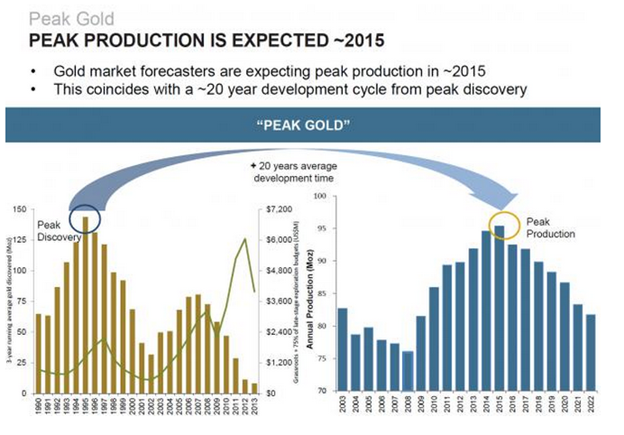
Major gold mining countries have seen declines in their gold production in recent years despite the strong bull market of the last decade.
On Friday, Zero Hedge highlighted a report from Eugene King of Goldman Sachs which supports our assertion. According to King, there are “only 20 years of known mineable reserves of gold and diamonds.”
Discoveries of new, mineable gold reserves peaked in 1995 at around 140 million ounces. This followed steady annual increases since 1991 when global discoveries were at around 60 million ounces.
In 2013, new discoveries totalled less than 10 million ounces. While this, in part, reflects the severe pullback in gold prices – and hence, profitability of mining – data shows that new discoveries were in decline even as gold prices continued to rise.
Following the 1995 peak, new discoveries have been in a dramatic downward trend. Discoveries rose from 2002 till 2008 along with gold prices.
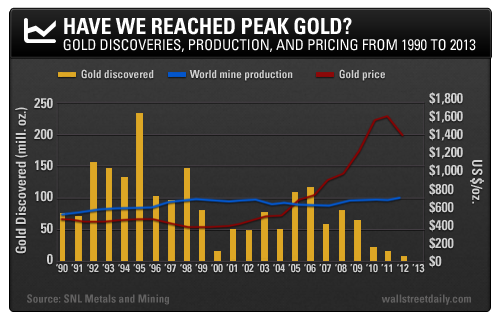
However, there was a dramatic fall-off in new discoveries from 2008 even as prices surged to record nominal highs in 2011 when one would expect the search for new deposits to have intensified.
Gold production tends to lag discoveries by around 20 years. Data shows that production steadily increased from 2008 to 2014. It may be that 2015 is the year that gold production peaks – 20 years after the 1995 peak discovery.
As we have pointed out for many years, the traditionally strong gold producing countries like South Africa, the U.S. and Australia have seen falls in production in recent years which supports the argument for peak gold production.

South African Gold Production
Peak gold has happened or will soon happen. The geological evidence suggests that it may happen in the near term due to the lack of major discoveries and the growing difficulty large and small gold mining companies are having increasing their production.
It is also signalled in the fact that most of the larger gold producing countries, not just Australia, the U.S. and South Africa but also Canada, Peru, Indonesia and others, have all seen production drops in recent years.
China and Russia are the two only large producers to have seen production increases.
Peak gold has yet to be considered and analysed by the international financial community. Goldman’s report may begin to change that and lead to debate of this important topic.
The implications of this trend – if the assertion proves to be correct – are manifold.
The ability of bullion banks to manipulate the price of gold downwards on futures markets will be impaired in an era of declining gold production. As China, Russia and other eastern central banks continue to accumulate gold in massive volumes with which to back their currencies it will be highly unlikely that gold prices will be suppressed for much longer.

U.S. Annual Gold Production
There is a risk that peak gold has happened or will happen soon with a consequent impact on the gold mining industry and on gold prices in the coming years.
The fact that peak gold may take place at a time when the world is engaged in a risky monetary experiment involving massive fiat paper and electronic money creation bodes very well for gold’s long term outlook.
MARKET UPDATE
Today’s AM fix was USD 1,187.40, EUR 1,095.01 and GBP 800.36 per ounce.
Friday’s AM fix was USD 1,198.00, EUR 1,106.70 and GBP 805.32 per ounce.
Gold and silver were both 1.3% higher last week – the second consecutive week of gains which is positive from a momentum perspective.
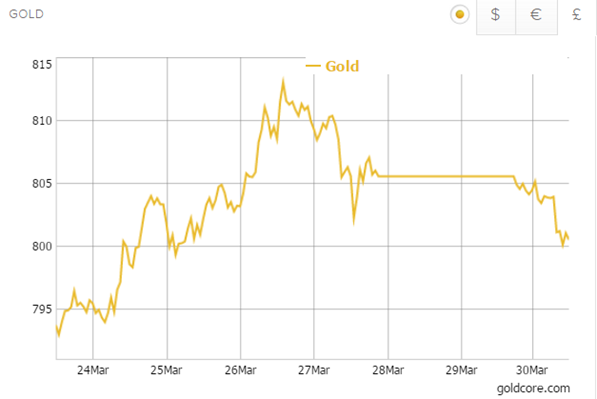
Gold in British Pounds – 1 Week
Gold dropped 0.39 percent or $4.70 and closed at $1,198.70 an ounce on Friday, while silver lost 0.59 percent or $0.1 at $16.95 an ounce. Overnight in Singapore, gold prices fell nearly 0.4 percent to $1,187 per ounce and weakness continued in London.
Holdings in gold-backed exchange-traded products rose on Friday for the first time in four days.
Silver fell 1.8 percent to $16.76 an ounce in London but is set to climb 6.1 percent this quarter. Platinum lost 1.1 percent to $1,127 an ounce, heading for a third straight quarterly loss.
end
Surprisingly some gold miners are hedging gold thinking that the low price of gold is normal market forces:
(courtesy GATA)
Miners’ gold forward sales surged 103 tonnes last year, most since 1999
Submitted by cpowell on Sun, 2015-03-29 03:57. Section: Daily Dispatches
By Jan Harvey
Reuters
Friday, March 27, 2015
The volume of gold sold forward by mining companies rose by 103 tonnes last year, the biggest annual increase since 1999, an industry report showed on Friday.
That far outstrips an estimate given late last year of 42-52 tonnes, after Mexican gold and silver miner Fresnillo said it was hedging 47 tonnes of output over five years.
In their quarterly Global Hedge Book Analysis, Societe Generale and GFMS analysts at Thomson Reuters said the bulk of the rise in the global gold hedge book last year was driven by Fresnillo and Russia’s Polyus Gold, which announced a major hedging deal in July. …
… For the remainder of the report:
http://www.reuters.com/article/2015/03/27/gold-hedging-idUSL6N0WT2IP2015…
end
Australia ready to join Asian Infrastructure Investment Bank
Submitted by cpowell on Sun, 2015-03-29 10:00. Section: Daily Dispatches
Prime Minister Tony Abbott Gives Green Light to $100 Billion Asian Infrastructure Investment Bank
Stephanie Peatling and Philip Wen
Sydney Morning Herald
Sunday, March 29, 2015
Prime Minister Tony Abbott has cleared the way for Australia to join the new multi-billion-dollar, China-led Asian Infrastructure Investment Bank but says some issues remain before Australia could consider full membership.
Abbott announced Australia would sign a memorandum of understanding that will allow Australia to be involved in negotiations to set up the $100 billion bank.
“Key matters to be resolved before Australia considers joining the Asian Infrastructure Investment Bank include the bank’s board of directors having authority over key investment decisions, and that no one country control the bank,” Abbott said in a statement. …
… For the remainder of the report:
http://www.smh.com.au/federal-politics/political-news/prime-minister-ton…
end
(courtesy Mike Kosares/GATA)
Mike Kosares: Reflections in a golden eye
11a PHT Monday, March 30, 2015
Dear Friend of GATA and Gold:
In his latest commentary at USAGold, Mike Kosares writes that short-term profits from gold trading may be paltry compared to long-term profits when financial systems come apart, expresses skepticism about the new London gold-fix mechanism, argues that government deficits matter because the public debt can become a serious burden on society, predicts that the Chinese yuan’s ascendance will support gold, and maintains that the seemingly slow pace of central bank gold repatriation is not as important as the intent of the repatriation. Kosares’ commentary is headlined “Reflections in a Golden Eye” and it’s posted at USAGold here:
http://www.usagold.com/publications/Apr2015SpecialReport.html
CHRIS POWELL, Secretary/Treasurer
Gold Anti-Trust Action Committee Inc.
end
(courtesy Bill Holter/Miles Franklin)
Fw: Cash is trash
. If I may interpret for you, Mrs. Yellen is saying they not only “want” to debase the dollar and create inflation, they absolutely MUST debase and devalue the dollar in or to “reflate” and KEEP REFLATING! There is no other alternative but we already knew this. We knew she knew this, what was shocking is she actually said this! Let me finish with a three word translation for you, “Cash is trash”. Janet Yellen, 3/27/14. Regards, Bill Holter


And now for the important paper stories for today:
Early Monday morning trading from Europe/Asia
1. Stocks generally higher on major Chinese bourses on false rumours of the PBPC rate cut /yen falls to 119.82
1b Chinese yuan vs USA dollar/yuan slightly strengthens to 6.2073
2 Nikkei up by 125.77 or 0.65%
3. Europe stocks in the green/USA dollar index up to 97.83/Euro falls to 1.0833
3b Japan 10 year bond yield .37% (Japan buying 100% of bond issuance)/Japanese yen vs usa cross now at 119.82/Maintains rise in Japanese 10 yr bond yield/Japan losing control over their huge bubble of a bond market/
3c Nikkei still above 19,000
3d USA/Yen rate now just below the 120 barrier this morning
3e WTI 47.97 Brent 55.59
3f Gold down/Yen down
3gJapan is to buy the equivalent of 108 billion uSA dollars worth of bond per month or $1.3 trillion. Japan’s GDP equals 5 trillion usa.
Japan to buy 100% of all new Japanese debt and by 2018 they will have 25% of all Japanese debt. Fifty percent of Japanese budget financed with debt.
3h Oil down for WTI and down for Brent this morning despite the fact a proxy civil war continues in Yemen
3i European bond buying continues to push yields lower on all fronts in the EMU
Except Greece which sees its 2 year rate slightly rises to 20.74%/Greek stocks down by .15% today/ still expect continual bank runs on Greek banks.
3j Greek 10 year bond yield: 10.99% (down by 6 basis point in yield)
3k Gold at 1184.00 dollars/silver $16.69
3l USA vs Russian rouble; (Russian rouble down 1/100 rouble/dollar in value) 57.82 , falling with the lower brent oil price
3m oil into the 47 dollar handle for WTI and 55 handle for Brent
3n Higher foreign deposits out of China sees hugh risk of outflows and a currency depreciation. This scan spell financial disaster for the rest of the world/China may be forced to do QE!!
30 SNB (Swiss National Bank) still intervening again in the markets driving down the SF
3p Britain’s serious fraud squad investigating the Bank of England/ the British pound is suffering
3r the 7 year German bund still is in negative territory/no doubt the ECB will have trouble meeting its quota of purchases and thus European QE will be a total failure.
3s Eurogroup reject Greece’s bid for more euros of bailout funds as proposal is to vague. The ECB increases ELA by 1.5 billion euros up to 71.3 billion euros. This money is used to replace fleeing depositors.
3t Bloomberg calculates Greece’s shortfall in March at 3.5 billion euros.
4. USA 10 year treasury bond at 1.96% early this morning. Thirty year rate well below 3% at 2.54%/yield curve flatten/foreshadowing recession.
5. Details Ransquawk, Bloomberg, Deutsche bank/Jim Reid.
(courtesy zero hedge/Jim Reid Deutsche bank)
Futures Jump On Chinese Easinng Speculation, False Rumor Of PBOC Rate Cut
With the rest of the developed world’s central banks waiting for the Fed to admit defeat for one more year and delay its proposed rate hike (or launch NIRP/QE4 outright) it was all about China (the same China which a month ago we said would launch QE sooner or later) and hope that its central bank would boost asset prices, when over the weekend the PBoC governor hinted that more easing is imminent to offset the accelerating drag after he admitted that the nation’s growth rate has tumbled “a bit” too much and that policy makers have scope to respond. How much scope it really has now that its bad debt is rising exponentially is a different question. It got so bad, Shanghai Securities News leaked a false rumor earlier forcing many to believe China would announce an unexpected rate cut as soon as today, in the process sending the Shanghai Composite soaring by 2.6%.
- PBOC TO HOLD PRESS CONFERENCE AT 3:30 P.M.: SHANGHAI SEC. NEWS
- PBOC TO MAKE `IMPORTANT’ ANNOUNCEMENT AT 3:30 PM BRIEFING: NEWS
This was promptly denied:
- PBOC NEWS OFFICE SAYS UNAWARE OF BRIEFING THIS AFTERNOON
… But the momentum for the dumb money (and we mean dumb money: remember that 30% Of New Equity Investors In China Have Elementary Education Or Less, Bloomberg Says) was already in place, and the already unprecedented Chinese stock bubble just got that much bigger and that much closer to popping.

For now, algos don’t care, and the surge in China was quickly carried over to Europe and the US, both of which have seen substantial strength across equity markets, even as the German 10Y Bund dropped to 0.18% earlier, now that every single bank is fighting every other single bank for what little unencumbered “high quality collateral” remains.
But if China’s rumors were positive for stocks, oil couldn’t care less and Brent extended Friday’s selloff into a second day, falling below $56/bbl amid indications bearish pressure from Iran nuclear talks is building, and the upside related to the Yemen proxy war is fading. WTI outpacing Brent decline.
“Further downward pressure may come at any time from a nuclear agreement with Iran,” says Societe Generale head of oil mkt research Michael Wittner. “Talks are reportedly intense, with twists and turns seeming to occur at least daily.”Wittner added that “The conflict in Yemen poses no threat to Saudi production, Yemeni production is small and unimportant, and the risk of a disruption to oil shipments through the Bab el-Mandeb Strait is considered low. We believe there will be continued downward pressure on oil prices.”
Well, the PBOC better step up and fast.
European equities have started the week on the front foot in a continuation of the positive sentiment seen overnight in Asia-Pacific trade with Chinese equities supported by comments from the PBoC Governor who hinted at more easing (PBoC announced new housing measures at 1003BST) and as details emerged over China’s Silk Road economic belt plans which will help boost infrastructure in the country. As such, Hang Seng (+1.5%) rose the most for the year while the Shanghai Comp (+2.6%) touched its highest level since May’08. Furthermore, sentiment in Europe has also been supported by comments out of Athens suggesting the Greek government are increasing their efforts to secure much-needed financing. Additionally, from a technical perspective, German equities were further boosted after the DAX cash broke above 12,000, with German export names also supported by the broadly weaker EUR.
From a fixed income perspective, Bunds have traded higher since the get-go with some suggesting the move higher could be a by-product of increased QE purchases by the ECB. This also comes alongside USTs trading lower, so could help provide some explanation for the move with flows into core European paper. From a supply perspective, focus for Europe will also reside on the upcoming BTP offering from the Italian treasury at 1000BST.
Fitch downgraded Greece to CCC from B. Fitch said the downgrade reflects lack of access to markets and uncertainty regarding potential disbursements from the Troika group of lenders. (RTRS) European finance ministers will probably not meet again before the middle of April to give the country more funds. Officials added that the proposals sent by Greece are lacking the required detail. (WSJ) Conversely EU sources suggest that the talks between the Eurogroup and Greece are `encouraging` and Greece may receive funds in the first three days of the week. (La Republicca) Additionally, sources also suggest Greece could enter into bankruptcy by 20th April if it fails to secure additional financing. (RTRS) Of note, the Syriza party is due hold an emergency cabinet council meeting at 4pm local time. German Finance Ministry Spokesman Jaeger today said that Greek proposals have not yet been submitted. (BBG)
As has been the case over the past few weeks, the USD-index has provided a bulk of the price action with the greenback continuing to pull away from its post-GDP lows, with the higher US yields also providing the USD with a boost, particularly in USD/JPY. Elsewhere, EUR/GBP was initially subject to some month-demand with the cross also led higher by political uncertainty in the UK. Nonetheless, this upside was short-lived after the USD-strength saw EUR/USD trip stops through 1.0850 to the downside. However, it is worth keeping an eye on major pairs as the USD-index pulls away from its best levels heading into the European open, with GBP broadly benefitting from a move higher in GBP/JPY.
In summary: European stocks slightly pare earlier gains, rise most since March 20 as PBOC head Zhou Xiaochuan indicated that China’s growth rate has slipped, and that the govt is able to respond. Dollar rises with U.S. equity index futures while crude declines. Goldman reiterates overweight call on global equities on 3-, 12-month terms. German Finance Min. says Greece hasn’t yet submitted it’s official list of reforms.
Market Wrap
- S&P 500 futures up 0.6% to 2065.5
- Stoxx 600 up 0.9% to 399
- US 10Yr yield little changed at 1.96%
- German 10Yr yield down 2bps to 0.19%
- MSCI Asia Pacific up 0.1% to 146.7
- Gold spot down 1% to $1187.3/oz
- Eurostoxx 50 +1.1%, FTSE 100 +0.5%, CAC 40 +1%, DAX +1.5%, IBEX +0.7%, FTSEMIB +1.1%, SMI +0.9%
- Asian stocks gain slightly with Shanghai Composite outperforming and ASX underperforming.
- MSCI Asia Pacific up 0.1% to 146.7
- Nikkei 225 up 0.7%, Hang Seng up 1.5%, Kospi up 0.5%, Shanghai Composite up 2.6%, ASX down 1.2%, Sensex up 1.9%
- UnitedHealth to Buy Catamaran to Boost Pharmacy Benefit Svc
- Horizon to Buy Hyperion for $1.1b, Gain Rare-Disease Drug
- Euro down 0.34% to $1.0852
- Dollar Index up 0.42% to 97.7
- Italian 10Yr yield down 1bps to 1.34%
- Spanish 10Yr yield down 1bps to 1.32%
- French 10Yr yield down 1bps to 0.49%
- S&P GSCI Index down 1.1% to 398.3
- Brent Futures down 1.7% to $55.4/bbl, WTI Futures down 2.4% to $47.7/bbl
- LME 3m Copper up 0.6% to $6093/MT
- LME 3m Nickel down 1.1% to $13140/MT
- Wheat futures up 0.6% to 511 USd/bu
Bulletin headline summary by Bloomberg and RanSquawk
- Europe trades higher in a continuation of the trend seen during Asia-Pacific trade, with participants also optimistic over Greek/Eurogroup negotiations
- USD-index continues to lead the way for FX markets after recovering from post-GDP lows, although has since given back some of its gains heading into the North American open
- Looking ahead, today sees the release of US personal income, personal spending and pending home sales.
- Treasuries steady before personal income/ spending reports as market’s focus shifts to ADP on Wednesday, nonfarm payrolls on Good Friday.
- China’s central bank chief said that the nation’s growth rate has tumbled “a bit” too much and that policy makers have scope to respond, underscoring forecasts for further monetary easing in the world’s second-largest economy
- China lowered down-payment requirements for some second homes, further easing mortgage policies as the government seeks to prop up the property market and counter an economic slowdown
- Greece PM Tsipras will update lawmakers Monday on talks held over the weekend in Brussels between Greek officials and representatives of the country’s creditors to secure more funds from the euro area and stave off fiscal collapse
- Shiite Houthis fought forces loyal to Yemen’s embattled president for control of his government’s last stronghold as Saudi Arabia led air assaults on rebel positions and held out the possibility of a ground invasion
- Iran and six world powers intensified efforts to reach a nuclear accord as foreign ministers from all sides met with their deadline less than 48 hours away
- Sovereign 10Y yields mostly lower. Asian, European stocks gain, U.S. equity-index futures rise. Crude and gold decline, copper higher
DB’s Jim Reid wraps up the weekend event summary
As we start Easter week Asian markets have started on a firmer footing. The Nikkei (+0.68%), Hang Seng (+1.50%), Shanghai Comp (+1.62%) and Kospi (+0.43%) are all higher as we go to print. Markets in China in particular appeared to be trading with better sentiment after the PBOC Governor Zhou indicated that the Central Bank still has room to move given that growth has fallen more than desired. Specifically Zhou noted that China can have room to act with both interest rates and quantitative measures. Credit markets are 1- 2bps better this morning.
Geopolitics continues to bubble under the surface however with the Iran nuclear talks attracting plenty of attention over the weekend with tensions continuing to run high and talks appearing near deadlocked. According to the BBC, ahead of tomorrow’s deadline, leaders from Iran and Western diplomats are due to reconvene in an effort bid to finalize an agreement. As per the report, US officials have said that all parties, including Iran, have agreed upon there needing to be ‘a phased step by step reciprocal approach’ in the hope that Iran’s approach to stepping back from its nuclear programme coincides with a phased lifting of sanctions. Negotiations appear to be tense with a conclusion before the deadline far from certain. UK Foreign Minister Hammond commented that ‘Iran has to take a deep breath and take tough decisions’ while Iran’s Deputy Foreign Minister Araghchi noted that ‘the other side must make serious decisions’.
Elsewhere Greece continues to dominate the headlines and on Friday we learned that the government has submitted a list of measures to its creditors. The list – which is more of a ‘staff level agreement’ rather than a submitted list of reform proposals given that the technical teams are still in data collection mode and have yet to have started negotiations – includes a number of revenue raising measures aimed at securing €3bn, including a controversial series of privatizations, raising income tax, increasing levies on alcohol and tax and cutting down on tax evasion. Greek press Ekathimerini also reported that the outline includes a 1.5% budget surplus target for 2015, which is well below the current 3% target in the existing bailout program. After talks between the government and its creditors over the weekend, Reuters quoted a Greek government official as saying that the ‘Brussels Group discussions continue in a good climate of cooperation’ but that ‘we have agreed that we need to draw up suitable policies which will shift the burden from those on the lowest income to the highest’, suggesting that further substance and detail will be required before we see any sort of agreement on reform measures and a subsequent release of funds. Headlines on Bloomberg suggest that PM Tsipras is due to update lawmakers on Monday over the weekend’s talks.
Back to markets and recapping Friday’s session, US equities snapped a four consecutive sessions of declines with a +0.24% gain on Friday, taking the index modestly back into positive territory (+0.10%) YTD. Treasuries firmed throughout the session, with the benchmark 10y yield eventually finishing 2.8bps tighter at 1.962% while the Dollar, as measured by the broader DXY, was a touch lower (-0.15%). Despite a relatively muted market move, comments towards the end of the US session from the Fed’s Yellen attracted the bulk of the headlines. In comments at a conference in San Francisco, the Fed Chair said that given an improvement in economic conditions, an ‘increase in the target range for that rate may well be warranted later this year’’. Yellen went on to say that the ‘actual path of policy will evolve as economic conditions evolve, and policy tightening could speed up, slow down, pause, or even reverse course depending on actual and expected developments in real activity and inflation’, before going on to say that any move would be gradual (Reuters). Despite being balanced to the more hawkish side, the comments essentially reflected the previous FOMC statement by keeping open the option of a move, but highlighting the data dependency that will essentially determine the date and pace of liftoff.
Away from Yellen and on the data front, the third Q4 GDP reading was unchanged at +2.2% saar, although below expectations of +2.4%. Personal consumption meanwhile was revised up 20bps to +4.4% qoq as expected while the Core PCE print was unchanged at +1.1% qoq (as expected). The final March reading of the University of Michigan consumer sentiment reading was encouraging with the reading revised up 1.8pts to 93.0, a point ahead of expectations.
Elsewhere there was something of a reversal in oil markets on Friday, as WTI (-4.98%) and Brent (-4.70%) gave up most of Thursday’s gains to close at $48.57/bbl and $56.41/bbl respectively. The +4.94% weekly return for WTI in particular however did snap three consecutive negative weekly returns. Equity markets in the Middle-East closed firmer over the weekend, led by markets in Saudi Arabia (+1.9%) having been supported by comments from the Saudi King Salman who told a group of leaders in the region that the coalition would continue its offensive until stability is restored. Meanwhile, Reuters has reported further airstrikes overnight with key rebel military targets struck. The same article also quoted a Saudi spokesman as saying that the coalition would step up the pressure on the Houthis and their allies over the coming days and haven’t ruled out the potential for ground force. Despite a unified front from the coalition to restore some sort of stability, geopolitical risk remains high with the Iranian finance minister pleading for a stop to the airstrikes on Friday and the BBC reporting that Iran is alleged to be providing support to the rebel Houthis.
Moving on, it was a similar story in Europe on Friday with bourses a touch firmer at the close. Indeed, the Stoxx 600 (+0.24%), DAX (+0.21%) and CAC (+0.55%) all closed higher following a somewhat volatile week in which most major markets closed lower. Bond markets were largely mixed. 10y Bunds closed 0.8bps tighter at 0.206% while markets in Italy and Spain were 4bps and 6bps wider respectively. Data offered little in the way of surprises on the whole. French consumer confidence for March printed in line with consensus at 93 and at the highest level since November 2010. Elsewhere, Italian retail sales (+1.7% yoy vs. -0.3% expected) and the German import price index came in ahead of expectations (-3.0% yoy vs. -4.4% expected).
Wrapping up, it’s a busy calendar in a holiday-shortened week. We start in the UK this morning with mortgage approvals, money supply and net consumer credit data and follow this up with confidence indicators for the Euro-area as well as the preliminary March CPI reading out of Germany. It’s no less quiet in the US this afternoon where we get personal income and spending data, along with the PCE deflator reading, pending home sales and the Dallas Fed manufacturing activity reading. Tuesday kicks off in the Asia timezone where we get a host of readings for Japan including cash earnings, housing starts and private sector credit. Closer to home, the all-important advanced March Euro-area CPI print will be front and centre while we’ve also got French PPI and consumer spending, German unemployment and Q4 GDP in the UK to look forward to. Data in the US on Tuesday includes the ISM Milwaukee, S&P/Case Shiller, consumer confidence and Chicago PMI. We start the new month on Wednesday in Japan with the Tankan survey while the official and HSBC manufacturing print in China will also be due up. Manufacturing PMI’s dominate the data docket in Europe on Wednesday too with the final March prints for France, Germany and the Euro-area as well as the preliminary releases in the UK and Italy. The afternoon focus in the US will be on the ADP employment changed print, along with the final reading for the manufacturing PMI, ISM manufacturing and prices paid, vehicle sales and finally construction spending. The calendar takes a breather on Thursday with no releases due in Europe. Across the Atlantic however Challenger job cuts and initial jobless claims kick off the session, followed by the February trade balance, ISM NY and factory orders. With it being a public holiday for most markets on Friday, we’ve just got the services and composite PMI’s due in China and Japan in the morning. The likely main highlight of the week comes on Friday afternoon however in the US where we get the March payrolls number and associated employment indicators with it. Finally, there’ll be no shortage of Fedspeak this week with George, Lacker, Lockhart, Mester and Kocherlakota all due to speak.
end
A very important commentary from Raul Meijer who states that Greece knows that the dual mandate for the people of staying in the Euro and also less austerity will not work. The citizens must choose and only a referendum can decide
an extremely important piece
(courtesy Raul Meijer)
Greece Prepares To Leave
Submitted by Raul Ilargi Meijer via The Automatic Earth blog,
SATURDAY March 28.2015
Speculation and expert comments are thrown around once more – or still – like candy on Halloween. Let me therefore retrace what I’ve said before. Because I think it’s really awfully simple, once you got the underlying factors in place.
But first, if one thing has become obvious after Syriza was elected to form a Greek government on January 25, it’s that the party is not ‘radical’ or ‘extremist’. Those monikers can now be swept off all editorial desks across the world, and whoever keeps using them risks looking like an awful fool.
All Syriza has done to date, when you look from an objective point of view, is to throw out feelers, trying to figure out what the rest of the eurozone would do. And to make sure that whatever responses it got are well documented.
Because of course Greece (through Syriza) is preparing to leave the eurozone. Of course the effects and consequences of such a step are being discussed, non-stop. They would be fools if they didn’t have these discussions. And of course there will be a referendum at some point.
There’s just that one big caveat: Syriza insists on needing a mandate from its voters for everything it does, whether that may be kowtowing to Greece’s EU overlords or walking away from them. At present, however, it doesn’t have a mandate for either of these actions.
The best it can do is to drag out negotiations as much as it can, and let Europe openly assert its perceived superior power over the Greek population as much as it wants to, complete with more iron-fisted demands for austerity, more budget cuts, more asset sales. Tsipras and his people will let this go on until the Greeks are even more fed up with Brussels than they already were when they elected Syriza in the first place.
It’s a subtle game, but it’s the only one open to Tsipras and his crew. Even if they’ve long concluded that trying to negotiate a deal with Germany et al was a lost cause way before talks started, Syriza has to go through the motions until it is confident the people of Greece are ready to vote in a referendum on eurozone membership.
A risky game, since it could bring back ‘the old guard’ of the handful of families that have governed the country for decades and that were willing co-operators with the Troika, but at the same time it’s the only game in town at the moment.
Tsipras needs to explain to the Greek people that the double mandate of staying inside the eurozone and at the same time ending austerity is in fact an empty mandate, because the eurozone refuses to allow it.
He needs to explain that this means the eurozone refuses to recognize the democratic values of one of its member states, voting to change policy. Brussels is in effect telling the Greek people on a daily basis that they don’t matter. That’s what Tsipras has to make clear, and then he can call the referendum.
It should be obvious that this whole mandate question changes potential actions by Athens to a huge degree. But from what I read every day, it doesn’t seem to be. Even within Tsipras’ own support base, perhaps some don’t understand what is going on. Either that or they’re part of the strategy. Judge for yourself:
Greek Crisis Nears A Turning Point
Stathis Kouvelakis, who teaches political theory at King’s College in London and is a member of Syriza’s central committee, says the party has to face up to the reality of its recent retreat on its election pledges and the nature of the forces arrayed against it. In particular, Kouvelakis notes the successive steps taken by the ECB to restrict the flow of liquidity to the Greek economy, shutting down or limiting Greek access to various types of ECB financing.
“It should be clear, however, that these moves would bring about a dynamic that would breach fundamental constraints of the monetary union and would inevitably lead to the exit from it,” Kouvelakis wrote in his latest post at Jacobin. “In any case, the ECB’s relentless blackmail with its provision of liquidity places onto the agenda every day the issue of regaining sovereignty over monetary policy.” It was the stranglehold that prompted Tsipras in a recent interview with Der Spiegel to refer to the ECB “still holding onto the rope that is around our necks.”
But Kouvelakis argues that covering over the issues by renaming the troika “the institutions” or by using weasel words like “creative ambiguity” is not going to solve the problem. The initial euphoria over Syriza’s victory has quickly faded, but it can be revived, he says, if the party faces reality. “In order for this to happen, however, the horns of battle have to blow again, and the ensuing struggle has to be waged with all due seriousness and determination, not with PR stunts and rhetorical contortions.”
He cited the widely quoted words from Interior Minister Nikos Voutsis earlier this month before the Greek Parliament, when he said “the country is at war, a social and a class war with the lenders” and that in this war “we will not go like cheerful scouts willing to continue the policies of the memorandum.”This is the kind of talk the world needs to hear from Greek officials, Kouvelakis says, “not the language of facile optimism that creates illusions and causes confusion that tomorrow may prove costly.”
Kouvelakis reasons from a standpoint that is not covered by Syriza’s present mandate. He at least should know this. Tsipras cannot afford to be seen by the Greek population as the man who hasn’t done all he could to keep the country in the eurozone while negotiating an end to austerity. It makes no difference at this point what his personal ideas are on the issue.
Kouvelakis does choose to let his personal opinions prevail. If Tsipras would do the same, a referendum would be much riskier for Syriza. The party was elected to represent its austerity-weary voters, not the subjective opinions of its leaders.
If Tsipras and Varoufakis should elect to give in to Brussels and Berlin, that decision would still need to be put before the people to vote on, because it would mean a prolongation of austerity. And that is not the mandate.
By the same token, if the leadership decides an exit is the only option, and that further negotiations are hopeless because Europe won’t accept anything else than strapping the proud Greek people in a straitjacket, that too will have to be put before a vote.
Of course Syriza, like any other government, keeps track of opinion polls, but they know there will come a moment when a referendum can no longer be postponed no matter what the polls say. In that, Greece is living up to its glorious past as the cradle of democracy.
And that makes it all the more cruel that the country has been ruled for such a long time by anything but a democratic system. Maybe we can say the circle is round. But the connection that closes the circle is still very fragile, and nobody knows that better than Alexis Tsipras.
Still, make no mistake: of course they’re preparing to leave.
end
The rhetoric increases as Greece seeks a meeting with the Russians:
(courtesy zero hedge)
Greek Energy Minister Slams “Unscrupulous, Imperialist” Germany, Will Seek “Bold Alternatives” In Russia
With fresh rumors springing late on Friday that “this” just may be the weekend Greece – with close to no funds left in either the financial or government sector – imposes capital controls, a precursor to a full-fledged Grexit, the situation in Athens is on a knife’s edge. Yesterday is also when the Syriza government submitted its list of 18 proposed reforms to the Troika: a reform package which the Guardian dubs “reform-for-cash“, as Greece hopes the roughly €3 billion in revenue generated from the reforms will unlock €7.2 billion in financial assistance.
Rather, make that promises of reforms to generate €3 billion in revenue. Because the question, and problem for Athens, is which comes first: does Greece implement the reforms and generate the revenue or does Europe disburse the funds. It is a problem because the reforms will be extremely unpopular if and when they pass. According to Bloomberg, which sources Greek Skai TV, among the proposed reforms is an increase on the duty paid on cigarettes and alcohol. Other proposals include:
- Lift sales tax on certain items while keeping a low rate for food products
- Combat tax evasion including fines for non-payment of tax or failing to declare income; combat black market trade of fuel
- Intensive controls of the names in Lagarde-List (more than 2,000 name suspect of tax evasion) and money transfers abroad.
- Online system connecting companies to tax offices, and electronic system for the payment of Value Added Tax
- Freeze early pensions, consolidate social security funds, create a national wealth fund
- Continue with certain privatizations
- Encourage issuance of retail sales receipts including linking collection to participation in a lottery
- Overhaul tax process for games of chance, real estate and heating oil
- Issue licenses for media companies
The 18 proposals, three times as many as put forward and dismissed by prime minister Alexis Tsipras’s government last month, anticipate GDP growth of 1.4% this year:about 1% less than where the most optimistic analysts see the US growing. The package also endorsed finance minister Yanis Varoufakis’s argument that the primary surplus demanded of Greece would have to be reduced. As such, the primary surplus was estimated to hit 1.5% in 2015 – half that in the country’s existing bailout programme. Unfortunately for Greece, considering the collapse in tax collections in recent months, Athens can kiss any hope of a positive primary surplus goodbye.
Since all of these proposals, if implemented, will lead to increased tax revenues and thus a decrease in the already low quality of Greek life, whether for everyone or just the 1%, they will be met with stern opposition, especially since they will be seen as going against Syriza’s original radical pre-electoral agenda. Which is also why as the Guardian reported, “the country’s international economic affairs minister, Euclid Tsakalotos, raised the stakes, saying while Greece wanted an agreement it was prepared to go its own way “in the event of a bad scenario… We are working in the spirit of compromise, we want a solution, but if things don’t go well you have to bear the bad scenario in mind as well. That is the nature of negotiations.”
Once again Greece is unable to determine when it has lost the negotiations, and while giving with one hand, it tries to take with the other. And this is the biggest problem, because for Europe while the amount of the money transfer is modest, what it wants more than anything is to see the “radical” spirit of the Syriza government crushed.The problem for Greece is that this is not happening, especially with statements such as this:
“The government is not going to continue servicing public debt with its own funds if lenders do not immediately proceed with the disbursement of funds which have been put on hold since 2014,” said government aides. “The country has not taken receipt of an aid instalment from the EU or IMF since August 2014 even though it has habitually fulfilled its obligations.”
Then there was the prime minister himself, who said in an interview with Real News that Greece won’t agree to any wage or pension cuts nor allow mass redundancies. Again: the issue is that the Troika, or whatever it is called, wants precisely this: they want real reforms, by which they mean that Greece finally has to implement some/any of the long ago promised and never delivered redundancies in the government sector.
What is surprising is just how naive Tsipras now appears with his continued populist rhetoric even after it has been revealed that he has no more leverage, with the threat of Grexit taken off the table. Some of his other soundbites:
- An agreement in June with Greece’s creditors will only concern changing debt repayment terms and debt relief measures
- Democratic Europe won’t choose a rupture regarding Greece
- One of government’s priorities is beginning and completing tender for broadcasting licenses
- Won’t tolerate officials who put personal political interests above those of govt and Syriza party
And then there is the Greek energy minister, Panagiotis Lafazanis, who said in an interview with Kefalaio newspaper that the “only way for Greece to exit its crisis is through tough confrontation, if not conflict, with “German Europe.”
Making sure the ongoing negotiations between (almost completely broke) Greece and the Troika take 1.4% steps forward and ten steps back, the energy minister said the Greek reform list can’t be opposed to Syriza’s radical program or be above popular will, sovereignty. As noted above, this is precisely what it would take for the Troika to release the funds.
Reuters confirmed as much earlier when it reported that as Athens battles to have a list of reforms accepted by its EU partners in order to secure much-needed funds to stave off bankruptcy, Lafazanis criticized Berlin and said the government must not roll back on its commitments.
“No list should go over the will and sovereignty of the people,” he told Kefalaio newspaper in an interview on Saturday. “The Germanized European Union is literally choking our country and tightening week by week the noose around the economy,” he said.
Virtually assuring Germany’s fure, Lafazanis said that “if the government suspends pre-election promises, Greece will be driven over cliff’s edge” adding that “privatizations, especially in strategic areas, can’t and won’t happen.” Alas, the Troika said it will, and the Troika writes the checks, so…
The punchline: “Greece is at more than at the breaking point; urgently needs big, bold alternatives to “German, incumbent Europe”and that “creditors behaving as unscrupulous imperialists towards distant colony, threatening submission or economic suffocation.”
More importantly, Lafazanis has some ideas where to find said “big, bold alternatives.” In Moscow.
Greece’s Energy Minister Panagiotis Lafazanis will meet his Russian counterpart and the CEO of energy giant Gazprom in Moscow on Monday, as he hit out at the EU and Germany for tightening a ‘noose’ around the Greek economy.
Outspoken Lafazanis, on the left wing of Greece’s co-ruling Syriza party, will meet Russian Energy Minister Alexander Novak and Gazprom Chief Executive Alexei Miller as well as other senior government officials, the energy ministry said on Saturday.
Lafazanis’ visit will come just over a week before Tsipras is due to meet Russian President Vladimir Putin in Moscow although the Greek government has stressed it is not seeking funding from the Kremlin.
It is not seeking funding from the Kremlin yet. Because once the first week of April comes and goes and Greece officially runs out of money, it will go to anyone who can provide it with the funds needed to avoid civil war, even if that means switching its allegiance from Europe to the Eurasian Economic Union, something Russia is eagerly looking forward to, and something we predicted would be the endgame months ago.
end
Sunday, Europe pulls the rug from under Greece as they state their proposals are too vague. The Greeks had no intention on further pension cuts, state sales of vital assets etc
(courtesy zero hedge)
Europe Pulls Rug From Under Greece, Says “Nein” To “Vague, Piecemeal” Proposals
Despite all the talk of a “positive climate” Greek talks with their creditors have ended badly for the desperately cash-strapped nation. As WSJ reports, Greek proposals for a revised bailout program don’t have enough detail – are “piecemeal and vague” – to satisfy the government’s international creditors, eurozone officials said. Furthermore, as Dow Jones reports, EU finance ministers are unlikley to meet again until mid-April (and in the meantime, Greece has to pay salaries, pensions, and most critically IMF debts due on April 9th).
Looming payments…

As The Wall Street Journal reports,
Greek proposals for a revised bailout program don’t have enough detail to satisfy the government’s international creditors, eurozone officials said, making it more likely that Athens will need to go several more weeks without a new infusion of desperately-needed cash.
…
The Greek government is facing a dire shortage of cash: It must pay salaries and pensions at the end of the month and repay debts to the IMF on April 9. While talks over the weekend were friendly, officials said, mistrust at a political level continues to stew between the outspoken government in Athens and the rest of the eurozone.
…officials say crucial details were again missing from the Greek proposals after talks that started Friday night, lasted all day Saturday and continued on Sunday.
“The proposals were piecemeal, vague and the Greek colleagues could not explain technically what some of them actually implied,” a eurozone official said. “So, let’s hope that they present something more competent next week.”
Senior eurozone finance officials will hold a teleconference on Wednesday to discuss the situation, officials said. But they said it is highly unlikely eurozone ministers will meet before mid-April to release more money for Greece. That means Athens will have to scrape together cash to pay salaries and pensions at the end of the month and make a €460 million debt repayment to the IMF on April 9.
* * *
It appears clear that the EU is prepared to let Greece entirely run out of money in an effort to squeeze Tspiras as much as possible (though that action will likely further force a pivot to Putin).
end
And now the next failed state in Europe to fail is Andorra. This country has a population of 76,000 people with a GDP of 4.1 billion euros. It’s total debt to GDP is an astonishing 17 x. The problem here is that there is no central bank and thus nobody to bail out the country. Another popcorn event!!
(courtesy zero hedge)
Meet Andorra: Europe’s Next Failed State
Nestling idyllically between France and Spain in the foothills of the Pyrenees, Andorra – which has enjoyed the benefits of European borders without the restrictions of EU membership – has seen its risk “increase beyond our expectations,” according to S&P. As a reminder, when Cyprus was “templated” and depositors awoke with a 47% haircut, its total financial assets to GDP was around 8x, Andorra is now at a stunning 17x. As The Telegrpah explains, in the last three weeks, the state has been gripped by a banking crisis that threatens to take it to the brink; and Andorra, which is not a member of the eurozone but uses the single currency on an informal basis, would have no way of bailing them out (with no central bank or lender of last resort). In short, the country faces a catastrophe if its banks fall apart.

Andorra has for many years enjoyed the benefits of European borders without the restrictions of EU membership, allowing light-touch regulation that has brought in tourism and wealthy expats from its bordering countries. However, as The Telegraph reports, in the last three weeks, the state has been gripped by a banking crisis that threatens to take it to the brink.
Bankers have been thrown in jail, savers’ deposits have been restricted, and the country’s government is scrambling to convince powerful regulators thousands of miles away that the country is not a haven for tax evasion.
On Tuesday March 10, the US Treasury Department’s financial crime body, FinCEN, accused Banca Privada d’Andorra (BPA), the country’s fourth-largest bank, of money-laundering. The authority said “corrupt high–level managers and weak anti–money-laundering controls have made BPA an easy vehicle for third–party money-launderers”.
Three senior managers at the bank accepted bribes to help criminals in Russia, Venezuela and China, to funnel money through the Andorran system, according to FinCEN.
The next day, the state took charge of BPA, dismissing three directors. On the Friday, the bank’s chief executive, Joan Pau Miquel, was arrested and detained. Mr Miquel remains in a jail cell in La Comella, the country’s only prison, with a capacity of 145.
At BPA, the Andorran authorities have installed new management. After international banks cut off links, withdrawals were capped at €2,500 (£1,830) a week, a limit many people are maxing out.
Banco Madrid, the Spanish subsidiary of BPA acquired as part of an expansion spree in recent years, filed for administration on Wednesday.
The Andorran government insists that BPA is an isolated case, saying it is committed to transparency and that the rest of the sector is clean. For its sake, it had better be right, but many experts fear this is not the case.
* * *
This is a major problem… When Cyprus was “templated” its banks assets were only 8 times bigger than the economy and Iceland’s troubles hit at 10x…
Andorra’s banks have assets under management 17 times bigger than the economy, and the sector accounts for a fifth of GDP…
Which means, were its banks to get into trouble, Andorra, which is not a member of the eurozone but uses the single currency on an informal basis, would have no way of bailing them out.
The crisis is a classic example of how countries seeking to welcome financial services by promising a hands-off approach to regulation, can become dangerously vulnerable to them.
Andorra’s exposures to its banks provoke echoes of Iceland and Cyprus – both of which suffered painful economic crises when their lenders fell into trouble. But unlike Cyprus, which received a last-minute bail-out, Andorra has no central bank to act as a lender of last resort: if its banks go under, it goes under.
A single bank is one thing, but contagion would be an altogether different beast. A collapse of the entire banking system would spell disaster, especially after the hubristic expansion of recent years.
The crisis has now led Standard & Poor’s, one of the three major ratings agencies, to downgrade the value of the principality’s sovereign debt.
“The risk profile of Andorra’s financial sector, which is large relative to the size of the domestic economy, has increased beyond our expectations,” S&P said two weeks ago.
“The absence of a central bank or a lender of last resort in the Andorran financial system exacerbates the risks, in our opinion.” S&P said
* * *
The Telegraph sums it up perfectly – In short, the country faces a catastrophe if its banks fall apart.
end
Why Russia need not worry about being paid: the money circulates to them anyway:
(courtesy zero hedge)
Eurasian Pivot? Moscow Expects “Progress” From Tsipras Visit
As Athens prepares to try and convince eurozone creditors that its latest set of proposed reforms represents a credible attempt to address Greece’s fiscal crisis, and as Greek depositors face the very real possibility that they will soon be Cyprus’d, a leverage-less Alexis Tsipras faces a rather unpalatable choice: bow to the Troika which “wants real reforms… meaning that Greece finally has to implement some/any of the long ago promised and never delivered redundancies in the government sector,” or to quote Credit Suisse, be “digitally bombed back to barter status.”Unfortunately for the Greek populace, the latter seems to be far more likely than the former. Here’s WSJ:
Greek proposals for a revised bailout program don’t have enough detail to satisfy the government’s international creditors, eurozone officials said, making it more likely that Athens will need to go several more weeks without a new infusion of desperately-needed cash…
“The proposals were piecemeal, vague and the Greek colleagues could not explain technically what some of them actually implied,” a eurozone official said. “So, let’s hope that they present something more competent next week.”
Senior eurozone finance officials will hold a teleconference on Wednesday to discuss the situation, officials said. But they said it is highly unlikely eurozone ministers will meet before mid-April to release more money for Greece. That means Athens will have to scrape together cash to pay salaries and pensions at the end of the month and make a €460 million debt repayment to the IMF on April 9.
As a reminder, here are two charts which demonstrate the urgency of the situation:


Despite what is unquestionably a rather dire outlook, Athens does have one card it has yet to play, because as we noted last week, “once the first week of April comes and goes and Greece officially runs out of money, it will go to anyone who can provide it with the funds needed to avoid civil war, even if that means switching its allegiance from Europe to the Eurasian Economic Union, something Russia is eagerly looking forward to, and something we predicted would be the endgame months ago.” With the Tsipras/Putin meeting now just a little over a week away, you can bet that Moscow will not squander an opportunity to procure a bit of leverage over Europe in the face of an increasingly contentious situation in Eastern Ukraine. In fact, Moscow is calling Tsipras’ visit a “big event” and has indicated that any request for financial assistance would be “examined.” Here’s more viaekathimerini:
“We are certain that the Greek prime minister’s working visit to Moscow will be a big event for our bilateral relations,” said Russian ambassador Andrey Maslov. “The possibility of further cooperation in trade, energy, technical military issues, education and culture will be examined.”
Maslov said that any request from Athens for a loan would have to be “examined very carefully” because of Greece’s euro membership. “If the Greek government submits a request for a loan, it will be examined – as Foreign Minister Sergey Lavrov said after meeting his counterpart Nikos Kotzias and as Russian Finance Minister Anton Siluanov has said,” the Russian ambassador told Kathimerini.
Maslov played down the possibility of Moscow lifting the embargo on food imports from Greece or other European Union countries as long as the EU keeps its sanctions on Russia in place. However, the ambassador praised Athens for helping prevent a rift in the EU’s relations with Russia.
“We are grateful for Greece’s efforts in helping ease the tension in relations between Russia and the EU, which is mainly due to the sanctions,” he said. “The stance of our Greek partners and other EU member-states during the council of foreign ministers in January and at the EU leaders’ summit in February prevented the hawks… from creating a permanent rift in Russia-EU relations.”
This may indeed represent an opportunity for Moscow to conduct a quasi-annexation-by-loan (as opposed to by force) and besides, any money funneled to Greece will ultimately end up back in Moscow anyway because any cash Athens manages to scrape together to pay the IMF is essentially diverted straight to Kiev which as we’ve said before, “is just as broke as Greece, and needs to pay Gazprom yesterday to keep gas deliveries coming, with Gazprom promptly remitting the funds into Putin’s personal money vault.”
We’ll leave you with the following from ekathimerini:
“Pressures on Greek bank deposits have continued in March, with sector officials estimating that households and enterprises have withdrawn a net 3 billion euros in the first weeks of this month.”
end
Extremely important commentary from Alasdair Macleod.
Why the USA cannot afford to raise interest rates at all:
(courtesy Alasdair Macleod)
Central banks paralysed at the zero bound
- By Alasdair Macleod
- Posted 27 March 2015
Though the Fed would deny it, it is clear from the minutes of the last Federal Open Market Committee (FOMC) meeting that a rise in interest rates has been put off indefinitely.
The subsequent rally in the price of gold and the sudden fall in the dollar tend to confirm this conclusion.
The Fed Funds Rate, which is the interest rate the Fed targets to set all other rates, has now been less than 0.25% for six and a quarter years, gradually declining from roughly 0.15% to about 0.10% today. It was set at a target range of between zero and 0.25% in December 2008.

According to the Policy Normalisation Principles and Plans issued last September, the FOMC will raise its target range for the Fed Funds Rate “primarily by adjusting the interest rate it pays on excess reserve balances” when the Fed normalises interest rates, “using reverse repurchase agreements to take money out of circulation to the degree necessary”. The Fed also intends to reduce its holdings of securities and contract its balance sheet in the longer run.
If normalisation is the result of economic recovery we will be familiar with the playbook. Demand for money in the economy picks up, and instead of pyramiding bank credit on reserves held at the Fed, the Fed feeds back the excess reserves to the banks by selling government securities into the markets. The bear market in government bonds should be manageable because of underlying pension and insurance company demand coupled with a diminishing budget deficit. This is the long-understood theory behind withdrawing from deficit financing.
The reality has been very different as we all know. The Fed has to face the possibility that, for whatever reason, highly suppressed interest rates are not working, and an escape from the zero interest rate bound without economic recovery may have to be contemplated.
However, if the Fed raises the Fed Funds Rate in the absence of genuine economic recovery, there will be little or no expansion of bank credit to offset, and commercial banks will want to dump their Treasuries, not buy more from the Fed. There would be no offsets to cushion the unwinding of long bond positions. In other words the effect of even a small rise in the Fed Funds Rate could develop into a self-feeding rise in bond yields and substantial losses for the banks.
This is the context within which we should consider the Fed’s decision to back off from raising the Fed Funds Rate mid-year. It leads to the conclusion that if zero interest rates haven’t worked for six and a quarter years, monetary policy itself is in a cul-de-sac with no space to turn. And when we look at Japan and the Eurozone we see similar disappointments over the effectiveness of monetary policy.
Markets are unlikely to wait until the escape from the zero bound is put to the test. Before the investing public becomes aware of the full ramifications of the problem, more prescient bankers and fund managers will reposition their bond holdings, which brings us to gold.
Those of us that follow this market closely know that for the last three years at least Asian demand has led to large shifts of bullion from western capital markets towards Asia. The behaviour of the markets in London and New York already indicate that shortages of physical bullion are a delicate problem, and this is before markets wake up to the growing likelihood that the Fed cannot afford to see interest rates rise.
If interest rates cannot rise, then the dollar itself is ultimately exposed to loss of confidence in the foreign exchanges. The dawning realisation that after recent strength, the dollar is vulnerable after all can be expected to be reflected in a positive sentiment towards gold, which once under way could drive the price up dramatically due to the lack of available bullion.
The views and opinions expressed in the article are those of the author and do not necessarily reflect those of GoldMoney, unless expressly stated. Please note that neither GoldMoney nor any of its representatives provide financial, legal, tax, investment or other advice. Such advice should be sought form an independent regulated person or body who is suitably qualified to do so. Any information provided in this article is provided solely as general market commentary and does not constitute advice. GoldMoney will not accept liability for any loss or damage, which may arise directly or indirectly from your use of or reliance on such information.
end
Russia officially enters the AIIB:
(courtesy zero hedge)
De-Dollarization Continues As Russia Seeks AIIB Membership
As we noted a week ago, Vladimir Putin’s calls for a Eurasian currency union clearly demonstrate that the Russian President is acutely aware of the fact that the unipolar world of the 1980s is long gone. Putin’s security council also made it clear this week that the Kremlin is well aware that the sole aim of US foreign policy is preserving Western hegemony via an implicit (and sometimes explicit) policy of containment aimed at perpetuating the idea of US exceptionalism. Moscow then took the rhetoric up a notch on Thursday, accusing the US of attempting to take the “mutual” out of “mutually assured destruction” (i.e. Moscow thinks Washington is trying to tip the nuclear power balance).
Given all of this, we weren’t surprised to learn that Putin is now backing a Russian bid for membership in China’s Asian Infrastructure Investment Bank (for a summary of AIIB developments, see here). Here’s more via RT:
Russia decided to apply to join the China-led Asian Infrastructure Investment Bank (AIIB), the country’s Deputy Prime Minister Igor Shuvalov said on Saturday.
“I would like to inform you about the decision to participate in the AIIB,” which was made by Russian President Vladimir Putin, Shuvalov said at the Boao Forum for Asia.
Shuvalov added that Russia welcomes China’s Silk Road Economic Belt initiative and is happy about stepping up cooperation.
“We are delighted to be able to step up cooperation in the format of the Eurasian Economic Union (EEU) and China…the free movement of goods and capital within the EEU brings economies of Europe and Asia closer. This is intertwined with the Silk Road Economic Belt initiative, launched by the Chinese leadership,” he said.
This comes after yet another US ally threw its support behind the venture last week, as South Korea finally conceded that not joining really wasn’t an option if Seoul wanted to maintain its influence in the region. More color via Bloomberg:
South Korea “needs to play the active role it deserves in the international community that’s comparable to its economic status, and AIIB would be an important gateway to expand our financial and diplomatic arena,” the Sejong, South Korea-based ministry said Thursday. The country will officially become a founding member of the AIIB once other members agree, and when the national assembly approves, according to the e-mailed statement.
Asia’s fourth-largest economy joins key U.S. allies from the U.K. to Germany and France in supporting China’s bid to create a new institution funding infrastructure projects in Asia. Japan is yet to make a decision on membership after the U.S. expressed concerns about the fund’s governance structure.
And then there’s The Netherlands, an official bid from Australia, and Brazil…
Via Reuters:
Russia, Australia and the Netherlands on Saturday became the latest three countries to say they plan to join the China-led Asian Infrastructure Investment Bank (AIIB), adding clout to an institution seen as enhancing China’s regional and global influence.
The AIIB, seen as a challenge to existing institutions the World Bank and Asian Development Bank, has drawn a cool response from the United States, despite which European U.S. allies including Britain, France, Germany and Italy have already announced they would join the bank.
Other countries such as Turkey and South Korea have also said they would join. Brazil, China’s top trading partner, said on Friday it would sign up and that there were no conditions set. “Brazil is very interested in participating in this initiative,” the office of President Dilma Rousseff said in a statement.
To make a long story short, everyone but the US and Japan are on board and Japan is seriously considering a bid. The question now is not whether de-dollarization is progressing or whether a shift away from US-dominated multinational institutions is in the offing (that horse, as one ADB official put it, has left the barn), but rather whether China will be aggressive about using the AIIB to begin a push towards yuan hegemony. Of course Beijing is playing down the idea that it will use the new development bank as a means of advancing China’s global footprint, but as we noted on Thursday, actions speak louder than words.
end
Russia is now joined by Holland and Australia into the AIIB:
a more lethal dagger to the heart of the uSA dollar.
(courtesy zero hedge)
More countries say to join China-backed AIIB investment bank
Reuters) – Russia, Australia and the Netherlands on Saturday became the latest three countries to say they plan to join the China-led Asian Infrastructure Investment Bank (AIIB), adding clout to an institution seen as enhancing China’s regional and global influence.
The AIIB, seen as a challenge to existing institutions the World Bank and Asian Development Bank, has drawn a cool response from the United States, despite which European U.S. allies including Britain, France, Germany and Italy have already announced they would join the bank.
Other countries such as Turkey and South Korea have also said they would join. Brazil, China’s top trading partner, said on Friday it would sign up and that there were no conditions set. “Brazil is very interested in participating in this initiative,” the office of President Dilma Rousseff said in a statement.
Russian First Deputy Prime Minister Igor Shuvalov, speaking on Saturday at a forum in Boao on the southern Chinese island of Hainan, said the country plans to join the AIIB, according to the official Xinhua news agency.
Speaking at the same forum, Australian Finance Minister Mathias Cormann said the country was planning to apply to become a founding member, according to Xinhua.
And the Netherlands also plans to join, Dutch Prime Minister Mark Rutte said on his officialFacebook page after a meeting with Chinese President Xi Jinping.
China’s Finance Ministry said earlier on Saturday Britain and Switzerland had been formally accepted as founding members of the AIIB, a day after Brazil accepted China’s invitation to join.
China’s Finance Ministry said Austria had also applied to join and had submitted its documents to China.
“We should push forward with the creation of a regional hub for financial co-operation,” Xi said at the forum, adding China should “strengthen pragmatic cooperation in monetary stability, investment, financing, credit rating and other fields.”
The AIIB has been seen as a significant setback to U.S. efforts to extend its influence in the Asia Pacific region to balance China’s growing financial clout and assertiveness.
(Reporting by Stephen Eisenhammer; Additional reporting by Ben Blanchard in Beijing, Engen Tham in Shanghai and Adam Jourdan in Boao; Editing by Michael Perry and David Holmes)
end
Coming to a store near you….
(courtesy zero hedge)
Australia To Start Taxing Bank Deposits
Up until now, the world’s descent into the NIRPy twilight of fiat currency was a function of failing monetary policy around the globe as central bank after desperate central bank implemented negative and even more negative (in the case of Denmark some four times rapid succession) rates, hoping to make saving so prohibitive consumers would have no choice but to spend the fruits of their labor, or better yet, take out massive loans which they would never be able to repay. However, nobody said it was only central banks who could be the executioners of the world’s saver class: governments are perfectly capable too. Such as Australia’s.
According to Australia’s ABC News, the “Federal Government looks set to introduce a tax on bank deposits in the May budget.”
Ironically, the idea of a bank deposit tax was raised by Labor in 2013 and was criticized by Tony Abbott at the time. Much has changed in two years, and as ABC reports, assistant Treasurer Josh Frydenberg has indicated an announcement on the new tax could be made before the budget.
Mr Frydenberg is a member of the Government’s Expenditure Review Committee but has refused to provide any details.
“Any announcements or decisions around this proposed policy which we discussed at the last election will be made in the lead up or on budget night,” he said.
Speaking at the Victorian Liberal State Council meeting Mr Abbott has repeated his budget message, focusing on families and small businesses.
“There will be tough decisions in this year’s budget as there must be, but there will also be good news.”
For the banks and creditors, yes. For anyone who is still naive enough to save money in the hopes of deferring purchases for the future, not so much.
The banking industry has raised concerns about a deposit tax, saying it will have to pass the cost back onto customers.
Steven Munchenberg from the Australian Bankers’ Association said it would be a damaging move for the Government.
“It’s going to make it harder for banks to raise deposits which are an important way of funding banks. And therefore for us to fund the economy,” he said. “And we also oppose it because particularly at this point in time with low interest rates a lot of people who are relying on their savings for their incomes are already seeing very low returns and this will actually mean they get even less money.”
Don’t worry Steven, neither central banks nor government care about “a lot of people” – they just care about a select few. As for the banks, once China, and immediately thereafter Australia, launches QE as the entire world descends into a monetary supernova, and Australia’s banks are flooded with trillions in excess reserves like those in the US, all shall be forgiven. As a reminder, banks such as JPM are so flush with zero-cost cash from other sources, well one other source, they are now actively turning away depositors.
As for Australia, while central banks are untouchable and unaccountable to anyone (except their commercial bank directors and anyone else they secretly meet during those bimonthly sessions in the BIS tower in Basel), the government can be voted in and voted out. Especially a government that is about to break one of its main election promises:
The Federal Opposition has accused the Government of breaking an election promise by planning to introduce a tax on bank deposits.
The former Labor Government put forward the policy in 2013 to raise revenue for a fund to protect customers in the event of a banking collapse.
Shadow Assistant Treasurer Andrew Leigh said Treasurer Joe Hockey criticised the proposal at the time. “When we put it on the table Joe Hockey said that it was a smash and grab on Australian households just aimed at repairing the budget,” he said.
It is almost surprising, but not really, how when it comes down to money, the thin white line between “us” and “them” always disappears when the money runs out.
As for Australia’s savers, welcome to the NIRP worldwhere savers in increasingly more countries are now on the endangered species list.
end
Koos explains the AIIB:
(courtesy Koos Jansen)
Posted on 30 Mar 2015 by Koos Jansen
This Is What The AIIB Is About
Until March 31 countries can submit for membership of the Asian Investment Infrastructure Bank (AIIB), a financial institution proposed by China, which has the purpose of being a multilateral framework to finance infrastructure projects in the wide Eurasian region. In recent weeks many Western countries have submitted for membership, the US rejected application as it fears strong cooperation between Asia and Europe will weaken the US dollar hegemony. On April 15 the final list of the founding members will be disclosed.
In October 2013 the initial idea for the AIIB was first put forward by Chinese President Xi Jingping “on constructing a 21st Century Maritime Silk Road to promote maritime cooperation”. The project has currently developed into the New Silk Road Economic Belt.
https://www.bullionstar.com/blogs/koos-jansen/this-is-what-the-aiib-is-about/
-END-
|

The graph is color-coded. The darker the blue the country, the larger the disposable income. The darker the orange, the smaller the disposable income.
Unsurprisingly, the figure shows Anglo-Saxon countries as largely the countries where citizens have the highest disposable income.
However, are you surprised by which country is in first place?
The following is a table look of the top 20.

Interestingly, on top is Switzerland at $6,302 (all figures are in dollars).
A distant second is Luxembourg at $4,480.
The remaining countries in the top five include Zambia at $4,331, Jersey at $4,323 and Bermuda at $4,250.
The globe’s soon-to-be second largest economy – the United States – fails to make it to the top 10, coming in at 13th with an average monthly disposable income of $3,259.
Also interestingly, some very important global powers are missing from the top 20. Of those missing is Germany, France, Russia, China, Japan, Canada, Singapore, and others.
Iran Deal Unlikely Before March 31 as Russia Leaves Talks
(Bloomberg) — Russian Foreign Minister Sergei Lavrov left talks on Iran’s nuclear program and will only return if an accord is in sight, suggesting that negotiations will continue into the final hours before a March 31 deadline.
Diplomats said obstacles remain after foreign ministers from the six powers jointly met Iranian envoys for the first time in the latest round of talks in Lausanne, Switzerland. Lavrov will return if there’s a “realistic understanding of a deal,” Russian Foreign Ministry spokeswoman Maria Zakharova said.
“The main thing that gives us optimism is the determination of all the ministers to reach a result without taking a pause,” said Lavrov’s deputy, Sergei Rybakov. Russia sees positive signals at the talks, Dmitry Peskov, President Vladimir Putin’s spokesman, said in Moscow.
After a 12-year standoff, negotiators are divided over the pace of easing sanctions on Iran and the limits to be imposed on its nuclear program. A framework accord by March 31 would be a step toward ending Iran’s economic isolation, though another three months are envisaged to reach a detailed final agreement.
Talks are stuck on how to roll back sanctions and how to reimpose them should Iran violate the agreement, a European diplomat said after Monday’s plenary meeting. No decision has been made on how to dispose of Iran’s enriched uranium, which is essential to ensuring that its nuclear program is exclusively peaceful, a U.S. official said by e-mail Monday, asking not to be named in line with diplomatic rules.
While the countries in talks with Iran would prefer that the uranium be transferred to a guarantor nation, other options are being discussed, the European diplomat said.
Obama’s Stakes
After U.S. Secretary of State John Kerry and Iranian Foreign Minister Mohammad Javad Zarif resumed talks last week, foreign ministers from China, Russia, the U.K., France and Germany joined over the weekend.
A failure of the talks would be a blow to President Barack Obama, who has backed them despite domestic opposition, including in his own Democratic Party, and increase the risk of military action by the U.S. or Israel to prevent Iran from getting nuclear weapons.
Iran’s Supreme Leader Ali Khamenei has demanded the immediate end of sanctions, which have cut oil output in the country with the world’s fourth-biggest reserves. Western powers have proposed lifting UN sanctions in phases over four to six years, according to two people involved in the talks who asked not to be identified. Some sanctions may remain in place for as long as a decade, they said.
Israeli Reaction
Obama faces an uphill battle selling any deal in Congress or buying more time to continue talks. Republicans and many Democrats in Congress agree with Israeli Prime Minister Benjamin Netanyahu’s argument that the proposed deal is dangerous.
“In Lausanne, they are closing their eyes,” Netanyahu’s office said Monday in an e-mailed statement, accusing Iran of fanning regional conflict in its alleged support of Shiite rebels in Yemen who have ousted the country’s president. “But we are not closing our eyes and we will continue to act against every threat.”
The stakes are also high for Iranian President Hassan Rouhani, elected as a reformer to fix an economy squeezed by sanctions. Rouhani said the removal of penalties must be “a fundamental part of this agreement” and that it was “the other side’s turn to take the final steps,” the Fars news agency reported Sunday.
“We hope negotiations will yield results today or tomorrow,” Iran’s deputy foreign minister, Abbas Araghchi, told journalists Monday.
If a deal is reached, Iran could add more crude to an oversupplied oil market where prices have fallen more than 50 percent since June. Iran has stored excess crude on tankers for the past 2 1/2 years as restrictions deterred buyers, according to the International Energy Agency. The country now exports about 1 million barrels of crude per day, down from 2.5 million in mid-2012, IEA data show.
To contact the reporters on this story: Jonathan Tirone in Lausanne, Switzerland atjtirone@bloomberg.net; Indira A.R. Lakshmanan in Lausanne, Switzerland at
ilakshmanan@bloomberg.net; Kambiz Foroohar in Lausanne, Switzerland atkforoohar@bloomberg.net
end
Your more important currency crosses early Monday morning:
Euro/USA 1.0833 down .0051
USA/JAPAN YEN 119.82 up .820
GBP/USA 1.4794 down .0061
USA/CAN 1.2643 up .0051
This morning in Europe, the Euro continued on its downward movement, falling by 51 basis points, trading now just above the 1.08 level at 1.0833; Europe is still reacting to deflation, announcements of massive stimulation, a proxy middle east war, and the ramifications of a default at the Austrian Hypo bank, and a possible default of Greece and the Ukraine.
In Japan Abe went all in with Abenomics with another round of QE purchasing 80 trillion yen from 70 trillion on Oct 31. The yen continues to trade in yoyo fashion as this morning it settled down again in Japan by 83 basis points and trading just below the 120 level to 119.82 yen to the dollar.
The pound was well down this morning as it now trades below the 1.48 level at 1.4794 (very worried about the health of Barclay’s Bank and the FX/precious metals criminal investigation/Dec 12 a new separate criminal investigation on gold, silver and oil manipulation).
The Canadian dollar is also down by 51 basis points at 1.2643 to the dollar trading in total sympathy to the lower oil price.
We are seeing that the 3 major global carry trades are being unwound. The BIGGY is the first one;
1. the total dollar global short is 9 trillion USA and as such we are now witnessing a sea of red blood on the streets as derivatives blow up with the massive rise in the rise in the dollar against all paper currencies
2, the Nikkei average vs gold carry trade (still ongoing)
3. Short Swiss franc/long assets (European housing/Nikkei etc. This has partly blown up (see Hypo bank failure)
These massive carry trades are terribly offside as they are being unwound. It is causing global deflation ( we are at debt saturation already) as the world reacts to lack of demand and a scarcity of debt collateral. Bourses around the globe are reacting in kind to these events as well as the potential for a GREXIT>
The NIKKEI: Monday morning : up 125.77 points or 0.65%
Trading from Europe and Asia:
1. Europe stocks all in the green
2/ Asian bourses mostly in the green … Chinese bourses: Hang Sang in the green ,Shanghai in the green, Australia in the red: /Nikkei (Japan) green/India’s Sensex in the green/
Gold very early morning trading: $1184.00
silver:$16.69
Early Monday morning USA 10 year bond yield: 1.96% !!! par in basis points from Friday night/
USA dollar index early Monday morning: 97.83 up 47 cents from Friday’s close. (Resistance will be at a DXY of 100)
This ends the early morning numbers, Monday morning
And now for your closing numbers for Monday:
Closing Portuguese 10 year bond yield: 1.76% par in basis points from Thursday
Closing Japanese 10 year bond yield: .37% !!! down 1 in basis points from Monday
Your closing Spanish 10 year government bond, Monday down 5 in basis points in yield from Friday night.(despite QE)
Spanish 10 year bond yield: 1.27% !!!!!!
Your Monday closing Italian 10 year bond yield: 1.31% down 4 in basis points from Friday:
trading 4 basis points higher than Spain.
IMPORTANT CURRENCY CLOSES FOR TODAY
Closing currency crosses for Monday night/USA dollar index/USA 10 yr bond: 4 pm
Euro/USA: 1.0815 down .0008 (down 71 basis points)
USA/Japan: 120.14 up 1,147 ( yen down 115 basis points)
Great Britain/USA: 1.4793 down .0063 (down 63 basis points)
USA/Canada: 1.2692 up .0099 (Can dollar down 99 basis points)
The euro rose fell quite a bit this afternoon after falling in the morning. It settled down 71 basis points to 1.0815. The yen was well done in the afternoon, and it was still down by closing to the tune of 115 basis points and closing well above the 120 cross at 120.14. The British pound lost some ground, 63 basis points, closing at 1.4793. The Canadian dollar was well down today against the dollar. It closed at 1.2692 to the USA dollar responding in kind to the lower oil price.
As explained above, the short dollar carry trade is being unwound, the yen carry trade , the Nikkei/gold carry trade, and finally the long dollar/short Swiss franc carry trade are all being unwound and these reversals are causing massive derivative losses. And as such these massive derivative losses is the powder keg that will destroy the entire financial system. The losses on the oil front and huge losses on the USA dollar will no doubt produce many dead bodies.
end
Your closing 10 yr USA bond yield: 1.96% par in basis points from Friday
Your closing USA dollar index:
98.02 up 73 cents on the day.
European and Dow Jones stock index closes:
England FTSE up 36.41 points or 0.53%
Paris CAC up 49.46 or 0.98%
German Dax up 217.68 or 1.83%
Spain’s Ibex up 101.70 or 0.89%
Italian FTSE-MIB up 276.34 or 1.20%
The Dow: up 265.35 or 1.49%
Nasdaq; up 56.22 or 1.15%
OIL: WTI 48.61 !!!!!!!
Brent: 56.35!!!!
Closing USA/Russian rouble cross: 57.55 up 1/4 rouble per dollar on the day with the higher oil price .
end
And now your important USA stories:
First New York trading today:
Despite Short-Squeeze-Driven Buying-Frenzy, Window-Dressed Stocks Remain Red For March
Because, well it must be right…
If markets are open, you panic-buy… especially if China hints at RRR cuts or QE… Following Yellen’s speech which Goldman explained to everyone was dovish… The S&P 500 rose 27 points from Friday’s close BUT 32 S&P points were achieved within 15 mins of the opens of each trading session today

From Friday’s close, The Dow was today’s best performer as Nasdaq and Trannies lagged… This was the best day for The Dow in almost 2 months – snappinbg ity back above the 50 and 100DMA…

Which is not a total surprise, as today was the biggest shoret squeeze in almost 2 months…

A Double Whammy of shorts squeezed today…

Dow 18,000 appeared to be an important level to prove everything is awesome…buut they lost it and the Dow closed at its initial ramp highs

The Dow & S&P are now comfortably green for the year; but remain red for March along with Nasdaq as hard as they tried today

For March, Financials and Discretionary just could not make it… still there’s always tomorrow…

Because fun-durr-mentals…

Energy stocks soared today.. which is odd given the drop in WTI to a $47 handle (ignoring the idiotic algo rip into the NYMEX close)…

Meanwhile, Treasury yields traded in an extremely narrow range ending +/-1bps… (long end underperforming)

The Dollar surged… (foreign buying US assets?) but what is really odd is the plunge in the AUD – given hopes for a China rate cut should be Aussie positive?

Given dollar strength it’s not entirely surprising that commodities limped lower… Copper rose on China hopes…

With crude doing this at the NYMEX close… come on!!!

Charts: Bloomberg
Bonus Chart: How we know everything is awesome…
end
Looks like Hillary is in some trouble with those emails. This may hurt her presidency:
(courtesy zero hedge)
Republicans Blast Hillary: “Not Even Nixon Destroyed The Tapes”
As reported yesterday, the Hillary emailgate scandal took a turn for the worse and far more dramatic yesterday, when it was reported that not only did the former Secretary of State delete selected emails which in her opinion were “personal”, but that she then decided to wipe her home-server clean, a server which it is still unknown why she used when the US government itself was perfectly happy to host her email communication on far more secure, if FOIA-accessible, servers.
But what’s far worse than Clinton arbitrarily wiping any trace of her actions and demanding that the people take her word, is when she did it. This is what we said:
The key question is when said server formatting took place. This appears to have taken place after the first production request had come in, which means that Clinton may well be guilty of destruction of evidence. He said while it’s “not clear precisely when Secretary Clinton decided to permanently delete all emails from her server, it appears she made the decision after October 28, 2014, when the Department of State for the first time asked the Secretary to return her public record to the Department.”
Today the answer was revealed, when it became clear that Clinton indeed is guilty of Contempt of Congress (not to mention the American people), after Clinton’s lawyer, David Kendall, reportedly told House investigators that after aides determined which emails were private and which were government-related, an account setting was changed to only save emails sent in the past 60 days,adding the setting was changed after she responded to the records request.
Said simply, Clinton deleted everything after she was expressly told to not only preserve the data but hand it over.
And, as expected, the GOP is about to have a field day thanks to Hillary herself, whose actions have made her an easy comp to none other than than the most disgraced US president in recent history, Richard Nixon himself. From the Hill:
Republican National Committee Chairman Reince Priebus blasted Hillary Clinton on Saturday for wiping her server and permanently deleting all emails.
“Even Nixon didn’t destroy the tapes,” Priebus said in a statement.
Rep. Trey Gowdy (R-S.C.), the chairman of the committee, said in a statement Friday that“Clinton unilaterally decided to wipe her server clean and permanently delete all emails from her personal server.” Gowdy, whose committee had subpoenaed the server earlier this month, charged that Clinton apparently decided to delete her emails after Oct. 28, 2014, when the State Department first asked her to turn over public records.
Clinton’s lawyer explained it very simply: “it’s all gone.”
“Thus, there are no hdr22@clintonemail.comemails from Secretary Clinton’s tenure as secretary of State on the server for any review, even if such review were appropriate or legally authorized,” Kendall said in a letter to Gowdy’s committee, according to The New York Times.
However, the GOP has smelled blood and itsn’t going to give up easily: “Republicans are likely to keep up their attacks on Clinton over the emails heading into her official declaration of a 2016 presidential campaign, which is expected in weeks. Priebus on Saturday echoed calls from Republican lawmakers for Clinton to turn over her server.
“It’s imperative an independent third party review the server immediately. Unless Mrs. Clinton went to extreme lengths to wipe this server, there are ways to recover this data,” Priebus said.
Of course Clitnton went to “extreme lengths”… but it was in the spirit of transparency and accountability. Just like with Lois Lerner’s emails.
Incidentally, those wondering what the next steps are, a reminder that non-compliance with a Congressional subpoena falls under the “Contempt of Congress” umbrella, an act which since the passage of an 1857 law has made it a criminal offense against the United States.
Some more details from Wikipedia:
Following a contempt citation, the presiding officer of the chamber is instructed to refer the matter to the U.S. Attorney for the District of Columbia; according to the law it is the “duty” of the U.S. Attorney to refer the matter to a grand jury for action.
The criminal offense of “contempt of Congress” sets the penalty at not less than one month nor more than twelve months in jail and a fine of not less than $100 nor more than $1,000.
It gets even more complicated:
While the law pronounces the duty of the U.S. Attorney is to impanel a grand jury for its action on the matter, some proponents of the unitary executive theory believe that the Congress cannot properly compel the U.S. Attorney to take this action against the Executive Branch, asserting that the U.S. Attorney is a member of the Executive Branch who ultimately reports only to the President and that compelling the U.S. Attorney amounts to compelling the President himself. They believe that to allow Congress to force the President to take action against a subordinate following his directives would be a violation of the separation of powers and infringe on the power of the Executive branch. The legal basis for this belief, they contend, can be found in Federalist 49, in which James Madison wrote “The several departments being perfectly co-ordinate by the terms of their common commission, none of them, it is evident, can pretend to an exclusive or superior right of settling the boundaries between their respective powers.” This approach to government is commonly known as “departmentalism” or “coordinate construction.”
In the end, it may be an executive decision by Obama himself that will be needed to avoid a humiliating and lengthy legal process into Clinton’s actions. Which, considering the unprecedented animosity between the Obama and Clinton camps in recent months – recall that it was Valerie Jarrett who leaked the emails in the first place – is hardly a given, and Valerie Jarrett may just end up having the final laugh.
But the best summary bar none of the farce that is modern day US politics is the following:
But the best summary bar none of the farce that is modern day US politics is the following:
end
And now the Dallas Fed manufacturing index collapses at the fastest pace since 2008:
(courtesy zero hedge)
Dallas Fed Collapses At Fastest Pace Since Lehman, Lowest Since June 2011
Dallas Fed’s Richard Fisher had his credibility (whatever is left) crushed for the 4th month in a row. After explaining carefully to no lessor status quo glad hand than Steve Liesman that the Texas economy will see a net positive from low oil prices, Dallas Fed data has utterly collapsed – at its fastest pace since Lehman. Printing a stunning -17.5 (over twice as bad as expected -8.5), this is the 4th miss in a row (and increasingly worse misses). The Dallas Fed was last lower than this in Jun 2011. Across the board, the components were an utter disaster… employees contracted, prices paid and recoeved tumbled, production plunged, and new orders collapsed. More worryingly, furture capex tumbled once again.
Collapsing-er…

A reminder… low oil pries are net positive to the Texas economy… Liesman and Fisher….
http://player.theplatform.com/p/gZWlPC/cnbc_global?playertype=synd&byGuid=3000354277&size=530_298
* * *
Who could have seen this coming?

Charts: Bloomberg
end
Jan Hatzius has just lowered his estimate of Q1 GDP to only .8%. No question that as the days pass, this will be lowered to the Atlanta Fed .2% growth:
(courtesy Jan Hatzius/Goldman Sachs/zero hedge)
Goldman’s “Excel Fat Finger” – Says Earlier GDP Estimate Was A Mistake, Lowers Q1 GDP Tracking To Just 0.8%
Back in 2014, Goldman’s Jan Hatzius was proud to announce he anticipated the US economy growing solidly in 2015, at a so-called “above consensus” pace, somewhere in the 3%-3.5% range. Then, a few months ago, the same Goldman strategist unabashedly declared that the US economy would grow by 3% in Q1.
Then… it snowed, leading to the worst economic contraction for the US economy since, well, last winter. It snowed then too, but nobody could possibly anticipate it snowing two years in a row.
And, earlier today, after the BEA’s latest report that US consumer failed to spend as much as expected for yet another month (meaning spending contracted during both the gas price-plunge phase and the subsequent rebound), Goldman came out with this.
- As a result of the weaker-than-expected spending numbers, we reduced our Q1 GDP tracking estimate by two-tenths to +1.2%.
Not surprising: we said as much would happen a month ago when we first reported that much to the shock of the world, the Atlanta Fed itself was expecting a 1.2% GDP growth in Q1. Since then, the Atlanta Fed has crushed its own forecast and now expects only 0.2% growth.
Which probably explains why Goldman “accidentally” suffered an excel fat finger, and moments ago Hatzius’ subordinate, David Mericle, was trotted out to advise Goldman’s clients that the firm had a glitch with its earlier GDP forecast, and what it meant to revise Q1 GDP to was 33% lower, not from 1.2% but 0.8% (down from 1.4% previously, and down from 3.0% two months ago).
To wit:
We made an error in our original estimate of the GDP tracking implications of the February PCE report. We have now reduced our Q1 GDP tracking estimate to +0.8%. We regret the mistake.
Or, just like last year!
How one can “mistake” a GDP estimate by 33% based on a personal spending number missing consensus and Goldman estimates by a tiny 0.1% is unclear but is also irrelevant. What is abundantly clear is that nobody at Goldman, the Fed, or anywhere else, has any idea how to estimate economic growth in a world in which all the data is fabricated and goalseeked, and where not one but two “harsh winters” in a row can subtract over $100 billion in trendline economic growth.
end


 harveyorganblog.com
angorra….andora…unless a sweater is about to default lol
LikeLike