
Good evening Ladies and Gentlemen:
Here are the following closes for gold and silver today:
Gold: $1183.10 down $1.70 (comex closing time)
Silver: $16.58 down 8 cents (comex closing time)
In the access market 5:15 pm
Gold $1183.00
Silver: $16.62
Gold/silver trading: see kitco charts on the right side of the commentary.
Following is a brief outline on gold and silver comex figures for today:
The gold comex today, on first day delivery notice, we surprisingly had a poor delivery day, registering only 3 notices served for 300 oz. Silver comex registered 0 notices for nil oz .
Several months ago the comex had 303 tonnes of total gold. Today the total inventory rests at 249.165 tonnes for a loss of 54 tonnes over that period. Lately the removals have been rising!
I checked last night the gold inventory levels of foreign deposits at the FRBNY. The account shows that 9.577 tonnes of gold left its vaults and no doubt that this gold belongs to Germany as they are the only official country so far that has asked for it back and has not already received what was wished.
Here are those results:
As of Feb 28.2015 official foreign gold leaving the vaults of FRBNY:
In silver, the open interest fell by only 358 contracts, even though Monday’s silver price was down by 40 cents. The total silver OI continues to remain extremely high with today’s reading at 170,257 contracts. The front month of March is now off the board. The front April month has an OI of 110 contracts. We are still close to multi year high in the total OI complex despite a record low price. This dichotomy has been happening now for quite a while and defies logic. There is no doubt that the silver situation is scaring our bankers to no end.
We had 0 notices served upon for nil oz.
In gold we again have a total collapse of OI as we enter the next active delivery month of April . The total comex gold OI rests tonight at 387,881 for another loss of 4772 contracts. With June gold almost equal to April gold in price, it just does not make sense why so many would liquidate their positions. Today is options expiry for gold/silver contracts on the OTC market.We had 3 notices served upon for 300 oz.
Today, we had no changes in gold inventory at the GLD/ Gold Inventory rests at 737.24 tonnes
In silver, /SLV we had no changes with respect to silver inventory / the SLV/Inventory, at 323.888 million oz
We have a few important stories to bring to your attention today…
1, Today we again had some short covering in the silver comex with the silver OI falling by only 358 contracts. Gold OI fell again by 4772 contracts. We also have a report on gold leaving the FRBNY
(report Harvey/zero hedge)
2. Greece will likely default in two weeks
(James Turk/Kingworldnews)
3. Early this morning, we got word that Japan is contemplating joining the Chinese initiate AIIB. If that was not surprising then the next news on who will join certainly caused shock waves through the world; Taiwan said it will submit to become a member
(zero hedge/Bloomberg)
4. Turkey this morning had a huge blackout for most of the nation. Then a Marxist group takes a Turkish prosecutor hostage.
(Bloomberg/zero hedge)
5. Yemeni rebels are close to taking the Bab al Mandeb straight. Saudi Arabia is reading to invade.
(zero hedge)
we have these and other stories for you tonight
Let us now head over to the comex and assess trading over there today.
Here are today’s comex results:
The total gold comex open interest fell by another 4772 contracts from 392,653 down to 387,881 as gold was down by $15.00 yesterday (at the comex close). As I mentioned above, the complete collapse of OI as we enter an active delivery month makes no sense.The fact that we have a middle eastern war, troubles in Ukraine and in Greece and then to have a complete collapse in OI is beyond comprehension. We are off contract month of March. We are now in the active delivery month of April and here the OI fell by 13,597 contracts down to 7,347. The next non active delivery month is May and here the OI rose by 56 contracts up to 498. The next big active delivery contract month is June and here the OI rose by 9813 up to 261,720. June is the second biggest delivery month on the comex gold calender. The estimated volume today (which is just comex sales during regular business hours of 8:20 until 1:30 pm est) was poor at 66,940. (Where on earth are the high frequency boys?). The confirmed volume yesterday ( which includes the volume during regular business hours + access market sales the previous day) was poor at 177,367 contracts. Today we had 3 notices filed for 300 oz which is most unusual for a first day delivery notice.
And now for the wild silver comex results. Silver OI fell by only 358 contracts from 170,615 down to 170,257 despite the fact that silver was down by 40 cents, with respect to Monday’s trading . It certainly seems that we have some resolute longs who refuse to part with their silver contracts. We are off the active contract month of March. We are now in the non active delivery month of April and here the OI remained constant at 110. The next big active delivery month is May and here the OI dropped by 1447 contracts down to 100,534. The estimated volume today was poor at 20,998 contracts (just comex sales during regular business hours. The confirmed volume yesterday (regular plus access market) came in at 36,241 contracts which is good in volume. We had 0 notices filed for nil oz today.
April initial standings
March 31.2015
| Gold |
Ounces |
| Withdrawals from Dealers Inventory in oz | nil |
| Withdrawals from Customer Inventory in oz | 2411.25 oz (Scotia)75 kilobars |
| Deposits to the Dealer Inventory in oz | nil |
| Deposits to the Customer Inventory, in oz | 32,150.000 oz (Scotia)1000 kilobars) |
| No of oz served (contracts) today | 3 contracts (300 oz) |
| No of oz to be served (notices) | 7345 contracts(734,500) oz |
| Total monthly oz gold served (contracts) so far this month | 3 contracts(300 oz) |
| Total accumulative withdrawals of gold from the Dealers inventory this month | oz |
|
Total accumulative withdrawal of gold from the Customer inventory this month |
2411.25 oz |
Today, we had 0 dealer transaction
total Dealer withdrawals: nil oz
we had 0 dealer deposit
total dealer deposit: nil
And the farce on kilobars continues!!
we had 1 customer withdrawals
i) Out of Scotia: 2411.25 oz (75 kilobars)
total customer withdrawal: 2411.25 oz (75 kilobars)
we had 1 customer deposit:
i) Into Scotia: 32,150.000 oz (1000 kilobars)
total customer deposit: 32,150.000 oz (1000 kilobars)
We had 1 adjustment
a removal of 1/2 oz as an accounting error at Delaware.
Today, 0 notices was issued from JPMorgan dealer account and 0 notices were issued from their client or customer account. The total of all issuance by all participants equates to 3 contracts of which 0 notices were stopped (received) by JPMorgan dealer and 0 notices were stopped (received) by JPMorgan customer account
To calculate the total number of gold ounces standing for the March contract month, we take the total number of notices filed so far for the month (3) x 100 oz or 300 oz , to which we add the difference between the open interest for the front month of April (7345) and the number of notices served upon today (3) x 100 oz equals the number of ounces standing.
Thus the initial standings for gold for the April contract month:
No of notices served so far (3) x 100 oz or ounces + {OI for the front month (7345) – the number of notices served upon today (3) x 100 oz} = 734,800 oz or 22.855 tonnes
This is very good, but as always we will see this number contract as the month proceeds.
Total dealer inventory: 658,833.604 oz or 20.49 tonnes
Total gold inventory (dealer and customer) = 8,010,674.044 oz. (249.16) tonnes)
Several weeks ago we had total gold inventory of 303 tonnes, so during this short time period 54.0 tonnes have been net transferred out. However I believe that the gold that enters the gold comex is not real. I cannot see continual additions of strictly kilobars.
end
And now for silver
April silver initial standings
March 31 2015:
| Silver |
Ounces |
| Withdrawals from Dealers Inventory | nil oz |
| Withdrawals from Customer Inventory | 429,177.29 oz (HSBC,Scotia) |
| Deposits to the Dealer Inventory | nil |
| Deposits to the Customer Inventory | nil |
| No of oz served (contracts) | 0 contracts (nil oz) |
| No of oz to be served (notices) | 110 contracts(550,000 oz) |
| Total monthly oz silver served (contracts) | 0 contracts (nil oz) |
| Total accumulative withdrawal of silver from the Dealers inventory this month | |
| Total accumulative withdrawal of silver from the Customer inventory this month | 429,177.29 oz |
Today, we had 0 deposits into the dealer account:
total dealer deposit: nil oz
we had 0 dealer withdrawal:
total dealer withdrawal: nil oz
We had 0 customer deposits:
total customer deposits: nil oz
We had 2 customer withdrawals:
i) Out of HSBC: 318,115.730 oz
ii) Out of Scotia; 90, 286.420 oz
total withdrawals; 429,177.290 oz
we had 1 adjustments:
Out of HSBC:
5,069.25 oz was adjusted out of the dealer at HSBC into the customer account of HSBC
Total dealer inventory: 70.569 million oz
Total of all silver inventory (dealer and customer) 176.65 million oz
.
The total number of notices filed today is represented by 0 contracts for nil oz. To calculate the number of silver ounces that will stand for delivery in March, we take the total number of notices filed for the month so far at (0) x 5,000 oz = 0 oz to which we add the difference between the open interest for the front month of April (110) and the number of notices served upon today (0) x 5000 oz equals the number of ounces standing.
Thus the initial standings for silver for the April contract month:
0 (notices served so far) + { OI for front month of April(110) -number of notices served upon today (0} x 5000 oz = 550,000 oz standing for the April contract month.
for those wishing to see the rest of data today see:
http://www.harveyorgan.wordpress.com orhttp://www.harveyorganblog.com
end
The two ETF’s that I follow are the GLD and SLV. You must be very careful in trading these vehicles as these funds do not have any beneficial gold or silver behind them. They probably have only paper claims and when the dust settles, on a collapse, there will be countless class action lawsuits trying to recover your lost investment.
There is now evidence that the GLD and SLV are paper settling on the comex.
***I do not think that the GLD will head to zero as we still have some GLD shareholders who think that gold is the right vehicle to be in even though they do not understand the difference between paper gold and physical gold. I can visualize demand coming to the buyers side:
i) demand from paper gold shareholders
ii) demand from the bankers who then redeem for gold to send this gold onto China
vs no sellers of GLD paper.
And now the Gold inventory at the GLD:
march 31.2015/ no changes in gold inventory at the GLD/Inventory at 737.24 tonnes
March 30/no changes in gold inventory at the GLD/Inventory at 737.24 tonnes.
March 27/no changes in gold inventory at the GLD/Inventory at 737.24 tonnes
March 26 we had another huge withdrawal of 5.97 tonnes of gold. This gold is heading straight to the vaults of Shanghai, China/GLD inventory 737.24 tonnes
March 25.2015 we had a withdrawal of 1.19 tonnes of gold from the GLD/Inventory at 743.21 tonnes
March 24/ no changes in gold inventory at the GLD/Inventory 744.40 tonnes
March 23/we had a huge withdrawal of 5.37 tonnes of gold from the GLD vaults/Inventory 744.40 tonnes
march 20/we had no changes in inventory at the GLD/Inventory at 749.77 tonnes
March 19/we had no changes in inventory at the GLD/Inventory 749.77 tonnes
March 18/ we had a withdrawal of .9 tonnes of gold from the GLD/Inventory at 749.77 tonnes
March 17.2015: no change in gold inventory at the GLD/Inventory 750.67 tonnes
March 16/no change in gold inventory at the GLD/Inventory 750.67 tonnes
March 31/2015 / we had no changes in gold/Inventory at 737.24 tonnes
The registered vaults at the GLD will eventually become a crime scene as real physical gold departs for eastern shores leaving behind paper obligations to the remaining shareholders. There is no doubt in my mind that GLD has nowhere near the gold that say they have and this will eventually lead to the default at the LBMA and then onto the comex in a heartbeat (same banks).
GLD : 737.24 tonnes.
end
And now for silver (SLV):
March 31.2015: no changes in inventory at the SLV/Inventory at 323.88 million oz
March 30.2015: no changes in inventory at the SLV/inventory at 323.888 million oz.
March 27. we had a huge withdrawal of 1.439 million oz leave the SLV/Inventory rests this weekend at 323.888 million oz
March 26.2015; no change in silver inventory/SLV inventory 325.323 million oz
March 25.2015:no change in silver inventory/SLV inventory 325.323 million oz
March 24.2015/ we had another withdrawal of 835,000 oz of silver from the SLV/Inventory rests tonight at 325.323 million oz
March 23./we had a huge withdrawal of 1.174 million oz of silver from the SLV vaults/Inventory 326.158 million oz
March 20/ no changes in silver inventory/327.332 million oz
March 19/ no change in silver inventory/327.332 million oz
March 18/ no change in silver inventory/327.332 million oz
March 17/ no change in silver inventory/327.332 million oz
March 16/no change in silver inventory/327.332 million oz
March 31/2015 we had no changes in silver inventory at the SLV/inventory rests at 323.888 million oz
end
And now for our premiums to NAV for the funds I follow:
Note: Sprott silver fund now for the first time into the negative to NAV
Sprott and Central Fund of Canada.
(both of these funds have 100% physical metal behind them and unencumbered and I can vouch for that)
1. Central Fund of Canada: traded at Negative 8.1% percent to NAV in usa funds and Negative 8.3% to NAV for Cdn funds!!!!!!!
Percentage of fund in gold 60.9%
Percentage of fund in silver:38.7%
cash .4%
( March 31/2015)
Sprott gold fund finally rising in NAV
2. Sprott silver fund (PSLV): Premium to NAV falls to + 0.35%!!!!! NAV (March 31/2015)
3. Sprott gold fund (PHYS): premium to NAV rises -.40% to NAV(March 31 /2015)
Note: Sprott silver trust back into positive territory at +0.35%.
Sprott physical gold trust is back into negative territory at -.40%
Central fund of Canada’s is still in jail.
end
And now for your more important physical gold/silver stories:
Gold and silver trading early this morning
(courtesy Goldcore/Mark O’Byrne)
$100 Trillion Global Bond Bubble Poses “Systemic Risk” To Financial System
- Global bond bubble poses systemic risk to financial system
- FT warns that a June rate hike could put fixed-income funds under severe pressure
- Fed’s Bullard warns of “dire consequences” of developing asset price bubbles
- UK fund managers worried about “inflated value of bonds”
- Regulators talk tough but have wavered since 2011
- Mutual fund markets have “ballooned” since 2008
- “Gates” or capital controls that limit investor withdrawals in troubled times are likely
The Financial Times warned today about the growing global ‘bond bubble’ and potential severe problems in the bond markets and ‘systemic risk’ which may come to a head in June if the Federal Reserve raises interest rates.

In an article entitled “Time to find out hard way if asset management is systemic risk“, it quotes James Bullard from the Fed warning of “dire consequences” due to developing asset price bubbles if the Fed does not raise rates soon.
It refers to fact that “80 per cent of fund managers surveyed by CFA UK, a financial standards body, signalled worries about the inflated value of bonds.” It discusses how plans have been in the making to manage risks posed by certain funds by “boosting supervision of asset managers.”
For example, earlier this month “the Financial Stability Board and the International Organisation of Securities Commissions promised a plan to identify systemically important funds and contain their risks.”
The FT explains that such regulation was requested by the G20 at the end of 2011. The FT warns that the plan to make a plan – which will not be operational until early next year – will come too late to deal with the expected Fed rate hike.
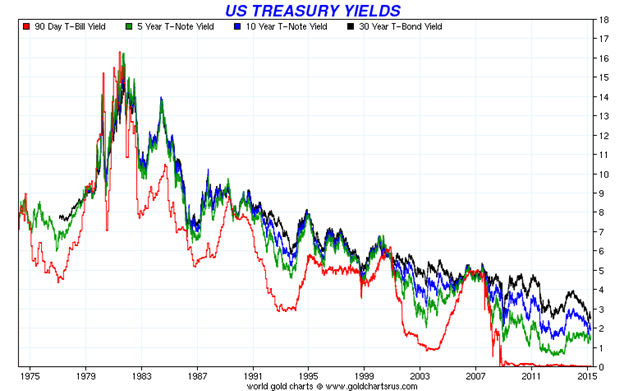
A report published this month by Morgan Stanley and consultants at Oliver Wyman argues that “the closest parallel to today’s scenario occurred in 1994, when an increase in Fed rates was followed by a 5 per cent outflow from fixed-income funds.”
Today such funds are holding roughly 7 per cent of their assets in cash with which to weather potential outflows. However, the article warns that “many bond watchers are nervous that the fundamental changes in the financial world make historical parallels misleading”, particularly the “scale of the market”.
U.S. mutual funds which make up half of the global total have doubled to $15 trillion since 2008.
“Since that 1994 Fed rate rise, the US’s bond-invested mutual funds have grown sixfold to more than $3 trillion today.”
Since 2000, the global bond markets size has nearly tripled in size. Today it is worth more than $100 trillion and it is backed by and intertwined with the gargantuan $550 trillion plus derivatives market.
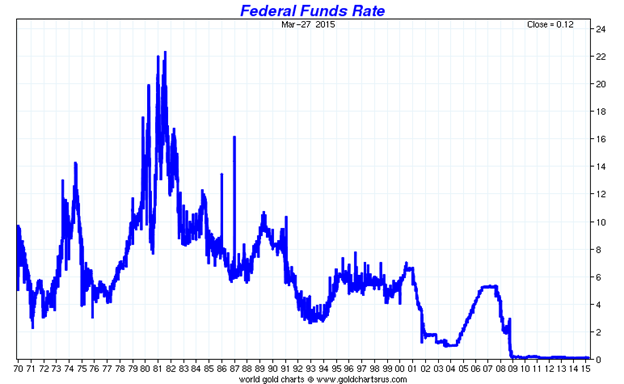
It continues
“Expanded markets might normally be more liquid, but not this one. Thanks to the crisis and post-crisis regulation, investment banks no longer fulfil the same kind of market-making role they used to. At a time of volatility and potential large-scale selling, the absence of such a buffer is likely to add to the downward pressure on prices.”
Downward pressure on prices will mean higher interest rates – potentially sharply and rapidly higher.
This perceived weakness has caused what the FT describes as “global policy makers” to designate some larger funds and the companies that run them as “Systemically Important Financial Institutions” – SIFIs – along with some banks and insurers.
“So bank-style capital charges for asset managers now look unlikely.”

“Gates” that limit investor withdrawals from a fund in troubled times are a possibility. Stress tests, focused on funds’ liquidity positions, seem probable. And standardised disclosures of cash and hidden leverage (through derivatives exposures) are also expected.”The developing bail-in regime also poses risks to investors in bonds who could find their investment “bailed in.”
“Gates” are capital controls that would make bond funds less liquid and pose risks to investors and pensioners.
The FT suggests that these measures will come too late:
“With a Fed rate rise expected as early as June, the world will soon find out the hard way whether the asset management industry is a systemic risk or not.”
Investment managers are now over allocated to bonds due to their perceived safe haven status. Conversely, gold remains under allocated to in investment and pension portfolios globally. The majority of investment and pension funds having no allocation to gold whatsoever.
Gold will again act as a hedging instrument when safe havenbonds come under pressure in the coming months and the global bond bubble bursts.
Must read research on developing bail-in regimes including world’s top 50 banks here:
Protecting Your Savings In The Coming Bail-In Era
From Bail-Outs to Bail-Ins: Risks and Ramifications
MARKET UPDATE
Today’s AM fix was USD 1,179.25, EUR 1,098.84 and GBP 797.95 per ounce.
Yesterday’s AM fix was USD 1,187.40, EUR 1,095.01 and GBP 800.36 per ounce.
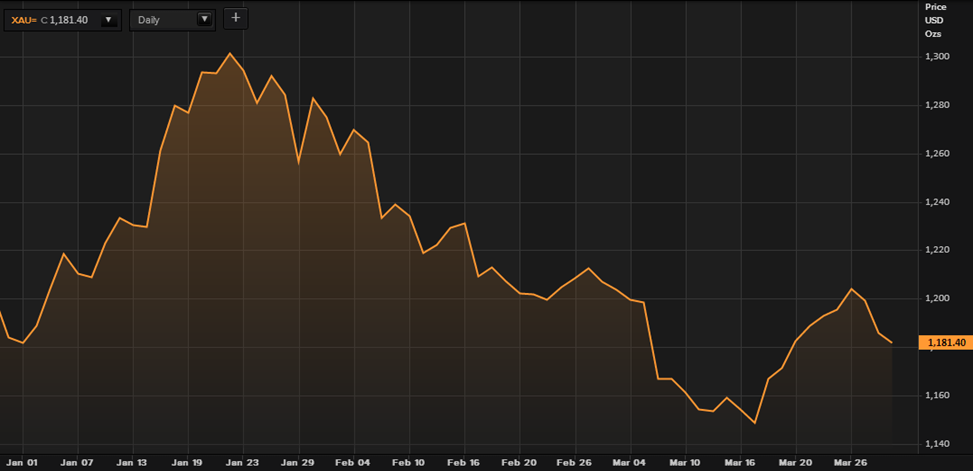
Gold in USD – Q1, 2015 – (Thomson Reuters)
Gold dropped 1.1 percent or $13.20 and closed at $1,185.50 an ounce yesterday, while silver lost 1.42 percent or $0.24, closing at $16.71 an ounce. Overnight in Singapore, gold prices fell marginally to touch a low of $1,179 per ounce but in London gold prices have eked out small gains.
Gold looks set for a third quarterly decline, though as it is only down by $2 since the close on December 31st 2014 and it will be interesting to see if it closes lower. Bullion banks may wish to “paint the tape” and ensure a lower quarterly close to keep animal spirits in the gold market muted and encourage momentum traders to go short.
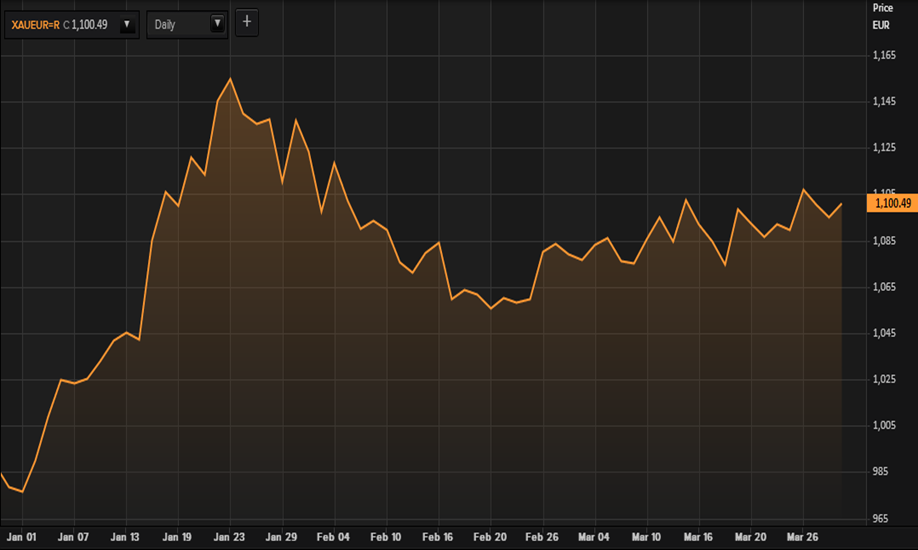
Silver prices are again outperforming and are up by over 5% in dollar terms, from $15.66 to $16.60 per ounce, and more in sterling and euro terms.
Platinum is down 6.6% and palladium is this quarter’s biggest faller among the precious metals, down 7.1%.
Gold prices in sterling and particularly euros has seen strong gains in the quarter and we believe that this is a forerunner to higher gold prices in dollar terms this year.
Updates and Award Winning Research Here
end
James Turk lays out perfectly for us the dangers of a collapse of Greece. He states correctly that a default will rock markets and send contagion throughout the globe.
(courtesy James Turk/Kingworldnews/Eric King)
Greece likely to default within two weeks, Turk tells KWN
8:30a PHT Tuesday, March 30, 2015
Dear Friend of GATA and Gold:
Greece likely will default on its debts to the European Central Bank, the International Monetary Fund, and other bondholders within the next two weeks as a run on Greek banks continues, GoldMoney founder and GATA consultant James Turk tells King World News today, adding that this will probably rock the markets. An excerpt from the interview is posted at the KWN blog here:
http://kingworldnews.com/ecb-to-steal-greek-bank-deposits-as-greece-to-d…
CHRIS POWELL, Secretary/Treasurer
Gold Anti-Trust Action Committee Inc.
end
Zero hedge discusses the 10 tonnes of gold leaving the FRBNY.
(In my opinion, the 30 tonnes of gold that zero hedge talks about is really the Ukrainian gold that never entered USA soil ( the FRBNY) but was deposited at Frankfurt after being airlifted from the UKraine in late 2014. However it was credited against what the USA owes Germany)
(courtesy zero hedge)
Gold In Fed Vault Drops Under 6,000 Tons For The First Time, After 10th Consecutive Month Of Redemptions
Two months ago, when looking at the most recent physical gold withdrawal numbers reported by the Fed, we observed something peculiar: between the publicly reported surprise redemption by the Netherlands (122 tons) and the just as surprise redemption by the Bundesbank (85 tons), at least 207 tons of gold should have vacated the NY Fed’s gold vault. Instead, the Fed reported that in all of 2014 “only” 177 tons of gold were shipped out of the massive gold vault located 90 feet below 33 Liberty Street. Somehow the delta between what we “shipped” and what was “received” in the past year was a whopping 30 tons, or about 15% of the total – a gap that is big enough to make even China’s outright fraudulent trade numbers seems sterling by comparison.
This prompted us to ask:
“what happened? Did an intern input the Fed’s gold redemptions figures for December, supposedly a different intern than the one who works at the IMF and who caused a stir earlier this week when the IMF, allegedly erroneously, reported that the Dutch – after secretly repatriating 122 tons of gold – had also bought 10 tons of gold in the open market for the first time in nearly a decade.
Or perhaps some “other” bank, central or commercial, decided to offset the redemptions by the Netherlands and Germany, and inexplicably added 30 tons of gold in December? The question then becomes: “who” deposited said gold, especially when one considers that even the adjoining JPM vault which is allegedly connected to the NY Fed by a tunnel, only contains some 740K ounces of gold, or about 23 tonnes.
Or is it simply that when it comes to accurately reporting the flows of physical gold, classical math is incapable of keeping track of the New Normal gold moves, and the Fed has decided that even when dealing with physical gold there is a “settlement” period?
We still don’t know the answer, and while the Fed has not revised its vault gold data, one thing is clear: the slow, stealthy and steady withdrawal of gold from the NY Fed continues.
According to the most recent earmarked gold data reported by the Fed, in the month of February another 10 tons of gold departed the NY Fed, following 20 tons in the month before – the tenth consecutive month of redemptions – which if one assumes is merely the delayed relocation of gold previously demanded for delivery, has crossed the Atlantic and is now to be found in Frankfurt.

This means that after 177 tons of gold were withdrawn in 2014 – the largest year of gold redemptions since 2008 when 230 tons of gold departed the NY Fed vault – another 30 tons of parked gold has been recalled to their native lands so far in 2015.
This also means that for the first time in the 21st centurythe total gold tonnage held at the NY Fed is now under 6000 tons, or 5,989.5 to be precise.
But most importantly it means that all of the 207 tons in Dutch and German withdrawals are now accounted for with a matched and offsetting “departure” at the Fed. Which is why the next monthly update of the Fed’s earmarked gold will be especially interesting: if March data shows that the withdrawals continue, it will mean that either Germany, or some other sovereign, has continued to redeem their gold which for some reason they no longer trust is safe lying nearly 100 feet below street level on the Manhattan bedrock.
end
Lawrence Williams discusses the true gold flows as he uses the brilliant work of Koos Jansen:
(courtesy Lawrence Williams/Mineweb)
China gold flows to hit Q1 record

Withdrawals from the Shanghai Gold Exchange (SGE) remain exceptionally high despite being expected to drop following the Chinese New Year holiday. In the three weeks of trading since the holiday’s end, withdrawals from the exchange have totalled 149 tonnes which would seem to belie other reports that demand is slipping.
The latest figure from the SGE is for the movement of 53 tonnes out of the Exchange during week 11 (ended March 20), following 51 tonnes a week earlier and 45 tonnes in week 9. Total to March 20 is thus already 561 tonnes. So withdrawals from the SGE appear to be rising week on week at a time when they would normally expect to be falling back after the holiday buying spree has ended. Should the gold flows out of the exchange continue at this kind of rate, then the Q1 total figure will be of the order of 620-630 tonnes – comfortably a new Q1 record.
Even at the lower end of the likely Q1 flow level this would be 10% up on the previous highest Q1 withdrawal amount, which was 564 tonnes (this has almost been reached already with flows for seven working days yet to be announced) recorded a year ago when the full year figure was 2,102 tonnes. QI withdrawals will thus undoubtedly set a new record.
If this increase figure is indicative of the year ahead the China gold flows, as represented by SGE withdrawals, could this year reach a new record 2,300 tonnes or more – getting on for 75% of new mined supply assuming this is flat this year – CPM suggests, though, it will actually be 4.6% higher as recent new projects and expansions reach full capacity.
See: Further downside on gold prices limited – CPM
There are reports, though, that Asian demand has slipped back in the past week as the gold price rose with premiums dropping significantly in India and China. It remains to be seen as to how much this affects gold flows for the past week and in the weeks ahead.
As we noted in the recent article on the CPM Gold Yearbook findings, there is some disagreement over whether the SGE figures represent an accurate picture of total Chinese wholesale demand. CPM reckons there is a significant element of double, or even triple, counting in movements of gold from fabricators in and out of the exchange. But Koos Jansen, who probably follows the SGE figures more closely than anyone and also is something of an expert on the SGE’s rules and regulations, feels that this is incorrect, at least as far as significance is concerned. He does say though that the launch of the international section of the SGE – the SGEI – which can represent gold flows in and out of China without them landing in the domestic market, could distort the figures a little, but reckons this level is very small as his investigations have revealed that most SGEI handled gold is ending up in China in any case.
Indian demand is also said to have surged in the month following the February budget when, contrary to expectations, the import duty on gold was not relaxed from its 10% level. There are also reports that the real Indian flows are much higher as gold smugglers become more adept in getting quantities of gold into the country to take advantage of the duty-induced premiums prevailing on the open market. But again, Indian demand also looks as though it may have slipped as the gold price rose. But with the Akshaya Tritya festival coming up next month, when it is seen as auspicious to buy gold, and with prices falling back below the $1200 level on Friday, this demand could pick up again.
end
This is interesting: not only the Euro has never been this short but also gold. It looks like the boat is about to spring a leak;
(courtesy zero hedge)
Crowded Trade 2.0: Specs Have Never Been More Short Gold Or The Euro
The Long US Dollar, Short US Treasuries trades were the ‘most crowded’ earlier this year and while both have derisked modestly from record highs, this week saw the net speculative position in EURUSD futures surge more negative and has never been shorter. Along similar ‘strong dollar’ lines, as Bloomberg reports, net long positions in Gold have dropped to their lowest since Dec 2013 and outright Gold short positions rose for the seventh week in a row to the highest since data began in 2006.
Specs have never been more short The Euro against the US Dollar…

And gold shorts have never been higher…

So everyone on one side of the Strong Dollar boat… apart from The Fed…
Charts: Bloomberg
end
Bill Holter delves into the mess inside the Middle East:
(courtesy Bill Holter/Miles Franklin)
Duck and cover …what could possibly go wrong?
I can still remember being in elementary school and the alarm going off in the middle of class, it was time to practice “duck and cover”. Another practice drill was when all six grades would march to the basement of the building and huddle in the boiler room, a potential nuclear war at any time was very real to us in the old days. It’s different today, everyone “knows” a nuclear war can nor will ever happen. It can’t happen because our leaders driving the bus are too smart to ever go down that road …right?
And now for the important paper stories for today:
Early Tuesday morning trading from Europe/Asia
1. Stocks generally lower on major Chinese bourses /yen rises to 119.89
1b Chinese yuan vs USA dollar/yuan slightly strengthens to 6.1996
2 Nikkei down by 204.41 or 1.05%
3. Europe stocks in the red/USA dollar index up to 98.42/Euro falls to 1.0752
3b Japan 10 year bond yield .39% (Japan buying 100% of bond issuance)/Japanese yen vs usa cross now at 119.89/Maintains rise in Japanese 10 yr bond yield/Japan losing control over their huge bubble of a bond market/
3c Nikkei still barely above 19,000
3d USA/Yen rate now just below the 120 barrier this morning
3e WTI 47.61 Brent 54.99
3f Gold par/Yen up
3gJapan is to buy the equivalent of 108 billion uSA dollars worth of bond per month or $1.3 trillion. Japan’s GDP equals 5 trillion usa.
Japan to buy 100% of all new Japanese debt and by 2018 they will have 25% of all Japanese debt. Fifty percent of Japanese budget financed with debt.
3h Oil down for WTI and down for Brent this morning despite the fact a proxy civil war continues in Yemen
3i European bond buying continues to push yields lower on all fronts in the EMU
Except Greece which sees its 2 year rate slightly rises to 21.64%/Greek stocks up by .54% today/ still expect continual bank runs on Greek banks.
3j Greek 10 year bond yield: 11.19% (up by 20 basis point in yield)
3k Gold at 1184.00 dollars/silver $16.65
3l USA vs Russian rouble; (Russian rouble down 1/4 rouble/dollar in value) 58.17 , falling with the lower brent oil price
3m oil into the 47 dollar handle for WTI and 54 handle for Brent
3n Higher foreign deposits out of China sees hugh risk of outflows and a currency depreciation. This scan spell financial disaster for the rest of the world/China may be forced to do QE!!
30 SNB (Swiss National Bank) still intervening again in the markets driving down the SF
3p Britain’s serious fraud squad investigating the Bank of England/ the British pound is suffering
3r the 7 year German bund still is in negative territory/no doubt the ECB will have trouble meeting its quota of purchases and thus European QE will be a total failure.
3s Eurogroup reject Greece’s bid for more euros of bailout funds as proposal is to vague. The ECB increases ELA by 1.5 billion euros up to 71.3 billion euros. This money is used to replace fleeing depositors.
3t Bloomberg calculates Greece’s shortfall in March at 3.5 billion euros.
4. USA 10 year treasury bond at 1.95% early this morning. Thirty year rate well below 3% at 2.55%/yield curve flatten/foreshadowing recession.
5. Details Ransquawk, Bloomberg, Deutsche bank/Jim Reid.
(courtesy zero hedge/Jim Reid Deutsche bank)
Futures, Oil Slide As Surging Dollar Now Takes Window Dressing Stage
Did stocks window dressing come one day early in this volatile, bipolar, stop-hunting, HFT-infested market? Looking at futures this morning, which are down about 12 points already on yet another surge in the USD which has sent the EURUSD just above 1.07, the lowest since March 20 , and the USDJPY back under 120 now that the “strong dollar is bad for stocks after all” algo seems to be back from vacation, all those hedge funds who chased risk higher yesterday because their peers did the same, may find they are all selling on the way down. It will be oddly ironic if all of yesterday’s widely touted gains evaporate comparably in the first 10 minutes of trading today, and lead to an end in the longest streak of quarterly increases in two decades.
To be sure, China already did, with another early surge in the SHCOMP seeing a 1% pull back in late trading, driven by reports of foreigners getting out ahead of the inevitable tsunami of local high schoolers selling. Japan did not fare much better and the Nikkei also dropped 1% as the last day of the month across Asia has seen broad based selling. For now Europe is buckling the trend with Eurostoxx up modestly, however with newsflow out of Greek negotiations hardly favorable, the question is will the weakness in the EUR be enough to offset yet another day of fundamental insecurity about the future of the Eurozone. As a reminder, every day that Greece remains without a deal is one day closer to a bankruptcy and/or bank run that tips its banks over the edge leading tot he same outcome.
Crude likewise has seen a bout of weakness driven by the drop in the EURUSD, as well as reports from ISNA that a draft agreement was being written up between western powers and Iran over the country’s nuclear enrichment program. As a result Brent extends its drop into the 3rd day, falls below $56 with WTI under $48 as Iran nuclear talks move into final day of high-level diplomacy. Events in Yemen, outcome of Nigeria elections also watched. “The main thing the mkt is looking at is the headlines out of Lausanne, where it looks like at least they will reach a political agreement ahead of today’s deadline,” Petromatrix oil analyst Olivier Jakob told Bloomberg. “There is still a bit of a question mark on sanctions and the pace of returning oil, but it is heading too that and more supply on the mkt and that is not good in terms of price.” Keep an eye on flashing red Iran headlines which will likely led to even more jagged and stop-hunting WTI trading this morning.
Crude futures and metal prices trade lower this morning alongside another climb higher in the USD which has caused WTI and Brent to fall over USD 1 and Brent edging back towards USD 55 amid a de-escalation of concerns over Yemen.
On the macro front there has been little news this morning or overnight, which means equity indices in Europe trade only marginally higher although the FTSE 100 is underperforming alongside lower crude and metals prices. On the subject of UK asset classes, GBP saw a small lift following a slightly higher than expected revision for Q4 GDP at 0.6% vs. Exp. 0.5% Q/Q, however this failed to dictate medium-term price action. Tobacco names in the UK are underperforming in early trade after early reports from the NY Post that FTC staff are recommending a suit to block the USD 27bln merger of Reynolds American (RAI) and Lorillard (LO). Although today sees the final trading day this month and quarter, markets are relatively quiet heading into the Easter weekend and market closes on Friday. This means fixed income markets have seen little price action this morning and trade largely range-bound. European equities then trimmed their gains following disappointing Eurozone CPI and unemployment figures, the unemployment rate coming in higher-than-expected and January’s reading also revised higher.
Regarding Greece, EU’s Tusk said that a deal for Greece could still get completed by end of April but does not expect anything before Easter. Greek press TVXS then reported that officials have said an agreement is very close for Greece and could come within the next 1 or 2 days, however, officials from Greece said a deal had not been agreed with the Troika and talks could continue into next week.
- Eurozone CPI Estimate (Mar) Y/Y -0.1% vs. Exp. -0.1% (Prev. -0.3%)
- Eurozone CPI Core (Mar A) Y/Y 0.6% vs. Exp. 0.7% (Prev. 0.7%)
- Eurozone Unemployment Rate (Feb) M/M 11.3% vs. Exp. 11.2% (Prev. 11.2%, Rev. 11.4%)
The USD index has extended on gains this morning and trades higher by 0.6% after an earlier break above the 50% Fib retracement of the pre-FOMC high to recent low, and a further slide in EUR evident after a break below Friday’s low. Commodity-linked currencies have also seen selling pressure, most notably in AUD & NZD as commodities trade lower across the board in reaction to a stronger USD and traders also noting quarter-end rebalancing is driving sales in AUD/USD & NZD/USD into the London fix. Analysts also note that moves in equities today could lead to selling pressure in CAD, EUR and GBP in Q-end, whereas USD/JPY could see a small bid as >USD 500mln is expected to be bought in the pair.
Bulletin headline summary from Bloomberg and RanSquawk
- Month and quarter-end demand for USD sees the index extend on gains although equity markets drift with little macro news to drive prices
- FTSE 100 underperforms peers as commodities slide alongside a stronger USD and tobacco names weigh on the index
- Looking ahead focus will turn to data from the US with the latest Chicago PMI due for release, API inventories after-market, and GDP from Canada
- Treasuries steady, headed for fifth consecutive quarterly gain amid weak eco data. dovish Fed, USD strength, lower energy prices; volumes expected to be light before payrolls report on Good Friday.
- Greek PM Tsipras sought to rally a consensus in parliament for his effort to secure bailout funds after his proposals to bolster the nation’s finances failed to satisfy his European creditors
- Germany’s jobless rate fell to 6.4% in March, lowest on record, as number of people out of work declined 15k to 2.8m
- Euro-area’s inflation rate rose to minus 0.1% in March from -0.3% the previous month, the fourth consecutive reading below zero and in line with median estimate in a Bloomberg survey
- China said an insurance system for bank deposits will start on May 1, a step toward scrapping remaining controls on interest rates and allowing lenders to fail in a more market-driven economy
- Iron ore is headed for the biggest quarterly loss since at least 2009 as surging low-cost supplies from Australia and Brazil swamp the global market, spurring a glut as demand from China slows
- The near-collapse of Duesseldorfer Hypothekenbank AG, the German lender hit by Heta Asset Resolution AG’s debt moratorium, was prompted in part by a margin call from Eurex, people familiar with the matter said
- Iran and world powers are weighing compromises in order to overcome a deadlock in nuclear talks with little more than 12 hours to reach an agreement
- Obama will face a leviathan task selling any deal to a skeptical Congress; if no deal is reached, he will face an equally daunting challenge of holding off congressional moves to impose new sanctions on Iran
- Sovereign 10Y yields mixed, Greece 10Y +22bps to 11.36%. Asian stocks mixed, with Nikkei lower, Shanghai higher. European stocks, U.S. equity-index futures decline. Crude, gold and copper fall
DB’s Jim Reid summarizes the main overnight events
Back to markets yesterday, US equities kicked off the week on a firmer footing as the S&P 500 (+1.22%) recorded its first back-to-back gains in 28 trading days, remarkably the longest such stretch in 21 years. Treasuries were a touch tighter across the curve yesterday, with the 10y benchmark in particular closing 1.4bps tighter at 1.948%. The Dollar had a better day also as the broader DXY closed +0.67%, bucking a recent trend of the Dollar and equity markets moving inversely. In fact, looking closer at the relationship between the two, the 90-day correlation coefficient between the DXY and S&P 500 recently dipped into negative territory earlier this month having traded positive for most of 2014 and YTD so far. Looking further back, the last significant period of positive correlation between the two asset classes was in the early 2000s while the correlation completely reversed post the financial crisis from end-2008 to end-2013. Q1 earnings season, which is due to kick off next week, will likely give an indication into the impact at the micro level from a stronger Dollar. Interestingly, data on Bloomberg shows that profits for S&P 500 companies are expected to decline for the next 3 quarters, with history telling us that for periods of nine months or more a bear market was the end result in 82% of cases over the past eight decades.
While China – which we’ll touch upon shortly – supported the better sentiment yesterday, M&A was also a theme, as deals in the pharma sector in particular helped the risk-on tone. In fact, gains were broad based generally across equity markets and led by energy stocks (+2.10%) despite a relatively subdued day in oil markets as WTI (-0.39%) and Brent (-0.21%) closed modestly weaker. Data on the other hand was somewhat mixed. A better than expected personal income reading (+0.4% mom vs. +0.3% expected) was some offset by a softer personal spending print (+0.1% mom vs. +0.2% expected). The PCE deflator was as expected for February at +0.3% yoy while the core rose one-tenth of a percent to +1.4% yoy (and ahead of expectations of +1.3%). Pending home sales rose significantly however. The February +12.0% yoy reading was up nearly 6% from the previous reading and also well ahead of market expectations of +8.7%. The reading was in fact the highest since April 2013. Finally the Dallas Fed manufacturing index was weak at -17.4 (vs. -8.8 expected), with depressed oil prices clearly having an effect.
Moving onto China, after markets were initially encouraged by the comments from the PBOC’s Zhou over the weekend that growth had slowed more than desired and that the economy has more room to move if needs be, the PBOC acted almost immediately with a loosening of measures in the housing market. Specifically, the government cut the downpayment ratio for second homes from 60% to 40% and the minimum downpayment ratio for first home buyers (who utilize their ‘housing funds’) to 20% from 30%. Our China Chief Economist Zhiwei Zhang believes that these measures may help to mitigate the downturn in the property sector in the next few months but does not believe that such an easing will lead to a sustained recovery, as the structural oversupply in tier 3 and tier 4 cities take time to be absorbed. Zhiwei continues to expect more measures in Q2, including an RRR cut in early April and an interest rate cut in May. Zhiwei also continues to reiterate his forecast of GDP growth of 6.8% in Q1. Having opened strongly, markets in Asia have given up some early gains although are still in positive territory. In China the Shanghai Comp (+0.11%) and CSI 300 (+0.50%) are firmer while the Nikkei (+0.10%) and Hang Seng (+0.47%) are also a touch higher.
Staying on the topic of central banks, and monetary policy implementation in particular, a couple of stories on the ECB and BoJ caught our eye yesterday. Starting with the former, the WSJ yesterday reported that the ECB may have to adapt the rules around its current bond-buying program given the short supply of German bonds available. The article notes that, given the restrictions on purchases below -0.2% in yield, the ECB’s rules prevent it from purchasing around 42% of already issued German bonds, compared to 28% when the program started. Despite Draghi previously downplaying such an issue, further downward pressure on German yields could potentially limit the ECB’s available pool.
Meanwhile, the Nikkei Asian Review yesterday reported on a BoJ working paper released earlier this month that suggested that bond-market liquidity is declining and that the BoJ’s government bond purchases are tightening the demand balance. The results of the paper said multiple indicators suggested bond market liquidity is declining and that while not officially being the view of the BoJ, commented that the view could soon represent the official BoJ stance given that the authors are also responsible for analyzing the JGB market in the banks official Financial System Report, released in April. Interestingly BoJ policymakers have already somewhat acknowledged the issue, with the minutes from the February board meeting saying that ‘a few members pointed to the possibility that the recent rise in rates reflected a decline in market participants risk tolerance and deterioration in market functioning’. Food for thought if anything.
Turning to markets in Europe yesterday quickly, it was a similar story for equities as the Stoxx 600 (+1.09%), DAX (+1.83%) and CAC (+0.98%) all closed higher. Core government bond yields were little changed although 10y yields in Italy (-4.3bps) and Spain (-5.1bps) both tightened. Data was generally supportive on the whole. The preliminary March CPI print for Germany was as expected at +0.3% yoy (+0.1% yoy harmonized) while the Euro-area economic confidence indicator rose 1.6pts to a better than expected 103.9 (vs. 103 expected) – the highest since July 2011. In the UK mortgage approvals in February rose to 61.8k and a touch above consensus of 61.5k. Net consumer credit (£0.7bn vs. £0.9bn expected) was slightly below market while net lending (£1.7bn vs. £1.6bn expected) was above.
Greece continues to be front and centre in Europe and yesterday we heard Euro-area officials push back on the governments ‘list’ submitted on Friday. Despite various positive headlines coming out of the Greece side of talks progressing constructively, it appears that more detail and substance is needed from the Greek side with an EC spokesman saying that the institutions’ technical teams would need to conduct further fact finding in Athens. Following the news, PM Tsipras last night addressed parliament in Athens in a bid to help draw support behind the current government’s strategy. Tensions within the parliament continue to run high however highlighting the current fragile state politically. New Democracy leader Samaras was quoted in Greek press (Ekathimerini) as saying that ‘you took over a country and are preparing to throw it into chaos’, while also warning on a potential ‘credit event’ should the government fail to meet the upcoming IMF payment.
Turning to today’s calendar, we kick off this morning in Europe with German retail sales and unemployment as well as French consumer spending data. The first March estimate for Euro-area CPI will likely attract most of the attention this morning however while unemployment data is also due for the region. Q4 GDP in the UK is also due up. Across the pond this afternoon, we kick off data releases in the US with the ISM Milwaukee shortly followed by the S&P/Case Shiller house price index. The Chicago PMI and March consumer confidence index print round off the releases. There’s also plenty of Fedspeak for us to keep an eye on with Fischer, Lacker, Lockhart, Mester and George all due to speak today.
Summing Up The Total Chaos That Reigns In Greek “Negotiations”
Forget Pyrrhic victories, the more Greek tongues that wag, the clearer it becomes that no one appears to have a clue what is going on. The contradictory tonefrom various Syriza members has allowed the opposition to sit quietly by (with the odd jab from Samaras) and watch the collapse unfold. The more threats and promises Tsipras makes, the more cornered he becomes as cash outflows accelerate and cash demands loom. It appears all over bar the printing as both sides are now just posturing for who bears the blame for the ultimat exit, as one wit noted, “once you remove walking away from a deal as an option, you are no longer negotiating.”
As The Guardian reports, Greek PM Tsipras made a lot more promises…
A defiant Alexis Tsipras has vowed to win an honourable compromise from Greece’s lenders, after negotiations over economic reforms dragged on without a deal.
Greece’s PM told parliament tonight that: “It is true that we are seeking an honest compromise with our lenders but don’t expect an unconditional agreement from us,”
Tsipras vowed to stop ‘the bleeding’ in Greece, and repeatedly argued that the country needs a new debt restructuring deal. Greece has a simple choice, he argued, between surrendering, or changing the policies that have caused such economic misery.
He pledged to end the ‘pillaging’ of the middle classes, and revealed that a new clampdown on unpaid taxes had already delivered 100 million euros.
Tsipras also ruled out raising sales taxes on food and medicine, or shaking up the labour market, as these “red line” measures could plunge Greece back into recession.
But all around him are contradictions (and we are talking some exemplary contradictions in the last few days…)
“The only way for Greece to end its crisis is through confrontation, if not conflict, with a Germanized Europe,” – Greek Energy Minister
Or…
“We seek an honest compromise with our partners” – Greek PM Tsipras
And This,,,
“Privatizations won’t happen” – Greek Energy Minister
Or..
“the sale of Piraeus Port will be completed soon” – Greek Deputy PM
And finally…
“Greece won’t abandon its anti-austerity philosophy in return for aid “ – Greek International Affairs minister
and…
“Tsipras imagined he’d get money without terms but ended up getting terms without money” – Ex-PM Samaras
Meanwhile, markets are not buying it and Greek risk is surging once again…

Finally, as The Guardian concludes, Greece and its creditors need to meet halfway to avoid the crisis…
If Greece dropped out of the eurozone, in an accidental “Grexit”, the consequences would be far-reaching. Not only would it damage the EU’s monetary union, the EU itself would be weakened geopolitically. Mr Tsipras must show he has the credentials to be a realistic partner.
But, equally, Greece’s lenders must walk a fine line to prevent a breakup of the European project. Just as importantly for the EU’s democratic credibility, there must be room for negotiation. In Greece as in any country, it is never a good thing when voters’ choices end up being ignored.
The question now is – what will happen to Italian and Spanish sovereign spreads?

Despite all the Draghi-juice, spreads are already widening notably – this may just be a glimpse of what’s next for Europe in which everyone has been ploughing their excess cash..
end
Bill Holter will go over this tomorrow, but suffice it to say, we are going to see many more of these:
today: The big DuesselHyp bank blows ups due to a margin call on only 350 million euro loss by Eurex (like AIG). All banks have been using these types of deposits as risk free and then using them as collateral against many purchases.
(courtesy zero hedge)
AIG Lite: Margin Call Claimed First Foreign Casualty Of Austrian “Black Swan”
We’ve written quite a bit lately about Austria’s Heta, the bad bank gone… well, bad, or as we’re fond of calling it,Austria’s Black Swan. Recapping, an outside audit identified a €7.6 billion hole in the vehicle’s balance sheet, prompting the institution of a debt moratorium. Unfortunately, Austria’s Carinthia province had guaranteed more than €10 billion in Heta debt, which is five times the state’s operating revenue meaning it is, for all intents and purposes, insolvent and unless Austria wants to go the unprecedented route of allowing a provincial bankruptcy, the sovereign will need to step in in one way or another. The next shoe to drop was the German lender DuesselHypwhich itself faced insolvency thanks to around €350 million of Heta debt it held on its balance sheet.
While we wait to see which “well capitalized” bank will be the next to crumble under the weight of mountainous writedowns occasioned by the sudden souring of “riskless” assets, we get to read the DuesselHyp post-mortem,which shows that the bank was effectively AIG’d by Eurex. Here’s more via Bloomberg:
Eurex, Europe’s largest derivatives market, asked DuessHyp to post additional collateral as the German bank faced writing down its 348 million euros ($375 million) of bonds issued by Austria’s Heta, said the people.
The hit to the bank’s capital from the Heta losses and the extra posting of margin forced the lender, laden with swaps, to seek a rescue, said the people.The Association of German Banks, or BdB, on March 15 said it would back DuessHyp, a lender to public entities, and a day later agreed to buy the company from U.S. private equity firm Lone Star Funds…
Apparently, DuessHyp had more than $13 billion in interest rate swaps on its book, a holdover from the bank’s “old” business model which, according to Fitch, involved underwriting “all sorts” of things:
“This is mostly a legacy from the past, because before the crisis they underwrote all sorts of assets from different countries and in different currencies and they used swaps to hedge the risks.”
DuessHyp was in the process of changing its business model ever since it had to be bailed out for the first time in 2008. The bank planned to exit low-margin public sector lending and establish itself as a niche commercial real estate lender, it said in its annual reports since 2009.
It appears that due to the 0% risk weighting applied to public debt, the bank was grossly undercapitalized:
Its balance sheet continues to be dominated by legacy assets linked to public sector borrowers — such as the Heta bonds due to their guarantee from the Austrian province of Carinthia. That allowed the bank to run on very little capital compared to its total assets.
With 59 percent of DuessHyp’s balance sheet being public sector loans, which are deemed risk-free under European banking rules, assets weighted for risk amounted to 2 billion euros. That left the bank with a core capital ratio of 11.6 percent by the end of June, more than twice the legal minimum.
Meanwhile, its leverage ratio, which compares capital to total assets, was 2.1 percent, or half the average of major European banks, according to data compiled by Bloomberg.
Or, as we put it nearly a month ago: “the very same bonds that are about to lead to a waterfall in impairments are the ones that were, according to EU regulations, ‘riskless.’ One can only imagine how much latent risk Europe’s bank have as a result of the supremely idiotic decision to keep a major subsection of European debt as 0% RWA.”
* * *
So, now that billions of soured “riskless” debt has claimed the financial lives of an Austrian province and a “well capitalized” German lender, we wonder how long it will be before someone wakes up to the fact that applying a 0% risk weighting across the board — as if every piece of paper that’s ostensibly backed by the full faith and credit of a public sector borrower is somehow equivalent to a German bund — may not be prudent.
We won’t hold our breath, but at least the powers that be appear to have picked up the scent (via Bloomberg from earlier this month):
Government debt can no longer be considered a risk-free asset for banks, and international regulators should consider changing the existing legislation, the European Systemic Risk Board said.
“If sovereign exposures are in fact subject to default risk, consistency with a risk-focused approach to prudential regulation and supervision requires that this default risk is taken into account,” the ESRB said in a report on Tuesday, citing the majority view among its panel of experts. “Current prudential regulation of sovereign exposures is inconsistent with the conceptual approach that underlies the existing system of regulation.”
Mario Draghi, who heads both the ESRB and the European Central Bank, is pushing for a regulatory review prompted by five years of turmoil in government debt markets that almost splintered the euro area.
European Jobless Rates By Country: Youth Unemployment In Greece, Spain Remains Over 50%
Earlier today, the supposedly resurgent Eurozone reported a February unemployment number of 11.3%, which not only missed consensus but was worse than the highest estimate. This miss meant the recent steady trend of improvement would have halted if January’s unemployment print of 11.3% hadn’t been revised higher by 10 bps.

Still, 11.3% is better than the 11.8% reported a year ago, and as the chart below shows, the trend is certainly Europe’s friend if only for the time being. One does wonder, however, how much of the improvement is due to the borrowing the BLS’ favorite tradition of lowering the denominator and artificially reducing the eligible labor force by “eliminating” those who have been out of a job for a long enough period.

Statistical gimmick or no, one thing stands out: the biggest threat for Europe’s future remains front and center – it is the youth (under 25) unemployment, which at 22.9%, and just barely below the 24% from a year ago. Worse, in the two most troubled European nations, Greece and Spain (with Italy not far behind), it remains well over half.

So while the ECB is desperately focused on masking the biggest issue plaguing Europe’s financial system which is the several trillion in undisclosed bad loans on the books of bank balance sheets, Europe may want to address what is the real demographic timebomb, and one which assures that the current experiment will surely end in either the war or revolution predicted by Paul Tudor Jones, because when half the population spends its days without hope or a sense of responsibility, the only possible outcome is quite clear and it is also quite disastrous for European civil society.
end
The following is why the ECB is going to have a terrible time trying to fulfill its mandate of purchasing 1.1 trillion euros of sovereign or asset backed securities. There is now almost 2.1 trillion euros of European debt having negative rates and almost 1 trillion of that is not eligible for purchase.
As we stated from the outset: the ECB will not succeed in its purchases as there is not enough out there and second of all, their actions destroy the shadow banking sector as this sector needs the collateral that which the ECB buys outright.
(courtesy zero hedge)
Almost $3 Trillion Of European Debt Has Negative Rates As German Yields Collapse Further
As German yields hit fresh record lows (and continue to collapse/flatten dramatically) amid Draghi’s monetary excess, the size of ineligible debt surges across Europe. As SocGen notes, before today, there was already a stunning EUR 2.17 trillion of negative yielding debt in Europe (dominated by Germany and France) and today’s moves mean that number is growing rapidly as Germany is now negative to a 7.5 year maturity.
Since Q€ the curve has collapsed…

leaving at least EUR 2.2 Trillion of negative-yielding debt across Europe…

This won’t end well…
Charts: Bloomberg and SocGen
end
Something is going on behind the scenes here:
1. the Federal Fund rates today drops from .12 to .03%
2. the collateral rate for these instruments sees its biggest jump in years
strange!! it is done on the last day of the quarter/what else are they hiding?
(courtesy zero hedge)
“Biggest Jump In General Collateral On Record” Leaves Experts Stumped
While there has been no move in its close cousin, the Fed Funds rate, which actually declined sharply into quarter-end from yesterday’s 0.12% print to just 0.03% following a pattern observed in recent quarters when the FF plunges at quarter end just to rebound to its 0.12%-0.13% range…

… it is what is going on in the far more important (in a world in which Fed Funds is irrelevant courtesy of $2.6 trillion in Fed reserves sloshing around) General Collateral rate that has bond market experts such as Stone McCarthystumped. To wit:
The overnight general collateral rate jumped to 0.38% this morning. The GC rate has seen sharp moves at quarter end in the past, although today’s jump is the largest we have on record. We do not have a definitive explanation for today’s movement, but if any of our readers have an explanation, please let us know.
This is what the largest “on record” jump in GC looks like.

So while SMRA may be stumped, Bloomberg has some ideas, and suggests that the Treasury GC repo trading around 50bps/35bps at quarter-end is due to regulations forcing largest banks to hold more collateral on their balance sheets. Further, mortgage repo traded as high as 70bps, according to TD Securities.
Bloomberg quotes Citi strategist Andrew Hollenhorst who said that higher repo rates indicate “the marginal cost of banks’ unwillingness to expand their balance sheets.” “It’s more of an interdealer phenomenon than for cash investors, though they may see rates move a little higher in sympathy.”
Looking elsewhere at money markets, MM funds have had access to ~$500b in quarter-end collateral via Fed’s O/N, term RRP operations, part of the infamous liquidity quarter end window dressing have discussed extensively in the past.

In other words, while the move in GC is huge, it should normalize tomorrow. Then again, the question remains: just how big is the structural collateral shortage if discontinuities like quarter-end reflect a huge market imbalance between market clearing when everyone rushes to satisfy their regulator, and further begs the question: if banks only satisfy regulatory requirements on just one day of any given quarter, what would happen to the banks if something “unexpected” happened on any of the 89 or so other days during the quarter that don’t happen to fall on month-end?
end
Tonight is the self imposed deadline for an agreement and as of yet, nothing:
(courtesy zero hedge)
The Iran “Talks” – Just Another US vs Russia (And China) Power Game
Update, and just as expected: IRAN NUCLEAR NEGOTIATORS MAY MISS 3RD DEADLINE: U.S. OFFICIAL
In what has been the world’s longest negotiation (we are only modestly joking: the Iran P5+1 nuclear “talks” started in 2013 and have yet to achieve anything) one whose “rolling deadline” has been breached time and time again, it appears that with today’s latest deadline just hours away, the most likely outcome is another deadline extension even though, as Reuters puts it, “Iran and six world powers ramped up the pace on Tuesday in negotiations over a preliminary deal on Tehran’s nuclear program, while officials cautioned that any agreement would likely be fragile and incomplete.”
The negotiations, which we have largely ignored covering as the past has abundantly shown that nothing ever actually gets done except for a lot of talking, posturing, gesticulating and pizza-ordering, have seen the United States, Britain, France, Germany, Russia and China trying to break an impasse in the talks, which are aimed at stopping Iran from gaining the capacity to develop a nuclear bomb in exchange for easing international sanctions that are crippling its economy.
As a reminder, it is the “threat” of an amicable resolution and a resumption in Iran oil exports that has been presented as the cause for oil’s most recent weakness.
According to the conventional narrative “disagreements on enrichment research and the pace of lifting sanctions threatened to scupper a deal that could end a 12-year standoff between Iran and the West over Tehran’s nuclear ambitions and reduce the risk of another Middle East war.”
“The two sticking points are the duration and the lifting of sanctions,” an Iranian official said. “The two sides are arguing about the content of the text. Generally progress has been made.”
They said the main sticking points remain the removal of U.N. sanctions and Iranian demands for the right to unfettered research and development into advanced nuclear centrifuges after the first 10 years of the agreement expires.
Iran said the key issue was lifting sanctions quickly.
“There will be no agreement if the sanctions issue cannot be resolved,” Majid Takhteravanchi, an Iranian negotiator, told Iran’s Fars news agency. “This issue is very important for us.”
The six powers want more than a 10-year suspension of Iran’s most sensitive nuclear work. Tehran, which denies it is trying to develop a nuclear weapons capability, demands a swift end to sanctions in exchange for temporary limits on its atomic activities.
Not surprisingly, “officials played down expectations for the talks in the Swiss city of Lausanne.”
For days they have been trying to agree on a brief document of several pages outlining key headline numbers to form the basis of a future agreement. Officials said they hoped to be able to announce something, though one Western diplomat said it would be “incomplete and kick some issues down the road”.
Negotiations among the parties on sticking points went into the night and continued on Tuesday. They were expected to run late and possibly into Wednesday. Officials said they were hoping to agree on some kind of declaration, while any actual preliminary understanding that is agreed might remain confidential.
It was also possible they would not agree on anything.
And sure enough, with the specter of yet another extension, the talking down of expectations (it snowed in Lausanne) begins:
French Foreign Minister Laurent Fabius and his German counterpart Frank-Walter Steinmeier canceled plans to go to Berlin for a French-German summit on Tuesday. “The negotiations are at a critical and difficult phase, making the presence of both ministers in Lausanne essential,” a German government source said.
The real deadline in the talks, Western and Iranian officials said, is not Tuesday but June 30.
They said the main sticking points remain the removal of U.N. sanctions and Iranian demands for the right to unfettered research and development into advanced nuclear centrifuges after the first 10 years of the agreement expires.
But is that really the case? After all, if all superpowers press Iran, the middle east country will have no choice. According to Iran’s own IRNA news agency there is much more to this story than what the conventional narrative presents, and it once again all boils down to a well-known tension in modern geopolitics: the US and the West vs the rising Russia-China axis.
From IRNA:
The United States and Europe reportedly want the UN Security Council (UNSC) sanctions on Iran to be automatically reversible, meaning that if Iran violates the deal at any point, the UNSC sanctions will automatically be re-imposed on Tehran.
Russia opposes such a scenario, saying in such a case the UNSC should decide what to do. Moscow says automatic imposition of sanctions goes against the mechanism of the Security Council.
China also reportedly shares Russia’s viewpoint and is against the imposition of automatically reversible sanctions on Iran.
The final stage of the ongoing talks between Iran and the P5+1 countries – the United States, Britain, France, Russia and China plus Germany – in Lausanne is expected to continue until Tuesday, which was set as a deadline for reaching mutual understanding in the negotiations.
And there you have it: the reason why the Iran talks have dragged on more than two years, and specifically since the February 2013 “interim agreement”, is not because of Iran’s intransigence (which could have been resolved overnight with a few Swiss bank accounts opened under strategic Iranian personnel’s names or a few NYC duplex apartments), but because this, too, has become one global theater of realpolitik, one in which the fate of Iran’s sanctions is no longer in the hands of Iran, but a function of the power play between West and East.
Keep a very close eye on who prevails, assuming there is a deal, because if the US loses the upper hand, that will certainly explain why two weeks ago US Treasury Secretary Jack Lew was heard complaining that “US International Credibility & Influence Is Being Threatened“…
end
Just look at what happened to Turkey this morning:
(courtesy zero hedge)
Massive Blackout Hits Turkey, Grounding Planes, Stopping Subways; Terror Not Ruled Out
Ankara, we have a problem.
At around 10:36 a.m. local time, Turkey suffered a massive power outage that left half of the country’s 81 provinces without electricity in what was the biggest blackout in a decade and a half. The blackout shut down subways in Instanbul and knocked out 11 of 16 air traffic control receivers, grounding flights to and from the capital. Although the cause is not yet known, officials haven’t yet ruled out the possibility that the blackout may be terror-related. Here’s more via Reuters:
Prime Minister Ahmet Davutoglu said all possible causes of the outage were being investigated and did not rule out sabotage, but said that trouble with transmission lines was the most likely reason for the problem.
“Our main target right now is to restore the network. This is not an incident that we see frequently,” Energy Minister Taner Yildiz said during a trip to Bratislava, in comments broadcast on Turkish television.
“Whether or not terrorism is a high possibility or a low one I can’t say at this stage. I can’t say either whether it is a cyber attack,” he said in response to questions from reporters.
…and a bit more via RT:
The worst power outage in 15 years struck most of Turkey, grounding flights and crippling rail networks. The government scrambled efforts to investigate the power cut, before energy was partially restored in the afternoon.
The outage was confirmed in some 23 provinces, including Ankara and Istanbul, by news agency Anadolu. Later information from Broadcaster NTV put the number at 40.
Energy officials did admit that there was no electricity in most of the country for several hours, before electricity was restored by 15 percent.


…and here’s a BofAML:
“If the problem cannot be fixed shortly, the wide scale suggests that the cost will be loss of a working day for the GDP.”
* * *
We would note that Energy Minister Taner Yildiz is known for getting to the bottom of mass power outages. You’ll recall that last year, when blackouts caused officials to count votes in local elections by candlelight, the minister quickly discovered precisely what went wrong:
“I am not joking, friends…A cat walked into a transformer unit. That’s why there was a power cut. It’s not the first time this has happened.”
end
Then this;
(courtesy Bloomberg)
Marxist Group Takes Turkish Prosecutor Hostage, Posts Pictures
It’s been a tumultuous day in Turkey.
In the midst of a near-nationwide blackout that grounded planes and froze rail traffic and which officials say could be terror-linked, armed gunman have taken a prosecutor hostage in an Istanbul court house. The prosecutor, Mehmet Selim Kiraz, is in charge of the investigation into the death of a 14-year old boy who died after being hit in the head by a tear gas canister in 2013 amid widespread protests. Here’s more via BBC:
A banned Marxist revolutionary group is suspected of being behind the incident.
A statement posted online said the prosecutor would be killed if their demands were not met.
Berkin Elvan, who was then 14, was struck in the head by a police tear gas canister in June 2013 as he went to buy bread during mass demonstrations that began in Istanbul and spread across Turkey.
After nine months in a coma he eventually died in an Istanbul hospital.
Recep Tayyip Erdogan, now Turkey’s president, inflamed passions shortly after the teenager’s death when he said the boy had been carrying a slingshot and had been “taken up into terrorist organisations”…
Suspected members of the Revolutionary People’s Liberation Party-Front (DHKP-C) took the prosecutor hostage on the sixth floor of the Caglayan court house, reports said.
A website close to the group has published a series of demands, including calls for an immediate confession from police officers responsible for the boy’s death, and for an end to prosecutions of protesters charged over the clashes.
And a bit more color from Reuters:
The Revolutionary People’s Liberation Party-Front (DHKP-C) published a picture of the prosecutor with a gun to his head and said it would kill him at 1236 GMT, three hours after gunmen stormed his office, unless its demands were met.
Turkish television stations cut live broadcasts as the deadline passed, some citing a reporting ban. There was no immediate sign of any police action, according to Reuters correspondents at the scene.
Special forces have reportedly stormed the court house and the government has now imposed a press ban. Via Bloomberg:
Turkish prime ministry cites national security for imposition of a temporary press ban, according to state-run Anadolu news agency.
NOTE: Ban applies to hostage situation at the Caglayan courthouse in Istanbul.
Here are the images purported to have been posted by the group:
endJapan looks like they will join the new AIIB(courtesy zero hedge)


Japan “Wakes Up,” Joins China-led Development Bank (And Then Backs Out)
It’s official: the US is on its own when it comes to opposing the China-led Asian Infrastructure Investment Bank (see here for full summary of AIIB developments). We suppose it was only a matter of time, but news that Japan will seek membership in a matter of months will likely still come as somewhat of a surprise to Washington, given the otherwise tenuous relationship between the two countries and considering Japan’s leadership role in the ADB. Nevertheless, the Japanese have apparently come to the same conclusion as Australia and South Korea: not joining simply isn’t an option no matter how loudly the US protests. Here’s more from FT:
Japan is likely to join the Asian Infrastructure Investment Bank within a few months, according to the country’s ambassador to Beijing, a move that would see Tokyo break ranks with Washington and leave the US as the only big holdout.
Masato Kitera told the Financial Times he agreed with Japanese business leaders’ belief that the country would sign up to the China-led development bank by June.
“The business community woke up late, but now they have mounted a big campaign for the AIIB which appears to be very effective,” Mr Kitera said…
A Japanese move to join the bank would be a reversal of rhetoric and, for China, the biggest coup yet given the fractious relationship between the two Asian powers.
Japan also has strong links to the rival Asian Development Bank, the head of which it traditionally appoints, and has in the past questioned the need for a new bank…
No country was seen to be as supportive of the US position as Japan — in part because many officials in both countries saw the AIIB as a direct challenge to the Japanese-controlled Asian Development Bank.
But Japanese executives look on China’s ambitious plans to help build infrastructure in the region as a huge business opportunity, as well as a chance to help repair frayed relations.
So in the end, money does indeed talk, and the possibility that the $50 billion venture may serve to shore up relations between Beijing and Tokyo has apparently proven sufficient to outweigh “concerns” about the fund’s lending standards. Of course, as we’ve noted on any number of occasions, the only real concerns about the bank revolve around the degree to which China uses the institution as an instrument of foreign policy, something Beijing has sought to play down even as it pushes for loans to be denominated in yuan. The ball is now in Washington’s court in terms of adopting a stance towards the bank that strikes a face-saving balance between caution and acceptance.
* * *
Meanwhile, someone in Washington called someone in Tokyo as indicated by the following which came across on Bloomberg Monday evening:
- JAPAN WON’T JOIN AIIB FOR TIME BEING, NHK SAYS
end
Can you imagine this happening!!!!~
The USA is getting more isolated by the day:
(courtesy Reuters/and special thanks to Robert H for sending this to us)
Taiwan to apply to join China-backed AIIB investment bank
(Reuters) – Taiwan will submit an application to join the Beijing-led Asian Infrastructure Investment Bank (AIIB) on Tuesday, despite historical animosity and a lack of formal diplomatic relations between the island and China.
In a statement released late on Monday, Taiwan presidential office spokesman Charles Chen said joining the AIIB will help Taiwan in its efforts at regional economic integration and raise the possibility of joining other multinational bodies.
It was not immediately known whether Beijing would accept Taiwan’s application to join the AIIB. The bank is seen as a significant setback to U.S. efforts to extend its influence in the Asia-Pacific region and balance China’s growing financial clout and assertiveness.
Most countries, including the United States, do not recognize Taiwan due to pressure from China. Taiwan is not a member of the United Nations, the World Bank or the International Monetary Fund.
China set a Tuesday deadline to become a founding member of the AIIB, prompting a rush of nations including Russia, Australia, Denmark and the Netherlands to announce their intent to join. A total of 42 countries have applied, Taiwan’s statement said.
The United States has urged countries to think twice about joining the AIIB until it could show sufficient standards of governance and environmental and social safeguards.
China views Taiwan as a renegade province and has not ruled out the use of force to bring it under its control. However, since Taiwan’s current president Ma Ying-jeou took office in 2008, enmity has declined considerably and the two sides have signed a number of trade and investment deals.
(Reporting by Jeanny Kao and Michael Gold; Editing by Richard Pullin and Ian Geoghegan)
Oil Jumps As Houthis Enter El-Mandeb Strait Military Base
Houthi rebels have reportedly entered the military base at the stratgeic Bab el-Mandeb Strait, according to Reuters. This is the 4th largest oil-shipping chokepoint in the world…

Oil has pushed modestly higher on the news but remains driven more by the headlines from Switzerland…

After Saudis Deny “Need To Send Ground Troops To Yemen”, Is Invasion Imminent?
With Decisive Storm airstrikes showing no signs of abating, and with some reports suggesting that as many as 40 people were killed when bombs struck a refugee camp near Haradh, many suspect the violence in Yemen is set to escalate meaningfully in the days and weeks ahead with Saudi Arabia preparing to launch a ground invasion in the expanding effort to debilitate the Iranian-backed Houthi rebels who toppled the US-supported Yemeni government.
The bombing raids by the Saudi-led coalition have persisted for five consecutive days in Sanaa and al-Hodeidah where air strikes targeted anti-aircraft installations. The Yemeni foreign minister denied that the coalition was responsible for the death of refugees and instead placed the blame on rebel artillery fire.
Via Al Arabiya:
Yemen’s foreign minister blamed Iranian-allied Houthi fighters for an air strike on a camp for displaced people and refugees in northern Yemen that killed at least 45 people on Monday, denying any link to Saudi-led military operations.
Riyadh Yaseen was speaking to reporters in the Saudi capital Riyadh. He said the explosion on the camp was not from Arab coalition forces but by “artillery strikes” by the Shiite Muslim Houthis.
Meanwhile, in what is perhaps the surest sign that a ground invasion is in fact in the offing, the Saudis are out saying there’s currently no need to put boots on the ground:
And as CNN notes, a ground war with the Houthis is likely to be an arduous, bloody affair that could further imperil Saudi Arabia’s southern border:
But if the coalition takes the fight to the ground in Yemen, the consequences could be severe. Houthis are battle-hardened guerrilla fighters and could cross into Saudi Arabia. They’ve already threatened suicide bomb attacks inside Saudi Arabia…
Saudi Arabia and Egypt have both talked about the possibility of putting boots on the ground. On Saturday, Yemeni Foreign Minister Riyadh Yaseen said he expected coalition troops to be in Yemen within days.
Saudi leaders have said that if troops do go in, they won’t leave until they have degraded the Houthis’ ability to fight. The Houthis are apt guerrillas. A fight on the ground could prove bloody and lengthy.
Unfortunately, it now appears that this “bloody and lengthy” conflict just got a little closer to becoming reality as Reuters reports that Houthi rebels have gained access to a military base at the Bab el-Mandeb Strait, the 4th largest oil-shipping chokepoint in the world. As CNN notes, “that passage that is the only access from the Arabian Sea to Egypt’s Suez Canal.”
Here’s more via Reuters on the rebels’ advance…
Fighters from Yemen’s Houthi militia on Tuesday entered a coastal military base overlooking the Red Sea’s strategic Bab el-Mandeb strait, local officials told Reuters.
Soldiers of the 17th Armoured Division in the Dabab district in Yemen’s southwestern Taiz province opened the gates to the Houthis, whose military advance has been challenged by six days of Saudi-led air strikes.
…and on the implications for the regional balance of power…
The collapse of Yemen as a political reality and the power of the Houthis will enable Iran to expand its presence on both sides of the Bab el-Mandeb, in the Gulf of Aden and in the Red Sea. Already discrete numbers of Iranian naval vessels regularly sail these waters,” J. Peter Pham of U.S. think tank the Atlantic Council said.
Analysts say Houthi forces do not themselves have the maritime capabilities or the interest to target the Bab el-Mandeb, while warning of Iranian influence.
“If the Iranians were to gain access to a de facto base in some port or another controlled by the Houthis whom they have aided in the latter’s fight, the balance of power in the sub-region would shift significantly,” said Pham, who also advises U.S., European and African governments…
Any closure of Bab el-Mandeb, Arabic for “Gate of Tears” due to its precarious navigation, would close off the Suez Canal and the SUMED pipeline that connects to the Mediterranean and supplies oil to southern Europe.
“If an escalating conflict results in the closure of the Bab el-Mandeb Straits, tankers from the Persian Gulf would be unable to reach the Suez Canal and the SUMED Pipeline, diverting them around the southern tip of Africa, a journey of at least 40 days,” said shipping analyst Natasha Boyden with MLV & Co.
For their part, SocGen was out on Monday opining that the chances of a disruption to oil shipments occasioned by the conflict in Yemen were relatively slim, but the following commentary sheds some light on how important the strait truly is, on who is there patrolling the waters, and on what role Iran may play in enhancing the Houthi’s maritime capabilities:
The only possible issue, in our view, is the Bab el-Mandeb Strait (see map above). This is a chokepoint between Yemen and Djibouti that connects the Red Sea with the Gulf of Aden and the Arabian Sea. According to the US EIA, 3.8 Mb/d of crude oil and refined products flowed through this waterway in 2013 in both directions, north towards Europe and the US and south towards Asia. More than half the traffic, 2.1 Mb/d, moved north to the Suez Canal and the parallel Sumed pipeline. At its narrowest point, the Bab el-Mandeb Strait is only 18 miles wide, limiting tanker traffic to two 2-mile-wide channels, one in each direction. However, because of their strategic nature for oil trade and other commerce, the Gulf of Aden, the Bab el-Mandeb Strait, and the Red Sea are heavily and permanently patrolled by US, NATO, and other allied naval forces. The Iranian navy also maintains a regular presence.
Last week, Egypt, which is part of the Saudi-led coalition, sent 4 additional naval ships to the Red Sea…
Houthi land forces are reportedly well trained and equipped. However, for them, as for many similar militia groups, it would be a very big step to add a maritime capability. Hypothetically, Iran could help them add such a capability. However, at this time, Iran’s support may be limited to financing. It is not clear from reports if Iran is providing equipment and training to the Houthis. Iran is not overtly involved militarily, in the same sense that they have boots on the ground in Iraq and Syria (for example). To carry the hypothetical scenario forward, Iran might, at some point, be able to help equip and train the Houthis to carry out attacks at sea using small, fast boats packed with explosives, acting alone or in swarms. This is a capability that Iran itself has.

Finally, Reuters is reporting heavy rocket and artillery fire along the border as the Hadi government begs for a ground incursion:
Residents and tribal sources in north Yemen reported artillery and rocket exchanges along several stretches of the Saudi border. Explosions and heavy gunfire were heard and Saudi helicopters flew overhead, they said.
In the southern port of Aden, Houthi fighters and allied army units pressed an offensive against forces loyal to Hadi, trying to capture the last remaining major stronghold of the absent president’s forces.
At least 36 people were killed when Houthi forces shelled Hadi loyalists in Aden. Jets from the Saudi-led coalition bombed Houthi positions near the airport.
Hadi’s rump government, now based in Saudi Arabia, is calling for Riyadh to escalate the air war into an invasion.
Crude Pops On “No Nuke Deal”, Then Pump’n’Dumps On Bigger Than Expected Inventory Build
Shortly after the US equity mnarkets closed, headlines crossed from Switzerland seemingly confirming “no deal” with Iran…P5+1 MINISTERS PLAN TO LEAVE LAUSANNE IN MORNING but that was quickly watered down with a warning that Iran has until dawn to agree to the deal. This sent WTI up modestly and then API Crude inventories, which were expected to rise 4.2mm barrels, printed 5.2mm barrels – the 12th weekly rise in a row. Crude was slow to react but after a brief fade, shot higher…
As Bloomberg reports, World Powers Tell Iran They Want Deal by Dawn, Diplomat Says
Six world powers have told Iran that they won’t extend talks over the country’s nuclear program into April 2, a diplomat from one the six said.
The foreign ministers of the P5+1 plan to leave the Swiss city in the morning regardless of the talks’ outcome, the diplomat said
* * *
And then inventories printed at a greater than expected 5.2mm barrels…
- *API SAID TO REPORT CRUDE SUPPLIES ROSE 5.2M BBL LAST WEEK
- *API SAID TO REPORT CUSHING STOCKPILES ROSE 2.6M BBL
The reaction so far…

Just as a reminder, this is the same idiocy we saw last week… a ramp on a huge build… but whatever…

And an update… for all those paying attention…

Charts: Bloomberg
end
Your more important currency crosses early Tuesday morning:
Euro/USA 1.0752 down .0077
USA/JAPAN YEN 119.89 down .136
GBP/USA 1.4793 down .0014
USA/CAN 1.2747 up .0051
This morning in Europe, the Euro continued on its downward movement, falling by 77 basis points, trading now well below the 1.08 level at 1.0752; Europe is still reacting to deflation, announcements of massive stimulation, a proxy middle east war,crumbling bourses and the ramifications of a default at the Austrian Hypo bank, and a possible default of Greece and the Ukraine.
In Japan Abe went all in with Abenomics with another round of QE purchasing 80 trillion yen from 70 trillion on Oct 31. The yen continues to trade in yoyo fashion as this morning it settled up again in Japan by 14 basis points and trading just below the 120 level to 119.89 yen to the dollar.
The pound was well down this morning as it now trades below the 1.48 level at 1.4793 (very worried about the health of Barclay’s Bank and the FX/precious metals criminal investigation/Dec 12 a new separate criminal investigation on gold, silver and oil manipulation).
The Canadian dollar is also down by 51 basis points at 1.2747 to the dollar trading in total sympathy to the lower oil price.
We are seeing that the 3 major global carry trades are being unwound. The BIGGY is the first one;
1. the total dollar global short is 9 trillion USA and as such we are now witnessing a sea of red blood on the streets as derivatives blow up with the massive rise in the rise in the dollar against all paper currencies
2, the Nikkei average vs gold carry trade (still ongoing)
3. Short Swiss franc/long assets (European housing/Nikkei etc. This has partly blown up (see Hypo bank failure)
These massive carry trades are terribly offside as they are being unwound. It is causing global deflation ( we are at debt saturation already) as the world reacts to lack of demand and a scarcity of debt collateral. Bourses around the globe are reacting in kind to these events as well as the potential for a GREXIT>
The NIKKEI: Tuesday morning : down 204.41 points or 1.05%
Trading from Europe and Asia:
1. Europe stocks all in the red
2/ Asian bourses mostly in the red … Chinese bourses: Hang Sang in the green ,Shanghai in the red, Australia in the green: /Nikkei (Japan) red/India’s Sensex in the red/
Gold very early morning trading: $1184.00
silver:$16.65
Early Tuesday morning USA 10 year bond yield: 1.95% !!! down 1 in basis points from Monday night/
USA dollar index early Tuesday morning: 98.42 up 45 cents from Monday’s close. (Resistance will be at a DXY of 100)
This ends the early morning numbers, Tuesday morning
And now for your closing numbers for Tuesday:
Closing Portuguese 10 year bond yield: 1.69% down 7 in basis points from Monday
Closing Japanese 10 year bond yield: .41% !!! up 4 in basis points from Monday
Your closing Spanish 10 year government bond, Tuesday down 6 in basis points in yield from Monday night.
Spanish 10 year bond yield: 1.21% !!!!!!
Your Tuesday closing Italian 10 year bond yield: 1.24% down 7 in basis points from Monday:
trading 3 basis points higher than Spain.
IMPORTANT CURRENCY CLOSES FOR TODAY
Closing currency crosses for Tuesday night/USA dollar index/USA 10 yr bond: 4 pm
Euro/USA: 1.0754 down .0075 (down 75 basis points)
USA/Japan: 119.95 down .078 ( yen up 8 basis points)
Great Britain/USA: 1.4832 up .0024 (up 24 basis points)
USA/Canada: 1.2666 down .0008 (Can dollar up 8 basis points)
The euro rose fell quite a bit this afternoon after falling in the morning. It settled down 75 basis points to 1.0754. The yen was up 8 basis points points and closing just below the 120 cross at 119.95. The British pound gained some ground, 24 basis points, closing at 1.4832. The Canadian dollar was up slightly today against the dollar. It closed at 1.2666 to the USA dollar even though the price of oil was lower.
As explained above, the short dollar carry trade is being unwound, the yen carry trade , the Nikkei/gold carry trade, and finally the long dollar/short Swiss franc carry trade are all being unwound and these reversals are causing massive derivative losses. And as such these massive derivative losses is the powder keg that will destroy the entire financial system. The losses on the oil front and huge losses on the USA dollar will no doubt produce many dead bodies.
end
Your closing 10 yr USA bond yield: 1.93% down 3 in basis points from Monday
Your closing USA dollar index:
98.31 up 35 cents on the day.
European and Dow Jones stock index closes:
England FTSE down 118.39 points or 1.72%
Paris CAC down 49.88 or 0.98%
German Dax down 119.84 or 0.99%
Spain’s Ibex down 8.00 or 0.07%
Italian FTSE-MIB down 103.45 or 0.44%
The Dow:down 200.19 or 1.11%
Nasdaq; down 46.55 or 0.94%
OIL: WTI 47.50 !!!!!!!
Brent: 55.19!!!!
Closing USA/Russian rouble cross: 58.18 down 5/8 rouble per dollar on the day with the lower oil price .
end
And now your important USA stories:
First New York trading today:
Ugly Month/Quarter Ends With Corn Holed, Stocks Sold, Bonds “Good As Gold”
If you love Trannies, here’s a message for you this quarter…
First let’s get this out of the way… What an utter farce today was with markets breaking everywhere to stick save VIX ETFs rampant manipulation of the indices…

* * *
Ok… so Everything was awesome yesterday… not quite so awesome today…from yesterday’s US Cash open…

Ugly close…

March was weak… apart from for Small Caps…

With Financials and Discrtionary red…

Trannies worst quarter since Q3 2012… Dow dipped red... and S&P just managed to hold on to gains for the quarter…

Homebuilders are the best performing sector in Q1!!??!!Financials red… first quarterly loss in 11 quarters

No one wanted to own Biotechs into quarter-, month-end… (and yes that spike is real when everything went tits up with stocks from U to Z…

Year-to-Date… Silver leads, crude lags, gold, Dow, HY credit unch-ish… and bonds nicely green…

Bonds (using TLT as a proxy) were up almost 4% in Q1 for the 5th consecutive quarter…

The Dollar was up 8.9% in Q1 – the most since Q3 2008 (cough Lehman cough)… after all the insanity, Swissy ends the quarter just 2.2% stronger against the USD…

* * *
Back to the day/week…
Corn had its worst day since Sept 2013 amid highest inventories in 28 years…

More dollar strength today was negative for stocks this time (with USD buying in Asia and Europe fading in the US session)…

Treasury yields drifted notably lower…

and commodities mostly pushed lower with Gold flat on the day… all that China hope in copper and crude… gone!

Crude was crazy… ending the quarter down 10.9%…the 3rd quarter in a row which we havent’t seen since 2003

Who could have seen this coming?

Charts: Bloomberg
end
The nationwide Chicago PMI near its lows:
(courtesy Chicago PMI/zero hedge)
Chicago PMI Fails To Bounce Back, Hovers Near 6-Year Lows
Despite the hockey-stick-like expectations of all the clever economists, Chicago PMI failed to bounce back from its total carnage in February. Printing 46.3 against expectations of 51.4, the index remains at near six-year lows. Must be the weather… oh apart from the massive surge in Midwest pending home sales…? This is the biggest 5-month plunge since Lehman.
Not what the Keynesian mean-reverters were hoping for…

With the biggest 5-month plunge since Lehman…

Under the covers, slight improvement…
- Forecast range 45 – 55 from 42 economists surveyed
- Prices Paid fell compared to last month
- New Orders rose compared to last month
- Employment rose compared to last month
- Inventory rose compared to last month
- Supplier Deliveries fell compared to last month
- Production rose compared to last month
- Order Backlogs rose compared to last month
- Business activity has been positive for 10 months over the past year.
- Number of Components Rising: 5
Charts: Bloomberg
end
Home prices continue to falter (see San Francisco story below) as indicated by the Case Shiller index:
(courtesy zero hedge)
Case-Shiller Index Resumes Decline Following Small Gain To End 2014
Weather-crushed January saw seasonally-adjusted Case-Shiller home prices – and as a reminder Case-Shiller expressly warns not to use seasonal data but opts for raw, unadjusted reporting – rise 0.87% MoM (better than expected), slower than the revised 0.91% gain in December. However, away from the ‘make-everything-feel-better’ adjustments, home prices slipped in January following December’s brief interlude, leaving the index down 4 of the last 5 months. Of course, it goes witghout sayiung that weather was blamed, as they suggest, “unusually cold and wet weather may have weakened activity in some cities.” What is more worrisome however, and farcical, is Case-Shiller’s ominous warning against rate hikes, “home prices are rising roughly twice as fast as wages, putting pressure on potential homebuyers and heightening the risk that any uptick in interest rates could be a major setback.”
Following December’s blip, January resumed the falling trend…

Without the seasonal adjustments that make everything feel better: in fact a flat line is the best the market can hope for.

“The combination of low interest rates and strong consumer confidence based on solid job growth, cheap oil and low inflation continue to support further increases in home prices” says David M. Blitzer, Managing Director and Chairman of the Index Committee for S&P Dow Jones Indices. “Regional patterns in recent months continue: strength in the west and southwest paced by Denver and Dallas with results ahead of the national index in the California cities, the Pacific Northwest and Las Vegas. The northeast and Midwest are mostly weaker than the national index.
“Despite price gains, the housing market faces some difficulties. Home prices are rising roughly twice as fast as wages, putting pressure on potential homebuyers and heightening the risk that any uptick in interest rates could be a major setback. Moreover, the new home sector is weak; residential construction is still below its pre-crisis peak. Any time before 2008 that housing starts were as low as the current rate of one million, the economy was in a recession.”
As for the breakdown by MSA, San Francisco is back to being the laggard, seeing a 0.9% drop sequentially.

From the report:
Of the nine cities that reported increases, Charlotte, Miami, and San Diego led all cities in January with increases of 0.7%. San Francisco reported the largest decrease of all 20 cities, with a month-over-month decrease of -0.9%. Seattle and Washington D.C. reported decreases of -0.5%.
Clearly the west coast is in desperate need of more PBOC easing and a return of the Chinese buyer
end
San Francisco house prices drop the most in quite a while;
(courtesy zero hedge)
Bad News For America’s Biggest Housing Bubble: San Francisco Home Prices Suffer Biggest Drop In Three Years
Frequent readers are aware that the one US housing market which we follow the closest because it is perhaps the best proxy for global liquidity but even more importantly, Chinese excess liquidity (and capital outflows) is that of San Francisco – a mecca for not only the beneficiaries of the second tech bubble, but the favorite spot to park cash for thousands of uber-rich Asian and, until recently, Russian oligarchs.
This is what we said last June when describing what was then the start of the inflection in San Fran housing:
When it comes to critical housing markets in the US, none is more important than San Francisco.
Courtesy of its location, not only does it reflect the general Fed-driven liquidity bubble which is the tide rising all housing boats across the US, but due to its proximity to both Silicon Valley and China, it also benefits from two other liquidity bubbles: that of tech, and of course, the Chinese $25 trillion financial debt monster, where since the local housing bubble has burst, local oligarchs have no choice but to dump their cash abroad.
It is no surprise that during ever single previous bubble peak, San Francisco home prices managed to post a 20% annual increase, starting with the dot com bubble in the year 2000, the first (not to be confused with the current) housing bubble peaking around 2005, and then the European sovereign debt bubble.
Since then this happened: June

… October.

Then things normalized for a bit, as the rate of both annual and sequential decline slowed down.
Until today, because in today’s Case-Shiller update for the month of January housing prices across the US, it was none other than San Francisco which posted the largest sequential drop in home prices.

As the chart above shows, it was not only the annual growth rate of only 7.9%, matching the lowest since the European debt bubble burst in 2010, but also the sequential rate of price drops, at -0.9% – the biggest monthly drop in three years, or since January 2012 – that will once again be a subject for concern of housing watchers. Because should the price decline resume its acceleration without any emerging tailwinds to prop up the local housing market, then there will surely be some severe fallout such as this peak housing bubble example, in which as Curbed reported last week, a run down shack which listed for $799,000 sold for 50% more, or $1.2 million a few weeks later!
From Curbed:

In late February, a very run-down four-bedroom house along the Outer Sunset’s Great Highway listed for $799,000. The listing warned that the property was “in a deteriorative state” and that it was “not for the novice” to fix up. The property looked to be almost ripped apart, with carpeting torn off the stairs, drawers and appliances pulled out of the kitchen, and a boarded-over hole in one door. None of that mattered to the buyers, who saw potential in the ocean views and paid $1.21 million in all cash. The final price came in at $411,000 over asking.
When the home last sold back in 2008, it was well kept and very livable. Listing photos showed a stained glass front door, a vintage but tidy kitchen, and a neatly kept backyard. It sold for $935,000 back then. The state of disrepair that the property fell into during the ensuing years is sad, and it’s hard to see how it deteriorated so quickly without some very destructive use.


 harveyorganblog.com
[…] READ MORE […]
LikeLike