
Here are the following closes for gold and silver today:
Gold: $1188.10 up $2.50 (comex closing time)
Silver $16.65 up 2 cents (comex closing time)
In the access market 5:15 pm
Gold $1188.50
Silver: $16.70
Gold/Silver trading: see kitco charts on the right side of the commentary
Following is a brief outline on gold and silver comex figures for today:
At the gold comex today, we had a poor delivery day, registering 10 notices serviced for 1000 oz. Silver comex filed with 51 notices for 255,000 oz plus an additional 20 contacts for 100,000 oz. Total for the day 71 notices for 355,000 oz
Several months ago the comex had 303 tonnes of total gold. Today, the total inventory rests at 244.87 tonnes for a loss of 58 tonnes over that period.
In silver, the open interest rose by 2990 contracts as Wednesday’s silver price was down by 10 cents. The total silver OI continues to remain extremely high with today’s reading at 176,619 contracts maintaining itself near multi-year highs despite a record low price. This dichotomy has been happening now for quite a while and defies logic. There is no doubt that the silver situation is scaring our bankers to no end.
In silver we had 71 notices served upon for 355,000 oz.
In gold, the total comex gold OI rests tonight at 409,339 for a loss of 2,622 contracts as gold was down $1.30 yesterday. We had 10 notices served upon for 1000 oz. Whenever we approach first day notice, the entire open interest for the gold or silver complex collapses.
Today, we had no changes in inventory at the GLD, thus the inventory rests tonight at 715.86 tonnes. The appetite for gold coming from China is depleting not only gold from the LBMA and GLD but also the comex is bleeding gold.
In silver, /we had a small deposit of 143,000 oz of silver inventory at the SLV/Inventory rests at 317.070 million oz
We have a few important stories to bring to your attention today…
1. Today we had the open interest in silver rise by 2990 contracts despite the fact that silver was down in price by 10 cents yesterday. The OI for gold fell by 2922 contracts down to 409,339 contracts as the price of gold was down by $1.30 yesterday. We continually witness open interest contraction once first day notice approaches on an active precious metals contract. In gold we have 1 day left before first day notice and surprisingly we have over 30,000 contracts remaining as open interest. By tomorrow we should have 12,000 contracts or greater than 1.2 million oz (37.32 tonnes of gold) standing for delivery on first day notice for the June contract month. There is only 11.5 tonnes of gold in the registered or dealer category for sale at the comex.
(report Harvey)
2,Today we had 3 major commentaries on Greece
(zero hedge/Deutsche bank )
3. Austria confirms that it will repatriated 140 tonnes of gold over the next 5 years from the Bank of England. They have also confirmed lack of confidence in the B. of E. We wish them luck in retrieving their gold.
(GATA)
4.Two major stories involving Russia today
i) the USA laid charges against international FIFA executives claiming corruption (mega bribes orchestrated through USA banks). The real reason for the charges: to remove its president and then the removal of the FIFA games from Moscow
ii) NATO just broke a long standing treaty not to put permanent forces into the Baltic. War nerves were just rattled.
(zero hedge/Sputnik news)
5.Oil initially falls on a rise in inventories at API as well as increase in production from Iraq
(zero hedge)
Then oil rises on bigger than expected inventory drawdowns
(oil hedge)
6. Two big uSA misses:
i) USA comfort confidence index falters
ii) initial jobless claims rise more than expected although below 300,000.
7. other important commentaries as well tonight…
Let us now head over to the comex and assess trading over there today.
Here are today’s comex results:
The total gold comex open interest fell by 2922 contracts from 411,961 down to 409,339 as gold was down by $1.30 yesterday (at the comex close). For at least the past 18 months, we have been witnessing a total contraction of open interest in an active precious metals month once we are about to enter first day notice. We are now closing the active delivery month of May as this month is off the board. The next big active delivery contract month is June and here the OI fell by 59,128, contracts down to 30,493 which is still extremely high for this time in the delivery cycle. June is the second biggest delivery month on the comex gold calendar. First day notice is tomorrow, May 29.2015 so we have 1 trading session left. The estimated volume today (which is just comex sales during regular business hours of 8:20 until 1:30 pm est) was poor at 111,823. The confirmed volume yesterday (which includes the volume during regular business hours + access market sales the previous day) was good at 363,521 contracts. Today we had 10 notices filed for 1000 oz.
And now for the wild silver comex results. Silver OI rose by 2990 contracts from 173,629 up to 176,619 as the price of silver was down in price by 10 cents, with respect to Wednesday’s trading. We have now closed the active contract month of May. The estimated volume today was poor at 21,846 contracts (just comex sales during regular business hours. The confirmed volume on yesterday (regular plus access market) came in at 38,943 contracts which is fair in volume. We had 71 notices filed for 255,000 oz today.
May final standings
May 28.2015
| Gold |
Ounces |
| Withdrawals from Dealers Inventory in oz | nil |
| Withdrawals from Customer Inventory in oz | 327.23 oz (HSBC,JPM) |
| Deposits to the Dealer Inventory in oz | nil |
| Deposits to the Customer Inventory, in oz | 31,919.840 oz HSBC, |
| No of oz served (contracts) today | 10 contracts (1000 oz) |
| No of oz to be served (notices) | off the board |
| Total monthly oz gold served (contracts) so far this month | 26 contracts(2600 oz) |
| Total accumulative withdrawals of gold from the Dealers inventory this month | 164,151.8 oz |
| Total accumulative withdrawal of gold from the Customer inventory this month | 53,483.4 oz |
Today, we had 0 dealer transactions
total Dealer withdrawals: nil oz
we had 0 dealer deposit
total dealer deposit: nil oz
we had 2 customer withdrawals
i) Out of JPMorgan: 102.18 oz
ii) Out of HSBC: 225.05 oz (7 kilobars)
total customer withdrawal: 327.23 oz
We had 1 customer deposits:
i) Into HSBC:31,919.840 oz
Total customer deposit: 31,919.840 oz
We had 1 adjustment:
i) Out of HSBC: 1977.007 oz was adjusted out of the dealer and this landed into the customer account of HSBC
Today, 0 notices was issued from JPMorgan dealer account and 0 notices were issued from their client or customer account. The total of all issuance by all participants equates to 10 contracts of which 0 notices were stopped (received) by JPMorgan dealer and 0 notices were stopped (received) by JPMorgan customer account
To calculate the total number of gold ounces standing for the May contract month, we take the total number of notices filed so far for the month (26) x 100 oz or 2600 oz , to which we add the difference between the open interest for the front month of May (10) and the number of notice served upon today (10) x 100 oz equals the number of ounces standing.
Thus the final standings for gold for the May contract month:
No of notices served so far (26) x 100 oz or ounces + {OI for the front month (10) – the number of notices served upon today (10) x 100 oz which equals 2600 oz standing so far in this month of May (.0805 tonnes of gold)
Total dealer inventory: 370.653.985 or 11.528 tonnes
Total gold inventory (dealer and customer) = 7,872,807.770 (244.87) tonnes)
Several months ago the comex had 303 tonnes of total gold. Today the total inventory rests at 244.87 tonnes for a loss of 58 tonnes over that period.
end
And now for silver
May silver final standings
May 28 2015:
| Silver |
Ounces |
| Withdrawals from Dealers Inventory | nil |
| Withdrawals from Customer Inventory | 27,783.100 oz (Brinks) |
| Deposits to the Dealer Inventory | nil |
| Deposits to the Customer Inventory | nil |
| No of oz served (contracts) | 71 contracts (355,000 oz) |
| No of oz to be served (notices) | off the board |
| Total monthly oz silver served (contracts) | 2830 contracts (14,200,000 oz) |
| Total accumulative withdrawal of silver from the Dealers inventory this month | 126,359.680 oz |
| Total accumulative withdrawal of silver from the Customer inventory this month | 4,011,807.9 oz |
Today, we had 0 deposits into the dealer account:
total dealer deposit: nil oz
we had 0 dealer withdrawal:
total dealer withdrawal: nil oz
We had 0 customer deposits:
total customer deposit: nil oz
We had 1 customer withdrawal:
i) Out of Brinks: 27,783.100 oz
total withdrawals from customer; 27,783.100 oz
we had 1 adjustment
i) Out of CNT:
we had one adjustment whereby 5,036.220 oz was adjusted out of the customer of CNT into the dealer account of CNT
Total dealer inventory: 60.859 million oz
Total of all silver inventory (dealer and customer) 178.715 million oz
The total number of notices filed today is represented by 71 contracts for 355,000 oz. To calculate the number of silver ounces that will stand for delivery in May, we take the total number of notices filed for the month so far at (2830) x 5,000 oz = 14,200,000 oz to which we add the difference between the open interest for the front month of May (71) and the number of notices served upon today (71) x 5000 oz equals the number of ounces standing.
Thus the final standings for silver for the May contract month:
2830 (notices served so far) + { OI for front month of May (71) -number of notices served upon today (71} x 5000 oz = 14,200,000 oz of silver standing for the May contract month.
for those wishing to see the rest of data today see:
http://www.harveyorgan.wordpress.com orhttp://www.harveyorganblog.com
end
The two ETF’s that I follow are the GLD and SLV. You must be very careful in trading these vehicles as these funds do not have any beneficial gold or silver behind them. They probably have only paper claims and when the dust settles, on a collapse, there will be countless class action lawsuits trying to recover your lost investment.
There is now evidence that the GLD and SLV are paper settling on the comex.
***I do not think that the GLD will head to zero as we still have some GLD shareholders who think that gold is the right vehicle to be in even though they do not understand the difference between paper gold and physical gold. I can visualize demand coming to the buyers side:
i) demand from paper gold shareholders
ii) demand from the bankers who then redeem for gold to send this gold onto China
vs no sellers of GLD paper.
And now the Gold inventory at the GLD:
May 28/ no changes in gold inventory at the GLD/Inventory rests at 715.86 tonnes
may 27: no changes in gold inventory at the GLD/Inventory rests at 715.86 tonnes
may 26.2015/we had a slight addition of .600 tonnes of gold to the GLD inventory/inventory rests at 715.86 tonnes
May 22.2015: no changes in gold inventory at the GLD/Inventory rests at 715.26 tonnes
May 21./no changes in gold inventory at the GLD/Inventory rests at 715.26 tonnes
May 20./we had another withdrawal of 2.98 tonnes of gold leaving the GLD. Inventory rests tonight at 715.26 tonnes
May 19/no changes in gold inventory at the GLD/Inventory at 718.24 tonnes
May 18/we lost another 5.67 tonnes of gold inventory at the GLD/Inventory rests at 718.24 tonnes
May 15./no change in gold inventory at the GLD/Inventory rests at 723.91 tonnes
May 14./ a huge withdrawal of 4.41 tonnes of gold/Inventory rests at 723.91 tonnes
May 13.2015: no change in inventory at the GLD/Inventory rests at 728.32 tonnes
May 12/no change in inventory at the GLD/inventory rests at 728.32 tonnes
May 11/ no changes at the GLD/Inventory rests at 728.32 tonnes
May 8/ they should call in the Serious Fraud squad as the owners of the GLD just saw 13.43 tonnes of gold leave its vaults heading for China:
Inventory : 728.32 tonnes
May 28 GLD : 715.86 tonnes.
end
And now for silver (SLV)
May 28/a small deposit of 143,000 oz of silver added to the SLV/Inventory rests at 317.070 million oz
May 27/we had another 1.003 million oz withdrawn from the SLV/Inventory rests tonight at 316.927 million oz
May 26.2015: no change in SLV /Inventory rests at 317.93 million oz
May 22.2015: no changes in SLV/Inventory rests at 317.93 million oz
May 21.no changes at the SLV/Inventory rests at 317.93 million oz
May 20/no changes at the SLV. Inventory rests at 317.93 million oz/
May 19.2015: we lost another 1.195 million oz of inventory at the SLV/Inventory rests at 317.93 million oz/
May 18.2015: we lost another 1.625 million oz of inventory at the SLV/Inventory rests tonight at 719.125 million oz
May 15./no change in silver inventory at the SLV/inventory rests tonight at 320.75 million oz
May 14/ a huge withdrawal of 1.912 million oz from the SLV/Inventory at 320.75 million oz.
May 13.2015: no changes at the SLV/Inventory rests at 322.662 million oz
May 28/2015 small addition in inventory/SLV inventory at 317.070 million oz/
end
And now for our premiums to NAV for the funds I follow:
Note: Sprott silver fund now for the first time into the negative to NAV
Sprott and Central Fund of Canada.
(both of these funds have 100% physical metal behind them and unencumbered and I can vouch for that)
1. Central Fund of Canada: traded at Negative 8.1% percent to NAV in usa funds and Negative 8.3% to NAV for Cdn funds!!!!!!!
Percentage of fund in gold 60.8%
Percentage of fund in silver:38.8%
cash .4%
( May 28/2015)
2. Sprott silver fund (PSLV): Premium to NAV rises to-0.25%!!!!! NAV (May 28/2015)
3. Sprott gold fund (PHYS): premium to NAV rises to -37% to NAV(May 28/2015
Note: Sprott silver trust back into negative territory at -0.25%.
Sprott physical gold trust is back into negative territory at -.37%
Central fund of Canada’s is still in jail.
This morning Sprott formally launches its offer for Central Trust gold and Silver Bullion trust:
SII.CN Sprott formally launches previously announced offers to Central GoldTrust (GTU.UT.CN) and Silver Bullion Trust (SBT.UT.CN) unitholders (C$2.64)
Sprott Asset Management has formally commenced its offers to acquire all of the outstanding units of Central GoldTrust and Silver Bullion Trust, respectively, on a NAV to NAV exchange basis.
Note company announced its intent to make the offer on 23-Apr-15 Based on the NAV per unit of Sprott Physical Gold Trust $9.98 and Central GoldTrust $44.36 on 22-May, a unitholder would receive 4.45 Sprott Physical Gold Trust units for each Central GoldTrust unit tendered in the Offer.
Based on the NAV per unit of Sprott Physical Silver Trust $6.66 and Silver Bullion Trust $10.00 on 22-May, a unitholder would receive 1.50 Sprott Physical Silver Trust units for each Silver Bullion Trust unit tendered in the Offer.
* * * * *
end
Early morning trading from Asia and Europe last night:
Gold and silver trading from Europe overnight/and important physical
stories
(courtesy Mark O’Byrne/Goldcore)
Gold Capped As Soros Warns On “Threshold Of A Third World War”
– War “inevitable” if U.S. meddles in South China Sea – Global Times
– Senior NATO official warns that “we’ll probably be at war this summer”
– Soros warns of ‘New World Order’ and war with China
– Soros warns could be “on the threshold of a Third World War”
– Many countries in Pacific lay claim to strategically important and mineral rich islands
– Tensions between U.S. and China and Russia escalating
– War would have many facets including cyber-warfare and currency wars

The ‘war’ word is being increasingly heard internationally as the U.S., EU, Russia and China adopt provocative postures over various disputes including Ukraine and in the Pacific.
War with the U.S. is “inevitable” if the U.S. involves itself in the dispute which has arisen over the Spratley Islands in the South China Sea according to China’s state controlled newspaper the Global Times.
“If the United States’ bottom line is that China is to halt activities, then a US-China war is inevitable in the South China Sea” according to an editorial in the popular government paper.
China has since last year been taking over a greater part of the long-disputed Spratleys and has begun land reclamation projects to make the archipelago a part of its sovereign territory. The move angered many of its neighbours like the Philippines and Vietnam who also claim the islands.
Geographically, the archipelago is close to the Philippines, Malaysia, Brunei and the Philippines. However, China has maintained a presence in the region on and off for centuries which is the basis for its claim.
The islands are believed to be located over large reserves of undersea oil and are also strategically vital as a shipping corridor through which vast amounts of goods are shipped. The islands also provide a platform from which China could project military power into the afore-mentioned countries.
Tensions between the U.S. and China, while low-key in other regards, have been escalating with China responding angrily to U.S. reconnaissance flights in the region.
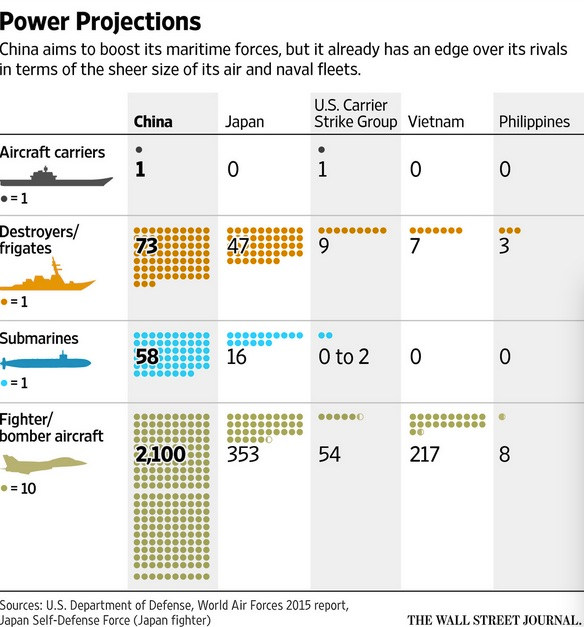
The Global Times suggests that China is not daunted by a military conflict with the U.S. – “We do not want a military conflict with the United States, but if it were to come, we have to accept it.”
Indeed, The Wall Street Journal has shown that in terms of conventional warfare China is the undisputed heavyweight in the region with a massive airforce and navy – see infographic.
The Chinese are utterly scathing of U.S. “meddling” in the South China Sea, thousands of miles from its own borders and clearly views itself as the new hegemon in the region. This seemingly innocuous dispute has the potential to rapidly spiral out of control.
There are also simmering tensions between China and Japan.
Both have long held claims to the Japanese-administered islands — known as Diaoyu in China and Senkaku in Japan. Tensions have intensified in recent months, and observers fear that a political or military misstep could rapidly escalate.
In late 2013, China announced an air defense zone over the East China Sea, encompassing the disputed islands. The new policy would require airlines to give Chinese authorities their flight plans before entering the airspace designated by China.
Japan’s Prime Minister Shinzo Abe said the new policy “escalates the situation and could lead to an unexpected occurrence of accidents in the airspace.” The United States called China’s announcement “unnecessarily inflammatory.”
Military posturing is quietly reaching new extremes in Europe, the Mediterranean and the South China Sea and the provocative bluster is reaching new heights.
Separately, it is believed that a senior NATO official has warned that “we’ll probably be at war this summer.”
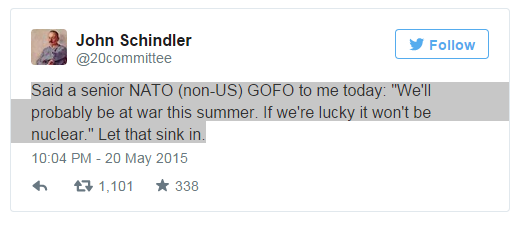
Former NSA intelligence analyst John Schindler has said that a senior NATO official told him that the world would “probably be at war” sometime this summer. Although the tweet was retweeted over 1,000 times, the comment did not get any media coverage.
Finally, the ‘trumpets of war’ became a triumvirate when one of the most powerful men in the world today – George Soros – warned that we “are on the threshold of a Third World War.”
As China’s economy slows down, this could trigger a global military conflict as might other tensions in the region, Soros warned.
“If the transition runs into roadblocks, then there is a chance, or likelihood in fact, the leadership would foster some external conflict to keep the country united and maintain itself in power,” Soros said in remarks at a Bretton Woods conference at the World Bank.
“If there is a military conflict between China and an alley of the U.S., like Japan, it is not an exaggeration to say we could be on the threshold of a Third World War. It could spread to the Middle East, then Europe and Africa.”
Since Soros made his remarks, tensions between China and the U.S. have further escalated. China has released a new white paper which threatens military action unless the U.S. stops its current actions in the South China Sea.
If China’s efforts to transition to a domestic-demand led economy from an export engine falter, there is a “likelihood” that China’s rulers would foster an external conflict to keep the country together and hold on to power.
To avoid this scenario, Soros called on the U.S. to make a “major concession” and allow China’s currency to join the International Monetary Fund’s basket of currencies. This would make the yuan a potential rival to the dollar as a global reserve currency. In return, China would have to make similar major concessions to reform its economy, such as accepting the rule of law, Soros said.
An agreement along these lines will be difficult to achieve, Soros said, but the alternative is a brutal war.
“Without it, there is a real danger that China will align itself with Russia politically and militarily, and then the threat of third world war becomes real, so it is worth trying.”
The warning comes as Europe engages in some of its biggest ever war games — right on Russia’s front door. It’s a deliberate ploy, intended to warn regarding Ukraine but could be seen by Russia as a provocation.
War, if it comes, will be multi faceted and poses risks to markets. Modern warfare would involve many facets including cyber warfare and currency wars.
Geopolitical risk continues to be seriously underestimated by investors and will likely impact markets in the coming months.
Must Read Guide: 7 Key Bullion Storage Must Haves
MARKET UPDATE
Today’s AM LBMA Gold Price was USD 1,189.45, EUR 1,087.08 and GBP 775.94 per ounce.
Yesterday’s AM LBMA Gold Price was USD 1,187.85, EUR 1,088.07 and GBP 770.64 per ounce.
Gold fell $0.20 or 0.2 percent yesterday to $1,187.50 an ounce. Silver slipped $0.05 or 0.3 percent to $16.69 an ounce.
Gold in Singapore for immediate delivery was steady at $1,188.55 an ounce while gold in Zurich also flatlined in lack lustre directionless trading as gold continues to be capped below $1,200 per ounce.
Gold bullion seems to be taking trading direction from the U.S. dollar with no major economic data on the horizon. The dollar has continued its strength since Fed Chair Janet Yellen once again suggested last week that the U.S. Fed is set to raise interest rates later this year.
Although safe haven demand has waned for the yellow metal, the Greek debt crisis is still not solved and may bolster bullion demand once again. June 5th is Greece’s next payment due to the IMF.
European markets are mostly lower this morning although the FTSE is marginally higher, as talks on Greece continue to bear little fruit.
Yesterday, the new government met its international creditors in Brussels to discuss a possible reform deal to unlock its last tranche of bailout money. It desperately needs this money to make repayments to the IMF and ECB over the coming months.
While the Greek government hinted a deal was on the way, saying it was in the process of drafting an agreement, others were less optimistic. Hawkish German Finance Minister Wolfgang Schaeuble said he was “surprised” by Greece’s positive outlook, while European Commission Vice President Valdis Dombrovskis said the two sides still had “some way to go”.
Greece is one of the main topics on the agenda at the G7 meeting of finance ministers and central bank chiefs this week and there could come interesting developments from this.
In late morning European trading gold is up 0.07 percent at $1,188.35 an ounce. Silver is off 0.07 percent at $16.67 an ounce, while platinum is up 0.17 percent at $1,121.78 an ounce.
Breaking News and Research Here
end
Dave Kranzler sees what I see: a huge amount of gold open interest standing with one day to go before first day notice:
(courtesy Dave Kranzler/IRD)
Gold Manipulation 101
There are no markets anymore, only interventions. – Chris Powell, GATA
The Comex bullion banks have a problem going into first notice day tomorrow (delivery notices start going out this evening). Preliminarily, as of yesterday’s Comex close, there were still 33,000+ open June contracts. This represents the potential of 3.3 million ounces of gold standing for delivery vs. 372k ounces of gold reported to be available for delivery.
Too be sure, I do not expect anywhere close to 33,000 contracts to be standing for delivery as of the close today’s post-Comex globex session (5 p.m. EST). In fact, I would bet that the open interest reported tomorrow will be under 10,000. But I will point out that I can not recall this many gold contracts still open the day before 1st notice. click to enlarge:

To make sure that the hedge funds either sell or roll forward to August, the banks have a keenly scripted screenplay: Right after the Asian markets close and perfectly timed with the opening of the fraudulent paper London LBMA market, the San Francisco Fed head, John Williams, gives a speech on “banking supervision” in SIngapore. Apparently he made some comments which led the market to believe the Fed would raise rates this year.
The yellow circle above show the smack given to gold right as the stock market opened. This is a common occurrence. No news events, just a manipulated hit designed to trigger stop-loss position selling by big hedge fund algorithm programs.
Even the boy who cried “wolf” is blushing with embarrassment at the Fed’s threatening to raise rates. Let’s face it, the Fed has been telling us they’re going to raise rates since Bernanke’s infamous “taper” speech in May 2013.
The Fed is not going to raise rates. The market may raise rates for the Fed, but the Fed will not raise rates. They use the threat of raising rates to manipulate market sentiment. And they issues these threats at interestingly “coincidental” times – like when the open interest in the front month Comex gold contract is 10x greater than the declared amount of gold available for delivery.
end
(courtesy South Morning China Post/GATA)
Chinese mining group buys $710 million in gold and copper assets
Submitted by cpowell on Wed, 2015-05-27 16:49. Section: Daily Dispatches
Chinese Firm Zijin Mining Group Buys US$710 Million in Gold and Copper Assets
By Jing Yang
South China Morning Post, Hong Kong
Wednesday, May 27, 2015
http://www.scmp.com/business/commodities/article/1810014/chinese-firm-zi…
Zijin Mining Group will buy US$710 million worth of gold and copper mining assets from two Canadian companies in the Democratic Republic of Congo and Papua New Guinea with funds raised through a private placement in the Shanghai stock market.
Zijin told the Shanghai and Hong Kong stock exchanges on Tuesday it would buy a 49.5 per cent stake in the Kamoa copper project in the Democratic Republic of Congo from Ivanhoe Mines for US$412 million.
Zijin already owns 9.9 per cent of Ivanhoe, which recorded a net loss of US$52.9 million last year following a net loss of US$80.6 million in 2013.
Fujian-based Zijin will also pay Barrick Gold Corp US$298 million for a 49.5 per cent interest in the Porgera gold mine in Papua New Guinea.
The two companies have also entered into a strategic agreement to collaborate on future projects.
“We are excited to leverage our competitive strengths together, to start with at Porgera, while exploring additional joint opportunities for the future,” Zijin chairman Chen Jinghe said in a statement.
“Substantial synergies and value may be realised by bringing to Barrick the expertise and relationships that Zijin offers, including low-cost capital from Chinese institutions, leading Chinese engineering and construction skills, and Chinese machinery,” Toronto-based Barrick said.
To fund the acquisitions, Zijin would issue up to 2.4 billion new shares in a private placement on the Shanghai stock market, raising up to 10 billion yuan (HK$12.5 billion), the company said.
The proceeds will also finance the construction of Zijin’s two existing copper mines, as well as replenish working capital.
The deals come on the heels of Beijing’s unveiling of a 100 billion yuan gold fund in support of Chinese firms’ overseas investments in the precious metal in countries along the “Silk Road”.
China is the world’s largest gold producer, accounting for 14 per cent of global production, according to the World Gold Council.
About 21 per cent of output comes from Africa, with Central Asia and eastern Europe contributing 5 per cent.
The three regions are encompassed in Beijing’s Silk Road Economic Belt and Maritime Silk Road strategy.
China also overtook India in 2013 as the world’s top consumer of the metal. The World Gold Council predicts that demand from China’s private sector will increase 20 per cent to at least 1,350 tonnes per year from the current level of 1,132 tonnes by 2017.
Bucking the industry trend as a result of stagnant gold prices, Zijin clocked up 2.3 billion yuan in net profit last year, and netted 415 million yuan in the first quarter of this year.
end
(PRNNewswire)
Direxion Asset Management closing 3X leveraged gold ETF
Submitted by cpowell on Thu, 2015-05-28 01:34. Section: Daily Dispatches
Company Announcement
via PRNewswire
Tuesday, May 26, 2015
NEW YORK — The Direxion Shares ETF Trust II has decided to liquidate and close the Direxion Daily Gold Bull 3X Shares (BAR) exchange-traded fund based on the recommendation of Direxion Asset Management LLC, the fund’s sponsor.
Due to the fund’s inability to attract sufficient investment assets, Direxion believes the fund cannot continue to conduct its business and operations in an economically efficient manner. As a result, Direxion concluded that liquidating and closing the fund would be in the best interests of the fund and its shareholders.
Shares of the Fund will stop trading on the NYSE Arca Inc. and will no longer be open to purchase by investors after the close of regular trading on June 19, 2015. Shareholders may sell their holdings in the fund prior to June 19 and those transactions may be subject to customary brokerage charges. Between June 22 and June 26 shareholders may be able to sell their shares only to certain broker-dealers and there is no assurance that there will be a market for the fund during that time.
On June 26 the Fund will liquidate its assets and distribute cash pro rata to shareholders who have not previously redeemed or exchanged their shares. These payments are taxable and will include any accrued capital gains and dividends. The fund’s net asset value will reflect the costs of closing the fund as calculated on the liquidation date. The fund will close when the distributions are complete. …
… For the remainder of the announcement:
http://www.prnewswire.com/news-releases/direxion-asset-management-closin…
end
As indicated to you on Friday, it is now official: Austria will repatriated 140 tonnes of its gold from the Bank of England. This will take approximately 5 years as they confirm that they have lost faith in the B. of E. We wish them luck in trying to get that gold back:
(courtesy GATA/)
It’s Official: Austria Repatriates Gold, Confirms Loss Of Faith In Bank Of England
One week ago, the world was not exactly shocked to learn that after Germany and the Netherlands, one more country had unofficially joined the ranks of nations who have seen this all before and know how it ends, when reports emerged that Austria would repatriate 140 tons of gold from the Bank of England (appropriately immortalized in “this is what happens when you hand your gold over to The Bank of England for “safekeeping“.) As of today, it is official.
Earlier today the Austrian Central Bank confirmed the Kronen-Zeitung report, and said that by the year 2020, it would hold 50%, or 140 tons, of its gold domestically, up from 17% currently. This means that Austria will withdraw some 140 tons of gold from the BOE which holds 80% of Austria’s gold currently (and will soon hold only 30%) and send 92.4 tons back home to Vienna with another 47.6 tons being sent to Switzerland.
Which is also the biggest news: Austria is explicitly demonstrating a lack of confidence in the “pro-western” system of which the Bank of England is a critical cog, and instead opting for “neutral” Switzerland, which will hold nearly 50 tons of the gold formerly located at the Bank of England.
Why?
As AFP notes, the central bank said it took the decision after recommendations made by the Austrian Court of Audit in February, which warned of a “heightened concentration risk” linked to storing the majority of its reserves in Britain. At the time, the bank had argued the policy was warranted because London was a major international centre for the gold trade.”
Well, London still is a major international center, but in the past three months the bank surprisingly changed its mind after reviewing the court’s advice to diversify storage locations.
Vienna confirmed it would begin to gradually repatriate 92.4 tonnes this summer. A further 47.6 tonnes will be transferred from Britain to Switzerland.
From the Austrian Central Bank:
In May 2015, the gold reserves held by the OeNB amounted to 280 tons, having remained unchanged since 2007. Austria’s gold reserves are fully owned by the OeNB, which maintains and manages them with utmost care. In line with the OeNB’s current gold storage policy, 17 % of its gold holdings are at present kept in Austria, 80 % in the United Kingdom and 3 % in Switzerland.
Recently, the Governing Board of the OeNB adopted the 2020 gold storage policy following a regular in-house gold strategy and storage policy review, while also considering the recommendations made by the Austrian Court of Audit. The cornerstones of this policy are as follows:
- By the year 2020, 50% of Austria’s gold reserves are to be held in Austria (OeNB and Münze Österreich AG), 30% in London and 20% in Switzerland.
- Starting from mid-2015, the new storage policy will be gradually implemented in keeping with security and logistical requirements.
- A comprehensive review and, if need be, adaptation of the storage policy is scheduled for 2019.
- The OeNB will regularly report on the progress in its upcoming annual reports.
* * *
Good luck Austria with that repatriation and be sure to triple check that gold. After all you don’t want to be like the Bundesbank which in 1968 got the short end of the stick following some questionable collusion between the BOE and the Fed as we reported in “Bank Of England To The Fed: “No Indication Should, Of Course, Be Given To The Bundesbank…””
end
Austrian central banker acknowledges general trend toward gold repatriation
Austria Plan to Repatriate Gold Not Linked to Brexit Talk: Nowotny
By Michael Shields
Reuters
Thursday, May 28, 2015
http://www.reuters.com/article/2015/05/28/us-austria-gold-nowotny-idUSKB…
VIENNA, Austria — A decision by the Austrian central bank to repatriate some gold from London by 2020 is “absolutely not” related to the possibility that Britain will leave the European Union, Governor Ewald Nowotny told a news conference on Thursday.
He said it instead reflected a trend among central banks, including Germany’s Bundesbank, to hold more reserves at home.
end
They are coming after HFT trading:
(courtesy Wall Street Journal/GATA)
Forex’s ‘last look’ practice gets curbed
By Chiara Albanese
The Wall Street Journal
Wednesday, May 27, 2015
Two of the world’s biggest currency-trading platforms plan to restrict a controversial industry practice in which banks can pull out of trades at the last moment if the market moves against them.
Thomson Reuters Corp. and BATS Global Markets Inc. will limit the practice, known as “last look,” on their platforms in coming weeks in a move aimed at increasing transparency in the foreign-exchange market.
The change comes amid a broader shake-up of the trading industry prompted by concerns about traders’ efforts to manipulate a range of financial markets. Markets for precious metals, interest rates, stocks, and currencies have all come under scrutiny from regulators in recent years because of allegations of inappropriate behavior. …
… For the remainder of the report:
http://www.wsj.com/articles/forexs-last-look-practice-gets-curbed-143276…
And now overnight trading in stocks and currency in Europe and Asia
1 Chinese yuan vs USA dollar/yuan strengthens to 6.2010/Shanghai bourse red and Hang Sang: red
2 Nikkei closed up by 78.88 points or .39%
3. Europe stocks mostly in the red/USA dollar index down to 97.21/Euro rises to 1.0826/
3b Japan 10 year bond yield: slight falls to .40% !!!!(Japan buying 100% of bond issuance)/Japanese yen vs usa cross now at 124.08/
3c Nikkei still just above 20,000
3d USA/Yen rate now well above the 124 barrier this morning
3e WTI 57.64 and Brent: 62.34
3f Gold down/Yen down
3gJapan is to buy the equivalent of 108 billion uSA dollars worth of bond per month or $1.3 trillion. Japan’s GDP equals 5 trillion usa.
Japan to buy 100% of all new Japanese debt and by 2018 they will have 25% of all Japanese debt. Fifty percent of Japanese budget financed with debt. Last night Japan refused to increase it’s QE
3h Oil down for WTI and down for Brent this morning
3i European bond buying continues to push yields lower on all fronts in the EMU. German 10 yr bund falls to 53 basis points. German bunds in negative yields from 4 years out.
Except Greece which sees its 2 year rate fall to 23.52%/Greek stocks down 0.68%/ still expect continual bank runs on Greek banks./Greek default inevitable/
3j Greek 10 year bond yield falls to: 11.12%
3k Gold at 1188.10 dollars/silver $16.68
3l USA vs Russian rouble; (Russian rouble falls 1 rouble/dollar in value) 52.30 , the rouble is still the best acting currency this year!!
3m oil into the 57 dollar handle for WTI and 62 handle for Brent/Saudi Arabia increases production to drive out competition.
3n Higher foreign deposits out of China sees huge risk of outflows and a currency depreciation. This can spell financial disaster for the rest of the world/China may be forced to do QE!!
30 SNB (Swiss National Bank) still intervening again in the markets driving down the SF. It is not working: USA/SF this morning .9463 as the Swiss Franc is still rising against most currencies. Euro vs SF is 1.0341 well below the floor set by the Swiss Finance Minister.
3p Britain’s serious fraud squad investigating the Bank of England/
3r the 4 year German bund remains in negative territory with the 10 year moving further away from negativity at +.53/
3s Three weeks ago, the ECB increased the ELA to Greece by another large 2.0 billion euros.Two weeks ago, they raised it another 1.1 billion and then last Wednesday they raised it another tiny 200 million euros thus at this point the new maximum was 80.2 billion euros. The ELA is used to replace depositors fleeing the Greek banking system. The bank runs are increasing exponentially. The ECB is contemplating cutting off the ELA which would be a death sentence to Greece and they are as well considering a 50% haircut to all Greek sovereign collateral which will totally wipe out the entire Gr. banking and financial sector.
3t Greece paid the 700 million plus payment to the IMF last Wednesday but with IMF reserve funds. It must be paid back in on June 9.
3 u. If the ECB cuts off Greece’s ELA they would have very little money left to function. So far, they have decided not to cut the ELA
4. USA 10 year treasury bond at 2.13% early this morning. Thirty year rate well below 3% at 2.88% / yield curve flatten/foreshadowing recession.
5. Details Ransquawk, Bloomberg, Deutsche bank/Jim Reid.
Overnight trading early Thursday morning from Asia and Europe:
(courtesy zero hedge/Jim Reid Deutsche bank)
Courtesy of central planning, virtually every single capital market has become an illiquid penny stock, with wild swings from one extreme to the other, the latest example of this being the Shanghai Composite, which after soaring 10% in the past ten days, crashed 6.5% overnight tumbling 321 points to 4620 after it briefly rose just shy of 5000. This was the biggest drop since January 19 when the Composite dropped 7.7% only to blast higher ever since. Putting the “plunge” in perspective, now the SHCOMP is back to levels not seen in… one week.

What caused this long overdue plunge? According to the WSJ, three factors were in play: China’s sovereign-wealth fund said earlier this week it had sold stakes in two state-owned banks; more brokerages are tightening margin trading; and the central bank soaked up cash from commercial banks, a sign that the government is trying to contain excess liquidity in the financial market.
In other words, more sellers than buyers, but at least the soundbites were great: “The China market is basically trading like a yo-yo,” said Steve Wang, research director at Reorient Financial. “It is retail driven, people just follow the trend.”
So, fundamentals are at play you say? More soundbites:
Thursday’s drop in Shanghai could shift the market from a “crazy bull into a slow bull,” said Li Shaojun, analyst at Minsheng Securities Co. Ltd. Most major sectors were down more than 4%, noted Gerry Alfonso, director of trading at brokerage Shenwan Hongyuan Securities.
The reality is that while one can blame retail investors for day to day swings, it is all centrally-planned:
China’s securities watchdog hasn’t announced a new clampdown on margin trading, but several securities firms have said they are changing requirements for the practice. Changjiang Securities tightened its margin financing rules Wednesday, after GF Securities and Haitong Securities said earlier in the week that they will raise the amount of collateral investors must put up to get loans. In late April, Shenwan Hongyuan Securities and Donghai Securities made similar moves.
“With the total margin financing volume approaching two trillion yuan ($322 billion), institutional investors [are becoming] more cautious over any potential market bust,” said Li Lei, an analyst at Minzu Securities. “The growth rate of margin finance will slow down as brokers tighten rules, but the sheer volume will continue to climb to around three trillion yuan.”
Disclosures that Central Huijin Investment Ltd. was selling mainland shares of two of China’s largest policy banks— Industrial and Commercial Bank of China Ltd. and China Construction Bank Corp. —came out earlier in the week, but analysts said that Chinese websites and blogs were talking about the sales.
ICBC finished down 5% and China Construction Bank was down 5.9% in Shanghai. In Hong Kong, shares of both fell more than 3%.
And since as we explained before the Chinese Politburo is now all in on blowing the biggest equity bubble of all time, consider this a “pause that refreshes” and send the SHCOMP onward to even more ridiculous levels because where central planners are concerned only a grand systemic reset can stop their micromanagement ways.
Elsewhere the Nikkei 225 (+0.4%) outperformed in the region to post its longest winning streak since 1988, underpinned by JPY weakening to 12-year lows
European equities have traded in modest negative territory (Eurostoxx: -0.54%) in a spillover of the sharp losses seen in Asia. Market participants await further comments from the G7 conference regarding Greece with just over one week now until the first IMF payment is due and tensions remaining high regarding whether the country will be able to come to an agreement with their creditors.
This has been similarly demonstrated in Bunds (+23 ticks) with the German benchmark opening higher today but remaining fairly stagnant through the European morning. However, USTs have underperformed their European counterparts this morning ahead of supply coming in the form of USD 13bln FRN 2y note and USD 29bln 7y note auctions
The Asia session saw AUD underperform after Australian Q1 capex recorded its worst decline since 2009, prompting a sell-off across AUD/USD as the pair broke back below 0.7700. NZD weakened in sympathy, as NZD/USD gave back yesterday’s post-Fonterra 2015/16 milk payout inspired gains as the group struck an overall upbeat tone. USD/JPY rose to print its highest level since Dec’02, after tripping stops at the 2007 high (124.14) in continuation of yesterday’s gains with macro funds also said to be buying in the pair.
The European morning’s most notable data point came in the form of UK GDP preliminary reading (Q/Q 0.3% vs. Exp. 0.4%, Prev. 0.3%), which showed the UK economy had grown at a slower rate than expected, thereby weighing on GBP. GBP/USD underperforms major pairs to reside in the red despite the USD-index (-0.2%) also spending the session in negative territory.
In terms of central bank speakers, ECB’s Nowotny says that is not possible to provide financing for Greece outside of the current governing rules, while Fed’s Kocherlakota is scheduled to speak at 1945BST/1345CDT. In terms of the data slate, today’s most notable events are US weekly jobs and pending home sales.
With yesterday’s market rally entirely on the back of yet another fabricated rumor, this time spread by Greek officials to halt a bank run in the process sending the Nasdaq soaring to all time highs, expect even more lies out of the flailing Greek state as there is now just one week until the next Greek IMF payment, one which we now the country won’t be able to make.
Precious metals prices reside in positive territory alongside WTI and Brent crude futures, benefitting from the aforementioned greenback weakness. This comes despite last night’s API inventories showing the first build for 4 weeks (1268K vs. Prev. -5200K). Of note today’s DoE inventories are expected to show a drawdown of 2000k, while NatGas currently underperforms in the energy complex, with today’s EIA NatGas Storage change expected to show a build of 101.
In Summary: European shares fall with the basic resources and autos sectors underperforming and tech, health care outperforming. Chinese stocks fell most in four months on record turnover. ECB Says Contagion Risk Exists If Greek Deal Not Reached Quickly. Fed’s Williams Sees Rate Increase This Year as Growth to Recover. The French and German markets are the worst-performing larger bourses, the Swiss the best. The euro is stronger against the dollar. German 10yr bond yields fall; Japanese yields increase. Commodities gain, with natural gas, silver underperforming and wheat outperforming. U.S. jobless claims, continuing claims, Bloomberg consumer comfort, pending home sales due later.
Whether Greece will get some of this ample global liquidity over the next week or so is no nearer to being decided and yesterday saw a fairly big positive reaction to headlines from the Greeks that they think progress has been made in discussions and that an accord was being drafted. Although these headlines were soon countered by EU officials saying no real progress had been made, the market chose to accentuate the positives.
Indeed, the initial excitement came about from a number of Bloomberg headlines which quoted an unnamed Greek government official as saying that both Greece and its Creditors were about to start drafting a Staff Level Agreement. The report suggested that the agreement would envisage low primary budget surpluses, no recessionary measures, a sales tax overhaul and medium term agreement on debt relief. European equity markets had traded a tad firmer in the run up to the headlines, however the news helped push bourses around a percent higher while Greece’s ASE jumped nearly 2%. The Euro rose around 1% off its lows while Greek 10y yields fell some 50bps, helping other peripheral bond markets tighten 7-8bps. Greek PM Tsipras fuelled hope that there was some credibility in the headlines saying that a deal is close, however the comments out of the European side as mentioned were in stark contrast. EU official Dombrovskis commented that ‘we are still not there yet’ and that ‘we are already basically a month behind the schedule’ while an ECB official was quoted as saying that ‘we do not yet have the catalyst that will allow an agreement’.
There was little change in markets post the initial jump in optimism of a deal being done. The Stoxx 600 eventually closed +1.31% while the DAX and CAC closed +1.26% and +1.70% respectively. Peripherals were unsurprisingly firmer as the IBEX (+1.70%) and FTSE MIB (+2.29%) bounced. Greek equities continued to strengthen into the close meanwhile, eventually finishing +3.55% while there was a sharp move in the yield curve as 2y (-190bps), 4y (-120bps) and 10y (-86bps) yields all fell. 10y yields in Italy (-7.9bps), Spain (-6.5bps) and Portugal (-5.1bps) all finished tighter. Core markets were largely unchanged as 10y Bunds ended +0.7bps higher while similar maturity yields in Netherlands and Switzerland were +0.2bps and +0.9bps respectively. Credit markets had a better day as Crossover in particular rallied 8.5bps.
In the 4-5 months since the elections there have probably been thousands upon thousands of headlines passing through our screens on Greece and the reality is that very few of them have so far ending up meaning anything. However we are deep into the business end of discussions so these headlines are becoming impossible to ignore. So stand-by for a tense week.
In truth outside of Greece there wasn’t a lot of newsflow in markets yesterday. It was pretty quiet data wise with just a modestly better than expected German consumer confidence print (10.2 vs. 10.0 expected), while consumer confidence in France was a touch softer than expected (93 vs. 95 expected). Markets in the US were seemingly supported by the bout of optimism that spread through risk assets yesterday with regards to Greece. The S&P 500 (+0.92%) and Dow (+0.67%) were led by a bounce in tech stocks as the NASDAQ (+1.47%) recorded a fresh record high. 10y Treasuries closed 1.1bps tighter while the Dollar index closed +0.07% higher but had the bulk of the intraday gains wiped out by the stronger Euro yesterday. Oil markets declined for the second consecutive day after both Brent and WTI fell 2.61% and 0.90% respectively on the back of rising crude inventories data.
The hawkish Richmond Fed President Lacker was the latest Fed official to speak yesterday after saying that there is still a strong case to be made for liftoff in June, but that he is yet to have made up his mind. Lacker also warned on the potential effects of moving too late and being ‘behind the curve’, while also taking ‘into account substantial lags in the effect of monetary policy on economic activity’.
Taking a look at our screens this morning, bourses in Asia are largely mixed on the whole. The Nikkei (+0.62%) and Kospi (+0.46%) have risen, while the Shanghai Comp (-1.40%) has fallen for the first time in eight days. The ASX is -0.16% lower also. Equity markets in Japan in particular appear to have shrugged off some weaker data with both April retail sales (+0.4% mom vs. +1.1% expected) and large retailers sales (+8.6% yoy vs. +9.1% expected) coming in below market. It’s a further weakening for the Yen in fact which is helping stocks, with the JPY another 0.38% weaker versus the Dollar this morning at ¥124.12, the fifth consecutive day of declines and 10th in 11 days to mark a fresh 12-year low. Credit markets in Asia meanwhile are being driven by the news that Sunac is abandoning its proposed acquisition of Kaisa Group who recently became the first Chinese property developer to default on US Dollar debt. Kaisa’s 2018 bonds have fallen 3.5 points following the news.
Before we look at today’s calendar, yesterday we published a note highlighting that while optically the USD and GBP IG credit markets appear to offer better value to investors, EUR IG credit is arguably cheaper (relatively) than it first appears. By stripping away non-credit factors such as the underlying rate environment and the currency impact EUR bonds offer similar and occasionally better value than equivalent USD or GBP bonds. Looking at the analysis at an individual bond level we highlight that while the USD and GBP bonds in our analysed samples offer higher yields and generally wider spreads in local currency terms, when we look at spreads in a common currency (using the basis swap) the EUR bonds look more favourable. Specifically from our samples around 70% of the EUR bonds offer wider spreads than equivalent USD bonds while around 60% of the EUR bonds offer wider spreads than equivalent GBP bonds. Essentially our analysis highlights that at current levels the rationale for investing in USD or GBP credit relative to EUR credit is more a function of the underlying government yield environment and the relative currency environment likely to be driven by divergent monetary policy actions. Therefore there may be better ways to express these views than with corporate bonds.
end
Greece Owes $1.2 Billion To Drugmakers As Government Can No Longer Afford Basic Medical Supplies
Talks between Greece and its creditors went full-retard on Wednesday when the following soundbite from Canada’s FinMin Joe Oliver hit the wires:
“No Greek payment to IMF would be default to IMF”
That seemed self-evident to us, but in a world governed by debt, we suppose everyone occasionally needs to remind themselves that failure to make good on one’s obligations constitutes default.
In any event, Greece apparently owes quite a bit of money to the world’s drug suppliers because, as we reported earlier this week, Athens is now running short on bed sheets and painkillers in its hospitals as the consequences of being completely beholden to the ”institutions” which control the printing of a fiat currency become increasingly clear.
Here’s what we said on Sunday:
The idea that a developed country cannot provide basic emergency medical care because it is in poor standing with the institutions that print a fiat currency is patently absurd and simply isn’t tenable meaning that one way or another, this ‘situation’ will resolve itself in the coming weeks, an event which will put Europe’s broken bond markets to a rather difficult test.
And now, we get this from Reuters:
Cash-strapped Greece has racked up mounting debts with international drugmakers and now owes the industry more than 1.1 billion euros ($1.2 billion), a leading industry official said on Wednesday.
The rising unpaid bill reflects the growing struggle by the nearly bankrupt country to muster cash, and creates a dilemma for companies under moral pressure not to cut off supplies of life-saving medicines.
Richard Bergstrom, director general of the European Federation of Pharmaceutical Industries and Associations, told Reuters his members had not been paid by Greece since December 2014. They are owed money by both hospitals and state-run health insurer EOPYY.
And in a further sign that, regardless of whatever outcome emerges from fraught talks between Syriza and group of creditors determined to use financial leverage as a means of subverting the democratic process in the EU, contingency plans are being discussed not only amongst ‘the institutions’ but amongst private sector firms as well:
Drugmakers and EU officials are now discussing options in the event Greece defaults on its debt or leaves the euro zone, disrupting imports of vital goods, including medicines.
“We have started a conversation in Brussels with the European Commission,” Bergstrom said. “We want the Commission to know that our companies are in this for the long run and are committed to Greece.”
There is a precedent for the pharmaceutical industry to agree exceptional supply measures during a financial crisis. It happened in Argentina in 2002, when some firms agreed to continue to supply drugs for a period without payment.
But the situation is complicated in Europe, given EU competition rules. They mean the Commission would need to take the initiative in approving any special scheme.
Drugmakers want any emergency program to include steps to mitigate spillover effects on other markets, including curbs on re-exports of drugs and a block on other governments referencing Greek prices when setting their own drug prices.
Simply turning off the supply is not an option for the industry, as Novo Nordisk discovered at the start of Greek debt crisis five years ago when it faced a storm of protest over plans to halt some insulin deliveries.
And while leaving Greeks with a shortage of “life-saving” drugs may “not be an option,” Greece has run out of options as well when it comes to coming up with the money to pay for basic medical supplies which means that without a deal, the world’s largest drugmakers could find themselves in the same financial place as the IMF and the ECB — that is, holding what amounts to IOUs from the Greek government.
The drugs industry has been here before.Greece also ran up large debts for its medicines in 2010-12, although they have since been repaid, with some companies receiving payment in government bonds that were subsequently written down in value.
Whether or not this is a precedent the industry will be willing to follow remains to be seen.
“The Greek Endgame Is Here”: Probability Of IMF Default Now 70%, Says Deutsche Bank
As the farcical negotiations between Greece and its creditors unfold ahead of a June 5 IMF payment and as Alexis Tsipras is forced to spread false hope just to avoid a terminal bank run, a picture of the Greek endgame has emerged.
We’ve discussed the political implications of both an agreement or a Grexit and we’ve also taken an in-depth look at what a missed IMF payment means for the country’s EU creditors. On the political front, the troika is intent on sending a strong message to leftist political parties (such as Spain’s Podemos and Portugal’s “ascendant” socialists) that using the threat of a euro exit as a way to extract austerity concessions is not a viable negotiating strategy. What this amounts to is an attempt on the part of the “institutions” to subjugate the political process to economics. In terms of skipping a payment to the IMF — who, as a reminder, effectively paid itself earlier this month by allowing Greece to tap its SDR reserves to pay the bills — there are a number of cross acceleration concerns which you can review by referring to the following graphic:

Now, amid accelerating deposit outflows and an hourly flow of conflicting headlines, Deutsche Bank is out with a fresh take on the Greek endgame including an analysis of both the political wrangling that would need to take place in order for parliamentary approval of concessions to creditors and the mechanics of a default to the IMF.
Via Deutsche Bank:
Little has changed in terms of developments on the ground. Despite a number of reports that negotiations may be split into separate chapters and disbursements with more difficult issues left for September, this remains unlikely. The consistent European position has been that a full staff-level agreement between the institutions – inclusive of the IMF – and Greece is required to unlock funding. Talks in this direction has been progressing in stop-start fashion over the last few weeks, with the Brussels Group (former Troika) reconvening again yesterday to continue negotiations. But progress remains slow, with multiple European and IMF officials over the last twenty four hours stating that more needs to be done to reach agreement…
The Greek government’s liquidity position will ultimately drive the timelines over the next few weeks. Close to 1.5bn EUR is due to the IMF in four instalments over the course of June, with Greek government officials repeatedly stating that there are insufficient cash buffers to satisfy these payments. Given that the last IMF payment was made by drawing down Greece’s SDR reserves at the fund, an exhaustion of cash buffers is a fair assumption. The most likely catalyst in coming weeks is therefore likely to be the Greek government’s ability or not to pay the IMF…
A number of press reports have suggested that there is a one-month grace period relating to a failure to pay the IMF. This likely confuses two issues: a non-payment and the implications this has on cross-default provisions on other loan instruments. IMF loans do not include any formally defined grace period, with fund staff required to send an urgent cable demanding payment to the Greek authorities immediately. This is then followed by a formal notification by the IMF Managing Director to the Executive Board of the failure to pay. It is this notification that is defined as an event of default in Greece’s EFSF and other official-sector loans, triggering cross-default. If this materializes, European creditors then have the right (but not the obligation), to accelerate EFSF loans, causing them to be immediately payable. In turn such an acceleration event would trigger cross-default and potential acceleration in the post-PSI Greek government bonds. The timing of the IMF notification letter is itself a political decision, however, as is the decision to accelerate EFSF loans. IMF guidelines suggest the notification to the board happens in a month. Our understanding is that the notification period may be flexible, with some reports last week suggesting that the Executive Board has requested that this notification happens sooner in the event of a failure to pay from Greece.
Either way, it is important to note that it is not the response of the IMF that will matter in the event of a non-payment. It is the role of the ECB that is crucial. The funding of the Greek banking system remains highly dependent on the central bank’s Emergency Liquidity Assistance, with a suspension or cap to this financing equivalent to an inability to make deposit withdrawals (or foreign transfers) from Greek banks and de facto capital controls.
The above underscores two important points that we’ve made on any number of occasions. First, whether, when, and to whom Greece defaults is ultimately a political decision that rests in the hands of the IMF and EU creditors. Once again, it’s all about using financial leverage to influence the future course of the currency bloc’s political landscape.
Second, the ECB ultimately controls the fate of the Greek banking sector and therefore Greek depositors because without ELA, banks simply can’t keep up with withdrawals, lending the lie to Tsipras’ Wednesday contention that there is “absolutely no danger” to depositors.
Next, Deutsche takes a look at possible outcomes to the Greek tragicomedy:
No agreement reached, followed by non-payment to the IMF (40% probability). This scenario would likely provoke the most negative reaction from the ECB. Even if cross-default provisions on Greek loans are not triggered immediately, the ECB would likely severely restrict Greek bank access to ELA financing. Rather than declaring the banks insolvent (similar to Cyprus), the most likely avenue for this would be to refuse to raise the regularly reviewed ELA financing ceiling, or more likely, to raise the haircuts required on Greek bank collateral. Our current calculations suggest that Greek banks have around 30-40bn of liquidity available to draw under existing collateral arrangements. An ECB decision to raise haircuts aggressively could leave an implicit “hard” ELA cap that is much smaller, effectively requiring the authorities to reach agreement within a matter of days depending on the pace of deposit outflows and collateral exhaustion.
Agreement reached, but no time/unable to pass through the Greek parliament before IMF payment (30% probability). European creditors will require passage of prior actions through parliament before any disbursements are made. An agreement by the government at the last minute is possible, but there may be no time to secure financing before the domestic political process plays out. The current ruling majority and/or the opposition may refuse to support an agreement requiring a change in government coalition. In this event, it is possible the ECB provides interim financing to pay back the IMF via raising the amount of treasury bills that the Greek government is allowed to issue. However, we would consider it more likely that Greece is allowed to fall into arrears at the IMF and the ECB makes a less binding increase in haircuts on ELA collateral. The latter would maintain the pressure on the Greek side to ratify an agreement, but at the same time would allow ongoing liquidity provision to the banks so long as the approval process is moving in the right direction.
Agreement reached, followed by timely passage through the Greek parliament (30% probability). This would be the most positive scenario, with the government able to quickly draw upon support from its own majority or the opposition to pass the agreement. Assuming the upcoming Friday June 5th IMF payment cannot be made, this would require a staff- level agreement 2-3 days before. In this event we would expect the ECB to tolerate an increase in t-bill financing to make whole on the IMF payment if disbursements haven’t been made in time due to other national approval processes.
In sum, there is a 40% chance that Greece simply doesn’t pay the IMF next month triggering, at the very least, restrictions on ELA access and, in short order, capital controls as withdrawals could accelerate and (literally) break the bank within “a matter of days.”
Alternatively, there’s a 30% chance that a deal is reached but proves so politically contentious that its provisions can’t be approved in time, making a payment to the IMF logistically impossible and putting the ECB in the rather unpalatable position of having to decide how lenient it wants to be based on the central bank’s perception of ratification progress which, incidentally, is essentially the same position Mario Draghi has been in for quite sometime only next month, creditors stop getting paid.
And just in case there were any lingering doubts about where talks are headed or about whether the IMF will be willing to compromise on either pension reform or its demands for the EU to writedown Greek debt in order to make the country’s debt-to-GDP ratio more ‘sustainable’, we’ll close with the following two headlines that hit the wires this morning:
- GREECE SAID TO BE FAR APART WITH CREDITORS ON DEBT TALKS
- IMF SAID TO INSIST ON GREEK REFORMS INCLUDING PENSION CHANGES
- IMF SAID TO BELIEVE DEBT RELIEF FOR GREECE MAY BE NECESSARY
* * *
end
My goodness: the USA issues arrests to FIFA officials who have no interests whatsoever in the USA. Obama’s game plan: remove Russia from hosting the 2018 FIFA games:
(courtesy zero hedge)
Putin Slams US Over FIFA Arrests: “Another Blatant Attempt By The US To Meddle Outside Its Jurisdiction”
Following yesterday’s political intervention by the US in which 14 FIFA affiliates were perp-walked out of Zurich’s swankiest hotel just days ahead of Sepp Blatter’s re-election, one person was quite displeased with this latest US intervention on the international arena: Russian president Vladimir Putin who accused the United States of meddling outside its jurisdiction by arresting officials from FIFA, further hinting that it was part of an attempt to take the 2018 World Cup away from his country.
As a reminder, Russia won the right to stage the 2018 World Cup during 2010 under Blatter’s governance. The award is now the subject of a Swiss criminal investigation.
As a further reminder, epic corruption at FIFA, as well as every other global institution, from the Clinton foundation to the global capital markets, to US Congress, has been firmly established and well known to everyone for years, if not decades. And yet, the rigged system has worked well enough that nobody dared to touch it.
That is until US AG Loretta Lynch decided it was time to take matters into American hands. This, in turn, raised Putin’s blood pressure as the Russian understands what the true purpose of this latest US intervention was.
According to Putin, the DOJ indictment which led to the arrest of over a dozen individuals on massive corruption charges “is yet another blatant attempt [by the US] to extend its jurisdiction to other states.”
Putin added that the arrests were a “clear attempt” to prevent the re-election of Sepp Blatter as Fifa president and that the Swiss had Russia’s backing.

Vladimir Putin, right, with Sepp Blatter.
“It looks very strange, the arrests are carried out on the request of the USA side,” he said. “They are accused of corruption – who is? International officials. I suppose that someone broke some rules, I don’t know. But definitely, it’s got nothing to do with the USA. Those officials are not US citizens. If something happened it was not in the US and it’s nothing to do with them.“
“It’s another clear attempt by the USA to spread its jurisdiction to other states. And I have no doubt – it’s a clear attempt not to allow Mr Blatter to be re-elected as president of Fifa, which is a great violation of the operating principles of international organizations. The US prosecutor, as our media report, has already said that those Fifa officials have committed a crime. As if the prosecutor didn’t know about the principle of the presumption of innocence.”
What is just as ironic is that the one reason the US determined it has jurisdiction over the case is only because FIFA’s corrupt officials had used US banks as intermediaries to funnel and otherwise launder bribes and other flows of funds. The same criminal banks which the Department of Justice busted just a week earlier for rigging the FX market.
How many people were arrested in the DOJ’s crackdown on criminal US banks? 0.
How many people are arrested as part of the DOJ’s crackdown on FIFA: 14.
One can start to sense an agenda in play.
Quoted by the Guardian, citing the former US intelligence contractor Edward Snowden and the WikiLeaks founder Julian Assange, both of whom have evaded prosecution in the United States by hiding abroad, Putin questioned Washington’s right to request the Fifa officials’ extradition from Switzerland.
“Unfortunately, our American partners use such methods to achieve their selfish aims and illegally persecute people. I do not rule out that in the case of Fifa, it’s exactly the same,” Putin said.
What happens next? Sepp Blatter’s reelection this coming Friday, which until yesterday had been guaranteed, is now virtually assured to fail as Putin’s frontman at FIFA is shown the door.
What else likely happens? Following some dramatic procedural changes, Russia loses the hosting of the 2018 World Cup.
One thing that is certain not to happen: Qatar will keep the 2022 World Cup venue. Why? Because as we showed yesterday, the Qatar 2022 Supreme Committee had donated between $250,001 and $500,000 to the Clinton Foundation. And that is all it takes to buy the silence of the US DO”J”.
This will get Mr Putin to retaliate and escalate tensions dramatically:
(courtesy Sputniknews/and special thanks to Robert H for sending this to us)
NATO Breaks Treaty to Establish Permanent Forces in Baltic
“We are seeking a brigade-size unit so that every Baltic nation would have a battalion.”
NATO’s Supreme Allied Commander of Europe, Philip Breedlove, said the three countries were to seek “permanent rotational NATO forces” as a “deterrence measure due to the security situation in the region.”
However, the deployment of permanent forces flies in the face of the Founding Act on Mutual Relations, Cooperation and Security between NATO and the Russian Federation which was signed in Paris, France on 27 May 1997.
It declared that “NATO and Russia do not consider each other as adversaries” and that the two parties will work together to prevent any potentially threatening build-up of conventional forces in agreed regions of Europe, to include Central and Eastern Europe.
The Act states that NATO “will carry out its collective defense and other missions by ensuring the necessary interoperability, integration, and capability for reinforcement rather than by additional permanent stationing of substantial combat forces.”
Breedlove refused to confirm the number of troops that will be deployed in the region, but suggested a standard NATO brigade could consist of around 3,000 soldiers.
In February, NATO Secretary General Jens Stoltenberg, in a meeting with the Latvian President, said: “The Alliance’s responsibility is to protect and defend each and every Ally against any threat. And NATO’s support for its eastern Allies, including Latvia, was confirmed at the recent NATO Defense Ministers’ meeting in Brussels.
“Here, more progress was made in implementing our Readiness Action Plan, including establishing an enhanced NATO response force and a very high readiness Spearhead Force,” Stoltenberg said.
NATO’s Eastward March

Historically, NATO — heavily backed by the United States — has sought to spread its influence further eastward, despite an agreement after the reunification of Germany, that it would not encroach on the former Warsaw Pact nations. At the time, former Russian President Mikhail Gorbachev was assured by (then) US Secretary of State James Baker there would be “no extension of NATO’s jurisdiction one inch to the east.”
Since then, the onward march of NATO eastward has continued unabashed with the Czech Republic, Hungary, Poland, Slovenia, Slovakia, Romania, Bulgaria, Croatia, Albania, Latvia, Lithuania and Estonia all joining the Washington-led military coalition.
Oil related stories:
Oil drops as OPEC will not cut production as well as inventory builds at API and Iraq increasing its production:
(courtesy zero hedge)
Oil Prices Drop To 7-Week Lows – Here’s Why
WTI Crude hit new 7-week lows, dropping below $57 (front-month) for the first time since April 15th’s ‘inventory draw’ rip. In addition to reports from Reuters of leaked details about OPEC not expectated to cut production (did anyone really expect that), a combination of renewed inventory builds (as reported by API last night) and reports that Iraq is increasing its supply to new record highs is forcing futures prices to catch down to physical markets.

Weakness driven by…Iraq supply concerns…(as RT reports)
Iraq is ready to increase its crude exports to a record 3.75 million barrels per day in June, continuing OPEC’s strategy of ousting US shale producers from the market.
The extra oil from Iraq comes to about 800,000 barrels per day, more than from another OPEC member, Qatar, said Bloomberg, referring to Iraq’s oil shipments schedule.
Iraq is increasing oil exports in two directions. The first is in the Shiite south, where companies such as BP and Royal Dutch Shell work. The second is Nothern Iraqi Kurdistan, whose government last year received Baghdad’s consent to independent oil deliveries.
In April, Iraq exported almost 3.1 million barrels of oil per day, which is a record.
And Iran remains a worry…
And inventory builds reappear…

And leaked details of OPEC’s report suggests no cut in production…(via Reuters)
OPEC is not expected to cut oil production at its meeting in June, and the meeting is expected to be a short one, Saudi Arabia’s Al Hayat newspaper quoted an unnamed OPEC source as saying on Thursday.
Saudi Arabia will continue producing oil to meet customer demand, and its output is now at about 10.3 million barrels per day in light of growth in demand from China and India, the source added.
* * *
Following last night’s surprise inventory build (as reported by API), as one trader noted, “inventory declines are expected this time of yr and more or less expected, we need to see inventory draws accelerating,” and DOE didn’t disappoint reporting a 2.8 million barrel draw (against expectations of a 2 million barrel draw). Inventories remains massively high though and Crude Production soared 3.28% – the biggest rise since Oct 2013. Crude prices initially ripped on the inventory news but are fading.
4th week in a row of inventory draws

For some context as to what this inventory change means…

But production exploded by the most in 19 months…Lower 48 States increased production at an average of 209,000 barrels per day

Crude prices ramped into the data after legging down all morning… spiked on the news but perhaps the machines have not seen the production data yet.

Charts: Bloomberg
Your more important currency crosses early Thursday morning:
Euro/USA 1.0926 up .0029
USA/JAPAN YEN 124.08 up .346
GBP/USA 1.5282 down .0065
USA/CAN 1.2490 up .0034
This morning in Europe, the Euro rose by a tiny 29 basis points, trading now well above the 1.09 level at 1.0926; Europe is still reacting to deflation, announcements of massive stimulation, a proxy middle east war, and the ramifications of a default at the Austrian Hypo bank, a possible default of Greece and the Ukraine, rising peripheral bond yields.
In Japan Abe went all in with Abenomics with another round of QE purchasing 80 trillion yen from 70 trillion on Oct 31. The yen continues to trade in yoyo fashion as this morning it settled down again in Japan by 35 basis points and trading well above the 124 level to 124.08 yen to the dollar.
The pound was down this morning as it now trades well below the 1.53 level at 1.5282, still very worried about the health of Barclay’s Bank and the FX/precious metals criminal investigation/Dec 12 a new separate criminal investigation on gold, silver and oil manipulation.
The Canadian dollar is down by 35 basis points at 1.2490 to the dollar.
We are seeing that the 3 major global carry trades are being unwound. The BIGGY is the first one;
1. the total dollar global short is 9 trillion USA and as such we are now witnessing a sea of red blood on the streets as derivatives blow up with the massive rise in the rise in the dollar against all paper currencies
2, the Nikkei average vs gold carry trade (still ongoing)
3. Short Swiss franc/long assets (European housing/Nikkei etc. This has partly blown up (see Hypo bank failure). Swiss franc is now 1.0341 to the Euro, trading well above the floor 1.05. This will continue to create havoc with the Hypo bank failure.
These massive carry trades are terribly offside as they are being unwound. It is causing global deflation ( we are at debt saturation already) as the world reacts to lack of demand and a scarcity of debt collateral. Bourses around the globe are reacting in kind to these events as well as the potential for a GREXIT>
The NIKKEI: this morning : up 78.88 points or 0.39%
Trading from Europe and Asia:
1. Europe stocks mostly in the green
2/ Asian bourses mostly in the red … Chinese bourses: Hang Sang red (massive bubble forming) ,Shanghai in the red (massive bubble ready to burst), Australia in the red: /Nikkei (Japan) green/India’s Sensex in the red/
Gold very early morning trading: $1188.10
silver:$16.68
Early Thursday morning USA 10 year bond yield: 2.13% !!! up 1 in basis points from Wednesday night and it is trading under resistance at 2.27-2.32%.
USA dollar index early Thursday morning: 97.21 down 16 cents from Wednesday’s close. (Resistance will be at a DXY of 100)
This ends the early morning numbers, Thursday morning
And now for your closing numbers for Thursday:
Closing Portuguese 10 year bond yield: 2.54 up 5 in basis points from Wednesday
Closing Japanese 10 year bond yield: .40% !!! up 1 in basis points from Wednesday/
Your closing Spanish 10 year government bond, Thursday, up 4 points in yield
Spanish 10 year bond yield: 1.84% !!!!!!
Your Thursday closing Italian 10 year bond yield: 1.87% up 1 in basis points from Wednesday: ( still massive central bank intervention/)
trading 3 basis point higher than Spain.
IMPORTANT CURRENCY CLOSES FOR TODAY
Closing currency crosses for Thursday night/USA dollar index/USA 10 yr bond: 4 pm
Euro/USA: 1.0937 up .0040 ( Euro up 40 basis points)
USA/Japan: 124.01 up .292 ( yen down 29 basis points)
Great Britain/USA: 1.5306 down .0042 (Pound down 42 basis points)
USA/Canada: 1.2433 down .0024 (Can dollar up 24 basis points)
The euro rose today. It settled up 40 basis points against the dollar to 1.0937 as the dollar was mixed against all the various major currencies. The yen was down 29 basis points and closing just above the 124 cross at 124.01. The British pound lost huge ground today, 42 basis points, closing at 1.5306. The Canadian dollar gained some ground back against the USA dollar,24 basis points closing at 1.2433.
As explained above, the short dollar carry trade is being unwound, the yen carry trade , the Nikkei/gold carry trade, and finally the long dollar/short Swiss franc carry trade are all being unwound and these reversals are causing massive derivative losses. And as such these massive derivative losses is the powder keg that will destroy the entire financial system. The losses on the oil front and huge losses on the USA dollar will no doubt produce many dead bodies.
Your closing 10 yr USA bond yield: 2.14% up 1 in basis point from Wednesday (below the resistance level of 2.27-2.32%)
Your closing USA dollar index:
97.10 down 17 cents on the day.
European and Dow Jones stock index closes:
England FTSE up 7.59 points or 0.11%
Paris CAC down 44.70 points or 0.86%
German Dax down 93.56 points or 0.79%
Spain’s Ibex down 48.30 points or 0.42%
Italian FTSE-MIB down 116.94 or 0.49%
The Dow down 36.87 or 0.20%
Nasdaq; down 8.62 or 0.17%
OIL: WTI 57.74 !!!!!!!
Brent:62.58 !!!!
Closing USA/Russian rouble cross: 52.57 down 1/2 rouble per dollar on the day.
end
And now for your more important USA stories.
NY trading for today:
Dead Markets Drifting As Dollar Drops
Given the efforts in JPY carry and VIX clubbing to juice stocks today, this seemed appropriate…
But by the close… despite the best efforts of VIX and JPY, we ended red

Futures show we drifted lower overnight with the opening ramp helping bring things back

On the week, Nasdaq and Small Caps were lifted back green after early weakness…

Trannies hit “correction” 10% down territory…

It seems VWAP is going mainstream…

Treasuries and Stocks remain decoupled…

VIX was a gappy mess (that is a technical term only experienced traders will understand) that was on a mission to go lower…

VIX futures volume is getting massively concentrated…

The USDollar slipped on the day – amid more volatility around the US open – led by EUR and CHF strength…4th day in a row of overnight USD buying and US session selling…

This is the first consecutuive days drop in USD in 2 weeks.
Treasury yields were very quiet today – short-end outperformed…

Gold for the 3rd day was deadsstick as was Copper and silver…

Gold has traded in a $5 range the last 3 days… with the USD a lot more volatile

Crude did its shenanigannery once again as inventrory draw gains were reversed on production surges and then machined higher into NYMEX close…

Charts: Bloomberg
Bonus Chart: Oil – friend or foe to stocks?

The all important consumer comfort index plunges for the longest streak in 7 years. Remember that the consumer in the USA is 70% of GDP
Consumer Comfort Plunges For Longest Streak In 7 Years
With business confidence collapsing, Bloomberg’s Consumer Comfort index – after dropping to its lowest since December – plunged once again this week to 40.9 (from 42.4). This is the lowest since Novemeber and extends the losing streak to 7 weeks – something we have not seen sionce May 2008. This confirms Gallup’s weekly tracking of consumer confidence dropped back to its lowest levels since early December 2014 with 53% of Americans now saying the economy is getting worse. Despite all the exuberance over lower oil prices, Consumer Comfort in The South is crashing. Perhaps even worse – for a consumer-driven economy – is that the “buying-climate”suffered its biggest drop since Dec 2011.

7th week in a row of confidence collapse….

Consumer Comfort in The South appears to be catching down to the plunge in crude…

Gallup’s economic confidence index dropped back to 2014 levels also…

For the week ending May 24, 23% of Americans said the economy is excellent or good while 29% said it is poor, resulting in a current conditions score of -6. The economic outlook score of -11 is the result of 42% of Americans saying the economy is getting better and 53% saying it is getting worse.
* * *
Summing it all up…

Charts: Gallup and Bloomberg
Initial Jobless Claims Rise, Miss Expectations – Gone Nowhere Since The End Of QE3
With the biggest miss to expectations in 6 weeks, initial jobless claims rose to 282k (against 270k exp). For context this means jobless claims have gone nowhere since the end of QE3.

It appears it is time to double-seasonally-adjust this data to confirm the everything is awesome meme.
The smoothed average ticked up very modestly but hovers near 15-year lows.

Continuing Claims rose 11k to 2.222 million, missing expectations for the first time in 6 weeks.
* * *
Charts: Bloomberg
Well that is all for today, I will see you tomorrow night
Harvey


 harveyorganblog.com
Why all the text that must be highlighted to be seen? Sure would be handy if you used all text that is visible. Is there a specific reason for the invisible text?
LikeLike
Very interesting, and really good information. I am using an expert advisor called RobotFX to trade and manage trades and another one named Renko to generate renko charts. Of course, this is a question of preferences.
Some traders use no other tools but the naked chart. But when I look at an empty chart, I see nothing. I need at least a moving average and an oscillator :)v
LikeLiked by 1 person