
Gold: $1054.20 down $9.60 (comex closing time)
Silver $13.98 down 7 cents
In the access market 5:15 pm
Gold $1053.50
Silver: $14.00
At the gold comex today, we had an extremely poor delivery day, registering 0 notices for nil ounces. Silver saw 123 notices for 615,000 oz.
Several months ago the comex had 303 tonnes of total gold. Today, the total inventory rests at 200.015 tonnes for a loss of 103 tonnes over that period.
In silver, the open interest rose by 980 contracts despite the fact that silver was unchanged with respect to yesterday’s trading. Generally we are witnessing a massive OI contraction once we approach the first few days of an active delivery month and they did not disappoint us with yesterday’s results.. We should start to see the OI in silver start to rise. The total silver OI now rests at 163,286 contracts In ounces, the OI is still represented by .816 billion oz or 116% of annual global silver production (ex Russia ex China).
In silver we had 123 notices served upon for 615,000 oz.
In gold, the total comex gold OI fell by 1732 contracts as the OI fell to 390,940 contracts as gold was down by $2.00 with respect to yesterday’s trading.
We had no change in gold inventory at the GLD/ thus the inventory rests tonight at 654.80 tonnes. The appetite for gold coming from China is depleting not only gold from the LBMA and GLD but also the comex is bleeding gold. Our 670 tonnes of rock bottom inventory in GLD gold has been broken. It looks to me that China has taken the last amounts of physical gold from the GLD. I guess the only place left for China to receive physical gold, after they deplete the GLD will be the FRBNY and the comex. In silver, we had a huge addition of 1.144 million oz in silver inventory, / Inventory rests at 319.353 million oz.
First, here is an outline of what will be discussed tonight:
1. Today, we had the open interest in silver rise by 980 contracts up to 163,286 as silver was unchanged in price to with respect to yesterday’s trading. The total OI for gold fell by 1732 contracts to 390,940 contracts as gold was down by $2.00 with respect to yesterday’s trading.
(report Harvey)
2 Gold trading overnight, Goldcore
(Mark OByrne)
3. ASIAN AFFAIRS
ii) And now the details as to how the Russian airstrikes are crippling ISIS. Please note that the USA is not bombing any ISIS trucks
iv) Turkey is clogging the shipping lanes at the Bosporus and the Straits of Dardanelles. No Russian ship is getting through as of now.
v) Iraq to USA: we do not want you in Iraq!(courtesy zero hedge)
vi) The USA under Reagan promised Gorbachev that NATO would not seek admission of former communist countries in the former Soviet bloc. First NATO sought the Ukraine and now Montenegro which has very close ties to Russia. The citizens of Montenegro are also upset.
And now Russia has threatened with some sort of retaliatory action!
(courtesy zero hedge)
ii) And now Michael Snyder details why Brazil is in a deep depressionary state:
i) A double whammy@@!! Crude tumbles as inventories surge for the 10th week in a row with respect to the DOE report. Production also rises as demand for oil falters as the global economy seizes!
iii) And this causes oil to break into the 40 dollar column:
iv) Another mass shooting/14 dead!! in San Bernardino California
(zero hedge)
v) Karl Denninger predicts that Obamacare will implode and kill the economy
Let us head over to the comex:
The total gold comex open interest fell to 390,940 for a loss of 1732 contracts as gold was down by $2.00 with respect to yesterday’s trading. For the past two years, we have strangely witnessed two interesting developments with respect to the gold open interest: 1) total gold comex collapse in OI as we enter an active delivery month, and 2) a continual drop in the amount of gold standing in an active month and we are certainly witnessing both of those today. We are now entering the big December contract which saw it’s OI fall by a considerable 1946 contracts from 5831 contracts down to 3885. We had only 38 notices filed upon yesterday, so we lost 1908 contracts or 190,800 oz of gold that will not stand for delivery in this active delivery month of December. As we indicated to you on many occasions, the bankers are cash settling as they do not have physical gold to settle upon.The next contract month of January saw it’s of rise by 8 contracts up to 574. The next big active delivery month is February and here the OI rose by 2249 contracts up to 280,502. The estimated volume today (which is just comex sales during regular business hours of 8:20 until 1:30 pm est) was 112,643 which is poor. The confirmed volume yesterday (which includes the volume during regular business hours + access market sales the previous day was very poor at 133,353 contracts.
December contract month:
INITIAL standings for DECEMBER
Dec 2/2015
| Gold |
Ounces
|
| Withdrawals from Dealers Inventory in oz | nil |
| Withdrawals from Customer Inventory in oz nil | 9,785.864 oz
Scotia, Manfra |
| Deposits to the Dealer Inventory in oz | nil |
| Deposits to the Customer Inventory, in oz | nil |
| No of oz served (contracts) today | 0 contracts
nil oz |
| No of oz to be served (notices) | 3885 contracts
(388,500 oz) |
| Total monthly oz gold served (contracts) so far this month | 40 contracts(4000 oz) |
| Total accumulative withdrawals of gold from the Dealers inventory this month | nil |
| Total accumulative withdrawal of gold from the Customer inventory this month | 9,785.864 oz |
Total customer deposits 0 oz
DECEMBER INITIAL standings/
Dec 2/2015:
| Silver |
Ounces
|
| Withdrawals from Dealers Inventory | nil |
| Withdrawals from Customer Inventory | 612,448.030 oz
(CNT,JPM), |
| Deposits to the Dealer Inventory | nil |
| Deposits to the Customer Inventory | nil |
| No of oz served today (contracts) | 123 contracts
615,000 oz |
| No of oz to be served (notices) | 626 contracts
(3,130,000 oz) |
| Total monthly oz silver served (contracts) | 3403 contracts (17,015,000 oz) |
| Total accumulative withdrawal of silver from the Dealers inventory this month | nil oz |
| Total accumulative withdrawal of silver from the Customer inventory this month | 1,212,674.3 oz |
Today, we had 0 deposit into the dealer account:
total dealer deposit; nil oz
we had no dealer withdrawals:
total dealer withdrawals: nil
we had 0 customer deposit:
total customer deposits: nil oz
total withdrawals from customer account: 612,448.030 oz
And now the Gold inventory at the GLD:
Dec 2.2015: no change in gold inventory at the GLD/inventory rests at 654.80 tonnes
Nov 30/no change in silver inventory at the SLV/Inventory rests at 318.209 million oz
Sprott Issues Open Letter to Unitholders of Central GoldTrust and Silver Bullion Trust
Dear Unitholder,
The Trustees of GTU and SBT have made clear their intentions. They have entered into an agreement with Purpose Investments that will put your investment at significant risk in order to protect their own fees. You made the choice to invest in a closed-end physical bullion security, and now the Spicers and their Trustees are ignoring this choice, and betraying the principles of physical bullion securities, to ensure they continue to profit.
The Purpose Investments transaction would convert your security to an open-ended ETF. Similar transactions have resulted in redemptions of greater than 50% of assets in the first three months of trading as an ETF. There is no reason to believe something similar will not occur with your investment, given the competitive landscape of the bullion ETF market. In short, you made the decision to invest in physical bullion, and the Trustees of GTU and SBT see fit to offer you a sub-standard investment. Do not be fooled.
The proposed transaction with Purpose is highly conditional, and may yet prove to be a defensive measure by the Spicers, as there is no guarantee, or likelihood, that it will close. Such a drastic step is a reflection of their weak position. GTU and SBT have been plagued by significant underperformance, gross mismanagement and questionable side payments to the Trustees and other friends of the Spicer family.
This transaction was principally negotiated by the Spicers themselves, not the Trustees, and there are undisclosed financial arrangements between the Spicers and Purpose. This is especially troublesome, given the history of fees and self-dealing involving the Spicers and their bullion products.
The Sprott offers provide you with an immediate and real premium, certainty, and most importantly, a direct investment in physical bullion. The GTU and SBT transaction with Purpose Investments offers you none of these things.
This proposed conversion presents a number of considerable risks, many of which the GTU and SBT Trustees have declined to disclose. The tax consequences to GTU and SBT unitholders of the anticipated significant redemptions that are likely to occur at GTU and SBT are highly uncertain, and the Trustees have elected to remain silent on the issue. Until further details are provided, it is reasonable to believe that U.S. unitholders are likely to be subject to material taxes. There is no possibility for unitholders to access their physical gold or silver bullion in this investment structure, and ETFs are designed to ensure that GTU and SBT will not trade at a premium, even in a gold or silver bull market.
We urge you to not be distracted by this desperate attempt and to tender into the Sprott offers. The Sprott offers represent an opportunity to preserve the nature of your investment, receive an immediate premium, close the historical discounts to NAV, and participate in a security that trades at, near or above NAV.
With the support of the majority of your fellow unitholders, we will take the necessary steps to remove the Trustees of GTU and SBT and call a special meeting to allow you to vote on the Sprott offers. You have the right to decide. Those have not yet tendered to the Sprott offers, we urge you to tender your units today.
Thank you for your support.
Sincerely,
John Wilson
CEO, Sprott Asset Management
end
And now your overnight trading in gold and also physical stories that may interest you:
Gold Is Real Money That Protects The Wealth of Nations
Editors Note: With the New York Times once again trying to convince us that the Gold Standard is a barbarous relic from the past (see below), we are happy to publish an interesting and informative piece by one of our contributors David Bryan.

Gold is real independent money that can be explained in terms of physics and ensures the economic health of a nation. Counterparty liability money is a monetary ideology that empowers central bankers who issue currency that destroys the economic wealth of nations.
Science invalidated belief five hundred years ago and proved the earth is round.
Science has since advanced knowledge that the entire universe is comprised of energy and matter.
EconomicScience is an attempt to understand how the dynamic of energy and matter contributes to the economic benefit of one and all.
Enterprise is the energy that drives productivity and creates real economic wealth. To sustain life there is no scientific substitute for enterprise and yet banks and socialist politicians would have us believe that enterprise is not needed for wealthy creation.
Banks and socialist politicians have us believe in a monetary ideology that uses fake money so that we lose monetary independence, economic freedom and wealth security to their central planning and control.
Money defines our prosperity, financial independence and economic freedom, to protect us from harm it must have real wealth.
Counterparty money is the liability owed to the issuing central bank and it has no value apart from a legal stipulation that prevents real money from being used in competition.
Virtual money is almost or nearly as described, but not completely according to strict definition, it does not physically exist as such but is made by software to appear to do so.
Gold is Monetary Science that is Par Excellence.
Gold used as real monetary wealth to fund enterprise has the interaction of energy and matter, science based on physics to underpin the productive dynamic of nations and maintain a continued cycle of economic renewal.
Gold has no issuer’s counterparty liability.
Gold is money outside the banking system that protects wealth from the corrupt actions of governments and financial institutions.
Gold has a natural inbuilt compound interest that over time reflects economic progress and increases it’s monetary worth.
Gold in excess of $1033.50 an oz today has increased by 5000% from $20.67 an oz when the Federal Reserve Bank was formed in 1913. The people of the United States were tricked into losing their monetary independence to this privately owned central banking institution.
Falsely pretending something that does not have value as monetary worth is a crime, a sham and a fraud intended to take something valuable from another person. Since it became money the Federal Reserve’s Ponzi counterfeit dollar has been steadily devalued by 97% to just 3% of its original purchasing power.
Gold is real independent money with intrinsic worth that cannot go broke.
Gold is the mortal enemy of central bankers. It is an independent monetary asset that would prevent the central banks from using their Ponzi of counterparty paper to exclusively manage, control and centrally plan the economy.
Gold would prevent paper monetarism being used to steal the wealth and productivity of nations. Portugal, Italy Greece, Spain termed the PIGS nations and almost every other country in the world are now locked in a debt-induced depression caused by banker counterparty finance.
Gold is real wealth and cannot be printed into existence. It does not have or need the risks that come from the central bankers financial engineering to manipulate and rig the value of every asset class.
Gold would prevent paper monetarism being used to fund the global agenda of countless wars and the use of mercenaries to destabilize entire regions that cause the problems of massive cultural migration.
Gold as money would end gross injustice, where an industry that decides on the allocation of capital itself produces nothing of real value and yet it is the main beneficiary of wealth.
Gold as measured by the trusted Exter’s pyramid of risk assets, cannot be stopped by the manipulation policies of central bankers from being the ultimate safe haven.
Gold is economic science to reset the world from the social and economic devastation caused by adopting corrupt dogma that divide rich from poor of debt monetarism, corporatism, socialism, capitalism, communism and globalism.
Gold is the monetary means to rid the world from central banking and end the massive amounts of finance to institutionalize ownership of business and labor. Endless new money is used to incorporate resources beyond the reach and hope of most people on the planet. In the last seven years debt finance has increased 40%, this $57 trillion in new money has distanced $50,000 in assets and capital from every family in the world.
Interest charged on make-believe money is no more than a private tax that kills enterprise and jobs. Interest on the US national debt is $216 billion per year equivalent to $1,500 tax on each man woman and child.
Gold or silver over several thousand years, have allowed every country in the world to exist without the need for income tax.
Gold provides the monetary basis for establishing free markets without the Bank for International Settlements occupying the role of counterparty to all counterparty currencies.
Gold and silver over several thousand years have been safely used by every country in the world to guarantee national economic independence and provide confidence in the monetary value of their currencies.
Gold does not have a national currency and is internationally recognized as monetary wealth everywhere in the world.
Gold provides the means to trade without multiple currencies.
Gold is mined from ore and has real value as natural refined wealth.
Gold held in the vaults of the national treasury is wealth that belongs equally to each of its citizens.
Gold in the nations treasury, when used as backing for their currency, provides citizens with monetary independence and the economic freedom of using their own wealth to fund productive enterprise.
Gold is time proven to be independent monetary wealth and an accepted unit of value for exchange, as well as providing a monetary measure par excellence to value all goods and services.
Gold is physically indestructible and has a lasting independent monetary worth that will safely protect wealth for future generations.
Gold as a monetary asset provides a stable economic environment with the certainty of using money that has real wealth to make binding commercial transactions.
Gold and silver coins in the United States are respectfully engraved to promote endeavor that serves to advance the public good “IN GOD WE TRUST”.
Gold is chosen for wedding rings because it is a precious metal, the circle is the symbol of eternity and the ring signifies the never ending love between a couple.
Ideology:
“Do not believe in anything simply because you have heard it. Do not believe in anything simply because it is spoken and rumored by many. Do not believe in anything because it is found written in your religious books. Do not believe in anything merely on the authority of your teachers and elders. Do not believe in traditions because they have been handed down for many generations. But after observation and analysis, when you find that anything agrees with reason and is conducive to the good and benefit of one and all, then accept it and live up to it” – Buddha
Further reading:
– The Good Old Days of the Gold Standard? Not Really, Historians Say – New York Times
– For additional science and the brilliance and wisdom of the Tibetan ancients seewww.thetibetansecret.blogspot.com
DAILY PRICES
Today’s Gold Prices: USD 1066.90, EUR 1007.68 and GBP 708.80 per ounce.
Yesterday’s Gold Prices: USD 1069.25, EUR 1009.25 and GBP 708.55 per ounce.
(LBMA AM)

Precious metals gained in trading yesterday with gold up by $4.00 to close at $1069.00. Silver also managed a slight gain of $0.04 to close at $14.17 and Platinum was up by $9 to $837.
With sentiment very poor towards gold and silver today, it is important to realise that gold and indeed silver have outperformed other base and indeed the precious metals.

In fact, they have held up quite well in terms of the wider commodity sector. Indeed, they have also held up well in terms of other leading currencies such as the euro, Canadian dollar, New Zealand dollar, Australian dollar and other non dollar currencies. These have all fallen quite significantly against the dollar and indeed against gold year to date and in the last 12 months. Emerging market currencies have seen even greater routs against the dollar.
Gold is again acting as a hedge against currency depreciation and devaluation. Dollar and sterling investors have not needed a hedge in recent months given the buoyant dollar and indeed U.S. and UK equities and property.
This is likely to change in the coming months and then gold will come into its own as a hedging instrument and a safe haven asset.
Download Essential Guide To Storing Gold Offshore


end
For the first time since 2006, hedge funds are net short on gold. This is occurring with November record USA gold coin sales.
Hedge funds are also net short many of the commodities. This I can understand due to the huge increase in capacity throughout China and the rest of the world producing massive quantities of commodities against a backdrop of poor global economic climate.
(courtesy zero hedge)
Hedge Funds Have Never Been This Short Gold
- After the worst monthly performance since 2013 and the weakest close since February 2010, it appears “managed money” has piled in to the momentum trade. According to CFTC, hedge funds have never been more short gold (slashing long bets and increasing short beta by around 11 million ounces net in the last week). But gold is not alone as 15 of the 24 commodities tracked by CFTC showed sentiment swinging more bearish last week (with Brent and WTI also at their most-bearish positioning on record). And this is happening as November US Mint gold coin sales rose 86% YoY.Never. Been. Shorter…
 It’s not just gold that is getting hammered with negative sentiment, as Mining.com adds,
At 1.4 million ounces the market is now in its biggest net short position ever, surpassing bearish positions entered into in July and early August. That was the first time hedge funds were net negative since at least 2006, when the Commodity Futures Trading Commission first began tracking the data.
It’s not just gold that is being swamped by negative sentiment. According to the CFTC, 15 of the 24 commodities tracked turned more bearish last week.
Those include the major commodities like crude oil, copper, soybeans, cotton, corn and wheat where speculators are betting that these commodities will be cheaper in future. Like gold US benchmark oil West Texas Intermediate and North Sea Brent Crude were pushed to the most bearish positioning on record.
But this negative paper gold sentiment is coming at a time when physical gold demand is soaring… (as Constantin Grudgiev explains)
Following October fall-off, sales of U.S. Mint gold coins rose strongly in November to 135,000 oz by weight (+86.2% y/y) and 237,500 units (+95.5% y/y). These figures include sales of both Eagles and Buffalo coins. Average weight of coin sold also rose strongly to 0.5684 oz compared to 0.4709 oz in October and close to 0.5967 oz/coin in November 2014.

As noted in my note covering October sals, October decline was a correction reflective of volatile demand and also significant uplift in sales in previous months. As chart above shows, sales by weight are now well above period average and above peak period average. In 11 months of 2014, US Mint sold 679,500 oz of gold coins; over the same period of 2015 sales totalled 1,020,000 oz.
November 2015 also marked 20th consecutive month of gold sales/price correlations (12mo running) being negative, suggesting strong and entrenched demand from buyers pursuing long hold strategy and taking advantage of improving cost of holding gold.
Charts: Bloomberg


end
The ratio of paper gold to real gold is an unbelievable 325 to one
(courtesy Dave Kranzler /ird)
The Comex Is A Grotesque Comic Book
If you don’t want everyone to run out of the coal mine, hide the canary from everyone’s sight before it dies. – Quote from a good friend and colleague
The story is getting old, but it needs to be shoved in front of us to keep the truth alive. By now most of you have seen the incredible 325:1 paper gold to deliverable gold ratio on the Comex. Let’s say the CME were to hypothecate ALL of the gold reported to be held in Comex vaults and used it to “back” the paper gold open interest. It would require importing 6 times more gold, or 956 tons – more than 1/3 the total amount of gold mined globally in a year. Just not possible.
It’s very important to keep in mind that the numbers that are reported representing the amount of gold held in Comex vaults are numbers that originate from the bullion banks, who generate the reports and send them to the publishing apparatus at the CME. They are not audited. Using those numbers as “the numbers” requires a leap of faith that could easily be betrayed. This is a point fact – not opinion – based on the history of bank numbers reporting that gets lost on most people and market analysts. Let’s put it this way: If the Comex numbers are being reported accurately and honestly, it would be the only area of bank financial reporting that is not laced with fraud. Are you willing to make that wager?
For the record, here’s what happened today:

After trading sideways around the $1065 level in the overnight Asian trading session – the actual physical gold trading market – paper gold engaged in the now familiar “cliff dive” formation just after 8:00 a.m. EST. There were no news or events reported that would have triggered any type of market response from the price of gold. And the trading “needle” didn’t move in any other related commodities market or in the stock market futures.
Just pure, unadulterated blatant manipulation of the price of gold using fraudulent electronically generated paper contracts.
John Embry emailed me this a.m. and asked me – rhetorically, of course – how come the U.S. Government is so insistent on the idea of raising rates and coming up with truly insulting economic numbers to allegedly justify it? What is really going on behind the curtain?
The answer, of course, is that the Fed will not be raising rates. Especially now that the U.S. Treasury debt outstanding is a short chip shot away from $19 trillion and every privately compiled economic activity measurement index is now showing that the U.S. economy is in collapse.
But it’s the same game they are playing with the price of gold. If you are worried about everyone leaving the coal mine because people see a dead canary, take away the canary the before it dies and replace it with a happy fairytale.
end
LAWRIE WILLIAMS: COMEX is fiction; a casino for paper gold – Hathaway
01
John Hathaway – Senior Portfolio Manager for Tocqueville Asset Management in the U.S. is one of the most respected gold fund managers and analysts around so his observations should not be taken lightly. Speaking late in the afternoon on the second day of the Mines & Money conference and exhibition in London – following on from a busy day featuring a hugely impressive array of some of the resource sector’s top investors, miners and commentators including Frank Holmes, Pierre Lassonde, Grant Williams, John Kaiser, Rick Rule, David Humphreys, Mark Bristow, Peter Hambro, Neil Froneman, Rob McEwen and several more – Hathaway had some very harsh words for the impact on the gold market and on price of the massive paper gold trading volumes on the COMEX in particular. Describing COMEX as ‘fiction: a casino for paper gold’ he seized on latest figures showing that paper gold trades on COMEX in a day were running at a level around 300 times annual daily new physical gold supply and questioning how such trades can effectively set the gold price bearing little or no relation to gold supply and demand fundamentals.
On fundamentals he said he wouldn’ t be surprised to see new mine supply fall by around 25% over the next few years failing any substantial gold price increase. And even then it would be difficult for the industry to recoup these supply losses. Virtually no major new gold mines are coming on stream or are any longer in the pipeline, expansion projects have been put back or abandoned and mineral exploration, particularly by juniors, is grinding to a halt.
With sales out of the major gold ETFs falling back, yet continuing huge demand from Asia he said the only way the gold price could still be falling, as it is, is if physical gold supply is being supplemented by movements out of above ground stocks. And the availability of unallocated gold from these is reducing. London vaulted available gold has fallen by around one third from its 2011 level of 3,414 tonnes with most of this gold moving to Switzerland for re-refining into smaller bars destined for the Asian markets while eligible gold stocks on COMEX are tiny. Levels are so small that if only one or two contract holders were to take delivery of physical gold, rather than just turn the paper over, then a serious supply squeeze would develop. It could probably be covered by shipping in gold from COMEX registered stocks and/or from London, but the scope for so doing is falling along with the inventories.
Could the gold price turn around and start to appreciate strongly? Hathaway believes that yes it could and such a move would likely be triggered by an equities crash. Financial markets are all about confidence and at the moment the investing public and funds are confident about equities, but this could all change, which is in part why the U.S. Fed will have to keep a wary eye on the impact of its likely interest rate raising strategy which could turn a fragile market downwards.
Unlike some gold bulls, Hathaway obviously has faith in gold ETFs, saying that he would like nothing better than for investors to return to investing in the ETFs again. These are mandated to buy physical gold in line with investment income which would again give a fillip to physical gold consumption.
In general most of the expert speakers at Mines & Money were suggesting that gold was at or near the bottom of a cyclical downturn and would turn up sharply, but wouldn’t be drawn on how long it might take the upturn to come about.
end
November gold imports of gold double on the lower price of gold to the tune of 101 metric tonnes. If we extrapolate this for a full year, we would get 1200 tonnes per year. The Indians still has a huge 10% tax and thus huge smuggling is still ongoing. So you can imagine the true number of gold tonnage into India
(courtesy Bloomberg/ Vrishti Beniwal Swansy Afonso
2 December 2015 14:56
India’s November gold imports double on price slump
Demand stocked by peak festival and wedding seasons.
Vrishti Beniwal and Swansy Afonso (Bloomberg) | 2 December 2015 14:56
Gold imports by India, the world’s second-biggest consumer, more than doubled in November as a slump in global prices to a five-year low stoked demand amid the peak festival and wedding seasons.
Overseas purchases last month climbed to 101 metric tons from 45 tons in October, two finance ministry officials said, asking not to be identified citing government rules. Imports dropped 22% to 655 tons in the eight months through November from 841 tons a year earlier, they said.
Gold prices slid to a five-year low in November and are set for a third year of declines on expectations the first US rate increase since 2006 will strengthen the dollar and reduce the appeal of the yellow metal. Demand usually peaks in the final quarter in India with gifting during festivals and culminates with the start of the wedding season in November.
Finance ministry spokesman D.S. Malik declined to comment on imports. The Commerce Ministry separately compiles and publishes gold data that differs from the finance ministry data.
Prices may drop below $900 an ounce in 2016 as higher US interest rates and Treasury yields provide better avenues of investment, ABN Amro Bank said in a report on December 1. Lower supply and healthy jewelry demand should support prices in 2017, it said.
Bullion for immediate delivery traded at $1 067.19 an ounce as of 6:08pm in Mumbai. The metal dropped on November 27 to $1 052.83, its lowest level since February 2010. Futures in Mumbai, down 6% this year, were trading at 25 113 rupees per 10 grams.
Hugo…
(courtesy Hugo Salinas Price)
Hugo Salinas Price: The crumbling world order and who will pick up the crumbs?
Submitted by cpowell on Wed, 2015-12-02 01:28. Section: Daily Dispatches
8:28p ET Tuesday, December 1, 2015
Dear Friend of GATA and Gold:
As China’s yuan becomes an international reserve currency, Hugo Salinas Price of the Mexican Civic Association for Silver writes today, that nation will have less need to hold U.S. dollar and euro bonds and will sell them in exchange for gold, eventually conducting its trade in gold. Salinas Price’s commentary is headlined “The Crumbling World Order and Who Will Pick Up the Crumbs?” and it’s posted at the association’s Internet site, Plata.com, here:
http://www.plata.com.mx/Mplata/articulos/articlesFilt.asp?fiidarticulo=2…
CHRIS POWELL, Secretary/Treasurer
Gold Anti-Trust Action Committee Inc.
CPowell@GATA.org
end
Good luck to the uSA. China has other thoughts!
(courtesy Bloomberg0
Lew says U.S. to ensure dollar remains top reserve currency
Submitted by cpowell on Wed, 2015-12-02 01:33. Section: Daily Dispatches
That means gold price suppression and all sorts of market rigging forever.
* * *
By Michelle Jamrisko
Bloomberg News
Tuesday, December 1, 2015
Treasury Secretary Jacob J. Lew said the U.S. intends to ensure that the dollar stays the world’s leading reserve currency a day after the International Monetary Fund elevated the Chinese yuan into a basket alongside the dollar, euro, yen, and pound.
The dollar “remains the reserve currency of the world for a good reason,” Lew said in a Bloomberg Television interview Tuesday in Washington when asked if the U.S. would consider converting any of its foreign-exchange reserves to yuan. “We’re determined to run a U.S. economy that continues to be a strong, safe, and secure economy that makes that case in the future.”
While the U.S. supported the IMF decision, “we’ve also had long, ongoing discussions with China about their currency practices,” he said. “They’ve made commitments to us that they will not intervene in ways that are unfair. And those are important commitments, and they know we’re going to hold them to those commitments.” …
… For the remainder of the report:
http://www.bloomberg.com/news/articles/2015-12-01/lew-says-u-s-to-ensure…
end
More and more people are pounding away that we need a gold standard
(courtesy New York Times/GATA)
New York Times starts pounding away at gold standard’s revival
Submitted by cpowell on Wed, 2015-12-02 01:40. Section: Daily Dispatches
The dangerous old idea of limited and accountable government must be gaining ground.
* * *
The Good Old Days of the Gold Standard? Not Really, Historians Say
By Binyamin Appelbaum
The New York Times
Tuesday, December 1, 2015
WASHINGTON — Republicans unhappy with the Federal Reserve are circulating an idea that long ago lost currency with most economists: a gold standard.
In an election season shaken by terrorism fears, immigration politics, and economic anxiety, a shiny precious metal might seem like an odd fixation, but Senator Ted Cruz of Texas, a Republican presidential hopeful, said recently that the dollar should have a fixed value in gold, and some rivals for the Republican nomination said a return to the old standard was worth studying.
The rhetoric is rooted in concern that the Fed’s efforts to revive economic growth have loosened its hold on inflation. A gold standard, proponents argue, would limit the Fed’s ability to create money, thus ensuring prices remain stable.
But economic historians describe this as nostalgia for a time that never was. Proponents of the gold standard generally overstate the benefits of putting golden handcuffs on a central bank, historians say, and the costs of that reduced flexibility are considerable. …
… For the remainder of the report:
http://www.nytimes.com/2015/12/02/business/economy/the-good-old-days-of-…
end
John Ng on gold manipulation
(courtesy Kingworldnews/John Ng)
‘Paper manipulation in the gold market has become a joke,’ Ing tells KWN
Submitted by cpowell on Wed, 2015-12-02 02:59. Section: Daily Dispatches
9:58p ET Tuesday, December 1, 2015
Dear Friend of GATA and Gold:
John Ing of market research organization Maison Placements in Toronto today tells King World News that China is purchasing huge amounts of gold and that “the ongoing paper manipulation in the gold market has become a joke.” His interview is excerpted at KWN here:
http://kingworldnews.com/chaos-in-the-middle-east-the-imf-china-and-gold…
CHRIS POWELL, Secretary/Treasurer
Gold Anti-Trust Action Committee Inc.
CPowell@GATA.org
end
you have to see this video with Ron Paul
(courtesy Kitco/Ron Paul)
NOW they tell us: Ron Paul, Kitco’s Cambone discuss gold market manipulation
Submitted by cpowell on Wed, 2015-12-02 05:36. Section: Daily Dispatches
12:39a ET Tuesday, December 2, 2015
Dear Friend of GATA and Gold:
Former U.S. Rep. Ron Paul told Daniela Cambone of Kitco News on Tuesday that the gold market is manipulated by the U.S. government to support the dollar, that the government is fully authorized to manipulate the market through the Treasury Department’s Exchange Stabilization Fund, and that everyone pretends that it isn’t happening.
Of course this is exactly what GATA has been shouting for years and what mainstream financial news organizations have been studiously ignoring.
While it’s nice to hear Paul talking like this, and nicer still to see Cambone asking a question about gold market manipulation, it would have been a lot more useful for Paul, during his many years on the House Financial Services Committee, to question the chairmen of the Federal Reserve and the secretary of the Treasury about gold market manipulation, and for Cambone to have put similar questions to the Austrian central banker she interviewed in October —
http://www.gata.org/node/15878
— when the central banker volunteered that Asian central banks are both acquiring gold and secretly intervening in the gold market and Cambone just smiled prettily and danced away from the revelation.
Cambone’s interview with Paul is eight minutes long and can be heard at Kitco’s Internet site here:
http://www.kitco.com/news/video/show/Kitco-News/1120/2015-12-01/Market-A…
CHRIS POWELL, Secretary/Treasurer
Gold Anti-Trust Action Committee Inc.
CPowell@GATA.org
1 Chinese yuan vs USA dollar/yuan par in value , this time at 6.3987/ Shanghai bourse: in the green , hang sang: green
2 Nikkei closed down 74.27 or .37%
3. Europe stocks mixed /USA dollar index up to 100.08/Euro down to 1.0594
3b Japan 10 year bond yield: rises to .323% !!!!(Japan buying 100% of bond issuance)/Japanese yen vs usa cross now at 123.14
3c Nikkei now just above 18,000
3d USA/Yen rate now well above the important 120 barrier this morning
3e WTI: 41.39 and Brent: 43.94
3f Gold up /Yen down
3g Japan is to buy the equivalent of 108 billion uSA dollars worth of bond per month or $1.3 trillion. Japan’s GDP equals 5 trillion usa.
Japan to buy 100% of all new Japanese debt and by 2018 they will have 25% of all Japanese debt. Fifty percent of Japanese budget financed with debt.
3h Oil down for WTI and down for Brent this morning
3i European bond buying continues to push yields lower on all fronts in the EMU. German 10 yr bund falls to .467%. German bunds in negative yields from 6 years out
Greece sees its 2 year rate rise to 7.68%/: still expect continual bank runs on Greek banks
3j Greek 10 year bond yield rises to : 7.65% (yield curve totally flat)
3k Gold at $1066.60/silver $14.16 (7:45 am est)
3l USA vs Russian rouble; (Russian rouble down 28/100 in roubles/dollar) 66.96
3m oil into the 41 dollar handle for WTI and 44 handle for Brent/ China purchases huge supplies from Saudi Arabia
3n Higher foreign deposits out of China sees huge risk of outflows and a currency depreciation (already upon us). This can spell financial disaster for the rest of the world/China forced to do QE!! as it lowers its yuan value to the dollar.
30 SNB (Swiss National Bank) still intervening again in the markets driving down the SF. It is not working: USA/SF this morning 1.0264 as the Swiss Franc is still rising against most currencies. Euro vs SF is 1.0874 well above the floor set by the Swiss Finance Minister. Thomas Jordan, chief of the Swiss National Bank continues to purchase euros trying to lower value of the Swiss Franc.
3p Britain’s serious fraud squad investigating the Bank of England on criminal charges/arrests 10 traders for Euribor manipulation
3r the 6 year German bund now in negative territory with the 10 year falls to +.467%/German 6 year rate negative%!!!
3s The ELA lowers to 82.4 billion euros,
The bank withdrawals were causing massive hardship to the Greek bank. the Greek referendum voted overwhelming “NO”. Next step for Greece will be the recapitalization of the banks and that will be difficult.
4. USA 10 year treasury bond at 2.16% early this morning. Thirty year rate below 3% at 2.91% /
5. Details Ransquawk, Bloomberg, Deutsche bank/Jim Reid.
(courtesy Jim Reid/Bloomberg/Deutsche bank/zero hedge)
European Stocks Jump As Inflation Disappoints, US Futures Flat Ahead Of Yellen Speech
It is only logical that a day after the S&P500 surged, hitting Goldman’s 2016 target of 2,100 more than a year early because the US manufacturing sector entered into a recession, that Europe would follow and when Eurostat reported an hour ago that European headline inflation of 0.1% missed expectations of a modest 0.2% increase (core rising 0.9% vs Exp. 1.1%), European stocks predictably surged not on any improvement to fundamentals of course, but simply because the EURUSD stumbled once more, sliding by 40 pips to a session low below the 1.06 level.

In other words, just because the ECB is failing in its mandate to spur inflation, stocks are surging because the ECB is about to unleash even more of the same “medicine” that does nothing for the economy but at least boosts risk assets.
As a result, while US equity futures remain relatively flat (the US ramp takes places just after the 9:30am open), Europe is outperforming the rest of the world thanks to the ECB’s failure to satisfy its mandate:
- S&P 500 futures up 0.1% to 2102
- Stoxx 600 up 0.4% to 386
- MSCI Asia Pacific down 0.1% to 134
- US 10-yr yield up 2bps to 2.16%
- Dollar Index up 0.25% to 100.04
- WTI Crude futures down 0.8% to $41.50
- Brent Futures down 1% to $43.99
- Gold spot down 0.2% to $1,068
- Silver spot down 0.2% to $14.17
Elsewhere, global stocks are little changed before Federal Reserve Chair Janet Yellen delivers a speech to The Economic Club of Washington, in her first of two speeches in 48 hours. On Thursday she testifies before Congress’ Joint Economic Committee. It’s expected she’ll signal a December interest rate hike is likely, while stressing the pace of increases thereafter will be gradual. U.S. data on Wednesday showed manufacturing activity unexpectedly contracted in November, throwing up questions about the durability of the world’s largest economy. There’s a 72 percent chance the Fed will raise rates in two weeks, according to Bloomberg data.
As a result of yesterday’s recessionary manufacturing PMI, the bond market reverted back to the QE trade, if only on the long end and the spread between 10-year notes has narrowed to the least in 10 months. Two-year securities are yielding their highest in over five years, rising 30 basis points since the last Fed meeting on Oct.28.

Not all Fed officials are talking up the prospects of action this month. On Tuesday Chicago Fed President Charles Evans – known as a dovish Fed policymaker – admitted “to some nervousness” about the upcoming decision. He thinks it may be appropriate for the Fed funds rate to still be under 1 percent at the end of 2016.
The biggest highlights in FX overnight was the Aussie dollar, where a Bloomberg index of the currency has risen to its highest since the beginning of July, prompted by a stronger-than-forecast growth report. GDP rose 0.9 percent in the third quarter from a revised 0.3 percent in the previous three months. Dig beneath the surface and the picture isn’t so rosy, though. The expansion was driven by the fastest gain in exports since 2000. Domestic demand contracted by 0.5 percent, the biggest decline since 2009. Since the third quarter, when the Australian dollar fell by almost 9 percent against its U.S. counterpart, it’s rebounded 4 percent as expectations diminish for a rate cut in the first half of 2016. The central bank kept its benchmark rate unchanged at a record-low 2 percent yesterday.

Also in FX, as noted above the most notable release came in the form of Eurozone CPI (CPI Estimate Y/Y 0.10% vs. Exp. 0.20%), with the below expectation reading further heightening calls for the ECB to act at their meeting tomorrow, and as such seeing further softness go through EUR, with EUR/USD making a break below the 1.0600 handle. This comes after an initial bid in EUR as European participants arrived at their desk on touted profit and short-squeeze related flow, while ATM vol sharply higher ahead of the eagerly awaited ECB meeting tomorrow. EUR/CHF ATM vols also traded sharply higher in early trade as market participant’s position for the upcoming ECB decision and also speculate as to whether the SNB will have to act too.
In commodities, oil continued to slide, dropping for the third day in four as OPEC ministers arrive in Vienna ahead of Friday’s meeting. It’s been over a year since the cartel maintained output to defend market share against higher-cost shale producers. In that time, crude oil has slumped 37 percent. Saudi Arabia’s Oil Minister Ali al-Naimi says his country will consider all issues and listen to the concerns of other group members
Taking a closer look at regional markets, Asia stocks traded mixed with price action relatively subdued ahead of upcoming key risk events . Nikkei 225 (-0.4%) saw a mild pullback amid a lack of catalysts to propel the index firmly above 20,000, while the ASX 200 (-0.2%) was initially led lower by industrials, although recovered from lows following encouraging Australian Q3 GDP figures. Shanghai Comp. (+2.3%) fluctuated between gains and losses led by financials after insurers outperformed following the NDRC easing requirements for corporate bond issuance and encouraged insurers to develop bond default insurance and swaps. On the other hand, gains were capped by weakness in tech names coupled with the sharp losses seen in Shenzhen indices. 10yr JGBs tracked USTs higher, while the BoJ also entered the market to purchase JPY 470b1n worth of government debt. BoJ’s Iwata says the central bank will ease if the Japanese price trend comes under threat by the slowdown in emerging markets. Note, that these comments by Iwata are largely in line with the neutral rhetoric coming out of the BoJ
Top Asian News:
- Aussie Economy Accelerates as Exports Gain Most in 15 Years: 3Q GDP rises 0.9% q/q vs est. 0.8% gain
- Bank of Japan Raising QE Exit Provisions Seen as Drop in Bucket: Kuroda has said balance sheet concerns won’t stop more easing
- China Eases Controls on Corporate Bond Sales as Growth Slows: AAA rated notes could be waived from internal review
- China’s Lufax Said to Seek $1 Billion at $15 Billion Value: Lender valued at $10 billion during last fundraising in March
- Rajan Gives Rupee Bond Bulls Confidence to Forecast End of Rout: Mobius sees “lot of room” for Indian central bank to cut rates
- Price Cuts Herald Sydney Home-Boom End as Foreigners Retreat: Real estate agents having to accept price reductions on homes
In Europe, equities spent the morning trading in positive territory in line with their Asian counterparts and were further bolstered by increased speculation regarding the ECB tomorrow after the lower than expected CPI reading (Euro Stoxx: +0.5%). Gains were initially capped by materials and energy names, with the commodity complex seeing continued weakness. WTI and Brent Jan’16 futures both saw downside this morning to trade below USD 41.50 and USD 44.00 respectively.
In line with the upside seen in equities, Bunds also rose on increased ECB-related speculation ; while looking at the roll, Bunds have been changing hands at -181 ticks compared to a five week range of -200/-163 on a settlement basis. Also of note, the Mar/Dec Gilt 10Y spread ended wider by 90 ticks yesterday, the widest for the spread since the roll spread began. In terms of the periphery, long end Spain outperforms with 10s30s flatter by 2bps, with 30Y SPGB richer by over 2bps against Italy amid touted real money demand.
Top European News:
- Inflation Stuck Near Zero Reinforces Draghi’s Push for Stimulus: Euro-area inflation unexpectedly unchanged in Nov., giving fuel to Draghi’s campaign to step up stimulus
- VW’s Billionaire Owners Vow to Back Carmaker’s Scandal Recovery: Owners underscored their commitment to carmaker, breaking silence more than two months after scandal
- Abengoa, the Teetering Sun King of Spain, Prepares for End Game: Banks, bondholders ready for battle to recover what they can, company, creditors have until end March to reach agreement (Harvey: this is big)
- Adidas Said to Prepare to Sell Reebok-CCM Next Year: Sale may happen early next yr as co. simplifies its business, NYP reports
- Nissan Union Rebukes French Over Power Grab at Partner Renault: Double voting rights for French would destabilize alliance between two of world’s largest carmakers, union says
Onto the day ahead, it’s a fairly quiet start data-wise in the European session this morning with just the advanced November CPI reading for the Euro area due up, which missed expectations of a 0.2% print. Over in the US it’s all eyes on the ADP employment change reading for November (market expectations for 190k). Also expected are the final revisions to Q3 unit labour costs and nonfarm productivity along with the ISM NY. Fedspeak wise, the big focus will of course be on Fed Chair Yellen who is due to make brief welcoming remarks at an event at 1.30pm GMT, followed by her comments to the Economic Club of Washington in the early evening. Elsewhere we’re also due to hear from Lockhart (1.10pm GMT), Tarullo (2.00pm GMT) and Williams (8.40pm GMT). The Fed’s Beige Book is also due to be released later this evening.
Top Global News:
- Treasuries Retreat Before Yellen; Europe Stocks Rise, Oil Drops: Yield on 10-year U.S. notes rebounded from a one- month low, OPEC seen maintaining output amid global eco uncertainty
- Yahoo’s Board to Discuss Sale of Web Businesses, WSJ Reports: Board considers potential sale in a series of meetings starting Wednesday
- Mark Zuckerberg Philanthropy Pledge Sets New Giving Standard: Mark Zuckerberg and his wife pledged to give away virtually all of their $46b in Facebook shares
- Citigroup Bonus Pool for Traders, Bankers Said to Stay Flat: Decision is preliminary and hinges on performance in December
- Hedge Funds Brace for Redemptions as Losses Engulf Marquee Firms: Industry coming off worst 3Q inflows since 2009
- Saudi Oil Minister Pledges to Listen to Other OPEC Members: Saudi Arabia will discuss all issues at the OPEC meeting on Friday and listen to concerns of other members
- Euro Bears Looking to Draghi to Sustain Slide Toward 2002 Low: Traders betting euro will extend three months of losses vs USD and decline toward parity last seen in 2002 may find support from Draghi
Bulletin Headline Summary from Bloomberg and RanSquawk
- Lower than expected Eurozone CPI has seen softness go through the EUR and bolstered equities and fixed income ahead of tomorrow’s ECB meeting
- WTI and Brent have traded lower throughout the session, with yesterday’s API crude oil inventories showing a build, albeit a lower build than previous
- Looking ahead, today sees Eurozone CPI, BoC rate decision, US ADP employment change and release of Fed Beige Book as well as comments from Fed’s Lockhart, Tarullo, Williams and Yellen
- Treasuries decline before Yellen speech and as market prepares for ECB and Draghi tomorrow with November nonfarm payrolls due Friday.
- Euro-area inflation remained at 0.1% in Nov., lower than expectations for an increase of 0.2%
- Fed Governor Lael Brainard urged her colleagues at the central bank to move cautiously as they raised interest rates and to expect the Fed’s benchmark to top out at a lower level than in previous economic expansions
- Obama has pushed an approach to climate change in Paris that ensures any final deal won’t hinge on a ratification vote in the Senate. Unlike other international accords, it would not be subject to the chamber’s “advice and consent”
- Puerto Rico made a crucial round of bond payments Tuesday, buying precious weeks to negotiate with its creditors over ways to reduce the island’s crippling debt
- As far as bond traders are concerned, Empresas ICA SAB’s missed interest payment this week is just a prelude to what’s likely to be the biggest default in Mexico in at least two decades.
- Hours after Turkey announced it had downed a Russian jet last week, Putin made his first move — targeting Turkish goods. Other measures soon followed
- While Russia isn’t alone in using the strategy, it stands out for the speed and breadth of its retaliatory steps, according to Christopher Granville, a former U.K. diplomat in Moscow
- Cameron will make the case for extending British airstrikes against Islamic State into Syria as he asks Parliament Wednesday to back military action in a vote
- Hedge fund investors are losing patience even with marquee firms as many of them struggle this year, especially those that offer macro strategies or stock funds heavily weighted to rising shares
- Citigroup plans to leave its bonus pool unchanged from 2014, joining JPMorgan in a move that puts pressure on their weakened rivals in Europe, according to a person briefed on the matter
- A bond regulator in China has said it will ease controls on corporate debt sales as economic growth slows
- Sovereign 10Y bond yields mostly lower. Asian stocks mostly lower, European stocks gain, U.S. equity-index futures rise. Crude oil, copper and gold lower
DB’s Jim Reid completes the overnight wrap
Kicking off what’s set to be a busy December month ahead, the first day of the new month saw markets generally reverse much of what we saw on Monday. In contrast to how we closed out November, European equity markets closed broadly lower yesterday, the Stoxx 600 in particular stalling at -0.31%. Across the pond meanwhile, the S&P 500 finished up +1.07% to kick start the month on the front foot, while the moves for US credit were particularly impressive with CDX IG nearly 3.5bps tighter at the close of play.
Headlines were dominated by what was a pretty soft ISM manufacturing print for the US last month and which as a result saw the Atlanta Fed slash their Q4 GDP forecast to 1.4% from 1.8%. We’ll touch on the data shortly. Comments from Chicago Fed President Evans also attracted some attention in the late afternoon, with the Fed official admitting to some nervousness about the upcoming FOMC decision and highlighting that he would ‘prefer to have more confidence than I do today that inflation is indeed beginning to head higher’. Much like the views of his fellow FOMC colleagues, Evans highlighted the need for the Fed to use ‘language that made it clear about the expected pace of our increases’. Speaking after the market close meanwhile, the Fed’s Brainard was also relatively cautious, highlighting that a ‘new normal’ for the US economy is ‘likely to be characterized by a lower level of interest rates than in the decades preceding the crisis, which counsels a cautious and gradual approach to adjusting monetary policy’.
These comments come before what’s set to be a pretty busy day ahead for Fedspeak, while data-wise we’ve got the November ADP employment change reading which will be closely watched in anticipation of Friday’s employment report. The big focus of today looks set to be commentary from Fed Chair Yellen who is set to deliver her latest economic outlook speech to the Economic Club of Washington around 5.30pm GMT this evening. We’d imagine that this will be a decent preview of what she will likely say before the Joint Economic Committee on Thursday, so worth keeping an eye on.
Back to that data yesterday. One of the most interesting stats of the day was that the two largest economies in the world saw their PMI/ISM’s ‘contract’ simultaneously for the first time since February 2009. Clearly this is only manufacturing and not services but the US ISM (48.6 vs. 50.5 expected) dipped below 50 for the first time since November 2012 following China’s PMI release (49.6 vs. 49.8 expected) that we discussed yesterday morning. With services accounting for around 85% of the US economy the common perception yesterday was that the disappointing number wouldn’t have much impact on the Fed’s drive to hike in two weeks time (the probability of which is little moved at 72% this morning). This is probably fair but it’s another reflection of the unique times we live in that there is such a large gap between services and manufacturing PMIs. In the US they have never diverged as much. We’ll get the latest reads on Thursday and if analyst expectations are correct then this theme will continue.
Taking a look at markets in Asia this morning, it’s been a fairly mixed start for bourses there. Having lagged a bit yesterday, gains are being led out of China with the CSI 300 (+1.44%) and Shanghai Comp (+0.42%) both advancing, while the Hang Seng (+0.34%) is also up. Meanwhile there’s been some modest losses for the Nikkei (-0.18%), Kospi (-0.57%) and ASX (-0.15%). The Aussie Dollar is slightly weaker despite Q3 GDP in Australia coming in a little higher than expected for the quarter (+0.9% qoq vs. +0.8% expected). Elsewhere, Oil markets are about half a percent lower, while credit indices are modestly tighter in Asia.
Looking at the rest of the data yesterday, along with the softer ISM manufacturing print, ISM prices paid last month dropped 3.5pts to 35.5 (vs. 40.0 expected) which was the lowest since February earlier this year. The final manufacturing PMI for November was revised up however at the last count by +0.2pts to 52.8. Elsewhere, construction spending was a bit higher than expected in October (+1.0% mom vs. +0.6% expected) while total vehicle sales last month just topped 18.1m saar which was in line with the market consensus. That manufacturing data caused the Dollar to come under some pressure yesterday with the Dollar index finishing lower (-0.32%) for the first time in a week. Treasury yields fell in tandem, 2y yields in particular nudging down a couple of basis points and off the recent highs to 0.909%.
Over in Europe there was no change to the final Euro area manufacturing PMI at 52.8. Regionally we saw a slight upward revision for Germany (+0.3pts to 52.9) offset by a downward revision for France (-0.2pts to 50.6). The first reads for Italy (54.9 vs. 54.2 expected) and Spain (53.1 vs. 51.7 expected) came in better than expected. Elsewhere the Euro area unemployment rate nudged down in October by a tenth to 10.7%. After the big bounce in October, the UK manufacturing PMI was down 2.5pts last month to 52.7 (vs. 53.6 expected), although still the second highest reading of the last 8 months.
Bringing together all of those PMI’s, DB’s Alan Ruskin pointed out an interesting stat yesterday. Over the last 12 months, the biggest positive manufacturing PMI change has been in Italy, followed by Germany, the Eurozone, Australia and France. At the other end of the scale, the US ISM reading has shown the greatest deterioration, with the US PMI also deteriorating over that time (although not as severely), while South Africa, Brazil and Canada are also lower.
Another interesting data point from yesterday was the latest CEO business optimism data in the US. Based on the Business Roundtable survey, the CEO economic optimism index fell to 67.5 in Q4 which is down from 74.1 in Q3 and now to the lowest reading in three years. Over the next six months, expectations for both sales and capex were nudged lower this quarter, with just 60% of CEO’s expecting sales to rise over the next six months. The proportion who expect capex to decrease rose to 27% from 20% last quarter.
Before we take a look at today’s calendar, a couple of other snippets worth highlighting. After pressure had been building in recent weeks, yesterday saw Puerto Rico honour its latest debt obligations and so avoid default, buying the island a couple of extra weeks to negotiate with creditors on its remaining high debt load. The next repayment deadline is January 1st with the situation still looking very fragile however. Meanwhile, the latest growth data out of Brazil made for fairly bleak reading yesterday. The economy shrank -1.7% qoq in Q3 and more than expected (-1.2% expected). That means YoY GDP in Brazil is now -4.5% and the lowest on record, having previously stood at -3.0%. Combined with other soft data in Brazil of late, it adds to what has been a combination of negative headlines for the country recently, including the ongoing saga at Petrobras and the recent arrest of the Chairman of Brazil’s largest investment bank BTG Pactual.
Onto the day ahead, it’s a fairly quiet start data-wise in the European session this morning with just the advanced November CPI reading for the Euro area due up. Over in the US this afternoon it’s all eyes on the ADP employment change reading for November (market expectations for 190k). Also expected are the final revisions to Q3 unit labour costs and nonfarm productivity along with the ISM NY. Fedspeak wise, the big focus will of course be on Fed Chair Yellen who is due to make brief welcoming remarks at an event at 1.30pm GMT, followed by her comments to the Economic Club of Washington in the early evening. Elsewhere we’re also due to hear from Lockhart (1.10pm GMT), Tarullo (2.00pm GMT) and Williams (8.40pm GMT). The Fed’s Beige Book is also due to be released later this evening.
ASIAN AFFAIRS
China ‘Recovery’ Meme Snaps – Tech & Growth Stocks Are Plunging
With the dismal 10% drop in China Zhongdi Dairy’s IPO as it started trading, it appears Chinese investors are losing faith in the highest-flying stocks. Following Monday’s miracle afternoon rescue, ChiNext (tech-heavy) and Shenzhen (tech and growth-heavy) indices are plunging. Shanghai, which initially rose thanks to strength in housing stocks, has given up all its gains as last night’s Schrodinger PMIs were neither good nor bad enough to prompt immediate massive monetary liquidity tsunami.

In Shenzhen only 230 of the 1686 stocks are up, with 420 stocks down over 5% and 40 limit-down at -10%.
Telecoms, Tech, and Oil & Gas sectors are all weaker as Financials hold on to gains.
Only the smallest-cap stocks are broadly higher with large and mega caps considerably lower.
Charts: Bloomberg
end
Turkey Gloats As Europe Threatens Greece With Schengen Expulsion Over Refugee Response
This weekend, Europe generously rewarded Turkey with a wire transfer of €3 billion (more coming) in soon to be embezzled funds over the country’s “proactive” stance in limiting the outflow of refugees originating from its territory. When we first reported on this modest bribeby the European Union, we said that “next we look forward to learn how much that other key entry gateway of the migrant pathway into Europe – Greece – will demand, now that the EU’s desperate starting bid to halt the refugee flow has been revealed.”
Unfortunately, when it comes to negotiations, Greece always manages to screw things up especially now that, as a vassal state of Europe, it has absolutely no leverage. As a result, its starting bid is not only zero, it is effectively negative because as the FT reports (in a piece show title was curiously changed from “Greece threatened with Schengen suspension over migrant response” to “Greece warned EU will reimpose border controls“), unlike the carrot approach used by the EU in dealing with Turkey, Europe has decided that the stick is far more appropriate when dealing with Greece and as the FT writes, “the EU is warning Greece it faces suspension from the Schengen passport-free travel zone unless it overhauls its response to the migration crisis by mid-December, as frustration mounts over Athens’ reluctance to accept outside support.“
In other words, not only do the Greeks suffer under the weight of 700,000 refugees crossing into its borders from Turkey and headed for a “welcoming Germany” which is no longer welcoming…

… now they have to suffer the indignity of being ostracized by their own European partners who are being remarkably generous with non-EU member Turkey, which may very well be funding ISIS by paying for Islamic State oil and thus perpetuating the refugee crisis, while threatening to relegate Greece into the 4th world, and with visa requirements to get into Europe to boot!
Here is Keep Talking Greece with more:
Anti-Greek circus in full motion: kick Greece out of the Schengen area
So, the European Union does not know how to deal with the refugees and threatens to suspend Greece from Schengen passport-free travel zone, if Athens does not accept to hand out its borders controls to EU and Turkey. It was November 27th, when the first official threat came out from the lips of Eurogroup head, Jeroen Dijsselbloem. He warned that countries which fail to adequately guard Europe’s borders could find themselves outside the Schengen borders. In order to make it look ‘smoother’ he put in the same top also these countries that “do not take in a fair share of refugees”.
Today the Financial Times makes a big story out of these threats, thus announcing that Greece could be suspended from Schengen as soon as of mid-December.

picture by @stratosathens
In short, the article puts all the blame on Greek government thus claiming that the EU is “frustrated” that Greece does not “accept EU help”, “joint patrols with Turkey”, “deployment of 400 Frontex staff to immediately reinforce its border with Macedonia,” [FT means theFormer Republic of Macedonia] and “humanitarian aid.”
“Greece’s relatively weak administration has been overwhelmed by more than 700,000 migrants crossing its borders this year. Given the severity of the crisis, EU officials are vexed by Athens’s refusal to call in a special mission from Frontex, the EU border agency; its unwillingness to accept EU humanitarian aid; and its failure to revamp its system for registering refugees.”
Everything is nicely set and said in the FT article as it re-chews the EU blackmailing threats and does not addresses crucial issues like:
Which agreement dictates that Greece should accept joint patrols with a non-Schengen, non-EU member country like Turkey.
What is the specific mandate for the 400 Frontex staff and who will come up for its expenses. The Frontex mission is supposed to be a s0-called ‘RABIT’ mission (Rapid Border Intervention Teams) that was used in 2011 at the borders between Greece 7 Bulgaria.
“The Rapid Border Intervention Teams have the task of surveillance of external borders, short-term intervention mandate in times of “urgent and exceptional pressure, especially the arrival at point of the external borders of large numbers of third-country nationals trying to enter the territory of the member State illegally.”
And here we have the first paradox: The refugees at the border with FYROM try to leave Greece not the other way around. FYROM is not a Schengen member.
What are the EU’s conditions to provide humanitarian aid for the refugees in Greece and if Greece accepts the “EU’s civil protection mechanism” how many thousands of refugees will be bottled up in Greece and for how may years?
How exactly will the Frontex at Greece’ northern borders and the joint patrols with Turkey operate and under which legal framework and how exactly will they prohibit refugees from coming to Europe?
“If the EU follows through on its threat, it would mark the first time a country has been suspended since passport-free travel was established in the Schengen Agreement of 1985,” the FT cheerfully notes although everybody knows that the Schengen zone was established in 1995.
Furthermore, FT does not explain that while member states can temporarily suspend Schengen passport-free movement, there is no legal base for the Schengen “authorities” to suspend the provisions and ‘punish another member state. It’s typical EU legislation, just like in the case of the Eurozone: provisions stipulate how members can enter but not how they can exit…
Citing four senior diplomats, FT notes that “EU’s home affairs ministers will meet upcoming Friday and will make clear, that “more drastic measures will be considered if Greece fails to take action before a summit of EU leaders in mid-December,” and that “the suspension warning has been delivered repeatedly to Greece this week, including through a visit to Athens by Jean Asselborn, foreign minister of Luxembourg, which holds the EU’s rotating presidency.”
Of course, a Schengen suspension will not affect at all the refugees inflow, it will only impose passport controls for Greek citizens. So, what will be the gain for Europe and the Schengen member countries? Practically, minimum to zero. They will punish Greek passport holders. So what? The real gain will be political and thus for the conservatives on Europe.
Ask the Germans
The German conservatives are reportedly furious, as furious as Germans conservatives can be and move the strings into a new show “Blame Greeks for all evil of this world”.
“The Germans are furious and that’s why people are talking about pushing Greece out,” a EU diplomat was quoted as saying by the FT. He said “the red line for the Germans was not allowing Frontex to come in and help them.”
EU affairs news portal Euobserver, notes that
“The idea of suspending Greece from the Schengen area has been floated in the EPP, German chancellor Angela Merkel’s centre-right political family, since the height of the migration crisis late summer.”
Germany’s satellites, the eastern European countries joined the chorus line. Hungary’s PM Orban demanded already in September that EU should take control of Greece’s borders. Last week, Slovakia’s PM Fico called to expel Greece from the Schengen area, saying “We just cannot put up with a member country that has openly given up on safeguarding the Schengen area borders.”
It is worth-noting is that these countries refuse to take in refugees.
The new war
International and local press reproduces today the “furious” claims putting all the blame of Refugee Crisis on Greece. Main thing, they wash their hands of the crisis.
- “Greece has also refused to take on many of the 300 available eurodac machines for fingerprinting and registration of refugees in the single EU database, citing problems with Internet connections and staff training. Greek officials say they already use 45 eurodac machines and 15 are underway.”
- “EU diplomats complain that Greece has not fulfilled its promise to organize three flights to resettle refugees in other member states. Partly due to registration problems in Greece. Only 159 refugees from 160,000 have been resettled in Europe. (via Greekeuro2day)
- “Earlier this year, Greece delayed the disbursement by the commission of a €30 million aid package to face the refugee crisis when it did not provide the necessary documents.”
- “The commission has also been waiting, since August, for Greece to request the activation of the EU civil protection mechanism that would trigger support from other member states.” (euobserver)
- “Greece is breaking Schengen rules” (a UK journalist on my Twitter TL)
Things are not as simple as they seem to be and claimed by the EU diplomats, the furious Germans and the press. Things are complicated 1. due to issues of Greece’s Foreign Policy (Turkey, FYROM) and 2. because it is understandable that Greece does not want to keep thousands of refugees on its territory.
Why should it?
The suspicious ambitions of the Frontex
In a recent interview with China’s news agency Xinhua, the head of Frontex, Fabrice Leggerisaid that
“Under current rules Frontex has no access to security and criminal databases in order to run systematic security controls to ensure that documents used by immigrants arriving at the European Union’s external borders are fully checked.”
Therefore Leggeri pledges for an expansion of the Frontex mandate and will call on EU member states that Frontex “should be granted more autonomy and more room for manoeuvres”. Otherwise the checks conducted by Frontex are very basics.
The Frontex allegedly plans to move its regional office from Piraeus, Greece since 2010 to Italy.
Furious? Who is Furious here?
I don’t know who is more furious here: Merkel’s arch-conservative party friends who want to exploit Greece for one more time and the Refugee Crisis for political gains? The Frontex that demands expansion of its mandate” Or we, Greeks, who watch for one more time the same anti-Greek circus set in motion.
It is interesting that small and broke Greece is perceived as the source of all European problems, be it the Eurozone- or the Refugee-crisis.
end
Tomorrow will be a big day as Draghi is set to increase QE and as well go deeper into the negativity as far as interest rates are concerned (a further increase in NIRP)
(courtesy David Stockman/ContraCorner)
Draghi The Dummkopf—–Here Comes More Beggar-Thy-Neighbor
by David Stockman • December 2, 2015


The world’s most dangerous central banker is scheduled to unleash more financial mayhem tomorrow. But there is only one possible result from Mario Draghi’s plan to drive the ECB deposit rate deeper into ZIRP-land from an already absurd level of -0.2%.
Namely, it will cause a whoosh of short-term flows out of the euro, thereby driving the EUR exchange rate downward against the dollar and other major currencies. That used to be called beggar-thy-neighbor. And it still is.
Just take the word of a leading European bond manager for the truth that Draghi will never utter:
“One of the reasons why the ECB is so keen on cutting the deposit rate is it is such a very effective tool for weakening the currency,” said Jack Kelly, head of government bond funds at Standard Life Investments, which oversees £250 billion in assets. “Probably more so than the asset purchase program.”
There you have it, and there ain’t no more. The whole drama scheduled for tomorrow at the ECB is about nothing more than plunging deeper into crank economics and the age-old fallacy that nation’s can make themselves wealthier by trashing their own currency.
At this particular juncture, however, we have reached a remarkable threshold. The ECB is the legatee of the stoutly anti-inflationist tradition of the Germany’s Bundesbank. Yet in a few short years a foolish former Italian Treasury bureaucrat, and one-time Goldman Sachs trainee, has turned the ECB upside-down——-morphing it into a desperate engine of inflation, and for no rational or plausible reason whatsoever.
Yes, the eurozone CPI has come in at a 0.2% increase over the past year, and as a matter of arithmetic that’s 180 basis points below the ECB’s vaunted 2% target.
So what! There is not one iota of proof anywhere that on a sustained basis 2.0% inflation is better for prosperity than 0.2% inflation. This endlessly repeated policy mantra is just central banker ritual incantation.
Besides that, what’s wrong with a brief spell of flattish CPI readings when they are self-evidently a result of plunging global oil and commodity prices? Any fool can see that Europe has not suffered on a trend basis from anything that remotely resembles deflation. In fact, its 5-year CPI rate is 1.7% per annum and it’s 2.2% since the turn of the century.
The recent dip is just that——-a cyclical plunge that is being imported on ships laden with oil, copper, petrochemical feedstocks and an array of imported intermediate and manufactured goods.
The chart below has absolutely nothing to do with any kind of structural malady in the European economy or financial disorder that the ECB can cure with the action contemplated for Thursday.
To wit, this ship of fools plans to lower the ECB deposit rate from -0.2% to -0.3% or possibly -0.35% if they can muster a show of special resolve.
For crying out loud, the claim that such a rounding error change has anything to do with the embedded inflation cycle shown below is just plain blithering idiocy. It amounts to monetary shamanism, not rational economics:
The truth of the matter is that the ECB has become just another central bank contestant in a race to the currency bottom they have foolishly launched in response to the global deflation now underway. Yet that baleful condition exists for reasons that our Keynesian central bankers cannot remotely grasp.
That is, its the “payback” cycle after 20 years of reckless credit expansion that they actually caused. During that period, total credit outstanding in the world soared from $40 trillion to $225 trillion——an astounding explosion of debt that amounted to 4.5X the gain in world GDP during the same period.
Needless to say, the Eurozone fully participated in the party,and that’s why Draghi’s plunge into N-ZIRP policies is especially stupid. In addition to purportedly stoking consumer inflation, negative interest rates are supposed to encourage more lending to businesses and households, thereby exciting the virtuous expansion cycle of the Keynesian textbooks.
Here’s the thing. It doesn’t work when an economy is already at peak debt.
Under that condition, central banks end up pushing on a limp credit string, causing massive distortions in financial markets without generating any increase in borrowing and spending on the main street economy at all.
That’s where the eurozone is. Between the launch of the single currency in 1998 and 2008, credit extensions to Europe’s already debt-laden businesses and households soared at a 9% annual rate.
Yet it has plateaued since then not because credit was too expensive or interest rates were too high. The reason is that private sector borrowers are tapped out.
The central bankers’ parlor trick of ratcheting-up the private sector leverage ratio doesn’t work anymore—–even when private savers are crushed and interest rates are driven below the zero bound.

What ZIRP has done, however, is accelerate Europe’s headlong rush toward fiscal bankruptcy. After all, the socialist politicians of Europe can scarcely imagine a world in which their out of control welfare states are curtailed. But when the carry cost of debt is practically nothing, the thought does not even cross their minds.
Yes, they have been warned by a few academic scribblers that when public debt reaches 100% of GDP a future fiscal crisis is almost inevitable—-and especially in nations which are aging rapidly, as is almost all of Europe.
But as shown below, the Eurozone will cross that 100% threshold and then some at the very next recessionary downturn in the world economy—–a prospect that is not very far around the corner.
There is simply nothing more foolish imaginable than for central bankers to tempt elected politicians with negative cost of carry on the public debt. That is, to so distort and mangle financial asset markets that hapless money managers feel compelled to pay governments for the privilege of loaning them money.
As shown in the graph below, that’s exactly where the eurozone is today. In fact, to even adhere to its current $68 billion per month bond buying plan it will soon be engaging in one of the most stupid financial arbitrages ever conceived.
That is, the ECB will be buying bonds from banks which have a lower negative yield than the negative deposit rates it will be paying to the banks on its newly minted QE credits.
In short, it will lose money printing money!
Once upon a time, the Germans would surely have labeled such an absurdity as the work of an outright “dummkopf”.
Hopefully, they will call out the one in their midst tomorrow.

Russia Presents Detailed Evidence Of ISIS-Turkey Oil Trade
On Monday, Turkey’s sultan President Recep Tayyip Erdogan said something funny. In the wake of Vladimir Putin’s contention that Russia has additional proof of Turkey’s participation in Islamic State’s illicit crude trade, Erdogan said he would resign if anyone could prove the accusations.
Now obviously, conclusive evidence that Ankara is knowingly facilitating the sale of ISIS crude will probably be hard to come by, at least in the short-term, but the silly thing about Erdogan’s pronouncement is that we’re talking about a man who was willing to plunge his country into civil war over a few lost seats in Parliament. The idea that he would ever “step down” is patently absurd.
But that’s not what’s important. What’s critical is that the world gets the truth about who’s financing and facilitating “Raqqa’s Rockefellers.” If a NATO member is supporting this, and if the US has refrained from bombing ISIS oil trucks for 14 months as part of an understanding with Erdogan, well then we have a problem. For those who need a review, see the following four pieces:
- The Most Important Question About ISIS That Nobody Is Asking
- Meet The Man Who Funds ISIS: Bilal Erdogan, The Son Of Turkey’s President
- How Turkey Exports ISIS Oil To The World: The Scientific Evidence
- ISIS Oil Trade Full Frontal: “Raqqa’s Rockefellers”, Bilal Erdogan, KRG Crude, And The Israel Connection
Unfortunately for Ankara, The Kremlin is on a mission to blow this story wide open now that Turkey has apparently decided it’s ok to shoot down Russian fighter jets. On Wednesday, we get the latest from Russia, where the Defense Ministry has just finished a briefing on the Islamic State oil trade. Not to put too fine a point on it, but Turkey may be in trouble.
First, here’s the bullet point summary via Reuters:
- RUSSIA’S DEFENCE MINISTRY SAYS RUSSIA’S AIR STRIKES IN SYRIA HELPED TO ALMOST HALVE ILLEGAL OIL TURNOVER
- RUSSIA’S DEFENCE MINISTRY SAYS TURKISH PRESIDENT AND FAMILY INVOLVED IN BUSINESS WITH ISLAMIC STATE OIL
- RUSSIAN DEFENCE MINISTRY SAYS WILL CONTINUE STRIKES IN SYRIA ON ISLAMIC STATE OIL INFRASTRUCTURE
- RUSSIA’S DEFENCE MINISTRY SAYS KNOWS OF THREE ROUTES BY WHICH ISLAMIC STATE OIL IS DIRECTED TO TURKEY
- RUSSIAN DEFENCE MINISTRY SAYS TO PRESENT NEXT WEEK INFORMATION SHOWING TURKEY HELPING ISLAMIC STATE
That’s the Cliff’s Notes version and the full statement from Deputy Minister of Defence Anatoly Antonov is below. Let us be the first to tell you, Antonov did not hold back.
In the opening address, the Deputy says the ISIS oil trade reaches the highest levels of Turkey’s government. He also says Erdogan wouldn’t resign if his face was smeared with stolen Syrian oil.Antonov then blasts Ankara for arresting journalists and mocks Erdogan’s “lovely family oil business.” Antonov even calls on the journalists of the world to “get involved” and help Russia “expose and destroy the sources of terrorist financing.”
“Today, we are presenting only some of the facts that confirm that a whole team of bandits and Turkish elites stealing oil from their neighbors is operating in the region,” Antonov continues, setting up a lengthy presentation in which the MoD shows photos of oil trucks, videos of airstrikes and maps detailing the trafficking of stolen oil. The clip is presented here with an English voice-over. Enjoy.

Oh, and for good measure, Lieutenant-General Sergey Rudskoy says the US is not bombing ISIS oil trucks.
* * *
Full statement from Anatoly Antonov (translated)
At a briefing for the media, “the Armed Forces of the Russian Federation in the fight against international terrorism. The new data ”
International terrorism – is the main threat of our time. This threat is not illusory but real, and many countries, primarily Russia, knows this firsthand. The notorious “Is Islamic state” – the absolute leader of the terrorist international. This is a rearing monster of international terrorism can be countered. And you can win. Over the past two months, Aerospace Russian forces is clearly demonstrated.
We are firmly convinced that victory over LIH need to deliver a powerful and devastating blow to the sources of its funding, as repeatedly mentioned by President Vladimir Putin. Terrorism has no money – is a beast without teeth. Oil revenues are a major source of terrorist activity in Syria. They earn about $ 2 billion. Dollars annually, spending this money on hiring fighters around the world, providing them with weapons, equipment and weapons. That’s why so LIH protects thieves oil infrastructure in Syria and Iraq.
The main consumer of stolen from legitimate owners – Syria and Iraq – the oil is Turkey. According to the data entered in this criminal business involved the highest political leadership of the country – President Erdogan and his family.
We have repeatedly talked about the dangers of flirting with terrorists. It’s like that stokes. The fire from one country can spill over to others. This situation we are seeing in the Middle East. Today, we present only part of the facts, confirming that the region has a team of bandits and Turkish elites stealing oil from the neighbors.
This oil in large numbers on an industrial scale, for the living pipelines from thousands of oil tankers entering the territory of Turkey. We are absolutely convinced today present you the hard facts about what the final destination of the stolen oil – Turkey. There is a large number of media representatives, and Our briefing will see more of your colleagues. In this regard, I would like to say the following. We know and appreciate the work of journalists. We know that in the journalistic community, many courageous, fearless people honestly do its job.Today, we have clearly shown you how the illegal trade in oil, the result of which – the financing of terrorism. Provided concrete evidence that, in our opinion, may be the subject of investigative journalism.
We are confident that the truth with your help will, will find its way. We know the price to Erdogan. He has already been caught in a lie again Turkish journalists who opened Turkey delivery of arms and ammunition to militants under the guise of humanitarian convoys. For this imprisoned journalists.
Do not resign Turkish leaders, particularly Mr. Erdogan, and did not recognize, even if their faces will be smeared by oil thieves. I might be too harsh, but at the hands of the Turkish military killed our comrades. The cynicism of the Turkish leadership is unlimited. Look what they’re doing ?! Climbed to a foreign country, it shamelessly robbed. And if the owners interfere, then they have to be addressed.
I stress that Erdogan’s resignation is not our goal. It is – it is the people of Turkey. Our goal and the goal to which we urge you, ladies and gentlemen, – joint action to block the sources of funding for terrorism. We will continue to provide evidence of robbery by Turkey of its neighbors. Maybe I’ll be too straightforward, but the control of these thieves in business can be entrusted only to the most close people.
No one in the West, I wonder, does not cause the issue that the son of the President of Turkey is the leader of one of the largest energy companies, and son-in-appointed Minister of Energy? What a brilliant family business!
This, in general, may elsewhere? Well, once again, of course, such cases can not be charging anyone, only the closest people. Votes this fact in the Western media we do not see much, but it sure can not hide the truth. Yes, of course, dirty petrodollars will work. I am sure that there are now discussions about the fact that everything you see here, – falsification. Well. If it did not – let be allowed in those places that we showed journalists.
It is obvious that today the publicity was devoted only part of the information about the monstrous crimes of the Turkish elites who directly finance international terrorism. We believe that any sane journalist should fight this plague of the XXI century. The world experience has repeatedly argued that the objective journalism is able to be an effective and formidable tool in the fight against various financial corruption schemes. We invite colleagues to investigative journalism on the disclosure of financial schemes and supplies oil from the terrorists to the consumers. Especially since the oil produced in the controlled militants territories in transit through Turkish ports shipped to other regions. For its part, the Ministry of Defense of Russia will continue to disclose new evidence on the supply of terrorists oil to foreign countries and to talk about the conduct of aerospace forces of Russia operations in Syria.Let’s unite our efforts. We will destroy the sources of financing of terrorism in Syria, as you get involved in the kind of work abroad. “

Russia’a airstrikes cause twofold decline in IS oil production in Syria — general
December 02, 15:25 UTC+3
Russian aircraft have destroyed 32 oil refining complexes of terrorists, 11 oil refineries, 23 oil pumping stations and more than 1,000 oil tank trucks

MOSCOW, December 2. /TASS/. The Russian aviation airstrikes in Syria have caused a twofold decline in Islamic State’s revenue from illegal oil trade, from $3 million to $1.5 million a day, chief of the Main Operations Directorate of the Russian General Staff Sergey Rudskoi said on Wednesday.
“The revenue of this terrorist organisation reached $3 million a day. After two months of airstrikes delivered by the Russian aircraft on the terrorists, their oil revenue declined to $1.5 million a day,” the official said.
“Over the two past months, the Russian air strikes have destroyed 32 oil refining complexes, 11 oil refineries, 23 oil pumping stations and 1,080 vehicles carrying petroleum products,” he said.
At the same time, he added, the gangs “continue to receive considerable funds, as well as weapons, ammunition and other assets for their activity.”
The Islamic State terrorist group (outlawed in Russia) currently earns about $2 bln a year from illegal oil trade. Islamic State terrorists currently have no less than 8,500 fuel vehicles, which transport up to 200,000 barrels of oil daily.
“As a result, the terrorists’ criminal business linked with oil product trade today involves no less than 8,500 fuel trucks, which daily transport up to 200,000 barrels of oil,” he said.
“The profits from selling oil are one of the most important sources of the terrorists’ activity in Syria. They earn around $2 billion every year, spending these funds on recruiting gunmen around the world and providing them with weapons, equipment and armament,” Antonov said.
Russia’s Aerospace Forces have been carrying out airstrikes against the facilities of gunmen in Syria since September 30 at the request of Syrian President Bashar Assad. Over the past two months, the airstrikes have destroyed more than 1,000 tankers of crude oil and dozens of oil refining facilities belonging to terrorists.
The Russian Defense Ministry has identified three main routes for transporting oil from Syria and Iraq to Turkey
“We have identified three major routes for transporting oil to Turkey’s territory from the areas in Syria and Iraq controlled by the armed gangs of ISIL,” he said.
Rudskoi also noted that the Turkish president and his family are involved in illegal oil trade with the Islamic State.
The officer stressed that the international coalition led by the United States does not deliver air strikes at gasoline tankers and illegal oil production and trade infrastructure facilities in Syria.
“No destruction of gasoline tankers on the part of coalition has been registered. What we see yet is that the number of strategic drones has tripled,” Rudskoi said.
Complete information on illegal oil production and trade infrastructure facilities in Syria will be posted on the website of Russia’s Defense Ministry after the briefing.
Russia’s Aerospace Forces started delivering pinpoint strikes in Syria at facilities of the Islamic State and Jabhat al-Nusra terrorist organizations, which are banned in Russia, on September 30, 2015, on a request from Syrian President Bashar Assad.
The air group initially comprised over 50 aircraft and helicopters, including Sukhoi Su-24M, Su-25SM and state-of-the-art Su-34 aircraft. They were redeployed to the Khmeimim airbase in the province of Latakia.
On October 7, four missile ships of the Russian Navy’s Caspian Flotilla fired 26 Kalibr cruise missiles (NATO codename Sizzler) at militants’ facilities in Syria. On October 8, the Syrian army passed to a large-scale offensive.
In mid-November, Russia increased the number of aircraft taking part in the operation in Syria to 69 and involved strategic bombers in strikes at militants. As the Russian Defense Ministry reported, Russia’s air grouping has focused on destroying terrorist-controlled oil extraction, storage, transportation and refining facilities.

Preview YouTube video Russian military reveals details of ISIS-Turkey oil smuggling


Pentagon warns Russia’s against arming its warplanes in Syria with air-to-air missiles
December 01, 8:22 UTC+3
Pentagon spokesperson Michelle Baldanza told TASS on Monday that Russia’s arming its Su-34 warplanes in Syria with air-to-air missiles can only complicate the situation


WASHINGTON, December 1. /TASS/. Russia’s arming its Su-34 warplanes in Syria with air-to-air missiles can only complicate an already difficult situation in Syria’s airspace, Pentagon spokesperson Michelle Baldanza told TASS on Monday.

“Such systems will further complicate an already difficult situation in the skies over Syria and do nothing to further the fight against ISIL [the former name of the terrorist group Islamic State which is outlawed in Russian] as they have no air force,” she said. “·We expect that if Russia follows through, they will abide by our Memorandum of Understanding regarding flight safety and not direct this system against Coalition aircraft.”
On Monday, spokesman for the Russian Aerospace Forces Colonel Igor Klimov said Russia’s Sukhoi Su-34 fighter-bombers (NATO reporting name: Fullback) had for the first time taken, in addition to bombs, short-and medium-range air-to-air missiles on combat mission in Syria. “The Russian Su-34 fighter-bombers today have for the first time taken on combat mission not only the OFAB-500 air bombs and KAB-500 guided bombs, but also short-and medium-range air-to-air missiles. The planes are equipped with missiles for their defence,” Klimov said.
According to him, the missiles “are equipped with target seeking devices and are capable of hitting air targets within the range of 60 kilometres.”
A Russian Su-24M bomber was gunned down by a Turkish F-16 fighter jet in the morning of Tuesday, November 24. Turkish defence officials claimed the Russian warplane had intruded into Turkish airspace in the area of the Syrian-Turkish land-surface border.
The Russian Defense Ministry said the Su-24M was flying over the Syrian territory and there was now intrusion in Turkish airspace.
The crew – Lt Col Oleg Peshkov and Capt Konstantin Murakhtin managed to eject themselves from the aircraft but Lt Col Peshkov was killed in midair by gunfire opened by militants from among the ethnic Turkomans.
Capt Murakhtin was rescued and taken to the Russian airbase at Hmeymin, Latakia province.
The search and rescue operation involved two Mi-8 helicopters. One of them was damaged by gunfire and made a forced landing. A contract marine serviceman – Alexander Pozynich – died in the incident while the rest of the search party was evacuated to a safe place.
The damaged helicopter was destroyed later by mortar fire from a land area controlled by militants.
The Russian defense ministry and later the surviving Su-24M pilot refuted Ankara’s allegations that the Russian plane had been given warnings before the attack.
end
Turkey is clogging the shipping lanes at the Bosporus and the Straits of Dardanelles. No Russian ship is getting through as of now.
If this continues, this is an act of War!!
Turkey’s Blockade of Russian Naval Vessels’ Access to the Mediterranean, Russia’s Black Sea Fleet Completely Cut Off
The Strategic Role of the Bosphorus Straits and the Dardanelles linking the Black Sea to the Mediterranean

GR Editor’s Note
The closing of the Bosphorus Straits by Turkey would constitute an Act of War directed against the Russian Federation
A recent report by Sputnik states that in this regard:
In times of war, the passage of warships shall be left entirely to the discretion of the Turkish government, according to the document.
From a legal perspective, Turkey has no legal grounds to create obstacles for Russian vessels carrying cargo, including military cargo, Russian lawyer Vladimir Morkovkin told RBK. Turkey can ban non-friendly vessels from navigating through the Straits only if at war, the expert explained.
After World War II, Ankara made several efforts to gradually strengthen its control over the Straits. In 1982, Turkey tried to unilaterally expand the regime of the Istanbul port over the entire area of the Straits. The decision was harshly criticized by neighboring countries, and Turkey stepped back.
http://sputniknews.com/politics/20151126/1030827768/turkey-russia-bosporus-strait.html#ixzz3t61VcKve
We are at very dangerous crossroads. Russia’s maritime access to the Mediterranean is largely controlled by NATO countries and their allies (i.e. 1. Bosphorus and Dardanelles; 2. Suez canal, 3. Strait of Gibraltar)
GR Editor, Michel Chossudovsky, December 1, 2015)
* * *
Turkey has begun a de facto blockade of Russian naval vessels, preventing transit through the Dardanelles and the Strait of Bosporus, between the Black Sea and Mediterranean.
According to the AIS tracking system for the movement of maritime vessels, only Turkish vessels are moving along the Bosphorus, and in the Dardanelles there is no movement of any shipping at all.
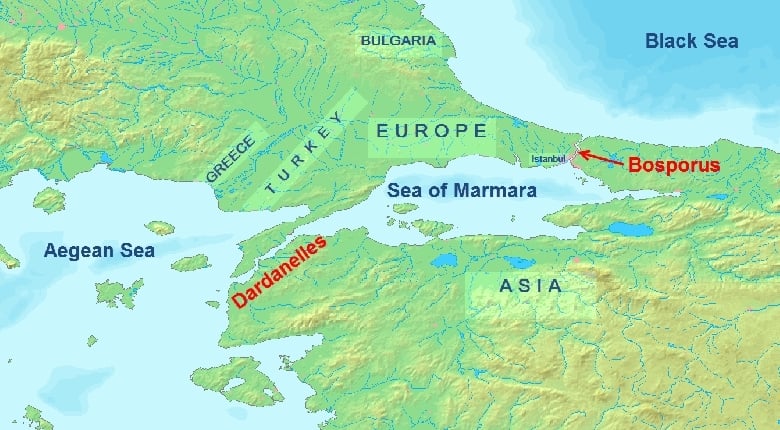
At the same time, both from the Black Sea, and from the Mediterranean Sea, there is a small cluster of ships under the Russian flag, just sitting and waiting. The image below shows the situation with the ships using the GPS transponder onboard each vessel:

In addition, shipping inside the Black Sea from Novorossiisk and Sevastopol in the direction of the Bosphorus, no Russian vessels are moving. This indirectly confirms the a CNN statement that Turkey may have blocked the movement of Russian ships on the Dardanelles and the Strait of Bosporus.
There is a Treaty specifically covering the use of these waterways by nations of the world. That Treaty is the Montreux Convention Regarding the Regime of the Straits.
It is a 1936 agreement that gives Turkey control over the Bosporus Straits and the Dardanelles and regulates the transit of naval warships. The Convention gives Turkey full control over the Straits and guarantees the free passage of civilian vessels in peacetime. It restricts the passage of naval ships not belonging to Black Sea states. The terms of the convention have been the source of controversy over the years, most notably concerning the Soviet Union‘s military access to the Mediterranean Sea.
Signed on 20 July 1936 at the Montreux Palace in Switzerland, it permitted Turkey to remilitarise the Straits. It went into effect on 9 November 1936 and was registered in League of Nations Treaty Series on 11 December 1936. It is still in force today, with some amendments.
The Convention consists of 29 Articles, four annexes and one protocol. Articles 2–7 consider the passage of merchant ships. Articles 8–22 consider the passage of war vessels. The key principle of freedom of passage and navigation is stated in articles 1 and 2. Article 1 provides that “The High Contracting Parties recognize and affirm the principle of freedom of passage and navigation by sea in the Straits”. Article 2 states that “In time of peace, merchant vessels shall enjoy complete freedom of passage and navigation in the Straits, by day and by night, under any flag with any kind of cargo.”
The International Straits Commission was abolished, authorizing the full resumption of Turkish military control over the Straits and the refortification of the Dardanelles. Turkey was authorized to close the Straits to all foreign warships in wartime or when it was threatened by aggression; additionally, it was authorized to refuse transit from merchant ships belonging to countries at war with Turkey.
Turkey has now invoked its power, but has not publicly stated whether they are blocking Russian Naval Vessels because Turkey is “threatened with aggression” or whether Turkey considers itself to be “at war.” Last week, Turkey shot down a Russian military jet over Syria and this has caused a major rift between the two nations.
This latest development of blockading Russian naval vessels is a massive and terrifyingly dangerous development. Blockading Russia and preventing its Black Sea fleet from traveling to the rest of the world, or back to its home port, is something that will not sit well with the Russians.
Earlier today, Russian President Vladimir Putin ordered the deployment of 150,000 Russian troops and equipment into Syria, but then ALSO ordered the deployment of 7,000 additional Russian Troops, tanks, rocket launchers and artillery, to the Russian Border of Turkey at Armenia, with orders to be “fully combat ready.”
It is important to note two things:
1) Turkey is a member of the North Atlantic Treaty Organization (NATO) as is the United States and most of Europe, AND;
2) Turkey took the first shot at Russia when they intentionally shot down a Russian jet last week.
It is important to remember these facts because, as a NATO member, Turkey can invoke Article 5 of the NATO Treaty which requires all NATO members to come to its defense if Turkey is “attacked.” So if Russia decides to fight back against Turkey downing its military jet, the Turks might call NATO and claim they’ve been “attacked” thereby calling-up NATO forces to go to war against Russia.
It bears remembering, however, that Turkey shot first. Turkey was the nation which “attacked.”
Before NATO and the world get dragged into a war between Russia and Turkey, the citizens of the world must be ready to remind our leaders that Turkey Shot First.
Why did the Turks shoot? Because Turkey has been allowing the terrorist group ISIS to sell the oil it has stolen from countries it is conquering. The oil is transported from the wells in countries where ISIS has seized power, is taken by truck to Turkey, and is then sold at cheap prices on the black market.
This black market selling results in over 1 Million dollars per DAY flowing into ISIS to keep it equipped and supplied for its ongoing terrorist activities. Only a fool would think that all this is going on through Turkey, without some Turkish officials having their hands out for money from the illegal oil sales. Put simply, Turkey appears to be in business with ISIS and Russia is harming that by attacking ISIS in Syria.
So Turkey shot down one of the Russian planes that was attacking ISIS. Russia is quite furious; with the Russian President stating the shoot down was “a stab in the back of Russia” and was carried out by “accomplices to terrorism.”
It would be shocking if NATO were to defend Turkey under such circumstances because by its actions, Turkey is providing material support to the terrorist group ISIS. For NATO to defend that would make all of us accomplices to terrorism.
END
The USA under Reagan promised Gorbachev that NATO would not seek addmission of former communist countries in the former Soviet bloc. First NATO sought the Ukraine and now Montenegro which has very close ties to Russia. The citizens of Montenegro are also upset.
And now Russia has threatened with some sort of retaliatory action!
(courtesy zero hedge)
Russia Threatens “Retaliatory Action” After NATO Expands Alliance For First Time In Six Years
As the war in Syria enters its fifth year with no end in site, it’s easy to forget about the world’s “other” proxy conflict, that which is still unfolding in Ukraine.
You might remember Ukraine as yet another example of US intervention gone horribly awry. Indeed, this was but another instance of Washington stepping in to support “democratic” protests on the way to bringing about regime change. Just three months after a dramatic visit to Maidan Square by the Senate’s favorite warhawk John McCain, Russian-backed President Viktor Yanukovych was unceremoniously ousted.
Unfortunately, the democratic utopia that America figured was inevitable didn’t take shape (just like it didn’t take shape after Gaddafi in Libya or after Saddam in Iraq) and now, Ukraine is mired in civil war as Russian-backed separatists battle Kiev’s US-backed regulars and a handful of nationalist militias.
The point is, that problem hasn’t gone away and in fact, reports indicate that the violence has accelerated this week. Ukraine, and before that, the Crimea “incident,” were the “original” Russia Vs. NATO proxy playgrounds and have only faded from memory because of just how dramatic the situation in Syria truly is. While tensions in Syria revolve primarily around the possibility of an “accident” that leads to a wider conflict, the Ukraine/Crimea issue was characterized by both sides’ fears of the other’s territorial ambitions. NATO insisted that Vladimir Putin intended to invade and annex other territory while The Kremlin contended that a series of snap drills, war games, and heavy weapons deployments telegraphed NATO’s desire to expand its capabilities and influence on the way to threatening Russia’s borders.
As if tensions needed to rise any further in the wake of Turkey’s move to shoot down a Russian Su-24 near the Syrian border, NATO has once antagonized Moscow by extending a membership invitation to Montenegro. The announcement came at the NATO ministirial meetings being held in Brussels.
While that may sound inconsequential, Bloomberg reminds us that the country has “close economic links to Russia.”
“NATO expansion since 1999 into eastern European countries that were under Soviet domination during the Cold War has provoked Russian suspicions and, in 2014, was a factor in the Kremlin’s decision to retake Crimea and promote the rebellion in eastern Ukraine,” Bloomberg goes on to note.

The move marks the first expansion of the military alliance since 2009 and as Reuters puts it, “defies Russian warnings that enlargement of the U.S.-led bloc further into the Balkans is ‘irresponsible’ action that undermines trust.” Here’s more color:
Moscow opposes any NATO extension to former communist areas of eastern and southeastern Europe, part of an east-west struggle for influence over former Soviet satellites that is at the center of the crisis in Ukraine.
Russian Foreign Minister Sergei Lavrov said in September that any expansion of NATO was “a mistake, even a provocation”. In comments to Russian media then, he said NATO’s so-called open door policy was “an irresponsible policy that undermines the determination to build a system of equal and shared security in Europe.”
RIA news agency cited a Russian senator as saying on Wednesday that Russia will end joint projects with Montenegro if the ex-Communist country joins the North Atlantic Treaty Organisation. The Adriatic state of 650,000 people is expected to become a member formally next year.
“It’s not focused on Russia per se or anybody else,” John Kerry said on Wednesday, adding that “it would be a great mistake to react adversely.”
Kerry went on to insist that NATO “is not a threat to anyone … it is a defensive alliance,” which makes you wonder what exactly he meant when he said it “would be a great mistake to act adversely.”
In any event, Russia isn’t happy as Kremlin spokesman Dmitry Peskov said Moscow may need to take “retaliatory action.” Here’s the whole statement:
“On all levels, Moscow has always noted that the continuing expansion of NATO, of the military infrastructure of NATO to the east, can only lead to retaliatory measure from the east, from the Russian side, in terms of guaranteeing the security and maintaining a parity of interests.”
Reuters goes on to point out that “NATO allies are [still] divided over what message to send to Georgia over its long-delayed membership bid” and at the two-day meeting, “ministers repeated their long-held position that Tbilisi must continue to prepare for membership, calling for Russia’s military to withdraw from Georgia’s breakaway regions of South Ossetia and Abkhazia.”
Here’s some amusing commentary from Jan Oberg of the Transnational Foundation for Peace and Future Research, who spoke to RT:
RT: The NATO chief was asked whether they’ve taken Russia’s concerns into account. This will be another eastward expansion for the Alliance, near Russia’s borders. How worried should Moscow be?
Jan Oberg: Maybe not too much, but this is the wrong moment given the situation between NATO and Russia. The West needs Russia in Syria and elsewhere. Secondly this is provocative… I see it as a sign of weakness.
RT: And how do you expect Russia to respond?
JO: Well, there will be a diplomatic grumpy response to this, which is understandable given the other measures that NATO has taken in the wake of the Ukraine crisis. If NATO is an alliance of democracies – why not have a referendum? We have thousands of people demonstrating in Montenegro against this. It is done by means of lawmakers, but it is the same problem we have everywhere in the Western so-called democratic world – that the elite are doing things that people don’t want. It applies to Denmark and Sweden, it applies to the US, it applies to France, it applies to Montenegro. So let’s be democratic and get them into NATO if that is what the will of the people is.
Now, I don’t see any point in all these things, because they are all done without alternatives. Let the Montenegrin people get five models of how to secure their future and let them vote democratically. This either ‘yes’ or ‘no’ has nothing to do with democracy. I tell you – there is no problems in Montenegro that can be solved by NATO membership and participation in anti-terror or the war on terror and bring terror to Montenegro.
RT: It’s been 16 years since Montenegro was bombed by NATO, and these memories are surely still fresh in the minds of some locals there. Why were the people denying a referendum on joining the Alliance?
JO: Because it is not a democratic leadership – everybody who has followed [Milo] Dukanovic over the years knows that this is not a democracy in a genuine sense of the word. We also know that it is a country with quite a lot to judge from, quite a lot of media report, … economic corruption…
So if this is what NATO boosts itself within this crisis situation – it is an alliance on its way down.
NATO’s secretary-general Jens Stoltenberg said the alliance would be willing to chat with Russia about the latest expansion.
Sergei Lavrov said only this: “Yes, we have something to talk about.”

Iraq to USA: we do not want you in Iraq!
(courtesy zero hedge)
Iraqi PM Rejects US “Boots On Ground” As Shiite Militias Pledge To Kill US Soldiers
There are probably a lot of lessons we can learn from the conflict in Syria.
We might, for instance, pause and reflect on the morality of subjecting millions of people to untold pain and suffering in pursuit of geopolitical expediency. Or we could make a serious effort to reevaluate a foreign policy that too often centers around bringing about regime change in far away lands without considering the ramifications and potential for blowback.
Of course that kind of deep self-reflection will never happen in Washington, but fortunately, there’s a far simpler lesson that requires very little in the way of high level thinking to understand. Here it is: arming and funding Islamic militants you just met is always a bad idea.
In the worst case scenario you lose control of them only to watch in horror as the Frankenstein you created escapes from the lab, rumbles out of the castle, and proceeds to terrorize and murder all the villagers. In the best case scenario, they do what you thought they were going to do (in this case fight Assad’s army) but they occasionally go off the rails and blow up a Russian search and rescue helicopter after executing one of Moscow’s pilots.
In Syria, the FSA falls into the “best case scenario” category but as we’ve been at pains to explain, arming them now makes even less sense than it did initially because, i) you risk starting a world war as they are using US-supplied weapons to fire on Iranian soldiers and Russian equipment, and, on a practical level, ii) they’re using US-supplied weapons to kill the same Iran-backed Shiite militiamen who are fighting with the Iraqi regulars just across the border.
Consider the following excerpts from various media outlets:
Shi’ite Muslim militiamen and Iraqi army forces launched a counter-offensive against Islamic State insurgents near Ramadi on Saturday, a militia spokesman said, aiming to reverse potentially devastating gains by the jihadi militants. –Reuters, May 23
U.S. airstrikes targeting ISIS around Ramadi are proving “not very effective,” according to the head of the Iran-backed militias surrounding the conquered Iraqi city. “We expect more from the Americans,” Hadi al-Ameri told NBC News. “There are no real airstrikes against ISIS headquarters.” – NBC, June 23
Iraqi forces and the Shiite militias fighting alongside them announced Friday that they had retaken the oil refinery at Baiji from Islamic State militants, in some of the first significant progress against the extremist group after months of stalled efforts. – New York Times, October 16
Iraq’s official military doesn’t appear to be in any position to take on ISIS. Shiite militia groups have proved much more effective at fighting ISIS than Iraq’s official military, and it’s the Shiites who are taking the lead in the Iraqi government’s new campaign to retake Anbar. – Slate, May 26, 2015
You get the idea.
Make no mistake, there are some very serious questions about these militias’ human rights record, but the point is that when it comes to fighting Sunni extremists, there’s no one better to have on your side than fearsome Shiite militiamen even if some of those militiamen were responsible for killing hundreds of US soldiers with copper-tipped IEDs during the Iraq occupation.
As we documented extensively in “Who Really Controls Iraq? Inside Iran’s Powerful Proxy Armies,” Tehran controls these fighters and thanks to their effectiveness on the battlefield, the militias effectively control the US-armed Iraqi regulars. As Reuters noted in October, “the Fifth Iraqi Army Division now reports to the militias’ chain of command, not to the military’s, according to several U.S. and coalition military officials. The division rarely communicates with the Defence Ministry’s joint operation command, from which Abadi and senior Iraqi officers monitor the war, the officials said.”
Here’s a bit more color from the same investigative piece that should give you an idea of what’s going on in Iraq:
Iraqi Prime Minister Haider al-Abadi, a Shi’ite, came to office just over a year ago backed by both the United States and Iran. He promised to rebuild the fragmented country he inherited from his predecessor, Nuri al-Maliki, who was widely accused of fueling sectarian divisions. Since then, though, even more power has shifted from the government to the militia leaders.
Those leaders are friendly with Abadi. But the most influential describe themselves as loyal not only to Iraq but also to Iran’s supreme leader, Ayatollah Ali Khamenei. Three big militias – Amiri’s Badr Organisation, Asaib Ahl al-Haq and Kataib Hezbollah – use the Iranian Shi’ite cleric’s image on either their posters or websites. Badr officials describe their relationship with Iran as good for Iraq’s national interests.
Iraq, for all intents and purposes, is now an Iranian colony both politically and militarily.
In the wake of the US invasion in 2003, Tehran was concerned that the Cheney Bush administration would move to invade Iran next. This, along with a desire to aid the Americans in fighting The Taliban in Afghanistan (who Iran now covertly supports in an effort to usurp ISIS influence), led the IRGC to forge a quasi-friendly relationship with The Pentagon. And then George Bush put Iran in his infamous “Axis of Evil.” From that point forward the Quds encouraged Iraq’s Shiite militias to target American troops, which goes a long way towards explaining why the US accuses Iran of being the world’s number one state sponsor of terror (of course that’s absurd, but hey, we didn’t say it, Washington did).
Fast forward to 2015 and the US has essentially comes to terms with the fact that Iran’s proxies are going to fight ISIS alongside the Iraqi regulars. It’s only annoying for Washington when those proxies say things like this: “the United States lacks the decisiveness and the readiness to supply weapons needed to eliminate militancy in the region.” But while it’s fine to taunt the US regarding Washington’s highly suspicious lack of commitment to the fight against ISIS in Iraq, Iran is not keen on seeing a sizeable US troop presence on its border (again) which is why it should come as no surprise to you that on the heels of Ash Carter’s announcement earlier today that the US is set to send SpecOps to Iraq, Kataib Hezbollah immediately threatened to attack them. Here’s Retuers:
“We will chase and fight any American force deployed in Iraq,” said Jafaar Hussaini, a spokesman for one of the Shi’ite armed groups, Kata’ib Hezbollah. “Any such American force will become a primary target for our group. We fought them before and we are ready to resume fighting.”
Badr Organisation and Asaib Ahl al-Haq (mentioned above) weren’t far behind:
“All Iraqis look to (the Americans) as occupiers who are not trustworthy,” said Muen al-Kadhimi, a senior aide to the leader of the Badr Organisation.
“The militias, grouped with volunteer fighters under a government-run umbrella, are seen as a bulwark in Iraq’s battle against Islamic State,” Reuters adds.
Predictably, PM Abadi was out just hours later reiterating (he already said this once back in October) that Iraq does “not need foreign ground combat forces on Iraqi land.”
Obviously, these pronouncements might as well have been issued directly from Tehran because that’s unquestionably who’s pulling the strings here, but this does set up an interesting scenario. Washington probably wasn’t looking for permission in the first place despite Carter’s lip service to Baghdad on Tuesday. The US will likely embed the Spec Ops with the Peshmerga via the KRG in Erbil.
The question then, is this: if the Iraqi regulars are now loyal to the Shiite militias and if Iran is pulling the strings in Baghdad, what will the relationship be between a US/Peshmerga effort to fight ISIS and an Iran/Iraqi effort? Furthermore, what happens if Russia begins bombing ISIS targets in Iraq?
Time will tell, but the big picture takeaway here is this: this war doesn’t end in Syria.
* * *
Bonus: Visuals of Iraqi Shiite fighters


US Intervention: Before And After

The Lull Before The Storm – It’s Getting Narrow At The Top, Part 2
Submitted by David Stockman via Contra Corner blog,
The danger lurking in the risk asset markets was succinctly captured by Monday’s overnight action in Asia. The latter proved once again that the casino gamblers are incapable of recognizing the on-rushing train of global recession because they have become addicted to “stimulus” as a way of life:
Shares in Hong Kong led a rally across most of Asia Tuesday, on expectations for more stimulus from Chinese authorities, specifically in the property sector…….The gains follow fresh readings on China’s economy, which showed further signs of slowdown in manufacturing data released Tuesday (which) remains plagued by overcapacity, falling prices and weak demand. The dimming view casts doubt that the world’s second-largest economy can achieve its target growth of around 7% for the year. The central bank has cut interest rates six times since last November.
More stimulus from China? Now that’s a true absurdity – not because the desperate suzerains of red capitalism in Beijing won’t try it, but because it can’t possibly enhance the earnings capacity of either Chinese companies or the international equities.
In fact, it is plain as day that China has reached “peak debt”. Additional borrowing there will not only prolong the Ponzi and thereby exacerbate the eventual crash, but won’t even do much in the short-run to brake the current downward economic spiral.
That’s because China is so saturated with debt that still lower interest rates or further reduction of bank reserve requirements would amount to pushing on an exceedingly limp credit string.
To wit, at the time of the 2008 crisis, China’s “official” GDP was about $5 trillion and its total public and private credit market debt was roughly $8 trillion. Since then, debt has soared to $30 trillion while GDP has purportedly doubled. But that’s only when you count the massive outlays for white elephants and malinvestments which get counted as fixed asset spending.
So at minimum, China has borrowed $4.50 for every new dollar of reported GDP, and far more than that when it comes to the production of sustainable wealth. Indeed, everything is so massively overbuilt in China——from unused airports to empty malls and luxury apartments to redundant coal mines, steel plants, cement kilns, auto plants, solar farms and much, much more—-that more borrowing and construction is not only absolutely pointless; it is positively destructive because it will result in an even more destructive adjustment cycle.
That is, it will only add to the immense already existing downward pressure on prices, rents and profits in China, thereby insuring that even more trillions of bad debts will eventually implode. And that, in turn, will prolong the CapEx depression, which is the inexorable flip-side of the credit driven investment spree that has so massively bloated and deformed China’s economy.
In short, the kind of dead cat bounces like those registered in the Asian bourses last night have virtually nothing to do with prospects that the unfolding global recession can be reversed by central banks or other state fiscal actions. These mini-rallies are entirely financial spasms triggered by the vestigial algorithms of robo-machines and chart-point chasing day traders.
But that is exactly why bubbles eventually splatter. When peak debt is reached, additional credit never leaves the financial system; it just finances the final blow-off phase of leveraged speculation in the secondary markets.
Indeed, what is happening now is that the herd of buy-the-dip speculators is being pushed into a narrower and narrower slice of the market. A few weeks ago we pointed this out with respect the quartet of FANG stocks:
In fact, there were some fireworks in last week’s gains, but if history is any guide they were exactly the kind of action that always precedes a thundering bust. To wit, the market has narrowed down to essentially four explosively rising stocks—–the FANG quartet of Facebook, Amazon, Netflix and Google—–which are sucking up all the oxygen left in the casino.
At the turn of the year, the FANG stocks had a combined market cap of $740 billion and combined 2014 earnings of $17.5 billion. So a valuation multiple of 42X might not seem outlandish for this team of race horses, but what has happened since then surely is.
At this week’s close, the FANG stocks were valued at just under $1.2 trillion, meaning they have gained $450 billion of market cap or 60% during the last 11 months——even as their combined earnings for the September LTM period were up by only 13%.
This means that the FANG stocks were driven to a 60X PE as the gamblers piled on the last trains out of the station.
Yet after 27 failed attempts to rally, including Tuesday’s low volume melt-up, the modest rebound of recent weeks is surely just another spasm of the dying bull.

That’s especially the case coming as it does on the heels of a flood of negative domestic economic news, the onset of the fifth recession in 7 years in Japan, more cratering of credit and industrial activity in China, another plunge lower in Brazil that Goldman has described as an outright depression, continued severe pressure on exchange rates and credit markets in the DM and the specter of a Thermidorian Reaction to the Paris terrorism events in Europe.
Indeed as the old Wall Street adage holds, market tops are a process, not an event. Another peak under the hood of the S&P 500 index, in fact, reveals exactly that.
It turns out that the Tremendous Ten mega-stocks listed in the chart below currently have a combined market cap of $3.76 trillion. That’s up by the considerable sum of $440 billion or 14% since the start of 2015.
But what is not up is the net income of the group as a whole. It weighed in at $158 billion for the 12 months ending in September, and that’s down by 17% from the $190 billion of net income the Tremendous Ten posted for the LTM in December 2014..

But the point is, speculators are hiding in a diminishing number of these seemingly safe havens without regard to short-run earnings performance. At this point, for example, Exxon’s market cap is only down by $50 billion or 13% from year-end 2014 levels, meaning that it is still trading at 18X earnings that are heading much lower for much longer.
Likewise, the market cap of Microsoft (MSFT) has actually risen by $50 billion or 13% to $435 billion. With the global economy heading into a CapEx depression it seems a little more than late in the hour for MSFT to be sporting a 35X trailing PE ratio.
More importantly, the other 490 S&P stocks as a group have been sinking for the better part of a year. Their combined market cap was $15.1 trillion at the end of last year, but has since slide to only $14.6 trillion.
And well it should have. The balance of the S&P 500 still trades at 23X earnings, not withstanding an 11% drop in reported net income since the peak in Q3 2014.
All of this is to say that the third stock market collapse of this century is near at hand. The global economy is in the midst of an unprecedented commodity deflation and CapEx depression – the payback for 20 years of lunatic monetary stimulus and credit expansion.
Yet the central banks are powerless to stop the payback. When the Fed announces a rate increase after 84 months of dithering next week in the face of GDP growth that has already decelerated to barely 1% this quarter the jig will be up.
Monumental money printing has failed. Soon there will be no place to hide – not even in the Tremendous Ten.
The Emerging Market Growth Model Is “Broken”; RIP EM
- It’s that time of year again, when every sellside macro strategist peers into his or her crystal ball in a completely futile effort to predict the direction the global economy economy will take in the year ahead.As everyone knows, the only thing more difficult than forecasting the weather is forecasting economic outcomes (economics is, after all, merely a pseudoscience and not one that the general public has much faith in at that), and as we’ve joked on several occasions, getting it wrong is almost part of the economist’s job description.That said, some trends are undeniable and many times the best way to “get it right” (so to speak), is to look for broken stories. As Salient Partners’ Ben Hunt recently discussed in an interview with RealVisionTV, when the story is broken, you can bet the waters ahead will be choppy even if the longer-term outlook isn’t necessarily as dire. Well, if there’s any story that’s definitively broken right now, it’s EM.As we’ve documented exhaustively, the emerging world is facing a perfect storm of collapsing commodities, depressed demand from China, the incipient threat of a Fed hike and thus an even stronger USD, the yuan deval, and acute idiosyncratic political crises (Brazil, Turkey, Malaysia). Heading into 2016, some might be wondering if it may be time to reevaluate the situation on the way to dipping a toe or two into EM in hopes of getting in at the bottom. With that in mind, we bring you the following excerpts from Citi on EM’s “broken growth model.”First, there’s the notion that we have entered into a new era characterized by lackluster global trade that’s structural and endemic rather than cyclical and transitory. Throw in China’s deceleration and you’ve got a real problem:
Emerging economies’ growth prospects look damaged in several respects. The central fact facing EM is the negative external shock that results from weak global trade growth and the collapse of Chinese import growth. This brings to an irreversible end the period of rapid, investment-led Chinese growth and strong global trade growth which had supplied EM with a once-in-a-generation positive external shock during the years between 2002 and 2013.
And then there’s the idea that fiscal policy is hamstrung by a market that, in the wake of the EU debt crisis, is no longer tolerant of soaring debt-to-GDP ratios:
Fiscal policy is tight across EM because private capital markets seem quite intolerant of rising public debt levels in EM (note Brazil’s fate). Even in countries that are actively trying to loosen fiscal policy — Indonesia, or Korea, for example — the loosening is quite modest.
Additionally – and we’ve seen this in Brazil – the private sector is already overleveraged, meaning the credit impulse is likely to be subdued. Also – and China is a good example here – banks may be reluctant to lend in an environment where borrowers are clearly over-extended and can’t, in some instances, service their existing debt.
In addition, domestic credit conditions remain tight in many countries across EM, because many countries already have had a domestic ‘credit boom’, and this means that risk appetite is low in domestic credit markets across EM.
So, all the three main sources of GDP growth — exports, public and private domestic spending — are constrained. The persistence of this problem has led us, alongside many other forecasters, to underestimate the EM slowdown consistently over the past four years (Figure 1).

And “plenty of financial vulnerabilities remain:”
One important difference between this crisis and previous ones in the 1980s and 1990s is that EM crises in the past were more or less entirely located in the balance of payments, while this crisis has more diverse roots: it is as much about a crisis of growth as it is about weakness in the balance of payments. But it is true that there are important balance of payments fragilities in EM. Some countries (eg South Africa) have stubborn current account deficits, and a number of countries – Brazil, Russia, Turkey, China, India, Indonesia – saw their corporate fx indebtedness rise sharply in recent years.
Finally, no one is “out of the woods” despite how “cheap” EM FX has become:
This is because of two remaining threats. One is the consequences of “Fed lift-off”; and the other from China. Higher US rates do still threaten capital flows to EM, largely because some of the ‘excess’ inflow to EM in the past five years will have had cyclical characteristics, and could therefore be vulnerable as US rates rise.

The bottom line is that when you look out across the space, it’s not just that the growth model is, as Citi puts it, “broken.” You also need to consider the fact that three of the world’s most important emerging markets are on the verge of an outright collapse.
There’s Brazil, which is stuck in a stagflationary nightmare exacerbated by an intractable political crisis that may well end up plunging the country into a depression (see Q3 GDP dataout on Tuesday).
There’s also Turkey, where a maniacal leader hell bent on consolidating absolute power in the Presidency has plunged the country into civil war and now seems prepared to push NATO into an armed conflict with Russia.
And of course there’s China, were decelerating growth, an unstable equity market, persistent capital flight, and a looming private sector debt crisis threaten to destabilize the world’s engine of growth.
Set all of that against a backdrop of depressed global trade and still lackluster demand, and one by one, we could see the world’s “emerging” economies backslide into “frontier” status.


Global Crisis: Goldman Sachs Says That Brazil Has Plunged Into ‘An Outright Depression’
 By Michael Snyder, on December 1st, 2015
 One of the most important banks in the western world says that the 7th largest economy on the entire planet has entered a full-blown economic depression. Brazil’s economy has now contracted for three quarters in a row, and many analysts believe that things are going to get far worse before they have a chance to get any better. Earlier this year, I warned about “the South American financial crisis of 2015“, and now it is in full swing. The surging U.S. dollar is absolutely crushing emerging markets such as Brazil, and if the Fed raises interest rates this month that is going to make the pain even worse. The global financial system is more interconnected than ever before, and the decisions made by the Federal Reserve truly do have global consequences. So much of the “hot money” that was created by the Fed poured into emerging markets such as Brazil during the good times, but now the process is starting to reverse itself. At this point, it is hard to see how much of South America is going to avoid a complete and total economic disaster.
It is one thing for Michael Snyder from the Economic Collapse Blog to say that the Brazilian economy has entered a “depression”, but it is another thing entirely when Goldman Sachs comes out and publicly says it. The following comes from a Bloomberg article that was just posted entitled “Goldman Warns of Brazil Depression After GDP Plunges Again“…
Latin America’s largest economy shrank more than analysts forecast, as rising unemployment and higher inflation sapped domestic demand, pulling the nation deeper into what Goldman Sachs now calls “an outright depression.”
Gross domestic product in Brazil contracted 1.7 percent in the three months ended in September, after a revised 2.1 percentdrop the previous quarter, the national statistics institute said in Rio de Janeiro. That’s worse than all but three estimates from 44 economists surveyed by Bloomberg, whose median forecast was for a 1.2 percent decline. It also marks the first three-quarter contraction since the institute’s series began in 1996, and a seasonally adjusted annual drop of 6.7 percent.
And when you look deeper into the numbers they become even more disturbing.
Unemployment is rising, consumer spending is way down, and investment spending is absolutely collapsing. Here is some of the data that Goldman Sachs just released that comes via Zero Hedge…
Private consumption has now declined for three consecutive quarters (at an average quarterly rate of -8.5% qoq sa, annualized), and investment spending for nine consecutive quarters (at an average rate of -10.0% qoq sa, annualized). Overall, gross fixed investment declined by a cumulative 21% from 2Q2013. The declining capital stock of the economy (declining capital-labor ratio) hurts productivity growth and limits even further potential GDP. The sharp contraction of real activity during 3Q was broad-based: both on the supply and final demand side. Final domestic demand weakened sharply during 3Q2015 (-1.7% qoq sa and -6.0% yoy) with private consumption down 1.5% qoq sa (-4.5% yoy) and gross fixed investment down 4.0% qoq sa (-15.0% yoy). Finally, on the supply side, we highlight that the large labor intensive services sector retrenched again at the margin (-1.0% qoq sa; -2.9% yoy).
The term “economic depression” is not something that should be used lightly, because it conjures up images of the Great Depression of the 1930s. And the Brazilian economy is very important to the global economic system. As I mentioned above, there are only six countries in the entire world that have a larger economy, and Brazil accounts for more than 242 billion dollars worth of exports every year.
So if Brazil is feeling pain, it is going to affect all of us.
Up to this point, everyone had been calling what has been going on in Brazil a “recession”, but now Goldman Sachs is the first major bank to label it “an outright economic depression”…
“What started as a recession driven by the adjustment needs of an economy that accumulated large macro imbalances is now mutating into an outright economic depression given the deep contraction of domestic demand,” Alberto Ramos, chief Latin America economist at Goldman Sachs Group Inc., wrote in a report Tuesday.
Of course Brazil is far from alone. The third largest economy on the globe, Japan, has also now slipped into recession territory. So has Russia. And just today we learned that Canadian GDP is plunging…
Who could have seen that coming? It appears, for America’s northern brethren, low oil prices are unequivocally terrible. Against expectations of a flat 0.0% unchanged September,Canadian GDP plunged 0.5% – its largest MoM drop since March 2009 and the biggest miss since Dec 2008.
It is just a matter of time before this global economic downturn catches up with us here in the U.S. too.
In fact, there is evidence that this is already happening.
According to brand new numbers that just came out, manufacturing activity in the U.S. is contracting at the fastest pace that we have seen since the last recession…
Manufacturing in the U.S. unexpectedly contracted in November at the fastest pace since the last recession as elevated inventories led to cutbacks in orders and production.
The Institute for Supply Management’s index dropped to 48.6, the lowest level since June 2009, from 50.1 in October, a report from the Tempe, Arizona-based group showed Tuesday. The November figure was weaker than the most pessimistic forecast in a Bloomberg survey. Readings less than 50 indicate contraction.
Another indicator that I am watching is the velocity of money.
When an economy is healthy, money tends to flow fairly freely. I buy something from you, and then you buy something from someone else, etc.
But when economic conditions start to get tough, people start to hold on to their money. That means that money doesn’t change hands as quickly and the velocity of money goes down. As you can see below, the velocity of money has declined during every single recession since 1960…

When a recession ends, the velocity of money normally starts going back up.
But a funny thing happened when the last recession ended. The velocity of money ticked up slightly, but then it started going down steadily. In fact, it has kept on declining ever since and it has now hit a brand new all-time record low.
This is not normal. Yes, Wall Street is temporarily flying high for the moment, but the underlying economic fundamentals are all screaming that something is horribly wrong.
A global crisis has begun, and the U.S. will not be immune from it. I truly believe that we are heading toward the worst economic downturn that any of us have ever experienced.
But there are many out there that insist that nothing is the matter and that happy times are ahead.
So who is right and who is wrong?
We will just have to wait and see…
Brazil Devolves Into Full-Blown Political Crisis With Launch Of Impeachment Proceedings Against President Rouseff
Just when the Brazilian depression (as we first called it in December 2014 and as Goldman confirmed a year later) appeared that it couldn’t get any worse, especially in the aftermath of the BTG Pactual scandal which saw the CEO of Brazil’s “Goldman Sachs” arrested last week, the bottom fell out of the floor for Brazil following news that the long awaited impeachment proceedings against Dilma Rouseff would actually begin, despite expectations they would be delayed into 2016.
Moments ago Brazil lower house chief Eduardo Cunha announced that he has accepted an impeachment request filed by Helio Bicudo. Cunha told reporters in Brasilia that the decision is not political, and while one can debate that, the implications will have a tremendous impact on both Brazil’s political situation not to mention its already imploding economy (Really Eduardo? You accept an impeachment request a few hours after you learn that the Workers’ Party will support an investigation into possible graft on your part and it “isn’t political?”).
To be sure, the writing was on the wall all day.
Earlier, the Workers’ Party said lawmakers are set to vote in favor of a motion to open an investigation into Cunha’s role in the Carwash corruption probe. The ethics committee is set to vote next week.
As we noted in October, this has essentially always been a race against time to see if the house ethics committee will force Cunha’s resignation before he can secure the lower house support to initiate a Senate impeachment trial.
Wanting to get out ahead of the committee, Cunha moved to accept an impeachment request.
As Bloomberg adds, Cunha told reporters in Brasilia on Wednesday he “profoundly regrets” what’s happening. “May our country overcome this process.” The impeachment process could take months, involving several votes in Congress that ultimately may result in the president’s ouster. Rousseff would challenge any impeachment proceedings in the Supreme Court, according to a government official with direct knowledge of her defense strategy.
The speaker’s decision will put the president’s support in Congress to a test after government and opposition spent months trying to rally lawmakers to their sides. The move also threatens to paralyze Rousseff’s economic agenda as she focuses on saving her political life rather than reviving growth. Her ouster would mark the downfall of the ruling Workers’ Party that won global renown for lifting tens of millions from poverty before becoming ensnared in Brazil’s largest-ever corruption scandal.
Accusations that top members of her party accepted bribes, coupled with surging consumer prices and rising unemployment, have driven Rousseff’s approval rating to record lows. The majority of Brazilians in public opinion polls agreed that Congress should open impeachment proceedings against the president.
As noted above, Cunha himself is facing allegations that he accepted kickbacks and hid the money in overseas accounts. The lower house ethics committee is considering whether to open a probe that could result in his removal from office. His decision today comes after Workers’ Party members on the committee agreed Dec. 2 to vote in favor of investigating Cunha. The speaker denies wrongdoing.
More details from Bloomberg:
Backed by Brazil’s leading opposition parties, the impeachment request accuses Rousseff of breaching Brazil’s fiscal responsibility law in 2014 and 2015. The country’s top auditors in October recommended Congress reject her accounts, saying the administration used fiscal maneuvers to hide a budget deficit last year. The government has denied wrongdoing.
The petition accepted by Cunha goes to a special committee made up of all political parties that must issue a recommendation whether impeachment hearings should start.
The lower house then votes on the committee’s report. If two-thirds of the deputies back impeachment, hearings would begin in the Senate. In that case, Rousseff would have to step down and hand over the reins to Vice President Michel Temer. He would remain in power if the Senate impeaches Rousseff or step aside if she is absolved.
Rousseff’s ruling coalition on paper has enough members in Congress to block impeachment hearings from starting in the Senate. Yet members of the alliance frequently dissent from the president. Cunha himself is a member of the largest allied party, though he said in July he would oppose Rousseff and has since orchestrated some of her biggest legislative defeats.
In other words, what was until now a full-blown political and economic crisis just got even worse.
As a reminder this is the country where a sweeping corruption investigation into state-owned oil company Petrobras has already implicated some of the country’s most powerful politicians and businessmen with the latest to be dragged into the probe being Andre Esteves, the head of the “Goldman of Brazil” investment bank BTG Pactual, who was arrested last month.
Yesterday Brazil also just reported its biggest GDP drop on record which hardly helped Rouseff’s case to push through more fiscal austerity measures. At this point it is clear that all budgetary plans are officially dead. Put differently, there’s no respite for Brazil and between the forthcoming investigation into Cunha, the impeachment threat for Rousseff, and the extreme paranoia that will now permeate the legislature thanks to the arrest of Amaral, you can kiss the primary surplus dream goodbye.
Finally this is the country hosting next year’s Olympics: at the rate it is going, it just may announce in the last moment the Olympics have been cancelled. We wonder if there is a Plan B for when Rio throws in the towel?
Euro/USA 1.0594 down .0032
USA/JAPAN YEN 123.14 up .234
GBP/USA 1.5034 down .0042
USA/CAN 1.3372 up.0011
Early this morning in Europe, the Euro fell by 32 basis points, trading now just below the 1.06 level falling to 1.0594; Europe is still reacting to deflation, announcements of massive stimulation (QE), a proxy middle east war, and the ramifications of a default at the Austrian Hypo bank, an imminent default of Greece, Glencore,and now Nysmark and the Ukraine, along with rising peripheral bond yield. Last night the Chinese yuan down in value (onshore). The USA/CNY flat in rate at closing last night: 6.3987 / (yuan flat)
In Japan Abe went all in with Abenomics with another round of QE purchasing 80 trillion yen from 70 trillion on Oct 31/2014. The yen now trades in a southbound trajectory as settled down again in Japan by 42 basis points and trading now well above the all important 120 level to 123.14 yen to the dollar.
The pound was down this morning by 42 basis points as it now trades just below the 1.51 level at 1.5034.
The Canadian dollar is now trading down 11 in basis point to 1.3372 to the dollar.
We are seeing that the 3 major global carry trades are being unwound. The BIGGY is the first one;
1. the total dollar global short is 9 trillion USA and as such we are now witnessing a sea of red blood on the streets as derivatives blow up with the massive rise in the rise in the dollar against all paper currencies and especially with the fall of the yuan carry trade. The emerging market which house close to 50% of the 9 trillion dollar short is feeling the massive pain as their debt is quite unmanageable.
2, the Nikkei average vs gold carry trade (blowing up)
3. Short Swiss franc/long assets (European housing/Nikkei etc. This has partly blown up (see Hypo bank failure).(blew up)
These massive carry trades are terribly offside as they are being unwound. It is causing global deflation ( we are at debt saturation already) as the world reacts to lack of demand and a scarcity of debt collateral. Bourses around the globe are reacting in kind to these events as well as the potential for a GREXIT>
The NIKKEI: this WEDNESDAY morning: closed down 74.27 or 0.37%
Trading from Europe and Asia:
1. Europe stocks mixed
2/ Asian bourses mostly in the red … Chinese bourses: Hang Sang green (massive bubble forming) ,Shanghai in the green barely on gov’t intervention again in the last hour/ (massive bubble ready to burst), Australia in the red: /Nikkei (Japan) in the red/India’s Sensex in the red/
Gold very early morning trading: $1067.45
silver:$14.16
Early WEDNESDAY morning USA 10 year bond yield: 2.16% !!! up 1 in basis points from Tuesday night and it is trading well below resistance at 2.27-2.32%. The 30 yr bond yield falls to 2.91 down 1 in basis point.
USA dollar index early WEDNESDAY morning: 100.08 up 24 cents from Tuesday’s close. (Resistance will be at a DXY of 100)
This ends early morning numbers WEDNESDAY MORNING
Crude Tumbles As Inventories Surge For 10th Week In A Row And Production Rises Despite Demand Drop
Confirming last night’s API report, DOE reports that total crude inventories rose for the 10th week in a row (up by 1.177mm barrels) This is a huge surprise relative to the 800k draw that analysts expected astotal product demand dropped 1.6% relative to last year. Which all makes panicked cash-flow sense as production rose by 37k bpd.
10th weekly build in a row…

Production rises to highest since Aug 28th…

Which is happening as demand tumbles…
- GASOLINE DEMAND -0.6% VS SAME 4 WKS LAST YR;
- – TOTAL PRODUCT DEMAND -1.6% VS SAME 4 WKS LAST YR
And the reaction…

Charts: Bloomberg
Oil Traders Punk’d By Schizophrenic Comments From OPEC
And so it begins:
To which we noted:
Quickly followed by this…
The end-result: traders, well algos really as no carbon-based trader was fast enough to react to this,punk’d:

Of course, no production cut can work unless all members agree to a plan and implement it cohesively. Aside from a select few Gulf States, most of the OPEC membership is expected to heavily lobby Saudi officials to cut production.
But in reality, Saudi Arabia will be the one to determine OPEC’s next step. As the only country with significant spare capacity, not to mention cash reserves and the political wherewithal to actually impose production cuts, Saudi Arabia will decide whether or not OPEC moves to cut its output quota.
Finally, here is the full punking report from Iran’s Shana:
Majority of OPEC Members Agree on Output Cut: Iran
Majority of member states of the Organization of Petroleum Exporting Countries (OPEC) agree on a reduction in the crude oil production to keep up prices with an exception of Saudi Arabia and Persian Gulf Arab countries, said director general of OPEC and energy forums in the Iranian Ministry of Petroleum.
“Under current international conditions between Iran and certain Persian Gulf littoral states, it is unlikely that these countries voluntarily cut their output so that Iran can return to the global crude oil markets provided that political relations improve,” Mehdi Asail said on Wednesday.
According to the Iranian official who was talking to Shana on the eve of the 168th ministerial meeting of OPEC to be held in Vienna on Friday, the real challenge before the organization is lack of a genuine agreement over the way of managing supply in order to establish stability in the oil market.
Iran has officially announced that it will increase production for 500,000 barrels a day immediately after sanctions are lifted. Another increase of similar amount will follow within weeks so that Iran’s export will be back to the pre-sanctions quota.
Minister of Petroleum Bijan Zangeneh has said hat Iran does not need the permission of any country to increase its crude oil production.
Saying that ousting Iran’s oil from the market was an “oppressive and illegal” act, the minister stressed, “Our return to the market does not require the permission of anybody. We are not expecting approval of the letter by other member states.”
Speaking to Shana, he confirmed Iran has sent letters to the member states to inform them of the intention to boost its output.
“The letters were meant to inform them to include the increase in the production plans of the organization,” he added, “Iran did not write letter for their approval.”
Oil Traders Punk’d By Schizophrenic Comments From OPEC
And so it begins:
To which we noted:
Quickly followed by this…
The end-result: traders, well algos really as no carbon-based trader was fast enough to react to this,punk’d:
Of course, no production cut can work unless all members agree to a plan and implement it cohesively. Aside from a select few Gulf States, most of the OPEC membership is expected to heavily lobby Saudi officials to cut production.
But in reality, Saudi Arabia will be the one to determine OPEC’s next step. As the only country with significant spare capacity, not to mention cash reserves and the political wherewithal to actually impose production cuts, Saudi Arabia will decide whether or not OPEC moves to cut its output quota.
Finally, here is the full punking report from Iran’s Shana:
Majority of OPEC Members Agree on Output Cut: Iran
Majority of member states of the Organization of Petroleum Exporting Countries (OPEC) agree on a reduction in the crude oil production to keep up prices with an exception of Saudi Arabia and Persian Gulf Arab countries, said director general of OPEC and energy forums in the Iranian Ministry of Petroleum.
“Under current international conditions between Iran and certain Persian Gulf littoral states, it is unlikely that these countries voluntarily cut their output so that Iran can return to the global crude oil markets provided that political relations improve,” Mehdi Asail said on Wednesday.
According to the Iranian official who was talking to Shana on the eve of the 168th ministerial meeting of OPEC to be held in Vienna on Friday, the real challenge before the organization is lack of a genuine agreement over the way of managing supply in order to establish stability in the oil market.
Iran has officially announced that it will increase production for 500,000 barrels a day immediately after sanctions are lifted. Another increase of similar amount will follow within weeks so that Iran’s export will be back to the pre-sanctions quota.
Minister of Petroleum Bijan Zangeneh has said hat Iran does not need the permission of any country to increase its crude oil production.
Saying that ousting Iran’s oil from the market was an “oppressive and illegal” act, the minister stressed, “Our return to the market does not require the permission of anybody. We are not expecting approval of the letter by other member states.”
Speaking to Shana, he confirmed Iran has sent letters to the member states to inform them of the intention to boost its output.
“The letters were meant to inform them to include the increase in the production plans of the organization,” he added, “Iran did not write letter for their approval.”
US Equities Hit Air-Pocket As Oil Breaks Below $41
US equity makrets appeared to decoupled from their long-run driver USDJPY around the time ADP data was released. Since then stocks have tracked crude oil, which thanks to its OPEC-comment-driven stop run, and DOE data is now tumbling…
Stock gapped lowe r on heavy volume..

As oil broke $41…

Portuguese 10 year bond yield: 2.26% par from Tuesday.
The Nasdaq:down 33.08 or 0.64%
-
Stocks Plunge Back To Bonds’ Reality Amid Crude Carnage
“Do Not Panic”…
It appears 20 victims is just not enough to warrant a massive short-squeeze like Paris!!
Stocks caught down to bonds’ reality…

And some longer-term (post-FOMC) context…

Before the US opened though, China saw massive divergence in performance…

This was the worst day for stocks in 3 weeks with high-flyer Trannies the biggest loser (as crude collapsed)…

Futures show the action a little clearer…

Leaving all major indices (apart from the NASDAQ’s late save) in the red on the week…

Stocks decoupled from USDJPY as ADP hit and tumbled with Crude…

Treasury yields were mixed with the long-end flat and short-end higher (the belly was worst with 5Y +4.5bps, 30Y unch, 2Y +3bps)

The USD jumped to 12 year highs after ADP hit but rapdily slipped lower during Crude’s collapse, Yellen’s speech, and the mass shooting…

Commodities saw a gap down after ADP reported and the USD surged…

This was WTI’s worst day in 2 months and lowest close since August 27th…

Charts: Bloomberg


Despite LeBeau-gasms, Domestic Vehicle Sales Slide For 2nd Month In A Row, Miss By Most In 5 Months
Well this is a little awkward. After a day of exuberant unsubstantiated auto sales proclamations that a) it’s not all subprime, b) 8-year credit terms do not pull forward demand, and c) it’s totally sustainable; anyone could have been forgiven for being excited about the total vehicle sales of 18.12mm (according to Wards’ data), just above expectations of 18.10mm and flat from October. However, Wards reported just 14.03mm domestic vehicles sold (missing expectations by the most since June) and dropping for the 2nd month in a row. Those darned facts do get in the way eh?
Recessions happen at the funniest times eh?

Domestic vehicle sales are up just 2.6% YoY… and that is as credit soars to this sector…

Should we worry? Well it seems we will not be relying on China to save us?

We are going to need more up and to the right of this…

Charts: Bloomberg
end
the ADP private jobs report shows a rise but do not pay much attention to this fabricated report.
(courtesy ADP)
ADP Employment Rises, Beats By Most In 2015, Fed Confirms Job Mandate Has Been Met
From “pumping out lots of jobs” in September to “not slowing meaningfully” in October, and despite consistent job losses in manufacturing (which is odd because auto sales are so awesome, right?), ADP reports November a jump to 217k (against expectations of 190k and October’s 182k). ADP has missed expectations 8 months so far in 2015, but November’s beat is the biggest since 2014 which one could argue was just catch up from ADP’s big miss relative to BLS data (182 ADP with an upward revision to 196K now, vs 271k BLS). Of course, none of this “data” matters apparently as Fed’s Lockhart said just this morning that the Fed’s “criterion of job market improvement has been met.”

Catching up to BLS data…

The Breakdown…

Payrolls for businesses with 49 or fewer employees increased by 81,000 jobs in November, down from October’s 91,000. Employment among companies with 50-499 employees increased by 62,000 jobs, a bit less than the 67,000 added last month. Employment at large companies – those with 500 or more employees – came in double the upwardly revised 37,000 jobs added in October at 74,000 for the month. Companies with 500-999 added 57,000 jobs, the largest gain for this segment in the history of the ADP National Employment Report. Companies with over 1,000 employees gained 17,000 jobs, after adding 28,000 in October.
Spot the outlier…

(so the average monthly employment gain since 2009 for large firms has been 11k, amid carnage in the economy suddenly large firms hire 57k workers in Nov 2015… 4 standard deviations above average!!)
ADP explains…
“The strongest gains in the service sector since June led to greater employment growth in November,” said Ahu Yildirmaz, VP and head of the ADP Research Institute. “The increase was driven in large part by a rebound in professional/business service jobs.”
Mark Zandi, chief economist of Moody’s Analytics, said, “Job growth remains strong and steady. The current pace of job creation is twice that needed to absorb growth in the working age population. The economy is fast approaching full employment and will be there no later than next summer.”
The charts: Change in Nonfarm Private Employment

Change in Total Nonfarm Private Employment

Change in Total Nonfarm Private Employment by Company Size

Change in Total Nonfarm Private Employment by Selected Industry

And the infographic:

Janet Yellen Explains Why The Fed Will Raise Rates Amid A Revenue, Profit & Manufacturing Recession – Live Feed
Janet Yellen is set to begin the first part of her two-day excuse-fest for why The Fed will raise rates (market implied odds at 74%) in December despite Chinese stocks crashing again, carnage in commodities, a revenues recession, plunging EBITDA, a collapse in US manufacturing, housing rolling over,and auto sales fading (yes, read the facts here). Few expect her to rock the boat to change the market’s perception, especially following Lockhart’s confirmation that The Fed’s job mandate has been met.
Yellen will speak before the Economic Club of Washington at 12:25 p.m. ET. She also testifies on the economic outlook before a joint committee of Congress on Thursday.
- *YELLEN: LABOR MARKET GAINS BOLSTER HER CONFIDENCE ON INFLATION
- *YELLEN: DELAYING LIFTOFF TOO LONG RISKS ABRUPT TIGHTENING LATER
- *YELLEN: DOWNSIDE RISKS FROM ABROAD HAVE LESSENED SINCE SUMMER
- *YELLEN: DATA SINCE OCT. FOMC SHOW LABOR MARKET GAINS
- *YELLEN: FISCAL POLICY TO BE POSITIVE FOR GROWTH IN COMING YRS
- *YELLEN SEES RISKS TO OUTLOOK AS `VERY CLOSE TO BALANCED’
- *YELLEN SAYS SLOWDOWN IN CHINA LIKELY TO BE MODEST AND GRADUAL
- *YELLEN: CHINA HAS TAKEN ACTION AND COULD DO MORE IF NEEDED
- *YELLEN SAYS HOUSEHOLD SPENDING PARTICULARLY SOLID IN 2015
The punchline:
Were the FOMC to delay the start of policy normalization for too long, we would likely end up having to tighten policy relatively abruptly to keep the economy from significantly overshooting both of our goals. Such an abrupt tightening would risk disrupting financial markets and perhaps even inadvertently push the economy into recession
Ironically, it is rate hikes that have been the cause of every single recession since the arrival of the Fed.
The full speech can be found here, and a word cloud is below:

Mass Shooting, Bomb Threat In San Bernardino, CA; Up To 12 Reported Dead, Up To 3 Active Gunmen – Live Feed
Police are investigating a report of shots fired in San Bernardino. As CBSLA reports, San Bernardino Fire officials are reporting at least 20 victims and 12 reported casualties in a shooting in the 1300 block of South Waterman. Authorities are advising all motorists to stay away from the area around the Inland Regional Center, a center serving people with developmental disabilities in San Bernardino and Riverside counties.
Investigators were searching the building and have yet to clear it. Police said there were reports of one to three shooters involved.
Marcos Aguilera’s wife was in the building when the gunfire erupted. He said a shooter entered the building next to his wife’s office and opened fire.
“They locked themselves in her office. They seen bodies on the floor,” Aguilera said, adding that his wife saw ambulances taking people out of the building on stretchers.
According to the latest update, police confirm three shooters at large wearing masks, body armor and armed with rifles
Live Feeds…
http://abcnews.go.com/video/embed?id=15048938
ABC Breaking News | Latest News Videos
http://player.theplatform.com/p/2E2eJC/nbcNewsOffsite?guid=nbcnewslive_nyc1
Police looking for 3 white males dressed in military gear. At least 20 injured (and latest reports say 12 dead).
end
Obama Care Will Implode and Kill the Economy-Karl Denninger
 By Greg Hunter’s USAWatchdog.com
Analyst/trader Karl Denninger predicted years ago that Obama Care would “kill the economy”and “eventually implode.” That is exactly what’s happening now. Denninger contends, “The majority of the money we spend in healthcare is jacked up due to these monopolist policies which raise the cost four or five times where it ought to be. On top of that, we are being forced to pay for people who have made lifestyle choices that dramatically raise their cost of healthcare. . . . The health insurance people are faced with an untenable problem because if the only people who buy car insurance wreck one car a year, the cost of car insurance is $20,000 a year because that is the cost of the car.” Denninger goes on to point out, “The rate increases that are coming down this year are astronomical. I am seeing rate increases as high as 50% for inferior coverage. . . . Benefits come off your top line as an employer. So, all of this means much slower growth if any at all because all this money is being siphoned into the health insurance and healthcare system.”
With the economy sinking in part due to Obama Care, is the Fed going to raise rates soon? Denninger says, “Janet Yellen doesn’t have any choice but to raise rates. We have an emergency policy rate right now that is destroying the pension funds and the insurance companies in this country. This is where the pressure is coming from. It has nothing to do with the economy. It has everything to do with fixed income bond ladders. That is a mathematical problem that Yellen has to confront. She certainly is going to take a lot of heat, but rates are going to go up.”
Denninger contends, “It’s going to be a quarter of a point, and everybody will scream but it does not mean anything from an economic perspective. What it does is it signals to the market that the game of rolling down interest rates is over, and increasing systemic leverage, that era is over. That’s really the bottom line here. Valuations have grown over the last 30 years of the basis of a secular trend, and that secular trend has ended. It is mathematically certain that is has ended. So, how long does the bubble remain? Where do we go from here? Not in a positive direction.”
We’ve played serial bubble blowing to the point where we are out of powder here. We are scraping the bottom of the barrel to get one more shot out of the cannon. I don’t see where Yellen gets away with this for any great length of time. . . . What I see is a global economy that has been running on fumes for the last couple of years, and cheap money has been powering it.”
Join Greg Hunter as he goes One-on-One with Karl Denninger, founder of Market-Ticker.org.
(There is much, much more in the video interview.)
After the Interview:


 harveyorganblog.com
Harvey, first , thanks as always. I searched the CME website, and the GC are not listed inn the Cash Settled contract list. Not once, that I could find on any of the days I looked at (I loooked at over 100) The mystery continues. Just what is the mechanism for settlement? Looking at the Government section of the site, the executives at the CME have broad authority to “settle” contracts, and they only need to declare an Emergency exists (their words) and bingo! they can settle at their discretion and all parties have to go along.
Glad Im all in physical.
Best to you and yours,
Stephen
LikeLike
Harvey,
You checked GLD before the daily update. GLD lost 15.77 tonnes, down to 639.0 tonnes!
LikeLike
[…] by Harvey Organ Harvey Organ’s Blog […]
LikeLike