
Gold $1253.10 up $1.90
Silver 17.39 DOWN 2 cents
In the access market 5:15 pm
Gold: 1251.80
Silver: 17.40
THE DAILY GOLD FIX REPORT FROM SHANGHAI AND LONDON
.
The Shanghai fix is at 10:15 pm est and 2:15 am est
The fix for London is at 5:30 am est (first fix) and 10 am est (second fix)
Thus Shanghai’s second fix corresponds to 195 minutes before London’s first fix.
And now the fix recordings:
Shanghai morning fix OCT 14 (10:15 pm est last night): $ 1263.11
NY ACCESS PRICE: $1258.90 (AT THE EXACT SAME TIME)
Shanghai afternoon fix: 2: 15 am est (second fix/early morning):$ 1262.18
NY ACCESS PRICE: 1255.25 (AT THE EXACT SAME TIME)
HUGE SPREAD TODAY!! 7 dollars
XXXXXXXXXXXXXXXXXXXXXXXXXXXXXXXXXXXXXXXX
London Fix: OCT 14: 5:30 am est: $1256.15 (NY: same time: $1256.20: 5:30AM)
London Second fix OCT 14: 10 am est: $1251.75 (NY same time: $1258.10 , 10 AM)**STRANGE!! SECOND FIX!!
It seems that Shanghai pricing is higher than the other two , (NY and London). The spread has been occurring on a regular basis and thus I expect to see arbitrage happening as investors buy the lower priced NY gold and sell to China at the higher price. This should drain the comex.
Also why would mining companies hand in their gold to the comex and receive constantly lower prices. They would be open to lawsuits if they knowingly continue to supply the comex despite the fact that they could be receiving higher prices in Shanghai.
end
For comex gold:
0 NOTICES FILED FOR NIL OZ
For silver:
for the Oct contract month: 2 notices for 10,000 oz.
xxxxxxxxxxxxxxxxxxxxxxxxxxxxxxxxxxxxxxxxxxxxxxxxxxxxxxxxxxxxxxxxxxxxxxxxxxxxxxxxxxxxxxxxxx
As I have pointed out to you on several occasions the criminals like to raid on Friday’s due to the fact that Shanghai has already been put to bed by the time comex gold/silver starts trading. By noon time, London is also fully put to bed and it is at that time that the crooks whack again.
However they must face the music on Monday when Shanghai demands gold at that cheaper price.
Let us have a look at the data for today
.
xxxxxxxxxxxxxxxxxxxxxxxxxxxxxxxxxxxxxxxxxxxxxxxxxxxxxxxxxxxxxxxxxxxxxxxxxxxxxxx
In silver, the total open interest ROSE by 131 contracts UP to 186,091. The open interest FELL as the silver price was DOWN 5 cents in yesterday’s trading .In ounces, the OI is still represented by just less THAN 1 BILLION oz i.e. .930 BILLION TO BE EXACT or 133% of annual global silver production (ex Russia &ex China).
In silver for October we had 2 notices served upon for 10,000 oz
In gold, the total comex gold ROSE by 2,557 contracts with the RISE in price of gold( $3.10 yesterday) . The total gold OI stands at 498,014 contracts. The bankers have done a great job fleecing our comex gold longs
xxxxxxxxxxxxxxxxxxxxxxxxxxxxxxxxxxxxxxxxxxxxxxxxxxxxxxxxxxxx
With respect to our two criminal funds, the GLD and the SLV:
GLD
TODAY WE HAD NO CHANGES AT THE GLD:
Total gold inventory rests tonight at: 961.57 tonnes of gold
SLV
we had A HUGE CHANGE at the SLV/ A DEPOSIT OF 1.138 MILLION OZ INTO THE SLV
THE SLV Inventory rests at: 362.285 million oz
.
First, here is an outline of what will be discussed tonight:
1. Today, we had the open interest in silver ROSE by 131 contracts UP to 186,091 as the price of silver FELL by 5 cents with yesterday’s trading.The gold open interest ROSE by 2,557 contracts UP to 498,014 as the price of gold rose $3.10 IN YESTERDAY’S TRADING.
(report Harvey).
2.a) The Shanghai and London gold fix report
(Harvey)
2 b) Gold/silver trading overnight Europe, Goldcore
(Mark O’Byrne/zerohedge
and in NY: Bloomberg
end
2c) Federal Reserve Bank of New York/earmarked gold removal
(Harvey)
2d) COT report
Harvey
3. ASIAN AFFAIRS
i)Late THURSDAY night/FRIDAY morning: Shanghai closed UP 2.43 POINTS OR 0.08%/ /Hang Sang closed UP 202.01 POINTS OR 0.88%. The Nikkei closed UP 82.13POINTS OR 0.49% Australia’s all ordinaires CLOSED DOWN 0.03% /Chinese yuan (ONSHORE) closed UP at 6.7260/Oil ROSE to 50.95 dollars per barrel for WTI and 52.29 for Brent. Stocks in Europe: ALL IN THE GREEN Offshore yuan trades 6.7346 yuan to the dollar vs 6.7260 for onshore yuan.THE SPREAD BETWEEN ONSHORE AND OFFSHORE NARROWS A BIT AS MORE USA DOLLARS ATTEMPT TO LEAVE CHINA’S SHORES
REPORT ON JAPAN SOUTH KOREA NORTH KOREA AND CHINA
3a)THAILAND/SOUTH KOREA
none today
b) REPORT ON JAPAN
none today
c) REPORT ON CHINA
none today
4 EUROPEAN AFFAIRS
i)GERMANY/DEUTSCHE BANK
The hits just keep coming to Deutsche bank as one day after announcing a hiring freeze, they decide to fire another 10,000 workers. A great reason for gold to be whacked today by the crooks:
( zero hedge)
ii)Qatar is now worried about their investment in Deutsche bank
(courtesy zero hedge)
5. RUSSIAN AND MIDDLE EASTERN AFFAIRS
none today
6.GLOBAL ISSUES
Raoul Pal is one smart cookie. Pay attention to him as he discusses the global economy:
( Raoul Pal/Barbara Kollmeyer/Market Watch)
7.OIL ISSUES
i)That did not last long: stocks begin to fall as crude crumbles back below 50 dollars per barrel
( zero hedge)
ii)Oil rig counts continue to rise and this will have a huge damper effect on the price in the coming months as production increases
( zero hedge)
8.EMERGING MARKETS
none today
9.PHYSICAL STORIES
i)We brought this story to you yesterday but it is worth repeating; Gold prices in this hugely physical geographical zone has now gone to a premium for the first time this year despite the huge 10% tax
( David Forest/OilPrice.com/GATA)
ii)Your weekly commentary tonight from Alasdair Macleod:
( Alasdair Macleod
iii)Copper is falling badly and it is killing Freeport McMoran, B. H. Billiton along with huge derivative player Glencore:
( Steve St Angelo/SRSRocco report)
10.USA STORIES WHICH MAY INFLUENCE THE PRICE OF GOLD/SILVER
ia)This data is important as retail sales is the dominant force behind the growth in GDP. It has now slumped to its weakest level since 2015:
( zero hedge)
ib)Dave Kranzler discusses the real unadjusted retail sales number. It shows a contraction of 2.6%
( Dave Kranzler/IRD)
ii)Another biggy!! Producer Prices rose much higher than expected. This is the forerunner to a rise in actual inflation:
( PPI/zero hedge)
iii)The following was not suppose to happen: consumer confidence right before the election crashes to a 2 yr low:
( zerohedge)
iv)Eliz. Warren demands Obama fire SEC chief Mary Jo White for her decision not to craft rules requiring public companies to disclose their political spending activities. That would be a good start:
( zero hedge)
v)Finally, we have one newspaper, the Wall Street Journal that lashes out as all of the press that have been burying Hillary Clinton’s crimes and concentrating just on Trump’s sexual prowess.
( Wall Street Journal/zero hedge)
vi)Supreme Court Justice Roberts sold his soul to Obama in the passing of Obamacare as President Obama applied huge pressure on the court.
unbelievable…
( zero hedge)
viia)Another state in trouble because of Obamacare: Minnesota Governor Mark Dayton: “Affordable Care is no longer affordable”
that says it all!
( zero hedge)
viib)At least 1.4 million Americans who liked their healthcare plan will lose it in 2017:
viii)For the whole year, the Atlanta Fed has come out with figures to suggest that the entire year will grow at 1.4% having slashed Q3 GDP down to 1.9%
( Atlanta Fed/zero hedge)
ix)Total debt rises by 1.422 trillion dollars. The deficit rose by 587 billion dollars up from 439 billion. Thus the budgetary deficit rose by 34% and it is represented by 3.2% of GDP (very high)
( zero hedge)
Let us head over to the comex:
The total gold comex open interest ROSE BY 2,557 CONTRACTS to an OI level of 498,014 as the price of gold rose by $3.10 with YESTERDAY’S trading.
We are in the delivery month is October and here the OI GAINED 177 contracts UP to 369. We had 41 notices filed yesterday so we gained another 218 contracts or 21,800 additional oz will stand.
The next delivery month is November and here the OI FELL by 12 contracts DOWN to 2940 contracts. This level is extremely elevated as generally November is a very poor delivery month.The next contract month and the biggest of the year is December and here this month showed an increase of 731 contracts up to 373,385.
And now for the wild silver comex results. Total silver OI rose BY 131 contracts from 185,960 up to 186,091 as the price of silver fell to the tune of 5 cents yesterday. We are moving further from the all time record high for silver open interest set on Wednesday August 3: (224,540). The next non active delivery month is October and here the OI rose by 5 contracts up to 121. We had 0 notices filed yesterday so we gained 5 contracts or 25,000 additional oz will stand for delivery.The November contract month saw its OI lose 8 contracts down to 333. The next major delivery month is December and here it FELL BY 1477 contracts DOWN to 149,380
VOLUMES:
Today the estimated volume was 164,898 contracts which is fair.
Yesterday, the confirmed volume was 169,215 which is also fair.
today we had 2 notices filed for silver:
| Gold |
Ounces
|
| Withdrawals from Dealers Inventory in oz | NIL |
| Withdrawals from Customer Inventory in oz nil |
43,440.35 oz
brinks
|
| Deposits to the Dealer Inventory in oz | nil oz |
| Deposits to the Customer Inventory, in oz |
nil oz
|
| No of oz served (contracts) today |
0 notices
nil oz
|
| No of oz to be served (notices) |
369 contracts
36,900
oz
|
| Total monthly oz gold served (contracts) so far this month |
7989 contracts
798,900 oz
24.849 tonnes
|
| Total accumulative withdrawals of gold from the Dealers inventory this month | oz |
| Total accumulative withdrawal of gold from the Customer inventory this month | 175,209.0 oz |
Today, 0 notices were issued from JPMorgan dealer account and 0 notices were issued form their client or customer account. The total of all issuance by all participants equates to 0 contract of which 0 notices were stopped (received) by jPMorgan dealer and 0 notice(s) was (were) stopped received) by jPMorgan customer account.
| Silver |
Ounces
|
| Withdrawals from Dealers Inventory | NIL |
| Withdrawals from Customer Inventory |
821,470.75 oz
Brinks
HSBC
|
| Deposits to the Dealer Inventory |
nil OZ
|
| Deposits to the Customer Inventory |
420,389.039 oz
DELAWARE
|
| No of oz served today (contracts) |
2 CONTRACTS
(10,000 OZ)
|
| No of oz to be served (notices) |
119 contracts
(595,000 oz)
|
| Total monthly oz silver served (contracts) | 355 contracts (1,775,000 oz) |
| Total accumulative withdrawal of silver from the Dealers inventory this month | NIL oz |
| Total accumulative withdrawal of silver from the Customer inventory this month | 3,921,481.3 oz |
end
NPV for Sprott and Central Fund of Canada
will not provide today.
end
COT REPORT
At 3:30 pm we receive the COT which gives us position levels of our major players and we also get to see how many contracts the commercial crooks covered:
Let us now head over and see what the gold COT offers:
| Gold COT Report – Futures | ||||||
| Large Speculators | Commercial | Total | ||||
| Long | Short | Spreading | Long | Short | Long | Short |
| 283,386 | 88,167 | 50,883 | 112,362 | 333,561 | 446,631 | 472,611 |
| Change from Prior Reporting Period | ||||||
| -40,750 | 9,539 | -2,983 | 498 | -49,545 | -43,235 | -42,989 |
| Traders | ||||||
| 169 | 112 | 86 | 51 | 52 | 268 | 206 |
| Small Speculators | ||||||
| Long | Short | Open Interest | ||||
| 53,697 | 27,717 | 500,328 | ||||
| -1,261 | -1,507 | -44,496 | ||||
| non reportable positions | Change from the previous reporting period | |||||
| COT Gold Report – Positions as of | Tuesday, October 11, 2016 | |||||
criminals in the highest order and nobody does anything to stop these crooks
Our large speculators:
those large specs that have been long in gold pitched a gigantic 40,750 contracts from their long side and they were royally fleeced by the crooked bankers
those large specs that have been short in gold added a huge 9539 contracts to their short side and they are now coming over to the short side of the boat.
And wait until you see this:
OUR ILLUSTRIOUS CRIMINAL COMMERCIALS
those commercials that have been long in gold added only 498 contracts to their long sidethose commercials that have been short in gold covered a gigantic 49,545 contracts
we thus thank the regulators for free markets.
Our small specs:
Those small specs that have been long in gold pitched a large 1261 contracts from their long side
Those small specs that have been short in gold covered 1507 contracts from their short side.
Conclusions:
(to our class action lawyers)
criminal activity!/
however it is bullish that the commercials go net long by 49,000 contracts.
xxxxxxxxxxxxxxxxxxxxxxxxxxxxxxxxxxxxxxxxxxxxxx
Now let us now see how the crooks slaughtered our specs in silver
SILVER COT
| Silver COT Report: Futures | |||||
| Large Speculators | Commercial | ||||
| Long | Short | Spreading | Long | Short | |
| 97,527 | 34,634 | 11,453 | 52,174 | 129,809 | |
| -13,237 | -327 | -664 | 3,289 | -9,972 | |
| Traders | |||||
| 103 | 56 | 38 | 36 | 38 | |
| Small Speculators | Open Interest | Total | |||
| Long | Short | 187,469 | Long | Short | |
| 26,315 | 11,573 | 161,154 | 175,896 | ||
| -666 | -315 | -11,278 | -10,612 | -10,963 | |
| non reportable positions | Positions as of: | 159 | 115 | ||
| Tuesday, October 11, 2016 | © SilverSeek.com | ||||
Just as bad!
Our large specs:
Those large specs that have been long in silver were fleeced out of 13,237 contracts.
those large specs that have been short in silver covered a tiny 327 contracts.
Our commercials;
those commercials that have been long in silver added 3289 contracts to their long side
those commercials that have been short in silver covered a huge 9972 contracts from their short side.
Our small specs:
those small specs that have been long in silver pitched a tiny 666 contracts from their long side.
those small specs that have been short in silver covered a tiny 315 contracts.
Conclusions;
Bullish as the commercials go net long by 6308 contracts. However judging from the huge fleecing in gold, the commercials seem to be having a little problem exiting all of their shorts in silver.
FEDERAL RESERVE BANK OF NEW YORK/GOLD INVENTORY MOVEMENT:
Last month we had a reading of 7883 million dollars worth of gold at the FRBNY at $42.22 dollars per oz. This month we had a reading of 7849 million dollars
Thus we had 34 million dollars worth of gold valued at $42.22 shipped out.
In oz:
34,000,000 divided by $42.22 = 805,305 oz
in tonnage:25.048 tonnes
Since Germany is the only official nation seeking its gold, no doubt that this gold was repatriated towards Frankfurt.
end
And now your overnight trading in gold,FRIDAY MORNING and also physical stories that may interest you:
“Gold Is A Great Hedge Against Politicians” – Goldman
“Gold Is A Great Hedge Against Politicians” – Goldman Sachs
Gold has risen another 1.7% in British pound terms this week and is 1.8% higher in euro terms and is again acting as a hedge against currency devaluations, Brexit, eurozone and heightened political and geo-political risk in the UK, EU, U.S. and most of the world.
Gold is marginally higher in dollar terms this week after surging on the open in Asia on Sunday night. Gold quickly rose 1% from $1,251/oz to $1,264/oz as China and the Shanghai Gold Exchange (SGE) began trading again after being closed for the Chinese Golden Week.
Since then gold prices moved lower despite the return of the world’s largest gold buyer – India – as seen in the return of gold premiums in the Indian gold market. Gold in dollar terms is now marginally higher for the week.

Goldman Sachs has long been the most vocal, prominent and widely quoted bear in the gold market. However, in recent weeks there is a marked change in their tune and they are now bullish on gold in the medium and long term. They are concerned about further price weakness in the short term as we run into year end but believe this will be a buying opportunity.
Goldman is now saying that the precious metal will be good to own in an environment of “political uncertainty” ahead of the November elections.
Goldman Sachs Head of Commodities Research Jeff Currie told CNBC’s “Power Lunch” this week that it is good to own gold in our current political state.
“I always like to say gold is a great hedge against politicians, and we have a lot of political risk in the market right now. So gold has a strategic purpose,” he explained.
“Why? What’s the tie between gold and politicians?” Brian Sullivan of CNBC asked Currie.
“Well, if you think about the correlation between rates and you think about when you debase a currency or weak dollar, what people gravitate to are hard assets and gold is the epitome of the hard asset,” Currie explained.
In a recent note, Goldman analysts Max Layton, Mikhail Sprogis and Jeffrey Currie wrote:
“Indeed, we would view a gold sell-off substantially below $1,250 an ounce as a strategic buying opportunity, given substantial downside risks to global growth remain, and given that the market is likely to remain concerned about the ability of monetary policy to respond to any potential shocks to growth.”
The bank also believed Chinese investment demand for gold may pick up after the current selloff, particularly from medium to long-term asset allocators.
“The potential drivers of increased Chinese physical buying include purchasing gold as a way to hedge for potential currency depreciation in the face of capital controls, and purchasing gold as a way of diversifying away from the property market, which has this year to date had a remarkable rally (with the government moving to rein in speculation and price growth),” the analysts added.
‘Peak gold‘, the largely unappreciated phenomenon of peak gold production is also another bullish fundamental factor that Goldman has written about.
Given the particularly poor caliber of politicians in office and seeking office in much of the western world today, author, political activist and intellectual George Bernard Shaw’s witty quote regarding voting for gold, rather than for politicians and governments is very apt today.

Ironically, the socialist agreed with Goldman Sachs and wrote:
“You have to choose, as a voter, between trusting to the natural stability of gold and the natural stability and intelligence of the members of the government. And with due respect to these gentlemen, I advise you, as long as the capitalist system lasts, to vote for gold.”
Gold and Silver Bullion – News and Commentary
Gold prices in India go to premium for first time this year (OilPrice)
Gold prices hold gains in Asia as China prices data stronger than seen (Investing)
Gold ticks higher as dollar, stocks markets slip (Reuters)
Irish retailers in price row with Unilever (RTE)
Putin ally tells Americans: vote Trump or face nuclear war (Reuters)

Buy gold, UBS says (BusinessInsider)
How low can the pound go? (MoneyWeek)
Great Marmite war is a sign of things to come (MoneyWeek)
Royal Air Force Pilots Ordered To Shoot Down “Hostile” Russian Jets Over Syria (ZeroHedge)
Goldman Sachs: 5 reasons sterling could fall 7% in two months (Nasdaq)

Gold Prices (LBMA AM)
14 Oct: USD 1,256.15, GBP 1,028.79 & EUR 1,140.08 per ounce
13 Oct: USD 1,258.00, GBP 1,029.93 & EUR 1,141.76 per ounce
12 Oct: USD 1,255.70, GBP 1,024.53 & EUR 1,139.05 per ounce
11 Oct: USD 1,256.40, GBP 1,021.58 & EUR 1,130.76 per ounce
10 Oct: USD 1,262.10, GBP 1,016.62 & EUR 1,129.71 per ounce
07 Oct: USD 1,255.00, GBP 1,012.91 & EUR 1,127.62 per ounce
06 Oct: USD 1,265.50, GBP 994.30 & EUR 1,131.23 per ounce
Silver Prices (LBMA)
14 Oct: USD 17.47, GBP 14.28 & EUR 15.86 per ounce
13 Oct: USD 17.59, GBP 14.40 & EUR 15.95 per ounce
12 Oct: USD 17.44, GBP 14.23 & EUR 15.83 per ounce
11 Oct: USD 17.48, GBP 14.26 & EUR 15.78 per ounce
10 Oct: USD 17.78, GBP 14.31 & EUR 15.92 per ounce
07 Oct: USD 17.33, GBP 14.01 & EUR 15.55 per ounce
06 Oct: USD 17.76, GBP 13.98 & EUR 15.88 per ounce
Recent Market Updates
– Sell Gold Now – Time To Liquidate Gold ETF, Pooled and Digital Gold
– Gold In GBP Up 43% YTD – “Massive Twin Deficits” To Impact UK Assets
– Ron Paul Says “Gold Going Up” Whether Trump Or Clinton Elected
– Gold Trading COT Report “Means Lower – Then Much Higher – Prices Coming”
– Currency Shock Sees Sterling Gold Surges 5% In One Minute “Flash Crash”
– Top Gold Forecaster: “As Quickly As Gold Fell” May “Rally Back” on Global Risks
– Gold Buying ‘Opportunity’ After Surprise 3.4% Drop
– Deutsche Bank “Is Probably Insolvent”
– GBP Gold Rises 1.3% as Sterling Slumps On ‘Hard Brexit’ Concerns, Up 36% YTD
– Why Krugman, Roubini, Rogoff And Buffett Hate Gold
– ECB Refused “To Answer Questions” – Deutsche Bank “Systemic Threat” Is “Not ECB Fault”
– Euro “Might Start To Unravel” If Collapse Of Deutsche Bank
– Do You Really Own Your Gold?

END
We brought this story to you yesterday but it is worth repeating; Gold prices in this hugely physical geographical zone has now gone to a premium for the first time this year despite the huge 10% tax
(courtesy David Forest/OilPrice.com/GATA)
Gold prices in India go to premium for first time this year
Submitted by cpowell on Thu, 2016-10-13 20:23. Section: Daily Dispatches
Gold Prices Just Did Something They Haven’t Done All Year
By Dave Forest
OilPrice.com, London
Thursday, October 13, 2016
Finally the global gold market is getting some good news from its top consuming nation — India.
Reports this week suggest that something very unusual has just happened with India’s local gold prices: They’ve jumped to a premium above worldwide bullion prices.
That’s big news because — so far this year — India’s prices have been lagging the rest of the world. With gold here selling at discounts of $50 or more per ounce below average global prices.
But that situation has now apparently reversed itself. With local media reporting that gold sellers in Mumbai’s Zaveri Bazar were quoting gold at $1 to $2 above benchmark pricing. Marking the first time this year that India’s prices have pulled back to parity. …
… For the remainder of the report:
http://oilprice.com/Metals/Gold/Gold-Prices-Just-Did-Something-They-Have…
END
Your weekly commentary tonight from Alasdair Macleod:
(courtesy Alasdair Macleod)
Alasdair Macleod: How not to manage a currency
Submitted by cpowell on Thu, 2016-10-13 15:11. Section: Daily Dispatches
By Alasdair Macleod
GoldMoney.com, St. Helier, Jersey, Channel Islands
Thursday, October 13, 2016
Make no mistake, sterling’s collapse is a very serious development, and has serious consequences for sterling interest rates.
While it is becoming apparent that interest rates are going to have to rise possibly for all currencies on a one-year view, sterling’s problems are the consequence of bad judgement, and perhaps intellectual arrogance on the part of the Bank of England’s Monetary Policy Committee. The committee in turn is not and cannot be independent from the influence of Mark Carney, the bank’s governor, who made the expensive error of intervening in the Remain campaign.
Many commentators are saying that sterling was overvalued, and the fall will stimulate exports. But value is wholly subjective and not formulaic, as the ivory-tower economists would have us believe. The idea of stimulating exports through lower currency rates overlooks the depressing effect of the transfer of wealth it triggers from ninety per cent plus of the population, in favour of foreigners and owners of export businesses. That is the point about stagflation. …
It is a process that cannot continue indefinitely, because, as the adage goes, markets eventually reassert themselves. This adage is a summation of all that’s wrong with monetary and financial collectivism, the inability of central planning to allocate capital resources as efficiently as free markets. Sooner or later, a mistake, changing circumstances, or a black swan event leads to a financial or currency crisis. This happens from time to time, and every time the lenders of last resort manage to save their carefully constructed artifices, they say there are lessons learned, and it won’t happen again. Hubris. …
… For the remainder of the commentary:
https://wealth.goldmoney.com/research/goldmoney-insights/how-not-to-mana…
END
Copper is falling badly and it is killing Freeport McMoran, B. H. Billiton along with huge derivative player Glencore:
(courtesy Steve St Angelo/SRSRocco report)
BIG TROUBLE FOR COPPER: The Breakdown Of The Industry Has Begun
by SRSrocco on October 13, 2016
The king of base metals is in big trouble as indicators point to a breakdown of the global copper industry. This goes well beyond the typical “slowdown” or “downturn” in the copper market. Instead, we are going to witness what I refer to as “Copper Industry Carnage.”
While some readers may feel as if I am being a bit “doom and gloomy” here, the situation in the global copper industry is much worse than most analysts realize. This is due to the fact that many analysts are forecasting copper supply deficits in the next few years, which would push the price of copper higher.
Unfortunately, this sort of industry analysis is well behind the curve or even worse, guilty of wishful thinking. The world economy is slowing down… and this will likely pick up speed by the end of the year. Which means, demand for copper will continue to weaken, pushing prices even lower.
Today, the price of copper is down 2%, impacting the copper miners. Freeport’s stock price was hammered lower by over 7% today in market trading.
Low copper prices are already causing damage in the top two copper mining companies in the world. The second largest copper producer, Freeport-McMoran, suffered an adjusted income loss of $214 million in the first half of 2016. Part of the loss was due to their lousy shale oil and gas investments.
For some stupid reason, many base metal mining companies jumped into the oil and gas business with both feet when the shale energy bonanza took off in the United States. For example, BHP Billiton reported a hefty $7.2 billion impairment (write off) on its onshore shale oil and gas assets last year (for their year ending Q2 2016).
While that may seem like one hell of a lot of money for BHP Billiton to write-off on its shale oil and gas assets, Freeport-McMoRan did one even better. According to FreePort-McMoRan’s annual report, they reported a staggering $13 billion impairment on their oil and gas properties in 2015 on top of another $3.7 billion write off in 2014.
As they say… easy come, easy go.
So, not only are the big base metal miners suffering from low base metal prices, they are also enjoying a wonderful shale oil and gas enema from the other end. I don’t mean to be harsh here, but who on earth was in charge of making these lousy shale energy investment decisions for these base metal mining companies??
And it gets even worse. I just read this jewel of an article yesterday on the Financial Times, BHP Billiton Bets Long On U.S. Shale Assets:
Five years after BHP Billiton plunged $20bn into the US shale revolution, the wait goes on for shareholders.
Even if oil prices rally by one-third the fields will not generate significant free cash flow until the turn of the decade, the mining company cum oil producer revealed at investor briefings last week.
….. BHP’s acquisition of two US shale producers in 2011 was followed by $17bn of investment, beefing up an oil business that has long set the world’s most valuable mining company apart from its peers. About one-third of BHP’s group earnings before interest, tax, depreciation and amortisation have come from petroleum over the past five years.
The timing of its shale bet proved ill-judged. Following a savage market downturn that has seen oil prices more than halve, BHP has racked up $12bn of impairments and the US shale business is now valued at just $12.6bn. Output is expected to fall by a quarter this year, the consequence of a much reduced drilling programme.
So, the Einsteins at BHP Billiton acquired U.S. shale oil and gas assets that are now only worth $12.6 billion, after they racked up $12 billion of losses in impairments since 2011. Furthermore, even if the oil price increases by one-third, they won’t generate any significant free cash flow until 2020.
Warning to BHP Billiton shareholders….. GET OUT WHILE YOU CAN.
I tell ya, it is amazing to see supposedly savvy businessmen in high-dollar suits making these sort of insane investment decisions.
Okay, let’s get back to the destruction of the copper mining industry.
The First Signs of the Gutting Of The Copper Mining Industry
We are we witnessing the first signs of the gutting of the copper mining industry when we see a collapse of mining truck purchases by Chile. This is bad news as Chile is the largest copper producer in the world. Chile produced 5.7 million tons of copper in 2015, way ahead of the second ranked country, China, that mined 1.6 million tons.
According to a report by the Chilean Copper Commission, new mining truck sales fell to a low of 40 units in 2015, down from a peak of 392 in 2012. As you can see, this is not a slowdown. Rather, truck purchases have fallen off a cliff:
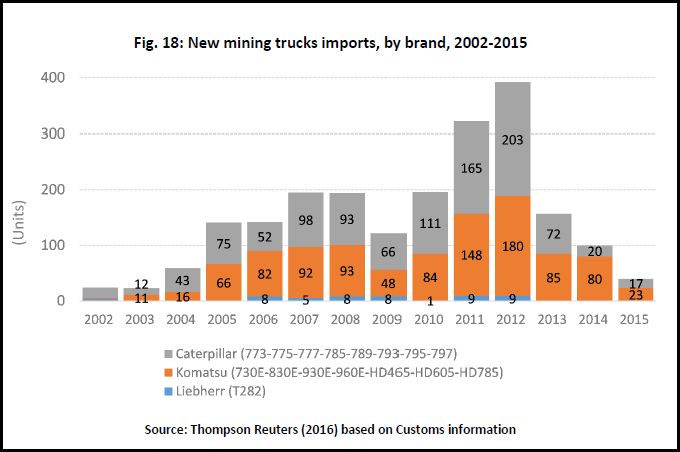
We have to go all the way back to 2004 to see a unit number that low. Even with the huge downturn in the global markets in 2009, Chile still imported 122 new mining trucks that year… more than triple the figure for 2015.
Why is this such a big deal? I took the total number of new trucks imported (purchased) by Chile and compared it to the annual average price of copper:
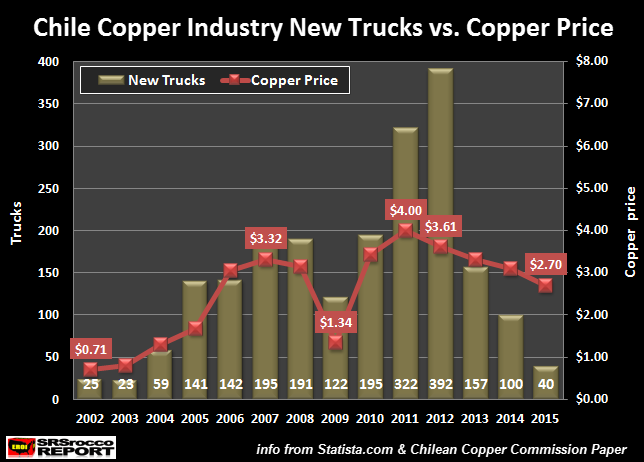
There seems to be a correlation between the copper price and new truck purchases by the Chilean Copper Industry. When the price of copper fell to $1.34 a pound in 2009, Chile still imported three times more new mining trucks that year than in 2015, when the copper price was double ($2.70). Sadly, Chile’s new mining truck purchases are down 90% from their peak in 2012.
Of course, there were new projects coming online to justify some of the large number of truck purchases in 2011 and 2012. However, Chile’s copper production has only increased from 5.4 million tons in 2010 to 5.7 million tons in 2015. Would a 5% increase in Chile’s total copper production justify the need for 322 new trucks in 2011 and 392 new units in 2012??
Regardless, demand for new mining trucks in Chile has fallen 90% from its peak.just a few years ago I would imagine new truck sales in 2016 will likely be even weaker. This is not a good sign for the largest copper producer in the world.
The Top Copper Mining Companies Are Getting Hammered
As I mentioned in the beginning of the article, Freeport-McMoRan suffered a $214 million adjusted income loss in the first half of 2016. That’s pretty bad because “adjusted” income removes many items (such as impairments) from the bottom line to arrive at figure that represents a more realistic day-to-day cost of mining copper.
For example, Freeport also suffered an additional $4 billion impairment on its shale oil and gas assets in the first half of 2016. So, if we add that to the $13 billion of shale asset impairments last year, Freeport has racked up a cool $17 billion in shale asset write-downs in just a year and a half.
Maybe it would have been a good idea for the management at Freeport to stick with mining copper, rather than blowing big money on the U.S. Shale Oil & Gas Black Hole.
If we look at Freeport-McMoran’s free cash flow for the past eight years, something is dreadfully wrong now. For a quick refresher, free cash flow comes from deducting CAPEX (capital expenditures) from their cash from operations:
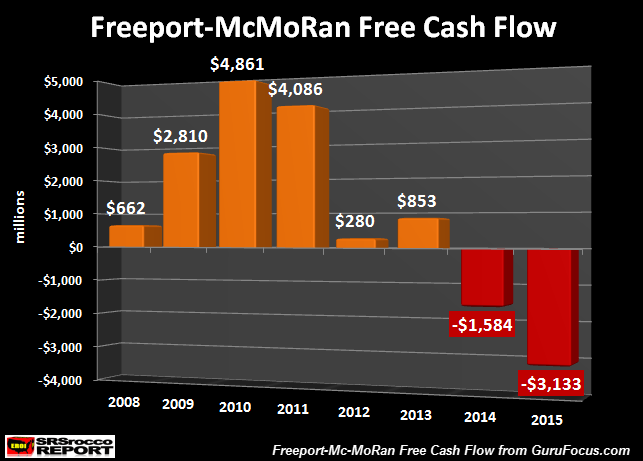
Here we can see that 2010 and 2011 were good years for Freeport as they enjoyed $4.8 and $4 billion respectively in positive free cash flow. However, this took a turn for the worse in 2014 as free cash flow turned negative to the tune of $1.5 billion, then doubled in 2015 to a negative of $3.1 billion.
Even though some of that negative free cash flow can be blamed on losses from their shale oil and gas assets (liabilities… haha), the majority of Freeport’s revenues are from copper and metal mining. For example, of the $15.8 billion in Freeport’s net revenues in 2015, only $1.9 billion was from U.S. shale oil and gas proceeds.
While the change in Freeport’s balance sheet to negative free cash flow in the past two years is not a good sign, the situation is even worse when we add in their dividends. From 2013-2015, Freeport paid out nearly $5 billion in dividends. Thus, they forked out $8.8 billion more during the past three years than the cash they made from operations.
Now, if we look at the largest copper producing company in the world, their results aren’t any better. In the first quarter of 2016, Chile’s Codelco mining company reported a $125 million net income loss. This loss is purely on producing copper as Codelco doesn’t have any U.S. shale oil or gas assets.
According to Codelco’s financial highlights on their website, they enjoyed a $7.4 billion pre-tax profit in 2012, $3.8 billion in 2013 and $3 billion in 2014. However, things turned south in 2015 as they suffered a $1.4 billion pre-tax loss that year.
Coledco produced 1.9 million tons of copper in 2015, while Freeport came in second at 1.5 million tons. So, the two top mining companies that produced 3.4 million tons of copper in 2015… didn’t really make any money. And it looks like 2016 will be even less fun for these large copper miners
The global copper mining industry is getting ready to face some serious hard times. Again, the falling copper price and the financial trouble taking place in the world’s top copper producers is not the typical market correction awaiting a turnaround in the global economy. Rather the copper industry is heading towards a disintegration to a much smaller size.
Unfortunately, investors and analysts who continue to believe the situation will recover in the global economy, will lose a lot of fiat money holding onto these copper and base metal mining companies. Even though investors should have realized something was wrong when several base metal mining companies moved into the U.S. Shale Oil & Gas Ponzi, and lost a lot of money, they will continue to hold onto these stocks as we enter into the next phase… the Copper Industry Carnage.
end
Your early FRIDAY morning currency, Asian stock market results, important USA/Asian currency crosses, gold/silver pricing overnight along with the price of oil Major stories overnight
:
1 Chinese yuan vs USA dollar/yuan UP to 6.7260( REVALUATION NORTHBOUND /CHINA UNHAPPY TODAY CONCERNING USA DOLLAR RISE/MORE $ USA DOLLARS LEAVE CHINA/OFFSHORE YUAN WIDENS TO 6.7346 / Shanghai bourse CLOSED UP 2.43 POINTS OR 0.08% / HANG SANG CLOSED UP 202.02 POINTS OR 0.88%
2 Nikkei closed UP 82.13 OR 0.49% /USA: YEN RISES TO 104.26
3. Europe stocks opened ALL IN THE GREEN ( /USA dollar index UP to 97.86/Euro DOWN to 1.1005
3b Japan 10 year bond yield: REMAINS AT -.054%/ !!!!(Japan buying 100% of bond issuance)/Japanese yen vs usa cross now at 103.72/ THIS IS TROUBLESOME AS BANK OF JAPAN IS RUNNING OUT OF BONDS TO BUY.
3c Nikkei now JUST BELOW 17,000
3d USA/Yen rate now well below the important 120 barrier this morning
3e WTI:: 50.95 and Brent:52.29
3f Gold DOWN /Yen DOWN
3g Japan is to buy the equivalent of 108 billion uSA dollars worth of bond per month or $1.3 trillion. Japan’s GDP equals 5 trillion usa./“HELICOPTER MONEY” OFF THE TABLE FOR NOW /REVERSE OPERATION TWIST ON THE BONDS: PURCHASE OF LONG BONDS AND SELLING THE SHORT END
Japan to buy 100% of all new Japanese debt and by 2018 they will have 25% of all Japanese debt. Fifty percent of Japanese budget financed with debt.
3h Oil UP for WTI and UP for Brent this morning
3i European bond buying continues to push yields lower on all fronts in the EMU. German 10 yr bund RISES QUITE A BIT to +064%
3j Greek 10 year bond yield RISES to : 8.42%
3k Gold at $1251.60/silver $17.42(8:45 am est) SILVER FINAL RESISTANCE AT $18.50 WILL BE DEFENDED
3l USA vs Russian rouble; (Russian rouble UP 5/100 in roubles/dollar) 62.98-
3m oil into the 50 dollar handle for WTI and 52 handle for Brent/
3n Higher foreign deposits out of China sees huge risk of outflows and a currency depreciation (already upon us). This can spell financial disaster for the rest of the world/China forced to do QE!! as it lowers its yuan value to the dollar/GOT a REVALUATION UPWARD from POBC.
JAPAN ON JAN 29.2016 INITIATES NIRP. THIS MORNING THEY SIGNAL THEY MAY END NIRP. TODAY THE USA/YEN TRADES TO 104.26 DESTROYING WHATEVER IS LEFT OF OUR YEN CARRY TRADERS
30 SNB (Swiss National Bank) still intervening again in the markets driving down the SF. It is not working: USA/SF this morning .9894 as the Swiss Franc is still rising against most currencies. Euro vs SF is 1.0889 well above the floor set by the Swiss Finance Minister. Thomas Jordan, chief of the Swiss National Bank continues to purchase euros trying to lower value of the Swiss Franc.
3p BRITAIN VOTES AFFIRMATIVE BREXIT
3r the 10 Year German bund now NEGATIVE territory with the 10 year RISESto +.064%
/German 9+ year rate BASICALLY negative%!!!
3s The Greece ELA NOW at 71.4 billion euros,AND NOW THE ECB WILL ACCEPT GREEK BONDS (WHAT A DISASTER)
The bank withdrawals were causing massive hardship to the Greek bank. the Greek referendum voted overwhelming “NO”. Next step for Greece will be the recapitalization of the banks and that will be difficult.
4. USA 10 year treasury bond at 1.780% early this morning. Thirty year rate at 2.522% /POLICY ERROR)
5. Details Ransquawk, Bloomberg, Deutsche bank/Jim Reid.
(courtesy Jim Reid/Bloomberg/Deutsche bank/zero hedge)
Global Stocks, Futures Jump On Strong China Inflation; Oil Rises Above $51
One day after a slump in Chinese trade sparked a global market selloff on concerns the world’s second biggest economy had once again hit a downward inflection point, overnight China surprised once again, this time to the upside when the latest inflationary data printed hotter than expected, sending European and Asian stocks higher and pushing the yen lower after China’s producer price index rose for the first time since March 2012, while the PBOC fixed the Yuan modestly higher ending a week-long series of declines tracking the stronger dollar and easing concerns of rising capital outflows.
- China CPI (Aug) Y/Y 1.9% vs. Exp. 1.6% (Prey. 1.3%); 3-month high.
- China PPI (Aug) Y/Y 0.1% vs. Exp. -0.3% (Prey. -0.8%); 1st increase in 55 months.
CPI inflation came in at 1.9% year-on-year in September, above market expectations and also higher than the level in August. Both a low base in the same period last year and a sequential price increase contributed to the higher headline CPI year-over-year growth. Food prices were higher (especially fresh vegetables and fruits) and nonfood CPI inflation also increased, driven by higher tourism and education prices. Core CPI inflation (excluding food and energy) was 1.7% yoy in September, vs 1.6% in August.

PPI inflation was +0.1% yoy in September, the first positive reading since March 2012. This implies an annual rate of +3.3% (s.a.) in September, vs. +2.2% in August. The recent sequential pickup of headline PPI in 2016 has been due primarily to a depreciation of the RMB and recovery of oil prices. In addition, favorable base effects (falling oil prices over the course of 2015) have contributed to a moderation in year-on-year PPI deflation. Among major sub-industries, producer prices in smelting and pressing of ferrous metal rebounded visibly to 10.1% yoy from 6.5%yoy in August, and in coal mining and washing industry PPI inflation turned positive to +4.1% yoy, after 51 months of price contraction in year-over-year terms.

As Goldman wrote after the print, policymakers have likely tried to fine-tune the degree of stimulus in September, dialing back a little from the relatively aggressive easing stance and strong growth in August. Targeted tightening measures especially on the property market have been rolled out by the local governments, in an attempt to curb the fast upturn of property prices.
And while some analysts predicted that the rebound in inflation would mean less monetary stimulus out of the PBOC, Goldman was not so sure: “we do not think the recent higher CPI and PPI readings should trigger a sharp turn in monetary policy/overall policy stance, as overall inflation remains mild, and the recently higher CPI and PPI readings are partly driven by the low base last year. We continue to expect supportive fiscal and credit policies going into Q4. ”
Others were simply happy to watch the market reaction: “The turn up in China PPI is indicative of receding deflation risks globally,” said Shane Oliver, Sydney-based head of investment strategy at AMP Capital Investors Ltd., which oversees about $121 billion. “It’s another sign that global deflation is fading. Today’s data was certainly a lot stronger than I thought it would be.
“The turnaround seems to have happened in Asia,” said Frances Hudson, an Edinburgh-based global thematic strategist at Standard Life Investments, which oversees 269 billion pounds ($328 billion). “Following the data on producer prices, we are getting a strong performance from miners. At this stage, any kind of inflation is welcome.”
In other headline news, HP announced plans to cut up to 4,000 job cuts, Reuters reports Hershey CEO preparing to step down.
As a result of the Chinese data, Asian stocks snapped a while stock in Thailand surged on prospects for a smooth transition following the death of King Bhumibol Adulyadej. European shares were close to erasing a weekly decline and emerging markets also rebounded on China’s hotter than expected inflation, even if there . Crude oil extended a fourth week of gains in the longest winning streak since April. The yen fell with bonds as demand for havens eased. Thailand’s stocks jumped the most in three years and currency surged on prospects for a smooth transition of power after the king’s death.
The Stoxx Europe 600 Index gained 1.2 percent at 10:11 a.m. in London, leaving it down less than 0.1 percent in the week. Rio Tinto Group and BHP Billiton Ltd. contributed the most to gains among commodity producers. The MSCI Emerging Markets Index rose 0.6 percent Man Group Plc jumped 16 percent, the most in almost six years, after it posted a 6 percent increase in funds under management for the quarter, announced a share buyback and said it will acquire Aalto Invest Holding AG to branch out into private market investing. Syngenta AG fell 2 percent on speculation that its $43 billion takeover by China National Chemical Corp. could be disrupted after a person familiar with the matter said China is planning to merge the buyer with another state-owned entity, Sinochem Group. In Shanghai, ChemChina’s Aeolus Tyre Co. rose 3.8 percent and Sinochem International Corp. jumped 10 percent.
Among the banking sector, Banco Popolare SC and Banca Popolare di Milano Scarl rose the most among the biggest European banks on optimism that shareholders will this weekend back their merger to create Italy’s third-largest lender.
S&P 500 Index futures rose 0.4%, erasing the previou day’s losses. In commodities, oil climbed 1.2 percent rising above $51.00 a barrel. Distillate and gasoline supplies declined as refineries processed less crude, while inventories at Cushing, Oklahoma, fell to the lowest level since December.
Data on Friday will include retail sales, producer prices and consumer sentiment. Earnings will also be in focus. While analysts are forecasting a 1.6 percent contraction in third-quarter profits for S&P 500 members, U.S. firms have beaten projections by an average margin of 3.6 percentage points in the past five years. Investor attention will turn Friday to earnings from companies including JPMorgan Chase & Co., Citigroup Inc. and Wells Fargo & Co. as well as data on retail sales before Federal Reserve Chair Janet Yellen speaks at a conference in Boston.
Bulletin headline summary from RanSquawk
- Encouraging data from China overnight in the form of CPI and PPI has lifted sentiment this morning, with European bourses supported by the upside in material names
- Some early signs that the USD rally is suffering some exhaustion, with EUFt/USD finding bids ahead of 1.1000 while Cable dips into the 1.2100’s are bought up
- Looking ahead, highlights include U. of Michigan, Retail Sales and PPI and comments from Fed Chair Yellen
Market Snapshot
- S&P 500 futures up 0.5% to 2136
- Stoxx 600 up 1.1% to 339
- FTSE 100 up 0.7% to 7023
- DAX up 1.2% to 10535
- German 10Yr yield up 2bps to 0.06%
- Italian 10Yr yield up 1bp to 1.39%
- Spanish 10Yr yield up 1bp to 1.13%
- S&P GSCI Index up 0.6% to 378.1
- MSCI Asia Pacific up 0.2% to 138
- Nikkei 225 up 0.5% to 16856
- Hang Seng up 0.9% to 23233
- Shanghai Composite up less than 0.1% to 3064
- S&P/ASX 200 down less than 0.1% to 5434
- US 10-yr yield up 3bps to 1.77%
- Dollar Index up 0.32% to 97.83
- WTI Crude futures up 1% to $50.96
- Brent Futures up 0.7% to $52.39
- Gold spot down 0.1% to $1,257
- Silver spot up 0.2% to $17.53
Global Headline News
- HP Plans Up to 4,000 Job Cuts Over Three Years Amid PC Slump: Plans to cut 3,000 to 4,000 jobs over the next three years, restructuring may generate $300m in savings in 2020
- Hershey CEO Bilbrey Preparing to Step Down, Reuters Reports: Board has formed committee to seek successor, report says
- China Said to Be Planning Mega-Merger of Sinochem, ChemChina: Deal would combine giants with >$100b in assets; Syngenta Falls as ChemChina Said to Plan Merger With Sinochem
- Apollo Said Close to Deal for Anglo’s Australian Coal Mines: Apollo and Xcoal Energy are poised to buy Anglo American’s Australian metallurgical coal assets, agreement may ultimately value mines at more than $1.5b
- McDonald’s Global Shake-Up Will Add $130 Million in Expenses: To Take 12c/share restructuring charge in 3Q
- Boeing’s Head Salesman Said to Retire as China Veteran Ascends: Mounir said to succeed Wojick as top global sales executive
- Trump Said to Block Campaign’s Requests to Do Self- Opposition Research: Rebuffed political aides’ requests to research his past, people familiar with the matter said
- Bristol-Myers Asked to Seek Special Coverage for Opdivo in U.K.: Opdivo not cost-effective for all lung-cancer patients: NICE
- PepsiCo Said to Near Deal to Buy KeVita: Reuters: May be finalized as early as this month and likely value co. at less than $500m, Reuters reports
- NY Pension Fund Said to Demand 10% Return From Hedge Funds: NYP: State’s $178.6b pension privately told hedge funds in recent weeks must earn minimum 10% annual return: New York Post
* * *
Looking at regional markets, Asia stocks shrugged off the weak Wall Street close and traded with mild gains, as the region gets to digest more data from China. ASX 200 (Unch.) and Nikkei 225 (+0.4%) were initially both higher, although weakness in mining names capped advances in Australia, while Japanese stocks traded choppy alongside JPY movements. Hang Seng was supported after firmer than expected Chinese CPI and PPI figures as CPI printed a 3-month high and PPI rose for the first time in 55 months.
- Chinese CPI (Aug) Y/Y 1.9% vs. Exp. 1.6% (Prey. 1.3%); 3-month high.
- Chinese PPI (Aug) Y/Y 0.1% vs. Exp. -0.3% (Prey. -0.8%); 1st increase in 55 months.
However, Shanghai Comp failed to benefit as the firmer data along with recent measures dampened prospects of future PBoC easing, while the central bank also conducted a net weekly drain of CNY 410bIn. 10-year JGBs were uneventful with demand dampened due to improvement in risk appetite in Asia, while the result of today’s 5-year auction was stronger as laic, lowest price and average price all exceeded the prior month resulting to mild outperformance in the belly.
Top Asian News
- China Sees First Factory-Gate Inflation in Almost Five Years: PPI rose 0.1% y/y in Sept., first gain since January 2012
- Infosys Cuts Sales Forecast Again as Clients Trim Spending: CEO Vishal Sikka stands by $20b revenue goal by 2020
- Oil From $50b Kazakh Kashagan Field Starts Flowing for Export: 7,700 tons of crude shipped to Caspian Pipeline Consortium network
- Singapore Withholds Stimulus, Reserving Tools as GDP Shrinks: Manufacturing plunges 17.4%; services industry declines 1.9%
- Thai Prince Awaits Crown, Groomed Since Birth for Throne: Vajiralongkorn is the sole son of King Bhumibol Adulyadej
- SoftBank Tech Fund to Invest Up to $100 Billion With Saudis: Japanese internet company will put in $25 billion over 5 years
As in Asia, so in Europe encouraging data from China overnight in the form of CPI and PPI has lifted sentiment this morning, with European bourses supported by the upside in material names, which have also staged a recovery from yesterday’s losses. As such, the FTSE 100 has reclaimed the 7,000 level, while the index has also been buoyed by gains in supermarket giant Tesco after the retailer settled a dispute with Unilever over prices. In credit markets, bond yields are a touch firmer with prices pressured by the improved risk sentiment. Additionally, Gilts yet again underperform against its counterparts as the rating agency S&P hints at another downgrade from the AA sovereign after highlighting risks to the economy’s future growth amid negotiations with the EU. Gold (-0.1%) saw minor losses amid improvement in risk sentiment while remained near yesterday’s lows alongside weakness across the metals complex.
Top European News
- VW Fails to End Europe Market-Share Drop a Year After Crisis: September sales rose 5.6% versus market’s 7.3% gain; EU28 September Car Registrations Rise 7.2% Y/y to 1.455m Units
- UniCredit Plans to Raise Up to $14 Billion, Repubblica Says: Increase is part of a plan that will be presented on Dec. 13, the newspaper reported on Friday
- Banco Popolare Sells EU618m NPL Portfolio to Hoist Finance Unit
- Ericsson Credit Rating Cut by Moody’s as Crisis Intensifies: Rating was reduced one level to Baa2 from Baa1
- Man Group Soars on Quarterly Asset Growth That Beats Estimates: Net inflows were $1.3b in 3Q as investors allocated money to its computer-driven hedged and long only funds
- Marmite Skirmish Averted Won’t Stop Brexit Biting Retailers: Asda cuts price on Unilever’s spread after Tesco feud settled
- BOE Says Mortgage Demand Fell ‘Significantly’ in 3Q: Says both demand for prime and buy-to-let lending decreased significantly.
- Spotify Co-Founder Lorentzon Steps Down as Company Chairman: Will remain at the Swedish music startup as vice chairman
In FX, the yen fell against all of its 16 major counterparts, dropping 0.5 percent to 104.21 per dollar. The Bloomberg Dollar Spot Index rose 0.2 percent, extending this week’s advance to 0.7 percent. The pound fell, extending its October decline to almost 5.7 percent. Thailand’s baht led emerging-market currencies higher, gaining 0.9 percent, the most in a year and paring this week’s slide to 1.1 percent. The SET Index jumped 4.2 percent after slumping for the first three days of the week. Financial markets in the Southeast Asian nation are open as usual Friday following the death of King Bhumibol Adulyadej on Thursday. Thailand’s government called on the nation to avoid “joyful events” for 30 days, to dress in mourning for a year and pray for the king’s soul to protect the nation. It also signaled the 88-year-old king’s only son will take the throne.
In commodities, oil climbed 1.2 percent rising above $51.00 a barrel. Distillate and gasoline supplies declined as refineries processed less crude, while inventories at Cushing, Oklahoma, fell to the lowest level since December, according to an Energy Information Administration report Thursday. Industrial metals were broadly higher in Shanghai and London. Aluminum in China rose to the highest level in almost five months, following a rise in the local spot price amid a new Chinese regulation that clamps down on truck overloading, which is disrupting deliveries. Gold slipped in London trading, giving back gains from Thursday.
DB’s Jim Reid concludes the overnight wrap
Life can carry on as normal here in the UK as ‘Marmitegate’ has been resolved as the largest food retailer has put it back on the shelves after a 24 hour dispute with its supplier. This has been a fascinating story that will rumble on and on as at some point soon shoppers are going to face a big rise in the cost of their basic products given the significant post Brexit fall in Sterling. It seems for now prices have not climbed but surely it can’t be long. Maybe the best trade you can do at the moment is to stock up on all the non-perishable items that will eventually be forced up in price once stocks have been depleted or contracts renegotiated. Given my wife’s obsession with Ben and Jerry’s (one of the other products that was temporarily withdrawn) it might be prudent to buy a chest freezer for the garage and stock up this weekend.
Today the main event will probably be Yellen’s speech at 6.30pm BST where she is the keynote speaker at the annual economics conference hosted by the Boston Fed. The conference topic is ‘The Elusive Great Recovery: Causes and Implications for Future Business Cycle Dynamics”. It’s unclear what she’ll say about the current outlook but clearly the market will be looking for any policy morsels, especially after the minutes on Wednesday night. Possibly more important will be the triple hit of US bank earnings with JPM, Citibank and Wells Fargo reporting either just before or at the opening bell. With all the attention on financials of late these results will give us a good guide to earnings on both sides of the Atlantic for the sector. If that’s not enough we have US retail sales as the main data event of the day. While the data only captures about one quarter of the consumer spending data that are used in GDP, the figures are important in showing us the state of underlying spending in the US economy. The market is expecting a decent bounceback in September. The headline print is expected to increase +0.6% mom while the ex auto and ex auto and gas components are expected to increase +0.5% mom and +0.3% mom respectively. The important control group component is also expected to have increased +0.4% mom.
So between the packed schedule today and the FOMC minutes on Wednesday, markets yesterday were caught in a bit of a vacuum. Instead investors were left to feed off that soft China export data nearly 24 hours ago which seemed to reinvigorate some concern about the world’s second largest economy. Europe followed the risk off lead from Asia with the Stoxx 600 edging -0.87% lower. Across the pond the S&P 500 initially opened down as much as -1.16% with financials under pressure ahead of today’s bank earnings, but the index then rallied back into the close to pare the bulk of that decline and finish -0.31% as defensive sectors led the rebound. As we noted yesterday, while clearly still of significant importance, that China trade data does have a tendency to be quite volatile month to month. However it lines the market up for a busy next five days of data in China culminating with the Q3 GDP print on Wednesday.
On that note, this morning the latest inflation numbers are out in China. Headline CPI rose to +1.9% yoy in September from +1.3% in August. Expectations were for +1.6% and that reading is the highest since June. Meanwhile, producer prices surged last month. The +0.1% yoy reading (vs. -0.3% expected) compares to -0.8% yoy in August and marks the first time in 54 months that annual factory gate prices have risen. The MoM reading for PPI was +0.5%.
In terms of the market reaction, it’s been a bit of a reversal of yesterday’s price action with China bourses lower but Asia ex-China equity markets gaining. The Shanghai Comp is currently -0.53% while the Hang Seng (+0.58%), Nikkei (+0.41%), Kospi (+0.52%) and ASX (+0.05%) have all gained. The Aussie Dollar is up while other emerging market currencies have strengthened with Oil. Also of note was data in Singapore this morning where Q3 GDP printed at a seasonally adjusted QoQ rate of -4.1% (vs. 0.0% expected). That is the steepest fall since Q3 2012. Despite that data, the MAS held stimulus unchanged this morning.
There are also a couple of interesting micro level stories out there this morning. According to Bloomberg, China is planning to merge SOE’s Sinochem Group and China National Chemical Corp. Shares of Sinochem are up close to 10% following the news. Also Japan telecom giant Softbank announced that it is to form a tech focused investment fund which could manage up to $100bn with Saudi Arabia’s sovereign wealth fund being a lead partner.
In one final mention of China for today, yesterday DB’s Chief Economist for China, Zhiwei Zhang, published an update to his special report on China’s property bubble. He notes that the Shanghai government has tightened credit supply for developers over the past week. In particular, the government tightened regulation on property developers’ financing of land purchase. Developers are not allowed to buy land using financing from banks, trust, capital market, asset management companies or insurance companies. They need to commit in land auctions that they will only use their own funds to buy land. Zhiwei sees this as a significant step by the government to contain the property bubble and shows that the government has become aware of the problem, and have started to take tough actions to stop it. He expects other cities to follow suit. A link to the report for those interested is attached here.
Back to markets yesterday. Given the broadly risk-off moves, it was a stronger day in rates with 10y Treasury yields closing nearly 3bps lower at 1.742%, while 10y Bunds were down a similar amount to 0.036%. The US Dollar was actually close to half a percent weaker although that did follow a gain of nearly +1.50%. Gold was a touch higher while WTI (+0.52%) rebounded modestly following two days of consecutive declines. Credit indices in both Europe and the US generally pared earlier losses into the close. The more notable news in credit markets perhaps was the latest corporate bond holdings data out of the Bank of England. The BoE confirmed that it held £1.042bn of corporate bonds at the close on Wednesday. That compares to the £507m it held in the first week so the strong run rate has continued for a second week. As a reminder the initial aim was to buy £10bn over 18 months so they are well ahead on a run rate basis. It clearly also raises the question of a possible increase in the total quantum of purchases being targeted. So far though the BoE is certainly putting forward a big statement.
Staying in the UK, at yesterday’s SNP party conference, Scotland’s First Minister Nicola Sturgeon confirmed that she will publish a draft Scottish Independence Referendum Bill next week. Sturgeon said ‘I am determined that Scotland will have the ability to reconsider the question of independence – and to do so before the UK leaves the EU – if that is necessary to protect our country’s interests’. According to the FT Sturgeon also pledged to issue specific proposals to keep Scotland in the single market as well as also calling for new powers over immigration and international relations. While we’re on the Brexit theme, EU President Donald Tusk was as black or white as one can be with his comments yesterday at a conference in Brussels. Tusk said that ‘the only real alternative to a hard Brexit is no Brexit, even if today hardly anyone believes in such a possibility’. He also said that ‘the essence of Brexit as defined in the UK referendum campaign‘ means ‘radically loosening relations with the EU, a de facto hard Brexit’. Tusk also offered a slightly different perspective on how he saw things, saying that a hard Brexit will be a loss for everyone and that ‘there will be no cakes on the table for anyone’ but rather ‘only salt and vinegar’. Whatever that means.
Before we look at today’s calendar, the data didn’t add much to the debate yesterday. Initial jobless claims printed a little better than expected at 246k although that was unchanged on the prior week, while the US import price index rose a little bit less than expected last month (+0.2% mom vs. +0.1% expected). Philadelphia Fed President Harker (hawkish leaning non-voter) also spoke and said that ‘what I’m worried about is, depending on the outcome of the election and what happens after that, if there are policies that would have distortive effects that we would have to respond to’. Given that, Harker thinks it may be prudent ‘to wait until we resolve some of that uncertainty’.
3.REPORT ON JAPAN SOUTH KOREA NORTH KOREA AND CHINA
i)Late THURSDAY night/FRIDAY morning: Shanghai closed UP 2.43 POINTS OR 0.08%/ /Hang Sang closed UP 202.01 POINTS OR 0.88%. The Nikkei closed UP 82.13POINTS OR 0.49% Australia’s all ordinaires CLOSED DOWN 0.03% /Chinese yuan (ONSHORE) closed UP at 6.7260/Oil ROSE to 50.95 dollars per barrel for WTI and 52.29 for Brent. Stocks in Europe: ALL IN THE GREEN Offshore yuan trades 6.7346 yuan to the dollar vs 6.7260 for onshore yuan.THE SPREAD BETWEEN ONSHORE AND OFFSHORE NARROWS A BIT AS MORE USA DOLLARS ATTEMPT TO LEAVE CHINA’S SHORES
3a)THAILAND/SOUTH KOREA/SOUTHEAST ASIA:
b) REPORT ON JAPAN
none today
c) Report on CHINA
4 EUROPEAN AFFAIRS
GERMANY/DEUTSCHE BANK
The hits just keep coming to Deutsche bank as one day after announcing a hiring freeze, they decide to fire another 10,000 workers. A great reason for gold to be whacked today by the crooks:
(courtesy zero hedge)
Deutsche Bank To Fire Another 10,000 Bankers, Bringing Total Layoffs To 20% Of Workforce
The hits for Deutsche Bank just keep on coming. One day after a report that the German lender has imposed a hiring freeze in the latest bid to reassure investors that it has expenses under control and is stemming the outflow of cash, moments ago Reuters reported that Deutsche Bank’s finance chief told his staff that job cuts at the bank could be double that planned, a step that could remove 10,000 further employees.
Such cuts would likely take many years but setting such a goal could reassure investors that the bank is determined to tackle costs that sources said the European Central Bank sees as bloated. Unless, of course, they are forced to cut much faster. If 10,000 job losses were ultimately to follow the 9,000 announced by management in October 2015, roughly one in five of the bank’s workforce around the globe would be affected.
“Schenck said that the bank would need to cut another 10,000 staff to bring down costs,” said a person who attended the meeting with the chief financial officer cited by Reuters. Although no such decision has yet been taken, Marcus Schenck’s remarks, at an internal meeting, signal the lender is considering further significant cost cuts, as it faces a multi-billion-euro fine and a crisis of confidence among investors.
The discussion about further job cuts comes as Deutsche’s chief executive, John Cryan, reassesses a year-old strategy to revive the flagging group, as ebbing market confidence sends its stock price tumbling and prompts some customers to withdraw funds.. A second person familiar with these discussions said the management was also examining the countries where the bank was active to see “whether it was really worth its while (staying in those countries)”.
DB’s latest announcement follows Commerzbank, Germany’s second biggest bank rival, which recently announced it would ax more than a fifth of its workforce – almost 10,000 staff.
Still, it is not clear if DB can achieve the cuts: given potential high severance costs and revenue losses, it remains unclear whether a further attempt by Deutsche to trim staff can be achieved. Headcount has actually risen at the bank, despite the plans announced by Cryan in October 2015 to slash staff. Employee numbers, which stood at more than 101,300 in the middle of this year, are higher than the roughly 98,600 one year earlier.
One hurdle in removing staff is that many are based in Germany, where strict labor law makes it difficult and expensive to fire employees. Of the 9,000 job cuts announced in October 2015, 4,000 are in Germany.
In Germany, unlike Britain, for instance, labor representatives have an important say and appoint non-executive directors to Deutsche’s supervisory board. They will argue for fewer cuts.
Additionally, DB’s layoffs are getting to the point where it is now cutting into the muscle, and any additional terminations could result in a drop in revenue. Regardless of this, however, the heavy fine demanded by the U.S. authorities could prompt Cryan to act.
Once Germany’s only bank to go head-to-head with U.S. rivals on Wall Street, stricter regulation, rock-bottom borrowing costs and still heavy costs has squeezed Deutsche’s profits. Politicians in Germany, who are preparing for national elections in 2017, are watching developments nervously.
end
Qatar is now worried about their investment in Deutsche bank
(courtesy zero hedge)
Deutsche Bank’s Biggest Investor Is Getting Worried As Government Rules Out State Bailout
Just a week after Qatar investors were ‘used’ as the headline ammunition for short squeeze momentum ignition in Deutsche Bank’s stock, WSJ reports the beleaguered bank’s biggest shareholder is getting worried, questioning management’s long-term strategy. The shares are slipping further as the German government rules out any state aid for the most dangeorus bank in the world.
Following yesterday’s dip, Deutsche stock is bid today but remains the same 12-12.50 range it has been in for a week… as credit markets remain near record wides…

Which perhaps helps explain Deutsche bank’s biggest shareholders’ concerns… (via The Wall Street Journal)…
The Qataris have reiterated their patience as long-term shareholders, with an interest in even eventually boosting their stake further, the people say.
But they don’t plan to do so immediately, some of the people said. First, the Qataris have said they want more clarity.
They are concerned about an erosion of profits and loss of talent in key businesses like investment banking and asset management, the people say. The asset-management business has had three leaders in the past 18 months, and managers have been in the position of reassuring both clients and employees of the bank’s commitment to it, people close to it say.
The Qataris have sought assurances that Deutsche Bank executives and its supervisory board are actively weighing all options, including a sale of the asset-management business, should legal fines or other factors press them to take more-dramatic steps than planned earlier.
Mr. Cryan has said asset management is an essential part of the bank.
The Qataris’ concerns increased after The Wall Street Journal reported Sept. 15 that the Justice Department suggested Deutsche Bank pay $14 billion to settle longstanding mortgage-securities cases, the people said. That opening bid from the U.S. government, which Deutsche Bank confirmed, is widely seen by investors and lawyers—and the bank itself—as much higher than what Deutsche Bank ultimately will end up paying.
Bankers and others who have spoken with existing and potential investors, or been briefed on discussions with them, say one concern is that most of Deutsche Bank’s management board lacks experience running the bank. Only one of its 11 members belonged to the board before January 2015. Five joined this year.
None of this is helped by the fact the German government has just come out and ruled out taking any stake in Deutsche Bank…
Aides to German Chancellor Angela Merkel have told lawmakers the state wouldn’t take a stake in Deutsche Bank AG if it were to issue new stock to shore up its thin capital cushion, one person who attended the briefing said.
The fact that Berlin appears to have ruled out any help for the embattled lender as both unnecessary and politically unfeasible could put Deutsche Bank under renewed pressure as it works to stabilize its share price and stay out of the news while negotiating an acceptable settlement in a U.S. misconduct investigation.
In a closed-door briefing with a small group of lawmakers last week, Chancellery aides and senior Finance Ministry officials said it was “inconceivable for the state to take a stake in Deutsche Bank,” said one person who declined to be named because the briefing was confidential.
“We have a different bank resolution system than in 2009 and this must apply to us in Germany too,” the government officials said according to this person. This referred to recent legal changes that now force European governments to bail-in creditors—and in some cases depositors—before they shore up a struggling bank with taxpayer money.
Still the fact that the credit and equity market remain so violently opposed here and the bank’s biggest shareholder is publicly noting its concern… is probably nothing.
5. RUSSIAN AND MIDDLE EASTERN AFFAIRS
none today
6. GLOBAL ISSUES
Raoul Pal is one smart cookie. Pay attention to him as he discusses the global economy:
(courtesy Rauol Pal/Barbara Kollmeyer/Market Watch)
A recession is coming — so hide in gold, says influential investor Raoul Pal
Goldman Sachs alum says negative rates mean gold should be a lot more expensive
 By
By
BARBARAKOLLMEYER
 Real Vision
Mirror, mirror on the wall, which asset is most mispriced of all? According to a Goldman Sachs alum who predicted the financial crisis in 2008, it’s gold.
The precious metal should be a lot more expensive when the likelihood of a global financial collapse and a move toward negative interest rates is accounted for, says Global Macro Investor founder Raoul Pal, who now sees a U.S. recession within 12 months.
Recent losses for gold may have dented investor confidence. Gold GCZ6, -0.37% is up 18% this year, but the first full week of October marked its worst seven-day performance in over three years; it also posted a three-month loss of nearly 6% on a continuous basis.
Uncertainty about Brexit and the timing of a Federal Reserve rate hike triggered a rush into the dollar, which often moves inversely to the metal. (Higher rates can work against gold, but the metal becomes a safe haven if the economy slows.)
“As we get to negative interest rates, gold is a good place to park your cash,” said Pal, who discussed his outlook with MarketWatch in a September interview and a follow-up conversation over email.
“I’m not a gold bug,” the former GLG Global Macro Fund co-manager — who is also watching the dollar closely — “but this is the currency I would choose now.”
Pal, an economist and strategist, also co-founded Real Vision TV, which conducts interviews with prominent investors. Many of his recent guests share his enthusiasm for gold, according to Pal.
“All the really serious thinkers are interested in gold,” he said.
How a U.S. recession could boost gold and the dollar
Pal’s core presumption — one he’s held since 2014 — is bad news for the U. S: He is convinced the country is headed for recession within a year. “The business cycle points to that,” he said, “and 100% of all two-term elections have had a recession within 12 months since 1910.”
His view contrasts with the Federal Reserve’s own indicator, based on corporate-bond spreads, that predicts just a 12% chance of a pullback in the next year.
But Pal does have some prominent company: Savita Subramanian, Bank of America’s head of equity strategy, recently predicted the same; Janus Capital’s Bill Gross spoke of a lagging U.S. recovery in his September investment note; and bond investor Jeffrey Gundlach showed a chart during a recent webcast that revealed the start of a recession. And Wilbur Ross sees one coming in 18 months.
Should his prediction come true, Pal says, gold prices could double. If central banks want to get active and combat a slowing economy, he says, they will try to stimulate the economy via printing money or more easing, all of which plays “into the hands of gold.”
This view brings Pal to the asset he favors most over the next year out of bonds, equities, currencies and commodities: the dollar. He told MarketWatch he’d buy U.S. dollars, selling the euro, pound and Aussie dollar; he expects the euroEURUSD, -0.7867% to eventually drop to 75 cents against the dollar — about 3% below current levels — over time.
“The world has shifted because of negative interest rates,” Pal said. “We know the dollar will go higher, [and] gold may outperform over time, the reason being because of negative interest rates. If I get it right, I have dollars and gold…I don’t make much of a loss if that correlation breaks.”
Year-to-date, the dollar index DXY, +0.57% is down nearly 1%, which some blame in part on an inactive Fed. Interest-rate increases can have a positive effect on a country’s currency by making it more attractive to foreign investors.
But Pal insists that his dollar call is not tethered to central bank policy, saying investors should let go of the belief that those institutions are like “the Wizard of Oz.” Investors, Pal said, believe the Fed’s policy choices can keep stocks from falling even as Japan and Switzerland have proven otherwise.
Read: Central banks ‘have never been on thinner ice’
The Bank of Japan “has done more easing, as has the Swiss,” Pal said. “It’s not achieved anything. Stock markets there have fallen, yet the market wants to believe the Fed that there is an implicit put on the stock market in the U.S.”
Switzerland has had negative interest rates in place since early 2015, yet stocksSMI, +1.12% fell 1.6% in 2015 and are down nearly 10% so far this year.
Japan moved to negative interest rates this year, yet the Nikkei 225 NIK, +0.49% is down nearly 12%.
 Real Vision
He believes the market is currently short the dollar and should a banking crisis crop up in Europe, he says, euros will get less attractive as investors prefer dollars. In a recent interview on Real Vision, Pal discussed the problems at Deutsche Bank DB, +0.52% — but also how the problems extend far beyond Germany’s borders.
Spanish banks — ones like Banco Sabadell SAB, +0.81% Banco PopularPOP, +0.59% — they’re all in free fall, [at] all-time lows,” Pal said. Italian banks, with still unresolved bad debt issues, are still a problem, and then Swiss and U.K. banks also look unwell, he said.
“I think it’s the start of something,” he said of Deutsche Bank’s woes.
Read: How Deutsche Bank is Lehman Brothers and how it isn’t
The dollar, Pal said, also looks favorable against the backdrop of the three-month U.S. dollar Libor (London interbank offered rate), the benchmark rate some of the world’s biggest banks charge each other for short term loans. When those rates are rising, he says, dollars are more attractive.
In the last 12 months, Libor has nearly tripled, he said, moving from 0.31% to 0.88%.
“It is also a sign that there is distress among dollar borrowers abroad, so they might need to buy dollars to close out their risk,” said Pal. Financial institutions, in other words, are fretting about potential market downside, and when they get worried, the Libor moves higher.
The one chart he uses to track economic cycles
Pal is not a fan of U.S. stocks — the S&P 500 index SPX, +0.02% is up just 3.7% so far in 2016 — largely because of what he sees in a chart he says that has failed him just once when he didn’t trust it. Now, he says, it’s telling him his recession prediction is spot on.
That chart is the Institute for Supply Management index, which is based on surveys of more than 300 manufacturing firms and gauges the health of the industry. The ISM rebounded in September, to 51.5% from 49.4% the previous month. But economists still say the U.S. manufacturing sector faces challenging conditions.
“There’s a difference between the narrative, which is what you’re being told, versus the reality of the economic data,” said Pal. “It’s in no one’s interest ahead of the election to say the U.S. economy is a mess — [that] world trade freight shipments, container shipments, retail sales, restaurant sales, factory orders, durable orders are all showing a recession.”
Pal says the ISM correlates well with U.S. assets. “It peaked in 2011 and has been bouncing around 50 for a while now,” he said. “The moment it starts to get to 47, 46, the odds of a full-on recession explode to 85%. We’re very close now, getting to the point where the probability is very high.”
 Real Vision
The ISM is one reason he’s not keen on U.S. stocks, as he says he prefers to be underweight when they are near all-time highs, then wait for the business cycle to bottom — generally, 12 to 18 months after the start of a recession based on past bear markets — before getting back in.
“It could be a shallower recession,” Pal says, but “the probability is that most last around that period of time and investors need to be aware of that.” (A fuller explanation of his thinking can be found in a June video Real Vision posted on YouTube.)
And Pal urges investors not to expect Fed interest rate increases to sustain a bull market. Even if the central bank raises rates several times over the next two years, he says, they will still be low. “Interest rates follow the economic cycle and do not lead it. As the economy weakens, the government cuts interest rates.”
In other words, he says the Fed is always reactive — never proactive.
end
7. OIL ISSUES
That did not last long: stocks begin to fall as crude crumbles back below 50 dollars per barrel
(courtesy zero hedge)
Stocks Snap Key Technical Support As Crude Crumbles Back Below $50
But, but, but… Russia production freeze, US inventories, China inflation data, bank earnings…
Cruyde cracked back below $50…

And Stocks dropping back into red for the week… and breaking a key technical support…

And VIX is back above 16…

END
Oil rig counts continue to rise and this will have a huge damper effect on the price in the coming months as production increases
(courtesy zero hedge)
US Oil Rig Count Rises For 16th Straight Week To 8-Month Highs
With crude having rolled over, back to pre-inventory-data levels, hovering around $50, Baker Hughes reports the US oil rig count rose 4 to 432 – the 16th weekly rise in a row to th ehighest in 8 months.
US Oil Rig count data has risen for 16 straight weeks… to the highest in 8 months.

The rig count continues to track the lagged oil price very closely suggesting the trend of rising rig counts may be about to stop
And crude shrugs…

Charts: Bloomberg
Your early morning currency/gold and silver pricing/Asian and European bourse movements/ and interest rate settings FRIDAY morning 7:00 am
Euro/USA 1.1005 DOWN .0042/REACTING TO NO DECISION IN JAPAN AND USA + huge Deutsche bank problems
USA/JAPAN YEN 104.26 UP 540(Abe’s new negative interest rate (NIRP), a total DISASTER/SIGNALS U TURN WITH INCREASED NEGATIVITY IN NIRP/JAPAN OUT OF WEAPONS TO FIGHT ECONOMIC DISASTER/KURODA: HELICOPTER MONEY ON THE TABLE AND DECISION ON SEPT 21 DISAPPOINTS WITH STIMULUS/OPERATION REVERSE TWIST
GBP/USA 1.2247 UP .0022 (Brexit by March 201/pound clobbered)
USA/CAN 1.3167 DOWN .0035
Early THIS FRIDAY morning in Europe, the Euro FELL by 42 basis points, trading now well above the important 1.08 level FALLING to 1.1005; Europe is still reacting to Gr Britain BREXIT,deflation, announcements of massive stimulation (QE), a proxy middle east war, and the ramifications of a default at the Austrian Hypo bank, an imminent default of Greece, Glencore, Nysmark and the Ukraine, along with rising peripheral bond yield further stimulation as the EU is moving more into NIRP, THE USA’S NON tightening by FAILING TO RAISE THEIR INTEREST RATE AND NOW THE HUGE PROBLEMS FACING TOO BIG TO FAIL DEUTSCHE BANK / Last night the Shanghai composite CLOSED UP 2.43 OR 0.08% / Hang Sang CLOSED UP 202.01 POINTS OR 0.88% /AUSTRALIA IS LOWER BY 0.03% / EUROPEAN BOURSES ALL IN THE GREEN
We are seeing that the 3 major global carry trades are being unwound. The BIGGY is the first one;
1. the total dollar global short is 9 trillion USA and as such we are now witnessing a sea of red blood on the streets as derivatives blow up with the massive rise in the rise in the dollar against all paper currencies and especially with the fall of the yuan carry trade. The emerging market which house close to 50% of the 9 trillion dollar short is feeling the massive pain as their debt is quite unmanageable.
2, the Nikkei average vs gold carry trade ( NIKKEI blowing up and the yen carry trade HAS BLOWN up/and now NIRP)
3. Short Swiss franc/long assets blew up ( Eastern European housing/Nikkei etc.
These massive carry trades are terribly offside as they are being unwound. It is causing global deflation ( we are at debt saturation already) as the world reacts to lack of demand and a scarcity of debt collateral. Bourses around the globe are reacting in kind to these events as well as the potential for a GREXIT>
The NIKKEI: this FRIDAY morning CLOSED UP 82.13 POINTS OR 0.49%
Trading from Europe and Asia:
1. Europe stocks ALL IN THE GREEN
2/ CHINESE BOURSES / : Hang Sang CLOSED UP 202.01 OR 0.88% ,Shanghai CLOSED UP 2.43 POINTS OR .08% / Australia BOURSE IN THE RED: /Nikkei (Japan)CLOSED IN THE GREEN/ INDIA’S SENSEX IN THE GREEN
Gold very early morning trading: $1254.00
silver:$17.48
Early FRIDAY morning USA 10 year bond yield: 1.780% !!! UP 5 in basis points from THURSDAY night in basis points and it is trading WELL BELOW resistance at 2.27-2.32%.
The 30 yr bond yield 2.522, UP 5 IN BASIS POINTS from THURSDAY night.
USA dollar index early FRIDAY morning: 97.86 UP 31 CENTS from THURSDAY’s close.
This ends early morning numbers FRIDAY MORNING
END
xxxxxxxxxxxxxxxxxxxxxxxxxxxxxxxxxxxxxxxxxxxxxxxxxxxxxxxxxxxxxxxxxxxxxxxxxxxxxxxxxxxxxxxxxxxxxxxxxxxxxxxxxxxxxxx
And now your closing FRIDAY NUMBERS
Portuguese 10 year bond yield: 3.30% DOWN 7 in basis point yield from THURSDAY (does not buy the rally)
JAPANESE BOND YIELD: -.054% down 1/5 in basis point yield from THURSDAY
SPANISH 10 YR BOND YIELD:1.125% UP 1/2 IN basis point yield from THURSDAY (this is totally nuts!!/
ITALIAN 10 YR BOND YIELD: 1.38 par in basis point yield from THURSDAY
the Italian 10 yr bond yield is trading 26 points HIGHER than Spain.
GERMAN 10 YR BOND YIELD: +058% UP 3 IN BASIS POINTS ON THE DAY
END
xxxxxxxxxxxxxxxxxxxxxxxxxxxxxxxxxxxxxxxxxxxxxxxxxxxxxxxxxxxxxxxxxxxxxxxxxxxxxxxxxxxxxxxxxxxxxxxxxxxxxxxxxxxxxxxxxxxxxxxxxxxxxxxxxxxxx
IMPORTANT CURRENCY CLOSES FOR FRIDAY
Closing currency crosses for FRIDAY night/USA DOLLAR INDEX/USA 10 YR BOND YIELD/3:30 PM
Euro/USA 1.0996 DOWN .0051 (Euro DOWN 51 basis points/ represents to DRAGHI A COMPLETE POLICY FAILURE/
USA/Japan: 104.08 UP: 0.344(Yen DOWN 34 basis points/POLICY ERROR ON BANK OF JAPAN
Great Britain/USA 1.2189 DOWN 0.0036( POUND DOWN 36 basis points
USA/Canada 1.3122 DOWN 0.0080(Canadian dollar UP 80 basis points AS OIL FELL TO 50.08
xxxxxxxxxxxxxxxxxxxxxxxxxxxxxxxxxxxxxxxxxxxxxxxxxxxxxxxxxxxxxxxxxxxxxxxxxxxxxxxxx
This afternoon, the Euro was DOWN by 51 basis points to trade at 1.0996
The Yen FELL to 104.08 for a LOSS of 34 basis points as NIRP is STILL a big failure for the Japanese central bank/HELICOPTER MONEY IS NOW DELAYED/BANK OF JAPAN NOW WORRIED AS AS THEY ARE RUNNING OUT OF BONDS TO BUY AS BOND YIELDS RISE /OPERATION REVERSE TWIST ANNOUNCED SEPT 21.2016
The POUND FELL 36 basis points, trading at 1.2189/ AND REACTING BADLY TO UPCOMING BREXIT FROM EU
The Canadian dollar ROSE by 80 basis points to 1.3122, WITH WTI OIL AT: $50.08
the 10 yr Japanese bond yield closed at -.054% PAR IN BASIS POINTS / yield/ AND THIS IS BECOMING BOTHERSOME TO THE BANK OF JAPAN
Your closing 10 yr USA bond yield:UP 5 IN basis points from THURSDAY at 1.778% //trading well below the resistance level of 2.27-2.32%) very problematic
USA 30 yr bond yield: 2.539 UP 6 in basis points on the day /*very problematic as all bonds globally rose in yield (lowered in price)
BANKS NEED THE LONGER BOND HIGHER IN YIELD: INSTEAD THE SPREAD LESSENS.
Your closing USA dollar index, 97.98 UP 34 CENTS ON THE DAY/4 PM
Your closing bourses for Europe and the Dow along with the USA dollar index closing and interest rates for FRIDAY: 2:30 PM EST
London: CLOSED UP 35.81 POINTS OR 0.51%
German Dax :CLOSED UP 166.31 OR 1.60%
Paris Cac CLOSED UP 65.75 OR 1.49%
Spain IBEX CLOSED UP 159.20 OR 1.85%
Italian MIB: CLOSED UP 322.11 POINTS OR 1.98%
The Dow was UP 39.44 points or 0.22% 4 PM EST
NASDAQ DOWN 0.83 points or 0.02% 4 PM EST
WTI Oil price; 50.36 at 2:30 pm;
Brent Oil: 52.04 2:30 EST
USA DOLLAR VS RUSSIAN ROUBLE CROSS: 62.97(ROUBLE down 5/100 ROUBLES PER DOLLAR FROM THURSDAY) 2:30 EST
TODAY THE GERMAN YIELD RISES TO +.058% FOR THE 10 YR BOND 2:30 EST
END
This ends the stock indices, oil price, currency crosses and interest rate closes for today
Closing Price for Oil, 5 pm/and 10 year USA interest rate:
WTI CRUDE OIL PRICE 5 PM:$50.32
BRENT: $51.97
USA 10 YR BOND YIELD: 1.799%
USA DOLLAR INDEX: 98.11 UP 55 cents
The British pound at 5 pm: Great Britain Pound/USA: 1.2190 DOWN .0035 or 35 basis pts.
German 10 yr bond yield at 5 pm: +058%
END
And now your more important USA stories which will influence the price of gold/silver
TRADING IN GRAPH FORM
What A Week: Bonds Battered, Copper Clubbed, Stocks Slide As China Currency Crumbles
Well that was a week…
Biggest weekly drop in US Macro data in 6 weeks… Yuan down, stocks down, bonds down, Copper down, Pound down… VIX Up, USD up,
The Dow was briefly ramped to unchanged on the week but ince Europe closed weakness came back into US equity markets…

And after hours S&P 500 futures pushed to the lows of the day and went red…

The S&P broke its wedge… to the downside…

And the S&P broke its Post-Feb uptrend…

Small Caps (Russell 2000) have dropped 3 weeks in a row for the first time in 4 months… the biggest drop since May. (IWM down 6 of the last 7 days)

VIX pushed up against its 200DMA once again before being slammed lower today below 16…

The last hour or two of the day today saw aggressive selling across the bond curve which had the smell of risk-parity deleveraging…

Correlation across bonds and stocks is dropping a little…

The yield curve steepened notably for the 2nd week in a row…

To its steepest weekly close since Brexit (back above 170bps)

The USD rose for the 2nd week in a row to 8 month highs… led by Cable weakness…

As Cable closed the week at multi-decade lows and Gilt yields spiked…

But all eyes were on Yuan…

Crude tumbled back to around unchanged on the week today (as copper was clubbed)…

Copper tumbled for the 2nd week in a row for the biggest drop in 5 months…

Hillary’s best week (relative to her Trumpian benchmark) sparked derisking across the asset classes…

Charts: Bloomberg
end
This data is important as retail sales is the dominant force behind the growth in GDP. It has now slumped to its weakest level since 2015:
(courtesy zero hedge)
US Retail Sales Growth Slumps To Weakest Since Nov 2015
Just as we detailed previously, headline retail sales data met expectations with a 0.6% rise MoM but the control group missed expectations with a mere 0.1% rise (vs 0.4% expectations). However, year-over-year, control group retail sales rose just 2.5% – the slowest gain since Nov 2015.
Historically, retail sales growth this slow has tended to lead to recession…

The breakdown shows that sales grew most in Gas Stations (higher prices) and Building materials (storm-related?) while department stores slowed notably.

Furthermore, it seems, just as we noted previously, that the release of the iPhone 7 did nothing at all for electronics sales (which dropped 0.9% in Aug).
end
Dave Kranzler discusses the real unadjusted retail sales number. It shows a contraction of 2.6%
(courtesy Dave Kranzler/IRD)
The Big Retail Sales Lie
There’s a direct correlation between the scale and quantity of lies coming from Hillary Clinton and the Government. Why? It’s election season, of course. It’s easy enough to dismiss Hillary’s plea for debate viewers to go to her campaign website to see “fact” checking. We know how easy it is for her to hide the truth when she has assistance from the State Department, FBI and Obama. If you believe Hillary Clinton, you also believe in the Easter Bunny.
But it’s also easy to fact check the Census Bureau’s retail sales reports. Now, it’s easy enough to believe that the Government would manipulate the statistics in order to help the incumbent party maintain control the White House. But it’s also easy to fact-check the Census Bureau’s tabulations for monthly retail sales, notwithstanding the fact that the Census Bureau is caught producing fraudulent statistics on a regular basis.
Today, for instance, they released their “advance estimate” for retail sales for September. The Census Bureau would have us believe that retail sales increased .6% from August to September. But this was based on the Government’s politically expedient “seasonally adjusted” calculation.
Simple math disproves the validity of the “adjustments.” The report shows “not adjusted” total retail sales as estimated by the Census. August was $471.3 billion – or $15.2 billion per day. September was $445.4 billion – or $14.8 billion per day – down 2.6% from August to September on a per day basis . In retail sales terms, a 2.6% decline month to month is equivalent to a steep plunge. (click image to enlarge)

Theoretically, the seasonal “adjustment” offsets the day-count difference between August and September. But what about the 3-day Labor Day holiday weekend? This year Labor Day fell on September 5. Presumably that weekend should have compensated for any “seasonal”differences between August (back to school?) and September. BUT on a sales/day basis, September retail sales plunged from August.
Here’s a definitive “fact check” on the Census Bureau retail sales report. The retail sales report is showing a 1% increase per the “adjusted” number from August to September.However, Black Box Intelligence, the best source for both private and public company restaurant industry data, is reporting that restaurant traffic fell 3.5% in September from August. In fact, traffic counts have dropped at least 3% in four of the last six months. Same-store-sales dropped .5%.
This private sector source of data is consistent with data that I have been presenting in theShort Seller’s Journal for trucking and freight shipments for August and September and for actual auto sales numbers, which are declining at an increasing rate, along with the rise in auto loan delinquencies. In fact, according to Fitch the default rate in subprime auto loans is now running at 9% and is expected to be at 10% by year-end. Fitch is usually conservative in its estimates. I would bet the real default rate will be well over 10% by the end of 2016.
One final significant datapoint released last week was auto sales for September. The “headline” report showed a 6% SAAR (Seasonally Adjusted Annualized Rate) gain in September over August for domestically produced autos. However, auto sales typically increase from August to September as Labor Day sales drive September car sales. Year over year, domestic car sales plunged 19% and truck sales were down 1%.
Now for the reality-check. As reported by the Wall Street Journal, September sales for GM, Ford and Chrysler declined 0.6%, 8.1% and 0.9% respectively. Toyota and Nissan reported gains while Honda’s sale dropped. Moreover, it took heavy discounting to drive sales. In fact, incentive-spending by OEM’s on a per-unit average basis set a single-month record, topping the previous single-month record set in December 2008. Think about that for moment. – from the October 9 issue of the Short Seller’s Journal
The bottom line is that most, if not all, data coming from private-sector sources conflicts and undermines the “seasonally adjusted” garbage data reported by the Government. Just like all other news reported by the media that is sourced from the Government, the Government economic reports are yet another insidious form of propaganda tailored for political expedience. But propaganda does not create real economic activity and the middle class is becoming increasingly aware that it’s being told nothing but lies from the Government. Today’s Government generated retail sales report for September is a prime example.
end
Another biggy!! Producer Prices rose much higher than expected. This is the forerunner to a rise in actual inflation:
(courtesy PPI/zero hedge)
Producer Prices Rise Most Since 2014 After Jump In Gasoline, Investment Advisory Costs
Following the unexpectedly hot Chinese inflation data, where PPI posted its first annual increase since March 2012, moments ago the BLS reported that like in China, US wholesale prices also rose more than the 0.2% expected, up 0.3% in September, following an unchanged print the prior month. Over 75% of the jump was driven to an increase in goods prices. On an annual basis, the final demand index increased 0.7% in September from a year ago, the largest 12-month rise since advancing 0.9% in December 2014.

The index for final demand less foods, energy, and trade services moved up 0.3% in September, the same as in August. For the 12 months ended in September, prices for final demand less foods, energy, and trade services rose 1.5 percent, the largest increase since climbing 1.5 percent for the 12 months ended November 2014.

The breakdown was as follows:
Final demand goods: The index for final demand goods advanced 0.7 percent in September following a 0.4-percent decline in August. Over 60 percent of the broad-based rise can be attributed to a 2.5-percent increase in prices for final demand energy. The index for final demand goods less foods and energy moved up 0.3 percent, and prices for final demand foods advanced 0.5 percent.
Product detail: Thirty percent of the September rise in the index for final demand goods can be traced to a 5.3-percent increase in gasoline prices. The indexes for pharmaceutical preparations, fresh and dry vegetables, diesel fuel, jet fuel, and residential natural gas also moved higher. In contrast, prices for beef and veal fell 3.7 percent. The indexes for carbon steel scrap and asphalt also declined. (See table 4.)
Final demand services: In September, prices for final demand services inched up 0.1 percent, the same as in August. The September advance was led by the index for final demand services less trade, transportation, and warehousing, which rose 0.2 percent. Prices for final demand transportation and warehousing services increased 1.3 percent. Conversely, the final demand trade services index decreased 0.4 percent. (Trade indexes measure changes in margins received by wholesalers and retailers.)
Product detail: A major factor in the September rise in the index for final demand services was prices forsecurities brokerage, dealing, investment advice, and related services, which advanced 3.9 percent. The indexes for airline passenger services, machinery and equipment wholesaling, food and alcohol retailing, and hospital inpatient care also moved higher. In contrast, margins for apparel, jewelry, footwear, and accessories retailing fell 5.2 percent. The indexes for guestroom rental, machinery and equipment parts and supplies wholesaling, and apparel wholesaling also declined.

Finally, spot where Congress began its crackdown on drug prices.
end
The following was not suppose to happen: consumer confidence right before the election crashes to a 2 yr low:
(courtesy zerohedge)
Consumer Confidence Crashes To 2-Year Lows, Election Blamed
This was not supposed to happen.
Stock at record highs, ‘low’ gas prices, rate hikes looming must mean the economy is doing well, Obama and Clinton saying everything is awesome… So WTF is this!!

As UMich detailed
The Sentiment Index slipped in early October to its lowest level since last September and the second lowest level in the past two years.
The early October loss was concentrated among households with incomes below $75,000, whose Index fell to its lowest level since August of 2014. In contrast, confidence among upper income households remained unchanged in early October from last month, and more importantly, at a level that was nearly identical to its average in the prior twenty-four months (98.3 vs. 98.2). Perhaps the most concerning figure was a decline in the Expectations Index, which fell to its lowest level in the past two years, again mainly due to declines among households with incomes below $75,000.
It is likely that the uncertainty surrounding the presidential election had a negative impact, especially among lower income consumers, and without that added uncertainty, the confidence measures may not have weakened. Prospects for renewed gains, other than a relief rally following the election results, would require somewhat larger wage increases and continued job growth as well as the maintenance of low inflation. Overall, real personal consumption can be expected to increase by 2.5% through mid 2017.
And finally, the deflationary mindset has never been worse…
end
For the whole year, the Atlanta Fed has come out with figures to suggest that the entire year will grow at 1.4% having slashed Q3 GDP down to 1.9%
(courtesy Atlanta Fed/zero hedge)
US Economy To Grow Just 1.4% In 2016 After Atlanta Fed Slashes Q3 GDP To 1.9%, Half Its Original Estimate
There was much excitement when just two months ago, the Atlanta Fed revealed that its original Q3 GDP “nowcast” was showing an economy growing at a whopping 3.8% – a welcome reprieve for an economy which has barely been able to “rise above” a stall speed 1% GDP in the first half. Alas, since then things have deteriorated, and quite rapidly in recent days, because just one week after the Atlanta Fed slashed its GDP estimate to a series low of 2.1%, moments ago it just took it down to even less, or the lowest it has been to date, a paltry 1.9% and 50% lower than the original estimate.
Incidentally, after today’s major miss in the retail sales control group, this was expected.
At what time does the Atlanta Fed cut its Q3 GDP tracker to 2.0% or lower

The answer: just about an hour later when the Atlanta Fed said the following:
The GDPNow model forecast for real GDP growth (seasonally adjusted annual rate) in the third quarter of 2016 is 1.9 percent on October 14, down from 2.1 percent on October 7. The forecast of third-quarter real personal consumption expenditures growth fell from 2.9 percent to 2.6 percent after this morning’s retail sales report from the U.S. Census Bureau.

Putting the Atlanta Fed forecast in the context of the entire sellside, we get this:

So taking all the data we have on hand as of this moment, which includes actuals of 0.8% and 1.4% for Q1 and Q2 GDP, together with the Atlanta Fed’s 1.9% for Q3 and adding the latest estimate of Q4 GDP by the NY Fed, which as of this moment is 1.6%, we get that the US will grow at just 1.4% in 2016.
Good luck with that rate hike Janet in a year in which the US economy will grow at the slowest pace since the financial crisis.
end
Total debt rises by 1.422 trillion dollars. The deficit rose by 587 billion dollars up from 439 billion.
Thus the budgetary deficit rose by 34% and it is represented by 3.2% of GDP (very high)
(courtesy zero hedge)
US Budget Deficit Spikes 34%, Grows For The First Time Since 2009
One week after the US Treasury revealed that total US debt in fiscal 2016 rose by $1.422 trillion,the third highest annual increase in history, and hitting an all time high of $19.6 trillion…

.. moments ago it also revealed that in the fiscal year ended September 30, the US budget deficit grew by $587 billion, a 34% spike comapred to the post-crisis low of $439 billion in fiscal 2015, despite the Treasury enjoying a healthy surplus of $33 billion in the month of September.
The latest figures show that the government is borrowing 15 cents of every dollar it spends. Government spending went up almost 5 percent to $3.9 trillion in fiscal 2016, but revenues stayed flat at $3.3 trillion.
The deficit arose as a result of $3.3 trillion in receipts (of which $1.5 trillion in personal income taxes, and $1.1 trillion in social security and other taxes), offset by $3.9 trillion in outlays, of which Social Security was by far the biggest spending item, at $916 billion.

But more importantly, in fiscal 2016 the deficit was 3.2% of GDP, compared to a deficit of 2.5% of GDP a year earlier, which was the first increase in the deficit as a share of GDP since 2009. It was also the first increase in the deficit in dollar terms since the financial crisis.

What was also notable is that while total debt rose by over $1.4 trillion, the deficit that needed debt funding grew only $587 billion, raising questions what the rest of the debt was used for. Indicatively, the ratio in the growth of debt to deficit, was 2.4x, the second highest in history, and second only to the 2007 recorded in the year just prior to the financial crisis.
Finally, we have one newspaper, the Wall Street Journal that lashes out as all of the press that have been burying Hillary Clinton’s crimes and concentrating just on Trump’s sexual prowess.
(courtesy Wall Street Journal/zero hedge)
Wall Street Journal Finally Lashes Out “The Press Is Burying Hillary Clinton’s Sins”
Even the Wall Street Journal is now fed up with the biased media coverage of the 2016 Presidential election as revealed by a scathing article written by Kimberly Strassel, a member of their editorial board. As Strassel points out, it’s almost impossible to turn on the TV without hearing about Trump’s “lewd” comments while coverage of Hillary “uniformly ignores the flurry of bombshells” inherent in the various WikiLeaks, FOIA releases and FBI interviews.
If average voters turned on the TV for five minutes this week, chances are they know that Donald Trump made lewd remarks a decade ago and now stands accused of groping women.
But even if average voters had the TV on 24/7, they still probably haven’t heard the news about Hillary Clinton: That the nation now has proof of pretty much everything she has been accused of.
It comes from hacked emails dumped by WikiLeaks, documents released under the Freedom of Information Act, and accounts from FBI insiders. The media has almost uniformly ignored the flurry of bombshells, preferring to devote its front pages to the Trump story. So let’s review what amounts to a devastating case against a Clinton presidency.
Of course, the list of Hillary scandals is becoming way to long to remember though one of the biggest has been her establishment of the now infamous private email server and the subsequent intentional destruction of federal records despite the existence of a Congressional subpoena.
Start with a June 2015 email to Clinton staffers from Erika Rottenberg, the former general counsel of LinkedIn. Ms. Rottenberg wrote that none of the attorneys in her circle of friends “can understand how it was viewed as ok/secure/appropriate to use a private server for secure documents AND why further Hillary took it upon herself to review them and delete documents.” She added: “It smacks of acting above the law and it smacks of the type of thing I’ve either gotten discovery sanctions for, fired people for, etc.”
A few months later, in a September 2015 email, a Clinton confidante fretted that Mrs. Clinton was too bullheaded to acknowledge she’d done wrong. “Everyone wants her to apologize,” wrote Neera Tanden, president of the liberal Center for American Progress. “And she should. Apologies are like her Achilles’ heel.”
Clinton staffers debated how to evade a congressional subpoena of Mrs. Clinton’s emails—three weeks before a technician deleted them. The campaign later employed a focus group to see if it could fool Americans into thinking the email scandal was part of the Benghazi investigation (they are separate) and lay it all off as a Republican plot.

Meanwhile, as Fox News reported yesterday, according to an anonymous source within the FBI the “vast majority” of the people that worked on Hillary’s case thought she should be prosecuted adding that “it was unanimous that we all wanted her [Clinton’s] security clearance yanked.”
The source, who spoke to FoxNews.com on the condition of anonymity, said FBI Director James Comey’s dramatic July 5 announcement that he would not recommend to the Attorney General’s office that the former secretary of state be charged left members of the investigative team dismayed and disgusted. More than 100 FBI agents and analysts worked around the clock with six attorneys from the DOJ’s National Security Division, Counter Espionage Section, to investigate the case.
“No trial level attorney agreed, no agent working the case agreed, with the decision not to prosecute — it was a top-down decision,” said the source, whose identity and role in the case has been verified by FoxNews.com.
A high-ranking FBI official told Fox News that while it might not have been a unanimous decision, “It was unanimous that we all wanted her [Clinton’s] security clearance yanked.”
“It is safe to say the vast majority felt she should be prosecuted,” the senior FBI official told Fox News. “We were floored while listening to the FBI briefing because Comey laid it all out, and then said ‘but we are doing nothing,’ which made no sense to us.”
Moreover, the Wall Street Journal points out that the Obama administration was seemingly “working as an extension of the Clinton campaign” with both the State Department and DOJ providing frequent updates to Hillary staffers about a confidential criminal investigation into her misconduct.
The Obama administration—the federal government, supported by tax dollars—was working as an extension of the Clinton campaign. The State Department coordinated with her staff in responding to the email scandal, and the Justice Department kept her team informed about developments in the court case.
Worse, Mrs. Clinton’s State Department, as documents obtained under the Freedom of Information Act show, took special care of donors to the Clinton Foundation. In a series of 2010 emails, a senior aide to Mrs. Clinton asked a foundation official to let her know which groups offering assistance with the Haitian earthquake relief were “FOB” (Friends of Bill) or “WJC VIPs” (William Jefferson Clinton VIPs). Those who made the cut appear to have been teed up for contracts. Those who weren’t? Routed to a standard government website.
The leaks show that the foundation was indeed the nexus of influence and money. The head of the Clinton Health Access Initiative, Ira Magaziner, suggested in a 2011 email that Bill Clinton call Sheikh Mohammed of Saudi Arabia to thank him for offering the use of a plane. In response, a top Clinton Foundation official wrote: “Unless Sheikh Mo has sent us a $6 million check, this sounds crazy to do.”
Strassel also takes direct aim at the press and admits that the “leaks also show that the press is in Mrs. Clinton’s pocket.” While the WikiLeaks emails reveal substantial coordination between Clinton and the press perhaps none are more disturbing than when Donna Brazile, now DNC chair, sent the exact wording of a CNN town hall question to Hillary ahead of a scheduled debate.
The leaks also show that the press is in Mrs. Clinton’s pocket. Donna Brazile, a former Clinton staffer and a TV pundit, sent the exact wording of a coming CNN town hall question to the campaign in advance of the event. Other media allowed the Clinton camp to veto which quotes they used from interviews, worked to maximize her press events and offered campaign advice.
Mrs. Clinton has been exposed to have no core, to be someone who constantly changes her position to maximize political gain. Leaked speeches prove that she has two positions (public and private) on banks; two positions on the wealthy; two positions on borders; two positions on energy. Her team had endless discussions about what positions she should adopt to appease “the Red Army”—i.e. “the base of the Democratic Party.”
Finally, Strassle concludes by saying that “Voters might not know any of this, because while both presidential candidates have plenty to answer for, the press has focused solely on taking out Mr. Trump. And the press is doing a diligent job of it.”
end
Eliz. Warren demands Obama fire SEC chief Mary Jo White for her decision not to craft rules requiring public companies to disclose their political spending activities.
That would be a good start:
(courtesy zero hedge)
Liz Warren Demands Obama Fire SEC Chief Over Political Donation Disclosures
Fresh from her Wells Fargo ‘victory’, an emboldened Senator Elizabath Warren is taking aim at SEC Chief Mary Jo White. As WSJ reports, Warren’s ongoing efforts to block administration nominees seen as too close to big business have led her to demand President Obama fire White for her decision not to craft a rule requiring public companies to disclose their political spending activities.
Tensions between Ms. Warren and Ms. White erupted at a June Senate hearing, where the Massachusetts lawmaker said she was “more disappointed than ever” in the regulator’s tenure.
Ms. White shot back: “I’m disappointed in your disappointment.”

But now, as The Wall Street Journal reports, Warren is stepping up her rhetoric, demanding the Obama administration fire the SEC Chief:
While it is highly unlikely the Obama administration will oblige Ms. Warren in its final months, the request comes as the former Harvard law professor and other progressive Democrats seek to pull their party to the left and influence the selection of the next round of presidential appointees after the November election.
The strategy builds on efforts by progressives to block Obama administration nominees seen as too close to big business. Ms. White, an independent who was sworn in as SEC chief in April 2013, had been a prominent federal prosecutor and had also worked as a top corporate attorney.
The group claimed a win in 2015 when its opposition to Antonio Weiss because of his Wall Street ties led him to withdraw from consideration for a key Treasury Department post. He ended up as a top adviser to Treasury Secretary Jacob Lew. Ms. Warren and her allies were also instrumental in torpedoing consideration of a well-known corporate securities lawyer for an SEC post last year. The post remains unfilled.
Ms. Warren is again targeting the SEC chief for her decision not to craft a rule requiring public companies to disclose their political spending activities—even though the agency is restricted by law from working on such a rule this year. The senator also denounced an initiative to eliminate duplicative or outmoded corporate disclosures—a project Ms. Warren dubbed a “far-reaching, anti-disclosure initiative.”
“Chair White’s comprehensive anti-disclosure agenda runs directly contrary to the SEC’s purpose,” Ms. Warren wrote in a 12-page letter Friday to Mr. Obama. “The only way to return the SEC to its intended purpose is to change its leadership.”
Ironic given the massively tilted donations in the current election campaign…
Specifically, Ms. Warren is calling on the White House to immediately demote Ms. White to a commissioner and at the same time, to designate a different chairman from among the two remaining commissioners. That would presumably mean elevating Kara Stein, the agency’s sole Democrat, to the top office, though Ms. Warren’s letter isn’t explicit.
Unhappy with a 2010 Supreme Court decision that allowed unlimited corporate donations, many Democrats have seized on the strategy of using the SEC’s unique powers to force such companies to disclose their political spending activities.Democrats believe more transparency—while not as strong as concrete limits—could prompt some companies to spend less on politics if shareholders or other influential groups protest the giving.
In her letter Friday, Ms. Warren characterized the discolsure project far differently, saying it was “cooked up by big business lobbyists seeking to reduce the amount of information public companies must make available to their investors.”
end
Supreme Court Justice Roberts sold his soul to Obama in the passing of Obamacare as President Obama applied huge pressure on the court.
unbelievable…
(courtesy zero hedge)
Leaked Emails Reveals Clinton Campaign Plotted Supreme Court Threat Over Obamacare
Remember back in 2012 when the Supreme Court narrowly upheld the Obamacare mandate with a 5-4 decision but only after Judge Roberts, a Bush appointee, seemingly parted with his conservative counterparts on the bench to effectively, single-handedly preserve perhaps the most destructive piece of legislation in American history (if not, we wrote about it here)? Many people were shocked by Judge Roberts’ decision and subsequently alleged that it was driven more by politics than his interpretation of the Constitution.
Turns out those people were proven right today as a new Podesta email confirms that the Obama administration applied political pressure on Roberts to sway his decision: “it was pretty critical that the President threw the gauntlet down last time on the Court…that was vital to scaring Roberts off.”
While it’s fairly disturbing that the Clinton team would flippantly admit such things, what’s even worse is that they plotted to use Obama’s same strategy of applying political pressure on the Supreme Court in 2015 to overturn “King v Burwell” which also threatened Obamacare’s future.
The email below from Neera Tanden, clearly shows Clinton staffers colluding with the President of the Center for American Progress on a scheme to apply political pressure on the Supreme Court to overturn the challenge.

Subsequently, both Palmieri, Clinton’s Communications Director, and Fallon, Press Secretary, agreed with the strategy.


Of course, the Supreme Court ultimately ruled in favor of the Obama administration with Justice Roberts writing the majority opinion. Meanwhile, the late Justice Scalia wrote the dissenting opinion in which he said the following:
“Words no longer have meaning if an Exchange that is not established by a State is “established by the State.” It is hard to come up with a clearer way to limit tax credits to state Exchanges than to use the words “established by the State.” And it is hard to come up with a reason to include the words “by the State” other than the purpose of limiting credits to state Exchanges.”
In hindsight, aren’t we all so lucky that Justice Roberts sold his soul to uphold such an amazing piece of legislation? For his efforts, we’ve all received the benefits of worse healthcare coverage for twice the price.
end
Another state in trouble because of Obamacare: Minnesota
Governor Mark Dayton: “Affordable Care is no longer affordable”
that says it all!
(courtesy zero hedge)
Democratic Minnesota Gov. Blasts Obamacare: “Affordable Care Act Is No Longer Affordable”
Soaring Obamacare premiums and declining insurer participation rates in exchanges across the country have been a frequent topic of conversation for us (see “Obamacare On “Verge Of Collapse” As Premiums Set To Soar Again In 2017” and “Stunning Maps Depict Collapse Of Obamacare “Coverage” In 2017“). Now, even early proponents of the “Affordable Care Act” are starting to distance themselves from a policy initiative which is, at this point, a complete and obvious failure. According to CBS, Democratic Minnesota Governor, Mark Dayton, recently called for changes to the healthcare exchanges in his state saying that “the Affordable Care Act is no longer affordable.”
“Ultimately I’m not trying to pass the buck here but the reality is the Affordable Care Act is no longer affordable,” Dayton said.
Dayton says changes to the program are critical, as he stepped away from one of his signature political platforms.
“The Affordable Care Act has many good features to it, it has achieved great success in terms of insuring more people, 20 million people across the country and providing access for people who have pre-existing conditions alike, but it’s got some serious blemishes right now and serious deficiencies,” Dayton said.
Premiums for 250,000 Minnesotans, or 5 percent of the population, insured under MNsure will skyrocket by 50 percent or more on some health plans.
“I think it’s a good step that the governor is now admitting that most Minnesotans can’t afford this and I think that’s a good first step to us now being able to work together to take some action to fix this so that we can find a solution that will get Minnesotans the health coverage they need at a cost they can afford,” Daudt said.
Of course, these comments come just 1 week after Minnesota Commerce Commissioner, Mike Rothman, posted a letter to the state’s website saying that the state succeeded in preserving the exchanges for one more year by agreeing to massive rate hikes but warned they are on the “verge of collapse.” The letter goes on to describe Minnesota’s healthcare rate environment as “unsustainable and unfair”and notes that “middle-class Minnesotans” are being “crushed by the heavy burden of these costs.”
”Last year at this time when rates were announced, I said there was a serious need for reform in Minnesota’s individual market,” said Rothman. “This year the need for reform is now without any doubt even more serious and urgent.”
He highlighted Governor Mark Dayton’s recent decision to reconvene his Task Force on Health Care Financing to make recommendations to ensure that Minnesota consumers have access to affordable, high-quality health insurance options in the individual market.
“While federal tax credits will help make monthly premiums more affordable for many Minnesotans, these rising insurance rates are both unsustainable and unfair,” said Rothman. “Middle-class Minnesotans in particular are being crushed by the heavy burden of these costs. There is a clear and urgent need for reform to protect Minnesota consumers who purchase their own health insurance.”
Rothman said the reconvened Task Force on Health Care Financing should consider any and all feasible reforms. Above all, he said, it should offer recommendations that can be implemented in the next year to improve market stability and rates for 2018.
“We received over 50 public comments from Minnesotans as part of our rate review,” said Rothman. “I personally read each one. They told heartbreaking stories about how hard-working families are struggling with very tough, painful choices because of these skyrocketing costs. They say that health insurance is unaffordable, and they’re right. This calls for immediate reforms as everyone’s top priority.”
Rate increases for 2017 range from 50% – 67% across Minnesota.

But rates aren’t the only issue. Most of the insurers participating in Minnesota’s individual market also plan to limit enrollment, to avoid taking on too many customers from other insurers that have pulled out of the exchanges all together.
However, Minnesota’s individual market also faces unique challenges because of adisproportionate concentration of individuals with serious medical conditions whose high claims costs must be absorbed by a relatively small risk pool, pushing up rates for everyone in the individual market.
Citing ongoing financial losses, Blue Cross and Blue Shield of Minnesota announced in late June that it is leaving the individual market, except for its Blue Plus HMO affiliate. The company’s decision affects approximately 103,000 Minnesotans, or about 40 percent of the state’s total individual market.
Rothman said that, following Blue Cross’s announcement, Minnesota’s individual market for 2017 was on the verge of collapse as all of the other insurers indicated that they were also prepared to exit this market.
“The Commerce Department pursued every option within its power to avert a collapse this year,” said Rothman. “We succeeded in saving the market for 2017, with only Blue Cross leaving. But the rates insurers are charging will increase significantly to address their expected costs and the loss of federal reinsurance support. In addition, each insurer except for Blue Plus will limit its total 2017 enrollment to manage its financial or provider network capacity to absorb the many current Blue Cross consumers who will be shopping for new plans.”

Of course, as Politico points out, Dayton clearly got some “negative feedback” from democrats on his moment of honesty as his staffers quickly took to various media outlets to blame republicans for Obamacare’s failures.
“The governor wants to make it clear that the Republicans in Congress are to blame for their unwillingness to make improvements necessary to make the Affordable Care Act more successful,” Dayton spokesman Sam Fettig said in an email to POLITICO.
Meanwhile, this video really says it all:
1.4 Million Americans Who “Like Their Healthcare Plan” Set To Lose Them In 2017
Remember when Obama ran around the country promising Americans that if they liked their doctors and healthcare plans that they could keep their doctors and healthcare plan? If not, here is a quick refresher:
Despite those promises, according to Bloomberg, at least 1.4 mm people are set to lose their current healthcare plans in 2017 as insurers are pulling out of Obamacare exchanges all over the country. Meanwhile, the losses could mean that total Obamacare enrollees could actually decline in 2017 if enough people fail to choose new policies.
At least 1.4 million people in 32 states will lose the Obamacare plan they have now, according to state officials contacted by Bloomberg. That’s largely caused by Aetna Inc., UnitedHealth Group Inc. and some state or regional insurers quitting the law’s markets for individual coverage.
Sign-ups for Obamacare coverage begin next month. Fallout from the quitting insurers has emerged as the latest threat to the law, which is also a major focal point in the U.S. presidential election. While it’s not clear what all the consequences of the departing insurers will be, interviews with regulators and insurance customers suggest that plans will be fewer and more expensive, and may not include the same doctors and hospitals.
It may also mean that instead of growing in 2017, Obamacare could shrink. As of March 31, the law covered 11.1 million people; an Oct. 13 S&P Global Ratings report predicted that enrollment next year will range from an 8 percent decline to a 4 percent gain.
Per the chart below, nearly 1 million people are set to lose their current healthcare plans in just 5 states.

To add insult to injury, many people, like Theresa Puffer of Minnesota, will not only lose their current healthcare plan but may also be forced to change doctors in the middle of treatment while also paying 50-75% more for their coverage.
Last year in Minnesota, Theresa Puffer, 61, used Obamacare to sign up for a BlueCross BlueShield plan after leaving her job following a skin cancer diagnosis. “I would have had a hard time finding any sort of coverage before the ACA,” Puffer said by phone.
Next year, Puffer’s plan is disappearing from Obamacare — making her one of about 20,000 Minnesotans in the same situation. To make matters worse, premiums for other plans in the state will rise by at least 50 percent, though subsidies under the law can help cushion the blow.
“Trying to determine which would be the best plan for my situation is not easy,” Puffer said. Her dermatologist appears to be out of network in other plans, she said. “I’m willing to pay a higher premium to see him, because when you have cancer you want to stay with the same group of doctors,” she said. “I’ve spent so much time trying to figure out what my options are.”
Of course, in the altered reality of the Obama administration, this is all just part of the “normal business cycle.”
The U.S. agency that oversees Obamacare has said that some disruption is normal, and that choosing a new plan can help people get the best deal.
“It’s part of the normal business cycle for insurers to discontinue, change, and replace plans from year to year,” Benjamin Wakana, a spokesman for the Department of Health and Human Services, said by e-mail on Oct. 5. “Such changes don’t prevent people from obtaining coverage. People can shop for new coverage through a transparent market.”
The Day Has Arrived: As Of Today Prime Money Markets Can Suspend Withdrawals – Here Are The Implications
The big day has finally arrived: starting today, as previewed repeatedly over the summer, the SEC’s 2a-7 money fund reform adopted in 2014 officially require many prime money market mutual funds (those that invest in non-government issued assets such as short-term corporate and municipal debt) to float their net asset value. More importantly, these prime MMFs are allowed to delay client withdrawals under adverse market conditions.
The rule aim to prevent the sort of chaos that hit the money market after Lehman Brothers Holdings Inc.’s 2008 bankruptcy, which helped spark the financial crisis. The goal is to give investors a way to monitor a fund’s health by tracking its fluctuating net asset value, and to contain the fallout that could be caused by many investors cashing out at once, the SEC wrote in the final rules.
As as result, many Prime MMFs are and have been converting their assets to government funds, not buying CDs anymore and moving into Treasurys and agencies. As the chart below shows, nearly $1 trillion in assets have rotated out of prime money markets into government funds, as a result sending Libor rates through the roof, to the highest level since the financial crisis, with consequences that have yet to be determined.

Average yields on government money funds are at 0.18%, according to Crane Data LLC. Prime money funds, by contrast returned on average 0.29%, while corporate bank deposits can earn anywhere from 0.15% to 0.30% at large U.S. banks, according to Mr. Klein, of Hightower Treasury Partners, cited by the WSJ.
While companies, pension funds and insurers have traditionally used prime funds as a place to park cash they need for routine purposes, such as paying bills, they are now looking at non-“prime” alternatives. The funds provided slightly better returns than a bank account with little risk.
“Historically corporate treasurers are tasked with investing in a way that they will preserve their principal,” said Jerry Klein, head of the corporate cash management group at Hightower Treasury Partners, an investment-management firm. “That’s one of their biggest concerns.”
As Wedbush’s Scott Skyrm notes, while some large funds are likely converting this week, much of the impact has already been priced in by the markets. One thing that is not priced in is what happens to Libor in the future, and how it impacts the $7 trillions in debt that reference Libor.

Christina Kopec, head of retail-product strategy for global fixed income at Goldman, said the large move into government funds may be temporary, as corporate treasurers wait for things to settle down after the new rules take effect.
According to a Goldman report from last week, the trend toward higher LIBOR could eventually be partially reversed as banks develop alternative funding sources, but this process would likely take months to occur. Goldman expects short-end rates in general to be dragged up as the Federal Reserve resumes its hiking cycle and expects Fed Funds to reach 3.25%-3.50% by Q4 2019 pushing 3-month LIBOR to 3.6%, 275bp above current levels.
Others disagree, with banks such as DB and BofA both expecting Libor to decline in coming months as the rotation out of prime into government moderates, and as the recently profiled Japanese banks using CPs and CDs to fund themselves shift to alternative sources of funding, removing upward pressure from Libor.
To be sure, only time will tell if funding markets normalize and financial conditions ease for those who still rely on Libor rates as a benchmark for trillions in debt.
But aside from markets, and those who forecast and trade Libor, how are companies themselves responding to the new regulations?
According to the WSJ, the new money-market fund rules “have made life more difficult for corporate treasurers and chief financial officers” because they face a sometimes unfamiliar array of investment options as they seek both to preserve and earn some return on their collective trillions.
Take the case of Simon Gore, treasurer of budget carrier Spirit Airlines, who has had a relatively simple job over the past several years when he took tens of millions of dollars of company cash and parked it in money-market funds.Gore told the WSJ he has moved money out of some funds and is considering his options for depositing the more than $1 billion of cash and investments on Spirit’s balance sheet.
Gore had previously put almost all of Spirit’s cash in prime money-market funds. Now, he has shifted most of it to money funds that invest in debt issued by the federal government or agencies such as Fannie Mae and Freddie Mac, which aren’t affected by the new rules. He said the prospect of a floating net asset value – which also means client withdrawals can be delayed – caused him to think twice about prime funds. Besides facing the risk of losing money under the new rules, companies would have to record changes in the value of their cash, creating accounting headaches.
Others agree: that the treasurer for MGM Resorts International, Mike Carlotti who had previously put his company’s cash into prime funds and bank accounts. The company, which had roughly $2.5 billion of cash at the end of June, has shifted out of the prime funds into government funds. “There’s no compelling reason to be in the prime funds,” he said. The yields on prime funds, while traditionally higher than government funds, are not big enough to justify staying in prime funds, given the hassles that the new rules introduced, he added.
* * *
But while from a fund allocation perspective Prime funds have become less attractive, issuers of LIBOR-referencing debt don’t seem to mind. As Bloomberg points out this morning, companies are issuing U.S. leveraged loans at an increasing clip, despite the increase in Libor.

Bloomberg asks rhetorically why these companies would keep issuing Libor-linked debt if they thought they’d be paying a materially higher rate in the near term? “Yes, they may opt to hedge their floating-rate risks through derivatives, and yes, they want to diversify their financing sources, but that’s not the whole story. ”
The proposed answer: “In many cases, they’re still receiving a competitive rate in the loan market, even with the rising floating rate. That’s because a growing number of investors have piled into this debt, with the goal of capturing bigger yields as Libor rises. This has meant that the extra spread above the benchmark has narrowed materially over the past six months, offsetting Libor’s rise.”
It also notes that aside from shifting allocations, companies don’t appear to be particularly worried about Libor surging much further. The Fed doesn’t seem keen to raise its benchmark rate all that much, and there will probably be some reconciliation between Libor and the fed funds rates at some point.
Meanwhile, at some point companies and investors will take advantage of the arbitrage available between prime and government funds, and likely revert to some pre-Oct 14 state:
The outflows may continue. But at some point, investors will start to return to these funds, attracted by the now higher yields, especially if other rates don’t increase.
But perhaps the biggest red light is that at least as of this moment, while the Fed has indicated it’s paying attention to Libor’s rise, “it appears to have concluded that Libor’s wrecking ball has already done most of its damage.”
We all know what happens next.
Meanwhile, keep an eye on Libor: now that all the foreplay “rotation” between prime and government funds have largely concluded, what happens next will be critical. Should the levitation continue, it will suggest that the recent blowout in funding costs was more than just a regulatory quirk, and the sleuthing for what is really behind the tightening in financial conditions can begin in earnest, making the Ted-spread meaningful once again.
end
Absolutely sickening: British trader Sarao is to extradited to the uSA for his “spoofing” which supposedly caused the flash crash in 2010. Interesting, spoofing continues and flash crashes are happening all of the time but the real culprit are the high frequency traders and these guys should all be put in jail
(courtesy zero hedge)
“Flash Crash Mastermind” Navinder Sarao To Be Extradited To The US, Faces Up To 380 Years In Jail
In one of the most ridiculous perversions of justice, last April the SEC flipped its official narrative over the May 2010 flash crash, when it moved away from its closely held “explanation” that the 1000 point plunge in the Dow Jones was due to a trade by Waddell and Reed, and instead blamed a sole operator, London-based futures trader, Navinder Singh Sarao, who had lived with his parents (although he did not trade from the basement) for the fiasco.
After he was officially charged in 2015, for the past year and a half, Sarao had fought a long extradition battle with US prosecutors which he officially lost earlier today, when British Lord Justice Gross and Justice Nicol ruled he was to face extradition to the US. The duo said their reasons for the ruling would be set out “in due course”, according to the FT. The ruling means Sarao’s guilt or innocence will be determined in the US, where the HFT lobby has supreme authority, and not in British courts.
As the FT adds, the court hearing was the final barrier for the trader, who lost a court battle earlier this year when a judge ruled that he should be sent to the US to face trial on 22 charges ranging from wire fraud to commodities manipulation on US futures markets over a four-year period. Sarao’s extradition will begin in 28 days’ time.
To succeed in their extradition request, US prosecutors simply had to prove that Mr Sarao’s alleged actions in persistent ‘spoofing’ met the “dual criminality” test – where his conduct could constitute a criminal offence in both jurisdictions. The activity is not as clearly defined in Britain as in the US. Sarao suffered a blow earlier this year when District Judge Quentin Purdey ruled that the 36 year-old’s alleged conduct could constitute an offence in both countries and so he could be sent to the US.
In other words, the narrative has stuck that it was Sarao’s spoofing that was the necessary and sufficient to cause a flash crash, and yet with him out of the picture, recurring incidents of total liquidity loss, observed most recently in the plunge in sterling last Friday, continue on an almost daily basis.
In fact, the market fragmentations and breaches have gotten so ridiculous, none other than Citi’s Matt King mockeddubbed it a “penny stock” market…

… while one of JPM’s best analysts blamed the recurring flash crashes, most notably in the FX sector, on HFTs.
Perhaps it was not Sarao’s actions, which incidentally are done every day by thousands of traders across the globe. Perhaps, just perhaps, it is the massive, and well-funded, HFT lobby that is responsible for a market that is so broken even central bankers are concerned about the collapsing liquidity. The same HFTs, incidentally, who yesterday slammed a proposed speed bump at the Chicago Stock Exchange. As Bloomberg wrote, an industry advocacy group of proprietary, high-speed trading firms called the FIA PTG, cautioned the SEC not to approve the Chicago Stock Exchange’s proposal to delay certain orders on its venue by 350 microseconds, in a letter dated Thursday. The move would be similar to what IEX has done for stock trading.
According to the FIA PTG group, the Proposed CHX delay would unfairly advantage certain traders and boost odds of market manipulation. Of course, what they meant was that without an ability to frontrun, and manipulate, yet another exchange it is the HFT lobby that would lose out.
“Many of our members might be in a position to benefit” from the delay, FIA PTG wrote; “however, we believe that it would be a negative development for U.S. equity market structure, add unwarranted complexity, and create a bad precedent for this and other types of discriminatory artificial delays.”
Odd, because the SEC overruled all that recently when it granted IEX exchange status.
For those wondering who makes up the group of “traders” eager to preserve a status quo that rewards HFT frontrunning, here is the answer: FIA PTG’s members include Citadel Securities, DRW Holdings, IMC Financial Markets, Jump Trading, KCG Holdings
But back to Sarao: as the FT writes, his offenses carry sentences totaling up to 380 years.
Meanwhile, sunbathing on a beach somewhere…
nwhile, sunbathing on a beach somewhere…

end
Let us close with this weekly wrap courtesy of Greg Hunter of USAWatchdog
(courtesy Greg Hunter)

The Wiki Leaks slimy revelations about the DNC and the Clintons’ emails prove the mainstream media (MSM) is committing massive fraud on shareholders and the public. Organizations such as the New York Times, Washington Post, NBC, CNBC, Politico, The Boston Globe and many others hold themselves out as news organizations and fair arbiters of the truth, when they are really just one sided political hacks. I predict the public will reject the MSM in droves, and share prices will plunge. Look out for shareholder lawsuits in 2017.
HSBC has issued a “Red Alert” to its clients and also predicts a “severe fall” in the stock market. HSBC analysts say the markets are acting the same way as before other big stock market crashes. Meanwhile, the Federal Reserve has released its monthly minutes, and they are concerned about Fed “credibility” and about the Fed holding rates too low for too long. Gregory Mannarino of TradersChoice.net contends that the fact the Fed is verbalizing their fears is a huge warning sign of upcoming trouble in the financial markets.
The U.S. and Russia are inching closer to war. Russia has now moved its potent S-300 and S-400 anti-aircraft missiles into Syria. Russia has threatened war if the U.S. attacks Syrian troops again. There are some talks this weekend in Switzerland to try to avoid conflict between Russia and the U.S., but most are not holding out much hope of success after the U.S. broke the last ceasefire between the two countries. President Obama reportedly is trying to decide what military action will be taken in Syria. Meanwhile, top Russian politicians warn of “nuclear war” if Hillary Clinton is elected.
Video Link
http://usawatchdog.com/weekly-news-wrap-up-10-14-16-greg- hunter/#more-17977
-END-
See you on Monday night
Harvey


 harveyorganblog.com
[…] Oct 14/Our usual and customary gold whack on a Friday/Huge spread between Shanghai gold fix and NY t… […]
LikeLike
[…] by Harvey Organ Harvey Organ’s Blog […]
LikeLike