
Gold closed at $1302.10 down $4.70
silver closed at $18.38 or down 28 cents.
Access market prices:
Gold: 1302.50
Silver: 18.36
THE DAILY GOLD FIX REPORT FROM SHANGHAI AND LONDON
.
The Shanghai fix is at 10:15 pm est and 2:15 am est
The fix for London is at 5:30 am est (first fix) and 10 am est (second fix)
Thus Shanghai’s second fix corresponds to 195 minutes before London’s first fix.
And now the fix recordings:
Shanghai morning fix Nov 3 (10:15 pm est last night): $ 1303.24
NY ACCESS PRICE: $1299.20 (AT THE EXACT SAME TIME)
Shanghai afternoon fix: 2: 15 am est (second fix/early morning):$ 1306.66
NY ACCESS PRICE: 1301.25.70 (AT THE EXACT SAME TIME/2:15 am)
HUGE SPREAD TODAY!! 5 dollars
XXXXXXXXXXXXXXXXXXXXXXXXXXXXXXXXXXXXXXXX
London Fix: Nov 3: 5:30 am est: $1293.00 (NY: same time: $1292.90: 5:30AM)
London Second fix Nov 3: 10 am est: $1301.00 (NY same time: $12.95 , 10 AM) ??
It seems that Shanghai pricing is higher than the other two , (NY and London). The spread has been occurring on a regular basis and thus I expect to see arbitrage happening as investors buy the lower priced NY gold and sell to China at the higher price. This should drain the comex.
Also why would mining companies hand in their gold to the comex and receive constantly lower prices. They would be open to lawsuits if they knowingly continue to supply the comex despite the fact that they could be receiving higher prices in Shanghai.
end
No wonder gold and silver were hit: The CME raises maintenance margins
the bankers must be in deep trouble
(courtesy CME)
.BRIEF-CME raises Gold, Silver maintenance margins
* CME raises COMEX 100 Gold futures (GC) maintenance margins by 11.1 percent to $6,000 per contract from $5,400 for Nov. and Dec. 2016
* CME raises COMEX 5000 Silver futures (SI) maintenance margins by 10.5 percent to $5,800 per contract from $5,250 for Nov. and Dec. 2016
* CME says the rates will be effective after the close of business on Nov. 3
-END-
For comex gold:
NOTICES FILINGS FOR NOVEMBER CONTRACT MONTH: 26 NOTICES FOR 2600 OZ TONES
For silver:
NOTICES FOR NOVEMBER CONTRACT MONTH FOR SILVER: 0 NOTICES OR nil OZ
xxxxxxxxxxxxxxxxxxxxxxxxxxxxxxxxxxxxxxxxxxxxxxxxxxxxxxxxxxxxxxxxxxxxxxxxxxxxxxxxxxxxxxxxxx
Tomorrow is the jobs report and you all know what that means. The bankers generally try to raid as soon as the report is released. Pay no attention to these crooks.
Let us have a look at the data for today
.
xxxxxxxxxxxxxxxxxxxxxxxxxxxxxxxxxxxxxxxxxxxxxxxxxxxxxxxxxxxxxxxxxxxxxxxxxxxxxxx
In silver, the total open interest FELL by 1599 contracts DOWN to 195,313. The open interest ROSE AS the silver price was UP 47 cents in yesterday’s trading .In ounces, the OI is still represented by just less THAN 1 BILLION oz i.e. .965 BILLION TO BE EXACT or 138% of annual global silver production (ex Russia &ex China).
In November, in silver, 0 notice(s) filings: FOR nil OZ
I
In gold, the total comex gold ROSE by 12,602 contracts WITH THE RISE in price of gold ($20.40 YESTERDAY) . The total gold OI stands at 534,108 contracts. The bankers supplied the necessary non backed paper trying to quell gold’s advance.
In gold for November: we had 26 notices filed for 2600 oz
xxxxxxxxxxxxxxxxxxxxxxxxxxxxxxxxxxxxxxxxxxxxxxxxxxxxxxxxxxxx
With respect to our two criminal funds, the GLD and the SLV:
GLD
TODAY WE HAD A BIG CHANGE AT THE GLD OUT OF THE GLD/A DEPOSIT OF 4.43 TONNES OF GOLD INTO THE GLD
Total gold inventory rests tonight at: 949.69 tonnes of gold
SLV
we had ANOTHER BIG CHANGE at the SLV/
A WITHDRAWAL OF 2.807 MILLION OZ
THE SLV Inventory rests at: 358.435 million oz
SOMEBODY MUST HAVE BEEN IN URGENT NEED OF SILVER SO THE SLV WAS ROBBED.
.
First, here is an outline of what will be discussed tonight:
1. Today, we had the open interest in silver FELL by 1,599 contracts DOWN to 195,213 despite the fact that the price of silver rose by 47 cents with yesterday’s trading.The gold open interest ROSE by 12,602 contracts UP to 534,108 as the price of gold ROSE $20.40 in YESTERDAY’S TRADING.
(report Harvey).
2.a) The Shanghai and London gold fix report
(Harvey)
2 b) Gold/silver trading overnight Europe, Goldcore
(Mark O’Byrne/zerohedge
and in NY: Bloomberg
3. ASIAN AFFAIRS
i)Late WEDNESDAY night/THURSDAY morning: Shanghai closed UP 26.20POINTS OR 0.84%/ /Hang Sang closed DOWN 126.99 OR 0.56%. The Nikkei closed FOR HOLIDAY/ Australia’s all ordinaires CLOSED DOWN 0.04% /Chinese yuan (ONSHORE) closed DOWN at 6.7631/Oil FELL to 45.66 dollars per barrel for WTI and 47.30 for Brent. Stocks in Europe: ALL IN THE GREEN EXCEPT LONDON Offshore yuan trades 6.7706 yuan to the dollar vs 6.7631 for onshore yuan.THE SPREAD BETWEEN ONSHORE AND OFFSHORE WIDENS QUITE A BIT AS MORE USA DOLLARS LEAVE CHINA’S SHORES / CHINA SENDS A MESSAGE TO THE USA TO NOT RAISE RATES IN DECEMBER.
REPORT ON JAPAN SOUTH KOREA NORTH KOREA AND CHINA
3a)THAILAND/SOUTH KOREA
none today
b) REPORT ON JAPAN
none today
c) REPORT ON CHINA
We have been pointing out to you that massive amounts of USA dollars are leaving China despite capital controls. One way to circumvent this is the use of Bitcoins. Now China is imposing curbs on its use moving money from within China to outside
( zero hedge)
4 EUROPEAN AFFAIRS
UK
i)The Government of the UK loses and must hold a parliamentary vote/the pound rises
( zero hedge)
ii)Rates are kept unchanged and now the B. of E drops its guidance for further rate cuts as they say rates can go up or down from here: the pound rises:
5. RUSSIAN AND MIDDLE EASTERN AFFAIRS
Egypt just devalued their currency to 14 pounds per dollar. The market was anticipating 11 to one. Bonds soared and their stock market also went higher but if you adjust the currency it is in utter collapse. This will be the next nation to hyperinflate as over 30 million citizens in Egypt are below the poverty line.
( zero hedge)
6.GLOBAL ISSUES
none today
7.OIL ISSUES
WTI plunges back into the 44 dollar handle. Spread btw Brent and WTI widens are that worries our bankers;
( zero hedge)
8.EMERGING MARKETS
9.PHYSICAL STORIES
i)What gold will do if trump might actually win:
( John Rubino/DollarCollapse.com)
ii)
The real story behind the premiums in silver in Shanghai vs London
(courtesy Koos Jansen)
iii)How China wishes to overtake London with their daily fixes:
( China Daily)
iv)Russia added 16.55 tonnes to its arsenal last month. So much for the story that they may unload some of their precious bullion
( Jonathan Garber/Business insider)
10.USA STORIES WHICH MAY INFLUENCE THE PRICE OF GOLD/SILVER
i)Unbelievable: the FBI according to Fox is moving to a likely indictment of the Clinton Foundation as it’s “Play for Pay” formula is without a doubt criminal. However we have a civil war with the two warring factions: the Dept of Justice and the FBI
( Fox news/zero hedge)
ii)Last night: Wikileaks exposes collusion between the Clinton campaign, the state dept. and the New York times:
iii)Another FBI investigation into election scandals: they are investigating a “straw donor” scheme linked to Democrat Patrick Murphy in his bid against Rubio in a big Florida senate race:
Let us head over to the comex:
The total gold comex open interest ROSE BY 12,602 CONTRACTS to an OI level of 534,108 as the price of gold ROSE $20.40 with YESTERDAY’S trading.The bankers were on full alert supplying the necessary non backed gold paper keeping the gold price contained.In the front month of November we had 118 notices standing for a LOSS of 376 contracts. We had 381 notices served upon yesterday so we GAINED 5 contracts or 500 ADDITIONAL oz will stand for delivery in November. The next contract month and the biggest of the year is December and here this month showed a increase of 5,434 contracts up to 375,079.
And now for the wild silver comex results. Total silver OI fell by 1,599 contracts from 196,912 up to 195,313 despite the fact that the price of silver ROSE to the tune of 47 cents yesterday.I guess we had considerable shortcovering by the bankers. We are moving further from the all time record high for silver open interest set on Wednesday August 3/2016: (224,540). The front month of November had an OI of 46 and thus a loss of 5 contracts. We had 12 notices filed upon yesterday so we gained 7 contracts or an additional 35,000 oz will stand for delivery. The next major delivery month is December and here it FELL BY 4,917 contracts DOWN to 134,747.
In silver had 0 notices filed for nil oz
VOLUMES: for the gold comex
Today the estimated volume was 229,256 contracts which is good.
Yesterday’s confirmed volume was 263,312 which is very good
today we had 20 notices filed for 2000 oz of gold:
| Gold | Ounces |
| Withdrawals from Dealers Inventory in oz | NIL |
| Withdrawals from Customer Inventory in oz nil |
9,227.167 oz
Brinks
Malca(170 kilobars)
|
| Deposits to the Dealer Inventory in oz | 1199.99 oz
Brinks |
| Deposits to the Customer Inventory, in oz |
96.45 oz
Manfra
3 kilobars
|
| No of oz served (contracts) today |
26 notices
2600 oz
|
| No of oz to be served (notices) |
92 contracts
9200
oz
|
| Total monthly oz gold served (contracts) so far this month |
1295 contracts
129,500 oz
4.02799 tonnes
|
| Total accumulative withdrawals of gold from the Dealers inventory this month | nil oz |
| Total accumulative withdrawal of gold from the Customer inventory this month | 35,678.3 oz |
Today, 0 notices were issued from JPMorgan dealer account and 0 notices were issued from their client or customer account. The total of all issuance by all participants equates to 26 contract of which 0 notices were stopped (received) by jPMorgan dealer and 0 notice(s) was (were) stopped/ Received) by jPMorgan customer account.
March 2015: 2.311 tonnes (March is a non delivery month)
| Silver | Ounces |
| Withdrawals from Dealers Inventory | NIL |
| Withdrawals from Customer Inventory |
30,386.500 oz
Scotia
|
| Deposits to the Dealer Inventory |
nil OZ
|
| Deposits to the Customer Inventory |
nil oz
|
| No of oz served today (contracts) |
0 CONTRACT(S)
(nil OZ)
|
| No of oz to be served (notices) |
46 contracts
(230,000 oz)
|
| Total monthly oz silver served (contracts) | 350 contracts (1,750,000 oz) |
| Total accumulative withdrawal of silver from the Dealers inventory this month | NIL oz |
| Total accumulative withdrawal of silver from the Customer inventory this month | 1,612,941.3 oz |
end
NPV for Sprott and Central Fund of Canada
END
Major gold/silver stories for Thursday
Early morning physical stories/Goldcore
The London Gold Market – ripe for take-over by China?
Will the London Gold Market Self Destruct?
- London Gold Market has been unchallenged for nearly 100 years
- So opaque that quotes of its $5 trillion size are estimates
- Five new offerings are set to appear in the market in the next six months
- Increased fragmentation set to reduce liquidity
- A share of gold price discovery is ripe to be taken by China
- Disruption in the London Gold Market gives opportunity to the East to take more control of the market.
As markets go the London Gold Market has to be one of the oldest and most unchallenged markets there is. With its roots in the 17th century it has been through a series of makeovers but for much of the last century the OTC market has hardly changed.
But now it is having an identity crisis. In the last year we have seen a barrage of news about changes that are coming, and the last few weeks seem to have been busier than ever.

For some the $5 trillion London Gold Market is under serious threat and there are a number of reasons as to why including regulation, gold price discovery and a lack of transparency all items that have haunted players in the London gold market.
Now, the threats that face it are driving many to address these problems and attempt to disrupt the market. We take a quick look at the new offerings set to arrive in the coming months, and ask if they will weaken, rather than strengthen, the London Gold Market and thereby open up an opportunity for China.
The LBMA, a fintech start-up and transparency
Right now there is no data on how much gold is traded each day. The LBMA who currently runs the joint have accepted that this lack of transparency has long been a major criticism, by both market participants and the regulators.
With this in mind it has seen the light that ‘fintech’ offers and has opened itself up to disruption before it is disrupted. Earlier this year it announced Boat Services Ltd. and Autilla Inc. had been chosen to create transparency in the market by building a trading platform.
The 149 LBMA members will report their trades to the new platform.
When the LBMA announced the initiative with Boat Services, it was made clear that the new arrangement would “go beyond UK and global regulators’ demands for data on derivatives trading [and showed] a commitment to transparency.”
London Metals Exchange, World Gold Council, ICE, CME and blockchain all want in
- The LME along with the World Gold Council has launched ‘LME Precious’ as their route to the highly attractive London Gold Market. For this group it is about clearing for spot and managing risk.
‘The new contracts are designed to complement London’s over-the-counter gold and silver market’ reports Bloomberg.
In the first-half of 2017 centrally cleared gold and silver contracts are set to be introduced. The new contracts will “include contracts for spot, daily and monthly futures, options and calendar spread contracts.”
- The Intercontinental Exchange took over the London gold auction in 2015, replacing the gold-fixing by phone ritual with an electronic platform. Now it wants to play a further role and announced last month that as of February it would start a new loco London futures contract use this to clear its daily auction.
- Earlier this week CME Group announced that as of January it will start to offer gold and silver contracts listed on COMEX, “to offer a spread between spot prices and benchmark U.S. futures.”

As you can see from the graph, COMEX and London offer the largest pools of liquidity. The 100 ounces of gold and 5,000 ounces of silver contracts have “the potential to create an even stronger link between the world’s two largest pools of precious metals liquidity,” Miguel Vias, CME’s head of precious metals, stated upon the announcement.
Using transparency to disrupt the gold market
Much of the regulation brought in since the financial crisis has called for increased transparency. The move by many of the players looking at changing things up, has this in mind.
However for all of the projects mentioned above, there are none that are truly disrupting how gold markets currently work. Costs, efficiencies and current practices are not changing that dramatically. Instead layers are being added either around the sides or on top.
In a financial world that is finding itself upended by disruption and fintech startups one would think there is an opportunity here. And we’re not the only ones who think so.
In the first real attempt at disruption in the gold market, blockchain is coming to the fore. Paxos (formerly itBit) is working with both EY and Euroclear on a projects that will bring “brings instant settlement and true delivery versus payment (DvP) to the gold market for the first time.”
The project between Paxos and Euroclear will take “Its innovative tokenization process turns physical gold into digital gold tokens, reducing capital charges and opening new opportunities for market participants.” reports the EconoTimes.
With all this fragmentation will London remain a centre of price discovery?
In recent years both London and COMEX’s monopoly of the gold market has come under pressure from the East. And, with all this fragmentation revealing itself in the London Gold Market, one wonders if it can keep its crown.
To us, it seems the role of price maker is becoming increasingly up for grabs. In April the SGE announced a new benchmark price for gold bullion, modelled on the same process currently used in the London gold market. The “base price will fully reflect supply and demand…representing the whole Chinese gold market.”
As we reported at the time, David Marsh as quoted by the official China Daily, Managing Director and Co-Founder of OMFIM, said the yuan-denominated gold benchmark offered by SGE was a necessary addition to the international gold market and should make the pricing of physical gold more open to the play of actual market forces.
Will the London Gold Market self-destruct?
As Mark O’Byrne told Bloomberg earlier this year, “It’s a pretty big moment for London, and it’s time to choose. Everybody wants to bring more players to the table, but there is a risk that through the failure to work together, liquidity is diluted and the market weakened.”
Every industry and marketplace faces challenges from time-to-time, more often than not these things shake-themselves out as the market decides what it does and doesn’t want. No one wishes to see countless liquidity pools and so it is highly likely the majority of users will focus on one exchange.
The question is, in the time it takes for the London gold market to come through its disruptive phase, will the Chinese have taken a bigger piece of the pie for themselves? Without doubt China’s pricing influence will take time, but it seems the timing is right given the fragmented and disjointed efforts of various parties to take advantage of London’s weak moment.
Gold and Silver Bullion – News and Commentary
Gold up on safe-haven buying ahead of U.S. election uncertainty (Reuters.com)
Gold Trades Above $1,300 as Election, Interest Rates Hold Focus (Bloomberg.com)
Buy Gold or Gold Miners if Trump Looks Victorious | (Bloomberg.com)
CME raises Gold, Silver maintenance margins (Reuters.com)
Gold breaks above $1,300/oz on U.S. election worries (Reuters.com)

Far beyond double (HussmanFunds.com)
Hey Fed, enough is enough (Kitco.com)
We risk being collaterial damage in the neocon lust for war (PeakProsperity.com)
In bonds, no one can hear you scream (ETFTrends.com)
How a pillar of German banking lost its way (Spiegel.de)

Gold Prices (LBMA AM)
03 Nov: USD 1,293.00, GBP 1,040.61 & EUR 1,165.90 per ounce
02 Nov: USD 1,295.85, GBP 1,056.51 & EUR 1,169.76 per ounce
01 Nov: USD 1,284.40, GBP 1,048.58 & EUR 1,167.52 per ounce
31 Oct: USD 1,274.20, GBP 1,046.25 & EUR 1,163.22 per ounce
28 Oct: USD 1,265.90, GBP 1,042.47 & EUR 1,160.96 per ounce
27 Oct: USD 1,269.30, GBP 1,038.29 & EUR 1,162.93 per ounce
26 Oct: USD 1,273.90, GBP 1,043.45 & EUR 1,166.13 per ounce
Silver Prices (LBMA)
03 Nov: USD 18.07, GBP 14.50 & EUR 16.32 per ounce
02 Nov: USD 18.54, GBP 15.05 & EUR 16.70 per ounce
01 Nov: USD 18.24, GBP 14.91 & EUR 16.54 per ounce
31 Oct: USD 17.76, GBP 14.59 & EUR 16.22 per ounce
28 Oct: USD 17.61, GBP 14.51 & EUR 16.13 per ounce
27 Oct: USD 17.66, GBP 14.41 & EUR 16.16 per ounce
26 Oct: USD 17.66, GBP 14.46 & EUR 16.17 per ounce
Recent Market Updates
– Diwali, Gold and India – Is Love Affair Over?
– Silver Krugerrands By South African Mint Coming Soon – Massive Clearance Sale on Gold Krugerrands
– Trump “Will Probably Win” and Gold “May Rise $100” Overnight – Rickards
– World Is Out of Weapons
– Gold Is The “Kardashian of Commodities” – Herbert & Keiser Interview Skoyles
– Value of Gold – Unlike Paper Currency Gold Maintained Value Throughout Ages
– Fed Risks Lehman Crisis As US Recession Storm Gathers
– Silver Eagle Demand ‘Returned with a Vengeance’
– Cashless Society – War On Cash to Benefit Gold?
– “Higher Gold Prices” On Global Trade Slowdown – HSBC
– Euro “Will Collapse” As Is “House of Cards” Warns Architect of Euro
– Property Bubble In Ireland Developing Again
– “Gold Is A Great Hedge Against Politicians” – Goldman

end
The real story behind the premiums in silver in Shanghai vs London
(courtesy Koos Jansen)
The Great Chinese Silver Market Debate
Bloomberg came out on October 28 with an article about Chinese silver hitting a premium of 17 % this month.

Regular readers know I’m one of the few that reports on the pure price of silver in China being cheaper than in London, because all Chinese commodity exchanges quote silver including 17 % VAT. If we subtract 17 % from the quoted prices, the pure price of silver in China is currently trading at a 4 % discount to London, not at a premium like Bloomberg states. As we can see in my chart below the premium is negative.

By the way, silver is still trading in backwardation on the Shanghai Futures Exchange (SHFE), since August 6. This has caused the discount to decline to 4 %.

Obviously Bloomberg and I have a disagreement on the Chinese silver market – comparable to my disagreement with the World Gold Council on the Chinese gold market. Though, the Silver Institute agrees with me on the Chinese silver market. In their report The Chinese Silver Market, published in 2012, they stated:
As mentioned earlier in this report, since the liberalization of the Chinese silver market, all
silver transactions are subject to 17% VAT in China. In other words, local smelters need to pay 17% tax on silver contained in imported concentrates (typically based on international prices). However, as domestic prices (excluding tax) have been trading consistently lower than the international price, it is not surprising that local smelters tend to prefer low silver content in imported concentrates. It is worth stressing here that silver prices quoted on commodity exchanges in China have already included a 17% VAT.
What is remarkable is that Bloomberg reports on a very high silver premium in China mainland, yet, they link this to a scheme in which traders export ingots labelled as acoustic wire to profit from a tax rebate. Quote:
Silver in China has been the most expensive relative to London in about three years as exporters stepped up overseas shipments to qualify for a tax rebate, draining inventories of the metal.
…exporters boosting shipments by classifying ingot as acoustic wire, said Liu Xu, a precious-metals analyst at Capital Futures Co. in Beijing.
…“It’s an open secret in the local silver industry that a lot of exports have been thinly-veiled attempts to profit from tax rebates,” Liu said. “There isn’t that much demand overseas for acoustic wire for stereos. Yet a lot of shipments this year have been labeled as wire.”
What’s wrong with this story? Why would any foreigner import silver ingots from China when it’s 14 % more expensive than in London? Doesn’t make sense right?
This is my view: it could very well be silver ingots are exported as acoustic wire from Chinabecause the pure price of silver in China is cheaper than in London (not more expensive as Bloomberg states). However, to arbitrage the price difference, foreign importers would need to be able to pay the pure price of Chinese silver, excluding VAT.
It can go like this. The exporter buys silver ingots, for example, on the SHFE and is required to pay the pure price plus 17 % VAT. When he would export this as ingots there is no VAT rebate for him from the government, this law was passed in 2008, so he would have to charge his trading partner the price of silver plus 17 % VAT to balance the VAT he paid at the SHFE. If the foreign importer is charged with VAT from another country he can’t get restitution, he would pay for the pure price of silver imported plus 17 %.
The Chinese government implemented the aforementioned law to withhold silver ingots/bullion from leaving the country. Of course silver is exported in many other forms, like in solar panels or acoustic wire. The next quote is from the law passed in 2008 that ended VAT rebates on silver ingot export.
Translated by my friend LK, gold investor from Hong Kong:
Department of Treasury, State Dept of Taxation Notice on Adjustment on Export Rebates of Textiles and other Commodities.
Document Number: Taxation[2008]111.
Issuing Unit: Department of Treasury, State Dept of Taxation
Issuing date: 2008-07-30
To each province, Self-Administrative Region, Municipal, Planning cities (bureaus), State Administration of Taxation, Finance Bureau of Xinjiang Production and Construction Corps:
At the approval of the State Department, export rebates for certain commodity products are adjusted as follows:
1. Some textile, garment export rebate is raised from 11% to 13%; Export rebate for certain bamboo products is raised to 11%. For exact details please see Appendix 1.
Export rebates for these products are cancelled: Pine kernels, certain agricultural chemicals, certain organic arsine chemicals, taxol and its products, rosin, silver, No. 0 zinc, certain paint products, certain battery products, carbon anode. For exact information please see Appendix 2.
Implementation Timing
The aforementioned export rebate changes take place on Aug 1, 2008. Applicability is determined by the date specified on the form “Export of Goods Customs Declaration (for Export Rebates)”.
…
Appendix 2. List of goods no longer qualified for export rebates:

If the exporter ships the ingots as acoustic wire he apparently receives a 17 % VAT rebate (the VAT of acoustic wire is paid back by the Chinese State Administration of Taxation to the exporter). In an article Bloomberg published October 30 they stated:
Outbound shipments of silver this year have at times been classified as acoustic wire as traders sought a 17 percent export rebateused to encourage domestic high-end manufacturing, Liu Xu, an analyst at Capital Futures Co., said Oct. 29.
There you have it, silver ingots don’t get a rebate when exported, acoustic wire does get a rebate. This is how the exporter can sell silver abroad for China’s cheaper pure price. So, the exporter found a way to arbitrage the price difference between Shanghai and London. If the difference is 4 %, both the exporter and the importer can have a piece of the pie. This scheme could perfectly cause high demand for silver in Shanghai and the concurrent backwardation on the SHFE. Bloomberg’s analysis, stating silver is trading at a premium in China, I think is incorrect – wouldn’t be the first time.
Exporting silver ingots as acoustic wire is another example of fraud and circumventing protectionism. Let’s hope governments will realize some day that capitalism can only thrive in free markets.
From the SHFE Rulebook:
Article 44
The contract price of a futures contract means the price including the value added tax, or the VAT, for the contract’s underlying standard grade of commodity delivered at the benchmark delivery warehouse.
Koos Jansen
E-mail Koos Jansen on: koos.jansen@bullionstar.com
end
What gold will do if trump might actually win:
(courtesy John Rubino/DollarCollapse.com)
This Is What Gold Does In A Political Crisis, “Trump Might Actually Win” Edition
Submitted by John Rubino via DollarCollapse.com,
A week ago it looked like the US government was destined to end up firmly – maybe even more firmly — in the hands of the banks, public sector unions and defense contractors. Trump was imploding and the markets were basking in the prospect of never-ending liquidity from a re-energized Fed. And safe-haven assets like gold were being dumped in favor of growth stocks and the like.
Then Anthony Weiner reached out from the grave to throw the result back into doubt. Polls have tightened, especially in crucial swing states, and it’s now at least conceivable that an outsider will gain control of bank regulation and nuclear codes, with all the uncertainty that that implies.
Today’s markets, addicted as they are to government coddling, don’t like this idea one bit, and capital is suddenly running scared.Where’s it going? Where it always goes in times of uncertainty, straight into precious metals:

Now it’s completely possible – maybe even probable – that come November 9 the establishment holds onto power, in which case the panic will subside and capital will flow back out of precious metals. But that won’t matter long-term for at least two reasons.
First, the financial stability that results from central banks buying up bonds and stocks and guaranteeing the derivatives books of the big banks is illusory. Governments have a tiger by the tail, and as debt continues to soar around the world that tiger will grow more and more frenzied. Eventually it will turn around and eat the idiots who presumed to control it, which is to say a debt-driven crisis of epic proportions becomes more likely with every new multi-billion-dollar bond offering. And when the bust comes, panicked capital will behave the way it did in 2009, pouring into assets like gold that can’t be created in infinite quantities by out-of-control governments.
Second, Trump was just a warning shot. He proved that there’s a political market niche for someone willing to point out the fatal flaws and inequities of the current system, and the unprotected class is ready to follow a less flawed version of Trump in massive numbers. So next time around someone more polished will pick up that torch and win by a landslide. Then this week’s political uncertainty will return with a vengeance, once again sending capital pouring into safe havens.
Which leaves three scenarios going forward:
1) Trump wins and today’s gold bull market is turbo-charged, with $100 up days becoming the norm for a while.
2) Clinton wins and business as usual continues until the system collapses under the weight of its own corruption – setting off a stampede into precious metals.
3) The next election features a Trump sans the horrendously rough edges, who wins a mandate from both right and left to break up the banks, audit or abolish the Fed and close down the global military empire. And terrified establishment capital pours into gold.
However your slice it, the big trends all point towards chaos. And chaos is always and everywhere good for precious metals.
end
How China wishes to overtake London with their daily fixes:
(courtesy China Daily)
Shanghai Gold Exchange set to reflect supply and demand relationship-
JIAO JINPU(China Daily)
Shanghai Gold Exchange, China’s first platform for trading gold, platinum, silver and other precious metals, was established in October 2002. Today, China is the biggest gold producing and importing country, as well as an important consumer of gold.
The development of the Asian gold market accelerated at the beginning of the 21st century, and China’s gold market grew rapidly with the fast and steady development of its economy, especially after the global financial crisis. Take the Shanghai Gold Exchange for example. Its transaction volume increased from 870 billion yuan in 2008 to 10.7 trillion yuan in 2015. And client scales increased from 400,000 individuals and 3,700 organizations to more than 8.6 million individuals and over 10,000 organizations.
For a long time, London has been the center of the physical gold market and New York for the gold futures market. With the rapid growth in demand for gold in emerging countries such China and India, a new global pattern is gradually taking shape. But the gold pricing doesn’t fully reflect the supply and demand relationship in the market in the East.
The Shanghai Gold Exchange has been acting as a bridge for the Western and Eastern gold markets, reflecting China’s price appeal for the global market. But to achieve sustainable and steady development, China’s gold market should attract more foreign investors.
The Shanghai Gold Exchange has been making efforts to establish a pricing mechanism, called “Shanghai gold”, which would provide the global market a fair, tradable and reliable yuan-denominated gold benchmark.
The benchmark price of “Shanghai gold” derived from a 1- kilogram contract for standard gold ingots with at least 99.99 percent purity, and the price will be quoted in the yuan per-gram and settled via the Shanghai Gold Exchange.
The price of Shanghai gold is based on the transaction prices on the pricing transaction system following established transaction rules. The entire pricing process is open and transparent, guaranteeing the reasonability and fairness of pricing.
To ensure the price sufficiently reflects the supply and demand relationship in the yuan-denominated gold market, the Shanghai Gold Exchange chose 12 pricing members and six reference pricing members, including commercial banks and gold-producing enterprises at home and abroad. The prices provided jointly by them would basically reflect the real supply and demand relationship of yuan-denominated gold.
Till the end of September this year, more than 384 tons of gold was transacted based on the Shanghai gold yuan- denominated benchmark for 105.5 billion yuan. After about half a year’s operation, the Shanghai gold benchmark is being gradually used by gold-producing enterprises as a trade settlement benchmark for gold hedging. And an increasing number of commercial banks are using the Shanghai gold benchmark as the basis for gold finance pricing such as gold lease and gold mortgage.
The Shanghai gold benchmark has also been used as the anchor price for gold-related financial products by many financial organizations. Foreign markets, too, are working on financial derivative instruments that quote the Shanghai gold benchmark.
The Shanghai Gold Exchange will establish a transmission mechanism to involve the international market. It has opened the domestic gold market to foreign investors through the international board and uses offshore yuan directly participating in transactions in the international board and the platform’s main board, which will establish the initial connectivity of gold markets at home and abroad.
The Shanghai Gold Exchange will deepen international cooperation to seek win-win development. It has explored trans-market cooperation with many overseas exchanges, including the Hong Kong exchange, Chicago Mercantile Exchange, Dubai Multi-Commodities Center and the Bursa Malaysia Derivatives Exchange, which would enable foreign investors to directly trade in yuan-denominated gold products through local transaction platforms.
A series of contract prices, including the Shanghai gold benchmark, has improved the supply and demand relationship in the international market, enhanced its international influence and increased the efficiency of price transmission. And these moves will help China gain metal pricing power and increase its influence in global gold market.
The author is chairman of Shanghai Gold Exchange.
http://usa.chinadaily.com.cn/opinion/2016- 11/03/content_27259626.htm
-END-
Russia added 16.55 tonnes to its arsenal last month. So much for the story that they may unload some of their precious bullion
(courtesy Jonathan Garber/Business insider)
NOV 4, 2016, 4:43 AM http://www.businessinsider.com.au/russia-central-bank- biggest-buyer-of-gold-september-2016-2016-11 – comments
Central banks around the world added a net 13 tonnes of gold to their stockpiles in September, according to data released by the World Gold Council on Wednesday.
The Central Bank of Russia was the biggest buyer, purchasing 16.55 tonnes. September’s addition marked a 20th straight month of buying for the CBR, which hasn’t seen reserves fall since January 2015 when its holdings dropped by 0.48 tonnes.
And Russia’s central bank was not the only one buying, China and Kazakhstan saw their gold holdings increase by 4.98 tonnes and 4.14 tonnes, respectively, the WGC said. Interestingly, September’s three notable buyers are the only central banks that have seen their holdings increase in 2016, and that isn’t expected to change anytime soon.
As Citi analyst Nell Agate wrote last month, “While negative real interest rates and low sovereign bond yields across several key currencies and countries may encourage inflows into gold, particularly as there are limited alternatives for safe-haven / reserve assets, we expect to see reserve holdings maintain current trends.”
On the other side of the spectrum, Turkey’s holdings fell by 13.45 tonnes in September. However, the WGC says that Turkey’s number is considered more volatile because it includes holdings from commercial banks which are allowed to store their gold at that country’s central bank.
Meanwhile, in a note to clients sent out last week, Capital Economics notes that gold demand from ordinary people in China and India is on the rise.
They cite data from the Hong Kong Census and Statistics Department showing that imports to China are up 9% year- over-year in the January through September period, and that premiums are at their highest level since December 2015.
Additionally, Capital Economics says data from the Indian Commerce Ministry show demand in India is bouncing back, but remains depressed. They wrote, “With the wedding and festival season having just started and the monsoon having been a lot stronger this year, we expect demand to pick up in the coming months.”
For what it’s worth, the renewed demand in September was unable to support gold prices. The precious metal ended the month little changed near $1,316 per ounce before bottoming out near $1,250 in October. Gold has since seen a bounce above $1,300 and trades up 0.3% at near $1,302 on Thursday.
http://www.businessinsider.com.au/russia-central-bank- biggest-buyer-of-gold-september-2016-2016-11
-END-
Your early THURSDAY morning currency, Asian stock market results, important USA/Asian currency crosses, gold/silver pricing overnight along with the price of oil Major stories overnight
:
1 Chinese yuan vs USA dollar/yuan UP to 6.7631( DEVALUATION SOUTHBOUND /CHINA UNHAPPY TODAY CONCERNING USA DOLLAR RISE/MORE $ USA DOLLARS LEAVE CHINA/OFFSHORE YUAN WIDENS TO 6.7706 / Shanghai bourse CLOSED UP 26.20 POINTS OR 0.84% / HANG SANG CLOSED DOWN 126.99 OR 0.56%
2 Nikkei closed /USA: YEN FALLS TO 103.23
3. Europe stocks opened ALL IN THE GREEN EXCEPT LONDON ( /USA dollar index DOWN to 97.28/Euro DOWN to 1.1074
3b Japan 10 year bond yield: REMAINS AT -.063%/ !!!!(Japan buying 100% of bond issuance)/Japanese yen vs usa cross now at 103.23/ THIS IS TROUBLESOME AS BANK OF JAPAN IS RUNNING OUT OF BONDS TO BUY.
3c Nikkei now JUST BELOW 17,000
3d USA/Yen rate now well below the important 120 barrier this morning
3e WTI:: 45.66 and Brent:47.30
3f Gold DOWN /Yen UP
3g Japan is to buy the equivalent of 108 billion uSA dollars worth of bond per month or $1.3 trillion. Japan’s GDP equals 5 trillion usa./“HELICOPTER MONEY” OFF THE TABLE FOR NOW /REVERSE OPERATION TWIST ON THE BONDS: PURCHASE OF LONG BONDS AND SELLING THE SHORT END
Japan to buy 100% of all new Japanese debt and by 2018 they will have 25% of all Japanese debt. Fifty percent of Japanese budget financed with debt.
3h Oil DOWN for WTI and DOWN for Brent this morning
3i European bond buying continues to push yields lower on all fronts in the EMU. German 10 yr bund RISES A LOT to +.152%
3j Greek 10 year bond yield FALLS to : 7.84%
3k Gold at $1287.70/silver $18.06(7:45 am est) SILVER ABOVE RESISTANCE AT $18.50 DEFEATED FOR NOW
3l USA vs Russian rouble; (Russian rouble DOWN 8/100 in roubles/dollar) 63.59-
3m oil into the 45 dollar handle for WTI and 47 handle for Brent/
3n Higher foreign deposits out of China sees huge risk of outflows and a currency depreciation (already upon us). This can spell financial disaster for the rest of the world/China forced to do QE!! as it lowers its yuan value to the dollar/GOT a DEVALUATION DOWNWARD from POBC.
JAPAN ON JAN 29.2016 INITIATES NIRP. THIS MORNING THEY SIGNAL THEY MAY END NIRP. TODAY THE USA/YEN TRADES TO 103.23 DESTROYING WHATEVER IS LEFT OF OUR YEN CARRY TRADERS
30 SNB (Swiss National Bank) still intervening again in the markets driving down the SF. It is not working: USA/SF this morning .9737 as the Swiss Franc is still rising against most currencies. Euro vs SF is 1.0783 well above the floor set by the Swiss Finance Minister. Thomas Jordan, chief of the Swiss National Bank continues to purchase euros trying to lower value of the Swiss Franc.
3p BRITAIN VOTES AFFIRMATIVE BREXIT
3r the 10 Year German bund now POSITIVE territory with the 10 year RISES to +.153%
/German 9+ year rate BASICALLY negative%!!!
3s The Greece ELA NOW at 71.4 billion euros,AND NOW THE ECB WILL ACCEPT GREEK BONDS (WHAT A DISASTER)
The bank withdrawals were causing massive hardship to the Greek bank. the Greek referendum voted overwhelming “NO”. Next step for Greece will be the recapitalization of the banks and that will be difficult.
4. USA 10 year treasury bond at 1.81% early this morning. Thirty year rate at 2.577% /POLICY ERROR)
5. Details Ransquawk, Bloomberg, Deutsche bank/Jim Reid.
(courtesy Jim Reid/Bloomberg/Deutsche bank/zero hedge)
US Futures Flat, Rebound From Session Lows On Rising Election Jitters
Asian stocks, S&P futures and European shares trade flat as a tightening race for the U.S. presidency spurs demand for haven assets including the yen while weighing on stocks and Mexico’s peso. A turbulent overnight session saw some early risk off following the plunge in Facebook shares and the Fox News report that an FBI probe into the Clinton foundation may lead to a “likely indictment.”
More recently, news out of the UK, where a High Court ruled against the government, that an Article 50 Vote would need approval from government, sent sterling surging and provided a modest impetus to risk assets. Still, as Bloomberg notes, investors are becoming increasingly “jittery” on the heels of Trump’s recent upward momentum. Egypt’s currency tumbled as the country switched to a freely floating exchange rate.
The yen climbed to a one-month high, U.S. equity index futures fell and the MSCI All Country World Index held near its lowest since July after Fox News reported that a Federal Bureau of Investigation probe involving Democratic nominee Hillary Clinton was intensifying. The peso weakened versus all major peers on concern Mexican exports will suffer if she loses, while Bloomberg’s dollar index dropped for a fifth day amid speculation the election’s fallout could deter the Federal Reserve from raising interest rates. Gold gained.

As observed by the longest losing stretch in US equities since 2011, investors have turned more risk averse over the past week as voter surveys suggested Clinton’s once dominant lead over Donald Trump was faltering ahead of the Nov. 8 election. Bets on a December interest-rate hike by the Fed were stepped up on Wednesday at the central bank left policy unchanged and signaled a December move was likely.
“U.S. political uncertainty ahead of next week’s election is weighing on markets,” said Elias Haddad, a senior currency strategist at Commonwealth Bank of Australia in Sydney. “Most polls suggest the presidential election is turning out to be a closer call now compared to a few days ago following the controversy about Hillary Clinton’s e-mail investigation. In the short term, this should weigh on the dollar particularly versus the yen and euro.”
The FBI’s investigation into Clinton has taken on a very high priority, Fox News reported, citing unidentified sources. She led Trump 39 percent to 35 percent among independents surveyed Friday through Monday, the latest Purple Slice online poll for Bloomberg Politics showed.
Futures on the S&P 500 Index fell 0.1% following a seventh day of losses in the U.S. benchmark, its longest selloff since November 2011, although it rebounded from overnight lows. Nasdaq 100 Index contracts declined 0.3 percent after Facebook Inc. slid in extended New York trading after reporting earnings. The social network predicted an uptick in costs and a slowdown in advertising sales growth.
The Stoxx Europe 600 Index fluctuated following an eight-day losing streak. Credit Suisse Group AG fell 3.9 percent after reporting earnings, while ING Groep NV gained 3.6 percent and Societe Generale SA surged 4.8 percent.
Asia ex-Japan stocks held near their lowest level since September after sliding 1.4 percent in the last session. New Zealand’s benchmark stock gauge entered a correction, while Japanese markets were shut for a holiday. Hong Kong’s Hang Seng Index slipped to its lowest level since August and Wynn Macau Ltd. dropped by the most since August after reporting a profit that trailed analysts’ estimates. “The move to take risk off the table continues,” Chris Weston, chief market strategist in Melbourne at IG Ltd., said in an e-mail to clients. “We have reached a point where there is a buyers strike, where money managers have reduced their risk, increased cash allocations within the portfolio and are happy to ride out this mini-storm of uncertainty.”
The yield on 10Y U.S. Treasuries was little changed at a one-week low of 1.80% .
* * *
Bulletin Headline Summary from RanSquawk
- European equities trade lower amid the latest US election polls showing further gains for Trump
- Article 50 court ruling: Government cannot trigger article 50 without approval from parliament. However, the government will appeal this decision at the Supreme Court
- Looking ahead, highlights include BoE QIR, US Non-ISM, Services, and Factory orders
Market Snapshot
- S&P 500 futures down than 0.1% to 2091
- Stoxx 600 up 0.2% to 332
- MSCI Asia Pacific down less than 0.1% to 138
- US 10-yr yield down less than 1bp to 1.8%
- Dollar Index down 0.14% to 97.26
- WTI Crude futures up 0.6% to $45.62
- Brent Futures up 0.9% to $47.27
- Gold spot down 0.2% to $1,294
- Silver spot down 1.4% to $18.22
Global Headline News
- U.K. Government Loses Lawsuit Over Article 50 Vote
- Credit Suisse Drops as One-Time Gain Fuels Third-Quarter Profit: CEO Thiam says outlook to remain challenging for Swiss bank
- Schroders Assets Reach Record Boosted by Sterling’s Weakness: 2 billion pounds ($2.47 billion) of net inflows in the third quarter, as investors put money back to work in the aftermath of the Brexit vote
- Shire and Sobi Rally as Roche Has Adverse Hemophilia Drug Events
- Corporate-Bond Tech Firm Starts Trading Platform With Euronext: Despite many new platforms, trading is largely bank-dominated
- Lenovo’s Quarterly Profit Tops Estimates on Sale of Assets: Booked a gain of more than $200 million from property sales
- Air France Plans New Long-Haul Arm as Janaillac Takes Charge: Incoming CEO reveals troubled carrier’s new strategic plan
- Cantor’s Prop Traders See Big Profits in PDVSA Distressed IOUs: Company has issued promissory notes to oil-services suppliers
- BlackRock Says India Tops List as It Expands Private Credit: Banks’ retreat under pressure has created gaps for funds
- Amazon Said to Consider Bid for Stake in Dubai’s Souq.com: Stake sale may also draw interest from private equity firms
- Lockheed F-35 Needs $530 Million More for Development Phase: Pentagon officials says funds to be requested in next budget
Looking at regional markets, Asia stocks traded mixed as an improvement in sentiment spurred by strong PMI readings from China, was slightly hampered by further advances in the Trump campaign. ASX 200 (-0.1%) traded choppy with strength in the healthcare sector and a rebound in WTI from post-DoE losses initially keeping the index afloat. However, pressure was then seen after the latest Hampton University poll showed Trump overturning a 12-point deficit in Virginia to push ahead for the first time at 44% vs. 41 % for Clinton, while reports that FBI sources think the Clinton foundation case is moving towards a possible indictment also garnered attention. Shanghai Comp. (-0.8%) and Hang Seng (-0.4%) traded choppy as participants digested a significantly reduced PBoC liquidity injection and US political jitters with firmer Caixin Services and Composite PMIs in which Services printed a 4-month high. Japanese markets remained shut for Culture Day while USTs saw support overnight by safe-haven flows amid continued political jitters.
Top Asian News
- Noble Group Jettisons ‘Crown Jewel’ in Quest to Raise Funds: Chairman Elman says return to profit may take one, two years
- Survival of Fittest Hones China’s Private Firms as SOEs Lag: China retains share of global exports as companies restructure
- Mystery Letter Haunts South Korean Leader Amid Scandal: Public faith in Park’s integrity unraveling over relationship
- ANZ Mulls Australian Asset Sales After Scaling Back in Asia: Retail, wealth units in five Asian markets sold this week
- High-Speed Traders Woo More Asia Recruits Than ‘Gloomy’ Banks: DRW, Virtu, Jump among the companies adding in the region
European equities opened lower this morning as general sentiment was dampened by Trump gaining ground in election polls. In terms of sectors, mining names have been among the worst performers with Glencore (-1.2%) slipping after a production update. The IT sector has also seen some slight underperformance as Facebook shares fell after market due to concerns regarding advertising revenues. Once again we have seen a heavy earning schedule this morning with Inmarsat trading higher by as much as 9% after impressive earnings and Credit Suisse lower by as much as 7% due to disappointing profits in comparison to last year. Fixed income markets initially remained pretty static after gapping up at the open, with some large supply coming from Spain and France. After, this supply was absorbed by the market, attention turned to the aforementioned article 50 ruling which weighed on Gilts before seeing a modest recovery amid news the government are to appeal the decision.
Top European News
- Air France Plans New Long-Haul Arm as Janaillac Takes Charge: Incoming CEO reveals troubled carrier’s new strategic plan
- Brexit Keeps Brits Off Europe’s Ski Slopes as Pound Drop Bites: U.K. Christmas bookings fall as skiing regains luxury billing
- Morrison Turnaround Gathers Pace as Pumpkins Fuel Sales Gain: Sales of Halloween costumes, candies and pumpkins jump 20%
- Glencore Raises Profit Forecast for Commodity-Trading Unit: Copper output fell 10% in the third quarter from a year ago
- Pound Gains Before Brexit Court Ruling, BOE Policy Announcement: Sterling rises for a fifth straight day versus dollar
In FX, the Bloomberg Dollar Spot Index fell 0.2 percent as of 8:26 a.m. London time. The yen strengthened as much as 0.7 percent to a one-month high and South Korea’s won rebounded 0.7 percent from near to a three-month low. A JPMorgan Chase & Co. index of global currency volatility held at a seven-week high.“The market’s concerned that the FBI investigation will swing next week’s election,” said Mansoor Mohi-uddin, a Singapore-based strategist at Royal Bank of Scotland Group Plc. The Fed left rates on hold for a seventh consecutive meeting Wednesday and said in its statement it only needed “some” further evidence that inflation and employment were on track toward their goals before raising them. Futures contracts show a 78 percent likelihood of an increase in December, compared with 68 percent on Tuesday. Mexico’s peso fell as much as 0.9 percent to its weakest level since September, reversing an earlier advance. The currency tends to fall when Trump’s prospects election prospects improve because he has pledged to revisit the North American Free Trade Agreement that governs commerce between the U.S. and Mexico. The British pound soared to 1.2450 on news a High Court had denied the government Brexit case, with the Bank of England decision pending in which the central bank announces the outcome of a monetary policy review and updates its inflation projections. The Egyptian pound weakened 33 percent as the central bank said it would switch to a freely floating exchange rate. The monetary authority also raised key lending rates by 300 basis points.
In commodities crude oil advanced 0.4 percent to $45.50 a barrel. It tumbled 2.9 percent in the last session as data showed U.S. inventories rose by 14.4 million barrels last week, the biggest gain in data going back to 1982 and more than the 2 million barrel increase forecast in a Bloomberg survey. Record OPEC output last month is also damping the outlook for oil, complicating the group’s effort to stabilize prices.
Looking at the day ahead, the US has a fairly packed diary. Kicking things off will be the Q3 nonfarm productivity and unit labour costs data, along with the latest initial jobless claims reading. After that we then get the final October PMI revisions (services and composite). Thereafter we get the ISM non-manufacturing print for October where the market is expecting a slight decline to 56.0 from 57.1. Factory orders data for September (+0.2% mom expected) follows before we then get any final revisions to the September durable and capital goods orders data.
US Event Calendar
- 7:30am: Challenger Job Cuts y/y, Oct. (prior -24.7%)
- 8:00am: Bank of England bank rate, est. 0.25% (prior 0.25%)
- 8:30am: Non-farm Productivity, 3Q P, est. 2.1% (prior -0.6%)
- 8:30am: Initial Jobless Claims, Oct. 29, est. 256k (prior 258k); Continuing Claims, Oct.22 (prior 2.039m)
- 9:45am: Bloomberg Consumer Comfort, Oct. 30 (prior 43.9)
- 10am: ISM Non-Manufacturing Composite, Oct., est. 56 (prior 57.1)
- 10am: Factory Orders, Sept., est. 0.2% (prior 0.2%)
- 10am: Freddie Mac mortgage rates
- 10:30am: EIA natural-gas storage change
DB’s Jim Reid concludes the rest of the overnight recap
So with a US election that’s proving too close for comfort, Oil continuing to tumble, the market pricing in a higher and higher probability of a Fed rate hike in December, the Italy constitutional reform referendum not far off and hard Brexit concerns still bubbling under the surface it’s little surprise that risk is being taken off the table everywhere you look right now. For now though it’s all about next week’s election where the latest ABC News/Washington Post poll tracker has swung back to a tie at 46% apiece.
It’s the moves for equities which have really jumped out in markets. By the closing bell last night the S&P 500 (-0.65%) had clocked up its seventh consecutive losing day in a row. That’s the longest such streak since November 2011. With that in mind we thought it would be interesting to see just how many times this has happened since the S&P 500 expanded to the 500 stock index it is now back in March 1957. Indeed since then there have been just 22 occasions when a losing streak has lasted seven days although since the turn of the millennium that number drops to just 3 occasions, including the current one. Extending this analysis, there’s been 9 eight-day losing streaks with the last once coming in October 2008, 5 nine-day losing streaks (the last one in 1980), 2 ten-day losing streaks (the last one in 1975), 2 eleven-day losing streaks (the last one in 1971) and just 1 twelve-day losing streak – the longest ever – coming in 1966. Just two months later England lifted the World Cup. So if this losing streak continues by this time next week, maybe we can start ordering the open top bus.
It wasn’t any better for equities in Europe yesterday either where the Stoxx 600 (-1.13%) closed lower for an eighth consecutive session in a row. That’s the longest such streak since October 2014. Financials were at the heart of it with the European Banks index plummeting -2.37% alone yesterday taking the week-to-date decline so far to slightly less than -5%. Italian Banks in particular had a rough day with fresh concerns over the outcome of the €5bn rescue plan for Monte coming back to the forefront. There was also some suggestion that the December 4th referendum date in Italy might get pushed back following last week’s tragic earthquakes which struck the country however that was essentially rebuffed by PM Renzi yesterday.
At the other end of the risk scale Gold (+0.67%) and the Yen (+0.82%) led the safe havens yesterday although sovereign bonds also finally found a bid. 10y Treasury yields (-2.5bps) in particular nudged back down towards the 1.800% level while European bond markets surged. 10y Bund yields finished close to 5bps lower at 0.128% while recently beaten up BTP’s (-9bps) and more notably Gilts (-11bps) also rallied hard. Meanwhile the Mexican Peso (-0.85%) suffered again along with other EM currencies and WTI Oil (-2.85%) tumbled below $46/bbl – not helped by a record surge in US stockpiles last week.
As we refresh our screens this morning the momentum is swinging back more favourably in Asia. The Nikkei is closed with the ASX and Hang Seng little changed while the Kospi (+0.44%) and the Shanghai Comp (+1.06%) are up. The latter perhaps reflects the latest Caixin services reading in China where the October print rose 0.4pts to 52.4 and the highest since June.
Looking forward, today will be a big day for the UK with the results from the High Court on whether the UK government has overreached with regards to triggering Article 50 without a Parliamentary vote. Whichever side loses today (10am GMT) they will likely appeal to the Supreme Court with the hearing in December. The perception is that if the result goes against the government it will force a softer Brexit plan with the more pro-European Parliament shaping any Brexit discussions rather than the hard Brexit bias that has been coming from the ruling Conservative party over the last month. I don’t think people believe that it reverses Brexit as again the perception is that Parliament would respect the will of the people in June’s referendum. In the near term the risk/reward is perhaps skewed to the upside for Sterling as there are large shorts which would likely be covered if the vote goes against the Government.
The other focus in the UK today is over at the BoE where we’ll get the latest monetary policy meeting outcome. We’re not expecting any fireworks. Our economists’ note that the conditional rate cut pledge the Bank of England made in August has been cancelled out by a stronger than expected economy and the sterling induced rise in inflation expectations. However, while they expect the tone from the BoE to be more neutral — as Mark Carney said to the Lords last week, there are “limits” to monetary policy when sterling is expected to push inflation so far above target — they also doubt the MPC will go outright neutral. As a reminder we’ll also get the latest inflation report where we would expect the BoE’s implicit message, that Brexit is a significant shock to the UK, to persist.
Staying with central banks, it’s worth highlighting a hard hitting piece published this week by DB’s head of research David Folkerts-Landau entitled “The Dark Side of QE”. He writes that while European central bankers commend themselves for the scale and originality of monetary policy since 2012, this self-praise appears increasingly unwarranted. The reality is that since Mr Draghi’s infamous “whatever it takes” speech in 2012, the eurozone has delivered barely any growth, the worst labour market performance among industrial countries, unsustainable debt levels, and inflation far below the central bank’s own target. He suggests that the negative repercussions of QE are becoming overwhelming and that a) monetary policy is stifling the very reforms it was supposed to encourage, b) bond prices has lost their market signaling ability, c) the eurosystem balance sheet is being dangerously burdened and could in theory result in huge cross border tax payer losses in the future, d) its hurting savers, and e) the misallocation of capital caused by ECB policy is preventing creative destruction and causing asset bubbles.
The piece concludes by saying that the ECB is stuck, as it has been since 2012, between an unfavourable equilibrium of low growth, high unemployment and zero reform momentum on the one hand, and growing risks to core country balance sheets on the other. It remains to be seen how it will escape from this dilemma of its own making. Powerful stuff.
It’s not often that it takes us this long to get to an FOMC meeting outcome but as widely expected, there wasn’t a great deal of surprise to come out of it.
Both George and Mester dissented in favour of a 25bps hike again however much of the focus was on how the statement would set up a possible December move. Overall the language change was pretty subtle. There was a slight upgrading of their description for inflation and market-based inflation expectations while the statement also omitted the passage ‘inflation is expected to remain low in the near term’. The statement revealed that the case for an increase in the fed funds rate has ‘continued to strengthen’ and that they now need just ‘some’ further evidence on progress towards objectives to move rates. The market is now pricing a 78% probability of a December hike, up from 68% a day earlier.
Before we look at today’s calendar, there was also some important data to highlight yesterday. Across the pond and ahead of tomorrow’s employment report the October ADP employment change reading came in at 147k which was below the 165k consensus. However this was balanced out by a big upward revision in September (202k from 154k). In Europe we also got the final manufacturing October PMI’s. The Euro area PMI was revised up a smidgen to 53.5 from 53.3. Germany was revised down a tad to 55.0 from 55.1 while France was revised up half a point to 51.8. We also got a first look at the periphery and it was a bit mixed. Spain (53.3 vs. 52.6 expected; 52.3 previously) was up more than expected while Italy (50.9 vs. 51.4; 51.0 expected) was little changed.
Looking at the day ahead, this morning in Europe it’s fairly quiet aside from the release of the remaining October PMI’s in the UK (services and composite) and the Euro area unemployment rate which is expected to tick down to 10.0% from 10.1%. At midday we then get the outcome of the BoE policy meeting and importantly the inflation report. Governor Carney will then follow with his post meeting press conference. This afternoon in the US we’ve got a fairly packed diary. Kicking things off will be the Q3 nonfarm productivity and unit labour costs data, along with the latest initial jobless claims reading. After that we then get the final October PMI revisions (services and composite). Thereafter we get the ISM non-manufacturing print for October where the market is expecting a slight decline to 56.0 from 57.1. Factory orders data for September (+0.2% mom expected) follows before we then get any final revisions to the September durable and capital goods orders data. Away from the data the BoE’s Cunliffe is scheduled to speak this evening in London at 8.55pm GMT while the ECB’s Coeure is due to speak in the US at 9pm GMT. On the earnings front we’ve got 26 S&P 500 companies due to report including Kraft Heinz after the close.
3.REPORT ON JAPAN SOUTH KOREA NORTH KOREA AND CHINA
i)Late WEDNESDAY night/THURSDAY morning: Shanghai closed UP 26.20POINTS OR 0.84%/ /Hang Sang closed DOWN 126.99 OR 0.56%. The Nikkei closed FOR HOLIDAY/ Australia’s all ordinaires CLOSED DOWN 0.04% /Chinese yuan (ONSHORE) closed DOWN at 6.7631/Oil FELL to 45.66 dollars per barrel for WTI and 47.30 for Brent. Stocks in Europe: ALL IN THE GREEN EXCEPT LONDON Offshore yuan trades 6.7706 yuan to the dollar vs 6.7631 for onshore yuan.THE SPREAD BETWEEN ONSHORE AND OFFSHORE WIDENS QUITE A BIT AS MORE USA DOLLARS LEAVE CHINA’S SHORES / CHINA SENDS A MESSAGE TO THE USA TO NOT RAISE RATES IN DECEMBER.
3a)THAILAND/SOUTH KOREA/:
none today
b) REPORT ON JAPAN
c) Report on CHINA
We have been pointing out to you that massive amounts of USA dollars are leaving China despite capital controls. One way to circumvent this is the use of Bitcoins. Now China is imposing curbs on its use moving money from within China to outside
(courtesy zero hedge)
China Prepares To Impose Curbs, “Capital Controls” On Bitcoin
Last September, when we predicted that Chinese consumers, investors and savers would flock to bitcoin as a medium of facilitating capital outflows (it was trading at $230 then, it is now three times higher), we also warned that bitcoin’s upside would ultimately be capped by Beijing, when China’s authorities realized how the digital currency was being used to bypass capital controls, and launch a crackdown on bitcoin, as they have with most other capital outflow measures .
It appears that the time has come because, as Bloomberg reports, China’s regulators are studying measures to limit transactions that use bitcoins to take funds out of the country, citing people familiar with the matter.
According to Bloomberg sources, Chinese officials are considering policies including restricting domestic bitcoin exchanges from moving the cryptocurrency to platforms outside the nation and imposing quotas on the amount of bitcoins that can be sent abroad. Further indicating that Chinese regulators were “just a little behind the curve”, they allegedly noticed only recently that some investors bought bitcoins on local exchanges and sold them offshore, evading rules on foreign exchange and cross-border fund flows, the report further reveals.
A quick look at the uncanny correlation between the decline in the Yuan and the rise in the bitcoin, confirms that the digital currency has indeed been largely used to evade capital controls.

As we have repeatedly noted, and as BBG repeats, “Bitcoin has surged 21% since the end of September as the yuan’s declines accelerated, boosting speculation Chinese investors were buying the cryptocurrency as a hedge against further weakness. With the risk of quicker depreciation rising along with the odds of an impending U.S. interest-rate hike, policy makers are seeking to restrict outflow channels. Just a week ago, China limited the use of China UnionPay Co.’s cards to purchase insurance products in Hong Kong — another way of taking cash out of the country.”
In intraday trading, bitcoin erased a gain of as much of 2.6% overnight which had taken it to the highest level since June, before rebounding, although it now appears that news of the report is starting to spread.

As a reminder, back in 2013, the government classified bitcoin as a commodity and not currency, placing it outside the purview of the foreign-exchange regulator, the people said. That does not mean, however, that China is powerless at limiting bitcoin’s upside.
Several Chinese government bodies including the People’s Bank of China and the financial regulators said in a joint notice that year that bitcoin functioned like a digital commodity without the legal status of a currency. The central bank said in January it is studying the prospects of issuing its own digital currency and aims to roll out a product as soon as possible.
While China dominates bitcoin mining and trading, the government has shown caution over its spread in the nation. In 2013, the PBOC barred financial institutions from handling bitcoin transactions.
END
4 EUROPEAN AFFAIRS
The Government loses and must hold a parliamentary vote/the pound rises
(courtesy zero hedge)
Pound Surges After UK Government Loses Article 50 Lawsuit; Brexit Needs Parliamentary Approval High Court Rules
Moments ago, in a much anticipated decision, the UK High Court opined on the UK’s Brexit decision, and in a surprising loss for the government, it said that the Brexit question is purely legal and ruled against the government, stating that the the Article 50 trigger required Parliamentary approval.
The full judgment in the Article 50 case, as well as the summary just delivered in open court, online here https://www.judiciary.gov.uk/judgments/r-miller-v-secretary-of-state-for-exiting-the-european-union/ …
R (Miller) -V- Secretary of State for Exiting the European Union
Judgment given 3 November 2016.
judiciary.gov.uk


The decision means that the U.K. must hold a vote in Parliament before starting the two-year countdown to Brexit, a panel of London judges decided, setting up a constitutional confrontation at the country’s Supreme Court. London judges deliver a decision that could be a setback for Prime Minister Theresa May’s plan to unilaterally start the process by the end of March by invoking Article 50 of the Lisbon Treaty.
U.K. Trade Secretary Liam Fox said “the government is disappointed by the court’s judgement.” adding that “The country voted to leave the European Union in a referendum established by an act of Parliament.” Speaking to lawmakers in the Hosue of Commons in London, Fox also said that “It’s right we consider it carefully before deciding how to proceed.”
The UK Government seeks to appeal the ruling on December 7 at the Supreme Court.
Absent an overturn on appeal, lawmakers could now influence Theresa May’s approach to Brexit and if a majority is opposed it could theoretically delay or even stop the process. Mrs. May’s ruling Conservative Party is the largest party in Parliament, with a majority of 15 seats.
More details from Sky News, which explains that according to the ruling, Theresa May cannot trigger Brexit without putting it to an MPs’ vote in the House of Commons, the High Court has ruled.
The Government has lost its case that the Prime Minister had the right to act alone to trigger Article 50, the official EU divorce process. Mrs May is now expected to appeal the decision and the Supreme Court has earmarked December 7 and 8 to hear the case.
The case was brought by businesswoman Gina Miller and hairdresser Deir dos Santos, who are both British nationals.
The key plank of the case is Article 50. It says member states may leave the EU “in accordance with its own constitutional requirements”. But this is open to interpretation, because the UK has not rules on leaving the EU, so the lawyers have been trying to provide the definition to their own side’s advantage.
Theresa May has claimed that she has power under the royal prerogative to trigger Article 50 – without putting it to MPs.
Although there have been suggestions the Prime Minister might not appeal deciding she does not want to risk losing again in the Supreme Court.
She might decide it is worth taking the gamble that MPs will not want to defy voters by refusing to back triggering Brexit, although there are many in seats which voted overwhelmingly to remain.
* * *
That said, the Government has been given the go-ahead to appeal against the ruling at the Supreme Court, and the court announced it has already set aside time for Brexit appeal.
And while the fate of Article 50, and Brexit in general, now appears to be in temporary limbo, cable has surged, rising as high as 1.2450 before retracing some of its gains.

And some more legal details from the ruling:

Skimming through Art 50 judgment. Here the High Court confirms just how special EU law and European Communities Act are

Court accepted that the 1972 Act gives EU law rights effect in UK law, and says not the point that some might be retained after Brexit
Government suggestion that EU law rights comes from treaties as well as the 1972 Act rejected as “divorced from reality”. All about the Act.

Interesting side note: court says no need to rehearse the arguments in full in their judgment as transcripts on the internet for all to see.

Here’s a sentence of legal writing for you. Basically Parliament can’t be taken to have intended to leave govt with the power to leave EU.
BOE Keeps Rates Unchanged, Drops Guidance To Further Rate Cuts, GBP Jumps
In a widely expected announcement, the Bank of England kept it bank rate unchanged at 0.25%, as well as holding it government bond purchases at £435bn and corporate bond purchases at up to £10bn.

In a surprise change of course, played down the chances of a further cut in interest rates, saying it expects the U.K.’s decision to leave the European Union to weigh less heavily on the economy in the next year or so than previously thought. Officials also warned that there are limits to how far they will tolerate price growth in excess of their 2% target, signaling that they may be prepared to raise borrowing costs.
In its statement, the Bank of England’s Monetary Policy Committee (MPC) said in it meeting ending on 2 November 2016 the Committee voted unanimously to maintain Bank Rate at 0.25%. The Committee voted unanimously to continue with the programme of sterling non-financial investment-grade corporate bond purchases totalling up to £10 billion, financed by the issuance of central bank reserves. The Committee also voted unanimously to continue with the programme of £60 billion of UK government bond purchases to take the total stock of these purchases to £435 billion, financed by the issuance of central bank reserves.
Among the notable highlights in the report, the BOE said that “monetary policy can respond, in either direction, to changes to the economic outlook as they unfold to ensure a sustainable return of inflation to the 2% target”, however what has caught traders’ attention is the statement that “Developments since August, in particular the direct impact of the further depreciation of sterling on CPI inflation, have adversely affected that trade-off. This impact will ultimately prove temporary, and attempting to offset it fully with tighter monetary policy would be excessively costly in terms of foregone output and employment growth. However, there are limits to the extent to which above-target inflation can be tolerated.”
As the FT adds, the pound’s fall will raise import prices sharply, the BoE’s Monetary Policy Committee said, as it forecast inflation to exceed its 2 per cent target by next spring, peak at 2.8 per cent in early 2018 and stay above 2.5 per cent well into 2019 before returning to target only in 2020. With inflation on the rise, the Committee has dropped its guidance that the next move in interest rates is likely to be down and said rates could move in either direction depending on the performance of the economy.
The sharp rise in prices alongside a growing expectation of a damaging hard Brexit has left the central bank with a slightly more gloomy outlook than it had in August, despite robust economic growth since the EU referendum in June.
Its downbeat forecasts are bound to anger Conservative Brexit supporters who complain the BoE has repeatedly proved to be too pessimistic and is talking down the UK economy in a bid to justify its warnings about leaving the EU before the referendum.
The MPC admits that the post referendum economy has been “notably stronger” that it expected, but urged caution in interpreting the figures, suggesting the good times would not last.
The three big changes to the forecast reflect better than expected economic data since August, the further 6 per cent drop in the value of sterling and a heightened expectation that the country is heading for a hard version of Brexit.
As a result, cable has added to its gains from the earlier announcement by the High Court which rejected the government’s Article 50 plans, and hit fresh intraday highs above 1.2480.

The full statement is below:
Bank Rate held at 0.25%, government bond purchases at £435bn and corporate bond purchases at up to £10bn
The Bank of England’s Monetary Policy Committee (MPC) sets monetary policy to meet the 2% inflation target, and in a way that helps to sustain growth and employment. At its meeting ending on 2 November 2016 the Committee voted unanimously to maintain Bank Rate at 0.25%. The Committee voted unanimously to continue with the programme of sterling non-financial investment-grade corporate bond purchases totalling up to £10 billion, financed by the issuance of central bank reserves. The Committee also voted unanimously to continue with the programme of £60 billion of UK government bond purchases to take the total stock of these purchases to £435 billion, financed by the issuance of central bank reserves.
At the time of the August Inflation Report, the Committee announced a package of supportive measures that it judged was appropriate to balance the trade-off that had emerged in the economic outlook. On the one hand, economic activity was expected to weaken and unemployment to rise, given the period of uncertainty likely to follow the referendum on EU membership. On the other hand, inflation was expected to rise to a rate above the 2% target, for an extended period, as a result of the depreciation of sterling that had accompanied the referendum result. At the August meeting, a majority of Committee members also expected to support a further cut in Bank Rate at one of the remaining MPC meetings of 2016 if the outlook remained broadly consistent with the one set out in the August Report.
In the three months since then, indicators of activity and business sentiment have recovered from their lows immediately following the referendum and the preliminary estimate of GDP growth in Q3 was above expectations. These data suggest that the near-term outlook for activity is stronger than expected three months ago. Household spending appears to have grown at a somewhat faster pace than projected in August, and the housing market has been more resilient than expected. By contrast, investment intentions have continued to soften and the commercial property market has been subdued.
In financial markets, the past three months have been characterised by two phases. In the first, the sterling exchange rate stabilised for a period following its initial post-referendum depreciation. Supported by the measures announced by the MPC in August and more positive activity indicators, financial conditions and other asset prices recovered from the deterioration seen straight after the referendum, accompanied by a sharp increase in corporate bond issuance. However, in the period since the beginning of October, the sterling effective exchange rate index has depreciated further. Market intelligence attributes these latter movements to perceptions that the United Kingdom’s future trading arrangements with the EU might be less open than previously anticipated, requiring a lower real exchange rate to improve competitiveness and support activity. Longer-term gilt yields have risen notably, as have market-implied expectations of medium-term inflation.
The Committee’s latest projections for output, unemployment and inflation, conditioned on average market yields, are set out in the November Inflation Report. Output growth is expected to be stronger in the near term but weaker than previously anticipated in the latter part of the forecast period. In part that reflects the impact of lower real income growth on household spending. It also reflects uncertainty over future trading arrangements, and the risk that UK-based firms’ access to EU markets could be materially reduced, which could restrain business activity and supply growth over a protracted period. The unemployment rate is projected to rise to around 5½% by the middle of 2018 and to stay at around that level throughout 2019.
Largely as a result of the depreciation of sterling, CPI inflation is expected to be higher throughout the three-year forecast period than in the Committee’s August projections. In the central projection, inflation rises from its current level of 1% to around 2¾% in 2018, before falling back gradually over 2019 to reach 2½% in three years’ time. Inflation is judged likely to return to close to the target over the following year.
The MPC’s Remit requires that monetary policy should balance the speed with which inflation is returned to the target with the support for real activity. Developments since August, in particular the direct impact of the further depreciation of sterling on CPI inflation, have adversely affected that trade-off. This impact will ultimately prove temporary, and attempting to offset it fully with tighter monetary policy would be excessively costly in terms of foregone output and employment growth. However, there are limits to the extent to which above-target inflation can be tolerated.
Those limits depend, for example, on the cause of the inflation overshoot, the extent of second-round effects on inflation expectations and domestic costs, and the scale of the shortfall in economic activity below potential. In the MPC’s November forecast, the inflation overshoot is the product of a perceived shock to future supply, which has caused the exchange rate to fall, alongside a modest projected shortfall of activity. Inflation expectations have picked up to around their past average levels and domestic costs have remained contained. Given the projected rise in unemployment, together with the risks around activity and inflation, and the potential for further volatility in asset prices, the MPC judges it appropriate to accommodate a period of above-target inflation. That notwithstanding, the MPC is monitoring closely the evolution of inflation expectations.
In light of these developments, and in keeping with its Remit, the MPC at its November meeting agreed unanimously that Bank Rate should be maintained at its current level. It also agreed unanimously that it remained appropriate to continue the previously announced asset purchase programmes, financed by the issuance of central bank reserves.
Earlier in the year, the MPC noted that the path of monetary policy following the referendum on EU membership would depend on the evolution of the prospects for demand, supply, the exchange rate, and therefore inflation. This remains the case. Monetary policy can respond, in either direction, to changes to the economic outlook as they unfold to ensure a sustainable return of inflation to the 2% target.
5. RUSSIAN AND MIDDLE EASTERN AFFAIRS
Egypt just devalued their currency to 14 pounds per dollar. The market was anticipating 11 to one. Bonds soared and their stock market also went higher but if you adjust the currency it is in utter collapse. This will be the next nation to hyperinflate as over 30 million citizens in Egypt are below the poverty line.
(courtesy zero hedge)
Egypt Stocks Soar, Bonds Rally On Currency Devaluation: “Now The Hard Work Starts”
Given our warning last week (as the black market pound crashed), the devaluation of the Egyptian pound (to 14/$) was not entirely unexpected, but as ECStrat’s Emad Mostaque notes, the market was probably in the 11/$ range and so they have surprised to the upside. This will put significant social pressure on society and we could potentially see unrest as Sisi’s support continues to diminish. For now, stocks and bonds are soaring on the currency’s crash.
Markets were expecting a devaluation to the 11 range…

But Egypt’s pound had dropped to 16.11 per dollar in the black market, another record that extends declines over the past month to 19% and down over 40% since it devalued in March.

and so officials seemed to meet the pressure half way with a devaluation to 14/$…

Egyptian bonds are ripping higher on the devaluation…

And Egyptian stocks soared to 18 month highs…

Although on a currency-adjusted basis (as Egypt ETF shows) this is a collapse..

As Bloomberg reports, Egypt’s markets were crazy on Thursday…
- The yield on Egypt’s $1.5 billion debt fell 46 basis points to 6.6 percent
- Twelve-month non-deliverable forwards for the Egyptian pound weakened to a record 16.55 per dollar
- The EGX 30 Index’s 14-day relative strength index climbed into overbought territory
- Commercial International Bank Egypt gained 5.7 percent, leading the stock advance
- About 454 million shares were traded on the main gauge, the most since August
But, as ECStrat’s Emad Mostaque warns (via The FT), the hard work starts here…
After struggling with a lack of dollars in its economy for over a year, the Egyptian central bank finally threw in the towel, moving to a liberalisation of the pound against the dollar to allow the market to set the rate and the economy to start moving again.
The initial range of devaluation is from 8.9/$ to 13/$, meaning the pound has more than halved from the level it was at during the Arab Spring. This is in line with where the black market rate has been in recent days as the economy ground to a halt, having appreciated from a rate of 18/$ over the weekend and from 15/$ last week. The uncertainty in the value of the pound over the last few weeks has caused an economy under pressure, with GDP missing its 5 per cent growth target at 3.8 per cent, to slow further, even as a series of deals were negotiated with the IMF, Gulf nations, the G7 and China for nearly $20bn in support once a series of reforms were implemented.
Investors have been wary of Egyptian assets and investment over the past year due to the artificially high currency backed by insufficient foreign exchange reserves, despite attractive yields in the context of emerging markets. Alternate foreign exchange paths were available for new investors but these were limited, so the preference was to wait until the central bank was forced to act to clear the market. Interest rates were also increased by 300 basis points today, providing one of the highest yields for EM investors should the currency find a stable level.
The initial reaction in the stock market is likely to be positive, as the hope of a marginal buyer returns with primary currency risk now receding. This will also allow Egypt to access capital markets in a more efficient manner, ideally issuing a series of benchmark bonds to establish a proper yield curve and increase the monetary tools at the country’s disposal, although even hard currency premiums are likely to be high with net debt to GDP exceeding 100 per cent and external debt having shot up in recent years as the government borrowed over $20bn from the Gulf since 2013.
While the picture now looks positive from an investment standpoint and there is reasonable potential for outsized returns due to the extreme situation in which Egypt finds itself and the high premium it must pay to retain solvency, the social costs are far more concerning.
Even before this devaluation, urban inflation had already topped 12 per cent, with changes to subsidies and a further series of reforms such as the introduction of value added taxes of 12 per cent or more increasing the cost of goods further. This puts real pressure on the populace as the economy continues to struggle to create jobs for a young population, with 30m below the poverty line. In particular, food inflation is a key concern as Egypt imports over half of its intake, particularly wheat, with devaluation directly hitting the pockets of consumers. In contrast, the export response from a weakening pound is likely to be tepid as Egypt imports many of its raw materials, although the current account balance should start to contract having doubled to almost $9bn in recent years.
The budget deficit also widened this year to 12.2 per cent of GDP. The government has been forced to raise taxes as most of its tax take is going to simply servicing its debt burden. Tourism, a key driver of the economy (11.4 per cent of GDP) and employment, has fallen precipitously, down 42 per cent in the first nine months of 2016, led by a 65 per cent fall in Russian tourists after last year’s Metrojet disaster. The security situation appears to be improving slowly, with Germany resuming flights to Sharm el-Sheikh but this could change in an instant, with a period of stability required for any real recovery.
While foreign direct investment has picked up steadily and is likely to be accelerated by this move, heading back to the $10bn or more a year Egypt needs, the reality is that years of economic mismanagement, diversion of real resources to the benefit of rentier groups and an incorrect focus on large megaprojects to stimulate growth have led to structural imbalances that will take years to unwind.
The current leadership has had more than three years to prove its worth since the ouster of President Mohamed Morsi in July 2013. The situation for many Egyptians has demonstrably worsened since then, with the focus being on macro factors rather than providing a social security net for those struggling as key industries come under pressure. While Egypt has won a seat on the UN Human Rights Council, chaired by Saudi Arabia, continuing mass detentions, deprivation of due process and continued crackdown on civil liberties create a volatile environment for when a populace comes under pressure, with worrying regional precedent.
Egypt needs significant international support at the macro level if it is to regain its economic stability and start to achieve its significant potential. However, care should be taken to minimise the real human toll on the population through measures to preserve social stability and basic human dignity. If not, the prognosis for Egypt and the region will continue to look bleak.
6. GLOBAL ISSUES
7. OIL ISSUES
WTI plunges back into the 44 dollar handle. Spread btw Brent and WTI widens are that worries our bankers;
(courtesy zero hedge)
WTI Plunges Back To $44 Handle As CS Warns Of Contango “Big Red Flag”
WTI Crude has tumbled back to yesterday’s lows (after the biggest inventory build on record) with a $44 handle.
As Bloomberg reports, Credit Suisse analysts including Jan Stuart warns that OPEC ministers “now face a very tall mountain” as they try to reach agreement on member quotas in an agreement to steady oil markets.
- As oil prices slide, “we would be less worried about OPEC and sentiment if it were not for the nasty widening of Brent’s prompt-to-six contango”
- Widening spread a “large red flag about near term global crude oil fundamentals” with commercial participants still seeing things weakening
- Brent M1-M6 spread closed at -$3.15/bbl yesterday vs – $2.96/bbl Nov. 1
Some more from Credit Suisse’s Jan Stuart:
For a spell, mostly in September, things oil were improving just fine. As falling Brent and WTI prices are passing the 10%-below-the-peak mark, we would be less worried about Opec and sentiment if it were not for the nasty widening of Brent’s prompt-to-six contango.
- Wider than $3 – in a few short days of trading January as the prompt month, the 1-6 month Brent contango has widened back out to $3.10/b. No longer can we blame the December month’s approaching expiry for that large red-flag about near term global crude oil fundamentals. Clearly commercial market participants still “see” things weakening, Figure 1.
It’s too early to know how much speculators have already sold into the market’s weakness, but evidently Opec has done its bit to deflate expectations. And fundamentally, we don’t know yet if last week’s US import-surge and extreme stock-build were a catch up or the beginning of a bearish year-end.
- Opec no deal – Absent real progress at lower level talks last weekend, Ministers meeting in Vienna in four weeks were going to face a tough climb up a steep hill. Since things have clearly bogged down into negotiations about old-fashioned quotas – precisely what Opec had wisely shied away from for more than a decade — ministers now face a very tall mountain.
- Macro headwinds – we subscribe to the idea of the latest Global Cycle Note from our favorite economist, James Sweeney: Decent Data, Ugly Politics. This close to next week’s US elections, risk-off trading intensified. While we figured a month ago that our forecast of $45/b winter-average prices was a little pessimistic, that’s less of a worry now. And we stick to forecasting a real inflection only in Q2-2017 with less trepidation. Key for us remains the trajectory of inventories and critically US crude oil imports.


The ovenight bounce didn’t last long:

The entire Algiers’ ramp is now gone.
END
Your early morning currency/gold and silver pricing/Asian and European bourse movements/ and interest rate settings THURSDAY morning 7:00 am
Euro/USA 1.1074 DOWN .0020/REACTING TO NO DECISION IN JAPAN AND USA + huge Deutsche bank problems + USA election doubt
USA/JAPAN YEN 103.23 down .156(Abe’s new negative interest rate (NIRP), a total DISASTER/SIGNALS U TURN WITH INCREASED NEGATIVITY IN NIRP/JAPAN OUT OF WEAPONS TO FIGHT ECONOMIC DISASTER/KURODA: HELICOPTER MONEY ON THE TABLE AND DECISION ON SEPT 21 DISAPPOINTS WITH STIMULUS/OPERATION REVERSE TWIST
GBP/USA 1.2449 UP.0147 (Brexit by March 201/UK government loses case/parliament must vote)
USA/CAN 1.3381 DOWN .0013
Early THIS THURSDAY morning in Europe, the Euro FELL by 20 basis points, trading now JUST above the important 1.08 level FALLING to 1.1074; Europe is still reacting to Gr Britain BREXIT,deflation, announcements of massive stimulation (QE), a proxy middle east war, and the ramifications of a default at the Austrian Hypo bank, an imminent default of Greece, Glencore, Nysmark and the Ukraine, along with rising peripheral bond yield further stimulation as the EU is moving more into NIRP, THE USA’S NON tightening by FAILING TO RAISE THEIR INTEREST RATE AND NOW THE HUGE PROBLEMS FACING TOO BIG TO FAIL DEUTSCHE BANK + THE DOUBT IN THE USA ELECTION / Last night the Shanghai composite CLOSED UP 26.20 OR 0.84% / Hang Sang CLOSED DOWN 126.99 OR 0.56% /AUSTRALIA IS LOWER BY 0.08% / EUROPEAN BOURSES ALL IN THE GREEN EXCEPT LONDON
We are seeing that the 3 major global carry trades are being unwound. The BIGGY is the first one;
1. the total dollar global short is 9 trillion USA and as such we are now witnessing a sea of red blood on the streets as derivatives blow up with the massive rise in the rise in the dollar against all paper currencies and especially with the fall of the yuan carry trade. The emerging market which house close to 50% of the 9 trillion dollar short is feeling the massive pain as their debt is quite unmanageable.
2, the Nikkei average vs gold carry trade ( NIKKEI blowing up and the yen carry trade HAS BLOWN up/and now NIRP)
3. Short Swiss franc/long assets blew up ( Eastern European housing/Nikkei etc.
These massive carry trades are terribly offside as they are being unwound. It is causing global deflation ( we are at debt saturation already) as the world reacts to lack of demand and a scarcity of debt collateral. Bourses around the globe are reacting in kind to these events as well as the potential for a GREXIT>
The NIKKEI: this THURSDAY morning CLOSED FOR HOLIDAY
Trading from Europe and Asia:
1. Europe stocks ALL IN THE GREEN EXCEPT LONDON
2/ CHINESE BOURSES / : Hang Sang CLOSED DOWN 126.99 OR 0.56% ,Shanghai CLOSED UP 26.20 POINTS OR 0.84% / Australia BOURSE IN THE RED /Nikkei (Japan)CLOSED HOLIDAY/ INDIA’S SENSEX IN THE RED
Gold very early morning trading: $1291.90
silver:$18.16
Early THURSDAY morning USA 10 year bond yield: 1.810% !!! UP 2 in basis points from WEDNESDAY night in basis points and it is trading WELL BELOW resistance at 2.27-2.32%.
The 30 yr bond yield 2.577, UP 2 IN BASIS POINTS from WEDNESDAY night.
USA dollar index early THURSDAY morning: 97.28 DOWN 10 CENTS from WEDNESDAY’s close.
This ends early morning numbers THURSDAY MORNING
END
xxxxxxxxxxxxxxxxxxxxxxxxxxxxxxxxxxxxxxxxxxxxxxxxxxxxxxxxxxxxxxxxxxxxxxxxxxxxxxxxxxxxxxxxxxxxxxxxxxxxxxxxxxxxxxx
And now your closing THURSDAY NUMBERS
Portuguese 10 year bond yield: 3.25% UP 1 in basis point yield from WEDNESDAY (does not buy the rally)
JAPANESE BOND YIELD: -.063% PAR in basis point yield from WEDNESDAY
SPANISH 10 YR BOND YIELD:1.23% UP 2 IN basis point yield from WEDNESDAY (this is totally nuts!!/
ITALIAN 10 YR BOND YIELD: 1.70 UP 4 in basis point yield from WEDNESDAY
the Italian 10 yr bond yield is trading 48 points HIGHER than Spain.
GERMAN 10 YR BOND YIELD: +.159% UP 2 IN BASIS POINTS ON THE DAY
END
xxxxxxxxxxxxxxxxxxxxxxxxxxxxxxxxxxxxxxxxxxxxxxxxxxxxxxxxxxxxxxxxxxxxxxxxxxxxxxxxxxxxxxxxxxxxxxxxxxxxxxxxxxxxxxxxxxxxxxxxxxxxxxxxxxxxx
IMPORTANT CURRENCY CLOSES FOR THURSDAY
Closing currency crosses for THURSDAY night/USA DOLLAR INDEX/USA 10 YR BOND YIELD/3.00 PM
Euro/USA 1.1108 UP .0014 (Euro UP 14 basis points/ represents to DRAGHI A COMPLETE POLICY FAILURE/
USA/Japan: 102.99 DOWN: 0.393(Yen UP 39 basis points/POLICY ERROR ON BANK OF JAPAN/
Great Britain/USA 1.2454 UP 0.0152( POUND UP 152 basis points
USA/Canada 1.3386 down 0.0008(Canadian dollar UP 8 basis points AS OIL FELL TO $44.71
xxxxxxxxxxxxxxxxxxxxxxxxxxxxxxxxxxxxxxxxxxxxxxxxxxxxxxxxxxxxxxxxxxxxxxxxxxxxxxxxx
This afternoon, the Euro was UP by 14 basis points to trade at 1.1108
The Yen ROSE to 102.99 for a GAIN of 39 basis points as NIRP is STILL a big failure for the Japanese central bank/HELICOPTER MONEY IS NOW DELAYED/BANK OF JAPAN NOW WORRIED AS AS THEY ARE RUNNING OUT OF BONDS TO BUY AS BOND YIELDS RISE /OPERATION REVERSE TWIST ANNOUNCED SEPT 21.2016
The POUND ROSE 152 basis points, trading at 1.2454/
The Canadian dollar ROSE by 8 basis points to 1.3386, AS WTI OIL FELL TO : $44.71
the 10 yr Japanese bond yield closed at -.063% par POINTS IN BASIS POINTS / yield/ AND THIS IS BECOMING BOTHERSOME TO THE BANK OF JAPAN
Your closing 10 yr USA bond yield up 2 IN basis points from WEDNESDAY at 1.812% //trading well below the resistance level of 2.27-2.32%) very problematic USA 30 yr bond yield: 2.601 up 4 in basis points on the day /
BANKS NEED THE LONGER BOND HIGHER IN YIELD: INSTEAD THE SPREAD LESSENS.
Your closing USA dollar index, 97.16 DOWN 22 CENTS ON THE DAY/2;30 PM
Your closing bourses for Europe and the Dow along with the USA dollar index closing and interest rates for THURSDAY: 2:30 PM EST
London: CLOSED DOWN 54.91 POINTS OR 0.80%
German Dax :CLOSED DOWN 45.05 OR 0.43%
Paris Cac CLOSED DOWN 2.99 OR 0.07%
Spain IBEX CLOSED UP 6.50 OR 0.07%
Italian MIB: CLOSED DOWN 54.62 POINTS OR 0.33%
The Dow was DOWN 28.97 points or 0.16% 4 PM EST
NASDAQ DOWN 47.16 points or 0.92% 4 PM EST
WTI Oil price; 44.75 at 4:00 pm;
Brent Oil: 46.40 4:00 EST
USA DOLLAR VS RUSSIAN ROUBLE CROSS: 63.77(ROUBLE DOWN 27/100 ROUBLES PER DOLLAR FROM THURSDAY) 2:30 EST
TODAY THE GERMAN YIELD RISES TO +0.159% FOR THE 10 YR BOND 2:30 EST
END
This ends the stock indices, oil price, currency crosses and interest rate closes for today
Closing Price for Oil, 5 pm/and 10 year USA interest rate:
WTI CRUDE OIL PRICE 5 PM:$44.60
BRENT: $46.30
USA 10 YR BOND YIELD: 1.813%
USA DOLLAR INDEX: 97.14 DOWN 24 cents
The British pound at 5 pm: Great Britain Pound/USA: 1.2457 up .0154 or 154 basis pts.
German 10 yr bond yield at 5 pm: +.158%
END
And now your more important USA stories which will influence the price of gold/silver
TRADING IN GRAPH FORM
VIXplosion Slams Stocks To Longest Losing Streak Since Lehman
Stocks are now down Year-over-Year…

VIX up 8 days in a row (3rd time in history – 4 April 2012, Dec 2013), S&P down 8 days in a row (the longest losing streak since Lehman in Oct 08)

Which prompted this across mainstream business media…
A brief bounce overnight (on UK news) quickly gave way once Europe closed leaving Nasdaq the biggest loser (thanks to Facebook)…

VIX broke above 22 – the highest since Brexit…

Leaving the S&P 500 unchanged since Dec 2014…(very close to the critical 200-DMA)

Breadth is terrible…


Everything is lower post-Fed…

It was an ugly day for drugmakers too…

Treasury yields were mixed today with the long end up 3bps and short-end -1bps.. (with stock weakness and vol exploding, smells like risk-parity fund deleveraging)

The USD Index fell for the 4th of the last 5 days to 3 week lows…

The pound is the best of the majors on the week…

Cable spiked near one-month highs after the high court decision on Article 50…

And the Mexican Peso rallied back of pre debate lows…

And while the Peso and the British Pound rallied, it was the Egyptian Pound that was crushed… (devaluing almost 60% with talk that EGP traded over 16/$ late in the day)
As the dollar leaked lower, so PMs rallied (and copper) but crude kept falling…

Gold was back above $1300 again…

Crude tumbled again to a $44 handle, erasing the entire Algiers-OPEC rally…

So what happens next?
end
Unbelievable: the FBI according to Fox is moving to a likely indictment of the Clinton Foundation as it’s “Play for Pay” formula is without a doubt criminal. However we have a civil war with the two warring factions: the Dept of Justice and the FBI
(courtesy Fox news/zero hedge)
FBI Said To Move To “Likely Indictment” Of Clinton Foundation, Fox News Reports
Roughly at the same time that the WSJ reported of what is now a clear “civil war” between (and within) the FBI and the DOJ, Fox News anchor Bret Baier reported that the FBI’s investigation into the Clinton Foundation that has been going on for more than a year has now taken a “very high priority.” He added that FBI agents have interviewed and re-interviewed multiple people on the foundation case, which is looking into possible pay for play interaction between then-Secretary of State Hillary Clinton and the Clinton Foundation.
The FBI’s White Collar Crime Division is handling the investigation, which will continue, as “there is a lot of evidence. And barring some obstruction in some way, they believe they will continue to likely an indictment.”
I said sources described an “avalanche of evidence” in case & barring obstruction they’d likely continue 2 push to try for an indictment” https://twitter.com/lynnies2/status/793958830895988736 …

The news was cited by various traders as the catalyst that pressured the USD when it come out late on Wednesday.
“There is an avalanche of new information coming in every day,” one source told Fox News, who added some of the new information is coming from the WikiLeaks documents and new emails.
He added that FBI agents are “actively and aggressively pursuing this case,” and will be going back and interviewing the same people again, some for the third time, sources said. Agents are also going through what Clinton and top aides have said in previous interviews and the FBI 302, documents agents use to report interviews they conduct, to make sure notes line up, according to sources.
Here are the key highlights from his report, as summarized by Real Clear Politics:
- The Clinton Foundation investigation is far more expansive than anybody has reported so far and has been going on for more than a year.
- The laptops of Clinton aides Cherryl Mills and Heather Samuelson have not been destroyed, and agents are currently combing through them. The investigation has interviewed several people twice, and plans to interview some for a third time.
- Agents have found emails believed to have originated on Hillary Clinton’s secret server on Anthony Weiner’s laptop. They say the emails are not duplicates and could potentially be classified in nature.
- Sources within the FBI have told him that an indictment is “likely” in the case of pay-for-play at the Clinton Foundation, “barring some obstruction in some way” from the Justice Department.
- FBI sources say with 99% accuracy that Hillary Clinton’s server has been hacked by at least five foreign intelligence agencies, and that information had been taken from it.
A transcript of his statement:
BRET BAIER: Breaking news tonight — two separate sources with intimate knowledge of the FBI investigations into the Clinton emails and the Clinton Foundation tell Fox the following:
The investigation looking into possible pay-for-play interaction between Secretary of State Hillary Clinton and the Foundation has been going on for more than a year. Led by the white collar crime division, public corruption branch of the criminal investigative division of the FBI.
The Clinton Foundation investigation is a, quote, “very high priority.” Agents have interviewed and reinterviewed multiple people about the Foundation case, and even before the WikiLeaks dumps, agents say they have collected a great deal of evidence. Pressed on that, one sources said, quote, “a lot of it,” and “there is an avalanche of new information coming every day.”
Some of it from WikiLeaks, some of it from new emails. The agents are actively and aggressively pursuing this case. They will be going back to interview the same people again, some for the third time.
As a result of the limited immunity deals to top aides, including Cheryl Mills and Heather Samuelson, the Justice Department had tentatively agreed that the FBI would destroy those laptops after a narrow review. We are told definitively that has not happened. Those devices are currently in the FBI field office here in Washington, D.C. and are being exploited.
The source points out that any immunity deal is null and void if any subject lied at any point in the investigation.
Meantime, the classified e-mail investigation is being run by the National Security division of the FBI. They are currently combing through former Democratic Congressman Anthony Wiener’s laptop and have found e-mails that they believe came from Hillary Clinton’s server that appear to be new, as in not duplicates.
Whether they contain classified material or not is not yet known. It will likely be known soon. All of this just as we move inside one week until election day.
Baier gave more details to Fox News Channel’s Brit Hume:
BRET BAIER: Here’s the deal: We talked to two separate sources with intimate knowledge of the FBI investigations. One: The Clinton Foundation investigation is far more expansive than anybody has reported so far… Several offices separately have been doing their own investigations.
Two: The immunity deal that Cheryl Mills and Heather Samuelson, two top aides to Hillary Clinton, got from the Justice Department in which it was beleived that the laptops they had, after a narrow review for classified materials, were going to be destroyed. We have been told that those have not been destroyed — they are at the FBI field office here on Washington and are being exploited. .
Three: The Clinton Foundation investigation is so expansive, they have interviewed and re-interviewed many people. They described the evidence they have as ‘a lot of it’ and said there is an ‘avalanche coming in every day.’ WikiLeaks and the new emails.
They are “actively and aggressively pursuing this case.” Remember the Foundation case is about accusations of pay-for-play… They are taking the new information and some of them are going back to interview people for the third time. As opposed to what has been written about the Clinton Foundation investigation, it is expansive.
The classified e-mail investigation is being run by the National Security division of the FBI. They are currently combing through Anthony Weiner’s laptop. They are having some success — finding what they believe to be new emaisls, not duplicates, that have been transported through Hillary Clinton’s server.
Finally, we learned there is a confidence from these sources that her server had been hacked. And that it was a 99% accuracy that it had been hacked by at least five foreign intelligence agencies, and that things had been taken from that…
There has been some angst about Attorney General Loretta Lynch — what she has done or not done. She obviously did not impanel, or go to a grand jury at the beginning. They also have a problem, these sources do, with what President Obama said today and back in October of 2015…
I pressed again and again on this very issue… The investigations will continue, there is a lot of evidence. And barring some obstruction in some way, they believe they will continue to likely an indictment.
Will the FBI stun the world and announce yet another probe is being opened into the Clinton foundation, or will the DOJ successfully stifle this and at least push it until after the elections? As we concluded last night, the last few days before the election are shaping up as very interesting.
end
Wikileaks Exposes Collusion Between Clinton Campaign, State Department, And New York Times
And the hits just keep on coming.
At the same time as the latest Wikileaks email dump revealed an email sent from the gmail account of DOJ assistant attorney general, Peter Kadzik, to the gmail account of John Podesta, warning him of a FOIA case that would make it “a while before the State Department posts the [Hillary] emails”, an off-the-record communication which the DOJ apparently had no complaints about, we learned of another coordinated, collusive event, this time involving not the Department of Justice, but the Secretary of State, the New York Times, and the Clinton campaign.
In an email dated March 1, 2015, just one day before the NYT’s story revealing that Hillary Clinton had a personal email server, a State Department official, Lauren Hickey, coordinated with Hillary Clinton’s presidential campaign staffers Heather Samuelson as well as Philippe Reines and Nick Merrill, on a statement given to The New York Times regarding how to frame its landmark story.
In the email also sent from the gmail account of State Department press aide Lauren Hickey (laurenashleyhickey@gmail.com), the government employee told Clinton aides that then-State Department spokeswoman Jen Psaki had “just cleared” a statement to a New York Times reporter. Hickey attached the statement, which appeared to include a change made at the behest of the Clinton aides.
“Yes on your point re records – done below,” she wrote although it is unclear what change the Clinton campaign had requested.
Hi guys – Jen just cleared. She made the highlighted change — just rephrased a line about NARA updates state is undertaking. Yes on your point re records – done below. And yes will let you know — should be in the new few minutes.
The statement describes the State Department’s efforts to respond to document requests from the House Benghazi Committee, which uncovered the existence of Clinton’s server.
“From the moment that the Select Committee was created, the State Department has been proactively and consistently engaged in responding to the Committee’s many requests in a timely manner, providing more than 40,000 pages of documents, scheduling more than 20 transcribed interviews and participating in several briefings and each of the Committee’s hearings.
One day after the exchange, the New York Times published its “groundbreaking”, if preapproved report revealing Clinton’s server to the public. A short time later, Hillary Clinton would announce her candidacy for president.
In a briefing Wednesday afternoon, State Department spokesman John Kirby declined to comment on the alleged leaked documents in a statement, but noted that “[providing] accurate information to the media and the public related to former Secretary Clinton’s emails… at times required communicating with her representatives to ensure accuracy.”
Stated simply, collusion happen: it’s all for the sake of “accuracy.”
To summarize: on the same day we obtained evidence of collusion between the Clinton campaign’s chairman, John Podesta, and one of the top-ranked staffers at the Justice Department, we also have confirmation of collusion between the State Department, the Clinton campaign and the New York Times.
Or, as president Obama put it, “an honest mistake.”
* * *
The email in question showing the coordinated effort between State, the NYT and the Clinton campaign is shown below.

HILLARY’S SPECIAL NEW BRACELET JEWELLRY ORDERED ESPECIALLY FOR HER
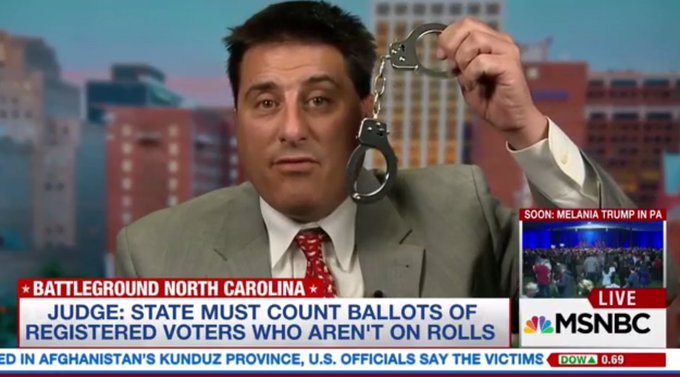

FBI Investigating Alleged “Straw Donor” Scheme Linked To Democrat Patrick Murphy In Florida Senate Race
The FBI is having a really difficult time keeping up with all of the Democrat scandals this election cycle. Just yesterday we noted another raid of a democrat “advocacy group” in Delaware County, PA that was allegedly submitting falsified voter registration forms and, of course, we’re all intimately familiar with Hillary’s assorted investigations.
Now, according to The Hill, the FBI has also been forced to open another election-related investigation tied to the Florida Senate Race between Marco Rubio (R) and Patrick Murphy (D). The investigation is related to whether a long-time Murphy friend, Ibrahim Al-Rashid, utilized an illegal “straw donor” fundraising scheme to funnel money from his wealthy Saudi family to the Murphy campaign. The scheme effectively attempts to skirt federal election laws governing campaign contributions by making donations in the name of other citizens.
The FBI is investigating an alleged illegal donation scheme involving a wealthy Saudi family that supports Democratic Florida Senate candidate Patrick Murphy.
The allegation — originally submitted by a Republican super PAC run by a former top aide to Senate Majority Leader Mitch McConnell (R-Ky.) — is that Murphy’s high school friend and major political donor, Ibrahim Al-Rashid, coordinated a “straw donor” scheme to boost Murphy.
A straw donor scheme occurs when a wealthy donor skirts legal limits on political donations by funneling money into campaigns using other people’s names.
For any charges to be backed in the Al-Rashid investigation, the FBI must prove that the person or people running the scheme reimbursed donors without their permission. It would also be illegal to agree to be the named donors using somebody else’s money.
The GOP super PAC, the Senate Leadership Fund, claimed in its June complaint to the Federal Election Commission (FEC) that 11 donors in Texas, Pennsylvania and Florida “participated in an unlawful scheme to funnel Ibrahim Al-Rashid’s contributions, or were used by Al-Rashid to funnel contributions without their knowledge.” A total of $24,050 was involved.
Al-Rashid is the son of a powerful and politically connected Saudi billionaire. He’s been a major financial benefactor of Murphy’s, giving almost $400,000 to his campaigns and to outside groups supporting the Florida congressman.
While the Murphy campaign denies any wrongdoing, some of the facts surrounding the case are rather suspicious. For example, one $300 donation was made in the name of a woman whose federal donation forms claimed she was the owner of a Texas-based company named Limestone Property Management. Unfortunately, a quick search of public records reveal that the woman is not associated with the Texas business. Moreover, a 2012 police report from the Miami-Dade Police Department reveals that the donor was actually Al-Rashid’s cleaning lady.
Of course, the fight for control of the Senate between democrats and republicans make this and all races around the country very important. The most recent Real Clear Politics polling average shows Rubio with a 5.6% advantage though Murphy had pulled to within 2 points just a couple of weeks ago.

Of course, the Murphy campaign denied any wrongdoing linking the complaint to a “Republican super PAC willing to say anything to elect Marco Rubio.”
end
This is fascinating: Emails reveal that the real contributor to HIV/Aids relief is not the Clinton Foundation but the independent Clinton Health Initiative
(courtesy zero hedge)
Podesta Email Reveals Clinton Health Initiative Had Concerns Over Foundation’s “Serious Conflicts Of Interest”
Remember in the last debate when Hillary was finally asked about “pay-to-play” allegations surrounding the Clinton Foundation? Of course, anytime she’s asked about those allegations, she quickly pivots to what great work the Foundation has done for HIV/AIDS victims around the world. Here’s what she said:
“I’m thrilled to talk about the Clinton Foundation…the Clinton Foundation made it possible for 11mm people around the world with HIV/AIDS to afford treatment.“
There’s just one small problem with her statement about all the great work the “Clinton Foundation”does for HIV/AIDS victims around the world, namely it happens to be completely untrue.
As it turns out, all of the charity work related to HIV/AIDS victims that Hillary referenced above is actually carried out by the independent “Clinton Health Access Initiative” (CHAI). Moreover, efforts on the part of the Clintons to falsely attribute the HIV/AIDS work to the Clinton Foundation ruffled some feathers among the management team at CHAI who wrote a memo to Bill Clinton expressing concerns about the “serious conflicts of interest” between the Clinton Foundation and CHAI.
Within the memo, the management of CHAI expresses great concern about “cases where we meet Clinton Foundation donors who believe that they have given money to support CHAI’s work because they have donated to the Clinton Foundation, when in reality CHAI does not receive the funds”…in other words, donors contribute money to the Clinton Foundation thinking it will be used to fund HIV/AIDS efforts when, in reality, none of it is actually used for that purpose…which is odd because that is exactly what Hillary said above at the 3rd Presidential debate.
Further, the line between CHAI and the Clinton Foundation is often blurred by the Foundation, creating ambiguity about our independence as an organization that is separately funded. CHAI is often portrayed by the Clinton Foundation as an initiative of the Foundation. The Clinton Foundation uses CHAI accomplishments in its publicity and fundraising events even though CHAI does not receive funds from these efforts. One example includes the Clinton Foundation Annual Trip, which is coordinated by Clinton Foundation personnel and includes stops to visit CHAI sites and CHAI programmatic work, which is publicized and promoted for Clinton Foundation fundraising purposes. We are very concerned about cases where we meet Clinton Foundation donors who believe that they have given money to support CHAI’s work because they have donated to the Clinton Foundation, when in reality CHAI does not receive the funds.
The memo from CHAI management goes on to express that as “a separate legal entity from the Clinton Foundation” they have concerns about “serious conflicts of interest” surrounding “Clinton Foundation appointed members who currently serve on the CHAI Board.” Among other things, CHAI management was apparently concerned their board members’ “allegiance to the Clinton Foundation takes precedence over their fiduciary responsibility to act in the best interest of CHAI.”
CHAI has grown significantly and been successful over the past five years since we became an independent legal entity, thanks in large part to the sustainable relationships CHAI has built with our government partners and donors. We firmly believe that to continue this success CHAI needs a Board of Directors entirely independent of the Bill, Hillary, and Chelsea Clinton Foundation (“Clinton Foundation”). We believe this to be in the best interest of CHAI because of the underlying conflict of interest for the Clinton Foundation appointed members who currently serve on the CHAP Board, the significant risks to CHAI associated with a possible run for the US Presidency by Secretary Clinton, and the fundamental difference in culture and approach between the two organizations.
We are a separate legal entity from the Clinton Foundation but there continues to be ambiguity about the relationship. There are not only fundamental differences in culture and approach between the Clinton Foundation and CHAI, but more importantly, there are serious conflicts of interest in the way that the relationship is currently structured. In particular, there is a recognizable conflict of interest with the Clinton Foundation appointed members who currently serve on the CHAI Board.
Since becoming a separate legal entity from the Clinton Foundation in 2010, CHAI has proven to be successful operating autonomously. Despite this, we see increasing evidence that the Clinton Foundation plans to exert more control over CHAI. We fear that there is an agenda to ultimately fold CHAI into the Clinton Foundation. Recent communications that talk about the Clinton Foundation as the controlling entity of CHAI would imply a possible consolidation.
We are very concerned with the current conflict of interest among Clinton Foundation appointees to the CHAI board, where we see evidence that their allegiance to the Clinton Foundation takes precedence over their fiduciary responsibility to act in the best interest of CHAI.
So you’re saying the Clintons established a phony “independent” board of directors filled with their political cronies who were only concerned with enriching their friends and not their fiduciary obligations to the underlying charity? Well, we just don’t see how that could possibly be true.
END
Secret recordings by the FBI on the Clinton Foundation revealed the crooked nature of this “charitable” organization. Instead of proceeding, the FBI was ordered to “stand down” to which mutinous revelations starting to appear:
(courtesy zero hedge)
Secret Recordings Fueled Mutinous FBI Investigation of Clintons Despite DOJ Orders To “Stand Down”
It’s looking increasingly like there is an ongoing mutiny underway within the FBI as the Wall Street Journal is reporting that, according to “officials at multiple agencies”, FBI agents felt they had adequate evidence, including “secret recordings of a suspect talking about the Clinton Foundation”, to pursue an investigation of the Clinton Foundation but were repeatedly obstructed by officials at the Department of Justice.
Secret recordings of a suspect talking about the Clinton Foundation fueled an internal battle between FBI agents who wanted to pursue the case and corruption prosecutors who viewed the statements as worthless hearsay, people familiar with the matter said.
The roots of the dispute lie in a disagreement over the strength of the case, these people said, which broadly centered on whether Clinton Foundation contributors received favorable treatment from the State Department under Hillary Clinton.
Senior officials in the Justice Department and the FBI didn’t think much of the evidence, while investigators believed they had promising leads their bosses wouldn’t let them pursue, they said.
Despite clear signals from the Justice Department to abandon the Clinton Foundation inquiries, many FBI agents refused to stand down. Then, earlier this year in February 2016, the FBI presented initial evidence at a meeting with Leslie Caldwell, the head of the DOJ’s criminal division, after which agents were delivered a clear message that “we’re done here.” But, as the WSJ points out, DOJ became increasing frustrated with FBI agents that were “disregarding or disobeying their instructions” which subsequently prompted an emphatic “stand down” message from the DOJ to “all the offices involved.”
As 2015 came to a close, the FBI and Justice Department had a general understanding that neither side would take major action on Clinton Foundation matters without meeting and discussing it first. In February, a meeting was held in Washington among FBI officials, public-integrity prosecutors and Leslie Caldwell, the head of the Justice Department’s criminal division. Prosecutors from the Eastern District of New York—Mr. Capers’ office—didn’t attend, these people said.
The public-integrity prosecutors weren’t impressed with the FBI presentation, people familiar with the discussion said. “The message was, ‘We’re done here,’ ” a person familiar with the matter said.
Justice Department officials became increasingly frustrated that the agents seemed to be disregarding or disobeying their instructions.
Following the February meeting, officials at Justice Department headquarters sent a message to all the offices involved to “stand down,’’ a person familiar with the matter said.
The FBI had secretly recorded conversations of a suspect in a public-corruption case talking about alleged deals the Clintons made, these people said. The agents listening to the recordings couldn’t tell from the conversations if what the suspect was describing was accurate, but it was, they thought, worth checking out.

Despite the warnings, FBI agents continued to press forward leading to a tense August 12th call between a “senior DOJ official” and the FBI deputy director, Andrew McCabe, which ended abruptly when McCabe bluntly asked “are you telling me that I need to shut down a validly predicated investigation?”
In subsequent conversations with the Justice Department, Mr. Capers told officials in Washington that the FBI agents on the case “won’t let it go,” these people said.
As a result of those complaints, these people said, a senior Justice Department official called the FBI deputy director, Mr. McCabe, on Aug. 12 to say the agents in New York seemed to be disregarding or disobeying their instructions, these people said. The conversation was a tense one, they said, and at one point Mr. McCabe asked, “Are you telling me that I need to shut down a validly predicated investigation?’’ The senior Justice Department official replied: ”Of course not.”
With that, it seems that we’re starting to get a little more insight into why the FBI didn’t “follow protocol” by alerting the DOJ before sending their most recent letter to Congress announcing the re-opening of Hillary’s email investigation.
Meanwhile, Fox News reported earlier this evening that “sources” claim to have an “avalanche of evidence” in their case against Hillary and that “barring obstruction” they would continue to push for an indictment. The next 5 days should be very interesting.
I said sources described an “avalanche of evidence” in case & barring obstruction they’d likely continue 2 push to try for an indictment” https://twitter.com/lynnies2/status/793958830895988736 …
Hillary Clinton Regains 2 Point Lead In Latest ABC/WaPo Poll; S&P Futures, Peso Jump
With fundamentals irrelevant in a market controlled by central banks, the algos and early rising traders have found a new catalyst to trade off: the daily 7am release of the refreshed ABC/WaPo poll, and if anyone is wondering why the peso suddenly spiked…

… coupled with US risk assets suddenly going bid, it is becuase in the latest poll, Hillary Clinton has regained the lead from Donald Trump, who was leading as recently as two days ago, and was tied with Hillary yesterday.
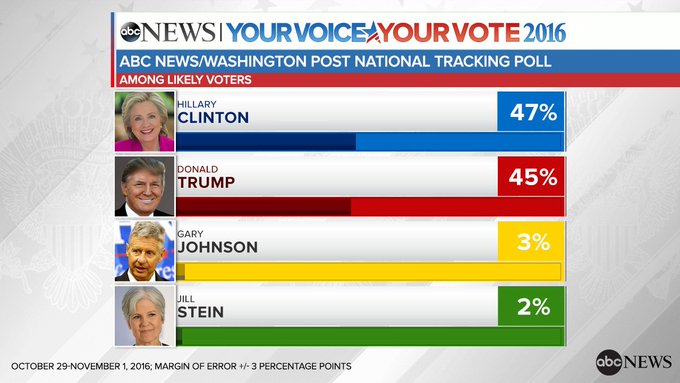
Hillary Clinton takes two-point lead over Donald Trump in today’s @ABC News/WaPo tracking poll. http://abcn.ws/2fH7tUP

Overall, likely voters divide 47-45 percent between Hillary Clinton and Donald Trump in the latest ABC News/Washington Post tracking poll. Third-party candidates Gary Johnson and Jill Stein have 3 and 2 percent support, respectively.

As ABC writes, numerically the race has gone from +1 Trump to 0 to +2 Clinton in four-night averages in this poll, produced for ABC by Langer Research Associates. It notes that these are not significant changes given the survey’s sample size, about 1,100 likely voters, however the Clinton lead is all the algos needed to promptly launch buying programs and send futures to session highs.
Some more details:
Trump has had a non-significant but numerical advantage just twice in ABC/Post polls, +2 in a two-way test May 19 and +1 Oct. 30. Clinton, for her part, has held significant and even substantial leads, but these have been sensitive to events and propensity to vote, given the lukewarm nature of her (and Trump’s) support.
This is reflected in levels of strong enthusiasm for the candidates -– tepid overall, with patterns among groups that help identify their strengths and weaknesses. Trump has a 7-point edge in strong enthusiasm, given challenges in enthusiasm for Clinton among independents.
Another factor, early voting, has accelerated, up from 21 percent of likely voters Oct. 30 to 27 percent now. After starting better for Clinton, vote preferences in this group have tightened to 50-45 percent, Clinton-Trump, in the latest four-night average.
A look at core supporters: Clinton has shored up her support among Democrats and Democratic-leaning independents who preferred Bernie Sanders for the nomination –- 82 percent of them now support her, up from a low of 70 percent in July. Still, she loses 8 percent of former Sanders supporters to Trump and 7 percent to Stein or Johnson. Also, unhelpfully for Clinton, there’s a hint of some slippage in turnout; while the results don’t reach statistical significance, former Sanders supporters appear a bit less likely to vote at all.
Trump is said to be doing less well with Republicans and GOP leaners who wanted someone else to win the nomination; he has 75 percent support in this group, with 15 percent going to Clinton, 7 percent to Johnson or Stein. Two factors mitigate the damage: leaned Republicans have grown more apt to say they supported Trump in the first place (47 percent, up from 40 percent in August; and there’s no slippage evident in turnout among leaned Republicans who preferred someone else for the nomination.

As the poll notes, differences among voter groups abound, with one of the largest between evangelical white Protestants -– a core Republican constituency –- and those who profess no religion. The former back Trump by 77-19 percent; the latter, Clinton by 64-25 percent. The groups are identical in size, each 17 percent of all likely voters. The gap between them is typical.
Taking a look at voter enthusiasm, just 46 percent of Clinton’s supporters and 53 percent of Trump’s express strong enthusiasm about them, including fairly narrow majorities even within their own parties. It’s similar for Trump among independents who lean Republican, 45 percent, but drops to 35 percent for Clinton among independents who lean Democratic. Among pure independents, 28 percent are strongly enthusiastic about Trump, compared with only 10 percent who are similarly excited about Clinton.
As with vote preferences, variation in strong enthusiasm for the candidates illustrates the cultural bases of the two parties, most starkly by residential area and religion. In rural areas, 42 percent are strongly enthusiastic about Trump, vs. 16 percent for Clinton. In urban areas, by contrast, just 17 percent express strong enthusiasm for Trump, vs. 33 percent for Clinton. Suburbanites divide. Nearly half of white evangelical Protestants are strongly enthusiastic about Trump. Only 10 percent of those who do not identify with a religion feel the same way; instead, 36 percent in this group are very enthusiastic about Clinton.
By race, strong enthusiasm for Clinton peaks at 58 percent among black likely voters and 38 percent among Hispanics, dropping to 21 percent among whites. By contrast, strong enthusiasm for Trump reaches 30 percent of whites overall; it’s just 12 percent among nonwhites.
Finally, it is worth recalling that the poll is one which actively oversamples democrats, and in the latest edition, of the sample of 1,167 likely voters, the partisan divisions were 37 for Democrats, 30 for Republicans and 29 for Independents, with the last group on the verge of surpassing the Republican group entirely.
END
Looks like we have huge voter fraud in Pennsylvania
(courtesy zero hedge)
Police Expand Investigation Of Democrat “Advocacy Group” In PA On Allegations Of Voter Fraud
A couple of days ago we wrote about a voter fraud case in Pennsylvania in which state police raided the offices of a democrat “public advocacy” group, FieldWorks, LLC, seeking evidence of falsified voter registration forms. The Inquirer Daily News, cited court records noting that police were seeking templates that were “utilized to construct fraudulent voter registration forms.” At that time, the investigation was thought to be linked solely to an office in the city of Norwood in Delaware County, PA.
To our complete lack of surprise, however, it now looks like the issue may extend beyond the Norwood, PA office as The Inquirer Daily News is reporting that the “probe of FieldWorks LLC is likely to expand to other spots in the state”…shocking. The probe was apparently expanded after applications were discovered where “individuals were registered to multiple addresses” or where social security numbers didn’t tie back to driver’s license numbers.
A source with knowledge of the inquiry said Wednesday the probe of FieldWorks LLC is likely to expand to other spots in the state.
At the same time, Delaware County officials are preparing to challenge thousands of voter registration forms submitted by the group, questioning if they were filed on time. A hearing on the matter is scheduled for Friday.
Both developments came after Pennsylvania state police searched FieldWorks’ Norwood office last week seeking, among other things, forms that could be used to “construct fraudulent voter registration forms,” according to court records.
The questions about the forms extend beyond their timeliness, Maddren says. County election officials who surveyed the forms, he said, also discovered some applications where individuals were registered to multiple addresses or where registrants’ Social Security numbers did not match their driver’s license numbers.
But the AG’s office warns that we shouldn’t jump to any conclusions because there is no evidence of “a plot to cast fraudulent ballots”…this could have just been an attempt to “to artificially inflate voter registration numbers.” Perhaps someone within the AG’s office could explain why someone would go through all the trouble of creating false voter registrations if they never intended to actually use them…what exactly would be the point?
The Attorney General’s Office has declined to discuss its investigation, or say if evidence suggests a plot to cast fraudulent ballots or just attempts by paid canvassers to artificially inflate voter registration numbers.
As we noted earlier this week, FieldWorks describes itself as “a nationally recognized grassroots organizing firm founded to help progressive organizations, advocacy groups, and members of the Democratic family take their public engagement and electoral strategies to the next level.” Yes, we would also confirm that committing voter fraud is indeed “taking things to the next level.”
Meanwhile, the FieldWorks website notes that the organization utilizes “innovative grassroots strategies” to “target the right voters in the right places, and using the right tactics at the right time.” The website also lists its core competencies as “vote-by-mail, early voting, voter registration…” Somehow, we wouldn’t be surprised if they also specialized in helping dead voters as well…though it would be a little reckless to put that directly on a website…that’s more of a message that should be communicated in person or over the phone.
Led by experienced national and international strategists with their hearts in grassroots organizing, FieldWorks creates campaigns that combine innovative grassroots strategies, the newest online and communication technologies, and time-tested shoe leather tactics with one thing in mind: achieving our client’s goals. Targeting the right voters in the right places, and using the right tactics at the right time (Vote-by-Mail, Early Voting, voter registration, mail, phones, direct voter contact, message integration, and the Internet), FieldWorks puts the plan together that will yield the winning results.

Just in case you think this may be a non-partisan organization, FieldWorks’ website also includes a case study on work they did for the Democratic Congressional Campaign Comittee:
In 2006 and 2008, FieldWorks was part of a team brought in by the DCCC to work with their most targeted races to develop Field and GOTV Plans. FieldWorks was responsible for working with the Field Directors to ensure that a quality Field Plan was in place, direct voter contact plans established with clear metrics and deliverables, establishing paid canvass operations and managing Get-Out-the-Vote activities.
Of course, FieldWorks also denied similar charges in Ohio during the 2012 election cycle that landed one Ohio University student in jail.
In 2012, FieldWorks’ voter registration efforts in Ohio sparked some controversy. FieldWorks employees filed thousands of new voter registration cards in the final week before the registration deadline. Some of them were found to be fraudulent.
In that same election, FieldWorks included a cover letter with its mass voter filing warning that it itself viewed scores of the submitted names as fraudulent.
Police in Cincinnati arrested a former Ohio University student in 2012 working in FieldWorks on charges of forging 22 signatures on a petition drive. Police said at the time that FieldWorks itself played no role in that man’s scheme to pad his list.
And we’ll summarize, once again, with this:
Of course there is large scale voter fraud happening on and before election day. Why do Republican leaders deny what is going on? So naive!
— Donald J. Trump (@realDonaldTrump) October 17, 2016
end
Julian Assange: the source of the hacked emails is not Russia
(courtesy zero hedge)
Julian Assange Ends The Suspense: “The Source Of Hacked Emails Is Not Russia”
With countless hours of media, and Clinton campaign, speculation and accusations that the source of hacked Wikileaks Democratic emails including the Podesta files, is none other than Russian president Vladimir Putin, either directly or indirectly, Julian Assange has decided to close the book on that particular loose end, and as RT reports, in a John Pilger Special, to be broadcast by RT on Saturday courtesy of Dartmouth Films, Assange categorically denied that the troves of US Democratic Party and Clinton work and staff emails released this year have come from the Russian government.
“The Clinton camp has been able to project a neo-McCarthyist hysteria that Russia is responsible for everything. Hillary Clinton has stated multiple times, falsely, that 17 US intelligence agencies had assessed that Russia was the source of our publications. That’s false – we can say that the Russian government is not the source,” Assange told the veteran Australian broadcaster as part of a 25-minute interview.
Assange spoke with Pilger at the Ecuadorian Embassy in London, where he has been for four years, and accused the US presidential candidate of being a pawn of behind-the-scenes interests, and voiced doubts about her physical fitness to take charge of the White House.
“Hillary Clinton is just one person. I actually feel quite sorry for Hillary Clinton as a person, because I see someone who is eaten alive by their ambitions, tormented literally to the point where they become sick – for example faint – as a result of going on, and going with their ambitions. But she represents a whole network of people, and a whole network of relationships with particular states.”
Over the past nine months, WikiLeaks uploaded over 30,000 emails from Hillary Clinton’s private email server, while she was Secretary of State. This was followed by nearly 20,000 emails sent to and by members of the US Democratic National Committee, exposing the party leadership’s dismissive attitude to Bernie Sanders, and his outsider primaries campaign.
Finally, last month, WikiLeaks posted over 50,000 emails connected to John Podesta, Bill Clinton’s chief of staff, and a close associate of the current presidential frontrunner.
A preview of the upcoming interview below. The Homeland Security Department and Office of the Director of National Intelligence posted a joint statement in October, claiming they were “confident” that the Russian government “directed” this year’s leaks. Moscow has rejected the accusation, with presidential press secretary Dmitry Peskov calling the claims “nonsense,” while Foreign Ministry spokeswoman Maria Zakharova said the “public bickering with Russia” before the US election is probably a “smokescreen” to draw the voters’ attention away from serious domestic issues.
FBI Opens Internal Investigation Into Its Own Twitter Account
Three days ago, a Twitter account controlled by the FBI, @FBIRecordsVault, caused a political and media uproar when it unexpectedly tweeted documents regarding former President Bill Clinton’s controversial pardon of Marc Rich. The account, which had been dormant for more than a year, awoke on October 30 at 4 a.m. when it released several documents, including one describing Donald Trump’s father Fred Trump as a “philanthropist.”
Fred C. Trump: Fred C. Trump (1905-1999) was a real estate developer and philanthropist. This release consists of… https://vault.fbi.gov/fred-c.-trump

But while the Trump disclosure was largely unnoticed, the Marc Rich tweet even prompted the Clinton campaign to speculate if this was another broadside attack on Hillary by the FBI.
William J. Clinton Foundation: This initial release consists of material from the FBI’s files related to the Will… https://vault.fbi.gov/william-j.-clinton-foundation …
The strange tweets come days after James Comey released a letter revealing that the department was reviewing some emails that could be relevant to the investigation of Hillary Clinton’s private email server. The Justice Department opposed release of the letter, arguing that it violated department protocols.
Since that time, there has been a series of leaks about FBI activity that appear to be designed to damage Hillary Clinton and benefit Donald Trump. An anonymous source for example, leaked to the Wall Street Journal that there was an investigation?—?including “secret recordings”?—?into the Clinton Foundation. The New York Times, also citing anonymous sources, reported that the FBI believed that Russia was just trying to disrupt the U.S. election, not help Donald Trump.
In the three days since the tweet, the FBI account has not communicated further.
However, in a notable development, ThinkProgress reports that “it has learned that the FBI’s Inspection Division will undertake an investigation of the account.”
As TF reports, Candice Will, Assistant Director for the FBI’s Office of Professional Responsibility, said she was referring the matter to the FBI’s Inspection Division for an “investigation.” Upon completion of the investigation, the Office of Professional Responsibility will be referred back to the Office of Professional Responsibility for “adjudication.”
Will was responding to a complaint from Jonathan Hutson, a former investigative reporter who now works in communication in Washington, DC. She did not respond to requests, via phone and email, for further comment.
Nancy McNamara, the Assistant Director of the FBI’s Inspection Division, also confirmed to Hutson that she had received the complaint. She copied Voviette Morgan, a 19-year veteran now serving as Assistant Special Agent in Charge of the Los Angeles office.
News of the internal investigation is at odds with the FBI’s official position, which is that the Twitter account followed all FBI procedures.
“Per the standard procedure for FOIA, these materials became available for release and were posted automatically and electronically to the FBI’s public reading room in accordance with the law and established procedures,” the FBI said in a statement.
What to make of all this? Perhaps just another odd coincidence, on the other hand in light of ongoing revelations from both WSJ and FOX exposing a full blown turf war between the FBI and DOJ, perhaps a “faction” within the FBI is indeed trying to “communicate” with the public using secondary means. In any case, keep a close eye on this particular Twitter account and for signs of more leaks from the Bureau if indeed the “mutiny” theory is accurate.
end
Initial jobless claims jump the most in 6 months:
(courtesy zero hedge)
Initial Jobless Claims Jump Most Since May To 3-Month Highs
The last four weeks have seen initial jobless claims rise over 7.7% (~19k), the fastest pace in 5 months,pushing to 265k, the highest level since the start of August. For context, while initial claims have been stable at near record lows this year, claims have not ‘improved’ since July 2015.

Too soon to call it a trend, but initial claims has now risen for 4 straight weeks despite the ongoing collapse in continuing claims to fresh 16 year lows…
end
Q3 productivity rises but not enough to stop year over year declines for the first time in 23 years:
(courtesy zero hedge)
US Productivity Prints Consecutive YoY Declines For First Time In 23 Years
After a recession-signalling three straight quarters of decline, Q3 prleminary productivity data showed a huge 3.1% surge QoQ – the biggest jump since Q3 2014. However, the jump was not enough to regain annual gains as year-over-year productivity declined 0.04%. This is the first consecutive annual decline since 1993.
After the longest streak of declines since 1979, US productivity surged in Q3…

But YoY a second consecutive decline…

Something that has not happened since 1993… but it’s probably nothing.
end
The all important USA Services PMI slips after last month’s rise:
employment growth remains very weak
(courtesy zero hedge)
US Services Economy Slips From August Spike: “Employment Growth Remains Weakest In 3 Years”
On the heels of the major rebound in Manufacturing PMI data, the final US Services PMI for October printed 54.8 – the highest since Nov 2015 – following the massive spike in ISM Services in September (which reverted lower to match the PMI at 54.8). However, more signs of stagflation appear as business activity faded but prices paid soared as Markit notes, “employment growth across the services and manufacturing sectors remained one of the weakest seen for over three years.”
Despite signs of renewed pressure on operating capacity, job creation picked up only slightly from September’s three-and-a-half year low. Some firms cited cautious hiring strategies in response to heightened uncertainty about the business outlook. Furthermore, service providers signalled a much sharper pace of input cost inflation than the 19-month low recorded in September. The latest rise in average cost burdens was the fastest since July 2015.

Full ISM Breakdown:
- Business activity fell to 57.7 vs 60.3 prior month
- New orders fell to 57.7 vs 60.0
- Employment fell to 53.1 vs 57.2
- Supplier deliveries fell to 50.5 vs 51.0
- Inventory change rose to 52.0 vs 51.5
- Prices paid rose to 56.6 vs 54.0
- Backlog of orders unchanged at 52.0
- New export orders fell to 55.5 vs 56.5
- Imports rose to 53.0 vs 51.0
- Inventory sentiment fell to 62.0 vs 64.5
Once again pointing to stagflationary pressures.
Overall the Markit Composite US PMI suggests a healthy rebound in growth…

Commenting on the PMI data, Chris Williamson, Chief Business Economist at IHS Markit said:
“Indications of stronger economic growth, solid job creation, rising prices and improved business confidence all pave the way for the Fed to hike interest rates again by the end of the year.
“The surveys are signalling the largest monthly rise in business activity for nearly one year after inflows of new orders surged higher in October.
“The upturn in new work helped drive renewed optimism about prospects for the year ahead. However, it’s evident that many businesses remain cautious as the presidential election nears. As a result, employment growth across the services and manufacturing sectors remained one of the weakest seen for over three years, though still signals a respectable 130,000 rise in non-farm payrolls in October.
“There’s therefore nothing in this month’s PMI reports to deter the Fed from raising interest rates again, with a move likely to be seen in December.”
Time for a hike Janet!
end
A slight rise in factory orders but still down 17% from 2014 highs
(courtesy zero hedge)
US Factory Orders Rise YoY For First Time In 2 Years, But Down 17% From Highs
After 22 straight months of year-over-year declines, September saw US Factory Orders rise 0.6% from the year prior.

The slightly better than expected 0.3% MoM gain (and upwardly revised August print of +0.4%) still leaves US Factory New Orders down 17% from the July 2014 peak of the cycle.

We are not sure September’s bounce is too much to get excited about.
end
What keeps Paul Singer up at night: the rise in inflation and he feels that that could crash the markets:
(courtesy Paul Singer/Elliott Capital/zero hedge)
What Keeps Elliott’s Paul Singer Up At Night: “A Spike In Inflation Could Lead To A Market Crash”
http://www.zerohedge.com/users/tyler-durden http://www.zerohedge.com/users/tyler-durden
by Tyler Durden
Nov 2, 2016 8:58 PM
One month ago, Bridgewater’s Ray Dalio warned the New York Fed that even a modest, 1% rise in rates, and thus inflation, would lead to trillions in losses and “trigger the worst price decline in bonds since the 1981 bond market crash.” Now, it is the turn of Elliott Management’s Paul Singer. In a letter to investors seen by CNBC’s Kate Kelly, Elliott Management execs warned of essentially the same thing: that a rapid inflation is the $30 billion hedge fund’s biggest concern in the current environment, and that such a spike would not only collapse bond prices, but potentially lead to a stock market crash.
“This may seem like a strange thing to worry about under the current circumstances, but the tide toward inflation could turn rather abruptly,” wrote the money managers in their Q3 letter dated Oct. 28. “If inflation starts accelerating to an annual rate of high single digits or greater, it will be quite difficult for the mix of strategies that Elliott favors to ‘keep up.'”
However, sudden price hikes were only one of the Elliott team’s worries, according to the recent letter. Another is Singer’s biggest recurring fear: that the artificial market created by central bankers over the past 7 years will undergo rapid “renormalization.” Lingering over Elliott’s portfolio management is a persistent fear that central bankers — by collectively cutting interest rates 673 times since the financial crisis — have so upended the natural price levels of stocks, bonds and many other assets, “that the economy and markets are operating in denial of reality.”
Paraphrasing from the latest Greenlight letter, sent on the same day, in which David Einhorn said that “we have central bankers who are determined to see flashing lights that aren’t there…. we are more than seven years into an economic recovery, yet central bankers behave as if we’re still in crisis”, Elliott writes that “every sniffle is being treated by central banks as acute respiratory distress syndrome worthy of ‘code-blues’ and teams of frantic pumpers and fixers… what this policy landscape has engendered is a widespread belief, or at least a strong suspicion, that stock and bond prices won’t ever be allowed to go down in any meaningful way.”
Such a mentality, according to Singer, “has encouraged massively risky behavior.”
Aside from his traditional pessimistic warning that the central-bank created “market” will implode sooner or later, Elliott predicts that during the coming months or years, oil prices will trend higher than their current $45 level, but not by much. “The oil market has largely achieved balance,” the managers wrote, “albeit with high stock levels, and we expect medium-term price appreciation to be limited by the return of U.S. production growth in the $50-60 range.”
Singer also touched on one of his long-running favorite investments, gold, and noted that its flat performance during the third quarter, and the move down in response to the increasing belief that the Fed will soon rate interest rates, seemed puzzling: “Given the market gyrations that have accompanied each of the Fed’s previous attempts at hiking policy rates over the last few years,now would seem to be an inopportune time to abandon the only actual safe haven that investors may reach for as an alternative to the really bad deal offered by fixed income instruments given current pricing.”
Translated: Elliott is buying gold here.
Singer then looked at Europe, and specifically Italy which he said is in a state of “tremendous flux” that will only continue should Prime Minister Matteo Renzi fail to win a Dec. 4 referendum intended to simplify the country’s governance.
“The resulting unrest may be more impactful than Brexit,” the letter stated. Meanwhile, in Germany, the straits faced by Deutsche Bank, the troubled financial giant now in talks to settle fraud charges with the U.S. Justice Department, may be overplayed in the market, given that the German government, in Elliott’s view, will do whatever is ultimately needed to stabilize the biggest German lender.
“Regardless of what Chancellor (Angela) Merkel currently says, Germany will stand behind Deutsche Bank in extremis.”
He is right,
-END-
Well that is all for today
I will see you tomorrow night
Harvey


 harveyorganblog.com
[…] NOV 3/FOX NEWS LAST NIGHT: THE FBI ARE MOVING TOWARD AN INDICTMENT ON THE CLINTON FOUNDATION STUFF P… […]
LikeLike
[…] by Harvey Organ Harvey Organ’s Blog […]
LikeLike