
Gold closed at $1273.40 down $4.90
silver closed at $18.33: UP 20 cents.
Access market prices:
Gold: 1275.70
Silver: 18.40
THE DAILY GOLD FIX REPORT FROM SHANGHAI AND LONDON
.
The Shanghai fix is at 10:15 pm est and 2:15 am est
The fix for London is at 5:30 am est (first fix) and 10 am est (second fix)
Thus Shanghai’s second fix corresponds to 195 minutes before London’s first fix.
And now the fix recordings:
Shanghai morning fix Nov 8 (10:15 pm est last night): $ 1287.06
NY ACCESS PRICE: $1284.00 (AT THE EXACT SAME TIME)
Shanghai afternoon fix: 2: 15 am est (second fix/early morning):$ 1290.17
NY ACCESS PRICE: 1284.95 (AT THE EXACT SAME TIME/2:15 am)
HUGE SPREAD TODAY!! 5 dollars
XXXXXXXXXXXXXXXXXXXXXXXXXXXXXXXXXXXXXXXX
London Fix: Nov 8: 5:30 am est: $1284.00 (NY: same time: $1284.00: 5:30AM)
London Second fix Nov 8: 10 am est: $1282.35 (NY same time: $1282.20 , 10 AM)
It seems that Shanghai pricing is higher than the other two , (NY and London). The spread has been occurring on a regular basis and thus I expect to see arbitrage happening as investors buy the lower priced NY gold and sell to China at the higher price. This should drain the comex.
Also why would mining companies hand in their gold to the comex and receive constantly lower prices. They would be open to lawsuits if they knowingly continue to supply the comex despite the fact that they could be receiving higher prices in Shanghai.
end
For comex gold:
NOTICES FILINGS FOR NOVEMBER CONTRACT MONTH: 0 NOTICES FOR nil OZ TONES
For silver:
NOTICES FOR NOVEMBER CONTRACT MONTH FOR SILVER: 0 NOTICES OR nil OZ
xxxxxxxxxxxxxxxxxxxxxxxxxxxxxxxxxxxxxxxxxxxxxxxxxxxxxxxxxxxxxxxxxxxxxxxxxxxxxxxxxxxxxxxxxx
Let us have a look at the data for today
.
xxxxxxxxxxxxxxxxxxxxxxxxxxxxxxxxxxxxxxxxxxxxxxxxxxxxxxxxxxxxxxxxxxxxxxxxxxxxxxx
In silver, the total open interest FELL by 3034 contracts DOWN to 192,218 as we got a partial mission accomplished from our criminal banker-commercials as they caused a liquidation of longs. The open interest FELL AS the silver price was DOWN 25 cents in yesterday’s trading.In ounces, the OI is still represented by just less THAN 1 BILLION oz i.e. .961 BILLION TO BE EXACT or 137% of annual global silver production (ex Russia &ex China).
In November, in silver, 0 notice(s) filings: FOR 10,000 OZ
I
In gold, the total comex gold FELL by 10,962 contracts WITH THE fall in price of gold ($25.00 YESTERDAY) . The total gold OI stands at 532,245 contracts.
In gold: we had 0 notices filed for nil oz
xxxxxxxxxxxxxxxxxxxxxxxxxxxxxxxxxxxxxxxxxxxxxxxxxxxxxxxxxxxx
With respect to our two criminal funds, the GLD and the SLV:
GLD: Strange after two whack job days:
TODAY WE HAD NO CHANGES AT THE GLD/
Total gold inventory rests tonight at: 949.69 tonnes of gold
SLV
we had no changes at the SLV/
THE SLV Inventory rests at: 358.435 million oz
.
First, here is an outline of what will be discussed tonight:
1. Today, we had the open interest in silver FELL by 3034 contracts DOWN to 192,218 as the price of silver FELL by 21 cents with YESTERDAY’S trading.The gold open interest FELL by 10,962 contracts DOWN to 532,245 as the price of gold FELL $25.00 in YESTERDAY’S TRADING.
(report Harvey).
2.a) The Shanghai and London gold fix report
(Harvey)
2 b) Gold/silver trading overnight Europe, Goldcore
(Mark O’Byrne/zerohedge
and in NY: Bloomberg
3. ASIAN AFFAIRS
i)Late MONDAY night/TUESDAY morning: Shanghai closed UP 14.55 POINTS OR 0.46%/ /Hang Sang closed UP 108.03 OR 0.47%. The Nikkei closed DOWN 5.83 POINTS OR 0.03%/ Australia’s all ordinaires CLOSED UP 0.21% /Chinese yuan (ONSHORE) closed DOWN at 6.788050/Oil FELL to 44.78 dollars per barrel for WTI and 45.98 for Brent. Stocks in Europe: ALL IN THE RED EXCEPT LONDON Offshore yuan trades 6.7973 yuan to the dollar vs 6.7880 for onshore yuan.THE SPREAD BETWEEN ONSHORE AND OFFSHORE WIDENS QUITE A BIT AS MORE USA DOLLARS LEAVE CHINA’S SHORES / CHINA SENDS A MESSAGE TO THE USA TO NOT RAISE RATES IN DECEMBER.
REPORT ON JAPAN SOUTH KOREA NORTH KOREA AND CHINA
3a)THAILAND/SOUTH KOREA
none today
b) REPORT ON JAPAN
none today
c) REPORT ON CHINA
i)China reported dismal trade data and this is very bad for the global economy. Their exports have declined 7.3% year over year.
( zero hedge)
ii)The official Chinese capital outflow triples last month from 19 billion up to 46 billion. However China engages in what we call the “POBC’s F/X position” and their true loss may be around 1/2 trillion dollars down to 2.7 trillion. If Clinton wins, there will surely be a rate hike in December which would cause the dollar/yuan cross to exceed 6.8 which would cause more dollars to leave Chinese shores
( zero hedge)
iii)If Clinton wins, no doubt that the USA dollar will rise which will send the USA/CNY above the 6.80 mark. The fear then is that this will escalate the huge movement of dollars out of China.
( zero hedge)
4 EUROPEAN AFFAIRS
5. RUSSIAN AND MIDDLE EASTERN AFFAIRS
EGYPT/SAUDI ARABIA/RUSSIA/CHINA/IRAN
The following is very important as we are witnessing a huge shift in alliances as Egypt turns toward Russia and China. After making a deal with Russian in October, the Saudi’s were very angry and they now have cut off oil supplies to Cairo. So what does Egpyt do: they turn to Saudi Arabia’s key enemy: Iran
( zero hedge)
6.GLOBAL ISSUES
War on cash commences in India with the removal of the rupee 500 note and the 1,000 note as well at ATM limited withdrawals of the rupee 2,000 note
( zero hedge)
7.OIL ISSUES
i)The fight between Saudi Arabia and Iran will prevent any OPEC deal from formulating
( Paraskova/OilPrice.com)
ii)WTI rises on a big drawdown in gasoline and distillate inventories
( zero hedge)
8.EMERGING MARKETS
9.PHYSICAL STORIES
i)Chinese investors are still in love with the USA dollar denominated bonds
( Bloomberg/GATA)
ii)A good commentary tonight from Hug. International reserves are falling due to problems with deficits on emerging nations.
( Hugo Salinas Price/GATA)
iii)Islamic finance is near its final standard for gold based products according to Sharia law. This should boost demand for this sector of the global economy
(courtesy Reuters/Vizcaino/GATA
iv)With China reporting dismal exports, one has to wonder why copper has been up for 12 days in a row:
( zero hedge)
v)Does it matter who wins the election for gold and silver?
Dave Kranzler states no!
( Dave Kranzler/IRD)
10.USA STORIES WHICH MAY INFLUENCE THE PRICE OF GOLD/SILVER
i)The next President must deal with the huge debt accumulated especially over these past 8 years. The CBO states that interest rates must normalize. Impossible as that would blow up our banking derivatives.
( zero hedge)
ii)Car rental revenues huge miss, plus increase depreciation costs hurt Hertz
( zero hedge)
iii)Another former darling on the NYSE gets clobbered today after warning of more harmful surprises:
( zero hedge)
iv) Hilary: established leader of the free hold! She hires al Qaeda mercenaries for the night of the Benghazi attack:
Martin Walsh/Conservative Daily Post/TV/Fox news)
v)Here is another favourite indicator for Janet: hirings/job openings. In this latest report we see hirings are well below 2014 despite the rising job openings
( zero hedge)
vi)Voting machine irregularities:
( zero hedge
Let us head over to the comex:
The total gold comex open interest FELL BY 10,962 CONTRACTS to an OI level of 533,245 as the price of gold FELL $25.00 with YESTERDAY’S trading. In the front month of November we had 22 notices standing for a GAIN of 1 contract. We had 4 notices served yesterday so we GAINED 5 contracts or 500 ADDITIONAL oz will stand for delivery in November. The next contract month and the biggest of the year is December and here this month showed a decrease of 23,696 contracts down to 343,547. The December contract month is still highly elevated compared to a year ago. On Monday Nov 9/2015 comex reading day, we had a total of 247,319 contracts standing ( a loss of 9775 contracts from Nov 6/2015) It certainly emphasizes the huge demand for physical gold.
And now for the wild silver comex results. Total silver OI fell by 3034 contracts from 195,252 down to 192,218 as the price of silver FELL to the tune of 21 cents with yesterday’s trading. We are moving further from the all time record high for silver open interest set on Wednesday August 3/2016: (224,540). The front month of November had an OI of 61 and thus a gain of 6 contracts. We had 0 notices filed yesterday so we gained 6 contracts or an additional 30,000 oz will stand for delivery. The next major delivery month is December and here it FELL BY 8210 contracts DOWN to 123,017. The December contract month is also highly elevated compared to a year ago. On Nov 9/2015 reporting day, we had a level of 95,144 contracts having lost 2892 contracts on the day).
In silver had 0 notices filed for nil oz
VOLUMES: for the gold comex
Today the estimated volume was 219,564 contracts which is good.
Yesterday’s confirmed volume was 264,717 which is very good
today we had 20 notices filed for 2000 oz of gold:
| Gold | Ounces |
| Withdrawals from Dealers Inventory in oz | NIL |
| Withdrawals from Customer Inventory in oz nil |
64,621.500 oz
Scotia
2010kilobars
|
| Deposits to the Dealer Inventory in oz | nil oz |
| Deposits to the Customer Inventory, in oz |
nil oz
|
| No of oz served (contracts) today |
0 notices
nil oz
|
| No of oz to be served (notices) |
22 contracts
2200
oz
|
| Total monthly oz gold served (contracts) so far this month |
1369 contracts
136,900 oz
4.2581 tonnes
|
| Total accumulative withdrawals of gold from the Dealers inventory this month | nil oz |
| Total accumulative withdrawal of gold from the Customer inventory this month | 146,050.4 oz |
Today, 0 notices were issued from JPMorgan dealer account and 0 notices were issued from their client or customer account. The total of all issuance by all participants equates to 0 contract of which 0 notices were stopped (received) by jPMorgan dealer and 0 notice(s) was (were) stopped/ Received) by jPMorgan customer account.
March 2015: 2.311 tonnes (March is a non delivery month)
| Silver | Ounces |
| Withdrawals from Dealers Inventory | NIL |
| Withdrawals from Customer Inventory |
710,828.93 oz
Brinks
|
| Deposits to the Dealer Inventory |
nil OZ
|
| Deposits to the Customer Inventory |
927,957.05 oz
Delaware
JPMorgan
|
| No of oz served today (contracts) |
0 CONTRACT(S)
(nil OZ)
|
| No of oz to be served (notices) |
61 contracts
(305,000 oz)
|
| Total monthly oz silver served (contracts) | 352 contracts (1,760,000 oz) |
| Total accumulative withdrawal of silver from the Dealers inventory this month | NIL oz |
| Total accumulative withdrawal of silver from the Customer inventory this month | 3,554,687.1 oz |
end
end
NPV for Sprott and Central Fund of Canada
END
Major gold/silver stories for MONDAY
Early morning gold/silver trading/Goldcore
An uncertain election outcome looks good for gold
Uncertain Election Outcome and Uncertainty After Bodes Well For Gold
- Polls suggest Clinton to win but as with Brexit is chance of surprise
- PredictWise gives Clinton an 89% chance of becoming President-elect, giving just Trump just an 11% chance.
- Gold price may move about 1.8% to 4% if result is uncertain
- Demand for gold and silver is up this week by a factor of 25 percent
- Sales of American Eagle gold coins have climbed 23%
- Gold to benefit from ‘Punch and Judy’ election
 Latest Punch and Judy U.S. Election – Image from Wikipedia
A lot of us were looking forward to today, it signals the last day of election-mania and we might all be able to get on with our lives, whatever that means under whoever wins.
The problem is, today might not be the last day of uncertainty. Trump has already said that he will keep us in suspense as to whether or not he will accept a Clinton win, this has been followed by many cries of ‘rigged’ from both Trump and his cohort. The other factor is that the election might be so close that it is too close to call and we see another Bush-Gore debacle.
Should there be an unclear winner tomorrow, or if Trump wins, then what will this mean for gold?
Is there still expected to be an uncertain outcome?
The most obvious answer is that this will be good for the gold price. As we have seen in the month of October, gold thrives in an uncertain environment. Yesterday, it dropped seemingly on the news that the FBI had dropped the investigation into Hilary Clinton and, therefore, some assumed this meant she was once again the likely winner and putting rest to uncertainty.
However, the polls are still extremely close whilst the betting markets suggest otherwise.
Yesterday, PredictWise gave Clinton an 89% chance of becoming President-elect, giving just Trump just an 11% chance. Yet in a Wall Street Journal/NBC News Poll results showed “44% of likely voters support Clinton, while 40% support Trump,” showing Clinton’s lead to have fallen by over 60%.
Much of the fall in Clinton’s ratings are down to Trump gaining support amongst his own party, rather than Clinton losing votes, this puts him on a closer par with the Democrats’ support for their candidate.
The increasing popularity of Trump may well make this a tight election, and one that may not serve an outcome straight away, or a satisfactory one for one particular candidate.
It is worth remembering how badly wrong the polls, pundits and markets were regarding the Brexit vote.
Uncertainty – how much of a boost for the gold price?
Joseph Innace of S&P Global Platts, spoke to MarketWatchyesterday, and outlined how a contested or uncertain election will impact the gold price.
Looking back at the 40-day Bush Gore ‘battle,’ Innace finds that surprisingly the gold price did not move at the extent many expected, “about 1.8% to 4% depending on what date is chosen as the end of the time frame.”
On election day Nov. 7, 2000, gold settled little changed at roughly $264.30 an ounce on Comex and later that night, Gore was projected to be the winner, recalled Innace.
The next day, Bush looked to be the winner, and gold prices edged up. But with a narrow lead of less than couple of thousands votes in Florida, a recount was called. A complicated legal battle ensued, effectively ending with a controversial Supreme Court decision on Dec. 12. In televised speeches on Dec. 13, Gore conceded and Bush accepted the presidency.
Innace said that gold prices moved “steadily but modestly higher” from Dec. 14, the day after Bush’s acceptance speech, to Dec. 27, when it reached a peak for the period of $275.20 an ounce.

So throughout that time frame, the change from Nov. 7 to the peak on Dec. 27 was just 4.1%, said Innace.
The gain is even smaller if you compare the Nov. 7 settlement to the $269 an ounce gold ended at the day after Bush’s speech. That’s a difference of roughly 1.8%, Innace said.
Short-term we may not see much of a spike in the price of gold, however the idea of either candidate winning is enough to see a long-term climb in the gold price, as we reported on Friday.
This has been enough to drive up gold demand in the US, ahead of time.
Gold rose in the 8 years of the Bush Presidency and we expect similar gains for gold in the four years of the next U.S. President.
Uncertainty has boosted gold demand
Yesterday Reuters reported that US dealers have reported a jump in sales, ahead of the US election and the expected rate rise in December.
Investors have been actively buying gold and silver all year through exchange-traded funds (ETFs).

Holdings of the eight gold ETFs followed by Reuters reached the highest in more than three years late last month, while the holdings of the six silver ETFs tracked by Reuters reached a record high at the end of October.
“Demand (for gold and silver) is up this week by a factor of 25 percent across the board from where it was last week,” said Roy Friedman, president of New York-based Manfra, Tordella& Brookes, on Friday.
“The increase in demand … stretches from private investors through institutional investors coming to us looking for gold and silver.”
At the US Mint, sales of American Eagle gold coins have climbed 23% in the month of October, and silver coins more than doubled. The chart above, courtesy of Frank Holmes, shows that gold-coin sales are at their highest since January.
Gold – the only winner?
As we outlined last week, the price of gold has been predicted to benefit from this election no matter the outcome, by a number of analysts. It may be 1% in the coming weeks, or it may shoot to $1,850, depending on which reports you read.
Either way, the uncertainty that either candidate, or a stalemate election will bring will see an increase in safe haven investment demand for gold. However, it is important (as impossible as it may now seem) to look beyond the US election, and instead the wider, global environment.
Post-US election, we will still be in a world that is witnessing turmoil spreading from the Middle East and up towards Europe. That same world is experiencing considerable uncertainty in regard to the gigantic monetary experiment of ZIRP and NIRP, the poor health of the financial system and a slump in oil prices. Meanwhile voter sentiment regarding immigrants, free trade and closed borders is rapidly becoming the zeitgeist.

A climb in gold investment numbers, through ETFs, coins and physical bars suggests that more investors are no longer concerned about, the increasingly lower, opportunity cost of holding gold. Instead they are realising that the uncertainty we feel is not in regard to the US election, but how much the uncertainty in the world will remain no matter which titular figure wins this latest ‘punch and judy show’.
Gold and Silver Bullion – News and Commentary
Gold prices hold gains in Asia after China trade data disappoints (Investing.com)
Gold steady ahead of U.S. presidential election (Reuters.com)
U.S. presidential election, interest rate uncertainty spurs gold sales (Reuters.com)
Gold slides as dollar, stocks jump as FBI clears Clinton in email probe (Reuters.com)
People’s Bank of China adds five tons of gold to reserves in September (SmaulGld.com)

What will gold do if election failes to produce a clear winner (MarketWatch.com)
Gold Investors’ Big Dilemma: Who’s Scarier, Trump or Yellen (Bloomberg.com)
A Reversal in the Trend of International Reserves (Plata.com)
Central Banks Become World’s Biggest Stock Speculators (DollarCollapse.com)
Obama’s Successor Inherits Bond Market at Epic Turning Point (Bloomberg.com)
Gold Prices (LBMA AM)
08 Nov: USD 1,284.00, GBP 1,034.26 & EUR 1,162.02 per ounce
07 Nov: USD 1,286.80, GBP 1,036.13 & EUR 1,162.50 per ounce
04 Nov: USD 1,301.70, GBP 1,042.79 & EUR 1,172.57 per ounce
03 Nov: USD 1,293.00, GBP 1,040.61 & EUR 1,165.90 per ounce
02 Nov: USD 1,295.85, GBP 1,056.51 & EUR 1,169.76 per ounce
01 Nov: USD 1,284.40, GBP 1,048.58 & EUR 1,167.52 per ounce
31 Oct: USD 1,274.20, GBP 1,046.25 & EUR 1,163.22 per ounce
Silver Prices (LBMA)
08 Nov: USD 18.26, GBP 14.72 & EUR 16.54 per ounce
07 Nov: USD 18.22, GBP 14.67 & EUR 16.47 per ounce
04 Nov: USD 18.30, GBP 14.65 & EUR 16.48 per ounce
03 Nov: USD 18.07, GBP 14.50 & EUR 16.32 per ounce
02 Nov: USD 18.54, GBP 15.05 & EUR 16.70 per ounce
01 Nov: USD 18.24, GBP 14.91 & EUR 16.54 per ounce
31 Oct: USD 17.76, GBP 14.59 & EUR 16.22 per ounce
Recent Market Updates
– Ignore past elections, this one’s too uncertain
– Gold may be the only winner in US elections
– The London Gold Market – ripe for take-over by China?
– Diwali, Gold and India – Is Love Affair Over?
– Silver Krugerrands By South African Mint Coming Soon – Massive Clearance Sale on Gold Krugerrands
– Trump “Will Probably Win” and Gold “May Rise $100” Overnight – Rickards
– World Is Out of Weapons
– Gold Is The “Kardashian of Commodities” – Herbert & Keiser Interview Skoyles
– Value of Gold – Unlike Paper Currency Gold Maintained Value Throughout Ages
– Fed Risks Lehman Crisis As US Recession Storm Gathers
– Silver Eagle Demand ‘Returned with a Vengeance’
– Cashless Society – War On Cash to Benefit Gold?
– “Higher Gold Prices” On Global Trade Slowdown – HSBC

END
With China reporting dismal exports, one has to wonder why copper has been up for 12 days in a row:
(courtesy zero hedge)
Copper Soars To 1 Year Highs – Up 12 Days In A Row
Despite lower Chinese imports (for the 7th month in a row) and surging supply, copper prices have just surged to 12-month highs, breaking through March stops in a technical move that has seen an unprecedented 12 days up in a row.
Following 9 straight down days, copper futures have now surged for 12 straight days to one year highs…

But as Bloomberg details, China, the world’s biggest producer and user of refined copper, reduced imports for a seventh month to the lowest level since February 2015, as domestic output climbed.
Purchases of unwrought copper and products fell 15 percent to 290,000 metric tons in October from 340,000 tons a month earlier, and compared with 423,380 tons a year ago, according to Chinese customs data on Tuesday.
China’s productionexpanded 7.2 percent to 725,000 tons in September from a year earlier, taking output to 6.2 million tons in the first nine months, up 8.4 percent from the same period last year, as capacity expanded and ore imports increased.
END

end
Does it matter who wins the election for gold and silver?
Dave Kranzler states no!
(courtesy Dave Kranzler/IRD)
Does Gold & Silver Care Who Wins?
Short answer: No.
A local financial advisor texted me today asking what I thought gold would do if Hillary wins today. Obviously he’s been reading the pedestrian analysis on the topic that has flooded the mainstream media.
But gold doesn’t care who wins. The United States is beset with unsolvable financial and economic issues that will require a systemic reset. The amount of funded Treasury debt outstanding since Obama took office has doubled to $20 trillion. So much for his claim that he reduced the spending deficit. But the result would have been the same if McCain had won in 2008 or if Romney had won in 2012.
Stocks and bonds are historically overvalued. While the accounting standards have been substantially liberalized thereby enabling companies to artificially boost earnings with gimmicks, using comparable accounting rules to compare now to any other market top in history would show that current valuation ratios are significantly higher than at any other time in the history of U.S. markets. The bond argument is easy: interest rates are at or near all-time lows. Rates can only go higher which means bond prices can only go lower (unless artificially taken negative by the Fed, which would cause gold to go parabolic) .
With fiat paper assets at historically overvalued levels, gold and silver are highly undervalued relative to financial assets and in relation to the quantity of paper money, where the quantity paper money is currency issued plus credit outstanding. The latter is included because debt functions exactly like currency until it’s repaid. Guess what? This country has not reduced the cumulative public and private debt outstanding in the post-World War Two period. The small “blip” indicating overall debt declined in 2010 reflects massive banking sector write-offs and debt-forgiveness, both of which were monetized by the Fed. As long as the level of debt increases, credit outstanding needs to be included in the money supply.
The bottom line is that gold is going to move much higher in value relative to the dollar regardless of which candidate or which party controls the political process. The laws of nature and economics remain constant throughout history. When the Central Bank and Government market intervention eventually fails and these laws reassert their force – which they always do – the “money” that floods out of stocks and bonds will flood into physical gold silver.
Chinese investors are still in love with the USA dollar denominated bonds
(courtesy Bloomberg/GATA)
Chinese investors are in love with U.S. dollar debt
Submitted by cpowell on Mon, 2016-11-07 13:00. Section: Daily Dispatches
From Bloomberg News
Sunday, November 6, 2016
Terence Cheng, a fixed-income fund manager based in Hong Kong, has never gotten so many Chinese client inquiries for overseas dollar bonds. Their questions sent over WeChat, the popular Chinese instant-messaging service, even interrupted his beach vacation in Thailand.
“I spent one to two hours on conference calls with mainland clients on WeChat almost every day,” said Cheng, the chief investment officer at HuaAn Asset Management (Hong Kong) Ltd. He was similarly busy working at home when Typhoon Haima shut businesses across the city last month. “Domestic investors’ demand for offshore dollar bonds is really strong.”
The yuan has dropped 4 percent this year against the dollar, the most in Asia, and the prospect of further depreciation has driven Chinese investors to buy assets denominated in the U.S. currency. …
… For the remainder of the report:
http://www.bloomberg.com/news/articles/2016-11-06/wechat-beeping-on-beac…
END
A good commentary tonight from Hug. International reserves are falling due to problems with deficits on emerging nations.
(courtesy Hugo Salinas Price/GATA)
Hugo Salinas Price: A reversal in the trend of international reserves
Submitted by cpowell on Tue, 2016-11-08 00:52. Section: Daily Dispatches
7:53p ET Monday, November 7, 2016
Dear Friend of GATA and Gold:
Hugo Salinas Price, president of the Mexican Civic Association for Silver, reports today that international currency reserves held by central banks continue to decline, likely signaling a deflationary trend, as the developing world sells reserve-currency bonds for cash. This, Salinas Price writes, likely will provoke more money creation by reserve-currency-issuing central banks to finance more government spending in an attempt to avert deflation. Salinas Price’s report is headlined “A Reversal in the Trend of International Reserves” and it’s posted at the association’s internet site, Plata.com, here:
http://plata.com.mx/mplata/articulos/articlesFilt.asp?fiidarticulo=299
CHRIS POWELL, Secretary/Treasurer
Gold Anti-Trust Action Committee Inc.
CPowell@GATA.org
END
Islamic finance is near its final standard for gold based products according to Sharia law. This should boost demand for this sector of the global economy
(courtesy Reuters/Vizcaino/GATA)
Islamic finance nears final standard for gold-based products
Submitted by cpowell on Tue, 2016-11-08 05:17. Section: Daily Dispatches
By Bernardo Vizcaino
Reuters
Tuesday, November 8, 2017
Islamic scholars are finalizing work on a sharia standard for gold-based products set to become effective before the end of the year and possibly help kick-start a new wave of product development in Islamic finance.
Gold has been treated mostly as a currency in Islamic finance, limiting its use to spot transactions, while consumer demand for gold in the Middle East has actually fallen in recent years.
Guidance from the Bahrain-based Accounting and Auditing Organization for Islamic Financial Institutions could address some of the reasons behind the lack of gold products in the industry and the muted demand from the region.
The organization plans to issue its sharia standard on gold and its trading controls in coming weeks, Mohd Daud Bakar, founder and executive chairman of Amanie Group, said at an annual conference held by the organization this week in Manama, Bahrain.
“The sharia standard on gold from my perspective is a game changer given the market conditions, given the preconceived idea that we have — even among the scholars themselves — that gold is very restricted.” …
… For the remainder of the report:
http://www.reuters.com/article/islamic-finance-gold-idUSL8N1D900W
end
Your early TUESDAY morning currency, Asian stock market results, important USA/Asian currency crosses, gold/silver pricing overnight along with the price of oil Major stories overnight
:
1 Chinese yuan vs USA dollar/yuan UP to 6.7880( DEVALUATION SOUTHBOUND /CHINA UNHAPPY TODAY CONCERNING USA DOLLAR RISE/MORE $ USA DOLLARS LEAVE CHINA/OFFSHORE YUAN WIDENS TO 6.7973 / Shanghai bourse CLOSED UP 14.55 POINTS OR 0.46% / HANG SANG CLOSED UP 108.03 OR 0.47%
2 Nikkei closed DOWN 5.83 POINTS OR 0.03% /USA: YEN RISES TO 104.80
3. Europe stocks opened ALL IN THE RED EXCEPT LONDON ( /USA dollar index UP to 97.78/Euro DOWN to 1.1089
3b Japan 10 year bond yield: LOWERS TO -.061%/ !!!!(Japan buying 100% of bond issuance)/Japanese yen vs usa cross now at 104.80/ THIS IS TROUBLESOME AS BANK OF JAPAN IS RUNNING OUT OF BONDS TO BUY.
3c Nikkei now JUST BELOW 17,000
3d USA/Yen rate now well below the important 120 barrier this morning
3e WTI:: 44.78 and Brent:45.98
3f Gold DOWN /Yen DOWN
3g Japan is to buy the equivalent of 108 billion uSA dollars worth of bond per month or $1.3 trillion. Japan’s GDP equals 5 trillion usa./“HELICOPTER MONEY” OFF THE TABLE FOR NOW /REVERSE OPERATION TWIST ON THE BONDS: PURCHASE OF LONG BONDS AND SELLING THE SHORT END
Japan to buy 100% of all new Japanese debt and by 2018 they will have 25% of all Japanese debt. Fifty percent of Japanese budget financed with debt.
3h Oil DOWN for WTI and DOWN for Brent this morning
3i European bond buying continues to push yields lower on all fronts in the EMU. German 10 yr bund REMAINS AT +.147%
3j Greek 10 year bond yield FALLS to : 7.33%
3k Gold at $128.40/silver $18.20(7:45 am est) SILVER BELOW RESISTANCE AT $18.50
3l USA vs Russian rouble; (Russian rouble DOWN 19/100 in roubles/dollar) 63.84-
3m oil into the 44 dollar handle for WTI and 45 handle for Brent/
3n Higher foreign deposits out of China sees huge risk of outflows and a currency depreciation (already upon us). This can spell financial disaster for the rest of the world/China forced to do QE!! as it lowers its yuan value to the dollar/GOT a DEVALUATION DOWNWARD from POBC.
JAPAN ON JAN 29.2016 INITIATES NIRP. THIS MORNING THEY SIGNAL THEY MAY END NIRP. TODAY THE USA/YEN TRADES TO 104.80 DESTROYING WHATEVER IS LEFT OF OUR YEN CARRY TRADERS
30 SNB (Swiss National Bank) still intervening again in the markets driving down the SF. It is not working: USA/SF this morning .9771 as the Swiss Franc is still rising against most currencies. Euro vs SF is 1.0785 well above the floor set by the Swiss Finance Minister. Thomas Jordan, chief of the Swiss National Bank continues to purchase euros trying to lower value of the Swiss Franc.
3p BRITAIN VOTES AFFIRMATIVE BREXIT
3r the 10 Year German bund now POSITIVE territory with the 10 year RISES to +.147%
/German 9+ year rate BASICALLY negative%!!!
3s The Greece ELA NOW at 71.4 billion euros,AND NOW THE ECB WILL ACCEPT GREEK BONDS (WHAT A DISASTER)
The bank withdrawals were causing massive hardship to the Greek bank. the Greek referendum voted overwhelming “NO”. Next step for Greece will be the recapitalization of the banks and that will be difficult.
4. USA 10 year treasury bond at 1.819% early this morning. Thirty year rate at 2.586% /POLICY ERROR)
5. Details Ransquawk, Bloomberg, Deutsche bank/Jim Reid.
(courtesy Jim Reid/Bloomberg/Deutsche bank/zero hedge)
The Day Arrives: Global Stocks Higher, US Futures Lower As America Begins Voting
The day has finally arrived and as of minutes ago voters in eastern states have begun voting for the next US president. Polls are open in eight states, including battlegrounds Virginia and New Hampshire, as well as in New York, where Clinton votes at a public school in Chappaqua, Trump at a public school in Manhattan.

Wow 80+ voters lined up early to cast their ballots #ElectionDay#PS59#Manhattan where @realDonaldTrump will be voting also #NBC4NY

To celebreate, European, Asian shares rise as exchange-rate volatility dies down in the final hours before the U.S. presidential election; S&P 500 index futures fall; oil, gold, silver rise, nickel climbs to one-year high.
RealClearPolitics poll of polls gives Clinton the edge by 3.4% so she is firm(ish) favourite and the FBI news on Sunday night that they have found nothing incriminating in their additional inquiries may give her an additional boost given that Trump seemingly got a boost when they discussed re-opening the case 11 days ago. However in the Brexit poll, which was seen as a similar establishment vs. anti-establishment vote, the last 6 polls showed the stay vote average 51.7% against 48.3% leave (excluding don’t knows) – also a lead of 3.4%. The actually result saw the leave vote win with 51.9% of the vote and a winning margin of 3.8%. So when the numbers are as close as this and when we are seeing an anti-establishment movement that perhaps behaves differently to traditional election voters then the outcome is more uncertain, according to DB’s Jim Reid.
Logistics wise, if we use the 2012 election as a roadmap then the election result was called at 11.38pm EST Tuesday night. Unsurprisingly, determining when we will actually know the outcome really comes down to how quickly the states get their counts done and whether or not those states are in play. As an example, Kentucky and Vermont were called within 5 minutes of polls closing in 2012 but it took 3 days for Florida to be called. Ohio also took nearly 4 hours. In any case, the first polls close at 6pm EST/11pm GMT with results announced from then on. Some of the significant and closer-run state closing times which are worth watching out for include Virginia (7pm EST/12am GMT), North Carolina and Ohio (7.30pm EST/12.30am GMT), Pennsylvania (8pm EST/1am GMT), Colorado (9pm EST/2am GMT), Iowa and and Nevada (10pm EST/3am GMT). The drama should be over by the time Alaska closes (1am EST/6am GMT) but you never know.
For those scoring hole by hole, then as is the tradition, the tiny New Hampshire town of Dixville has already called with Clinton winning by a 4-2 margin over Trump. Apparently an 8th voter was added to the electoral roll at close to midnight which caused some late drama in the town and so just missing their one-minute past midnight call!
The good news is that all those companies who have complained that consumers aren’t buying their products and services due to election uncertainty should see an influx of willing buyers; the bad news is that there are no more excuses if they don’t.
For global markets, today was greeted with more buying of risk assets on the back of yesterday surge in the US stock market, which has been The MSCI All Country World Index extend the last session’s rebound from a three-month low, with European and Asian shares advancing. A gauge of expected exchange-rate swings held at a one-week low and the won was the best performer among major currencies, a sign of investors’ confidence by the market that Trump’s protectionist trade policies will be rejected in the vote, unless of course another “Brexit” outcome is unveiled in a little over 12 hours. Gold gained from its lowest level in a week and nickel climbed to a one-year high.
“The market is adding risk assets again,” said Michael McCarthy, chief market strategist at CMC Markets in Sydney. “Clinton represents continuity, while Trump represents disruption. But as we’ve seen in the case of Brexit, anything could happen and so there’s still a lot of uncertainty surrounding the elections until we see the actual results.”
As reported yesteday, on websites that take wagers on the election winner, Democratic candidate Clinton’s odds of victory are generally near or above 80 percent, boosted by Sunday’s news that the Federal Bureau of Investigation won’t revisit its decision against seeking criminal charges related to her e-mail practices while Secretary of State. Global equities slumped last week and haven assets rallied after the FBI said on Oct. 28 that it had reopened a probe into her communications.

“Markets are currently in the grip of a risk-seeking mood following the latest FBI news, which is perceived as raising the chances of a Clinton win,” said Imre Speizer, a market strategist at Westpac Banking Corp. in Wellington. “A Trump win would cause a major reversal of the recent moves, so markets will be mostly preoccupied by the election during the day ahead.”
“Although we have seen an improvement in risk appetite over the past 24 hours, markets remain wary of an election shock,” said Rodrigo Catril, a currency strategist at National Australia Bank Ltd. in Sydney. “A dollar-positive reaction is likely on news of a Clinton victory; a likely ‘risk off’ reaction to a Trump victory would mean dollar losses versus yen, Swiss franc and euro but gains elsewhere.”
The election results are expected to be announced as early as 8pm on Tuesday, but can be delayed until well in the evening, offering some prospect of calm on Tuesday as investors digest China trade data for October. Exports from Asia’s biggest economy dropped 7.3 percent from a year earlier in dollar terms, more than the 6 percent decline forecast in a Bloomberg survey.
The first polls close in Indiana, home to Trump running mate Mike Pence, the state’s governor, and Kentucky. Both states are heavily Republican and likely to be carried by Mr Trump. For a complete preview of election night see this post.
Heading into election day, Bloomberg notes that the Stoxx Europe 600 Index was up 0.3% in early trading, with almost two shares climbing for every one that fell. Deutsche Post AG climbed 1.3% after announcing third-quarter profit jumped more than threefold. The MSCI Asia Pacific Index added 0.4 percent, led by gains in raw-materials producers. The Shanghai Composite Index climbed to a 10-month high and Hong Kong’s Hang Seng Index was headed for its best close in a week. Futures on the S&P 500 Index were modestly lower after soaring on Monday in a post-FBI relief rally.
While riskier assets are generally rising before the U.S. election, trading patterns around the U.K.’s referendum over European Union membership provide a cautionary tale. A similar rally in stocks, emerging markets and commodities on the day of the British vote gave way to a slump, and a rebound in haven assets, after the unexpected decision in favor of Brexit. The outlier this time around is the dollar, which is strengthening, having weakened before Britain’s plebiscite.
Looking at the day ahead, this morning in Europe we’re kicking off in Germany where the latest industrial production and trade data for September is due. Shortly after we’ll get trade data in France before the UK releases September industrial and manufacturing production data. Over in the US the early release is the October NFIB small business optimism survey (94.1 expected) while later on this afternoon the September JOLTS job openings report is due out. Away from the data the Fed’s Evans is due to speak this afternoon at 12.45pm GMT and also tonight at 5.20pm GMT, while the BoE’s Haldane also speaks at 5pm GMT in London. Clearly the big focus is away from the data however and on the US Election and which will almost certainly dictate how markets trade over the next 24 hours.
Bulletin headline summary from RanSquawk
- European equities trade modestly higher with many sat on the sidelines ahead of the upcoming US Presidential election
- As expected, a tight range bound session in FX, with some very minor moves of note as traders adjust positions into the run in of this much- hyped US election
- Highlights include US election, US API crude oil inventories and comments from Fed’s Evans & BoE’s Haldane
Market Snapshot
- S&P 500 futures down 0.2% to 2126
- Stoxx 600 up less than 0.1% to 334
- FTSE 100 up less than 0.1% to 6810
- DAX down 0.2% to 10435
- German 10Yr yield down less than 1bp to 0.15%
- Italian 10Yr yield down less than 1bp to 1.7%
- Spanish 10Yr yield down less than 1bp to 1.24%
- S&P GSCI Index up 0.6% to 355.1
- MSCI Asia Pacific up 0.4% to 138
- Nikkei 225 down less than 0.1% to 17171
- Hang Seng up 0.5% to 22909
- Shanghai Composite up 0.5% to 3148
- S&P/ASX 200 up 0.1% to 5258
- US 10-yr yield down 2bps to 1.81%
- Dollar Index down 0.1% to 97.68
- WTI Crude futures up 0.4% to $45.08
- Brent Futures up 0.6% to $46.42
- Gold spot up 0.2% to $1,284
- Silver spot up 0.6% to $18.31
Global Headline News
- It’s Finally Time to Vote as Clinton, Trump Make Final Pitch: securing victory requires winning 270 electoral votes
- Your Hour-by-Hour Guide to Following Obsessively on Election Day: all times are Eastern Standard Time
- U.S. Election Guide to Markets: What to Watch Once It’s All Over: investors aligned with gamblers, polls on seeing a Clinton win
- Blackstone Buys Landlord OfficeFirst, Said to Pay $3.7b: according to person familiar with the matter
- Paschi Gets Cerved Offer for Credit Unit, Fortress Said to Bid: buyer would manage $9.5b of Monte Paschi’s bad loans
- Tata Said to Avoid Deeper Writedowns With Thyssenkrupp Deal: ousted chief had warned of over $10 billion in impairments
Looking at regional markets, we start in Asia where stocks struggled to hold onto gains despite a positive start, with the Nikkei 225 (flat) opening up 0.5% before eventually slipping into unchanged territory. Risk sentiment was mixed, with much trepidation ahead of the US election and markets /news-flow very quiet. Tier-1 data from China took centre stage in the form of October’s balance of trade and although the headline missed upon expectations, it did show the contraction in imports/exports easing and Chinese bourses outperformed as a result (Shanghai Comp +0.5%, Hang Seng +0.3%). Nothing new election-wise overnight – although the PBoC weakened the CNY band again, ahead of the vote.
Top Asian News
- Japan 10-Year Bond Sale Draws Strongest Demand Since April 2014: Investors bet BOJ stimulus will cap risk of rise in yield
- BAT Takes on Philip Morris in Japan With New Tobacco Device: Heated tobacco product will go on sale in Sendai in Dec.
- China’s Exports Drop for a Seventh Month on Tepid Global Demand: Trade surplus widens to $49.1b
- Morgan Stanley’s China Brokerage Partner Seeks Backdoor Listing: Shanghai Chinafortune to pay $723m for brokerage stake
- India Plans to Sell $750 Million of Masala Bonds to Build Roads: Sale a part of efforts to seek cheaper funds overseas
- Samsung Drawn Into Korean Political Crisis After Offices Raided: Prosecutors seeking evidence of potential illegal gifts
In Europe, markets are trading with caution ahead of the US elections with equities broadly in the green (albeit modestly so) with markets leaning towards a potential Clinton victory. Earnings have boosted European bourses with Credit Agricole trading higher by as much as 6%, ABF (+6%) also reported today and lead the FTSE 100 leader board, with Primark sales up 9% Y/Y. Core fixed income products gapped higher and since have traded in a tight range with bunds flat so far. Italian yields have risen this morning as Italy’s 2017 budget woes continue with tension mounting between Renzi and the EU. EU’s Junker is demanding a deficit reduction to deal with migration and the aftermath of the earthquakes.
Top European News
- European Profits Down 1% So Far in Earnings Season: JPMorgan equity strategists including Emmanuel Cau and Mislav Matejka write in note
- German Industrial Output Drops Most in More Than Two Years: production fell 1.8 percent vs estimated 0.5 percent decline
- U.K. Factory Output Surges as Brexit Pound Impact Downplayed: decline in 3Q production is revised to 0.5%
- M&S to Shutter Stores at Home and Abroad in Historic Retreat: new CEO plans to close 30 U.K. outlets and exit 10 countries
- VW Chairman Poetsch Engulfed in Diesel Crisis as Probe Widens: former CFO named as third suspect in market- manipulation probe
- Altice, SFR Fined $88mn for Jumping Gun on French Mergers: fine for starting to operate with acquired companies before the deals had received regulatory clearance
- Credit Agricole Jumps as Trading Fuels Surge in Profit: lender books gains on reorganization; revenue climbs 12%
- Deutsche Post Harvests Online-Shopping Boom With Record Profit: operating profit more than tripled in 3Q
- Vestas Wind Rallies After Company Raises Full-Year Forecast: adjusted earnings before tax and interest beat estimates
- AB Foods Forecasts Higher Profits as World Sugar Prices Rise: sugar unit has reached ‘turning point,’ says RBC analyst
- ArcelorMittal 3Q Ebitda Misses; FY ’16 Cash Flow to Exceed Capex: 3Q Ebitda $1.9b vs est. $1.95b
In currencies, the JPMorgan Global FX Volatility Index was little changed, after falling on Monday by the most since June. The won strengthened 0.7 percent, its biggest gain in three weeks. Mexico’s peso, which tends to gain when Trump has a setback, was steady at about 18.59 a dollar after rallying 4.2 percent over the last three trading sessions. Nomura Holdings Inc. says the currency is likely to sink to 25 by year-end in the event of an election victory for Trump, who has said he will end or renegotiate the North American Free Trade Agreement that governs trade between Mexico and the U.S. The yen was little changed at 104.46 per dollar, after sliding 1.3 percent in the last session. The Japanese currency would probably strengthen to 99.50 within 24 hours of a Trump victory, and slip to 105.25 if Clinton wins, according to Scott Petruska, a Newton, Massachusetts-based senior adviser at SVB Financial Group. South Africa’s rand weakened versus all of its major peers, weighed down by political risk. A measure of the currency’s expected volatility over the next three months has risen above that of the Mexican peso as investor attention shifts from the U.S. election to a tussle between South Africa’s president and finance minister for control of the nation’s purse strings.
In commodities, crude oil added 0.2 percent in New York, after climbing 1.9 percent on Monday from its lowest close since September. Russia, the world’s biggest energy producer, is “on board” with an Organization of Petroleum Exporting Countries agreement to limit production to help re-balance the market, according to the group. U.S. government data on Wednesday are forecast to show the nation’s stockpiles expanded by 1.5 million barrels last week. Gold was up 0.2% at $1,285 an ounce, after sliding 1.8 percent from a one-month high in the last session. It surged 2.3 percent last week as opinion polls indicated Clinton’s lead over Trump was narrowing. Nickel advanced 1.2 percent in London and copper held near a one-year high. The global nickel market faces a second year of shortage in 2017 as contracting ore shipments from the Philippines prompt China to trim output, according to Sumitomo Metal Mining Co., Japan’s top producer. A recent improvement in commodity prices is due to growth in global manufacturing and higher demand from China, according to Adrian Mowat, JPMorgan Chase & Co. analyst. The increase in metals despite dollar strength shows the move is driven by fundamentals, he said.
Looking at the day ahead, this morning in Europe we’re kicking off in Germany where the latest industrial production and trade data for September is due. Shortly after we’ll get trade data in France before the UK releases September industrial and manufacturing production data. Over in the US the early release is the October NFIB small business optimism survey (94.1 expected) while later on this afternoon the September JOLTS job openings report is due out. Away from the data the Fed’s Evans is due to speak this afternoon at 12.45pm GMT and also tonight at 5.20pm GMT, while the BoE’s Haldane also speaks at 5pm GMT in London. Clearly the big focus is away from the data however and on the US Election and which will almost certainly dictate how markets trade over the next 24 hours.
* * *
US Event Calendar
- 6am: NFIB Small Business Optimism, Oct., est. 94.1 (prior 94.1)
- 7:45am: Fed’s Evans speaks in New York
- 8am: JOLTS Job Openings, Sept., est. 5.488m (prior 5.443m)
- 8:55am: Redbook weekly sales
- 4:30pm: API weekly oil inventories
DB’s Jim Reid concludes the overnight wrap
By this time tomorrow we will probably know who the next US president will be. The most difficult challenge will be to work out the optimum time to set one’s alarm on this side of the Atlantic to have the best combination of sleep and knowing the result at the earliest point. I stayed up all night during the Brexit aftermath and felt like death for about 3 days! RealClearPolitics poll of polls gives Clinton the edge by 3.4% so she is firm(ish) favourite and the FBI news on Sunday night that they have found nothing incriminating in their additional enquiries may give her an additional boost given that Trump seemingly got a boost when they discussed re-opening the case 11 days ago. However in the Brexit poll, which was seen as a similar establishment vs. anti-establishment vote, the last 6 polls showed the stay vote average 51.7% against 48.3% leave (excluding don’t knows) – also a lead of 3.4%. The actually result saw the leave vote win with 51.9% of the vote and a winning margin of 3.8%. So when the numbers are as close as this and when we are seeing an anti-establishment movement that perhaps behaves differently to traditional election voters then the outcome is more uncertain.
Logistics wise then, if we use the 2012 election as a roadmap then the election result was called at 11.38pm EST Tuesday night or 4.38am GMT Wednesday morning in London. Unsurprisingly, determining when we will actually know the outcome really comes down to how quickly the states get their counts done and whether or not those states are in play. As an example, Kentucky and Vermont were called within 5 minutes of polls closing in 2012 but it took 3 days for Florida to be called. Ohio also took nearly 4 hours. In any case, polling stations will open this morning at 6am EST/11am GMT and the first polls close at 6pm EST/11pm GMT with results announced from then on. Some of the significant and closer-run state closing times which are worth watching out for include Virginia (7pm EST/12am GMT), North Carolina and Ohio (7.30pm EST/12.30am GMT), Pennsylvania (8pm EST/1am GMT), Colorado (9pm EST/2am GMT), Iowa and Nevada (10pm EST/3am GMT) and California (11pm EST/4am GMT). The drama should be over by the time Alaska closes (1am EST/6am GMT) but you never know. So if you’re London based, you might want to switch your TV’s on from about 4am GMT. For those scoring hole by hole, then as is the tradition, the tiny New Hampshire town of Dixville has already called with Clinton winning by a 4-2 margin over Trump. Apparently an 8th voter was added to the electoral roll at close to midnight which caused some late drama in the town and so just missing their one-minute past midnight call!
Markets are certainly going into today in a much better mood now after that FBI news on Sunday night saw risk assets claw their way back following a near two-week selloff. In fact, the S&P 500 rallied +2.22% for its best day since March 1st and in the process recouped over two-thirds of that -3.07% nine consecutive day decline. There were also big moves for the Dow (+2.08%), Nasdaq (+2.37%), Stoxx 600 (+1.53%) and DAX (+1.93%). It was much the same for credit markets too with CDX IG rallying 4.5bps and taking it back to the tights of October 27th, prior to when the initial FBI headlines broke. FX markets were headlined by big moves for the high yielders including the Mexican Peso (+2.35%), South African Rand (+1.69%), Brazilian Real (+0.96%) and Aussie Dollar (+0.73%). In commodity markets we also saw WTI Oil recover +1.86% although that is still in the context of that -9.51% plummet last week. The nine-day surge for the VIX also finally came to an end with the index tumbling nearly 19%, the biggest one-day decline since June 28th.
At the other end of the risk spectrum it was the usual safe havens, having outperformed last week, which fell victim to a wave of selling. Gold (-1.31%), the Yen (-1.30%) and the Swiss Franc (-0.61%) stood out while rates markets were also weaker. 10y Treasury yields finished 5bps higher at 1.827% and 10y Bund yields ended 1.9bps higher at 0.151%.
This morning in Asia the broadly positive sentiment has continued although moves are a lot more modest by comparison going into today’s main event. The Hang Seng (+0.36%), Shanghai Comp (+0.61%), Kospi (+0.13%) and ASX (+0.09%) have all edged higher while bourses in Japan are more or less flat. Commodity markets are also fairly unchanged while the Greenback is chopping back and forth between gains and losses. US equity index futures (-0.15%) are trading fairly cautiously too.
There’s also been some focus on the latest China trade data this morning. In US Dollar terms, exports printed at a fairly sluggish -7.3% yoy in October and slightly softer than expected (-6.0% expected) although that did mark an improvement from that sudden -10.0% drop in September. Imports (-1.4% yoy vs. -1.0% expected) also contracted a little more than expected, while the trade surplus has risen to $49bn from $42bn the month prior. It was a similar story in renminbi terms where exports (-3.2% yoy vs. -0.8% expected) were down more than expected, but improved from -5.6% in September. The Aussie Dollar (-0.34%) has been the biggest loser in FX following that data.
Moving on. Last night we saw the latest quarterly Fed Senior Loan Officer Opinion Survey released. The Q3 survey showed that on balance, banks moved closer to more balanced lending standards on commercial and industrial loans in the quarter. For large and mid-sized firms the number of banks tightening/easing was 4.4%/2.9% with 92.6% unchanged. In the previous 4 quarters the number tightening was 9.9%, 10.1%, 11.0% and 8.8% from most recent to least. The shift over the last quarter has largely been from tightening to unchanged with those easing conditions remaining at the low levels it has been over this period. So although this still marks a fifth quarter of tightening conditions, the momentum is more positive. Perhaps the recovery in oil related lending has helped confidence. Interestingly for small firms, the tightening/easing split was 3.0%/4.5% which compares to 10.0%/2.9% in the last survey, so that’s a reasonable swing back in favour of easing.
There was good news also in the latest Fed labour market conditions index where the October reading turned to a positive 0.7 following two negative readings in the two months prior (-0.1 September and -0.3 August). While there were a number of upward revisions to prior months’ data too it’s worth noting though that the 12m rolling average still remains negative at -4.0 having first turned negative in August.
There wasn’t much else to report from the remaining economic data yesterday. The other US data released was the September consumer credit print which came in at $19.3bn (vs. $17.5bn expected) with the increase in credit now +6.3% yoy. In Europe the notable takeaway was the Sentix investor confidence reading for the Euro area this month which rose a much better than expected 4.6pts to 13.1 (vs. 8.6 expected). That is actually the highest reading this year and since December while the expectations reading jumped to 14 this month from 10.8 in October. Elsewhere, retail sales for the Euro area were soft in September (-0.2% mom vs. -0.3% expected) while Germany factors orders for September were disappointing (-0.6% mom vs. +0.2% expected), with volatile heavy transport equipment orders weighing on the data in particular.
Before we look at today’s calendar, yesterday we got the latest CSPP holdings data from the ECB, showing that total holdings as of November 4th now stand at €40.356bn. That implies total net purchases settled last week of €2.541bn or a daily run rate of €508m. That compares to the average daily run rate since the program started of €384m and so suggestive of another strong week with no sign of a slowdown into the US election. In fact, it was the third strongest week since the CSPP started. Also released was the monthly primary/secondary purchase split. During October the share of primary purchases rose to 23.3% from 19.8% in September, with the overall primary/secondary split for the portfolio as of end October standing at 13.6%/86.4%. This morning Michal Jezek in my team has released a short update on the program and the recent dynamics entitled “The ECB Puts More Weight on Primary Market Corporate Bond Purchases”. See your email shortly before this for a copy or contact Michal.Jezek@db.com.
Looking at the day ahead, this morning in Europe we’re kicking off in Germany where the latest industrial production and trade data for September is due. Shortly after we’ll get trade data in France before the UK releases September industrial and manufacturing production data. Over in the US the early release is the October NFIB small business optimism survey (94.1 expected) while later on this afternoon the September JOLTS job openings report is due out. Away from the data the Fed’s Evans is due to speak this afternoon at 12.45pm GMT and also tonight at 5.20pm GMT, while the BoE’s Haldane also speaks at 5pm GMT in London. Clearly the big focus is away from the data however and on the US Election and which will almost certainly dictate how markets trade over the next 24 hours.
3.REPORT ON JAPAN SOUTH KOREA NORTH KOREA AND CHINA
i)Late MONDAY night/TUESDAY morning: Shanghai closed UP 14.55 POINTS OR 0.46%/ /Hang Sang closed UP 108.03 OR 0.47%. The Nikkei closed DOWN 5.83 POINTS OR 0.03%/ Australia’s all ordinaires CLOSED UP 0.21% /Chinese yuan (ONSHORE) closed DOWN at 6.788050/Oil FELL to 44.78 dollars per barrel for WTI and 45.98 for Brent. Stocks in Europe: ALL IN THE RED EXCEPT LONDON Offshore yuan trades 6.7973 yuan to the dollar vs 6.7880 for onshore yuan.THE SPREAD BETWEEN ONSHORE AND OFFSHORE WIDENS QUITE A BIT AS MORE USA DOLLARS LEAVE CHINA’S SHORES / CHINA SENDS A MESSAGE TO THE USA TO NOT RAISE RATES IN DECEMBER.
3a)THAILAND/SOUTH KOREA/:
none today
b) REPORT ON JAPAN
c) Report on CHINA
China reported dismal trade data and this is very bad for the global economy. Their exports have declined 7.3% year over year.
(courtesy zero hedge)
China Trade Data Disappoints (Again) Despite Plunging Yuan
Chinese imports have now declined for 23 of the last 24 months (falling 1.4% YoY in USD terms) and for 18 of the last 20 months, despite a devaluing yuan, exports have declined YoY (-7.3% YoY in October).In both USD and Yuan terms, trade data disappointed across the board suggesting a global economy that is far from as exuberant as recent PMIs suggest.

As Bloomberg notes, a depreciation of about 9 percent in the yuan since August 2015 has cushioned the blow from tepid global demand, but failed to provide any sustained boost to shipments. Rising input costs and surging wages bills have flattened profit margins for exporters to the point where many can no longer discount and are mulling price increases, according to interviews at the Canton Fair last month.

“We expect export growth to remain sluggish over the coming quarters due to a weak global economic environment and rising costs for Chinese goods,” BMI Research wrote in a report ahead of the data release. “The slow growth in the global economy will continue to be the major factor weighing on China’s export sector over the coming quarters.”
But what may be most concerning, especially to oil bulls, is that it appears China’s oil SPR is getting full as China – the world’s second largest oil consumer – imported only 28.79m tons of crude last month, the lowest since January, according to the General Administration of Customs, equivalent to 6.81mmbpd. The October drop was 12.9% m/m, a huge drop and a big concern for OPEC which is suddenly seeing demand melt before its eyes.
Some other statistics:
- Oil product imports at 1.76m tons; exports at 4.07m tons
- Coal imports at 21.58m tons, lowest since July
- Natural gas imports at at 3.82m tons
In short, China’s trade – aside from the recent burst in coal imports – is once again slowing down rapidly, and what makes it worse is that this is taking place shortly after another massive credit impulse and near-record fiscal stimulus was created to stimulate the economy.

If China’s domestic economic weakness once again spills over to the rest of the world as it did in 2015, then good bye Fed rate hike plans
end
The official Chinese capital outflow triples last month from 19 billion up to 46 billion. However China engages in what we call the “POBC’s F/X position” and their true loss may be around 1/2 trillion dollars down to 2.7 trillion. If Clinton wins, there will surely be a rate hike in December which would cause the dollar/yuan cross to exceed 6.8 which would cause more dollars to leave Chinese shores
(courtesy zero hedge)
Chinese Capital Outflows Send FX Reserves To Lowest Since 2011
Overnight, China reported that the PBOC’s FX reserves fell another US$46bn to US$3.121 trillion in October as the central banks struggled to offset the impact of accelerating capital outflows, a bigger drop than the consensus estimate of US$34bn, triple the official September decline of US$19bn (recall that according to Goldman, the true FX outflow in recent months has been far greater), and the biggest drop since January. The October decline brought China’s total reserves the lowest amount since 2011.

As we have shown previously, a separate dataset called “PBOC’s FX position”, which shows the amount of PBOC’s FX assets at book value and is usually released around the middle of the month, should provide a cross-check on PBOC’s FX sales net of valuation effects.
As Bloomberg notes, the data come amid a period of renewed weakness for China’s currency. The yuan fell 1.53 percent last month, the most since a devaluation in August last year that shook investor confidence and ignited global market turmoil. Policy makers were suspected of propping up the exchange rate in the weeks leading up to a Group of 20 meeting in September and before the yuan’s entry into the International Monetary Fund’s reserves on Oct. 1 – and then reducing support after exports plunged the most in seven months. The currency fell to a six-year low of 6.7856 a dollar on Oct. 28.
The chart below which correlated China’s outflows with the value of the Yuan suggests that either the currency is temporarily undervalued, or that the real amount of Chinese reserves, which may be unreported by the PBOC to prevent an even greater retail outflow scramble, may be as much as half a trillion dollars less than what has been officially reported.

And with Chinese capital outflows speculated as soon becoming the biggest risk factor to global financial stability, in a repeat of late 2015, once the chaos surrounding the US presidential election is over, below are some economist reactions to the reported number:
- “The yuan was sprinting all the way to approach 6.8 in October, which may have prompted the PBOC to sell some reserves to stabilize the market,” said Gao Qi, a Singapore-based foreign-exchange strategist at Scotiabank. “Capital outflows will continue, the only questions is how fast, and that depends on the dollar’s move.”
- “Capital outflow pressures will be sustained at least for the coming months,” said Frederik Kunze, chief China economist at Norddeutsche Landesbank in Hanover, Germany. “Growing anxiety with regard to the soundness of the Chinese financial markets and the fear of a property bubble have to be seen in this context.”
- “The number indicates relatively light intervention by PBOC during the month,” said Ding Shuang, head of Greater China economic research at Standard Chartered Plc. in Hong Kong. Most of the drop comes from valuation effects, he said.
- Faster yuan depreciation against the dollar, higher interbank interest rates, and PBOC liquidity injections via open market operations “pointed to continued capital outflows in October,” said Robin Xing, an economist at Morgan Stanley in Hong Kong.
Should Clinton win tomorrow, and push the USD even higher on expectations of a December Fed rate hike, many strategists believe that the next stop for the Yuan will be to drop to a level somewhere in the vicinity of USDCNY 7.00.
And speaking of tomorrow’s election outcome, and how it may impact Chinese risk assets, here is Bank of America with how 4 distinct election scenarios can impact Chinese equities:
- Best scenario for China equities: Clinton win/split congress
If Hillary Clinton wins with a split Congress, we suggest buying short-duration HSCEI calls to position for a potential relief rally (likely to be brief); if it’s a Clinton sweep, buying environmental sectors and exporters, selling Rmb-sensitive sectors such as property, financials and commodities; if Donald Trump win/split Congress, buying One-Belt One-Road (OBOR) sectors, selling Chinese exporters to the US and Rmb-sensitive sectors; if a Trump sweep, buying HSCEI puts and domestic service sectors, selling environmental, Rmb-sensitive sectors and exporters in general; whoever wins, buying defense stocks as regional tension rises
- Polls say Clinton win/split Congress most likely
For more details, please see US Election: four scenarios, four lists by Savita Subramanian on Oct 28. This is arguably the best outcome for China equities in our view because the status quo may largely be maintained and the absence of a clean-sweep may mean only moderate upward pressure on USD. In addition, as the US election uncertainty is largely removed, risky assets, including China equities, may stage a relief rally.
- A Clinton sweep could hurt China equities
As David Woo argued, a clean sweep, either by Clinton or Trump, would be bullish for the USD. Such strength would come at a particularly sensitive time for Rmb devaluation expectations, thus, may trigger significant capital outflow from China and put significant pressure on Rmb, by our assessment. Separately, given the Democrats’ emphasis on environmental issues and the global nature of such issues, we expect related sectors in China to benefit as well.
- A Trump win/split Congress: impact on Rmb more uncertain
On the campaign trail, Trump wanted to label China as a currency manipulator & impose a 45% tariff on Chinese exports (Helen Qiao, Asia: trade tensions either way, Oct 24). This is behind our strategy-level call to sell Chinese exporters with heavy US exposure (Table 1, stocks with the highest US revenue ratio). To counter, China may speed up its OBOR program (One Belt & One Road, Great Expectations, 16 Mar, 2015). The impact on Rmb/USD rate is more uncertain – the Chinese govt may strengthen the soft peg to ease the trade tension or it may allow more flexibility on the exchange rate to stand up to the US or to reduce the chance of being labeled a manipulator. On balance, we think the latter is more likely due to the constraint imposed by capital outflow.
- A Trump sweep is the worst scenario for China stocks
In our view, a Trump sweep may mean a very strong USD, a much reduced risk appetite and a major sell-off of offshore China stocks by global investors. It could also blunt globalization as it loses its biggest champion, hence our selling of exporters broadly (Table 6 in our 2016 Year-Ahead lists the top exporters). If China’s growth turns inward, we expect domestically-oriented sectors, especially services, to benefit the most.
end
If Clinton wins, no doubt that the USA dollar will rise which will send the USA/CNY above the 6.80 mark. The fear then is that this will escalate the huge movement of dollars out of China.
(courtesy zero hedge)
After The Election, This Is What The Market Will Obsess Over
This “year of fear” won’t end with the election, warns Bloomberg’s Mark Cudmore, the Chinese yuan will be the next focus for the panic mongers after the U.S. election. At least until they turn to the Italian referendum and the expected December Fed rate rise.
After several months of stability, the yuan is finally breaking down again versus the China Foreign Exchange Trade System basket.

This means that if the dollar jumps post-election, USD/CNY will smash through 6.80 and we could be challenging the post-financial crisis fixing level around 6.8270.
Since investors seem to be inordinately focused on USD/CNY, this will generate much excitement and prompt renewed fears about uncontrollable capital outflows from China.
Interestingly, this most recent leg of accelerated yuan weakness since mid-October has coincided with Chinese officials increasing property curbs.Perhaps this has intensified the motivation to get money out of the country. Hong Kong’s surprise move to increase stamp duty came amid renewed interest from mainland buyers that Bloomberg Intelligence said could herald further capital outflows.
However, any excessive panic will likely be unwarranted.
The PBOC may be letting the currency weaken again after a several months hiatus, but the pressures are significantly reduced since the January panic.
For a start, the yuan has already fallen about 7% this year. That’s contributed to the economy re-accelerating, which means hard-landing fears have receded.
The third-quarter current account surplus came in above estimates on Friday. The October trade surplus bounced (but disappointed).
Finally, something else that has been largely overlooked is that China recently relaxed the rules around foreign direct investment.
FDI has been subdued for years due to the bureaucracy and hurdles involved but, as of October 1, government approval is no longer needed if investing in a non-restricted industry.
So, while CNY is likely to become the focus of attention for doom-mongers after Wednesday, it’ll probably prove to be less of an issue than many fear. Just like all the other scares hyped already in 2016.
end
4 EUROPEAN AFFAIRS
none today
5. RUSSIAN AND MIDDLE EASTERN AFFAIRS
EGYPT/SAUDI ARABIA/RUSSIA/CHINA/IRAN
The following is very important as we are witnessing a huge shift in alliances as Egypt turns toward Russia and China. After making a deal with Russian in October, the Saudi’s were very angry and they now have cut off oil supplies to Cairo. So what does Egpyt do: they turn to Saudi Arabia’s key enemy: Iran
(courtesy zero hedge)
In “Seismic Shift” To Mid-East Regional Power, Saudis Halt Egypt Oil Supplies As Cairo Turns To Iran
While the proxy war in the middle-east rages, a curious, and largely under the radar pivot has been taking place in one of the countries directly impacted by Hillary Clinton’s foreign policy: Egypt.
In mid-October, we reported that, for the first time ever, Russia and Egypt would conduct joint military drills. This followed news that Russia will sell attack helicopters to the North African nation and invest billions in Egyptian infrastructure. These items, along with the fact that Egypt is eager to be re-granted Russian tourism rights for its citizens after recent bad blood between the countries, lead one to the logical conclusion that Egypt has every incentive to cooperate with Russia going forward.
This means when the Russian fleet reaches the Mediterranean – whether the intent is to park in those waters and bombard Aleppo, as some believe, or merely to project Russian might to the world, as others suggest – it will be flanked by friendlies on three sides. Turkey to the north, Syria to the east, and Egypt to the south.
It appears, however, that the quiet Egyptian pivot has not gone unnoticed by the US and its mid-east allies, and on Monday, Saudi Arabia informed Egypt that critical shipments of oil products expected under a $23 billion aid deal have been halted indefinitely, which according to Reuters suggests a deepening rift between the Arab world’s richest country and its most populous.
The official narrative is that while Saudi Arabia has been a major donor to Egypt since President Abdel Fattah al-Sisi seized power in a violent countercoup in mid-2013, Riyadh has become frustrated with Sisi’s lack of economic reforms and his reluctance to be drawn into the conflict in Yemen. During a visit by Saudi King Salman in April, Saudi Arabia agreed to provide Egypt with 700,000 tonnes of refined oil products per month for five years but the cargoes stopped arriving in early October as festering political tensions burst into the open.
What is curious is that the deal fell apart just weeks after Cairo suddenly became friendly with Moscow.
While Egyptian officials said since that the contract with Saudi Arabia’s state oil firm Aramco remains valid and had appeared to expect that oil would start flowing again soon, on Monday, however, Egyptian Oil Minister Tarek El Molla confirmed it had stopped shipments indefinitely. Aramco has not commented on the halt and did not respond to calls on Monday.
“They did not give us a reason,” an oil ministry official told Reuters. “They only informed the authority about halting shipments of petroleum products until further notice.”
So with Saudi Arabia turning a cold shoulder to Egypt, what options are left? Well, one: “the enemy of my enemy is my friend”, and sure enough oil minister El Molla’s delegation said late on Sunday evening that he would visit Iran, Saudi Arabia’s main political rival, to try to strike new oil deals, hinting that Egypt may be the latest to join a fledgling mid-east axis which includes Iran, Syria, Russia and just perhaps, Turkey.
Egypt and Iran’s diplomatic relations have been strained since the 1970s, and is why according to Reuters, “an Egyptian official visiting Iran would cement a break in its alliance with Saudi Arabia and mark a seismic shift in the regional political order.”
Of course, such a dramatic shift in the regional balance of power can not came overnight, and is perhaps why speaking to reporters in Abu Dhabi, Molla said he was not going to Iran. An Iranian oil official later said that a report by the semi-official Mehr news agency suggesting Molla would meet his Iranian counterpart in Tehran on Monday was “incorrect”. Egyptian Prime Minister Sherif Ismail also said Molla was not visiting Iran and Egypt was not negotiating with Tehran over importing oil products, state newspaper al-Ahram reported.
However, that was just a front, and according to Reuters, two security sources and the source in Molla’s delegation said the minister had been scheduled to go, and the low-key visit was now delayed after the news became public.
* * *
Gulf Arab countries, led by Saudi Arabia, have pumped billions of dollars into Egypt’s flagging economy since former general Sisi took over after a year of divisive rule by the Muslim Brotherhood. But with the Brotherhood threat diminished, Gulf rulers have grown disillusioned at what they consider Sisi’s inability to reform an economy that has become a black hole for aid, and his reluctance to back them on the regional stage.
Meanwhile, as the facade of diplomatic normalcy slowly is pulled away, tensions between the former allies are set to escalate as Egypt has been reluctant to provide military backing for Riyadh’s war against the Iranian-backed Houthi group in Yemen.
In Syria, where Saudi Arabia is a leading backer of rebels fighting against Iranian-backed Bashar al-Assad, Sisi has supported Russia’s decision to bomb in support of the president.
A deal to hand over two Red Sea islands to Saudi Arabia, made at the same time as the oil aid agreement, has faced legal challenges and is now bogged down in an Egyptian court.
With the Russian fleet set to arrive in Syria in a few days, keep a close eye on what Egypt’s next move will be.
6. GLOBAL ISSUES
War on cash commences in India with the removal of the rupee 500 note and the 1,000 note as well at ATM limited withdrawals of the rupee 2,000 note
(courtesy zero hedge)
War On Cash Strikes India: PM Scraps Large Bills, Limits ATM Withdrawals To “Fight Corruption”
In a fiery address to the Indian nation, PM Narendra Modi just took a major step in the war on cash that is being waged worldwide. Talking tough on fighting corruption and the black market economy, Modi decreed that the INR500 ($7.50), and INR1000 ($15) bills will no longer be legal tender and that ATM withdrawals will be limited to INR2000 ($30) for some.
“Fake money and terrorism are ruining the nation’s fabric,” Modi exclaimed, adding that “it was very important to keep this news under wrap. Due to this, RBI and post office have a major task ahead and RBI has also decided that all banks will be shut for the public on November 9.”
“Honest man cannot buy a house, cannot get proper education due to black money.”
“Cash economy aides black money, corruption and makes life difficult for the poor.”
“Government is imposing a limit on high denomination notes. In the history of nations, such a moment comes when you realise that you must be part of this historical moment. This, is one such day. Every common man who is tired of corruption and black money is welcome to contribute to this catharsis. It is very important to cleanse the nation of the corruption.”
“Come, let’s all celebrate the festival of honesty”
As Bloomberg details,
India decided to abolish currency notes of 500 and 1,000 rupees denominations to fight rampant tax evasion and corruption, Prime Minister Narendra Modi said in a televised address to the nation.
The notes will no longer be legal tender from Nov. 8, and will have to deposited in banks by end of December, he said in a late evening message broadcast on major national television networks.
Some concessions will be allowed for use of the currency notes in government-run hospitals until Nov. 11.
The Rupee is rallying on the news…

As Reuters reports:
- INDIA PM MODI SAYS ENEMIES FROM ACROSS THE BORDER THROUGH FAKE MONEY ARE FUNDING TERRORISM
- INDIA PM SAYS BLACK MONEY, CORRUPTION ARE THE BIGGEST OBSTACLES IN ERADICATING POVERTY
#FLASH: From Midnight Nov 8, 2016 today, Rs500 and Rs1000 notes are no longer legal tender

You have 50 days (From 10 Nov to 30 Dec) to deposit notes of Rs 500 & Rs 1000 in any Bank or Post office: PM Narendra Modi
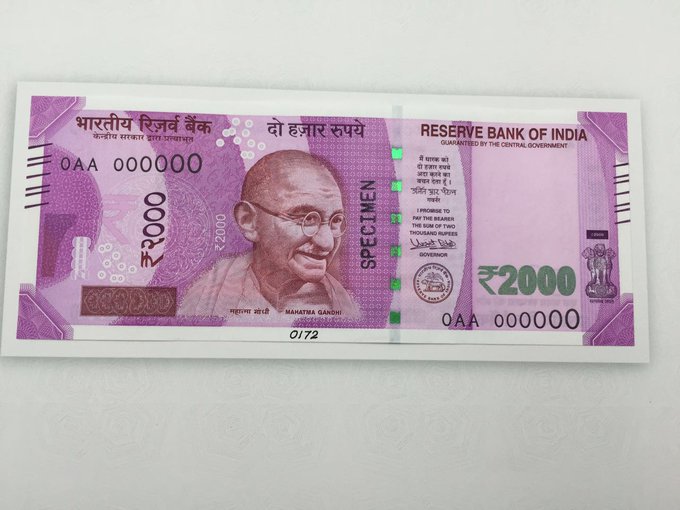

In Pics: New Rs 2000 Note that will be issued
Somewhat shockingly, Modi further added that ID cards will be required to return money to banks.
7. OIL ISSUES
The fight between Saudi Arabia and Iran will prevent any OPEC deal from formulating
(courtesy Paraskova/OilPrice.com)
Saudi-Iranian Fallout Could Destroy The OPEC Deal
Submitted by Tsvetana Paraskova via OilPrice.com,
While OPEC is officially communicating that it is ‘deeply optimistic’ that it could reach a deal to stabilize oil prices, and simultaneously scolding industry observers for being too quick to judge and express skepticism, behind closed doors, two of OPEC’s heavyweights and bitter regional rivals – Saudi Arabia and Iran – are reverting to their old ways of posturing with threats that neither will back down in the name of the greater (OPEC) good and let the other have their way.
At meetings between OPEC-only and non-OPEC experts last week, it has just been disclosed that Saudi Arabia and Iran went at it again. Saudi Arabia waved its oil weapon, strong-arming the cartel with threats of bringing down crude prices by increasing its own oil production should Iran continue to refuse to participate in the cut.
According to OPEC sources, Saudi Arabia offered to cut to around 10.2 million bpd from the summer peak output of 10.7 million bpd if Tehran agreed to freeze at 3.6 million-3.7 million bpd. Which Iran did not.
“The Saudis have threatened to raise their production to 11 million barrels per day and even 12 million bpd, bringing oil prices down, and to withdraw from the meeting,” according to an OPEC source, as quoted by Reuters. Ironically enough, shortly after this came out, it was denied by OPEC secretary General Barkindo and contradicted again by another senior OPEC official.
Saudi Arabia – which went on a mission to raise its market share and wage war on higher-cost producers in 2014 – has been ramping up output steadily since then, flooding the market with crude oil and exacerbating the oil glut.
Iran, on the other hand, apart from harshly criticizing the Saudi pump-at-will tactics while it was under international sanctions itself, is now fully intent to return to its pre-sanction oil production and export levels. Tehran is not giving up on its stance that it should be exempt from any production cuts that OPEC producers may have to make to fit the cartel’s total production into the 32.5 million bpd-33 million bpd preliminary range that it had set in Algiers.
According to OPEC’s Monthly Oil Market Report from October, the organization’s crude oil production averaged 33.39 million bpd in September, up by 220,000 barrels compared to August, secondary-sources figures showed.
Those same figures placed Saudi Arabia’s production at 10.491 million bpd, and Iran’s output – at 3.665 million bpd.
According to the Reuters sources at last week’s meeting, the Saudis told the Iranian delegation that Iran should freeze at the 3.665-million-bpd level that OPEC has estimated.
Iran, for its part, reported its production was 3.85 million bpd for September. That same month, Tehran had asked OPEC to allow it to produce 12.7 percent of the organization’s total output, which would be the amount Iran was pumping before the sanctions.
Iran is still saying it will cap only when it reaches that threshold, which is 4.2 million bpd, Reuters reports. Tehran is also pointing the finger at the Saudis, countering their ‘should-freeze-now’ threat with the argument that Riyadh has increased production by nearly 1 million bpd since 2014 and is now most kindly and generously offering to cut just 400,000 bpd to take one for the team in order to reach that production deal.
According to Reuters sources who were present at the meeting, even Saudi Arabia’s Gulf Arab allies were surprised by the Saudi threat to lift production.
Just before the Algiers meeting at the end of September, the Saudis and Iran played the first half of this game: Saudis might cut if Iran froze. The next day OPEC reached a tentative agreement to work toward an agreement.

With all the rhetoric and comments and hints and reports, even if the organization were to prove ‘industry observers’ wrong and somehow manage to clinch a deal at the end of this month, we’ll have to wait and see if a potential deal would really hold.
end
WTI rises on a big drawdown in gasoline and distillate inventories
(courtesy zero hedge)
WTI Crude Rises After Big Drawdown In Gasoline, Distillate Inventories
Following last week’s record build in crude inventories, API reported a bigger than expected crude build this week (+4.40mm vs +2mm exp), but the huge draw in gasoline was the most notable (-3.6mm vs -1.5mm exp) as we suspect Colonial pipeline fallout affected levels. Distillates also saw the 7th consecutive draw (-4.3mm). WTI’s initial reaction to the crude build was lower but the product draw sent priecs higher.
API
- Crude +4.40mm (+2mm exp)
- Cushing +156k (+300k exp)
- Gasoline -3.6mm (-1.5mm)
- Distillates -4.3mm
Following last week’s biggest crude inventory build ever, crude built again but products saw a major drawdown…

WTI Crude futures prices are down from around $50 to $44 in the last two weeks (and down from last week’s big build)… WTI was around $47 before last week’s API print… Prices dipped on the crude build butthe product drawdowns sparked buying..
END
Your early morning currency/gold and silver pricing/Asian and European bourse movements/ and interest rate settings TUESDAY morning 7:00 am
Euro/USA 1.1038 DOWN .0011/REACTING TO NO DECISION IN JAPAN AND USA + huge Deutsche bank problems + USA election:Clinton cleared of e-mail scandal
USA/JAPAN YEN 104.80 UP .354(Abe’s new negative interest rate (NIRP), a total DISASTER/SIGNALS U TURN WITH INCREASED NEGATIVITY IN NIRP/JAPAN OUT OF WEAPONS TO FIGHT ECONOMIC DISASTER/KURODA: HELICOPTER MONEY ON THE TABLE AND DECISION ON SEPT 21 DISAPPOINTS WITH STIMULUS/OPERATION REVERSE TWIST
GBP/USA 1.2389 DOWN.0008 (Brexit by March 201/UK government loses case/parliament must vote)
USA/CAN 1.3368 DOWN .0004
Early THIS TUESDAY morning in Europe, the Euro FELL by 11 basis points, trading now JUST above the important 1.08 level FALLING to 1.1038; Europe is still reacting to Gr Britain BREXIT,deflation, announcements of massive stimulation (QE), a proxy middle east war, and the ramifications of a default at the Austrian Hypo bank, an imminent default of Greece, Glencore, Nysmark and the Ukraine, along with rising peripheral bond yield further stimulation as the EU is moving more into NIRP, THE USA’S NON tightening by FAILING TO RAISE THEIR INTEREST RATE AND NOW THE HUGE PROBLEMS FACING TOO BIG TO FAIL DEUTSCHE BANK + THE DOUBT IN THE USA ELECTION / Last night the Shanghai composite CLOSED UP 14.85 OR 0.46% / Hang Sang CLOSED UP 108.03 OR 0.47% /AUSTRALIA IS HIGHER BY 0.21% / EUROPEAN BOURSES ALL IN THE RED EXCEPT LONDON
We are seeing that the 3 major global carry trades are being unwound. The BIGGY is the first one;
1. the total dollar global short is 9 trillion USA and as such we are now witnessing a sea of red blood on the streets as derivatives blow up with the massive rise in the rise in the dollar against all paper currencies and especially with the fall of the yuan carry trade. The emerging market which house close to 50% of the 9 trillion dollar short is feeling the massive pain as their debt is quite unmanageable.
2, the Nikkei average vs gold carry trade ( NIKKEI blowing up and the yen carry trade HAS BLOWN up/and now NIRP)
3. Short Swiss franc/long assets blew up ( Eastern European housing/Nikkei etc.
These massive carry trades are terribly offside as they are being unwound. It is causing global deflation ( we are at debt saturation already) as the world reacts to lack of demand and a scarcity of debt collateral. Bourses around the globe are reacting in kind to these events as well as the potential for a GREXIT>
The NIKKEI: this TUESDAY morning CLOSED DOWN 5.83 POINTS OR 0.03%
Trading from Europe and Asia:
1. Europe stocks ALL IN THE RED EXCEPT LONDON
2/ CHINESE BOURSES / : Hang Sang CLOSED UP 108.03 OR 0.47% ,Shanghai CLOSED UP 14.55 POINTS OR 0.46% / Australia BOURSE IN THE GREEN /Nikkei (Japan)CLOSED IN THE RED/ INDIA’S SENSEX IN THE GREEN
Gold very early morning trading: $1281.10
silver:$18.21
Early TUESDAY morning USA 10 year bond yield: 1.819% !!! DOWN 1 in basis points from MONDAY night in basis points and it is trading WELL BELOW resistance at 2.27-2.32%.
The 30 yr bond yield 2.586, DOWN 1 IN BASIS POINTS from MONDAY night.
USA dollar index early TUESDAY morning: 97.78 UP 4 CENTS from MONDAY’s close.
This ends early morning numbers TUESDAY MORNING
END
xxxxxxxxxxxxxxxxxxxxxxxxxxxxxxxxxxxxxxxxxxxxxxxxxxxxxxxxxxxxxxxxxxxxxxxxxxxxxxxxxxxxxxxxxxxxxxxxxxxxxxxxxxxxxxx
And now your closing TUESDAY NUMBERS
Portuguese 10 year bond yield: 3.22% DOWN 1 in basis point yield from MONDAY (does not buy the rally)
JAPANESE BOND YIELD: -.061% down 2 in basis point yield from MONDAY
SPANISH 10 YR BOND YIELD:1.25% UP 1 IN basis point yield from MONDAY (this is totally nuts!!/
ITALIAN 10 YR BOND YIELD: 1.72 UP 1 in basis point yield from MONDAY
the Italian 10 yr bond yield is trading 47 points HIGHER than Spain.
GERMAN 10 YR BOND YIELD: +.188% UP 3 IN BASIS POINTS ON THE DAY
END
xxxxxxxxxxxxxxxxxxxxxxxxxxxxxxxxxxxxxxxxxxxxxxxxxxxxxxxxxxxxxxxxxxxxxxxxxxxxxxxxxxxxxxxxxxxxxxxxxxxxxxxxxxxxxxxxxxxxxxxxxxxxxxxxxxxxx
IMPORTANT CURRENCY CLOSES FOR TUESDAY
Closing currency crosses for TUESDAY night/USA DOLLAR INDEX/USA 10 YR BOND YIELD/3.00 PM
Euro/USA 1.1023 DOWN .0026 (Euro DOWN 26 basis points/ represents to DRAGHI A COMPLETE POLICY FAILURE/
USA/Japan: 105.02 up: .579(Yen down 58 basis points/POLICY ERROR ON BANK OF JAPAN/
Great Britain/USA 1.2397 UP 0.0001( POUND UP 1 basis points
USA/Canada 1.3323 DOWN 0.0049(Canadian dollar UP 49 basis points AS OIL ROSE TO $45.04
xxxxxxxxxxxxxxxxxxxxxxxxxxxxxxxxxxxxxxxxxxxxxxxxxxxxxxxxxxxxxxxxxxxxxxxxxxxxxxxxx
This afternoon, the Euro was DOWN by 26 basis points to trade at 1.1023
The Yen FELL to 105.02 for a LOSS of 58 basis points as NIRP is STILL a big failure for the Japanese central bank/HELICOPTER MONEY IS NOW DELAYED/BANK OF JAPAN NOW WORRIED AS AS THEY ARE RUNNING OUT OF BONDS TO BUY AS BOND YIELDS RISE /OPERATION REVERSE TWIST ANNOUNCED SEPT 21.2016
The POUND ROSE 1 basis points, trading at 1.2397/
The Canadian dollar ROSE by 49 basis points to 1.3323, AS WTI OIL ROSE TO : $45.04
the 10 yr Japanese bond yield closed at -.061% DOWN 2 POINTS IN BASIS POINTS / yield/ AND THIS IS BECOMING BOTHERSOME TO THE BANK OF JAPAN
Your closing 10 yr USA bond yield UP 4 IN basis points from MONDAY at 1.867% //trading well below the resistance level of 2.27-2.32%) very problematic USA 30 yr bond yield: 2.6321 UP 3 in basis points on the day /
BANKS NEED THE LONGER BOND HIGHER IN YIELD: INSTEAD THE SPREAD LESSENS.
Your closing USA dollar index, 97.83 UP 14 CENTS ON THE DAY/2;30 PM
Your closing bourses for Europe and the Dow along with the USA dollar index closing and interest rates for TUESDAY: 2:30 PM EST
London: CLOSED UP 36.23 POINTS OR 0.53%
German Dax :CLOSED UP 25.37 OR 0.24%
Paris Cac CLOSED UP 15.68 OR 0.35%
Spain IBEX CLOSED UP 18.20 OR 0.20%
Italian MIB: CLOSED UP 80.66 POINTS OR 0.48%
The Dow was up 72.83 points or 0.40% 4 PM EST
NASDAQ up 27.32 points or 0.53% 4 PM EST
WTI Oil price; 44.73 at 4:00 pm;
Brent Oil: 45.97 4:00 EST
USA DOLLAR VS RUSSIAN ROUBLE CROSS: 63.70(ROUBLE DOWN 5/100 ROUBLES PER DOLLAR FROM THURSDAY) 2:30 EST
TODAY THE GERMAN YIELD RISES TO +0.188% FOR THE 10 YR BOND 2:30 EST
END
This ends the stock indices, oil price, currency crosses and interest rate closes for today
Closing Price for Oil, 5 pm/and 10 year USA interest rate:
WTI CRUDE OIL PRICE 5 PM:$44.83
BRENT: $45.87
USA 10 YR BOND YIELD: 1.858%
USA DOLLAR INDEX: 97.94 up 20 cents
The British pound at 5 pm: Great Britain Pound/USA: 1.2366 down .0031 or 31 basis pts.
German 10 yr bond yield at 5 pm: +.188%
END
And now your more important USA stories which will influence the price of gold/silver
TRADING IN GRAPH FORM
“It’s Quiet, Too Quiet” – Stocks, Peso Bid But Hedgers Panic Buying Protection In US, Mexico
Could be worse… right?
A mixed day with some markets shrugging…
G7 FX Vol dropped…

Mexican Peso rallied…

Stocks rallied and VIX dropped…

And some markets turmoiling…
US Equity Put/Call ratio hit a record high…

Bearish bets on Mexico also soared to a record high…

USDJPY Overnight vol exploded…

VIX term structure is as inverted as before Brexit…

Systemic macro overlays remain extremely heavy (though came off a little in the last 2 days)…

* * *
Stocks opened lower on the day, but as fake data came in from supposed real-time forecasts, so stocks (and the peso) were bid…

Hurts?

Treasury yields rose on the day…

HY Credit spreads drifted lower again – erasing half of the losing streak losses…

The USD Index rose for the 2nd day in a row, stalling at 98.00…

With Yen weakness the biggest help (as CAD strengthened modestly)…

Gold and crude trod water today but silver and copper exploded higher after the US open…

Copper soared for the 12th day in a row… a record as hedgies piled in…
end
The next President must deal with the huge debt accumulated especially over these past 8 years. The CBO states that interest rates must normalize. Impossible as that would blow up our banking derivatives.
(courtesy zero hedge)
4 Year Proposition? – Next President Has To Contend With Obama’s Massive Debt Burden At “Epic Turning Point”
Whoever wins the 2016 presidential election tomorrow night could be in for a rough 4 years in the White House courtesy of the gigantic debt burden amassed by Obama over the previous 8 years. While an accommodative monetary policy, including seemingly unlimited treasury buying by the Fed and foreign governments, has suppressed the budget impact of Obama’s ballooning federal debt balance, as Ed Yardeni told Bloomberg, “one shudders to think what would happen if rates actually ever did go back to normal.”
“We’ve really got ourselves into a pickle here,” said Edward Yardeni, president of Yardeni Research Inc. in New York, who’s been following the bond market since the 1970s. “All these years we’ve been kicking the can down the road, and suddenly we’re seeing a brick wall.”
“There’s been so much borrowing going on that’s been enabled by extremely low interest rates, one shudders to think what would happen if rates actually ever did go back to normal,” Yardeni said. “The impact on the interest expense would be significant, and could really bring deficit concerns back to the fore.”

As a report published by the Congressional Budget Office today points out, nearly 60% of the federal budget is spent on entitlements and interest payments on public debt. While the public debt balance has increased every single year of Obama’s Presidency, declining rates have largely offset the budget impact.
Outlays for the three largest entitlement programs—Social Security, Medicare, and Medicaid—rose by $29 billion (or 3 percent), $27 billion (or 5 percent), and $19 billion (or 5 percent), respectively. Spending for Medicaid grew largely because of new enrollees added through expansions of coverage authorized by the Affordable Care Act. With that growth, Medicaid spending has risen by almost 40 percent in the past three years. Combined outlays for the three programs were equal to 48 percent of federal spending and 10.0 percent of GDP in 2016, the highest shares ever recorded.
Outlays for net interest on the public debt increased by $23 billion (or 9 percent), largely because of higher inflation in 2016. (Each month, to account for the effects of inflation, the Treasury adjusts the principal of Treasury inflation-protected securities, using the change in the consumer price index for all urban consumers that was recorded two months earlier.) Outlays also increased because debt and average interest rates were higher in fiscal year 2016 than in fiscal year 2015.

That said, rates will have to “normalize” at some point and the CBO expects that the “winner” of the 2016 presidential election will be the beneficiary of that normalization.

If the CBO’s forecast is accurate, then outlays for the interest payments on public debt alone could rise over $300 billion over the next 8 years which would be more than a 50% increase in the current budget deficit.

And while headwinds are already baked into the federal budget from ballooning debt and entitlement spending, both Clinton and Trump have promised new expenditures for infrastructure projects and tax cuts.
“The Treasury has kind of gotten a free lunch over the last several years,” said Stephen Stanley, chief economist at Amherst Pierpont Securities LLC in New York, and a former researcher at the Richmond Fed. “Deficits had been artificially suppressed by the nature of monetary policy. Now you have structural issues with spending on entitlements, and a policy impetus that seems to be moving toward fiscal stimulus.”
While there’s no guarantee that either major candidate will be able to get their proposals through Congress, economists predict the potential shift toward looser fiscal policy will expand the debt burden.
Proposals from Democratic nominee Clinton include a $275 billion infrastructure plan that she intends to pay for through corporate tax-law changes. She’s also suggested tax increases for the wealthy. The plans would inflate the debt by $200 billion over a decade, according to analysis from the non-partisan Committee for a Responsible Federal Budget.
Trump, the Republican candidate, has made pledges including cutting taxes and spending as much as $500 billion on infrastructure. The proposals would boost the debt by $5.3 trillion, the Committee for a Responsible Federal Budget estimates.
The deteriorating backdrop for the world’s biggest bond market risks spoiling the plans of Tuesday’s winner, whether it’s Hillary Clinton or Donald Trump. Both have promised measures to foster growth and create jobs. The prospect of the three-decade bull market in bonds approaching a turning point has implications for everything the candidates want to tackle, from infrastructure spending to national security to tax cuts.
With bond and equity markets bubbling up all over the world and accommodative Central Banking policies growing a little long in the tooth, there is a very real possibility that the next president will be blamed when Obama’s great “recovery” is unwound…which could very well mean that tomorrow’s “winner” is looking at a 4-year proposition.
end
Car rental revenues huge miss, plus increase depreciation costs hurt Hertz
(courtesy zero hedge)
Hertz Implodes After “Earnings Debacle”: Shares To Open At 7 Year Low After Abysmal Results, Guidance
Hertz stock is in freefall this morning, down some 32% in pre-market trading, after 3Q EPS and sales miss analyst estimates.
The rental-car company reported 3Q EPS of $1.58, wildly missing consensus est. $2.73 (range $2.34-$3.03), as a result of a surge in its depreciation costs, while 3Q revenue came in at $2.54 billion, below the estimate $2.59 billion. Worse, Hertz now sees 2016 adjusted Ebitda of $575m-$625 million, far below its prior guidance of $850m-$950m post-separation (Aug. 8), and also guided to 2016 adj EPS of 51c-88c, a fraction of its former guidance of $2.75-$3.50; and far below the Wall Street estimate of $2.92.
The car-rental company blamed “a substantial depreciation adjustment, particularly on compact and mid-sized vehicles,” near the close of the quarter, but also says rental volume was at the low end of expectations. We assume this means that the long-overdue repricing of car assets on balance sheets, first at fleet companies and soon everywhere else, is finally materializing.
The unexpected surge in depreciation is shown in the table below:

However, it was not just D&A: In the report, HTZ said its Q3 EBITDA was $329 million versus $430 million in the same period last year, a decline of $101 million.
“We are making progress in foundational aspects of our long-term business improvement plan, implementing new systems, improving customer service levels and launching new products,” said John Tague, president and chief executive officer. “However, our near-term financial performance continues to be uneven. A customary vehicle depreciation rate review near the close of the third quarter resulted in a substantial depreciation adjustment, particularly on compact and mid-sized vehicles, that together with rental volume at the low end of our expectations as well as higher net operating and administrative expenses impacted our performance.
“While we remain on pace to deliver $350 million of cost reduction in 2016, we fell short from a timing perspective on our internal stretch target for cost reduction. Considering this and the potential for an additional depreciation rate adjustment in the fourth quarter, we are updating our 2016 outlook and taking incremental actions to reduce costs and drive revenue.”
Spending was higher as well as HTZ says it “fell short from a timing perspective,” on its internal stretch target for cost reduction. The 3Q performance has the company lowering 2016 guidance as it says it’s “taking incremental actions to reduce costs and drive revenue.” HTZ off 28% to $25.87 after-hours and finished the regular session with a 37% YTD loss.
As a result of the abysmal earnings and guidance, the stock was trading some 33% lower in the premarket, set to open at a more than 7 year low.
* * *
As usual, the sellside was unable to see any of this in advance, and as a result the downgrades are coming in hot and heavy this morning starting with DB, which moments ago downgraded the stock to Hold on “earnings visibility whiteout.”
This is what DB analyst Chris Woronka said:
3Q16 Report Nothing Short of a Debacle; Downgrade to Hold, PT to $24 (-59%)
We are downgrading HTZ from Buy to Hold and cutting our PT from $59 to $24 (-59%). The primary reason for our downgrade is a belief that the stock will reflect a newfound lack of confidence in earnings visibility and the company’s ability to provide achievable guidance. After the close tonight, HTZ reported weak 3Q results and slashed FY16 guidance. Although a guide-down in full-year U.S. revenue expectations is a negative in and of itself, the larger issue is related to fleet depreciation; HTZ cited a “downward revision of forward projections of residual values based on third party data.” At this point, there are more questions than answers, and our view is that it is now extraordinarily difficult for investors to have conviction in continued progress on the turnaround story given these latest disappointing and surprising developments.
Recap of 3Q16 Results & Segment Highlights
HTZ reported 3Q16 Adj. EPS of $1.58 vs. our estimate of $2.80 and consensus of $2.73 (HTZ does not provide quarterly guidance). Adj. EBITDA came in at $329m vs. our estimate of $467m and consensus of $482m. Total revenues were $2.54bn, in line with our estimate; consensus was $2.59bn. HTZ’s U.S. RAC unit reported Adj. EBITDA of $199m in 3Q16 vs. $284m in the year-ago quarter; our forecast was $317m. RPD (pricing) fell 2.9% while volume rose 0.9%; HTZ suggested a 1% decline in RPD after comparability adjustments within the Dollar Thrifty fleet. On a two-year stacked basis, RPD was -5.0% in 3Q16 vs. -8.9% in 2Q16 and -11.7% in 1Q16. Net fleet costs per month were $278 (+12% y/y). U.S. RAC margins were down 470bps y/y. HTZ’s Adj. EBITDA for its International rental car ops fell 7% y/y, to $151m; our forecast was $165m. Volumes rose 2.2% and pricing fell 1% (ex-FX).
Slashes Guidance; Hard to Have Conviction, Though, as Visibility Feels Low
HTZ’s FY16 Adj. EBITDA guidance goes to $575-$625m, down $300m (33%) at the midpoint, vs. prior $850-$950m. Adj. EPS guidance is now $0.51-$0.88, down $2.43 (78%) at the midpoint, vs. prior $2.75-$3.50. HTZ now sees U.S. car rental revenues down 2-3% vs. flat to (1.5%) previously; U.S. net depreciation per month/unit was moved to $295-$300 (+$5 at the high end).
Our New Estimates and Price Target; Risks
We have cut our FY16 Adj. EBITDA & EPS forecasts to $578m and $0.66 from $838m and $2.92m. We have cut our FY17 Adj. EBITDA & EPS forecasts to $565m & $1.06. Our PT goes to $24 from $59 (-$35, or 59%) and is now based on 7.0x our 2017E FCF/share estimate. Previously we assumed an 8.5x multiple; we believe low visibility/conviction in estimates warrants a lower target multiple. Key upside risks now include potential actions by large shareholders and/or an improved operating environment. Downside risks include further adjustments to residuals or stalled progress on the turnaround.
end
end
Another former darling on the NYSE gets clobbered today after warning of more harmful surprises: Valeant
(courtesy zero hedge)
Valeant Crashes To 17 Year Lows After Warning Of “More Surprises”
The last few weeks have been a wild ride for Valeant shareholders but this morning’s comments that the firm “is confident in its forecasts but there may be more surprises” has spooked investors, compounding the fact that the firm missed expectations with sales plunging 11%, and cut its sales and profit forecast for the year.
As The FT reports, the turnround of Valeant stalled on Tuesday as the Canadian drugmaker slashed its full-year revenues and earnings targets and reported problems in virtually all of its business segments.
Shares have collapsed almost 30% in the pre-market as the pharmaceutical group said it now expected to generate between $4.25bn and $4.35bn in adjusted earnings before interest, tax, depreciation and amortisation this year, down from a previous range of $4.8bn-$4.95bn.
This time last year, Valeant told investors it had set an “ebitda floor” of $7.5bn, meaning that its profit target has plummeted by more than $3bn in the space of 12 months.
It expects revenues to be in the range $9.55bn to $9.65bn, down from its previous forecast of $9.95bn to $10.1bn.
“While we have revised our expectations for the remainder of 2016, I continue to be encouraged by the commitment of our employees,” said Joseph Papa, who was parachuted in as chief executive earlier this year to try to revive the company.
Not pretty… VRX shares are down almost 30% in the pre-market – the lowest since Dec 1999.

As Bloomberg adds, Papa replaced Michael Pearson, a former McKinsey & Co. consultant who jacked up prices and scaled back on research and development.
Pearson and former Chief Financial Officer Howard Schiller are the focus of a criminal probe against the company as authorities build a fraud case related to hidden ties to a specialty pharmacy that Valeant secretly controlled, people familiar with the matter have said.
Valeant is also facing investigations from Congress and the U.S. Securities and Exchange Commission over its accounting and drug pricing. In August, a major shareholder, T. Rowe Price Group Inc., sued the company, accusing its former top executives of using a secret network of pharmacies and deceptive pricing strategies to artificially inflate revenue and profit, among other things.
While one of the presidential candidates will have a bad night tonight, we suspect it will not be as bad a Bill Ackman’s day after this utter disaster.
end
Hillary: established leader of the free world!! SHE HIRES aL QAEDA MERCENARIES FOR THE NIGHT OF THE BENGHAZI ATTACK!!!
(COURTESY Martin Walsh/Conservative Daily Post/ TV/Fox news)
FOX NEWS: HILLARY HIRED AL-QAEDA MERCENARIES FOR THE NIGHT OF BENGHAZI ATTACK

Hillary Clinton is a treasonous snake that left our brave American men and women in Benghazi to die on September 11, 2012.
It takes a sick, vile, and disgusting piece of scum to leave Americans to die in a terrorist attack, but Hillary Clinton did just that. How can someone fight to be our Commander-in-Chief when they deliberately left Americans to die without feeling an ounce of remorse?
The situation is horrible and sad; but thankfully, WikiLeaks has provided the American people with thousands of emails proving that Hillary has been lying about everything for years.
It is now being reported by Fox News in a bombshell revelation that Hillary Clinton, as Secretary of State, personally hired al Qaeda terrorists to protect U.S diplomats in Benghazi months prior to the attack that led to the death of four Americans.

Members of the Wales-based Blue Mountain Group have spoken out about this after many have raised serious questions about how these terrorists were funded, received their weapons, and knew where to specifically attack.
One of the sources indicated that Blue Mountain used local ads in newspapers to assemble a team to protect Americans and our Ambassadors. The ad led to 20 Muslims being hired, many of which had ties to terrorism, and cost $9,200,000.
“The guards who were hired were locals who were part of the Ansar al-Sharia and Al Qaeda groups operating in Benghazi,” the source added.
“Whoever approved contracts at the State Department hired Blue Mountain Group and then allowed Blue Mountain Group to hire local Libyans who were not vetted.”
“Many of the local Libyans who attacked the consulate on the night of Sept. 11, 2012, were the actual guards that the State Department under Hillary Clinton hired to protect the Consulate in Benghazi,” Tiegen told Fox News. “The guards were unvetted and were locals with basically no background at all in providing security. Most of them never had held a job in security in the past.”
Think about that: Hillary Clinton’s State Department literally hired the very people who, along with their jihadist allies in Benghazi, attacked Americans and killed U.S. Ambassador Chris Stevens and Sean Smith as well as CIA contractors Glen Doherty and Ty Woods.
Hillary Clinton is fundamentally unAmerican.

“One of those guards hired by Blue Mountain was the younger brother of the leader of Al Qaeda of Benghazi,” Fox News reports.
As disgusting as this story is to even think about, it is even scarier to consider that we are one day away from her potentially becoming the next President of the United States. She is one day away
Hillary Clinton is a coward and a traitor who will let Americans die for her own greed and lust for power. It would be a slap in the face to every man and woman who served this country if she is elected president.
She hired the terrorists to “protect” and “watch over” our compound, she knew an attack was coming months in advance, she never adequately supplied our men and women when they put in requests hundreds of times, and she left them all to die. She put more effort into blaming the situation on a video than to actually saving out men and women stranded.
This is call treason. Hillary Clinton deserves an orange jumpsuit, not a seat in the Oval Office.
On November 8th, vote like your life depends on it, because it does when we are talking about Hillary Clinton.
end
Here is another favourite indicator for Janet: hirings/job openings. In this latest report we see hirings are well below 2014 despite the rising job openings
(courtesy zero hedge)
Labor Market Rolling Over: Hiring Below 2014 Levels, Despite Rising Job Openings
Moments ago the BLS reported Janet Yellen’s favorite labor market indicator, the JOLTS survey, which as expected (since it tracked the modestly weaker September payrolls) showed that in September, the number of job opening rebounded from the August 378,000 plunge to 5.453 million, rising by a modest 33,000 to 5.486 million. The number of job openings declined to a series low in July 2009, one month after the official end of the most recent recession. Employment continued to decline after the end of the recession, reaching a low point in February 2010.

The September job opening rate rose fractionally to 3.7% from 3.6% prior month, with the greatest number of job openings in the construction, financial, education & health services, and professional and business services industries. Job openings in trade & transportation, leisure and hospitality and government all fell.
The ratio of unemployed persons per job opening was 1.4 in September 2016; when the most recent recession began (December 2007), the number of unemployed persons per job opening was 1.9. The ratio peaked at 6.6 unemployed persons per job opening in July 2009 and trended downward until the end of 2015. Since January 2016 the ratio has leveled off and has remained between 1.3 and 1.4.

However confrming that the US labor market is indeed rolling over, despite the near record (if modestly declining) number of job openings, the pace of hiring has failed to keep up, and slid once again in September, declining by 187,000 to 5.081 million. It was also lower than the September 2014 number of hires which was 5,092 million.

As shown, in the chart below, job hires were 1% lower compared to the 5.131 million a year ago.

Another way of visualizing the rollover in hiring: when superimposed over cumulative payrolls added over the past 12 months, it appears that the US job market is rolling ober.

The number of hires has exceeded the number of job openings for most of the JOLTS history. Since February 2015, this relationship has changed as job openings have outnumbered hires in most months, also suggesting that the pace of hiring has slowed down disproportionately.

Quits, which are generally voluntary separations initiated by employees, continue to rise. The quits rate can serve as a measure of workers’ willingness or ability to leave jobs. The number of quits has exceeded the number of layoffs and discharges for most of the JOLTS history. During the latest recession, this relationship changed as layoffs and discharges outnumbered quits from November 2008 through March 2010. In September 2016, there were 3.1 million quits and 1.5 million layoffs and discharges.

Putting all the key numbers in context, hires in the private sector have increased since their low in June 2009 and are near their prerecession levels. In September 2016, there were 4.7 million hires. Quits in the private sector have increased since their low in September 2009 and are near their prerecession levels. In September 2016, there were 2.9 million quits.

Finally, taking a look at the distroted Beveridge Curve, which plots the job openings rate against the unemployment rate, shows that from the start of the most recent recession in December 2007 through the end of 2009, the series trended lower and further to the right as the job openings rate declined and the unemployment rate rose. From the start of the most recent recession in December 2007 through the end of 2009, the series trended lower and further to the right as the job openings rate declined and the unemployment rate rose. From 2010 to the present, the series has been trending up and to the left as the job openings rate increased and the unemployment rate decreased. In September 2016, the unemployment rate was 5.0 percent and the job openings rate was 3.7 percent. This job openings rate corresponds to a higher unemployment rate than it did before the most recent recession.
end
Voting machine irregularities:
(courtesy zero hedge)
Voting Machine “Irregularities” Reported in Utah, Tennessee, Pennsylvania, & North Carolina
Who could have seen this coming?
People in numerous states reported problems voting Tuesday due to faulty machines, according to numerous news sources
In Utah, voting machine problems in the southern part of the state forced poll workers to use paper ballots, with some residents sent to alternate voting locations.
Machine issues were reported in Wilson County, Tenn. — and at one point all of the county’s machines went down, according to local reports. Voting later resumed manually.
In Texas, a computer used by election clerks malfunctioned at a polling place, so officials briefly diverted voters to another polling place more than two miles away.
In Louisiana, some early voters were forced to wait as correct machines were installed.
In Durham County, N.C., paper poll books were being used Tuesday due to “tech problems at a few sites.”
In Georgia, one voter reported that “half the machines” were down at one location. Two polling places in Gwinnett County opened late, officials told the Atlanta Journal-Constitution.
Machine issues were also reported by voters in Rahway, N.J., as well as Philadelphia.
Pennsylvanians told CBS News their vote for Trump was changed to Clinton...
There have been some scattered issues where voters are encountering problems.
Election judges in Clinton Township, Butler County confirmed there were issues with two of their eight automated voting machines. Most of the issues came when people tried to vote straight party ticket.
However, other said they specifically wanted to vote for Republican Donald Trump only to see their vote switched before their eyes to Democrat Hillary Clinton.
“I went back, pressed Trump again. Three times I did this, so then I called one of the women that were working the polls over. And she said you must be doing it wrong. She did it three times and it defaulted to Hillary every time,” Bobbie Lee Hawranko said.
Allegheny County has also been dealing with some Election Day issues.
And as InfoWars reports, video footage posted on Twitter shows an African-American man attempting to vote for Donald Trump in Pennsylvania but the voting machine refusing to select any other option than Hillary Clinton.
“This is what I was talking about, they fixed it but it was on some nut sh*t at first,” the man tweeted, adding that a poll worker helped him fix the problem.
“LOL funny that the “errors” and “calibration” always favors the Statists. Things that make you go hmmmm….,” responded another Twitter user.
And we leave it to officials in Philadelphia to sum the farce up…
Officials have recalibrated the machines and are confident that the problem has been resolved.
“Recalibrated”??
* * *
As a reminder, Joseph Jankowski of Planet Free Will previously explained, a U.K. based company that has provided voting machines for 16 states, including important battleground states like Florida and Arizona, has direct ties with billionaire leftist and Clinton crusader George Soros.

With recent WikiLeaks emails showing that Hillary Clinton received foreign policy directives and coordinated on domestic policy with Soros, along with receiving tens of millions of dollars in presidential campaign support from the billionaire, concerns are growing that these shadowy players may pull the strings behind the curtains of the upcoming presidential election.
As Lifezettereports, the fact that the man in control of voting machines in 16 states is tied directly to the man who has given millions of dollars to the Clinton campaign and various progressive and globalist causes will surely leave a bad taste in the mouth of many a voter.
The balloting equipment tied to Soros is coming from the U.K. based Smartmatic company, whose chairman Mark Malloch-Brown is a former UN official and sits on the board of Soros’ Open Society Foundation.
According to Lifezette, Malloch-Brown was part of the Soros Advisory Committee on Bosnia and also is a member of the executive committee of the International Crisis Group, an organization he co-founded in the 1990s and built with funds from George Soros’ personal fortune.
In 2007 Soros appointed Malloch-Brown vice-president of his Quantum Funds, vice-chairman of Soros Fund Management, and vice-chairman of the Open Society Institute (former name of OSF).
Browns ties also intertwine with the Clintons as he was a partner with Sawyer-Miller, the consulting firm where close Clinton associate Mandy Grunwald worked. Brown also was also a senior advisor to FTI Consulting, a firm at which Jackson Dunn, who spent 15 years working as an aide to the Clintons, is a senior managing director.
When taking that into account, along with the poor track record Smartmatic has of providing free and fair elections, this all becomes quite terrifying.
An astonishing 2006 classified U.S. diplomatic cable obtained and released by WikiLeaks reveals the extent to which Smartmatic may have played a hand in rigging the 2004 Venezuelan recall election under a section titled “A Shadow of Fraud.” The memo stated that “Smartmatic Corporation is a riddle both in ownership and operation, complicated by the fact that its machines have overseen several landslide (and contested) victories by President Hugo Chavez and his supporters.”
“The Smartmatic machines used in Venezuela are widely suspected of, though never proven conclusively to be, susceptible to fraud,” the memo continued. “The Venezuelan opposition is convinced that the Smartmatic machines robbed them of victory in the August 2004 referendum. Since then, there have been at least eight statistical analyses performed on the referendum results.”
“One study obtained the data log from the CANTV network and supposedly proved that the Smartmatic machines were bi-directional and in fact showed irregularities in how they reported their results to the CNE central server during the referendum,” it read.
With such suspicion and a study which claims to prove that the U.K. firm’s equipment tampered with the 2004 Venezuelan recall election, should be enough for states to reject these machines if they desire a fair election.
Smartmatic is providing machines to Arizona, California, Colorado, Washington DC, Florida, Illinois, Louisiana, Michigan, Missouri, New Jersey, Nevada, Oregon, Pennsylvania, Virginia, Washington and Wisconsin, which means these Soros and Clinton linked machines are going to take the votes of thousands of Americans.
While GOP nominee Donald Trump has been voicing his opinion that the elections are indeed rigged due to media bias, and the proof that mainstream polls are heavily weighted to favor Clinton, it is needless to say that if the results show Hillary as a winner in November, there is going to a mess to shuffle through to find signs of honesty.
end
Well that is all for tonight
ENJOY THE FUN IN WATCHING THE ELECTION RESULTS
I will see you tomorrow night
h


 harveyorganblog.com
[…] by Harvey Organ Harvey Organ’s Blog […]
LikeLike
[…] Continue Reading/Harvey Organ>>> […]
LikeLike