
Gold closed at $1221.20 down $2.30
silver closed at $16.88: down $0.48
Access market prices:
Gold: 1221.50
Silver: 16.95
Despite the rise in the dollar, gold held up pretty good being down only $230. However silver again was bashed in the teeth by our crooked bankers who are desperately trying to cover before inauguration day Jan 20.2017. It is interesting to note that Trump has picked two gold friendly economic advisers to help in his inner circle: David Malpass and Judy Shelton. Both advocate sound money and Shelton desires a gold backed currency. Even Mike Pence when he was in Congress put forth a bill for the USA dollar to have a specific gold backing. Is Trump ready to drain the swamp of our criminal bankers?
THE DAILY GOLD FIX REPORT FROM SHANGHAI AND LONDON
.
The Shanghai fix is at 10:15 pm est and 2:15 am est
The fix for London is at 5:30 am est (first fix) and 10 am est (second fix)
Thus Shanghai’s second fix corresponds to 195 minutes before London’s first fix.
And now the fix recordings:
Shanghai morning fix Nov 14 (10:15 pm est last night): $ 1227.34
NY ACCESS PRICE: $1219.10 (AT THE EXACT SAME TIME)
XXXXXXXXXXXXXXXXXXXXXXXXXXXXXXXXXX
Shanghai afternoon fix: 2: 15 am est (second fix/early morning):$ 1227.97
NY ACCESS PRICE: 1226.05 (AT THE EXACT SAME TIME/2:15 am)
HUGE SPREAD TODAY!! 2.00 dollars
XXXXXXXXXXXXXXXXXXXXXXXXXXXXXXXXXXXXXXXX
London Fix: Nov 14: 5:30 am est: $1222.60 (NY: same time: $1226.87 5:30AM)???
London Second fix Nov 10: 11 am est: $1213.60 (NY same time: $1213.00, 10 AM)
It seems that Shanghai pricing is higher than the other two , (NY and London). The spread has been occurring on a regular basis and thus I expect to see arbitrage happening as investors buy the lower priced NY gold and sell to China at the higher price. This should drain the comex.
Also why would mining companies hand in their gold to the comex and receive constantly lower prices. They would be open to lawsuits if they knowingly continue to supply the comex despite the fact that they could be receiving higher prices in Shanghai.
end
For comex gold:
NOTICES FILINGS FOR NOVEMBER CONTRACT MONTH: 146 NOTICES FOR 14,600 OZ TONNES
For silver:
NOTICES FOR NOVEMBER CONTRACT MONTH FOR SILVER: 0 NOTICES OR nil OZ
xxxxxxxxxxxxxxxxxxxxxxxxxxxxxxxxxxxxxxxxxxxxxxxxxxxxxxxxxxxxxxxxxxxxxxxxxxxxxxxxxxxxxxxxxx
Let us have a look at the data for today
.
xxxxxxxxxxxxxxxxxxxxxxxxxxxxxxxxxxxxxxxxxxxxxxxxxxxxxxxxxxxxxxxxxxxxxxxxxxxxxxx
In silver, the total open interest FELL by 7829 contracts DOWN to 179,361 with Friday’s drive by shooting. In ounces, the OI is still represented by just less THAN 1 BILLION oz i.e. .896 BILLION TO BE EXACT or 128% of annual global silver production (ex Russia & ex China).
In November, in silver, 0 notice(s) filings: FOR nil OZ
I
In gold, the total comex gold FELL by 17,603 contracts WITH THE FALL IN THE PRICE OF GOLD ($42.00 on Friday ).The total gold OI stands at 504,128 contracts.
In gold: we had 146 notices filed for 14,600 oz
xxxxxxxxxxxxxxxxxxxxxxxxxxxxxxxxxxxxxxxxxxxxxxxxxxxxxxxxxxxx
With respect to our two criminal funds, the GLD and the SLV:
GLD:
TODAY WE HAD A HUGE CHANGE AT THE GLD/A HUGE WITHDRAWAL OF 7.12 TONNES OF PAPER GOLD.
Total gold inventory rests tonight at: 934.56 tonnes of gold
SLV
we had another huge change at the SLV/a WITHDRAWAL of 1,329,000 oz.
THE SLV Inventory rests at: 356.727 million oz
.
First, here is an outline of what will be discussed tonight:
1. Today, we had the open interest in silver FELL by 7829 contracts DOWN to 179,361 as the price of silver FELL by $1.35 with FRIDAY’S trading. The gold open interest FELL by 17,603 contracts DOWN to 504,128 as the price of gold FELL BY $42.00 in FRIDAY’S TRADING.
(report Harvey).
2.a) The Shanghai and London gold fix report
(Harvey)
2 b) Gold/silver trading overnight Europe, Goldcore
(Mark O’Byrne/zerohedge
and in NY: Bloomberg
2c) COT report
(Harvey)
3. ASIAN AFFAIRS
i)Late SUNDAY night/MONDAY morning: Shanghai closed UP 14.33 POINTS OR 0.45%/ /Hang Sang closed DOWN 308.87 OR 1.37%. The Nikkei closed up 297.83 points or 1.71%/Australia’s all ordinaires CLOSED DOWN 0.48% /Chinese yuan (ONSHORE) closed DOWN at 6.8433/Oil FELL to 42.85 dollars per barrel for WTI and 44.27 for Brent. Stocks in Europe: ALL IN THE GREEN EXCEPT SPAIN, INDIA Offshore yuan trades 6.8520 yuan to the dollar vs 6.8520 for onshore yuan.THE SPREAD BETWEEN ONSHORE AND OFFSHORE WIDENS CONSIDERABLY AS MORE USA DOLLARS LEAVE CHINA’S SHORES / CHINA SENDS A CLEAR MESSAGE TO THE USA AND JANET TO NOT RAISE RATES IN DECEMBER.
REPORT ON JAPAN SOUTH KOREA NORTH KOREA AND CHINA
3a)THAILAND/SOUTH KOREA
none today
b) REPORT ON JAPAN
none today
c) REPORT ON CHINA
i)USA/CNH in the early hours is 6.8402/gold down to $1215.00. The low Chinese yuan will send havoc across the globe as it exports deflation to us all
( zero hedge)
ii)This must have been an interesting phone call. China calls Trump and tells him that cooperation is the only choice. Trump wants to put 45% tariffs on Chinese goods.If the USA does not that China buys soybeans and other agricultural stuff from Europe.Yet Trump needs to get uSA manufacturing going especially in the rust belt states that put him in power.
( zero hedge)
iii)Late in the session, the Chinese off shore yuan plummets to 6.8621
( zero hedge)
4 EUROPEAN AFFAIRS
i) Chaos in Europe as the heads of the EU just do not know how to responds to Trump’s victory:
( zero hedge)
ii) ITALY
This is very dangerous: The threat of Italy leaving the Euro just intensfied with the Trump victory. Also Italy witnessed its target 2 imbalance rise exponentially as foreigners sold huge amount of Italian assets like bonds and Italians bought foreign assets.
(courtesy zero hedge)
iib)Late in the session, Italian bonds explode to 18 month high to 2.13%. There is now a 60% chance that Renzi will fail in his referendum
(courtesy zero hedge)
iii)SPAIN
Eighty thousand strong Catalan supporters demand independence from Spain. The hub of the province, Barcelona is the economic engine for Spain
( zero hedge)
iv)IRELAND
Until recently an Ireland exit was unthinkable. What changed?
two things:
- A BREXIT
- the Apple CORP tax case. Low corporation taxes is the holy grail in Ireland and if touched they will leave the union
( Mish Shedlock/Mishtalk)
v)European long bond blood bath:
5. RUSSIAN AND MIDDLE EASTERN AFFAIRS
i)Turkey
Unbelievable! Turkey warns its citizens about travel to the USA over social tensions and the anti Trump protests. This is in response to the USA warning its citizens not to travel to Turkey especially, in its south eastern corridor
( zero hedge)
ii)RUSSIA
Russia puts strategic bombers on combat alert as imminent strikes on Syrian targets will be the order of the da
( zerohedge)
iii)More good news for Putin as two more European allies elect pro Russian Presidents
( zero hedge)
6.GLOBAL ISSUES
Goldman Sachs just killed the Trump euphoria as they conclude that global growth will suffer under Trump no matter what happens
( zero hedge/Goldman Sachs)
7.OIL ISSUES
At first it was thought that a Trump victory would quash the Iran deal and give a huge bonus to OPEC as Iranian oil will still be subject to sanctions. However PMI states that the Trump victory also causes a deal on OPEC cuts down the drain
here is why…
( zero hedge)
8.EMERGING MARKETS
VENEZUELA
The Venezuela’s currency now fetches 2,014 Bolivars per dollar. It is now heading for hyperinflation.
(courtesy zero hedge)
9.PHYSICAL STORIES
i)Andrew Maguire..
Gold in backwardation!! A monstrous 6,800 tonnes of gold or equivalent to 3 years of annual production was supplied by the criminal bankers
a must read and please hear his interview
( Andrew Maguire/Kingworldnews)
ii)Gold trading this morning; Gold retreats to 1213.00, the uSA dollar rises above 100 and the yuan crashes to below 6.85 to the dollar.
(early morning trading/zero hedge)
iii)China soon will be able to buy North American mining companies:
( Neumeyer/Kingworldnews)
iv)Copper rises for 14 straight days
( zero hedge)
10.USA STORIES
i)Not good: the 30 yr USA treasury just spiked above 3%. The 10 yr USA at 2.25. If the 10 yr spikes to 2.50%, then it would be impossible for the New York markets to advance
( zero hedge)
ii)This ought to annoy Obama and the EU: Putin and Trump hold phone conversation and agree to normalize relations
( zero hedge)
iii)Dilbert creator Scott Adams details what Trump will do to break the illusion that he is a racist, homophobic and a sexist monster
Let us head over to the comex:
The total gold comex open interest FELL by 17,603 CONTRACTS to an OI level of 504,128 with the continual pummeling in the price of gold as it EVENTUALLY FELL $42.00 with FRIDAY’S trading. In the front month of November we had 185 notices standing for a GAIN of 149 contracts. We had 19 notices served on Friday so we GAINED 130 contracts or 13,000 ADDITIONAL oz will stand for delivery in November. The next contract month and the biggest of the year is December and here this month showed a decrease of 27,834 contracts down to 270,495. The December contract month is still highly elevated compared to a year ago. On Friday Nov 13/2015 comex reading day, we had a total of 193,969 contracts standing ( a loss of 9,284 contracts from Nov 10/2015) It certainly emphasizes the huge demand for physical gold. THIS SHOULD EXPLAIN TO YOU WHY THE BANKERS ARE CONSTANTLY WHACKING OF GOLD (AND SILVER): THE HIGH OI FOR DECEMBER AND THE HIGH PROBABILITY THAT MANY WILL TAKE DELIVERY.
And now for the wild silver comex results. Total silver OI FELL by 7829 contracts from 187,190 down to 179,361 as the price of silver FELL BY $1.35 with Friday’s drive by shooting. We are moving further from the all time record high for silver open interest set on Wednesday August 3/2016: (224,540). The front month of November had an OI of 113 and thus a gain of 19 contracts. We had 0 notices filed yesterday so we gained 19 contracts or an additional 95,000 oz will stand for delivery in this non active month of November. The next major delivery month is December and here it FELL BY 10,050 contracts DOWN to 92,323. The December contract month is also highly elevated compared to a year ago. On Nov 13/2015 reporting day, we had a level of 73,618 contracts having lost 5,226 contracts on the day).
In silver had 0 notices filed for nil oz
VOLUMES: for the gold comex
Today the estimated volume was 208,007 contracts which is good.
Friday’s confirmed volume was 515,026 contracts which is gigantic
| Gold | Ounces |
| Withdrawals from Dealers Inventory in oz | NIL |
| Withdrawals from Customer Inventory in oz nil |
83,114.47 OZ
BRINKS
SCOTIA
|
| Deposits to the Dealer Inventory in oz | nil oz |
| Deposits to the Customer Inventory, in oz |
nil oz
|
| No of oz served (contracts) today |
146 notices
14,600 oz
|
| No of oz to be served (notices) |
39 contracts
3900
oz
|
| Total monthly oz gold served (contracts) so far this month |
1540 contracts
154,000 oz
4.7900 tonnes
|
| Total accumulative withdrawals of gold from the Dealers inventory this month | nil oz |
| Total accumulative withdrawal of gold from the Customer inventory this month | 229,462.0 oz |
Today, 0 notices were issued from JPMorgan dealer account and 0 notices were issued from their client or customer account. The total of all issuance by all participants equates to 146 contracts of which 0 notices were stopped (received) by jPMorgan dealer and 0 notice(s) was (were) stopped/ Received) by jPMorgan customer account.
March 2015: 2.311 tonnes (March is a non delivery month)
| Silver | Ounces |
| Withdrawals from Dealers Inventory | NIL |
| Withdrawals from Customer Inventory |
198,616.060 oz
brinks
|
| Deposits to the Dealer Inventory |
nil OZ
|
| Deposits to the Customer Inventory |
2,080,673.950 oz
Scotia
|
| No of oz served today (contracts) |
0 CONTRACT(S)
(nil OZ)
|
| No of oz to be served (notices) |
113 contracts
(565,000 oz)
|
| Total monthly oz silver served (contracts) | 352 contracts (1,760,000 oz) |
| Total accumulative withdrawal of silver from the Dealers inventory this month | NIL oz |
| Total accumulative withdrawal of silver from the Customer inventory this month | 5,056,990.2 oz |
end
end
NPV for Sprott and Central Fund of Canada
| Gold COT Report – Futures | ||||||
| Large Speculators | Commercial | Total | ||||
| Long | Short | Spreading | Long | Short | Long | Short |
| 289,860 | 72,622 | 72,413 | 114,915 | 360,501 | 477,188 | 505,536 |
| Change from Prior Reporting Period | ||||||
| 1,552 | -555 | 6,460 | -483 | 5,852 | 7,529 | 11,757 |
| Traders | ||||||
| 178 | 96 | 83 | 51 | 57 | 272 | 198 |
| Small Speculators | ||||||
| Long | Short | Open Interest | ||||
| 51,015 | 22,667 | 528,203 | ||||
| -832 | -5,060 | 6,697 | ||||
| non reportable positions | Change from the previous reporting period | |||||
| COT Gold Report – Positions as of | Tuesday, November 08, 2016 | |||||
| Silver COT Report: Futures | |||||
| Large Speculators | Commercial | ||||
| Long | Short | Spreading | Long | Short | |
| 89,360 | 24,091 | 17,182 | 53,861 | 136,122 | |
| 127 | -3,006 | -3,156 | -4,734 | 610 | |
| Traders | |||||
| 100 | 45 | 45 | 35 | 39 | |
| Small Speculators | Open Interest | Total | |||
| Long | Short | 188,265 | Long | Short | |
| 27,862 | 10,870 | 160,403 | 177,395 | ||
| -884 | -3,095 | -8,647 | -7,763 | -5,552 | |
| non reportable positions | Positions as of: | 157 | 110 | ||
| Tuesday, November 08, 2016 | © SilverSeek. | ||||
Our large specs
those large specs that have been long in silver added a tiny 127 contracts to their long side.
those large specs that have been short in silver covered 3006 contracts from their short side.
Our commercials:
those commercials that have been long in silver pitched 4734 contracts from their long side.
those commercials that have been short in silver added only a tiny 610 contracts to their short side
Our small specs;
those small specs that have been long in silver added 172 contracts to their long side
those small specs that have been short in silver covered 3350 contracts from their short side.
Conclusions: commercials go net short by 5344 contracts and thus bearish.
END
Major gold/silver stories for MONDAY
Early morning gold/silver trading/Goldcore
President Trump – Why Market Loves Him and Experts Wrong
President Trump – Why Market Loves Him and Experts Wrong
by John Stepek, Editor of Money Week
“If the question is when markets will recover, a first-pass answer is never.”
I have to feel sorry for Paul Krugman. The Nobel prizewinning economist was clearly gutted by Donald Trump’s victory.

Yet he also managed to sum up in that one impassioned line (written in The New York Times in the immediate aftermath of the vote), why people don’t trust “experts”.
The Dow Jones is now trading at an all-time high. That might not last, but it’s a pretty definitive rebuttal of that dangerous little word, “never”.
Worse still, for Paul though, is the reason that the Dow is now trading at an all-time high.
It’s because markets believe that Trump might just do exactly what Paul and his fellow left-ish economists have been crying out for for years.
See full Money Week article here
Gold and Silver Bullion – News and Commentary
Gold drops to 5-month low as dollar strengthens (Reuters.com)
Gold down in Asia after China industrial output, retail sales noted (Investing.com)
Details of gold sales sought from over 600 jewellers (IndiaTimes.com)
India gold premiums jump, bargain hunting props up China demand (Reuters.com)
India’s shock bank note ban sparks cash chaos (Reuters.com)

So much for experts – here’s why the market loves Trump (MoneyWeek.com)
World’s $150 trillion debt edifice shaken by Trump victory (Telegraph.co.uk)
Regardless Of Price, Gold Investment Demand Increases On Rising Market Uncertainty (GoldSeek.com)
Andrew Maguire – Paper Gold Market Trades Jaw-Dropping 6,800 Tonnes In One Day! (KingWorldNews.com)
Laughing all the way at the banks (Independent.ie)
Gold Prices (LBMA AM)
14 Nov: USD 1,222.60, GBP 9,978.08 & EUR 1,136.53 per ounce
11 Nov: USD 1,255.65, GBP 9,991.96 & EUR 1,154.45 per ounce
10 Nov: USD 1,280.90, GBP 1,034.07 & EUR 1,175.48 per ounce
09 Nov: USD 1,304.55, GBP 1,050.42 & EUR 1,176.84 per ounce
08 Nov: USD 1,284.00, GBP 1,034.26 & EUR 1,162.02 per ounce
07 Nov: USD 1,286.80, GBP 1,036.13 & EUR 1,162.50 per ounce
04 Nov: USD 1,301.70, GBP 1,042.79 & EUR 1,172.57 per ounce
Silver Prices (LBMA)
14 Nov: USD 17.20, GBP 13.73 & EUR 15.95 per ounce
11 Nov: USD 18.59, GBP 14.73 & EUR 17.09 per ounce
10 Nov: USD 18.75, GBP 15.11 & EUR 17.20 per ounce
09 Nov: USD 18.81, GBP 15.12 & EUR 16.96 per ounce
08 Nov: USD 18.26, GBP 14.72 & EUR 16.54 per ounce
07 Nov: USD 18.22, GBP 14.67 & EUR 16.47 per ounce
04 Nov: USD 18.30, GBP 14.65 & EUR 16.48 per ounce
Recent Market Updates
– ‘Helicopter Money President’ Trump To Create Inflation and Gold Will Rise
– Central Bank Gold Demand continues in Q3
– Trump Victory Sends Gold Surging 5%
– An uncertain election outcome looks good for gold
– Ignore past elections, this one’s too uncertain
– Gold may be the only winner in US elections
– The London Gold Market – ripe for take-over by China?
– Diwali, Gold and India – Is Love Affair Over?
– Silver Krugerrands By South African Mint Coming Soon – Massive Clearance Sale on Gold Krugerrands
– Trump “Will Probably Win” and Gold “May Rise $100” Overnight – Rickards
– World Is Out of Weapons
– Gold Is The “Kardashian of Commodities” – Herbert & Keiser Interview Skoyles
– Value of Gold – Unlike Paper Currency Gold Maintained Value Throughout Ages

end
Andrew Maguire..
Gold in backwardation!! A monstrous 6,800 tonnes of gold or equivalent to 3 years of annual production was supplied by the criminal bankers
a must read and please hear his interview
(courtesy Andrew Maguire/Kingworldnews)
Andrew Maguire – Paper Gold Market Trades Jaw-Dropping 6,800 Tonnes In One Day!

In the aftermath of a brutal takedown in the gold and silver markets, today whistleblower and London metals trader Andrew Maguire told King World News that the paper gold market traded a jaw-dropping 6,800 tonnes of gold in just one day. (Harvey: the world produces 2,200 tonnes per year. Thus this was 3 yrs supply of gold in one day)
Andrew Maguire: “Just to illustrate how ludicrous the paper markets have become, during the U.S. election day daily session the total swap of Comex Open Interest constituted a staggering 2,268 tonnes (of paper gold)! This volume does not include the unallocated paper-centric over-the-counter markets, where volume exceeded the Comex by a factor of (more than) 2 times…
Andrew Maguire continues: “Now brace yourself; in total this conservatively places the swap of paper gold positions at a ludicrous 6,800 tonnes. That’s unprecedented, Eric. The record daily volume totals more than two years of (annual global gold production or total annual) mine supply…To continue listening to this extraordinary KWN audio interview with whistleblower Andrew Maguire that has now been released, where he discusses the gold and silver smash, at what price the large sovereign wholesale bids are located, and much more, CLICK HERE OR ON THE IMAGE BELOW.
***ALSO JUST RELEASED: Is This Why The Smash In Gold & Silver Is Happening? A Shocking Game-Changer For Gold & Silver Is Now Unfolding… CLICK HERE.
end
Gold trading this morning; Gold retreats to 1213.00, the uSA dollar rises above 100 and the yuan crashes to below 6.85 to the dollar.
(early morning trading/zero hedge)
Gold Slumps To 5-Month Lows As Dollar Index Tops 100, Yuan Crashes To New Record Low
Gold prices are down almost 10% from Trump victory highs, testing down towards $1200 once again and pressing 5-month (pre-Brexit fear) lows. At the same time the USD Index has spiked back above 100 – the highest in over a year – as Offshore Yuan crashes to over 6.85/$, the weakest since inception… Simply put turmoil continues…
USD Index tops 100…

As offshore Yuan crashes to record lows…

And precious metals are being battered…

The performance from pre-election is fascinating – the risk-off moves as Trump looked like he was winning… until he won Florida and then the panic-buying stocks, dumping bonds…
end
China soon will be able to buy North American mining companies:
(courtesy Neumeyer/Kingworldnews)
Chinese soon will be able to buy North American mining shares, Neumeyer tells KWN
Submitted by cpowell on Fri, 2016-11-11 17:39. Section: Daily Dispatches
12:40p ET Friday, November 11, 2016
Dear Friend of GATA and Gold:
First Majestic Silver CEO Keith Neumeyer tells King World News today that Chinese retail investors increasingly will be able to purchase shares of North American monetary metals mining companies, which he expects will support their prices. The interview is posted at KWN here:
http://kingworldnews.com/is-this-why-the-smash-in-gold-silver-is-happeni…
CHRIS POWELL, Secretary/Treasurer
Gold Anti-Trust Action Committee Inc.
CPowell@GATA.org
END
Copper rises for 14 straight days
(courtesy zero hedge)
Copper Is The Most Overbought Ever
Following Friday’s massive key reversal day – after a record 14 straight day higher – Copper prices are once again on the rise today, pushing the Relative-Strength-Index (RSI) to its most overbought ever (in 30 years)...
The last 2 times Copper was this overbought it crash 29% and 19% within weeks…

Did Friday mark the top?
end
Your early MONDAY morning currency, Asian stock market results, important USA/Asian currency crosses, gold/silver pricing overnight along with the price of oil Major stories overnight
:
1 Chinese yuan vs USA dollar/yuan UP to 6.8433(HUGE DEVALUATION SOUTHBOUND /CHINA UNHAPPY TODAY CONCERNING USA DOLLAR RISE/MORE $ USA DOLLARS LEAVE CHINA/OFFSHORE YUAN WIDENS TO 6.8520 / Shanghai bourse CLOSED UP 14.33 POINTS OR 0.45% / HANG SANG CLOSED DOWN 308.87 OR 1.37%
2. Nikkei closed up 297.83 points or 1.71% /USA: YEN RISES TO 107.71
3. Europe stocks opened ALL IN THE GREEN EXCEPT SPAIN,INDIA ( /USA dollar index UP to 99.70/Euro DOWN to 1.0771
3b Japan 10 year bond yield: RISES TO -.006%/ !!!!(Japan buying 100% of bond issuance)/Japanese yen vs usa cross now at 107.71/ THIS IS TROUBLESOME AS BANK OF JAPAN IS RUNNING OUT OF BONDS TO BUY.
3c Nikkei now JUST BELOW 17,000
3d USA/Yen rate now well below the important 120 barrier this morning
3e WTI:: 42.85 and Brent:44.27
3f Gold UP /Yen DOWN
3g Japan is to buy the equivalent of 108 billion uSA dollars worth of bond per month or $1.3 trillion. Japan’s GDP equals 5 trillion usa./“HELICOPTER MONEY” OFF THE TABLE FOR NOW /REVERSE OPERATION TWIST ON THE BONDS: PURCHASE OF LONG BONDS AND SELLING THE SHORT END
Japan to buy 100% of all new Japanese debt and by 2018 they will have 25% of all Japanese debt. Fifty percent of Japanese budget financed with debt.
3h Oil DOWN for WTI and DOWN for Brent this morning
3i European bond buying continues to push yields lower on all fronts in the EMU. German 10 yr bund RISES TO +.365%
3j Greek 10 year bond yield RISES to : 7.38%
3k Gold at $1223.40/silver $17.21(7:45 am est) SILVER BELOW RESISTANCE AT $18.50
3l USA vs Russian rouble; (Russian rouble DOWN 35/100 in roubles/dollar) 66.18-
3m oil into the 42 dollar handle for WTI and 42 handle for Brent/
3n Higher foreign deposits out of China sees huge risk of outflows and a currency depreciation (already upon us). This can spell financial disaster for the rest of the world/China forced to do QE!! as it lowers its yuan value to the dollar/GOT a DEVALUATION DOWNWARD from POBC.
JAPAN ON JAN 29.2016 INITIATES NIRP. THIS MORNING THEY SIGNAL THEY MAY END NIRP. TODAY THE USA/YEN TRADES TO 107.71 DESTROYING WHATEVER IS LEFT OF OUR YEN CARRY TRADERS
30 SNB (Swiss National Bank) still intervening again in the markets driving down the SF. It is not working: USA/SF this morning .9971 as the Swiss Franc is still rising against most currencies. Euro vs SF is 1.0735 well above the floor set by the Swiss Finance Minister. Thomas Jordan, chief of the Swiss National Bank continues to purchase euros trying to lower value of the Swiss Franc.
3p BRITAIN VOTES AFFIRMATIVE BREXIT
3r the 10 Year German bund now POSITIVE territory with the 10 year RISES to +.365%
/German 9+ year rate BASICALLY negative%!!!
3s The Greece ELA NOW at 71.4 billion euros,AND NOW THE ECB WILL ACCEPT GREEK BONDS (WHAT A DISASTER)
The bank withdrawals were causing massive hardship to the Greek bank. the Greek referendum voted overwhelming “NO”. Next step for Greece will be the recapitalization of the banks and that will be difficult.
4. USA 10 year treasury bond at 2.245% early this morning. Thirty year rate at 3/02% /POLICY ERROR)
5. Details Ransquawk, Bloomberg, Deutsche bank/Jim Reid.
(courtesy Jim Reid/Bloomberg/Deutsche bank/zero hedge)
Markets In Turmoil: Global Bond Bloodbath, Currency Rout Accelerates As Stocks Erase Early Gains
Monday started off where Friday left off, with the global reflation/stagflation trade in full swing as the dollar surge continues, pushing the DXY above 100 for the first time since December, global bond yields soaring, emerging market currencies tumbling, and the Yuan slammed below 6.85 for the first time. However, where Monday is different is that while European stocks and US index futures started off far higher, E-minis have now faded the entire overnight rally and are now red for the session, on concerns that the spike in yields will cap any more stock upside.
The Bloomberg Dollar Spot Index jumped 0.7 percent, rising for a fourth-straight day, and set for the largest gain over such a period since 2009.

As the dollar surges, emerging markets are getting crushed again and the MSCI Emerging Markets Currency Index slid 0.2 percent, extending last week’s 2.27 percent drop, the deepest five-day loss since June 2013. The lira and Hungarian forint tumbled more than 0.9 percent.
However, while market cheerleaders will point to the imminent new all time highs in the DJIA, it is the rout in bond markets that is the real story as both UK 10Y gilts, Spanish 10Y and Italian 10Y bonds all plunging by the biggest intraday amount in almost a year. As Bloomberg notes, the global bond rout is intensifying, sending U.S. 30-year yields above 3 percent for the first time since January, and the 2-year yield above 1% for the first time since January on speculation that inflation will quicken as Donald Trump tries to increase spending to boost the world’s largest economy.
“Yields will continue to rise over the next year,” said Hiroki Shimazu, an economist and strategist at the Japanese unit of MCP Asset Management in Tokyo. “The fundamentals are very strong, particularly in the U.S. There are some signs of higher inflation pressures. Trump is pushing this phenomenon.”
Benchmark German 10-year bonds headed for their longest losing streak since May, and those on similar-maturity Italian debt climbed to the highest since July 2015. U.K. 10-year gilts extended their slide to a sixth day, pushing yields to a five-month high. Portuguese yields rose above 3.6 percent for the first time since October. Since the Nov. 8 election, developing-nation local-currency bonds tumbled 7.3 percent through Nov. 11, the biggest three-day slump since October 2008. The decline cut the bonds’ return this year to 8.5 percent.
Thirty-year bond yields climbed six basis points, or 0.06 percentage point, to 3.00 percent as of 10:08 a.m. in London, and earlier touched 3.03 percent, based on Bloomberg Bond Trader data. The 2.875 percent security due in November 2046 fell 1 3/32, or $10.94 per $1,000 face amount, to 97 21/32.

Government bonds also extended losses across the Asia-Pacific region. Thailand’s 10-year yield jumped by the most since May after foreign investors pulled a record 27 billion baht ($763 million) from the nation’s bond market on Friday, while similar-maturity debt in China dropped for a seventh day, the longest losing streak in three years.
“Trump has introduced so much uncertainty — around the fiscal outlook, the outlook for foreign demand for Treasuries given his protectionism and his views on China, uncertainty around the outlook for the Fed,” said John Davies, an interest-rate strategist at Standard Chartered Plc in London, which adjusted its forecast for 10-year Treasuries yields to 3 percent in the end of 2017 from below 2 percent previously. “There’s an uncertainty premium, rather than just expectations of much more Fed tightening,” being priced into Treasuries, he said. “We think there’s room for this to continue.”
U.S. 10-year note yields jumped seven basis points to 2.23 percent. The selloff wiped a record $1.2 trillion off the value of bonds around the world last week when Trump was elected U.S. president. Investors rotated into stocks, as global developed-market shares beat investment-grade debt by the most since 2011 amid concern the stimulus will stoke inflation and lead the Federal Reserve to raise interest rates. Pacific Investment Management Co. said the central bank may move three times by the end of 2017.
“Yields will continue to rise over the next year,” said Hiroki Shimazu, an economist and strategist at the Japanese unit of MCP Asset Management in Tokyo. “The fundamentals are very strong, particularly in the U.S. There are some signs of higher inflation pressures. Trump is pushing this phenomenon.”
The move marks a reversal from four months ago when benchmark Treasury yields fell to a record low of 1.318 percent. “Long-term interest rates seem to be bottoming out,” Pimco, which runs the world’s biggest actively managed bond fund, said in a post on Twitter Nov. 11.
As Goldman and Deutsche Bank both warned on Friday, keep an eye on yields: while it is unclear what the level is, with GS expecting around 2.50% while DB suggesting “somewhere around here”, the US 10 Year will soon reach that level which makes further equity gains impossible due to both concerns imminent Fed rate hikes will tighten financial conditions, while growing fears that inflation will sap corporate profits will likely also result in equity selling in the near future.
“In the short-term the election of Donald Trump as president is causing a bit of uncertainty and markets tend to overreact to that,” said Shane Oliver, Sydney-based head of investment strategy at AMP Capital Investors Ltd., which manages about $121 billion. “I suspect the dust will settle down in the next couple of months and this sort of market overreaction will provide opportunities.”
S&P 500 Index futures were down modestly, wiping out a gain of as much as 0.5%, The Stoxx Europe 600 Index is likewise fading its early gains of 0.9%, after rallying last week by the most since July. The Index was supported by advances in miners and banks, seen as beneficiaries of Trump’s policies, with merger-and-acquisition activity also providing a fillip. Among the deals being discussed:
- Siemens AG climbed 1.7 percent after agreeing to buy Mentor Graphics Corp. for $4.5 billion to expand its industrial software capabilities.
- Intrum Justitia AB jumped 12 percent after Europe’s biggest debt collector said it is acquiring competitor Lindorff in a $1.96 billion deal.
- Harman International Industries Inc. agreed to be acquired by Samsung Electronics Co.
- Novartis AG was little changed after people familiar with the matter said the Swiss health-care company is in talks to acquire U.S. generic-drugs maker Amneal Pharmaceuticals LLC.
Meanwhile, with the Dow Jones flirting with all time highs again, the MSCI Emerging Markets Index fell 0.9 percent, headed for its lowest close since July 8.
* * *
Bulletin Headline Summary from RanSquawk
- European equities trade higher across the board with financials once again leading the way higher with markets eyeing Trump’s latest key appointments
- USD strength continues to be the main theme of FX markets with the USD-index breaking above 100.00 to the upside
- Looking ahead, highlights include ECB’s Draghi, Praet, Fed’s Kaplan, Lacker and Williams
Market Snapshot
- S&P 500 futures up 0.4% to 2169
- Stoxx 600 up 0.9% to 341
- FTSE 100 up 1% to 6800
- DAX up 1% to 10770
- German 10Yr yield up 5bps to 0.36%
- Italian 10Yr yield up 12bps to 2.14%
- Spanish 10Yr yield up 12bps to 1.59%
- S&P GSCI Index up less than 0.1% to 351.5
- MSCI Asia Pacific down 0.5% to 135
- Nikkei 225 up 1.7% to 17673
- Hang Seng down 1.4% to 22222
- Shanghai Composite up 0.4% to 3210
- S&P/ASX 200 down 0.5% to 5346
- US 10-yr yield up 7bps to 2.22%
- Dollar Index up 0.73% to 99.78
- WTI Crude futures down 0.3% to $43.27
- Brent Futures down 0.1% to $44.69
- Gold spot down less than 0.1% to $1,227
- Silver spot down 0.1% to $17.35
Global Headline News
- Samsung to Buy Harman for $8 Billion Cash in Automotive Push: Harman gets more than 65% of sales from automotive sector
- Siemens Buys Software Maker Mentor Graphics for $4.5 Billion: Deal is Siemens’s biggest since Dresser-Rand two years ago as it seeks to expand in industrial software
- Priebus Named Trump’s Chief of Staff, Bannon as Strategist: Twin appointments are an attempt to balance the alternative right, represented by Stephen Bannon, with the establishment Republican Party, represented by Reince Priebus
- Trump’s Infrastructure Plan to Cost $1t, Scaramucci Writes in FT
- Trump Says May Deport Up to 3 Million Undocumented Immigrants
- Novartis Said to Hold Talks to Buy Generics Maker Amneal: Amneal could be valued at as much as $8 billion in a sale
- China Economy Holds Ground Amid Curbs to Cool Housing Market: Industrial production, fixed-asset investment remain resilient
- Trudeau Clears Path for Canada to Approve Kinder Morgan Pipeline: Green measures give PM political cover for Dec. 19 decision
- ‘Dr. Strange’ Beats 3 New Releases to Hold Box-Office Lead
* * *
Looking at regional markets, we start in Asia where stocks traded mixed following a similar close last Friday on Wall St, where post-election gains lost steam amid weakness across the energy complex, in which both WTI and Brent crude futures declined by over USD 1.00/bbl. Nikkei 225 (+1.7%) outperformed amid JPY weakness and a firm Q3 GDP release. ASX 200 (-0.6%) closed in the red as energy and mining sectors weighed on the index after gold extended on Friday’s USD 30/oz slump. Hang Seng (-1.4%) conformed to the downbeat market conditions following gains in HK money market rates and disappointing Chinese data in which New Yuan Loans, Aggregate Financing, Industrial Production and Retail Sales all missed expectations, while Shanghai Comp (+0.5%) was underpinned from a firm liquidity injection by the PBoC. Elsewhere, a story in the WSJ that President-elect Trump chose Republican National Committee Chair Reince Priebus as White House Chief of Staff has led US equity futures higher with Mini Dow Jones trading higher by nearly 100 points, as some have suggested that this move by Trump is positive and hinted of a more conventional approach. 10yr JGBs extended on Friday’s lows amid the advances seen in Japanese stocks, while a firm GDP release also dampened hopes for BoJ action. Japanese GDP (Q3 P) Q/Q 0.5% vs. Exp. 0.2% (Prey. 0.2%); Annualized Y/Y 2.2% vs. Exp. 0.9% (Prey. 0.7%).
Chinese Industrial Production (Oct) Y/Y 6.1% vs. Exp. 6.2% (Prey. 6.1%); YTD 6.0% vs. Exp. 6.1% (Prey. 6.0%). Chinese Retail Sales (Oct) Y/Y 10.0% vs. Exp. 10.7% (Prey. 10.7%); YTD 10.3% vs. Exp. 10.4% (Prey. 10.4%).
Top Asian News
- Exports Drive Japan’s Economy to Unexpectedly Strong Growth: Net exports, or shipments less imports, added 0.5 ppt to GDP
- Hong Kong Said to Plan to Allow Leveraged ETFs of Local Stocks: Regulator plans to approve local indexes in 2017 after review
- Mizuho Profit Beats Estimates as Tax Gain Offsets Loan Slump: 2Q net 225.5b yen vs est. 182.2b yen
- Alibaba Wants Its $18 Billion Singles’ Day to Be More, Mean Less: Company has been downplaying gross merchandise volume metric
- PLDT to Complete December Refinancing Facilities for 2017 Debt: $470m of committed refinancing already signed
In Europe, the risk on sentiment has seen equities spend the morning in the green (DAX: +1.1%), with financials outperforming as has been the case since the Trump transition team confirmed that the president elect remains keen to repeal Dodd Frank Act. Outperformance in financials has been exacerbated by the latest merger talk, with Ansa noting source reports of a potential merger between Unicredit (+2.5%) and SocGen (+1.9%), although both companies have refused to comment on any rumours. Finally, fixed income markets have continued to see pressure as with T-notes running in to sellers amid reports of 1480 block trade sell order overnight, keeping the price around the lows. Bunds opened below the psychological 160.00 level to head into mid-morning lower by 60 ticks. The periphery has seen the 10Y PGB/Bono spread widen this morning as EU’s Moscovici reiterated that they are waiting for a new draft for the Spanish budget, in order to confirm to 2017 deficit targets, with reports suggesting PM Rajoy could call a snap election if congress were to refuse to pass his budget.
Top European News
- EU Offers Trump Cooperation While Signaling Policy Firmness: Europe draws red lines on climate, Iran, Russia positions
- Brexit Threatens to Ignite European Skirmishes Over EU Budget: Focus on 12.8 billion euros of spending shifts in 2017-2020
- Brexit Costs U.K. $82 Billion in Lost Company Spending: Study shows more than 40% of U.K. businesses have delayed or canceled investments since the vote to leave the European Union
- CME Said to Consider Dublin Clearing Options Amid Brexit Fallout: Exchange’s European clearinghouse considers links in Ireland as part of effort to maintain access to European Union customers
In currencies, the Bloomberg Dollar Spot Index jumped 0.7 percent, rising for a fourth-straight day, and set for the largest gain over such a period since 2009. The euro fell versus the greenback for a sixth day, its longest run of declines in six months, dropping 0.9 percent to $1.0760, a level last seen in January. The yen sank 1.2 percent and touched its weakest level since early June. Japan’s economy expanded by an annualized 2.2 percent in the last quarter, data showed Monday, exceeding the 0.8 percent expansion forecast in a Bloomberg survey and easing pressure on the Bank of Japan to add stimulus.“The dollar is strengthening along with the rise in U.S. yields, reflecting expectations for economic expansion from fiscal spending,” said Yunosuke Ikeda, Nomura Holdings Inc.’s head of Japan foreign-exchange research in Tokyo. “Japan’s 2 percent growth can be used as a reason for the BOJ not lowering interest rates for a while.” The pound fell 0.7 percent to $1.2514, wiping out a 0.6 percent gain last week. The Swiss franc advanced to the strongest level since June 24 against the euro. New Zealand’s dollar dropped to a one-month low after an earthquake rocked the country early Monday. South Korea’s won dropped to its weakest level since June amid growing calls for President Park Geun-hye to be impeached over an influence-peddling scandal, while China’s yuan slid to a six-year low. Mexico’s peso fluctuated after a Trump adviser hinted in a Financial Times opinion piece that the president-elect is open to negotiations before imposing import barriers. It tumbled 12 percent in the three days following the election of Trump, who had campaigned on promises to tear up the North American Free Trade Agreement, crack down on illegal immigration, and build a wall along the southern U.S. border.
In commodities, copper rallied as much as 3.4 percent in London. It surged 11 percent last week as Trump pledged to spend more than $500 billion rebuilding U.S. infrastructure and Chinese investors stepped up purchases. All base metals except tin advanced on the London Metal Exchange. Iron ore climbed to a two-year high on the Dalian Commodity Exchange as data showed rising steel output in China, the world’s largest steelmaker. Goldman Sachs Group Inc. said the initial reaction of iron ore and copper prices to the infrastructure spending proposed by Trump has been excessive and analysts reiterated their view for sequentially lower prices. Gold touched a five-month low, after sliding last week by the most in three years as the prospect of Fed rate increases strengthened the dollar. Oil slipped 0.4 percent as Iran boosted output and as U.S. explorers raised the number of active rigs to the most since February, signaling the persistence of a global supply glut.
On today’s US economic calendar there is little of note, however there will be a lot of Fed speakers with Kaplan, Lacker and Williams all speaking later today.
DB’s Jim Reid completes the overnight event wrap
If you’re feeling irritable, depressed, with aggressive tendencies this morning it might have nothing to do with the events of last week. Instead it could be today’s ‘super’ supermoon which adorns the night sky and brings our satellite 31,068 miles closer to us than it’s furthest point in its orbit to what will be the shortest distance away from earth since 1948. If you feel the urge to howl like a werewolf try to hold it in until the moon starts retreating tomorrow or risk blowing your cover.
This week will really all be about President-elect Trump’s public comments and also those of his Republican party. The market is this morning reacting to Trump’s appearance on CBS’s 60 minutes program last night and also the significant early personnel appointments within Trump’s team, also announced late last night.
With regards to the former, much is being made of the fact that Trump said he may be willing to compromise and leave certain parts of the existing Affordable Care Act as is, when he starts on his own initiative, and so indicating a slight softening on his initial views that Obamacare would be repealed. Unsurprisingly the TV interview also had a big focus on Trump’s immigration plans. The President-elect confirmed his intentions to deport or jail up to 3 million undocumented immigrants who had a criminal record but at the same time ‘make a determination’ on the remaining 8 to 9 million undocumented immigrants whom he also called ‘terrific people’. There was also a focus on financial regulation which he intends to make an urgent priority, reiterating that the Dodd-Frank Act will be ripped up or made smaller to allow ‘banks to lend again’.
That other important news to highlight this morning is the announcement of the key appointment of Reince Preibus, the chairman of the Republican National Committee, as Trump’s chief of staff. Campaign chairman, Stephen Bannon, has also been appointed as Trump’s chief strategist and senior counsellor. The suggestion is that the appointment of Preibus in particular will be seen as a somewhat market-friendly outcome, given his strong ties with Paul Ryan. He is also the candidate most likely seen as co-operating with Congress and promoting strong ties in Washington, alongside having a softer stance on certain policy matters. As the Washington Post made mention to, the ‘choice signals Trump’s willingness to work within the very establishment he assailed on the campaign trail’. The appointment of Bannon on the other hand is, as the BBC aptly presents, Trump ‘keeping an outsider devil on his shoulder’. It’ll be interesting then to see how the balance between the two appointments plays out in reality.
Staying with this subject, tomorrow the House Republican Conference will hold its closed door leadership election. The chatter is that Speaker Paul Ryan will hold onto his current post following the clean sweep by the Republicans after there had been some question marks in the run up to the election. Tomorrow Ryan will need a majority of only-elected and new Republicans to be nominated, before then facing a vote by the full House in early January where a majority is needed.
So as we refresh our screens this morning it’s been a broadly mixed start across Asia, although bourses have also had some important economic data releases to contend with. In Japan the Nikkei is +1.58%, helped by a better than expected Q3 GDP print for the country (+0.5% qoq vs. +0.3% expected) which was boosted by a bounce in net exports. In China the Shanghai Comp is +0.35% following more mixed data there. Industrial production in October was unchanged at 6.1% yoy but missed relative to the 6.2% consensus, while retail sales softened from 10.7% to 10.0% yoy (vs. 10.7% expected). There was better news with the fixed asset investment data however, where investment rose one-tenth to 8.3% yoy (vs. 8.2% expected). It’s worth also noting that the PBoC fixed the trading band for the renminbi at its weakest level since September 2009 this morning, following the recent bounce for the Greenback. Meanwhile, the Hang Seng (-1.17%), Kospi (-0.22%) and ASX (-0.80%) are all in the red, although US equity futures are up about +0.40%. Having been closed on Friday, 10y Treasury yields are up 4.6bps at 2.196% and Gold (-0.66%) has continued to weaken.
Moving on. We will soon all be focused on the upcoming Italian Senate reform which would have been a big deal even without a Trump victory but has now got even greater focus. DB’s Marco Stringa has upped his probability of a rejection to 60% from 55% previously. He also has just published a joint note with our fixed income and equity strategists which looks at every scenario imaginable in the weeks and months after the vote in 3 weeks. Marco still feels that even with a rejection being his central-case scenario, there is unlikely to be an immediate general election but a muddle-through government formed with limited scope and limited duration. Even a victory for Renzi might only postpone the risk (not remove it) of the worst case scenario for markets of a 5SM Government/coalition, a non-binding referendum on Euro membership and an ‘out’ vote (remember the Brexit referendum is technically non-binding too). The note puts the probability of this 3 stage worse case scenario somewhere between 2-15% depending on the different outcomes. If you love flow charts and scenario analysis then this is the research report for you. When thinking of these probabilities our take is to remember that in the middle of 2015 some were suggesting the probability of Trump winning the Republican nomination alone were around 1% and his probability of being President 150-1 at a similar time. So we live in unpredictable times. Thankfully my job isn’t to make predictions…. oh hang on it is!!
Another note that we want to highlight for readers this morning comes from our HouseView team. In light of the Election result, they have published a report entitled “A potential game changer”. They note that despite criticism of some of Trump’s policies, they could provide a material boost for growth and, in return, for risk assets, if they are implemented well. The team highlights that he has pledged a large fiscal stimulus, ambitious tax cuts and reduced regulation. The fiscal plan would represent the first tangible shift away from the policy mix that has prevailed since the crisis — very accommodative monetary policy compensating for tight fiscal policy — and that many investors have been hoping for this over the last year. At the same time the team also note that there is a risk that these policies will not be fully implemented, especially given that Trump’s fiscal plans could lead to a larger deficit than Congress will allow. This means that policy uncertainty will prevail for the time being. Moreover, not all of Trump’s proposals are positive. The biggest threat to growth is a possible protectionist turn, which could depress global trade and even trigger trade wars. A further risk is that Trump’s successes result in political spillovers to the upcoming elections in Europe by strengthening the fringes of the political spectrum.
Back to markets and quickly reviewing Friday which, following an exhausting week and despite a US holiday, was still a turbulent day for bond markets. It was the periphery which really suffered with 10y BTP’s finishing +12.2bps higher in yield and closing above 2% (2.018% to be exact) for the first time since July 2015. The post election move for BTP’s is just shy of +27bps higher, while Spain and Portugal were +8.4bps and +8.7bps higher in yield on Friday respectively taking the post election move to around +20bps. 10y Bunds finished at 0.305% on Friday and a little over 3bps higher on the day (10.5bps since the election) but still the highest yield since March this year. The pain in EM continued meanwhile. 10y local currency Mexican bonds were +17.9bps higher in yield on Friday and over +100bps higher post election. In FX there were losses of greater than 1% on Friday for the likes of the Mexican Peso, South African Rand, Chilean Peso and Argentine Peso while equity markets in Mexico (-0.54%), Brazil (-3.30%), Chile (-1.51%) and Colombia (-1.55%) were sold in tow.
That compared to a smaller -0.14% loss for the S&P 500 although the Dow did close +0.21% and extended its record highs. The wide dislocation across sectors is dominating still though. Industrials gained again on Friday while the S&P 500 banks index rose +0.40% and took its post election gain to an impressive +9.8%. Energy stocks were weak on both sides of the pond however with WTI plummeting -2.80% to close below $44/bbl as OPEC supply concerns remain elevated. It was the moves across the metals complex which really stood out on Friday though. Gold plummeted -2.51% and so capped the worst week (-5.93%) for the precious metal since June 2013. The intraday high to low range for Gold last week was actually a fairly incredible 8.83%. Meanwhile, Silver plummeted -6.68% on Friday and across base metals Copper (-1.65%) finally weakened for amazingly the first time in 3 weeks. Other base metals also weakened with the exception of Iron ore which rallied +7.68% to take its weekly gain to nearly +23% with the China credit stimulus story in full flow.
Away from the market moves, datawise it was another fairly quiet day. The preliminary University of Michigan consumer sentiment survey appeared positive at first glance with the November headline consumer confidence reading rising 4.4pts to 91.6 (vs. 87.9 expected) with both the current conditions and expectations components up, but it was noted that the survey period covered October 28th through to election day so we’ll have to wait for further revisions to get the full impact from the result. That said, inflation expectations also moved up encouragingly while Fed Vice-Chair Fischer also highlighted on Friday that in his view the Fed is moving closer to achieving both the inflation and employment components of its dual mandate and so ‘accordingly, the case for removing accommodation gradually is quite strong, keeping in mind that the future is uncertain and that monetary policy is not on a preset course’.
Turning over to the week ahead now. In terms of data, it’s a very quiet start to the week today with the only data this morning in Europe being the industrial production report for the Euro area. There’s nothing due out in the US this afternoon. We kick off tomorrow morning in Germany where the preliminary Q3 GDP report will be released. Shortly after that we get CPI in France and the full inflation data dump in the UK. Thereafter we get Q3 GDP for the Euro area and the November ZEW survey out of Germany. We’ve got important data in the US tomorrow too with October retail sales, September business inventories, November empire manufacturing and also the October import price index. Turning to Wednesday, the early data comes from the UK again with the September and October employment report. It’s another busy session in the US on Wednesday with October PPI, industrial and manufacturing production and also the NAHB housing market index print for this month. We kick off Thursday in France again where we’ll get Q3 employment numbers. Thereafter the UK reports October retail sales data before we get the final October CPI revisions for the Euro area. Over in the US on Thursday the big focus will be on the October CPI report, while housing starts, building permits, initial jobless claims and the Philly Fed PMI round off another busy day. Friday morning it’s the turn of China where the October property prices data will be out. Over in Europe the only data of note is the PPI report in Germany while in the US we finish the week with the leading index and Kansas City Fed manufacturing survey.
Away from the data, it’s an absolutely packed week for Fedspeak. Today we have Kaplan, Lacker and Williams all speaking tonight. Tomorrow we have Rosengren, Tarullo, Fischer and Kaplan all speaking from midday. On Wednesday it’s the turns of Bullard, Kashkari and Harker. Thursday is the big one with Fed Chair Yellen testifying before the Joint Economic Committee, while Brainard will also speak. On Friday we’ve also got Bullard, George and Kaplan on the cards. Meanwhile, over at the ECB we will hear from President Draghi today when he attends an event in Rome. With it also being Euro Finance week there is a steady stream of speakers throughout the week in Frankfurt. This year’s conference is called “Brexit, Banking, Bubbles – Chances and Risks in the New Normal”. If that wasn’t enough, in the UK BoE Governor Carney is scheduled to testify before Parliament on Tuesday. The other event to note is the scheduled meeting between President-elect Trump and Japanese PM Abe on Thursday.
END
3.REPORT ON JAPAN SOUTH KOREA NORTH KOREA AND CHINA
i)Late SUNDAY night/MONDAY morning: Shanghai closed UP 14.33 POINTS OR 0.45%/ /Hang Sang closed DOWN 308.87 OR 1.37%. The Nikkei closed up 297.83 points or 1.71%/Australia’s all ordinaires CLOSED DOWN 0.48% /Chinese yuan (ONSHORE) closed DOWN at 6.8433/Oil FELL to 42.85 dollars per barrel for WTI and 44.27 for Brent. Stocks in Europe: ALL IN THE GREEN EXCEPT SPAIN, INDIA Offshore yuan trades 6.8520 yuan to the dollar vs 6.8520 for onshore yuan.THE SPREAD BETWEEN ONSHORE AND OFFSHORE WIDENS CONSIDERABLY AS MORE USA DOLLARS LEAVE CHINA’S SHORES / CHINA SENDS A CLEAR MESSAGE TO THE USA AND JANET TO NOT RAISE RATES IN DECEMBER.
3a)THAILAND/SOUTH KOREA/:
none today
b) REPORT ON JAPAN
c) Report on CHINA
USA/CNH in the early hours is 6.8402/gold down to $1215.00. The low Chinese yuan will send havoc across the globe as it exports deflation to us all
(courtesy zero hedge)
Gold Drops To 9-Month Lows As Market Mayhem Resumes As Asia Opens
Gold is now down over 10% from pre-Trump highs (to 9-month lows). USDJPY has jumped back above 107.00 (to 4-month highs), extending its move to a stunning 6 handles since Trump’s victory lows. After being closed on Friday, Treasuries have opened notably lower (with 10Y yield up over 5bps, breaking above 2.20%) and US equity futures extend gains with Dow up over 80 points.

China weakness Yuan again…
- *PBOC SETS YUAN FIXING AT WEAKEST SINCE SEPT. 2009

Gold is now down over $120 from pre-Trump highs, looking set to retest $1200…

Gold near 9-month lows…


USDJPY spiked above 107.00 stops…

Leaving Yen at its weakest in 4 months to the dollar..

Dow Futures are now up almost 1500 points from Trump lows…

Sparking more selling in Treasuries… pushing 10Y yields above 2.20% for the first time since Jan 8th…
end
This must have been an interesting phone call. China calls Trump and tells him that cooperation is the only choice. Trump wants to put 45% tariffs on Chinese goods.If the USA does not that China buys soybeans and other agricultural stuff from Europe.Yet Trump needs to get uSA manufacturing going especially in the rust belt states that put him in power.
(courtesy zero hedge)
China’s President Calls Trump, Tells Him “Cooperation Is The Only Choice”
Having lambasted China throughout the U.S. election campaign, drumming up headlines with his pledges to slap 45 percent tariffs on imported Chinese goods and to label the country a currency manipulator on his first day in office, Trump’s presidency was a bitter pill to swallow for China’s regime, which like many other nations, has voiced loud concerns in the past few days if Trump plans on following through with his threats. To be sure, there has been intense speculation over the impact of Trump’s win on issues facing the two countries, from global trade and climate change to the security balance in the Asia-Pacific.
So, in an attempt to reset the tense relations, in their first interaction since the U.S. election, Chinese state media said China’s president Xi Jinping told Trump in a telephone call on Monday that as the world’s largest developing and developed economies, there were many areas where China and the United States could cooperate, with the Chinese leader making it clear to the president-elect that cooperation is the only option:
“The facts prove that cooperation is the only correct choice for China and the United States,” China Central Television (CCTV) cited Xi as saying. And while Xi explained to Trump that cooperation was the only choice for relations between the world’s two largest economies, Trump responded that the two had established a “clear sense of mutual respect”.
Xi’s remarks were a reiteration of phrasing typically used by Beijing to describe bilateral relations according to Reuters.
The two sides must “promote the two countries’ economic development and global economic growth” and “push for better development going forward in China-U.S. relations”, Xi said.
“During the call, the leaders established a clear sense of mutual respect for one another, and President-elect Trump stated that he believes the two leaders will have one of the strongest relationships for both countries moving forward,” a statement from Trump’s presidential transition office said. The two agreed to maintain close communications and meet soon, CCTV said. Xi had congratulated Trump in a message delivered shortly after his surprise election victory last week.
The Global Times, a nationalist tabloid published by the ruling Communist Party’s People’s Daily newspaper, said if Trump slapped China with heavy tariffs it would “paralyze” bilateral trade.
“When the time comes, large orders for Boeing planes would switch to Europe, U.S. auto sales in China would face setbacks, Apple phones would essentially be crowded out, and U.S. soybeans and corn would be eradicated from China,” the paper said in a commentary. It was not exactly clear just how China envisions Europe’s far weaker economy as stepping in and replacing the US as dominant trading partner.
The Times, however, hedged by saying that “Trump, coming from a business background, is very astute. We do not believe he will treat China-U.S. trade so childishly.”
The Chinese newspaper was confident Trump would go through with his suggestion to impose a 45% import tariff, calling it “merely campaign rhetoric” and questioning its legal validity. U.S. law dictates that presidents can only impose tariffs of no more than 15 percent for a maximum of 150 days on all imports. As an example of earlier tariff-tit-for-tats, the Global Times pointed toward the 35 percent tariffs imposed in 2009 on Chinese tires. China retaliated with its own tariffs on U.S. car parts and chicken.
“Both China and the U.S. suffered losses as a result. From then on, the Obama administration waged no trade war against China. If Trump imposes a 45 percent tariff on Chinese imports, China-U.S. trade will be paralyzed,” the Global Times said. The opinion piece said Trump was a “shrewd businessman” and would not be naive, but, if he was serious with the policy, it would affect a number of U.S. industries.
“The new president will be condemned for his recklessness, ignorance and incompetence and bear all the consequences. We are very suspicious the trade war scenario is a trap set up by some American media to trip up the new president,” the Global Times wrote, demonstrating a far better understanding of geopolitical rhetoric than its US-based media peers.
That said, in light of the collapse of the TPP, China should be delighted: with Pacific Rim region nations no longer having the option to pursue trade on preferable terms with the US, they will have no choice but to gravitate toward China’s sphere of trade influence, and accept any trade deal offered by Beijing. Sure enough, China signaled it will promote plans for regional trade integration, vowing to seek support for a Beijing-backed Asia-Pacific free trade area at a summit in Peru later this month, after Trump’s win dashed hopes for the U.S.-led Trans-Pacific Partnership (TPP).
China is not America’s only nervous trade counterpart in a post-Trump wordl: the president-elect’s criticism of U.S. allies, including Japan, for free-riding on U.S. security guarantees, has deepened anxiety among Washington’s allies about its commitment to post-war security arrangements in the face of a rising China and volatile North Korea. Trump also appears to be seeking quick ways to withdraw the United States from a global accord to combat climate change, which has been billed by China and U.S. President Barack Obama as a key area for cooperation.
end
Late in the session, the Chinese off shore yuan plummets to 6.8621
(courtesy zero hedge)
Yuan Is Crashing
Offshore Yuan is down a stunning 600 pips, crashing to fresh record lows… and while bonds have modestly rallied in the last hour, it appears the selling is set to resume…

Since Trump, Yuan is 11 handles weaker!!!!
end
4 EUROPEAN AFFAIRS
Chaos in Europe as the heads of the EU just do not know how to respond to Trump’s victory.
(courtesy zero hedge)
Chaos Ensues As Europe Splinters In Response To Trump: UK, France, Hungary Snub EU Emergency Meeting
While America’s so-called “establishment”, the legacy political system and mainstream media, appear to be melting, and transforming before our eyes into something that has yet to be determined, Europe also appears to be disintegrating in response to the Trump presidential victory: as the FT reports, in a stunning development, Britain and France on Sunday night snubbed a contentious EU emergency meeting to align the bloc’s approach to Donald Trump’s election, exposing rifts in Europe over the US vote.
Hailed by diplomats as a chance to “send a signal of what the EU expects” from Mr Trump, the plan fell into disarray after foreign ministers from the bloc’s two main military powers declined to attend the gathering demanded by Berlin and Brussels.
The meeting, which comes as Trump appointed his key deputies – chosing the more moderate establishment figure, RNC chairman Reince Priebus, to be his chief-of-staff over campaign chairman Stephen Bannon, who becomes chief strategist and counsellor – was supposed to create a framework for Europe in how to deal with a “Trump threat” as Europe itself faces an uphill climb of contenuous, potentially game-changing elections over the coming few months as we described last week in “European Politicians Terrified By “Horror Scenario” After Brexit, Trump.”
Instead The split in Europe highlights the difficulties “European capitals face in coordinating a response to Mr Trump, who has questioned the US’s commitments to Nato and free trade and hinted at seeking a rapprochement with Russian president Vladimir Putin” much to the amusement of famous euroskeptic Nigel Farage who was the first foreign political leader to meet with Donald Trump at the Trump Tower over the weekend.

Donald Trump and Nigel Farage. Taken from Nigel Farages twitter page.
Trump’s move infuriated members of Europe’s fraying core, with Carl Bildt, the former Swedish prime minister, tweeting: “If Trump wanted to look statesmanlike to Europe, receiving Farage was probably the worst thing he could [do].”
As the FT adds, British foreign secretary Boris Johnson dropped out of the Brussels meeting, with officials arguing that it created an air of panic, while French foreign minister Jean-Marc Ayrault opted to stay in Paris to meet the new UN secretary-general. Hungary’s foreign minister boycotted the meeting, labeling the response from some EU leaders as “hysterical”.
Johnson’s refusal to attend will add to an already difficult relationship with his German counterpart Frank-Walter Steinmeier, who has told colleagues that he cannot bear to be in the same room as the British foreign secretary.
In short: total chaos.
Ironically, the German foreign minister had wanted to demonstrate that the EU was capable of rapid response when it came to foreign policy. Instead the disarray highlighted a familiar problem for Berlin, according to diplomats. “When the EU’s most powerful country wants to lead, other member states don’t necessarily follow,” said one EU diplomat. But the German foreign ministry put a brave face on events, saying on Sunday: “It’s good that the EU meets … to look into the consequences of the election of Donald Trump for Europe.”
A combination of Trump’s election and Britain’s vote to leave the EU had triggered calls for a total overhaul of the EU’s foreign and defense policy, with Berlin and Paris demanding greater integration. “If the US disengages from Europe, we need to look after our own security,” said one EU diplomat. Those ministers who do attend the meeting, will discuss plans such as bolstering the EU’s ambition to mount joint operations during a scheduled meeting on Monday, which Mr Johnson and Mr Ayrault will attend.
Elsewhere, as reported yesterday, NATO chief Jens Stoltenberg warned both the US and its European partners against “going it alone” on defence matters. Paris and Berlin had been co-ordinating their response to Mr Trump’s election, while London has jockeyed to maintain its position as the US’s main European ally. The French president and German chancellor spoke before releasing two separate, guarded welcomes to the president-elect last week.
Meanwhile, other European leaders have openly criticized the incoming president. European Commission president Jean-Claude Juncker last week accused Mr Trump of ignorance. “We must teach the president-elect what Europe is and how it works. I believe we’ll have two years of wasted time while Mr Trump tours a world he doesn’t know.”
But the most concerned of all will likely be Italy’s PM Matteo Renzi, who as explained on various occasions, and as Bloomberg writes, is “Next in the Crosshairs for Anti-Establishment Wave.”
Of course, with the US finding itself in a state of post-presidential election shock, it is only reasonable that Europe’s own establishment forces are next, and this time the impact will be far closer to the core, slamming first Italy, then France, the Netherlands, and ultimately – perhaps – Germany itself.
end
ITALY
This is very dangerous: The threat of Italy leaving the Euro just intensfied with the Trump victory. Also Italy witnessed its target 2 imbalance rise exponentially as foreigners sold huge amount of Italian assets like bonds and Italians bought foreign assets.
(courtesy zero hedge)
‘Italeave’ Looms As Italian Crisis Indicator Spikes To Record High After Trump Win
“The US election will help all those who have not had the courage to come out and say ‘I will vote No’,” proclaimed one of Italian PM Renzi’s opponents as The FT reports the centre-left prime minister’s referendum on change is threatened by the global populist wave. Even before the US election, he faced a struggle to secure victory in the referendum, with most polls tilting in favor of voting ‘No’, albeit with many undecided voters, but opponents claim “many undecided voters in the polling booth will say ‘No No No’, just like Trump voters.”
As The FT reports, Mr Renzi has said he will resign if his flagship changes to Italy’s political system are rejected in a referendum on December 4, making him a casualty of the populist insurgency sweeping western democracies and increasing investor concern for the eurozone’s third-largest economy.
That fear is most evident in Italian sovereign bonds which have collapsed dramatically in the last weeks (accelerating in the last few days) with 10Y BTP yields above 2.00% for the first time since July 2015 and the spread to Bunds at its highest in 2 years (despite collossal buying from the ECB)…

Mr Trump’s win has further encouraged those in the No camp, which is dominated by anti-establishment parties that have questioned Italy’s membership of the eurozone and Nato, and pushed for a crackdown on migrants.
In an interview with newspaper Corriere della Sera at the weekend, Silvio Berlusconi, the media tycoon and former prime minister who is often compared to Mr Trump, said the “same spirit of rejection” that drove the US election would “induce” Italians to vote No in the referendum.
Beppe Grillo, the comedian who leads the Five Star Movement, an anti-establishment party running neck and neck with Mr Renzi’s Democratic party in national polls, praised Mr Trump’s victory as the triumph of “failures and misfits” against an intellectual elite. “Those who dare, the stubborn, the barbarians will carry the world forward, and we are the barbarians,” Mr Grillo added.
Mr Renzi has rejected any comparisons between the referendum and Mr Trump’s win, or the UK’s in June to leave the EU.“These are profoundly different elections in different countries,” he said via social media after Mr Trump’s win.
But lawmakers and officials from Mr Renzi’s ruling Democratic party suggest he must now do more to emphasise his reformist credentials, by pointing out that the constitutional changes would break the mould of Italy’s traditional political system while a No vote would enshrine the status quo.
“We are not the establishment, we are a new political class,” Graziano Delrio, the transport minister, has said.
In addition, Mr Renzi and his allies may try to use the vote for Mr Trump to highlight the danger that a No vote could give more momentum to populist parties, which many moderate Italian voters fear, particularly if it were to trigger turmoil in financial markets.
“The American example will be proof to Italian voters that dissatisfaction and rage can take two paths: either protectionism and isolation, like Trump and Brexit, or reforms, which this government is carrying forward,” said Andrea Romano, a Democratic party lawmaker close to Mr Renzi.
The challenge for Mr Renzi posed by the US election result is compounded by the fact that it has also energised leftwing dissidents within his party, who are also campaigning against the constitutional changes.
Both Pier Luigi Bersani, the former party secretary, and Massimo D’Alema, the former prime minister, have depicted the US election as a defeat for the moderate centre-left politics that Mr Renzi has embodied.
And as if more evidence of the growing concerns over Italy’s future were needed, Italy’s TARGET2 balance just hit a record high (these balances, or rather imbalances, reflect the direction of the capital flight… and there is only one direction as is very clear from the chart below: from Southern Europe into Germany.) As we noted previously, positions within the Target2 system, which settles cross-border payments in the euro zone, are monitored because in a world where all other market signals are corrupt and distorted by central banks, they remain a reliable, concurent indicator of financial stress, for example when banks in a country lose foreign funding. Which is why we were surprised to learn that in the latest monthly update, Bank of Italy’s liabilities toward other eurozone nation soared by over €60 billion in the last two months to a new record high,of €355 billion, notably surpassing the previous records set in 2012, just prior to Draghi’s infamous “whatever it takes” speech.

What makes the surge in liabilties particularly notable is that Italy continues to sport a healthy current account surplus, suggesting the source of the outflows is likely found inside Italy’s banking sector. In July, the Bank of Italy said that the recent increase in its Target 2 position was driven by foreigners selling Italian assets, especially bonds, and Italians buying foreign assets, movements which were only partially offset by Italian banks raising more funds on international markets. In August this trend picked up dramatically, prompting questions just how dire is the true state of Italy’s banks, behind the shiny and cheerful facade presented on a daily day by Matteo Renzi, and whether this has anything to do with the recent decision by Milan prosecutors to end the probe for market manipulation, false accounting and corruption by insolvent Monte Paschi’s CEO and former chairman which “risked undermining investor sentiment.”
And now most recently we see capital flight accelerating as the refendum looms and is increasingly signaling “Italeave” is on the cards.
END
Late in the session, Italian bonds explode to 18 month high to 2.13%. There is now a 60% chance that Renzi will fail in his referendum
(courtesy zero hedge)
Italian Bond Yields Explode To 18-Month Highs As Deutsche Sees ‘Italeave’ Odds At 60%
With TARGET2 imbalances at record highs, Italian bonds yields are exploding higher (despite Draghi’s foot on the scales) following Trump’s populist-encouraging victory just a few shorts weeks ahead of Italy’s referendum vote. The probability of reform rejection (and implicitly ‘Italeave’) is now 60%, according to Deutsche Bank, with complexity due to the country’s growth-banks-politics nexus: disappointing growth, concerns about the banking system and the rise of populist and euro-sceptic parties.
10Y BTP yields spike above 2.00% (and the spread to Bunds is at 2 year highs)…

As Deutsche Bank explains, we think the probability of a rejection of the Senate reform has increased marginally from an indicative 55% to 60% since our latest publication on 19 October.
(i) None of the latest opinion polls gives a lead to the “Yes” camp. That said, the proportion of undecided voters is still elevated. Hence there could be room for the “Yes” camp to regain some support.
(ii) The economy is unlikely to help PM Renzi to regain support.
(iii) Renzi’s party is divided on the Senate reform, while the opposition is united against it.
By linking his future to that of the referendum at the beginning of the year, Renzi gifted the fragmented opposition a unifying factor. This does not bode well for Senate reform.
Here are three comprehensive albeit not exhaustive postreferendum scenarios…

Scenario 1: Best case – the Senate reform is approved (indic. prob. 40%)
The approval of the Senate reform should be, at least in the short term, the best-case scenario and most market friendly outcome. The government would likely last until the end of the legislature in Q2 2018. In any case, the approval of the Senate reform would be no panacea:
- We expect neither major reforms nor a systemic solution for the banking sector before the next election. Hence, the economy and banks will likely continue to be vulnerable to negative shocks.
- A “Yes” victory would boost pro-reform, pro-European parties but eurosceptic parties will continue to draw support unless the recovery picks up substantially, which we think is highly unlikely.
- The ECB QE tapering debate could return to dominate markets in the second half of next year ahead of the next election.
Scenario 2: Tail risk – an immediate election
In the case of a rejection of the Senate reform (indic. prob. 60%), the most disruptive scenario would be an immediate return to election in Q1 2017. The trigger would be a failure to form a new government due to unbridgeable divisions among traditional parties. A failure to find a compromise on a new electoral law could also have a similar impact but with a longer time horizon.
Overall we attach a low likelihood to this event, i.e. no more than perhaps 20%. A new election would take place with a hybrid system if the Constitutional Court does not rule against the new Lower House electoral law.
- Based on current opinion polls, the 5SM would be the favourite to win the majority premium at the Lower House. The 5SM appears to be calling for a return to the 1980s with a referendum on the euro, higher fiscal deficits and a proportional electoral system.
- Even if the 5SM manages to win at the Lower House it would have to secure the confidence vote of a Senate elected with a proportional system. The 5SM would need to find support from other parties despite its longstanding unwillingness to form coalitions.
- The 5SM could look for a compromise with other euro-sceptic parties, Northern League and Brothers of Italy, by promoting a non-binding, consultative referendum on euro membership.2 These parties would find it extremely difficult to collaborate to form a government, but we can see similarities with Catalonia. There, a very heterogeneous and loose coalition of centre-right, centre-left and radical left parties has so far been kept together only by the common support for a pro-independence referendum.
Scenario 3: Muddle through – our post-referendum central case scenario
If the Senate reform is rejected our central case scenario is that Renzi will likely resign and that a new government supported by a similar parliamentary majority, with a narrow objective – writing a new electoral law – and limited duration will be formed. The President of the Republic could give the mandate back to Renzi, or alternatively to another member of the PD or the current Finance Minister. We would expect an early election in June 2017, although the government could last until the second half of the year.
As Deutsche Bank concludes,
In the best-case scenario we could modestly revise up our 2017 GDP projections. Bank lending would likely improve and government spreads narrow. We would expect Italian bank equities to outperform.
In the tail-risk scenario we think Italian assets could come under intense pressure in six incremental stages. In the muddle-through scenario the initial market reaction would probably be modestly negative. As a government is formed, there should be a partial recovery.
Under the muddle-through scenario there is a risk of market complacency as investors dismiss political instability as Italy’s status quo.
We would disagree and see a non-trivial risk that a new, prolonged period of ineffectual governments leads to systemic instability in the medium term.
SPAIN
Eighty thousand strong Catalan supporters demand independence from Spain. The hub of the province, Barcelona is the economic engine for Spain
(courtesy zero hedge)
80,000 Catalans Gather Demanding Independence From Spain
After Brexit in the UK and Donald Trump’s election in the US, the political elites of the world are slowly waking up to the inevitability that the will of the people can not be ignored forever. In Northern Europe, the electorate has rebelled against political elites, like Angela Merkel, who have embraced “open borders” and the influx of refugees from war-torn areas in the mid-east that have brought with them increasing violence and terror attacks. In the U.S., the rebellion is the direct result of Americans being fed up with a federal government that is defined by cronyism and complete dysfunction.
Now, the latest demonstration of an electorate fighting back against its elected officials comes from Spain as 80,000 people rallied in Barcelona on Sunday in a show of support for Catalan leaders locked in a political battle with Madrid over an independence referendum. In Catalonia, separatists complain their relatively wealthy region is overtaxed by an oppressive central government in Madrid to subsidize poorer regions of the country.
While separatists site a November 2014 “mock referendum” in which 90% of Catalans supported secession, other polls suggest the population is roughly split on the idea. Meanwhile, Spain’s central government has consistently held that individual regions do not have the constitutional authority to hold their own referendum votes that concern the “integrity of the country.” Per the Associated Press:
Separatist sentiment has been on the rise in recent years in the wealthy northeastern region that speaks Catalan along with Spanish. Separatists complain that Catalonia pays more taxes than it should to the central government.
In 2014, then-president Mas ignored an order by Spain’s Constitutional Court to suspend a mock referendum on Catalan secession. Mas’ regional government went ahead with the informal poll anyway, staffing voting stations with volunteers. Nearly 90 percent of the ballots were in favor of independence, but only 2 million of the 5.4 million eligible voters cast ballots.
Polls consistently show that Catalonia’s 7.5 million residents are about equally divided on breaking century-old ties with the rest of Spain.
Catalonia’s current regional president, Carles Puigdemont, plans to call another referendum on independence by September.
“These are situations that can only be solved politically,” Puigdemont said at a separate rally in his home village on Sunday.
Spain’s government has consistently said that regions don’t have the constitutional right to hold a referendum concerning the integrity of the country.




Avui, nova manifestació a Barcelona. Una vegada #PerLaDemocràcia!#Catalonia#independència
Fotos: @lizcastro i @marccastells


Today #Catalonia gathers to defend democracy as an answer to the Spanish undemocratic hunt on #Catalan institutions. #Perlademocràcia


Referendum for #Catalonia. #perLaDemocracia
What do we want, we want to vote!
When do we want it, NOW! #Freedom#Piccadilly#London

As the protests rage on, several of Catalonia’s lawmakers, including former regional president, Artur Mas, and the current speaker of the regional parliament, Carme Forcadell, are facing court cases by the Spanish government for “serious disobedience” and “malfeasance,” after staging a secession referendum in 2014. Mas is now to stand trial on charges that could prevent him from holding a public office for 10 years.
In November 2014, Catalonia held the symbolic referendum after Spain’s Constitutional Court blocked a bid to hold an official poll. Nearly 90 percent of the 2.2 million people who took part in the vote backed independence, though the turnout was slightly more than 40 percent, meaning that more than three million eligible voters did not go to the polling stations.
The mock referendum also showed that Catalonia’s 7.5 million residents were already equally divided on breaking century-old relations with the rest of the country.
“If you attack our democratically elected representatives, you attack our institutions, all our people and our sovereignty, and we will never allow that,” said Jordi Cuixart, the president of Omnium, a separatist grassroots group, adding, “Our cause is democracy and we will never let our elected representatives down.”
As we pointed out last year and above, the primary rallying cry for Catalan secessionists is that the relatively wealthy region of Spain is being disproportionately taxed to subsidize less wealthy regions of the country.

Seems as though the US isn’t the only region of the world where people have disagreements over the exact definition of “fair share.”
END
IRELAND
Until recently an Ireland exit was unthinkable. What changed?
two things:
- A BREXIT
- the Apple CORP tax case. Low corporation taxes is the holy grail in Ireland and if touched they will leave the union
(courtesy Mish Shedlock/Mishtalk)
Eirexit Coming Up!?
Submitted by Michael Shedlock via MishTalk.com,
In a year of confounded expectations, another allegedly unthinkable idea, Eirexit, is gaining traction according to the Irish Times.
Could Ireland follow Britain out of the EU?
Until very recently, the very notion of Ireland leaving the EU was so outlandish and marginal that it did not feature in any public discourse in a meaningful way.
But it has now been thrust more into the limelight by a combination of Brexit, the Apple case, fears of an EU stealth attack on Ireland’s most sacred cow, corporation tax; and now, the election of Trump.
Certainly, Eirexit has gained some momentum of late. There is a small but growing band of public figures questioning the basis of Irish EU membership. Some are opposed to any notion of a federal Europe or EU superstate.
Others think Eirexit might turn out to be inevitable if circumstances change. And the public might be with them on this one more than politicians think.
Over the course of 55 years, one person has been almost a voice in the wilderness in his consistent opposition to the EU.
In October 1961, Anthony Coughlan returned to Ireland to lecture at Trinity College Dublin.
A month later he was one of seven people – along with Noël Browne and future Labour TD Barry Desmond – who signed a letter to The Irish Times opposing Ireland’s application to join the European Economic Community. The idea was being mooted in political circles at the time.
“Our supreme folly is having joined the eurozone without the UK doing it,” he said. “It was lunacy for us to join. I cannot see us staying in the EU if the UK leaves,” says Couglan.
Left-Wing Argument
Socialist Party TD Paul Murphy holds the same view. It’s not a “foreground” issue but if a referendum were held, they would support a Leave vote.
“The EU has championed austerity and neoliberal policies, and right-wing governments who won’t deliver for ordinary people.”
Sinn Féin’s analysis of the shortfalls of the EU would not differ too much from Murphy’s. MEP Matt Carthy lists its treatment of peripheral countries such as Greece, the TTIP trade deal, and what he calls its anti-democratic institutions.
However, the party wants Ireland to stay in the EU. “Our view is the EU needs fundamental reform rather than an exit,” says Carthy.
Superstate
Those on the right are suspicious of what they see as a creeping move towards a superstate and the repercussions this might have for Ireland’s sovereignty.
Former Progressive Democrats leader, Senator Michael McDowell is a sceptic but one who wants to remain in the EU.
He said he believes in a confederal EU, not a federal one and is completely opposed to an EU superstate.
His former adviser Cormac Lucey, a Sunday Times columnist, has written that Eirexit is an option that ought to be considered, also arguing that the bulk of Ireland’s trade is with the English-speaking world and not the EU.
Micro parties such as Direct Democracy Ireland, and other splinter groups, have set up social media platforms calling for an Eirexit.
Renua councillor Keith Redmond, a member of the right-leaning think-tank Hibernia Forum, says if the EU presses ahead with any plans for a superstate, or introduces customs tariffs on UK trade, then he will support Eirexit.
Coughlan has remained consistent over a lifetime, still holding to the view the EU has not really benefited Ireland as a whole, but rather a few bigger players.
He recalls Charles de Gaulle’s famous remark: “Europe is France and Germany; the rest is just the trimmings.”
Unthinkable or Very Thinkable?
I fail to see what is so unthinkable about an Irish exit. In fact, it was the first thing that came to my mind after the Brexit vote.
The Irish Times noted the rising support for Eirexit from various fringe groups and asked “Are these a collection of disparate and peripheral voices, or do they reflect a population far less enamoured of Brussels than its political leaders?”
It’s safe to say we have an answer already. Look at Brexit. The left was supposed to vote vote overwhelmingly “Remain”, instead, only the big liberal cities did.
Look at the US. Working class people, men and women voted hugely for Trump.
Political Cluelessness
MEP Matt Carthy says “Our priority is fundamentally to get people of the North to stay in the EU. We cannot countenance a situation where one part of the island is operating within EU and the other is outside.”
What a hoot. Northern Ireland, a part of the UK, is not going to stay in the EU.
Thus, if Carthy really “cannot countenance a situation where one part of the island is operating within EU and the other is outside,” he is effectively saying Eirexit is on the way.
EU Reaction
The EU’s Brexit reaction was punishment, threats, and a call for even “more Europe”.
The nannycrats were furious when the UK responded by cutting corporate income taxes. It wants and will seek to force Ireland to comply.
Jean-Claude Juncker’s key take-away from Brexit was a seriously misguided call for “more Europe”, complete with its own army. Jucker’s undeniable goal is to create a European superstate.
What about trade? Who has the leverage?
Ireland’s Top Export Partners
- United States ($28.5B)
- United Kingdom ($19.2B)
- Belgium-Luxembourg ($18.2B)
- Germany ($10.8B)
- France ($7.98B)
Ireland’s Top Import Partners
- United Kingdom ($24.3B)
- United States ($7.45B)
- Germany ($6.35B)
- China ($4.15B)
- Netherlands ($4.14B)
The above numbers from MIT.EDU Ireland Profile.
An export-import impact shows Ireland may have more to lose in exports, but it has a wild-card: the EU’s Common Fisheries Policy.
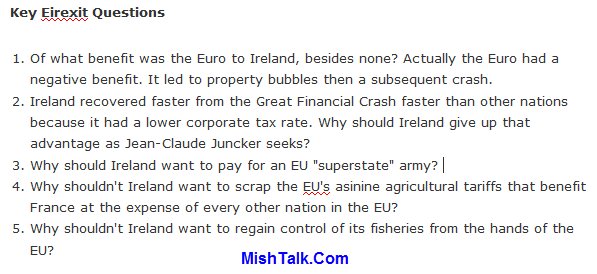

Irish bureaucrats may bury their heads and ignore those questions, but the average guy on the streets of Ireland will easily spot the answers.
Eirexit is just a matter of time.
Europe’s “Massively Over-Subscribed” Long-Dated Bond Bloodbath
Remember all those super-long-duration bonds that every Tom, Dick, and Henri bought with both hands and feet earlier in the year? Headlines roared of “six time oversubscribed”, or “four times oversubscribed” as Draghi and his entourage ‘guaranteed’ to keep everything profitable – whatever it takes. Well, things have gone a little disastrous in the last few days as Irish and Belgian ‘century’ bonds, Austria 70 year, Italian and Spanish 50 year bond prices are collapsing.
Belgian ‘Century’ bonds are down almost 30% in 3 months!

Ireland’s ‘Century’ bonds are down 40% in 2 months!!!

Austria 70 Year bond issued 3 weeks ago is 15%!!

And finally the recently issued Italy 50 Year bonds are down 17% since issuance in October…

Across the entire super-long-duration bond market, it’s an utter bloodbath as the entire developed sovereign bond market has lost almost $1 trillion in the last week…
5. RUSSIAN AND MIDDLE EASTERN AFFAIRS
Turkey
Unbelievable! Turkey warns its citizens about travel to the USA over social tensions and the anti Trump protests. This is in response to the USA warning its citizens not to travel to Turkey especially, in its south eastern corridor
(courtesy zero hedge)
Turkey Warns Citizens About Travel To US Over “Social Tensions”, Anti-Trump Protests
Several days after the US Embassy in Istanbul ordered the families of employees to depart, and advised U.S. citizens to avoid travel to southeast Turkey and “carefully consider the risks of travel to and throughout the country”, Turkey has responded by warning its citizens on Saturday about travel to the United States, in response to what the foreign ministry called “increasingly violent protests against President-elect Donald Trump.”
“Within the context of risks caused by the incidents and of social tension, our citizens who live in the U.S., or who are considering traveling there, should be cautious,” the ministry said in a statement.
The advisory said the unrest began after Tuesday’s elections: “Sometimes the protests turn violent and criminal while protesters (are) detained by security forces,” the ministry of foreign affairs said Saturday, adding that “racists and xenophobic incidents increased in USA.”
“Considering the risks, we advise our citizens living and traveling to US to follow local media, to follow the warning of our embassy in Washington and American security forces, to stay away from protests, to increase their security in work space and to apply to local security when there is a racist or xenophobic attack while keeping calm,” the statement added.
Demonstrators across America, some allegedly funded by George Soros-linked organizations, have staged four consecutive nights of protests against Trump, whose election they say poses a threat to their civil and human rights, a day after a protester was shot in Portland, Oregon.
At the same time, there has been growing tension between the two NATO allies after repeated calls from Turkey to extradite U.S.-based cleric Fethullah Gulen, who Ankara blames for a failed coup in July.
Turkish Prime Minister Binali Yildirim said on Wednesday he hoped for an improvement in bilateral ties after Trump’s victory, and again called for Gulen’s extradition.
end
Russia puts strategic bombers on combat alert as imminent strikes on Syrian targets will be the order of the da
(courtesy zerohedge)
Russia Puts Strategic Bombers On Combat Alert For Imminent Strikes On Syrian Targets
While America is busy pointing fingers at who exactly failed to predict the Trump presidency, Putin is taking advantage of the chaos and the immediate political power vacuum left in the aftermath of the stunning transition from the Democratic president to a Republican sweep.
First, as we reported last night, NATO promptly freaked out after Putin spokesman Dmitry Peskov urged President-elect Donald Trump to begin rebuilding the U.S.-Kremlin relationship “by urging NATO to withdraw forces from the Russian border.” Peskov told the Associated Press that such a move “would lead to a kind of detente in Europe.”
Second, fast forward to this morning when Russian Tass news agency reported that the crews of Russian strategic bombers Tu-160 and Tu-95 located at the “Engels” airbase, have been put on combat readiness, in preparation for imminent strikes on targets in Syria. Tass adds that the Russian strategic bombers have been armed with cruise missiles.

The Tupolev Tu-160 supersonic, strategic bomber
The Engels Air Force Base is a strategic military airbase in Russia located 14 kilometres east of Saratov.
According to a Tass sources, the “engineering staff at the base is loading the aircraft with cruise missiles and preparing them for combat use” adding that the “air strike group at the base is preparing to perform tasks with combat launches of cruise missiles.”
Tass also notes that the Russian air force has been used for pinpoint strikes on important objects (command centers, ammunition depots, plants for the production of weapons and ammunition) of ISIS militants targeted by Russia.
The news follows a report that aircraft stationed on the decks of Russia’s aircraft carrier Admiral Kuznetsov, which recently arrived near Syria’s shores as part of a Russian battle group, have begun carrying out flights aimed at working out interaction with a coastal airfield, the ship’s captain reported.
“The flights are performed from the deck of the aircraft-carrying heavy cruiser. Interaction with a coastal airfield is being worked out,” Sergey Artamonov, Admiral Kuznetsov’s captain, told the ‘Vesti v Subbotu’ program on Rossiya TV channel. According to the him, the flights have been carried out on a daily basis over the last four days.
The Russian Northern fleet battle group, consisting of Admiral Kuznetsov, the Pyotr Velikiy battle cruiser, two large anti-submarine ships Severomorsk and Vice-Admiral Kulakov as well as support vessels, arrived in the Mediterranean in early November.
Pyotr Velikiy’s commander, Vladislav Malakhovsky, said that the Russian vessels aren’t being bothered by aircraft of other nations. “Nobody is flying above us. Everybody is afraid of approaching us closer than 50 kilometers, understanding the might of the cruisers (Pyotr Velikiy and Admiral Kuznetsov),” Malakhovsky said.
end
More good news for Putin as two more European allies elect pro Russian Presidents
(courtesy zero hedge)
Kremlin Gains Two More European Allies As Bulgaria, Moldova Elect Pro-Russian Presidents
The good news just keeps going Putin’s way. Just days after Trump defeated the Kremlin’s nemesis Hillary Clinton, and at the same time as NATO is panicking over a potential shift in strategy and funding by the Trump administration and as Russian forces prepare for another blitz assault on Syria to cement their hold over Syria, on Sunday pro-Russian candidates won presidential elections in Moldova and Bulgaria on Sunday, giving Moscow new allies in its efforts to regain influence in parts of Eastern Europe it regards as its backyard. And while Russia is the clear winner, one loser to emerge bruised from the two votes is the European Union.
In the former Soviet republic of Moldova, Socialist party candidate Igor Dodon won 55.5% of the vote, according to preliminary results from Moldova’s electoral commission, beating his pro-European Union rival, Maia Sandu, in a second-round runoff.

In Moldova, Socialist party candidate Igor Dodon won 55.5%
of the vote, according to preliminary result
In Bulgaria, Socialist-backed Rumen Radev secured 58.1% of the vote, according to an exit poll by Alpha Research released on national television, seeing off the center-right government’s favored candidate, Tsetska Tsacheva. Prime Minister Boiko Borisov said he would resign, possibly opening the way for a snap election in the European Union’s poorest member state.

In Bulgaria, Socialist party candidate Rumen Radev won the
presidential election.
According to the WSJ, the results are a shot in the arm for those in Moldova and Bulgaria who want to see their states warm up relations with their large Eastern neighbor, reversing years of westward drift they say has yielded too few rewards.
“I will dramatically improve the relations between Moldova and Russia,” Mr. Dodon said in an email to The Wall Street Journal ahead of the vote. “These relations are very important for the citizens of the country.”
The two elections confirm the growing cracks in the European Union cement that helped reshape Central and Eastern Europe after the downfall of Soviet Union; to some they are a harbinger of more prominent elections coming in the coming months, most notably in Italy where PM Renzi’s day may be numbered should a constitutional referendum not go his way as polls indicate.
As the WSJ adds, since the U.K. voted to leave the EU in June, government leaders in Poland and Hungary have been calling more loudly for refashioning the bloc into a much looser union. In Moldova and Bulgaria, the tone of the two new presidents’ campaigns has been warmer toward Russia and more critical of the EU, which they blamed for slow economic progress.
Moldova and Bulgaria, which was a member of the Warsaw Pact, had decisively shifted toward the EU in recent years. Moldovan lawmakers signed an agreement with the European Union in 2014 which deepened economic and political ties. Bulgaria joined the West’s military alliance, NATO, in 2004, and the EU in 2007.
In Bulgaria, however, Mr. Radev has talked of a need to lift EU sanctions on Russia in place since Moscow annexed the Ukrainian region of Crimea. In Moldova, Mr. Dodon wants to revoke the 2014 EU pact and rebuild trade links with Moscow as part of a loose trading union which links Russia and a handful of other former Soviet republics.
Bulgaria’s recent anti-Russia hard line stance cost the country millions in revenues associated with the South Stream gas pipepline which was supposed to take Russian natgas from across the black sea and into Europe. However, in the aftermath of the Ukraine conflict, the EU pressured Bulgaria to halt discussions, terminating the project and forcing Russia to seek a different passage, which has now been formalized in the form of the Turkish Stream pipeline which crosses Turkey and Greece.
Meanwhile in Moldova, Dodon’s campaign material ahead of the vote mourned the loss of access to Russian markets for important exports like fruit. Because it backed European sanctions on Russia, Moldova has seen some food exports banned from Russia, and that has damaged the economy of some regions.
“The current government has destroyed our friendly relations with Russia,” one of his promotional videos said. “Igor Dodon is the only politician who can rebuild them.”
The votes in Bulgaria and Moldova were held in an atmosphere of widespread voter skepticism of the countries’ political classes. Lawmakers in both countries have been accused of moving too slowly on public sector reform and allegations of corruption are common.
Moldova is still reeling from a bank fraud in 2014 which saw $1 billion disappear from three lenders in an elaborate misappropriation. The authorities have been seen as slow to bring the culprits to justice, leading to large street protests. Dodon pushed an anticorruption message during his campaign.
“As president, I will do everything possible to restore confidence in the Moldovan state,” Mr. Dodon said.
We expect many more poor Europen states, disenchanted with the chaos emerging out of Europe, to favor a return to relations with the Kremlin in the coming years as the Warsaw Pact is gradually rebuilt, much to the humiliation of Brussels.
6.GLOBAL ISSUES
Goldman Sachs just killed the Trump euphoria as they conclude that global growth will suffer under Trump no matter what happens
(courtesy zero hedge/GoldmanSachs)
Goldman Just Killed The “Trump Euphoria” – Concludes Global Growth Will Suffer Under Trump No Matter What
Earlier today, we presented an analysis by Goldman Sachs which emerged with a lukewarm take on Trump’s policies as to how they stand to impact US domestic growth, with only Goldman’s “adverse” scenario resulting in a “stagflationary”, i.e., recessionary outcome. However, in a follow up report by another set of Goldman economists Nicholas Fawcett and Sven Jari Stehn, one which looks at the broader global set of Trump policy consequences on the entire world, it finds that virtually every scenario leads to a global contraction, something we noted yesterday in our post titled “What’s Good For The US In This Case, Is Not Good For Emerging Markets.”
Here is the summary from Goldman:
- Following Donald Trump’s victory in the US presidential election, the focus now turns to the potential economic implications of his proposed policies. The November 12 US Economics Analyst used the Fed staff’s FRB/US model to analyse the consequences for the US economy. In today’s companion piece, we assess the potential global economic spillovers from the Trump agenda using our global macro model.
- Following the US simulations, we analyse four of Mr. Trump’s policy proposals, including fiscal stimulus, trade tariffs, restrictive immigration policies and a hawkish tilt in Fed policy. We first analyse the policies individually and then combine them into possible packages, including our own assumed policy outcomes.
- Fiscal stimulus has positive global spillovers, as stronger US demand boosts imports for foreign goods and services. Dollar strength reinforces the positive spillovers to DM economies with floating exchange rates, but limits the gains in EM economies. The spillovers to China, for example, depend on the extent to which the Renminbi appreciates with the dollar and the net effects are less positive for EM economies that rely heavily on dollar-denominated debt.
- The other components of Mr. Trump’s agenda (trade policies, immigration and Fed) have negative global spillovers as US inflation is higher and US growth slows. The growth drag is generally muted for DM economies with floating exchange rates but significantly negative for some EM economies (including China).
- Taken together, our analysis suggests that Mr. Trump’s policies might act as a modest drag on global growth. DM growth receives a brief boost from the fiscal stimulus but then weakens and spillovers into EM economies are negative throughout. Moreover, the risks around this base case appear asymmetric. A larger fiscal package could boost global growth moderately more in the near term, but a more adverse policy mix would likely act as a significant drag on world growth in subsequent years.
The assumptions that Goldman uses to rerun its global impact scenario are largely the same as those listed previously, in the US-focused model.
Here is what Goldman finds when running three distinct scenarios on a global scene:
Following the US Economics Analyst, we consider three scenarios of the Trump Agenda:
- a “full” implementation case that combines the fiscal, trade, immigration, and Fed proposals above;
- a “benign” scenario that includes only the fiscal proposals;
- and an “adverse” scenario that includes tariffs, more restrictive immigration policy and a more hawkish Fed (but no fiscal stimulus).
Exhibit 4 shows the simulated impact of the “full” and “adverse” scenarios (as the “benign” package is identical to the fiscal stimulus simulation in Exhibit 1). We find that the “full” package boosts US growth slightly in 2017H2 and 2018H1, but then turns into a drag as the growth-unfriendly policies of the full package start to dominate. Spillovers into the Euro area and Japan are negligible initially but then turn negative. The net growth effect on China is negative throughout. The “adverse” policies, however, lead to sharply negative spillovers around the world. Real GDP in the Euro area and Japan is about 0.4% lower after two years, and Chinese activity is 0.9% lower.
Exhibit 5 summarizes the implications of the three Trump packages for world, DM and EM GDP. The full Trump policies slow global growth by about 0.2pp per year out to 2020. The effects are initially more benign for DM than EM countries, though the reverse is true towards the end of the simulation (when the US slows significantly). The benign Trump scenario boosts world GDP by about 0.4% but turns negative for EM after about two years. The adverse policy package lowers world growth significantly. Global real GDP is nearly 0.8% lower after 2-3 years.


Goldman then simulates a scenario with the policies that it regards most likely to be implemented. Like before, the bank expects scaled-down versions of the tax reform and infrastructure policies to be enacted. It does not anticipate significant changes on immigration policy, but incremental restrictions seem likely. While Trump’s monetary policy views are still unclear, slightly more hawkish appointments appear likely at this stage. Trade policy is the greatest unknown, but Goldman expects that Trump would follow through on at least some of the trade policies he has outlined. Exhibit 6 summarizes Goldman’s expectations and how these compare with the full Trump proposals.

Exhibit 7 shows the simulated effects of Goldman’s expected package in the model. The left-hand panel shows the real GDP effects for the major four economies and the right-hand panel summarizes the effects for the main global aggregates.

And the punchline:
Our simulations suggest that Mr. Trump’s policies might act as a modest drag on global growth. DM growth receives a brief boost from the fiscal stimulus but then weakens and spillovers into EM economies are negative throughout. Our analysis of the alternative policy packages suggests that the risks around this base case are asymmetric. A larger fiscal package could boost global growth moderately more in the near term, but a more adverse policy mix would likely act as a significant drag on world growth in subsequent years.
What should one make of this quite dire assessment by the most influential bank on Trump’s policies? Alas, it confirms to us that what we predicted on November 9, moments after Trump was declared winner, is starting to play out, namely that the true state of the global economy – which had been propped up for years with trillions in liquifity – is about to be revealed, and a major global recession, if not depression is in store.
Joking aside, “president Trump” means that the rug is about to be pulled from under the fake economy

More importantly, it also means that this latest, incipient spark of global inflation observed over the past 4 days is about to be drowned in yet another tidal wave of the deflationary tsunami, which in turn will bring back central banks to the fore, as global debt rises to new, unprecedented records, which will make rising interests rates a non-starter and demand more deficit monetization.
In short, enjoy the reflationary impulse while you have it; Goldman just warned everyone that its days are numbered.
end
7.OIL ISSUES
At first it was thought that a Trump victory would quash the Iran deal and give a huge bonus to OPEC as Iranian oil will still be subject to sanctions. However PMI states that the Trump victory also causes a deal on OPEC cuts down the drain
here is why…
(courtesy zero hedge)
Oil Tumbles After BMI Slashes Probability Of OPEC Deal Due To Trump Victory; Dollar Surge
Yesterday we reported that there is a small, but not improbable, chance that Trump could end up becoming OPEC’s best friend should the president elect seek to undo Obama’s landmark foreign policy deal, the Iran Nuclear Agreement: “suddenly there is a ray of hope in OPEC’s dark world, and it comes courtesy of president-elect Donald Trump, who just may eliminate as much as 1 million barrels of OPEC oil output, or the cartel’s entire excess production, should he undo the deeply unpopular within GOP circles Iran nuclear agreement, which would also collapse Iranian oil exports and send the price of oil surging.”
It remains to be seen if Trump has changed his view on the Iran deal, and certainly if he would engage in an action that would benefit Saudi Arabia while making millions of US motorists sad once gas prices spike should Iran’s 1mmbpd in excess oil supply be taken offline.
Some of our readers pointed out that far from sending the price of oil spiking, there was an alternative explanation, to wit: “if there is a possibility, however slight, of the Iran nuclear deal being torn up in 68 days on 20 January 2017, then what does this mean for Saudi Arabia and the upcoming OPEC negotiations?”
It does 4 things:
- Further highlights the importance of collective OPEC cuts
- Encourages Iran to produce MORE not LESS oil
- Further reduces the likelihood of a material deal
- Reduces likelihood of material cuts from Saudi Arabia, for if they cut and the Iran deal is torn up, then they will have given away market share that will be reclaimed by Libya, Nigeria, Iraq and Russia
On Friday, Fitch’s BMI unit issued a report that corroborated this more bearish perspective on oil as a result of the Trump presidency. According to BMI, “prospects for OPEC members to agree on an output cut or freeze have “reduced notably” following Donald Trump’s victory at the U.S. elections.”
According to the analysis, BMI now expects a 45% probability of a “wait-and-see” stance and no deal on Nov. 30, vs previous forecast of 25% chance.
The Fitch research unit now also sees only a 15% chance the group will agree on an output cap of 32.5m-33m b/d, and 40% odds for a watered-down agreement, in other words a roughly one in seven chance that the Algiers deal will be implemented as presented.
The change in BMI’s expectations was prompted by prospects for a stronger recovery in the U.S. shale sector, backed by a Trump presidency. It notes that the new administration could revitalize the country’s oil, gas sector over and beyond 2017, boosting output. A rollback in emissions policies, relaxation of drilling regulations and approval of key midstream projects are likely.
BMI also says that OPEC would not have factored in a Trump victory and a favourable legislative and fiscal environment for U.S. mid and upstream projects during the meeting in Algiers, when the output freeze was proposed, and as such the calculus that was on the table in late September has been scrapped, with OPEC now facing only downside should it cut its own production as non-OPEC members, read shale, resume pumping at historical levels. As a result BMI concludes that a “Wait-and-see” outcome is most likely, until U.S. energy policy becomes clearer next year.
Whether that is the catalyst, or just the relentless strength in the US Dollar which traditionally pressures oil lower, but today crude has fallen below $43, to the lowest level since the start of August, undoing all of the Algiers gains, and then some.
8. EMERGING MARKETS
The Venezuela’s currency now fetches 2,014 Bolivars per dollar. It is now heading for hyperinflation.
(courtesy zero hedge)
The last time we updated on the value – we use the term very loosely in this case – of the Venezuela currency, the Bolivar in the black market, was at the start of November, when one US dollar purchased 1,567 bolivars in the street. Fast forward not even two full weeks later, and the Venezuela currency has now officially crossed the “nice, round number” psychological hyperinflation barrier of 2,000/USD, trading at 2,014 today, crashing by 22% since our last check, and an vomit-inducing 43% in the past month.
The exponentially-rising chart below shows what hyperinflation in a destroyed socialist economy looks like.

Source: Dolar Today
Has anything changed so dramatically in Venezuela’s economic conditions to necessitate a nearly 50% devaluation in its currency in one month? Hardly. To be sure, the latent issues remain, the biggest of which is the latest slump in the price of oil which merely adds insult to injury for Maduro. According to Bloomberg, Venezuela is among the countries leading the latest push to overcome the divide between SaudiArabia, Iraq and Iran ahead of the upcoming OPEC meeting in Vienna. Naturally, there is a far more selfish reason why Venezuela is desperate the price of crude rises.
And while Venezuela waits for the latest disappointment out of OPEC, Reuters reports that the country’s massively unpopular president, Nicolas Maduro, who presided over Venezuela’s terminal collapse and is only in power thanks to the army’s support, is now trying his hand at salsa music to cheer up his broke countrymen.
According to Reuters, Maduro, a music aficionado who used to play in a rock band, debuted “Salsa Hour” this month and has broadcast four episodes from a radio booth specially installed in the Miraflores presidential palace, with each episode lasting several hours.

“This is a program full of energy and joy,” said Maduro, 53, in one show, headphones on as he drummed his fingers and spun classics of the Caribbean rhythm. “I would do it every day … to sing about our lives, anxieties, pains and dreams.”
Surely singing about the “anxieties and pains” provides countless hours of content for the wannabe dictator. During the shows, sometimes also shown on TV, Maduro has danced with his wife, explained the history of salsa and devoted a program to Puerto Rican singer Ismael Rivera.
Politics have crept in too. He dedicated the song “You’re crazy, crazy, but I’m cool” to arch-foe and National Assembly President Henry Ramos and the song “Vagrant” to opposition leader Henrique Capriles.
Though Venezuela’s 30 million people adore music, especially salsa, Maduro’s show has fueled criticism that he is disconnected from reality in a country where millions are skipping meals amid shortages and rising prices. “Maduro’s program is like a mockery,” said Capriles, who narrowly lost to him in the 2013 presidential vote and has championed a drive for a referendum to recall Maduro.
“He should have a bit more respect for the Venezuelan people. He is not an entertainer.”
That however won’t stop Maduro who appears to have taken a page right out of the Hillary Clinton book on how to become more popular with the poor:
“Maduro wants to connect with the poorest who, despite the crisis, still get together and listen to music,” said Andres Canizales, a media scholar and spokesman for the Citizens’ Monitor group.
We don’t have high hopes for Maduro’s radio show, but we can safely say that the modern equivalent of Nero fiddling while Rome burns, is Maduro dancing salsa while Venezuela’s currency – and economy – disintegrates.
Your early morning currency/gold and silver pricing/Asian and European bourse movements/ and interest rate settings MONDAY morning 7:00 am
Euro/USA 1.0771 DOWN .0080/REACTING TO NO DECISION IN JAPAN AND USA + huge Deutsche bank problems + USA election:Clinton LOSES/TRUMP WINS THE ELECTION/USA READY TO GO ON A SPENDING BINGE WITH THE TRUMP VICTORY/
USA/JAPAN YEN 107.71 UP 1.276(Abe’s new negative interest rate (NIRP), a total DISASTER/SIGNALS U TURN WITH INCREASED NEGATIVITY IN NIRP/JAPAN OUT OF WEAPONS TO FIGHT ECONOMIC DISASTER/KURODA: HELICOPTER MONEY ON THE TABLE AND DECISION ON SEPT 21 DISAPPOINTS WITH STIMULUS/OPERATION REVERSE TWIST
GBP/USA 1.2524 DOWN.0054 (Brexit by March 201/UK government loses case/parliament must vote)
USA/CAN 1.3554 UP .0019 (CANADA WORRIED ABOUT TRADE WITH THE USA WITH TRUMP ELECTION)
Early THIS MONDAY morning in Europe, the Euro FELL by 80 basis points, trading now JUST above the important 1.08 level FALLING to 1.0771; Europe is still reacting to Gr Britain BREXIT,deflation, announcements of massive stimulation (QE), a proxy middle east war, and the ramifications of a default at the Austrian Hypo bank, an imminent default of Greece, Glencore, Nysmark and the Ukraine, along with rising peripheral bond yield further stimulation as the EU is moving more into NIRP, THE USA’S NON tightening by FAILING TO RAISE THEIR INTEREST RATE AND NOW THE HUGE PROBLEMS FACING TOO BIG TO FAIL DEUTSCHE BANK + THE ELECTION OF TRUMP IN THE USA / Last night the Shanghai composite CLOSED UP 14.33 OR 0.45% / Hang Sang CLOSED DOWN 308.87 OR 1.37% /AUSTRALIA IS LOWER BY 0.48% / EUROPEAN BOURSES ALL IN THE GREEN EXCEPT SPAIN’S IBEX AND INDIA’S BOURSE
We are seeing that the 3 major global carry trades are being unwound. The BIGGY is the first one;
1. the total dollar global short is 9 trillion USA and as such we are now witnessing a sea of red blood on the streets as derivatives blow up with the massive rise in the rise in the dollar against all paper currencies and especially with the fall of the yuan carry trade. The emerging market which house close to 50% of the 9 trillion dollar short is feeling the massive pain as their debt is quite unmanageable.
2, the Nikkei average vs gold carry trade ( NIKKEI blowing up and the yen carry trade HAS BLOWN up/and now NIRP)
3. Short Swiss franc/long assets blew up ( Eastern European housing/Nikkei etc.
These massive carry trades are terribly offside as they are being unwound. It is causing global deflation ( we are at debt saturation already) as the world reacts to lack of demand and a scarcity of debt collateral. Bourses around the globe are reacting in kind to these events as well as the potential for a GREXIT>
The NIKKEI: this MONDAY morning CLOSED UP 297.83 POINTS OR 1.71%
Trading from Europe and Asia:
1. Europe stocks ALL IN THE GREEN EXCEPT SPAIN, INDIA
2/ CHINESE BOURSES / : Hang Sang CLOSED DOWN 308.87 OR 1.37% ,Shanghai CLOSED UP 14.33 POINTS OR 0.45% / Australia BOURSE IN THE RED /Nikkei (Japan)CLOSED IN THE GREEN/ INDIA’S SENSEX IN THE RED
Gold very early morning trading: $1223.75
silver:$17.21
Early MONDAY morning USA 10 year bond yield: 2.245% !!! UP 10 IN POINTS from FRIDAY night in basis points and it is trading JUST BELOW resistance at 2.27-2.32%. THE RISE IN YIELD WITH THIS SPEED IS FRIGHTENING
The 30 yr bond yield 3.02, UP 10 IN BASIS POINTS from FRIDAY night.
USA dollar index early MONDAY morning: 99.70 UP 48 CENTS from FRIDAY’s close.
This ends early morning numbers MONDAY MORNING
END
xxxxxxxxxxxxxxxxxxxxxxxxxxxxxxxxxxxxxxxxxxxxxxxxxxxxxxxxxxxxxxxxxxxxxxxxxxxxxxxxxxxxxxxxxxxxxxxxxxxxxxxxxxxxxxx
And now your closing MONDAY NUMBERS
Portuguese 10 year bond yield: 3.54% UP 6 in basis point yield from FRIDAY (does not buy the rally)
JAPANESE BOND YIELD: -.0009% up 2 in basis point yield from FRIDAY
SPANISH 10 YR BOND YIELD:1.514% UP 4 IN basis point yield from FRIDAY (this is totally nuts!!/
ITALIAN 10 YR BOND YIELD: 2.08 UP 6 in basis point yield from FRIDAY
the Italian 10 yr bond yield is trading 57 points HIGHER than Spain.
GERMAN 10 YR BOND YIELD: +.319% UP 1 IN BASIS POINTS ON THE DAY
END
xxxxxxxxxxxxxxxxxxxxxxxxxxxxxxxxxxxxxxxxxxxxxxxxxxxxxxxxxxxxxxxxxxxxxxxxxxxxxxxxxxxxxxxxxxxxxxxxxxxxxxxxxxxxxxxxxxxxxxxxxxxxxxxxxxxxx
IMPORTANT CURRENCY CLOSES FOR MONDAY
Closing currency crosses for MONDAY night/USA DOLLAR INDEX/USA 10 YR BOND YIELD/2:30 PM
Euro/USA 1.0727 DOWN .0123 (Euro DOWN 1233 basis points/ represents to DRAGHI A COMPLETE POLICY FAILURE/
USA/Japan: 108.37 UP: 1.884(Yen DOWN 188 basis points/
Great Britain/USA 1.2492 DOWN 0.0087( POUND DOWN 87 basis points
USA/Canada 1.3560 UP 0.0026(Canadian dollar down 26 basis points AS OIL ROSE TO $43.60
xxxxxxxxxxxxxxxxxxxxxxxxxxxxxxxxxxxxxxxxxxxxxxxxxxxxxxxxxxxxxxxxxxxxxxxxxxxxxxxxx
This afternoon, the Euro was DOWN by 121 basis points to trade at 1.0727
The Yen FELL to 108.37 for a LOSS of 189 basis points as NIRP is STILL a big failure for the Japanese central bank/HELICOPTER MONEY IS NOW DELAYED/BANK OF JAPAN NOW WORRIED AS AS THEY ARE RUNNING OUT OF BONDS TO BUY AS BOND YIELDS RISE /OPERATION REVERSE TWIST ANNOUNCED SEPT 21.2016
The POUND FELL 87 basis points, trading at 1.2492/
The Canadian dollar fell by 26 basis points to 1.3560, AS WTI OIL ROSE TO : $43.60
the 10 yr Japanese bond yield closed at -.006% UP 2 POINT IN BASIS POINTS / yield/ AND THIS IS BECOMING BOTHERSOME TO THE BANK OF JAPAN
Your closing 10 yr USA bond yield UP 7 IN basis points from FRIDAY at 2.215% //trading well below the resistance level of 2.27-2.32%) very problematic USA 30 yr bond yield: 2.975 UP 3 in basis points on the day /REMEMBRANCE DAY HOLIDAY
BANKS NEED THE LONGER BOND HIGHER IN YIELD: INSTEAD THE SPREAD LESSENS.
Your closing USA dollar index, 100.01 UP 80 CENTS ON THE DAY/2.30 PM
Your closing bourses for Europe and the Dow along with the USA dollar index closing and interest rates for MONDAY: 2:30 PM EST
London: CLOSED UP 22.75 POINTS OR 0.34%
German Dax :CLOSED UP 25.74 POINTS OR .24%
Paris Cac CLOSED UP 19.28 OR .43%
Spain IBEX CLOSED UP 19.00 POINTS OR 0.22%
Italian MIB: CLOSED DOWN 126.04 POINTS OR .75%
The Dow was up 21.03 points or 0.11% 4 PM EST
NASDAQ down 18.72 points or 0.36% 4 PM EST
WTI Oil price; 43.64 at 4:00 pm;
Brent Oil: 44.63 4:00 EST
USA DOLLAR VS RUSSIAN ROUBLE CROSS: 66.27 (down 44 roubles from friday)
TODAY THE GERMAN YIELD RISES TO +0.319% FOR THE 10 YR BOND 2:30 EST
END
This ends the stock indices, oil price, currency crosses and interest rate closes for today
Closing Price for Oil, 5 pm/and 10 year USA interest rate:
WTI CRUDE OIL PRICE 5 PM:$43.74
BRENT: $44.68
USA 10 YR BOND YIELD: 2.261%
USA DOLLAR INDEX: 100.00 up 78 cents
The British pound at 5 pm: Great Britain Pound/USA: 1.2497 down .0081 or 81 basis pts.
German 10 yr bond yield at 5 pm: +.319%
END
And now your more important USA stories which will influence the price of gold/silver
TRADING IN GRAPH FORM
Trumpnado Sparks Emerging Market Massacre As Dollar Soars, Dow Hits Record Highs
US Stock markets message to the world…
The post-election shenanigans continue with only US equities positive post-Trump… EM Bonds, EM FX, DM Bonds, US TSYs, and Non-US Stocks are all lower...

The Peso remains near record lows and gold and bonds at post-Trump lows…

Post-Trump, bonds and bullion are worst…

But not all US equities are exuberant…

With Nasdaq the big laggard today… S&P 500 closed perfectly unchanged?!


Tech stocks continued to weaken with FANG stocks suffering their worst month since March 2014 dropping to 3-month lows (down 4 weeks in a row, down 13 of last 15 days for a 12% plunge)

RBC’s Charlie McElligott reminds readers that,
In Q3, the Tech sector became THE ‘hiding place’ place of respite in the post Brexit-period, with 13Fs showing us that the sector was 14.9% of HF allocations / 13.4% of MF holdings / 14.9% of pension fund notional holdings. S&P Tech sector returned 12.4% in Q3, while the 4-stock liquid proxy “FANG” was +12.7% on the quarter. Why? Because it is simply impossible to ‘slap on’ a bunch of cyclical exposure, even in US—Energy, Industrials and Materials as sectors simply don’t provide enough liquidity. Add in the OPEC headline noise component as a massively important factor in driving enormous cyclical volatility on a daily basis, and most generalists simply couldn’t “go there” with regards to getting appropriately weighted in these cyclical spaces…and even if you were one of those very tactical funds, you were there to hit singles and doubles, with many having chosen to cut exposure over the past few weeks into the US election risk and now very real doubts on any sticky OPEC production cut deal ever getting done.
Fast forwarding to this past week: unfortuantely for so many funds, in light of the aforementioned shift post-election into the “Trumpflation” trade, the tech sector has become the “source of funds” (crowded longs in AMZN, GOOG, FB, MSFT all down last week, as the broad sector was a 99th %ile ‘long’ since ‘10) . Ouch.

“Most Shorted” Stocks continue to get their faces ripped off – now up a stunning 14% in 7 straight days of squeeze – the biggest squeeze since the bounce off the March 2009 lows!

Bond-Stock Correlation tumbled back to its ‘norm’ below 0…

But the bond bloodbath continues as 2Y rates topped 1.00%, 30Y topped 3.00%, 30Y Mortgage topped 4.00%

And bond ‘risk’ is dramatically higher than equity ‘risk’…

Emerging Market bonds continued to slide…

The Dollar Index tagged 100.00 for the first time since early December

Emerging Market FX continues to collapse (against the USD), completely decoupled from the Dow (and in the red for the year)

Offshore Yuan plunged to a record low…

WTI Crude dropped to a $42 handle intraday ($42.20)

Copper closed higher (despite Friday’s key reversal day), but looks very head-and-shoulders toppy…

Gold and Silver are down post-Trump but gold has notably outperformed silver – sending Gold/Silver to post-Brexit highs…
end
Not good: the 30 yr USA treasury just spiked above 3%. The 10 yr USA at 2.25. If the 10 yr spikes to 2.50%, then it would be impossible for the New York markets to advance
(courtesy zero hedge)
30 Year US Treasury Yields Spike Above 3.00% – Highest Since Fed Rate Hike
The 30 Year US Treasury bond yield has exploded 55bps in the last few days, snapping the mythical 3.00% level for the first time since January 5th, spiking to its highest since just before The Fed hiked rates in December 2015…
The Long-Bond is now red YoY…

As prices are tumbling (30Y -7% post-Trump)
end
This ought to annoy Obama and the EU: Putin and Trump hold phone conversation and agree to normalize relations
(courtesy zero hedge)
Putin And Trump Hold Phone Conversation, Agree To Normalize Relations
Moments ago the Kremlin released a statement in which the Russian presidency reported that Putin and Trump held a conversation, in which the Russian leader congratulated his American counterpart again on his victory in the presidential election, wished him “success in the implementation of the pre-election program, and noted his willingness to build a partnership dialogue with the new administration on the principles of equality, mutual respect and non-interference in the internal affairs of each other.”
During the conversation, Putin and Trump “not only agreed to assess the current unsatisfactory state of bilateral relations, but also spoke in favor of active joint work to normalize relations and aim for constructive cooperation on a wide range of issues. The call emphasized in particular the importance of creating a solid foundation of bilateral ties through the development of trade and economic relations.
In the call, it was also noted that that “next year marks 210 years since the establishment of diplomatic relations between Russia and the United States, which in itself should stimulate a return to pragmatic, mutually beneficial cooperation, which would meet the interests of both countries, stability and security throughout the world.”
Putin and Trump shared thoughts on the need for joint efforts in the fight against the common enemy number one – international terrorism and extremism. In this vein, and discussed issues of the settlement of the crisis in Syria.
The two agreed to continue contact by phone and agreed to meet in person in the future.
Watch For Trump-The-Monster To Save Some Kittens
Authored by Dilbert Creator Scott Adams,
How To Break An Illusion
Anti-Trump protesters believe they are fighting the good fight to stop a racist, homophobic, sexist monster. But about half of the country – the half that I’m in – is in a different movie. In our movie, we selected a new president and half of the country is in cognitive dissonance over it. Assuming the protesters are the ones experiencing the illusion, and not us, how can we release them from their zombie-like existence so they will stop blocking traffic?
I’ll tell you the general approach.
The main thing you have to do is violate the frame. Clinton framed Trump as a monster, and now protesters are locked into that illusion. If Trump does things that can be construed as monster-like, the illusion is strengthened. But every time he violates that framing, the illusion gets a crack. If it cracks enough, it breaks.
For example, half the country thought Trump was going to eliminate every good thing about Obamacare. But recently the public learned that Trump wants to keep the most popular provisions and just “fix” the rest of it. That violates the monster frame. But it isn’t enough by itself. You need more violations.
Picking Reince Priebus for Chief of Staff was a good step because it makes Trump seem presidential and flexible. That’s another violation of the monster frame. But a small one.
Unfortunately, picking Steve Bannon as chief strategist adds confirmation bias to the monster illusion because Clinton’s team polluted Bannon’s brand during the election. Bannon adds confirmation bias to the monster illusion. I assume Bannon is a great strategist or else Trump wouldn’t risk keeping him.
Yesterday on Sixty Minutes Trump said gay marriage was already settled by the Supreme Court, and Trump is okay with that. That’s a crack in the illusion that Trump is anti-LGBTQ. But not enough. And Trump’s selection of Pence to run the transition team supports the monster theory because Pence has some anti-gay history that needs fixing.
The obvious next move for the Master Persuader involves asking Pence to “evolve” to Trump’s positions on all LGBTQ matters. Everyone expects a VP to pretend to be a full supporter of the President’s policies. That gives cover for Pence to update his LGBTQ views because…
– Religious conservatives will dismiss it as mere politics, believing Pence privately holds views that match their own.
– Anti-Trumpers will see a major violation of the monster frame.
– I will explain it all later as Trump doing “pacing and leading” to bring the Republican Party toward the center where it is strongest. Because that’s what is happening.
Trump has lots of other ways to crack the monster framing in the coming months. He can say more about his “New Deal” ideas for helping African-Americans. He could flip a foreign leader from a critic to a friend. He could come up with some ideas on lowering college costs. He could say more about his plan NOT to deport undocumented citizens who have obeyed the law since coming to this country.
He has lots of levers. Expect him to push one lever after another until the monster framing cracks. By summer the story will be that he’s the most flexible and centrist president in our history.
It is worth noting that Trump and Clinton had very different unframing challenges. If Clinton had won, her job would have been to convince the public she isn’t crooked. But you can’t do that simply by doing some honest things in public. We expect that even crooked people do honest things when watched. Clinton literally had no path to remove her “crooked” label.
But Trump has a more solvable framing problem. Clinton’s team labelled him a racist, homophobic, sexist. Trump can violate that frame enough times to break it over time. But it will take a lot of cracks. You’ve already seen several. Expect more to come.
If I were in Trump’s place I would look for a bigly frame violation and soon. The public is already primed for him to “moderate” away from his campaign promises. This is the time to do it.
In summary, you can’t prove you are honest by NOT stealing something in public. But you can prove you are not a monster by saving a kitten from a tree in public. Monsters never do that sort of thing. This idea is so true that it became the title of the best book ever written about movie script writing: Save the Cat.
Watch for Trump to save some kittens – as many as necessary – until you can’t hold in your mind the frame that he’s a monster. Enjoy the show. The Master Persuader is just getting started.
end
well that about does it for tonight
I will see you tomorrow night
Harvey


 harveyorganblog.com
[…] by Harvey Organ Harvey Organ’s Blog […]
LikeLike
Soybeans are fungeable. If China buys them from Europe, then whoever used to buy them from Europe will have to buy them from whoever else has them: the USA. It’s just a posturing shift . Oil does this all the time. All knowledgeable parties don’t worry over it. It makes no difference in anything. Business as usual.
LikeLike
PS If you want to know what Trump is doing, read Chapt 2 of Cialdini’s _Influence_. It’s all there. Thanks, Scott Adams [Dilbert creator} for the heads up. Buy the book. It’s cheap now. Read the whole thing. Then follow up with _Persuasion_.
But first the national “conversation” American” style: scream as loudly as possible obscenities and accusations and threats of death. Those most concerned with matters will be heard. In the end, all available and concerned brains will be heard. There is no mystery here.
LikeLike
[…] NOV 14/DESPITE THE RISE IN THE DOLLAR, GOLD HOLDS BUT SILVER IS DUMPED/THE CHINESE YUAN CRASHES (OFF… […]
LikeLike