
Gold closed at $1216.50 DOWN $6.90
silver closed at $16.76: DOWN $0.15
Access market prices:
Gold: 1217.00
Silver: 16.70
THE DAILY GOLD FIX REPORT FROM SHANGHAI AND LONDON
.
The Shanghai fix is at 10:15 pm est and 2:15 am est
The fix for London is at 5:30 am est (first fix) and 10 am est (second fix)
Thus Shanghai’s second fix corresponds to 195 minutes before London’s first fix.
And now the fix recordings:
Shanghai morning fix Nov 17 (10:15 pm est last night): $ 1238.54
NY ACCESS PRICE: $1228.10 (AT THE EXACT SAME TIME)/premium$10.44
XXXXXXXXXXXXXXXXXXXXXXXXXXXXXXXXXX
Shanghai afternoon fix: 2: 15 am est (second fix/early morning):$ 1237.30
NY ACCESS PRICE: 1226.00 (AT THE EXACT SAME TIME/2:15 am)
HUGE SPREAD 2ND FIX TODAY!! 10.30 dollars
XXXXXXXXXXXXXXXXXXXXXXXXXXXXXXXXXXXXXXXX
London Fix: Nov 17: 5:30 am est: $1232.00 (NY: same time: $1230.50 5:30AM)???
London Second fix Nov 17: 10 am est: $1226.75 (NY same time: $1225.50, 10 AM)???
It seems that Shanghai pricing is higher than the other two , (NY and London). The spread has been occurring on a regular basis and thus I expect to see arbitrage happening as investors buy the lower priced NY gold and sell to China at the higher price. This should drain the comex.
Also why would mining companies hand in their gold to the comex and receive constantly lower prices. They would be open to lawsuits if they knowingly continue to supply the comex despite the fact that they could be receiving higher prices in Shanghai.
end
For comex gold:
NOTICES FILINGS FOR NOVEMBER CONTRACT MONTH: 1 NOTICE(S) FOR 100 OZ TONNES
For silver:
NOTICES FOR NOVEMBER CONTRACT MONTH FOR SILVER: 0 NOTICE(s) OR nil OZ
xxxxxxxxxxxxxxxxxxxxxxxxxxxxxxxxxxxxxxxxxxxxxxxxxxxxxxxxxxxxxxxxxxxxxxxxxxxxxxxxxxxxxxxxxx
Let us have a look at the data for today
.
xxxxxxxxxxxxxxxxxxxxxxxxxxxxxxxxxxxxxxxxxxxxxxxxxxxxxxxxxxxxxxxxxxxxxxxxxxx
In silver, the total open interest FELL by 1398 contracts DOWN to 173,433 with yesterday’s trading. In ounces, the OI is still represented by just less THAN 1 BILLION oz i.e. .867 BILLION TO BE EXACT or 124% of annual global silver production (ex Russia & ex China).
In November, in silver, 0 notice(s) filings: FOR NIL OZ
In gold, the total comex gold ROSE by 4,746 contracts DESPITE THE FALL IN THE PRICE OF GOLD ($0.60 yesterday ).The total gold OI stands at 483,983 contracts.
In gold: we had 1 notice(s) filed for 100 oz
xxxxxxxxxxxxxxxxxxxxxxxxxxxxxxxxxxxxxxxxxxxxxxxxxxxxxxxxxxxx
With respect to our two criminal funds, the GLD and the SLV:
GLD:
We had another 5.63 tonnes of gold leave the GLD
Inventory rests tonight: 920.63 tonnes
.
SLV
we NO CHANGES at the SLV/STRANGE WE HAVE CONSIDERABLE REMOVAL OF GOLD FROM THE GLD BUT OVER THE PAST ONE MONTH ONLY 4 MILLION OZ OF SILVER LEAVES SLV VAULTS AND YET SILVER HAS BEEN WHACKED OVER 2 DOLLARS DURING THE MONTH!
THE SLV Inventory rests at: 356.253million oz
.
First, here is an outline of what will be discussed tonight:
1. Today, we had the open interest in silver FELL by 1398 contracts DOWN to 173,433 the as price of silver FELL by $0.11 with YESTERDAY’S trading. The gold open interest ROSE by 4746 contracts UP to 483,983 as the price of gold FELL BY $0.60 in YESTERDAY’S TRADING.
(report Harvey).
2.a) The Shanghai and London gold fix report
(Harvey)
2 b) Gold/silver trading overnight Europe, Goldcore
(Mark O’Byrne/zerohedge
and in NY: Bloomberg
3. ASIAN AFFAIRS
i)Late TUESDAY night/WEDNESDAY morning: Shanghai closed DOWN 1.93 POINTS OR 0.06%/ /Hang Sang closed DOWN 43.38 OR 0.19%. The Nikkei closed UP 194.06 points or 1.10%/Australia’s all ordinaires CLOSED DOWN 0.02% /Chinese yuan (ONSHORE) closed DOWN at 6.8790/Oil FELL to 45.23 dollars per barrel for WTI and 46.39 for Brent. Stocks in Europe: ALL IN THE RED Offshore yuan trades 6.8937 yuan to the dollar vs 6.8790 for onshore yuan.THE SPREAD BETWEEN ONSHORE AND OFFSHORE WIDENS CONSIDERABLY AS MORE USA DOLLARS LEAVE CHINA’S SHORES / CHINA SENDS A CLEAR MESSAGE TO THE USA AND JANET TO NOT RAISE RATES IN DECEMBER.
REPORT ON JAPAN SOUTH KOREA NORTH KOREA AND CHINA
3a)THAILAND/SOUTH KOREA
none today
b) REPORT ON JAPAN
i)The Yen tumbles after Kuroda admits that they lost control of the yield curve. You will note that Kuroda has set a policy of zero rate policy for the 10 yr Japanese bonds. In other words they will buy unlimited bonds at the zero rate. At first, it was viewed as a taper, but now it sure looks like a helicopter money created with the potential for unlimited bond buying. For now that stabilized the rocketing yields in Japan and for that matter around the world but how long before this is tested
( zero hedge)
ii)Seems our good friend Donald Trump cannot get his head around establishing a meeting time with the Japanese Prime Minister who is visiting New Year;
c) REPORT ON CHINA
CHINA/SAUDI ARABIA/USA TREASURIES
I brought this to your attention yesterday and it is will worth repeating!!
.
This is huge: both Saudi and China are dumping massive quantities of treasuries. In September a total of $76 billion were sold. Up until last month only private investors were buying the stuff and they seemed to have gorged on the stuff. And now yields are rising!! And Trump is going on a fiscal spending spree of which the Fed cannot monetize?
Janet may not raise rates in December.
( zero hedge)
4 EUROPEAN AFFAIRS
i)Italian bond yields rise over 2% sending a lot of investors worried about their high amount of non performing loans and the country’s high debt to GDP ( 135%)
( Mnyanda/Bloomberg)
ii)This might scare you: the only other time that the Euro dropped 9 days in a row was a few days before Lehman brothers went toast
( Citibank)
5. RUSSIAN AND MIDDLE EASTERN AFFAIRS
none today
6.GLOBAL ISSUES
i)The TPP is dead and now Australia snubs Obama on his last foreign trip
( Mish Shedlock/Mishtalk)
ii)The Mexican peso plunges to 20.40 which forces the central bank to raise rates by 1/2% to protect the currency and the threat of huge inflation gripping that country.
( zero hedge)
7.OIL ISSUES
Are the Saudis about to reveal how much oil they have in reserves?
( Nick Cunningham/Oil Price.com)
8.EMERGING MARKETS
none today
9.PHYSICAL STORIES
i)Axel Merk gives his assessment on gold once Trump comes into office
(courtesy Axel Merk/MerkInvestiments.com)
ii)Brad Hoppmann publishing for the Weiss Research group elaborates on the western gold suppression scheme
a must read..
(courtesy brad Hoppmann/GATA)
10.USA STORIES
i)The Illinois pension funding is atrocious: only 37.6% funded
( zero hedge)
ii)Paul Mylchreest has just brought out a big paper on the huge shortfall of USA dollars abroad (Eurodollars). He states that this would have devastating effects on the global finances especially with Trump going the route of inflation and the rest of the globe facing deflation.
(zero hedge/Paul Mylchreest)
iii)Bellwether WalMart reports its earnings and it missed on revenue but beat on EPS only thanks to a lower tax rate
( zero hedge)
iv)Strange data. Yesterday we reported a huge plunge in mortgage applications and yet today, they reported a huge increase in housing starts!!
go figure!!
( zero hedge)
v)This is troubling; core CPI remains above the mandated 2% for 12 straight months as the cost of living surges the most since 2007
( zero hedge)
vi)Another big miss as the Philly Fed mfg index signals more staglation signals:
( Philly Mfg Fed Index/zero hedge)
vii)The once darling pharmaceutical giant Valeant tumbles on the arrest of two “subsidiary” Philidor executives:
( zero hedge)
viii) We now have a clearer picture: mortgage rates exploded higher with the 30 yr rate hitting close to 4%. With mortgage applications plummeting, this is not a good picture for the USA economy:
( zero hedge)
ix)Unbelievable! Hispanic consumer confidence surges Post Trump victory
( zero hedge)
x) Late trading USA
( zero hedge)
xi)Russell Clark, of Horseman Capital is one smart dude. He states and offers proof that a sharp spike in the 30 yr USA bond yield has proceeded every market crisis in the last 20 years.
very scary indeed!!
( zero hedge/RussellClark/Horseman)
Let us head over to the comex:
The total gold comex open interest ROSE by 4746 CONTRACTS to an OI level of 483,983 DESPITE THE FACT THAT GOLD FELL $0.60 with YESTERDAY’S trading. In the front month of November we had 59 notices standing for a GAIN of 30 contracts. We had 5 notices served on yesterday so we GAINED 35 contracts or 3500 ADDITIONAL oz will stand for delivery in November. The next contract month and the biggest of the year is December and here this month showed a decrease of 8,509 contracts down to 226,132. The December contract month is still highly elevated compared to a year ago. On Wednesday Nov 18/2015 comex reading day, we had a total of 191,543 contracts standing ( a loss of 2,426 contracts from Nov 17/2015) It certainly emphasizes the huge demand for physical gold. THIS SHOULD EXPLAIN TO YOU WHY THE BANKERS ARE CONSTANTLY WHACKING OF GOLD (AND SILVER): THE HIGH OI FOR DECEMBER AND THE HIGH PROBABILITY THAT MANY WILL TAKE DELIVERY.
And now for the wild silver comex results. Total silver OI FELL by 1398 contracts from 174,831 DOWN TO 173,433 as the price of silver FELL BY $0.11 with yesterday’s trading. We are moving further from the all time record high for silver open interest set on Wednesday August 3/2016: (224,540). The front month of November had an OI of 1 and thus a loss of 0 contracts. We had 1 notice(s) filed yesterday so we gained 1 contract or an additional 5,000 oz will stand for delivery in this non active month of November. The next major delivery month is December and here it FELL BY 3,654 contracts DOWN to 82,639. The December contract month is also highly elevated compared to a year ago. On Nov 18/2015 reporting day, we had a level of 70,343 contracts having lost 3,272 contracts on the day).
In silver had 0 notice(s) filed for NIL oz
Eventually at the end of December 2015: 6.4512 tonnes of gold stood for delivery
Eventually at the end of December 2015: 18.84 million oz of silver stood for delivery.
VOLUMES: for the gold comex
Today the estimated volume was 231,305 contracts which is good.
Friday’s confirmed volume was 251,707 contracts which is very good
| Gold | Ounces |
| Withdrawals from Dealers Inventory in oz | NIL |
| Withdrawals from Customer Inventory in oz nil |
37,776.25 OZ
SCOTIA
1175 KILOBARS
|
| Deposits to the Dealer Inventory in oz | nil oz |
| Deposits to the Customer Inventory, in oz |
1059.140 oz
Brinks
|
| No of oz served (contracts) today |
1 notice(s)
100 oz
|
| No of oz to be served (notices) |
58 contracts
5800
oz
|
| Total monthly oz gold served (contracts) so far this month |
1597 contracts
159,700 oz
4.9673 tonnes
|
| Total accumulative withdrawals of gold from the Dealers inventory this month | nil oz |
| Total accumulative withdrawal of gold from the Customer inventory this month | 587,672.5 oz |
Today, 0 notices were issued from JPMorgan dealer account and 0 notices were issued from their client or customer account. The total of all issuance by all participants equates to 1 contract(s) of which 0 notices were stopped (received) by jPMorgan dealer and 0 notice(s) was (were) stopped/ Received) by jPMorgan customer account.
March 2015: 2.311 tonnes (March is a non delivery month)
| Silver | Ounces |
| Withdrawals from Dealers Inventory | NIL |
| Withdrawals from Customer Inventory |
93,162.24 oz
CNT
|
| Deposits to the Dealer Inventory |
nil OZ
|
| Deposits to the Customer Inventory |
812,318.04 oz
CNT
Scotia
|
| No of oz served today (contracts) |
0 CONTRACT(S)
(nil OZ)
|
| No of oz to be served (notices) |
0 contracts
(nil oz)
|
| Total monthly oz silver served (contracts) | 465 contracts (2,325,000 oz) |
| Total accumulative withdrawal of silver from the Dealers inventory this month | NIL oz |
| Total accumulative withdrawal of silver from the Customer inventory this month | 5,508,198.4 oz |
end
end
NPV for Sprott and Central Fund of Canada
END
Major gold/silver stories for THURSDAY
Early morning gold/silver trading/Goldcore
The following is very important!
(courtesy Goldcore)
Islamic Gold – Game Changer In Gold Market

Islamic Gold – Important New Dynamic In Gold Market
- Next month, 1.6 billion people will likely have a new ‘gold investment standard’
- Islamic finance market expected to grow to US$5 trillion by 2020
- Islamic asset classes have all under performed compared to gold
- Gold has risen over 367% in US dollar terms and by more in currencies used in Islamic countries
- Gold bullion products may be additionally appealing to Islamic banks due to Basel III rules
- New Sharia Gold Standard will impact gold price

By the end of 2016, 1.6 billion people will likely have a new gold investment standard for the first time in modern history. These 1.6 billion people are the Muslims of the world who constitute nearly 25% of the 6.9 billion people on the planet. This new ‘gold standard’ is the Sharia gold standard developed as part of a three-party collaboration between AAOIFI, the World Gold Council (WGC) and Amanie Advisors.
The new Sharia or Islamic gold standard, ‘will provide guidance from a Sharia perspective on the usage of gold in financial and investment transactions for Islamic financial institutions and participants,’ the WGC states on its website as we reported back in May . ‘The Standard also aims to increase transparency and harmonisation regarding the use of gold in various market practices.’
The new standard is expected to act as an internationally recognised consensus on regular gold savings plans (gold accumulation plans), allocated and segregated gold bullion storage, gold certificates, physically-backed gold ETFs, certain gold futures and gold mining equities.
Gold investment is currently allowed under Sharia law, given certain conditions are met. In the physical gold market today, there are a very few gold investment products or services, such as those offered by Goldcore, which are Sharia-compliant. We will explore what sharia-compliancy means in more detail but suffice to say that the lack of guidelines means there are few eligible gold investment products out their to meet Islamic investors’ requirements.
-Jerusalem-Temple_Mount-Dome_of_the_Rock_(SE_exposure).jpg)
Islamic Finance and gold investment
Many non-Muslims will be familiar with the phrase ‘Sharia Law’. It has come under some attention in recent years throughout the world as people seek to understand Islam, how it is practised and what it means in the modern world.
Whilst Sharia Law is based on the Quran and other sacred texts, it has been adapted in order to keep up with changing times, through the guidance of Islamic scholars.
Many non-Muslims understand Sharia Law to be a set of laws that guide or govern how a Muslim lives their personal life. Few realise that it also guides the financial decisions of Muslims.
Islamic Finance, the financial services industry that operates under Shariah Law, is rapidly growing in size and therefore importance. At present the Islamic Finance market is a small part of the global financial market, at just $2 trillion. But this is expected to grow. Standard and Poor’s believe it could reach US$5 trillion by 2020 as reported by Truewealth Publishing, Business Insider and MSN.
Currently money managers within Islamic financial markets find themselves limited to Sharia-compliant assets such as equities, real estate an Islamic bonds (sukuk). There are virtually no official sharia-compliant gold products on the market.
“As the Islamic financial services market grows in size and importance, so does the need for a greater understanding of the application of Shariah guidance on the use of gold,” stated Aram Shishmanian, CEO of the WGC. “While there is some guidance for gold coins and bars, there is virtually no guidance on gold elsewhere in the financial sector.”
Whilst there are some gold-products available within Islamic finance the market is fragmented and there is no guidance for Islamic investors. “…there is a lack of Islamic gold-based products globally,” explained Maya Marissa Malek, the managing director of Amanie Advisors, “We conducted comprehensive research of the available gold-based products conventionally, with [the] WGC instrumental in providing this information. Based on that, we tried to envisage a Shariah equivalent so that the standard will be robust enough to cover both existing and future possible gold-based products.”
Muslims and the gold market
There has been awareness that change is afoot in the gold market, by gold commentators for the last eighteen months or so. For many the passing of Sharia-compliant guidelines means a huge surge in gold demand and therefore the gold price. But can we really expect this from a diverse group of people who happen to share a religion?
Yusuf DeLorenzo, an AAOIFI member, stated “…gold has historically been the choice of individual Muslims desirous of preserving wealth and value.” The AAIOFI expands on this further, “Historically, gold has always been a fascinating and charming choice of investment for humans in all societies and cultures. From the perspective of Islamic Fiqh and the Islamic economic system, gold has its specific significance. This significance arises from the specific principles provided for gold and silver as Thaman in Shari’ah.”
There is certainly a desire for Muslims to invest in gold according to Dr. Mohammad Daud Bakar, Chairman of Amanie Advisors, a critical partner in the new Sharia gold standard who said:
“Gold has a unique status in Islam, but the existing Islamic standards for gold are fragmented, hampering product development and market demand. The Sharia Standard on Gold … will provide clear guidance on gold to individuals and institutions.”
For the AAIOFI the opportunity to create guidelines for Sharia-compliant gold investment products is giving Islamic investors the opportunity for further diversification, “Shari’ah compliant investment options in gold market (including physical as well as exchange based transactions) can provide Islamic Financial Institutions (IFIs) and their customers a great opportunity to diversify their investments.”
However, the AAOIFI reminds us that there is also a call in the Quran and other holy texts that call for the reader to exercise caution when investing in precious metals
“The original sources of Shari’ah i.e. the Holy Quran and Sunnah have numerous cautions on the use and hoarding of gold on the moral and ethical side. These include a few prohibitive uses, as well as, general guiding principles against hoarding of gold and silver.”
Gold and Sharia
When people talk about Sharia or Islamic gold, they are referring to gold or gold investment products that are Sharia compliant. However in Islam gold is a special case. “Gold is very much Shariah compliant in terms of using it as a commodity. But there are certain conditions from a Shariah point of view which are enforced on gold and not on other commodities,” Dr Mohamad Akram Laldin, the executive director of International Shariah Research Academy for Islamic Finance, explained to IFN.
In Islamic texts gold is a Ribawi item and investors need to practice caution when investing in it to ensure that it meets certain conditions. A Ribawi item in Sharia law is an item that must be sold on weight and measure. There are six Ribawi items: gold, silver, dates, wheat, salt and barely.
As a Ribawi item gold cannot be traded for future value or for speculation.
In most cases trading gold futures contracts is haram and forbidden or proscribed by Islamic law. It is speculation and not backed by physical gold, the price can be volatile and you can end up paying or receiving interest on your trading account.
This means that gold investment has been limited to its use as a currency and jewellery, as the earning of interest is forbidden. The immediate transfer requirement means that speculating on future values is not allowed. This makes it tricky in the area of gold futures and other paper gold products.
Dr Mohamad Akram Laldin, explained to IFN, “In other commodities the counter value can be deferred. But when it comes to gold, both counter values have to be spot. That is one of the biggest issues when it comes to the trading of gold. Under modern transactions we will have sophisticated platforms, and different ways and means to transact, but as long as these conditions are satisfied we can always trade.”
This might sound as though gold investment is near impossible in the Islamic world today. In reality it is not, although there is some confusion. Yusuf DeLorenzo, an AAOIFI member, stated
“The hesitation about investing in gold when credible Shariah standards are unavailable is nearly universal in the Islamic world … There might be certain other issues, particularly when it comes to delivery,” stated Dr Mohamad Akram. “If I am buying gold from a vendor on a platform, can I take physical delivery of this gold? But as long as these conditions can be satisfied, there shouldn’t be any issue. As an underlying asset, gold is Shariah compliant and can be used.”
With gold investment platforms such as Goldcore able to offer segregated, allocated gold bullion accounts with the option of physical delivery Muslims are able to invest in gold bars and coins. However, there has been no consensus on the trading of gold as a commodity, owning companies that hold gold assets (e.g. an ETF), gold futures allowing delivery etc.
Why the need for a new gold standard?
WGC data shows that in the last eight years (when reliable data first became available) the major Islamic asset classes (including REITs, the Takaful index, the Dow Jones Islamic Equities Index and the Dow Jones Sukuk Index) have all underperformed compared to gold, as have the major currencies used in the Islamic world. Since 2000, gold has risen 367% in US dollar terms (Gulf Cooperation Council currencies are pegged to the US dollar), 393% in Malaysian Ringgit terms, and 762% in Indonesian rupiah terms.
Whilst Muslims are able to invest in gold there is clearly a lack of understanding and consensus for how Sharia law can be applied to today’s vast number of gold product offerings. Hence why the WGC and their partners, believe a gold standard will be beneficial to both Muslims and the gold market.
The World Gold Council stated in its October newsletter that they hoped the new standard will ‘bring all the strategic benefits of investing in gold to Islamic investors.’ The choice of assets that Muslims are currently able to invest in is considered to be ‘so limited’ by the WGC that they are expecting the benefits of a gold investment standard to be ‘even more pronounced.’
The new Sharia gold standard will set a future path in place for gold products and those who invest in Sharia-investible assets. Once the Standard is announced on December 6th, we are likely to see increased development of new products due to the increased customer base and some diversification amongst Shariah-compliant offerings which will likely offer options for savings, hedging and diversification. So far, none of these things have been available on a standard Sharia compliant basis.
Natalie Dempster has been quoted by Reuters stating that the new guidelines for holding gold-backed products may be additionally appealing to Islamic banks who are/will be required under Basel III rules to increase the amount of High Quality Liquid Assets (HQLAs):
“Gold for its nature could fit into HQLA buffers that Islamic banks could hold…Since the financial crisis, banks have been required to set aside pockets of so-called high-quality liquid assets to protect them against another systemic liquidity crisis…Basel gave national supervisors in Islamic jurisdictions the right to define high-quality liquid assets themselves. And I think gold will fit very well there. It is an extremely liquid market.”
New gold standard
The new Sharia Gold Standard is set to be announced on the 6th December at the World Islamic Banking Conference. “Shariah Standard on Gold” will provide “guidance from the Shariah perspective on the usage of gold in financial and investment transactions for Islamic financial institutions and participants,” according to Natalie Dempster of the World Gold Council.
It is believed that it will state that gold investments must be backed by physical gold. In truth, whilst there have been some draft rounds of the Standard and quite a bit of publicity, no one knows what is set to be revealed in the ‘guidance’.
It may still exclude gold futures contracts, a draft by the WGC states that whilst gold as a currency can be traded on a spot basis, however if it is seen as a commodity then it could be the subject of a future sale under the principle of salam, or deferred delivery sale.
The gold standard draft will likely approve holding gold in ETFs, derivative contracts, investment accounts and Islamic bonds.
What the standard will not include is guidance on the sourcing of gold, which is unsurprising in some respects as their is nothing directly about this in the Quran. However, it does require its followers to be ethical – something that is an important issue in the gold market these days. “It will provide clarity on gold’s use in financial services and harmonise the relevant rules across markets, thereby creating greater access to gold,” said Natalie Dempster, Managing Director, Central Banks and Public Policy, WGC.
Overall the Standard is expected to achieve the following:
- Increase the amount of available liquid Shariah-compliant instruments
- Increase the diversity of available liquid Shariah-compliant instruments including gold bullion and some other gold related investments
- Facilitate greater consumer choice by expanding the range of Shariah-compliant financial solutions
- Greater role for the Islamic finance industry in global gold price discovery
New dynamics in gold price discovery
The final point above, to achieve a ‘Greater role for the Islamic finance industry in global gold price discovery’ is one that is playing on current gold market participants’ minds.
There are estimated to be around 1.6 billion Muslims around the world. Given the extent to which the gold market looks to Chinese and Indian demand in terms of demand, supply and price changes this move will likely come to have a very significant impact on the dynamics of the gold market.
The role of price discovery has been, up until recently, shared between the London Gold Market and the LBMA and the COMEX. However there has been a new dawn and the new policies from China regarding all aspects of the gold market have put the wheels in motion. Earlier this year the Shanghai Gold Benchmark was launched by the Shanghai Gold Exchange, seen as China’s step to “increase its weight in the global pricing of gold,” according to the People’s Daily.
When the benchmark was announced Marwan Shakarchi, chairman of Swiss-based refining group MKS (a Shanghai gold Exchange member) was quoted as saying that China is “a market of 1.2 billion people and simply cannot be neglected.” This step was seen as the first of many toward internationalisation of the Chinese Gold market.
The Islamic world is obviously different to the Chinese and Indian gold markets – dispersed geographical location, different exchanges, different nationalities, regulations and customs. However, it is worth remembering that the majority of Muslims reside in countries where there is still a strong view that gold is money and a strong store of value. In countries such as Pakistan with tricky geopolitical status, or Malaysia and Indonesia with a fluctuating currencies, one can expect to see an increase in demand for Sharia compliant gold products. And, therefore, a change in dynamic in the gold market.
The places to watch are Bahrain, Qatar, Indonesia, Saudi Arabia, Malaysia, United Arab Emirates, Turkey, Kuwait, Oman and Pakistan which currently represent 93% of Islamic financial assets within their financial institutions.
 Gold coins of Kushnan Empire centering on Afghanistan, northern India and western China. British Museum. Wikimedia
Whilst one of the bodies involved in setting the standard, the AAIOFI, is based in Bahrain, we expect to see Dubai gain some serious influence with these changes.
The Emirate plays a significant role in both the physical and paper gold markets. Over $75 billion worth of gold, or about 40 per cent of the world’s physical bullion exchange, was traded through Dubai in 2013, according to the Dubai Multi Commodities Centre (DMCC). This is a city with very strong vision over what it can achieve in the gold market.
“In 2003, Dubai traded US$ 6 billion in gold; in 2012, it was US$ 70 billion. Even taking into consideration gold’s phenomenal price rise over this period, Dubai has doubled the tonnage traded through the Emirate,” according to the Dubai Multi Commodities Centre (DMCC).
Currently the Dubai Gold and Commodities Exchange (majority owned by the DMCC) already has active gold futures trading and earlier this month it announced that it would become the first foreign exchange to list Shanghai gold futures. It is clear that it has set itself up to compete with the likes of Singapore as a gateway between the East and the West, and in the meantime will play an increasing role in this increasingly globalised financial and increasingly important physical gold market.
The launch of a Sharia Gold Standard, is also an opportunity for those in the West, who are determined to maintain some control over price discovery. In London, the London Metal Exchange (LME) is the central clearing hub for Shariah compliant commodity trades. Given their recent work on updating their role in the gold market it will come as no surprise that they are reportedly looking at a gold futures contract that could be settled based on the physical delivery of gold bars. This is what the Chinese have done with gold bars in a kilo format on the Shanghai Gold Exchange (SGE). Should this happen, the LME exchange likely already has the right relationships in place to leverage a new Sharia gold standard.
Is the physical gold market big enough
It is important to retain the important point that the new gold standard will stress the need for underlying physical gold, in whatever gold products are bought. Whilst the likes of the COMEX gold market are able to grow to multiple times the size of the underlying physical market, with little impact on physical demand, this will no longer be case. Especially with the likes of China enforcing similar rules.
The World Gold Council have stated that we can expect to see an additional demand of ‘hundreds of tonnes’ once the sharia gold standard has been approved. If just 2% of the assets currently managed by Islamic finance institutions are invested into sharia-compliant gold products then we can expect to see over 1,000 tonnes of additional gold demand.
Should these numbers come to fruition this will have a major impact on supply, as well as demand. Without the existence of a formal Sharia Gold Standard, total global gold demand was just under 1,000 metric tonnes in Q3, whilst total global gold supply was just over 1,000 metric tonnes leaving a surplus of 172 metric tonnes. Should Islamic Finance begin to create significant additional demand in the gold market, then we should see these demand and supply issues in the gold market leading to higher prices.
It is always important to remember the very small size and rarity of physical gold in the world. Physical gold is both finite and extremely rare and all the gold ever mined would fit into a giant gold bar the size of a four bedroom house. It is roughly 22 metres cubed and would fit on the center court of Wimbledon – see GoldNomics video.
Conclusion
While we do not know the details of what will be announced on the 6th December, we do know the most important aspects. Indeed, GoldCore have for a number of years been working on a Sharia compliant gold bullion solution for the institutional market and have strong partners who we are working with today.
The changes will affect the physical gold market globally, 1.6 billion people will be able for the first time to use gold bullion products and platforms that offer physical delivery, allocated and segregated gold ownership.
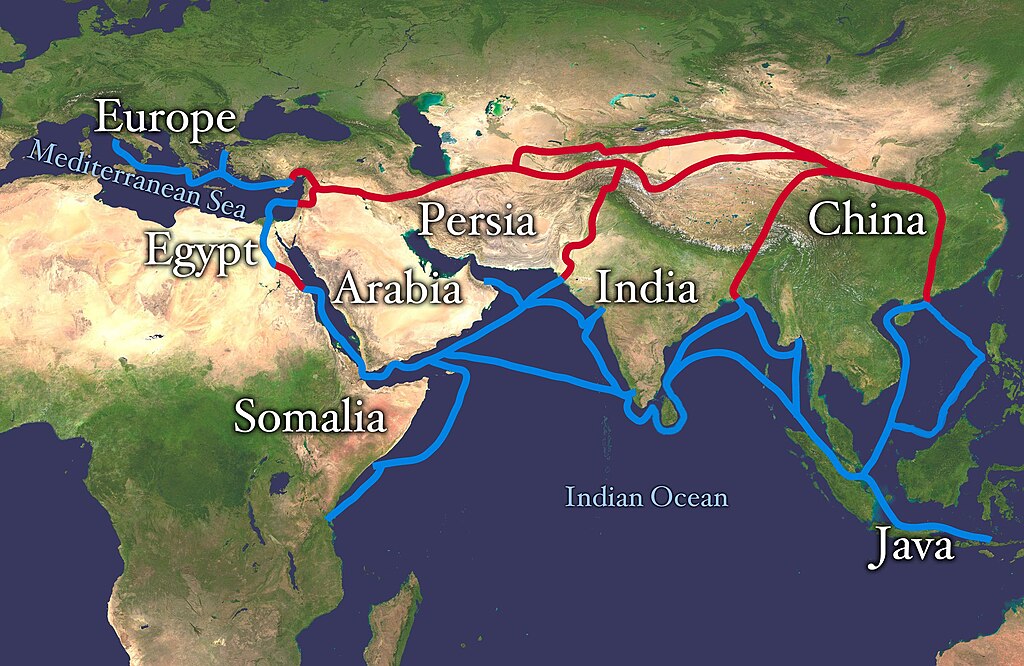 Silk Road – Wikimedia
As we reported on last month, the impact of religious festivals on the gold market is monitored all over the world. We can expect to see similar changes and dynamics come the arrival of the Sharia Gold Standard. However, this is an entire financial market that will coming into the physical gold market. Unlike with religious festivals etc, we will see an increase in the number of structured, well-marketed and regulated financial products that have been designed to offer physical gold to sophisticated investors including high net worth (HNW), ultra high net worth (UHNW) and indeed family offices.
This will not only impact the physical gold market, but it will impact the current roles in price discovery and how 1.6 billion people choose to invest in and hold gold coins and bars.
To us, this could not have come at a more pertinent time. The West is coming under increasing economic and political pressure as the ‘Silk Road’ nations of the Middle East and Far East, including Russia and China, continue their rise and become more powerful. It is without surprise that the Silk Road nations continue to assert their independence from western dominance and monopoly – including in financial markets. And it is with even less surprise that they are doing this through gold.
Gold and Silver Bullion – News and Commentary
Gold prices firm as dollar retreats from 14-year high (Reuters.com)
Asian markets slip as oil prices fall (MarketWatch.com)
Gold price ‘will be just fine’, says fund manager (TheWeek.co.uk)
Much-feared pensions time bomb is now exploding for 600,000 workers (Independent.ie)

What’s Next for Gold? (GoldSeek.com)
Gold Price Skyrockets in India after Currency Ban – Part II (Acting-Man.com)
Gold Not Driven by Inflation But Real Rates – Audio (Bloomberg.com)
Trump & The Financial Markets The Next Four Years (MarketOracle.co.uk)
Why Italy is the next country to fall to Trumpism – McWilliams (DavidMCWilliamns.ie)

Gold Prices (LBMA AM)
17 Nov: USD 1,232.00, GBP 9,988.19 & EUR 1,148.10 per ounce
16 Nov: USD 1,225.70, GBP 9,984.36 & EUR 1,144.68 per ounce
15 Nov: USD 1,228.90, GBP 998.86 & EUR 1,138.70 per ounce
14 Nov: USD 1,222.60, GBP 997.80 & EUR 1,136.53 per ounce
11 Nov: USD 1,255.65, GBP 999.19 & EUR 1,154.45 per ounce
10 Nov: USD 1,280.90, GBP 1,034.07 & EUR 1,175.48 per ounce
09 Nov: USD 1,304.55, GBP 1,050.42 & EUR 1,176.84 per ounce
Silver Prices (LBMA)
17 Nov: USD 17.04, GBP 13.65 & EUR 15.87 per ounce
16 Nov: USD 16.95, GBP 13.64 & EUR 15.85 per ounce
15 Nov: USD 17.00, GBP 13.68 & EUR 15.80 per ounce
14 Nov: USD 17.20, GBP 13.73 & EUR 15.95 per ounce
11 Nov: USD 18.59, GBP 14.73 & EUR 17.09 per ounce
10 Nov: USD 18.75, GBP 15.11 & EUR 17.20 per ounce
09 Nov: USD 18.81, GBP 15.12 & EUR 16.96 per ounce
Recent Market Updates
– Peak Gold Globally – “Bullish For Gold”
– Gold Price Should Go Higher On Global Risks and Trump – Capital Economics
– President Trump – Why Market Loves Him and Experts Wrong
– ‘Helicopter Money President’ Trump To Create Inflation and Gold Will Rise
– Central Bank Gold Demand continues in Q3
– Trump Victory Sends Gold Surging 5%
– An uncertain election outcome looks good for gold
– Ignore past elections, this one’s too uncertain
– Gold may be the only winner in US elections
– The London Gold Market – ripe for take-over by China?
– Diwali, Gold and India – Is Love Affair Over?
– Silver Krugerrands By South African Mint Coming Soon – Massive Clearance Sale on Gold Krugerrands
– Trump “Will Probably Win” and Gold “May Rise $100” Overnight – Rickards
END
Axel Merk gives his assessment on gold once Trump comes into office
(courtesy Axel Merk/MerkInvestiments.com)
Axel Merk On Gold – What Happens Next?
Submitted by Axel Merk via MerkInvestments.com,
After an initial surge in the hours after Donald Trump’s election, the price of gold has been under pressure. To gauge what’s ahead for the yellow metal, we dissect the forces that may be at play.

We have argued in the past that for investors to consider any investment, including gold, in their portfolio, it needs to satisfy two conditions: it needs to exhibit low correlation to their existing investments; and there should be an expectation of a positive return. Let’s evaluate the changing investment landscape for gold in the context of the election:
Gold as a diversifier?
Since 1971, the price of gold has had a zero correlation to the S&P 500 index based on our analysis (-0.016 based on daily returns, to be precise). From that point of view, gold may be a long-term diversifier. That said, there are times when the correlation is positive; others when it is negative:

The traditional way to look at a portfolio is one that contains both equities and bonds. As such, let’s also look at the correlation of gold versus bonds: since 1971, that correlation is 0.024, i.e. also quite low. However, if you look at the chart below, you will see that the correlation to bonds has been at historical highs of late:

We will talk more about bonds below when we discuss fundamental drivers, but as far as whether the relatively high correlation to bonds of late will persist – if history is any guide, it may well fizzle out rather soon.
Differently said, when it comes to gold as a diversifier, we believe the long-term case is strong, but some investors may not appreciate it when correlations to equities or bonds flares up.
In the past, we have said gold may well be one of the ‘easiest’ diversifiers, meaning gold is easier to wrap one’s head around than, say, a long/short equity or currency strategy that, by design, may also have a near zero correlation to other asset classes. But that ‘easy’ diversification comes with a price: the low correlation isn’t stable, and there are times when correlation can be elevated.
Gold in a market downturn
Staying on the theme of gold as a potential diversifier, the price of gold has had a positive return in each bear market in equities since 1971, with the notable exception of what I might call the Volcker-induced bear market when interest rates were rose substantially:

We will talk about interest rates in a second, but let me explain a fundamental reason why gold might have performed well in each of these bear markets: in an era where “risk premia” are compressed, i.e. where prices of risky assets – be that junk bonds or equity prices – are elevated, we believe those prices are vulnerable should risk premia rise once again. That is, if for whatever reason, the market is allowing risk once again to be priced more highly into assets, it could provide major headwinds to both stocks and bonds. As a result, gold, with its low correlation to risk assets, might shine in a bear market.
Gold to provide positive returns?
While investors may appreciate diversification, they may appreciate positive returns even more. We have had a notable selloff in bonds since the election; and, as one can see from above, the price of gold has, of late, been correlated to those of bonds. So what is going on?
We have often argued that the biggest competitor to gold is cash: if investors get properly compensated for holding cash, the case to hold gold, an unproductive asset, is reduced. A “proper” compensation for cash may be an acceptable real interest rate on cash.
Currently, real interest rates, i.e. interest rates net of inflation, are close to zero (let’s sidestep the discussion whether any particular metric of inflation fully reflects cost of living increases). The question then is to what extent will a Trump presidency change that. Two of the major themes that come to mind are infrastructure spending and less regulation:
- Infrastructure spending. We believe a) Trump will get at least some infrastructure spending done, and b) that it will be inflationary. Trump is a deal maker, so he may well promise some Senator their favorite bridge to nowhere if he will let him build his wall. This is a simplified way of saying that in Washington, it should be possible to spend money by making promises across the aisle, even if budget conscious Republicans object. In an environment where unemployment is already low, we believe this will induce wage inflation. Last time we checked, the government is usually not the most efficient in allocating resources, i.e. a fiscal spending program may foremost increase the deficit. Incidentally, we observe that currencies of countries where inflation ticks up often rise versus peers; while that may sound counter-intuitive, the reason is that investors assume central banks will counter inflationary pressures with higher interest rates. As such, if one believes the Fed will be “ahead of the curve”, i.e. hike interest rates before inflation picks up, that would be a negative for gold. If, however, investors believe that the Fed will fall further “behind the curve,” we believe there’s a good chance gold will do well, even as nominal rates move higher.
- Even if Congress doesn’t pass legislation as President Trump proposes, he should have substantial influence on how agencies are run, suggesting that he should be able to execute on his promise to reduce the regulatory burden on business. If history is any guide, the pendulum is unlikely to swing quite as much as hoped for (or feared – depending on where one stands on this debate); however, on the margin, this should be a positive for investments. One of the reasons the long-term bonds have yielded so little is because businesses have preferred to purchase financial assets (e.g., share buybacks) rather than invest in real business. As such, to the extent that the selloff in the bond market reflects that businesses would now rather invest in new ventures (rather than the prospect of higher inflation), we believe it is negative for the price of gold.
There’s also the proposed tax cut; we’ll have to see to what extent what is on the drawing board can be implemented, but any simplification of the tax code might also encourage investment.
We have not seen Trump propose any serious fix to what may be the soaring cost of entitlements. That is, even before additional fiscal spending proposed by President-elect Trump, deficits may balloon in a few years.
What we haven’t mentioned is the potential impact of a trade war. At this stage, the market appears to suggest that Trump might back off from his anti-trade rhetoric. The reason we think so is because we think the dollar is vulnerable in a trade war; that’s because we need foreigners to finance U.S. deficits; the U.K. is the latest example of a country that relies on financing from abroad to have seen its currency suffer when trade barriers have risen (a vote for “Brexit” suggests the introduction of trade barriers). The dollar might not decline versus the Mexican peso or other emerging market currencies, but it may well decline versus major currencies and gold.
So what will happen to the price of gold?
We expect to see a battle of the various forces discussed above. For now, the market may be pricing in stronger real growth through less regulation, with a Fed able to raise interest rates as the economy strengthens. In many ways, we have seen this movie before, with the market anticipating a rate hike due to improving fundamentals.
The problem is that we have such a leveraged economy, that higher bond yields and the anticipation of higher rates may well cause risk premia to rise, i.e. volatility in the market to increase, possibly toppling over equity prices. The associated volatility may cause ‘financial conditions to deteriorate’ as the Fed likes to put it, causing them to back off from any hawkish plans. That is, the anticipation of higher real rates may fizzle out yet again, providing support for the price of gold.
And aside from higher rates being a source of market volatility, it may well be that Trump policies themselves, such as the introduction of trade barriers, may cause volatility to rise and gold to benefit.
In short, if investors believe the future is bright, with businesses increasing investments and with the Fed’s magic wand doing wonders to keep inflationary pressures just right without causing too much of a stir, gold might not rise in value.
If however, investors believe that this tug of war between the different forces will ultimately get the Fed to be ‘behind the curve,’ i.e. inflationary pressures to increase; or if investors believe the stock market might experience another bear market, then gold may continue to be a worthy diversifier.
For those who believe that this will be a repeat of Reaganomics, we would like to caution that Reagan came into office when unemployment was much higher and with a most hawkish Federal Reserve Chair.
Finally, in addition to all of the above, the Fed continues to sit on a huge balance sheet; that balance sheet hasn’t been a problem with lackluster growth; but we see major challenges ahead for both stocks and bonds if indeed we get significant growth out of the Trump policies. We shall dive into these risks more in a future analysis.
We don’t have a crystal ball, but we believe in prudent risk management. As such, we encourage investors to assess the risks of certain scenarios unfolding. If we then add to that the fact that gold has a low correlation to bonds and equities, we believe investors may want to consider including gold in a prudent asset allocation.
end
Brad Hoppmann publishing for the Weiss Research group elaborates on the western gold suppression scheme
a must read..
(courtesy brad Hoppmann/GATA)
Uncommon Wisdom Daily cites GATA in report on gold price suppression
Submitted by cpowell on Thu, 2016-11-17 15:51. Section: Daily Dispatches
10:54a ET Thursday, November 17, 2016
Dear Friend of GATA and Gold:
Brad Hoppmann, publisher of the Uncommon Wisdom Daily letter published by Weiss Research, this week elaborated on his view of the Western gold price suppression scheme, citing GATA’s work and that of London metals trader Andrew Maguire and outlining what he sees as China’s plan to take control of the international gold market. Hoppman’s report is headlined “Operation Shanghai Gold” and is posted at Uncommon Wisdom Daily’s internet site here:
http://www.uncommonwisdomdaily.com/reports/cfk/shanghai/v1/?&p=2
CHRIS POWELL, Secretary/Treasurer
Gold Anti-Trust Action Committee Inc.
CPowell@GATA.org
end
Your early THURSDAY morning currency, Asian stock market results, important USA/Asian currency crosses, gold/silver pricing overnight along with the price of oil Major stories overnight
:
1 Chinese yuan vs USA dollar/yuan UP to 6.8695(SMALL REVALUATION NORTHBOUND /CHINA UNHAPPY TODAY CONCERNING USA DOLLAR RISE/MORE $ USA DOLLARS LEAVE CHINA/OFFSHORE YUAN NARROWS TO 6.8856 / Shanghai bourse CLOSED UP 3.39 POINTS OR 0.11% / HANG SANG CLOSED DOWN 17.65 OR 0.08%
2. Nikkei closed UP 0.40 points or 0.01% /USA: YEN RISES TO 109.12
3. Europe stocks opened ALL IN THE GREEN EXCEPT GERMANY ( /USA dollar index DOWN to 100.03/Euro UP to 1.0730
3b Japan 10 year bond yield: FALLS TO +.011%/ !!!!(Japan buying 100% of bond issuance)/Japanese yen vs usa cross now at 107.65/ THIS IS TROUBLESOME AS BANK OF JAPAN IS RUNNING OUT OF BONDS TO BUY./JAPAN 10 YR YIELD FINALLY IN THE POSITIVE
3c Nikkei now JUST BELOW 17,000
3d USA/Yen rate now well below the important 120 barrier this morning
3e WTI:: 46.24 and Brent:47.49
3f Gold UP /Yen DOWN
3g Japan is to buy the equivalent of 108 billion uSA dollars worth of bond per month or $1.3 trillion. Japan’s GDP equals 5 trillion usa./“HELICOPTER MONEY” OFF THE TABLE FOR NOW /REVERSE OPERATION TWIST ON THE BONDS: PURCHASE OF LONG BONDS AND SELLING THE SHORT END
Japan to buy 100% of all new Japanese debt and by 2018 they will have 25% of all Japanese debt. Fifty percent of Japanese budget financed with debt.
3h Oil UP for WTI and UP for Brent this morning
3i European bond buying continues to push yields lower on all fronts in the EMU. German 10 yr bund FALLS TO +.298%
3j Greek 10 year bond yield FALLS to : 7.38%
3k Gold at $1229.30/silver $17.02(7:45 am est) SILVER BELOW RESISTANCE AT $18.50
3l USA vs Russian rouble; (Russian rouble UP 32/100 in roubles/dollar) 64.43-
3m oil into the 45 dollar handle for WTI and 46 handle for Brent/
3n Higher foreign deposits out of China sees huge risk of outflows and a currency depreciation (already upon us). This can spell financial disaster for the rest of the world/China forced to do QE!! as it lowers its yuan value to the dollar/GOT a SMALL REVALUATION UPWARD from POBC.
JAPAN ON JAN 29.2016 INITIATES NIRP. THIS MORNING THEY SIGNAL THEY MAY END NIRP. TODAY THE USA/YEN TRADES TO 109.12 DESTROYING WHATEVER IS LEFT OF OUR YEN CARRY TRADERS
30 SNB (Swiss National Bank) still intervening again in the markets driving down the SF. It is not working: USA/SF this morning 1.00 as the Swiss Franc is still rising against most currencies. Euro vs SF is 1.0737 well above the floor set by the Swiss Finance Minister. Thomas Jordan, chief of the Swiss National Bank continues to purchase euros trying to lower value of the Swiss Franc.
3p BRITAIN VOTES AFFIRMATIVE BREXIT
3r the 10 Year German bund now POSITIVE territory with the 10 year FALLS to +.298%
/German 9+ year rate BASICALLY negative%!!!
3s The Greece ELA NOW at 71.4 billion euros,AND NOW THE ECB WILL ACCEPT GREEK BONDS (WHAT A DISASTER)
The bank withdrawals were causing massive hardship to the Greek bank. the Greek referendum voted overwhelming “NO”. Next step for Greece will be the recapitalization of the banks and that will be difficult.
4. USA 10 year treasury bond at 2.224% early this morning. Thirty year rate at 2.944% /POLICY ERROR)
5. Details Ransquawk, Bloomberg, Deutsche bank/Jim Reid.
(courtesy Jim Reid/Bloomberg/Deutsche bank/zero hedge)
BOJ “Fires Warning At Bond Market” Sending Global Yields, Dollar Lower; All Eyes On Yellen
Yesterday morning we noted why, in light of the ongoing global bond rout, all eyes would be on the BOJ, and specifically whether Kuroda would engage his “Yield control” operation to stabilize the steepness of the JGB yield curve and implicitly support global bond yields in what DB said would be “full blown helicopter money” where the “BoJ is flying the copter over the US and may be about to become the new US government’s best friend.” And sure enough that is precisely what Kuroda did last night after the Bank of Japan “fired a warning at the bond market” as Bloomberg described it, offering to buy an unlimited amount of debt at fixed yields for the first time, an operation meant to maintain the central bank’s yield-curve target and which stopped the bleeding not only across Japanese but also global bonds, in the process pushing the dollar lower.
The central bank announced two operations: 1. buy two-year notes at minus 0.09 percent, and 2. five-year debt at minus 0.04 percent. That came after two-year yields rose as high as minus 0.095 percent on Wednesday, up 18 basis points in five days. The BOJ introduced the tools after deciding in September it would control the yield curve. As Bloomberg notes, the so-called fixed-rate operation yielded no bids, a sign that the move was more of a demonstration exercise than an intended transaction in notes. Officials acted amid relative calm in the market, but in the wake of a global bond sell-off in the past week that had driven up yields across the globe — and in the process put pressure on Japanese government bonds as well. “It’s a surprise that the BOJ took action today,” said Souichi Takeyama, a rates strategist at SMBC Nikko Securities Inc. in Tokyo, a unit of Japan’s second-biggest lender. “Markets won’t test levels above these fixed rates as these will be seen as reflecting the BOJ’s upper limit.”

“The aim is to send a warning to markets about a significant surge in rates,” said Keiko Onogi, a fixed-income strategist at Daiwa Securities Co. in Tokyo. At the same time, “there are questions as to why the BOJ conducted this operation now, when the market had already stabilized after the surge in yields to yesterday,” she said.
“The BOJ will have welcomed the rise in Japanese stocks and decline in the yen following the Trump Shock, but they’ve shown they aren’t going to stand for a jump in JGB yields,” said Naoya Oshikubo, a rates strategist at Barclays Plc in Tokyo. “It’s the strength of that stance rather than the actual levels at which the BOJ offered to buy the debt that’s pulling down yields.”
The BOJ operation helped halt a five-day selloff in Japanese bonds, and government securities advanced from Australia to Germany, together with U.S. Treasuries. The euro strengthened for the first time in nine days as Bloomberg’s dollar index slipped from a nine-month high. Crude reversed declines as OPEC and Russia prepared to meet in Doha for more talks. European shares were little changed, and Asian equities rose with Japan’s Topix measure closing on the brink of a bull market.
In the US traders are walking to their desks, awaiting testimony from Federal Reserve Chair Janet Yellen before the Joint Economic Committee that will help shape the outlook for interest rates: focus will be on her comments about the December rate hike and the speed of future moves as financial conditions have materially tightened in recent days.
A December increase is now all but assured by the futures market which gives it a 94% probability, while prospects for further tightening triggered a global bonds rout and boosted the dollar since the start of last week.

“From the BOJ operation, it looks like it’s a firmer cap on yields than was previously being expected, so that’s supportive for fixed-income globally, ” said Peter Chatwell, head of rates strategy at Mizuho International Plc in London. “It means that the other markets can trade with a bit less of downside risk, or downside fear.”
Japan’s intervention eased the Bloomberg Dollar Spot Index, which was down 0.2 percent. The yen rose 0.1 percent to 108.95 per dollar, but is still down more than 3 percent since Trump’s victory. The euro strengthened 0.3 percent against the dollar, halting an eight-day losing streak. The pound gained for the first time in four days as figures from the Office for National Statistics showed U.K. spending remained robust despite the Brexit vote.
Crude gained 0.4 percent to $45.76 a barrel in New York as Saudi Arabia and some other OPEC nations meet with Russia for informal talks without oil ministers from Iran and Iraq, the two countries that pose the biggest hurdle to an output deal. Russia will hold discussions with representatives from the Organization of Petroleum Exporting Countries in Doha from Thursday, Energy Minister Alexander Novak said.
The Stoxx Europe 600 Index added 0.1 percent. While the gauge has remained calm in recent days, it has alternated between intraday gains and losses for eight straight sessions, the longest streak in two years. Its valuation of about 14 times estimated earnings is at its lowest since Brexit relative to a measure tracking global shares. S&P 500 futures were little changed after the gauge slipped 0.2 percent on Wednesday. It closed within 0.6 percent of the record reached in August, while the Dow Jones Industrial Average slipped 0.3 percent from the all-time high it reached on Tuesday. The Russell 2000 Index of small-cap shares closed at a peak.
Among stocks moving on corporate news:
- Zurich Insurance Group AG gained 2.7 percent after saying it will increase its dividend and cut costs.
- Royal Ahold Delhaize NV declined 3.1 percent as its quarterly profits missed analyst projections.
- ABN Amro Group NV fell 3.1 percent after the Dutch state sold 65 million of its shares.
- Cisco Systems Inc. lost 4.4 percent in early New York trading after projecting sales and profit pointing to a slowdown in corporate spending on technology hardware.
Treasury 10-year yields fell three basis points to 2.19 percent at 9:19 a.m. London time, retreating further from this year’s high of 2.3 percent, reached Monday, after the BOJ’s first offer to buy an unlimited amount of securities. Japanese bonds also rose after the operation, which was viewed by many as a response to the surge in global yields. 10Y German bund yields also dropped three basis points, to 0.24 percentThe U.S. government will sell TIPS on Thursday, and demand may be robust, with BlackRock Inc., Fidelity Investments and Pacific Investment Management Co. all having recommended the securities since the presidential vote on speculation that Trump’s policies will boost consumer prices.
* * *
Bulletin Headline Summary From RanSquawk
- European equities enter the North American crossover mostly lower as financial names pause for breath after recent election-inspired upside
- Some tentative signs of USD moderation in the making, with USD moderation against the EUR and JPY seeing 1.0650 and 110.00 levels respectively held
- Looking ahead, highlights include UK retail sales, EU & US CPI, ECB minutes, US weekly jobless data, housing starts & Philadelphia Fed Manufacturing Index & a host of Fed speakers
Global Market Wrap
- S&P 500 futures up 0.1% to 2175
- Stoxx 600 up 0.1% to 339
- FTSE 100 up 0.3% to 6770
- DAX down 0.3% to 10629
- German 10Yr yield down 2bps to 0.28%
- Italian 10Yr yield down 2bps to 2.02%
- Spanish 10Yr yield down 2bps to 1.52%
- S&P GSCI Index up 0.2% to 358.3
- MSCI Asia Pacific up 0.3% to 135
- Nikkei 225 up less than 0.1% to 17863
- Hang Seng down less than 0.1% to 22263
- Shanghai Composite up 0.1% to 3208
- S&P/ASX 200 up 0.2% to 5339
- US 10-yr yield down 3bps to 2.2%
- Dollar Index down 0.29% to 100.12
- WTI Crude futures up 0.2% to $45.66
- Brent Futures up 0.2% to $46.72
- Gold spot up 0.2% to $1,227
- Silver spot up 0.3% to $17.04
Top Headline News
- Apple Wants OLED in iPhones, But Most Suppliers Aren’t Ready Yet: Display makers seen struggling to meet iPhone output in 2017
- Apple Is Said To Cut Fees Video Services Will Pay for App Store
- Dimon Told Trump Team He Has No Interest in Treasury: Fortune
- Gingrich Doesn’t Want Formal Role in Trump White House: Fox
- Haley, McMaster Considered for Trump Cabinet: Post and Courier
- Verizon’s Buy of Fiber Network From Icahn’s XO Wins Approval: FCC clears $1.8 billion deal, says it doesn’t harm competition
- Ahold Delhaize Profit Misses Estimates on U.S. Deflation: Price pressure erodes sales at Food Lion supermarket chain
- Gilead’s Myelofibrosis Drug Gets Mixed Results in Cancer Trials: Treatment for a rare bone marrow cancer succeeded in one trial and failed in another
- Facebook Yields to IRS Demand for Records Over Asset Transfer: IRS demands for records related to co.’s transfer of global operations to Ireland in 2010
- Sen. Cotton Plans to Offer $26b Emergency Defense Spending Bill
* * *
Looking at regional markets, we start in Asia where stocks were slightly downbeat following a lacklustre lead from Wall St, where underperformance in energy and financials weighed on sentiment and saw DJIA close negative for the first time in 8 days. Nikkei 225 (Unch) was driven by JPY fluctuations, while ASX 200 (+0.2%) closed higher amid strength in defensive stocks with weak employment data also raising doubts that RBA may not be done with its easing cycle. Shanghai Comp (+0.1%) dampened amid ongoing trade concerns, while downside in the Hang Seng (-0.3%) was stemmed by consumer names and banks. 10yr JGBs gained with outperformance seen in the short-end after the BoJ announced to purchase an unlimited amount of bonds ranging from 1yr-5yr maturities at fixed rates which suggested an intent to cap yields if needed, although the BoJ found no takers and some gains were later pared following a weaker 20yr auction in which the b/c and average price fell from the prior month.
Japanese cabinet advisor Fujii stated he wants additional fiscal stimulus in 2017 and would like JPY 21trl added to the primary budget in the next fiscal year and in the following years thereafter.
Top Asian News
- JPMorgan Said Set to Pay $200 Million in China Hires Settlement: Non-prosecution deal reflects bank’s cooperation with inquiry
- Yuan Watchers Lower Forecasts as Trump Victory Raises Risks: Currency may weaken to 7 per dollar early next year
- Philippines Posts Strongest Economic Growth in Asia at 7.1%: Nation seen as among fastest-expanding in the world until 2018
- BOJ First Unlimited Bond Buys Get No Bids After Yields Retreated: BOJ announces first fixed-rate operation to buy JGBs
- Ward Ferry to Shut 15-Year-Old Asia Hedge Fund as Co-CIO Leaves: Co. will focus on long-only funds after Nash-Webber leaves
In Europe, bourses opened lower following the lead from Wall Street, as DAX (-0.2%) and EUROSTOXX (-0.2%) have both seen underperformance in financial names after a retracement from recent election-inspired gains. The Telecoms sector is the outperformer following reports of a potential merger between T-Mobile and Sprint in the US. Bond markets have also received a bid inline with general risk sentiment. In Italy the latest polls put the no vote ahead and with the referendum too close to call and as more comments filter through to the markets we must keep a close eye on eye on Italian yields particularly the short end.
Top European News
- VW Loses European Market Share as Scandal Effect Lingers: Carmaker’s October sales fell 1.8% vs. market’s 0.3% drop
- ABN Amro’s Dutch State Owner Selling 7% as Part of Exit Plan: Stock up 18% in 12 months as most European lenders have fallen
- Rio Tinto Fires Two Senior Executives Amid Payment Probe: fired two of its top executives over a payment connected to a giant iron ore project in Guinea in West Africa
- NN Group Chief Wants Delta Lloyd to Open Up to Deal Talks: NN still sees ‘strong merit’ in a combination of the firms
In FX, the Bloomberg Dollar Spot Index was down 0.2 percent. The yen rose 0.1 percent to 108.95 per dollar, but is still down more than 3 percent since Trump’s victory. The euro strengthened 0.3 percent against the dollar, halting an eight-day losing streak. The pound gained for the first time in four days as figures from the Office for National Statistics showed U.K. spending remained robust despite the Brexit vote. Malaysia’s ringgit fell for a seventh day, its longest stretch of losses in more than a year. Bank Negara Malaysia said Wednesday it will continue to restrict speculative activity in the currency market. The Vietnamese dong fell for a fourth day to a five-month low. “I’m just seeing this as overall dollar strength,” said Wu Mingze, a foreign-exchange trader in Singapore at INTL FCStone Inc., a Nasdaq-listed global payments-service provider. “Unfortunately speculators will treat Bank Negara’s statements as a sign of weakness if they do not actually do something.”
In commodities, crude gained 0.4 percent to $45.76 a barrelin New York as Saudi Arabia and some other OPEC nations meet with Russia for informal talks without oil ministers from Iran and Iraq, the two countries that pose the biggest hurdle to an output deal. Russia will hold discussions with representatives from the Organization of Petroleum Exporting Countries in Doha from Thursday, Energy Minister Alexander Novak said. There’s a high chance of an agreement and Russia is ready to support a decision, he said. Copper traded near a 17-month high in Shanghai. Jiangxi Copper Co., China’s top producer, agreed to cut processing fees for next year as mine supply is poised to be little changed and Chinese smelting capacity expands. Gold has stabilized after its U.S. election thrashing and is on course to end the week little changed, even as investors bail from bullion-backed exchange-traded funds. Prices for immediate delivery climbed 0.4 percent to $1,229.84 an ounce.
DB’s Jim Reid concludes the overnight wrap
Today the Trump story advances further with the President elect meeting his first world leader post the election with Japan’s Abe passing through town. We’ll also see Fed Chair Yellen testify before the Joint Economic Committee today – note that this is the first time we’ll hear from her following the election. We think her prepared remarks will be out at 8am EST. So potential for headlines from both events. It was also interesting that late last night Fox’s Maria Bartiromo suggested that the crucial US Treasury secretary role will be decided today (announced tomorrow) and is down to a choice between Jamie Dimon of JPM and Steve Mnuchin. The fact that Jamie Dimon is still in the race after his public comments downplaying his desire for the role would be a surprise to many but he would certainly be another appointment that Wall Street would appreciate. Indeed both potential candidates are Wall Street veterans. So one to watch over the next two days.
The most interesting news overnight is that the BoJ has announced its first operations to purchase an unlimited amount of bonds at a fixed rate following 10-year JGB yields turning positive earlier this week for the first time since the BoJ announced their desire to peg them near zero. They are carrying out two operations, one in 1-3 year maturities and another in the 3-5 year part of the curve. The operation received no bids but its the first sign that they are prepared to intervene. 10 year yields have edged back a fraction through zero as we type having traded as high as 0.035% yesterday.
As we discussed yesterday if the BoJ is serious about defending their targets in the face of rising global yields then we effectively have cross border helicopter money but with the helicopters dropping money printed in Japan over the US given Trump’s fiscal agenda. It’s an interesting backdrop to today’s meeting of the respective leaders. Trump might end up being very grateful for Japanese policy as it could help hold global yields down more than they would have been without it. Elsewhere Asian markets are relatively quiet with very little movement of note although I admit I might be too tired to spot anything significant even if there was.
A similar story was seen yesterday as markets continue to settle a little after a frenetic past week. The STOXX 600 (-0.20%) and S&P 500 (also -0.2%) both dipped though. US banks were the worst performing US sector yesterday (-2.1%), finally running out of steam following a strong post-election rally. The Dow (-0.32%) was also down for the first time since the beginning of last week.
Over in currency markets, the US dollar continued its post-election rally by gaining +0.3% and quickly erasing yesterday’s dip. Commodity markets were broadly down, with WTI and Brent falling by -0.7% and -1.0% respectively and copper down -0.6%. Gold was marginally lower on the day as it continued its string of losses (down -4.4% since the beginning of last week).
European credit markets were also down as iTraxx Main and Crossover both widened by +1bps on the day. Over in the US we saw CDX IG hold steady while CDX HY widened by +5bps on the day.
Turning to the other end of the risk spectrum, German 10Y yields dropped by -1bps on the day while US 10Y yields saw some big intraday swings that saw yields rise and fall by nearly +8bps and -2bps respectively before ending the day flat. The US curve also flattened somewhat as the US 2Y ticked up +1bp while the 30Y dropped by -4bps. Markets in general continue to price in a December Fed hike with near certainty, with the implied probability around 94% (unchanged from yesterday).
On the topic of rate hikes, one of the key questions surrounding Trump’s unexpected election victory last week was regarding the impact his policies may have on the Fed in the year ahead. DB’s GEP team focuses on one specific area of this issue – what appropriate Fed policy would look like given Trump’s policy mix. They find that a much faster pace of rate hikes are certainly implied under the new administration – even under a relatively conservative assessment the team finds that Yellen’s preferred Taylor rule would imply that the Fed should pursue one more rate hike next year than they currently expect. Under a more optimistic scenario (in which US growth rises to around 3% in 2017) the appropriate fed funds rate would be about 75bp higher than the Fed’s current expectations. However, the team notes that while a substantially faster pace of rate hikes in 2017 is a risk, this is not their base case: they believe inflation is likely to moderate early next year and the full growth benefits of Trump’s policies may not begin to be felt until the second half of the year. Hence, the Fed is likely to initially keep to their expectations for a gradual pace of rate increases, with the greater risk for faster rate hikes in late-2017 and 2018.
Another key topic of focus following Trump’s victory has been the potential for increased fiscal spending in the US – particularly infrastructure spending. While such a policy is largely expected to prove to be growth positive, there are also fears regarding how such unfunded spending may be possible without damaging the government’s fiscal position. However, a Bloomberg news story yesterday noted that the Trump administration is exploring ways of establishing an ‘infrastructure bank’ to fund such planned infrastructure investments. Depending on its structure, such an entity could potentially provide a way to accommodate increased spending and investment while managing the impact on the government balance sheet. Trump’s policy mix so far has had its share of unknowns (note the campaign team derided a similar policy from Clinton) and so this development might be worth following.
Another piece of political news out yesterday was that Emmanuel Macron officially confirmed his plan to run for French presidency as an independent. While Macron’s candidacy for next year’s election was expected, it does introduce further uncertainty into the race as it may further fragment the electorate. DB’s France economist Marc de-Muizon discussed Macron’s potential candidacy (among other political issues) in a report published last month and noted that his position was more difficult than his high popularity ratings suggested.
Taking a look now at some of the data out today, we saw the September and October employment report from the UK which was a bit of a mixed bag. The ILO unemployment rate for September came in marginally better than expected at 4.8% (vs. 4.9% expected; 4.9% previous). However there remain signs that the labour market may be cooling as the employment change numbers for September came in below expectations at 49k (vs. 91k expected; 106k previous) and jobless claims numbers for October ticked up to 9.8k (vs. 2.0k expected) with September being revised up to 5.6k as well (0.7k before revision). Average weekly earnings growth for September was unchanged and marginally below expectations at +2.3% (vs. +2.4% expected; +2.3% previous).
In the US data slightly disappointed. Wholesale prices for October were unexpectedly unchanged on the month (PPI +0.0% mom) and below expectations of a +0.3% increase. Industrial production was flat and below expectations in October (+0.2% expected), while the September number was revised down to -0.2% (vs. +0.1% before revision). Capacity utilization in October also ticked down and came in marginally below expectations at 75.3% (vs. 75.5% expected; 75.4% previous). The NAHB housing market index for November however did hold stable and come in as expected at 63.
Looking at the data calendar for the day ahead now, we kick off in France where we get the Q3 employment numbers, with the headline unemployment rate (9.9% expected; 9.9% previous) expected to remain unchanged. Thereafter we turn to the UK where we will see the October retail sales numbers (+0.4% mom expected; 0.0% previous). Thereafter we will see the final October CPI numbers for the Eurozone where no revisions are expected (+0.5% YoY expected).
Over in the US, the key data to watch will be the October inflation report with headline CPI expected to tick up (+0.4% mom expected; +0.3% previous). In terms of labour market data we will get the initial jobless claims numbers for last week (257k expected; 254k previous) and the continuing claims from the week before (2030k expected; 2041k previous). We will also see the Housing starts (1156k expected; 1047k previous) and the Building Permits numbers (1195k expected; 1225k previous) for October, and finally round out the day with the Philadelphia Fed PMI for November (7.8 expected; 9.7 previous).
Away from data, we continue on a busy week for Fedspeak. As already noted above, Fed Chair Yellen will testify before the Joint Economic Committee today – the first time we’ll hear from her following the US elections. We will also hear from Brainard in New York. The other event to note for today is the scheduled meeting between US President-elect Trump and Japanese PM Abe
3.REPORT ON JAPAN SOUTH KOREA NORTH KOREA AND CHINA
i)Late WEDNESDAY night/THURSDAY morning: Shanghai closed UP 3.39 POINTS OR 0.11%/ /Hang Sang closed DOWN 17.65 OR 0.08%. The Nikkei closed UP 0.40 points or 0.01%/Australia’s all ordinaires CLOSED UP 0.17% /Chinese yuan (ONSHORE) closed UP at 6.8695/Oil ROSE to 46.24 dollars per barrel for WTI and 47.49 for Brent. Stocks in Europe: ALL IN THE GREEN EXCEPT GERMAN DAX Offshore yuan trades 6.8856 yuan to the dollar vs 6.8790 for onshore yuan.THE SPREAD BETWEEN ONSHORE AND OFFSHORE NARROWS AS MORE USA DOLLARS ATTEMPT TO LEAVE CHINA’S SHORES / CHINA SENDS A CLEAR MESSAGE TO THE USA AND JANET TO NOT RAISE RATES IN DECEMBER.
3a)THAILAND/SOUTH KOREA/:
none today
b) REPORT ON JAPAN
The Yen tumbles after Kuroda admits that they lost control of the yield curve. You will note that Kuroda has set a policy of zero rate policy for the 10 yr Japanese bonds. In other words they will buy unlimited bonds at the zero rate. At first, it was viewed as a taper, but now it sure looks like a helicopter money created with the potential for unlimited bond buying. For now that stabilized the rocketing yields in Japan and for that matter around the world but how long before this is tested
(courtesy zero hedge)
Yen Tumbles After Kuroda Admits Lost Control Of JGB Market
We warned last night that the runaway yields on Japanese Government Bonds were a worrisome signal that the Bank of Japan had lost control (as short-dated yields rose above target and 10Y broke above policy 0.00% levels). Sure enough, it appears Kuroda hit the panic button tonight as it announced its first fixed-rate unlimited bond purchase operation.
Simply put this is a government guarantee to bid on any and all offers for short-dated bonds at their mandated yield level until the selling abates.
Yen tumbled..

And bond yields obeyed – dropping back to BOJ policy levels for now…

As Bloomberg reporets, the central bank said on Thursday in statements it will carry out two operations, one to buy securities maturing in one to three years, and another for debt of three to five years maturity.
A selloff in Japanese bonds had threatened to test Governor Haruhiko Kuroda’s determination to keep yields stable with unlimited debt purchases — a weapon he had so far kept in reserve. He had said in September that the bank would hold unlimited purchases as needed, setting a fixed rate, in order to control yields.
Ten-year sovereign yields turned positive this week for the first time since Sept. 21, when the Bank of Japan announced a shift in policy aimed at pegging them near zero percent. Kuroda added the option of holding purchase operations at fixed rates with no set amount to his toolkit following that decision.
“The market is testing the BOJ’s tolerance for higher yields, but the BOJ may actually challenge the market back by letting yields rise,” Jun Fukashiro, a senior fund manager in Tokyo at Sumitomo Mitsui Asset Management, said earlier. “The reason the BOJ can allow a rise in yields above zero is that, when it needs to, it has the weapons to stop it.”
Confusion Reigns Ahead Of Trump’s Meeting With Japanese Prime Minister
Having previously met with Nigel Farage and gotten a congratulatory phone call from Vladimir Putin, together followed by a more cautious, “warning” greeting from China president Xi Jinping, today the Trump story advances with the President-elect meeting his first world leader post the election with Japan’s Abe passing through town.
On the surface, the diplomatic talking point are familiar: Abe said on Thursday that he wants to build a relationship of trust when he meets Trump, stressing that the two-way alliance is the core of Tokyo’s diplomacy and security. The U.S.-Japan alliance “is the cornerstone of Japan’s diplomacy and security. Only when there is trust does an alliance come alive,” Abe told reporters before leaving Tokyo, Kyodo news agency reported.
However, before any “cornerstones” are rededicated, there appears to be a problem: as Reuters reports, details about the meeting remain unclear, with Trump’s transition team not responding to requests for comment on the meeting. As of last night, Japanese officials said they had not finalized when or where in New York it would take place, who would be invited, or in some cases whom to call for answers. Perhaps Abe will make an appearance at the Trump Tower?
Trump has spurred worries in Tokyo and beyond with his comments on the possibility of Japan acquiring nuclear arms and demands that allies pay more for the upkeep of U.S. forces on their soil or face the possibility of their withdrawal.
“Prime Minister Abe will definitely talk about the importance of the Japan-U.S. alliance and that alliance is not only for Japan and the United States, but also for the entire Indo-Pacific region as well as world politics,” Abe adviser Katsuyuki Kawai told Reuters. Kawai said he had spoken to several Trump advisers and lawmakers since arriving in Washington on Monday and had been told “we don’t have to take each word that Mr. Trump said publicly literally”.
The Trump adviser said he expected Trump would reaffirm “the American commitment to being in the Pacific long-term.” The adviser said Japan’s financial support for U.S. troops in Japan might come up but was unlikely to be a focus.
An adviser to Trump, speaking anonymously because he was not authorized to speak to media, told Reuters earlier this week that Trump would seek to reassure Abe and other Asian allies rattled by his campaign rhetoric.
Even if the two leaders find a quiet corner in which to speak, it is unlikely that much progress will be made: before Trump makes key cabinet appointments, it will be hard to assess his policies on issues ranging from overseas deployments of U.S. troops, China’s maritime aggressiveness in Asia and North Korea’s nuclear threat.
Additionally, unlike Trump’s meeting with Farage, there are key difference between Abe, a political blue blood and veteran lawmaker, and Trump, a brash outsider with no diplomatic or government experience. Trump’s election also has dashed hopes for U.S. approval of a 12-nation trade pact, the Trans-Pacific Partnership (TPP), a linchpin of Washington’s “pivot” to Asia and a pillar of Abe’s economic reforms. It has also shifted the political balance of power in Asia in China’s court, a transition which has alarmed the Abe cabinet.
However, there is a chance that the two may also find they have much in common, including pledges to restore their countries’ global stature and a desire to counter a rising China while improving relations with Russia.
But most curious will be whether Trump will allow the press to be present: the early “relations” between the president-Elect and the media which widely panned his presidential chances indicate substantial tension, and it is possible that relations between the two camps will only escalate in the coming days.
c) Report on CHINA
CHINA/SAUDI ARABIA/USA TREASURIES
I brought this to your attention yesterday and it is will worth repeating!!
.
This is huge: both Saudi and China are dumping massive quantities of treasuries. In September a total of $76 billion were sold. Up until last month only private investors were buying the stuff and they seemed to have gorged on the stuff. And now yields are rising!! And Trump is going on a fiscal spending spree of which the Fed cannot monetize?
Janet may not raise rates in December.
(courtesy zero hedge)
Saudis, China Dump Treasuries; Foreign Central Banks Liquidate A Record $375 Billion In US Paper
One month ago, when we last looked at the Fed’s update of Treasuries held in custody, we noted something troubling: the number had dropped sharply, declining by over $22 billion in one week, one of the the biggest weekly declines since January 2015, pushing the total amount of custodial paper to $2.805 trillion, the lowest since 2012. One month later, we refresh this chart and find that in last week’s update, foreign central banks continued their relentless liquidation of US paper held in the Fed’s custody account, which tumbled by another $14 billion over the course of a week, pushing the total amount of custodial paper to $2.788 trillion, a new post-2012 low.

Then today, in addition to the Fed’s custody data, we also got the latest monthly Treasury International Capital data for the month of September, which showed that the troubling trend presented one month ago, has accelerated. Recall that a month ago, we reported that in the latest 12 months we have observed a not so stealthy, actually make that a massive $343 billion in Treasury selling by foreign central banks in the period July 2015- August 2016, something unprecedented in size.
Fast forward to today when in the latest monthly update for the month of September, we find that what until a month ago was “merely” a record $346.4 billion in offshore central bank sales in the LTM period ending August 31 has – one month later – risen to a new all time high $374.7 billion, or well over a third of a trillion in Treasuries sold in the past 12 months.

Among the biggest sellers – on a market-price basis – not surprisingly was China, which in August “sold” $28 billion in US paper (the actual underlying number while different, as this particular series is adjusted for Mark to Market variations, will be similar), the biggest monthly dump going back to 2012, and bringing its total to $1.157 trillion, the lowest total since 2012.

It wasn’t just China: Saudi Arabia also continued to sell its TSY holdings, and in August its stated holdings (which again have to be adjusted for MTM), dropped from $93Bn to $89Bn, the lowest since the summer of 2014. This was the 8th consecutive month of Treasury sales by the Kingdom, which held $124 billion in TSYs in January, and has since sold nearly 30% of its US paper holdings.

As we pointed out one month ago, what is becoming increasingly obvious is that both foreign central banks, sovereign wealth funds, reserve managers, and virtually every other official institution in possession of US paper, is liquidating their holdings at a very troubling pace, something which in light of the action in the past week appears to have been a prudent move.
In some cases, like China, this is to offset devaluation pressure; in others such as Saudi Arabia, it is to provide the funds needed to offset the collapse of the petrodollar, and to backstop the country’s soaring budget deficit. In all cases, it may suggest concerns about a spike in future debt issuance by the US, especially now under the pro-fiscal stimulus Trump administration.
So who are they selling to? The answer, at least until last month, was private demand, in other words just like in the stock market the retail investor is the final bag holder, so when it comes to US Treasuries, “private investors” both foreign and domestic are soaking up hundreds of billions in central bank holdings. As we said last month when we observed this great rotation in Treasuries out of official holders into private hands, “we wonder if they would [keep buying] knowing who is selling to them.” Well, this month it changed, and after private investors had been happily snapping up bonds for 4 straight months, in September “other foreign investors” sold a whopping $31 billion, bringing the total outflow between public and private foreign holdings to $76.6 billion,the second highest number on record!
Meanwhile, while just three months ago yields had tumbled to near all time lows, suddenly the picture is inverted, and long-yields are surging on concerns that not only will the BOJ, the Fed, and maybe even the ECB will soon taper their purchases of the long end, but that Donald Trump is about to unleash a $1 trillion debt tsunami at a time when the Fed will not be available to monetize it.
While it is unclear under what conditions foreign buyers may come back, one thing is very clear: as of this moments the selling strike not only continues but is accelerating, and should the foreign liquidation of Treasuries fall to moderate, Yellen will have no choice but to forget about hiking rates and focus on QE4 instead.
END
4 EUROPEAN AFFAIRS
Italian bond yields rise over 2% sending a lot of investors worried about their high amount of non performing loans and the country’s high debt to GDP ( 135%)
(courtesy Mnyanda/Bloomberg)
Italy Leads Euro-Area Bond Selloff as ECB Calms QE Expectations
-
Portuguese 10-year yield climbs to highest since February
-
Benchmark German 10-year securities rise for third day
Italy’s bonds fell for a second day, leading declines among Europe’s higher-yielding sovereign securities, as European Central Bank officials sought to temper investor expectations that they will extend stimulus measures.
German 10-year bonds, the region’s benchmark government debt, rose for a third day, while those of Spain and Portugal tracked the decline in Italian securities. Three weeks before the Governing Council’s next meeting, an account of the Oct. 19-20 gathering showed that officials were keen that they didn’t create undue expectations about more quantitative easing.
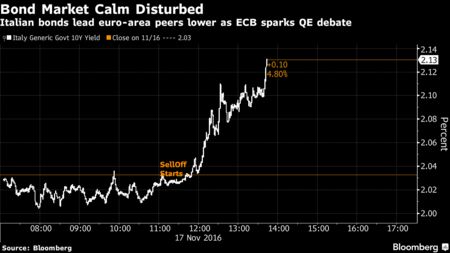
“Some of these comments have probably caused the selloff and I can understand how the market may have interpreted these to be periphery negative,” said Peter Chatwell, head of rates strategy at Mizuho International Plc in London. “Actually, my interpretation is different. The ECB has no choice but to extend QE at this point.”
Italian 10-year bond yields jumped seven basis points, or 0.07 percentage point, to 2.10 percent as of 4:05 p.m. London time. The 1.25 percent security due December 2026 fell 0.6, or 6 euros per 1,000-euro ($1,068) face amount, to 92.415. The yield jumped to 2.23 percent on Nov. 14, the highest since July 2015.
Spanish 10-year bond yields climbed six basis points to 1.60 percent and those on similar-maturity Portuguese debt reached 3.77 percent, the highest since Feb. 12. German 10-year bund yields dropped two basis points to 0.28 percent.
The ECB is due to review its 1.7 trillion-euro asset-purchase program, which is scheduled to run until at least March 2017, at its meeting on Dec. 8. It will also publish new economic forecasts through 2019. With annual inflation running at 0.5 percent, compared with the ECB’s goal of just under 2 percent, many economists predict QE will be extended.
“They will have to clarify because the March deadline is coming up,” said Luca Cazzulani, a senior fixed-income strategist at UniCredit SpA in Milan.
end
This might scare you: the only other time that the Euro dropped 9 days in a row was a few days before Lehman brothers went toast
(courtesy Citibank)
Citi: The Only Other Time The Euro Dropped 9 Straight Days Ended Very Badly
We end the trading day with a disturbing observation from CitiFX’ Brent Donnelly.
According to the Citi FX strategist, “only once in its 17-year lifetime has EURUSD gone down 9 days in a row. This was when it went down 11 days in a row, bottoming on September 11th, 2008. Four days before Lehman Brothers went under.”
EURUSD: Number of down days in the past 9 trading days

So is a Lehman-like event imminent? Donnelly hedges saying that “this observation has no forecasting value but it gives you an idea of how relentless this EURUSD selloff has been.”
Meanwhile the US Dollar – the indicator which the BIS earlier this week dubbed the new market risk indicator – continues to rise with relentless vigor, while an oblivious market keeps pouring into risk assets.
5. RUSSIAN AND MIDDLE EASTERN AFFAIRS
none today
6.GLOBAL ISSUES
The TPP is dead and now Australia snubs Obama on his last foreign trip
(courtesy Mish Shedlock/Mishtalk)
Australia Snubs Obama, Dumps TPP, Opts For China-Sponsored Trade Deal
Submitted by Mike Shedlock via MishTalk.com,
President Obama made a foolish decision to not welcome China in the formation of the Trans-Pacific Partnership (TPP).
It was ludicrous for Obama to leave China out of things. China is the second biggest economy in the world, third if you treat the EU as a block.
Had China been in the deal all along, we may not have seen the ludicrous provision that allowed companies to sue governments. That provision was one of the key reasons the deal failed.
With the election of Trump, TPP is officially dead. China, not the US, will be at the center of a new Asian trade pact.
TPP Dead, China Strives to Fill Void
On November 10, in the wake of Trump’s election, Beijing sought to fill the void left by TPP by reviving its proposed Free Trade Area of the Asia-Pacific pact.
The Financial Times reported Beijing Plans Rival Asia-Pacific Trade Deal After Trump Victory.
Xi Jinping is rekindling efforts to promote a rival to the US-led Trans-Pacific Partnership trade agreement in the wake of Donald Trump’s election victory, Chinese officials said on Thursday.
With Mr Xi set to travel to Peru this month for the annual Asia-Pacific Economic Co-operation summit, Li Baodong, vice-foreign minister, said China’s plan could fill the void. Chinese officials have previously sought to promote the proposal at Apec, only to encounter resistance from US officials who wanted to prioritise TPP negotiations.
“Protectionism is rearing its head and the Asia-Pacific region faces insufficient growth momentum,” Mr Li said at a briefing on China’s plans for Apec, which starts next weekend. “China believes we should set a new plan to respond to the expectations of industry and sustain momentum for the early establishment of a free trade area.”
US officials have warned for months that the failure of the TPP would open the door to China to promote its own trade agreements.
“We are seeing that play out in real time,” Mike Froman, the US trade representative, said in an interview this week. “We are the only ones who are going to be left on the sidelines as others move forward if [TPP] doesn’t happen.”
China’s efforts have been focused on wrapping up talks over a deal known as the “Regional Comprehensive Economic Partnership” with the 10 members of Asean and other countries including Australia and India.
Australia Snubs Obama, Dumps TPP
Death of TPP is at hand. Australia leads the way: Australia Snubs US by Backing China Push for Asian Trade Deal.
Australia is throwing its weight behind China’s efforts to pursue new trade deals in the Asia-Pacific region amid a growing acknowledgement the US-led Trans-Pacific Partnership agreement is dead in the wake of Donald Trump’s election victory.
Steven Ciobo, Australia’s trade minister, told the Financial Times that Canberra [Australia’s Capital] would work to conclude new agreement among 16 Asian and Pacific countries that excludes the US.
He said Australia would also support a separate proposal, the Free Trade Area of the Asia-Pacific, which Beijing hopes to advance at this week’s Asia Pacific Economic Co-operation summit in Peru.
Australia’s decision to back China’s vision comes amid soul-searching in Australia about the impact a Trump presidency will have on its long-established military and strategic alliance with Washington.
On Wednesday the opposition Labor party said Mr Trump’s election marked a “change point” requiring a careful consideration of Australia’s foreign policy and global interests. It is calling for more engagement with Australia’s Asian partners, although the party says the US-Australian alliance is bigger than any one person and will endure a Trump presidency.
Mr Ciobo said he would not comment on whether US failure to ratify the TPP would undermine Washington’s influence in the region. He said he had sought a bilateral meeting with the US trade representatives at the Apec meeting in Peru to advocate ratification of the TPP.
“Australia does not shy away from being an advocate about the multitude of benefits that flow from liberalising trade,” he said. “If the TPP does not come into effect it will mean there will be higher barriers to trade, which of course means you have a more subdued trading environment.”
Goodbye TPP, Hello Free Trade Area of the Asia-Pacific

Australia’s trade minister announced “Australia would work to conclude new agreement among 16 Asian and Pacific countries that excludes the US.”
TPP discussions started in 2005. The US joined the agreement in 2008. Agreement was finally reached in 2015.
Obama wanted to exclude China from TPP. As with Obamacare, Obama succeeded, but the patient died.
Obama excluded China, negotiated in secret, insisted on global warming nonsense and did nothing about the US sugar lobby, but did allow corporations to sue governments.
A trade deal 11 years in the making is now dead. Don’t blame Trump. TPP died on its own merits.
New TPP World

Image courtesy of Wikileaks.
Related Articles
- November 15, 2016: Expect Global Trade Collapse; Bills That Won’t Be Paid; Deflation Coming Up?
- November 13, 2016: Shades of Great Depression and Smoot-Hawley: Sarkozy Proposes Carbon Tax on US, Anti-Dumping Tax, Buy-EU Act
- September 27, 2016: WTO Slashes Global Trade Growth Forecast by 39% Since April: “Wake-Up Call” Says WTO Director
- September 26, 2016: Draghi Increases Risk of Global Trade Collapse With Brexit Tough Talk
- September 17, 2016: Over 300,000 Germans Protest EU Trade Deals With US and Canada
- September 13, 2016: Michael Pettis Calls Surplus Trade Statements by German Finance Minister “Utter Lunacy”
As I stated previously, this is a very ominous if not outright scary setup.
Looking for a good trade deal? I happen to have one handy: Obama’s Trans-Pacific Partnership Fiasco vs. Mish’s Proposed Free Trade Alternative.
“All tariffs and all government subsidies on all goods and services are abolished eliminated effective immediately.”
end
The Mexican peso plunges to 20.40 which forces the central bank to raise rates by 1/2% to protect the currency and the threat of huge inflation gripping that country.
(courtesy zero hedge)
Peso Plunges After Banxico Hikes Rates 50bps, Fears “Change To US Relationship”
Banxico hike rates by 50bps – meeting expectations – to 5.25% (the highest since 2009) in their first post-Trump statement. Warning that the Mexican economy “faces elevated uncertainty” hike for the fourth time, presumably in an effort to support the currency but fears that a more hawkish Fed will be more aggressive going forward sparked renewed selling in the Peso.
- *BANXICO: RISK OF CHANGE TO U.S. RELATIONSHIP IMPACTING MARKET
As Bloomberg reports,
Before the election, central bank Governor Agustin Carstens said he and the Finance Ministry had a contingency plan for panicked markets. So when Trump’s victory sent the peso plunging as much as 12 percent and Mexico’s government took no action, attention shifted to today’s meeting. Economists expect strong steps by Banxico amid concern Trump will curb free trade, which to Carstens would be a “hurricane” for a nation that sends almost 80 percent of its exports to the U.S.
The central bank’s “main target is to anchor inflation expectations, and most likely that will entail further hikes, potentially this year,” even after today’s increase, Benito Berber, senior economist for Latin America at Nomura Holdings Inc., said before the decision. “Uncertainty over Nafta might not dissipate even after Trump assumes power and that could put a floor on the peso and could translate into significant pressures on inflation.”
But the floor is being broken…

“The language will also be under intense scrutiny, especially with regards to the previous claim that Banxico would mirror the Fed’s tightening path,” Deutsche Bank wrote in a note to clients. “Anything suggesting Banxico might opt to tighten more aggressively than the Fed would likely prove supportive for” the peso.
After the initial spike, it seems some confidence is coming back due to the statement’s suggestion that “strengthening of macro fundamentals are inevitable”
7.OIL ISSUES
Are the Saudis about to reveal how much oil they have in reserves?
(courtesy Nick Cunningham/Oil Price.com)
Are The Saudis About To Reveal The Best Kept Secret In Oil?
ubmitted by Nick Cunningham via OilPrice.com,
One of the oil world’s longest and best kept secrets may finally be revealed. Saudi Arabia is preparing to unveil how much oil it holds, a closely guarded state secret that has been kept quiet for decades.
The decision to bring such important data to light comes as Saudi Aramco is preparing to partially privatize its assets, an IPO that could bring in some $100 billion. The IPO will be a monumental event, one that the Wall Street Journal says could offer Wall Street some of the largest fees in history.

Saudi Arabia often trades off with Russia – and more recently, with the U.S. – as the world’s largest oil producer. But while it produces at similar levels as Russia and the U.S., it is long been a vastly more influential player in the oil world. That is because of two reasons – the size of its reserves, and the ability to use latent spare capacity to quickly adjust supply, affording it an outsized influence on crude oil prices.
But while everyone believes Saudi Arabia has some of the largest oil reserves in the world, perhaps rivaled only by Venezuela, there has been a lot of uncertainty and skepticism over exactly how much sits beneath the Saudi desert. The world’s largest oil field, Ghawar, has been producing since the 1950s, raising speculation about the longevity of the supergiant oilfield. It alone is thought to hold around 75 billion barrels, and it churns out more than 5 million barrels every single day. Surely, it cannot continue like this indefinitely, but the Kingdom has not revised its official reserves for years, which have stood at 260 billion barrels since the 1980s. It is hard to overstate how valuable this information is, and how fiercely Saudi leadership protected it.
However, the collapse of oil prices since 2014 has pushed the Saudi budget deep into the red. The Deputy Crown Prince Mohammed bin Salman is undergoing an historic transformation of the Saudi economy, a multi-decade plan to diversify the country’s economic base and create new sources of revenue. At the heart of the plan is spinning off roughly 5 percent of Saudi Aramco, the most valuable oil company in the world. Saudi officials believe that the company is worth between $2 and $3 trillion.
But in order to settled on a valuation and launch an IPO of some of Aramco’s assets, investors need to get a look beneath the hood. That is why Saudi Arabia is now prepared to unveil not just its financials, but also the long sought after data surrounding its oil reserves. “Everything that Saudi Aramco has, that will be shared, that will be verified by independent third parties,”Khalid al-Falih, Saudi Arabia’s energy minister, told the Financial Times in an interview. That would include, “reserves … costs [and] profitability indicators.” He went to lengths to emphasize Saudi Arabia’s seriousness about the IPO, in an effort to dampen skepticism. “This is going to be the most transparent national oil company listing of all time,” he said.
There is a great deal of suspicion regarding Saudi Arabia’s insistence that its reserves still stand at 260 billion barrels. After all, how could such a figure stay constant when it is producing 9 to 10 million barrels every day, which adds up to a few billion barrels each year? Aramco would have to add billions of barrels of newly discovered reserves on an annual basis in order to prevent its reserve base from declining. It is doubtful that it has done that consistently since the 1980s. But nobody knows except the Saudis.
As the FT notes, this figure will have massive ramifications for both Saudi Arabia and the global oil market. Right now, everyone is operating under the assumption that Saudi Arabia can continue to pump at its current pace for another seven decades. Long-term oil forecasts are predicated, in part, on Aramco’s ability to do that. More important for Saudi Arabia itself, its credit rating as well as the fortunes of its economy over the coming decades is also predicated on that assumption. A sharply lower reserve estimate could send oil futures up if fears over supply surface, and it might also affect Saudi Arabia’s credit rating.
Aramco is preparing to launch the IPO in 2018, which means that it will need to publish data on its oil reserves before then. The oil world’s biggest secret could soon be publicly released.
8.EMERGING MARKETS
none today
end
Your early morning currency/gold and silver pricing/Asian and European bourse movements/ and interest rate settings THURSDAY morning 7:00 am
Euro/USA 1.0730 UP .0023/REACTING TO + huge Deutsche bank problems + USA election:Clinton LOSES/TRUMP WINS THE ELECTION/USA READY TO GO ON A SPENDING BINGE WITH THE TRUMP VICTORY/
USA/JAPAN YEN 109.12 UP 0.364(Abe’s new negative interest rate (NIRP), a total DISASTER/SIGNALS U TURN WITH INCREASED NEGATIVITY IN NIRP/JAPAN OUT OF WEAPONS TO FIGHT ECONOMIC DISASTER/KURODA: HELICOPTER MONEY ON THE TABLE AND DECISION ON SEPT 21 DISAPPOINTS WITH STIMULUS/OPERATION REVERSE TWIST
GBP/USA 1.2470 UP.0034 (Brexit by March 201/UK government loses case/parliament must vote)
USA/CAN 1.3412 DOWN .0012 (CANADA WORRIED ABOUT TRADE WITH THE USA WITH TRUMP ELECTION)
Early THIS THURSDAY morning in Europe, the Euro ROSE by 23 basis points, trading now JUST above the important 1.08 level RISING to 1.0730; Europe is still reacting to Gr Britain BREXIT,deflation, announcements of massive stimulation (QE), a proxy middle east war, and the ramifications of a default at the Austrian Hypo bank, an imminent default of Greece, Glencore, Nysmark and the Ukraine, along with rising peripheral bond yield further stimulation as the EU is moving more into NIRP, THE USA’S NON tightening by FAILING TO RAISE THEIR INTEREST RATE AND NOW THE HUGE PROBLEMS FACING TOO BIG TO FAIL DEUTSCHE BANK + THE ELECTION OF TRUMP IN THE USA / Last night the Shanghai composite CLOSED UP 3.39 0R .11% / Hang Sang CLOSED DOWN 17.65 OR 0.08% /AUSTRALIA IS HIGHER BY 0.17% / EUROPEAN BOURSES ALL IN THE GREEN EXCEPT GERMAN DAX
We are seeing that the 3 major global carry trades are being unwound. The BIGGY is the first one;
1. the total dollar global short is 9 trillion USA and as such we are now witnessing a sea of red blood on the streets as derivatives blow up with the massive rise in the rise in the dollar against all paper currencies and especially with the fall of the yuan carry trade. The emerging market which house close to 50% of the 9 trillion dollar short is feeling the massive pain as their debt is quite unmanageable.
2, the Nikkei average vs gold carry trade ( NIKKEI blowing up and the yen carry trade HAS BLOWN up/and now NIRP)
3. Short Swiss franc/long assets blew up ( Eastern European housing/Nikkei etc.
These massive carry trades are terribly offside as they are being unwound. It is causing global deflation ( we are at debt saturation already) as the world reacts to lack of demand and a scarcity of debt collateral. Bourses around the globe are reacting in kind to these events as well as the potential for a GREXIT>
The NIKKEI: this THURSDAY morning CLOSED UP 0.42 POINTS OR 0.01%
Trading from Europe and Asia:
1. Europe stocks ALL IN THE GREEN EXCEPT GERMAN DAX
2/ CHINESE BOURSES / : Hang Sang CLOSED DOWN 17.65 OR 0.08% ,Shanghai CLOSED UP 3.39 POINTS OR 0.11% / Australia BOURSE IN THE GREEN /Nikkei (Japan)CLOSED IN THE GREEN/ INDIA’S SENSEX IN THE GREEN
Gold very early morning trading: $1228.60
silver:$17.01
Early THURSDAY morning USA 10 year bond yield: 2.224% !!! DOWN 1 IN POINTS from WEDNESDAY night in basis points and it is trading JUST BELOW resistance at 2.27-2.32%. THE RISE IN YIELD WITH THIS SPEED IS FRIGHTENING
The 30 yr bond yield 2.944, DOWN 1 IN BASIS POINTS from WEDNESDAY night.
USA dollar index early THURSDAY morning: 100.03 DOWN 27 CENTS from WEDNESDAY’s close.
This ends early morning numbers THURSDAY MORNING
END
xxxxxxxxxxxxxxxxxxxxxxxxxxxxxxxxxxxxxxxxxxxxxxxxxxxxxxxxxxxxxxxxxxxxxxxxxxxxxxxxxxxxxxxxxxxxxxxxxxxxxxxxxxxxxxx
And now your closing THURSDAY NUMBERS
Portuguese 10 year bond yield: 3.74% UP 7 in basis point yield from WEDNESDAY (does not buy the rally)
JAPANESE BOND YIELD: +.011% DOWN 1 in basis point yield from WEDNESDAY
SPANISH 10 YR BOND YIELD:1.593% UP 5 IN basis point yield from WEDNESDAY (this is totally nuts!!/
ITALIAN 10 YR BOND YIELD: 2.09 UP 6 in basis point yield from WEDNESDAY
the Italian 10 yr bond yield is trading 49 points HIGHER than Spain.
GERMAN 10 YR BOND YIELD: +.279% DOWN 2 IN BASIS POINTS ON THE DAY
END
xxxxxxxxxxxxxxxxxxxxxxxxxxxxxxxxxxxxxxxxxxxxxxxxxxxxxxxxxxxxxxxxxxxxxxxxxxxxxxxxxxxxxxxxxxxxxxxxxxxxxxxxxxxxxxxxxxxxxxxxxxxxxxxxxxxxx
IMPORTANT CURRENCY CLOSES FOR THURSDAY
Closing currency crosses for THURSDAY night/USA DOLLAR INDEX/USA 10 YR BOND YIELD/2:30 PM
Euro/USA 1.0629 DOWN .0077 (Euro DOWN 77 basis points/ represents to DRAGHI A COMPLETE POLICY FAILURE/
USA/Japan: 109.95 UP: 1.189(Yen DOWN 119 basis points/
Great Britain/USA 1.2425 DOWN 0.0012( POUND DOWN 12 basis points
USA/Canada 1.3496 up 0.0072(Canadian dollar DOWN 72 basis points AS OIL ROSE TO $45.67
xxxxxxxxxxxxxxxxxxxxxxxxxxxxxxxxxxxxxxxxxxxxxxxxxxxxxxxxxxxxxxxxxxxxxxxxxxxxxxxxx
This afternoon, the Euro was DOWN by 77 basis points to trade at 1.0629
The Yen FELL to 109.95 for a LOSS of 119 basis points as NIRP is STILL a big failure for the Japanese central bank/HELICOPTER MONEY IS NOW DELAYED/BANK OF JAPAN NOW WORRIED AS AS THEY ARE RUNNING OUT OF BONDS TO BUY AS BOND YIELDS RISE /OPERATION REVERSE TWIST ANNOUNCED SEPT 21.2016
The POUND FELL 12 basis points, trading at 1.2425/
The Canadian dollar FELL by 72 basis points to 1.3496, AS WTI OIL ROSE TO : $45.67
the 10 yr Japanese bond yield closed at +.011% UP 3 POINTS IN BASIS POINTS / yield/
Your closing 10 yr USA bond yield UP 3 IN basis points from WEDNESDAY at 2.274% //trading well below the resistance level of 2.27-2.32%) very problematic USA 30 yr bond yield: 2.989 up 5 in basis points on the day /
Your closing USA dollar index, 100.88 UP 58 CENTS ON THE DAY/2.30 PM
Your closing bourses for Europe and the Dow along with the USA dollar index closing and interest rates for THURSDAY: 2:30 PM EST
London: CLOSED UP 44.99 POINTS OR 0.67%
German Dax :CLOSED UP 21.67 POINTS OR .20%
Paris Cac CLOSED UP 26/63 OR .59%
Spain IBEX CLOSED UP 79.50 POINTS OR 0.92%
Italian MIB: CLOSED DOWN 4.53 POINTS OR .03%
The Dow was UP 35.68 points or 0.19% 4 PM EST
NASDAQ up 39.39 points or 0.74% 4.00 PM EST
WTI Oil price; 45.67 at 2:30 pm;
Brent Oil: 46.50 2:30 EST
USA DOLLAR VS RUSSIAN ROUBLE CROSS: 64.59 (DOWN 16 roubles from YESTERDAY)
TODAY THE GERMAN YIELD FALLS TO +0.279% FOR THE 10 YR BOND 2:30 EST
END
This ends the stock indices, oil price, currency crosses and interest rate closes for today
Closing Price for Oil, 5 pm/and 10 year USA interest rate:
WTI CRUDE OIL PRICE 5 PM:$44.97
BRENT: $46.06
USA 10 YR BOND YIELD: 2.30%
USA DOLLAR INDEX: 100.92 up 62 cents
The British pound at 5 pm: Great Britain Pound/USA: 1.2419 down .0078 or 78 basis pts.
German 10 yr bond yield at 5 pm: +.279%
END
And now your more important USA stories which will influence the price of gold/silver
TRADING IN GRAPH FORM
Small Caps Surge Equals Longest Win Streak In 13 Years As Bond Bloodbath Begins Again
Before we start – this!!!

Trumponomics, a Hawkish Yellen, plunging jobless claims, and soaring housing starts sparked USD panic-bid, dumping US Treasuries, buying stocks and EM bonds, and dumping Yen and Yuan…
Some context:
- USD Index Most Overbought since March 2015
- USDJPY Most Overbought since June 2015
- Dow Most Overbought since Nov 2014
- Russell 2000 Most Overbought since Jan 2013
- Financials SPDR (XLF) Most Overbought since April 2010
- US Treasury Bonds (TLT) Most Oversold since June 2007
Russell 2000 (Small Caps) are up 10 straight days (since Comey ‘saved’ Clinton). The last time they saw a streak longer than this was June 2003 (after which it fell 6%) – Aug 2003 and Mar 2013 stalled at 10 days straight…

This is the best gain for Small Caps since the rip off the March 2009 lows…

Which is very odd given Small Caps’ major sensitivity to credit markets…

This is the biggest short-squeeze since March 2009

Breadth remains dismal…

Stocks remain the only thing glowing post-Trump…

The USD Index pushed on higher after Yellen to new 13.5 year highs…

Offshore Yuan tumbled once again (9th day of last 11), falling just shy of 6.90/$… (biggest plunge in Yuan since Jan 2016)…

Yen dumped again to within a tick of 110.00…

Despite Banxico hiking rates, the Mexican peso plunged again…

It appears after a two-day respite, that the China-based selling of Treasuries is back as 30Y backs up over 3.00% once again…

Silver and gold are down post-Trump, oil is unch and copper holding gains…

As Futures roll to the Jan 17 expiry, Dec WTI tumbled back to a $44 handle into the close…
END
Late afternoon trading: USA/Yen hits 110 and the 30 yr treasuries yield 3%
USDJPY Hits 110, 30Y TSY At 3.00% Again – Trader Warns “Don’t Fight The Trump Tidal Wave”
Two brief days of hiatus from the bond bloodbath are over as following Yellen’s testimony, 30Y yields have raced higher once again, breaking above 3.00%. Interestingly, EM bonds are having a big week even as DM bonds suffer…

As Bloomberg’s Mark Cudmore warns “don’t fight the Trump tidal wave”…
Trying to fight these market moves is like trying to stand your ground against a tsunami. Your line in the sand is arbitrary, you’ve nothing reliable to cling to, and even if you survive, the market will move on around you.
It’s so much easier to be carried along with the flow, and that’s what most investors will do, whether they want to or not. That way, even after the market recedes back to sustainable levels, you’ve hopefully been carried to some profitable higher ground.
Trump’s election has been a seismic event for markets. There’s a common, and valid, refrain that recent moves are excessive, given that Trump won’t take power for another two months and his exact policies are unknown.
Using that logic to defend your market positions is about as useful as ignoring that oncoming tsunami based on the knowledge that the waves don’t normally cover the beach.
There’s been a genuine shift in the macro environment. Assets may be reacting “too” rapidly and some sort of pause or pullback would be healthy. But it’s dangerously arbitrary to decide exactly where financial assets should ultimately trade in the wake of such a large macro catalyst.
Fund-manager cash levels were at record highs pre-election. It’s probable that a good portion of that money needs to be put to work before year-end. Survival bias ensures that most fund managers will go with the flow rather than trying to fight the trend, adding further momentum to trades.
Using valuations as anchors in a transformational market is like relying on the high-water mark to protect you during a tsunami. Markets won’t turn around the instant they’re highlighted as abnormal.
A trend that takes traders by surprise, that they are not positioned for, and constantly having to readjust parameters for, is one that can run and run…

The Trumpflation Scam And The Fiscal Bloodbath Ahead
Without claiming too much credit, we think we hit the nail on the head in Trumped!
We saw the Donald as the great populist battering ram that could overturn the destructive rule of the Wall Street/Washington elites, but also warned that Trump had no coherent or workable economic plan and that if elected the Imperial City would descend into chaos. That is, we never expected Trump to fix the mess, let alone make America great again.
Instead, we argued that to drain the swamp would first require a tumultuous liquidation of the nation’s unsustainable debt-fueled economy and egregiously inflated financial system.
Notwithstanding the Sucker’s Rally that greeted the electoral shock of November 8th, we think we are well on the way to exactly that kind of long overdue purge of the financial rot that afflicts the American economy.
And it is also becoming clearer with each passing day that Team Trump has no plan or capacity to govern, and that continued pursuit of the candidate’s wildly irresponsible policy nostrums will led the Imperial City straight into a fiscal bloodbath.
Here is the essence of what we said last August:
This book is no testimonial on behalf of Donald Trump’s candidacy. Much of what he advocates is wrong-headed or downright reprehensible. But it does salute him as the rallying force for Main Street insurrection because the existing regime of Bubble Finance on Wall Street and statist aggrandizement in Washington threatens incalculable ruin.
In Washington, K-Street racketeering has usurped democracy. On Wall Street, speculation has extinguished honest price discovery and efficient capital allocation. In America’s corporate C-suites, financial engineering and stock pumping have replaced productive investment.
What has emerged is a mutant state that is neither capitalism nor democracy. Soon 10,000 people will own a preponderant share of the wealth; 10 million people will live grandly off the droppings; 150 million will live off the state; and the rest of America will be left high and dry waiting for the house of cards to collapse.
That prospect explains why Trump is winning in Flyover America— even as it confirms why the bicoastal elites have gone postal on The Donald. The mess in America is their fault, and they are trying mightily to shift the blame. But that shrill attack is also why voters believe Trump’s charge that the system is rigged.
……..In the great scheme of history, The Donald’s role may be to merely disrupt and paralyze the status quo. And that much he may well accomplish whether he is elected or not……..Their entire regime of casino capitalism, beltway racketeering and imperial hegemony is waiting to be monkey-hammered by an unscripted and uninvited disrupter….
That’s not to say that Donald Trump’s economic policy ideas— to the extent that they are semi-coherent and describable—-aren’t plenty dubious. You can find much that is pretty awful in his public quips and bromides.
(Yet ) his candidacy means that the illicit Washington and Wall Street “policy” regime will finally come to a grinding halt. The Great Liquidation of crushing debts, insanely inflated assets prices, rampant carry-trade speculation, debilitating malinvestments and unspeakable windfalls to the gambling classes will finally commence. And none too soon.
Well, soon is happening….very soon.
The catalyst for the coming conflagration is Uncle Sam’s rapidly deteriorating fiscal condition. The latter is apparently not even on the radar screen of the Donald’s insular New York inner circle—to say nothing of the Wall Street swindlers peddling the Trump Reflation Trade.
But to anyone paying attention, the closed books for FY 2016 amounted to a clanging alarm signal. We are supposed to be in an awesome recovery, but Federal receipts signaled that the US economy has hit stall speed or less.
For the entirety of FY 2016, Uncle Sam collected $3.267 trillion compared to $3.249trillion in FY 2015—-so you have to squint hard to see the difference. It amounted to a rounding error gain of just $18 billion or 0.6%, but that was the good news part.
The bad news is that for the six months ending in September, Uncle Sam’s collections were down by nearly $40 billion or 2.1% compared to prior year. And these are nominal figures. With inflation running about 2%, the implied drop in real Federal receipts is upwards of 4% during the last six months.
So we are heading into recession. As we said yesterday, the IRS receipt box does not collect seasonally maladjusted data nor do millions of employers pay estimated taxes on “imputed” profits or on salaries and bonuses that were not actually paid.
Not surprisingly, therefore, corporate profits taxes were down by $44 billion 0r 13%during FY 2016, and nonwithheld payments of income taxes were down by $20 billion or 6%. Corporate profits and discretionary bonuses, of course, are a leading indicator of the business situation.
Likewise, unlike in the BLS’ massaged and modeled data, employers remit withholding taxes only on real hours worked, not on birth/death jobs. Thus, while withholding payments were stronger earlier in the fiscal year, for the period from June through thru October 13th, withheld income and payroll taxes received by the US Treasury totaled $800.4 billion compared to $780.8 billion during the same four and one-half month period last year.
That gain of just 2.5% was actually smaller than the 2.6% increase in hourly wage rates over the same period—meaning that actual hours employed during the period since June 1 have dropped by 0.1% compared to prior year. That is not an economy is robust recovery; it’s one slipping below the water line—–especially when it is recalled that jobs are a lagging indicator.
This is crucially important because it means when the Trump economic team gets their first look at the outlook for FY 2018, which starts next October, and which will be the first budget their policies can impact, they will be in for a shock.
While the most recent CBO baseline for FY 2018 projected a deficit of a challenging but putatively manageable $550 billion, that was owing to a big gain in baseline revenues to $3.645 trillion.
But that is now not remotely possible. It would represent nearly a 12% gain from FY 2016—–after receipts have actually been falling for six months, and an upward leap of nominal GDP that is completely implausible.
To wit, the main driver of Federal revenues is nominal GDP because that’s the metric from which taxes are extracted. Real GDP, by contrast, is the obsession of armchair economists. It’s an artifact of a highly massaged price deflator, and has only a loose and lagging relationship to budgetary dynamics, including the deficit and borrowing requirements.
In any event, the CBO baseline assumes nominal GDP will grow by 4.3% during the current fiscal year and then by another 4.3% to $20.127 trillion in FY 2018.
That’s not going to happen! Even in the absence of an actual recession, nominal GDP grew by just 2.8% during the year ended in September 2106 and 3.3% in the year ending in September 2015. In fact, nominal GDP growth for the past 10- years has averaged just 2.9%.
So CBO is simply doing the Rosy Scenario thing—-and not just for the next two fiscal years. It’s 10-year budget forecast assumes a rate of nominal GDP growth—–and therefore built-in revenue gains—–that is 35% higher than the trend growth rate of the entire 21st century to date.
Needless to say, the law of compound arithmetic is not a splendid thing when you have to crank a bloated assumed growth rate back to reality. At the same time, the built-in dynamics of entitlement spending and debt service growth wait for no one, meaning that surging outgo and faltering income is fixing to greet the incoming Trump Administration with a rude awakening.
Indeed, even as revenues nearly stood still in FY 2016, outlays grew by 3.4% on a calendar-timing adjusted basis. And that growth rate will actually accelerate during the next two years due to the lapse or reversal of some of the budget gimmicks used in FY 2016 that we explained yesterday.
In short, baseline Federal outlays before one dime of the vaunted Trump “stimulus” is enacted will come to about $4.2 trillion in the FY 2018 budget being inherited by the disrupter and his team.
By contrast, even if by some miracle there is no recessionary downturn during the next 24 months and Federal receipts manage to tread water at their current level ($3.27 trillion), the baseline deficit would total $930 billion and the new borrowing requirement well more than $1 trillion (to fund student loans and other outlays not counted in the deficit).
Moreover, even if you assume against all odds that the coming March 2017 showdown, and potential government shutdown, over the expiring $20 trillion debt ceiling will spook neither the stock market nor corporate C-suites, and, consequently, nominal GDP stumbles forward at its 3.0% average rate of the last two years, Federal receipts under current law would come in at about $3.45 trillion.
That would mean a baseline deficit of $750 billion and close to $900 billion of new borrowing in the Trump Administration’s first budget.
And that’s before $300 billion of individual and corporate tax cuts and at least $200 billion of additional spending for rebuilding defense, enhanced Veterans programs, the Mexican Wall and intensified border control, higher expenditures for law enforcement programs and at least some down payment on Trump’s $1 trillion infrastructure program.
Here’s the thing. We do not think there is a snowball’s chance that a $500 billion or even $200 billion annualized Trump “stimulus” bill— on top of a baseline deficit already pushing the $1 trillion mark—–can clear the Republican controlled House. And most especially not the 40-50 member Freedom Caucus, which actually does believe that the nation’s $20 trillion public debt is already a clear and present danger.
Nor is there any chance whatsoever that the incoming Trump Administration and the GOP Congress can find as much as $25 billion of spending cuts to “payfor” even a small part of the putative Trump fiscal stimulus. That’s because social security and medicare, which Trump has pledged not to cut, will cost $1.75 trillion in FY 2018, while DOD and national security are budgeted at $650 billion, and slated to rise, too.
Likewise, baseline spending for Veterans will account for another $180 billion, DOJ and law enforcement, including border control, $65 billion and existing highway, airport and other infrascture programs will amount to $110 billion.Then there is interest on the debt at $400 billion, and Medicaid at $420 billion, which Trump has promised to block grant and turn back to the governors.
In all, that’s about $3.6 trillion or 86% of the baseline budget that Team Trump has put off limits. So there is no way that a Republican Congress is going to cut its way to the Wall Street’s “fiscal stimulus” nirvana or even pass a budget at all.
Instead, there will be a fiscal bloodbath of epic proportions. And tomorrow we will explain why the idea that you can “grow” your way out of this mess in the world of 2017 is even more delusional than it was way back in 1981 under far more benign conditions.
As we said, the Trump Reflation Trade is a monumental Wall Street scam. It is to be sold, sold, sold!
end
Russell Clark, of Horseman Capital is one smart dude. He states and offers proof that a sharp spike in the 30 yr USA bond yield has proceeded every market crisis in the last 20 years.
very scary indeed!!
(courtesy zero hedge/RussellClark/Horseman)
Horseman Capital: “A Sharp Spike In Yields Preceded Every Market Crisis In The Last 20 Years”
Earlier this week, when looking at the alarming tightening in financial conditions, we asked if “the market was wrong” and was getting far ahead of itself in extrapolating benign growth as a result of Trump’s proposed policies instead of the risk of a “stagflation bond crash”, something which has emerged as the biggest market whisper risk according to the latest Bank of America survey of fund managers.

Overnight, a similar concern was voiced by Horseman’s Russel Clark who observed that 30 Year Treasury Yields have had a rapid rise since the election of Donald Trump, and then makes the following troubling observation: sharp yield spikes have preceded every major crisis in the past 20 years.
“the problem with sharply higher US bond yield is that this tightens financial conditions. We have often seen rises in yield coincide with financial market crises. A rise in yields preceded the 1987 market crash. A rise in yield in 1994 preceded the Tequila crisis, when the Mexican peso devalued by half. After both events, yields quickly fell to new lows. Yields rose in 1996/7 before the Asian Financial Crisis, and yields again rose in 1999 before the dot com crash. After both events, yields fell to new lows. More recently, bond yields rose in 2006 before the Global Financial Crisis, and again in 2010/1 before the Euro-crisis. There was also a rise in yields before the crash in oil prices in 2014. In all cases yields fells to new low.”
One way to see what Clark is referring to is the following:

He then points out that intriguingly, the rise in yields post the election of Donald Trump, has been associated with several financial moves that would usually be associated with lower yields. One has been the widening of spreads between Italian and German bonds.

The Trump victory has also seen an acceleration in Asian currency weakness, which historically been associated with weak equities and strong bonds. Much of the weakness has come from a very weak Renminbi, which is now weaker than where it was in 2008.


Clarks then notes that in his view, quantitative easing (‘QE’) and zero interest rate policies tend to artificially weaken the currency of the country undertaking QE, and incentivises capital and credit to flow to trade partners. This can create a credit bubble and an overvalued exchange rate. When the trade partner devalues, or the credit bubble bursts, this leads to a prolonged period of equities underperforming bonds. In Japan, this has held true since its bubble burst, and in Europe since the dot com bubble.
He then notes that the US with its QE policies, has performed much better than either Europe and Japan, but even here, its has still not confirmed that its equities can outperform bonds. However the weakness in bonds and the strength of equities in the US since the Trump victory has pushed it to the very extreme of this ratio.

His conclusion echoes what Ray Dalio warned last month when he likewise warned about the dangerous side effects of a sharp spike in yields:
While many financial commentators and investors have become very bullish since the election, the weakness in the Renminbi, and widening spreads in Europe lead me to think that weaker equities and stronger bonds look more likely.
With the S&P just shy of all time highs, and the USD pringint at fresh 13 year highs, so far the market is clearly oblivious to any such warnings.
Unbelievable! Hispanic consumer confidence surges Post Trump victory
(courtesy zero hedge)
Hispanic Consumer Confidence Surges Post-Trump
The Illinois pension funding is atrocious: only 37.6% funded
(courtesy zero hedge)
Illinois Pension Funding Ratio Sinks To 37.6% As Unfunded Liabilities Surge To $130 Billion
As we’ve noted before, Defined Benefit Pension Plans are, almost by definition, a ponzi scheme. Current assets are used to pay current claims in full in spite of insufficient funding to pay future liabilities: classic Ponzi. But unlike wall street and corporate ponzi schemes no one goes to jail here because the establishment is complicit. Everyone from government officials to union bosses are incentivized to maintain the status quo – public employees get to sleep better at night thinking they have a “retirement plan,” public legislators get to be re-elected by union membership while pretending their states are solvent and union bosses get to keep their jobs while hiding the truth from employees.
That said, certain states are better at the ponzi game than others and the great state of Illinois, we must say, is one of the best. As we noted a few months ago, Illinois governor Bruce Rauner even admitted to being a willing participant in his state’s pension ponzi warning that should his largest public pension fund do what it should have done long ago, it would put a big dent in the state’s already fragile finances and lead to “crippling” pension payment hikes. But, if you ignore the problem then surely it will just go away…good plan.
And, while the pension ponzi can likely outlast Rauner’s term as governor, eventually funding for current claims can only be borrowed from future generations for so long before finally running out of cash. As the latest “Special Pension Briefing” report from Illinois’ Commission on Government Forecasting and Accountability (CGFA) points out, that time may be getting very near.
Per the latest actuarial valuations, the 5 largest publicly-funded Illinois pensions are now $130BN underwater and only 37.6% funded.

As a guide, here is a recap of the acronyms used by CGFA:
TRS = Teachers’ Retirement System
SERS = The State Employees’ Retirement System
SURS = State Universities Retirement System
GARS = General Assembly Retirement System
JRS = Judges’ Retirement System
Illinois’ unfunded liabilities really started to surge in 2008 due a combination of lower returns on assets and lower corporate bond yields which drive down discount rates used by actuaries resulting in substantial increases in the present value of liability streams. As we’ve pointed out in the past, given the long duration of pension liabilities, even small swings in discounts can have a material impact on underfunding levels.

Meanwhile, even though Illinois has taken the prudent step of reducing their assumed returns on assets…

…they apparently didn’t reduce them enough as only 1 of the 5 largest pension funds managed to actually generate a positive return in FY 2016. That said, we’re sure a lot of hedge funds were still able to collect very nice fees for generating these negative returns.

But, don’t worry, there is hope for Illinois pensioners yet. As CGFA points out, all the state has to do is funnel $10-$20 billion of taxpayer money into these pension funds each year and earn a consistent 7% annual return on assets and in a matter of just 28 years the funds should be 90% funded! That seems like a very reasonable plan.

But don’t worry teachers of Illinois, just keep electing politicians who tell you that everything is fine and we’re sure this problem will just go away.
end
Paul Mylchreest has just brought out a big paper on the huge shortfall of USA dollars abroad (Eurodollars). He states that this would have devastating effects on the global finances especially with Trump going the route of inflation and the rest of the globe facing deflation.
(courtesy zero hedge/Paul Mylchreest)
Dollar Illiquidity Getting Critical: A $10 Trillion Short Which The Fed Does Not Understand
In the latest report from ADM ISI’s strategy team, “Dollar Liquidity Threat is Getting Critical and Fed is M.I.A.”, Paul Mylchreest argues that mainstream economic luminaries (like Carmen Reinhart) are finally acknowledging the evolving crisis due to the dollar shortage outside the US, a topic which even the head researcher at the BIS Ishone a spotlight on yesterday suggesting that the strength of the dollar, not the VIX is the new “fear indicator”.
The bitter irony is that the institution which appears to have very little understanding of what’s actually happening is the Federal Reserve. We noted Stanley Fischer’s speech yesterday when he argued that liquidity is “adequate”…. at least he didn’t say “contained.”
Yet Dollar illiquidity has been one thing that central banks can’t control…think SNB and Swiss Franc, BoJ and Yen (full report on this below) and now the PBoC as the RMB looks at 6.90. Mylchreest points out that Fischer could take a look at dollar cross currency basis swaps (chart below) and the dollar liquidity problem would be immediately obvious.
Fischer could take a look at dollar cross currency basis swaps (chart below) and the dollar liquidity problem would be immediately obvious.
While everybody is now waiting for the Fed to wake up, here at ZH we have been tracking the issue of a global dollar shortage well ahead of the mainstream, starting back in 2009 and continuing with “The Global Dollar Funding Shortage Is Back With A Vengeance And ‘This Time It’s Different” in March 2015 and “Global Dollar Shortage Intensifies To Worst Level Since 2012” in October 2015.
If the dollar continues to strengthen, it will spell trouble for the recently adopted market narrative that Trump brings higher inflation and higher rates. Another major rotation and market reversals are the last thing that active managers need, or can can afford, in the run up to year end.
From the first section of the report:
We know the narrative…Trump equals higher inflation, a tailwind for commodities and a headwind for bonds. We are “Endgame Inflationistas”, but declining US dollar liquidity threatens this narrative near-term.
Dollar illiquidity is something that even central banks struggle to control, e.g. Swiss Franc peg, BoJ losing control of the Yen and now the PBoC/RMB.
The price of the dollar acts like a “Global Fed Funds Rate”. A rising dollar tightens economic conditions globally, adding considerable deflationary pressure as is clear from the chart below.
Most commentators are not making the link between a rising dollar and a shortage of offshore dollars (Eurodollars). China’s financial system is vulnerable and it’s being reflected in RMB weakness.
The lack of a dollar swap between the Fed/PBoC is a glaring omission. We expect BRICS nations to become increasingly irritated about the current dollar-based system.
In his recent speech, “Is There a Liquidity Problem Post-Crisis?”, Fed Vice Chairman, Stanley Fischer, concluded that liquidity is adequate. Sadly, that is incorrect and a glance at the chart (below) of negative Cross Currency Basis Swaps for dollar funding illustrates the error all too easily. A US$10 trillion Eurodollar short is a more dangerous and risky beast if the Fed doesn’t understand it!
The table below shows the Cross Currency Basis Swap (CCBS) for US dollars using the average for Euros, Yen, British Pounds, Swiss Francs and Canadian Dollars. We discuss the CCBS in more detail below but, in essence, it is the additional cost of borrowing dollars via FX swaps in these currencies compared with what it should be according to interest rate differentials. The more negative the CCBS the more it implies a structural dollar shortage and a liquidity problem in dollar funding markets.
While the problem has been building for more than 2 years, mainstream economic luminaries are (belatedly) starting to take notice. This was Harvard’s Carmen Reinhart last month.
“Today, seven decades later, despite the broad global trend toward more flexibility in exchange-rate policy and freer movement of capital across national borders, a ‘dollar shortage’ has reemerged.”


* * *
Much more in the full report below.
END
Bellwether WalMart reports its earnings and it missed on revenue but beat on EPS only thanks to a lower tax rate
(courtesy zero hedge)
Walmart Misses On Revenue, Comps; EPS Beats Thanks To Lower Tax Rate; Operating Income Slides
Retail giant Walmart reported adjusted Q3 EPS of $0.98, beating expectations of $0.96, despite a reported $0.03 hit to the bottom line due to currency impact; the company beat EPS due to a lower provision for income taxes, after it reduced its effective tax rate from 33.8% to 29.3%. Had WMT used its prior year effective tax rate, it would have missed EPS by 5 cents, reporting $0.91 instead.
More troubling was the drop in consolidated earnings of $3.034 billion which declined by 8.2% from $3.3 billion from a year ago. Operating income of $4.5 billion tumbled 12.2% from the $5.2 billion a year ago as a result of a 5.5% jump in SG&A, mostly in the form of higher wages. The company’s revenue rose 0.7% from a year ago to $118.2 billion, missing expectations of $118.8 billion, with comp store sales growth of 1.2% also missing estimates of a 1.3% increase.
The good news: Wal-Mart raised low end of FY2017 EPS forecast, now sees adj. EPS $4.20-$4.35, saw $4.15-$4.35, est. $4.33; The new range includes 17c gain from sale of Yihaodian in China in 2Q, 3c negative impact from taxes on sale gain;
Walmart also sees 4Q Wal-Mart U.S. comp. sales up 1%-1.5%, est. up 1.4% (Consensus Metrix avg. of 22); It sees 4Q Sam’s Club comps. up 1%-1.5%, est. up 0.9%
The company reported Wal-Mart U.S. traffic up 0.7% y/y, with an average ticket up 0.5%, however that was not enough to offset the substantial jump in overhead.
Doug McMillon, President and CEO, WalMart Stores, made the following statement:
“We had a solid third quarter. Our ecommerce growth accelerated, operations in the U.S. continued to strengthen and international delivered another solid performance. We are pleased that we can see real progress stemming from our strategic choices and we appreciate the great work by our associates. Yet, we are not satisfied. We will continue to change and pick up speed to reach our longer term aspirations. We’re positioned well for this important fourth quarter and wish everyone a happy, peaceful and prosperous holiday season.”
Some more details from the press release:
- Diluted EPS was $0.98. Currency negatively impacted EPS by approximately $0.03
- Total revenue was $118.2 billion, an increase of 0.7%. On a constant currency basis1, total revenue was $120.3 billion, an increase of 2.5%.
- Walmart U.S. comp sales increased 1.2%, driven by a traffic increase of 0.7%. Neighborhood Market comp sales increased approximately 5.2%.
- Net sales at Walmart International were $28.4 billion, a decrease of 4.8%. Excluding currency impacts, net sales were $30.5 billion, an increase of 2.4%.
- Globally, on a constant currency basis, e-commerce sales and GMV increased 20.6% and 16.8%, respectively, representing continued acceleration. Excluding Yihaodian, GMV increased 28.6%.
- Consolidated operating income decreased 10.4%. As expected, investments in people and technology, as well as currency exchange rate fluctuations negatively impacted results. Excluding last year’s lease accounting benefit of $156 million, operating income decreased 7.9%. Year-to-date operating cash flow was $19.6 billion and free cash flow was $12.2 billion, both approximately $5 billion higher than last year led by improved working capital management.
- The company returned just under $3 billion to shareholders during the quarter through dividends of $1.5 billion and share repurchases of $1.4 billion.
END
Strange data. Yesterday we reported a huge plunge in mortgage applications and yet today, they reported a huge increase in housing starts!!
go figure!!
(courtesy zero hedge)
Housing Starts Smash Expectations, Soar By Most Since 1982 To Nine Year Highs
Last month’s unexpected plunge in multi-family housing starts, allegedly the result of hurricane flooding aftereffects in the several key southern states has been fully recovered in the latest data reported by the Census bureau, which saw a 74.5% surge in multi-family starts in October, a rebound from 255K to 445K. However it was the far more surprising surge in single-family units in October, which spiked by 10.7% from 785K to 869K, a new post-crisis high, that was the most surprising data point in the notorious volatile series.
As a result, total housing starts soared by 25.5% sequentially in October, the biggest one month surge since July 1982, spiking from 1,054K to a whopping 1,323K – the highest print in nine years – smashing expectations of 1,156K, driven by surges across virtually all regions, but most notably the Northeast and Midwest, where starts soared by more than 44%, while starts in the South and West rebounded by 17.9% and 23.2% respectively.

The perplexing surge in context:

We say perplexing because as we noted yesterday, the surge comes just in time for the collapse in mortgage applications which have recently plunged by 30%, dropping to the lowest level since March as a result of rising yields, a trend that is likely to persist should interest rates keep rising.

On a year over year basis, the October rebound was a massive 23.3% jump, the highest going back to February’s 34.8%.

While housing starts were clearly on fire and likely to be revised substantially lower in future months, permits were far more tepid rising just 0.3% from 1,225K to 1,229K, an odd discrepancy between the series, especially since permits traditionally leads starts. More curious: Multi-family permits declined by 1.8% offset by a 2.7% jump in single family units from 742 to 762K.
end
This is troubling; core CPI remains above the mandated 2% for 12 straight months as the cost of living surges the most since 2007
(courtesy zero hedge)
Core CPI Remains Above Fed Mandated 2% For 12th Month As Cost Of Living Surges Most Since 2007
Consumer Prices have now risen at a pace faster than the Fed’s mandated 2% YoY for 12 straight months.
Headline CPI hit 1.6% YoY in October, the highest sicne October 2014 but Core CPI has now been above the Fed mandated 2% for a full year…

While Core CPI printed slightly lower than expected, energy (up 3.5% MoM) dominated overall cost of living increases and Housing/Shelter rose by 3.5% Y/Y. This was the biggest annual jump since 2007.

end
Another big miss as the Philly Fed mfg index signals more staglation signals:
(courtesy Philly Mfg Fed Index/zero hedge)
More Stagflationary Signals Emerge As Philly Fed Misses
Philly Fed missed expectations, dropping modestly from 9.7 to 7.6 in November.

The number of employees has now contracted for 10 straight months and while new orders were marginally higher, the outlook for business tumbled to 9-month lows, which combined with the highest prices paid since July 2014 flashes a loud stagflationary warning that all is not well.
end
We now have a clearer picture: mortgage rates exploded higher with the 30 yr rate hitting close to 4%. With mortgage applications plummeting, this is not a good picture for the USA economy:
(courtesy zero hedge)
Mortgage Rates Explode Higher
Because last week’s election fell in the middle of FreddieMac survey week, it was impossible to determine how closely the mortgage rate would track the post-election sell-off in the Treasury market. This week, however, the verdict is in: over the last two weeks the 30-year mortgage rate jumped by a whopping 40 basis points to 3.94 percent, almost identical to the 39 basis point increase in the 10-year Treasury yield, and sending the average 30 year mortgage to levels last seen at the start of the year.
Some details:
- 30-year fixed-rate mortgage (FRM) averaged 3.94 percent with an average 0.5 point for the week ending November 17, 2016, up from last week when it averaged 3.57 percent. A year ago at this time, the 30-year FRM averaged 3.97 percent.
- 15-year FRM this week averaged 3.14 percent with an average 0.5 point, up from last week when it averaged 2.88 percent. A year ago at this time, the 15-year FRM averaged 3.18 percent.
- 5-year Treasury-indexed hybrid adjustable-rate mortgage (ARM) averaged 3.07 percent this week with an average 0.4 point, up from last week when it averaged 2.88 percent. A year ago, the 5-year ARM averaged 2.98 percent.

In its press release, FreddieMac had a favorable spin on the data: “If rates stick at these levels, expect a final burst of home sales and refinances as ‘fence sitters’ try to beat further increases, then a marked slowdown in housing activity.”
We disagree: as we showed yesterday, in the last few months, as The Fed has jawboned a rate hike into markets, mortgage applications in America have collapsed 30% to 10-month lows – plunging over 9% in the last week as mortgage rates approach 4.00%.
Unfortunately, the long-held dogma that spikes in rates force potential homebuyers to rush out and buy homes due to fears of even higher rates in the future, appears to be the latest economic theory that is in danger of being debunked. Unfortunately, if that is indeed the case, the recent surge in rates will lead to yet another crushing blow to the one asset that has traditionally been the backbone of US middle class wealth: housing. It also means that as many expected, the core premise behind the Fed’s push for higher rates is to precipitate the next recession and/or financial crisis, one which will also pave the way for the next round of QE which will be critical to effectuate Donald Trump’s proposed multi-trillion debt-funded stimulus.
Source: FreddieMac
The once darling pharmaceutical giant Valeant tumbles on the arrest of two “subsidiary” Philidor executives:
(courtesy zero hedge)
Valeant Tumbles On News Philidor Executives Have Been Arrested In “Fraud And Kickback Scheme”
Another day, another round of selling of Valeant stock, which tumbled at the open on a report that the US has announced criminal charges in connection to a Valeant probe and that the ex-CEO of Valeant’s “secret pharmacy” Philidor, Andy Davenport as well as another executive, Greg Tanner, have been arrested “for engaging in a multi-million dollar fraud and kickback scheme.”
- EX-VALEANT EXECUTIVE GARY TANNER, EX-PHILIDOR CEO ANDREW DAVENPORT CHARGED IN COMPLAINT FILED IN MANHATTAN FEDERAL COURT
The stock is promptly down:

According to the Southern District of New York, there will be a press conference today to noon announce charges against Gary Tanner, a former executive at Valeant Pharmaceuticals International, Inc., and Andrew Davenport, the former Chief Executive Officer of Philidor Rx Services LLC, for engaging in a multi-million dollar fraud and kickback scheme.
More details from the SDNY here.
end
Well that about does it for tonight
I will see you tomorrow night
h.


Please provide some type of measureable commentary on whether the (as of today) $12 gap in the china exchange vs. commex is actually accelerating the trade of physical from West to East. Is volume accelerating on the china exchange? At what pace (exponential?). Gratefully, yours.
LikeLike
[…] by Harvey Organ Harvey Organ’s Blog […]
LikeLike