
Gold at (1:30 am est) $1190.60 UP $12.40
silver at $16.58: UP 12 cents
Access market prices:
Gold: 1293.75
Silver: 16.61
THE DAILY GOLD FIX REPORT FROM SHANGHAI AND LONDON
.
The Shanghai fix is at 10:15 pm est last night and 2:15 am est early this morning
The fix for London is at 5:30 am est (first fix) and 10 am est (second fix)
Thus Shanghai’s second fix corresponds to 195 minutes before London’s first fix.
And now the fix recordings:
MONDAY gold fix Shanghai
Shanghai morning fix Nov 28 (10:15 pm est last night): $ 1221.43
NY ACCESS PRICE: $1192.80 (AT THE EXACT SAME TIME)/premium $28.63
XXXXXXXXXXXXXXXXXXXXXXXXXXXXXXXXXX
Shanghai afternoon fix: 2: 15 am est (second fix/early morning):$ 1218.64
NY ACCESS PRICE: 1192.20 (AT THE EXACT SAME TIME/2:15 am)
HUGE SPREAD 2ND FIX TODAY!!: $26.44
China rejects NY pricing of gold as a fraud
XXXXXXXXXXXXXXXXXXXXXXXXXXXXXXXXXXXXXXXX
London Fix: Nov 28: 5:30 am est: $1189.10 (NY: same time: $1189.50 5:30AM)
London Second fix Nov 28: 10 am est: $1187.00 (NY same time: $1187.20 10 AM)
It seems that Shanghai pricing is higher than the other two , (NY and London). The spread has been occurring on a regular basis and thus I expect to see arbitrage happening as investors buy the lower priced NY gold and sell to China at the higher price. This should drain the comex.
Also why would mining companies hand in their gold to the comex and receive constantly lower prices. They would be open to lawsuits if they knowingly continue to supply the comex despite the fact that they could be receiving higher prices in Shanghai.
end
For comex gold:
NOTICES FILINGS FOR NOVEMBER CONTRACT MONTH: 2 NOTICE(S) FOR 200 OZ TONNES
For silver:
NOTICES FOR NOVEMBER CONTRACT MONTH FOR SILVER: 1 NOTICE(s) OR 5,000 OZ
xxxxxxxxxxxxxxxxxxxxxxxxxxxxxxxxxxxxxxxxxxxxxxxxxxxxxxxxxxxxxxxxxxxxxxxxxxxxxxxxxxxxxxxxxx
Let us have a look at the data for today
.
xxxxxxxxxxxxxxxxxxxxxxxxxxxxxxxxxxxxxxxxxxxxxxxxxxxxxxxxxxxxxxxxxxxxxxxxxxx
In silver, the total open interest FELL by 1409 contracts DOWN to 166,174 with YESTERDAY’S trading. In ounces, the OI is still represented by just less THAN 1 BILLION oz i.e. .831 BILLION TO BE EXACT or 119% of annual global silver production (ex Russia & ex China).
In November, in silver, 1 notice(s) filings: FOR 5,000 OZ
In gold, the total comex gold FELL by 7,799 contracts WITH THE HUGE FALL IN THE PRICE OF GOLD ($10.90 with FRIDAY’S trading ).The total gold OI stands at 415,587 contracts. The gold specs have been blown out of the water again
In gold: we had 2 notice(s) filed for 200 oz
xxxxxxxxxxxxxxxxxxxxxxxxxxxxxxxxxxxxxxxxxxxxxxxxxxxxxxxxxxxx
With respect to our two criminal funds, the GLD and the SLV:
GLD: (to be reported on Sat/Sun)
We had no changes in tonnes of gold at the GLD,
Inventory rests tonight: 885.04 tonnes
.
SLV
we HAD NO CHANGES at the SLV/
THE SLV Inventory rests at: 346.150 million oz
.
First, here is an outline of what will be discussed tonight: Preliminary data
1. Today, we had the open interest in silver FELL by 1,409 contracts DOWN to 166,174 as price of silver FELL by $0.8 with FRIDAY’S trading. The gold open interest FELL by 7799 contracts DOWN to 415,587 as the price of gold FELL BY $10.90 WITH FRIDAY’S TRADING.
(report Harvey).
2.a) The Shanghai and London gold fix report
(Harvey)
2 b) Gold/silver trading overnight Europe, Goldcore
(Mark O’Byrne/zerohedge
and in NY: Bloomberg
2c) COT report
(Harvey)
2d) FRBNY foreign gold movement
(Harvey)
3. ASIAN AFFAIRS
i)Late SUNDAY night/MONDAY morning: Shanghai closed UP 15.06 POINTS OR 0.46%/ /Hang Sang closed UP 107.12 OR 0.47%. The Nikkei closed DOWN 24.33 OR .13%/Australia’s all ordinaires CLOSED DOWN 0.68% /Chinese yuan (ONSHORE) closed UP at 6.912/Oil ROSE to 46.33 dollars per barrel for WTI and 47.66 for Brent. Stocks in Europe: ALL IN THE RED Offshore yuan trades 6.9360 yuan to the dollar vs 6.9120 for onshore yuan.THE SPREAD BETWEEN ONSHORE AND OFFSHORE NARROWS AS MORE USA DOLLARS ATTEMPT TO LEAVE CHINA’S SHORES / CHINA SENDS A CLEAR MESSAGE TO THE USA AND JANET TO NOT RAISE RATES IN DECEMBER.
REPORT ON JAPAN SOUTH KOREA NORTH KOREA AND CHINA
3a)THAILAND/SOUTH KOREA
none today
b) REPORT ON JAPAN
c) REPORT ON CHINA
This is the market’s next big headache: China is raising interest rates on its short and long term bonds and this is being accomplished with lower growth in their model:
(courtesy zero hedge)
4 EUROPEAN AFFAIRS
ITALY
i)I have been detailing to you the major problem affecting Italy and that is their insolvent banks, namely their non performing loans which is 18% of total loans or totaling 360 billion euros. If a bail in is ordered and we now have the new EU rules, then the Italian general public will be burned alive as they are the dominant holders of Italian debt. If Renzi leaves and a not vote, then a private bailout will not be done and Italy will face their doom@@@!
( zero hedge)
ii)It will be THE REPUBLICAN Fillon up against ULTRA RIGHT Marine LePen with a possibility of a socialist like Hollande also competing in the final battle in May 2017:
iii)The fear in Italy is reflected in Italian bond yields rising to 30 month highs( zero hedge)
iv)GREECE
Will Greece become the new India? Greek authorities are proposing a tax of cash withdrawals
(courtesy zero hedge)
v) Portugal
5. RUSSIAN AND MIDDLE EASTERN AFFAIRS
none today
6.GLOBAL ISSUES
none today
7. OIL ISSUES
i)Oil last night opens at 2 week lows as hopes of a deal fade
( zero hedge)
ii)11th hr tension as OPEC scrambles for a deal:
( zero hedge/Sunday night)
iii)Then out of nowhere an Iraqi oil minister states he is hopeful of a deal and oil spikes northbound:
( zero hedge)
iv)Great reason for oil to be up today. The combatants cannot agree on anything:
( zero hedge)
8. EMERGING MARKETS
As I pointed out to you on the weekend, Venezuela has now officially entered the hyperinflation world. Today, the currency crashes 155 in one day. Each and every ay it will crash further until they issue a sound money policy
( zero hedge)
9. PHYSICAL MARKETS
i)Koos Jansen talks about the strong demand for gold inside China. For 3/4 of the year: net imports: 905 tonnes. Annualized over 1200 tonnes and total demand = withdrawals of over 1800 tonnes. Koos Jansen also talks about the huge premiums: why they are so and the relationship to the price of gold..
a must read..
( Koos Jansen/Bullionstar)
ii)Bill Murphy interviewed by Wealth Research Group
( zero hedge)
iii)A must read.. the silver institute that now forecasted a drop in silver production for 2016. The supply for silver is around 887 million oz. If you remove both China and Russia from the equation we get around 700 million oz but that will decline. Demand keeps rising which puts silver in a continual annual deficit;
( Steve St Angelo/SRSRocco report)
iv)This should provide increased demand for gold as now Islam allows gold purchases:
( Reuters/)
10.USA STORIES
i)Trading early last night: Dow futures drop as well as the USA/Yen
( zerohedge)
ii)The Trump victory has given new life to the Dallas Fed mfg sector. It soared to 10.2 , the first positive reading in over 22 months. Naturally the big gain was in the “hope” category
iii)On line sales have been doing OK on Black Friday but box department stores are having their troubles. Wolf Richter discusses the death of the department store
iv)Zero hedge weighs in on the lacklustre performance of holiday season so ar in the USA( zero hedge)
v)David Stockman, on the USA economy: he states that this the greatest suckeer’s rally of all time
( David Stockman/Price/CNBC)
vi)This is a biggy: you will recall that Trump has David Malpass and Judy Shelton as senior economic advisors and both are sound money and gold advocates. Now Trump is looking at John Allison, of the CATO institute. He wants to abolish the Federal Reserve and return to a gold standard..coincidence>>>??
( Business Insider)
Let us head over to the comex:
The total gold comex open interest FELL by 7799 CONTRACTS to an OI level of 415,587 AS GOLD FELL $10.90 with YESTERDAY’S trading In the front month of November we had 29 notices standing for a LOSS of 192 contracts. We had 0 notices served ON FRIDAY so we LOST 192 GOLD CONTRACTS OR AN ADDITIONAL 19200 OZ WILL NOT STAND FOR DELIVERY IN THIS NON ACTIVE DELIVERY MONTH OF NOVEMBER. The next contract month and the biggest of the year is December and here this month showed a DECREASE of 28,513 contracts DOWN to 77,556. The December contract month is still highly elevated compared to a year ago. On FRIDAY Nov 27/2015 comex reading day, we had a total of 24,018 contracts standing ( a loss of 36,141 contracts from Nov 25/2015. To give you more detail as to how the front month of December/2015 contracted, the final Nov 30 contract had an OI of 7,849 contracts standing or 24.41 tonnes standing as we lost 16,169 contracts.) The OI for the entire complex was around 393,000 or similar to the low readings this year. It certainly emphasizes the huge demand for physical gold.We have exactly 2 more trading days left. THIS SHOULD EXPLAIN TO YOU WHY THE BANKERS ARE CONSTANTLY WHACKING OF GOLD (AND SILVER): THE HIGH OI FOR DECEMBER AND THE HIGH PROBABILITY THAT MANY WILL TAKE DELIVERY. It looks to me like we will have 22,000 contracts or higher standing: 2.2 million oz or 68.4 million oz. That should break the bank.
And now for the wild silver comex results. Total silver OI FELL by 1409 contracts from 167,583 DOWN to 166,174 as the price of silver FELL BY $0.08 with FRIDAY’S trading. We are moving further from the all time record high for silver open interest set on Wednesday August 3/2016: (224,540). The front month of November had an OI of 1 and thus a LOSS of 0 contracts. We had 0 notice(s) filed yesterday so we neither lost nor gained any contracts (oz) that will stand for delivery in this non active month of November. The next major delivery month is December and here it FELL BY 13,247 contracts DOWN to 27,148. The December contract month is a little elevated compared to a year ago. On Nov 27/2015 reporting day, we had a level of 16,868 contracts having lost 10,053 contracts on the day. On the final day of November/2015, we had 5,975 contracts stand for 29.875 million oz. We lost 4078 contracts on the last day prior to first day notice. It looks like we will end up with around 6,000 contracts standing for 36 million oz.
In silver had 1 notice(s) filed for 5,000 oz
Eventually at the end of December 2015: 6.4512 tonnes of gold stood for delivery
Eventually at the end of December 2015: 18.84 million oz of silver stood for delivery.
Note how much paper settlements occurred in December last yr and I surely doubt if we will get any paper settlements this year.!!
VOLUMES: for the gold comex
Today the estimated volume was 310,392 contracts which is HUGE.
Friday’s confirmed volume was 405,569 contracts which is really huge
| Gold | Ounces |
| Withdrawals from Dealers Inventory in oz | nil |
| Withdrawals from Customer Inventory in oz nil |
nil
|
| Deposits to the Dealer Inventory in oz | nil oz |
| Deposits to the Customer Inventory, in oz |
96,450.000 oz
3000 kilobars Scotia
|
| No of oz served (contracts) today |
0 notice(s)
NIL oz
|
| No of oz to be served (notices) |
27 contracts
2700
oz
|
| Total monthly oz gold served (contracts) so far this month |
2673 contracts
267,300 oz
8.314 tonnes
|
| Total accumulative withdrawals of gold from the Dealers inventory this month | nil oz |
| Total accumulative withdrawal of gold from the Customer inventory this month | 633,712.5 oz |
Today, 0 notices were issued from JPMorgan dealer account and 0 notices were issued from their client or customer account. The total of all issuance by all participants equates to 2 contract(s) of which 0 notices were stopped (received) by jPMorgan dealer and 0 notice(s) was (were) stopped/ Received) by jPMorgan customer account.
March 2015: 2.311 tonnes (March is a non delivery month)
| Silver | Ounces |
| Withdrawals from Dealers Inventory | nil |
| Withdrawals from Customer Inventory |
nil oz
|
| Deposits to the Dealer Inventory |
nil OZ
|
| Deposits to the Customer Inventory |
nil oz
|
| No of oz served today (contracts) |
1 CONTRACT(S)
(5,000 OZ)
|
| No of oz to be served (notices) |
1 contracts
(5,000 oz)
|
| Total monthly oz silver served (contracts) | 469 contracts (2,345,000 oz) |
| Total accumulative withdrawal of silver from the Dealers inventory this month | NIL oz |
| Total accumulative withdrawal of silver from the Customer inventory this month | 6,766,529.7 oz |
end
end
NPV for Sprott and Central Fund of Canada
will provide on Saturday/Sunday
END
At 3:30 pm est today, we received the COT report which gives us position levels of our major players.
Here is the gold COT:
— Published: Monday, 28 November 2016 | Print | Comment – New!
| Gold COT Report – Futures | ||||||
| Large Speculators | Commercial | Total | ||||
| Long | Short | Spreading | Long | Short | Long | Short |
| 241,646 | 74,561 | 68,746 | 97,975 | 290,147 | 408,367 | 433,454 |
| Change from Prior Reporting Period | ||||||
| -4,104 | 6,471 | -310 | -17,216 | -25,010 | -21,630 | -18,849 |
| Traders | ||||||
| 143 | 95 | 73 | 52 | 54 | 232 | 190 |
| Small Speculators | ||||||
| Long | Short | Open Interest | ||||
| 52,695 | 27,608 | 461,062 | ||||
| 3,455 | 674 | -18,175 | ||||
| non reportable positions | Change from the previous reporting period | |||||
| COT Gold Report – Positions as of | Tuesday, November 22, 2016 | |||||
Interesting report!!:
Our large speculators:
those large speculators that have been long in gold pitched 4,104 contracts from their long side
those large speculators that have been short in gold added 6471 contracts to their short side
Our commercials:
those commercials that have been long in gold pitched a huge 17,216 contracts from their long side
those commercials that have been short in gold covered a whopping 25,010 contracts from their short side
Our small specs:
those small specs that have been long in gold added 3455 contracts to their long side
those small specs that have been short in gold added 674 contracts to their short side
Conclusion:
the commercials go net long again by 7794 contracts. The boat is now not overloaded to one side. this is bullish for gold.
And now for our silver COT:
| Silver COT Report: Futures | |||||
| Large Speculators | Commercial | ||||
| Long | Short | Spreading | Long | Short | |
| 81,835 | 21,668 | 11,493 | 46,804 | 125,036 | |
| -3,740 | -1,301 | 881 | -4,555 | -4,844 | |
| Traders | |||||
| 90 | 45 | 45 | 42 | 37 | |
| Small Speculators | Open Interest | Total | |||
| Long | Short | 169,661 | Long | Short | |
| 29,529 | 11,464 | 140,132 | 158,197 | ||
| 2,244 | 94 | -5,170 | -7,414 | -5,264 | |
| non reportable positions | Positions as of: | 157 | 109 | ||
| Tuesday, November 22, 2016 | © SilverSeek.com | ||||
Our large speculators:
those large speculators that have been long in silver pitched 3740 contracts from their long side
those large speculators that have been short in silver covered 1301 contracts from their short side.
Our commercials:
those commercials that have been long in silver pitched a huge 4555 contracts from their long side (as they knew a raid was forthcoming)
those commercials that have been short in silver covered a huge 4844 contracts from their short side.
Our small specs;
those small specs that have been long in silver added 2244 contracts to their long side
those small specs that have been short in silver added 94 contracts to their short side.
Conclusion:
the commercials go net long by 289 contracts and that would be mildly bullish
end
Major gold/silver stories for MONDAY
GOLDCORE/BLOG/MARK O’BYRNE
Bail In Risk – €4 Trillion Banking System In Italy Poses Contagion Risk as Referendum Looms
-
Bail in risk – €4 Trillion Italian banking system at risk as referendum looms Sunday according to Financial Times
-
Concerns of multiple bank failures – Eight banks at risk of failure and bail ins
-
Monte dei Paschi di Siena, third largest by assets and mid-sized banks Popolare di Vicenza, Veneto Banca and Carige and four smaller banks
-
Italy’s banks have €360 billion of problem loans
-
Contagion poses risks to Unicredit, Italy’s largest bank by assets and only globally significant financial institution
-
Bail in risks highlight importance of deposit diversification and gold
-
Imprudent to have all ‘savings eggs’ in ‘bankers basket’
 (Copyright The Financial Times Limited 2016)
“Up to eight of Italy’s troubled banks risk failing if prime minister Matteo Renzi loses a constitutional referendum next weekend and ensuing market turbulence deters investors from recapitalising them, officials and senior bankers say.
Mr Renzi, who says he will quit if he loses the referendum, had championed a market solution to solve the problems of Italy’s €4 trillion banking system and avoid a vote-losing “resolution” of Italian banks under new EU rules.”
Financial Times
The Italian banking system looks vulnerable to collapse whether the referendum is passed in Italy or not. Were the referendum passed, it may allow senior Italian and international bankers to further ‘kick the can down the road’ and delay the inevitable.
Financial and economic contagion in the EU is the likely outcome of the financial and political mess that both Italy and other EU states find themselves in. The question is increasingly not if, but when.
Bail-ins are “now the rule” and depositors need to begin preparing by diversifying and not have all their ‘saving eggs’ in the ‘bankers basket’.
An important way to protect investments and savings is to be diversified and have a healthy allocation to physical gold – both in one’s possession and in secure storage, in the safest vaults in the world.
Read full Financial Times article on Irish Times here

Gold and Silver Bullion – News and Commentary
Gold rises from multi-month lows as dollar eases (Reuters.com)
Gold recovers in Asia as investors see buying opportunities (Investing.com)
No proposal to restrict gold holding by individuals in India (IndiaTimes.com)
Gold not safe enough, hoarders opt for silver bars (NewIndianExpress.com)
Trump Claims Millions Voted Illegally, Without Giving Proof (Bloomberg.com)

Italian Prime Minister Matteo Renzi addresses supporters ahead of the constitutional reform referendum this Sunday (AFP PHOTO/ANDREAS SOLARO)
This Week “Could Shake The World …” (TheAustralian.com)
First Brexit then Trump. Is Italy next for the west’s populist wave? (TheGuardian.com)
Trump, Draghi May Bring A Return Of “European Solvency Crisis”: Barclays (ZeroHedge.com)
Venezuela’s currency is so devalued it no longer fits in ordinary wallets (WashingtonPost.com)
Stocks In Greatest Suckers’ Rally Of All Time: Stockman (CNBC.com)

Gold Prices (LBMA AM)
28 Nov: USD 1,189.10, GBP 956.51 & EUR 1,117.99 per ounce
25 Nov: USD 1,187.50, GBP 953.30 & EUR 1,121.83 per ounce
24 Nov: USD 1,187.25, GBP 953.60 & EUR 1,125.04 per ounce
23 Nov: USD 1,213.25, GBP 980.00 & EUR 1,143.00 per ounce
22 Nov: USD 1,217.55, GBP 978.91 & EUR 1,144.98 per ounce
21 Nov: USD 1,214.95, GBP 984.72 & EUR 1,143.39 per ounce
18 Nov: USD 1,206.10, GBP 971.15 & EUR 1,135.54 per ounce
Silver Prices (LBMA)
28 Nov: USD 16.68, GBP 13.45 & EUR 15.73 per ounce
25 Nov: USD 16.47, GBP 13.21 & EUR 15.55 per ounce
24 Nov: USD 16.31, GBP 13.09 & EUR 15.43 per ounce
23 Nov: USD 16.56, GBP 13.36 & EUR 15.59 per ounce
22 Nov: USD 16.76, GBP 13.46 & EUR 15.77 per ounce
21 Nov: USD 16.68, GBP 13.47 & EUR 15.69 per ounce
18 Nov: USD 16.51, GBP 13.30 & EUR 15.54 per ounce
Recent Market Updates
– Gold Down 13.5% In 13 Days – Trump Bearish For Gold?
– War On Cash Just Got Real – India and Citibank In Australia
– Russia Gold Buying In October Is Biggest Monthly Allocation Since 1998
– Stocks, Bonds, Pension Funds “Will Be Wiped Out…” – Rickards
– Physical Gold Is A “Long-Term Position” as “Hedge Against Governments”
– Gold Sell Off On Fed Noise – “Interesting Times” To “Support Gold”
– Islamic Gold – Vital New Dynamic In Physical Gold Market
– Peak Gold Globally – “Bullish For Gold”
– Gold Price Should Go Higher On Global Risks and Trump – Capital Economics
– President Trump – Why Market Loves Him and Experts Wrong
– ‘Helicopter Money President’ Trump To Create Inflation and Gold Will Rise
– Central Bank Gold Demand continues in Q3
– Trump Victory Sends Gold Surging 5%

end
Koos Jansen talks about the strong demand for gold inside China. For 3/4 of the year: net imports: 905 tonnes. Annualized over 1200 tonnes and total demand = withdrawals of over 1800 tonnes. Koos Jansen also talks about the huge premiums: why they are so and the relationship to the price of gold..
a must read..
(courtesy Koos Jansen/Bullionstar)
Q1 – Q3 2016 China Net Gold Import Hits 905 Tonnes
Withdrawals from the vaults of the Shanghai Gold Exchange, which can be used as a proxy for Chinese wholesale gold demand, reached 1,406 tonnes in the first three quarters of 2016. Supply that went through the central bourse consisted of at least 905 tonnes imported gold, roughly 335 tonnes of domestic mine output, and 166 tonnes in scrap supply and other flows recycled through the exchange.
Core Supply & Demand Data Chinese Gold Market Q1-Q3 2016
Chinese gold demand is still going strong this year, albeit less than in 2015. The most likely reason for somewhat lower demand has been the strength in the price of gold in the first three quarters of this year, to which the Chinese reacted by subduing purchases. From 1 January until 30 September 2016, the gold price went up 24 % in US dollars per troy ounce, from $1,061.5 to $1,318.1; measured in renminbi the price went up 28 % over the same period.
Now I have proven the gold on Chinese commercial bank balance sheets has little to do with physical gold ownership of these banks, but mainly reflects back-to back leases and swaps, we can be positive that data on withdrawals from the vaults of the Shanghai Gold Exchange (SGE) roughly equals Chinese wholesale demand. For now that is, as future developments can always alter our metrics.
Below is a chart showing withdrawals from the vaults of the SGE and the price of gold in yuan per gram. The most significant trends of recent years are still in effect; in the short term, when the gold price is falling Chinese demand increases (2013 and 2015), when the gold price is rising Chinese demand declines (2016). This trend is supported by SGE premiums that have an inverse correlation with the price of gold, when the price of gold declines, SGE premiums escalate and vice versa – I will show charts below. Furthermore, in the long term we can observe consistent growth in Chinese gold demand due to the opening up and development of the domestic market.

SGE withdrawals in the first three quarters of 2016 accounted for 1,406 tonnes – still impressive – down 29 % from 1,986 tonnes in 2015, which was a record year. Annualized SGE withdrawals are set to hit 1,877 tonnes in 2016.
Notable, “known net import” by China is relatively strong compared to SGE withdrawals in 2016. Total net import in the first three quarters of this year has aggregated to 905 tonnes – annualized 1,206 tonnes – or 64 % of SGE withdrawals, versus an import/withdrawals ratio of 53 % in 2015. As mine supply to the SGE is fairly constant, recycled gold through the SGE must be lower this year than last year. As a rule of thumb, we use the equation:
SGE withdrawals = domestic mine output + import + recycled
For Q1-Q3 2016 that gives:
1,406 tonnes = 335 tonnes + 905 tonnes + 166 tonnes
The largest net exporter to China is still Hong Kong, having transhipped 608 tonnes to the mainland from January until September 2016, up 5 % compared to 2015. The volume Hong Kong exports to the mainland has been quite constant since 2014, while in 2013 China’s special administrative region was a substantial larger supplier.
(There have been rumors that Hong Kong ’s export to China is overstated in the official data by the Hong Kong Census & Statistics Department, caused by fake exports. In the chart below you can see that the share of exports relative to re-exportsfrom Hong Kong to China this year has increased from previous years. Potentially this signals fake exports, as it’s easier to over invoice an export than re-export, though I haven’t found hard evidence for this scheme. When I do I will report accordingly.)


The second largest exporter to China is Switzerland, having supplied a net 229 tonnes so far this year, which is 22 % more than last year. Clearly, direct shipments from Switzerland to China have replaced shipments via Hong Kong.
Direct net exports by the UK to China mainland have collapsed by 92 % this year compared to 2015, from 210 tonnes to a mere 18 tonnes. The reason being, the UK has been the largest net importer globally this year, which is related to the strength in the gold price early this year. UK net gold trade is a proxy for Western institutional supply and demand.

Australia’s direct export to China is down this year as well (in the first eight months, data for September has not yet been released). I’ve computed the data as described in my post Australia Customs Department Confirms BullionStar’s Analysis On Gold Export To China. Following this method, the land of down under has sent 50 tonnes of gold directly to China during the first eight months of this year, down 23 % from 65 tonnes in 2015.
Despite press releases suggesting Russian gold enterprises are strengthening ties with the SGE, I have identified only one shipment of 30 Kg by the Russian Federation directly to China in 2016. In 2013 the Russians directly net exported 50 Kg to China.

Data on gold export from South Africa to China is not publicly available.


In exhibit 7 we can see that, although the level of SGE withdrawals in 2016 is lower than in 2013, 2014 and 2015, net imports are higher than in 2014. It’s very difficult to know the exact explanation for relative high imports this year. Though, in my opinion, it’s connected to increased Chinese ETF demand, which grew by 34 tonnes and is all required to be stored in SGE vaults, and less gold being recycled through the SGE.
Since 2014, when the Shanghai International Gold Exchange (SGEI) was erected, there is a possibility “SGE withdrawals” are inflated by withdrawals from vaults in the Shanghai Free Trade Zone; gold that is allowed to be exported abroad – the free trade zone is not part of the domestic market. But as far as I know any activity on the SGEI lacks foreign enterprises that buy gold to withdraw and export. A couple of months ago a source at a large Chinese bank told me the SGEI is mainly used by Chinese banks to import gold into Chinese domestic market. In addition, I haven’t bumped into any large importers fromChina. Occasionally India imports a few hundred Kg, but that’s it.
The emblematic difference between “Chinese gold demand as disclosed by GFMS” and SGE withdrawals – displayed in exhibit 7 – is due to GFMS’ incomplete metrics. For decades this consultancy firm has been denying the existence of institutional supply and demand in above ground gold, which is far more important to price formation than retail sales and mine supply, the predominant flows published by GFMS. The essence of this swindle can be read in my blog post The Great Physical Gold Supply & Demand Illusion. I also have a few more blog posts in the pipeline that discuss GFMS’ most recent gold supply and demand data.
SGE Premiums November Highest Since 2013
I expect November to be a very strong month for SGE withdrawals. Mentioned in the introduction segment of this post, there is a trend in Chinese wholesale gold demand in relation to the gold price. Whenever, the gold price is climbing, Chinese demand is subdued, accompanied by low SGE premiums; when the gold price is decreasing, SGE withdrawals and premiums in China shoot up. The relationship between the gold price and SGE withdrawals can be viewed in exhibit 1. Below in exhibit 8 & 9, readers can see the relationship between “SGE end of day prices and premiums”.


Note, the gold price on the SGE and the premium have an inverse correlation.
I already mentioned that SGE withdrawals in the first nine months of 2016 have been subdued due to a rally in the gold price. However, high premiums at the SGE in November forecast elevated withdrawals for the month. Since Trump got elected on November 9, and price of gold started tumbling, SGE premiums have broken a three-year record. This signals strong demand.
In the next chart from Goldchartsrus.com we can see the premium on the SGE’s most traded physical contract Au99.99 has risen since November 9 and reached 3 % by 24 November. Levels not seen since 2013 (exhibit 8).

Although the relationship between the gold price and SGE premiums has been in place for years, Reuters reports the high premiums in November are caused by worries on import restrictions. From Reuters:
Gold premiums in top consumer China jumped to the highest in nearly three years this week on worries over a supply shortage that traders said were due to Beijing’s efforts to restrict import licenses.
…
“While we don’t have the exact numbers, we hear that they (Chinese government) have limited the number of importers,” said Dick Poon, general manager at Heraeus Precious Metals in Hong Kong.
To me this statement doesn’t make sense. At this moment that are 15 banks approved by the PBOC to import gold. Limiting the number of importers would cause less importers to import more gold in order to balance the domestic market (supply gold from abroad when necessary). In the Measures for the Import and Export of Gold and Gold Products drafted by the PBOC in March 2015 it states:
… An applicant for the import … of gold … shall have corporate status, … it is a financial institution member or a market maker on a gold exchange [SGE] approved by the State Council.
… The main market players with the qualifications for the import … of gold shall assume the liability of balancing the supply and demand of material objects on the domestic gold market. Gold to be imported … shall be registered at a spot gold exchange [SGE] approved by the State Council where the first trade shall be completed.
The Chinese government could lower imports by distributing less “import licences” to approved banks. As, every approved bank still needs to submit for a license for every gold import batch. Logically, lowering imports would be done by the PBOC through handing out less licences.
There shall be one Import … License of the People’s Bank of China for … Gold Products for each batch … and the License shall be used within 40 work days since the issuing date.
If the PBOC wanted to lower imports, it would simply hand out less licences. No need to “limit the number of importers”.
Either way, I expect SGE withdrawals to be strong for November.
Koos Jansen
E-mail Koos Jansen on: koos.jansen@bullionstar.com
END
Bill Murphy interviewed by Wealth Research Group
(courtesy zero hedge)
GATA Chairman Murphy interviewed by Wealth Research Group
Submitted by cpowell on Sat, 2016-11-26 19:33. Section: Daily Dispatches
2:36p ET Saturday, November 26, 2016
Dear Friend of GATA and Gold:
GATA Chairman Bill Murphy was interviewed this week by Wealth Research Group editor Lior Gantz about GATA’s work exposing government rigging of the gold market and other markets. The interview is a half hour long and can be heard at YouTube here:
https://www.youtube.com/watch?v=Ra1m7-uAr6k
CHRIS POWELL, Secretary/Treasurer
Gold Anti-Trust Action Committee Inc.
CPowell@GATA.org
END
A must read.. the silver institute that now forecasted a drop in silver production for 2016. The supply for silver is around 887 million oz. If you remove both China and Russia from the equation we get around 700 million oz but that will decline. Demand keeps rising which puts silver in a continual annual deficit;
(courtesy Steve St Angelo/SRSRocco report)
Peak Silver & Continued Supply Deficits Warn Of Future Higher Prices
by SRSrocco on November 28, 2016
If the market has finally experienced a peak in world silver production, this warns of higher prices in the future. In addition, the global silver market suffered another large net supply deficit in 2016. These factors point to a big upcoming trend change in the future silver market.
The Silver Institute just published its 2016 Silver Interim Report. This report is published by Thomson Reuters GFMS. According to their forecast for 2016, global silver production will decline to 887 million oz (Moz), down from 893 Moz in 2015:
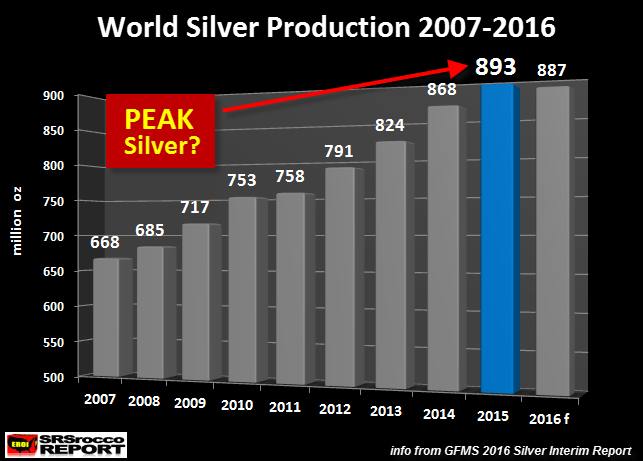
While forecasted global silver production for 2016 is down only slightly versus last year, GFMS also stated this in their report:
- We estimate that mine supply peaked in 2015 and will trend lower in the foreseeable future.
- Declining total supply is expected to be a key driver of annual deficits in the silver market going forward.
I will get to the annual silver deficits in a minute, but let’s look at their world silver mine supply by region:
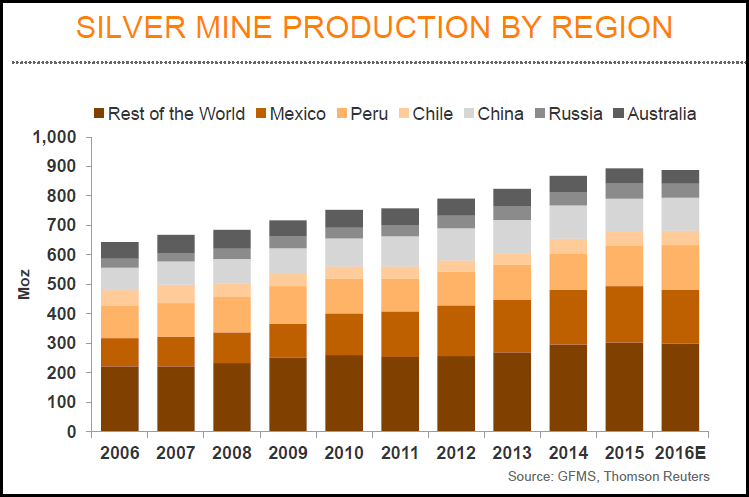
What is interesting here, is that GFMS forecasts the number one silver producer, Mexico, to be down in 2016 by more than 6 Moz. Last year, I forecasted that global silver production would likely be lower in 2015. I was going by data by the “World Metals Statistics.” However, Mexico’s INEGI (government agency) considerably revised their figures higher for 2015. While I have seen revisions take place, the revisions by Mexico’s INEGI for 2015 were quite substantial.
Regardless, GFMS does a pretty good job with the silver mine supply data. The important take-away here is that the trend of global silver production will likely be lower going forward.
The Majority Of Global Silver Production Declines Will Come From By-Product Base Mining
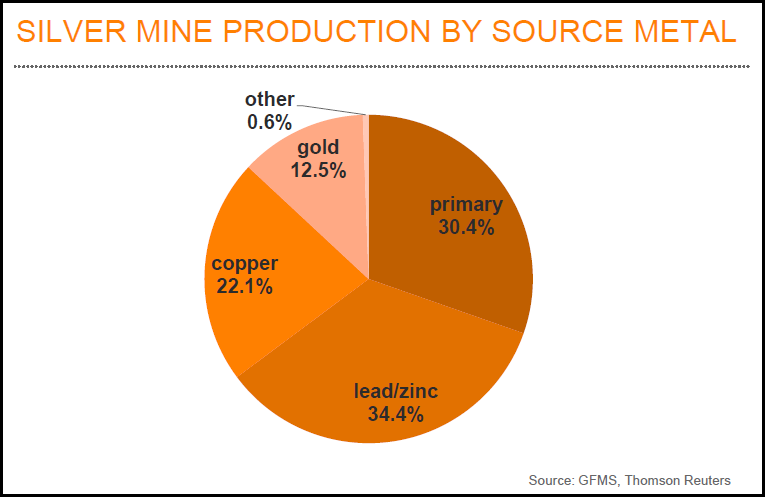
The majority of silver production comes from the by-product of base metal mining. According to GFMS 2016 Silver Interim Report, lead & zinc accounted for 34.4% of silver supply, while copper yielded 22.1%. Thus, the mining of these three base metals supplied 56.5% of global silver production in 2016. Primary silver production accounted for 30.4% and gold mining supplied 12.5%:
As I have mentioned in prior articles, the decline in global oil production will impact base metal mining to a larger degree than primary silver production. It takes a great deal of liquid fuels to produce the world’s base metals.
For example, the Chilean Copper Commission stated in a 2014 report, that the country consumed 535 million gallons of liquid fuel to produce 5.7 million tons of copper. Thus Chile’s copper industry consumed 94 gallons of liquid fuel for each tonne of copper produced.
On the other hand, Pan American Silver burned 20.5 million gallons of liquid fuel to produce their 26.5 million oz of silver in 2015. Which means, each ounce of silver production took 0.80 gallons of liquid fuel. If we use Pan American Silver as a guide, then the 269 Moz of primary silver production in 2016 consumed 215 million gallons of liquid fuel. However, I would imagine the global primary silver production average is much less, more like 0.50 gallon per ounce of silver. So, we are talking about 135-150 million gallons of liquid fuel to produce all the primary silver in the world.
Now, the world produced a total of 18.4 million tons of copper in 2014. Taking Chile’s average of 94 gallons per tonne of copper produced and providing a conservative estimate of say 75 gallons per tonne for entire globe, then the world consumed roughly 1.4 billion gallons of liquid fuels to produce its copper in 2014. This is about ten times the amount of fuel it took to produce all the primary silver production. Of course this is a simple estimate, but there you have it.
Once the world enters into the next financial collapse, U.S. and world oil production will plummet. This will impact base metal mining a great deal more than primary silver production. Which means, overall silver production will decline more rapidly due to more than half coming from zinc, lead and copper.
Global Annual Silver Deficits Continue For 13 Consecutive Years
Due to the huge increase in Global Silver ETF demand as well as a large Exchange Inventory build, the silver market will suffer a forecasted 185 Moz annual deficit in 2016. If we look at the annual silver deficits since 2004, it equals a stunning 1.5 billion ounces:
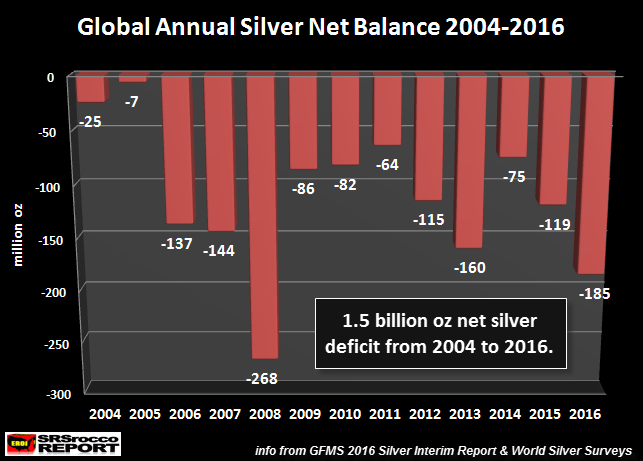
GFMS calculates their “net balance” by subtracting physical demand from supply, then deducted or added changes in Silver ETF and Exchange inventories. According to their data (as of Sept 2016), Silver ETF’s and Exchanges added 133.3 Moz of silver to their inventories. Furthermore, total physical demand exceeded total supply by 52.2 Moz to arrive at the total 185.5 Moz (rounded to 185 Moz) net deficit.
These annual deficits have been supplemented by silver surpluses of the 1980’s and 1990’s. However, annual deficits are forecasted to continue as mine supply continues to decline along with subdued scrap supply.
Why Do These Supply & Demand Factors Matter For the Future Price Of Silver?
Recently I have stated that new information on the Thermodynamic Oil Collapse, based on the Hills Group and Louis Arnoux’s work, suggests that supply and demand are not the real factor that determines price, rather it’s the cost of production.
However, gold and silver are different from most other metals, commodities and energy. While silver is consumed more than gold, it still functions as “MONEY” or a “STORE OF VALUE.” Thus, it should be valued differently than copper, wheat or oil.
I don’t look at global mine supply or the annual silver deficits as factors that will impact the market price of silver by certain degrees, rather I look at them as a TELLTALE sign that the overall trend is changing, and has been for nearly a decade. It is the longer term fundamental trend change that interests me, not the year by year supply and demand factors on price.
Currently, the silver price is based on its cost of production (90-95%) plus some supply and demand factors. While many believe the BIG BANKS can push the price of silver anywhere they see fit, this is pure nonsense. If the Big banks pushed the price of silver 25-50% below its average primary silver cost of production, traders would come in by the droves. While traders may be uninterested in long-term fundamentals, they aren’t stupid as it pertains to short-term market forces.
That being said, silver’s ultimate value is not based on its cost, it will be based on its STORE OF VALUE properties when the MOTHER OF ALL DEFLATIONS finally arrives. I am talking about deflation of most paper assets (stocks & bonds) and real estate.
Because there is so little real physical silver out in the market, 3-4 billion oz, any significant amount of capital moving into it will push its value to seriously high levels. This may seem a play on hype, especially for those who are a bit disillusioned by the price smash since the Trump President election.
Unfortunately, for those who continue BELLY-ACHING about low silver prices, there isn’t much I can say to change your opinion. I have come to realize that a significant percentage of silver investors who continue to understand the long-term fundamentals, will never complain about lower prices. They just suck it up and know that insane Central Bank policies won’t last forever.
Unfortunately, the precious metals community also has its group of individuals who will complain when the going gets rough. This should be expected as this is the typical nature of a FICKLE public. All slaps on the back when things are good and the first to bad mouth when things turn south.
I get a kick out of the BELLY-ACHERS who seem to forget that the Central Banks have embarked on the most insane monetary policy in history. They have pushed debt and money supply to an exponential trend. I find it simply amazing how a disgruntled silver investor points out how wrong the precious metals analysts were on the silver price since 2012, while totally dismissing massive Central Bank monetary invention.
Regardless, peak silver production on top of the continued annual deficits point to a trend that will reach an INFLECTION POINT in the future. So, here is the BEEF. If you think exponentially increasing debt and monetary liquidity will continue for the next 5-10 years, then maybe you should stay in Dollars, U.S. Treasuries, Stocks and Real Estate. However, if you aren’t suffering from brain damage as many in the markets are today, you may want to consider staying put in the 2,000+ year monetary history and store of value of silver.
end
This should provide increased demand for gold as now Islam allows gold purchases:
(courtesy reuters/Vizcaino)
UPDATE 1-Islamic Finance Group Approves Standard for Gold Products
By Reuters
Monday November 28, 2016 11:53
(Updates with comments)
By Bernardo Vizcaino
Nov 28 The Bahrain-based group that issues guidelines generally followed by Islamic financial institutions has approved a sharia standard for gold-based products in a bid to expand the use of bullion in Islamic finance.
Traditionally, gold has been viewed as a currency in Islamic finance, confining it to spot trades in fixed weights and measures. Investors have been unable to speculate on its future value and there has been no clear policy on how to trade gold.
The Accounting and Auditing Organization for Islamic Financial Institutions (AAOIFI) approved the final version of its new standard on gold and trading controls last week and an official launch will be announced soon, it said in a statement.
The new standard addresses issues such as collateral, set-off, screening and the exchange of gold in spot and deferred transactions. Sharia compliant products backed by gold could include exchange-traded funds and savings accounts.
AAOIFI issues guidelines that are followed wholly or in part by Islamic financial institutions across the world, so its efforts would help align the industry to global practices.
Uncertainty about how gold can be used in Islamic finance has kept sharia-compliant bullion transactions at a minimum, Matthew Keen, founder of Dubai-based precious metals consultancy Evidens and an adviser to the World Gold Council, said.
London-based ETF Securities, for example, launched a sharia-compliant exchange-traded commodity product for gold, silver, platinum and palladium in 2008 but it never gained traction.
“There is such a lack of understanding of what sharia law would mean in terms of gold investing and this standard would at least provide a common ground,” ETF Securities director of commodity research Nitesh Shah said.
“However, this is not going to be a game changer for global gold consumption,” he said, as sharia law does not prohibit the ownership of gold jewellery or coins.
The final standard will be made available on a complimentary basis by AAOIFI and the World Gold Council (WGC), an industry organisation that supported the development of the standard.
Proponents hope the new guidance will help address muted consumer appetite for gold in the Middle East, where demand has actually fallen in recent years.
With Islamic financial assets seen at about $2 trillion, a one percent allocation to gold would boost demand by $20 billion, or about 500 tonnes.
“I am a bit sceptical as even in the developed world, where access to gold investing has been there for many decades, you don’t see a one or two percent of anyone’s aggregate portfolio allocated to gold, so it is highly unlikely in a new emerging market,” Shah at ETF Securities said.
AAOIFI also approved a standard on the liability of investment managers, which addresses issues including negligence and breach of contract. It details liability on the part of service agents in transactions including Islamic bonds (sukuk) and in syndicated financing contracts and other products. (Additional reporting by Andrew Torchia in Dubai and Clara Denina in London; editing by Simon Cameron-Moore and David Clarke)
end
FEDERAL RESERVE BANK OF NEW YORK; FOREIGN GOLD MOVEMENTS
(HARVEY)
Last month I reported to you that 5 tonnes of gold moved out of the FRBNY which was much smaller than before as Germany was not getting its required amount of gold.
Now this month:
FRBNY gold holdings Sept: 7841
FRBNY gold holdings Oct: 7841
all figures are million dollars worth of gold at the official rate of 42.22 dollars per oz
amount leaving: 0
Amount repatriated: zero
Germany must be royally angry!
end
Your early MONDAY morning currency, Asian stock market results, important USA/Asian currency crosses, gold/silver pricing overnight along with the price of oil Major stories overnight
:
1 Chinese yuan vs USA dollar/yuan UP to 6.912(SMALL REVALUATION NORTHBOUND /CHINA UNHAPPY TODAY CONCERNING USA DOLLAR RISE/MORE $ USA DOLLARS LEAVE CHINA/OFFSHORE YUAN NARROWS TO 6.9360 / Shanghai bourse CLOSED UP 15.06 POINTS OR 0.46% / HANG SANG CLOSED UP 107.12 OR 0.47%
2. Nikkei closed DOWN 24.33 POINTS OR .13% /USA: YEN FALLS TO 112.73
3. Europe stocks opened ALL IN THE RED ( /USA dollar index RISES TO 101.52/Euro UP to 1.0584
3b Japan 10 year bond yield: FALLS +.022%/ !!!!(Japan buying 100% of bond issuance)/Japanese yen vs usa cross now at 113.01/ THIS IS TROUBLESOME AS BANK OF JAPAN IS RUNNING OUT OF BONDS TO BUY./JAPAN 10 YR YIELD FINALLY IN THE POSITIVE/BANK OF JAPAN LOSING CONTROL OF THEIR YIELD CURVE AS THEY PURCHASE ALL BONDS TO GET TO ZERO RATE!!
3c Nikkei now JUST BELOW 17,000
3d USA/Yen rate now well below the important 120 barrier this morning
3e WTI:: 46.33 and Brent:47.66.
3f Gold UP /Yen UP
3g Japan is to buy the equivalent of 108 billion uSA dollars worth of bond per month or $1.3 trillion. Japan’s GDP equals 5 trillion usa./“HELICOPTER MONEY” OFF THE TABLE FOR NOW /REVERSE OPERATION TWIST ON THE BONDS: PURCHASE OF LONG BONDS AND SELLING THE SHORT END
Japan to buy 100% of all new Japanese debt and by 2018 they will have 25% of all Japanese debt. Fifty percent of Japanese budget financed with debt.
3h Oil UP for WTI and UP for Brent this morning
3i European bond buying continues to push yields lower on all fronts in the EMU. German 10 yr bund FALLS TO +.194%
3j Greek 10 year bond yield RISES to : 6.96%
3k Gold at $1188.00/silver $16.64(7:45 am est) SILVER BELOW RESISTANCE AT $18.50
3l USA vs Russian rouble; (Russian rouble DOWN 15/100 in roubles/dollar) 64.98-
3m oil into the 46 dollar handle for WTI and 47 handle for Brent/
3n Higher foreign deposits out of China sees huge risk of outflows and a currency depreciation (already upon us). This can spell financial disaster for the rest of the world/China forced to do QE!! as it lowers its yuan value to the dollar/GOT a HUGE DEVALUATION DOWNWARD from POBC.
JAPAN ON JAN 29.2016 INITIATES NIRP. THIS MORNING THEY SIGNAL THEY MAY END NIRP. TODAY THE USA/YEN TRADES TO 112.73 DESTROYING WHATEVER IS LEFT OF OUR YEN CARRY TRADERS
30 SNB (Swiss National Bank) still intervening again in the markets driving down the SF. It is not working: USA/SF this morning 1.0155 as the Swiss Franc is still rising against most currencies. Euro vs SF is 1.0748 well above the floor set by the Swiss Finance Minister. Thomas Jordan, chief of the Swiss National Bank continues to purchase euros trying to lower value of the Swiss Franc.
3p BRITAIN VOTES AFFIRMATIVE BREXIT
3r the 10 Year German bund now POSITIVE territory with the 10 year FALLS to +.234%
/German 9+ year rate BASICALLY negative%!!!
3s The Greece ELA NOW at 71.4 billion euros,AND NOW THE ECB WILL ACCEPT GREEK BONDS (WHAT A DISASTER)
The bank withdrawals were causing massive hardship to the Greek bank. the Greek referendum voted overwhelming “NO”. Next step for Greece will be the recapitalization of the banks and that will be difficult.
4. USA 10 year treasury bond at 2.334% early this morning. Thirty year rate at 2.99% /POLICY ERROR)
5. Details Ransquawk, Bloomberg, Deutsche bank/Jim Reid.
(courtesy Jim Reid/Bloomberg/Deutsche bank/zero hedge)
Global Stocks Slide On Italian Bank Worries; Dollar Dips As Trumpflation Takes A Back Seat
European shares dipped and U.S. equity-index futures (-0.3%) pointed to a lower open as traders questioned the stability of the Italian banking sector ahead of next weekend’s referendum as well as the longevity of the Trumpflation rally, pressuring the dollar, sending the USDJPY sliding as low as 111.355 overnight, before rebounding over 112. That was the dollar’s biggest fall against its Japanese rival since October 7 and against a basket of top world currencies it was the greenback’s worst day since November.
The euro rose to an 11-day high $1.0686 as it got a lift too from the election of Francois Fillon as the center-right candidate in next year’s French presidential election. The reformist former prime minister is now favorite to become president, with a flash opinion poll showing he would easily beat National Front leader Marine Le Pen in a run-off second round. Markets worry the far-right Le Pen, who has promised a referendum on membership of the European Union if she wins, would threaten the future of the currency bloc.
“It’s a bit of a pull back in the dollar,” said Societe Generale strategist Alvin Tan. “The fall in oil is pushing back U.S. bond yields and that is leading the consolidation in the dollar.. there is more scepticism about an (OPEC) output cut now.”

“The Trump trades were a distraction for a while but now people are starting to look elsewhere for market drivers,” said Kevin Lilley, a manager of euro-area equities at Old Mutual Global Investors in London. “People are getting worried about the impact that a power vacuum in Italy could have on the refinancing needs of its banks. It’s a nervous market at a time when liquidity isn’t great.”
“Starting this week, the thinking is that people will probably pull to the sidelines and adopt a wait-and-see approach,” said Sim Moh Siong, a currency strategist at Bank of Singapore Ltd. Much of the optimism flowing from expectations of increased U.S. fiscal stimulus has been priced in by the market and investors will probably pause until “further clarification of Trump’s policy stance,” he said.
The dollar weakness lifted Treasuries while latest incarnation of the
China commodity bubble boosted industrial metals, sending zinc surging. Industrial metals have been red hot in recent weeks on hopes of strong demand for property and infrastructure investment in China and the United States. Chinese steel futures jumped over 6% , while iron ore futures also gained about six percent and zinc powered to a nine-year high on the London Metal Exchange. As shown in the chart below, an index of industrial metals is now up 22% in just the past month, and up 40% since January.

Oil in New York was trading flat at $46 as OPEC tries a last-minute salvage of the Algiers production cut agreement ahead of the Wednesday meeting in Vienna. Italian banks led declines in European shares Prime Minister Matteo Renzi faces a key referendum on Sunday that may see voters reject his constitutional reform and prompt his resignation. As many as eight Italian banks are at risk of failing if the Renzi loses a constitutional referendum this weekend the FT reported. Shares in the nation’s largest bank UniCredit SpA fell for the the fourth day, heading for the lowest since August. Banca Monte dei Paschi di Siena SpA, which holds the most Italian sovereign debt relative to tangible equity and is under pressure to raise 5 billion euros of fresh money, fell as much as 12 percent before being halted.
Asian shares rose 0.4 percent overnight, led by gains in Hong Kong and Taiwan .TWII though Japan’s Nikkei which has been performing even better than a record high Wall Street in recent weeks thanks to the yen’s fall, ended down 0.1 percent.
Global growth got a welcome boost, if only on paper, when in its twice-yearly report on global economic prospects, the OECD said that while the exact form it would take is uncertain, it does expect Mr. Trump to offer some fiscal stimulus from the early months of his presidency, and that its likely scale that would boost U.S. economic growth to 2.3% from 1.9% in 2017, and to 3% from 2.2% in 2018. There would also be benefits for other parts of the world as U.S. demand for imports rises, with global economic growth raised to 3.3% from 3.2% in 2017, and to 3.6% from 3.3% in 2018. The OECD is the first international economic policy agency to publish an estimate of the likely impact of Mr. Trump’s proposals.
Global yields dipped as dollar weakness, and thus a brake on inflation expectations, sent Treasuries around the world modestly higher, however the one outlier was once again German 2Y yields, which dropped to fresh record lows on continuing fears about European collateral scarcity.

The yield on 10-year U.S. Treasuries dropped almost 5 basis points to 2.323%, off its 16-month high of 2.417%touched last week. Europe’s benchmark, German Bunds, saw their equivalent yield drop 3 basis points.
Other top news stories include lower consumer spending on Black Friday,
Philips panning to roll out medical software to challenge GE.
* * *
Bulletin Headline Summary From RanSquawk
- European equities enter the North American crossover lower as ongoing concerns surrounding Italian banks and downside in energy names hampers sentiment
- FX markets have seen some correct moves in the USD with USD/JPY lower by just under a point while EUR/GBP has been supported by month-end flows
- Looking ahead, highlights include potential comments from ECB’s Coeure and Draghi
Market Snapshot
- S&P 500 futures down 0.3% to 2205
- Stoxx 600 down 0.6% to 341
- FTSE 100 down 0.7% to 6795
- DAX down 0.9% to 10607
- German 10Yr yield down 3bps to 0.21%
- Italian 10Yr yield down less than 1bp to 2.09%
- Spanish 10Yr yield down less than 1bp to 1.56%
- S&P GSCI Index up 0.1% to 365.7
- MSCI Asia Pacific up 0.7% to 137
- Nikkei 225 down 0.1% to 18357
- Hang Seng up 0.5% to 22831
- Shanghai Composite up 0.5% to 3277
- S&P/ASX 200 down 0.8% to 5464
- US 10-yr yield down 4bps to 2.32%
- Dollar Index down 0.4% to 101.08
- WTI Crude futures down 0.4% to $45.88
- Brent Futures down 0.4% to $47.04
- Gold spot up 0.7% to $1,192
- Silver spot up 0.9% to $16.68
Global Headline News
- OPEC Seeks Oil Deal as Saudis Open Door for No Output Cut: Algeria, Venezuela ministers travel to Russia to seek support
- Bargain Hunters Roil Retailers Looking for Black Friday Bounce: The average amount shoppers spent fell 3.5%, including both online and offline purchases, according to the National Retail Federation
- Philips to Start Selling Smart Software for Doctors to Rival GE: Medical software market could grow twice as fast as devices
- Samsung Investors Voice Support for Elliott Proposals: Elliott seeking split, new directors, special dividend
- Hulu CEO Plots a Way to Stand Out From the Crowd in Online TV: Company will be first streaming provider to offer live video
- China Said to Prepare Overseas Dealmaking Curbs Amid M&A Spree: Overseas deals of at least $10 billion to be generally barred
- Trump Claims Millions Voted Illegally, Without Giving Proof: Trump offered nothing to back up his allegations of wrongdoing in the Nov. 8 election
- Time Inc. Said to Have Rejected Edgar Bronfman’s Bid: NY Post
- WTO May Rule Boeing Received Illegal Subsidy on Jetliner: WSJ
- CME Group Tables Bid for LSE’s Clearing Ops in France: S. Times
- Amazon to Announce Matson Moved Core Computing Ops to AWS: WSJ
- Fidel Castro, Communist Former Leader of Cuba, Dies at 90
* * *
Looking at regional markets, we start in Asia where stocks shrugged off another record US close on Friday and began the week mixed with weakness in energy and JPY strength dampening sentiment in the region. ASX 200 (-0.8%) finished lower with oil names pressured as WTI crude futures extended on losses to below USD 46/bbl after informal producer talks set for today were cancelled and Saudi’s energy minister Al-Falih further added to the uncertainty as his comments suggested the door was open to the possibility of no cut in output. A firmer JPY ensured the Nikkei 225 (-0.3%) snapped a 7-day win streak, while Shanghai Comp (+0.5%) and Hang Seng (+0.7%) were buoyed by stronger growth in Industrial Profits and after the announcement the Shenzhen-Hong Kong stock connect will launch next Monday.
Top Asian News
- China Has Quietly Hiked Borrowing Costs With PBOC Operations: Move is latest sign of selective tightening to temper leverage
- Yen at 120 Lonely Call No More for Analyst Who Got It Right: AMP Capital, BNP Paribas see yen surpassing 125.86 low
- CSC Financial Hong Kong IPO Seeks to Raise Up to $1.06 Billion: Company and National Social Security Fund are offering combined 1.13b shares at HK$6.36-HK$7.26 apiece
- India Said to Mull Foray Into Plane Leasing to Support Modi Plan: Proposal would see state-run firm leasing out 20- seater planes
- Singapore’s GIC Hires Big Data Expert in Quant Strategy Push: GIC expands Systematic Investment Group started this year
In Europe, the focus this morning has fallen upon Italian bankswhich has soured sentiment across Europe (overall Italian banking index down over 3%), in particular Banca Monte Dei Paschi with the troubled lender beginning its debt-equity swap with the bank hitting limit down shortly after the European open before falling 12%. While the sector has also been gripped by the near term risk factor in the form of the constitutional reform referendum, whereby an article stated that 8 Italian banks would fail if Renzi loses the vote as investors would be deterred from recapitalisation. Oil names have also been pressured following weekend reports suggesting that Saudi Arabia could be open to the idea of no reduction in output as the Energy Minister Al-Falih stated that demand is expected to recover next year and prices will stabilize which will occur without OPEC intervention.
Elsewhere, fixed income markets have been supported by safe haven flow early on, while a continuation of last week’s theme has seen Gilts slightly outperform its German counterpart thus far as participants await ECB President Draghi. While the looming Italian referendum has kept the ITA-GER 10yr spread at its widest in around 3-yrs.
Among the biggest weekend stories in Europe, Alain Juppe conceded defeat in the French presidential conservative primary against Fillon who won with nearly 70% of votes. Additionally, a Harris Interactive poll suggested conservative candidate Fillon would beat Far-Right candidate Le Pen in the French Presidential Election by 67% vs. 33%. BoE’s Carney wants Britain to remain in the single market for at least two years after Britain leaves the EU to cushion the impact on businesses, although his efforts may be viewed as an attempt to water down the Brexit. There were also reports that Brexit campaign leaders are said to reject plan by BoE Governor Carney to negotiate a buffer during the Brexit process. The UK Government is set to face a legal battle as to whether the UK can remain in the single market after its departure from the EU, according to the BBC.
Top European News
- ECB to Be ‘Pillar of Stability’ in Risky Year, Policy Maker Says: Governing Council member Stournaras speaks in interview
- Fillon Unites French Right After Primary as Socialists Split: Former prime minister records overwhelming victory in primaries
- Aberdeen Rises After Maintaining Dividend in Face of Outflows: Shares rose the most in seven weeks
- Biggest U.K. Banks Seen Struggling in Toughest Stress Tests Yet: All likely to top lower bar, some may stumble on new measure
- Investor Who Backed Brexit Sees Euro Breaking Up Within 5 Years: Euro as it stands is an inappropriate mechanism, Burnbrae’s Jim Mellon says
- Engie CEO Shifts Gear on Asset Sales, Cost Cuts as Shares Tank: Kocher says divestment plan will progress ahead of schedule
In currencies, the Bloomberg Dollar Spot Index, which tracks the greenback against 10 major peers, fell for a second day, declining 0.4 percent as of 10:47 a.m. in London. The rand gained against all of its 31 major counterparts, surging 1.7 percent to 13.8692 per dollar. A senior party official said there’s significant support in the ruling African National Congress’s executive committee to oust South African President Jacob Zuma, whose administration has been plagued by corruption and mismanagement.
In commodities, as the OPEC talks get under way, WTI and Brent prices are lagging though with ever present hope in the air, aggressive selling is absent for now. That said, few expect a significant deal — which can be logistically implemented — to transpire, so this may have been partially priced in to the drop in WTI from USD 50.00+ levels to circa USD 45.00 again. Some are suggesting another ‘breakdown’ in talks could send Oil down through USD 40.00, but all hangs in the balance for now. Elsewhere, Copper prices have managed to claw out some fresh highs, but failing to hold onto these levels — touching on USD 2.75 before easing back a little. Gold has come back off the lows near USD 1175 seen last week, but it is a tepid pullback as USD buyers will continue to buy the dip into the Dec FOMC and maintain pressure on the yellow metal accordingly. Saudi Arabia, Iran and Iraq have been seen arriving at OPEC technical meeting according to Twitter reports. Iran is still attempting to make themselves exempt from an OPEC output cut but expected the cartel to still strike a deal this week. Saudi Arabia left the door open for the possibility of no reduction in output as Energy Minister Al-Falih stated that demand is expected to recover next year and prices will stabilize which will occur without OPEC intervention and also added there in no single path to reduce output at the OPEC meeting as a recovery in consumption could also be depended on.
Looking at the day’s events, It’s a fairly quiet start to the week today. In Europe we’ll get the latest M3 money supply data for the Euro along with the latest OECD economic outlook while in the US the sole release is the Dallas Fed’s manufacturing survey.
Economic Event Calendar:
- 9am: ECB’s Draghi speaks in Brussels
- 10:30am: Dallas Fed Manufacturing Activity, Nov., est. 1.5 (prior -1.5)
- 7:45pm: Bank of Canada’s Poloz speaks in Toronto
* * *
DB’s Jim Reid concludes the overnight wrap
The main news from the weekend concerns the result of the final centre-right primary vote in France. The result has gone heavily in favour of the victor from the first round, Francois Fillon, who, with over 10,000 of the 10,229 polling stations accounted for, has gained 66.5% of the votes over Alain Juppe who garnered 33.5% of the vote. Juppe has officially conceded. With that result, Fillon is now the Republican candidate at next May’s presidential election in France and likely to face a Socialist candidate and also his main rival, the far-right’s Marine Le Pen. Ahead of the result, our European economists noted in their Focus Europe piece on Friday that at the last reported poll in September, Fillon held a roughly 20pp lead in the 2nd round presidential election versus Le Pen. In fact Bloomberg are reporting two polls this morning, both of which show Fillon as beating Le Pen in both rounds of the presidential election and by a fairly comprehensive margin too. More significantly for the 2nd round, an Odoxa poll shows Fillon as defeating Le Pen by 71% to 20% and a Harris Interactive poll shows Fillon winning by 67% to 33%. I’m sure if we hadn’t had Brexit and the US election result there would be less financial market concern over the French election next year. However these events have happened and therefore the market will remain on edge ahead of the poll next year.
Meanwhile, much of the remaining weekend headlines focus on this week’s main event, that being the much anticipated OPEC meeting this Wednesday in Vienna. WTI was the big mover in markets on Friday after plummeting nearly – 4% to close a smidgen above $46/bbl after Saudi Arabia pulled out of a planned producers meeting for today between OPEC and non-OPEC countries, calling the meeting ‘not beneficial’ before ‘holding meetings within OPEC and deciding whether to cut or continue with current levels of production’. According to the WSJ, OPEC is demanding Russia and other producers outside of the cartel to cut production by 500k-600k barrels a day, however Russia’s energy minister has on a number of occasions reiterated his desire for a production freeze over a cut. We’ll no doubt have plenty of headlines over the next couple of days leading into the meeting. Although this is the big event of the trading week, it is worth noting also that this time next week we should likely know the results of the Italian referendum with voting ending at 10pm GMT/11pm CET. There’s some suggestion that exit polls will also be released by several TV networks just after this time while the actual vote counting is expected to take a few hours.
Also worth highlighting this morning is some of the early retail sales stats from Black Friday in the US. According to the National Retail Federation, shoppers were said to have spent on average $289.19 over the four-day weekend period if you include both purchases made online and bricks and mortar sales. That is down from $299.60 in the same period last year. The number of shoppers did however increase with the NRF also reporting that the total number of shoppers increased by 2% to about 154 million consumers. 44% of purchases were said to have been done online, compared to 40% in-store.
Over in markets, despite the tumble for Oil and the subsequent knock on to energy names, it was another broadly positive day for US equities on Friday and another which saw the S&P 500 (+0.39%), Dow (+0.36%), Nasdaq (+0.34%) and Russell 2000 (+0.38%) indices all notch up fresh record highs, with gains for defensive sectors dominating. Volumes were unsurprisingly low in a holiday shorted session, while 10y Treasury yields tempered an early move higher to just north of 2.400% to close little changed around 2.357%. In Europe equity markets also closed in positive territory (Stoxx 600 +0.18%) while rates markets were a touch firmer. 10y Bund yields edged down a couple of basis points to 0.236% to finish just over 3bps lower for the week.
This morning in Asia it’s been a bit more of mixed start to trading to the week. Most notable is the decline for the Nikkei (-0.36%) which has weakened for the first time in eight sessions. That appears to be as a result of the decent rally for the Yen (+1.32%) which, in the absence of any material news, appears to be strengthening on technical factors more than anything else, with the Greenback also lower versus most EM currencies this morning. The ASX (-0.59%) is also weaker but the Hang Seng (+0.71%), Shanghai Comp (+0.51%) and Kospi (+0.36%) are all up. Bourses in China appear to have been boosted by the October industrial profits data which was released yesterday. It showed profits as climbing +9.8% yoy in October, up from +7.7% in the month prior.
Wrapping up the data on Friday. In the US the advance goods trade balance for October revealed a slight widening in the deficit to $62bn from $56.5bn after data showed that imports rose +1.1% mom during the month and exports fell -2.7%. Meanwhile wholesale inventories were down unexpectedly in October (-0.4% mom vs. +0.2% expected), while the flash services PMI for November was down a very modest 0.1pts to 54.7, which when combined with the manufacturing reading, has left the composite at 54.9. Following last week’s data the NY Fed subsequently revised up their Q4 GDP forecast to 2.5% from 2.4%. The Atlanta Fed continue to forecast for a much greater 3.6% growth rate meanwhile.
Over in Europe much of the data was focused in the UK. There was no surprise from the second reading of Q3 GDP which came in unchanged at +0.5% qoq and +2.3% yoy. The details of the report showed that a slightly lower than expected increase in exports was more than offset by a positive contribution from government spending and decrease in imports. Perhaps the more interesting data however was the CBI distributive trends survey in the UK. The survey showed retail sales volume of +26 in November versus +21 on October, far exceeding expectations for +12. In fact it is the highest print since September 2015 and evidence that the big decline for Sterling is keeping consumer spending buoyant.
Turning over to the week ahead now. It’s a fairly quiet start to the week today. In Europe we’ll get the latest M3 money supply data for the Euro along with the latest OECD economic outlook while in the US the sole release is the Dallas Fed’s manufacturing survey. Tuesday kicks off early in Japan with the latest jobless rate, retail sales and household spending data. Closer to home we’ll get Q3 GDP in France, Germany CPI for November, UK money and credit aggregates data and also the latest confidence indicators for the Euro area. In the US tomorrow all eyes are on the second revision to Q3 GDP while the November consumer confidence print is also due out, along with the latest S&P/Case-Shiller house price index. We start in Japan again on Wednesday where the latest industrial production data is due, along with housing starts data. China will also release the MNI consumer sentiment reading while the UK will release its latest consumer confidence print. During the European session we’ll get the latest CPI print out of France and also the Euro area, along with unemployment data in Germany. There’s important data in the US on Wednesday too with the ADP employment change print, personal income and spending reports for October and also the PCE core and deflator readings for last month too. Pending home sales data and the Chicago PMI will also be released followed by the Fed’s Beige Book in the evening. Turning to Thursday, China will get things going with the November PMI data, while during the European session we’ll also get the manufacturing PMI’s including a first look at the data for the UK and the periphery. In the US it’s another busy session with initial jobless claims, manufacturing PMI, construction spending, ISM manufacturing and vehicles sales data all due out. It’s a quiet end to the week in Asia and Europe on Friday with PPI data for the Euro area the sole release. In the US it’s all eyes on the November employment report including the latest payrolls print.
Away from the data, in terms of Fedspeak this week we’ve got Dudley and Powell due to speak tomorrow, Kaplan and Powell on Wednesday, Kaplan again on Thursday and Brainard on Friday. In Europe today we’ll hear from ECB President Draghi this afternoon at European Parliament, while Coeure will also speak before him. Draghi will then speak again on Wednesday. The BoE will also publish its Financial Stability Report on Wednesday with BoE Governor Carney due to speak after. The other big event this week and which may end up being the focus for the week is the aforementioned OPEC meeting in Vienna on Wednesday where ministers are due to discuss finalizing the September accord to curb oil production
3.REPORT ON JAPAN SOUTH KOREA NORTH KOREA AND CHINA
i)Late SUNDAY night/MONDAY morning: Shanghai closed UP 15.06 POINTS OR 0.46%/ /Hang Sang closed UP 107.12 OR 0.47%. The Nikkei closed DOWN 24.33 OR .13%/Australia’s all ordinaires CLOSED DOWN 0.68% /Chinese yuan (ONSHORE) closed UP at 6.912/Oil ROSE to 46.33 dollars per barrel for WTI and 47.66 for Brent. Stocks in Europe: ALL IN THE RED Offshore yuan trades 6.9360 yuan to the dollar vs 6.9120 for onshore yuan.THE SPREAD BETWEEN ONSHORE AND OFFSHORE NARROWS AS MORE USA DOLLARS ATTEMPT TO LEAVE CHINA’S SHORES / CHINA SENDS A CLEAR MESSAGE TO THE USA AND JANET TO NOT RAISE RATES IN DECEMBER.
3a)THAILAND/SOUTH KOREA/:
b) REPORT ON JAPAN
c) Report on CHINA
The Market’s Next Headache: China’s (Not So) Stealth Tightening
While much of the attention in the past month has focused on the rising interest rates among the Developed markets, a just as troubling development is taking place in China where as BofA’s David Cui observes, interest rates are set for sustained upward pressure over the next few quarters, for the fifth time since 2006.

Since Oct 21, yield of 10Y Chinese Government Bond (CGB) has risen by 20bps, from 2.65% to 2.85%, partly in response to the strong global rates and USD move since the US election. Cui expects the yield to rise further to 3.40% by the end of 2017. Furthermore, with credit spreads near all-time lows, the bank warns that there is a risk that it may widen sharply at some point.
As Cui further writes, the local equity market reacted progressively less favorably to rising rates the last four times as investors turned progressively less optimistic about growth outlook. The bank believes that “the rising rates this time may put pressure on equities in general as it would occur in an environment of lackluster growth.” Sector wise, property, materials and utilities may suffer the most; while insurers, IT and consumer may benefit. That said, please bear in mind that interest rate is only one of the major drivers of the equity market.
To be sure, how the equity market reacts to rising rate depends on reasons behind the upward pressure. If it is caused by strong economic growth outlook, it is typically good for stocks, at least in the early stage of the tightening cycle (when the market tends to enjoy upside revenue surprise). This was clearly the case with Episodes 1 and 2 (Chart 6).

However, when rising rate was caused by no-growth factors, such as inflation and the government’s desire to control debt growth (which seemed to be the case with Episodes 3 and 4), the market reacted much more cautiously. This time, the pressure appears to be mainly driven by a less accommodating monetary policy as a result of housing bubble risk, debt control need and exchange rate pressure, despite a fairly lackluster economic growth outlook. In this case, Cui concludes, “the rising rate should not be a net positive to the equity market, in our view.”
What makes China’s situation especially curious, because the implications from higher rates for a country which has a record corporate debt bubble are pernicious, is that while market forces have already tightened financial conditions as a result of recent developments in the US, this move has not only not been offset by the PBOC, but has been blessed by the Chinese central bank: as Bloomberg writes overnight, “without a policy announcement, China’s central bank has effectively tightened monetary conditions in recent weeks, an analysis of its transactions shows.”
The PBOC has quietly tightened by gradually shifting the maturity distribution of repo operations away from 7-Day toward 14- and 28-day operations, which both have modestly higher rates. Specifically, in recent weeks, the PBOC has cut back on seven-day open-market operations and is instead injecting more funds through 14-day and 28-day contracts. That’s had the effect of raising short-term borrowing costs and pressing up bond yields.
While the central bank injects money with seven-day reverse repurchase operations at 2.25%, it has started offering 14-day and 28-day contracts at rates as much as 30 basis points higher. The end result is secondary market one-week funding costs of around 2.5%. According to Bloomberg, this is another sign of selective tightening by the PBOC that’s reinforced the views of many economists that China has turned the corner away from monetary stimulus.

A breakdown of recent repo operations is shown below:

As a result, interbank rates have “basically gone up 20 to 30 basis points,” said Ming Ming, the head of fixed-income research at Citic Securities Co. and an ex-PBOC official. “China’s central bank has essentially raised rates by 25 basis points through money market operations,” said Deng Haiqing, chief economist at JZ Securities Co. in Beijing. “The bond market adjustment is only beginning. We expect the yield curve steepening to be the main feature of the market in 2017, driven by mild PBOC tightening.”
Why the quiet shift? One explanation is that with economic growth stable, policy makers are trying to rein in leverage in the world’s No. 2 economy. The impact is being felt in the debt market, where the government yield curve has reached the steepest since April and the yield premium on three-year AAA corporate bonds is set for the biggest jump in seven months.
However in an economy driven entirely by cheap, abundant credit, the downside will promptly emerge: it has already started to hit bond markets, where returns are being hurt by this effort to squeeze financial-market leverage. Just as troubling is BofA’s suggestion that this time around, rising rates may be caused by “no-growth factors“, such as inflation and the government’s desire to control debt growth, and that the pressure appears to be mainly driven by a less accommodating monetary policy as a result of housing bubble risk, debt control need and exchange rate pressure, despite a fairly lackluster economic growth outlook. As noted above, BofA’s conclusion is that “the rising rate should not be a net positive to the equity market.” Which means “negative”, and suggests that one of China’s many concurrent debt-fuelled bubbles may be about to pop.
While it remains unclear what the immediate consequences of the PBOC’s change in strategy are, one thing appears clear: “We don’t expect monetary policy to be eased further,” said Jing Lei, Beijing-based chief investment officer of fixed income at Harvest Fund Management Co., which manages 315 billion yuan ($46 billion). “All the regulators are trying to control the leverage in financial markets.”
And with a recent spike in defaults, the recent push to tighten conditions will only accelerate this trend: at least 23 onshore bonds have seen defaults this year, still a small figure but up from just seven in 2015.
Another clear outcome: investors have been turning more cautious with leverage in the interbank market falling. Outstanding repurchase agreements reached 8.9 trillion yuan in October, down from a record 9.7 trillion yuan in December, the latest National Interbank Funding Center data show.
Of course, the fundamental driver behind China’s rising sovereign yields, along with those of counterparts around the world, has been the market’s reaction to U.S. President-elect Donald Trump’s stimulus policies, steepening the yield curve as seen below:
“You can see a little more steepening of the curve,” said Neeraj Seth, head of Asian credit at BlackRock Inc. in Singapore, which is waiting for buying opportunities in long-end notes.

In any case, should the dollar continue to rise, sending US rates and inflation expectations even higher, Chinese rates wil have no choice but to follow (or else risk even greater rate-differential driven capital outflows – until the financial sector stress become unbearable for Beijing, and another “Shanghai Summit” takes place, one in which however instead of pro-reflation policies, the world’s monetary policy makers decide it is time to enact a new round of global monetary easing. How that will fit in with Trump’s proposed $1 trillion in fiscal stimulus remains to be seen.
4 EUROPEAN AFFAIRS
I have been detailing to you the major problem affecting Italy and that is their insolvent banks, namely their non performing loans which is 18% of total loans or totaling 360 billion euros. If a bail in is ordered and we now have the new EU rules, then the Italian general public will be burned alive as they are the dominant holders of Italian debt. If Renzi leaves and a not vote, then a private bailout will not be done and Italy will face their doom@@@!
(courtesy zero hedge)
Up To Eight Italian Banks May Fail If Renzi Loses Referendum
Just as we were concluding our write up on the return of Europe’s solvency crisis, facilitated by Donald Trump’s NATO funding demands and the end of the ECB’s unprecedented can kicking exercise,the FT reported that as many as eight of Italy’s troubled banks “risk failing” if prime minister Renzi loses next weekend’s constitutional referendum and ensuing market turbulence deters investors from recapitalizing them, citing senior bankers.
This particular rather adverse outcome is captured by the lower-right, glowing red box in the Danske Research flowchart shown below

Renzi, who has previous said he will quit if he loses the referendum although has since changed his tune, has championed a market solution to solve the problems of Italy’s €4tn banking system and avoid a vote-losing “resolution” of Italian banks under new EU rules. A resolution restructures and, if necessary, winds up a bank by imposing losses on both equity and debt investors, particularly controversial in Italy, where millions of individual investors have bought bank bonds.
The following chart from the ECB demonstrates why a bail-in of Italian banks would be the equivalent of political suicide: the vast majority of bail-inable Italian debt is held domestically, read savers and pensioners. Should they be impaired, it would lead to an overnight social crisis.

However, if Renzi is already on his way out post a “No” vote, which most polls have assured is the most likely outcome, he will have far less motivation to seek a private bail-out, making a bail-in far more likely, boosting the chances of an adverse social reaction. As the FT adds, in the event of a “No” vote and Mr Renzi’s exit, bankers fear protracted uncertainty during the creation of a technocratic government. Lack of clarity over a new finance minister may lethally prolong market jitters about Italy’s banks. Italian lenders have more than halved in value this year on concerns about their non-performing loans.
For those who have followed the neverending saga of Italy’s insolvent banks, the details are familiar: the “boot” has eight banks known to be in various stages of distress: its third largest by assets, Monte dei Paschi di Siena, mid-sized banks Popolare di Vicenza, Veneto Banca and Carige, and four small banks rescued last year: Banca Etruria, CariChieti, Banca delle Marche, and CariFerrara.
As warned here since 2011, the biggest problem facing Italy’s (and Europe’s banks) is the inordinate share of NPLs: Italy’s banks have €360bn of problem loans versus €225bn of equity on their books after successive regulators and governments failed to tackle a bloated financial system where profitability was weakened by a stagnant economy and exacerbated by fraudulent lending at several institutions.
The problem is that a market rescue of the insolvent banks has proven nearly impossible due to fears over the full magnitude of the bad debt problem:
But the market solutions, including a JPMorgan plan to recapitalise Monte Paschi and the efforts of a government-sponsored private vehicle Atlante to backstop problems at smaller banks, are looking shaky in the face of expected market turbulence if a “No” vote wins, said officials and bankers.
Lorenzo Codogno, a former chief economist at the Italian Treasury and founder of LC Macro Advisors, argued that the “biggest concern” in the aftermath of the referendum is its impact on “the banking sector and implications for financial stability”.
“The capital increases of Italian banks due to be announced right after the referendum may become even trickier than currently perceived in the case of a “No” vote”,” Mr Codogno said.
What is the worst case scenario (for now)? The answer: the third consecutive failure of Monte Paschi (which would likely have significant downstream consequences on all other Italian banks). Senior bankers and officials said that the worst-case scenario was where a failure of Monte Paschi’s complex €5bn recapitalisation and bad-debt restructuring demanded by regulators would translate into a wider failure of confidence in Italy and imperil a market solution for its ailing banks.
Under this scenario, officials and senior bankers believe that all eight banks could be put into resolution. They fear that contagion from the small banks could threaten a €13bn capital increase at UniCredit, Italy’s largest bank by assets and its only globally significant financial institution, planned for early 2017.
Should the Monte Paschi bailout deal fail, “all theories are possible” including “a resolution of the eight banks”, especially if a “No” vote led to Mr Renzi quitting office and a period of protracted political uncertainty, according to the FT. Indeed, the prospectus for the recapitalisation of Monte Paschi, which includes a debt for equity swap that begins on Monday, warns that the vote weighs on its chances of success. The Bank of Italy has warned of market volatility around the vote. Critics of Mr Renzi have accused the central bank of fear-mongering ahead of the vote.
No matter what, a renewed focus on BMPS would likely be the catalyst for the next Italian, and shortly after, Europen banking crisis. At that point the Italian dominos would – once again – be in free fall.
To be sure, the market has already sniffed out much of the risks with spreads on Italian government bonds versus German Bunds rising above 190 points on Friday, a level not seen since October 2014, as markets priced in expectations of turbulence.

One possibility is bailing out any domestic investors who get bailed in as a last ditch workaround to prevent a full-blown banking panic:
Bankers and officials can envisage a technocratic government agreeing with Brussels and Frankfurt a systemic “bail-in” of vulnerable Italian banks which emerged among Europe’s weakest in stress tests two years ago and again this summer. Under a bail-in, which forces losses on bond holders, Brussels could allow for some compensation for vulnerable retail investors, officials said.
Germany, however, would be less than enthused by such an outcome. Unfortunately, no matter the political framworks, Italy’s banks are only going to deteriorate following next Sunday’s vote:
Nicolas Véron, senior fellow at think tank Bruegel, argued that “if anything the ECB has been very lenient in addressing the system-wide banking situation [in Italy] that has been very visible since the comprehensive assessment two years ago”. “It is a very difficult moment but it is not sustainable. The problem of banking fragility is not going away. It is not something that resolves itself with time,” Mr Veron said.
All hope is not lost, however. The Economist, the once reputable economic and financial publication half-owned by the Rothschilds, has had a terrible track record of advising its declining readers on how to vote in critical political events: from urging a “Bremain” vote this past June, to begging for a vote for Hillary on November 8, the Economist has gotten virtually every major political event wrong. Which is why the fact that over the weekend the publication came out with an article “Why Italy should vote no in its referendum” may be the best hope Renzi has to remain in power.

Portugal Bond Yields Hover Near Brexit Highs As Bank Bosses Quit Ahead Of Bailout
Portuguese bank bonds (Novo Banco and Caixa Geral de Depositos) are sliding today with sovereign yields hovering near Brexit highs as AP reports that the new president of the country’s biggest bank (and six board members) have quit less than three months after starting work.
Back in the summer we warned that with all eyes on Italy (and rightly so), Portugal could be the next show to drop, and yields have risen notably since then

And now, as AP reports,the troubles at Portugal’s biggest bank by assets, state-owned Caixa Geral de Depositos, are deepening as its new president and six board members have quit less than three months after starting work.
The resignations come amid a dispute over a law demanding that the bank’s senior officials make public their income and personal assets. The departures are at a sensitive time as the government readies a 5.1 billion euro ($5.4 billion) rescue plan for the bank.
Caixa Geral de Depositos informed financial regulators of the developments Monday. The government says the rescue will proceed as planned next year.
Analysts say poor lending practices and unpaid loans are to blame for financial difficulties at Caixa Geral de Depositos and in the Portuguese banking sector generally.
In a recent report, Barclays estimated that Portuguese lenders could need up to €7.5bn to resolve a “systemic banking crisis” that was bringing the country under “close market scrutiny”.
In other words, as we detailed before, just like Italy “unexpectedly needs a €50 billion (to start) bailout, “suddenly” Portugal also seems to need a €7.5 billion (to start) bailout.
As the FT adds, “investors fear the capital needs of banks could further burden the public finances of a struggling country already facing potential EU sanctions for failing to meet deficit targets.”
Actually, judging by historical precedent, “fear” is not the right word for what investors feel when it comes to taxpayer bailouts.
“Some banks are in need of a large capital injection,” said Antonio Garcia Pascual, chief European economist with Barclays. “This means any material losses from the sale of Novo Banco could end up having to be met by the sovereign, as the capacity of Portuguese banks to absorb them is rather limited.” And when Antonio says “the sovereign”, he means taxpayers.
end
Francois Fillon Wins French Republican Primary, Trouncing Alain Juppe
Update: Alain Juppe concedes making Francois Fillon Les Republicans’ presidential candidate against Marine Le Pen in next year’s presidential election.
#BREAKING Alain Juppe concedes defeat in French presidential primary

* * *
As previewed this morning, in Sunday’s biggest political highlight – the runoff round in the French Republican primary – moments ago the results have started trickling in and it is shaping up as a monumental victory for Francois Fillon, who served as French prime minister from 2007-2012, and who according to the provisional count has roughly 69% of the primary vote, in a move that may once again prove beneficial for Marine Le Pen as the more moderate, and former favorite, Alain Juppe is now almost certainly eliminated.
- FILLON HAS ABOUT 69.5% OF PRIMARY VOTE, PROVISIONAL COUNT SHOWS
- JUPPE HAS ABOUT 30.5% OF VOTE, PROVISIONAL COUNT SHOWS
The vote’s outcome means that it will be up to Fillon to prevent the collapse of the French establishment, as it will be up to him to prevent Le Pen from winning in next May’s presidential election. It remains to be seen how successful he is in unifying the anti-protest vote.

As a reminder, the 62-year-old racing car enthusiast who lives in a Loire valley chateau…

… Fillon promises radical reforms to France’s regulation-encumbered economy, vowing to roll back the state and slash government’s bloated costs.
Some policy highlights:
- On foreign policy: Fillon has a positive outlook on Paris’ relations with Moscow. Unlike Juppe, who sees Russia as more of a threat to be contained, the 62-year-old has called Moscow a “crucial partner” for Europe and has supported calls for the lifting of sanctions against Russia.
- Fillon is the author of a book called, “Beating Islamic Totalitarianism,” and advocates a hard line against Islamist terrorism at home. He wants to bar French jihadists from returning to France after fighting in Syria or Iraq by stripping them of their citizenship. Juppe has a somewhat softer approach to terrorism and supports the arrest of jihadists returning from Iraq or Syria. He has also made calls to place suspected Islamist radicals who pose a threat under house arrest
- On the economic front, Fillon advocates tough free-market positions. His economic proposals include cutting 500,000 to 600,000 civil servant jobs and cutting public spending by €110 billion ($117bn). He also wants to raise the retirement age from the current 62 years to 65 years and VAT rates by 3.5 percent. The Republican also advocates for ending the 35-hour work week, allowing unions to negotiate up to 48-hour working weeks.
- On social policy, Fillon, for instance, opposes same-sex partners adopting children. Such a conservative agenda has allowed him to secure votes among anti-gay marriage groups. He also advocates making it harder for children born to foreign surrogate mothers to obtain French citizenship.
In a curious twist, as explained earlier, the now virtually assured win for Fillon could give the highly unpopular current president Francois Hollande a potential “in” to attempt another run at the presidency himself, giving him a target to attack and could convince him to make a bid for a second five-year mandate against the odds. His Prime Minister, Manuel Valls, is also gearing up to stand. The Socialist primaries are due to take place in January.
END
GREECE
Will Greece become the new India? Greek authorities are proposing a tax of cash withdrawals
(courtesy zero hedge)
Greece Is Not India? Hellenic Banks Plan “Tax On Cash Withdrawals” To Combat Black Economy
Greek banks have proposed a series of measures to combat tax evasion, strengthen the electronic transactions and limit the use of cash in the economy, and as KeepTalkingGreece.com reports, one of the measures proposed is a special tax on cash withdrawals.
Bankers reportedly stress that cash money can easily and largely be channeled in the black economy. Therefore, a tax on cash withdrawals will drastically reduce cash transactions and by extension the black economy.
The bankers suggest that also credit and debit cards as wells as new technologies enabling cash-less transactions even for small amounts and mobile phones can be used for the purchase of a transport ticket or a newspaper at the kiosk.
The bankers proposal to the government also includes:
-Mandatory use of cards or other electronic payment networks for every transaction with professions where there is strong evidence of tax evasion or where cash is mainly used [ like bakeries, kiosks, street vendors and chestnut sellers?].
-Mandatory use of cards or electronic networks for transactions above a certain amount [this measure is already in effect].
–Reforming the tax system by introducing a revenue-expenditure system. Households or professionals will only be taxed on the amount of income that is has not been spent. In this way, households and professionals will have a strong incentive to seek receipts for any expenditure in order to increase their expenditure and reduce the tax amount they will have to pay.
-Obligation for all businesses and regardless of their size to pay electronically every salary and wage. (source: Kathimerini via Liberal.gr)
I cannot say who came with this revolutionary idea, some genius young academics or the Greek bankers themselves, those over 60 who have their secretaries or their kids doing their transactions for them using their own iphones and ipads.
I have no idea whether they have asked the country’s creditors to reform the tax system in a cash-less more-incentives Greek world, where households will be obliged to use revenue-expenditure books.
I absolutely do not understand how can one sleek and glossy group of bankers propose such measures and rule the economic system of a country where some 30% of population lives or is at risk of poverty, the welfare system has collapsed and thousands of families live on the 20- or 50-euro banknote a relative or a friend secretly stick in their pockets so that they buy some food, medicine or pay a small bill.
Not to mention those over 60 with minimum knowledge of electronic devices and applications and those over 80 who cannot even use a mobile phone.
Tax cash withdraws will of course give “capital controls” a new dimension.
I suppose the whole proposal has been drafted by a group of some academic professionals stuck in a huge bubble- Prove me wrong!
Are we going now about to ban cash and become India?
end
The fear in Italy is reflected in Italian bond yields rising to 30 month highs
(courtesy zero hedge)
Italian Bond Risk Spikes To 30-Month Highs As Referendum Fear Batters Banks
The risk premium for Italian sovereign debt is soaring. As anxiety grows over the outcome of the referendum, the spread between
Bunds and BTPs has spiked over 50bps in the last week to its highest
since May 2014.

And as goes the sovereign, so goes the banks as the ECB-inspired domestic bond buying sprees have left them drastically underperforming and fearful that any uncertainty in government could undermine any implicit support they may still have.

As Bloomberg reports, a gauge of Italian lenders on Monday headed for its lowest level in more than three months, taking its 2016 slump to 51 percent.
“It’s a nervous market at a time when liquidity isn’t great,” said Kevin Lilley, a manager of euro-area equities at Old Mutual Global Investors in London. His firm oversees the equivalent of $32 billion. “We have more political and economic uncertainties that need resolving. People are getting worried about the impact that a power vacuum in Italy could have on the refinancing needs of its banks.”
The “Italian referendum is the next big political event,” Azzurra Guelfi, an analyst at Citigroup Inc. wrote in a note Monday. “Higher sovereign spread and higher market volatility could negatively impact bank balance sheets given the large sovereign exposure.”
Italian bond risk (and referendum fallout concerns) are spreading across Europe’s entire banking system, whose stocks have now erased the Trump Bump…

- Citigroup
end
5. RUSSIAN AND MIDDLE EASTERN AFFAIRS
6.GLOBAL ISSUES
none today
7.OIL ISSUES
Oil last night opens at 2 week lows as hopes of a deal fade
(courtesy zero hedge)
WTI Crude Opens At 2-Week Lows As OPEC Deal Hope Fades
As deal hopes fade (amid Saudi abandoning tomorrow’s OPEC/NOPEC meeting and claiming the oil market can rebalance without a freeze/cut in supply), WTI crude has slipped notably below $46 handle and is trading at 2-week lows (down over 8% from Tuesday’s highs)…
END
11th hr tension as OPEC scrambles for a deal:
(courtesy zero hedge/Sunday night)
OPEC Scrambles To Salvage Oil Deal In 11th Hour As Tensions Spike
One day after Saudi Arabia raised the prospect that Wednesday’s OPEC summit in Vienna may conclude without a deal (which also was spun as optimistic as the market would still revert to “equilibrium”, however it was unclear at what price), OPEC members tried on Monday to rescue a deal to limit oil output as tensions grew among the producer group and non-OPEC member Russia.

OPEC experts started a meeting in Vienna at 0900 GMT (4:00 a.m. ET) and were due to make recommendations to their ministers on how exactly the Organization of the Petroleum Exporting Countries should reduce production when it meets on Nov. 30. At the same time, the Algerian and Venezuelan oil ministers flew to Moscow on Monday and Tuesday in a final attempt to persuade Russia to take part in cuts instead of merely freezing output, which has reached new highs in the past year.
In September, OPEC, which accounts for a third of global oil production, agreed to cap output at around 32.5-33.0 million barrels per day versus the current 33.64 million bpd to prop up oil prices, which have more than halved since mid-2014. The meeting on Nov. 30 was expected to rubber-stamp that deal, with Russia and some other non-OPEC producers such as Azerbaijan and Kazakhstan also contributing.
However, two months later, “doubts emerged in recent weeks” as OPEC’s No.2 and 3 producers, Iraq and Iran, expressed reservations about the mechanics of output reductions and Saudi Arabia voiced concern about Russia’s willingness to cut Reuters muses. On Friday, OPEC canceled an experts meeting with non-OPEC producers scheduled for Nov. 28 after Saudi Arabia said the organization needed to sort out its differences first, sending oil tumbling by over 3%.
Adding to concerns, on Sunday, Saudi Energy Minister Khalid al-Falih said oil markets would rebalance even without an output-limiting pact. That contrasted with his previous statements, in which he had said Riyadh was keen for a deal.
“The market will reach balance in 2017 even if there is no intervention by Opec,” said Khalid Al Falih, Saudi Arabia’s energy minister, on Sunday. “I think maintaining production at current levels is justifiable.”
Indeed it is, but at far lower prices. Should there be no deal, analysts – including Morgan Stanley and Macquarie – have said oil prices will correct sharply if OPEC fails to reach a deal, potentially going as low as $35 per barrel. “One thing few, if any, analysts will disagree with is that if Opec does not come up with a credible agreement to cut production on Wednesday oil prices will end the year below $40 and be chasing down $30 early next year,” said David Hufton of PVM, a London-based oil brokerage, quoted by the FT.
We previously showed a matrix from BofA laying out the various prices/probabilities of an outcome, although in retrospect, the bank may have been a tad optimistic with its base case.

As OPEC experts turned up at the group’s headquarters on Monday, one delegate quoted by Reuters, who had previously stated that a deal would be done, said this time: “I am not sure.”
Another delegate, when asked about the prospects for a deal, said: “Nobody knows yet”.
OPEC ministers started arriving in Vienna on Sunday for the group’s regular twice-yearly talks but Saudi Arabia’s Falih was not expected to land before Tuesday evening, leaving little time for traditional pre-meeting discussions with peers. As we first reported yesterday, Iranian semi-official news agency MEHR published an editorial on Sunday accusing Saudi Arabia of declaring a new “war on oil prices” and reneging on its promises to limit output. The tone contrasted with Iranian news agencies’ more upbeat coverage of OPEC’s informal meeting in September in Algeria, when the initial deal was reached.
Meanwhile, according to a report in the FT, the latest deal parameters – while largely unchanged from what was reported previously – are as follows:
Saudi Arabia, the group’s de facto leader, has offered to cut 4.5 per cent from its production levels of about 10.5m b/d in October, according to two people familiar with its thinking.
But in turn, Iran must freeze its production at about 3.8m b/d, while all members must accept the use of third-party production figures published by Opec, the people said. On top of that there must also be participation from producers outside the group, such as Russia.
Iran, however, argues only those countries that have ramped up production over the past two years — Saudi Arabia and its Gulf allies — should cut back now.
Even if Opec came to an agreement, Saudi Arabia has told members that any cut in production must be conditional on participation from producers outside the group, such as Russia, the people familiar with Saudi policy-making said.
Moscow has offered to freeze its output if Opec reached a deal.
In summary: every oil producer wants some deal that will send prices higher, but nobody wants to be the one to concede to cuts, validating Saudi’s near record output, and lose market share in the process. That said, with sentiment weighing on oil prices this morning, expect a spike in “optimistic” sounding flashing red headlines, which will likely prompt another short squeeze and lead to a green close in crude. What is decided on Wednesday, however, is another matter entirely.
end
Then out of nowhere an Iraqi oil minister states he is hopeful of a deal and oil spikes northbound:
(courtesy zero hedge)
OPEC “Optimism” Sparks Sudden Oil Spike
Following news over the weekend of cancelled meetings, Saudi dropping out, and disagreement over who will bear the brunt of any cuts, oil prices had faded notably (testing towards a $44 handle). But then, someone unleashed the algo-friendly ‘O’ word (just as we had warned) and prices spiked… Iraq’s Oil Minister Jabbar al-Luaibi is optimistic a deal will be reached – sending WTI up close to $47 and into the green from Friday’s close.
As a reminder, this was perfecltly expected: this is what we said an hour ago:
with sentiment weighing on oil prices this morning, expect a spike in “optimistic” sounding flashing red headlines, which will likely prompt another short squeeze and lead to a green close in crude.
and then:
Futures rose as much as 1.5 percent, reversing an earlier decline. Iraq’s Oil Minister Jabbar al-Luaibi is optimistic a deal will be reached, he said Monday in Vienna
The day and week is young, expect the headline hockey to continue.

The desperation for a deal, any deal, is clear but traders will have to see through the kneejerk algo reactions and jawboning for the reality that every oil producer wants some deal that will
send prices higher, but nobody wants to be the one to concede to cuts,
validating Saudi’s near record output, and lose market share in the process.
8.EMERGING MARKETS
As I pointed out to you on the weekend, Venezuela has now officially entered the hyperinflation world. Today, the currency crashes 155 in one day. Each and every ay it will crash further until they issue a sound money policy
(courtesy zero hedge)
The Hyperinflationary Endgame: Venezuela Currency Crashes 15% In One Day
Just last week we were amazed to report that the Venezuela currency, the Bolivar, had crashed below 2,000 for the first time ever, losing 50% of its value in just two months as the Venezuela hyperinflation had entered its terminal phase.
As of this morning, the DolarToday.com website, maintained by a person the WSJ dubbed “Public Enemy No. 1 of Venezuela’s revolutionary government, Gustavo Díaz, a Home Depot Inc. employee in central Alabama” reports that having crossed the psychological 2,000 level just one week ago, the Bolivar has just plunged to a new all time low of 3,480.22 on the black market, dropping by 15% from its latest print of 2,972 reported on Friday of last week, and has lost 60% in its value just in the past month.
So for anyone still curious what hyperinflation in real time looks like, here is the visual answer.

end
Great reason for oil to be up today. The combatants cannot agree on anything:
(courtesy zero hedge)
OPEC Releases Schedule For Nov. 30 Meeting; Fails To Agree On Anything Else
In an intraday update on the current status of pre-summit negotiations taking place Monday in Vienna, an OPEC delegate told Bloomberg that there have been “no big changes in the position of either Iran or Iraq” at the high-level committee talks, which began 8 hours ago, in Vienna. As a reminder, both Iran and Iraq have sought exemptions from cutting oil production and according to the Algiers agreement in late September, Iran had been granted just that, however since then Saudi Arabia appears to have reneged on its concession.
So with both Iran and Iraq refusing to yield to Saudi will, there is little else to report:
- OPEC COMMITTEE MEETING HAS NO AGREEMENT SO FAR: DELEGATE: BBG
So as OPEC has so far failed to reach an internal agreement two days ahead of the big meeting, Iran and Russia now appear to be having side talks:
- PUTIN, ROUHANI AGREED TO COORDINATE ACTIONS ON COMMODITY MKTS
- PUTIN, ROUHANI STRESSED IMPORTANCE OF OPEC EFFORT TO CUT OUTPUT
- PUTIN, ROUHANI SEE OPEC EFFORT AS `KEY FACTOR’ IN STEADYING MKT
There was some good news, however: suggesting that OPEC can agree on at least something, today the OPEC website released a tentative draft of the Program schedule of event for the November 30 meeting, presented below.

end
Your early morning currency/gold and silver pricing/Asian and European bourse movements/ and interest rate settings MONDAY morning 7:00 am
Euro/USA 1.0584 UP .0008/REACTING TO + huge Deutsche bank problems + USA election:Clinton LOSES/TRUMP WINS THE ELECTION/USA READY TO GO ON A SPENDING BINGE WITH THE TRUMP VICTORY/
USA/JAPAN YEN 112/73.01 DOWN 0.225(Abe’s new negative interest rate (NIRP), a total DISASTER/SIGNALS U TURN WITH INCREASED NEGATIVITY IN NIRP/JAPAN OUT OF WEAPONS TO FIGHT ECONOMIC DISASTER/KURODA: HELICOPTER MONEY ON THE TABLE AND DECISION ON SEPT 21 DISAPPOINTS WITH STIMULUS/OPERATION REVERSE TWIST
GBP/USA 1.2391 DOWN.0067 (Brexit by March 201/UK government loses case/parliament must vote)
USA/CAN 1.3481 DOWN .0030 (CANADA WORRIED ABOUT TRADE WITH THE USA WITH TRUMP ELECTION)
Early THIS MONDAY morning in Europe, the Euro ROSE by 9 basis points, trading now WELL BELOW the important 1.08 level RISING to 1.0584; Europe is still reacting to Gr Britain BREXIT,deflation, announcements of massive stimulation (QE), a proxy middle east war, and the ramifications of a default at the Austrian Hypo bank, an imminent default of Greece, Glencore, Nysmark and the Ukraine, along with rising peripheral bond yield further stimulation as the EU is moving more into NIRP, THE USA’S NON tightening by FAILING TO RAISE THEIR INTEREST RATE AND NOW THE HUGE PROBLEMS FACING TOO BIG TO FAIL DEUTSCHE BANK + THE ELECTION OF TRUMP IN THE USA / Last night the Shanghai composite CLOSED UP 15.06 0R .46% / Hang Sang CLOSED UP 108.12 POINTS OR 0.47% /AUSTRALIA IS LOWER BY 0.68% / EUROPEAN BOURSES ALL IN THE RED
We are seeing that the 3 major global carry trades are being unwound. The BIGGY is the first one;
1. the total dollar global short is 9 trillion USA and as such we are now witnessing a sea of red blood on the streets as derivatives blow up with the massive rise in the rise in the dollar against all paper currencies and especially with the fall of the yuan carry trade. The emerging market which house close to 50% of the 9 trillion dollar short is feeling the massive pain as their debt is quite unmanageable.
2, the Nikkei average vs gold carry trade ( NIKKEI blowing up and the yen carry trade HAS BLOWN up/and now NIRP)
3. Short Swiss franc/long assets blew up ( Eastern European housing/Nikkei etc.
These massive carry trades are terribly offside as they are being unwound. It is causing global deflation ( we are at debt saturation already) as the world reacts to lack of demand and a scarcity of debt collateral. Bourses around the globe are reacting in kind to these events as well as the potential for a GREXIT>
The NIKKEI: this MONDAY morning CLOSED DOWN 24.33 POINTS OR .13%
Trading from Europe and Asia:
1. Europe stocks ALL IN THE RED
2/ CHINESE BOURSES / : Hang Sang CLOSED UP 107.12 OR 0.47% ,Shanghai CLOSED UP 15.06 POINTS OR 0.46% / Australia BOURSE IN THE RED /Nikkei (Japan)CLOSED DOWN 24.33 POINTS OR .13%/ INDIA’S SENSEX IN THE GREEN
Gold very early morning trading: $1188.25
silver:$16.65
Early MONDAY morning USA 10 year bond yield: 2.334% !!! DOWN 2 IN POINTS from FRIDAY night in basis points and it is trading JUST BELOW resistance at 2.27-2.32%. THE RISE IN YIELD WITH THIS SPEED IS FRIGHTENING
The 30 yr bond yield 2.99, DOWN 1 IN BASIS POINTS from FRIDAY night.
USA dollar index early FRIDAY morning: 101.52 UP 13 CENTS from FRIDAY’s close.
This ends early morning numbers MONDAY MORNING
END
xxxxxxxxxxxxxxxxxxxxxxxxxxxxxxxxxxxxxxxxxxxxxxxxxxxxxxxxxxxxxxxxxxxxxxxxxxxxxxxxxxxxxxxxxxxxxxxxxxxxxxxxxxxxxxx
And now your closing MONDAY NUMBERS
Portuguese 10 year bond yield: 3.601% UP 1 in basis point yield from FRIDAY (does not buy the rally)
JAPANESE BOND YIELD: +.022% DOWN 2 in basis point yield from FRIDAY/JAPAN losing control of its yield curve
SPANISH 10 YR BOND YIELD:1.562% DOWN 1 IN basis point yield from FRIDAY (this is totally nuts!!/
ITALIAN 10 YR BOND YIELD: 2.068 DOWN 2 in basis point yield from FRIDAY
the Italian 10 yr bond yield is trading 51 points HIGHER than Spain.
GERMAN 10 YR BOND YIELD: +.205% DOWN 4 IN BASIS POINTS ON THE DAY
END
xxxxxxxxxxxxxxxxxxxxxxxxxxxxxxxxxxxxxxxxxxxxxxxxxxxxxxxxxxxxxxxxxxxxxxxxxxxxxxxxxxxxxxxxxxxxxxxxxxxxxxxxxxxxxxxxxxxxxxxxxxxxxxxxxxxxx
IMPORTANT CURRENCY CLOSES FOR MONDAY
Closing currency crosses for MONDAY night/USA DOLLAR INDEX/USA 10 YR BOND YIELD/5:15 PM
Euro/USA 1.0596 UP .0021 (Euro UP 21 basis points/ represents to DRAGHI A COMPLETE POLICY FAILURE/
USA/Japan: 112.19 DOWN: 0.780(Yen UP 78 basis points/
Great Britain/USA 1.2419 DOWN 0.0037( POUND DOWN 37 basis points
USA/Canada 1.3414 DOWN 0.0098(Canadian dollar UP 98 basis points AS OIL ROSE TO $46.36
xxxxxxxxxxxxxxxxxxxxxxxxxxxxxxxxxxxxxxxxxxxxxxxxxxxxxxxxxxxxxxxxxxxxxxxxxxxxxxxxx
This afternoon, the Euro was UP by 21 basis points to trade at 1.0596
The Yen ROSE to 112.19 for a GAIN of 78 basis points as NIRP is STILL a big failure for the Japanese central bank/HELICOPTER MONEY IS NOW DELAYED/BANK OF JAPAN NOW WORRIED AS AS THEY ARE RUNNING OUT OF BONDS TO BUY AS BOND YIELDS RISE /OPERATION REVERSE TWIST ANNOUNCED SEPT 21.2016
The POUND FELL 37 basis points, trading at 1.2419/
The Canadian dollar ROSE by 98 basis points to 1.3414, AS WTI OIL ROSE TO : $46.36
Your closing 10 yr USA bond yield DOWN 4 IN basis points from FRIDAY at 2.318% //trading well below the resistance level of 2.27-2.32%) very problematic USA 30 yr bond yield: 2.982 DOWN 2 in basis points on the day /
Your closing USA dollar index, 101.31 DOWN 8 CENTS ON THE DAY/2.30 PM
Your closing bourses for Europe and the Dow along with the USA dollar index closing and interest rates for MONDAY: 2:30 PM EST
London: CLOSED DOWN 41.28 POINTS OR 0.60%
German Dax :CLOSED DOWN 116.60 POINTS OR 1.09%
Paris Cac CLOSED DOWN 39.88 OR .88%
Spain IBEX CLOSED DOWN 55.10 POINTS OR 0.64%
Italian MIB: CLOSED DOWN 298.16 POINTS OR 1.81%
The Dow was DOWN 54.24 points or 0.28% 4 PM EST
NASDAQ DOWN 30.11 points or 0.56% 4.00 PM EST
WTI Oil price; 46.36 at 2:30 pm;
Brent Oil: 48.40 2:30 EST
USA DOLLAR VS RUSSIAN ROUBLE CROSS: 64.82 (UP 1/100 roubles from FRIDAY)
TODAY THE GERMAN YIELD FALLS TO +0.205% FOR THE 10 YR BOND 2:30 EST
END
This ends the stock indices, oil price, currency crosses and interest rate closes for today
Closing Price for Oil, 5 pm/and 10 year USA interest rate:
WTI CRUDE OIL PRICE 5 PM:$46.90
BRENT: $48.03
USA 10 YR BOND YIELD: 2.312%
USA DOLLAR INDEX: 101.22 DOWN 17 cents(huge resistance at 101.80)
The British pound at 5 pm: Great Britain Pound/USA: 1.2427 pts.
German 10 yr bond yield at 5 pm: +.205%
END
And now your more important USA stories which will influence the price of gold/silver
TRADING IN GRAPH FORM
Trumpsgiving Hangover? Gold Gains Most In A Month As Banks, Small Caps, Dollar Stumble
End of the beginning… or beginning of the end?
Weakness started overnight when USDJPY began to tumble…

Stocks. Closed. Red!!!! (and Small Caps were clubbed like a baby seal)

But let’s not get too excited…

VIX ended back above 13… as S&P scrambled to hold 2,200 and Dow 19,100 into the close…

Seemingly signalling the Trumpflation party is over (or maybe just month-end rebalancing)
- Small Caps down most in a month after 15 straight days up
- Regional Banks down most in a month after 11 up days in last 13
- USDJPY biggest drop in a month
- USD Index biggest drop in a month
- Gold up most in a month (tagging $1200.00)


Bond trading volume has exploded to five year highs as equity volume have collapsed in this rally…

Bonds continue to rally post-Thanksgiving…

Energy stocks stumbled hard (alongside banks) despite oil’s gains as Utilities were strongly bid…

Just as we warned – immediately after the in-the-money Thanksgiving expiration of millions of Goldman options,bank stocks have rolled over…
Catching down to the yield curve..

And credit markets…

Bonds rallied and stocks sold off as we suspect some rebalancing flows hit markets ahead of month-end…

Notably in equity factors “Value” and “Quality” saw selling and Anti-Beta/Momentum outperformed…

Gold had its best day in a month…tagging $1200.00

And finally, while WTI ended higher on the day, OPEC ended its day of discussion with no agreement and half of the gains were erased…

end
end
Trading early last night: Dow futures drop as well as the USA/Yen
(courtesy zerohedge)
Is It Over? Dow Futures Drop As USDJPY Tumbles Most Since July
After 16 days in a row without a meaningful decline, Asia trading has opened with USDJPY dumping back from almost 114.00 to 111.50 – thebiggest drop since July 29th. The USD Index is down most since Trump’s win but for now the moves in equities (Japanese and US) are modest (but down)…
Yen is heavily bid as Asia trading opens

The biggest drop in USDJPY since July…

As the post-Trump surge in the dollar has seemingly stalled…

Japanese equities are getting hit...

but for now, the Friday spike in US equities at the close is stalling (though modestly)…

Trump Victory Leads To Biggest Surge In Dallas Fed “Hope” In Past Decade
Dallas Fed business outlook survey soared to 10.2 in November (smashing expectations of +2.0) – the first expansionary print in 22 months.

Across the board exuberance was evident with 11 of the 15 components soaring double-digits. However, it is the post-Trump victory “hope” that really spiked – six month ahead expectations for increased business exploded by the most since 2007.

But gains were seen across the entire survey..

We leave it to one of the Dallas Fed survey respondents to explain…
We are looking forward to the end of the disastrous socialist policies of the last eight years. Please reduce the regulation, taxes and government interference so we can compete globally. We hope the new administration makes good on its promises and, if so, it will increase our business expansion, hiring and investments.
But, not everyone is happy…
The recent devaluation of the peso will make our products much less competitive in Mexico and much of Latin America. We could see a double-digit decrease in exports to this region. Tight labor in Texas continues to make staffing second and third shifts problematic. We have had two 10-percent increases in wages the last 18 months in order to remain fully staffed. We have also had challenges in the quality of candidates as well.
Black-Friday Woes: The Death of the Department Store
by Wolf Richter • November 25, 2016 • 125 Comments
They no longer shop till they drop.
Black Friday is when you’re supposed to shop till you drop. It kicks off the holiday selling season. No season is more sacred for retailers. They’re expected to do about 40% of their annual sales in those few weeks till Christmas.
The National Retail Federation is bubbling over with enthusiasm, expecting holiday sales to grow 3.6% this year to $656 billion. Since Trump has won the election, consumer optimism about the economy has surged, and this is expected to be one hot holiday selling season.
But not today, not at brick-and-mortar retailers, according to Reuters:
“Initial reports show it’s steady and not very busy at stores around the country,” explained Craig Johnson, president at Customer Growth Partners. The retail consultancy deployed 18 people to observe customer traffic across the country.
Store traffic remained subdued across the country, according to spot checks made by Reuters reporters and industry officials.
Rain hurt shopping at stores in the Northeast, Johnson said, but some retailers like Best Buy and Wal-Mart saw improved customer traffic at stores across the country.
Macy’s and Best Buy on Chicago’s Magnificent Mile were packed, but employees said most of the customers were tourists.
Chicago’s State Street, a normally bustling shopping area popular with locals, was desolate.
The Los Angeles Times reported a similarly gloomy scenario from Southern California:
Shoppers out in the early hours on Black Friday roamed stores in Southern California that they say were emptier than in years past.
At 4 a.m. at a Target in Duarte, Michael Chung, 40, and his three children said many of the store’s doorbuster items were still in stock. Last year, he recalled, many already had sold out by that predawn hour.
“There’s less people, and you don’t feel the holiday spirit,” said the seven-year veteran of Black Friday sales. “It’s scary. It doesn’t feel like Black Friday. This year is very weird.”
The multigenerational clans that normally swarm around malls together on Black Friday were also scarce:
“That multigenerational tradition for some families is 50, 60 years in the making,” said Britt Beemer, founder of America’s Research Group. “They drive about 25% of mall sales on Black Friday. If they don’t show up, mall retailers are going to see a significant decline in sales.”
There are still four weeks left to pull out the year. And hopes persists that this year will be decent.
But online sales are hot, according to Adobe Digital Index, cited by Reuters. Online shoppers blew $1.15 billion on Thanksgiving Day, between midnight and 5 pm ET, according to Adobe Digital Index, up nearly 14% from a year ago.
Sales by ecommerce retailers have been sizzling for years, growing consistently between 14% and 16% year-over-year and eating with voracious appetite the stale lunch of brick-and-mortar stores, particularly department stores.
The lunch-eating process began in 2001. The chart below shows monthly department store sales, seasonally adjusted, since 1992. Note the surge in sales in the 1990s, driven by population growth, an improving economy, and inflation (retail sales are mercifully not adjusted for inflation). But sales began to flatten out in 1999. The spike in January 2001 (on a seasonally adjusted basis!) marked the end of the great American department store boom:

Even as the US fell into a recession in March 2001, ecommerce took off. But department store sales began their long decline, from nearly $20 billion in January 2001 to just $12.7 billion in October 2016, despite 14% population growth and 36% inflation!
The decline of department stores is finding no respite during the holiday season. Not-seasonally-adjusted data spikes in October, November, and December. But these spikes have been shrinking, from their peak in December 2000 of $34.3 billion to $23.4 billion in December 2015, a 32% plunge, despite, once again, 14% population growth and 36% inflation!

In other words: the brick-and-mortar operations of department stores are becoming irrelevant.
Ecommerce sales include all kinds of merchandise, not just the merchandise available in department stores. So it’s a broader measure. They have skyrocket from $4.5 billion in Q4 1999 ($1.5 billion a month on average) to $101 billion in Q3 2016 ($33.7 billion a month on average). This chart compares ecommerce and department store sales on a quarterly basis:

The only time ecommerce sales fell beyond normal seasonal variations was during the Financial Crisis. This year too, they’re booming at the expense of department stores and brick-and-mortar retailers in general.
Department stores have begun shuttering stores and selling off properties, not only zombie companies like Sears, but also relatively healthy companies (in comparison to Sears), including Macy’s, which announced another wave of store closings in August and sold its men’s store at Union Square in San Francisco, at peak dollars, for redevelopment.
Brick-and-mortar department stores are dying a slow death, and nothing is going to save them. It will just take a while. The good ones will be able to grow their online presence and survive in trimmed-down form. The bad ones will fall by the wayside. Investors thinking that excellent strategic planning and execution can produce some kind of lasting upswing are deluding themselves. Even a miraculous multi-year boom in the overall economy can’t stop brick-and-mortar operations of department stores from turning into zombies.
Retail sales cannot expect much support from auto sales as the “Car Recession” is now expected to spread to 2017. Read… Strongest Pillar of Shaky US Economy has Cracked
end
Zero hedge weighs in on the lacklustre performance of holiday season so ar in the USA
(courtesy zero hedge)
Black Friday Sales Slump As Retail Tracker Admits Holiday Season “Off To A Slow Start”, Blames Warm Weather
Sales and traffic at U.S. brick-and-mortar stores on Thanksgiving Day and Black Friday declined from last year, as Reuters reports that stores offered discounts well beyond the weekend and more customers shopped online.
The National Retail Federation reports that spending per person over Thanksgiving Weekend this year was $289.19, down 3.4% from $299.60 in the same period last year.
Internet sales rose in the double digits on both days,surpassing $3 billion for the first time on Black Friday, according to data released on Saturday.
Data from analytics firm RetailNext showed net sales at brick-and-mortar stores fell 5.0% over the two days, while the number of transactions fell 7.9%.
Reuters report that ShopperTrak data highlights the waning importance of Black Friday, which until a few years ago kicked off the holiday shopping season, as more retailers start discounting earlier in the month and opened their doors on Thanksgiving Day.
“We knew it (holiday season) was going to be off to a slow start,” Shelley Kohan, vice president of retail consulting at RetailNext, said.
“The first couple of weeks with the election were a complete distracter from the normal course of business and…a warmer climate in November may have made the sales more stubborn,” she said, adding that she saw sales picking up in December.
Net sales on Black Friday slid 10.4 percent for brick-and-mortar chains, according to RetailNext.
“Stores that opened on Thursday were not very busy on Black Friday,… and while the Thanksgiving Day opt-outs were busier on Black Friday, they didn’t see the crowds they saw in previous years,” NPD group’s Chief Industry analyst Marshal Cohen said.
It seems everyone is after a deal…
“Over one-third of shoppers said 100 percent of their purchases were on sale,” NRF Chief Executive Officer Matthew Shay said in a statement.
That increased more than threefold from last year.

While mainstream economists will tout unemployment rates hitting their lowest in eight years in October and hourly wages this year saw their biggest increase since 2009, boosting consumers’ confidence and spending; it appears the reality is – once again – that these aggregate data do not reflect reality across a divided America, as Gallup reports overall holiday spending plans have plunged in 2016…

end
David Stockman, on the USA economy: he states that this the greatest suckeer’s rally of all time
(courtesy David Stockman/Price/CNBC)
This is the greatest suckers’ rally of all time: David Stockman
Wednesday, 23 Nov 2016 | 6:30 AM ETCNBC.com
COMMENTSJoin the Discussion

The Trump rally raged on this week with all major U.S. indexes hitting record highs, but despite the historic run, David Stockman is doubling down on his call for investors to sell everything.
“This 5 percent eruption is meaningless. It’s some robo machine trying to tag new highs,” Stockman said Tuesday on CNBC’s “Fast Money,” in a dismissal of the S&P 500 rally.
“I see a recession coming down the pike in 2017. The stock market is going to go down and it’s going to stay down long and hard because, for the first time in 25 years, there’s nothing to bail it out.”
This echoed the initial call Stockman made Nov. 3, when he urged investors to sell stocks and bonds before the presidential election.
However, since the Nov. 8 election, the Dow Jones industrial averagehas gained 4 percent en route to surpassing 19,000. Additionally, the S&P 500 and Nasdaq also hit record highs in the same time period, gaining 3 percent and 4 percent, respectively.
Yet Stockman, who was director of the Office of Management and Budget under President Ronald Reagan, reaffirmed that markets are heading for disaster.
“My call stands. Sell the stocks, sell the bonds, get out of the casino,” Stockman explained to CNBC in an off-camera interview. “Bonds have already cratered by nearly $2 trillion worldwide and have miles to go. This isn’t a rotation into stocks, either. It’s the greatest sucker’s rally ever.”
Stockman, author of “Trumped: A Nation on the Brink of Ruin… And How to Bring It Back,” lamented that there will be no Trump stimulus or Reagan-style boom. He further added that he expects “an unprecedented fiscal bloodbath” resulting from the $20 trillion worth of debt that the U.S. currently has on the books.
“This isn’t Ronald Reagan with a clean $1 trillion balance sheet and with a fluke GOP and a Southern Democratic coalition that only materialized because he got shot,” Stockman said in reference to John Hinkley Jr. attempting to assassinate Reagan in Washington, D.C., in 1981. “Nor is it LBJ in 1965 with a thundering electoral mandate and a massive congressional majority for the Great Society.”
On the contrary, Stockman, who initially predicted that Trump would win the election, added that Washington will be in chaos by June. This is because he anticipates ongoing disruptions from the tea party, which Stockman doesn’t foresee as allowing additional deficit increases.
Furthermore, Stockman doesn’t believe that Trump can pass a bipartisan stimulus plan without capitulating on his promise to repeal and replace Obamacare. Additionally, Stockman cast serious doubt over Trump’s ability to enact a meaningful tax cut or to develop a major infrastructure program. If so, Stockman believes that could very well trigger a civil war within the Republican Party.
“So when the recession hits this summer, the Fed will be out of dry powder and fiscal policy will be paralyzed,” concluded Stockman. “This time the market will crash and stay crashed.”
Given this prediction, Stockman re-emphasized that gold and cash will be king and urged investors to shift their portfolios accordingly. He also recommend shorting the S&P 500 through ETFs such as the SH or the SDS.
END
This is a biggy: you will recall that Trump has David Malpass and Judy Shelton as senior economic advisors and both are sound money and gold advocates.
Now Trump is looking at John Allison, of the CATO institute. He wants to abolish the Federal Reserve and return to a gold standard..coincidence>>>??
(courtesy Business Insider) and special thanks to Robert H for sending this to me
Trump is meeting with an ex-bank CEO who wants to abolish the Federal Reserve and return to the gold standard

As President-elect’s Donald Trump’s transition rolls on, more and more attention is being paid to possible selections for a variety of high-ranking positions and meetings that might help decide these appointments.
On Monday, Trump will meet with John Allison, the former CEO of the bank BB&T and of the libertarian think tank the Cato Institute.
There have been reports that Allison is being considered for Treasury secretary.
Trump’s has on the campaign trail questioned the future of the Federal Reserve’s political independence, but Allison takes that rhetoric a step further. While running the the Cato Institute, Allison wrote a paper in support of abolishing the Fed.
“I would get rid of the Federal Reserve because the volatility in the economy is primarily caused by the Fed,” Allison wrote in 2014 for the Cato Journal, a publication of the institute.
Allison said that simply allowing the market to regulate itself would be preferable to the Fed harming the stability of the financial system.
“When the Fed is radically changing the money supply, distorting interest rates, and over-regulating the financial sector, it makes rational economic calculation difficult,” Allison wrote. “Markets do form bubbles, but the Fed makes them worse.”
Allison also suggested that the government’s practice of insuring bank deposits up to $250,000 should be abolished and the US should go back to a banking system backed by “a market standard such as gold.”
Allison also argued for higher capital reserves of up to 20% of assets at banks. On the other hand, he also argued that the government should repeal three of the broadest banking regulations.
“We should raise capital standards, but it is even more important to eliminate burdensome regulations — including Dodd-Frank, the Community Reinvestment Act, and Truth in Lending,” Allison wrote. “About 25 percent of a bank’s personnel cost relates to regulations. Banks cannot pay the regulatory costs and have high capital standards.”
This is similar to Trump’s desire to roll back regulation — including Dodd-Frank — on financial institutions, though he has since backtracked somewhat.
It is unclear if any of Allison’s policy views will ultimately become a part of Trump’s plan, but given the unconventional nature of his ideas, the meeting is notable.
end
Now Ron Paul tells Trump: End the Fed@
(courtesy Ron Paul/Ron Paul Institute for Peace and Prosperity)
Ron Paul Tells Trump: “To Really ‘Make America Great Again’, End The Fed!”
Authored by Ron Paul via The Ron Paul Institute for Peace & Prosperity,
Former Dallas Federal Reserve Bank President Richard Fisher recently gave a speech identifying the Federal Reserve’s easy money/low interest rate policies as a source of the public anger that propelled Donald Trump into the White House. Mr. Fisher is certainly correct that the Fed’s policies have “skewered” the middle class. However, the problem is not specific Fed policies, but the very system of fiat currency managed by a secretive central bank.
Federal Reserve-generated increases in money supply cause economic inequality. This is because, when the Fed acts to increase the money supply, well-to-do investors and other crony capitalists are the first recipients of the new money. These economic elites enjoy an increase in purchasing power before the Fed’s inflationary policies lead to mass price increases. This gives them a boost in their standard of living.
By the time the increased money supply trickles down to middle- and working-class Americans, the economy is already beset by inflation. So most average Americans see their standard of living decline as a result of Fed-engendered money supply increases.
Some Fed defenders claim that inflation doesn’t negatively affect anyone’s standard of living because price increases are matched by wage increases. This claim ignores the fact that the effects of the Fed’s actions depend on how individuals react to the Fed’s actions.
Historically, an increase in money supply does not just cause a general rise in prices. It also causes money to flow into specific sectors, creating a bubble that provides investors and workers in those areas a (temporary) increase in their incomes. Meanwhile, workers and investors in sectors not affected by the Fed-generated boom will still see a decline in their purchasing power and thus their standard of living.
Adoption of a “rules-based” monetary policy will not eliminate the problem of Fed-created bubbles, booms, and busts, since Congress cannot set a rule dictating how individuals react to Fed policies. The only way to eliminate the boom-and-bust cycle is to remove the Fed’s power to increase the money supply and manipulate interest rates.
Because the Fed’s actions distort the view of economic conditions among investors, businesses, and workers, the booms created by the Fed are unsustainable. Eventually reality sets in, the bubble bursts, and the economy falls into recession.
When the crash occurs the best thing for Congress and the Fed to do is allow the recession to run its course. Recessions are the economy’s way of cleaning out the Fed-created distortions. Of course, Congress and the Fed refuse to do that. Instead, they begin the whole business cycle over again with another round of money creation, increased stimulus spending, and corporate bailouts.
Some progressive economists acknowledge how the Fed causes economic inequality and harms average Americans. These progressives support perpetual low interest rates and money creation. These so-called working class champions ignore how the very act of money creation causes economic inequality. Longer periods of easy money also mean longer, and more painful, recessions.
President-elect Donald Trump has acknowledged that, while his business benefits from lower interest rates, the Fed’s policies hurt most Americans. During the campaign, Mr. Trump also promised to make audit the fed part of his first 100 days agenda. Unfortunately, since the election, President-elect Trump has not made any statements regarding monetary policy or the audit the fed legislation. Those of us who understand that changing monetary policy is the key to making America great again must redouble our efforts to convince Congress and the new president to audit, then end, the Federal Reserve.
* * *
Of course, this is likely more Russian propaganda so be careful who you share this with for fear of incrimination…
END
Well that about does it for tonight
I will see you tomorrow night
Harvey


 harveyorganblog.com
[…] NOV 28/HUGE PREMIUMS ON GOLD AT THE SGE (OVER 28 DOLLARS) VS USA PRICING AT THE EXACT SAME TIME/THE … […]
LikeLike