
Gold at (1:30 am est) $1170.80 DOWN $17.10
silver at $16.41: down 25 cents
Access market prices:
Gold: 1188.50
Silver: 16.62
THE DAILY GOLD FIX REPORT FROM SHANGHAI AND LONDON
.
The Shanghai fix is at 10:15 pm est last night and 2:15 am est early this morning
The fix for London is at 5:30 am est (first fix) and 10 am est (second fix)
Thus Shanghai’s second fix corresponds to 195 minutes before London’s first fix.
And now the fix recordings:
WEDNESDAY gold fix Shanghai
Shanghai morning fix Nov 30 (10:15 pm est last night): $ 1213.66
NY ACCESS PRICE: $1190.80 (AT THE EXACT SAME TIME)/premium $22.86
XXXXXXXXXXXXXXXXXXXXXXXXXXXXXXXXXX
Shanghai afternoon fix: 2: 15 am est (second fix/early morning):$ 1210.24
NY ACCESS PRICE: 1189.14 (AT THE EXACT SAME TIME/2:15 am)
HUGE SPREAD 2ND FIX TODAY!!: $21.10
China rejects NY pricing of gold as a fraud
XXXXXXXXXXXXXXXXXXXXXXXXXXXXXXXXXXXXXXXX
London Fix: Nov 30: 5:30 am est: $1187.40 (NY: same time: $1188.90 5:30AM)
London Second fix Nov 30: 10 am est: $1178.10 (NY same time: $1178.10 10 AM)
It seems that Shanghai pricing is higher than the other two , (NY and London). The spread has been occurring on a regular basis and thus I expect to see arbitrage happening as investors buy the lower priced NY gold and sell to China at the higher price. This should drain the comex.
Also why would mining companies hand in their gold to the comex and receive constantly lower prices. They would be open to lawsuits if they knowingly continue to supply the comex despite the fact that they could be receiving higher prices in Shanghai.
Today the bankers orchestrated another raid on gold and silver as today is options expiry for the OTC contracts in London (and LBMA). The total gold OI of 405,000 contracts (and tomorrow it will probably be lower), is around 8,000 contracts higher than in late November 2015 when the price of gold hits is nadir Nov 23/2015 (OI = 413,000 contracts/price $1065.25). I believe that all the specs have been thoroughly washed out and rinsed three times over. Gold and silver will advance starting tomorrow.
end
For comex gold:
NOTICES FILINGS FOR NOVEMBER CONTRACT MONTH: 7 NOTICE(S) FOR 700 OZ THE TOTAL NUMBER OF NOTICES IS NOW COMPLETE AT 2699 NOTICES FOR 269900 OZ (8.3950 TONNES)
For silver:
NOTICES FOR NOVEMBER CONTRACT MONTH FOR SILVER: 0 NOTICE(s) OR nil OZ
xxxxxxxxxxxxxxxxxxxxxxxxxxxxxxxxxxxxxxxxxxxxxxxxxxxxxxxxxxxxxxxxxxxxxxxxxxxxxxxxxxxxxxxxxx
For comex gold:
NOTICES FILINGS FOR DECEMBER CONTRACT MONTH: 4938 NOTICE(S) FOR 493,800 OZ (15.359 TONNES)
For silver:
NOTICES FOR DECEMBER CONTRACT MONTH FOR SILVER: 717 NOTICE(s) OR 3,585,000 OZ
Let us have a look at the data for today
.
xxxxxxxxxxxxxxxxxxxxxxxxxxxxxxxxxxxxxxxxxxxxxxxxxxxxxxxxxxxxxxxxxxxxxxxxxx
In silver, the total open interest FELL by 6540 contracts DOWN to 156,626 with YESTERDAY’S trading. In ounces, the OI is still represented by just less THAN 1 BILLION oz i.e. .783 BILLION TO BE EXACT or 111% of annual global silver production (ex Russia & ex China). Many specs have been blown out of the water.
In November, in silver, 0 notice(s) filings: FOR nil OZ
FOR THE DECEMBER FRONT MONTH: 717 NOTICES FILED FOR 3,585,000 MILLION OZ.
In gold, the total comex gold FELL by 5,163 contracts DESPITE THE RISE IN THE FALL OF GOLD ($2.90 with YESTERDAY’S trading ).The total gold OI stands at 405,661 contracts. The bankers have done a good job of eviscerating gold (and silver) longs. We are very close to the bottom with respect to OI. Generally 390,000 should do it.
In gold: we had 7 notice(s) filed for 700 oz to complete November.
we had a huge 4,938 notices filed upon for 493,800 oz or 15.35 tonnes FOR THE OPENING DECEMBER CONTRACT.
xxxxxxxxxxxxxxxxxxxxxxxxxxxxxxxxxxxxxxxxxxxxxxxxxxxxxxxxxxxx
With respect to our two criminal funds, the GLD and the SLV:
GLD:
We had a small change in tonnes of gold at the GLD, a withdrawal of 1.18 tonnes
Inventory rests tonight: 883.86 tonnes
.
SLV
we HAD NO CHANGES at the SLV/
THE SLV Inventory rests at: 346.150 million oz
.
First, here is an outline of what will be discussed tonight: Preliminary data
1. Today, we had the open interest in silver FELL by 6,640 contracts DOWN to 156,626 despite the fact that the price of silver ROSE by $.08 with YESTERDAY’S trading. The gold open interest FELL by 6540 contracts DOWN to 405,661 as the price of gold FELL BY $2.90 WITH YESTERDAY’S TRADING.
(report Harvey).
2.a) The Shanghai and London gold fix report
(Harvey)
2 b) Gold/silver trading overnight Europe, Goldcore
(Mark O’Byrne/zerohedge
and in NY: Bloomberg
2c) FRBNY foreign gold movement
(Harvey)
3. ASIAN AFFAIRS
i)Late TUESDAY night/WEDNESDAY morning: Shanghai closed DOWN 30.89 POINTS OR 1.00%/ /Hang Sang closed UP 52.70 OR 0.23%. The Nikkei closed UP 1.44 OR .01%/Australia’s all ordinaires CLOSED DOWN 0.33% /Chinese yuan (ONSHORE) closed UP at 6.8845/Oil ROSE to 48.78 dollars per barrel for WTI and 51.22 for Brent. Stocks in Europe: ALL IN THE GREEN. Offshore yuan trades 6.9032 yuan to the dollar vs 6.8845 for onshore yuan.THE SPREAD BETWEEN ONSHORE AND OFFSHORE NARROWS AS MORE USA DOLLARS ATTEMPT TO LEAVE CHINA’S SHORES / CHINA SENDS A CLEAR MESSAGE TO THE USA AND JANET TO NOT RAISE RATES IN DECEMBER
REPORT ON JAPAN SOUTH KOREA NORTH KOREA AND CHINA
3a)THAILAND/SOUTH KOREA
none today
b) REPORT ON JAPAN
none today
c) REPORT ON CHINA
i)Important: Horseman capital states that if China wishes to stop the bleeding of foreign reserves, it must increase its interest rate by a full 6.5% and that is not going to happen. Then we must expect a huge devaluation from China!
( Horseman Capital/zero hedge)
ii)As we have pointed out to you in the last few commentaries, the rise in the USA interest rates is causing tightening in China and other Asian nations. This rate rise is causing a dollar shortage and this will deepen China’s liquidity crisis:
( zero hedge)
4 EUROPEAN AFFAIRS
i)What a joke: all the banks should fail their stress test. However RBS tumbles after failing the Bank of England’s toughest ever stress test. Also Barclay’s and Standard has inadequacies
( zero hedge)
ii) On Dec 4, this Sunday we have two elections:
a) a repeat of the Presidential election in Austria
b) referendum in Italy which could sent Renzi packing and cause massive problems to the Italian banking sector
Yesterday, we highlighted the Italian problem. Today the Austrian situation:
(courtesy Mish Shedlock/Mishtalk)
iii)The Netherlands
Come March 2017 Geert Wilders, a far right leader of the Party for Freedom looks like he may become the next Prime Minister and he wants to leave the Euro immediately
( zero hedge)
5. RUSSIAN AND MIDDLE EASTERN AFFAIRS
none today
6.GLOBAL ISSUES
India
Chaos runs supreme in India. I was waiting for this: angry mobs lock up Indian bankers!! as they cannot get their required cash. Over 96% of all activity inside India is done by cash.
(courtesy zero hedge)
7. OIL ISSUES
i)Oil rises 6% on optimism for an imminent OPEC output deal
( zero hedge)
ii) Saudis said to take a big hit but the condition of the deal is that Russia also cuts 400,000 barrels per day, something that it is not willing to do:
(courtesy zero hedge)
iii)A “deal” has been announced with a 1.2 million barrels a day cut by OPEC. There is a conditionality on this: non OPEC nations must cut by 600,000 barrels per day. That would be a little problematic
( zero hedge)
iv)What a joke: Indonesia is suspended from OPEC. No doubt that they could not agree to a cut. Indonesia’s share of production is to be shared pro rata with other members. That is OPEC will now increase their production while Indonesia on the outside will produce the same.
( zero hedge)
v)What a joke: Kuwait, Algeria and Venezuela will monitor the OPEC deal
( zero hedge)
vi)Another joke: Russia has no intention whatsoever to cut production:
8. EMERGING MARKETS
none today
9. PHYSICAL MARKETS
i)As I have pointed out to you: the USA/Yen ratio is tied to the HFT rigging of the gold price
( TF Metals/Craig Hemke)
ii)This is the last place on earth that you would want to store your gold:
( Reuters/GATA)
iii)Mnuchin is now Sec Treasury to be. The swamp is not being drained
(NYTimes/GATA)
10.USA STORIES
i)Trump picks Goldman Sachs bankers Steve Mnuchin as Treasury Secretary. The swamp is rising not draining
( zero hedge)
ii)another Wall Streeter/they are not draining the swamp: Wilbur Ross as Commerce Secretary
( zero hedge)
iii)Why are the elite building luxury bankers: are they preparing for something?
( Michael Snyder/EconomicCollapse Blog)
iv)More phony data from ADP
( ADP/zerohedge)
v)Spending slows to just .3% as savings increase. This should weaken Q3 GDP
( zero hedge)
vi)Strange data: Chicago mgf PMI rises hugely despite falling labour demand??
( zero hedge)
vii) Pending home sales stall and this occurs before mortgage rates rose. This should indicate to you that the economy is not performing well at all
( zero hedge)
viii)That did not take long!! 4th Q GDP lowers estimate from 3.6% down to 2.4%
( zero hedge)
ix)USA household debt climbs to 12.4 trillion lead by auto and student loans. The subprime loan delinquencies has not hit its highest in over 6 years according to the NY FED
( zero hedge)
x)The Beige book report by the Fed districts shows a modest economic slowdown and this is due to the high USA dollar
( zero hedge)
xi) Mnuchin, roils the bond markets with the suggestion of a 100 yr treasury bond to capture the low rates: the 30 yr yield rose to 3.06% as the world contemplates huge spending by Trump;
( zero hedge)
Let us head over to the comex:
The total gold comex open interest FELL by 6.540 CONTRACTS to an OI level of 405,661 as GOLD FELL $2.90 with YESTERDAY’S trading. In the front month of November we had 7 notices left to be served upon and that was what we got late last night. That completes November with 2,699 notices filed for 269,900 oz or 8.3950 tonnes. The next contract month and the biggest of the year is December and here this month showed a HUGE DECREASE of 18,222 contracts DOWN to 12,551. Thus I was pretty close in my estimation as to what will stand: 39.038 tonnes of gold. (12,551 x 100 oz = 1,255,100 oz or 39.038 tonnes) To give you a good idea of increased demand from last yr: on Nov 30/2015: 24.41 tonnes stood for delivery.
For the next delivery month of January we had a loss of 51 contracts down to 2501. For the next big active delivery month of February we had a gain of 12,423 contracts up to 271,613
.
And now for the wild silver comex results. Total silver OI FELL by 6540 contracts from 163,166 DOWN TO 156,626 even though the price of silver ROSE BY $0.08 with YESTERDAY’S trading. We are moving further from the all time record high for silver open interest set on Wednesday August 3/2016: (224,540). The front month of November had an OI of 0 and thus the total notices filed for the entire month remain at 469 contracts or we have a final standing of 2,345,000 oz. The next major delivery month is December and here it FELL BY 8,799 contracts DOWN to 3056 CONTRACTS . As I stated yesterday: “The December contract month is WORSE compared to a year ago.” The total number of silver ounces standing for delivery in Dec 2016: 15,280,000 oz
The next non active delivery month is January and here the OI fell by 139 contracts down to 3655.
The next big active delivery month is March and here the OI rose by 2173 contracts up to 126,459 contracts.
In silver had 0 notice(s) filed for NIL oz for November.
We had 717 notices filed for 3,585,000 oz for the December contract.
Eventually at the end of December 2015: 6.4512 tonnes of gold stood for delivery
Eventually at the end of December 2015: 18.84 million oz of silver stood for delivery.
VOLUMES: for the gold comex
Today the estimated volume was 252,875 contracts which is good.
Friday’s confirmed volume was 269,419 contracts which is good
| Gold | Ounces |
| Withdrawals from Dealers Inventory in oz | nil |
| Withdrawals from Customer Inventory in oz nil |
113,245.190 oz
Brinks
HSBC
Scotia
|
| Deposits to the Dealer Inventory in oz | nil oz |
| Deposits to the Customer Inventory, in oz |
68,263.496 oz
Scotia
brinks
(incl 1 kilobar)
|
| No of oz served (contracts) today |
7 notice(s)
700 oz
|
| No of oz to be served (notices) |
0 contracts
|
| Total monthly oz gold served (contracts) so far this month |
2699 contracts
269,900 oz
8.3950 tonnes
|
| Total accumulative withdrawals of gold from the Dealers inventory this month | nil oz |
| Total accumulative withdrawal of gold from the Customer inventory this month | 746,957.7 oz |
| Gold | Ounces |
| Withdrawals from Dealers Inventory in oz | nil |
| Withdrawals from Customer Inventory in oz |
1,478.900 oz
Scotia
(46 kilobars)
|
| Deposits to the Dealer Inventory in oz | nil oz |
| Deposits to the Customer Inventory, in oz |
17,842.39 oz
Brinks
|
| No of oz served (contracts) today |
4938 notices
493,800 oz
15.359 tonnes
|
| No of oz to be served (notices) |
7613 contracts
761,300 oz
|
| Total monthly oz gold served (contracts) so far this month |
4938 notices
493800 oz
15.359 tonnes
|
| Total accumulative withdrawals of gold from the Dealers inventory this month | nil oz |
| Total accumulative withdrawal of gold from the Customer inventory this month | 1,478.900 oz |
Today, 0 notices were issued from JPMorgan dealer account and 0 notices were issued from their client or customer account. The total of all issuance by all participants equates to 4938 contract(s) of which 492 notices were stopped (received) by jPMorgan dealer and 1187 notice(s) was (were) stopped/ Received) by jPMorgan customer account.
March 2015: 2.311 tonnes (March is a non delivery month)
| Silver | Ounces |
| Withdrawals from Dealers Inventory | nil |
| Withdrawals from Customer Inventory |
xxxoz
HSBC
|
| Deposits to the Dealer Inventory |
nil OZ
|
| Deposits to the Customer Inventory |
xxx oz
brinks
|
| No of oz served today (contracts) |
0 CONTRACT(S)
(NIL OZ)
|
| No of oz to be served (notices) |
0 contracts
(nil oz)
|
| Total monthly oz silver served (contracts) | 469 contracts (2,345,000 oz) |
| Total accumulative withdrawal of silver from the Dealers inventory this month | NIL oz |
| Total accumulative withdrawal of silver from the Customer inventory this month | 6,790,555.7 oz |
| Silver | Ounces |
| Withdrawals from Dealers Inventory | nil |
| Withdrawals from Customer Inventory |
40,478.100 oz
Scotia
|
| Deposits to the Dealer Inventory |
nil OZ
|
| Deposits to the Customer Inventory |
126,494.810 oz
brinks
|
| No of oz served today (contracts) |
717 CONTRACT(S)
(3,585,000 OZ)
|
| No of oz to be served (notices) |
2339 contracts
(11,695,000 oz)
|
| Total monthly oz silver served (contracts) | 717 contracts (3,585,000 oz) |
| Total accumulative withdrawal of silver from the Dealers inventory this month | NIL oz |
| Total accumulative withdrawal of silver from the Customer inventory this month | 40,478.100 oz |
end
end
NPV for Sprott and Central Fund of Canada
END
FEDERAL RESERVE BANK OF NEW YORK; FOREIGN GOLD MOVEMENTS
Last month I reported to you that 5 tonnes of gold moved out of the FRBNY which was much smaller than before as Germany was not getting its required amount of gold.
Now this month:
FRBNY gold holdings Sept: 7841
FRBNY gold holdings Oct: 7841
all figures are million dollars worth of gold at the official rate of 42.22 dollars per oz
amount leaving: 0
Amount repatriated: zero
Germany must be royally angry!
(HARVEY)
end
Major gold/silver stories for WEDNESDAY
GOLDCORE/BLOG/MARK O’BYRNE
RBS Fail Bank of England Stress Test
Ulster Bank Parent RBS Fails Bank of England Stress Test
“Royal Bank of Scotland (RBS)(RBS.L) will cut costs and sell assets to boost capital levels, it said on Wednesday after failing this year’s Bank of England stress test, which warned of a “challenging” outlook for Britain’s financial system.
The state-backed lender rushed out a statement following the announcement to say it would take a range of actions, including selling off bad loans and cutting costs to make up the capital shortfall identified by the tests of around 2 billion pounds.
The unexpected result underlines the litany of problems RBS is grappling with, which include a mounting legal bill for misconduct ahead of the 2008 financial crisis and difficulties selling off assets such as its Williams & Glyn banking business.
The lender said it had agreed a plan of action with the Prudential Regulation Authority, the Bank of England’s enforcement arm, that should mean it does not have to tap markets to raise the money needed.”
From Reuters
We warned of the RBS, Ulster Bank ‘£100 Billion Black Hole’ and the bail-in risk due to the ‘danger of failing’ in June 2014 here
 Bail-ins can now be used in the UK, EU, U.S. and G20 countries. Banks internationally and especially in Europe remain vulnerable.
After Cyprus, which country will be the next to suffer bail-ins? Will RBS and by extension Ulster Bank, be the first UK and Irish banks to be subject to bail-ins?

Gold and Silver Bullion – News and Commentary
Gold prices firm as markets brace for OPEC meeting (Reuters.com)
Trump to tap ex-Goldman Sachs banker Steven Mnuchin as Treasury secretary (MarketWatch.com)
Trump to name Wilbur Ross as commerce secretary (MarketWatch.com)
Gold prices register third decline in 4 sessions (MarketWatch.com)

War on Cash and Gold In India to Benefit Silver? (TheConversation.com)
Trump Considers Strong Gold Standard Advocate for Treasury Secretary (AveryBGoodMan.com)
Italy Seen More Likely To Exit Eurozone Than Greece; Italian Bond Yields Surge (ZeroHedge.com)
What Investors Can Learn From Gold Priced In Yen? (Gold-Eagle.com)
Palladium: Signals of Market Supply Shortage (SafeHaven.com)

Gold Prices (LBMA AM)
30 Nov: USD 1,187.40, GBP 952.06 & EUR 1,115.44 per ounce
29 Nov: USD 1,187.30, GBP 952.45 & EUR 1,119.98 per ounce
28 Nov: USD 1,189.10, GBP 956.51 & EUR 1,117.99 per ounce
25 Nov: USD 1,187.50, GBP 953.30 & EUR 1,121.83 per ounce
24 Nov: USD 1,187.25, GBP 953.60 & EUR 1,125.04 per ounce
23 Nov: USD 1,213.25, GBP 980.00 & EUR 1,143.00 per ounce
22 Nov: USD 1,217.55, GBP 978.91 & EUR 1,144.98 per ounce
Silver Prices (LBMA)
30 Nov: USD 16.67, GBP 13.39 & EUR 15.66 per ounce
29 Nov: USD 16.54, GBP 13.26 & EUR 15.61 per ounce
28 Nov: USD 16.68, GBP 13.45 & EUR 15.73 per ounce
25 Nov: USD 16.47, GBP 13.21 & EUR 15.55 per ounce
24 Nov: USD 16.31, GBP 13.09 & EUR 15.43 per ounce
23 Nov: USD 16.56, GBP 13.36 & EUR 15.59 per ounce
22 Nov: USD 16.76, GBP 13.46 & EUR 15.77 per ounce
Recent Market Updates
– Peak Silver – Supply Deficits Mean Higher Prices
– Bail In Risk – €4 Trillion Banking System In Italy Poses Contagion Risk as Referendum Looms
– Gold Down 13.5% In 13 Days – Trump Bearish For Gold?
– War On Cash Just Got Real – India and Citibank In Australia
– Russia Gold Buying In October Is Biggest Monthly Allocation Since 1998
– Stocks, Bonds, Pension Funds “Will Be Wiped Out…” – Rickards
– Physical Gold Is A “Long-Term Position” as “Hedge Against Governments”
– Gold Sell Off On Fed Noise – “Interesting Times” To “Support Gold”
– Islamic Gold – Vital New Dynamic In Physical Gold Market
– Peak Gold Globally – “Bullish For Gold”
– Gold Price Should Go Higher On Global Risks and Trump – Capital Economics
– President Trump – Why Market Loves Him and Experts Wrong
– ‘Helicopter Money President’ Trump To Create Inflation and Gold Will Rise

END
As I have pointed out to you: the USA/Yen ratio is tied to the HFT rigging of the gold price
(courtesy TF Metals/Craig Hemke)
TF Metals Report: Dollar-yen ratio is tied to HFT rigging of gold price
Submitted by cpowell on Tue, 2016-11-29 16:21. Section: Daily Dispatches
11:24a ET Tuesday, November 16, 2016
Dear Friend of GATA and Gold:
The ratio between the U.S. dollar and Japanese yen seems to determine how the big high-frequency traders manipulate the gold market, the TF Metals Report’s Craig Hemke writes today. His commentary is headlined “The USD-JPY and the ‘Price Of Gold'” and it’s posted here:
http://www.tfmetalsreport.com/blog/8011/usdjpy-and-price-gold
CHRIS POWELL, Secretary/Treasurer
Gold Anti-Trust Action Committee Inc.
CPowell@GATA.org
END
This is the last place on earth that you would want to store your gold:
(courtesy Reuters/GATA)
Store your gold with the British govt., if you think they’ll let you have it in a pinch
Submitted by cpowell on Tue, 2016-11-29 16:33. Section: Daily Dispatches
Royal Mint, CME Group Launch Blockchain-Based Gold Trading Platform
By Jemima Kelly
Reuters
Tuesday, November 29, 2016
LONDON — Britain’s Royal Mint and leading U.S.-based derivatives exchange CME Group have teamed up to create a blockchain-based digital platform for dealing in gold in a drive to cut the costs involved in trading the precious metal.
The platform, due to launch in 2017, will see the Royal Mint — the Treasury-owned body that is permitted to strike British coins — issue “Royal Mint Gold,” or RMG. This will be traded via a platform created and run by the CME Group.
The Royal Mint will put gold bars into its on-site secure vault, which will then be digitised to create RMGs whose ownership will be recorded on the blockchain. Traders will then be able to trade in and out of RMGs between themselves. …
The platform will operate 24 hours a day, 365 days a year. Unlike the traditional model for investing in gold, with management fees and storage charges, RMGs will offer ownership of the underlying gold with the option for conversion to physical gold by the Royal Mint at zero storage cost. …
… For the remainder of the report:
http://uk.reuters.com/article/uk-gold-blockchain-royal-mint-idUKKBN13O0M…
end
John Embry claims correctly that central banks were ready to smash gold as soon as Trump’s election victory was in the bag:
(courtesy Kingworldsnews/Eric Sprott)
Central banks were ready to smash gold upon Trump’s election, Embry says
Submitted by cpowell on Tue, 2016-11-29 19:17. Section: Daily Dispatches
2:20p ET Tuesday, November 29, 2016
Dear Friend of GATA and Gold:
Sprott Asset Management’s John Embry tells King World News today says central banks learned from the Brexit shock and were prepared to smash the monetary metals in the futures markets upon Donald Trump’s election as president. Embry adds that relative to debt and the volume of currency, the monetary metals are cheaper than ever. An excerpt from his interview is posted at KWN here:
http://kingworldnews.com/john-embry-some-long-time-gold-holders-are-now-…
CHRIS POWELL, Secretary/Treasurer
Gold Anti-Trust Action Committee Inc.
CPowell@GATA.org
end
Mnuchin is now Sec Treasury to be. The swamp is not being drained
(NYTimes/GATA)
For treasury secretary Trump picks former Goldman Sachs partner
Submitted by cpowell on Tue, 2016-11-29 23:48. Section: Daily Dispatches
Steven Mnuchin Is Donald Trump’s Expected Choice for Treasury Secretary
By Binyamin Appelbaum and Maggie Haberman
The New York Times
Tuesday, November 29, 2016
WASHINGTON — Steven Terner Mnuchin, a financier with deep roots on Wall Street and in Hollywood but no government experience, is expected to be named Donald J. Trump’s Treasury secretary as soon as Wednesday, people close to the transition say.
Mr. Mnuchin, 53, was the national finance chairman for Mr. Trump’s campaign. He began his career at Goldman Sachs, where he became a partner, before creating his own hedge fund, moving to the West Coast and entering the first rank of movie financiers by bankrolling hits like the “X-Men” franchise and “Avatar.” …
… For the remainder of the report:
http://www.nytimes.com/2016/11/29/us/politics/steven-terner-mnuchin-trum…
end
Gold trading today:
(courtesy zero hedge)
Gold Extends Losses Below $1200 As Dollar Soars
Gold futures prices dropped to $1,171 this morning as the dollar surged into the European closed and the OPEC deal sent oil prices spiking. The precious metal is now unchanged since October 2014, but as UBS notes is dramatically oversold at current levels.

Gold is unchanged since Oct 2014…

UBS notes that last week’s break below $1200 does not change our view on gold. The recent undershooting below $1240 and $1200 we continue to see as an extension of the summer correction (based on the overshooting in rates and therefore rising real rates), instead of starting a new major breakdown. With the break of the 2012 downtrend in US inflation expectations but expecting a pullback in yields into Q1, it should be just a question of time to see a new bounce/rally starting in gold/gold mines.

A re-break above $1200 would suggest increasing evidence that a more important tactical bottom is in place.
end
Your early WEDNESDAY morning currency, Asian stock market results, important USA/Asian currency crosses, gold/silver pricing overnight along with the price of oil Major stories overnight
:
1 Chinese yuan vs USA dollar/yuan DOWN to 6.8840(SMALL REVALUATION NORTHBOUND /CHINA UNHAPPY TODAY CONCERNING USA DOLLAR RISE/MORE $ USA DOLLARS LEAVE CHINA/OFFSHORE YUAN NARROWS TO 6.9032 / Shanghai bourse CLOSED DOWN 32.89 POINTS OR 1.00% / HANG SANG CLOSED UP 52.70 OR 0.23%
2. Nikkei closed UP 1.44 POINTS OR .01% /USA: YEN RISES TO 113.45
3. Europe stocks opened ALL IN THE GREEN ( /USA dollar index RISES TO 101.17/Euro DOWN to 1.0633
3b Japan 10 year bond yield: RISES +.022%/ !!!!(Japan buying 100% of bond issuance)/Japanese yen vs usa cross now at 113.01/ THIS IS TROUBLESOME AS BANK OF JAPAN IS RUNNING OUT OF BONDS TO BUY./JAPAN 10 YR YIELD FINALLY IN THE POSITIVE/BANK OF JAPAN LOSING CONTROL OF THEIR YIELD CURVE AS THEY PURCHASE ALL BONDS TO GET TO ZERO RATE!!
3c Nikkei now JUST BELOW 17,000
3d USA/Yen rate now well below the important 120 barrier this morning
3e WTI:: 48.78 and Brent: 51.22.
3f Gold DOWN /Yen DOWN
3g Japan is to buy the equivalent of 108 billion uSA dollars worth of bond per month or $1.3 trillion. Japan’s GDP equals 5 trillion usa./“HELICOPTER MONEY” OFF THE TABLE FOR NOW /REVERSE OPERATION TWIST ON THE BONDS: PURCHASE OF LONG BONDS AND SELLING THE SHORT END
Japan to buy 100% of all new Japanese debt and by 2018 they will have 25% of all Japanese debt. Fifty percent of Japanese budget financed with debt.
3h Oil UP for WTI and UP for Brent this morning
3i European bond buying continues to push yields lower on all fronts in the EMU. German 10 yr bund RISES TO +.225%
3j Greek 10 year bond yield FALLS to : 6.74%
3k Gold at $1183.25/silver $16.66(7:45 am est) SILVER BELOW RESISTANCE AT $18.50
3l USA vs Russian rouble; (Russian rouble UP 96/100 in roubles/dollar) 64.14-
3m oil into the 48 dollar handle for WTI and 51 handle for Brent/
3n Higher foreign deposits out of China sees huge risk of outflows and a currency depreciation (already upon us). This can spell financial disaster for the rest of the world/China forced to do QE!! as it lowers its yuan value to the dollar/GOT a REVALUATION UPWARD from POBC.
JAPAN ON JAN 29.2016 INITIATES NIRP. THIS MORNING THEY SIGNAL THEY MAY END NIRP. TODAY THE USA/YEN TRADES TO 113.45 DESTROYING WHATEVER IS LEFT OF OUR YEN CARRY TRADERS
30 SNB (Swiss National Bank) still intervening again in the markets driving down the SF. It is not working: USA/SF this morning 1.0155 as the Swiss Franc is still rising against most currencies. Euro vs SF is 1.0798 well above the floor set by the Swiss Finance Minister. Thomas Jordan, chief of the Swiss National Bank continues to purchase euros trying to lower value of the Swiss Franc.
3p BRITAIN VOTES AFFIRMATIVE BREXIT
3r the 10 Year German bund now POSITIVE territory with the 10 year RISES to +.225%
/German 9+ year rate BASICALLY negative%!!!
3s The Greece ELA NOW at 71.4 billion euros,AND NOW THE ECB WILL ACCEPT GREEK BONDS (WHAT A DISASTER)
The bank withdrawals were causing massive hardship to the Greek bank. the Greek referendum voted overwhelming “NO”. Next step for Greece will be the recapitalization of the banks and that will be difficult.
4. USA 10 year treasury bond at 2.348% early this morning. Thirty year rate at 2.99% /POLICY ERROR)
5. Details Ransquawk, Bloomberg, Deutsche bank/Jim Reid.
(courtesy Jim Reid/Bloomberg/Deutsche bank/zero hedge)
Global Stocks, US Futures And Yields, Rise As Oil Soars On OPEC Deal Optimism
European, Asian stocks rise as do S&P futures as OPEC ministers gathering in Vienna appeared to be set to announce a deal to cut oil production and prop up global prices. Oil has surged over 7% as a result, also pushing US TSY yields and the dollar higher.
With all eyes on Vienna, where optimism OPEC ministers will salvage a deal to cut production, oil has soared by over 6% reverberating through the financial markets, spurring oil’s biggest gain in two weeks and sending stocks of energy producers and currencies of commodity-exporting nations higher.
Crude bounced off a two-week low as Iranian Oil Minister Bijan Namdar Zangeneh said producers will reach an agreement without his country freezing production. Russia’s ruble, Norway’s krone and Mexico’s peso advanced as oil companies led European stocks higher for the second day. Royal Bank of Scotland Group Plc slipped 4 percent after failing the Bank of England’s toughest-ever stress test.
While some are skeptical, such as Stuart Samuels, a London-based sales trader at Oppenheimer Europe, who spoke to Bloomberg saying that “oil prices are driving today’s gains — anything other than a production cut and we’ll head south. Markets tracking the move in crude near-term is causing some volatility. I’d be inclined to take some profits,” so far the algos are in charge forcing a furious squeeze.

As Reuters summarizes, combined with fresh concern about China’s banking system, a stress test for British banks and a raft of euro zone data, the OPEC meeting topped off a wild November for financial markets that has been dominated by Donald Trump’s victory in the U.S. presidential election.
European stocks were lifted by a jump in oil companies amid the OPEC talk, although banks struggled as Royal Bank of Scotland failed a Bank of England stress test and Italian lenders fell before a referendum on the country’s political system on Sunday. The Stoxx Europe 600 Index rose 0.1 percent, keeping it on track for its best month in four. Shares of oil producers headed for a one-month high, bouncing back from a three-day slide. BP, Shell and Eni SpA climbed at least 2.5 percent. Linde AG led chemical companies higher in Europe, gaining 6.6 percent after saying it’s reviewing a revised merger proposal from Praxair Inc. Royal Bank of Scotland declined as much as 5 percent in London trading, reaching its lowest since Nov. 9.
Worries about China’s financial sector had also spread in Asia overnight. Shanghai stocks fell about 1 percent amid concern about government moves to stem capital flight and halt the recent sharp fall in the yuan.
“The stress could continue for a while,” said Gu Weiyong, chief investment officer at hedge fund Ucom Investment Co. “Whether the situation gets better depends on the willingness of the central bank to inject more liquidity into the system.”
Emerging stocks rose marginally but were headed for their biggest monthly fall since January. Currencies hit by the latest onslaught from the dollar were also set to close November with hefty losses. The Turkish lira and Mexican peso have lost around 8 to 9 percent versus the dollar for their biggest monthly declines since 2008 and 2012 respectively.
The dollar advanced 0.7 percent to 113.12 yen. The greenback has climbed 7.9 percent against its Japanese peer since Oct. 31, headed for its biggest gain since February 2009. Bloomberg’s dollar gauge advanced 0.1 percent, pushing its gain this month to 3.5 percent, the most since May.
“Dollar strength has mainly been driven by expectations, so these can only carry you so far,” Commerzbank currency strategist Esther Reichelt said. “In the end we want to see some facts to show these changed expectations are justified.”
Treasury 10-year yields rose four basis points to 2.33 percent, up from 1.83 percent on Oct. 31. The yield is on course of the biggest monthly since December 2009. German bund yields declined one basis point to 0.21 percent
* * *
Market Snapshot
- S&P 500 futures up 0.2% to 2208
- Stoxx 600 up 0.2% to 341
- FTSE 100 up 0.6% to 6812
- DAX up 0.2% to 10645
- German 10Yr yield down 1bp to 0.21%
- Italian 10Yr yield down less than 1bp to 1.94%
- Spanish 10Yr yield up less than 1bp to 1.51%
- S&P GSCI Index up 3.2% to 371.6
- MSCI Asia Pacific up less than 0.1% to 136
- Nikkei 225 up less than 0.1% to 18308
- Hang Seng up 0.2% to 22790
- Shanghai Composite down 1% to 3250
- S&P/ASX 200 down 0.3% to 5440
- US 10-yr yield up 4bps to 2.33%
- Dollar Index up 0.21% to 101.14
- WTI Crude futures up 7.4% to $48.51
- Brent Futures up 6.5% to $49.40
- Gold spot down less than 0.1% to $1,187
- Silver spot up 0.2% to $16.66
Top Headline News
- OPEC Ministers Say a Deal Is Close as Meeting on Oil Cuts Begins: Iran Oil Minister Zanganeh says OPEC to reach an agreement
- Linde Says It’s Reviewing New Merger Proposal From Praxair: Combination would create largest supplier of industrial gases
- RBS Fails Toughest-Ever BOE Stress Test, Boosts Capital Plan: RBS says intends to cut costs and reduce risk-weighted assets
- Mnuchin Said to Be Trump’s Treasury Pick as Economic Team Forms: Billionaire investor Wilbur Ross said to be Commerce choice
- Negotiators Said to Agree on $611.2 Billion Defense Bill: Measure strips military draft requirement for young women
- Weatherford Curbs U.S. Fracking Business as Low Prices Persist: Baker Hughes says it’s forming a new fracking joint venture
- Trump Notches a Win as Carrier Agrees to Keep 1,000 Jobs in U.S.: Announcement said to be set for Thursday at Indiana factory
* * *
Looking at regional markets, Asian stocks failed to capitalize on the impetus from a positive lead from Wall St and traded mixed ahead of the looming OPEC showdown and on month-end rebalancing. Nikkei 225 (+0.1%) was flat as recent JPY softness stemmed downside in the index, while ASX 200 (-0.3%) was led lower by energy and mining after WTI crude futures and iron ore prices both declined around 4%. KOSPI was kept afloat by record highs in index heavyweight Samsung Electronics, while Chinese markets were mixed with the Shanghai Comp (-1.0%) the laggard amid 8% declines in Dalian iron ore prices attributed to profit taking, tech selling and liquidity concerns which saw money market rates surge, while the Hang Seng (+0.2%) was underpinned by property names after Evergrande boosted its stake in China’s largest residential property developer Vanke. 10yr JGBs were marginally lower with underperformance in the short-end on month-end flows and profit-taking following strength in the wake of yesterday’s 2-year auction results. Chinese money market rates increased with China’s 14-Day Repo surging to 20-month highs and the 6-month HIBOR advancing to the highest since May 2009 amid continued liquidity concerns, while today’s liquidity operations by the PBoC resulted into a net drain for the 4th day after taking into consideration prior maturing reverse repos.
Top Asian News
- Asian Bond Rout Has Analysts Struggling to Keep Pace With Yields: Global funds withdrew $7.8b from emerging Asia bonds
- Dangers Flagged by Jump in Riskiest China Banks’ Fund Costs: AA+ certificate of deposit rates jump 35 bps to 3.50%
- Mitsui Fudosan Is World’s First Developer to Sell 0.001% Bonds: Japanese firm forecasting record profit this fiscal year
- Western Australia to Sell 51% of Distributor Western Power: Govt plans to use proceeds to reduce debt by A$8b
- Racy Photos Prompt Alipay Apology as Social-Media Push Backfires: Racy Photos Prompt Alipay Apology as Social-Media Push Backfires
European equity markets trade higher this morning (Euro Stoxx 50: +0.4%) lifted by energy names in the wake of the apparent OPEC deal to cut production. Elsewhere, in the latest Bank of England stress tests, RBS failed and stated they will submit a new capital plan to rectify the situation, subsequently this saw shares falling 3.6% at the open. Barclays and Standard Chartered both passed but reports suggest they require more capital. In other news Linde shares rose 6% at the open following reports that the Co. have renewed talks with Praxair over a potential merger of equals. Fixed income markets have seen Bunds trade higher throughout the morning, however with the Dec’16 future finding resistance ahead of the 162.00 level to fall lower by mid European morning in tandem with the OPEC inspired risk on sentiment.
Top European News
- Carney Returns Draghi’s Brexit Warning With One of His Own: Says U.K. is ‘effectively the investment banker for Europe’
- Euro-Area Inflation Accelerates Before Key ECB Decision on QE: Consumer prices rise 0.6%, core inflation unchanged at 0.8%
- Only Skilled Should Get U.K. Work Visas Post-Brexit, Report Says: Refusing permits to unskilled workers would reduce the net inflow of migrants from the EU by about 100,000 people a year, Migration Watch U.K. says
In currencies, the dollar advanced 0.7 percent to 113.12 yen. The greenback has climbed 7.9 percent against its Japanese peer since Oct. 31, headed for its biggest gain since February 2009. Bloomberg’s dollar gauge advanced 0.1 percent, pushing its gain this month to 3.5 percent, the most since May. Private payrolls increased by 170,000 this month, after 147,000 gain in October, data from the ADP Research Institute in Roseland, New Jersey, will show Wednesday, according to a Bloomberg survey of economists. Russia’s ruble gained 0.9 percent versus its U.S. counterpart, the biggest increase among 31 major currencies tracked by Bloomberg. Norway’s krone was the next best with a 0.6 percent appreciation while the Mexican peso rose 0.3 percent.
In commodities, WTI crude futures added over 6% percent, clawing back all of Tuesday’s 3.9 percent tumble. Iran’s oil minister said there were acceptable proposals on the table, but his country would not countenance a freeze or cut based on current levels. Saudi Arabia has said it is ready to reject an agreement unless all OPEC members — excluding Libya and Nigeria — take part, people familiar with the kingdom’s position said. Base metals rebounded in London, with zinc climbing 1.5 percent and copper up 0.5 percent. The London Metal Exchange Index tumbled 3.4 percent on Tuesday, its biggest one-day retreat in more than a year. Gold for immediate delivery was little changed at 1,188.74 an ounce; it’s down 6.9 percent since Oct. 31, poised for its worst month since June 2013.
On the packed US event calendar first up is the November ADP employment change print which will be closely watched ahead of payrolls, then shortly after we’ll get the October personal income and spending data, as well as the Fed’s favoured inflation measures – the PCE core and deflator readings. The other data due out today includes the Chicago PMI for this month and October pending home sales data. Later today the Fed will release its latest Beige Book. Away from the data, the Fedspeak today consists of Kaplan, Powell and Mester. ECB President Draghi is also scheduled to speak at 12.45pm GMT in Madrid.
DB’s Jim Reid concludes the overnight wrap
Today’s cinematic experience will be about ‘Finding OPEC’ as the long awaited Vienna summit arrives today. If we’re to get a positive outcome then it appears that it’ll take one of either Saudi Arabia or Iran to soften their stance with both seemingly at loggerheads with each other. According to the WSJ Saudi Arabia is prepared to reject an agreement unless the cartel gets cooperation from all members with the exception of Libya and Nigeria. Another newswire suggests that Iraq has agreed to participate in a freeze, but not an outright cut in production. So plenty of posturing. WTI was down -3.93% yesterday and back below $46/bbl and its hovering around that level this morning. That follows a gain of +2.21% on Monday and a similar decline on Friday. In reality it’s traded in a $5 range for most of this month. On the timing front for today the tentative programme on the OPEC website this morning suggests that the closed session will begin at 11am GMT, while a press conference is scheduled for 3pm GMT. One would imagine that discussions will run for as long as it takes though.
So while that move for Oil yesterday kept the energy sector under pressure, market nerves around Italy seemed to reverse yesterday on press speculation that the ECB could temporarily step up purchases of BTP’s should Sunday’s result cause yields to spike. The suggestion in the Reuters report was that the ECB QE programme was flexible enough to allow for a temporary increase in purchases and that undertaking such a move would not necessarily need to be ‘rubber-stamped’ by the Governing Council, which as a reminder meets formally 4 days after. The article feels a bit vague at this stage and also has a case of easier said than done about it given the potential political ramifications.
That said the story was a big boost to Italian assets yesterday. The FTSE MIB rebounded +2.13% for its strongest day in over 3 weeks, easily outperforming the likes of the Stoxx 600 (+0.33%) and the DAX (+0.36%). 10y BTP yields closed down 12.4bps at 1.941% and had their strongest day since March with strong demand for the 5y and 10y BTP auctions also helping. Bunds on the other hand finished up a couple of basis points at 0.217%. Credit also had a decent day with the iTraxx Main finishing 2.5bps tighter and Senior and Sub-Fin indices 4.5bps and 7bps tighter respectively.
Across the pond equity markets in the US strengthened for much of the session and despite a bit of drag into the close the S&P 500 (+0.13%), Dow (+0.12%) and Nasdaq (+0.21%) still edged higher, although the small-cap Russell 2000 (-0.12%) was lower for a second day in a row. 10y Treasury yields peaked at 2.348% before ending the day just over 2bps lower at 2.292% with the volatility blamed on a bit of account rebalancing into month end. The Fed’s Powell spoke but maintained his hawkish line saying that the Fed is ‘reasonably close’ to achieving full employment and that the case for tightening has ‘clearly strengthened’.
That peak for Treasury yields yesterday came just after the second reading for Q3 GDP in the US. Growth was revised up from 2.9% qoq annualized to 3.2% and a bit more than expected. The driver appeared to be the decent upward revision to consumer spending which was taken up to +2.8% from +2.1%. That more than offset soft business investment. Encouragingly, the first estimate of corporate profits for Q3 reported a +6.6% qoq annualized gain which is the highest since Q2 2014. That reading means that the YoY rate has now turned positive again at +2.8% versus -4.3% in the prior quarter. It’s the first time that profits have turned positive since Q1 2015.
Refreshing our screens this morning it’s once again been a broadly mixed start in Asia with bourses largely directionless ahead of the OPEC meeting. Moves have been pretty modest though. The Nikkei is unchanged while the Kospi (+0.07%) and Hang Seng (+0.17%) have edged modestly higher. The ASX (- 0.45)% is lower while the Shanghai Comp is down a sharper -0.96% perhaps reflecting a drop in China’s consumer sentiment for this month to 114.9 from 117.1 last month. There was also some data in the UK overnight with the November consumer confidence print reported as falling 5pts to -8, albeit still above the post Brexit low of -12 in July. The other news to highlight this morning concerns the latest Trump cabinet appointment. US media outlets are reporting that Steven Mnuchin has been appointed as Trump’s Treasury secretary. Bloomberg is suggesting that Trump is to continue auditions for the secretary of state role today.
Wrapping up the rest of the data yesterday. Along with that positive GDP print, the other notable data in the US yesterday was the Conference Board’s consumer confidence index which was reported as rising a bumper 6.3pts this month to 107.1 (vs. 101.5 expected) and the highest in nine years. The present conditions index in particular surged to the highest since July 2007 while a measure of consumer expectations for the next six months is now at the highest since June 2015.
It was a reasonably heavy day for data in Europe too yesterday. There were no surprises from Germany’s CPI report for this month with the flash print coming in at +0.1% mom as expected. The European Commission reported a modest 0.1pt increase in its economic sentiment reading for this month to 106. In France Q3 GDP came in bang on consensus at +0.2% qoq and +1.1 yoy. Finally in the UK there was positive news to come from the October consumer spending stats. Household credit growth was said to have risen to +10.5% yoy from +10.4% while mortgage approvals rose about 6% and more than
expected to 67.5k.
Staying in Europe and just before we look at the day ahead, it’s worth highlighting an updated report by our European economists looking ahead to this Sunday’s re-run of the Austrian Presidential Election. Our colleagues note that the race is neck and neck with current polls pointing to a close race although with the latest poll slightly favouring independent candidate Van der Bellen over right-wing populist candidate Hofer by 51% to 49%. Clearly though, as recent events have taught us, polls should be interpreted with a decent degree of caution. The report highlights that each candidate’s position and interpretation of the presidential office is fundamentally different. Hofer is a critic of the EU, advocates a strict asylum policy and intends to be an “active president”. Van der Bellen endorses the EU and is clearly opposed to an Oxit, but has a similarly strict view on refugees, supporting an asylum cap. He does not intend to be an overly active president and again and again criticizes Hofer for misinterpreting the office. In the final stage of their election campaigns both candidates are trying to drum up support from centre-right voter’s, undecided and traditional non-voters’. They go on to say that a Van der Bellen victory would take away near-term political uncertainty. If Hofer wins an immediate political shock seems unlikely, but political uncertainty would increase. Hofer has speculated about early parliamentary elections in 2017.
To the day ahead now. This morning in Europe the early data is out of Germany where the latest retail sales data is due. Following that we’ll get CPI in France, unemployment data in Germany and then the CPI print for the Euro area for this month. Also out this morning is the BoE’s semi-annual Financial Stability Report, with Governor Carney scheduled to hold a press conference after the documents are released. Meanwhile it’s a fairly packed calendar this afternoon in the US. First up is the November ADP employment change print which will be closely watched ahead of payrolls, then shortly after we’ll get the October personal income and spending data, as well as the Fed’s favoured inflation measures – the PCE core and deflator readings. The other data due out today includes the Chicago PMI for this month and October pending home sales data. Later today the Fed will release its latest Beige Book. Away from the data, the Fedspeak today consists of Kaplan at 1pm GMT, Powell at 4.45pm GMT and Mester at 5.35pm GMT. ECB President Draghi is also scheduled to speak at 12.45pm GMT in Madrid. The main focus today however will highly likely be on the outcome of the aforementioned OPEC meeting in Vienna.
END
3.REPORT ON JAPAN SOUTH KOREA NORTH KOREA AND CHINA
i)Late TUESDAY night/WEDNESDAY morning: Shanghai closed DOWN 30.89 POINTS OR 1.00%/ /Hang Sang closed UP 52.70 OR 0.23%. The Nikkei closed UP 1.44 OR .01%/Australia’s all ordinaires CLOSED DOWN 0.33% /Chinese yuan (ONSHORE) closed UP at 6.8845/Oil ROSE to 48.78 dollars per barrel for WTI and 51.22 for Brent. Stocks in Europe: ALL IN THE GREEN. Offshore yuan trades 6.9032 yuan to the dollar vs 6.8845 for onshore yuan.THE SPREAD BETWEEN ONSHORE AND OFFSHORE NARROWS AS MORE USA DOLLARS ATTEMPT TO LEAVE CHINA’S SHORES / CHINA SENDS A CLEAR MESSAGE TO THE USA AND JANET TO NOT RAISE RATES IN DECEMBER.
3a)THAILAND/SOUTH KOREA/:
b) REPORT ON JAPAN
c) Report on CHINA
Important: Horseman capital states that if China wishes to stop the bleeding of foreign reserves, it must increase its interest rate by a full 6.5% and that is not going to happen. Then we must expect a huge devaluation from China!
(courtesy Horseman Capital/zero hedge)
Horseman Capital Asks “Is China Running Out Of Money”
At the start of 2016, many financial pundits mocked Kyle Bass and a handful of other China skeptics for predicting that China’s economic difficulties, and accelerating capital outflows, would translate into a continued devaluation for the Yuan. Less than a year later, with the Yuan plunging to all time lows, just shy of USDCNH 7.00, they were right.
And, as Horseman Capital’s Russell Clark writes in his latest Market Views note, in which he asks if “China is running out of money”, adding that “if Chinese foreign reserves continue to fall and the PBOC wants to maintain control of the exchange rate, they will need to face some difficult choices,” the one most difficult choice facing Beijing may be the one which assures far more weakness for the Yuan in the near future: a devaluation.
Here are Clarke’s thoughts.
IS CHINA RUNNING OUT OF MONEY?
Since the global financial crisis, China has had a very strong currency, even with the recent devaluation of the Chinese Yuan.

China has a managed exchange rate. The People’s Bank of China (PBOC) has had to step in to the exchange market to buy any USD coming into China. To buy the USD coming into China, the PBOC has had to create CNY for this purpose. Typically, to soak up these new CNY, the PBOC has issued CNY bonds, as well as having very high reserve requirements on the banks to control the supply of CNY.
The PBOC is like any other bank, and it needs to match assets with liabilities. On the asset side, by far its biggest assets are foreign reserves. On the liability side are domestic deposits. For many years, foreign reserves were much larger than deposits, but now the gap is shrinking rapidly as foreign currency assets fall.

If Chinese foreign reserves continue to fall and the PBOC wants to maintain control of the exchange rate, they will need to face some difficult choices. First of all, it could raise interest rates to try and make the Yuan more attractive and reduce outflows. This however would be negative for growth, a priority of the Chinese Communist Party. The other option is to reduce the holdings of deposits at the PBOC. The large holdings of deposits at PBOC is driven by the very high reserve requirements of the Chinese banking system, and previous cuts in the reserve requirements have reduced deposits at least temporarily.

This leaves the PBOC with a dilemma. Raising rates will restrict growth but defend the currency, while cutting rates or reserve rates for banks will encourage more currency weakness. One way to think about how high interest rates need to rise to stop a currency from falling is to look at how weak a currency has been over the last twelve months. You then compare this to the difference in 10 year bond rates, and the movement in the exchange rate over the last 12 months to get an idea of the interest rates increase needed to attract US dollars. The idea is that if a currency has been weak, but interest rates are relatively high, then you are being adequately compensated. Conversely, if the currency has been weak, and the interest rates are relatively low, then rates will need to rise. Currently, it suggests Chinese 10 year rates need to be 6.5% higher, to halt currency weakness.

Given the large increase in rates needed to slow Chinese Yuan devaluation, devaluation must start to look like the more likely move. South Korea faced a very similar situation in 1997. In the mid-90s, Korean foreign reserves began to fall, like they are in China today. We have added Japanese foreign reserves to show that the fall in reserves was a Korean specific issue.

Like the Chinese Yuan, the Korean Won was a managed exchange rate that began to depreciate slowly then quickly.

Below we produce the same graphs, but replace Korea with China.

Given the huge increase in debt in China in recent years, such a rate increase seems very unlikely to me. Investors should be prepared for bigger falls in the Chinese Yuan.
end
As we have pointed out to you in the last few commentaries, the rise in the USA interest rates is causing tightening in China and other Asian nations. This rate rise is causing a dollar shortage and this will deepen China’s liquidity crisis:
(courtesy zero hedge)
China Liquidity Crisis Deepens, Spreads Across Asia
Having exposed the deepening liquidity crisis in China previously,tonight’s action across AsiaPac money-markets suggests – despite US equity record highs – all is very much not well below the surface of the global financial system. Short-term China repo rates have exploded to 20-month highs, Hong Kong Dollar money-market rates have jumped to the highest since May 2009, and Yen basis swaps are showing themost extreme demand for dollars since Lehman…
China liquidty conditions have gone from bad to worse with 14-day repo spiking to 6.00% – the highest in 20 months…

To be clear this means a Chinese bank was willing to pay 6% to ensure liquidty for the next 2 weeks (compared to 2.5% yesterday!)
Also notable is the upward pressure this has put in Offshore Yuan versus the dollar…

Pushing Hong Kong Dollar HIBOR up to its highest since May 2009…

It appears that Japan is suffering too as USD-JPY basis swaps have crashed to record lows – the most desperate demand for USDollar liquidity since Lehman…

Finally, it’s not just AsiaPac as our index of global dollar liquidity (BIS’ new ‘fear’ index) is in grave trouble, trumbling to 4-month lows…

As we noted previously, quoted by Bloomberg, Wu Sijie, bond trader at China Merchants Bank said “tightening interbank liquidity and the expectation of even higher short-term borrowing costs are driving up swap costs and affecting sentiment on the cash bond market.”
Meanwhile, signalling no change at all in its posture, overnight the PBOC drained funds in open-market operations for the fourth consecutive day, bringing the total withdrawal to 130 billion yuan.
Why is all of the above relevant? Because while so far the global capital markets have been immune to the substantial tightening in financial conditions resulting from the sharp rise in the US Dollar and US interest rates, a similar tightening in China – which is now clearly taking place – will be far more difficult for global risk assets to ignore.
END
4 EUROPEAN AFFAIRS
What a joke: all the banks should fail their stress test. However RBS tumbles after failing the Bank of England’s toughest ever stress test. Also Barclay’s and Standard has inadequacies
(courtesy zero hedge)
RBS Tumbles After Failing BoE’s “Toughest Ever Stress Test”
While the term ‘stress test’ has been applied almost mockingly to European and US banks in an effort to create confidence for investors (because if the government sees risks ‘contained’ then why worry), this morning’s Bank of England stress test results highlighted “capital inadequacies” for three major UK banks. While Barclays and Standard Chartered fell short, it is taxpayer-owned Royal Bank of Scotland that is slumping on a need to cut costs, raise capital, and sell assets.
As Bloomberg reports, RBS has agreed to deepen cost cuts and sell additional assets to improve its resilience, the bank said in a separate statement.
Eight years after its 45.5 billion-pound ($56.6 billion) bailout from taxpayers, the Edinburgh-based lender still has work to do to bolster its financial strength. The test poses the latest setback in McEwan’s efforts to return the lender to profitability and full private ownership. The CEO has said he’ll unveil plans to further shrink the bank and reduce costs alongside full-year results next year.
“They have fallen short of the hurdles, and they have some more work to do,” Bank of England Deputy Governor Sam Woods said at a press conference in London. RBS’s new capital plan is “fully credible, the PRA board looked at that carefully and reached that conclusion as well. We’ll hold them to delivery.”
RBS is down over 12% from post-Trump euphoric highs, erasing all of the gains since the election

As Bloomberg reports, some “capital inadequacies” were revealed at two other banks, Barclays Plc and Standard Chartered Plc, though neither was required to submit a revised capital plan, the BOE’s Prudential Regulation Authority said on Wednesday.

So to sum up – 8 years after the financial crisis was ‘fixed’, with financial asset prices at record highs, 3 UK banks remain “undercapitalized,” but do not worry as The BOE’s Financial Policy Committee judged that no system-wide macroprudential action on bank capital was needed in response to the test.
END
On Dec 4, this Sunday we have two elections:
a) a repeat of the Presidential election in Austria
b) referendum in Italy which could sent Renzi packing and cause massive problems to the Italian banking sector
Yesterday, we highlighted the Italian problem. Today the Austrian situation:
(courtesy Mish Shedlock/Mishtalk)
Juncker Pleads With Austria’s Hofer: “No Referendums”
ubmitted by Michael Shedlock via MishTalk.com,
European Commission President, Jean-Claude Juncker issued a warning to Austrian presidential candidate Norbert Hofer, regarding referendums.
Hofer, an anti-immigration, candidate is in a tight race for the election coming up on December 4.
If he wins, Hofer said he would hold in-out referendums if Brussels seeks to expand it power.
Please consider European president Jean-Claude Juncker pleads with EU leaders not to hold ‘in-out’ referendums – because voters will choose to Leave.
Jean-Claude Juncker has urged EU leaders not to hold referendums on their membership of the bloc because he fears their voters will also choose to leave. The European Commission president said giving people a vote would be ‘unwise’ as they could seek to replicate Brexit.
His remarks come as one of the contenders to become Austrian president has threatened to hold a referendum if the EU integrates further.
Norbert Hofer, who will become Europe’s first far-right head of state since the Second World War if elected on Sunday, has promised a ballot if the EU becomes more centralised following Brexit.
‘Regarding referenda on EU membership, I think it is not wise to organise this kind of debate, not only because I might be concerned about the final result but because this will pile more controversy onto the huge number already present at the heart of the EU.
‘Besides, I don’t think the next president of Austria, whoever it will be, will launch themselves into this kind of escapade.
‘I have learned to tell the difference, between campaign promises and concrete policies.
Mr Juncker, who has faced blame for the Brexit vote, insisted ‘the existence of the EU is not in doubt’.
He claimed the EU’s weakness was a ‘lack of love’ rather than because of the actions of Brussels.
Lie of the Day
Juncker is a babbling, hypocritical fool, who was also sure Brexit would never happen.
Asked about the Freedom Party candidate’s pledge, Mr Juncker told Euronews: ‘We can’t deny or take away the people of Europe’s right to express their views.’
Got that?
Who Will Win?

Austria Betting Odds – Paddy Power
According to PaddyPower, the betting odds are 3/10 for Hofer and 11/5 for Van der Vellen as of November 29.

If you bet $5 on Van der Bellen you collect a total of $16 ($11 + $5).
If you bet $10 on Hofer you collect a total of $13 ($10 + $3).
Austria Betting Odds – Bwin
The sports betting site Bwin sees it this way.

In this case a bet of $200 on Hofer will return a total of $300 and a bet of $100 on Van der Bellen would return a total of $250.
Like Trump, Austria’s Norbert Hofer Attracting Disillusioned Working Class Voters
Breitbart reports Like Trump, Austria’s Norbert Hofer Attracting Disillusioned Working Class Voters.
The victory of Donald Trump in the U.S. presidential election has political analysts predicting a boost for Hofer and other populists across Europe in what they call the “Trump-effect.”
Hofer has extended his lead in the polls by another percentage point from his opponent, former Green party leader Alexander Van der Bellen.
Critics of the populist politician worry that Hofer will dissolve the grand coalition government in Austria, which consists of the conservative Austrian People’s Party (ÖVP) and the Socialists, if he becomes president. Despite the FPÖ leading in the polls, Hofer has said he wouldn’t consider such a move until at least the summer of next year.
“I’m not going to dismiss the government at every opportunity,” he told Austrian broadcaster ORF. However, Mr. Hofer did make it clear that if the government didn’t continue on the path of border security and integration legislation he would very likely consider new elections.
Austrian Poll

The above from http://www.oe24.at/oesterreich/politik/Hofer-zieht-in-Umfrage-davon/258808210.
Following Text Translation From German …
FPÖ candidate Hofer has 52% of the votes (with a fluctuation margin of 4%), independent candidate Alexander Van der Bellen has 48%. Compared to the beginning of the month, Hofer has thus increased the lead from two to four percent.
The race is, of course, still open. Because of the wide fluctuation range, Hofer moves between 48% and 56%, Van der Bellen between 44% and 52%.
Norbert Hofer extended his narrow lead over Van der Bellen (800 interviewees from November 14-16).
Final Comments
Polls and betting odds have been notoriously wrong lately. First came Brexit, then Trump, then a surprise in the French primary when Francois Fillon knocked off Nicolas Sarkozy in the first round.
This is the first time this year that polls and betting odds have had the anti-establishment candidate in the lead. Maybe the string of failures stops here.
A vote for Hofer would not only be a vote for common sense, it would be a good outcome for the UK as well.
end
The Netherlands
Come March 2017 Geert Wilders, a far right leader of the Party for Freedom looks like he may become the next Prime Minister and he wants to leave the Euro immediately
(courtesy zero hedge)
Multiple Simultaneous Threats: Nexit Next?
Submitted by Michael Shedlock via MishTalk.com,
The nannycrats in Brussels face yet another attack on the anti-immigration front: Geert Wilders’ Far-Right Party Tops Polls in the Netherlands.
Geert Wilders, chairman of the Party for Freedom (PVV), has been celebrating on Twitter today. The reason? His party is now the biggest party in the Dutch polls. With elections coming up in March 2017, the populist politician seems to be on track to become the Netherlands’ next prime minister.
According to the latest poll of Maurice de Hond, the Netherlands’ most famous pollster, the PVV would become the biggest party in parliament if elections were held today they’d get 33 seats in the 150-seat lower chamber.
Wilders is especially well-known for his criticism of Islam and Europe’s open-borders policy, which he routinely — and accurately — describes as suicidal. His main goal is to end “the Islamization” of Europe generally and of the Netherlands specifically.
Additionally, Wilders and his party are the most Eurosceptic of all the parties currently in parliament. He is the Netherlands’ very own Nigel Farage, which he once again proved earlier this year when he and his allies won the Dutch referendum on the EU’s upcoming treaty with Ukraine. Wilders campaigned hard against the deal, arguing that it would eventually lead to the poor (and not entirely democratic) Eastern European country joining the European Union. Although proponents of the treaty said that would not be the case, the Dutch voter wasn’t convinced. Wilders and the “no” campaign won.
Poll Results

Above results from Wikipedia: Dutch General Election Polls.
- Since October, PPV is in a range of 21 to 33
- Since October, VVD is in a range of 25 to 30
- Since October, PvdA is in a range of 9 to 18
- Since July, PPV ranged from 21 to 36
- Since July, VVD ranged from 21 to 30.
- Since July, PvdA ranged from 9 to 19
These results are so volatile and polls in general have been so inaccurate it is difficult to assess.
That said, volatility now appears to be between Geert Wilders’ anti-immigration PVV, and Diederik Samsom’s Labour Party PvdA, with PVV having clear momentum.
The election is planned for March 15, 2017
Current Setup
The 2012 elections saw the Labour Party (PvdA) and People’s Party for Freedom and Democracy (VVD) go head-to-head for the position of prime minister, gathering enough seats in the process to form an absolute majority. The VVD’s Mark Rutte formed a coalition government with the PvdA, ousting the Christian Democratic Appeal (CDA) from government, while the Party for Freedom (PVV) went back to full opposition.
Geert Wilders’ Freedom Party (PVV) is leading the polls in the Netherlands. The party wants to stop Islamisation and restore law and order. pic.twitter.com/YPIfa0XAsD



Wilders on Trial
Wilders in currently on trial for charges of inciting discrimination and hatred of Moroccans.
Wilders’ charges relate to an evening in March 2014 when his Freedom party (PVV) narrowly failed to become the largest group on the city council in The Hague.
Wilders asked a room packed with supporters and activists if they wanted to have more or fewer Moroccans in the country. To the response of “fewer”, Wilders replied: “Well, we’ll take care of that.”
More than 6,000 people filed official complaints to the police about Wilders’ comments and, nine months later, he was formally charged with racial discrimination and inciting hatred. The maximum sentence is two years in prison, although fines and community service orders are more common.
On Monday in court, the panel of judges watched video footage of the speech and read out a list of questions that they wanted to put to the PVV leader, such as “What did you intend to gain?”
A sample of the 6,474 police complaints was read out in court, with some people saying they had felt “sick”, “angry” and “treated like pariahs” by Wilders’ statements.
It is not the first time that Wilders’ public statements have landed him in court. In 2011, he was acquitted of discriminating against, and inciting hatred towards, Muslims in interviews in which he denounced Islam as a “fascist” religion. But the case is stronger this time because his comments were directed against a racial group, according to Henny Sackers, professor of administrative criminal law at Radboud University in Nijmegen.
“The European court says you can criticise religion in public even if it shocks, hurts or disturbs,” he said. “In the case of discrimination on grounds of nationality, you can be guilty of an offence in Dutch law if you provoke social unrest. So I see the chances of a conviction for Wilders as being considerably higher than three years ago.
Final Statement
Consider this Final Statement of Geert Wilders at his Trial on November 23.
Members of the court, you are passing judgment on the future of the Netherlands. And I tell you: if you convict me, you will convict half of the Netherlands. And many Dutch will lose their last bit of trust in the rule of law.
Of course, I should not have been subjected to this absurd trial. Because this is a political trial. It is a political trial because political issues have to be debated in Parliament and not here. It is a political trial because other politicians — from mostly government parties — who spoke about Moroccans have not been prosecuted. It is a political trial because the court is being abused to settle a political score with an opposition leader whom one cannot defeat in Parliament.
This trial here, Mr. President, it stinks. It would be appropriate in Turkey or Iran, where they also drag the opposition to court. It is a charade, an embarrassment for the Netherlands, a mockery of our rule of law.
And it is also an unfair trial because, earlier, one of you — Mrs. van Rens — commented negatively on the policy of my party and the successful challenge in the previous Wilders trial. Now, she is going to judge me.
What have I actually done to deserve this travesty? I have spoken about fewer Moroccans at a market, and I have asked questions of PVV members during a campaign event. And I did so, members of the court, because we have a huge problem with Moroccans in this country. And almost no-one dares to speak about it or take tough measures. My party alone has been speaking about this problem for years.
Just look at these past weeks: Moroccan fortune-seekers stealing and robbing in Groningen, abusing our asylum system, and Moroccan youths terrorizing entire neighborhoods in Maassluis, Ede and Almere. I can give tens of thousands of other examples — almost everyone in the Netherlands knows them or has personally experienced nuisance from criminal Moroccans. If you do not know them, you are living in an ivory tower.
I tell you: If we can no longer honestly address problems in the Netherlands, if we are no longer allowed to use the word “alien,” if we, Dutch, are suddenly racists because we want Black Pete to remain black, if we only go unpunished if we want more Moroccans or else are dragged before a criminal court, if we sell out our hard-won freedom of expression, if we use the courts to silence an opposition politician, who threatens to become Prime Minister, then this beautiful country will be doomed. That is unacceptable, because we are Dutch and this is our country.
And again, what on earth have I done wrong? How can the fact be justified that I have to stand here as a suspect, as if I robbed a bank or committed murder?
I only spoke about Moroccans at a market and asked a question at an election-night meeting. And anyone who has the slightest understanding of politics, knows that the election-night meetings of every party consist of political speeches full of slogans, one-liners and making maximum use of the rules of rhetoric. That is our job. That is the way it works in politics.
Election nights are election nights, with rhetoric and political speeches; not university lectures, in which every paragraph is scrutinized for 15 minutes from six points of view. It is simply crazy that the Public Prosecutor now uses this against me, as if one would blame a football player for scoring a hattrick.
Indeed, I said at the market, in the beautiful Hague district of Loosduinen: “if possible fewer Moroccans.” Mark that I did so a few minutes after a Moroccan lady came to me and told me she was going to vote PVV because she was sick and tired of the nuisance caused by Moroccan youths.
And on election night, I began by asking the PVV audience “Do you want more or less EU,” and I also did not explain in detail why the answer might be less. Namely, because we need to regain our sovereignty and reassert control over our own money, our own laws and our own borders. I did not do that.
Then, I asked the public “Do you want more or less Labour Party.” And, again, I did not explain in detail why the answer might be less. Namely, because they are the biggest cultural relativists, willfully blind and Islam-hugging cowards in Parliament. I did not say that.
And then I asked, “Do you want more or fewer Moroccans,” and again, I did not explain in detail why the answer might be fewer. Namely, because people with Moroccan nationality are overrepresented in the Netherlands in crime, benefit dependency and terror. And that we want to achieve this by expelling criminals with Moroccan nationality after denaturalizing them of their Dutch nationality, by a stricter immigration policy and an active voluntary repatriation policy. Proposals that we have made in our election manifesto from the day I founded the Party for Freedom.
I explained this in several interviews on national television, both between the statement at the market and election night, as well as on election night a few moments after I had asked the said questions. It is extremely malicious and false of the Public Prosecutor to want to disregard that context.
Disgusting — I have no other words for it — are the actions of other politicians, including the man who for a few months may still call himself Prime Minister. Their, and especially his, actions after the said election night constituted real persecution, a witch hunt. The government created an atmosphere in which it had to come to trial.
Prime Minister Rutte even told small children during the youth news that I wanted to expel them, and then reassured them that this would not happen. As if I had said anything of that kind. It is almost impossible to behave viler and falser.
….
Two representative polls, one commissioned by the PVV, the other commissioned by De Volkskrant, showed that, apart from the government and media elite, 43% of the Dutch people, around 7 million people, agree with me. Want fewer Moroccans. You will be very busy if the Public Prosecutor is going to prosecute all these 7 million people.
People will never understand that other politicians — especially from government parties — and civil servants who have spoken about Moroccans, Turks and even PVV members, are being left alone and not prosecuted by the Public Prosecutor.
Like Labour leader Samsom, who said that Moroccan youths have a monopoly on ethnic nuisance.
Or Labour chairman Spekman, who said Moroccans should be humiliated.
Or Labour alderman Oudkerk, who spoke about f*cking Moroccans.
Or Prime Minister Rutte, who said that Turks should get lost.
And what about police chief Joop van Riessen, who said about me on television — I quote literally: “Basically one would feel inclined to say: let’s kill him, just get rid of him now and he will never surface again”?
And in reference to PVV voters, van Riessen declared: “Those people must be deported, they no longer belong here.” End of quote. The police chief said that killing Wilders was a normal reaction. That is hatred, Mr. President, pure hatred — and not by us, but against us. And the Public Prosecutor did not prosecute Mr. Van Riessen.
But the Public Prosecutor does prosecute me. And demands a conviction based on nonsensical arguments about race and concepts that are not even in the law. It accuses and suspects me of insulting a group and inciting hatred and discrimination on grounds of race. How much crazier can it become? Race. What race?
I spoke and asked a question about Moroccans. Moroccans are not a race. Who makes this up? No-one at home understands that Moroccans have suddenly become a race. This is utter nonsense. Not a single nationality is a race. Belgians are no race, Americans are no race. Stop this nonsense, I say to the Public Prosecutor. I am not a racist and neither are my voters. How do you dare suggest that? Wrongly slandering millions of people as racists.
And now the Public Prosecutor also uses the vague concept of “intolerance.” Yet another stupidity. The subjective word intolerance, however, is not even mentioned in the law. And what for heaven’s sake is intolerance? Are you going to decide that, members of the court?
…
By asking for a conviction, the Public Prosecutor, as an accomplice of the established order, as a puppet of the government, asks to silence an opposition politician. And, hence, silence millions of Dutch. I tell you: The problems with Moroccans will not be solved this way, but will only increase.
For people will sooner be silent and say less because they are afraid of being called racist, because they are afraid of being sentenced. If I am convicted, then everyone who says anything about Moroccans will fear to be called a racist.
And I tell you, the battle of the elite against the people will be won by the people. Here, too, you will not be able to stop this, but rather accelerate it. We will win, the Dutch people will win, and it will be remembered well who was on the right side of history.
Common sense will prevail over politically correct arrogance. Because everywhere in the West, we are witnessing the same phenomenon.
The voice of freedom cannot be imprisoned; it rings like a bell. Everywhere, ever more people are saying what they think. They do not want to lose their land, they do not want to lose their freedom.
They demand politicians who take them seriously, who listen to them, who speak on their behalf. It is a genuine democratic revolt. The wind of change and renewal blows everywhere. Including here, in the Netherlands.
As I said:
I am standing here on behalf of millions of Dutch citizens.
I do not speak just on behalf of myself.
My voice is the voice of many.And, so, I ask you, not only on behalf of myself, but in the name of all those Dutch citizens:
Acquit me! Acquit us!
Political Witch Hunt
Like Wilders or not, this trial is a sham, a political witch hunt so that prime minister Mark Rutte can stay in power.
It may even backfire.
Many questions remain, and there has been scant news on this political witch hunt since he made his closing statement.
5. RUSSIAN AND MIDDLE EASTERN AFFAIRS
6.GLOBAL ISSUES
India
Chaos runs supreme in India. I was waiting for this: angry mobs lock up Indian bankers!! as they cannot get their required cash. Over 96% of all activity inside India is done by cash.
(courtesy zero hedge)
Angry Mobs Lock Up Indian Bankers As Cash Chaos Escalates: “We Are Fearing The Worst”
India’s demonetization campaign is not going as expected.
Overnight, banks played down expectations of a dramatic improvement in currency availability, raising the prospect of queues lengthening as salaries get paid and people look to withdraw money from their accounts the Economic Times reported.
While much of India has become habituated to the sight of people lining up at banks and cash dispensers since the November 8 demonetisation announcement, bank officials said the message from the Reserve Bank of India is that supplies may not get any easier in the near future and that they should push digital transactions. “We had sought a hearing with RBI as we were not allocated enough cash, but we were told that rationing of cash may continue for some time,” said a banker who was present at one of several meetings with central bank officials.
“Reserve Bank has asked us to push the use of digital channels to all our customers and ensure that we bring down use of cash in the economy,” said a banker. This confirms a previous report according to which the demonstization campaign has been a not so subtle attemptto impose digital currency on the entire population.
Bankers have been making several trips to the central bank’s headquarters in Mumbai to get a sense of whether currency availability will improve. Some automated teller machines haven’t been filled even once since the old Rs 500 and Rs 1,000 notes ceased to be legal tender, they said. Typically, households pay milkmen, domestic helps, drivers, etc, at the start of the month in cash. The idea is that all these payments should become electronic, using computers or mobiles.
This strategy however, appears to not have been conveyed to the public, and as Bloomberg adds, “bankers are bracing for long hours and angry mobs as pay day approaches in India.”
“Already people who are frustrated are locking branches from outside in Uttar Pradesh, Bihar and Tamil Nadu and abusing staff as enough cash is not available,” said CH Venkatachalam, general secretary of the All India Bank Employees’ Association. The group has sought police protection at bank branches for the next 10 days, he added.
Joining many others who have slammed Modi’s decision, the banker said that “this is the fallout of one of the worst planned and executed government decisions in decades.” He estimates that about 20 million people – almost twice the population of Greece – will queue up at bank branches and ATMs over the coming week, when most employers in India pay their staff. In an economy where 98 percent of consumer payments are in cash, banks are functioning with about half the amount of currency they need.
As Bloomberg notes, retaining public support is crucial for Modi before key state elections next year and a national contest in 2019, however it appears he is starting to lose it.
“We are bracing ourselves for payday and fearing the worst,” said Parthasarathi Mukherjee, chief executive officer at Chennai-based Laxmi Vilas Bank Ltd. “If we run out of cash we will have to approach the Reserve Bank of India for more. It is tough.”
* * *
The ongoing cash shortages follow Modi’s Nov. 8 unexpected decision to ban 500 and 1,000 rupee ($15) notes, a decision that sucked out 86% of currency in circulation and blindsided the nation. Bank officials reported that most top banks in the financial heart of Mumbai are now starting the day with anywhere between 800 million rupees to 1.2 billion rupees of cash, instead of the typical 1.5 billion rupees.
These currency chests are then shared with several branches, which are rationing supplies. Withdrawals are capped at 10,000 rupees per person instead of the 24,000 rupees limit set by the government, said a manager at a state-run Bank of India branch in the eastern state of Jharkhand.
In a Mumbai suburb, a branch of the nation’s largest lender, State Bank of India, was starting the day with about 600,000 rupees of cash that will run out in about an hour, compared with the 1.5 million they’d typically have, the manager said. in what has clearly become a physical cash run.
Shortage of cash in ATMs continues

* * *
To be sure, many employers are scrambling to adapt to the new cash-lite regime: “with pay day around the corner a lot of small and medium-sized companies are opting for prepaid cards over cash payments,” said Naveen Surya, managing director of payments solutions company Itz Cash Card Ltd., who’s also chairman of the representative body Payments Council of India. “More than five million of these cards have been sold in India in the last one week” and sales of 40 million more are expected through December, he said.
Ride-sharing service Ola has partnered with fuel companies to help drivers get e-vouchers to fill up their tanks at Bharat Petroleum Corp. pumps in Bengaluru, the company said in a statement. Paytm, India’s largest digital wallet startup, has noticed a doubling in online recharges including a trend where individuals top up multiple mobile phones to help friends and family, the company said in its statement. Additionally, as Goldman notes, Paytm has experienced a 500% surge in daily user
growth since the currency reform, according to The Indian Express.
Searches on ‘Paytm’ and ‘ATM queues’ still elevated

The government, too, is urging electronic payments. Card payment facilities were introduced in parliament’s dining hall on Wednesday, the Press Trust of India reported, citing Parliament’s Food Committee Chairman A P Jithender Reddy.
While large companies such as Hindustan Petroleum Corp. make 99 percent of their pay outs electronically, it still needs to work out a system with smaller sub-contractors, said finance director J. Ramaswamy. Indian Oil Corp. is opening State Bank of India accounts for all laborers at its Paradip refinery, Dharmendra Pradhan, India’s oil minister, said on Nov. 29 in New Delhi.
“I will request all our companies to encourage bank transfers for all such payments,” Pradhan said.
Alas, as we warned previously, for a nation that remains vastly cash-based – and where 98% of consumer payments are in cash – any transition from physical to digital money will take far, far longer than the timeframe Modi has allotted himself for the demonetization transformation and, as we reported previously, it is only a matter of time before India’s economy becomes crippled by money shortages to the point where not only India’s economic output but the government itself will be in jeopardy.
One thing appears clear: foreign investors have decided not to wait and see how this experiment ends.
Foreign investors continue to be net sellers of Indian assets post currency reform

* * *
To get a sense of India’s now-three week long cash-run reality, courtesy of one of our contacts on the ground in India, here are photos of lines in front on Indian ATMs and banks taken this morning between 10 and 10:30 am.


7.OIL ISSUES
Oil rises 6% on optimism for an imminent OPEC output deal
(courtesy zero hedge)
Oil Soars 6% On Optimism For Imminent OPEC Output Deal
For those curious why oil has soared over 6% in early trading, here is the one tweet explanation we posted yesterday during the peak pessimism surrounding the OPEC deal:
OPEC hoping more shorts will pile in ahead of tomorrow’s announcement

Indeed, shorts piled in, and now they are rushing for the exits on an unprecedented volley of relentless “optimistic” headlines. Technicals aside, the “fundamental” reason why WTI has exploded this morning…

… is because once again optimism has returned that OPEC is close to a deal to reduce supply though final terms still need to be agreed, Saudi Arabian Oil Minister Khalid Al-Falih told reporters at OPEC’s Vienna HQ, adding Riyadh would agree to Iran freezing production at pre-sanctions levels. The comments could be seen as a compromise by Riyadh, which in recent weeks insisted that Iran fully participate in any cut.
Falih also said OPEC was focusing on reducing output to a ceiling of 32.5 million barrels per day, or cutting by more than 1 million bpd, and hoped Russia and other non-OPEC members would contribute a cut of another 0.6 million bpd. Subsequent headlines expanded the scope of the cut to 1.4mmpd, following a suggestion that non-OPEC countries, led by Russia, would also cut to the tune of 600kbpd, with Russia expected to contribute 400kpbd of the cut.
The February contract in Brent crude, the global oil benchmark, was up 6.6% at $50.45 a barrel on London’s ICE Futures exchange, according to FactSet. On the New York Mercantile Exchange, West Texas Intermediate futures were trading up 5.8% at $47.83 a barrel.
“The communication this morning is extremely positive from Iran,” said Bjarne Schieldrop, a commodities analyst from Sweden’s SEB bank, adding that the market was volatile ahead of the meeting’s outcome.
Iran’s willingness to participate in some way—a long-held Saudi demand—signals a greater likelihood that all OPEC members will agree to a deal.
A successful OPEC accord is also crucial in getting non-OPEC producers—like Russia—to slash production in a collective effort to lift global oil prices. Russia has said it wouldn’t make any commitment until an agreement was forged by OPEC members.
Cited by the WSJ, Barnabas Gan, an economist at OCBC bank in Singapore said that “the fact that geopolitical rivals, Saudi Arabia and Iran, appear to have problems resolving their differences on the allocation of any cartel-wide production cuts seems to be the major stumbling block to any agreement.”
The Organization of the Petroleum Exporting Countries started a closed-door session at around 1000 GMT (5 a.m. ET) with a news conference scheduled for 1500 GMT.
Here is a brief summary of all the key highlights and headlines from this morning courtesy of Bloomberg:
- “There are good chances” and the “sticking point” remains distribution of production cuts: Al-Falih says just before group starts its formal meeting
- Regarding Iran, Saudi Arabian Oil Minister Khalid Al-Falih told reporters at OPEC’s Vienna HQ that a“freeze at pre-sanctions level is acceptable” adding that “Secondary sources are consistent: pre-sanctions level is more or less what they have now”
- Iraq’s minister says his country is ready to cut output within the framework of its own interests and hasn’t yet decided its level of cutback.
- Venezuela’s minister says he expects Iran, Nigeria, Libya to be exempt from cuts while Iraq expected to cut along with other OPEC members; “we think that $60 is a fair price”
- Oil prices rose earlier Wednesday after Iranian Oil Minister Bijan Zanganeh said he was “optimistic” OPEC is close to a deal, then rallied more on comments from other ministers, with January Brent futures topping $49/bbl.
- Zanganeh also said: “For Iran, no reduction, no freeze. It’s a new arrangement, it’s not a freeze for any country.”
- Prices rallied further, with Brent approaching $50, on comments from Zanganeh that non-OPEC Russia had changed its view and was ready to make an output cut.
- OPEC are now said to be discussing a cut of 1.4mmbpd, up from the initial target of 1.2 mmbpd, with 600kbpd said to come from non-OPEC nations.
- Several ministers, including Nigeria, made positive comments Wednesday morning, suggesting supply deal is still possible, following an a sense of deadlock earlier this week
- Still, Indonesia says issues “not easily resolved”
- Algeria proposed Tuesday that OPEC’s 14 members would cut production to 32.5m b/d from October level of 33.6m b/d, according to 2 delegates familiar
- Under that proposal, Angola will cut from September level because it had some field maintenance in October
- Nigeria, Libya would also be exempted
- Still, OPEC will consider the 2 nations’ output in calculating group target, using YTD averages, not October levels
- Iran has suggested freezing at 3.975m b/d; Saudi Arabia countered with a proposed cap for Iran at 3.707m b/d; Algeria recommended 3.795m b/d
To be sure, Russia already appeared to be backing away from a promise of a 400kbpd cut, saying it would be a bit “excessive.”
Putting the oil move in the context of the Vienna OPEC summit here is a chart showing the price reaction across all recent OPEC negotiations:


With headlines coming fast and furious, and the squeeze smashing shorts, we expect oil to rise even more before the final deal is reached. It remains to be seen if a “sell the news” reaction will follow.
end
Saudis said to take a big hit but the condition of the deal is that Russia also cuts 400,000 barrels per day, something that it is not willing to do:
(courtesy zero hedge)
Saudis Said To Take “Big Hit” On Output As OPEC “Close” To Condition Deal Involving Russia
Oil continued to rise higher, now over 7% sending Brent above $50 for the first time since October, after Saudi Energy Minister Khalid al-Falih said on Wednesday OPEC was close to clinching a deal to limit oil output, adding Riyadh was prepared to accept “a big hit” on its own production and agree to arch-rival Iran freezing output at pre-sanctions levels. The comments was interpreted as a compromise by the Saudis who in recent weeks insisted that Iran fully participate in any cut.
OPEC was said to be “close” to reaching a deal to cut supply by 1.4 mmbpd, assisted by a 600kbpd cut coming from non-OPEC nations. However, as Reuters adds, if such a deal is agreed it would be conditional on non-OPEC involvement as OPEC would need non-OPEC members, such as Russia to agree to the 600kbpd and may require another meeting as early as December.
This may be problematic as according to a Bloomberg headline blast, Russia would be willing to consider a 200kbpd cut if there is an OPEC deal, less than the 400kbpd number floated earlier by an OPEC “source”, suggesting that any subsequent meeting may once again prove “problematic.”
Furthermore, assuming OPEC does agree to a 1.4mmbpd production cut, it is still unclear how it will be achieved and if indeed, the Saudis will be forced to have the major bulk of the production cut.
While the details so far remain unclear, Falih also said that OPEC was focusing on reducing output to a ceiling of 32.5 million barrels per day, or cutting by more than 1 million bpd, and hoped Russia and other non-OPEC members would contribute a cut of another 0.6 million bpd.
“It will mean that we (Saudi) take a big cut and a big hit from our current production and from our forecast for 2017. So we will not do it unless we make sure that there is consensus and an agreement to meet all of the principles,” Falih said.
Hedging in case no deal were to emerge, the Saudi said that even if OPEC failed to reach a deal, the market would slowly recover: “We believe that non-OPEC growth has reversed and also most of the OPEC growth we’ve seen is already behind us,” he told reporters. “If we can’t come to an agreement, then the other scenario of rolling over and waiting for the market to recover on its own is not a bad outcome.”
As previously reported, yesterday Iran wrote to OPEC saying it wanted Saudi Arabia to cut production by as much as 1 million bpd, more than Riyadh was willing to offer. However the tone changed on Wednesday. “I’m optimistic,” said Iranian Oil Minister Bijan Zanganeh, adding there had been no request for Iran to cut output. He also said Russia was ready to reduce output.
“Moscow have agreed to reduce their production and cut after our decision,” Zanganeh said, although even that statement remains in question as it is unclear just how much Russia would cut with Iran floating a number of 400kbps, which has since been reduced to 200kbpd by the Russian energy minister.
A likely outcome, then, is that OPEC will announce a 1.4mmpd conditional cut, and will also announce a subsequent meeting when a pledge to cut by Russia will also have to be ratified. Meanwhile, US shale companies are already preparing to pump more courtesy of today’s oil surge even as global demand – most notably out of China – continues to decline.
Finally, there is the question of deal compliance and just who within OPEC will monitor the other members to keep within the agreed upon production quotas: considering everyone in the cartel has a conflict of interest to keep prices as high as possible by representing as low an output as possible, this too will be, well, problematic.
end
A “deal” has been announced with a 1.2 million barrels a day cut by OPEC. There is a conditionality on this: non OPEC nations must cut by 600,000 barrels per day. That would be a little problematic
(courtesy zero hedge)
OPEC Agrees To Cut Oil Production By 1.2 Million Barrels A Day: First Output Cut Since 2008
Update 2: The next meeting which oil traders will be focused on, that between OPEC and Non-OPEC producers has been scheduled for December 9. It is unclear what happens to the “deal” if non-OPEC decides not to cut production or cuts less than expected. It is also unclear whether US shale producers will participate in this meeting.
* * *
Update: as expected, the deal is contingent: As Amena Bakr of the Energy Intelligence Group reports from Vienna, the Opec agreement is contingent on non OPEC and Russia is onboard to cut says gulf delegate. As a result, OPEC Likely to Meet With Non-OPEC Producers Next Week according to a delegate.
The much anticipated headline is out and, as Bloomberg reports, OPEC has reached a deal agreeing to cut oil production by 1.2 million barrels per day to 32.5mmbpd from the current level of 33.6mmbpd, according to a delegate. This would be OPEC’s first production cut since 2008.
- OPEC REACHES AGREEMENT TO CUT OIL OUTPUT: DELEGATE
- OPEC AGREES TO CUT OUTPUT BY 1.2M B/D TO 32.5M B/D: DELEGATE
Saudi Arabia, Iraq and Iran appear to have resolved their differences over production cuts for the time being, with the Saudis accepting that Iran can raise production to about 3.9 million barrels a day. Still it appears some last minute glitches remains:
- OPEC MINISTERS STILL DEBATING DETAILS OF OIL OUTPUT CUT PROPOSAL FOR SOME COUNTRIES INCLUDING IRAQ – SOURCES. RTRS.
- IRAQ PM BEING CONSULTED BY OIL MINISTER ON PROPOSED OPEC OUTPUT CUT – OPEC SOURCE. RTRS
Although as a local reporter notes, the Iraq issue appears to have been resolved:

In a potential twist, however, the agreement is also likely to include a reduction of about 600,000 barrels a day by non-OPEC countries according to Bloomberg. This means that there is an element of conditionality to the deal should Non-OPEC nations balk when they sit down with OPEC members next to discuss the final deal framework.
We now await the details of who will cut and by how much, how will the production cuts be implemented and supervised, and whether the deal is conditional on Non-OPEC, mostly Russia, participation. Having soared over 7% in advance of the announcement, crude remained near its highs of the day. The front-month Brent contract also resumes climb, trading $3.55 higher at $49.93.

end
What a joke: Indonesia is suspended from OPEC. No doubt that they could not agree to a cut. Indonesia’s share of production is to be shared pro rata with other members. That is OPEC will now increase their production while Indonesia on the outside will produce the same.
(courtesy zero hedge)
Vienna Shocker: Indonesia Suspended From OPEC
As expected, the OPEC headlines continue to come in hot and heavy, with Reuters reporting first that Saudi Arabia has agreed to an output cut of roughly 500kbps to 10.06mmbpd.
- SAUDI TO CUT OIL OUTPUT TO 10.06 MLN BPD – OPEC SOURCE
This brings Saudi production to levels last seen in January. Additionally, Iran is said to have agreed to a production cap of just under 3.8MM bpd, which also appears to be below what was speculated just moments ago, or 3.9mmbpd.
- OPEC SOURCE SAYS IRAN PRODUCTION TO BE SET AT 3.797 MLN BPD UNDER NEW OPEC CEILING
But the most shocking announcement is that Indonesia appears to have been suspended from OPEC, and that its oil output, which according to the latest OPEC monthly report was 722kpd, will be distributed among other OPEC nations, in what may amount to a production “shuffle” not a cut:
- OPEC SOURCE SAYS INDONESIA SUSPENDED FROM OPEC
- OPEC SOURCE SAYS OPEC AGREED TO DISTRIBUTE INDONESIA OIL OUTPUT SHARE AMONG SOME OPEC COUNTRIES: RTRS
The question then arises if Indonesia was suspended from OPEC because they wouldn’t agree to cuts? Since all votes must be unanimous under OPEC rules, this might be a way to force a deal. If they won’t cut (or, in the case of Iran, be allowed to increase to 3.975), then they’re out. Also, with its share being redistributed, does that now mean that the production freeze cap is effectively 700kpd higher than prior to the expulsion.
Finally, according to a JBC report, OPEC output rose once gain in November, hitting 34.06mmbpd, up from the official 33.643mmbpd as of October.
- OPEC NOV. CRUDE OUTPUT RISES ON MONTH TO 34.06M B/D: JBC
- SAUDI ARABIA NOV. CRUDE OUTPUT FALLS M/M TO 10.55M B/D: JBC
Summarizing the above, Bloomberg’s Julian Lee writes that OPEC output rose by another 220,000 barrels a day between October and November, according to estimates published by Vienna-based JBC Energy. Total OPEC up from 33.84 million to 34.06 million. That means the actual output cut will have to be bigger than announced to get the total down to 32.5 million.
And another, more cynica summary:
So iran increasing, Indonesia leaving, Libya Nigeria and Angola get exemptions and Iraq upset. This #opec cut consensus going well!

There is much to process, and the market’s kneejerk reaction has been to fade the latest set of headlines, perhaps in anticipation of the upcoming shale production surge.

end
What a joke: Kuwait, Algeria and Venezuela will monitor the OPEC deal
(courtesy zero hedge)
Oil Soars 9% As OPEC Deal Details Emerge
And the funniest news of the day: this is who will monitor the deal to make sure everyone complies:
- KUWAIT, ALGERIA, VENEZUELA TO MONITOR OPEC DEAL: DEL PINO
Update: It appears the short-squeeze ammo has run out…


* * *
As the details of the OPEC ‘deal‘ emerge during the press conference, WTI Crude prices have just burst through $49 stops (from 11/22 highs) and are up 9% on the day.
Headlines:
- AL-FALIH: OPEC HAS MADE A ‘VERY HEALTHY’’ AGREEMENT
- AL-FALIH: OPEC DEAL WILL START IN JAN
- AL-FALIH: SAUDI OIL OUTPUT LIMIT 10.058M B/D
- IRAQ AGREED TO CUT OUTPUT BY 209K B/D, KUWAIT OIL MINISTER SAYS
- IRAQI MINISTER SAYS RUSSIA AGREED TO CUT OUTPUT BY 300,000 B/D
- IRAQ OIL MINISTER CONFIRMS HIS COUNTRY WILL CUT OIL PRODUCTION
- KUWAIT WILL CUT OIL OUTPUT 130K B/D, OIL MINISTER SAYS
- SAUDI ARABIA: NON-OPEC TO CONTRIBUTE 600K BPD TO CUTS
- RUSSIA HAS OFFERED 300,000 B/D OIL CUT: QATAR
- LIBYA SEES NON-OPEC COUNTRIES COOPERATING IN OUTPUT DEAL
- NON-OPEC NATIONS HAVE GIVEN COMMITMENT TO PARTICIPATE IN DEAL
- IRAN TO CUT PRODUCTION BY 90K B/D FROM OCT. LEVEL: ZANGANEH
- IRAN OIL MINISTER: OPEC WILL CUT PRODUCTION TO 32.5 MLN BPD
- OPEC NEEDS COOPERATION WITH OTHER OIL PRODUCERS: U.A.E. MIN
- UAE SAYS OPEC NEEDS COOPERATION WITH `OTHERS’
- NIGERIA IS EXEMPT FROM AGREEMENT TO CUT OUTPUT BY 1.2M B/D
- OPEC ESTABLISHED MONITORING COMMITTEE TO IMPLEMENT DEAL: SADA
- SECONDARY SOURCES WILL BE BASIS FOR MONITORING: QATAR
- OPEC’S NEW 32.5M B/D OUTPUT TARGET INCLUDES INDONESIA: SEC-GEN
- OPEC TO PUBLISH A TABLE WITH ALL INDVIDUAL COUNTRIES’ TARGETS
- OPEC TO MEET AGAIN ON MAY 25 2017, SAYS QATAR MINISTER, OPEC INTENDS TO EXTEND THE CUTS THEN BY ANOTHER 6 MONTHS
- RUSSIA TO MAKE STATEMENT ON OUPUT CUTS IN NEXT FEW HOURS: SADA
And the resultant squeeze…

Some context…

END
Russia Refuses To Disclose From What Level It Will Cut Production; Will Cut “Only Gradually Due To Technical Issues”
Today’s “OPEC deal” snowjob continued with the statement by Russian energy minister Novak, who moments ago have a press conference in which he praised the production cut conclusion, however, two key aspects of Russia’s contribution to the non-OPEC stood out.
First, the energy minister said that Russia would cut production “only gradually because of technical issues”, and he also refused to note from what level Russia production will be cut. The last is important, because in the past week Russia hinted that instead of actually cutting from a historical reference level, it would “cut” from a level proposed in its 2017 budget, all of which are higher than the October, or November, levels.
Here is the Reuters summary of Novak headlines
- RUSSIAN ENERGY MINISTER NOVAK SAYS WELCOMES OPEC DECISION
- NOVAK SAYS OPEC OIL DEAL IS MAJOR STEP FOR GLOBAL CRUDE INDUSTRY, AIMED AT RESTORING SUPPLY/DEMAND BALANCE
- NOVAK SAYS RUSSIA READY TO JOIN AGREEMENT ON OIL PRICE STABILIZATION
- NOVAK SAYS RUSSIA READY TO GRADUALLY CUT OIL OUTPUT BY UP TO 300,000 BPD IN H1 2017
- NOVAK SAYS RUSSIA WILL CUT PRODUCTION ONLY GRADUALLY BECAUSE OF TECHNICAL ISSUES
- NOVAK SAYS RUSSIA EXPECTS OTHER NON-OPEC COUNTRIES TO CUT OUTPUT BY UP TO 300,000 BPD
- NOVAK SAYS OPEC, NON-OPEC COUNTRIES AGREED TO MEET WITHIN 10 DAYS
- NOVAK SAYS OPEN, NON-OPEC DEAL TO BE STATED IN OIL PRODUCERS’ SPECIAL MEMORANDUM
- NOVAK GIVES NO INDICATION FROM WHICH LEVEL RUSSIA IS READY TO CUT OUTPUT.
A quick skim of these reveals that Russia has little if any intention of actually cutting production, and certainly not at once, and instead – alongside all other Non-OPEC members – will seek to capture market share from those OPEC nations, mostly Saudi Arabia, who have cut production.
end
Another complete joke as there is no way that production cuts will come from Russia or Iran
(courtesy zero hedge)
Here Is OPEC Production Cut Table, And It Has An “Error”
Shortly after the conclusion of today’s Vienna meeting, OPEC released the following table which lays out the breakdown of what the current reference production level is by nation, as well as the proposed adjustment to get to a 1.2 million barrel per day reduction, as well as the “pro forma” production number that will be effective on January 2017.
Two quick observations.
As noted previously, Indonesia is no longer in OPEC after it “suspended” its membership, effectively giving it full right to pump as much as it wants relative to its most recent October baseline production level of 722K per the OPEC monthly book. The reason for Indonesia’s departure, according to the Nigeria oil minister, is that it was “unable to contribute a large enough cut.”
More notably, Iran was in such a rush to declare victory and state that it is the only nation to be allowed to boost production that someone forgot to check the math in the table, because the 90,000 upward adjustment appears to be an error: the country’s Reference Production level of 3,975tb/d is actually well higher than the January production level of 3,797tb/d. However, for political and optical purposes, it was meant to give Iran a domestic “victory” over the Saudis, by giving Iran leeway to announce it was the only nation to be allowed to boost production in the face of Saudi opposition, when in reality it appears to have been a math glitch.

However, even more notable is that if one compares the OPEC production level per the “deal” relative to January output, is that total production appears to be higher by over 800,000 barrels. Keep in mind that both Libya and Nigeria are set to boost production higher, potentially to 1mmb/d and 2mm/d respectively, and expanding total OPEC production back over 33mmbpd in just a few months. This happens at a time of modest seasonal production reduction by the Saudis and modest cuts by other members, while the exempt nations are ramping up.
One wonders how long until the market does this math and realizes that basically the strategy since February was to jawbone prices higher, ramp up throughout and then adjust to seasonal levels in January 2017 and call it a cut?
end
8.EMERGING MARKETS
none today
end
Your early morning currency/gold and silver pricing/Asian and European bourse movements/ and interest rate settings WEDNESDAY morning 7:00 am
Euro/USA 1.0633 DOWN .0015/REACTING TO + huge Deutsche bank problems + USA election:/TRUMP WINS THE ELECTION/USA READY TO GO ON A SPENDING BINGE WITH THE TRUMP VICTORY/
USA/JAPAN YEN 113.45 UP 0.985(Abe’s new negative interest rate (NIRP), a total DISASTER/SIGNALS U TURN WITH INCREASED NEGATIVITY IN NIRP/JAPAN OUT OF WEAPONS TO FIGHT ECONOMIC DISASTER/KURODA: HELICOPTER MONEY ON THE TABLE AND DECISION ON SEPT 21 DISAPPOINTS WITH STIMULUS/OPERATION REVERSE TWIST
GBP/USA 1.2448 DOWN.0042 (Brexit by March 201/UK government loses case/parliament must vote)
USA/CAN 1.3370 DOWN .0064 (CANADA WORRIED ABOUT TRADE WITH THE USA WITH TRUMP ELECTION)
Early THIS WEDNESDAY morning in Europe, the Euro FELL by 15 basis points, trading now WELL BELOW the important 1.08 level FALLING to 1.0633; Europe is still reacting to Gr Britain BREXIT,deflation, announcements of massive stimulation (QE), a proxy middle east war, and the ramifications of a default at the Austrian Hypo bank, an imminent default of Greece, Glencore, Nysmark and the Ukraine, along with rising peripheral bond yield further stimulation as the EU is moving more into NIRP, THE USA’S NON tightening by FAILING TO RAISE THEIR INTEREST RATE AND NOW THE HUGE PROBLEMS FACING TOO BIG TO FAIL DEUTSCHE BANK + THE ELECTION OF TRUMP IN THE USA / Last night the Shanghai composite CLOSED DOWN 32.89 0R 1.00% / Hang Sang CLOSED UP 52.70 POINTS OR 0.23% /AUSTRALIA IS LOWER BY 0.33% / EUROPEAN BOURSES ALL IN THE GREEN
We are seeing that the 3 major global carry trades are being unwound. The BIGGY is the first one;
1. the total dollar global short is 9 trillion USA and as such we are now witnessing a sea of red blood on the streets as derivatives blow up with the massive rise in the rise in the dollar against all paper currencies and especially with the fall of the yuan carry trade. The emerging market which house close to 50% of the 9 trillion dollar short is feeling the massive pain as their debt is quite unmanageable.
2, the Nikkei average vs gold carry trade ( NIKKEI blowing up and the yen carry trade HAS BLOWN up/and now NIRP)
3. Short Swiss franc/long assets blew up ( Eastern European housing/Nikkei etc.
These massive carry trades are terribly offside as they are being unwound. It is causing global deflation ( we are at debt saturation already) as the world reacts to lack of demand and a scarcity of debt collateral. Bourses around the globe are reacting in kind to these events as well as the potential for a GREXIT>
The NIKKEI: this TUESDAY morning CLOSED UP 1.44 POINTS OR .01%
Trading from Europe and Asia:
1. Europe stocks ALL IN THE GREEN
2/ CHINESE BOURSES / : Hang Sang CLOSED UP 52.70 OR 0.23% ,Shanghai CLOSED DOWN 32.89 POINTS OR 1.00% / Australia BOURSE IN THE RED /Nikkei (Japan)CLOSED UP 1.44 POINTS OR .01%/ INDIA’S SENSEX IN THE GREEN
Gold very early morning trading: $1183.90
silver:$16.65
Early WEDNESDAY morning USA 10 year bond yield: 2.348% !!! UP 3 IN POINTS from TUESDAY night in basis points and it is trading JUST BELOW resistance at 2.27-2.32%. THE RISE IN YIELD WITH THIS SPEED IS FRIGHTENING
The 30 yr bond yield 2.99, UP 3 IN BASIS POINTS from TUESDAY night.
USA dollar index early WEDNESDAY morning: 101.17 UP 18 CENTS from TUESDAY’s close.
This ends early morning numbers WEDNESDAY MORNING
END
xxxxxxxxxxxxxxxxxxxxxxxxxxxxxxxxxxxxxxxxxxxxxxxxxxxxxxxxxxxxxxxxxxxxxxxxxxxxxxxxxxxxxxxxxxxxxxxxxxxxxxxxxxxxxxx
And now your closing WEDNESDAY NUMBERS
Portuguese 10 year bond yield: 3.71% UP 9 in basis point yield from TUESDAY (does not buy the rally)
JAPANESE BOND YIELD: +.025% UP 1/2 in basis point yield from TUESDAY/JAPAN losing control of its yield curve
SPANISH 10 YR BOND YIELD:1.550% UP 4 IN basis point yield from TUESDAY (this is totally nuts!!/
ITALIAN 10 YR BOND YIELD: 1.99 UP 5 in basis point yield from TUESDAY
the Italian 10 yr bond yield is trading 46 points HIGHER than Spain.
GERMAN 10 YR BOND YIELD: +.275% up 5 IN BASIS POINTS ON THE DAY
END
xxxxxxxxxxxxxxxxxxxxxxxxxxxxxxxxxxxxxxxxxxxxxxxxxxxxxxxxxxxxxxxxxxxxxxxxxxxxxxxxxxxxxxxxxxxxxxxxxxxxxxxxxxxxxxxxxxxxxxxxxxxxxxxxxxxxx
IMPORTANT CURRENCY CLOSES FOR WEDNESDAY
Closing currency crosses for WEDNESDAY night/USA DOLLAR INDEX/USA 10 YR BOND YIELD/2:15 PM
Euro/USA 1.0587 DOWN .0060 (Euro DOWN 60 basis points/ represents to DRAGHI A COMPLETE POLICY FAILURE/
USA/Japan: 114.21 UP: 1.754(Yen DOWN 176 basis points/
Great Britain/USA 1.2483 DOWN 0.0005( POUND DOWN 5 basis points
USA/Canada 1.3419 DOWN 0.0013(Canadian dollar UP 13 basis points AS OIL ROSE TO $49.49
xxxxxxxxxxxxxxxxxxxxxxxxxxxxxxxxxxxxxxxxxxxxxxxxxxxxxxxxxxxxxxxxxxxxxxxxxxxxxxxxx
This afternoon, the Euro was DOWN by 60 basis points to trade at 1.0587
The Yen FELL to 114.21 for a LOSS of 176 basis points as NIRP is STILL a big failure for the Japanese central bank/HELICOPTER MONEY IS NOW DELAYED/BANK OF JAPAN NOW WORRIED AS AS THEY ARE RUNNING OUT OF BONDS TO BUY AS BOND YIELDS RISE /OPERATION REVERSE TWIST ANNOUNCED SEPT 21.2016
The POUND FELL 5 basis points, trading at 1.2483/
The Canadian dollar ROSE by 17 basis points to 1.3419, AS WTI OIL ROSE TO : $49.49
Your closing 10 yr USA bond yield UP 6 IN basis points from TUESDAY at 2.374% //trading well below the resistance level of 2.27-2.32%) very problematic USA 30 yr bond yield: 3.035 UP 7 in basis points on the day /
Your closing USA dollar index, 101.54 UP 55 CENTS ON THE DAY/2.30 PM
Your closing bourses for Europe and the Dow along with the USA dollar index closing and interest rates for WEDNESDAY: 2:30 PM EST
London: CLOSED UP 11.79 POINTS OR 0.17%
German Dax :CLOSED UP 17.81 POINTS OR 0.19%
Paris Cac CLOSED UP 26/88 OR .59%
Spain IBEX CLOSED UP 21.20 POINTS OR 0.24%
Italian MIB: CLOSED UP 368.55 POINTS OR 2.33%
The Dow was UP 1.98 points or 0.01% 4 PM EST
NASDAQ down 56.24 points or 1.05% 4.00 PM EST
WTI Oil price; 49.49 at 2:30 pm;
Brent Oil: 52.04 2:30 EST
USA DOLLAR VS RUSSIAN ROUBLE CROSS: 64.16 (UP 94/100 roubles from YESTERDAY)
TODAY THE GERMAN YIELD RISES TO +0.275% FOR THE 10 YR BOND 2:30 EST
END
This ends the stock indices, oil price, currency crosses and interest rate closes for today
Closing Price for Oil, 5 pm/and 10 year USA interest rate:
WTI CRUDE OIL PRICE 5 PM:$45.27
BRENT: $47.40
USA 10 YR BOND YIELD: 2.293%
USA DOLLAR INDEX: 100.94 DOWN 22 cents(huge resistance at 101.80)
The British pound at 5 pm: Great Britain Pound/USA: 1.2488./ UP 82 BASIS POINTS.
German 10 yr bond yield at 5 pm: +.275%
END
And now your more important USA stories which will influence the price of gold/silver
TRADING IN GRAPH FORM
November To Remember – Unprecedented Month In Markets Ends Weak
What else could we use for today…
November was quite a month…

- Russell 2000 +11% – best since October 2011
- Dow +5.5% – best since March 2016
- US Financial Stocks +14% – best since April 2009
- Goldman Sachs +23% – best since December 2000
- US Energy Stocks +9% – best since October 2015
- FANG Stocks -6.2% – worst since March 2014
- “Most Shorted” Stocks +11% – best since September 2010
- US Treasury Bonds (TLT) -8% – worst since January 2009
- Treasury ‘VIX’ +18% – worst since January 2015
- Emerging Market Bonds -4.7% – worst since May 2013
- Risk-Parity Funds -3.1% – worst since December 2015
- USD Index +3.8% – best since September 2014
- Mexican Peso -8.6% – worst since May 2012
- Japanese Yen -8.9% – worst since August 1995
- Chinese Yuan -2% – worst since December 2015
- Emerging Market FX -4.5% – worst since May 2012
- Gold -8% – worst since June 2013
- Silver -8% – worst since May 2016
- Copper +19% – best since March 2009
- BIS “Fear’ Index (Global Basis Swap) -3bps – worst since Feb 2016

So let’s start with stocks…
Despite all the exuberance over oil and macro data today, stocks were not loving it…

S&P 500 2,200 was defended once again…BUT FAILED…

Nasdaq barely eked out a green close in November as Small Caps and Trannies exploded higher…

Futures show the real craziness…

FANG stocks were really ugly…

Banks led the charge (along with energy stocks)…

The Dow gained 1000 points in November (only the 4th month ever) but we note that 28% of that move was thanks to Goldman Sachs…
In fact, just 5 names – GS, UNH, CAT, JPM, IBM – account for 50% of Dow gains

Global bonds had an ugly month…

But US Treasuries underperformed…

Since Thanksgiving yields are now unchanged thanks to a notable sell off early today. The nominal selloff deepened in early U.S. trading after Mnuchin on CNBC said U.S. will explore “extending the maturity of the debt”; asked whether 50Y or 100Y bonds would be considered, he said everything would be looked at. 30Y yield rose as much as 14bp to within 1bp of its YTD high

Comments were credited with pushing 5s30s curve from session low ~115bp to ~122bp in just over an hour…

Still decoupled from bank stock…

The USD Index spiked today driven by a collapse in AUD, EUR, and JPY….Notably the USD buying ended when Europe closed.

On the month, Yen was the hardest hit (down over 9%) but Cable rallied against the strong greenback…

Of course the biggest news of the day was the massive explosion in crude oil prices (soaring 10% to within 10c of $50)…

But given that the market got more than it expected, and closed back below $49, one wonders if the squeeze is over…

And finally, it does make you wonder if any of that buying was real or just algos playing catch up…

end
Trump picks Goldman Sachs bankers Steve Mnuchin as Treasury Secretary. The swamp is rising not draining
(courtesy zero hedge)
Trump Picks Former Goldman Banker Steven Mnuchin As Treasury Secretary, CBS Reports
While it has yet to be officially confirmed by the Trump transition team, moments ago the NYT reported that – in what had previously been leaked on several occasions on various other outlets most notably the WSJ – former Goldman banker and Soros employee, Steven Mnuchin “a financier with deep roots on Wall Street and in Hollywood but no government experience” is expected to be named Donald J. Trump’s Treasury secretary as soon as Wednesday.

Steven Terner Mnuchin at Trump Tower in Manhattan this month
From the NYT:
Mnuchin, 53, was the national finance chairman for Mr. Trump’s campaign. He began his career at Goldman Sachs, where he became a partner, before creating his own hedge fund, moving to the West Coast and entering the first rank of movie financiers by bankrolling hits like the “X-Men” franchise and “Avatar.”
As Treasury secretary, Mr. Mnuchin would play an important role in shaping the administration’s economic policies, including a package of promised tax cuts, increased spending on infrastructure and changes in the terms of foreign trade. He could also help lead any effort to roll back President Obama’s nuclear deal with Iran and opening to Cuba by reimposing sanctions on Tehran and Havana.
As the NYT adds, his selection fits uneasily with much of Mr. Trump’s campaign rhetoric attacking the financial industry. Mr. Trump, in a campaign ad intended as a closing argument, portrayed the chief executive of Goldman Sachs as the personification of a global elite that the ad said had “robbed our working class.” But, the NYT notes, Mnuchin has said that he agrees with Mr. Trump’s priorities, and he was an early supporter of a candidate who clearly prizes loyalty.
When Mr. Trump won New York’s Republican presidential primary in April, Mr. Mnuchin attended the victory party. The next day, he accepted Mr. Trump’s invitation to become the campaign’s national finance director. A number of Mr. Mnuchin’s friends made comments to various publications expressing shock at the decision. Mr. Mnuchin was unfazed. “Nobody’s going to be, like, ‘Well, why did he do this?’ if I end up in the administration,” he told Bloomberg Businessweek in August.
* * *
For those who have missed our previous piece on the career banker, here are some more details on Mnuchin’s background from the NYT:
Mr. Mnuchin, the son of a Goldman Sachs partner, joined the firm after graduating from Yale University. He worked there for 17 years, rising to oversee trading in government securities and mortgage bonds. After leaving Goldman in 2002, he founded Dune Capital Management, a hedge fund named after the dunes near his beach house in the Hamptons.
He also started investing in the movie business and bought a house in Bel-Air. He is engaged to the actress Louise Linton, who would be his third wife. He told The Times in May that he has focused in recent years on the “West Coast economy,” although he added that he was not turning his back on Wall Street.
Mr. Mnuchin was part of a group that bought the failed California mortgage lender IndyMac from the government in 2009. He became chairman of the company, renamed OneWest, which was ultimately sold to CIT, the nation’s largest small-business lender, in 2015 for more than twice the price the group had paid.
During his tenure, OneWest faced allegations that it had foreclosed improperly on some borrowers. Fair-housing groups also filed a complaint with the federal government, alleging that OneWest was not meeting its legal obligation to make loans in minority neighborhoods.
Mr. Mnuchin and Mr. Trump have known each other for years — not always under the best of circumstances. Mr. Mnuchin’s company helped to finance construction of a Trump project in Chicago. In 2008, Mr. Trump sued Dune and other lenders to extend the loan terms. The parties ultimately settled
* * *
Even though the nomination is still unofficial, moments ago CBS’ reproter Charlie Keye tweeted that it can also confirm that “Trump has chosen financier Steven Mnuchin as his nominee for Treasury Secretary.”
Just now. @CBS News has confirmed President-elect Trump has chosen financier Steven Mnuchin as his nominee for Treasury Secretary.

And just like that the swamp feels a little bit more full.
END
another Wall Streeter/they are not draining the swamp: Wilbur Ross as Commerce Secretary
(courtesy zero hedge)
Trump To Name Wilbur Ross Commerce Secretary
While not nearly as controversial as his still unconfirmed pick of Steven Mnuchin as Treasury Secretary, in another widely telegraphed choice the WSJ reports that Donald Trump is expected to name billionaire Wilbur Ross Jr. “a fellow businessman whose name rings out in the Rust Belt” to serve as his Commerce secretary, according to a transition official.

Ross, the son of a lawyer, grew up in suburban New Jersey and dreamed of being a writer. Instead, he went to Wall Street and became a bankruptcy specialist at Rothschild Inc. in the 1970s, working on high-profile bankruptcies and restructurings, including Texaco, Continental Airlines and TWA.
With an extensive background in both the steel and restructuring industries – both of which will come in handy – Ross acquired key assets, such as LTV Corp., Bethlehem Steel and Weirton Steel in 2001 when the US steel industry was undergoing a crisis period. By cutting jobs and legacy costs, as well as negotiating new deals with unions, he was able to put mills back on their feet, before selling them at a profit.
His background puts him in a precarious position: for some, this made the 79-year-old New Jersey native nothing short of a savior of the steel industry—someone willing to risk his money to save thousands of jobs. For others, he was a vulture who cut jobs and pensions, and forced pain on a once proud industry. It’s a role that Ross, in another storied and wide-ranging Wall Street career, has played in other industries, including auto parts, coal and textiles.
Ironically, Ross even represented bondholders in Trump’s Taj Mahal casino in Atlantic City. The creditors were angry about a possible missed payment and debated whether to seize control of the casino. Ross argued that Trump’s properties were worth more with the man involved and helped negotiate a plan to keep him in charge. Ross eventually became a key Trump ally, backing his campaign for president and helping him raise money from Wall Street executives.
But, as the WSJ puts it, it’s in the steel industry’s consolidation that Mr. Ross arguably made his largest mark. “He was the right person at the right time,” when steelmakers were struggling, said John Surma, former CEO of U.S. Steel Corp., in an interview. Even some former adversaries acknowledge that in addition to cutting thousands of jobs, Mr. Ross played a major role in a restructuring that preserved other jobs.
“There’s no denying he saved thousands of jobs,” says Charles Bradford, now an independent analyst, who worked for banks and investors that mounted competing restructuring proposals to those of Mr. Ross in steel bankruptcy proceedings. “He doesn’t like to be called a vulture, but a vulture investor is somebody who finds a distressed asset that still has good bones and turns it around and flips it. And that is what he did.”
Some examples:
In 2002, for example, Mr. Ross’s company W.L. Ross & Co. bought the assets of LTV Corp., once the nation’s third-biggest steel mill, for $125 million in cash and $200 million in environmental and other liabilities. At the time, Mr. Ross said the new company would employ about 3,000, less than half of the 7,500 LTV had employed.
In 2005, Mr. Ross sold his International Steel Group Inc., to the world’s largest steelmaker ArcelorMittal for $4.5 billion, netting billions in profits. Mr. Ross is still an independent director on ArcelorMittal’s board, one of many business ties he would have to sever if he joins the cabinet.
He was the force assisting in the consolidation of the steel sector,” says John Packard, publisher of Steel Market Update. “He managed to save mills that might have been shut down if they hadn’t been consolidated.”
He’s had his share of down days: in 2006, an explosion at a mine in Sago, W.Va., under control of his International Coal Group Inc., killed 12 workers, prompting criticism of ICG’s safety precautions. Mr. Ross called it “the worst day of my life.” In a statement, he added, “I don’t know what is harder—trying to get to sleep at night with Sago hanging over me or getting up in the morning to face another day of internal sorrow and external criticism.”
In his role as commerce secretary, Ross will now have a vastly bigger playfield in which to demonstrate his skillset of restructuring and rescuing distressed companies, sectors and industries, hopefully making them competitive for the New Normal. Of course, should that fail, there is always Chapter 7.
end
Why are the elite building luxury bankers: are they preparing for something?
(courtesy Michael Snyder/EconomicCollapse Blog)
Why Are So Many Among The Elite Building Luxury Bunkers In Preparation For An Imminent “Apocalypse”?
Do they know something that the rest of us do not? There are tens of millions of ordinary Americans that are feeling really good about the future now that Donald Trump has won the election, but meanwhile the elite are feverishly constructing luxury bunkers at a pace unlike anything we have ever seen before. So why are so many among the elite preparing for an imminent “apocalypse” when tens of millions of other Americans are anticipating a new era of peace and prosperity? Are they smarter than most of the rest of us, or are they simply being paranoid?
Without a doubt, something is going on among the elite. Earlier today, WND published an article that discussed the fact that wealthy people “are quietly moving away from major cities” all over the globe because of concerns about security…
Widespread media reports as well as independent investigations from groups such as New World Wealthsuggest wealthy people around the globe are quietly moving away from major cities because of fears of social instability. Increasing crime, terrorism and rising racial tensions have all been identified as factors driving the exodus. Even the Daily Beast reported the introduction of large numbers of Muslim refugees into Europe has made once prosperous areas fraught with danger, in the opinion of some security experts.
And just a few weeks ago a Hollywood Reporter article entitled “Panic, Anxiety Spark Rush to Build Luxury Bunkers for L.A.’s Superrich” talked about how “Oscar winners, sports stars and Bill Gates are building lavish bunkers” because of their anxiety about what is coming next. The following is a short excerpt from that article…
Given the increased frequency of terrorist bombings and mass shootings and an under-lying sense of havoc fed by divisive election politics, it’s no surprise that home security is going over the top and hitting luxurious new heights. Or, rather, new lows, as the average depth of a new breed of safe haven that occupies thousands of square feet is 10 feet under or more. Those who can afford to pull out all the stops for so-called self-preservation are doing so — in a fashion that goes way beyond the submerged corrugated metal units adopted by reality show “preppers” — to prepare for anything from nuclear bombings to drastic climate-change events. Gary Lynch, GM at Rising S Bunkers, a Texas-based company that specializes in underground bunkers and services scores of Los Angeles residences, says that sales at the most upscale end of the market — mainly to actors, pro athletes and politicians (who require signed NDAs) — have increased 700 percent this year compared with 2015, and overall sales have risen 150 percent. “Any time there is a turbulent political landscape, we see a spike in our sales. Given this election is as turbulent as it is, we are gearing up for an even bigger spike,” says marketing director Brad Roberson of sales of bunkers that start at $39,000 and can run $8.35 million or more (FYI, a 12-stall horse shelter is $98,500).
This is all very odd, because among the general population interest in “prepping” has hit a multi-year low. In fact, sales of emergency food and supplies are way down at the moment across the entire industry.
So once again the question must be asked – do the elite know something that the rest of us do not?
If they don’t, why are they spending so much time, effort and money on such extraordinary preparations?
For instance, down in Texas one group of investors is constructing “a $300 million luxury community replete with underground homes”…
An investor group is planning for a doomsday scenario by building a $300 million luxury community replete with underground homes. There will also be air-lock blast doors designed for people worried about a dirty bomb or other disaster and off-grid energy and water production.
The development, called Trident Lakes, is northeast of Dallas.
Residents will enjoy an equestrian center, 18-hole golf course, polo fields, zip lines and gun ranges. Retail shops, restaurants and a row of helipads are also in the works. For those looking to “get away,” they’ll also be able to enjoy three white sand beaches and a neighborhood spa.
Most of us could hardly even imagine such luxury, and this is yet another example of the growing gap between the ultra-wealthy and the rest of us in this country.
If you do happen to be one of the ultra-wealthy, perhaps you may be interested in purchasing one of the extremely expensive U-shaped “Earthships” that one company has been constructing for the elite…
Billionaires are buying up “indestructible” alien boltholes to seek sanctuary in during alien Armageddon or more-likely nuclear war and disaster.
The US company creating the $1.5million “Earthship” eco-structures says humans “must evolve” and insists they “will soon be a necessity” for our species “to survive on this planet.”
The bizarre U-shaped hideaways, which can reportedly survive in any climate, can be deployed to any part of the world and are self-sufficient enough to survive in isolation – during a killer virus outbreak or a radiation catastrophe.
I have to admit that I felt a twinge of jealousy when I first learned about these “Earthships”. They are completely self-sufficient, they are environmentally-friendly, and they sound like they are quite comfortable.

The following is what one reporter discovered when she visited a community of these “Earthships”…
In addition to the cord-cutting power and self-sustaining water supply, each abode contains its own greenhouse. I could forage for figs, bananas, pineapple, broccoli, rosemary and chives in my fluffy socks. Or if the zombies weren’t looking, I could dash over to my neighbor’s place for supper. The Phoenix, a three-bedroom that sleeps six, dedicates one-third of its space to food production. Its tropical jungle supports parakeets and cockatiels (not for consumption) and a garden bursting with fruits and vegetables, including grapes, artichokes, lemons, melons, kale, squash, hot peppers and mushrooms that cling to a log.
Chickens cluck around the back yard, which features a sunken den with a grill for coop-to-kebob meals. An indoor fishpond once contained a robust stock of tilapia before a group of guests threw a fish fry. Now, the littlest survivors swim laps with koi. For the dairy course, the staff is considering resident goats.
It sounds wonderful.
But once again, why go to all of this effort if a new era of peace and prosperity for humanity is right around the corner?
I really like what Carl Gallups had to say about this. Carl is the author of Be Thou Prepared, and this is what he told WND about the preparations that the elite are making…
“I think that the rich and elite are becoming increasingly aware of the dangerous and potentially unstable world in which we now reside,” he warned. “Massive instances of civil unrest, even in America, are becoming a very real possibility. Internal terror attacks, swelling illegal alien populations, an influx of Islamic refugees, increasing racial discord, ambushing police officers, the rule of law continually being trampled by the political elite and an almost complete collapse of trust in the mainstream media – all of this has led to widespread cynicism and distrust among the population as a whole.”
Gallups noted “the rich usually have deeper connections to reliable information and prediction sources, and most of them have the means to take immediate action.”
I believe that Carl Gallups is right on the money.
Normally I am extremely hard on the elite, but in this case I believe that they are showing much more wisdom than the general population.
So many people are crying “peace and safety” right now, and yet we are right in the middle of what I have labeled “the danger zone“.
Our world is becoming more unstable with each passing day, but there is so much apathy among the American people at the moment.
I just don’t understand it.
The self-destructive behavior that we are engaging in as a nation is a recipe for national suicide, and the warning signs are all around us, but because disaster has not struck yet most people seem to believe that the warnings that they have been hearing are not true.
Meanwhile, the elite are preparing extremely hard for an imminent “apocalypse”, and I have a feeling that they are going to end up looking like the smart ones once it is all said and done.
end
Pending home sales stall and this occurs before mortgage rates rose. This should indicate to you that the economy is not performing well at all
(courtesy zero hedge)
Pending Home Sales Stall Even Before Mortgage Rates Spiked
Pending Home Sales rose just 0.2% YoY in October, among the weakest of the year.

This is made more troublesome since these sales occurred before the election, before the mortgage rate exploded higherand before mortgage applications collapsed…

We are sure Yellen has this all “contained.”
More phony data from ADP
(courtesy ADP/zerohedge)
ADP Employment Report Jumps Most In 5 Months After Trump Win
Following October’s disappointment (+147k), November’s ADP employment printed a much better than expected 216k (over 170k exp), thanks to a notable downward revision to October to 119k. Goods-producing jobs dropped once again (-11k) with a renewed surge in services employment (+228k). While this November post-Trump spike is noteworthy (highest in 5 months), there continues to be a medium-term trend of weakening job growth in America.
A good post-trump spike, but the 24-month trend continues to deteriorate:

Spot the odd one out…

From the report:
“For the month of November 2016 we saw very strong job growth that has almost doubled in gains over October 2016,” said Ahu Yildirmaz, vice president and head of the ADP Research Institute. “This growth was seen in primarily consumer-driven industries like retail and, leisure and hospitality – across all company sizes. Overall, consumers are feeling confident and are driving the strong performance we currently see in the job market.”
Mark Zandi, chief economist of Moody’s Analytics, said, “Businesses hired aggressively in November and there is little evidence that the uncertainty surrounding the presidential election dampened hiring. In addition, because of the tightening labor market, retailers may be accelerating seasonal hiring to secure an adequate workforce to meet holiday demand, although total expected seasonal hiring may be no higher than last year’s.”
Change in Nonfarm Private Employment

Change in Total Nonfarm Private Employment

Breakdown:

Full Infographic…

end
Spending slows to just .3% as savings increase. This should weaken Q3 GDP
(courtesy zero hedge)
US Savings Rate Surged Pre-Election As Spending Slowed, Weakens Q3 GDP
After an upwardly revised September surge, US personal spending growth slowed to just 0.3% in October and with incomes rising more than expected (+0.6% vs +0.4% exp), it appears Americans were careful heading into the election as the savings rate surged from 5.7% to 6.0%.
However, the weaker than expected growth in spending will likely knock Q3 GDP revisions lower.
Both spending and income continue to rise…

But pre-Election it appears Americans were more cautious

Full Breakdown:
Personal income increased 0.6 percent in October after increasing 0.4 percent in September. Wages and salaries, the largest component of personal income, increased 0.5 percent in October—the same increase as in September.
Current-dollar disposable personal income (DPI), after-tax income, increased 0.6 percent in October after increasing 0.4 percent in September. Real DPI, income adjusted for taxes and inflation, increased 0.4 percent in October after increasing 0.2 percent in September.
Real consumer spending (PCE), spending adjusted for price changes, increased 0.1 percent in October after increasing 0.5 percent in September. Spending on durable goods increased 1.0 percent in October after increasing 2.6 percent in September.
PCE prices increased 0.2 percent in October—the same increase as in September. Excluding food and energy, PCE prices increased 0.1 percent in October—the same increase as in September.
Personal saving rate: the personal saving as a percent of DPI was 6.0 percent in October and 5.7 percent in September.

This is the 7th month in a row of annual growth in spending topping income growth…

end
That did not take long!! 4th Q GDP lowers estimate from 3.6% down to 2.4%
(courtesy zero hedge)
Atlanta Fed Slashes Q4 GDP Estimate From 3.6% To 2.4%
When we looked at the latest disappointing spending data this morning, we warned that GDP would likely be weakned, however we had no idea by just how much. The answer was revealed moments ago courtesy of the Atlanta Fed, which moments ago updated its GDPNow model and said that its forecast for real GDP growth in the fourth quarter of 2016 is 2.4 percent on November 30, down from 3.6 percent on November 23.
From the report:
The forecast of the combined contributions of real net exports and real inventory investment to fourth-quarter growth fell from 0.61 percentage points to 0.18 percentage points after last Friday’s advance economic indicators report from the U.S. Census Bureau. The forecast of fourth-quarter real consumer spending growth fell from 3.0 percent to 2.2 percent after this morning’s personal income and outlays release from the U.S. Bureau of Economic Analysis.

And now, the sellside revisions will follow.
Strange data: Chicago mgf PMI rises hugely despite falling labour demand??
(courtesy zero hedge)
Chicago PMI Smashes Estimates, Prints At 57.6, Highest Since January 2015 Despite “Falling Labor Demand”
The surge in strong economic data continued moments ago when the Chicago PMI printed at a whopping 57.6, surging from last month’s 50.6, and print not only above the consensus estimate of 52.5, but also above the highest forecast provided by 32 economists. This was the highest print since January 2015. Four of the five Barometer components increased, with only Employment falling.

The increase added momentum to the fourth quarter, with the three-month trend ascending to 54.1 this month, up from 52.1 in the three months to October.
According to MNI, the rise in New Orders contributed the most to the increase in the Barometer, increasing 10.7 points to 63.2 in November. Production also rose, regaining virtually all of October’s fall. Order Backlogs jumped out of contractionary territory, where it had been over the past three months, while Supplier Deliveries saw a smaller rise. Despite higher orders and output, demand for labor fell. Employment slipped back into contraction, making last month’s recovery short-lived.
This month’s special question asked firms how they expected business activity to fare in 2017. Most respondents expected businesses to do somewhat better than in 2016. Most respondents expected their business to grow less than 5% next year but there were many who were more optimistic and expected growth to be above 10%. The path of interest rates and the election outcome were said to be important factors that could impact activity in the coming year.
Companies increased their stock levels at the fastest pace since October 2015, with the Inventories Indicator moving back into expansion in November.
Inflationary pressures at the factory-gate eased slightly after picking up last month. Prices Paid fell to 56.8 in November, although staying above the 12-month average of 52.2.
“The November reading for the Business Barometer marked the sixth month of expansionary business activity in the US. Strength in orders, a recovery in oil prices and the stronger dollar have all impacted businesses with varying degrees.
“Respondents to our survey also remain optimistic about business activity in 2017 although the new government’s policies and the Fed’s approach towards monetary tightening would impact the course of business activity over the next year.” said Shaily Mittal, senior economist at MNI Indicators.
end
USA household debt climbs to 12.4 trillion lead by auto and student loans. The subprime loan delinquencies has not hit its highest in over 6 years according to the NY FED
(courtesy zero hedge)
Household Debt Hits $12.4 Trillion As Subprime Loan Delinquencies Hit Highest In 6 Years: NY Fed
The latest just released Quarterly Report on Household Debt and Credit from the New York Fed showed a small increase in overall debt in the third quarter of 2016, prompted by gains in non-housing debt, and new all time highs in student loans which hit $1.279 trillion, rising $20 billion in the quarter.11.0% of aggregate student loan debt was 90+ days delinquent or in default at the end of 2016 Q3.
Total household debt rose $63 billion in the quarter to $12.35 trillion, driven by a $32 billion increase in auto loans, which also hit a record high of $1.14 trillion. 3.6% of auto loans were 90 or more days delinquent.

Mortgage balances continued to grow at a sluggish pace since the recession while auto loan balances are growing steadily, and hit a new all time high of $1.14 trillion.
What was most troubling, however, is that delinquencies for auto loans increased in the third quarter, and new subprime auto loan delinquencies have not hit the highest level in 6 years.
The rise in auto loans, a topic closely followed here, has been fueled by high levels of originations across the spectrum of creditworthiness, including subprime loans, which are disproportionately originated by auto finance companies. Disaggregating delinquency rates by credit score reveals signs of distress for loans issued to subprime borrowers—those with a credit score under 620.
To address the troubling surge in auto loan delinquencies, the NY Fed Liberty Street Economics blog posted an analysis of the latest developments in the sector. This is what it found.

Subprime Auto Debt Grows Despite Rising Delinquencies
The rise in auto loans has been fueled by high levels of originations across the spectrum of creditworthiness, including subprime loans, which are disproportionately originated by auto finance companies. Disaggregating delinquency rates by credit score reveals signs of distress for loans issued to subprime borrowers—those with a credit score under 620. In this post we take a deeper dive into the observed growth in auto loan originations and delinquencies. This analysis and our Quarterly Report are based on the New York Fed’s Consumer Credit Panel, a data set drawn from Equifax credit reports.
Originations of auto loans have continued at a brisk pace over the past few years, with 2016 shaping up to be the strongest of any year in our data, which begin in 1999. The chart below shows total auto loan originations broken out by credit score. The dollar volume of originations has been high for all groups of borrowers this year, with the quarterly levels of originations only just shy of the highs reached in 2005. The overall composition of both originations and outstanding balances has been stable.
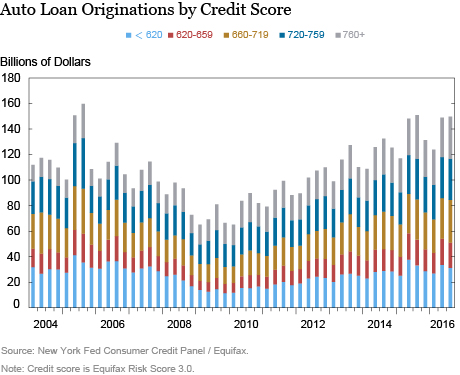
As we noted in an earlier blog post, one feature of our data set is that it enables us to infer whether auto loans were made by a bank or credit union, or by an auto finance company. The latter are typically made through a car manufacturer or dealer using Equifax’s lender classification. Although it remains true that banks and credit unions comprise about half of the overall outstanding balance of newly originated loans, the vast majority of subprime loans are originated by auto finance companies. The chart below disaggregates the $1.135 trillion of outstanding auto loans by credit score and lender type, and we see that 75 percent of the outstanding subprime loans were originated by finance companies.Auto
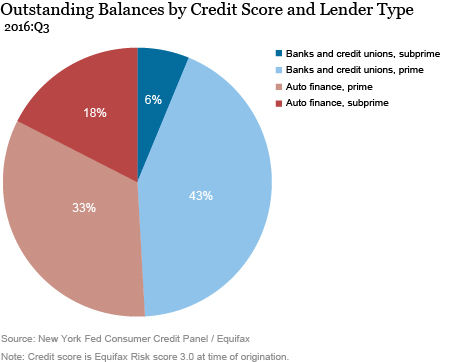
In the chart below, auto loan balances broken out by credit score reveal that balances associated with the most creditworthy borrowers—those with a score above 760 (in gray below)—have steadily increased, even through the Great Recession. Meanwhile, the balances of the subprime borrowers (in light blue below), contracted sharply during the recession and then began growing in 2011, surpassing their pre-recession peak in 2015.
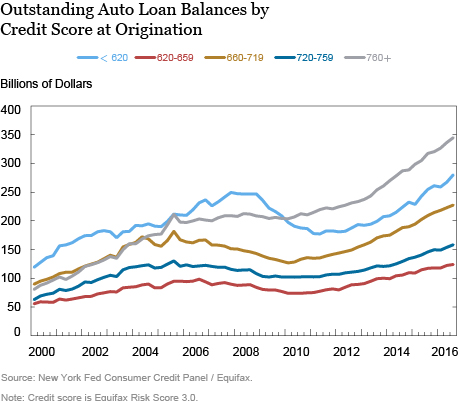
Delinquency Rates
Auto loan delinquency data, reported in our Quarterly Report, show that the overall ninety-plus day delinquency rate for auto loans increased only slightly in 2016 through the end of September to 3.6 percent. But the relatively stable delinquency rate masks diverging performance trends across the two types of lenders. Specifically, a worsening performance among auto loans issued by auto finance companies is masked by improvements in the delinquency rates of auto loans issued by banks and credit unions. The ninety-plus day delinquency rate for auto finance company loans worsened by a full percentage point over the past four quarters, while delinquency rates for bank and credit union auto loans have improved slightly. An even sharper divergence appears in the new flow into delinquency for loans broken out by the borrower’s credit score at origination, shown in the chart below. The worsening in the delinquency rate of subprime auto loans is pronounced, with a notable increase during the past few years.
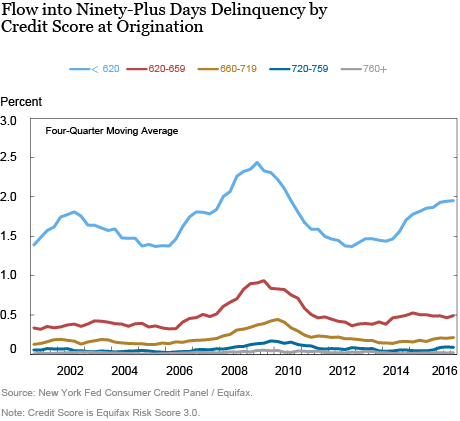
It’s worth noting that the majority of auto loans are still performing well—it’s the subprime loans that heavily influence the delinquency rates. Consequently, auto finance companies that specialize in subprime lending, as well as some banks with higher subprime exposure are likely to have experienced declining performance in their auto loan portfolios.
Conclusion
The data suggest some notable deterioration in the performance of subprime auto loans. This translates into a large number of households, with roughly six million individuals at least ninety days late on their auto loan payments. Even though the balances of subprime loans are somewhat smaller on average, the increased level of distress associated with subprime loan delinquencies is of significant concern, and likely to have ongoing consequences for affected households.
end
The Beige book report by the Fed districts shows a modest economic slowdown and this is due to the high USA dollar
(courtesy zero hedge)
Beige Book Finds Modest Economic Slowdown: Strong Dollar “Headwinds” Cited
Steven Mnuchin Roils Bond Markets With Suggestion Of 100 Year Treasury Bond
The Fed’s latest Beige Book released Wednesday found seven regional Fed districts reporting economic activity as growing at a modest or moderate pace, a decline from 11 in the last report, with strong dollar headwinds among one of the more frequently cited reasons for the weakness.
While the Beige Book information was collected up until Nov. 18, 10 days after the U.S. elections, uncertainty about the influence on politics on economic activity was cited eight times in the report.
“Reports from the twelve Federal Reserve Districts indicate that the economy continued to expand across most regions from early October through mid-November,” the Current Economic Conditions report known as the Beige Book said. The report will be presented at the upcoming Federal Open Market Committee meeting Dec. 13-14.
The Beige Book did shed light on some issues the FOMC will take into consideration as they chart the path of the fed funds rate into the coming year.
The report showed “demand for manufactured products was mixed during the current reporting period, with the strong dollar being cited as a headwind to more robust demand in a few districts.”
Of note, echoing recent comments by Fed officials, the strong dollar was cited as a headwind to more robust demand in a few districts. Some more examples:
- Outlooks were generally positive, although the strong dollar continued to depress exports of manufactured goods in some Districts
- For steel, demand fell in the Cleveland District and production weakened in the San Francisco District, where contacts noted that the elevated dollar, strong global production, and weak economic growth held back exports.
- The strength of the dollar reduced spending by international customers in the Boston, Atlanta, and Dallas Districts. Reports on automobile sales were mixed.
- One contact had poor results in stores near the Canadian border because of the strong U.S. dollar but experienced mid-to-upper single digit sales increases in locations where the exchange rate was not a factor.
- Factors tempering output growth for other manufacturing industries include lower business fixed investment, the strong dollar, and weakness in the energy sector.
- A transportation source reported that truck and railroad services experienced sluggishness due to excess capacity and the strong dollar.
- District retailers reported relatively flat sales growth compared with the same time period last year. Some contacts noted that international customers were spending less due to the strength of the dollar.
- Contacts continued to point to lower exports as a headwind, citing challenges with international demand due to the strong dollar.
- Gulf Coast chemical producers saw mixed demand, in line with the headwinds of a strong dollar and moderating international demand.
- Contacts noted slowing sales growth in border cities due to the sustained impact from the strong value of the dollar, and one contact noted continued sales declines at stores in the oil patch.
- E-commerce sales continued to boost domestic shipping volumes, while demand from the export sector remained weak due to the elevated dollar.
- Steel production weakened over the reporting period as the elevated dollar, strong global production, and weak global economic growth held back exports
- On balance, the elevated dollar continued to slow most exports, particularly for raisins, where global inventories remain elevated.
Elsewhere, Richmond and St. Louis contacts suggested “softening vehicle sales might be attributed to uncertainty surrounding the presidential election,” the report said. A staffing firm in the Cleveland district cited election uncertainty as a reason placement was down, while Cleveland area retailers are looking for sales to improve “with the presidential election behind them and the holiday shopping season approaching.”
The Federal Reserve also Wednesday announced changes to the report’s format beginning in January. The changes are designed to “standardize specific core topics included in each of the 12 Federal Reserve Bank District reports, provide a more consistent presentation of the national summary, and enhance the design of the publication,” the Fed said in a separate press release.
A tightening in labor market conditions was reported by seven Districts, with modest employment growth on balance
Here are select anecdotes from various districts covered by the beige book:
Boston: Contacts expressed some uncertainty about whether the strong international travel numbers will continue in 2017, especially for leisure travelers, if the U.S. dollar remains strong against other major currencies. A specialty chemical manufacturer, said that finding hourly workers was exceedingly difficult. This contact said that only one out of every three or four hourly hires works out; the problem is absenteeism, with many workers unable or unwilling to work five days in a row. Another respondent said that eight out of ten potential hourly hires either cannot pass a drug test or cannot pass a simple math test.
New York: New York City’s rental market has been mostly steady, except at the high end, where the inventory has risen and rents have drifted down. Landlord concessions have grown increasingly prevalent, especially in Manhattan and Brooklyn
Philadelphia: Mountain resort areas reported strong bookings for the remainder of the year, while convention bookings are reported as strong for the first quarter of next year.
Cleveland: Two contacts said that firms are postponing investment decisions until more is known about the tax policies of the incoming president.Input costs rose since our last report primarily because of increasing prices for raw materials and employee health insurance.
Richmond: A port official said that flooding in the Carolinas caused by Hurricane Matthew had delayed some agricultural exports. Since the opening of the new Panama Canal locks, some ports reported a decline in vessel calls while container volume increased. The general manager at an inland hotel reported that all hotels in town were fully booked during the hurricane and remained booked with FEMA personnel several weeks after the storm.
Atlanta: Contacts from the medical field noted accelerating nursing shortages. In response to the challenges finding workers, a number of firms continued to engage in partnerships with community colleges and workforce development organizations to develop customized training programs and internship opportunities, or to invest in automation to replace difficult-to-fill jobs.
Chicago: Contacts continue to indicate that the labor market is tight and that it is getting more and more difficult to fill positions at any skill level.
St. Louis: Over half of contacts reported wages were higher or slightly higher than during the same period last year, and 60 percent reported increasing wages and salaries to attract or retain employees, particularly those in professional and technical, production, and administrative positions.
Minneapolis: Tourism activity was strong overall for this transitional season. In Helena, Mont., big game hunting licenses sold out for nonresident hunters, a change from previous years. The increase was attributed to higher numbers of deer and elk, along with improvements in the overall economy, according to a state official.
Kansas City: Due to weaker agricultural credit conditions and increased risk in the farm sector, District contacts reported notable increases in collateral requirements and slight increases in interest rates on farm loans.
Dallas: Energy firms noted that layoffs were mostly done, however there is little hope for recovery in employment levels in 2017 if oil prices do not increase above $50.
San Francisco: Contacts reported that demand for health-care services remained strong, but the election outcome had greatly increased uncertainty around the Affordable Care Act and raised concerns about the possibility of slower industry growth and cutbacks in the near term.In response to recent minimum wage increases, some restaurants in Southern California are actively considering replacing tips with a mandatory service charge that would be distributed equitably among staff. Contacts expect real estate investment by foreign buyers to pick up in the Pacific Northwest following the recent enactment of a tax on foreign buyers in Vancouver, Canada.
end
Mnuchin, roils the bond markets with the suggestion of a 100 yr treasury bond to capture the low rates: the 30 yr yield rose to 3.06% as the world contemplates huge spending by Trump;
(courtesy zero hedge)
Steven Mnuchin Roils Bond Markets With Suggestion Of 100 Year Treasury Bond
Barely having confirmed he will be Donald Trump’s nominee for Treasury Secretary, Steven Mnuchin proceeded to roil the bond market when the former Goldman banker told CNBC he would look at extending the maturity of future Treasury issuance, hinting at 50 and 100 Year bonds, which promptly sent long-term US bond yields surging by the most since the turmoil following Trump’s election victory.
30-year Treasury yields spiked as much as 12 basis points to 3.06%, after Mnuchin said ultra-long bond sales would be considered. His comments also pushed 5s30s curve from a session low 115bps to above 122bp in just over an hour, rapidly steepening the curve, as the 30Y yield rose as much as 14bp to within 1bp of its YTD high.

While losses were later pared in the 3pm index rebalancing, the selloff capped the worst month for US Treasuries in more than five years, driven by gains for stocks and expectations Trump presidency will bring wider deficits, higher inflation and Fed rate increases
“I think interest rates are going to stay relatively low for the next couple of years.” Mnuchin told CNBC. “We’ll look at potentially extending the maturity of the debt, because eventually we are going to have higher interest rates, and that’s something that this country is going to need to deal with.” Ironically, with that statement, Mnuchin quickly sent yields spiking higher, although courtesy of foreign buyers these were promptly renormalized.
Asked if he would consider maturities of 50 or even 100 years, ultra-long issuance that has become increasingly popular in Europe in recent years as interest rates plunged to record lows as recently as July, Mnuchin said: “We’ll take a look at everything.”
While the US government bond market is the most liquid and deep in the world, compared to many of its peers especially in Europe, it has historically had much lower average maturities, with Treasury officials seeking a balance between cheaper short-dated bills and bonds, and more expensive long-term debt that minimizes “rollover risk”, the danger that Treasury won’t be able to refinance itself. So even as countries like Belgium, Austria and even Mexico have recently sold bonds maturing in 50, 70 or even 100 years (and led to significant MTM losses for all those who purchased them, thanks to their substantial duration) the US Treasury has never issued a bond with a maturity beyond 30 years,
According to Bloomberg, the average weighted maturity of outstanding US debt is just 5.7 years, the lowest among the G10 countries except Sweden. In comparison, the weighted average maturity of the UK gilt market is more than 14 years. This discrepancy – especially in a world where there is more than enough demand for longer dated debt – has led to repeat, if mostly muted, calls for the Treasury to start an ultra-long bond issuance programme, especially as interest rates and bond yields have plumbed record lows in recent years.
The TBAC, or Treasury Borrowing Advisory Committee, a panel of Wall Street advisors (including Goldman) who provide feedback to the US Treasury, was tasked in August of 2015 to discuss whether the Treasury should take advantage of low rates to increase issuance of long-term debt. Minutes from the meeting showed that some participants focused on “the benefits of such issuance given low absolute interest costs.” In 2014, the Treasury Department asked the TBAC whether it should issue bonds that mature in more than 30 years.
The Treasury’s reluctance to issue ultra-long mautirities may very soon change, now that it is headed by a man who wants to lock in low rates for up to one century, especially once the “Trumpflation” revulsion emerges, and the scramble for and into duration returns. One potential stumbling block, however, is that the duration of 30-year Treasuries is already among the highest in the global bond market, lessening the need for even longer-term issuance.
On the other hand, if Mnuchin is indeed focused on alleviating potential debt rollover concerns beginning some time in 2046, then century bonds are almost certainly assured. And considering that Trump is expected to unleash a new debt issuance spree to fund his fiscal stimulus, there will be more than enough space to “experiment” with previously unused maturities
END
Well that is all for today
I will see you tomorrow night
Harvey


 harveyorganblog.com
[…] NOV 30/RAID ON GOLD AND SILVER ON LAST DAY OF OTC/LBMA OPTIONS EXPIRY/39 TONNES OF GOLD STANDING FOR… […]
LikeLike
[…] by Harvey Organ Harvey Organ’s Blog […]
LikeLike
Options expiry over Huge deliveries for December contracts…but nothing chages gold keeps going down as well as Silver….MORE USELESS INFO AND BULLSHIT NUMBERS AND THEORIES BY HARVEY
LikeLike