
Gold at (1:30 am est) $1193.20 UP $4.80
silver at $17.12: up 2 cents
Access market prices:
Gold: $1195.30
Silver: $17.12
THE DAILY GOLD FIX REPORT FROM SHANGHAI AND LONDON
.
The Shanghai fix is at 10:15 pm est last night and 2:15 am est early this morning
The fix for London is at 5:30 am est (first fix) and 10 am est (second fix)
Thus Shanghai’s second fix corresponds to 195 minutes before London’s first fix.
And now the fix recordings:
Shanghai FIRST morning fix Jan 30/17 (10:15 pm est last night): $ holiday
NY ACCESS PRICE: $xxx (AT THE EXACT SAME TIME)/premium $xxx
XXXXXXXXXXXXXXXXXXXXXXXXXXXXXXXXXX
Shanghai SECOND afternoon fix: 2: 15 am est (second fix/early morning):$ holiday
NY ACCESS PRICE: $xxxx (AT THE EXACT SAME TIME/2:15 am)
SPREAD/ 2ND FIX TODAY!!: $xxx
China rejects NY pricing of gold as a fraud/arbitrage will now commence fully
XXXXXXXXXXXXXXXXXXXXXXXXXXXXXXXXXXXXXXXX
London FIRST Fix: Jan 30/2017: 5:30 am est: $1189.85 (NY: same time: $1189.95 (5:30AM)
XXXXXXXXXXXXXXXXXXXXXXXXXXXXXXXXXXXXXXXX
London Second fix Jan 30.2017: 10 am est: $1193.25 (NY same time: $1192.80 (10 AM)
It seems that Shanghai pricing is higher than the other two , (NY and London). The spread has been occurring on a regular basis and thus I expect to see arbitrage happening as investors buy the lower priced NY gold and sell to China at the higher price. This should drain the comex.
Also why would mining companies hand in their gold to the comex and receive constantly lower prices. They would be open to lawsuits if they knowingly continue to supply the comex despite the fact that they could be receiving higher prices in Shanghai.
end
Today, you will see below the huge obliteration in the gold comex open interest. It is now at levels last scene in December( gold was trading 60 dollars lower at $1130 then). For some unknown reason every time we enter an active month, the owners of comex contracts would rather sell than roll to a future month with little cost. Gold holders are generally long term players as they hold the metal because they view a perceived risk to the financial world. It really makes no sense for such a huge liquidation. However what is strange is that the open interest in silver refuses to break to lower levels. As gold OI retreated by 43,000 contracts down to 395,000, silver OI actually rose close to 180,000. Both physical gold and silver metals are in backwardation in London and thus scarcity is quite prevalent over in England. The problem will intensify in London once paper obligations turn into real metal leaving those short in a heap of trouble.
Tomorrow is the last day for options expiry in London. These are private option deals and generally the options can expire early in the morning or at noon our time so except a little whacking.
For comex gold:
NOTICES FILINGS FOR JANUARY CONTRACT MONTH: 47 NOTICE(S) FOR 4700 OZ. TOTAL NOTICES SO FAR: 1254 FOR 125,400 OZ (3.9004 TONNES)
For silver:
NOTICES FOR JANUARY CONTRACT MONTH FOR SILVER: 34 NOTICE(s) FOR 170,000 OZ. TOTAL NUMBER OF NOTICES FILED SO FAR; 745 FOR 3,725,000 OZ
Let us have a look at the data for today
.
xxxxxxxxxxxxxxxxxxxxxxxxxxxxxxxxxxxxxxxxxxxxxxxxxxxxxxxxxxxxxxxxxxxxxxxxxx
In silver, the total open interest ROSE by 2,258 contracts UP to 179,666 with respect to FRIDAY’S TRADING. In ounces, the OI is still represented by just less THAN 1 BILLION oz i.e. .898 BILLION TO BE EXACT or 128% of annual global silver production (ex Russia & ex China).
FOR THE JANUARY FRONT MONTH IN SILVER: 0 NOTICES FILED FOR nil OZ.
In gold, the total comex gold FELL BY A MONSTROUS 43,262 contracts WITH THE FALL IN THE PRICE GOLD ($1.40 with FRIDAY’S trading ).The total gold OI stands at 395,594 contracts and a job well done by our crooked bankers.
we had 47 notice(s) filed upon for 4700 oz of gold.
xxxxxxxxxxxxxxxxxxxxxxxxxxxxxxxxxxxxxxxxxxxxxxxxxxxxxxxxxxxx
With respect to our two criminal funds, the GLD and the SLV:
GLD:
We had no changes in tonnes of gold at the GLD
Inventory rests tonight: 799.07 tonnes
.
SLV
we had no changes in silver into the SLV:
THE SLV Inventory rests at: 335.759 million oz
FEDERAL RESERVE BANK OF NY: GOLD MOVEMENT REPORT FOR DECEMBER EXPORTS
JANUARY REPORT
The FRBNY reported that we have 7,841 million dollars worth of gold in inventory valued at $42.22 for December.
The previous month we had 7,841 million dollars worth of gold inventory valued at $42.22 for December.
We thus had 0 gold oz moved out of inventory
end
.
First, here is an outline of what will be discussed tonight:
1. Today, we had the open interest in silver RISE by 2258 contracts UP to 179,666 AS SILVER WAS UP 29 CENTS with FRIDAY’S trading. The gold open interest FELL by 43,262 contracts DOWN to 395,594 WITH THE FALL IN THE PRICE OF GOLD OF $1.40 (FRIDAY’S TRADING)
(report Harvey).
2.a) The Shanghai and London gold fix report
(Harvey)
2 b) Gold/silver trading overnight Europe, Goldcore
(Mark O’Byrne/zerohedge
and in NY: Bloomberg
2c) COT report
(Harvey)
3c FEDERAL RESERVE BANK OF NY/GOLD INVENTORY MOVEMENT
(HARVEY)
3. ASIAN AFFAIRS
REPORT ON JAPAN SOUTH KOREA NORTH KOREA AND CHINA
3a)THAILAND/SOUTH KOREA
b) REPORT ON JAPAN
c) REPORT ON CHINA
i)Chinese military officials are stating that because of Trump’s isolationists policies, war is becoming inevitable:
( zero hedge)
ii)China is rapidly growing its debt to 300% of GDP. Due to measures taken by POBC, the debt implosion will be gradual. UBS outlines the 4 factors that will occur before a systemic crisis unfolds:
( zero hedge/UBS)
4 EUROPEAN AFFAIRS
i)Saturday /Germany
Trump talks to Merkel. They discuss NATO terrorism and middle east conflicts as well as Russian relations. On the whole a very productive talk:
( zero hedge)
ii)England
iii)With over 1.4 million petition signatures urging the UK to ban Donald Trump, the UK Parliament is set to hear the debate:( zero hedge)
iv)ECB/Germany
This is not good: German inflation rises to 1.9% and signals that the ECB is running out of excuses to maintain or extend stimulus measures:
( zero hedge)
With its latest purchases, the ECB now owns 10.2% of all European corporate bonds and total assets purchased equals 36% of EU GDP. Total purchases; 3.72 trillion euros!($3.98 trillion USA)
v)Greece
UKGuardian:
The iMF wants the EU to take on considerable haircuts with their debt. the EU wants Greece to undertake more austerity something that it cannot do. Greece has 10.6 euros of debt due in the summer. Expect fireworks and probably a GREXIT if they are not given relief.
(courtesy UKGuardian) and special thanks to Robert H for sending this to us)
5. RUSSIAN AND MIDDLE EASTERN AFFAIRS
i)Saturday/Russia
Trump on Saturday also called Putin and their talk was beneficial. Their main topic was fighting terrorism ie. ISIS and the middle east conflict (Arab vs Israel)
( zero hedge)
ii)The arms race intensifies with Russia launching the biggest Arctic military expansion since the fall of the USSR
( zerohedge)
iii)Iran
Iran bans USA visitors in retaliation for Trump’s ban on Muslims from 7 countries including Iran)
( zero hedge)
iv)This does not look good: Iran no doubt broke their Nuclear deal with a ballistic missile test
( zerohedge)
v)Syria
Debka files comments on what the USA and Russia talks are heading for with respect to Syria; three zones namely the Turkish zone to the north, two uSA zones (one close to Israel and the second, a northern sector close to the Turkish border. Russia will have its sphere of influence west of Euphrates an close to its sea bearing vessels on the Mediterrean
( Debka File)
vi)Syria
This should complicate matters: rumours that Assad has suffered a stroke or was shot. This would throw the whole situation in Syria up in the air:
( zero hedge)
6.GLOBAL ISSUES
7. OIL ISSUES
8. EMERGING MARKETS
none today
9. PHYSICAL MARKETS
i)Guyana gold miners threaten to halt production amid new tax measures.
( Demerara Newspaper/Guyana/GATA)
ii)Bullion star maps out gold movement (demand). It indicates that gold is far more popular that GFMS wants you to believe.
( Bullionstar/RonanManly/GATA)
iii)A must read interview of Egon Von Greyerz with Kingworldnews. When measured against gold in the past 16 years, stocks have not gained 53% but actually lost 63%. Von Greyerz explains why we will eventually end up in hyperinflation and a corresponding debt deflation where asset prices fall by 90%
very important read..
( Egon Von Greyerz/Kingworldnews)
iv)The IMF reminds everyone that the debt of Greece has not gone away. Supposedly the Debt to GDP is now 180 but the IMF states that it will grow to 275% by 2060. The real debt to GDP is much higher if you count other off balance sheet liabilities.
( IMF/Bloomberg/GATA)
v)Avery Goodman points out something that I have highlighted to you every day this month: we have had a 729% increase in comex gold deliveries in January. For that matter, we have had an dramatic increase from April 2016 to today.Avery describes beautifully the fraud by option sellers as well as how gold is leaving USA gold vaults. He states correctly that this will end the moment Mnuchin is confirmed.
I have printed out the entire commentary because of its extreme important to you.
There are slight errors in Goodman’s piece:
- first day notice is Tuesday not today
- otc/lbma contracts always expire on the last day of the month (tomorrow)
(courtesy Avery Goodman/GATA)
vi)I brought this to your attention last week, the huge amount of gold flowing into China via Switzerland. Now Lawrie comments on the above story:
( Lawrie on Gold/)
viii Interviews with Rob Kirby, Bill Holter/ and john williams
10.USA STORIES
i)The USA auto industry is now in crisis as its inventory bubble has risen again. The uSA has a record high 3.9 million vehicles or around 66 days of supply: a record high.
( zero hedge)
Saturday
ii)Chaos supreme has Trump bans Muslims from entering the USA even this a green card. The ban is from 7 Muslim countries: Iran, Iraq, Syria, Yemen, Somalia,Sudan and Libya
ix)Trump strikes deal with Lockheed on the cost of the F35. Supreme Court Justice pick will be announced tomorrow night
( zerohedge)
x)No doubt that this will be the next conflict centre: the outsourcing of high tech jobs/an attack on the HiB.
( zero hedge)
xi)Another “soft” data report on the Dallas Fed Manufacturing Index. It soared to its highest level since 2010. The rise was mainly in the “hope” category
xii)There are many cities in the USA who host illegal immigrant and will not follow the Feds in returning the aliens to their home country. They are thus deemed sanctuary cities. The rhetoric between Washington and individual states is getting louder by the day. Now California which is net loser in the tax scheme is threatening to without taxes (funds) to Washington( zero hedge)
xiii)American continue to spend more than they earn as personal income growth in December disappointed the street rising by a less than expected .3%/ This is the 9th month in a row that annual spending growth was larger than income growth:
xiv)Steven Bannon has now been promoted to the “principals committee” of the national Security Council while downgrading the roles of the chairman of the Joints Chief of Staff and the director of the national Intelligence!!!! ( zero hedge)
Let us head over to the comex:
The total gold comex open interest FELL BY A MONSTROUS BY 43,262 CONTRACTS DOWN to an OI level of 395,594 WITH THE FALL IN THE PRICE OF GOLD ( $1.40 with YESTERDAY’S trading). We are now in the contract month of JANUARY and it is one of the poorest deliveries of the year.
With the front month of January we had a LOSS of 0 contract(s) REMAINING AT 47. We had 0 notice(s) filed YESTERDAY so we NEITHER LOST NOR GAINED ANY GOLD OZ (OR CONTRACTS) STANDING in this non active delivery month of January. For the next big active delivery month of February we had a LOSS of 58,096 contracts DOWN to 27,583.(feb 2016: 25,686 contracts). We have one more day before first day notice, tomorrow. March had a GAIN of 523 contracts as it’s OI is now 2119. We are now SLIGHTLY ahead with respect to OI when we compare data for open interest this year vs last year with the same amount of time to expire:
We had 47 notice(s) filed upon today for 4700 oz
And now for the wild silver comex results. Total silver OI ROSE by 2258 contracts FROM 177,408 UP TO 179,666 AS the price of silver ROSE IN PRICE TO THE TUNE OF 29 CENTS with respect to YESTERDAY’S trading. We are moving further from the all time record high for silver open interest set on Wednesday August 3/2016: (224,540).
We are now in the non active delivery month of January and here the OI LOWERED TO 1 CONTRACT(S) FOR A LOSS OF 33 CONTRACTS. We had 34 notice(s) filed on FRIDAY so GAINED 1 silver contracts or an additional 5,000 oz that will stand in this delivery month of January. The next non active month of February saw the OI rise by 15 contract(s) UP TO 241.
The next big active delivery month is March and here the OI ROSE by 616 contracts UP to 133,004 contracts.
We had 0 notice(s) filed for 170,000 oz for the January contract.
VOLUMES: for the gold comex
Today the estimated volume was 232,781 contracts which is good.
Yesterday’s confirmed volume was 390,374 contracts which is excellent
volumes on gold are getting higher!
| Gold | Ounces |
| Withdrawals from Dealers Inventory in oz | nil |
| Withdrawals from Customer Inventory in oz |
321.15 OZ
Manfra
10 kilobars
|
| Deposits to the Dealer Inventory in oz | nil oz |
| Deposits to the Customer Inventory, in oz |
nil oz
|
| No of oz served (contracts) today |
47 notice(s)
4700 oz
|
| No of oz to be served (notices) |
0 contracts
NIL oz
|
| Total monthly oz gold served (contracts) so far this month |
1254 notices
125,400 oz
3.9004 tonnes
|
| Total accumulative withdrawals of gold from the Dealers inventory this month | 3000.000 oz |
| Total accumulative withdrawal of gold from the Customer inventory this month | 4,821,805.2 oz |
Today, 0 notice(s) were issued from JPMorgan dealer account and 35 notices were issued from their client or customer account. The total of all issuance by all participants equates to 47 contract(s) of which 0 notices were stopped (received) by jPMorgan dealer and 0 notice(s) was (were) stopped/ Received) by jPMorgan customer account.
March 2016: 2.311 tonnes (March is a non delivery month)
| Silver | Ounces |
| Withdrawals from Dealers Inventory | nil |
| Withdrawals from Customer Inventory |
685,237.546 0z
Brinks
HSBC
Scotia
|
| Deposits to the Dealer Inventory |
nil
|
| Deposits to the Customer Inventory |
578,996.220 OZ
Scotia
|
| No of oz served today (contracts) |
0 CONTRACT(S)
(NIL OZ)
|
| No of oz to be served (notices) |
0 contracts
(NIL oz)
|
| Total monthly oz silver served (contracts) | 745 contracts (3,725,000 oz) |
| Total accumulative withdrawal of silver from the Dealers inventory this month | NIL oz |
| Total accumulative withdrawal of silver from the Customer inventory this month | 22,719,831.5 oz |
end
And now the Gold inventory at the GLD
jan 30/no change in gold inventory at the GLD/Inventory rests at 799.07 tonnes
Jan 27/no changes at the GLD/Inventory rests at 799.07 tonnes
Jan 26/no changes at the GLD/Inventory rests at 799.07 tonnes/
jan 25/another exactly the same withdrawal as yesterday: 50.4 tonnes and again this was used in the whacking of gold today/inventory rests at 799.07 tonnes
jan 24/a huge withdrawal of 5.04 tonnes and probably this was used today in the whacking of gold/inventory rests at 804.11 tonnes
Jan 23/a big change/this time a deposit of 1.19 tonnes of gold into the GLD/inventory rests at 809.15 tonnes. The drainage of gold from the GLD to Shanghai has now stopped!
Jan 20/no changes in gold inventory a the GLD/Inventory rests at 807.96 tonnes
Jan 19/no changes in gold inventory at the GLD/Inventory rests at 807.96 tonnes
Jan 18/no changes in gold inventory at the GLD/Inventory rests at 807.96 tonnes
Jan 17/17/a deposit of 2.96 tonnes of gold/inventory at the GLD rests at 807.96 tonnes. I guess there is no more gold inventory to sent to C+Shanghai
Jan 13/17/there were no changes in gold inventory at the GLD/Inventory rests at 805.00 tonnes
Jan 12/2017/no change in gold inventory at the GLD/Inventory rests at 805.00 tonnes
Jan 11/no change in gold inventory at the GLD/Inventory rests at 805.00 tonnes
JAN 10/no changes in gold inventory at the GLD/Inventory rests at 805.00 tonnes
JAN 9/A WITHDRAWAL OF 8.87 TONNES OF GOLD FROM THE GLD/INVENTORY RESTS AT 805.00 TONNES
end
NPV for Sprott and Central Fund of Canada
end
Major gold/silver trading/commentaries for MONDAY
GOLDCORE/BLOG/MARK O’BYRN
Why 2017 Could See the Collapse of the Euro
2017 could be the year that the euro collapses according to Joseph Stiglitz writing in Fortune magazine and these concerns were echoed over the weekend by former Bundesbank vice-president and senior European Central Bank official, Jürgen Stark, when he said that the ‘destruction’ of the Eurozone may be necessary if countries are to thrive again.
Stark and Stiglitz are too of many respected commentators, from both the so called right and the so called left, who are warning that the common currency and the Eurozone itself will not survive the financial and political turmoil already besetting the European monetary union and set to deepen in the coming months and years.
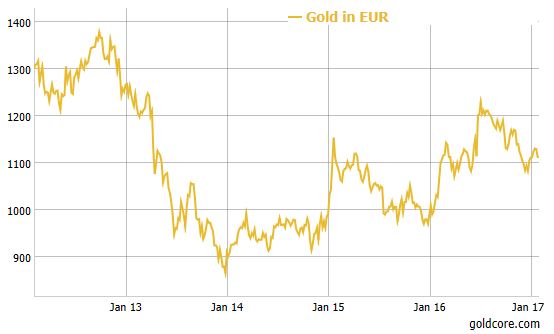
Gold in Euros – 5 Years
According to Stiglitz:
Greece remains in a severe depression. Growth for the Eurozone over the past year has been an anemic 1.6%, and that number is twice the average growth rate from 2005 to 2015. Historians are already speaking of the Eurozone’s lost decade, and it’s possible they’ll soon be writing about its last decade, too.
The euro was introduced in 2002, but the cracks in the single currency arrangement, which began in 1999, became evident with the 2008 global financial crisis.
Indeed, Greece and many periphery nations remain borderline or actually insolvent and this inconvenient truth has been largely ignored in recent months as it would clash with the cosy, and complacent, Eurozone “recovery” narrative.
The recovery is unsustainable as the root cause of the crisis – humongous levels of debt in Greece, Spain, Italy, Portugal and Ireland – was not dealt with rather the debt can was simply kicked down the road.
France, a nation with its own debt and economic issues, warned last week that the “window of opportunity” for a debt deal is closing after Athens and its creditors failed to find a solution to the country’s deadlocked bailout last week. French Finance Minister Michel Sapin warned that the coming volatile elections in Europe in 2017 would soon dominate the agenda and may make it much harder for Greece to reach a new ‘bailout’ deal.
Jeroen Dijsselbloem who heads the Eurozone’s Finance ministers also said: “there is a clear understanding that a quick finalization of the second [bailout] review is in everyone’s interest” as reported by the Wall Street Journal.
However, others such as Stark believe that eurozone “must break up if its members are to thrive again.”
Stark, who served on the ECB’s executive board during the financial crisis, said it was time to “think the unthinkable” and work towards a “reset” of Europe that pulled power away from Brussels as reported by the Telegraph.
He said the creation of a two-speed eurozone, with France and Germany at its core, would help to ensure the smaller bloc’s survival and he said that the current eurozone may need to be destructed in order to create a new “two-speed eurozone, with France and Germany at its core”.
This “would help to ensure the smaller bloc’s survival.”
Stiglitz conclusion, in a little noticed or commented upon article in Fortune magazine is also not optimistic and underlines the importance of being properly diversified and not having all your eggs in the euro basket – be that euro bank deposits in Eurozone banks or indeed euro denominated assets.
Stiglitz concludes by warning that:
… It is at least as likely that the political forces are going in the other direction, and if that is the case, it may be only a matter of time before Europe looks back on the euro as an interesting, well-intentioned experiment that failed—at great cost to the citizens of Europe and their democracies.
The full article can be read on Fortune here
Whether we like it or not, there is an increasing possibility that there may be a return to national currencies in Europe. Periphery nations savers and investors are particularly exposed in this regard.
Gold is an important hedging instrument and financial insurance that will protect people from the potential return to liras, drachmas, escudos, pesetas and punts. Hoping for the best but diversifying and being prepared for less benign financial outcomes remains prudent.
http://www.goldcore.com/us/gold-blog/2017-see-collapse-euro/
END
A must audio that you have to hear:
Rob Kirby interviewed by Reluctant Preppers)
Rob Kirby: If Trump orders an audit of gold, gold EXPLODES
https://www.youtube.com/watch?v=zjRkhqX2xas
end
Dr Dave Janda talks with Bill Holter and Keith Neumeyer of First Majestic Mining
- (courtesy Dave Janda)
Financial Analyst, Holter Sinclair Partnership (www.jsmineset.com )
CEO, First Majestic Mining Company
end
Guyana gold miners threaten to halt production amid new tax measures.
(courtesy Demerara Newspaper/Guyana/GATA)
Guyana gold miners threaten to protest, reduce declarations amid new tax measures
Submitted by cpowell on Sun, 2017-01-29 15:48. Section: Daily Dispatches
By Denis Chabroi
Demerara Waves newspaper, Georgetown, Guyana
Saturday, January 28, 2017
Miners under the umbrella of the Guyana Gold and Diamond Miners Association on Friday warned that they would halt gold mining, reduce declarations, and stage a countrywide protest if President David Granger fails to meet with them within two weeks and address their concerns about heavy taxation.
“The main problem we have to accept is that the government does not respect this industry at the present time,” said association consultant Tony Shields, reflecting that miners’ representatives met Granger only once, in December 2015. Shields charged that meeting with government ministers has turned out to be a waste of time, just photo opportunities, and the time has come for the Guyanese leader to have a big meeting with the miners rather than just the executive.
Nearly all the more than 100 attendees raised their hands in support of a protest. …
… For the remainder of the report:
http://demerarawaves.com/2017/01/28/gold-miners-threaten-to-protest-redu…
END
Bullion star maps out gold movement (demand). It indicates that gold is far more popular that GFMS wants you to believe.
(courtesy Bullionstar/RonanManly/GATA)
From Bullion Star, gold market charts for January
Submitted by cpowell on Sun, 2017-01-29 16:28. Section: Daily Dispatches
11:29a ET Sunday, January 29, 2017
Dear Friend of GATA and Gold:
With some charts from Gold Charts R Us, Bullion Star today details gold demand and movement around the world, indicating that the monetary metal is a lot more popular than GFMS would have you believe. Bullion Star’s analysis is headlined “Gold Market Charts — January 2017” and it’s posted here:
https://www.bullionstar.com/blogs/gold-market-charts/gold-market-charts-…
CHRIS POWELL, Secretary/Treasurer
Gold Anti-Trust Action Committee Inc.
CPowell@GATA.org
END
A must read interview of Egon Von Greyerz with Kingworldnews. When measured against gold in the past 16 years, stocks have not gained 53% but actually lost 63%. Von Greyerz explains why we will eventually end up in hyperinflation and a corresponding debt deflation where asset prices fall by 90%
very important read..
(courtesy Egon Von Greyerz/Kingworldnews)
Stocks have lost 63% against gold since 2000, von Greyerz notes
Submitted by cpowell on Sun, 2017-01-29 21:47. Section: Daily Dispatches
4:48p ET Sunday, January 29, 2017
Dear Friend of GATA and Gold:
Gold fund manager Egon von Greyerz, interviewed by King World News, notes that since 2000 U.S. stocks have lost 63 percent against gold. An excerpt from the interview is posted at KWN here:
http://kingworldnews.com/greyerz-we-now-have-the-perfect-recipe-for-a-gl…
CHRIS POWELL, Secretary/Treasurer
Gold Anti-Trust Action Committee Inc.
CPowell@GATA.org
END
The IMF reminds everyone that the debt of Greece has not gone away. Supposedly the Debt to GDP is now 180 but the IMF states that it will grow to 275% by 2060. The real debt to GDP is much higher if you count other off balance sheet liabilities.
(courtesy IMF/Bloomberg/GATA)
Remember Greece? It’s still as insolvent as ever …
Submitted by cpowell on Sun, 2017-01-29 21:54. Section: Daily Dispatches
… and unlike the United States, it can’t just print the world reserve currency.
* * *
IMF Warns that Eurogroup Loan Measures Are Not Enough for Greek Debt
By Eleni Chrepa and Andrew Mayeda
Bloomberg News
Saturday, January 28, 2017
Greece’s public debt and financing needs will prove “explosive” in decades to come unless Europe overhauls its bailout program to ease the load, the International Monetary Fund says in a draft report as the country seeks a fresh loan payout.
In the IMF’s baseline scenario, Greece’s government debt will reach 275 percent of its gross domestic product by 2060, when its financing needs will represent 62 percent of GDP, the report obtained by Bloomberg says. The government estimates public debt around 180 percent of GDP at present.
The European Union’s view of the evolution of Greek debt is “more benign” and based on “significantly more optimistic assumptions,” the IMF notes. The document also says some Greek debt proposals by euro-area finance ministers “are not specific enough to enable a full assessment” of how they would affect sustainability. …
… For the remainder of the report:
https://www.bloomberg.com/news/articles/2017-01-28/imf-warns-eurogroup-l…
END
Avery Goodman points out something that I have highlighted to you every day this month: we have had a 729% increase in comex gold deliveries in January. For that matter, we have had an dramatic increase from April 2016 to today.Avery describes beautifully the fraud by option sellers as well as how gold is leaving USA gold vaults. He states correctly that this will end the moment Mnuchin is confirmed.
I have printed out the entire commentary because of its extreme important to you.
There are slight errors in Goodman’s piece:
- first day notice is Tuesday not today
- otc/lbma contracts always expire on the last day of the month (tomorrow)
(courtesy Avery Goodman/GATA)
Avery Goodman: 729% increase in Comex gold deliveries in January
Submitted by cpowell on Mon, 2017-01-30 01:04. Section: Daily Dispatches
8:04p ET Sunday, January 29, 2017
Dear Friend of GATA and Gold:
Delivery on Comex gold futures contracts in January increased 729 percent over deliveries last January, securities lawyer and market analyst Avery Goodman writes tonight, adding that the use of the U.S. gold reserve for price-suppression purposes likely will end this year. Goodman’s commentary is headlined “Comex Physical Gold Deliveries Rise 729% Year over Year” and it’s posted at his internet site here:
http://averybgoodman.com/myblog/2017/01/29/comex-physical-gold-deliverie…
CHRIS POWELL, Secretary/Treasurer
Gold Anti-Trust Action Committee Inc.
CPowell@GATA.org
COMEX PHYSICAL GOLD DELIVERIES RISE 729% YEAR OVER YEAR!
Written by: Avery B. Goodman (01/29/2017)
The price of gold has been generally following the predictions I made on December 9, 2016. So far, so good…
A lot of non-connected hedge funds and other speculators are now heavily short gold. That includes many people who are writing negative comments about the metal, and paying others to write negatively. They have been drawn in by entities who know better, and who are heavily connected to the US Treasury, Federal Reserve, Bank of England, ECB, etc. The latter have likely closed most of their unhedged short positions even as the speculators have increased theirs.
The well-connected have known the gold jig is up for a very long time. They have engaged in what appears to be an attempt at a very organized and deliberate position change. A number of big banks, such as J.P. Morgan, HSBC, Goldman Sachs and others, for example, made huge purchases of gold bullion banker’s bars. They still have big problems from their past activities, but not so much on futures and forwards markets. The remaining problem comes in the form of a huge uncovered “short” position via massive tonnages of gold inside London-based “unallocated storage” schemes. It is possible that the unveiling of the new so-called COMEX “spot” silver and gold contract,as well as the huge physical gold purchases by big banks has been designed to shift this remaining risk.
The temporary downturn in gold prices, last week, is meaningless. It seems quite clearly to have been orchestrated by a few big options sellers. These smarmy folks always use automated trading software, around options expiration week, to trigger stop-loss orders and margin calls. It is done to temporarily push down paper gold prices, for the purpose of avoiding payouts on call options. Generally speaking, gold speculators buy many more gold calls than puts, so paying out on a rise in gold prices usually costs a great deal more than paying out after a fall in gold prices. The incentive to manipulate prices to prevent options from ending “in the money” is huge.
COMEX February options expiration day was the 26th of January, and it was the day of reckoning when buyer and seller determined how much, if anything, was owed on the matured options contracts. It is also my understanding that many of the privately negotiated “calls” at the various London’s LBMA member banks expired on the 27th. If the options dealers had not launched a coordinated attack on gold prices last week, a huge number of their “call” options would have expired heavily “in the money”. That would have meant billions paid out. Naturally, since casinos always make sure that the house never loses, the payouts won’t happen, thanks to the manipulations.
The most important thing to realize is that price manipulations, around options expiration, are always pure paper plays, and have no legs. However, they won’t end simply because access to the US gold reserve is cut off. Such activities will continue until gold options are made illegal, or the people responsible are criminally prosecuted. A change in Presidential administrations may bring a lot of macro-level reform, including replacement of the people at the very top of the totem pole. However, regulatory staff members remain the same, as do the attorneys who work for the Department of Justice. So long as men and women continue to enter and exit federal agencies through a revolving employment and “consulting” door, into banks and brokerage houses, no serious prosecution is ever going to happen.
Far more important than the temporary manipulation of options dealers, however, is the physical market for real gold. January is an off-month for deliveries at COMEX. However, the number of gold futures contracts that stood for delivery this month resembles an active delivery month. That is interesting because COMEX has always been primarily a paper based exchange. Physical delivery is the exception rather than the rule. Delivery has always been theoretically possible, but it has been rarely done. In January 2016, for example, the holders of only 172 COMEX futures contracts demanded physical gold. In comparison, by January 27, 2017, the holders of 1,254 COMEX futures contracts held them to maturity and demanded their gold! That is a whopping 729% increase yoy!
We’ll see what happens in February. There are already an unusually large number of February contracts remaining open on Friday, a day before the first notice day. Monday is the first notice day for the February delivery month, which has always been a major one. This month is shaping up to be mildly historic in size. The overall delivery size looks like it will be at least as big as December, 2016, even though December is normally the largest delivery month by far. One thing is clear. As of Monday morning, holders of matured futures contracts are going to have to put up or shut up. They must either deposit sufficient cash to pay for the gold in full, or face involuntary liquidation.
No matter how massive the delivery demand, there is always the possibility that dealers will try to attack prices early in the month. They often do this. I believe that the reason revolves around the desire to buy physical gold bullion, from mining companies and others, at a rock-bottom price. They will do everything they can to create a fake price so long as it doesn’t cost them too much. The trouble for them is that, this month, it may cost them more to do it than they save from the results.
There always seem to be a number of “stragglers” among the contracts that are open on the first day of delivery. These speculators cannot afford to pay for their gold, but seem to foolishly hold onto their contracts anyway. They end up involuntarily liquidated and that process will always facilitate downward price manipulation. Because of the prospective size of COMEX February delivery (which is probably mirrored at the LBMA in London), however, even if this happens in February, gold prices should begin rising somewhat earlier than normal. I think the rise will begin, in earnest, early on in the middle of the month, or even before, rather than the more usual late in the month event. The massive and very unusual physical demand in January is likely to have exhausted the most easily accessed supplies, making it difficult for dealers to maintain such shenanigans.
Looking further out, as I have said before, other precious metals prices in 2017 will also be driven upward, by being cross traded with gold, as a result of the closure of the US gold reserve. A vast majority of the people surrounding President Donald Trump are not inclined to allow continued drainage of America’s golden treasure. Incoming Treasury Secretary Mnuchin has given lip service to the “strong” dollar policy, but both he and President Trump have stated that the US dollar is now overvalued. The impact of lower exports and higher imports on GDP has already showed up in dismal GDP performance numbers.
Political cooperation with bankster driven gold price manipulation has always been primarily driven by a desire to stabilize and/or prop up the exchange value of the US dollar. Since America’s leaders now want the dollar down, not up, giving access to the US gold reserve makes no sense. It will be cut off as soon as Obama’s gold-related executive orders come to Mr. Trump’s attention. That should happen a few days after the new Treasury Secretary is confirmed. I have no doubt that the dealers are acutely aware of the fact that Obama’s not-so-secret orders, opening up the gold reserve to gold location swaps and other access, are now history. Downward price manipulation, at the current low pricing point, will become difficult or impossible. In the absence of the US Gold Reserve, prices must rise substantially before highly profitable manipulative activity can begin again.
The reversal of Obama’s executive orders are likely to be as much of a secret as the executive orders themselves were. I don’t expect any formal announcement as such. When it does finally happen, however, there should be a sudden price surge. That doesn’t mean gold is suddenly going to rise to $5,000+ per ounce. That will eventually happen. However, normal markets do not rise like rocketships. Prices may rise by $75 to $100 over a week or two. That is healthier than a massive $300 overnight skyrocket. Massive quick increases in any asset price, in the absence of some unusual major outside event, is the result of upside oriented market manipulation.
We will eventually see a lot of upside manipulation in gold prices (followed by repeated short price collapses) as manipulators turn their attention to profiting, in a different manner, from price volatility. The key point is that when gold prices finally move above the equilibrium point between supply and demand, they can be pushed upward, and then allowed to fall, without any need for physical gold. Until that change in orientation, however, we will see prices driven upward solely by the continuing excess of physical buyers over sellers.
Note that physical precious metals buyers, unlike futures market speculators, are thrifty people who don’t like overpaying. They’ll stop buying when prices rise very fast. They will resist purchasing until they get used to new prices. The process requires time. That’s why gold price destabilization, rather than price suppression, is the primary goal of gold market manipulators. I expect the price of gold to rise slowly but steadily back to its prior supply/demand equilibrium point (somewhere between $1,500 and $1,600 or a bit higher).
If major upside manipulation events begin or a major outside event occurs, like a major default on corporate and government bonds, widespread insolvency of pension plans and/or the demise of the Euro currency, the sky will be the limit. Evidence of fiat currency instability will be so high, once the Eurozone collapses, that a much higher floor will be put underneath precious metal pricing.
END
for your enjoyment/gold coin collectors of old British/Spanish coins will not be happy as their price will fall with the one billion pounds of gold found
(courtesy DailyMirror/GATA)
Sunken British warship laden with gold to be raised 250 years after battle
Submitted by cpowell on Mon, 2017-01-30 01:56. Section: Daily Dispatches
By Abigail O’Leary
Daily Mirror, London
Sunday, January 29, 2017
A sunken British warship wrecked off the coast of South America is due to see the light of day once again — along with L1 billion in gold coins.
The Lord Clive was blasted by cannon fire in 1763 after an attempt to reclaim Uruguay’s Colonia del Sacramento, a former British colony that had been seized by the Spanish.
While Captain Robert McNamara planned to launch his attack and take over the city at the end of the Seven Years’ War, Spanish forces were secretly planning a counterattack.
A battle saw the Lord Clive blasted to pieces and 272 of its crew killed. …
… For the remainder of the report:
http://www.mirror.co.uk/news/world-news/sunken-british-warship-1-billion
END
I brought this to your attention last week, the huge amount of gold flowing into China via Switzerland. Now Lawrie comments on the above story:
(courtesy Lawrie on Gold/)
Gold flows to China via Switzerland soar in December
The latest gold import and export figures into and out of Switzerland both showed huge increases in December with exports to China a particularly notable 158 tonnes compared with a rather small 30.6 tonnes in the previous month. With gold flows into the Chinese mainland from Hong Kong also picking up in December this represents pre-Chinese New Year holiday demand and may also have been boosted by the lower gold prices prevailing in the final quarter of 2016.
Switzerland has always been a major conduit for gold flowing into stronger Eastern hands. That into China for example stays there and doesn’t come out again. The private Swiss gold refineries, Valcambi, Metalor, Pamp and Hereaus all specialise in re-refining gold scrap and 400 ounce good delivery gold bars into the smaller, mostly kilobar, sizes in demand in the Middle and Far East.
But most significant in the latest figures were the exports recorded to China of 158 tonnes – and given that China imports gold directly from a number of other sources too – this suggest a huge pick-up in Chinese demand at the end of a particularly weak year. We have already pointed to a sharp fall in Shanghai Gold Exchange (SGE) gold withdrawals over the year (See:2016 SGE gold withdrawals lowest for four years) which is symptomatic of the same overall reduction in gold demand in China over the full year, but whether the big rise in December imports from Switzerland is purely due to demand ahead of the Chinese New Year, or is gold price-related following the dip in US dollar bullion prices immediately following the US Independence Day holiday in July, is uncertain – but probably a combination of both.

The above graphic from bloomberg.com demonstrates the huge increase in Chinese gold imports from Switzerland in December.
end
Your early MONDAY morning currency, Asian stock market results, important USA/Asian currency crosses, gold/silver pricing overnight along with the price of oil Major stories overnight
1 Chinese yuan vs USA dollar/yuan DOWN to 6.8840(ZERO DEVALUATION /CHINA / CHINA ON HOLIDAY/OFFSHORE YUAN WIDENS TO 6.8678 / Shanghai bourse CLOSED / HANG SANG CLOSED D
2. Nikkei closed DOWN 98.55 POINTS OR 0.51% /USA: YEN FALLS TO 114.22
3. Europe stocks opened ALL IN THE RED ( /USA dollar index RISES TO 100.96/Euro DOWN to 1.0633
3b Japan 10 year bond yield: RISES TO +.085%/ !!!!(Japan buying 100% of bond issuance)/Japanese yen vs usa cross now at 114.22/ THIS IS TROUBLESOME AS BANK OF JAPAN IS RUNNING OUT OF BONDS TO BUY./JAPAN 10 YR YIELD FINALLY IN THE POSITIVE/BANK OF JAPAN LOSING CONTROL OF THEIR YIELD CURVE AS THEY PURCHASE ALL BONDS TO GET TO ZERO RATE!!
3c Nikkei now JUST BELOW 17,000
3d USA/Yen rate now well below the important 120 barrier this morning
3e WTI:: 53.23 and Brent: 55.44
3f Gold UP/Yen UP
3g Japan is to buy the equivalent of 108 billion uSA dollars worth of bond per month or $1.3 trillion. Japan’s GDP equals 5 trillion usa./“HELICOPTER MONEY” OFF THE TABLE FOR NOW /REVERSE OPERATION TWIST ON THE BONDS: PURCHASE OF LONG BONDS AND SELLING THE SHORT END
Japan to buy 100% of all new Japanese debt and by 2018 they will have 25% of all Japanese debt. Fifty percent of Japanese budget financed with debt.
3h Oil UP for WTI and UP for Brent this morning
3i European bond buying continues to push yields lower on all fronts in the EMU. German 10yr bund FALLS TO +.461%/Italian 10 yr bond yield UP to 2.32%
3j Greek 10 year bond yield RISES to : 7.46%
3k Gold at $1191.00/silver $17.13(8:15 am est) SILVER BELOW RESISTANCE AT $18.50
3l USA vs Russian rouble; (Russian rouble DOWN 16/100 in roubles/dollar) 60.04-
3m oil into the 53 dollar handle for WTI and 55 handle for Brent/
3n Higher foreign deposits out of China sees huge risk of outflows and a currency depreciation (already upon us). This can spell financial disaster for the rest of the world/China forced to do QE!! as it lowers its yuan value to the dollar/GOT ZERO DEVALUATION from POBC.
JAPAN ON JAN 29.2016 INITIATES NIRP. THIS MORNING THEY SIGNAL THEY MAY END NIRP. TODAY THE USA/YEN TRADES TO 114.22 DESTROYING JAPANESE CITIZENS WITH HIGHER FOOD INFLATION
30 SNB (Swiss National Bank) still intervening again in the markets driving down the SF. It is not working: USA/SF this morning 1.0034 as the Swiss Franc is still rising against most currencies. Euro vs SF is 1.0666 well above the floor set by the Swiss Finance Minister. Thomas Jordan, chief of the Swiss National Bank continues to purchase euros trying to lower value of the Swiss Franc.
3p BRITAIN VOTES AFFIRMATIVE BREXIT
3r the 10 Year German bund now POSITIVE territory with the 10 year FALLS to +.461%
3s The Greece ELA NOW at 71.4 billion euros,AND NOW THE ECB WILL ACCEPT GREEK BONDS (WHAT A DISASTER)
The bank withdrawals were causing massive hardship to the Greek bank. the Greek referendum voted overwhelming “NO”. Next step for Greece will be the recapitalization of the banks and that will be difficult.
4. USA 10 year treasury bond at 2.484% early this morning. Thirty year rate at 3.07% /POLICY ERROR)GETTING DANGEROUSLY HIGH
5. Details Ransquawk, Bloomberg, Deutsche bank/Jim Reid.
(courtesy Jim Reid/Bloomberg/Deutsche bank/zero hedge)
Global Stocks, Futures Slide On US Protectionism Worries Following Trump Travel Chaos
European, Asian stocks and S&P futures all drop after traders were left with a sour taste from the potential fallout of Donald Trump’s order halting some immigration and ahead of central bank decisions from the U.S. and Japan. Markets in Hong Kong, China, Malaysia, Korea, Singapore, Taiwan and Vietnam are all shut due to the Lunar New Year public holiday, leading to a quiet Asian session. Oil rebounded after sliding as much as 0.7%. Gold was unable to hold its overnight gains and has dipped into the red to $1,190 after rising just shy of $1,200 in early trading.
“Concerns on protectionism appear to be rising after President Trump’s executive order to restrict immigration,” said Adam Cole, head of G10 foreign exchange strategy with RBC in London.
As Bloomberg notes, Trump’s executive order halting immigration from seven predominantly Muslim nations drew criticism from world governments and some of the largest companies, bringing the geopolitical and international trade risks surrounding the new U.S. president into sharper focus. As DB’s Jim Reid adds, the domestic affairs of the US hit the headlines all weekend with widespread global criticism and anger over President Trump’s immigration executive order.
The story will likely run and run but will the impact of it spill over into financial markets or will they purely look at the economic implications of a Trump victory and other wider macro issues? It might be interesting to see more responses from Republican members who Mr Trump will need onside for the more direct economic agenda he will soon move on to. While we continue to think a Trump victory likely means higher US growth in 2017 than we would have expected 3 or 6 months ago, we still think volatility will be a feature of the year. It just seems that there are too many uncertainties, unknowns and major policy changes attached to a Trump presidency for it to be a smooth year. Indeed we should note that the VIX (10.57) is at two and a half year lows and within a whisker of post-GFC lows and in reality not far off all time lows. We are comfortably in the lowest percentile of readings of the VIX through history (back to 1987) at the moment so in over 99 days out of every 100 it would normally be higher than this
“Trump always stated these were policies he would implement,” said James Woods, global investment analyst at Rivkin Securities in Sydney. “This renews concerns about a trade war with China that would significantly affect both the Asian and the global economy.”
Not helping sentiment was the veiled hint from last week’s GOP retreat in Philadelphia that the much anticipated Trump tax reform may not hit the 2017 calendar at all, and has been pushed back to the spring of 2018.
In addition to the Trump confusion, traders are on edge ahead of two key central bank meetings this week. The Federal Reserve holds a policy meeting on Feb. 1 and the Bank of Japan convenes this week. Neither is expected to change lending rates, though the Fed’s statement will be parsed for any reading on Trump’s impact on the world’s largest economy.

Looking at those markets that were active (and open), the Stoxx Europe 600 Index lost 0.6 percent at 8:22 a.m. in London in a second day of declines. The S&P 500 futures dropped 0.3 percent after the S&P500 gained 1% last week. Japan’s Topix index slid 0.4% led by a drop in banks and exporters. The gauge advanced 1 percent last week, trading near the highest since December 2015. Australia’s S&P/ASX 200 Index lost 0.9 percent, dragged down by technology shares.
After oil initially fell as much as 0.7%, weighed down by the reduced appetite for risk resulting from the immigration curbs and by signs of rising U.S. oil output, crude has since rebounded in a rapid move higher without any fundamental newsflow to justify the bounce. Data from Baker Hughes showed U.S. drillers added 15 oil rigs last week, taking the total to its highest since November 2015. Copper fell 0.1 percent to $5,893 a tonne, with trade also thinned by the week-long new year holiday in China.
The premium investors demand to hold French 10-year bonds rather than German hit its widest in three years after a poll on Sunday showed Fillon, embroiled in a scandal over allegations of misuse of public funds, losing ground to centrist candidate Emmanuel Macron. Both candidates are ultimately expected to beat far-right candidate Marine Le Pen if either faced her in a run-off.

Signs of accelerating inflation in Germany, which is expected to print at 4 year highs upping the pressure on the ECB to taper its QE program, pushed yields on euro zone government bonds higher. French 10-year yields hit a 16-month high in early trade after an opinion poll showed conservative presidential election candidate Francois Fillon, the favorite to win the vote, losing ground. German 10-year yields turned higher and were up 2.6 basis points at 0.49 percent after regional data lifted expectations of a pick-up in inflation in Germany as a whole. Consumer prices rose 2.3 percent year-in-year in Saxony this month. National data due at 1300 GMT is expected to show German inflation rose to hit the ECB’s 2 percent target. U.S. Treasury 10-year yields rose two basis point to 2.489 percent. The yield on 10-year Australian government bonds slid 6 basis points to 2.72 percent.
* * *
Bulletin headline wrap from RanSquawk
- European equities start the week on the backfront as Europe reacts to President Trump’s executive order and firm regional German CPI
- Thin markets saw the greenback being offloaded, but this has only served to give USD dip buyers better levels as EUFt/USD, USD/JPY and USD/CHF are back to rates seen Friday
- Looking ahead, highlights include German regional and national CPI, US PCE, personal spending, pending home sales
Market Snapshot
- S&P 500 futures down 0.3% to 2,283
- MXAP down 0.3% to 141.61
- MXAPJ down 0.5% to 451.80
- Nikkei down 0.5% to 19,368.85
- Topix down 0.4% to 1,543.77
- Sensex down 0.1% to 27,849.56
- Australia S&P/ASX 200 down 0.9% to 5,661.52
- Kospi up 0.8% to 2,083.59
- German 10Y yield rose 2.1 bps to 0.483%
- Euro down 0.07% to 1.0692 per US$
- Brent Futures down 0.4% to $55.29/bbl
- Italian 10Y yield fell 0.7 bps to 2.227%
- Spanish 10Y yield rose 6.5 bps to 1.652%
- Gold spot down 0.2% to $1,188.63
- U.S. Dollar Index up 0.05% to 100.58
Top Headline News
- Kelly Says Green Card Holders Won’t Be Stopped by Travel Ban
- After Chaos at Airports, Homeland Security Says Order to Return
- Trump’s Next Move on Immigration to Hit Closer to Home for Tech
- Starbucks Plans to Hire 10,000 Refugees After Trump Action
- GE to Google Face Uneasy Test of Doing Business Under Trump
- Quebec Mosque Shooting Kills at Least 6, and 2 Suspects Are Arrested
- Delta’s U.S. Grounding Lifted After Latest Computer Glitch
- As Ford and GM Stay Mum on Immigrants, a Detroit Refugee Is Torn
- Goldman’s Blankfein Said to Criticize May on Brexit Plans: FT
- Frontline Confirms Stock-For-Stock Offer for DHT, Buys Share
- Monsanto India 3Q Net Profit Rises; Shares Extend Gains
Asia equity markets traded lower amid a lack of demand in holiday-thinned trade, with sentiment also dampened following Friday’s lacklustre close in the US and after President Trump signed an executive order banning travel from 7 predominantly Muslim countries. ASX 200 (-0.9%) underperformed with broad based declines seen across all sectors and heavy losses in IT stocks, while Nikkei 225 (-0.5%) suffered from a firmer JPY with Toshiba shares the worst performer after reports that the Chairman is poised to step down and that several trust banks are preparing lawsuits against the Co. Markets in China, Hong Kong, Taiwan, South Korea and Singapore are all shut due to public holiday. 10yr JGBs traded subdued with the yield curve flattening amid underperformance in the short-end, although mild support was seen following today’s 2yr JGB auction which resulted in the highest b/c since May.
Top Asian News
- Sony Says It Will Take $1 Billion Writedown on Movie Business
- Toshiba Asset Sales After Chips Spinoff Will Cut to the Bone
- Daiwa’s Net Income Rises on Trading, Return to Profit Abroad
- Chinese Debt-Trap Concern Dismissed by Pakistan as GDP Rises
The week in Europe begins with EU bourses and bunds on the backfoot in the wake of regional German CPI, in which the Saxony region in particular rose to its highest level in 17-months with German inflation now expected to hit the highest in four years, reinforcing the view among the German members of the ECB council who have heightened calls for the central bank to wind down their ultra-loose monetary policy. Sentiment in equities has also also been soured by the President Trump who signed an executive order banning travel from 7 predominantly Muslim countries. Elsewhere, the FTSE has been unable to benefit from the recent declines in GBP with the index hampered by underperformance in energy and financial names which has subsequently pressured the index to its lowest level of 2017. Elsewhere, fixed income has centred around French debt, where the 10-yr yield rose to levels last seen around 2015 after the announcement that far-left candidate Hamon won in the French Socialists presidential nomination. In terms of peripheral debt, Greek bonds have seen a surge in yields following last week’s discord between Greece and their creditors with the IMF wanting more austerity from Greece, while Italian bonds failed to gain any relief from the latest BTP offering by the Italian Tesoro. Finally, Bunds have also fallen victim to the regional German CPI data in a similar vein to the price action seen in the DAX.
European Economic News
- Spain 4Q GDP YoY 3.0%, est. 3.0%, prior 3.2%
- Euro-zone Jan. Economic Confidence 108.2, est. 107.8, prior 107.8
- Euro-zone Jan. Industrial Confidence, est. 0.2, prior 0.1
- Euro-zone Jan. Services Confidence, est. 12.6, prior 12.9
Top European News
- Euro-Area Economic Confidence Surges to Highest Level Since 2011
- Goldman Sees European Stocks Returning Double U.S. Peers in 2017
- QBE Says Not in Talks With Suitors After Allianz Approach Report
- VW Takes Global Sales Crown From Toyota Amid Diesel Crisis
- Novartis Signals Growing Ambitions for CAR-T Cancer Treatments
- Vodafone in Talks to Merge India Unit With Idea Cellular
- Spanish Economy Maintained Growth Momentum in Fourth Quarter
- Merkel Faces Energized SPD as Bavarian Party Backs Re- Election
- May to Meet U.K. Regional Leaders Denied Say Over Brexit
- German Pride Shifts to Frustration in Role as Europe’s Motor
- Fillon Trains Fire on Macron as Scandal Upends French Vote
In currencies, the Bloomberg Dollar Spot Index was little changed after erasing losses of as much as 0.4 percent. The pound weakened 0.1 percent, extending a two-day decline. The yen climbed 0.2 percent to 114.89 per dollar. The Australian dollar and the kiwi were little changed. It has been a very quiet in the FX markets today, and largely a case of closing the gap left in the overnight markets in the leading USD pairs. Due to the Trump travel ban on 4 Muslim countries, thin markets saw the greenback being offloaded, but this has only served to give USD dip buyers better levels as EUFt/USD, USD/JPY and USD/CHF are back to rates seen Friday. For GBP, the usual month end flow gives a heavy bias to Cable, but demand ahead of 1.2500 has steadied the pair for now, while EUR/GBP has topped out at .8550 for now. The aggressive bearish sentiment seen a few weeks ago has now subsided as PM May continues to fly the flag for fresh trade deals, with the backdrop of healthy UK data now prompting the market to consider BoE policy ahead.
In commodities, oil futures dropped 0.2 per% ent. Crude earlier slid 0.6 percent to $52.88 a barrel amid speculation increases in U.S. drilling will boost output and curtail the effects of supply cuts made by OPEC and other producers. Gold lost 0.1 percent to $1,189.9 after rising as much as 0.4 percent earlier.
It’s a busy start to the week in the US with the December personal income and spending reports along with the PCE core and deflator readings. As well as that, we’ll also get pending home sales and the Dallas Fed manufacturing survey.
US Event Calendar
- 8:30am: Personal Income, Dec., est. 0.4% (prior 0.0%)
- 10am: Pending Home Sales MoM, Dec., est. 1.1% (prior -2.5%)
- 10:30am: Dallas Fed Manf. Activity, Jan., est. 15.0 (prior 15.5)
Washington Events
- House scheduled to vote on Congressional Review Act repeal of Interior Dept’s Venting and Flaring Rule, and Stream Protection Rule
- Senate to vote on nomination of Rex Tillerson for secretary of State
- Senate Small Business and Entrepreneurship Cmte votes on nomination of Linda McMahon to be administrator of Small Business Administration
DB’s Jim Reid concludes the overnight wrap
The domestic affairs of the US hit the headlines all weekend with widespread global criticism and anger over President Trump’s executive order to halt the entire US refugee program for 120 days, banning all Syrian refugees until further notice and suspending entry for nationals from seven Middle Eastern/African countries for 90 days. The story will likely run and run but will the impact of it spill over into financial markets or will they purely look at the economic implications of a Trump victory and other wider macro issues? It might be interesting to see more responses from Republican members who Mr Trump will need onside for the more direct economic agenda he will soon move on to. While we continue to think a Trump victory likely means higher US growth in 2017 than we would have expected 3 or 6 months ago, we still think volatility will be a feature of the year. It just seems that there are too many uncertainties, unknowns and major policy changes attached to a Trump presidency for it to be a smooth year. Indeed we should note that the VIX (10.57) is at two and a half year lows and within a whisker of post-GFC lows and in reality not far off all time lows. We are comfortably in the lowest percentile of readings of the VIX through history (back to 1987) at the moment so in over 99 days out of every 100 it would normally be higher than this.
This morning the latest update to the weekend headlines is a statement issued by US Homeland Security confirming that all green-card holders from the countries subject to the executive order will still be allowed entry into the US. In addition, three separate federal judges have now sought to block parts of Trump’s executive order temporarily. The news has failed to stem early losses for the Greenback though with the Dollar index currently down -0.30% in the early going in Asia with the Yen (+0.58%), Euro (+0.32%) and Pound (+0.18%) all higher. In equity markets, while a number of bourses are closed for Chinese New Year, the Nikkei (-0.71%) and ASX (-0.83%) are both lower however. Gold (+0.31%) has gained and Treasuries are a touch stronger. Meanwhile US equity index futures are -0.25% in the early going. It’s worth noting that UK PM Theresa May and Germany Chancellor Angela Merkel have been amongst the political leaders verbally opposing and condemning Trump’s immigration order so it’ll be interesting to see how the European session opens up. Apple, Google, Netflix and Facebook have also voiced their own concerns and criticism over the weekend.
Away from Trump but staying on the politics theme, this weekend also saw the result of the French Socialist Presidential Primary. Former education minister Hamon has been announced as the winner with 59% of the votes versus 41% for former PM Valls. As we’ve highlighted previously, polls have suggested that the Socialist candidate will struggle in the first round of the presidential election and will likely be well out of contention for the second round. Our economists have highlighted the increasing momentum for independent candidate Macron who, according to the FT, is sitting in third place in the polls behind Le Pen and Fillon. What might be interesting however is how much Macron benefits from the wider support of left-wing supporters as we approach the May election. One to watch.
In the mean time it’s a busy week ahead with US earnings season still in full swing and Europe joining in. In the macro world we have payrolls at the end of the week and central bank meetings from the BoJ (Tuesday), Fed (Wednesday), and BoE (Thursday) alongside plenty of other data previewed in the week ahead at the end. It is also becoming pretty clear that we’ll hear a fair amount from the new US administration too to keep us on our toes.
Back to central banks, a year ago yesterday the BoJ unexpectedly cut rates into negative territory for the first time which seemed to kick off a fairly aggressive 6-8 month rally in global government bonds and a flattening of yield curves that only started to reverse around the time of the BoJ’s decision at their September meeting to adjust course and target a steeper yield curve and 10 year yield levels instead. One could say that this move 12 months ago was the beginning of the end for the post crisis regime of ever increasingly aggressive monetary policy without any complimentary action elsewhere. The reason being that from this point on it felt that ever looser monetary policy was doing as much (or maybe more) damage than good. The correlation between yields and bank equity was an obvious example as monetary policy was seriously damaging the business model at a time when fundamentals were already under pressure. We felt this damage was posing a serious risk to the European economy in 2017 if left unchecked given the link between the health of the sector and lending in the economy. However the subsequent change in BoJ policy (helped by the ECB taper in December), rises in yields and the re-steeping of yield curves from late summer/early autumn onwards certainly helped us push back our earlier concerns and European banks that were -36% from the start of 2016 to the lows in July have now rallied back +52% since this point and hit 13-month highs on Thursday. Obviously Trump’s victory reinforced the trend but the BoJ has been an important macro swing factor in the last 12 months and although this Tuesday’s meeting is unlikely to see any policy changes they are still going to be important in 2017 as investors may at some point test their resolve to hold yields as low as they are in the face of notably higher global yields now relative to when they implemented the policy in September. So the BoJ remains very important this year in our opinion.
Before we look at this week’s calendar, first a quick summary and wrap-up of Friday’s session. Much of the focus was on the Q4 GDP report in the US where the data came in a little disappointing with growth at +1.9% qoq annualized versus market expectations for a +2.2% print. In terms of the breakdown, while business investment rose +2.4% qoq and consumption +2.5%, exports pulled back -4.3% while imports rose +8.3% resulting in net exports subtracting 1.7% from growth. It was however also noted that residential investment surged +10.2% during the quarter.
Markets generally pulled back following that data. After 10y Treasury yields peaked at 2.529% in the early going, yields dipped following the data and closed at 2.484% (-2.0bps on the day). Yields did still end the week up +1.7bps. It was a similar story in Europe where 10y Bund yields ended 2.1bps lower on Friday at 0.458% but still +4.0bps higher over the course of the five days. Meanwhile the US Dollar also pared some of the early gains following the data although the Dollar index still closed +0.15%. The Mexican Peso (+1.54%) rebounded following the news of a phone call between Mexico President Nieto and Trump which helped to ease some of the tensions over the border wall debate. On the other hand Sterling (-0.33%) ended slightly weaker despite generally positive headlines from the meeting between UK PM May and President Trump with May confirmed as saying that she was “convinced a trade deal between the US and UK is the in the national interest of both countries”. Elsewhere the S&P 500 (-0.09%) and Dow (-0.04%) both ended a touch lower although the Dow did still hold above the 20,000 level for the third consecutive day. The Stoxx 600 had earlier closed -0.30% and so paring the weekly gain to a more modest +1.05%.
In terms of the rest of Friday’s data, the durable and capital goods report in the US made for fairly mixed reading. Headline durable goods were notably weaker than expected in December (-0.4% mom vs. +2.5% expected) although the core extransportation reading did rise +0.5% mom and in line with the consensus while the prior month reading was revised up to +1.0% mom from +0.6%. Capital goods orders also beat (+0.8% mom vs. +0.2% expected) along with shipments (+1.0% mom vs. +0.5% expected). Finally the University of Michigan consumer sentiment reading was revised up to 98.5 from 98.1 at the final reading. The only data in Europe was the ECB’s December M3 and credit data which were on balanced positive. M3 money supply growth rose to +5.0% yoy (vs. +4.9% expected) from +4.8% while the three month average credit impulse rose one-tenth to +1.6%.
Moving now to the week ahead. We’re kicking the week off in Europe with various January confidence indicators for the Euro area before we then get the first estimate of CPI for Germany in January. It’s a busy start to the week in the US with the December personal income and spending reports along with the PCE core and deflator readings. As well as that, we’ll also get pending home sales and the Dallas Fed manufacturing survey. Tuesday morning starts in Japan where we’ll get employment indicators, housing starts, construction orders and industrial production data as well as the BoJ policy meeting outcome. During the European session we’ll get CPI, PPI and Q4 GDP in France, unemployment in Germany, net consumer credit and mortgage approvals in the UK and Q4 GDP and January CPI for the Euro area. In the US on Tuesday we’ll get the S&P/Case- Shiller house price index along with the Chicago PMI and consumer confidence. Turning to Wednesday, the early focus in Asia will be on China where the official manufacturing and non-manufacturing PMI’s in January are due. During the European session we’ll get the confirmation of the final manufacturing PMI’s for the Euro area, Germany and France as well as a first look at the data for the periphery and UK. In the US we’ll get the ADP employment change reading, ISM manufacturing, manufacturing PMI and construction spending. Later in the evening we’ll of course then get the FOMC rate decision. The data docket is fairly quiet in Asia and Europe on Thursday, however the BoE rate decision and inflation report will be of keen interest. In the US on Thursday we’ll get initial jobless claims and Q4 nonfarm productivity and unit labour costs. We end the week in Asia on Friday with the Caixin manufacturing PMI in China. In Europe we’ll then get the remaining PMI’s (services and composite) as well as retail sales for the Euro area. We then end with a bang in the US on Friday with the January employment report including the all important payrolls print. As well as that we’ll get the final PMI’s, ISM non-manufacturing and factory orders data.
Away from the data the only Fedspeak this week comes from Evans when he speaks on Friday afternoon. Over at the BoJ we’ll get the minutes from the December meeting on Thursday. Meanwhile at the BoE Carney will speak post the rate decision on Thursday. The other big focus this week is earnings with 106 S&P 500 companies scheduled to report accounting for 22% of the index market cap. Notable reporters include Apple, Facebook, Exxon Mobil, Pfizer, Merck and Amgen. In Europe well also get earnings reports from 58 Stoxx 600 companies including Royal Dutch Shell, Roche and Astra Zenaca. Another potentially interesting event this week is tomorrow’s House of Commons debate in the UK on the government’s draft law to trigger Article 50. The debate is set to last two days.
END
i)Late SUNDAY night/MONDAY morning: Shanghai closed HOLIDAY/ /Hang Sang closed . The Nikkei closed for holiday /Australia’s all ordinaires CLOSED down 0.89%/Chinese yuan (ONSHORE) closed DOWN at 6.8840/Oil ROSE to 53.23 dollars per barrel for WTI and 55.44 for Brent. Stocks in Europe ALL IN THE RED. Offshore yuan trades 6.8678 yuan to the dollar vs 6.8840 for onshore yuan.THE SPREAD BETWEEN ONSHORE AND OFFSHORE WIDENS A BIT AS POBC ATTEMPTS TO STOP DOLLARS FROM LEAVING CHINA’S SHORES. HOWEVER BOTH CHINESE YUANS FALL WITH THE HIGHER DOLLAR
3a)THAILAND/SOUTH KOREA/:
END
b) REPORT ON JAPAN
c) REPORT ON CHINA
Chinese military officials are stating that because of Trump’s isolationists policies, war is becoming inevitable:
(courtesy zero hedge)
War With US Becoming A “Practical Reality” Chinese Military Warns
In the harshest warning yet that China is actively contemplating a worst case scenario for its diplomatic relations with the US, a senior Chinese military official said that “a war within the president’s term’ or ‘war breaking out tonight’ are not just slogans, they are becoming a practical reality.” The remarks, first reported by the SCMP, were published on the People’s Liberation Army website in response to the escalating rhetoric towards China from America’s new administration, and as Beijing braces itself for a possible deterioration in Sino-US ties, with a particular emphasis on maritime security.
The commentary written by an official at the national defence mobilisation department in the Central Military Commission – which has overall authority of China’s armed forces – also called for a US rebalancing of its strategy in Asia, military deployments in the East and South China Seas and the instillation of a missile defence system in South Korea were hot spots getting closer to ignition.

The People’s Liberation Army, quoted by SCMP, said in a commentary on its official website last Friday, the day of Trump’s inauguration, that the chances of war have become “more real” amid a more complex security situation in Asia Pacific.
China’s sabre-rattling then peaked earlier last week, following an unconfirmed report that China’s military moved long range ICBM closer to the north east border in Heilongjiang province, within firing range of the US. As reported here, Chinese social media carried pictures claiming to show the Dongfeng-41 advanced intercontinental ballistic missile system near the Russian border.

Provocative state-run tabloid The Global Times suggested the People’s Liberation Army could have leaked the photos on social media as a warning to Mr Trump. However, Chinese President Xi Jinping has also recently called for the reduction of nuclear weapons.
The most recent deterioration in US-Sino diplomacy follow a statement by Trump spokesman Sean Spicer who told a press conference on Monday that the US would prevent China from taking over territory in international waters in the South China Sea. Spicer told the press “the US is going to make sure that we protect our interests there,” when asked about US President Donald Trump’s position on the South China Sea. “It’s a question of if those islands are in fact in international waters and not part of China proper, then yeah, we’re going to make sure that we defend international territories from being taken over by one country,” he said.
Foreign ministry spokeswoman Hua Chunying responded by telling the US “to be cautious in what it says and does, so as to avoid harming the peace and stability in the region.”
The Chinese military is constantly prepared for possible military conflict whoever serves as US president, but Donald Trump’s possible “extreme approach” against China was dangerous, according to analysts.
Ian Storey, a senior fellow at ISEAS-Yusof Ishak Institute in Singapore, said some of the comments from Trump’s key advisors and appointees suggest that the US may pursue a more hardline policy against Beijing in the South China Sea over the next four years.
“As it’s highly unlikely that China will compromise its sovereignty claims in the face of US pressure, we can be sure that the dispute will increasingly become a risky point of contention between Beijing and Washington,” he said.
The comments come as President Xi Jinping is overseeing massive reforms within China’s military to improve its fighting capabilities. A huge reshuffle is also underway in the military’s top brass. Vice-Admiral Shen Jinlong, commander of the South Sea Fleet, is to replace retiring Admiral Wu Shengli as chief of the PLA Navy.
end
China is rapidly growing its debt to 300% of GDP. Due to measures taken by POBC, the debt implosion will be gradual. UBS outlines the 4 factors that will occur before a systemic crisis unfolds:
(courtesy zero hedge/UBS)
How Long Can China’s Debt Continue To Grow Before A Systemic Crisis Strikes?
Nearly three years ago, Morgan Stanley may have jumped the shark (a little) when its strategists Cyril Moulle-Berteaux and Sergei Parmenov declared that China’s Minsky Moment has arrived. While that may have been partially true, the fact that China managed to incur an additional $12 trillion in total debt in the interim period, suggests that Beijing at least managed to postpone the inevitable.
And since in the 3 years since little has changed, questions about how much longer the Chinese debt-fueled growth “farce” can continue have once again emerged, in their latest incarnation courtesy of UBS, whose economist Tao Wang asks “How long can debt continue to grow before a Minsky moment or systemic debt crisis?”

Here is the proposed answer:
China’s debt is set to rise further in the coming years, likely exceeding 300% of GDP within 2 years. As the government continues to rely on credit-fueled investment growth to offset downward pressures within the domestic economy and from a subdued global environment, unless there is major debt restructuring, China’s debt/GDP ratio is set to rise further. We don’t think that there is a “magic” level at which a debt crisis will take place. Many countries ran into debt crises at levels of debt significantly lower than China’s current level, often because debt was financed by foreign resources due to low domestic savings, and/or because of duration mismatch (Figure 11).
Conversely, there are countries (e.g. Japan, Figure 2) where debt levels have risen ever higher without triggering any obvious financial sector distress.
Four factors make a typical systemic debt crisis unlikely for China. Typical debt crises are often liquidity crises of the financial system. In China,
1) over 95% of debt is domestic debt financed mainly via banks;
2) there is a very high domestic savings & under-developed capital markets, so saving largely exists as deposits or quasi-deposits in the banking system to finance debt (Figure 12);
3) capital controls still exist to keep liquidity at home; and
4) a high degree of government control over the financial sector and largest borrowers (SOEs) means that debt restructuring can take place gradually with government coordination rather than in a disorderly manner forced by the market. A central bank that always stands ready also helps to shore up depositor confidence in the banking system, helping to reduce the risk of liquidity events. This is why we still think that China’s credit cycle may be a more drawn out process than one that is disrupted by a typical liquidity-related debt crisis.

However, while a conventional debt crisis may be avoidable, UBS admits that ever-rising debt is problematic even if problems do not manifest themselves in a crisis.
The fact that debt is rising much faster than output year after year and an increasing share of debt is allocated in nonproductive or excess capacity sectors means misallocation of resources. Such systematic misallocation will depress long term productivity and economic growth, and wasted resources mean more potential bad debt will be created. While the aforementioned unique factors can allow China’s credit cycle to last much longer than in other economies and with less volatility, this lack of a market-clearing mechanism could depress corporate profitability and investment, leading to lower or stagnant economic growth over a prolonged period of time. Eventually, the cost of accumulating so much bad debt will have to be borne by the financial sector and savers, asset prices will have to correct, and the ultimate cost of adjustment may be substantially larger.
How will this debt cycle play out and what to watch?
In the likely scenario that China’s debt cycle is a drawn out process, the government would have to balance the need to stabilize growth and defuse debt problems by slowing credit expansion gradually, taking actions to gradually restructure the stock of debt (including by writing off bad debts, divesting some state assets and closing down “zombie” companies), and reform to encourage growth in less debt-dependent sectors. In any large credit event, banks and related financial institutions would likely be required by the government to bring some of the culprit debt on to their balance sheets, to gradually restructure its underlying assets to help the economy avoid a serious liquidity/credit crunch. If confidence in shadow bank channels drops, so long as the government retains control over the capital account, liquidity would most likely flow back to the banking system
Risk of a more disruptive break in the credit cycle has risen in recent years. The credit cycle could be more easily disrupted if 1) banks run out of “free” liquidity and have to rely on wholesale funding to finance balance sheet expansion, which provides less reliable funding. Banks may be forced to slow credit expansion sharply in the event of a market confidence collapse or asset price plunge; and 2) Large capital outflows persist for a prolonged period, with the resultant domestic liquidity tightening increasing banks’ exposure to international market conditions. Indeed China is experiencing rising capital outflows as a result of the government’s earlier push for capital account opening and the more recent weakening of market confidence (Figure 13).
The rapid shadow credit expansion is a risk. Shadow credit is less regulated and adds multiple layers of intermediation that increases risks and financing costs. More importantly, when multiple layers of shadow credit underpins the economy’s overall funding structure, it becomes much harder for the government to quickly identify where funding problems may be or as they appear, compromising their ability to promptly oversee and manage any liquidity situation to prevent it from warping into a bigger systemic issue. As shadow credit becomes increasingly important, the government’s ability to use banks to bailout the shadow banking sector will also be diminished.

So while on net UBS is not yet sounding the alarm on the imminent bursting of the world’s biggest debt bubble, here are the four warning signs investors should watch for when it comes to China:
- Liquidity (LDR) in the broad banking system after adjusting for shadow credit;
- change in profit margins and/or return on assets in the corporate sector;
- size of shadow credit relative to traditional banking; and
- net capital outflows – persistent large outflows will erode China’s domestic liquidity buffer.
END
4 EUROPEAN AFFAIRS
Saturday /Germany
Trump talks to Merkel. They discuss NATO terrorism and middle east conflicts as well as Russian relations. On the whole a very productive talk:
(courtesy zero hedge)
Highlights From The Trump, Merkel Call: NATO, Terrorism, Mid-East Conflicts, Russian Relations
Concluding a busy Saturday, in addition to speaking on the phone to Japan‘s prime minister Abe, and Russia’s president Putin calling for “establishing real coordination of U.S. and Russian actions in order to defeat ISIS and other terrorist groups in Syria” as well as discussing the importance of “restoring business ties”, Trump also prepared to sign three also on to sign three executive orders dealing with the reorganization of the NSC, focusing on cyberthreats to the US and a crackdown on ISIS, and spoke on the phone with German chancellor Angela Merkel.

In their first conversation, Trump and Merkel covered “a range of issues, including NATO, the situation in the Middle East and North Africa, relations with Russia, and the Ukraine crisis.” Both talked about “importance” of close German-U.S. cooperation for security and prosperity and the desire to “deepen” already close German-American relations in future.
Trump, Merkel also agreed on NATO’s importance, and that the alliance must be able to counter new threats. U.S., Germany agreed that common defense depends on “appropriate investment” in military capabilities to ensure all members are contributing their “fair share.”
Finally, Trump accepted Merkel’s invitation to G-20 summit in Hamburg, Germany in July and looks forward to receiving the Chancellor in Washington soon
The full White House readout of the conversation is below.
READOUT OF THE PRESIDENT’S CALL WITH CHANCELLOR ANGELA MERKEL OF GERMANY
President Trump and Chancellor Merkel today held an extensive telephone conversation covering a range of issues, including NATO, the situation in the Middle East and North Africa, relations with Russia, and the Ukraine crisis. Both leaders affirmed the importance of close German-American cooperation to our countries’ security and prosperity and expressed their desire to deepen already close German-American relations in the coming years. The President and Chancellor also agreed on the NATO Alliance’s fundamental importance to the broader transatlantic relationship and its role in ensuring the peace and stability of our North Atlantic community. In this vein, the leaders recognized that NATO must be capable of confronting 21st century threats and that our common defense requires appropriate investment in military capabilities to ensure all Allies are contributing their fair share to our collective security. The leaders agreed on the need to strengthen already robust cooperation in the fight against terrorism and violent extremism, and to work to stabilize conflict areas in the Middle East and North Africa. The President accepted the Chancellor’s invitation to attend the G-20 Summit in Hamburg, Germany, in July, and said he looked forward to receiving the Chancellor in Washington soon.
US-UK Trade Talks To Begin Immediately In Defiance Of EU Rules: What’s Trump Up To?
Submitted by Mike Shedlock via MishTalk.com,
Congratulations to UK prime minister Theresa May for poking a finger into the eyes of EU nannycrats.
EU rules say members cannot negotiate trade deals until exit from the block is finalized, but you can kiss that rule goodbye.
The Wall Street Journal reports British PM Theresa May Says U.K.-U.S. Trade Talks to Begin Immediately.

High-level talks between the U.S. and the U.K. on strengthening trade ties will begin immediately, Downing Street said Saturday, following British Prime Minister Theresa May’s meeting with President Donald Trump in Washington on Friday.
Mrs. May’s office said a team of U.S. and U.K. officials would start scoping out what can be achieved together before the U.K. exits the European Union. Turkish President Recep Tayyip Erdogan, who Mrs. May met in Ankara on Saturday, made a similar commitment to increase trade links with the U.K.
The British leader has said the U.K. is reshaping its role in the world as it leaves the EU, including by renewing its relationship with both new allies and longstanding ones. But her trip to Washington and Ankara prompted criticism from some opposition lawmakers, who said she was cozying up to leaders whose values didn’t align with those in Britain.
Mrs. May on Saturday declined to comment on Mr. Trump’s executive order on refugees, saying the U.S. policy on immigration is a matter for the U.S. This prompted criticism from opposition lawmakers.
Jeremy Corbyn, leader of the Labour Party, said Mrs. May should have stood up for Britain by condemning Mr. Trump’s order. “It should sadden our country that she chose not to,” he said.
Tom Brake, a Liberal Democrat lawmaker, said of Mrs. May’s reaching out to Mr. Trump and Mr. Erdogan: “This is a deeply alarming sign of her priorities for diplomacy in post-Brexit Britain,” Mr. Brake said. The pro-EU Liberal Democrats said Mrs. May is seeking trade deals with “unsavory leaders.”
While the U.K. is in preliminary talks on trade in more than a dozen countries, under EU law, the U.K. can’t finalize any trade deals with other countries while still a member of the bloc.
The U.K. has tested the limits of that rule. Over lunch at the White House on Friday, Mrs. May and Mr. Trump agreed to maintain the same trading relationship the U.S. currently has with the U.K. in the immediate aftermath of Brexit to ensure stability for businesses, Downing Street said. Mr. Trump has said he wants to agree as soon as possible to a trade deal with the U.K.
Testing the Limits or Clear Violation?
It’s hard to say why Theresa May cozied up to Erdogan (simple defiance of the EU? NATO?) , but it makes sense to start trade negotiations with the US now.
Working out a deal now to be signed the moment Brexit is official seems more like a violation of rules as opposed to “testing the limits”.
Regardless, what the hell can the EU do about it?
Yesterday, the Financial Times reported Theresa May will not find it easy to broker a US-UK trade deal … “British agriculture and financial services may suffer at hands of Capitol Hill”.
That all depends on what Trump’s primary motive is doesn’t it?
If Trump wants to assist in the collapse of the EU, he might be willing to give the UK a very favorable deal.
end
With over 1.4 million petition signatures urging the UK to ban Donald Trump, the UK Parliament is set to hear the debate:
(courtesy zero hedge)
UK Parliament To “Immediately” Debate Trump Ban After Millions Sign Petition
Update: During a joint press conference with Irish leader Kenny, UK PM Theresa May confirms Trump’s invite still stands…
- *MAY: STATE VISIT INVITATION TO TRUMP STANDS
* * *
A petition to ban President Donald Trump from visiting The UK has now received over one million signatures and the UK parliament has just agreed to immediately hold a three-hour debate on the decision.
Since we posted yesterday the signature count has risen from 400,000 to 1.4 million…

The petition’s signatories are dominated by London counties…

As AP reports, MPs have been granted an emergency debate in the Commons to discuss Donald Trump’s controversial travel ban.
The application from Labour’s Ed Miliband was backed by Commons Speaker John Bercow after Tory MPs such as Nadhim Zahawi and Sarah Wollaston joined opposition MPs in supporting the move.
It follows Foreign Secretary Boris Johnson’s statement to the House after the new US president put in place a travel ban on refugees and citizens from several mainly-Muslim countries.
The debate will last for three hours and is expected to finish at around 9pm.
UK politicians are jumping on the bandwagon…
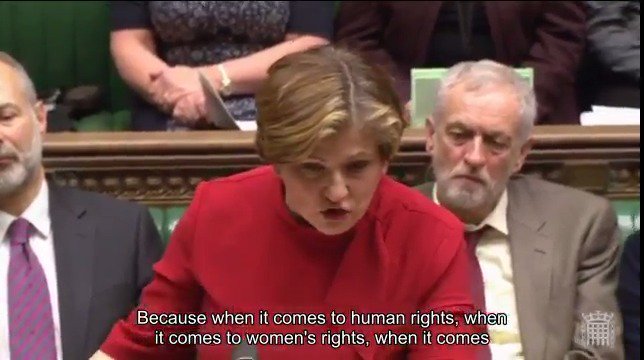
Watch this: @EmilyThornberry challenges Boris Johnson and Theresa May on their response to Trump’s #MuslimBan. RT if you’re with us ↓

Jeremy Corbyn called for the visit to be postponed while Trump’s immigration ban was in place. He also questioned why May was so quick to invite the president given his controversial policies.
“Donald Trump should not be welcomed to Britain while he abuses our shared values with his shameful Muslim ban and attacks on refugees’ and women’s rights,” the Labour leader said.
“Theresa May would be failing the British people if she does not postpone the state visit and condemn Trump’s actions in the clearest terms. That’s what Britain expects and deserves.”
Theresa May was booed as she left for parliament…
For now, a spokesperson for Number 10 said on Sunday that Trump would still be invited to visit the UK later this year as planned.

London rallying against Trump’s actions and Theresa May’s inaction

ECB/Germany
This is not good: German inflation rises to 1.9% and signals that the ECB is running out of excuses to maintain or extend stimulus measures:
(courtesy zero hedge)
ECB Under Pressure As German Inflation Spikes To Highest Since 2013
German consumer prices accelerated at the fastest pace in three and a half years in January, leaving the ECB running out of excuses to maintain (or even extend) its stimulus measures.
As Bloomberg notes, consumer prices rose 1.9 percent from a year ago, data from the Federal Statistics Office showed on Monday. That’s up from 1.7 percent the previous month and the highest rate since July 2013, though below the median estimate of 2 percent in a Bloomberg survey. Prices slid 0.8 percent from December.
The surge in German inflation since the end of last year is a potential political flashpoint in the country, which faces elections in September, as savers remain burdened with near-zero deposit rates. Calls are mounting for the ECB to start talks over winding down its bond-buying program, which is scheduled to run until at least the end of this year, though policy makers have generally urged caution until it’s clear price increases are being sustained in the euro area as a whole.

Simply put, the ‘union’ continues to creek under the one policy…
“Monetary policy can’t just cater to one country but to the entire euro-zone economy,” Ewald Nowotny, governor of Austria’s central bank said on Monday in Vienna before the data were published. “German developments are watched, but they are just a part.”
Nowotny said that while the ECB’s Governing Council will “surely” have to take a decision on the future of quantitative easing before the end of 2017, he doesn’t expect that to happen until after the summer.
And remember, Draghi already laid out the cost of exiting Europe, which in the case of Germany (and GERexit) is one in which the entire union owes them…

end
With its latest purchases, the ECB now owns 10.2% of all European corporate bonds and total assets purchased equals 36% of EU GDP. Total purchases; 3.72 trillion euros!($3.98 trillion USA)
(courtesy zero hedge)
ECB Assets Rise Above 36% Of Eurozone GDP; Draghi Now Owns 10.2% Of European Corporate Bonds
The ECB’s nationalization of the European corporate bond sector continues. In the ECB’s latest update, the six central banks acting on behalf of the Euro system provided an update on the list of corporate bonds they bought. They bought into 810 issuances with a total of €573bn in amount outstanding. For the week ending 27th January, the bond purchases stood at €1.9bn across sectors. This increases the number of securities held by the ECB to 813, and lift the ECB’s total corporate bond holdings to €58.82b, which means that as of the latest weekly data, the ECB now owns 10.2% of the total €575.42BN in European corporate debt outstanding.
Since one month ago, the ECB owned 9.2% of the corporate bond market, the rate of nationalization of the private, outstanding corporate bonds is roughly 1% per month. Tangentially, 52 or 6.4% of the 813 securities held by the ECB are negative yielding.
Which corporate bonds did Mario Draghi generously subsidize this week? According to the ECB’s holdings, utilities remain the largest industry group with 215 securities, while according to Bloomberg, in the latest week the ECB bought bonds issued by Atlantia, BASF, Carmila, Enel, Fresenius, Italgas, LEG Immobilien, Linde, Legrand, RTE, Snam and Telefonica Emisiones. The complete list of ECB holdings by ISINs can be found here.
While there was some market concern in December that the ECB may be tapering its CSPP program, when it purchased just €4 billion in corporate bonds in the month, less than half the recent runrate from the September-November period, this appears to have been calendar driven, as in January the ECB is back to its aggressively purchases and through the last week, it purchased €7.8 billion in corporate bonds for January, nearly a 100% increase from the prior month.

Corporate purchases began on June 8, 2016, with the weekly average of ~€1.7bn per week and total corporate bond holdings of €58.8bn (as of 27-Jan-17), or roughly €6.8bn a month. ECB purchased bonds have gained 0.60% in Dec vs -1.25% in Nov. The bonds purchased under CSPP have marginally outperformed the broad index that gained 0.57% in December. Last week, total EUR issuances worth €21.2bn were issued in the primary market, of which ~ €5.2bn were CSPP eligible. For the month ending December, total CSPP holdings stood at €51.1bn, with 86% of the purchased amount coming from the secondary market.
A breakdown of which countries’ bonds the ECB bought into:
Looking at the break up country wise, French and German issuers continue to dominate the ISIN count (417 issuances worth €309bn in amount outstanding). Bonds from non- Eurozone corporates were also on the list, with the bulk from Switzerland (25 issuances worth €18bn). When looking at the purchases by sector, Utilities remains at the top (215 issuances worth €143bn), while non-cyclical consumer is a distant second (118 issuances, €91bn in amount outstanding).


Mostly belly of the curve, not averse to negative yields
In terms of duration, while the ECB has bought across the curve, it has avoided going very long (12+yr). Bulk of the purchases has occurred in 3-7yrs region (349 issuances worth €242bn). By rating, it’s clear that the ECB hasn’t been reluctant from taking credit risk as they have bought into overall 185 BB rated and non-rated bonds. By yield, the ECB has already bought into 96 negative yielding bonds (€75bn, average yield of – 0.09%). By issuer, the ECB has bought into 810 bonds from 233 issuing entities. The bond with the longest maturity that was purchased was the 20 year EDF 1.875% 13/10/36 from the Electricite De France.

Finally, stepping back from just the CSPP program, as of the latest week, total purchases under the ECB’s various asset purchase programmes rose to €1,610 billion…

… bring the ECB’s balance sheet to over €3.72 trillion, or over 36% of the total Eurozone GDP.

end
Greece
UKGuardian:
The iMF wants the EU to take on considerable haircuts with their debt. the EU wants Greece to undertake more austerity something that it cannot do. Greece has 10.6 euros of debt due in the summer. Expect fireworks and probably a GREXIT if they are not given relief.
(courtesy UKGuardian) and special thanks to Robert H for sending this to us)
Greece has three weeks to deal with ‘potentially disastrous’ debt
Failure of Greece and the EU to reach compromise by 20 February ‘would bring back Grexit with a vengeance’

Greece’s embattled government has three weeks to break the deadlock in increasingly difficult talks with creditors or risk the country’s debt crisis resurfacing with renewed vigour.
Faced with the dilemma of agreeing to additional austerity or calling fresh elections, prime minister Alexis Tsipras was weighing his options at the weekend. Fears of further uncertainty in Europe’s weakest member state mounted as the International Monetary Fund (IMF) predicted that Greece’s debt load could become “explosive” by 2030.
“It is critical that a compromise is found,” said Aristides Hatzis, professor of law and economics at the university of Athens, noting that a slew of elections across Europe would only make Greece’s predicament worse.
“If these negotiations are not wrapped up by 20 February [when eurozone finance ministers next meet] we could be looking at potentially disastrous political turmoil, which would bring back the scenario of Grexit with a vengeance.”
Central to the impasse is the enduring argument among lenders over Athens’ ability to achieve fiscal targets once its latest bailout programme expires in 2018. Without legislation of further pension cuts and tax increases, the IMF does not believe it can attain a primary budget surplus of 3.5%. At a meeting of eurozone finance ministerson Thursday, Athens found itself out in the cold with even the normally supportive European commission failing to rally to its defence.
Tsipras’ two-party coalition marked two years in office last week with the leftist leader declaring he was not prepared to take an “extra euro” in measures beyond those the country has committed to under its current €86bn (£73.3bn) bailout. Passage of some of the harshest cuts yet has seen the government’s popularity nosedive in polls. To ask for more measures when by dint of retrenchment Greece’s state revenues were better than expected was not only “extreme” but “absurd,” Tsipras’ office said.
The spat has delayed a second compliance review of reforms and economic progress that the government had hoped to complete by December. Conclusion of the review is vital to unlocking further loans from the bailout, the third since Athens revealed the extent of its financial woes in late 2009.
With €10.5bn in debt repayments lined up this summer, a rerun of the debt crisis looms if disbursements aren’t made.
Either way Greece’s economic future looks grim. In a devastating assessment that may well dominate the course of events, the IMF warned that even if reforms are religiously implemented — and agreed short–term debt relief imposed — Athens’ debt load is doomed to become “explosive”.
“Greece cannot grow out of its debt problem,” the Washington-based body wrote in a confidential report leaked to the media last week. “Greece requires substantial debt relief from its European partners to restore debt sustainability.”
The report, compiled by the IMF staff as part of ongoing discussion over whether the fund should participate in the country’s latest international bailout, is expected to ignite further debate when it is formally presented to the body’s executive board on 6 February. Short of debt re-profiling by EU member states, the board may decide the IMF cannot join the latest rescue progamme agreed with eurozone partners in 2015. If that happens, the European Central Bank would be unable to include Greek bonds in its bond buying programme, also seen as key to the country’s economic recovery as it would allow it to test its borrowing skills on international markets.
The prospect of fresh austerity — not least a reduction in the tax-free threshold and further pension cuts — comes at a time of worsening social conditions for many Greeks. For the first time since the debt crisis erupted, 53% of those asked in a recent Alco poll said they believed the euro was “wrong” for their country, with a third calling for the return of the drachma.
“The risks are quite considerable,” said George Pagoulatos professor of European politics and economy at the Athens University of economics and business.
“If there is no agreement by the end of February, Europe’s electoral calendar could kick in and freeze talks until May, by which time it will be too late.”
•The headline of this article was amended on 30 January to better reflect the content.
end
5. RUSSIAN AND MIDDLE EASTERN AFFAIRS
Saturday/Russia
Trump on Saturday also called Putin and their talk was beneficial. Their main topic was fighting terrorism ie. ISIS and the middle east conflict (Arab vs Israel)
(courtesy zero hedge)
Kremlin Confirms Trump-Putin Call Was “Friendly, Constructive, Mutually Beneficial”, Prioritized “Fighting Terrorism”
Vladimir Putin reportedly congratulated Donald Trump for officially assuming office and wished him success in his future activities, during the two controversial leaders’ first conversation since the inauguration.

As The Kremlin reports (via Google Translate):
During the meeting, both sides had shown a disposition to actively work together on stabilization and development of Russian-American interaction – in a constructive, equal and mutually beneficial basis.
Thoroughly discussed current international issues, including the fight against terrorism, the situation in the Middle East, the Arab-Israeli conflict, the sphere of strategic stability and non-proliferation, the situation around the Iranian nuclear program and the Korean Peninsula. Also touched upon the main aspects of the crisis in Ukraine. It was agreed to establish a partnership in all these and other areas.
At the same time highlighted the priority of joint efforts in the fight against the main threat – international terrorism. The Presidents called for establishing a real coordination of US and Russian actions in order to defeat ISIS and other terrorist groups in Syria.
Underscired was the importance of the restoration of mutually beneficial trade and economic ties between the business communities of the two countries, which could further stimulate progressive and stable development of bilateral relations.
Vladimir Putin and Donald Trump agreed to work on possible dates and a venue for their personal meeting.
Donald Trump asked to convey the wishes of happiness and prosperity to the Russian people, noting that the US people are sympathetic to Russia and its citizens.
Vladimir Putin, in turn, stressed that the Russian experience similar feelings towards the Americans. He recalled that our country for more than two centuries, America has supported, has been an ally in two world wars, and now considers the US as an important partner in the fight against international terrorism.
The leaders agreed to maintain regular personal contacts.
The conversation took place in a positive and businesslike manner.
We look forward to CNN’s (and Chuck Schumer’s and John McCain’s) spin on this.

END
The arms race intensifies with Russia launching the biggest Arctic military expansion since the fall of the USSR
(courtesy zerohedge)
Russia Launches Biggest Arctic Military Expansion Since Fall Of USSR
In what will likely be interpreted as the latest “test” by the Kremlin to gauge western military preparedness, Reuters reports that Russia has quietly unleashed the biggest military build up targeting the Arctic since the fall of the Soviet Union. “It is part of a push to firm Moscow’s hand in the High North as it vies for dominance with traditional rivals Canada, the United States, and Norway as well as newcomer China.” It is also part of the ongoing scramble for resources above the commodity rich arctic circle.

Russian servicemen of the Arctic mechanised infantry brigade participate in a military
drill on riding reindeer and dog sleds near Murmansk, Russia January 23, 2017.
As Reuters notes, under Putin, Moscow is scrambling to re-open abandoned Soviet military, air and radar bases on remote Arctic islands and to build new ones, as it pushes ahead with a claim to almost half a million square miles of the Arctic. It regularly releases pictures of its troops training in white fatigues, wielding assault rifles as they zip along on sleighs pulled by reindeer.

“History is repeating itself,” Vladimir Blinov, a guide on board the icebreaker Lenin, which is named after communist revolutionary Vladimir Lenin, told a recent tour group. “Back then (in the 1950s) it was the height of the Cold War and the United States was leading in some areas. But we beat the Americans and built the world’s first nuclear ship (the Lenin). The situation today is similar.”
The expansion has far-reaching financial and geopolitical ramifications: “the Arctic is estimated to hold more hydrocarbon reserves than Saudi Arabia and Moscow is putting down a serious military marker.”
The Arctic, the U.S. Geological Survey estimates, holds oil and gas reserves equivalent to 412 billion barrels of oil, about 22 percent of the world’s undiscovered oil and gas. Low oil prices and Western sanctions imposed over Moscow’s actions in Ukraine mean new offshore Arctic projects have for now been mothballed, but the Kremlin is playing a longer game.
Some more details: according to Reuters, Russia is building three nuclear icebreakers, including the world’s largest, to bolster its fleet of around 40 breakers, six of which are nuclear. No other country has a nuclear breaker fleet, used to clear channels for military and civilian ships. Russia’s Northern Fleet, based near Murmansk in the Kola Bay’s icy waters, is also due to get its own icebreaker, its first, and two ice-capable corvettes armed with cruise missiles.
“Under (Soviet leader Mikhail) Gorbachev and (Russian President Boris) Yeltsin, our Arctic border areas were stripped bare,” said Professor Pavel Makarevich, a member of the Russian Geographical Society. “Now they are being restored.”
The build-up has been noticed in Washington. U.S. Defense Secretary James Mattis, in a written submission following his confirmation hearing, described Moscow’s Arctic moves as “aggressive steps” and pledged to prioritize developing a U.S. strategy, according to Senator Dan Sullivan.
Naturally, Russia’s military expansion poses a dilemma for Trump, who wants to repair U.S.-Russia ties and team up with Moscow in Syria rather than get sucked into an Arctic arms race: it is guaranteed that US neocons will be scraming bloody murder unless Trump somehow responds to the US expansion.
The build-up is causing jitters elsewhere. As reported two weeks ago, 300 U.S. Marines landed in Norway this month for a six-month deployment, the first time since World War Two that foreign troops have been allowed to be stationed there. And with memories of Russia’s 2014 annexation of Ukraine’s Crimea still fresh, NATO is watching closely. Six of its members held an exercise in the region in 2015.

Ships moored in the Northern Fleet’s Arctic headquarters of Severomorsk, Russia.
Previously, the Soviet military packed more firepower in the Arctic, but it was set up to wage nuclear war with the United States not conventional warfare. Arctic islands were staging posts for long-range bombers to fly to America. But in an era when a slow-motion battle for the Arctic’s energy reserves is unfolding, Russia is creating a permanent and nimble conventional military presence with different and sometimes superior capabilities.
Sergei Shoigu, the defense minister, is presiding over the re-opening or creation of six military facilities, some of which will be ready by the year’s end. They include an island base on Alexandra Land to house 150 troops able to survive autonomously for 18 months. Called the Arctic Trefoil, officials have said they may deploy military jets there. MiG-31 fighters, designed to shoot down long-range bombers, or the SU-34, a frontline bomber, are seen as suitable.
Moscow’s biggest Arctic base, dubbed “Northern Shamrock”, is meanwhile taking shape on the remote Kotelny Island, some 2,700 miles east of Moscow. It will be manned by 250 personnel and equipped with air defense missiles. Soviet-era radar stations and airstrips on four other Arctic islands are being overhauled and new ground-to-air missile and anti-ship missile systems have been moved into the region.
Russia is also spending big to winterize military hardware. “The modernization of Arctic forces and of Arctic military infrastructure is taking place at an unprecedented pace not seen even in Soviet times,” Mikhail Barabanov, editor-in-chief of Moscow Defense Brief, told Reuters.
Barabanov added that two special Arctic brigades had been set up, something the USSR never had, and that there were plans to form a third as well as special Arctic coastal defense divisions. “Russia’s military activity in the Arctic is a bit provocative,” said Barabanov. “It could trigger an arms race.” Of course, Russia’s military activity could be simply seen as a preemptive move to western expansion in the region, as telegraphed by the recent build up of NATO forces in Eastern Europe.
* * *
Meanwhile, Russians are delighted by this latest “arms race.”
In Murmansk, home to Russia’s icebreakers and just an hour from the Northern Fleet’s headquarters, the prospect of an Arctic renaissance is a source of pride. The city is steeped in Arctic and military history. The conning tower of the Kursk submarine, which sunk in 2000 after an explosion, looks down from a hill above the port. And in central Murmansk, scale models of dozens of icebreakers crowd the halls of the Murmansk Shipping Company, while sailors, wrapped in great coats, barrel along its streets.
For Russia, the issue of militarizing the Arctic boils down to a simple equation: we have to do it before others do.
“These Arctic bases are on our territory. Unlike some other countries we are not building them overseas,” said Denis Moiseev, a member of the Russian Geographical Society. “Other countries are also very active in trying to push their borders towards the North Pole. Our army must be able to operate on all our territory in extreme conditions.”
One country regularly mentioned as an unlikely Arctic rival is China, a close Moscow ally, which has observer status on the Arctic Council, the main forum for coordinating cooperation in the region, and is starting to build its own icebreakers.
Politicians are keener to discuss a commercial Arctic push. New roads and a railway are being built and ports overhauled as Moscow expands its freight capacity and, amid warmer climate cycles, readies for more traffic along its Arctic coast. It hopes the Northern Sea Route, which runs from Murmansk to the Bering Strait near Alaska, could become a mini Suez Canal, cutting sea transport times from Asia to Europe. But while the route’s popularity inside Russia is growing, relatively high transit costs and unpredictable ice coverage means it has lost some of its luster for foreign firms.
Grigory Stratiy, deputy governor of the Murmansk Region, told Reuters there was strong interest in sea route from Asian nations however and that new icebreakers would allow for year-round navigation in the 2020s. “Whatever the weather, the Northern Sea Route will be needed. Its use will definitely grow,” said Stratiy, who said Russia was keen to attract foreign investment to the Arctic.
When asked about his country’s military build-up, he smiled. “There’s no reason to be afraid I can reassure you,” he said, saying it was driven only by a need to modernize.
“Russia has never had any aggressive aims and won’t have them. We are very friendly people.”
end
Iran
Iran bans USA visitors in retaliation for Trump’s ban on Muslims from 7 countries including Iran)
(courtesy zero hedge)
Iran Bans US Visitors In Retaliation
One of the most vocal, and angry, reactions to Trump’s anti-immigration executive order came from Iran whose foreign ministry, as noted previously, vowed to take reciprocal measures, as the Iranian government called the ban “an insult to the Muslim world.” Tehran did not waste any time, and shortly after Iran said it would ban U.S. citizens entering the country in retaliation to Washington’s visa ban against the nation.

Iranian President Hassan Rouhani
“While respecting the American people and distinguishing between them and the hostile policies of the U.S. government, Iran will implement the principle of reciprocity until the offensive U.S. limitations against Iranian nationals are lifted,” a Foreign Ministry statement said cited by Reuters. “The restrictions against travel by Muslims to America… are an open affront against the Muslim world and the Iranian nation in particular and will be known as a great gift to extremists,” said the statement, carried by state media.
Trump’s temporary ban would make it virtually impossible for family members and friends of an estimated one million Iranian-Americans to visit the United States.
Earlier on Saturday, Iranian President Hassan Rouhani said it was no time to build walls between nations and criticised steps towards cancelling world trade agreements, without naming Trump.
“Today is not the time to erect walls between nations. They have forgotten that the Berlin wall fell years ago,” Rouhani said in a speech carried live on Iranian state television. “To annul world trade accords does not help their economy and does not serve the development and blooming of the world economy,” Rouhani told a tourism conference in Tehran. “This is the day for the world to get closer through trade.”
Rouhani, a pragmatist elected in 2013, thawed Iran’s relations with world powers after years of confrontation and engineered its 2015 deal with them under which it curbed its nuclear programme in exchange for relief from sanctions.
That may soon change. Trump’s order “certainly doesn’t do anything to convince Iranians that the Trump administration has any interest in reducing tensions with Iran,” said Trita Parsi, author of the forthcoming book “Losing an Enemy – Obama, Iran and the Triumph of Diplomacy,” and president of the National Iranian American Council. With Iran holding a presidential election in May, any spike in tensions between the foes could swing support behind hardline critics of President Hassan Rouhani. According to Parsi, hardliners will point to Iran’s compromise as part of the nuclear accord and “say ‘look what it generated: this extremely negative response against Iranian people’.”
end
This does not look good: Iran no doubt broke their Nuclear deal with a ballistic missile test
(courtesy zerohedge)
Did Iran Just Break Nuclear Deal (Again) With Ballistic Missile Test-Launch?
The Islamic Republic of Iran conducted a nuclear ballistic missile test on Sunday, US officials told Fox News. This would appear to be yet another apparent violation of a United Nations resolution and President Obama’s much-heralded nuclear deal.

As Fox reports, the launch occurred at a well-known test site outside Semnan, about 140 miles east of Tehran.
The missile was a Khorramshahr medium range ballistic missile and traveled 600 miles before exploding, in a failed test of a reentry vehicle, officials said.
U.N. resolution 2231 — put in place days after the Iran nuclear deal was signed — calls on the Islamic Republic not to conduct such tests, however, this is at least Iran’s second such test since July. The resolution bars Iran from conducting ballistic missile tests for eight years and went into effect July 20, 2015.
Iran is “called upon not to undertake any activity related to ballistic missiles designed to be capable of delivering nuclear weapons, including launches using such ballistic missile technology,” according to the text of the resolution.
The landmark nuclear deal between Iran and world powers does not include provisions preventing Iran from conducting ballistic missile tests.
Iran claims its ballistic missile tests are legitimate because they are not designed to carry a nuclear warhead.

Debka files comments on what the USA and Russia talks are heading for with respect to Syria; three zones namely the Turkish zone to the north, two uSA zones (one close to Israel and the second, a northern sector close to the Turkish border. Russia will have its sphere of influence west of Euphrates an close to its sea bearing vessels on the Mediterrean
(courtesy Debka File)
Trump-Putin safe zones deal ousts Iran from Syria

Syria stands on the threshold of dramatic changes that will directly impact on the strategic and military situation along the Syrian borders with Israel and Jordan, DEBKAfile reports exclusively. They derive from a deal struck this week by US President Donald Trump and Russian President Vladimir Putin to establish US, Russian and Turkish security zones in Syria. This scheme will transfer military control of the country to those three powers. Each of them will be responsible for a zone whose borders will be defined and agreed upon by Washington, Moscow and Ankara.
As part of this arrangement, all forces from the Iranian military, the pro-Iranian Shiite militias and Hizballah will be required to leave Syria.
The US military is to have two security zones – one covering the entire area east of the Euphrates River up to the Iraqi border including Kurdish areas (see attached map). This arrangement will partly resurrect the accord reached in late 2015 by US President Barack Obama and Putin, for the division of Syria into areas of influence. All territory east of the Euphrates was allocated to the US, with Russia taking responsibility for all areas west of the river until the Mediterranean coast. .
Under the new deal, the Turkish area is to stretch about 650 kilometers along the entire Syria-Turkey border and extend between 35 and 50 kilometers into Syrian territory up to Al-Bab, the town where the Turkish military is engaged in its third straight month of fighting for its capture from ISIS.
DEBKAfile’s military and intelligence sources report that the overriding change on the ground will be the establishment of a second US security zone adjacent to Syria’s borders with Israel and Jordan. It means that the approximately 7,500 US special operations forces troops currently in Jordan will be shifted northward into southern Syria.
Russia had originally planned to deploy Syrian military, pro-Iranian Shiite militia and Hizballah forces in battles for the capture of land around the cities of Derra and Quneitra on the Syrian side of the Golan. That plan has been dropped and will be superseded by the deployment in southern Syria of US troops accompanied by Jordanian special forces and Syrian rebels, trained by American instructors in Jordanian military camps.
Israelis will breathe a sigh of relief over the removal of the threat of Iranian and Hizballah forces being deployed along their northern border with Syria.
The Trump-Putin deal for Syria and its ramifications are explored in the coming issue of DEBKA Weekly (for subscribers) out Friday, with especially attention to the way it leaves Iran and Hizballah high and dry.
If you are not yet a subscriber, click here to sign on.
end
Syria
This should complicate matters: rumours that Assad has suffered a stroke or was shot. This would throw the whole situation in Syria up in the air:
(courtesy zero hedge)
Speculation Grows That Bashar Assad Has “Suffered A Stroke” As Syria Slams Trump’s “Safe Zone” Proposal
Geopolitical pundits were caught by surprise last Thursday when Donald Trump told ABC he would “absolutely do safe zones in Syria for the people”, a statement that was has been viewed as a precursor to further escalation of US intervention in the region. They were just as surprised overnight when instead of challegening Trump’s decision to potentially send more troops into Syria, Russia Foreign Minister Sergey Lavrov said Moscow may support the US initiative to establish so-called ‘safe zones’ for refugees in Syria, but added that the plan would require close cooperation with the UN and approval from Syrian President Bashar Assad’s government.
“If this is about the people who were forced to leave their homes by the conflict, […] getting their basic needs covered, […] then I think that the idea to create areas within Syria for those internally displaced could be discussed with the UN’s High Commissioner for Refugees and other organizations,” Lavrov said cited by RT.
Lavrov said the American proposal to create secure areas for refugees within Syria was put forward in the context of migrant flows to the neighboring countries, the Middle East, as well as Europe, and “at the end of the day, the US.”
He noted that the US initiative is completely different from what Western countries proposed at various stages of the Syrian war. “There have been ideas of creating some areas where an alternative Syrian government could sit, and use those areas for regime change.” Such a scheme was seen in Libya, where the establishment of an alternative government in Benghazi was used as a pretext for the Western-led invasion to topple the regime of Muammar Gaddafi, Lavrov explained, adding that the Libyan intervention went ahead despite no green light from the UN Security Council.
While promising, the proposal would require negotiations with Damascus to agree on the principles of creating such safe zones on Syrian territory, Lavrov added.
However, just hours after his interview, the narrative regained some sense of normalcy after the state-run Sana news agency published a statement from the government pouring cold water all over the proposed plan, and saying that any attempt to install safe zones without its consent would constitute an “unsafe action” that is a “violation of Syria’s sovereignity.” Syria’s foreign ministry and the United Nations refugee agency had agreed on the issue during a meeting in Damascus, SANA said.
According to a document seen by Reuters, Trump is expected to order the Pentagon and State Department to craft a plan for setting up the safe zones, a move that could risk escalation of U.S. military involvement in Syria’s conflict. Rebel backers including Qatar have welcomed Trump’s support for safe zones, and Turkey says it is waiting to see the outcome of the U.S. president’s pledge. As noted previosly, cCreation of safe zones could ratchet up U.S. military involvement in Syria, including increased U.S. air power to enforce “no fly” restrictions and ground forces to protect civilians in those areas.
But where things again take a twist for the bizarre, is a report over the weekend from Al Arabiya according to which news has been circulating on the internet since Friday stating that Syrian President Bashar al-Assad is experiencing serious health problems. The website reports that according to some media outlets said that Assad had suffered a stroke; while others said that he was shot and has been taken to Damascus Hospital for treatment. Some details:
France’s Le Point, speculated that Assad might have been assassinated by his personal Iranian Bodyguard Mehdi al-Yaacoubi, going so far as to say that he shot him in the head.
Lebanese newspaper, al-Mustaqbal, quoted “reliable sources” as saying that Assad suffered from a cerebral infraction and was transferred to Damascus Hospital where he is being treated under high security.
As for the Saudi newspaper Okaz, Assad is suffering from a “brain tumor.” He tried to cover up his illness through short and frequent appearances. According to its sources, Assad is being treated by a Russian-Syrian medical team on a weekly basis, adding that he has undergone medical tests when he was in Moscow in October.
Furthermore, pro-Syrian regime Lebanese newspaper al-Diyar reported on Friday that Assad suffered from a stroke, but later denied the news. There were also rumors that Assad is at the American University Hospital (AUH) in Beirut. However, Al Arabiya contacted the hospital and no information on the issue was given. Al Arabiya has also tried to contact Damascus Hospital, but there has been no response.
On the other hand, in a statement carried by the Presidency of the Syrian Arab Republic page on Facebook, Syrian authorities said that such rumors were incorrect.
While the rumor remains unsubstantiated, the death of Assad is sure to complicate any political resolution in Syria, as it would immediate promp both sides in the proxy war to present their handpicked candidates ahead of an election for the country’s next president as suddenly the political – and not military – process will become the pathway to decide who has veto rights over any potential Qatar nat gas pipeline crossing the nation and entering Europe. If so, expect Rex Tillerson to be very busy over the coming months as Syria once again becomes a primary object of US diplomacy in the middle east.
6.GLOBAL ISSUES
7. OIL ISSUES
8. EMERGING MARKETS
Your early morning currency/gold and silver pricing/Asian and European bourse movements/ and interest rate settings MONDAY morning 7:00 am
Euro/USA 1.0633 down .0058/REACTING TO + huge Deutsche bank problems + USA election:/TRUMP WINS THE ELECTION/USA READY TO GO ON A SPENDING BINGE WITH THE TRUMP VICTORY/ITALIAN REFERENDUM DEFEAT/AND NOW ECB TAPERING BOND PURCHASES/USA RISING RATE/EUROPE BOURSES DEEPLY IN THE RED
USA/JAPAN YEN 114.22 DOWN 0.306(Abe’s new negative interest rate (NIRP), a total DISASTER/SIGNALS U TURN WITH INCREASED NEGATIVITY IN NIRP/JAPAN OUT OF WEAPONS TO FIGHT ECONOMIC DISASTER/KURODA: HELICOPTER MONEY ON THE TABLE AND DECISION ON SEPT 21 DISAPPOINTS WITH STIMULUS/OPERATION REVERSE TWIST
GBP/USA 1.25.01 DOWN .0042 (Brexit by March 201/UK government loses case/parliament must vote/PRIME MINISTER MAY DECIDES ON A HARD BREXIT)
USA/CAN 1.3165 UP .0051 (CANADA WORRIED ABOUT TRADE WITH THE USA WITH TRUMP ELECTION/ITALIAN EXIT FROM EU)
Early THIS MONDAY morning in Europe, the Euro FELL by 58 basis points, trading now WELL BELOW the important 1.08 level FALLING to 1.0633; Europe is still reacting to Gr Britain HARD BREXIT,deflation, announcements of massive stimulation (QE), a proxy middle east war, and the ramifications of a default at the Austrian Hypo bank, an imminent default of Greece, Glencore, Nysmark and the Ukraine, along with rising peripheral bond yield further stimulation as the EU is moving more into NIRP, and now the Italian referendum defeat AND NOW THE ECB TAPERING OF ITS PURCHASES/ THE USA’S NON tightening by FAILING TO RAISE THEIR INTEREST RATE AND NOW THE HUGE PROBLEMS FACING TOO BIG TO FAIL DEUTSCHE BANK + THE ELECTION OF TRUMP IN THE USA+ AND TODAY MONTE DEI PASCHI NATIONALIZATION / Last night the Shanghai composite CLOSED FOR THE WEEK/NEW YEARS / Hang Sang CLOSED FOR CHINESE NEW YEAR /AUSTRALIA CLOSED DOWN 0.89% / EUROPEAN BOURSES ALL IN THE RED
We are seeing that the 3 major global carry trades are being unwound. The BIGGY is the first one;
1. the total dollar global short is 9 trillion USA and as such we are now witnessing a sea of red blood on the streets as derivatives blow up with the massive rise in the rise in the dollar against all paper currencies and especially with the fall of the yuan carry trade. The emerging market which house close to 50% of the 9 trillion dollar short is feeling the massive pain as their debt is quite unmanageable.
2, the Nikkei average vs gold carry trade ( NIKKEI blowing up and the yen carry trade HAS BLOWN up/and now NIRP)
3. Short Swiss franc/long assets blew up ( Eastern European housing/Nikkei etc.
These massive carry trades are terribly offside as they are being unwound. It is causing global deflation ( we are at debt saturation already) as the world reacts to lack of demand and a scarcity of debt collateral. Bourses around the globe are reacting in kind to these events as well as the potential for a GREXIT>
The NIKKEI: this MONDAY morning CLOSED DOWN 98.55 OR 0.51%
Trading from Europe and Asia:
1. Europe stocks ALL IN THE RED
2/ CHINESE BOURSES / : Hang Sang CLOSED HOLIDAY Shanghai CLOSED FOR THE WEEK: NEW YEAR’S CELEBRATION / Australia BOURSE CLOSED UP 0.69% /Nikkei (Japan)CLOSED DOWN 98.55 OR 0.51% / INDIA’S SENSEX IN THE GREEN
Gold very early morning trading: $1190.00
silver:$17.09
Early MONDAY morning USA 10 year bond yield: 2.484% !!! PAR IN POINTS from FRIDAY night in basis points and it is trading JUST BELOW resistance at 2.27-2.32%. THE RISE IN YIELD WITH THIS SPEED IS FRIGHTENING
The 30 yr bond yield 3.07, UP 1 IN BASIS POINTS from FRIDAY night.
USA dollar index early MONDAY morning: 100.96 UP 61 CENT(S) from FRIDAY’s close.
This ends early morning numbers MONDAY MORNING
xxxxxxxxxxxxxxxxxxxxxxxxxxxxxxxxxxxxxxxxxxxxxxxxxxxxxxxxxxxxxxxxxxxxxxxxxxxxxxxxxxxxxxxxxxxxxxxxxxxxxxxxxxxxxxx
And now your closing FRIDAY NUMBERS
Portuguese 10 year bond yield: 4.241% UP 10 in basis point yield from FRIDAY
JAPANESE BOND YIELD: +.085% UP 1/10 (DESPITE INTERVENTION) in basis point yield from FRIDAY/JAPAN losing control of its yield curve
SPANISH 10 YR BOND YIELD:1.630% UP 5 IN basis point yield from FRIDAY (this is totally nuts!!/
ITALIAN 10 YR BOND YIELD: 2.328 UP 10 POINTS in basis point yield from FRIDAY
the Italian 10 yr bond yield is trading 70 points HIGHER than Spain.
GERMAN 10 YR BOND YIELD: +.449% DOWN 1 IN BASIS POINTS ON THE DAY
END
xxxxxxxxxxxxxxxxxxxxxxxxxxxxxxxxxxxxxxxxxxxxxxxxxxxxxxxxxxxxxxxxxxxxxxxxxxxxxxxxxxxxxxxxxxxxxxxxxxxxxxxxxxxxxxxxxxxxxxxxxxxxxxxxxxxxx
IMPORTANT CURRENCY CLOSES FOR MONDAY
Closing currency crosses for MONDAY night/USA DOLLAR INDEX/USA 10 YR BOND YIELD/1:00 PM
Euro/USA 1.0708 UP .0017 (Euro UP 17 basis points/ represents to DRAGHI A COMPLETE POLICY FAILURE/
USA/Japan: 113.527 DOWN: 1.506(Yen UP 151 basis points/
Great Britain/USA 1.2491 DOWN 0.0052( POUND DOWN 52 basis points)
USA/Canada 1.3081 DOWN 0.0069(Canadian dollar UP 69 basis points AS OIL FELL TO $52.69
xxxxxxxxxxxxxxxxxxxxxxxxxxxxxxxxxxxxxxxxxxxxxxxxxxxxxxxxxxxxxxxxxxxxxxxxxxxxxxxxx
This afternoon, the Euro was UP by 17 basis points to trade at 1.0708
The Yen ROSE to 113.527 for a GAIN of 151 Basis points as NIRP is STILL a big failure for the Japanese central bank/HELICOPTER MONEY IS NOW DELAYED/BANK OF JAPAN NOW WORRIED AS AS THEY ARE RUNNING OUT OF BONDS TO BUY AS BOND YIELDS RISE /OPERATION REVERSE TWIST ANNOUNCED SEPT 21.2016
The POUND FELL 52 basis points, trading at 1.2491/
The Canadian dollar ROSE by 69 basis points to 1.3081, WITH WTI OIL FALLING TO : $52.69
Your closing 10 yr USA bond yield DOWN 2 IN basis points from FRIDAY at 2.475% //trading well ABOVE the resistance level of 2.27-2.32%) very problematic USA 30 yr bond yield: 3.069 DOWN 1 in basis points on the day /
Your closing USA dollar index, 100.40 UP 5 CENT(S) ON THE DAY/1.00 PM
Your closing bourses for Europe and the Dow along with the USA dollar index closing and interest rates for MONDAY: 1:00 PM EST
London: CLOSED DOWN 66.01 OR 0.92%
German Dax :CLOSED DOWN 132.38 POINTS OR 1.12%
Paris Cac CLOSED DOWN 55.34 OR 1.14%
Spain IBEX CLOSED DOWN 142.80 POINTS OR 1.50%
Italian MIB: CLOSED DOWN 569.86 POINTS OR 2.95%
The Dow closed DOWN 122.65 OR 0.65%
NASDAQ WAS closed DOWN 47.07 POINTS OR 0.83% 4.00 PM EST
WTI Oil price; 52.69 at 1:00 pm;
Brent Oil: 55.18 1:00 EST
USA /RUSSIAN ROUBLE CROSS: 59.85 ROUBLES/DOLLAR (UP 3/100 roubles from YESTERDAY)
TODAY THE GERMAN YIELD FALLS TO +0.449% FOR THE 10 YR BOND 1:30 EST
END
This ends the stock indices, oil price, currency crosses and interest rate closes for today
Closing Price for Oil, 5 pm/and 10 year USA interest rate:
WTI CRUDE OIL PRICE 5 PM:$52.67
BRENT: $55.26
USA 10 YR BOND YIELD: 2.488% (ANYTHING HIGHER THAN 2.70% BLOWS UP THE GLOBE)
USA 30 YR BOND YIELD: 3.078%
EURO/USA DOLLAR CROSS: 1.0695 UP .0004
USA/JAPANESE YEN:113.77 DOWN 1.256
USA DOLLAR INDEX: 100.44 UP 9 cents ( HUGE resistance at 101.80)
The British pound at 5 pm: Great Britain Pound/USA: 1.2488 : DOWN 54 BASIS POINTS.
German 10 yr bond yield at 5 pm: +.449%
END
And now your more important USA stories which will influence the price of gold/silver
TRADING IN GRAPH FORM
Trump Slump Begins? Dow Loses 20k As Stocks Suffer Biggest Drop Of 2017
Probably nothing…
Gold leads 2017…

US equities had their worst day of the year…

Pushing Small Caps back into the red for 2017…

Energy still 2017’s worst performer (down 2.3% today!) but banks and tech were hard-hit today…

Energy stocks were today’s worst…

Did stocks just wake up to the lack of Trumpflation trade…?

And financial conditions remain considerably tighter than stocks believe…

The last 3 days have been the biggest plunge in “Most Shorted” stocks since the election…

FITBITE…

Alphabattered…

VIX spiked above its 50DMA intraday…

Dow dived back below 20k…

VIX Vol spiked

Interestingly while the cost of protecting against downside risk on the S&P 500 (lower panel) has been declining (lowest since Sept 2014), the cost of protecting against a spike in risk (upper panel) has soared to one-year highs…

And bear in mind VIX specs just broke to a new record short…

SMART money – as defined by Bloomberg’s market flow index – has been fading the rally since The Fed hiked rates…

A lot was made about why bonds did not rally more today amid the plunge in stocks…

The answer is simple – A MASSIVE MSFT BOND ISSUANCE meant rate-locks and rotations.

The USD Index slipped lower on the day (Yen strength trumping cable weakness)…

Copper and crude slipped today despite USD weakness… (gold briefly tested above $1200)

Will the Trump gap of hope be filled..
end
The USA auto industry is now in crisis as its inventory bubble has risen again. The uSA has a record high 3.9 million vehicles or around 66 days of supply: a record high.
(courtesy zero hedge)
US Auto Industry In Crisis Amid “Inventory Bubble”
Despite record U.S. auto sales last year, the number of vehicles on car-dealer lots remains near record highs, and, as J.D.Power analyst Thomas King warned this week, 2016 ended with an inventory “bubble” that will require less production or more incentives to clear.
With near record high inventories of 3.9 million vehicles…

U.S. auto inventory finished 2016 at about 66 days supply, up from 60 days a year earlier. Inventory would last 2.23 months at the November sales pace, according to the latest available data from the Census Bureau. The stock-to-sales ratio in 2016 is extremely elevated compared to historical norms…

More problematically, King warns, about one-third of inventory were older model-year vehicles, rather than more typical level of less than a quarter.
Of course this massive stockpile hits just as President Trump pressures the auto-industry to onshore more jobs and more production…
But as the industry automates, factories don’t create jobs like they used to, said Marina Whitman, a professor of business administration and public policy at the University of Michigan.
“The American auto industry last year produced more cars than it ever had before, but they did it with somewhere between one-third and one-half the number of workers that they had decades ago,” said Whitman, who was an adviser to President Richard Nixon and GM’s chief economist from 1978 to 1992.
“The last thing the auto industry needs is more capacity.” she said.
So – produce more to employ more people and please President Trump (only to dramatically worsen the inevitable collapse), or cut workforces and productin further (as we have already seen) and face the wrath of Trump’s tweets?
Homeland Confirms Trump Immigration Ban Will Include Green-Card Holders
With the world (apart from Israel) in uproar over President Trump’s decision to ban immigration from seven Muslim-majority countries, Department of Homeland Security official Gillian Christensen just confirmed “[the order] will bar green card holders” also.

Green cards serve as proof of an individual’s permanent legal residence in the U.S.
As The Hill reports, Trump signed an executive action Friday halting the country’s Syrian refugee resettlement program for 120 days and barring people from certain Muslim-majority countries from traveling to the U.S. The administration says the halt in the resettlement program is designed to give it time to tighten the vetting process for refugees. The order also gives Christian refugees priority in the resettlement process.
“If you were a Muslim you could come in, but if you were a Christian, it was almost impossible and the reason that was so unfair, everybody was persecuted in all fairness, but they were chopping off the heads of everybody but more so the Christians,” Trump said in an interview with Christian Broadcasting Network on Friday.
“And I thought it was very, very unfair,” he continued. “So we are going to help them.”
While most of the world is in uproar over Trumnp’s decisions to “build the wall” and “ban muslims” – Iran’s government proclaimed “Trump’s visa ban is an insult to all Muslims” – Israel’s Prime Minister was supportive…
President Trump is right. I built a wall along Israel’s southern border. It stopped all illegal immigration. Great success. Great idea


“Chaos, Panic, Anger, Lawsuits” – The Fallout From Trump’s Refugee Ban Begins
Trump’s sweeping, and immediately enforced ban on people seeking refuge in the United States and visitors from seven Muslim-majority countries which will last at least three months has caused what Reuters dubs “chaos, panic and anger” – as well as lawsuits – not only among travelers on Saturday – with some denied entry to the US and turned back from U.S.-bound flights – but also among US allies such as France and Germany. The bans affect travelers with passports from Iran, Iraq, Libya, Somalia, Sudan, Syria and Yemen and as the DHS confirmed on Saturday, extends to green card holders who are granted authorization to live and work in the United States.

Visitors barred, travellers returned. As the NYT reported on Saturday morning, refugees traveling into the U.S. on Friday night were already being detained at airports following the implementation of the executive order, which immediately closed US borders to refugees. Two Iraqi refugees detained at Kennedy Airport in New York have filed a writ of habeas corpus seeking to be released. They also filed a motion for class certification, to represent all refugees and immigrants being detained at ports of entry.
One of the Iraqis detained at Kennedy Airport, Khalid Darweesh, has worked for the U.S. government in Iraq for 10 years, according to the Times report. The other detainee Haider Sameer Abdulkhaleq Alshawi was arriving to the U.S. to join his wife, a U.S. contractor, and his young son. The men were on separate flights into the U.S.
Complaints about their detainment were filed by the American Civil Liberties Union, the International Refugee Assistance Project at the Urban Justice Center, the National Immigration Law Center, Yale Law School’s Jerome N. Frank Legal Services Organization and the firm Kilpatrick Townsend & Stockton. The two men had visas to enter the United States but were detained on Friday night at New York’s John F. Kennedy International Airport, hours after Trump’s executive order, the lawsuit said.
At the same time, in Cairo, six Iraqi passengers and one Yemeni were barred from boarding an EgyptAir flight to New York on Saturday, sources at Cairo airport said. The passengers, arriving in transit to Cairo airport, were stopped and re-directed to flights headed for their home countries despite holding valid visas. The officials said the seven migrants, escorted by officials from the U.N. refugee agency, were stopped from boarding the plane after authorities at Cairo airport contacted their counterparts in JFK airport.
Others have also challenged the legality of Trump’s order, with immigration lawyers in New York suing to block the order, saying numerous people have already been unlawfully detained.
* * *
Arab fury. The executive order has prompted fury from Arab travelers in the Middle East and North Africa who said it was humiliating and discriminatory. It drew widespread criticism from U.S. Western allies including France and Germany, Arab American groups, human rights organizations.
“This is a stupid, terrible decision which will hurt the American people more than us or anybody else, because it shows that this President can’t manage people, politics or global relationships,” said Najeed Haidari, a Yemeni-American security manager for an oil company in the Yemeni capital Sanaa.
Meanwhile, there was confusion at the US border, with customs and border patrol agents at many airports unaware of the executive order early on in the evening, said Mana Yegani, an immigration lawyer in Houston, who works with the American Immigration Lawyers Association. Yegani and her fellow lawyers worked through the night fielding calls from travelers with student and worker visas who were being denied entry into the United States and ordered on flights back to Muslim-majority countries on the list.
Green card holders were also being stopped and questioned for several hours. Officials also denied travelers with dual Canadian and Iranian citizenship from boarding planes in Canada that were headed the United States, she said. “These are people that are coming in legally. They have jobs here and they have vehicles here,” Yegani said.
Those with visas from Muslim-majority countries have gone through background checks with U.S. authorities, Yegani noted. “Just because Trump signed something at 6 p.m. yesterday, things are coming to a crashing halt,” she said. “It’s scary.”
* * *
The European outcry has been prompt: France, Germany and Luxembourg all voiced concern on Saturday over Trump’s executive action. France and Germany formed a united front Saturday in the face of President Donald Trump’s halt in the U.S. refugee program, with the German foreign minister noting that loving thy neighbor forms part of America’s Christian traditions. After meeting Saturday, the foreign ministers of both nations, Jean-Marc Ayrault and Germany’s Sigmar Gabriel, said they want to meet with Rex Tillerson, Trump’s nominee for secretary of state who is still awaiting confirmation.
Speaking at a joint news conference in Paris with his German counterpart Sigmar Gabriel, French Foreign Minister Jean-Marc Ayrault said many of Trump’s decisions worried the two U.S. allies, including new immigration restrictions. “This can only worry us, but there are many subjects that worry us,” Ayrault said, adding that he would soon invite his future American counterpart Rex Tillerson to Paris to explain Europe’s interests, values and vision of the world. “Welcoming refugees who flee war and oppression is part of our duty,” Ayrault added.
“The United States is a country where Christian traditions have an important meaning. Loving your neighbor is a major Christian value, and that includes helping people,” said Germany’s Gabriel, who was on his first trip abroad since his nomination as foreign minister. “I think that is what unites us in the West, and I think that is what we want to make clear to the Americans.”
Luxembourg Foreign Minister Jean Asselborn said Trump’s order would have negative consequences. “The American president is dividing the Muslim world into good and evil with this,” Asselborn told the Tagesspiegel German newspaper. “The decision is also bad for Europe because it will increase the Muslim world’s mistrust and hatred of the West.”
* * *
Iran is livid. The country, whose inclusion in the banned list comes at a sensitive time for the Islamic Republic as Trump has opposed the 2015 nuclear deal that lifted sanctions on Iran in return for curbs on its nuclear program, has been quite vocal in its condemnation of the Trump decision. Cited by Al Jazeera, the Iranian foreign ministry has vowed to take reciprocal measures, while the Iranian government called the ban “an insult to the Muslim world.”
Iranian officials say they’ll reserve judgment on Trump until he rolls out policies. So the visa ban may be seen as “sending the first signal” as to how the new administration will treat Iran, according to Amir Handjani of the Atlantic Council based in Dubai. Quoted by Bloomberg, he added that it’s likely to be interpreted as a provocation and “a backdoor way” to pressure the Iranian government. The order “certainly doesn’t do anything to convince Iranians that the Trump administration has any interest in reducing tensions with Iran,” said Trita Parsi, author of the forthcoming book “Losing an Enemy – Obama, Iran and the Triumph of Diplomacy,” and president of the National Iranian American Council. With Iran holding a presidential election in May, any spike in tensions between the foes could swing support behind hardline critics of President Hassan Rouhani. According to Parsi, hardliners will point to Iran’s compromise as part of the nuclear accord and “say ‘look what it generated: this extremely negative response against Iranian people’.”
* * *
As is the UN. As expected, the United Nations refugee agency and International Organization for Migration (IOM) called on the Trump administration on Saturday to continue offering asylum to people fleeing war and persecution, saying its resettlement programme was vital. “The needs of refugees and migrants worldwide have never been greater and the U.S. resettlement program is one of the most important in the world,” the two Geneva-based agencies said in a joint statement. IOM and UNHCR said they remained committed to working with the U.S. administration towards a shared goal of ensuring “safe and secure resettlement and immigration programmes”.
“We strongly believe that refugees should receive equal treatment for protection and assistance, and opportunities for resettlement, regardless of their religion, nationality or race,” they said. Resettlement places provided by every country for vulnerable refugees, some of whom require special medical treatment not available in their first country of asylum, are vital, the agencies said. More than 30 countries take part in the programme, which starts with vetting by the UNHCR. The agencies said they hope “the U.S. will continue its strong leadership role and long tradition of protecting those who are fleeing conflict and persecution”.
A host of U.S. federal government agencies are involved and extensive background checks are carried out, UNHCR spokeswoman Vannina Maestracci told a briefing. “I think it’s fair to say that refugees coming into the United States to be resettled are some of the most vetted individuals entering the United States,” she said.
Considering the feud taking place between Trump and the UN in the aftermath of the recent Israeli settlement vote, it is likely that if anything, the UN pressing Trump to unwind his decision will only make him more likely to stick with it.
* * *
Israel approves. While most have criticized Trump’s decision, an unexpected supporter emerged in the face of Israel PM Benjamin Natanyahu who tweeted “President Trump is right. I built a wall along Israel’s southern border. It stopped all illegal immigration. Great success. Great idea.”
President Trump is right. I built a wall along Israel’s southern border. It stopped all illegal immigration. Great success. Great idea
The tweet marked a rare public foray for the Israeli leader into a charged American domestic affair. The two leaders spoke earlier this week and Netanyahu is planning to visit Trump in the White House next month. After repeated clashes with President Obama, Netanyahu has high expectations for Trump, who has signaled he will take a kinder approach.
* * *
“He’s just getting started.” Trump senior adviser Kellyanne Conway reaffirmed the president’s decision in a Twitter post on Saturday. “@POTUS is a man of action and impact. Promises made, promises kept. Shock to the system. And he’s just getting started,” she tweeted. As someone asked, if this is Trump’s action so far, what will his crackdown be after the next terrorist attack:
wondering how much farther this might go after the next big terror attack

* * *
In summary, this is what has happened in kneejerk reaction to the Trump executive order so far:
- Border ban: Refugees travelling to the US when the order was signed were stopped and detained at airports, per the NYT.
- Return to point of origin: Some green card and visa holders were being blocked from boarding flights to the U.S. Friday night, according to AP. People who had already landed were sequestered at airports and told they have to return to their point of origin.
- Companies scramble: US corporations, most notably Google, have instructed employees traveling abroad with visas or green cards to return immediately.
- Lawsuits begin: National Immigration Law Center warned Trump in a tweet that a court challenge is coming.
- UN urges reconsideration: “The needs of refugees and migrants worldwide have never been greater and the U.S. resettlement program is one of the most important in the world” said the UN International Organization for Migration
- Allies angry: France and Germany formed a united front Saturday attacking Trump’s decision, according to AP.
END
Federal Judge grants a partial block of Trump’s new immigration order: those who landed cannot be sent back. However for those who want to come to the USA they are blocked/ The temporary order is for a few days.
(courtesy zero hedge)
Federal Judge Grants Partial Block Of Trump Immigration Order
Symbolic war broke out between the Judicial and Executive branches shortly before 9pm on Saturday evening, when federal judge Ann Donnelly in the Eastern District of New York in Brooklyn issued an emergency stay halting Trump’s executive order banning immigrants from seven mostly Muslim nations entering the US, and temporarily letting people who landed in U.S. with valid visa to remain on US territory, saying removing the refugees could cause “irreparable harm”.
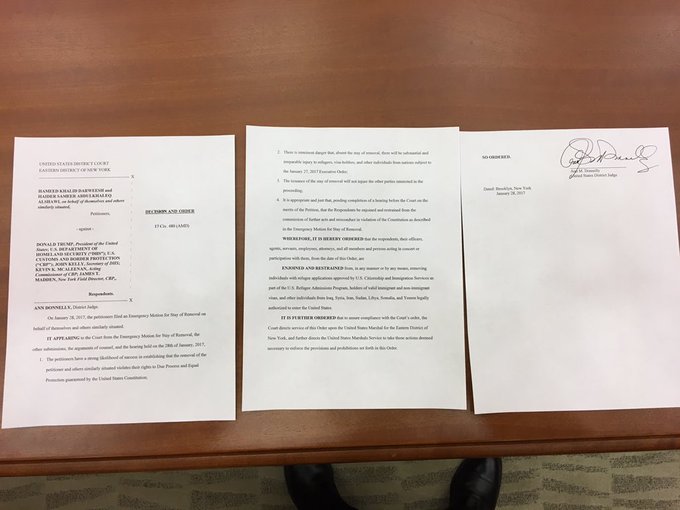
Stay of ban removals

Copy of US district court EDNY order granting nationwide stay. #MuslimBanpic.twitter.com/VqiwgKPzAf

Here is copy of the federal court order granting nationwide stay of removal. #MuslimBan@ACLUpic.twitter.com/7rWe5bJ4Yi
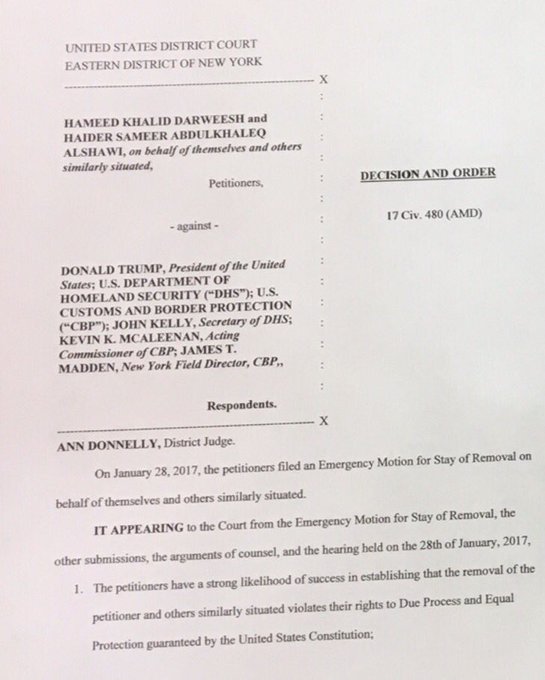
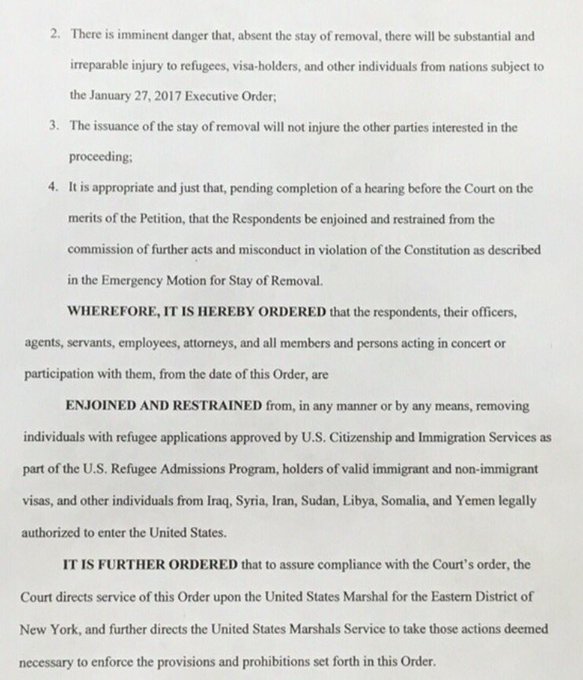
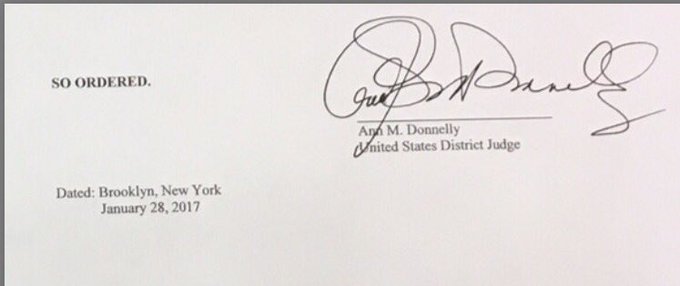
The court’s ruling was in response to a petition filed on Saturday morning by the ACLU on behalf of the two Iraqi men who were initially detained at JFK International Airport on Friday night after Trump’s ban, and were subsequently granted entry into the US.
Nationwide injunction – no one can be removed – govt must provide list of names of ppl affected


WATCH: ACLU Executive Director Anthony D. Romero coming out of the court where the ACLU just argued and won block of Trump’s Muslim ban.

The ACLU issued the following statement following the court ruling:
A federal judge tonight granted the American Civil Liberties Union’s request for a nationwide temporary injunction that will block the deportation of all people stranded in U.S. airports under President Trump’s new Muslim ban. The ACLU and other legal organizations filed a lawsuit on behalf of individuals subject to President Trump’s Muslim ban. The lead plaintiffs have been detained by the U.S. government and threatened with deportation even though they have valid visas to enter the United States.
Lee Gelernt, deputy director of the ACLU’s Immigrants’ Rights Project who argued the case, said:
“This ruling preserves the status quo and ensures that people who have been granted permission to be in this country are not illegally removed off U.S. soil.”
ACLU Executive Director Anthony D. Romero, had this reaction to the ruling:
“Clearly the judge understood the possibility for irreparable harm to hundreds of immigrants and lawful visitors to this country. Our courts today worked as they should as bulwarks against government abuse or unconstitutional policies and orders. On week one, Donald Trump suffered his first loss in court.
However, while some media reports present the court ruling as a wholesale victory over Trump’s order, the stay only covers the airport detainees and those currently in transit, and it does not change the ban going forward.
Clarification:Stay covers the airport detainees and those currently in transit. Doesn’t change ban going forward. Prev unclear tweet deleted

In summary, the state of affairs as of this moment is that the executive order is now frozen for the next few days, until the case can be briefed. The court has ruled that no one who is currently being held can be sent back to their country of origin, but it remains unclear if they will be released is unclear.
Judge Donnelly has ordered the federal government to provide a list of all people currently held in detention. Where the stay falls short is that according to the ACLU’s lawyer, there still can be no new arrivals from countries under the ban, but the ACLU and other organizations are working to file additional suits to roll back other portions of the order.
* * *
A detailed read of Judge Donnelly’s ruling, per Josh Blackman, reveals that the order states that petitioners have shown a “strong likelihood of success” and that their removal would violate the Due Process and Equal Protection clause, and cause irreparable injury. (Note, this order only applies to those already in the country, and thus protected by the Constitution; the same analysis does not apply to those outside the United States).
As a result, the court issues what is effectively a nationwide stay, enjoining all of the named respondents, including President Trump, Secretary Kelly, and the acting director of the CBP, from the “commission of further acts and misconduct in violation of the Constitution as described in the Emergency Motion for Stay of Removal.”
The key part is what they are enjoined from doing:
ENJOINED AND RESTRAINED from, in any manner or by any means, removing individuals with refugee applications approved by U.S. Citizenship and Immigration Services as part of the U.S. Refugee Admissions Program, holders of valid immigrant and non-immigrant visas, and other individuals from Iraq, Syria, Iran, Sudan, Libya, Somalia, and Yemen, legally authorized to enter the United States.
Further, the court orders the Marshal for the Eastern District of New York to “take those actions deemed necessary to enforce the provisions and prohibitions set forth in this Order.”
What will disappoint civil rights advocates, is that this opinion only affects the small number of people who were in-transit when the order was issued, and arrived after it went into effect. The Constitution attaches to their status, and they cannot be held in violation of the Due Process Clause. The same analysis does not apply to aliens outside the United States.
* * *
We now look forward to Trump’s reaction to this act of defiance by a US Court which has partially – and painfully – voided his most controversial executive order to date, and whether the Supreme Court will be forced to opine on this most divisive of topics in the coming days. If anything, the risk to the latter may accelerate the prompt appointment of a conservative SCOTUS judge to fill the vacant Scalia spot.
end
Trump flips as he now allows green card holders to enter the uSA
(courtesy zero hedge)
Trump Administration Flip-Flops: Green Card Holders Are Not Affected By Immigration Ban
Following yesterday’s statement from a Department of Homeland Security official that “[the order] will bar green card holders”, it appears The White House has shifted its view. During an interview of NBC’s “Meet The Press”, White House Chief of Staff Reince Priebus flip-flopped that “as far as green card holders moving forward, [the order] doesn’t affect them.”

As The Hill reports, White House Chief of Staff Reince Priebus on Sunday said the president’s executive order barring refugees and people from seven majority-Muslim nations does not affect green card holders.
“We didn’t overrule the Department of Homeland Security, as far as green card holders moving forward, it doesn’t affect them,” Priebus said on NBC’s “Meet The Press.”
But Priebus noted if a person is traveling back and forth to one of the seven countries included in that order, that person is likely to be “subjected temporarily with more questioning until a better program is put in place.”
“We don’t want people that are traveling back and forth to one of these seven countries that harbor terrorists to be traveling freely back and forth between the United States and those countries,” he said.
When pressed further on whether the order impacts green card holders, though, Priebus appeared to reverse himself, saying, “Well, of course it does.”
“If you’re traveling back and forth, you’re going to be subjected to further screening,” he said.
Furthermore, Priebus also said more countries could be added to the list already included in the president’s executive order.
“Perhaps other countries needed to be added to an executive order going forward,” he said.
“But in order to do this in a way that was expeditious, in a way that would pass muster quickly, we used the 7 countries that have already been codified and identified.”
As we noted yesterday, of the seven countries that are on the banned list, we note that the United States is actvely bombing five of them.

end
Sunday: updates from Trump’s refugee ban:
(courtesy zero hedge)
Here Are The Latest Updates On Trump’s Refugee Ban
Less than 48 hours after announcing his executive order on refugees, global opposition to Trump intensified on Sunday as world leaders, US (mostly tech) companies and civil rights groups condemned the move to temporarily limit entry from predominantly Muslim countries.
Here are the latest updates in the ongoing saga as of noon on Sunday:
- Global government lash out at order. Governments from London and Berlin to Jakarta and Tehran spoke out against Trump’s order. A spokesman for the U.K.’s Theresa May, who visited Trump on Friday and hadn’t commented during the day yesterday, told the AP May does “not agree” with the order. Canada PM Trudeau, in a tweet, said on Saturday Canada would welcome those fleeing “persecution, terror and war. Canadians will welcome you, regardless of your faith.” Scotland’s Nicola Sturgeon endorsed Trudea’s tweet. A similar message was sent by Dutch Prime Minister Mark Rutte, who said refugees deserve a safe haven regardless of their background or religion. Danish Foreign Minister Anders Samuelsen said the decision was unfair. Germany pledged to play a bigger role on the international stage.
- US tech companies “do not support:” Netflix Inc.’s chief executive officer said the changes were “un-American”; Alphabet Inc.’s Google advised staff who may be impacted by the order to return to the U.S. immediately; commeting on the order, Apple’s Tim Cook said “It is not a policy we support”
- Lyft donates $1 million to ACLU. In an email from Lyft to users, the company noted that the executive order is “antithetical to both Lyft’s and our nation’s core values. We stand firmly against these actions, and will not be silent on issues that threaten the values of our community.” The release went on to note that the company pledged to donate “$1,000,000 over the next four years to the ACLU to defend our constitution.”
- Uber slammed. Lyft’s response to the protests contrasted to that of its rival, Uber. While Uber’s CEO Travis Kalanick pledged to compensate drivers stranded overseas due to the executive order, he did not specifically condemn the executive order. The company was criticized for the tone-deaf response from its CEO, prompting a new hashtag on Twitter: #DeleteUber.
- Trump refuses to relent. Despite the global criticism, Trump was steadfast as of Sunday morning, tweeting twice on the topic, first saying that “our country needs strong borders and extreme vetting, NOW. Look what is happening all over Europe and, indeed, the world – a horrible mess!” following it up with “Christians in the Middle-East have been executed in large numbers. We cannot allow this horror to continue!”
Our country needs strong borders and extreme vetting, NOW. Look what is happening all over Europe and, indeed, the world – a horrible mess!

Christians in the Middle-East have been executed in large numbers. We cannot allow this horror to continue!
- Federal Judge issues nationwide stay, partially blocking the Trump immigration order. A Brooklyn judge temporarily blocked Trump’s administration late Saturday from enforcing portions of his order, however neither ruling strikes down the executive order, which will now be subject to court hearings.
- Another ruling: A Boston judge ruled to release two Iranian professors from Logan International Airport, according to the Boston Globe. The decision also stated that travelers could not be removed OR detained for 7 days.
- White House comments on judge’s ruling: “Nothing in the Brooklyn judge’s order in anyway impedes or prevents the implementation of the president’s executive order which remains in full, complete and total effect,” White House adviser Stephen Miller told reporters.
- White House Chief of Staff Reince Priebus “we apologize for nothing”: Priebus told “Meet the Press” the situation yesterday “wasn’t chaos.” He appeared to contradict an official clarification by the White House, when he said on Sunday green-card holders won’t be impacted by the order going forward, but could face additional screening at CBP “discretion.” Other countries could be added to order.
- DHS continues to enforce the travel ban. Despite the ruling, the DHS vowed early on Sunday to continue implementing the order, stating it will “enforce all of the president’s executive orders in a manner that ensures the safety and security of the American people.” It added that “President Trump’s Executive Orders remain in place — prohibited travel will remain prohibited, and the U.S. government retains its right to revoke visas at any time if required for national security or public safety.”
- The initial statistics: A DHS official told CNN that there were 109 travelers barred from entry to the U.S. when Trump signed the order. It was unclear how many were deported vs. detained.
- Opening for democrats: As Axios points out, after spending nearly two months back on their heels. Sen. Cory Booker of New Jersey showed up at Dulles airport, then tweeted last night: “I am driving North now from Virginia. I will check in on things at Newark airport tomorrow.” Virginia Gov. Terry McAuliffe held a press conference on a concourse at Dulles, calling the order “antithetical to the values that make America great. It will not make our country safer.” @HillaryClinton tweeted: “I stand with the people gathered across the country tonight defending our values & our Constitution. This is not who we are.”
- Republicans revolt: As Axios also notes so far 10 GOPers have announced opposition to or questioned Trump’s executive order. These include Sen. John McCain; Rep. Carlos Curbelo; Rep. Ileana Ros-Lehtinen; Rep. Charlie Dent; Rep. Brian Fitzpatrick; Rep. Justin Amash; Rep. Barbara Comstock; Sen. Susan Collins; Sen. Jeff Flake; Sen. Ben Sasse.
- Protests continue. Demonstrations against the ban continued for a second day across the US including Atlanta, Philadelphia, New York, Boston, Chicago, Phoenix, according to ThinkProgress. Here’s the scene at the White House:


We’re only just getting started and the crowd is overflowing in front of the White House. No #MuslimBan#NoBanNoWall#StopPresidentBannon

Three new executive orders
(courtesy zerohedge)
Trump Unveils Three More Executive Orders
President Trump is set to unveil three new executive orders at 3pm on Saturday which according to the White House press pool will include an order to reorganize the National Security Council’s procedures and structure, an order to make the White House’s NSC more adaptive to cyber threats, and will also seek a Joint Chiefs plan to defeat the Islamic State.
Today’s actions will bring the total number of executive orders signed by Trump since taking office to 17. A summary list of the previous fourteen, courtesy of Politico, is presented below.
1. Providing “relief” from the Affordable Care Act
Trump’s first executive order on Inauguration Day involved “minimizing the economic burden” of the Affordable Care Act. This order allows the Secretary of Health and Human Services and the heads of other departments and agencies to waive or delay the implementation of any ACA provisions that would impose a financial burden or any state or a regulatory burden on any individuals.
2. Freezing all regulations
Trump froze all pending regulations until they are approved directly by his administration or by an agency led by Trump appointees. The action, given in a memorandum from White House chief of staff Reince Priebus, delays all regulations with the exception of health, safety, financial or national security matters allowed by the Office of Management and Budget director.
3. Reinstating the “Mexico City” abortion policy
The president reinstated the so-called “Mexico City Policy”, which blocks the use of U.S. taxpayer dollars to fund foreign non-governmental organizations that perform or promote abortions. It was established by former president Ronald Reagan and has been rescinded by Democratic presidents and reinstated by Republican presidents ever since.
end
Monday
Trump signs executive order whereby for every new regulation two of them must be revoked
(courtesy zero hedge)
Trump Signs Executive Order On Regulation: “For Every New Regulation, Two Regulations Must Be Revoked”
President Trump has signed an executive action to revoke two regulations for every one enacted, or as officials told AP, that they are naming the new directive a “one in, two out” plan. Federal agencies will need to revoke two regulations for every new regulation they request, and the White House will review the proposal, according to administration officials.
The order sets a budget of $0 for new regulations in 2017 and the administration will set a regulation budget each year, the official said on customary condition of anonymity. Military and national security regulations are exempt.
Some details from Reuters.
- TRUMP SIGNS EXECUTIVE DIRECTIVE ON REGULATIONS
- TRUMP TO SIGN EXECUTIVE ORDER REQUIRING THAT FOR EVERY NEW REGULATION,
TWO REGULATIONS HAVE TO BE REVOKED -SENIOR ADMINISTRATION OFFICIAL - ORDER SAYS AGENCIES WILL PROPOSE WHAT RULES THEY WANT TO ELIMINATE AND WHITE HOUSE WILL REVIEW THOSE DECISIONS -OFFICIAL
- TRUMP SAYS HIS ORDER WILL BE LARGEST EVER CUT BY FAR IN TERMS OF REGULATION.
- EACH YEAR THE ADMINISTRATION WILL SET A BUDGET FOR NEW REGULATIONS -OFFICIAL
- IN FISCAL YEAR 2017 THE BUDGET FOR NEW REGULATIONS WILL BE $0 -OFFICIAL
It was not immediately clear if this executive directive is in addition to the previously reported one on H1-B and foreign worker labor certification.
end
USA embassies in the UK and Germany suspend visa issuance to citizens of 7 countries including dual nationals ie. citizens of Yemen who also hold German citizenship
(courtesy zero hedge)
US Embassies In UK, Germany Suspend Visa Issuance To Citizens Of Seven Countries, Dual Nationals
In the latest fallout from Trump’s Friday executive order on immigration, the US embassies in Berlin and the UK have suspended visa issuance to nationals from the affected seven countries including dual nationals. the US embassy in Berlin said that visa issuance had been suspended to nationals, or dual nationals, of Iraq, Iran, Libya, Somalia, Sudan, Syria and Yemen.
In an update on its Facebook page, the embassy said:
“Per US Presidential Executive Order signed on January 27, 2017, visa issuance to aliens from the countries of Iraq, Iran, Libya, Somalia, Sudan, Syria and Yemen has been suspended effective immediately until further notification.”
“If you are a national, or dual national, of one of these countries, please do not schedule a visa appointment or pay any visa fees at this time.”
Meanwhile, overriding a Boris Statement pledge to protect dual nationals, issued a similar statement suspending “visa issuance to aliens from the countries of Iraq, Iran, Libya, Somalia, Sudan, Syria and Yemen has been suspended effective immediately until further notification” and added “If you are a national, or dual national, of one of these countries, please do not schedule a visa appointment or pay any visa fees at this time.”

The Embassy of the United States of America in London Photograph
The US embassy in the UK issued the following warning on its website:
Per US Presidential Executive Order signed on January 27, 2017, visa issuance to aliens from the countries of Iraq, Iran, Libya, Somalia, Sudan, Syria and Yemen has been suspended effective immediately until further notification.
If you are a national, or dual national, of one of these countries, please do not schedule a visa appointment or pay any visa fees at this time.
If you already have an appointment scheduled, please DO NOT ATTEND your appointment as we will not be able to proceed with your visa interview. Please note that certain travel for official governmental purposes, related to official business at or on behalf of designated international organizations, on behalf of the North Atlantic Treaty Organization, or by certain officials is not subject to this suspension.
Meanwhile, as expected, Iraq’s parliament voted to “retaliate” against the travel ban, according to snap from Reuters. Echoing a similar action taken by Iran over the weekend, Baghdad Invest reported that Iraq has banned US citizens from travelling to Iraq for 90 days. Iraq has said that once USA lifts the travel ban on citizens of Iraq travelling to the United States of America, it would do the same.
It was not immediately clear how many US citizens will revise their vacation plans as a result.
END
Trump strikes deal with Lockheed on the cost of the F35. Supreme Court Justice pick will be announced tomorrow night
(courtesy zerohedge)
Trump Strikes Deal With Lockheed, Asks “Where Was The Outrage When Jobs Were Fleeing”
President Trump is not done with his morning tweet-storm…
Where was all the outrage from Democrats and the opposition party (the media) when our jobs were fleeing our country?
Additionally, Trump is dropping headline bombs during a discussion with a press pool at a small business leaders’ meeting:

“The American dream is back,” Pres. Trump told small business leaders at a meeting in the White House Monday morning http://cbsn.ws/2jNsOut

SCOTUS:
- *TRUMP: MY SCOTUS PICK WILL BE `UNBELIEVABLY HIGHLY RESPECTED’
Opposition:
- *TRUMP: DEMOCRATS ACTING DELIBERATELY SLOW
- *TRUMP ASKS WHERE WAS DEM OUTRAGE WHEN JOBS WERE FLEEING U.S.
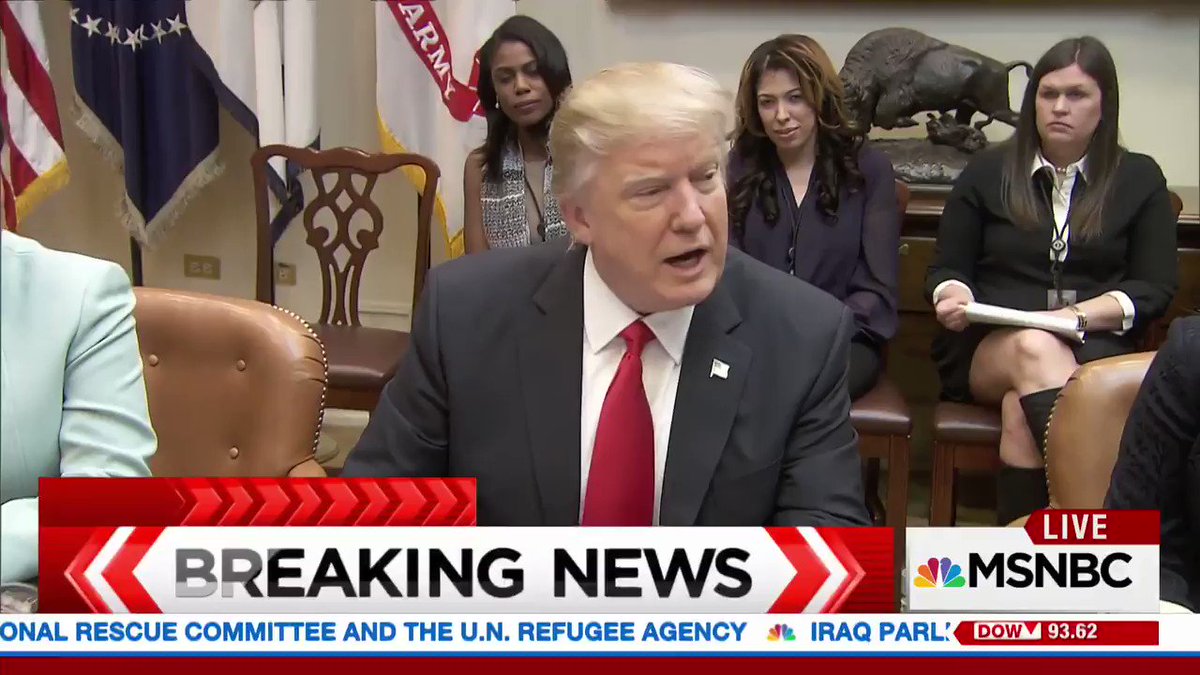
Trump: “I noticed Chuck Schumer yesterday with fake tears” over immigration ban/refugees; “I’m gonna ask him who is his acting coach”

Cutting Costs:
- *TRUMP SAYS $600M CUT FROM F-35 JOINT STRIKE FIGHTER COST
- *TRUMP: I APPRECIATE LOCKHEED MARTIN, BOEING BEING SO RESPONSIVE
- *TRUMP: WE WILL BE SAVING BILLIONS OF $ IN CONTRACTS
Immigration:
- *TRUMP: YDAY `VERY GOOD DAY’ FOR HOMELAND SECURITY
- *TRUMP IGNORES QUESTION ON LEGAL CHALLENGES TO REFUGEE ORDER
Regulation:
- *TRUMP PLANS TO ORDER TO `DRAMATICALLY’ REDUCE REGULATION
- *TRUMP: REGULATION HORRIBLE FOR BIG BUSINESS, WORSE FOR SMALL
end
No doubt that this will be the next conflict centre: the outsourcing of high tech jobs/an attack on the HiB.
(courtesy zero hedge)
Why The Cold War Between Tech CEOs and Trump Is About To Go Nuclear
Over the weekend, openly defiant CEOs, particularly among the tech sector, expressed their displeasure with Trump’s Friday executive order temporarily banning refugees and limiting travel from seven Muslim countries, with both words and deeds, among which the following (summary courtesy of Axios):
- VCs funding the ACLU: Several venture capitalists, as well as a few entrepreneurs, took turns soliciting donations to the American Civil Liberties Union through social media and personally matching those donations.
- Airbnb volunteers to help provide housing for impacted immigrants: The home-sharing company said that it will work with travelers and organizations to provide housing for those impacted by the executive order, whether through volunteer hosts or by funding housing.
- Lyft and Uber commit millions of dollars to legal aid: On Sunday, Lyft said it will donate $1 million to the ACLU over the next four years. Later in the day, Uber said it will create a $3 million legal defense fund for impacted drivers, as well as provide legal assistance and compensate their lost wages.
- Google is setting up a $2 million crisis fund: The search giant has set up a fund that will donate to the American Civil Liberties Union, Immigrant Legal Resource Center, International Rescue Committee, and UNHCR.
On Monday morning, former US Treasury Secretary Larry Summers, speaking in an interview with Bloomberg Television, said that he is “gratified” by what he heard from the tech community. “As global businesses, they have a huge stake in the United States being a nation of the Statue of Liberty rather than being a nation of refugee camps.” He added that “they have a huge stake in the United States supporting an open and tolerant global system, they have that stake for their employees, their customers, they have it for the reputation of the United States and they have spoken out.”
That may be, but the biggest reason for the anger by tech CEOs at the Trump administration is a simple, and a more selfish one. The reason for the simmering cold war between tech CEOs and Trump can be summarized in just three letters: H1-B. The bottom line is that tech CEOs fear Trump will single them out for outsourcing jobs or shut down the so-called H-1B visa program they use to hire high-skilled foreign employees for crucial engineering and technical jobs.
And, as Axios adds, White House officials say they are right to be nervous, especially about changes to the visa program. Chief strategist Steve Bannon and policy chief Stephen Miller are known to be deeply skeptical of the program, and will have a strong, vocal ally when Jeff Sessions gets confirmed as Attorney General. Some further observations:
- Trump’s mixed messages: On the campaign trail, he promised to “end forever the use of H-1B as a cheap labor program.” He later signaled in a meeting with tech leaders that he’s most concerned about companies misusing the visas to displace lower-wage American workers.
- How it works: Visas are capped at 65,000 a year, with 20,000 additional visas for foreign workers with master’s degrees. The demand for the visas is so high that the cap is usually exceeded within a few days of the application window opening. The visas are distributed to companies through a lottery system.
Tech companies such as Microsoft, Google, IBM, Cisco, Apple, Intel and Facebook say the visas are crucial for specialized jobs they can’t fill domestically because of a shortage of American graduates with the right technical skills. When CEOs spoke out over the weekend about the ban, they pointed out the importance of allowing the “best and brightest” to work in the U.S.
* * *
Which is why if a news report about Trump’s next imminent executive order is accurate, the simmering cold war between the tech CEOs and Trump is about to nuclear.
Bloomberg reports that the Trump administration has drafted an executive order aimed at overhauling the work-visa programs technology companies depend on to hire tens of thousands of employees each year. If implemented, the reforms could force wholesale changes at India companies such as Infosys Ltd. and Wipro Ltd., and shift the way American companies like Microsoft Corp., Amazon.com Inc. and Apple Inc. recruit talent. Companies would have to try to hire American first and if they recruit foreign workers, priority would be given to the most highly paid.
The draft of Trump’s executive order covers an alphabet soup of visa programs, including H-1B, L-1, E-2 and B1. The first is a popular program with technology companies and is aimed at allowing them to bring in high-skill workers when they can’t find local hires with the appropriate skills. The legislation caps the number of people who can enter the U.S. annually at 85,000, including those with undergrad and master’s degrees.
The average salary of an H-1B worker at Apple is reportedly more than $100k.
“Our country’s immigration policies should be designed and implemented to serve, first and foremost, the U.S. national interest,” the draft proposal reads, according to a copy reviewed by Bloomberg. “Visa programs for foreign workers … should be administered in a manner that protects the civil rights of American workers and current lawful residents, and that prioritizes the protection of American workers — our forgotten working people — and the jobs they hold.”
The foreign work visas were originally established to help U.S. companies recruit from abroad when they couldn’t find qualified local workers. But in recent years, there have been allegations the programs have been abused to bring in cheaper workers from overseas to fill jobs that otherwise may go to Americans. The top recipients of the H-1B visas are outsourcers, primarily from India, who run the technology departments of large corporations with largely imported staff.
“If firms are using the program for cheap labor, I think it will affect them and they will have to pay workers more,” said Ron Hira, an associate professor at Howard University. “If tech firms are using the program for specialized labor, they may find there are more visas available.”
The Trump administration did not respond to a request for comment on the draft. The proposal is consistent with the president’s public comments on pushing companies to add more jobs to the U.S., from auto manufacturing to technology.
It’s not clear how much force the executive order would have if it is signed by the president. Congress is also working on visa reforms and the parties will have to cooperate to pass new laws. Zoe Lofgren, a Democratic congresswoman from California, introduced a bill last week to tighten requirements for the H-1B work visa program.
“My legislation refocuses the H-1B program to its original intent – to seek out and find the best and brightest from around the world, and to supplement the U.S. workforce with talented, highly-paid, and highly-skilled workers,” Lofgren said in a statement.
Meanwhile, as Bloomberg adds, India’s technology companies, led by Tata Consultancy Services Ltd, Infosys and Wipro, have argued they are helping corporations become more competitive by handling their technology operations with specialized staff. They also contend the visa programs allow them to keep jobs in the U.S. and that if they have to pay more for staff, they will handle more of the work remotely from less expensive markets like India. Trump, however, see things differently.
“Inspections and investigations in the past have shown no cases of wrongdoing by Indian IT services companies, which have always been fully compliant with the law,” said R Chandrashekhar, president of Nasscom, the trade group for India’s information technology sector. “The industry is open to any kind of checks in the system, but they should not cause any hindrance to the smooth operation of companies.
The proposed Trump order is also aimed at bringing more transparency to the program. It calls for publishing reports with basic statistics on who uses the immigration programs within one month of the end of the government’s fiscal year. The Obama Administration had scaled back the information available on the programs and required Freedom of Information Act requests for some data.
Whatever specific changes are implemented, they are likely to add to the expenses for India’s technology companies. That may accelerate a shift to new kinds of services, such as cloud computing and artificial intelligence, said Raja Lahiri, partner at the Mumbai-based partner at consultancy Grant Thornton India
“The visa challenges are not going to go away easily,” he said. “They will continue to be a challenge for Indian IT companies.”
But while the pain for India will be acute, it will be Silicon Valley that may be most impacted, as suddenly its favorite source of cheap, skilled labor is eliminated. How it will responds remains to be seen.
Dallas Fed Manufacturing Survey Soars To Highest Since 2010
Following upwardly revised December data, January’s Dallas Fed manufacturing survey printed 22.1 – the highest since April 2010.

Of course, as we noted previously, this is ‘soft’ survey data and not actual economic data, which has yet to produce any notable improvement.

As RBC’s Charlie McElligott noted “it’s time forthe rubber to meet the road” in real economic improvement… as opposed to just hope.
end
There are many cities in the USA who host illegal immigrant and will not follow the Feds in returning the aliens to their home country. They are thus deemed sanctuary cities. The rhetoric between Washington and individual states is getting louder by the day. Now California which is net loser in the tax scheme is threatening to without taxes (funds) to Washington
(courtesy zero hedge)
California Threatens To Cut Off Funds To Washington
With secession threats looming, the state of California is reportedly studying ways to suspend financial transfers to Washington after the Trump administration threatened to withhold federal money from sanctuary cities.
With California counties among the Top 10 who stand to lose tax-payer funding for providing sanctuary to illegal immigrants…

KPIX5 reports that officials are looking for money that flows through Sacramento to the federal government that could be used to offset the potential loss of billions of dollars’ worth of federal funds if President Trump makes good on his threat to punish cities and states that don’t cooperate with federal agents’ requests to turn over undocumented immigrants, a senior government source in Sacramento said.
The federal funds pay for a variety of state and local programs from law enforcement to homeless shelters.
“California could very well become an organized non-payer,” said Willie Brown, Jr, a former speaker of the state Assembly in an interview recorded Friday for KPIX 5’s Sunday morning news.
“They could recommend non-compliance with the federal tax code.”
California is among a handful of so-called “donor states,” which pay more in taxes to the federal Treasury than they receive in government funding.

Americans Spend More Than They Earn For 9th Straight Month As Savings Rate Tumbles To 2015 Lows
Personal income growth disappointed in December, rising a less-than-expected 0.3% MoM. Of course, that did not stop Americans from spending as personal consumption rose 0.5% MoM in December. This is the 9th month in a row of higher annual spending growth than income growth…
Sadly for all those hyping and hoping for wage growth – it is stagnant again…

Which coupled with the rising inflation means real disposable income growth is its slowest since 2015…

But the need to spend, spend, spend, sends the savings rate tumbling to just 5.4% – the lowest since March 2015.

Sustainable?
end
Steven Bannon has now been promoted to the “principals committee” of the national Security Council while downgrading the roles of the chairman of the Joints Chief of Staff and the director of the national Intelligence!!!!
(courtesy zero hedge)
How Steve Bannon Rose To The Top Of Trump’s Power Structure
On Saturday night, President Trump signed an executive order promoting Chief Strategist Steve Bannon to the “principals committee” of the National Security Council — while, according to the New York Times, downgrading the roles of the chairman of the Joint Chiefs of Staff and the director of national intelligence, who will now attend only when the council is considering issues in their direct areas of responsibilities. The move puts Bannon, a former Navy surface warfare officer, admiral’s aide, investment banker and media executive, on the same level as Trump’s national security adviser, Michael Flynn.
The rapid rise of Bannon has come as a shock to many political pundits even though he played a key role throughout Trump’s campaign and is thought to be the key architect behind several of the recent executive orders signed by the new administration as well as Trump’s fiery inaugural address. In an interview last week attacking the media, Bannon clearly demonstrated the brash attitude that likely ingratiated him with the President and secured him a top spot in the Trump White Hosue.
“The media should be embarrassed and humiliated and keep its mouth shut and just listen for a while … I want you to quote this … The media here is the opposition party. They don’t understand this country. They still do not understand why Donald Trump is the president of the United States. … The elite media got it dead wrong, 100 percent dead wrong … The mainstream media has not fired or terminated anyone associated with following our campaign … Look at the Twitter feeds of those people: They were outright activists of the Clinton campaign … That’s why you have no power … You were humiliated.”

Of course, it didn’t take long for various political pundits to criticize Trump’s decision to add a political strategist to the National Security Council with Leon Panetta saying “the last place you want to put somebody who worries about politics is in a room where they’re talking about national security.”
“The last place you want to put somebody who worries about politics is in a room where they’re talking about national security,” said Leon E. Panetta, a former White House chief of staff, defense secretary and C.I.A. director in two Democratic administrations.
“I’ve never seen that happen, and it shouldn’t happen. It’s not like he has broad experience in foreign policy and national security issues. He doesn’t. His primary role is to control or guide the president’s conscience based on his campaign promises. That’s not what the National Security Council is supposed to be about.”
That opinion was shared by President George W. Bush’s last chief of staff, Josh Bolten, who barred Karl Rove, Mr. Bush’s political adviser, from N.S.C. meetings. A president’s decisions made with those advisers, he told a conference audience in September, “involve life and death for the people in uniform” and should “not be tainted by any political decisions.”
Bernie took to twitter to call the move “dangerous and unprecedented” while saying that “he must be removed.”
Steve Bannon sitting on the National Security Council is dangerous and unprecedented. He must be removed.

Meanwhile, even Susan Rice, who gained fame by going on numerous talk shows in the wake of the Benghazi attacks to blame an offensive YouTube video for the death of a U.S. ambassador, among others, decided to chime in on the decision:
This is stone cold crazy. After a week of crazy. Who needs military advice or intell to make policy on ISIL, Syria, Afghanistan, DPRK? https://twitter.com/jrivera64/status/825606733246509056 …

While all the motives behind Bannon’s promotion are not clear, many in the media are speculating the move is designed to diminish the role of Nation Security Advisor, Michael Flynn, whose son was previously fired from the Trump campaign after publicly embracing the PizzaGate conspiracy theory.
People close to Mr. Bannon said he is not accumulating power for power’s sake, but is instead helping to fill a staff leadership vacuum created, in part, by Mr. Flynn’s stumbling performance as national security adviser.
Mr. Flynn still communicates with Mr. Trump frequently, and his staff has been assembling a version of the Presidential Daily Briefing for Mr. Trump, truncated but comprehensive, to be the president’s main source of national security information. During the campaign, he often had unfettered access to the candidate, who appreciated his brash style and contempt for Hillary Clinton, but during the transition, Mr. Flynn privately complained about having to share face time with others.
Mr. Flynn “has the full confidence of the president and his team,” Hope Hicks, a spokeswoman for Mr. Trump, said in an email. Emails and phone calls to Mr. Flynn and his top aide were not returned.
Both Mr. Trump and Mr. Bannon still regard Mr. Flynn as an asset. “In the room and out of the room, Steve Bannon is General Flynn’s biggest defender,” said Kellyanne Conway, another top adviser to the president.
But it is unclear when the maneuvers to reduce Mr. Flynn’s role began. Two Obama administration officials said Trump transition officials inquired about expanded national security roles for Mr. Bannon and Mr. Kushner at the earliest stages of the transition in November — before the younger Mr. Flynn became a liability — but after Mr. Flynn had begun to chafe on the nerves of his colleagues on the team.
So, what is the over/under on Flynn surviving the first two years?
end
David Stockman: (from the Daily Reckoning)
David Stockman: Trump Sitting On Ticking Fiscal Time Bomb
David Stockman joined Fox Business and Maria Bartiromo on the morning flagship show Mornings with Maria to discuss the growing battle over the U.S national debt.
The conversation started with testimonial hearing notes from Congressman Mick Mulvaney, a Republican from South Carolina, who is currently the nominated to be the incoming White House Director for the Office of Management and Budget.

Rep. Mulvaney told the confirmation committee hearing, “If you were an ordinary American family the equivalent to you of a $20 trillion debt is a credit card bill of $260,000. American families know what that would mean to them. It is time that this government learns what this means to us.”
In order to expand on Rep. Mulvaney’s insights former OMB director under Ronald Reagan, David Stockman unleashed his debt and budgetary analysis. Stockman began by saying, “We are a society with baby boomers that are now 35 years older. We are heading into an absolute fiscal bloodbath. As the Congressional Budget Office (CBO) put out, there is $10 trillion more debt built in over the next decade. Even before one dime of tax cuts from Trump, infrastructure spending or an increase in defense takes place.”
David Stockman worked in the Reagan Administration where he oversaw the budget for four years. He is a former two term Congressman who also worked at various Wall Street institutions. Stockman is the current bestselling author of Trumped! A Nation on the Brink of Ruin… And How to Bring It Back.
[Ed. Note: To learn how to score your own FREE copy of Trumped! And have it sent directly to your door CLICK HERE. In it, you will learn the 10 Great Deals Donald Trump must make… and much more. All from Reagan’s former budget confidant.]
“So what I suggest is that we have an even more absurd fiscal proposition from Donald Trump today than we did back in 1981 when we tried to cut taxes, increase defense substantially and balance the budget. They are going to be in crisis within weeks. The debt ceiling was suspended arbitrarily until March 15. When it comes back into effect, there will be $20 trillion of debt.”
“Before they can do anything with all of this stimulus they are talking about they are going to have to raise the debt ceiling. Where are the votes going to come from? It is going to make 2011, and the debt ceiling crisis then, look like a Sunday school picnic.”

When pressed on entitlement spending and the incoming administration, “I think he is clueless about the fiscal mess he is inheriting… We can’t keep drifting toward this wall. When he says we are not going to cut social security or medicare, that is $1.6 trillion per year in spending. When he says we are going to add to Veteran care that is $185 billion. When he says we need much more defense to get strong again, which is not true – we have more defense than we need, that is already $650 billion.”

“What I am telling you is, he is going to increase everything, cut none of the entitlements, argue that he is going to reduce taxes, add a trillion of infrastructure as well. This does not add up. This is worse than what the Reagan administration proposed in 1981. Even then is was called a “riverboat gamble.”
“This is the most irresponsible fiscal equation ever presented to Washington. We have the markets today celebrating 20,000 because they think it is going to be a great stimulus. This is ‘rosy scenario’ all over again.”
“The CBO said $10 trillion in spending over the next decade to be spent if we never have another recession. Think about that. The last one was in 2009, through 2027 they are saying no recession. That is 220 months without a recession. That has never happened in human history.”
To catch the full interview with David Stockman on Fox Business click here.
Thanks for reading,
end
Let us wrap up today’s commentary with one of my favourite economists John Williams talking with Greg hunter:
(courtesy Greg Hunter/USAWatchdog/John Williams)
Fed Will Be Forced to Print & Kill Dollar-John Williams
 (Early Sunday Release)
Economist John Williams warned last year the U.S. economy never really recovered, and it was going to turn down again. That downturn happened Friday when the latest GDP figures came in below 2% growth in the fourth quarter of 2016. Williams says the economy “contracted,” and he contends it’s going to get a lot worse before it gets better. Williams explains, “I think there is reason for optimism in terms of the economy down the road. The problem is irrespective of who is president. When you introduce new policies, it takes about nine months to a year before we see the impact. So, the impact of all the happy things that are happening now won’t start to surface until 2018 barring other complications. I expect you to see a pickup in the economy then. Unfortunately, we are still in an economy that is turning down. You are going to see that in the reporting in the next several months. We never really recovered from the economic collapse going into 2009. There was a little bit of a rebound, and we started to see the economy turn down again in 2014. If you look at the underlying series such as industrial production, freight indices and petroleum consumption, there has been no recovery. We are turning down again. This is the longest and deepest economic contraction since the Great Depression.”
On rising interest rates, Williams predicts, “I think the Fed is going to suppress rates. Unfortunately, the bad economy we have now will be at least the better part of 2017. As the economy weakens, that puts renewed stress on the banking system. The Fed is going to be forced back to accommodating the solvency of the banking system. The Fed will be moving back towards the quantitative easing (money printing) that it had before. They have to save that banking system as they did back in 2008 . . . As they do that, it will kill the dollar. . . . There is hope for the economy, but we have a very difficult year ahead.”
Williams goes on to say, “There are two big problems. The Fed still doesn’t have control of the system, and I think they are going to be having trouble with the banks. They are going to move back to quantitative easing (money printing) that will hit the dollar hard. That, by itself, would tend to put upside pressure on rates. The Fed can intervene for the banking system, but it’s not going to be good for the financial markets. The second element, which is also very bad for the dollar, is that in the initial phases of the Trump stimulus, you are also going to see some increase in the near term budget deficit. Once you are down the road, and you have a stronger economy and you have greater revenues coming in with taxes and greater profits, that will help lessen the deficit. The global currency markets will, once again, look at the long term solvency of the United States, and in that area, you are going to have serious issues as you did in August of 2011. As the markets focus on the long term solvency of the U.S. government, that is a very bad circumstance for the dollar.”
If they don’t do that, Williams says, “We are facing a terrible crisis. . . . In terms of the Fed (getting control) and the long term solvency issues, these are death knells for the dollar. Unless those are addressed, you are going to see massive selling of the dollar, a debasement of the dollar and high inflation that will lead you into hyperinflation. That’s what comes into play. Prior to this administration, I would have given the chances of avoiding that as nil, but with this administration, I have some hope here.”
Fed Will Be Forced to Print & Kill Dollar-John Williams
By Greg Hunter’s USAWatchdog.com (Early Sunday Release)
Economist John Williams warned last year the U.S. economy never really recovered, and it was going to turn down again. That downturn happened Friday when the latest GDP figures came in below 2% growth in the fourth quarter of 2016. Williams says the economy “contracted,” and he contends it’s going to get a lot worse before it gets better. Williams explains, “I think there is reason for optimism in terms of the economy down the road. The problem is irrespective of who is president. When you introduce new policies, it takes about nine months to a year before we see the impact. So, the impact of all the happy things that are happening now won’t start to surface until 2018 barring other complications. I expect you to see a pickup in the economy then. Unfortunately, we are still in an economy that is turning down. You are going to see that in the reporting in the next several months. We never really recovered from the economic collapse going into 2009. There was a little bit of a rebound, and we started to see the economy turn down again in 2014. If you look at the underlying series such as industrial production, freight indices and petroleum consumption, there has been no recovery. We are turning down again. This is the longest and deepest economic contraction since the Great Depression.”
On rising interest rates, Williams predicts, “I think the Fed is going to suppress rates. Unfortunately, the bad economy we have now will be at least the better part of 2017. As the economy weakens, that puts renewed stress on the banking system. The Fed is going to be forced back to accommodating the solvency of the banking system. The Fed will be moving back towards the quantitative easing (money printing) that it had before. They have to save that banking system as they did back in 2008 . . . As they do that, it will kill the dollar. . . . There is hope for the economy, but we have a very difficult year ahead.”
Williams goes on to say, “There are two big problems. The Fed still doesn’t have control of the system, and I think they are going to be having trouble with the banks. They are going to move back to quantitative easing (money printing) that will hit the dollar hard. That, by itself, would tend to put upside pressure on rates. The Fed can intervene for the banking system, but it’s not going to be good for the financial markets. The second element, which is also very bad for the dollar, is that in the initial phases of the Trump stimulus, you are also going to see some increase in the near term budget deficit. Once you are down the road, and you have a stronger economy and you have greater revenues coming in with taxes and greater profits, that will help lessen the deficit. The global currency markets will, once again, look at the long term solvency of the United States, and in that area, you are going to have serious issues as you did in August of 2011. As the markets focus on the long term solvency of the U.S. government, that is a very bad circumstance for the dollar.”
If they don’t do that, Williams says, “We are facing a terrible crisis. . . . In terms of the Fed (getting control) and the long term solvency issues, these are death knells for the dollar. Unless those are addressed, you are going to see massive selling of the dollar, a debasement of the dollar and high inflation that will lead you into hyperinflation. That’s what comes into play. Prior to this administration, I would have given the chances of avoiding that as nil, but with this administration, I have some hope here.”
Join Greg Hunter as he goes One-on-One with economist John Williams, founder of ShadowStats.com.
(There is much more in the video interview.)
After the Interview:
end
That about does it for tonight
I will see you tomorrow night
Harvey


 harveyorganblog.com
[…] JAN 30/GOLD ADVANCES BY $4.80 AND SILVER UP BY 2 CENTS/GERMAN INFLATION RISES TO 1.9% WHICH WILL BE … […]
LikeLike
[…] from Harvey Organ: […]
LikeLike