
Gold at (1:30 am est) $1210.60 UP $17.40
silver at $17.51: up 39 cents
Access market prices:
Gold: $1210.65
Silver: $17.56
THE DAILY GOLD FIX REPORT FROM SHANGHAI AND LONDON
.
The Shanghai fix is at 10:15 pm est last night and 2:15 am est early this morning
The fix for London is at 5:30 am est (first fix) and 10 am est (second fix)
Thus Shanghai’s second fix corresponds to 195 minutes before London’s first fix.
And now the fix recordings:
Shanghai FIRST morning fix Jan 31/17 (10:15 pm est last night): $ holiday
NY ACCESS PRICE: $xxx (AT THE EXACT SAME TIME)/premium $xxx
XXXXXXXXXXXXXXXXXXXXXXXXXXXXXXXXXX
Shanghai SECOND afternoon fix: 2: 15 am est (second fix/early morning):$ holiday
NY ACCESS PRICE: $xxxx (AT THE EXACT SAME TIME/2:15 am)
SPREAD/ 2ND FIX TODAY!!: $xxx
China rejects NY pricing of gold as a fraud/arbitrage will now commence fully
XXXXXXXXXXXXXXXXXXXXXXXXXXXXXXXXXXXXXXXX
London FIRST Fix: Jan 31/2017: 5:30 am est: $1198.80 (NY: same time: $1198.80 (5:30AM)
XXXXXXXXXXXXXXXXXXXXXXXXXXXXXXXXXXXXXXXX
London Second fix Jan 31.2017: 10 am est: $1212.80 (NY same time: $1212.85 (10 AM)
It seems that Shanghai pricing is higher than the other two , (NY and London). The spread has been occurring on a regular basis and thus I expect to see arbitrage happening as investors buy the lower priced NY gold and sell to China at the higher price. This should drain the comex.
Also why would mining companies hand in their gold to the comex and receive constantly lower prices. They would be open to lawsuits if they knowingly continue to supply the comex despite the fact that they could be receiving higher prices in Shanghai.
end
For comex gold:
FEBRUARY/FIRST DAY NOTICE
NOTICES FILINGS FOR JANUARY CONTRACT MONTH: 3291 NOTICE(S) FOR 329,100 OZ. TOTAL NOTICES SO FAR: 3291 FOR 329100 OZ (10.236 TONNES)
For silver:
NOTICES FOR JANUARY CONTRACT MONTH FOR SILVER: 1 NOTICE(s) FOR 5,000 OZ. TOTAL NUMBER OF NOTICES FILED SO FAR; 746 FOR 3,730,000 OZ
THUS JANUARY IS NOW COMPLETE: 746 NOTICES FILED FOR 3,730,000 OZ
For silver: FEBRUARY/FIRST DAY NOTICE:
88 NOTICES FILED FOR 440,000 OZ
Let us have a look at the data for today
.
xxxxxxxxxxxxxxxxxxxxxxxxxxxxxxxxxxxxxxxxxxxxxxxxxxxxxxxxxxxxxxxxxxxxxxxxxx
In silver, the total open interest ROSE by 1,517 contracts UP to 181,183 with respect to YESTERDAY’S TRADING. In ounces, the OI is still represented by just less THAN 1 BILLION oz i.e. .906 BILLION TO BE EXACT or 129% of annual global silver production (ex Russia & ex China).
FOR THE JANUARY FRONT MONTH IN SILVER: 1 NOTICES FILED FOR 5,000 OZ.FOR THE NEW FRONT FEBRUARY MONTH: 88 NOTICES FOR 440,000
In gold, the total comex gold FELL BY 4,145 contracts DESPITE THE RISE IN THE PRICE GOLD ($4.80 with YESTERDAY’S trading ).The total gold OI stands at 391,449 contracts
we had 3291 notice(s) filed upon for 329,100 oz of gold.
xxxxxxxxxxxxxxxxxxxxxxxxxxxxxxxxxxxxxxxxxxxxxxxxxxxxxxxxxxxx
With respect to our two criminal funds, the GLD and the SLV:
GLD:
We had no changes in tonnes of gold at the GLD
Inventory rests tonight: 799.07 tonnes
.
SLV
we had no changes in silver into the SLV:
THE SLV Inventory rests at: 335.759 million oz
FEDERAL RESERVE BANK OF NY: GOLD MOVEMENT REPORT FOR DECEMBER EXPORTS
JANUARY REPORT
The FRBNY reported that we have 7,841 million dollars worth of gold in inventory valued at $42.22 for December.
The previous month we had 7,841 million dollars worth of gold inventory valued at $42.22 for December.
We thus had 0 gold oz moved out of inventory
end
.
First, here is an outline of what will be discussed tonight:
1. Today, we had the open interest in silver RISE by 1517 contracts UP to 181,183 AS SILVER WAS UP 2 CENTS with YESTERDAY’S trading. The gold open interest FELL by 4,145 contracts DOWN to 391,449 WITH THE RISE IN THE PRICE OF GOLD OF $4.80 (YESTERDAY’S TRADING)
(report Harvey).
2.a) The Shanghai and London gold fix report
(Harvey)
2 b) Gold/silver trading overnight Europe, Goldcore
(Mark O’Byrne/zerohedge
and in NY: Bloomberg
2c) COT report
(Harvey)
3c FEDERAL RESERVE BANK OF NY/GOLD INVENTORY MOVEMENT
(HARVEY)
3. ASIAN AFFAIRS
i)Late MONDAY night/TUESDAY morning: Shanghai closed HOLIDAY/ /Hang Sang closed . The Nikkei closed for holiday /Australia’s all ordinaires CLOSED down 0.69%/Chinese yuan (ONSHORE) closed HOLIDAY at 6.8840/Oil FELL to 52.47 dollars per barrel for WTI and 55.49 for Brent. Stocks in Europe ALL IN THE GREEN. Offshore yuan trades 6.8434 yuan to the dollar vs 6.8840 for onshore yuan.THE SPREAD BETWEEN ONSHORE AND OFFSHORE NARROWS QUITE A BIT AS POBC ATTEMPTS TO STOP DOLLARS FROM LEAVING CHINA’S SHORES.
REPORT ON JAPAN SOUTH KOREA NORTH KOREA AND CHINA
3a)THAILAND/SOUTH KOREA
b) REPORT ON JAPAN
c) REPORT ON CHINA
Trump accuses both China and Japan of manipulation in the currency markets; down goes the USA dollar again;
( zero hedge)
4 EUROPEAN AFFAIRS
i)GREECE
It sure looks like we are going to have a GREXIT
( Mish Shedlock/Mishtalk)
ii)GERMANY/USA
The trade war with Europe now begins in earnest: Trump attacking Germany who he states is using a grossly undervalued euro to their benefit.
Trump wants all components in the manufacturing process to be made in the uSA. He wants that foreign components will not be given a tax deduction in the assembly of products.
The Euro skyrockets, the dollar falls and the trade wars begin!
( zero hedge)
iii)Merkel responds to Trump: it is not our fault!
( zero hedge)
v)FRANCE
a)LePen’s main rival in deep trouble:
( zero hedge)
b)France now in chaos as the front leader for the President has just had his office searched by police:
( zero hedge)
Italy
Italy’s banking problems are going from bad to worse. Unicredit just announced a massive 11.8 billion euro loss!! They will need to raise 13 billion euros in new capital, along with Monte dei Paschi’s 15 billion euros or more.. The problem, the vehicle to bail out bad entities has only 20 billion euros of funds to help all Italian banks in trouble. Recall that the total of non performing loans on all Italian banks is 360 billion euros:
( Don Quinjones/WolfStreet)
5. RUSSIAN AND MIDDLE EASTERN AFFAIRS
The USA travel ban puts Saudi Arabia at odds with other Muslim countries like Yemen and Sudan. So far Saudi Arabia supports the ban.
( zero hedge)
6.GLOBAL ISSUES
Oh OH!! this is dangerous; Mexican officials, upset with Trump’s new policies may unleash drug cartels and more illegal immigration onto the uSA
( Mac Slavo/SFTFPlan.com)
7. OIL ISSUES
API reports major buildups in crude plus distillates.
( zero hedge)
8. EMERGING MARKETS
none today
9. PHYSICAL MARKETS
i)John Embry describes in great detail the fleecing of gold longs by bullion banks
( John Embry/Kingworldnews)
ii)The following is a good one! Ronan Manly has discovered that the Bank of England has leased out the Irish central bank gold and they have been told to conceal information on the leasing process
( Ronan Manly/GATA)
iii)James Turk is advocating that Trump, in order to make money great again must allow the circulation of gold and silver and to back money with those precious metals.
( James Turk/KingworldNews)
iv)Strange vehicle: no doubt that the crooks will manipulate this to their advantage
( CNBC/GATA)
10.USA STORIES
i)Mutiny on the bounty? Acting Attorney General Yates orders the Justice dept not to defend Trump’s executive order!!
( zero hedge)
ii)That did not last long: she is fired!
( zero hedge)
iii)Then Trump fires the Director Immigration and Customs Enforcement, Daniel Ragsdale and replaced him with Thomas Homan:
( zero hedge)
( zero hedge)
v)Trump takes on the pharmaceutical industry: get prices down!
( zero hedge)
vi)All out war just broke out in the Senate as democrats boycott confirmation. The key for the democrats is to try and block Mnuchin. He will stop the gold from leaving uSA shores which will cripple our gold shorts.
( zero hedge)
vi b) And now the Democrats delay the confirmation of Attorney General to be Jeff Sessions:
( zero hedge)
vii)We must pay attention to the following: a huge 6 sigma mess on the national Chicago Manufacturing Index:
( zero hedge)
viii)The Conference Board Consumer Confidence index slipped for the first time since October as confidence in the Trump rally fades fast
( zerohedge)
ix)Michael Snyder comments that the USA is on the threshold of a widespread civil unrest
( Michael Snyder/Economic Collapse Blog)
x)This is good for us: Mnuchin dashes banker hopes that prop trading will be allowed. He advocates a stronger and more powerful definition of the Volcker rule.
( zero hedge)
xi)November home prices reach record levels just before the onslaught of higher mortgage rates in December. This should cool the jets on home prices
( zerohedge)
xii)And there is the next executive order to be signed by Trump: a total crackdown on immigrant welfare benefits
Let us head over to the comex:
The total gold comex open interest FELL BY 4,145 CONTRACTS DOWN to an OI level of 391,449 DESPITE THE RISE IN THE PRICE OF GOLD ( $4.80 with YESTERDAY’S trading). We are now in the contract month of FEBRUARY and it is one of the better delivery months of the year.
For the next big active delivery month of February we had a LOSS of 21,128 contracts DOWN to 6455. Thus by definition the amount of gold initially standing for delivery in the front month of Feb is 6455 notices x 100 oz /contract = 645,500 oz or 20.077 tonnes. The next big active month is April and here the OI rose by 16,111 contracts up to 263,159.
We had 3291 notice(s) filed upon today for 329,100 oz
And now for the wild silver comex results. Total silver OI ROSE by 1517 contracts FROM 179,666 up to 181,183 AS the price of silver ROSE IN PRICE TO THE TUNE OF 2 CENTS with respect to YESTERDAY’S trading. We are moving further from the all time record high for silver open interest set on Wednesday August 3/2016: (224,540).
The active month of February saw the OI rise by 5 contract(s) UP TO 246. Thus 246 notices is the amount of silver initially standing for delivery or 1,230,000 oz
The next big active delivery month is March and here the OI fell by 976 contracts DOWN to 132,028 contracts. For comparison purposes last year on the same date only 107,193 contracts were standing.
We had 88 notice(s) filed for 440,000 oz for the FEBRUARY contract.
VOLUMES: for the gold comex
Today the estimated volume was 234,582 contracts which is good.
Yesterday’s confirmed volume was 253,478 contracts which is good
volumes on gold are getting higher!
| Gold | Ounces |
| Withdrawals from Dealers Inventory in oz | nil |
| Withdrawals from Customer Inventory in oz |
7963.144 OZ
Manfra
|
| Deposits to the Dealer Inventory in oz | nil oz |
| Deposits to the Customer Inventory, in oz |
nil oz
|
| No of oz served (contracts) today |
3291 notice(s)
329,100 oz
|
| No of oz to be served (notices) |
3264 contracts
326,400 oz
|
| Total monthly oz gold served (contracts) so far this month |
3291 notices
329,100 oz
10.236 tonnes
|
| Total accumulative withdrawals of gold from the Dealers inventory this month | NIL oz |
| Total accumulative withdrawal of gold from the Customer inventory this month | 7963.144 oz |
Today, 0 notice(s) were issued from JPMorgan dealer account and 2167 notices were issued from their client or customer account. The total of all issuance by all participants equates to 3091 contract(s) of which 186 notices were stopped (received) by jPMorgan dealer and 100 notice(s) was (were) stopped/ Received) by jPMorgan customer account.
March 2016: 2.311 tonnes (March is a non delivery month)
| Silver | Ounces |
| Withdrawals from Dealers Inventory | nil |
| Withdrawals from Customer Inventory |
nil 0z
|
| Deposits to the Dealer Inventory |
894,934.760 oz
Brinks
CNT
|
| Deposits to the Customer Inventory |
301,834.260 OZ
CNT
|
| No of oz served today (contracts) |
88 CONTRACT(S)
(440,000 OZ)
|
| No of oz to be served (notices) |
158 contracts
(790,000 oz)
|
| Total monthly oz silver served (contracts) | 88 contracts (440,000 oz) |
| Total accumulative withdrawal of silver from the Dealers inventory this month | NIL oz |
| Total accumulative withdrawal of silver from the Customer inventory this month | nil oz |
end
And now the Gold inventory at the GLD
JAN 31/no change in gold inventory at the GLD/Inventory rests at 799.07 tonnes
jan 30/no change in gold inventory at the GLD/Inventory rests at 799.07 tonnes
Jan 27/no changes at the GLD/Inventory rests at 799.07 tonnes
Jan 26/no changes at the GLD/Inventory rests at 799.07 tonnes/
jan 25/another exactly the same withdrawal as yesterday: 50.4 tonnes and again this was used in the whacking of gold today/inventory rests at 799.07 tonnes
jan 24/a huge withdrawal of 5.04 tonnes and probably this was used today in the whacking of gold/inventory rests at 804.11 tonnes
Jan 23/a big change/this time a deposit of 1.19 tonnes of gold into the GLD/inventory rests at 809.15 tonnes. The drainage of gold from the GLD to Shanghai has now stopped!
Jan 20/no changes in gold inventory a the GLD/Inventory rests at 807.96 tonnes
Jan 19/no changes in gold inventory at the GLD/Inventory rests at 807.96 tonnes
Jan 18/no changes in gold inventory at the GLD/Inventory rests at 807.96 tonnes
Jan 17/17/a deposit of 2.96 tonnes of gold/inventory at the GLD rests at 807.96 tonnes. I guess there is no more gold inventory to sent to C+Shanghai
Jan 13/17/there were no changes in gold inventory at the GLD/Inventory rests at 805.00 tonnes
Jan 12/2017/no change in gold inventory at the GLD/Inventory rests at 805.00 tonnes
Jan 11/no change in gold inventory at the GLD/Inventory rests at 805.00 tonnes
JAN 10/no changes in gold inventory at the GLD/Inventory rests at 805.00 tonnes
JAN 9/A WITHDRAWAL OF 8.87 TONNES OF GOLD FROM THE GLD/INVENTORY RESTS AT 805.00 TONNES
end
NPV for Sprott and Central Fund of Canada
end
Major gold/silver trading/commentaries for TUESDAY
GOLDCORE/BLOG/MARK O’BYRN
Why 2017 Could See the Collapse of the Euro
2017 could be the year that the euro collapses according to Joseph Stiglitz writing in Fortune magazine and these concerns were echoed over the weekend by former Bundesbank vice-president and senior European Central Bank official, Jürgen Stark, when he said that the ‘destruction’ of the Eurozone may be necessary if countries are to thrive again.
Stark and Stiglitz are too of many respected commentators, from both the so called right and the so called left, who are warning that the common currency and the Eurozone itself will not survive the financial and political turmoil already besetting the European monetary union and set to deepen in the coming months and years.
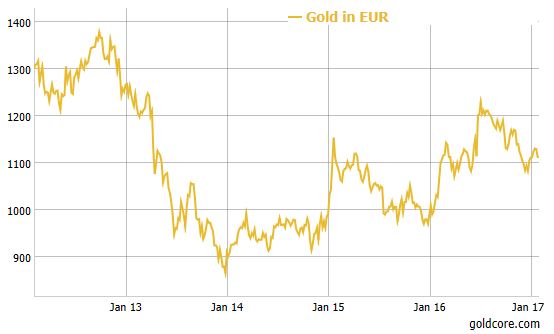
Gold in Euros – 5 Years
According to Stiglitz:
Greece remains in a severe depression. Growth for the Eurozone over the past year has been an anemic 1.6%, and that number is twice the average growth rate from 2005 to 2015. Historians are already speaking of the Eurozone’s lost decade, and it’s possible they’ll soon be writing about its last decade, too.
The euro was introduced in 2002, but the cracks in the single currency arrangement, which began in 1999, became evident with the 2008 global financial crisis.
Indeed, Greece and many periphery nations remain borderline or actually insolvent and this inconvenient truth has been largely ignored in recent months as it would clash with the cosy, and complacent, Eurozone “recovery” narrative.
The recovery is unsustainable as the root cause of the crisis – humongous levels of debt in Greece, Spain, Italy, Portugal and Ireland – was not dealt with rather the debt can was simply kicked down the road.
France, a nation with its own debt and economic issues, warned last week that the “window of opportunity” for a debt deal is closing after Athens and its creditors failed to find a solution to the country’s deadlocked bailout last week. French Finance Minister Michel Sapin warned that the coming volatile elections in Europe in 2017 would soon dominate the agenda and may make it much harder for Greece to reach a new ‘bailout’ deal.
Jeroen Dijsselbloem who heads the Eurozone’s Finance ministers also said: “there is a clear understanding that a quick finalization of the second [bailout] review is in everyone’s interest” as reported by the Wall Street Journal.
However, others such as Stark believe that eurozone “must break up if its members are to thrive again.”
Stark, who served on the ECB’s executive board during the financial crisis, said it was time to “think the unthinkable” and work towards a “reset” of Europe that pulled power away from Brussels as reported by the Telegraph.
He said the creation of a two-speed eurozone, with France and Germany at its core, would help to ensure the smaller bloc’s survival and he said that the current eurozone may need to be destructed in order to create a new “two-speed eurozone, with France and Germany at its core”.
This “would help to ensure the smaller bloc’s survival.”
Stiglitz conclusion, in a little noticed or commented upon article in Fortune magazine is also not optimistic and underlines the importance of being properly diversified and not having all your eggs in the euro basket – be that euro bank deposits in Eurozone banks or indeed euro denominated assets.
Stiglitz concludes by warning that:
… It is at least as likely that the political forces are going in the other direction, and if that is the case, it may be only a matter of time before Europe looks back on the euro as an interesting, well-intentioned experiment that failed—at great cost to the citizens of Europe and their democracies.
The full article can be read on Fortune here
Whether we like it or not, there is an increasing possibility that there may be a return to national currencies in Europe. Periphery nations savers and investors are particularly exposed in this regard.
Gold is an important hedging instrument and financial insurance that will protect people from the potential return to liras, drachmas, escudos, pesetas and punts. Hoping for the best but diversifying and being prepared for less benign financial outcomes remains prudent.
http://www.goldcore.com/us/gold-blog/2017-see-collapse-euro/
end
John Embry describes in great detail the fleecing of gold longs by bullion banks
(courtesy John Embry/Kingworldnews)
Bullion banks fleece gold longs so price can rise again, Embry tells KWN
Submitted by cpowell on Mon, 2017-01-30 18:42. Section: Daily Dispatches
1:43p ET Monday, January 30, 2017
Dear Friend of GATA and Gold:
Sprott Asset Management’s John Embry, interviewed by King World News today, notes the huge decline in active gold futures contracts on the New York Commodity Exchange in the last few days, indicating that the bullion banks have done their usual fleecing of speculative longs in preparation for another surge in the price. Embry’s comments are posted at KWN here:
http://kingworldnews.com/emery-a-jaw-dropping-8-6-million-ounces-of-pape…
CHRIS POWELL, Secretary/Treasurer
Gold Anti-Trust Action Committee Inc.
CPowell@GATA.org
END
The following is a good one! Ronan Manly has discovered that the Bank of England has leased out the Irish central bank gold and they have been told to conceal information on the leasing process
(courtesy Ronan Manly/GATA)
Ronan Manly: Bank of England tells Irish central bank to conceal gold info
Submitted by cpowell on Tue, 2017-01-31 01:45. Section: Daily Dispatches
8:45p ET Monday, January 309, 2017
Dear Friend of GATA and Gold:
Gold researcher Ronan Manly tonight concludes the tale of his struggle with Ireland’s central bank to get any useful information about the nation’s gold reserves. While, predictably enough, the bank shuts him out, Manly obtains documentation indicating that Ireland’s gold has been leased out through the Bank of England and that the Bank of England presumed to instruct Ireland not to disclose any information about it because gold is far too sensitive a subject to entrust the mere public with. Manly’s report is headlined “Ireland’s Monetary Gold Reserves: High Level Secrecy vs. Freedom of Information — Part 2” and it’s posted at Bullion Star here:
https://www.bullionstar.com/blogs/ronan-manly/irelands-monetary-gold-res…
CHRIS POWELL, Secretary/Treasurer
Gold Anti-Trust Action Committee Inc.
CPowell@GATA.org
END
James Turk is advocating that Trump, in order to make money great again must allow the circulation of gold and silver and to back money with those precious metals.
(courtesy James Turk/KingworldNews)
James Turk: Urge President Trump to ‘make money great again’
Submitted by cpowell on Tue, 2017-01-31 02:04. Section: Daily Dispatches
9:05p ET Monday, January 30, 2017
Dear Friend of GATA and Gold:
GoldMoney founder and GATA consultant James Turk today tells King World News about a movement requesting President Trump’s support to “make money great again” — that is, to facilitate the circulation of gold and silver as currencies without punitive taxation. Turk’s commentary is posted at KWN here:
http://kingworldnews.com/james-turk-the-u-s-may-be-about-to-make-real-mo…
CHRIS POWELL, Secretary/Treasurer
Gold Anti-Trust Action Committee Inc.
CPowell@GATA.org
END
Strange vehicle: no doubt that the crooks will manipulate this to their advantage
(courtesy CNBC/GATA)
This gold fund looks to hedge against a strong dollar
Submitted by cpowell on Tue, 2017-01-31 02:55. Section: Daily Dispatches
By Tom Anderson
CNBC, New York
Monday, January 30, 2017
The gold trade has historically been a good hedge against a weak dollar, but not usually a great investment when the greenback is going up. Today State Street Global Advisors and the World Gold Council launched an exchange-traded fund to figure out a way around that market friction point.
The SPDR Long Dollar Gold Trust ETF gains when gold priced in U.S. dollars rises or when the value of the U.S. dollar increases. It takes a long position on physical gold in U.S. dollars and shorts a group of major global currencies that include the euro, Japanese yen, British pound sterling, Canadian dollar, Swedish krona, and Swiss franc.
“There’s nothing other than gold bars backing the product, and you’re going to get the benefits of owning gold and owning gold in a strong-dollar environment,” Joe Cavatoni, the World Gold Council’s managing director of ETFs, told CNBC’s “Squawk Box.”
However, the new ETF will lose money when gold prices fall more than the value of the dollar rises. …
… For the remainder of the report:
http://www.cnbc.com/2017/01/30/strong-dollar-can-bite-investors-looking-.
END
Your early TUESDAY morning currency, Asian stock market results, important USA/Asian currency crosses, gold/silver pricing overnight along with the price of oil Major stories overnight
1 Chinese yuan vs USA dollar/yuan REMAINS AT 6.8840(ZERO DEVALUATION /CHINA / CHINA ON HOLIDAY/OFFSHORE YUAN NARROWS TO 6.8434 / Shanghai bourse CLOSED / HANG SANG CLOSED D
2. Nikkei closed DOWN 327.51 POINTS OR 1.69% /USA: YEN FALLS TO 113.29
3. Europe stocks opened ALL IN THE GREEN ( /USA dollar index FALLS TO 100.06/Euro UP to 1.0759
3b Japan 10 year bond yield: RISES TO +.087%/ !!!!(Japan buying 100% of bond issuance)/Japanese yen vs usa cross now at 113.29/ THIS IS TROUBLESOME AS BANK OF JAPAN IS RUNNING OUT OF BONDS TO BUY./JAPAN 10 YR YIELD FINALLY IN THE POSITIVE/BANK OF JAPAN LOSING CONTROL OF THEIR YIELD CURVE AS THEY PURCHASE ALL BONDS TO GET TO ZERO RATE!!
3c Nikkei now JUST BELOW 17,000
3d USA/Yen rate now well below the important 120 barrier this morning
3e WTI:: 53.23 and Brent: 55.44
3f Gold UP/Yen UP
3g Japan is to buy the equivalent of 108 billion uSA dollars worth of bond per month or $1.3 trillion. Japan’s GDP equals 5 trillion usa./“HELICOPTER MONEY” OFF THE TABLE FOR NOW /REVERSE OPERATION TWIST ON THE BONDS: PURCHASE OF LONG BONDS AND SELLING THE SHORT END
Japan to buy 100% of all new Japanese debt and by 2018 they will have 25% of all Japanese debt. Fifty percent of Japanese budget financed with debt.
3h Oil DOWN for WTI and DOWN for Brent this morning
3i European bond buying continues to push yields lower on all fronts in the EMU. German 10yr bund FALLS TO +.461%/Italian 10 yr bond yield DOWN to 2.286%
3j Greek 10 year bond yield RISES to : 7.97%
3k Gold at $1205.75/silver $17.39(8:15 am est) SILVER BELOW RESISTANCE AT $18.50
3l USA vs Russian rouble; (Russian rouble DOWN 2/100 in roubles/dollar) 59.93-
3m oil into the 52 dollar handle for WTI and 55 handle for Brent/
3n Higher foreign deposits out of China sees huge risk of outflows and a currency depreciation (already upon us). This can spell financial disaster for the rest of the world/China forced to do QE!! as it lowers its yuan value to the dollar/GOT ZERO DEVALUATION from POBC.
JAPAN ON JAN 29.2016 INITIATES NIRP. THIS MORNING THEY SIGNAL THEY MAY END NIRP. TODAY THE USA/YEN TRADES TO 113.29 DESTROYING JAPANESE CITIZENS WITH HIGHER FOOD INFLATION
30 SNB (Swiss National Bank) still intervening again in the markets driving down the SF. It is not working: USA/SF this morning 0.9908 as the Swiss Franc is still rising against most currencies. Euro vs SF is 1.0660 well above the floor set by the Swiss Finance Minister. Thomas Jordan, chief of the Swiss National Bank continues to purchase euros trying to lower value of the Swiss Franc.
3p BRITAIN VOTES AFFIRMATIVE BREXIT
3r the 10 Year German bund now POSITIVE territory with the 10 year FALLS to +.451%
3s The Greece ELA NOW at 71.4 billion euros,AND NOW THE ECB WILL ACCEPT GREEK BONDS (WHAT A DISASTER)
The bank withdrawals were causing massive hardship to the Greek bank. the Greek referendum voted overwhelming “NO”. Next step for Greece will be the recapitalization of the banks and that will be difficult.
4. USA 10 year treasury bond at 2.466% early this morning. Thirty year rate at 3.065% /POLICY ERROR)GETTING DANGEROUSLY HIGH
5. Details Ransquawk, Bloomberg, Deutsche bank/Jim Reid.
(courtesy Jim Reid/Bloomberg/Deutsche bank/zero hedge)
Futures Fall On Rising Trump Uncertainty; Europe Stocks Rise As Euro-Area Inflation Surges
European bonds fell and stocks rose led by banks and retailers as surging inflation data prompted investors to switch into reflationary assets even as speculation about ECB tapering has returned. Asian stocks and US equity futures declined. The Yen and gold advanced after Trump’s firing of the U.S. acting attorney general added to concern over the unpredictability of decisions in the new administration.
Overnight, the BOJ did not surprise markets when it kept its rates and yield target on hold, although an upside revision to its growth targets put a hawkish angle on the release, leading the Yen to rise, only to see all gains disappear after the European open.
The U.S. dollar headed for its worst start to a year since 2008 on Tuesday while world stock losses, already the biggest in six weeks, grew after widespread protests against President Donald Trump’s stringent curbs on travel to the United States, while Trump’s decision to fire the acting AG added to policy uncertainty. “His actions over the last few days is another reminder that there were two sides to his campaign and Trump is just as adamant to follow through on those measures that will likely weigh on market sentiment in the coming months,” said Craig Erlam, senior market analyst at OANDA.
Euro stocks reversed two days of declines triggered by Trump’s Friday immigration order as banks led gains. Euro-region inflation accelerated after the currency bloc’s economy posted its strongest expansion in three quarters. Euro-area inflation accelerated more than forecast to effectively reach the European Central Bank’s goal, which may intensify a debate among policy makers about their long-running stimulus programs. The 1.8% annual increase in consumer prices in January was the fastest since early 2013 and beat the 1.5 percent median forecast in a Bloomberg survey. That’s in line with the ECB goal of just below 2 percent, though the less-volatile core rate remains at just half that level. Core inflation remained at 0.9 percent in January.

Despite being mostly driven by higher oil prices, the inflation pickup is feeding into questions about the appropriate degree of monetary stimulus for the 19-nation currency bloc. ECB President Mario Draghi has repeatedly stressed that underlying price pressures are still weak and he wants certainty that the acceleration will prove durable, though German policy makers have started to push for a discussion about winding down quantitative easing.
Nonetheless dovish analysts hoping for a contination of the status quo were quick to look through the spike in prices: “It’s very straight forward: Draghi laid out the criteria that make it clear that inflation has to be self-sustained, durable over time, and for the whole of the euro area,” said Frederik Ducrozet, senior economist at Banque Pictet & Cie SA in Geneva. “This is not what the ECB would consider price stability, even if the hawks get louder.”
Still, as controversial decisions by the U.S. president dim enthusiasm he will embark on an era of fiscal easing to rival the Reagan years, Europe is suddenly emerging as a safe haven and investors are turning more bullish on Europe. The firing of Sally Yates added to jitters sparked by Trump’s imposition of a ban on U.S. entry for passport holders from a number of Muslim-majority nations. Reports of quickening inflation underscore BlackRock Inc.’s bet on the rotation into stocks and out of bonds.
“We have greater confidence that inflation will meet central bank targets, with some scope for overshooting in the near term as economies are allowed to run a little hotter,” according to Richard Turnill, BlackRock’s global chief investment strategist in London. “We prefer equities over fixed income in this reflationary, low-yield and low-return environment.”
Going back to Trump, elevated uncertainty about his policies, including a lack of detail so far on his plans for tax cuts and fiscal spending, offset optimism on the U.S. economy. “We’ve seen a jump in U.S. economic sentiment after Trump’s victory. But the improvement in hard economic data remains moderate,” said Haruka Kazama, senior economist at Mizuho Research Institute. “And if Trump takes more steps to limit permits for immigrants, that would surely boost inflation as the U.S. is now near a full employment.”
Oil headed toward its first monthly decline since October while gold climbed for a third day. The euro rose, while the yen weakened after the Bank of Japan left monetary policy unchanged.
As controversial decisions by the U.S. president dim enthusiasm he will embark on an era of fiscal easing to rival the Reagan years, investors are turning more bullish on Europe. The firing of Sally Yates added to jitters sparked by Trump’s imposition of a ban on U.S. entry for passport holders from a number of Muslim-majority nations. Reports of quickening inflation underscore BlackRock Inc.’s bet on the rotation into stocks and out of bonds.
Traders will be looking at this week’s busy calendar which will see the lower house of Parliament will begin on Tuesday to debate a 137-word bill that gives Prime Minister Theresa May permission to start the legal mechanism by which the U.K. will leave the European Union. The Fed announces its policy decision on Wednesday. Like the BOJ, it is expected to leave lending rates where they are, though the Fed’s statement will be parsed for any reading on Trump’s impact on the world’s largest economy. Trump plans to announce his nomination to the Supreme Court Tuesday, a move likely to dominate headlines and perhaps delay the presentation of further details on spending policies.
Overnight Bulletin Summary from RanSquawk
- Surprise upside in inflation data from Eurozone sparks a rise in Eurozone bond yields
- Month-end flow sees EUR/GBP race through 0.8600 with GBP/USD finding support around 1.2420-30
- Looking ahead, highlights include US employment cost index, Chicago PMI, API crude oil report as well as earnings from Apple and Exxon.
Market Snapshot
- S&P 500 futures down 0.1% to 2,274.00
- STOXX Europe 600 up 0.2% to 363.32
- MXAP down 1% to 140.88
- MXAPJ down 0.6% to 450.42
- Nikkei down 1.7% to 19,041.34
- Topix down 1.4% to 1,521.67
- Sensex down 0.7% to 27,655.96
- Australia S&P/ASX 200 down 0.7% to 5,620.91
- Kospi down 0.8% to 2,067.57
- German 10Y yield rose 2.9 bps to 0.478%
- Euro up 0.09% to 1.0705 per US$
- Brent Futures unchanged at $55.23/bbl
- Italian 10Y yield rose 10.2 bps to 2.329%
- Spanish 10Y yield fell 1.0 bps to 1.62%
- Brent Futures unchanged at $55.23/bbl
- Gold spot up 0.2% to $1,198.12
- U.S. Dollar Index up 0.02% to 100.45
Global Top News
- Trump Firing of Yates Deepens Conflict Over U.S. Immigrant Order
- Buffett Bought $12 Billion of Stock From Election Through Friday
- Trump Expected to Make Supreme Court Pick From Two Finalists
- Teva Plunges After U.S. Judge Invalidates Four Copaxone Patents
- Chevron Freezes CEO’s Salary With Delayed Compensation Plan
- Wal-Mart’s India Unit to Add 50 More Stores in Next Five Years
- Oil Set for Monthly Loss as OPEC Cuts Seen Spurring U.S. Supply
- El Nino May Make a Comeback as Australia Sees Pacific Warming
- General Motors Sheds Last Junk Rating After Moody’s Upgrade
- Fox Monitors Trump Policy as Murdochs Call Immigration Essential
- Benchmark Electronics May Move After Sanmina Gains on Rev. View
- GE Sees No Need to Sell More Assets as Part of Baker Hughes Deal
Asia equity markets traded lower amid a lack of demand in holiday-thinned trade, with sentiment also dampened following Monday’s poor close in the US and after President Trump signed an executive order banning travel from 7 predominantly Muslim countries. ASX 200 (-0.9%) underperformed with broad based declines seen across all sectors and heavy losses in IT stocks, while Nikkei 225 (-0.6%) suffered from a firmer JPY with Toshiba shares the worst performer after reports that the Chairman is poised to step down and that several trust banks are preparing lawsuits against the Co. Markets in China, Hong Kong, Taiwan, South Korea and Singapore are all shut due to public holiday. 10yr JGBs traded subdued with the yield curve flattening amid underperformance in the short-end, although mild support was seen following today’s 2yr JGB auction which resulted in the highest b/c since May.
Top Asian News
- Jaitley Aide Seeks Bold Tax Cuts as Cash Ban Hits India GDP
- BOJ Holds Stimulus With Little Change in Inflation Outlook
- BOJ’s Next Challenge Could Be Excessive Yen Weakness
- Nomura’s Profit Doubles on Trading Income, Overseas Revival
- Nintendo Results Underscore Need for Switch Console to Succeed
- Komatsu Joins Peers to Signal Mining Rebound Remains Elusive
- Sony Drops After Taking $1 Billion Writedown in Movie Business
- Toshiba Mulls Selling Stake It Holds in Westinghouse: Sankei
European equities have been in a tight range this morning to trade modestly in the green, although similar to yesterday’s Germany readings, surprise upside in inflation data from the Eurozone (1.8% vs. Exp. 1.6%) has yet again brought into question the potential talk over QE tapering (despite ECB’s Nowotny refuting that tapering is currently up for a discussion and now ECB’s Villeroy). As such, fixed income markets have come under pressure so far this morning, with Bunds lower by around 50 ticks this morning, while the BoJ have also weighed on sentiment after announcing that they will cut purchases of 5 and 10 year bonds by JPY 40bIn in February. UK paper has been provide with a lift amid a strong 2026 auction with a better than prior b/c and a narrower tail.
Top European News
- Euro-Area Inflation Surges to 1.8%, Intensifying ECB Debate; Euro-Area Economy Expands 0.5% in 4Q, Matching Estimate
- Shell Sells $4.7 Billion of Fields as Disposal Push Accelerated
- Deutsche Bank Bill for Russia Mirror Trades Reaches $629 Million;
- H&M Bucks Apparel Retailers’ Gloom as Profit Beats Estimates
- Cash for VW’s Clunkers: Diesel Buybacks Boost U.S. Auto Demand
- This 45-Year Analysis Shows Sterling Has Reached a Floor
- What the World’s Biggest Banks Say About Fleeing Brexit- Britain
- German Unemployment Falls to Record Low as Economy Gathers Pace
- Italian Unemployment at 18-Month High Amid Consumer Pessimism
- French Economy Accelerates, Stoking Debate on ECB Tapering
European Economic Data
- France 4Q GDP YoY 1.1%, est. 1.1%, prior 1.0%
- France Jan. EU Harmonized CPI YoY, 1.2%, est. 1.6%, prior 0.8%
- Spain Jan. CPI EU Harmonised YoY 3.0%, est. 2.2%, prior 1.4%
- German Jan. Unemployment Claims Rate, 5.9%, est. 6.0%, prior 6.0%
- Italy Dec. Unemployment Rate, 12.0%, est. 11.8%, prior 11.9%
- U.K. Dec. Mortgage Approvals, 67.9k est. 69,2k, prior 67,5k
- Euro-Zone Dec. Unemployment Rate, 9.6%, est. 9.8%, prior 9.8%
- Euro-Zone 4Q SA QoQ, 0.5%, est. 0.5%, prior 0.3%
- Euro-Zone Jan. CPI Estimate YoY, 1.8% est. 1.5%, prior 1.1%
In currencies, it has been a quiet day in FX markets, and a case of closing the gap left in the overnight month end trade has been busier. Top of the list is EURGBP, racing up through 0.8600 after taking out the highs from Monday, as buying out of Europe (CB), pushes the cross rate up to highs around .8633. Strong resistance seen and anticipated ahead of 0.8700, but little give seen on the downside as yet, though this may come through Cable which has been slammed down into the support seen ahead of 1.2400. 1.2420-30 was our area of note, and we have tested just below here, but with limited follow through as yet. Portfolio rebalancing flow has dominated the tape, which so far points to USD selling, observed against the JPY, EUR and CHF, but USD/JPY has found support again ahead of 113.00 despite the backlash over president Trump’s travel ban, while EUR/USD sellers above 1.0700 are not giving up. EU data all better than expected though as Q4 growth and CPI both 1.8% on a yoy basis respectively. BoJ kept policy unchanged as expected overnight whilst upgrading forecasts, but JPY weakness will have been factored into this despite the near(er) term moves seen. USD/CHF has tested below 0.9950, but it has been an extremely staggered move lower in recent sessions. The Bloomberg Dollar Spot Index was little changed near the lowest level in two months, and is down 1.9 percent for the year. The euro climbed 0.2 percent to $1.0712.
In commodities, West Texas Intermediate crude slipped 0.3 percent to $52.49 a barrel, after losing more than 1 percent during each of the previous two sessions. Crude is heading for a monthly drop of 2.5 percent as signs that U.S. supply is expanding offset OPEC’s production curbs. Gold added 0.3 percent to $1,198.68 an ounce, and is heading for its biggest monthly rally since June. There has been upside movement in base metals with the likes of Copper and Palladium seeing decent price gains alongside Zinc, but Nickel being the out-performer gaining a little over 2% on the day. Still China remains on vacation, so trading conditions thin, perhaps explaining away some of today’s price action, though Copper has been on the rise recently as the strike vote in Escondida (Chile) mine is in the final stages. Gold is back at USD1200; this on risk sentiment as it is on the turnaround in the USD; gold is heading for its biggest monthly rally since June. . Oil prices are still trading in comfortable territory, but now towards the lower end of the recent range. Bloomberg Commodity Index set for first monthly loss since October.
Looking at today’s events, the most significant release is likely the Q4 employment cost index reading which both the market and our US economists expect to print at +0.6% for the quarter. That implies a YoY growth rate of +2.4% although still below the +2.6% peak in Q1 2015. Also due out today is the Chicago PMI for January, consumer confidence for this month and S&P/Case-Shiller house price index reading for November. Meanwhile earnings pick up with 31 S&P 500 companies due to report highlighted by Apple after the close. Pfizer and Exxon Mobil will also report. Also of potential interest today is the commencement of the two-day debate by the House of Commons on the government’s draft law giving PM May authority to trigger Article 50.
DB’s Jim Reid concludes the overnight wrap
We may only be 11 days into the first 100 days of the new Trump administration but one thing is becoming more apparent and that is that markets are going to be continually tested in the near term by the words and actions of President Trump. The fallout from the executive order put in place over the weekend continued throughout yesterday’s session with global political leaders and CEO’s alike all announcing various levels of disapproval. It’s also continued overnight with the news that Trump has fired the acting US attorney general Sally Yates after she ordered the justice department not to enforce the President’s order. The order has also unnerved some of the Republican Senators and it’s these sorts of responses which will be important to monitor as things progress and as we move on to the more direct economic agenda.
Yesterday we speculated as to whether or not the weekend news would spill over into financial markets but it was clear from the get go that markets were on edge given the uncertainty and uneasiness stemming from the news. Look no further than the VIX (+12.29%) which rose by the most since November 3rd. Equity markets had their worst day of the year too. The S&P 500 – which has been up as much as +8.36% since the Trump election victory – fell -0.60% and closed down for the third day in a row while having its worst day this year. The Dow (-0.61%) pared losses but still edged back below 20,000 while losses were even greater in Europe with the Stoxx 600 (-1.05%) down by the most since November. In fact yesterday was a decent microcosm of the volatility that we expect to feature in markets this year. Treasuries ended up little changed around 2.488% but chopped and changed while 10y Bund yields edged 1.2bps lower to 0.445%. That was in stark contrast to the periphery however where similar maturity yields in Italy, Spain and Portugal finished anywhere from 4bps to 10bps higher while Greek yields ended up 39bps higher. We’ll come back to those moves later. Meanwhile, credit indices edged wider (CDX IG +1.6bps and iTraxx Main +2bps) although that failed to stop Microsoft launching a bumper $17bn deal, while Gold is back above $1200/oz again.
In the mean time the focus on Mr Trump will continue into today with the President expected to announce his Supreme Court nominee which will likely trigger another battle within the Senate. In addition, last night Trump also signed an executive order on all new federal regulations by establishing a “one in, two out” rule. In other words, for each new regulation issued, two will have to be scrapped. Trump confirmed that “this will be the biggest such act” that the US has ever seen and that it will be “normalised control”. The reality of eliminating regulation might be in itself a very different proposition but its more evidence of the unpredictability that we’re now facing.
Thankfully markets have at least some distraction from politics this week with the steady stream of central bank meetings and it has kicked off this morning with the BoJ. As expected there were no real surprises policy-wise. The BoJ has kept the policy rate at -0.1%, the pace of asset purchases steady at ¥80tn and maintained to target the 10y JGB yield at around 0%. There was some focus on the outlook report though where the median forecast for CPI ex fresh food is at 1.5% in 2017 fiscal year and unchanged relative to the October forecast. Real GDP is also expected to grow at 1.5% in the same period, an upgrade on the original 1.3% forecast. However the BoJ did also say that “risks to both economic activity and prices are skewed to the downside”. Governor Kuroda is due to speak shortly after we go to print so keep an eye on that.
The Yen is about +0.30% stronger as we type although that move, combined with the weak session on Wall Street last night, is weighing on Japanese equities with the Nikkei (-1.49%) and Topix (-1.28%) both sharply lower. The Kospi is also -0.56%, the ASX -0.95% and US equity index futures -0.28% with the fallout from the Trump’s latest actions showing little sign of abating just yet.
Moving on. As we noted at the top there was a reasonable underperformance across the peripheral assets in Europe yesterday and a few factors appeared to be at play. In Greece, along with the selloff in bonds the Athens stock exchange suffered its second consecutive -3.50% fall as the Greek government and European creditors failed to make any progress on the terms and conditions attached to Greece’s latest bailout review. We appear to still be on all-too familiar ground with the IMF saying that the proposed fiscal targets beyond 2018 are not sustainable and more relief is needed, and so not signing up to the program, while Germany continues to maintain a stance of refusing to let the IMF leave or provide debt relief. Indeed the headlines suggest that almost two-thirds of actions needed for the disbursement of the next tranche are still not yet completed. The next key event to keep an eye on is the IMF board meeting on February 6th followed by a Eurogroup Working Group meeting on February 9th. It’s possible that a lack of progress at the meetings means that talks stall until after the Dutch elections.
Meanwhile in Italy the fallout from the Constitutional Court decision continues while a trading update from UniCredit yesterday added to the pain for the banking sector. The Bank also confirmed that the ECB has demanded further updates to a plan for dealing with bad loans with an end-February deadline. Elsewhere, France was also seen as a bit of a catalyst to yesterday’s moves with market jitters on the rise following the victory of Hamon in the Socialist Primary. The victory appears to have sparked further momentum in interest of independent challenger Emmanuel Macron who was also given a boost yesterday after it was announced that former premier Fillon will be the subject of an examination over whether or not he broke the law by employing his wife in his parliamentary office. Interestingly a Kantar Sofres Poll released yesterday in Le Figaro showed that the first round election on April 23rd would have Le Pen in the lead at 25% followed by Fillon on 22% and Macron on 21%. Should a second round between Le Pen and Fillon come to fruition, then the poll suggested that Fillon would be the victor at 60% to 40%. Should Fillon face Macron then Macron would win by 60% versus 40%. In the other scenario of a Macron versus Le Pen race, the former would win by 65% versus 35% according to the polls. French 10y bond yields finished +2.5bps higher yesterday at 1.051% and it’s worth nothing too that the 2y spread between France and Germany has now risen to 25bps and the widest since the 2013 taper tantrum when it got to 36bps. That spread actually got to a low of less than 1bp back in November last year.
Elsewhere, yesterday’s economic data ended up being a bit of a sideshow to all things Trump related. In reality though the data didn’t really sway too much from the market consensus. In the US personal spending was confirmed as rising +0.5% mom in December, matching market expectations while personal income rose +0.3% mom (vs. +0.4% expected). The core PCE deflator rose +0.1% mom which left the YoY rate at +1.7% while the deflator also came in in-line at +0.2% mom. Elsewhere there was good news to come out of the latest regional manufacturing data with the Dallas Fed’s manufacturing survey rising 4.4pts to 22.1 and to the highest since 2010. Finally pending home sales rose +1.6% mom and better than expected (vs. +1.0% expected).
Meanwhile, in Europe the European Commission’s economic sentiment index reading edged up 0.1pts to 107.9 this month which is actually the highest reading since March 2011. The other notable data came from Germany where HICP headline inflation rose to +1.9% yoy from +1.7%, albeit a one-tenth miss versus consensus. Our economists highlighted however that their estimate of core inflation pulled back to +1.2% yoy from +1.5% previously and that the peak of the energy-related base effect may have already been felt. Also out yesterday were the latest ECB CSPP holdings data. As of the end of last week, the ECB reported total holdings of €58.82bn which implied net purchases settled last week of €1.93bn or a daily run rate of €386m. That compare to a €363m average daily run rate since the program started. So a steady as she goes week following the previous weeks’ record purchases.
Looking at today’s calendar, this morning in Europe we’re kicking off in France where Q4 GDP and January CPI data will be released before we then get retail sales numbers and unemployment data in Germany. The UK will then release December money and credit aggregates before we then get Q4 GDP for the Euro area (consensus for +0.5% qoq) and January CPI (+1.5% yoy headline expected). Over in the US this afternoon, the most significant release is likely the Q4 employment cost index reading which both the market and our US economists expect to print at +0.6% for the quarter. That implies a YoY growth rate of +2.4% although still below the +2.6% peak in Q1 2015. Also due out today is the Chicago PMI for January, consumer confidence for this month and S&P/Case-Shiller house price index reading for November. Meanwhile earnings pick up with 31 S&P 500 companies due to report highlighted by Apple after the close. Pfizer and Exxon Mobil will also report. Also of potential interest today is the commencement of the two-day debate by the House of Commons on the government’s draft law giving PM May authority to trigger Article 50.
END
i)Late MONDAY night/TUESDAY morning: Shanghai closed HOLIDAY/ /Hang Sang closed . The Nikkei closed for holiday /Australia’s all ordinaires CLOSED down 0.69%/Chinese yuan (ONSHORE) closed HOLIDAY at 6.8840/Oil FELL to 52.47 dollars per barrel for WTI and 55.49 for Brent. Stocks in Europe ALL IN THE GREEN. Offshore yuan trades 6.8434 yuan to the dollar vs 6.8840 for onshore yuan.THE SPREAD BETWEEN ONSHORE AND OFFSHORE NARROWS QUITE A BIT AS POBC ATTEMPTS TO STOP DOLLARS FROM LEAVING CHINA’S SHORES.
3a)THAILAND/SOUTH KOREA/:
END
b) REPORT ON JAPAN
c) REPORT ON CHINA
Trump accuses both China and Japan of manipulation in the currency markets; down goes the USA dollar again;
(courtesy zero hedge)
Dollar Dumps After Trump Accuses China, Japan Of “Planning Money Markets”
It appears America’s ‘strong dollar policy’ is over. President Trump just commented that “other countries take advantage of America by devaluation,” and then Trump directly named China and Japan as “planning money markets,” presumably implying manipulation.

And the reaction in the dollar is clear…

Erasing all the post-ECB, post-Fed gains…

The Dollar Index has broken a key trendline…

USDJPY has broken a key support level… This is the biggest 2-day drop in USDJPY in six months.

4 EUROPEAN AFFAIRS
GREECE
It sure looks like we are going to have a GREXIT
(courtesy Mish Shedlock/Mishtalk)
Another Greek WTF Showdown Moment Explained
Submitted by Michael Shedlock via MishTalk.com,
The IMF has once again threatened to pull out of the Troika following a warning that Eurogroup Loan Measures Not Enough for Greek Debt.
Greek debt yields had already been rising and spiked on the news.

Let’s take a look at what’s happening, culminating with an explanation of seemingly preposterous positions from all involved.
In the IMF’s baseline scenario, Greece’s government debt will reach 275 percent of its gross domestic product by 2060, when its financing needs will represent 62 percent of GDP, the report obtained by Bloomberg says. The government estimates public debt around 180 percent of GDP at present.
Europe Responds
The IMF board is set to discuss Greece’s ability to service its debt on Feb. 6. The fund has resisted pressure from countries including Germany and the Netherlands to contribute to the bailout program, seeing it as doomed unless Greece takes further steps to rein in spending or euro-area governments ease the terms of the loans.
Europe’s aid program for Greece is credible and backed by contingency measures to handle unforeseen events, a spokesman for the European Stability Mechanism, an EU agency that provides bailout loans to Greece, said in e-mailed statement Sunday.
IMF Proposals
As in the past, the IMF is proposing that Europe extend grace periods and maturity dates on the loans. The document also calls for further deferral of interest payments and to lock in interest rates.
Greek debt is “highly unsustainable” and “even with the full implementation of policies agreed under the European Stability Mechanism program, public debt and financing needs will become explosive in the long run,” the document says. A “substantial restructuring” of European loans to Greece is required to restore debt sustainability, it says.
The IMF agrees with Greece’s euro-area creditors on one point. Both want Greece to introduce a law triggering austerity measures if the country fails to maintain a budget surplus before interest payments of 3.5 percent of GDP. Greek Finance Minister Euclid Tsakalotos last week rejected that demand as “unacceptable.”
Greek Bond Yields Soar
Reuters reports Greek Bond Yields Soar on Worries about IMF role in Bailout.
Yields on short-dated bonds spiked 300 basis points, on track for their biggest one-day jump since July 2015, while 10-year bond yields rose to their highest in almost three months.
Germany said on Monday it believed the IMF would participate and that it was too early to start thinking about other possible scenarios.
But concerns were heightened after a leaked report that the Fund expects Greek debt to explode to 275 percent of GDP by 2060, analysts said.
“There’s a bit of disquiet regarding the IMF’s role…,” said Orlando Green, European fixed income strategist at Credit Agricole.
“The bottom line is that the IMF wants debt relief for Greece and the EU has taken baby steps towards this, but it is not what the IMF is looking for long-term. When there are divisions between the EU and IMF, that arouses concerns about Greece.”
He was answering a question about a report in the Bild newspaper that said Finance Minister Wolfgang Schaeuble would argue for a Greek exit from the euro zone should the IMF withdraw from the third bailout programme.
Short-dated government bond yields in Greece rose as far as 9.98 percent, their highest level in about seven months.
Five and 10-year Greek bond yields also rose sharply, with 10-year yields climbing 50 bps to around 7.76 percent – their highest since early November.
Perpetual Nonsense
The IMF argues correctly that Greek debt is unsustainable. Previously the IMF correctly argued Greece could not maintain a primary account surplus of 3.5 percent.
Yet the IMF now demands Greece automatically implement rules forcing it to have a primary account surplus of 3.5 percent of GDP as far as the eye can see.
Last week Eurointelligence reported that Greek officials were elated the much-despised IMF might exit the program. Although Greece hates the IMF, the IMF has at least been partially on Greece’s side, arguing for debt reductions.
Were the IMF to actually pull out to happen, Schaeuble wants Greece out of the Eurozone.
Meanwhile, Eurozone officials pretend the program is working when they know full well its not.
WTF Moments
This is one of those WTF moments where statements from Greece, from the IMF, and also the Eurozone make no apparent sense.
Yet, despite the obviously apparent nonsense, it’s possible to piece together what’s happening.
- Neither Germany nor the Netherlands is willing to throw Greece the smallest of bones for fear of election consequences. It’s far easier for Eurozone nannycrats to pretend things are running smoothly.
- Schaeuble has long wanted Greece out of the Eurozone. But Germany does not want to take the blame. Instead, Schaeuble wants the IMF or Greece to take the blame.
- The IMF does not want the blame either, so it takes a preposterous stance that the debt is not sustainable but a 3.5% primary account surplus for as far as the eye can see is sustainable. The IMF takes this view despite having argued many times that 3.5% is not sustainable.
- By pretending to now be in favor of 3.5% perpetually, the IMF can argue it is not one-sided to Greece.
- Despite the fact the IMF is more on Greece’s side than Germany or the Eurozone nannycrats, Greece hates the IMF so much that its position of not wanting the IMF involved overrides common sense.
- As an alternative to point 5, consider the possibility that Greece wants outs of the Eurozone, but none of the politicians want to take the blame. Instead, the politicians want to blame the IMF or Germany and are just itching for the IMF to get the hell out so they could do what they wanted to years ago (exit the eurozone). In this possibility, Greece looks to place the blame elsewhere and is waiting for the right moment.
Troika Blame Game Theory
Points 1-4 are certain. Points 5-6 are pick one. Despite the apparent absurdity of conflicting views and the IMF’s changing stance, blame game theory explains all you need to know. Here is a shorter synopsis.
- Greece wants to blame the IMF and Germany
- Germany wants to blame Greece and the IMF
- The IMF wants to blame Greece and Germany
end
GERMANY/USA
The trade war with Europe now begins in earnest: Trump attacking Germany who he states is using a grossly undervalued euro to their benefit.
Trump wants all components in the manufacturing process to be made in the uSA. He wants that foreign components will not be given a tax deduction in the assembly of products.
The Euro skyrockets, the dollar falls and the trade wars begin!
(courtesy zero hedge)
The European Trade Wars Begin: Trump Trade Advisor Accuses Germany Of Using “Grossly Undervalued” Euro
The Trump administration just fired the first shot in the US-European currency, and thus trade, wars when Trump’s top trade advisor Peter Navarro accused Germany of using a “grossly undervalued” euro to “exploit the US and its EU partners“, the FT reported noting the comments are “likely to trigger alarm in Europe’s largest economy.” News of the statement sent the EURUSD surging and the dollar tumbling to fresh 2 month lows.

Navarro, the head of Mr Trump’s new National Trade Council, told the Financial Times the euro was like an “implicit Deutsche Mark” whose low valuation gave Germany an advantage over its main partners. While not necessarily novel – Germany has often been accused of being the biggest winner from a weak euro at the expense of peripherla Europe – his views suggest the new administration is focusing on currency as part of its hard-charging approach on trade ties, according to the FT. Furthermore, virtually assuring a deterioration in US-German relation, and in a departure from past US policy, Navarro also called Germany one of the main hurdles to a US trade deal with the EU and declared talks with the bloc over a Transatlantic Trade and Investment Partnership dead.
“A big obstacle to viewing TTIP as a bilateral deal is Germany, which continues to exploit other countries in the EU as well as the US with an ‘implicit Deutsche Mark’ that is grossly undervalued,” Mr Navarro said. “The German structural imbalance in trade with the rest of the EU and the US underscores the economic heterogeneity [diversity] within the EU — ergo, this is a multilateral deal in bilateral dress.”
The comments highlight a growing willingness by the Trump administration to antagonise EU leaders and particularly Angela Merkel, the German chancellor. Besides publicly supporting Mrs May’s government in its negotiations with the EU over the terms of its exit, Mr Trump called the EU a vehicle for Germany, and Nato an obsolete alliance.
Mr Navarro’s intervention follows a visit to Washington last week by Theresa May, the British prime minister, in which she and Mr Trump discussed ways to launch negotiations for a US-UK trade deal.
“Brexit killed TTIP on both sides of the Atlantic even before the election of Donald Trump. I personally view TTIP as a multilateral deal with many countries under one ‘roof’,” Mr Navarro wrote in emailed responses to FT questions. Trump last week also withdrew from a 12-country Pacific Rim deal negotiated by Mr Obama.
In further bad news for globalists, Navarro said one of the administration’s trade priorities was “unwinding and repatriating the international supply chains on which many US multinational companies rely, taking aim at one of the pillars of the modern global economy.“
“It does the American economy no long-term good to only keep the big box factories where we are now assembling ‘American’ products that are composed primarily of foreign components,” he said. “We need to manufacture those components in a robust domestic supply chain that will spur job and wage growth.”
As the FT also notes, Navarro effectively endorsed an import tax plan pushed by Republican leaders in the House of Representatives that has split the US business community. The proposal would eliminate companies’ ability to deduct import costs from their taxable revenues while making any export revenues tax-free. It drew attention last week when the White House pointed to it as one way in which it could pay for a wall on the Mexican border. Navarro rejected the argument that US consumers would end up paying the cost of such a tax change. That was “an old and tired argument the globalist wing of the offshoring lobby has used for years to put Americans out of work and depress wages by shipping our jobs offshore”.
The proposal has seen mixed reactions among the US corporate community. Exporters such as General Electric have hailed the switch to a “border adjustable” system as putting them on an equal footing with international competitors that are able to claim value added tax refunds on their exports. Retailers such as Walmart and other import-dependent businesses, however, say that what would amount to 20 per cent tax on imports would raise consumer prices and hurt their businesses.
A bigger implication of a border tax, however, would be a potential surge in the dollar. As we reported on many occasions before, analysts argue that at least some of the impact on consumers would be absorbed by a one-time appreciation in the dollar which could push the USD as much as 15%. That in turn could also impact on US export competitiveness and lead to a widening of the US trade deficit with the world, which the Trump administration has vowed to reduce. Navarro, however, said he was not concerned about the possibility of a stronger dollar and its impact on US exports.
“I worry about the actual impact America’s trade deficit in goods is having on our rates of economic growth and income growth.”
It was not immediately clear how Navarro’s easy stance on a stronger dollar due to BAT would reconcile with his accusations that the EUR is being held artificially weak which implies that if anything the Trump administration should be seeking policies that weaken the dollar. So far it has failed to reconcile this fundamental FX/trade quandary.
END
Merkel responds to Trump: it is not our fault!
(courtesy zero hedge)
Merkel Responds To Trump Trade War Charge
Following Peter Navarro’s accusations of German manipulation of the euro (and the surge in the EUR relative to the USD), Angela Merkel has responded by explaining implicitly ‘it’s not my fault. Noting that she “can’t change the situation with respect monetary policy” (so blame Draghi), Merkel added she “doesn’t want to influence the euro exchange rate.” EURUSD is dropping a little on her headlines.
Chancellor Angela Merkel, asked about the euro’s exchange rate, says Germany has always supported an independent European Central Bank “which is why we won’t seek to exert influence over the ECB.”
“I neither want to nor can I do something to change the situation.”
The reaction was a modest drop in EURUSD…

end
Dollar Dumps After Trump Accuses Other Countries Of “Devaluation”
It appears America’s ‘strong dollar policy’ is over. President Trump just commented that “other countries take advantage of America by devaluation,” and then Trump directly named China and Japan as “planning money markets,” presumably implying manipulation.
And the reaction in the dollar is clear…
Erasing all the post-ECB, post-Fed gains…
The Dollar Index has broken a key trendline…
end
FRANCE
LePen’s main rival in deep trouble:
(courtesy zero hedge)
In Latest Scandal, Le Pen’s Main Rival Accused Of Getting Wife, Children Jobs Paying €1 Million
Last week we reported that in the aftermath of a report by the Canard Enchaine newspaper, French financial prosecutors had launched an informal probe into possible misuse of public funds by French presidential frontrunner Francois Fillon, who was accused of paying his wife around €500,000 over a period of ten years.

Now one week later, the man who is expected – according to public polls whose reputation over the past year has hit rock bottom – to defeat Marine Le Pen in the French presidential election’s runoff round, was hit with a fresh scandal, after a new report by the same satirical newspaper alleged that Fillon got his wife and two of his children jobs that paid nearly 1 million euros.
According to the report, Penelope Fillon worked as his parliamentary aide for longer than he has admitted and was paid 331,000 more euros for the role than it originally reported. In the new Canard report, the candidate’s wife was paid more for that job than it wrote in its edition last week, reaching a total of 831,440 euros ($897,456) gross. Additionally, two of Fillon’s five children were employed as parliamentary assistants, earning a further 84,000 euros, the report alleged. Le Canard has also written that Penelope Fillon was paid another 100,000 euros for a job at a cultural magazine.
Fillon has denied any wrongdoing and says the work was real. He told TF1 television last week that she was paid from 1997. Le Canard wrote on Tuesday that she was also employed as parliamentary assistant from 1988 to 1990.
Fillon has not confirmed or denied last week’s numbers and his team could not immediately be reached for comment on Le Canard’s latest report. His British-born wife has not commented at all.
Fillon had said last week that he had also at some point employed two of his grown children when he was a senator but gave no figures. Le Canard wrote on Tuesday that his children were paid a combined 84,000 euros.
With less than three months to go before the first round of voting in France’s 2017 election, on Sunday Fillon promised to withdraw from the race if the preliminary inquiry becomes a formal one, something that has never happened to a major French candidate this late in a presidential contest, in interview with Journal du Dimanche. In the same interview, Fillon said his wife’s pay was registered with parliament and declared to tax service, and added that he has sent proof of payment to investigators.
While Fillon may not be formally charged and thus drop out of the presidential race – a move which would be great boost to Marine Le Pen’s victory changes – Fillon is already hurting. According to Bloomberg, a Kantar Sofres poll released Monday in Le Figaro suggests that the scandal has cost Fillon support. About 22 percent of voters now back the Republican for the first round of voting, leaving him just one point ahead of independent Emmanuel Macron and three points behind the National Front’s Marine Le Pen. Before the inquiry, Fillon was considered the favorite to be France’s next president
end
France now in chaos as the front leader for the President has just had his office searched by police:
(courtesy zero hedge)
French Presidential Election Crisis: Party Leaders Consider “Plan B” After Police Search Fillon Office
It is looking increasingly likely, that Francois Fillon who until recently was considered the favorite for the French presidential election in the April/May presidential election, may drop out leaving the frontrunner challenger spot to Marine Le Pen in limbo.
Shortly after news broke that the presidential candidate may have paid out as much as 1 million euros to his wife and children – more than initially alleged – in an ever growing graft scandal, French police searched Francois Fillon’s office in parliament as an inquiry into alleged fake work by his wife threatened his campaign and party leaders began to consider a ‘Plan B’ without him. Fillon had been favorite to win the presidency for the conservative Republicans party until a week ago, when it was reported that his wife Penelope had drawn hundreds of thousands of euros in pay from state funds without doing any work.
Fillon on Tuesday declared that he was a victim of a ‘professional’ plot aimed at derailing his bid to become France’s next president. He only failed to mention Vladimir Putin and the farce would have been complete.
“To my knowledge, in the history of the Fifth Republic, this situation has never occurred” he during a conference in Paris. “Never with less than three months to go before a presidential election has an operation of such magnitude and this professional been staged with the aim of getting rid of a candidate.”
According to Reuters citing the latest opinion poll conducted on Tuesday, 76% of voters were not convinced of his professed innocence. With the inquiry gathering pace, party officials began to wonder whether, and how, they might replace him.
“The way things are going, I think we might have to quickly trigger a plan B,” one lawmaker on condition of anonymity told Reuters.
“Plan B. Lots of people are thinking, reflecting and working on it but no one will speak openly about it,” said another influential Republicans member of parliament.
Allegations of pay for fake work, published in satirical weekly Le Canard Enchaine, have cast a doubt on the squeaky-clean image that helped Fillon win his party’s primary election over rivals who had faced legal issues in the past. In an amusing tangent, Reuters writes that “the inquiry into whether the hundreds of thousands of euros his wife received in salary was a misuse of taxpayer’s money also highlights a key plank of his campaign – that the state spends too much and half a million public sector jobs should go.” Almost as if a politician was… hypocritical.
“This will sicken people who are on the minimum wage or not much more,” the second lawmaker said. The biggest fear in the party, he said, was that Fillon would be damaged enough to lose the election, but not enough to pull out.
What Reuters failed to add is that those “sickened” by Fillon’s conduct may just end up voting for Le Pen, whose election would most likely be the final nail in the Eurozone’s coffin.
Meanwhile, even though Fillon has said he would step down as presidential candidate should he be put under formal investigation, it is unclear how The Republicans would find a replacement for him. He was chosen last November in the party’s first ever primary contest, so there is no precedent to look to if he quits with less than three months to go until the election. The scandal has coincided with the Socialist Party’s choice last weekend of a hard-left figure, Benoit Hamon, as its presidential candidate – a move also seen as helping Macron.
A group of right-leaning Socialist lawmakers wrote in Le Monde newspaper on Tuesday that they could not back Hamon, the clearest sign yet that his appointment could tear the party apart, with some tempted to join the Macron camp.
Ironically, even Marine Le Pen is currently facing her own battle with authorities over use of public funds. From midnight, the National Front (FN) leader faces a pay cut of some 7,000 euros a month as punishment from the EU parliament for using money earmarked for a parliamentary assistant to pay one of her own party officials.
end
Italy
Italy’s banking problems are going from bad to worse. Unicredit just announced a massive 11.8 billion euro loss!! They will need to raise 13 billion euros in new capital, along with Monte dei Paschi’s 15 billion euros or more.. The problem, the vehicle to bail out bad entities has only 20 billion euros of funds to help all Italian banks in trouble. Recall that the total of non performing loans on all Italian banks is 360 billion euros:
(courtesy Don Quinjones/WolfStreet)
Is Italy’s Banking Problem Becoming Too Big to Solve?
by Don Quijones • Jan 30, 2017
They said it was contained, but now it hit the largest bank.
By Don Quijones, Spain & Mexico, editor at WOLF STREET.
Ever since the European Commission and ECB jointly decided that Italy’s government could bend EU banking rules out of all recognition in order to bail out the country’s third largest bank, Monte dei Paschi di Siena, Europe’s financial stocks have been on a tear. But the good times were brought to a grinding halt Monday after Italy’s largest bank, Unicredit, which employs 55,000 people in 17 countries, announced losses for 2016 of €11.8 billion.
By the bank’s logic, it would have announced profits if it hadn’t had to write off €12.2 billion, including billions of euros of non-performing loans (NPLs) festering on its balance sheets.
But it got worse. In the registration document for its pending recapitalization, published on its website today, Unicredit also announced that its capital ratios at the end of 2016 might fall short of ECB requirements. It was enough to prompt a 5.45% slide in its shares. As detected in the ECB’s latest stress test, Unicredit already had the slimmest capital buffer of all Europe’s Global Systemically Important Banks (G-SIBs). And it just got slimmer.
The reality today is not comforting: a bank that is officially too big to fail, with over €1 trillion of “assets” on its books, just admitted that things are even worse than initially feared. Somehow, Unicredit will need to raise €13 billion in new capital by the end of June. If successful, it would be the biggest capital expansion of Italian stock market history.
Earlier this month, the bank has pushed through a 10:1 reverse stock split, cutting its shares outstanding by a factor of 10 and multiplying the share price by 10. So its shares today plunged 5.45% to €26.20 instead of to, say, €2.62. It makes the shares look more palatable, but it does absolutely nothing to bank’s market capitalization, which is down to just €16.2 billion.
The bank is also planning to cut 14,000 jobs by 2019, close 944 of its 3,800 branches, and offload almost €18 billion of bad loans — a gargantuan ask even at the best of times. And for Unicredit and Italy as a whole, these are most certainly not the best of times.
The Italian government has so far pledged €20 billion of taxpayer funds to partially bail out the bondholders of Monte dei Paschi and of a clutch of other banks that will probably include Banca Popolare di Vicenza, Veneto Banca and Genoa-based Carige. That’s already four times the initial estimated outlay of €5 billion. Expect it to keep growing.
It was hoped that the government’s intervention would, at the very least help, steady investor nerves in anticipation of Unicredit’s high-risk capital expansion. Unicredit’s new CEO Jean-Paul Mustier more or less admitted as much when he claimed in December that he was confident MPS’s efforts to raise capital would be “resolved” by the end of December and would have “no impact” on his own bank’s fundraising.
But Italy’s financial problems are not contained to MPS; they encompass Italy’s entire rickety financial edifice, which is home to roughly one-third of Europe’s entire reported stock of non-performing loans. It’s not just the bad loans that are worrying investors; it’s the good loans that will sooner or later turn sour if Italy’s economy continues to stagnate — something it has been doing to varying degrees since joining the euro 17 years ago.
Steve Eisman, the American money manager famed for shorting securitized subprime home mortgages prior to the US financial crisis, has voiced concerns about Italian banks’ Texas Ratio (TR), a common measure of a bank’s credit troubles. The TR is calculated by dividing the total value of a bank’s non-performing loans by its tangible book value plus reserves — or as Eisman put it, “all the bad stuff divided by the money you have to pay for all the bad stuff.”
Banks tend to fail when the ratio reaches 100%. In Italy, the two largest banks, Unicredit and Intesa Sanpaolo, have TRs of over 90%, according to Eisman. Every other bank is over 100%. As long as they stay that way, they will continue to drag down the two bigger banks.
Unicredit is scrambling to raise as much money as possible before it has to turn to investors to fill the rest of the gaping holes on its balance sheets. The bank has already parted with its holdings in Turkey. It is also extracting a “special dividend” of €3 billion from its German subsidiary HVB, triggering fears among German supervisory authorities that HVB will be weakened by the outflow of funds.
“We are not pleased,” an insider told the German financial daily Handelsblatt.
As Unicredit weakens its subsidiaries to keep its core business in tact, its future remains shrouded in uncertainty. Its fate depends as much on how well it can persuade investors that it’s capable of restructuring its operations — and pay them a dividend at some point in the future — as it does on whether Italy’s government can forestall the collapse of the smaller banks and ease investor fears in time for Unicredit’s capital expansion, while somehow managing to keep elections at bay. It’s the mother of all balancing acts, and the odds are growing slimmer by the day.
-END-
5. RUSSIAN AND MIDDLE EASTERN AFFAIRS
The USA travel ban puts Saudi Arabia at odds with other Muslim countries like Yemen and Sudan. So far Saudi Arabia supports the ban.
(courtesy zero hedge)
U.S. Travel Ban Puts Saudi Arabia In An Awkward Position
In addition to creating mass chaos in America’s airports and general confusion around the world, Trump’s immigration ban is putting Saudi Arabia, a key ally in the middle-east, in a fairly awkward position. Per the Wall Street Journal, Trump’s immigration ban, which currently does not include Saudi Arabia, has put the country in the awkward position of having to manage a desire to pursue stronger ties with the U.S. at the risk of alienating key allies, like Yemen and Sudan, that will inevitably view such a move as abandoning Muslim neighbors.
The monarchy’s desire to cultivate a better relationship with the Trump administration than it had with the U.S. under Barack Obama is exposing Saudi Arabia to criticism that it is unwilling to stand up for its Muslim allies, particularly those caught in an executive order that restricts entry to the U.S. for citizens of seven predominantly Muslim countries.
“The ban puts Saudi Arabia in an awkward position,” said Ibrahim Fraihat, a professor of conflict resolution at the Doha Institute for Graduate Studies. “Saudi Arabia will be expected to take a position against it because some of the countries included in the ban like Sudan and Yemen are key allies and because it projects itself as leader of the Muslim world.”
The ban applies to citizens of Sudan, a member of the coalition of Muslim countries assembled by Saudi Arabia to combat terrorism. Also included is Yemen, where Saudi Arabia intervened militarily in 2015 against Iran-backed Houthi rebels with the aim of restoring President Abed Rabbo Mansour Hadi to power. The ban applies to Syrians fleeing their country’s war, too, and Riyadh is a key supporter of Syrian rebels fighting President Bashar al-Assad as well as his Iranian and Russian backers.

For now, at least publicly, the Kingdom has decided to support the Trump administration’s travel restrictions with the official Saudi Press Agency saying that “the view of the two leaders were identical…the president requested and the King agreed to support safe zones in Syria and Yemen, as well as supporting other ideas to help the many refugees who are displaced by the ongoing conflicts.”
“The president requested and the King agreed to support safe zones in Syria and Yemen, as well as supporting other ideas to help the many refugees who are displaced by the ongoing conflicts,” the White House said.
A statement carried on the official Saudi Press Agency said “the view of the two leaders were identical” on issues that included confronting terrorism and extremism, along with countering “those who seek to undermine security and stability in the region and interfere in the internal affairs of other state,” a reference to Iran and to the activities of its regional proxies.
The White House also said they agreed on the “importance of rigorously enforcing” the nuclear deal Iran struck with other world powers including the U.S. in 2015. Mr. Trump and Saudi officials have repeatedly criticized the agreement, which lifted sanctions on Iran in exchange for curbs on its nuclear program.
Ironically, Saudi Arabia has produced more extremists that went on to carry out attacks on U.S. soil than any of the countries directly affected by the ban. Osama bin Laden, the late head of al Qaeda, was from one of the kingdom’s most prominent business families and 15 of the 19 Sept. 11, 2001, hijackers were Saudi. Only Tunisia has contributed more foreign fighters to the Islamic State, according to a 2015 study by the Soufan Group, a security consultancy.
Of course, this all comes as the ACLU is gearing up to fight the Trump administration in the Supreme Court on the basis that the new travel restrictions represent an unconstitutional ban of Muslims in direct violation of the First Amendment.
Something tells us that Saudi Arabia is wishing that the millions of dollars they funneled to the Hillary Clinton campaign would have been a little more impactful.
end
6.GLOBAL ISSUES
Oh OH!! this is dangerous; Mexican officials, upset with Trump’s new policies may unleash drug cartels and more illegal immigration onto the uSA
(courtesy Mac Slavo/SFTFPlan.com)
Mexican Official Threatens To Combat President Trump By “Unleashing Drug Cartels”
Submitted by Mac Slavo via SHTFPlan.com,

There will be war in the streets, or at least there could be.
The strong armed tactics against Mexico are not making officials happy south of the border.
Now, with an executive order facilitating the deportation of illegal immigrants – and especially those who have committed criminal offenses – as well as building a wall on the border, President Trump has many Mexicans up in arms.
Jorge Castañeda Gutman, former Secretary of Foreign Affairs in Mexico, took things a step further during an interview on CNN with Fareed Zakaria when he suggested that Mexico’s previous cooperation with the U.S. in curbing the flow of drugs and illegal immigrants could end.
Instead, the cartels could be essentially unleashed upon the U.S. – retribution for tough policies on Mexico and other immigrant-producing countries in the Latin American world.
These astonishing words could open up an economic gang war against the U.S. – very irresponsible words that reveal just how connected Mexico’s leadership is with the violent drug cartels who operate from their territories:
Mexico has a lot of negotiating chips in this matter, Fareed, but it also has measures we could take in other areas. For example, the drugs that come through Mexico from South America, or the drugs that are produced here in Mexico all go to the United States. This is not our problem. We have been cooperating with the United States for many years on these issues because they’ve asked us to and because we have a friendly, trustful relationship. If that relationship disappears, the reasons for cooperation also disappear.
The implications are astoundingly clear – Mexico would consider exporting chaos and violence into the United States as a form of payback for immigration restrictions and controls against the instability that the southern border has brought to the country for decades.
Out of bitterness or desperation, or a mix of both, Mexico’s finest would apparently weaponize their most brutal elements and deliberately send them North to sow chaos – only proving the reasons for controlling the border and reigning in the deterioration of the U.S. standard of living that has been going on for such a long time now.
Though no one would win, things could get pretty ugly…
Drug cartels and Mexican gangs have killed an estimated 40,000 people over the past decade in Mexico alone, as well as plenty of people on the U.S. side as well. Beheadings, etc. have gripped headlines and terrified the population.
The collusion of the Mexican government has worsened the problem, and the largest issues continue to explode. Why exactly shouldn’t President Trump attempt to stop this insane violence and deadly trafficking?
Here’s the full interview:
Trump’s moves against immigration, et al. have the other side in a tail spin – and now it may be war of one kind or another.
Clearly, they will play dirty
end
7. OIL ISSUES
API reports major buildups in crude plus distillates.
(courtesy zero hedge)
WTI, RBOB Prices Slide After Biggest Inventory Build Since October
WTI (and RBOB) prices slid lower into the NYMEX close ahead of API’s report tonight that showed further major builds in crude and products. Crude saw inventories rise 5.83mm barrels last week – the most since the end of October and while Cushing saw its 4th weekly draw in a row, Gasoline and Distillates both saw major builds.
API
- Crude +5.83mm (+3mm exp)
- Cushing -906k (-700k exp)
- Gasoline +2.86mm
- Distillates+2.27mm
The crude build is the biggest since October. This is the 5th weekly build in Gasoline in a row…

And despite WTI’s seeming magnet to $53, the API data pushed both crude and RBOB lower…

The market “is starting to pay some attention to the fundamentals. It’s hard not to see U.S. production slowing down the impact of OPEC,” James Williams, an economist at London, Ark.-based energy-research firm WTRG Economics, says by phone
8. EMERGING MARKETS
Your early morning currency/gold and silver pricing/Asian and European bourse movements/ and interest rate settings TUESDAY morning 7:00 am
Euro/USA 1.0759 UP .0052/REACTING TO + huge Deutsche bank problems + USA election:/TRUMP WINS THE ELECTION/USA READY TO GO ON A SPENDING BINGE WITH THE TRUMP VICTORY/ITALIAN REFERENDUM DEFEAT/AND NOW ECB TAPERING BOND PURCHASES/USA RISING RATE/EUROPE BOURSES DEEPLY IN THE RED
USA/JAPAN YEN 113.29 DOWN 0.407(Abe’s new negative interest rate (NIRP), a total DISASTER/SIGNALS U TURN WITH INCREASED NEGATIVITY IN NIRP/JAPAN OUT OF WEAPONS TO FIGHT ECONOMIC DISASTER/KURODA: HELICOPTER MONEY ON THE TABLE AND DECISION ON SEPT 21 DISAPPOINTS WITH STIMULUS/OPERATION REVERSE TWIST
GBP/USA 1.2480 DOWN .0018 (Brexit by March 201/UK government loses case/parliament must vote/PRIME MINISTER MAY DECIDES ON A HARD BREXIT)
USA/CAN 1.3071 DOWN .0033 (CANADA WORRIED ABOUT TRADE WITH THE USA WITH TRUMP ELECTION/ITALIAN EXIT FROM EU)
Early THIS TUESDAY morning in Europe, the Euro ROSE by 52 basis points, trading now WELL BELOW the important 1.08 level RISING to 1.0759; Europe is still reacting to Gr Britain HARD BREXIT,deflation, announcements of massive stimulation (QE), a proxy middle east war, and the ramifications of a default at the Austrian Hypo bank, an imminent default of Greece, Glencore, Nysmark and the Ukraine, along with rising peripheral bond yield further stimulation as the EU is moving more into NIRP, and now the Italian referendum defeat AND NOW THE ECB TAPERING OF ITS PURCHASES/ THE USA’S NON tightening by FAILING TO RAISE THEIR INTEREST RATE AND NOW THE HUGE PROBLEMS FACING TOO BIG TO FAIL DEUTSCHE BANK + THE ELECTION OF TRUMP IN THE USA+ AND TODAY MONTE DEI PASCHI NATIONALIZATION / Last night the Shanghai composite CLOSED FOR THE WEEK/NEW YEARS / Hang Sang CLOSED FOR CHINESE NEW YEAR /AUSTRALIA CLOSED DOWN 0.69% / EUROPEAN BOURSES ALL IN THE GREEN
We are seeing that the 3 major global carry trades are being unwound. The BIGGY is the first one;
1. the total dollar global short is 9 trillion USA and as such we are now witnessing a sea of red blood on the streets as derivatives blow up with the massive rise in the rise in the dollar against all paper currencies and especially with the fall of the yuan carry trade. The emerging market which house close to 50% of the 9 trillion dollar short is feeling the massive pain as their debt is quite unmanageable.
2, the Nikkei average vs gold carry trade ( NIKKEI blowing up and the yen carry trade HAS BLOWN up/and now NIRP)
3. Short Swiss franc/long assets blew up ( Eastern European housing/Nikkei etc.
These massive carry trades are terribly offside as they are being unwound. It is causing global deflation ( we are at debt saturation already) as the world reacts to lack of demand and a scarcity of debt collateral. Bourses around the globe are reacting in kind to these events as well as the potential for a GREXIT>
The NIKKEI: this TUESDAY morning CLOSED DOWN 327.51 OR 1.69%
Trading from Europe and Asia:
1. Europe stocks ALL IN THE GREEN
2/ CHINESE BOURSES / : Hang Sang CLOSED HOLIDAY Shanghai CLOSED FOR THE WEEK: NEW YEAR’S CELEBRATION / Australia BOURSE CLOSED DOWN 0.69% /Nikkei (Japan)CLOSED DOWN 327.51 OR 1.69% / INDIA’S SENSEX IN THE GREEN
Gold very early morning trading: $1205.70
silver:$17.41
Early TUESDAY morning USA 10 year bond yield: 2.466% !!! DOWN 2 IN POINTS from MONDAY night in basis points and it is trading JUST BELOW resistance at 2.27-2.32%. THE RISE IN YIELD WITH THIS SPEED IS FRIGHTENING
The 30 yr bond yield 3.065, DOWN 1 IN BASIS POINTS from MONDAY night.
USA dollar index early TUESDAY morning: 100.06 DOWN 31 CENT(S) from MONDAY’s close.
This ends early morning numbers TUESDAY MORNING
xxxxxxxxxxxxxxxxxxxxxxxxxxxxxxxxxxxxxxxxxxxxxxxxxxxxxxxxxxxxxxxxxxxxxxxxxxxxxxxxxxxxxxxxxxxxxxxxxxxxxxxxxxxxxxx
And now your closing TUESDAY NUMBERS
Portuguese 10 year bond yield: 4.191% DOWN 5 in basis point yield from MONDAY
JAPANESE BOND YIELD: +.087% UP 2/10 (DESPITE INTERVENTION) in basis point yield from MONDAY/JAPAN losing control of its yield curve
SPANISH 10 YR BOND YIELD:1.598% DOWN 4 IN basis point yield from MONDAY (this is totally nuts!!/
ITALIAN 10 YR BOND YIELD: 2.262 DOWN 6 POINTS in basis point yield from MONDAY
the Italian 10 yr bond yield is trading 66 points HIGHER than Spain.
GERMAN 10 YR BOND YIELD: +.436% DOWN 1 IN BASIS POINTS ON THE DAY
END
xxxxxxxxxxxxxxxxxxxxxxxxxxxxxxxxxxxxxxxxxxxxxxxxxxxxxxxxxxxxxxxxxxxxxxxxxxxxxxxxxxxxxxxxxxxxxxxxxxxxxxxxxxxxxxxxxxxxxxxxxxxxxxxxxxxxx
IMPORTANT CURRENCY CLOSES FOR TUESDAY
Closing currency crosses for MONDAY night/USA DOLLAR INDEX/USA 10 YR BOND YIELD/1:00 PM
Euro/USA 1.0784 UP .0076 (Euro UP 76 basis points/ represents to DRAGHI A COMPLETE POLICY FAILURE/
USA/Japan: 113.06 DOWN: 0.622(Yen UP 62 basis points/
Great Britain/USA 1.2576 UP 0.0078( POUND UP 78 basis points)
USA/Canada 1.3032 DOWN 0.0032(Canadian dollar UP 32 basis points AS OIL ROSE TO $53.43
xxxxxxxxxxxxxxxxxxxxxxxxxxxxxxxxxxxxxxxxxxxxxxxxxxxxxxxxxxxxxxxxxxxxxxxxxxxxxxxxx
This afternoon, the Euro was UP by 76 basis points to trade at 1.0784
The Yen ROSE to 113.06 for a GAIN of 62 Basis points as NIRP is STILL a big failure for the Japanese central bank/HELICOPTER MONEY IS NOW DELAYED/BANK OF JAPAN NOW WORRIED AS AS THEY ARE RUNNING OUT OF BONDS TO BUY AS BOND YIELDS RISE /OPERATION REVERSE TWIST ANNOUNCED SEPT 21.2016
The POUND ROSE 78 basis points, trading at 1.2576/
The Canadian dollar ROSE by 72 basis points to 1.3032, WITH WTI OIL RISING TO : $53.43
Your closing 10 yr USA bond yield DOWN 2 IN basis points from MONDAY at 2.459% //trading well ABOVE the resistance level of 2.27-2.32%) very problematic USA 30 yr bond yield: 3.065 DOWN 1 /2 in basis points on the day /
Your closing USA dollar index, 99.71 DOWN 66 CENT(S) ON THE DAY/1.00 PM
Your closing bourses for Europe and the Dow along with the USA dollar index closing and interest rates for TUESDAY: 1:00 PM EST
London: CLOSED DOWN 19.33 OR 0.27%
German Dax :CLOSED DOWN 146.58 POINTS OR 1.25%
Paris Cac CLOSED DOWN 35.34 OR 0.75%
Spain IBEX CLOSED DOWN 46.10 POINTS OR 0.49%
Italian MIB: CLOSED DOWN 168.67 POINTS OR 0.90%
The Dow closed DOWN 107.04 OR 0.54%
NASDAQ WAS closed UP 1.07 POINTS OR 0.02% 4.00 PM EST
WTI Oil price; 53.26 at 1:00 pm;
Brent Oil: 56.26 1:00 EST
USA /RUSSIAN ROUBLE CROSS: 60.09 ROUBLES/DOLLAR (DOWN 18/100 roubles from YESTERDAY)
TODAY THE GERMAN YIELD FALLS TO +0.436% FOR THE 10 YR BOND 1:30 EST
END
This ends the stock indices, oil price, currency crosses and interest rate closes for today
Closing Price for Oil, 5 pm/and 10 year USA interest rate:
WTI CRUDE OIL PRICE 5 PM:$52.85
BRENT: $55.59
USA 10 YR BOND YIELD: 2.455% (ANYTHING HIGHER THAN 2.70% BLOWS UP THE GLOBE)
USA 30 YR BOND YIELD: 3.062%
EURO/USA DOLLAR CROSS: 1.0797 UP .0089
USA/JAPANESE YEN:112.78 DOWN 0.909
USA DOLLAR INDEX: 99.57 DOWN 80 cents ( HUGE resistance at 101.80)
The British pound at 5 pm: Great Britain Pound/USA: 1.2577 : UP 79 BASIS POINTS.
German 10 yr bond yield at 5 pm: +.436%
END
And now your more important USA stories which will influence the price of gold/silver
TRADING IN GRAPH FORM
Despite Late Panic-Bid, Stocks Slump Most In 4 Months Amid Currency Chaos
January was a tough month for some…
The S&P 500 just posted its least volatile January in at least 55 years. Avg high-low intraday range of 0.55%, smallest since at least 1961 (@CallieBost)
January was good for gold again – the 4th positive January in a row for Gold (and 8th positive January in the last 11 years)

The Dow managed to cling to gains for the month (the first positive January for The Dow since 2013)…

The last two days have seen the biggest drop in The Dow since September 26th.
The panic bid in Small Caps saved them from 4th January in a row of losses…

All thanks to yet another short-squeeze…

Dow 20k seems like a long way away again now…

VIX was once again the ramp-igniting ammo…

All of which is interesting given that the Presidential cycle signals Feb as a big loser…

Energy stocks were January’s biggest losers, banks broke-even, and tech led the way but faded most in the last 3 days…

Breadth remains ugly…

Notably S&P bank stocks underperformed Russell today… (As Bloomberg notes – blame The REITs)

As Bloomberg’s Michael Regan noted earlier, it’s tempting to blame Trump’s latest statements for everything going on in the markets, but some big-name earnings make it obvious that equities would have struggled even if the President had taken today off. UPS showed the risk from the surging dollar last quarter and spoke of “continued softness in industrial production,” while Exxon Mobil’s $2 billion writedown shows that all the shoes from the oil bear market have yet to drop. Then there is Under Armour and Harley Davidson, which may not be sending any macro signals but are ugly stories regardless. About two-fifths of the way into the earnings season, the rate at which S&P 500 companies are beating estimates has slowed to 2.7% and the growth rate is 4%. A blockbuster earnings season may have helped the market look past the volatility in the White House, but at the moment it’s not providing enough of a distraction.
Under Armor is probably the best example today…catching down to reality…

And the analysts nailed it…

“Most Shorted” Stocks are down 4 days in a row for a drop of over 5% – the worst since Brexit…

Does that mean it’s time for a short squeeze?

After yesterday’s brief MSFT issuance interruption, Treasuries resumed their rally, moving yields lower on the month (only 2Y remains very marginally higher in yield on the month)…

January closes at a record high of $227.45b in investment grade bond sales in at least three years – which likley explains the 3 big spikes in yields as rate-locks were piled on.
The Dollar index tumbled almost 3% in January – the worst month since March 2016… led by AUD and JPY strength…

The dollar index has erased the post-ECB and post-Fed gains.
The dollar demise appears to be following last year’s analog rather well…

Today’s double whammy on the Dollar as Navarro and Trump commented on currency manipulators. NOTE – as we pointed out perviously, the dump’n’pump pattern continues in the dollar…

As The Dollar tumbled, so Bitcoin broke out in China…

And January was the strongest for the Yuan since September 2010…

January was the worst month for US Macro Surprises since September.

Crude continues to oscillate around $53 as Copper has rallied…

Gold closed the month above $1200 (and Silver above $17.50)…

end
Mutiny on the bounty? Acting Attorney General Yates orders the Justice dept not to defend Trump’s executive order!!
(courtesy zero hedge)
Mutiny? Acting Attorney General Orders Justice Department Not To Defend Trump Executive Order
In what those with a flair for the dramatic might be allowed to call “mutiny”, Deputy Attorney General Sally Yates, who is the current acting Attorney General, has given orders to Justice Department lawyers not to defend Trump’s executive order.

Her just released statement is below:
On January 27, 2017, the President signed an Executive Order regarding immigrants and refugees from certain Muslim-majority countries. The order has now been challenged in a number of jurisdictions. As the Acting Attorney General, it is my ultimate responsibility to determine the position of the Department of Justice in these actions.
My role is different from that of the Office of Legal Counsel (OLC), which, through administrations of both parties, has reviewed Executive Orders for form and legality before they are issued. OLC’s review is limited to the narrow question of whether, in OLC’s view, a proposed Executive Order is lawful on its face and properly drafted. Its review does not take account of statements made by an administration or it surrogates close in time to the issuance of an Executive Order that may bear on the order’s purpose. And importantly, it does not address whether any policy choice embodied in an Executive Order is wise or just.
Similarly, in litigation, DOJ Civil Division lawyers are charged with advancing reasonable legal arguments that can be made supporting an Executive Order. But my role as leader of this institution is different and broader. My responsibility is to ensure that the position of the Department of Justice is not only legally defensible, but is informed by our best view of what the law is after consideration of all the facts. In addition, I am responsible for ensuring that the positions we take in court remain consistent with this institution’s solemn obligation to always seek justice and stand for what is right. At present, I am not convinced that the defense of the Executive Order is consistent with these responsibilities nor am I convinced that the Executive Order is lawful.
Consequently, for as long as I am the Acting Attorney General, the Department of Justice will not present arguments in defense of the Executive Order, unless and until I become convinced that it is appropriate to do so.
While it is clear that Yates is making a purely political statement, her glaring insubordination to the Trump administration will take on a largely symbolic hue, and may be imitated by various other government agencies which still have interim or permanent democratic leadership, as is the case with every instance of political “mutiny.”
As The New York Times notes, Mr. Trump has the authority to fire Ms. Yates, but as the top Senate-confirmed official at the Justice Department, she is the only one authorized to sign foreign surveillance warrants, an essential function at the department.
That said, Donald Trump’s response, once he realizes he may have a mini mutiny on his hands, should be interesting.
end
That did not last long: she is fired!
(courtesy zero hedge)
Trump Fires Acting Attorney General Yates For “
Update #3: Unsurprisingly Democrats are up in arms over the firing of ‘their’ Acting Attorney General, seemingly making her out to be some freedom-fighting martyr for their cause of selective and political law enforcement… (as The Hill reports)
The Democratic National Committee released a statement late Monday responding to ”tyrannical” President Trump’s decision to fire Acting Attorney General Sally Yates. Yates was fired shortly after she announced that Justice Department not to defend Trump’s controversial executive order on immigration under her watch.
“Donald Trump can try to silence heroic patriots like Sally Yates who dare to speak truth to power about his illegal anti-Muslim ban that emboldens terrorists around the globe. But he cannot silence the growing voices of an American people now wide awake to his tyrannical presidency,” the DNC statement read.
* * *
Update #2: That “mutiny” did not last long. At 9:16pm on Monday, President Trump announced the firing of the acting attorney general, Sally Yates, who defied him just three hours earlier on his migrant-travel ban urging the DOJ not to follow his executive order, saying she “has betrayed the Department of Justice.”

Acting AG Yates has been relieved of duty…
Statement on the Appointment of Dana Boente as Acting Attorney General
The acting Attorney General, Sally Yates, has betrayed the Department of Justice by refusing to enforce a legal order designed to protect the citizens of the United States. This order was approved as to form and legality by the Department of Justice Office of Legal Counsel.
Ms. Yates is an Obama Administration appointee who is weak on borders and very weak on illegal immigration.
It is time to get serious about protecting our country. Calling for tougher vetting for individuals travelling from seven dangerous places is not extreme. It is reasonable and necessary to protect our country.
Tonight, President Trump relieved Ms. Yates of her duties and subsequently named Dana Boente, U.S. Attorney for the Eastern District of Virginia, to serve as Acting Attorney General until Senator Jeff Sessions is finally confirmed by the Senate, where he is being wrongly held up by Democrat senators for strictly political reasons.
“I am honored to serve President Trump in this role until Senator Sessions is confirmed. I will defend and enforce the laws of our country to ensure that our people and our nation are protected,” said Dana Boente, Acting Attorney General.
* * *
Update #1: President Trump responds…
The Democrats are delaying my cabinet picks for purely political reasons. They have nothing going but to obstruct. Now have an Obama A.G.

* * *
As we detailed earlier, in what those with a flair for the dramatic might be allowed to call “mutiny”, Deputy Attorney General Sally Yates, who is the current acting Attorney General, has given orders to Justice Department lawyers not to defend Trump’s executive order.
Her just released statement is below:
On January 27, 2017, the President signed an Executive Order regarding immigrants and refugees from certain Muslim-majority countries. The order has now been challenged in a number of jurisdictions. As the Acting Attorney General, it is my ultimate responsibility to determine the position of the Department of Justice in these actions.
My role is different from that of the Office of Legal Counsel (OLC), which, through administrations of both parties, has reviewed Executive Orders for form and legality before they are issued. OLC’s review is limited to the narrow question of whether, in OLC’s view, a proposed Executive Order is lawful on its face and properly drafted. Its review does not take account of statements made by an administration or it surrogates close in time to the issuance of an Executive Order that may bear on the order’s purpose. And importantly, it does not address whether any policy choice embodied in an Executive Order is wise or just.
Similarly, in litigation, DOJ Civil Division lawyers are charged with advancing reasonable legal arguments that can be made supporting an Executive Order. But my role as leader of this institution is different and broader. My responsibility is to ensure that the position of the Department of Justice is not only legally defensible, but is informed by our best view of what the law is after consideration of all the facts. In addition, I am responsible for ensuring that the positions we take in court remain consistent with this institution’s solemn obligation to always seek justice and stand for what is right. At present, I am not convinced that the defense of the Executive Order is consistent with these responsibilities nor am I convinced that the Executive Order is lawful.
Consequently, for as long as I am the Acting Attorney General, the Department of Justice will not present arguments in defense of the Executive Order, unless and until I become convinced that it is appropriate to do so.
While it is clear that Yates is making a purely political statement, her glaring insubordination to the Trump administration will take on a largely symbolic hue, and may be imitated by various other government agencies which still have interim or permanent democratic leadership, as is the case with every instance of political “mutiny.”
As The New York Times notes, Mr. Trump has the authority to fire Ms. Yates, but as the top Senate-confirmed official at the Justice Department, she is the only one authorized to sign foreign surveillance warrants, an essential function at the department.
That said, Donald Trump’s response, once he realizes he may have a mini mutiny on his hands, should be interesting.
Trump aide (and reported architect of Trump’s immigration executive order) Stephen Miller explains “this is further demonstration of how politicized our legal system has become…”
And here is the authority that the president has to make his decision.

Even Alan Dershowtiz believes AG Yates “has made a serious mistake”…
end
Then Trump fires the Director Immigration and Customs Enforcement, Daniel Ragsdale and replaced him with Thomas Homan:
(courtesy zero hedge)
Trump On A Roll, Fires Director Of Immigration And Customs Enforcement
Having said the infamous words “you’re fired” once already this evening, when President Trump relieved acting AG Sally Yates of her duties just after 9pm Eastern, and perhaps realizing just how much he missed the sound, moments ago Trump also relieved acting Immigration and Customs Enforcement (ICE) Director Daniel Ragsdale, who was replaced with Thomas Homan, who previously led ICE’s “efforts to identify, arrest, detain, and remove illegal aliens, including those who present a danger to national security or are a risk to public safety, as well as those who enter the United States illegally or otherwise undermine the integrity of our immigration laws and our border control efforts.”
There was no immediate reason given for Ragsdale’s dismissal.
The full statement from DHS Secretary Kelly announcing Homan taking over as ICE Director is below.
STATEMENT FROM SECRETARY KELLY ON THE PRESIDENT’S APPOINTMENT OF THOMAS D. HOMAN AS ACTING ICE DIRECTOR
WASHINGTON — Today, the president appointed Thomas D. Homan acting director of U.S. Immigration and Customs Enforcement (ICE).
Since 2013 Homan has served as the executive associate director of ICE Enforcement and Removal Operations (ERO). In this capacity, he led ICE’s efforts to identify, arrest, detain, and remove illegal aliens, including those who present a danger to national security or are a risk to public safety, as well as those who enter the United States illegally or otherwise undermine the integrity of our immigration laws and our border control efforts.
Homan is a 33-year veteran of law enforcement and has nearly 30 years of immigration enforcement experience. He has served as a police officer in New York; a U.S. Border Patrol agent: a special agent with the former U.S. Immigration and Naturalization Service; as well as supervisory special agent and deputy assistant director for investigations at ICE. In 1999, Mr. Homan became the assistant district director for investigations (ADDI) in San Antonio, Texas, and three years later transferred to the ADDI position in Dallas, Texas.
Upon the creation of ICE Homan was named as the assistant agent in charge in Dallas. In March 2009, Homan accepted the position of assistant director for enforcement within ERO at ICE headquarters and was subsequently promoted to deputy executive associate director of ERO.
Mr. Homan holds a bachelor’s degree in criminal justice and received the Presidential Rank Award in 2015 for his exemplary leadership and extensive accomplishments in the area of immigration enforcement.
I am confident that he will continue to serve as a strong, effective leader for the men and women of ICE. I look forward to working alongside him to ensure that we enforce our immigration laws in the interior of the United States consistent with the national interest.
Can Trump make it a Monday termination trifecta? We will find out soon enough.
end
This morning Trump backtracks a little by granting a waiver to 872 refugees who are basically “in transit” and they have already been vetted
(courtesy zero hedge)
Trump Administration Grants Waiver Allowing 872 Refugees Into The U.S.
Having backtracked on its proposal to ban green card holders from 7 mostly Muslim countries from entering the US, it now appears that the Trump admin has softened its stance regarding the admission of refugees, and according to Reuters, citing an internal DHS document, the U.S. government has granted waivers to let 872 refugees into the country this week, despite Trump’s executive order on Friday temporarily banning entry of refugees from any country.
It is unknown if there is a link between this waiver, and Trump’s announcement late last night to replace the acting director of the DHS’ Immigration and Customs Enforcement.
According to a Homeland Security official, the waiver was granted after the refugees were considered “in transit” and had already been cleared for resettlement before the ban took effect. Refugees preparing for resettlement typically have severed personal ties and relinquished their possessions, leaving them particularly vulnerable if their plans to depart are suddenly canceled.
The waivers, granted by the State Department and the Department of Homeland Security (DHS), came amid international protests against Trump’s rushed executive order. Critics said the order in some cases was not clearly communicated to the agencies responsible for implementing it. It was not known if additional waivers would be granted, the official said. The document did not give the nationalities of the refugees who will be admitted into the United States.
Over the weekend, non-refugee visitors from seven majority-Muslim countries also targeted in Trump’s executive order were detained, deported and in some cases blocked from boarding flights to the United States. The countries covered by the traveler ban were Iran, Iraq, Syria, Sudan, Somalia, Libya and Yemen.
As Reuters adds, the internal DHS document said that between late Friday and early Monday 348 visa holders were prevented from boarding U.S.-bound flights. In addition, more than 200 people landed in the United States but were denied entry, the document showed. More than 735 people were pulled aside for questioning by U.S. Customs and Border Protection officers in airports, including 394 legal permanent U.S. residents holding green cards, over the same time period.
Trump said the executive order he signed on Friday was designed to protect the United States “from foreign terrorist entry.” The order stopped all refugee admissions for 120 days while government officials determine how to ensure that any refugees admitted do not pose a threat.
The 872 refugees to be admitted this week, under the waivers, were screened using Obama administration procedures, which typically take two years and include several interviews and a background check. The DHS said on Sunday night that green card holders would be allowed to board U.S.-bound flights, but would be subjected to additional scrutiny upon arrival.
end
Trump takes on the pharmaceutical industry: get prices down!
(courtesy zero hedge)
Biotech Stocks Slide As Trump Slams “Astronomical Prices”, Tells Drug CEOs To “Get Prices Down”
If anyone was wondering what Trump would tell Pharma CEOs in an ad hoc meeting scheduled for 9 am today, here is the answer:
- TRUMP TO DRUG CEOS: YOU HAVE TO GET PRICES DOWN
- TRUMP ON MEDICARE, MEDICAID WE NEED PRICES WAY DOWN. PRICING HAS BEEN ASTRONOMICAL
- TRUMP SAYS NEED TO MAKE DRUG PRODUCTS IN THE US
- TRUMP WILL OPPOSE REGS FOR SMALLER COMPANIES
And of secondary importance:
- TRUMP: GOING TO ANNOUNCE `FANTASTIC PERSON’ FOR FDA SOON
The result: the Nasdaq biotech index is down -0.7% to open and likely going lower if Trump indeed plans to micromanage pharma P&Ls.

end
All out war just broke out in the Senate as democrats boycott confirmation. The key for the democrats is to try and block Mnuchin. He will stop the gold from leaving uSA shores which will cripple our gold shorts.
(courtesy zero hedge)
Democrats Boycott Confirmation Of Trump Nominees, Blocking Mnuchin, Price Votes
Full out war between Democrats and the White House broke out today when Senate Democrats on Tuesday refused to attend a committee vote on two President Trump’s more controversial nominees, effectively delaying their consideration. Democrats on the Senate Finance Committee boycotted votes to advance Tom Price, Trump’s pick to head the Department of Health and Human Services, and Steven Mnuchin, his selection to head the Treasury Department.
Since at least one democrat must be on present for the vote to be held, the move will effectively prevent the confirmation votes on Mnuchin and Price. The due is among some of the more contentious selections to join Trump’s Cabinet.
According to The Hill, republicans have expressed outrage at the move, while Democrats gathered outside the Senate Finance Committee hearing room to outline their gripes with the selections.
“I can’t understand why senators, who know we’re going to have these two people go through, can’t support the committee,” said Chairman Orrin Hatch (R-Utah). “I’m very disappointed in this kind of crap. … Some of this is because they just don’t like the president.”
Hatch said he would try to hold a vote on the nominees later Tuesday.
Expect a furious Trump tweet slamming Democratic opposition momentarily.
end
And now the Democrats delay the confirmation of Attorney General to be Jeff Sessions:
(courtesy zero hedge)
Senate Democrats Stall Another Vote, This Time For Attorney General
Having already succeeded in delaying the confirmation of Tom Price and Steven Mnuchin, when Democrats boycotted a committee vote which had a minimum quorum requirement, moments ago Senate Democrats succeeded in stalling – if only temporarily – another confirmation when they used a procedural move on Tuesday afternoon to stall committee vote, this time on Jeff Sessions’ nomination to become US Attorney General amid last night’s controversy in which Trump fired the acting Attorney General Sally Yates for insubordination.
The announcement came after the committee took a break to allow members to vote on the floor confirmation of Elaine Chao as Transportation Secretary. When it reconvened, Sen. Mazie Hirono told Grassley that Minority Leader Chuck Schumer intended to invoke the two-hour rule against holding committee meetings beyond the first two hours of the Senate’s day, the Hill reported. As a result the Senate Judiciary Committee will reconvene at 10:30 a.m. on Wednesday to vote on Sessions’s nomination, Chairman Chuck Grassley said.
While Sessions has already faced an uphill climb in his confirmation, it got more complicated on Monday night when Trump fired acting Attorney General Sally Yates, who deemed the president’s order illegal and said she would not have Justice attorneys defend it. Trump quickly replaced Yates with Dana Boente, the U.S. attorney for the Eastern District of Virginia. He rescinded the Yates order and said Justice will defend the executive order.
While Democrats have praised Yates as a “martyr, Republicans slammed the spectacle. Senate Majority Whip John Cornyn noted that the Office of Legal Counsel reviewed the legality of Trump’s order before it was issued. “Her job was to do her job or resign,” he said. “I believe Trump was entirely in his rights to fire her.”
In any case, absent some major surprise, tomorrow shortly before noon, the US should have its new, and permanent, Attorney General.
end
Leaked Executive Order Reveals Trump Crackdown On Immigrant Welfare
Seemingly following the proposals of Bill Clinton (and Ron Paul), The Washington Post reports that a leaked document shows the Trump administration is planning to crackdown on current, and would-be, immigrants who are likely to require public assistance.

After Bill Clinton received a standing ovation for suggesting crackdown on immigrant welfare…
“We are a nation of immigrants.. but we are a nation of laws”
“Our nation is rightly disturbed by the large numbers of illegal aliens entering our country…
Illegal immigrants take jobs from citizens or legal immigrants, they impose burdens on our taxpayers…
That is why we are doubling the number of border guards, deporting more illegal immigrants than ever before, cracking down on illegal hiring, barring benefits to illegal aliens, and we will do more to speed the deportation of illegal immigrants arrest for crimes…
It is wrong and ultimately self-defeating for a nation of immigrants to permit the kind of abuse of our immigration laws that has occurred in the last few years.. and we must do more to stop it.”
And following Ron Paul’s advice this week that the solution to really addressing the problem of illegal immigration, drug smuggling, and the threat of cross-border terrorism is clear:
Remove the welfare magnet that attracts so many to cross the border illegally, stop the 25 year US war in the Middle East, and end the drug war that incentivizes smugglers to cross the border.
The various taxpayer-funded programs that benefit illegal immigrants in the United States, such as direct financial transfers, medical benefits, food assistance, and education, cost an estimated $100 billion dollars per year. That is a significant burden on citizens and legal residents. The promise of free money, free food, free education, and free medical care if you cross the border illegally is a powerful incentive for people to do so. It especially makes no sense for the United States government to provide these services to those who are not in the US legally.
The Washington Post reports that The Trump administration is considering a plan to weed out would-be immigrants who are likely to require public assistance, as well as to deport — when possible — immigrants already living in the United States who depend on taxpayer help, according to a draft executive order obtained by The Washington Post.
A second draft order under consideration calls for a substantial shake up in the system through which the United States administers immigrant and nonimmigrant visas overall, with the aim of tightly controlling who enters the country, and who can enter the workforce, and to reduce the social services burden on U.S. taxpayers.
The drafts are circulating among administration officials, and it is unclear whether President Trump has decided to move forward with them or when he might sign them if he does decide to put them in place.
While Trump’s immigration ban last week focused on national security and preventing terrorism, the new draft orders would be focused on Trump’s campaign promises to protect American workers and to create jobs, immediately restricting the flow of immigrants and temporary laborers into the U.S. workforce.
The administration has blamed immigrants who end up receiving U.S. social services for eating up federal resources, and it has said immigrant workers contribute to unemployment among Americans who were born in the United States.
“Our country’s immigration laws are designed to protect American taxpayers and promote immigrant self sufficiency. Yet households headed by aliens are much more likely than those headed by citizens to use Federal means-tested public benefits,” reads one draft order obtained by The Post, titled “Executive Order on Protecting Taxpayer Resources by Ensuring Our Immigration Laws Promote Accountability and Responsibility.” The draft order provides no evidence to support the claim that immigrant households are more likely to use welfare benefits, and there is no consensus among experts about immigration’s impact on such benefits or American jobs.
WaPo goes on to note that the administration would be seeking to “deny admission to any alien who is likely to become a public charge” and develop standards for “determining” whether an immigrant can be deported after five years if that person receives a certain amount of public assistance, including Food Stamps, Temporary Assistance for Needy Families (TANF) and Medicaid.
The second order, titled “Executive Order on Protecting American Jobs and Workers by Strengthening the Integrity of Foreign Worker Visa Programs” calls for “eliminating” the “jobs magnet” that is driving illegal immigration to the United States, according to a copy obtained by The Post.
The order would rescind any work visa provisions for foreign nationals found not to be in “the national interest” or in violation of U.S. immigration laws.
Economists are divided on the extent to which illegal immigration impacts wages, but generally find that immigration is good for the economy, including the immigration of low-skilled workers.
“The unlawful employment of aliens has had a devastating impact on the wages and jobs of American workers, especially low-skilled, teenage, and African American and Hispanic workers,” the draft order says.
But the CATO Institute claims “when you compare poor immigrants to poor natives, poor immigrants are less likely to use welfare, and when they do, the dollar value of the benefits they use is lower,” and The Migration Policy Institute claims that “refugee men are employed at a higher rate than their U.S.-born peers.”
Bear in ind this is WaPo unsubstantiated reports and The White House would not confirm or deny the authenticity of the orders, and White House officials did not respond to requests for comment about the drafts on Monday and Tuesday.
We must pay attention to the following: a huge 6 sigma mess on the national Chicago Manufacturing Index:
(courtesy zero hedge)
Chicago PMI Crashes To Recession-Fearing 11-Month Lows
Despite the surge in ‘soft’ survey data since Trump’s election, it appears Chicago just signaled the inflection point. MNI’s Chicago Business Barometer was revsied lower in December and then crashed lower in January to 50.3.
The print was below the lowest analyst estimate and 6 standard deviations below the consensus…

New orders, employment, inventories, and order backlogs all fell.
The last time it was lower than this was Feb 2016 (amid the market’s fears of a looming recession).

Probably nothing.
end
The Conference Board Consumer Confidence index slipped for the first time since October as confidence in the Trump rally fades fast
(courtesy zerohedge)
Consumer Confidence Disappoints, Drops From Trump-Fueled 16-Year Highs As Hope Fades
Having surged to its highest since August 2001 in the afterglow on Trump’s election victory, Conference Board Consumer Confidence slipped for the first time since October.

Interestingly, while ‘present situation’ rose, hope plunged with ‘expectations’ slumping most since Feb 2016.
Notably, fewer survey respondents believed it was a good time to buy a home, car, or major appliance.
end
Michael Snyder comments that the USA is on the threshold of a widespread civil unrest
(courtesy Michael Snyder/Economic Collapse Blog)
The United States Is On The Precipice Of Widespread Civil Unrest
Submitted by Michael Snyder via The Economic Collapse blog,

It doesn’t take much of a trigger to push extremely large crowds of very angry protesters into committing acts of rioting and violence. And rioting and violence can ultimately lead to widespread civil unrest and calls for “revolution”. The election of Donald Trump was perhaps the single most galvanizing moment for the radical left in modern American history, and we have already seen that a single move by Trump can literally cause protests to erupt from coast to coast within 48 hours. On Friday, Trump signed an executive order that banned refugees from Syria indefinitely and that placed a 90 day ban on travel to the United States for citizens of Iran, Iraq, Libya, Somalia, Sudan, Syria and Yemen. Within hours, protesters began to storm major airports, and by Sunday very large crowds were taking to the streets all over the country…
From Seattle to Newark, Houston to Boston, hundreds jammed airport terminals — lawyers, immigration advocates, ordinary citizens compelled to the front lines, many refusing to leave until those who had been detained by U.S. Customs had been freed or had obtained legal counsel.
On Sunday, the movement caught fire and demonstrations and rallies erupted in communities across the U.S. from city halls to airports to parks. In the nation’s capital, the site of the march that drew a crushing 500,000 people Jan. 21, Pennsylvania Avenue was shut down Sunday as thousands trekked from the White House to the U.S. Capitol. An energized crowd stopped outside Trump’s showcase hotel along the avenue to shake fists and chant “shame.”
You can see some really good pictures of the protests going on around the nation right here.
As I was going through articles about these protests today, I remember one woman holding up a sign that said “Remove Trump By Any Means Necessary”.
It doesn’t take much imagination to figure out what she was suggesting.
Visions of violence are dancing in the heads of these very frustrated people, and they are being egged on by top members of Congress such as Chuck Schumer…
‘These orders go against what America has always been about,’ Schumer told the crowd in Battery Park according to the New York Daily News. ‘The orders make us less humanitarian, less safe, less American and when it comes to making us less safe people forget this, that’s why so many of our military, intelligence, security, and law enforcement leaders are opposed to this order and all those like it.’
Chelsea Clinton, the daughter of Trump’s presidential rival, Hillary, tweeted a picture from the rally. It was captioned: ‘Yes. We will keep standing up for a country that matches our values and ideals for all. #NewYork #NoBanNoWall.’
On Sunday, President Trump attempted to clarify what his executive order was really about and make it clear that it was not a ban on all Muslims. The following comes from CNN…
President Donald Trump insisted Sunday his travel ban on certain Muslim-majority nations would protect the United States from terrorists, after a weekend of outrage and confusion over the move.
In an afternoon statement, Trump wrote the country would continue showing “compassion to those fleeing oppression.”
Unfortunately, polls show that somewhere around a third of the country greatly dislikes Trump, and those people are more than ready to believe that Trump is a racist bigot that hates all Muslims.
But the truth is that Trump does not hate any group of people. His target is simply Islamic terror, and he is actually pro-immigration as long as it is legal immigration.
Let us not forget that his wife is a legal immigrant.
I know that Trump is quite eager to get things done, but putting out this executive order at this particular moment was definitely a case of poor timing.
We are a nation that is deeply, deeply divided, and now this latest controversy threatens to divide us even further.
When I was out earlier today, I saw a pro-Trump billboard that some business owner had put up that was urging liberals to quit their whining.
On the surface that may sound funny, but it definitely doesn’t do anything to bring us together.
If you give anger enough fuel, eventually it leads to violence. I am certainly not suggesting that we should ever compromise on what we believe, but what I am suggesting is that there is a wise way to handle things and an unwise way to handle things.
Someday, widespread civil unrest is going to sweep across the United States and major American cities will burn.
My hope is that we can put this off for as long as possible.
In fact, I sincerely hope that this will not happen at all during the Trump/Pence era.
But you would have to be blind not to see the hate, anger and frustration that are all growing like cancer in the hearts of our young people.
This is a time for the peacemakers. If there are any left in Washington, we need them to rise up now and try to bring healing before it is too late.
end
This is good for us: Mnuchin dashes banker hopes that prop trading will be allowed. He advocates a stronger and more powerful definition of the Volcker rule.
(courtesy zero hedge)
Mnuchin Dashes Banker Hopes That Prop Trading Is Coming Back
What a difference a week makes.
On January 23, Reuters reported that dialing back the Volcker Rule which limits banks’ ability to engage in speculative investments using their own balance sheet, has emerged a top priority for President Donald Trump’s nominee for U.S. Treasury secretary, Steve Mnuchin. In written responses to questions posed by members of the U.S. Senate Finance Committee, Mnuchin said he would use his role as head of the interagency Financial Stability Oversight Council to give the Volcker Rule a stricter definition of proprietary trading.
At issue is the Volcker Rule, a contentious provision in the 2010 Dodd-Frank Act that sought to prevent lenders from putting federally-insured deposits at risk through wagers on stocks, bonds and other assets.
“As Chair of FSOC I would plan to address the issue of the definition of the Volcker Rule to make sure that banks can provide the necessary liquidity for customer markets and address the issues in the Fed report,” Mnuchin wrote in the document, which also included senators’ questions and was verified by a Senate aide.
According to Reuters, Mnuchin also said that “regulators have applied proprietary trading prohibitions to too many activities” adding that “In the responses Mnuchin also made it clear he believes the rule should only apply to “a bank that benefits from federal deposit insurance.” The Federal Deposit Insurance Corporation guarantees retail deposits at about 6,000 banks, including the consumer banking arms of the country’s largest investment banks.”
Just a few days later, in a follow up to Mnuchin’s written responses, this time from Bloomberg, the interpretation of his statement was 180 degrees opposite, and as Bloomberg reported, “Steven Mnuchin made clear he doesn’t want Wall Street banks getting back into the business of making risky market bets with their own capital, after Senate Democrats pushed him to clarify his responses to questions they asked during his confirmation process to be Treasury secretary.”
Why the difference? Because in the span of just two days, Mnuchin appears to have flip-flopped on Volcker:
Mnuchin’s updated comments, which Bloomberg News obtained, were made after several Democrats on the Senate Finance Committee felt his earlier responses weren’t adequate, according to a Jan. 25 letter that Senator Ron Wyden of Oregon wrote to Utah’s Orrin Hatch, the panel’s Republican chairman.
It appears that the biggest variance between the two sets of responses had to do with the new Treasury Secretary’s outlook on prop trading. Mnuchin’s Bloomberg added that in his written remarks to lawmakers, “Mnuchin said that even banking units that lack a government backstop should be restricted from making speculative trades.”
“A legal distinction between the insured and non-insured entity is an important factor in eliminating risky activities within the institution that has” insured deposits, Mnuchin said in an amended response to a senator’s question about Volcker. “I do not believe that the uninsured entity should be able to perform proprietary trading.”
If Bloomberg’s interpretation of Mnuchin’s statement is accurate, it could cause substantial headaches for bank investors, many of which have priced in substantial deregulation, among which the return of the Volcker rule, as banks were once again expected to have free reign in a Dodd-Frank free environment.
* * *
In addition to Volcker, Mnuchin also weighed in on the issue of how to reform America’s GSE in particular, and mortgage-finance system in general, a topic that has huge consequences for the multitrillion mortgage industry and the fate of shareholders who’ve invested billions of dollars in Fannie Mae and Freddie Mac. In his response, Mnuchin wrote that “any solution will be dependent upon the GSEs being capitalized properly and other such controls that eliminate risk to taxpayers.”
The answer could cheer some advocates of preserving Fannie and Freddie, including investors, small lenders, and some affordable housing groups. Over the past few years, those groups tried to convince the Obama administration to allow the companies to rebuild capital to no avail. In the days after President Donald Trump’s surprise election win in November, his advisers pledged to dismantle Dodd-Frank and cut regulations broadly.
Mnuchin took a softer tone at his hearing before the Finance Committee. He said he mostly favors making changes to rules put in place in the wake of the 2008 financial crisis, not repealing the law entirely. In his amended responses to the Finance panel, Mnuchin said he’d like to use “empirical assessments” to monitor the effects Dodd-Frank has had on the finance industry. He also said that he’ll advocate that any rules needed to protect “public safety” shouldn’t be included in the regulatory freeze Trump has ordered across all federal agencies.
* * *
Assuming that Mnuchin’s harsher, second set of responses is accurate, it may also be one of the reasons for today’s bank stock selloff, as yet another significiant decoupling between the post-Obama reality and the Trump hope was gently squeezed, prompting traders just how much will really change under Trump who is increasingly getting bogged down in day to day scandals and minutiae – involving both republicans and democrats – that have little to do with his economic promises, something which infuriated none other than Matt Drudge earlier today.
end
November home prices reach record levels just before the onslaught of higher mortgage rates in December. This should cool the jets on home prices
(courtesy zerohedge)
Case-Shiller Home Prices Reach Record High In November (Right Before Rates Exploded Higher)
The good news – US home prices have never, ever, been higher according to Case-Shiller.
“With the S&P CoreLogic Case-Shiller National Home Price Index rising at about 5.5% annual rate over the last two-and-a-half years and having reached a new all-time high recently, one can argue that housing has recovered from the boom-bust cycle that began a dozen years ago,” says David M. Blitzer, Managing Director and Chairman of the Index Committee at S&P Dow Jones Indices.
“The recovery has been supported by a few economic factors: low interest rates, falling unemployment, and consistent gains in per-capita disposable personal income. Thirty-year fixed rate mortgages dropped under 4.5% in 2011 and have only recently shown hints of rising above that level. The unemployment rate at 4.7% is close to the Fed’s full employment target. Inflation adjusted per capita personal disposable income has risen at about a 2.5% annual rate for 30 months.
The bad news – that was November’s data.

The ugly news – mortgage rates have exploded higher since then…

Probably Nothing…
end
Well that about does it for tonight
I will see you tomorrow night
Harvey


[…] JAN 31/GOLD AND SILVER RISE DESPITE THIS BEING THE LAST DAY FOR OPTIONS EXPIRY IN LONDON/GOLD UP $17… […]
LikeLike
Great work. You’ve been bringing the best summary of news that I’ve seen lately.
LikeLike