
Gold at (1:30 am est) $1216.70 UP $11.10
silver at $17.40: down 2 cents
Access market prices:
Gold: $1216.00
Silver: $17.40
THE DAILY GOLD FIX REPORT FROM SHANGHAI AND LONDON
.
The Shanghai fix is at 10:15 pm est last night and 2:15 am est early this morning
The fix for London is at 5:30 am est (first fix) and 10 am est (second fix)
Thus Shanghai’s second fix corresponds to 195 minutes before London’s first fix.
And now the fix recordings:
Shanghai FIRST morning fix Feb 2/17 (10:15 pm est last night): $ holiday
NY ACCESS PRICE: $xxx (AT THE EXACT SAME TIME)/premium $xxx
XXXXXXXXXXXXXXXXXXXXXXXXXXXXXXXXXX
Shanghai SECOND afternoon fix: 2: 15 am est (second fix/early morning):$ holiday
NY ACCESS PRICE: $xxxx (AT THE EXACT SAME TIME/2:15 am)
SPREAD/ 2ND FIX TODAY!!: $xxx
China rejects NY pricing of gold as a fraud/arbitrage will now commence fully
XXXXXXXXXXXXXXXXXXXXXXXXXXXXXXXXXXXXXXXX
London FIRST Fix: Feb2/2017: 5:30 am est: $1224.05 (NY: same time: $1223.00 (5:30AM)
XXXXXXXXXXXXXXXXXXXXXXXXXXXXXXXXXXXXXXXX
London Second fix Feb 2.2017: 10 am est: $1221.55 (NY same time: $1221.50 (10 AM)
It seems that Shanghai pricing is higher than the other two , (NY and London). The spread has been occurring on a regular basis and thus I expect to see arbitrage happening as investors buy the lower priced NY gold and sell to China at the higher price. This should drain the comex.
Also why would mining companies hand in their gold to the comex and receive constantly lower prices. They would be open to lawsuits if they knowingly continue to supply the comex despite the fact that they could be receiving higher prices in Shanghai.
end
For comex gold:
FEBRUARY/
NOTICES FILINGS FOR FEBRUARY CONTRACT MONTH: 263 NOTICE(S) FOR 263 OZ. TOTAL NOTICES SO FAR: 4713 FOR 471,300 OZ (14.659 TONNES)
For silver:
For silver: FEBRUARY
1 NOTICES FILED FOR 5,000 OZ/
TOTAL NO OF NOTICES FILED: 139 FOR 695,000 OZ
Let us have a look at the data for today
.
xxxxxxxxxxxxxxxxxxxxxxxxxxxxxxxxxxxxxxxxxxxxxxxxxxxxxxxxxxxxxxxxxxxxxxxxxx
In silver, the total open interest ROSE by 1,358 contracts UP to 188,197 with respect to YESTERDAY’S TRADING. In ounces, the OI is still represented by just less THAN 1 BILLION oz i.e. .941 BILLION TO BE EXACT or 134% of annual global silver production (ex Russia & ex China).
FOR THE NEW FRONT FEBRUARY MONTH: 1 NOTICES FOR 5,000
In gold, the total comex gold FELL BY 3,473 contracts DESPITE THE FALL IN THE PRICE GOLD ($3.00 with YESTERDAY’S trading ).The total gold OI stands at 394,960 contracts
we had 263 notice(s) filed upon for 26,300 oz of gold.
xxxxxxxxxxxxxxxxxxxxxxxxxxxxxxxxxxxxxxxxxxxxxxxxxxxxxxxxxxxx
With respect to our two criminal funds, the GLD and the SLV:
GLD:
We had a huge change in tonnes of gold at the GLD/a massive “deposit” of 1.48 tonnes
Inventory rests tonight: 811.22 tonnes
.
SLV
we had nochanges in silver into the SLV
THE SLV Inventory rests at: 334.849 million oz
FEDERAL RESERVE BANK OF NY: GOLD MOVEMENT REPORT FOR DECEMBER EXPORTS
JANUARY REPORT
The FRBNY reported that we have 7,841 million dollars worth of gold in inventory valued at $42.22 for December.
The previous month we had 7,841 million dollars worth of gold inventory valued at $42.22 for December.
We thus had 0 gold oz moved out of inventory
end
.
First, here is an outline of what will be discussed tonight:
1. Today, we had the open interest in silver RISE by 5,656 contracts UP to 186,839 AS SILVER WAS DOWN 9 CENTS with YESTERDAY’S trading. The gold open interest ROSE by 6,984 contracts UP to 398,433 WITH THE FALL IN THE PRICE OF GOLD OF $3.00 (YESTERDAY’S TRADING)
(report Harvey
.
2.a) The Shanghai and London gold fix report
(Harvey)
2 b) Gold/silver trading overnight Europe, Goldcore
(Mark O’Byrne/zerohedge
and in NY: Bloomberg
2c) COT report
(Harvey)
3c FEDERAL RESERVE BANK OF NY/GOLD INVENTORY MOVEMENT
(HARVEY)
3. ASIAN AFFAIRS
i)Late WEDNESDAY night/THURSDAY morning: Shanghai closed HOLIDAY/ /Hang Sang closed . The Nikkei closed DOWN 233.50 POINTS OR 1.22% /Australia’s all ordinaires CLOSED DOWN 0.13%/Chinese yuan (ONSHORE) closed HOLIDAY at 6.8840/Oil ROSE to 54.19 dollars per barrel for WTI and 57.12 for Brent. Stocks in Europe ALL MIXED. Offshore yuan trades 6.8123 yuan to the dollar vs 6.8840 for onshore yuan.THE SPREAD BETWEEN ONSHORE AND OFFSHORE NARROWS QUITE A BIT AS POBC ATTEMPTS TO STOP DOLLARS FROM LEAVING CHINA’S SHORES.
REPORT ON JAPAN SOUTH KOREA NORTH KOREA AND CHINA
3a)THAILAND/SOUTH KOREA
b) REPORT ON JAPAN
The world is extremely worried concerning Trump’s isolationist policies coupled with a devaluing USA dollar. Japan is extremely worried that they will be targeted as a currency manipulating. Their plan (get this!!!): that their big pension Investment fund; GPIF wants to invest (fund) Trump’s huge infrastructure spending. So let me get this straight: Japan wishes to fund the Infrastructure program to create hundreds of thousands of USA jobs.
I cannot believe what I am seeing!!
( zero hedge)
c) REPORT ON CHINA
none today
4. EUROPEAN AFFAIRS
i)GERMANY/DEUTSCHE BANK
Deutsche bank’s woes continue as it lost 2.12 billion euros in the 4th quarter, much higher than expected. It’s shares tumbled as the street realizes it still have quite a few criminal cases that it must resolve of which one if our precious metals case.
( zero hedge)
ii)ENGLAND/THE POUND
The pound fell after the BOE kept rates unchanged. The central bank warned of inflation and that it must act if their tolerance is breached. The street was not happy and thus down goes the pound
( zero hedge)
iii)Theresa May presents her “White Paper” on how England will undergo its BREXIT. Here are the highlights;
( zero hedge)
iv Cable (Pound/USA dollar cross)plummets as Governor Carney cannot quell Brexit concerns. Investors are nuts: England will be way ahead by leaving the doomed EU\
v)GREECE
It is deja vu again in Greece as these guys must pay their creditors on July 20. The “trinity” have different views as to what should happen. It looks to me like they want Greece to exit.
(courtesy zero hedge)
5. RUSSIAN AND MIDDLE EASTERN AFFAIRS
i)IRAN/USA
Trump formally puts Iran on notice for firing that ballistic missile. The firing of that ballistic missile was no doubt to test Trump’s will:
( zero hedge)
ii)Iran will official ditch the dollar by march 21.
(courtesy Salles/AntiMedia.org)
iii)The war of words escalate to the highest degree. Iran slams Trump and claims he is an “inexperienced person”.
(courtesy zero hedge)
iiib)Late in the day: the USA is planning additional sanctions on Iran and supposedly this would not violate the nuclear deal
(courtesy zero hedge)
another powder keg this morning as both sides accuse the other of starting the fighting in the eastern side of Ukraine:
(courtesy zero hedge)
As expected, Trump eases sanctions against Russia:
( zero hedge)
vi)
Then Trump backtracks:
( zero hedge)
6.GLOBAL ISSUES
i)MEXICO
Trump is on a roll!! In his phone call to Mexico’s President Nieto, he threatened to send in USA troops to stop the “bad hombres”
( zero hedge)
ii)AUSTRALIA/USA
This is a stunner: Trump slams the phone of Australia’s Prime Minister Turnbull as he disagrees (states it is a dumb deal) with the Minister’s resettlement plan for refugees who settled in Australia. Trump states that that Turnbull want to export the next Boston bombers:
(courtesy zerohedge)
7. OIL ISSUES
8. EMERGING MARKETS
Brazil’s unemployment rate climbs to 12% as Rio’s murder rate soars. This is one city you should not visit
( zerohedge)
9. PHYSICAL MARKETS
i)Where are Russia’s vast gold reserves? Two thirds in Moscow’s central bank and the other 1/3 in St Petersburg)
( zero hedge)
ii)The fear around the globe is the fact that Trump wants to devalue the USA currency and send the world into a global currency war.
( London’s Financial Times/Donnan)
iii)Bitcoin reacts positively to world events and the dollar tumbling;Bitcoin tops 1000.00 and coming close to gold/oz
( zerohedge)
10.USA STORIES
i)Trading last night:
the dollar falls the most in 30 yrs as it is having the worst start to a year in decades:
( zerohedge)
ii)LAST NIGHT/UNIVERSITY OF CALIFORNIA AT BERKELEY
wow! this is a biggy. Many cities and counties are giving sanctuary to illegal immigrants and are disobeying the Fed’s who want them to point out who they are.Actually Trump wants only those illegals that are in prison and he wants to send them back to their respective country of origin. Last night a sanctuary city, Berkeley California and home to the big University of California at Berkeley cancelled Breitbart’s editor Yiannopoulos speech last night. Free speech rights started in Berkeley in the 1960’s and now they threaten the important first amendment. Trump is very angry and he is threatening to pull funds heading to the University.
iii)USA productivity is an extremely important data point. The Fed must be very perplexed as growth in productivity has never been this low:
(courtesy zero hedge)
iv)A must read: David Stockman gives us a preview as to what to expect in the coming months with respect to the financial scene in the uSA. It is not pretty!!
( David Stockman/ContraCorner)
v)The next executive order: attacking H-iB’s and it is extremely clever:
Trump’s plan is to allow the highly skilled foreign personnel holding H-1B’s and not allow the lower paid HIB like the call centers from Indian citizens imported from India
( zerohedge)
vi)The author gives us a great commentary on the huge problems facing the USA with this 1.3 trillion albatross around their necks; student loans. Believe it or not but student loans represents 45% of USA assets:
(courtesy Shaun Bradley.AntiMedia.org)
vii)CHALLENGER/GRAY JOB CUTS REPORT:
Job cuts surge in January
(challenger/grey)
viii)OH OH!! the Fed is not going to like this!! Central bankers are only interested in our banks/bankers:thus their interest will be for the well being of bankers over the health of USA or its citizens:Congressman slams Yellen and company for prioritizing foreign banks over America.
(courtesy zero hedge)
Let us head over to the comex:
The total gold comex open interest FELL BY 3,473 CONTRACTS DOWN to an OI level of 394,960 WITH THE FALL IN THE PRICE OF GOLD ( $3.00 with YESTERDAY’S trading). We are now in the contract month of FEBRUARY and it is one of the better delivery months of the year. In this next big active delivery month of February we had a LOSS of 971 contracts DOWN to 2497. We had 1159 notices served upon yesterday and therefore we gained 188 contracts or an additional 18,800 oz will stand for delivery. This is the first time in over 3 years that we have gained in oz standing on both the second day notice and today, third day notice. Somebody again is in urgent need of physical gold. The next non active contract month of March saw it’s OI fall by 42 contracts DOWN to 2864.The next big active month is April and here the OI FELL by 2,932 contracts DOWN to 268,204.
We had 263 notice(s) filed upon today for 26,300 oz
And now for the wild silver comex results. Total silver OI ROSE by 1,358 contracts FROM 186,197 up to 188,197 AS the price of silver FALL IN PRICE TO THE TUNE OF 9 CENTS with respect to YESTERDAY’S trading. We are moving further from the all time record high for silver open interest set on Wednesday August 3/2016: (224,540).
The active month of February saw the OI FALL by 36 contract(s) DOWN TO 149. We had 50 notices served upon yesterday so we GAINED 14 CONTRACTS or an additional 70,000 oz will stand. I cannot ever recall seeing both precious metals, gold and silver, show an increase in amount of oz standing for delivery on the second day notice AND TODAY’S THIRD DAY NOTICE.
The next big active delivery month is March and here the OI decrease by 3331 contracts DOWN to 130,163 contracts. For comparison purposes last year on the same date only 104,561 contracts were standing.
We had 1 notice(s) filed for 250,000 oz for the FEBRUARY contract.
VOLUMES: for the gold comex
Today the estimated volume was 223,810 contracts which is good.
Yesterday’s confirmed volume was 229,463 contracts which is good
volumes on gold are getting higher!
| Gold | Ounces |
| Withdrawals from Dealers Inventory in oz | nil |
| Withdrawals from Customer Inventory in oz |
76,356.25 OZ
Scotia
2375 kilobars
|
| Deposits to the Dealer Inventory in oz | nil oz |
| Deposits to the Customer Inventory, in oz |
32,150.000 oz
1000 kilobars
|
| No of oz served (contracts) today |
263 notice(s)
26,300 oz
|
| No of oz to be served (notices) |
2234 contracts
223,400 oz
|
| Total monthly oz gold served (contracts) so far this month |
4713 notices
471300 oz
14.659 tonnes
|
| Total accumulative withdrawals of gold from the Dealers inventory this month | NIL oz |
| Total accumulative withdrawal of gold from the Customer inventory this month | 98,273.1 oz |
Today, 0 notice(s) were issued from JPMorgan dealer account and 70 notices were issued from their client or customer account. The total of all issuance by all participants equates to 263 contract(s) of which 51 notices were stopped (received) by jPMorgan dealer and 5 notice(s) was (were) stopped/ Received) by jPMorgan customer account.
March 2016: 2.311 tonnes (March is a non delivery month)
| Silver | Ounces |
| Withdrawals from Dealers Inventory | nil |
| Withdrawals from Customer Inventory |
1,344,590.220 0z
CNT
Scotia
|
| Deposits to the Dealer Inventory |
nil oz
|
| Deposits to the Customer Inventory |
nil OZ
|
| No of oz served today (contracts) |
1 CONTRACT(S)
(5,000 OZ)
|
| No of oz to be served (notices) |
148 contracts
(740,000 oz)
|
| Total monthly oz silver served (contracts) | 139 contracts (695,000 oz) |
| Total accumulative withdrawal of silver from the Dealers inventory this month | NIL oz |
| Total accumulative withdrawal of silver from the Customer inventory this month | 3,113,769.1 oz |
end
And now the Gold inventory at the GLD
Feb 2/another huge deposit of 1.48 tonnes/inventory rests at 811.22 tonnes
Feb 1/a huge “deposit” of 10.67 tonnes of gold into the GLD/Inventory rests at 809.74 tonnes. this should stop GLD from sending gold to Shanghai.
JAN 31/no change in gold inventory at the GLD/Inventory rests at 799.07 tonnes
jan 30/no change in gold inventory at the GLD/Inventory rests at 799.07 tonnes
Jan 27/no changes at the GLD/Inventory rests at 799.07 tonnes
Jan 26/no changes at the GLD/Inventory rests at 799.07 tonnes/
jan 25/another exactly the same withdrawal as yesterday: 50.4 tonnes and again this was used in the whacking of gold today/inventory rests at 799.07 tonnes
jan 24/a huge withdrawal of 5.04 tonnes and probably this was used today in the whacking of gold/inventory rests at 804.11 tonnes
Jan 23/a big change/this time a deposit of 1.19 tonnes of gold into the GLD/inventory rests at 809.15 tonnes. The drainage of gold from the GLD to Shanghai has now stopped!
Jan 20/no changes in gold inventory a the GLD/Inventory rests at 807.96 tonnes
Jan 19/no changes in gold inventory at the GLD/Inventory rests at 807.96 tonnes
Jan 18/no changes in gold inventory at the GLD/Inventory rests at 807.96 tonnes
Jan 17/17/a deposit of 2.96 tonnes of gold/inventory at the GLD rests at 807.96 tonnes. I guess there is no more gold inventory to sent to C+Shanghai
Jan 13/17/there were no changes in gold inventory at the GLD/Inventory rests at 805.00 tonnes
Jan 12/2017/no change in gold inventory at the GLD/Inventory rests at 805.00 tonnes
Jan 11/no change in gold inventory at the GLD/Inventory rests at 805.00 tonnes
JAN 10/no changes in gold inventory at the GLD/Inventory rests at 805.00 tonnes
JAN 9/A WITHDRAWAL OF 8.87 TONNES OF GOLD FROM THE GLD/INVENTORY RESTS AT 805.00 TONNES
end
NPV for Sprott and Central Fund of Canada
end
Major gold/silver trading/commentaries for THURSDAY
GOLDCORE/BLOG/MARK O’BYRN
Buy Gold Because of Uncertainty not Doomsday
- Doomsday Clock moves closer to midnight
- World not been as close to self-destruction since 1953
- Threat of nuclear powers, climate change and technology all considered heightened risks
- First time the Bulletin of Atomic Scientists have singled out an individual – President Trump
- Doom-mongering is arguably distracting and uncertainties should be more considered
- Gold and silver perform well during times of uncertainty and provide a safe-haven
- Wall Street’s largest fund managers have bet on gold in face of growing uncertainty

Buy gold because of uncertainty not Doomsday
It is two and a half minutes to midnight, the Clock is ticking, global danger looms. Wise public officials should act immediately, guiding humanity away from the brink. If they do not, wise citizens must step forward and lead the way. Bulletin of the Atomic Scientists, January 2017.
We hope you remembered to reset your clocks last week, not the timekeeping kind but the doomsday kind. And hopefully you’ve made a start on those bucket lists as apparently nuclear power, climate change, nationalist politics and technology have brought us one step closer to The End.
The Doomsday Clock, as kept and set by the Bulletin of Atomic Scientists, was moved forward last week by 30 seconds to two-and-a-half minutes to midnight. This is the closest the clock has come to 12am since 1953 when the Soviet Union tested its first hydrogen bomb, nine months after the US first tested their own version.
“The Clock has become a universally recognized indicator of the world’s vulnerability to catastrophe from nuclear weapons, climate change, and new technologies emerging in other domains.” Bulletin of Atomic Scientists
The movement of the clock by half a minute comes as the group of scientists believe that in 2016, “the global security landscape darkened as the international community failed to come effectively to grips with humanity’s most pressing existential threats, nuclear weapons and climate change.”
The statement acknowledges that the outlook for climate change has not changed in the last year, but is concerned with the lack of action. It is also concerned about technology and ‘the knotty problems’ in some fields of technological innovation that may or may not present a threat to humanity. Back in 1947, they say “there was one technology with the potential to destroy the planet, and that was nuclear power” but now there are multiple threats.
However it is the US Presidential election and comments from President Trump that appear to have really forced the issue of moving the clock forward. The Bulletin points to the rise in ‘strident nationalism’ that brought about the US election result and Trump’s comments on nuclear weapons and climate change.
Whilst nuclear codes access and climate change haven’t concerned the President too much, this is not the first time apocalyptic language has been used since he came to power. Trump himself has enjoyed painting a picture of the ‘American carnage’ he sees across the United States today – he did so in his own inauguration speech.
Scientists v. Trump
The Bulletin makes clear that it would normally focus on long-term trends (ie not the behaviour of a democratic leader who could be in power for just four years) but:
“…the statements of a single person—particularly one not yet in office—have not historically influenced the board’s decision on the setting of the Doomsday Clock.
But wavering public confidence in the democratic institutions required to deal with major world threats do affect the board’s decisions. And this year, events surrounding the US presidential campaign—including cyber offensives and deception campaigns apparently directed by the Russian government and aimed at disrupting the US election—have brought American democracy and Russian intentions into question and thereby made the world more dangerous than was the case a year ago.
This move by the Bulletin of the Atomic Scientists is very much a statement, Lawrence Krauss, chairman of the group’s board of sponsors, told Bloomberg, “It’s only six days into the new administration and actions do speak louder than words, and we wanted to send a message that things are not going in the right direction.”
Absence of facts and Moral narcissism
Yesterday we talked about the alternative facts of government. The Bulletin of Scientists are also worried about such hyperbole affecting the decisions regarding existential threats:
Wise men and women have said that public policy is never made in the absence of politics. But in this unusual political year, we offer a corollary: Good policy takes account of politics but is
never made in the absence of expertise. Facts are indeed stubborn things, and they must be taken into account if the future of humanity is to be preserved, long term. Nuclear weapons and climate change are precisely the sort of complex existential threats that cannot be properly managed without access to and reliance on expert knowledge.
There is arguably an element of moral narcissism here, on both sides of the coin – Trump and the scientists. Both believe that they know better than the other and that they should influence policy and the thinking of others.
Nassim Taleb writes about this phenomenon in a blog, Intellectuals but Idiots “that class of paternalistic semi-intellectual experts with some Ivy league, Oxford-Cambridge, or similar label-driven education who are telling the rest of us 1) what to do, 2) what to eat, 3) how to speak, 4) how to think… and 5) who to vote for.”
As ever, Taleb’s words might be bit too harsh, but it speaks to how this kind of authoritarian groupthink from the likes of the scientists that has lead to the rise in nationalist politics, and put Trump in power.
But we are also seeing this on Trump’s side as well. He is reinforced by those he has positioned around him. People are unlikely to feel that those influencing policy are looking out for them and what really matters day-to-day.
Roger Simon writes in I Know Best “It is a narcissism of groupthink that makes you assume you are better than you are because you have the same received and conventional ideas as your peers, a mutual reward system.”
This is about uncertainty, not scientific or political doom-mongers
It can be argued believe that the scientists’ warnings and groupthink, along with the same brand moral narcissism of Trump’s calls to work ‘for the people’ are counterproductive. Will Boisvert writes;
“Apocalypticism can systematically distort our understanding of risk, mesmerizing us with sensational scenarios that distract us from mundane risks that are objectively larger. Worse, it can block rather than galvanize efforts to solve global problems. By treating risks as infinite, doom-saying makes it harder to take their measure — to prioritize them, balance them against benefits, or countenance smaller ones to mitigate larger ones. The result can be paralysis.”
In many ways we couldn’t agree more. The latest tick-tock on the Doomsday clock has gathered a lot of media attention, but to what end? What does this information really tell people other than the group of scientists doesn’t like Trump? It provides no useful information for the man or woman on the street.
Anders Sandberg a Research Fellow at Future of Humanity Institute & Oxford Martin School, University of Oxford writes about the distortions in trying to place a probability on man-made dangers and how this can skew our perception of risk. “The chance of at least one of them being wrong is high. It may be better to explicitly acknowledge the uncertainty”.
Sandberg is right, we are far better to acknowledge both the existent of uncertainty at any given moment as well as the known risks. We only really know things are risks, after the fact and even then we are not always able to find the true cause or catalyst to whatever disastrous event the supposed risk lead to.
What we do know, is that nothing is certain and at the moment it feels we have more uncertainties than ever before. What we also know is that gold and silver both perform well during times of heightened uncertainty and we expect it to push higher as both Trump’s presidency and the shifting of economic plates is felt around the globe.
Feeling uncertain? Buy gold.
Earlier this week we brought you a brief synopsis of “Reassessing the Role of Precious Metals As Safe Havens – What Colour Is Your Haven and Why?” by Dr Brian Lucey and Sile Li, of Trinity College Dublin and Trinity Business School. The paper examines the “safe haven properties versus equities and bonds of four precious metals (gold, silver, platinum and palladium) across eleven countries.”

We outlined that the authors, Dr Brian Lucey and Sile Li had attempted to “identify robust economic and political determinants of precious metals’ safe haven properties.” Lucey and Sile’s work finds that ‘Economic Policy Uncertainty’ is found to be a “positive and robust determinant of a precious metal being a safe haven” and that this “holds across countries”.
The Bulletin of Atomic Scientists have failed to address the financial system in their latest statement, but in the same way they point to the rise in nationalist politics forming the backdrop to nuclear way, climate change and cyber issues, we would argue that economic risks should also be seriously considered.
We’re not the only ones who think so, Reuters recently reported that gold has become a favourite safe-haven of some of Wall Street’s biggest fund managers:
Some of Wall Street’s largest fund managers have taken a contrarian bet on gold, wagering that U.S. President Donald Trump’s governing style and upcoming elections in Europe will combine to create more stock-market volatility and boost the prices of a metal long seen as a safe haven.
Fund managers from IVA, Ridgeworth and Fidelity are among those who are bullish on gold at a time when the VIX, Wall Street’s main measure of volatility, is near two-year lows amid a stock market rally that has pushed the S&P 500 up 6.5 per cent since election day in November.
Conclusion – heightened uncertainty is certainly good for gold
In the concluding paragraphs of the Bulletin of Atomic Scientists, the group say that “This year’s Clock deliberations felt more urgent than usual. On the big topics that concern the board, world leaders made too little progress in the face of continuing turbulence.”
We would argue the same in the case for the financial system and the systemic, global disaster it has become in the last decade. As we wrote about in the days following Trump’s inauguration, we expect some serious uncertainty and volatility in the months and years to come. Despite us getting a feel for how Trump will run his government, there is a lot that remains unknown both in the US and around the world.
Investors should ignore the moral narcissism of the elites, the politicians and the scientists, and instead prepare for uncertain times by diversifying and owning gold and silver. In recent years and throughout the ages, both precious metals have protected investors and savers from uncertainty, both economic and political.
http://www.goldcore.com/us/gold-blog/buy-gold-uncertainty-not-doomsday/
end
Where are Russia’s vast gold reserves? Two thirds in Moscow’s central bank and the other 1/3 in St Petersburg)
(courtesy zero hedge)
Where are Russia’s vast gold reserves hidden?
Submitted by cpowell on Wed, 2017-02-01 19:08. Section: Daily Dispatches
By Alexander Bratersky
Russia Beyond the Headlines
(Rossiyskaya Gazeta, Moscow)
Wednesday, February 1, 2017
The topic of gold reserves is increasingly discussed in the international media. Donald Trump, for example, suggested an audit of America’s gold reserves to ascertain just how much the country truly has. The question of Germany’s gold reserves, kept in the United States for decades, has begun to worry the German public, which begins to think it’s necessary to return those reserves home. So it’s no surprise that many Russians also wonder what’s up with their country’s gold reserves and where they’re hidden.
Russia ranks sixth in the world in gold reserves, and the Russian Central Bank said they total 1,614.27 tons, which is 15 percent more than last year.
The Russian Central Bank is one of the world’s leading gold buyers, and in February 2016 it purchased more than 10 tons of gold.
“When prices are low, governments increase gold reserves, and this often owes to traditions and historical reasons,” said Anton Tabakh, an economist and professor at the Higher School of Economics. “In the reliability-liquidity-profitability triad, gold is marketable but prices greatly vary.” …
… For the remainder of the report:
http://rbth.com/politics_and_society/2017/02/01/where-are-russias-vast-g.
END
The fear around the globe is the fact that Trump wants to devalue the USA currency and send the world into a global currency war.
(courtesy London’s Financial Times/Donnan)
Trump devaluation claims raise fears of global currency war
Submitted by cpowell on Thu, 2017-02-02 02:09. Section: Daily Dispatches
By Shawn Donnan, Robin Harding, and Katie Martin
Financial Times, London
Wednesday, February 1, 2017
The Trump administration’s willingness to break with tradition and comment about currency valuations has raised fears that the US might lead the world into a new round of currency wars, angering and unnerving allies.
Shinzo Abe, Japan’s prime minister, complained on Wednesday after Mr Trump attacked China and Japan for “play[ing] the devaluation market.”
In response, Mr Abe told the Japanese parliament: “The kind of criticism they are making of yen manipulation is incorrect.”
The previous day Angela Merkel, Germany’s chancellor, denied that Berlin was seeking to influence the valuation of the euro — after a top Trump adviser in an interview with the Financial Times accused Berlin of exploiting a “grossly undervalued” euro.
The administration’s comments were the latest sign of a dramatic departure from past practice that began during last year’s campaign when Mr. Trump complained that a strong dollar was hurting U.S. companies. …
… For the remainder of the report:
https://www.ft.com/content/27cc7c80-e89d-11e6-893c-082c54a7f539
END
Bitcoin reacts positively to world events and the dollar tumbling;Bitcoin tops 1000.00 and coming close to gold/oz
(courtesy zerohedge)
Bitcoin Extends China Golden Week Gains – Tops $1000, One-Month Highs
As the dollar continues to tumble (and amid China’s quite period during Golden Week), Bitcoin has gently begun to shake off China ‘probe’ weakness and extend its gains once again. For the first time since January 5th, Bitcoin is trading above $1000…

Your early THURSDAY morning currency, Asian stock market results, important USA/Asian currency crosses, gold/silver pricing overnight along with the price of oil Major stories overnight
1 Chinese yuan vs USA dollar/yuan REMAINS AT 6.8840(ZERO DEVALUATION /CHINA / CHINA ON HOLIDAY/OFFSHORE YUAN NARROWS TO 6.8123 / Shanghai bourse CLOSED / HANG SANG CLOSED
2. Nikkei closed DOWN 233.50 POINTS OR 1.22% /USA: YEN FALLS TO 112.35
3. Europe stocks opened ALL MIXED ( /USA dollar index FALLS TO 99.38/Euro UP to 1.0811
3b Japan 10 year bond yield: RISES TO +.116%/ !!!!(Japan buying 100% of bond issuance)/Japanese yen vs usa cross now at 112.35/ THIS IS TROUBLESOME AS BANK OF JAPAN IS RUNNING OUT OF BONDS TO BUY./JAPAN 10 YR YIELD FINALLY IN THE POSITIVE/BANK OF JAPAN LOSING CONTROL OF THEIR YIELD CURVE AS THEY PURCHASE ALL BONDS TO GET TO ZERO RATE!!
3c Nikkei now JUST BELOW 17,000
3d USA/Yen rate now well below the important 120 barrier this morning
3e WTI:: 54.19 and Brent: 57.12
3f Gold UP/Yen UP
3g Japan is to buy the equivalent of 108 billion uSA dollars worth of bond per month or $1.3 trillion. Japan’s GDP equals 5 trillion usa./“HELICOPTER MONEY” OFF THE TABLE FOR NOW /REVERSE OPERATION TWIST ON THE BONDS: PURCHASE OF LONG BONDS AND SELLING THE SHORT END
Japan to buy 100% of all new Japanese debt and by 2018 they will have 25% of all Japanese debt. Fifty percent of Japanese budget financed with debt.
3h Oil UP for WTI and UP for Brent this morning
3i European bond buying continues to push yields lower on all fronts in the EMU. German 10yr bund FALLS TO +.447%/Italian 10 yr bond yield DOWN to 2.266%
3j Greek 10 year bond yield FALLS to : 7.59%
3k Gold at $1220.35/silver $17.66(8:15 am est) SILVER BELOW RESISTANCE AT $18.50
3l USA vs Russian rouble; (Russian rouble UP 43/100 in roubles/dollar) 59.71-
3m oil into the 54 dollar handle for WTI and 57 handle for Brent/
3n Higher foreign deposits out of China sees huge risk of outflows and a currency depreciation (already upon us). This can spell financial disaster for the rest of the world/China forced to do QE!! as it lowers its yuan value to the dollar/GOT ZERO DEVALUATION from POBC.
JAPAN ON JAN 29.2016 INITIATES NIRP. THIS MORNING THEY SIGNAL THEY MAY END NIRP. TODAY THE USA/YEN TRADES TO 112.35 DESTROYING JAPANESE CITIZENS WITH HIGHER FOOD INFLATION
30 SNB (Swiss National Bank) still intervening again in the markets driving down the SF. It is not working: USA/SF this morning 0.9880 as the Swiss Franc is still rising against most currencies. Euro vs SF is 1.0683 well above the floor set by the Swiss Finance Minister. Thomas Jordan, chief of the Swiss National Bank continues to purchase euros trying to lower value of the Swiss Franc.
3p BRITAIN VOTES AFFIRMATIVE BREXIT
3r the 10 Year German bund now POSITIVE territory with the 10 year FALLS to +.446%
3s The Greece ELA NOW at 71.4 billion euros,AND NOW THE ECB WILL ACCEPT GREEK BONDS (WHAT A DISASTER)
The bank withdrawals were causing massive hardship to the Greek bank. the Greek referendum voted overwhelming “NO”. Next step for Greece will be the recapitalization of the banks and that will be difficult.
4. USA 10 year treasury bond at 2.463% early this morning. Thirty year rate at 3.07% /POLICY ERROR)GETTING DANGEROUSLY HIGH
5. Details Ransquawk, Bloomberg, Deutsche bank/Jim Reid.
(courtesy Jim Reid/Bloomberg/Deutsche bank/zero hedge)
Dollar Slide Accelerates After Fed Fails To Boost Confidence, Pressures US Futures
European shares and S&P futures fell amid mixed earnings from corporate heavyweights, while Asian stocks were fractionally higher. The dollar slump continued against all its major peers after the Federal Reserve gave dollar bulls little to be optimistic about. The U.S. currency dropped toward the lowest close since November after the Fed reiterated its intention on Wednesday to lift rates only gradually.
Dollar bulls had hoped that Yellen would provide a stronger signal about the pace of interest-rate increases this year after comments by the new Trump administration overshadowed data showing economic growth is picking up steam, prompting some skeptics to ask “what does the Fed know that we don’t.” With all the political uncertainties about, the big central banks appear to be lying low – or at least trying not to add to the volatility. It sent the dollar to its lowest level since mid-November against a six-strong group of other top world currencies, to add to January’s worst start to a year in three decades.

As DB’s Jim Reid put it, “the message from the Fed overnight was a fairly steady one which acknowledged improvements in the outlook but didn’t really further the debate on when the next rate rise will occur. There was a mention of improving “measures of consumer and business sentiment” although interestingly there was a notable omission of the recent improvement in business fixed investment which they continue to say “remained soft”. We also got the usual “some further strengthening” in the labour market while on the inflation front the Fed noted that “inflation increased in recent quarters but is still below the committee’s 2% longer-run objective”. There was nothing new to take from the language concerning the rates path or balance sheet policy – the latter having been a fairly topical discussion amongst Fed officials recently. One thing that is worth noting though is the change in the composition of the voting members this year. Both George and Mester have dropped off and both were previously seen as having a strong hawkish leaning and so implying a more dovish Fed overall.”
Others were more cheerful: “this is a confirmation of the strength of the U.S. economy and an affirmation rate increases will be gradual,” said Jonathan Ravelas, chief market strategist at BDO Unibank Inc. in Manila. “It’s a silver lining for Asia and the rest of the world against the dark clouds brought by the lack of clarification in the policies and direction of” U.S. President Donald Trump.
Investors will now be keeping one eye on Friday’s jobs report and
another on the narrative from the White House for signs of pro-growth
policies.
“The dollar and other currencies are in a push-pull situation,” said Andrew Milligan, head of global strategy at Standard Life Investments Ltd. in Edinburgh. “On the one hand economic fundamentals imply the dollar should rise, but on the other hand there is political risk. If the political risk premium rises too much, then it’s contrary to what the fundamentals are actually saying.”
Back in the currency market, sterling also pounced on the weakened dollar to hit a 12-week high as construction sector data showed builders, like manufacturers the day before, are seeing a sharp rise in their costs. It set the stage nicely for the Bank of England’s first meeting and economic forecasts of the year. With Brexit looming it may take a leaf out of the Fed’s book and choose to play a straight bat, although it may implicitly send a less dovish signal than normal as it’s likely to be forced to upgrade growth and inflation forecasts.
In markets, European stocks dropped with S&P 500 futures. The Stoxx Europe 600 Index dropped 0.2 percent at 10:39 a.m. in London as investors assessed disappointing corporate outlooks with health-care shares falling the most. Deutsche Bank tumbled 5.4 percent after its quarterly trading revenue missed analysts’ estimates. Reckitt Benckiser Group Plc added 2.9 percent after saying it’s in advanced talks to acquire baby-food maker Mead Johnson Nutrition Co. Futures on the S&P 500 lost 0.3 percent, after the underlying gauge rose less than one point to close at 2,279.42 on Wednesday.
That was also despite Asian shares ex-Japan hitting their highest since mid-October as Korea’s markets climbed to their best level since July 2015.
In commodities, oil began to edge higher again after news of a sharp rise in U.S. crude and gasoline stockpiles triggered a pause overnight. Brent crude futures nudged up 8 cents to $57.02 a barrel threatening its highest level of the year, while key industrial metals like copper and nickel, but also safe-haven gold, moved higher too.
Earnings are coming thick and fast, with mixed results clouding the picture on the state of the global economy. While Facebook Inc.’s sales topped forecasts, Sony Corp. and Mazda Motor Corp. cut their profit outlooks. In Europe, Deutsche Bank AG and Royal Dutch Shell Plc missed estimates. “There was a clear impact from the negative news flow around Deutsche Bank in the fall, especially on the global markets unit,” said Daniel Regli, an analyst with MainFirst whose recommendation on the stock is under review. “It remains to be seen whether this effect will be reversed in 2017.”
The Stoxx Europe 600 Index dropped 0.2 percent at 10:39 a.m. in London as investors assessed disappointing corporate outlooks with health-care shares falling the most. Deutsche Bank tumbled 5.4 percent after its quarterly trading revenue missed analysts’ estimates. Reckitt Benckiser Group Plc added 2.9 percent after saying it’s in advanced talks to acquire baby-food maker Mead Johnson Nutrition Co. Futures on the S&P 500 lost 0.3 percent, after the underlying gauge rose less than one point to close at 2,279.42 on Wednesday.
Rattled euro zone bond market drew some comfort from the Fed’s apparent lack of urgency to push up rates. Yields, which move inverse to price, drifted down across the board with those on benchmark Bunds down to 0.48 percent. France’s bonds went with the flow but the gap over German peers was near its widest level in three years on nerves about far-right Marine Le Pen polling strongly ahead of elections in April and May. The yield on Spanish 10-year bond added two basis points to 1.7 percent, the highest level in almost a year. German bunds gained, with the yield on the benchmark note due in a decade dropping two basis points to 0.45 percent. The yield on the 10-year U.S. Treasury note was little changed at 2.46 percent, after adding two basis points on Wednesday.
* * *
Overnight bulletin summary
- Earnings dictate play in Europe this morning, with Deutsche Bank the notable underperformer after their report, with Daimler and Shell also among the large caps to have announced their results
- FX markets have continued to see USD softness, with participants looking ahead to BoE rate decision and QIR
- Looking ahead, as well as the BoE QIR, today also sees weekly US jobless data and possible comments from ECB’s Draghi as well as earnings from Amazon and Visa
Market Snapshot
- S&P 500 futures down 0.3% to 2267
- Stoxx 600 down 0.2% to 363
- FTSE 100 down less than 0.1% to 7104
- DAX down 0.3% to 11623
- German 10Yr yield down 1bp to 0.46%
- Italian 10Yr yield up 1bp to 2.33%
- Spanish 10Yr yield up 4bps to 1.72%
- S&P GSCI Index up 0.2% to 402.7
- MSCI Asia Pacific up 0.1% to 142
- Nikkei 225 down 1.2% to 18915
- Hang Seng down 0.6% to 23185
- S&P/ASX 200 down 0.1% to 5645
- US 10-yr yield down 1bp to 2.46%
- Dollar Index down 0.37% to 99.27
- WTI Crude futures up 0.2% to $53.98
- Brent Futures up 0.4% to $57.03
- Gold spot up 0.6% to $1,218
- Silver spot up 0.8% to $17.68
Top Global News
- Fed Waiting to See Economic Results From Flurry of Trump Actions: Economic impact of executive orders still hard to gauge
- Reckitt Targets Mead Johnson With Surprise $16.7 Billion Bid: $90-a-share offer represents 29% premium for shares
- Facebook Invests for Future After Posting Another Revenue Beat: Mobile ad revenue made up 84% of company’s total ad sales
- MetLife Pins Hopes on Trump as Kandarian Reshapes Insurer: Operating profit of $1.28 a share misses analysts’ estimates
- NXP’s Revenue Rises Ahead of Qualcomm’s $47 Billion Purchase: Fourth-quarter revenue rose 52 percent to $2.44 billion
- Deutsche Bank Misses Estimates as Client Jitters Hit Trading: CEO Cryan is cutting assets, jobs, bonuses to shore up capital
- AstraZeneca Sees 2017 Profit Drop, With Elusive Sales Growth: Revenue in 2016 fell as sales of Crestor blockbuster plunged
- Rio Said to Get Approaches on Last $1.5b of Coal Assets: Company weighs options including sale for Hail Creek, Kestrel
- Hexagon to Buy California’s MSC Software for $834 Million: Private equity including CVC, Veritas said to have been outbid
- BC Partners, Bain Said to Weigh Offers for Nature’s Bounty: Entire company could fetch a value of as much as $6 billion
Asian markets were subdued amid a lack of drivers, despite the upbeat close on Wall St where the S&P 500 snapped a 4-day losing streak and tech outperformed following strong Apple results, while the FOMC meeting was also perceived as somewhat dovish. ASX 200 (-0.1%) traded indecisively, although gold and resource names stemmed losses in the index, while Nikkei 225 (-1.1%) suffered from a firmer JPY. The Taiwanese Taiex (-0.2%) was lower on return from its week-long closure but still the Apple supply chain mildly supported in reaction to the tech giant’s encouraging Q1 results, while the Hang Seng (-0.6%) was dampened amid underperformance in property stocks and a lack of drivers with mainland Chinese participants still away before reopening tomorrow. 10yr JGBs were initially higher alongside weakness in riskier Japanese assets, although gains were later wiped out following a weak 10yr auction in which average and lowest accepted prices slumped from last month and the tail in price also widened.
Top Asian News
- Singapore Sees Little Growth in Investment This Year: Investment in 2016 was lowest since at least 2007
- China Oil Trader’s Mideast Spree Shakes Up World Crude Flows: Chinaoil buys Mideast crude as part of Platts pricing process
- Sony Cuts Outlook on Film Unit Writedown, Profit Decline: Struggling movie division weighs on full-year profit outlook
European Indices trade mixed this morning (DAX -0.4%) as earnings dictate play, Deutsche Bank (-5%) after poor earnings although revenues did slightly improve. Shell also underperformed against analyst expectations, however shares are trading higher this morning by 1.7% as the market was buoyed by comments from the CEO who stated with higher oil prices the companies fate may turn. In terms of sectors, IT outperform after Facebook posted a stellar set of results. Core fixed income markets gapped lower at the open but have subsequently pared those losses now up over 40 ticks and above the 162 level. Heading in to the auction, Spanish paper was weighed on with the GE/SP 10Y spread widening around 3.2bps.
Top European News
- Shell’s Falling Debt Burden Shows Worst of Oil Slump May Be Over: Investors look beyond earnings miss, shares rise
- Novo Nordisk Trims Outlook, Expects Lower Prices in U.S.: Environment is ‘increasingly volatile,’ new CEO says
- Delta Lloyd Boards Recommend NN’s $2.7 Billion Takeover Offer: Extraordinary general meeting to be held on March 29
- Vodafone Falls as Indian Competition Crimps Profit Forecast: Full-year Ebitda will be at lower end of 3%-6% growth range
- Daimler Gives Cautious 2017 Profit Outlook Amid Spending Push: 4Q profit rose 3% as trucks slump hurt results
- UniCredit Sets Discount for $14 Billion Rights Offer at 38%: Bank selling shares at 8.09 euros each and offers 13 for 5
- Swatch Profitability Falls to Lowest in 20 Years on Glut: CEO Hayek sees growth in 2017 after recent improvement
- Nokia Quarterly Earnings Beat Estimates as Decline Slows: CEO Rajeev Suri sees stabilization after sharp decline in 2016
In currencies, the Bloomberg Dollar Spot Index lost 0.5 percent as of 11:02 a.m. in London, extending its decline this year to 2.9 percent. The euro added 0.4 percent to $1.0810 and the pound reversed earlier gains. The follow through from last night’s FOMC reaction continued in early London, with USD losses seen across the board after the statement highlighted low inflation and gave a slightly ‘less hawkish’ (rather than dovish), view of the rate profile ahead. The pendulum edges back to 2 rather than 3 hikes through 2017 as a result, and this has pushed EUR/USD back above 1.0800, while USD/JPY is back testing yesterday’s lows ahead of 112.00. USD/CHF remains below 0.9900. The risk ahead if for the GBP as we wait for the BoE announcement and QIR. Many anticipate revisions (higher) to both growth and inflation, and a significant chunk of this may be priced in as Cable has tipped 1.2700 but faces heavy resistance through here. The Brexit White Paper brings another layer of risk into the equation, so caution at the highs looks to be in play as EUR/GBP also pulls away from 0.8500 — partially in the wake of the higher than expect EU PPI numbers — topical due to the (re)focusing on inflation levels. UK construction PMIs came in south of consensus, but discounted due to seasonal factors, while input prices also rose.
In commodities, nickel led industrial metals higher, advancing 2.2 percent to $10,480 a metric ton after the Philippines announced mine closures and suspensions. Coppers prices are also buoyant, in anticipation of China’s return, pushing better levels but struggling ahead of USD6000p/t. Gold rose 1 percent to $1,222.42 an ounce, the fourth gain in five sessions. Silver also added 1 percent. Oil rose as the biggest expansion of U.S. stockpiles in three months countered output cuts by Russia, the largest non-OPEC member that’s joined the group in trimming supply. West Texas Intermediate climbed 0.7 percent to $54.26 a barrel. The weaker dollar has also played a role.
Looking at the day ahead, we’ll get the BoE meeting outcome at 12pm GMT where we’ll also get the release of the inflation report and also the post meeting press conference with BoE Governor Carney. In a quick preview, the BoE is at or close to the limits of its tolerance of above-target inflation. Recent strength in activity indicators could tip the MPC in favour of a tightening bias. A case can be made for waiting though. The Brexit forecast error may be about to resolve itself as evidence of the real income shock and business relocations begin to appear; the cost of a policy mistake is asymmetric; the role of easy financial conditions in buffering the economy from uncertainty should not be underestimated; and with the latest QE tranche wrapping up this month, the BOE has all the more reason to proceed slowly as the post-referendum monetary stimulus unwinds. Elsewhere in the US the only data of note is the Q4 nonfarm productivity and unit labour cost readings, as well as the latest initial jobless claims print. Earnings wise we’ve also got 36 S&P 500 companies set to report including Amazon (after the close) and Merck (prior to the open).
DB’s Jim Reid concludes the overnight wrap
The message from the Fed overnight was a fairly steady one which acknowledged improvements in the outlook but didn’t really further the debate on when the next rate rise will occur. There was a mention of improving “measures of consumer and business sentiment” although interestingly there was a notable omission of the recent improvement in business fixed investment which they continue to say “remained soft”. We also got the usual “some further strengthening” in the labour market while on the inflation front the Fed noted that “inflation increased in recent quarters but is still below the committee’s 2% longer-run objective”. There was nothing new to take from the language concerning the rates path or balance sheet policy – the latter having been a fairly topical discussion amongst Fed officials recently. One thing that is worth noting though is the change in the composition of the voting members this year. Both George and Mester have dropped off and both were previously seen as having a strong hawkish leaning and so implying a more dovish Fed overall.
The lack of anything materially new coming out of the Fed last night meant that the Greenback, which had been staging a decent rebound, pared most of the pre- FOMC gains. The Dollar index had been trading as high as +0.53% in the minutes prior but actually wiped out all of that move in the 30 minutes or so following the meeting, before rebounding modestly into the close to finish +0.13%. There was a similar move for Treasuries with the 10y yield peaking at 2.516% intraday before then closing at 2.476%. Equity markets were a bit more subdued with the S&P 500 (+0.03%) generally passing between gains and losses, although it did end up snapping a four-day losing streak. That was largely as a result of a decent rally for tech names with Apple (+6.19%) leading the charge following those better than expected revenue and earnings numbers the evening before. The Nasdaq finished the day up +0.50%. Prior to that in Europe the Stoxx 600 had finished +0.86%.
Meanwhile, in comparison to the last few days, yesterday was actually a fairly Trump newsflow free day aside from some headlines suggesting that Trump had “humiliated” Mexico President Nieto last week with more chatter about Trump supposedly forcing Mexico to pay for the wall with a tax on Mexican exports. That aside, the market was instead able to turn some of the focus over to what was a broadly decent day for data. In the US the most notable was the ADP employment change reading which came in at 246k in January (vs. 168k expected). That’s actually the biggest gain since June last year and should point to some upside risk in tomorrow’s payrolls. Meanwhile the manufacturing data was also positive. The final manufacturing PMI revision for January was set at a solid 55.0 (from 55.1 in the initial flash) while the ISM manufacturing reading rose 1.5pts to 56.0 (vs. 55.0) with both new orders (+0.1pts to 60.4) and employment (+3.3pts to 56.1) components higher. Elsewhere total vehicle sales in January were pretty much bang on the money at 17.5m annualised but construction spending weakened unexpectedly (-0.2% mom vs. +0.2% expected). The Atlanta Fed shifted their Q1 GDP forecast up fairly significantly post the ISM data to 3.4% from 2.3%.
Over in Europe we also got the final January manufacturing numbers and a first look at the data for the periphery. The Euro area reading was nudged up marginally to 55.2 while a slightly softer reading for Italy (-0.2pts to 53.0) was offset by a similar gain for Spain (+0.3pts to 55.6). The UK printed at 55.9, a fall of -0.2pts.
So with it being ISM and PMI manufacturing day we thought we’d update our numbers looking at the manufacturing print through history versus the YoY change in equity markets for the US, Germany, France, the UK and Italy. The numbers do a good job of showing why equity markets remain resilient in the face of rising political risk. On this crude measure equities are just 1% over priced in the US relative to activity, 3% cheap in both France and Germany, 5% too expensive in the U.K. (obviously this can’t adjust for the big fx moves over the last 12 months), and 5% cheap for Italy (likely due to elevated political risk). We try to not to be overly country specific when looking at this analysis and prefer to use it as a broader starting point as to whether equities are cheap or expensive. Very simplistically it appears like they are broadly in line with where they should be given the data but perhaps being a touch cheap in Europe at the moment.
Elsewhere, the other notable news to report yesterday was the announcement that UK PM Theresa May’s Brexit law had been approved in the House of Commons by 498 votes to 114. That allows May to commence divorce talks with the EU although as the FT pointed out, dozens of pro-EU MP’s were said to refuse to back the bill suggesting a tense road ahead still. May is set to release a “substantial” white paper today detailing her negotiating objectives, so we will be keeping a close eye on that.
This morning in Asia it has for the most part been a fairly weak session with bourses largely edging lower. The Nikkei (-0.72%), Hang Seng (-0.62%), Kospi (-0.47%) and ASX (-0.25%) are all in the red. The Dollar has continued its move lower post the FOMC with the Dollar index down -0.14% while commodities are mixed (Gold +0.46% and WTI Oil -0.58%).
Moving on. As discussed at the top, overnight we have published our latest HY monthly where we highlight that despite rising government bond yields in Europe the measures of financial market volatility that we follow have generally fallen in the past month or so. We don’t think such a low vol environment will last. A potential risk to our view is that it remains stubbornly low even in the face of some fairly aggressive moves in rates. We show how HY credit spreads have outpaced these moves lower in volatility with BB and B spreads now 35bps and 55bps tighter than the volatility implied levels. IG credit spreads have actually underperformed the same volatility implied measures and the spread ratio between HY and IG is at its lowest level in more than a decade with our analysis suggesting that relative returns in the coming months are likely to favour IG credit over HY. Although absolute returns for both asset classes might be negative in 2017. We also show that there are limited attractive yield opportunities within the higher rated part of the HY spectrum although yields do rise with duration. For lower rated HY (B, CCC) there is no evidence that extending duration provides more attractive yield opportunities. In fact short-dated single-Bs still provide upside vs. longer-dated BBs. So we would argue that investors are still presented with the dilemma of whether they prefer increased credit risk or increased duration risk. For now with a still benign default outlook and the potential for higher government bond yields it might continue to benefit shorterdated / lower rated credit.
Before we look at today’s calendar, the saga in France’s presidential race continued yesterday with the spotlight still firmly placed on Francois Fillon. Reuters suggested that his party may consider substitute candidates in the wake of the revelations about his wife’s employment. In the mean time another poll was released yesterday (Elabe poll for Les Echos and Radio Classique). It showed that that Le Pen would lead the first round of voting at 27% versus 20% for Fillon and 23% for Macron. The second round voting shows that Macron would defeat Le Pen by 65% to 35% while Fillon versus Le Pen comes out at 59% to 41% in favour of Fillon (Pollster). French bonds underperformed again yesterday with the 10y yield edging up 4.9bps to 1.080% (versus 3.2bps for Bunds). France’s 10y bond yields are now 40bps above where they started the year and at the highest since September 2015. The spread between France and German 10y bonds (at 62bps) has also now reached a 3-year high.
Looking at the day ahead, this morning in Europe it’s fairly quiet data wise with just the Euro area PPI reading in December due. That clears the path for the BoE meeting outcome at 12pm GMT however where we’ll also get the release of the inflation report and also the post meeting press conference with BoE Governor Carney. In a quick preview, DB’s Mark Wall believes that the BoE is at or close to the limits of its tolerance of above-target inflation. Recent strength in activity indicators could tip the MPC in favour of a tightening bias. Mark also thinks that a case can be made for waiting though. The Brexit forecast error may be about to resolve itself as evidence of the real income shock and business relocations begin to appear; the cost of a policy mistake is asymmetric; the role of easy financial conditions in buffering the economy from uncertainty should not be underestimated; and with the latest QE tranche wrapping up this month, the BOE has all the more reason to proceed slowly as the post-referendum monetary stimulus unwinds. Elsewhere this afternoon in the US the only data of note is the Q4 nonfarm productivity and unit labour cost readings, as well as the latest initial jobless claims print. Earnings wise we’ve also got 36 S&P 500 companies set to report including Amazon (after the close) and Merck (prior to the open). Royal Dutch Shell headlines the reporters in Europe.
i)Late WEDNESDAY night/THURSDAY morning: Shanghai closed HOLIDAY/ /Hang Sang closed . The Nikkei closed DOWN 233.50 POINTS OR 1.22% /Australia’s all ordinaires CLOSED DOWN 0.13%/Chinese yuan (ONSHORE) closed HOLIDAY at 6.8840/Oil ROSE to 54.19 dollars per barrel for WTI and 57.12 for Brent. Stocks in Europe ALL MIXED. Offshore yuan trades 6.8123 yuan to the dollar vs 6.8840 for onshore yuan.THE SPREAD BETWEEN ONSHORE AND OFFSHORE NARROWS QUITE A BIT AS POBC ATTEMPTS TO STOP DOLLARS FROM LEAVING CHINA’S SHORES.
3a)THAILAND/SOUTH KOREA/:
END
b) REPORT ON JAPAN
The world is extremely worried concerning Trump’s isolationist policies coupled with a devaluing USA dollar. Japan is extremely worried that they will be targeted as a currency manipulating. Their plan (get this!!!): that their big pension Investment fund; GPIF wants to invest (fund) Trump’s huge infrastructure spending. So let me get this straight: Japan wishes to fund the Infrastructure program to create hundreds of thousands of USA jobs.
I cannot believe what I am seeing!!
(courtesy zero hedge)
Japan Will Invest Its Pensions In US Infrastructure To Create “Hundreds Of Thousands Of US Jobs”
Having decided to actively increase its risk exposure over the past few years, including venturing into high beta stocks and junk bonds – a gamble that has lead to a big jump in quarterly volatility not to mention significant downside risk should global markets suffer a crash – Japan’s Government Pension Investment Fund, or GPIF, the world’s largest pension fund, has decided to invest in US infrastructure projects next.
According to Japan’s Nikkei, infrastructure investments in the U.S. by Japan’s GPIF will feature heavily in the economic cooperation package to be discussed at next week’s summit in Washington between the two countries’ leaders. The stated goal is to create “hundreds of thousands of American jobs“, in keeping with U.S. President Donald Trump’s agenda, and deepen ties between the two countries. The unstated goal is to avoid Trump lashing out at Japan as a currency manipulator, and putting in peril Japan’s QQE “with curve control” experiment, which is the bedrock of all Abenomics (as further expained in the following Nikkei piece).
Japan has grown nervous that after Mexico, China and Germany, it may be next nation to find itself in Trump’s spotlight, something Trump hinted at yesterday during his meeting with pharma CEOs when he said that “other countries take advantage of America by devaluation,” and then directly named China and Japan as “planning money markets,” presumably implying manipulation.
As such, Japan’s prime minister may be simply offering up billions in pension fund capital as a source of capital for the upcoming Trump infrastructure projects to placate the president and avoid a far more dire outcome, should Trump launch currency or trade war with Japan. Whatever the logic behind Abe’s thinking, new cabinet-level talks discussing trade policies and economic cooperation agreements are also on the table.
Japan’s contingent headed to the US would likely include Finance Minister Taro Aso, Economic Minister Hiroshige Seko, and Foreign Minister Fumio Kishida, the Nikkei reported. The U.S. is expected to send incoming Commerce Secretary Wilbur Ross and incoming U.S. Trade Representative Robert Lighthizer to that meeting. Japanese Prime Minister Shinzo Abe and Trump will aim for agreement on that framework during their Feb. 10 meeting.
“I wish to discuss [Japanese] contributions toward improved productivity and competitiveness in the entire U.S. industrial sector, or a large framework that includes aid for infrastructure development,” Abe told members of the lower house Wednesday. His government has started to lay out a comprehensive initiative addressing job growth.
The draft proposal will feature infrastructure investments in the U.S. by Japan, joint robotics and artificial intelligence research by the two sides, and countermeasures against cyberattacks.
How will the Japanese megafund alllocate pension capital? According to the Nikkei, the GPIF will purchase debt – using the funds of retired Japanese citizens – issued by American corporations to finance infrastructure projects. Up to 5% of the roughly 130 trillion yen ($1.14 trillion) in assets controlled by the megafund can go toward overseas infrastructure projects. Currently, only tens of billions of yen are invested in that asset class, leaving room for expansion. Additionally, long-term financing for high-speed rail projects in Texas and California would be provided through such avenues as the Japan Bank for International Cooperation.
While we doubt Japanese pensioners are aware that the returns on public infrastrcuture are some of the lowest in the world, if not outright negative, we are confident they will learn soon enough, although since the full IRR will become evident only over a period of years, they may have bigger concerns should the Nikkei and/or global stock markets, where the GPIF is now heavily invested, crash first.
end
c) REPORT ON CHINA
4.EUROPEAN AFFAIRS
GERMANY/DEUTSCHE BANK
Deutsche bank’s woes continue as it lost 2.12 billion euros in the 4th quarter, much higher than expected. It’s shares tumbled as the street realizes it still have quite a few criminal cases that it must resolve of which one if our precious metals case.
(courtesy zero hedge)
Deutsche Bank Tumbles On “Very Weak” Q4 Results, Surging Client Redemptions
After staging a remarkable recovery in its stock price since last summer’s record lows, nearly doubling from its September price, Deutsche Bank shares tumbled this morning after the bank reported a net loss of €1.89 billion for the fourth quarter, which while better than the €2.12 billion loss one year ago, was a big miss to the consensus expected shortfall of €1.32 billion.
For the full year, the bank reported a net loss of €1.4 billion, which while also better than last year, disappointed shareholders who sent the stock lower by more than 5% as of this moment, although as the FT chart below shows, shares are still up about 75% from a record low on Sept. 26, when news of the Justice Department’s initial request broke.

The miss also hit the top line with revenue from debt trading rising 11% from a year earlier to 1.38 billion euros but falling short of the 1.68 billion-euro average estimate. Equity trading revenue fell 23% to 428 million euros, Deutsche Bank said Thursday, while analysts had expected revenue to be flat.
Goldman was quick to slam the company’s results, saying its Q4 operations were “very weak” even as there were “strong liquidity metrics,” and there is evidence of franchise damage. It added that the 4Q loss of €1.9b is more than expected; underlying divisional pretax missed “across the board.” Underlying divisional pretax came in at loss of €320m vs consensus for profit of €210m, while Goldman had expected a profit of €450MM. It also noted that IB revenue was weak, rose just 6% vs U.S. peers up 18%, and notes the bank’s market share loss in FICC and Equities; FICC revenue increased 10% vs U.S. peers up 43%; Equities down 23% vs U.S. peers’ up 3%.
Embattled CEO John Cryan has been shrinking the bank’s trading operations, built by his predecessor, and raising capital levels eroded by misconduct costs BBG added. While the bank has settled some of its biggest legal cases in the past two months, an initial request that it pay $14 billion to settle a U.S. Justice Department investigation of mortgage-backed bonds spooked some investors in the quarter.
Deutsche Bank took €1.59 billion of litigation charges in the fourth quarter, more than the €1.28 billion analysts surveyed by Bloomberg News had expected on average. While 2015 and 2016 were “peak years for litigation,” this year will continue to be “burdened by resolving legacy matters,” Deutsche Bank said in slides on its website.
The silver lining in the poor report is that Deutsche Bank’s common equity Tier 1 ratio rose modestly to 11.9% at the end of December from 11.1% three months earlier as it shrunk risk-weighted assets. That’s higher than the 11.3 percent analysts in the Bloomberg News survey had expected. Cryan has said he’s willing to sacrifice some revenue as he improves the firm’s internal controls and scales back debt-trading operations that require increasing amounts of capital.
The bank reiterated a plan to raise the ratio to at least 12.5 percent by the end of 2018. Assets weighted by risk will probably rise in the first quarter “to support business growth,” the bank said.
“We welcome the improvement in the capital position, but wonder if this has come at a cost to the profitability of the core franchise,” Citigroup Inc. analysts including Andrew Coombs said in a report. They have a sell recommendation on the stock.
Also, in a statement, Cryan said Deutsche Bank has experienced a “promising start to this year.” Revenue will rise this year and the company had a “strong” January across almost all its businesses, according to a presentation the bank published on its website.
“There was a clear impact from the negative news flow around Deutsche Bank in the fall, especially on the global markets unit,” said Daniel Regli, an analyst with MainFirst whose recommendation on the stock is under review. “It remains to be seen whether this effect will be reversed in 2017.”
A criminal investigation of the trades by the Justice Department is ongoing, Bloomberg notes. The bank also hasn’t resolved investigations into whether it manipulated foreign-currency rates and precious metals prices. To help shoulder those costs, the company said last month that it will scrap the bonuses of its top executives for a second straight year and slashed variable compensation for other senior employees to shore up capital. Deutsche Bank is also considering raising capital through the sale of a stake in its asset management unit in an initial public offering, according to people familiar with the matter. That division generated a 753-million pretax loss after writing down the value of the Abbey Life unit it agreed to sell to Phoenix Group Holdings in September. Asset management generated a 173 million-euro pretax profit in the year earlier quarter. The business saw 13 billion euros of net outflows in the quarter, the highest since redemptions started in the third quarter of 2015.
Cryan said in a speech in Berlin that he’s seeing signs of better times ahead and will continue to focus on resolving the bank’s “legacy issues.” Shareholders have yet to be convinced
END
ENGLAND/THE POUND
The pound fell after the BOE kept rates unchanged. The central bank warned of inflation and that it must act if their tolerance is breached. The street was not happy and thus down goes the pound
(courtesy zero hedge)
Pound Slides After BOE Keeps Rates Unchanged, Warns “Little Closer” To Limits Of Inflation Tolerance
The Bank of England kept its key interest rate at 0.25%, gilt purchase program at GBP435BN, and corporate-bond plan at GBP10b, voting 9-0 on all 3 decisions. The BOE also raises growth forecasts, while keeping its inflation forecasts broadly unchanged, and said the current policy stance “depended on the trade-off between above-target inflation and slack in the economy.” The central banks also reiterated that “monetary policy could respond, in either direction, to changes in the economic outlook as they unfolded”

The Bank of England’s Monetary Policy Committee (MPC) sets monetary policy to meet the 2% inflation target, and in a way that helps to sustain growth and employment. At its meeting ending on 1 February 2017, the Committee voted unanimously to maintain Bank Rate at 0.25%. The Committee voted unanimously to continue with the programme of sterling non-financial investment-grade corporate bond purchases, financed by the issuance of central bank reserves, totalling up to £10 billion. The Committee also voted unanimously to maintain the stock of UK government bond purchases, financed by the issuance of central bank reserves, at £435 billion.
As the MPC had observed at the time of the UK’s referendum on membership of the EU, the appropriate path for monetary policy depends on the evolution of demand, potential supply, the exchange rate, and therefore inflation. The Committee’s latest economic projections are contained in the February Inflation Report. The MPC has increased its central expectation for growth in 2017 to 2.0% and expects growth of 1.6% in 2018 and 1.7% in 2019. The upgraded outlook over the forecast period reflects the fiscal stimulus announced in the Chancellor’s Autumn Statement, firmer momentum in global activity, higher global equity prices and more supportive credit conditions, particularly for households. Domestic demand has been stronger than expected over the past few months, and there have been relatively few signs of the slowdown in consumer spending that the Committee had anticipated following the referendum. Nevertheless, continued moderation in pay growth and higher import prices following sterling’s depreciation are likely to mean materially weaker household real income growth over the coming few years. As a consequence, real consumer spending is likely to slow.
However, while cable initially spiked on the modestly hawkish announcement, it subsequently tumbled after the BOE warned that it has limited tolerance to above-target CPI, and some Monetary Policy Committee members had moved closer to those limits, explicitly noting that there are “limits to the extent above-target inflation can be tolerated.”
As the Committee has previously noted, however, there are limits to the extent that above-target inflation can be tolerated. The continuing suitability of the current policy stance depends on the trade-off between above-target inflation and slack in the economy. The projections described in the Inflation Report depend in good part on three main judgements: that the lower level of sterling continues to boost consumer prices broadly as expected, and without adverse consequences for expectations of inflation further ahead; that regular pay growth does indeed remain modest, consistent with the Committee’s updated assessment of the remaining degree of slack in the labour market; and that the hitherto resilient rates of household spending growth slow as real income gains weaken. In judging the appropriate policy stance, the Committee will be monitoring closely the incoming evidence regarding these and other factors. For instance, if spending growth slows more abruptly than expected, there is scope for monetary policy to be loosened. If, on the other hand, pay growth picks up by more than anticipated, monetary policy may need to be tightened to a greater degree than the gently rising path implied by market yields. Monetary policy can respond, in either direction, to changes to the economic outlook as they unfold to ensure a sustainable return of inflation to the 2% target.
Additionally, in its inflation report published concurrently, the BOE noted that household saving in the UK is set to fall to its lowest level since at least the early 1960s, according to new forecasts, boosting economic growth and taking some members of the Monetary Policy Committee closer to the limits of their tolerance for above target inflation. But, for now, the committee has voted unanimously to keep policy on hold.
As the FT adds, the bank’s new forecast, published on Thursday, is for growth of 2 per cent this year, well above the 1.4 per cent forecast they made in November. Consumers are expected to save less to support higher spending than the bank had expected. Over the next few years, the additional government spending that was announced at the end of November, stronger growth in the US and the Euro area and a further easing of credit conditions are expected to provide a further boost.
The bank’s forecast now implies the economy will be 1.5 per cent smaller in three years’ time than they expected before the UK voted for Brexit in June. This is significantly smaller than 2.5 per cent reduction they projected in November.
For now, the pound is taking the announcement as less hawkish, and after USDGBP spiked at high as 1.27, it has since tumbled to session lows just above 1.26.
end
Theresa May presents her “White Paper” on how England will undergo its BREXIT. Here are the highlights;
(courtesy zero hedge)
British Government Publishes 77-Page Brexit “White Paper”: Main Highlights
The British government published its long-awaited White Paper on Brexit, which formally lays out its strategy for the U.K.’s exit from the European Union. The 77-page document was presented in the House of Commons on Thursday by David Davis, the minister in charge of Brexit, and was also published online. The publication comes after pressure from MPs across the House of Commons, and was released just one day after British House of Commons lawmakers voted in favor of a bill, which if passed fully through parliament, would allow Theresa May to begin the Brexit.
The White Paper lays out the government’s 12 “principles” including migration control and “taking control of our own laws”. Brexit Secretary David Davis said the UK’s “best days are still to come”, outside the EU. Alternatively, Sir Keir Starmer, Labour’s shadow Brexit secretary, told the Commons there was “nothing” in the white paper to resolve the position of UK nationals living in other EU countries. And he said the paper failed to guarantee MPs a “meaningful” vote on the deal eventually obtained by Mrs May, rather than a simple choice to take it or leave it.
In the paper, the government delineates its goals for its negotiations with the EU, as announced by Prime Minister Theresa May last month. These include withdrawing from the EU single market and customs union and negotiating a new free trade agreement.
It also says reaching an early deal on the rights of EU nationals in the UK and British expats in Europe has “not proven possible”, saying the government wants to secure an agreement with European countries “at the earliest opportunity” during the formal talks. And it says the government will “keep our positions closely held and will need at times to be careful about the commentary we make public”, with MPs offered a vote on the final deal.
Some highlights from the paper courtesy of The Telegraph:
On Immigration
We are considering very carefully the options that are open to us to gain control of the numbers of people coming to the UK from the EU. Implementing any new immigration arrangements for EU nationals and the support they receive will be complex and Parliament will have an important role in considering these matters further.
There may be a phased process of implementation to prepare for the new arrangements. This would give businesses and individuals enough time to plan and prepare for those new arrangements.
European Court of Justice
The CJEU is amongst the most powerful of supranational courts due to the principles of primacy and direct effect in EU law.
We will bring an end to the jurisdiction of the CJEU in the UK. We will of course continue to honour our international commitments and follow international law.
Repatriated laws
As the powers to make these rules are repatriated to the UK from the EU, we have an opportunity to determine the level best placed to make new laws and policies on these issues, ensuring power sits closer to the people of the UK than ever before.
We have already committed that no decisions currently taken by the devolved administrations will be removed from them and we will use the opportunity of bringing decision making back to the UK to ensure that more decisions are devolved.
EU nationals in Britain
The Government would have liked to resolve this issue ahead of the formal negotiations. And although many EU Member States favour such an agreement, this has not proven possible. The UK remains ready to give people the certainty they want and reach a reciprocal deal with our European partners at the earliest opportunity. It is the right and fair thing to do.
Irish Border
We recognise that for the people of Northern Ireland and Ireland, the ability to move freely across the border is an essential part of daily life. When the UK leaves the EU we aim to have as seamless and frictionless a border as possible between Northern Ireland and Ireland, so that we can continue to see the trade and everyday movements we have seen up to now.
Single Market
We do not seek to adopt a model already enjoyed by other countries. The UK already has zero tariffs on goods and a common regulatory framework with the EU Single Market. This position is unprecedented in previous trade negotiations. Unlike other trade negotiations, this is not about bringing two divergent systems together.
It is about finding the best way for the benefit of the common systems and frameworks, that currently enable UK and EU businesses to trade with and operate in each others’ markets, to continue when we leave the EU through a new comprehensive, bold and ambitious free trade agreement.
That agreement may take in elements of current Single Market arrangements in certain areas as it makes no sense to start again from scratch when the UK and the remaining Member States have adhered to the same rules for so many years. Such an arrangement would be on a fully reciprocal basis and in our mutual interests.
Customs Union
It is in the interests of both the UK and the EU to have a mutually beneficial customs arrangement to ensure goods trade between the UK and EU can continue as much as possible as it does now. This will form a key part of our ambition for a new strategic partnership with the EU.
EU Budget
Once we have left the EU, decisions on how taxpayers’ money will be spent will be made in the UK. As we will no longer be members of the Single Market, we will not be required to make vast contributions to the EU budget. There may be European programmes in which we might want to participate. If so, it is reasonable that we should make an appropriate contribution. But this will be a decision for the UK as we negotiate the new arrangements.
Labour has called calling for a “meaningful vote” that could send the prime minister back to the negotiating table if the deal is deemed unsatisfactory by MPs.
Formal negotiations can begin once the UK has given notice of Brexit under Article 50 of the Lisbon Treaty, which Mrs May has promised to do by the end of March. On Wednesday evening MPs voted to allow the PM to do this as they backed the European Union Bill by 498 votes to 114.
As BBC adds, MPs will discuss the bill in more detail next week when it reaches the committee stage in the Commons, and Labour has vowed to force through amendments. Hundreds of amendments have already been tabled for debate between Monday and Wednesday, with objectives set out in the government’s strategy expected to attract more. A total of 47 Labour rebels voted against the bill.

Shadow cabinet members Rachael Maskell and Dawn Butler quit the party’s front bench shortly before Wednesday evening’s vote, and in total, 13 Labour frontbenchers voted against their own party position which was to support the bill. Speaking on BBC Radio 4’s Today programme, shadow chancellor John McDonnell said other parties had also been divided on the issue, with two of the Liberal Democrats’ nine MPs abstaining despite orders to oppose the bill.
Mr McDonnell said a decision on whether frontbench rebels could remain in their jobs would be taken “in due course”, and that the atmosphere in his party was “one of mutual respect”, with determination to oppose a “reckless Brexit”.
He said Labour “may look divided” but would unite after the government triggers official negotiations under Article 50 of the Lisbon Treaty while “the Tory Party will split apart”.
* * *
The Brexit bill was published last week, after the Supreme Court decided MPs and peers must have a say before Article 50 could be triggered. It rejected the government’s argument that Mrs May had sufficient powers to trigger Brexit without consulting Parliament. Iain Watson, BBC political correspondent, said a “sizeable” Labour rebellion could grow further if amendments were not passed.
The SNP, Plaid Cymru and the Liberal Democrats all opposed the government’s bill, alongside Tory Ken Clarke. The SNP’s foreign affairs spokesman at Westminster, Alex Salmond, said there would be “detailed questions” about the bill during its next stage. He said “the calibre of the government will be judged by how they respond to the amendments”. Mr Clarke, the only Conservative MP to defy his party by voting against the bill, said the result was “historic”, but the “mood could change” when the “real action” of negotiations with the EU starts.
Exit talks with the EU are expected to last up to two years, with the UK predicted to leave the 28-member organization in 2019.
Full White Paper below (link)
end
iv) Cable (Pound/USA dollar cross)plummets as Governor Carney cannot quell Brexit concerns. Investors are nuts: England will be way ahead by leaving the doomed EU\
(courtesy zerohedge)
Cable Collapse Continues As Carney Unable To Quell Brexit Concerns
The reaction to The House of Commons vote on Article 50 yesterday was overwhelmed by Fed-driven dollar-flows but, despite a relatively hawkish Bank of England this morning, Cable finally caught up to the implications of the vote and that Brits are one step closer to Brexit…

v)GREECE
It is deja vu again in Greece as these guys must pay their creditors on July 20. The “trinity” have different views as to what should happen. It looks to me like they want Greece to exit.
(courtesy zero hedge)
With The Greek Crisis Back, There Are Five Possible Scenarios From Here
As discussed last Friday, Greece is back in the public spotlight and – hardly surprising – it is once again on the verge of collapse. Greek yields surged in the past week as the country didn’t secure a positive review at the Eurogroup on 26 January. Additional noise came from indications that the IMF still views the Greek debt as unsustainable without further measures from the Greek government (the term was “explosive”), as well as additional debt relief clarifications from European creditors.

So is a rerun of the summer of 2015 inevitable? According to Credit Suisse’s Giovanni Zanni, the most likely outcome – for now- is an amicable, and quick, resolution. However the longer nothing substantive changes, the more likely it is that the 4, far less pleasant scenarios, kick in.
While it is difficult to attribute a specific probability to each of those, they are ranked them below by the most to the least likely. These scenarios should also provide a roadmap for investors in the process of assessing when risks could increase and when they could die down: as a rule of thumb, we would expect a sell-off to be ongoing until the next “node”, unless the tension is released by some form of agreement, which we still believe will come at some point in the coming months. In the absence of any deal, market stress is likely to steadily increase ahead of large Greek bond redemptions, in particular those in late July, with a calendar pretty similar to that of 2015. But while we expected at the time that a solution would have come very late in the game (in July, precisely), this time the base case scenario is for a quicker resolution.
Here are the five possible scenarios from the Swiss bank:
- Scenario 1:Quick resolution (in the coming days) (Harvey: if this happens the Euro will plummet because of Greek bonds in the ECB portfolio)
The Greek government is reportedly trying to find an agreement, providing a series of measures that should be largely compliant with the creditors’ requests and are crafted in a way that should be sufficient to convince the IMF to agree to continued participation in the programme. There is a key IMF meeting on 6 February: if the measures are accepted then it should open the way for a successful completion of the review on 20 February by the Eurogroup. This, in our view, would also set in motion a clarification of the medium-term relief measures (after 2018) to be granted, conditionally, to Greece. And from there the Debt Sustainability Analysis of both the IMF and the ECB should reinforce Greece’s position and allow the European Central Bank to include GGBs in its QE program.
That is clearly the positive scenario – and the most optimistic in the timing (e.g., it might still happen as above, broadly speaking, but delayed by a few days or weeks, clearly) – but we still think it can happen, with a decent probability. This would lead in all likelihood to a prompt reversal of the spread widening seen in recent weeks, and to further convergence ahead – especially if and when the participation of GGBs in ECB’s QE is announced.
The other four (less positive to outright negative) scenarios are discussed overleaf.
- Scenario 2: “We need more time” (March-April)
There is a fundamental “irreconcilable trinity” between the views of the IMF, that of European creditors and those of the Greek government: at the cost of oversimplifying, Greeks want less reform, more debt relief, and would prefer a lower primary surplus target; the IMF would like more structural reforms, more debt relief from European creditors, and lower primary surpluses – expecting Greece to deliver primary surpluses at 3.5% of GDP for the foreseeable future is seen as unrealistic; finally, European creditors are relatively agnostic on reforms, want ideally as little debt relief as possible, and prefer higher primary surpluses to fill the debt sustainability gap. It is not clear that these differences can be resolved, effortlessly, in a short period of time – it might still require a further layer of negotiations and developments. Still, there is some kind of “political imperative”, we believe, with indeed the preference by all to close the negotiations ahead of at least the French elections, in order not to poison further the European political debate. As such, a decision might eventually be pushed through next month or in April, at the latest, if disagreements are not too extreme.
- Scenario 3: brinkmanship (July)
This scenario would mimic the events of 2015, when the confrontation was pushed to the limit of default from the Greek side, in the hope of getting the best possible deal. In our view, that strategy didn’t work for Greece and created uncertainty and another recession in that year. As such, we struggle to see this strategy as intentional this time – but it could end up being the default option in the absence of an agreement under scenarios 1 and 2 and in the context of elections and events in the rest of Europe diverting the focus on Greek matters.
- Scenario 4: Early elections (before the summer)
Early elections cannot be discarded, if a satisfactory agreement is not found in the coming two to three months. It is likely that most MPs dislike this option, as early elections would likely see several in the majority losing their seats: current polls suggest a very strong preference for the center-right opposition (New Democracy), as we show in Figure 6. However, it would be a way to preserve an “anti-system” role to the ruling party, Syriza, with the aim and hope to return in government at a (not too) later stage, in a new election round. From a market perspective, early elections would clearly be a negative, short term, but we also stress that the likely victory of the centre-right would be probably seen as a positive medium-term outcome.
- Scenario 5: Grexit? Oh pleeease!
SYRIZA parliamentary spokesman Nikos Xydakis said earlier this week that a debate about Greece’s membership of the euro should not be taboo, seemingly reopening the discussion on Greece’s EU membership. We have debated this issue at length in the past, and believe it wouldn’t make sense for Greece to leave – and actually it is already damaging for the country to even discuss it. The opposition was quick in criticising Mr Xydakis and there is clearly no support in the parliament for it and even less so in the country (Figure 7).

* * *
Finally, here is a timeline of next events:
Below, we provide a timeline of key relevant dates and events in the coming months. There is an immediate set of events (in February) that could resolve the issues and make the programme progress swiftly. If not in February, there are several intermediate dates that could still deliver an agreement, although at a later stage, most likely around the scheduled Eurogroup meetings – although an extraordinary gathering to approve the bailout happened in the past and cannot be discarded. July 17 – or 20 – would be the “hard” deadline, as Greece would be, same as in July 2015, unable to repay those amounts without additional support under the EU/IMF programme. There are earlier relatively large redemptions, notably in late February and in April – but we believe there is probably room in Greece’s public finances to fulfill those commitments.

END
5. RUSSIAN AND MIDDLE EASTERN AFFAIRS
IRAN/USA
Trump formally puts Iran on notice for firing that ballistic missile. The firing of that ballistic missile was no doubt to test Trump’s will:
(courtesy zero hedge)
Trump Doubles Down: “Iran Has Been Formally Put On Notice”
Echoing comments made yesterday by his national security advisor Michael Flynn, Trump started his Thursday morning on Twitter by first threatening to pull UC Berkeley’s funding and congratulating Rex Tillerson, and then stating that Iran is now formally “on notice” for firing a ballistic missile.
“Iran has been formally PUT ON NOTICE for firing a ballistic missile.Should have been thankful for the terrible deal the U.S. made with them!” he tweeted, without providing any other details.
Iran has been formally PUT ON NOTICE for firing a ballistic missile.Should have been thankful for the terrible deal the U.S. made with them!

Trump then added that “Iran was on its last legs and ready to collapse until the U.S. came along and gave it a life-line in the form of the Iran Deal: $150 billion.”
Iran was on its last legs and ready to collapse until the U.S. came along and gave it a life-line in the form of the Iran Deal: $150 billion
During a surprise appearance in the White House briefing room on Wednesday, Michael Flynn vowed a forceful U.S. response to Iran’s “destabilizing behavior across the Middle East.” Flynn said Iran “continues to threaten U.S. friends and allies in the region,” with a ballistic missile test launch over the weekend and other actions. Flynn also accused Barack Obama for allowing Iran to become “emboldened.”
“As of today, we are officially putting Iran on notice,” he said, without elaborating what that meant.
Subsequently, the White House provided little clarity about the practical impact of Flynn’s comments. “There are a large number of options available to the administration. We are going to take appropriate action and I will not provide any further information today relative to that question,” a senior administration official told reporters.
“The important thing here is we are communicating that Iranian behavior needs to be rethought by Tehran.”
Trump has in the past criticized the international agreement to curb Iran’s nuclear program, and vowed to abandon the agreement if elected. The agreement to offer relief from international financial sanctions in exchange for new limits on Iran’s nuclear program isn’t a treaty and therefore isn’t binding from one administration to the next.
In November, nuclear policy experts and lobbyists said President Obama’s signature nuclear deal with Iran could be put in peril when Trump assumes office. On Wednesday night, the president tweeted that Iran is dominating “more and more of Iraq,” despite U.S. efforts to secure the country.
Iran is rapidly taking over more and more of Iraq even after the U.S. has squandered three trillion dollars there. Obvious long ago!
Yesterday, in a move meant to gauge the US willingness to escalate, Iran confirmed it had test fired a new ICBM rocket.
end
Iran will official ditch the dollar by march 21.
(courtesy Salles/AntiMedia.org)
The Iranians respond to Trump: they will ditch the dollar’s use
(courtesy Salles/AntiMediaorg.)
Iran Just Officially Ditched The Dollar
Submitted by Alice Salles via TheAntiMedia.org,

Following President Donald Trump’s ban on travelers from seven predominantly Muslim countries, the Iranian government announced it would stop using the U.S. dollar “as its currency of choice in its financial and foreign exchange reports,” the local Financial Tribunereported.
Iran governor Valiollah Seif’s central bank announced the decision in a television interview on January 29. The change will take effect on March 21, and it will impact all official financial and foreign exchange reports.
“Iran’s difficulties [in dealing] with the dollar,” Seif said, “were in place from the time of the primary sanctions and this trend is continuing,” but when it comes to other currencies, he added, “we face no limitations.”
In a piece published by Forbes, Dominic Dudley contends that this move is significant “in the light of the recent ‘Muslim ban‘” announced by Trump. Iran nationals were added to the order issued by the current U.S. administration, which prompted the Iranian government to vow to stop issuing visas to U.S. citizens.
Dudley notes that since 1975, “no Americans have been killed in terrorist attacks in the US by the citizens of the countries included in the ban,” while countries such as Saudi Arabia — “home of 15 of the 19 terrorists involved in the 9/11 attacks” — were left out of the list of prohibited countries.
Despite the country’s decision to halt the use of the U.S. dollar as its base currency for exchange with other nations, Iran’s top export is oil. In the global markets, oil is mainly purchased and sold in U.S. dollars. This fiscal year, Iran is expected to earn $41 billion from oil sales, with countries like the United Arab Emirates (UAE) and China as their top clients. It’s still uncertain how the country will manage to switch currencies without relying on the American currency. The shift, Dudley notes, “will add a degree of currency risk and volatility and is likely to complicate matters for the authorities.”
This matters because predominantly Muslim countries left out of the “Muslim ban” include Saudi Arabia, one of the world’s top oil exporters.
In the 1970s, the Arab nation struck a deal with U.S. President Richard Nixon establishing an alliance that would maintain the dollar as the standard oil exchange currency in exchange for military support from America. The use of the dollar as a standard currency for oil exchange was accepted by Saudi Arabia and the remaining block of Organization of the Petroleum Exporting Countries (OPEC), which include Iran and 11 other Middle Eastern, African, and South American countries.
OPEC countries account for 42 percent of global oil production, holding 73 percent of the world’s oil reserves. Due to its influence, the use of the U.S. dollar as its standard currency helps to keep demand for the U.S. dollar high, giving the currency the support it requires to remain “the world’s reserve currency” and preventing the effects of inflation from hitting the U.S. consumer.
Iran’s decision to exit this deal might impact the U.S. economy and threaten the dollar, prompting the U.S. government to take stern measures to combat Iran’s actions. After all, Iran holds 13 percent of OPEC’s oil reserves.
end
Late in the day: the USA is planning additional sanctions on Iran and supposedly this would not violate the nuclear deal
(courtesy zero hedge)
US Plans To Impose Additional Iran Sanctions As Early As Friday; Would Not Violate Nuclear Deal
Just out from Reuters:
- U.S. EXPECTED TO IMPOSE ADDITIONAL SANCTIONS ON IRANIAN ENTITIES AS EARLY AS ON FRIDAY, SOURCES FAMILIAR WITH THE MATTER SAID
- U.S. PLANS TO IMPOSE THE SANCTIONS IN A MANNER THAT WOULD NOT VIOLATE IRAN NUCLEAR DEAL, SOURCES FAMILIAR WITH THE MATTER SAID
- U.S. SANCTIONS HAVE BEEN UNDER CONSIDERATION FOR SOME TIME, ARE EXPECTED TO BE IMPOSED PARTLY BECAUSE OF RECENT IRANIAN BALLISTIC MISSILE TEST, SOURCES SAID
- U.S. SANCTIONS EXPECTED TO INCLUDE ABOUT EIGHT IRANIAN ENTITIES UNDER EXISTING TERRORISM-RELATED EXECUTIVE ORDER AND ABOUT 17 UNDER EXISTING WEAPONS OF MASS DESTRUCTION-RELATED ORDER, ONE SOURCE SAID
While we await more details, the fact that the Trump administration is in no hurry to scrap Obama’s Nuclear Deal is likely a suggestion that this particular draconian step will not be taken in the near future, if at all, and thus a potential major risk factor for higher oil prices can be eliminated for the time being.
Developing
end
another powder keg this morning as both sides accuse the other of starting the fighting in the eastern side of Ukraine:
(courtesy zero hedge)
Putin Accuses Ukraine Of Violence Flare Up, Extorting Cash From US; Trump Response Awaited
One of the more troubling geopolitical stories in the past week has been the renewed flaring of fighting in Eastern Ukraine, which culminated yesterday with Kiev accusing Moscow of shooting at its military transport airplane while flyaing over the Black Sea, an allegation Moscow denied. To some, this has been a test by Putin to gauge US resolve in condemning what the western media is quick to dub Russian provocations; to others this is merely the sad continuation of events unleashed with the violent presidential coup in Ukraine two years ago.
Whatever the ultimate strategy, on Thursday Russian President Vladimir Putin preempted the first argument, and accused Kiev of provoking this week’s flare up in fighting in eastern Ukraine, saying it was a ploy to win the support of the administration of U.S. President Donald Trump. Putin said that the Kiev government provoked the latest escalation of violence in east Ukraine as it needs money from its Western partners, which is easier to achieve when a nation pretends to be a victim and facing aggression.
“The Ukrainian leadership today needs money, and the best way to extort money is [to do that] from the European Union, from certain countries in Europe, from the United States and international institutions, presenting itself as a victim of aggression,” Putin said.
The Russian leader made the comments during a joint press conference with Hungarian Prime Minister Viktor Orban in Budapest.
Putin also noted that after supporting a particular candidate in the US presidential elections – hinting at Hillary Clinton – the Ukrainian government is now seeking to establish closer ties with the new administration under Donald Trump.
“The Ukrainian opposition has been more active amid clear [government] failures in the economic area and social policy,” Putin said. He noted that the ruling elite in Kiev is now seeking to silence the opposition and “mobilize” people around the government, which is easier to achieve “against the background of a renewal of some conflict.”
For now, the biggest question remains unanswered: what side of the Ukraine-Russian conflict will the new US State Department under Rex Tillerson side with, and will Trump slam the alleged Russian violence as his predecessor was so quick to do on virtually every single occasion.
END
USA/RUSSIA
As expected, Trump eases sanctions against Russia:
(courtesy zero hedge)
US Eases Sanctions Against Russia
Just moments ago, when reporting on the latest Putin comment involving the recent flaring up of violence in Eastern Ukraine, we said that “the biggest question remains unanswered: what side of the Ukraine-Russian conflict will the new US State Department under Rex Tillerson side with, and will Trump slam the alleged Russian violence as his predecessor was so quick to do on virtually every single occasion.”
We may have just gotten the answer, because moments ago the Treasury Department’s Office of Foreign Assets Control, under Rex Tillerson, posted a Russia-related general license notice on its website, according to which US authorities eased sanctions against Russia’s Federal Security Service – the successor agency to the USSR’s KGB – pertaining to licenses and permits for information technology products in Russia.
According to the license, “all transactions and activities” with participation of the Russian Federal Security Service, prohibited earlier by executive orders of the US President, are authorized with certain exceptions. Also related to “transactions necessary and ordinarily incident to comply with rules and regulations administered by, and certain actions or investigations involving, the FSB,” according to Treasury website.
Cited by Tass, Russian Presidential spokesman Dmitry Peskov has declined to make a statement on the United States’ decision.
“First we need to understand what it is all about,” Peskov said. “If we turn to the rocket engines matter, we will see that our US counterparts never impose sanctions that could damage their own interests.”
While this initial de-escalation of sanctions against Russia may or may not give John McCain an aneurysm, it will certainly lead to a vocal outcries by Democrats and the media against Rex Tillerson – whose proximity to Putin is well-known – and of course, president Trump, accusing them of immediately going soft on Russia, and leading to even further sanctions elimination between the US and Russia, thus alienating Europe, whose relations with Moscow remain as icy as anything observed under the Obama administration.
The full Treasury general license notice is below (link)
end
Then Trump backtracks:
(courtesy zero hedge)
Trump: “I Haven’t Eased Anything On Russia”
The White House has backtracked on a report it is rolling back sanctions on Russia’s Federal Security Service, the successor agency to the KGB, after the Treasury Department announced an amendment to put measures in place by former President Obama in response to Russian interference in the 2016 presidential election.
The FSB was one of several entities sanctioned by Obama in December related to Russian hacking of Democratic political organizations and operatives. The FSB must also approve certain technology imports to Russia per domestic law.
“We’re not easing sanctions,” press secretary Sean Spicer told reporters, arguing that it’s “common for Treasury after sanctions are put in place to go back and look at specific carve-outs for different industries or products and services. “It is a regular course of action that Treasury does often when sanctions are imposed.”
Trump himself was quoted moments ago as saying “I haven’t eased anything on Russia.”
As reported previously, the Treasury Department earlier in the day amended Obama’s additional Russian sanctions to allow United States technology companies to export products to Russia. Treasury’s Office of Foreign Assets Control (OFAC) clarified that American tech companies can seek licenses from Russia’s Federal Security Service (FSB) to export their goods to Russia, so long as the products aren’t used in Crimea or violate pre-existing sanctions.
The move was widely interpreted as President Trump relaxing sanctions on Russia. But foreign policy experts cited by The Hill insisted that the OFAC’s amendment was likely meant to clean up unintended consequences on American tech companies.
“This isn’t Trump weakening sanctions,” said Eric Lorber, sanctions consultant at Financial Integrity Network, on Twitter. “Unintended consequences popped up, OFAC dealt with them.”
Having popped in earlier trading, Russian ETFs and stocks have since pared gains on the update.
6.GLOBAL ISSUES
MEXICO
Trump is on a roll!! In his phone call to Mexico’s President Nieto, he threatened to send in USA troops to stop the “bad hombres”
(courtesy zero hedge)
Trump Threatened To Send Troops To Mexico To Stop The “Bad Hombres Down There”
According to a transcript obtained by AP of the phone call which took place on Friday morning between President Trump and his Mexican counterpart, Enrique Pena Nieto, and which was intended to patch things up between the new president and his Mexican peer a day after Pena Nieto called off his visit to the US, Trump threatened to send U.S. troops to stop “bad hombres down there” unless the Mexican military does more to control them itself.
The excerpt of the call did not make clear who exactly Trump considered “bad hombres,” – drug cartels, immigrants, or both – or the tone and context of the remark, made in a Friday morning phone call between the leaders. It also did not contain Mexican President Enrique Pena Nieto’s response. Nonetheless, the excerpt “offers a rare and striking look at how the new president is conducting diplomacy behind closed doors.” As AP puts it, Trump’s remark suggest he is using the same tough and blunt talk with world leaders that he used to rally crowds on the campaign trail.
“You have a bunch of bad hombres down there,” Trump told Pena Nieto, according to the excerpt seen by the AP. “You aren’t doing enough to stop them. I think your military is scared. Our military isn’t, so I just might send them down to take care of it.” The phone call between the leaders was meant to diffuse the escalating tension between Trump and Pena Nieto. The two have had a series of public spats over Trump’s determination to have Mexico pay for the planned border wall, something Mexico steadfastly refuses to agree to.

A person with access to the official transcript of the phone call provided an excerpt to The Associated Press. The person gave it on condition of anonymity because the administration did not make the details of the call public. A Mexican reporter’s similar account of Trump’s comments was published on a Mexican website Tuesday. The reports described Trump as humiliating Pena Nieto in a confrontation conversation.
As Business Insider further adds, citing an interview between the Mexican news outlet Aristegui Noticias and Dolia Estevez, a journalist based in Washington, DC, who cited sources on both sides of the call, “It was a very offensive conversation where Trump humiliated Peña Nieto.”
“I don’t need the Mexicans. I don’t need Mexico,” Trump reportedly told the Mexican president. “We are going to build the wall and you all are going to pay for it, like it or not.”
Trump hinted that the US would force Mexico to fund the wall with a 10% tax on Mexican exports “and of 35% on those exports that hurt Mexico the most,” Estevez wrote in Proyecto Puente.
“He even complained of the bad role the [Mexican] army is playing in the fight against narco trafficking,” Estevez, who writes for Forbes and is close to the Mexican journalist and anchorwoman Carmen Aristegui, said during an interview with Aristegui’s eponymous news outlet. Trump “even suggested to [Peña Nieto] that if they are incapable of combatting [narco trafficking] he may have to send troops to assume this task,” she said.
The US president “said he would not permit the drugs coming from Mexico to continue massacring our cities,” Estevez added. She said Trump went so far as to say, “I really didn’t want to go to Mexico last August,” referring to Trump’s visit to the Mexican capital last year.
Peña Nieto was accompanied on the call by people from his country’s foreign ministry, while Trump was joined by “the famous son-in-law,” likely meaning senior adviser Jared Kushner, and chief strategist Steven Bannon. Kushner is reportedly close to Mexican Foreign Minister Luis Videgaray, and they were seen as the likely go-betweens for the two governments.
“Before this unusual onslaught, Peña was not firm,” Estevez said. “He was stammering.”
This is where the AP’s transcript comes in to fill in the remaining blanks.
* * *
As expected, Mexico’s foreign relations department denied that account, saying it “is based on absolute falsehoods.” The reason is obvious: if accurate, it shows just how little leverage the Mexican president has, if he allows Trump to talk in such a manner.
“The assertions that you make about said conversation do not correspond to the reality of it,” the statement said. “The tone was constructive and it was agreed by the presidents to continue working and that the teams will continue to meet frequently to construct an agreement that is positive for Mexico and for the United States.”
Trump has used the phrase “bad hombres” before. In an October presidential debate, he vowed to get rid the U.S. of “drug lords” and “bad people.” “We have some bad hombres here, and we’re going to get them out,” he said. The phrase ricocheted on social media with Trump opponents saying he was denigrating immigrants.
Trump’s comment was in line with the new administration’s bullish stance on foreign policy matters in general, and the president’s willingness to break long-standing norms around the globe.
While prior to his inauguration, Trump irritated China when he spoke to the president of Taiwan, breaking long-standing U.S. policy, and his temporary ban on refugees and travelers from seven Muslim-majority countries caused consternation around the world, nothing has created the level of bickering as the border wall, a centerpiece of his campaign. Mexico has consistently said it would not pay for the wall and opposes it. Before the phone call, Pena Nieto canceled a planned visit to the United States.
The fresh fight with Mexico last week arose over trade as the White House proposed a 20 percent tax on imports from the key U.S. ally to finance the wall after Pena Nieto abruptly scrapped his Jan. 31 trip to Washington.
Trump has since tasked his son-in-law and senior adviser, Jared Kushner – a real estate executive with no foreign policy experience – with managing the ongoing dispute, according to an administration official with knowledge of the call. At a press conference with British Prime Minister Theresa May last week, Trump described his call with Pena Nieto as “friendly.”
A White House spokesman did not respond to the AP’s requests seeking a comment if Trump indeed threatened to invade Mexico.
END
AUSTRALIA/USA
This is a stunner: Trump slams the phone of Australia’s Prime Minister Turnbull as he disagrees (states it is a dumb deal) with the Minister’s resettlement plan for refugees who settled in Australia. Trump states that that Turnbull want to export the next Boston bombers:
(courtesy zerohedge)
Pundits Stunned After Trump Hangs Up On Australia Prime Minister, Slamming “Dumb Deal”
First, the AP reported that according to a transcript of a phone call between the presidents of the US and Mexico, Trump threatening to send US troops to Mexico if it was unable to stop the “bad hombres down there.” Then, in a separate report from the Washington Post, Trump labeled a refugee swap deal with Australia “dumb” on Thursday after a Washington Post report of an acrimonious telephone call with Australia’s prime minister, replete with alleged “yelling” and which Trump hung up after just 25 minutes, that has threatened a rift in ties between the two ally nations.

Trump on the phone with Australia’s prime minister as aides Michael Flynn and
Steve Bannon listen.
The Post reported that Trump described the resettlement plan as “the worst deal ever” and accused Australia of trying to export the “next Boston bombers”. At one point, Trump reportedly informed Turnbull that he had spoken with four other world leaders that day — including Russian President Vladimir Putin — and that “this was the worst call by far.” The Post also said Trump had boasted to Turnbull about the size of his election victory.

#BREAKING Sky News sources say Donald Trump was ‘yelling’ during his phone conversation with PM Turnbull and hung up after 25 minutes

It said the call had been scheduled to last an hour but Trump cut it short after 25 minutes when Australian Prime Minister Malcolm Turnbull tried to turn to subjects such as Syria. Turnbull told reporters the call with Trump at the weekend had been frank and candid but refused to give further details.
“I do stand up for Australia. My job is to defend Australian interests,” the former Goldman employee said in Melbourne. Turnbull refused to confirm the Post report that Trump, who had earlier spoken to world leaders including Russian President Vladimir Putin and Mexican President Enrique Pena Nieto, had angrily told him that the call was “the worst so far”.
Political analysts were dumbfounded and said such acrimony was unprecedented, surpassing even the difficult relations between former U.S. President Richard Nixon and then Australian Prime Minister Gough Whitlam, who pulled Australian troops out of the Vietnam War. “Even that was always done in the language of foreign policy niceties,” said Harry Phillips, a political analyst of 40 years experience at Edith Cowan and Curtin universities in Perth.
As reports of the conversation hit headlines on both sides of the world, Trump tweeted shortly before midnight in Washington: “Do you believe it? The Obama Administration agreed to take thousands of illegal immigrants from Australia. Why? I will study this dumb deal.”
Do you believe it? The Obama Administration agreed to take thousands of illegal immigrants from Australia. Why? I will study this dumb deal!
The deal in question is a controversial agreement that Australia agreed with former President Barack Obama late last year for the United States to resettle up to 1,250 asylum seekers held in offshore processing camps on Pacific islands in Papua New Guinea and Nauru. In return, Australia would resettle refugees from El Salvador, Guatemala and Honduras. The swap deal is at odds with Trump’s executive order last week that suspended the U.S. refugee program and restricted entry to the United States for travelers from seven Muslim-majority countries, including Iran, Iraq, and Syria.
Many of those being held in the Australian detention centers, which have drawn harsh criticism from the United Nations and rights groups, have fled violence in countries such as Afghanistan, Iraq and Iran.
White House spokesman Sean Spicer and the U.S. Embassy in Australia have both said Trump would honor the deal. In several media appearances after Trump’s tweet, Turnbull reiterated that he believed the deal stood.
“He is saying that this is not a deal he would have made, but the question is will he honor that commitment? He has already given it,” Turnbull said. “I make Australia’s case frankly, powerfully, forthrightly and hopefully persuasively when I deal with other leaders.”
According to Reuters, the apparent breakdown between Washington and Canberra that has developed over the resettlement deal could have serious repercussions. Australia and the United States are among the five nations that make up the Five Eyes group, the world’s leading intelligence-sharing network.
The United States also plans to send extra military aircraft to Australia’s tropical north this year as part of a U.S. Marines deployment that will bolster its military presence close to the disputed South China Sea. Australia is also one of 10 U.S. allies purchasing Lockheed Martin’s F-35 fighter jet program.
The Post quoted unidentified senior U.S. officials briefed on the conversation between Trump and Turnbull. It also quoted the official read-out from the call, which emphasized “the enduring strength and closeness of the U.S.-Australia relationship that is critical for peace, stability, and prosperity in the Asia-Pacific region and globally”
end
The war of words escalate to the highest degree. Iran slams Trump and claims he is an “inexperienced person”.
(courtesy zero hedge)
Defiant Iran Slams Trump: Won’t Yield To “Useless” Threats From An “Inexperienced Person”
With the US officially warning Iran twice over the past 24 hours in the harshest possible terms yet, when first national security advisor Michael Flynn, and then this morning Trump himself, said Iran has been “put on notice” for “destabilizing activity” after it fired a ballistic missile in defiance of UN resolutions, on Thursday a top adviser to Iran’s Supreme Leader Ayatollah Ali Khamenei was quoted by Reuters as saying the country would not yield to “useless” U.S. threats from “an inexperienced person” over its ballistic missile program.
As a reminder, Iran said on Wednesday confirmed it had tested a new ballistic missile but said it did not breach a nuclear deal reached with six major powers in 2015 or a U.N. Security Council resolution that endorsed the accord. A U.S. official had said earlier that Iran test-launched the medium-range ballistic missile on Sunday and it exploded after traveling 630 miles (1,010 km). Iran said it was a successful launch.
The IRGC maintains an arsenal of dozens of short and medium-range ballistic missiles – the largest in the Middle East, according to the London-based International Institute for Strategic Studies.
“This is not the first time that an inexperienced person has threatened Iran … the American government will understand that threatening Iran is useless,” Ali Akbar Velayati said, without identifying any U.S. official specifically in his comments.

Ali Akbar Velayati
“Iran does not need permission from any country to defend itself,” he was quoted as saying by the semi-official Fars news agency. Khamenei is the country’s most powerful figure.
A series of tests conducted by Iran’s elite Revolutionary Guards Corps (IRGC) in 2016 caused international concern, with some powers saying any launch of nuclear-capable ballistic missiles would violate U.N. Security Council resolution 2231.
Under the nuclear agreement, seen by many as Obama’s landmark foreign policy deal, most U.N. sanctions were lifted a year ago. But Iran is still subject to an U.N. arms embargo and other restrictions, which are not technically part of the deal. Trump has frequently criticized the Iran nuclear deal, which restricts Tehran’s nuclear activities in exchange for the lifting of the sanctions, calling the agreement weak and ineffective. He tweeted on Thursday that Iran “should have been thankful for the terrible deal the U.S. made with them”.
Iran’s Defence Minister Hossein Dehghan told the semi-official Tasnim news agency on Thursday: “The missile test on Sunday was successful … the test was not a violation of a nuclear deal with world powers or any U.N. resolution.”
Additionally, on Thursday German newspaper Die Welt reported that Iran had tested a home-made cruise missile called “Sumar” that is capable of carrying nuclear weapons. Tasnim news agency two years ago published pictures of the Sumar missile, reporting that it was successfully test-fired. While Iran says its missile program is aimed at displaying the country’s “deterrent power and its ability to confront any threat”, some IRGC commanders have said that Iran’s medium-range ballistic missiles were designed to be able to hit Israel.
Meanwhile, as the drums of embargo (and/or war) beat louder again, global crude prices rose on Thursday following the repeat US warnings to Iran. Major crude benchmarks gained over a dollar, with Brent blend trading at $57.18 per barrel, showing the best performance since January 6. US benchmark West Texas Intermediate was seen at $54.13 per barrel, which is also the highest price since the first week of the year. “As soon as those comments hit the wires, you saw a bit of a rally in crude oil,” John Kilduff, founding partner at energy hedge fund Again Capital told CNBC.
Of course, it is possible that oil merely responded to the latest weakness in the dollar, however should Trump indeed escalate and terminate Obama’s nuclear deal, the threat of some 1 million barrels of Iran oil getting pulled from the market will likely have a dramatic impact on oil, not to mention gasoline at the pump, and thus consumer inflation.
7. OIL ISSUES
8. EMERGING MARKETS
Brazil’s unemployment rate climbs to 12% as Rio’s murder rate soars. This is one city you should not visit
(courtesy zerohedge)
As Brazil Unemployment Hits Record High, Rio’s Murder Rate Soars
With Brazil stuck in what may be its worst depression on record, it will surprise nobody that the homicide rate in Rio de Janeiro climbed by 20% in 2016 from the previous year, as violence soared in the Brazilian metropolis amid rising unemployment and sharp cuts in public security budgets. Worse even than Chicago, state security statistics released on Wednesday and cited by Reuters showed that 5,033 people were murdered in Rio during the year, up from 4,200 in 2015.
The figures confirm growing concerns in Rio, a city and surrounding state home to more than 16 million people, that hard-won gains in security over the past decade are quickly backsliding along with Brazil’s economy, now in its worst recession on record.
Despite a massive deployment of more than 80,000 soldiers and police officers who ensured public order when the city hosted the Olympic Games in August, Rio and its suburbs suffered from an increase in violence throughout much of the rest of the year.
The increase in violence was particularly sharp in the so-called Baixada Fluminense, a dense sprawl of blue-collar suburbs inland from central Rio and home to much of the city’s workforce.
Meanwhile, residents of central Rio continue to worry about growing violence in the many slums that dot the city. Many of those areas, where police had successfully displaced some criminal gangs in the lead-up to the Olympics and the 2014 World Cup, are now roiled by efforts by gangs to retake turf and regain access to markets for illegal drugs.
Rio is one of several Brazilian states suffering from gaping budget deficits. The state government, which has struggled to pay police, doctors and teachers in recent months, slashed its overall security financing by more than a third in 2016, and shortly before the Olympics declared a fiscal emergency when it literally ran out of money.
And with the nation’s morbund economic state the primary driver behind the surge in violence, it appears that Brazil’s woes are not going away any time soon because earlier this week, the government erported that the labor market deteriorated further in December, with the unemployment rate reaching 12.0% as a result of 12.3 million unemployed workers (up from 9.1mn a year ago), and the real wage bill declining 1.2% yoy (up from -2.0% yoy in November). In seasonally adjusted terms the unemployment rate rose to another record high: 12.5%.

Some more details courtesy of Goldman:
- Employment declined 2.1% yoy in the 3-month period ending in December (down from the -1.8% yoy average during Jan-Nov). The economically active labor force expanded 1.3% yoy (up from 1.1% yoy in November and equal to the 1.3% yoy increase of the working age population). The labor force participation rate improved to 61.4% in December from 61.3% in November (and 61.4% a year ago). Average real wages increased 0.5% yoy (from -0.5% yoy in November), supported by moderating inflation.
- Formal salaried employment in the private sector expanded 1.1% yoy, while employment in the informal sector shrank 3.8% yoy. Self-employment declined 3.5%. By sector of economic activity, industrial employment retrenched by 7.7% yoy (955 thousand jobs), and employment in the construction sector declined 10.8% yoy (857 thousand jobs).
- Average real wages increased 0.5% yoy in December (up from -0.5% yoy in November as inflation decelerated from 7.0% yoy in November to 6.3% yoy in December), with average real wages of the self-employed down 3.5% yoy and of those working in the informal sector down 3.8% yoy. The overall real wage bill of the economy declined 1.2% yoy in December.

Sadly it seems that the Olympics curse has struck again, leaving yet another host nation in a state of socioeconomic dire straits.
Schwarzenegger Responds: “Hey Donald, Let’s Switch Jobs, Then People Can Finally Sleep Again”
Shortly after Donald Trump slammed Arnold Schwarzenegger’s Celebrity Apprentice rating during today’s National Prayer Breakfast, saying “I want to just pray for Arnold if we can, for those ratings,” the Terminator actor immediately shot back, and took to Twitter to respond to President Trump.
As a reminder, this is what Trump said this morning: “They hired a big, big movie star, Arnold Schwarzenegger to take my place, and we know how that turned out,” Trump said at the breakfast. “The ratings went right down the tubes. It’s been a total disaster. And [producer] Mark [Burnett] will never, ever bet against Trump again, and I want to just pray for Arnold, if we can, for those ratings.”

Trump at the National Prayer Breakfast says he wants to pray for Arnold Schwarzenegger’s “Apprentice” ratings

Moments later, Schwarzenegger posted a Twitter video in which he suggested that the president could switch with him and come back to his reality show. The upside: “people can finally sleep comfortably again.”
“Hey Donald I have a great idea. Why don’t we switch jobs? You take over TV, because you’re such an expert in ratings, and I take over your job. And then people can finally sleep comfortable again. Hmm?”
end
Your early morning currency/gold and silver pricing/Asian and European bourse movements/ and interest rate settings THURSDAY morning 7:00 am
Euro/USA 1.0811 UP .0045/REACTING TO + huge Deutsche bank problems + USA election:/TRUMP WINS THE ELECTION/USA READY TO GO ON A SPENDING BINGE WITH THE TRUMP VICTORY/ITALIAN REFERENDUM DEFEAT/AND NOW ECB TAPERING BOND PURCHASES/USA RISING RATE/EUROPE BOURSES MIXED
USA/JAPAN YEN 112.35 DOWN 0.941(Abe’s new negative interest rate (NIRP), a total DISASTER/SIGNALS U TURN WITH INCREASED NEGATIVITY IN NIRP/JAPAN OUT OF WEAPONS TO FIGHT ECONOMIC DISASTER/KURODA: HELICOPTER MONEY ON THE TABLE AND DECISION ON SEPT 21 DISAPPOINTS WITH STIMULUS/OPERATION REVERSE TWIST
GBP/USA 1.2593 DOWN .0062 (Brexit by March 201/UK government loses case/parliament must vote/PRIME MINISTER MAY DECIDES ON A HARD BREXIT)
USA/CAN 1.3007 DOWN .0040 (CANADA WORRIED ABOUT TRADE WITH THE USA WITH TRUMP ELECTION/ITALIAN EXIT FROM EU)
Early THIS THURSDAY morning in Europe, the Euro ROSE by 45 basis points, trading now WELL ABOVE the important 1.08 level RISING to 1.0811; Europe is still reacting to Gr Britain HARD BREXIT,deflation, announcements of massive stimulation (QE), a proxy middle east war, and the ramifications of a default at the Austrian Hypo bank, an imminent default of Greece, Glencore, Nysmark and the Ukraine, along with rising peripheral bond yield further stimulation as the EU is moving more into NIRP, and now the Italian referendum defeat AND NOW THE ECB TAPERING OF ITS PURCHASES/ THE USA’S NON tightening by FAILING TO RAISE THEIR INTEREST RATE AND NOW THE HUGE PROBLEMS FACING TOO BIG TO FAIL DEUTSCHE BANK + THE ELECTION OF TRUMP IN THE USA+ AND TODAY MONTE DEI PASCHI NATIONALIZATION / Last night the Shanghai composite CLOSED FOR THE WEEK/NEW YEARS / Hang Sang CLOSED FOR CHINESE NEW YEAR /AUSTRALIA CLOSED DOWN 0.13% / EUROPEAN BOURSES MIXED
We are seeing that the 3 major global carry trades are being unwound. The BIGGY is the first one;
1. the total dollar global short is 9 trillion USA and as such we are now witnessing a sea of red blood on the streets as derivatives blow up with the massive rise in the rise in the dollar against all paper currencies and especially with the fall of the yuan carry trade. The emerging market which house close to 50% of the 9 trillion dollar short is feeling the massive pain as their debt is quite unmanageable.
2, the Nikkei average vs gold carry trade ( NIKKEI blowing up and the yen carry trade HAS BLOWN up/and now NIRP)
3. Short Swiss franc/long assets blew up ( Eastern European housing/Nikkei etc.
These massive carry trades are terribly offside as they are being unwound. It is causing global deflation ( we are at debt saturation already) as the world reacts to lack of demand and a scarcity of debt collateral. Bourses around the globe are reacting in kind to these events as well as the potential for a GREXIT>
The NIKKEI: this THURSDAY morning CLOSED DOWN 233.50 POINTS OR 1.22%
Trading from Europe and Asia:
1. Europe stocks ALL MIXED
2/ CHINESE BOURSES / : Hang Sang CLOSED HOLIDAY Shanghai CLOSED FOR THE WEEK: NEW YEAR’S CELEBRATION / Australia BOURSE CLOSED DOWN 0.19% /Nikkei (Japan)CLOSED DOWN 233.50 POINTS OR 1.22% / INDIA’S SENSEX IN THE GREEN
Gold very early morning trading: $1221.50
silver:$17.68
Early THURSDAY morning USA 10 year bond yield: 2.463% !!! DOWN 1 IN POINTS from TUESDAY night in basis points and it is trading JUST BELOW resistance at 2.27-2.32%. THE RISE IN YIELD WITH THIS SPEED IS FRIGHTENING
The 30 yr bond yield 3.070, DOWN 1 IN BASIS POINTS from WEDNESDAY night.
USA dollar index early THURSDAY morning: 99.38 DOWN 37 CENT(S) from WEDNESDAY’s close.
This ends early morning numbers THURSDAY MORNING
xxxxxxxxxxxxxxxxxxxxxxxxxxxxxxxxxxxxxxxxxxxxxxxxxxxxxxxxxxxxxxxxxxxxxxxxxxxxxxxxxxxxxxxxxxxxxxxxxxxxxxxxxxxxxxx
And now your closing THURSDAY NUMBERS
Portuguese 10 year bond yield: 4.12% DOWN 9 in basis point yield from WEDNESDAY
JAPANESE BOND YIELD: +.117% UP 2 (DESPITE INTERVENTION) in basis point yield from WEDNESDAY/JAPAN losing control of its yield curve
SPANISH 10 YR BOND YIELD:1.641% DOWN 3 IN basis point yield from WEDNESDAY (this is totally nuts!!/
ITALIAN 10 YR BOND YIELD: 2.239 DOWN 9 POINTS in basis point yield from TUESDAY
the Italian 10 yr bond yield is trading 60 points HIGHER than Spain.
GERMAN 10 YR BOND YIELD: +.427% DOWN 4 IN BASIS POINTS ON THE DAY
END
xxxxxxxxxxxxxxxxxxxxxxxxxxxxxxxxxxxxxxxxxxxxxxxxxxxxxxxxxxxxxxxxxxxxxxxxxxxxxxxxxxxxxxxxxxxxxxxxxxxxxxxxxxxxxxxxxxxxxxxxxxxxxxxxxxxxx
IMPORTANT CURRENCY CLOSES FOR THURSDAY
Closing currency crosses for THURSDAY night/USA DOLLAR INDEX/USA 10 YR BOND YIELD/1:00 PM
Euro/USA 1.0785 UP .0020 (Euro UP 20 basis points/ represents to DRAGHI A COMPLETE POLICY FAILURE/
USA/Japan: 112.78 DOWN: 0.505(Yen UP 51 basis points/
Great Britain/USA 1.2541 DOWN 0.01162( POUND DOWN 116 basis points)
USA/Canada 1.3028 DOWN 0.0021(Canadian dollar UP 21 basis points AS OIL ROSE TO $53.76
xxxxxxxxxxxxxxxxxxxxxxxxxxxxxxxxxxxxxxxxxxxxxxxxxxxxxxxxxxxxxxxxxxxxxxxxxxxxxxxxx
This afternoon, the Euro was UP by 20 basis points to trade at 1.0785
The Yen FELL to 112.78 for a GAIN of 51 Basis points as NIRP is STILL a big failure for the Japanese central bank/HELICOPTER MONEY IS NOW DELAYED/BANK OF JAPAN NOW WORRIED AS AS THEY ARE RUNNING OUT OF BONDS TO BUY AS BOND YIELDS RISE /OPERATION REVERSE TWIST ANNOUNCED SEPT 21.2016
The POUND FELL 116 basis points, trading at 1.2541/
The Canadian dollar ROSE by 21 basis points to 1.3028, WITH WTI OIL RISING TO : $53.76
Your closing 10 yr USA bond yield DOWN 3 IN basis points from WEDNESDAY at 2.47% //trading well ABOVE the resistance level of 2.27-2.32%) very problematic USA 30 yr bond yield: 3.084 DOWN 1/ 2 in basis points on the day /
Your closing USA dollar index, 99.62 DOWN 12 CENT(S) ON THE DAY/1.00 PM
Your closing bourses for Europe and the Dow along with the USA dollar index closing and interest rates for THURSDAY: 1:00 PM EST
London: CLOSED UP 33.10 OR 0.12%
German Dax :CLOSED DOWN 31.55 POINTS OR 0.27%
Paris Cac CLOSED DOWN 0.29 OR 0.01%
Spain IBEX CLOSED UP 75.60 POINTS OR 0.81%
Italian MIB: CLOSED UP 148.54 POINTS OR 0.79%
The Dow closed DOWN 6.03 OR 0.03%
NASDAQ WAS closed DOWN 6.45 POINTS OR 0.11% 4.00 PM EST
WTI Oil price; 53.00 at 1:00 pm;
Brent Oil: 55.91 1:00 EST
USA /RUSSIAN ROUBLE CROSS: 60.19 ROUBLES/DOLLAR (UP 1/100 roubles from YESTERDAY)
TODAY THE GERMAN YIELD FALLS TO +0.427% FOR THE 10 YR BOND 1:30 EST
END
This ends the stock indices, oil price, currency crosses and interest rate closes for today
Closing Price for Oil, 5 pm/and 10 year USA interest rate:
WTI CRUDE OIL PRICE 5 PM:$53.54
BRENT: $56.73
USA 10 YR BOND YIELD: 2.474% (ANYTHING HIGHER THAN 2.70% BLOWS UP THE GLOBE)
USA 30 YR BOND YIELD: 3.087%
EURO/USA DOLLAR CROSS: 1.0759 DOWN .0007
USA/JAPANESE YEN:112.86 DOWN 0.454
USA DOLLAR INDEX: 99.81 UP 6 cents ( HUGE resistance at 101.80)
The British pound at 5 pm: Great Britain Pound/USA: 1.2528 : DOWN 132 BASIS POINTS.
German 10 yr bond yield at 5 pm: +.427%
END
And now your more important USA stories which will influence the price of gold/silver
TRADING IN GRAPH FORM
Gold Gains As Stock Market Volatility Collapses To 10-Year Lows
Gold is up, stocks are dead, vol is dead, bonds are flat, mcro data is disappointing, and Trump is rattling sabres…
Small Caps and Trannies remain red post-Fed, Dow, Nasdaq and S&P are barely green…

Gold is the biggest gainer post-Fed…

It has now been 78 days (Oct 11th) since the S&P 500 fell 1%…

The Dow traded in a range less than 100points today

Realized Volatility collapsed to a 10-year low…

Small Caps briefly dropped into the red year-to-date…

Facepalm…

Banks are now in the red for 2017…

Treasury yields were mixed again, after yesterday’s smallest Fed-Day range in 4 years)…

With the long-end underperforming modestly…NOTE – this narrow rangeless trading has occurred amid massive high-quality bond issuance.

But notably, only Swiss bonds remain negative yielding in the 10Y segment of the sovereign bond curve…

The dollar index rebounded intraday but ended lower once again…

Cable tumbled (Article 50 vote and BoE)…

As The Dollar Index has collapsed in the last months, so Bitcoin has taken off – topping $1000 again…

Gold continued to gain (best ofthe commds on the week) though as the USD bounced late on, so PMs leaked lower… (NOTE Gold is the only commodity higher post-Fed +0.9%)

And we note that Gold/Silver appears to be set for a surge…

Notably interest in gold calls have soared in recent weeks…

END
Trading last night:
the dollar falls the most in 30 yrs as it is having the worst start to a year in decades:
(courtesy zerohedge)
Dollar Dumps Most In 30 Years As Trump Raises Doubt Over “Strong Dollar Policy”
The US dollar is having its worst start to a year in decades…

As the Trump Administration is breaking from a long-standing, bipartisan policy of supporting a strong dollar, the greenback has fallen against its peers by 2.7%, the worst start to a year since 1987, after Ronald Reagan engineered a decline in the dollar to combat a flood of Japanese imports.
Finally, remember, nothing lasts forever…

As we noted previously, history did not end with the Cold War and, as Mark Twain put it, whilst history doesn’t repeat it often rhymes. As Alexander, Rome and Britain fell from their positions of absolute global dominance, so too has the US begun to slip. America’s global economic dominance has been declining since 1998, well before the Global Financial Crisis. A large part of this decline has actually had little to do with the actions of the US but rather with the unraveling of a century’s long economic anomaly. China has begun to return to the position in the global economy it occupied for millenia before the industrial revolution. Just as the dollar emerged to global reserve currency status as its economic might grew, so the chart below suggests the increasing push for de-dollarization across the ‘rest of the isolated world’ may be a smart bet…

The World Bank’s former chief economist wants to replace the US dollar with a single global super-currency, saying it will create a more stable global financial system.
“The dominance of the greenback is the root cause of global financial and economic crises,” Justin Yifu Lin told Bruegel, a Brussels-based policy-research think tank. “The solution to this is to replace the national currency with a global currency.”
end
LAST NIGHT/UNIVERSITY OF CALIFORNIA AT BERKELEY
wow! this is a biggy. Many cities and counties are giving sanctuary to illegal immigrants and are disobeying the Fed’s who want them to point out who they are.Actually Trump wants only those illegals that are in prison and he wants to send them back to their respective country of origin. Last night a sanctuary city, Berkeley California and home to the big University of California at Berkeley cancelled Breitbart’s editor Yiannopoulos speech last night. Free speech rights started in Berkeley in the 1960’s and now they threaten the important first amendment. Trump is very angry and he is threatening to pull funds heading to the University.
(courtesy zerohedge)
Trump Threatens To Pull U.C. Berkeley Funds After Violent Protesters Cancel Yiannopoulos Speech
In the latest crackdown by less than tolerant liberals against free speech, on Wednesday night hundreds of protesters at University of California in Berkeley smashed windows, set fires and clashed with police as they forced a controversial “alt-right” speaker to cancel his appearance at the liberal-leaning institution.
Two hours before Breitbart News editor Milo Yiannopoulos was to give a speech at the student union, protesters tossed metal barricades and rocks through the building’s windows and set a light generator on fire near the entrance, footage from news outlets showed.

Just toppled a light pole. Craziest protest I’ve seen in Berkeley by far. Crowd fast turning violent.

Police ordered protesters to disperse as the school put the campus on lockdown. Protesters also tossed bricks and fireworks at police in riot gear who fired rubber pellets back at the crowd, according to SFGate.com, a news outlet in San Francisco.
“We shut down the event. It was great. Mission accomplished,” a protester told CNN.

Some 150 “masked agitators” were responsible for the violence during the otherwise largely peaceful protest of about 1,500 people, the university said in a statement, noting that the school “is proud of its history and legacy as home of the Free Speech Movement” in the 1960s. Many have expressed curiosity if the masked agitators are the same ones who tried to provoke violence during Trump’s inauguration and if they are funded by certain financially endowed “liberal” organizations linked to George Soros.
Donald Trump’s chief strategist, Steve Bannon, previously headed Breitbart News and CNN reported that many of the protesters voiced opposition to the Republican president.

One protester at Berkeley held a sign that said “No Safe Space for Racists” while other protesters danced to hip hop music, footage from a Facebook Live feed showed. Protesters later marched along streets near the campus where some smashed storefront windows and car windshields while clashing with police, the feed showed.

Yiannopoulos, whose account on Twitter was suspended last year after he was accused of participating in the online harassment of an African-American actress, criticized “the Left”, saying in a statement it was “absolutely terrified of free speech and will do literally anything to shut it down.”

He also said on Fox News that he was evacuated by police after protesters began throwing rocks and other objects at the building. “Obviously it’s a liberal campus so they hate any libertarians or conservatives who dare to express an opinion on their campuses,” he said. “They particularly don’t like me.”
On Thursday morning, in a barrage of tweets that touched on topics as far ranging as Rex Tillerson, to the death of Navy SEAL Ryan Owens to the Iran ballistic missile test, Trump also lashed out at UC Berkley, and hinted that the university which “does not allow free speech and practices violence on innocent people with a different point of view” may see its federal funding yanked.
If U.C. Berkeley does not allow free speech and practices violence on innocent people with a different point of view – NO FEDERAL FUNDS?
Fox & Friends ran a segment on the protests just before Trump’s tweet, including Milo’s comments last night to Tucker Carlson. It appears that Trump may have been inspired by this particular segment.

MILO: What’s scary is this riot happened on an American campus where you should be able to have differing opinions (via #Tucker)

It was not immediately clear if any algos were confused by the Trump tweet and interpreted it as referring to interest rates or the Fed’s hiking plans.
end
USA productivity is an extremely important data point. The Fed must be very perplexed as growth in productivity has never been this low:
(courtesy zero hedge)
US Productivity Growth Has Never Been This Low For This Long
Despite slowing US productivity growth QoQ in Q4 (from +3.5% in Q3 to +1.3% in Q4), overall productivity in 2016 grew at 1% – the best annual growth since 2013.

However, that silver-lining is akin to being the tallest midget as over the longer-term, US productivity growth has never been this low for this long.

end
A must read: David Stockman gives us a preview as to what to expect in the coming months with respect to the financial scene in the uSA. It is not pretty!!
(courtesy David Stockman/ContraCorner)
Peril in the Casino — You’re Fired!
[Ed. Note: To see exactly what this former Reagan insider has to say about Trump and specifically what he believes must be done, David Stockman is sending out a copy of his book Trumped! A Nation on the Brink of Ruin… And How to Bring It Back out to any American willing to listen. To learn how to get your free copy CLICK HERE.]
Trump’s dramatic opening gambits will kick Imperial City’s usual horse trading and arm-twisting into overdrive.
For example, in order to get Attorney General-designate Jeff Sessions quickly confirmed and prevent the Department of Justice (DOJ) from degenerating into Saturday Night Massacre 2.0, the Senate GOP leadership will demand stiff concessions on further implementation of the interim travel ban and on the nature of the White House’s permanent plan for “extreme vetting” of travelers and refugees from the world’s war zones.
Accordingly, the “Muslim Ban” will eventually be diluted down to a gussied-up version of the status quo.
That is, some bells and whistles will be added to the rigorous vetting process for refugees that already exist, and enhanced investigatory precautions will be authorized with respect to visa-bearing travelers from a broadened list of terrorist impacted countries.
But these impending concessions to the Senate GOP establishment, in turn, will give rise to a severe time, energy and political capital-draining struggle with Congress over Trump’s trumped-up campaign to secure the nation’s borders from the terrorist hordes.
But the whole effort will amount to a pointless diversion from the rest of Trump’s agenda — especially the fiscal stimulus program of tax cuts and infrastructure spending and the repeal and replace strategy for Obamacare.
Trump’s stay on Pennsylvania Avenue may be abbreviated because he took on the wrong issue. Flyover America is hurting economically and Trump could have done two powerful things to alleviate its condition.
He could have cleaned house on Day One at the Fed by demanding the resignations of Yellen and vice chair Stanley Fischer and replacing them with sound money advocates who would end the Fed’s destructive war on savers (ZIRP) and jobs and wages (2% inflation).
And he could have focused on lifting the $1.2 trillion payroll tax albatross from workers and businesses by some version of the House GOP scheme to tax consumption and imports, not America’s high-priced uncompetitive labor.
But he didn’t do either.
Now, it is absolutely certain that the lesson of Muslim-gate among the GOP rank and file on Capitol Hill will be to substantially prolong and dilute the Obamacare repeal and replace campaign. “Do it right” will replace “lickety-split” as the GOP modus operandi, and that means enactment of a significant Trump Stimulus is definitely off the calendar for 2017.
A chastened Congressional GOP majority will end up having either replaced Obamacare with something that will be hard to distinguish from the original item (Obamacare-lite) or will have punted entirely.
That’s also the matter of a ticking time bomb known as a reactivated debt ceiling. As of yesterday, the public debt outstanding was $19.9 trillion and the Treasury’s cash balance was $380 billion.
When the debt ceiling “holiday” ends on March 15, I estimate the Treasury’s borrowing limit will be frozen at $20.1 trillion and that it will have a “cash burn” kitty of 4-6 months on hand.
More importantly, rather than a sweeping stimulative tax bill on the President’s desk in August, as occurred under Ronald Reagan, there will be a thundering debt ceiling crisis, no budget resolution and no enacted appropriations bills as the fiscal year draws to an end on September 30.
In short, by at this particular moment in history, paralysis is good.
Consequently, and unavoidably, the entire fall and winter will be absorbed in a debt ceiling negotiations and extensions, short-term continuing resolutions, actual and threatened government shutdowns and, above all, political conflict and dysfunction like the Imperial City has never before experienced.
My own bet is that the casino will catch-on to this breakdown scenario right soon. And when the air comes swooshing out of today’s hideous stock market bubble, the Donald’s final mission will be undertaken.
That is, he is certain to attack the Fed, and rightly so. He was absolutely correct when he said during the campaign that the Fed’s lunatic money pumping and 100 months of ZIRP had created a “big, fat ugly bubble.”
And it’s gotten even bigger since his unlikely election. Ever since the wee hours of election night it’s been a case of “what are they thinking?”
The only possible reason for the 15% rally off the midnight lows was that a giant Trump Stimulus would hyper-charge the flagging U.S. economy and send profits — which have been shrinking for the last eight quarters — soaring into orbit.
After all, even the Keynesian money pumpers at the Fed have run out of excuses to keep interest rates pinned to the zero bound, and the business cycle at 93 months of age is already exceedingly long in the tooth.
So when the S&P 500 reached the grand peak of 26X reported earning last week, the remaining denizens of the Wall Street casino had bet all their chips on Orange.
The Wall Street stimulus hounds are still lost in a mindless paint-by-numbers exercise in hockey stick extenders. That is, the notion that a corporate rate cut from 35% to 20% or 15% means a $15-20 per share bump to S&P earnings, and therefore provides justification for today’s lunatic stock prices.
That is, they had recklessly bet that the most disruptive, erratic, impulsive, glandular, and unpredictable citizen ever to move into the White House would quickly mobilize Washington’s fragmented, dysfunctional and paralyzed machinery of governance and hammer through a giant infrastructure and tax cut “stimulus” that would be the modern equivalent of FDR’s fabled “100 Days”.
As the Donald himself might say, STUPID!
The irony is that in his very first week in office he has set in motion a train of events that insures the bubble will implode spectacularly during his initial year in office.
Needless to say, the incorrigible dip-buyers will come back into the market time after time as the risk asset implosion gathers momentum.
But this time there will be no stick save by the Fed or Washington. This time the casino will be a scene of unmitigated peril as Donald Trump brings down the curtain on the era of Bubble Finance — the 30-year long inflation of debt and finance that fostered the Trump Empire and ended in the Donald’s unlikely accession to the Oval Office.
And now the daily drumbeat will grow louder and more incessantly demoralizing. Namely, if you still own stock you are every bit as exposed to Trumpian caprice as were the seven-nation visa holders who got off their planes at American airports Friday night.
Get out of the casino now while you can.
Regards,
END
The next executive order: attacking H-iB’s and it is extremely clever:
Trump’s plan is to allow the highly skilled foreign personnel holding H-1B’s and not allow the lower paid HIB like the call centers from Indian citizens imported from India
(courtesy zerohedge)
Leaked Executive Order Reveals Trump’s Plans For H-1B Visas
Back in March 2016, Trump trashed the current H-1B visa system, saying “The H-1B program is neither high-skilled nor immigration; these are temporary foreign workers, imported from abroad, for the explicit purpose of substituting for American workers at lower pay.”
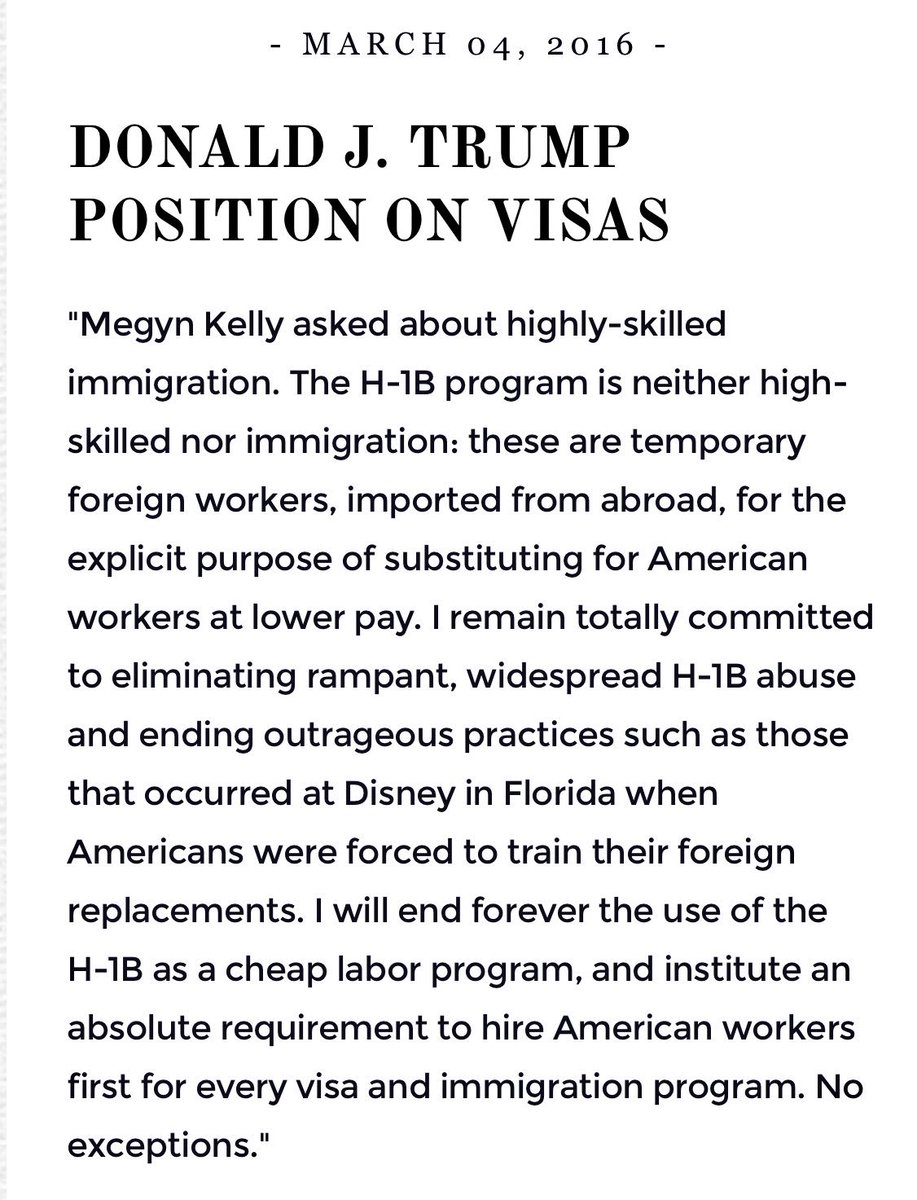
Now, a draft of a new Trump executive order related to the issuance of H-1B visas, viewed by Axios, reportedly directs the Secretary of Homeland Security to consider ways to “make the process of H-1B allocation more efficient and ensure the beneficiaries of the program are the best and the brightest.”
While that directive could be accomplished in a variety of ways, one likely solution would be to replace the current lottery system with one that prioritizes visas for those earning the highest salaries. And while such a solution will have wide-ranging impacts on various companies and industries seeking foreign workers, one key takeaway is that it will pit India’s large IT-staffing firms against Silicon Valley’s tech giants.
Per the graphic below, large Indian consulting firms are by far the largest users of the H-1B visa program. That said, most of the jobs created by those companies tend to have lower salaries than those created by the likes of Microsoft, Google and Facebook.
Tech industry insiders expect Trump will direct DHS, which runs the H-1B visa lottery system, to start a rule-making to re-prioritize the visa allocation to give preference to higher-paying firms. This pits tech firms against the Indian IT-staffing firms.
In theory, prioritizing by salaries means visas for more senior, higher-paying jobs will be granted first, and visas for lower-paying jobs (such as those being filled by Indian IT services firms) would fall to the back of line, perhaps not getting allocated at all if demand for the high-wage job visas is strong.
California House members Darrell Issa, a Republican, and Zoe Lofgren, a Democrat, are pushing bills that would raise salary requirements for H-1B visa holders. Tech companies generally support those efforts to de-prioritize Indian outsourcers that they claim “clog up” the oversubscribed lottery system with bulk applications.

Of course, given their dependence on low-paid foreign workers to fill low-skilled IT positions, Indian IT firms would be expected to get hit hard by a new policy prioritizing H-1B visas for higher paying jobs…an expectation that has already taken its toll on the stocks of Infosys and Wipro.

END
The author gives us a great commentary on the huge problems facing the USA with this 1.3 trillion albatross around their necks; student loans. Believe it or not but student loans represents 45% of USA assets:
(courtesy Shaun Bradley.AntiMedia.org)
America’s Student Debt Problem Is Much Bigger Than Anybody Realized
Submitted by Shaun Bradley via TheAntiMedia.org,

The Department of Education recently released a memo admitting that repayment rates on student loans have been grossly exaggerated. Data from 99.8% of schools across the country has been manipulated to cover up growing problems with the $1.3 trillion in outstanding student loans. New calculations show that more than half of all borrowers from 1,000 different institutions have defaulted on or not paid back a single dollar of their loans over the last seven years.
This comes in stark contrast to previous claims and should call into question any statistics provided by government agencies. The American people haven’t fully grasped the long-term implications of loaning a trillion dollars to young people who have no credit or assets.
Increases in tuition seen over the past two decades have become a point of controversy and angst for those who don’t fully understand the contributing factors. Between 1995 and 2015, the average cost of a public, four-year university skyrocketed by well over 200%. Although federal student aid programs are often championed as a necessity, they have been instrumental in making higher education unaffordable. The opportunity to pay for college by working a part-time job evaporated as soon as huge sums of money were handed out to anyone with a pulse. Since students no longer pay their tuition upfront, colleges are able to raise prices in perpetuity, knowing the government will step in and make credit easier and easier to obtain. As an added bonus, outstanding student loans account for 45% of the government’s financial assets.

Subsidizing the lives of an entire generation has turned personal growth and advancement into a choice instead of a necessity. After all, why take risks or work your way up from the bottom when with just a signature, the life you’ve always wanted could be laid at your feet? It’s not hard to figure out why so many people are tempted to take advantage of the instant gratification that comes from student loans, but like everything else in life, they have a price. The same safety net that delays the anxiety of the future also ensures that monthly payments will be owed for decades to come. Procrastinating when faced with pivotal life decisions is an instinct that used to be overcome as a teenager, but today it is worn like a badge of honor well into adulthood.
The policies of intervention haven’t stopped at federal aid, and loan forgiveness is now being offered to those willing to work in the public sector or at a non-profit for ten years. This perverse incentive only serves to drive those desperately in debt further towards government dependence. Productive jobs are created when the needs of others are met in the free market, not by joining the ranks of the state for self-preservation.
The idea that success comes exclusively through attending a university has created a stigma against some of the most valuable occupations. The lack of real skill sets has lead to a shortage of welders, electricians, carpenters, and other trade workers. Instead of learning through experience with apprenticeships, many students have embraced four years of sleeping in, drinking heavily, and getting an increasingly useless degree. While there are many fields that require specialized training, the surge in popularity of degrees like sociology, anthropology, and communications clearly illustrate a disconnect between the needs of the economy and the skills of the incoming workforce.
The normalization of this system has blinded individuals to their own potential. Some of the most successful entrepreneurs and thinkers are those who have bypassed traditional education. Mark Zuckerberg, Steve Jobs, Richard Branson, and hundreds of other innovators achieved greatness by breaking from predictable paths to knowledge. Instead, passion and experience were the foundations that gave them the confidence needed to make groundbreaking strides. What it means to learn and be educated is changing rapidly as technology develops, and it will eventually force the State to adapt with it.
Albert Einstein was able to spot the innate flaws in the education system even back in 1936, but it’s doubtful he could have fathomed how far things would go:
“I want to oppose the idea that the school has to teach directly that special knowledge and those accomplishments which one has to use later directly in life. The demands of life are much too manifold to let such a specialized training in school appear possible…The development of general ability for independent thinking and judgment should always be placed foremost.”
Those who do achieve their degrees often do so without developing important skills like critical thinking and individual discernment. The scariest part about this revelation is that almost 90% of outstanding private loans are co-signed by parents, making this an intergenerational problem. As the instability of pension funds, social security, and economic conditions continue, any additional burdens passed onto the baby boomers could have far-reaching ramifications. The vast distortions in information that this report exposes should motivate everyone to become an independent fact checker. The only way to reform this broken system is to shift the pursuit of knowledge towards the direction of each individual’s passion instead of creating more cogs for the machine.
end
OH OH!! the Fed is not going to like this!! Central bankers are only interested in our banks/bankers:thus their interest will be for the well being of bankers over the health of USA or its citizens: Congressman slams Yellen and company for prioritizing foreign banks over America.
it does not good look for Janet and Stan when they will eventually meet the Donald:
(courtesy zero hedge)
“This Is Unacceptable” – Congressman Slams Yellen For Prioritizing Foreign Banks Over “America’s Interests”
Finally, the Fed is in Trump’s sights.
In what may be a harbinger of major headaches to come for the Fed, a recent letter (Jan. 31) penned by Republican representative Patrick McHenry, Vice Chairman of the Financial Services Committee, has lashed out at Janet Yellen, telling the Fed chair in no uncertain terms that “despite the clear message delivered by President Donald Trump in prioritizing America’s interest in international negotiations, it appears that the Federal Reserve continues negotiating international regulatory standards for financial institutions among global bureaucrats in foreign lands without transparency, accountability, or the authority to do so.”
His assessment of this ongoing activity by the Fed: “This is unacceptable.”
McHenry’s emphasis is on “international forums” such as the Financial Stability Board, the Basel Committee on Banking and Supervision, and the International Association of Insurance Supervisors, and he notes that “continued participation” in these forums must be “predicated on achieving objectives set by the new Administration”, something which will “likely require a comprehensive review of past agreements that unfairly penalized the American financial system in areas as varied as bank capital, insurance, derivatives, systemic risk, and asset management.”
He then adds that “the secretive structures of these international forums must also be reevaluated” because when the deals were negotiated, “international standards were turned into domestic regulations that forced American firms of various sizes to substantially raise their capital requirements, leading to slower economic growth here in America.”
Here one may recall how the Fed secretly provided tens of billions in under the table “rescue loans” to foreign banks doing business in the US (and others) during the peak days of the 2008 financial crisis.
His conclusion, however, is what must worry the Fed the most, because as McHenry notes, “it is incumbent upon all regulators to support the U.S. economy, and scrutinize international agreements that are killing American jobs. Accordingly, the Federal Reserve must cease all attempts to negotiate binding standards burdening American business until President Trump has had an opportunity to nominate and appoint officials that prioritize America’s best interests.”
The implication: the current Fed officials do not prioritze America’s best interests, and are therefore expendable.
Expect a furious backlash by the political media and Wall Street, screaming that this is the first example of the Republican Congress and the new administration targeting Fed “independence”, which, as we have demonstrated over the past 8 years, exists only in ivory tower economists’ tutorials, and disappears the moment banks – either domestic or foreign – need a bailout, with the staggering political consequences such actions entail.
In short: it is about to get hot in the hallowed chambers of the Marriner Eccles building.
His full letter is below:
Dear Chair Yellen,
I am writing regarding the Federal Reserve’s continued participation in international forums on financial regulation. Despite the clear message delivered by President Donald Trump in prioritizing America’s interest in international negotiations, it appears that the Federal Reserve continues negotiating international regulatory standards for financial institutions among global bureaucrats in foreign lands without transparency, accountability, or the authority to do so.
This is unacceptable.
Continued participation in international forums such as the Financial Stability Board, the Basel Committee on Banking and Supervision, and the International Association of Insurance Supervisors is predicated on achieving the objectives set by the new Administration. That will likely require a comprehensive review of past agreements that unfairly penalized the American financial system in areas as varied as bank capital, insurance, derivatives, systemic risk, and asset management.
The secretive structures of these international forums must also be reevaluated. Agreements like the Basel III Accords were negotiated and agreed to by the Federal Reserve with little notice to the American public, and were the result of an opaque, decision-making process. The international standards were then turned into domestic regulations that forced American firms of various sizes to substantially raise their capital requirements, leading to slower economic growth here in America.
It is incumbent upon all regulators to support the U.S. economy, and scrutinize international agreements that are killing American jobs. Accordingly, the Federal Reserve must cease all attempts to negotiate binding standards burdening American business until President Trump has had an opportunity to nominate and appoint officials that prioritize America’s best interests.
end
CHALLENGER/GRAY JOB CUTS REPORT:
Job cuts surge in January
(challenger/grey)
Job cuts surge in January
CHICAGO, ILLINOIS
February 2, 2017 4:30am
• Retailers lead the firings
• “Retailers are … increasingly closing stores and laying off permanent staff”
The New Year is off to a depressing start for 45,934 workers. That’s the number of people fired from their jobs in January, according to data compiled by the outplacement company Challenger, Gray & Christmas Inc.
January job-cut announcements were up 37 percent from December 2016, when planned layoffs totaled 33,627.
While last month’s tally was the highest since April 2016 when 64,141 lost their jobs, it was 39 percent lower than January 2016, when employers announced plans to eliminate 75,114 jobs from their ranks.
January job cuts in 2016 were dominated by the energy and retail sectors. This year, planned cuts were concentrated in just retail, which continues to reel from the shift toward online shopping.
The top four job cuts announced during the month occurred in the retail sector, with Macy’s leading the pack by reporting plans to close 68 stores and fire 10,000 workers.
“Overall, it was a solid holiday shopping season, but several retailers, including Macy’s, were unable to capitalize on stronger consumer confidence and spending,” says John Challenger, chief executive officer of Challenger, Gray & Christmas.
In all, retailers announced 22,491 planned layoffs in January, accounting for 49 percent of all job cuts recorded during the month. The retailers’ total is virtually unchanged from the previous January, when retailers announced 22,246 job cuts to start 2016.
-END-
Well that about does it for tonight
I will see you tomorrow night
h


[…] by Harvey Organ Harvey Organ’s Blog […]
LikeLike