
Gold at (1:30 am est) $1237.80 DOWN $0.10
silver was : $17.99: DOWN 3 CENTS
Access market prices:
Gold: $1236.80
Silver: $18.00
THE DAILY GOLD FIX REPORT FROM SHANGHAI AND LONDON
.
The Shanghai fix is at 10:15 pm est last night and 2:15 am est early this morning
The fix for London is at 5:30 am est (first fix) and 10 am est (second fix)
Thus Shanghai’s second fix corresponds to 195 minutes before London’s first fix.
And now the fix recordings:
Shanghai FIRST morning fix Feb 21/17 (10:15 pm est last night): $ 1244.89
NY ACCESS PRICE: $1233.20 (AT THE EXACT SAME TIME)/premium $11.69
XXXXXXXXXXXXXXXXXXXXXXXXXXXXXXXXXX
Shanghai SECOND afternoon fix: 2: 15 am est (second fix/early morning):$ 1244.89
NY ACCESS PRICE: $1234.30 (AT THE EXACT SAME TIME/2:15 am)
SPREAD/ 2ND FIX TODAY!!: 10.14
China rejects NY pricing of gold as a fraud/arbitrage will now commence fully
XXXXXXXXXXXXXXXXXXXXXXXXXXXXXXXXXXXXXXXX
London FIRST Fix: Feb 21/2017: 5:30 am est: $1233.20 (NY: same time: $1233.40 (5:30AM)
XXXXXXXXXXXXXXXXXXXXXXXXXXXXXXXXXXXXXXXX
London Second fix Feb 21.2017: 10 am est: $1241.95(NY same time: $1241.90 (10 am)
It seems that Shanghai pricing is higher than the other two , (NY and London). The spread has been occurring on a regular basis and thus I expect to see arbitrage happening as investors buy the lower priced NY gold and sell to China at the higher price. This should drain the comex.
Also why would mining companies hand in their gold to the comex and receive constantly lower prices. They would be open to lawsuits if they knowingly continue to supply the comex despite the fact that they could be receiving higher prices in Shanghai.
end
For comex gold:
FEBRUARY/
NOTICES FILINGS FOR FEBRUARY CONTRACT MONTH: 146 NOTICE(S) FOR 14,600 OZ. TOTAL NOTICES SO FAR: 5291 FOR 529,100 OZ (16.457 TONNES)
For silver:
For silver: FEBRUARY
3 NOTICES FILED FOR 15,000 OZ/
TOTAL NO OF NOTICES FILED: 413 FOR 2,065,000 OZ
Let us have a look at the data for today
.
xxxxxxxxxxxxxxxxxxxxxxxxxxxxxxxxxxxxxxxxxxxxxxxxxxxxxxxxxxxxxxxxxxxxxxxxxx
In silver, the total open interest ROSE by 1085 contracts UP to 205,602 with respect to FRIDAY’S TRADING. In ounces, the OI is still represented by just less THAN 1 BILLION oz i.e. 1.025 BILLION TO BE EXACT or 146% of annual global silver production (ex Russia & ex China).
FOR THE NEW FRONT FEBRUARY MONTH: THEY FILED: 146 NOTICE(S) FOR 14600 OZ
In gold, the total comex gold ROSE BY 864 contracts WITH THE FALL IN THE PRICE GOLD ($2.40 with FRIDAY’S trading ).The total gold OI stands at 430,011 contracts
we had 146 notice(s) filed upon for 14,600 oz of gold.
xxxxxxxxxxxxxxxxxxxxxxxxxxxxxxxxxxxxxxxxxxxxxxxxxxxxxxxxxxxx
With respect to our two criminal funds, the GLD and the SLV:
GLD:
We had no change in tonnes of gold at the GLD:
Inventory rests tonight: 841.17 tonnes
.
SLV
we had a changes in silver into the SLV: a deposit of 568,000
THE SLV Inventory rests at: 335.281 million oz
end
.
First, here is an outline of what will be discussed tonight:
1. Today, we had the open interest in silver ROSE by 1085 contracts UP to 205,602 AS SILVER WAS DOWN 4 CENTS with FRIDAY’S trading. The gold open interest ROSE by 864 contracts UP to 430,011 WITH THE FALL IN THE PRICE OF GOLD OF $2.40 (FRIDAY’S TRADING)
(report Harvey
.
2.a) The Shanghai and London gold fix report
(Harvey)
2 b) Gold/silver trading overnight Europe, Goldcore
(Mark O’Byrne/zerohedge
and in NY: Bloomberg
3. ASIAN AFFAIRS
i)Late MONDAY night/TUESDAY morning: Shanghai closed UP 13.36 POINTS OR .41%/ /Hang Sang CLOSED DOWN 182.45 POINTS OR 0.76% . The Nikkei closed UP 130.36 POINTS OR 0.68% /Australia’s all ordinaires CLOSED DOWN 0.09%/Chinese yuan (ONSHORE) closed DOWN at 6.8845/Oil ROSE to 54.30 dollars per barrel for WTI and 56.96 for Brent. Stocks in Europe ALL IN THE GREEN EXCEPT LONDON. Offshore yuan trades 6.8668 yuan to the dollar vs 6.8845 for onshore yuan.THE SPREAD BETWEEN ONSHORE AND OFFSHORE WIDENS CONSIDERABLY AS POBC ATTEMPTS TO STOP USA DOLLARS FROM LEAVING CHINA’S SHORES. ONSHORE YUAN WEAKER AS IS OFFSHORE YUAN COUPLED WITH THE STRONGER DOLLAR
REPORT ON JAPAN SOUTH KOREA NORTH KOREA AND CHINA
3a)THAILAND/SOUTH KOREA/NORTH KOREA
i)China has had enough with North Korea. They are suspending all imports of North Korean coal which makes up close to 40% of all of their exports.
This is very deadly to North Korea:
( Reuters)
ii)The following explains why North Korea is in serious trouble with the banning of all coal imports:
b) REPORT ON JAPAN
We have lots of trouble in Japan with respect to the Fukushima disaster. Now a second robot breaks down inside the hot No 2 reactor site.
No wonder fish are turning up dead on the west coast of the uSA. This is a huge disaster and the story is ongoing
(courtesy zero hedge)
c) REPORT ON CHINA
Sunday night;
Sunday night China sends a message to Janet that she should not raise rates. China weakens the yuan and short term Chinese rates skyrocket: the 1 week CNH Hibor rises from 3.75% up to 7.388%
( zerohedge)
4. EUROPEAN AFFAIRS
i)Italy
Quite a few PD party members which are in power threatens to splinter off and form their own party as turmoil reigns supreme in Italy. This forced Renzi to quite as Party Leader (Gentilioni is the Prime Minister and a Renzi ally). This should trigger a re election battle.
( zero hedge)
ii)France
Monday:
a)The French/German spread bond yields blows out hugely as investors are waking up to the fact that in the French elections, Le Pen, a Euroskeptic has a chance of winning;
( zero hedge)
b) Tuesday:
( zero hedge)
iii)Spain
The following is an amazing story. For the first time error central bankers are now being held accountable in the collapse of Bankia. Too bad the central bankers did not listen to us: the entire “rescue” operation of the Spanish banks was ill fated from the first hour. It has no chance to survive and it brought down many small investors who could ill afford the losses
( Don Quijones/WolfStreet)
iv)Greece/Germany
A German Minister is calling for a plan B with respect to Greece. He wants them to pledge gold or real estate for new loans. If gold is given then the Greek politicians are just as moronic as Venezuela’s Maduro
( zero hedge)
v)Greek bonds are rallying this morning on revived bailout hopes:
( zero hedge)
vi)UK/GLobe/HSBC
This surprised everyone: a huge revenue drop causes HSBC to crash by 7%. Major writedowns at this scandal plagued company.
(courtesy zerohedge)
vii)EU
Great reason for the Euro to plummet this morning: Eurozone PMI jumps to 56 from 54.4
( zerohedge)
viii)We have two clear axes with respect to the EU:
i) the Pence, Mattis Haley foreign policy
ii) Bannon/Trump/Miller foreign policy
the latter speaks of the EU as a failed experiment and the USA should engage in bilateral negotitions with each country.
Germany is not very happy as they are the net benefiters of the EU conglomeration because the Euro is lower than it would be if the Mark was used for Germany itself.
(courtesy zero hedge)
5. RUSSIAN AND MIDDLE EASTERN AFFAIRS
I wonder if any foul play is prevalent here: Russian Ambassador Churkin dies suddenly in NY
(courtesy zero hedge)
6.GLOBAL ISSUES
Sweden
On Friday, Trump was mocked when he stated that Sweden has a migrant problem. Over the weekend he was vindicated after violent riots erupt in the Swedish suburb:
( zero hedge)
7. OIL ISSUES
i)Bank of America’s Blanch believes with the increased rigs placed by the shale boys will increase production by 700,000 barrels per day. Thus for 5 days: 3.5 million
( zero hedge)
ii)Gasoline inventories are now at 27 yr highs. Generally when you see both crude oil inventories and gasoline levels at record highs you have a problem
( Nick Cunningham/OilPrice.com)
8. EMERGING MARKETS
none today
9. PHYSICAL MARKETS
i)A huge story: Investors worldwide could become plaintiffs against the banks in the class action suit against the UK bullion banks. Leon Kaye will probably file its class action suit shortly..
that should be fun…
( GATA/Leon Kay lawyers/UK)
ii)An Arizona bill would remove state taxes on profits from the sale of gold coins. That should have been done long ago as there should be no tax on “money”
( Fischer/Arizona Daily Star/Tucson/GATA)
iii)This is why we pay no attention to the mainstream media. The World Gold Council while interviewing Greenspan fails to ask him on gold leasing and central bank intervention with respect to gold
( WGC/GATA)
iv)Why should this currency be different from any other: JPMorgan and HSBC are among a dozen banks facing fines for rigging the South African rand
( Bloomberg)
v)Have fun with this: Ronan Manly illustrates beautifully how paper gold influences the price of physical gold
( Ronan Manly/Bullionstar)
vi)A good illustration of the huge problems facing ordinary Greek citizens after 7 years of bailouts
( Reuters/GATA)
vii)Chinese citizens are sure anxious to get their yuan/dollars out of China as bitcoin soars above 1100.00
( zero hedge)
viii)Is the Fed having problems keeping gold in check?
( Dave Kranzler/IRD)
10.USA STORIES
i)Soft data USA PMI manufacturing index disappoints as the hope category disappoints:
Mfg: 54.3 a drop from 55.0
Service: 53.9 down from 55.6
( zerohedge)
ii)Wow!! Jay Sekulow a prominent lawyer in the USA states that Obama changed the way phone conversations/recordings are distributed. On jan 3 2017 Obama did an executive order whereby 16 other agencies are to receive the above information gathering enterprise. It is illegal to pass on conversations from private or government officials without a warrant and that did not stop Obama
( zerohedge)
iii)Michael Snyder agrees with Trump with respect to the mainstream media and it is about time we had a President willing to go to war against them:
( Michael Snyder/EconomicCollapseBlog)
iv)An in depth look at the Michael Flynn saga through the eyes of David Stockman
( David Stockman/Ron Paul Institute)
v)Your new National Security Advisor replacing Michael Flynn
(courtesy zerohedge)
vi)A new memo from the Dept of Homeland Security now reveals that just about anyone living in the USA illegally is now subject to deportation. They will target the criminals but even a minor offense will subject the illegals back to their home country:
(courtesy zero hedge)
Let us head over to the comex:
The total gold comex open interest ROSE BY 864 CONTRACTS UP to an OI level of 430,011 WITH THE FALL IN THE PRICE OF GOLD ( $2.40 with FRIDAY’S trading). We are now in the contract month of FEBRUARY and it is one of the better delivery months of the year. In this next big active delivery month of February we had a GAIN of 46 contracts UP to 949. We had 20 notice(s) served upon yesterday and therefore we GAINED 66 contracts or an additional 6600 oz will stand for delivery and IT LOOKS LIKE THE CASH SETTLEMENTS HAVE STOPPED THOSE WHO REMAIN ARE NOT INTERESTED IN A FIAT PROFIT BUT REAL METAL. The next non active contract month of March saw it’s OI FALL by 80 contracts DOWN TO 1880.The next big active month is April and here the OI FELL by 710 contracts DOWN to 281,062.
We had 146 notice(s) filed upon today for 14,600 oz
The active month of February saw the OI RISE BY A WHOPPING 173 contract(s) UP TO 313. We had 0 notice(s) served YESTERDAY so we GAINED 173 CONTRACTS or an additional 865,000 oz will stand for delivery.
The next big active delivery month is March and here the OI decrease by 7,676 contracts down to 67,711 contracts. For comparison purposes last year on the same date only 60,323 contracts were standing.
We had 3 notice(s) filed for 15,000 oz for the FEBRUARY contract.
VOLUMES: for the gold comex
Today the estimated volume was 245,260 contracts which is good.
Yesterday’s confirmed volume was 177,985 contracts which is good
volumes on gold are getting higher!
| Gold | Ounces |
| Withdrawals from Dealers Inventory in oz | nil |
| Withdrawals from Customer Inventory in oz |
7233.975 OZ
HSBC
|
| Deposits to the Dealer Inventory in oz | nil oz
|
| Deposits to the Customer Inventory, in oz |
203.64 oz
Brinks
|
| No of oz served (contracts) today |
146 notice(s)
14,600 oz
|
| No of oz to be served (notices) |
803 contracts
80,300 oz
|
| Total monthly oz gold served (contracts) so far this month |
5291 notices
5291 oz
16.457 tonnes
|
| Total accumulative withdrawals of gold from the Dealers inventory this month | NIL oz |
| Total accumulative withdrawal of gold from the Customer inventory this month | 214,235.3 oz |
Today, 0 notice(s) were issued from JPMorgan dealer account and 0 notices were issued from their client or customer account. The total of all issuance by all participants equates to 146 contract(s) of which 54 notices were stopped (received) by jPMorgan dealer and 0 notice(s) was (were) stopped/ Received) by jPMorgan customer account.
March 2016: 2.311 tonnes (March is a non delivery month)
| Silver | Ounces |
| Withdrawals from Dealers Inventory | nil |
| Withdrawals from Customer Inventory |
146,907.67 0z
Delaware
Scotia
|
| Deposits to the Dealer Inventory |
nil oz
|
| Deposits to the Customer Inventory |
2,985.35 oz
Brinks
|
| No of oz served today (contracts) |
0 CONTRACT(S)
(nil OZ)
|
| No of oz to be served (notices) |
140 contracts
(700,000 oz)
|
| Total monthly oz silver served (contracts) | 410 contracts (2,050,000 oz) |
| Total accumulative withdrawal of silver from the Dealers inventory this month | NIL oz |
| Total accumulative withdrawal of silver from the Customer inventory this month | 6,061,569.5 oz |
end
And now the Gold inventory at the GLD
FEB 21/no changes in gold inventory at the GLD/Inventory rests at 841.17 tonnes
feb 17/a withdrawal of 2.37 tonnes of gold from the GLD/Inventory rests at 841.17 tonnes
FEB 16/we had no changes in the GLD inventory today/Inventory rests at 843.54 tonnes
Feb 15./another deposit of 2.67 tonnes of gold into the GLD inventory despite another attempted whacking of gold/inventory rests at 843.54 tonnes
FEB 14/another deposit of 4.14 tonnes of gold into the GLD inventory/rests at 840.87 tonnes
FEB 13/another deposit of 4.15 tonnes of gold into the GLD/Inventory rests at 836.73 tonnes
Feb 10/no changes at the GLD/Inventory rests at 832.58 tonnes
feb 9/no changes at the GLD/Inventory rests at 832.58 tonnes
Feb 8/another “deposit” of 5.63 tonnes of gold into the GLD/The addition is a paper addition/total inventory: 832.58 tonnes
Feb 7/another huge fake deposit of 8.30 tonnes of gold into the GLD/the addition is a paper addition and no doubt not physical/ total inventory: 826.95 tonnes
FEB 6/a huge deposit of 7.43 tonnes of gold into the GLD/Inventory rests at 818.65 tonnes
FEB 3/no change in gold inventory at the GLD/Inventory rests at 811.22 tonnes
Feb 2/another huge deposit of 1.48 tonnes/inventory rests at 811.22 tonnes
Feb 1/a huge “deposit” of 10.67 tonnes of gold into the GLD/Inventory rests at 809.74 tonnes. this should stop GLD from sending gold to Shanghai.
JAN 31/no change in gold inventory at the GLD/Inventory rests at 799.07 tonnes
jan 30/no change in gold inventory at the GLD/Inventory rests at 799.07 tonnes
Jan 27/no changes at the GLD/Inventory rests at 799.07 tonnes
Jan 26/no changes at the GLD/Inventory rests at 799.07 tonnes/
jan 25/another exactly the same withdrawal as yesterday: 5.04 tonnes and again this was used in the whacking of gold today/inventory rests at 799.07 tonnes
jan 24/a huge withdrawal of 5.04 tonnes and probably this was used today in the whacking of gold/inventory rests at 804.11 tonnes
Jan 23/a big change/this time a deposit of 1.19 tonnes of gold into the GLD/inventory rests at 809.15 tonnes. The drainage of gold from the GLD to Shanghai has now stopped!
Jan 20/no changes in gold inventory a the GLD/Inventory rests at 807.96 tonnes
Jan 19/no changes in gold inventory at the GLD/Inventory rests at 807.96 tonnes
Jan 18/no changes in gold inventory at the GLD/Inventory rests at 807.96 tonnes
Jan 17/17/a deposit of 2.96 tonnes of gold/inventory at the GLD rests at 807.96 tonnes. I guess there is no more gold inventory to sent to C+Shanghai
end
NPV for Sprott and Central Fund of Canada
end
Major gold/silver trading/commentaries for TUESDAY
GOLDCORE/BLOG/MARK O’BYRNE
Huge story!! Russia continues with its physical gold buying: 37 tonnes and no doubt the gold is purchased off of the SGE. SGE is getting it’s gold through Switzerland via England.
Russia’s Gold Buying Is Back – Buys One Million Ounces In January
Russia’s Gold Buying Is Back – Buys One Million Ounces In January
Russia gold buying returned in January with the Russian central bank buying a very large 1 million ounces or 37 metric tonnes of gold bullion.
The increase in the gold reserves came after Russia did not buy a single ounce in December – a move seen as potentially a signal or an olive branch to the U.S. and the incoming Trump administration.

It also came after Russia had accelerated its gold buying in the final months of the Obama Presidency. October 2016 saw an increase of 1.3 million ounces or 48 metric tonnes and this was the largest addition of gold to the Russian monetary reserves since 1998. Indeed, it was the biggest monthly gold purchase in this millennium for the Russian central bank.
November 2016 saw another increase of 1 million ounces. Some analysts saw the increased Russian gold buying as a parting ‘gift’ and warning shot by Putin and Russia to his rival outgoing President Obama and the monetary and financial elites in the U.S.
Russian gold reserves increased a very large 199.1 tonnes in 2016 alone.

Concerns about systemic risk, currency wars and the devaluation of the dollar, euro and other major currencies has led to ongoing diversification into gold bullion purchases by large creditor nation central banks such as Russia and of course China.
There was silly speculation in 2013, 2014 and 2015 that the financial challenges facing Russia and the depreciation of the ruble could lead to Russia selling some of its increasingly large gold reserves. We pointed out on Bloomberg TV at the time that this was highly unlikely and pointed out that Russia was much more likely to sell some of its very large dollar and euro reserves and was more likely to continue to diversify into gold.
Russia has been steadily buying bullion since before the global financial crisis and is now the sixth-biggest holder of gold reserves internationally – after the U.S., Germany, Italy, France and the IMF.
The monetary diversification accelerated during the global financial crisis and in recent years. It has more than tripled its gold reserves since 2005 and holds the most gold since at least 1993, IMF data shows.
Although, it is worth noting that countries like Lebanon, Egypt, Laos, Pakistan, Kazakhstan and Turkey all have a much bigger share of gold in their foreign exchange reserves than Russia does – suggesting the recent trend is likely to continue. Especially if politics intercedes and the relationship between Russia, Trump’s U.S., the EU and NATO worsens again in the coming months.
Russia places much strategic importance on its gold reserves. Both President Putin and Prime Minister Medvedev and have been photographed on numerous occasions holding gold bars and coins. In May 2015, we pointed out how the Russian central bank views gold bullion as “100% guarantee from legal and political risks.”
Astute, risk aware investors are following Russia’s lead by diversifying and having an allocation to physical gold coins and bars.
http://www.goldcore.com/us/gold-blog/russia-gold-buying-back-buys-one-million-ounces-january/
end
A huge story: Investors worldwide could become plaintiffs against the banks in the class action suit against the UK bullion banks. Leon Kaye will probably file its class action suit shortly..
that should be fun…
(courtesy GATA/Leon Kay lawyers/UK)
Investors worldwide could become plaintiffs in class-action suit in UK against bullion banks
Submitted by cpowell on Sun, 2017-02-19 00:56. Section: Daily Dispatches
7:57p ET Saturday, February 18, 2017
Dear Friend of GATA and Gold:
Investors in nine countries have responded to the announcement two weeks ago that a British law firm, Leon Kaye Solicitors, is contemplating bringing a class-action lawsuit in the United Kingdom under that country’s Competition Act against bullion banks suspected of manipulating the gold and silver markets:
http://www.gata.org/node/17160
The firm wishes to remind investors that they could become plaintiffs in such a lawsuit even if they live outside the United Kingdom.
Information about the potential lawsuit is posted at the Leon Kaye Solicitors internet site here:
http://www.leonkaye.co.uk/class-actions/possible-manipulation-gold-silve…
CHRIS POWELL, Secretary/Treasurer
Gold Anti-Trust Action Committee Inc.
CPowell@GATA.org
END
An Arizona bill would remove state taxes on profits from the sale of gold coins. That should have been done long ago as there should be no tax on “money”
(courtesy Fischer/Arizona Daily Star/Tucson/GATA)
Arizona bill would remove state tax on profit from sale of gold coins
Submitted by cpowell on Sun, 2017-02-19 01:21. Section: Daily Dispatches
By Howard Fischer
Arizona Daily Star, Tucson
Sunday, February 12, 2017
PHOENIX, Arizona — Arguing that federal policies have made paper money “virtually worthless,” Arizona lawmakers are moving to allow residents to invest in gold coins and not have to pay state taxes on any profits they make when they sell them.
Legislation awaiting a final House vote would carve an exemption in existing laws that require people to report — and pay taxes — on capital gains. So, if you buy art, jewelry, or an antique car for $10,000 and sell if for $12,000, you owe the state tax on that $2,000 profit.
But Rep. Mark Finchem, R-Oro Valley, argues that’s not true if you’re buying U.S. gold coins. He said it’s simply exchanging one form of U.S. currency for another.
“If you were to exchange four quarters for a dollar bill, that’s not a taxable event,” Finchem explained during House debate last week on his HB 2014. …
… For the remainder of the report:
http://tucson.com/news/state-and-regional/arizona-bill-would-remove-stat…
END
This is why we pay no attention to the mainstream media. The World Gold Council while interviewing Greenspan fails to ask him on gold leasing and central bank intervention with respect to gold
(courtesy WGC/GATA)
World Gold Council fails to ask Greenspan about central bank intervention against gold
Submitted by cpowell on Sun, 2017-02-19 01:51. Section: Daily Dispatches
8:54p ET Saturday, February 18, 2017
Dear Friend of GATA and Gold:
With the February edition of its newsletter, Gold Investor, the World Gold Council inadvertently proclaims its uselessness by interviewing former Federal Reserve Chairman Alan Greenspan about gold without ever asking him about the largely surreptitious involvement of central banks in the gold market and the objectives of that involvement.
This is an especially spectacular failure in light of Greenspan’s admission of that involvement in his testimony to Congress in July 1998, wherein he acknowledged that central banks are prepared to lease gold in “increasing quantities” to suppress its price:
https://www.federalreserve.gov/boarddocs/testimony/1998/19980724.htm
Of course the World Gold Council isn’t alone in avoiding these crucial questions. These questions are prohibited throughout the mainstream financial news media. Indeed, it has begun to seem that Greenspan conditions interviews on pledges not to ask him about the surreptitious intervention of central banks in the gold market, though such interventions have been extensively documented by GATA for many years, as here:
http://www.gata.org/node/14839
But mainstream financial news organizations don’t purport to be representing gold producers and investors as the World Gold Council does. Once again the World Gold Council has indicated that it exists primarily to ensure that there never is a world gold council.
The World Gold Council’s February newsletter is posted in PDF format here —
http://www.gold.org/download/file/5497/Gold_Investor_February_2017.pdf
— with the Greenspan interview beginning on Page 11.
CHRIS POWELL, Secretary/Treasurer
Gold Anti-Trust Action Committee Inc.
CPowell@GATA.org
END
Why should this currency be different from any other: JPMorgan and HSBC are among a dozen banks facing fines for rigging the South African rand
(courtesy Bloomberg)
JPMorgan, HSBC among dozen banks facing fines for rigging S. African rand
Submitted by cpowell on Mon, 2017-02-20 12:50. Section: Daily Dispatches
By Renee Bonorchis and Michael Cohen
Bloomberg News
Wednesday, February 15, 2017
South Africa’s antitrust investigators have urged that a dozen banks be fined for colluding and manipulating trades in the rand, potentially becoming the latest in a string of penalties handed to lenders around the world for rigging currencies.
South African’s Competition Commission identified lenders including Bank of America Merrill Lynch, HSBC Holdings Plc, BNP Paribas SA, Credit Suisse Group AG, HSBC Holdings Plc, JPMorgan Chase & Co., and Nomura Holdings Inc. as among those that participated in price fixing and market allocation in the trading of foreign currency pairs involving the rand since at least 2007. It referred the case to an antitrust tribunal, concluding an investigation that began in 2015. …
… For the remainder of the report:
https://www.bloomberg.com/news/articles/2017-02-15/south-africa-to-prose.
END
Have fun with this: Ronan Manly illustrates beautifully how paper gold influences the price of physical gold
(courtesy Ronan Manly/Bullionstar)
Bullion Star graphic describes how ‘paper gold’ controls the metal’s price
Submitted by cpowell on Mon, 2017-02-20 18:08. Section: Daily Dispatches
1:10p ET Monday, February 20, 2017
Dear Friend of GATA and Gold:
Bullion Star today publishes an elaborate informational graphic describing how bullion banks create almost infinite amounts of imaginary “paper gold” to control the monetary metal’s price and prevent the price from being determined by physical demand.
Bullion Star summarizes the graphic’s topics this way:
— The identities of the bullion banks.
— The fractional-reserve nature of bullion banking and the paper gold creation process.
— How the staggeringly large paper gold trading volumes are generated.
— The gold price discovery process and how the price of gold is set in London by unallocated trading that channels gold demand away from real physical gold and into paper.
— The secretive nature of the bullion banking club and how its activities in the City of London are deliberately shrouded in secrecy.
— How new participants in the London gold market claim to be providing competition but are actually perpetuating the underlying unallocated gold account system of trading.
The graphic can be found at Bullion Star here:
https://www.bullionstar.com/blogs/bullionstar/infographic-bullion-bankin…
CHRIS POWELL, Secretary/Treasurer
Gold Anti-Trust Action Committee Inc.
CPowell@GATA.org
END
A good illustration of the huge problems facing ordinary Greek citizens after 7 years of bailouts
(courtesy Reuters/GATA)
After seven years of bailouts, Greeks just sink deeper in poverty
Submitted by cpowell on Tue, 2017-02-21 00:38. Section: Daily Dispatches
By Karolina Tagaris
Reuters
Monday, February 20, 2017
ATHENS, Greece — Greek pensioner Dimitra says she never imagined a life reduced to food handouts: some rice, two bags of pasta, a packet of chickpeas, some dates, and a tin of milk for the month.
At 73, Dimitra — who herself once helped the hard-up as a Red Cross food server — is among a growing number of Greeks barely getting by. After seven years of bailouts that poured billions of euros into their country, poverty isn’t getting any better. It’s getting worse like nowhere else in the European Union.
“It had never even crossed my mind,” she said, declining to give her last name because of the stigma still attached to accepting handouts in Greece. “I lived frugally. I’ve never even been on holiday. Nothing, nothing, nothing.” …
… For the remainder of the report:
http://www.reuters.com/article/us-eurozone-greece-poverty-idUSKBN15Z1NM
END
Chinese citizens are sure anxious to get their yuan/dollars out of China as bitcoin soars above 1100.00
(courtesy zero hedge)
Bitcoin Soars Above $1100, Near Record Highs As Chinese Bypass Crackdown
Despite concerted efforts by authorities to crackdown on capital outflows – specifically through virtual currencies – prices for Bitcoin are soaring as the Chinese find way around regulatory controls. Bitcoin just topped $1100 – near record highs – as Chinese traders shift their action off regulated-exchanges to local peer-to-peer marketplaces.
China’s central bank has stepped up oversight of bitcoin exchanges this year, leading major trading platforms to impose halts on withdrawals and other checks to appease the regulator. But, as Quartz reports, Chinese traders aren’t playing along—they are apparently flocking to peer-to-peer marketplaces to continue buying and selling bitcoin.
As Yuan trading on bitcoin exchanges has plummeted…

Quartz notes that one of the longest established peer-to-peer marketplaces is LocalBitcoins, which acts as a kind of directory for buyers and sellers to find each other. Users can arrange to meet in person, on chat platforms, or talk on the phone to arrange exchanges involving bitcoin.
Yuan volumes on the marketplace have exploded in the past week. Trading on LocalBitcoins currently accounts for about 6% of the total trading volume in yuan, according to data source Crypto Compare.

And Bitcoin prices have practically erased all of the Chinese crackdown losses…

It seems the Chinese will not be stopped in their effort to get capital out of the country – even as the PBOC spends billions propping up the currency in the short-term to create the illusion of stability.
end
Is the Fed having problems keeping gold in check?
(courtesy Dave Kranzler/IRD)
Bloomberg News Admits The Fed Manipulates Gold |
| — Published: Tuesday, 21 February 2017 | Print | Comment – New!
By Dave Kranzler “Yellen Can’t Halt Trump Gold Rally That Funds Bet Against” – That was the headline in a Bloomberg news report that was released on Sunday afternoon. There’s a lot going on in that headline – none of it accurate except for the fact that gold is moving higher despite the efforts of western Central Banks to cap the price. The basic premise of the report is that gold is moving higher in defiance of the Fed’s apparent move to raise interest rates. Reading through the report reveals even more misleading and completely false information than is conveyed by the headline. Here’s a link if you want to read the article: Bloomberg/Yellen/Gold. The headline itself and the article content are both highly problematic, riddled with disinformation and completely inaccurate assertions. Anyone actually who might have read the article and trusted the content has been taken down to “ground zero” intellectually. Propaganda for the ignorant. I will be reviewing several ways in which the article content is inaccurate, if not intentionally fraudulent, in the upcoming issue of theMining Stock Journal. That said, the headline outright acknowledges that the Fed’s goal with respect to the price of gold is to prevent it from moving higher. The idea that Yellen “can’t halt” the rising price of gold implies that such intervention is part of the Fed’s mandate. It’s the first time I can recall in 16 years of researching, trading and investing in the precious metals market that the mainstream financial media, unwittingly or not, has acknowledged that the Federal Reserve attempts to intervene in the gold market. If the implied message of the headline was inadvertent, it means that conversations with respect to the Fed and its role in preventing the price of gold from rising are actively occurring in meeting rooms and reporter “bullpens” at several financial media organizations, with orders from “above” to never publish the truth. Imagine if the Washington Post had withheld the news about Watergate… Today’s action in gold exemplifies the tenor of the Bloomberg report. Almost as if “on cue,” in deference to Yellen’s attempt to “halt” the gold rally from yesterday, gold was slammed for $9 this morning. The reason generally attributed is “March rate hike hopes”LINK. I guess that’s all it takes. Yellen or some Fed clown exhales “rate hike on the table in March” and gold gets slammed by the trading computers. Allegedly Germany has repatriated a large portion of its gold ahead of schedule (why it was supposed to take 7 years no one can explain). Notwithstanding whether or not the gold is actually sitting physically in a Bundesbank vault, the announcement of the early repatriation conveys a sense of urgency to do so. Furthermore, the eastern hemisphere countries are hoovering gold like there’s no tomorrow for fiat currency. The Feds and the western Central Banks are exuding fear with respect to gold. The escalation in anti-gold propaganda reflects this sense of desperation, as do the shallow sell-offs followed by a move higher in paper gold that are initiated by LBMA and Comex paper traders after the Asian markets close for the day. The conclusion remains that all sell-offs in the gold market, like today’s, should be capitalized upon by adding to positions in physical gold and silver and in mining stocks.
|
Your early TUESDAY morning currency, Asian stock market results, important USA/Asian currency crosses, gold/silver pricing overnight along with the price of oil Major stories overnight
1 Chinese yuan vs USA dollar/yuan WEAKER AT 6.8845(HUGE DEVALUATION SOUTHBOUND /OFFSHORE YUAN WIDENS TO 6.8668 / Shanghai bourse UP 13.36 POINTS OR .41% / HANG SANG CLOSED DOWN 182.45 POINTS OR 0.76%
2. Nikkei closed UP 130.36 POINTS OR 0.68% /USA: YEN RISES TO 113.66
3. Europe stocks opened ALL IN THE GREEN EXCEPT LONDON ( /USA dollar index RISES TO 101.52/Euro DOWN to 1.0532
3b Japan 10 year bond yield: RISES TO +.095%/ !!!!(Japan buying 100% of bond issuance)/Japanese yen vs usa cross now at 113.66/ THIS IS TROUBLESOME AS BANK OF JAPAN IS RUNNING OUT OF BONDS TO BUY./JAPAN 10 YR YIELD FINALLY IN THE POSITIVE/BANK OF JAPAN LOSING CONTROL OF THEIR YIELD CURVE AS THEY PURCHASE ALL BONDS TO GET TO ZERO RATE!!
3c Nikkei now JUST BELOW 17,000
3d USA/Yen rate now well below the important 120 barrier this morning
3e WTI:: 54.30 and Brent: 56.96
3f Gold DOWN/Yen DOWN
3g Japan is to buy the equivalent of 108 billion uSA dollars worth of bond per month or $1.3 trillion. Japan’s GDP equals 5 trillion usa./“HELICOPTER MONEY” OFF THE TABLE FOR NOW /REVERSE OPERATION TWIST ON THE BONDS: PURCHASE OF LONG BONDS AND SELLING THE SHORT END
Japan to buy 100% of all new Japanese debt and by 2018 they will have 25% of all Japanese debt. Fifty percent of Japanese budget financed with debt.
3h Oil DOWN for WTI and DOWN for Brent this morning
3i European bond buying continues to push yields lower on all fronts in the EMU. German 10yr bund RISES TO +.324%/Italian 10 yr bond yield UP to 2.225%
3j Greek 10 year bond yield FALLS to : 7.21%
3k Gold at $1230.90/silver $17.96(8:15 am est) SILVER BELOW RESISTANCE AT $18.50
3l USA vs Russian rouble; (Russian rouble UP 23/100 in roubles/dollar) 57.75-
3m oil into the 54 dollar handle for WTI and 56 handle for Brent/
3n Higher foreign deposits out of China sees huge risk of outflows and a currency depreciation (already upon us). This can spell financial disaster for the rest of the world/China forced to do QE!! as it lowers its yuan value to the dollar/GOT HUGE DEVALUATION SOUTHBOUND from POBC.
JAPAN ON JAN 29.2016 INITIATES NIRP. THIS MORNING THEY SIGNAL THEY MAY END NIRP. TODAY THE USA/YEN TRADES TO 113.66 DESTROYING JAPANESE CITIZENS WITH HIGHER FOOD INFLATION
30 SNB (Swiss National Bank) still intervening again in the markets driving down the SF. It is not working: USA/SF this morning 1.0103 as the Swiss Franc is still rising against most currencies. Euro vs SF is 1.0639 well above the floor set by the Swiss Finance Minister. Thomas Jordan, chief of the Swiss National Bank continues to purchase euros trying to lower value of the Swiss Franc.
3p BRITAIN VOTES AFFIRMATIVE BREXIT/LOWER PARLIAMENT APPROVES BREXIT COMMENCEMENT
3r the 10 Year German bund now POSITIVE territory with the 10 year RISES to +.324%
3s The Greece ELA NOW at 71.4 billion euros,AND NOW THE ECB WILL ACCEPT GREEK BONDS (WHAT A DISASTER)
The bank withdrawals were causing massive hardship to the Greek bank. the Greek referendum voted overwhelming “NO”. Next step for Greece will be the recapitalization of the banks and that will be difficult.
4. USA 10 year treasury bond at 2.452% early this morning. Thirty year rate at 3.055% /POLICY ERROR)GETTING DANGEROUSLY HIGH
5. Details Ransquawk, Bloomberg, Deutsche bank/Jim Reid.
(courtesy Jim Reid/Bloomberg/Deutsche bank/zero hedge)
US Futures, European Stocks Rise Despite HSBC Plunge; Dollar, Oil Jump
European stocks rose again with S&P futures higher, while Asian stocks were mixed. The dollar rose jumped on hawkish comments by Philly Fed’s Harker, oil rose following optimistic OPEC comments, while gold dropped. Markets have largely ignored the negative result by financial heavyweight HSBC, which posted its largest fall since mid-2015 after reporting a 62% plunge in pretax profit, weighing on UK financials, with the FTSE 100 modestly underperforming.
The Bloomberg Dollar Spot Index rose the most in more than three weeks after a Federal Reserve policy maker reinforced the chances for a U.S. interest-rate increase as soon as next month. The U.S. currency advanced against most of its major peers after Philly Fed President Patrick Harker told MNI in a Friday interview he “would not take March off the table at this point.” Recent comments from policy makers have leaned on the hawkish side. A voting member of the rate-setting Federal Open Market Committee this year, Harker had said Feb. 15 that he sees three 25-basis point rate increases as appropriate for 2017.

In Europe, mining stocks climbed as surging commodities prices boosted corporate earnings even as HSBC fell the most since August 2015 after its profit missed estimates. Gold slumped and oil climbed toward $54 a barrel. As a result the Stoxx 600 climbed 0.2% as gains in mining companies overshadowed HSBC Holdings Plc’s results. Financial heavyweight HSBC has posted its largest fall since mid-2015 after reporting a 62% fall in pretax profit, weighing on UK financials, with the FTSE 100 modestly underperforming. Elsewhere, mining names have seen a lift with BHP returning to profitability while Anglo American results beat analyst expectations. However, despite the early softness, equities saw a turnaround amid better than expected PMI figures for the Eurozone and Germany. Germany’s DAX rose 0.5 percent, with automakers including Daimler AG and Volkswagen AG among the top gainers.
A closer look at HSBC Holdings which today reported a 62% slump in annual pre-tax profit that fell way short of analysts’ estimates as the British bank took hefty writedowns from restructuring and pointed to brakes on revenue growth. For the quarter, HSBC reported a $3.4 billion fourth-quarter loss, against analysts’ expectations for a profit, on a $3.2 billion impairment in its private banking business as the lender’s accounting valuation of the unit caught up with years of declining performance. HSBC CEO Stuart Gulliver said the restructured private bank is now viable as a slimmed-down operation providing advice to wealthy clients referred from the lender’s other business lines.
“What this doesn’t mean is that we are selling the private bank… it means we have restructured the private bank and that’s now behind us,” Gulliver told Reuters.
As a result, HSBC shares slid more than 6 percent after the company reported revenues fell by a fifth from 2015, underscoring the challenge it faces to boost returns amid low global interest rates and slowing economic growth in its core markets of Britain and China. Europe’s biggest bank by assets generated profit before tax of $7.1 billion in 2016 compared to $18.87 billion for the previous year, well below the average analyst estimate of $14.4 billion. HSBC also announced a new $1 billion share buy-back, as the lender continued to return cash to shareholders from the sale of its Brazilian business. The bank signaled a number of factors that would pressure its revenues in 2017, including a $500 million increase in regulatory capital costs, lower interest rates in Britain and adverse foreign exchange rates.
“We think weak income trends and significant guided headwinds mean consensus downgrades today,” Jason Napier, analyst at UBS, wrote in a research note on Tuesday.
Also in Europe we got the latest PMI data which showed that the Eurozone private sector and manufacturing growth unexpectedly accelerated to near a six-year high in February and job creation reached its fastest since August 2007, propelled by strong demand and optimism about the future, the surveys found. IHS Markit’s eurozone flash composite Purchasing Managers’ Index, seen as a good overall growth indicator, rose sharply to 56.0, the highest since April 2011, from 54.4 in January, reversing expectations for a slight dip to 54.3. The broad-based acceleration, which showed France’s momentum getting close to Germany’s, suggests that if sustained, economic growth could hit 0.6 percent in the first quarter, according to Markit.
“The increased momentum is due to demand growing at a stronger rate, but also that upturn becoming more broad-based,” said Chris Williamson, chief business economist at IHS Markit. “Importantly, what we now have is France joining the party. It’s been a laggard in the region, and a drag on the euro zone upturn for a few years … and there are finally signs the drag is easing.”
Also of note in Europe, we saw Greek bonds rally, with 2y yield dropping 115bps to 8.31%, while 10y falls 25bps to 7.25%. The positive sentiment emerged after creditors agreed on Monday for auditors to resume talks in Athens over steps needed to continue bailout of nation. The Greek government accepted to legislate reforms that will be implemented starting 2019 under the prerequisite that they are fiscally neutral, a Greek govt official said in e-mail to reporters, speaking on condition of anonymity. Greek bond strip, the most liquid bundle of the country’s government bonds issued after its last restructuring, is up 1.39c to 68.27c
Asian stocks rose, with South Korea’s benchmark climbing 0.9 percent to the highest level since July 2015. Hong Kong’s Hang Seng slipped 0.8 percent, the most in more than a month. Japan’s Topix index, which reached a peak at the start of the year, is trading within a range of about three percentage points over the past 49 days — the narrowest since 1988. Bourses in Japan are riding high perhaps reflecting the decent flash manufacturing PMI print in the country which saw the reading bounce 0.8pts to 53.5 and to the highest since March 2014. Elsewhere the Hang Seng and Kospi rose while in China the Shanghai Comp is +0.4%. There’s a story going around on Bloomberg suggesting that Chinese authorities may be considering easing limits on foreign ownership of life insurers, which may also be helping the positive tone.
Global equities continue to trade near a record as hopes the Trump rally will continue to generate optimism in economic growth amid signs of an inflation pickup. Yet there remains caution in the markets, with the dollar trading below this year’s highs and investors clamoring for detail on spending plans under Trump’s administration.
In global rates, the yield on 10-year Treasuries advanced four basis points to 2.45 percent. German 10-year yields rose three basis points after better-than-expected PMI euro- area manufacturing data. The yield on the equivalent French benchmark climbed four basis points. Default insurance on HSBC’s subordinate bonds increased one basis point to 140. The smaller-than-expected buyback could boost the bank’s senior bonds as it implies a less-leveraged balance sheet.
The Fed releases minutes this week from its most recent meeting, giving investors a look into how members see Trump’s policies. Data should show the U.S. housing market perking up at the start of the year. The PMI is expected to rise slightly. It’s International Petroleum Week in London and top OPEC, government and company officials are attending.
Market Snapshot
- S&P 500 futures up 0.2% to 2,353.00
- STOXX Europe 600 up 0.2% to 371.90
- MXAP up 0.01% to 145.16
- MXAPJ down 0.05% to 466.90
- Nikkei up 0.7% to 19,381.44
- Topix up 0.6% to 1,555.60
- Hang Seng Index down 0.8% to 23,963.63
- Shanghai Composite up 0.4% to 3,253.33
- Sensex up 0.4% to 28,773.36
- Australia S&P/ASX 200 down 0.07% to 5,791.03
- Kospi up 0.9% to 2,102.93
- German 10Y yield rose 1.8 bps to 0.314%
- Euro down 0.6% to 1.0552 per US$
- Brent Futures up 0.9% to $56.68/bbl
- Italian 10Y yield fell 0.6 bps to 2.184%
- Spanish 10Y yield rose 0.8 bps to 1.617%
- Brent Futures up 0.9% to $56.68/bbl
- Gold spot down 0.6% to $1,230.84
- U.S. Dollar Index up 0.5% to 101.40
Top Overnight News from BBG:
- HSBC Shares Fall After Missing Profit Estimates on Revenue Drop
- Burger King Owner Said in Advanced Talks to Buy Popeyes Chain
- Buffett Takes His Own Advice in Walking Away From Unilever Bid
- Fed’s Harker Not Taking March Rate Rise Off the Table, MNI Says
- Fed Minutes May Show Inflation Confidence, Discuss Balance Sheet
- Telefonica to Sell Telxius Stake to KKR for $1.35 Billion
- InterContinental Hotels Rises After Announcing Special Dividend
- Qualcomm Says Samsung Scandal Weakens Korea Antitrust Ruling
- Trump Picks Outspoken Army ‘Rebel’ as National Security Adviser
- China Said to Draft Rules to Rein in Asset Management Risks
- Canadian Court Approves InterOil Transaction With Exxon Mobil
- Uber Taps Eric Holder to Investigate Discrimination Claims
- Iron Futures Extend 2017’s Rally to 33% as BHP Warns on Outlook
- BlackRock Says Space Images Can Help Monitor Chinese Companies
Asia equity markets traded mixed with Wall Street closed the day prior, with Nikkei 225 (+0.7%) outperforming amid a weak JPY with USD/JPY holding firmly above 113.00. ASX 200 (-0.1%) recovered most of its early losses after declines seen in the gold and utilities sectors weighed the index. Shanghai Comp. (+0.4%) was boosted by retail names and the telecoms sector, despite a weak CNY 100bIn liquidity injection by the PBoC, while Hang Seng (-0.8%) underperformed after HSBC reported disappointing FY16 earnings and index heavyweight Tencent shares saw losses of over 1%. Finally, 10yr JGBs were flat despite a strong enhanced liquidity auction, while the 40yr yield printed 11-month highs
Top Asian News
- China Said to Mull Easing Foreign Stake Limits in Life Insurers
- Chinese Banks’ Off-Book Wealth Products Exceed $3.8 Trillion
- Ambani’s Jio to Start Charging for Services as Rivals Cry Foul
- China Retailers Surge as CICC Lauds Alibaba’s ‘New Retail’ Model
- China Said to Mull Easing Limits on Foreign Life Insurers
- Over Twinkies and Tweets, China Seeks Clues on Trump Policy
- Hong Kong Developers Advance Ahead of City’s Budget Speech
European bourses rose after a soft start with price action dictated by the latest batch of earning updates. Financial heavyweight HSBC has posted its largest fall since mid-2015 after reporting a 62% fall in pretax profit, consequently weighing on UK financials, with the FTSE 100 modestly underperforming. Elsewhere, mining names have seen a lift with BHP returning to profitability while Anglo American results beat analyst expectations. However, despite the early softness, equities saw a turnaround amid better than expected PMI figures for the Eurozone and Germany. Across fixed income markets, peripheral debt is outperforming led by Greece with markets somewhat positive over talks between Greece and its creditors yesterday with the 2-yr yield falling 140bps. Elsewhere, GE-FR spread has dropped back below 80bps after yesterday hitting its highest level since mid-2012 following the continued narrowing between Le Pen and her opponents in the French Presidential polls.
Top European News
- Euro-Area Economy Picks Up Speed as Orders and Optimism Surge
- Le Pen Advances in French Polls as Security Concerns Sway Voters
- Citigroup Agrees $5.4 Million Fine to Settle Rand Collusion
- Rosneft to Buy Crude Oil From Kurdistan Amid Expansion in Iraq
- U.K. Posts Record Surplus in Pre-Budget Boost for Hammond
- Brent Oil Holds Gain as Citigroup Lifts Short-Term Price Outlook
- Vucic Clears Hurdle to Serb Presidency as Incumbent Steps Aside
In currencies, the USD is pushing higher, but the drivers are a little mixed as UST yields show modest gains on the day as yet. The key 10yr rate is still around 2.45%, still well inside the recent 2.30-2.55% range, but the modest gains have been enough to put USD/JPY back in the upper 113.00’s. The Bloomberg Dollar Spot Index gained 0.5 percent as of 10:30 a.m. in London. The greenback rose after Market News International cited Harker, who votes on policy this year, saying a rate move next month is not “off the table at this point.” That followed hawkish congressional testimony last week from Fed Chair Janet Yellen. The moves look tentative as yet, but with the equity markets on a stable footing, near term JPY weakness may well extend a little further before the selling intensifies. The BoJ is showing no signs of letting up on its reinflation process, maintaining ‘the line’ that the exchange rate is not the target of policy measures currently in play. For EUR/USD, the downside is just as much a consequence of the gaining popularity of Le Pen as it is the broader USD view, with French-German yields widening to the detriment of the EUR across the board. The lead spot rate is now refocusing on the lows seen last week, when we hit a 1.0521 base, but EUR/JPY and EUR/CHF now also pressured as sellers target all currencies.
In commodities, oil advanced as Citigroup Inc. raised its short-term price outlook, citing good OPEC compliance with its output-cut agreement and growing demand in Asia. West Texas Intermediate gained 0.6 percent to $54.04 a barrel and Brent added 0.7 percent to $56.85. Oil prices continue to hold familiar ranges – notably WTI inside USD50.00-55.00. Growing inventory levels offset by strong cooperation with the OPEC agreed cuts, but ongoing scepticism keeps the upside contained despite hedge funds holding significant long positions in both WTI and Brent. Copper prices lead the way for base metals, fighting against USD based weakness near term as supply concerns emanating from the industrial action in Chile support. Industrial metals dropped, partially reversing their biggest gain in a week as funds were seen selling. Aluminum fell 0.4 percent to $1,893 a metric ton and copper lost 0.4 percent. Gold declined 0.7 percent to $1,229.65 an ounce as the dollar advanced before the U.S. Federal Reserve releases minutes that may give indications of the pace of interest-rate increases. The yellow metal has tested back down to USD1230.00, this from pre USD1245.00 highs. Support remains into USD1,200 in the near term, as the risk perspective maintains an element of caution. Buyers of Silver partially reflects this. U.S. natural gas extended its decline into a third day due to forecasts for warmer-than-normal weather across the east coast. Futures fell 2.4 percent to $2.765 per million British thermal units, the lowest level in three months.
In the US calendar we’ll also get the flash PMI’s where the consensus is for a 0.3pt pickup in the manufacturing print and 0.2pt pickup in the services reading. Away from that there’s some Fedspeak due today with Kashkari (8.501m GMT), Harker (12.00pm) and Williams (3.30pm) all scheduled.
US Event Docket
- 8:50am: Fed’s Kashkari Speaks on Economy in Golden Valley, MN
- 9:45am: Markit US Manufacturing PMI, est. 55.3, prior 55
- 9:45am: Markit US Services PMI, est. 55.8, prior 55.6
- 9:45am: Markit US Composite PMI, prior 55.8
- 12pm: Fed’s Harker to Speak on Economic Outlook
- 3:30pm: Fed’s Williams Speaks to Students in Boise, Idaho
DB’s Jim Reid concludes the overnight wrap
One of the reasons why volatility remains so low in the face of increasingly elevated political risk is that global growth numbers have held up so well in recent weeks and months. Well today’s flash PMI numbers in the face of fresh supportive polls for Le Pen in France are a good test of this stand-off. Indeed yesterday’s OpinionWay poll in France revealed that support for Le Pen in the first round of the presidential election has crept up 1% to 27% with support for Macron and Fillon unchanged at 20%. More significantly though, the second round polling revealed that Macron would defeat Le Pen by a score of 58% versus 42%, a tighter margin than the 60% versus 40% in results from the same pollster just four days ago. In fact if you go back to the start of February, the gap was actually as wide as 65% versus 35%. Yesterday’s poll also revealed that a second round contest between Fillon and Le Pen would have the former coming out on top at 56% versus 44%, a tighter gap compared to 57% to 43% four days ago and 61% versus 39% at the start of the month.
Those results did come prior to the news yesterday that Le Pen’s Party headquarters was raided over the probe concerning whether Le Pen had used European Parliament funds to pay for fictitious jobs, so we may have to see if that has an impact at all, but the positive momentum in the polls for Le Pen is significant nonetheless. While the polls are also suggesting a tightening in support in favour of Le Pen versus Macron and Fillon, the implied probabilities based on bookmaker odds tell a similar tale. In the PDF today we show a graph showing the recent trend in the implied probabilities with the main takeaway being that the range between the 3 candidates is hovering around the lowest – at 8% – over the last month. Indeed the implied probabilities stand out 37.8% for Macron, 34.2% for Le Pen and 29.5% for Fillon. That probability for Le Pen is up from 25.5% about a month ago while the probability for Macron has fallen from a high of over 50%. It’s fair to say that these numbers reflect a weight of money staked and that the market sees nowhere near as high a probability of a Le Pen victory. Nevertheless it’s the recent trend that’s interesting.

In what was an otherwise quiet day in markets given the US holiday it was the underperformance in French assets which stood out. In equities the CAC ended with a modest -0.05% decline but that compared to a decent +0.60% bounce for the DAX while the Stoxx 600 finished +0.22%. It was the moves in bonds which caught most investors’ eyes though. While 10y Bund yields edged down -0.5bps to 0.293%, 10y OAT’s finished the day up +2.3bps at 1.051% but, more notably, were up as much as +10.0bps at one stage following the poll, touching a high of 1.129% and coming close to the high mark this year of 1.156%. The spread between Bunds and OATs finished at 76bps (and just off the 4 and a bit year high of 77bps) but did blow out as wide as 84bps intraday at one stage and the most since August 2012.
The other notable price mover yesterday was Greek bonds. 2y yields rally nearly 70bps and dropped to a one-week low after the Eurogroup meeting yesterday to discuss Greece’s bailout suggested some progress was being made. Eurogroup president Jeroen Dijsselbloem said that the meeting was “very positive and a good step” and that the EU and IMF will soon return to Athens to continue with discussions, including laying out the more specific details around reforms. Greek finance minister Tsakalotos also confirmed that important progress had been made yesterday and sufficient for bailout auditors to continue talks.
Aside from that there wasn’t a huge amount more to report in markets yesterday. Gilts (+1.7bps) and the FTSE 100 (0.00%) also underperformed a bit yesterday. The House of Lords draft law debate kicked off with Bloomberg reporting that 30 amendments have so far been proposed. That’s far less than the 250 submitted by the House of Common’s but the lack of a Conservative majority in the upper house does raise some risks for PM May. The general debate is due to continue today but the more substantive discussions are not expected until next week.
This morning in Asia we’ve seen most markets get off to another positive start. Bourses in Japan in particular are riding high (Nikkei +0.68%) perhaps reflecting the decent flash manufacturing PMI print in the country which saw the reading bounce 0.8pts to 53.5 and to the highest since March 2014. Elsewhere the Hang Seng is +0.12% and Kospi is +1.06% while in China the Shanghai Comp is +0.26%. There’s a story going around on Bloomberg suggesting that Chinese authorities may be considering easing limits on foreign ownership of life insurers, which may also be helping the positive tone. Meanwhile US equity index futures are up about +0.20%.
Moving on. There wasn’t much to report on the data front yesterday. In the UK the CBI industrial trends survey for February revealed an increase in the output diffusions index by 7pts to 33 which is a level matched only once in the last 16 years. The proportion of firms expecting selling prices to rise increased further too with the index up 4pts to 32 and to the highest since April 2011. Elsewhere in Germany PPI in January was up a much higher than expected +0.7% mom (vs. +0.3% expected) while the flash consumer confidence reading for the Euro area in February fell 1.4pts to -6.2 (vs. -4.9 expected) and so putting it back at November levels. Finally we also got the latest CSPP holdings data at the ECB. Total holdings as of last Friday totalled €64.97bn which implies net purchases settled last week of €2.05bn or an average daily run rate of €409m, which is a little bit more than the average €367m since the program started.
Looking at the day ahead, this morning in Europe the main focus will be on the release of the February flash PMI’s which the market is expecting to remain relatively stable compared to the January figures. Also due out will be the final CPI revisions in France as well as public sector net borrowing data in the UK. In the US this afternoon we’ll also get the flash PMI’s where the consensus is for a 0.3pt pickup in the manufacturing print and 0.2pt pickup in the services reading. Away from that there’s some Fedspeak due today with Kashkari (1.50pm GMT), Harker (5.00pm GMT) and Williams (8.30pm GMT) all scheduled. BoE Governor Carney and Chief Economist Andy Haldane will speak at a Treasury Select Committee hearing on the UK February inflation report.
3. ASIAN AFFAIRS
i)Late MONDAY night/TUESDAY morning: Shanghai closed UP 13.36 POINTS OR .41%/ /Hang Sang CLOSED DOWN 182.45 POINTS OR 0.76% . The Nikkei closed UP 130.36 POINTS OR 0.68% /Australia’s all ordinaires CLOSED DOWN 0.09%/Chinese yuan (ONSHORE) closed DOWN at 6.8845/Oil ROSE to 54.30 dollars per barrel for WTI and 56.96 for Brent. Stocks in Europe ALL IN THE GREEN EXCEPT LONDON. Offshore yuan trades 6.8668 yuan to the dollar vs 6.8845 for onshore yuan.THE SPREAD BETWEEN ONSHORE AND OFFSHORE WIDENS CONSIDERABLY AS POBC ATTEMPTS TO STOP USA DOLLARS FROM LEAVING CHINA’S SHORES. ONSHORE YUAN WEAKER AS IS OFFSHORE YUAN COUPLED WITH THE STRONGER DOLLAR
3a)THAILAND/SOUTH KOREA/NORTH KOREA
China has had enough with North Korea. They are suspending all imports of North Korean coal which makes up close to 40% of all of their exports.
This is very deadly to North Korea:
(courtesy Reuters)
China to suspend all imports of coal from North Korea
China recently rejected a coal shipment from North Korea after Pyongyang tested a ballistic missile.
February 19, 2017 12:25 PM (UTC+8)
China will suspend all imports of coal from North Korea starting Feb. 19, the country’s commerce ministry said in a notice posted on its website on Saturday, as part of its efforts to implement United Nations sanctions against the country.
The Ministry of Commerce said in a short statement that the ban would be effective until Dec. 31.
The ministry did not say why all shipments would be suspended, but South Korea’s Yonhap news agency reported last week that a shipment of North Korean coal worth around $1 million was rejected at Wenzhou port on China’s eastern coast.
The rejection came a day after Pyongyang’s test of an intermediate-range ballistic missile, its first direct challenge to the international community since U.S. President Donald Trump took office on Jan. 20.
China announced in April last year that it would ban North Korean coal imports in order to comply with sanctions imposed by the United Nations and aimed at starving the country of funds for its nuclear and ballistic missile programmes.
But it made exceptions for deliveries intended for “the people’s wellbeing” and not connected to the nuclear or missile programmes.
Despite the restrictions, North Korea remained China’s fourth biggest supplier of coal last year, with non-lignite imports reaching 22.48 million tonnes, up 14.5 percent compared to 2015.
end
North Korea’s Regime In Jeopardy After China Bans All Coal Imports
North Korea just lost a very big ally.
On Saturday, China said that it was suspending all imports of coal from North Korea as part of its effort to implement United Nations Security Council sanctions aimed at stopping the country’s nuclear weapons and ballistic-missile program. The ban, according to a statement posted on the website of the Chinese Commerce Ministry, takes effect on today and will last until the end of the year. While China will hardly suffer material adverse impacts, Chinese trade – and aid – have long been a vital economic crutch for North Korea, and the decision strips North Korea of one of its most important sources of foreign currency.
The ban comes six days after the North Korean test of a ballistic missile that the Security Council condemned as a violation of its resolutions that prohibited the country from developing and testing ballistic missile technology. In the test, – which took place during a dinner between Japan’s Prime Minister and Donald Trump – North Korea claimed that it had successfully launched a new type of nuclear-capable missile. It said its intermediate-range Pukguksong-2 missile used a solid-fuel technology that American experts say will make it harder to detect missile attacks from the North.
According to the NYT, China’s decision has the potential to cripple North Korea’s already moribund economy: coal accounts for 34-40% of North Korean exports in the past several years, and almost all of it was shipped to China, according to South Korean government estimates. As Yang Moo-jin, a professor at the University of North Korean Studies in Seoul confirms, coal sales accounted for more than 50 percent of North Korea’s exports to China last year, and about a fifth of its total trade. China had previously bought coal under exemptions that allowed trade for “livelihood” purposes. China’s Ministry of Commerce didn’t respond to faxed questions outside office hours.
“Of course they may have methods to replace the damage, but just by looking at the size of the loss, that’s a pretty big blow,” Yang said.
China’s import ban follows a UN Security Council resolution adopted in November in response to the North’s fifth and most powerful nuclear test, according to which the country should not be allowed to export more than 7.5 million metric tons of coal a year or bring in more than $400 million in coal sales, whichever limit is met first. It was unclear whether that cap has already been reached for this year.
Officials of the United States and its allies, including President Trump, have suggested that China, North Korea’s principal economic patron, should be more aggressive in enforcing sanctions. But while it does not approve of the North’s weapons program, China has also been seen as reluctant to inflict crippling pain on North Korea, for fear that it might destabilize its Communist neighbor.
That, however, changed on Saturday and as Bloomberg says “China’s move to ban coal imports from North Korea, effectively slicing the country’s exports by about half, came with a message for the U.S. and its allies: It’s time to do a deal“ even if it means risking political upheaval.
While China has previously resisted calls by the U.S. to apply greater pressure on Kim’s regime, North Korea is increasingly becoming a strategic liability, according to Zhou Qi, director of the National Strategy Institute at Tsinghua University in Beijing. “What we’re seeing now is Beijing is showing a new willingness to bring the North to near the breaking point,” she said. “There is still some room to squeeze the regime. But of course, it’s a risky card to play.”
“The Chinese are getting more frustrated with North Korea,” Eurasia Group President Ian Bremmer said in an interview at the same conference. “They clearly don’t feel that they have a lot of influence and they’re worried that the U.S. under Trump is going to blame China as opposed to continuing a multilateral process.”
At the same time as China announce the coal import bank, Chinese officials said that pushing North Korea into a corner won’t work as Kim’s regime will keep developing its nuclear capability until it feels safe. Instead, it’s time to restart talks and “break the negative cycle on the nuclear issue,” Chinese Foreign Minister Wang Yi said in a statement on Sunday after meeting South Korean counterpart Yun Byung-se at a security meeting in Munich.
As Bloomberg adds, China’s call for a new initiative contrasts with a more hawkish tone out of Washington.
President Donald Trump, who during his campaign said he could negotiate with Kim over a hamburger, this month promised to deal with North Korea “very strongly” after its latest missile test. He also called on China to get tougher. The U.S. is putting a defense system called Thaad in South Korea — a move that also potentially threatens Beijing’s military capabilities.
China may soon have company in making the shift. South Korea’s President Park Geun-hye was impeached in December and the leading candidates to replace her all take a softer line on North Korea, with front-runner Moon Jae-in saying that the next administration should review the decision to deploy Thaad.
Meanwhile, last week’s bizarre assassination of Kim’s estranged half-brother, who was protected by Chinese authorities, added to calls in Beijing’s foreign policy establishment to take stronger action, according to Shi Yongming, an associate research fellow at the Foreign Ministry-run China Institute of International Studies. “The case fully exposed the desperate irrationality of the Kim regime,” Shi said. “Beijing still wants to bring him to a negotiation table – and that’s where the U.S. role lies – because the collapse of the regime is right now outside China’s realistic capacity to handle.”
Making the recent situation somewhat embarrassing for Beijing, China has backed the Kim dynasty since it took charge after the Korean War, in part to prevent having a U.S. ally on its border.
With the international community enforcing sanctions on North Korea after a series of nuclear tests, China now accounts for more than 90 percent of its total trade, according to Bloomberg data.
Whether the Chinese ban will bring Kim’s regime to the negotiating table is unclear. North Korea has accelerated its development of nuclear bombs and ballistic missiles since 2009, when it walked away from six-party talks involving the U.S., South Korea, China, Russia and Japan. However, losing perhaps the biggest source of outside funding will almost certainly lead to political chaos in the communist nation.
The question on everyone’s lips, but which few dare to ask in public, is whether Kim Jong-Un, pressed into a corner, will – after years of posturing with his ballistic missile tests, finally launch a rocket into one of the neighboring nations. Trump’s administration has said it will deploy the missile defense system this year in South Korea and back Japan “100 percent” in moves to deter North Korea.
Since it may have no choice but to test out this defense system in the very near future, one hopes that any North Korean “desperation” launches are safely brought down.
end
b) REPORT ON JAPAN
We have lots of trouble in Japan with respect to the Fukushima disaster. Now a second robot breaks down inside the hot No 2 reactor site.
No wonder fish are turning up dead on the west coast of the uSA. This is a huge disaster and the story is ongoing
(courtesy zero hedge)
Fukushima Aborts Latest Robot Mission Inside Reactor; Radiation At “Unimaginable” Levels
Two years after sacrificing one robot, TEPCO officials have aborted their latest robot mission inside the Fukushima reactor after the ‘scorpion’ became unresponsive as it investigated the previously discovered hole where the core is believed to have melted.

A “scorpion” robot sent into a Japanese nuclear reactor to learn about the damage suffered in a tsunami-induced meltdown had its mission aborted after the probe ran into trouble, Tokyo Electric Power company said Thursday. As Phys.org reports, TEPCO, the operator of the Fukushima nuclear plant, sent the remote-controlled device into the No. 2 reactor where radiation levels have recently hit record highs.
The “scorpion” robot, so-called because it can lift up its camera-mounted tail to achieve better viewing angles, is also designed to crawl over rubble inside the damaged facility.
But it could not reach its target destination beneath a pressure vessel through which nuclear fuel is believed to have melted because the robot had difficulty moving, a company spokeswoman said.
“It’s not immediately clear if that’s because of radiation or obstacles,” she said, adding that TEPCO is checking what data the robot was able to obtain, including images.
…
The robot, 60 centimetres (24 inches) long, is made by Toshiba and equipped with two cameras and sensors to gauge radiation levels and temperatures.
“Scorpion’s mission is to take images of the situation and collect data inside the containment vessel,” TEPCO spokesman Shinichi Nakakuki said earlier.
“Challenges include enduring high levels of radiation and moving on the rough surface,” he said.
Radiation levels inside the reactor were estimated last week at 650 sieverts per hour at one spot, which can effectively shut down robots in hours.
This is not the first robot to become disoriented under the extreme stress of the Fukushima environment…
The robot sent to inspect a reactor’ containment vessel at the Fukushima Daiichi nuclear power plant stopped responding three hours into the operation.
TEPCO hoped to take a look inside the vessel containing one of the three reactors, which underwent a meltdown in the 2011 nuclear disaster.
A group of approximately 40 workers sent the remotely-controlled device, allegedly capable of withstanding high levels of radiation, into the vessel at 11:20 a.m. The robot stopped functioning after covering two thirds of the route at approximately 2:10 p.m., according to the Tokyo Electric Power Co.

But as Michael Snyder recently noted, radiation inside one of the damaged reactors at the Fukushima nuclear power facility has reached an “unimaginable” level according to experts. Because so much nuclear material from Fukushima escaped into the Pacific Ocean, there are many scientists that believe that it was the worst environmental disaster in human history, but most people in the general population seem to think that since the mainstream media really doesn’t talk about it anymore that everything must be under control. Unfortunately, that is not true at all. In fact, PBS reported just last year that “it is incorrect to say that Fukushima is under control when levels of radioactivity in the ocean indicate ongoing leaks“. And now we have just learned that the radiation level inside reactor 2 is so high that no human could possibly survive being exposed to it.
According to the Japan Times, the level of radiation inside the containment vessel of reactor 2 is now estimated to be “530 sieverts per hour”…
The radiation level in the containment vessel of reactor 2 at the crippled Fukushima No. 1 power plant has reached a maximum of 530 sieverts per hour, the highest since the triple core meltdown in March 2011, Tokyo Electric Power Co. Holdings Inc. said.
Tepco said on Thursday that the blazing radiation reading was taken near the entrance to the space just below the pressure vessel, which contains the reactor core.
The high figure indicates that some of the melted fuel that escaped the pressure vessel is nearby.
It is hard to find the words to convey how serious this is.
If you were exposed to a radiation level of just 10 sieverts per hour, that would mean almost certain death. So 530 sieverts per hour is simply off the charts. According to the Guardian, this recent measurement is being described by scientists as “unimaginable”…
The recent reading, described by some experts as “unimaginable”, is far higher than the previous record of 73 sieverts an hour in that part of the reactor.
A single dose of one sievert is enough to cause radiation sickness and nausea; 5 sieverts would kill half those exposed to it within a month, and a single dose of 10 sieverts would prove fatal within weeks.
And the really bad news is that there appears to be a 2 meter hole that was created by melted nuclear fuel “in the metal grating under the pressure vessel in the reactor’s primary containment vessel”.

The following comes from Bloomberg…
New photographs show what may be melted nuclear fuel sitting under one of Japan’s wrecked Fukushima reactors, a potential milestone in the search and retrieval of the fuel almost six years after it was lost in one of the worst atomic disasters in history.
Tokyo Electric Power Co. Holdings Inc., Japan’s biggest utility, released images on Monday showing a grate under the Fukushima Dai-Ichi No. 2 reactor covered in black residue. The company, better known as Tepco, may send in a scorpion-like robot as soon as February to determine the temperature and radioactivity of the residue.
If that isn’t frightening enough, one Japanese news source is reporting that this melted nuclear fuel “has since come in contact with underground water flowing from the mountain side”…
The melted fuel has since come in contact with underground water flowing from the mountain side, generating radioactively contaminated water every day. In order to dismantle the reactor, it is necessary to take out the melted fuel, but high radiation levels inside the reactor had hampered work to locate the melted debris.
If this disaster was just limited to Japan, the entire northern hemisphere would not be at risk.
But that is not the case.
Most of the nuclear contamination from Fukushima ended up in the Pacific Ocean, and from there it was literally taken around the rest of the planet. The following was reported by PBS…
More than 80 percent of the radioactivity from the damaged reactors ended up in the Pacific — far more than reached the ocean from Chernobyl or Three Mile Island. Of this, a small fraction is currently on the seafloor — the rest was swept up by the Kuroshio current, a western Pacific version of the Gulf Stream, and carried out to sea where it mixed with (and was diluted by) the vast volume of the North Pacific.
We don’t know if there is a connection, but it is extremely interesting to note that fisheries up and down the west coast of the United States are failing because of a dramatic decrease in fish populations. Just check out the following excerpt from a story that was posted on January 18th…
U.S. Secretary of Commerce Penny Pritzker today determined there are commercial fishery failures for nine salmon and crab fisheries in Alaska, California and Washington.
In recent years, each of these fisheries experienced sudden and unexpected large decreases in fish stock biomass or loss of access due to unusual ocean and climate conditions. This decision enables fishing communities to seek disaster relief assistance from Congress.
Things are particularly bad up in Alaska, and biologists are “stumped” as to why this could be happening…
In 2016, the pink salmon harvests in Kodiak, Prince William Sounds, Chignik and lower Cook Inlet came in woefully under forecast and stumped biologists as to why.
The estimated value of Kodiak’s 2016 haul was $2.21 million, compared to a five-year average of $14.64 million, and in Prince William Sound the ex-vessel value was $6.6 million, far less that the $44 million five-year average. The total state harvest was the smallest since the late 1970s.
Although state biologists weren’t ready to declare a cause for the poor pink salmon performance, the Commerce Department press release attributed the disasters to “unusual ocean and climate conditions.”
Further south, it was being reported last month that millions of dead sardines are washing up on the shores of Chile.
I could go on and on with a lot more examples like this, but hopefully you get the point.
Something really strange is happening in the Pacific, and a lot of people believe that there is a link to Fukushima.
Not too long ago, I wrote about how the elite of Silicon Valley are “feverishly prepping“, but the truth is that all of us should be. If you need some tips on how to get started, you can find my prepping book right here. Our planet is becoming increasingly unstable, and the Fukushima nuclear disaster is just one piece of the puzzle.
But it is definitely a very important piece. The nuclear material from Fukushima is continuously entering the food chain, and once that nuclear material gets into our bodies it will slowly irradiate our organs for years to come. The following is an excerpt from an absolutely outstanding opinion piece by Helen Caldicott that was published in the Guardian…
Internal radiation, on the other hand, emanates from radioactive elements which enter the body by inhalation, ingestion, or skin absorption. Hazardous radionuclides such as iodine-131, caesium 137, and other isotopes currently being released in the sea and air around Fukushima bio-concentrate at each step of various food chains (for example into algae, crustaceans, small fish, bigger fish, then humans; or soil, grass, cow’s meat and milk, then humans). After they enter the body, these elements – called internal emitters – migrate to specific organs such as the thyroid, liver, bone, and brain, where they continuously irradiate small volumes of cells with high doses of alpha, beta and/or gamma radiation, and over many years, can induce uncontrolled cell replication – that is, cancer. Further, many of the nuclides remain radioactive in the environment for generations, and ultimately will cause increased incidences of cancer and genetic diseases over time.
Are you starting to understand the gravity of the situation?
Sadly, this crisis is going to be with us for a very, very long time.
According to Bloomberg, they are not even going to start removing melted nuclear fuel from these reactors until 2021, and it is being projected that the overall cleanup “may take as long as 40 years”…
Decommissioning the reactors will cost 8 trillion yen ($70.4 billion), according to an estimate in December from the Ministry of Economy, Trade and Industry. Removing the fuel is one of the most important steps in a cleanup that may take as long as 40 years.
The unprecedented nature of the Fukushima disaster means that Tepco is pinning its efforts on technology not yet invented to get the melted fuel out of the reactors.
The company aims to decide on a fuel removal procedure for the first reactor during the fiscal year ending March 2019, and to begin removing fuel in 2021.
A lot of people that end up dying as a result of this crisis may never even know that it was Fukushima that caused their deaths.
Personally, I am convinced that this is the greatest environmental crisis that humanity has ever experienced, and if the latest reading from reactor 2 is any indication, things just took a very serious turn for the worse.
c) REPORT ON CHINA
Sunday night;
Sunday night China sends a message to Janet that she should not raise rates. China weakens the yuan and short term Chinese rates skyrocket: the 1 week CNH Hibor rises from 3.75% up to 7.388%
(courtesy zerohedge)
China Responds To Fed Jawboning March “Live” – Weakens Yuan, Spikes Money Market Rates
After a week of jawboning markets into believing that the March FOMC meeting is now “live”, it appears China has decided to send a little message.
After weakening the fix by the most since Jan 9th, Chinese money market rates are soaring (1 week CNH HIBOR up 303bps) despite notable liquidity injections…

Of course an unexpected rate hike in March is an implicit tightening of the world’s financial conditions and thus liquidity withdrawal… reversing recent improvements in global dollar liquidity.

As Mark St.Cyr asks (and answers), is China about to begin pre-emptively devaluing the yuan?
Remember when any member of the Federal Reserve, regardless of the action be it a speech, interview, what they had for breakfast et cetera, was met with panting breaths by the financial media? You know, like it was back in the old days, say around 90 days ago more or less. My how time both flies and changes.
Today? Like it or not (and I presume they disdain it) the President as opposed to a Fed. president, has reclaimed all the oxygen, print, airwaves, bandwidth, and more from not only the general news, but the business/financial news as well. I have a feeling that’s not sitting well within the confines of the Eccles Building. Remember: Elites don’t like sharing stages, especially with those they deem as “outsiders.”
So what does the above have anything to do with March and the Yuan you may be asking? It’s this:
You or I may be enjoying a respite from the media where the Fed. (or central bankers in general) aren’t dominating every topic of business/financial discussion. Yet, the one audience I’ll contend that’s still hanging on every syllable for meaning and intent is China. And China is the, and I mean just that – the – only audience that matters. The reasoning is simple:
China, overnight, can bring the entire global markets crashing to its knees via one wrong move, exponentially faster than any Fed. misstep, intentional, or otherwise. Period.
In other words, the Fed. more often than not will signal first (yet they can surprise) and the move would cause turmoil, but the move (and resulting chaos) itself would be more reaction to surprise than substance, where knee-jerk-selling is met with horns-over-hooves buying from Bulls just itching to buy the next dip. (i.e., 1/4% unannounced or unanticipated hike or something else in kind.)
China on the other hand could intentionally devalue the Yuan in whole number, even double-digit percentages, unannounced overnight, and the chaos could quickly transform into unstoppable monetary bedlam. And there’s recent precedent for clues. e.g., August of 2015.
So with the above for context the question that should be first and foremost in everyone’s mind is this:
If China believes there’s a rate hike in March, regardless of what the rest of the world (and academia) might think. Will it force China into delivering a monetary strike first, and deal with its aftermath later, rather, than simply waiting around to then deal with any potential monetary aftermath or chaos unleashed by the Fed. later?
I believe not only will they move first – the move borders on inevitable.
I base this on no other reasoning than watching the Fed. continuing to throw ever-the-more fuel onto this “monetary powder keg” that brings that response on quicker, rather than later. For the more they pile on, the more this “monetary powder keg” moves from in-need-of-a-match, into self-igniting.
I am of the opinion China’s ever-growing capital flight problems, and more can not withstand another rate hike, let alone one so close after December. And the tell-tale signs for this to be more plausible than not have been occurring in plain sight with far more telling frequency (and I’ll imply: intent) than previously. And the ones who seem to not be reading the “tea leaves” is none other than the Fed. itself.
Here’s some of my reasoning from the article, “Feb’s FOMC Meeting: A Powder keg In Search Of A Match” To wit:
“If China feels that it is in a no-win situation (and it’s easily conceivable using the Fed’s latest words, speeches, shift in policy signaling and a whole lot more) They might decide after coming back from their New Year holiday and – act first – question later.”
Guess what the politburo did when they returned? Hint: Everything and anything but (and it’s a very big but) the one thing they always did in unison – defend the Yuan.
Everything in China went ballistic. Bonds, stocks, commodities, all up. The Yuan? Tumbled to one-month lows.
I’ll contend this is an overt signaling action which screams warning signs everywhere. For why did China, this time, throw so much money everywhere else except for the one place it basically threw the “kitchen sink” at only a month or so prior? (e.g., The Yuan as to strengthen it away from the much dreaded psychological USD/CNH 7.00 cross.)
Was this a test to see what reaction (both market and political) would take place doing something other than something solely Yuan centric? Or, was this a move of desperation as to subside further capital flight? After all: This is precisely the exact opposite of what one should/would do if the plan was to strengthen, rather than weaken one’s currency, correct?
Again: Why would you throw enormous sums of money into actions which not only have a negative effect, but a canceling effect on what you just threw (again) enormous sums of money only a month prior? Does the old joke “Drilling holes in the bottom of the boat to let the water coming in out.” come to mind here? Which is why I’m siding on the side of desperation – first, as opposed to a test. And here’s why, as stated by economist, and China watcher Andy Xie (one of the few economists I admire) to wit:
“China’s domestic woes and international challenges are largely due to its inefficient system. The government is obsessed with concentrating economic resources in its own hands, and asset markets are like casinos, sucking people in and making them lose money. The government uses its vast resources inefficiently. Hence, China’s currency has a tendency to depreciate.”
Using the above for a prism it’s easy to see how the politburo can do two things at the same time which seem diametrically opposed to what was professed (or signaled) only weeks prior. Why? Because when elites panic – they’ll throw money everywhere and anywhere first, because that’s all they know. And I believe this demonstrates China is beginning to panic.
The real question (and problem) now is: How far, and how fast, from the “beginning” to “end game” they decide to proceed going forward from here? I believe all we have to do is look to our own Fed. for clues, for they appear utterly clueless to what is taking place right before their own eyes.
So what kind of signaling (hence exacerbating China nervousness) is forthcoming from the Fed you ask? Fair question, to wit:
From Reuters™ “Dollar Index Rises As Yellen Signals More Rate Hikes”
“Waiting too long to remove accommodation would be unwise,” Yellen said in prepared remarks before the U.S. Senate Banking Committee, the first of her two-day testimony before Congress.
That was just a few days ago from Fed. chair Janet Yellen’s televised two-day testimony before Congress.
But what went along with the above was what went nearly unreported (as I implied when stating “the old days”) when none other than the Fed’s Dennis Lockhart (another Fed. president retiring at the end of the month) stated in an interview with Bloomberg™ “March meeting is live.”
That’s a lot of confirmation that March is to be considered live, is it not?
As I’ve iterated before, I believe the rest of the world (or “markets”) are still of the idea that the Fed. is once again “crying wolf” as they did all throughout 2016. For China? I think they’re back to an August 2015 frenzy caught between what to do next, never-mind, what not to do. And it’s getting more complicated for them by the day.
Think I’m over exaggerating? Fair point, so here’s just a few “other” headlines China returned from holiday to read and think about, let alone, needing a response to:
“…Trump Backs Japan Over Disputed East China Sea Islands”
Or how about this from the WSJ™ implying further retaliation, “U.S. Eyes New Tactic To Press China”
So where are we now? As I stated in my previous article, I believe it’s all about the Fed. minutes, to wit:
During that time I believe China will wait for the minutes to be released, and if it is made apparent that there was indeed further discussion as to bolster the inferences that the Fed. may be actively considering a path as to embark on a march towards higher rates, along with the thinning of its balance sheet, which would inevitably send the $Dollar rocketing skywards?
They’ll act first and ask (or maybe not) questions later. Sending everything that is now taken for granted in the “markets” (e.g., “It’s good to be long!) into total chaos. All before March 15th’s next meeting. Again, which just so happens to be the exact date originating the “Ides of March” warning.”
If the actions by China after returning from their holiday break are any clue? Than the possibility for a “monetary first strike” is all the more plausible, if not probable, than these “markets” are signaling, let alone contemplating.
China has thrown buckets of capital at not only the Yuan, but its credit markets in unison – and capital flight is accelerating still on all fronts. All while the $Dollar strengthens, and Yuan weakens seemingly against the will of both monetary bodies.
So again, with all the above for context, as I said in the title…
If March Is indeed “live?” Then so too is the mother of all monetary shocks.
We shall see our first clues for the minutes of the latest FOMC meeting are to be released this week. And if they are indeed “hawkish?” I believe it will force China’s hand before the next meeting. Whether anyone is prepared for it, or not.
And if any clues are to be extrapolated by current “market” action? The answer is self-evident: nobody thinks such a thing is possible anymore, let alone – positioned for it, making things more problematic than they already are. If that’s even possible.
* * *
Finally we wonder if – just as was the case after the Shanghai Accord had fulfilled its Plunge Protection Team role in Q1 2016 – whether the same is about to occur…

Notice that the Yuan has been strengthening against the USD for the last 2 months (despite all the gnashing or political teeth over its manipulation). A Fed rate hike is the perfect excuse to let that pretense slide again.
end
4. EUROPEAN AFFAIRS
Italy
Quite a few PD party members which are in power threatens to splinter off and form their own party as turmoil reigns supreme in Italy. This forced Renzi to quite as Party Leader (Gentilioni is the Prime Minister and a Renzi ally). This should trigger a re election battle.
(courtesy zero hedge0
New Political Turmoil In Italy After Renzi Quits As Ruling Party Leader, Triggering Re-election Battle
Two months after an unexpected, landslide loss in the December 4 constitutional referendum which cost him his job as Italy’s prime minister, on Sunday Matteo Renzi quit as leader of Italy’s ruling party, in the process triggering a re-election fight against minority dissidents that threatens the stability of the center-left government, Bloomberg reports. Renzi told a national assembly of the ruling PD that he had handed in his resignation acknowledging he was set back by defeat in last year’s referendum, one day after critics from leftist factions threaten to abandon the Democratic Party.

“Everything stems from the referendum,” Renzi told more than 600 party delegates. “I feel responsible for the defeat, there is a before and an after. That referendum was a blow for the whole country, starting with the economic system and we must now put the car back on the road.” Renzi denounced “blackmail by a minority” and infighting that he called “a gift” to the anti-establishment Five Star Movement. He is expected to stand for re-election at a congress in April or May.
As Bloomberg adds, concerns about a party split have pushed Italian bond yields higher and led to the widest spread between Italian and German 10-year bonds since February 2014. The selloff may accelerate as Renzi’s resignation could benefit Five Star, which is neck-and-neck with the party in opinion polls and wants a referendum on Italian membership of the euro area. Renzi has faced challenges to his reformist strategy and leadership especially since losing the referendum, which prompted him to resign as premier and sponsor current Prime Minister Paolo Gentiloni, a Renzi loyalist and fellow PD member, as his successor.
Renzi, who has pushed for early national elections in June or September, made no such appeal on Sunday and instead urged his audience to support Gentiloni and his government.
“Basta (enough) with discussions and polemics on the government,” Renzi said. “I ask you to applaud Gentiloni and his government because it is unthinkable that the congress be turned into a congress on the government.”
Renzi’s critics have urged him to drop pleas for early elections and pledge support for Gentiloni to remain premier until the end of the parliamentary term in early 2018. They also want more time to prepare a congress and primaries, and a more leftist program.
Meanwhile, at a meeting of party dissidents on Saturday, critics of Renzi sang “Bandiera Rossa (Red Flag)”, an iconic song of the Italian labor movement. Enrico Rossi, president of the Tuscany region, called for “a party which is on the side of the workers” and derided Renzi for “trying to present himself as the Italian Macron.” Dissidents also include Roberto Speranza, a former PD chief whip in the lower house, and Michele Emiliano, president of the southern Apulia region and a possible challenger for the PD leadership.
However, a breakaway could backfire on the dissidents in making early elections more likely as it could see some 20 members of the lower house, and about a dozen senators, leave the PD and weaken the coalition government, potentially leading to further political instability in Italy.
“The Gentiloni government is our government. We back it and will continue to back it until” Italian President Sergio Mattarella decides to call elections, Matteo Orfini, PD chairman, said on the eve of Sunday’s assembly. “A split would shrink parliamentary support for the government and put it at risk.”
“We’re walking on a tightrope,” Gentiloni confided to his ministers, newspaper La Repubblica reported on Sunday.
Meanwhile, the competition between the PD and Beppe Grillo’s Five Star movement is neck and neck: an Ipsos opinion poll published in newspaper Corriere della Sera on Saturday found that Five Star would have 30.9% of the vote, against 30.1% for the PD, 13% for Forza Italia of ex-premier Silvio Berlusconi and 12.8% for the anti-immigrant Northern League. Meanwhile, a breakaway faction from the PD would have limited support with only 4.3% of voters backing a new leftist party.
end
Monday:
France
The French/German spread bond yields blows out hugely as investors are waking up to the fact that in the French elections, Le Pen, a Euroskeptic has a chance of winning;
(courtesy zero hedge)
Political Turmoil Returns To Europe: French-German Spread Blows Out To Five Year Wides
Despite a calm start to European trading, with local equity bourses posting solid early gains, European political fears have returned this morning, leading to a blow out in French government bond yields, pushing the 10y yield now higher by 5bps and 5y up 8bps, as early losses extend after latest poll shows support for anti-euro presidential candidate Marine Le Pen rising in both election rounds.


As a result, the French-German 10Y govt spread has jumped to 85 bps, following an accelerated selloff, to the widest level since July 2012.

As Bloomberg notes, after opening tighter vs core bonds, OATs have been pressured as talks between left-wing candidates Melenchon and Hamon are set to continue, while Bloomberg reports that Emmanuel Macron may have harmed his own campaign after becoming entangled in controversies over France’s colonial past.
More to the point, the latest daily French election poll by OpinionWay shows first-round support for Marine Le Pen rising by 1 percentage point to 27%. Both Emmanuel Macron and Francois Fillon’s 1st-round support remains unchanged at 20%, while first round support for Jean-Luc Melenchon down 1 point to 12% as support for socialist candidate Benoit Hamon stable at 16%. While in the second round, Macron is still expected to defeat Le Pen with 58% of the vote vs 42% for Le Pen, this is a smaller margin from February 17, when the poll showed him at 60% vs Le Pen at 40%. Similarly, Fillon’s margin of victory has declined: he would defeat Le Pen with 56% of vote vs 44% for Le Pen, down from 57% to 43% on Feb. 17

Weakness in French bonds is exacerbated by poor liquidity environment, given U.S. holiday, according to a London trader. Additionally as Markit notes, the CDS spread is starting to catch up with relatively insulated Spain.
Political Turmoil Returns To Europe: French-German Spread Blows Out To Five Year Wides http://www.zerohedge.com/news/2017-02-20/political-turmoil-returns-europe-french-german-spread-blows-out-five-year-wides …


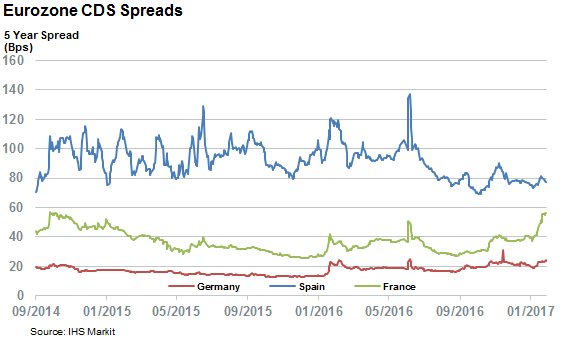
The return of the European “fear” trade has sent German 2y yields to a record low of -0.85%, down 4bps on the day, as continued selloff in French bonds prompts risk-off moves across core bonds. Bund futures rally to 164.68, volumes surge to the largest of the session, with resistance at 164.64 (Feb. 17 high) taken out
Sharp selling is pressuring peripherals, led by Italy as 10y yield rises 3bps to 2.22%. Adding to concerns about Italy was the previously reported confirmation that former PM Renzi has quit as leader of the PD, triggering a party re-election. Primaries are expected to take place at the end of April or in the first half of May. According to DB economists, there is an increasing probability of a split of Renzi’s PD with the left wing minority apparently intentioned to breakup. They note that if it materialises, the likelihood of a victory of eurosceptic parties at the general election would increase – currently the polls give the PD a small advantage over the 5SM. Hence, markets could interpret a PD split negatively. DB’s central case is a break-up of the PD with the consequence being a further increase in political fragmentation by damaging the only large party that remains pro-European. The main question, then, would become how much political support the PD would lose if historical left-wing leaders were to abandon the party. In Deutsche Bank’s view, a split of the PD could open the door to a victory of the eurosceptic parties in the coming election.
There was more political concern out of German politics as well: a weekend poll by the Emnid Institute and published in the Bild newspaper showed that the centre-left Social Democrats party have widened their lead over Merkel’s CDU party. The poll found that the SPD’s support increased 1% in a week to 33%, while the CDU’s share fell 1% to 32%. The poll also suggests that the SPD’s overall percentage has increased 12% in the last four weeks. That is the 3rd poll that we have found which shows a 1% lead for the SPD over the CDU, although the absolute percentage share for the SPD is the highest in this latest Emind poll.
As Reuters adds, the SPD’s unexpected surge of some 12 points in the last month has caught Merkel and her conservatives off guard, analysts said, just seven months before the Sept. 24 election, where she had expected to win a fourth term easily. The Emnid poll of 1,885 voters gave the SPD 33 percent of the vote, up 1 point in the last week, while the Christian Democrats (CDU) and their Bavarian sister party the Christian Social Union (CSU) would win 32 percent, down 1 point.
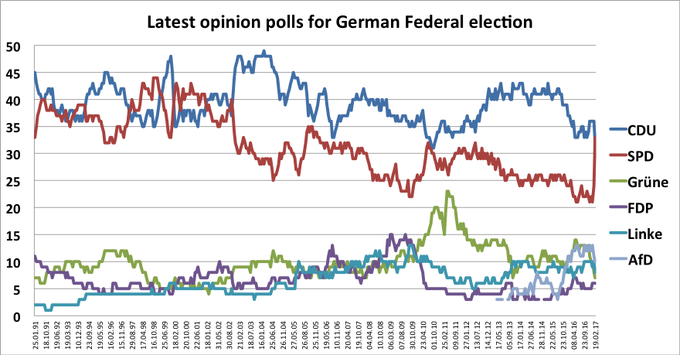
#Germany‘s SPD moves ahead of Merkel’s party in poll. http://reut.rs/2lvOXB3

The SPD has now gained a record-breaking 12 points in the last four weeks, according to Bild am Sonntag newspaper, since former European Parliament president Martin Schulz was named as its candidate to run against Merkel in the Sept. 24 election.
“The increase is unmatched in the history of the Bild am Sonntag polls,” the newspaper wrote.
The SPD, junior partner in Merkel’s ruling coalition, had trailed her conservative bloc for years in opinion polls until nomination of Schulz revived the party. It last won an election under Gerhard Schroeder in 2002.
“This is a serious poll showing the SPD coming from nowhere to overtake the CDU/CSU,” Thomas Jaeger, a political scientist at Cologne University, told Reuters. “It’s amazing to see how unprepared the CDU was for someone like Schulz … They assumed the SPD was going to stay stuck in the 20-25 percent range. They’ve been caught pants down.”
The confluence of these three political narratives has put French and Italian bonds on the back foot, and has spilled over into underperforming Italian and French stock markets.
Oh, and then there is Greece: today we’ve also got the scheduled Eurogroup finance ministers meeting in Brussels where ministers are due to discuss the Greece’s bailout. Hopes for progress have seemingly stalled until after the upcoming European elections although German finance minister Wolfgang Schaeuble did reiterate his confidence over the weekend that Greece is on the right path and that he also expects the IMF to participate in a third bailout package.
According to a Reuters report, Schaeuble doesn’t expect euro zone finance ministers to reach a final deal on Greece at their meeting today in Brussels, a spokesman said on Monday. Euro zone finance ministers are meeting in the Belgian capital to assess Greece’s progress in fulfilling the conditions of its bailout.
“We do not expect a final agreement from the Eurogroup meeting, rather it is an evaluation of a progress report, and with this expectations the minister left to Brussels,” Finance Ministry spokesman Juerg Weissgerber said.
“We hope that the institutions can return relatively quickly to Greece,” he added.
end
LePen gaining on all rivals in the first and second round polls.
(courtesy zero hedge)
Selling Of French Bonds Accelerates As Le Pen Extends Lead, Macron Tumbles In Latest Poll
Another day, another headache for owners of French bonds. In the latest French presidential poll, conducted by Elabe for TV broadcaster BFMTV, Marine Le Pen extended her lead by another 2-3 points, while support for her primary centrist challenger Emmanuel Macron, tumbled by 5 points in the last week.
The poll, released today, showed that Le Pen’s lead rose by either 1.5 points to 27% or by 2 points to 28%, depending whether centrist candidate Francois Bayrou would take part in the election…

… or withdraw.

The most surprising result, however, is the plunge in Macron’s odds, who lost five points in the first round voting intentions compared to the same poll conducted two weeks ago. Macron, who is the former French economy minister and who is running on a pro-EU platform, fell to third place behind right-wing candidate Francois Fillon, whom he eclipsed earlier in the month after a major embezzlement scandal erupted in which Fillon was accused of using public funds to pay for his family’s wages. Fillon gained 3 points in both variations of the poll.
But more concerning for her opponents, was the notable gains Le Pen made in the second round, where while still trailing behind both Fillon and Macron, she has seen a 4 points gain in the past week, shrinking the difference between Macron in the runoff round to 59-41. Until several weeks ago, she was firmly in the 20% range.

Meanwhile, as we have observed virtually every single day in the past three weeks, the better Le Pen does the polls, the higher French yields rise, and the greater the spread to German bunds….

… over fears that a Le Pen victory would be the last nail in the coffin for the Eurozone. Le Pen’s FN party has warned it would take France out of the Eurozone, return to the French franc, and would redenominate billions in French debt, a step which leading economists and rating agencies last week declared would to “massive sovereign default” and global financial chaos.
end
Spain
The following is an amazing story. For the first time error central bankers are now being held accountable in the collapse of Bankia. Too bad the central bankers did not listen to us: the entire “rescue” operation of the Spanish banks was ill fated from the first hour. It has no chance to survive and it brought down many small investors who could ill afford the losses
(courtesy Don Quijones/WolfStreet)
The Unthinkable Just Happened In Spain
Submitted by Don Quijones via WolfStreet.com,
Untouchable. Inviolable. Immunity. Impunity. These are the sort of words and expressions that are often associated with senior central bankers, who are, by law, able to operate more or less above the law of the jurisdictions in which they operate.
Rarely heard in association with senior central bankers are words or expressions like “accused”, “charged” or “under investigation.” But in Spain this week a court broke with that tradition, in emphatic style.
As part of the epic, multi-year criminal investigation into the doomed IPO of Spain’s frankenbank Bankia – which had been assembled from the festering corpses of seven already defunct saving banks – Spain’s national court called to testify six current and former directors of the Bank of Spain, including its former governor, Miguel Ángel Fernández Ordóñez, and its former deputy governor (and current head of the Bank of International Settlements’ Financial Stability Institute), Fernando Restoy. It also summoned for questioning Julio Segura, the former president of Spain’s financial markets regulator, the CNMV (the Spanish equivalent of the SEC in the US).
The six central bankers and one financial regulator stand accused of authorizing the public launch of Bankia in 2011 despite repeated warnings from the Bank of Spain’s own team of inspectors that the banking group was “unviable.”
Though they have so far only been called to testify, the evidence against the seven former public “servants” looks pretty conclusive. Testifying against them are two of Banco de España’s own inspectors who have spent the last two years investigating Bankia’s collapse on behalf of the trial’s presiding judge, Fernando Andreu. There are also four emails from the Bank of Spain’s inspector in charge of overseeing Bankia’s IPO, José Antonio Casaus, to the assistant director general of supervision at the Bank of Spain, Pedro Comín, that very clearly express concerns about the bank’s “serious and growing” profitability, liquidity, and solvency issues.
Here are four brief excerpts:
- [April 8, 2011] “Bankia is unviable, both economically and financially. In the end, the FROB [Spain’s state-owned Fund for Orderly Bank Restructuring] will have to convert its debt into shares for the BFA [Spain’s state-owned banking group] and refund holders of Bankia’s subordinate bonds and “preferentes” shares. […] Find a buyer for the group.”
- [April 14,2011] “This is not working, it’s getting worse. […] Bankia’s capacity to generate resources is deteriorating.”
- [May 10, 2011, uppercase used by Causus for emphasis] “The endogenous solution put forward by Bankia — a public listing with a double banking structure without the necessary structural changes — WILL NOT WORK AND WILL HAVE A DEVASTATING IMPACT ON TAXPAYERS.”
- [May 16, 2011, 2 months before the IPO] “The (bank’s) board is highly politicized and unprofessional. It still has the same directors that led the former entities to need public assistance: [they are] discredited in the eyes of the markets.”
As the court’s edict reads, the contents of the emails unequivocally demonstrate that the Bank of Spain’s management was perfectly aware of the “inviability of the group” as well as “the fabricated financial results it had presented.” Yet, together with the CNMV, it lent its blessing to those results, knowing full well they bore no relation to reality .
Featured in the IPO prospectus, those results were crucial in luring 360,000 credulous investors into buying shares in the soon-to-be-bankrupt bank, not to mention the 238,000 people who bought “preferentes” shares or other forms of high-risk subordinate debt instruments being peddled by Bankia’s sales teams as “perfectly safe investments.” Most have since been refunded by Spanish taxpayers.
The IPO prospectus was also signed off on by Bankia’s auditor, Deloitte, whose Spanish representatives are also warming the defendants’ bench. Deloitte was not just the bank’s auditor, it was also the consultant responsible for formulating its accounts. As El Mundo put it, first Deloitte built Bankia’s balances, then it audited them, in complete contravention of the basic concept of auditor independence [read: Deloitte About to Pay for its Spanish Sins?].
Given this deeply compromising, not to say illegal, set-up, it’s hardly any surprise that Deloitte was happy to confirm in Bankia’s IPO prospectus that the newly born frankenbank was in sound financial health, having made a handsome profit of €300 million just before its public launch. It was a blatant lie: in reality Bankia was bleeding losses from every orifice.
Now, just about everybody who played a role in this momentous deception, with the exception of the government itself, is standing trial. That includes 65 former members of Bankia’s management team including its former President and ex-chief of the IMF, Rodrigo Rato, who faces charges of money laundering, tax fraud, and embezzlement.
In his testimony to the court almost exactly two years ago, Rato argued (quite rightly) that the blame for Bankia’s collapse should be much more evenly spread out. Bankia’s public launch “was not a whimsical decision” taken by its chief executives, he said, but was the inevitable result of regulatory changes at the beginning of 2011. According to Rato, the CNMV even played an active role in drawing up the bank’s lie-infested IPO brochure.
Now, two years later, some of Spain’s most senior central bankers and financial regulators find themselves in the rare position of having to explain and defend the actions and decisions they took that helped pave the way to the biggest bank bailout in Spanish history. It will be one of the first times that senior members of the global central banking complex have had to face trial for the consequences of their actions.
That’s not to say that justice will prevail. Spain’s legal system is notoriously slow, especially when it’s convenient, and heavily politicized. There’s also the possibility that the ECB may intervene as it did in Slovenia’s investigation of its central bank’s alleged misuse of bailout funds. The last Spanish judge that dared to take on the financial elite, Elpidio Silva, sent Caja Madrid’s CEO Miguel Blesa to jail — not once, but twice – and was barred from the bench for 17 years. As such, the presiding judge of the current case, Fernando Andreu, would do well to tread carefully; he risks stepping on some very important toes.
Now a hot new bail-in-able debt got cooked up by financial engineers in France. And it’s a big hit. Read… Biggest EU Banks Embark on the Mother of All Debt Binges
end
Greece/Germany
A German Minister is calling for a plan B with respect to Greece. He wants them to pledge gold or real estate for new loans. If gold is given then the Greek politicians are just as moronic as Venezuela’s Maduro
(courtesy zero hedge)
German Minister Calls For ‘Plan B’: “Greece Should Pledge Gold, Real Estate For New Loans”
Bavaria’s 50-year-old finance minister Markus Soeder was previously named by German weekly Der Spiegel as one of the Ten Most Dangerous European Politicians (defined as “every politician who is resorting to cheap populism in order to rack up domestic political points”).
For the Greeks, this may well be true.
During the Greek government-debt crisis, Soeder was among the most vocal in calling for Greece to leave the Eurozone. By 2012, he said in an interview: “Athens must stand as an example that this Eurozone can also show teeth.”
And now, according to an interview with Bild, the CSU politician said that:
…new billions should only flow when Athens implemented all the reforms.
Even then, however, aid should only be given against a pledge “in the form of cash, gold or real estate”.
Soeder added, “We need a plan B.”
One wonders if this was Germany’s end-game all along?

Notably Greek gold reserves stand around EUR4 billion while the supposed ‘cost’ to leaving the EU – according to TARGET2 balances – is around EUR72 billion…

end
Greek bonds are rallying this morning on revived bailout hopes:
(courtesy zero hedge)
Greek Bonds Rally On Revived Bailout Hopes
The yield on Greece’s bonds have tumbled the most since June after creditors agreed on Monday to resume talks in Athens over steps needed to continue a bailout of the nation, driving expectations that Greece will be able to meet its deadline for debt redemption by July.
As The FT reports, bailout monitors are now due to return to Greece following a meeting of finance ministers and IMF officials in Brussels yesterday, where creditors claimed a partial breakthrough in talks.
In return, the Greek government has agreed to examine ways in which it can raise its income tax threshold and reduce pension spending – measures the IMF has pushed for if the country is to meet its budget targets over the next decade or so. Investors seem to be taking cheer in the developments…

Tuesday’s rally notwithstanding, some analysts sounded a note of caution…
“Yesterday’s positive Eurogroup meeting broke the stalemate and increased the odds that the second review will conclude earlier than what the market had priced in,” said Thanassis Drogosis, the Athens-based head of institutional equities at Pantelakis Securities SA. “Still, there are some crucial questions such as time lines, the role of the International Monetary Fund, remain unanswered.”
“We would caution against too much optimism, as we agree with the IMF’s debt-sustainability analysis, which concluded that Greece’s debt is unsustainable,” said Peter Chatwell, the London-based head of rates strategy at Mizuho. “We expect it will be very difficult politically to arrive at solution which keeps all parties happy.”
So bonds are rallying as the 3rd or 4th (we lose count) bailout looms – only agreed if Greeks sacrifice more of their pensions and living standards? (or their gold?)
However, in hints of a change in tone from the EU, Eurogroup president Jeroen Dijsselbloem stressed that Greece’s reform efforts would shift “away from austerity and putting more emphasis on deep reforms”.
end
UK/GLobe/HSBC
This surprised everyone: a huge revenue drop causes HSBC to crash by 7%. Major writedowns at this scandal plagued company.
(courtesy zerohedge)
Canary In A Contained Coalmine? HSBC Crashes Most Since Crisis On ‘Surprise’ Revenue Plunge
Just over 10 years ago, HSBC was the first canary in the world’s financial crisis coalmine to signal trouble ahead. Today’s 7% bloodbath in the banking behemoth is the biggest drop since the financial crisis after reporting fourth-quarter profit that missed estimates on a surprise drop in revenue, which it warned could fall again this year.
As we recently noted, 10 years ago this month, HSBC Holdings, the world’s third-largest bank at the time (and one of the most aggressive players in the U.S. market for low-quality mortgages), sent a chill through the financial world with news that its bad-debt charges will be 20% higher than forecast… and became the first canary in the coalmine of what would become the worst financial crisis of a generation.

“This is a material negative surprise for HSBC,” said John-Paul Crutchley, an analyst at Merrill Lynch.
Foreclosures jumped 35% in December versus a year earlier, according to recent data from RealtyTrac. For the fifth straight month, more than 100,000 properties entered foreclosure because the owner couldn’t keep up with their loan payments, the firm noted.
For its part, HSBC said its overall charge will be about $10.56 billion, about 20% higher than the average analyst forecast of $8.8 billion.
In explaining the outcome, the bank said its own risk projections had failed to predict how many borrowers would fall behind on mortgages as interest rates climbed and saddled them with higher monthly payments.
HSBC’s warning comes just weeks ahead of its planned report of annual results and follows a December trading update that was already bearish on U.S. mortgage debt.
The problem is with HSBC’s portfolio of sub-prime mortgages, which it snapped up in 2005 and 2006, before the U.S. housing slowdown began to bite. Sub-prime loans are sold to home buyers who fail to meet the strictest lending standards.
And that set the ball rolling.
And now, HSBC’;s stock is plunging most since the financial crisis after what Citigroup’s Ronit Ghose called “Weak Revenues, Messy Quarter.” Ghose also noted “an unusually large amount of one-offs” in the period, including a multibillion-dollar writedown on the value of its scandal-hit European private bank.

HSBC reported a $3.4 billion pretax loss for the quarter that it blamed on slowing growth in its core markets of Hong Kong and the U.K., while its adjusted profit fell $1.2 billion short of analyst estimates. Chief Executive Officer Stuart Gulliver is battling to reverse five years of declining revenue as he pares back HSBC’s sprawling global footprint and reduces expenses. The bank increased its cost-cutting target by $1 billion to $6 billion of savings, while cautioning it faces more than $3 billion of revenue headwinds in 2017, including currency movements and record-low interest rates in the U.K. Executives also warned U.S. President Donald Trump’s protectionist stance and Brexit could damage their business.
The unadjusted loss was driven by $6.1 billion of “significant items” in the quarter, more than six times what Credit Suisse Group AG analysts had forecast. The items included a $2.4 billion writedown of the value of its European private bank and a $1.6 billion adjustment in the bank’s own credit spreads.
Of course, in a desperate bid to curry favor with shareholders and prove their confidence in the bank, the lender said it will buy back $1 billion of stock in the first half and signaled it may repurchase more later this year.
* * *
We are sure all the one write-offs are ‘one-offs’ and that this is “contained” – just like it was 10 years ago.
end
EU
Great reason for the Euro to plummet this morning: Eurozone PMI jumps to 56 from 54.4
(courtesy zerohedge)
Eurozone PMI Jumps To 56, Highest Since April 2011; Job Creation Best In A Decade As Inflation Surges
Eurozone private sector and manufacturing growth unexpectedly jumped to the highest in six years in February and job creation reached its fastest since August 2007, propelled by strong demand and optimism about the future, the latest Markit PMI survey found. The Markit Eurozone PMI registered 56.0 in February, up from 54.4 in January , the highest reading since April 2011.
“The pace of eurozone economic growth improved markedly to hit a near six-year high in February, according to PMI survey data. Job creation was the best seen for nine and a half years, order book growth picked up and business optimism moved higher, all boding well for the recovery to maintain strong momentum in coming months.”

The broad-based acceleration, which showed France’s momentum getting close to Germany’s, suggests that if sustained, economic growth could hit 0.6 percent in the first quarter, according to Markit. That is faster than the 0.4 percent economists predicted in a Reuters poll earlier this month and suggests an economy in rude health before key national elections this year in France, Germany and the Netherlands.
The euro zone flash manufacturing PMI rose to 55.5 from January’s 55.2, the highest since April 2011. New export orders also rose to a near six-year high of 55.5 from January’s 55.2, suggesting a weaker currency is helping boost demand. The services PMI was also buoyant, with the business activity index rising to 55.6 from 53.7, easily beating the Reuters poll expectation of no change at 53.7 and the most optimistic forecast in the survey. The services sub-index measuring incoming new business, at 55.8, was also the highest in nearly six years.

According to the survey, growth accelerated in both manufacturing and services to rates not seen since early-2011, with the goods-producing sector again enjoying the faster rate of expansion. February also saw the largest overall increase in new business since April 2011. Inflows of new work grew at the strongest rates for almost six years in both manufacturing and services, reflecting a broad-based upturn in demand. Manufacturers’ order books again received an extra boost from rising exports1, which also swelled to the greatest extent since April 2011 due to the combination of rising demand and the weaker euro.

However, adding to ECB concerns that tapering of QE may be inevitable, “Inflationary pressures meanwhile continued to intensify.” An indicator of inflationary pressures, Input Prices rose for the 6th straight month to the highest since May 2011 while output price inflation rose to a 68-month high, putting the ECB squarely in the spotlight.
“The increased momentum is due to demand growing at a stronger rate, but also that upturn becoming more broad-based,” said Chris Williamson, chief business economist at IHS Markit. “Importantly, what we now have is France joining the party. It’s been a laggard in the region, and a drag on the euro zone upturn for a few years … and there are finally signs the drag is easing.”
Finally, here is the summary from Goldman’s Timothy Munday:
BOTTOM LINE: The Euro area flash PMI reached a 70-month high, rising from 54.4 to 56.0, against consensus expectations and our own forecast of 54.3. The increase was predominantly caused by a robust increase in the services PMI. There were gains in both the German and French PMIs. RETINA’s median estimate of Q1 Euro area GDP growth rose 0.1pp based on today’s data (to +0.8%qoq).
1. The Euro area PMI breakdown revealed rises in both the services PMI (from 53.7 to 55.6) and the manufacturing PMI (from 55.2 to 55.5).
2. The manufacturing breakdown showed increases in output (+1.1pt) and new orders (+0.1pt), but a decline in employment (-0.3pt). Within the services PMI, the signals from the forward-looking components (which are not part of the headline services PMI figure) were robust, with ‘incoming new business’ increasing by +2.1pt, and ‘business expectations’ rising by 3.5pt.
3. On an individual country basis, the German composite PMI rose from 54.8 to 56.1, while the French composite PMI rose from 54.1 to 56.2. There are no published flash estimates for Italy or Spain.
end
We have two clear axes with respect to the EU:
i) the Pence, Mattis Haley foreign policy
ii) Bannon/Trump/Miller foreign policy
the latter speaks of the EU as a failed experiment and the USA should engage in bilateral negotitions with each country.
Germany is not very happy as they are the net benefiters of the EU conglomeration because the Euro is lower than it would be if the Mark was used for Germany itself.
(courtesy zero hedge)
Bannon Breaks With Pence, Delivers Warning To Europe
Two days ago, when describing the two opposing foreign policy tracks emerging within Trump’s administration (which led to disappointment inside Russia, which was hoping for a more aggressive detente between Putin and Trump), we said that “there are two clear axes developing within the Trump administration: a Pence/Mattis/Haley foreign policy and a Trump/Bannon/Miller foreign policy.”
As a reminder, over the weekend first Secretary of Defense Jim Mattis and then Vice President Mike Pence assured participants at the Munich Security Conference that Trump would “hold Russia accountable” and vowed “unwavering support” to both NATO and EU.
Today, confirming that there is indeed a schism when it comes to the administration’s diplomatic objectives, Reuters writes that in the week before VP Mike Pence visited Brussels and pledged America’s “steadfast and enduring” commitment to the European Union, Trump’s chief strategist Steve Bannon met with the German ambassador and delivered a different message. Bannon, according to Reuters’ sources, signaled to Germany’s ambassador to Washington that he viewed the EU as a flawed construct and favoured conducting relations with Europe on a bilateral basis.
In other words, Bannon voiced the same conerns made by others about the sustainability of the European experiment, if not in polite company, and was preparing how to address Europe’s “failure” through bilateral trade treaties, the same as the recently “free” UK is doing currently with all of its former trading partners.
There was some push back to the Reuters report: a White House official who checked with Bannon in response to a Reuters query confirmed the meeting had taken place but said the account provided to Reuters was inaccurate. “They only spoke for about three minutes and it was just a quick hello,” the official said. The White House said there was no transcript of the conversation. The sources who had been briefed on it described it as polite and stressed there was no evidence Trump was prepared to go beyond his rhetorical attacks on the EU – he has repeatedly praised Britain’s decision to leave – and take concrete steps to destabilise the bloc.
However, Reuters’ sources described a longer meeting in which Bannon took the time to spell out his world view. They said his message was similar to the one he delivered to a Vatican conference back in 2014 when he was running the right-wing website Breitbart News.
In those remarks, delivered via Skype, Bannon spoke favourably about European populist movements and described a yearning for nationalism by people who “don’t believe in this kind of pan-European Union.”
Western Europe, he said at the time, was built on a foundation of “strong nationalist movements”, adding: “I think it’s what can see us forward”.
The Bannon encounter reportedly unsettled people in the German government, in part because some officials had been holding out hope that Bannon might temper his views once in government and offer a more nuanced message on Europe in private.
One source briefed on the meeting said it had confirmed the view that Germany and its European partners must prepare for a policy of “hostility towards the EU”. A second source expressed concern, based on his contacts with the administration, that there was no appreciation for the EU’s role in ensuring peace and prosperity in post-war Europe.
“There appears to be no understanding in the White House that an unraveling of the EU would have grave consequences,” the source said.
Anxiety over the White House stance led French Foreign Minister Jean-Marc Ayrault and Wolfgang Ischinger, chairman of the Munich Security Conference, to issue unusual calls last week for Pence to affirm during his visit to Europe that the U.S. was not aiming to break up the EU.
And, as discussed before, Pence obliged pledging strong ties between the United States and the EU, and making clear his message was shared by the president. “President Trump and I look forward to working together with you and the European Union to deepen our political and economic partnership,” he said.
However, despite the message of reassurance by Pence and Mattis, Europeans remain unconvinced as the real question – as suggested previously – remains unanswered: which axis is dominant: that of Trump/Bannon/Miller or Pence/Mattis/Haley. Indeed, as Reuters adds, the Pnence tour did not end the concerns in European capitals.
“We are worried and we should be worried,” Thomas Matussek, senior adviser at Flint Global and a former German ambassador to the Britain and the United Nations, told Reuters. “No one knows anything at the moment about what sort of decisions will be coming out of Washington. But it is clear that the man on top and the people closest to him feel that it’s the nation state that creates identity and not what they see as an amorphous group of countries like the EU.”
With elections looming in the Netherlands, France and Germany this year, European officials said they hoped Pence, Secretary of Defense Jim Mattis and Secretary of State Rex Tillerson could convince Trump to work constructively with the EU, overriding Bannon’s skepticism.
What is the worst-case scenario, if only perceived through the eyes of Europe? It was described by Ischinger in an article published last week, entitled “How Europe should deal with Trump”.
He said that if the U.S. administration actively supported right-wing populists in the looming election campaigns it would trigger a “major transatlantic crisis”.
Translation: should the “far right” win in the Netherlands, France and/or Italy, Europe already has a prepared scapegoat who to blame, and not surprisingly, it has nothing to do with the real culprits who over the past decade cared only about central banks’ failed reflationary policies which however succeeded in blowing the world’s biggest asset bubble, and unleashing an unprecedented tide of social discontent, leading to where the world finds itself now.
5. RUSSIAN AND MIDDLE EASTERN AFFAIRS
I wonder if any foul play is prevalent here: Russian Ambassador Churkin dies suddenly in NY
(courtesy zero hedge)
Russian Ambassador To UN Vitaly Churkin Has “Died Suddenly” In New York
Vitaly Churkin, who served as Russia’s permanent representative to the United Nations since 2006, “died suddenly” in New York, the Russian Foreign Ministry announced. Churkin died one day before his 65th birthday. Russia’s deputy U.N. ambassador, Vladimir Safronkov, told AP that Churkin became ill and was taken to Columbia Presbyterian Hospital, where he died Monday.
Churkin was at the Russian embassy on East 67th Street when he became sick with a “cardiac condition” around 9:30 am, sources told the New York Post. A Russian Embassy spokesperson told CBS News that they believe Churkin died of a heart attack but they do not yet have official word on the cause of death.
As the AP adds, Churkin has been Russia’s envoy at the United Nations for a little over a decade and was considered Moscow’s great champion at the U.N. He had a reputation for an acute wit and sharp repartee especially with his American and Western counterparts. He was previously ambassador at large and earlier served as the foreign ministry spokesman.

Colleagues took to social media to react to Churkin’s death:
Absolutely devastated to hear that my friend & colleague Vitaly Churkin has died. A diplomatic giant & wonderful character. RIP

Saddened to hear news of a colleague Amb Vitaly Churkin of Russian Federation suddenly passing away. Our condolences to his family & country

Our sincere condolences on the passing away of Permanent Representative Vitaly Churkin. We are saddened by the news of your loss @RussiaUN

The announcement “of Churkin’s passing this morning” was met with shock when it was delivered during a session at the UN headquarters. “He was a dear colleague of all of us, a deeply committed diplomat of his country and one of the finest people we have known,” a UN official who delivered the news to her colleagues said.

Shocking news to hear the passing away of Amb Vitaly Churkin. A brilliant ambassador who served his country & people. May he rest in peace.

The Russian foreign ministry gave no details on the circumstances of his death but offered condolences to his relatives and said the diplomat had died one day before his 65th birthday. Here is the statement issued moments ago from the Russian Foreign Ministry:
A prominent Russian diplomat has passed away while at work. We’d like
to express our sincere condolences to Vitaly Churkin’s family.The Russian Foreign Ministry deeply regrets to announce that Russia’s Permanent Representative to the United Nations Vitaly Ivanovich Churkin has died suddenly in New York on February 20, a day ahead of his 65th birthday.
“He was an outstanding person. He was brilliant, bright, a great diplomat of our age,” Russian Foreign Ministry spokeswoman Maria Zakharova said, adding that the news of Churkin’s death was “completely shocking.”

Interviewed Churkin just 2 weeks ago. He looked in good health and was very energetic during the interview. Shockedhttps://youtu.be/1J514rtxado

According to Sputnik, Russia’s Deputy Permanent Representative to the United Nations Yevgeniy Zagaynov said about Churkin that he kept working “till the very end.” The representative of the UN Secretary-General said that the UN was shocked by the news, extending their condolences to Moscow.
Perhaps the best known Russian diplomat alongside Sergey Lavrov, Vitaly Ivanovich Churkin was born in Moscow in 1952. He graduated from the Moscow State Institute of International Relations in 1974, beginning his decades-long career at the Ministry of Foreign Affairs shortly.
Ambassador Churkin, who held a Ph.D in history, served as Russia’s Permanent Representative to the United Nations since 2006, where he has clashed on numerous occasions with opposing members of the Security Council whose decisions Russia has vetoed more than once. Prior to this appointment, he was Ambassador at Large at the Ministry of Foreign Affairs of the Russian Federation (2003-2006), Ambassador to Canada (1998-2003), Ambassador to Belgium and Liaison Ambassador to NATO and WEU (1994-1998), Deputy Foreign Minister and Special Representative of the President of the Russian Federation to the talks on Former Yugoslavia (1992-1994), Director of the Information Department of the Ministry of Foreign Affairs of the USSR/Russian Federation (1990-1992).
Churkin is survived by his wife and two children.
end
6.GLOBAL ISSUES
Sweden
On Friday, Trump was mocked when he stated that Sweden has a migrant problem. Over the weekend he was vindicated after violent riots erupt in the Swedish suburb:
(courtesy zero hedge)
“It Looks Like A War Zone”: Trump Vindicated After Violent Riot Erupts In Swedish Suburb
As we reported last night, just days after the media mocked Trump for his allegations of major problems with Swedish migrant policies, the president was vindicated after a violent riot broke out in the borough of Rinkeby, also known as “little Mogadishu.” Now that the incident is over, in their “post-mortem” Swedish officials confirm that riots erupted in the “heavily immigrant Stockholm suburb” Monday night, as masked looters set cars ablaze and threw rocks at cops, injuring one police officer, Swedish officials said.
The violence erupted just days after President Trump was ridiculed during a Saturday campaign rally for mentioning Sweden alongside a list of European targets of terror. Trump later said his “You look at what’s happening last night in Sweden” remark was in response to a Fox News report on the country’s refugee crime crisis that aired on Friday evening.
“Sweden. They took in large numbers [of refugees],” Trump added at the Florida rally. “They’re having problems like they never thought possible.”
Sweden’s official Twitter account – which is operated by a different user each week – tweeted at Trump on Monday morning: “Hey Don, this is @Sweden speaking! It’s nice of you to care, really, but don’t fall for the hype. Facts: We’re OK!”
Events just hours later refuted that optimistic assessment.
The violence in Rinkeby began around 8 p.m., when officers arrested a suspect at an underground station on drug charges, The Local reported. A group soon gathered, hurling rocks and other objects at officers and prompting one cop to fire his gun “in a situation that demanded he use his firearm,” police spokesman Lars Bystrom said.
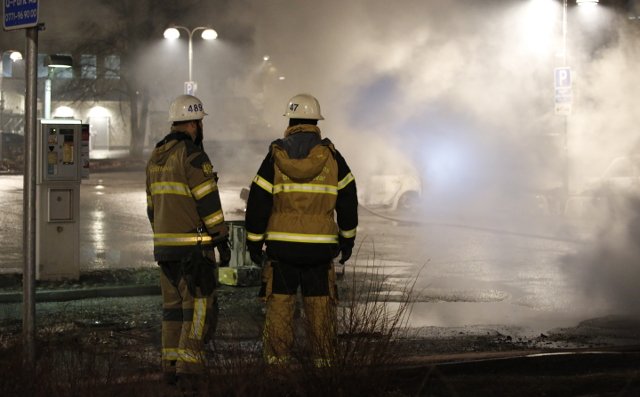
Swedish press photographer assaulted in Rinkeby riots http://dlvr.it/NRBdLN

Hours later, the Rinkeby riots began, with a second wave starting around 10:30 p.m. Seven or eight cars were set on fire and many stores saw looting, The Local reported. A photographer from media outlet Dagens Nyheter said a group of 15 people beat him as he tried to document the chaos. Swedish Police were forced to fire warning shots at the unidentified group of rioting protesters, who set cars on fire, throwing stones at police and looting local stores.
A police officer was injured during the clashes, forcing law enforcers to fire several warning shots at the crowd, Swedish public service broadcaster SVT reported, citing a local police spokesperson.

A policeman investigates a burnt car in Rinkeby, Sweden February 21, 2017
The silver lining is that “nobody has been found injured at the scene and we have checked the hospitals and there hasn’t been anyone with what could be gunshot wounds,” Bystrom added.
“I was hit with a lot of punches and kicks both to my body and my head. I have spent the night in hospital,” said the photographer, who was not named. “It looks like a war zone” he added.
The rioting ended just after midnight.
No arrests were made; however, reports were filed on three violent acts, violence against a police officer, two assaults, vandalism and aggravated thefts, authorities said.

As we reported last night, Rinkeby is the same area where an Australian “60 Minutes” crew was attacked by a group of men in April 2016. The film crew was attempting to enter a so-called “no go zone,” which authorities deny they use as a label. Rinkeby, however, has been officially classified as one of 15 “particularly vulnerable” areas across Sweden.

The country’s prime minister, Stefan Lofven, said Monday, “Yes, we have challenges like all other countries. There’s no doubt. We have a situation in the world where 65 million people had to flee their countries last year, the year before that. 65 million. So that’s a war for us together.” He also said Sweden was investing more in housing, technology and its welfare system.

Reports of rapes in Sweden jumped 13 percent in 2016 compared to the previous year, and reports of sexual assaults were up 20 percent, according to preliminary data from the Swedish National Council for Crime Prevention. Recent migration to Sweden hit its peak in 2015 with more than 160,000 asylum applications. It dropped to almost 30,000 in 2016.

The mainstream media, so eager to mock Trump’s “error” on Saturday, has been oddly delayed in reporting on last night’s Swedish violence.
END
7. OIL ISSUES
Bank of America’s Blanch believes with the increased rigs placed by the shale boys will increase production by 700,000 barrels per day. Thus for 5 days: 3.5 million
(courtesy zero hedge)
US Shale Production To Soar By 3.5 Million Barrels/Day Over Next Five Years: BofA Explains Why
Two years ago, when Saudi Arabia launched on an unprecedented campaign to crush high-cost oil producers, in the process effectively putting an end to the OPEC cartel (at least until last year’s attempt to cut production), it made a bold bet that US shale producers would be swept under when the price of oil tumbled, leading to a tsunami of bankruptcies, as well as investment and production halts. To an extent it succeeded, but where it may have made a glaring error is the core assumption about shale breakeven costs, which as we reported throughout 2016, were substantially lower than consensus estimated.
In his latest note, BofA’s Francisco Blanch explains not only why a drop in shale breakevens costs is what is currently the biggest wildcard in the global race to reach production “equilibrium”, but also why US shale oil production could surge in the coming years, prompting OPEC to boost production in hopes of recapturing market share. Specifically, Blanch predicts that US shale oil production could grow by a whopping 3.5 million barrels per day over the next five years.

Here’s why: as he explains “many oil companies around the world have survived the price meltdown by bringing down breakeven costs in the last two years.

But what parts of the world can grow output in the years ahead? In BofA’s view, US shale oil producers will come out ahead and deliver outsized market share gains by 2022. Shale oil output in the US may grow sequentially by 600 thousand b/d from 4Q16 to 4Q17 on increased activity in oil rigs and fast productivity gains. Importantly, breakeven costs for key major US plays now stand around the $55/bbl mark.

As crude oil prices recover further, cost reflation may partly offset reduced costs linked to less regulation. So assuming a gradual recovery in oil prices into a long-term average of $60 to $70/bbl, BofA projects average annual US shale oil growth of 700 thousand b/d in 2017-22, or roughly 3.5 million bpd over the next 5 years.
Shale production could rise even more if prevailing oil prices are higher than $55/barrel. Here is BofA’s sensitivity analysis:
We estimate that US shale production will decline annually by 270 thousand b/d, on average, until 2022 in a $40/bbl WTI environment. At $50/bbl, growth returns, though only at a small average of 240 thousand b/d. Should WTI trade at $60 for the next five years, growth reaches 700 thousand b/d, and at $70/bbl it reaches 950 thousand b/d (Chart 15). It goes without saying that the level of US shale output in 2022 will highly depend on the average price of WTI in the next five years (Chart 16).

It’s not just the US however: in addition to US shale, BofA sees incremental growth in Brazil, Russia, Kazakhstan and Canada over the next five years, driven by giant projects in the Lula, Kashagan or Johan Sverdrup fields. However, many of the gains in supply from non-OPEC non-shale producers will come on the back of investments dating to before the collapse in global oil prices. Meanwhile, countries such as Mexico and the UK will keep facing output declines. All in, BofA projects non-OPEC output to reach 61.7 million b/d by 2022. This equates to 830 thousand b/d of annual average growth in the next five years, or around the 20-year average of 790 thousand b/d (Chart 3).
Put differently, Blanch sees 84% of the incremental non-OPEC supply gains coming from US shale, as production in many parts of the world either stagnates or declines outright (Chart 4).

Which brings us back to square one, and specifically the migraine-causing dilemma faced by OPEC, which Saudi Arabia had hoped to eliminate in 2014: volume or price?
With non-OPEC poised to grow again, OPEC will need to increase oil output by just 2.2 million b/d to meet global incremental oil demand of about 5.5 million b/d over the 2017-22 period, according to BofA calculations. So about 1/3 of global oil supply growth will come from OPEC in 2017-22 (Chart 5). In this context, Blanch believes that Saudi, Iraq and the UAE are the only countries able to increase their output in the medium term, while Algeria, Nigeria or Venezuela would need massive investments to reverse current trends and boost output.
This may be true, unless of course just like US shale, production breakeven costs are sliding across the world. Furthermore the actions of such giant “vendor-financing” providers as China (seen best in the case of Venezuela, where China continues to provide Caracas with much needed funds in exchange for far below market oil deliveries) remain unpredictable, and may afford these non-core OPEC nations just the funds they need to also steal market share from Saudi, Iraq and UAE.

According to BofA, while OPEC countries have the resources to grow production, its previous work shows that OPEC revenue would likely be higher if no additional investments are made compared to scenarios where increased OPEC production leads to lower prices (Chart 6).
For this reason, Francisco Blanch says he expects limited OPEC oil output growth over the next 5 years.
We, however, disagree, especially following today’s news that Russia overtook Saudi Arabia as the world’s largest crude producer in December, when both countries started restricting supplies ahead of agreed cuts with other global producers to curb the worst glut in decades.
As Bloomberg reported earlier, Russia pumped 10.49 million barrels a day in December, down 29,000 barrels a day from November, while Saudi Arabia’s output declined to 10.46 million barrels a day from 10.72 million barrels a day in November, according to data published Monday on the website of the Joint Organisations Data Initiative in Riyadh. That was the first time Russia beat Saudi Arabia since March. Iraq came in fourth at 4.5 million barrels a day, followed by China at 3.98 million barrels a day, the data show. The US, which has emerged as the oil swing producer, was the third-largest producer, at 8.8 million barrels a day in December compared with 8.9 million barrels a day in November, according to JODI.
It is unlikely that if BofA is right and US shale manages to boost oil output by 3.5 million bpd – or more, if oil prices rise further – over the next five years, potentially surpassing Saudi Arabia should the kingdom’s production remain stagnant, that Riyadh will sit and watch as not only Russia but the US threatens its standing as the world’s biggest producer of crude.
Whether this is accurate will be revealed over the coming months based on what happens to the record level of crude inventories currently in the US. Should the much anticipated “rebalancing” fail as excess demand fails to materialize, the oil-rich kingdom may have no choice but to once again try to put marginal producers out of business but breaking up the OPEC cartel and replaying the post-2014 episode once again, sending crude prices in freefall.
end
Gasoline inventories are now at 27 yr highs. Generally when you see both crude oil inventories and gasoline levels at record highs you have a problem
(courtesy Nick Cunningham/OilPrice.com)
Biggest Gasoline Glut In 27 Years Could Crash Oil Markets
Submitted by Nick Cunningham via OilPrice.com,
Oil prices are stuck in a holding pattern, waiting for more definitive data on what comes next. OPEC compliance is helping keep prices afloat, but rising U.S. oil production is acting as a counterweight.
A new problem that has suddenly emerged is the record levels of gasoline sitting in storage. The market has already had to digest the fact that U.S. crude oil stocks were rising, and investors have done their best to explain away the trend. But now gasoline inventories are climbing to unexpected heights.
It would be one thing if crude stocks were rising, perhaps because refiners were going offline for maintenance. But if that were the case, then gasoline stocks would draw down on lower refining runs. But if both crude and refined product inventories are going up at the same time, then there should be some reasons for worry.
In fact, the glut of gasoline is now the worst in 27 years. At 259 million barrels, U.S. gasoline storage levels are now at their highest level since the EIA began tracking the data back in 1990.

(Click to enlarge)
Part of the reason for the glut, of course, are high levels of production. Although gasoline production ebbs and flows seasonally, U.S. production has been on an upward trend in recent years. Instead of bouncing around in a range of 8.5 to 9.5 million barrels per day before 2014, U.S. production since the collapse of oil prices has steadily climbed to a range of 9 to 10 mb/d.

(Click to enlarge)

(Click to enlarge)
U.S. gasoline demand plunged to just 8.2 million barrels per day in January, and sales were down 4 percent from a year earlier. It was also the lowest level in four years. Weak demand is raising some red flags for the market.
Demand is seasonal, with softer demand in winter months, but this winter’s ‘valley’ is lower than any other since 2012.
The problem becomes particularly acute when you take into account the fact that refiners have actually cut back on gasoline production in recent weeks. Even with lower refining runs, gasoline storage levels continued to rise.
The data is worrying, especially since broader economic data does not point to deep problems with the U.S. economy. Some, including the EIA, speculate that higher prices are cutting into demand. That would be surprising given that prices at the pump are still a fraction of what they were a few years ago.
The drop off in demand could be temporary, with consumption rebounding in a few months. Warmer temperatures tend to lead to more driving, and if demand rises it will halt the climb in gasoline inventories. But even a small hiatus in demand has led to a buildup in storage levels to such a degree that it will take time to bring down. “It kind of ruins your whole year potentially,” Sam Margolin, an analyst at Cowen, told the WSJ. “Demand growth appears to be the riskiest element of the oil equation in 2017, and the rally could pause until driving season.”
The glut of gasoline has led to tankers being turned away at New York Harbor in recent weeks, diverted to ports in the Caribbean. However, even that did not resolve the glut on the U.S. east coast. “Record-high inventories in the region are now pushing prices low enough to turn the typical trade flow on its head,” Bloomberg reports. The east coast typically imports a lot of crude oil and refined products. But refined products are instead heading in the other direction because of the buildup in supply.
If demand does not rebound, then gasoline inventories will rise further. At that point, refiners will be forced to cut back on production, which means a reduction of their purchases of crude oil. Less oil sales means higher crude oil inventories, pushing down prices. Ultimately, that could force drillers to reduce supply. In short, if U.S. demand – and by extension, global demand – does not come through for the oil market, then oil prices could decline this year.
8. EMERGING MARKETS
Your early morning currency/gold and silver pricing/Asian and European bourse movements/ and interest rate settings TUESDAY morning 7:00 am
Euro/USA 1.0532 DOWN .0076/REACTING TO + huge Deutsche bank problems + USA election:/TRUMP WINS THE ELECTION/USA READY TO GO ON A SPENDING BINGE WITH THE TRUMP VICTORY/ITALIAN REFERENDUM DEFEAT/AND NOW ECB TAPERING BOND PURCHASES/USA RAISING INTEREST RATE/EUROPE BOURSES ALL IN THE RED
USA/JAPAN YEN 113.66 UP 0.392(Abe’s new negative interest rate (NIRP), a total DISASTER/SIGNALS U TURN WITH INCREASED NEGATIVITY IN NIRP/JAPAN OUT OF WEAPONS TO FIGHT ECONOMIC DISASTER/KURODA: HELICOPTER MONEY ON THE TABLE AND DECISION ON SEPT 21 DISAPPOINTS WITH STIMULUS/OPERATION REVERSE TWIST
GBP/USA 1.2402 DOWN .0069 (Brexit by March 201/UK government loses case/parliament must vote/PRIME MINISTER MAY DECIDES ON A HARD BREXIT/LOWER HOUSE PASSES BILL TO BEGIN THE BREXIT PROCESS)
USA/CAN 1.3146 UP .0043 (CANADA WORRIED ABOUT TRADE WITH THE USA WITH TRUMP ELECTION/ITALIAN EXIT AND GREXIT FROM EU)
Early THIS TUESDAY morning in Europe, the Euro FELL by 76 basis points, trading now WELL BELOW the important 1.08 level FALLING to 1.0532; Europe is still reacting to Gr Britain HARD BREXIT,deflation, announcements of massive stimulation (QE), a proxy middle east war, and the ramifications of a default at the Austrian Hypo bank, an imminent default of Greece, Glencore, Nysmark and the Ukraine, along with rising peripheral bond yield further stimulation as the EU is moving more into NIRP, and now the Italian referendum defeat AND NOW THE ECB TAPERING OF ITS PURCHASES/ THE USA’S NON tightening by FAILING TO RAISE THEIR INTEREST RATE AND NOW THE HUGE PROBLEMS FACING TOO BIG TO FAIL DEUTSCHE BANK + THE ELECTION OF TRUMP IN THE USA+ AND MONTE DEI PASCHI NATIONALIZATION / Last night the Shanghai composite CLOSED UP 13.36 POINTS OR 0.41% / Hang Sang CLOSED DOWN 182.45 POINTS OR 0.76% /AUSTRALIA CLOSED DOWN 0.09% / EUROPEAN BOURSES ALL IN THE GREEN EXCEPT LONDON
We are seeing that the 3 major global carry trades are being unwound. The BIGGY is the first one;
1. the total dollar global short is 9 trillion USA and as such we are now witnessing a sea of red blood on the streets as derivatives blow up with the massive rise in the rise in the dollar against all paper currencies and especially with the fall of the yuan carry trade. The emerging market which house close to 50% of the 9 trillion dollar short is feeling the massive pain as their debt is quite unmanageable.
2, the Nikkei average vs gold carry trade ( NIKKEI blowing up and the yen carry trade HAS BLOWN up/and now NIRP)
3. Short Swiss franc/long assets blew up ( Eastern European housing/Nikkei etc.
These massive carry trades are terribly offside as they are being unwound. It is causing global deflation ( we are at debt saturation already) as the world reacts to lack of demand and a scarcity of debt collateral. Bourses around the globe are reacting in kind to these events as well as the potential for a GREXIT>
The NIKKEI: this TUESDAY morning CLOSED UP 130.36 POINTS OR 0.68%
Trading from Europe and Asia:
1. Europe stocks ALL IN THE GREEN EXCEPT LONDON
2/ CHINESE BOURSES / : Hang Sang CLOSED DOWN 182.45 POINTS OR 0.76% / SHANGHAI CLOSED UP 13.36 OR 0.41%/Australia BOURSE CLOSED DOWN 0.09% /Nikkei (Japan)CLOSED UP 130.36 POINTS OR 0.68% / INDIA’S SENSEX IN THE GREEN
Gold very early morning trading: $1230.50
silver:$17.92
Early TUESDAY morning USA 10 year bond yield: 2.4520% !!! UP 1 IN POINTS from FRIDAY night in basis points and it is trading JUST BELOW resistance at 2.27-2.32%. THE RISE IN YIELD WITH THIS SPEED IS FRIGHTENING
The 30 yr bond yield 3.0551, UP 1 IN BASIS POINTS from FRIDAY night.
USA dollar index early TUESDAY morning: 101.52 UP 62 CENT(S) from THURSDAY’s close.
This ends early morning numbers TUESDAY MORNING
xxxxxxxxxxxxxxxxxxxxxxxxxxxxxxxxxxxxxxxxxxxxxxxxxxxxxxxxxxxxxxxxxxxxxxxxxxxxxxxxxxxxxxxxxxxxxxxxxxxxxxxxxxxxxxx
And now your closing TUESDAY NUMBERS
Portuguese 10 year bond yield: 4.034% UP 1 in basis point yield from FRIDAY
JAPANESE BOND YIELD: +.095% UP 1/10 in basis point yield from FRIDAY/JAPAN losing control of its yield curve
SPANISH 10 YR BOND YIELD:1.682% UP 5 IN basis point yield from FRIDAY (this is totally nuts!!/
ITALIAN 10 YR BOND YIELD: 2.247 UP 5 POINTS in basis point yield from FRIDAY
the Italian 10 yr bond yield is trading 56 points HIGHER than Spain.
GERMAN 10 YR BOND YIELD: +.301% DOWN 1/10 IN BASIS POINTS ON THE DAY
END
xxxxxxxxxxxxxxxxxxxxxxxxxxxxxxxxxxxxxxxxxxxxxxxxxxxxxxxxxxxxxxxxxxxxxxxxxxxxxxxxxxxxxxxxxxxxxxxxxxxxxxxxxxxxxxxxxxxxxxxxxxxxxxxxxxxxx
IMPORTANT CURRENCY CLOSES FOR TUESDAY
Closing currency crosses for TUESDAY night/USA DOLLAR INDEX/USA 10 YR BOND YIELD/1:00 PM
Euro/USA 1.0546 DOWN .0063 (Euro DOWN 63 basis points/ represents to DRAGHI A COMPLETE POLICY FAILURE/
USA/Japan: 113.53 UP: 0.264(Yen UP 26 basis points/
Great Britain/USA 1.2465 DOWN 0.0007( POUND DOWN 7 basis points)
USA/Canada 1.3154 UP 0.0051(Canadian dollar DOWN 51 basis points AS OIL ROSE TO $54.27
xxxxxxxxxxxxxxxxxxxxxxxxxxxxxxxxxxxxxxxxxxxxxxxxxxxxxxxxxxxxxxxxxxxxxxxxxxxxxxxxx
This afternoon, the Euro was DOWN by 63 basis points to trade at 1.0546
The Yen FELL to 113.53 for a LOSS of 26 Basis points as NIRP is STILL a big failure for the Japanese central bank/HELICOPTER MONEY IS NOW DELAYED/BANK OF JAPAN NOW WORRIED AS AS THEY ARE RUNNING OUT OF BONDS TO BUY AS BOND YIELDS RISE /OPERATION REVERSE TWIST ANNOUNCED SEPT 21.2016
The POUND FELL 7 basis points, trading at 1.2465/
The Canadian dollar FELL by 51 basis points to 1.3154, WITH WTI OIL RISING TO : $54.27
Your closing 10 yr USA bond yield PAR IN basis points from FRIDAY at 2.42% //trading well ABOVE the resistance level of 2.27-2.32%) very problematic USA 30 yr bond yield: 3.025 PAR in basis points on the day /
Your closing USA dollar index, 101.38 UP 48 CENT(S) ON THE DAY/1.00 PM
Your closing bourses for Europe and the Dow along with the USA dollar index closing and interest rates for TUESDAY: 1:00 PM EST
London: CLOSED DOWN 25.03 OR 0.34%
German Dax :CLOSED UP 139.87 POINTS OR 1.18%
Paris Cac CLOSED UP 23.77 OR 0.49%
Spain IBEX CLOSED UP 34.40 POINTS OR 0.36%
Italian MIB: CLOSED UP 64.93 POINTS OR 0.34%
The Dow closed UP 118.95 OR 0.58%
NASDAQ WAS closed up 27.37 POINTS OR 0.47% 4.00 PM EST
WTI Oil price; 54.27 at 1:00 pm;
Brent Oil: 56.85 1:00 EST
USA /RUSSIAN ROUBLE CROSS: 57.75 UP 22/100 ROUBLES/DOLLAR
TODAY THE GERMAN YIELD FALLS TO +0.301% FOR THE 10 YR BOND 1:30 EST
END
This ends the stock indices, oil price, currency crosses and interest rate closes for today
Closing Price for Oil, 5 pm/and 10 year USA interest rate:
WTI CRUDE OIL PRICE 5 PM:$54.02
BRENT: $56.61
USA 10 YR BOND YIELD: 2.431% (ANYTHING HIGHER THAN 2.70% BLOWS UP THE GLOBE)
USA 30 YR BOND YIELD: 3.04%
EURO/USA DOLLAR CROSS: 1.0532 down .0076
USA/JAPANESE YEN:113.66 down 0.392
USA DOLLAR INDEX: 101.46 up 56 cents ( HUGE resistance at 101.80)
The British pound at 5 pm: Great Britain Pound/USA: 1.2474 : up 3 BASIS POINTS.
German 10 yr bond yield at 5 pm: +.301%
END
And now your more important USA stories which will influence the price of gold/silver
TRADING IN GRAPH FORM
Tech Stocks Extend Record Winning Streak As Dow Tops 20,700
Overheard everywhere today…
Dow, S&P, and Nasdaq all hit fresh record highs today

(as Reuters notes)
The S&P is trading at 17.8 times earnings estimates for the next 12 months, above the long-term average of 15 times, according to Thomson Reuters Datastream.
“There is no doubt in anyone’s mind that the market has become over-extended and is due for a pullback,” said Quincy Krosby, market strategist at Prudential Financial in Newark, New Jersey.
“That said, when you have this kind of momentum, it is very hard to sit on the sidelines.”
This is the 14th straight day of gains for the S&P 500 Tech sector… an all-time record…

And is the most overbought in history…

50 days in a row without a 1% move.
Dow topped 20,700 and while VIX was crushed lower it ended the day higher with stocks – once again very unusual…

VIX and Stocks are completely decoupled…

Gold remains 2017’s winner but the melt-up in stocks is catching up fast…

Overnight weakness in Treasuries was well bid during the US day session…

The Dollar Index roundtripped from overnight strength intraday…

Led by Cable strength…(yest4erday the USd was deastock during the President’s Day holiday)

The Peso surged below 20/$…

Copper and Crude are marginally higher from Friday’s close, PMs flat…

RBOB ended the day lower below $1.50 and crude rolled over but ended green…

end
Soft data USA PMI manufacturing index disappoints as the hope category disappoints:
Mfg: 54.3 a drop from 55.0
Service: 53.9 down from 55.6
(courtesy zerohedge)
US PMIs Tumble, Catch Down To ‘Hard Data’ Disappointment As “Post-Election Upturn Loses Momentum”
Despite soaring ‘soft’ survey data from around the world, US manufacturing and services PMI printed disappointing drops in February – catching down to the ‘hard’ data declines since Trump’s election.
The Soft data hope is fading fast… (Manufacturing dropped from 55.0 to 54.3, Services slumped from 55.6 to 53.9).

The composite PMI dropped 1.50 points – the biggest drop in a year.
Digging into the details exposes some ugly realities…
Manufacturers signalled that input cost inflation was at its highest level since September 2014. This was linked to increased prices for a range of raw materials, particularly metals and oilrelated inputs. However, factory gate price inflation was only marginal and slipped to a three-month low in February, thereby suggesting a continued squeeze on operating margins.
“Service sector job creation moderated to its slowest for three months in February”
Growth of business output, new orders and hiring all waned, as did inflationary pressures.
Some service providers commented on a greater degree of caution in terms of client spending
Commenting on the flash PMI data, Chris Williamson, Chief Business Economist at IHS Markit said:
“The drop in the flash PMI numbers for February suggest that the post-election upturn has lost some momentum. Growth of business output, new orders and hiring all waned, as did inflationary pressures.
“February also saw a sharp pull-back in business optimism about the outlook over the next 12 months, which suggests companies have become more cautious about spending, investing and hiring.
“However, even with the February dip, the PMI remains at a level broadly consistent with the economy growing at a 2.5% annualized rate in the first quarter. The survey’s employment index is meanwhile indicating that a respectable 165,000 jobs were added to the economy in February.
end
Wow!! Jay Sekulow a prominent lawyer in the USA states that Obama changed the way phone conversations/recordings are distributed. On jan 3 2017 Obama did an executive order whereby 16 other agencies are to receive the above information gathering enterprise. It is illegal to pass on conversations from private or government officials without a warrant and that did not stop Obama
(courtesy zerohedge)
Jay Sekulow: Obama Should Be “Held Accountable” For The “Soft Coup” Against Trump
In light of the recent flurry of leaks by the so-called “deep state”, which includes such agencies as the NSA and FBI and which last week lead to the resignation of Mike Flynn after a phone recording of his phone conversation with the Russian ambassador was leaked to the WaPo and other anti-Trump publications, an article published on January 12 by the NYT has generated renewed interest. One month ago, the NYT reported that “In its final days, the Obama administration expanded the power of the National Security Agency to share globally intercepted personal communications with the government’s 16 other intelligence agencies before applying privacy protections.”
The new rules significantly relax longstanding limits on what the N.S.A. may do with the information gathered by its most powerful surveillance operations, which are largely unregulated by American wiretapping laws. These include collecting satellite transmissions, phone calls and emails that cross network switches abroad, and messages between people abroad that cross domestic network switches. The change means that far more officials will be searching through raw data. Essentially, the government is reducing the risk that the N.S.A. will fail to recognize that a piece of information would be valuable to another agency, but increasing the risk that officials will see private information about innocent people.
While previously the N.S.A. filtered information before sharing intercepted communications with another agency, like the C.I.A. or the intelligence branches of the F.B.I. and the Drug Enforcement Administration, and furthermore N.S.A.’s analysts passed on only information they deemed pertinent, screening out the identities of innocent people and irrelevant personal information, following passage of Obama’s 11th hour rule, “other intelligence agencies will be able to search directly through raw repositories of communications intercepted by the N.S.A. and then apply such rules for “minimizing” privacy intrusions.“
In other words, what until recently was a trickle of private data captured about US individuals by the NSA with only a handful of people having full, immersive access, suddenly became a firehose with thousands of potential witnesses across 16 other agencies, each of whom suddenly became a potential source of leaks about ideological political opponents. And with the universe of potential “leaking” culprits suddenly exploding exponentially, good luck finding the responsible party.
However, the implications are far more serious than just loss of privacy rights.
According to civil right expert and prominent First Amendement Supreme Court lawyer, Jay Sekulow, what the agencies did by leaking the Trump Administration information was not only illegal but “almost becomes a soft coup”, one which was spurred by the last minute rule-change by Obama, who intentionally made it far easier for leaks to propagate, and next to impossible to catch those responsible for the leaks.
This is his explanation:
There was a sea-change here at the NSA with an order that came from president Obama 17 days before he left office where he allowed the NSA who used to control the data, it now goes to 16 other agencies and that just festered this whole leaking situation, and that happened on the way out, as the president was leaving the office.
Why did the Obama administration wait until it had 17 days left in their administration to put this order in place if they thought it was so important. They had 8 years, they didn’t do it, number one. Number two, it changed the exiting rule which was an executive order dating back to Ronald Reagan, that has been in place until 17 days before the Obama administration was going to end, that said the NSA gets the raw data, and they determine dissemination.
Instead, this change that the president put in place, signed off by the way by James Clapper on December 15, 2016, signed off by Loretta Lynch the Attorney General January 3, 2017, they decide that now 16 agencies can get the raw data and what that does is almost creates a shadow government. You have all these people who are not agreeing with President Trump’s position, so it just festers more leaks.
If they had a justification for this, wonderful, why didn’t they do it 8 years ago, 4 years ago, 3 years ago. Yet they wait until 17 days left.
One potential answer: they knew they had a “smoking gun”, and were working to make it easier to enable the information to be “leaked” despite the clearly criminal consequences of such dissemination.
As this point Hannity correctly points out, “it makes it that much more difficult by spreading out the information among 16 other agencies, if they want to target or take away the privacy rights, and illegally tap the phones, in this case General Flynn, it’s going to be much harder to find the perpetrator.”
Sekulow confirms, noting that back when only the NSA had access to this kind of raw data, there would be a very small amount of people who have access to this kind of data. “But this change in the Obama Administration was so significant that they allowed dissemination to 16 other agencies, and we wonder why there’s leaks.”
The lawyer’s conclusion: “President Obama, James Clapper, Loretta Lynch should be held accountable for this.”
Full clip below: see zero hedge.
end
Michael Snyder agrees with Trump with respect to the mainstream media and it is about time we had a President willing to go to war against them:
(courtesy Michael Snyder/EconomicCollapseBlog)
Snyder: “It’s About Time We Had A President Willing To Go To War With Mainstream Media”
Submitted by Michael Snyder via The Economic Collapse blog,
Thursday afternoon’s press conference was perhaps the most memorable moment of Donald Trump’s presidency so far. Trump’s blistering attack on the media was quite a spectacle, but the truth is that it was desperately needed. For decades, the mainstream media has dominated political discourse in this country no matter who has been in control of the White House or Congress. They have become masters of guiding and shaping public opinion, and in recent years they have completely discarded any pretense of being “unbiased” or “objective”. These monolithic media organizations relentlessly push the progressive agenda of their owners (the global elite), and that is why the “news” always seems to be just about the same no matter which network it is coming from. Their monopoly is slowly being broken by the rise of the alternative media, but the truth is that most Americans still rely on just a handful of ultra-powerful media organizations for their news.
So when Trump brutally attacked the mainstream media at his press conference on Thursday, millions upon millions of Americans greatly rejoiced, because they finally got what was coming to them. And then on Friday, Trump posted a message to Twitter calling the New York Times, NBC, ABC, CBS and CNN “the enemy of the American people”…

After Donald Trump’s surprise election victory in November, many in the mainstream media started referring to the pro-Trump alternative media as “fake news”, but now Trump has totally turned that insult against them.
For weeks Trump has been referring to CNN as “fake news”, but on Friday he said that he was now going to refer to them as “very fake news”. The following exchange between Trump and CNN’s Jim Acosta comes from the official White House website…
Q Just because of the attack of fake news and attacking our network, I just want to ask you, sir —
THE PRESIDENT: I’m changing it from fake news, though.
Q Doesn’t that undermine —
THE PRESIDENT: Very fake news now. (Laughter.)
We have never seen an exchange quite like that between a president of the United States and a prominent member of the mainstream media, but it was well overdue…
For eight years, the mainstream media gushed and fawned over Barack Obama because he supported the progressive agenda of the global elite, but now that Trump is in the White House virtually every story from the mainstream media is negative.
So when Chief White House Strategist Steve Bannon refers to them as “the opposition party” he is right on target…
In a rare interview with The New York Times last month, Chief White House Strategist Steve Bannon, the former chair of the far-right Breitbart News, called reporters the “opposition party” and said “the media should be embarrassed and humiliated and keep its mouth shut and just listen for a while.”
“They don’t understand this country,” Bannon said. “They still do not understand why Donald Trump is the president of the United States.”
At this point, the mainstream media is so desperate to portray Trump as a bad guy that they have resorted to a modern day version of McCarthyism. For decades, liberals always pointed to McCarthyism as one of the greatest examples of paranoia and intolerance in modern American history, but now they are doing the exact same thing to Trump…
A bizarre feature of the present confrontation is that the Democrats and liberals have relaunched McCarthyism, something they would have decried as a toxic episode in American political history until a few months ago. Just as Senator Joe McCarthy claimed in 1950 to have a list of communist infiltrators in the State Department, so any contact between a Trump supporter or official and a Russian is now being reported as suspicious and potentially treacherous. It is difficult to see where Trump is wrong when he tweeted that “the Democrats had to come up with a story as to why they lost the election, and so badly, so they made up a story – RUSSIA. Fake news!”
The reason why many of us constantly refer to the mainstream media as a single entity is because it really is very tightly controlled. You see, the truth is that more than 90 percent of the news, information and entertainment that Americans get through their televisions comes from just 6 giant media corporations. And of course those 6 enormous corporations are owned and controlled by the elite of the world.
The war for our society is a war for hearts and minds, and the reason why the elite have made so much progress is because most Americans allow thousands upon thousands of hours of “programming” to be constantly pumped into their heads.
The following numbers come directly from Nielsen, and they show how much news, information and entertainment average Americans consume through various methods each day…
- Watching live television: 4 hours, 32 minutes
- Watching time-shifted television: 30 minutes
- Listening to the radio: 2 hours, 44 minutes
- Using a smartphone: 1 hour, 33 minutes
- Using Internet on a computer: 1 hour, 6 minutes
When you add the top two categories together, the average American consumes more than five hours of television every single day.
And when you add all of those categories together, the average American is plugged into “the matrix” in some way for more than 10 hours a day.
We are literally subjecting ourselves to a form of very powerful mind control, and the extraordinary power of the media is something that I addressed in my novel. There are some people that actually cannot stand complete silence because they have become so accustomed to having something “on” all the time. As a society, we are absolutely addicted to entertainment, but there is always an agenda behind that entertainment. This is something that I talked about in a previous article…
Virtually every television show, movie, song, book, news broadcast and talk show is trying to shape how you view reality. Whether you realize it or not, you are constantly being bombarded with messages about what is true and what is not, about what is right and what is wrong, and about what really matters and what is unimportant. Even leaving something out or ignoring something completely can send an extremely powerful message.
When Donald Trump said that the mainstream media is “the enemy of the American People”, he was 100 percent correct.
If our country is going to have a positive future, the immense power that these media corporations have over the general population must be broken.
It is about time that we had a president that was willing to go to war with the mainstream media, and I greatly applaud President Trump for the stand that he is taking.
end
An in depth look at the Michael Flynn saga through the eyes of David Stockman
a must read…
(courtesy David Stockman/Ron Paul Institute)
Stockman Warns Trump “Flynn’s Gone But They’re Still Gunning For You, Donald”
Submitted by David Stockman via The Ron Paul Institute for Peace & Prosperity,
General Flynn’s tenure in the White House was only slightly longer than that of President-elect William Henry Harrison in 1841. Actually, with just 24 days in the White House, General Flynn’s tenure fell a tad short of old “Tippecanoe and Tyler Too”. General Harrison actually lasted 31 days before getting felled by pneumonia.
And the circumstances were considerably more benign. It seems that General Harrison had a fondness for the same “firewater” that agitated the native Americans he slaughtered at the famous battle memorialized in his campaign slogan. In fact, during the campaign a leading Democrat newspaper skewered the old general, who at 68 was the oldest US President prior to Ronald Reagan, saying:
Give him a barrel of hard [alcoholic] cider, and… a pension of two thousand [dollars] a year… and… he will sit the remainder of his days in his log cabin.
That might have been a good idea back then (or even now), but to prove he wasn’t infirm, Harrison gave the longest inaugural address in US history (2 hours) in the midst of seriously inclement weather wearing neither hat nor coat.
That’s how he got pneumonia! Call it foolhardy, but that was nothing compared to that exhibited by Donald Trump’s former national security advisor.
General Flynn got the equivalent of political pneumonia by talking for hours during the transition to international leaders, including Russia’s ambassador to the US, on phone lines which were bugged by the CIA. Or more accurately, making calls which were “intercepted” by the very same NSA/FBI spy machinery that monitors every single phone call made in America.
Ironically, we learned what Flynn should have known about the Deep State’s plenary surveillance from Edward Snowden. Alas, Flynn and Trump wanted the latter to be hung in the public square as a “traitor”, but if that’s the solution to intelligence community leaks, the Donald is now going to need his own rope factory to deal with the flood of traitorous disclosures directed against him.
In any event, it was “intercepts” leaked from deep in the bowels of the CIA to the Washington Post and then amplified in a 24/7 campaign by the War Channel (CNN) that brought General Flynn down.
But here’s the thing. They were aiming at Donald J. Trump. And for all of his puffed up bluster about being the savviest negotiator on the planet, the Donald walked right into their trap, as we shall amplify momentarily.
But let’s first make the essence of the matter absolutely clear. The whole Flynn imbroglio is not about a violation of the Logan Act owing to the fact that the general engaged in diplomacy as a private citizen.
It’s about re-litigating the 2016 election based on the hideous lie that Trump stole it with the help of Vladimir Putin. In fact, Nancy Pelosi was quick to say just that:
‘The American people deserve to know the full extent of Russia’s financial, personal and political grip on President Trump and what that means for our national security,’ House Minority Leader Nancy Pelosi said in a press release.
Yet, we should rephrase. The re-litigation aspect reaches back to the Republican primaries, too. The Senate GOP clowns who want a war with practically everybody, John McCain and Lindsey Graham, are already launching their own investigation from the Senate Armed Services committee.
And Senator Graham, the member of the boobsey twins who ran for President in 2016 while getting a GOP primary vote from virtually nobody, made clear that General Flynn’s real sin was a potential peace overture to the Russians:
Sen. Lindsey Graham also said he wants an investigation into Flynn’s conversations with a Russian ambassador about sanctions: “I think Congress needs to be informed of what actually Gen. Flynn said to the Russian ambassador about lifting sanctions,” the South Carolina Republican told CNN’s Kate Bolduan on “At This Hour. And I want to know, did Gen. Flynn do this by himself or was he directed by somebody to do it?”
We say good riddance to Flynn, of course, because he was a shrill anti-Iranian warmonger. But let’s also not be fooled by the clinical term at the heart of the story. That is, “intercepts” mean that the Deep State taps the phone calls of the President’s own closest advisors as a matter of course.
This is the real scandal as Trump himself has rightly asserted. The very idea that the already announced #1 national security advisor to a President-elect should be subject to old-fashion “bugging,” albeit with modern day technology, overwhelmingly trumps the utterly specious Logan Act charge at the center of the case.
As one writer for LawNewz noted regarding acting Attorney General Sally Yates’ voyeuristic pre-occupation with Flynn’s intercepted conversations, Nixon should be rolling in his grave with envy:
Now, information leaks that Sally Yates knew about surveillance being conducted against potential members of the Trump administration, and disclosed that information to others. Even Richard Nixon didn’t use the government agencies themselves to do his black bag surveillance operations. Sally Yates involvement with this surveillance on American political opponents, and possibly the leaking related thereto, smacks of a return to Hoover-style tactics. As writers at Bloomberg and The Week both noted, it wreaks of ‘police-state’ style tactics. But knowing dear Sally as I do, it comes as no surprise.
Yes, that’s the same career apparatchik of the permanent government that Obama left behind to continue the 2016 election by other means. And it’s working. The Donald is being rapidly emasculated by the powers that be in the Imperial City due to what can only be described as an audacious and self-evident attack on Trump’s Presidency by the Deep State.
Indeed, it seems that the layers of intrigue have gotten so deep and convoluted that the nominal leadership of the permanent government machinery has lost track of who is spying on whom. Thus, we have the following curious utterance by none other than the Chairman of the House Intelligence Committee, Rep. Devin Nunes:
‘I expect for the FBI to tell me what is going on, and they better have a good answer,’ he told The Washington Post. ‘The big problem I see here is that you have an American citizen who had his phone calls recorded.’
Well, yes. That makes 324 million of us, Congressman.
But for crying out loud, surely the oh so self-important chairman of the House intelligence committee knows that everybody is bugged. But when it reaches the point that the spy state is essentially using its unconstitutional tools to engage in what amounts to “opposition research” with the aim of election nullification, then the Imperial City has become a clear and present danger to American democracy and the liberties of the American people.
As Robert Barnes of LawNewz further explained, Sally Yates, former CIA director John Brennan and a large slice of the Never Trumper intelligence community were systematically engaged in “opposition research” during the campaign and the transition:
According to published reports, someone was eavesdropping, and recording, the conversations of Michael Flynn, while Sally Yates was at the Department of Justice. Sally Yates knew about this eavesdropping, listened in herself (Pellicano-style for those who remember the infamous LA cases), and reported what she heard to others. For Yates to have such access means she herself must have been involved in authorizing its disclosure to political appointees, since she herself is such a political appointee. What justification was there for an Obama appointee to be spying on the conversations of a future Trump appointee?
Consider this little tidbit in The Washington Post. The paper, which once broke Watergate, is now propagating the benefits of Watergate-style surveillance in ways that do make Watergate look like a third-rate effort. (With the) FBI ‘routinely’ monitoring conversations of Americans…… Yates listened to ‘the intercepted call,’ even though Yates knew there was ‘little chance’ of any credible case being made for prosecution under a law ‘that has never been used in a prosecution.’
And well it hasn’t been. After all, the Logan Act was signed by President John Adams in 1799 in order to punish one of Thomas Jefferson’s supporters for having peace discussions with the French government in Paris. That is, it amounted to pre-litigating the Presidential campaign of 1800 based on sheer political motivation.
According to the Washington Post itself, that is exactly what Yates and the Obama holdovers did day and night during the interregnum:
Indeed, the paper details an apparent effort by Yates to misuse her office to launch a full-scale secret investigation of her political opponents, including ‘intercepting calls’ of her political adversaries.
So all of the feigned outrage emanating from Democrats and the Washington establishment about Team Trump’s trafficking with the Russians is a cover story. Surely anyone even vaguely familiar with recent history would have known there was absolutely nothing illegal or even untoward about Flynn’s post-Christmas conversations with the Russian Ambassador.
Indeed, we recall from personal experience the thrilling moment on inauguration day in January 1981 when word came of the release of the American hostages in Tehran. Let us assure you, that did not happen by immaculate diplomatic conception — nor was it a parting gift to the Gipper by the outgoing Carter Administration.
To the contrary, it was the fruit of secret negotiations with the Iranian government during the transition by private American citizens. As the history books would have it because it’s true, the leader of that negotiation, in fact, was Ronald Reagan’s national security council director-designate, Dick Allen.
As the real Washington Post later reported, under the by-line of a real reporter, Bob Woodward:
Reagan campaign aides met in a Washington DC hotel in early October, 1980, with a self-described ‘Iranian exile’ who offered, on behalf of the Iranian government, to release the hostages to Reagan, not Carter, in order to ensure Carter’s defeat in the November 4, 1980 election.
The American participants were Richard Allen, subsequently Reagan’s first national security adviser, Allen aide Laurence Silberman, and Robert McFarlane, another future national security adviser who in 1980 was on the staff of Senator John Tower (R-TX).
To this day we have not had occasion to visit our old friend Dick Allen in the US penitentiary because he’s not there; the Logan Act was never invoked in what is surely the most blatant case ever of citizen diplomacy.
So let’s get to the heart of the matter and be done with it. The Obama White House conducted a sour grapes campaign to delegitimize the election beginning November 9th and it was led by then CIA Director John Brennan.
That treacherous assault on the core constitutional matter of the election process culminated in the ridiculous Russian meddling report of the Obama White House in December. The latter, of course, was issued by serial liar James Clapper, as national intelligence director, and the clueless Democrat lawyer and bag-man, Jeh Johnson, who had been appointed head of the Homeland Security Department.
Yet on the basis of the report’s absolutely zero evidence and endless surmise, innuendo and “assessments”, the Obama White House imposed another round of its silly school-boy sanctions on a handful of Putin’s cronies.
Of course, Flynn should have been telling the Russian Ambassador that this nonsense would be soon reversed!
But here is the ultimate folly. The mainstream media talking heads are harrumphing loudly about the fact that the very day following Flynn’s call — Vladimir Putin announced that he would not retaliate against the new Obama sanctions as expected; and shortly thereafter, the Donald tweeted that Putin had shown admirable wisdom.
That’s right. Two reasonably adult statesman undertook what might be called the Christmas Truce of 2016. But like its namesake of 1914 on the bloody no man’s land of the western front, the War Party has determined that the truce-makers shall not survive.
The Donald has been warned.
end
A new memo from the Dept of Homeland Security now reveals that just about anyone living in the USA illegally is now subject to deportation. They will target the criminals but even a minor offense will subject the illegals back to their home country:
(courtesy zero hedge)
New DHS Memos Reveal That Almost Anyone Living In The US Illegally Is Now Subject To Deportation
The Department of Homeland Security released on Tuesday documents translating President Trump’s executive orders on immigration and border security into policy, providing details on how it will prosecute undocumented immigrants and criminal immigrants, repealing nearly all of the Obama administration’s guidances, and bringing a major shift in the way the agency enforces the nation’s immigration laws.
As the WSJ notes, “almost everybody living in the U.S. illegally is now subject to deportation, and more undocumented arrivals at the southern border would be jailed or sent back to Mexico to await a hearing rather than released into the U.S.” according to the new guidance.
“The Department no longer will exempt classes or categories of removable aliens from potential enforcement,” the enforcement memo says. “Department personnel have full authority to arrest or apprehend an alien whom an immigration officer has probable cause to believe is in violation of the immigration laws.”
Secretary John Kelly’s two memos expand raids and the definition of criminal aliens, while diminishing sanctuary areas and enlisting local law enforcement to execute federal immigration policy.
The memos still outline priority groups, starting with serious criminals. But the priorities are much broader and include people charged with crimes who haven’t been convicted, people guilty only of immigration-related crimes such as using false documents, and anybody who an immigration officer believes is a risk to public safety.
While DHS officials said they wouldn’t target otherwise law-abiding undocumented immigrants and don’t plan roundups of illegal immigrants, and said their limited resources would still require a focus on those people who pose a public-safety risk, they also said that people who don’t fall into a priority group aren’t exempt from deportation, and the DHS memo says exceptions would be made on a case-by-case basis.
Previously, under Obama guidelines, undocumented immigrants convicted of serious crimes were the priority for removal. Now, immigration agents, customs officers and border patrol agents have been directed to remove anyone convicted of any criminal offense. That includes people convicted of fraud in any official matter before a governmental agency and people who “have abused any program related to receipt of public benefits.” The only Obama-era guidances left in place were those relating to undocumented immigrants brought to the United States as children.
According to the NYT, the policy also calls for an expansion of expedited removals, allowing Border Patrol and Immigration and Customs Enforcement agents to deport more people immediately. Under the Obama administration, expedited removal was used only within 100 miles of the border for people who had been in the country no more than 14 days. Now it will include those who have been in the country for up to two years, and located anywhere in the nation. The change in enforcement priorities will require a considerable increase in resources. With an estimated 11 million people in the country illegally, the government has long had to set narrower priorities, given the constraints on staffing and money.
Some more details from the NYT:
In the so-called guidance documents released on Tuesday, the department is directed to begin the process of hiring 10,000 new immigration and customs agents, expanding the number of detention facilities and creating an office within Immigration and Customs Enforcement to help families of those killed by undocumented immigrants. Mr. Trump had some of those relatives address his rallies in the campaign, and several were present when he signed an executive order on immigration last month at the Department of Homeland Security.
The directives would also instruct Immigration and Customs Enforcement, as well as Customs and Border Protection, the parent agency of the Border Patrol, to begin reviving a program that recruits local police officers and sheriff’s deputies to help with deportation, effectively making them de facto immigration agents. The effort, called the 287(g) program, was scaled back during the Obama administration.
The memos were decried by immigration advocates, and face resistance from many states and dozens of so-called sanctuary cities, which have refused to allow their law enforcement workers to help round up undocumented individuals.
“These memos lay out a detailed blueprint for the mass deportation of 11 million undocumented immigrants in America,” Lynn Tramonte, Deputy Director of America’s Voice Education Fund, said Tuesday in a statement. “They fulfill the wish lists of the white nationalist and anti-immigrant movements and bring to life the worst of Donald Trump’s campaign rhetoric.”
Senior Homeland Security officials told reporters Tuesday morning that the directives were intended to more fully make use of the enforcement tools that Congress has already given to the department to crack down on illegal immigration. The officials emphasized that some of the proposals for increased enforcement would roll out slowly as the department finalizes the logistics and legal rules for more aggressive action.
According to Bloomberg, the memos could further inflame tensions between the U.S. and Mexico, which has advised its citizens living in the U.S. to take precautions in the face of Trump’s new immigration policy. DHS is considering employing a rarely used law to return people who traveled to the U.S. illegally through Mexico back into Mexico, even if they are not Mexican nationals. Officials said that returning Central American refugees to Mexico to await hearings would be done only in a limited fashion, and only after discussions with the government of Mexico, which however would most likely have to agree to accept the refugees.
While nothing in the directives would change the program known as Deferred Action for Childhood Arrivals, which provides work permits and deportation protection for the young people commonly referred to as Dreamers, officials made clear that the department intended to aggressively follow Mr. Trump’s promise that immigration laws be enforced to the maximum extent possible, marking a significant departure from the procedures in place under President Barack Obama.
That promise has generated fear and anger in the immigrant community, and advocates for immigrants have warned that the new approach is a threat to many undocumented immigrants who had previously been in little danger of being deported.
Meanwhile Trump, who said during his campaign that he would cancel the program, has since changed his stance, calling those covered by DACA “incredible kids.” “The DACA situation is a very, very — it’s a very difficult thing for me because you know, I love these kids,” Trump said at a Feb. 16 press conference. “I find it very, very hard doing what the law says exactly to do and you know, the law is rough.”
Your new National Security Advisor replacing Michael Flynn
(courtesy zerohedge)
Trump Names Lt. Gen. HR McMaster As National Security Adviser

Lt. Gen. H.R. McMaster
In a brief statement from Mar-a-Lago, President Trump said on Monday that Lieutenant General Herbert Raymond McMaster would be his new national security adviser, again turning to the U.S. military to play a central role on his foreign policy team. Trump also named Keith Kellogg, a retired U.S. Army General who has been serving as the acting national security adviser, as chief of staff to the National Security Council.
Speaking to reporters in West Palm Beach where he spent the weekend, Trump said John Bolton, a former U.S. ambassador to the United Nations, would serve the administration in another capacity. Trump spent the weekend considering his options for replacing Flynn. His first choice, retired Vice Admiral Robert Harward, turned down the job last week.
BREAKING: Trump picks retired Gen. H.R. McMaster as next national security adviser https://t.co/BHiYnKtXJe
— NBC News (@NBCNews) February 20, 2017
McMaster is a highly regarded military tactician and strategic thinker, but his selection surprised some observers who wondered how McMaster, who is known for questioning authority, would deal with a White House that has not welcomed criticism, Reuters wonders. He replaces a Trump loyalist. Michael Flynn, a retired Army lieutenant general, was fired as national security adviser on Feb. 13 after reports emerged that he had misled Vice President Mike Pence about speaking to Russia’s ambassador about U.S. sanctions before Trump’s inauguration.
McMaster, 54, is a West Point graduate known as “H.R.,” with a PhD in U.S. history from the University of North Carolina at Chapel Hill. He was listed as one of Time magazine’s 100 most influential people in 2014, partly because of his willingness to buck the system. A combat veteran, he gained renown in the first Gulf War – and was awarded a Silver Star – after he commanded a small troop of the U.S. 2nd Army Cavalry Regiment that destroyed a much larger Iraqi Republican Guard force in 1991 in a place called 73 Easting, for its map coordinates, in what many consider the biggest tank battle since World War Two.
As one fellow officer put it, referring to Trump’s inner circle of aides and speaking on condition of anonymity, the Trump White House “has its own Republican Guard, which may be harder for him to deal with than the Iraqis were.” The Iraqi Republican Guard was ousted dictator Saddam Hussein’s elite military force. As Reuters adds, McMaster’s fame grew after his 1997 book “Dereliction of Duty” criticized the country’s military and political leadership for poor leadership during the Vietnam War.
* * *
According to Foreign Policy’sThomas Ricks says, picking McMaster is not a bad thing.
I’ve known him since he was major. He’s smart, energetic, and tough. He even looks like an armored branch version of Harward. (That’s him, working out with a punching bag in Iraq, in the foto. I took it in the citadel in downtown Tell Afar one sunny winter day about 10 years ago.) (Btw, Harward was scheduled to appear on ABC’s “This Week” yesterday morning, but backed out an hour before airtime. )
Once Trump was turned down by Harward, it became more likely that he would turn to the active duty military for his 3rd pick for the job. McMaster is among the best of them out there. For his Ph.D. dissertation, he wrote one of the best books on the Vietnam War, Dereliction of Duty: Johnson, McNamara, the Joint Chiefs of Staff, and the Lies That Led to Vietnam.
He has good combat experience, he was a good trainer, and he led the 3rd Armored Cavalry Regiment well in his deployment to Iraq, most notably in pacifying Tell Afar, to the west of Mosul.
I wrote about his operations there in my book The Gamble. I am traveling so I don’t have it with me, but I remember him telling his soldiers that understanding counterinsurgency really wasn’t hard: “Every time you disrespect an Iraqi, you’re working for the enemy.” They even had “Customer Satisfaction Forms” that detainees were asked to fill out upon release: Were you treated well? How was the food? What could we do better?
There are two big differences between him and Harward: First, he is on active duty. (Though the Army inexplicably couldn’t find a four star job for him, and had told him to plan to retire later this year.) Second, his wife won’t kill him if he takes the job, as Harward’s wife might have.
That said, the basic problems remain. To do the job right, McMaster needs to bring in his own people. And it remains unclear if he can get that.
As for relations with the Pentagon: McMaster knows Mattis, but not well. (They both spoke at a conference at the University of North Carolina in April 2010.) But they are similar people and will respect each other. Ricks adds that he did an informal poll of people who have worked for McMaster, asking if they would be willing to follow him to the National Security Council staff. To a surprising degree, they replied, Yes, they would. That’s an indication of loyalty to and confidence in him.
* * *
Herbert Raymond “H.R.” McMaster’s full public bio is below:
Herbert Raymond “H. R.” McMaster (born July 24, 1962 in Philadelphia, Pennsylvania) is an American soldier, and a career officer in the U.S. Army. His current assignment is Director, Army Capabilities Integration Center and Deputy Commanding General, Futures, U.S. Army Training and Doctrine Command. His previous assignment was commander of the Maneuver Center of Excellence at Ft. Benning, Georgia. McMaster previously served as Director of Combined Joint Interagency Task Force-Shafafiyat (CJIATF-Shafafiyat) (Transparency) at ISAF (International Security Assistance Force) Headquarters in Kabul, Afghanistan. He is known for his roles in the Gulf War, Operation Iraqi Freedom, Operation Enduring Freedom, and his reputation for questioning U.S. policy and military leaders regarding the Vietnam War.
McMaster graduated from Valley Forge Military Academy in 1980, where he served as a company commander with the rank of cadet captain. He is a 1984 graduate of West Point, where he played rugby.
He holds Master of Arts and Ph.D. degrees in American history from the University of North Carolina at Chapel Hill, and authored a thesis critical of American strategy in the Vietnam War, which is detailed in his 1997 book Dereliction of Duty.It harshly criticizes high-ranking officers of that era, arguing that they inadequately challenged Defense Secretary Robert McNamara and President Lyndon Johnson on their Vietnam strategy. The book is widely read in Pentagon circles and is on the official reading list of the Marine Corps.
Early Career
His first assignment after commissioning was to the 2nd Armored Division at Fort Hood, where he served in a variety of platoon and company level leadership assignments with 1st Battalion 66th Armor Regiment. In 1989, McMaster was assigned to the 2nd Armored Cavalry Regiment at Warner Barracks in Bamberg, Germany, where he served until 1992, including deployment to Operation Desert Storm.
During the Gulf War in 1991 he was a captain commanding Eagle Troop of the 2nd Armored Cavalry Regiment at the Battle of 73 Easting. During that battle, though significantly outnumbered and encountering the enemy by surprise as McMaster’s lead tank crested a dip in the terrain, the nine tanks of Eagle Troop destroyed over eighty Iraqi Republican Guard tanks and other vehicles without loss, due to the Abrams tank being state-of-the-art armored technology while the Iraqi equipment included grossly outdated T-62s and -72s of the Soviet era as well as similarly dated Type 69s of Chinese manufacture.
“At 4:10 p.m. Eagle Troop received fire from an Iraqi infantry position in a cluster of buildings at UTM PU 6801. Eagle troop Abrams and Bradleys returned fire, silenced the Iraqi guns, took prisoners, and continued east with the two tank platoons leading. The 12 M1A1 tanks of Eagle Troop destroyed 28 Iraqi tanks, 16 personnel carriers and 30 trucks in 23 minutes with no American losses. At about 4:20 Eagle crested a low rise and surprised an Iraqi tank company set up in a reverse slope defence on the 70 Easting. Captain McMaster, leading the attack, immediately engaged that position, destroying the first of the eight enemy tanks to his front. His two tank platoons finished the rest. Three kilometers to the east McMaster could see T-72s in prepared positions. Continuing his attack past the 70 limit of advance, he fought his way through an infantry defensive position and on to high ground along the 74 Easting. There he encountered and destroyed another enemy tank unit of eighteen T-72s. In that action the Iraqis stood their ground and attempted to maneuver against the troop. This was the first determined defense the Regiment had encountered in its three days of operations. Still, the Iraqi troops had been surprised because of the inclement weather and were quickly destroyed by the better trained and better equipped American troops.”
McMaster was awarded the Silver Star. The battle features in several books about Desert Storm and is widely referred to in US Army training exercises. It also receives coverage in Tom Clancy’s 1994 popular non-fiction book Armored Cav. McMaster served as a military history professor at West Point from 1994 to 1996, teaching among other things the battles in which he fought. He graduated from the United States Army Command and General Staff College in 1999.
Later Career
From 1999 to 2002, McMaster commanded 1st Squadron, 4th Cavalry Regiment, and then took a series of staff positions at U.S. Central Command (USCENTCOM), including planning and operations roles in Iraq.
In his next job, as lieutenant colonel and later colonel, McMaster worked on the staff of USCENTCOM as executive officer to Deputy Commander Lieutenant General John Abizaid. When Abizaid received four-star rank and became Central Command’s head, McMaster served as Director, Commander’s Advisory Group (CAG), described as the command’s brain trust.
In 2003 McMaster completed an Army War College research fellowship at Stanford University’s Hoover Institution.
In 2004, he was assigned to command the 3rd Armored Cavalry Regiment (3rd ACR). Shortly after McMaster took command the regiment deployed for its second tour in Iraq and was assigned the mission of securing the city of Tal Afar. That mission culminated in September with Operation Restoring Rights and the defeat of the city’s insurgent strongholds. President Bush praised this success, and the PBS show Frontline broadcast a documentary in February, 2006 featuring interviews with McMaster. CBS’ 60 Minutes produced a similar segment in July, and the operation was the subject of an article in the April 10, 2006 issue of The New Yorker.
Author Tim Harford has written that the pioneering tactics employed by 3rd ACR led to the first success in overcoming the Iraqi insurgency. Prior to 2005, tactics included staying out of dangerous urban areas except on patrols, with US forces returning to their bases each night. These patrols had little success in turning back the insurgency because local Iraqis who feared retaliation would very rarely assist in identifying them to US forces. McMaster deployed his soldiers into Tal Afar on a permanent basis, and once the local population grew confident that they weren’t going to withdraw nightly, the citizens began providing information on the insurgents, enabling US forces to target and defeat them.
McMaster passed command of the 3rd Armored Cavalry Regiment on June 29, 2006 and joined the International Institute for Strategic Studies in London, as a Senior Research Associate with a mandate described as “conducting research to identify opportunities for improved multi-national cooperation and political-military integration in the areas of counterinsurgency, counter-terrorism, and state building”, and to devise “better tactics to battle terrorism.”
From August, 2007 to August, 2008 McMaster was part of an “elite team of officers advising US commander” General David Petraeus on counterinsurgency operations while Petraeus directed revision of the Army’s Counterinsurgency Field Manual during his command of the Combined Arms Center. Petraeus and most of his team were stationed in Fort Leavenworth at the time but McMaster collaborated remotely, according to senior team member John Nagl.
Career as General Officer
McMaster was passed over for promotion to Brigadier General in 2006 and 2007, despite his reputation as one of “the most celebrated soldiers of the Iraq War.” Though the rationale for promotion board decisions is not made public, it is generally agreed that McMaster was held back because of his tendency to argue against the status quo. It should be noted that McMaster was the second person in his 1984 West Point Class to be promoted to Brigadier General behind only William Rapp and the third in the entire 1984 Year Group. No officers from later year groups are senior to him except for Special Corps officers, e.g. Medical and Judge Advocate General Corps. This should call into question the assertion that he was ever “passed over” for promotion.
McMaster was selected for Brigadier General on the 2008 promotion list. Secretary of the Army Pete Geren had requested General Petraeus to briefly return from Iraq to take charge of the promotion board as a way to ensure that the best performers in combat received every consideration for advancement, and it is generally acknowledged that Petraeus’s presence ensured that McMaster was among those selected.
In August, 2008 McMaster assumed duties as Director, Concept Development and Experimentation (later renamed Concept Development and Learning), in the Army Capabilities Integration Center (ARCIC) at Fort Monroe, Virginia, part of U.S. Army Training and Doctrine Command. In this position McMaster was involved in preparing doctrine to guide the Army over the next ten to twenty years. He was promoted on June 29, 2009.
In July 2010 he was selected to be the J-5, Deputy to the Commander for Planning, at ISAF (International Security Assistance Forces) Headquarters in Kabul, Afghanistan. Additionally, McMaster directed a joint anti-corruption task force (CJIATF-Shafafiyat) at ISAF Headquarters.
As with his promotion to Brigadier General, McMaster was the second member of his 1984 West Point class behind William Rapp to be selected for promotion to Major General and all six Year Group 84 officers selected that year were promoted within 2 months of each other. Rapp was selected the previous year and was the only Line Year Group 84 officer selected that year. Army Chief of Staff General Martin Dempsey called McMaster “probably our best Brigadier General.”
McMaster was nominated for Major General on January 23, 2012. In April, 2012 he was announced as the next commander of the Army’s Maneuver Center of Excellence (MCoE) at Ft. Benning. On June 13, 2012 McMaster assumed command of the MCoE and was promoted to Major General in a ceremony at Ft. Benning with a date of rank of 2 August 2012.
On February 18, 2014 Defense Secretary Chuck Hagel announced the nominations of four officers for promotion to Lieutenant General, including McMaster, who was selected to become Deputy Commander of the Training and Doctrine Command and Director of TRADOC’s Army Capabilities Integration Center.
“It is heartening to see the Army reward such an extraordinary general officer who is a thought leader and innovator while also demonstrating sheer brilliance as a wartime brigade commander,” retired Army Gen. Jack Keane, a former Army vice chief, said of the promotion.
In April 2014, Maj General McMaster made Time magazine’s list of 100 most influential people in the world. He is hailed as “the architect of the future U.S. Army” in the accompanying piece written by retired Lt. Gen. Dave Barno, who commanded U.S. and allied forces in Afghanistan from 2003 to 2005.
“Major General Herbert Raymond McMaster might be the 21st century Army’s pre-eminent warrior-thinker,” Barno wrote. “Recently tapped for his third star, H.R. is also the rarest of soldiers—one who has repeatedly bucked the system and survived to join its senior ranks.”
McMaster is cited for his “impressive command and unconventional exploits in the second Iraq war,” Barno wrote.
In July 2014 McMaster was promoted to Lieutenant General and began his duties at the Army Capabilities Integration Center.
END
Well that about does it for tonight
I will see you tomorrow night
H


 harveyorganblog.com
[…] FEB 21/GOLD AND SILVER REFUSE TO BUCKLE UNDER THE WEIGHT OF CARTEL PAPER SELLING/AT THE COMEX SILVER… […]
LikeLike
[…] from Harvey Organ: […]
LikeLike